
Contents
1
1. Safety and operating instructions __________________________ 2
2. Installation and hook-up _________________________________ 7
3. Description of the controls ______________________________ 11
4. Operating instructions __________________________________ 21
5. Cleaning and maintenance ______________________________ 40
6. Troubleshooting ______________________________________ 46
Thank you for choosing one of our products.
You are advised to read this manual carefully; it contains all the
information you need about the right conditions for the proper, safe use of
your dishwasher.
The individual sections are laid out to provide you with a step-by-step
guide to all your appliance's functions; the texts are easy to understand
and are complete with detailed illustrations.
Recommendations are given for the correct use of the baskets, spray
arms, containers, filters, washing programs, and for operating the controls.
Following the cleaning instructions provided here will keep your
dishwasher's performance at peak levels in the long term.
This user-friendly manual will provide answers to all your questions about
use of the dishwasher.
INSTALLATION INSTRUCTIONS: these are intended for the qualified
technician who must carry out the installation, hook-up and testing of the
appliance.
USER INSTRUCTIONS: these consist of recommendations for using the
appliance, a description of its controls and of the correct cleaning and
maintenance procedures.
User instructions
2
1. Safety and operating instructions
THIS MANUAL FORMS AN INTEGRAL PART OF THE APPLIANCE; IT MUST
ALWAYS BE KEPT INTACT TOGETHER WITH THE DISHWASHER FOR FUTIRE
REFERENCE. BEFORE USING THE APPLIANCE, CAREFULLY READ ALL THE
INSTRUCTIONS CONTAINED IN THIS MANUAL. THEY CONTAIN IMPORTANT
INFORMATION FOR THE INSTALLATION, USE AND MAINTENANCE OF THE
APPLIANCE. IN THE EVENT OF SALE OR TRANSFER, ENSURE THAT THE
MANUAL ALWAYS ACCOMPANIES THE APPLIANCE.
THIS APPLIANCE IS INTENDED FOR INDOOR USE IN A HOUSEHOLD
ENVIRONMENT AND SIMILAR SUCH AS STAFF KITCHENS OF SHOPS,
OFFICES AND OTHER WORKPLACES, INSTITUTIONS, AND FOR THE USE BY
GUESTS AT HOTELS, HOSTELS, BED AND BREAKFAST AND OTHER
RESIDENTIAL FACILITIES.
THIS APPLIANCE MUST NOT BE INSTALLED AND USED IN NON-STATIONARY
PLACES (FOR EXAMPLE ON SHIPS, MOTOR CARAVANS, CARAVANS…….).
THIS APPLIANCE COMPLIES WITH DIRECTIVES 2006/95/EC AND
2004/108/EC CURRENTLY IN FORCE, INCLUDING THE PREVENTION AND
ELIMINATION OF RADIO FREQUENCY INTERFERENCE AND IS DESIGNED
FOR THE FOLLOWING PURPOSE: WASHING AND DRYING OF DISHES; ANY
OTHER USE SHALL BE CONSIDERED IMPROPER. THE MANUFACTURER
DECLINES ALL RESPONSIBILITY FOR USES OTHER THAN THOSE
DESCRIBED ABOVE.
DO NOT USE APPLIANCES WHICH HAVE BEEN DAMAGED DURING TRANSIT!
IF IN DOUBT, CONSULT YOUR DEALER.
THE APPLIANCE MUST BE INSTALLED AND CONNECTED IN ACCORDANCE
WITH THE INSTRUCTIONS PROVIDED BY THE MANUFACTURER.
INSTALLATION MUST BE PERFORMED BY A QUALIFIED TECHNICIAN, IN
COMPLIANCE WITH THE REGULATIONS IN FORCE.
DO NOT LEAVE THE DISCARDED PACKAGING MATERIALS UNSUPERVISED
WITHIN THE HOME. DO NOT ALLOW CHILDREN TO PLAY WITH PACKAGING
MATERIALS. SEPARATE THE VARIOUS MATERIALS WHICH MAKE UP THE
PACKAGING AND TAKE THEM TO THE NEAREST SORTED WASTE
COLLECTION CENTRE.
THE NAME PLATE FEATURING THE TECHNICAL DATA, SERIAL NUMBER AND
MARKINGS IS VISIBLY POSITIONED ON THE INNER EDGE OF THE DOOR.
THE NAME PLATE MUST NEVER BE REMOVED.
THE APPLIANCE MUST BE PROVIDED WITH AN EARTH CONNECTION IN
ACCORDANCE WITH THE ELECTRICAL SAFETY REGULATIONS IN FORCE.
THE MANUFACTURER DECLINES ALL RESPONSIBILITY FOR DAMAGE TO
PERSONS OR PROPERTY RESULTING FROM THE FAILURE TO EARTH THE
APPLIANCE OR FROM A DEFECTIVE EARTH CONNECTION.
User instructions
3
DURING THE INSTALLATION THE APPLIANCE MUST BE DISCONNECTED
FROM THE NETWORK..
DO NOT INSTALL THE APPLIANCE IN A PLACE SUBJECT TO FREEZING.
IF THE APPLIANCE IS INSTALLED ON A CARPETED OR COVERED FLOOR,
ENSURE THAT THE OPENINGS ON ITS UNDERSIDE ARE NOT OBSTRUCTED.
DO NOT INSTALL THE APPLIANCE NEAR EQUIPMENT WITH HIGH
IRRADIATION TEMPERATURES (EG. GAS BURNERS, FIREPLACES, ETC.) AS
THEY MAY CAUSE DAMAGE.
IF THE APPLIANCE IS INSTALLED IN A COMPARTMENT ABOVE OR BELOW
ANOTHER EQUIPMENT (EG. GAS BURNERS, OVENS, ETC.), READ
CAREFULLY THE INSTRUCTIONS PROVIDED BY THE MANUFACTURER OF
THE EQUIPMENT. IF THE INSTRUCTIONS OF THE EQUIPMENT DO NOT
CONTAIN INFORMATION, CONTACT THE MANUFACTURER OF THE
EQUIPMENT TO ENSURE THAT THE APPLIANCE CAN BE INSTALLED ABOVE
OR BELOW IT.
BUILDING-IN THE APPLIANCE UNDERNEATH A HOB IS ABSOLUTELY
FORBIDDEN.
INSTALL A HOB ON TOP OF A FREE-STANDING APPLIANCE IS ABSOLUTELY
FORBIDDEN.
TO ENSURE STABILITY, INSTALL THE APPLIANCE ONLY UNDER
CONTINUOUS WORKTOP, SECURELY FIXED TO ADJACENT CABINETS. IF
THE APPLIANCE IS INSTALLED IN A HIGH CABINET BOTH, THE APPLIANCE
AND THE CABINET, MUST BE ADEQUATELY FIXED.
IF THE APPLIANCE IS NOT BUILT-IN AND IS THEREFORE ACCESSIBLE ON
ONE SIDE, THE DOOR HINGE AREA MUST BE COVERED FOR SAFETY
REASON (INJURY HAZARD). THE COVERING FIXTURES ARE AVAILABLE AS
AN ACCESSORY FROM SPECIALIST DEALERS OR THE AFTER
-
SALES.
CHECK THAT THE VOLTAGE AND THE FREQUENCY OF THE MAINS MATCH
THE RATINGS ON THE NAME PLATE OF THE APPLIANCE.
THE PLUG ON THE SUPPLY CORD AND THE CORRESPONDING SOCKET
OUTLET MUST BE OF THE SAME TYPE AND MEET THE REGULATION IN
FORCE.
DO NOT USE ADAPTORS OR SHUNT CONNECTIONS IN ORDER TO AVOID
THE POSSIBILITY OF OVERHEATING OR BURNING.
THE PLUG OF THE APPLIANCE MUST BE ACCESSIBLE AFTER
INSTALLATION.
NEVER DISCONNECT THE PLUG BY PULLING ON THE POWER CORD.
IF THE APPLIANCE IS PROVIDED WITH A PLUGLESS SUPPLY CORD, A
CIRCUIT BREAKER PROVIDING A FULL DISCONNECTION IN OVERVOLTAGE
PROTECTION CLASS III MUST BE INSTALLED IN AN EASILY ACCESSIBLE
POSITION ON THE SUPPLY LINE.
User instructions
4
THE APPLIANCE MUST BE CONNECTED TO THE WATER SUPPLY BY NEW
HOSES; OLD HOSES MUST NEVER BE REUSED.
IMMEDIATELY AFTER INSTALLING THE DISHWASHER, PERFORM A QUICK
TEST OF THE APPLIANCE. IF THE DISHWASHER FAILS TO OPERATE
CORRECTLY, DISCONNECT IT FROM THE ELECTRICAL POWER SUPPLY
AND CALL THE NEAREST TECHNICAL SERVICE CENTRE. DO NOT ATTEMPT
TO REPAIR THE APPLIANCE.
THIS DISHWASHER MUST BE USED BY ADULTS. USE OF THE APPLIANCE
BY CHILDREN AGED FROM EIGHT YEARS AND PERSONS WITH REDUCED
PHYSICAL, SENSORY OR MENTAL CAPABILITIES OR LACK OF EXPERIENCE
AND KNOWLEDGE IS ONLY PERMITTED UNDER THE SUPERVISION OF A
PERSON RESPONSIBLE FOR THEIR SAFETY.
DO NOT ALLOW CHILDREN TO PLAY
WITH THE APPLIANCE.
SOME DETERGENTS ARE STRONGLY ALKALINE. AVOID CONTACT WITH
THE SKIN AND EYES. DETERGENTS CAN BE EXTREMELY DANGEROUS IF
SWALLOWED. THEY CONTAIN SUBSTANCES CAPABLE OF CAUSING
PERMANENT DAMAGE TO THE MOUTH AND THROAT, AND EVEN LEADING
TO SUFFOCATION. OBSERVE ALL THE SAFETY INSTRUCTIONS ON THE
PACKAGING OF THESE PRODUCTS.
KEEP CHILDREN AWAY FROM THE DISHWASHER WHEN THE DOOR IS
OPEN. ALWAYS CHECK THAT THE DETERGENT RECEPTACLE IS EMPTY
AFTER COMPLETION OF THE WASH CYCLE.
DO NOT DRINK THE WATER RESIDUES WHICH MAY BE PRESENT INSIDE
THE DISHES OR APPLIANCE AT THE END OF THE WASHING PROGRAM.
DO NOT INTRODUCE SOLVENTS SUCH AS ALCOHOL OR TURPENTINE IN
THE APPLIANCE, AS THIS MAY CAUSE AN EXPLOSION.
DO NOT LOAD DISHES
THAT ARE SOILED WITH ASH, WAX OR PAINT.
NEVER LEAVE THE DISHWASHER DOOR OPEN; PEOPLE MIGHT TRIP OVER
IT.
LEANING OR SITTING ON THE DISHWASHER DOOR WHEN OPEN MAY
CAUSE THE APPLIANCE TO OVERTURN.
KNIVES OR OTHER SHARP-ENDED COOKING TOOLS MUST BE PLACED IN
THE CUTLERY BASKET BLADE-DOWN, OR LAID HORIZONTAL IN THE TOP
BASKET. TAKE CARE NOT TO CUT YOURSELF AND ENSURE THAT THEY DO
NOT PROJECT FROM THE BASKET.
User instructions
5
THE DISHWASHER MEETS ALL THE REQUIREMENTS SET OUT BY THE
REGULATIONS IN FORCE CONCERNING SAFETY AND ELECTRICAL
EQUIPMENT. ANY TECHNICAL CHECKS SHOULD BE CONDUCTED
EXCLUSIVELY BY TRAINED AND AUTHORISED TECHNICIANS: REPAIRS
CARRIED OUT BY UNAUTHORISED PERSONS WILL INVALIDATE THE
WAR
RANTY, AS WELL AS POSING A POTENTIAL HAZARD TO THE USER.
IN THE EVENT OF A FAULT, DISCONNECT THE DISHWASHER FROM THE
ELECTRICAL POWER SUPPLY AND SHUT OFF THE WATER TAP.
IN THE EVENT OF DAMAGE TO THE SUPPLY CORD, HAVE IT REPLACED BY
THE
MANUFACTURER OR AN AUTHORIZED TECHNICAL SERVICE CENTRE.
SOME COMPONENTS ARE LIVE EVEN WITH THE ON/OFF BUTTON IN THE
OFF POSITION. BEFORE MAINTENANCE WORK ON THE APPLIANCE,
DISCONNECT THE PLUG OR TURN OFF THE MAINS SWITCH IN THE FIXED
WIRING
CLEANING AND REGULAR MAINTENANCE OF THE APPLIANCE BY
CHILDREN IS ONLY PERMITTED UNDER THE SUPERVISION OF A PERSON
RESPONSIBLE FOR THEIR SAFETY.
DO NOT USE STEAM CLEANERS TO CLEAN THE DISHWASHER.
MODELS WITH “AQUASTOP” DEVICE
THE “AQUASTOP” DEVICE PREVENTS FLOODING IN THE EVENT OF A
WATER LEAK. WHEN THE “AQUASTOP” DEVICE IS TRIPPED, CALL IN A
QUALIFIED TECHNICIAN TO IDENTIFY AND REPAIR THE FAULT.
INSIDE THE “AQUASTOP” WATER INTAKE HOSE, THERE ARE ELECTRICAL
PARTS. DO NOT CUT THE HOSE AND DO NOT ALLOW THE “AQUASTOP”
DEVICE TO DROP INTO WATER. IN THE EVENT OF DAMAGE TO THE
“AQUASTOP” WATER INTAKE HOSE, DISCONNECT THE APPLIANCE FROM
THE ELECTRICAL SUPPLY AND FROM THE WATER SUPPLY.
WARNING:
THE DEVICE ONLY WORKS IF THE DISHWASHER IS CONNECTED TO THE
MAINS POWER SUPPLY
.
MODELS WITH INTERNAL LIGHTING
THE LIGHTING SYSTEM OF THE APPLIANCE BELONGS TO RISK GROUP 1
UNDER THE IEC/EN 62471 STANDARD. THIS MEANS THAT THERE IS NO
PHOTOBIOLOGICAL RISK IN NORMAL CONDITIONS OF USE.
User instructions
6
IN ACCORDANCE TO ART. 26 OF THE LEGISLATIVE DECREE 14 MARCH
2014, NR. 49 “IMPLEMENTATION OF THE DIRECTIVE 2012/19/EU ON WASTE
OF ELECTRICAL AND ELECTRONIC EQUIPMENT (WEEE)”.
THE SYMBOL OF A CROSSED OUT WHEELIE BIN ON THE DEVICE OR
PACKAGE SHOWS THAT THE PRODUCT MUST BE COLLECTED SEPARATE
FROM OTHER WASTE, AT THE END OF ITS SERVICE LIFE. THEREFORE, THE
USER HAS TO TAKE ANY EQUIPMENT THAT HAS REACHED THE END OF ITS
SERVICE LIFE TO LOCAL WASTE DISPOSAL CENTRES FOR ELECTRICAL
AND ELECTRONIC EQUIPMENT WASTE.
AS AN ALTERNATIVE TO THE IDEPENDENT MANAGEMENT, IT IS POSSIBLE
TO DELIVER THE EQUIPMENT WHICH HAS TO BE DISPOSED OF TO THE
DEALER, AT THE MOMENT OF PURCHASING A NEW EQUIVALENT DEVICE
AT THE ELECTRONIC EQUIPMENT DEALERS WITH A SALES AREA OF AT
LEAST OF 400 M
2
. ALSO, FOR DISUSED DEVICES WITH DIMENSIONS
INFERIOR TO 25 CM, FREE DELIVERY TO THE DEALERS IS POSSIBLE, WITH
NO PURCHASE OBLIGATION
A PROPER SEPARATE WASTE COLLECTION AND THE CONSEQUENT
HEADING OF THE DISUSED DEVICE TOWARDS ITS RECYCLING, TREATMENT
AND ENVIRONMENTALLY COMPATIBLE DISPOSAL, CONTRIBUTES IN
PREVENTING ANY POSSIBLE NEGATIVE EFFECTS ON ENVIRONMENT AND
HEALTH; ALSO, IT SUPPORTS THE REUSE AND/OR RECYCLE OF THE
MATERIALS WHICH COMPOSED THE DEVICE.
OBSOLETE APPLIANCES MUST BE RENDERED UNUSABLE. CUT OFF THE
MAINS POWER CORD AFTER UNPLUGGING IT FROM THE WALL OUTLET,
AND MAKE SAFE ANY COMPONENTS WHICH MIGHT BE DANGEROUS FOR
CHILDREN (LOCKS, DOORS, CABLES, HOSES, ETC.).
The manufacturer declines all responsibility for damage to persons or property
resulting from failure to observe the above precautions, from tampering with
even a single component of the appliance, or from the use of non original spare
parts.
TECHNICAL DATA
Width
597
599 mm
Depth measured flush with the
outer edge of the control panel
570 mm
Height (depending on models)
from 818 mm to 888 mm
from 8
50
mm to 8
88
mm
Capacity
1
5
Standard place settings
Water supply pressure min. 0,05 - max. 0,9 MPa (min. 0.5 – max. 9 bar)
Electrical characteristics See rating plate
User instructions
7
2. Installation and hook-up
Remove the polystyrene basket retainers.
Position the appliance in the desired place of installation. The back or
sides of the dishwasher may be placed up against walls or other furniture
units. If the dishwasher is installed near a heat source, fit the special
insulating panel to prevent overheating and malfunction of the appliance.
To ensure stability, install integrated or built-under dishwashers only under
continuous worktops, and screw them to the adjacent units. To facilitate
the installation procedure, the intake and drain hoses can be positioned in
any direction; make sure that the hoses are not kinked, crushed or pulled
too tightly. Make sure to tighten the locking ring-nut once the pipes have
been placed in the direction required. A hole at least 8 cm in diameter is
required to allow the power supply cable and pipes to pass. Before putting
the dishwasher into its definitive position, turn on the water tap and check
that there are no leaks from the tap connection, the dishwasher
connection or the hose.
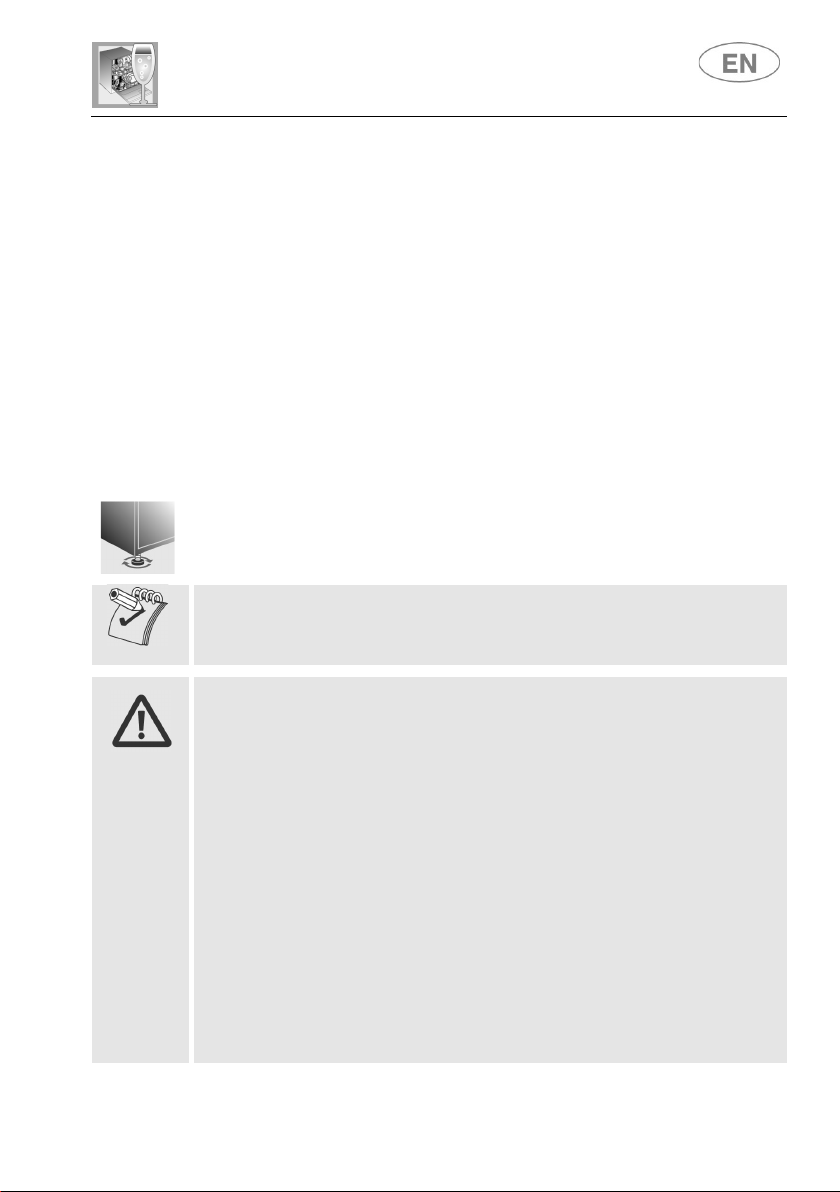
Level the appliance on the floor using the appropriate Allen key to regulate
the adjustable feet. This operation is essential for ensuring correct
operation of the dishwasher.
Some models are equipped with only one adjustable foot at the rear, which
can be adjusted by turning the screw on the lower front part of the
appliance.
Building-in a dishwasher underneath a hob is absolutely forbidden.
Moreover, dishwashers may not be installed directly touching appliances
which are not conventional built-in kitchen appliances (e.g. fireplaces,
stoves, etc.).
When installing the dishwasher in a compartment next to one or more other
appliances, it is essential to comply with all the recommendations provided
by the appliance’s manufacturer (minimum distances, installation
procedures, etc.).
For free-standing models only:
- Installing a hob on top of a free-standing dishwasher is absolutely
forbidden.
- To build in the dishwasher, the special kit must be purchased from
authorised dealers or the After-Sales Service.
- The tops of free-standing dishwashers can be removed to allow them to
be installed underneath a worktop. This procedure must be carried
out by authorised staff.
User instructions
8
2.1 Water supply connection
Preventing the risk of clogging or damage: if the water pipe is new or
has not been used for a long time, before connecting to the water supply
check that the water is clear and free of impurities, to prevent damage to
the appliance.
The dishwasher must always be connected to the water system with
new hoses; old or used hoses must never be reused.
CONNECTING TO THE WATER SUPPLY
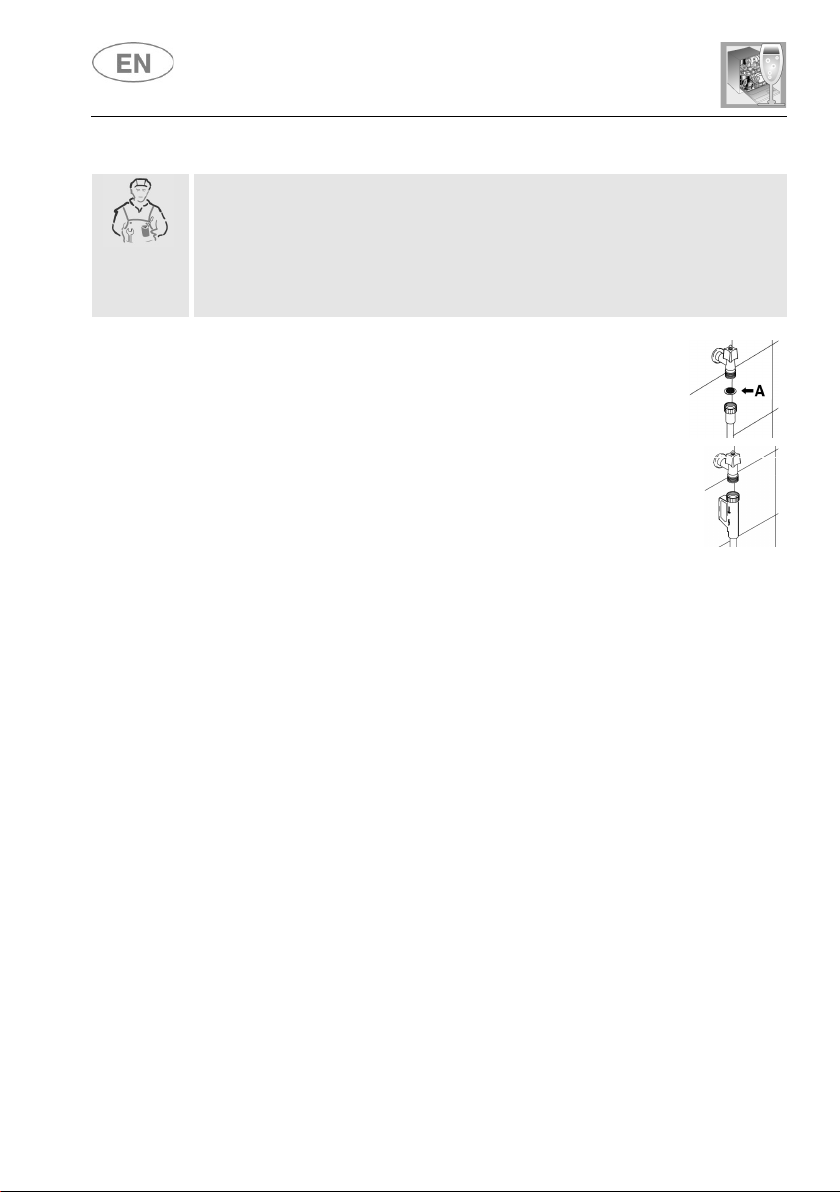
Connect the intake hose to a cold water supply with ¾” gas
thread, inserting the filter A supplied with the dishwasher.
Take care to screw the hose firmly into place with your
hands and then complete by tightening about ¼ of a
turn with pliers.
In dishwashers equipped with the ACQUASTOP device,
the filters is already fitted inside the threaded ring.
The dishwasher can also be connected to a hot water supply not exceeding
60°C. Supplying the appliance with hot water cuts down the washing time
by approximately 20 minutes, but slightly reduces its effectiveness. Make
the connection to the domestic hot water supply using the same procedure
described for connecting to the cold water supply.
User instructions
9
DRAIN CONNECTION
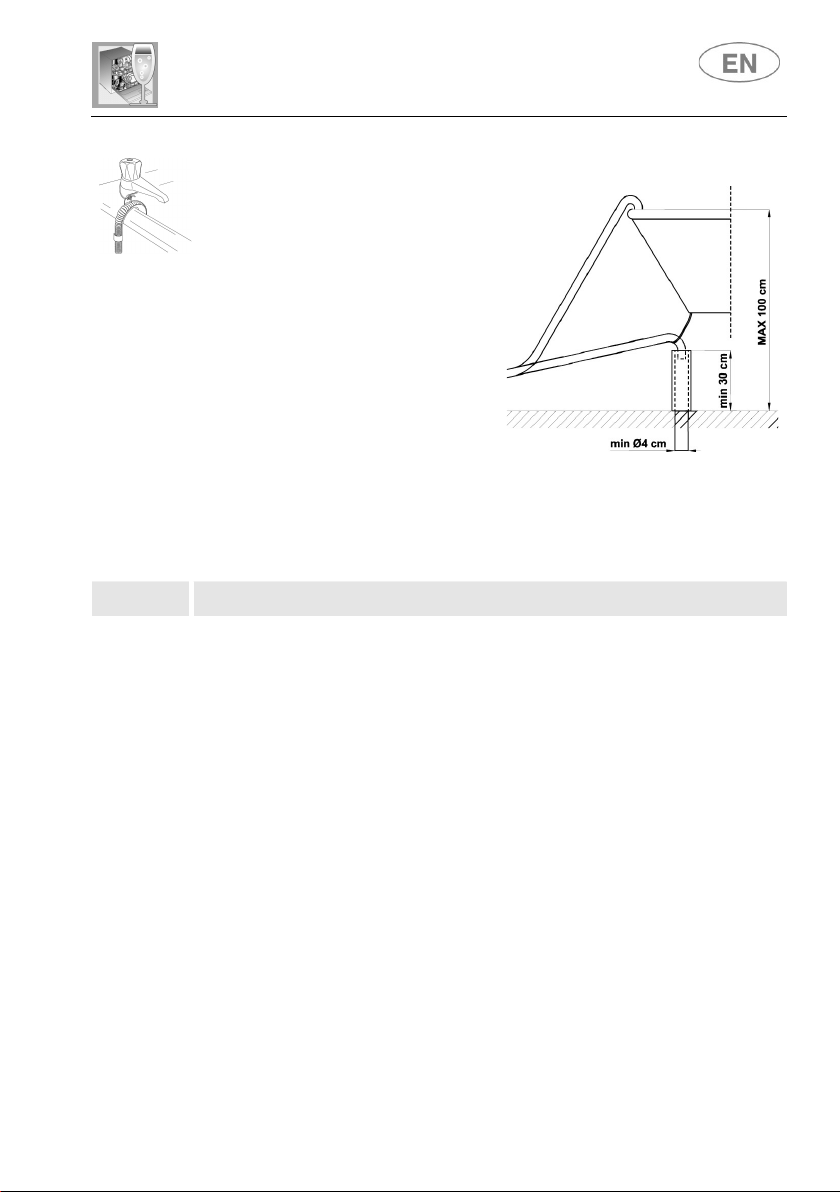
Insert the dishwasher’s drain hose
into a drain pipe having a diameter
of at least 4 cm, or alternatively,
place it inside the kitchen sink
using the plastic support provided,
taking care not to crush or
excessively bend the hose. It is
important to prevent the hose from
coming loose and falling. For this
purpose, the plastic support is
equipped with a hole for tying it to
the wall or water tap.
The free end should be positioned at a height of between 30 and 100 cm,
and should never be submerged in water. If a horizontal drain extension
hose is used (for a maximum of 3 m) the drain hose can be placed at a
maximum height of
85 cm
from the ground.
Class of protection against moisture: IPX0
User instructions
10
2.2 Electrical connection and precautions
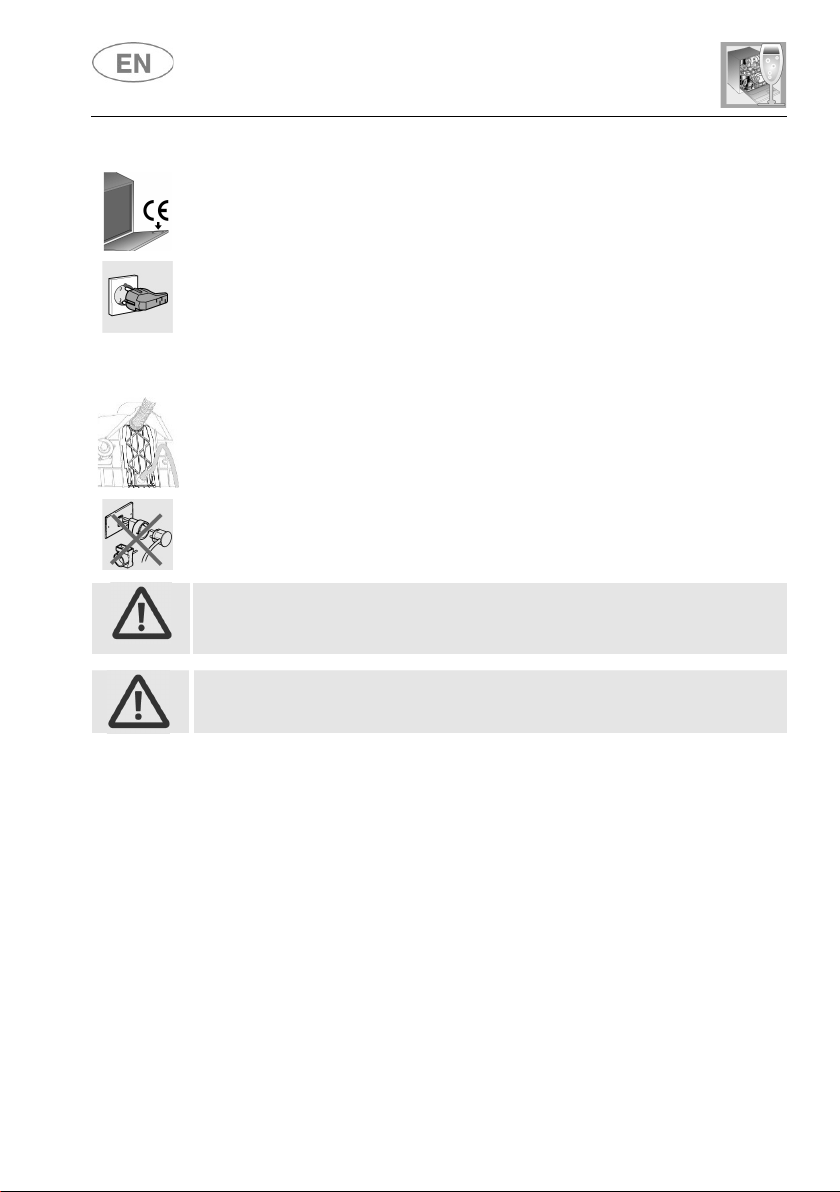
CHECK THAT THE VOLTAGE AND THE FREQUENCY OF THE MAINS MATCH
THE RATINGS ON THE NAME PLATE OF THE APPLIANCE POSITIONED ON
THE INNER EDGE OF THE DOOR.
THE PLUG ON THE SUPPLY CORD AND THE CORRESPONDING SOCKET
OUTLET MUST BE OF THE SAME TYPE AND MEET THE REGULATIONS IN
FORCE.
THE PLUG MUST BE ACCESSIBLE AFTER INSTALLATION.
NEVER DISCONNECT THE PLUG BY PULLING ON THE POWER SUPPLY
LEAD.
AFTER CHANGING THE SUPPLY CORD, MAKE SURE THAT THE BRACKET
WHICH SECURES THE CORD IS FIXED SECURELY IN PLACE.
DO NOT USE ADAPTORS OR SHUNT CONNECTIONS IN ORDER TO AVOID
THE POSSIBILITY OF OVERHEATING OR BURNING.
In the event of damage to the supply cord, have it replaced by the
manufacturer or an Authorized Technical Service Centre in order to
avoid any risk.
Some components are live even with the ON/OFF button in the OFF position.
Before maintenance work on the appliance, remove the plug or turn off the
power supply at the wall switch.
User instructions
11
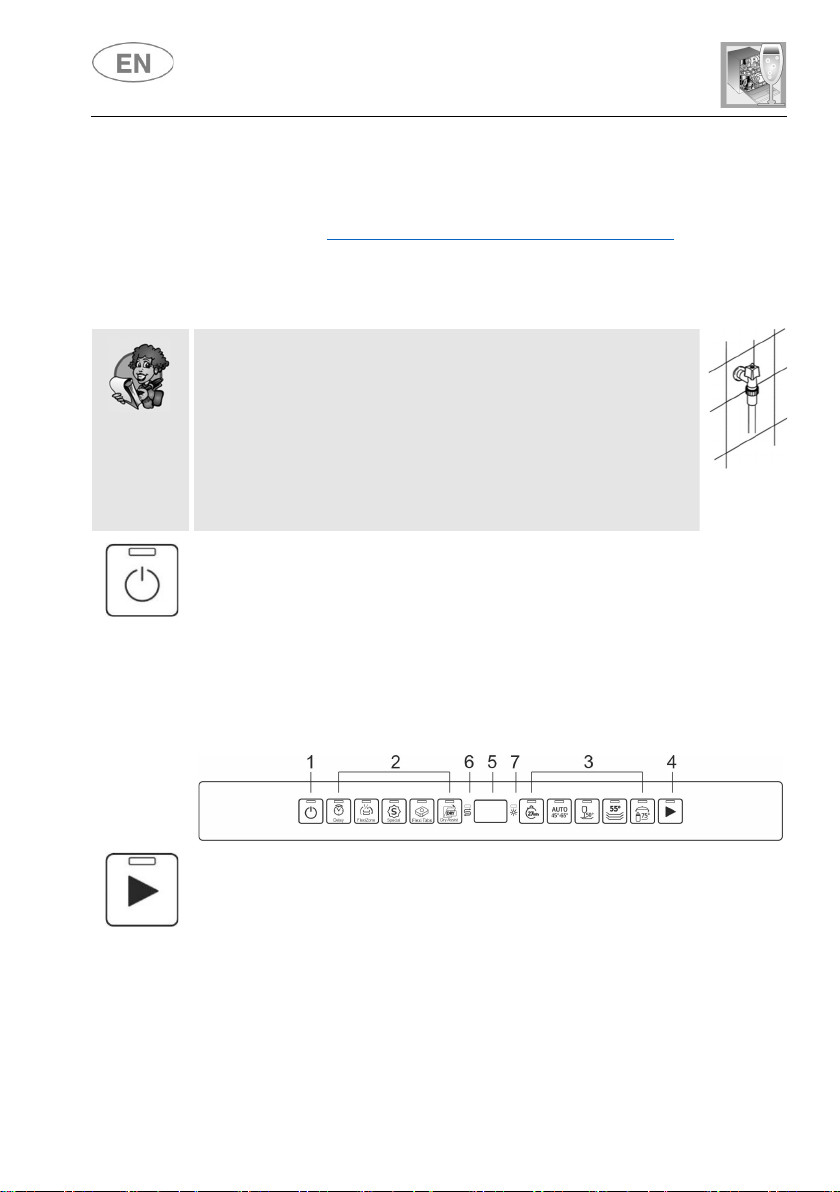
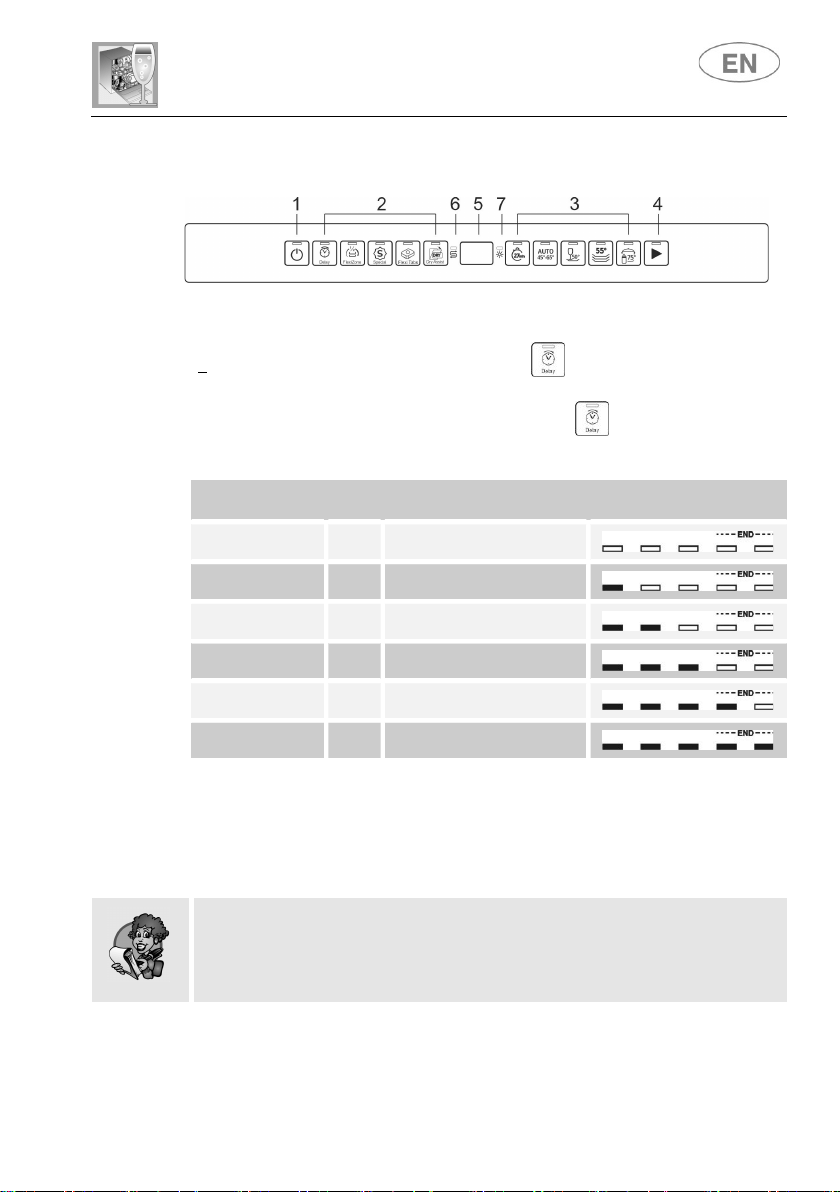
3. Description of the controls
3.1 Front panel
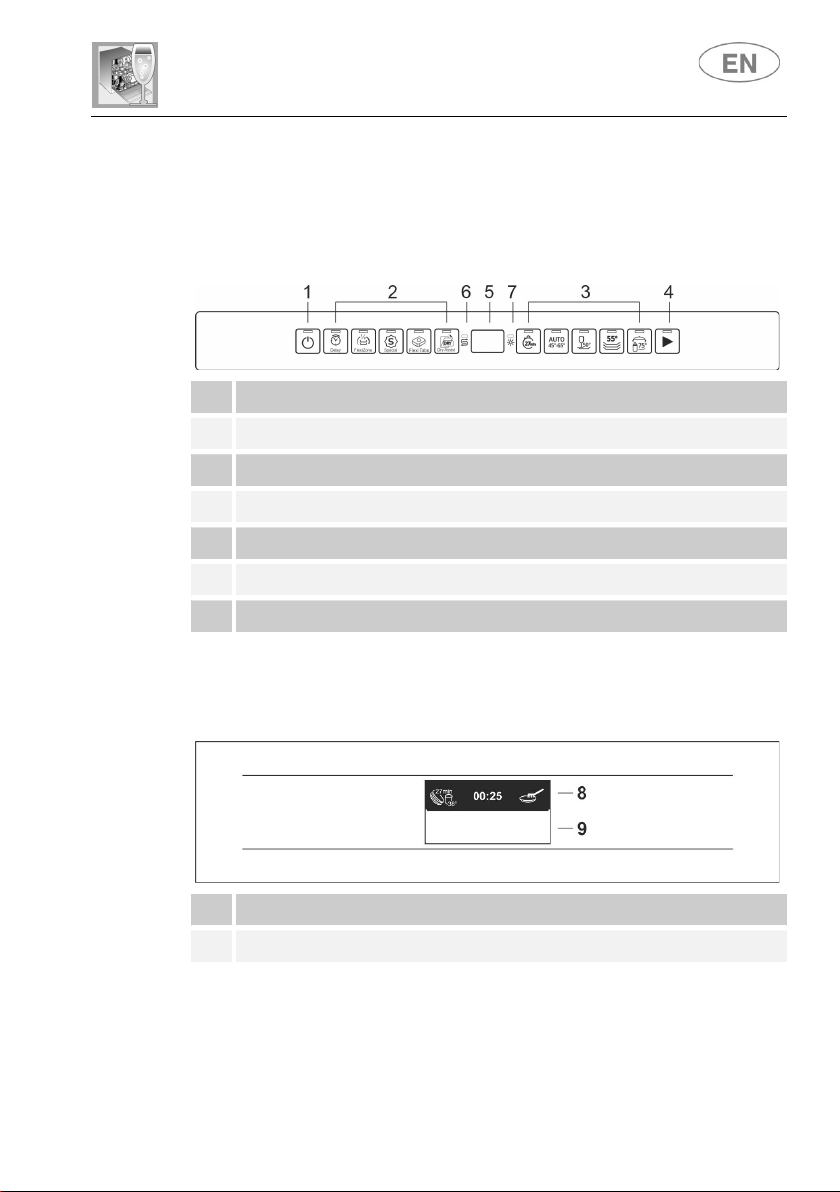
All the dishwasher controls are grouped on the upper panel. Switching
on, programming, switching off etc. are only possible when the door is
open.
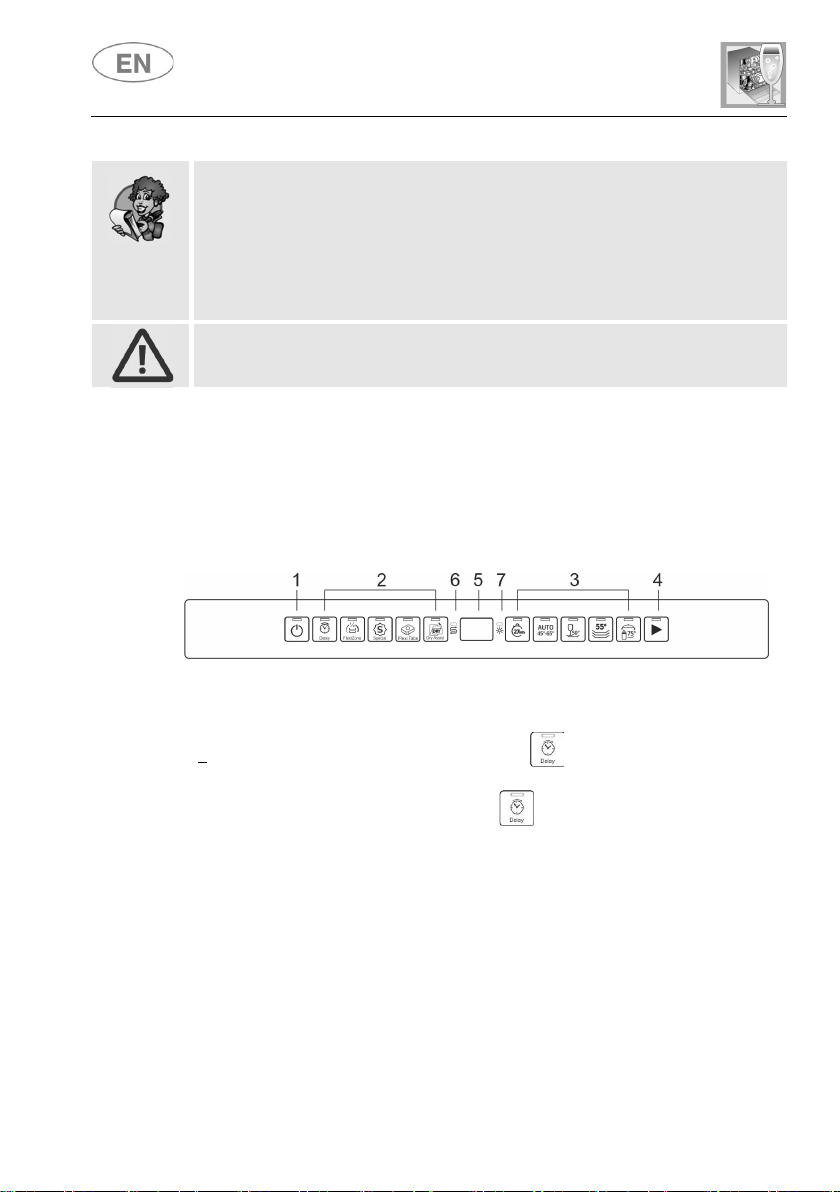
1
ON/OFF BUTTON
2
OPTION BUTTONS/LIGHTS
3
SELECTED PROGRAM BUTTONS/LIGHTS
4
START/PAUSE BUTTON
5
TOP DISPLAY (3 FIGURES)
6
SALT WARNING LIGHT
7
RINSE AID WARNING LIGHT
3.2 The front panel
The front panel includes the DISPLAY which provides all information
concerning the programmed functions.
8
FRONT DISPLAY
9
DOOR HANDLE
N.B.: symbols and styling are guideline and may vary depending on
the model or version of the dishwasher purchased.
User instructions
12
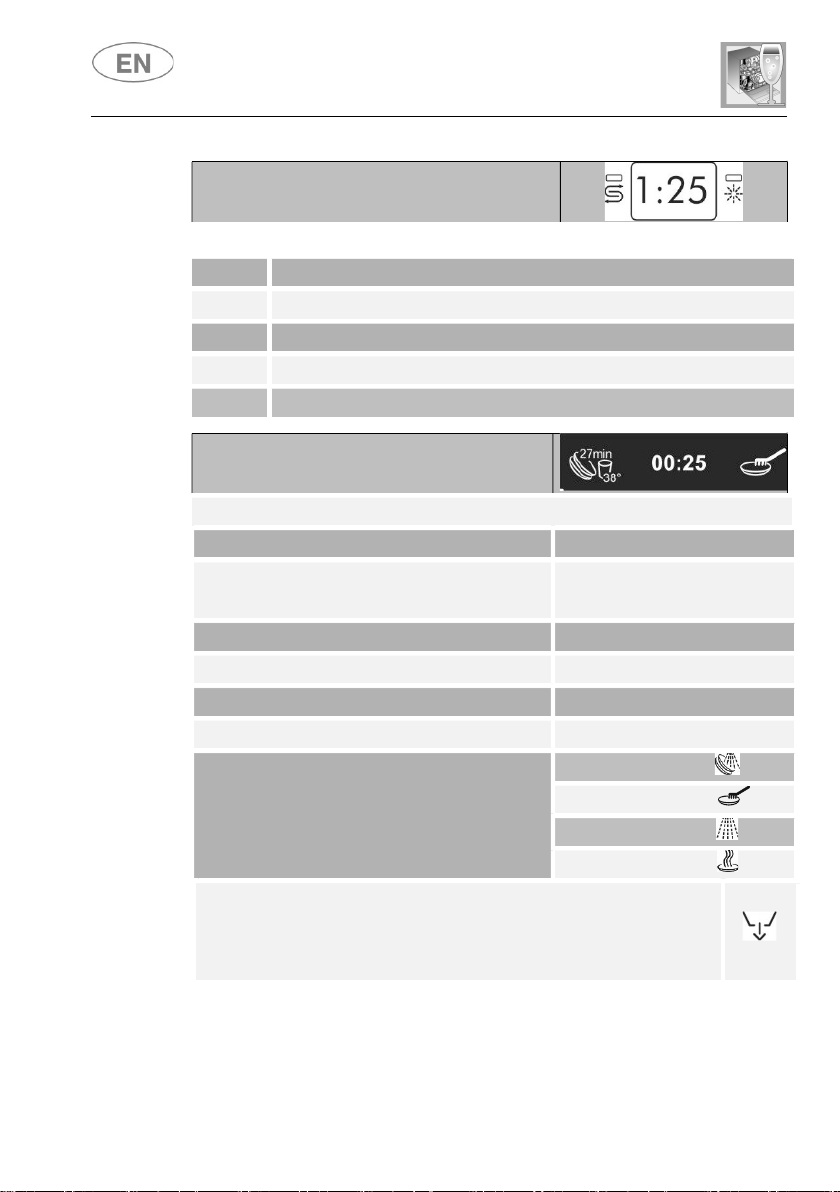
Information shown on top display
Example of screen and information provided
01.05
Estimated wash cycle duration and time remaining
1 h
Delayed start information
E01
Error message CHECK
h.3
Softener setting
P0
Program cancellation
Information shown on front display
End of cycle message End
Estimated wash cycle duration and
time remaining
01: 55
Delayed start information Start in "X" hours
Error message Error 01 ……11
Softener setting h.3
Language selected IT-EN-FR……..
Program phase icons.
They indicate the program status when a
program is running
Prewash
Wash
Rinse
Drying
The icon appears if the washing program is cancelled or if there
is an error.
It does not appear during the drainage phases that are normally
part of the washing program, if it is carried out correctly.

User instructions
13
LANGUAGE SELECTION
1-Switch on the dishwasher
2-Select a wash program (not Special Programs)
3-Press and hold the “half load” button until the currently selected language
appears on the front display.
Press the button again to scroll through the available languages. When the
required language appears on the display, select it by simply waiting a few
seconds without selecting any other options (the name of the chosen
language appears on the display) or switch off the dishwasher by pressing
the on/off button.
N.B.:
- With the door open, the display switches off after about
10 seconds with no commands.
- With the door closed, if the dishwasher is programmed but the start
is not confirmed (cycle not confirmed, program interrupted, start
not confirmed…) the name smeg appears on the display after about
10
seconds.
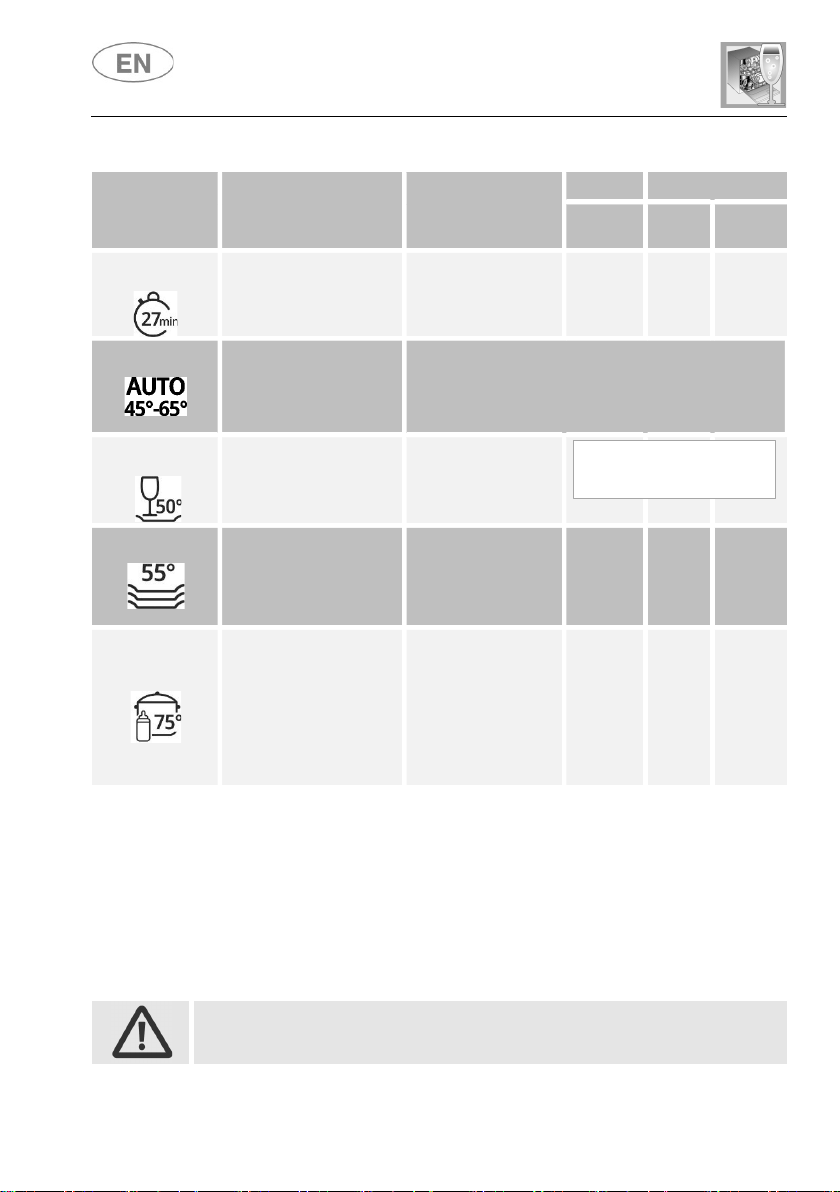
WASH PROGRAM SELECTION AND SWITCHING-ON
For selection of the most suitable program for the dishes to be washed,
refer to the table below, which specifies the recommended type of wash,
also considering the type of dishes and the degree of soiling.
User instructions
14
PROGRAMS TABLE
PROGRAMME
NUMBER
& SYMBOL
LOAD CROCKERY AND
CUTLERY
PROGRAM
PROGRESS
DURATION
CONSUMPTION
MINUTES
(1)
WATER
LITRES
POWER
KWh (1)
1 EXPRESS
27’
Quick wash cycle for
lightly soiled dishes,
washed immediately after
use.
Wash at 38°C
Rinse at 50°C
27
6,5 0,70
2 AUTO
45°-65°
IEC/DIN***
Wash cycle for normally
soiled mixed loads such
as dishes and pans, even
with dried-on residues.
When the "AUTO" program is selected, the dishwasher
recognises the type of dirt and automatically adjusts the
washing parameters as appropriate.
3 (*)
NORMAL ECO
Crockery and cutlery
normally soiled.
Cold prewash
Wash at 50°C
Cold rinse
Rinse at 42°C
Dry
4 REGULAR
Wash cycle for normally
soiled mixed loads such
as dishes and pans, even
with dried-on residues.
Wash at 55°C
Cold rinse
Rinse at
55°C or 70°C (2)
Dry
140/
90 (2)
13,5 1,35
5 STERILISE
Intensive wash cycle
ideal for plates, pots,
pans, cutting boards,
feeding bottles. Ideal for
baby dishes or if there
are allergy sufferers in
the family in order to
achieve a higher level of
hygiene.
Hot prewash
Wash at 75°C
2 cold rinses
Rinse at
55°C or 70°C (2)
Dry
160/
130 (2)
15,5 1,60
* Reference program as per AS/NZS 2007.
During the comparative tests the dishwasher shall to be setted as follow:
- DRY ASSIST option DISABLED
- At
the end of the cycle
the
door
must be
opened
about
15 cm
.
Only
run the soak program with partial loads.
(1) The cycle duration and power consumption may vary according to the water
and room temperatures, and the type and amount of dishes.
(2) DRY ASSIST option selected or not selected
DRY ASSIST is activated automatically if the selected program is compatible
with the option. It can be disabled by pressing the relative button.
If the dishwasher door is open or not properly closed, the washing cycle
will not start.
Waiting for the
Australian tests lab data
User instructions
15
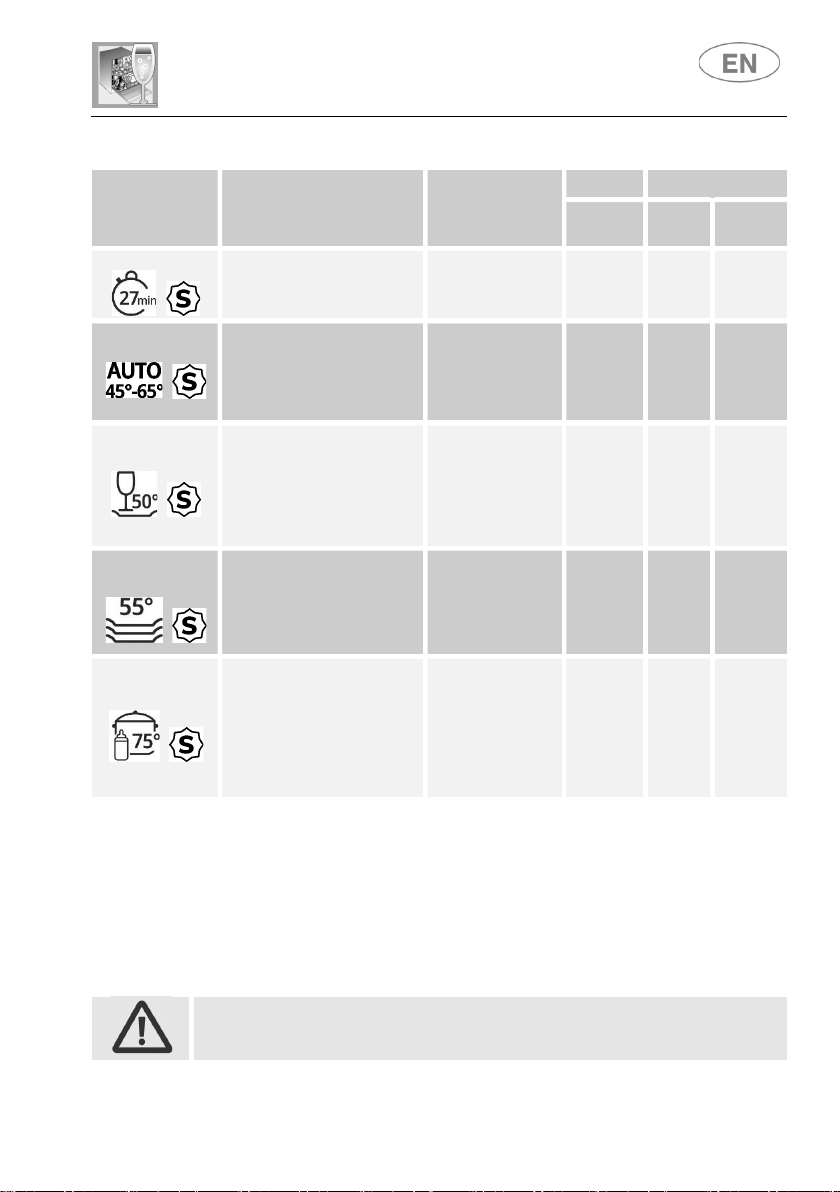
SPECIAL PROGRAMS (see relevant section for explanation of functioning modes)
PROGRAMME
NUMBER E
SYMBOL
LOAD CROCKERY AND
CUTLERY
PROGRAM
PROGRESS
DURATION
CONSUMPTION
MINUTES
(1)
WATER
LITRES
POWER
KWh (1)
6 SOAK
+
Recommended for rinsing
dishes while waiting for
another wash cycle.
Cold prewash
15 3,5 0,02
7 CRYSTAL
+
Wash cycle for delicate
items, such as wine glasses
and lightly soiled fine china.
Ideal when you require
dazzlingly clean glassware
Wash at 45°C
2 Cold rinses
Rinse at
55°C or 70°C (2)
Dry
125/
75 (2)
10,5 1,15
8 SILENT
+
Wash cycle suitable for
normally soiled dishes, even
with dried-on residues.
Ensures maximum noise
reduction and is therefore
ideal if you wish to run it
during the night.
Wash at 55°C
Cold rinse
Rinse at
55°C or 65°C (2)
Dry
270/
245 (2)
12,5 1,25
9 FULL
EXPRESS 60’
+
Quick wash cycle for
normally soiled mixed loads
such as dishes and pans,
even with dried-on residues.
Dishes are washed and
dried in 60 minutes.
Wash at 65°C
Cold rinse
Rinse at
55°C or 70°C (2)
Dry
110/
60 (2)
13 1,40
10 STERILISE
+
Intensive wash cycle ideal
for plates, pots, pans,
cutting boards, feeding
bottles. Ideal for baby dishes
or if there are allergy
sufferers in the family in
order to achieve a higher
level of hygiene.
Hot prewash
Wash at 70°C
2 cold rinses
Rinse at
55°C or 70°C (2)
Dry
190/
155 (3)
10 1,20
The STERILISE program terminate with an extra anti-bacteria rinse that ensures a
further reduction in the bacteria level. If the temperature falls during this stage of the
program (e.g. because the door is opened or due to a power blackout), the program
lights
flash to warn that the anti-bacteria effect is not guaranteed.
(1) The cycle duration and power consumption may vary according to the water
and room temperatures, and the type and amount of dishes.
(2) DRY ASSIST option selected.
DRY ASSIST is automatically activated if the selected program is compatible with
the option. It can be disabled by pressing the relative button.
If the dishwasher door is open or not properly closed, the washing cycle
will not start.
User instructions
16
Notice for testing institutes
Testing institutes are provided with guidelines for comparative tests (e.g.
according to AS/NZS 2007). request the guidelines by contacting us at
the following
e-mail address:
When making a request, please specify the model (MOD) and the serial
number (S/N) indicated on the plate on the side of the door.
3.3 Washing programs
Before starting a wash program, check that:
The water supply tap is open.
The softener container contains regenerating salt.
The correct amount of detergent has been added to the
dispenser.
The baskets have been correctly loaded.
The spray arms are able to rotate freely and without
obstruction.
The dishwasher door
is firmly closed.
SWITCHING ON
With the door open, press the ON/OFF button on the top panel to switch
on the dishwasher. The LED on the button and the DISPLAY light up.
PROGRAMMING
All programming operations are only possible with the door open and the
dishwasher switched on.
Select the wash program on the basis of the temperatures and type of
soiling stated in the program table.
STARTING THE PROGRAM
Select the program required (the light comes on) and any options
(after selecting the program);
Press the start button (the light comes on and the program's name
and estimated time appear on the front panel); the selected program
light flashes for a few seconds;
Close the door: the start light goes out and the program starts.
N.B.: The door must be closed within about 4 seconds; otherwise the
selected program light stops flashing and the start button will have to be
pressed again
before the door is closed to start the program.
User instructions
17
As the program runs, the front display, which shows the program phases,
will indicate the status of the cycle in progress.
Prewash
Wash
Rinse
Drying
Warning:
during the initial phase of the wash program the spray arms cannot be
heard in operation because they start turning about 5 minutes after the
start. This is the normal wash cycle sequence.
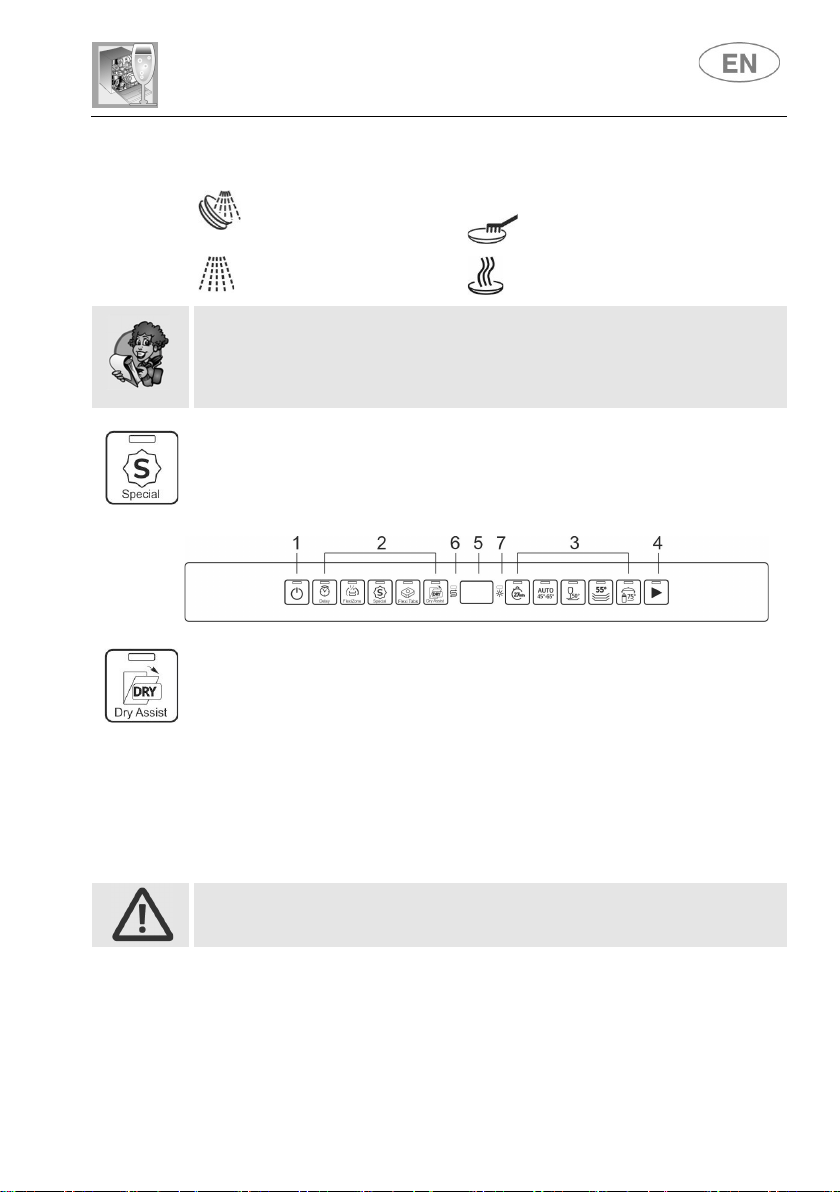
SPECIAL
Allows you to enable additional programs when selected together with any
wash cycle. After having selected the required wash cycle, press the button
(the light turns on). It turns off automatically when the cycle has finished.
DRY ASSIST
The door opens automatically, allowing the dishes to be dried perfectly
even at low rinse temperatures, and therefore significant energy savings.
The door opens automatically by a few centimetres at the end of the wash
cycle. The dishwasher remains inactive between the final rinse and the
end of the cycle to allow the load to be properly dried (the display shows
the time remaining to the end of the cycle). The program is interrupted if
the door is opened during this stage. A short beep is emitted and cycle
lights 4 and 5 flash to indicate that the cycle has finished. It starts
automatically if the selected program is compatible with the option. It can
be disabled before starting the program.
There must be sufficient space available for the door to open. The
door must not be forced open and closed before the wash cycle has
ended completely.
User instructions
18
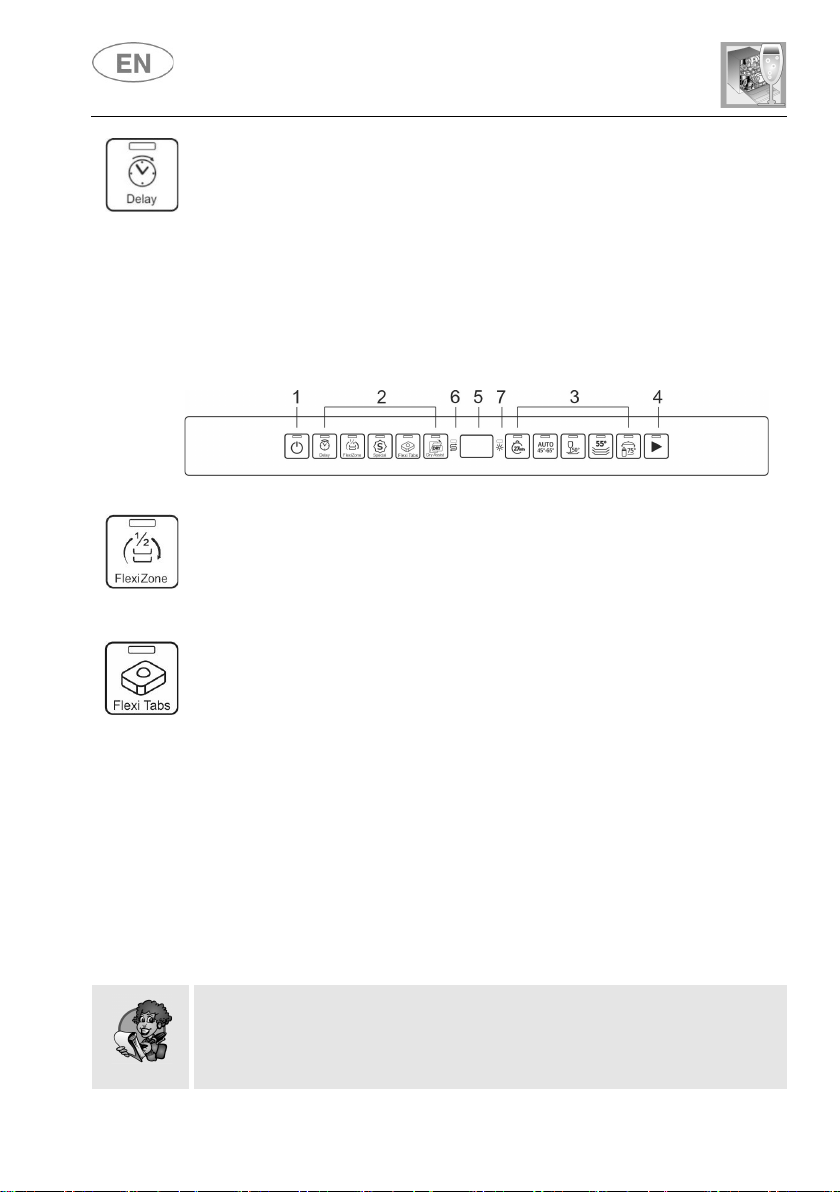
DELAYING THE PROGRAM
Allows you to program the dishwasher cycle to start during the required
time period (e.g. night). Press the DELAY button to activate the option. A
delay of 1 hour is shown on the display. Pressing the button repeatedly
will allow you to select the required delay of up to 24 hours. To cancel the
setting, press and hold the button until "0h” appears on the display. The
option cannot be selected once the cycle is running. During programming,
the selected delay is shown on the upper display. The following message
appears on the front display: Start in "X" hours. When the door is closed,
the appliance will prewash the dishes, after which the "program delay" set
will come into effect.
1/2 LOAD FLEXI ZONE
Ideal if just a few dishes need to be washed, allowing energy savings. The
dishes should be placed in both baskets and less detergent should be
placed in the detergent dispenser compared to the amount used for a full
load.
Flexi Tabs
Specifically for washing with combination detergents in tablets, which also
contain salt and rinse aid (3in1) or other agents such as glass protector,
steel rinse aids, etc. (4in1, 5in1…). When this option is selected, salt and
rinse aid will not be dispensed even if the relative compartments contain
them. If the containers are empty, the lights will remain on.
If the option is not provided, we recommend the use of conventional
products (separate detergent, salt and rinse aid), because with
conventional washing cycles, combined products might create problems
such as a white deposit, poor drying results and residues left on dishes.
For further information, refer to the detergent pack.
IMPORTANT:
when no longer required, the option must be deactivated by pressing the
relative
button
(the light goes out).
These products are not suitable for use with excessively “hard” water.
If the hardness level set is higher than H3, when the option is activated
the relative light flashes to indicate that the product is being used
incorrectly; the dishwasher will still work, but washing results may be
poor
.
User instructions
19
CANCELLING THE PROGRAM IN PROGRESS
- Open the door (watch out for water splashes)
- Press the START button and hold it down until P0 appears on
the top display.
- Close the door (00:01 appears on the front display)
- After about 1 minute the program will be cancelled (“End”
appears on the front display).
CHANGING THE PROGRAM
To change the program in progress, simply open the door (watch out for
water splashes) and select a new program. When the door is closed the
dishwasher will automatically run the new program.
TO SAVE ENERGY AND PROTECT THE ENVIRONMENT
Always try to use the dishwasher with a full load.
Do not wash the dishes in running water.
Use the wash program that is most appropriate for each type of load.
Do not perform preliminary rinsing.
If available, connect the dishwasher to a hot water supply up to 60°C.
Use the ENERSAVE option
TO REDUCE DETERGENT CONSUMPTION AND PROTECT THE
ENVIRONMENT
The phosphates contained in dishwasher detergents are harmful to the
environment. To avoid using excessive amounts of detergent save on
electricity as well, observe the following recommendations:
Sort your dishes, washing delicate items separately from those
more resistant to strong detergents and high temperatures.
Do not pour detergent directly onto dishes.
If the door has to be opened while washing is in progress, the programme
will be interrupted. The programme light will stop flashing and a beeper
will signal that the cycle has not been completed. The pause symbol will
alternate with the time left to the end of the cycle on the front display.
Press the button and close the door. The programme will continue from
the point where it was interrupted. This operation should only be carried
out if strictly necessary, as it could cause problems in running the
pr
ogramme.

User instructions
20
END OF PROGRAM and SWITCHING OFF
At the end of the program, the dishwasher emits a beep and "End"
flashes on the front display alternating with the name of the program
which has just finished. The dishwasher switches off after about 5
minutes
to save electricity.
The ON/OFF button has to be pressed to switch it back on.
REMOVING THE DISHES
At the end of the wash program, wait at least 20 minutes before removing
the dishes, to allow them to cool. To ensure that any drops of water left in
the top basket cannot drip onto the dishes still in the lower basket, it is
best
always to empty the lower basket first, followed by the upper basket.
User instructions
21
4. Operating instructions
Once the dishwasher has been correctly installed, prepare it for use as
follows:
Adjust the water softening system (in some models only)
Add salt (in some models only)
Add rinse aid and detergent
4.1 Using the water softening system
(in some models only)
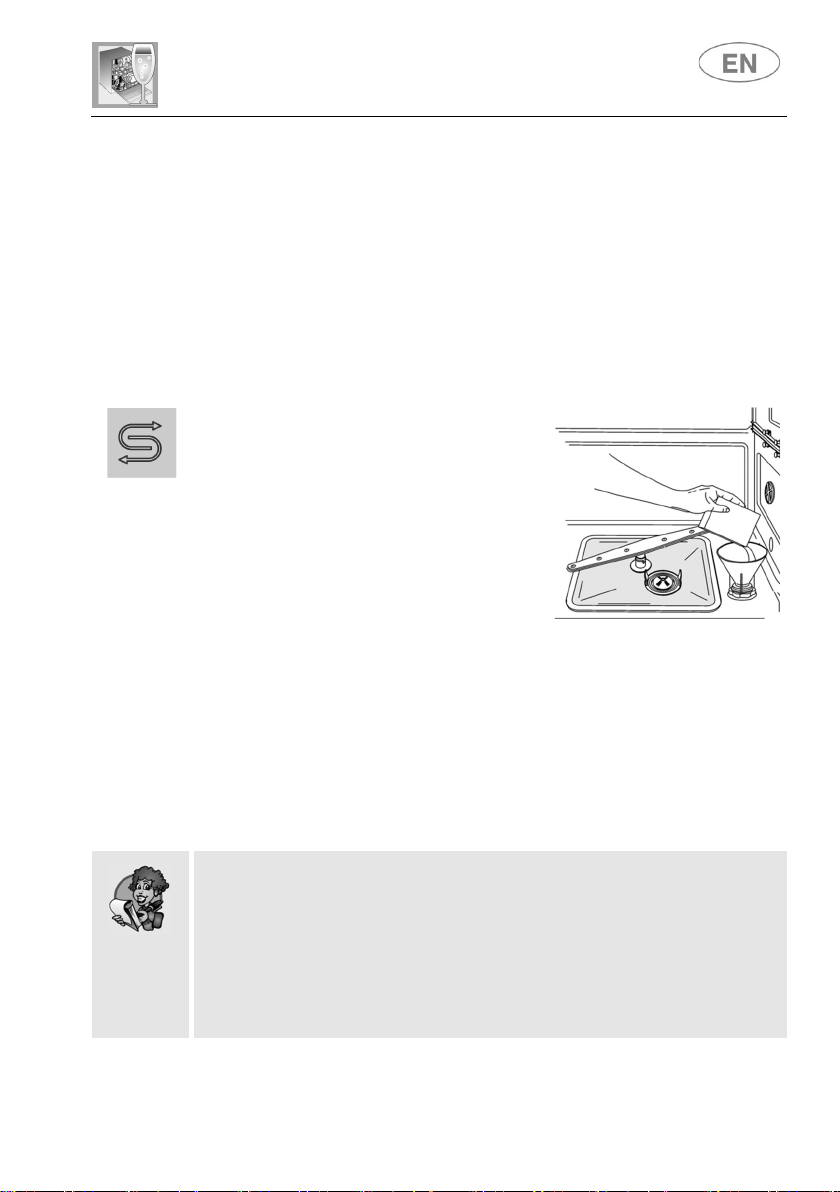
The quantity of lime in the water (which
indicates its hardness) causes whitish
marks on dry dishes, which also tend to
lose their shine over time. The dishwasher
is equipped with an automatic water
softener which removes the substances
that cause hardness from the water with
the aid of a special regenerating salt.
When using water of medium hardness, the salt container should be
refilled after approximately 20 wash cycles. The salt container can hold
approximately 1 kg of salt grains. The container is situated at the bottom
of the dishwasher. After removing the lower basket, unscrew the salt
container cap by turning it anticlockwise and pour in the salt using the
funnel supplied with the dishwasher. Before replacing the cap, remove any
salt residues from around the opening.
When using the dishwasher for the first time, in addition to the salt it
is also necessary to add one litre of water to the container.
Each time the salt container is refilled, make sure that the cap is
securely closed. The mixture of water and detergent must never
enter the salt container, as this would compromise the operation of
the regeneration system. In this case warranty cover will be forfeited.
Only use salt specially formulated for domestic dishwashers. If using
salt tablets, do not fill the container completely.
SALT
User instructions
22
Do not use table salt, as it contains insoluble substances which, over
time, may damage the water softening system.
The salt container should be refilled when necessary before starting
the wash program. This way, the excess saline solution will be
immediately removed by the water; prolonged presence of salt water
inside the tank may lead to corrosion.
Be careful not to confuse the salt and detergent packages; adding
detergent to the salt container will damage the water softening system.
ADJUSTING THE SOFTENER (in some models only)
(available for all programs except the soak program)
The dishwasher is equipped with an electronic control system which
allows the softener setting to be varied to suit the hardness of the water.
To set the softener, proceed as follows.
To access the programming environment it is necessary that the dishwasher
is switched on and the door is open, at this point you must:
press the PROGRAM DELAY button until the H symbol appears
on the display, followed by the number currently set (e.g. H3)
press the PROGRAM DELAY button the number of times
needed to select the right setting level for the hardness of the water
(H0, H1, H2, H3, H4, H5);
N.B.: after few seconds the appliance exits the parameter setting menu
automatically.
User instructions
23
WATER HARDNESS TABLE
WATER HARDNESS
SETTING
German degrees (°dH) French degrees (°dF)
0
-
6
0
-
11
h.-0 NO SALT
7
-
10
12
-
18
h.-1
11
-
15
19
-
27
h.-2
16
-
21
28
-
37
h.-3
22
-
28
38
-
50
h.-4
29
-
50
51
-
90
h.-5
Contact your local water board for information on the hardness of your
water supply. Default settings:
H3
-
16
-
21°dH
–
28
-
37°dF
4.2 Using the rinse aid and detergent dispensers
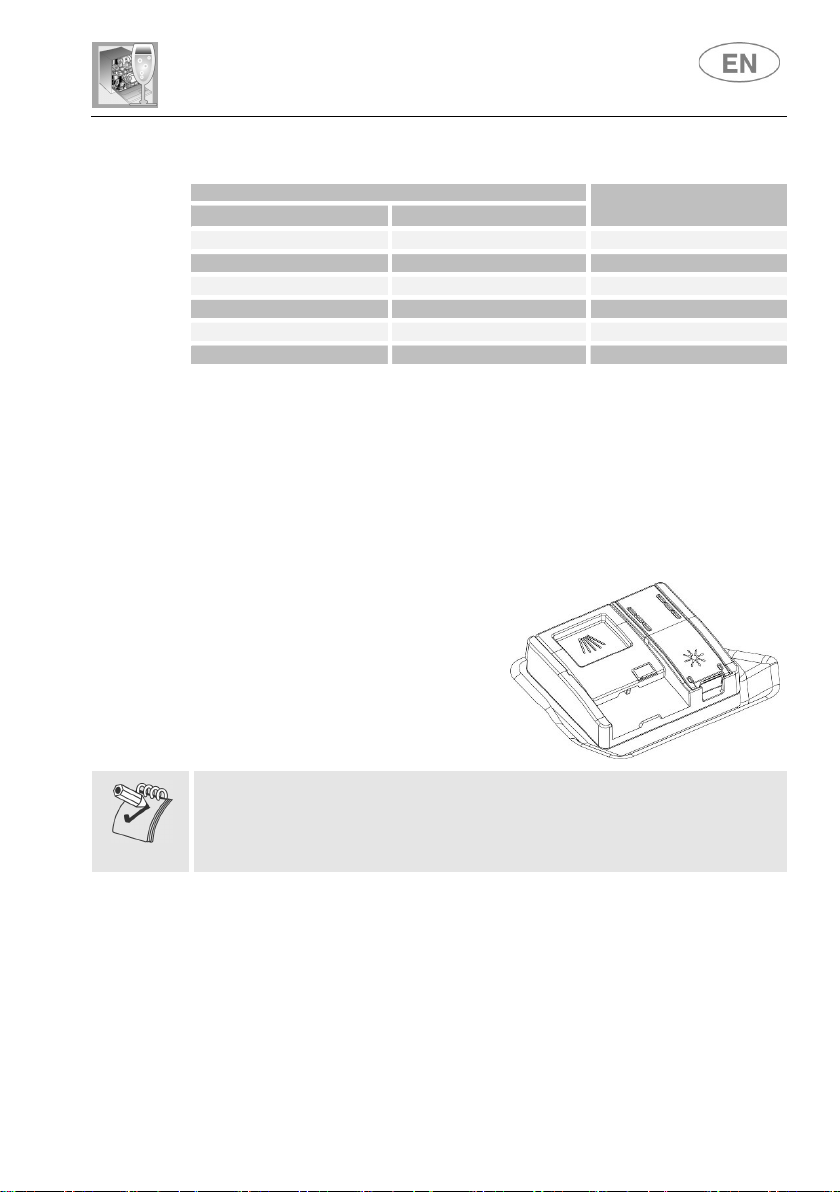
The detergent and rinse aid
dispensers are situated on the inner
part of the door: the detergent
dispenser is on the left, and the rinse
aid dispenser is on the right.
With the exception of the SOAK program, before every washing cycle it is
necessary to add the required amount of detergent to the detergent
dispenser. The rinse aid, on the other hand, should only be added as
required.
User instructions
24
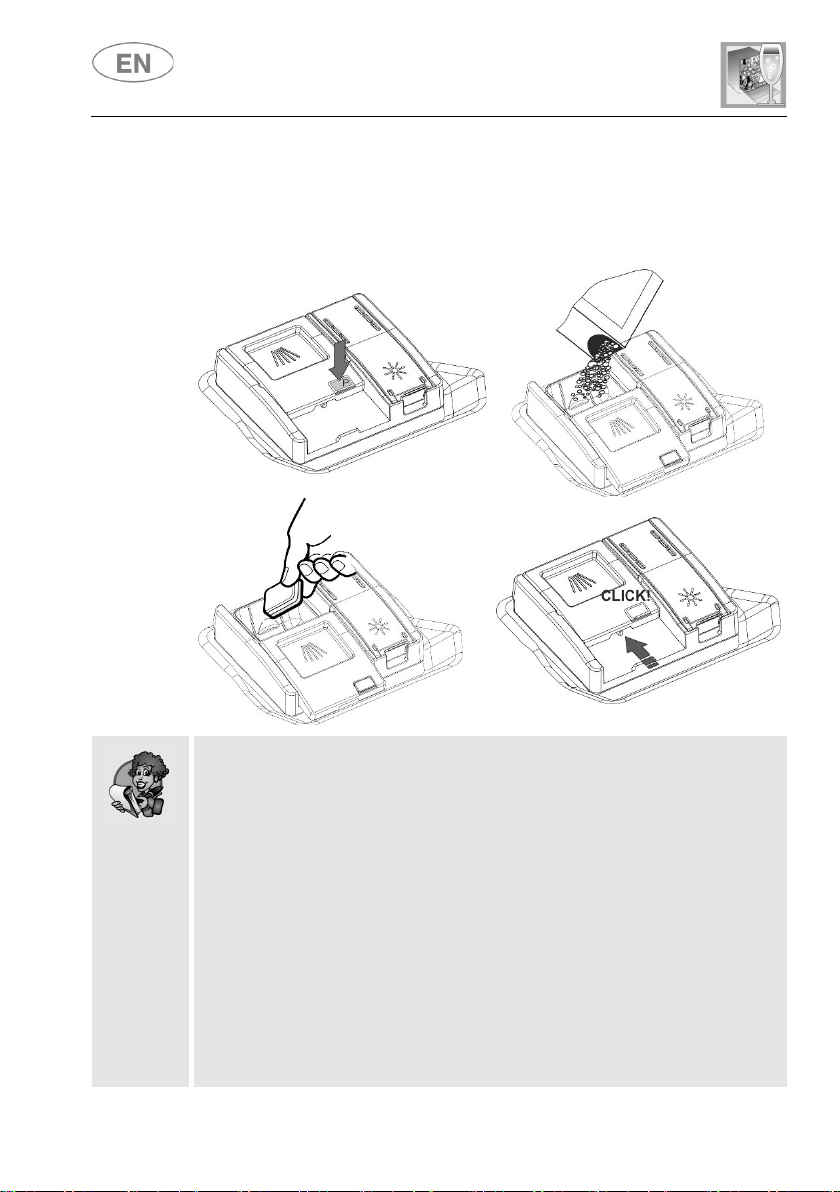
ADDING THE RINSE AID
The rinse aid helps the dishes dry faster and
prevents the formation of scale deposits and
staining; it is automatically added to the water
during the final rinse cycle, from the container
situated on the inner side of the door.
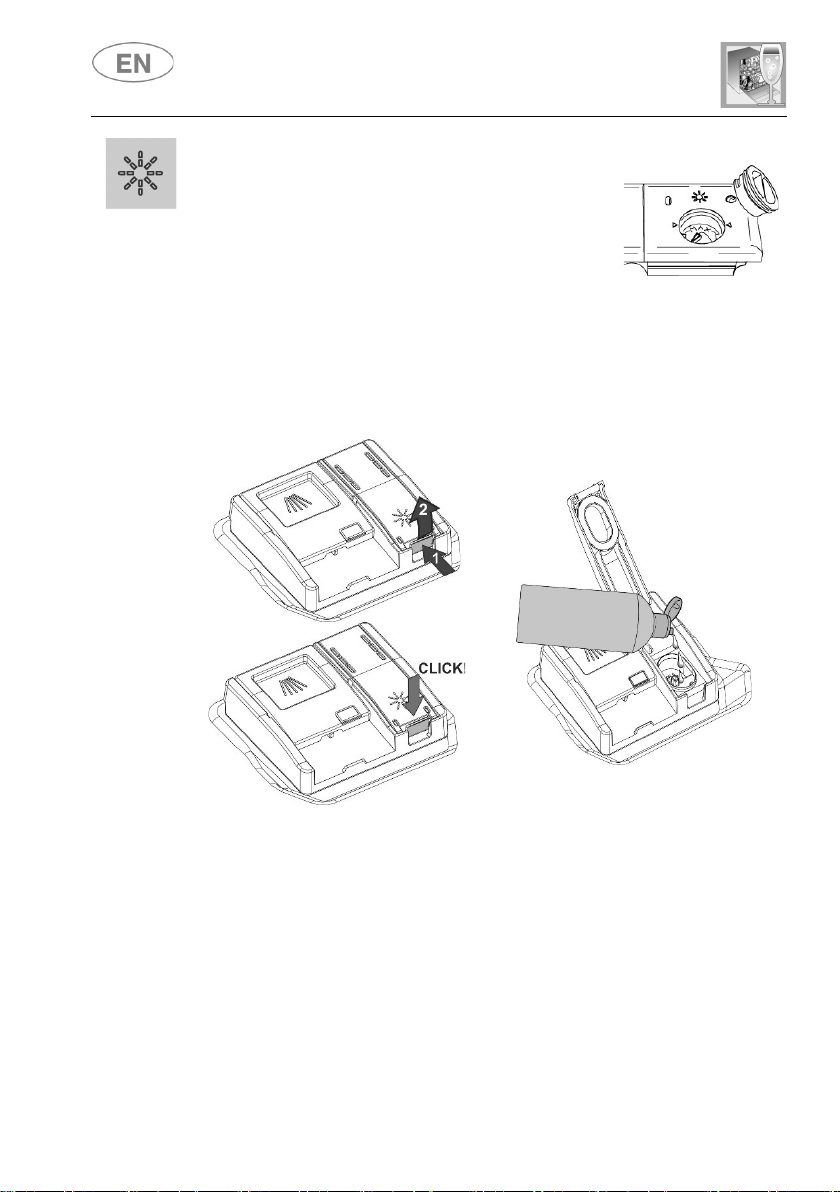
To add rinse aid:
Open the dispenser by pressing and lifting the tab on the cover.
Fill the dispenser with rinse aid. Top up again when the rinse aid
indicator light turns on.
Close the cover, a click indicates when it is closed.
Use a cloth to remove any spillage of rinse aid which might lead to
the formation of excess foam.
User instructions
25
ADJUSTING THE RINSE AID DISPENSER MODE
To access the programming environment it is necessary that the dishwasher
is switched on and the door is open, at this point you must:
press the PROGRAM DELAY button until the b symbol appears
on the display, followed by the number currently set (e.g. b3)
Then press the PROGRAM DELAY button button several times
to select the required dosage according to the following table:
RINSE AID ADJUSTMENT TABLE
0 – not
dispensed
b0 All indicator lights off
Minimum. 2 ml b1 One indicator light on
3 ml b2 Two indicator lights on
4 ml b3 Three indicator lights on
5 ml b4 Four indicator lights on
Maximum. 6 ml b5 Five indicator lights on
Default settings: b4 - 5 ml
After carrying out the adjustment or displaying the current setting, if you
do not touch the button for a few seconds the dishwasher will
automatically exit from adjustment mode and return to the standard
operating mode.
The amount of rinse aid must be increased if the washed dishes
appear dull or feature circular stains.
If, on the other hand, the dishes are sticky or have white streaks, it is
necessary to reduce the rinse aid setting.
User instructions
26
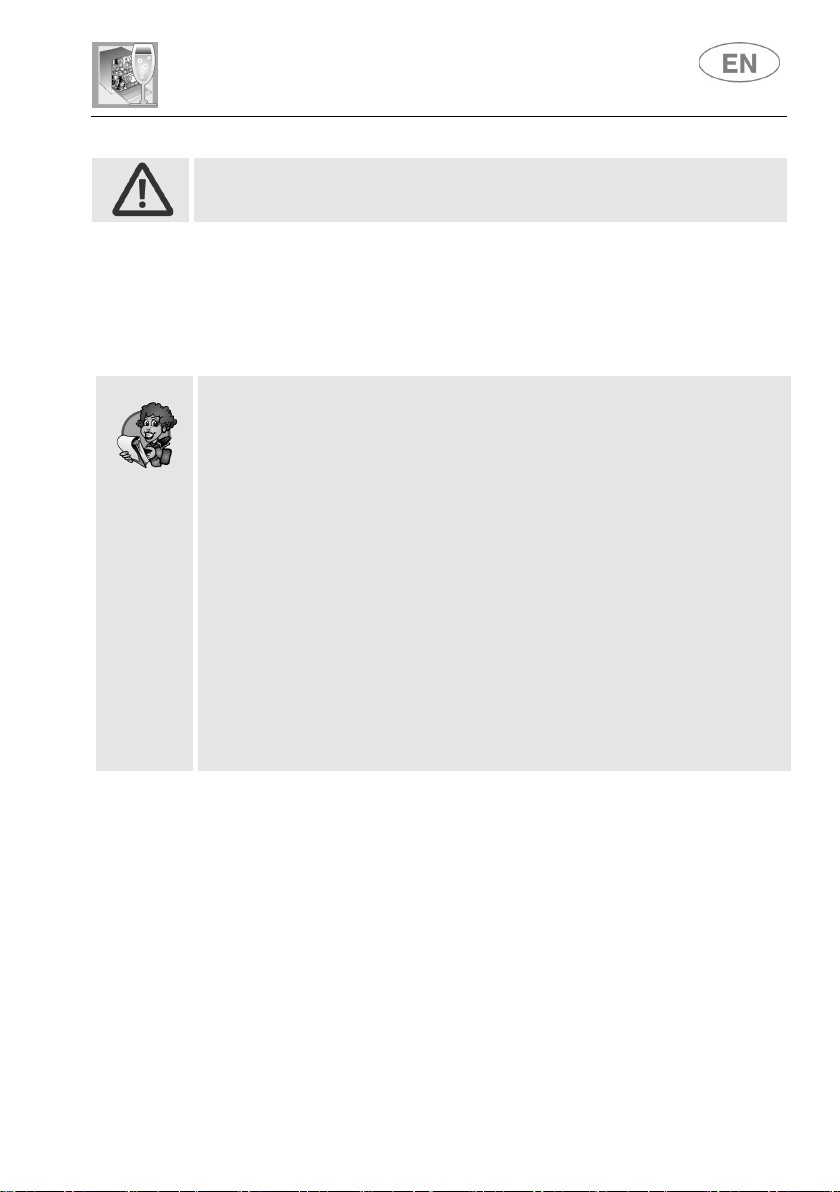
ADDING THE DETERGENT
To open the detergent dispenser cover, lightly press button P. Add the
detergent or tablet and close the cover by sliding it until it stops, indicated
by a click.
The dispenser will open automatically during the wash cycle.
Only add the detergent (also in tablet form) if the dispenser is dry
When a program with hot prewash is selected (see program table),
extra detergent must be placed in the cavity G/H (depending on
models).
Use only detergents specially formulated for dishwashers. The
detergent packs must be sealed and stored in a dry place to prevent
the formation of lumps which may negatively affect washing results.
Once opened the detergent packs should not be kept for too long,
otherwise the detergent loses its effectiveness.
Do not use detergents for washing dishes by hand because they may
affect the operation of the dishwasher.
Add the correct amount of detergent. An insufficient amount of
detergent will result in a partial removal of dirt from the dishes,
whereas an excessive amount is wasteful and does not improve the
washing results.
For the safeguarding of the environment we recommend the use of
phosphate- and chlorine free detergents.
User instructions
27
The introduction of detergent into the rinse aid dispenser, even in
liquid form, will damage the dishwasher.
4.3 General warnings and recommendations
Before using the dishwasher for the first time, it is advisable to read the
following recommendations concerning dish types to be washed and their
loading.
There are generally no constraints on the washing of domestic dishes,
but in certain cases it is necessary to take their characteristics into
account.
Before loading the dishes into the baskets it is necessary to:
remove coarse food remains: e.g. bones, fish-bones, etc. which may
clog the filter or damage the wash pump.
soak any pots or pans with burnt-on food remains on the bottom to
facilitate removal, then load them into the LOWER BASKET.
There is no need to pre-wash the dishes under running water before
loading them into the baskets since this only wastes water.
Correct loading of the dishes helps ensure optimal washing results.

User instructions
28
WARNING!
Make sure that the dishes are securely in place so that they cannot
tip over or obstruct the rotation of the spray arms during the washing
cycle.
Do not place very small objects in the baskets as these could fall and
obstruct the spray arms or the wash pump.
Containers such as cups, bowls, glasses and pots should always be
loaded with the opening facing downwards and with any cavities at
an angle, to allow the water to drain out.
Do not stack dishes or place them in such a way that they cover one
other.
Do not place glasses too close together because they may knock
against each other and break, or there might be staining at the point
where they touch.
MAKE SURE that the items being washed are dishwasher-safe.
Items which are not dishwasher-safe:
Wooden dishes, pots or pans: these may be damaged by the high
washing temperatures.
Handcrafted items: these are rarely suitable for washing in a
dishwasher. The relatively high water temperatures and the
detergents used may damage them.
Plastic dishes: heat resistant plastic dishes must be washed in the
upper basket.
Dishes and objects in copper, tin, zinc or brass: these tend to
stain.
Aluminium dishes: items made from anodised aluminium may lose
their colour.
Silverware: silver items may stain.
Glass and crystal: in general, glass and crystal objects can be
washed in the dishwasher. However, certain types of glass and
crystal may become dull and lose their clearness after many
washings. Therefore, for these items we recommend using the least
aggressive program available.
Decorated items: the decorated objects available on the market are
generally able to withstand washing in the dishwasher, although the
colours may fade after a great many washes. If in doubt as to the
fastness of the colours, it is advisable to wash just a few items at a
time for approximately one month.
User instructions
29
4.4 Using the baskets
The dishwasher has a capacity of 15 place-settings, including serving
dishes.
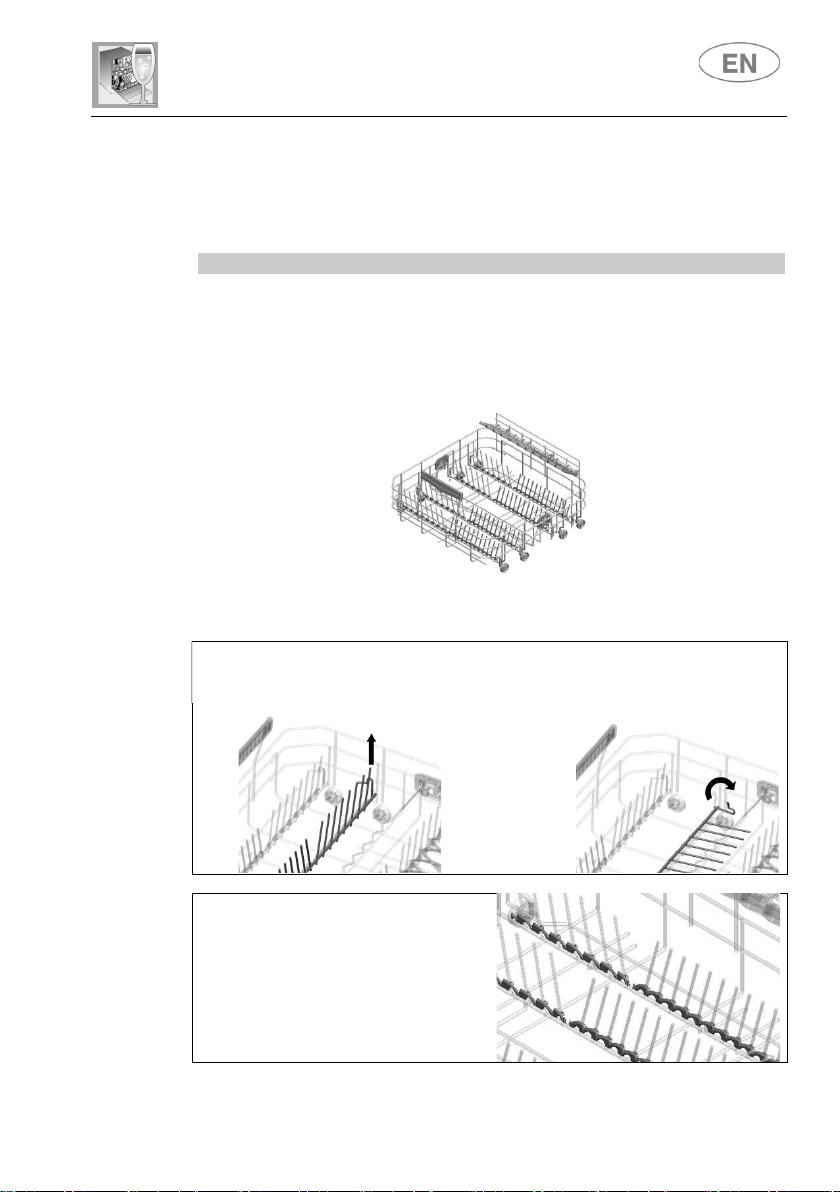
LOWER BASKET
The lower basket receives the full force of the lower spray arm, and should
therefore be used for the “toughest” items with a heavier degree of soiling.
All types and combinations of loads are permitted, provided that the
dishes, pots and pans are arranged with all the soiled surfaces exposed
to the water jets coming from the bottom.
Depending on the models, the basket may be equipped with some or all
of the following accessories:
Plate racks, which can be laid flat when not in use (e.g. to accommodate
pans, bowls, etc.). To stow the racks flat, pull them upward and turn
them towards the inside of the basket.
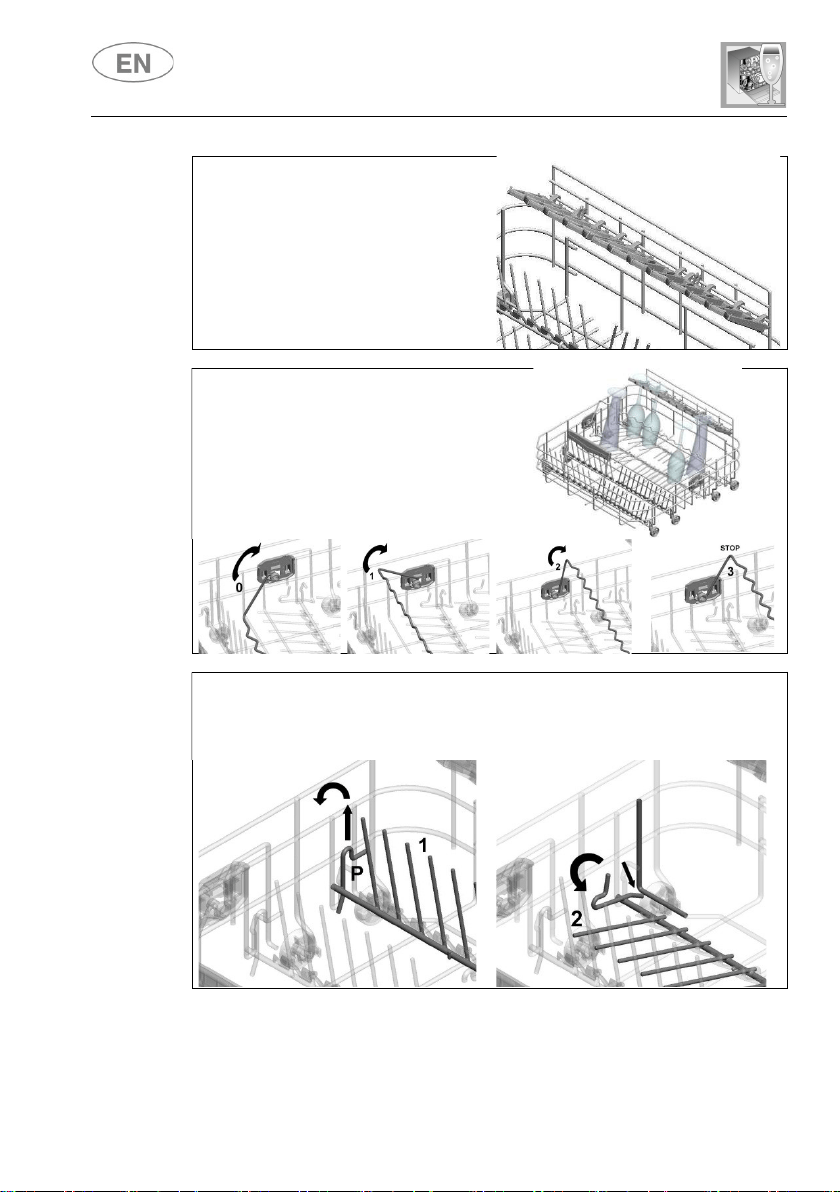
Anti-drip inserts which improve the
drying of dishes. They may be
supplied fitted on the basket or in
the accessories bag; in this case, to
use them, simply fit them into place
as shown.
User instructions
30
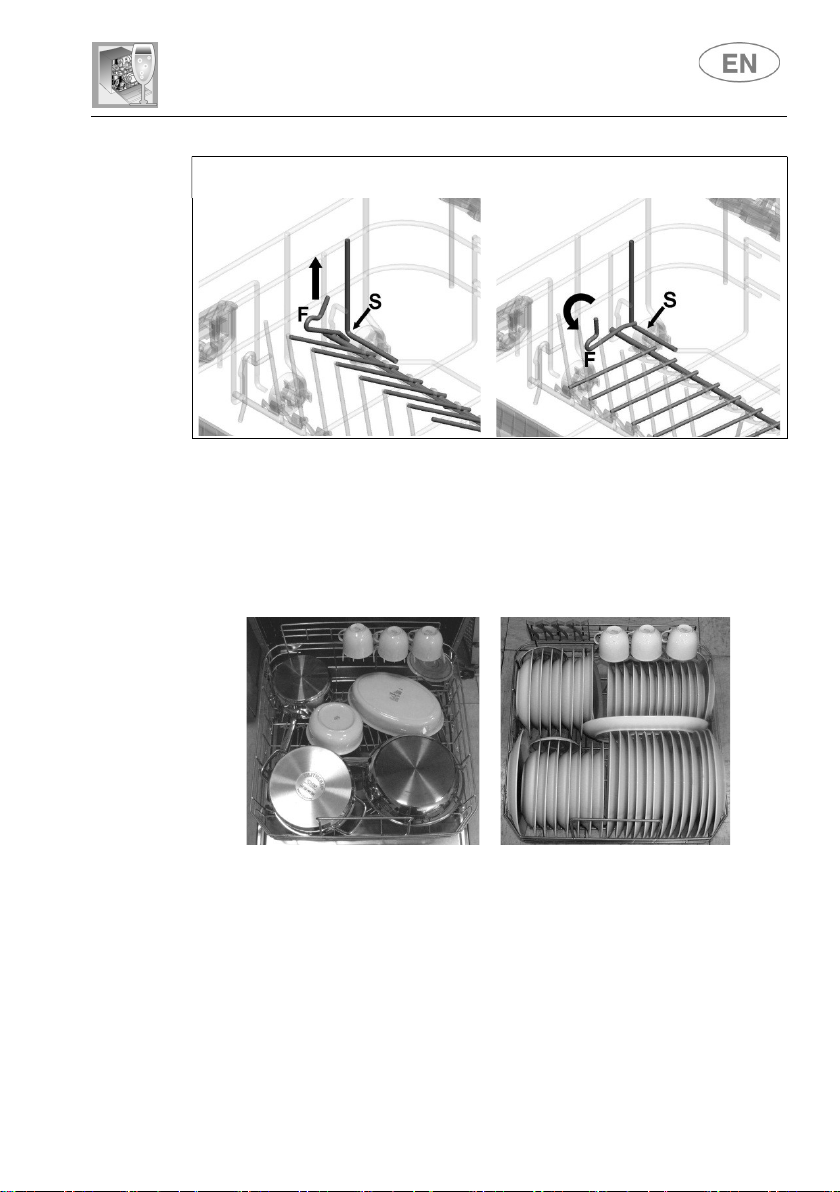
Supports for cups and long objects
(ladles, spoons, etc.), in the rear;
can be tipped to the vertical position
when not in use.
Glass holder. Support for long-
stem glasses. When lifted out of the
stowed position (0) it snaps into
three different positions (1-2-3).
2-position fold-down supports (1-2).
In position 1 (vertical) they can be
used to take plates, while in position 2 (slanted) they provide support for
long-stem glasses which will be held in place by the glass holder.
Adjustment: raise point P as shown until the support turns into position 2.
User instructions
31
To lie completely flat, lift the end and turn it towards you so that the
retainer
F
rotates into place above point
S
.
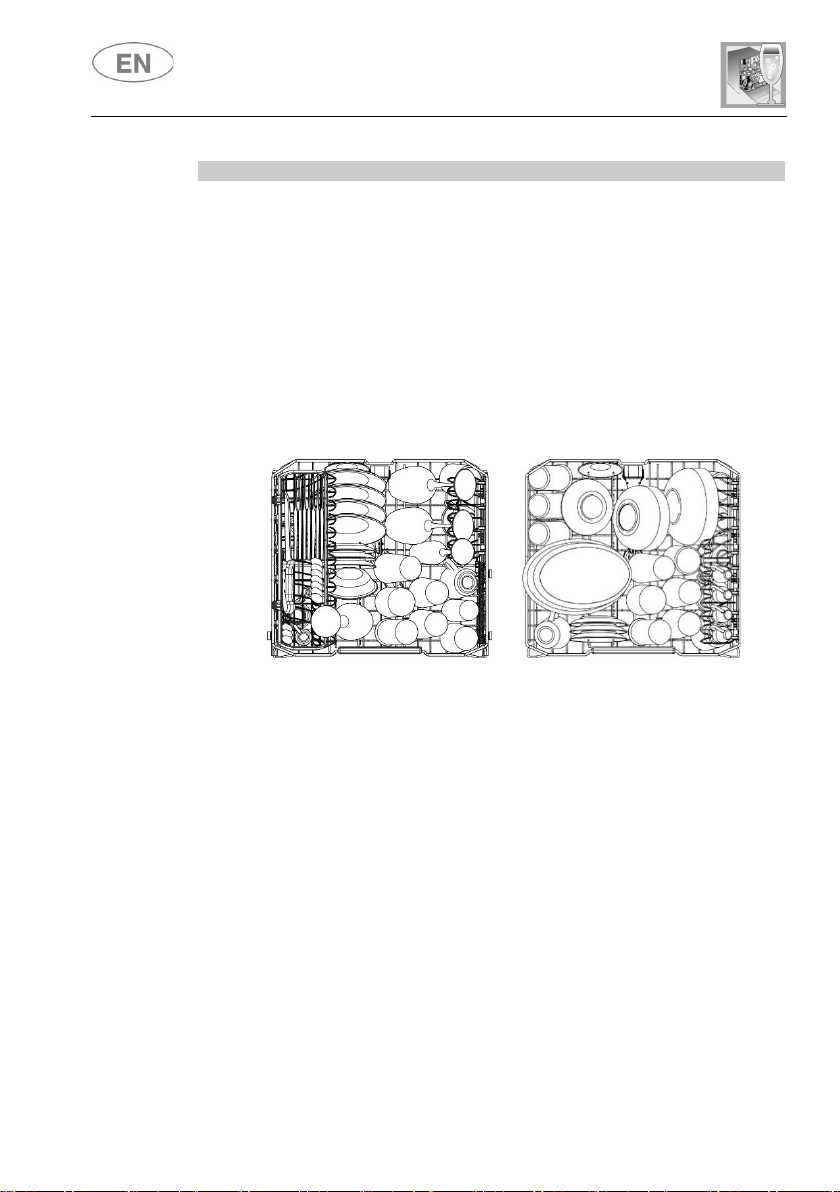
LOADING THE LOWER BASKET
Carefully load flat plates, soup plates, dessert and serving dishes,
positioning them vertically. Pots, pans and their covers must be loaded
upside down. When loading soup plates and dessert bowls, be sure to
leave a gap between them.
Loading examples:
User instructions
32
UPPER BASKET
The upper basket should be loaded with small or medium-sized items
such as glasses, small plates and saucers, tea or coffee cups, shallow
bowls and light objects. If the upper basket is used in the lowermost
position, it can also be loaded with serving dishes, provided they are only
lightly soiled.
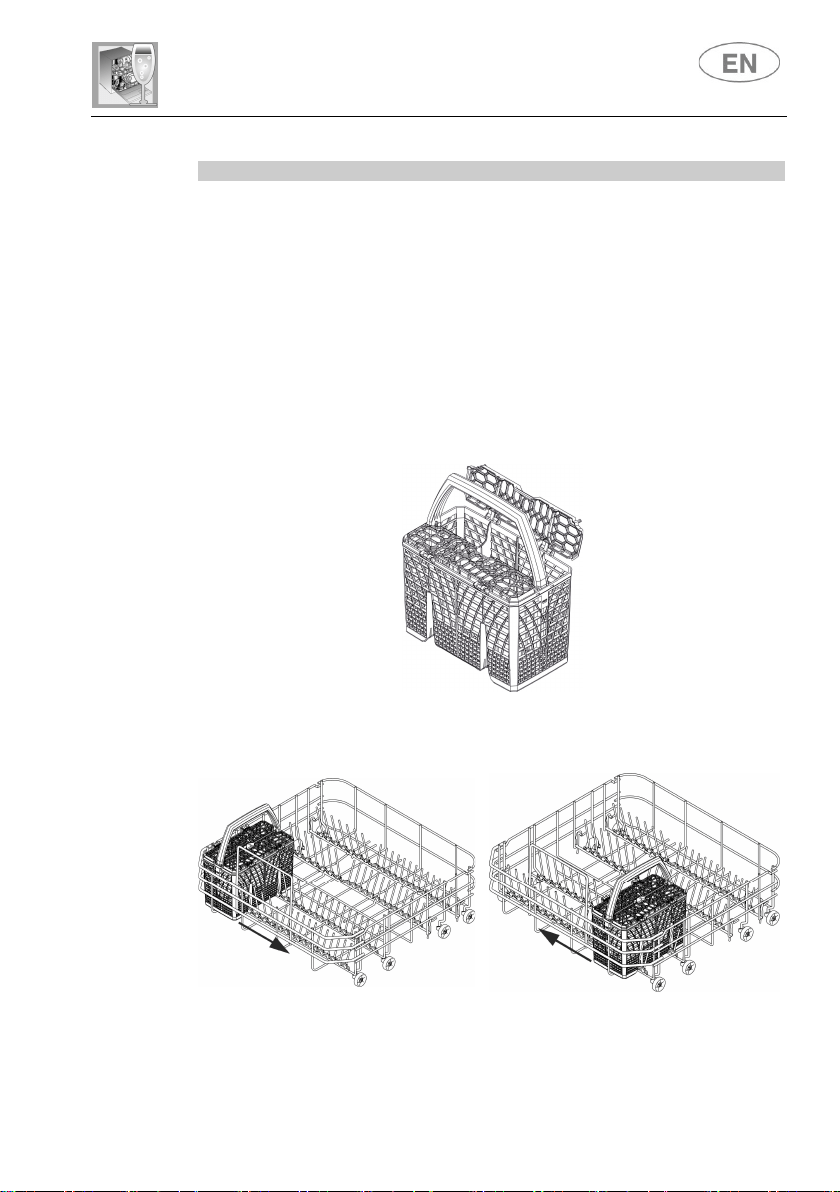
LOADING THE UPPER BASKET
Load plates facing forward; cups, bowls etc. must always be facing
downwards. The left side of the basket can be loaded with cups and
glasses on two levels. In the centre section, plates and saucers can be
loaded vertically into the supports provided.
Loading examples:
User instructions
33
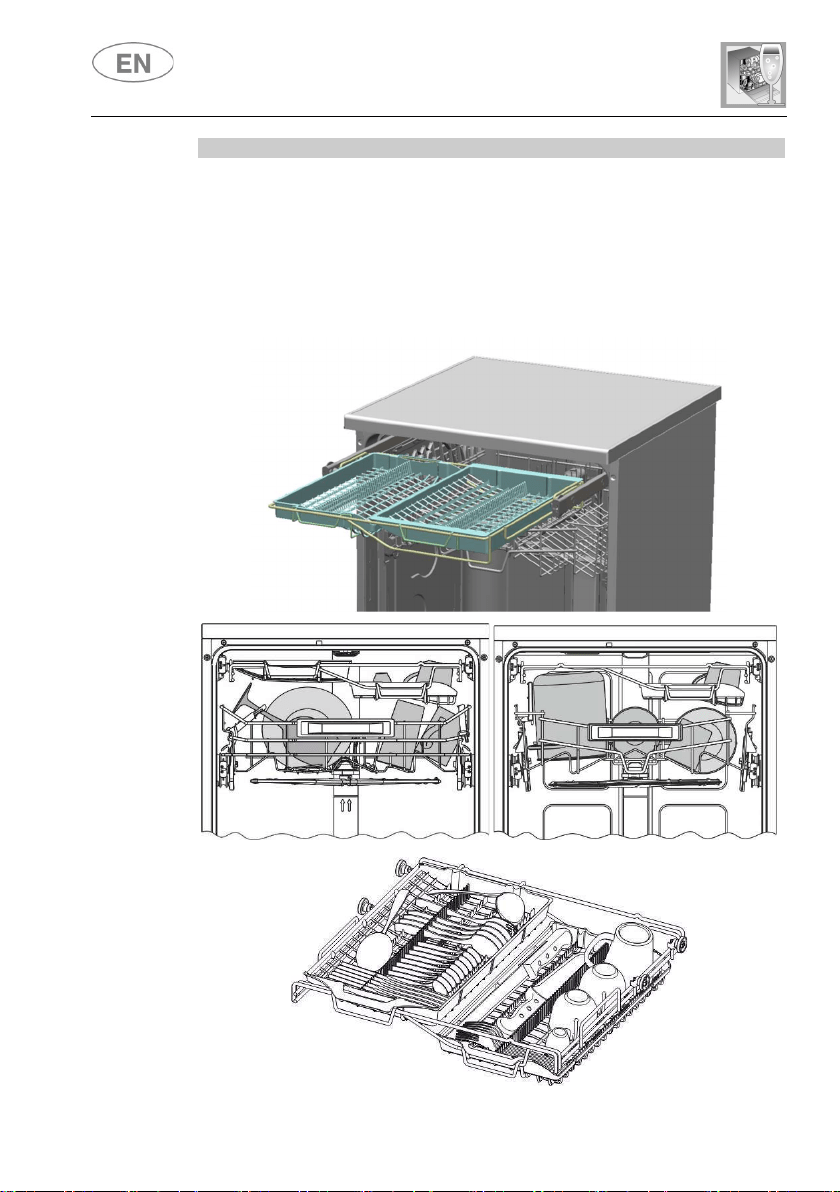
CUTLERY BASKET
The basket is suitable for all types of cutlery, except long items that may
interfere with the upper spray arm. The cutlery should be arranged in the
spaces in the upper racks to allow the water to pass effectively between
the items.
Forks and spoons should be positioned with the handle facing
downwards, taking care not to injure yourself with the prongs of the forks.
Knives should be placed in the tray on the upper rack or in the cutlery
drawer, if present (depending on the model), otherwise position them with
the handles facing upwards.
Ladles, wooden spoons and kitchen knives can be placed on the upper
rack, making sure that the blades of the knives do not protrude from
the basket. The upper racks can be opened in order to insert, for example,
small items.
The cutlery basket slides across the dishwasher and can be placed in
any position
to allow optimal use of the space in the bottom basket.
User instructions
34
FLEXI DUO TOP RACK
This comprises two independent sliding, pull-out tray racks for easier
loading/unloading of cutlery. Various loading systems and configurations
are possible. For example, tea cups can be loaded with the right-hand
rack set in the low position, while the left-hand rack or both can be
removed to allow large dishes to be put in the top basket.
In order to position the right hand basket in a low position, the upper
basket has to be adjusted so that it is in the lowest position (see “adjusting
the upper basket).
User instructions
35
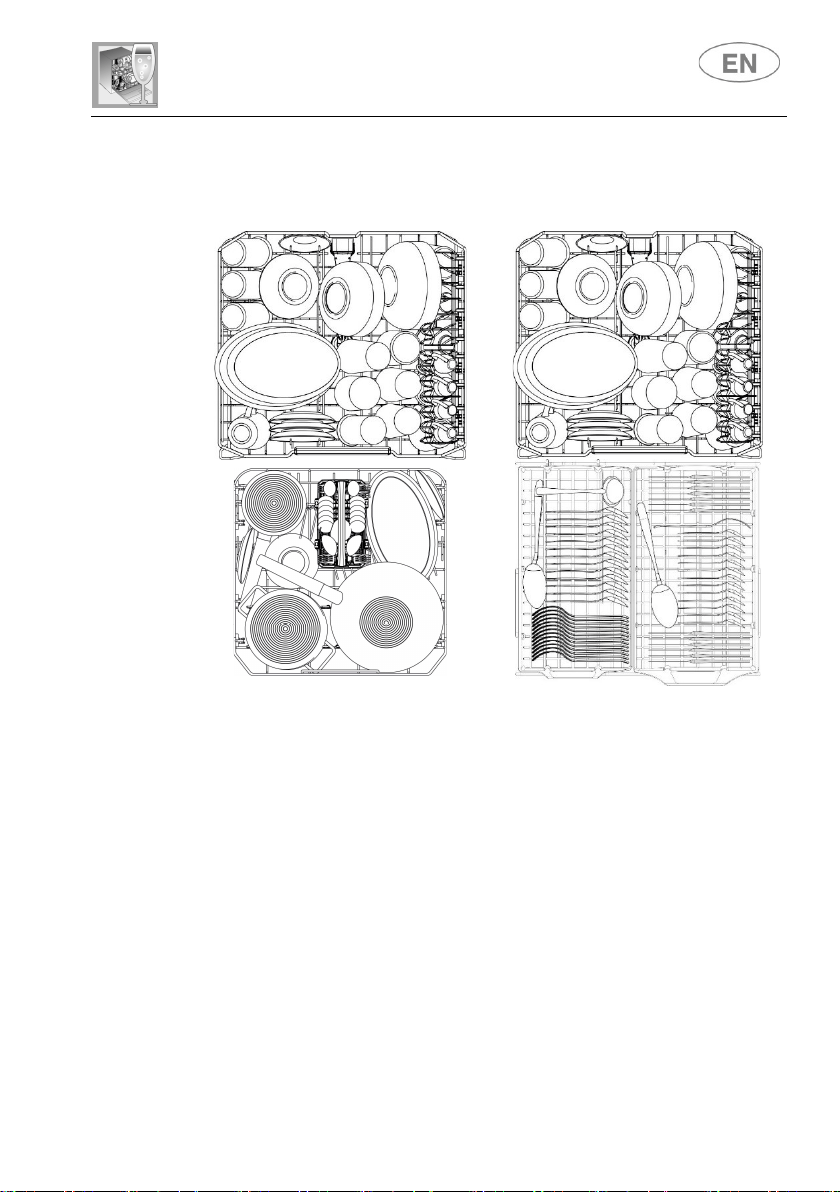
EXAMPLES OF LOADING FOR INTENSIVE DIRT
13 Standard place setting
FLEXI DUO TOP RACK (on some models only)
If the bottom basket inserts are of the fold-down type,
they should be laid flat for easier loading.
User instructions
36
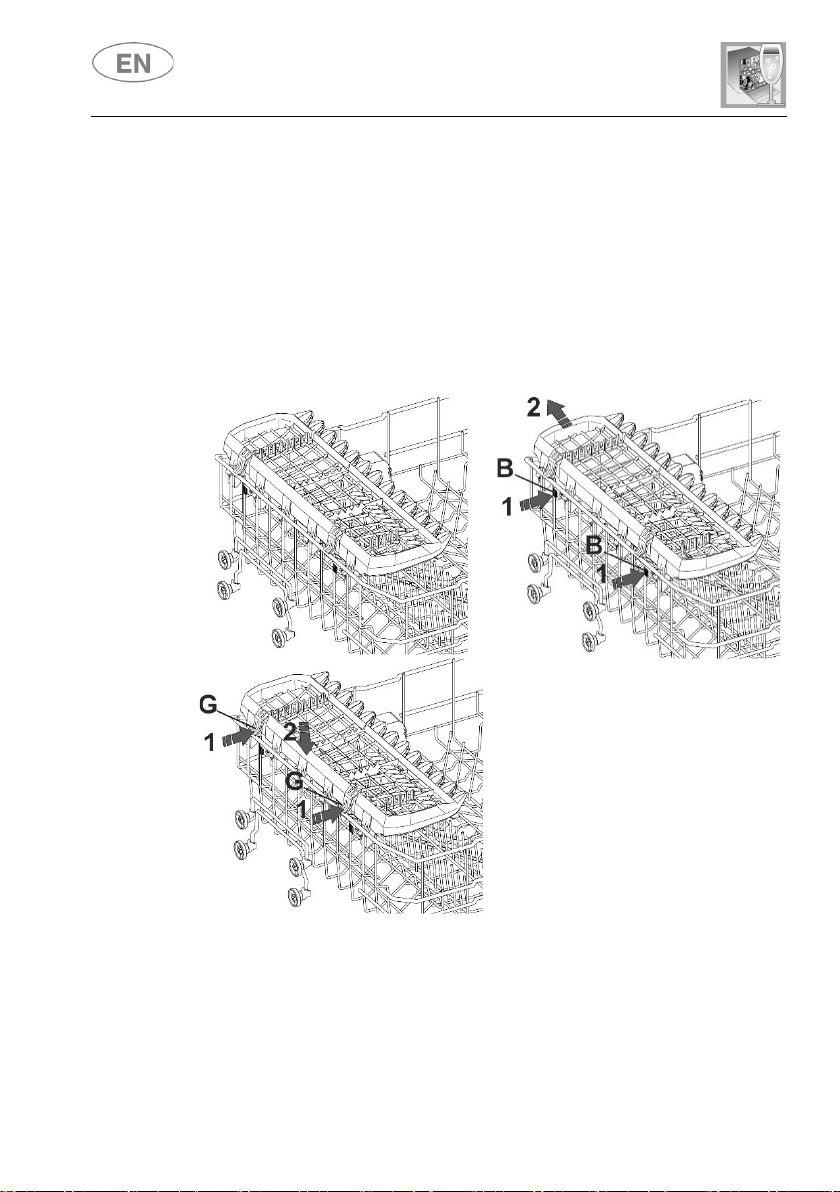
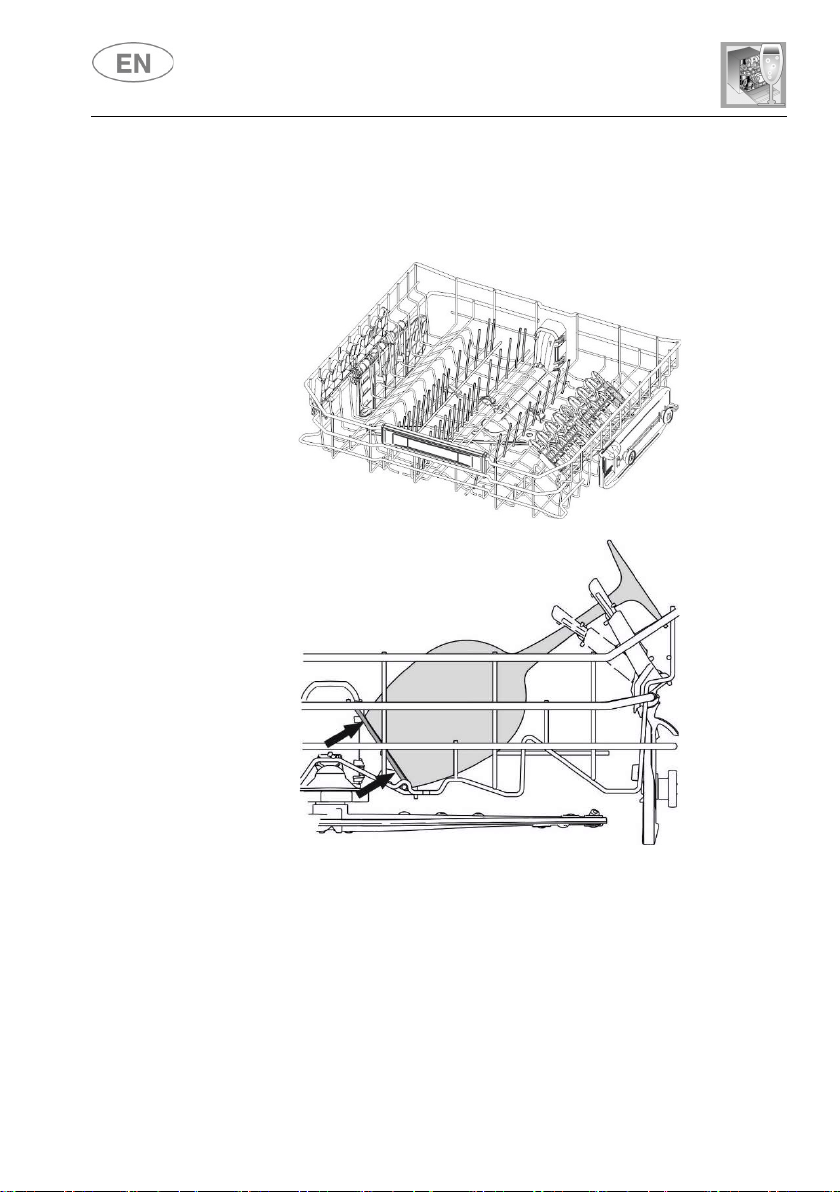
UPPER BASKET EQUIPMENT
(depending on the model)
Cutlery tray
For knives, spoons (tea and dessert) and long objects. The ends are
designed to hold long stemmed glasses.
- It can be removed by pressing and pushing the release levers (B)
at the
same time.
- It has to be lowered if the upper basket is in the
topmost position. Press the catches (G) simultaneously.
User instructions
37
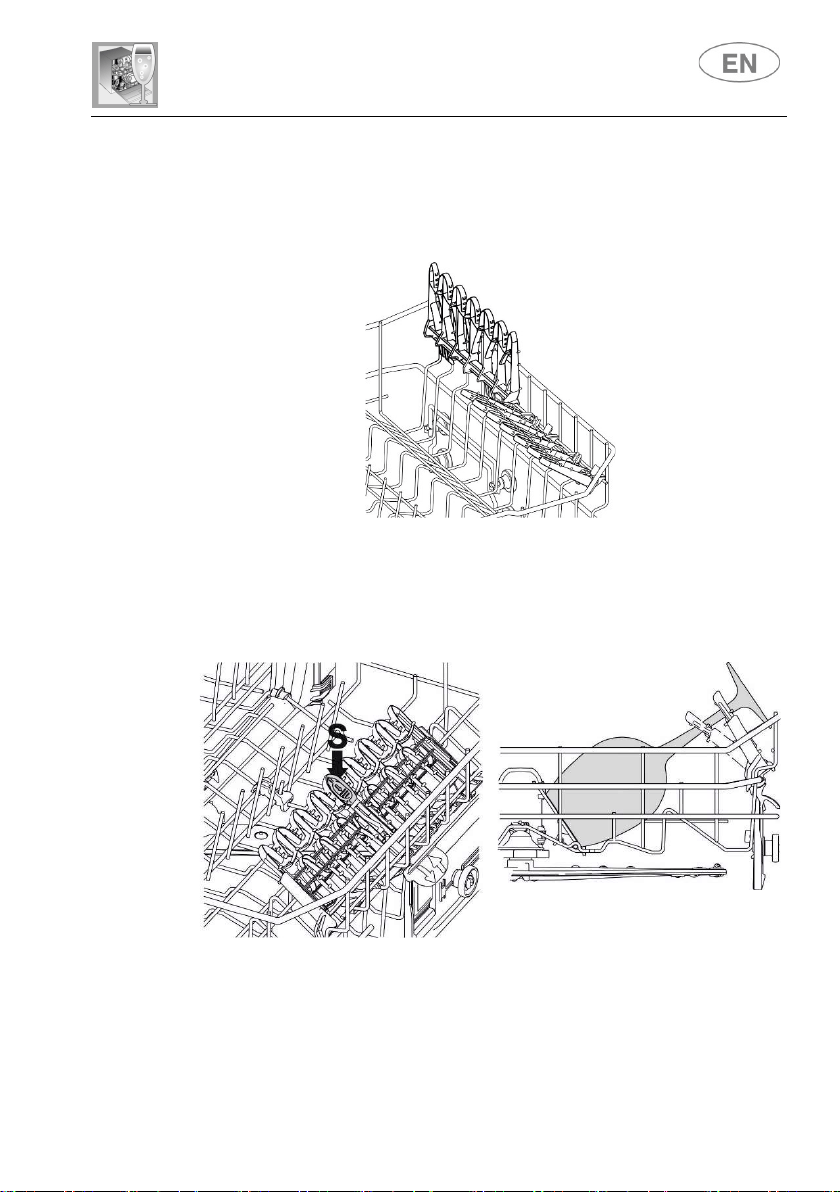
Fold-down shelves
For
mugs, cups and long objects. The ends are designed to hold long
stemmed glasses
When not used they can be moved to a vertical position (until a click is
heard).
Shelves with expandable wings
For small objects, mugs and cups.
They can be used
either closed or open (pull the upper, sliding part). To
close them, press the release device (S) and slide them downwards.
The ends are designed to hold long stemmed glasses (even when closed).
When not used they can be moved to a vertical position (until
a click is
heard).
User instructions
38
Fold-down tines
These can be secured in a vertical position, resting on the bottom of the
basket if unused, or placed in an intermediate position, as required.
The single tine on the right is ideal for supporting long stemmed glasses.
User instructions
39
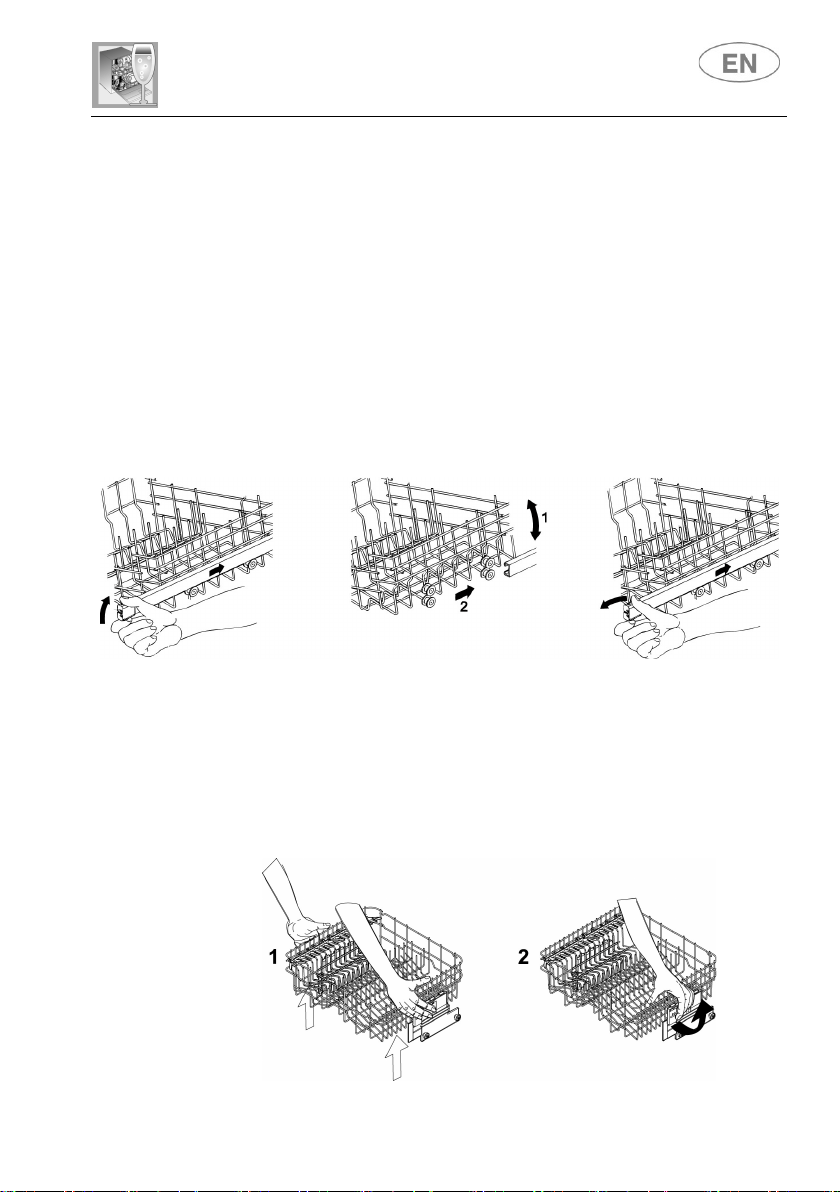
ADJUSTING THE UPPER BASKET
The height of the top basket can be adjusted to allow large dishes or pans
to be placed in the bottom basket.
The adjustment procedure may be type A or B, depending on the
dishwasher model purchased.
Version A: pull-out with adjustment in two positions.
Pull out both the basket guides.
Remove the stops, first releasing them as shown in the diagram.
Pull out the basket.
Fit the upper or lower pair of wheels into the guide, depending on the
setting required;
Return the stops to their original position.
The left hand and right hand sides of the basket must always be set at
the same height
.
Version B: with adjustment in three positions on both sides.
The sides of the basket must always be set at the same height.
Raise the basket by pulling on the top edge (1), to the first or second
catch depending on the height required.
To lower the basket, first release it by pulling the release lever (2).
Adjustment is also possible with the basket loaded, but in this case when
lowering the basket it should be held steady with one hand to avoid
knocking the dishes.
User instructions
40
5. Cleaning and maintenance
Before carrying out any work, always unplug the appliance from the
electrical supply or switch off the all-pole disconnection device.
5.1 General warnings and recommendations
Avoid the use of acidic or abrasive detergents.
Clean the outer surfaces and door-lining of the dishwasher regularly using
a soft cloth moistened with water or with a normal detergent suitable for
painted surfaces. Clean the door gaskets with a damp sponge.
Periodically (once or twice a year) it is advisable to clean the tank and
gaskets, using a soft cloth and water to remove any deposits.
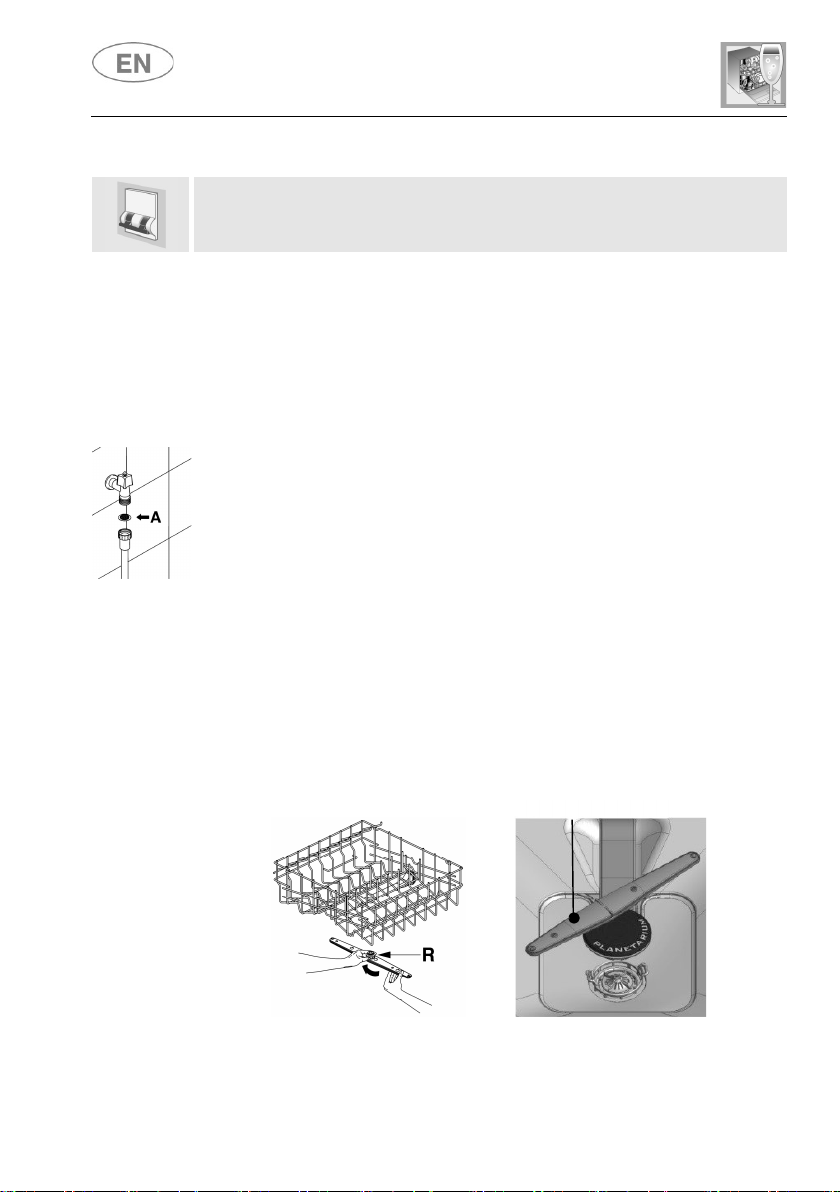
CLEANING THE WATER INTAKE FILTER
The water intake filter A located at the outlet of the water supply tap needs
to be cleaned periodically.
After having closed the water supply tap, unscrew the end of the water
intake hose, remove the filter A and clean it delicately under running
water. Reassemble filter A in its seat and carefully screw the water intake
hose back into position.
CLEANING THE SPRAY ARMS
The spray arms can be easily removed for periodic cleaning of the
nozzles, to prevent possible clogging. Wash them under running water
and carefully replace them in their seats, checking that their rotary
movement is in no way impeded.
To remove the upper spray arm, unscrew locking ring R.
To remove and clean the planetarium sprayer follow the instructions
provided.
PLANETARIUM
User instructions
41
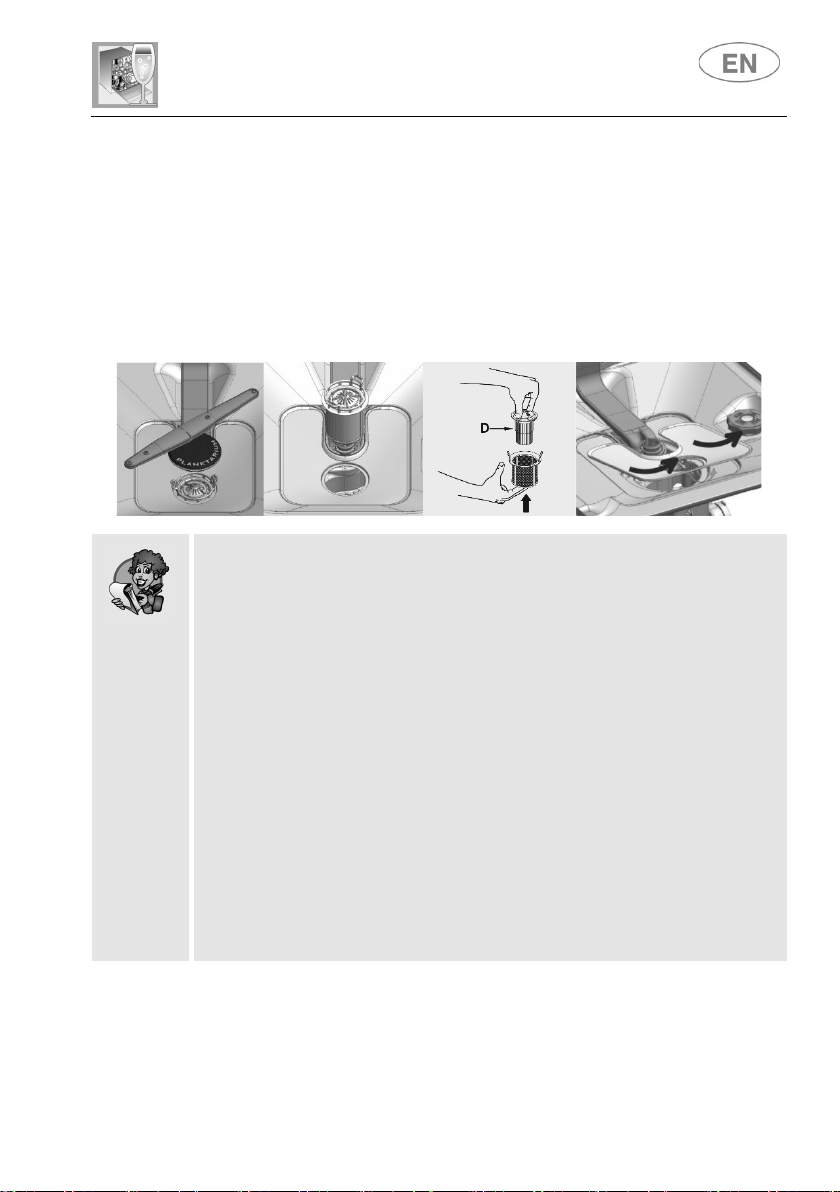
CLEANING THE FILTER UNIT
It is advisable to periodically inspect the centre filter and, if necessary,
to clean it.
remove the planetarium sprayer follow the instructions provided.
push the centre filter D from the underside to remove it from the micro-
filter:
separate the two parts which make up the plastic filter by pressing the
body of the filter in the zone shown by the arrows;
remove the centre filter by lifting it upwards.
GENERAL WARNINGS AND RECOMMENDATIONS FOR CORRECT
MAINTENANCE:
The filters should be cleaned under running water using a stiff
brush.
When removing the filter, take care that there are no food residues
on it. If any residues fall into the washing pit they might block hydraulic
components, or foul the spray arm nozzles.
It is essential to thoroughly clean the filters according to the above
instructions: the dishwasher cannot function if the filters are clogged.
Carefully replace the filters in their seats, to avoid damaging the
wash pump.
PROLONGED DISUSE:
Run the soak program twice in succession.
Unplug the power cord from the socket.
Leave the door slightly open, in order to prevent the formation of
unpleasant odours inside the washing tank.
Fill the rinse aid dispenser.
Shut off the water supply tap.

User instructions
42
BEFORE STARTING THE DISHWASHER AFTER PROLONGED
DISUSE:
Check that there are no deposits of sludge or rust inside the water
pipe: if there are, allow the water to run from the water supply tap for
a few minutes.
Plug the power cord back into the socket.
Reconnect the water intake hose and open the tap again.
TROUBLESHOOTING MINOR PROBLEMS
In some cases it is possible to remedy minor problems by referring to the
following instructions:
If the program fails to start, check that:
the dishwasher is connected to the electrical power supply;
there is no power failure;
the water tap is open;
the dishwasher door is properly closed.
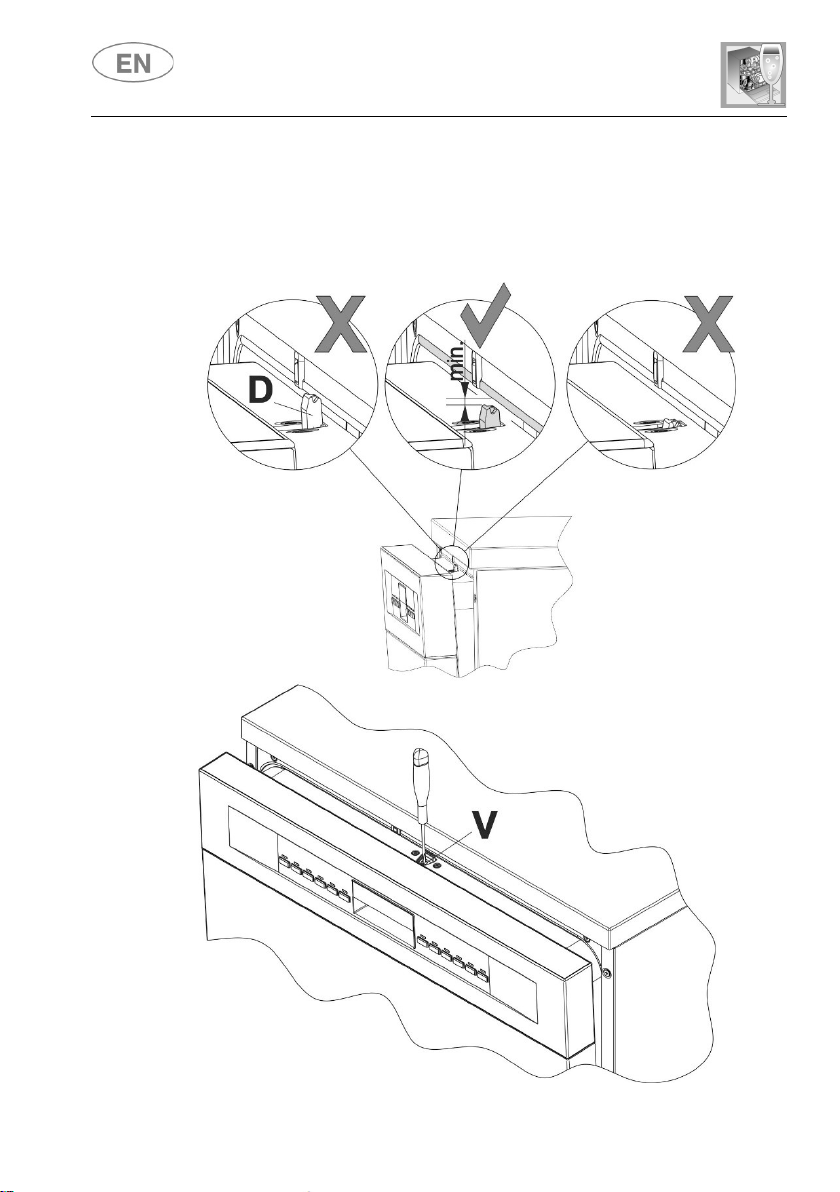
the door does not close:
- the lock has been triggered; close the door with greater force
- regulate the catch of the lock on the door to its maximum adjustment
using the central plastic screw.
If water remains inside the dishwasher, check that:
the drain hose is not kinked;
the drain siphon is not obstructed;
the dishwasher filters are not clogged.
If the dishes are not being cleaned properly, check that:
the correct amount of detergent has been added;
there is regenerating salt inside the special container;
the dishes are being loaded correctly;
the selected program is suitable for the dish types and their degree of
soiling;
all the filters are clean and positioned correctly;
the spray arm nozzles are not obstructed;
there is no object obstructing the rotation of the spray arms.

User instructions
43
If the dishes fail to dry or remain dull, check that:
there is rinse aid inside the special container;
the rinse aid dispenser setting is correct;
the detergent used is of good quality and has not lost its effectiveness
(for example, through incorrect storage, with the box left open).
Non-dry synthetic dishes. Synthetic material has a lower heat storage
capacity and is therefore harder to dry.
If the dishes show signs of streaking, staining, etc., check that:
the rinse aid dispenser setting is not too high.
If there are visible traces of rust inside the tank:
the tank is made of steel, and therefore any rust marks are due to
external elements (fragments of rust from the water pipes, pots,
cutlery, etc.). Special products are commercially available to remove
such marks;
check that the amount of detergent being used is correct. Certain
detergents can be more corrosive than others.
check that the cap of the salt container is securely closed, and that
the water softening setting is correct.
User instructions
44
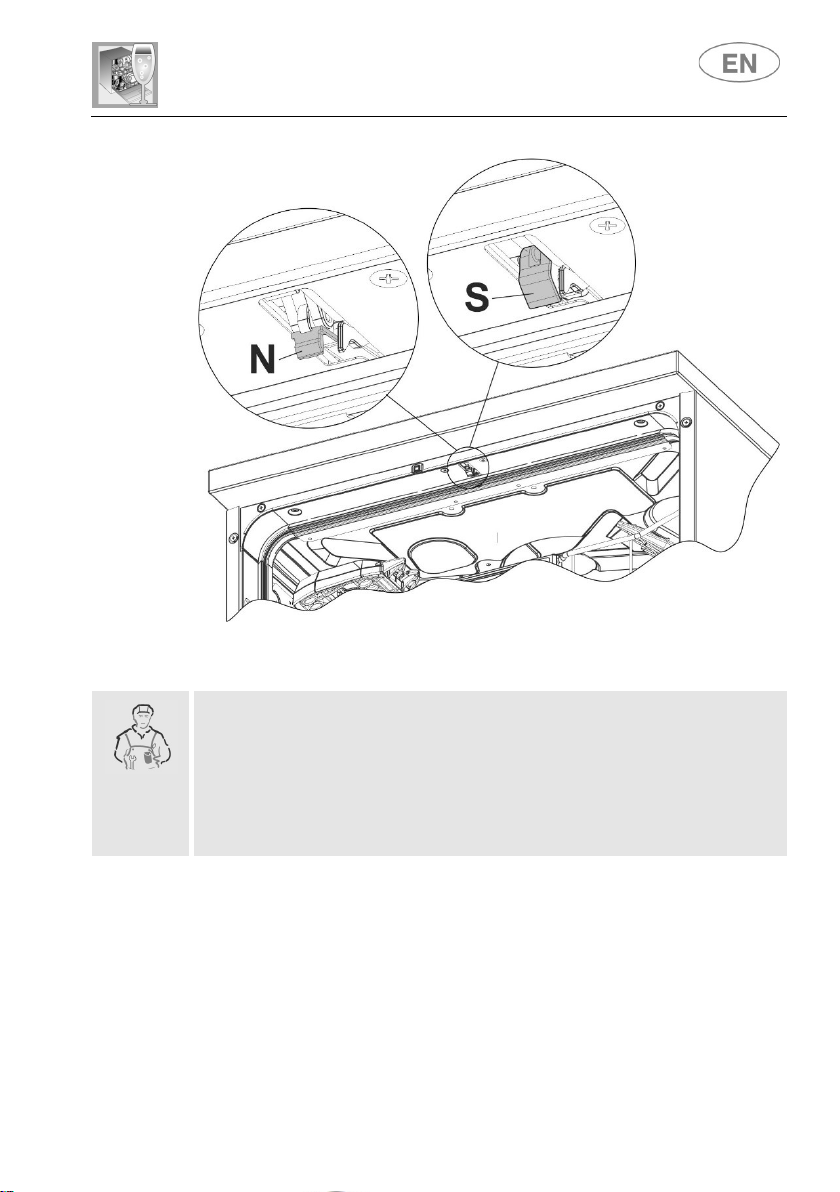
If the door does not close:
1 - Check the position of the door lock catch (D)
2 - If necessary, raise it by adjusting the plastic screw (V) next to the
catch.
3 - Check the condition of the lock hook; if it has not triggered (reference
N), the door opens and closes normally. If it has triggered (reference S),
close the door with force until it resets; open and close the door.
User instructions
45
If after following the above troubleshooting instructions the problem
persists, call the nearest After-Sales Centre.
WARNING: any operations performed on the appliance by
unauthorised persons are not covered by the warranty and shall be
paid for by the user.
User instructions
46
6. Troubleshooting
The dishwasher has an autodiagnosis system capable of detecting and
indicating a preset series of possible malfunctions.
TABLE OF MALFUNCTIONS DETECTED BY THE AUTODIAGNOSIS SYSTEM
FAULT DESCRIPTION
Error 01
Anti-flooding system tripped (where installed).
Error 02
The system that limits the water level in the dishwasher has been tripped.
Error 03
The dishwasher is unable to heat the water.
Error 04
Temperature sensor disconnected.
Error 05
The dishwasher is unable to fill with water
Error 06
The dishwasher is not able to pump out the water from the tank.
Error 07
The dishwasher is not able to measure the amount of water loaded
accurately.
Error 08
Anomaly in the system which distributes water to the baskets.
Error 09
Water intake system malfunction.
Error 11
Washing pump failure
If an alarm situation occurs, the appliance interrupts the program in progress
and signals a fault.
Alarms 01, 02, 03, 04, 08 and 09 interrupt the current program
immediately.
Alarms 05 and 06 interrupt the current program; once the problem is
solved, the program will finish running.
Alarm 07 is displayed at the end of the cycle, which however is completed
since the problem does not interfere with operation of the dishwasher.
Error 11: Contact the after-sales service.
To reset an alarm:
open and close the door, or turn the machine off and on again. The
dishwasher can now be
programmed again.
If the malfunction persists, contact your authorised Service Centre.

User instructions
47