Operating instructions
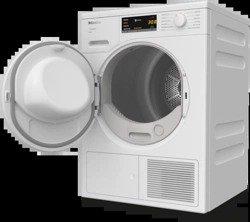
Heat pump dryer
To avoid the risk of accidents or damage to the appliance it is essen-
tial to read these instructions before it is installed and used for the
first time.
en-GB M.-Nr. 11 365 151

Contents
2
Caring for the environment ............................................................................. 5
Warnings and safety instructions ................................................................... 6
Operating the tumble dryer .............................................................................. 18
Control panel....................................................................................................... 18
How the control field works................................................................................. 19
Before using for the first time .......................................................................... 21
Installation ........................................................................................................... 21
Downtime after installation.................................................................................. 21
Energy saving tips ............................................................................................. 22
1. Notes on correct laundry care ..................................................................... 23
Points to note regarding washed laundry............................................................ 23
Preparing the laundry before drying.................................................................... 23
Drying .................................................................................................................. 24
Care label symbols ......................................................................................... 24
Select the correct drying level........................................................................ 24
2. Load the tumble dryer................................................................................... 25
Loading the laundry............................................................................................. 25
3. Select a programme and start it .................................................................. 26
Selecting a programme ....................................................................................... 26
Selecting the drying level for a drying level programme ................................ 26
Other programmes and timed drying programmes........................................ 27
Selecting Gentletumble ...................................................................................... 27
Selecting Delay start ........................................................................................... 28
4. Remove the laundry ...................................................................................... 30
End of programme/Anti-crease action ................................................................ 30
Unloading the drum............................................................................................. 30
Programme chart .............................................................................................. 31
Changing the programme sequence .............................................................. 34
Changing a programme once it has started........................................................ 34
Adding or removing laundry ................................................................................ 34
Condensed water container ............................................................................. 35
Emptying the condensed water container .......................................................... 35

Contents
3
Fragrance flacon................................................................................................ 36
FragranceDos ...................................................................................................... 36
Removing the protective seal from the fragrance flacon................................ 36
Inserting a fragrance flacon............................................................................ 37
Opening the fragrance flacon.............................................................................. 38
Closing the fragrance flacon ............................................................................... 38
Replacing the fragrance flacon............................................................................ 39
Cleaning and care ............................................................................................. 40
Fluff filters............................................................................................................ 40
Removing the fragrance flacon ...................................................................... 40
Removing visible fluff ..................................................................................... 40
Cleaning the fluff filters and air flow openings thoroughly ............................. 41
Cleaning the fluff filters with water ................................................................. 42
Cleaning the plinth filter....................................................................................... 43
Removing the plinth filter ............................................................................... 43
Cleaning the plinth filter.................................................................................. 44
Cleaning the plinth filter access panel ........................................................... 45
Cleaning the dryer ............................................................................................... 45
Problem solving guide ...................................................................................... 46
Indicator lights or information on the time display .............................................. 46
Unsatisfactory drying results............................................................................... 49
The drying cycle duration is very long................................................................. 50
Other problems ................................................................................................... 51
Replacing the plinth filter..................................................................................... 52
Reactivating the plinth filter................................................................................. 54
Checking the heat exchanger.............................................................................. 54
Service................................................................................................................ 55
Contact in the event of a fault ............................................................................. 55
Optional accessories........................................................................................... 55
Warranty .............................................................................................................. 55
Installation.......................................................................................................... 56
Front view ............................................................................................................ 56
Rear view............................................................................................................. 57
Transporting the tumble dryer ............................................................................. 57
Transporting the tumble dryer to its installation site ...................................... 57
Installation ........................................................................................................... 58
Levelling the tumble dryer .............................................................................. 58
Downtime after installation............................................................................. 58
Ventilation....................................................................................................... 59
Before moving the tumble dryer again (e.g. when moving house)................. 59

Contents
4
Additional installation requirements .................................................................... 60
External condensed water outlet......................................................................... 61
Installation conditions requiring a non-return valve ....................................... 61
Arranging the drain hose ................................................................................ 62
Examples........................................................................................................ 62
Changing the door hinging.................................................................................. 64
Changing the hinging over ............................................................................. 64
Refitting .......................................................................................................... 69
Electrical connection ........................................................................................... 70
Technical data.................................................................................................... 71
Data sheet for household tumble driers .............................................................. 72
Consumption data............................................................................................. 74
Programmable functions .................................................................................. 75
Programming....................................................................................................... 75
Cottons drying levels.....................................................................................
77
Minimum iron drying levels...........................................................................
77
Cool-down temperature ...............................................................................
77
Keypad tone.................................................................................................
77
Lock code.....................................................................................................
78
Conductivity .................................................................................................
78
Control field standby status............................................................................
79
Memory..........................................................................................................
79
Anti-crease ....................................................................................................
79
Airways indicator..........................................................................................
80
Backlight brightness dimmed.......................................................................
80
Caring for the environment
5
Disposal of the packing mater-
ial
The packaging is designed to protect
the appliance from damage during
transportation. The packaging materials
used are selected from materials which
are environmentally friendly for disposal
and should be recycled.
Recycling the packaging reduces the
use of raw materials in the manufactur-
ing process and also reduces the
amount of waste in landfill sites.
Disposing of your old appli-
ance
Electronic and electrical appliances
contain many valuable materials. They
also contain certain materials, com-
pounds and components which were
essential for their correct functioning
and safety. These could be hazardous
to your health and to the environment if
disposed of with general waste or if
handled incorrectly. Please do not,
therefore, dispose of your old appliance
with general waste.
Take care not to damage your tumble
dryer’s pipework and heat exchanger
before or during transportation to an
authorised collection depot.
This is to ensure that coolant in the
tumble dryer and oil in the compressor
is contained, and will not leak into the
environment.
Please make use of officially designated
collection and disposal points to dis-
pose of and recycle electrical and elec-
tronic appliances in your local com-
munity, with your dealer or with Miele.
By law, you are solely responsible for
deleting any personal data from the ap-
pliance prior to disposal. Please ensure
that your old appliance poses no risk to
children while being stored prior to dis-
posal.
Warnings and safety instructions
6
It is essential to read these instructions.
This tumble dryer contains a refrigerant that is flammable and ex-
plosive.
This tumble dryer complies with all current local and national
safety requirements. However, inappropriate use can lead to per-
sonal injury and damage to property.
Read the operating instructions carefully before using the tumble
dryer. They contain important information on safety, installation,
use and maintenance. This prevents both personal injury and dam-
age to the tumble dryer.
In accordance with standard IEC60335-1, Miele expressly and
strongly advises that you read and follow the instructions in the
chapter on installing the tumble dryer as well as the safety instruc-
tions and warnings.
Miele cannot be held liable for damage caused by non-compliance
with these instructions.
Keep these operating instructions in a safe place and pass them
on to any future owner.

Warnings and safety instructions
7
Correct application
This tumble dryer is intended for use in domestic households and
similar working and residential environments.
This tumble dryer is not intended for outdoor use.
It must be used only as a domestic appliance to dry items which
have been washed in a water solution and which are marked on the
manufacturer's care label as being suitable for tumble drying. If us-
ing dry cleaning kits, do so at your own risk, and follow the instruc-
tions provided on the packaging.
Any other applications may be dangerous. Miele cannot be held li-
able for damage resulting from incorrect or improper use or opera-
tion.
This tumble dryer can only be used by people with reduced phys-
ical, sensory or mental capabilities, or lack of experience or know-
ledge, if they are supervised whilst using it or have been shown how
to use it in a safe way and understand and recognise the con-
sequences of incorrect operation.
Safety with children
Children under 8 years of age must be kept away from the tumble
dryer unless they are constantly supervised.
Children 8 years and older may only use the tumble dryer unsu-
pervised if they have been shown how to use it safely and recognise
and understand the consequences of incorrect operation.
Children must not be allowed to clean or maintain the tumble
dryer unsupervised.
Please supervise children in the vicinity of the tumble dryer and do
not let them play with it.

Warnings and safety instructions
8
Technical safety
Before setting up the tumble dryer, check it for any externally vis-
ible damage.
Do not install or use a damaged tumble dryer.
Before connecting the tumble dryer, ensure that the connection
data on the data plate (fuse rating, voltage and frequency) match the
mains electricity supply. If in any doubt, consult a qualified electri-
cian.
Reliable and safe operation of this tumble dryer can only be as-
sured if it has been connected to the mains electricity supply.
The electrical safety of this tumble dryer can only be guaranteed
when correctly earthed. It is essential that this standard safety re-
quirement is met. If in any doubt, please have the household wiring
system tested by a qualified electrician. Miele cannot be held liable
for the consequences of an inadequate earthing system (e.g. electric
shock).
Do not connect the appliance to the mains electricity supply by an
extension lead, multi-socket adapter or similar. These can overheat
and are a fire hazard.
If the electrical connection cable is faulty it must only be replaced
by a Miele authorised service technician to protect the user from
danger.

Warnings and safety instructions
9
Unauthorised repairs could result in unforeseen dangers for the
user, for which Miele cannot accept liability. Repairs should only be
undertaken by a Miele approved service technician, otherwise any
subsequent damage will not be covered by the warranty.
Faulty components must only be replaced by genuine Miele ori-
ginal spare parts. The manufacturer can only guarantee the safety of
the appliance when Miele replacement parts are used.
The tumble dryer must be isolated from the electricity supply in
the event of a fault and during cleaning and maintenance.
This tumble dryer must not be used in a non-stationary location
(e.g. on a ship).
Do not make any alterations to the tumble dryer, unless authorised
to do so by Miele.

Warnings and safety instructions
10
This tumble dryer is supplied with a special lamp to cope with
particular conditions (e.g. temperature, moisture, chemical resist-
ance, abrasion resistance and vibration). This special lamp must only
be used for the purpose it is intended for. It is not suitable for room
lighting. Replacement lamps may only be fitted by a Miele authorised
person or the Miele Service Department.
This tumble dryer uses a gaseous refrigerant which is condensed
by the compressor. Having been increased to a high temperature
level as as result of the condensing process, the refrigerant passes
through a closed refrigerant circuit. The heat generated is transferred
to the drying air as flows through the heat exchanger.
- The humming noises caused by the heat pump during the drying
process are normal. They do not impair the efficient functioning of
the tumble dryer.
- The refrigerant is environmentally friendly and causes no damage
to the ozone layer.
Damage to the tumble dryer by switching it on too soon.
This can damage the heat pump.
After setting up the tumble dryer, wait for at least one hour before
starting a drying programme.

Warnings and safety instructions
11
The R290 refrigerant contained in this tumble dryer is flammable
and explosive. If the tumble dryer is damaged, proceed as follows:
- Avoid naked flames or anything which creates a spark.
- Disconnect the tumble dryer from the electrical supply.
- Air the room where the tumble dryer is located.
- Contact the Miele Customer Service Department.
Risk of fire and explosion due to damage to the tumble dryer.
The refrigerant is flammable and explosive if it leaks.
Take measures to protect the tumble dryer against damage. Do not
make any alterations to the tumble dryer.
Follow the instructions in “Installation” and “Technical data”.
The accessibility of the plug must always be ensured, in order to
disconnect the tumble dryer from the mains.
Do not block the gap between the bottom of the tumble dryer and
the floor with plinth facings, deep pile carpet etc. This would hinder a
sufficient flow of air to the dryer.
Make sure the dryer door can be opened without hindrance after
installation.

Warnings and safety instructions
12
Correct use
The maximum load for this tumble dryer is 7.0 kg (dry weight).
The maximum recommended loads for individual programmes are
given in the Programme chart.
To prevent the risk of fire, do not connect the tumble dryer via a
controllable socket (e.g. a timer or a peak-load switch-off device).
If the drying programme is interrupted before the end of the cooling
down phase, this could cause the laundry to self-ignite.
Warning: Do not switch the dryer off before the drying pro-
gramme has finished. If this is done, the laundry must be hung up or
spread out to cool it down.
Fabric conditioner and similar products must be used according
to the instructions on the manufacturer's packaging.
Remove all items from pockets (e.g. lighters, matches).
The fluff filters must be cleaned after every drying cycle.
The fluff filters or the plinth filter must be thoroughly dried after
cleaning. Wet fluff/plinth filters could cause operational faults while
drying.

Warnings and safety instructions
13
To prevent the risk of fire, textiles that have not been cleaned thor-
oughly or are still soiled with deposits of any kind must not be dried
in this tumble dryer. This applies in particular to textiles that
- have not been washed.
- have not been thoroughly cleaned and are still soiled with grease,
oil or other deposits (such as cooking oils, cosmetics, lotions,
etc.). If items have not been thoroughly cleaned, there is a danger
that they might ignite when heated, even after they have been re-
moved from the tumble dryer at the end of the programme.
- have been treated with inflammable cleaning agents or which
contain residues of acetone, alcohol, benzene, petrol, kerosene,
stain remover, turpentine, wax and wax remover or other chemic-
als (e.g. mops and floor cloths).
- items that have been splashed with hair lacquer, hair spray, nail
varnish remover or similar substances.
When washing such heavily soiled items:
ensure that you use sufficient detergent and select a high temper-
ature. If in doubt, wash the items several times.
To prevent the risk of fire, these textiles must not be tumble dried:
- textiles that have been cleaned using chemicals (e.g. professional
dry-cleaning agents)
- textiles which contain a large proportion of rubber, foam rubber or
rubber-like materials. For example, products made from latex
foam rubber, shower caps, waterproof textiles, rubberised articles
and items of clothing and pillows with foam rubber filling.
- textiles containing padding or fillings which are damaged (e.g. pil-
lows, jackets). The filling could fall out and cause a risk of fire.

Warnings and safety instructions
14
The heat pump that is essential to the operation of this tumble
dryer generates a great deal of heat inside its casing. There must be
a reliable means of dissipating this heat. Otherwise loads could take
longer to dry or the tumble dryer might sustain damage in the long
term.
The following mandatory requirements must be met:
- permanent room ventilation from the beginning to the end of
every drying programme
- a gap between the floor and the bottom of the tumble dryer (this
must not be blocked or obstructed in any way)
The tumble dryer must not be hosed down.
Do not let anyone sit or lean on the door, as this can cause the
tumble dryer to tip up.
In many programmes, the heating phase is followed by a cooling
down phase to ensure that the items are not too hot to handle when
you remove them (this also avoids the danger of the laundry self-ig-
niting). The programme is not finished until the cooling down phase
has been completed.
As soon as the programme has finished, remove all laundry from the
drum.

Warnings and safety instructions
15
Always close the door after use. This way you will avoid the
danger of:
- Children climbing onto or into the dryer or hiding things in it.
- Pets or other small animals climbing into it.
The tumble dryer must not be used without fluff filters or
- with damaged fluff filters, or
- with a damaged plinth filter.
This would cause an excessive build-up of fluff which in turn would
cause a fault.
Do not install the tumble dryer in a room where there is a risk of
frost occurring. At temperatures around freezing point the tumble
dryer may not be able to operate properly. There is a risk of damage
if the condensed water is allowed to freeze in the pump and hoses.
If the water is drained externally through the drain hose instead of
being collected in the condensed water container, make sure the
drain hose is securely attached if you hang it in a sink or basin to
avoid the hose slipping and the water causing damage.
Condensed water is not drinking water.
It can cause health problems in both people and animals if con-
sumed.
Always keep the area around the tumble dryer free of dust and
fluff.
Dust drawn into the tumble dryer can cause blockages in the heat
exchanger over time.

Warnings and safety instructions
16
Using a fragrance flacon (optional accessory)
Only use genuine Miele original fragrance flacons.
The fragrance flacon must be stored in its packaging so please
make sure you retain this.
Caution. The fragrance can leak out of the flacon. Make sure that
you always keep the flacon, or the fluff filter with the flacon inserted
in it, in a horizontal position when carrying and do not tip or place
down on any surface.
Use an absorbent cloth to wipe up any fragrance which has
leaked out of the flacon onto the floor, the dryer or any dryer com-
ponents (e.g. the fluff filter) immediately.
If fragrance which has leaked out of a flacon: comes into contact
with the skin - wash the skin thoroughly with soap and water; comes
in contact with the eyes - rinse the eyes with clean water for at least
15minutes; is swallowed - rinse out the mouth thoroughly with
clean water. Seek medical advice in the case of contact with the
eyes or if fragrance has been swallowed.
If fragrance which has leaked out of a flacon comes in contact
with clothing, change the clothing immediately. Wash the clothing or
any cloths used for mopping up fragrance thoroughly with plenty of
water and detergent.
There is the risk of fire or damage to the tumble dryer if the follow-
ing instructions are not observed:
- Never refill a flacon with fragrance.
- Never use a faulty fragrance flacon.
Dispose of an empty fragrance flacon with the household waste
and never use it for any other purpose.
Please also observe the information supplied with the fragrance
flacon.

Warnings and safety instructions
17
Accessories
Only use genuine Miele original spare parts and accessories with
this appliance. If non-Miele parts are used, warranty, performance
and product liability claims will be invalidated.
The tumble dryer can be combined with a Miele washing machine
in a washer-dryer stack. The appropriate “WTV” stacking kit (avail-
able to order) to match your tumble dryer and washing machine is
required.
If you order a plinth for this tumble dryer (available from Miele as
an optional accessory - depending on country), make sure it is the
correct one.
Miele cannot be held liable for damage caused by non-compli-
ance with these Warning and Safety instructions.
Operating the tumble dryer
18
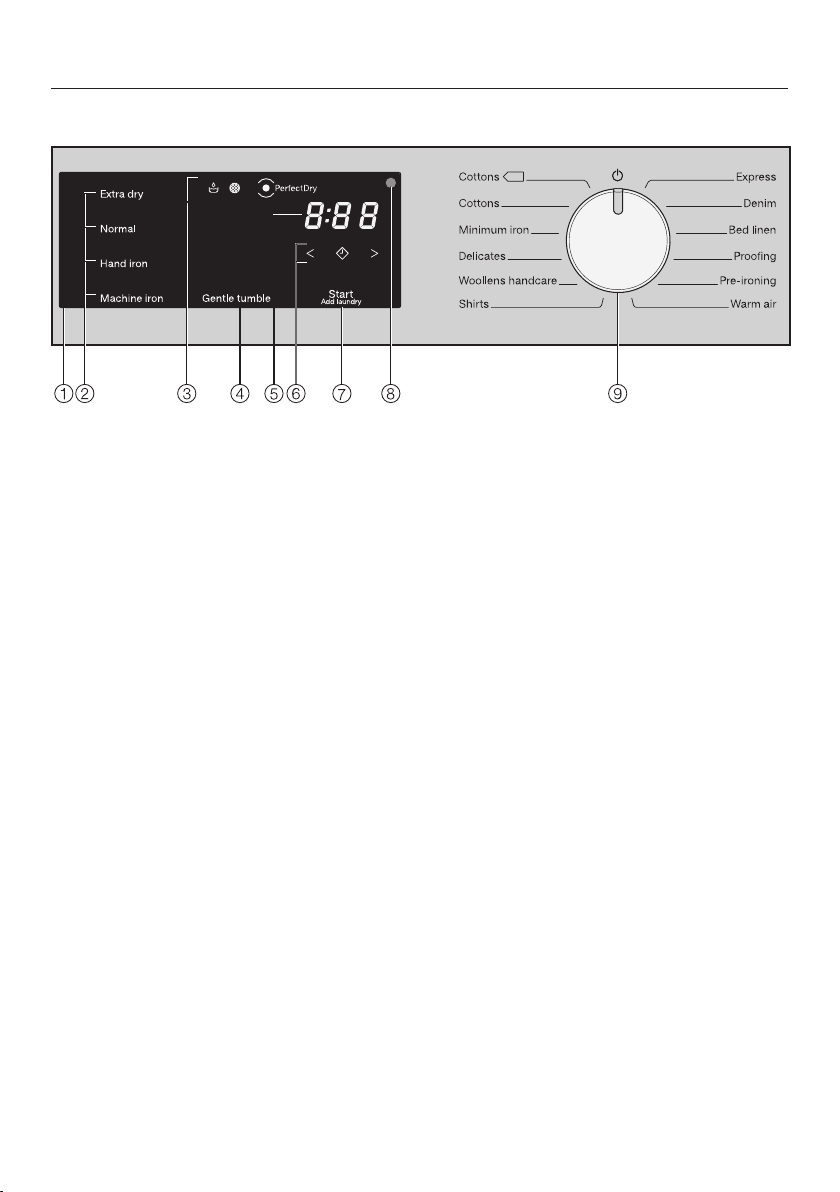
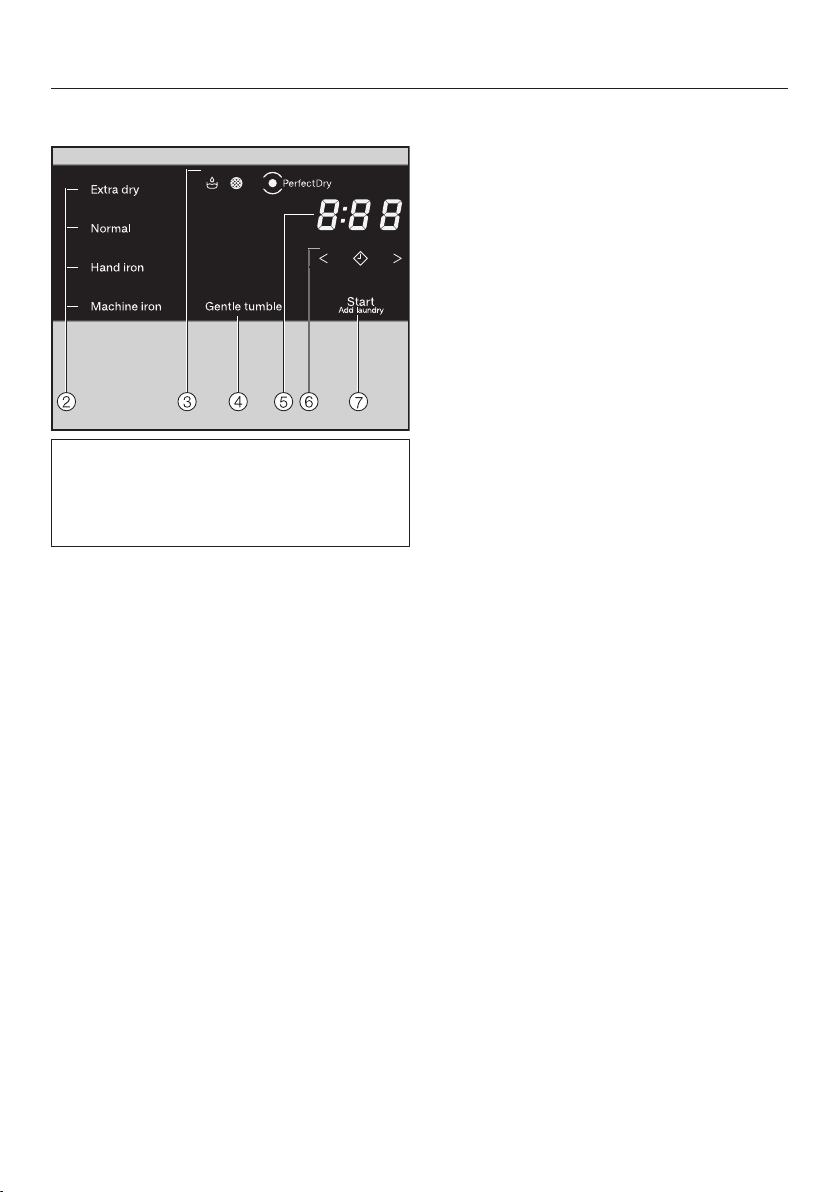
Control panel
a
Control field
b
Sensor controls for the drying
levels
c
Indicator lights
light up when necessary
d
Gentletumble sensor control
for gentle drying
e
Time display
for the programme duration
f
Sensor controls
for time selection
g
Start/Add laundry sensor control
for programme start and adding laun-
dry
h
Optical interface
for Customer Service Department
i
Programme selector
for selecting programmes and for
switching off. The tumble dryer is
switched on by selecting a pro-
gramme, and switched off by turning
the programme selector to the po-
sition.
Operating the tumble dryer
19
How the control field works
The , , and sensor controls
react to fingertip contact. If a sensor
control is illuminated, it can be selec-
ted.
If a sensor control is brightly lit, this
means it is currently selected.
If a sensor control is dimly lit, this
means it can be selected.
Sensor controls for the drying
levels
After selecting a drying level pro-
gramme with the programme selector,
the recommended drying level lights up.
Drying levels that can be selected are
dimly lit.
Indicator lights
-
lights up when the condensed water
container needs to be emptied.
-
lights up when the plinth filter has to
be cleaned.
- Perfect Dry
The Perfect Dry system measures the
residual moisture present in the laun-
dry in programmes with selectable
drying levels and provides a more
precise drying result.
This indicator . . .
. . will flash until the programme dura-
tion has been determined, and then
go out.
. . . lights up again when the selected
drying level is reached towards the
end of the programme.
. . . remains off with the following
programmes: Woollens handcare,
Warm air.
Gentletumble sensor control
For drying temperature-sensitive textiles
with the symbol. When the sensor is
touched, Gentletumble will light up
brightly.
With some programmes, Gentletumble
is always active (lights up) or inactive
(does not light up).

Operating the tumble dryer
20
Time display
The remaining programme duration is
displayed in hours and minutes.
With most programmes, the duration
displayed may vary or “jump”. The fol-
lowing factors, among others, affect the
programme duration displayed: the
quantity of laundry, the type of fabric
and the residual moisture in the laundry.
The electronic control continually as-
sess conditions in the appliance and
then adjusts the programme duration
with increasing accuracy.
Sensor controls
-
After touching the sensor, a later
start time for the programme (Delay
start) can be selected. Once selec-
ted, lights up brightly.
-
The or sensors are used for se-
lecting the duration of the delay start
period or the duration of the Warm air
programme.
Start/Add laundry sensor control
Touching the Start/Add laundrysensor
control starts a programme. The current
programme can be interrupted to add
laundry. The programme can be started
when the sensor control is flashing on
and off. The sensor control lights up
constantly once the programme has
started.
Drum lighting
The inside of the drum lights up so that
you don't forget any items of laundry
when you empty it.
The drum lighting switches off automat-
ically (energy saving).

Before using for the first time
21
Installation
Before using the appliance for the
first time, check that you have fol-
lowed all the instructions under “In-
stallation”.
Read these operating instructions,
paying particular attention to the in-
formation provided under “Installa-
tion”.
Downtime after installation
Damage to the tumble dryer by
switching it on too soon.
This can damage the heat pump.
After setting up the tumble dryer wait
for at least one hour before switching
it on.
Removing the protective foil
and stickers
Remove:
- Any protective film from the door
- Any stickers from the front and the lid
Please do not remove any labels
(e.g. the data plate) which are visible
when you open the door.
Follow the procedure for using
for the first time outlined in
these instructions
Read “1. Notes on correct laundry
care” and “2. Load the tumble dryer”.
You can then load the dryer and se-
lect a programme as described in “3.
Select a programme and start it”.

Energy saving tips
22
This dryer with heat-pump technology
is designed for energy-saving drying
cycles. However, you can save a little
more energy with the following meas-
ures as the drying time is not exten-
ded unnecessarily.
- Make sure your laundry is spun at the
maximum spin speed before drying.
The higher the spin speed, the
greater the savings that can be made
in energy and time during drying, e.g.
approx. 20% energy can be saved if
spun at 1600rpm instead of
1000rpm.
- Load according to the optimum
amount of laundry recommended for
the programme being used. This will
mean that the energy consumption
for the amount of laundry is at its
most economical.
- Make sure that the room temperature
is not too high. If there are other heat
producing appliances in the room in
which the dryer is located, make sure
the room is well ventilated and switch
the other appliances off, if possible.
- Clean the fluff filters in the door open-
ing after every drying cycle.
Please refer to “Cleaning and care” for
information on cleaning the fluff filters
and the plinth filter.
- If possible, make use of time-vari-
able, low-cost electricity tariffs. Ask
your energy supplier for information.
Your tumble dryer's delay start func-
tion will be useful as you can select
when during the next 24 hours you
want drying to start automatically.

1. Notes on correct laundry care
23
Points to note regarding
washed laundry
- When washing very heavily soiled
items ensure that you use sufficient
detergent and select a high temperat-
ure. If in doubt, wash the items sev-
eral times.
- Do not put soaking wet items into the
tumble dryer. Make sure your laundry
is thoroughly spun before drying. The
higher the spin speed, the greater the
savings that can be made in energy
and time during drying.
- New dark coloured garments should
be washed and dried separately from
light coloured garments to avoid the
danger of colours running and discol-
ouring other garments or even plastic
components in the dryer. Dark col-
oured fibres can also settle on light
coloured garments and vice versa.
- Starched laundry can be dried in the
tumble dryer. To achieve the usual
finish, double the amount of starch
should be used.
Preparing the laundry before
drying
Damage due to foreign objects
which were not removed from the
laundry.
Foreign objects can melt, burn, or
explode.
Ensure that any foreign objects, e.g.
detergent dispensing balls, lighters,
etc. have been removed from the
laundry.
Risk of fire due to incorrect use
and operation.
The laundry can burn and destroy
the dryer and the surroundings.
See “Warning and Safety” instruc-
tions for further information.
- Sort the laundry according to the type
of fibre and weave, size, garment
care label symbol and the drying level
required.
- Check seams and stitching to ensure
that padding and linings are intact.
This way you will avoid the danger of
fillings coming out. These could catch
fire when being dried.
- Disentangle the laundry.
- Tie together textile belts and ties.
- Fasten duvet covers and pillow cases
to prevent small items from being
rolled up inside them.
- Fasten hooks and eyes.
- Leave jackets open and undo any
long zips so that textiles dry evenly.
- Sew in or remove underwiring from
bras.
- If necessary, reduce the size of the
load for these types of fabric. Easy
care fabric tends to crease more, the
larger the load. This is particularly the
case for garments made from very
fine weave fabric, such as shirts or
blouses.

1. Notes on correct laundry care
24
Drying
Tip: See the “Programme chart”.
It lists all programmes and their max-
imum load.
- Always observe the maximum recom-
mended load for each programme.
This will mean that the energy con-
sumption for the amount of laundry is
at its most economical.
- Down-filled garments have linings
which have a tendency to shrink, de-
pending on the quality of the item.
Only use the Pre-ironing programme
for these textiles.
- Pure linen should only be tumble
dried if it is specified as suitable on
the care label. The surface of the fab-
ric may otherwise become rough.
Only use the Pre-ironing programme
for these textiles.
- Woollens and wool blends are sus-
ceptible to becoming matted or
shrinking. Only use the Woollens
handcare programme for these tex-
tiles.
- Jersey fabrics (e.g. T-shirts, under-
wear) tend to shrink when they are
washed for the first time. Do not
overdry these fabrics to prevent fur-
ther shrinking. Buy jersey garments
that are one or two sizes bigger.
- With fabrics that are particularly heat-
sensitive or susceptible to creasing,
reduce the drying load and select
Gentle tumble.
Care label symbols
Drying
Normal/higher temperature
Low temperature*
* Select Gentle tumble
Do not tumble dry
Ironing
Hot iron
Cool iron
Warm iron
Do not iron
Select the correct drying level
- Extra dry for multi-layered and very
thick fabrics.
- Normal for textiles that can shrink. Or
for light cotton or jersey textiles.
- Hand iron or Machine iron if you want
to iron the laundry after drying.
Tip: You can alter the drying levels (to
be damper or drier) for the Cottons and
Minimum iron programmes. See “Pro-
grammable functions”.
2. Load the tumble dryer
25
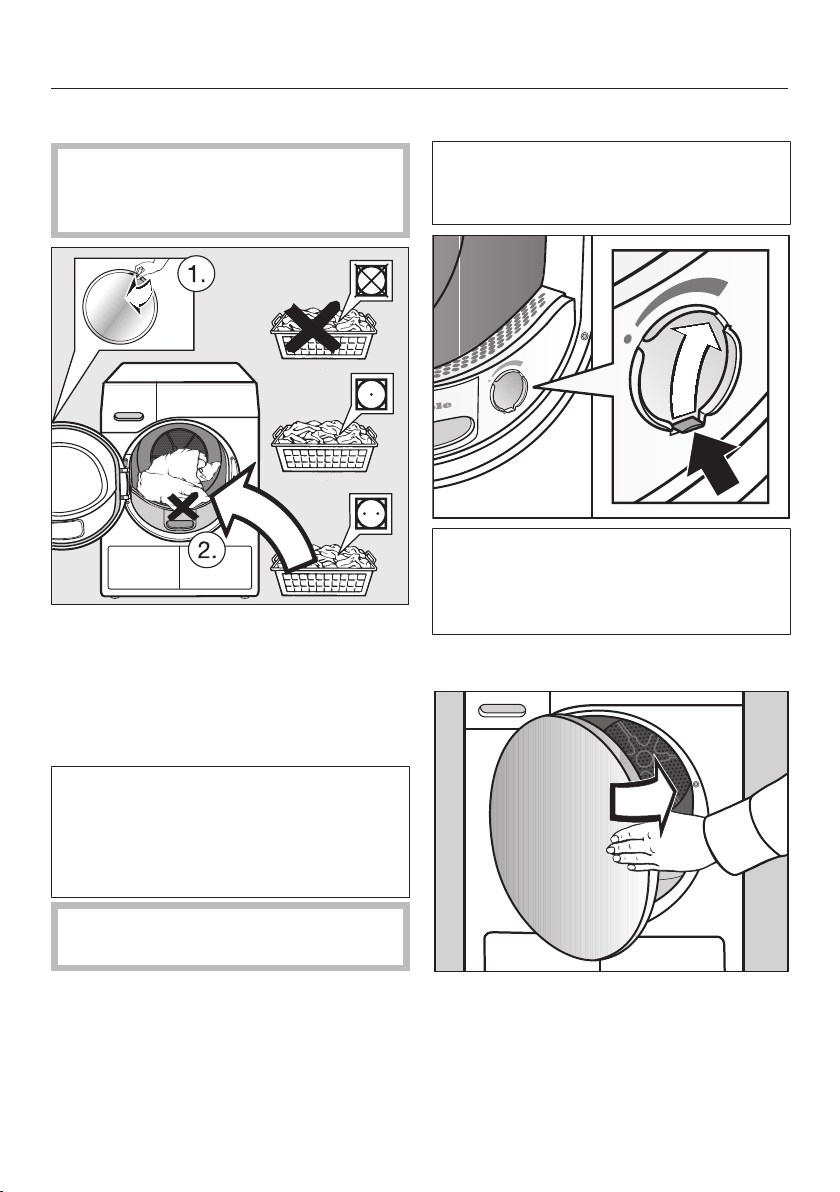
Loading the laundry
Preventing damage to fabrics.
Before loading the dryer, read “1.
Notes on correct laundry care”.
Open the door.
Remove any items that have been left
inside the drum.
Unfold the laundry and load loosely
into the drum.
Do not overload the drum. Doing so
will cause unnecessary wear and tear
to the laundry and affect the drying
result. It is also likely to cause more
creasing.
Laundry items may be damaged if
they get trapped by the door.
Fragrance flacon
The “Fragrance flacon” chapter de-
scribes how to use the fragrance
flacon.
If you are not using a fragrance flacon:
push the tab down completely (see ar-
row) so that the socket is closed. Oth-
erwise, lint will accumulate here.
Close the door
Shut the door with a gentle swing.
3. Select a programme and start it
26
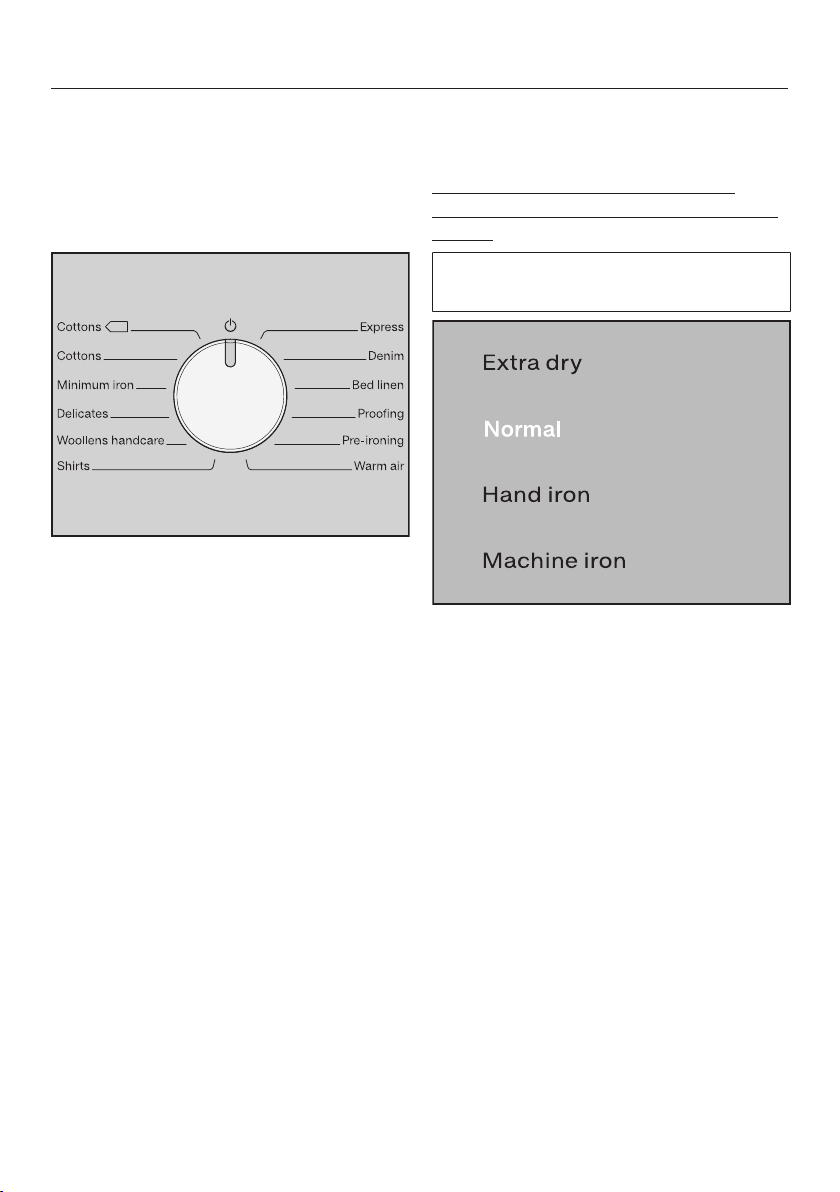
Selecting a programme
The dryer is switched on by selecting a
programme, and switched off by turning
the programme selector to the posi-
tion.
Turn the programme selector.
A drying level may also light up and
durations will appear in the time display.
Selecting the drying level for a drying
level programme
Cottons, Minimum iron, Delicates,
Shirts, Express, Denim, Bed linen, Pre-
ironing
The pre-set drying level for the pro-
gramme can be changed if required.
Touch the sensor for the drying level
you want. It then lights up brightly.
Any drying level can be selected for the
Cottons, Express, and Bed linen pro-
grammes. A more limited range is avail-
able when using the other programmes.

3. Select a programme and start it
27
Other programmes and timed drying
programmes
Warm air
You can set the duration in ten-minute
increments fromminutes
tohours.
Touch the or sensor control re-
peatedly until the required pro-
gramme duration appears in the time
display.
Cottons , Woollens handcare,
Proofing
The drying result is preset by the dryer
and cannot be altered.
Selecting Gentletumble
Delicate fabric (with the symbol on
the care label, e.g. acrylic garments) is
dried at a lower temperature. The pro-
gramme duration is longer.
Touch the Gentle tumble sensor. It
then lights up brightly.
- Gentle tumble can be selected with
the following programmes:
– Cottons
– Minimum iron
– Shirts
– Denim
– Warm air
- Gentle tumble is always activated/
cannot be deselected with Delicates,
Pre-ironing.

3. Select a programme and start it
28
Selecting Delay start
With Delay start you can delay the
start of a programme from
minutes up to hours.
However: Delay start cannot be used
with the Warm air programme.
Touch the sensor.
lights up brightly
Touch the or sensor repeatedly
until the required delayed start time
appears in the time display.
Tip: The time will count upwards and
downwards automatically if you touch
the or sensor continuously.
Altering Delay start
If you would like to alter the Delay start
function after starting a programme, the
function must be cancelled first.
Turn the programme selector to the
position.
The tumble dryer is switched off and
Delay start is cancelled.
Select a programme.
Select a Delay start time.
Delay start countdown
- Delay start times of more than will
count down in hours and then in
minutes until the start of the pro-
gramme.
- The drum will turn briefly every hour
until the start of the programme to re-
duce laundry creasing.
Adding laundry during ongoing delay
start period
Follow the description in “Changing
the programme sequence – Adding or
removing laundry”.

3. Select a programme and start it
29
Starting a programme
Touch the flashing Start/Add laundry
sensor control.
The Start/Add laundry sensor control
lights up.
Programme sequence
- If Delay start has been selected, the
Delay start time will start to count
down first.
- The programme starts.
- The Perfect Dry indicator will only
flash/light up with programmes with
selectable drying levels (see also
“Operating the tumble dryer”).
- The dryer measures the residual
moisture of the laundry and calcu-
lates the required programme dura-
tion.
If a small load or dry laundry is
placed in the dryer, it is dried/aired
for a preset duration. In this case the
Perfect Dry indicator does not light
up at the end of the programme.
To prevent laundry wearing out
avoid overdrying it.
- Before the programme finishes, the
laundry is cooled.
Energy savings
After 10minutes, the indicators dim.
The Start/Add laundry sensor control
flashes slowly.
Touch the Start/Add laundry sensor
control to switch the indicators on
again (this does not have any effect
on a running programme).
Adding laundry
You can add laundry items after the
programme has started.
Follow the description in “Changing
the programme sequence – Adding or
removing laundry”.
4. Remove the laundry
30
End of programme/Anti-crease
action
End of programme: lights up in the
time display and the Start/Add laundry
sensor control goes out.
The end of the programme is followed
by the anti-crease phase, which will run
for up to 2hours. The Woollens hand-
care programme does not support the
anti-crease function.
See “Programmable functions”,
“Anti-crease”.
The tumble dryer switches off automat-
ically.
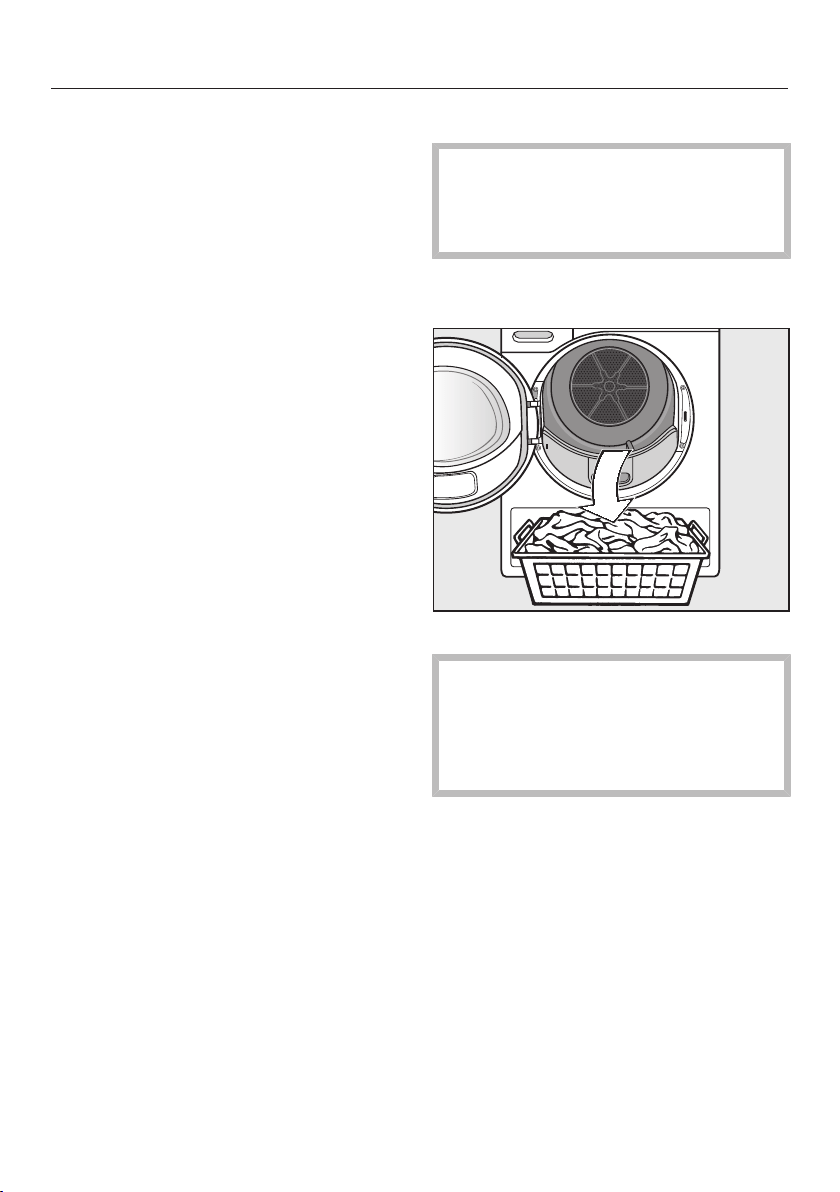
Unloading the drum
Only open the door when the drying
process has finished. Otherwise, the
laundry will not be properly dried
through and cooled down.
Pull the door open at the side with
the orange marker.
Remove the laundry.
Items left in the dryer could be dam-
aged by overdrying when the dryer is
used the next time.
Always remove all items from the
drum.
Turn the programme selector to the
position.
Remove the fluff from the 2 fluff filters
in the door opening: see “Cleaning
and care - Fluff filters”.
Shut the door with a gentle swing.
Empty the condensed water con-
tainer.
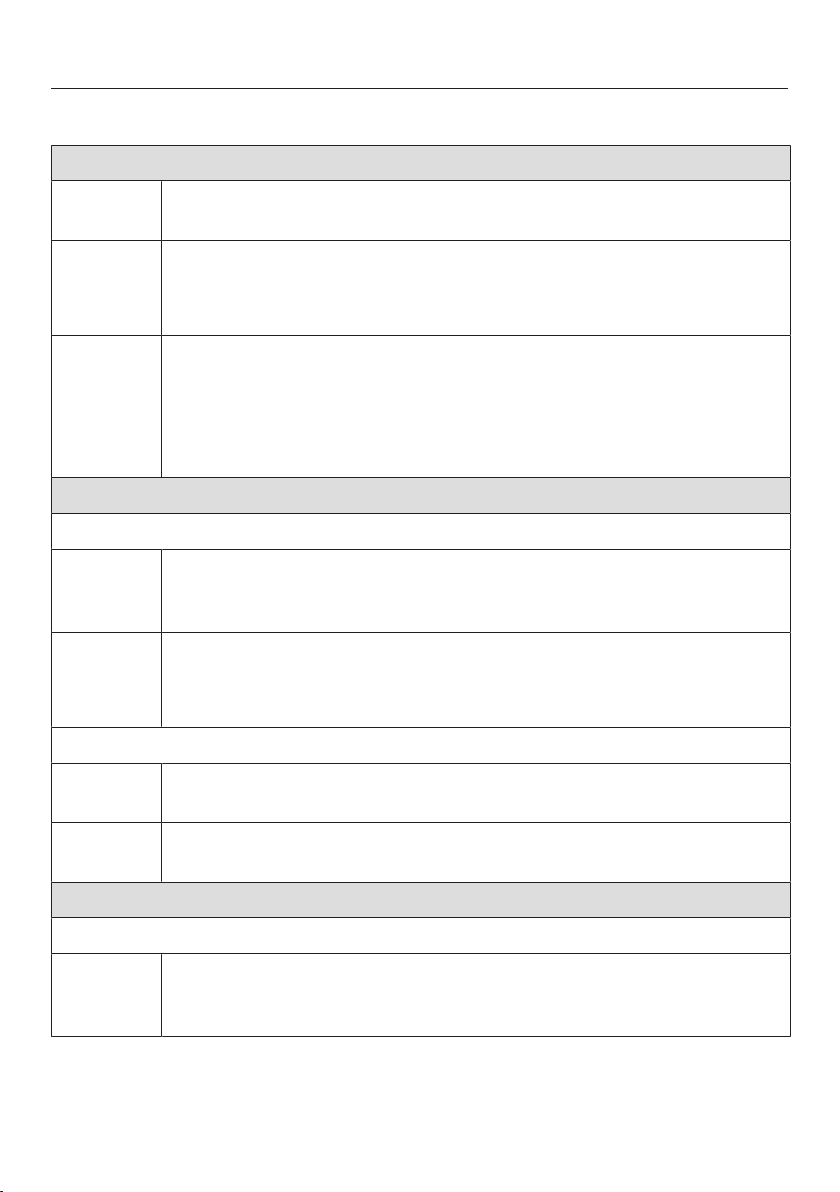
Programme chart
31
All weights marked with * are based on the weight of dry laundry.
Cottons max.7kg*
Use for Cotton items such as those described under Cottons Normal with
normal residual moisture.
Note - Items are dried to a Normal level only in this programme.
- The Cottons programme is the most energy-efficient for dry-
ing cotton items with normal residual moisture levels.
Note for
test insti-
tutes
- The Cottons programme is the test programme in accord-
ance with Regulation 392/2012/EU for energy labelling, measured
in accordance with EN61121.
- With the Cottons and Cottons programme settings, drain the
condensed water externally through the drain hose.
Cottons max.7kg*
Extra dry, Normal
Use for Single and multi-layered cotton items. For example, T-shirts, under-
wear, baby clothes, workwear, jackets, covers, aprons, overalls,
hand towels, bath towels, bathrobes, and flannelette/bed linen.
Tip - Select Extra dry for multi-layered and very thick fabrics.
- Do not use Extra dry for jersey fabrics (e.g. T-shirts, underwear,
baby clothes) because they can shrink.
Hand iron, Machine iron
Use for All cotton or linen fabrics requiring further processing. For example,
table linen, bed linen, or starched laundry.
Tip To prevent laundry from drying out, it should be rolled up until you
are ready for ironing.
Minimum iron max.4kg*
Normal, Hand iron
Use for For easy care items made of cotton, synthetic, or mixed fibre. For
example, workwear, overalls, pullovers, dresses, trousers and table
linen.
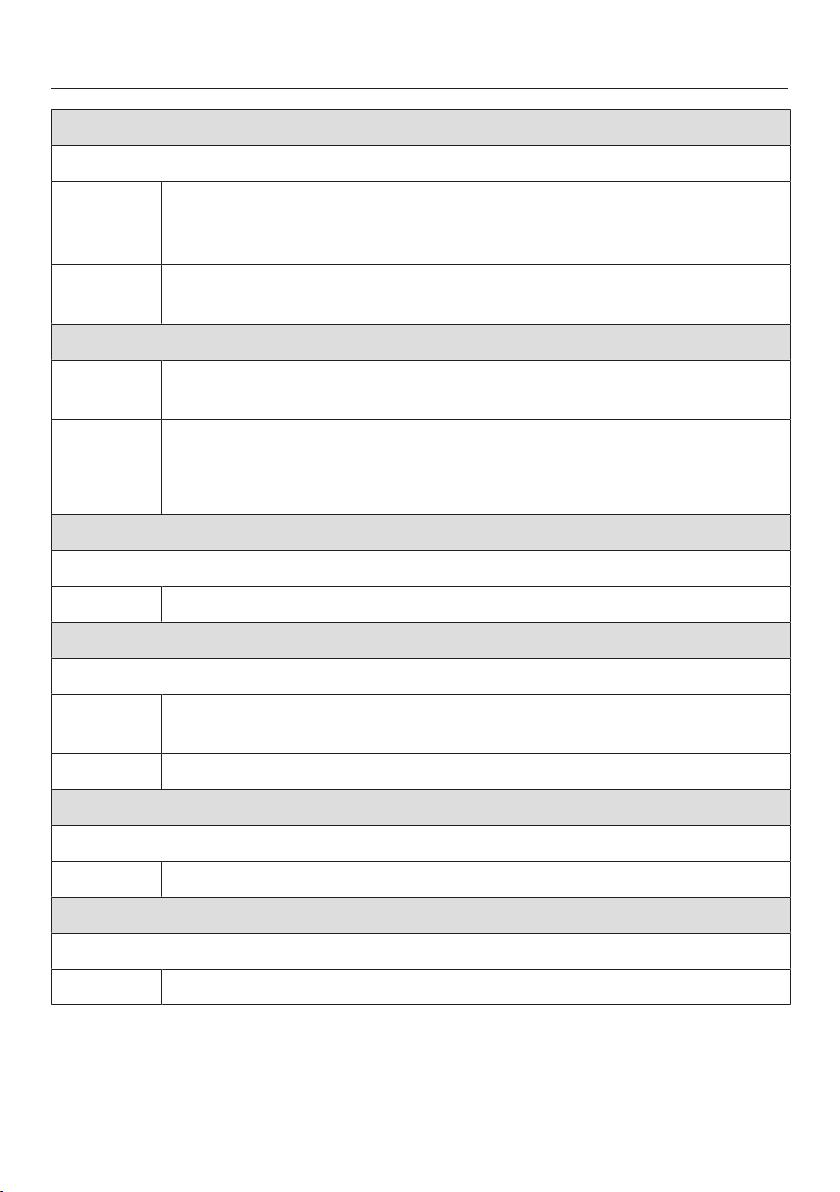
Programme chart
32
Delicates max.2.5kg*
Normal, Hand iron
Use for Delicate items with the symbol on the care label made of syn-
thetic fibre, mixed fibre, rayon, and easy care cotton. For example,
shirts, blouses, lingerie, and appliquéd garments.
Tip The load should be reduced further for a particularly crease-free dry-
ing process.
Woollens handcare max.2kg*
Use for Woollen garments and fabric containing wool blends, e.g. pullovers,
cardigans, tights.
Note - Wool and wool blend items are only fluffed up; they are not dried
completely.
- Remove the garments as soon as the programme has finished.
Shirts max.2kg*
Normal, Hand iron
Use for Shirts and blouses
Express max.4kg*
Extra dry, Normal, Hand iron, Machine iron
Use for Fabrics with the symbol that are suitable for the Cottons pro-
gramme
Note The programme running time is shorter.
Denim max.3kg*
Normal, Hand iron
Use for All the denim garments, e.g., jackets, jeans, shirts, and skirts.
Bed linen max.4kg*
Extra dry, Normal, Hand iron, Machine iron
Use for Bed linen, pillow cases
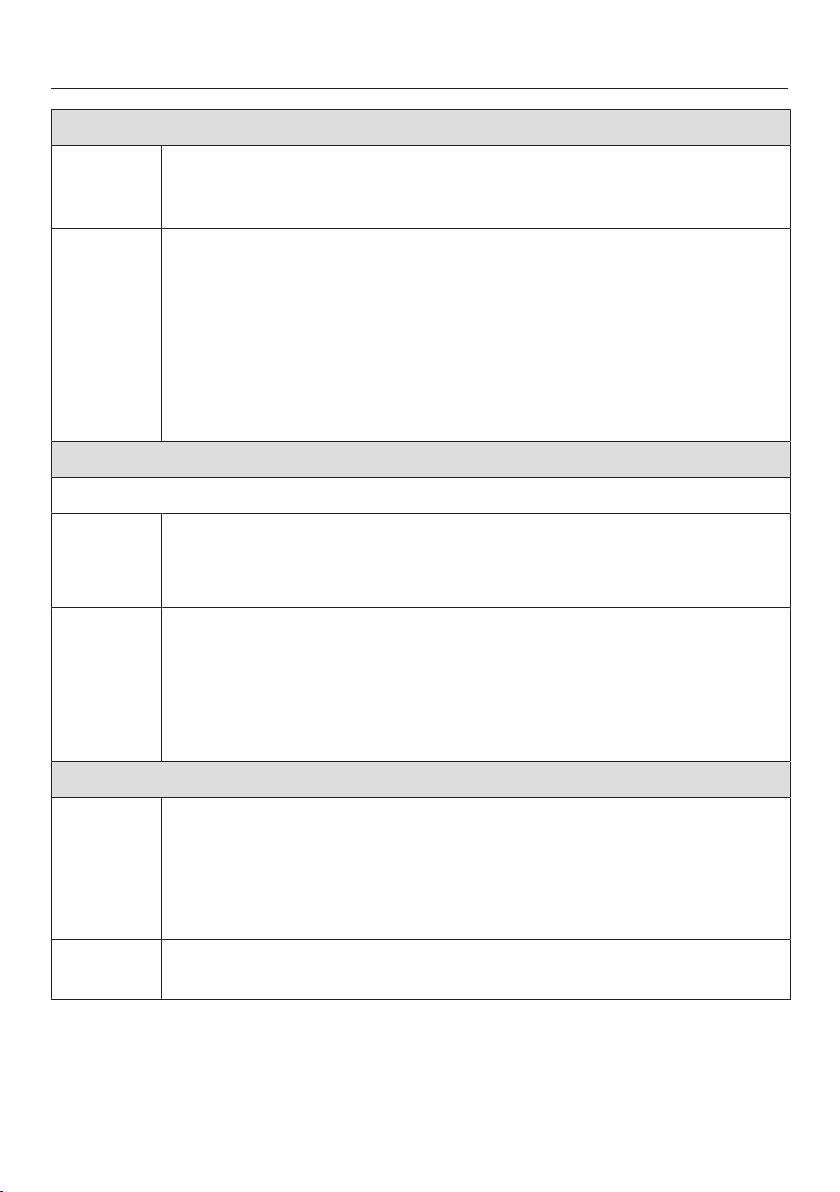
Programme chart
33
Proofing max.2.5kg*
Use for Fabrics suitable for tumble drying, e.g. microfibre fabrics; skiwear;
outdoor clothing; fine, close-weave cotton garments (poplin); and
tablecloths.
Note - With this programme, items can only be dried to the Normal level.
- This programme includes an additional proofing fixing phase.
- Only use proofing agents which are stated by the manufacturer as
being “suitable for use on membrane fabrics”. These agents con-
tain fluorochemical compounds.
- Do not dry fabrics which have been treated with proofing agents
containing paraffin. This poses a fire hazard.
Pre-ironing max.1kg*
Normal, Hand iron
Use for - Cotton and linen fabric.
- For minimum iron items made of cotton, mixed or synthetic fibre.
For example, cotton trousers, anoraks and shirts.
Tip - This programme smoothes out creasing caused during the spin
cycle in the washing machine.
- This programme is also suitable for dry fabrics.
- Please remove the garments as soon as the programme has fin-
ished.
Warm air max.7kg*
Use for - Multi-layered fabric whose layers have different drying character-
istics, e.g. jackets, pillows, sleeping bags and other voluminous
items.
- For drying individual items, e.g. bath towels, bathing costumes
and tea towels.
Tip Do not select the longest drying time to start with. Check the items
as you are drying them to find the optimum time.

Changing the programme sequence
34
Changing a programme once it
has started
It is no longer possible to change the
selected programme. This is to prevent
the operation of the machine being
tampered with.
If you adjust the programme selector,
the symbol will light up in the time
display. The symbol goes out when
you select the original programme.
Cancelling the current programme
Turn the programme selector to the
position.
The programme is cancelled.
You can now select a new programme.
Adding or removing laundry
You have forgotten something but the
programme is already running.
Touch the Start/Add laundrysensor
control.
The wordAdd will appear in the time
display. The Start/Add laundry sensor
control flashes slowly.
Open the door.
Add or remove laundry items.
You can still change the programme se-
lection.
Close the door.
Touch the Start/Add laundrysensor
control.
The programme continues.
Exceptions when adding laundry
In some cases – for example, during
the cooling phase or the Proofing pro-
gramme – it is not possible to add
laundry items.
In these cases, the wordAdd is not dis-
played.
In exceptional cases, the door can be
opened while the programme is run-
ning.
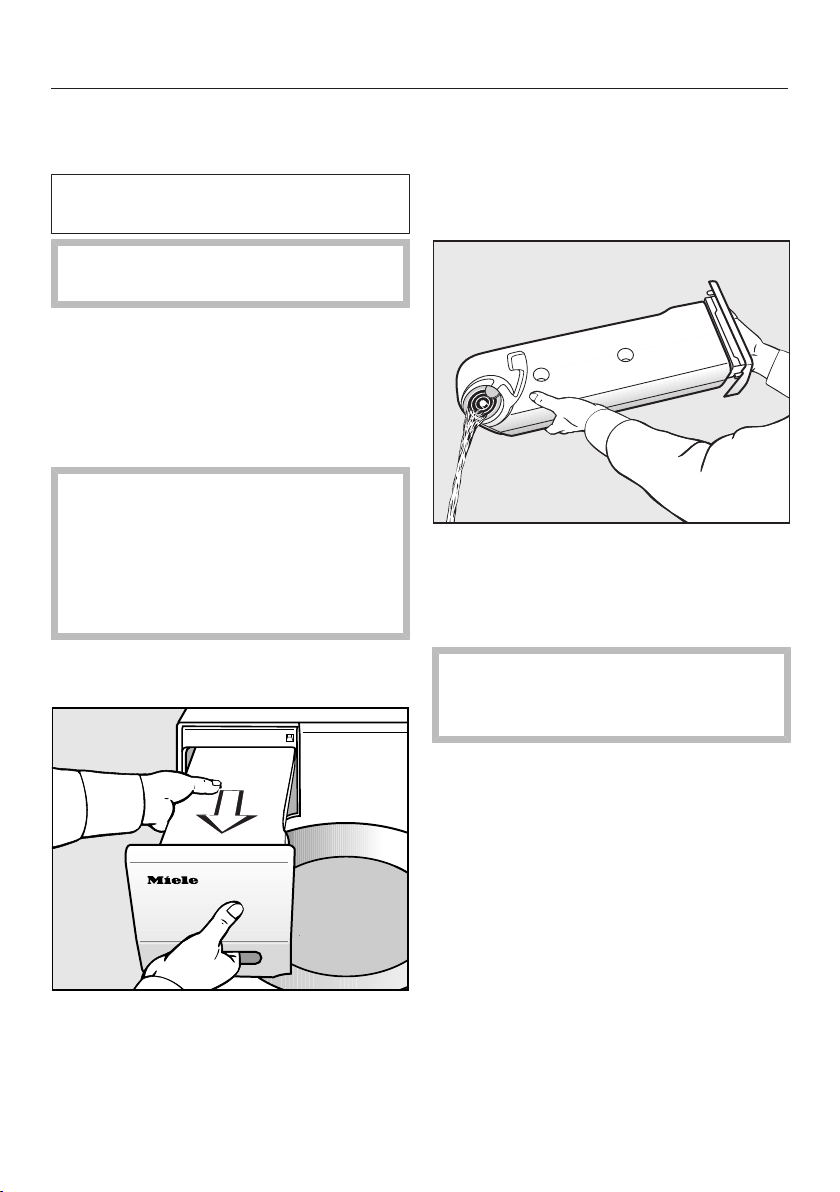
Condensed water container
35
Emptying the condensed water
container
The condensed water is collected in
the condensed water container.
Empty the condensed water con-
tainer after every drying programme.
The indicator will light up if the max-
imum level of the condensed water
container is reached.
To delete the indicator: open and
close the door with the dryer switched
on.
Damage to the door and the fas-
cia panel when removing the con-
densed water container.
The door and the fascia panel can
sustain damage.
Always close the door completely.
* This does not apply to right-hand
hinged models.
Remove the condensed water con-
tainer.
To prevent water from running out,
keep it in a horizontal position when
carrying it. Hold the condensed water
container by the front panel and at
the back.
Empty the condensed water con-
tainer.
Replace the condensed water con-
tainer in the dryer.
Condensed water can cause health
problems in people and animals.
Do not drink condensed water.
Condensed water can be put to house-
hold use (e.g. used in a steam iron or
humidifier). To ensure that any residual
particles of fluff in the condensed water
are removed before use, pass it through
a fine sieve or paper filter first.
Fragrance flacon
36
FragranceDos
Fragrance flacons (optional accessor-
ies) can be used to give your laundry a
pleasant scent.
Tip: You can simply close the fragrance
flacon if you want to dry textiles without
adding fragrance.
Risk of fire and damage to health
if fragrance flacons are used incor-
rectly.
The leaked fragrance can damage
your health if it comes into contact
with your body. Leaked fragrance
can cause fire.
Before using a fragrance flacon,
please read “Warnings and safety in-
structions”, “Using the fragrance
flacon (optional accessory)”.
Removing the protective seal from
the fragrance flacon
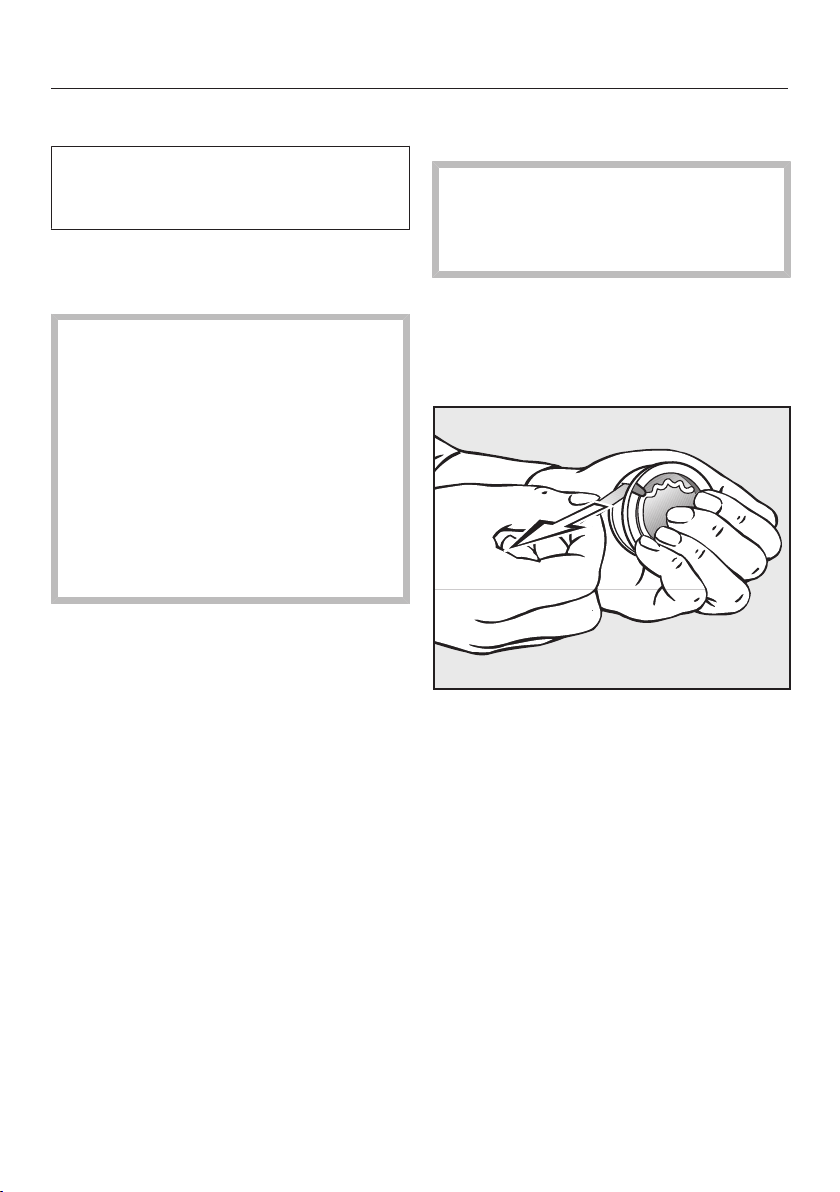
Only hold the fragrance flacon as il-
lustrated. Do not hold it at an angle
or tip it, as the fragrance will leak out
of it.
Take the fragrance flacon out of its
packaging.
Do not attempt to open the fragrance
flacon.
Hold the fragrance flacon securely so
that you do not open it by mistake.
Pull off the protective seal.
Fragrance flacon
37
Inserting a fragrance flacon
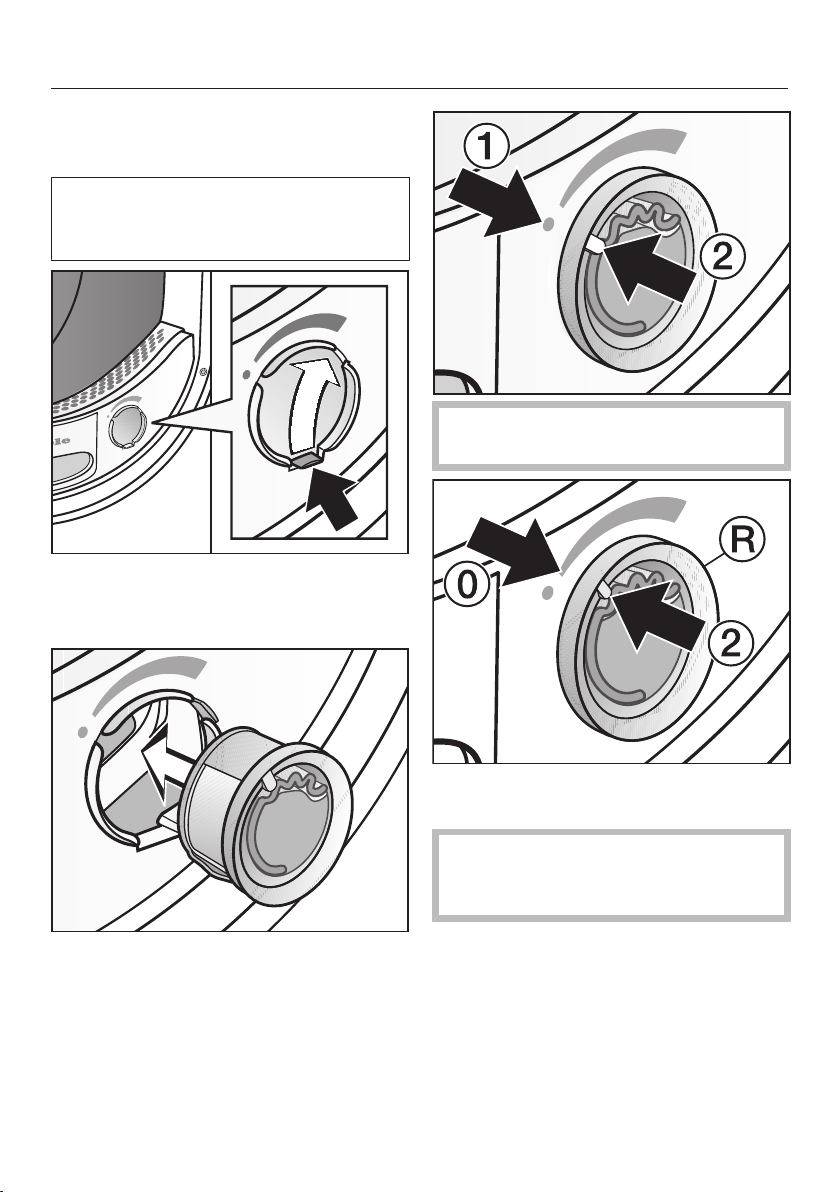
Open the door of the tumble dryer.
The fragrance flacon is inserted in the
upper fluff filter in the opening on the
right hand side beside the grip.
Open the cover using the tab until the
tab is at the top right hand side as
shown.
Insert the flacon in the opening as far
as it will go.
Markers and must line up with
one another.
Turn the outer ring clockwise a
little.
Marker must be in position : this
is the position at which you can feel
a resistance.
Fragrance flacon
38
Opening the fragrance flacon
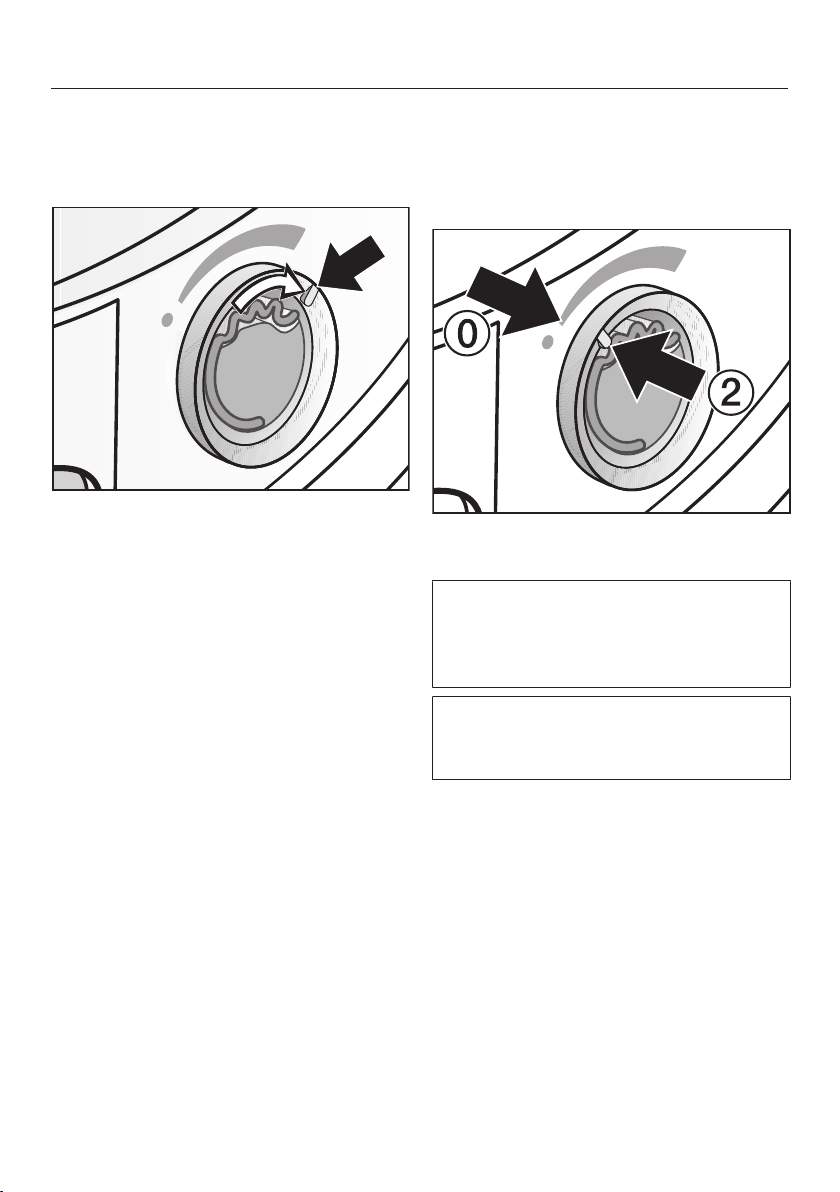
Before drying, you can select the in-
tensity of the fragrance.
Turn the outer ring clockwise: the fur-
ther you open the fragrance flacon,
the more intense the fragrance.
Damp laundry and longer drying dura-
tions with sufficient heat transfer are
needed for the fragrance to be released
into the laundry effectively. The fra-
grance will also be noticeable in the
room air during the process.
Closing the fragrance flacon
After drying, the fragrance flacon should
be closed to prevent the fragrance from
escaping needlessly.
Turn the outer ring counter-clockwise
until marker b is in position _.
If you wish to dry without the fra-
grance occasionally: remove the fra-
grance flacon and store it in its original
packaging.
Replace the fragrance flacon with a
new one when the intensity of the fra-
grance is no longer sufficient.

Fragrance flacon
39
Replacing the fragrance flacon
Turn the outer ring anti-clockwise un-
til markers a and b line up.
Replace the fragrance flacon.
Only store the fragrance flacon in its ori-
ginal packaging.
Fragrance flacons are available to or-
der from Miele or online at www.miele-
shop.com.
Never lay the fragrance flacon down
on any surface as the fragrance will
leak.
- If you are keeping the fragrance
flacon in its original packaging, do
not store the packaging upright on its
edge or upside down. Otherwise, the
fragrance will leak out.
- Always store in a cool, dry place
away from direct sunlight.
- When purchasing new fragrance flac-
ons, only remove the protective seal
just before use.
Cleaning and care
40
Fluff filters
This tumble dryer has 2 fluff filters in the
loading area of the door. Both fluff fil-
ters trap fluff produced during the dry-
ing process.
Clean the fluff filters after each drying
programme. This avoids having to ex-
tend the programme running time.
Also clean the fluff filters when the
indicator light comes on.
To make the indicator light go out,
open and close the door while the
tumble dryer is switched on.
Removing the fragrance flacon
The intensity of the fragrance will be di-
minished if the fluff filters and the plinth
filter are not cleaned.
Remove the fragrance flacon. See
“Fragrance flacon”, “Removing/repla-
cing the fragrance flacon”.
Removing visible fluff
Tip: You can also use a vacuum cleaner
so that you can remove the fluff without
touching it.
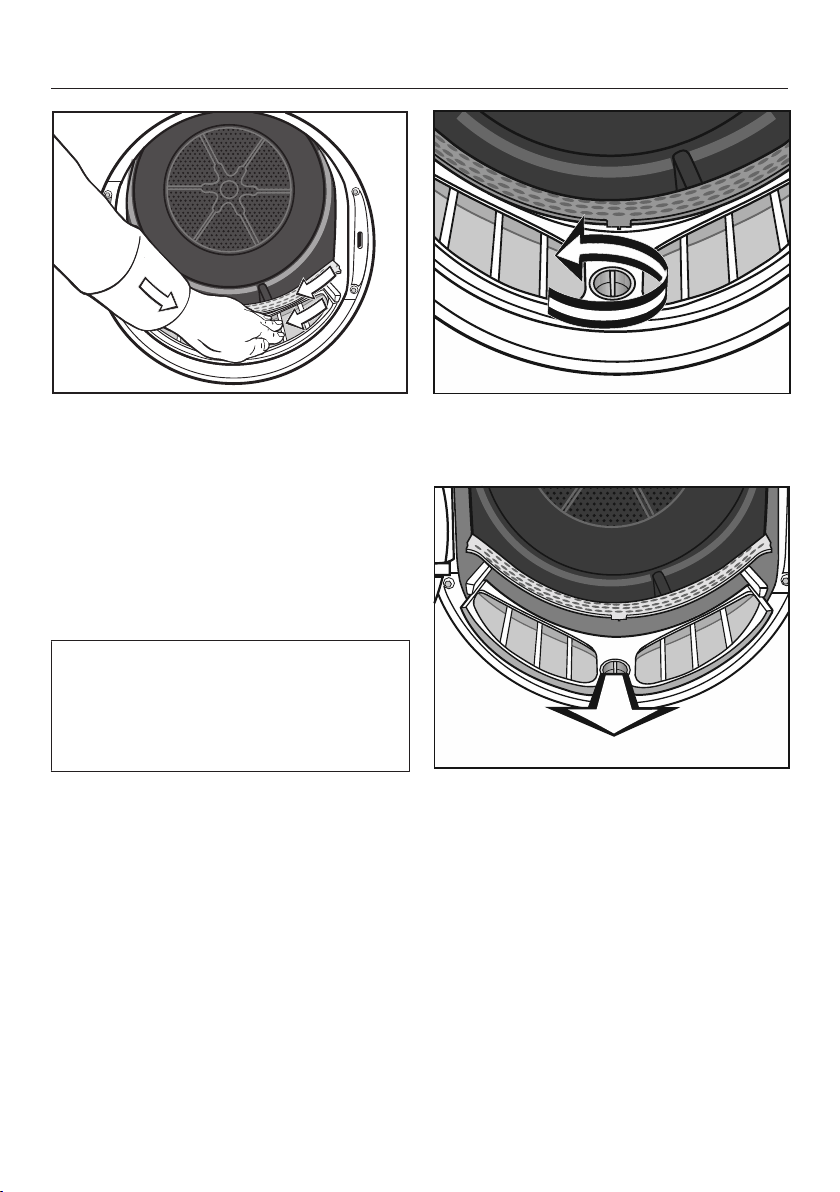
Open the door.
Pull the upper fluff filter forwards to
remove it.
Remove the fluff (see arrows).
Cleaning and care
41
Remove the fluff from the filter sur-
face of all the fluff filters and the per-
forated laundry deflector.
Push the upper fluff filter back into
position until it clicks.
Close the door.
Cleaning the fluff filters and air flow
openings thoroughly
If the drying duration has become
longer or the surface of the filters is
visibly compacted with fluff, you
should carry out the following cleaning
procedure.
Remove the fragrance flacon. See
“Fragrance flacon”.
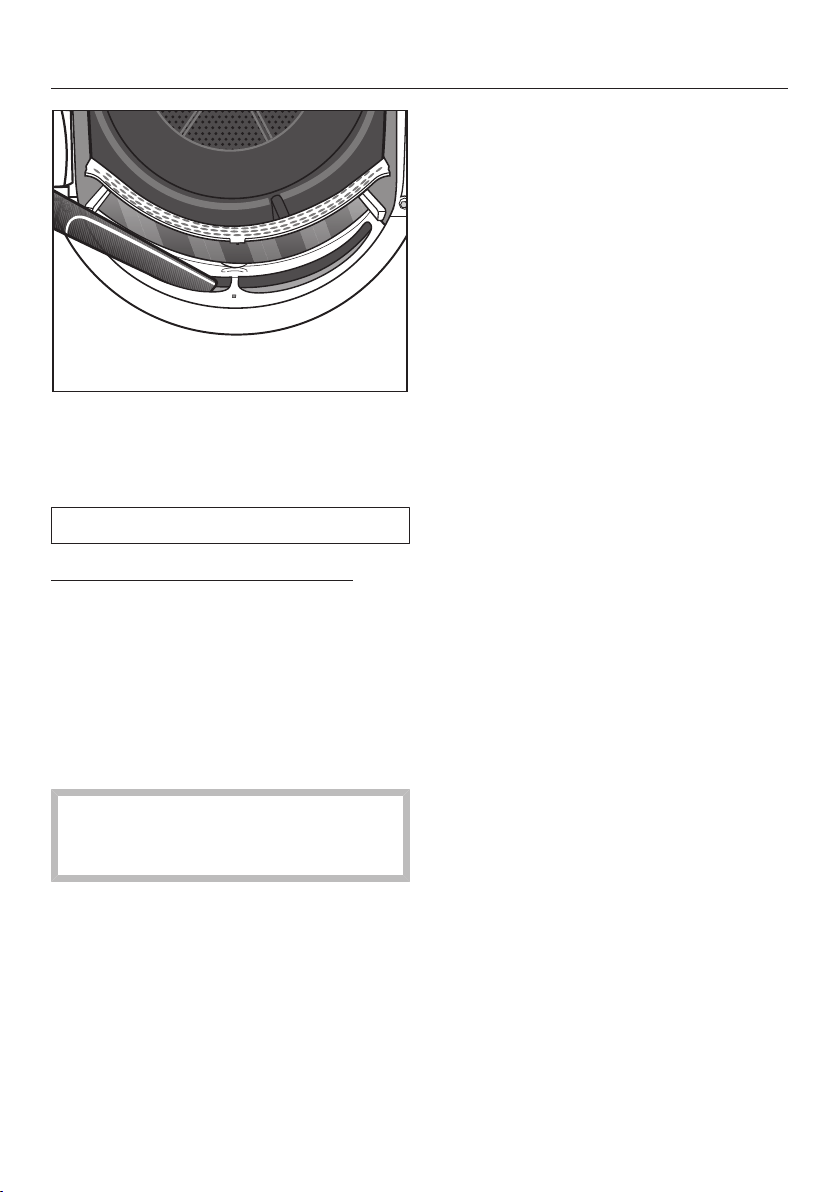
Pull the upper fluff filter forwards to
remove it.
Turn the yellow dial on the lower fluff
filter in the direction of the arrow (until
it reaches the stop position).
Hold the dial and pull the fluff filter
forwards to remove it.
Cleaning and care
42
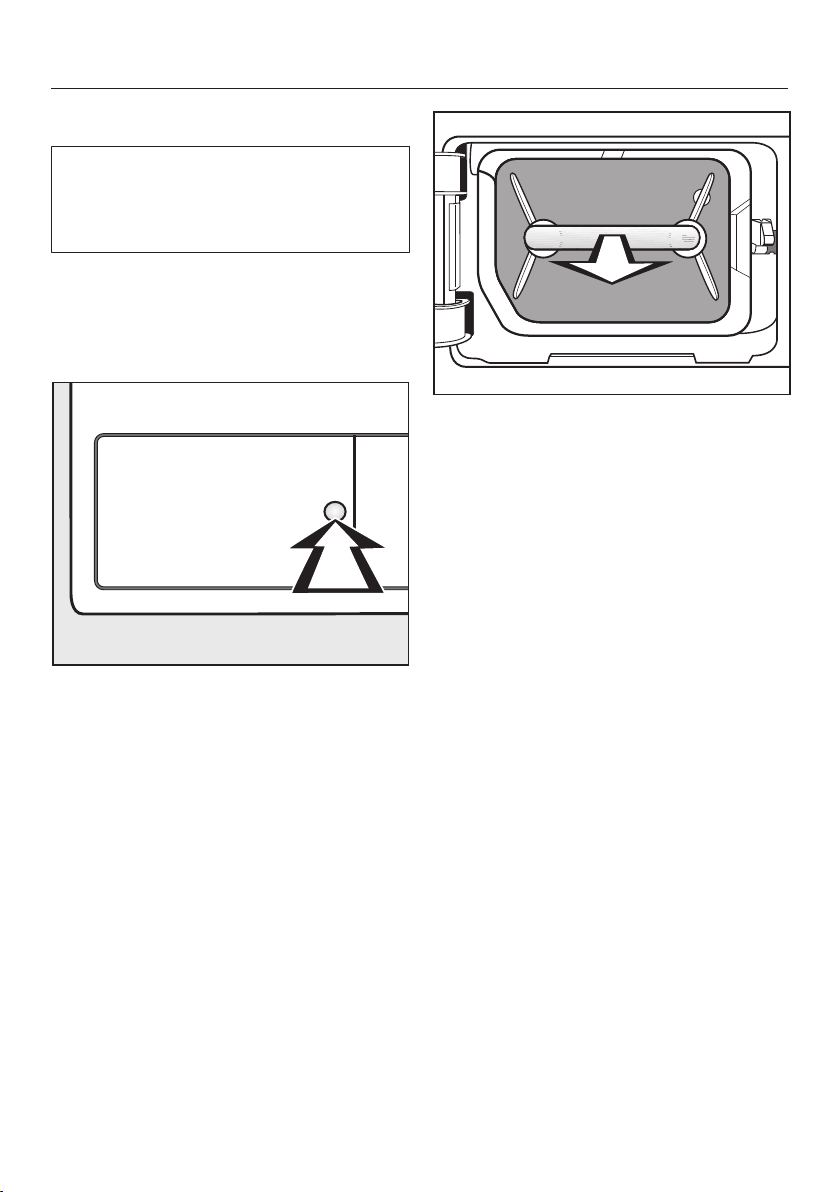
Use a vacuum cleaner with a long
crevice nozzle attached to remove
any visible fluff from the upper air
flow openings.
Finally, clean the fluff filters with water.
Cleaning the fluff filters with water
Wipe the smooth plastic surfaces of
the fluff filters with a damp cloth to
clean them.
Flush the filters through under warm
running water.
Shake the fluff filters thoroughly and
then dry them carefully.
Ensure the filters are dry before re-
placing them. Wet filters could cause
operational faults.
Push the lower fluff filter in com-
pletely and lock it with the yellow dial.
Push the upper fluff filter in com-
pletely.
Close the door.
Cleaning and care
43
Cleaning the plinth filter
Clean the plinth filter whenever the
indicator light comes on or when
the programme running time seems to
be taking longer than usual.
To make the indicator light go out,
open and close the door while the
tumble dryer is switched on.
Removing the plinth filter
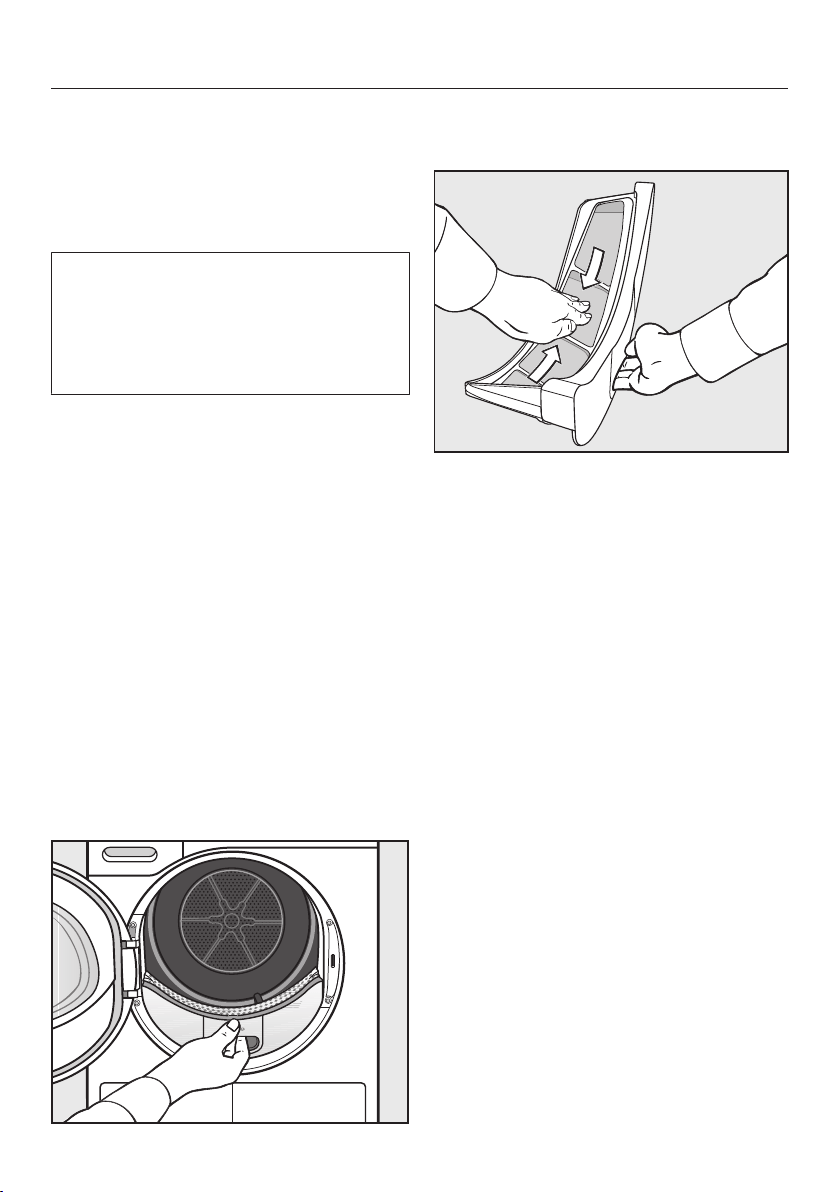
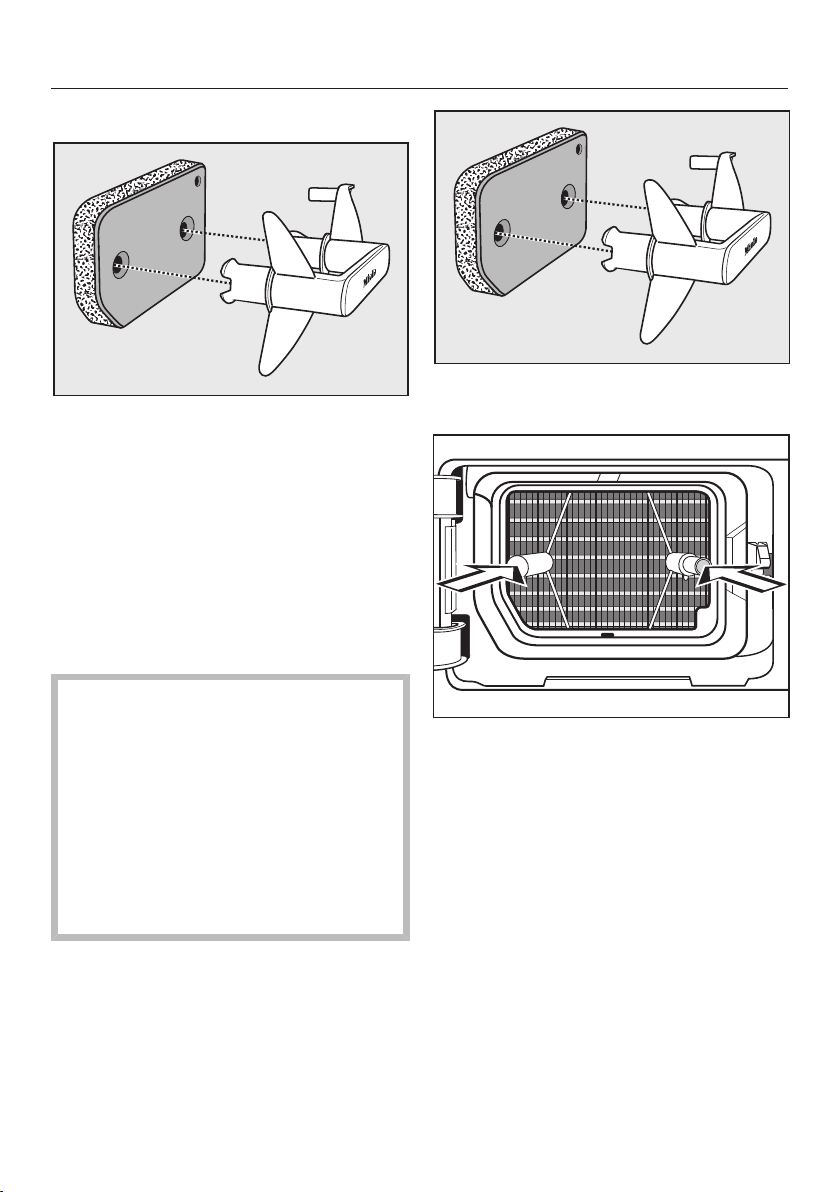
Press the round, indented area on the
heat exchanger access panel to open
it.
The panel will spring open.
Pull the plinth filter out by the handle.
The right-hand guide pin comes out
when the plinth filter is removed. The
guide pin prevents the access panel
from closing without the plinth filter.
Cleaning and care
44
Cleaning the plinth filter
Pull the handle out of the plinth filter.
Clean the plinth filter thoroughly un-
der running water.
Squeeze the plinth filter very carefully
several times as you rinse it.
Rinse the plinth filter until all visible
residues have been removed.
Use a damp cloth to remove any fluff
from the handle.
Damage caused by a damaged
or worn plinth filter.
The heat exchanger will clog up if the
plinth filter is not in good working or-
der. This can cause a fault.
Check the plinth filter following the
instructions provided in “Problem
solving guide – Replacing the plinth
filter”. Replace the plinth filter if ne-
cessary.
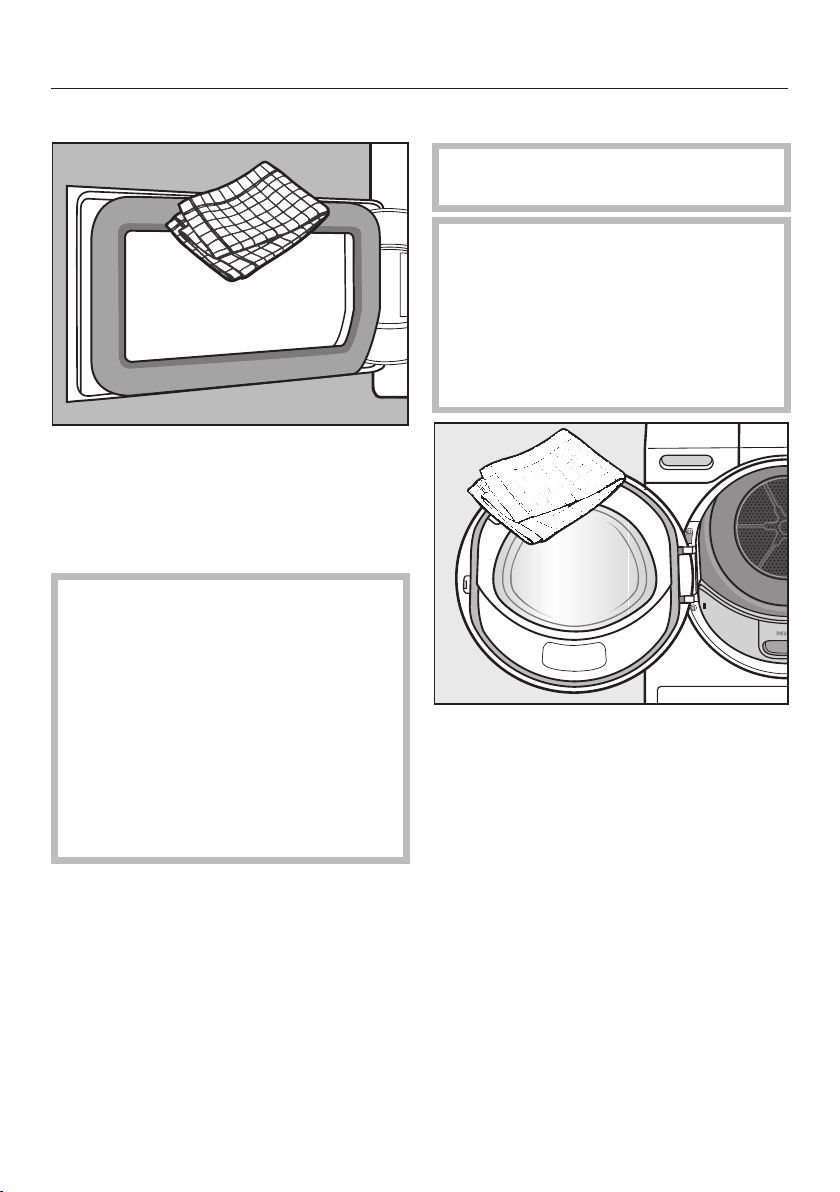
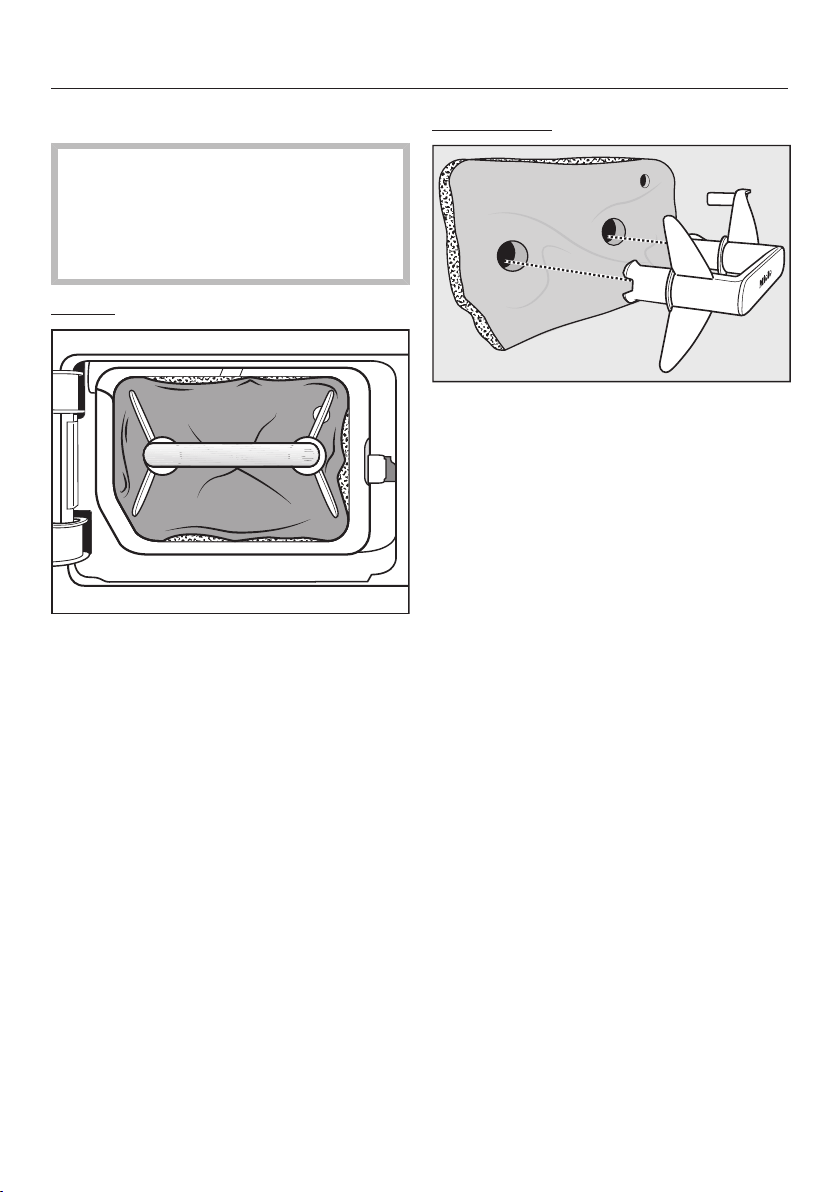
Fit the plinth filter back on the handle.
Make sure it is the correct way round.
Push the plinth filter in completely.
This will push in the right-hand guide
pin at the same time.
Cleaning and care
45
Cleaning the plinth filter access panel
Use a damp cloth to remove any fluff.
Make sure that you do not damage
the rubber seal when doing this.
Close the heat exchanger access
panel.
Damage or ineffective drying if
drying takes place without a plinth
filter or when the heat exchanger ac-
cess panel is open.
An excessive accumulation of fluff
can damage the tumble dryer. If the
system is not leak-tight, this can
make drying ineffective.
Only operate the tumble dryer with
the plinth filter fitted and the heat ex-
changer access panel closed.
Cleaning the dryer
Disconnect the tumble dryer from the
electrical supply.
Damage due to the use of un-
suitable care products.
Unsuitable care products could dam-
age plastic surfaces and other parts.
Do not use any solvents, abrasive
cleaners, glass cleaners, or all-pur-
pose cleaners.
Clean the tumble dryer and the seal
on the inside of the door with a
slightly damp soft cloth and a mild
solution of washing-up liquid and wa-
ter.
Dry all parts with a soft cloth.

Problem solving guide
46
Many malfunctions and faults that can occur in daily operation can be easily
remedied. Time and money will be saved because a service call will not be
needed.
The following guide may help you to find the reason for a malfunction or a fault,
and to correct it.
Indicator lights or information on the time display
Problem Cause and remedy
The indicator light
comes on at the end of
the programme.
The tumble dryer is not working correctly or econom-
ically. Possible causes could be clogging caused by
fluff or detergent residue.
To switch off the indicator light, open and close
the door (with the tumble dryer switched on).
Please see “Cleaning and care” for notes on clean-
ing.
Clean the fluff filters.
Also check the plinth filter and clean it if neces-
sary.
You can influence when the indicator lights up.
To do this, follow the instructions in “Program-
mable functions – Airways indicator”.
The indicator light
comes on. and
flash after a programme
has been cancelled, a
signal sounds.
The system has been clogged by fluff or detergent
residue.
To deactivate the message, turn the programme
selector to the position.
Clean all fluff filters and the plinth filter.
Please see “Cleaning and care” for notes on clean-
ing.
Check that the fluff filters and the plinth filter are
free from damage and in good working order.
If all of the fluff filters are damaged, out of shape or
can no longer be cleaned, they must be replaced.
“Problem solving guide – Replacing the plinth filter”
explains when to replace a plinth filter that is no
longer in good working order.
Problem solving guide
47
Problem Cause and remedy
The indicator light
comes on. and
continue to flash after a
programme has been
cancelled despite thor-
ough cleaning.
The plinth filter looks clean after thorough cleaning.
However, the programme terminates and the fault
message appears again. It is likely that the filter con-
tains residue further down inside that could not be
removed.
To deactivate the message, turn the programme
selector to the position.
Check for the possible causes described below.
The heat exchanger is clogged.
Check the heat exchanger. Follow the instructions
in “Problem solving guide – Checking the heat ex-
changer”.
The plinth filter is clogged further down.
Check the plinth filter. Follow the instructions de-
scribed in “Problem solving guide – Replacing the
plinth filter”.
If the plinth filter is not out of shape or damaged,
you can reactivate it in a washing machine. Follow
the instructions described in “Problem solving
guide – Reactivating the plinth filter”.
The indicator light
comes on after a pro-
gramme has been can-
celled and a signal
sounds.
The condensed water container is full or there is kink
in the drain hose.
To switch off the indicator light, open and close
the door (with the tumble dryer switched on).
Empty the condensed water container.
Check the drain hose.
See “Cleaning and care”.
lights up The programme selector has been moved.
Select the original programme. The time remaining
will appear in the display again.
Bars flash in the display
at the end of a pro-
gramme:
.........
The programme has finished but the laundry has not
yet cooled down.
Either remove the laundry and spread it out to cool
down or leave it in the tumble dryer to cool down
during the cooling phase.

Problem solving guide
48
Problem Cause and remedy
Lines flash and light up
after switching on: .
Programme selection is
not possible.
The PIN code is activated.
See “Programmable functions”, “PIN code”.
and another number
combination flash after
a programme has been
cancelled, a signal
sounds
No obvious cause.
Switch the dryer off and then on again.
Start a programme.
If the programme is cancelled again and an error
message appears, there is a fault. Contact the Miele
Service Department.
: lights up and the
programme has been
cancelled, a signal
sounds
The laundry is unevenly distributed or has rolled up.
Disentangle the laundry and remove a few items, if
necessary.
Switch the dryer off and then on again.
Start a programme.

Problem solving guide
49
Unsatisfactory drying results
Problem Cause and remedy
The laundry is not suffi-
ciently dry.
The load consisted of different types of fabric.
Finish drying using the Warm air programme.
Select a more suitable programme next time.
Useful tip: You can alter the drying levels for some
programmes. See “Programmable functions”, sec-
tions “ Drying levels Cottons” and “ Drying
levels Minimum iron”.
Laundry or feather filled
pillows smell after dry-
ing
The laundry was washed with insufficient detergent
Feathers are a natural product and this is quite nor-
mal.
Laundry: use sufficient detergent next time.
Pillows: take out of the tumble dryer and air them.
Use a fragrance flacon (available as an optional
accessory) for your favourite fragrance.
Items made of synthetic
fibres are charged with
static electricity after
drying
Synthetic fibres tend to attract static charge.
Static charge can be reduced by adding a fabric
conditioner to the final rinse in the washing pro-
gramme.
There is a build-up of
fluff
Fluff is principally the result of friction when garments
are being worn and to some extent when they are be-
ing washed. Machine drying hardly causes any fluff
to form.
Fluff is collected by the fluff filters and the plinth filter
and can be removed easily.
See “Cleaning and care”.

Problem solving guide
50
The drying cycle duration is very long
Problem Cause and remedy
The drying process
goes on too long or
even switches off.*
The room where the tumble dryer is located is too
warm.
Ventilate the room thoroughly.
Detergent residues, hair and fine fluff can clog the fil-
ters.
Clean the fluff filters and the plinth filter.
Remove visible fluff from the heat exchanger.
The laundry is unevenly distributed or has rolled up.
The drum is too full.
Disentangle the laundry and remove a few items.
Start a programme.
The bottom right grille is blocked.
Move any objects, such as a laundry basket, away
from the dryer.
The laundry is too damp.
Spin using a higher spin speed in the washing ma-
chine.
Metallic components, e.g. zips, have prevented the
tumble dryer from registering the correct laundry
moisture level.
Open any zips next time.
If the problem recurs, dry these items using the
Warm air timed drying programme.
* Switch the tumble dryer off and on again before starting a new programme.

Problem solving guide
51
Other problems
Problem Cause and remedy
There are humming
noises
The compressor is operating.
These noises are quite normal and do not indicate a
fault.
A programme does not
start
No obvious cause.
Connect the tumble dryer to the mains
Turn on the tumble dryer
Close the door
Check whether the mains fuse has tripped
Has there been a power cut? When power is re-
stored any previously running programme will re-
start automatically.
Only the Start/Add
laundrysensor control
flashes slowly when the
programme is running.
Once the programme has been running for
10minutes, the indicators go out. The Start/Add
laundry sensor control flashes slowly. This is not a
fault, but a normal function to help save energy.
Touch a sensor control to switch on the indicators.
See “Control field standby status” in “Program-
mable functions”.
The tumble dryer is
switched off.
The tumble dryer switches off automatically after
15minutes if no further selections are made. This is
not a fault, but a normal function.
Select a programme.
The interior drum light-
ing does not come on
The drum lighting will switch off automatically ...
... when the door is closed.
... after a few minutes when the door is open (to
save energy).
If the dryer is switched on, the drum lighting will
come on when the door is opened.
Problem solving guide
52
Replacing the plinth filter
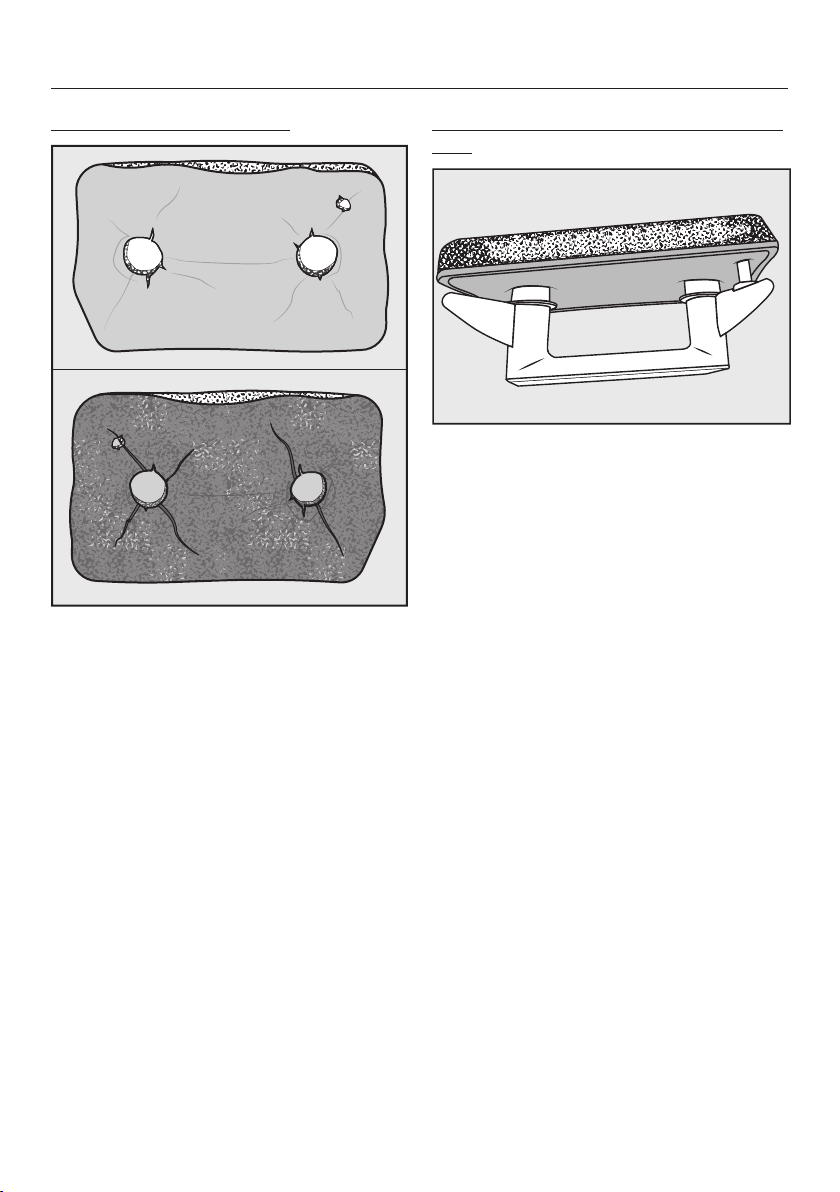
The heat exchanger can clog up.
Replace the plinth filter immediately
if you see the following signs of wear
before or after cleaning (optional ac-
cessory).
Poor fit
The edges of the plinth filter do not sit
properly and the plinth filter is out of
shape. Fluff will blow into the heat ex-
changer unfiltered through edges that
do not sit properly. This will, in time,
cause a blockage in the heat ex-
changer.
Deformations
Deformations indicate that the filter has
become blocked and worn by continu-
ous use.
Problem solving guide
53
Cracks, tears, indentations
Fluff will blow into the heat exchanger
through cracks and tears. This will, in
time, cause a blockage in the heat ex-
changer.
White residues or residues of other col-
ours
These residues arise from laundry fibres
and traces of detergent components.
They can be found on the front and side
edges of the plinth filter. In extreme
cases, they can form stubborn crust.
Residues are a sign that the plinth filter
no is longer a snug fit at the sides, even
if it appears to be perfect:
fluff is getting in unfiltered at the edges.
Reactivate the plinth filter. If these
residues appear on the plinth filter again
soon after cleaning, the plinth filter must
be replaced.
Problem solving guide
54
Reactivating the plinth filter
You can reactivate one or more soiled
plinth filters in a washing machine. You
will then be able to use the plinth filter
again.
Prior to reactivation, check that the
plinth filter is in good order. Check the
plinth filter following the instructions
provided in “Problem solving guide –
Replacing the plinth filter”. Replace the
plinth filter if it has worn out.
Wash the plinth filter(s) separately,
not with any laundry items. Do not
add any detergent.
Select a short wash programme with
a maximum temperature of 40°C and
a maximum spin speed of 600rpm.
You can re-insert the plinth filter once
the wash and spin cycles are complete.
Checking the heat exchanger
Risk of injury from sharp cooling
fins.
You could cut yourself.
Do not touch the cooling fins with
your hands.
Look to see if fluff has accumulated.
Remove any fluff you can see.
Damage due to incorrect clean-
ing of the heat exchanger.
The tumble dryer will not dry if the
cooling fins are damaged or bent.
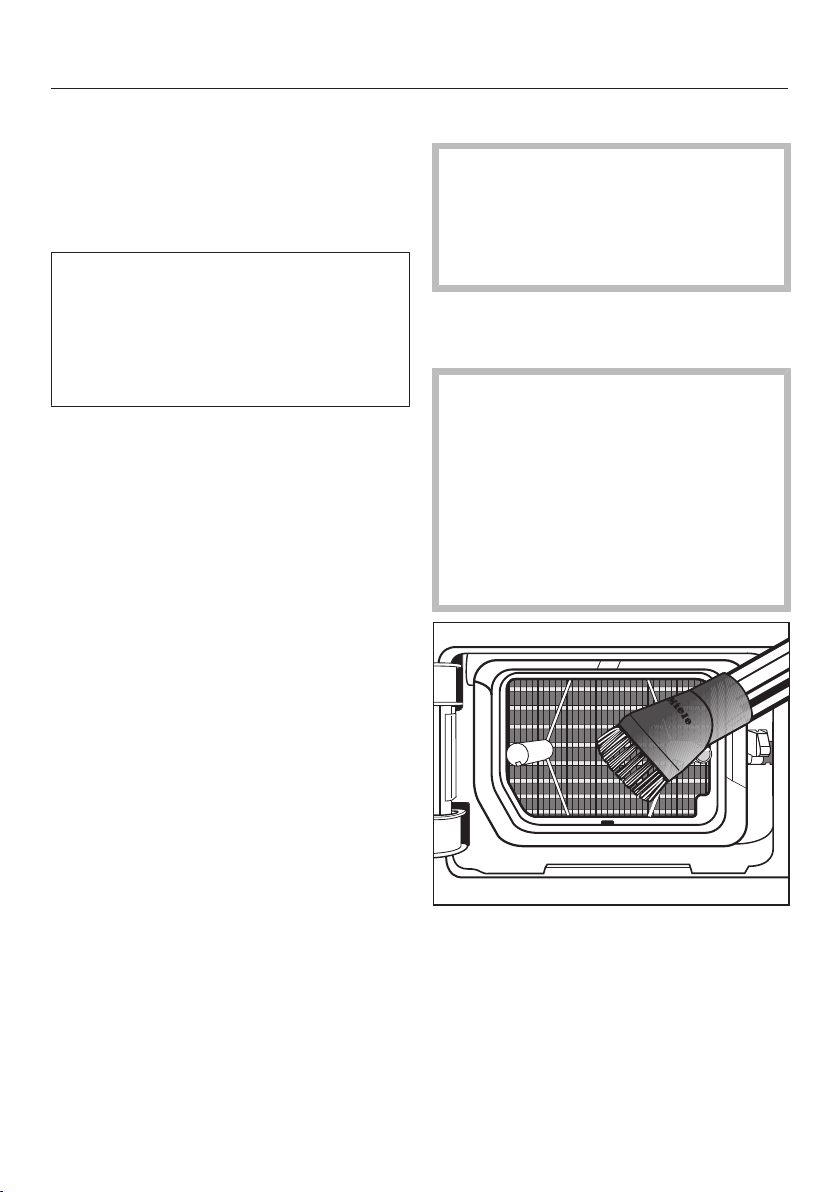
Clean using a vacuum cleaner with a
suction brush attached. Only pass
the vacuum cleaner brush over the
heat exchanger cooling fins lightly,
without applying any pressure.
Use a vacuum cleaner to remove fluff
and residues.
Service
55
Contact in the event of a fault
In the event of any faults which you
cannot remedy yourself, please contact
your Miele dealer or the Miele Customer
Service Department.
You can book a Miele Customer Ser-
vice Department call-out online at
www.miele.com/service.
Contact information for the Miele Cus-
tomer Service Department can be
found at the end of this document.
Please quote the model identifier and
serial number of your appliance (Fabr./
SN/Nr.) when contacting the Miele Cus-
tomer Service Department. This inform-
ation can be found on the data plate.
Please note that telephone calls may be
monitored and recorded for training
purposes and that a call-out charge will
be applied to service visits where the
problem could have been resolved as
described in this booklet.
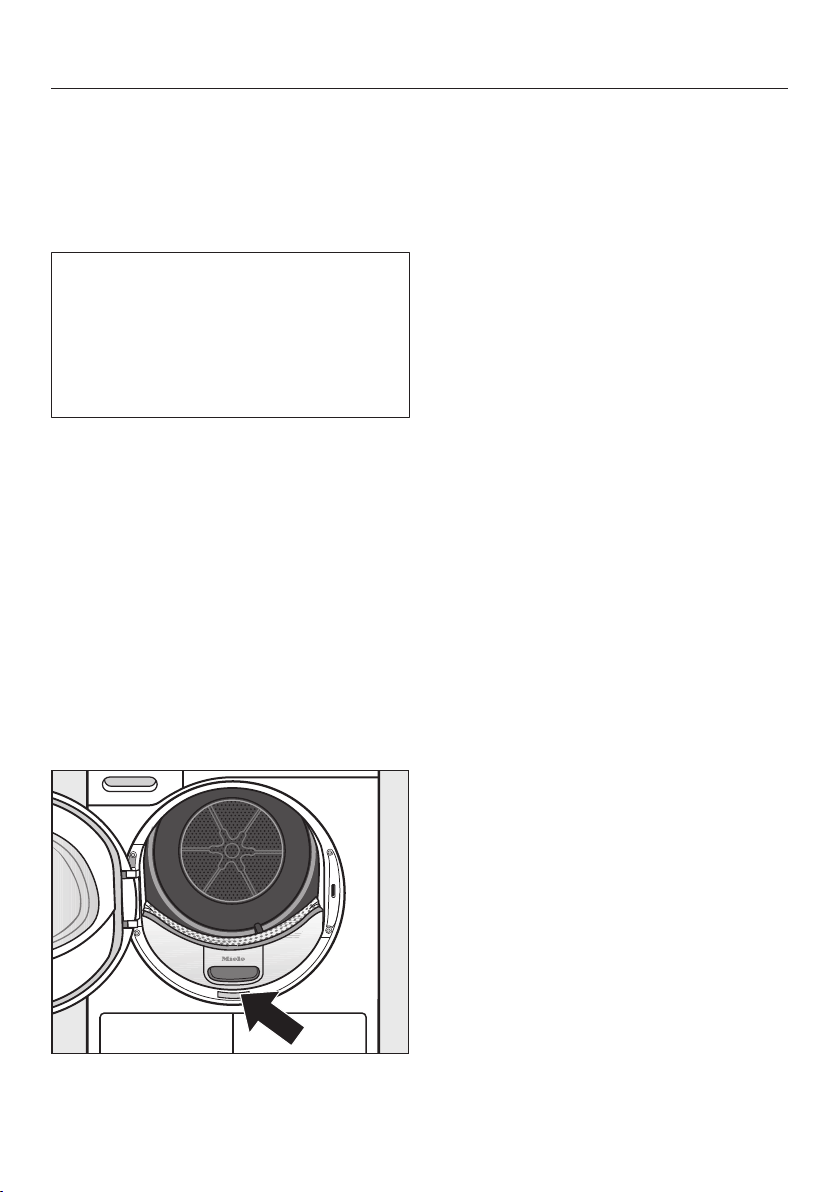
The data plate is visible when the door
is open.
Optional accessories
Optional accessories for this tumble
dryer are available from Miele or from
your Miele dealer.
You also can order these and many
other useful products from the Miele
online shop.
Dryer basket
The dryer basket is enables items which
must not be subjected to mechanical
action to be dried or aired.
Fragrance flacon
A fragrance flacon can be used in your
tumble dryer to add a pleasant fra-
grance to your laundry.
Warranty
For information on the appliance war-
ranty specific to your country please
contact Miele. See back cover for ad-
dress.
In the UK, your appliance warranty is
valid for 2 years from the date of pur-
chase. However, you must activate your
cover by calling 0330 160 6640 or re-
gistering online at www.miele.co.uk.
Installation
*INSTALLATION*
56
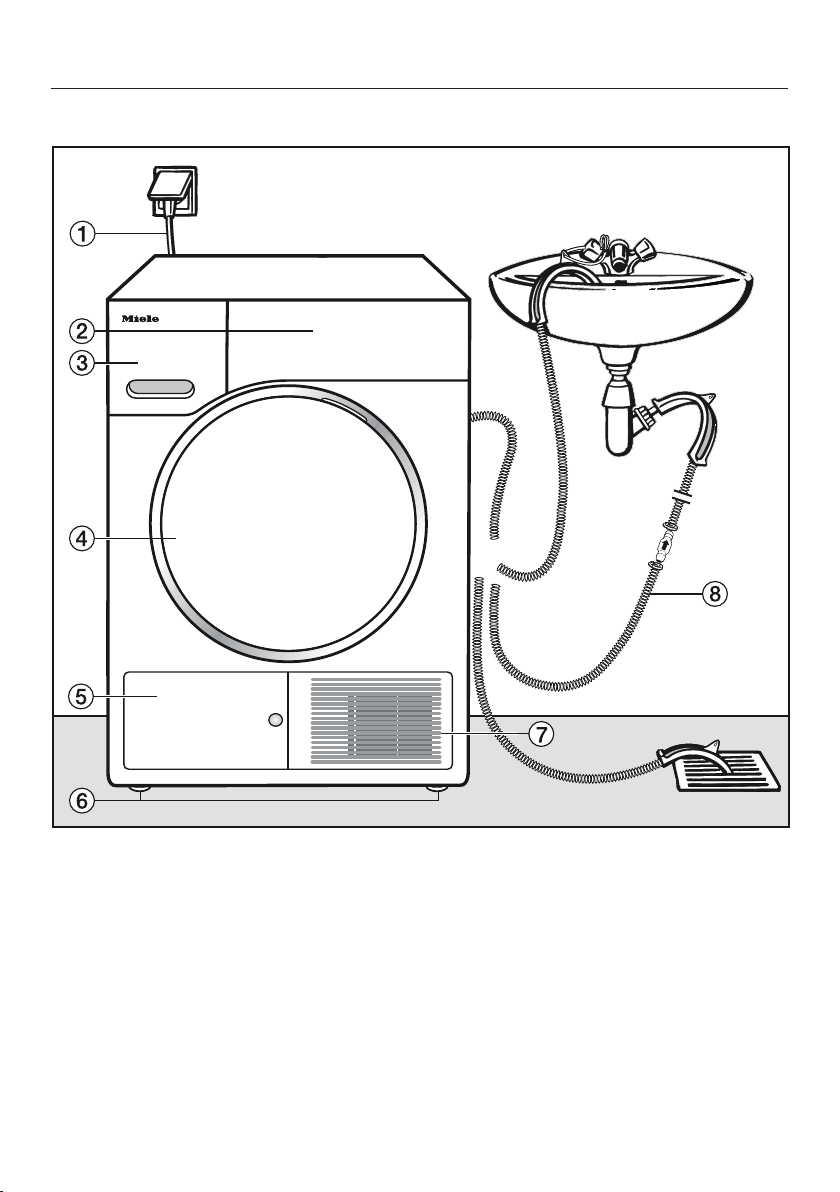
Front view
a
Mains connection cable
b
Control panel
c
Condensed water container
– empty after every drying cycle
d
Door
– do not open during drying
e
Heat exchanger access panel
– do not open during drying
f
Four height adjustable screw feet
g
Cool air intake grille
– do not obstruct with a laundry bas-
ket or other objects
h
Hose for external drainage of con-
densed water
Installation
*INSTALLATION*
57
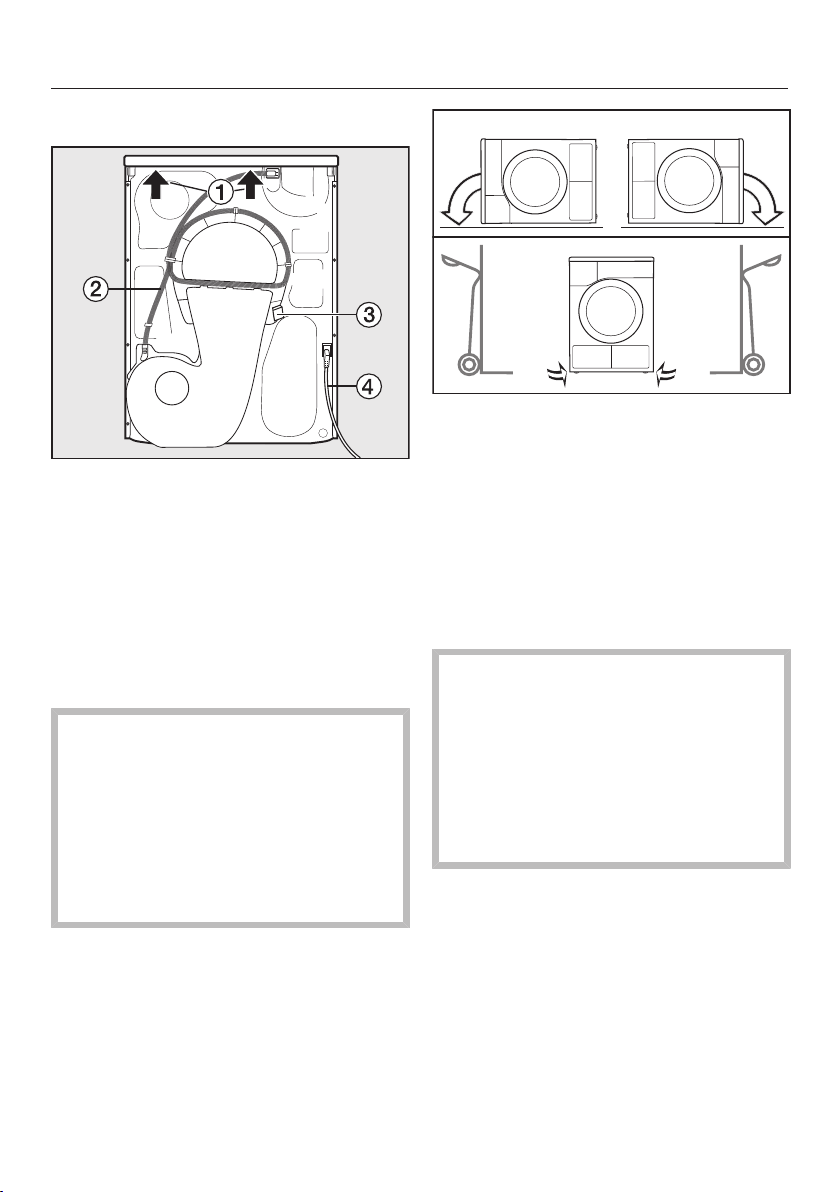
Rear view
a
Protruding lid for holding when mov-
ing the tumble dryer (see arrows)
b
Drain hose for condensation
c
Hook for winding the power cable
around during transport
d
Power cable
Transporting the tumble dryer
Danger of injury to people and
damage to property caused by mov-
ing the appliance incorrectly.
If the tumble dryer tips up there is a
danger of injury to people and dam-
age to property.
Ensure that the tumble dryer is stable
during transportation.
If the tumble dryer is being transpor-
ted on its side, it must be tipped onto
its left or right side.
If the tumble dryer is being transpor-
ted upright and you are using a hand
truck, you must transport it with its
left or right side resting on the truck.
Transporting the tumble dryer to its
installation site
Make sure the fixings at the back
of the lid are secure.
Otherwise there is a danger of the lid
being pulled off when carrying the
appliance.
Before carrying the appliance check
that the lid is secure where it pro-
trudes at the back of the appliance.
Carry the tumble dryer by the front
feet and by the lid where it protrudes
at the back of the appliance.
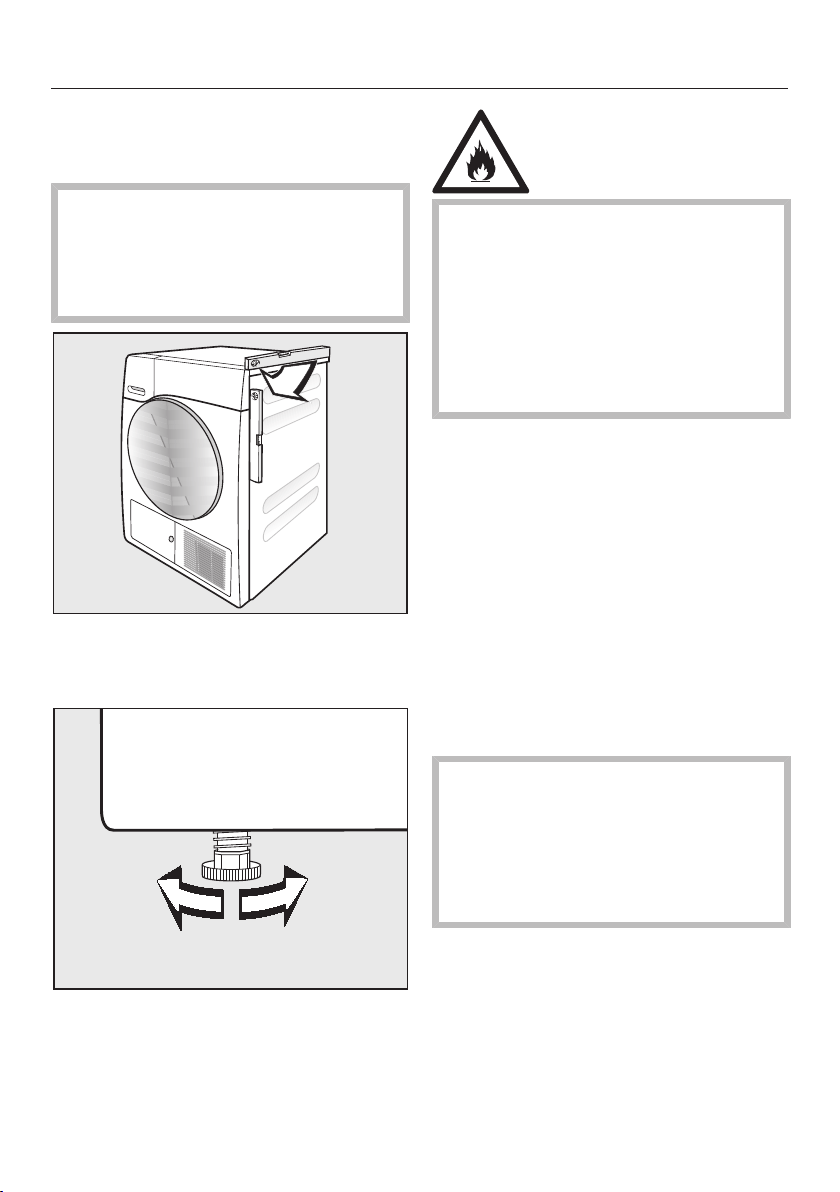
Installation
*INSTALLATION*
58
Installation
Levelling the tumble dryer
Ensure that no closeable door, slid-
ing door or an oppositely hinged
door is installed that would hinder
the door of the tumble dryer being
opened in any way.
The tumble dryer must stand perfectly
level to ensure safe and proper opera-
tion.
The screw feet can be adjusted to com-
pensate for unevenness in the floor.
Risk of fire and explosion due to
damage to the tumble dryer.
The refrigerant is flammable and ex-
plosive.
Do not make any alterations to the
tumble dryer. Take measures to pro-
tect the tumble dryer against dam-
age.
If the tumble dryer is damaged, proceed
as follows:
- Avoid naked flames or anything
which creates a spark.
- Disconnect the tumble dryer from the
electrical supply.
- Air the room where the tumble dryer
is located.
- Contact the Miele Customer Service
Department.
Downtime after installation
Damage to the tumble dryer by
switching it on too soon.
This can damage the heat pump.
After setting up the tumble dryer wait
for at least one hour before switching
it on.

Installation
*INSTALLATION*
59
Ventilation
The cool air intake at the front of the
tumble dryer must not be blocked or
covered. This would hinder a suffi-
cient intake of cool air for the heat
exchanger.
Do not block the gap between the
bottom of the tumble dryer and the
floor with plinth facings, deep pile
carpet etc. This would hinder a suffi-
cient flow of air to the tumble dryer.
The hot air that is blown out from the
heat exchanger warms the room air. En-
sure sufficient ventilation of the room:
e.g., open the window. The drying time
will otherwise take longer (higher energy
requirement).
The heat pump that is essential to
the operation of this tumble dryer
generates a great deal of heat inside
its casing. There must be a reliable
means of dissipating this heat.
Otherwise loads could take longer to
dry or the tumble dryer might sustain
damage in the long term.
Permanent room ventilation during
every drying programme and the gap
between the bottom of the tumble
dryer and the floor are mandatory re-
quirements at all times.
Before moving the tumble dryer
again (e.g. when moving house)
After each use a small quantity of con-
densed water will collect in the area of
the pump. This water can run out if the
tumble dryer is tipped up when it is be-
ing moved. Recommendation: run the
Warm air programme for approximately
1minute before moving the tumble
dryer. Any remaining condensed water
will then be fed into the condensed wa-
ter container or out through the drain
hose.

Installation
*INSTALLATION*
60
Additional installation require-
ments
Slot-in
This tumble dryer is suitable for pushing
under a worktop.
Appliance defect due to a build-up of
heat.
Make sure there is adequate room
for warm air from the dryer to be dir-
ected away.
- The appliance lid cannot be removed.
- The electrical socket must be located
in an accessible position near the
tumble dryer.
- Drying durations may increase
slightly.
Optional accessories
– Washer-dryer stack
The tumble dryer can be combined with
a Miele washing machine in a washer-
dryer stack. The appropriate Miele
washer-dryer stacking kit is required.
– Plinth
The tumble dryer can be fitted on a
plinth with drawer (please note the
plinth may not be available in all coun-
tries).
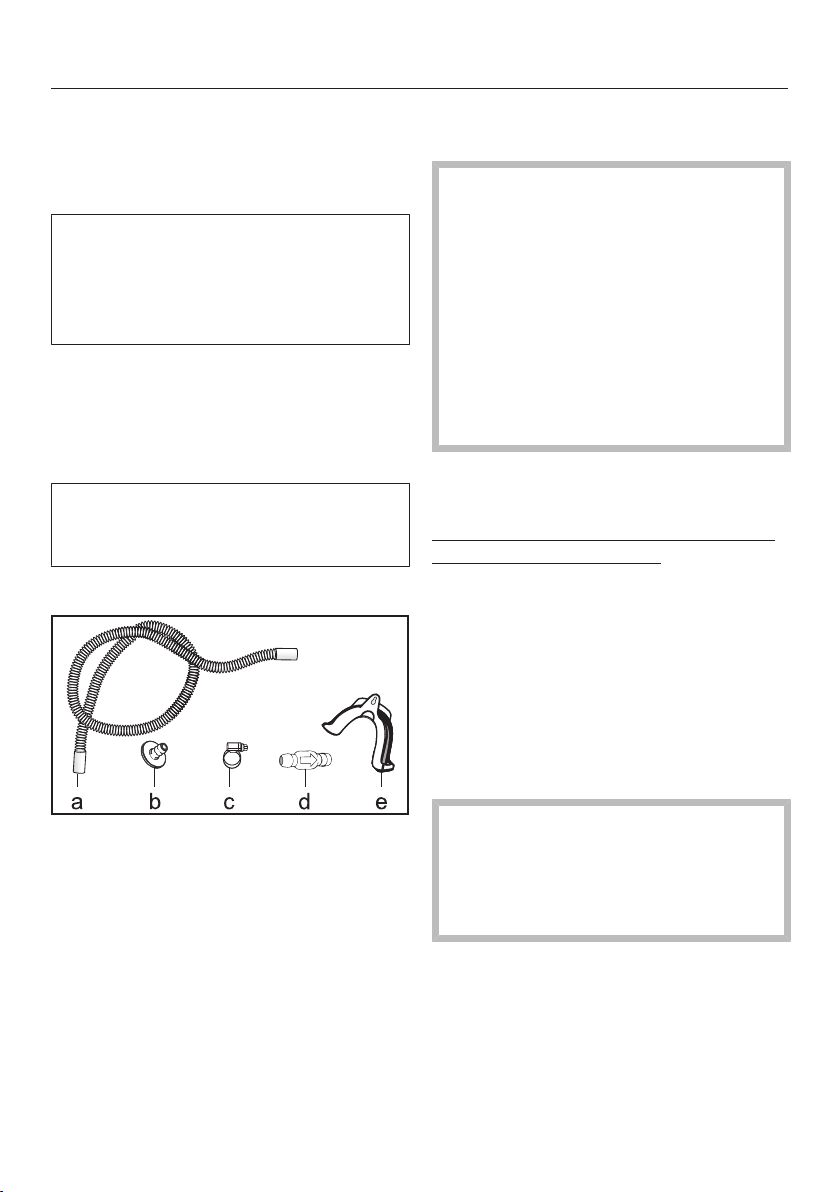
Installation
*INSTALLATION*
61
External condensed water out-
let
Note
When drying is in progress, con-
densed water is pumped into the con-
densed water container through the
drain hose which is located at the
back of the dryer.
The condensed water can also be ex-
ternally drained away via the drain hose
at the back of the dryer. This means
that the condensed water container no
longer has to be emptied.
Drain hose length: 1.49m
Max. delivery head: 1.00m
Max. drain hose length: 4.00m
Drainage accessories
- Supplied: Adapter (b), Hose clip (c),
Hose holder (e);
- Available to purchase: “Non-return
valve” kit for connection to an ex-
ternal water connection. Non-return
valve (d), Hose extension (a) and
Hose clips (c) are supplied.
Installation conditions requiring a
non-return valve
Danger of condensed water
back-flow.
Water could flow back into the
tumble dryer or be drawn into it.
Back-flow water could damage the
tumble dryer and also the room in
which it is located.
The non-return valve should be used
if the end of the hose is immersed in
water, or if other water connections
are installed.
Maximum delivery head with non-return
valve fitted: 1.00m
Installation conditions requiring the fit-
ting of a non-return valve:
- Drainage into a sink or floor gully
where the end of the hose is im-
mersed in water.
- Connection to a sink drain outlet.
- Connection to a drainage system
already in use by another appliance,
e.g. a dishwasher or washing ma-
chine.
If the non-return valve is incorrectly
fitted the appliance will not drain.
The non-return valve has to be fitted
with the arrow on it pointing in the
direction of flow.
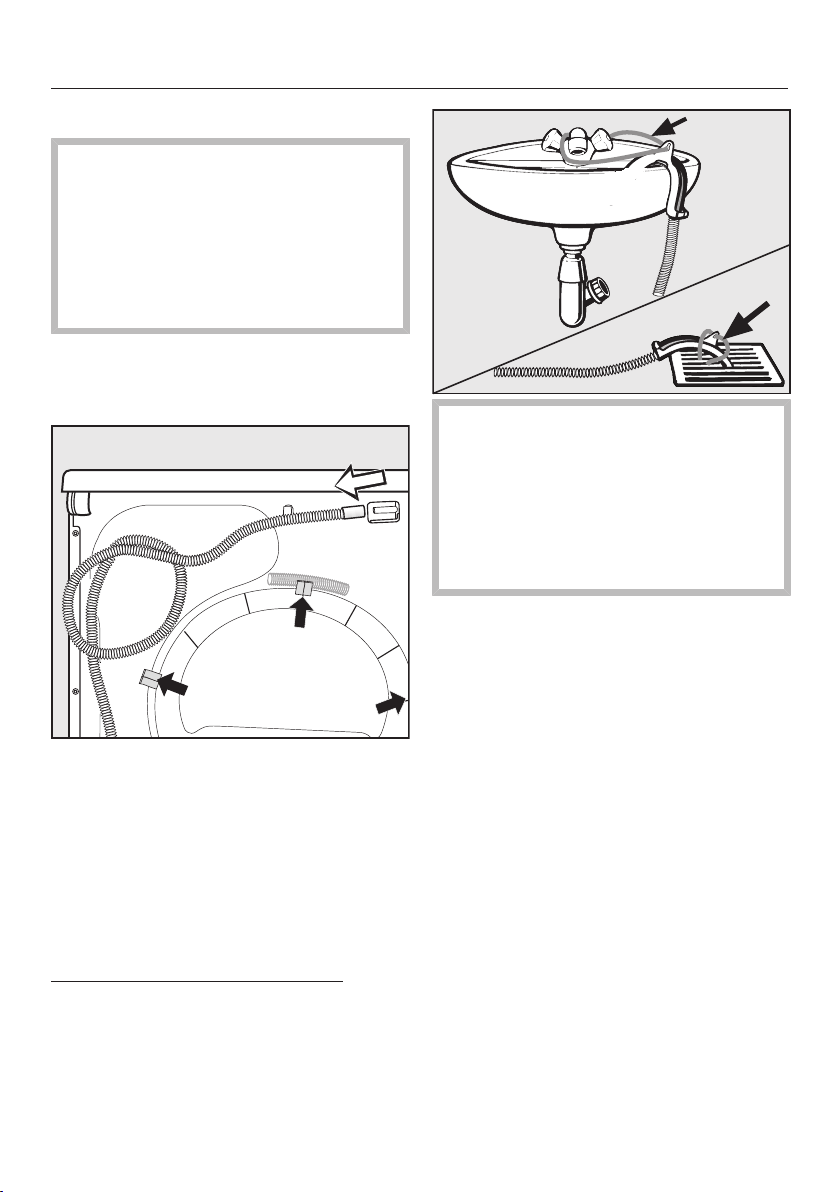
Installation
*INSTALLATION*
62
Arranging the drain hose
Damage to the drain hose
through incorrect handling.
The drain hose can suffer damage
and leak.
Do not pull on the drain hose and do
not stretch it or allow it to become
kinked.
There will be a small amount of residual
water left in the drain hose. Have a con-
tainer ready to collect this.
Pull the drain hose off its connection
(light arrow).
Pull the hose out of the holders (dark
arrow) and unwind it.
Allow any residual water to run into a
container.
Examples
Drainage into a sink or floor gully
Use the hose holder to secure the drain
hose.
Water damage.
Should the end of the hose come
loose, overflowing water can cause
damage.
Secure the drain hose carefully (e.g.,
by tying it) to make sure it cannot
slip.
The non-return valve can be fitted in the
end of the hose.
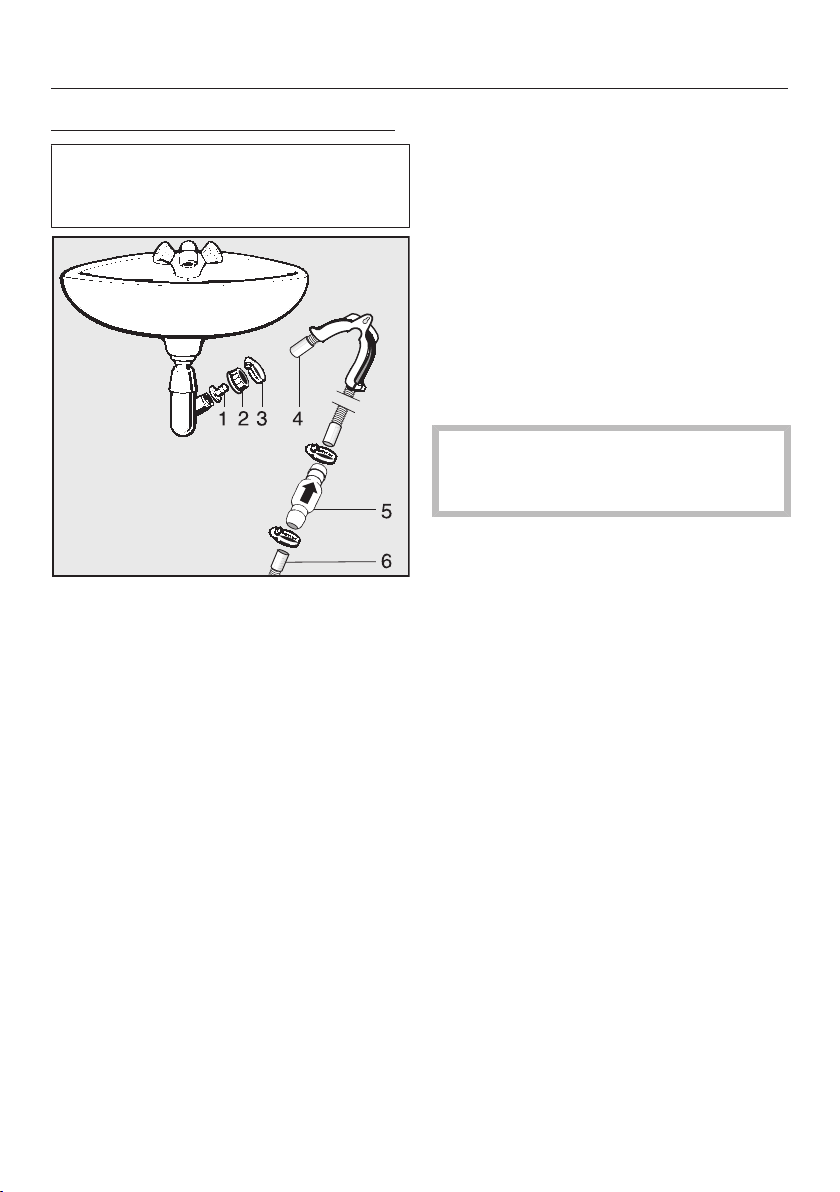
Installation
*INSTALLATION*
63
Direct connection to a sink drain outlet
Use the hose holder, the adapter, the
hose clips and the non-return valve
(available to purchase).
1. Adapter
2. Nut
3. Hose clip
4. End of the hose (secured with the
hose holder)
5. Non-return valve
6. Tumble dryer drain hose
Fit adapter 1 to the sink drain outlet
using nut 2.
The nut is usually fitted with a washer
which must be removed.
Attach the end of the hose 4 to ad-
apter 1.
Use the hose holder.
Use a screwdriver to tighten hose clip
3 up close to the nut.
Fit non-return valve 5 to tumble dryer
drain hose 6.
Non-return valve 5 has to be fitted so
that the arrow points in the direction
of flow (i.e. towards the sink).
Secure the non-return valve using
hose clips.
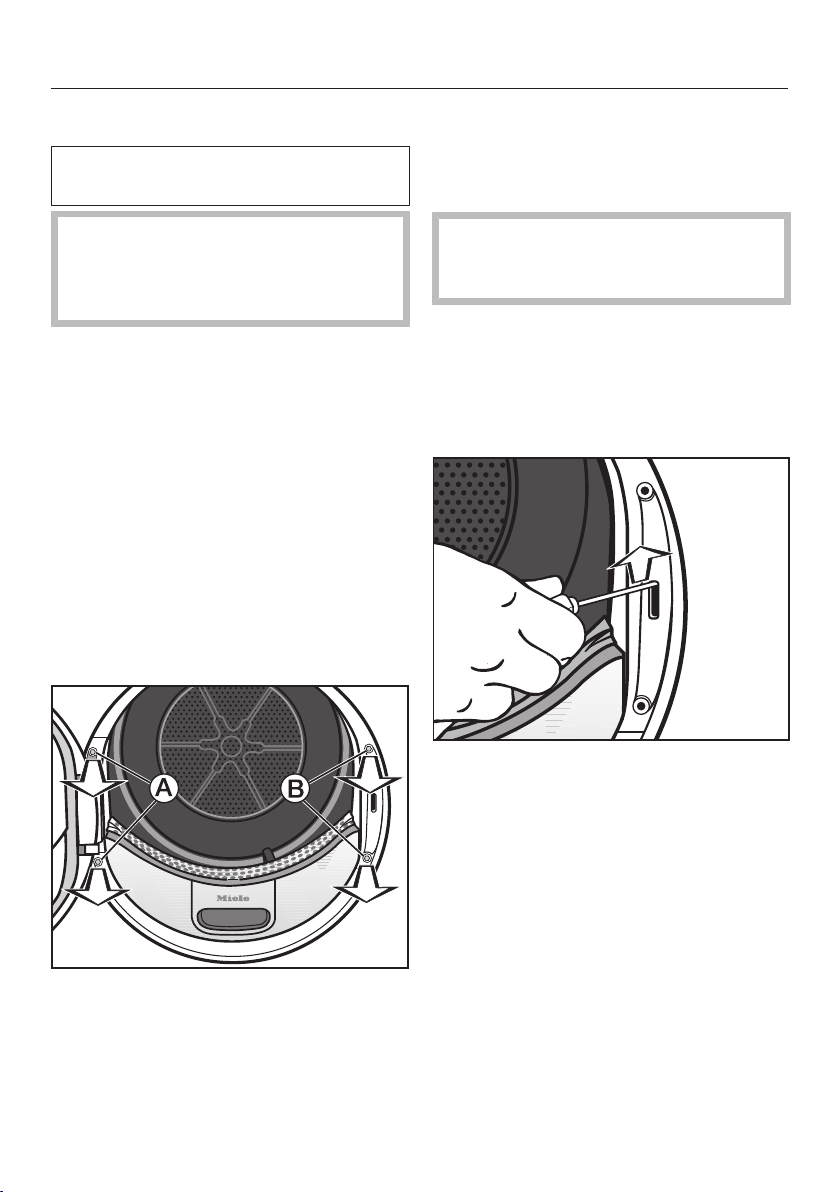
Installation
*INSTALLATION*
64
Changing the door hinging
You can change the door hinging on
this tumble dryer yourself.
For safety reasons the tumble dryer
must be disconnected from the elec-
tricity supply before changing the
door hinging.
You will need:
- a Torx T20 and T30 screwdriver
- a flat head screwdriver or pointed pli-
ers
- the lock catch cover supplied
- the door hinge cover supplied
- a soft surface (e.g. a tablecloth)
Changing the hinging over
1. Remove the door from the dryer
Open the door.
Use a T30 Torx screwdriver to un-
screw the two screws on the base
plate of the door hinge .
The door cannot fall off as it is held in
place by 2 pins.
Hold the door securely and pull it for-
wards: to remove the door you will
need to pull the base plate of the
hinge with its 2 pins out of the dryer.
To avoid scratching the door, place it
outer side downwards on a soft sur-
face (e.g. a tablecloth).
2. Change over the door lock on the
dryer
Use a Torx T30 screwdriver to un-
screw the two screws on the door
lock .
Use the screwdriver to press the door
lock upwards.
The door lock will spring out of its posi-
tion and can then be removed.
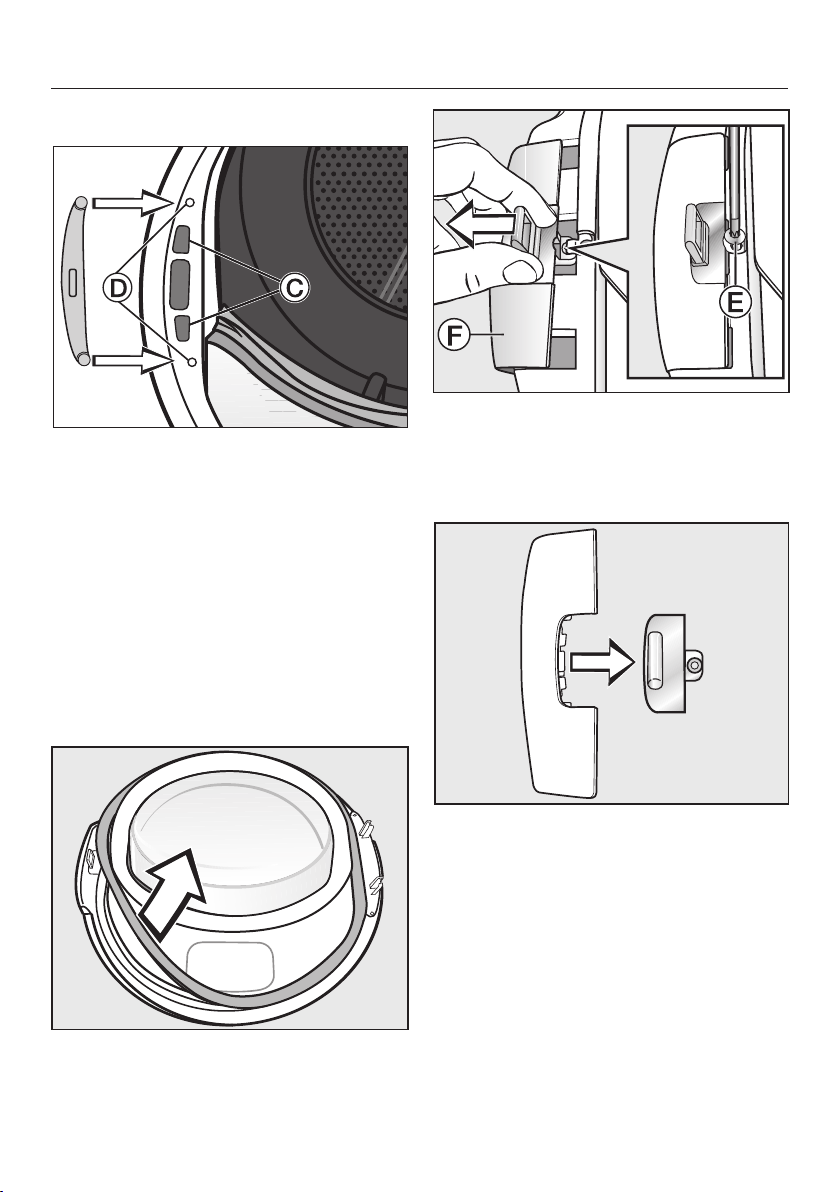
Installation
*INSTALLATION*
65
Turn the door lock through 180°.
Press the door lock into openings
on the opposite side of the door
opening.
Adjust the position of the door lock
so that the screw holes line up with
those in the front panel of the dryer
.
Secure the door lock with the two
Torx screws.
3. Remove the lock catch from the
door
First take the rubber seal off the door
and place this to one side.
Use a T20 Torx screwdriver to remove
screw on the lock catch.
Pull off the lock catch together with
lock catch cover .
Remove the lock catch from the
cover.
This lock catch cover is no longer
needed, however, please keep it in a
safe place.
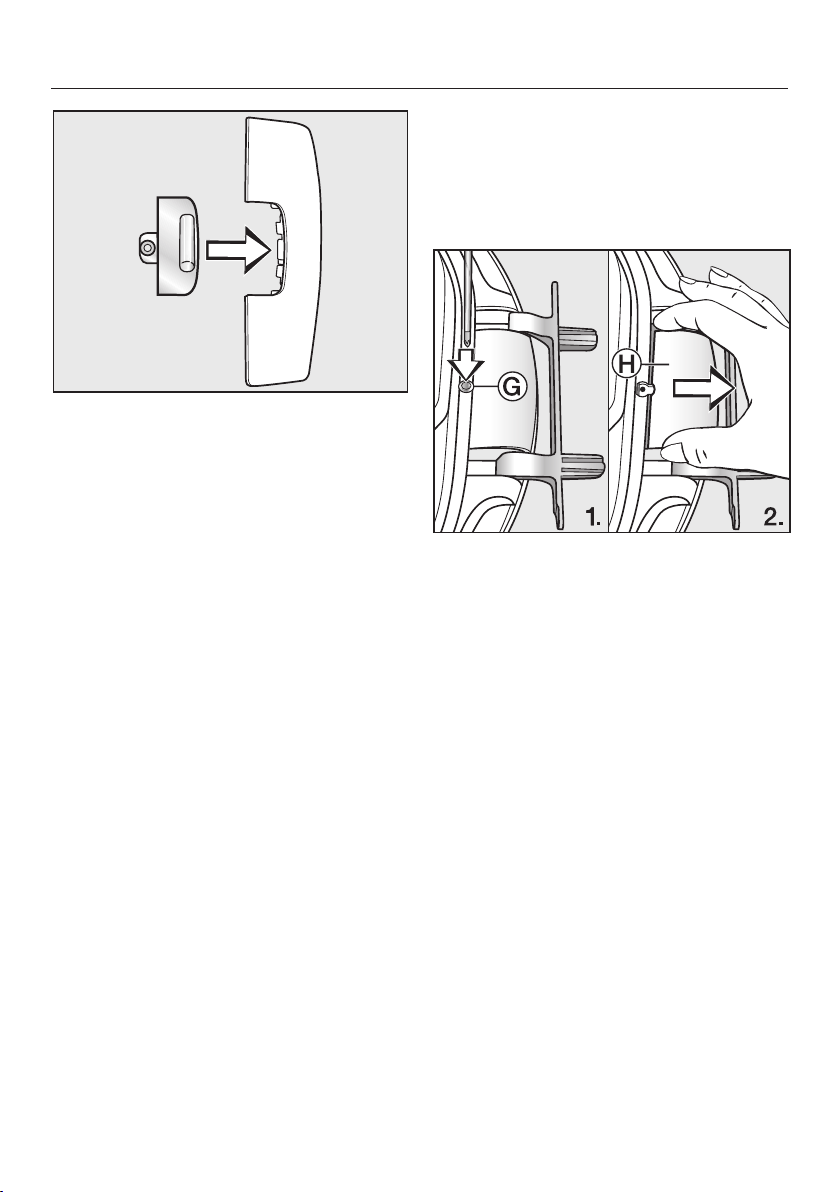
Installation
*INSTALLATION*
66
Insert the lock catch into the new
cover supplied with the dryer.
Place this new cover to one side for
now.
4. Dismantle the door hinge from the
door
The door hinge cover must be un-
clipped from position and then re-
moved.
Use a screwdriver to press down
gently on position on the door
hinge cover.
Using a little force, pull out door
hinge cover .
This door hinge cover is no longer
needed, however, please keep it in a
safe place.
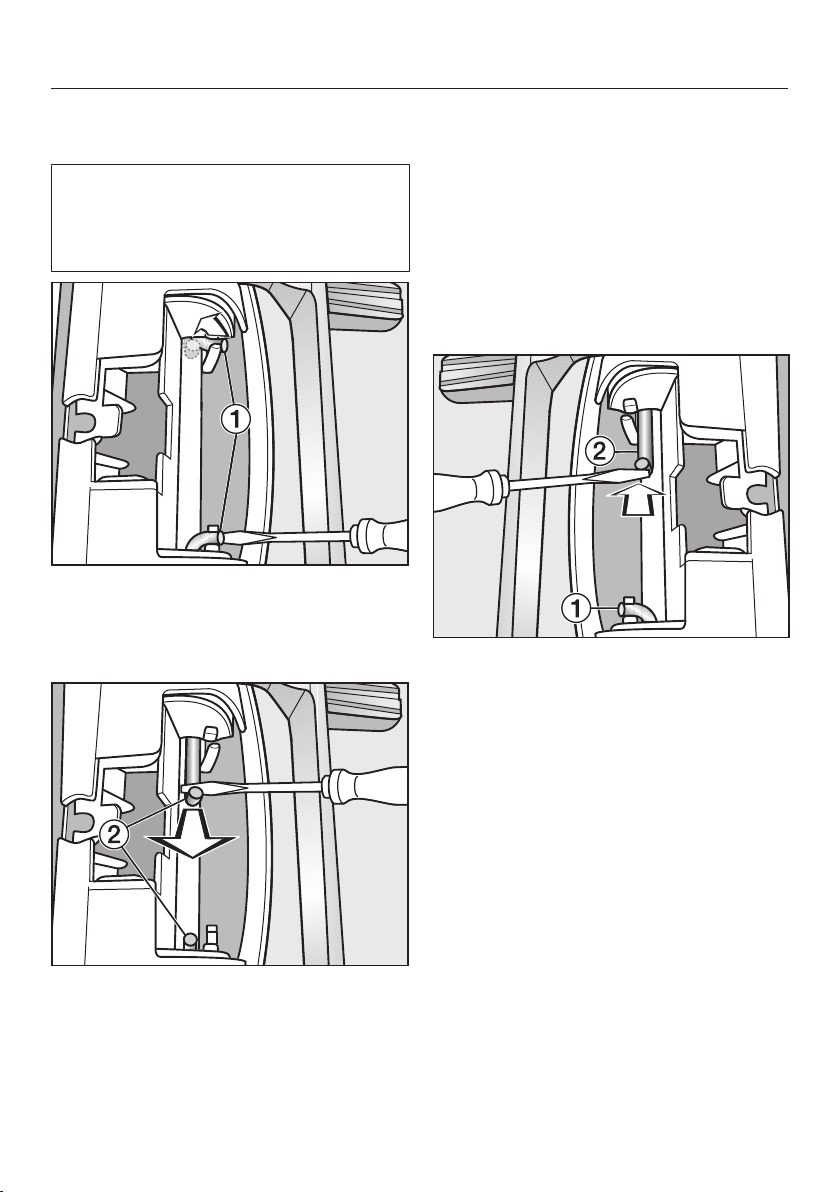
Installation
*INSTALLATION*
67
5. Change over the door hinge on the
door
The door hinge is secured to the door
with 2 angled rods. These rods need
to be removed with a screwdriver or
pointed pliers.
Insert the end of the screwdriver
blade under rod and rotate it so it
is in an upright position. Do the same
to the other rod.
Use the screwdriver or pointed pliers
to guide first one then the other rod
to the middle until each can be re-
moved.
Tip: In some circumstances, the rods
can be difficult to dislodge. Moving the
screwdriver with a levering action while
pulling at the same time may help to
work the rods free.
Remove the door hinge and turn it
through 180°.
Fit the door hinge on the opposite
side of the door.
Secure the door hinge with the two
rods .
Position the tip of the screwdriver un-
der the end of the rod and then push
it into its resting position .
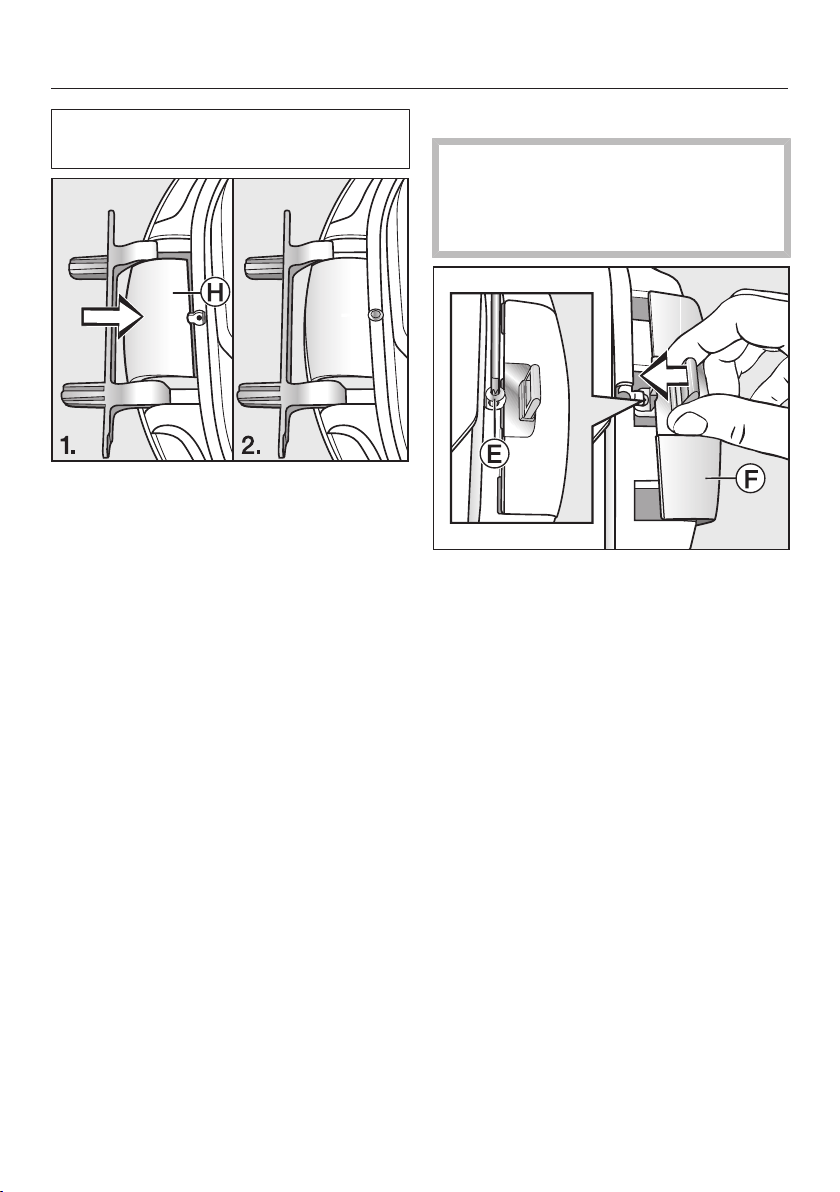
Installation
*INSTALLATION*
68
You now need the new door hinge
cover supplied with the tumble dryer.
Fit new door hinge cover and clip
it into position.
6. Change the lock catch on the door
You now need the new lock
catch cover supplied with the dryer
which you have already fitted with
the lock catch.
Push lock catch cover with its lock
catch into position.
Tighten screw .
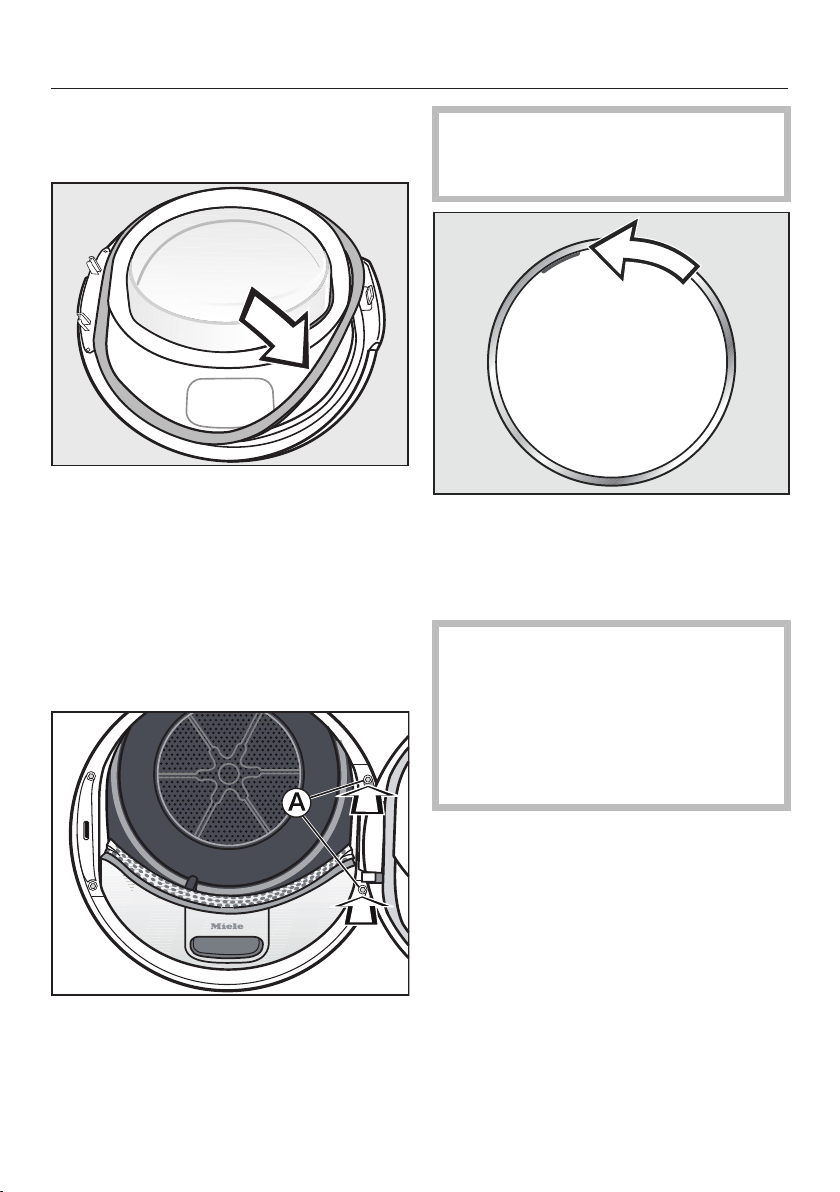
Installation
*INSTALLATION*
69
Refitting
7. Refit the door
Press the rubber seal back into the
grove on the door.
Position the door in front of the dryer.
Fit the base of the door hinge with its
2 pins into the openings on the dryer.
The base of the door hinge must be
flush with the front panel of the dryer.
The door cannot fall off in this position.
Screw the door securely to the dryer
at the base of door hinge .
Now that you have changed the
door hinging the door will open from
the opposite side.
Push the orange marker round to the
other side so that you will see at
which side to pull the door open.
Important
Please keep the lock catch and
door hinge covers which were no
longer needed in a safe place. These
will be required if, for example, you
move house and need to change the
door hinging back to its original posi-
tion.

Installation
*INSTALLATION*
70
Electrical connection
The tumble dryer is supplied with a
mains cable with moulded plug ready
for connection to a suitable earthed
socket.
The socket must be easily accessible
after the tumble dryer has been in-
stalled. If the socket is not easily ac-
cessible, ensure that a suitable means
of disconnection is provided on the in-
stallation side for each pole.
Risk of fire from overheating.
Connecting the tumble dryer to a
multi-socket adapter or to an exten-
sion lead can overload the mains
connection cable.
For safety reasons, do not use an ex-
tension cable or multi-socket ad-
apter.
The electrical system must comply with
local and national safety regulations
(BS7671 in the UK).
For safety reasons, we recommend us-
ing a type A residual current device
(RCD) in the relevant electrical installa-
tion for connecting the tumble dryer.
If the mains connection cable is dam-
aged, it must only be replaced with a
specific mains connection cable of the
same type (available from the Miele
Customer Service Department). For
safety reasons, such replacement may
only be carried out by a qualified spe-
cialist or the Miele Customer Service
Department.
These operating instructions and the
data plate indicate the nominal power
consumption and the appropriate fuse
rating. Compare this information with
the data of the on-site electrical con-
nection.
If in any doubt, consult a qualified elec-
trician.
Do not connect the tumble dryer to a
stand-alone inverter, such as those
used with an autonomous power sup-
ply, e.g. solar power. When the tumble
dryer is switched on, power surges
could result in auto switch off. This
could damage the electronic module.

Technical data
71
Height 850mm
Width 596mm
Depth 655mm
Depth with door open 1077mm
Suitable for pushing under a worktop Yes
Suitable for stacking Yes
Weight approx. 62 kg
Drum volume 120litres
Load size 7.0 kg (weight of dry laundry)
Capacity of condensed water container 4.8l
Hose length 1.49m
Maximum delivery head 1.00m
Maximum drain hose length 4.00m
Length of connection cable 2.00m
Voltage See data plate
Connected load See data plate
Fuse rating See data plate
Test certificates awarded See data plate
Energy consumption See “Consumption data”
LEDs Class 1
Technical data
72
Data sheet for household tumble driers
In acc. with delegated regulation (EU) No. 392/2012
MIELE
Model name/identifier TWB140WP
Rated capacity
1
7,0 kg
Type of tumble drier (Air-vented / condenser) - / ●
Energy efficiency class
A+++ (most efficient) to D (least efficient) A++
Weighted annual energy consumption (AE
c
)
2
208 kWh/year
Tumble drier (Automatic / non-automatic) ● / -
Energy consumption of the standard cotton programme
Energy consumption at full load 1,70 kWh
Energy consumption at partial load 0,96 kWh
Weighted power consumption in off-mode (P
o
) 0,40 W
Weighted power consumption in the left-on mode (P
l
) 0,40 W
Duration of the 'left-on' mode (T
l
)
3
15 min
Standard programme to which the information in the label and the fiche
relates
4
Cottons with arrow
Programme time of the 'standard cotton programme'
Weighted programme time 121 min
Programme time at full load 155 min
Programme time at partial load 95 min
Condensation efficiency class
5
A (most efficient) to G (least efficient) A
Weighted condensation efficiency for the 'standard cotton programme' at
full and partial load
94 %
Average condensation efficiency of the 'standard cotton programme' at full
load
95 %
Average condensation efficiency of the 'standard cotton programme' at par-
tial load
94 %
Sound power level (L
WA
)
6
66 dB(A) re 1 pW
Built-in -
● Yes, standard feature
1
In kg of cotton laundry for the standard cotton programme at full load.
2
based on 160 drying cycles of the standard cotton programme at full and partial load, and the con-
sumption of the low-power modes. Actual energy consumption per cycle will depend on how the ap-
pliance is used.

Technical data
73
3
If the household tumble drier is equipped with a power management system.
4
This programme is suitable for drying normal wet cotton laundry and is the most efficient programme
in terms of energy consumption for cotton.
5
If the household tumble drier is a condenser tumble drier.
6
For the standard cotton programme at full load.
Consumption data
74
Load size
1
Final spin speed in
washing machine
Residual
mois-
ture
Energy Duration
kg rpm % kWh min
Cottons
2
7.0
3.5
1000
1000
60
60
1.70
0.96
155
95
Cottons Normal 7.0
7.0
7.0
1200
1400
1600
53
50
44
1.50
1.45
1.30
140
133
118
Cottons Normal
incl. Gentle tumble
7.0 1000 60 1.75 165
Cottons Hand iron 7.0
7.0
7.0
7.0
1000
1200
1400
1600
60
53
50
44
1.25
1.10
1.00
0.85
120
105
98
83
Minimum iron Normal 4.0 1,200 40 0.50 65
Minimum iron Normal
incl. Gentle tumble
4.0 1200 40 0.50 66
Delicates Normal 2.5 800 50 0.50 65
Woollens handcare 2.0 1000 50 0.02 5
Shirts Normal 2.0 600 60 0.46 60
Express Normal 4.0 1000 60 0.85 100
Denim Normal 3.0 900 60 0.95 115
Proofing Normal 2.5 800 50 0.75 95
1
Weight of dry laundry
2
Test programme in accordance with Regulation 392/2012/EU for energy labelling, measured in ac-
cordance with EN61121.
All data was calculated using EN61121 unless otherwise stated.
Note for test institutes:
For testing in accordance with EN 61121, dry a 3kg load of cotton laundry with 70% residual moisture
as per the above standard using the Cottons Normal programme.
Consumption data can vary from the nominal values given above depending on the size of the
load, types of textiles, residual moisture levels after spinning and fluctuations in the electricity
supply.
Programmable functions
75
Programming
You can use the programmable func-
tions to alter the dryer's electronics to
suit your requirements.
Programming is carried out by following
these steps (, , ... ) using the
sensor controls.
Accessing the programming level
Before starting
- Make sure that the programme se-
lector is turned to any of the pro-
gramme settings.
- Make sure that the door of the
tumble dryer is open.
Touch the Start/Add laundrysensor
control and hold it down whilst carry-
ing out steps –.
Close the tumble dryer door.
Wait until the Start/Add laun-
drysensor control, which will now be
flashing quickly, lights up con-
stantly...
...and then release the Start/Add
laundrysensor control.
will light up in the time display.
Choosing and selecting a program-
mable function
The number of the programmable
function will appear in the time display
as and a number:
e.g..
Touch the or sensor control to
scroll to the next or previous pro-
grammable function:
Programmable function
Cottons drying levels
Minimum iron drying levels
Cool-down temperature
Sensor tone
PIN code
Conductivity
Control field standby status
Memory
Anti-crease
Airways indicator
Backlight brightness dimmed
Confirm the selected programmable
function by touching the Start/Add
laundry sensor control.
Programmable functions
76
Editing and saving a programmable
function
You can either switch a programmable
function on/off or select different op-
tions.
The programmable function option will
appear in the time display as and a
number:
e.g..
Touch the or sensor control to
switch the programmable function
on/off or to select an option:
Programmable function
Available options
X
X X X X X
X X X X X X
X X X X to
X X
X
X
X
X
X X
X X X
X X X X X X
X = Can be selected
= Factory default setting
Confirm the chosen selection with
the Start/Add laundrysensor control.
The number of the programmable func-
tion, e.g., will then light up again.
Exiting programming level
Turn the programme selector to the
position.
The settings you have selected are now
stored in the memory. You can alter the
settings again at any time.

Programmable functions
77
Cottons drying levels
You can adjust the drying levels for the
Cottons programme to one of 7 differ-
ent levels.
Options
= Even damper
= Damper
= A little damper
= Factory setting
= A little drier
= Drier
= Even drier
Exception:
The Cottons programme will re-
main unchanged.
Minimum iron drying levels
You can adjust the drying levels for the
Minimum iron programme to one of 7
different levels.
Options
= Even damper
= Damper
= A little damper
= Factory setting
= A little drier
= Drier
= Even drier
Cool-down temperature
The laundry will be cooled to 55°C
before the end of the programme. It
can be cooled to a lower temperature,
but this will prolong the cooling phase.
The value is set in increments of 1°C.
= Factory default 55°C
= 54°C
= 53°C
= 52°C
= 51°C
= 50°C
= 49°C
= 48°C
= 47°C
= 46°C
= 45°C
= 44°C
= 43°C
= 42°C
= 41°C
= 40°C
Keypad tone
The buzzer that sounds when a sensor
control is pressed can be changed or
switched off.
Selection
= Off
= Factory default setting
= Louder

Programmable functions
78
Lock code
The code prevents your dryer being
used without your knowledge.
When the code has been activated, you
have to enter the code after switching
the dryer on. Otherwise the dryer can-
not be operated.
Options
= Off (factory setting)
= On
If the option has been selected, after
switching on you will have to enter the
code before you can operate the dryer.
Using the tumble dryer when the PIN
code is activated
After the tumble dryer is switched on,
will flash in the time display.
The PIN code is; it cannot be
altered.
Touch the sensor control until a
flashes in the first position.
Confirm with the Start/Add laundry
sensor control.
Enter the two other numbers in the
same way.
The tumble dryer is ready for use
after has been entered and con-
firmed.
Conductivity
This programmable function should
only be altered if the water is so soft
that it is likely to cause the electronics
which sense residual moisture in the
laundry to give false readings.
Options
= Off (factory setting)
= Low
Important
This programmable function should only
be set if the water used for washing the
laundry is extremely soft with a con-
ductivity reading (electrical conductivity)
of less than 150μS/cm. Contact your
local water authority for the conductivity
level of your mains water supply.
Make sure that you only activate
for the condition described above.
Otherwise, drying results can be un-
satisfactory.

Programmable functions
79
Control field standby status
To save energy, the time display and
sensor controls will go out once the
programme has been running for
10minutes. In this case, the Start/Add
laundry sensor control flashes slowly.
However, there is no switch-off in the
event of a fault.
Options
= Off
The time display and sensor
controls do not go out.
= On (factory default setting)
The time display and sensor
controls will go out once the
programme has been running
for 10minutes.
“Switching on” the display again
- Touch the Start/Add laundry sensor
control. This will not affect a running
programme.
Memory
You can set the following: The elec-
tronic module will save the drying level
and any options selected for the cur-
rent drying programme. It will also
save the duration of the Warm air pro-
gramme. When the programme is se-
lected again, these saved settings will
appear in the display.
Options
= Off (factory setting)
= On
Exception:
The Cottons programme will re-
main unchanged.
Anti-crease
The drum will continue to rotate in a
special anti-crease rhythm for a max-
imum of 2 hours after the end of the
drying process. This helps prevent
creasing if laundry is not going to be
removed immediately. You can reduce
the duration of the anti-crease phase.
Options
= no Anti-crease
= 1 hour
= 2 hours (default setting)

Programmable functions
80
Airways indicator
Fluff should be removed after drying.
In addition, this indicator will remind
you to clean the filters when a certain
amount of fluff has collected in them:
You can decide at what level of fluff
this reminder should be given.
You will have an idea of how often this
should be done after a few drying pro-
grammes.
Options
= Off
does not light up. However,
if there is a very severe block-
age in the ducting, the pro-
gramme will be cancelled and
the error message will
appear in the display regard-
less of this option.
= Heavy
lights up when there is a
heavy build-up of fluff.
= Normal (factory default set-
ting)
= Light
lights up when there is only
a small build-up of fluff.
Backlight brightness
dimmed
The brightness of the dimmed sensors
in the control field can be set to one of
seven different levels.
The brightness changes as soon as you
select a different setting.
Selection
= Darkest level
= Factory default setting
...
= Brightest level



United Kingdom
Miele Co. Ltd., Fairacres, Marcham Road, Abingdon, Oxon, OX14 1TW
Tel: 0330 160 6600, Internet: www.miele.co.uk/service, E-mail: [email protected]
Australia
Miele Australia Pty. Ltd.
ACN 005 635 398
ABN 96 005 635 398
1 Gilbert Park Drive
Knoxfield, VIC 3180
Tel: 1300 464 353
Internet: www.miele.com.au
Miele Electrical Appliances Co., Ltd.
1-3 Floor, No. 82 Shi Men Yi Road
Jing' an District
200040 Shanghai, PRC
Tel: +86 21 6157 3500
Fax: +86 21 6157 3511
E-mail: [email protected],
Internet: www.miele.cn
China Mainland
Miele (Hong Kong) Ltd.
41/F - 4101, Manhattan Place
23 Wang Tai Road
Kowloon Bay, Hong Kong
Tel: (852) 2610 1025
Fax: (852) 3579 1404
Email:
Website: www.miele.hk
Hong Kong, China
Miele India Pvt. Ltd.
1st Floor, Copia Corporate Suites,
Commercial Plot 9,
Mathura Road, Jasola,
New Delhi - 110025
E-mail: customercare@miele.in
Website: www.miele.in
India
Miele Ireland Ltd.
2024 Bianconi Avenue
Citywest Business Campus
Dublin 24
Tel: (01) 461 07 10
Fax: (01) 461 07 97
E-Mail: [email protected]
Internet: www.miele.ie
Ireland
Malaysia
Miele Sdn Bhd
Suite 12-2, Level 12
Menara Sapura Kencana
Petroleum
Solaris Dutamas No. 1
Jalan Dutamas 1
50480 Kuala Lumpur, Malaysia
Phone: +603-6209-0288
Fax: +603-6205-3768
Miele New Zealand Limited
IRD 98 463 631
8 College Hill
Freemans Bay, Auckland 1011
New Zealand
Tel: 0800 464 353
Internet: www.miele.co.nz
New Zealand
Miele Pte. Ltd.
29 Media Circle
#11-04 ALICE@Mediapolis
Singapore 138565
sTel: +65 6735 1191
Fax: +65 6735 1161
E-Mail: [email protected]
Internet: www.miele.sg
Singapore
Miele (Pty) Ltd.
63 Peter Place
Bryanston 2194
P.O. Box 69434
Bryanston 2021
Tel: (011) 875 9000
Fax: (011) 875 9035
E-mail: [email protected]
Internet: www.miele.co.za
South Africa
Miele Appliances Ltd.
Showroom 1
Eiffel 1 Building
P.O. Box 114782 - Dubai
Tel. +971 4 3044 999
Fax. +971 4 3418 852
800-MIELE (64353)
E-Mail: [email protected]
Website: www.miele.ae
United Arab Emirates
Manufacturer:
Miele & Cie. KG, Carl-Miele-Straße 29, 33332 Gütersloh, Germany
Thailand
Miele Appliances Ltd.
BHIRAJ TOWER at EmQuartier
43rd Floor Unit 4301-4303
689 Sukhumvit Road
North Klongton Sub-District
Vadhana District
Bangkok 10110, Thailand
Sheikh Zayed Road, Umm Al Sheif

M.-Nr. 11 365 151 / 02en-GB
TWB 140 WP