Useand
"Select-Top" Built-In Modular Downdraft Cooktop
ii i i
Safety Instructions ...................4,5
Operating Instructions, Tips
Coil Surface Unit Module .................. 10, 11
Controls ............................................................ 9
Cooktop Comparison ................................... 8
Cooktop Vent System ................................ 22
Features ...................................................... 6, 7
Griddle Accessory ............................... 18-20
Griddle Cooking Guide ........................... 20
Grill Module .......................................... 14-17
Grill Cooking Guide ................................. 17
Home Canning Tips .................................... 21
Radiant Module ................................... 12-14
_-_ Problem Solver .....................35, 36
Installation Instructions
................................................................. 28-34
Consumer Services .................. 39
Important Phone Numbers ...................... 39
Model and Serial Numbers ..........................2
Modules and Accessories ........................... 3
Warranty ........................................Back Cover
Care and Cleaning ...............23-27
Coil Surface Unit Module .......................... 26
Control Panel and Knobs .......................... 23
Grease Collector Jar ................................... 23
Griddle Accessory ....................................... 25
Grill Cover ..................................................... 25
Grill Module .................................................. 25
Radiant Module ....................................26, 27
Vent System ................................................. 24
Models: JP385 JP389 ]
GEAppliances.com
HELP US HELP YOU...
Before using your cooktop,
read this guide carefully.
It is intended to help you operate and maintain your
new cooktop properly
Keep it handy for answers to your questions
Write down the model
and serial numbers.
You'll find them on a nameplate underneath the
cooktop on the right side of the bottom chamber.
These model and serial numbers are also on the
Consumer Product Ownership Registration Card that
came with your cooktop. Before sending in this card,
please write these numbers here:
Model Number
If you received a damaged cooktop...
Immediately contact the dealer (or builder) that sold
you the cooktop.
Save time and money.
Before you request service...
See the Problem Solver in the back of this guide.
It lists causes of minor operating problems that you
can correct yourself.
Serial Number
Use these numbers in any correspondence or service
calls concerning your cooktop.
IF YOU NEED SERVICE...
To obtain service, see the Consumer Services page
in the back of this guide.
We're proud of our service and want you to be
pleased. If for some reason you are not happy with
the service you receive, here are the steps to follow
for further help.
FIRST, contact the people who serviced your
appliance. Explain why you are not pleased. In
most cases, this will solve the problem.
NEXT, if you are still not pleased, write all the
details--including your phone number--to:
Manager, Customer Relations
GE Appliances
Appliance Park
Louisville, KY 40225
2
GEAppliances.com
MODULES AND ACCESSORIES
General Information
A full selection of modules are available for
the cooktop. The modules can be interchanged
quickly and easily. Each module has an electrical
plug which fits into a receptacle in the center of the
outside wall of the cooktop. Some modules are
inserted and removed differently than others. If your
cooktop is connected to 208 volts, you will notice
some increase in cooking times.
See each module section for specific instructions
for installing and removing that module.
To purchase, contact your nearest GE Appliances
dealer or service center or call 800.626.2002.
Model numbers are listed below.
Modules and Accessories
Coil Surface Unit
JXDC41-Brushed Chrome
JXDC43-
Black Porcelain Enamel
JXDC44-
White Porcelain Enamel
This module has one 6" and one 8" coil surface
unit. The surface units and drip pans are removable
for cleaning.
Radiant Module
JXDR50C-Black Radiant
240V (JP385, JP389)
Stainless Steel Trim
JXDR50B-Black Radiant
and Black Trim
240V (JP385, JP389)
JXDR50W-White Radiant and White Trim
240V (JP385, JP389)
This module has one 5" and one 7" heating coil
beneath a smooth glass surface. The two surface
units are shown by the outlines on the glass. This
module provides fast heat, energy efficient operation
and is easy to clean.
Grill Module
JXDL44 (JP385, JP389)
JXDD44GriddleAccessory [1
You must have the grill module to use the griddle
accessory.
The griddle sits directly over the grill heating element
and reflector pan. It has two drain holes so fat and
meat drippings can drain into the grease jar. The front
and back of the griddle are controlled separately.
WARNING: Griddle modules JXDD43 and JXDD46
are not to be used with these cooktops.
Grill Cover
JXDM2-Black
JXDM3-White
This cover fits over the grill or griddle.
With this module you can char-broil meat indoors
all year long. Fat drains away and collects in the
grease jar. The grill heating element is divided so the
front and back sections can be controlled separately.
3
o
r_
r_
r_
O
_o
r_
IMPORTANT SAFETY INSTRUCTIONS
Read all instructions before using this appliance.
W%enusing electrical appliances, basic safety
precautions Should be followed, including the
following:
• Use this cooktop only for its intended use
as described in this use and care guide.
• Be sure your appliance is properly installed and
grounded by a qualified technician in accordance
with the provided installation instructions.
• Do not assume that you know how to operate aH
parts of the cooktop. Some features may work
differently from those on your previous co0ktop.
• Do not attempt to repah- or replace any part
of your cooktop unless it is specifically
recommended in this guide. All other servicing
should be referredto a qualified technician.
• Have the installer show you the location of the
circuit breaker or fuse. Mark it for easy reference.
• Before performing any SelMCe. DISCONNECT
THE COOKTOP POWER SL_PLY AT THE
• Do not let cooking grease or other flammable
materials accumulate on or near the cooktop.
• Do not store flammable materials near the
cooktop. Do not store or use combustible materials.
gasoline or other flammable vapors and liquids in the
vicinity of this or any other appliance.
................. grease fires. Never pick up
a flaming pan. Turn the surface units off. Smother
the flaming pan on a surface unit by covering the
pan completely with a well-fitting lid, cookie sheet
or flat tray. Use a dry chemical or foam type fire
extinguisher.
Flaming grease outside a pan can be put out by
covering with baking soda or. if available, by using
a multi-purpose dry chemical or foam type fire
extinguisher.
•Do not heat unopened food containers. Pressure
could buildup and the container could burst causing
an injury.
• Do not touch the surface units. These surfaces may
HOUSEHOLD DISTRIBUTION PANEL BY
REMOVING THE FUSE OR SWITCHING OFF be hot enough to bum even though they are dark m
THE CIRCLET BREAKER.
• Do not leave children alone or unattended while
the cooktop units are in operation,
They could be seriously burned.
• Do not allow anyone to climb, stand or hang
on the cooktop.
• CAUTION: ITEMS OF INTEREST TO CHILDREN
SHOULD NOT BE STORED IN CABINETS
ABOVE THE COOKTOP_HILDREN
CLIMBING ON THE COOKTOP TO REACH
THEM COULD BE SERIOUSLY INJURED.
• Never wear loose-fitting or hanging garments
while using the cooktop. Be careful when reaching
for items stored over the cool(top. Flamanable material
could be ignited if brought in contact with hot
surfaces and may cause severe burns.
• Use only dry pot holders--moist or damp pot
holders on hot surfaces may result in bums from
steam. Do not let pot holders touch hot surface units.
Do not use a towel or other bulky cloths in place of a
pot holder.
• For your safety, never use your appliance for
warming or heating the room.
• Keep the vent grille and the grease filters clean to
maintain good venting and to avoid grease fires.
color. During and after use. do not touch or let
clothing or other flammable materials contact surface
units or areas nearby surface units: allow"sufficient
time for cooling first.
Potentially hot surfaces include the co0ktop,
removable modules, accessories and areas facing
the co0ktop.
• Cook meat and poultry thoroughly--meat to at
least an INTERNAL temperature of 160°F and
poultry to at least an INTEI_NAL temperature
of 180°E Cooking to these temperatures usually
protects against foodbome illness.
• Use proper pan size---Select cookware having fiat
bottoms large enough to cover the surface unit
heating element. The use of undersized cookware
will expose a portion of the surface unit to direct
contact and may result in ignition of clothing. Proper
relationship of cookware to the surface unit will also
improve efficiency.
• Never leave the surface units unattended at high
heat settings. Boilovers cause smoking and greasy
spillovers that may catch on fire.
• Be sure the drip pans (on coil modules only) are
not covered and are in place. Their absence during
cooking could damage cooktop parts and wiring.
• Do not use aluminum foil to line the cooktop tubs.
reflector pan, grill or griddle. Misuse could result
in a shock, fire hazard or damage to the cookiop.
4
GEAppliance_com
• Only certain types of glass, glass/ceramic.
earthenware or other glazed comainers are
suitable for cooktop service: others may break
because of the sudden change in temperature.
• Only the grill grate and the griddle accessoq
plate may be placed over the grill heating element
• To minimize the possibility of burns, ignition
of flammable materials and spillage, the co0kware
handles should be turned toward the center of
the cookto.p without extending over the nearby
surface umts.
• Keep the tub. the reflector pan, the grill grate
and the grease collector jar clean. Be sure the
drain hole in tub is open If clogged, a fete can
occur Empty the grease jars frequently
• Do not immerse or soak the removable coil
surface unit module, the solid disk module.
the radiant module or the grill heating dement.
Do not put them in a dishwashel:
............. glass cooktop surface as a cutting
board (on radiam modules only).
• Do not place or store items on top of the glass
cooktop surface when it is not in use (on radiant
modules only).
• Be careful when placing spoons or other s_'ring
utensils on the glass cooktop surface when it is in
use. They may become hot and could cause bums
(on radiant modules only).
• To avoid the possibility of a burn or electric
shock, always be certain that the controls for all
surface units are at the offposition and all surface
units are cool before attempting to remove a coil
surface unit or a module.
• Never leave the kitchen while using the grill
or griddle accessory.
• Do not replace the grease collector jar with
a mayonnaise jar which could break when hot
grease drips into it Replace with any wide mouth
•Always turn the surface units off before removing canning jar
co0kware • Keep an eye on foods being fried at high or
• Never dean the cooktop surface when it is hot. medium high heat settings.
Some cleaners produce noxious fumes and wet cloths • Foods for frying should be as dry as possible. Frost
could cause steam burns ifused on ahot surface, on frozen foods or moisture on fresh foods can cause
hot fat to bubble up and over the sides of the pan.
• To avoid possible damage to the cooking surface.
do not apply Cook Top Cleaning Creme to the glass
surface when it is hot ton radiant modules only).
•After cleaning, use a damp cloth or paper towel
to remove all Cook lop Cleax_ng Creme residue
(on radiant modules only).
• Read and follow "allinstructions and warnings
on Cook Top Cleaning Creme labels (on radiant
modules only)
• Use care when touching the cooktop. The glass
surface of the cooktop will retain heat after
the controls have been turned off (on radiant
modules only).
• Do not operate the radiant surface units if the
glass is broken. Spillovers or cleaning solution
may penetrate a broken cooktop and create a risk
of electrical _hock Contact a qualified technician
immediately Should your glass cooktop become
broken ton radiant modules only)
•Avoid scratching the glass cooktop surface.
The cooktop can be scratched with sharp
instruments, rings or other jewelry and rivets
on clothing (on radiant modules only)
• Do not stand on the glass cooktop.
• Large scratches or impacts to the radiant module
can lead to broken or shattered glass.
• Use little fat for effective shallow or deep-fat
frying. Filling the pan too full of fat can cause
spillovers when food is added.
• ff a combination of oils or fats will be used
in frying, stir together before heating, or as fats
melt slowly.
• Always heat fat slowly, and watch as it heats.
• Never try to move a pan of hot fat especially
a deep fat fryen Wait until the fat is cool.
• Use a deep fat thermometer whenever possible to
prevent overheating fat beyond the smoking point.
• When flaming foods under the hood. turn
the fan on.
• To control flame-ups, turn down the heat setting to
low rather than off. This keeps the downdraft vent
blower on. Or. turnthe vent blower to on. then turn
the grill off. Use a long-handled utensil to carefully
remove the food from the grill. These steps should
control the flame until it eventually goes out. If it does
not, cover the entire grill module with a cookie sheet
or the lid from a large roasting pan. Use a pot holder
to remove this later because it will be hot.
• NEVER USE WATER ON A GREASE FIRE.
SAVE THESE
INSTRUCTIONS
5
-,m
i
_o
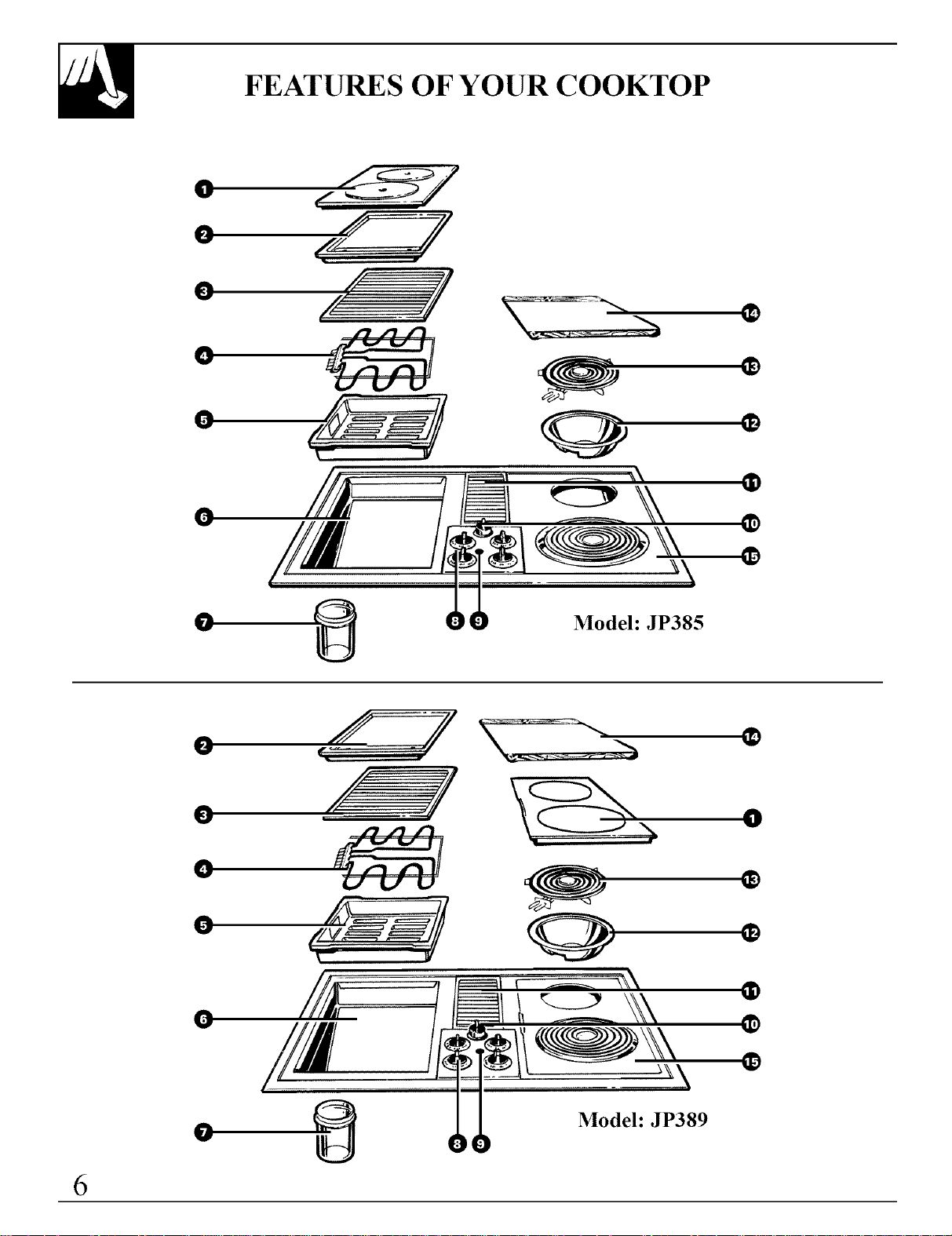
FEATURES OF YOUR COOKTOP
G
O
O
F--Y
f _J
t_
O
®
O Model: JP385
0
0
¢
/ /
¢"
,_" I I
i
_.J L/ u
0
®
6
¢
Model: JP389
GEAppliances.com
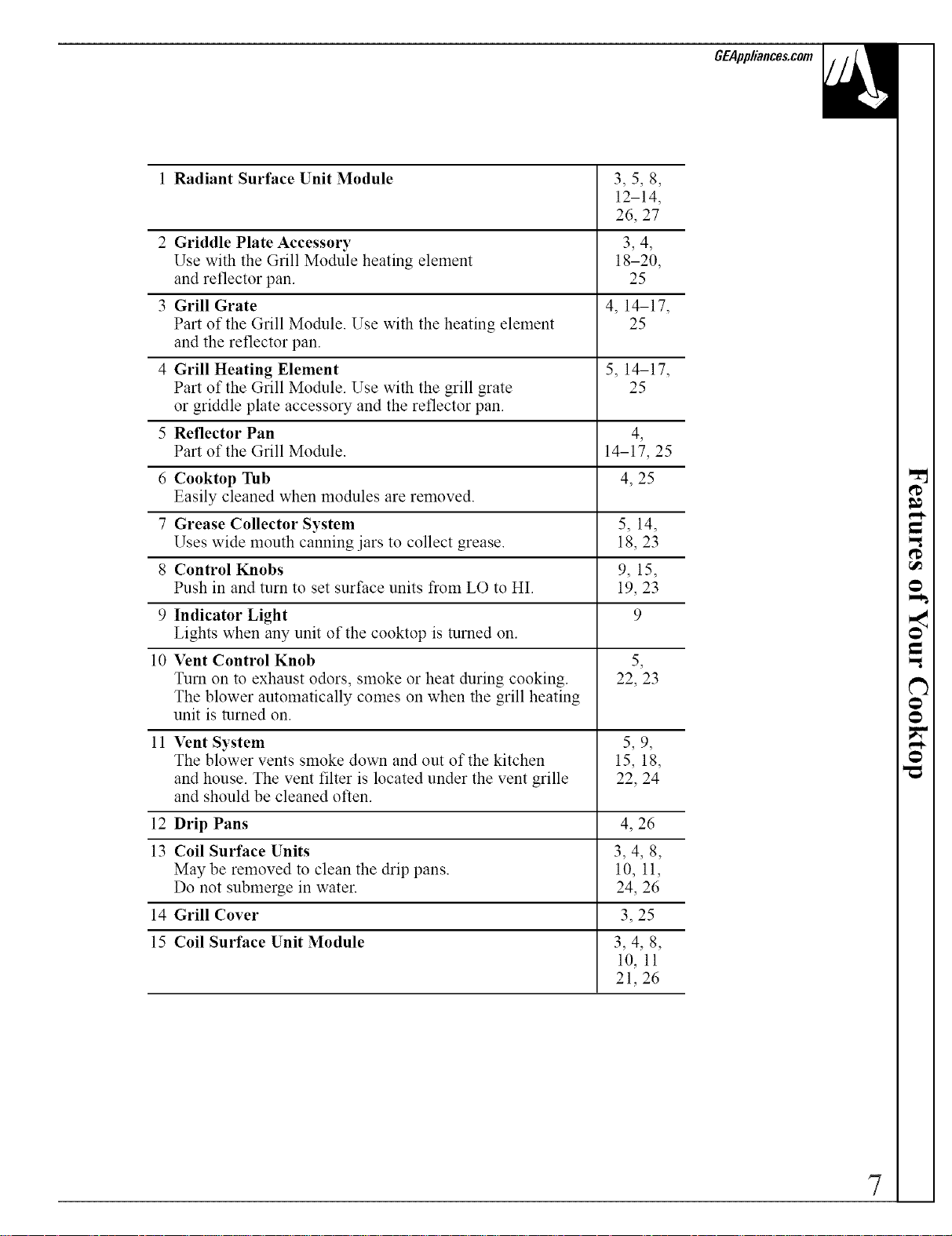
1 Radiant Surface Unit Module 3, 5, 8,
12-14,
26, 27
2 Griddle Plate Accessory 3, 4,
Use with the Grill Module heating element 18-20,
and reflector pan. 25
3 Grill Grate 4, 14-17,
Part of the Grill Module. Use with the heating element 25
and the reflector pan.
4 Grill Heating Element 5, 14-17,
Part of the Grill Module. Use with the grill grate 25
or griddle plate accessory and the reflector pan.
5 Reflector Pan 4,
Part of the Grill Module. 14-17, 25
6 Cooktop Tub 4, 25
Easily cleaned when modules are removed.
7 Grease Collector System 5, 14,
Uses wide mouth canning jars to collect grease. 18, 23
8 Control Knobs 9, 15,
Push in and turn to set surface units from LO to HI. 19, 23
9 Indicator Light 9
Lights when any unit of the cooktop is turned on.
10 Vent Control Knob 5,
Turn on to exhaust odors, smoke or heat during cooking. 22, 23
The blower automatically comes on when the grill heating
unit is turned on.
11 Vent System 5, 9,
The blower vents smoke down and out of the kitchen 15, 18,
and house. The vent filter is located under the vent grille 22, 24
and should be cleaned often.
12 Drip Pans 4, 26
13 Coil Surface Units 3, 4, 8,
May be removed to clean the drip pans. 10, 11,
Do not submerge in water. 24, 26
14 Grill Cover 3, 25
15 Coil Surface Unit Module 3, 4, 8,
10, 11
21, 26
HOW DOES THIS COOKTOP COMPARE
TO YOUR OLD ONE?
Your new modular cooktop may have several types of
cooking surface units. You will notice some differences
when you use each one.
The best types of cookware to use, plus heat-up and
cool-down times, depend upon the type of burner or
surface unit you are using.
The following chart will help you to understand the
differences among the various cooking surface units
and how they differ from others you may have used
in the past.
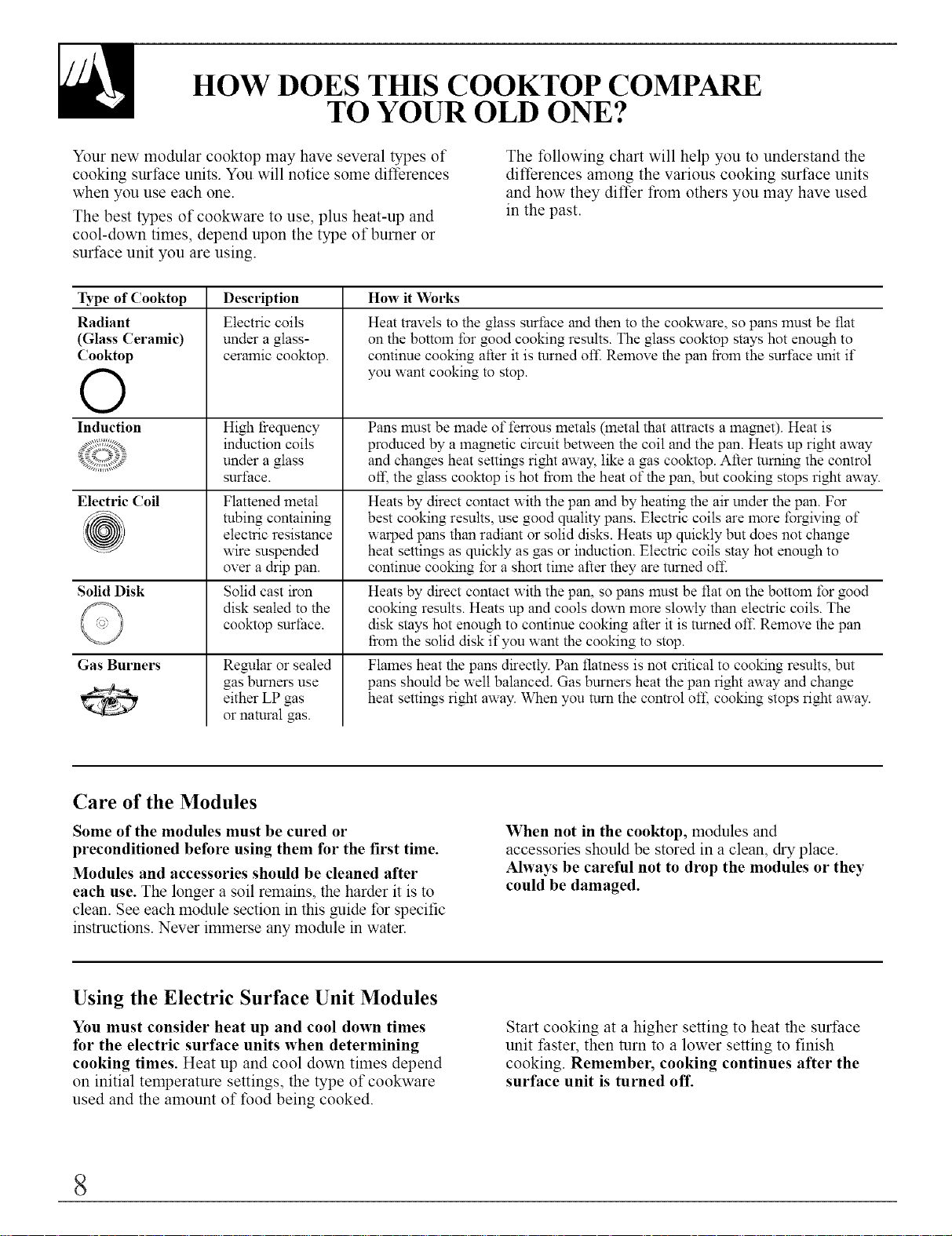
Type of Cooktop
Radiant
(Glass Ceramic)
Cooktop
0
Induction
Electric Coil
Solid Disk
Gas Burners
Description
Electric coils
under a glass-
ceramic cooktop.
High frequency
induction coils
under a glass
surface.
Flattened metal
tubing containing
electric resistance
wire suspended
over a drip pan.
Solid cast iron
disk sealed to the
cooktop surface.
Remllar or sealed
gas burners use
either LP gas
or natural gas.
How it Works
Heat travels to the glass surface and then to the coolcware, so pans must be flat
on the bottom for good cooking results. The glass cooktop stays hot enough to
continue cooking after it is turned ot'f_Remove the pan tioln the surface unit if
you want cooking to stop.
Pans must be made of ferrous metals (metal that attracts a magnet). Heat is
produced by a mamletic circuit between the coil and the pan. Heats up right away
and changes heat settings right away, like a gas cooktop. After turning the control
ott; the glass cooktop is hot tiom the heat of the pan, but cooking stops right away.
Heats by direct contact with the pan and by heating the air under the pan. For
best cooking results, use good quality pans. Electric coils are more forgiving of
warped pans than radiant or solid disks. Heats up quickly but does not change
heat settings as quickly as gas or induction. Electric coils stay hot enough to
continue cooking for a short time after they are turned off
Heats by direct contact with the pan, so pans must be flat on the bottom for good
cooking results. Heats up and cools down more sloMy than electric coils. The
disk stays hot enough to continue cooking after it is turned off'. Remove the pan
tiom the solid disk if you want the cooking to stop.
Flames heat the pans directly. Pan flatness is not critical to cooking results, but
pans should be welt balanced. Gas burners heat the pan right away and change
heat settings right away. When you turn the control oft; cooking stops right away.
Care of the Modules
Some of the modules must be cured or
preconditioned before using them for the first time.
Modules and accessories should be cleaned after
each use. The longer a soil remains, the harder it is to
clean. See each module section in this guide tbr specific
instructions. Never immerse any module in water.
When not in the cooktop, modules and
accessories should be stored in a clean, dry place.
Ahvays be careful not to drop the modules or they
could be damaged.
Using the Electric Surface Unit Modules
You must consider heat up and cool down times
for the electric surface units when determining
cooking times. Heat up and cool down times depend
on initial temperature settings, the type of cookware
used and the amount of food being cooked.
Start cooking at a higher setting to heat the surface
unit faster, then turn to a lower setting to finish
cooking. Remember, cooking continues after the
surface unit is turned off.
8
CONTROLS
GEAppliances.com
Surface Cooking With Infinite Heat Controls
At both OFF and HI the control "clicks" into position. You may hear slight
"clicking" sounds during cooking, indicating the control is keeping the unit
at the heat level you set.
Switching heats to a higher setting always shows a quicker change than
switching to a lower setting.
How to Set the Controls
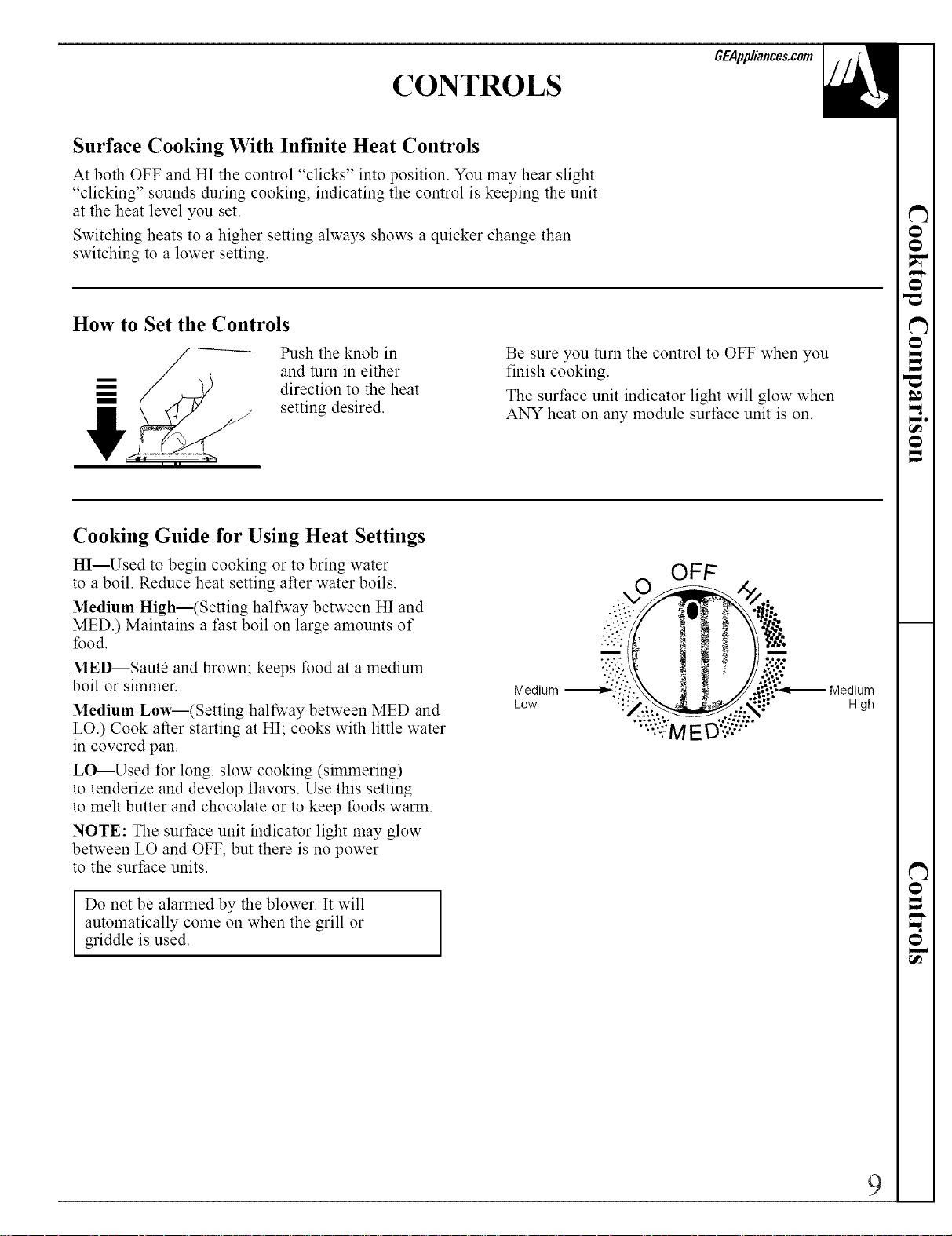
l
l
Push the knob in
and turn in either
direction to the heat
setting desired.
Be sure you turn the control to OFF when you
finish cooking.
The surface unit indicator light will glow when
ANY heat on any module surface unit is on.
Cooking Guide for Using Heat Settings
HI--Used to begin cooking or to bring water
to a boil. Reduce heat setting after water boils.
Medium High--(Setting halfway between HI and
MED.) Maintains a fast boil on large amounts of
food.
MED--Sautd and brown; keeps food at a medium
boil or simmer.
Medium Low--(Setting halfway between MED and
LO.) Cook after starting at HI; cooks with little water
in covered pan.
LO--Used tbr long, slow cooking (simmering)
to tenderize and develop flavors. Use this setting
to melt butter and chocolate or to keep foods warm.
NOTE: The surface unit indicator light may glow
between LO and OFF, but there is no power
to the surface units.
Do not be alarmed by the blower. It will
automatically come on when the grill or
griddle is used.
Medium ._.l_:
Low
OFF
High
9
COIL SURFACE UNIT MODULE
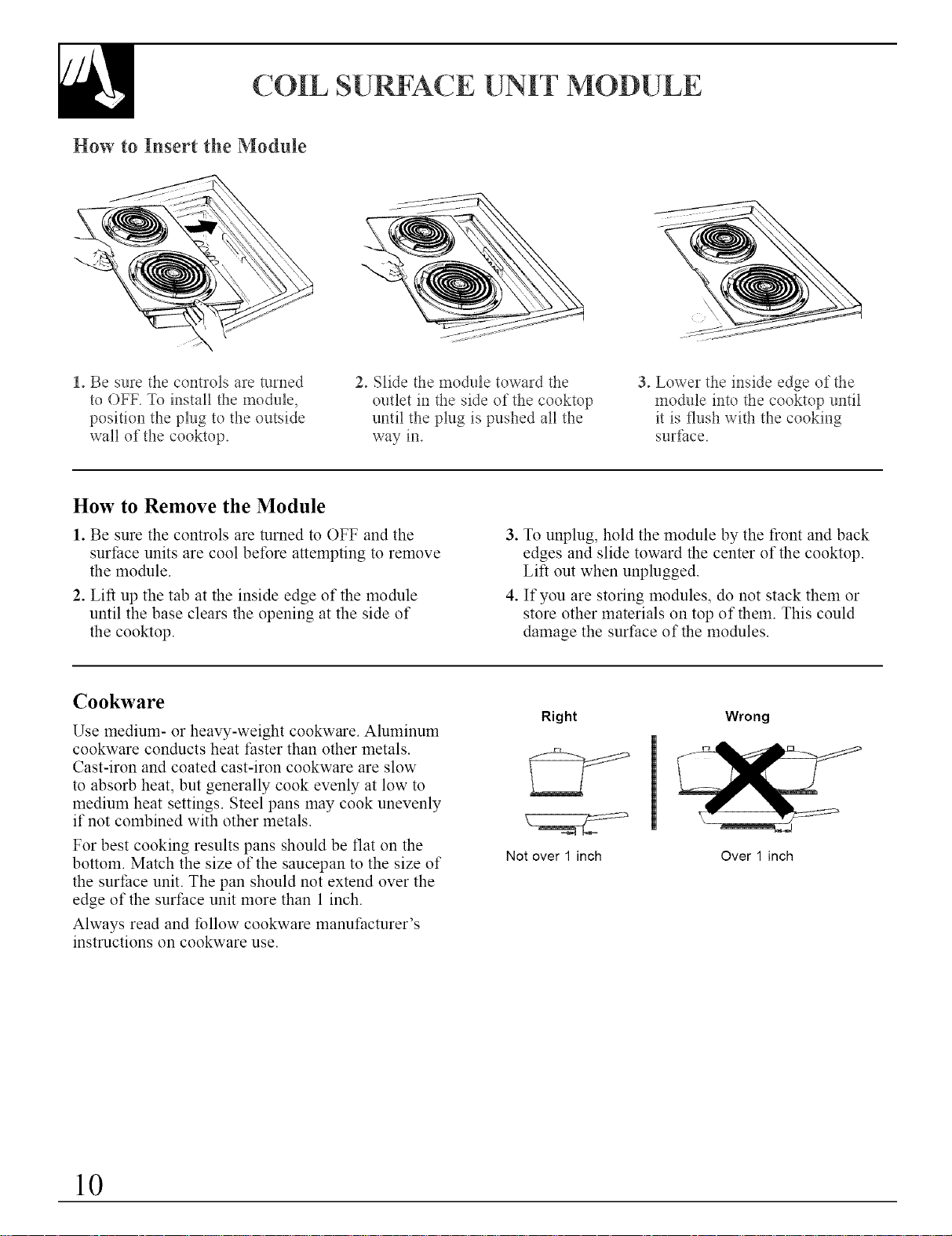
How to Insert the Module
1. Be sure the controls are turned
to OFF. To install the module,
position the plug to the outside
wall of the cooktop.
2. Slide the module toward the
outlet in the side of the cooktop
until the phlg is pushed all the
way in.
3. Lower the inside edge of the
module into the cooktop until
it is flush with the cooking
surii_ce.
How to Remove the Module
1. Be sure the controls are turned to OFF and the
surface units are cool before attempting to remove
the module.
2. Lift up the tab at the inside edge of the module
until the base clears the opening at the side of
the cooktop.
3. To unplug, hold the module by the front and back
edges and slide toward the center of the cooktop.
Lift out when unplugged.
4. If you are storing modules, do not stack them or
store other materials on top of them. This could
damage the surt:ace of the modules.
Cookware
Use medium- or heavy-weight cookware. Aluminum
cookware conducts heat taster than other metals.
Cast-iron and coated cast-iron cookware are slow
to absorb heat, but generally cook evenly at low to
medium heat settings. Steel pans may cook unevenly
if not combined with other metals.
For best cooking results pans should be fiat on the
bottom. Match the size of the saucepan to the size of
the surface unit. The pan should not extend over the
edge of the surt:ace unit more than 1 inch.
Always read and follow cookware manufacturer's
instructions on cookware use.
Right Wrong
Not over 1 inch Over 1 inch
10
GEAppliances.com
Deep Fat Frying
Do not overfill cookware with fat that may spill over when adding food.
Frosty foods bubble vigorously. Watch food trying at high temperatures.
Keep cooktop and hood clean from grease.
Wok Cooking
We recommend that
you use only a fiat-
bottomed wok. They are
available at your local
retail store.
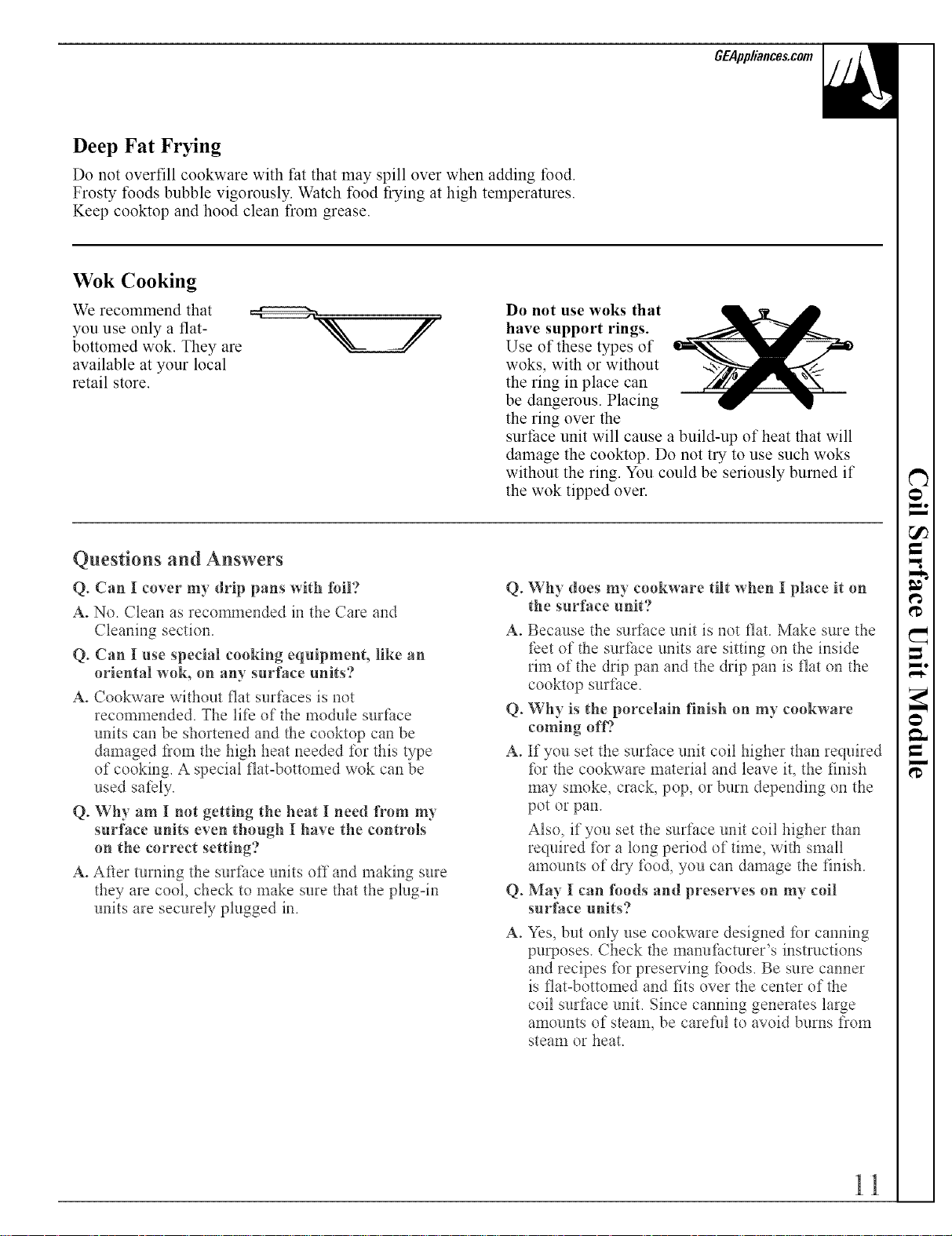
Do not use woks that
have support rings.
Use of these types of
woks, with or without
the ring in place can
be dangerous. Placing
the ring over the
surface unit will cause a build-up of heat that will
damage the cooktop. Do not try to use such woks
without the ring. You could be seriously burned if
the wok tipped over.
Questions and Answers
Q. Can I cover my drip pans with ibil?
A. No. Clean as recommended in the Care and
Cleaning section.
Q. Can I use special cooking equipment, like an
oriental wok, on any surface units?
A. Cookwam without fiat surfaces is not
recommended. The life of the module snrti_ce
units can be shortened and the cooktop can be
damaged fiom the high heat needed for this type
of cooking. A special fiat=bottomed wok can be
used sa_ely.
Q. Why am I not getting the heat I need from my
surface units even though I have the controls
on the correct setting'?
A. Afier turning the surface units off and making sure
they am cool, check to make sure that the plug=in
units are securely plugged in.
Q. Why does my cookware tilt when I place it on
the surface unit?
A. Because the snrti_ce unit is not fiat. Make sure the
_et of the snrti_ce units are sitting on the inside
rim of the drip pan and the drip pan is fiat on the
cooktop snrti_ce.
Q. Why is the porcelain finish on my cookware
coming off?.
A. If you set the surface unit coil higher than required
_br the cool(ware material and leave it, the finish
may smoke, crock, pop, or burn depending on the
pot or pan.
Also, if yon set the surface unit coil higher than
required for a long period of time, with small
amounts of dry food, you can damage the finish.
Q. May I can _ods and preserves on my coil
snrNce units?
A. Yes, but only use cool(ware designed tbr canning
purposes. Check the mamffactnrer's instructions
and recipes for prese_wing _bods. Be sure canner
is fiat=bottomed and fits over the center of the
coil surface unit. Since canning generates large
amounts of steam, be care_ifl to avoid burns fiom
steam or heat.
11
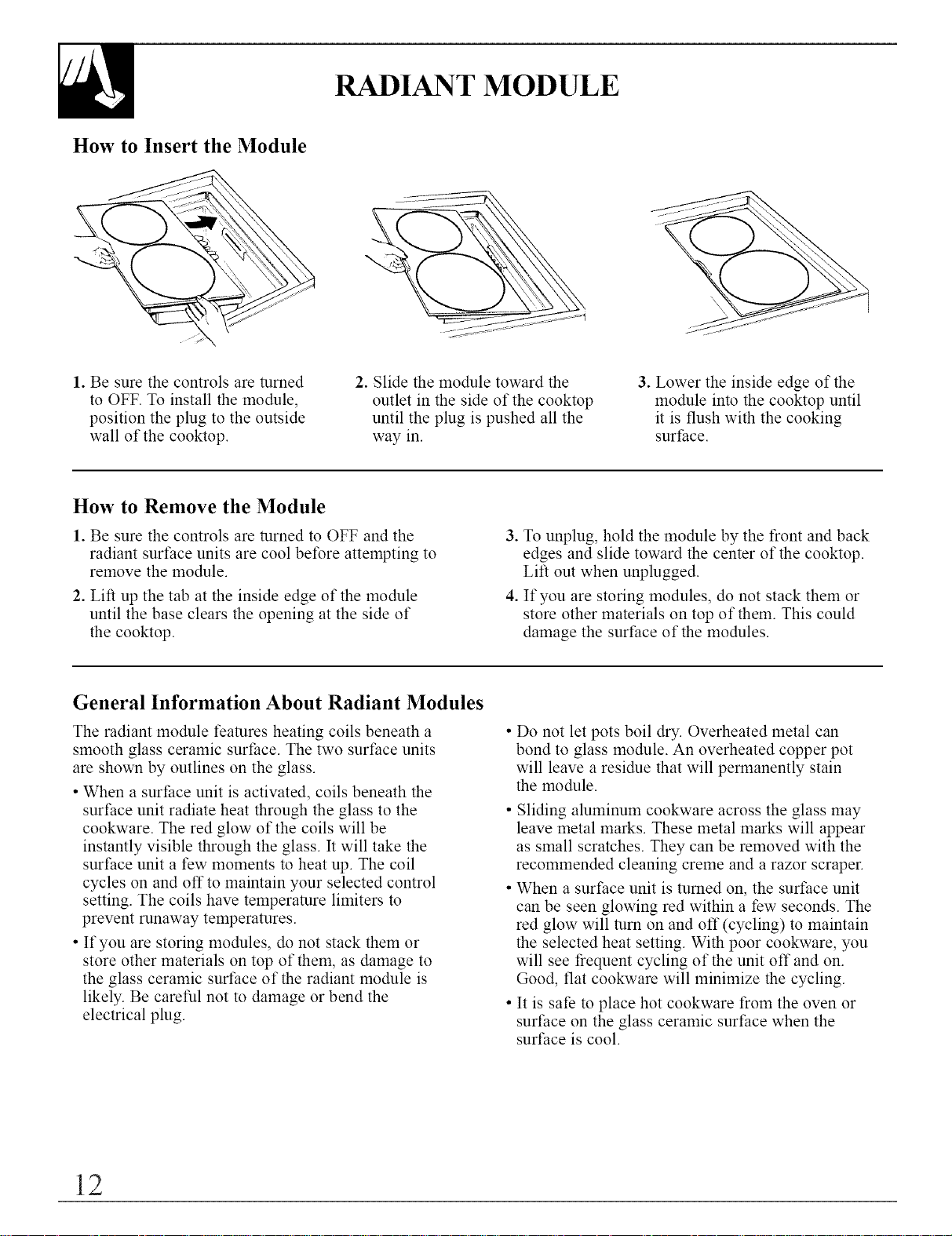
How to Insert the Module
RADIANT MODULE
1. Be sure the controls are turned
to OFF. To install the module,
position the plug to the outside
wall of the cooktop.
2. Slide the module toward the
outlet in the side of the cooktop
until the plug is pushed all the
way in.
3. Lower the inside edge of the
module into the cooktop until
it is flush with the cooking
surface.
How to Remove the Module
1. Be sure the controls are turned to OFF and the
radiant surface units are cool before attempting to
remove the module.
2. Lift up the tab at the inside edge of the module
until the base clears the opening at the side of
the cooktop.
3. To unplug, hold the module by the front and back
edges and slide toward the center of the cooktop.
Lift out when unplugged.
4. If you are storing modules, do not stack them or
store other materials on top of them. This could
damage the surt:ace of the modules.
General Information About Radiant Modules
The radiant module features heating coils beneath a
smooth glass ceramic surface. The two surt:ace units
are shown by outlines on the glass.
• When a surface unit is activated, coils beneath the
surt:ace unit radiate heat through the glass to the
cookware. The red glow of the coils will be
instantly visible through the glass. It will take the
surt:ace unit a few moments to heat up. The coil
cycles on and off to maintain your selected control
setting. The coils have temperature limiters to
prevent runaway temperatures.
• If you are storing modules, do not stack them or
store other materials on top of them, as damage to
the glass ceramic surt:ace of the radiant module is
likely. Be careful not to damage or bend the
electrical plug.
• Do not let pots boil dry. Overheated metal can
bond to glass module. An overheated copper pot
will leave a residue that will permanently stain
the module.
• Sliding aluminum cookware across the glass may
leave metal marks. These metal marks will appear
as small scratches. They can be removed with the
recommended cleaning creme and a razor scraper.
• When a surt:ace unit is turned on, the surt:ace unit
can be seen glowing red within a few seconds. The
red glow will turn on and off (cycling) to maintain
the selected heat setting. With poor cookware, you
will see frequent cycling of the unit off and on.
Good, flat cookware will minimize the cycling.
• It is sate to place hot cookware from the oven or
surt:ace on the glass ceramic surt:ace when the
surt:ace is cool.
12
GEAppliances.com
Types of Cookware
The following information will help you choose
cookware which will give good performance.
Stainless Steel: highly recommended
Especially good with a sandwich clad bottom. The
sandwich bottom combines the benefits of stainless steel
(appearance, durability and stability) with the advantages
of aluminum or copper (heat conduction, even heat
distribution).
Aluminum: hea_, weight recommended
Good conductivity. Aluminum residues sometimes
appear as scratches on the cooktop, but can be removed
if cleaned immediately. Because of its low melting point,
thin weight aluminum should not be used.
Copper Bottom: hea_, weight recommended
Good performance, but copper may leave residues which
can appear as scratches. The residues can be removed,
as long as the cooktop is cleaned immediately.
Porcelain/enamel:
Good performance only with a thick, flat, smooth
bottom. Aw_id boiling dry, as porcelain can melt and
fuse to the surthce.
Glass-ceramic: ztsable, bztt not recommended
Poor performance. May scratch surface.
Stoneware: ztsable, but not recommended
Poor performance. May scratch surface.
Cast Iron: ztsable, bztt not recommended
Poor performance. May scratch surface.
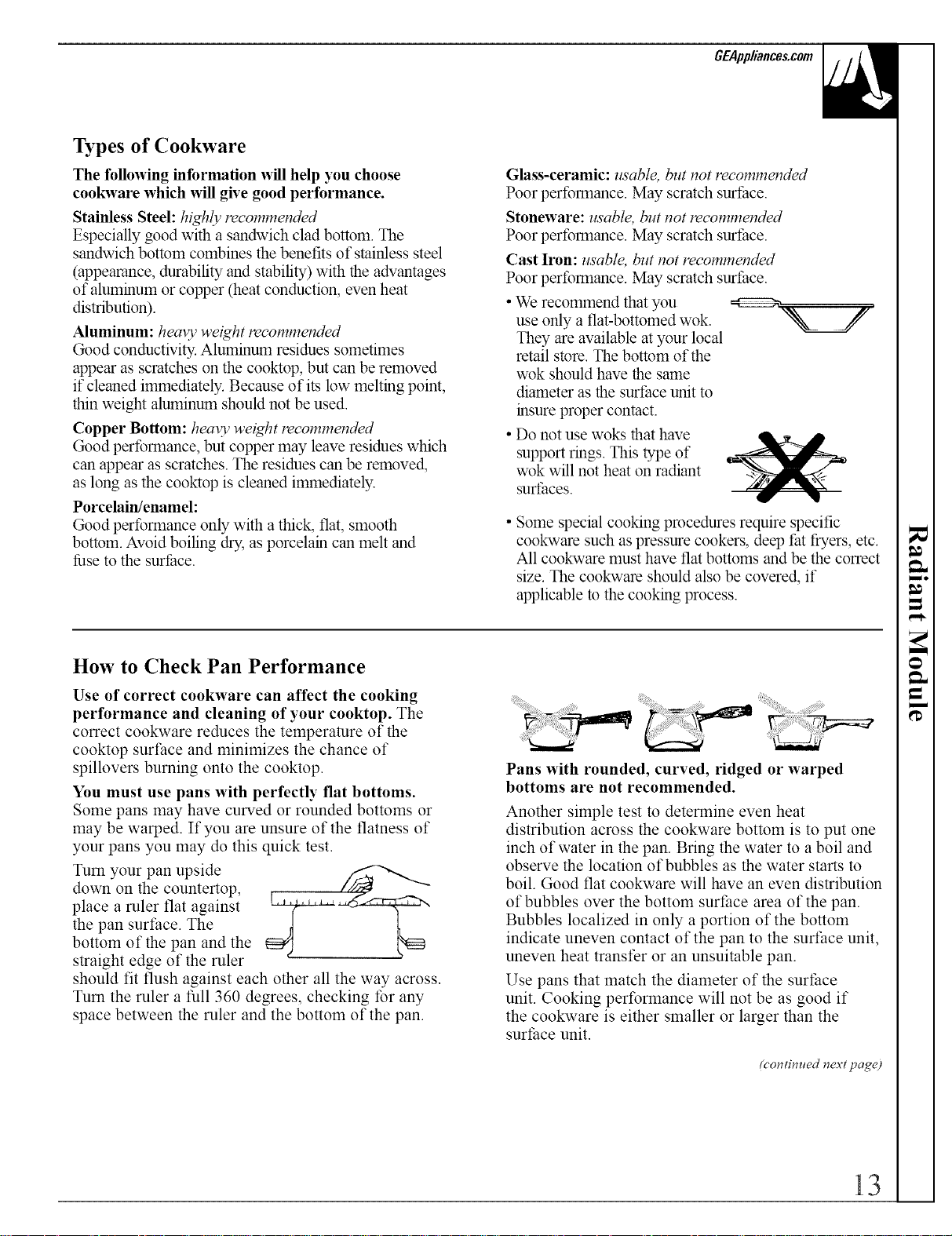
• We recommend that you
use only a flat-bottomed wok.
They are available at your local
retail store. The bottom of the
wok should have the same
diameter as the surface unit to
insure proper contact.
• Do not use woks that have
support rings. This type of
wok will not heat on radiant
surfuces.
• Some special cooking procedures require specific
coolcware such as pressure cookers, deep tat fryers, etc.
All coolcware must have flat bottoms and be the correct
size. The coolcware should also be covered, if
applicable to the cooking process.
How to Check Pan Performance
Use of correct cookware can affect the cooking
performance and cleaning of your cooktop. The
correct cookware reduces the temperature of the
cooktop surface and minimizes the chance of
spillovers burning onto the cooktop.
You must use pans with perfectly flat bottoms.
Some pans may have curved or rounded bottoms or
may be warped. If you are unsure of the flatness of
your pans you may do this quick test.
Turn your pan upside
down on the countertop,
///-'.-'.-'.-'7_-'-'-
place a ruler flat against _*-__'"
the pan surface. The
bottom of the pan and the
straight edge of the ruler
should fit flush against each other all the way across.
Turn the ruler a full 360 degrees, checking _br any
space between the ruler and the bottom of the pan.
Pans with rounded, curved, ridged or warped
bottoms are not recommended.
Another simple test to determine even heat
distribution across the cookware bottom is to put one
inch of water in the pan. Bring the water to a boil and
observe the location of bubbles as the water starts to
boil. Good flat cookware will have an even distribution
of bubbles over the bottom surface area of the pan.
Bubbles localized in only a portion of the bottom
indicate uneven contact of the pan to the surface unit,
uneven heat transfer or an unsuitable pan.
Use pans that match the diameter of the surface
unit. Cooking performance will not be as good if
the cookware is either smaller or larger than the
surface unit.
(cont#:z¢ed neyt page)
13
CAUTION
RADIANT MODULE
(continued)
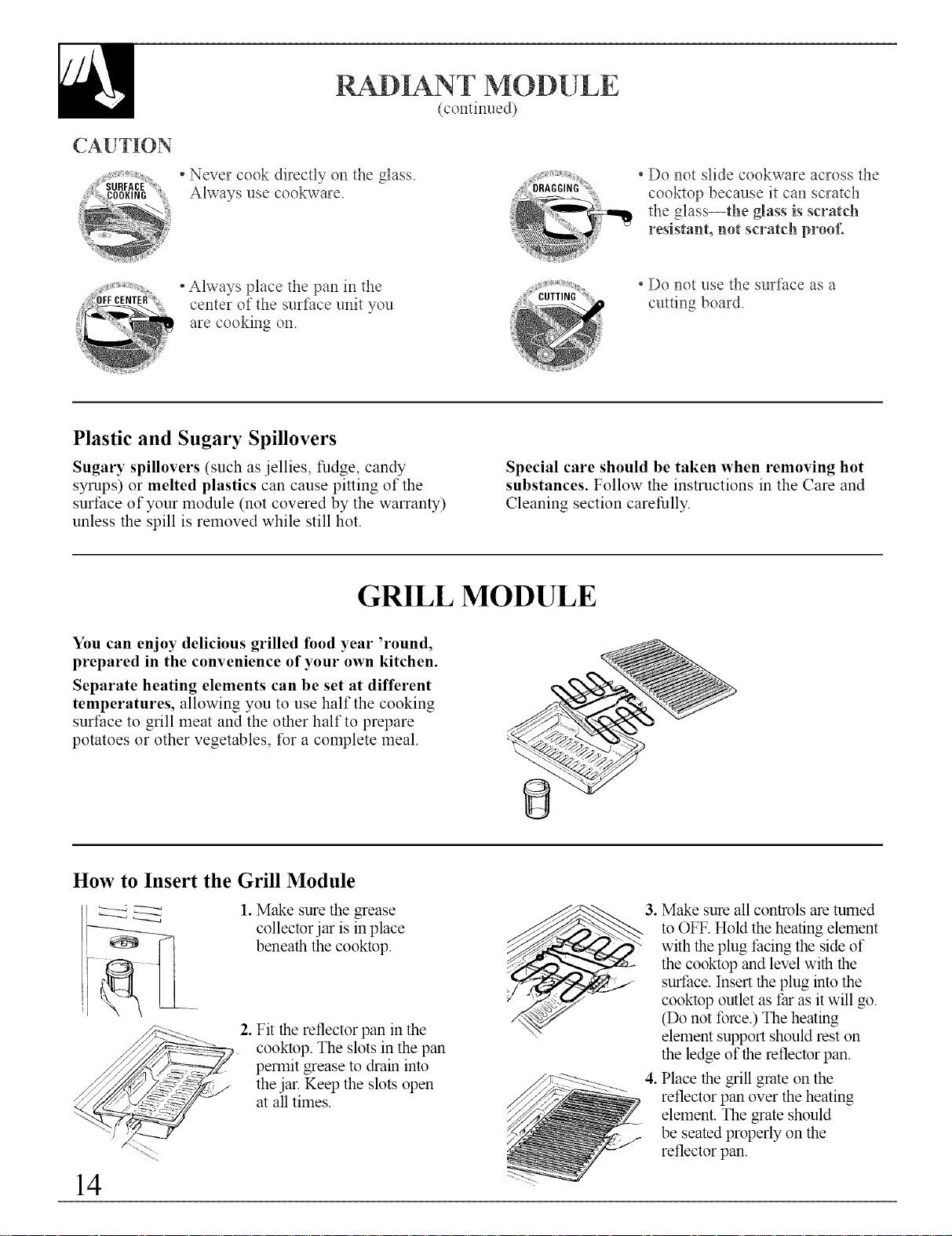
, Never cook directly on the glass.
Always use cookware.
, Do not slide cookware across the
cooktop because it can scratch
the glass--the glass is scratch
resistant, not scratch proog
, Always place the pan in the
center of the sur_i_ce unit you
are cooking on.
, Do not use the surface as a
cutting board.
Plastic and Sugary Spillovers
Sugary spillovers (such as jellies, fudge, candy
syrups) or melted plastics can cause pitting of the
surface of your module (not covered by the warranty)
unless the spill is removed while still hot.
Special care should be taken when removing hot
substances. Follow the instructions in the Care and
Cleaning section carefully.
GRILL MODULE
You can enjoy delicious grilled food year 'round,
prepared in the convenience of your own kitchen.
Separate heating elements can be set at different
temperatures, allowing you to use halt" the cooking
surface to grill meat and the other half to prepare
potatoes or other vegetables, for a complete meal.
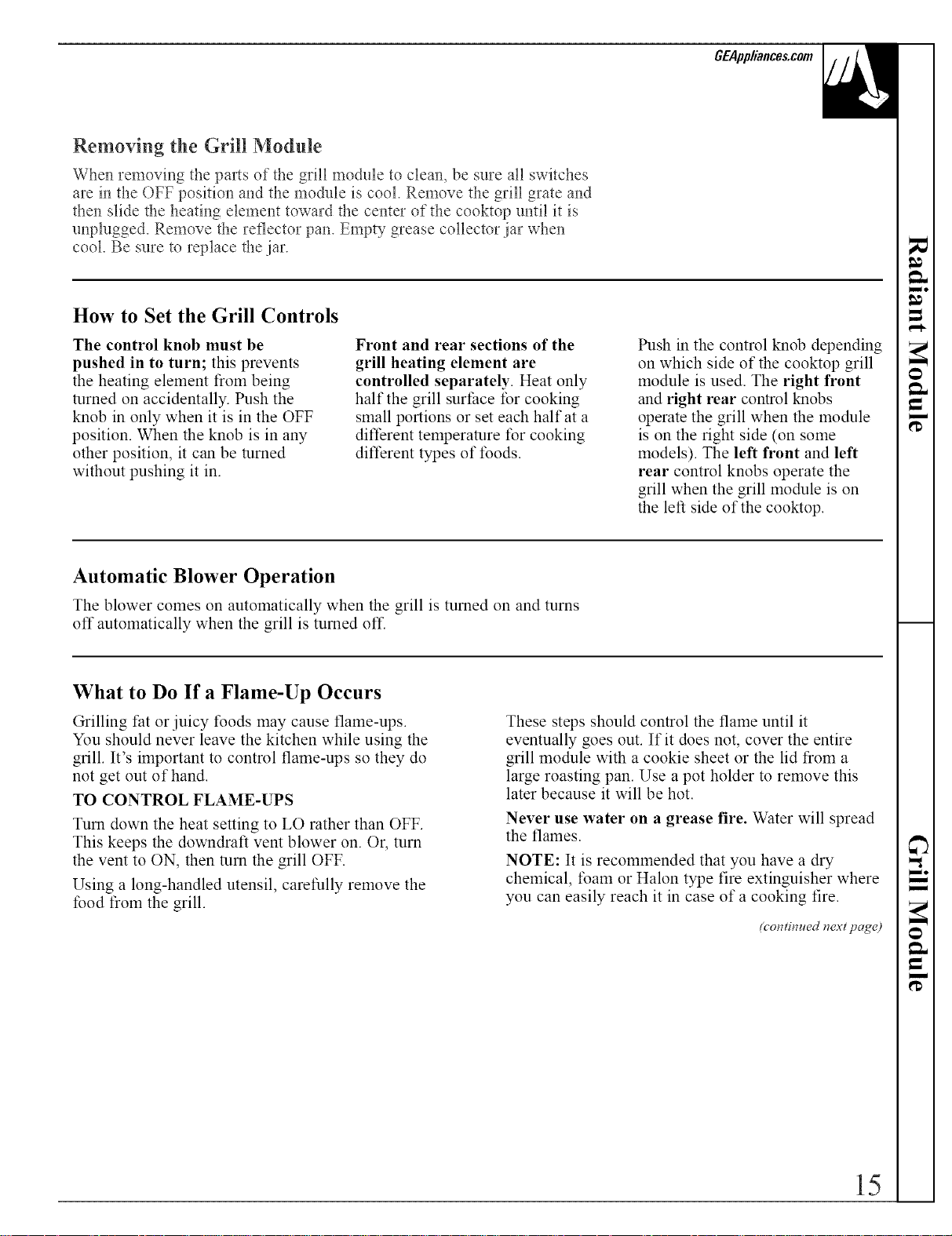
How to Insert the Grill Module
1. Make sure the grease
collector jar is in place
beneath the cooktop.
2. Fit the reflector pan in the
cooktop. The slots in the pan
permit grease to drain into
thejar. Keep the slots open
at all times.
14
__///"¸
3. Make sure all controls are tumed
to OFF. Hold the heating element
with the plug facing the side of
the cooktop and level with the
surface. Insert the plug into the
cooktop outlet as tar as it will go.
(Do not force.) The heating
element support should rest on
the ledge of the reflector pan.
4. Place the grill grate on the
reflector pan over the heating
element. The grate should
be seated properly on the
reflector pan.
GEAppliances.com
Removing the Grill Module
When removing the parts of the grill module to clean, be sure all switches
are in the OFF position and the module is cool. Remove the grill grate and
then slide the heating element toward the center of the cooktop until it is
unplugged. Remove the reflector pan. Empty grease collector jar when
cool. Be sure to replace the jar.
How to Set the Grill Controls
The control knob must be
pushed in to turn; this prevents
the heating element from being
turned on accidentally. Push the
knob in only when it is in the OFF
position. When the knob is in any
other position, it can be turned
without pushing it in.
Front and rear sections of the
grill heating element are
controlled separately. Heat only
half the grill surface tbr cooking
small portions or set each half at a
different temperature for cooking
different types of foods.
Push in the control knob depending
on which side of the cooktop grill
module is used. The right front
and right rear control knobs
operate the grill when the module
is on the right side (on some
models). The left front and left
rear control knobs operate the
grill when the grill module is on
the left side of the cooktop.
Automatic Blower Operation
The blower comes on automatically when the grill is turned on and turns
off automatically when the grill is turned off.
What to Do If a Flame-Up Occurs
Grilling fat or juicy foods may cause flame-ups.
You should never leave the kitchen while using the
grill. It's important to control flame-ups so they do
not get out of hand.
TO CONTROL FLAME-UPS
Turn down the heat setting to LO rather than OFF.
This keeps the downdraft vent blower on. Or, turn
the vent to ON, then turn the grill OFF.
Using a long-handled utensil, carefully remove the
food from the grill.
These steps should control the flame until it
eventually goes out. If it does not, cover the entire
grill module with a cookie sheet or the lid from a
large roasting pan. Use a pot holder to remove this
later because it will be hot.
Never use water on a grease fire. Water will spread
the flames.
NOTE: It is recommended that you have a dry
chemical, foam or Halon type fire extinguisher where
you can easily reach it in case of a cooking fire.
(cot:t#_ued ne.vt page)
15
GRILL MODULE
(continued)
Grill Tips
° Do not leave the grill unattended while in use.
° Be sure to preheat according to the cooking guide.
° Make sure the grease collector jar and the reflector
pan are clean and in place before using the grill.
° Remove grease fiom the grease collector jar after
each use to avoid spillovers.
° The grates should be oiled or sprayed with a non-
stick coating before cooking to prevent sticking.
Remove the grate before spraying, and spray only
while cool. Spraying directly onto a hot grill may
cause a fire.
° Trim fat fiom meats be%re placing on the grill.
This will reduce smoking and lessen grease buildup
in the grease collector jar.
° When cooking foods of various sizes and
thicknesses, start larger or thicker pieces first, and
quicker-cooking, smaller pieces later. Press meat
lightly to lie flat on the grill: slash the _t on the
edges of steaks and chops to prevent curling; break
the joints of split chickens so they will lie flat.
° Allow space between foods when placing them on
the grill. Air needs to circulate around the food _br
best cooking results.
° Occasionally rearrange foods on the grill, to prevent
sticking and provide better browning.
° Season meats after cooking rather than before--
salt can draw out juices and dry out meat. Use tongs
to turn and rearrange meats on the grill; forks will
pierce the meat and release juices.
° If your house has low voltage, foods may be lighter
brown than expected. A longer preheating and grill
time may be necessary to achieve the desired results.
° The blower comes on automatically when the grill
is turned on and turns off automatically when the
grill is turned off.
Questions and Answers
Q. I followed the cooking times suggested in
the Grill Cooking Guide but my foods were not
done properly. Is there something wrong with
my grill?
A. Probably not. Suggested cooking times should be
used only as a general guide. Variables in food can
change cooking times required.
Q. How can I keep barbecued meats from
developing an unattractive burned look
and taste?
A. Sauces containing sugar will often burn if used
during the entire cooking time. If your t:avorite
sauce contains sugar, try adding it only during the
last 15 to 20 minutes of cooking time for best
results.
Q. Foods cooked on my grill are not browning as
much as I would like. What could cause this?
A. A longer preheating and grill time may be
necessary to achieve the desired results.
Q. Can my grill be switched to the other side of
the cooktop where it would be more convenient
for me?
A. Your interchangeable cooktop modules can be
used on either the right or the left side of the
cooktop (on some models). When inserting or
removing a module, take care not to force the
connection or exert undue pressure which could
damage the electrical contacts.
Q. When cooking many individual foods, what can
I do to insure that foods will cook evenly?
A. When cooking foods of various sizes and
thicknesses, start larger or thicker pieces first
and add quicker-cooking, smaller pieces later.
Press the meat lightly to lie flat on the grill. Slash
the fat on the edges of steaks and chops to prevent
curling. Break the joints of split chickens so they
will lie flat.
Q. My grilled meats sometimes come out drier
than they should. What can I do to help
prevent this?
A. Season meats after cooking rather than before--
salt can draw out juices and dry out meat. Use
tongs to turn and rearrange meats on the grill;
forks will pierce the meat and release juices.
16
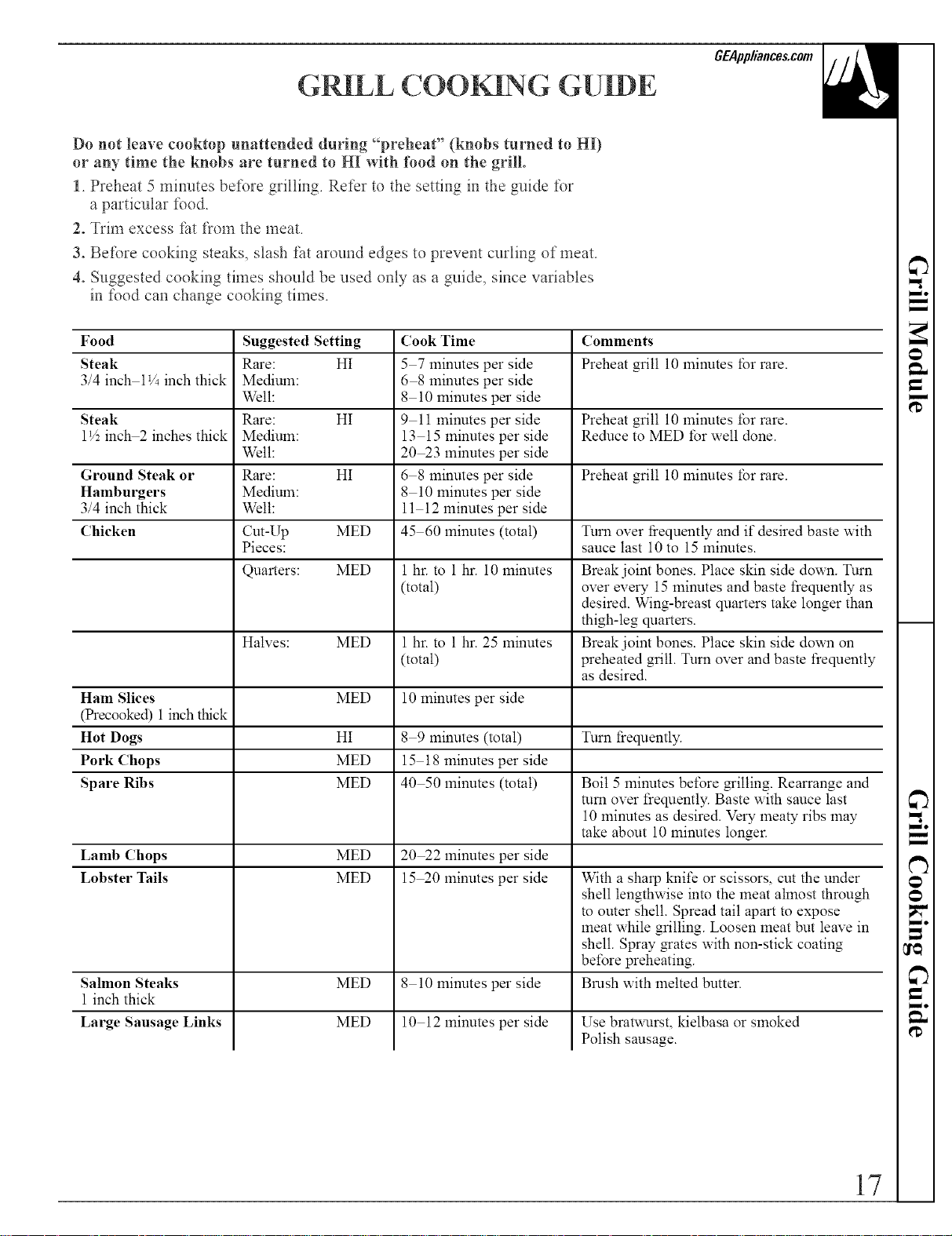
GRILL COOKING GUIDE
GEAppliances.com
Do not leave cooktop unattended during "preheat" (knobs turned to HI)
or any time the knobs are turned to HI with _od on the grilL
1. Preheat 5 minutes before grilling. Refer to the setting m the guide for
a particular food.
2. Trim excess _i_tfiom the meat.
3. Before cooking steaks, slash fat around edges to prevent curling of meat.
4. Suggested cooking times should be used only as a guide, since variables
in food can change cooking times.
Food Suggested Setting Cook Time Comments
Steak Rare: HI 5 7 minutes per side Preheat grill 10 minutes for rare.
3/4 inch 11/4inch thick Medium: 6 8 minutes per side
Well: 8 10 minutes per side
Steak Rare: HI 9 11 minutes per side Preheat grill 10 minutes for rare.
11/2inch2 inches thick Medium: 13 15 minutes per side Reduce to MED for well done.
Well: 20_3 minutes per side
Ground Steak or Rare: HI 6 8 minutes per side Preheat grill 10 minutes for rare.
Hamburgers Medium: 8 f0 minutes per side
3/4 inch thick Well: 11 12 minutes per side
Chicken Cut-Up MED 45 60 minutes (total) Turn over fiequently and if desired baste with
Pieces: sauce last 10 to 15 minutes.
Quarters: MED 1hr. to 1 hr. 10 minutes Break joint bones. Place skin side down. Turn
(total) over every 15 minutes and baste frequently as
desired. Wing-breast quarters take longer than
thigh-leg quarters.
Halves: MED 1hr. to 1 hr. 25 minutes Break joint bones. Place skin side down on
(total) preheated grill. Turn over and baste frequently
as desired.
Ham Slices MED 10 minutes per side
(Precooked) 1 inch thick
Hot Dogs HI 8 9 minutes (total) Turn frequently.
Pork (;hops MED 15 18 minutes per side
Spare Ribs MED 40 50 minutes (total) Boil 5 minutes before grilling. Rearrange and
mm over frequently. Baste with sauce last
10 minutes as desired. Very meaty ribs may
take about 10 minutes longer.
Lamb (;hops MED 20_2 minutes per side
Lobster Tails MED 15_0 minutes per side
Salmon Steaks MED 8 10 minutes per side
1 inch thick
Large Sausage Links MED 10 12 minutes per side
With a sharp kalife or scissors, cut the under
shell lengthwise into the meat ahnost through
to outer shell. Spread tail apart to expose
meat while grilling. Loosen meat but leave in
shell. Spray grates with non-stick coating
before preheating.
Brash with melted butter.
Use bratvx_rst, kielbasa or smoked
Polish sausage.
17
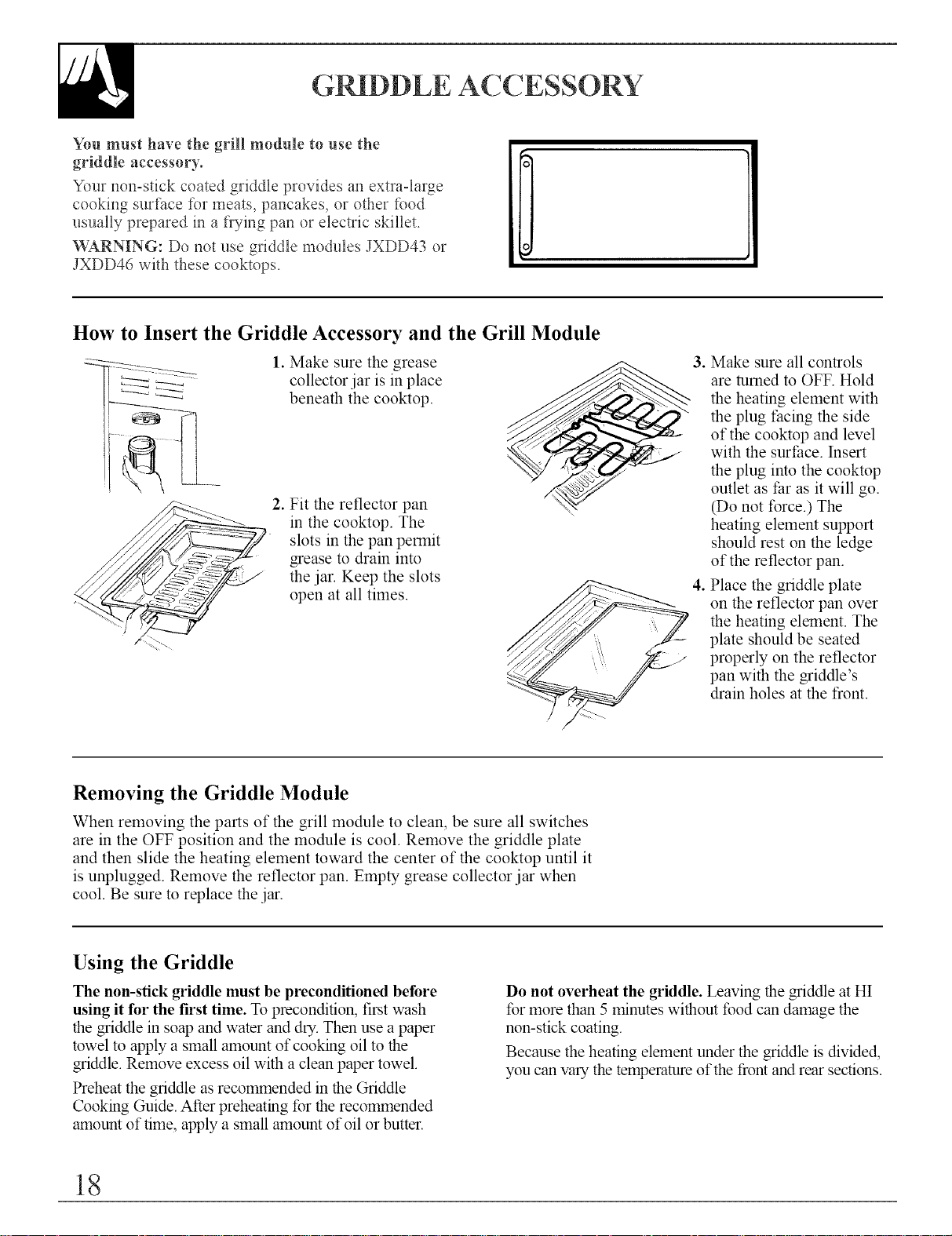
GRIDDLE ACCESSORY
You must have the grill module to use the
griddle accessory.
Your non-stick coated griddle provides an extra-large
cooking sur_hce %r meats, pancakes, or other food
usually prepared in a frying pan or electric skillet.
WARNING: Do not use griddle modules JXDD43 or
JXDD46 with these cooktops.
How to Insert the Griddle Accessory and the Grill Module
1. Make sure the grease
collector jar is in place
beneath the cooktop.
2. Fit the reflector pan
in the cooktop. The
slots in the pan permit
grease to drain into
the jar. Keep the slots
open at all times.
.
.
Make sure all controls
are turned to OFF. Hold
the heating element with
the plug facing the side
of the cooktop and level
with the surthce. Insert
the plug into the cooktop
outlet as tar as it will go.
(Do not force.) The
heating element support
should rest on the ledge
of the reflector pan.
Place the griddle plate
on the reflector pan over
the heating element. The
plate should be seated
properly on the reflector
pan with the griddle's
drain holes at the front.
Removing the Griddle Module
When removing the parts of the grill module to clean, be sure all switches
are in the OFF position and the module is cool. Remove the griddle plate
and then slide the heating element toward the center of the cooktop until it
is unplugged. Remove the reflector pan. Empty grease collector jar when
cool. Be sure to replace the jar.
Using the Griddle
The non-stick griddle must be preconditioned before
using it for the first time. To precondition, first wash
the griddle in soap and water and dry. Then use a paper
towel to apply a small amount of cooking oil to the
griddle. Remove excess oil with a clean paper towel.
Preheat the griddle as recommended in the Griddle
Cooking Guide. After preheating for the recommended
amount of time, apply a small amount of oil or butter.
Do not overheat the griddle. Leaving the griddle at HI
for more than 5 minutes without food can damage the
non-stick coating.
Because the heating element under the griddle is divided,
you can vary the temperature of the front and rear sections.
18
GEAppliances.com
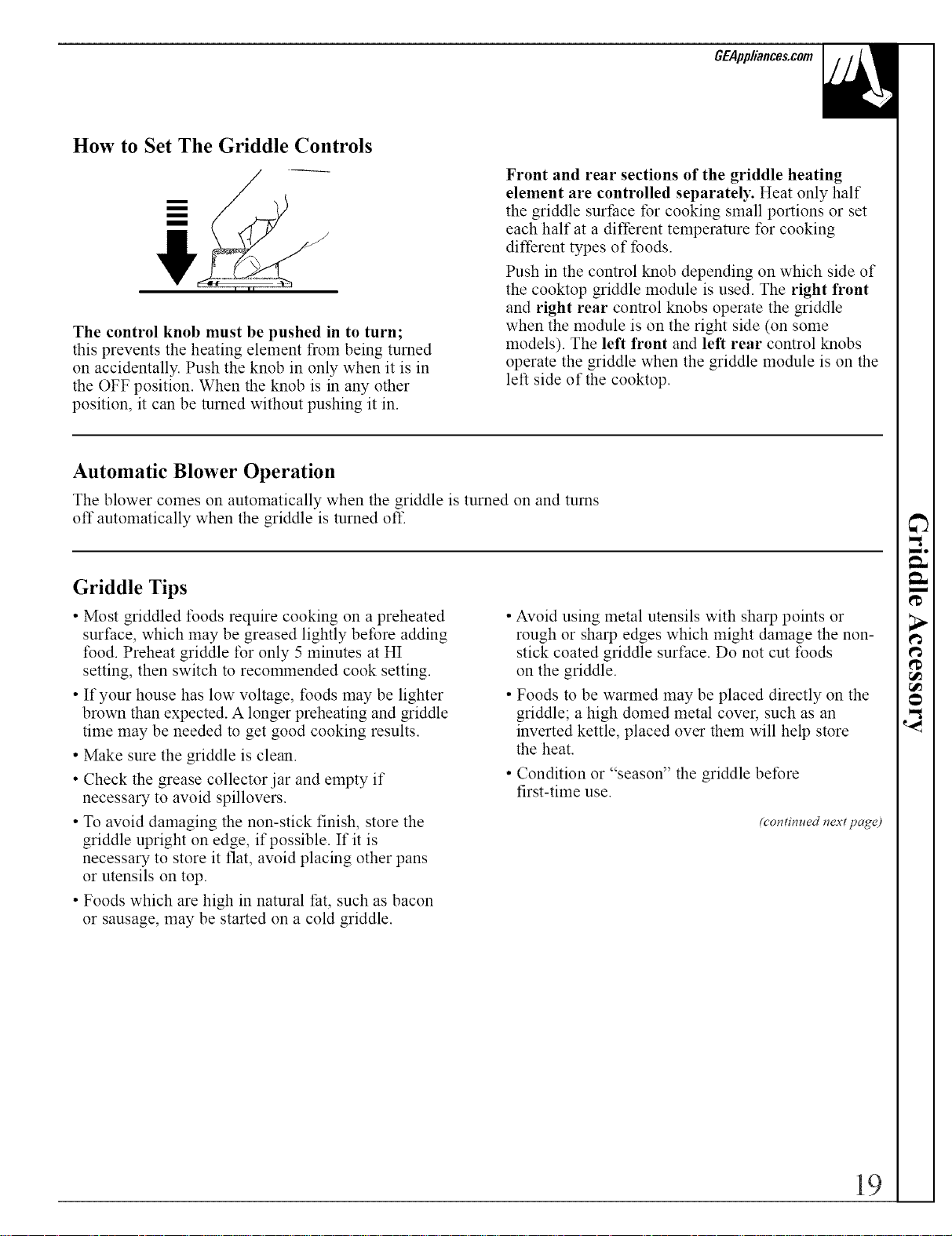
How to Set The Griddle Controls
The control knob must be pushed in to turn;
this prevents the heating element from being turned
on accidentally. Push the knob in only when it is in
the OFF position. When the knob is in any other
position, it can be turned without pushing it in.
Front and rear sections of the griddle heating
element are controlled separately. Heat only half
the griddle surface for cooking small portions or set
each half at a different temperature for cooking
different types of foods.
Push in the control knob depending on which side of
the cooktop griddle module is used. The right front
and right rear control knobs operate the griddle
when the module is on the right side (on some
models). The left front and left rear control knobs
operate the griddle when the griddle module is on the
left side of the cooktop.
Automatic Blower Operation
The blower comes on automatically when the griddle is turned on and turns
off automatically when the griddle is turned off
Griddle Tips
• Most griddled foods require cooking on a preheated
surface, which may be greased lightly before adding
food. Preheat griddle for only 5 minutes at HI
setting, then switch to recommended cook setting.
• If your house has low voltage, foods may be lighter
brown than expected. A longer preheating and griddle
time may be needed to get good cooking results.
• Make sure the griddle is clean.
• Check the grease collector jar and empty if
necessary to avoid spillovers.
• To avoid damaging the non-stick finish, store the
griddle upright on edge, if possible. If it is
necessary to store it fiat, avoid placing other pans
or utensils on top.
• Foods which are high in natural tat, such as bacon
or sausage, may be started on a cold griddle.
• Avoid using metal utensils with sharp points or
rough or sharp edges which might damage the non-
stick coated griddle surface. Do not cut foods
on the griddle.
• Foods to be warmed may be placed directly on the
griddle; a high domed metal cover, such as an
inverted kettle, placed over them will help store
the heat.
• Condition or "season" the griddle before
first-time use.
(continued ne.vt page)
19
GRIDDLE ACCESSORY
(continued)
Questions and Answers
Q° Can my griddle be switched to the other side of
the cooktop where it would be more convenient
for me'?
A. Your interchangeable cooktop modnles can be
used on either the right or let_ side of the cooktop
(on some models). When inserting or removing a
module, take care not to _Prce the connection or
exert undue pressure which could damage the
electrical contacts.
Q° Can prolonged periods of high heat damage my
griddle's surface?
A° A brief preheating period is ot_en necessary _br
best results with many £k)ods, but leaving the
griddle on HI heat setting _k)rmore than 5 minutes
without tbod can damage the non-stick coating.
Always be sure to turn control knobs to OFF when
cooking is completed.
Q° Why aren't my _bods done even though they
have cooked the full time?
A° Preheat the griddle for a longer thne and leave
foods on the griddle longer to attain the desired
degree of browning.
Q° Do I need special cookware for use with
my griddle?
A° Avoid using metal cookware with sharp points or
rough or sharp edges which might damage the non-
stick coated griddle surthce. Do not cut foods on
the griddle. Use only heat-resistant dishes when
_Pods in containers are to be warmed on the griddle.
For fiu_ther information on caring for your griddle's
surfi_ce, see the Care and Cleaning section.
Q. How should I store my griddle when it is not
in use?
A. To avoid marring the non-stick finish, store the
griddle upright on the edge with the terminals up
to avoid damage. If it is necessary to store it flat,
avoid placing other pans or cookware on top.
Q° How long can %ods be kept warm with the
griddle without losing their appeal?
A° No longer than 2 hours is recommended, to assure
good food quality and prevent spoilage. Delicate
tbods, such as eggs, should not be kept more than
15 to 30 minutes; entrees and casseroles may be
warmed for 30 to 60 minutes. Hors d'oenw_es
will stay hot for serving up to 1 or 1V: hours.
Rearrange or stir food occasionally, if possible.
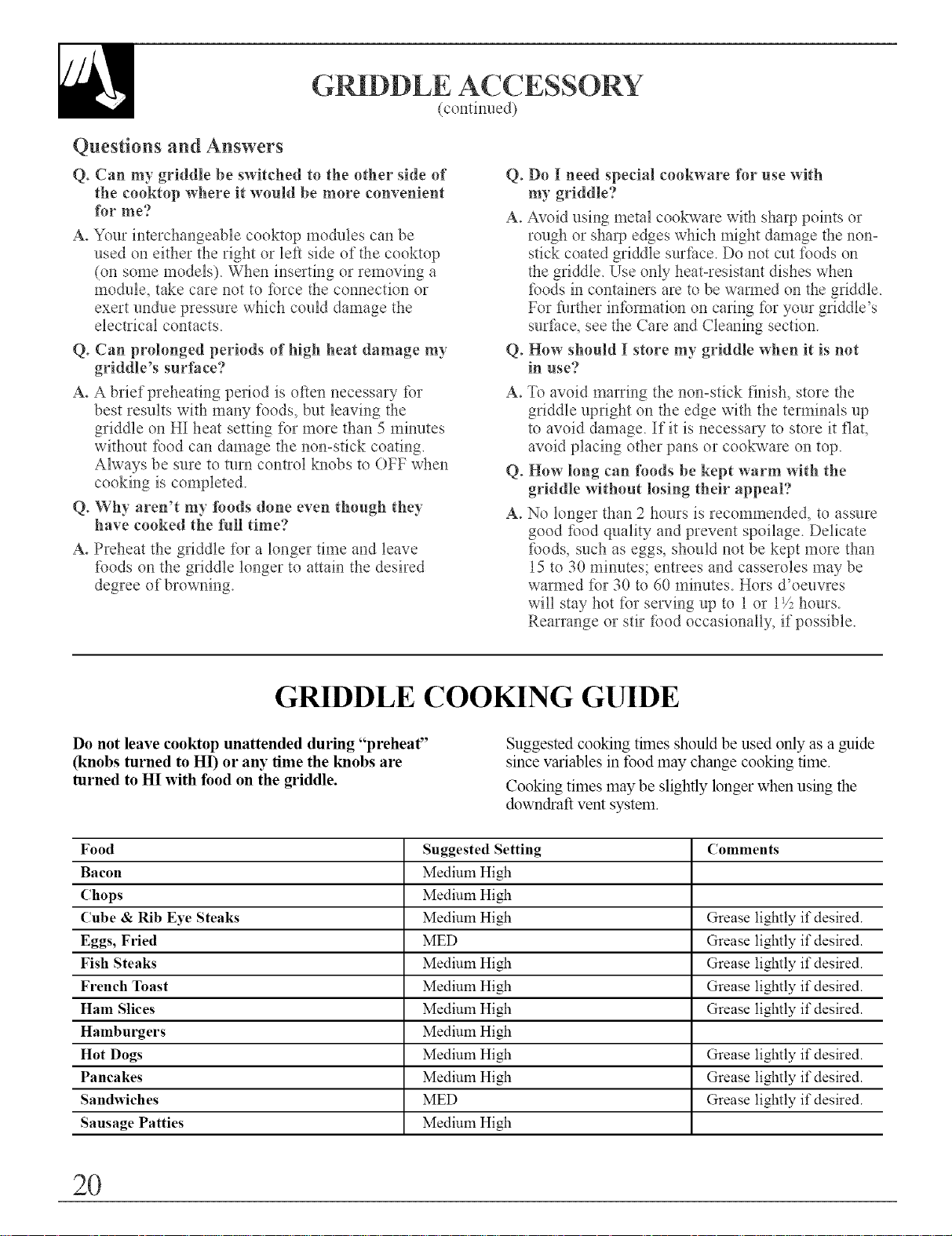
GRIDDLE COOKING GUIDE
Do not leave cooktop unattended during "preheat"
(knobs turned to HI) or any time the knobs are
turned to HI with food on the griddle.
Suggested cooking times should be used only as a guide
since variables in food may change cooking time.
Cooking times may be slightly longer when using the
downdraft vent system.
Food Suggested Setting Comments
Bacon Medium High
Chops Medium High
Cube & Rib Eye Steaks Medium High Grease lightly if desired.
Eggs, Fried MED Grease lightly if desired.
Fish Steaks Medium High Grease lightly if desired.
French Toast Medium High Grease lightly if desired.
Ham Slices Medium High Grease lightly if desired.
Hamburgers Medium High
Hot Dogs Medium High Grease lightly if desired.
Pancakes Medium High Grease lightly if desired.
Sandwiches MED Grease lightly if desired.
Sausage Patties Medium High
20
HOME CANNING TIPS
GEAppliances.com
Canning should be done on the Coil Surface Units or
the Radiant Units only.
Pots that extend beyond 1inch of the surface unit are not
recommended tier most surt;ace cooking However, when
canning wiffl a wa_er-bmh or pressure canner, lmger-
Nameter cookware may be used. This is because boiling
wa_er temperatures (even under pressure) are not hamaful
to coolCtop surthces suuounding the surface unit.
HOWEVER, DO NOT USE LARGE DIAMETER
CANNERS OR OTHER LARGE DIAMETER POTS
FOR FRYING OR BOILING FOODS ()THEE, THAN
WATER. Most syrup or sauce mixtures--and aH types of
flied _bods--cook at temperatures much higher than
boiling water. Such temperatures could eventually ham_
cooktop sur_i_ces surrounding the module sur_i_ceunits.
Observe Following Points in Canning
1. Be sure the canner fits over the center ofl_e surthce
unit. If your cooMop or its location does not allow the
canner to be centered on the surthce unit, use smaller-
diameter canners for good canning results or try putting
module on opposite side of cooktop (on some models)
so the larger unit is in fiont. Be sure the canner or other
large diameter pans do not touch the control knobs or
the vent grille. The knobs and the vent grille will be
damaged if touched by hot coolcvvare.
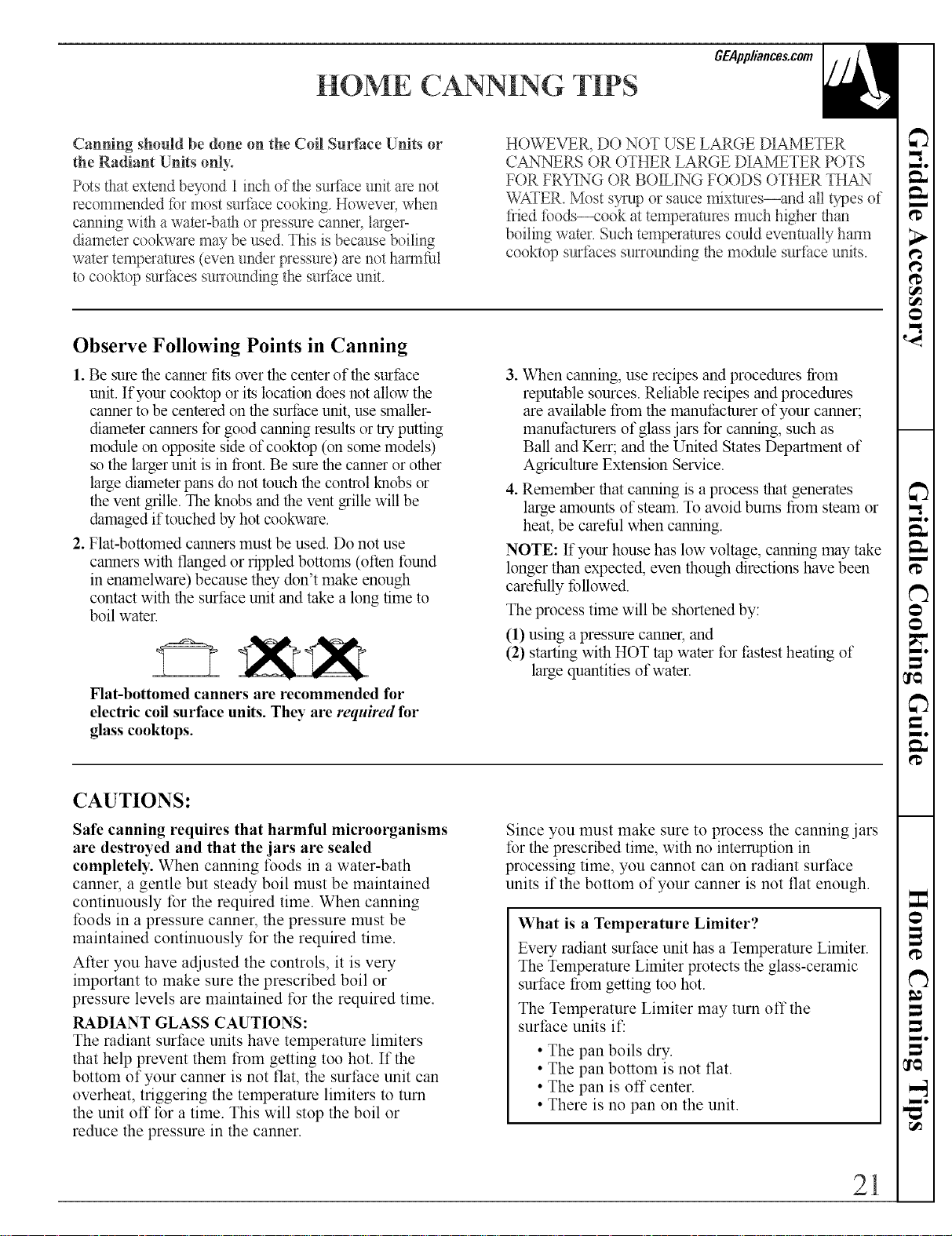
2. Flat-bottomed canners must be used. Do not use
canners with flanged or rippled bottoms (often tbund
in enamelware) because they don't make enough
contact with the surface unit and take a long time to
boil water.
Flat-bottomed canners are recommended for
electric coil surface units. They are required for
glass cooktops.
3. When canning, use recipes and procedures from
reputable sources. Reliable recipes and procedures
are available from the manu_hcturer of your canner;
manufacturers of glass jars tbr canning, such as
Ball and Kerr; and the United States Department of
Agriculture Extension Service.
4. Remember that canning is a process that generates
large amounts of steam. To avoid bums from steam or
heat, be careful when canning.
NOTE: If your house has low voltage, canning may take
longer than expected, even though directions have been
carefully _bllowed.
The process time will be shortened by:
(1) using a pressure canner, and
(2) starting with HOT tap water for fastest heating of
large quantities of water.
CAUTIONS:
Safe canning requires that harmful microorganisms
are destroyed and that the jars are sealed
completely. When canning foods in a water-bath
canner, a gentle but steady boil must be maintained
continuously tbr the required time. When canning
foods in a pressure canner, the pressure must be
maintained continuously for the required time.
After you have adjusted the controls, it is very
important to make sure the prescribed boil or
pressure levels are maintained for the required time.
RADIANT GLASS CAUTIONS:
The radiant surface units have temperature limiters
that help prevent them from getting too hot. If the
bottom of your canner is not flat, the surface unit can
overheat, triggering the temperature limiters to turn
the unit off for a time. This will stop the boil or
reduce the pressure in the canner.
Since you must make sure to process the canning jars
for the prescribed time, with no interruption in
processing time, you cannot can on radiant surface
units if the bottom of your canner is not flat enough.
What is a Temperature Limiter?
Eve_¢ radiant surface unit has a Temperature Limiter.
The Temperature Limiter protects the glass-ceramic
surface from getting too hot.
The Temperature Limiter may turn off the
surface units if:
• The pan boils dry.
• The pan bottom is not fiat.
• The pan is off center.
• There is no pan on the unit.
21
COOKTOP VENT SYSTEM
The blower comes on automatically when the grill or griddle is turned on
and turns off automatically when the grill or griddle is aimed off.
If the vent is turned on using the knob, the Nower will not mrn off
automatically and irmst be turned off using the knob.
The built-in vent system hdps remove cooking vapors, odors and smoke
from foods prepared on the cooktop modNes.
How to Operate Vent System
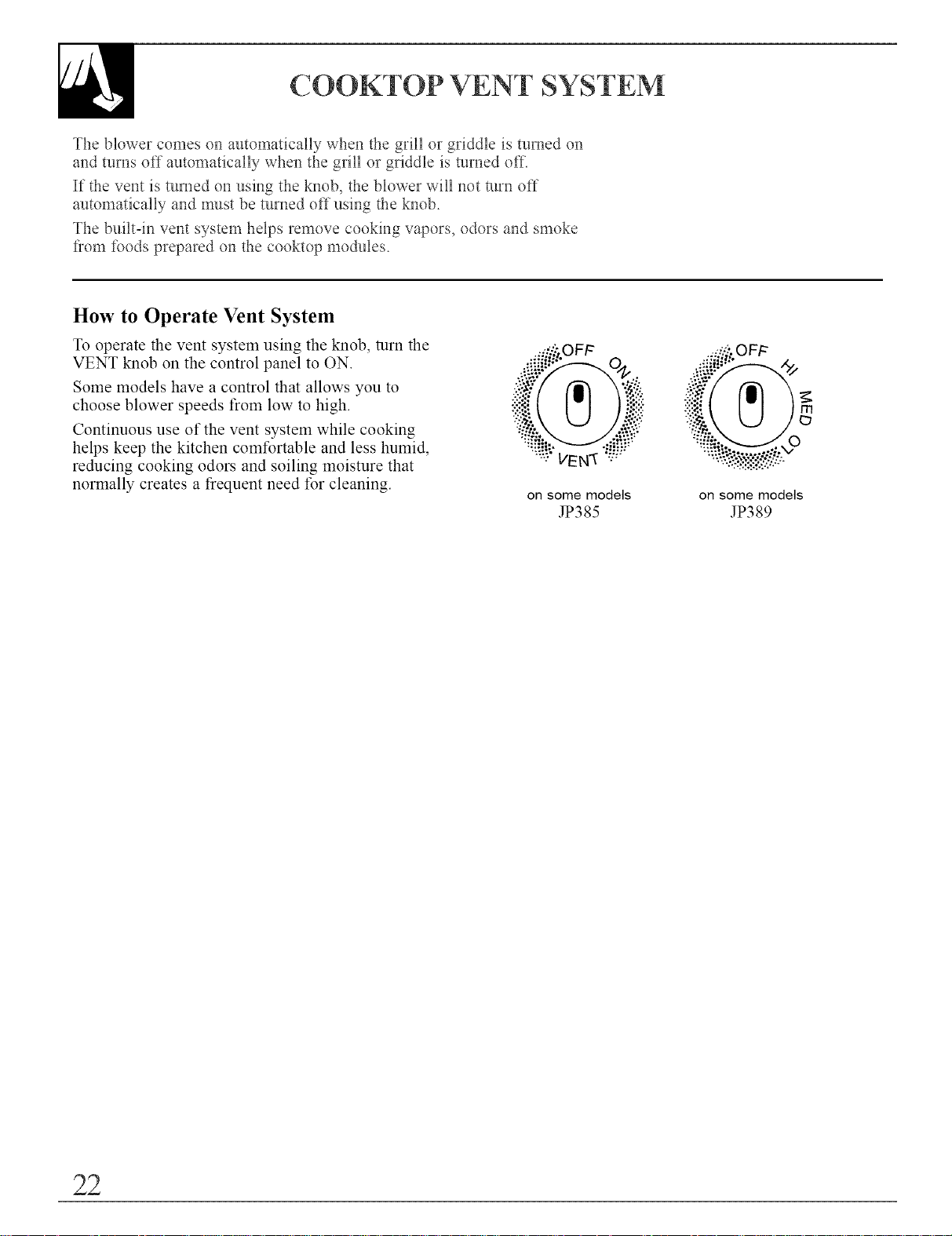
To operate the vent system using the knob, turn the
VENT knob on the control panel to ON.
Some models have a control that allows you to
choose blower speeds from low to high.
Continuous use of the vent system while cooking
helps keep the kitchen comfortable and less humid,
reducing cooking odors and soiling moisture that
normally creates a frequent need for cleaning.
•<::'_0 FF
•:':_i i'::::-
on some models
,_385
• _;.oFF
:i"! i_xO
on some models
JP389
22
CARE AND CLEANING
GEAppliances.com
NOTE: Let cooktop parts cool before touching or handling.
Proper care and cleaning are important so your cooktop will give you
eNcient and satisfactory service. Follow these directions carefillly in
caring for your cooktop to assure sate and proper maintenance.
Porcelain Enamel Finish (on some models)
The porcelain enamel finish is sturdy but breakable if
misused. This finish is acid-resistant. However, any
acidic foods spilled (such as fruit juices, tomato or
vinegar) should not be permitted to remain on the finish.
If acids spill on the cooktop while it is hot, use a dry
paper towel or cloth to wipe it up right away. When
the surface has cooled, wash with soap and water.
Rinse well.
For other spills such as t:at spatterings, wash with
soap and water after the surt:ace has cooled. Rinse
well. Polish with a dry cloth.
Brushed Chrome Finish (on some models)
Clean the brushed chrome top with warm, soapy
water or Bon Ami _' brand cleanser and immediately
dry it with a clean, soft cloth. Take care to dry the
surface following the "grain." To help prevent finger
marks after cleaning, spread a thin film of baby oil
on the surface. Wipe away excess oil with a clean,
soft cloth.
Grease Collector Jar
Scoop out grease with a large spoon. Soak the.jar in warm water
to loosen grease if desired. Clean with a plastic or soap-filled
u
scouring pad and hot soapy water.
The jar may also be cleaned in the dishwasher.
The .jar may be replaced with any wide mouth canning .jar.
Control Panel and Knobs
Clean up any spills or spatters with a damp cloth.
Remove heavier soil with warm, soapy water.
Clean the control panel with mild liquid dish detergent
and a soft cloth. Rub the control panel lightly.
CAUTION: Do not use abrasives of any kind on the
control panel.
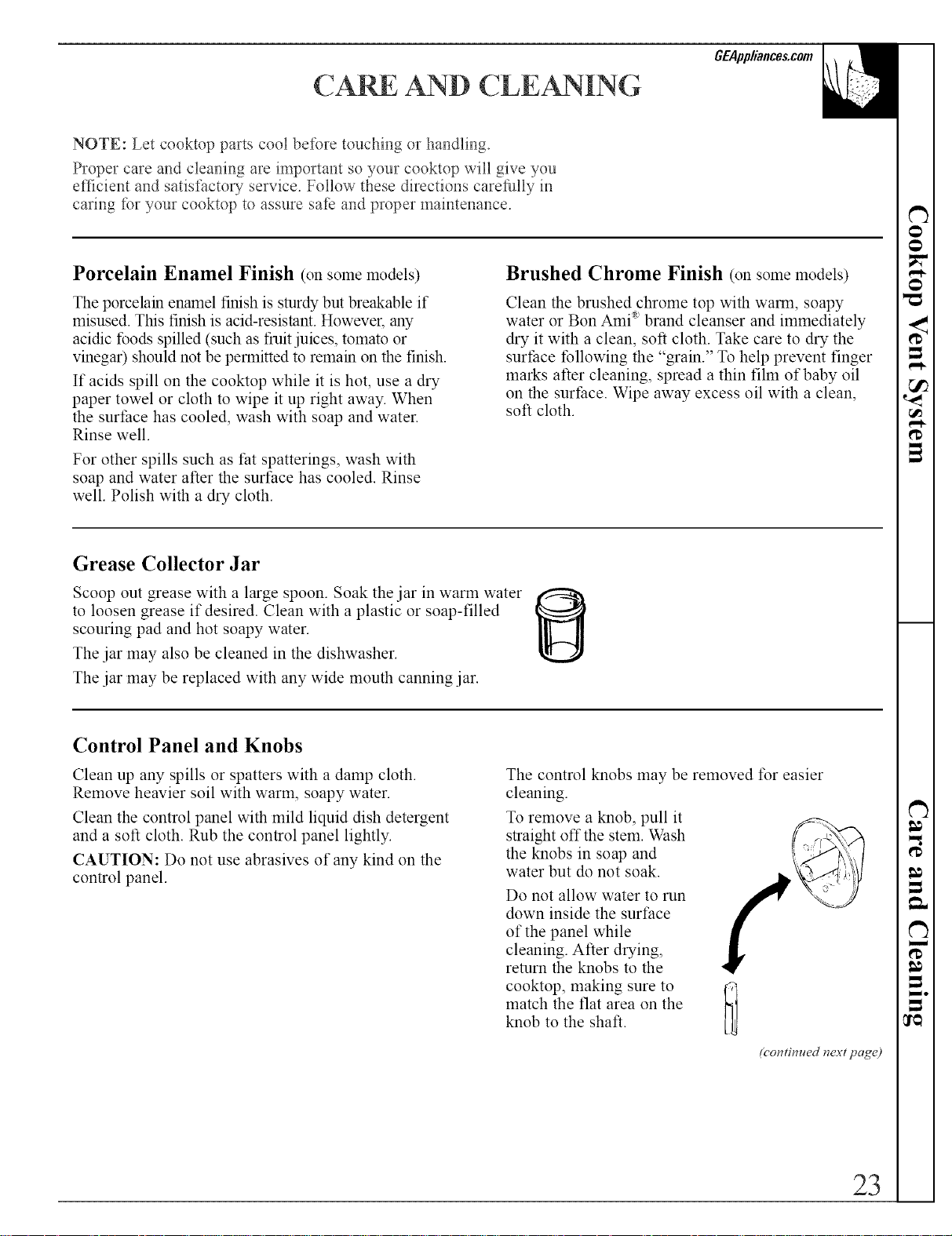
The control knobs may be removed for easier
cleaning.
To remove a knob, pull it
straight off the stem. Wash
the knobs in soap and
water but do not soak.
Do not allow water to run
down inside the surface
of the panel while
cleaning. After drying,
return the knobs to the
cooktop, making sure to
match the flat area on the
knob to the shaft.
(comimwd ne.vt page)
23
CARE AND CLEANING
(continued)
Cooktop Tub
Wipe out mb with hot soapy water--
or a soap-filled or plastic scouting
pad. Rinse with a damp cloth.
Make sure the drain hole is not
blocked. Clean with a cotton
swab or toothpick.
Vent System
Before cleaning the vent grille, be sure exhaust
blower is shut off
To clean the vent grille, remove it from the
cooktop by lifting it up. Wipe with a damp cloth.
If necessary the vent grille can be washed in the sink.
Use dishwashing liquid tbr cleaning.
Do not use abrasive cleaners. They will damage the
vent grille's finish.
Do not clean the vent grille in the dishwasher.
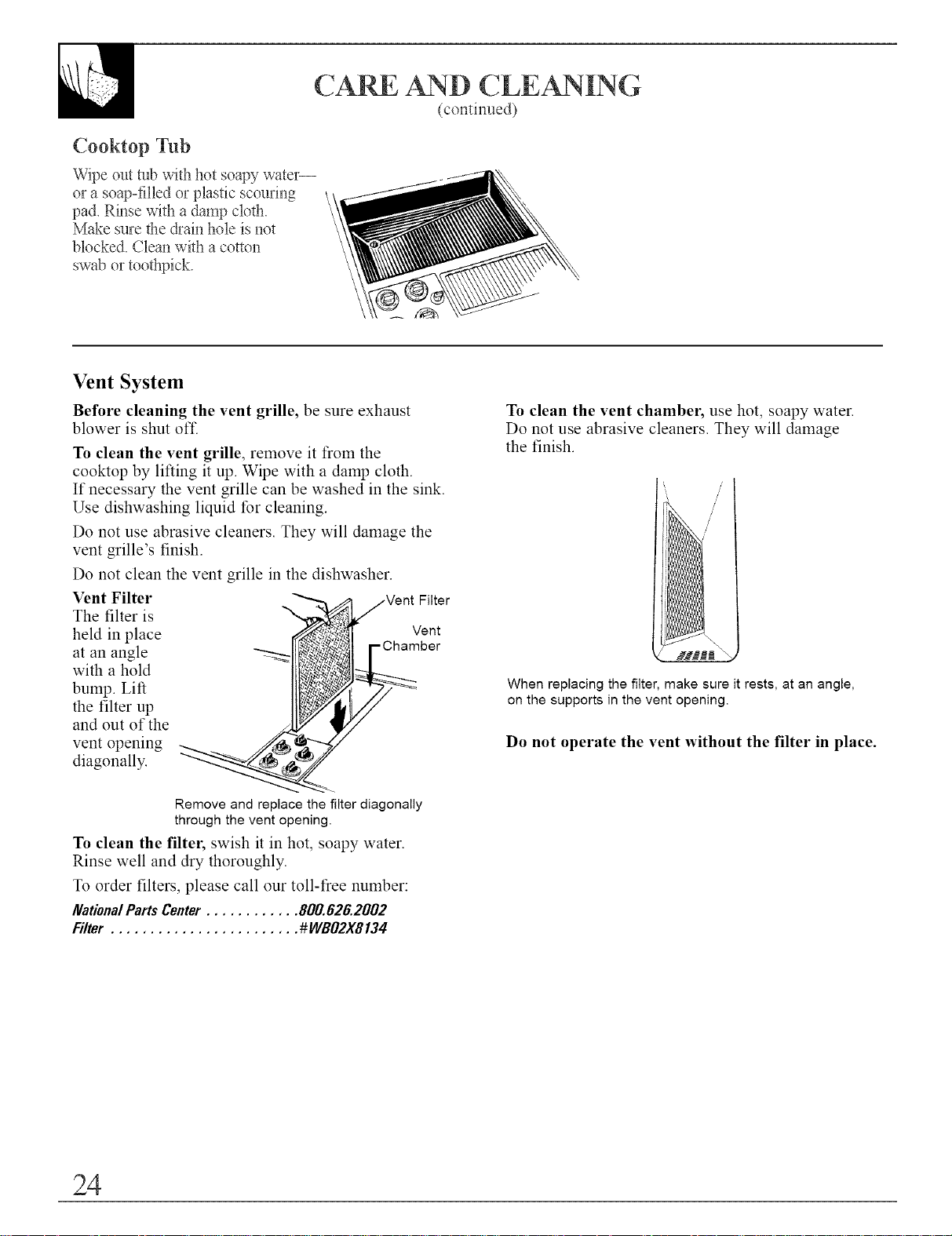
Vent Filter Filter
The filter is
held in place Vent
at an angle
with a hold
bump. Lift
the filter up
and out of the
vent opening
diagonally.
To clean the vent chamber, use hot, soapy water.
Do not use abrasive cleaners. They will damage
the finish.
When replacing the filter, make sure it rests, at an angle,
on the supports in the vent opening.
Do not operate the vent without the filter in place.
Remove and replace the filter diagonally
through the vent opening.
To clean the filter, swish it in hot, soapy water.
Rinse well and dry thoroughly.
To order filters, please call our toll-tree number:
National Parts Center ............ 800.626.2002
Filter ........................ #WBO2X8134
24
GEAppliances.com
Modules
CAUTION
• Be sure all controls are turned OFF before
attempting to remove a module or heating element.
• Do not attempt to clean plug-in surt:ace units or grill
heating element in an automatic dishwasher.
• Do not immerse plug-in surt:ace units in liquids of
any kind.
• Do not bend the plug-in surt:ace unit plug terminals.
• Do not attempt to clean, adjust or in any way repair
the plug-in receptacle.
Grill Module
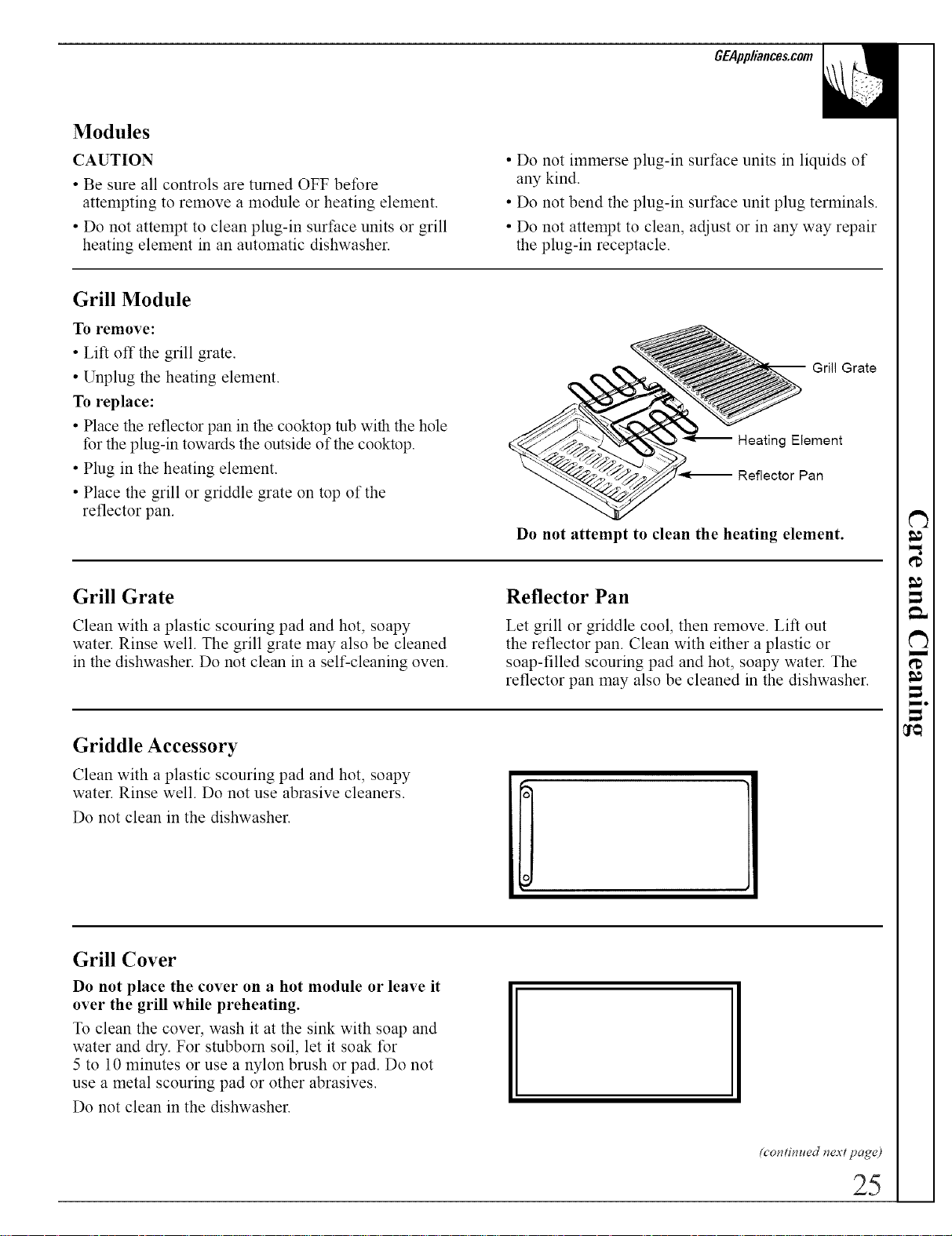
To remove:
• Lift off the grill grate.
• Unplug the heating element.
To replace:
• Place the reflector pan in the cooktop tub with the hole
for the plug-in towards the outside of the cooktop.
• Plug in the heating element.
• Place the grill or griddle grate on top of the
reflector pan.
-- Grill Grate
-- Heating Element
Reflector Pan
Do not attempt to clean the heating element.
Grill Grate
Clean with a plastic scouring pad and hot, soapy
water. Rinse well. The grill grate may also be cleaned
in the dishwasher. Do not clean in a self-cleaning oven.
Reflector Pan
Let grill or griddle cool, then remove. Lift out
the reflector pan. Clean with either a plastic or
soap-filled scouring pad and hot, soapy water. The
reflector pan may also be cleaned in the dishwasher.
Griddle Accessory
Clean with a plastic scouring pad and hot, soapy
water. Rinse well. Do not use abrasive cleaners.
Do not clean in the dishwasher.
Grill Cover
Do not place the cover on a hot module or leave it
over the grill while preheating.
To clean the cover, wash it at the sink with soap and
water and dry. For stubborn soil, let it soak for
5 to 10 minutes or use a nylon brush or pad. Do not
use a metal scouring pad or other abrasives.
Do not clean in the dishwasher.
CARE AND CLEANING
(continued)
Coil Surface Unit Module
Clean the area surrounding the surface units
according to either the Brushed Chrome or Porcelain
section (depending on your modeb.
To clean the surface units, turn the control to the
highest setting for a minute. The coils will bnrn off
any soil.
CAUTION
° Be sure all controls are turned to OFF and
surface units are cool be%re attempting to
remove them.
, Do not immerse the surface units or the module
in liquids of any kind.
, Do not clean the snrface nnits or the module in
a dishwasher.
, Do not bend the snr_i_ce unit plug terminals.
, Do not attempt to clean, adjust or in any way repair
the plug-in receptacle.
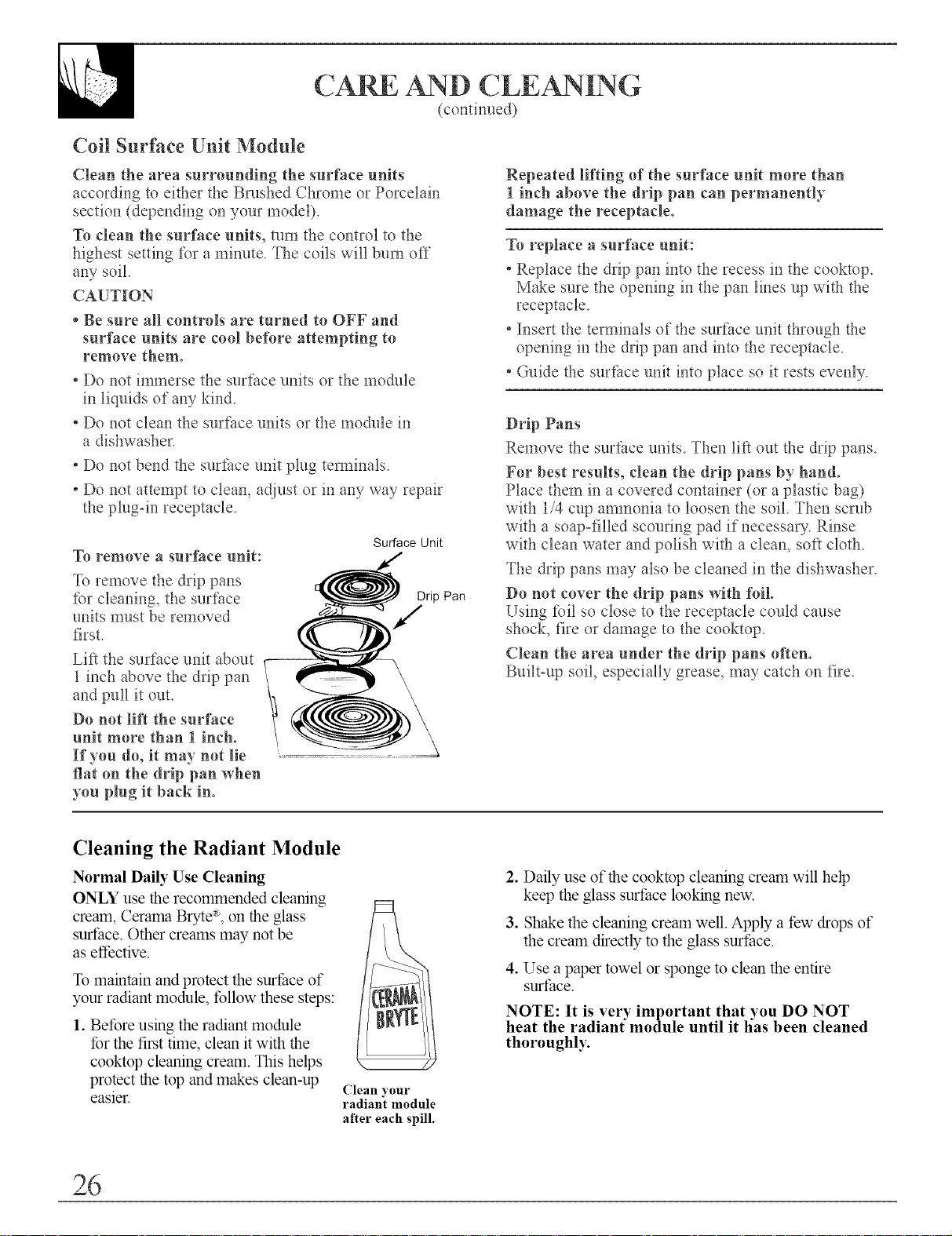
To remove a surface unit:
Surface Unit
To remove the drip pans
£br cleaning, the sur£i_ce DripPan
units must be removed J
first.
iF-
Lift the surti_ce unit about
1 inch above the drip pan //
and pull it ont.
Do not lift the surface
unit more than 1 inch.
If you do, it may not lie
llat on the drip pan when
you plug it back in.
Repeated lifting of the surface unit more than
1 inch above the drip pan can permanently
damage the receptacle.
To replace a surface unit:
, Replace the drip pan into the recess in the cooktop.
Make sure the opening in the pan lines up with the
receptacle.
, Insert the terminals of the suriace unit through the
opening in the drip pan and into the receptacle.
, Gnide the snr_ce nnit into place so it rests evenly.
Drip Pans
Remove the snr_i_ce nnits. Then lift out the drip pans.
For best results, clean the drip pans by hand.
Place them in a covered container (or a plastic bag)
with 1/4 cup ammonia to loosen the soil. Then scrub
with a soap-filled scouring pad if necessary. Rinse
with clean water and polish with a clean, soft cloth.
The drip pans may also be cleaned in the dishwasher.
Do not cover the drip pans with %iL
Using _bil so close to the receptacle conld cause
shock, fire or damage to the cooktop.
Clean the area under the drip pans often.
Bnilt-np soil, especially grease, may catch on fire.
Cleaning the Radiant Module
Normal Daily Use Cleaning
ONLY use the recommended cleaning
cream, Cerama BryteL on the glass
surface. Other creams may not be
as efl'ective.
To maintain and protect the surt;ace of
your radiant module, tbllow these steps:
1. Betbre using the radiant module
for the first time, clean it with the
cooktop cleaning cream. This helps
protect the top and makes clean-up
easier.
Clean your
radiant module
after each spill.
2. Daily use of the cooktop cleaning cream will help
keep the glass surface looking new.
3. Shake the cleaning cream well. Apply a few drops of
the cream directly to the glass surface.
4. Use a paper towel or sponge to clean the entire
surface.
NOTE: It is very important that you DO NOT
heat the radiant module until it has been cleaned
thoroughly.
26
GEAppliances.com
Cleaning the Radiant Module (continued)
Burned-On Residue
WARNING: DAMAGE to your glass surface may
occur if you use scrub pads other than BLUE
Scotch-Brite _ Multi-Purpose No Scratch scrub
pads by 3M.
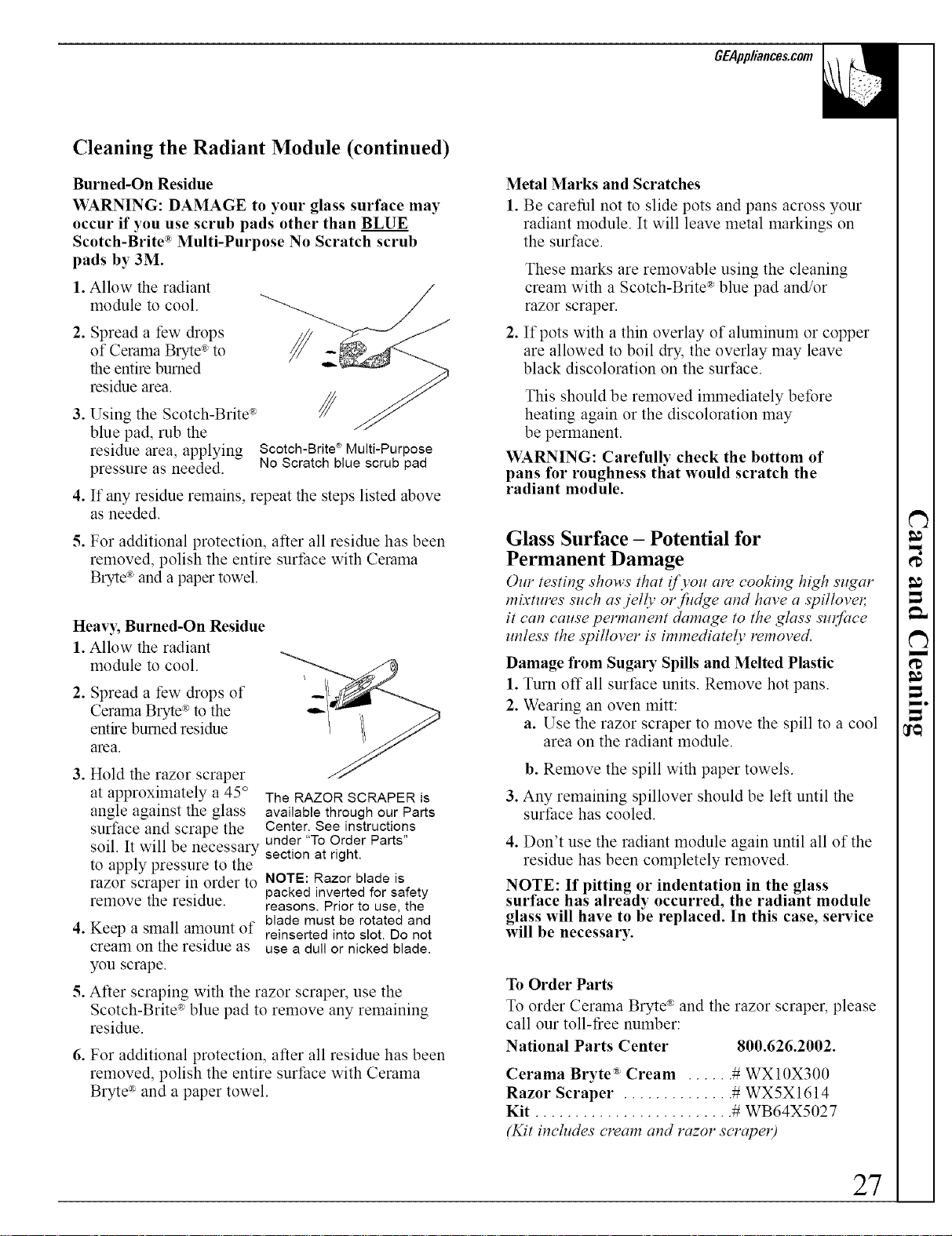
1. Allow the radiant
module to cool.
2. Spread a few drops
of Cerama Bryte<to
the entire burned
residue area.
3. Using the Scotch-Brite ®
blue pad, rub the
residue area, applying
pressure as needed.
Scotch-Brite ® Multi-Purpose
No Scratch blue scrub pad
4. If any residue remains, repeat the steps listed above
as needed.
5. For additional protection, after all residue has been
removed, polish the entire surface with Cerama
Bryte* and a paper towel.
HeaD, Burned-On Residue
1. Allow the radiant
module to cool.
2. Spread a few drops of
Cerama Bryte®to the
entire burned residue
area.
3. Hold the razor scraper
at approximately a 45 °
angle against the glass
surt:ace and scrape the
soil. It will be necessary
to apply pressure to the
razor scraper in order to
remove the residue.
4. Keep a small amount of
cream on the residue as
you scrape.
The RAZOR SCRAPER is
available through our Parts
Center. See instructions
under "To Order Parts"
section at right.
NOTE: Razor blade is
packed inverted for safety
reasons. Prior to use, the
blade must be rotated and
reinserted into slot. Do not
use a dull or nicked blade.
5. After scraping with the razor scraper, use the
Scotch-Brite ®blue pad to remove any remaining
residue.
6. For additional protection, after all residue has been
removed, polish the entire surface with Cerama
Bryte ®and a paper towel.
Metal Marks and Scratches
1. Be careful not to slide pots and pans across your
radiant module. It will leave metal markings on
the surt:ace.
These marks are removable using the cleaning
cream with a Scotch-Brite :_'blue pad and/or
razor scraper.
2. If pots with a thin overlay of aluminum or copper
are allowed to boil dry, the overlay may leave
black discoloration on the surt:ace.
This should be removed immediately before
heating again or the discoloration may
be permanent.
WARNING: Carefully check the bottom of
pans for roughness that would scratch the
radiant module.
Glass Surface - Potential for
Permanent Damage
Our testing shows that i!you are cooking high sugar
mixtures such as jelly orJi¢dge and have a spilloveg
it can cause permanent damage to the glass surJilce
unless the spillover is immediately removed.
Damage from Sugary Spills and Melted Plastic
1. Turn off all surface units. Remove hot pans.
2. Wearing an oven mitt:
a. Use the razor scraper to move the spill to a cool
area on the radiant module.
b. Remove the spill with paper towels.
3. Any remaining spillover should be left until the
surface has cooled.
4. Don't use the radiant module again until all of the
residue has been completely removed.
NOTE: If pitting or indentation in the glass
surface has already occurred, the radiant module
glass will have to be replaced. In this case, service
will be necessary.
To Order Parts
To order Cerama Bryte ®and the razor scraper, please
call our toll-tree number:
National Parts Center 800.626.2002.
Cerama Bryte :_Cream ...... # WXl0X300
Razor Scraper .............. # WX5X1614
Kit ......................... # WB64X5027
(Kit inch¢des cream and razor scrape 0
27
Before you begin
Read these instructions completely and
carefully.
Important--Save these instructions for
local inspector's use.
Important--Observe all governing codes
and ordinances.
NOTE TO INSTALLER--Be sure to leave
these instructions with the Consumer.
NOTE: This appliance must be properly
grounded.
Unless very knowledgeable in the installation
of this product, engage a professional installer.
ToolsYouWill Heed
• Flat blade screwdriver
• Electrician's pliers
• Duct tape
• Measuring tape or scale
• Carpenter's square
• Wrench or socket set
• Drill and drill bit
• Sheet metal screws
• Junction box
NO'I_: Installation of this unit requires 2 people.
Do not attempt to install without assistance.
Electrical Requirements
CAUTION: FOR PERSONAL SAFETY,
REMOVE HOUSE FUSE OR CIRCUIT
BREAKER BEFORE BEGINNING
INSTALLATION.
This appliance must be supplied with the
proper w)ltage and frequency, as listed in these
Installation Instructions, and connected to an
individual, properly grounded branch circuit,
protected by a circuit breaker or time delay fuse.
Proper electrical ratings should be verified
with listing on product's rating plate. The rating
plate is located on the right-hand side of the
exhaust plenum.
All wire connections must be made in accordance
with local codes and properly insulated. Check
with your local utility for governing electrical
codes and ordinances. In the absence of local
electrical codes, the National Electrical Code,
ANSI/NFPA No. 70-Latest Edition, governing
electric range installations, must be followed.
A copy of the National Electrical Code can be
obtained by writing to:
National Fire Protection Association
Batterymarch Park
Quincy, MA 02260
NOTE: Electrical installation kit JXCK89
may be ordered separately and includes
all the parts necessary to connect the
cooktop to typical rough-in wiring.
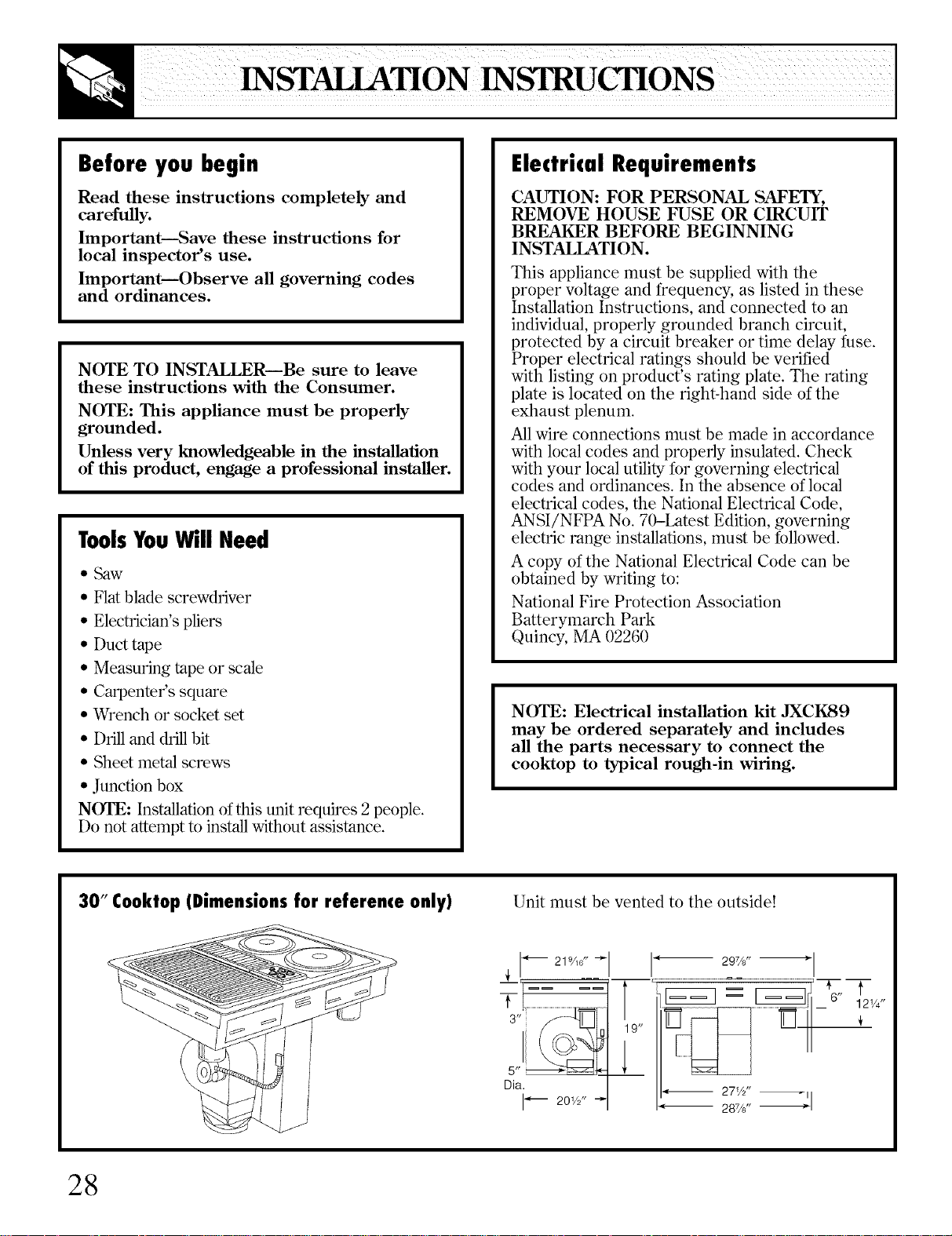
30" Cooktop (Dimensions for reference only)
Unit must be vented to the outside!
,j _-- 21%s"
7
19"
Dia.
I'- 20_A/'
_--- 29%"
_--- 27_//,
28
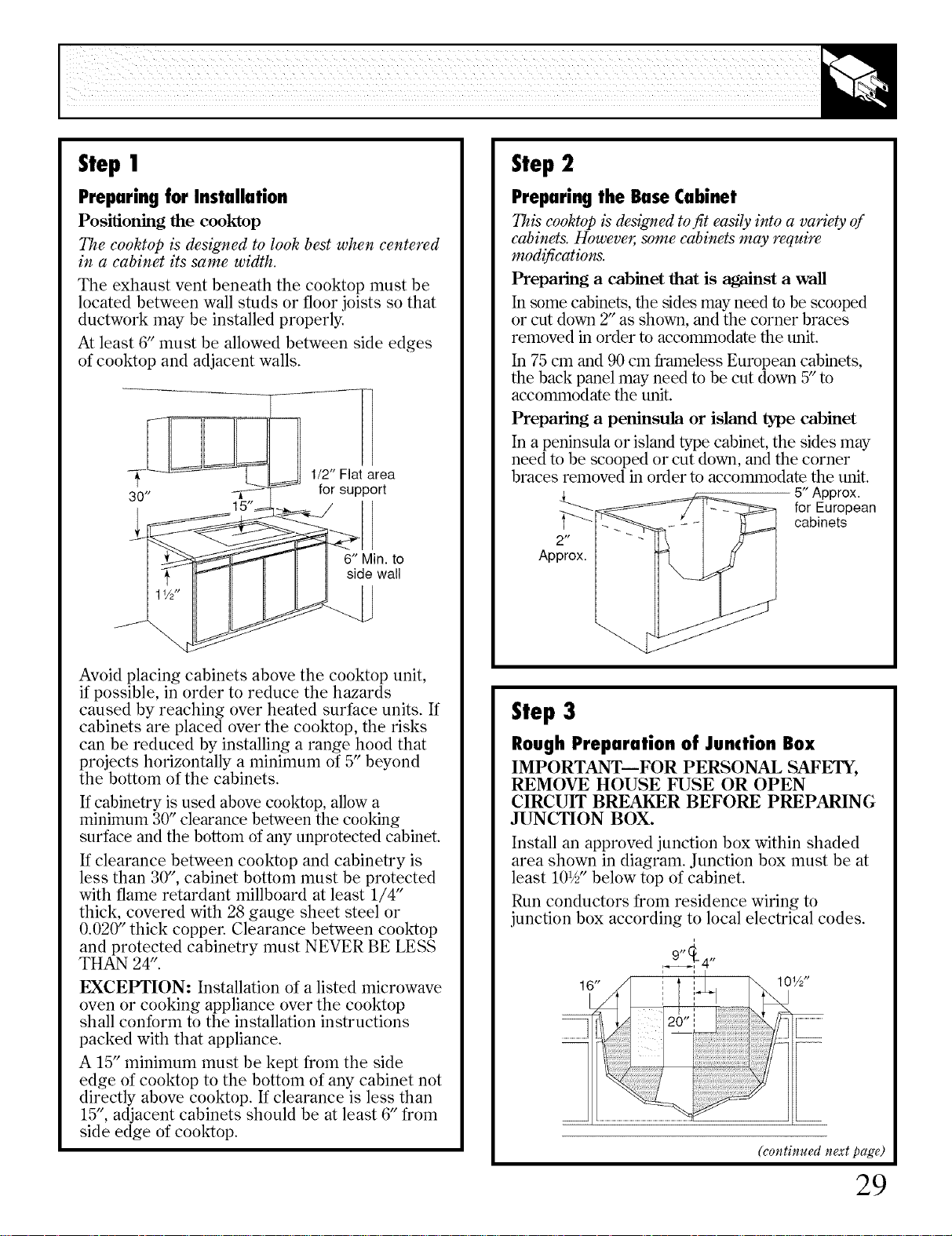
Step !
Preparing for Installation
Positioning the cooktop
The cooktop is designed to look best when centered
in a cabinet its same width.
The exhaust vent beneath the cooktop must be
located between wall studs or floor joists so that
ductwork may be installed properly.
At least 6" must be allowed between side edges
of cooktop and adjacent walls.
1/2" Flat area
for support
6" Min. to
side wall
Avoid placing cabinets above the cooktop unit,
if possible, in order to reduce the hazards
caused by reaching over heated surface units. If
cabinets are placed over the cooMop, the risks
can be reduced by installing a range hood that
projects horizontally a minimum of 5" beyond
the bottom of the cabinets.
If cabinetry is used above cooktop, allow a
minimum 30, clearance between the cooking
surface and the bottom of any unprotected cabinet.
If clearance between cooktop and cabinetry is
less than 30,, cabinet bottom must be protected
with flame retardant millboard at least 1/4"
thick, covered with 28 gauge sheet steel or
0.020' thick copper. Clearance between cooMop
and protected cabinetry must NEVER BE LESS
THAN 24".
EXCEPTION: Installation of a listed microwave
oven or cooking appliance over the cooktop
shall conform to the installation instructions
packed with that appliance.
A 15" minimum must be kept from the side
edge of cooMop to the bottom of any cabinet not
directly above cooMop. If clearance is less than
15% adjacent cabinets should be at least 6" from
side edge of cooktop.
Step2
Preparing the Base Cabinet
This co&top is designed to fit easily into a variety of
cabinets. Howeveg some cabinets may require
modifications.
Preparing a cabinet that is against a wall
In some cabinets, the sides may need to be scooped
or cut down 2" as shown, and the corner braces
removed in order to accommodate the unit.
In 75 cm and 90 cm frameless European cabinets,
the back panel may need to be cut down 5" to
accommodate the unit.
Preparing a peninsula or island type cabinet
Ina peninsula or island type cabinet, the sides may
need to be scooped or cut down, and the corner
braces removed in order to accommodate the unit.
5" Approx.
for European
cabinets
2"
Approx.
Step3
Rough Preparation of Junction Box
IMPORTANT--FOR PERSONAL SAFETY,
REMOVE HOUSE FUSE OR OPEN
CIRCUIT BREAKER BEFORE PREPARING
JUNCTION BOX.
Install an approved junction box within shaded
area shown in diagram. Junction box must be at
least 101/2"below top of cabinet.
Run conductors from residence wiring to
junction box according to local electrical codes.
16'*
(continued next page)
29
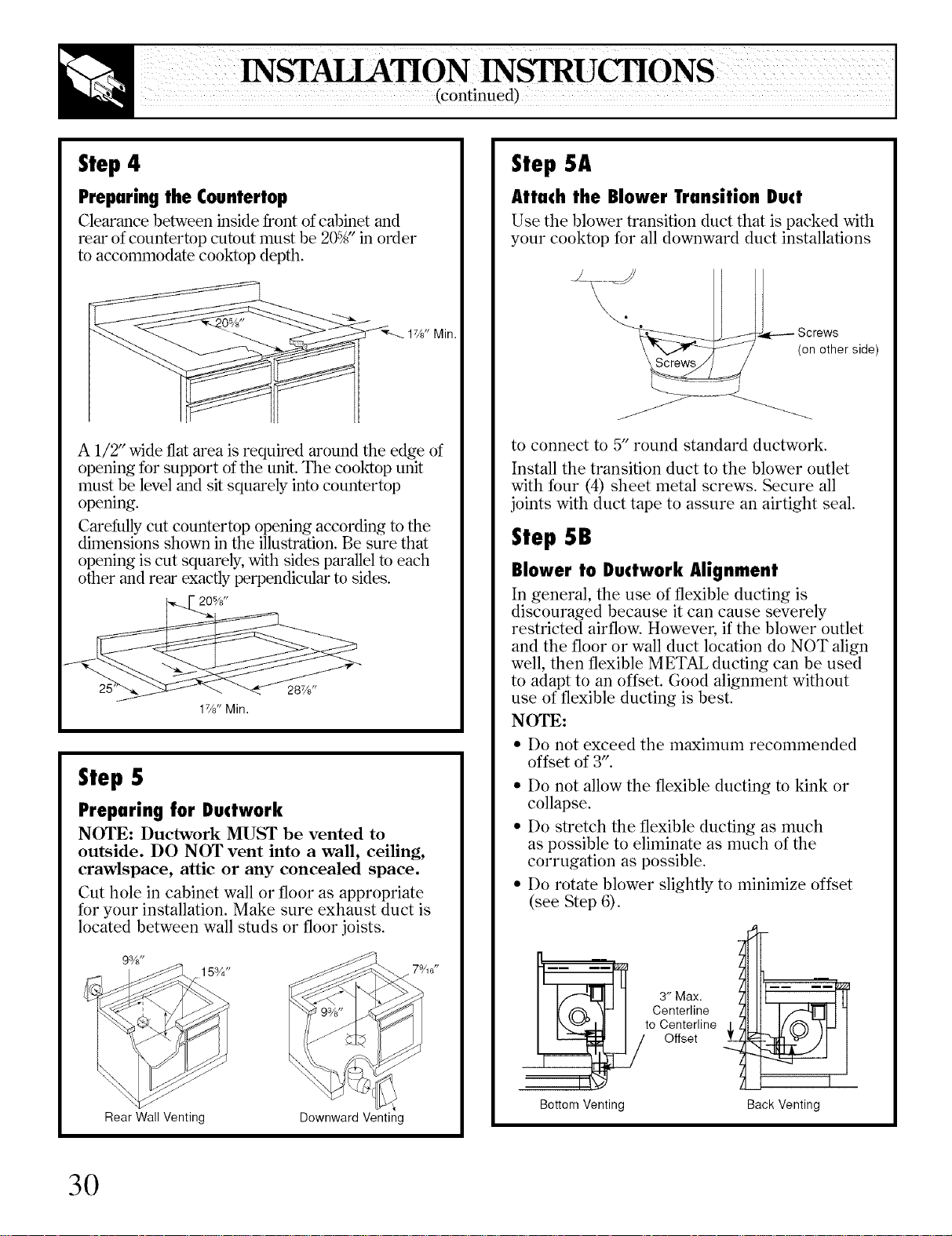
Step 4
Preparing the Countertop
Clearance between inside front of cabinet and
rear of countertop cutout must be 2@A" in order
to accommodate cooktop depth.
Min.
A 1/2" wideflat area is required around the edge of
opening for support of the unit. The cooktop unit
must be level and sit squarely intocountertop
opening.
Carefully cut countertop opening according to the
dimensions shown in the illustration. Be sure that
opening is cut squarely, with sides parallel to each
other and rear exactly perpendicular to sides.
20%"
Step5
Preparing for Ductwork
NOTE: Ductwork MUST be vented to
outside. DO NOT vent into a wall, ceiling,
crawlspace, attic or any concealed space.
Cut hole in cabinet wall or floor as appropriate
for your installation. Make sure exhaust duct is
located between wall studs or floor joists.
/16"
Rear Wall Venting
Downward Venting
Step5A
Attach the Blower Transition Duct
Use the blower transition duct that is packed with
your cooktop for all downward duct installations
(on other side)
to connect to 5" round standard ductwork.
Install the transition duct to the blower outlet
with four (4) sheet metal screws. Secure all
joints with duct tape to assure an airtight seal.
Step 5B
Blower to Ductwork Alignment
In general, the use of flexible ducting is
discouraged because it can cause severely
restricted airflow. However, if the blower outlet
and the floor or wall duct location do NOT align
well, then flexible METAL ducting can be used
to adapt to an offset. Good alignment without
use of flexible ducting is best.
NOTE:
• Do not exceed the maximum recommended
offset of 3".
• Do not allow the flexible ducting to kink or
collapse.
• Do stretch the flexible ducting as much
as possible to eliminate as much of the
corrugation as possible.
• Do rotate blower slightly to minimize offset
(see Step 6).
to Centerline
Offset
Bottom Venting Back Venting
3O
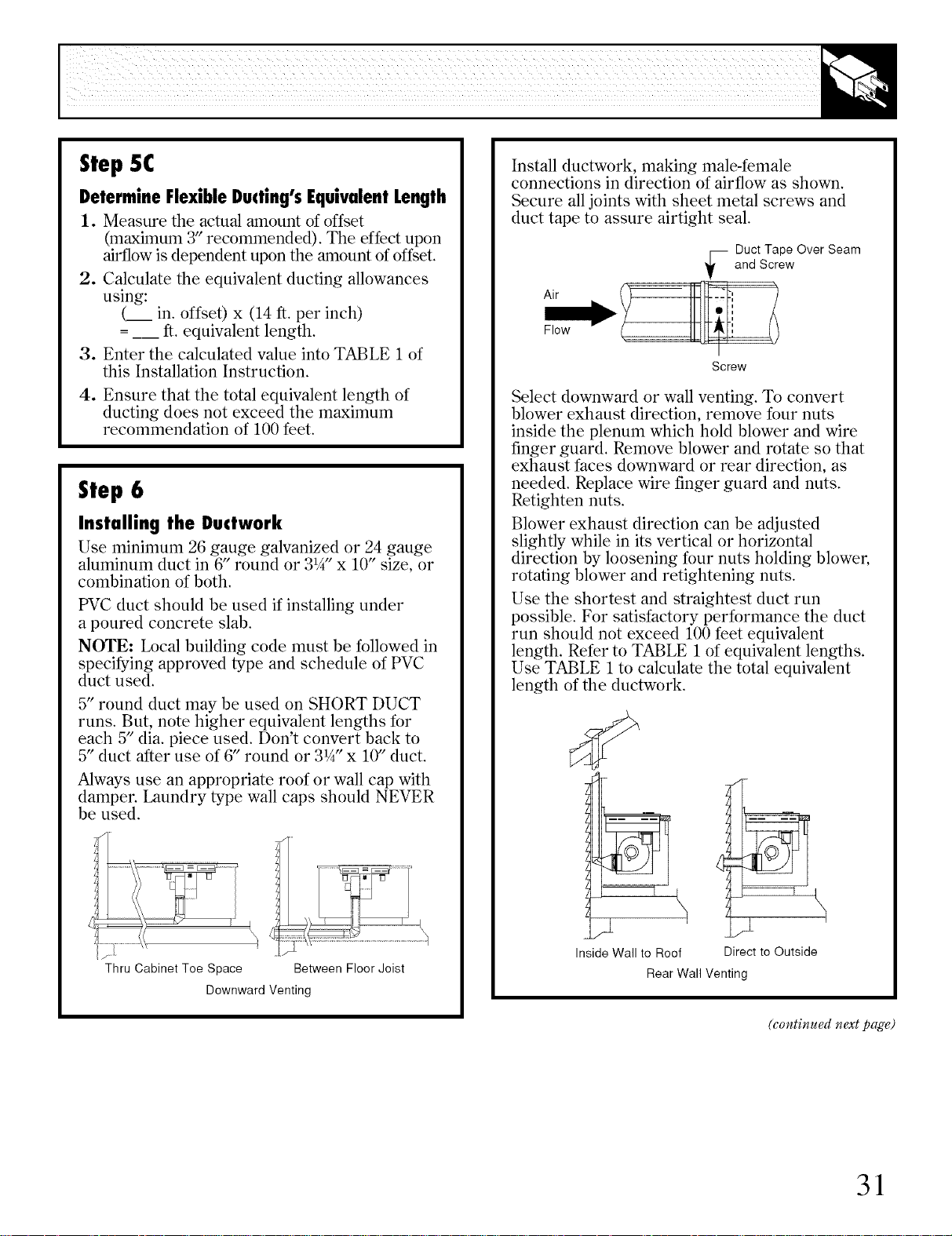
Step5C
DetermineFlexible Ducting'sEquivalentLength
1. Measure the actual amount of offset
(maximum 3" recommended). The effect upon
airflow is dependent upon the amount of offset.
2. Calculate the equivalent ducting allowances
using:
(___ in. offset) x (14 ft. per inch)
= ___ ft. equivalent length.
3. Enter the calculated value into TABLE 1 of
this Installation Instruction.
4. Ensure that the total equivalent length of
ducting does not exceed the maximum
recommendation of 100 feet.
Step6
Installing the Ductwork
Use minimum 26 gauge galvanized or 24 gauge
aluminum duct in 6" round or 31A" x 10" size, or
combination of both.
PVC duct should be used if installing under
a poured concrete slab.
NOTE: Local building code must be followed in
specifying approved type and schedule of PVC
duct used.
5" round duct may be used on SHORT DUCT
runs. But, note higher equivalent lengths for
each 5" dia. piece used. Don't convert back to
5" duct after use of 6" round or 31A" x 10" duct.
Always use an appropriate roof or wall cap with
damper. Laundry type wall caps should NEVER
be used.
\I
Thru Cabinet Toe Space Between Floor Joist
Downward Venting
Install ductwork, making male-female
connections in direction of airflow as shown.
Secure all joints with sheet metal screws and
duct tape to assure airtight seal.
Duct Tape Over Seam
-and Screw
Air
Screw
Select downward or wall venting. To convert
blower exhaust direction, remove four nuts
inside the plenum which hold blower and wire
finger guard. Remove blower and rotate so that
exhaust faces downward or rear direction, as
needed. Replace wire finger guard and nuts.
Retighten nuts.
Blower exhaust direction can be adjusted
slightly while in its vertical or horizontal
direction by loosening four nuts holding blower,
rotating blower and retightening nuts.
Use the shortest and straightest duct run
possible. For satisfactory performance the duct
run should not exceed 100 feet equivalent
length. Refer to TABLE i of equivalent lengths.
Use TABLE I to calculate the total equivalent
length of the ductwork.
Inside Wall to Roof
Direct to Outside
Rear Wall Venting
(continued next page)
31
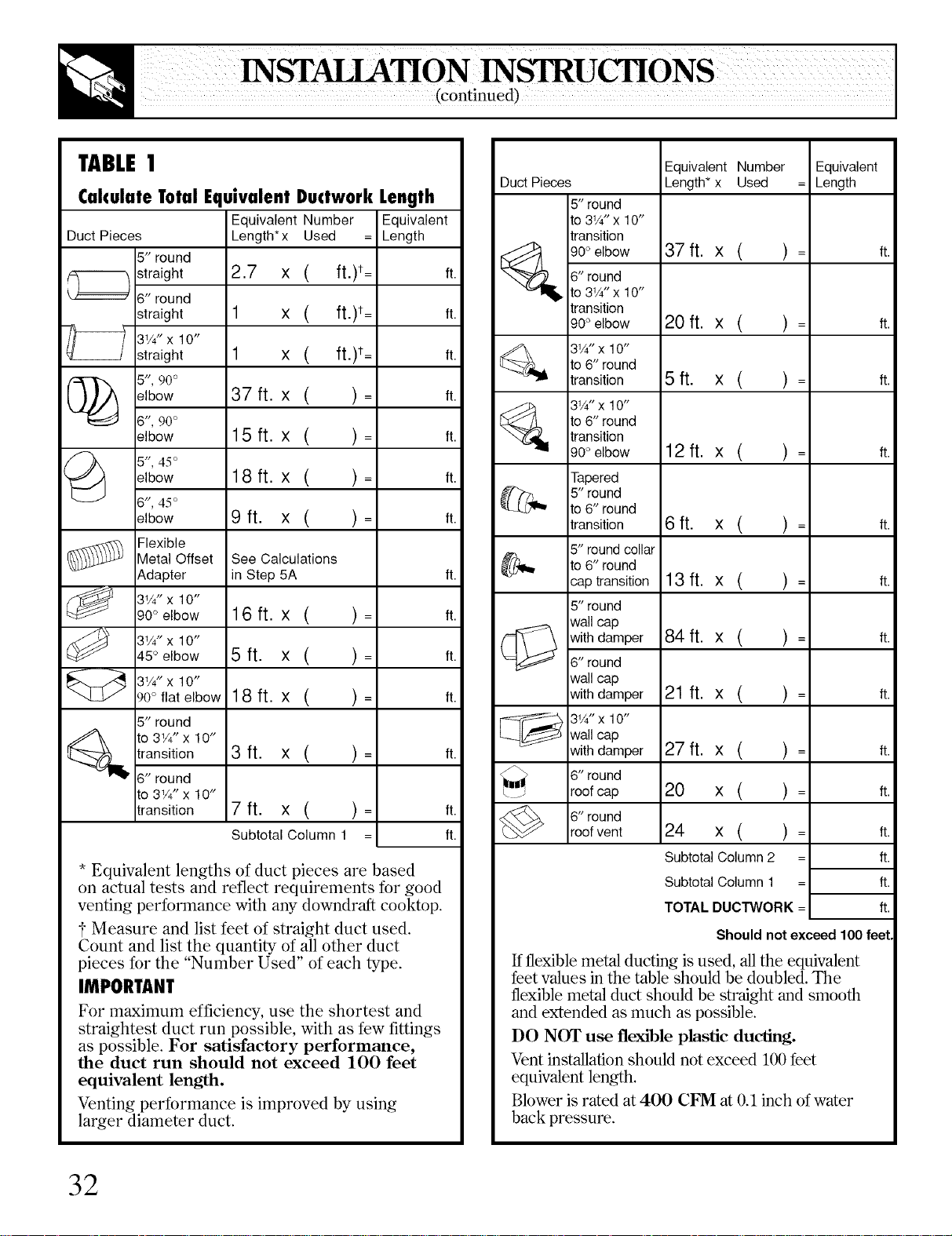
TABLE!
CalculateTotal Equivalent DuctworkLength
Equivalent Number Equivalent
Duct Pieces Length*x Used = Length
5" round
straight 2.7 X ( ft.)t= ft.
6" round
straight 1 X ( ft.)t= ft.
31/4"X 10"
straight 1 X ( ft.)t= ft.
(_ 5", 90°
elbow 37 ft. X ( ) = ft.
6", 90°
elbow 15 ft. X ( ) = ft.
@ 5", 45°
elbow 18 ft. X ( ) = ft.
6", 45°
elbow 9 ft. X ( ) = ft.
Flexible
Metal Offset See Calculations
Adapter in Step 5A ft.
31/4" x 10"
90°elbow 16 ft. X ( ) = ft.
31/4" x 10"
45° elbow 5 ft. x ( ) = ft.
31/4. x10 ,
90° flatelbow 18 ft. X ( ) = ft.
5" round
_ to 31/4" x 10"
transition 3 ft. x ( ) = ft.
6" round
to 31/4"x 10"
transition 7 ft. x ( ) = ft.
Subtotal Column 1 = ft.
* Equivalent lengths of duct pieces are based
on actual tests and reflect requirements for good
venting performance with any downdraSt cooktop.
? Measure and list feet of straight duct used.
Count and list the quantity of all other duct
pieces for the "Number Used" of each type.
IMPORTANT
For maximum efficiency, use the shortest and
straightest duct run possible, with as few fittings
as possible. For satisfactory performance,
the duct run should not exceed 100 feet
equivalent length.
Venting performance is improved by using
larger diameter duct.
Equivalent Number Equivalent
Duct Pieces Length* x Used = Length
5" round
to31/4"x10"
transition
90° elbow 37 ft. X ( ) = ft.
S" round
tO 31/4" X 10"
transition
90°elbow 20 ft. X ( ) = ft.
31/4" X 10"
to6" round
transition 5 ft. x ( ) = ft.
31/4.x10 ,
to 6" round
transition
90°elbow 12 ft. X ( ) = ft.
Tapered
5" round
to6" round
transition ft.
5" round collar
to 6" round
cap transition ft.
5" round
wall cap
(_ with damper ft.
6" round
wall cap
with damper ft.
@ 1/4"X10"
wall cap
with damper ft.
_1_ 6" round
roof cap ft.
6" round
roof vent
6ft. x( )=
13ft. x ( )=
84 ft. x ( ) =
21ft. x ( )=
27ft. x ( ) =
20 x ( )=
24 x ( )=
Subtotal Column 2 =
Subtotal Column 1 =
TOTAL DUCTWORK =
ft.
ft.
ft.
ft.
Should not exceed 100 feet
If flexible metal ducting is used, all the equivalent
feet values in the table should be doubled. The
flexible metal duct should be straight and smooth
and extended as much as possible.
DO NOT use flexible plastic ducting.
Vent installation should not exceed 100 feet
equivalent length.
Blower is rated at 400 CFM at 0.1 inch of water
back pressure.
32
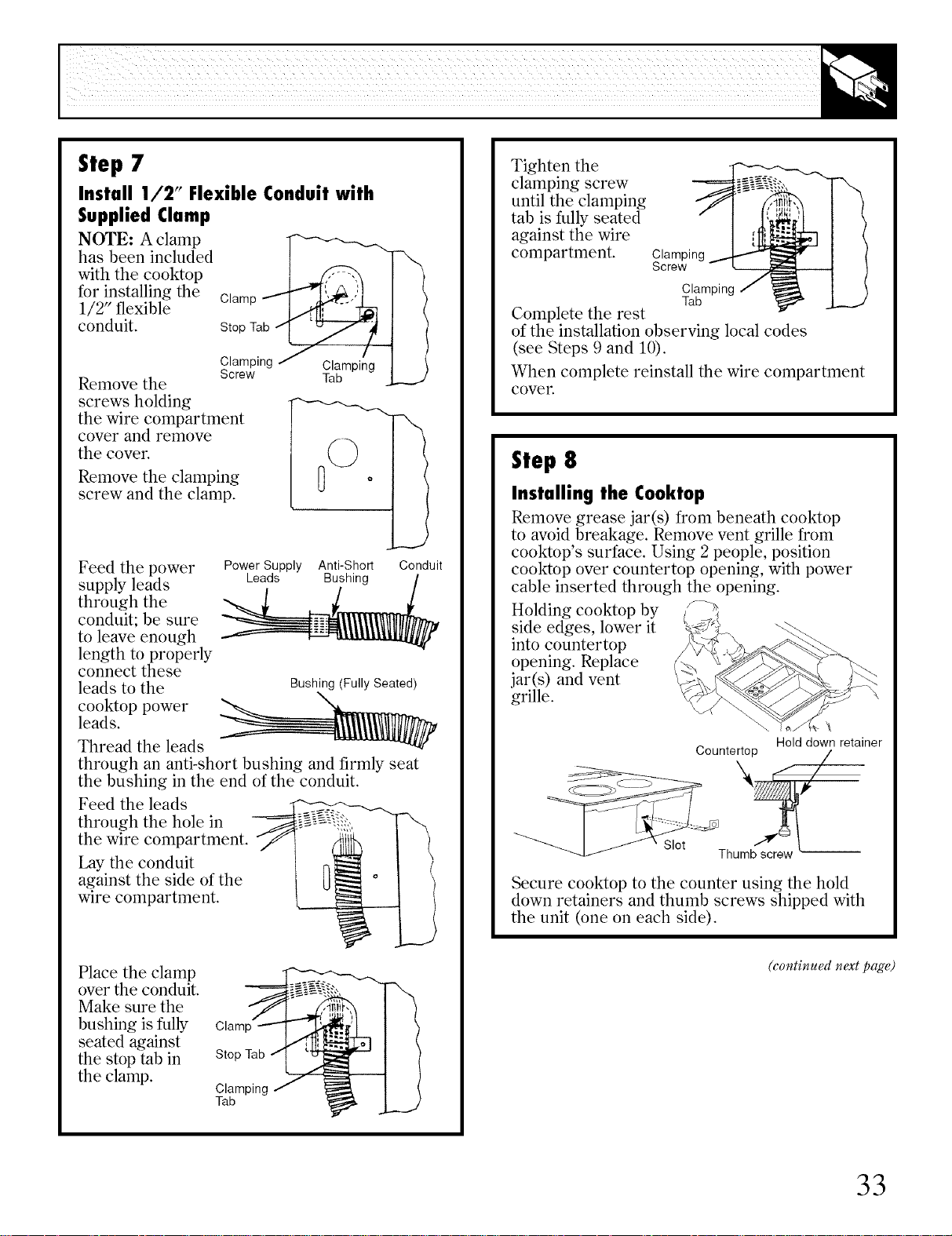
Step 7
Install !/2" Flexible Conduit with
Supplied Clamp
NOTE: A clamp _
has been included
with the cooktop
for installing the Clamp
1/2" flexible
conduit. StopTab q ._"'_ t
/
Clamping / Clamping
Remove the Screw Tab
screws holding
the wire compartment --_
cover and remove
)
the cover.
Remove the clamping _ o
screw and the clamp.
u
Feed the power Power Supply Anti-Short Conduit
supply leads Leads Bu/shing
through the _?.
conduit; be sure
to leave enough
length to properly
connect these
leads to the Bushing(FullySeated)
cooktop power
leads.
Thread the leads
through an anti-short bushing and firmly seat
the bushing in the end of the conduit.
Feed the leads
through the hole in --==__,:, -_
the wire compartment. _'/ '
Lay the conduit I n
against the side of the I U _ ° -
wire compartment. [
\
!
Place the clamp
over the conduit.
Make sure the
bushing is fully Clamp
seated against
the stop tab in Stop Tab
the clamp.
Clamping
Tab
Tighten the
clamping screw
until the clamping
tab is fully seated
against the wire
compartment. Clampin
Screw
Clamping
Tab
Complete the rest
of the installation observing local codes
(see Steps 9 and 10).
When complete reinstall the wire compartment
cover.
Step8
Installing the Cooktop
Remove grease jar(s) from beneath cooMop
to avoid breakage. Remove vent grille from
cooktop's surface. Using 2 people, position
cooktop over countertop opening, with power
cable inserted through the opening.
Holding cooMop by
side edges, lower it
into countertop
opening. Replace
jar(s) and vent
grille.
Countertop
_Slot Thurnb._c_ '_ _
Hold down retainer
Secure cooktop to the counter using the hold
down retainers and thumb screws shipped with
the unit (one on each side).
(continued next page)
33
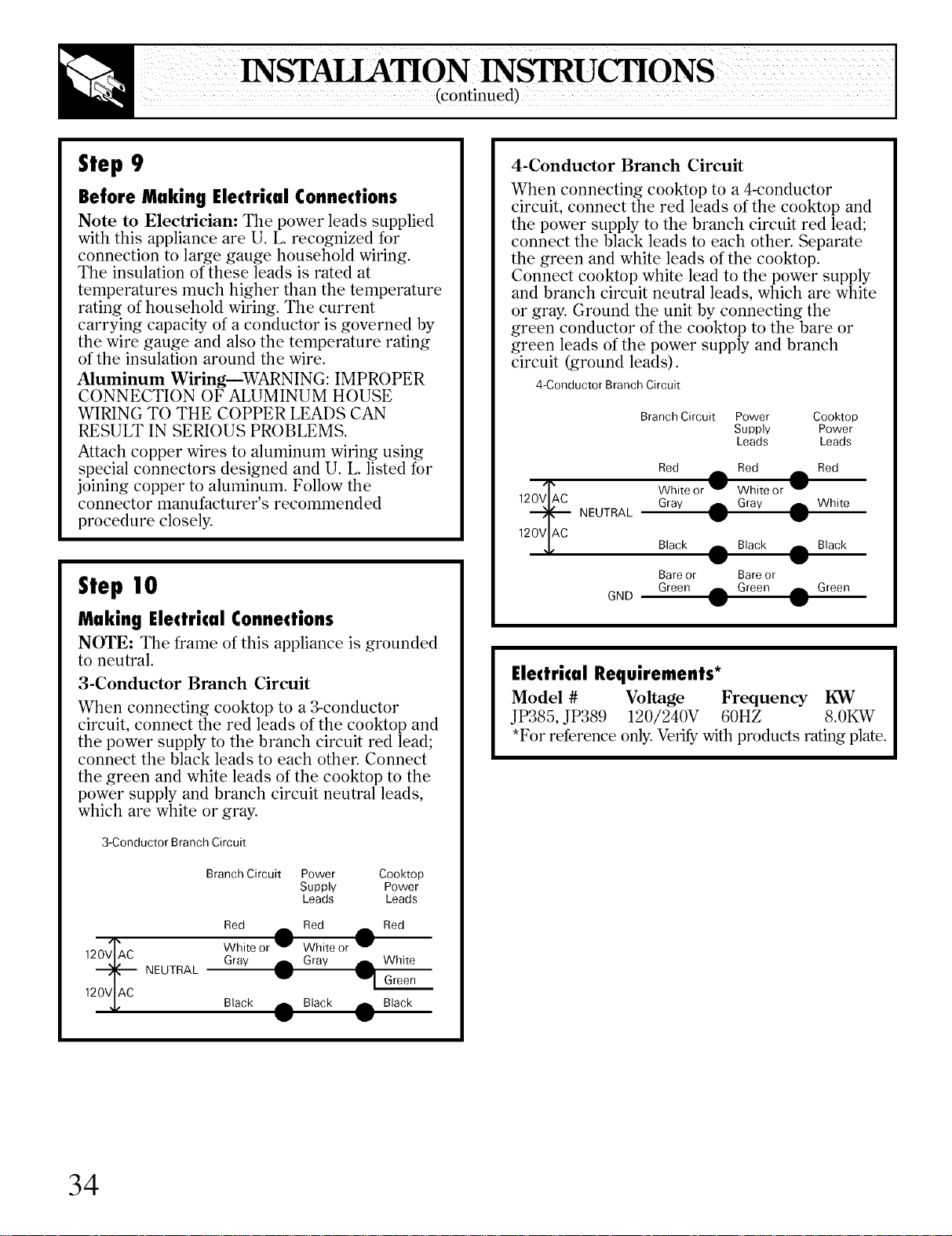
Step9
Before Making Electrical Connections
Note to Electrician: The power leads supplied
with this appliance are U. L. recognized for
connection to large gauge household wiring.
The insulation of these leads is rated at
temperatures much higher than the temperature
rating of household wiring. The current
carrying capacity of a conductor is governed by
the wire gauge and also the temperature rating
of the insulation around the wire.
Aluminum Wiring--WARNING: IMPROPER
CONNECTION OF ALUMINUM HOUSE
WIRING TO THE COPPER LEADS CAN
RESULT IN SERIOUS PROBLEMS.
Attach copper wires to aluminum wiring using
special connectors designed and U. L. listed for
joining copper to aluminum. Follow the
connector manufacturer's recommended
procedure closely.
Step 10
Making Electrical Connections
NOTE: The frame of this appliance is grounded
to neutral.
3-Conductor Branch Circuit
When connecting cooktop to a 3-conductor
circuit, connect the red leads of the cooktop and
the power supply to the branch circuit red lead;
connect the black leads to each other. Connect
the green and white leads of the cooktop to the
power supply and branch circuit neutral leads,
which are white or gray.
3-Conductor Branch Circuit
120VLAC
Branch Circuit Power Cooktop
Supply Power
Leads Leads
NEUTRAL
Red Red Red
dlk
White or IP' White or IP'
Gray A Gray dlh White
I_' _1_ Green
Black _ Black _. Black
4-Conductor Branch Circuit
When connecting cooktop to a 4-conductor
circuit, connect the red leads of the cooktop and
the power supply to the branch circuit red lead;
connect the black leads to each other. Separate
the green and white leads of the cooktop.
Connect cooktop white lead to the power supply
and branch circuit neutral leads, which are white
or gray. Ground the unit by connecting the
green conductor of the cooktop to the bare or
green leads of the power supply and branch
circuit (ground leads).
4-Conductor Branch Circuit
12÷
120VlAC
Branch Circuit Power Cooktop
Supply Power
Leads Leads
NEUTRAL
Red Red Red
A ,dh
White or _ White or I_'
Gray rill Gray dh, White
GND
Black dh, Black dh, Black
Bare or Bare or
Green A Green _ Green
'qF
Electrical Requirements*
Model # Voltage Frequency KW
JP385, JP389 120/240V 60HZ 8.0KW
*For reference only. Verify with products rating plate.
34
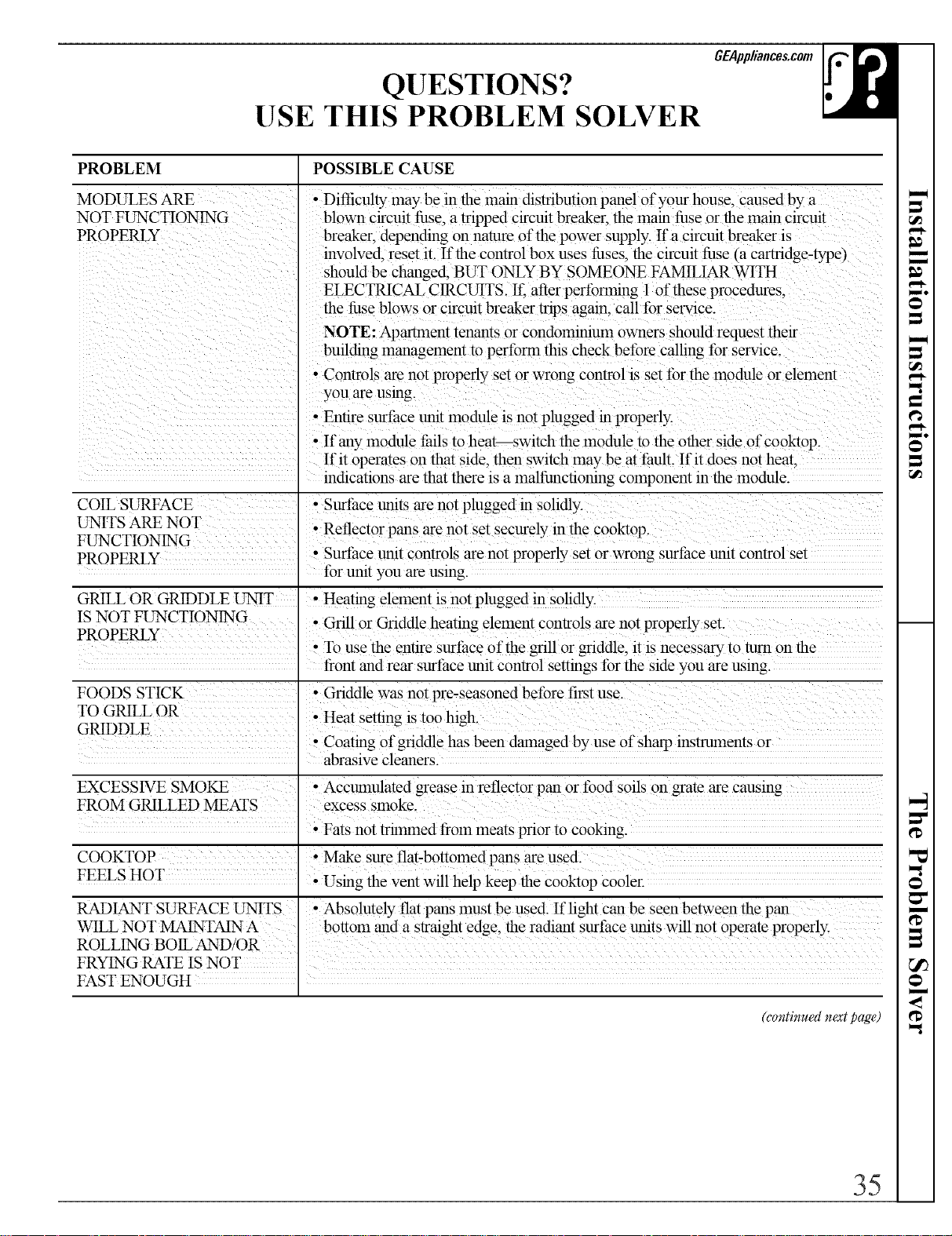
USE
QUESTIONS?
THIS PROBLEM SOLVER
GEAppliances.com
PROBLEM
MODULES ARE
NOT FUNCTIONING
PROPERLY
COIL SURFACE
UNITS ARE NOT
FUNCTIONING
PROPERLY
GRILL OR GRIDDLE UNIT
IS NOT FUNCTIONING
PROPERLY
FOODS STICK
TO GRILL OR
GRIDDLE
EXCESSIVE SMOKE
FROM GRILLED MEATS
COOKTOP
FEELS HOT
RADIANT SURFACE UNITS
WILL NOT MAINTAIN A
ROLLING BOIL AND/OR
FRYING RATE IS NOT
POSSIBLE CAUSE
• Difficulty may be in the main distribution panel of your house_ caused by a
blown circuit fuse, a tripped circuit breaker, the main fuse or the main circuit
breaker, depending on nature of the power supply, ff a circuit breaker is
involved, reset it. If the control box uses fuses, tile circuit fuse ta cartridge-type)
should be changed. BUT ONLY BY SOMEONE FAMILIAR WITH
ELECTRICAL CIRCUITS. If. after pertbnnmg 1 of these procedures_
the fuse blows or circuit breaker trips again, call for service.
NOTE: A13artlnent tenants or condolinnium owners should request their
building management to perform this check belbre calling lbr service.
• Controls are not properl 3 set or wrong control is set lbr file module or element
you are using.
, • Entire surlhce unit module is not plugged in properly.
• If any module lhils to heat--switch the module to file other side ofcooktop.
If it operates on that side. then switch may be at lhult. If it does not heat.
indications are that there is a malfunctioning component in the module.
• Surlhce units are not plugged in solidly.
• Reflector pans are not set securely in file coolctop.
• Surlhce unit controls are not properly set or wrong surface unit control set
for unit you are using.
• Heating element is not plugged in sohdly_
• Grill or Griddle heating element controls are not properly set.
• To use the entire surface of the grill or griddle, it is necessary to turn on tile
I}ontand rear surface unit control settings Ibr the side you are using.
• Griddle was not pre-seasoned bdbre first use.
• Heat setting is too high.
• Coating of griddle has been damaged by use of sharp instruments or
abrasive cleaners.
• Accumulated grease in reflector pan or lbod soils on grate are causing
excess smoke.
• Fats not trhmned from meats prior to cooking.
• Make sure flat-bottomed pans are used.
• Using the vent will help keep the cooktop cooler.
• Absolutely flat pans must be used. If light can be seen between the pan
bottom and a straight edge, tile radiant surface units will not operate properly.
FAST ENOUGH '
(continued next page)
35
i
i
..]
t_
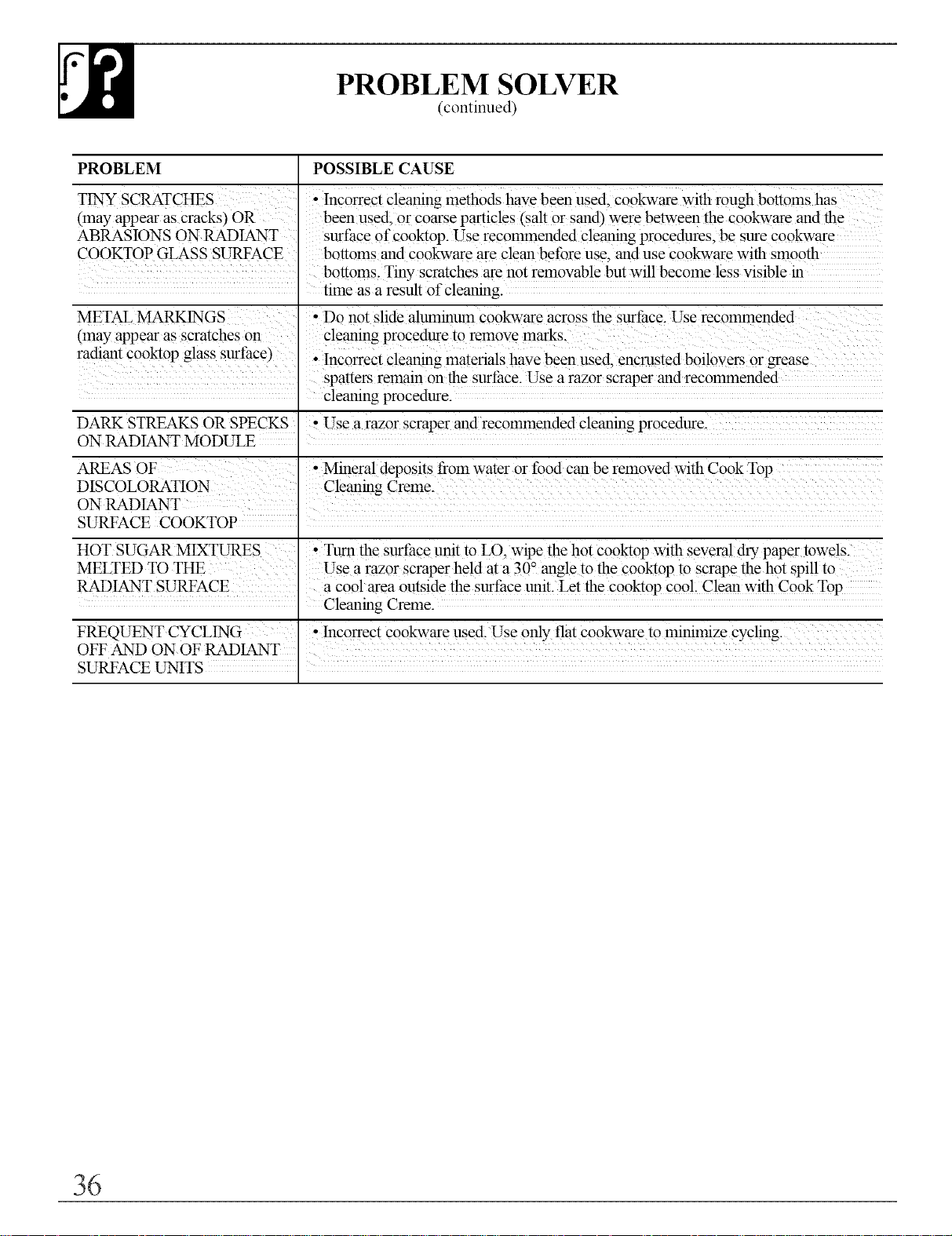
PROBLEM SOLVER
(continued)
PROBLEM
TINY SCRATCHES
tmay appear as cracks) OR
ABRASIONS ON RADIANT
COOKTOP GLASS SURFACE
METAL MARKINGS
tmay appear as scratches on
radiant cooktop glass surface}
DARK STREAKS OR SPECKS
ON RADIANT MODULE
AREAS 01=
DISCOLORATION
ON RADIANT
SURFACE COOKTOP
HOT SUGAR MIXTURES
MELTED TO THE
RADIANT SURFACE
POSSIBLE CAUSE
• Incorrect cleaning methods have been used. cookware with rough bottoms has
been used. or coarse parncles (salt or sand) were between the cookware and the
surface of cooktop. Use recormnended cleaning procedures, be sure cookware
bottoms and cookware are clean before use. and use cookware with smooth
bottoms. Tiny scratches are not removable but will become less visible in
time as a result of cleaning.
• Do not slide aluminum cookware across the surface. Use recommended
cleaning procedure to remove marks.
• Incorrect cleaning materials have been used. entrusted boilovers or grease
spatters remain on the sur[hce. Use a razor scraper and recolnmanded
cleaning procedure.
• Use a razor scraper and recommended cleaning procedure.
• Mineral deposits from water or food can be removed with Cook Top
Cleaning Creme.
• Turn the surIhce unit to LO. wipe the hot cooktop with several dry paper towels.
Use a razor scraper held at a 30 ° angle to the cooktop to scrape the hot spill to
a cool area outside the surface unit. Let the cooktop cool. Clean with Cook Top
Cleaning Creme.
FREQUENT CYCLING • Incorrect cookware used. Use only fiat cookware to lmnilnize cycling.
OFF AND ON OF RADIANT
SURFACE UNITS
36
NOTES
37

NOTES
38

We'll Be There
With the purchase of your new GE appliance, receive the assurance that if you ever need
infbrmafion or assistance fiom GE, we'll be there. All you have to do is call--toll-fiee!
GEAppliancesWebsite
www.GEAppliances.com
Have a question or need assistance with your ai)pliance?
Try tile GE Ai)pliances X_'ebsite 24 hours a day, any day
of tile year! For greater coi_velfience and taster service,
wm can now download Owner's Malmals, order parts,
catalogs, or even schedule ser\ice on-line. You can
(t " S i.
also "Ask Our Team f Expert. your questions,
and so much more...
In-HomeRepairService
800.GE.CARES(800.432.2737)
AGE consun_er service professional will provide expert repair service,
scheduled at a tilne that's coi_velfient fi_i" win. Many GE Consun_er Service
coinl)any-ol)erated locations oilier VO/I service today or toInoITO_ OI" _lt )'O/lI"
coi_velfience (7:00 a.m. to 7:00 it.in, weekdays, 9:00 a.in. to 2:00 it.in. Saturdays).
Our factory-trained techlficians know your ai)pliance inside and out--so nlost
repairs can be handled in just one visit.
s_cxloN
ForCustomersWithSpecialNeeds...
800.626.2000
GE offers, fl'ee of charge, a
brochure to assist in i)lalming a
barrielqi'ee kitchen for i)ersons
with lilnited inobilitv.
Consunters with impaired hearing or speech who haxe
access to a TDD or a coi_xentional telet)pewriter ina)
call 800.TDD.GEAC (800.833A322) to request
infoFntation or ser\ice.
ServiceContracts
800.626.2224
You can have the secure feeling that GE (_onsun_er Service will still be there
after your warranty expires. Purchase a GE contract while wmr warranty is still
in effect and you'll receive a substantial discount. With a in ultiple-year contract,
win're assured of flmue service at today's prices.
PartsandAccessories
800.626.2002
Individuals qualified to service their own appliances
can have parts or accessories sent directly to their holne.
The GE parts systeln provides access to over 47,000
parts...and all GE Gelmine Renewal Parts are fldlv
warranted. VISA, MasterCard and Discover cards
are accepted.
User maintenance instructions contained in this guide
cover procedures intended to be performed by any user.
Other servicing generally should be referred to qualified
service personnel. Caution must be exercised, since
improper servicing may cause unsafe operation.
39
.e
Imm)
YOUR GE BUILT-IN COOKTOP
WARRANTY
Staple sales slip or cancelled check
here. Proof of original purchase date
is needed to obtain service
under warranty.
WHAT IS COVERED
FULL ONE-YEAR WARRANTY
For one year from date of original
purchase, we will provide, free of
charge, parts and service labor in
your home to repair or replace any
part of the cooktop that fails
because of a manufacturing defect.
FULL FIVE-YEAR WARRANTY
(on radiant/halogen models) For
five years from the date of original
purchase, we will provide, free of
charge, parts and service labor in
your home to repair or replace the
glass cooktop due to:
• Cracking of the glass cooktop
due to thermal shock
• Discoloration of the glass cooktop
• Wear off of the pattern on the glass
cooktop
• Cracking of the rubber seal between
the glass top and the frame
• Burn out of any of the radiant
or halogen surface units.
This warranty is extended to
the original purchaser and any
succeeding owner for products
purchased for ordinary home use
in the 48 mainland states, Hawaii
and Washington, D.C. InAlaska the
warranty is the same except that it
is LIMITED because you must pay
to ship the product to the service
shop or for the service technician's
travel costs to your home.
All warranty service will be
provided by our Factory Service
Centers or by our authorized
Customer Care®servicers during
normal working hours.
Should your appliance need
service, during warranty period or
beyond, call 800.GE.CARES
(800.432.2737).
WHAT IS NOT COVERED
• Service trips to your home to
teach you how to use the
product.
• Improper installation.
If you have an installation
problem, contact your dealer
or installer.
You are responsible for
providing adequate electrical,
gas, exhausting and other
connecting facilities as
described in the Installation
Instructions provided with
the product.
• Replacement of house fuses or
resetting of circuit breakers.
• Damage to the glass cooktop
caused by use of cleaners other
than the cooktop creme
provided with the product.
• Damage to the glass cooktop
caused by hardened spills of
sugary materials or melted
plastic that are not cleaned
according to the directions in
the Use and Care Guide.
• Damage to the product due to
misuse or abuse.
• Failure of the product if it is
used for other than its intended
purpose or used commercially.
• Damage to product caused by
accident, fire, floods or acts
of God.
• Incidental or consequential
damage caused by possible
defects with this appliance.
Some states do not allow the exclusion or limitation of incidental or consequential damages, so the above limitation or exclusion
may not apply to you. This warranty gives you specific legal rights, and you may also have other rights which vary from state to state.
To know what your legal rights are in your state, consult your local or state consumer affairs office or your state's Attorney General.
Warrantor: General Electric Company
If further help is needed concerning this warranty, write:
Manager--Customer Relations, GE Appliances, Louisville, KY 40225
164D4290P081
49-80123
952-0893-002
12-01JR
JP385
JP389
4O
Printed in the United States

