THANK YOU for purchasing this high-quality product. Register your new refrigerator at www.whirlpool.com. In Canada, register your
refrigerator at www.whirlpool.ca.
For future reference, please make a note of your product model and serial numbers. These can be located on the inside wall of the
refrigerator compartment.
Model Number___________________________________________ Serial Number____________________________________________
REFRIGERATOR USER INSTRUCTIONS
Table of Contents
W10730915C
REFRIGERATOR SAFETY .............................................................. 2
Proper Disposal of Your Old Refrigerator ....................................3
INSTALLATION INSTRUCTIONS ................................................... 3
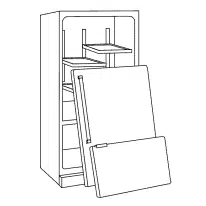
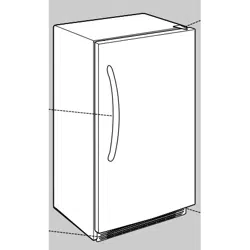
Unpack the Refrigerator ............................................................... 3
Remove and Replace Refrigerator Doors .................................... 4
Remove and Replace Drawer Fronts ...........................................6
Align Doors and Drawers .............................................................8
Location Requirements ..............................................................10
Electrical Requirements .............................................................11
Water Supply Requirements ......................................................11
Connect the Water Supply .........................................................11
Handle Installation and Removal ...............................................13
Refrigerator Leveling and Door Closing .....................................14
FILTERS AND ACCESSORIES ....................................................15
Water Filtration System ..............................................................15
Install Air Filter (on some models) ..............................................16
Install Produce Preserver
(on some models) .......................................................................17
Accessories ................................................................................17
REFRIGERATOR USE ..................................................................17
Opening and Closing Doors .......................................................17
Using the Controls .....................................................................18
Refrigerator Features .................................................................20
Water and Ice Dispensers ..........................................................22
Ice Maker and Ice Storage Bin
(on some models) .......................................................................25
REFRIGERATOR CARE ...............................................................26
Cleaning .....................................................................................26
Lights ..........................................................................................27
Vacation and Moving Care .........................................................27
TROUBLESHOOTING ..................................................................28
PERFORMANCE DATA SHEET ...................................................33
2
REFRIGERATOR SAFETY
You can be killed or seriously injured if you don't immediately
You
can be killed or seriously injured if you don't
follow
All safety messages will tell you what the potential hazard is, tell you how to reduce the chance of injury, and tell you what can
happen if the instructions are not followed.
Your safety and the safety of others are very important.
We have provided many important safety messages in this manual and on your appliance. Always read and obey all safety
messages.
This is the safety alert symbol.
This symbol alerts you to potential hazards that can kill or hurt you and others.
All safety messages will follow the safety alert symbol and either the word “DANGER” or “WARNING.”
These words mean:
follow instructions.
instructions.
DANGER
WARNING
IMPORTANT SAFETY INSTRUCTIONS
WARNING:
To reduce the risk of fire, electric shock, or injury when using your refrigerator, follow these basic precautions:
SAVE THESE INSTRUCTIONS
■ Plug into a grounded (earthed) outlet.
■ Do not remove ground prong.
■ Do not use an adapter.
■ Do not use an extension cord.
■ Disconnect power before servicing.
■ Replace all parts and panels before operating.
■ Remove doors from your old refrigerator.
■ Use nonflammable cleaner.
■ Do not store or use petrol, flammable liquids or gas in the
vicinity of this or other electrical appliances. The fumes can
cause fires or explosions.
■ Do not store explosive substances such as aerosol cans
with a flammable propellant in this refrigerator.
■ Do not use or place electrical devices inside the refrigerator
compartments if they are not of the type expressly
authorized by the manufacture.
■ Use two or more people to move and install refrigerator.
■ Disconnect power before installing ice maker (on ice maker
kit ready models only).
■ A qualified service technician must install the water line and
ice maker.
■ Connect to a potable water supply only.
■
Use a sturdy glass when dispensing ice (on some models).
■ This appliance is not intended for use by persons (including
children) with reduced physical, sensory or mental
capabilities, or lack of experience and knowledge, unless
they have been given supervision or instruction concerning
use of the appliance by a person responsible for their safety.
■ Children should be supervised to ensure that they do not
play with the appliance.
■ To avoid the risk of children becoming trapped and
suffocating, do not allow them to play or hide inside the
refrigerator.
■ If the power supply cord is damaged, it must be replaced by
the manufacturer or its service agent or a similarly qualified
person.
3
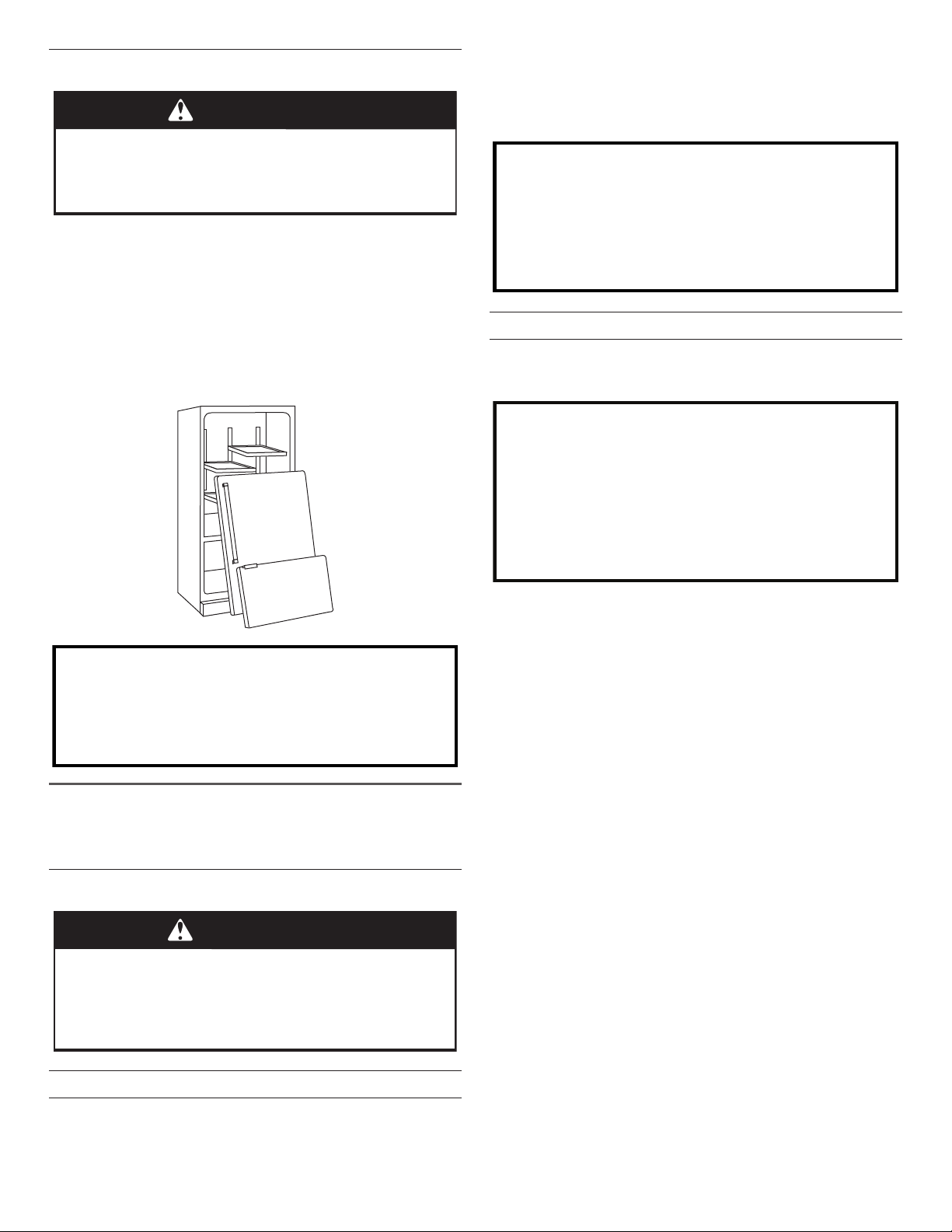
Proper Disposal of Your Old Refrigerator
IMPORTANT: Child entrapment and suffocation are not problems
of the past. Junked or abandoned refrigerators are still dangerous
–even if they will sit for “just a few days.” If you are getting rid
of your old refrigerator, please follow these instructions to help
prevent accidents.
Before You Throw Away Your Old Refrigerator or Freezer:
■ Take off the doors.
■ Leave the shelves in place so that children may not easily
climb inside.
INSTALLATION
INSTRUCTIONS
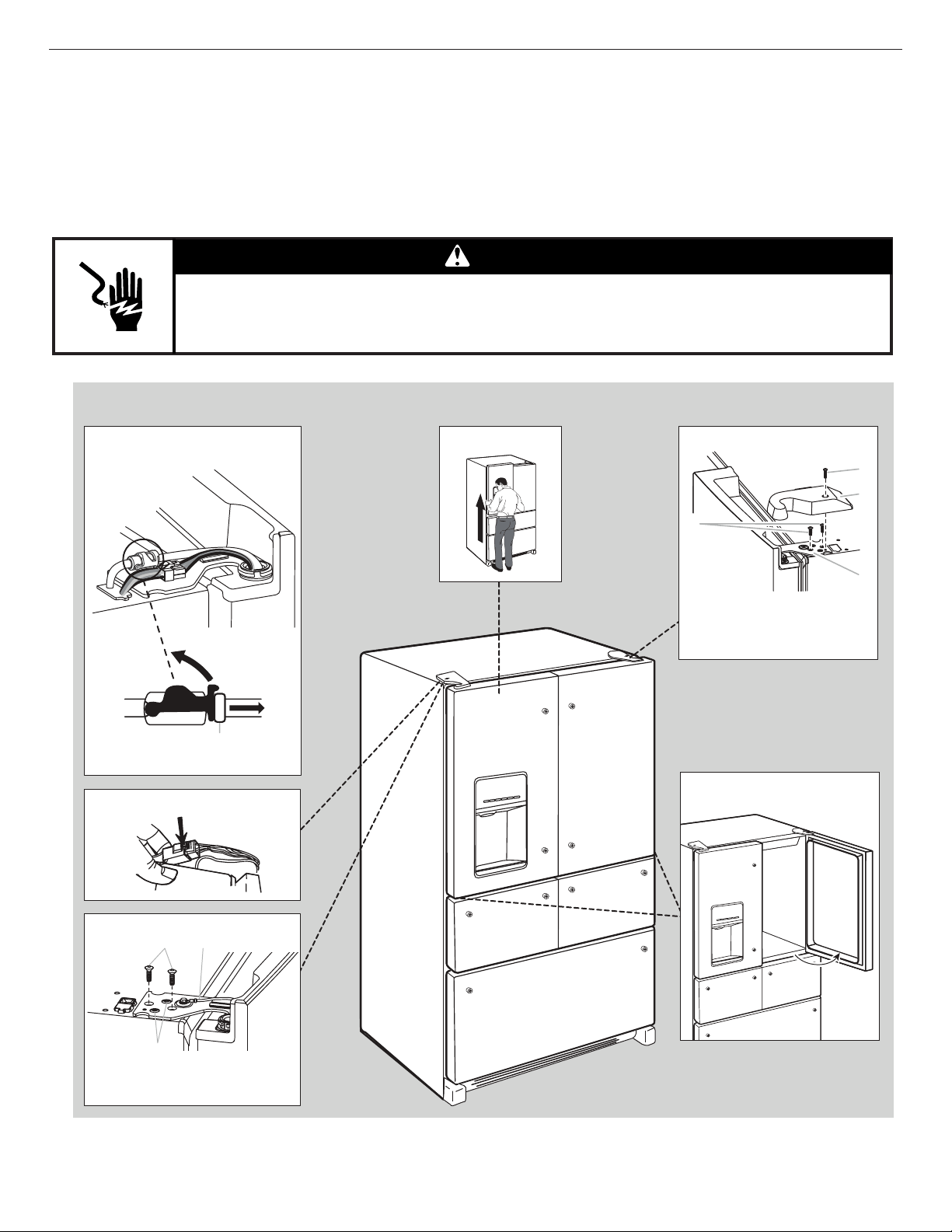
Unpack the Refrigerator
Remove the Packaging
■ Remove tape and glue residue from surfaces before turning
on the refrigerator. Rub a small amount of liquid dish soap
over the adhesive with your ngers. Wipe with warm water
and dry.
■ Do not use sharp instruments, rubbing alcohol, ammable
uids, or abrasive cleaners to remove tape or glue. These
products can damage the surface of your refrigerator. For
more information, see “Refrigerator Safety.”
■ Dispose of/recycle all packaging materials.
Clean Before Using
After you remove all of the packaging materials, clean the inside
of your refrigerator before using it. See the cleaning instructions in
“Refrigerator Care.”
WARNING
Suffocation Hazard
Remove doors from your old refrigerator.
Failure to do so can result in death or brain damage.
Important information to know about disposal of
refrigerants:
Dispose of refrigerator in accordance with Federal and Local
regulations. Refrigerants must be evacuated by a licensed,
EPA certified refrigerant technician in accordance with
established procedures.
WARNING
Excessive Weight Hazard
Use two or more people to move and install
refrigerator.
Failure to do so can result in back or other injury.
When Moving Your Refrigerator:
Your refrigerator is heavy. When moving the refrigerator for
cleaning or service, be sure to cover the oor with
cardboard or hardboard to avoid oor damage. Always pull
the refrigerator straight out when moving it. Do not wiggle or
“walk” the refrigerator when trying to move it, as oor
damage could occur.
Important information to know about glass shelves
and covers:
Do not clean glass shelves or covers with warm water when
they are cold. Shelves and covers may break if exposed to
sudden temperature changes or impact, such as bumping.
Tempered glass is designed to shatter into many small,
pebble-size pieces. This is normal. Glass shelves and covers
are heavy. Use both hands when removing them to avoid
dropping.
4
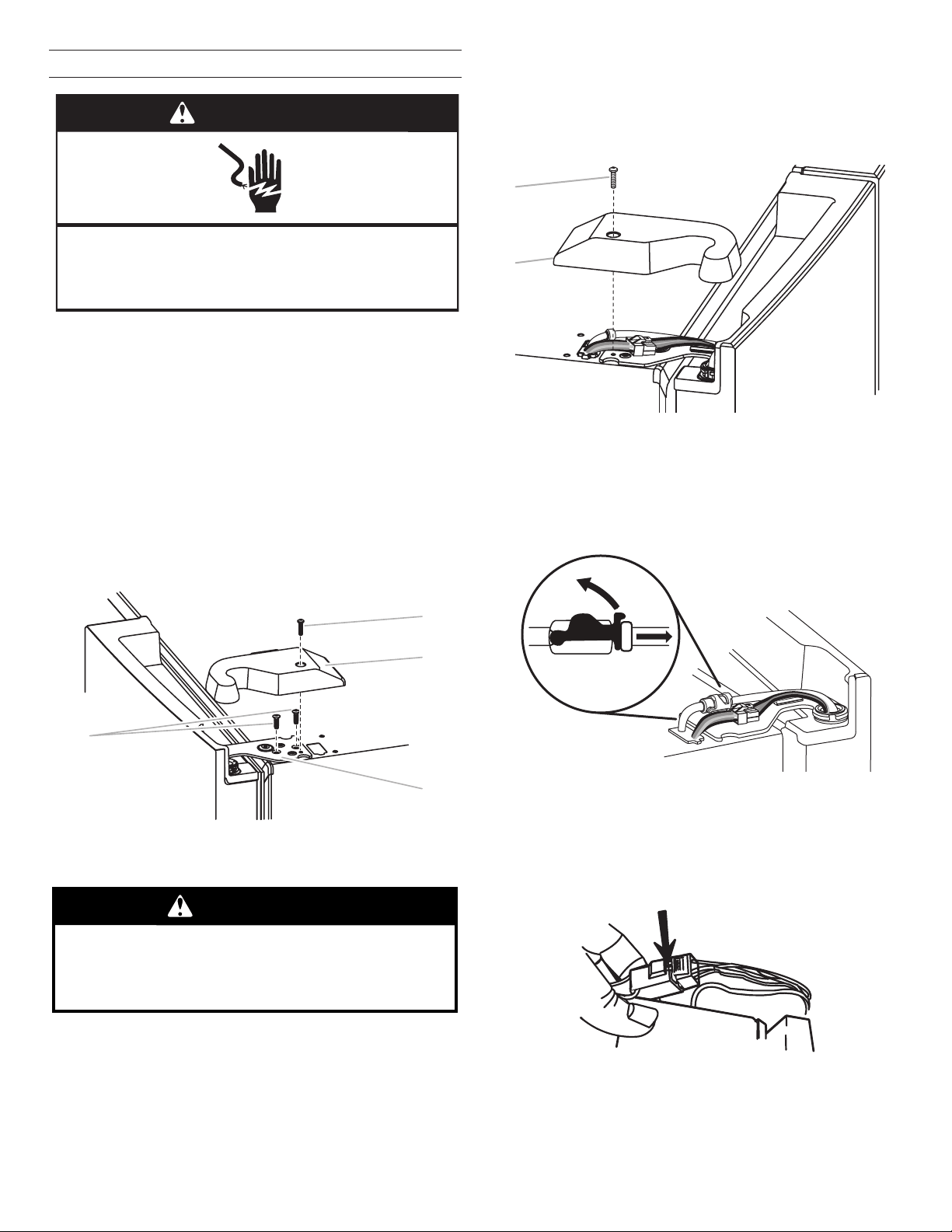
Remove and Replace Refrigerator Doors
NOTE: Measure the width of your door opening to see whether or not you need to remove the refrigerator doors to move the refrigerator
into your home. If door removal is necessary, see the following instructions.
IMPORTANT: If the refrigerator was previously installed and you are moving it out of the home, before you begin, turn the refrigerator
control OFF. Unplug the refrigerator or disconnect power. Remove food and adjustable door or utility bins from doors.
Gather the required tools and read all instructions before removing doors.
TOOLS NEEDED: 3/16" hex key and a #2 Phillips screwdriver
WARNING
Electrical Shock Hazard
Disconnect power before removing doors.
Failure to do so can result in death or electrical shock.
BA
C
A
C
B
A
D
90°
Door Removal and Replacement
Water Dispenser
Tubing Connection
Wiring Plug
Top Left Hinge
Top Right Hinge
Door Removal
Door at 90° Angle
to Cabinet
A. 3/16" Internal Hex-Head Screws
B. Hinge Cover Screw
C. Top Hinge Cover
D. Top Hinge
A. 3/16" Internal Hex-Head Screws
B. Ground Wire (Do Not Remove.)
C. Do Not Remove Screws
A. Outer Ring
5
Remove Refrigerator Doors
Remove Right-Hand Refrigerator Door
1. Unplug refrigerator or disconnect power.
2. Keep the refrigerator doors closed until you are ready to lift
them free from the cabinet.
NOTE: Provide additional support for the refrigerator door
while the hinges are being removed. Do not depend on the
door gasket magnets to hold the door in place while you are
working.
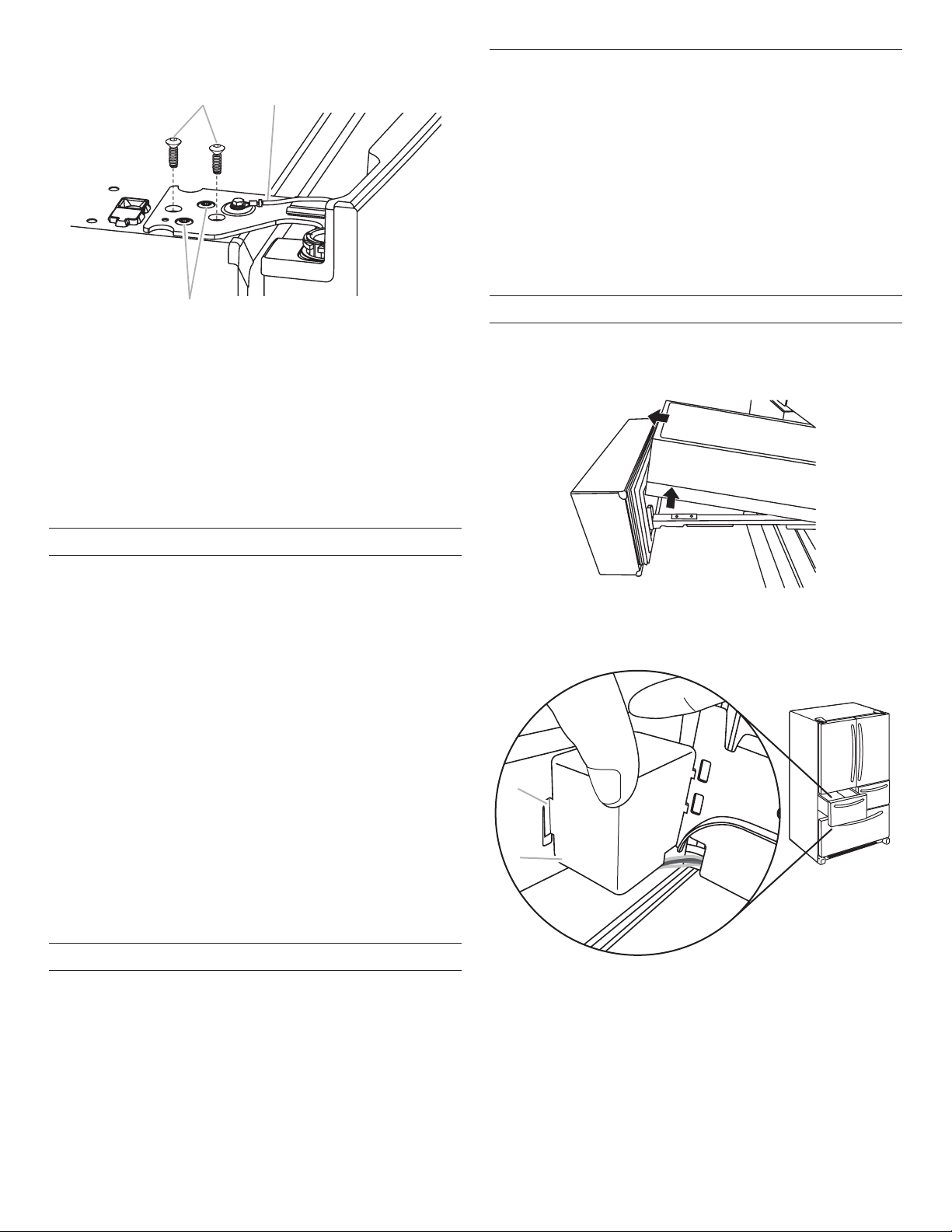
3. Using a Phillips screwdriver, remove the cover from the top
hinge.
4. Using the 3/16" hex key wrench, remove the two internal hex-
head screws from the top hinge, and set aside.
NOTE: Do not remove the two locator screws. These screws
will help you align the hinge when you replace the door.
5. Lift the refrigerator door from the bottom hinge pin. The top
hinge will come away with the door.
Remove Left-Hand Refrigerator Door
IMPORTANT: The tubing and wiring for the water dispenser run
through the left-hand door hinge, so they must be disconnected
before removing the door.
1. Using a Phillips screwdriver, remove the cover from the top
hinge.
2. Disconnect the water dispenser tubing located on top of the
door hinge. Firmly pulling up on the clasp, and then pull the
tubing out of the tting.
NOTE: The water dispenser tubing remains attached to the
left-hand refrigerator door.
3. Disconnect the wiring plug located on top of the door hinge.
■ Grasp each side of the wiring plug. With your left thumb,
press down to release the catch and pull the sections of
the plug apart.
NOTE: Do not remove the green, ground wire. It should
remain attached to the door hinge.
4. Using the 3/16" hex key wrench, remove the two internal hex-
head screws from the top hinge and set aside.
NOTES:
■ Provide additional support for the refrigerator door while the
hinges are being removed. Do not depend on the door gasket
magnets to hold the door in place while you are working.
WARNING
Electrical Shock Hazard
Disconnect power before removing doors.
Failure to do so can result in death or electrical shock.
A
B
C
D
A. Top hinge cover screw
B. Top hinge cover
C. 3/16" Internal hex-head screws
D. Top hinge
WARNING
Excessive Weight Hazard
Use two or more people to lift the refrigerator door.
Failure to do so can result in back or other injury.
A
B
A. Top hinge cover screw B. Top hinge cover
6
■ Do not remove the two locator screws. These screws will help
you align the hinge when you replace the door.
5. Lift the refrigerator door from the bottom hinge pin. The top
hinge will come away with the door.
NOTE: It may not be necessary to remove the bottom hinges
and brake feet assemblies to move the refrigerator through a
doorway.
■ Only if necessary, use a driver with a #2 square bit tip to
remove the bottom hinges and a 3/8" nut driver to remove
the brake feet screws.
Replace Refrigerator Doors
Replace Right-Hand Refrigerator Door
1. Set the right-hand door onto the bottom hinge pin.
2. Insert the top hinge pin into the open hole in the top of the
refrigerator door.
3. Using the two 3/16" internal hex-head screws, fasten the
hinge to the cabinet. Do not tighten the screws completely.
Replace Left-Hand Refrigerator Door
IMPORTANT: Do not intertwine the water tubing and wiring
bundles when reconnecting them.
1. Set the left-hand door onto the bottom hinge pin.
2. Using the two 3/16" internal hex-head screws, fasten the
hinge to the cabinet. Do not tighten the screws completely.
3. Reconnect the water dispenser tubing.
Style 1 - Insert the tubing into the tting until it stops and the
outer ring is touching the face of tting.
Style 2 - Insert the tubing rmly into the tting until it stops.
Close the clasp around the tubing. The clasp snaps into place
between the tting and the collar.
4. Reconnect the electrical wiring.
■ Push together the two sections of the wiring plug.
Final Steps
1. Completely tighten the four internal hex-head screws (two
on the right-hand door hinge and two on the left-hand door
hinge).
2. Replace both top hinge covers.
Remove and Replace Drawer Fronts
Depending on the width of your door opening, it may be
necessary to remove the drawer fronts to move the refrigerator
into your home.
IMPORTANT:
■ If the refrigerator was previously installed and you are moving
it out of the home, before you begin, turn the refrigerator
control off, and unplug the refrigerator or disconnect power.
Remove food from the drawers.
■ Two people may be required to remove and replace the
drawer fronts.
Tools Needed: Flat-blade screwdriver
Refrigerated Drawers
Remove the Drawer Fronts
1. Open the drawer to its full extension. Grasp the sides of the
interior bin, and then lift up and out to remove.
2. Left-hand drawer only: Remove the wiring connection cover.
Press in on the side of the cover to release the tab from the
slot, and then pull the cover away from the bracket.
3. Left-hand drawer only: Disconnect the wiring.
NOTE: The drawer front of the left-hand refrigerated drawer
is connected to the temperature control by wires running
underneath the drawer glide. Before removing the drawer
front, the wires must be disconnected.
A B
C
A. 3/16" Internal hex-head
screws
B. Ground wire (Do not remove)
C. Locator screws
(Do not remove)
A
B
A. Cover tab
B. Wiring connection cover
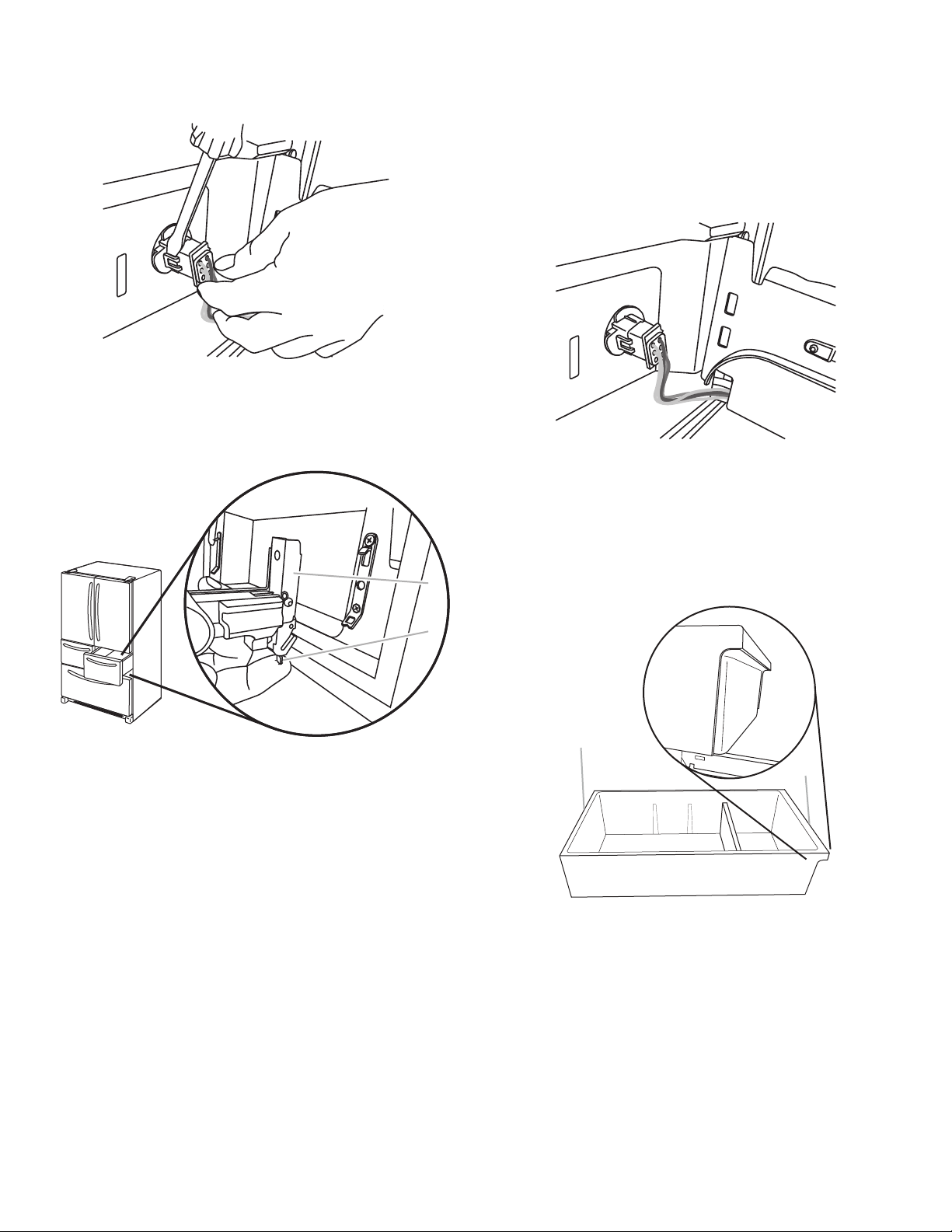
7
■ On one side of the wiring connector, insert the screwdriver
blade between the connector tab and the connector to
release. Repeat for the opposite side. Pull the wiring
connector apart.
4. Remove the drawer front.
■ Push up on the lever at the bottom of the drawer glide
bracket to release the drawer front from the bracket.
■ Lift the drawer front up and off the drawer glide brackets.
5. Slide the drawer glides back into the refrigerator.
Replace the Drawer Fronts
1. Pull out the drawer glides until they are fully extended.
2. Push up on the lever at the bottom of the drawer glide bracket
to open. Insert the drawer front bracket into the drawer glide
bracket and release the lever.
NOTE: It helps if one person holds the drawer glides steady
while another person aligns the drawer front and connects the
brackets.
3. Left-hand drawer only: Reconnect wiring.
■ Align the two ends of the wiring connector and push them
together until you hear a “click” sound and feel the tabs
snap into place on the connector.
■ Gently pull on the wiring connection to ensure the wiring
connection is completely seated. Replace the wiring
cover.
NOTE: The wiring connection must be complete for the
drawer temperature control to operate.
4. Left-hand drawer only: Replace the wiring connection cover.
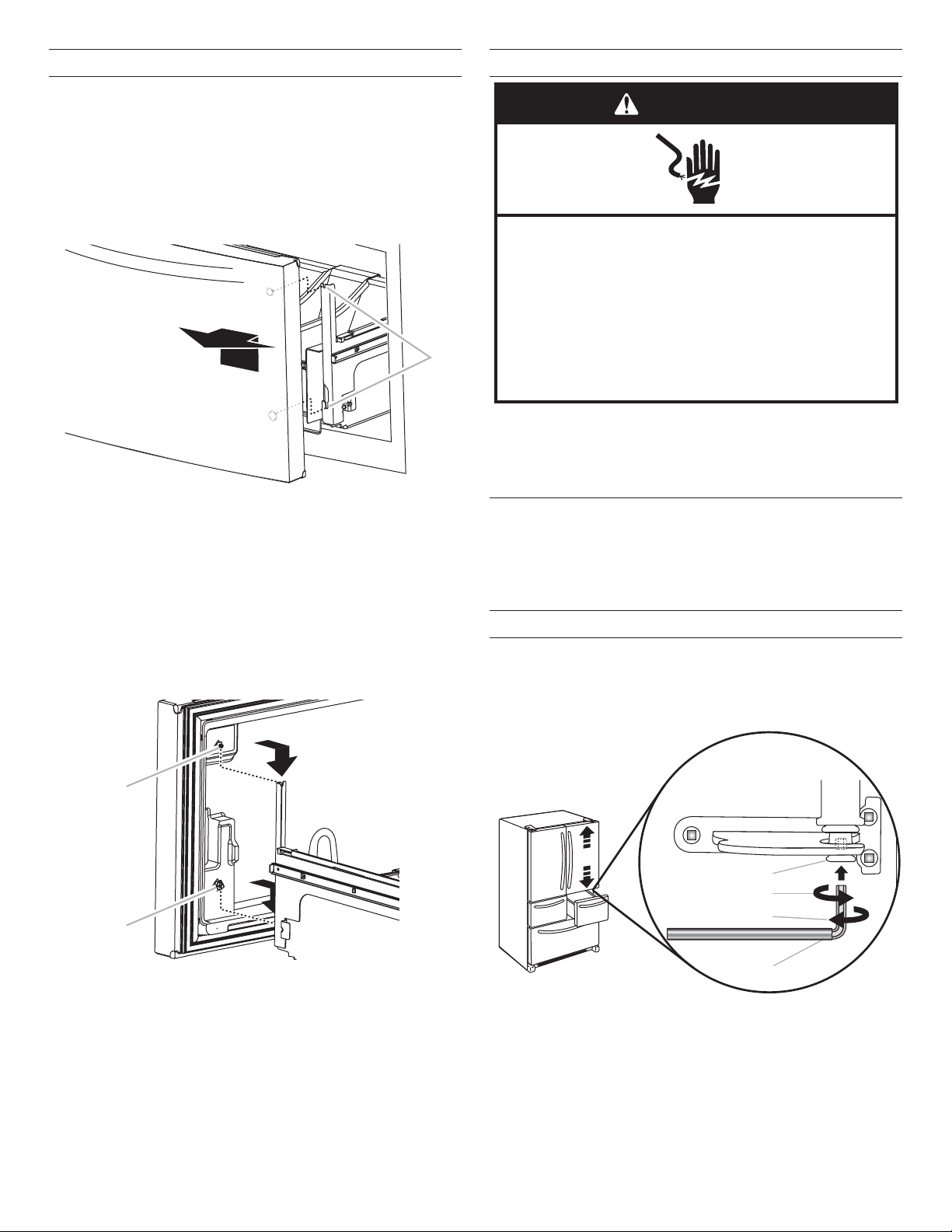
5. Replace the drawer bins onto the drawer glides with the rear
side of the bin facing the back of the refrigerator, as shown.
IMPORTANT: The Door Ajar alarm will sound if the interior
drawer bins are not replaced correctly. The bins are designed
with a specic front and rear. They must be placed into the
drawers, as shown, so that the refrigerated drawers will close
and operate properly.
A
B
A. Drawer glide bracket B. Release lever
A
B
A. Faces back of refrigerator (insert first)
B. Faces front of refrigerator
8
Freezer Drawer
Remove Drawer Front
1. Open the freezer drawer to its full extension.
2. Loosen the two top screws that fasten the drawer front to
the drawer glides. The two screws (one on the left-hand side
and one on the right-hand side) are located inside the drawer
front.
3. Lift up on the drawer front to release the plastic studs from
the drawer glide bracket slots.
`
4. Slide the drawer glides back into the freezer.
Replace Drawer Front
1. Pull out the freezer drawer glides to their full extension.
2. Holding the drawer front by its sides, align the two plastic
studs, located at the bottom, inside the drawer front, with the
drawer glide bracket slots.
NOTE: It helps if one person holds the drawer glides steady
while another person aligns the drawer front and inserts the
studs into the slots.
3. Replace and tighten the two screws at the top of the drawer
front (one on the left-hand side and one on the right-hand
side).
Final Steps
1. Plug into a grounded 3 prong outlet.
2. Reset the controls. See “Using the Control(s)” and
“Temperature Controlled Exterior Drawer.”
3. Return all removable parts and the food to the drawers.
Align Doors and Drawers
Once the doors and drawer fronts are replaced on the refrigerator,
you may notice that the doors appear angled or that they are no
longer level. Both the refrigerator doors and refrigerated drawers
are adjustable.
Align Refrigerator Door
Tools Provided: 1/8" hex key
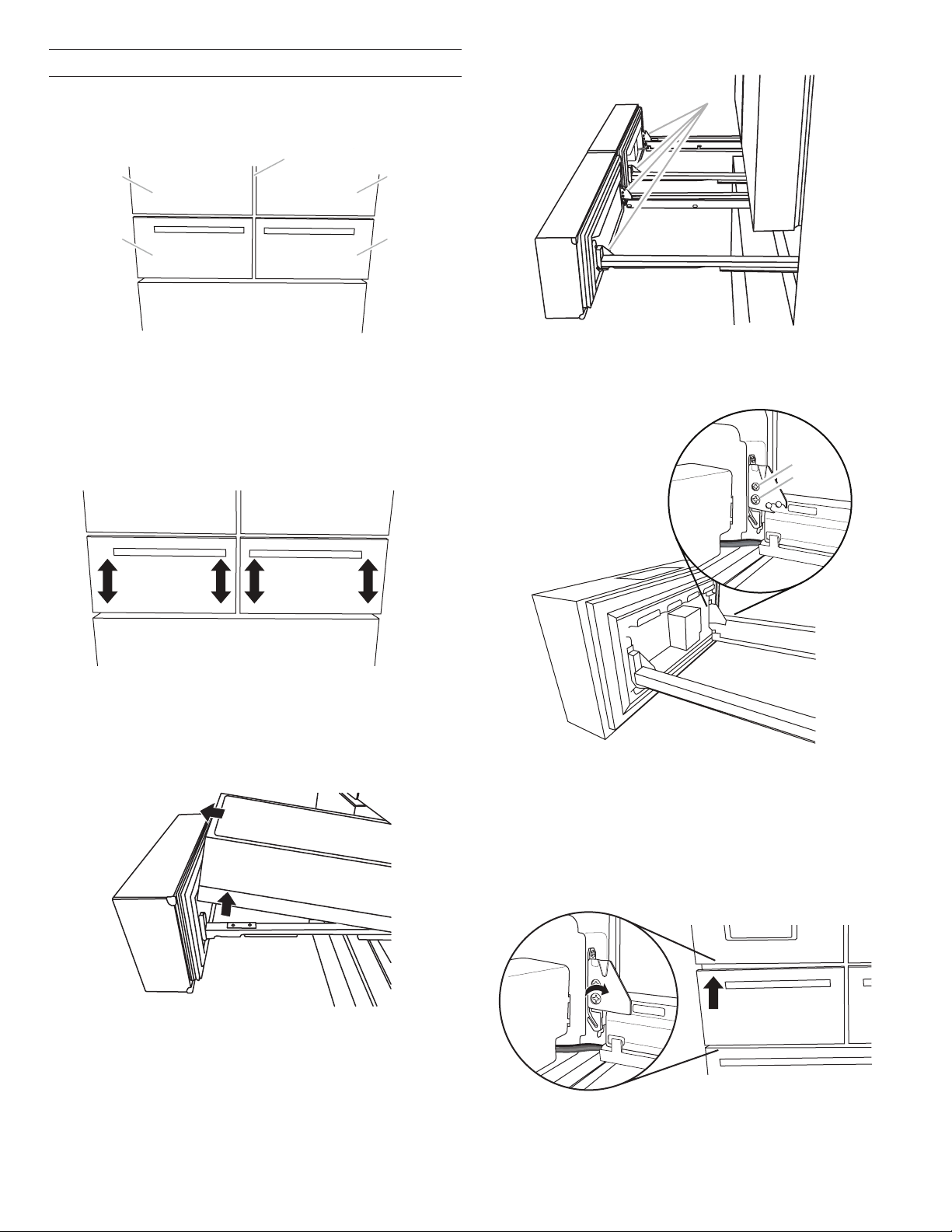
1. Keeping both refrigerator doors closed, pull out the right-hand
refrigerated drawer. Locate the bottom hinge pin of the
refrigerator door. The alignment screw is inside the bottom
hinge pin.
2. Insert the short end of the 1/8" hex key (packed with the Door
Handle Installation Instructions) into the bottom hinge pin until
it is fully engaged in the alignment screw.
■ To raise the door, turn the hex key to the right.
■ To lower the door, turn the hex key to the left.
3. Continue to turn the alignment screw until the doors are
aligned.
A
A. Drawer glide bracket slots
A
B
A. Drawer front screw
B. Drawer front plastic stud
Electrical Shock Hazard
Plug into a grounded 3 prong outlet.
Do not remove ground prong.
Do not use an adapter.
Do not use an extension cord.
Failure to follow these instructions can result in death,
fire, or electrical shock.
WARNING
A
B
C
D
A. Bottom hinge pin
B. Turn to the right to raise.
C. Turn to the left to lower.
D. 1/8" Hex key
9
Align Refrigerated Drawer Fronts
When the drawer fronts are aligned, the width of the vertical
space (A) between the refrigerator doors (B) and the drawer fronts
(C) is the same thickness, and the drawers appear level.
Aligning the drawer fronts is a two-step process. The rst step
is to adjust the drawer fronts up and down. The second step
shifts the drawer fronts from side to side. Visually inspect the
refrigerator for alignment and adjust the drawer fronts as needed.
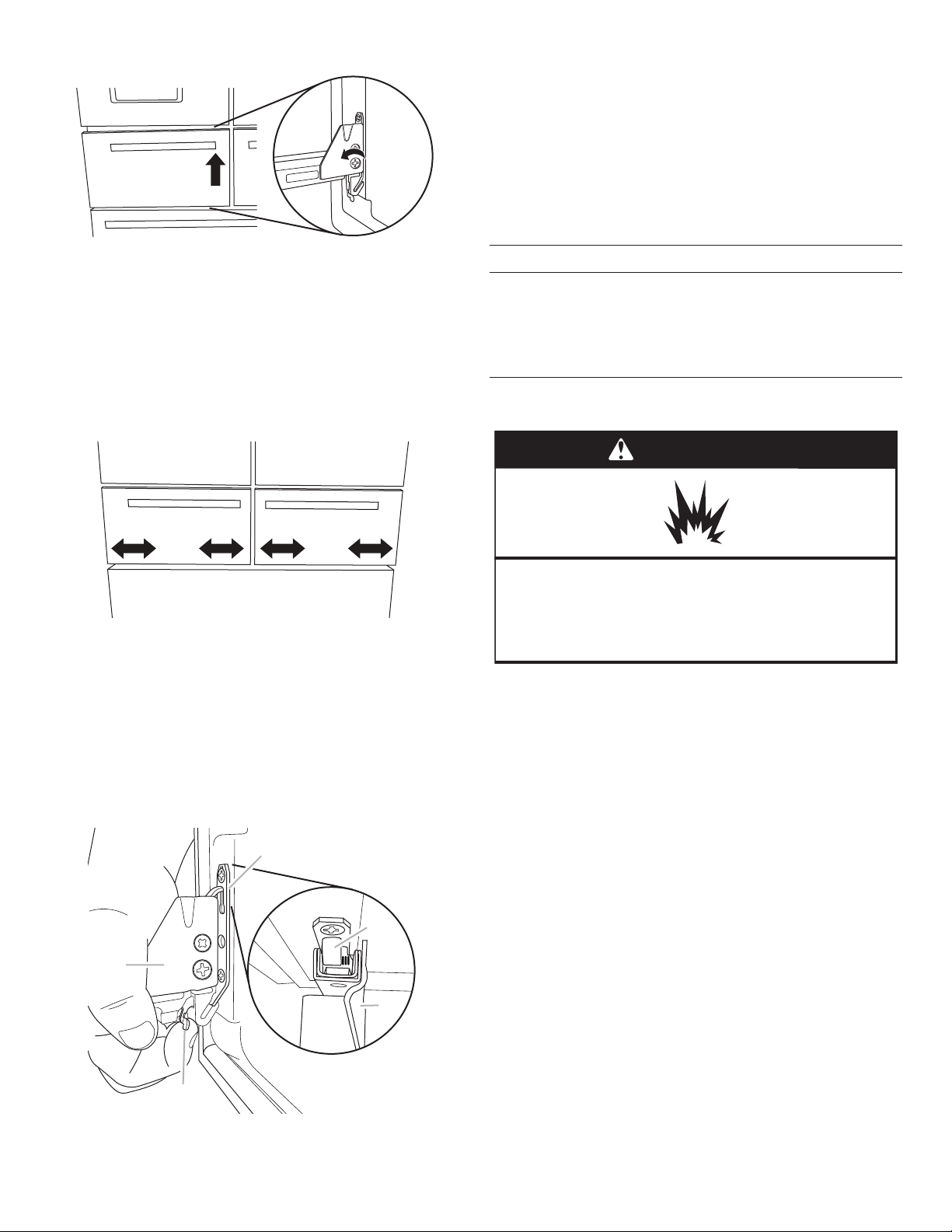
Step 1 - Adjust the Drawer Fronts Up/Down
IMPORTANT: Each refrigerated drawer can be adjusted up and
down on both the left and the right sides.
Tools Needed: Phillips screwdriver
1. With the drawers closed, identify the drawer front that needs
to be raised or lowered.
2. Open the drawer to its full extension. Grasp the sides of the
interior bin, and then lift it up and out to remove.
3. Locate the drawer glide brackets (A).
4. Insert the Phillips screwdriver into screw (A) and turn
counterclockwise to loosen the drawer front.
5. Insert the Phillips screwdriver into screw (B) to adjust the
drawer front.
IMPORTANT: The direction you turn screw (B) depends on
which side of the drawer you are adjusting.
Left-Hand Side Drawer Glide
■ To raise the drawer front, turn screw (B) clockwise.
■ To lower the drawer front, turn screw (B) counterclockwise.
A
B
C
B
C
A
A. Drawer glide brackets
A
B
A. Tightening screw
B. Adjusting screw
10
Right-Hand Side Drawer Glide
■ To raise the drawer front, turn screw (B) counterclockwise.
■ To lower the drawer front, turn screw (B) clockwise.
6. Insert the Phillips screwdriver into screw (A), and turn
clockwise to tighten the drawer front.
7. Close the refrigerated drawer to check the alignment. Repeat
steps 2 through 6 until the drawer fronts are level.
Step 2 - Adjust the Drawer Fronts Side to Side
IMPORTANT: Each refrigerated drawer can be adjusted
side to side on both the left and right side.
1. With the drawers closed, identify the drawer that is not
aligned.
2. Open the drawer to its full extension. Grasp the sides of the
interior bin, and then lift it up and out to remove. (See Step 1
for further details.)
3. Locate the drawer glide brackets. (See Step 1 for further
details.)
4. Starting with the glide bracket closest to the vertical gap,
press and hold the release lever (C) up. With your other hand,
lift the door clip (A) from the bracket (B).
5. Reposition the clip (A) onto the glide bracket (B) in the
direction you want to move the drawer front. Make sure that
the glide bracket is vertically level.
6. Release the lever (C) to lock the glide bracket into position.
7. Repeat steps 3 through 6 for the other side of the drawer
front.
NOTE: Adjust the clip (A) on the top of the second glide
bracket (B) so that it is in the same position as the side you
adjusted rst.
8. Close the drawer and visually inspect the gap. Repeat steps 2
though 7 until the drawer fronts are aligned.
Final Steps
1. Replace the interior drawer bins.
NOTE: The bins must be placed into the drawers correctly so
that the refrigerated drawers will close and operate properly.
See “Remove and Replace Drawer Fronts.”
2. Close the refrigerated drawers.
Location Requirements
IMPORTANT: This appliance is intended to be used in household
and similar applications such as.
■ Staff kitchen areas in shops, ofces and other working
environments.
■ Farm houses and by clients in hotels, motels and other
residential type environments.
■ Bed and breakfast type environments.
■ Catering and similar non-retail applications.
NOTE: If the manufacturer wants to limit the use of the appliance
to less than the above, this has to be clearly stated in the
instructions.
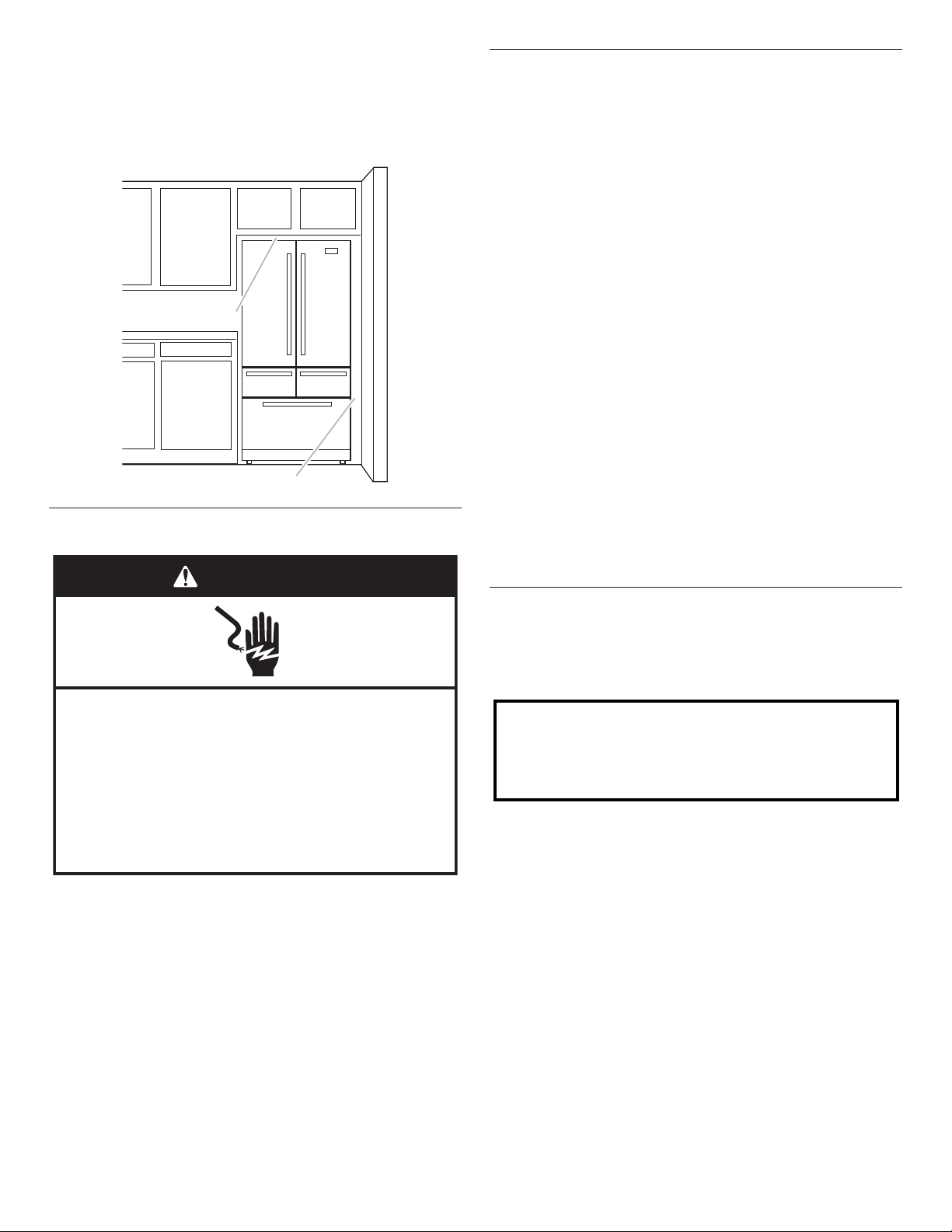
To ensure proper ventilation for your refrigerator, allow for a
1/2" (1.25 cm) of space on each side and at the top. Allow for a
1" (2.54 cm) space behind the refrigerator. If your refrigerator
has an ice maker, allow extra space at the back for the water line
connections. When installing your refrigerator next to a xed wall,
leave a 3³⁄4" (9.5 cm) minimum space between the refrigerator and
wall to allow the door to swing open.
A
B
C
B
A
A. Drawer front clip
B. Drawer glide bracket
C. Release lever
WARNING
Explosion Hazard
Keep ammable materials and vapors, such as
gasoline, away from refrigerator.
Failure to do so can result in death, explosion, or re.
11
NOTE: This refrigerator is intended for use in a location where
the temperature ranges from a minimum of 55°F (13°C) to a
maximum of 110°F (43°C). The preferred room temperature
range for optimum performance, which reduces electricity usage
and provides superior cooling, is between 60°F (15°C) and 90°F
(32°C). It is recommended that you do not install the refrigerator
near a heat source, such as an oven or radiator.
Electrical Requirements
Before you move your refrigerator into its nal location, it is
important to make sure you have the proper electrical connection.
If the supply cord is damaged, it must be replaced by the
manufacturer or its service agent or a similarly qualied person.
Do not use a cord that shows cracks or abrasion damage along
its length or at either the plug or connector end.
Recommended Grounding Method
A 115 V, 60 Hz, AC only 15 or 20 A fused, grounded electrical
supply is required. It is recommended that a separate circuit
serving only your refrigerator and approved accessories be
provided. Use an outlet that cannot be turned off by a switch. Do
not use an extension cord.
NOTE: Before performing any type of installation, cleaning, or
removing a light bulb, turn off Cooling, and then disconnect the
refrigerator from the electrical source. When you have nished,
reconnect the refrigerator to the electrical source and turn on
Cooling. See “Using the Control(s).”
Water Supply Requirements
A cold water supply with water pressure between 35 and 120 psi
(241 and 827 kPa) is required to operate the water dispenser and
ice maker. If you have questions about your water pressure, call a
licensed, qualied plumber.
NOTE: If the water pressure is less than what is required, the ow
of water from the water dispenser could decrease or ice cubes
could be hollow or irregular shaped.
Reverse Osmosis Water Supply
IMPORTANT: The pressure of the water supply coming out of
a reverse osmosis system going to the water inlet valve of the
refrigerator needs to be between 35 and 120 psi
(241 and 827 kPa).
If a reverse osmosis water ltration system is connected to your
cold water supply, the water pressure to the reverse osmosis
system needs to be a minimum of 40 to 60 psi (276 to 414 kPa).
■ Check to see whether the sediment lter in the reverse
osmosis system is blocked. Replace the lter if necessary.
■ Allow the storage tank on the reverse osmosis system to rell
after heavy use. The tank capacity could be too small to keep
up with the requirements of the refrigerator.
NOTE: Faucet-mounted reverse osmosis systems are not
recommended.
■ If your refrigerator has a water lter, it may further reduce
the water pressure when used in conjunction with a reverse
osmosis system. Remove the water lter. See “Water Filtration
System.”
If you have questions about your water pressure, call a licensed,
qualied plumber.
Connect the Water Supply
Read all directions before you begin.
IMPORTANT:
■ Connect to potable water supply only.
■ Plumbing shall be installed in accordance with the
International Plumbing Code and any local codes and
ordinances.
■ The gray water tubing on the back of the refrigerator (which
is used to connect to the household water line) is a PEX
(cross-linked polyethylene) tube. Copper and PEX tubing
connections from the household water line to the refrigerator
are acceptable and will help avoid “off-taste” or odor in your
ice or water. Check for leaks.
If PEX tubing is used instead of copper, we recommend the
following part numbers:
W10505928RP (7 ft [2.14 m] jacketed PEX),
8212547RP (5 ft [1.52 m] PEX), or
W10267701RP (25 ft [7.62 m] PEX).
■ Install tubing only in areas where temperatures will remain
above freezing.
Electrical Shock Hazard
Plug into a grounded 3 prong outlet.
Do not remove ground prong.
Do not use an adapter.
Do not use an extension cord.
Failure to follow these instructions can result in death,
fire, or electrical shock.
WARNING
Do not use with water that is microbiologically unsafe or
of unknown quality without adequate disinfection before
or after the system. Systems certified for cyst reduction
may be used on disinfected waters that may contain
filterable cysts.
1/2" (1.25 cm)
3
3
/4" (9.5 cm)
12
Tools Needed:
Gather the required tools and parts before starting installation.
■ Flat-blade screwdriver
■ 7/16" and 1/2" open-end wrenches or two adjustable
wrenches
■ 1/4" nut driver
NOTE: Do not use a piercing-type or 3/16" (4.76 mm) saddle
valve which reduces water ow and clogs easier.
Connect to Water Line
IMPORTANT: If you turn the refrigerator on before the water is
connected, turn off the ice maker.
1. Unplug refrigerator or disconnect power.
2. Turn off main water supply. Turn on nearest faucet long
enough to clear line of water.
3. Use a quarter-turn shut-off valve or the equivalent, served by
a 1/2" (12.7 mm) household supply line.
NOTE: To allow sufcient water ow to the refrigerator, a
minimum 1/2" (12.7 mm) size household supply line is
recommended.
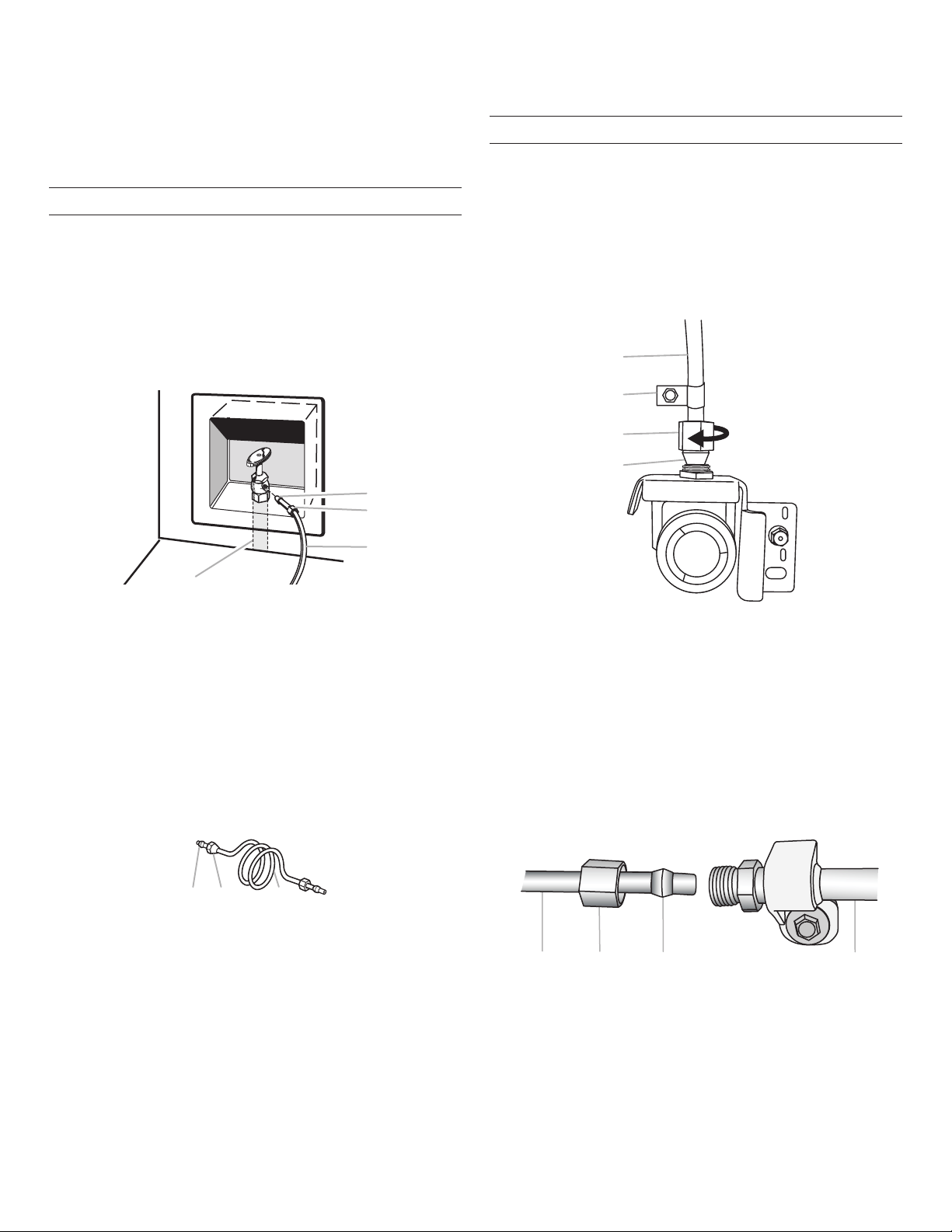
4. Now you are ready to connect the copper tubing to the
shut-off valve. Use 1/4" (6.35 mm) O.D. (outside diameter)
soft copper tubing to connect the shut-off valve and the
refrigerator.
■ Ensure that you have the proper length needed for the job.
Be sure both ends of the copper tubing are cut square.
■ Slip compression sleeve and compression nut onto
copper tubing as shown. Insert end of tubing into outlet
end squarely as far as it will go. Screw compression nut
onto outlet end with adjustable wrench. Do not
overtighten.
5. Place the free end of the tubing into a container or sink, and
turn on main water supply to ush out tubing until water is
clear. Turn off shut-off valve on the water pipe.
NOTE: Always drain the water line before making the nal
connection to the inlet of the water valve to avoid possible
water valve malfunction.
6. Bend the copper tubing to meet the water line inlet which
is located on the back of the refrigerator cabinet as shown.
Leave a coil of copper tubing to allow the refrigerator to be
pulled out of the cabinet or away from the wall for service.
Connect to Refrigerator
Follow the connection instructions specic to your model.
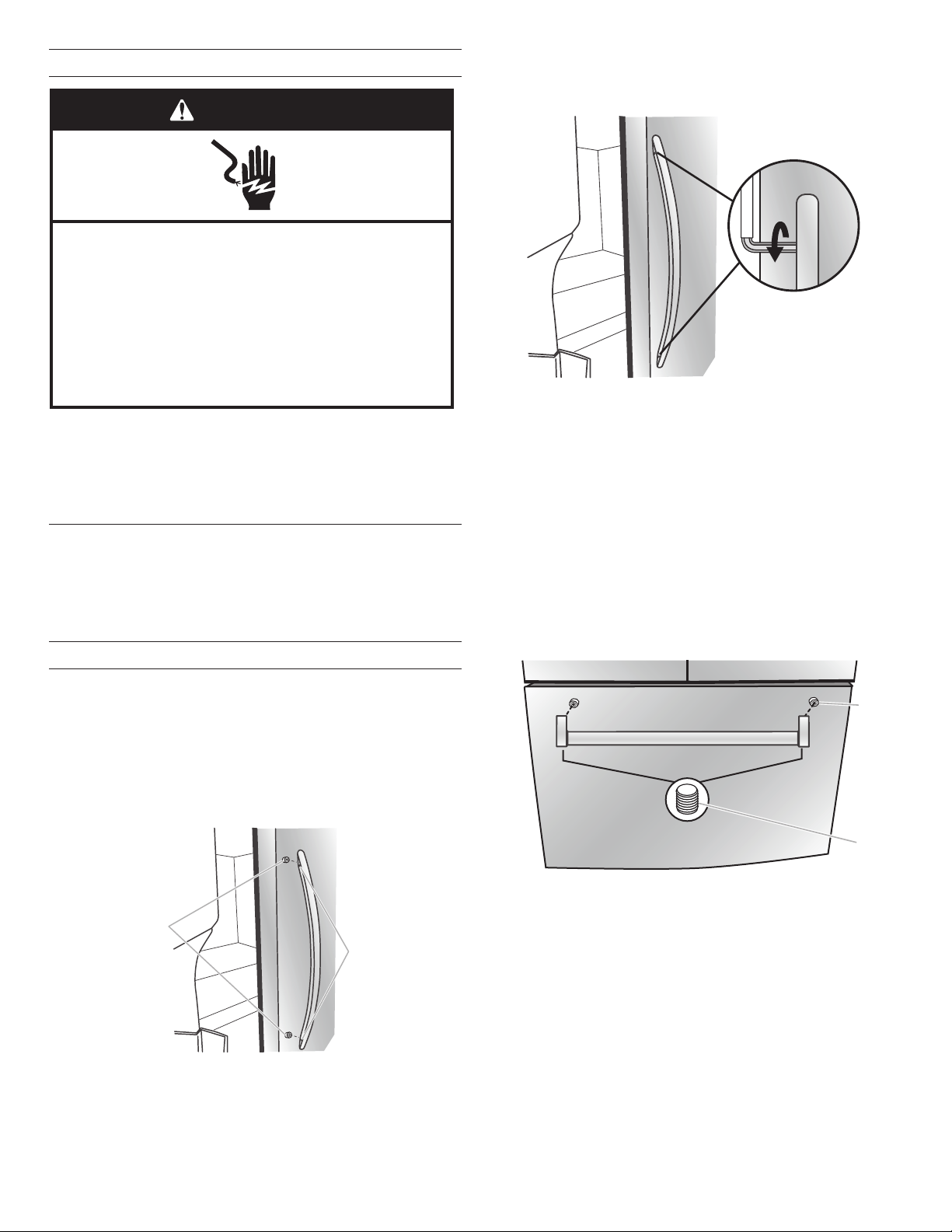
Style 1
1. Remove plastic cap from water valve inlet port. Attach the
copper tube to the valve inlet using a compression nut
and sleeve as shown. Tighten the compression nut. Do not
overtighten. Conrm copper tubing is secure by pulling on
copper tubing.
2. Create a service loop with the copper tubing. Avoid kinks
when coiling the copper tubing. Secure copper tubing to
refrigerator cabinet with a “P” clamp.
3. Turn on water supply to refrigerator and check for leaks.
Correct any leaks.
Style 2
1. Unplug refrigerator or disconnect power.
2. Remove and discard the short, black plastic part from the end
of the water line inlet.
3. Thread the nut onto the end of the tubing. Tighten the nut by
hand. Then tighten it with a wrench two more turns. Do not
overtighten.
NOTE: To avoid rattling, be sure the copper tubing does not
touch the cabinet’s side wall or other parts inside the cabinet.
4. Install the water supply tube clamp around the water supply
line to reduce strain on the coupling.
5. Turn on shut-off valve.
6. Check for leaks. Tighten any connections (including
connections at the valve) or nuts that leak.
7. On some models, the ice maker is equipped with a built-in
water strainer. If your water conditions require a second water
strainer, install it in the 1/4" (6.35 mm) water line at either
tube connection. Obtain a water strainer from your appliance
dealer.
A
B
D
C
A. Sleeve
B. Nut
C. Copper tubing
(to refrigerator)
D. Household supply line
(1/2" [12.7 mm] minimum)
AB C
A. Compression sleeve
B. Compression nut
C. Copper tubing
B
A
C
D
A. Copper tubing
B. “P” clamp
C. Compression nut
D. Compression sleeve
D
A B C
A. Household water line
B. Nut (purchased)
C. Ferrule (purchased)
D. Refrigerator water tubing
13
Complete the Installation
1. Plug into a grounded 3 prong outlet.
2. Flush the water system. See “Water and Ice Dispensers.”
NOTE: Allow 24 hours to produce the rst batch of ice.
Discard the rst three batches of ice produced. Allow 3 days to
completely ll the ice storage bin.
Handle Installation and Removal
Parts Included: Refrigerator door handles (2), refrigerated
drawer handles (2), freezer drawer handle (1), 1/8" hex key, spare
setscrew(s).
NOTE: Handle style may vary by model.
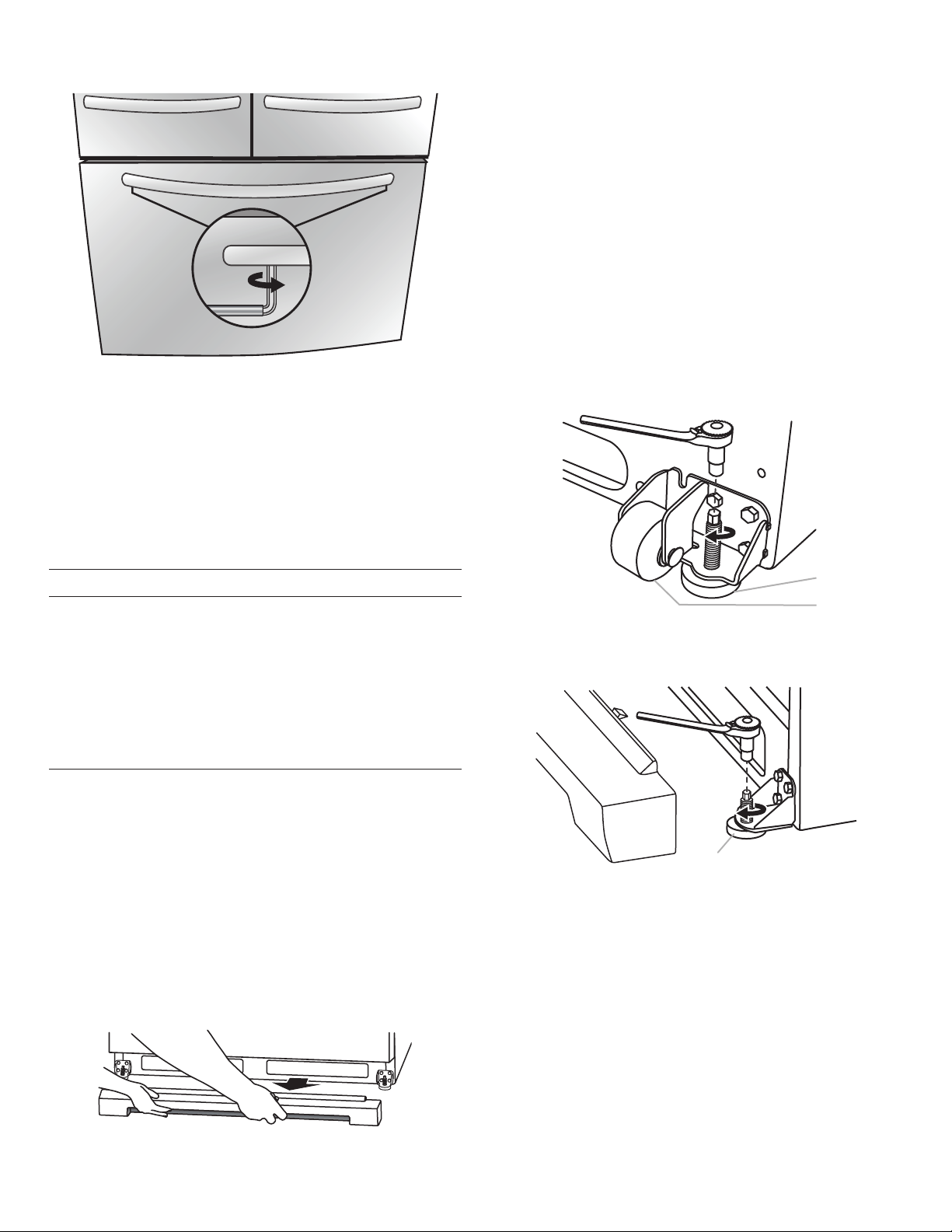
Install Handles
Refrigerator Doors
NOTE: Handle mounting setscrews are preinstalled inside the
handle.
1. Remove the handles from the packaging inside the
refrigerator, and place them on a soft surface.
2. Open a refrigerator compartment door. On the closed
door, place a handle onto the shoulder screws so that the
setscrews are facing the adjacent door.
3. Firmly push the handle toward the door until the handle base
is ush against the door.
4. While holding the handle, insert the short end of the hex key
into the upper hole and slightly rotate the hex key until it is
engaged in the setscrew.
5. Using a clockwise motion, tighten the setscrew just until it
begins to contact the shoulder screw. Do not fully tighten.
6. Repeat steps 4 and 5 to fasten the lower setscrew.
7. Once both setscrews have been partially tightened as
instructed in the previous steps, fully tighten both setscrews.
IMPORTANT: When the screws feel tight, tighten them an
additional quarter-turn. The handle is not properly installed
without this extra tightening.
8. Repeat steps 2 through 7 to install the other handle onto the
adjacent refrigerator door.
Refrigerator and Freezer Drawers
1. With the drawer closed, place the handle onto the shoulder
screws so that the setscrews are facing down toward the
oor.
2. Firmly push the handle toward the drawer until the handle
base is ush against the drawer.
Electrical Shock Hazard
Plug into a grounded 3 prong outlet.
Do not remove ground prong.
Do not use an adapter.
Do not use an extension cord.
Failure to follow these instructions can result in death,
fire, or electrical shock.
WARNING
A
B
A. Shoulder screws
B. Setscrews inside the handle
A
B
A. Shoulder screw
B. Setscrews inside the handle
14
3. Insert the short end of the hex key into the left-hand hole and
slightly rotate the hex key until it is engaged in the setscrew.
4. Using a left-to-right motion, tighten the setscrew a quarterturn
at a time just until it begins to contact the shoulder screw. Do
not fully tighten.
5. Repeat steps 3 and 4 to fasten the right-hand setscrew to the
shoulder screw.
6. Once both setscrews have been partially tightened as
instructed in the previous steps, fully tighten both setscrews.
IMPORTANT: When the screws feel tight, tighten them an
additional quarter-turn. The handle is not properly installed
without this extra tightening.
7. Save the hex key and all instructions.
Remove the Handles
1. While holding the handle, insert the short end of the hex key
into a setscrew hole, and slightly rotate the hex key until it is
engaged in the setscrew.
2. Using a right-to-left motion, loosen the setscrew a quarter-
turn at a time.
3. Repeat steps 1 and 2 for the other setscrew. Slowly pull the
handle away from the door or drawer.
4. If necessary, use a Phillips screwdriver to remove the shoulder
screws from the door.
Refrigerator Leveling and Door Closing
The base grille covers the adjustable brake feet and roller
assemblies located at the bottom of the refrigerator below the
freezer drawer. Before making any adjustments, remove the base
grille and move the refrigerator to its nal location.
Tools Needed: 1/4" hex driver
Tools Provided: 1/8" hex key
1. Remove the base grille. Using both hands, grasp the grille
rmly and pull it toward you. Open the freezer drawer to
access the brake feet.
NOTE: To allow the refrigerator to roll easier, raise the brake
feet by turning them counterclockwise. The front rollers will be
touching the oor.
2. Move the refrigerator to its nal location.
3. Using the 1/4" hex driver, lower the brake feet. Turn them
clockwise until the rollers are off the oor and both brake feet
are snug against the oor. This keeps the refrigerator from
rolling forward when opening the refrigerator doors or freezer
drawer.
IMPORTANT: If you need to make further adjustments
involving the brake feet, you must turn both brake feet the
same amount to keep the refrigerator level.
4. Make sure the doors close easily. If you are satised with the
door opening and closing, skip the next section and go to
Step 5. If, however, the doors do not close easily or the doors
pop open, adjust the tilt.
To Adjust the Cabinet Tilt:
■ Open the freezer drawer. Use a 1/4" hex nut driver to turn
both brake feet clockwise the same amount. This will raise
the front of the refrigerator. It may take several turns to
allow the doors to close easier.
NOTE: Having someone push against the top of the
refrigerator takes some weight off the brake feet. This
makes it easier to turn them.
Style 1
Style 2
5. Make sure the refrigerator is steady. If the refrigerator seems
unsteady or rolls forward when a door or drawer is pulled
open, adjust the brake feet.
To Steady the Refrigerator:
■ Open the freezer drawer. Using a 1/4" hex driver, turn both
brake feet clockwise the same amount until the brake feet
are snug against the oor. Check again. If not satised,
continue to adjust the brake feet by half turns of the screw
until the refrigerator does not roll forward when the drawer
is opened.
NOTE: Having someone push against the top of the
refrigerator takes some weight off the brake feet. This
makes it easier to turn the screws.
6. Replace the base grille by aligning the ends of the grille with
the leveling assemblies on each side and snapping the grille
into place.
A
B
A. Brake foot
B. Front roller
A
A. Brake foot
1/4"
1/4"
15
FILTERS AND ACCESSORIES
Water Filtration System
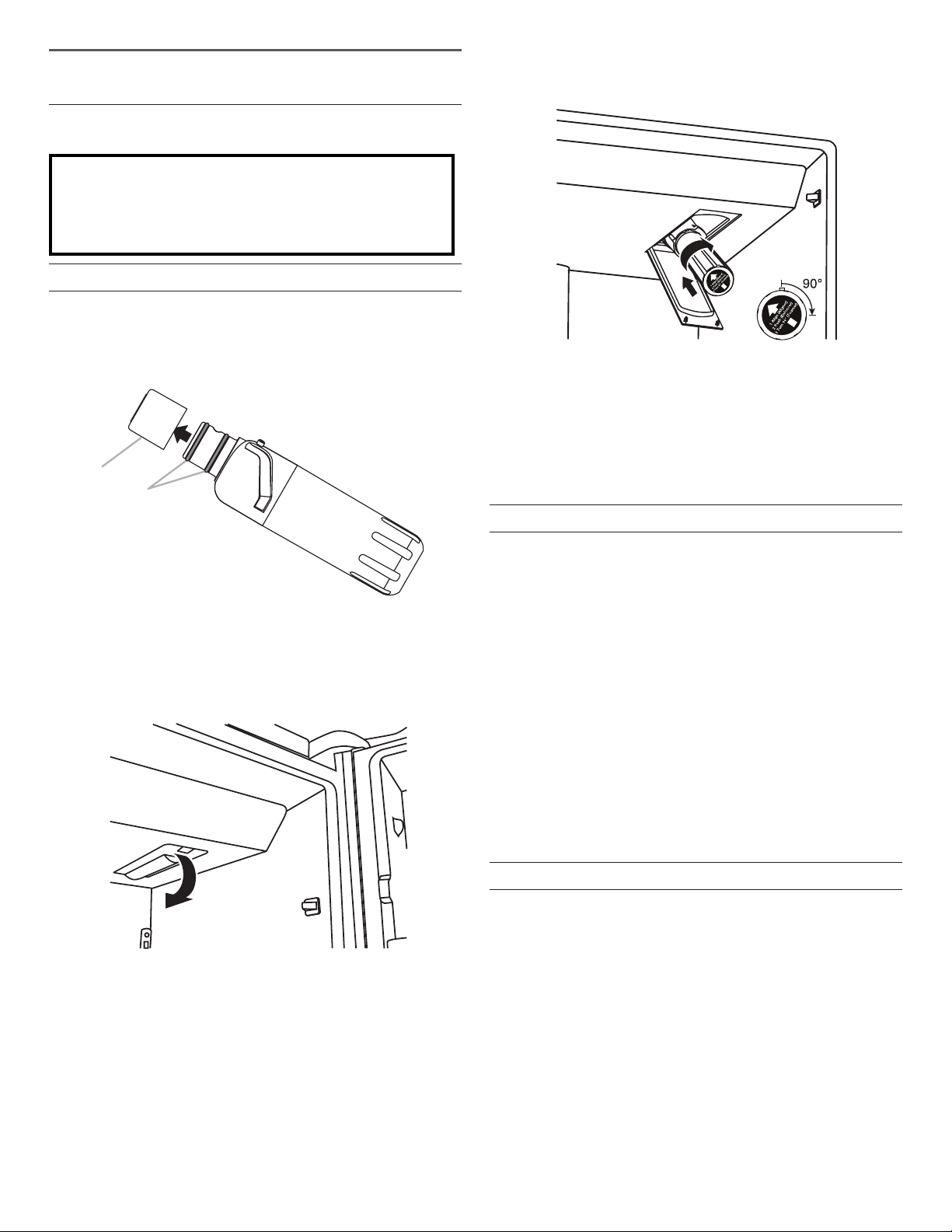
Install the Water Filter
1. Locate the accessory packet in the refrigerator and remove
the water lter.
2. Take the water lter out of its packaging and remove the cover
from the O-rings. Be sure the O-rings are still in place after the
cover is removed.
3. The water lter compartment is located in the right-hand side
of the refrigerator ceiling. Push up on the compartment door
to release the catch, and then lower the door.
4. Align the arrow on the water lter label with the cutout notch
in the lter housing and insert the lter into the housing.
5. Turn the lter clockwise 90 degrees (1/4 turn) until it locks into
the housing.
NOTE: If the lter is not correctly locked into the housing, the
water dispenser will not operate. Water will not ow from the
dispenser.
6. While the compartment door is still open, lift the lter up into
the compartment. Then, close the lter compartment door
completely.
7. Flush the water system. See “Flushing the Water Filter” in the
“Water and Ice Dispensers” section.
IMPORTANT: If you do not ush the water system, you may
experience dripping and/or decreased ow from the water
dispenser.
The Water Filter Status Light
Press OPTIONS on the control panel to launch the Options
menu. Press OPTIONS, under Filter Status, again to display the
percentage of lter life remaining (from 99% to 0%). Press ICE/
WATER, under Back, to return to the Normal screen.
The Water Filter status lights will help you know when to change
your water lter.
■ ORDER FILTER (yellow) - it is almost time to change the water
lter. While you are dispensing water, “Order Filter” will blink
seven times and sound an alert tone three times.
■ REPLACE FILTER (red) - Replace the water lter. While you
are dispensing water, “Replace Filter” will blink seven times
and an alert tone will sound three times.
■ RESET the Water Filter status tracking feature. After you
replace the disposable lter with a new lter, closing the lter
compartment door will automatically reset the lter status
tracking feature. See “Using the Control(s).”
NOTE: “REPLACE FILTER” will remain illuminated if a lter is
not installed or is installed incorrectly.
Replace the Water Filter
To purchase a replacement water lter, see “Accessories” in the
User Guide, Use and Care Guide, or User Instructions.
Replace the disposable water lter when indicated on the water
lter status display or at least every 6 months. If water ow to
your dispenser or ice maker decreases noticeably, change the
water lter sooner.
1. Locate the water lter compartment in the right-hand side
of the refrigerator ceiling. Push up to release and lower the
compartment door.
2. Turn the water lter counterclockwise (to the left), and pull it
straight out of the compartment.
NOTE: There may be some water in the lter. Some spilling
may occur. Use a towel to wipe up any spills.
3. Install the replacement water lter by following steps 2
through 7 in the “Install the Water Filter” section.
Do not use with water that is microbiologically unsafe or
of unknown quality without adequate disinfection before
or after the system. Systems certified for cyst reduction
may be used on disinfected waters that may contain
filterable cysts.
B
A
A. O-ring cover
B. O-rings
16
Install Air Filter (on some models)
An air lter is 15 times more powerful than baking soda at
reducing common food odors inside the refrigerator.
On some models, your refrigerator's accessory packet includes
an air lter, which must be installed prior to use.
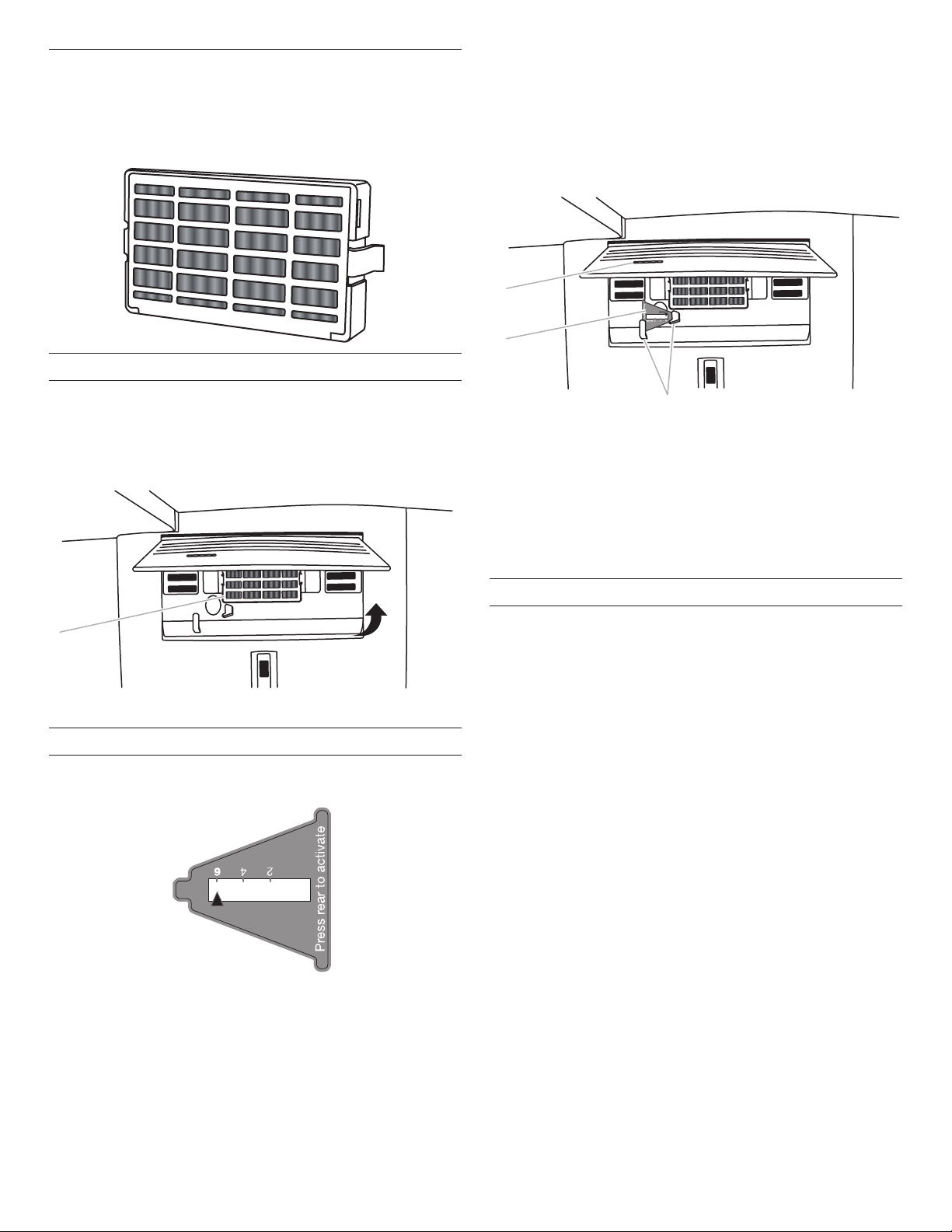
Installing the Air Filter
Install the air lter behind the vented door, located on the rear wall
near the top of the refrigerator compartment.
1. Remove the air lter from its packaging.
2. Lift open the vented door.
3. Snap the lter into place.
Installing the Filter Status Indicator
The lter comes with a status indicator which should be activated
and installed at the same time the air lter is installed.
1. Place the indicator facedown on a rm, at surface.
2. Apply pressure to the bubble on the back of the indicator until
the bubble pops to activate the indicator.
3. Lift open the vented air lter door. On some models, there are
notches behind the door.
Models with notches:
■ With the indicator screen facing outward, slide the
indicator down into the notches.
NOTE: The indicator will not easily slide into the notches if
the bubble has not been popped.
■ Close the air lter door, and check that the indicator is
visible through the window in the door.
Models without notches:
■ Place the indicator somewhere it is easily visible - either
inside the refrigerator or elsewhere in your kitchen or
home.
Replacing the Air Filter
The disposable air lter should be replaced every 6 months when
the status indicator has completely changed from white to red.
To order a replacement air lter, contact us. See “Accessories”
in the User Guide, Use and Care Guide, or User Instructions for
information on ordering.
1. Remove the used air lter by squeezing in on the side tabs.
2. Remove the used status indicator.
3. Install the new air lter and lter status indicator using the
instructions in the previous sections.
A
A. Air filter
MONTHS
REPLACE
B
A
C
A. Status indicator window
B. Air Filter status indicator
C. Notches
17
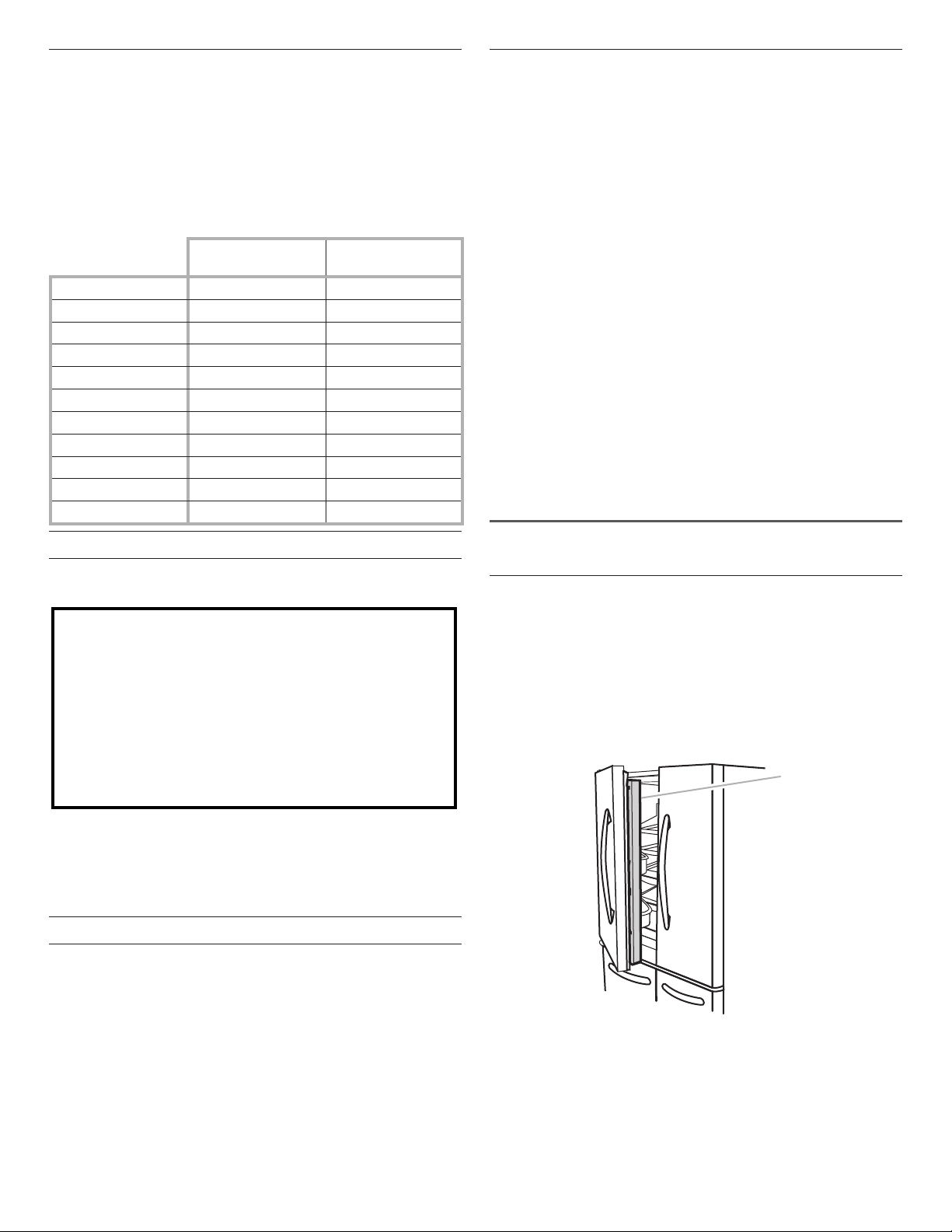
Install Produce Preserver
(on some models)
The produce preserver absorbs ethylene to slow the ripening
process of many produce items. As a result, certain produce
items will stay fresh longer.
Ethylene production and sensitivity varies depending on the type
of fruit or vegetable. To preserve freshness, it is best to separate
produce with sensitivity to ethylene from fruits that produce
moderate to high amounts of ethylene.
Sensitivity to
Ethylene
Ethylene
Production
Apples High Very High
Asparagus Medium Very Low
Berries Low Low
Broccoli High Very Low
Cantaloupe Medium High
Carrots Low Very Low
Citrus Fruit Medium Very Low
Grapes Low Very Low
Lettuce High Very Low
Pears High Very High
Spinach High Very Low
Installing the Produce Preserver
For your convenience the suction mounted produce preserver can
be installed in either the crisper or the refrigerated drawers.
1. Wash the interior of a drawer with a solution of mild dish soap
and warm water, and dry thoroughly.
2. Find the package containing the Produce Preserver inside the
refrigerator, and install the Produce Preserver into the drawer
according to the instructions provided in the package.
Replacing the Produce Preserver
The disposable packet(s) should be replaced every 6 months or
when the status indicator changes completely from white to red.
To order replacements, contact us. See “Accessories” for
information on ordering.
1. Remove the used packets from the produce preserver
housing.
2. Remove the used status indicator.
3. Install the replacement packets and status indicator using the
instructions included in the package.
Accessories
The following accessories are available for your refrigerator. To
order an accessory, contact us and ask for the part number.
In the U.S.A., visit our website
www.whirlpool.com/accessories or call 1-800-901-2042.
In Canada, visit our website
www.whirlpoolparts.ca or call 1-800-807-6777.
Affresh
®
Stainless Steel Cleaner:
In U.S.A., order Part #W10355016
In Canada, order Part #W10355016B
Affresh
®
Stainless Steel Wipes:
In U.S.A., order Part #W10355049
In Canada, order Part #W10355049B
Affresh
®
Kitchen & Appliance Cleaner:
In U.S.A., order Part #W10355010
In Canada, order Part #W10355010B
Water Filter:
In U.S.A., order Part #EDR2RXD1
In Canada, order Part #EDR2RXD1B
Air Filter:
Order Part #W10311524 or AIR1
Produce Preserver Starter kit:
Order Part #P1UB6S1
Produce Preserver Rell kit:
Order Part #P1KC6R1
REFRIGERATOR USE
Opening and Closing Doors
There are two refrigerator compartment doors. The doors can be
opened and closed either separately or together.
There is a vertically hinged seal on the left refrigerator door.
■ When the left-side door is opened, the hinged seal
automatically folds inward so that it is out of the way.
■ When both doors are closed, the hinged seal automatically
forms a seal between the two doors.
CAUTION: IRRITANT
MAY IRRITATE EYES AND SKIN. DANGEROUS FUMES
FORM WHEN MIXED WITH OTHER PRODUCTS.
Do not mix with cleaning products containing ammonia,
bleach or acids. Do not get in eyes, on skin or clothing. Do
not breathe dust. Keep out of reach of children.
FIRST AID TREATMENT: Contains potassium
permanganate. If swallowed, call a Poison Control Center or
doctor immediately. Do not induce vomiting. If in eyes, rinse
with water for 15 minutes. If on skin, rinse with water.
A
A. Hinged seal
18
Using the Controls
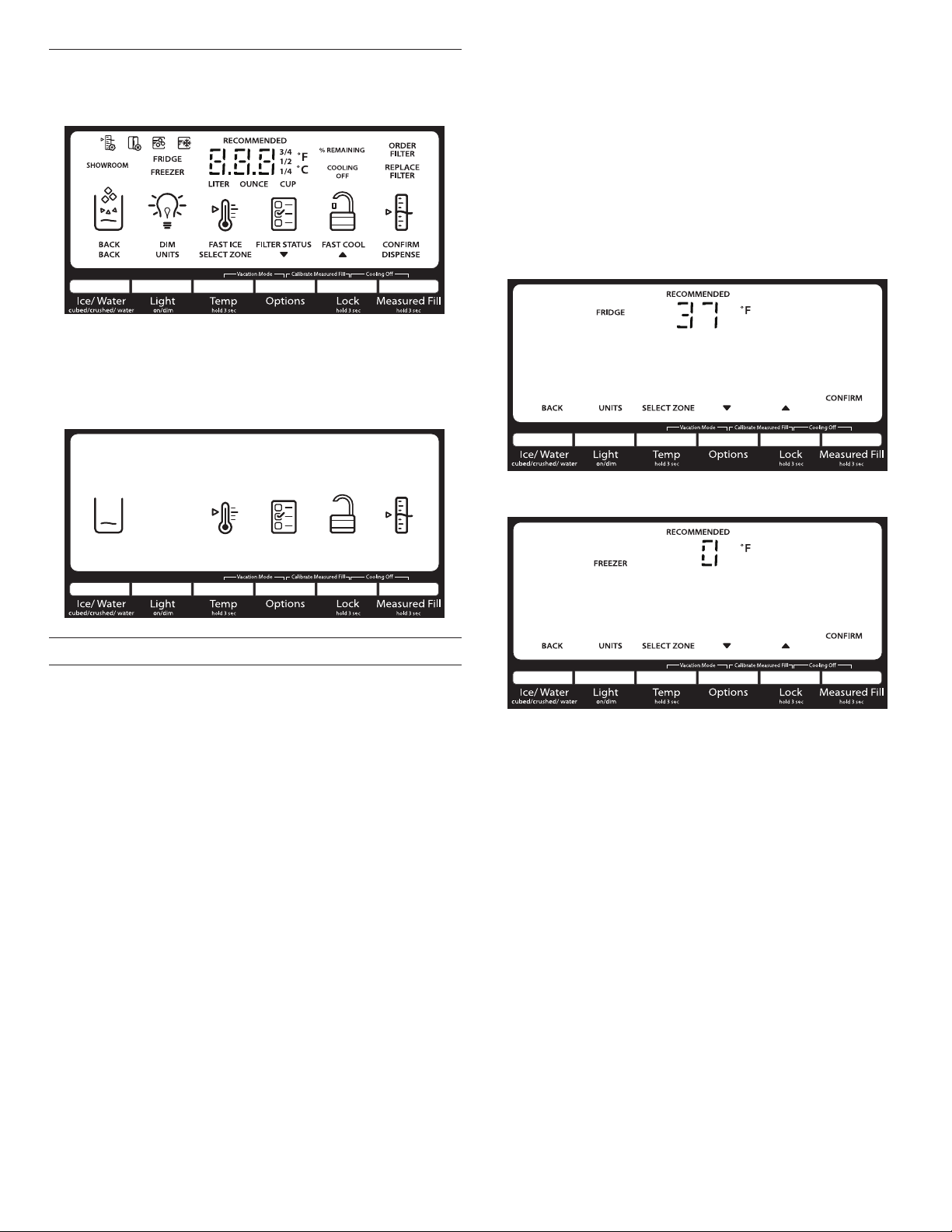
The controls are located above the external dispenser.
IMPORTANT: The display screen on the dispenser control panel
will turn off automatically and enter “sleep” mode when the
control buttons and dispenser paddles have not been used for 2
minutes or more. Press any control button to reactivate the
display screen. The home screen will appear as shown.
Viewing and Adjusting Temperature Set Points
For your convenience, your refrigerator and freezer controls are
preset at the factory.
When you rst install your refrigerator, make sure that the
controls are still set to the recommended set points. The factory
recommended set points are 37°F (3°C) for the refrigerator and
0°F (-18°C) for the freezer.
IMPORTANT:
■ Wait 24 hours before you put food into the refrigerator. If you
add food before the refrigerator has cooled completely, your
food may spoil.
NOTE: Adjusting the set points to a colder than
recommended setting will not cool the compartments any
faster.
■ If the temperature is too warm or too cold in the refrigerator
or freezer, rst check the air vents to be sure they are not
blocked before adjusting the controls.
■ The recommended settings should be correct for normal
household use. The controls are set correctly when milk or
juice is as cold as you like and when ice cream is rm.
NOTE: Areas such as a garage, basement, or porch may have
higher humidity or extreme temperatures. You may need to
adjust the temperature away from the recommended settings
to accommodate for these conditions.
■ Wait at least 24 hours between adjustments. Recheck the
temperatures before other adjustments are made.
View Temperature Set Points
1. Press and hold TEMP for 3 seconds to activate Temperature
mode.
NOTE: To view temperature in degrees Celsius, press the
Light button, under Units, when adjust mode is activated. To
return the display setting to Fahrenheit, press the Light button
again.
When Temperature mode is activated, press TEMP to
toggle between Fridge and Freezer. The display will show
the temperature set point of the selected compartment and
temperature adjusting information will appear on the display
screen.
Recommended Refrigerator Temperature
Recommended Freezer Temperature
Adjust Temperature Set Points
Refrigerator set point range: 33°F to 42°F (0°C to 5.5°C)
Freezer set point range: -5°F to 5°F (-21°C to -15°C)
1. When Temperature mode is activated, press TEMP to select
the Refrigerator zone. The display will show the temperature
set point of the selected compartment as shown.
2. Press LOCK to raise the set point, or press OPTIONS to lower
the set point.
3. When you have nished viewing (and adjusting if desired)
the refrigerator set point, press TEMP, under Select Zone, to
change the display to show the freezer set point. When the
zone has been changed, “FREEZER” appears on the display
screen.
4. Press the Lock button to raise the set point, or press the
Options button to lower the set point.
Save/Conrm Temperature Settings
■ When you have nished adjusting both the refrigerator and
freezer set points, press MEASURED FILL to conrm and to
save the settings.
NOTE: To exit Temperature mode without saving changes, press
the Ice/Water button under Back at any time, or allow about
60 seconds of inactivity. The temperature mode will turn off
automatically and return to the normal screen.
19
When adjusting temperature set points,
use the following chart as a guide:
CONDITION: TEMPERATURE
ADJUSTMENT:
REFRIGERATOR too cold REFRIGERATOR setting
1° higher
REFRIGERATOR too warm REFRIGERATOR setting
1° lower
FREEZER too cold FREEZER setting 1° higher
FREEZER too warm/
Too little ice
FREEZER setting
1° lower
Cooling On/Off
Your refrigerator and freezer will not cool when cooling is turned
off.
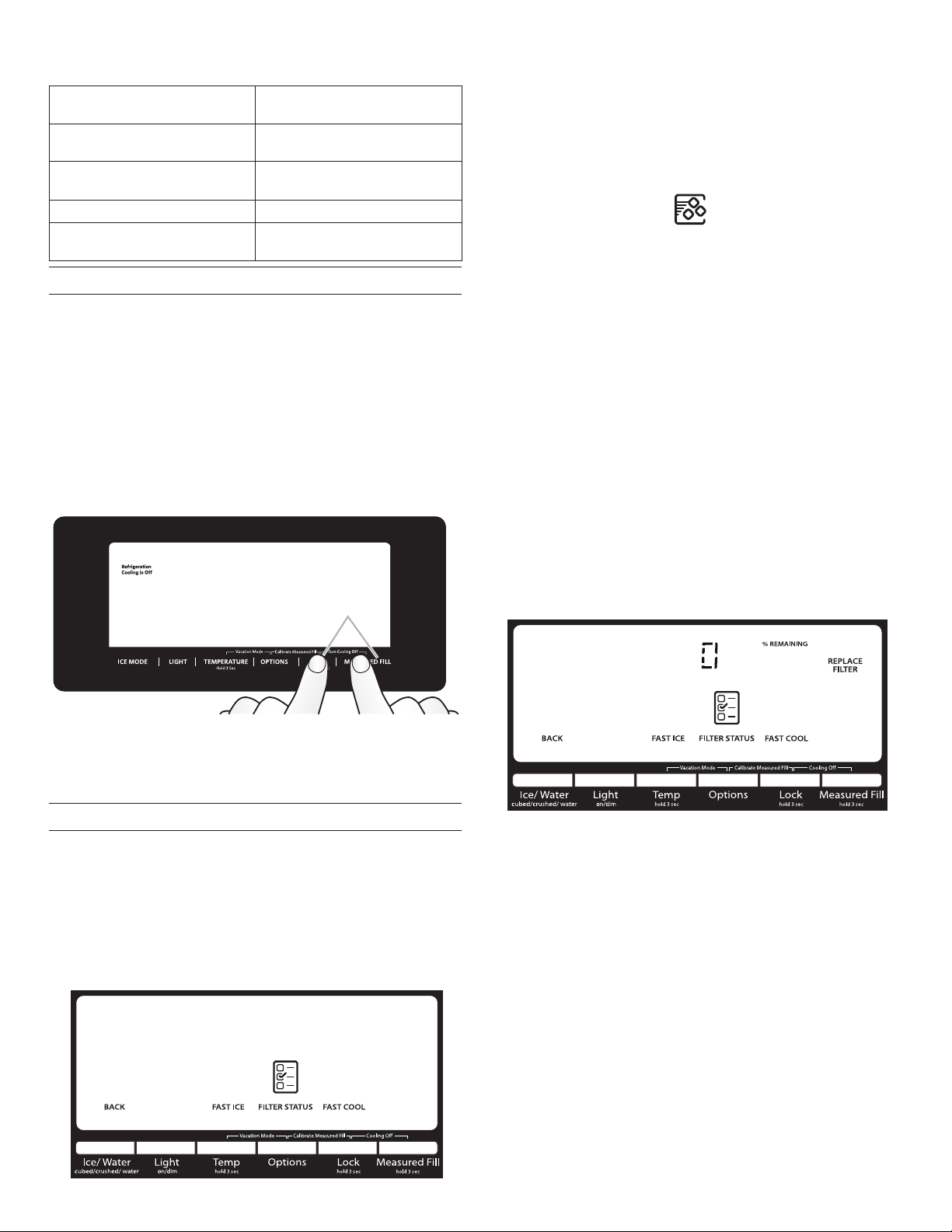
■ To turn cooling off, press and hold the Lock and Measured Fill
buttons at the same time for 3 seconds. The Cooling Off icon
will blink seven times and then remain lit as shown.
IMPORTANT:
■ To avoid unintentionally locking the dispenser or changing
other settings, press both buttons at exactly the same
time.
■ When cooling is OFF, the dispenser paddles and all
controls except, Lock and Measured Fill, are disabled.
■ Press and hold LOCK and MEASURED FILL for 3 seconds
again to turn cooling back on.
Options
IMPORTANT: All options are OFF (default) until selected.
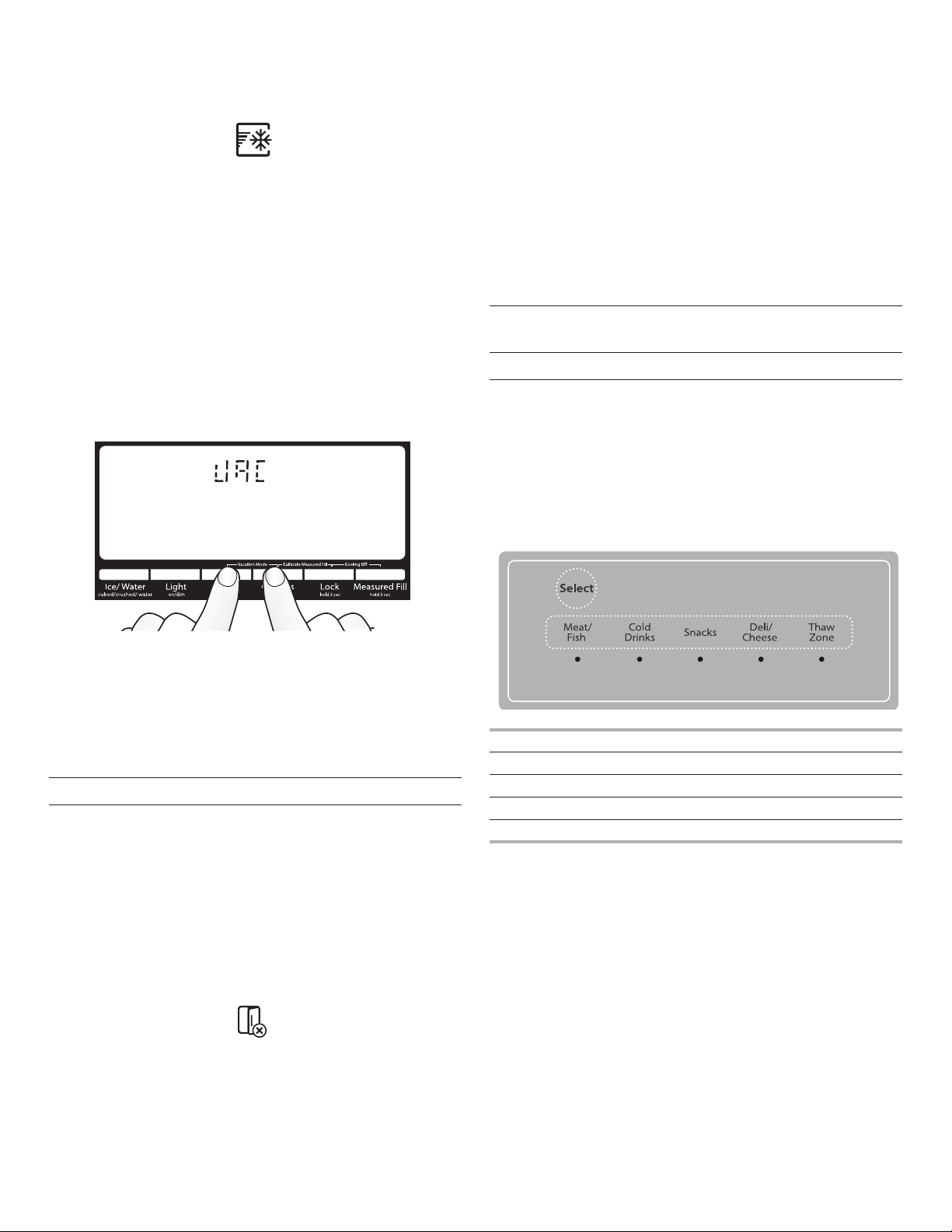
■ Press the Options button to open the Options menu and
select among the Fast Ice, Filter Status and Fast Cool
features.
NOTE: “Fast Cool” and “Fast Ice” illuminate to indicate when
both features are ON.
■ Press the Ice/Water button under “Back” at any time to return
to the Home screen.
Fast Ice
The Fast Ice feature assists with temporary periods of heavy ice
use by increasing ice production. Once selected, Fast Ice will
remain on for 24 hours unless manually turned off.
■ To turn on the Fast Ice feature, press the Options button to
access the Options menu, and then press TEMP, under Fast
Ice to activate the feature. When the feature is ON, the Fast
Ice icon will appear on the dispenser display screen.
■ To manually turn off the Fast Ice feature, press the Options
button to enter Options mode (unless you are already in
Options mode), then press TEMP, under Fast Ice, again.
When the feature has been turned off, the Fast Ice icon will
disappear from the dispenser display.
Filter Status
Displays the percentage of use remaining in the water lter (from
100% remaining to 0% remaining).
To access Filter Status, press the Options button to access the
Options menu, and then press OPTIONS, under Filter Status, to
display the percent of life remaining in the water lter.
ALSO
The Water Filter status lights will let you know when to change
your water lter.
■ ORDER FILTER (Yellow) - Order a replacement water lter.
■ REPLACE FILTER (Red) - Replace the water lter. Replacing
the disposable water lter will automatically reset the Water
Filter status tracking feature. See “Water Filtration System.”
NOTE: REPLACE FILTER will remain illuminated if a lter is
not installed or installed incorrectly.
Fast Cool
The Fast Cool feature assists with periods of high refrigerator use,
full grocery loads, or temporarily warm room temperatures. Once
selected, Fast Cool will remain on for 24 hours unless manually
turned off.
NOTE: If you adjust the refrigerator temperature set point, Fast
Cool will turn off.
A
Press LOCK and MEASURED FILL at the same time.
20
■ To turn on the Fast Cool feature, press the Options button to
access the Options menu, then press TEMP, under Fast Cool
to activate the feature. When the feature is ON, the Fast Cool
icon will appear on the dispenser display screen.
■ To manually turn off the Fast Cool feature, press the Options
button to enter Options mode (unless you are already in
Options mode), then press LOCK, under Fast Cool, again.
When the feature has been turned off, the Fast Cool icon will
disappear from the dispenser display.
Vacation Mode
In Vacation Mode, the freezer will defrost less often to conserve
energy.
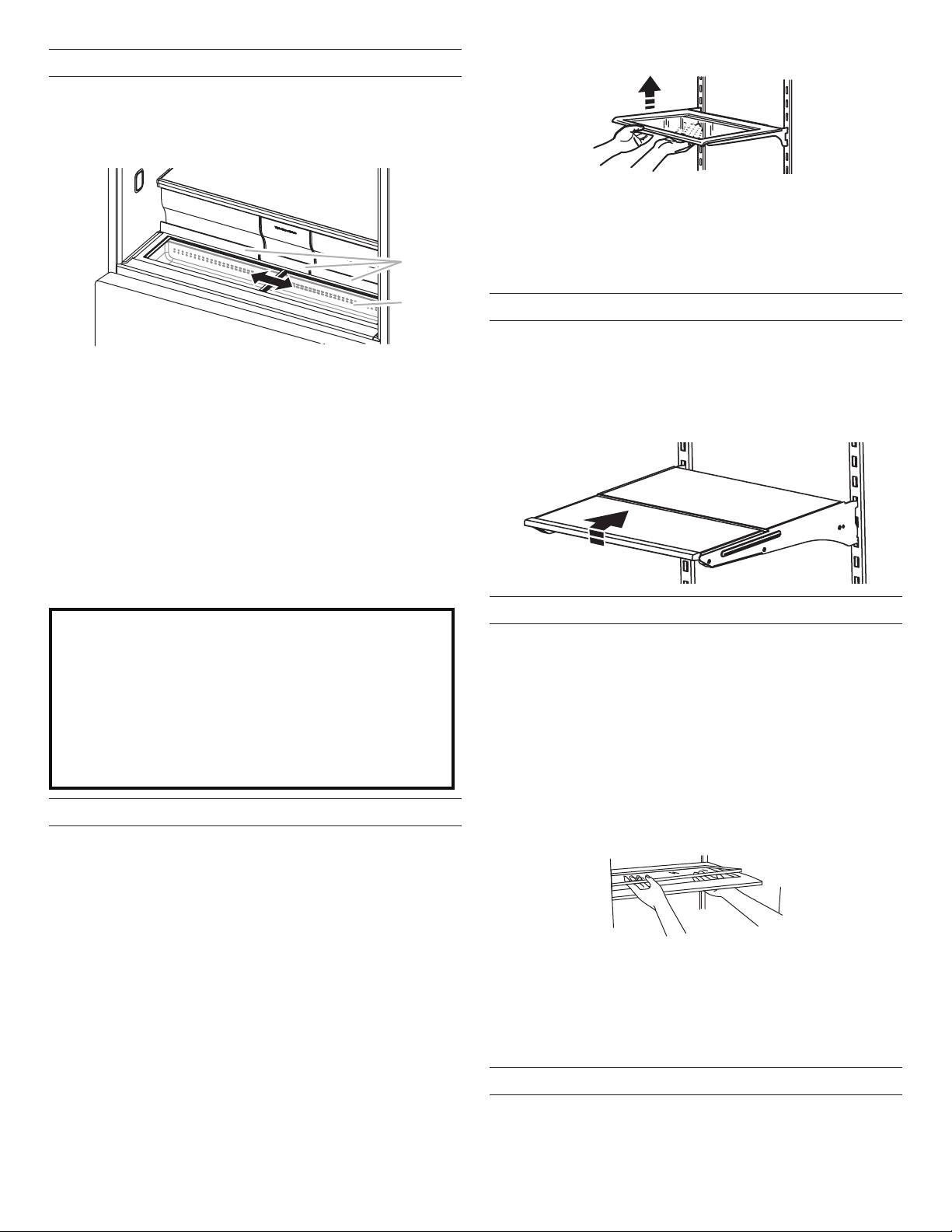
■ To turn on Vacation mode, press and hold the Temp and
Options buttons at the same time for 3 seconds. When the
feature is on, VAC will appear on the display as shown.
■ To turn off Vacation Mode, press and hold the Temp and
Options buttons at the same time for 3 seconds. VAC will
disappear and the display will return to the settings as they
were before Vacation Mode was turned on.
NOTES:
■ During the rst hour after Vacation Mode is turned on,
opening and closing the refrigerator door will not affect the
setting. After 1 hour has passed, opening and closing the
refrigerator door will turn off Vacation Mode.
■ While in Vacation Mode, if Fast Ice is turned on or the Door
Ajar alarm sounds, Vacation Mode will be canceled.
Additional Features
Door Ajar Alarm
The Door Ajar Alarm feature sounds an alarm when the
refrigerator door(s), drawers, or freezer drawer is open for 5
minutes and cooling is turned on. The alarm will repeat every 2
minutes. Close all doors and drawer to turn it off. The feature then
is reset and will reactivate when either door is left open again for
5 minutes.
NOTE: To mute the audible alarm while keeping the doors open,
such as while cleaning the inside of the refrigerator, press any
button on the control panel. The alarm sound will be temporarily
turned off, but the Door Ajar icon will still be displayed on the
dispenser control panel.
Disabling Sounds
■ To turn off control and dispenser sounds, press and hold
ICE/ WATER and MEASURED FILL at the same time for
3 seconds. All normal operating tones are disabled. Only
alert tones will be audible.
■ To turn all sounds back on, press and hold ICE/WATER
and MEASURED FILL at the same time for 3 seconds
again.
Power Outage
The Power Outage indicator lets you know if the power supply
to the refrigerator has been off, and the freezer temperature has
risen to 18°F (-8°C) or higher.
The control panel temperature display will read “PO,” and an
alert tone will sound three times. “Conrm” will blink until you
acknowledge the power outage by pressing MEASURED FILL
under “Conrm.”
Once the power outage has been conrmed, the “PO” will
disappear, and the display will return to the Home screen.
Showroom Mode
This mode is used only when the refrigerator is on display in a
retail store. If you unintentionally turn on Showroom mode, the
word “Showroom” will light up on the display. Exit Showroom
mode by pressing and holding LIGHT and LOCK at the same time
for 3 seconds.
Refrigerator Features
Temperature-Controlled Exterior Drawer
IMPORTANT: The left-hand refrigerated drawer has its own
temperature control. This control sets the temperature for this
drawer only. The temperature for the right-hand drawer is set to
the same temperature as the main refrigerator compartment.
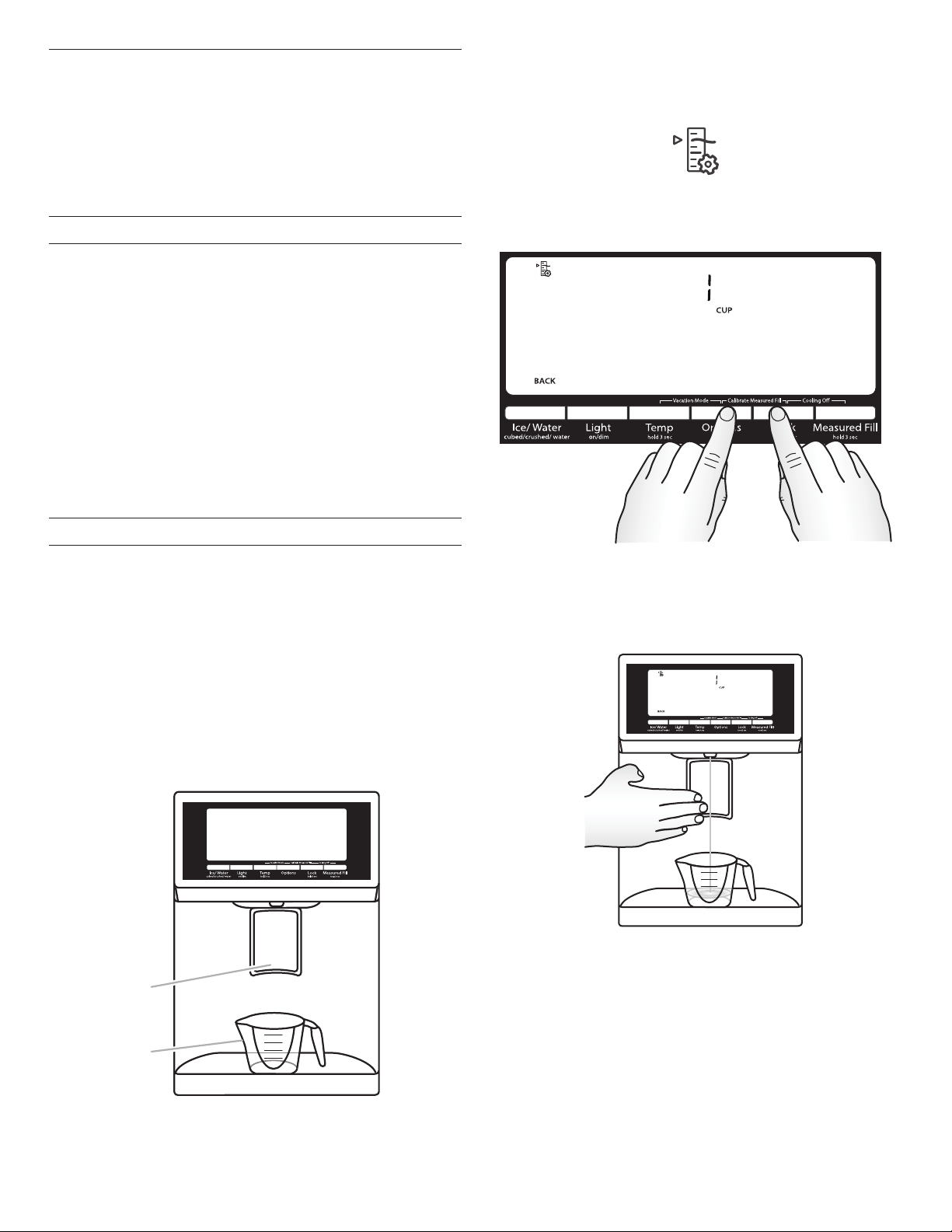
Temperatures have been preset for the storage of: Meat/Fish,
Cold Drinks, Snacks, Deli/Cheese and Thaw Zone. These preset
temperatures cannot be adjusted.
■ Press SELECT to toggle through the temperature settings.
The icon will illuminate when it is selected.
Meat/Fish 32°F (0°C)
Cold Drinks 34°F (1°C)
Snacks 36°F (2°C)
Deli/Cheese 38°F (3°C)
Thaw Zone 39°F (4°C)
Removable Interior Drawer Bins
The drawer bins are removable for ease in cleaning.
To remove and replace the interior bins:
1. To remove, grasp the sides of the bin and lift up and out.
2. To replace, with the rear of the bin facing the back of the
refrigerator, lower the bin onto the drawer glides. See
“Remove and Replace Drawer Fronts.”
Adjustable Drawer Bin Dividers
Each refrigerated drawer has an interior drawer bin with a divider
that can be inserted into one of three different positions or
removed to customize the space for your food storage needs.
21
Easy Slide Bin
A shallow storage compartment with glass lids, which slide from
side to side is located below and in front of the crisper drawers.
NOTE: This compartment is not temperature or humidity
controlled, so it is not recommended for storing leafy vegetables.
To remove Easy Slide bin:
1. Remove all three crisper drawers.
2. Hold the upper sliding lid near the trim and lift up to remove.
Remove the lower lid.
3. Grasp the front of the bin with both hands and lift up on the
front to remove.
To replace Easy Slide bin:
1. Slightly tilt the rear of the bin upward.
2. Align the center rib and tabs on the Easy Slide bin with the
ribs and slots in the cabinet.
3. Lower the bin into place.
Shelves and Shelf Frames
The shelves in your refrigerator are adjustable to meet your
individual storage needs.
Storing similar food items together in your refrigerator and
adjusting the shelves to t different heights of items will make
nding the exact item you want easier. It will also reduce the
amount of time the refrigerator door is open and save energy.\
To remove and replace a shelf/shelf frame:
1. Remove the shelf/frame by tilting it up at the front and lifting it
out of the shelf supports.
2. Replace the shelf/frame by guiding the rear shelf hooks into
the shelf supports. Tilt the front of the shelf up until rear shelf
hooks drop into the shelf supports.
3. Lower the front of the shelf and make sure that the shelf is in
position.
MicroEdge
®
Glo shelves (on some models):
■ The hooks on the rear of the shelf must be fully engaged in
the shelf supports to maintain proper electrical ow.
■ No more than two shelves with under-shelf lighting may be
used in the refrigerator at one time.
Tuck Away Shelf (on some models)
To retract and extend the front section of the shelf:
To retract the front-section of the shelf, slightly lift up on the front
edge and push the adjustable portion of the shelf back toward the
rear of the refrigerator.
Extend the front of the shelf by pulling the retracted portion of the
shelf outward until it is fully extended.
Crisper Drawers
To remove and replace the drawers:
1. Grasp the handle at the bottom of the drawer and slide the
drawer straight out to the stop. Lift the drawer off the bottom
guide.
2. Replace the drawer by placing it on the bottom drawer guide
and pushing it past the drawer stop into position.
To remove the crisper(s) cover:
1. Remove crisper drawers.
2. Holding the glass insert rmly with one hand, press up in
center of glass insert until it rises above the plastic frame.
Gently slide the glass insert forward to remove.
3. Lift the cover frame up and remove it.
To replace crisper(s) cover:
1. Fit back of cover frame into supports on side walls of the
refrigerator and lower the front of the cover frame into place.
2. Slide rear of glass insert into cover frame and lower front into
place.
3. Replace crisper drawers.
Refrigerator Door Bins
The bins on your refrigerator door are adjustable to meet your
individual storage needs.
NOTE: The smallest door bin must be installed in the lowest
position on the refrigerator door.
A
B
A. Crisper drawer handles
B. Easy Slide bin
Important information to know about glass shelves
and covers:
Do not clean glass shelves or covers with warm water when
they are cold. Shelves and covers may break if exposed to
sudden temperature changes or impact, such as bumping.
Tempered glass is designed to shatter into many small,
pebble-size pieces. This is normal. Glass shelves and covers
are heavy. Use both hands when removing them to avoid
dropping.
22
Water and Ice Dispensers
IMPORTANT:
■ Allow 3 hours for the refrigerator to cool down and chill water.
■ Allow 24 hours to produce the rst batch of ice. Discard the
rst three batches of ice produced.
■ The dispensing system will not operate when either the
refrigerator door or freezer drawer is open.
Flush the Water System
Air in the water dispensing system can cause the water dispenser
to drip. After connecting the refrigerator to a water source or
replacing the water lter, ush the water system.
Flushing the water dispensing system forces air from the water
line and lter and prepares the water lter for use. Additional
ushing may be required in some households.
NOTE: As air is cleared from the system water may spurt out of
the dispenser.
1. Using a sturdy container, depress and hold the water
dispenser paddle for 5 seconds.
2. Release the dispenser paddle for 5 seconds. Repeat steps 1
and 2 until water begins to ow.
3. Once water begins to ow, continue depressing and releasing
the dispenser pad (5 seconds on, 5 seconds off) until a total
of 3 gal. (12 L) has been dispensed.
Calibrate Measured Fill
Household water pressure may affect the accuracy of the
Measured Fill feature. So, for optimum performance of your water
dispenser, you must rst calibrate Measured Fill.
IMPORTANT:
■ Flush the water system before calibrating Measured Fill.
■ For best results, calibration should be performed when water
is not being used in the house.
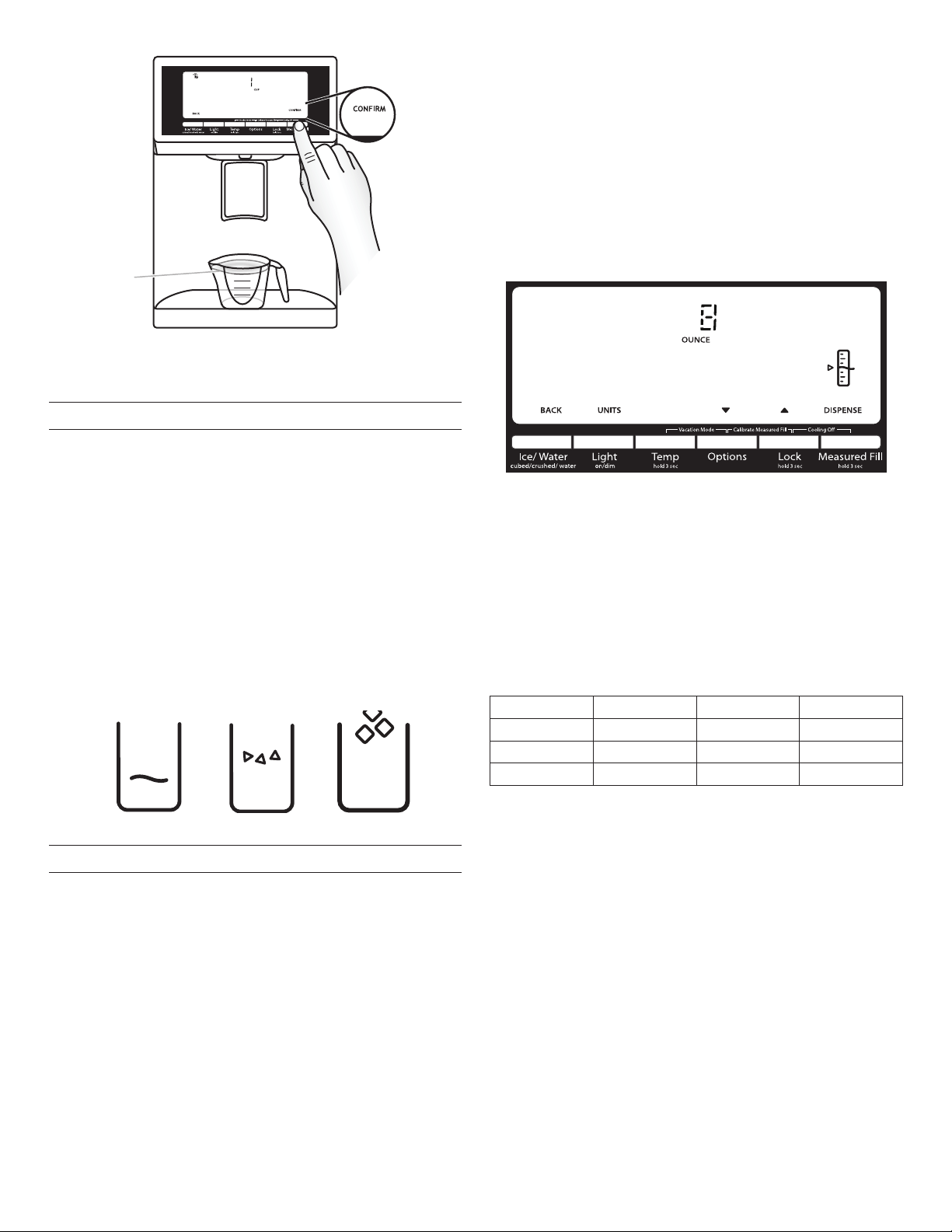
1. Place a sturdy measuring cup (1 cup [237 mL] size) on the
dispenser tray centered in front of the ice/water dispenser
paddle.
NOTE: Depending on your model, a measuring cup may be
provided.
2. Press and hold the Options and Lock buttons at the same
time for 3 seconds. The words “Back” and “1 Cup” will
appear on the display screen. Also, the Calibrate Measured
Fill icon will illuminate and remain lit while the Measured Fill
feature is being calibrated.
NOTE: You may press ICE/WATER “Back” at any time to exit
calibration mode. The Calibrate Measured Fill icon will
disappear.
3. Press and release the dispenser paddle, as needed, to
dispense water to the 1 cup ll line.
NOTE: If overlling or spilling occurs, discard the water and
press ICE/WATER “Back” to restart the calibration process.
4. When 1 cup of water has been correctly dispensed into the
measuring cup, press the Measured Fill button under the word
“Conrm” to conrm the calibration.
A
B
A. Ice/Water dispenser paddle
B. Measuring cup (1 cup)
23
5. When Measured Fill calibration has been conrmed, the icons
will disappear and the display will return to the home screen.
Dispensing
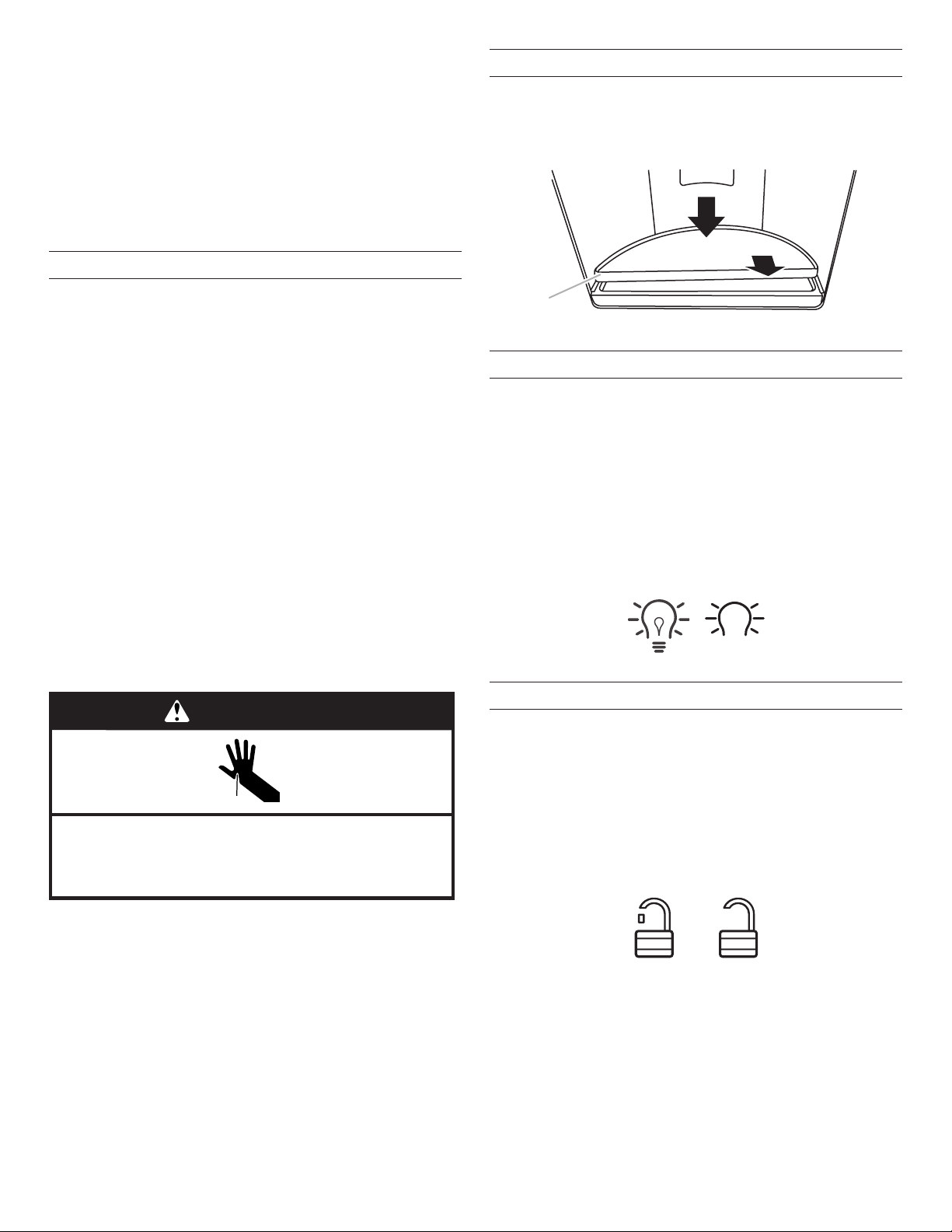
Press ICE/WATER to toggle through the following choices in a
continuous loop:
■ Water (default) - Dispenses water.
■ Cubed - Dispenses cubed ice.
■ Crushed - Dispenses crushed ice.
NOTES:
■ The word “ICE” appears on the display screen when either
crushed or cubed ice is selected.
■ For crushed ice, cubes are crushed before being
dispensed. This may cause a slight delay when dispensing
crushed ice. Noise from the ice crusher is normal, and
pieces of ice may vary in size.
■ When changing from crushed to cubed, a few ounces of
crushed ice will be dispensed along with the rst cubes.
The Water Dispenser
IMPORTANT:
■ Dispense at least 1 qt (1 L) of water every week to maintain a
fresh supply.
■ If the ow of water from the dispenser decreases, it could be
caused by low water pressure.
■ With the water lter removed, dispense 1 cup (237 mL)
of water. If 1 cup (237 mL) of water is dispensed in 8
seconds or less, the water pressure to the refrigerator
meets the minimum requirement.
■ If it takes longer than 8 seconds to dispense
1 cup (237 mL) of water, the water pressure to the
refrigerator is lower than recommended. See “Water
Supply Requirements” and “Troubleshooting” for
suggestions.
To Dispense Water - (Standard):
1. Select WATER.
2. Press a sturdy glass against the dispenser paddle.
3. Remove the glass to stop dispensing.
To Dispense Water - (Measured Fill):
Measured Fill allows you to dispense a specied amount of water
with the touch of a few controls.
NOTE: The amount of water you select will be dispensed. Be sure
that the container is empty and can hold the entire volume. If ice
is in the container, you may need to adjust your selection.
1. Press MEASURED FILL to turn on the feature. When the
feature is on, the Measured Fill screen appears on the display.
NOTES:
■ The dispenser will automatically turn off Measured Fill
after 1 minute of inactivity. When Measured Fill is turned
off, any changes you have made will be lost and all
defaults will be restored.
■ Press ICE/WATER, under “Back,” to manually turn off the
Measured Fill feature and return to the Home screen.
2. Press LIGHT, under Units, to toggle among ounce, cup, and
liter. The default unit is ounce.
Default, minimum, and maximum volumes are listed in the
following chart:
Units Default Minimum Maximum
Ounces 8 1 128
Cups 1 1/4 16
Liters 0.25 0.05 4.00
3. Press LOCK or OPTIONS to adjust the water volume as
desired. The Lock control increases the volume, and the
Options control lowers the volume.
NOTES:
■ When increasing or decreasing the dispense volumes,
if an adjustment button (-/+) is held for approximately
10 seconds or longer, the control may stop responding.
Release the button for approximately 2 seconds, and then
continue making the adjustment.
■ Most coffee cups (commonly 4 to 6 oz [118 to 177 mL] per
cup) are not the same size as a measuring cup
(8 oz [237 mL]). You may need to adjust the volume to
avoid unintentionally overlling coffee cups.
4. Dispense water.
NOTE: While dispensing water, the digital display will count
down how much water remains to be dispensed, according to
the volume you selected. The ow of water will automatically
stop once the desired volume has been dispensed.
■ Press a sturdy glass against the dispenser paddle.
OR
■ Place the glass below the water dispenser and press
MEASURED FILL, under Dispense, for hands-free
dispensing.
A
A. 1 cup of water
Water
Crushed
Cubed
24
5. To stop dispensing before the selected volume has been
dispensed, remove the glass from the dispenser paddle OR
press MEASURED FILL a second time.
NOTE: If you stop dispensing before the desired volume has
been dispensed, the digital display will continue to show how
much water remains to be dispensed. The display will turn off
after 1 minute of inactivity.
6. To select a new volume or start dispensing the same volume
again, you must rst nish dispensing the selected volume or
turn off the Measured Fill feature (either by waiting 1 minute
so it will automatically turn off or by pressing Ice/Water
“Back,” to manually turn it off), and then turn it back on.
The Ice Dispenser
IMPORTANT:
■ If the ice cubes are hollow or have an irregular shape, it
could be because of low water pressure. See “Water Supply
Requirements.”
■ Ice travels from the ice storage bin through the dispenser
chute to the dispenser. To turn off the ice maker, see “Ice
Maker and Storage Bin.”
■ The dispenser may continue to make noise and ice may
continue to dispense for several seconds after releasing the
dispenser button or paddle.
To Clean the Ice Dispenser Chute:
Humidity causes ice to naturally clump together. Ice particles can
build up until the ice dispenser chute becomes blocked.
If ice is not dispensed regularly, it may be necessary to empty the
ice storage bin and clean the ice delivery chute, the ice storage
bin and the area beneath the storage bin every 2 weeks.
■ If necessary, remove the ice clogging the storage bin and
delivery chute, using a plastic utensil.
■ Clean the ice delivery chute and the bottom of the ice storage
bin using a warm, damp cloth, and then dry thoroughly.
To Dispense Ice:
1. Select the desired type of ice. To switch between cubed ice
and crushed ice, press ICE/WATER.
2. Press a sturdy glass against the dispenser paddle. Hold the
glass close to the dispenser opening so ice does not fall
outside of the glass.
IMPORTANT: You do not need to apply a lot of pressure to
the paddle to activate the ice dispenser. Pressing hard will not
make the ice dispense faster or in greater quantities.
3. Remove the glass to stop dispensing.
NOTE: Ice may continue to dispense for several seconds after
removing the glass from the dispenser paddle. The dispenser may
continue to make noise for a few seconds after dispensing.
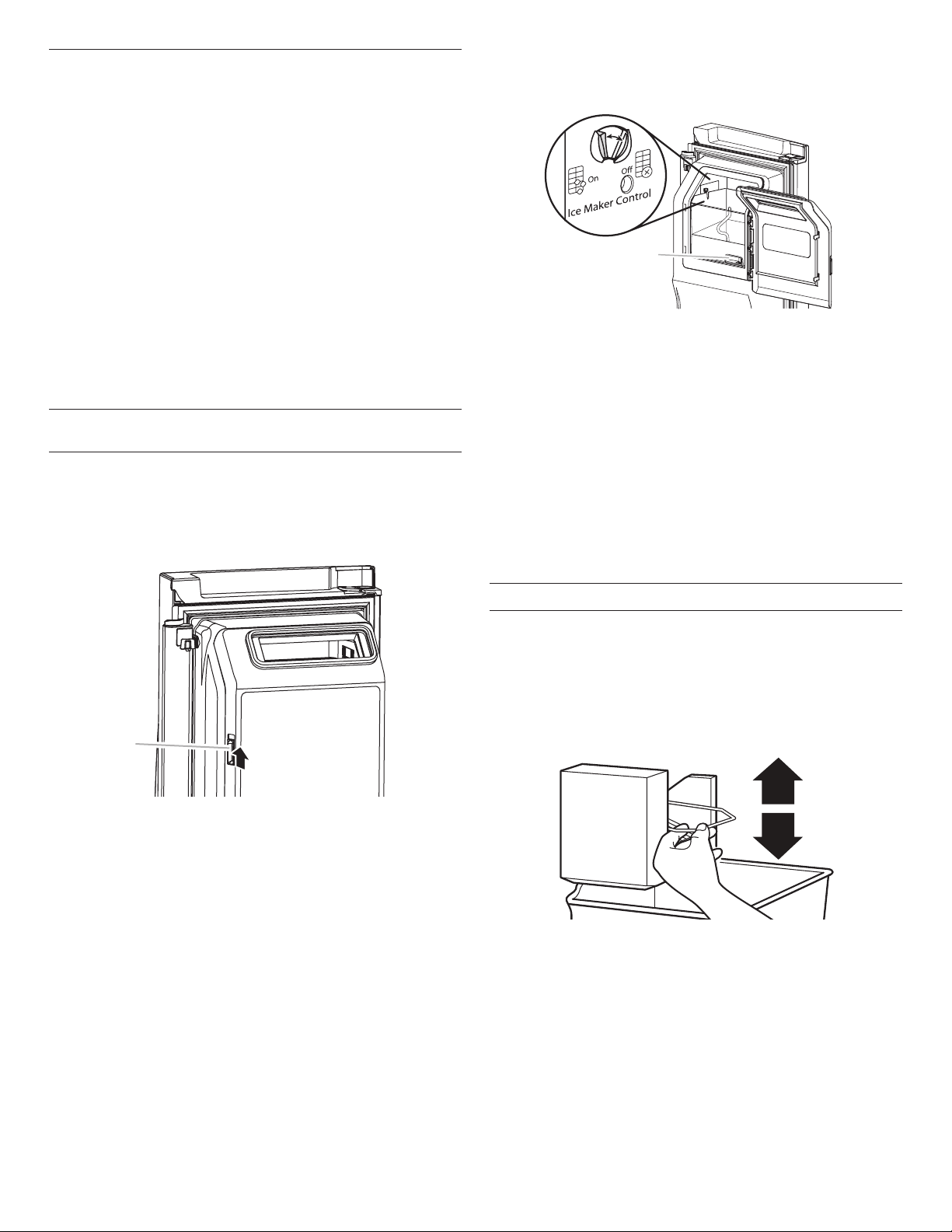
The Dispenser Drip Tray
There is an insert in the dispenser drip tray. The insert can be
removed from the drip tray to carry to the sink to empty or clean.
■ Push down on the rear edge of the insert to tilt up the front
edge for easy removal.
The Dispenser Light
When you use the dispenser, the light will automatically turn on.
To turn on the light when you are not dispensing:
Press LIGHT to toggle through the following choices in a
continuous loop:
■ OFF (default) - The dispenser light is OFF.
■ ON - The dispenser light remains on at 100% brightness.
■ DIM - The dispenser light remains on at 50% brightness.
The dispenser lights are LEDs that cannot be changed. If it
appears that your dispenser lights are not working, see
“Troubleshooting” for more information.
The Dispenser Lock
The dispenser can be turned off for easy cleaning or to avoid
unintentional dispensing by small children and pets.
NOTE: The Lock feature does not shut off power to the
refrigerator, to the ice maker, or to the dispenser light. It simply
deactivates the controls and dispenser paddles. To turn off the ice
maker, see “Ice Maker and Storage Bin.”
■ Press and hold LOCK for 3 seconds to lock the dispenser.
■ Press and hold LOCK a second time to unlock the dispenser.
The display screen indicates when the dispenser is locked.
Cut Hazard
Use a sturdy glass when dispensing ice.
Failure to do so can result in cuts.
WARNING
A
A. Dispenser tray insert
LOCKED
UNLOCKED
ON
DIM
25
Ice Maker and Ice Storage Bin
(on some models)
IMPORTANT: To avoid low ice production and poor quality ice,
ush the water system before turning on the ice maker. See
“Water Dispenser.”
■ Following installation, allow 24 hours to produce the rst
batch of ice. Discard the rst three batches of ice produced.
Allow 2 to 3 days to ll the ice storage bin.
■ The quality of your ice will be only as good as the quality of
the water supplied to your ice maker. Avoid connecting the ice
maker to a softened water supply. Water softener chemicals
(such as salt) can damage parts of the ice maker and lead
to poor quality ice. If a softened water supply cannot be
avoided, make sure the water softener is operating properly
and is well maintained.
■ If the ice in the storage bin clumps together, break up ice
using a plastic utensil and discard. Do not use anything sharp
to break up the ice. This can cause damage to the ice bin and
the dispenser mechanism.
■ Do not store anything in the ice storage bin.
Style 1 - Ice Maker in the Refrigerator
(on some models)
The ice maker is located on the left-hand side of the refrigerator
compartment ceiling. Ice cubes are ejected into the ice storage
bin, located on the left-hand refrigerator door.
Turn the Ice Maker On/Off
1. Push up on the latch on the left-hand side of the ice
compartment to open the door.
2. Turn on the ice maker by moving the switch to the (left) On
position.
NOTES:
■ To manually turn off the ice maker, move the control to the
Off (right) position.
■ Your ice maker has an automatic shutoff. The sensor will
automatically stop ice production if the storage bin is full,
if the door is open, or the storage bin is removed. The
control will remain in the On (left) position.
3. Close the ice compartment door.
Remove and Replace the Ice Storage Bin
■ Remove the ice storage bin by inserting your ngers into the
hole at the base of the bin and squeezing the latch to release
the bin from the compartment. Lift the storage bin up and pull
it straight out.
■ Replace the storage bin inside the ice compartment and push
down to make sure it is rmly in place.
Ice Production Rate
■ The ice maker should produce approximately 3 lbs (1.4 kg) of
ice per day under normal operation.
■ To increase ice production, select the “Fast Ice” or “Max Ice”
feature from the Options menu on the control panel. See
“Using the Control(s).”
Style 2 - Ice Maker in the Freezer (on some models)
Turn the Ice Maker On/Off
To turn the ice maker on, simply lower the wire shut-off arm.
To manually turn the ice maker off, lift the wire shut-off arm to the
off (arm up) position and listen for the click.
NOTE: Your ice maker has an automatic shutoff. As ice is made,
the ice cubes will ll the ice storage bin and the ice cubes will
raise the wire shut-off arm to the OFF (arm up) position. Do not
force the wire shut-off arm up or down.
NOTE: Turn off the ice maker before removing the ice storage bin
to serve ice or to clean the bin. This will keep the ice cubes from
dropping out of the ice maker and into the freezer compartment.
After replacing the ice storage bin, turn on the ice maker.
Ice Production Rate
■ The ice maker should produce a complete batch of ice
approximately every 2 hours.
A
A. Ice compartment door latch
A
A. Ice storage bin release latch
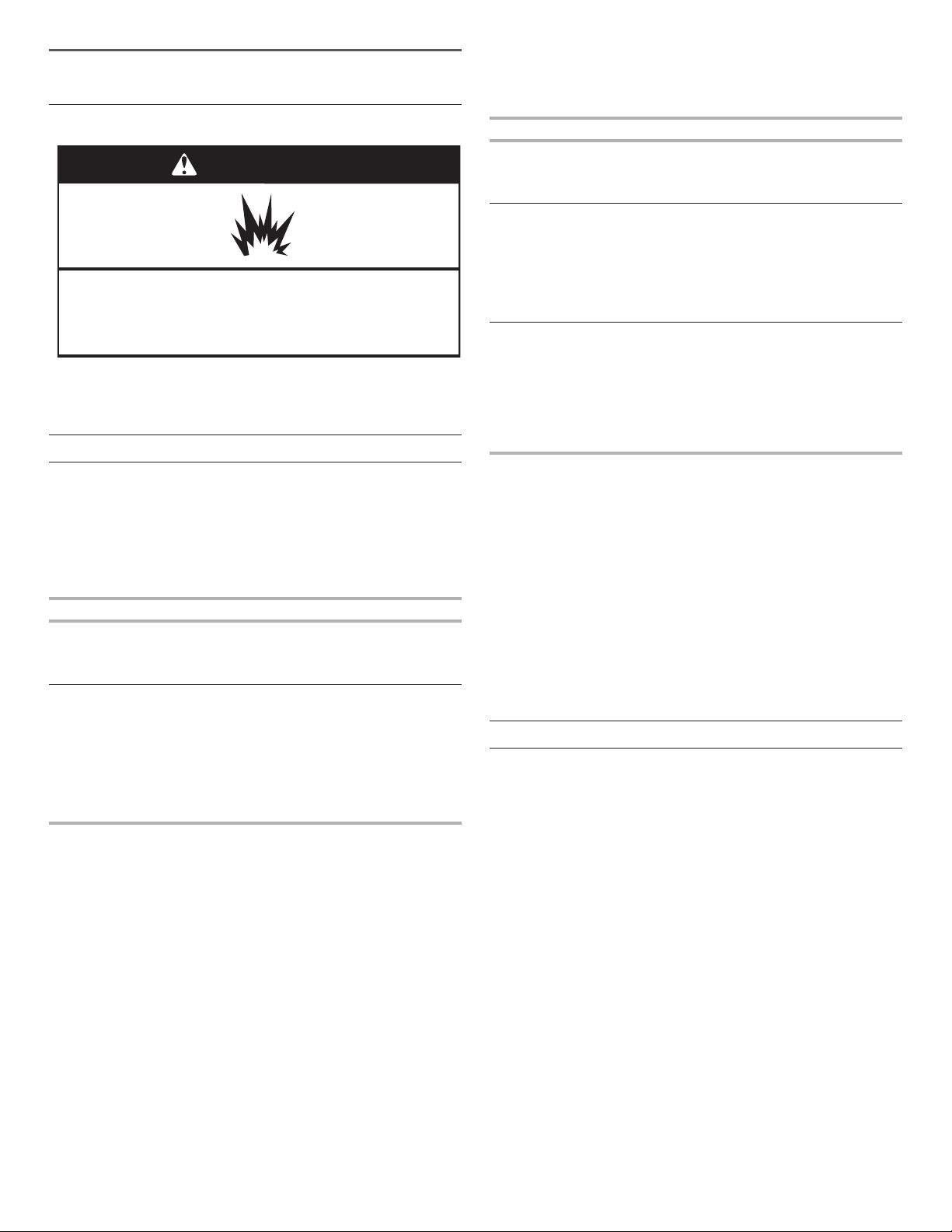
26
REFRIGERATOR CARE
Cleaning
Both the refrigerator and freezer sections defrost automatically.
However, clean both sections about once a month to avoid
buildup of odors. Wipe up spills immediately.
Exterior Cleaning
Please see the exterior cleaning information specic to your
model.
Style 1 - Smooth Door
IMPORTANT: Damage to smooth nish due to improper use of
cleaning products, or using non-recommended cleaning products,
is not covered under the warranty. Sharp or blunt instruments will
mar the nish.
DO USE DO NOT USE
4 Soft, clean cloth 6 Abrasive cloths
6 Paper towels or newsprint
6 Steel-wool pads
4 Warm, soapy water -
use a mild detergent.
6 Abrasive powders or liquids
6 Window sprays
6 Ammonia
6 Acidic or vinegar-based
cleaners
6 Oven cleaners
6 Flammable uids
NOTE: Paper towels scratch and may dull the clear coat of the
painted door. To avoid possible damage, use only soft, clean
clothes to polish and wipe the door.
Style 2 - Stainless Steel
IMPORTANT:
■ Use recommended stainless steel cleaners and cloths only.
Damage to stainless steel nish due to improper use of
cleaning products, or using non-recommended cleaning
products, is not covered under the warranty.
■ Avoid exposing stainless steel appliances to caustic or
corrosive elements such as high-salt, high-moisture, or high-
humidity environments. Damage due to exposure to these
elements is not covered under the warranty.
DO USE DO NOT USE
4 Soft, clean cloth 6 Abrasive cloths
6 Paper towels or newsprint
6 Steel-wool pads
4 Warm, soapy water 6 Abrasive powders or liquids
6 Ammonia
6 Citrus-based cleaners
6 Acidic or vinegar-based
cleaners
6 Oven cleaners
4 For heavy soil, use ONLY
a stainless steel cleaner
designed for appliances.
To order the cleaner, see
“Accessories.”
6 Stainless steel cleaner is for
stainless steel parts only! Do
not allow the Stainless Steel
Cleaner and Polish to come
into contact with any plastic
parts such as the trim pieces,
dispenser covers, or door
gaskets.
NOTES:
■ If unintentional contact does occur, clean plastic part with a
sponge and mild detergent in warm water. Dry thoroughly with
a soft cloth.
■ Just because a cleaner is a liquid does not mean it is
nonabrasive. Many liquid cleansers formulated to be gentle on
tile and smooth surfaces still damage stainless steel.
■ Citric acid permanently discolors stainless steel. To avoid
damaging the nish of your stainless steel refrigerator:
Do not allow these substances to remain on the nish
6 Mustard 6 Citrus-based sauces
6 Tomato juice 6 Citrus-based products
6 Marinara sauce
Interior Cleaning
IMPORTANT: Refrigerator shelves with under-shelf, LED lighting
are not dishwasher safe.
1. Unplug refrigerator or disconnect power.
2. Hand wash, rinse, and dry removable parts and interior
surfaces thoroughly. Use a clean sponge or soft cloth and a
mild detergent in warm water.
NOTE: Do not use abrasive or harsh cleaners such as window
sprays, scouring cleansers, ammable uids, cleaning waxes,
concentrated detergents, bleaches, or cleansers containing
petroleum products on plastic parts, interior and door liners,
or gaskets.
3. Plug in refrigerator or reconnect power.
WARNING
Explosion Hazard
Use nonammable cleaner.
Failure to do so can result in death, explosion, or re.
27
Condenser Cleaning
There is no need for routine condenser cleaning in normal
home operating environments. If the environment is particularly
greasy or dusty, or there is signicant pet trafc in the home,
the condenser should be cleaned every 2 to 3 months to ensure
maximum efciency.
If you need to clean the condenser:
1. Unplug refrigerator or disconnect power.
2. Remove the base grille.
3. Use a vacuum cleaner with a soft brush to clean the grille, the
open areas behind the grille, and the front surface area of the
condenser.
4. Replace the base grille when nished.
5. Plug in refrigerator or reconnect power.
Lights
The lights in both the refrigerator and freezer compartments
are LEDs which do not need to be replaced. If the lights do not
illuminate when the door or drawer is opened, call for assistance
or service. In the U.S.A., call 1-800-253-1301. In Canada, call
1-800-807-6777.
Vacation and Moving Care
Vacations
If You Choose to Leave the Refrigerator On While You’re
Away:
1. Use up any perishables and freeze other items.
2. If your refrigerator has an automatic ice maker and is
connected to the household water supply, turn off the water
supply to the refrigerator. Property damage can occur if the
water supply is not turned off.
3. If you have an automatic ice maker, turn off the ice maker.
NOTE: Depending on your model, raise the wire shut-off arm
to Off (arm up) position, or press the switch to OFF.
4. Empty the ice bin.
Models with Vacation Mode Feature
■ Turn on Vacation mode. See “Using the Controls.”
NOTE: Activating Vacation mode does not turn off the ice
maker.
If You Choose to Turn Off the Refrigerator Before You Leave:
1. Remove all food from the refrigerator.
2. If your refrigerator has an automatic ice maker:
■ Turn off the water supply to the ice maker at least one day
ahead of time.
■ When the last load of ice drops, raise the wire shut-off
arm to the Off (up) position or press the switch to OFF,
depending on your model.
3. Empty the ice bin.
4. Turn off the Temperature control(s). See “Using the Control(s).”
5. Clean refrigerator, wipe it, and dry well.
6. Tape rubber or wood blocks to the tops of both doors to prop
them open far enough for air to get in. This stops odor and
mold from building up.
Moving
When you are moving your refrigerator to a new home, follow
these steps to prepare it for the move.
1. If your refrigerator has an automatic ice maker:
■ Turn off the water supply to the ice maker at least one day
ahead of time.
■ Disconnect the water line from the back of the refrigerator.
■ When the last load of ice drops, raise the wire shut-off
arm to the Off (up) position or press the switch to OFF,
depending on your model.
2. Remove all food from the refrigerator and pack all frozen food
in dry ice.
3. Empty the ice bin.
4. Turn off the Temperature control(s). See “Using the Control(s).”
5. Unplug refrigerator.
6. Clean, wipe, and dry thoroughly.
7. Take out all removable parts, wrap them well, and tape them
together, so they don’t shift and rattle during the move.
8. Depending on the model, raise the front of the refrigerator so
it rolls more easily OR raise the leveling screws so they don't
scrape the oor. See “Align Doors and Drawers.”
9. Tape the doors closed and tape the power cord to the back of
the refrigerator.
When you get to your new home, put everything back and refer to
the “Installation Instructions” section for preparation instructions.
Also, if your refrigerator has an automatic ice maker, remember to
reconnect the water supply to the refrigerator.

28
TROUBLESHOOTING
First try the solutions suggested here. If you need further assistance or more recommendations that may help you avoid a service call,
refer to the warranty page in this manual or visit www.whirlpool.com/product_help.
In Canada, visit www.whirlpool.ca.
Contact us by mail with any questions or concerns at the address below:
In the U.S.A.: In Canada:
Whirlpool Brand Home Appliances
Customer eXperience Center
553 Benson Road
Benton Harbor, MI 49022-2692
Whirlpool Brand Home Appliances
Customer eXperience Centre
200 – 6750 Century Ave.
Mississauga, Ontario L5N 0B7
Please include a daytime phone number in your correspondence.
GENERAL OPERATION Possible Causes and/or Recommended Solutions
Refrigerator will not operate
■ Not connected to an electrical supply - Plug the power cord into a
grounded 3 prong outlet. Do not use an extension cord.
■ No power to the electrical outlet - Plug in a lamp to see if the outlet is
working.
■ Household fuse has blown or circuit breaker has tripped - Replace the
fuse or reset the circuit breaker. If the problem continues, contact a licensed
electrician.
■ Control or cooling is not turned on - Turn on the refrigerator control or turn
cooling on. See “Using the Controls.”
■ New installation - Following installation, allow 24 hours for the refrigerator
and freezer to cool completely.
NOTE: Adjusting the temperature control(s) to the coldest setting will not
cool either compartment (refrigerator or freezer) more quickly.
■ Refrigerator control is in Showroom mode (on some models) - If the
refrigerator is in Showroom mode, cooling is turned off and “Showroom”
will be illuminated on the control panel. See “Using the Control(s)” for more
information.
Motor seems to run too much
■ Your new refrigerator has an energy-efcient motor - The refrigerator
may run longer than you’re used to because the compressor and fans
operate at lower speeds that are more energy efcient. This is normal.
NOTE: Your refrigerator may run even longer if the room is warm, a large
load of food is added, the doors are opened often, or if a door has been left
open.
Electrical Shock Hazard
Plug into a grounded 3 prong outlet.
Do not remove ground prong.
Do not use an adapter.
Do not use an extension cord.
Failure to follow these instructions can result in death,
fire, or electrical shock.
WARNING
29
GENERAL OPERATION Possible Causes and/or Recommended Solutions
Lights do not work
■ Your refrigerator has been equipped with LED lighting which does not
need to be replaced - If there is power to the refrigerator and the lights do not
illuminate when a door or drawer is opened, call for service or assistance. See
either the front cover or the Warranty for contact information.
■ The dispenser light is set to OFF - On some models, the dispenser light will
operate only when the dispenser paddle is pressed. If you want the dispenser
light to stay on continuously, see “Water and Ice Dispensers.”
■ Doors have been open longer than 10 minutes - Close the doors and
drawers to reset and open to resume lighted task.
Shelves with under-shelf LEDs do not light up
(on some models)
■ Shelf hooks are not fully engaged in shelf supports - Check that the rear
shelf hooks are completely seated into the slots in the shelf supports.
■ Shelf supports, fastened to the back wall of the refrigerator cabinet,
are loose - Check all shelf support screws to ensure they are fully tightened.
Tighten all loose screws.
■ Doors have been open for longer than 10 minutes - Close the doors and
drawers to reset, and then open to resume lighted tasks.
Exterior drawer control not lit/unresponsive
■ The refrigerator is in Cooling Off mode - Exit Cooling Off mode. See “Using
the Control(s).”
■ The refrigerator controls’ initialization process did not complete
successfully - Unplug the refrigerator, and wait 5 seconds. Plug in the
refrigerator, and wait 30 seconds before opening the doors or drawers or
touching the control panel.
■ The drawer front was recently removed - Make sure the temperature control
wires have been properly reconnected. See “Remove and Replace Drawer
Fronts.”
Refrigerator seems noisy
The compressor in your new refrigerator regulates temperature more efciently and
uses less energy than older models. During various stages of operation, you may
hear normal operating sounds that are unfamiliar.
The following noises are normal:
■ Buzzing/Clicking - Heard when the water valve opens and closes to dispense
water or ll the ice maker. If the refrigerator is connected to a water line, this
is normal. If the refrigerator is not connected to a water line, turn off the ice
maker.
■ Repetitive Clicking - Dual evaporator valve is regulating the cooling operation.
■ Cracking/Clatter - Heard when ice is ejected from the ice maker mold and
then falls into the ice storage bin.
■ Popping - Heard when the inside walls contract/expand, especially during
initial cool down.
■ Hissing/Dripping - Flow of refrigerant or ow of oil in the compressor.
■ Pulsating/Whirring - Heard when the fans/compressor adjust to optimize
performance during normal operation.
■ Rattling - Heard when water passes through the water line or due to the
ow of refrigerant. Rattling may also come from items placed on top of the
refrigerator.
■ Water running or gurgling - Heard when ice melts during the defrost cycle
and water runs into the drain pan.
■ Sizzling - Heard when water drips onto the heater during the defrost cycle.
■ Vibration - The refrigerator may not be steady. Adjust the leveling screws
and lower the leveling foot until it is rmly against the oor. See “Refrigerator
Leveling and Door Closing.”
Temperature is too warm
■ New installation - Following installation, allow 24 hours for the refrigerator and
freezer to cool completely.
NOTE: Adjusting the temperature control(s) to the coldest setting will not cool
either compartment (refrigerator or freezer) more quickly.
■ Cooling is turned off - Turn on cooling. See “Using the Control(s).”
■ Doors are opened often or not closed completely - This allows warm air to
enter the refrigerator. Minimize door openings, keep the doors fully closed, and
make sure both doors are properly sealed.
■ Air vents are blocked - Remove items that are immediately in front of the
vents.
■ Large amount of warm food recently added - Allow several hours for the
refrigerator to return to its normal temperature.
■ Controls are not set correctly for the surrounding conditions - Adjust the
controls to a colder setting. Check the temperature again in 24 hours.
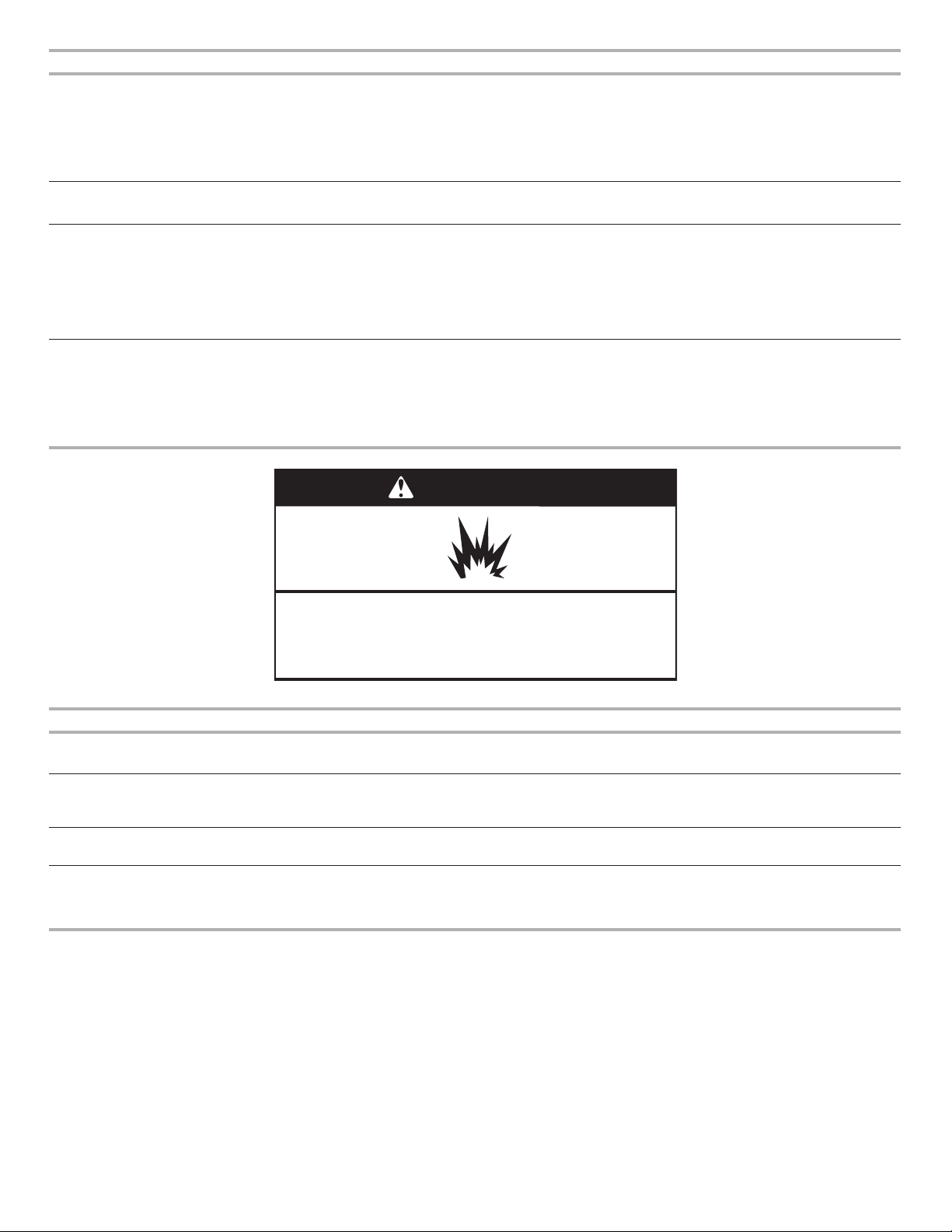
30
GENERAL OPERATION Possible Causes and/or Recommended Solutions
Temperature is too cold in the
refrigerator/crisper
■ Controls are not set correctly for the surrounding conditions - Adjust the
controls to a warmer setting. Check the temperature again in 24 hours.
■ Ice storage bin is not in the correct position - See “Ice Maker and Ice
Storage Bin.”
■ Air vents are blocked - Remove items that are immediately in front of the
vents.
Temperature is too warm/ cold in the exterior
drawer
■ Control is not set correctly for the items stored in the drawer - Adjust the
temperature setting. See “Temperature Controlled Exterior Drawer.”
Interior moisture buildup
NOTE: Some moisture buildup is normal. Clean with a soft, dry cloth.
■ Room is humid - A humid environment contributes to moisture buildup. Only
use the refrigerator in an indoor location with as little humidity as possible.
■ Doors are opened often or not closed completely - This allows humid air to
enter the refrigerator. Minimize door openings, keep the doors fully closed, and
make sure both doors are properly sealed.
Frost/Ice buildup in the freezer compartment
■ The drawer is opened often or left open - Minimize drawer openings and
close drawer completely after use.
■ Poor drawer seal - Ensure drawer seal is making full contact with the cabinet
to allow for an adequate seal.
■ Temperature control(s) are not set correctly - See “Using the Control(s)” for
recommended temperature settings.
DOORS AND LEVELING Possible Causes and/or Recommended Solutions
Doors are difficult to open
■ Gaskets are dirty or sticky - Clean the gaskets and contact surfaces with
mild soap and warm water. Rinse and dry with a soft cloth.
Doors will not close completely
■ Door is blocked open - Move food packages away from the door. Make sure
all bins and shelves are in their correct positions. Make sure all packaging
materials have been removed.
Doors appear to be uneven
■ Doors need to be aligned or refrigerator needs to be leveled - See
“Refrigerator Leveling and Door Closing.”
Refrigerator unsteady or it rolls forward when
opening and closing doors or drawers
■ Refrigerator brake feet are not snug against the oor - Remove the base
grille. Turn both brake feet (one on each side) clockwise, the same amount,
until they are snug against the oor. See “Refrigerator Leveling and Door
Closing.”
WARNING
Explosion Hazard
Use nonammable cleaner.
Failure to do so can result in death, explosion, or re.
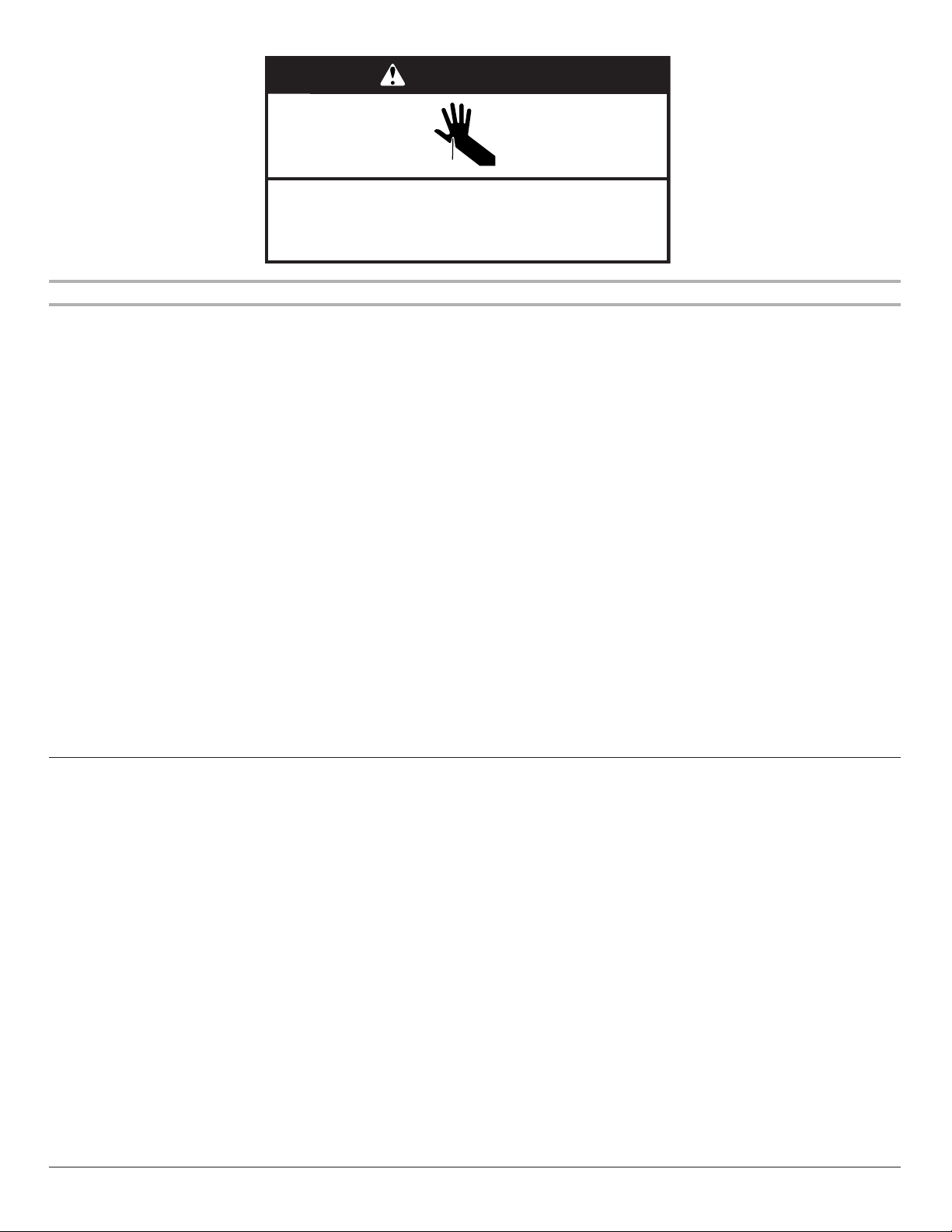
31
ICE AND WATER Possible Causes and/or Recommended Solutions
Ice maker is not producing ice, not producing
enough ice, or producing small/hollow ice
■ Refrigerator is not connected to a water supply or the water supply shut-
off valve is not fully turned on - Connect the refrigerator to a water supply
and make sure the water shut-off valve is fully open.
■ Kink in the water source line - A kink in the water line can reduce water
ow, resulting in decreased ice production, small ice cubes, and/or hollow or
irregularly shaped ice. Straighten the water line.
■ Ice maker is not turned on - Turn on the ice maker. See “Ice Maker and
Storage Bin.”
■ New installation - After connecting the refrigerator to a water source, ush
the water system. (See “Water and Ice Dispensers.”) Wait 24 hours for ice
production to begin. Wait 72 hours for full ice production. Discard the rst three
batches of ice produced.
■ Refrigerator door is not closed completely - Close the door rmly. If it does
not close completely, see “The doors will not close completely.”
■ A water lter is installed on the refrigerator - Remove the water lter and
operate the ice maker. If ice volume improves, then the lter may be clogged or
incorrectly installed. Replace lter or install it correctly.
■ Large amount of ice was recently removed - Allow sufcient time for the ice
maker to produce more ice.
■ Ice is jammed in the ice maker ejector arm - Remove ice from the ejector
arm using a plastic utensil.
■ Inadequate water pressure - Verify that the household has adequate water
pressure. See “Water Supply Requirements.”
■ Water lter is installed incorrectly - Make sure the lter is properly installed.
See “Water Filtration System.”
■ A reverse osmosis water ltration system is connected to your cold water
supply - This can decrease water pressure. See “Water Supply Requirements.”
NOTE: If questions remain regarding water pressure, contact a licensed, qualied
plumber.
Ice dispenser will not operate properly
■ New installation - After connecting the refrigerator to a water source, ush
the water system. (See “Water and Ice Dispensers.”) Wait 24 hours for ice
production to begin. Wait 72 hours for full ice production. Discard the rst three
batches of ice produced.
■ Ice maker is not turned on or ice bin is not installed correctly - Turn on
the ice maker and make sure the ice storage bin is rmly in position. See “Ice
Maker and Storage Bin.”
■ Ice is clogged or frozen together in the ice storage bin or ice is blocking
the ice delivery chute - Remove or separate the clogged ice, using a plastic
utensil if necessary. Clean the ice delivery chute and the bottom of the ice
storage bin using a warm damp cloth, and then dry both thoroughly. To avoid
clogging and to maintain a fresh supply of ice, empty the storage bin and clean
both the storage bin and the delivery chute every 2 weeks.
■ Dispenser is locked - Unlock the dispenser. See “Water and Ice Dispensers.”
■ Ice dispenser jams while dispensing crushed ice - For models with the ice
storage bin on the door, temporarily switch from crushed ice to cubed ice to
clear the jam.
■ Dispenser pad/lever has been pressed too long - Ice will automatically
stop dispensing. Wait a few minutes for the dispenser to reset, then resume
dispensing. Take large amounts of ice directly from the ice bin, not through the
dispenser.
■ Water pressure to the home is not at or above 35 psi (241 kPa) - The water
pressure to the home affects the ow from the dispenser. See “Water Supply
Requirements.”
■ Water lter is clogged or incorrectly installed - Replace lter or reinstall it
correctly. See “Water Filtration System.”
Cut Hazard
Use a sturdy glass when dispensing ice.
Failure to do so can result in cuts.
WARNING
32
ICE AND WATER Possible Causes and/or Recommended Solutions
Ice or water has an off-taste, odor, or gray
color
■ New plumbing connections - New plumbing connections can result in off-
avored or discolored ice or water. This problem should go away over time.
■ Ice has been stored too long - Discard the ice and wash the ice bin. Allow 24
hours for the ice maker to produce new ice.
■ Odor has transferred from food - Use airtight moisture-proof packaging to
store food.
■ Use of non-recommended water supply line - Odors and tastes can transfer
from certain materials used in non-recommended water supply lines. Use only
a recommended water supply line. See “Water Supply Requirements.”
■ There are minerals (such as sulfur) in the water - A water lter may need to
be installed in order to remove the minerals.
■ Water lter was recently installed or replaced - Gray or dark discoloration in
ice or water indicates that the water ltration system needs additional ushing.
See “Water and Ice Dispensers.”
Water dispenser will not operate properly
■ Doors not closed completely - Make sure both doors are rmly closed. (On
some models, only the freezer door must be closed in order to operate the
dispenser.)
■ Refrigerator is not connected to a water supply or the water supply shut-
off valve is not fully turned on - Connect the refrigerator to a water supply
and make sure the water shut-off valve is fully open.
■ Kink in the water source line - A kink in the water line can reduce water ow
to the dispenser. Straighten the water line.
■ Water pressure to the home is not at or above 35 psi (241 kPa) - The water
pressure to the home affects the ow from the dispenser. See “Water Supply
Requirements.”
■ New installation - After connecting the refrigerator to a water source, ush the
water system. See “Water and Ice Dispensers.”
■ Water dispenser measured ll feature is not dispensing an accurate
amount of water - Calibrate the water dispenser. See “Water and Ice
Dispensers.”
■ Dispenser is locked - Unlock the dispenser. See “Water and Ice Dispensers.”
■ Water lter is clogged or incorrectly installed - Replace lter or reinstall it
correctly. See “Water Filtration System.”
■ A reverse osmosis water ltration system is connected to your cold water
supply - This can decrease water pressure. See “Water Supply Requirements.”
NOTE: If questions remain regarding water pressure, contact a licensed, qualied
plumber.
Water is leaking or dripping from the
dispenser
NOTE: After dispensing, a few additional drops of water are normal.
■ Glass was not held under the dispenser long enough - Hold the glass under
the dispenser for to 3 seconds after releasing the dispenser pad/lever.
■ New installation or water lter was recently installed or replaced - Air in
the water lines causes the water dispenser to drip. Flush the water system to
remove the air in the water lines. See “Water and Ice Dispensers.”
■ Residual ice in the dispenser chute is melting - Make sure the ice chute is
free of ice shavings or pieces.
Water is leaking from the back of the
refrigerator
■ Water line connections are not fully tightened - Make sure all connections
are rmly tightened. See “Connect the Water Supply.”
Water from the dispenser is not cool enough
(on some models)
NOTE: Water from the dispenser is chilled to 50°F (10°C).
■ New installation - Allow 24 hours after installation for the water supply to cool
completely.
■ Recently dispensed a large amount of water - Allow 24 hours for the new
water supply to cool completely.
■ Water has not been recently dispensed - The rst glass of water may not be
cool. Discard the rst glass of water dispensed.
■ Refrigerator is not connected to a cold water pipe - Make sure
the refrigerator is connected to a cold water pipe. See “Water Supply
Requirements.”
33
PERFORMANCE DATA SHEET
Water Filtration System
Model P9WB2L/P9RFWB2L/EDR2RXD1 Capacity 200 Gallons (757 Liters)
This system has been tested according to NSF/ANSI Standards 42, 53, 401, and CSA B483.1 for the reduction of the substances listed
below. The concentration of the indicated substances in water entering the system was reduced to a concentration less than or equal to
the permissible limit for water leaving the system, as specied in NSF/ANSI Standards 42, 53, 401, and CSA B483.1.
Substance Reduction
Aesthetic Effects
Inuent Challenge
Concentration
Maximum Permissible
Product Water Concentration
Average% Reduction
Chlorine Taste/Odor Particulate
Class I*
2.0 mg/L ± 10% At least
10,000 particles/mL
50% reduction
85% reduction
97.2%
99.5%
Contaminant Reduction Inuent Challenge
Concentration
Maximum Permissible
Product Water Concentration
Average%Reduction
Lead: @ pH 6.5 / @ pH 8.5 0.15 mg/L± 10% 0.010 mg/L >99.3% / 98.6%
Benzene 0.015 mg/L ± 10% 0.005 mg/L 96.0%
p - Dichlorobenzene 0.225 mg/L ± 10% 0.075 mg/L >99.8%
Carbofuran 0.08 mg/L ± 10% 0.040 mg/L 91.9%
Toxaphene 0.015 ± 10% 0.003 mg/L 93.3%
Atrazine 0.009 mg/L ± 10% 0.003 mg/L 92.4%
Asbestos 10
7
to 10
8
bers/L
††
99% >99%
Live Cysts
†
50,000/L min. 99.95% >99.99%
Turbidity 11 NTU ± 10% 0.5 NTU 99.0%
Lindane 0.002 ± 10% 0.0002 mg/L 98.9%
Tetrachloroethylene 0.015 mg/L ± 10% 0.005 mg/L >96.6%
O-Dichlorobenzene 1.8 mg/L ± 10% 0.60 mg/L >99.9%
Ethylbenzene 2.1 mg/L ± 10% 0.70 mg/L 99.4%
1,2,4-Trichlorobenzene 0.210 mg/L ± 10% 0.07 mg/L >99.8%
2,4 - D 0.210 mg/L ± 10% 0.07 mg/L 93.8%
Styrene 2.0 mg/L ± 10% 0.1 mg/L 99.8%
Toluene 3.0 mg/L ± 10% 1.0 mg/L 87.9%
Endrin 0.006 mg/L ± 10% 0.002 mg/L >96.6%
Atenolol 200 ± 20% 30 ng/L >95.9%
Trimethoprim 140 ± 20% 20 ng/L >96.9%
Linuron 140 ± 20% 20 ng/L >96.4%
Estrone 140 ± 20% 20 ng/L >97.0%
Nonylphenol 1400 ± 20% 200 ng/L >97.4%
Carbamazepine 1400 ± 20% 200 ng/L >97.9%
Phenytoin 200 ± 20% 30 ng/L 93.8%
Naproxen 140 ± 20% 20 ng/L 96.1%
Bisphenol A 2000 ± 20% 300 ng/L >99.2%
Test Parameters: pH = 7.5 ± 0.5 unless otherwise noted. Flow = 0.6 gpm (2.27 Lpm). Pressure = 60 psig (413.7 kPa).
Temp. = 68°F to 71.6°F (20°C to 22°C). Rated service capacity = 200 gallons (757 liters).
The compounds certied under NSF 401 have been deemed as “emerging compounds/incidental contaminants.” Emerging compounds/
incidental contaminants are those compounds that have been detected in drinking water supplies at trace levels. While occurring at only
trace levels, these compounds can affect the public acceptance/perception of drinking water quality.
System tested and certied by NSF International
against NSF/ANSI Standard 42, Standard 53, Standard
401, and CSA B483.1 for the reduction of contaminants
specied on the Performance Data Sheet.
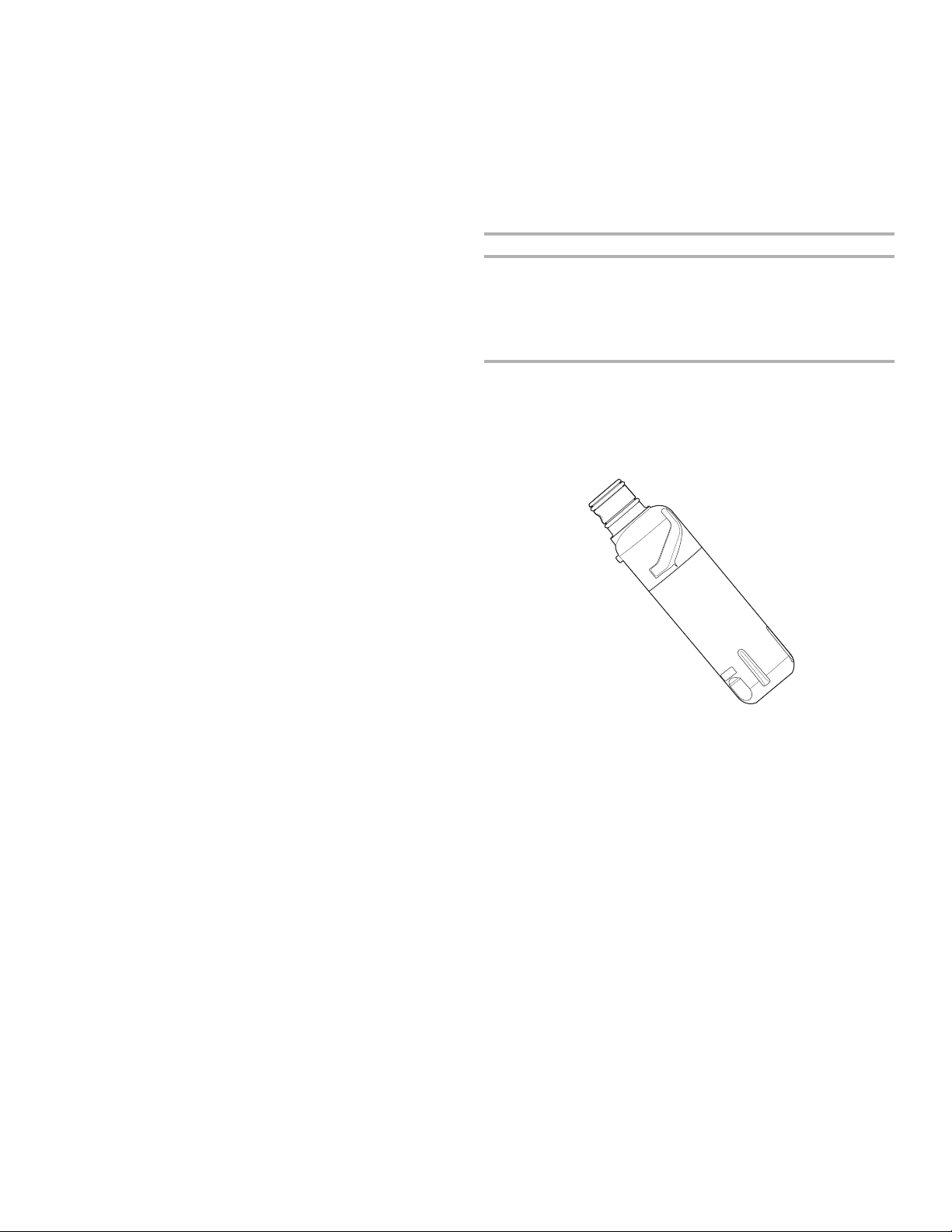
34
■ It is essential that operational, maintenance, and lter
replacement requirements be carried out for the product
to perform as advertised. Property damage can occur if all
instructions are not followed.
■ The disposable cartridge must be changed at least every 6
months.
■ Use replacement lter P9RFWB2L, part #EDR2RXD1/
EDR2RXD1B. 2015 suggested retail price of $49.99
U.S.A./$49.99 Canada. Prices are subject to change without
notice.
■ The lter monitor system measures the amount of water that
passes through the lter and alerts you when it is time to
replace the lter.
Refer to the “Using the Controls” or “Water Filtration System”
section (in the User Instructions or User Guide) to learn how to
check the water lter status.
■ After changing the water lter, ush the water system. See
“Water and Ice Dispensers” or “Water Dispenser” in the User
Instructions or User Guide.
■ These contaminants are not necessarily in your water supply.
While testing was performed under standard laboratory
conditions, actual performance may vary.
■ The product is for cold water use only.
■ The water system must be installed in compliance with state
and local laws and regulations.
■ Do not use with water that is microbiologically unsafe or of
unknown quality without adequate disinfection before or after
the system. Systems certied for cyst reduction may be used
on disinfected waters that may contain lterable cysts. EPA
Est. No. 082047-TWN-001
■ Refer to the “Warranty” section for the Manufacturer’s limited
warranty, name and telephone number.
Application Guidelines/Water Supply Parameters
Water Supply Potable City or Well
Water Pressure 30 - 120 psi (207 - 827 kPa)
Water Temperature 33° - 100°F (0.6° - 37.8° C)
Service Flow Rate 0.6 GPM (2.27 L/min.) @ 60 psi.
(413.7 kPa)
■ Your water ltration system will withstand up to 120 pounds
per square inch (psi) water pressure. If your water supply is
higher than 80 psi, install a pressure reducing valve before
installing the water ltration system.
*Class I particle size: >0.5 to <1 um
†
Based on the use of Cryptosporidium parvum oocysts
††
Fibers greater than 10 um in length
®
NSF is a registered trademark of NSF International.

W10730915C
W10730921B – SP
09/19
Tous droits réservés. Utilisé sous licence au Canada.
®
/™ ©2019 Whirlpool. All rights reserved. Used under license in Canada.