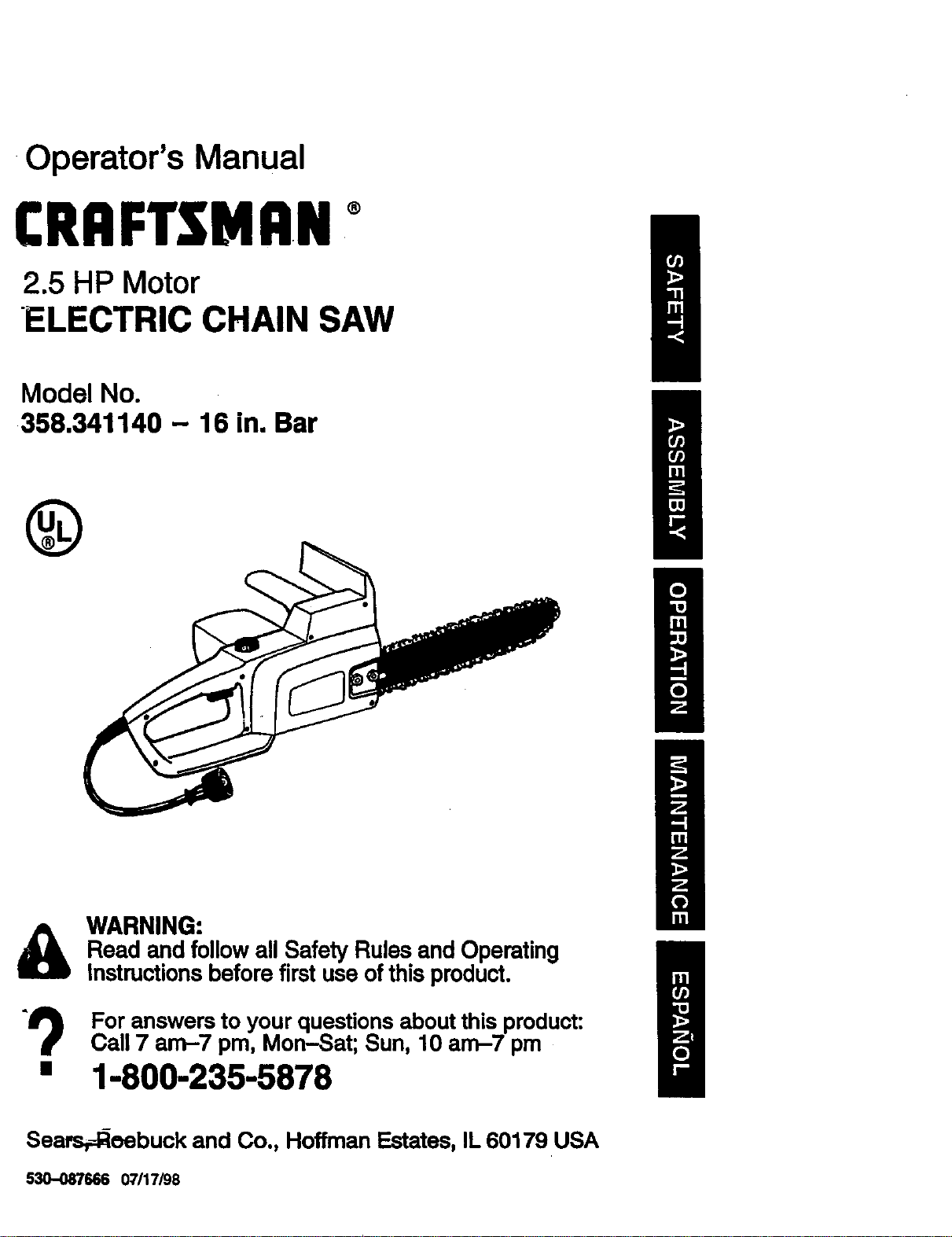
Operator's Manual
CRRFTSMR.N
2.5 HP Motor
ELECTRIC CHAIN SAW
Model No.
358.341140 - 16 in. Bar
®
WARNING:
Read and followall SafetyRulesand Operating
Instructionsbeforefirstuseofthisproduct.
"illl_ For answers to your quest!ons about this product:
Call 7 am--7 pm, Mon--Sat, Sun, 10 am-7 pm
ir
• 1-800-235-5878
Seam_oebuck and Co., Hoffman Estates, IL 60179 USA
530-087666 0_17R8
Warranty
Safety Rules
Assembly
Operation
Maintenance-_
2 Service and Adjustments 13
2 Storage . 15
7 Trouble Shooting 15
7 Spanish 18
12 Parts Ordering Back
This v_arrdnb, . rand chain, which are expendable parts
and become worn'during hormal use.
Ifthis Craftsman Electric Chain Saw is used for commemial purposes,
this warran_ app.lies for only 90 days from the date of purchase. If this
CraftsmanElectncChainSawisusedfor rentalpurposes,thinwarranty
appliesfor only30 daysfrom thedateofpurchase.Thiswarrantyap-
pliesonlywhilethisproductisinuseinthe UnitedStates.
WARRANTY SERVICE IS AVAILABLEBY RETURNING THE CRAFTSMAN
ELECTRIC CHAIN SAW TO THE NEAREST SEARS SERVICE CENTER IN THE
UNITED STATES.
This warranty gives you specific legal rights, and you may also have oth-
er rights which vary from state to state.
Roebuck and Inc,, Hoffmen Estates 60179 U.S.A.
WARNING: When usingan electric
chainsaw, basic safety precautions,in-
cludingthe following,shouldalways be
followed to reduce the riskoffire, elec-
tricshock, and injuryto persons. Read
allinstructions.
WARNING: Alwaysdisconnectpower
sourcewhen maldngrepairs.Becausea
chainsaw isa high-speedwoodcutting
tool,carelessor improperusaof thistool
-_=can causeseriousinjury.
PLAN AHEAD
• Restricttheuss'ofyeursswto adult
userswhoundemtandandcanfollow
the saf_y rules, precautions, and oper-
a_ngi_ found_ _s marn_
• Keepchgdrenaway. Do notlet vidtom
contsctchslnsaw or extermicncord.All
visitorsshouldbe I=pt at least30 feet
(lOmste_)aweyfrornworkarea
, * Dress properly.Wear protectivegear.
AIw..ays use steel-toed safetyfootwear
with non-slipsoles;snug-rdtingcloth-
ing, heavy-duty,non-slipgloves; eye
F¢otection such as non-fogging,
vented gogglesorface screen;an ap-
proved safetyhard hat; and sound
barriers(ear plugs ormufflers)to pro-
tect your hearing. Regular users
should have hearingchecked regular-
lyas chain saw noise can damage
hearing.
Clothing
Gloves
Safety f Safety Chaps
Shoes "_
NI
• Securehairabove shoulderlength.Do
notwear Ioo_...clothin_orjew.d_ they
.cccccccc_nget caught,n mov,_..garB. .
_eep all partsof your ocoyaway rmm
the chain when saw is running.
Do nothandleor operatea _ saw
when youam fatigued, ill,upset,orif
youhave takenalcohol,drugs,or me-
dication.Youmust be in goodphysical
cor_rdion.andmentallyalerL ffyou have
anyconcFdonthat mightbe aggravated
by strenuouswork,checkwith doctor
beforeoperating.
Watch what you are doing. Use com-
monsense. _ ::....
• Do notstart cuttinguntilyou have a
" clear work area, secure footing, and
especiallyifyou are felling a tree, a
retreatpath. Keep work area clean.
Cluttered areas invite injudas.
OPERATE YOUR SAW SAFELY
• Do notoperate with one hand. Sed-
ous injuryto the operator, helpers, or
bystanders may resultfrom one-
handed operation.A chain saw is in-
tended fortwo-handed use.
• Do not operate saw from a ladder or
in a tree.
• Make sure the chain will not make
contact with any object while starting
the saw. Never start the saw when the
guide bar is ina cut•
• Don'tforce chain saw. It willdo the job
better and safer at the rate for whichit
was intended.
• Do notput pressure onthe saw, es-
peciallyat the end ofthe cut. Doing
so can causeyou to losecontrol
when the cut is completed.
• Stopthe saw before setting it down.
Hand carry sew only when motor is
stopped. Carrythe chainsaw by the
fronthandlewiththe saw sty, fm-
gorofftbeswitck _le guidebar and
saw chainto therear.
• Use the righttool, cut wood only.
Don'tuse chain saw for purpose not
intended;for example, don't usa
chain saw forcuttingplastic, masonry,
non-woodbuildin_ rnstedals.
• Usa extreme caution when cuffing
• small's_ brush and saplings be-
cause the tender matedal m.aycatch
the saw chainand be wh-ipp_l toward
- you or pullyou offbalance.
• When cuttinga limbthat is under ten-
sion be alertfor epnng back so you
willnot be struckwhen the tension in
the wood fibers is released.
MAINTAIN YOUR SAW IN GOOD
WORKING ORDER
• Have all chain saw service performed
_ya Sears Service Center except the
listedin the maintenance sac-
tionofthis manual. •
• Ma_e-_ef_dn saw chain stops moving
when trigger switchis released.
i Keep the handles dry and clean and
free from oiland grease.
Keep oilcap andfastenere securely
tightened. •
• N-onco ormingre _camentcorrco-
nantsortbe removalof safetydevices
may osuse damage totha unitand
_sta_eminjuw tothe operatoror by-
•Usa onlyCraftsmanaccasso-
desand replacementparis as r_om-
mended. Never modi_,yoursaw.
• Maintain chain saw withcare.
i Keep unitsharp and clean forbetterand safer performance.
Follow instructionsfor lubricatingand
changingaccessodee.
• Unplugthe chainsaw fromthe power
source when not in use, before servic-
ing, and when changing accessories
and attachments, such as saw chain
and guard,
• Check for damaged parts. Before fur-
ther use of the chain saw, a guard or
other part that is damaged should be
carefully checked to determine that it
will operate properly and perform its in-
tended function. Check for alignment of
moving parts, binding of moving paris,
breakage of pads, mounting and any
other conditions that may affect its op-
eration. A guard or other part that is
damaged should be properly repaired
or replaced by a Sears Service Center
unless otherwise indicated elsewhere in
the operator's manual.
• Do not operate a chain saw that is
damaged, improperly adjusted, or is
not completely and securely as-
sembled. Inspect chain saw cords pe-
riodically, and if damaged have re-
paired by a Sears Service Center.
• When notin use, chain saws should
be stored in a dry,high or locked-up
place out of the reach ofchildren.
• When storingsaw, unplugand use a
bar sheath or carrying case. Store idle
chain saw.
ELECTRICAL SAFETY
• Use a voltagesupply as shownonunit
• Avoid dangerousenvironments.Don't
usaappliances indamp orwet loca-
tions. Don't use in rain.
• Avoid dengemus situations.Do not
use in the presence of flammable liq-
uidsor gases to avoidcreating a fire
or explosionand/or causing damage
to unit.
* Toreducethe riskof aiectrical shock,
this appliancehas a polarizedplug
(oneblade iswiderthanthe other)and
willrequirethe useof a polarizedex-
tensioncord.The applianceplugwl]lfit
intoa polarizedextension cordordy
oneway. If the plugdoes notlit fully
intothe ex_ion cord,.mversethe
pbg. the doesnotfit,obt
a correctpolarizedextensioncord. A
polarizedextensioncordwill requirethe
of a polarizedwelloutlet.Thisplug
w_llfitintothe polarizedwail outistonly
one way. Ifplugdoesnotfitfullyinte
the wailoutlet,revemethe plug.ffthe
_ectridanSblldoesnot_ contacta qualified
to installtheproperwallout-
let.Do notchangethe equipmentplug,
extensioncordreceptacle,or extension
cord plug_ anyway. .
• To reducenskofelectricalshock,use
extensioncordsspecltk_dly_ as
suitableforoutdoorappliancesha_ng
electricalratingnot lessthan the rating
of unit.Cordmustbe markedwithsuffix
"V_. Make sure yourextensioncord is
in goodcondition.Inspectextension
cordbeforeuse and replaceifdam-
aged. An undersizedextensioncord
will cause a dropin linevoltageresult-
ing in lossof power and overheating.If
in doubt,usethe nextheaviergauge.
The lowerthe gauge number,the
heavierthecord (see =Selectan exten-
sioncord').
• Do notabuse cord. Never carrythe
unitbythe extension cord or yank ex-
tensioncord to disconnectunit.
• Secure extension cord to power cord
to prevent disconnectionfrom unit.
• Do not use the unitif the switch does
notturnthe uniton and off properly,or
ifthe lockoutdoes notwork. Repairs
tothe switch must be made by a
_--Sears Service Center.
• Keep extension cordclear ofoperator
and obstacles-atall times. Position
cord so that itwill not be caught on
brancbas. Do not expose cords to
heat, oil,water, or s...ha.,rp edges.
* To avo=dthe poss=bdityof electric
shock, avoid body contactwith any
groundedconductor, such as metal
fences orpipes. .
• Ground Fault Circuit Interrupter
(GFCI) protectionshouldbe provided
on circuitor outletto be used. Recep-
tacles are available havingbuilt-in
-GFCI protectionand may be usedfor
this measure of safety. Inspectchain
saw cordspedodioallyand ifdam-
aged, have repaired by a Sears Ser-
vice Center.
GUARD AGAINST KICKBACK
Fonowaasafetyruk te.h p.avoUk k-
backand otherforcaswhichcan rasultin
serious" "
qury.
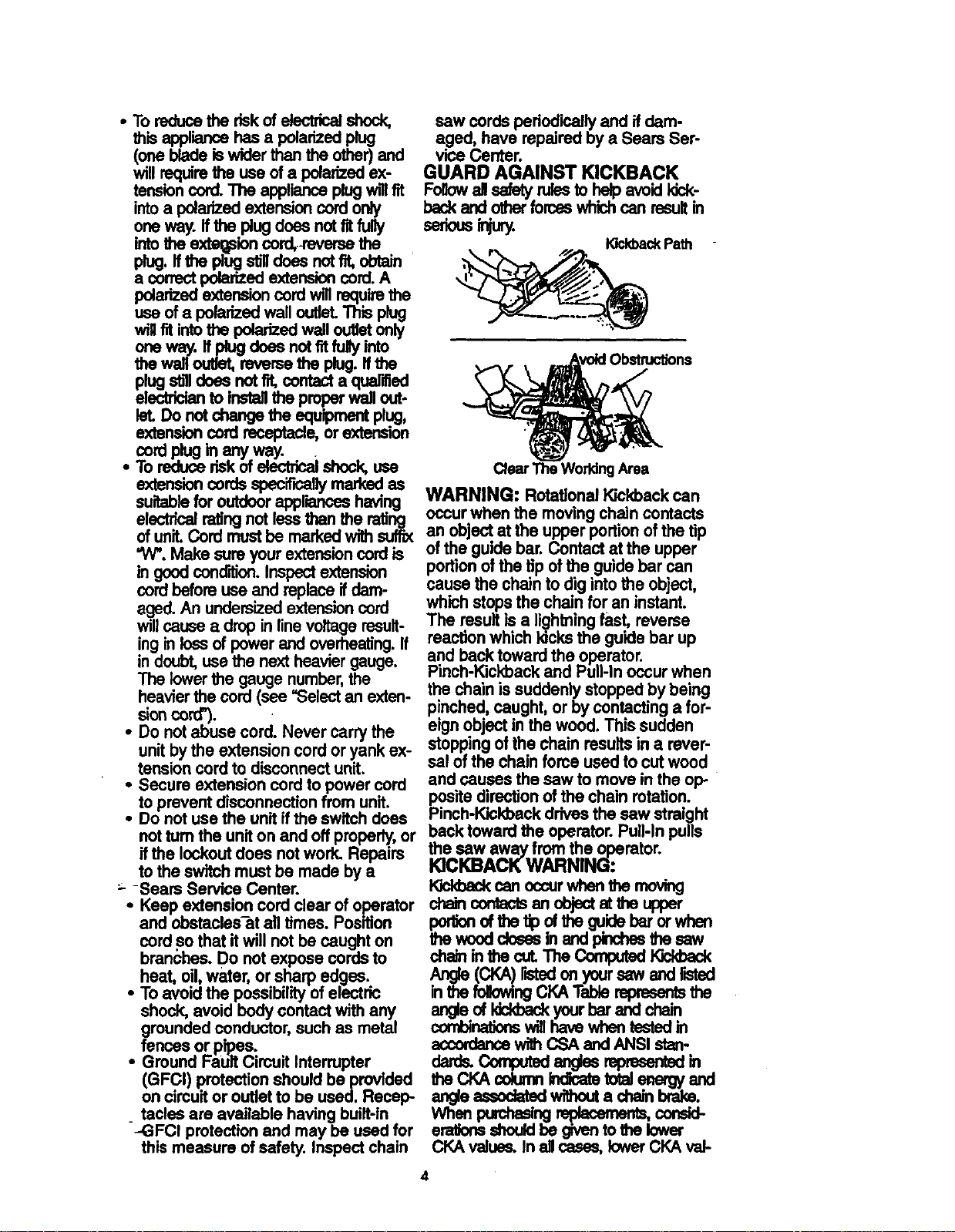
KickbackPath
•
ClearThe WorldngArea
WARNING: RotationalKickbackcan
occurwhen the movingchaincontacts
an object,at the upper portionof the tip
of the guidebar. Contactat the upper
portionofthe tip of the guide bar .can
cause the chainto dig intothe object,
whichstopsthe chain for an instant.
The resultis a lightningfast, reverse
reactionwhich kicksthe guidebar up
and backtoward the operator.
Pinch-Kickbackand Pull-In occurwhen
the chain is suddenlystopped by being
pinched,caught, orby contacting a for-
eign objectin the wood. Thissudden
stoppingof the chain resultsin a rever-
sal ofthe chain force used to cutwood
and causes the saw to move in the op-
positedirectionofthe chain rotation.
Pinch-Kickbackdrivesthe saw straight
back towardthe operator. Pull-Inpulls
the saw away from the operator.
KICKBACK WARNING:
IOckbackcan occur whanthe moving
_ contacts.an objectat the upper
porSonof the Upofthe guidebar orwhen
the..w_:l, doses in and p_ches the saw
cl_in in the cut. The _xnputed }Ockbeck
Angle(CKA) rmtedon yoursaw and rm_d
inthe followingCKA Tablerepresentsthe
angleof Idckbackyourbarand chain
cord_ willhave wi'_n tested io
acosrdancewithCSA and ANSI stan-
dard= Computodang mp. od
the CKA cokrnn indicate tetaianergy and
angleassociatedWl_'_uta cbainbrako.
purches grep osmo consU-
erationsshouldbe givento thelower
CKA values. In all cese_ lower CKA vak
4
ues represent a safer operating environ-
merit for the user.
Do not rely exclusively upon the safety
devices built into your saw.
• Either of these reactions may cause
you to lose control of the saw which
coul.d result in sedous, ih_lry. -"....
• _,incning the saw cnaJn along the tip
* of the guide bar may push the guide
bar rapidly back toward the operator.
-, "lip cohtact in some cases may cause
a lightningfast REACTION, kicking the
guide bar up and bsck toward operator.
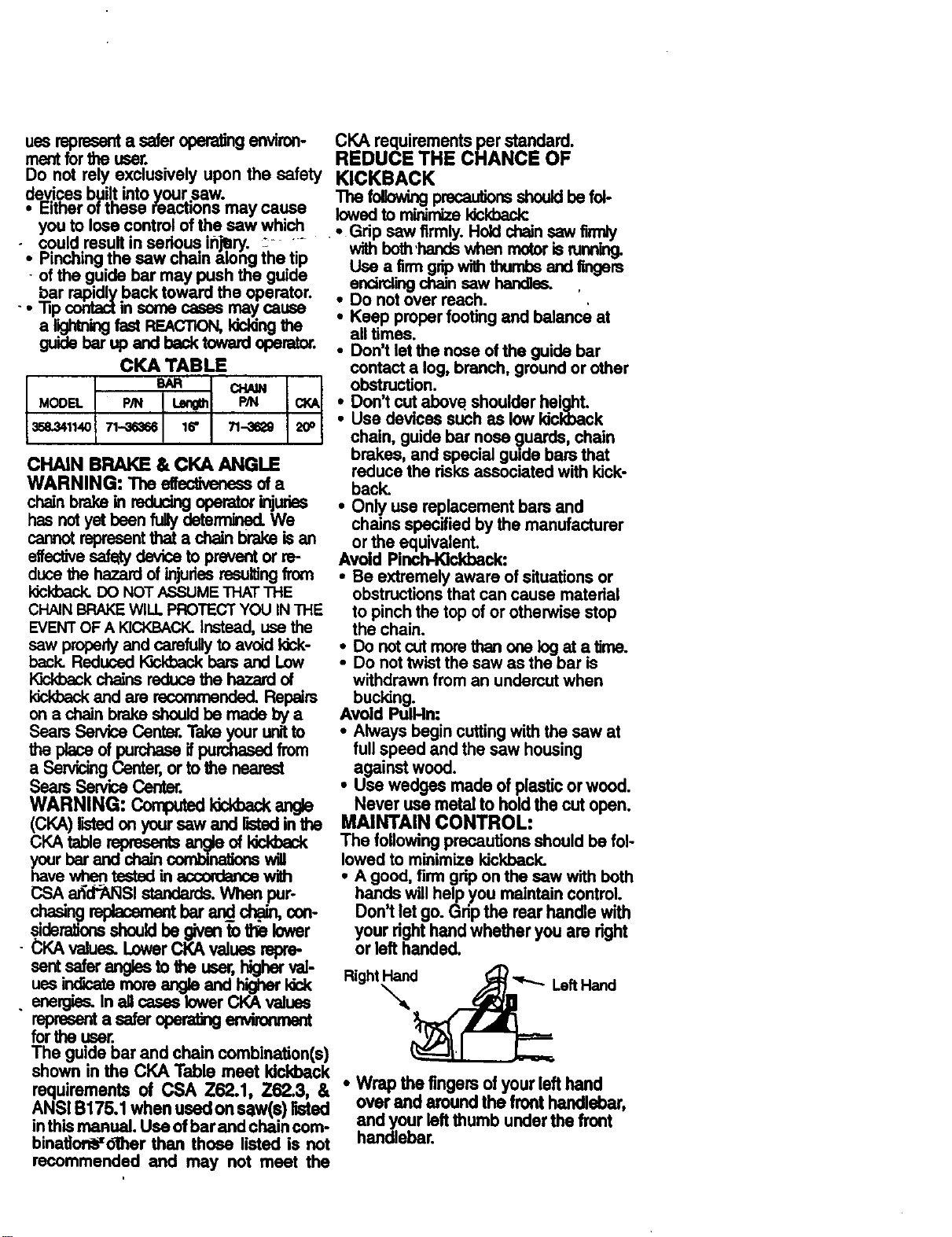
CKA TABLE
BAR CHAIN
MODEL P/N _ P/N CK/=
358341140 71-36366 16" 71-36_1 2_'
CHAIN BRAK]E & CKA ANGLE
WARNING: The effectiveness of a
chain brake in reducing operator injuries
has not yetbeen fully determined. We
cannot represent that a chain brske is an
effectivesafe_ device to preventor re-
duce the hazard of injurias resulting from
kJc_ DO NOT ASSUME THAT THE
CHAIN BRAKE WILL PROTECT YOU IN THE
EVENT OF A KICKBACK..Instead, use the
saw properly and carefully to avoid Idck-
back. Reduced KT_kbackbars and Low
l_]ddoackchainsreducethe hazardof
Idcld:_ck and are recommended. Repairs
on a chain brake should be roads by a
Sears Service Center. Take your unit to
theplaceofpurchaesifpurchesedfrom
a Servicing Center, or to the nearest
SearsServiceCenter.
WARNING:Computedkickbackangle
(CKA) listsd on your saw and rstsd in the
CKAtabisrepresents_ of
yourbar _d d'minocrabinatkmswUl
havewhen teetedin_xx_:lancewiLh
CSA ar_SI standards. When pur.
chasingrel_ceme_barandch_r_coo-
siders_onsshouldbegivanTott_elower
CKAvalues.LowerCKAvaluesrepre-
sentsaferang|estotheuser,.".hig.her_-
uas"_r_te..moroangleandhigherkick
. enengles.In all cases lower CKA valuss
_,ant a sa_ opera_ an_onmant
for the user.
The guide bar and chain combination(s)
shown in the CKA Table meet kickback
requirements of CSA Z62.1, Z62.3, &
ANSI B175.1 when used on saw(s) Ibtod
in this manual. Usa of barand chain com-
binaflor_o"ther than those listed is not
recommended and may not meet the
CKArequirementsperstandard.
REDUCE THE CHANCE OF
KICKBACK
The following presauliom dlould be fal-
lowed to minimize Idckback:
. • Grip saw firmly. Hold chain saw finnly
withbothhandswhenmotorisrunning.
Usa a firm grip with thumbs and fingers
encirclingchain saw handles.
• Do not over reach.
• Keep proper footing and baiance at
all times.
• Don't let the nose of the guide bar
contact a log, branch, ground or other
obstruction.
Don't cut above shoulder height.
Use devices such as low Id_ck
chain, guide bar nose guards, chain
brakes, and special guide bars that
reduce the risks associated with kick-
back.
• Only use replacement bars and
chains specified by the manufacturer
or the equivalent.
Avoid Pinoh-Kickback:
• Be extremely aware of situations or
obstructions that can cause material
to pinch the top of or otherwise stop
the chain.
• Do notcutmorethanone logat a time.
Do nottwistthe saw asthe bar is
withdrawn from an undercut when
bucking.
Avoid Putl-ln:
• Always begin cutting with the saw at
full speed and the saw housing
againstwood.
• Usewedgesmadeofplasticorwood.
Never use metal to holdthe cut open.
MAINTAIN CONTROL:
The followingprecautionsshould be fol-
lowedto minimizeIdckback.
• A good,firm griponthe saw withboth
hands willhelpyou maintaincontrol.
Don'tlet go. Gripthe rear handlewith
your righthandwhether you are right
or left handed.
• Wrap the fingersofyour lefthand
over and around the fronthandlebar,
and your leftthumb underthe front
handlebar.
• Whenmakingbuckingorpruning
cuts,positiohi_/ourlefth_mdonth.e
fronthandlebarsoit isona stnught
line with your righthand onthe roar
handle. Stand slightlyto the left side
of the saw to keep yourbody from be-
ing in a directlinewith the cutti'ng .
chain. Keep your left arm straightwith
the elbow locked.
• Stand withyour weight evenly bal-
anced onboth feet.
• Do notoverrsash.Youcouldbe drawn
or thrownoffbalanceand losecontrol.
• Do not cut above shoulderheight. It is
difficultto maintaincontrolof saw
aboveshoulderheight.
KICKBACK SAFETY FEATURES
WARNING: The followingfeatures are
includedon your saw to help reduce
hazard of kickback; however,suchfee-
turns willnottotallyeliminatethis dan-
ger. Do not rely only onsafety devices.
• Handguard: designed to reduce the
chance of your left handcontacting
the chain if your hand slipsoff the
front handlebar.
• Positionof front and rearhandlebars:
designed with distancebetween han-
dles and "in-line"witheach other.The
spread and "in-line"positionof the
hands providedby thisdesignwork
together to give balance and resis-
tance in controllingthe pivotof the
saw back toward the operatorif kick-
back occurs.
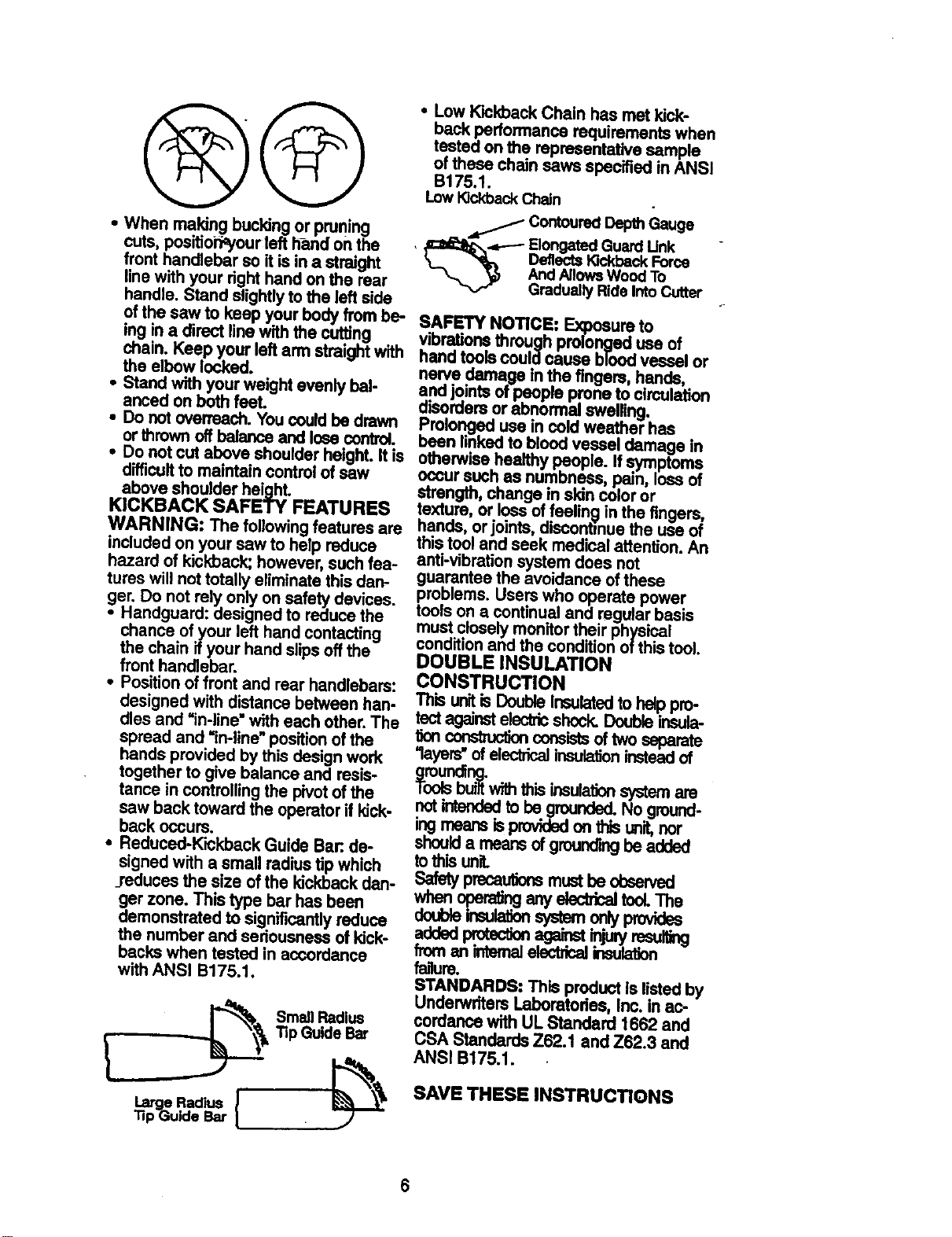
• Reduced-Kickback Guide Bar.de-
signedwith a small radiustipwhich
seduces the size ofthe kickback dan-
ger zone. This type bar has been
demonstrated to significantlyreduce
the number and sedousness of kick-
backs when tested in accordance
with ANSI B175.1.
Small Radius
Tip Guide Bar
• Low KickbackChain has met kick-
back performance requirementswhen
tested on the representativesample
ofthese chain saws specifiedin ANSI
B175.1.
LowKickbackChain
Contoured DepthGauge
• ,_..P---- Elongated Guard Unk -
_, _ Deflects Iqcld3ackForce
_=_ And AllowsWood To
Gradually Ride IntoCutter
SAFETY NOTICE: F.xposurato
vibrationsthrough prolonged use of
hand toolscouldcause bloodvessel or
nerve .damagein the fingers, hands,
and j0untsofpeople prone to circulation
disoiders orabnormal swelling.
Prolongeduse in cold weather has
been Innkedto bloodvessel damage in
otherwisehealthypeople. If symptoms
occursuch as numbn.ess,pain, lossof
strength, change m skincoloror
texture, or lossof feeling in the fingers,
hands, or joints,discontinuethe use of
this tool and seek medical attention. An
anti-vibration system does not
guarantee the avoidance of these
problems. Users who operate power
tools on a continual and regular basis
must closely monitor their physical
condition and the condition of this tool.
DOUBLE INSULATION
CONSTRUCTION
Thisunitis DoubleInsulatedtohelppro-
tectagainstelecl_ shock.Doubleinsula-
tion_ consistsof twosspemte
=layers"ofelectricalinsula6oninsteadof
_" "withthisinsulationsystemars
notIntendedto ba grounded.No ground-
ingmeans isprovidedonthisunit,nor
shoulda meansof groundingbe added
tothle untL
Safetyprecautionsmustbe observed
whenoperaiingany electricaltcol.The
deuce uU!on r ovk .
failure.
STANDARDS: This productislisted by
UnderwritersLaboratodos, Inc.in ac-
cordar_e with UL Standard 1662 and
CSA Standards Z62.1 and Z62.3 and
ANSI B175.1.
SAVE THESE INSTRUCTIONS
CARTONCONTENTS partsmissingordamaged,pleasecall
Models358.341140 1-800-235-5878
ChainSaw(fullyassembled) ASSEMBLY
" BarShsath _ ........ Your saw ts fully assamblad; no .
Examineparts fordamage. Do not use assembly is necessary.
damaged parts.
NOTE: Ifyou need assistance or find
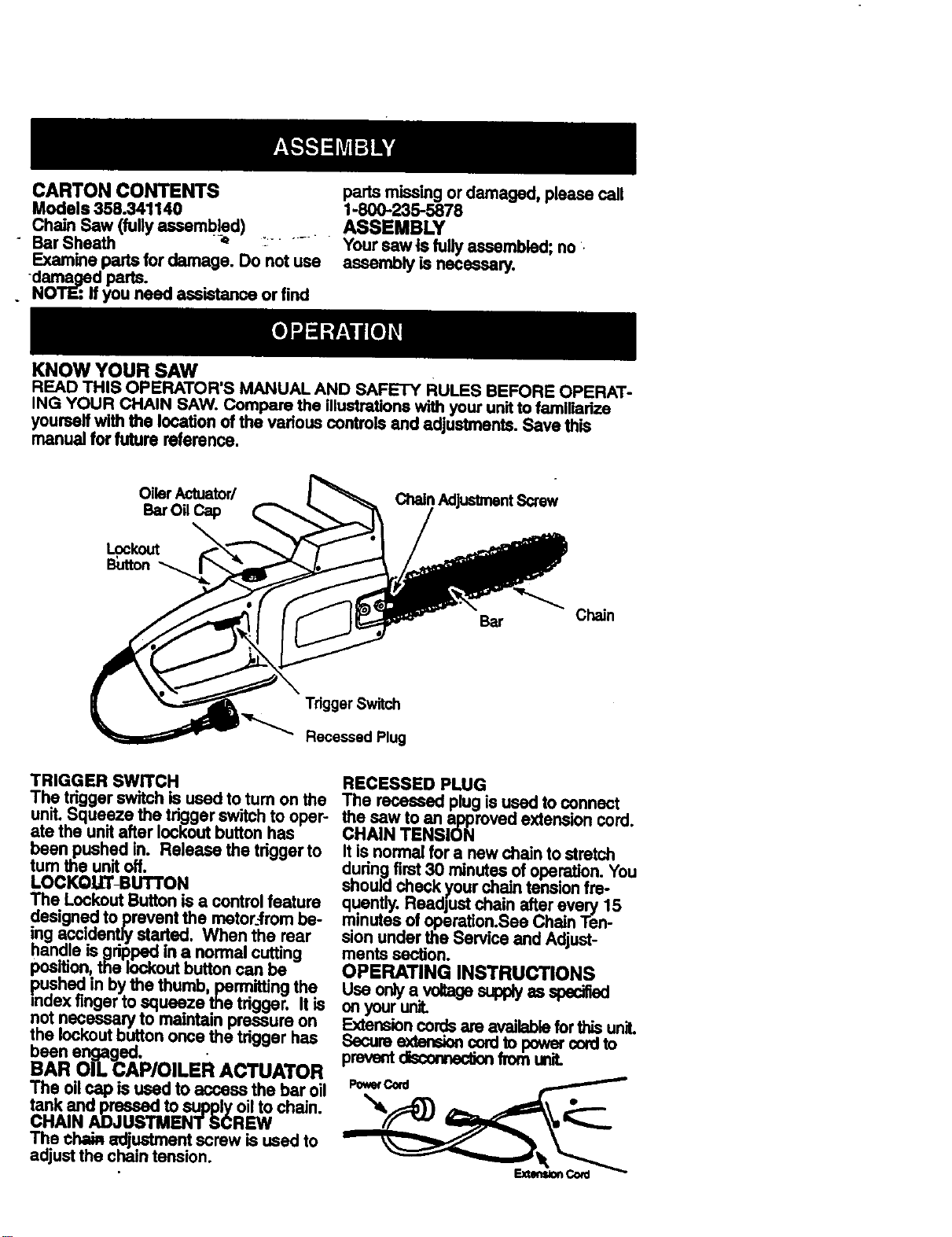
KNOW YOUR SAW
READ THIS OPERATOR'S MANUAL AND SAFETY RULES BEFORE OPERAT-
ING YOUR CHAIN SAW. Compare the Illustrationswith your unittofarnlliadze
yourselfwith the locationof the various controlsend adjustments.Save this
manual for future reference.
OiLerActuator/
Bar Oil Cap
Lockout
B_ton
Chain AdjustmentScrew
Tdggar Switch
Recessed Plug
Chain
TRIGGER SWITCH RECESSED PLUG
The trigger switchis usedto tum on the The recessed plug is used to connect
unit.Squeeze the trigger switch to oper- the saw to an approvedextensioncord.
ate the unitafter lockoutbutton has CHAIN TENSION
Itis normalfor a new chainto stretch
tumbeenthePUShedunitoff.in"Release the trigger to duringfirst30 minutesof ope.rat_n. You
LOCKOU:r-BU'rTON shouldcheck your chain tensnonfre-
The Lockout Buttonis a controlfeature quently.Readjustchain afterevery 15
designed to preventthe metor_-fi'ombe- minutesof operation.See Chain Ten-
ing accidenUy stadad. When the rear sion under the Service end Adjust-
handle is gdpped ina normalcutting ments section.
position,the lockoutbutton can be OPERATING INSTRUCTIONS
pushed in bythe thumb, permittingthe Use onlya vobagesupplyas specified
nndexfinger to squeeze .thetrigger. It is onyourunit.
not necessaWto maintain pressure on Extensioncords are avallabisforthisunit.
the lockoutbutton once the trigger has
Secureextonsioncordto powercordto
been engaged. . prevent_ fromunit.
BAR OIL CAP/OILER ACTUATOR
The oil cap is used to access the bar oil _ _ _
tank end pressed to supplyoil to chain. _
CHAIN ADJUSTMENT SCREW
I11
The chain adjustment screw is used to
adjustthe chain tension.
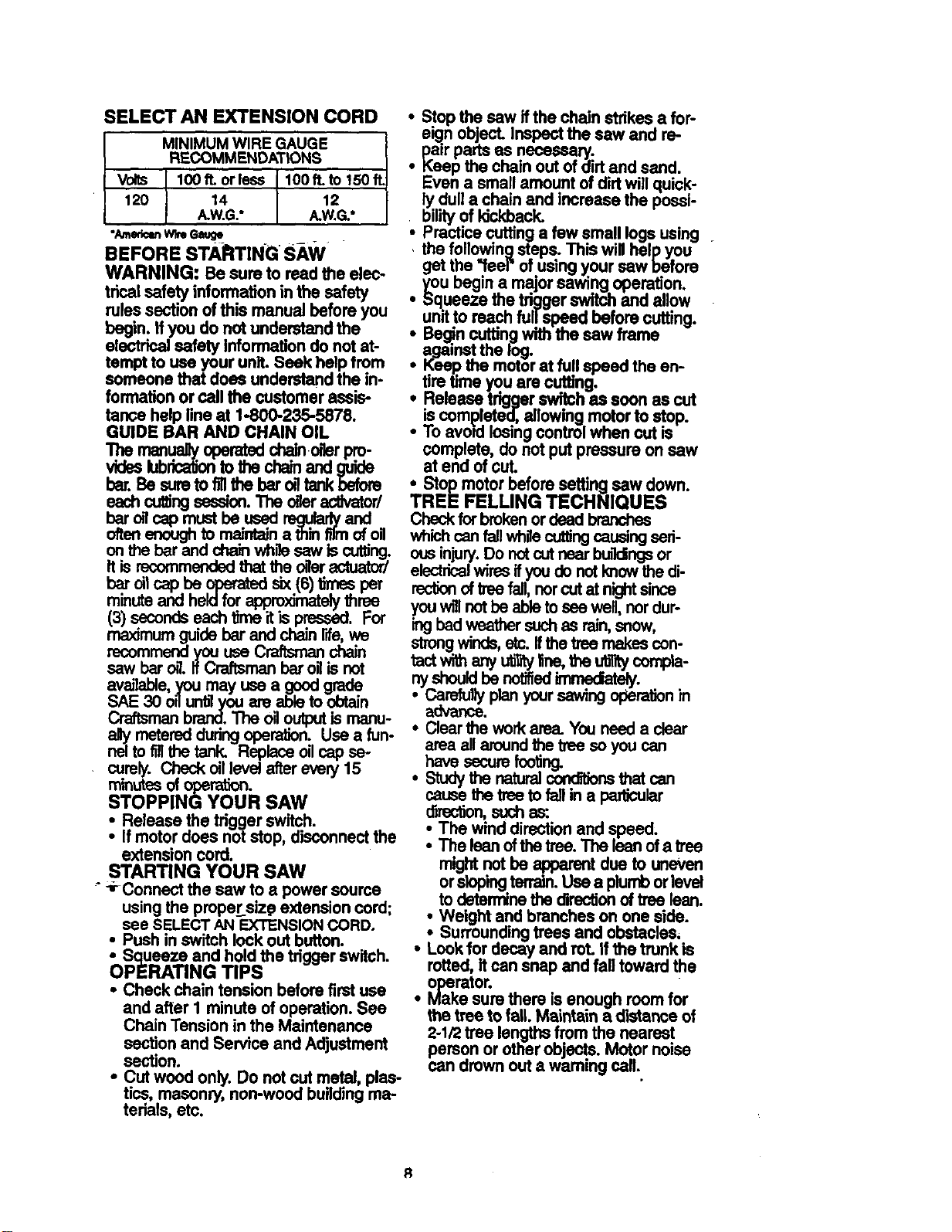
SELECT AN EXTENSION CORD
MINIMUM WIRE GAUGE I
RECOMMENDATIONS
Volts I100ft. orless 100ft.tot50ft. I
120 14 o 12
A.W.G. A.W.G.*
"Americln WI_ GwJge
BEFORE STA_ITING S_.W
WARNING: Be sure to readthe elec-
trical safety information inthe safety
rulessection ofthis manual before you
begin. Ifyou do not understandthe
electricalsafety Informationdo not at-
temptto use your uniL Seek help from
someone that does understandthe in-
formationor call the customer assis-
tanca help line at 1-800-235-5878.
GUIDE BAR AND CHAIN OIL
The manuallyoperatedchaln,oilerpm-
vtdeslubrica_onto the chainand guide
Imr.Be sumto fillthe bin"o_ltankbofom
ead_cuttingsession.Tim oilero_liv'ator/
bar o, cap mus_be um_ln_julmlyand
oftenenoughto maintaina thin_Imofon
on tha barand chainwh_ sew Iscutting.
Itis recommended that the o_r actuator/
baroilcapbe operatedsix(6) times per
minuteand heldfor appro_matelythree
(3) secondseachtime itispressed. For
maximumguidebar and chainI'Ve,we
recommendyou useCraftsmanchain
saw baro_1.IfCral_rnan baro=1isnot
available,you mayuse a goodgrade
SAE 30 oilunblyouare able toobtain
_man b.m_. The oiloutputismanu-
amymetereddunngoperation.Usea fun-
nelto fillthe tank. Replaceoilcapse-
curely. Checkoillevel afterevery 15
minutesof operate.
STOPPING YOUR SAW
• Release the trigger switch.
Ifmotordoes not stop, disconnectthe
extension cord.
STARTING YOUR SAW
_Connect the saw to a power source
usingthe proper__siz_extensioncord;
see SELECT AN EXTENSION CORD.
• Push inswitchlock out button.
• Squeeze and holdthe tdggerswitch.
OPERATING TIPS
• Check chain tension before firstuse
and after I minute of operation.See
Chain Tensionin the Maintenance
section and Service and Adjustment
section.
• Cut wood only.Do notcut metal, plas-
tics, masonry, non-wood buildingma-
teriels, etc.
• Stopthe saw ifthe chain strikes a for-
eign object.Inspect the saw and re-
pairparts es necessary.
• Keep the chain outof dirtand sand.
Even a smallamount of dirtwill quick-
ly dulla chain and mcresse the posel-
• bilityof kickback.
Practice cuttinga few small logsusing _
, the following steps.Thinwill help you
got the =feel" of usingyour saw before
you begin a majorsawing operation.
• Squeeze the trigger switchand allow
unitto rea.chfull speed before cutting.
• Begincutting withthe saw frame
against the log.
• Kee..pthe motorat full speed the en-
tire time _u are cutting.
• Release triggerswitchas soon as cut
iscomlpIsted, allowing motor to stop.
• To avoid losingcontrolwhen out is
complete, do notput pressureon saw
at end of cut.
• Stopmotorbeforesettingsawdown.
TREE FELLING TECHNIQUES
Checkfor brokenordeadbranches
whichcanfall wh=lecuttingcausingseri-
ousinjury.Do notcutnearb_'ldingsor
electricelwirssifyoudo notknowthe di-
rect_ of treefall, norcutat nightsince
youwillnotbe abletosee well,nordur-
ingbedwsathersuchas rain,snow,
strongwinds,etc.Ifthe tresmakes con-
tactwithany_T_lyline,the ubqitycompla-
ouldbe
• _=_mfut_.planyoursaw=ngoperationin
• Clear the workarea.You needa clear
area allaroundthe treeso you can
have securefooting.
• Studythe naturalcondtJo_ thatcan
causethetreetofellina parlJcular
direction,suchas:
• The wind directionand speed,
• The lean ofthe tree.The lean ofa tree
might not be apparentdue to uneven
orsloping terrain.Usa a plumborlevel
todeten'ninethe directionoftree lean.
• Weight and branches onone side.
• Surroundingtrees and obstacles,
• Look for decay and roL Ifthe trunk is
rotted,if can snap and fall towardthe
operator.
• Make surethere is enoughroom for
the tree to fall. Mamteln a distance of
2.1/2tree lengthsfrom the nearest
person orother objects. Motor noise
can drown out a wammg call.
R
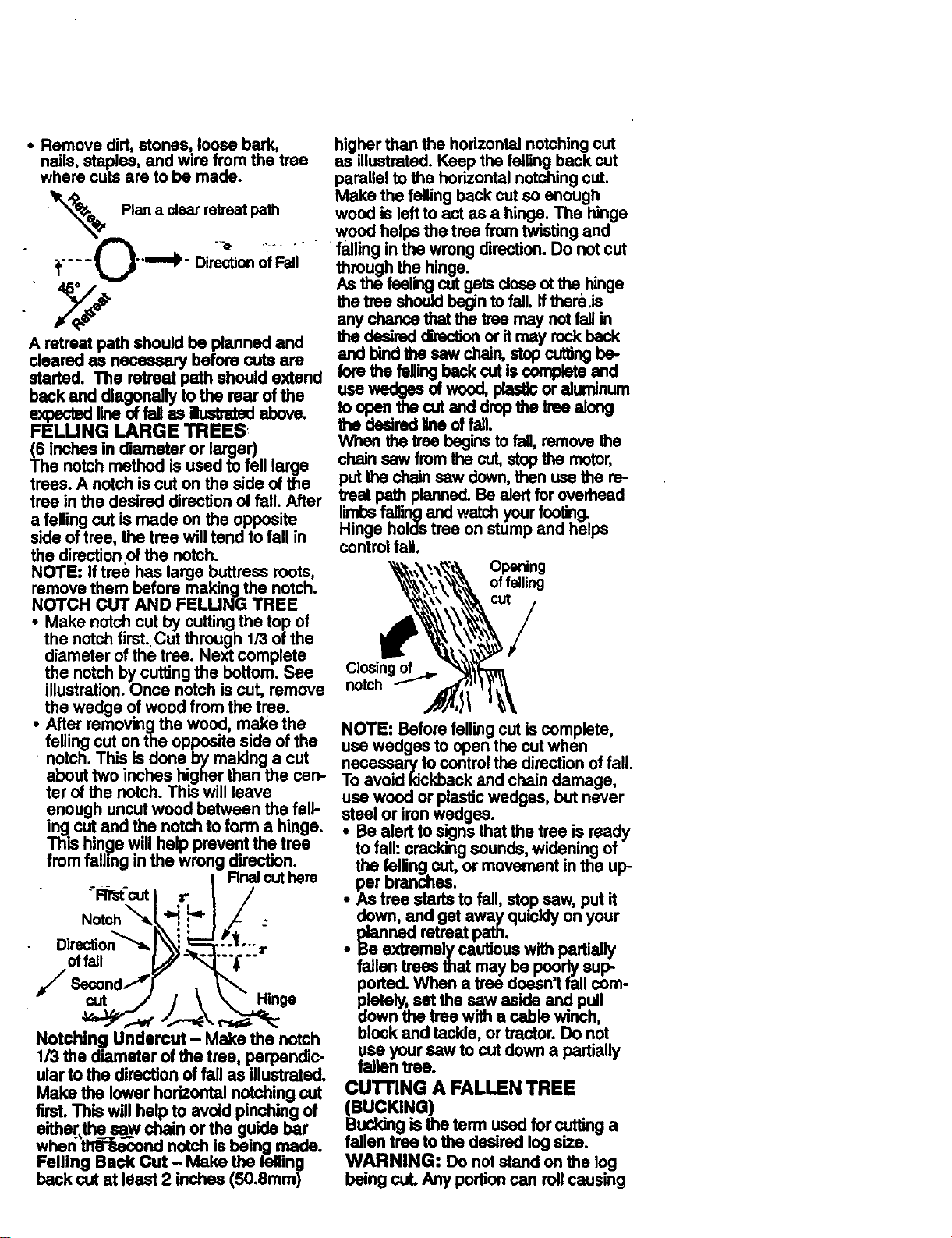
• Remove dirt,stones, loose bark,
nails,staples, and wire fromthe tree
where cuts are to be made.
Plan a clear retreatpath
. ....-,"- .,-
Y#
A retreat path should be planned and
cleared as necessary before cuts are
started. The retreat path should extend
back and diagonally tothe rear ofthe
e_-'ted rm offallas illusl_ed abeve.
FELLING LARGE TREES
_6hinchesin diameter or larger)
e notchmethod ksused tofell large
trees. A notch is cuton the side ofthe
tree inthe desired directionof fall. After
a fellingcut is made on the opposite
side of tree, the tree will tend to fall in
the directionofthe notch.
NOTE: Iftree has large buttress roots,
removethem before making the notch.
NOTCH CUT AND FELLING TREE
• Make notchcut by cuffingthe top of
the notch first. Cut through 1/3 otthe
diameter ofthe tree. Next complete
the notch by cuffingthe bottom. See
illustration.Once notchiscut, remove
the wedge of wood fromthe tree.
• After removingthe wood, make the
fellingcut on the opposite side ofthe
• notch. This is done by making a cut
about twoinches higherthan the cen-
ter ofthe notch. Thkswillleave
enough uncutwood between the fell-
ing cut and the notchto form a hinge.
This hinge willhelp prevent the tree
from fallingin the wron direction.
Final cuthem
"R_-cut| r, /
Notch"_[_.
offal
/ o.lr
Notching Undercut - Make the notch
1/3 the diameter ofthe tree, perpendic-
ularto the directionoffall as illustrated.
Make the lower horizontal notchingcut
fl..rs.LThis will help to avoid pinchingof
eithe.r,the saw chain or the guide bar
when tllrSecond notch isbeing made.
Felling Back Cut - Make the felling
back cut at least 2 inches (50.Bmm)
higherthan the horizontalnotchingcut
as illustrated.Keep the fellingback cut
parallel tothe horizontalnotchingcut.
Make the felling backcut so enough
wood isleft to act as a hinge.The hinge
wood helpsthe tree fromtwistingand
fallingin the wrong direction. Do notcut
through the hinge.
As the feel_g cutgets dose ot the hinge
the tree shouldbeginto fall.Ifthem.is
any chancethatthe tree may notfallin
the desked cruectionorit may rockback
and bind the saw chain,atop cuttingbe-
fore the fellingbeck cutis complsteand
wedges ofwood,plasticor aluminum
to openthe cut and dropthe treealong
the desiredlineoffail.
Whon the tree bsgins to fall,removethe
cheinsaw fromthe cut,stop the motor,
putthe chainsaw down,then ussthe re-
treatpathplanned.Be alert foroverhead
limbsfallingand watchyourfoo_ng.
Hinge holdstree onstump and helps
controlfall,
Opening
offelling
Closingof
notch
NOTE: Before fellingcut is complete,
use wedges to open the cut when
necess.aryto controlthe direction offall.
Toavoid kickback and chaindamage,
use wood or plasticwedges, but never
steel or ironwedges.
• Be alertto signsthat the tree is ready
tofall: crackingsounds,widening of
the fellingcut, or movement in the up-
. per branches.
As tree startsto fall,stop saw, put it
down, and get away quicklyonyour
planned retreat path.
• Be extremaly sautious with partially
fallen trees that may be poorlysup-
ported. When a tree doesn'tfall com-
pletaiy,set the saw aside and pull
downthe tree witha cable winch,
blockand taclde, or tractor.Do not
useyour saw to cut downa partially
fallentree.
cUTrlNG A FALLEN TREE
BUCmNG)
uckmg m thetermusedforcuttinga
fallentreetothedesiredlogsize.
WARNING: Do not stand onthe log
being cuL Any portioncan rollcausing
loss of footing and control. Do not stand
downhill of the log being out.
IMPORTANT POINTS
• Itis importantto make sureyourfooting
isfirmand yourweightis evenlydistn'b-
utedon bothfeet. When poss_e, the
logshouldbe raisedand suppodedby
• use oflimba,__ogs,or blocks.
• Cut only onelog at a time.
Cut shatteredwood very carefully;,
sharppieces of wood couldbe flung
toward operator.
• Use a sawhorse to cut small logs.
Never allow another personto hold
the log while cuttingand never hold
the log with your leg orfoot.
• Do notcut in an area where logs,
androotsaretan . Draglogs
il_Oa dsarareab_Z_ cuing._.
• When "cuttingthrough', to maintain
complete control, release the cuffing
pressurenear the end ofthe cut with-
out looseningyour gripon the chain
saw handles.
• Don't letthe chain contactthe ground.
• Aftercompletingthe cut, wait forthe
saw chain to stopbefore you move
the chain saw.
• Always stopthe motorbefore moving
fromtree to tree.
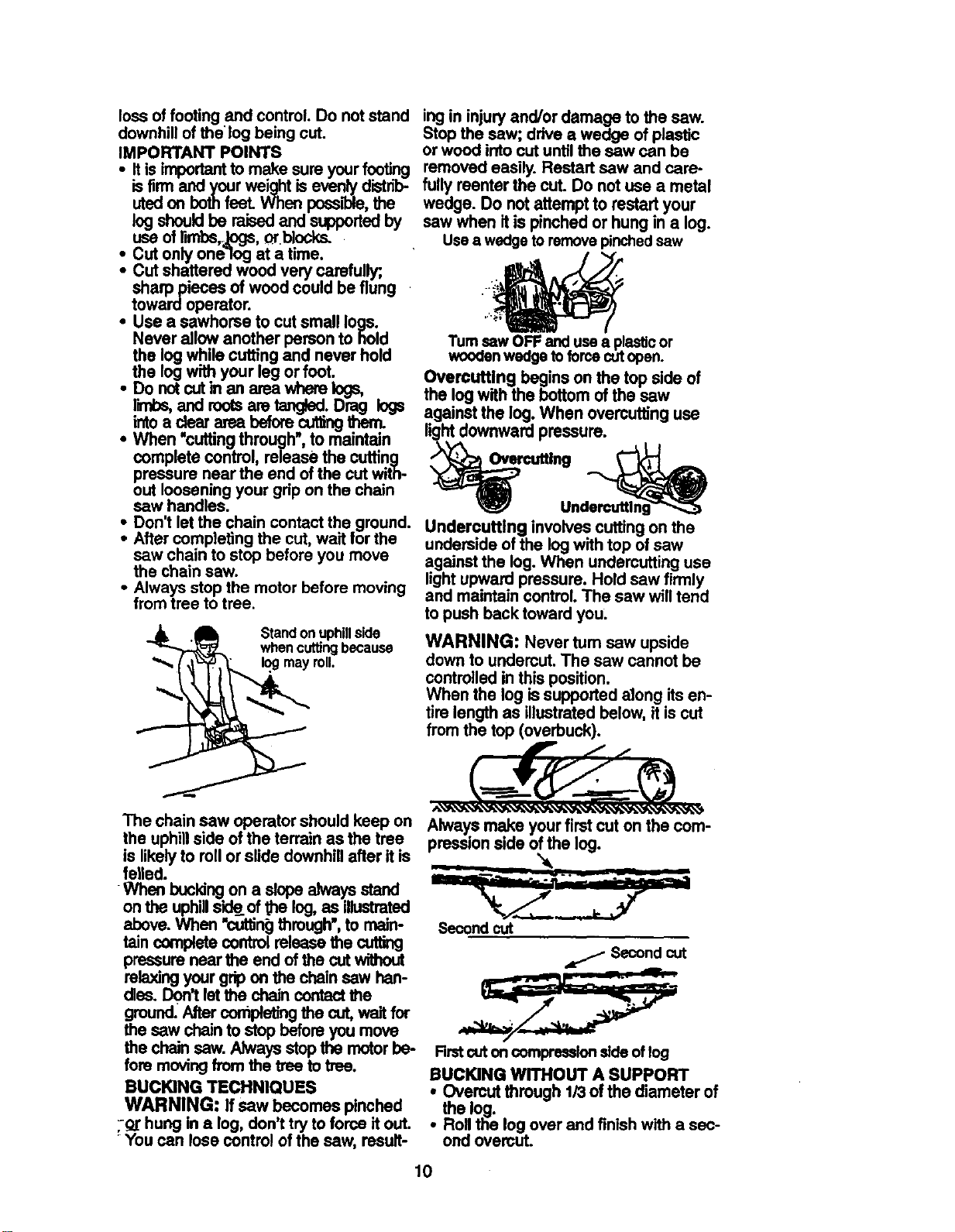
__k Jl_ Standonuphillside
when cuffing because
roll
The chain saw operator should keep on
the uphillside of the terrain as the tree
is likelyto rollor slide downhillafter itis
felled.
When bucldngon a slopealwaysstand
onthe uphillside of thelog,as illustrated
above. When "cutting]through',to main-
tain completecontrol releasethe cutting
pressurenear the end of the cutwithout
relaxingyourgripon the chainsaw han-
des. Don't letthe chain contactthe
ground.Aftercompletingthe cut,waitfor
the saw chainto stopbeforeyou move
the chain saw.Alwaysstopthe motorbe-
fore moving fromthe tree to tree.
BUCKING TECHNIQUES
WARNING: Ifsaw becomes pinched
:9.1'hung in a log, don'ttry toforce it out.
You can lose control of thesaw, result-
ing in injury and/or damage to the saw.
Stop the saw; drive a wedge of plastic
or wood into cut until the saw can be
removed easily. Restart saw and care-
fully reenter the cut. Do not use a metal
wedge, Do not attempt to restart your
saw when it is pinched or hung in a log.
Usea wedge to remove pinchedsaw
TumsawOFFandusea plasticor
woodenwedgeto forcecutopen.
Overcuttlng beginsonthe top side of
the log with the bottomof the saw
against the log. When overcuttinguse
lightdownwardpressure,
Undercuttlng-"-_.
Undercutting involves cutting on the
underside of the log with top of saw
against the log. When undercutting use
light upward pressure. Hold saw firmly
and maintain control. The saw will tend
to push back toward you.
WARNING: Never tum saw upside
downto undercut.The saw cannot be
controlledinthis position.
When the log is supportedalong its en-
tirelength as illustratedbelow, it iscut
fromthe top (overbuck).
Always mal_.eyourfirstcut on the com-
pressionside of the log.
Secondcut
Second cut
Rrst cuton compressionside of log
BUCKING WITHOUT A SUPPORT
• Overcut through 1/3 of the diameter of
the log.
• Roll the log over and finish with a sec-
ond overcut.
10
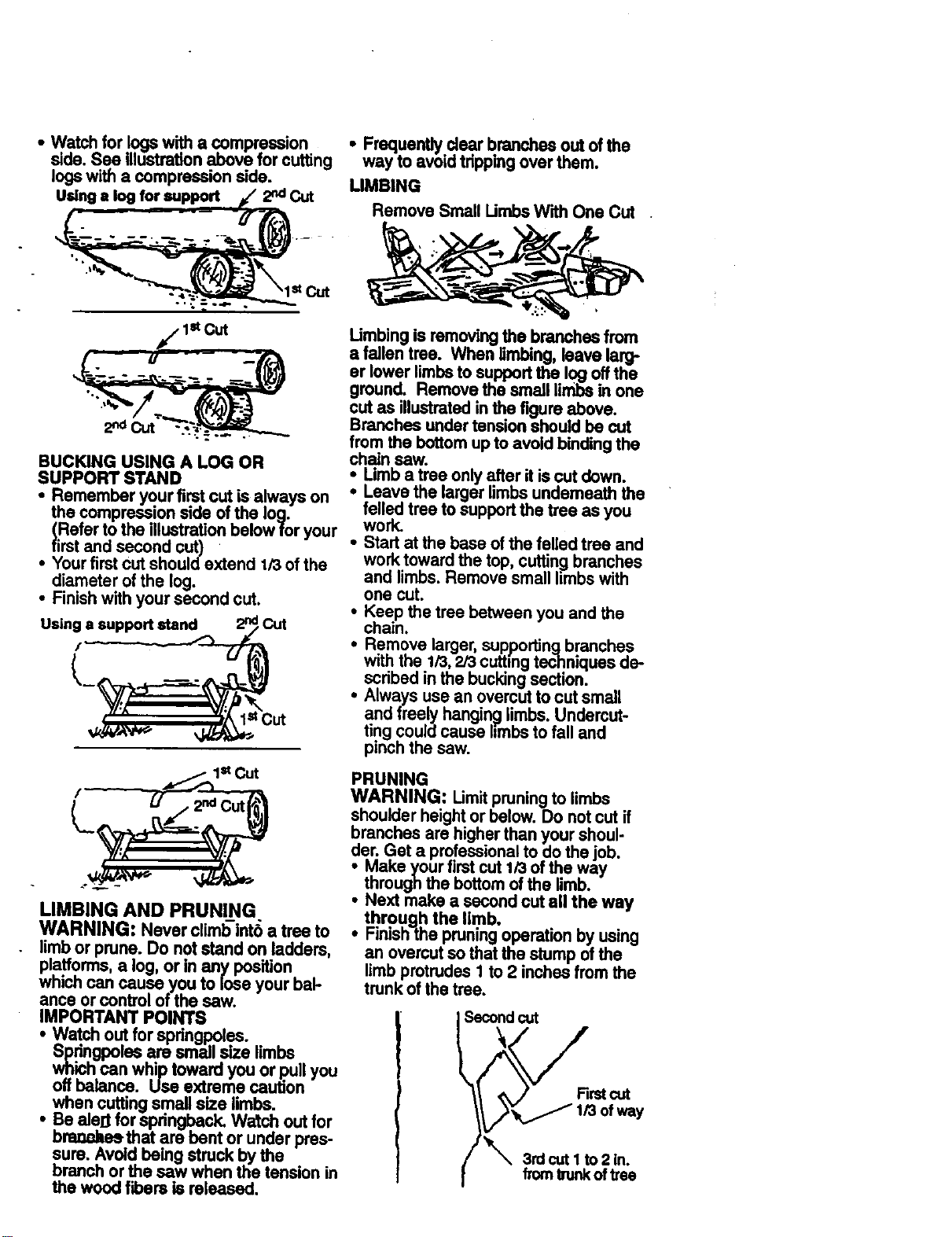
• Watchforlogswithacompression • Frequentlyclearbranchesoutofthe
side.Seeillustrationabovefor cuffing way to avoidtnppmgover them.
logswith a compression side.
Usinga togfor support f 2ndC_ LIMBING
...... Remove Small LimbsWith One Cut
_'ISt Cut
-
out
BUCKING USING A LOG OR
SUPPORT STAND
• Remember yourfirat cut isalways on
the compressionside ofthe log.
(Refer tothe _lostration below foryour
first and second cut)
• Yourfirstcut shouldextend 1/3 ofthe
diameter of the log.
• Finishwithyour second cut.
Using/_Cut
Umbing is removingthe branchesfrom
a fallen tree. When Umbing, leave larg-
er lower limbsto supportthe log offthe
ground. Remove the smallLimbs in one
cut as illustratedin the figure above.
Branches under tensionshould be cut
fromthe bottom upto avoidbindingthe
chain saw.
Limba tree onlyafter itiscut down.
Leave the larger limbsundemeath the
felledtree tosupportthe tree as you
work.
• Start at the base of thefelled tree and
worktoward the top, cuffingbranches
and limbs. Remove small limbswith
one cut.
• Keep the tree between you and the
chain.
• Remove larger,supportingbranches
with the 1/3,2/3cuttingtechniques de-
scdbed in the buckingsection.
• Always use an overcut to cutsmall
and freely hangin__imbs.Undercut-
tingcould cause hmbsto fall and
pinchthe saw.
/
L
LIMBING AND PRUNING
WARNING: Never climb-int6a tree to
limbor prune. Do notstand on ladders,
platforms,a log, or in any position
which can cause you to lose your bal-
ance or conb'olof the saw.
IMPORTANT POINTS
• Watch outfor spdngp0les.
Springpoles are small size limbs
whichcan whip toward you or pullyou
off balance. Use extreme caution
when cuttingsmall size limbs.
• Be alell forspringback, Watch out for
brenekeethat are bent or under pres-
sure. Avoid being struckby the
branchorthe saw when the tension in
the wood fibers isreleased.
PRUNING
WARNING: Limitpruningto limbs
shoulderheight or below. Do notcut if
branches are higherthan your shoul-
der. Get a professionalto do the job.
• Make your firstcut 1/3of the way
through the bottomofthe limb.
• Next make a secondcut all the way
through the limb.
• Finish-thepruningoperationby using
an overcutso that the stump ofthe
limb protrudes1 to 2 inches fromthe
trunk of the tree.
Secondcut
Firstcut
3rd cut 1to 2 in.
f_m trunkof b'ee
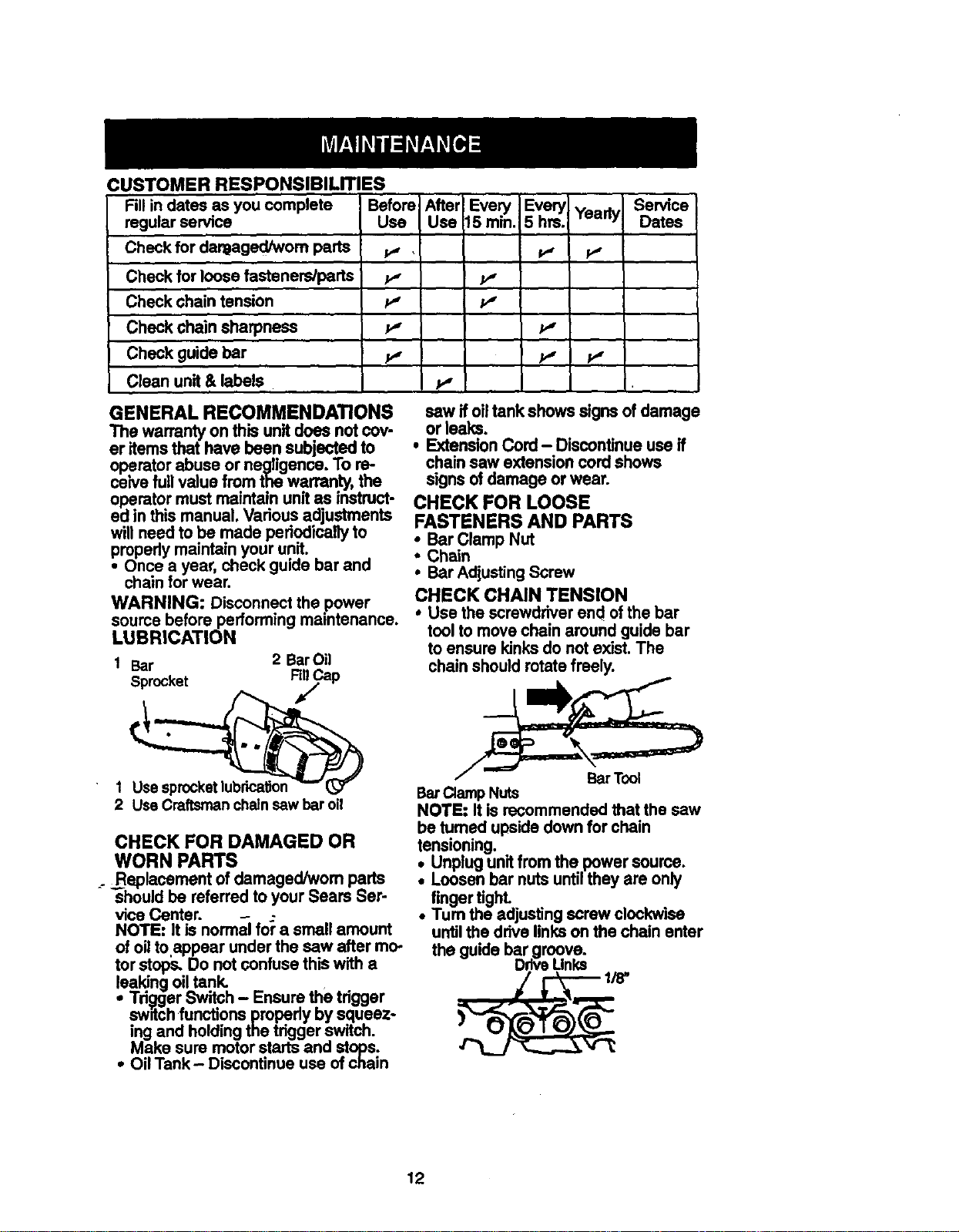
CUSTOMER RESPONSIBILITIES
Fill in dates as you complete
regular service
Before After Every Every Yearly Service
Use Use 15 min. 5 hrs. Dates
Check for dar_aged/wom parts p. ,
v., p-
Check for loose tasteners/parts p,-
y-
Check chain tension
v" /I
Check chain sharpness
p-
v"
Check guide bar _, p,, p,,
Clean unit& labels
p,,
GENERAL RECOMMENDATIONS
The warranty on this unit does not cov-
er items that have been subjected to
ope.rator abuse or negligence. To re-
cewe full value from the warranty, the
operator must maintain unit as instruct-
ed in this manual. Vadous adjustments
will need to be made periodically to
propedy maintain your unit.
• Once a year, check guide bar and
chain for wear.
WARNING: Disconnect the power
source before performing maintenance.
LUBRICATION
1 Bar 2 BarOil
Sprocket Fill Cap
I"
1 Usesprocketlubrication
2 Use Craftsmanchainsaw bar oil
CHECK FOR DAMAGED OR
WORN PARTS
. _Replacement of damaged/wom parts
should be referred to your Sears Ser-
vice Center.
NOTE: It is norm_ for a small amount
of oil toappear under the saw after mo-
tor stops. Do not confuse this with a
leaking oil tank.
• Td_ger Switch - Ensure the tdgger
switch functions propedy by s,queez-
ing and holding the tdgger switch.
Make sure motor starts and stops.
• Oil Tank- Discontinue use of chain
saw if oiltank showssignsof damage
or leaks.
• ExtensionCord - Discontinueuse if
chainsaw extension cordshows
signsof damage or wear.
CHECK FOR LOOSE
FASTENERS AND PARTS
• Bar Clamp Nut
• Chain
° Bar AdjustingScrew
CHECK CHAIN TENSION
• Use the screwdriverend ofthe bar
toolto move chainaround guide bar
to ensure kinksdo notexist. The
chainshouldrotate freely.
Bar Clamp Nuts
NOTE: It is recommended that the saw
be tumed upside down for chain
tensioning.
• Unplug unit from the power source.
• Loosen bar nuts until they are only
finger tight.
• Turn the adjusting screw clookwisa
until the drive links on the chain enter
the guide bar groove.
DriveUnks
12
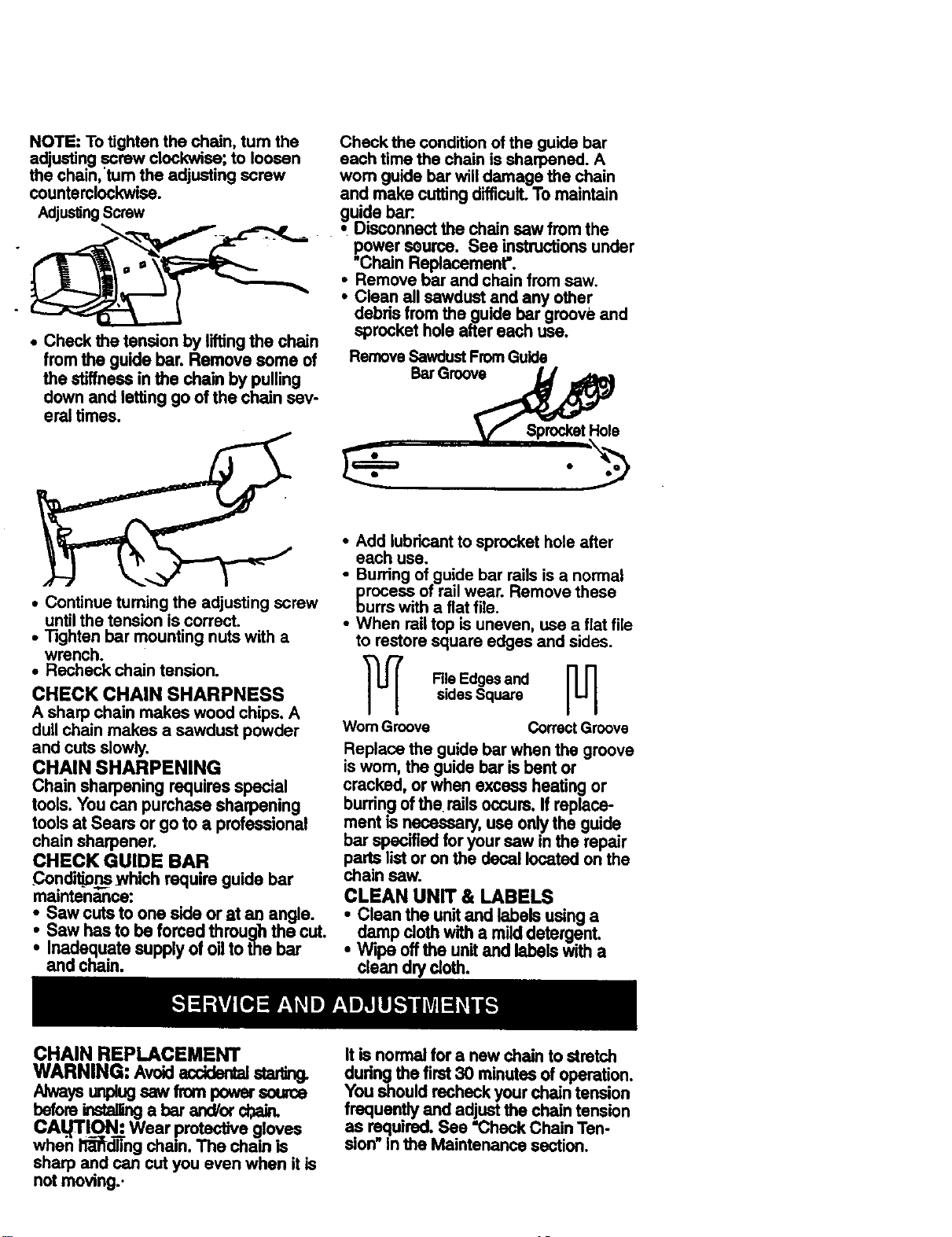
NOTE:Totightenthechain,tumthe
adjustingscrewclockwise;to loosen
thechain,'tumthe adjusting screw
counterclockwise.
AdjustingScrew
• Check the tension by lifting the chain
from the guide bar. Remove some of
the stiffness in the chain by pulling
down and letting go of the chain sev-
eral times.
Check the conditionofthe guide bar
each time the chain issharpened. A
worn guide bar wiUdamage the chain
and make cuttingdifficult.Tomaintain
guide bar:.
• Disconnectthe chain saw fromthe
power source. See instructionsunder
"ChainReplacement'.
• Remove bar and chainfromsaw
• Clean allsawdustand any other
debris fromthe guidebar groove and
sprockethole after each use.
Remove Sawdust FromGuide
SprocketHole
• Continue tuming the adjusting screw
until the tension is correct.
• Tighten bar mounting nuts with a
wrench.
• Recheck chain tension.
CHECK CHAIN SHARPNESS
A sharpchain makes woodchips. A
dullchain makes a sawdust powder
and cutsslowly.
CHAIN SHARPENING
Chain sharpening requires special
tools.You can purchase sharpening
tools at Sears or goto a professional
chainsharpener.
CHECK GUIDE BAR
.Condit_one.which require guide bar
malntsnanca:
i Saw cuts to one side or at arJangle.
Saw has to be forced through the cut.
Inadequate supply of oil to the bar
and chain.
• Add lubricant to sprocket hole after
each use.
• Burring of guide bar rails is a normal
process of rail wear. Remove these
burrs with a flat file.
• When rail top is uneven, use a flat file
to restore square edges and sides.
Rle Edgesand
sides Square
Worn Groove Correct Groove
Replace the guide bar when the groove
isworn, the guide bar is bentor
cracked, or when excess heatingor
burringofthe railsoccurs,If replace-
ment isnecessary, use onlythe guide
bar specifiedforyour saw in the repair
parts listoronthe decal locatedonthe
chain sew.
CLEAN UNIT & LABELS
• Clean the unitand labelsusinga
damp clothwith a milddetergent.
• Wipe offthe unitand labelswith a
clean dry cloth.
CHAIN REPLACEMENT
WARNING: AvoidaccidentalstadJn_
/Owaysunplugsawfrompowerscuma
before_ a bar and/orcbai_
CA I_i"IONG Wear protective gloves
when IT'4fidlingchain.The chain is
sharp and can cut you even when it is
notmoving..
It is normal for a new chain to stretch
during the first 30 minutes of operation.
You should recheck your chain tension
frequently and adjust the chain tension
as required. See "Check Chain Ten-
sion" in the Maintenance section.
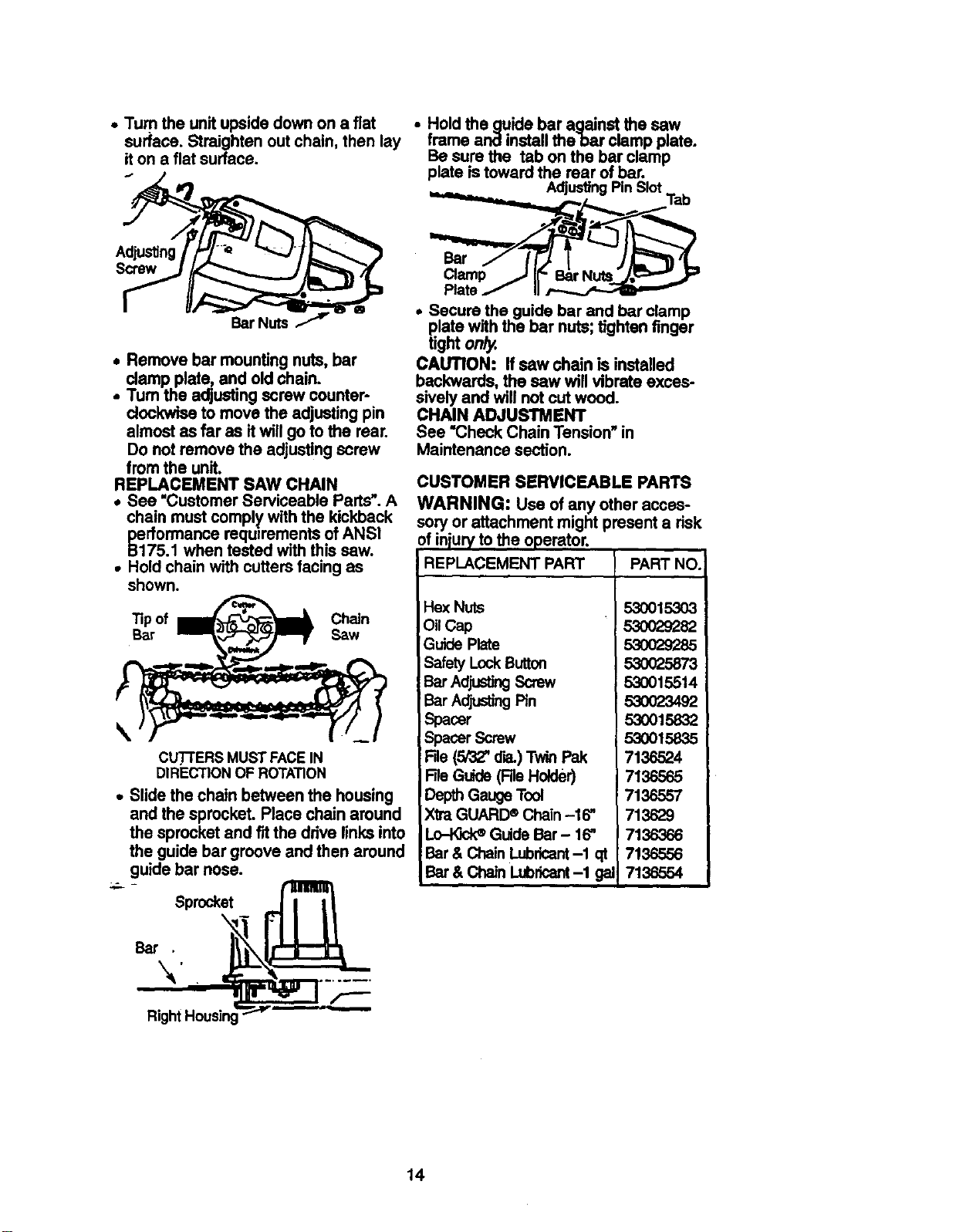
•Tum the unit upside down on a flat
surface. Straighten out chain, then lay
iton a flat surface.
Adjusting
Screw
Bar Nuts
• Remove bar mountingnuts, bar
clamp plata, and old chain.
• Turnthe adjustingscrew counter-
dookwisa to move the adjusting pin
almost as far as it will go to the rear.
Do not remove the adjusting screw
from the unit.
REPLACEMENT SAW CHAIN
• See "Customer Serviceable Parts'. A
chain must comply with the kickback
performance requirements of ANSI
B175.1 when tested with this saw.
• Hold chain with cutters facing as
shown.
Tipof Chain
Bar Saw
\
CUBERS MUSTFACEIN
DIRECTIONOF ROTATiON
• Slide the chain between the housing
and the sprocket. Place chain around
the sprocket and fit the drive links into
the guide bar groove and then around
guide bar nose.
Sprocket
• Hold the guide bar against the saw
frame and install thebar clamp plate.
Be sure the tab on the bar clamp
plate is toward the rear of bar.
,.,..=_ AdjustingPin Slot -.
laD
Plate _ II
, Secure the guide bar and bar clamp
plate with the bar nuts; tighten finger
tight only..
CAUTION: If saw chain is installed
backwards, the saw will vibrate exces-
sively and will not cut wood.
CHAIN ADJUSTMENT
See "Check Chain Tension" in
Maintenance section.
CUSTOMER SERVICEABLE PARTS
WARNING: Use of any other acces-
sory or attachment might present a risk
of iniury to the operator.
REPLACEMENT PART PART NO.
Hex Nuts
Oil Cap
Guide Plate
Safety Lock Button
Bar AdjustingScrew
Bar AdjustingPin
Spacer
Spacer Screw
File(5/32"d'_)TwinPak
Rle Guide (Re Holder)
Depth Gauge Tool
Xtra GUARD ®Chain -16"
Lo-lrucke Guide Bar - 16"
Bar & Chain Lubricant-1 qt
Bar & Chain I.ubricant-1 gal
5300153O3
_82
530029285
53OO25873
,5,3O015514
53O023492
530015832
530015835
7136524
7136565
7136557
713629
I 7136366
:7136556
7136554
Rig
14
Prepareyourunitfors..t.orageattheend EXTERNAL SURFACES
oftheseasonorifitwdlnotbeusedfor Ifyourchainsawistobestomdfora
30daysormore. _ ...... periodoft_3e, cleanitthoroughly
" WARNING:
= Allowthe motorto cool, then secure
the unitbefore stodngor tr._rting.
• • Store chain saw and extenszon cord
in a wellventilated area
• Store chain saw withall guards in
place and positionchain saw so that
any sharp objectcannot accidentally
cause injury.
• Store chainsew unplugged, well out
of the reach of children.
.iI_e_hs_oraoe.Storeinadeen d_ =e_
I.i_h_ oil externalmetal surfaces and
gu,debar,
• Oilthe chain and wrap it in heavy
paper or cloth.
To preventchain oil seepage dudng
storacje,store_e saw as follows:
• ups,dedown ifstoredon a shelf,or
• hungon a hook or nailthrough the
hole inthe bar
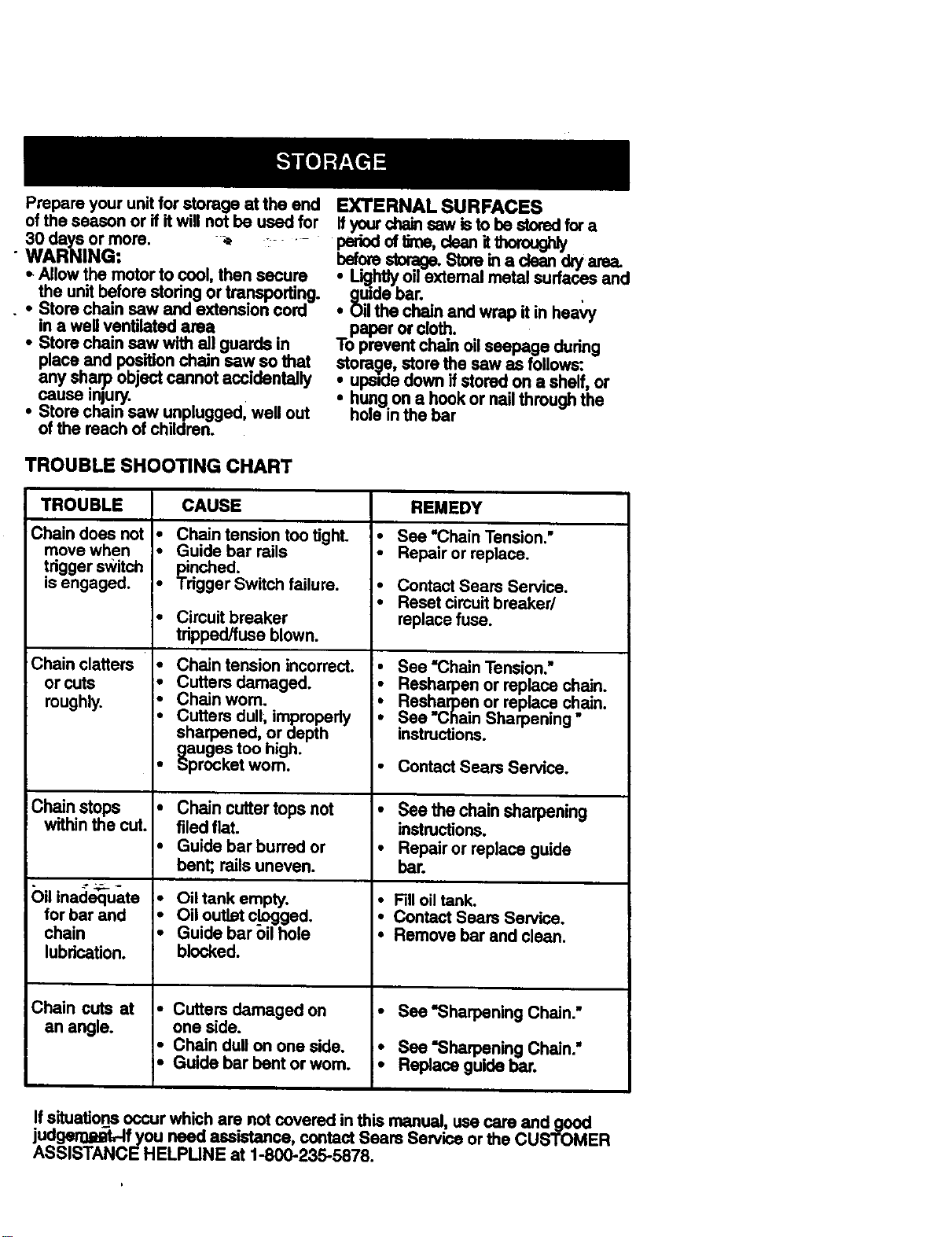
TROUBLESHOOTING CHART
TROUBLE CAUSE REMEDY
Chain does not
move when
tdgger switch
is engaged.
Chain clatters
or outs
roughly.
I
!ChaJnstops
withinthe cut.
Oil inade_luate
for bar and
chain
lubrication.
Chain cuts at
an angle.
• Chain tension too tight.
• Guide bar rails
pinched.
• Trigger Switch failure.
• Circuit breaker
tdppedfiuse blown.
• Chain tension incorrect.
• Cutters damaged.
• Chain wom.
• Cutters dull, impropedy
sharpened, or depth
gauges too high.
• Sprocket worn.
• Chain cutter topsnot
filed flat.
• Guide bar burred or
bent;,rails uneven.
• Oil tank empty.
• 0il outlet clogged.
Guide bar oil hole
blocked.
• Cutters damaged on
one side.
• Chain dullon one side.
• Guide bar bent or wom.
• See "ChainTension."
• Repairor replace.
• Contact Sears Service.
• Reset circuit breaker/
replace fuse.
• See =Chain Tension."
!• Resharpen or replace chain.
!• Resharpen or replace chain.
• See"Chain Sharpening"
instructions.
Contact Sears Service.
• See the chainsharpening
instructions.
• Repair or replace guide
bar.
• Fill oil tank.
• Contact Sears Service.
• Remove bar and clean.
• See "Sharpening Chain."
See "Sharpening Chain."
•" Replace guide bar.
If situations occurwhich are not covered in this manual, usecare and good
judge_tmt_lf you need assistance, contactSears Service orthe CUSTOMER
ASSISTANCE HELPLINE at 1-800-235-5878.
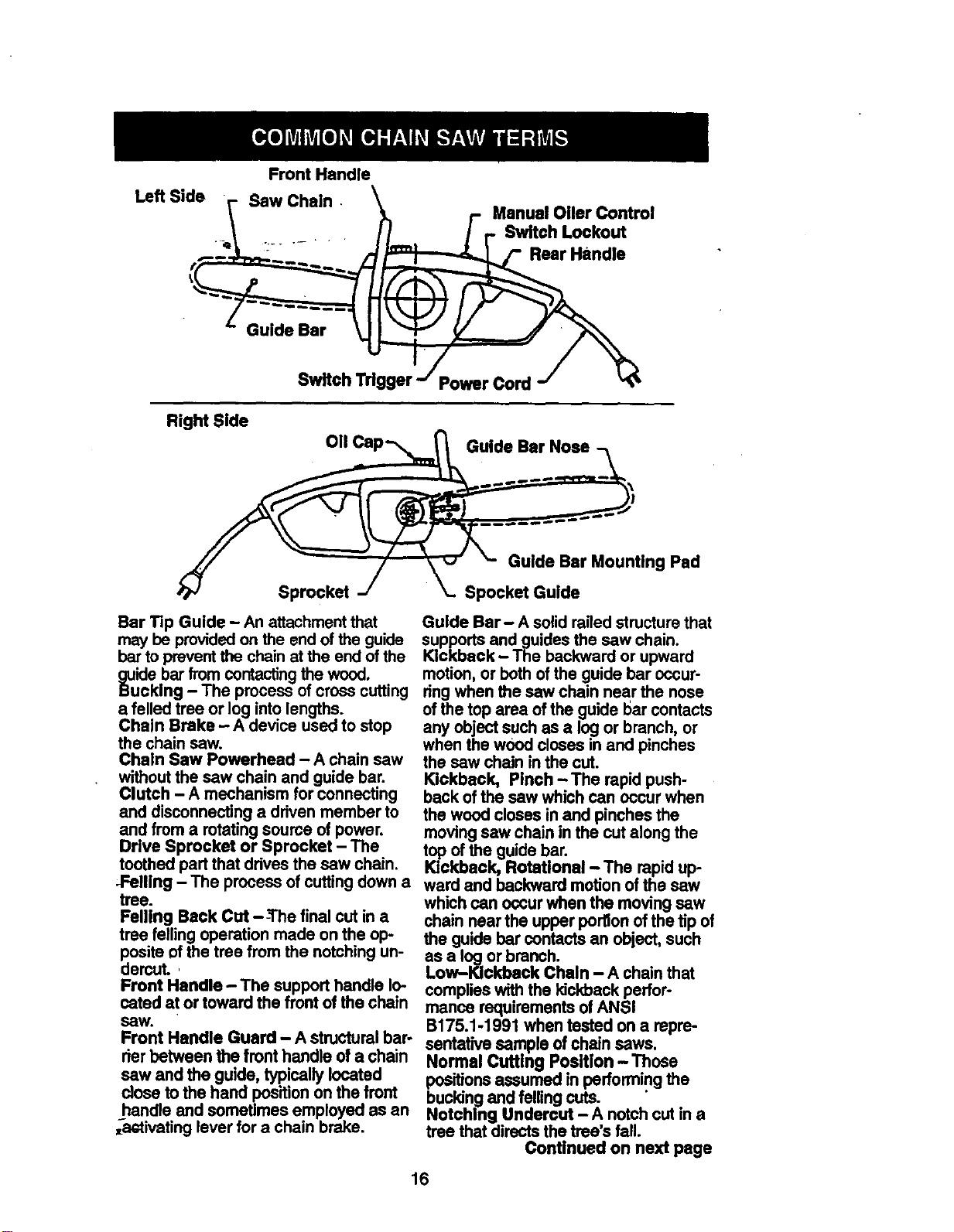
LeftSide
Front Handle
Saw Chain.
Manual Oiler Control
Switch Lockout
Rear Handle
Guide Bar
Power Cord
Right Side
_o_'nting Pad
/_ Sprocket J _- Spocket Guide
Bar Tip Guide - An attachmentthat
may be providedon the end ofthe guide
barto preventthe chain at the end ofthe
_uide barfrom contactingthe wood.
cking- The process of crosscutting
a felled tree or log into lengths.
Chain Brake -A device usedto stop
the chain saw.
Chain Saw Powerheed - A chain saw
withoutthe saw chain and guide bar.
Clutch - A mechanism for connecting
and disconnectinga driven member to
and from a rotatingsource of power.
Ddve Sprocket or Sprocket - The
toothedpart that drivesthe saw chain.
•-elling- The process ofcuttingdown a
tree.
Felling Back Cut --The finalcut in a
tree fellingoperation made on the op-
posite ofthe tree from the notchingun-
dercut.
Front Handle - The supporthandle lo-
cated at or toward the front of the chain
saw.
Front Handle Guard - A structuralbar-
der between the front handle ofa chain
saw and the guide, typ!callylocated
dose to the hand positiononthe front
.handle and sometimes employed as an
=aGtivating leverfor a chain brake.
Guide Bar- A solidrailedstructurethat
supportsand guidesthe saw chain.
Kickback- The backward or upward
motion,or bothofthe guide bar occur-
ringwhen the saw chain near the nose
ofthe top area ofthe guide bar contacts
any objectsuchas a log or branch, or
when the wood closes in and pinches
the saw chain in the cut.
Kickback, Pinch - The rapid push-
back ofthe saw whichcan occurwhen
the wood closes in and pinches the
movingsaw chain inthe cut alongthe
top of theguide bar. _
Kickback, Rotational The rapid up-
ward and backward motionof the saw
which can occur when the movingsaw
chainnear the upperporllon ofthe tipof
the guide bar contacts an object,such
as a log or branch.
Low-Kickback Chain - A chain that
complieswith the kickbackperfor-
mance requirementsofANSI
B175.1-1991 when tested on a repre-
sentativesample of chainsaws.
Normal Cutting Position _'nThose
positionsassumedin performing the
buckingand fellingcuts. '
Notching Undercut - A notchcutin a
tree that directsthe tree's fall.
Continued on next page
16
OilerControl- Asystem for oilingthe
_uide bar and chain.
_saw
ear Handle The supporthandle Io-
ceted at or toward the rear ofthe saw.
Reduced Kickback Guide Bar- A
guide bar which h.a.sbeen demon-
- strated to reduce kicld0acl_lgniflcariUy.
Replacement Saw Chain A chain
__ --
that complieswith the kickback perfor-
mance requirementsof ANSI
B175.1-1991 when tested with specific
chainsaws. It may not meet the ANSI
performance requirements when used
with other saws.
Saw Chain - A loop ofchain having
cuttingteeth, that outthe wood, and
that is ddvanby the motorand issup
,_ortedby the guidebar.
piked Bumper (Spike) - The pointed
tooth or teeth foruse when fellingor
buckingto pivotthe saw and maintain
_wosiUonwhilesawing.
tch - A device that when operated
willcomplete or interruptan aieotdcal
powercircuitto the motorof the chain
saw.
Switch Unkage - The mechanismthat
transmits motionfromthe rigger tothe
switch.
Switch Lockout- A movable stop that
preventsthe unintentionaloperationof
the switchuntilmanually actuated.
For the repair or replacement parts you need
delivered directly to your home
Call 7 am - 7 pm, 7 days a week
1-800-366-P ,RT ._
(1-800-366-7278)
Para ordenar piezas con entrega a
domicilio- 1-800-659-7084
For in-house major brand repair service
Call 24 hours a day, 7 days a week
1-800-4-REPAIR
(1-800-473-7247)
Para.p.edir servicio de reparacidn a
dommdlo- 1-800-676-6811
For the location of a Sears Parts and
Repair Center inyour area
Call 24 hours a day, 7 days a week
1-800-488-1222
For informationon purchasing a Sears
Maintenance Agreement or to inquire
"aboi3t:-ahexisting Agreement
Call 9 am - 5 pm, Monday-Saturday
1-800-827-6655
Nhen requesting service or ordering
)arts, always provide the following
nformation:
, Product Type • Part Number
SF.AR$
, -M_el Number • Part Description
America's Repair Specialists