00-99-000931/1009
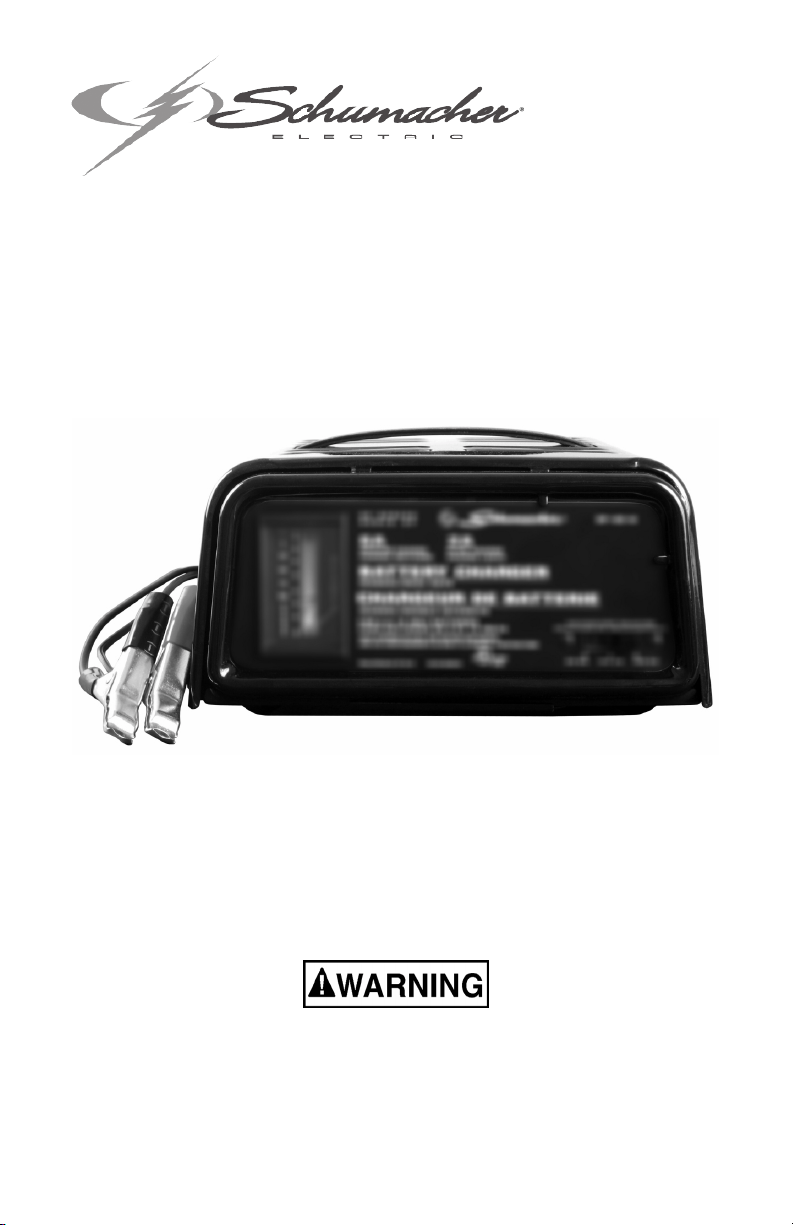
Models / Modelos: SE-40MAP, SE-70MA, SE-82-6,
SE-125A, SE-520MA, SE-1010-2, SE-1052, SE-1250,
SE-1275A, SE-1510MA, SE-2151MA, SE-5212A,
Battery Chargers / Cargadores de Batería
READ THE ENTIRE MANUAL BEFORE USING THIS PRODUCT. •
FAILURE TO DO SO CAN RESULT IN SERIOUS INJURY OR DEATH.
LEA EL MANUAL COMPLETO ANTES DE UTILIZAR ESTE PRODUCTO. •
CUALQUIER FALLA PODRÍA RESULTAR EN SERIAS LESIONES O PODRÍA
SER MORTAL.
OWNER’S MANUAL•
MANUAL dEL USUARiO•


TABLE OF CONTENTS
SECTION PAGE
IMPORTANT SAFETY INSTRUCTIONS 2
PERSONAL PRECAUTIONS 2
PREPARING TO CHARGE 3
CHARGER LOCATION 4
DC CONNECTION PRECAUTIONS 4
FOLLOW THESE STEPS WHEN BATTERY IS INSTALLED IN VEHICLE. 4
FOLLOW THESE STEPS WHEN BATTERY IS OUTSIDE VEHICLE. 5
BATTERY CHARGING – AC CONNECTIONS 5
ASSEMBLY INSTRUCTIONS 6
CONTROL PANEL 6
OPERATING INSTRUCTIONS 8
CALCULATING CHARGE TIME 10
MAINTENANCE INSTRUCTIONS 10
STORAGE INSTRUCTIONS 10
TROUBLESHOOTING 11
BEFORE RETURNING FOR REPAIRS 13
LIMITED WARRANTY 14

ÍNDICE
SECCIÓN PÀGINA
INSTRUCCIONES IMPORTANTES DE SEGURIDAD 16
PRECAUCIONES PERSONALES 17
PREPARACIÓN PARA LA CARGA 17
UBICACIÓN DEL CARGADOR 18
PRECAUCIONES DE CONEXIÓN EN CC 18
SIGA ESTOS PASOS CUANDO LA BATERÍA ESTÉ COLOCADA
EN EL VEHÍCULO. 19
SIGA ESTOS PASOS CUANDO LA BATERÍA SE ENCUENTRE
FUERA DEL VEHÍCULO. 19
CARGA DE BATERÍA, CONEXIONES DE CA 20
INSTRUCCIONES DE MONTAJE 21
PANEL DE CONTROL 21
INSTRUCCIONES DE OPERACIÓN 24
CÁLCULO DE TIEMPO DE CARGA 25
INSTRUCCIONES DE MANTENIMIENTO 26
INSTRUCCIONES DE ALMACENAJE 26
LOCALIZACIÓN Y SOLUCIÓN DE PROBLEMAS 27
ANTES DE DEVOLVER A REPARACIONES 29
GARANTÍA LIMITADA 30
• 1 •
IMPORTANT: READ AND SAVE THIS SAFETY AND INSTRUCTION MANUAL.
SAVE THESE INSTRUCTIONS – The SE series chargers offer a wide range
of features to accommodate your needs. This manual will show you how to use
your charger safely and effectively. Please read, understand and follow these
instructions and precautions carefully, as this manual contains important safety
and operating instructions. The safety messages used throughout this manual
contain a signal word, a message and an icon.
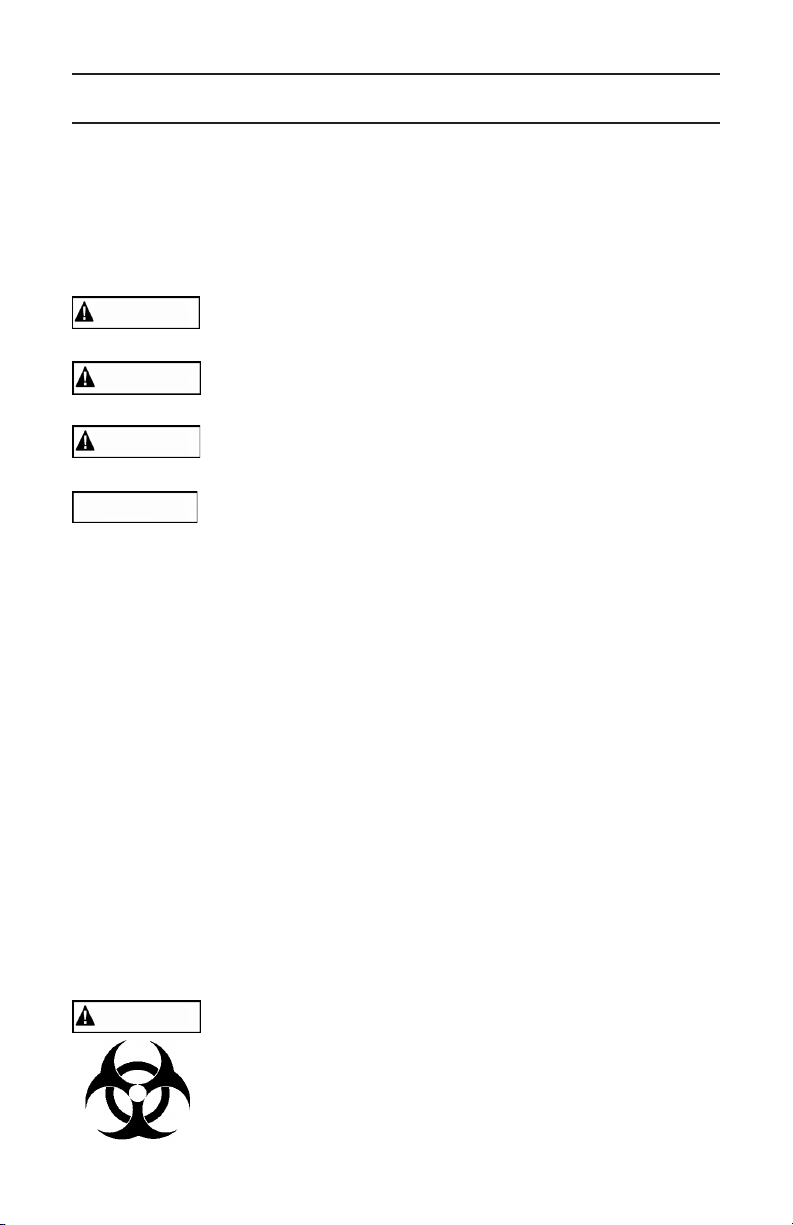
The signal word indicates the level of the hazard in a situation.
Indicates an imminently hazardous situation which, if not avoided,
will result in death or serious injury to the operator or bystanders.
Indicates a potentially hazardous situation which, if not avoided,
could result in death or serious injury to the operator or
bystanders.
Indicates a potentially hazardous situation which, if not avoided,
could result in moderate or minor injury to the operator or
bystanders.
Indicates a potentially hazardous situation which, if not avoided,
could result in damage to the equipment or vehicle or property
damage.
Safety messages in this manual contain two different type styles.
Unnumbered type states the hazard.•
Numbered type states how to avoid the hazard.•
The icon gives a graphical description of the potential hazard.
Pursuant to California Proposition 65, this product contains chemicals
known to the State of California to cause cancer and birth defects or
other reproductive harm.
• 2 •
IMPORTANT SAFETY INSTRUCTIONS1.
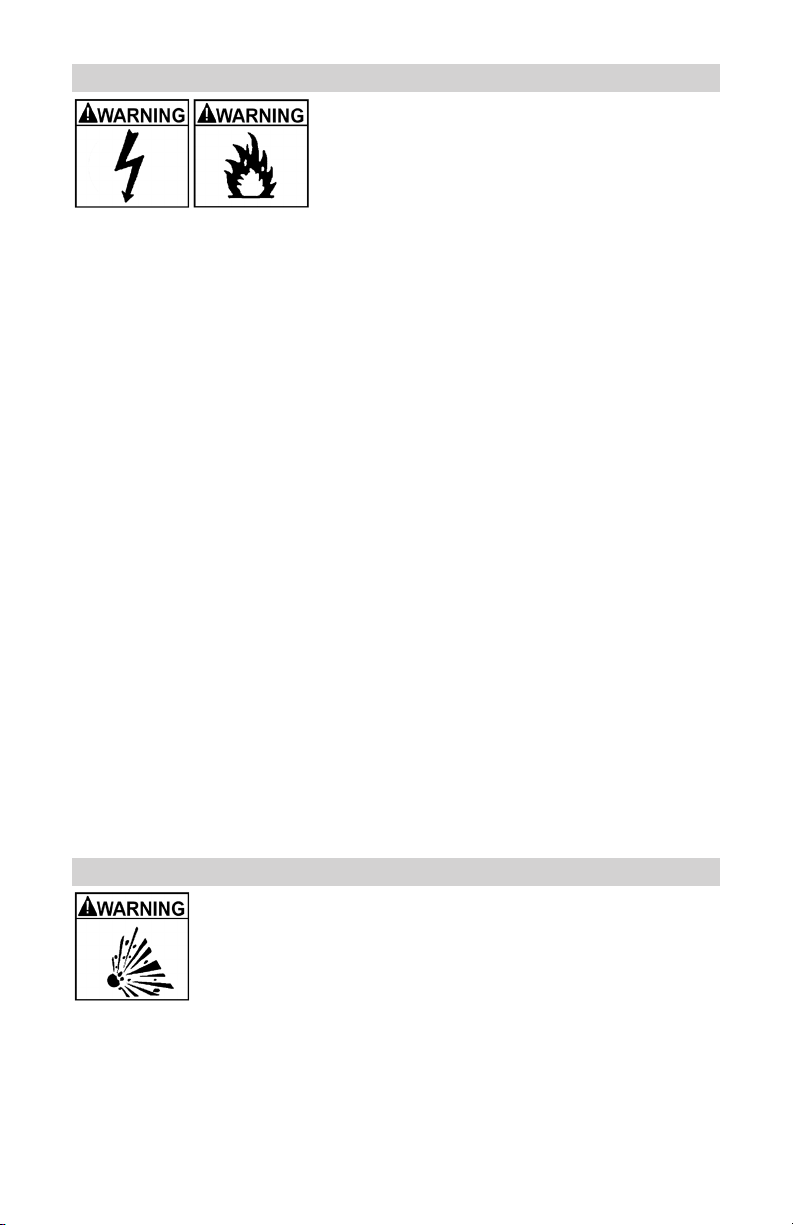
Riskofelectricshockorre.
Do not expose the charger to rain or snow.1.1
Use only recommended attachments. Use of an attachment not recommended 1.2
orsoldbySchumacher®ElectricCorporationmayresultinariskofre,
electric shock or injury to persons or damage to property.
To reduce the risk of damage to the electric plug or cord, pull by the plug rather 1.3
than the cord when disconnecting the charger.
An extension cord should not be used unless absolutely necessary. Use of an 1.4
improperextensioncordcouldresultinariskofreandelectricshock.Ifan
extension cord must be used, make sure:
That the pins on the plug of the extension cord are the same number, size •
and shape as those of the plug on the charger.
That the extension cord is properly wired and in good electrical condition.•
That the wire size is large enough for the AC ampere rating of the charger •
asspeciedinthetableinSection8.
To reduce the risk of electric shock, unplug the charger from the outlet before 1.5
attempting any maintenance or cleaning. Simply turning off the controls will not
reduce this risk.
Remove personal metal items such as rings, bracelets, necklaces and watches 1.6
when working with a lead-acid battery. A lead-acid battery can produce a short-
circuit current high enough to weld a ring or the like to metal, causing a severe
burn.
Donotoperatethechargerwithadamagedcordorplug;takeittoaqualied1.7
service person. (Call customer service at: 1-800-621-5485.)
Do not operate the charger if it has received a sharp blow, been dropped or 1.8
otherwisedamagedinanyway;takeittoaqualiedserviceperson.(Call
customer service at: 1-800-621-5485.)
Donotdisassemblethecharger;takeittoaqualiedservicepersonwhen1.9
serviceorrepairisrequired.Incorrectreassemblymayresultinariskofreor
electric shock. (Call customer service at: 1-800-621-5485.)
PERSONAL PRECAUTIONS2.
Risk of explosive gases.
Working in the vicinity of a lead-acid battery is dangerous. Batteries generate 2.1
explosive gases during normal battery operation. For this reason, it is of
utmost importance that you follow the instructions each time you use the
charger.
To reduce the risk of a battery explosion, follow these instructions and those 2.2
published by the battery manufacturer and the manufacturer of any equipment
you intend to use in the vicinity of the battery. Review the cautionary markings
on these products and on the engine.
• 3 •
This charger employs parts, such as switches and circuit breakers, that tend to 2.3
produce arcs and sparks. If used in a garage, locate this charger 18 inches or
moreaboveoorlevel.
NEVERsmokeorallowasparkorameinthevicinityofabatteryorengine.2.4
Be extra cautious to reduce the risk of dropping a metal tool onto the battery. 2.5
It might spark or short-circuit the battery or other electrical part that may cause
an explosion.
Use this charger for charging LEAD-ACID batteries only. It is not intended to 2.6
supply power to a low voltage electrical system other than in a starter-motor
application. Do not use this battery charger for charging dry-cell batteries that
are commonly used with home appliances. These batteries may burst and
cause injury to persons and damage to property.
NEVER charge a frozen battery.2.7
NEVER overcharge a battery.2.8
PREPARING TO CHARGE3.
Risk of contact with battery acid. Battery acid is a
highly corrosive sulfuric acid.
Consider having someone close enough by to come to your aid when you work 3.1
near a lead-acid battery.
Have plenty of fresh water and soap nearby in case battery acid contacts your 3.2
skin, clothing or eyes.
Wear complete eye and body protection, including safety goggles and 3.3
protective clothing. Avoid touching your eyes while working near the battery.
If battery acid contacts your skin or clothing, immediately wash the area with 3.4
soapandwater.Ifacidentersyoureye,immediatelyoodtheeyewithcold
running water for at least 10 minutes and get medical attention right away.
If it is necessary to remove the battery from the vehicle to charge it, always 3.5
removethegroundedterminalrst.Makesurealloftheaccessoriesinthe
vehicle are off to prevent arcing.
Be sure the area around the battery is well ventilated while the battery is being 3.6
charged.
Clean the battery terminals before charging the battery. During cleaning, keep 3.7
airborne corrosion from coming into contact with your eyes, nose and mouth.
Use baking soda and water to neutralize the battery acid and help eliminate
airborne corrosion. Do not touch your eyes, nose or mouth.
Adddistilledwatertoeachcelluntilthebatteryacidreachesthelevelspecied3.8
bythebatterymanufacturer.Donotoverll.Forabatterywithoutremovable
cell caps, such as valve regulated lead acid batteries (VRLA), carefully follow
the manufacturer’s recharging instructions.
Read, understand and follow all instructions for the charger, battery, vehicle 3.9
and any equipment used near the battery and charger. Study all of the battery
manufacturer’sspecicprecautionswhilechargingandrecommendedratesof
charge.
Determine the voltage of the battery by referring to the vehicle owner’s manual 3.10
and make sure that the output voltage selector switch is set to the correct
voltage. If the charger has an adjustable charge rate, charge the battery in the
lowestraterst.
• 4 •
Make sure that the charger cable clips make tight connections.3.11
CHARGER LOCATION4.
Risk of explosion and contact with
battery acid.
Locate the charger as far away from the battery as the DC cables permit.4.1
Never place the charger directly above the battery being charged; gases from 4.2
the battery will corrode and damage the charger.
Do not set the battery on top of the charger.4.3
Never allow battery acid to drip onto the charger when reading the electrolyte 4.4
specicgravityorllingthebattery.
Do not operate the charger in a closed-in area or restrict the ventilation in any 4.5
way.
DC CONNECTION PRECAUTIONS5.
Connect and disconnect the DC output clips only after setting all of the charger 5.1
switches to the “off” position and removing the AC plug from the electrical
outlet. Never allow the clips to touch each other.
Attach the clips to the battery and chassis, as indicated in steps 6.5, 6.6, 7.2, 5.2
7.3 and 7.4.
FOLLOW THESE STEPS WHEN BATTERY IS INSTALLED IN VEHICLE.6.
A spark near the battery may cause
a battery explosion. To reduce the
risk of a spark near the battery:
Position the AC and DC cables to reduce the risk of damage by the hood, door 6.1
and moving or hot engine parts. NOTE: If it is necessary to close the hood
during the charging process, ensure that the hood does not touch the metal
part of the battery clips or cut the insulation of the cables.
Stay clear of fan blades, belts, pulleys and other parts that can cause injury.6.2
Check the polarity of the battery posts. The POSITIVE (POS, P, +) battery post 6.3
usually has a larger diameter then the NEGATIVE (NEG, N, -) post.
Determine which post of the battery is grounded (connected) to the chassis. 6.4
If the negative post is grounded to the chassis (as in most vehicles), see step
6.5. If the positive post is grounded to the chassis, see step 6.6.
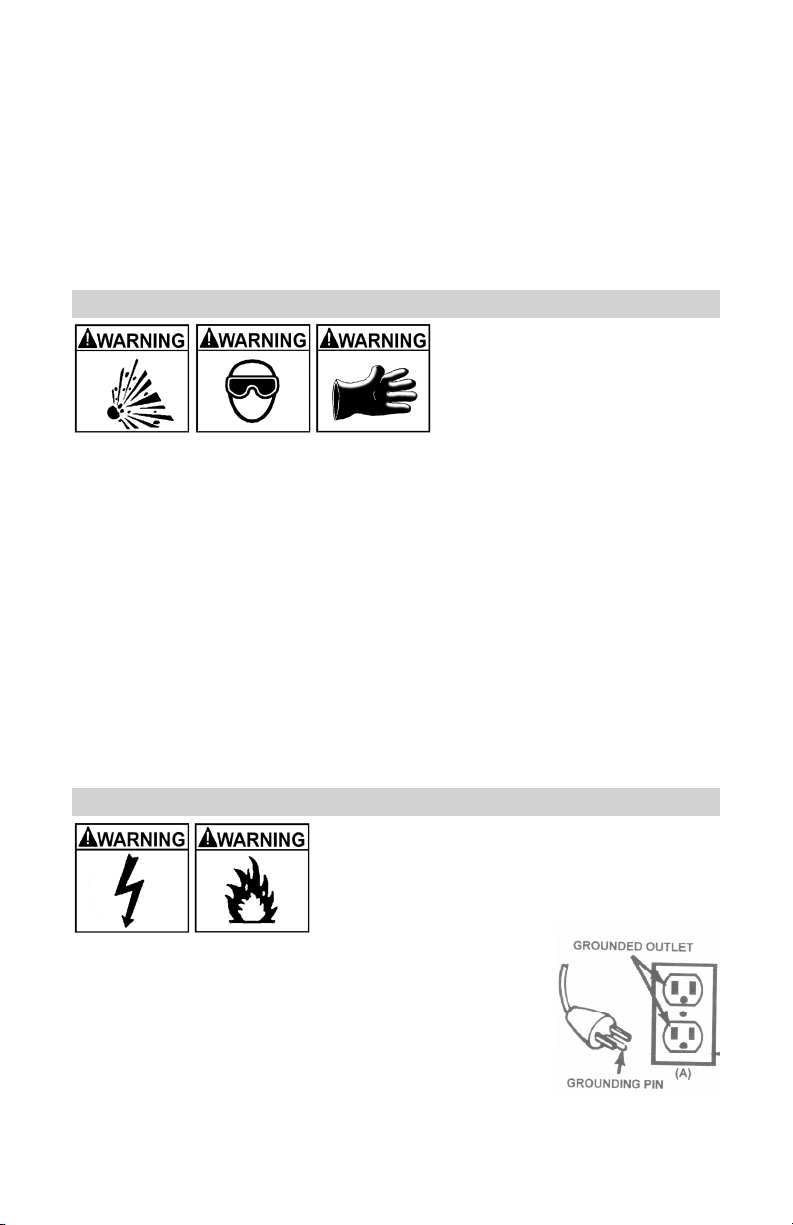
For a negative-grounded vehicle, connect the POSITIVE (RED) clip from the 6.5
battery charger to the POSITIVE (POS, P, +) ungrounded post of the battery.
Connect the NEGATIVE (BLACK) clip to the vehicle chassis or engine block
away from the battery. Do not connect the clip to the carburetor, fuel lines or
sheet-metal body parts. Connect to a heavy gauge metal part of the frame or
engine block.
• 5 •
For a positive-grounded vehicle, connect the NEGATIVE (BLACK) clip from the 6.6
battery charger to the NEGATIVE (NEG, N, -) ungrounded post of the battery.
Connect the POSITIVE (RED) clip to the vehicle chassis or engine block away
from the battery. Do not connect the clip to the carburetor, fuel lines or sheet-
metal body parts. Connect to a heavy gauge metal part of the frame or engine
block.
When disconnecting the charger, turn all switches to off, disconnect the AC 6.7
cord, remove the clip from the vehicle chassis and then remove the clip from
the battery terminal.
See CALCULATING CHARGE TIME for length of charge information.6.8
FOLLOW THESE STEPS WHEN BATTERY IS OUTSIDE VEHICLE.7.
A spark near the battery may
cause a battery explosion. To
reduce the risk of a spark near the
battery:
Check the polarity of the battery posts. The POSITIVE (POS, P, +) battery post 7.1
usually has a larger diameter than the NEGATIVE (NEG, N, -) post.
Attach at least a 24-inch (61 cm) long 6-gauge (AWG) insulated battery cable 7.2
to the NEGATIVE (NEG, N, -) battery post.
Connect the POSITIVE (RED) charger clip to the POSITIVE (POS, P, +) post 7.3
of the battery.
Position yourself and the free end of the cable you previously attached to the 7.4
NEGATIVE (NEG, N, -) battery post as far away from the battery as possible –
then connect the NEGATIVE (BLACK) charger clip to the free end of the cable.
Donotfacethebatterywhenmakingthenalconnection.7.5
When disconnecting the charger, always do so in the reverse order of the 7.6
connectingprocedureandbreaktherstconnectionwhileasfarawayfromthe
battery as practical.
A marine (boat) battery must be removed and charged on shore. To charge it 7.7
onboard requires equipment specially designed for marine use.
BATTERY CHARGING – AC CONNECTIONS8.
Riskofelectricshockorre.
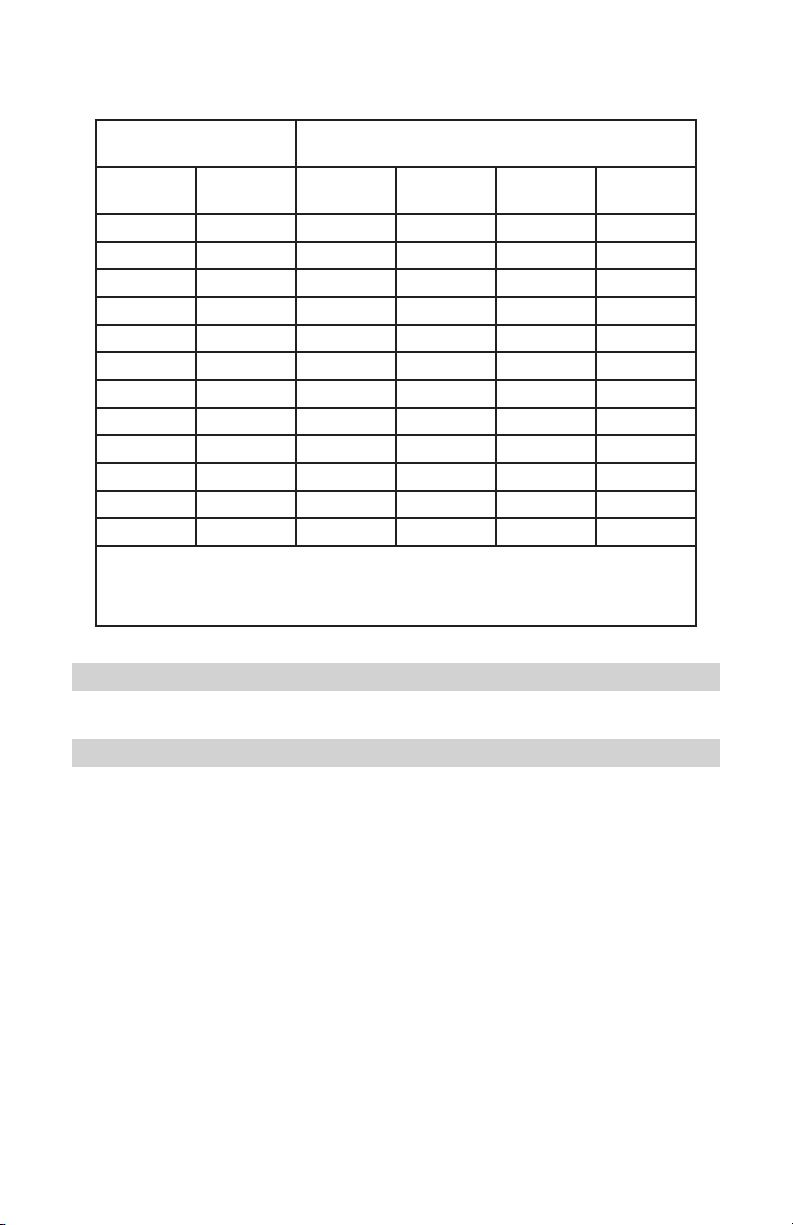
This battery charger is for use on a nominal 120-volt 8.1
circuit and has a grounded plug that looks like the plug
illustrated. The charger must be grounded to reduce
the risk of electric shock. The plug must be plugged
into an outlet that is properly installed and grounded in
accordance with all local codes and ordinances. The
plugpinsmusttthereceptacle(outlet).Donotusewith
an ungrounded system.
NeveraltertheACcordorplugprovided–ifitdoesnotttheoutlet,have8.2
apropergroundedoutletinstalledbyaqualiedelectrician.Animproper
connection can result in a risk of an electric shock or electrocution.
NOTE: The use of an adapter plug is not recommended.
• 6 •
Recommended minimum AWG size for extension cord:8.3
AC input rating,
amperes*
AWG size of cord
Length of cord, feet (m)
At
least
But less
than
25
(7.6)
50
(15.2)
100
(30.5)
150
(45.6)
0 2 18 18 18 16
2 3 18 18 16 14
3 4 18 18 16 14
4 5 18 18 14 12
5 6 18 16 14 12
6 8 18 16 12 10
8 10 18 14 12 10
10 12 16 14 10 8
12 14 16 12 10 8
14 16 16 12 10 8
16 18 14 12 8 8
18 20 14 12 8 6
*If the input rating of a charger is given in watts rather than in amperes, the
corresponding ampere rating is to be determined by dividing the wattage rating by
the voltage rating - for example:
1200 watts/120 volts = 10 amperes
ASSEMBLY INSTRUCTIONS9.
No assembly required
CONTROL PANEL10.
NOTE: Not all switches and LED’s are available on all models.
Ammeter
The Ammeter indicates the amount of current, measured in amps, that is being
drawn by the battery. As a battery takes on a charge, it draws less current from
the charger. Correspondingly, the meter will show less current being drawn by
the battery. When the current stops decreasing, the battery is charged. The
start area of the meter indicates a high rate of current being drawn from the
charger. When cranking an engine, the meter needle will be at the extreme
right side of the start area. The 2 amp charge rate may indicate some activity
on the meter, although the meter does not have the resolution to display this
low rate. For the 2 amp charge rate, a triangle has been provided. Its accuracy
has been calibrated for use with small batteries.

• 7 •
Percent of Charge•
The percent of charge scale is intended as a visual aid to help simplify
reading the state of charge. It is scaled for use with the 6, 10, 12, 15 or
30 amp charge rate only. For the 2 amp charge rate, use the triangle. The
percent of charge is based on the current drawn by the battery. For this
reason, accuracy will vary with the size and battery type. Typically a 28
ampere hour gel cell battery will draw less current at the end of the charge
cycle than a 140 ampere hour wet cell battery. This means that the indication
for a fully charged large battery may be slightly less than 100%.
Battery Type Switch
Use this switch to set the type of battery to be charged.
SLI• – These initials stand for Starting, Lighting and Ignition, which are
the three basic functions which a battery has to perform on all normal
vehicles. This battery type is usually used in cars, trucks and motorcycles.
These batteries have vent caps and are often marked “Low Maintenance”
or “Maintenance-free”. This type of battery is designed to deliver quick
bursts of energy (such as starting engines) and have a greater plate count.
The plates will also be thinner and have somewhat different material
composition. Most Maintenance Free Batteries are SLI, otherwise known
as Flooded, Regular or Standard Batteries. Regular batteries should not be
used for deep cycle applications.
Deep-Cycle• – Deep-cycle batteries are usually marked as “Deep-Cycle”
or “Marine”. Deep-cycle batteries are usually larger than the other types.
This type of battery has less instant energy but somewhat greater long-term
energy delivery than regular batteries. Deep cycle batteries have thicker
plates and can survive a number of discharge cycles.
AGM• – The Absorbed Glass Mat construction allows the electrolyte to be
suspended in close proximity with the plate’s active material. In theory, this
enhancesboththedischargeandrechargeefciency.Actually,theAGM
batteries are a variant of Sealed VRLA (valve regulated lead acid) batteries.
Popular uses include high performance engine starting, power sports, deep
cycle, solar and storage battery. AGM batteries are typically good deep
cycle batteries, and they deliver best life performance if recharged before
the battery drops below a 50 percent charge. If these AGM batteries are
completely discharged, the cycle life will be around 300 cycles. This is true
of most AGM batteries rated as deep cycle batteries.
GEL• – The Gel Cell is similar to the AGM style because the electrolyte
is suspended, but different because technically the AGM battery is still
considered to be a wet cell. The electrolyte in a GEL cell has a silica
additive that causes it to set up or stiffen. The recharge voltages on this
type of cell are lower than the other styles of lead acid battery. This is
probably the most sensitive cell in terms of adverse reactions to over-
voltage charging. Gel Batteries are best used in VERY DEEP cycle
application and may last a bit longer in hot weather applications. If the
incorrect battery charger is used on a Gel Cell battery, poor performance
and premature failure is certain.
When antimony is known to be one of the materials used in the battery’s
construction, that battery is conventional/low maintenance type.
Some low maintenance batteries have a relatively smooth
topwithoutanyapparentbatteryllercaps.If,however,thebattery
manufacturer/distributor recommends periodic checking of the electrolyte level
and provides access to the battery for water additions, the battery is probably
a conventional/low maintenance type.

• 8 •
Charge Rate Selector Switch (Voltage/Amp Selector)
Use this switch to set the maximum charge rate to one of the following.
2A Slow Charge Rate• – Intended for charging small batteries such as those
commonly used in garden tractors, snow mobiles and motorcycles. The 2A
rate can be used to warm or trickle charge larger batteries.
6A, 10A, 12A, 15A Fast and 30A Rapid Charge Rate• – Use for charging
automotive, marine and deep-cycle batteries. Not intended for industrial
applications.
Engine Start• – Provides additional amps for cranking an engine with a weak
or run down battery. Always use in combination with a battery.
Voltage Selector Switch
Use this switch to set the charger to charge a 6 volt, 12 volt or 24 volt battery.
NOTE: These chargers are not recommended for 8 or 16 volt systems.
LED Indicators
Full Charge• – When lit, this LED indicates that the battery is fully charged
and the charger has stopped charging and switched to the Maintain Mode of
operation (Automatic chargers only).
Power On• – When lit, this LED indicates that there is AC power supplied to
the battery charger.
Check Battery• – When lit, this LED indicates there is something wrong with
the battery. Check the DC connections for an improper connection; otherwise
the battery may be bad.
OPERATING INSTRUCTIONS11.
Overview
Connect the battery following the precautions listed in Sections 6 and 7.1.
Select the appropriate settings for your battery.2.
Connect the AC power following the precautions listed in Section 8.3.
Automatic Charging
If the charger has an Automatic Charge Mode, it can perform an automatic
charge. When an Automatic Charge is performed, the charger switches to the
Maintain Mode (see below) automatically after the battery is charged. For a
batterywithastartingvoltageunder1volt,usetheManualModersttopre-
chargethebatteryforveminutestogetadditionalvoltageintothebatteryfor
the charger to analyze.
Manual Charging
If the charger does not have an Automatic Charge Mode, you will be charging
in Manual Mode. A manual charger will continue to charge and will not shut off.
You must keep a visual check on the ammeter to determine when the battery is
charged. Be sure to monitor the charging process and stop it when the battery
is charged. Not doing so may cause damage to your battery or result in other
property damage or personal injury.
Completion of Charge (Automatic Chargers Only)
When the FULL CHARGE (green) LED is lit, the charger has stopped charging
and switched to the Maintain Mode of operation. If the 12V DEEP CYCLE
battery type was selected, the CHARGED (green) LED comes on when the
battery is charged enough for normal use.
• 9 •
Maintain Mode (Automatic Chargers Only)
When the FULL CHARGE (green) LED is lit, the charger has started Maintain
Mode. In this mode, the charger keeps the battery fully charged by delivering
a small current, when necessary. If the battery voltage drops below a preset
level, the charger will go back into charge mode until the battery voltage
returns to the full charge level, at which point the charger will return to maintain
mode. The voltage is maintained at a level determined by the BATTERY TYPE
selected.
NOTE: An Automatic charger automatically switches between Charge Mode
and Maintain Mode as necessary. The FULL CHARGE (green) LED will cycle
on when the battery is at full charge and off when the voltage drops below a
preset level and the charger goes into Charge Mode. This cycle will continue,
and the FULL CHARGE (green) LED will stay on for longer periods of time
as the battery becomes more fully charged. This is not applicable to manual
chargers.
Using the Engine Start feature (If equipped)
Your battery charger can be used to jump start your car if the battery is low.
Follow these instructions on how to use the ENGINE START feature.
Follow all safety instructions and precautions for charging
your battery. Wear complete eye protection and clothing protection. Charge
your battery in a well-ventilated area.
Using the ENGINE START feature WITHOUT a battery
installed in the vehicle could cause damage to the vehicle’s electrical system.
Set the charge rate switch and the timer (if equipped) to the OFF position.1.
With the charger unplugged from the AC outlet, connect the charger to 2.
the battery following the instructions given in Section 6 (FOLLOW THESE
STEPS WHEN THE BATTERY IS INSTALLED IN A VEHICLE).
Plug the charger AC power cord into the AC outlet following the precautions 3.
described in Section 8.
With the charger plugged in and connected to the battery of the vehicle, set 4.
the charge rate selector switch to the engine start position.
Crank the engine until it starts or 5 seconds pass. If the engine does not 5.
start, wait 4 minutes before cranking again. This allows the battery and the
charger to cool down.
NOTE: During extremely cold weather, or if the battery is under 2 volts, charge
the battery for 5 minutes before cranking the engine.
If the engine fails to start, charge the battery for 5 more minutes before 6.
attempting to crank the engine again.
After the engine starts, move the amp rate selector switch to the off position 7.
and unplug the AC power cord before disconnecting the battery clips from
the vehicle.
Clean and store the charger in a dry location.8.
NOTE: If the engine does turn over but never starts, there is not a problem
with the starting system; there is a problem somewhere else with the vehicle.
STOP cranking the engine until the other problem has been diagnosed and
corrected.
• 10 •
CALCULATING CHARGE TIME12.
Use the following table to more accurately determine the time it will take to
bringabatterytofullcharge.First,identifywhereyourbatterytsintothe
chart.
NR means that the charger setting is NOT RECOMMENDED.
Find your battery’s rating on the chart below and note the charge time given for
each charger setting. The times given are for batteries with a 50% charge prior
to recharging. Add more time for severely discharged batteries.
BATTERY SIZE/RATING CHARGE RATE/CHARGING TIME
2 AMP 6 AMP 10 AMP 12 AMP 15 AMP 30 AMP
SMALL
BATTERIES
Motorcycle,
garden,
tractor, etc.
6 - 12 AH 2 - 4 hrs 45 min -
1 ¼ hrs
NR NR NR NR
12 - 32 AH 4 - 10
hrs
1¼ – 3½
hrs
NR NR NR NR
CARS/TRUCKS 200 - 315 CCA 40 - 60 RC 11 ¼
- 14 ½
hrs
3¾ – 4¾
hrs
2¼ – 3
hrs
2 – 2½
hrs
1½ – 2
hrs
45 min –
1 hr
315 - 550 CCA 60 - 85 RC 14 ½
- 18 ¼
hrs
4¾ – 6
hrs
3 – 3¾
hrs
2½ – 3
hrs
2 – 2½
hrs
1 – 1¼
hrs
550 - 1000 CCA 80 - 190 RC 18 ¼
- 34 ¾
hrs
6 – 11½
hrs
3¾ – 7
hrs
3 – 5¾
hrs
2½ –
4¾ hrs
1¼ – 2½
hrs
MARINE/DEEP CYCLE 80 RC 17½ hrs 6 hrs 3½ hrs 3 hrs 2½ hrs 1¼ hrs
140 RC 27 hrs 9 hrs 5½ hrs 4½ hrs 3½ hrs 1¾ hrs
160 RC 30 hrs 10 hrs 6 hrs 5 hrs 4 hrs 2 hrs
180 RC 33 hrs 11 hrs 6¾ hrs 5½ hrs 4½ hrs 2¼ hrs
MAINTENANCE INSTRUCTIONS13.
After use and before performing maintenance, unplug and disconnect the 13.1
battery charger (see Sections 6, 7 and 8).
Use a dry cloth to wipe all battery corrosion and other dirt or oil from the 13.2
terminals, cords, and the charger case.
Ensure that all of the charger components are in place and in good working 13.3
condition, including the plastic boots on the battery clips.
Servicing does not require opening the unit, as there are no user-serviceable 13.4
parts.
STORAGE INSTRUCTIONS14.
Store the charger unplugged, in an upright position. The cord will still conduct 14.1
electricity until it is unplugged from the outlet.
Store inside, in a cool, dry place (unless you’re using an on-board Marine 14.2
Charger).
Do not store the clips on the handle, clipped together, on or around metal, or 14.3
clipped to cables.

• 11 •
TROUBLESHOOTING15.
PROBLEM POSSIBLE CAUSE REASON/SOLUTION
No reading on the
ammeter.
Charger is not plugged in.
No power at the receptacle.
Clips are not making a
good connection to the
battery.
Connections are reversed.
Battery is defective (will not
accept a charge).
2 amp charge rate is being
used.
Plug the charger into an AC
outlet.
Check for open fuse or
circuit breaker supplying AC
outlet.
Check for poor connection
to battery and frame. Make
sure connection points are
clean. Rock clips back and
forth for a better connection.
Unplug the charger and
reverse the clips.
Have battery checked.
Ammeter may show no
activity at the 2A charge
rate.
Ammeter reading stays
high.
Battery is severely
discharged.
Wrong battery voltage.
Continue charging battery
for two more hours. If
problem continues have the
battery checked.
Verify the voltage settings
on the charger are correct.
Charger will not turn on
when properly connected.
AC outlet is dead.
Poor electrical connection.
Check for open fuse or
circuit breaker supplying AC
outlet.
Check power cord and
extension cord for loose
ttingplug.
The battery is connected
and the charger is on, but
is not charging.
Clips are not making a
good connection.
Check for poor connection
at battery and frame. Make
sure connecting points are
clean. Rock clips back and
forth for a better connection.
The measured current is
much lower than what was
selected.
The charger reached the
maximum voltage and is
reducing the current.
No problem, this is a normal
condition.
Ammeter reads less than
selected charge rate when
charging a discharged
battery
Extension cord is too long
or wire gauge is too small.
Weak cell or sulfated plate
in battery.
Battery is only partially
discharged.
Use a shorter or heavier
gauge extension cord.
A sulfated battery will
eventually take a normal
charge if left connected. If
the battery will not take a
charge, have it checked.
Continue to charge the
battery.

• 12 •
PROBLEM POSSIBLE CAUSE REASON/SOLUTION
The charger is making an
audible clicking sound.
Circuit breaker is cycling.
Battery is defective.
Shorted battery cables or
clips.
Severely discharged
battery, but otherwise it is a
good battery.
Reverse connections at
battery.
The settings may be wrong.
Check the charger settings.
Have the battery checked.
Circuit breaker cycles when
current draw is too high.
Check for shorted cables
or clips and replace if
necessary.
The battery may not want
to accept a charge due to
a run-down state. Allow
charging to continue until
battery has a chance to
recoversufcientlytotake
a charge. If more than 20
minutes, stop charging and
have the battery checked.
Shut the charger off
and correct the lead
connections.
Charger makes a loud
buzz or hum.
Transformer laminations
vibrate (buzz).
Shorted Diode Assembly or
OutputRectierAssembly
(hum).
No problem, this is a normal
condition.
Have charger checked by a
qualiedtechnician.
• 13 •
PROBLEM POSSIBLE CAUSE REASON/SOLUTION
Short or no start cycle
when cranking engine.
Drawing more than the
Engine Start Rate.
Failure to wait 4 minutes
(240 seconds) between
cranks.
Clips are not making a
good connection.
AC cord and/or extension
cord is loose.
No power at receptacle.
The charger may be
overheated.
Battery may be severely
discharged.
Crank time varies with the
amount of current drawn. If
cranking draws more than
the Engine Start Rate, crank
time may be less than 3
seconds.
Wait 4 minutes of rest
time before the next crank
to allow the battery and
charger to cool down.
Check for poor connection
at battery and frame.
Check power cord and
extension cord for loose
ttingplug.
Check for open fuse or
circuit breaker supplying AC
outlet.
The thermal protector may
have tripped and needs a
little longer to close. Make
sure the charger vents are
not blocked. Wait and try
again.
On a severely discharged
battery, charge for 10 to
15 minutes in the highest
manual rate to help assist in
cranking.
BEFORE RETURNING FOR REPAIRS16.
When a charging problem arises, make certain that the battery is capable 16.1
of accepting a normal charge. Use a good battery to double check all
connections, AC outlet for a full 120-volts, charger clips for correct polarity and
the quality of the connections from the cables to the clips and from the clips to
the battery system. The clips must be clean.
When a battery is very cold, partially charged or sulfated, it will not draw 16.2
the full rated amperes from the charger. It is both dangerous and damaging
to a battery to force higher amperage into it than it can effectively use in
recharging.
When an UNKNOWN OPERATING PROBLEM arises, please read the 16.3
complete manual and call the customer service number for information that will
usually eliminate the need for return.
If the above solutions do not eliminate the problem or for information about troubleshooting
or replacement parts, call toll-free from anywhere in the U.S.A.
1-800-621-5485
7:00 am to 5:00 pm Central Time Monday thru Friday

• 14 •
LIMITED WARRANTY17.
SCHUMACHER ELECTRIC CORPORATION, 801 BUSINESS CENTER
DRIVE, MOUNT PROSPECT, IL 60056-2179, MAKES THIS LIMITED
WARRANTY TO THE ORIGINAL RETAIL PURCHASER OF THIS PRODUCT.
THIS LIMITED WARRANTY IS NOT TRANSFERABLE OR ASSIGNABLE.
Schumacher Electric Corporation (the “Manufacturer”) warrants this battery
charger for two years from the date of purchase at retail against defective
material or workmanship that may occur under normal use and care. If
your unit is not free from defective material or workmanship, Manufacturers
obligation under this warranty is solely to repair or replace your product, with a
new or reconditioned unit, at the option of the Manufacturer. It is the obligation
of the purchaser to forward the unit, along with mailing charges prepaid
to the Manufacturer or its authorized representatives in order for repair or
replacement to occur.
Manufacturer does not provide any warranty for any accessories used with this
product that are not manufactured by Schumacher Electric Corporation and
approved for use with this product. This Limited Warranty is void if the product
ismisused,subjectedtocarelesshandling,repaired,ormodiedbyanyone
other than Manufacturer or if this unit is resold through an unauthorized
retailer.
Manufacturer makes no other warranties, including, but not limited to, express,
implied or statutory warranties, including without limitation, any implied
warrantyofmerchantabilityorimpliedwarrantyoftnessforaparticular
purpose. Further, Manufacturer shall not be liable for any incidental, special
or consequential damage claims incurred by purchasers, users or others
associatedwiththisproduct,including,butnotlimitedto,lostprots,revenues,
anticipated sales, business opportunities, goodwill, business interruption
and any other injury or damage. Any and all such warranties, other than
the limited warranty included herein, are hereby expressly disclaimed and
excluded. Some states do not allow the exclusion or limitation of incidental or
consequential damages or length of implied warranty, so the above limitations
orexclusionsmaynotapplytoyou.Thiswarrantygivesyouspeciclegal
rights and it is possible you may have other rights which vary from this
warranty.
THIS LIMITED WARRANTY IS THE ONLY EXPRESS LIMITED WARRANTY
AND THE MANUFACTURER NEITHER ASSUMES OR AUTHORIZES
ANYONE TO ASSUME OR MAKE ANY OTHER OBLIGATION TOWARDS
THE PRODUCT OTHER THAN THIS WARRANTY.
Schumacher Electric Corporation Customer Service
1-800-621-5485
Monday – Friday 7:00 a.m. to 5:00 p.m. CST
Schumacher and the Schumacher Logo are registered trademarks of
Schumacher Electric Corporation
• 15 •
IMPORTANTE: LEA Y GUARDE ESTE MANUAL DE INSTRUCCIONES Y
SEGURIDAD.
GUARDE ESTAS INSTRUCCIONES: Los SE cargadores ofrece una amplia
gama de características para satisfacer sus necesidades. Este manual le
mostrará cómo utilizar su cargador en forma segura y efectiva. Por favor, lea,
comprenda y siga estas instrucciones y precauciones cuidadosamente, ya que
este manual contiene instrucciones operativas y de seguridad de importancia.
Los mensajes de seguridad representados en este manual contienen palabras
guía,unmensajeyunagura.
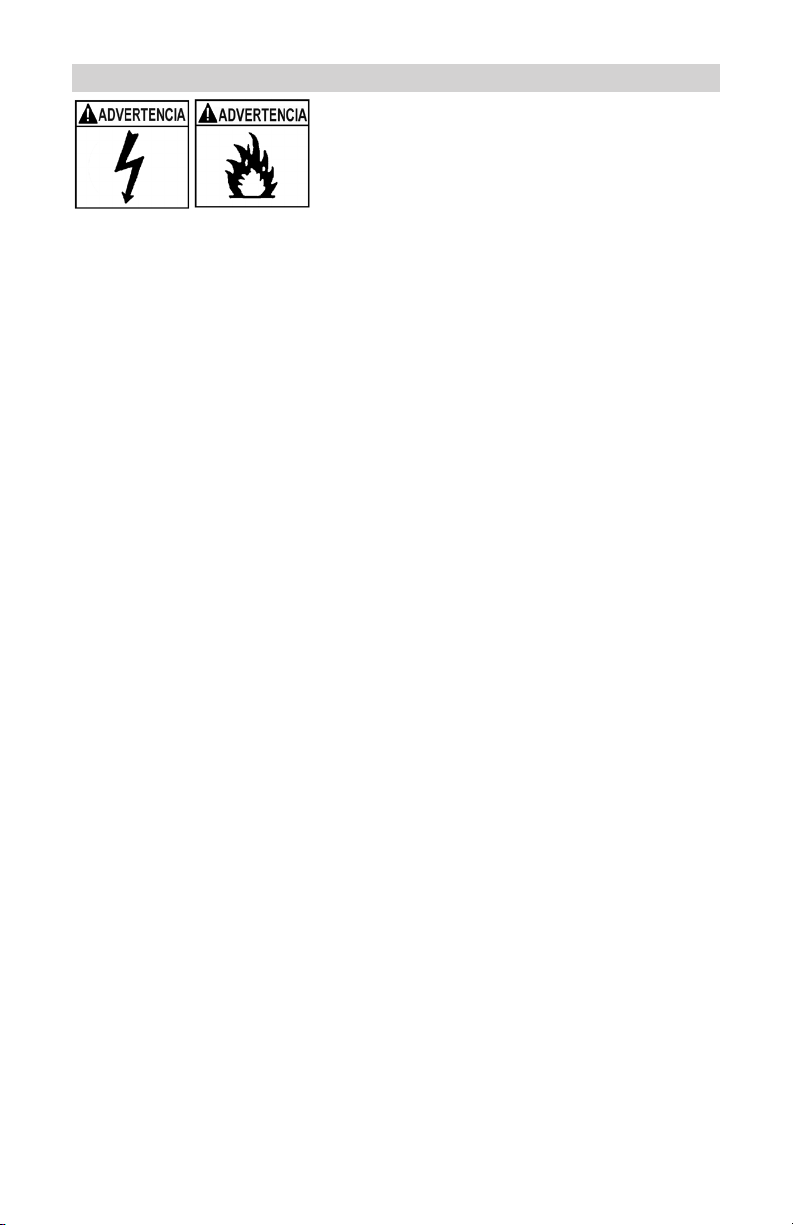
La palabra guía indica el nivel de peligro en determinada situación.
Indica una inminente situación de riesgo que, si no se evita,
resultaría mortal o de serios perjuicios al operador o personas
alrededor.
Indica una situación potencialmente riesgoso que, si no se evita,
podría resultar o de serios perjuicios al operador o
personas alrededor.
Indica una situación potencialmente peligrosa que, de no evitarse,
podría resultar en menores o serio daños al usuario y terceras
personas.
Indica una situación potencialmente peligrosa que, de no evitarse,
podría causar daño al equipo, al vehículo y propiedades alrededor.
Los mensajes estipulados en este manual se describen dos tipos de estilo.
Los que aparecen sin número indican el riesgo.•
Aquellos que aparecen numerados, indican cómo evitar los riesgos.•
Laguramuestraunadescripcióngrácadelpotencialderiesgo.
Conforme a la propuesta 65 de California, este producto contiene
químicos de los cuales en el Estado de California se tiene
conocimiento que provocan cáncer y malformaciones congénitas u
otras lesiones reproductivas.
PELIGRO
ADVERTENCIA
ATENCIÓN
IMPORTANTE
ADVERTENCIA
• 16 •
INSTRUCCIONES IMPORTANTES DE SEGURIDAD1.
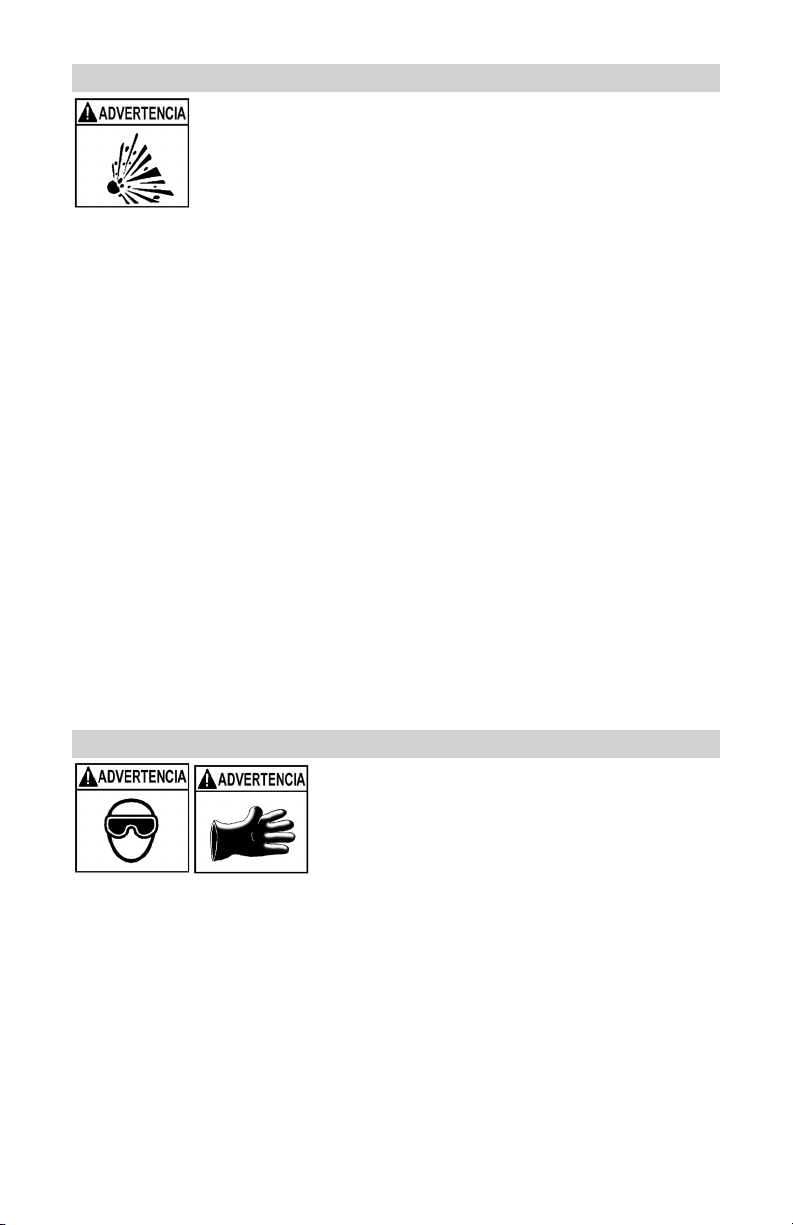
El riesgo de descarga eléctrica o incendio
No exponga el cargador a la lluvia o a la nieve.1.1
Utilice solamente accesorios recomendados. El uso de un accesorio no 1.2
recomendado o suministrado por Schumacher® Electric Corporation puede
provocar riesgo de incendio, descarga eléctrica o lesiones a personas o daño
a la propiedad.
Para reducir el riesgo de daños al enchufe o cable eléctrico, jale del enchufe 1.3
en lugar de jalar del cable al desconectar el cargador.
No se debe utilizar un alargador a menos que resulte absolutamente 1.4
necesario. El uso de un alargador inadecuado puede provocar riesgo de
incendio o descarga eléctrica. En caso de que deba utilizarse un alargador,
asegúrese de que:
Los pasadores en el enchufe del alargador posean el mismo número, •
tamaño y forma que aquellos presentes en el enchufe del cargador.
El alargador se encuentre correctamente conectado y en buenas •
condiciones eléctricas.
EltamañodelcablesealosucientementeextensoparaelamperajeenCA•
delcargadorcomoseespecicaenlatabladelaSección8.
Para reducir el riesgo de descarga eléctrica, desenchufe el cargador 1.5
del tomacorriente antes de intentar llevar a cabo cualquier actividad de
mantenimiento o limpieza. El simple apagado de los controles no reducirá este
riesgo.
No utilice elementos personales de metal tales como anillos, pulseras, collares 1.6
y relojes al trabajar con una batería de plomo-ácido. Una batería de plomo-
ácidopuedeproducirunacorrientedecortocircuitolosucientementeelevada
como para soldar un anillo o provocar efectos similares sobre el metal,
causando una quemadura de gravedad.
No utilice el cargador si el mismo posee un enchufe o cable dañado; hágalo 1.7
revisar por una persona capacitada que efectúe reparaciones. (Comuníquese
con el servicio al cliente al: 1-800-621-5485.)
No utilice el cargador si el mismo recibió un golpe fuerte, si se cayó o si sufrió 1.8
daños de cualquier otra forma; hágalo revisar por una persona capacitada que
efectúe reparaciones. (Comuníquese con el servicio al cliente al: 1-800-621-
5485.)
No desarme el cargador; hágalo revisar por una persona capacitada que 1.9
efectúe reparaciones cuando necesite servicio de mantenimiento o una
reparación. Volver a ensamblar el cargador en forma incorrecta puede
provocar riesgo de incendio o descarga eléctrica. (Comuníquese con el
servicio al cliente al: 1-800-621-5485.)
• 17 •
PRECAUCIONES PERSONALES2.
Riesgo de gases explosivos.
Resulta peligroso trabajar en forma cercana a una batería de plomo. Las 2.1
baterías generan gases explosivos durante su normal funcionamiento. Por
este motivo, resulta de suma importancia que siga las instrucciones cada vez
que utiliza el cargador.
Para reducir el riesgo de explosión de una batería, siga estas instrucciones 2.2
y aquellas publicadas por el fabricante de la batería y por el fabricante de
cualquier equipo que intente utilizar en la proximidad de la batería. Revise las
pautas de precaución en estos productos y en el motor.
Este cargador está equipado con partes, tales como, interruptores y 2.3
cortacircuitos, que tienden a originar chispas y cortos. Si se utiliza en la
cochera, utilice el cargador 18 pulgadas o más del nivel del suelo.
NUNCA fume o permita la presencia de chispas o llamas en la proximidad de 2.4
una batería o motor.
Tenga especial cuidado para reducir el riesgo de dejar caer una herramienta 2.5
de metal sobre la batería. Esto podría provocar chispas o un cortocircuito en la
batería o en cualquier otra pieza eléctrica que podría provocar una explosión.
Utilice este cargador solamente para cargar baterías de PLOMO-ÁCIDO. Este 2.6
cargador no está destinado a suministrar energía a sistemas eléctricos de baja
tensión más que en una aplicación de un motor de arranque. No utilice este
cargador de batería para cargar baterías de pila seca que por lo general se
utilizan con artefactos domésticos. Estas baterías podrían explotar y provocar
lesiones a personas o daño a la propiedad.
NUNCA cargue una batería congelada.2.7
NUNCA sobrecargue una batería.2.8
PREPARACIÓN PARA LA CARGA 3.
Riesgo de contacto con el ácido de la batería.
El ácido de la batería es un ácido sulfúrico
altamente corrosivo.
Considere la idea de que alguna persona se encuentre cerca suyo para poder 3.1
ayudarlo cuando trabaje en forma cercana a una batería de plomo-ácido.
Cuente con una gran cantidad de agua potable y jabón a mano en caso de 3.2
que el ácido de la batería tenga contacto con su piel, ropa u ojos.
Utilice protección visual y corporal completa, incluyendo gafas de seguridad y 3.3
prendas de protección. Evite tocar sus ojos mientras trabaje en forma cercana
a la batería.
Si el ácido de la batería tiene contacto con su piel o su ropa, lave de inmediato 3.4
el área afectada con agua y jabón. En caso de que ingrese ácido en un ojo,
sumerja el mismo de inmediato bajo agua potable corriente por al menos 10
minutos y obtenga atención médica en forma inmediata.
• 18 •
Si resulta necesario extraer la batería del vehículo para cargarla, siempre 3.5
retire el terminal con descarga a tierra en primer lugar. Asegúrese de que
todos los accesorios en el vehículo se encuentren apagados para evitar la
formación de arcos eléctricos.
Asegúrese de que el área que rodea a la batería se encuentre bien ventilada 3.6
mientras se carga la batería.
Limpie los terminales de la batería antes de cargar la batería. Durante la 3.7
limpieza, evite que la corrosión producida por aire tenga contacto con sus
ojos, nariz y boca. Utilice bicarbonato de sodio y agua para neutralizar el ácido
de la batería y ayudar a eliminar la corrosión producida por aire. No toque sus
ojos, nariz o boca.
Agregue agua destilada a cada pila hasta que el ácido de la batería alcance el 3.8
nivelespecicadoporelfabricantedelabatería.Noprovoquederrames.Enlo
que concierne a baterías que no cuentan con tapas extraíbles para pilas, tales
como baterías de plomo-ácido reguladas por válvulas (VRLA, por sus siglas
en inglés), siga cuidadosamente las instrucciones de recarga del fabricante.
Lea, comprenda y siga todas las instrucciones para el cargador, la batería, el 3.9
vehículo y cualquier equipo que se utilice cerca de la batería y el cargador.
Controletodaslasprecaucionesespecícasestablecidasporelfabricante
de la batería al realizar la carga, así también como los índices de carga
recomendados.
Determine la tensión de la batería al consultar el manual del usuario del 3.10
vehículo y asegúrese de que el interruptor de selección de la tensión de salida
se encuentre establecido en la tensión correcta. Si el cargador posee un
índice de carga ajustable, cargue la batería en el menor índice en primer lugar.
Asegúrese de que los ganchos del cable del cargador se encuentren 3.11
fuertemente conectados.
UBICACIÓN DEL CARGADOR4.
Riesgo de contacto con el ácido de
la batería.
Ubique el cargador a la mayor distancia posible de la batería como lo permitan 4.1
los cables de CC.
Nunca ubique el cargador directamente por encima de la batería que se carga; 4.2
los gases de la batería corroerán y dañarán el cargador.
No ubique la batería encima del cargador.4.3
Nunca permita que el ácido de la batería gotee sobre el cargador al leer el 4.4
pesoespecícodelelectrolitooalcargarlabatería.
No utilice el cargador en un área cerrada o restrinja la ventilación en cualquier 4.5
forma.
PRECAUCIONES DE CONEXIÓN EN CC5.
Conecte y desconecte los ganchos de salida CC sólo después de haber 5.1
establecido todos los interruptores del cargador a la posición de “apagado” y
de haber desconectado el enchufe de CA del tomacorriente eléctrico. Nunca
permita que los ganchos tengan contacto entre sí.
Sujete los ganchos a la batería y al chasis, como se indica en los pasos 6.5, 5.2
6.6, 7.2, 7.3 y 7.4.
• 19 •
SIGA ESTOS PASOS CUANDO LA BATERÍA ESTÉ COLOCADA EN EL 6.
VEHÍCULO.
Una chispa provocada cerca de la
batería puede causar la explosión
de la batería. Para reducir el riesgo
de provocar chispas cerca de la
batería:
Ubique los cables de CA y CC para reducir el riesgo de daños a la cubierta, a 6.1
la puerta y a las piezas móviles o calientes del motor. NOTA: Si es necesario
cerrar el cofre durante el proceso de carga, asegúrese que el cofre no toque
parte metálica de la batería o pele los cables.
Manténgase alejado de las paletas del ventilador, correas, poleas y otras 6.2
piezas que podrían provocar lesiones.
Veriquelapolaridaddelosbornesdelabatería.ElbornePOSITIVO(POS,P,6.3
+) de la batería generalmente posee un diámetro mayor al borne NEGATIVO
(NEG, N, -).
Determine qué borne de la batería hace descarga a tierra (se encuentra 6.4
conectado) con el chasis. Si el borne negativo hace descarga a tierra con el
chasis (como en la mayor parte de los vehículos), ver el paso 6.5. Si el borne
positivo hace descarga a tierra con el chasis, ver el paso 6.6.
En un vehículo con descarga a tierra por borne negativo, conecte el gancho 6.5
POSITIVO (ROJO) del cargador de batería al borne POSITIVO (POS, P, +)
sin descarga a tierra de la batería. Conecte el gancho NEGATIVO (NEGRO)
al chasis del vehículo o al bloque motor alejado de la batería. No conecte el
gancho al carburador, líneas de combustible o cuerpos metálicos. Conecte a
una pieza metálica de calibre grueso del marco o del bloque motor.
En un vehículo con descarga a tierra por borne positivo, conecte el gancho 6.6
NEGATIVO (NEGRO) del cargador de batería al borne NEGATIVO (NEG, N,
-) sin descarga a tierra de la batería. Conecte el gancho POSITIVO (ROJO)
al chasis del vehículo o al bloque motor alejado de la batería. No conecte al
carburador, líneas de combustible o cuerpos metálicos. Conecte a una pieza
metálica de calibre grueso del marco o del bloque motor.
Al desconectar el cargador, apague todos los interruptores, desconecte el 6.7
cable de CA, retire el gancho del chasis del vehículo y luego retire el gancho
del terminal perteneciente a la batería.
Ver la sección CÁLCULO DEL TIEMPO DE CARGA por la información sobre 6.8
la duración de carga.
SIGA ESTOS PASOS CUANDO LA BATERÍA SE ENCUENTRE FUERA 7.
DEL VEHÍCULO.
Una chispa provocada cerca de la
batería puede causar la explosión
de la batería. Para reducir el riesgo
de provocar chispas cerca de la
batería:
Veriquelapolaridaddelosbornesdelabatería.ElbornePOSITIVO(POS,P,7.1
+) de la batería generalmente posee un diámetro mayor al borne NEGATIVO
(NEG, N, -).
Sujete al menos un cable aislado de batería de 24 pulgadas (61 cm) de largo 7.2
con calibre 6 según el Calibre americano de cables (AWG, por sus siglas en
inglés) al borne NEGATIVO (NEG, N, -) de la batería.
• 20 •
Conecte el gancho POSITIVO (ROJO) del cargador al borne POSITIVO (POS, 7.3
P, +) de la batería.
Ubíquese junto con el extremo libre del cable que previamente sujetó al 7.4
borne NEGATIVO (NEG, N, -) de la batería a la mayor distancia posible de
la batería. Luego conecte el gancho NEGATIVO (NEGRO) del cargador al
extremo libre del cable.
Noseubiqueenposiciónfrontalalabateríaalrealizarlaconexiónnal.7.5
Al desconectar el cargador, siempre hágalo en forma inversa al procedimiento 7.6
de conexión y realice la primera conexión tan lejos de la batería como sea
posible.
Una batería marina (para barcos) se debe retirar y cargar en tierra. Para 7.7
realizar una carga a bordo se necesitan equipamientos especialmente
diseñados para uso marino.
CARGA DE BATERÍA, CONEXIONES DE CA8.
El riesgo de descarga eléctrica o incendio
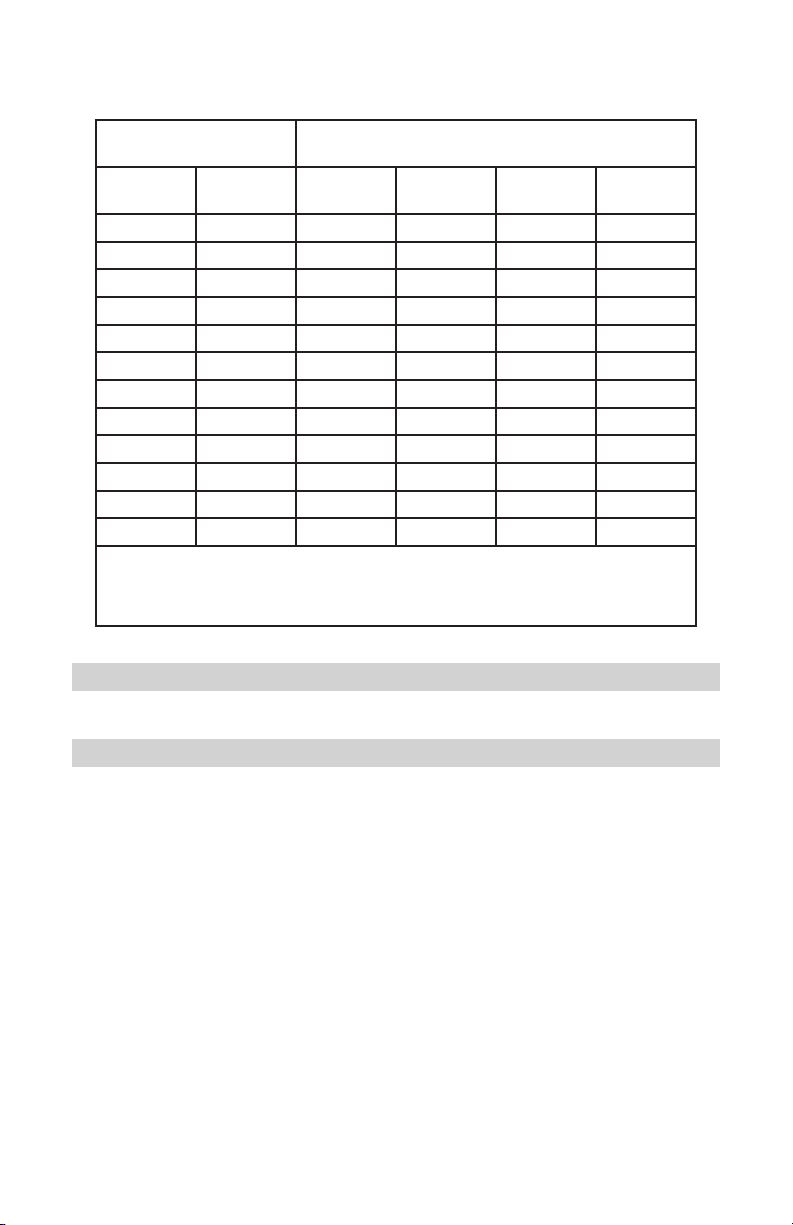
Este cargador de batería está destinado a un uso en 8.1
un circuito con tensión nominal de 120 V y posee un
enchufe con descarga a tierra que luce como el enchufe
ilustrado. El cargador debe poseer una descarga a
tierra para reducir el riesgo de descargas eléctricas.
El enchufe se debe conectar a un tomacorriente
adecuadamente instalado y que cuente con descarga a
tierra de acuerdo con todas las ordenanzas y códigos.
Los pasadores del enchufe deben adaptarse al
receptáculo (tomacorriente). No utilizar con un sistema
que no posea descarga a tierra.
Nunca altere el cable o enchufe de CA suministrado, si no se ajusta al 8.2
tomacorriente, haga instalar un tomacorriente adecuado con descarga a tierra
por medio de un electricista capacitado. Una conexión inadecuada puede
provocar un riesgo de descarga eléctrica o electrocución.
NOTA: no se recomienda el uso de un enchufe adaptador.
• 21 •
Tamaño AWG mínimo recomendado para alargadore:8.3
Consumo nominal de CA,
Amperios*
Tamaño del cable en AWG, Longitud del cable, en
pies (metros)
Al
menos
Pero
menor a
25
(7.6)
50
(15.2)
100
(30.5)
150
(45.6)
0 2 18 18 18 16
2 3 18 18 16 14
3 4 18 18 16 14
4 5 18 18 14 12
5 6 18 16 14 12
6 8 18 16 12 10
8 10 18 14 12 10
10 12 16 14 10 8
12 14 16 12 10 8
14 16 16 12 10 8
16 18 14 12 8 8
18 20 14 12 8 6
*Si el consumo nominal del cargador se expresa en vatios en lugar de amperios,
el consumo en amperios correspondiente se determinará dividiendo el consumo
en vatios por el consumo en tensión, por ejemplo:
1200 watts/120 volts = 10 amperes
INSTRUCCIONES DE MONTAJE9.
Sin necesidad de montaje
PANEL DE CONTROL10.
NOTA: No todos los interruptores y LED se encuentran disponibles en todos
los modelos.
Amperímetro
El amperímetro indica la cantidad de corriente, medida en amperios, es decir
la corriente consumida por la batería. A medida que la batería se carga,
consume menos corriente del cargador. Correspondientemente el medidor
mostrará menos corriente absorbida por la batería. Cuando la corriente para
de descender, la batería ya está cargada. El área de inicio del medidor indica
un alto índice de corriente consumido por el cargador. Al arrancar un motor,
la aguja del motor se encontrará en el extremo del lado derecho del área de
inicio. El índice de carga de 2 amperios podría indicar actividad en el medidor
a pesar de que este último no cuente con la resolución para presentar
este reducido índice. Para el índice de carga de 2 amperios, se suministra
untriángulo.Suprecisiónsecalibróconelndeimplementarunusocon
baterías pequeñas.

• 22 •
Porcentaje de carga•
El porcentaje de la escala de carga tiene el propósito de servir como una
ayuda visual para contribuir en la lectura del estado de carga. Se encuentra
establecido en escala para utilizar solamente con el índice de carga de 6,
10, 12, 15 o 30 amperios. Para el índice de carga de 2 amperios utilice el
triángulo. El porcentaje de carga se basa en la corriente consumida por la
batería. Por esta razón, la precisión variará con el tamaño y tipo de batería.
Generalmente, una batería de gel de 28 amperios-hora consumirá menos
corrientealnaldelciclodecargaqueunabateríadeceldahúmedade
140amperios-hora.Estosignicaquelaindicaciónparaunabateríade
grandes dimensiones completamente cargada será de un poco menos del
100%.
Interruptor para establecer diferentes tipos de batería
Utilice este interuptor para establecer el tipo de batería a cargar.
SLI• : Estas iniciales señalan Arranque (S), Encendiendo (L) e Ignición
(I), que son las tres funciones básicas que una batería debe realizar en
todo vehículo normal. Este tipo de batería generalmente se utiliza en
automóviles, camiones y motocicletas. Este tipo de baterías cuentan
contapasdeventilaciónyamenudoselasclasicacomode“Bajo
mantenimiento” o “Libre de mantenimiento”. Este tipo de baterías está
diseñado para suministrar rápidas ráfagas de energía (tales como los
arranques de motores) y poseen un mayor recuento en placa. Las placas
asimismo serán más delgadas y poseerán una composición de materiales
algo diferente. La mayoría de las Baterías de libre mantenimiento son SLI,
comúnmente conocidas como Baterías Estándard o Regular. Las baterías
regulares no se deben utilizar en aplicaciones de ciclo profundo.
Ciclo profundo• :Lasbateríasdecicloprofundogeneralmenteseclasican
como “de ciclo profundo” o “Marinas”. Las baterías de ciclo profundo
generalmente son más grandes que el resto. Este tipo de baterías posee
menos energía instantánea pero un suministro algo mayor de energía
a largo plazo que las baterías regulares. Las baterías de ciclo profundo
poseen placas más gruesas y pueden sobrevivir a un número de ciclos de
descarga.
AGM(Malladebradevidrioabsorbente)• : La construcción de la malla
debradevidrioabsorbentepermitelasuspensióndelelectrolitoen
extrema proximidad con el material activo de la placa. En teoría, esto
aumentatantolaecienciadeladescargacomodelarecarga.Enverdad,
las baterías AGM constituyen una variedad de las baterías Selladas VRLA
(de plomo-ácido reguladas por válvula). Entre sus usos más comunes
se encuentran baterías con arranque de motor de alto rendimiento, para
deportes intensos, de ciclo profundo, solares y de acumuladores. Las
baterías AGM por lo general constituyen buenas baterías de ciclo profundo
y proporcionan un mejor rendimiento si se las recarga antes de que la
batería se reduzca a una carga menor al 50 por ciento. Si estas baterías
AGM se descargan por completo su vida útil será de alrededor de 300
ciclos.EstoesunhechoenlamayorpartedelasbateríasAGMclasicadas
como baterías de ciclo profundo.
• 23 •
GEL• : La batería de gel es similar al estilo AGM ya que el electrolito se
suspende, pero resulta diferente debido a que técnicamente la batería
AGM aún se considera una batería de celda húmeda. El electrolito en
unabateríadeGELposeeunaditivodesílicequeprovocasujacióno
endurecimiento. Las tensiones de recarga en este tipo de baterías son
menores a las tensiones del resto de los estilos de batería de plomo-ácido.
Ésta es probablemente la batería más sensible en términos de reacciones
adversas a cargas de sobretensión. Las baterías de gel se utilizan mejor en
aplicaciones de ciclos MUY PROFUNDOS y podrían durar un poco más en
aplicaciones caracterizadas por cálidas condiciones climáticas. Si se utiliza
un cargador de baterías inadecuado en una batería de gel, es probable que
semaniesteunrendimientoinsucienteyfallasprematuras.
Cuando se sabe que el antimonio constituye uno de los materiales utilizados
en la elaboración de la batería, dicha batería es de tipo convencional/de bajo
mantenimiento.
ATENCIÓN
Algunas baterías de bajo mantenimiento poseen
unaplacadesupercierelativamentelisasinningunatapaevidentede
batería para depósito de combustible. Sin embargo, en el caso de que el
fabricante /distribuidor de la batería recomiende un control periódico del
nivel de electrolito y proporcione acceso a la batería para agregados de
agua, probablemente se trate de una batería de tipo convencional/de bajo
mantenimiento.
Interruptor de selección del índice de carga (Selector de tensión/
amperios)
Utilice este botón para establecer el índice máximo de carga.
Índice de carga lenta 2A• : destinado a la carga de baterías pequeñas tales
como aquellas habitualmente utilizadas en tractores para jardín, motos
de nieves y motocicletas. El índice 2A puede utiliza como un cargador de
baterías destinado a baterías de grandes dimensiones.
Índice de carga rápido 6A, 10A, 12A, 15A y veloz 30A• : utilice para la
carga de baterías de automóviles, marinas y de ciclo profundo. No utilizar
en aplicaciones industriales.
Arranque de motor• : proporciona amperios adicional para el arranque de
un motor con una batería débil o agotada. Siempre utilizar en combinación
con una batería.
Interruptor de selección de tensión
Utiliceesteinterruptorparacongurarelcargadorparacargarbateríasde6
voltios, 12 voltios o 24 voltios.
NOTA: No se recomiendan estos cargadores para sistemas de 8 o 16 voltios.
Indicadores LED
Full Charge (Carga completa): • cuando se encuentra encendido este
LED indica que la batería se encuentra completamente cargada y que
el cargador detuvo la carga y pasó al Modo operativo de Mantenimiento
(Cargadores de batería automático solamente).
Power On (Encendido): • cuando se encuentra encendido este LED indica
la presencia de energía de CA suministrada al cargador de batería.
Check Battery (Controlar batería): • cuando se encuentra encendido este
LED indica algún desperfecto en la batería. Controle las conexiones de
CC por una posible conexión inadecuada; de lo contrario, la batería podría
encontrarse dañada.

• 24 •
INSTRUCCIONES DE OPERACIÓN11.
Visión general
Conectarlabateríateniendoencuentalasprecaucionesqueguranenlas1.
Secciones 6 y 7.
Seleccionelasconguracionesapropiadasparalabatería.2.
Conecte la energía eléctrica de CA teniendo en cuenta las precauciones 3.
queguranenlaSección8.
Modo de carga automática
Si el cargador posee un Modo de carga automática, puede llevar a cabo
una carga automática. Cuando se realiza una carga automática, el cargador
cambia del Maintain Mode [Modo de mantenimiento] (ver a continuación)
automáticamente después que la batería se cargue. Para una batería con
una tensión de inicio inferior a 1 voltio, utilice el Manual Mode [Modo manual]
primero para cargar previamente la batería por cinco minutos para lograr una
tensión adicional en la batería para que el cargador lo analice.
Carga manual
Si el cargador no cuenta con un Modo de carga automática, deberá realizar
la carga en el Modo manual. Un cargador manual continuará la carga y no
se apagará. Debe realizar un control visual del amperímetro para determinar
cuando la batería se encuentra cargada. Asegúrese de controlar el proceso
de carga y detenerlo cuando la batería se encuentre cargada. Dejar de llevar
esto a cabo podría provocar daños en la batería u ocasionar otros daños en la
propiedad o lesiones personales.
Finalización de la carga (Cargadores de batería automático solamente)
LanalizacióndelacargaseindicaconelLEDFULLCHARGED[cargado]
(verde). Cuando se enciende, el cargador ha dejado de cargar y pasó al Modo
de funcionamiento de mantenimiento. Si se seleccionó el tipo de batería de
12 V de CICLO PROFUNDO el LED FULL CHARGED [cargado] (verde) se
enciendecuandolabateríasecargólosucienteparaelusonormal.
Modo de mantenimiento (Cargadores de batería automático solamente)
Cuando el LED FULL CHARGED [cargado] (verde) se enciende, el cargador
ha comenzado el Modo de mantenimiento. En este modo el cargador
mantiene la batería totalmente cargada mediante una pequeña corriente
cuando corresponda. Si la tensión de la batería desciende por debajo de
un nivel predeterminado el cargador volverá al Modo de carga hasta que
la tensión de la batería vuelva al nivel de carga completa en cuyo punto el
cargador volverá al Modo de mantenimiento. La tensión se mantiene a un
nivel determinado por el TIPO DE BATERÍA seleccionado.
NOTA: Un cargadore de batería automático automáticamente pasa del Modo
de carga al de mantenimiento según corresponda. El LED FULL CHARGED
[cargado] (verde) iniciará el ciclo cuando la batería esté totalmente cargada
y se terminará cuando la tensión descienda al nivel predeterminado y el
cargador pase al Modo de carga. Este ciclo continuará y el LED FULL
CHARGED [cargado] (verde) permanecerá por períodos más largos a medida
que la batería se vaya cargando. No es aplicable a cargadores manuales.
Utilizar la función de encendido de motor (si está equipado)
El cargador de batería se puede utilizar para impulsar el auto si la batería está
baja. Siga estas instrucciones de cómo utilizar la función ENGINE START
(encendido de motor).
IMPORTANTE
Siga todas las instrucciones y precauciones de seguridad
para cargar la batería. Utilice protección ocular y de vestimenta. Cargue la
batería en un área bien ventilada.

• 25 •
IMPORTANTE
Si utiliza la función ENGINE START SIN que la batería esté
colocada en el vehículo podría dañar el sistema eléctrico del vehículo.
Coloque el interruptor de índice de carga y el temporizador (en caso de 1.
tenerlo) a la posición OFF (apagado).
Con el cargador desenchufado del tomacorriente de CA, conecte el 2.
cargadoralabateríasiguiendolasinstruccionesqueguranenlaSección
6 (SIGA ESTOS PASOS CUANDO LA BATERÍA ESTÉ COLOCADA EN EL
VEHÍCULO).
Enchufe el cable de alimentación de CA del cargador al tomacorriente 3.
de CA y luego pase el interruptor del temporizador de la posición OFF
(apagado) a HOLD (suspensión).
Con el cargador enchufado y conectado a la batería del vehículo pase el 4.
interruptor de selección de índice de amperios a la posición engine start
(encendido del motor).
Déle arranque al motor hasta que se ponga en marcha o que pasen 5 5.
segundos. Si el motor no arranca espere 4 minutos antes de intentarlo de
nuevo.
NOTA: Bajo clima frío extremo o si la batería es inferior a 2 voltios, cargue la
batería por 5 minutos antes de poner en marcha el motor.
Si el motor no arranca, cargue la batería por 5 minutos más antes de darle 6.
arranque nuevamente.
Después de que el motor se puso en marcha, cambie el interruptor de 7.
selección de índice de amperios a la posición off (apagado) y desenchufe
el cable de alimentación de CA antes de desconectar los ganchos de la
batería del vehículo.
Limpie y guarde el cargador en un lugar seco. 8.
NOTA: Si el motor gira, pero no enciende, no existe un problema con el
sistema de arranque, sino en cualquier otra parte del vehículo. DEJE de darle
arranque al motor hasta que el otro problema se diagnostique y se corrija.
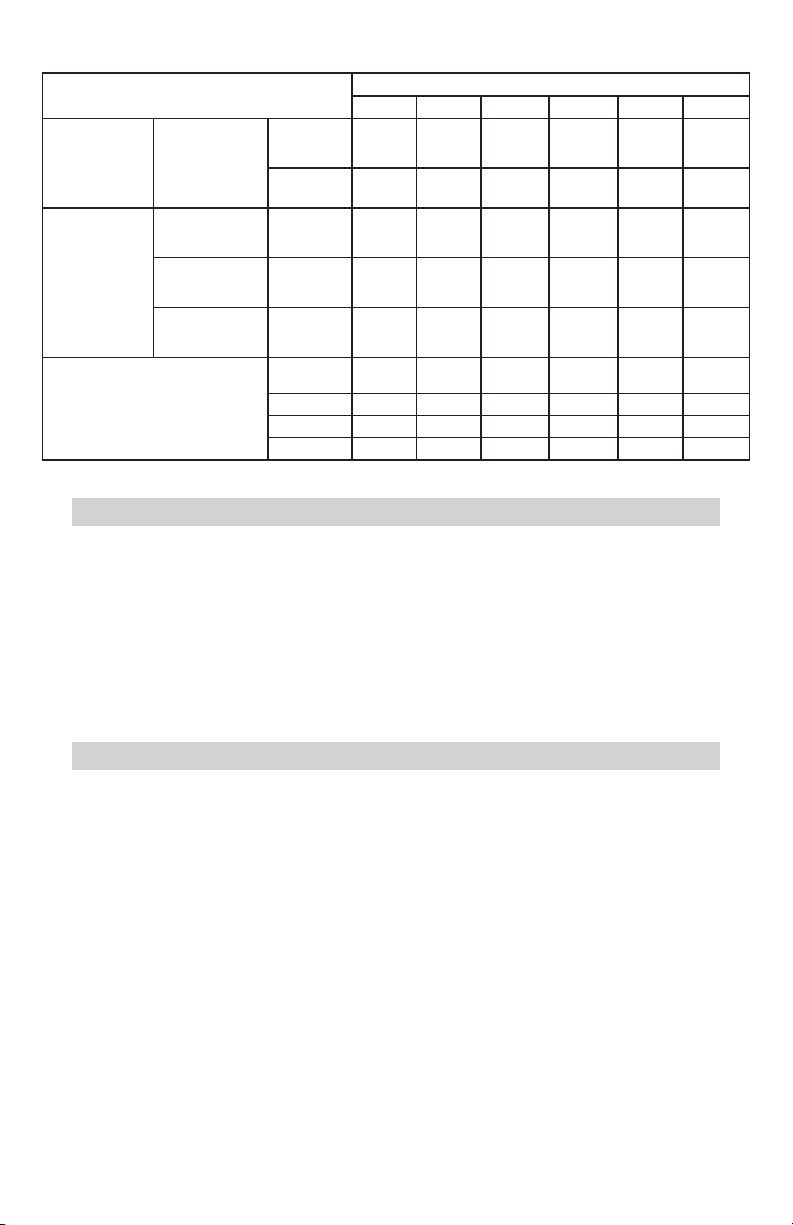
CÁLCULO DE TIEMPO DE CARGA12.
Utilice la siguiente tabla para determinar con mayor exactitud el tiempo que le
llevarácompletarlacargadelabatería.Enprimerlugar,identiquedóndese
encuentrasubateríadentrodelgráco.
NRsignicaquelasconguracionesdelcargadorNOSERECOMIENDAN.
Encuentreelíndicedesubateríaenelgrácoacontinuaciónyobserveel
tiempodecargaquecorrespondeporcadaconguracióndelcargador.Los
tiempos que se informan son para baterías con un 50% de carga antes de
volver a cargar. Agregue más tiempo para las baterías que se descargaron
varias veces.
• 26 •
TAMAÑO/ÍNDICE DE LA BATERÍA ÍNDICE/TIEMPO DE CARGA
2 AMP 6 AMP 10 AMP
12 AMP 15 AMP 30 AMP
BATERÍAS
PEQUEÑAS
Motocicleta,
tractor de
jardín, etc.
6 - 12 AH 2 - 4
horas
45 min
- 1 ¼
horas
NR NR NR NR
12 - 32 AH 4 - 10
horas
1 ¼ - 3
½ horas
NR NR NR NR
AUTOS/
CAMIONES
200 - 315 CCA 40 - 60 RC 11 ¼
- 14 ½
horas
3 ¾ - 4
¾ horas
2¼ – 3
horas
2 – 2½
horas
1½ – 2
horas
45 min –
1 hr
315 - 550 CCA 60 - 85 RC 14 ½
- 18 ¼
horas
4 ¾ - 6
horas
3 – 3¾
horas
2½ – 3
horas
2 – 2½
horas
1 – 1¼
horas
550 - 1000 CCA 80 - 190 RC 18 ¼
- 34 ¾
horas
6 - 11 ½
horas
3¾ – 7
horas
3 – 5¾
horas
2½ – 4¾
horas
1¼ – 2½
horas
MARINA/CICLO PROFUNDO
80 RC 17 ½
horas
6 horas
3½ horas 3 horas 2½ horas 1¼ horas
140 RC 27 horas
9 horas
5½ horas 4½ horas 3½ horas 1¾ horas
160 RC 30 horas
10 horas
6 horas 5 horas 4 horas 2 hrs
180 RC 33 horas
11 horas
6¾ horas 5½ horas 4½ horas 2¼ horas
INSTRUCCIONES DE MANTENIMIENTO13.
Después de usar y antes de realizar mantenimiento, desenchufe y desconecte 13.1
el cargador de la batería (ver Secciones 6, 7 y 8).
Utilice un paño seco para limpiar la corrosión de toda la batería y otra 13.2
suciedad o aceite de los terminales, cables y carcasa del cargador.
Asegúrese de que todas las piezas del cargador estén bien instaladas y en 13.3
buenas condiciones para su función, incluyendo los protectores de plástico de
las pinzas de la batería.
Para realizar mantenimiento no es necesario abrir la unidad, ya que no existen 13.4
piezas a las cuales puede realizarle mantenimiento el usuario.
INSTRUCCIONES DE ALMACENAJE14.
Guarde el cargador desenchufado en posición vertical. El cable seguirá 14.1
conduciendo electricidad hasta que se desenchufe del toma.
Almacene en el interior, en un lugar fresco y seco (a menos que esté 14.2
utilizando un cargador marino integrado).
No guarde los ganchos en asas, enganchados entre sí, en o cerca de metales 14.3
o enganchados en cables.

• 27 •
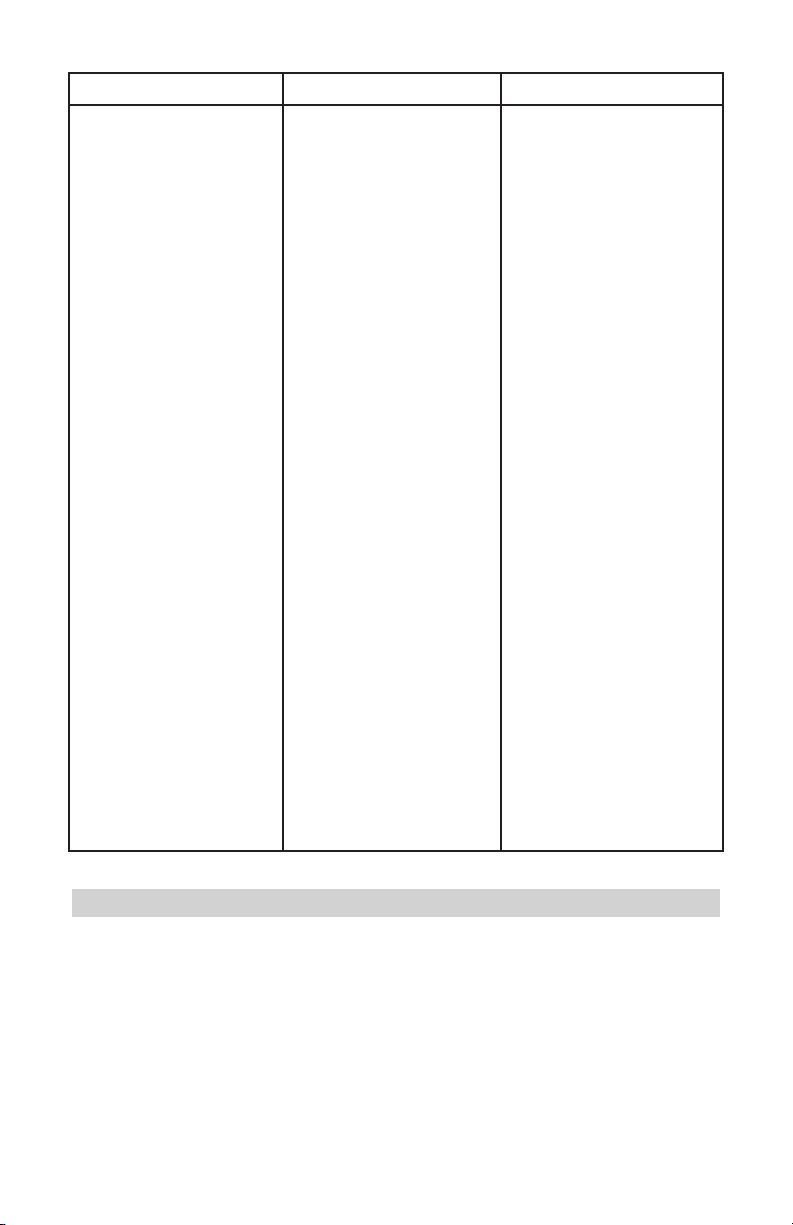
LOCALIZACIÓN Y SOLUCIÓN DE PROBLEMAS15.
PROBLEM POSSIBLE CAUSE REASON/SOLUTION
Nosemaniestalalectura
en el amperímetro.
Cargador desenchufado.
No hay electricidad en el
tomacorriente.
Los ganchos no se
encuentran bien conectados
a la batería.
Las conexiones se
encuentran invertidas.
Batería defectuosa (no
acepta una carga).
Se utiliza un índice de carga
de 2 amperios.
Enchufe el cargador a un
tomacorriente de CA.
Veriquelaposible
presencia de fusibles
abiertos o disyuntores que
suministren energía al
tomacorriente de CA.
Veriquelaposible
presencia de una conexión
defectuosa a la batería o al
bastidor. Asegúrese de que
los puntos de conexión estén
limpios. Mueva los ganchos
hacia adelante y hacia
atrás para lograr una mejor
conexión.
Desenchufe el cargador e
invierta los ganchos.
Haga revisar la batería.
El amperímetro podría
dejar de mostrar actividad
en el índice de carga de
mantenimiento.
La lectura en el
amperímetro permanece
elevada.
La batería se encuentra
extremadamente
descargada.
Tensión de batería errónea.
Continúe con la carga de la
batería por dos horas más.
Si persiste algún problema,
haga revisar la batería.
Veriquequeestéutilizando
una batería de plomo-ácido
de 12-voltios.
El cargador no se enciende
incluso al estar bien
conectado.
Tomacorriente de CA fuera
de funcionamiento.
Conexión eléctrica
deciente.
Controle la posible presencia
de fusibles abiertos o
disyuntores que suministren
energía al tomacorriente de
CA.
Controle la posible pérdida
del enchufe perteneciente a
los cables de alimentación o
al alargador.
La batería se encuentra
conectada y el cargador
encendido, pero no carga.
Los ganchos no se
encuentran bien
conectados.
Controle la posible presencia
de una conexión defectuosa
a la batería o al bastidor.
Asegúrese de que los puntos
de conexión estén limpios.
Mueva los ganchos hacia
adelante y hacia atrás para
lograr una mejor conexión
La corriente medida
es mucho menor a la
seleccionada.
El cargador alcanzó su
máxima tensión y está
reduciendo la corriente.
No es un problema, es una
situación habitual.

• 28 •
PROBLEM POSSIBLE CAUSE REASON/SOLUTION
El amperímetro lee una
cantidad menor al índice de
carga seleccionado cuando
se carga una batería
descargada
El alargador es demasiado
largo o el calibre del cable
es demasiado pequeño.
Batería débil o placa
sulfatada en la batería.
La batería se encuentra sólo
parcialmente descargada.
Utilice un alargador de
calibre más pequeño o
pesado.
Una batería sulfatada
nalmenteaceptauna
carga normal si se la deja
conectada. Si la batería
no acepta la carga, hágala
revisar.
Continúe con la carga de la
batería.
Se escucha un sonido seco
en el cargador (“clic”).
El disyuntor se resetea.
Batería defectuosa.
Cables o ganchos de la
batería en cortocircuito.
Buena batería pero
extremadamente
descargada.
Conexiones inversas en la
batería.
Lasconguracionespodrían
sererróneas.Verique
lasconguracionesdel
cargador.
Haga revisar la batería.
El disyuntor se resetea
cuando el consumo de
corriente es demasiado
elevado. Controle la posible
presencia de cables o
ganchos cortocircuitados y
reemplace los mismos de
ser necesario.
La batería tal vez no
decida aceptar una carga
debido a un estado de
agotamiento. Permita que
la carga continúe hasta
que la batería tenga la
oportunidad de recuperarse
losucientementecomo
para aceptar una carga. Si
este período se extiende a
más de 20 minutos, detenga
la carga y haga revisar la
batería.
Apague el cargador y corrija
las conexiones principales.
El cargador realiza un
fuerte zumbido.
Las láminas del
transformador vibran
(provocan un zumbido).
Montaje del diodo o montaje
delrecticadordesalida
cortocircuitado (provocan un
zumbido).
No es un problema, es una
situación habitual.
Haga revisar el cargador por
un técnico capacitado.
• 29 •
PROBLEM POSSIBLE CAUSE REASON/SOLUTION
Ciclo reducido o sin inicio al
arrancar el motor.
Consumo mayor a el índice
de arranque del motor.
No espera 4 minutos
(240 segundos) entre los
arranques.
Los ganchos no se
encuentran bien
conectados.
Cable de CA o alargador
suelto.
No hay electricidad en el
tomacorriente.
El cargador podría
encontrarse en estado de
recalentamiento.
La batería podría
encontrarse severamente
descargada.
El tiempo de arranque
varía según la cantidad de
corriente consumida. Si el
arranque consume más
el índice de arranque del
motor, el tiempo de arranque
podría ser menor a 3
segundos.
Aguarde 4 minutos en
tiempo de descanso antes
del próximo arranque.
Veriquelaposible
presencia de una conexión
defectuosa en la batería y en
el bastidor.
Veriquelaposiblepérdida
del enchufe perteneciente a
los cables de alimentación o
al alargador.
Veriquelaposible
presencia de fusibles
abiertos o disyuntores que
suministren energía al
tomacorriente de CA.
El protector térmico podría
encontrarse desconectado
y necesitar un mayor tiempo
de descanso. Asegúrese
de que los ventiladores del
cargador no se encuentren
bloqueados. Aguarde
un momento y pruebe
nuevamente.
En una batería
extremadamente
descargada, cargue por 10
a 15 minutos en el índice
manual del índice manual
más alto para contribuir al
arranque.
ANTES DE DEVOLVER A REPARACIONES16.
Cuando surja un problema de carga, asegúrese de que la batería puede 16.1
recibirunacarganormal.Utiliceunabuenabateríaparavericardosveces
todas las conexiones, el toma de CA para obtener 120-voltios completos, los
ganchos del cargador para lograr una polaridad correcta y la calidad de las
conexiones de los cables a los ganchos y de los ganchos al sistema de la
batería. Los ganchos deben estar limpios.
Cuando la batería está muy fría, parcialmente cargada o sulfatada no 16.2
obtendrá todo el índice de amperios del cargador. Es peligroso y perjudicial
para la batería forzar un amperaje mayor al que puede utilizar efectivamente
en una recarga.
Cuando surja un PROBLEMA DE FUNCIONAMIENTO DESCONOCIDO, por 16.3
favor lea todo el manual y comuníquese con el número de atención al cliente
para más información que no haga falta la devolución.

• 30 •
Si las soluciones descriptas no eliminan el problema o por información
sobre la solución de problemas o repuestos, puede llamar a la línea gratuita
desde cualquier lugar de los EE.UU.
1-800-621-5485
7:00 a. m. a 5:00 p. m. hora central de lunes a viernes
GARANTÍA LIMITADA17.
SCHUMACHER ELECTRIC CORPORATION, 801 BUSINESS CENTER
DRIVE, MOUNT PROSPECT, IL 60056-2179, REALIZA LA PRESENTE
GARANTÍA LIMITADA AL COMPRADOR MINORISTA ORIGINAL DE
ESTE PRODUCTO. LA PRESENTE GARANTÍA LIMITADA NO PUEDE
TRANSFERIRSE NI CEDERSE.
Schumacher Electric Corporation (el “Fabricante”) otorga garantía por este
cargador de batería por un plazo de dos años contados a partir de la fecha de
compra por menor por la existencia de cualquier material o de mano de obra
defectuosos que pudieran surgir por su uso y cuidado normal. Si su unidad
cuenta con material defectuoso o defectos de mano de obra, la obligación de
los Fabricantes, conforme a la presente garantía, será simplemente reparar o
sustituir el producto por uno nuevo o por una unidad reparada, a elección del
fabricante. Es obligación del comprador enviar la unidad junto con los gastos
de envío prepagos al fabricante o a sus representantes autorizados para que
ésta se pueda reparar o reemplazar.
El Fabricante no presta garantía por lo accesorios utilizados con este producto
que no sean los fabricados por Schumacher Electric Corporation y que
no estén aprobados para su uso con este producto. La presente Garantía
Limitada será nula si el producto se utiliza en forma errónea, se trata de
manerainadecuada,esreparadoomodicadoporpersonasquenosseanel
Fabricante o si esta unidad es revendida a través de un vendedor minorista no
autorizado.
El Fabricante no realiza ninguna otra garantía, incluidas, a título enunciativo,
las garantías expresas, implícitas o legales, incluidas, a modo de ejemplo,
lasgarantíasimplícitasdecomerciabilidadoadecuaciónaunnespecíco.
Asimismo, el Fabricante no será responsable ante reclamos por daños
accidentales, especiales ni directos en los que incurran los compradores,
usuarios u otras personas asociadas al producto, incluidas, a título
enunciativo, los ingresos y ganancias no percibidos, ventas anticipadas,
oportunidades comerciales, el buen nombre, la interrupción de la actividad
comercial o cualquier otro daño que haya provocado. Todas las garantías,
excepto la garantía limitada incluida en el presente, por medio de la presente,
quedan expresamente anuladas y excluidas. Algunos estados no permiten
la exclusión ni la limitación de los daños accidentales ni directos o el plazo
de garantía implícita, por lo que las limitaciones o exclusiones mencionadas
anteriormente podrían no corresponder con su caso. La presente garantía le
otorgaderechoslegalesespecícosyesprobablequeustedcuenteconotros
derechos que podrían diferir de los incluidos en la presente garantía.
LA PRESENTE GARANTÍA LIMITADA ES LA ÚNICA GARANTÍA LIMITADA
EXPRESA Y EL FABRICANTE NO ASUME NI AUTORIZA A NADIE A
ASUMIR O A ADQUIRIR NINGUNA OTRA OBLIGACIÓN RESPECTO DEL
PRODUCTO QUE NO SEA LA PRESENTE GARANTÍA.
Servicio de atención al cliente de Schumacher Electric Corporation
1-800-621-5485
Lunes-viernes 7:00 a. m. a 5.00 p. m. CST
Schumacher y el logo Schumacher son marcas registradas de
Schumacher Electric Corporation