CONTROLS
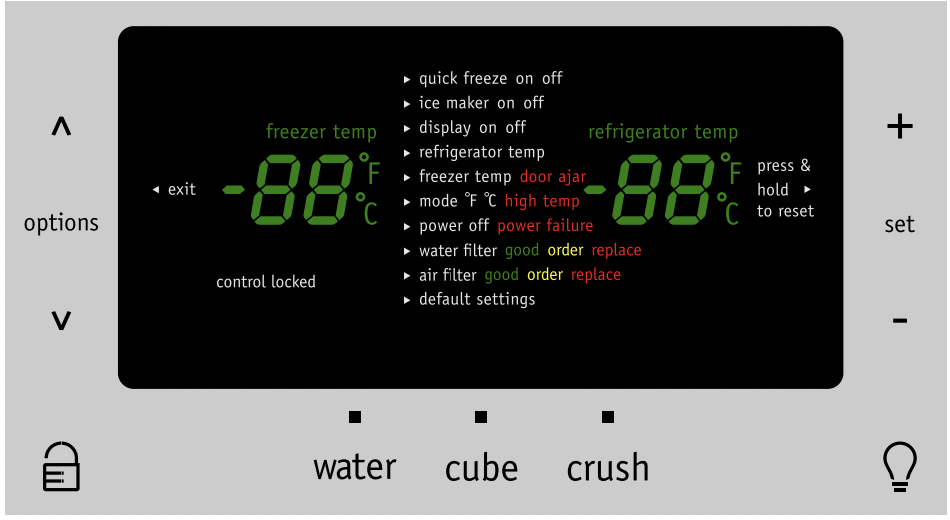
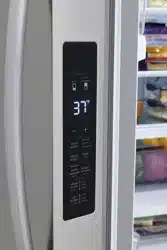
options  Used to enter and exit the options menu and make selections.
control locked  While in the locked state, you will not be able to change any settings on the display nor dispense ice and water. The “Control Locked” indicator will flash and an audible warning tone is played.
quick freeze on off Activates a faster rate for freezing food and increases ice production in the freezer. Deactivates after 12 hours.
ice maker on off Toggles the ice maker “ON” or “OFF”. In the “Ice Off” state, indicator will blink when ice is dispensed.
display on off Toggles the temperature displays On and Off.
refrigerator temp Allows the temperature set-points to be adjusted. Control temperatures range from +33° F / +1° C to +47° F / +8° C.
freezer temp Allows the temperature set-points to be adjusted. Control temperatures range from -6° F / -21° C to +6° F / -15° C.
mode ° F ° C Toggles display from Fahrenheit to Celsius.
light  Toggles dispenser light On and Off.
power off Press and hold for three seconds to turn off the cooling system. It also turns off the ice maker and all dispenser functions. The display will read “power off”.
water filter Displays the current status of the water filter (Good, Order, or Replace). To reset the filter status to “Good”, press and hold the “set” key for three seconds.
air filter Displays the current status of the air filter (Good, Order, or Replace). To reset the filter status to “Good”, press and hold the “set” key for three seconds. default settings While in the default option, press and hold the set key for three seconds to reset all refrigerator settings to their factory default settings.
set (+ or -) Selects the current menu selection option. water Press the “water” key to select water. A green indicator light will be illuminated above the active feature.
cube Press the “cube” key to select cubed ice. A green indicator light will be illuminated above the active feature
crush Press the “crush” key to select crushed ice. A green indicator light will be illuminated above the active feature.
Setting cooling temperatures
 NOTE
NOTE
When you first power on the refrigerator, the temperature displays 0° F and 37° F. After a few seconds, both of the displays will switch to “HI”. The displays will continue to show “HI” for 20 minutes. After 20 minutes, the High Temp alarm will sound and both displays will show the actual temperature.
1 Plus (+) and Minus (-) indicators are located on the right side of the control panel.
2 Press the + or - indicator to adjust the temperature to the desired setting.
Alarms
Power Failure In the event of a power failure, the power fail alert will be illuminated. Press alarm reset to acknowledge the alarm. Other modes may be turned off until the alarm is acknowledged. When the power fail alert is acknowledged, the refrigerator will resume normal operation. The high temp alarm may also be illuminated until a safe operating range temperature has been reached.
Freezer Temp If the freezer temperature reaches 26° F or greater, the alarm will sound and the temperature will flash. You can disable the alarm by pressing the set key but the “High Temp” indicator will illuminate until the temperature goes below 26° F.
Fresh Food Temp If the fresh food temperature reaches 55° F or greater, the alarm will sound and the temperature will flash. You can disable the alarm by pressing the set key but the “High Temp” indicator will illuminate until the temperature goes below 55° F.
Door Ajar If the freezer or fresh food doors have been left open for five minutes or more, an alarm will sound and the door ajar indicator will illuminate on the display. Press the set key to reset any system alarms.
Flapper When “Cube” or “Crush” is selected, if the flapper (or ice chute door) is being held open by a jammed ice cube, an alarm will sound for two minutes. The alarm will reset after two minutes or when the ice cube is removed and the set key is pressed to reset.
Sabbath Mode
The Sabbath Mode is a feature that disables portions of the refrigerator and its controls in accordance with observance of the weekly Sabbath and religious holidays within the Orthodox Jewish community.
Sabbath Mode is turned ON and OFF by pressing and holding both the “∨” and “+” for five seconds. The display shows “Sb” while in Sabbath mode.
In the Sabbath Mode, the High Temp alarm is active for health reasons. If a high temperature alarm is activated during this time, for example due to a door left ajar, the alarm will sound intermittently for about two minutes. The alarm will then silence on its own and a red high temperature icon will display. The high temp icon will continue to display, even if the door is closed, until the Sabbath mode is exited and the icon reset. The refrigerator will function normally once the door is closed, without any violation of the Sabbath/Holidays.
NOTE While in Sabbath Mode, neither the lights, dispenser, nor the control panel will work until Sabbath Mode is deactivated. Refrigerator stays in Sabbath Mode after power failure recovery. It must be deactivated with the buttons on the control panel.
NOTE Although you have entered the Sabbath Mode, the ice maker will complete the cycle it had already initiated. The ice cube compartment will remain cold and new ice cubes can be made with standard trays.
AUTOMATIC ICE & WATER DISPENSER
Priming the water supply system
 CAUTION For proper dispenser operation, recommended water supply pressure should fall between 30 psi and 100 psi. Excessive pressure may cause water filter to malfunction.
1 Begin filling the tank by pressing and holding a drinking glass against the water dispenser paddle.
2 Keep the glass in this position until water comes out of the dispenser. It may take about 1½ minutes.
3 Continue dispensing water for about four minutes to flush the system and plumbing connections of any impurities (stopping to empty the glass as necessary).
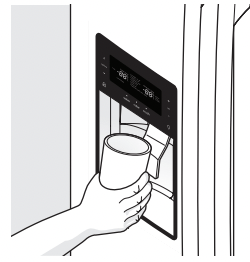
NOTE The water dispenser has a built-in device that shuts off the water flow after three minutes of continuous use. To reset this shutoff device, simply release the dispenser paddle.
NOTE Dispensed water is chilled. For colder water, add ice to cup or container before dispensing water.
Ice maker operation & care
After the refrigerator is installed properly and has cooled for several hours, the ice maker can produce ice within 24 hours. The ice maker will fill the ice bin from the rear. You must dispense some ice to force the ice forward in the bin. This will allow the bin to fill completely
 IMPORTANT Your ice maker is turned on at the factory so it can work as soon as you install your refrigerator. If you cannot connect a water supply, set the ice maker’s On/Off icon to Off and turn off the water supply valve; otherwise, the ice maker’s fill valve may make a loud chattering noise when it attempts to operate without water.
Turning the fresh food ice maker on and off
Ice production is controlled by the ice maker’s On/Off icon on the control panel. Press and hold the “Ice Off” icon for three seconds to turn the ice maker “ON” or “OFF”. The ice maker is turned off when the LED above the “Ice Off” icon is illuminated.
IMPORTANT Turning off the ice maker will disable the ice dispenser. You will still be able to dispense water.
NOTE The ice maker also has a built-in plastic signal bale arm that automatically stops ice production when the ice bin is full. This signal arm should not be used to manually stop the ice maker.
Using the ice maker after installation
Before making ice for the first time, be sure to prime the water supply system. Air in new plumbing lines can result in two or three empty ice maker cycles. Furthermore, if the system is not flushed, the first ice cubes may be discolored or have an odd flavor.
IMPORTANT On occasion, unusually small ice cubes may be noticed in the bucket or in dispensed ice. This could occur in normal operation of the ice maker. If you start seeing these more frequently, it may be an indication of low water pressure or the water filter needs to be replaced. As the water filter nears the end of its useful life and becomes clogged with particles, less water is delivered to the ice maker during each cycle. Remember, if it’s been six months or longer since you last changed your water filter, replace the water filter with a new one. Poor quality household water may require the filter to be changed more frequently.
Ice maker/dispenser tips
• If your refrigerator is not connected to a water supply or the water supply is turned off, turn off the ice maker by holding the On/Off soft-touch icon for three seconds.
• The following sounds are normal when the ice maker is operating:
- Motor running
- Ice dropping into ice bin
- Water valve opening or closing
- Running water
• When dispensing ice, you will hear a snapping or clicking sound when the ice chute opens and closes.
• If you need a large quantity of ice at one time, it is best to get cubes directly from the ice bin.
• Ice cubes stored too long may develop an odd flavor. Empty the ice bin as explained below.
• When dispensing cubed ice, it is normal to have a small quantity of little pieces along with the whole cubes.
CAUTION If the water supply to your refrigerator is softened, be sure the softener is properly maintained. Chemicals from a water softener can damage the ice maker.
Cleaning the ice maker
Clean the ice maker and ice bin at regular intervals, especially prior to vacation or moving.
1 Turn off the ice maker.
2 Remove the ice bin by pulling straight out.
3 Empty and carefully clean the ice bin with mild detergent. Do not use harsh or abrasive cleaners. Rinse with clear water.
4 Allow the ice bin to dry completely before replacing in the freezer.
5 Replace the ice bin. Turn the ice maker on.
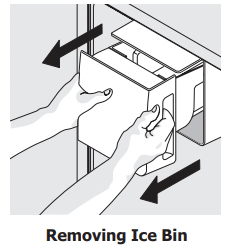
Remove and empty the ice bin if:
• An extended power failure (one hour or longer) causes ice cubes in the ice bin to melt and freeze together, jamming the dispenser mechanism.
• You do not use the ice dispenser frequently. Ice cubes will freeze together in the bin, jamming the dispenser mechanism.
Remove the ice bin and shake to loosen the cubes or clean as explained above.
CAUTION NEVER use an ice pick or similar sharp instrument to break up the ice. This could damage the ice bin and dispenser mechanism. To loosen stuck ice, use warm water. Before replacing the ice bin, make sure it is completely dry
IMPORTANT When removing or replacing the ice bin, DO NOT rotate the auger in the ice bin. If the auger is accidentally rotated, you must realign the auger by turning it in 45 degree turns (see below) until the ice bin fits into place with the drive mechanism. If the auger is not properly aligned when replacing the ice bin, the refrigerator will not dispense ice. The fresh food door also may not close properly causing warm air to leak into the fresh food compartment.
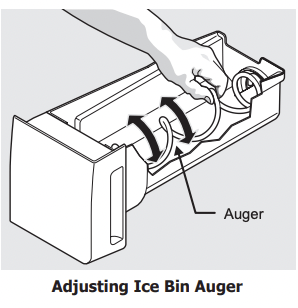
AUTOMATIC ICE MAKER - FREEZER
Operation & Care of the Freezer Ice Maker (select models)
After the refrigerator is installed properly, the ice maker can produce ice within 24 hours. It can completely fill the ice bin in about three days.
When using the ice maker for the first time and in order for the ice maker to work properly, it is necessary to clear air from water filter tubing. Once ice maker begins making ice, allow the bucket to fill completely, then discard the first TWO FULL buckets of ice. It will take at least two days to completely fill the bucket on regular ice making mode or 1½ days on fast ice mode.
The ice maker produces approximately four 2.5 pounds of ice every 24 hours depending on usage conditions.
IMPORTANT Your ice maker is turned on at the factory so it can work as soon as you install your refrigerator. If you cannot connect a water supply, lift the ice maker’s wire signal arm to turn it off. Otherwise, the ice maker’s fill valve may make a loud chattering noise when it attempts to operate without water.
Turning the ice maker on and off
Ice production is controlled by lifting/lowering the ice maker’s wire signal arm. To gain access to the ice maker, pull the freezer drawer out. Lift the wire signal arm to turn the ice maker OFF and lower the wire signal arm to turn it ON.
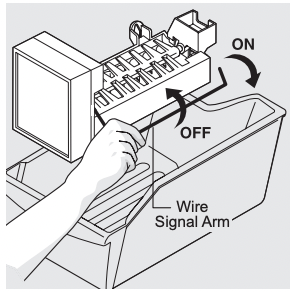
Ice maker tips
• If your refrigerator is not connected to a water supply or the water supply is turned off, turn off the ice maker by lifting wire signal arm
• The following sounds are normal when the ice maker is operating:
- Motor running
- Ice dropping into ice bin
- Water valve opening or closing
- Running water
• Ice cubes stored too long may develop an odd flavor. Empty the ice bin as explained below.
Quick Ice Function
Your refrigerator is equipped with a Quick Ice Function, that increases ice production. This function terminates automatically.
Cleaning the ice maker
CAUTION If the water supply to your refrigerator is softened, be sure the softener is properly maintained. Chemicals from a water softener can damage the ice maker.
Clean the ice maker and ice bin at regular intervals, especially prior to vacation or moving.
1 Turn off the ice maker.
2 Remove the ice bin.
3 Empty and carefully clean the ice bin with mild detergent. Do not use harsh or abrasive cleaners. Rinse with clean water.
4 Allow the ice bin to dry completely before replacing in the freezer.
5 Replace the ice bin. Turn the ice maker on.
Remove and empty the ice bin if:
• An extended power failure (one hour or longer) causes ice cubes in the ice bin to melt and freeze together. Remove the ice bin and shake to loosen the cubes or clean as explained above.
CAUTION NEVER use an ice pick or similar sharp instrument to break up the ice. This could damage the ice bin. To loosen stuck ice, use warm water. Before replacing the ice bin, make sure it is completely dry.
STORAGE FEATURES
CAUTION To avoid personal injury or property damage, handle tempered glass shelves carefully. Shelves may break suddenly if nicked, scratched, or exposed to sudden temperature change. Allow the glass shelves to stabilize to room temperature before cleaning. Do not wash in dishwasher.
NOTE Features may vary according to model.
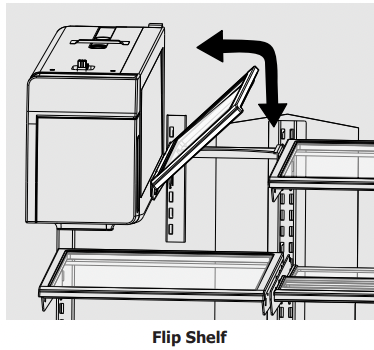
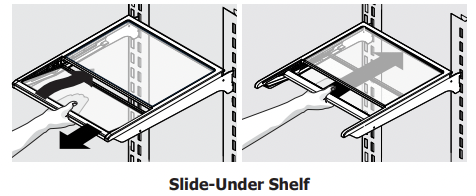
Your refrigerator includes SpillSafeTM glass shelves that are designed to catch and hold accidental spills.
You can easily adjust shelf positions in the fresh food compartments to suit your needs. The shelves have mounting brackets that attach to slotted supports at the rear of each compartment.
To change the position of a shelf:
1 Remove all food from shelf.
2 Lift the front edge up and pull the shelf out.
3 Replace by inserting the mounting bracket hooks into the desired support slots.
4 Lower the shelf and lock into position.
Shelf features
Drawers
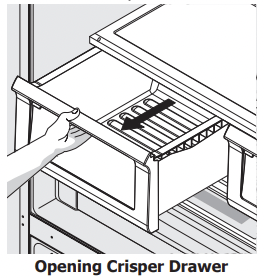
Your refrigerator includes a variety of storage drawers. These drawers are located in fixed positions at the bottom of the fresh food compartment.
Crispers
Crisper drawers are designed for storing fruits, vegetables, and other fresh produce.
Crisper humidity control
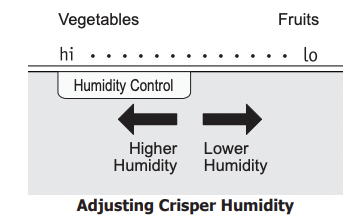
Crisper drawers include a sliding control for adjusting the humidity inside the crisper. Leafy vegetables keep best when stored with the Humidity Control set on Higher Humidity. Fresh fruits keep best when stored with the Humidity Control set on Lower Humidity.
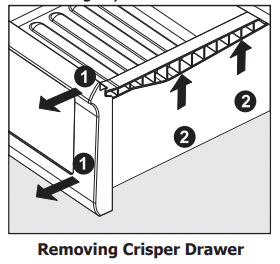
To remove the Crisper Drawer for cleaning:
1 Pull the drawer out until it stops.
2 Lift the front slightly and remove the drawer.
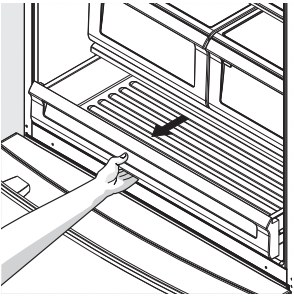
Deli drawer
Ideal for storage of deli meats and cheese.
Doors
Storage bins
The doors to your fresh food compartment use a system of modular storage bins. All of these bins are removable for easy cleaning. Some of them have fixed positions, while others can be adjusted to your needs. Door bins are ideal for storing jars, bottles, cans, and large drink containers. They also enable quick selection of frequently used items.
To change the position of an adjustable door bin:
1 Remove all food from door bin.
2 Grip the bin firmly with both hands and lift it upward.
3 Remove the bin.
4 Place the bin just above desired position.
5 Lower the bin onto supports until locked in place.
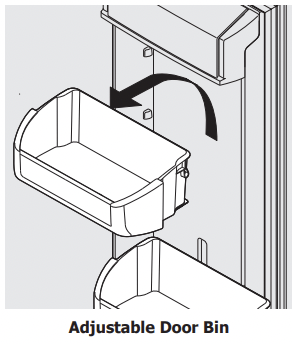
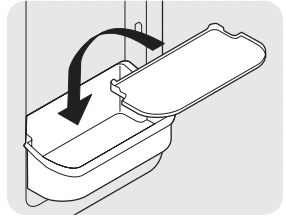
6 Place bin liner into bin.
Accessories (varies by model)
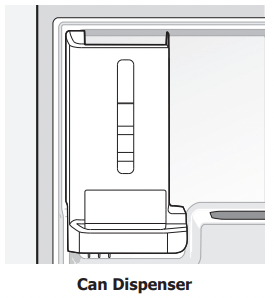
Removable Can Dispenser
The can dispenser holds six (12 ounce) cans. Insert cans into top of bin and dispense from the bottom.
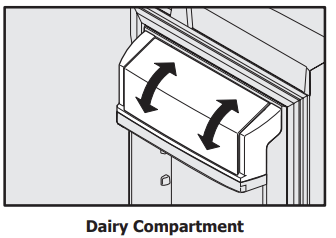
Dairy compartment
Use the dairy compartment, at the top of the fresh food compartment door, for short-term storage of cheese, spreads, or butter. The dairy compartment is designed to be warmer than the open area and includes a lift-up cover and a dairy divider (select models).
Freezer Features (varies by model)
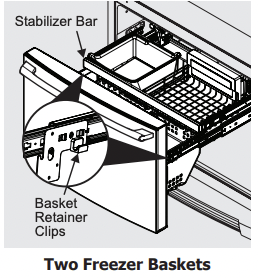
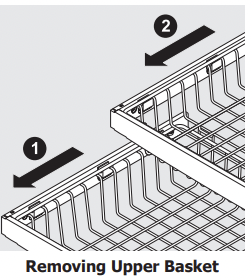
To Remove Upper Basket
1 Remove all items from basket.
2 Remove basket by pulling baskets out to their full extension and lift out.
To reinstall upper basket, position basket onto the retainer clips making sure the front of the basket rests in the retainer clips on the stabilizer bar.
 NOTE If basket is not resting on stabilizer bar retainer clips, the drawer will not close properly.
To Remove Lower Basket
1 Remove all items from basket.
2 Remove the basket by tilting it forward and lifting it from the retainer clips.
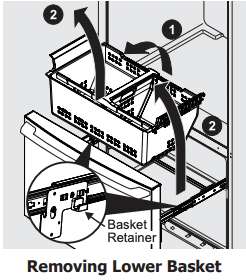
To reinstall lower basket, insert basket into retainer clips.
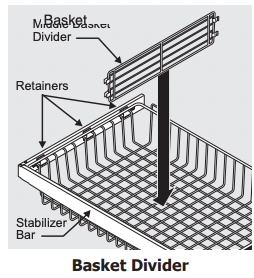
Dividers Removal
Lift up on the front of the divider and pull out.
Lift up on the rear of the lower divider and pull out.
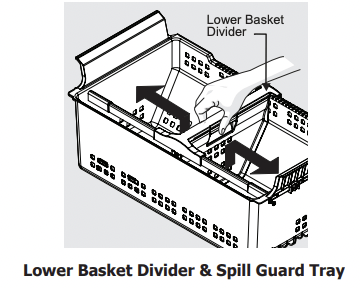
NOTE Spill Guard Tray should be hand washed in warm water.
STORING FOOD AND SAVING ENERGY
Ideas for storing foods
Fresh food storage
• Keep the fresh food compartment between 34° F and 40° F with an optimum temperature of 37° F.
• Avoid overcrowding the refrigerator shelves, which reduces air circulation and causes uneven cooling.
Fruits and vegetables
• Store fruits and vegetables in crisper drawers, where trapped moisture helps preserve food quality for longer time periods.
• Wash items and remove excess water. • Wrap any items that have strong odors or high moisture content.
Meat
• Wrap raw meat and poultry separately and securely to prevent leaks and contamination of other foods or surfaces.
• Use the deli drawer to store meat/poultry for shortterm storage. Any meat to be kept longer than two days should be frozen.
Frozen food storage
• Keep the freezer compartment at 0° F or lower.
• A freezer operates most efficiently when it is at least 2 /3 full.
Packaging foods for freezing
• To minimize food dehydration and quality deterioration, use aluminum foil, freezer wrap, freezer bags, or airtight containers. Force as much air out of the packages as possible and seal them tightly. Trapped air can cause food to dry out, change color, and develop an off-flavor (freezer burn).
• Wrap fresh meats and poultry with suitable freezer wrap prior to freezing.
• Do not refreeze meat that has completely thawed.
Loading the freezer
• Prior to grocery shopping, activate “quick freeze” so that on your return you can ensure your newly purchased food designated for the freezer will be preserved as quickly as possible.
• Activating “quick freeze” also will help your freezer more efficiently maintain the selected temperature after placing new purchases with pre-existing frozen foods.
• Avoid adding too much warm food to the freezer at one time. This overloads the freezer, slows the rate of freezing, and can raise the temperature of frozen foods.
• Leave a space between packages, so cold air can circulate freely, allowing food to freeze as quickly as possible.
Ideas for saving energy
Installation
• Locate the refrigerator in the coolest part of the room, out of direct sunlight, and away from heating ducts or registers.
• Do not place the refrigerator next to heat-producing appliances such as a range, oven, or dishwasher. If this is not possible, a section of cabinetry or an added layer of insulation between the two appliances will help the refrigerator operate more efficiently.
• Level the refrigerator so that the doors close tightly.
Temperature settings
• Refer to the “Controls” section for procedures on temperature settings.
Food storage
• Avoid overcrowding the refrigerator or blocking cold air vents. Doing so causes the refrigerator to run longer and use more energy.
• Cover foods and wipe containers dry before placing them in the refrigerator. This cuts down on moisture build-up inside the unit.
• Organize the refrigerator to reduce door openings. Remove as many items as needed at one time and close the door as soon as possible.
• Do not place a hot container directly on a cold shelf. Remember, such an extreme temperature change may damage the glass.
NORMAL OPERATING SOUNDS AND SIGHTS
Understanding the sounds you may hear
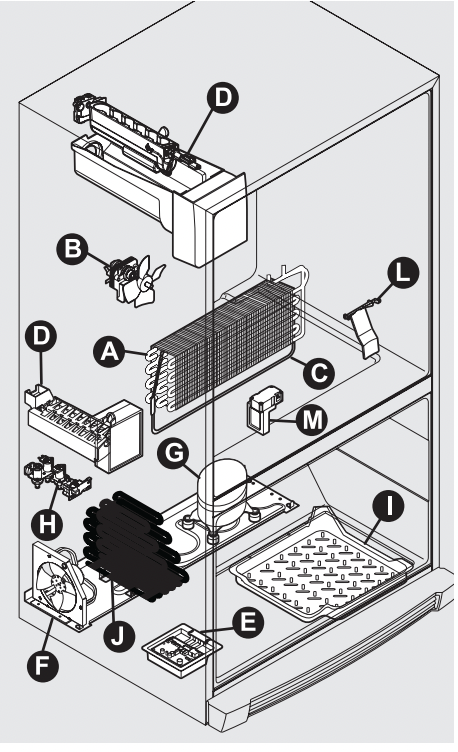
Your new, high-efficiency refrigerator may introduce unfamiliar sounds. These sounds normally indicate your refrigerator is operating correctly. Some surfaces on floors, walls, and kitchen cabinets may make these sounds more noticeable. The following is a list of major components in your refrigerator and the sounds they can cause:
- A Evaporator Refrigerant through the evaporator may create a boiling or gurgling sound.
- B Evaporator fan You may hear air being forced through the refrigerator by the evaporator fan.
- C Defrost heater During defrost cycles, water dripping onto the defrost heater may cause a hissing or sizzling sound. After defrosting, a popping sound may occur.
- D Automatic ice maker When ice has been produced, you will hear ice cubes falling into the ice bin. Ice maker fan, water valve activation, and refrigerant gas fluid may create sounds from its operation.
- E Electronic control & automatic defrost control These parts can produce a snapping or clicking sound when turning the cooling system on and off.
- F Condenser fan You may hear air being forced through the condenser.
- G Compressor Modern, high-efficiency compressors run much faster than older models. The compressor may have a high-pitched hum or pulsating sound.
- H Water valve Makes a buzzing sound each time it opens to fill the ice maker.
- I Drain pan (not removable) You may hear water dripping into the drain pan during the defrost cycle.
- J Condenser May create minimal sounds from forced air.
- L Ice dispensing paddle When dispensing ice, you will hear a snapping, clicking, or popping sound when the solenoid opens and closes the ice chute.
- M Motorized damper May produce a light humming during operation.
NOTE Energy efficient foam in your refrigerator is not a sound insulator.
NOTE During automatic defrost cycle, a red glow in the back wall vents of your freezer compartment is normal.
CHANGING THE FILTER
Locating the Filters
Your refrigerator is equipped with water filtering system. The water filter system filters all dispensed drinking water, as well as the water used to produce ice.
Water Filter
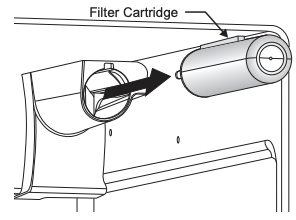
The water filter is located at the top right side of the fresh food compartment.
Replacing the Water Filter
In general, you should change the water filter every six months to ensure the highest possible water quality. Water Filter Status on the user interface prompts you to replace the filter after a standard amount of water (200 gallons/757 liters for PureSource UltraTM) has flowed through the system. If your refrigerator has not been used for a period of time (during moving for example), change the filter before reinstalling the refrigerator.
Ordering Replacement Filters
To order your replacement filters, please visit our online store at www.frigidaire.com/store, by calling toll-free at 877-808-4195, or by visiting the dealer where you purchased your refrigerator. Frigidaire recommends that you order extra filters when you first install your refrigerator, and that you replace your filters at least once every six months. Here is the product number to request when ordering:
PureSource UltraTM Water Filter
Part #ULTRAWF
NOTE When ordering your replacement filter, please reorder the same filter type that is currently in your refrigerator
Test & certification results:
• Rated Capacity - 200 gallons/757 liters for PureSource UltraTM ice and water filter
• Rated service flow - .50 gallons per minute
• Operating Temp: Min. 33°F, Max. 100°F
• Maximum Rated Pressure - 100 pounds per square inch
• Recommended Minimum Operating Pressure: 30 pounds per square inch
To replace your PureSource UltraTMwater filter:
It is not necessary to turn the water supply off to change the filter. Be ready to wipe up any small amounts of water released during the filter replacement.
1 Turn Off the ice maker power switch.
2 Remove the filter by pushing on the end/face of the filter.
3 Slide the old water filter cartridge straight out of the housing and discard it.
4 Unpackage the new filter cartridge. Using the alignment guide, slide it gently into the filter housing until it stops against the snap-in connector at the back of the housing.
5 Push firmly until the cartridge snaps into place (you should hear a click as the cartridge engages the snap-in connector).
6 Press a drinking glass against the water dispenser while checking for any leaks at the filter housing. Any spurts and sputters that occur as the system purges air out of the dispenser system are normal.
7 After filling one glass of water, continue flushing the system for about four minutes.
8 Turn On the ice maker.
9 Press and hold the Water Filter button on the Ice & Water Dispenser control panel for three seconds. When the display changes from Red to Green, the status has been reset.
Air filter (select models)
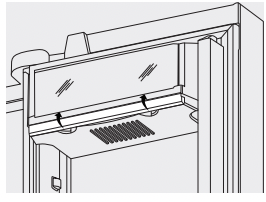
The air filter is located under the utility bin.
Replacing your PureAdvantageTM air filter
To ensure optimal filtering of refrigerator odors, you should change the air filter every six months (the filter status light on the Touch Panel prompts you to replace the filter after six months).
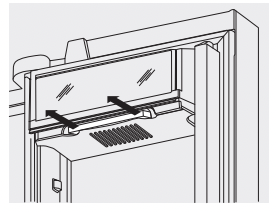
1 Open the air filter door.
2 Remove the old filter and discard it.
3 Unpack the new filter and slide it into the housing. The open face of the filter should be installed facing downward.
4 To close the air filter door, push the top and bottom to lock the door closed.
5 Press and hold the Air Filter Reset button on the control panel for three seconds. When the display changes from “Replace” to “Good,” the status has been reset.
6 The Air Filter Reset will turn itself off after a few seconds.
CARE & CLEANING
Protecting your investment
Keeping your refrigerator clean maintains its appearance and prevents odor build-up. Wipe up any spills immediately and clean the freezer and fresh food compartments at least twice a year.
NOTE Do not use abrasive cleaners such as window sprays, scouring cleansers, flammable fluids, cleaning waxes, concentrated detergents, bleaches, or cleansers containing petroleum products on plastic parts, interior doors, gaskets, or cabinet liners. Do not use paper towels, scouring pads, or other abrasive cleaning materials.
• Never use metallic scouring pads, brushes, abrasive cleaners, or strong alkaline solutions on any surface.
• Never use CHLORIDE or cleaners with bleach to clean stainless steel.
• Do not wash any removable parts in a dishwasher.
• Always unplug the electrical power cord from the wall outlet before cleaning.
NOTE If you set your temperature controls to turn off cooling, power to lights and other electrical components will continue until you unplug the power cord from the wall outlet.
• Remove adhesive labels by hand. Do not use razor blades or other sharp instruments which can scratch the appliance surface.
• Do not remove the serial plate. Removal of your serial plate voids your warranty.
• Before moving your refrigerator, raise the anti-tip brackets so the rollers will work correctly. This will prevent the floor from being damaged.
Refer to the guide on the next page for details on caring and cleaning specific areas of your refrigerator
CAUTION
• Pull the refrigerator straight out to move it. Shifting it from side to side may damage flooring. Be careful not to move the refrigerator beyond the plumbing connections.
• Damp objects stick to cold metal surfaces. Do not touch refrigerated surfaces with wet or damp hands.
IMPORTANT If you store or move your refrigerator in freezing temperatures, be sure to completely drain the water supply system. Failure to do so could result in water leaks when the refrigerator is put back into service. Contact a service representative to perform this operation.
Vacation and moving tips
Short Vacations
• Leave refrigerator operating during vacations of three weeks or less.
• Use all perishable items from refrigerator compartment.
• Turn automatic ice maker off and empty ice bucket, even if you will only be gone a few days.
Long Vacations
• Remove all food and ice if you will be gone one month or more.
• Turn the cooling system off (see “Controls” section for location of On/Off button) and disconnect power cord.
• Turn water supply valve to closed position.
• Clean interior thoroughly.
• Leave both doors open to prevent odors and mold build-up. Block doors open if necessary.
Moving
• Remove all food and ice.
• If using a handcart, load from the side.
• Adjust rollers all the way up to protect them during sliding or moving.
• Pad cabinet to avoid scratching surface.
Care and cleaning tips
Interior & Door Liners
Cleaning Agents
• Soap and water
• Baking soda and water
Tips and Precautions
• Use two tablespoons of baking soda in one quart of warm water.
• Be sure to wring excess water out of sponge or cloth before cleaning around controls, light bulb or any electrical part.
Door Gaskets
Cleaning Agents
• Soap and water
Tips and Precautions
• Wipe gaskets with a clean soft cloth.
Drawers & Bins
Cleaning Agents
• Soap and water
Tips and Precautions
• Use a soft cloth to clean drawer runners and tracks.
• Do not wash any removable items (bins, drawers, etc.) in dishwasher.
Glass Shelves
Cleaning Agents
• Soap and water
• Glass cleaner
• Mild liquid sprays
Tips and Precautions
• Allow glass to warm to room temperature before immersing in warm water.
Toe Grille
Cleaning Agents
• Soap and water
• Mild liquid sprays
• Vacuum
Tips and Precautions
• Remove toe grille (see Installation Instructions).
• Vacuum both sides and wipe with sudsy cloth or sponge. Rinse and dry.
Exterior & Handles
Cleaning Agents
• Soap and water
• Non abrasive glass cleaner
Tips and Precautions
• Do not use commercial household cleaners containing ammonia, bleach or alcohol to clean handles.
• Use a soft cloth to clean smooth handles.
• Do not use a dry cloth to clean smooth doors.
Exterior & Handles (Stainless Steel Models Only)
Cleaning Agents
• Soap and water
• Stainless steel cleaners
Tips and Precautions
• Never use CHLORIDE or cleaners with bleach to clean stainless steel.
• Clean stainless steel front and handles with non-abrasive soapy water and a dishcloth. Rinse with clean water and a soft cloth.
• Use a non-abrasive stainless steel cleaner. These cleaners can be purchased at most home improvement or major department stores. Always follow manufacturer’s instruction. Do not use household cleaners containing ammonia or bleach.
NOTE: Always clean, wipe and dry with grain to prevent scratching. • Wash the rest of the cabinet with warm water and mild liquid detergent. Rinse well and wipe dry with a clean soft cloth.
Ice Chute Extension (select models)
The ice chute extension is designed to better direct ice flow into containers.
Removing the Ice Chute Extension For Cleaning
1 Turn the refrigerator off using the button on the control panel (refer to the “Controls” section of this Manual).
2 Press inward firmly on the front of the chute and pull down.
3 Turn your refrigerator back on
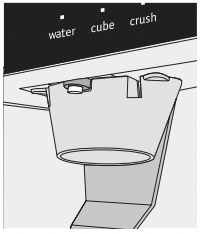
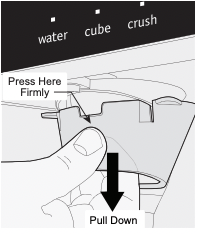
Installing the Ice Chute Extension
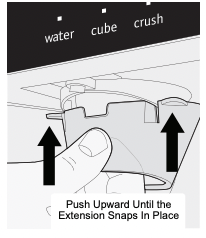
1 Turn the refrigerator off using the button on the control panel (refer to the “Controls” section of this Manual).
2 Align the extension with the ice chute so that the snap clips are just inside the front edge of the chute.
3 Push upward until the extension snaps into place.
4 Turn your refrigerator back on.
Replacing LED Lights (select models)
The fresh food compartments of your refrigerator may have LED lights. Always use Frigidaire parts for replacement.
To replace LED Lights:
1 Unplug your refrigerator’s power cord.
2 Remove lens cover.
3 Remove LED board.
4 Replace LED board and snap in place assuring the light is facing in toward the unit (inside fresh food).
5 Replace lens cover.
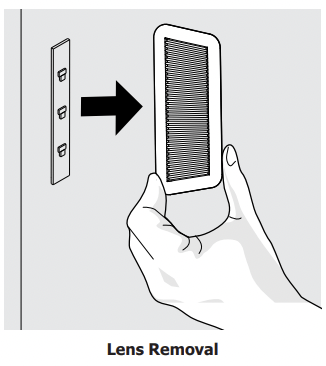
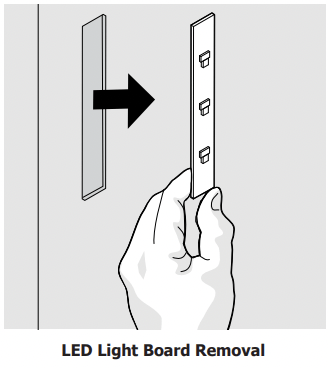
NOTE LED lights are in series so if one is bad or unplugged, several lights may not light up.
BEFORE YOU CALL
AUTOMATIC ICE MAKER
Ice maker is not making any ice.
• Ice maker is turned off.
- Turn on ice maker. For the fresh food ice maker, press and hold the “Ice Off” button for three seconds until the indicator light is off. For the freezer ice maker, lower the wire signal arm.
• Refrigerator is not connected to water line or water valve is not open.
- Connect the unit to the household water supply and ensure the water valve is open.
• The water supply line is kinked.
- Ensure that the supply line does not kink when the refrigerator is pushed into place against the wall.
• The water filter is not seated properly.
- Remove and re-install the water filter. Be sure to push the filter firmly so that you hear it lock solidly into position.
• The water filter may be clogged with foreign material.
- If water dispenses slowly or not at all, or if the filter is six months old or older, it should be replaced.
• Freezer ice maker wire signal arm is being held up by an item not allowing it to go in the on or down position.
- Move any item or frozen ice cubes that may block the signal arm from being in the on or down position. See Automatic Ice Maker-Freezer section in manual.
Ice maker is not making enough ice.
• Ice maker is producing less ice than you expect.
- The fresh food and freezer ice makers will each produce approximately 2.5 pounds of ice every 24 hours depending on usage conditions.
• The water filter may be clogged with foreign material.
- If water dispenses slower than normal, or if the filter is six months old or older, it should be replaced.
• The water supply line is kinked.
- Ensure that the supply line does not kink when the refrigerator is pushed into place against the wall.
• Saddle valve on cold water pipe is clogged or restricted by foreign material.
- Turn off household water line valve. Remove valve. Ensure that valve is not a self-piercing saddle valve. Clean valve. Replace valve if necessary
• Heavy traffic, opening or closing of the doors excessively.
- Press Fast Freeze to temporarily increase ice production rate.
• Freezer control is set too warm (freezer ice maker).
- Set freezer control to colder setting to improve performance of the ice maker (freezer ice maker). Allow 24 hours for temperature to stabilize.
Freezer ice maker will not stop making ice (select models).
• Ice maker wire signal arm is being held down by a package in the freezer that has fallen against ice maker.
- Move any item or frozen ice cubes that may block the signal arm from being in the off or upward position. See Automatic Ice Maker-Freezer section in manual.
Ice cubes are freezing together.
Ice cubes are not being used frequently enough or interruption of power for prolonged time.
• Remove ice container and discard ice. The ice maker will produce fresh supply. Ice should be used at least twice weekly to keep the cubes separated
Ice cubes are hollow (shells of ice with water inside). The hollow cubes break open in the bin and leak their water onto existing ice, which causes it to freeze together.
• This generally occurs when the ice maker does not get enough water. This is usually the result of a clogged water filter or restricted water supply. Replace the water filter and if the condition still occurs check for a Saddle Valve, water valve not turned on all the way or kinked water supply line.
DISPENSER (Ice & Water)
Dispenser will not dispense ice.
• Dispenser lock out is engaged.
- Press and hold control lock for three seconds.
• There is no ice in the bin to be dispensed.
- See the “Ice maker is not making any ice” section above.
• The refrigerator doors are not completely closed.
- Be sure the refrigerator doors are completely closed.
• Dispenser paddle has been pressed too long and the dispenser motor has overheated
- The motor overload protector will reset in about three minutes and then ice can be dispensed.
Ice dispenser is jammed.
• Ice has melted and frozen around auger due to infrequent use, temperature fluctuations, and/or power outages.
- Remove ice container, thaw, and empty the contents. Clean container, wipe dry, and replace in proper position. When new ice is made, dispenser should operate.
• Ice cubes are jammed between ice maker and back of ice container.
- Remove ice cubes that are jamming the dispenser.
Dispenser will not dispense water
• Dispenser lock out is engaged.
- Press and hold control lock for three seconds.
• Water filter not seated properly.
- Remove and reinstall the water filter. Be sure to push the filter firmly so that you hear it lock solidly into position.
• Water filter is clogged.
- Replace filter cartridge. Be sure to remove protective caps and push the filter firmly so that you hear it lock solidly into position.
• Household water line valve is not open.
- Open household water line valve. See CONCERN column AUTOMATIC ICE MAKER
Water has an odd taste and/or odor.
Water has not been dispensed for an extended period of time.
- Draw and discard 10-12 glasses of water to freshen the supply.
Unit not properly connected to cold water line.
- Connect unit to cold water line that supplies water to the kitchen faucet.
Water pressure is extremely low.
Cut-off and cut-on pressures are too low (well systems only).
- Have someone turn up the cut-off and cut-on pressure on the water pump system (well systems only).
Reverse osmosis system is in regenerative phase.
- It is normal for a reverse osmosis system to be below 20 psi during the regenerative phase.
Water not cold enough.
• As warmer tap water goes through the filter and enters the water tank, chilled water is pushed through to the dispenser. Once chilled water is used up, it will take several hours to bring the freshly replaced water to a cooler temperature.
- Add ice to cup or container before dispensing water.
OPENING/CLOSING OF DOORS/DRAWERS
Door(s) will not close.
Door was closed too hard, causing other door to open slightly.
Refrigerator is not level. It rocks on the floor when moved slightly.
- Ensure floor is level and solid, and can adequately support the refrigerator. Contact a carpenter to correct a sagging or sloping floor.
Refrigerator is touching a wall or cabinet.
- Ensure floor is level and solid, and can adequately support the refrigerator. Contact a carpenter to correct a sagging or sloping floor.
Drawers are difficult to move.
• Food is touching shelf on top of drawer.
- Remove top layer of items in drawer.
- Ensure drawer is properly installed on track.
• Track that drawers slide on is dirty.
- Clean drawer, rollers, and track. See Care & Cleaning.
Compressor goes off and on frequently.
Thermostat keeps the refrigerator at a constant temperature.
- This is normal. Refrigerator goes on and off to keep temperature constant.
DIGITAL TEMPERATURE DISPLAY
Digital temperature displays are flashing.
Electronic control system has detected a performance problem.
- Call your Frigidaire service representative, who can interpret any messages or number codes flashing on the digital displays.
WATER/MOISTURE/FROST INSIDE REFRIGERATOR
Moisture collects on inside of refrigerator walls.
Weather is hot and humid.
- The rate of frost buildup and internal sweating increases.
Door is slightly open.
- See CONCERN column OPENING/CLOSING OF DOORS/DRAWERS.
Water collects on bottom side of drawer cover.
Vegetables contain and give off moisture.
- It is not unusual to have moisture on the bottom side of the cover.
- Move humidity control (some models) to lower setting.
Water collects in bottom of drawer.
Washed vegetables and fruit drain while in the drawer.
- Dry items before putting them in the drawer. Water collecting in bottom of drawer is normal.
WATER/MOISTURE/FROST OUTSIDE REFRIGERATOR
Moisture collects on outside of refrigerator or between doors.
Weather is humid.
- This is normal in humid weather. When humidity is lower, the moisture should disappear.
Door is slightly open, causing cold air from inside refrigerator to meet warm air from outside. •
- See CONCERN column OPENING/CLOSING OF DOORS/DRAWERS.
RUNNING OF REFRIGERATOR
Compressor does not run.
• Freezer control is set to “OF” or “0”.
• Refrigerator is in defrost cycle.
- This is normal for a fully automatic defrost refrigerator. The defrost cycle occurs periodically, lasting about 30 minutes.
• Plug at electrical outlet is disconnected.
- Ensure plug is tightly pushed into outlet.
• House fuse blown or tripped circuit breaker.
- Check/replace fuse with a 15 amp time-delay fuse. Reset circuit breaker.
• Power outage.
- Check house lights. Call local electric company.
Refrigerator runs too much or too long.
Room or outside weather is hot.
- It’s normal for the refrigerator to work longer under these conditions.
Doors are opened too frequently or too long.
- Warm air entering the refrigerator causes it to run more. Open doors less often.
Fresh Food/freezer door may be slightly open.
- Ensure refrigerator is level. Keep food and contains from blocking door. See CONCERN column OPENING/ CLOSING OF DOORS/DRAWERS.
Freezer control is set too cold.
- Set Fresh Food control to warmer setting until refrigerator temperature is satisfactory. Allow 24 hours for temperature to stabilize.
Fresh Food/freezer gasket is dirty, worn, cracked, or poorly fitted.
- Clean or change gasket. Leaks in door seal will cause refrigerator to run longer in order to maintain desired temperatures.
Condenser is dirty
- Clean condenser. See Care & Cleaning.
Compressor goes off and on frequently.
Thermostat keeps the refrigerator at a constant temperature.
- This is normal. Refrigerator goes on and off to keep temperature constant