Owner’s Manual
OWNER’S
MANUAL
2023 CRF150R/RB

This manual should be considered a permanent part of the vehicle
and should remain with the vehicle when it is resold.
This publication includes the latest production information available
before printing. Honda Motor Co., Ltd. reserves the right to make
changes at any time without notice and without incurring any
obligation.
No part of this publication may be reproduced without written
permission.
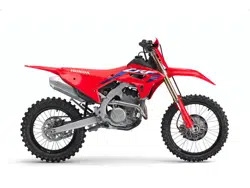
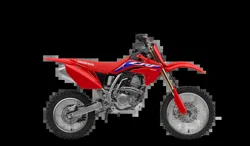
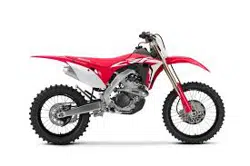
The vehicle pictured in this owner’s manual may not match your
actual vehicle.
© 2022 Honda Motor Co., Ltd.

IMPORTANT NOTICE
FOR COMPETITION USE ONLY
This vehicle is designed, manufactured and sold for closed-course
competition use only. It does not conform to Federal Motor Vehicle
Safety Standards or U.S. EPA Noise and Emission Standards.
Operation on public streets, roads, highways or for off-road
recreation is illegal.
State and federal laws prohibit operation of this vehicle except in an
organized racing or competitive event on a closed course, or by
permit issued by the local governmental jurisdiction. This vehicle is
sold “as is” with no warranties.
This vehicle does not conform to AMA noise emission regulation for
2022 year.
FOR EXPERIENCED RIDERS, NO PASSENGERS
This vehicle is designed as an operator-only vehicle and for use by
experienced riders only. The load limit and seating configuration do
not safely permit the carrying of a passenger.

Welcome
Congratulations on your purchase of a new
Honda vehicle. Your selection of a Honda
makes you part of a worldwide family of
satisfied customers who appreciate Honda's
reputation for building quality into every
product.
Your vehicle is a high performance racing
motorcycle that utilizes the latest motocross
technology and is intended for competition
use in sanctioned, closed-course events by
experienced riders only.
Be aware that motocross is a physically
demanding sport that requires more than
just a fine vehicle. To do well, you must be in
excellent physical condition and be a skillful
rider. For the best results, work diligently on
your physical conditioning and practice
frequently.
To ensure your safety and riding pleasure:
● Read this owner's manual and
competition handbook carefully.
● Follow all recommendations and
procedures contained in this owner's
manual and competition handbook.
● Pay close attention to safety messages
contained in this owner's manual,
competition handbook, and on the
vehicle.
To protect your investment, we urge you to
take responsibility for keeping your vehicle
well-serviced and maintained. Also, observe
the break-in guidelines and always perform
the pre-ride inspection and other periodic
checks in this manual.

When service is required, remember that
your Honda dealer knows your vehicle best.
If you have the required mechanical “know-
how” and tools, you can purchase an official
Honda Service Manual to help you perform
many maintenance and repair tasks. 2 P. 45
You may also want to visit our website at
www.powersports.honda.com.
Canada
www.honda.ca.
Happy riding!
A Few Words About Safety
Your safety, and the safety of others, is very
important. Operating this vehicle safely is an
important responsibility.
To help you make informed decisions about
safety, we have provided operating
procedures and other information on safety
labels in this owner's manual, and
competition handbook. This information
alerts you to potential hazards that could
hurt you or others.
Of course, it is not practical or possible to
warn you about all hazards associated with
operating or maintaining a vehicle. You must
use your own good judgment.
You will find important safety information in a
variety of forms, including:
● Safety labels on the vehicle
●
Safety Messages preceded by a safety alert
symbol and one of three signal words:
DANGER, WARNING, or CAUTION.
These signal words mean:
3DANGER
You WILL be KILLED or SERIOUSLY
HURT if you don’t follow instructions.
3WARNING
You CAN be KILLED or SERIOUSLY
HURT if you don’t follow instructions.
3CAUTION
You CAN be HURT if you don’t follow
instructions.
Other important information is
provided under the following titles:
NOTICE
Information to help you avoid
damage to your vehicle, other
property, or the environment.

Safety Guidelines................................................. P. 3
Safety Labels......................................................... P. 6
Safety Precautions...............................................P. 7
Riding Precautions .............................................. P. 8
Accessories & Modifications............................. P. 9
This section contains important information for safe riding of your vehicle.
Please read this section carefully.
Vehicle Safety

Safety Guidelines
Follow these guidelines to enhance your safety:
● Perform all routine and regular inspections
specified in this owner's manual and
competition handbook.
● Stop the engine and keep sparks and flames
away before filling the fuel tank.
● Do not run the engine in enclosed or partly
enclosed areas. Carbon monoxide in
exhaust gases is toxic and can kill you.
Always Wear a Helmet
It's a proven fact: helmets and protective
apparel significantly reduce the number and
severity of head and other injuries. So always
wear an approved helmet and protective
apparel. 2 P. 7
Before Riding
Make sure that you are physically fit, mentally
focused, and free of alcohol and drugs. Check
that you are wearing an approved helmet and
protective apparel.
Take Time to Get to Know Your Vehicle
Because every vehicle is unique, take time to
become thoroughly familiar with how this one
operates and responds to your commands
before placing your machine, and yourself, in
competition.
Ride within Your Limits
Never ride beyond your personal abilities or
faster than conditions warrant. Fatigue and
inattention can impair your ability to use good
judgment and ride safely.
Never Carry a Passenger
There are no handholds, seat, or footrests to
carry a passenger.
Safety Guidelines
Vehicle Safety
3
Continued
Don't Drink or Use Drugs and Ride
Alcohol or drugs and riding don't mix. Even one
alcoholic drink can reduce your ability to
respond to changing conditions, and your
reaction time gets worse with every additional
drink. The same is true for drug use. Don't drink
or use and ride, and don't let your friends do it
either.
Keep Your Honda in Safe Condition
Maintaining your vehicle properly is critical to
your safety. A loose bolt, for example, can cause
a breakdown in which you can be seriously
injured.
Important Message to Parents
Your child's safety is very important to Honda.
That's why we urge you to read this message
before you let any young person ride this
vehicle. Competitive riding can be fun. But bad
judgment can result in injury, and we don't want
that to happen. As a parent, you can help
prevent accidents by making good decisions
about when and how your youngster rides this
vehicle.
● Remember, this vehicle is designed only for
competition use by experienced junior
riders. It is an operator-only model, and the
maximum load capacity is 150 lb (68 kg).
Rider weight must not exceed this limit.
● The junior rider must be tall enough to hold
the vehicle up while straddling it with both
feet on the ground. They must also be
strong enough to pick up the vehicle if it is
on its side.
●
The parent and junior rider must be fully
familiar with the vehicle, the vehicle controls,
and control functions. Both must also fully
understand everything in this manual before
riding begins.
●
For your child's safety, be sure to make
prepractice and pre-race inspections, and
impress on the junior rider the importance
of checking all the items thoroughly before
riding.
Safety Guidelines
Vehicle Safety
4
Carbon Monoxide Hazard
Exhaust contains poisonous carbon monoxide, a
colorless, odorless gas. Breathing carbon
monoxide can cause loss of consciousness and
may lead to death.
If you run the engine in a confined or even
partly enclosed area, the air you breathe could
contain a dangerous amount of carbon
monoxide.
Never run your vehicle inside a garage or other
enclosure.
3WARNING
Running the engine of your vehicle
while in an enclosed or even partially
enclosed area can cause a rapid build-
up of toxic carbon monoxide gas.
Breathing this colorless, odorless gas
can quickly cause unconsciousness and
lead to death.
Only run your vehicle's engine when it
is located in a well ventilated area
outdoors.
Safety Guidelines
Vehicle Safety
5
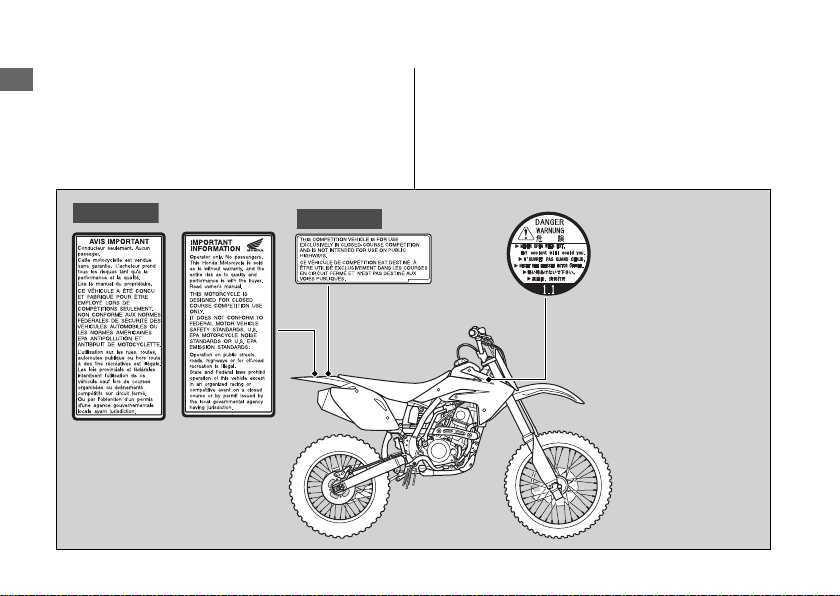
Safety Labels
Safety and information labels on your vehicle
provide important safety information and may
warn you of potential hazards that could cause
serious injury. Read these labels carefully and
don't remove them.
If a label comes off or becomes hard to read,
contact your dealer for a replacement.
Safety Labels
Vehicle Safety
6
For Canada
For Canada

Safety Precautions
Protective Apparel
Make sure that you are wearing an approved
helmet, eye protection, and other appropriate
riding gear.
#
Helmet
Should be safety-standard certified, high-
visibility, and the correct size for your head.
● Must fit comfortably but securely, with the
chin strap fastened
● Approved eye protection
USA
Look for a DOT (Department of
Transportation) certification label on any helmet
you buy.
3WARNING
Not wearing a helmet increases the
chance of serious injury or death in a
crash.
Make sure that you always wear an
approved helmet, eye protection, and
protective apparel.
#
Protective Gear
Whether you’re practicing to improve your skills
or riding in competition, always wear an
approved helmet, eye protection, and proper
protective gear.
Safety Precautions
Vehicle Safety
7

Riding Precautions
Break-in Period
During the first operating day or 15 miles (25
km) of running, follow these guidelines to
ensure your vehicle's future reliability and
performance.
● Avoid full-throttle starts and rapid
acceleration.
● Avoid hard braking and rapid down-shifts.
● Ride conservatively.
This same procedure should be followed each
time when:
● Piston is replaced
● Piston rings are replaced
● Cylinder is replaced
● Crankshaft or crank bearings are replaced
Refueling and Fuel Guidelines
Follow these guidelines to protect the engine
and fuel system:
● Use only unleaded gasoline.
● Use the recommended octane number.
Using lower octane gasoline will result in
decreased engine performance.
● Do not use fuels containing a high
concentration of alcohol. 2 P. 44
● Do not use stale or contaminated gasoline
or an oil/gasoline mixture.
● Avoid getting dirt or water in the fuel tank.
Riding Precautions
Vehicle Safety
8

Accessories &
Modifications
We strongly advise that you do not add any
accessories that were not specifically designed
or approved for your vehicle by Honda or make
modifications to your vehicle from its original
design. Doing so can make it unsafe.
3WARNING
Improper accessories or modifications
can cause a crash in which you can be
seriously hurt or killed.
Follow all instructions in this owner's
manual regarding accessories and
modifications.
Do not pull a trailer with, or attach a sidecar to,
your vehicle. Your vehicle was not designed for
these attachments, and their use can seriously
impair your vehicle's handling.
Do not attempt to modify the vehicle to carry a
passenger. The subframe was not designed to
carry the additional weight of a passenger.
Accessories & Modifications
Vehicle Safety
9
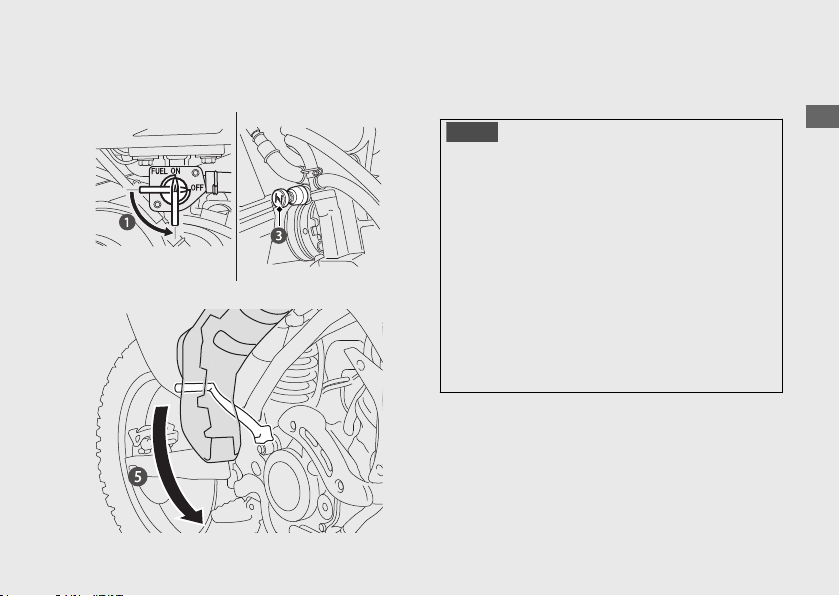
Fuel Valve
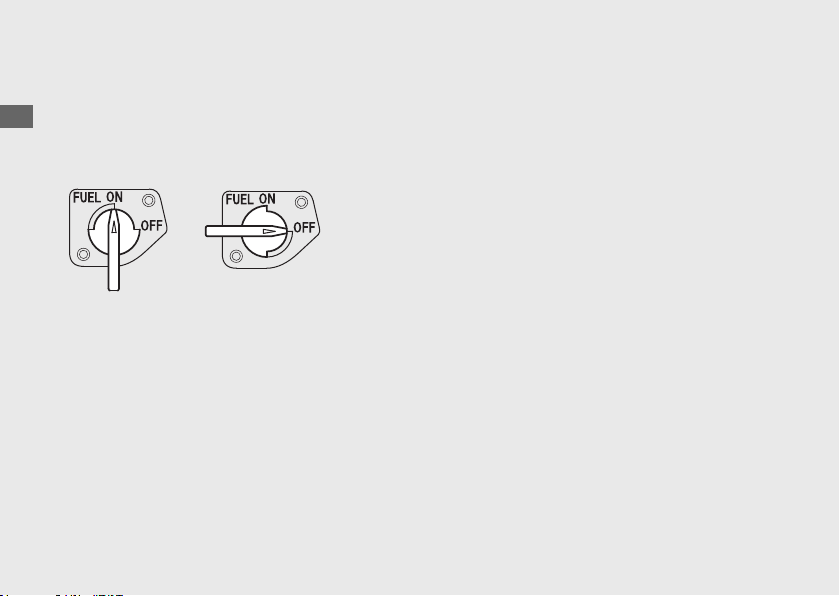
The two-way fuel valve is used to control the
flow of fuel from the fuel tank to the
carburetor.
ON: normal position for riding.
OFF: for stopping, storing, or transportation.
Operation Guide
12
OFF
ON
Starting the Engine
Start your engine using the following procedure.
To restart a warm engine, follow the
procedure for “Warm Engine Starting”.
NOTICE
• Extended fast idling and revving the engine
can damage the engine and the exhaust
system.
• Snapping the throttle or fast idling for more
than about 5 minutes may cause exhaust
pipe discoloration.
•
Do not operate the kickstarter while the
engine is running as engine damage could
result. Do not apply excessive force on the
kickstarter.
• Fold up the kickstarter after the kickstarter is
returned to the pedal stop.
Operation Guide
13
Continued

Cold Engine Starting
a
Turn the fuel valve ON.
b
Shift the transmission into neutral.
c
If the temperature is 95°F (35°C) or below,
pull the choke knob fully out.
d
If the temperature is below 32°F (0°C), open
the throttle two or three times.
u The engine requires a richer mixture for
starting in cold weather. When the
throttle is so opened, the accelerator
pump will feed extra fuel to the cylinder,
thereby facilitating starting in cold
weather.
e
With the throttle closed, operate the
kickstarter starting from the top of the
kickstarter stroke, and kick through to the
bottom of the stroke with a rapid,
continuous motion.
u Do not open the throttle, As the
carburetor is equipped with an
accelerator pump, excessive fuel will be
charged into the engine, and the spark
plug will be fouled if the throttle is
opened and closed repeatedly. Excessive
fuel in the engine makes kickstarting
difficult.
f
About a minute after the engine starts, push
the choke knob all the way to fully OFF. If
idling is unstable, open the throttle slightly.
Operation Guide
14
Starting the Engine (Continued)
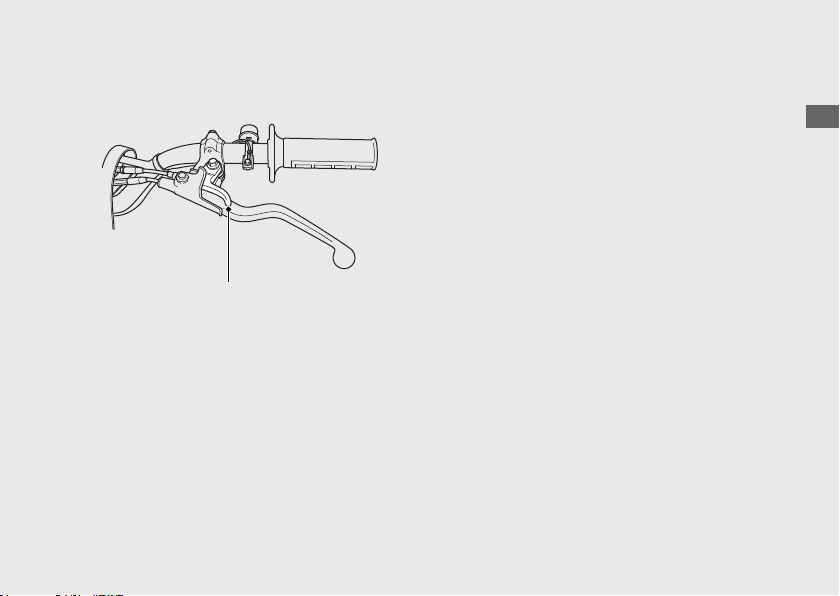
Warm Engine Starting
a
Turn the fuel valve ON.
b
Shift the transmission into neutral.
c
Pull the hot start lever and kick-start the
engine.
u
Do not open the throttle.
d
As soon as the engine starts, release the hot
start lever.
Starting the engine after a stall during
riding or after a fall
a
Shift the transmission into neutral.
b
Pull the hot start lever and kick-start the
engine.
u Do not open the throttle.
c
As soon as the engine starts, release the hot
start lever.
Operation Guide
15
Continued
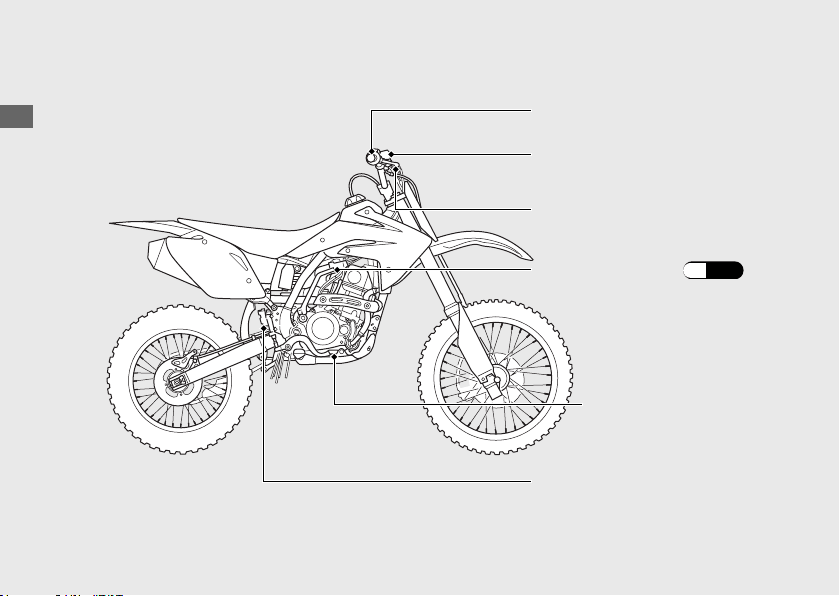
Hot start lever
Starting the engine excessively charged
with fuel by throttle blipping or other
reasons
If the engine fails to start after repeated
attempts, it may be flooded with excess fuel.
To clear a flooded engine:
a
Shift the transmission into neutral.
b
With the throttle fully opened, repeat
kickstarter operation approximately ten
times very slowly to discharge excessive fuel
from the engine.
c
Pull the hot start lever and kick-start the
engine.
u
Do not open the throttle.
d
As soon as the engine starts, release the hot
start lever.
When you stop the engine
#
Normal Engine Stop
a
Shift the transmission into neutral.
b
Turn the fuel valve OFF.
c
Lightly open the throttle two or three times,
and then close it.
d
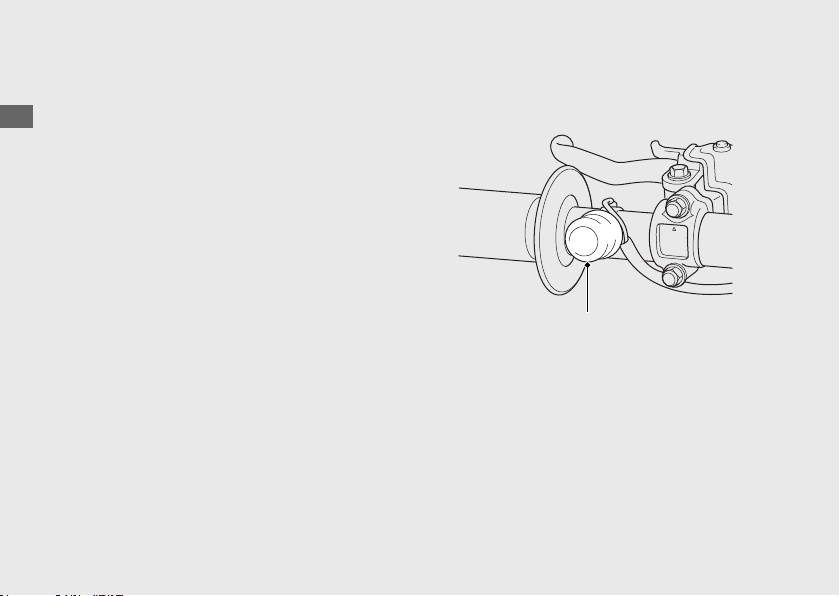
Push and hold the engine stop button until
the engine stops completely.
Failure to close the fuel valve may cause the
carburetor to overflow, result in hard starting.
Operation Guide
16
Starting the Engine (Continued)
Engine stop button

#
Emergency Engine Stop
To stop the engine in an emergency, push
and hold the engine stop button.
Operation Guide
17
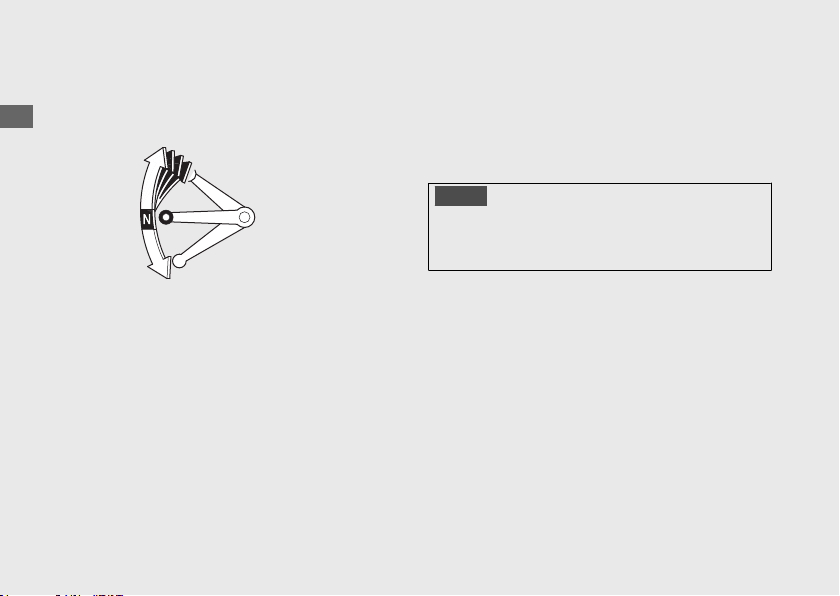
Shifting Gears
Your vehicle transmission has 5 forward
gears in a one-down, four-up shift pattern.
a
After the engine has been warmed up, the
vehicle is ready for riding.
b
While the engine is idling, pull in the clutch
lever and depress the shift lever to shift into
1st (low) gear.
c
Slowly release the clutch lever and at the
same time gradually increase engine speed
by opening the throttle. Coordination of the
throttle and clutch lever will assure a smooth
positive start.
NOTICE
When moving off from a standing start, be
careful not to use too much throttle. The vehicle
may “wheelie” over backwards.
d
When the vehicle attains a moderate speed,
close the throttle, pull in the clutch lever and
shift to 2nd gear by raising the shift lever.
Operation Guide
18
1
4
3
2
5
e
This sequence is repeated to progressively
shift to 3rd, 4th, and 5th (top) gear. Raise
the shift lever to shift to a higher gear and
depress it to downshift. Each stroke of the
shift lever engages the next gear in
sequence. The shift lever automatically
returns to the horizontal position when
released.
NOTICE
Downshifting can help slow your vehicle,
especially on downhills. However, downshifting
when engine rpm is too high can cause engine
damage.
NOTICE
Improper shifting can damage the engine,
transmission, and drive train. Also, coasting or
towing the vehicle for long distances with the
engine off can damage the transmission.
Operation Guide
19
Refueling
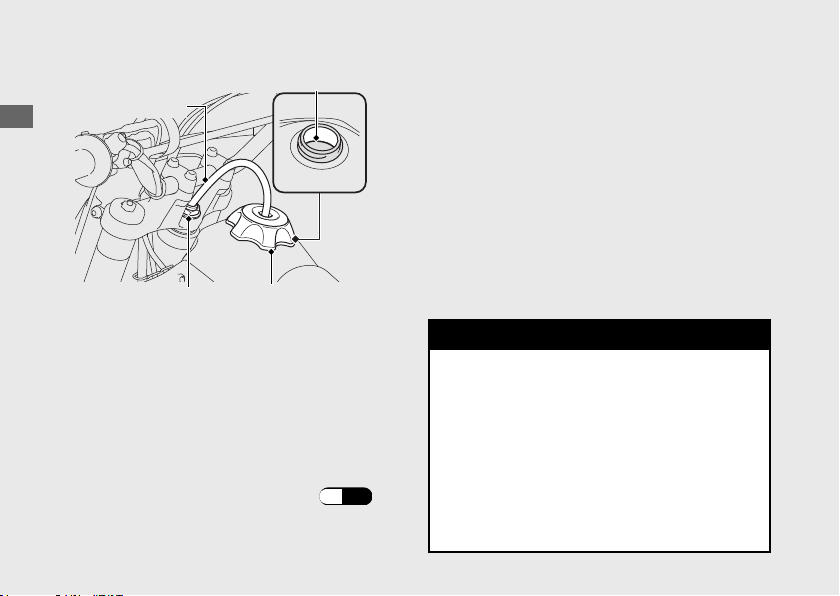
Do not fill with fuel above the lower edge of
the filler neck.
Fuel type: Unleaded gasoline only
Recommended fuel octane number:
Pump Octane Number (PON) 91 or higher.
Tank capacity: 1.14 US gal (4.3 L)
#
Refueling and Fuel Guidelines (P.8
)
Opening the Fuel Fill Cap
a
Pull the breather tube out of the steering
stem nut.
b
Turn the fuel fill cap counterclockwise and
remove it.
Closing the Fuel Fill Cap
a
After refueling, close the fuel fill cap
securely.
b
Insert the breather tube in the steering stem
nut.
3WARNING
Gasoline is highly flammable and
explosive. You can be burned or
seriously injured when handling fuel.
• Stop the engine, and keep heat,
sparks, and flames away.
• Only handle fuel outdoors.
• Wipe up spills immediately.
Operation Guide
20
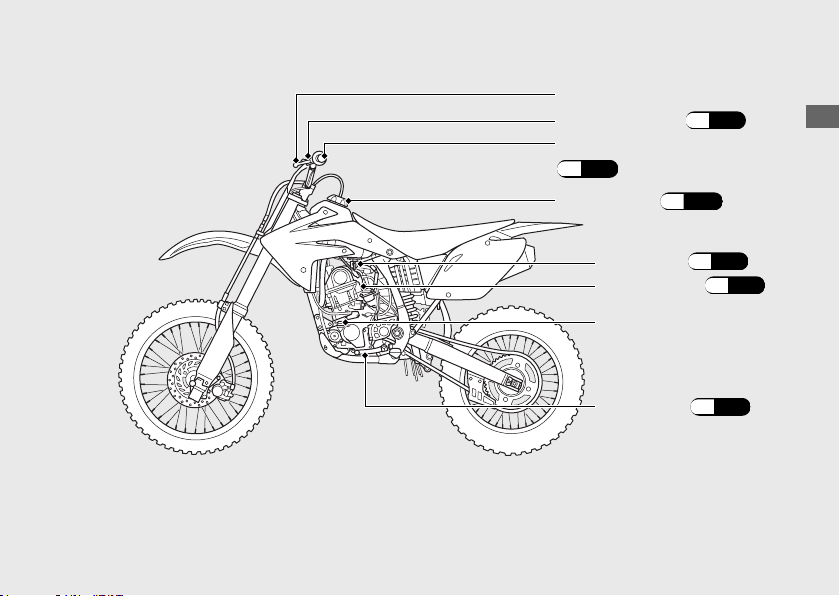
Fuel fill cap
Lower edge of filler neck
Steering stem nut
Breather tube

Importance of Maintenance ........................... P. 22
Maintenance Schedule..................................... P. 23
Maintenance Fundamentals ...........................P. 26
Please read “Importance of Maintenance”, “Maintenance Fundamentals” and “Competition
Handbook” carefully before attempting any maintenance. Refer to “Competition
Handbook” for service data.
Maintenance
Importance of Maintenance
Importance of Maintenance
Keeping your vehicle well-maintained is
absolutely essential to your safety and to
protect your investment, obtain maximum
performance, avoid breakdowns, and reduce air
pollution. Maintenance is the owner's
responsibility. Be sure to inspect your vehicle
before each ride and perform the periodic
checks specified in the Maintenance Schedule.
2 P. 23
3WARNING
Improperly maintaining your vehicle or
failing to correct a problem before you
ride can cause a crash in which you can
be seriously hurt or killed.
Always follow the inspection and
maintenance recommendations and
schedules in this owner's manual and
competition handbook.
Maintenance Safety
Always read the maintenance instructions
before you begin each task and make sure that
you have the tools, parts, and skills required.
We cannot warn you of every conceivable
hazard that can arise in performing
maintenance. Only you can decide whether or
not you should perform a given task.
Follow these guidelines when performing
maintenance.
●
Stop the engine.
●
Place your vehicle on a firm, level surface
using an optional workstand or a
maintenance stand to provide support.
●
Allow the engine, muffler, brakes, and other
high-temperature parts to cool before
servicing as you can get burned.
●
Run the engine only when instructed, and
do so in a well-ventilated area.
Maintenance
22

Maintenance Schedule
To maintain the safety and reliability of your
vehicle, regular inspection and service is
required as shown in the Maintenance Schedule
that follows.
The Maintenance Schedule lists items that can
be performed with basic mechanical skills and
hand tools. Procedures for these items are
provided in Competition Handbook. The
Maintenance Schedule also includes items that
involve more extensive procedures and may
require special training, tools, and equipment.
Therefore, we recommend that you have your
dealer perform these tasks unless you have
advanced mechanical skills and the required
tools. Procedures for items in this schedule are
provided in an official Honda Service Manual
available for purchase from your dealer. 2 P. 45
Service intervals in the maintenance schedule
are expressed in terms of motos and riding
hours. To avoid overlooking required service,
we urge you to develop a convenient way to
record the number of motos and/or hours you
ride.
If you do not feel capable of performing a given
task or need assistance, remember that your
Honda dealer knows your vehicle best and is
fully equipped to maintain and repair it. If you
decide to do your own maintenance, use only
Honda Genuine Parts or their equivalents for
repair or replacement to ensure the best quality
and reliability.
Make sure whoever performs the scheduled
maintenance completes the maintenance
record. Retain all service documents. If you sell
your vehicle, these service documents should
be transferred with the vehicle to the new
owner.
Maintenance
23
Continued
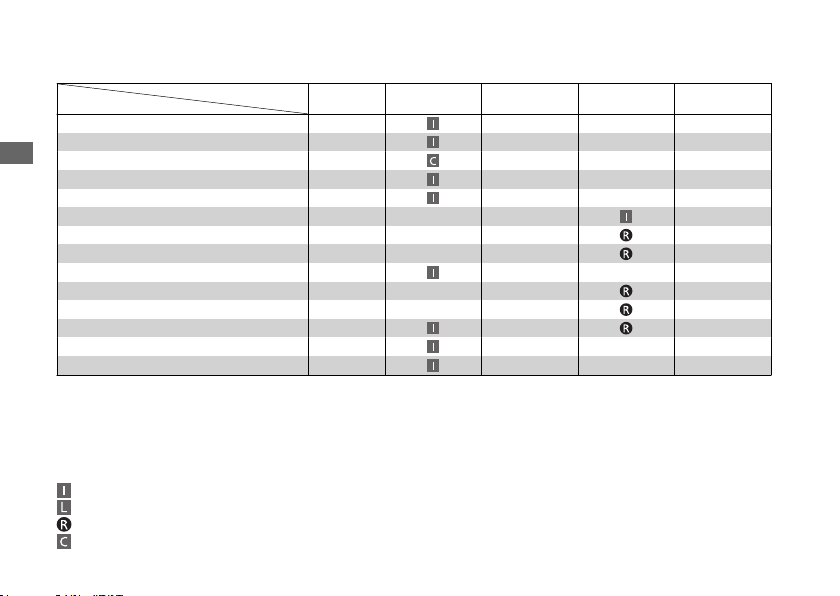
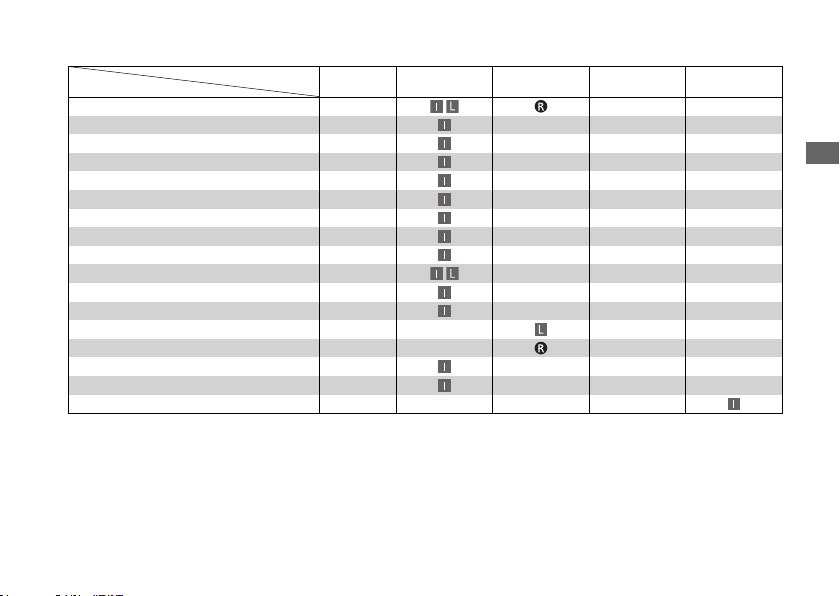
Perform the Pre-ride Inspection (2 P. 26) at each scheduled maintenance period.
Frequency
Items
NOTE
Each race or about
2.5 hours
Every 3 races or
about 7.5 hours
Every 6 races or
about 15.0 hours
Every 9 races or
about 22.5 hours
Throttle Operation
Hot Starter
Air Filter
NOTE 1
Crankcase Breather
Spark Plug
Valve Clearance/Decompressor System
NOTE 4
Engine Oil
NOTE 3
Engine Oil Filter
NOTE 3
Engine Idle Speed
Piston and Piston Rings
Piston Pin
Transmission Oil
NOTE 5
Radiator Coolant
NOTE 2
Cooling System
WE RECOMMEND THESE ITEMS BE SERVICED BY REFERRING TO THE OFFICIAL HONDA SERVICE
MANUAL.
This maintenance schedule is based upon average riding condition. Machine subjected to severe use
require more frequent servicing.
Maintenance Legend
:
:
:
:
Inspect (clean, adjust, lubricate, or replace, if necessary)
Lubricate
Replace
Clean
Maintenance Schedule
Maintenance
24
Frequency
Items
NOTE
Each race or about
2.5 hours
Every 3 races or
about 7.5 hours
Every 6 races or
about 15.0 hours
Every 9 races or
about 22.5 hours
Drive Chain
Drive Chain Slider
Drive Chain Roller
Drive Sprocket
Driven Sprocket
Brake Fluid
NOTE 2
Brake Pads Wear
Brake System
Clutch System
NOTE 5
Control Cables
Exhaust Pipe/Muffler
Suspension
Swingarm/Shock Linkage
Fork Oil
NOTE 3
Nuts, Bolts, Fasteners
Wheels/Tires
Steering Head Bearings
Notes: 1 : Clean after every moto or after dusty riding conditions. 4 : Inspect after the first break-in ride.
2 : Replace every 2 years. Replacement requires
mechanical skill.
5 : Replace the transmission oil if the clutch discs
and plates are replaced.
3 : Replace after the first break-in ride.
Maintenance Schedule
Maintenance
25
Maintenance Fundamentals
Pre-ride Inspection
To ensure safety, it is your responsibility to
perform a pre-ride inspection and make sure
that any problem you find is corrected. A pre-
ride inspection is a must, not only for safety, but
because having a breakdown, or even a flat tire,
can be a major inconvenience.
Refer to the Competition Handbook for
procedures.
Competitive riding can be tough on a vehicle,
so it’s important to inspect your vehicle and
correct any problems you find before each ride.
Check the following before each ride:
●
Engine oil level
●
Transmission oil level
●
Fuel line for condition
●
Coolant for proper level
●
Cooling system and hoses for condition
●
Spark plug for proper heat range, carbon fouling
and spark plug wire terminal for looseness
● Air cleaner for condition and contamination
● Clutch lever freeplay
● Hot start lever freeplay
● Breather drain for cleaning
● Steering head bearing and related parts for
condition
● Throttle operation
●
Tires for damage or improper inflation pressure
● Spokes for looseness
● Rim locks for looseness
●
Front and rear suspension for proper operation
● Front and rear brakes, check operation
●
Drive chain for correct slack and adequate
lubrication
●
Drive chain sliders and drive chain rollers for
damage or wear
●
Exhaust pipe/Muffler for looseness
●
Every possible part for looseness (such as
cylinder head bolts, engine mounting bolts/
nuts, axle nuts, handlebar holder bolts, fork
bridge pinch bolts, drive chain adjuster, lock
nuts, drive chain roller bolt/nut, wire harness
connectors)
Maintenance
26
Between Motos & Practice
Maintenance
After practice, or between motos, you have a
chance to make additional checks and
adjustments.
•
Clean accumulated dirt from under the
fenders and off the wheels, suspension
components, handgrips, controls, and
footpegs. A stiff, nylon parts cleaning brush
works well.
• Check tire air pressure.
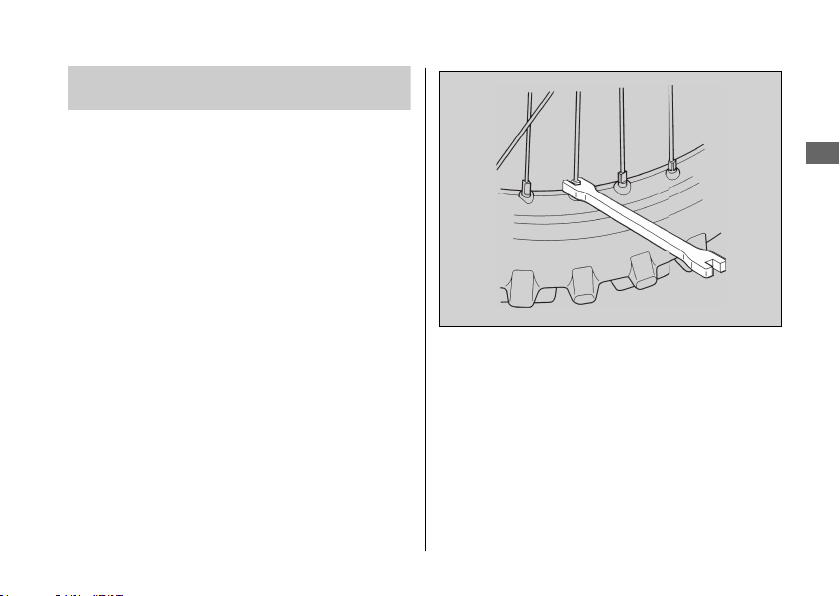
• Check spoke tension, and make sure the rim
locks are secure.
• Check to make sure the sprocket bolts and
nuts are secure.
• Clean the sides of the drive chain with a stiff,
nylon parts-cleaning brush. Lubricate and
adjust the chain as necessary.
Do not perform maintenance while the engine
is running. Injury to your fingers or hands may
result.
Maintenance Fundamentals
Maintenance
27
Continued
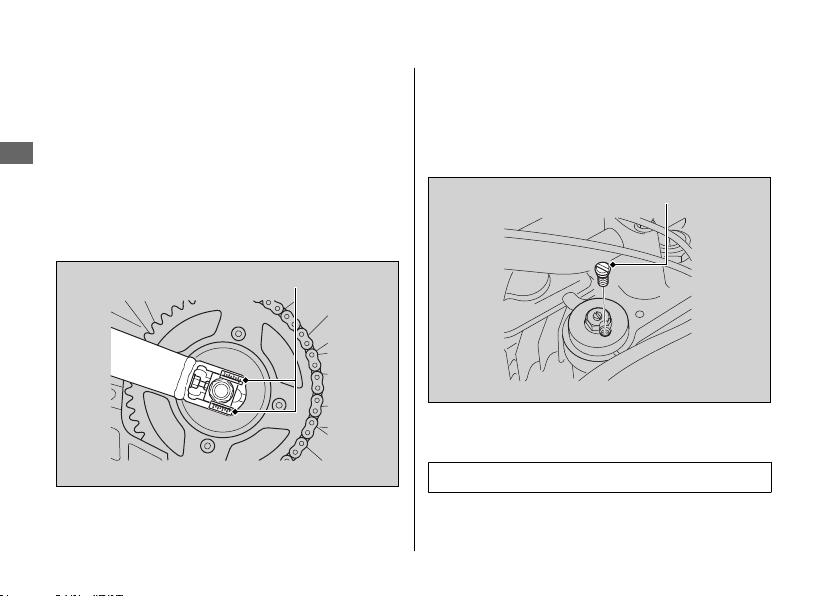
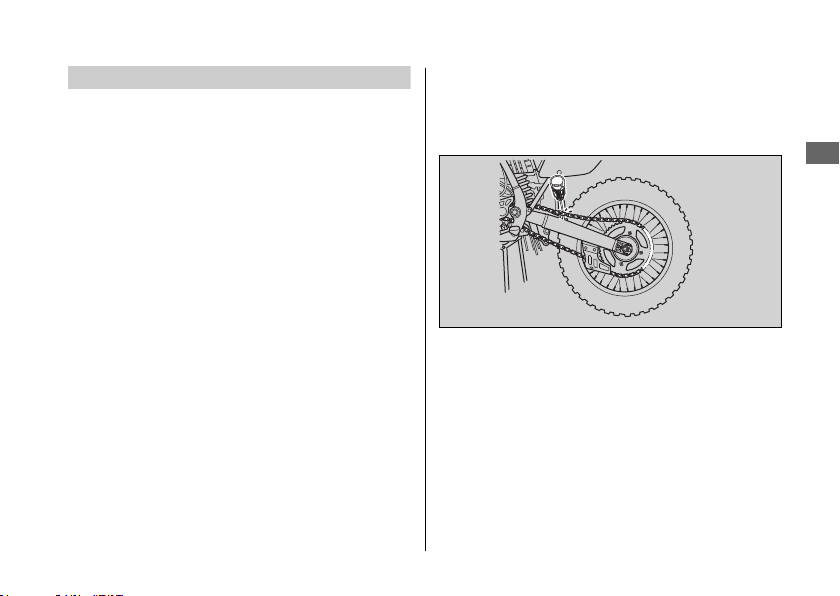
• After adjustment, check that the chain
adjuster index marks are in the same
position on each side. This will ensure that
the rear wheel is in proper alignment and
allow maximum performance from the rear
disc brake.
Maintaining proper wheel alignment will also
extend brake pad lifespan.
• Suspend the front wheel above the ground
and use the pressure release screws to
release the built-up pressure in the forks.
This pressure is caused by normal fork
action while riding.
Tighten the pressure release screws to the
specified torque:
Torque: 1.0 lbf·ft (1.3 N·m, 0.1 kgf·m)
Maintenance Fundamentals
Maintenance
28
Chain adjuster index marks
Air pressure release screw
After Competition Maintenance
It is important to the long term performance of
your vehicle to practice a consistent
maintenance program. Right after an event is a
good time to begin your next maintenance
cycle.
#
After Moto Lubrication
Apply a light coating of rust-inhibiting oil to the
drive sprocket and any steel portions of the
chassis or engine where the paint has worn
away.
This will prevent rusting of the exposed metal.
Apply rust-inhibiting oil more heavily if the
event was particularly wet or muddy. Take care
to avoid spraying any oil near the brake pads or
the brake discs.
Take care to prevent catching your fingers
between the chain and sprocket.
Remove the drive chain, and clean and lubricate
it.
Be sure the chain is wiped clean and is dry
before lubricating the chain.
#
Routine Cleaning
If your vehicle is only slightly dirty, it is best to
clean it by hand with the aid of a stiff bristled
nylon brush and some clean rags.
Take care to prevent catching your fingers
between the chain and sprocket.
Maintenance Fundamentals
Maintenance
29
Continued

A variety of reasonably priced cleaning brushes
are available from variety, drug, food, and
hardware stores. Some of these brushes are
extremely useful in removing dirt from the many
tight contours of the metal pieces of your
vehicle.
Avoid using stiff, abrasive brushes on the plastic
or rubber parts.
If your vehicle was exposed to sea air or salt
water, rinse it as soon as possible after the
event, dry it, and apply a spray lubricant to all
metal parts.
If you decide to wash your vehicle or use
cleaners, refer to "Caring for Your Vehicle".
2 P. 36
Replacing Parts
Always use Honda Genuine Parts or their
equivalents to ensure reliability and safety.
3WARNING
Installing non-Honda parts may make
your vehicle unsafe and cause a crash in
which you can be seriously hurt or
killed.
Always use Honda Genuine Parts or
equivalents that have been designed
and approved for your vehicle.
Maintenance Fundamentals
Maintenance
30
Tires (Inspecting/Replacing)
#
Checking the Air Pressure
Visually inspect your tires and use an air
pressure gauge to measure the air pressure
before each ride.
Always check air pressure when your tires are
cold.
If you decide to adjust the tire pressure for a
particular riding condition, make changes a little
at a time.
#
Inspecting for Damage
Inspect the tires for cuts, slits, or cracks that
expose fabric or cords, or nails or other foreign
objects embedded in the side of the tire or the
tread. Also inspect for any unusual bumps or
bulges in the side walls of the tires.
#
Inspecting for Abnormal Wear
Inspect the tires for signs of abnormal wear on
the contact surface.
#
Inspecting Rims and Valve Stems
Inspect the rims for damage and loose spokes.
Also inspect the valve stems for their positions.
A tilted valve stem indicates the tube is slipping
inside the tire or the tire is slipping on the rim.
See your dealer.
3WARNING
Riding on tires that are excessively worn
or improperly inflated can cause a crash
in which you can be seriously hurt or
killed.
Follow all instructions in this owner's
manual regarding tire inflation and
maintenance.
Maintenance Fundamentals
Maintenance
31
Continued

Have your tires replaced by your dealer.
For recommended tires and air pressure, see
“Specifications.” 2 P. 48
Follow these guidelines whenever you replace
tires:
● Use the recommended tires or their
equivalents of the same size, construction,
speed rating, and load range.
● Remember to replace the inner tube
whenever you replace a tire. The old tube
will probably be stretched, and it could fail if
installed in a new tire.
●
If a tube is punctured or damaged, you
should replace it as soon as possible. A
repaired tube may not have the same
reliability as a new one, and it may fail while
you are riding.
Use a replacement tube equivalent to the
original.
3WARNING
Installing improper tires on your vehicle
can adversely affect handling and
stability, and can cause a crash in which
you can be seriously hurt or killed.
Always use the size and type of tires
recommended in this owner's manual.
Maintenance Fundamentals
Maintenance
32

Engine Will Not Start
Engine Does Not Start
Check the following items:
● Check the correct engine starting
sequence. 2 P. 13
● Check that there is gasoline in the fuel
tank.
If the problem continues, have your vehicle
inspected by your dealer as soon as possible
or refer to an official Honda Shop Manual
available for purchase from your dealer.
Troubleshooting
34

Caring for Your Vehicle....................................P. 36
Storing Your Vehicle......................................... P. 39
Transporting Your Vehicle ..............................P. 40
You & the Environment.................................... P. 42
Vehicle Identification Number....................... P. 43
Oxygenated Fuels.............................................. P. 44
Authorized Manuals ......................................... P. 45
Honda Contacts ................................................. P. 46
Information

Caring for Your Vehicle
Frequent cleaning and polishing is important to
ensure the life of your Honda. A clean vehicle
makes it easier to spot potential problems.
While you're cleaning, be sure to look for
damage, wear, and gasoline or oil leaks.
Washing
Allow the engine, muffler, brakes, and other
high-temperature parts to cool before washing.
1.
Rinse your vehicle thoroughly using a low
pressure garden hose to remove loose dirt.
2.
If necessary, use a sponge or a soft towel
with mild cleaner to remove road grime.
u Clean the plastic components with extra
care to avoid scratching them.
Avoid directing water into the air cleaner,
muffler, and electrical parts.
u
Do not use steel wool to clean the frame
as it could damage or discolor the frame
surface. Scotch Brite Hand Pad #7447-
maroon is for removing stains on the
non-coated aluminum frame only.
3.
Thoroughly rinse your vehicle with plenty of
clean water and dry with a soft, clean cloth.
4.
After the vehicle dries, lubricate any moving
parts.
u Make sure that no lubricant spills onto
the brakes or tires. Brake discs, pads,
drum or shoes contaminated with oil will
suffer greatly reduced braking
effectiveness and can lead to a crash.
5.
Lubricate the drive chain immediately after
washing and drying the vehicle.
6.
Apply a coat of wax to prevent corrosion.
u Avoid products that contain harsh
detergents or chemical solvents. These
can damage the metal, paint, and plastic
on your vehicle.
Keep the wax clear of the tires and
brakes.
u If your vehicle has any matte painted
parts, do not apply a coat of wax to the
matte painted surface.
Caring for Your Vehicle
Information
36
#
Washing Precautions
Follow these guidelines when washing:
● Do not use high-pressure washers:
u High-pressure water cleaners can
damage moving parts and electrical
parts, rendering them inoperable.
u Water in the air intake can be drawn into
the carburetor and/or enter the air
cleaner.
u If you use a high pressure washer, avoid
spraying the following areas:
brake master cylinders
drive chain
engine stop button
muffler outlet
steering head bearings
suspension pivot points
under fuel tank
carburetor
under seat
wheel hubs
●
Do not direct water at the muffler:
u Water in the muffler can prevent starting
and causes rust in the muffler.
●
Dry the brakes:
u Water adversely affects braking
effectiveness. After washing, apply the
brakes intermittently at low speed to
help dry them.
●
Do not direct water at the air cleaner:
u Water in the air cleaner can prevent the
engine from starting.
Caring for Your Vehicle
Information
37
Continued
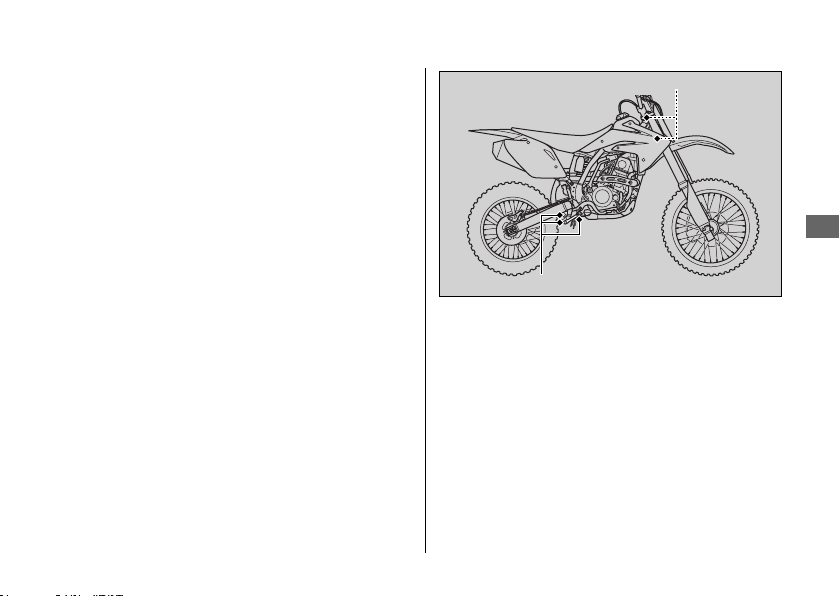
Steering head bearings
Suspension pivot points

● Do not use wax or polishing compounds on
matte painted surfaces:
u Use a soft cloth or sponge, plenty of
water, and a mild detergent to clean
matte painted surfaces. Dry with a soft
clean cloth.
Condensation Control
Some condensation can form within the
transmission cavity as well. This is natural and
just one more reason you should change the
engine and transmission oil often.
Aluminum Components
Aluminum will corrode from contact with dirt,
mud, or road salt. Clean aluminum parts
regularly and follow these guidelines to avoid
scratches:
● Do not use stiff brushes, steel wool, or
cleaners containing abrasives.
Exhaust Pipe and Muffler
The exhaust pipe and muffler are stainless steel
but may become stained by mud or dust.
To remove mud or dust, use a wet sponge and
a liquid kitchen abrasive, then rinse well with
clean water. Dry with chamois or a soft towel.
If necessary, remove heat stains by using a
commercially available fine texture compound.
Then, rinse by the same manner as removing
mud or dust.
NOTICE
Even though the exhaust is made of stainless
steel, it can become stained. Remove all marks
and blemishes as soon as they are noticed.
Caring for Your Vehicle
Information
38

Storing Your Vehicle
If you won't be riding for an extended period,
follow these guidelines:
● Wash your vehicle.
● Change the engine oil and filter.
● Replace the transmission oil.
● Inflate the tires to their recommended
pressures.
● Drain the coolant.
● Lubricate the drive chain.
● Place your vehicle on an optional workstand
or equivalent to raise both tires off the
ground.
●
Drain the fuel from the fuel tank and
carburetor into an approved gasoline
container. Turn the fuel valve OFF and
loosen the carburetor drain screw. Drain
gasoline into an approved container.
Retighten the drain screw.
●
Stuff a rag into the muffler outlet. Then, tie a
plastic bag over the end of the muffler to
prevent moisture from entering.
● Store your vehicle in an unheated area, free
of dampness, away from sunlight, with a
minimum of daily temperature variation.
● Cover your vehicle with a porous material.
Avoid using plastic or similar non-breathing,
coated materials that restrict air flow and
allow heat and moisture to accumulate.
Storing Your Vehicle
Information
39
Continued

To remove your vehicle from storage, follow
these guidelines:
● Uncover and clean your vehicle.
● Change the engine oil if more than 4
months have passed since the start of
storage.
● Change the transmission oil if more than 4
months have passed since the start of
storage.
● Uncover the end of the muffler and remove
the rag from the muffler outlet.
● Fill the fuel tank with the recommended fuel.
2 P. 20
●
Pour a fresh recommended coolant mixture
slowly into the radiator fill hole up to the
filler neck.
●
Perform all maintenance checks. 2 P. 26
Transporting Your Vehicle
If your vehicle needs to be transported, it
should be carried on a motorcycle trailer or a
flatbed truck or trailer that has a loading ramp
or lifting platform and motorcycle tie-down
straps. Never try to tow your vehicle with a
wheel or wheels on the ground.
NOTICE
Towing your vehicle with a wheel or wheels on
the ground can cause serious damage to the
transmission.
If you use a truck or motorcycle trailer to
transport your vehicle, we recommend that you
follow these guidelines:
●
Use a loading ramp.
●
Drain the fuel from the fuel tank and
carburetor into an approved gasoline
container.
Transporting Your Vehicle
Information
40
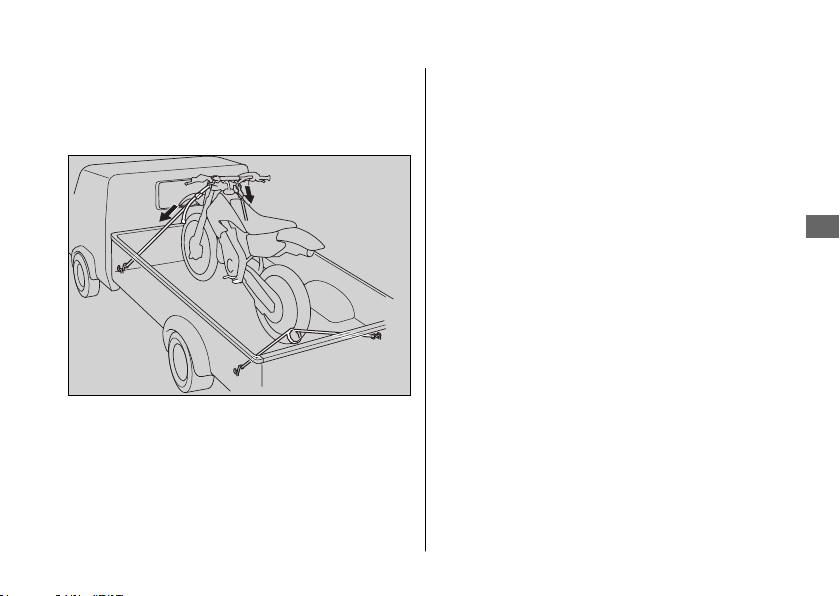
● Secure the vehicle in an upright position,
using motorcycle tie-down straps. Avoid
using rope, which can loosen and allow the
vehicle to fall over.
To secure your vehicle, brace the front wheel
against the front of the truck bed or trailer rail.
Attach the lower ends of two straps to the tie-
down hooks on truck bed or trailer rail. Attach
the upper ends of the straps to the handlebar
(one on the right side, the other on the left),
close to the fork.
Check that the tie-down straps do not contact
any control cables or electrical wiring.
Tighten both straps until the front suspension is
compressed about half-way. Too much pressure
is unnecessary and could damage the fork seals.
Use another tie-down strap to keep the rear of
the vehicle from moving.
We recommend that you do not transport your
vehicle on its side. This can damage the vehicle,
and leaking gasoline could be a hazard.
Transporting Your Vehicle
Information
41

You & the Environment
Owning and riding a vehicle can be enjoyable,
but you must do your part to protect the
environment.
Choose Sensible Cleaners
Use a biodegradable detergent when you wash
your vehicle. Avoid aerosol spray cleaners that
contain chlorofluorocarbons (CFCs) which
damage the atmosphere's protective ozone
layer.
Recycle Wastes
Put oil and other toxic wastes in approved
containers and take them to a recycling center.
Call your local or state office of public works or
environmental services to find a recycling center
in your area and to get instructions on how to
dispose of non-recyclable wastes. Do not place
used engine oil in the trash or pour it down a
drain or on the ground. Used oil, gasoline,
coolant, and cleaning solvents contain poisons
that can hurt refuse workers and contaminate
drinking water, lakes, rivers, and oceans.
You & the Environment
Information
42
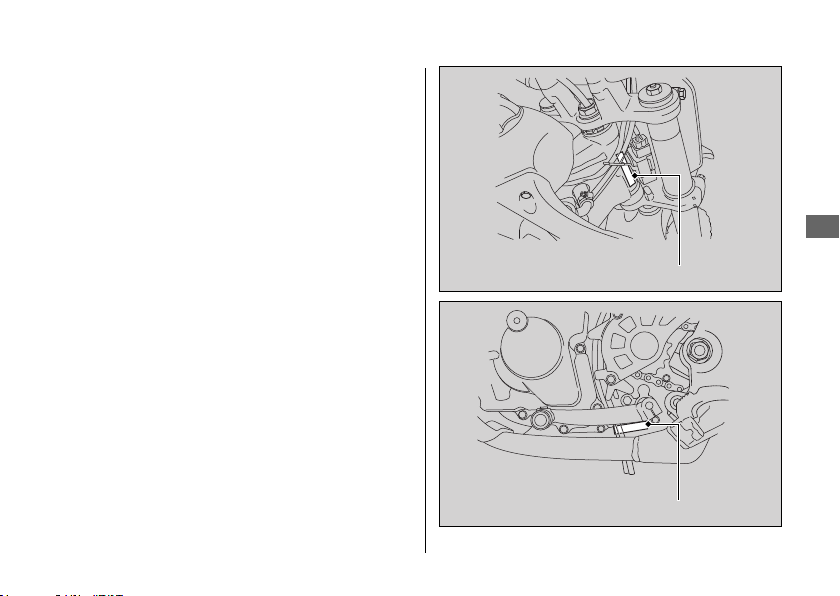
Vehicle Identification
Number
The VIN and engine serial number uniquely
identify your vehicle and are required in order
to register your vehicle. They may also be
required when ordering replacement parts.
You should record these numbers and keep
them in a safe place.
Vehicle Identification Number
Information
43
VIN
Engine number

Oxygenated Fuels
Some conventional fuels blended with alcohol
or an ether compound are available in some
locales to help reduce emissions to meet clean
air standards. These gasolines are collectively
referred to as oxygenated fuels. If you plan to
use oxygenated fuel, check that it is unleaded
and meets the minimum octane rating and
blend requirement.
The following fuel blends have been approved
for use in your vehicle:
●
Ethanol (ethyl alcohol) up to 10% by volume.
u Gasoline containing ethanol may be
marketed under the name Gasohol.
●
Do not use gasoline containing methanol
(methyl alcohol).
If you accidentally fill your fuel tank with an
oxygenated fuel containing higher percentages,
you may experience performance problems. To
resolve the problem, have your dealer drain the
fuel tank and replace with the correct fuel. Fuel
system or performance problems resulting from
the use of an oxygenated fuel containing higher
percentages are not covered by your warranty.
NOTICE
Improper use of oxygenated fuels can damage
metal, rubber, and plastic parts of your fuel
system.
Oxygenated fuel can also damage paint.
If you notice any undesirable operating
symptoms or performance problems, try a
different brand of gasoline.
Oxygenated Fuels
Information
44
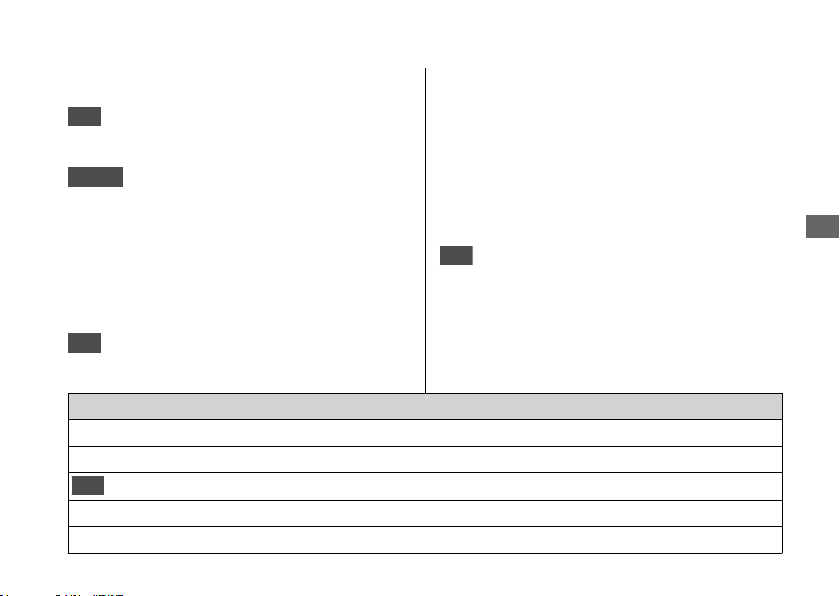
Description
2023 CRF150R/RB Service Manual
Common Service Manual (61CSM00)
USA
Winter Storage Guide (S9507)
2023 CRF150R/RB Owner’s Manual
2023 CRF150R/RB Competition Handbook
Authorized Manuals
USA
The Service Manual used by your
authorized dealer is available from your Honda
dealer or Helm, Inc.
Canada
See your dealer to order authorized
manuals.
Also available, but not necessary to service your
model, is the Honda Common Service Manual,
which explains basic service information for
various systems on Honda motorcycles,
scooters, ATV, and SxS.
USA
The Winter Storage Guide in conjunction
with the Owner's Manual and Service Manual
can help you prepare your Honda motorcycle,
scooter, ATV, and SxS for winter storage.
These Honda manuals are written for the
professional technician. However, if you possess
the proper tools, observe the safety standards,
and are mechanically capable, you should find
them easy to use.
Special Honda tools are necessary for some
procedures.
USA
Order online: www.helminc.com
Order Toll Free: 1-888-CYCLE93
(1-888-292-5393)
(NOTE: For Credit Card Orders Only)
Monday - Friday 8:00 AM - 6:00 PM ET
Authorized Manuals
Information
45
Honda Contacts
American Honda Motor Co., Inc.
If you wish to contact Honda directly to
comment on your experiences with your vehicle
or with your dealer, please send your comments
using one of the following methods:
Powersports Customer Relations
American Honda Motor Co., Inc.
P.O. Box 2200, Torrance, CA 90509-2200
Mailstop: 100-4W-5F
Telephone: (866) 784-1870
Website: https://powersports.honda.com/
contact-us
Canada
Honda Canada Inc.
Customer Relations Department,
180 Honda Boulevard
Markham, Ontario
L6C 0H9
Telephone: (888) 946-6329
Fax: (877) 939-0909
E-mail: [email protected]
Please include the following information in your
letter:
●
Name, address, and telephone number
●
Product model, year, and VIN
●
Date of purchase
●
Dealer name and address
We will likely ask your Honda dealer to respond,
or possibly acknowledge your comments
directly.
Honda Contacts
Information
46

Your Honda Dealer
The service department of your Honda dealer
offers trained personnel to perform regular
maintenance and unexpected repairs. It has the
latest available service information from Honda.
The parts department offers Honda Genuine
Parts, Pro Honda products, Honda Accessories
(USA only), and Honda accessories and
products (Canada only) that provide the same
quality that went into your vehicle.
Your Honda dealer can also supply information
about riding events and information about
safety training available in your local area.
Honda Contacts
Information
47
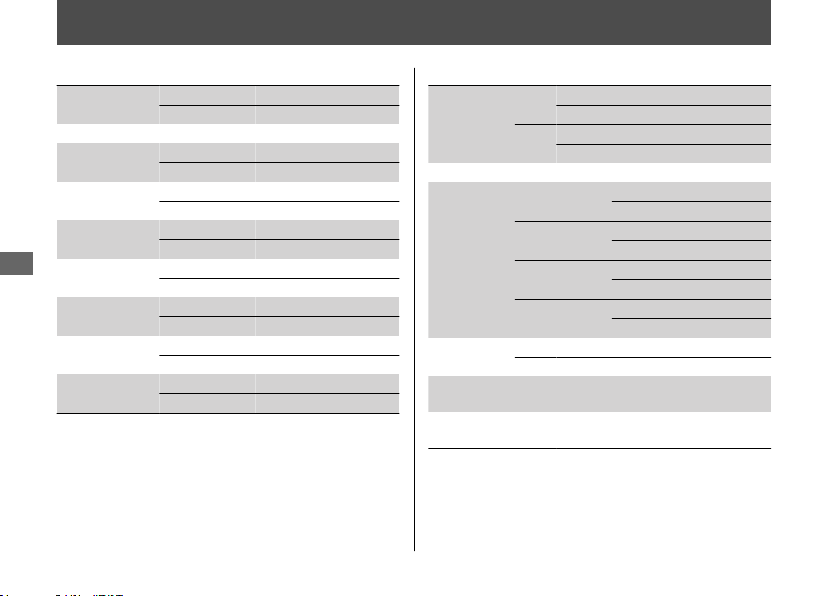
Specifications
■ Dimension
Overall length
CRF150R
72.1 in (1,832 mm)
CRF150RB
74.8 in (1,900 mm)
Overall width 30.3 in (770 mm)
Overall height
CRF150R
44.6 in (1,133 mm)
CRF150RB
46.1 in (1,171 mm)
Wheelbase
CRF150R
49.6 in (1,260 mm)
CRF150RB
50.6 in (1,285 mm)
Seat height
CRF150R
32.8 in (832 mm)
CRF150RB
34.1 in (866 mm)
Footpeg height
CRF150R
14.9 in (379 mm)
CRF150RB
16.3 in (413 mm)
Minimum ground
clearance
CRF150R
11.9 in (301 mm)
CRF150RB
13.2 in (336 mm)
Caster angle
CRF150R
27°2'
CRF150RB
27°48'
Trail length
CRF150R
3.1 in (78 mm)
CRF150RB
3.8 in (96 mm)
■ Frame
Tire size
Front
CRF150R
70/100-17 40M
CRF150RB
70/100-19 42M
Rear
CRF150R
90/100-14 49M
CRF150RB
90/100-16 52M
Tire type Bias-ply, tube
Recommended
tire
CRF150R
USA
Front DUNLOP MX71F
Rear DUNLOP MX71
CRF150R
Canada
Front BRIDGESTONE M23
Rear
BRIDGESTONE M22
CRF150RB
USA
Front DUNLOP MX71F
Rear
DUNLOP MX71
CRF150RB
Canada
Front BRIDGESTONE M61
Rear BRIDGESTONE M58
Tire pressure
(cold)
Front 15 psi (100 kPa, 1.0 kgf/cm
2
)
Rear 15 psi (100 kPa, 1.0 kgf/cm
2
)
Fuel
Unleaded gasoline, pump octane number of
91 or higher
Fuel tank
capacity
1.14 US gal (4.3 L)
Specifications
48
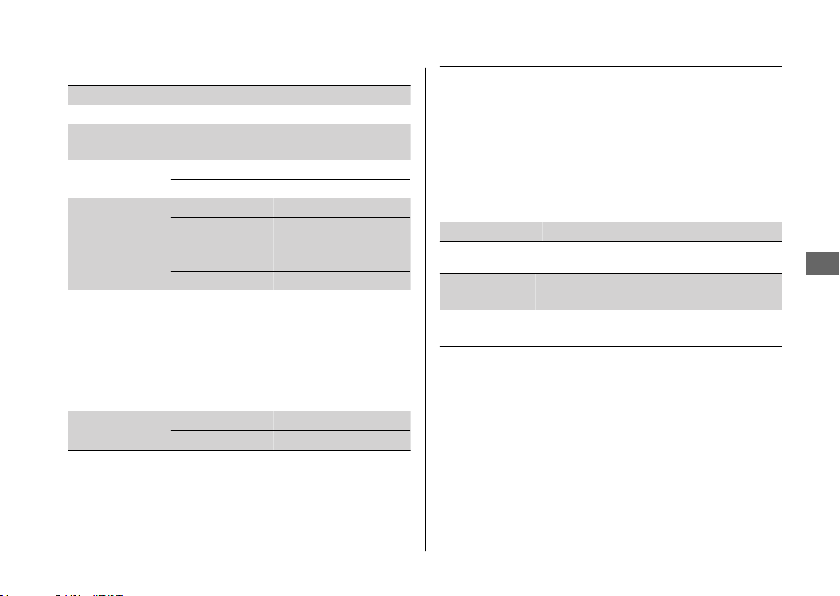
■ Engine
Bore x stroke 2.5984 x 1.7235 in (66.000 x 43.777 mm)
Displacement 9.136 cu-in (149.77 cm
3
)
Compression
ratio
11.7 : 1
Valve clearance
(cold)
Intake 0.006 ± 0.001 in (0.16 ± 0.03 mm)
Exhaust 0.010 ± 0.001 in (0.26 ± 0.03 mm)
Engine oil
capacity
After draining 0.59 US qt (0.56 L)
After draining
and oil filter
change
0.62 US qt (0.59 L)
After disassembly 0.74 US qt (0.70 L)
Recommended
engine oil
API Service Classification SJ or higher
except oils labeled as energy conserving or
resource conserving on the circular API
service label, SAE 10W-30, JASO T 903
standard MA, Pro Honda GN4 4-stroke oil
(USA & Canada) or Honda 4-stroke oil, or
an equivalent motorcycle oil
Transmission oil
capacity
After draining 0.60 US qt (0.57 L)
After disassembly 0.69 US qt (0.65 L)
Recommended
Transmission oil
API Service Classification SJ or higher
except oils labeled as energy conserving or
resource conserving on the circular API
service label, SAE 10W-30, JASO T 903
standard MA, Pro Honda GN4 4-stroke oil
(USA & Canada) or Honda 4-stroke oil, or
an equivalent motorcycle oil (without
friction modifiers as molybdenum
additives)
Idle speed 2,100 ± 100 rpm
■ Cooling system
Recommended
coolant
Pro Honda HP Coolant
Cooling capacity
After
disassembly
0.80 US qt (0.76 L)
Specifications
Specifications
49
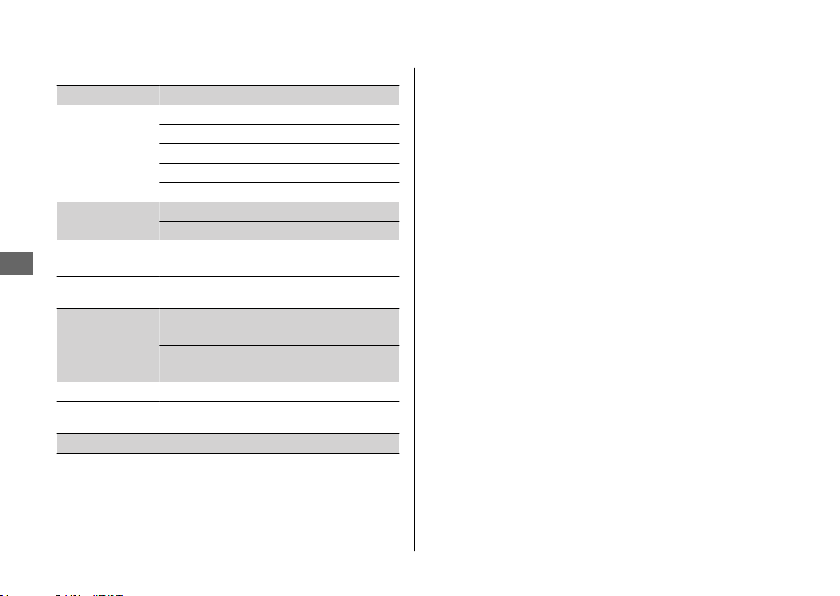
■ Drive train
Primary reduction 4.117
Gear ratio
1st 2.214
2nd 1.647
3rd 1.318
4th 1.105
5th 0.956
Final reduction
CRF150R
3.333
CRF150RB
3.733
Gear shift pattern
Left foot-operated return system
1-N-2-3-4-5
■ Electrical
Spark plug
Standard
CR8EH-9 (NGK) or
U24FER9 (DENSO)
For extended
high speed riding
CR9EH-9 (NGK) or
U27FER9 (DENSO)
Spark plug gap 0.03 - 0.04 in (0.8 - 0.9 mm)
■ Torque specifications
Fork air pressure release screw 1.0 lbf·ft (1.3 N·m, 0.1 kgf·m)
Specifications
Specifications
50
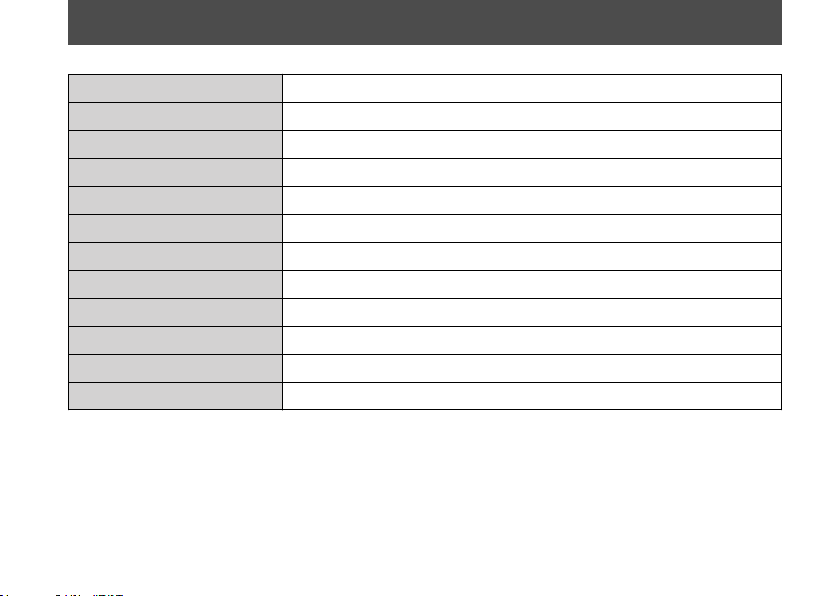
Information Record
VIN
Engine No.
Color Label & Code
Owner's Name
Address
City/State
Phone
Dealer's Name
Address
City/State
Phone
Service Manager
51
California Proposition 65 Warning
WARNING: Operating, servicing and maintaining a passenger vehicle
or off-highway motor vehicle can expose you to chemicals including
engine exhaust, carbon monoxide, phthalates, and lead, which are known
to the State of California to cause cancer and birth defects or other
reproductive harm. To minimize exposure, avoid breathing exhaust, do
not idle the engine except as necessary, service your vehicle in a well-
ventilated area and wear gloves or wash your hands frequently when
servicing your vehicle. For more information go to
www.P65Warnings.ca.gov/passenger-vehicle.
© 2022 Honda Motor Co., Ltd.
All Rights Reserved
Printed in the U.S.A.
31KSE740
00X31-KSE-7400