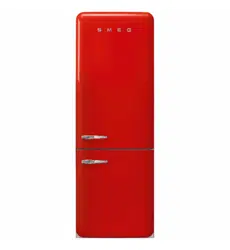
User Manual for Smeg FAB38RRDAU
Table of Contents
- Instructions
- General safety instructions
- Manufacturer liability
- Appliance purpose
- Disposal
- Identification plate
- This user manual
- How to read the user manual
- Description of the appliance
- General description
- Using the appliance
- Information about New Generation Cooling Technology
- Display and Control Panel
- Operating your Appliance
- Temperature Adjustment Warnings
- Accessories
- Food storage
- Refrigerator Compartment
- Freezer Compartment
- Cleaning and Maintenance
- Defrosting
- Instructions
- Cleaning the appliance
- What to do if
- Installation
- Electrical connection
- Positioning
- Installation warnings
- During Usage
- Shipment and repositioning
- Transportation and Changing Positioning
- Repositioning the Door
- Before calling after-sales service
- Tips for saving energy
Use
Using the appliance
Display and Control Panel
Using the Control Panel
1. Enables the setting of the freezer.
2. Enables the setting of the refrigerator.
3. Freezer set value screen.
4. Refrigerator set value screen.
5. Economy mode symbol.
6. Super freeze symbol.
7. Alarm symbol.
Operating your Fridge Freezer
Once you have plugged in the product, all symbols will be displayed for 2 seconds and the initial values will be shown as -18 °C on the freezer adjustment indicator, and +4 °C on the refrigerator adjustment indicator.
Freezer Temperature Settings
• The initial temperature value for the freezer setting indicator is -18 °C.
• Press the freezer set button once. When you first press the button, the previous value will blink on the screen.
• Whenever you press the same button, a lower temperature will be set (-16 °C, -18 °C, -20 °C, -22 °C or -24 °C).
• If you continue to press the button, it will restart from -16 °C.
NOTE: Eco mode gets activated automatically when the temperature of the freezer compartment is set to -18°C.
Refrigerator Temperature Settings
• The initial temperature value for the refrigerator setting indicator is +4 °C.
• Press the refrigerator button once.
• Whenever you press the button, a lower temperature will be set (+8 °C, +6 °C, +5 °C, +4 °C, or +2 °C).
• If you continue to press the button, it will restart from +8 °C.
Super Freeze Mode Purpose
• To freeze a large quantity of food that cannot fit on the fast freeze shelf.
• To freeze prepared foods.
• To freeze fresh food quickly to retain freshness.
How to use
To enable the super freeze mode, press and hold the freezer temperature setting button for 3 seconds. Once the super freeze mode has been set, the super freeze symbol on the indicator will be lit and the machine will beep to confirm the mode has been switched on.
During Super Freeze Mode:
• The temperature of the Refrigerator may be adjusted. In this case, Super Freeze mode will continue.
• Economy mode cannot be selected.
• Super Freeze mode can be cancelled in the same way it is selected.
Notes:
• The maximum amount of fresh food (in kilograms) that can be frozen within 24 hours is shown on the appliance label.
• For optimal appliance performance in maximum freezer capacity, activate super freeze mode 3 hours before you put fresh food into the freezer. Super freeze mode will automatically cancel after 24 hours or when the freezer sensor temperature drops below -32 °C.
Temperature Adjustment Warnings
• It is not recommended that you operate your appliance in environments colder than 10°C in terms of its efficiency.
• Do not start another adjustment while you are already making an adjustment.
• Temperature adjustments should be made according to the frequency of door openings, the quantity of food kept inside the appliance and the ambient temperature in the location of your appliance.
• In order to allow your appliance to reach the operating temperature after being connected to mains, do not open the doors frequently or place large quantities of food in the appliance. Please note that, depending on the ambient temperature, it may take 24 hours for your appliance to reach the operating temperature.
• A 5 minute delay function is applied to prevent damage to the compressor of your appliance when connecting or disconnecting to mains, or when an energy breakdown occurs. Your appliance will begin to operate normally after 5 minutes.
Food storage
Refrigerator Compartment
For normal operating conditions, set the temperature of the refrigerator compartment to +4 or +6 °C.
• To reduce humidity and avoid the consequent formation of frost, always store liquids in sealed containers in the refrigerator. Frost tends to concentrate in the coldest parts of the evaporating liquid and, in time, your appliance will require more frequent defrosting.
• Never place warm food in the refrigerator. Warm food should be allowed to cool at room temperature and should be arranged to ensure adequate air circulation in the refrigerator compartment.
• Make sure no items are in direct contact with the rear wall of the appliance as frost will develop and packaging will stick to it. Do not open the refrigerator door frequently.
• We recommend that meat and clean fish are loosely wrapped and stored on the glass shelf just above the vegetable bin where the air is cooler, as this provides the best storage conditions.
• Store loose fruit and vegetable items in the crisper containers.
• Store loose fruit and vegetables in the crisper.
• Storing fruit and vegetables separately helps prevent ethylene-sensitive vegetables (green leaves, broccoli, carrot, etc.) being affected by ethylenereleaser fruits (banana, peach, apricot, fig etc.).
• Do not put wet vegetables into the refrigerator.
• Storage time for all food products depends on the initial quality of the food and an uninterrupted refrigeration cycle before refrigerator storage.
• To avoid cross-contamination do not store meat products with fruit and vegetables. Water leaking from meat may contaminate other products in the refrigerator. You should package meat products and clean any leakages on the shelves.
• Do not put food in front of the air flow passage.
• Consume packaged foods before the recommended expiry date.
Note: Potatoes, onions and garlic should not be stored in the refrigerator. The table below is a quick guide to show you the most efficient way to store the major food groups in your refrigerator compartment.
- Vegetables and fruits 1 week Vegetable bin
- Meat and fish 2 - 3 Days Wrap in plastic foil, bags, or in a meat container and store on the glass shelf
- Fresh cheese 3 - 4 Days On the designated door shelf
- Butter and margarine 1 week On the designated door shelf
- Bottled prod- ucts e.g. milk and yoghurt Until the expiry date recommend- ed by the producer On the designat- ed door shelf
- Eggs 1 month On the designat- ed egg shelf
- Cooked food All shelves
Freezer Compartment
For normal operating conditions, set the temperature of the freezer compartment to -18 or -20 °C.
• The freezer is used for storing frozen food, freezing fresh food, and making ice cubes.
• For freezing fresh food; wrap and seal fresh food properly, that is the packaging should be air tight and shouldn’t leak. Special freezer bags, aluminum foil polythene bags and plastic containers are ideal.
• Do not store fresh food next to frozen food as it can thaw the frozen food.
• Before freezing fresh food, divide it into portions that can be consumed in one sitting.
• Consume thawed frozen food within a short period of time after defrosting
• Never place warm food in the freezer compartment as it will thaw the frozen food.
• Always follow the manufacturer’s instructions on food packaging when storing frozen food. If no information is provided food, should not be stored for more than 3 months from the date of purchase.
• When purchasing frozen food, make sure that it has been stored under appropriate conditions and that the packaging is not damaged.
• Frozen food should be transported in appropriate containers and placed in the freezer as soon as possible.
• Do not purchase frozen food if the packaging shows signs of humidity and abnormal swelling. It is probable that it has been stored at an unsuitable temperature and that the contents have deteriorated.
• The storage life of frozen food depends on the room temperature, the thermostat setting, how often the door is opened, the type of food, and the length of time required to transport the product from the shop to your home. Always follow the instructions printed on the packaging and never exceed the maximum storage life indicated.
• The maximum amount of fresh food (in kg) that can be frozen in 24 hours is indicated on the appliance label.
• To use the maximum capacity of the freezer compartment, use the glass shelves for the upper and middle section, and use the lower basket for the bottom section.
• Use the fast freezing shelf to freeze home cooking (and any other food which needs to be frozen quickly) more quickly because of the freezing shelf’s greater freezing power. Fast freezing shelf is the bottom drawer of the freezer compartment.
Note: If you attempt to open the freezer door immediately after closing it, you will find that it will not open easily. This is normal. Once equilibrium has been reached, the door will open easily.
Important note:
• Never refreeze thawed frozen food.
• The taste of some spices found in cooked dishes (anise, basilica, watercress, vinegar, assorted spices, ginger, garlic, onion, mustard, thyme, marjoram, black pepper, etc.) changes and they assume a strong taste when they are stored for a long period of time. Therefore, add small amounts of spices to food to be frozen, or the desired spice should be added after the food has thawed.
• The storage time of food is dependent on the type of oil used. Suitable oils are margarine, calf fat, olive oil and butter. Unsuitable oils are peanut oil and pig fat.
• Food in liquid form should be frozen in plastic cups and other food should be frozen in plastic folios or bags. The table below is a quick guide to show you the most efficient way to store the major food groups in your freezer compartment.
Tips for saving energy
- 1. Install the appliance in a cool, well-ventilated room, but not in direct sunlight and not near a heat source (such as a radiator or oven) otherwise an insulating plate should be used.
- 2. Allow warm food and drinks to cool before placing them inside the appliance.
- 3. Place thawing food in the refrigerator compartment. The low temperature of the frozen food will help cool the refrigerator compartment while the food is thawing. This will save energy. Frozen food left to thaw outside of the appliance will result in a waste of energy.
- 4. Drinks or other liquids should be covered when inside the appliance. If left uncovered, the humidity inside the appliance will increase, therefore the appliance uses more energy. Keeping drinks and other liquids covered helps preserve their smell and taste.
- 5. Avoid keeping the doors open for long periods and opening the doors too frequently as warm air will enter the appliance and cause the compressor to switch on unnecessarily often.
- 6. Keep the covers of the different temperature compartments (such as the crisper and chiller) closed.
- 7. The door gasket must be clean and pliable. Replace gaskets if worn.