Owner’s Manual
GE Quality Product
Ranges
20″and 24″Gas
Part No. 164D3333P185-1 Pub. No. 49-8955-3 180-6C139 04-01 JR
2
IMPORTANT SAFETY INFORMATION.
READ ALL INSTRUCTIONS BEFORE USING.
Customer Service Troubleshooting Tips Installation Instructions Care and Cleaning Operating Instructions Safety Instructions
— Do not store or use gasoline or other
flammable vapors and liquids in the
vicinity of this or any other appliance.
—
WHAT TO DO IF YOU SMELL GAS
■ Do not try to light any appliance.
■ Do not touch any electrical switch; do
not use any phone in your building.
■ Immediately call your gas supplier
from a neighbor’s phone. Follow the
gas supplier’s instructions.
■ If you cannot reach your gas supplier,
call the fire department.
— Installation and service must be
performed by a qualified installer,
service agency or the gas supplier.
WARNING:
If the information in this
manual is not followed exactly, a fire or
explosion may result causing property
damage, personal injury or death.
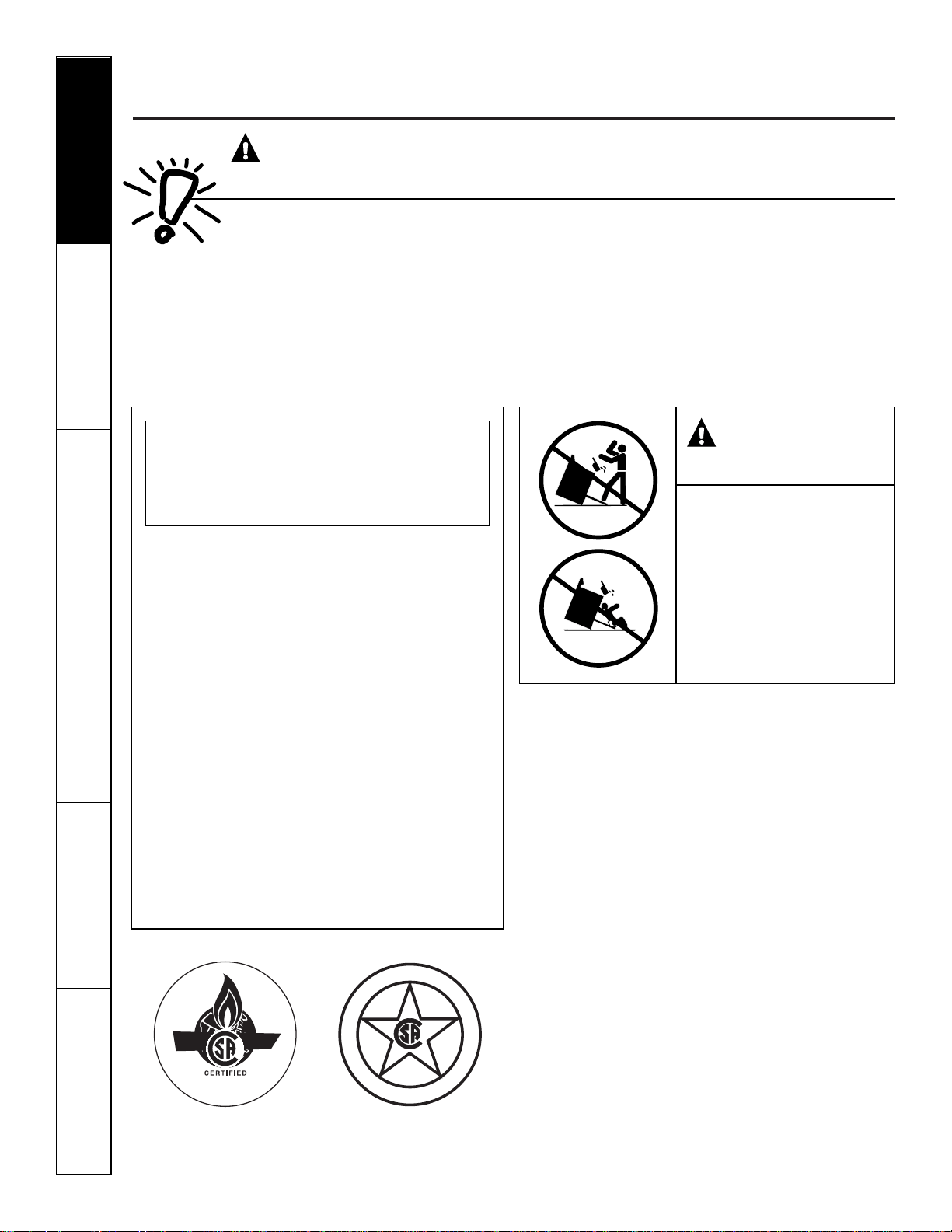
WARNING!
ANTI-TIP DEVICE
■
ALL RANGES CAN TIP
■
INJURY TO PERSONS
COULD RESULT
■
INSTALL ANTI-TIP
DEVICES PACKED WITH
RANGE
■
SEE INSTALLATION
INSTRUCTIONS
The California Safe Drinking Water and Toxic Enforcement Act requires the Governor of California to
publish a list of substances known to the state to cause cancer, birth defects or other reproductive
harm, and requires businesses to warn customers of potential exposure to such substances.
WARNING!
IMPORTANT SAFETY NOTICE
Gas appliances can cause minor exposure to four of these substances, namely benzene, carbon
monoxide, formaldehyde and soot, caused primarily by the incomplete combustion of natural
gas or LP fuels. Properly adjusted burners, indicated by a bluish rather than a yellow flame, will
minimize incomplete combustion. Exposure to these substances can be minimized by venting
with an open window or using a ventilation fan or hood.
D
E
S
I
G
N
C
E
R
T
I
F
I
E
D
Safety Instructions Operating Instructions Care and Cleaning Installation Instructions Troubleshooting Tips Customer Service
Inside you will find many helpful hints on how to use and maintain
your range properly. Just a little preventive care on your part can save
you a great deal of time and money over the life of your range.
READ THIS MANUAL
A Service Partnership.
FOR YOUR RECORDS
Write the model and serial numbers here:
#
#
You can find them on a label under the cooktop on the right
side wall.
Staple sales slip or cancelled check here.
Proof of the original purchase date is needed to obtain service
under the warranty.
IMPORTANT!
Fill out and return the Consumer Product Registration Card
that is packed with this product.
You’ll find many answers to common problems in the
Before You Call
For Service
section. If you review our chart of
Troubleshooting Tips
first, you may not need to call for service at all.
If you do need service, you can relax knowing help is only a phone
call away. A list of toll-free customer service numbers is included in
the back section of this manual.
IF YOU NEED SERVICE
Congratulations!
You Are Now Part of Our Family.
Welcome to the family. We’re proud of our quality products and we are committed
to providing dependable service. You’ll see it in this easy-to-use Owner’s Manual and
you’ll hear it in the friendly voices of our customer service department.
Best of all, you’ll experience these values each time you use your range. That’s
important, because your new range will be part of your family for many years.
And we hope you will be part of ours for a long time to come.
We thank you for buying our product. We appreciate your purchase, and hope you
will continue to rely on us whenever you need quality appliances for your home.
3
Safety Information
Anti-Tip Device . . . . . . . . . . . . 4
Safety Precautions . . . . . . . 4, 5
Oven . . . . . . . . . . . . . . . . . . . . 5
Surface Cooking Units . . . . . . 6
Operating Instructions
Using the Surface Burners . . 8, 9
Using the Oven . . . . . . . . 10–17
Care and Cleaning
Lift-Up Cooktop . . . . . . . . . . .18
Burners . . . . . . . . . . . . . . . . . .19
Oven Shelves . . . . . . . . . . . . .19
Removable Oven Bottom . . . .20
Lift-Off Oven Door . . . . . . . . .21
Porcelain Oven Interior . . . . . .22
Installation Instructions
Before You Begin . . . . . . . . . 23
Dimensions & Clearances . . 24
Anti-Tip Device . . . . . . . . . . . .27
Connect the Range to Gas . . .29
Air Shutter Adjustment . . . . .32
Troubleshooting Tips
Before You Call
For Service . . . . . . . . . . . . . . 34
Customer Service
Warranty . . . . . . . . . . . . . . . . 35
Service Telephone
Numbers . . . . . . . . . Back Cover
Customer Service Troubleshooting Tips Installation Instructions Care and Cleaning Operating Instructions Safety Instructions
4
Be sure all packing materials are removed from the range before operating it to prevent fire or smoke
damage should the packing material ignite.
■Have the installer show you the location of
the range gas cut-off valve and how to shut
it off if necessary.
■Have your range installed and properly
grounded by a qualified installer, in
accordance with the Installation Instructions.
Any adjustment and service should be
performed only by qualified gas range
installers or service technicians.
■Plug your range into a 120-volt grounded
outlet only. Do not remove the round
grounding prong from the plug. If in doubt
about the grounding of the home electrical
system, it is your personal responsibility
and obligation to have an ungrounded
outlet replaced with a properly grounded,
three-prong outlet in accordance with the
National Electrical Code NFPA–70 latest
edition. In Canada, the appliance must be
electrically grounded in accordance with
the Canadian Electrical Code. Do not use
an extension cord with this appliance.
■Do not attempt to repair or replace any
part of your range unless it is specifically
recommended in this manual. All other
servicing should be referred to a qualified
technician.
■Locate range out of kitchen traffic path
and out of drafty locations to prevent pilot
outage (on standing pilot models) and
poor air circulation.
■Be sure your range is correctly adjusted by a
qualified service technician or installer for
the type of gas (natural or LP) that is to be
used. Your range can be converted for use
with either type of gas. See the Installation
Instructions.
■
WARNING:
These adjustments must be
made by a qualified service technician in
accordance with the manufacturer’s
instructions and all codes and requirements
of the authority having jurisdiction. Failure
to follow these instructions could result in
serious injury or property damage. The
qualified agency performing this work
assumes responsibility for the conversion.
■After prolonged use of a range, high floor
temperatures may result and many floor
coverings will not withstand this kind of
use. Never install the range over vinyl tile or
linoleum that cannot withstand such type
of use. Never install it directly over interior
kitchen carpeting.
■Do not leave children alone or unattended
where a range is hot or in operation. They
could be seriously burned.
■Do not allow anyone to climb, stand or
hang on the door, broiler drawer or range
top. They could damage the range and
even tip it over, causing severe personal
injury.
■Clean only parts listed in this manual.
IMPORTANT SAFETY INFORMATION.
READ ALL INSTRUCTIONS BEFORE USING.
WARNING!
For your safety, the information in this manual must be followed to minimize the risk of fire or
explosion, electric shock, or to prevent property damage, personal injury, or loss of life.
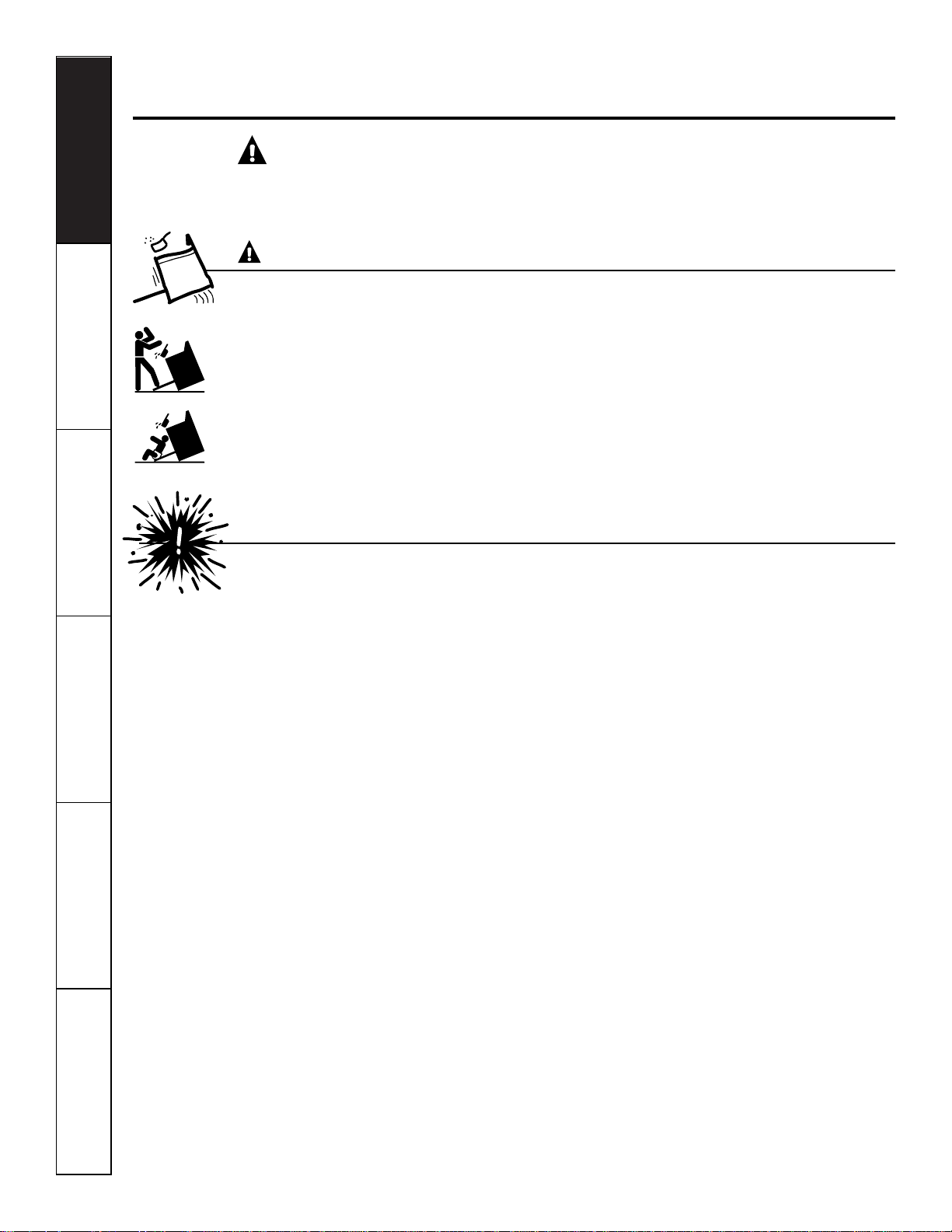
All ranges can tip and injury could result. To prevent accidental tipping of the range, attach an
approved Anti-Tip device to the floor. (See Installation Instructions.)
To check if the device is installed and engaged properly, carefully tip the range forward. The Anti-Tip
device should engage and prevent the range from tipping over.
If you pull the range out from the wall for any reason, make sure the Anti-Tip device is engaged when
you push the range back against the wall. If it is not, there is a possible risk of the range tipping over
if you or a child stand, sit or lean on an open door.
WARNING
ANTI-TIP DEVICE
SAFETY PRECAUTIONS
Safety Instructions Operating Instructions Care and Cleaning Installation Instructions Troubleshooting Tips Customer Service
Never wear loose fitting or hanging garments while using the appliance. Be careful when reaching
for items stored in cabinets over the cooktop. Flammable material could be ignited if brought in
contact with flame or hot oven surfaces and may cause severe burns.
■Let burner grates and other surfaces cool
before touching them or leaving them
where children can reach them.
■For your safety, never use your appliance
for warming or heating the room.
■Do not use water on grease fires. Never pick
up a flaming pan. Turn off burner, then
smother flaming pan by covering pan
completely with well-fitting lid, cookie
sheet or flat tray. Flaming grease outside a
pan can be put out by covering with baking
soda or, if available, a multi-purpose dry
chemical or foam-type fire extinguisher.
■Do not store flammable materials in an oven,
a range broiler drawer or near a cooktop.
■Do not store or use combustible materials,
gasoline or other flammable vapors and
liquids in the vicinity of this or any other
appliance.
■Do not let cooking grease or other
flammable materials accumulate in
or near the range.
■
CAUTION:
Items of interest to children
should not be stored in the cabinets above
a range or on the backsplash of a range—
children climbing on the range to reach
items could be seriously injured.
SAFETY PRECAUTIONS
Cook meat and poultry thoroughly—meat to at least an INTERNAL temperature of 160°F. and poultry
to at least an INTERNAL temperature of 180°F. Cooking to these temperatures usually protects against
foodborne illness.
COOK MEAT AND POULTRY THOROUGHLY…
Stand away from range when opening oven door. Hot air or steam which escapes can cause burns
to hands, face and/or eyes.
■Do not use the oven for a storage area.
Items stored in the oven can ignite.
■Place the oven shelves in the desired
position while the oven is cool.
■Keep the oven free from grease buildup.
■Pulling out the shelf to the shelf-stop is a
convenience in lifting heavy foods. It is also
a precaution against burns from touching
hot surfaces of the door or oven walls.
■Do not heat unopened food containers.
Pressure could build up and the container
could burst, causing an injury.
■Do not use aluminum foil anywhere in the
oven except as described in this book.
Misuse could result in a fire hazard or
damage to the range.
■When using cooking or roasting bags in the
oven, follow the manufacturer’s directions.
■Use only glass cookware that is
recommended for use in gas ovens.
■After broiling, always take the broiler pan
out of the range and clean it. Leftover
grease in the broiler pan can catch fire the
next time you use the pan.
■When broiling, if meat is too close to the
flame, the fat may ignite. Trim excess fat to
prevent excessive flare-ups.
■Make sure the broiler pan is in place
correctly to reduce the possibility of
grease fires.
■If you should have a grease fire in the
broiler pan, turn off oven control, and
keep broiler drawer and oven door closed
to contain fire until it burns out.
■Never leave jars of fat drippings on
or near your range.
OVEN
5
Customer Service Troubleshooting Tips Installation Instructions Care and Cleaning Operating Instructions Safety Instructions
6
IMPORTANT SAFETY INFORMATION.
READ ALL INSTRUCTIONS BEFORE USING.
WARNING!
SURFACE COOKING UNITS
Use proper pan size—Avoid pans that are unstable or easily tipped. Select cookware having flat
bottoms large enough to properly contain food and avoid boilovers and spillovers and large enough to
cover burner grate. This will both save cleaning time and prevent hazardous accumulations of food,
since heavy spattering or spillovers left on range can ignite. Use pans with handles that can be easily
grasped and remain cool.
■Always use the
LITE
position (on electric
ignition models) or the
HI
position (on
standing pilot models) when igniting top
burners and make sure the burners have
ignited.
■Never leave surface burners unattended
at high flame settings. Boilover causes
smoking and greasy spillovers that may
catch on fire.
■Adjust the top burner flame size so it
does not extend beyond the edge of the
cookware. Excessive flame is hazardous.
■Use only dry pot holders—moist or damp
pot holders on hot surfaces may result in
burns from steam. Do not let pot holders
come near open flames when lifting
cookware. Do not use a towel or other
bulky cloth in place of a pot holder.
■To minimize the possibility of burns,
ignition of flammable materials, and
spillage, turn cookware handles toward the
side or back of the range without extending
over adjacent burners.
■Always turn the surface burner to
OFF
before removing the cookware.
■Carefully watch foods being fried at a high
flame setting.
■Never block the vents (air openings) of the
range. They provide the air inlet and outlet
that are necessary for the range to operate
properly with correct combustion. Air
openings are located at the rear of the
cooktop, at the top and bottom of the oven
door, and at the bottom of the range under
the broiler drawer.
■Foods for frying should be as dry as
possible. Frost on frozen foods or moisture
on fresh foods can cause hot fat to bubble
up and over sides of the pan.
■Use least possible amount of fat for effective
shallow or deep-fat frying. Filling the pan
too full of fat can cause spillovers when
food is added.
■When flaming foods under the hood,
turn the fan on.
■If a combination of oils or fats will be used
in frying, stir together before heating or as
fats melt slowly.
■Always heat fat slowly, and watch as it heats.
■Use a deep fat thermometer whenever
possible to prevent overheating fat beyond
the smoking point.
■When using glass cookware, make sure it is
designed for top-of-range cooking.
■Keep all plastics away from top burners.
■Do not leave plastic items on the cooktop—
they may melt if left too close to the vent.
■Do not leave any items on the cooktop. The
hot air from the vent may ignite flammable
items and will increase pressure in closed
containers, which may cause them to burst.
■To avoid the possibility of a burn, always be
certain that the controls for all burners are
at the
OFF
position and all grates are cool
before attempting to remove them.
■Should you have a grease fire, turn the fan
off. The fan, if operating, may spread the
flames.
■If range is located near a window, do not
hang long curtains that could blow over
the top burners and create a fire hazard.
■When a pilot goes out (on standing pilot
models), you will detect a faint odor of gas
as your signal to relight the pilot. When
relighting the pilot, make sure burner
controls are in the
OFF
position, and follow
instructions in this manual to relight.
■If you smell gas, and you have already made
sure pilots are lit (on standing pilot
models),turn off the gas to the range and
call a qualified service technician. Never
use an open flame to locate a leak.
■Keep range clean and free of accumulations
of grease or spillovers, which may ignite.
■Be careful when you clean the cooktop
because the area over the pilot (on standing
pilot models) will be hot.
7
Safety Instructions Operating Instructions Care and Cleaning Installation Instructions Troubleshooting Tips Customer Service
Read and follow this Safety Information carefully.
SAVE THESE INSTRUCTIONS
Your range, like so many other household items, is heavy and can settle into soft floor coverings such
as cushioned vinyl or carpeting.
FLOORING UNDER THE RANGE
When moving the range on this type of
flooring, it should be installed on a 1/4″thick
sheet of plywood (or similar material) as
follows:
When the floor covering ends at the
front of the range,
the area that the range will
rest on should be built up with plywood to the
same level or higher than the floor covering.
This will allow the range to be moved for
cleaning or servicing.
Leveling legs are located on each corner of
the base of the range. Your range must be
level in order to produce proper cooking and
baking results. After it is in its final location,
place a level horizontally on any oven shelf
and check the levelness front to back and side
to side. Level the range by adjusting the
leveling legs or by placing shims under the
corners as needed.
One of the rear leveling legs will engage the
Anti-Tip device (allow for some side to side
adjustment). Allow a minimum clearance of
1/8 inch between the range and the leveling
leg that is to be installed into the Anti-Tip
device.
LEVELING THE RANGE
Customer Service Troubleshooting Tips Installation Instructions Care and Cleaning Operating Instructions Safety Instructions
8
Using the surface burners.
Throughout this manual, features and appearance may vary from your model.
Lighting Instructions for Electric Ignition Models
The surface burners on some models are lighted
by electric ignition, eliminating the need for
standing pilot lights with constantly burning
flames.
In case of a power failure,
you can light
the surface burners on your range with a
match. Hold a lighted match to the
burner, then turn the knob to the
LITE
position.
Use extreme caution when
lighting burners this way.
Surface burners in use when an
electrical power failure occurs will
continue to operate normally.
The electrode of the spark igniter is
exposed. When one burner is turned
to
LITE,
all the burners spark. Do not
attempt to disassemble or clean
around any burner while another
burner is on.An electric shock may
result, which could cause you to
knock over hot cookware.
Lighting Instructions for Standing Pilot Models
The surface burners on these ranges have
standing pilots that must be lit initially.
To light them:
Be sure surface burner control knobs
are in the
OFF
position.
Lift the cooktop up or off (see the
Care and cleaning of the range
section).
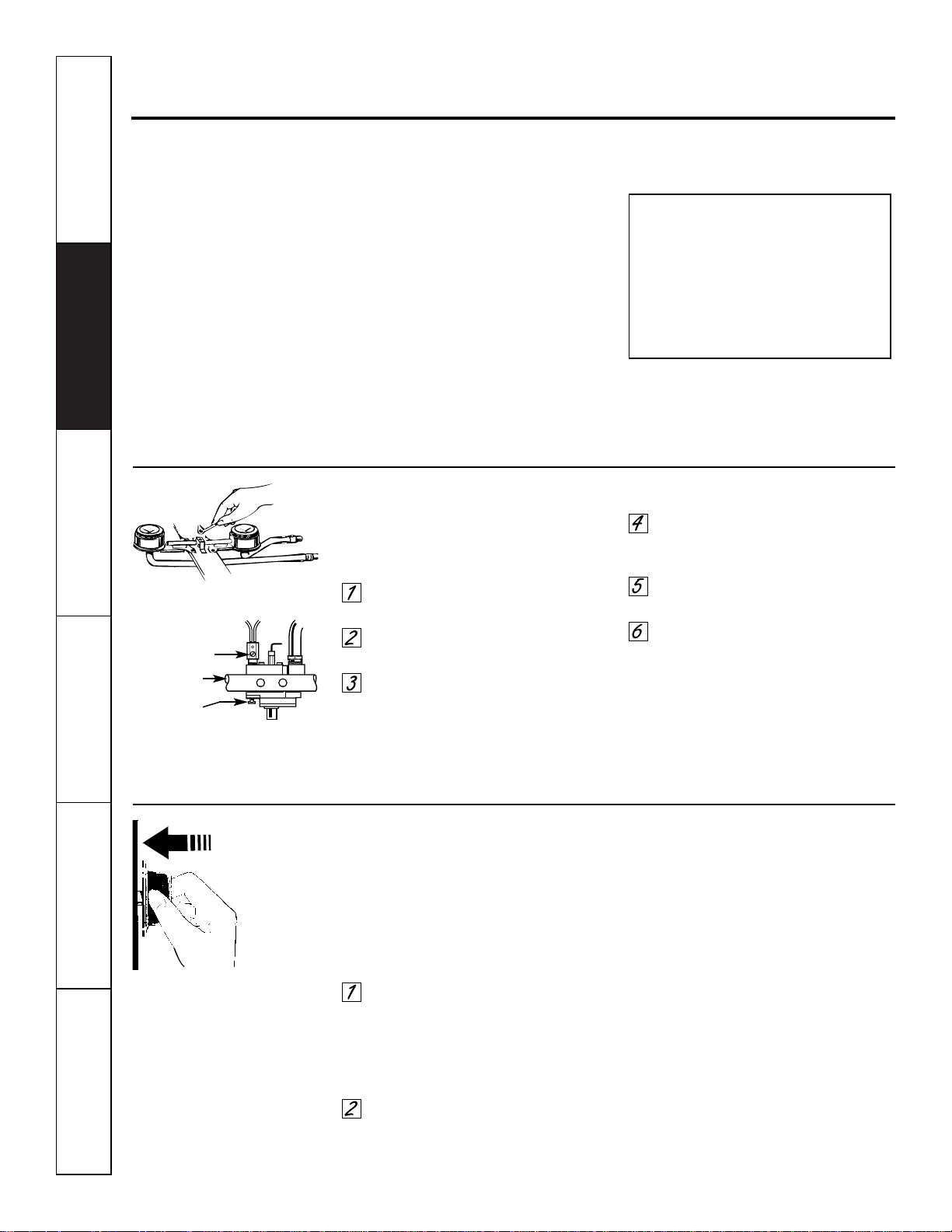
Locate the 2 pilot ports and light
each of them with a match.
If the pilots need adjusting, turn the
adjusting screw located on the pilot
filter.
Lower the cooktop. Your surface
burners are now ready for use.
Observe lighted burners. Compare
the flames to pictures in the
Before
you call for service
section. If any
flame is unsatisfactory, call for
service.
Surface Burner Controls
The knobs that turn the surface burners on and
off are located on the control panel on the front
of the range. The two knobs on the left control
the left front and left rear burners. The two knobs
on the right control the right front and right rear
burners.
To Light a Surface Burner
Push the control knob in and turn it
to
LITE
(
HI
on pilot models). On
electric ignition models, you will
hear a little
clicking
noise—the
sound of the electric spark igniting
the burner.
After the burner ignites, turn the
knob to adjust the flame size.
After Lighting a Burner
■Check to be sure the burner you turned
on is the one you want to use.
■Do not operate a burner for an
extended period of time without
cookware on the grate. The finish on
the grate may chip without cookware
to absorb the heat.
■Be sure the burners and grates are
cool before you place your hand, a
pot holder, cleaning cloths or other
materials on them.
Manifold pipe
Top pilots
adjustment screw
Top pilots adjustment screw controls
the rate of gas to the top burner
pilots.
Thermostat
9
Safety Instructions Operating Instructions Care and Cleaning Installation Instructions Troubleshooting Tips Customer Service
How to Select Flame Size
Watch the flame, not the knob, as you reduce
heat. The flame size on a gas burner should
match the cookware you are using.
For safe handling of cookware, never let the
flame extend up the sides of the cookware.
Any flame larger than the bottom of the
cookware is wasted and only serves to heat
the handle.
Top of Range Cookware
Aluminum:
Medium-weight cookware is
recommended because it heats quickly
and evenly. Most foods brown evenly in
an aluminum skillet. Use saucepans with
tight-fitting lids when cooking with
minimum amounts of water.
Cast-iron:
If heated slowly, most skillets
will give satisfactory results.
Enamelware:
Under some conditions,
the enamel of some cookware may
melt. Follow cookware manufacturer’s
recommendations for cooking methods.
Glass:
There are 2 types of glass
cookware—those for oven use only
and those for top-of-range cooking
(saucepans, coffee and teapots).
Glass conducts heat very slowly.
Heatproof Glass Ceramic:
Can be used
for either surface or oven cooking. It
conducts heat very slowly and cools very
slowly. Check cookware manufacturer’s
directions to be sure it can be used on
gas ranges.
Stainless Steel:
This metal alone has
poor heating properties and is usually
combined with copper, aluminum
or other metals for improved heat
distribution. Combination metal skillets
usually work satisfactorily if they are used
with medium heat as the manufacturer
recommends.
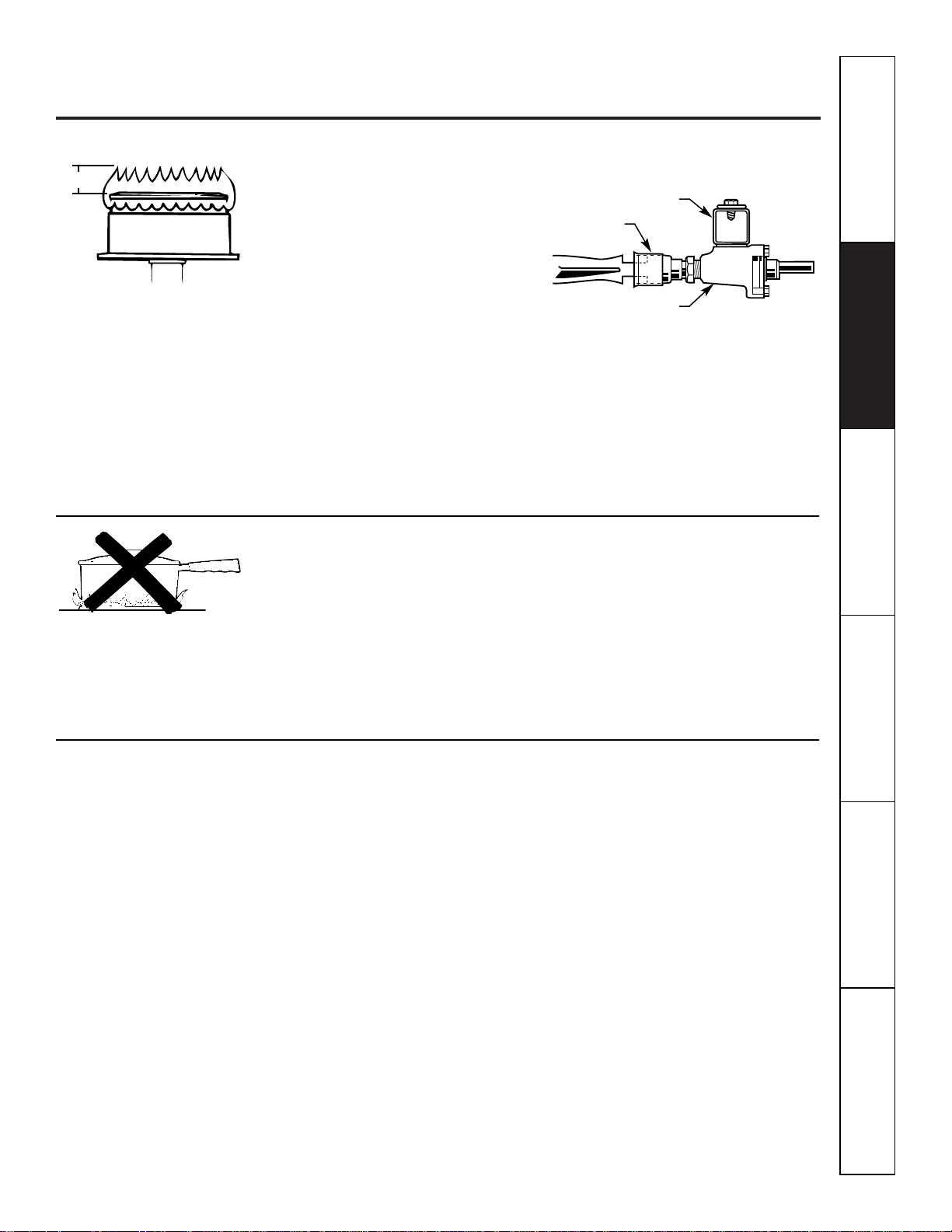
Air Adjustment
An air adjustment shutter for each surface burner
regulates the flow of air to the flame.
When the right amount of air flows into the
burner,
the flame will be steady, relatively
quiet and have approximately 3/4-inch
sharp blue cones. This is usually the case
with factory preset shutter settings.
With too much air,
the flame will be
unsteady, possibly won’t burn all the way
around, and will be noisy, sounding like
a blowtorch.
With not enough air,
you won’t see any
sharp blue cones in the flame, you may
see yellow tips and soot may accumulate
on pots and pans.
To adjust the flow of air to the burners,
rotate the shutters to allow more or less
air into the burner tubes as needed.
3/4″
3/4
″
Flame height on HI setting
1/8
″
flame height in the low position
Never let the flame extend up the
sides of the cookware.
Manifold pipe
Air adjustment
shutter
Top burner valve
Customer Service Troubleshooting Tips Installation Instructions Care and Cleaning Operating Instructions Safety Instructions
10
Using the oven.
Throughout this manual, features and appearance may vary from your model.
Lighting Instructions for Electric Ignition Models
The oven burner is lighted by electric ignition.
To light the burner, turn the
OVEN TEMP
knob to the desired temperature. The
burner should light within 30-90 seconds.
After the oven reaches the selected
temperature the oven burner cycles on
and off to maintain the selected
temperature.
Power Outage—Electric Ignition Models
A burner in use when an electrical power failure
occurs will continue to operate normally. Your
oven may be used during an electrical power
outage by carefully following the steps below.
To light the oven pilot during an electrical
power outage:
Be sure the
OVEN TEMP
knob is in
the
OFF
position.
Open both the oven and broiler
doors and wait 5 minutes to allow
any pilot gas to dissipate.
Unplug the range from the wall
outlet, turn off the circuit breaker, or
remove the fuse to avoid accidental
ignition of the oven if electrical
power is restored while you are
lighting the pilot.
Remove the broiler pan.
Locate the oven pilot assembly by
looking into the broiler opening.
The pilot is at the back of the broiler
compartment, on the left side of the
burner.
NOTE: The oven must be at room temperature
before you should attempt to light the oven pilot
manually.
Turn the
OVEN TEMP
knob to the
desired temperature setting.
Light the pilot with a match and
withdraw your arm immediately
because the oven burner may light in
as little as 20 seconds.
Replace the broiler pan and close
the oven and broiler doors.
NOTE: It is necessary to light the pilot manually
each time the oven is used during a power outage.
Lighting Instructions for Standing Pilot Models
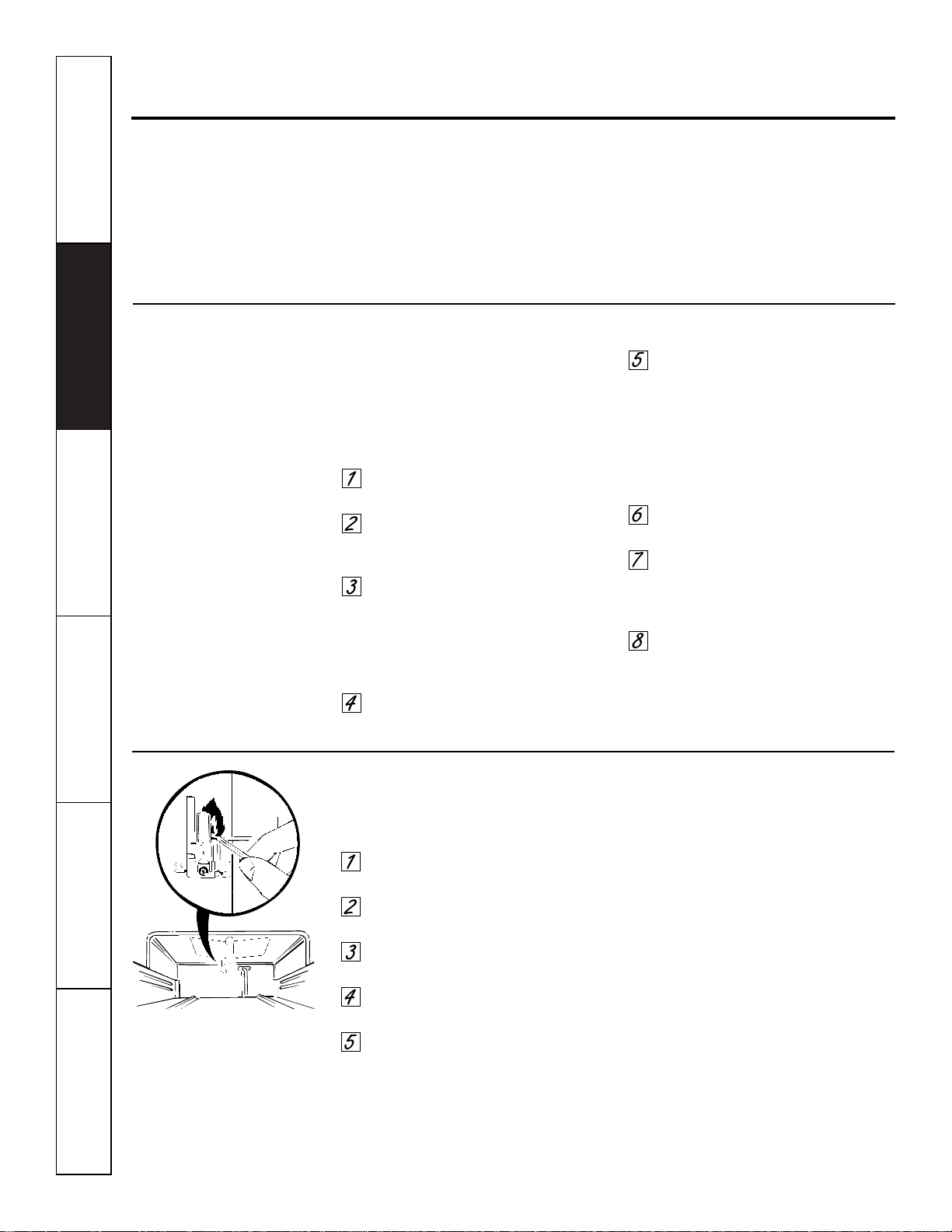
The standing oven pilot must be lit initially.
To light the oven pilot:
Be sure the
OVEN TEMP
knob is in
the
OFF
position.
Remove the oven bottom. See the
Care and cleaning of the range
section.
Find the oven pilot port at the back
of the oven.
Using a long match or match holder,
reach in and light the oven pilot.
Replace the oven bottom and close
the door. Your oven and broiler are
now ready for use.
■To light the oven burner, turn the
OVEN TEMP
knob to the desired
temperature. The burner should
light within 60 seconds.
■
Power failure?
An electrical power
failure will not affect the standing
oven pilot.
11
Safety Instructions Operating Instructions Care and Cleaning Installation Instructions Troubleshooting Tips Customer Service
Oven Control
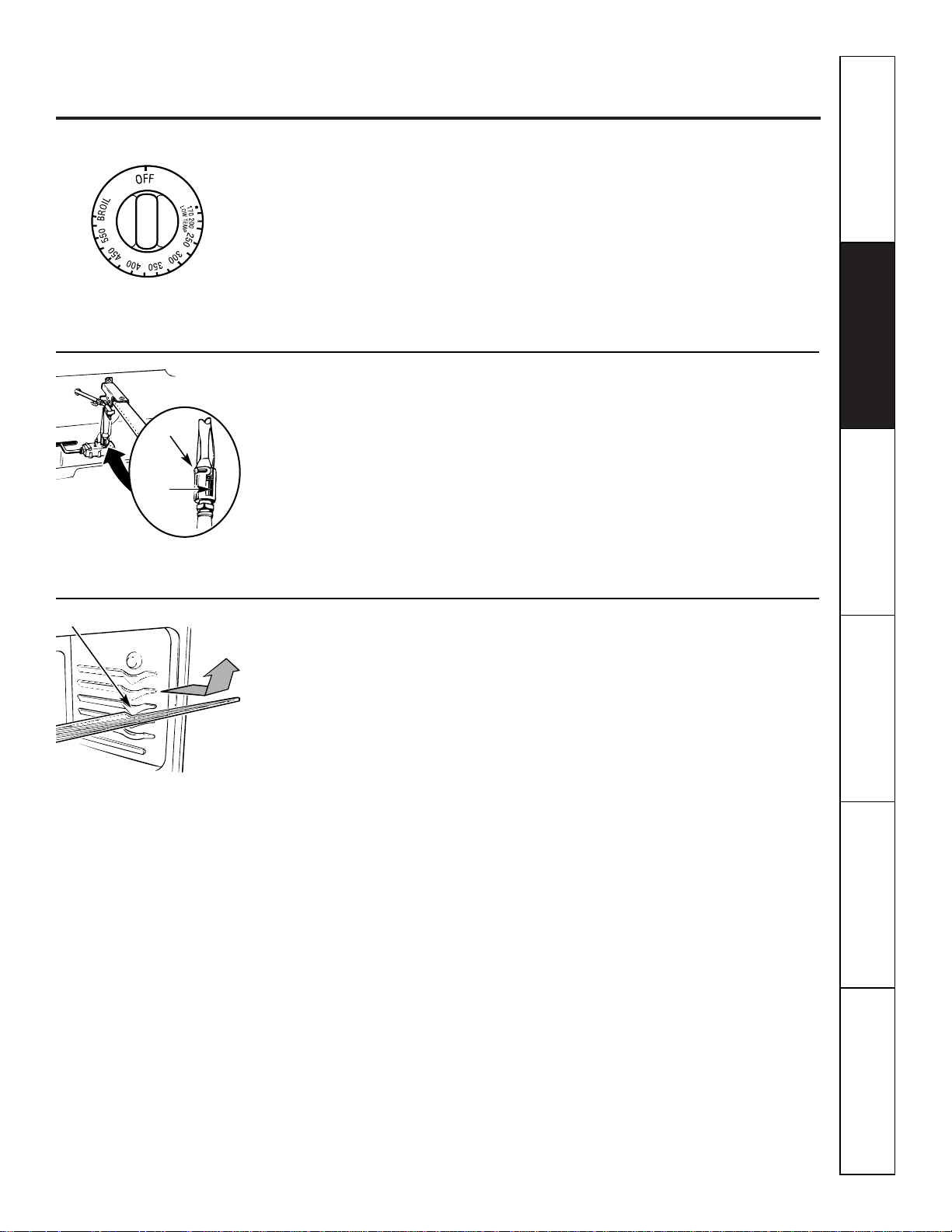
Your oven is controlled by an OVEN TEMP knob. It
will normally take 30-90 seconds before the
flame comes on.
After the oven reaches the selected
temperature, the oven burner cycles—off
completely, then on with a full flame—to
maintain the selected temperature.
Air Adjustment
An air adjustment shutter for the oven burner
regulates the flow of air to the flame.
You’ll find the shutter against the back
wall behind the broiler drawer. To reach
it remove the oven bottom (see the
Care
and cleaning of the range
section) and the
burner baffle.
To adjust the flow of air,
loosen the Phillips
head screw and rotate the shutter to allow
more or less air into the burner tube as
needed.
When the right amount of air flows into
the burner,
the flame should be steady,
with approximately 1/2 inch blue cones,
and should not extend out over the
baffle edges.
Loosen
Air
adjustment
shutter
Oven Shelves
The shelves are designed with stop-locks
so when placed correctly on the shelf
supports, they will stop before coming
completely out of the oven and will not
tilt when you are removing food from
them or placing food on them.
When placing cookware on a shelf,
pull the shelf out to the bump on the
shelf support. Place the cookware on the
shelf, then slide the shelf back into the
oven. This will eliminate reaching into
the hot oven.
To remove the shelves from the oven,
pull
them toward you, tilt front end upward
and pull them out.
To replace,
place shelf on shelf support
with stop-locks (curved extension of
shelf) facing up and toward back of oven.
Tilt up front and push shelf toward back
of oven until it goes past the bump on the
shelf support. Then lower front of shelf
and push it all the way back.
Bump
Customer Service Troubleshooting Tips Installation Instructions Care and Cleaning Operating Instructions Safety Instructions
12
Using the oven.
Throughout this manual, features and appearance may vary from your model.
Oven Vents
■The oven is vented through duct
openings at the rear of the cooktop.
■Do not block the opening when
cooking in the oven—it is important
that the flow of hot air from the oven
and fresh air to the oven burner be
uninterrupted.
■The vent openings and nearby surfaces
may become hot during baking and
broiling. Do not touch them.
■Do not leave plastic items on the
cooktop—they may melt if left too close
to the vent.
■Handles of pots and pans on the
cooktop may become hot if left too
close to the vent.
■Metal items will become very hot if they
are left on the cooktop and could cause
burns.
■Do not leave any items on the cooktop.
The hot air from the vent may ignite
flammable items and will increase
pressure in closed containers, which
may cause them to burst.
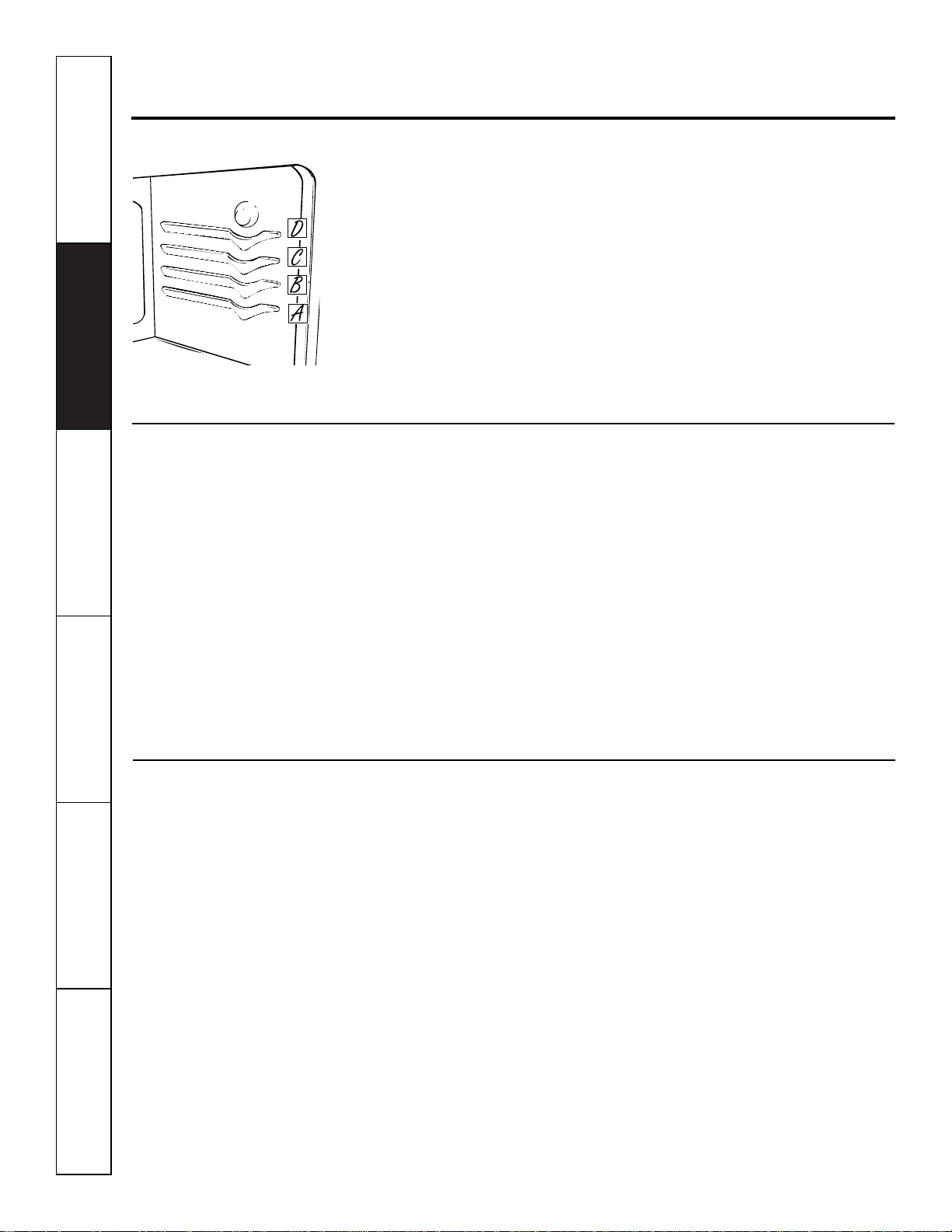
Oven Shelf Positions
The oven has four shelf supports—
A
(bottom),
B, C
and
D
(top).
Shelf positions for cooking are suggested
in the
Using your oven for baking
and
Using
your oven for roasting
sections.
The oven has 4 shelf positions.
The type of margarine will affect baking performance!
Most recipes for baking have been developed
using high fat products such as butter or
margarine (80% fat). If you decrease the fat, the
recipe may not give the same results as with a
higher fat product.
Recipe failure can result if cakes, pies,
pastries, cookies or candies are made with
low fat spreads. The lower the fat content
of a spread product, the more noticeable
these differences become.
Federal standards require products
labeled “margarine” to contain at least
80% fat by weight. Low fat spreads, on
the other hand, contain less fat and more
water. The high moisture content of these
spreads affects the texture and flavor of
baked goods. For best results with your
old favorite recipes, use margarine,
butter or stick spreads containing at
least 70% vegetable oil.
Using the oven for baking.
To avoid possible burns, place the shelves in the desired position before you turn the oven on.
Safety Instructions Operating Instructions Care and Cleaning Installation Instructions Troubleshooting Tips Customer Service
How to Set the Oven For Baking
Close the oven door. Then turn the
OVEN TEMP
knob to the desired
temperature.
Check the food for doneness at
the minimum time on the recipe.
Cook longer if necessary. Turn
the
OVEN TEMP
knob to
OFF
and
remove the food.
Oven Shelves
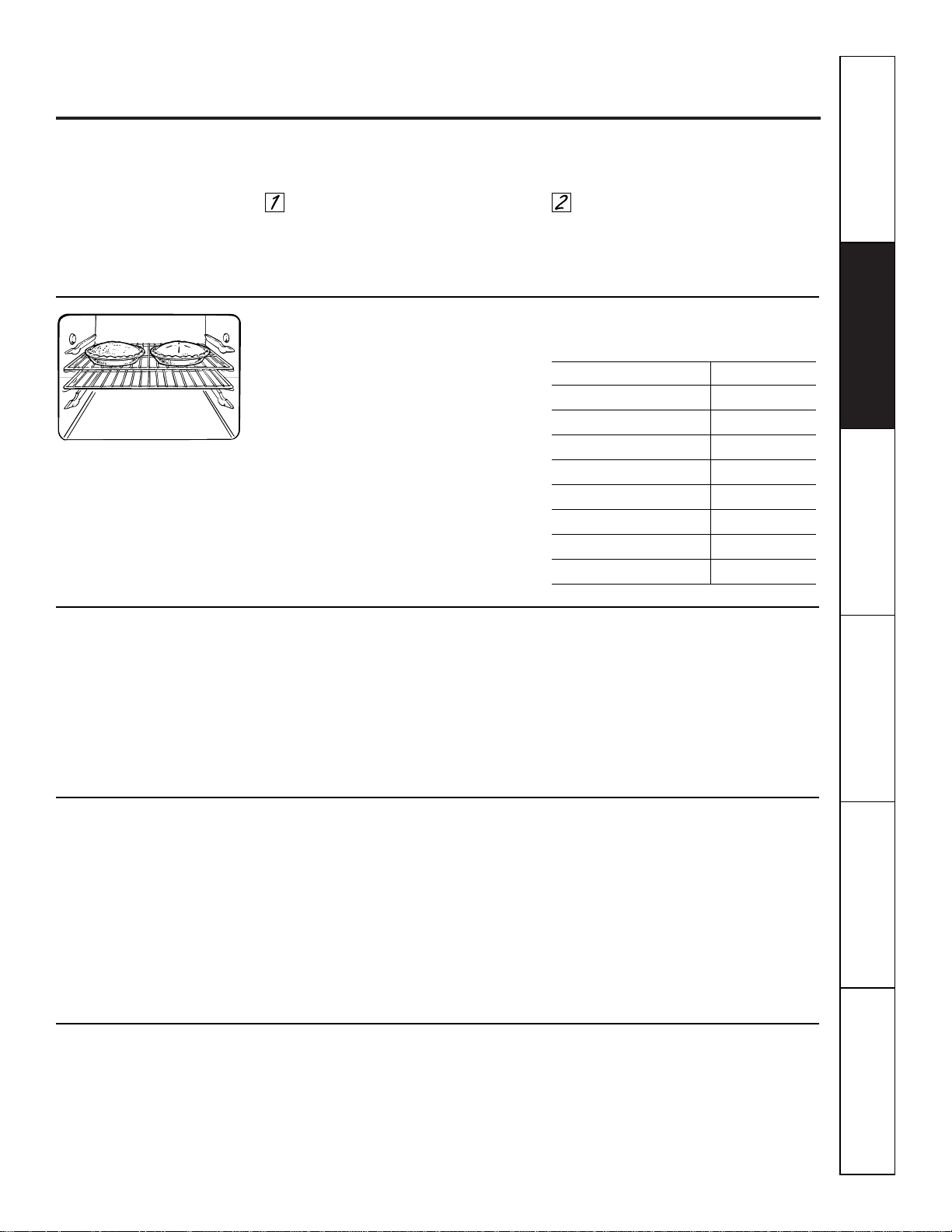
Arrange the oven shelf or shelves in the
desired locations while the oven is cool.
The correct shelf position depends on the
kind of food and the browning desired.
As a general rule, place most foods in the
middle of the oven, on either the shelf
position
B
or
C.
See the chart for
suggested shelf positions.
Type of Food Shelf Position
Angel food cake A
Biscuits, muffins B or C
Cookies or cupcakes B or C
Brownies B or C
Layer cakes B or C
Bundt or pound cakes A or B
Pies or pie shells B or C
Frozen pies (on cookie sheet) A
Casseroles B or C
Preheating
Preheat the oven for 10 minutes if the
recipe calls for it. Preheat means
bringing the oven up to the specified
temperature before putting the food in
the oven.
To preheat, set the oven at the correct
temperature—selecting a higher temperature
does not shorten the preheat time.
Preheating is necessary for good results
when baking cakes, cookies, pastry and
breads. For most casseroles and roasts,
preheating is not necessary.
Baking Pans
Use the proper baking pan. The type of finish on
the pan determines the amount of browning that
will occur.
■Glass baking dishes also absorb heat.
When baking in glass baking dishes,
lower the temperature by 25°F. and use
the recommended cooking time in the
recipe. This is not necessary when
baking pies or casseroles.
■Dark, rough or dull pans absorb heat
resulting in a browner, crisper crust.
Use this type for pies.
■Shiny, bright and smooth pans reflect
heat, resulting in a lighter, more
delicate browning. Cakes and cookies
require this type of pan.
Pan Placement
For even cooking and proper browning,
there must be enough room for air
circulation in the oven. Baking results will
be better if baking pans are centered as
much as possible rather than being placed
to the front or to the back of the oven.
Pans should not touch each other or the
walls of the oven. Allow 1 to 1
1
⁄2 inch
space between pans as well as from the
back of the oven, the door and the sides.
If you need to use two shelves, stagger the
pans so one is not directly above the other.
Place most foods in the middle of
the oven.
13
Customer Service Troubleshooting Tips Installation Instructions Care and Cleaning Operating Instructions Safety Instructions
14
Using the oven for baking.
Throughout this manual, features and appearance may vary from your model.
Cookies
For even cooking and proper browning, there
must be enough room for air circulation in
the oven.
Baking results will be better if baking pans
are centered as much as possible rather
than being placed to the front or to the
back of the oven.
Pans should not touch each other or the
walls of the oven. Allow 1 to 1
1
⁄2 inch
space between pans as well as from the
back of the oven, the door and the sides.
If you need to use two shelves, stagger the pans
so one is not directly above the other.
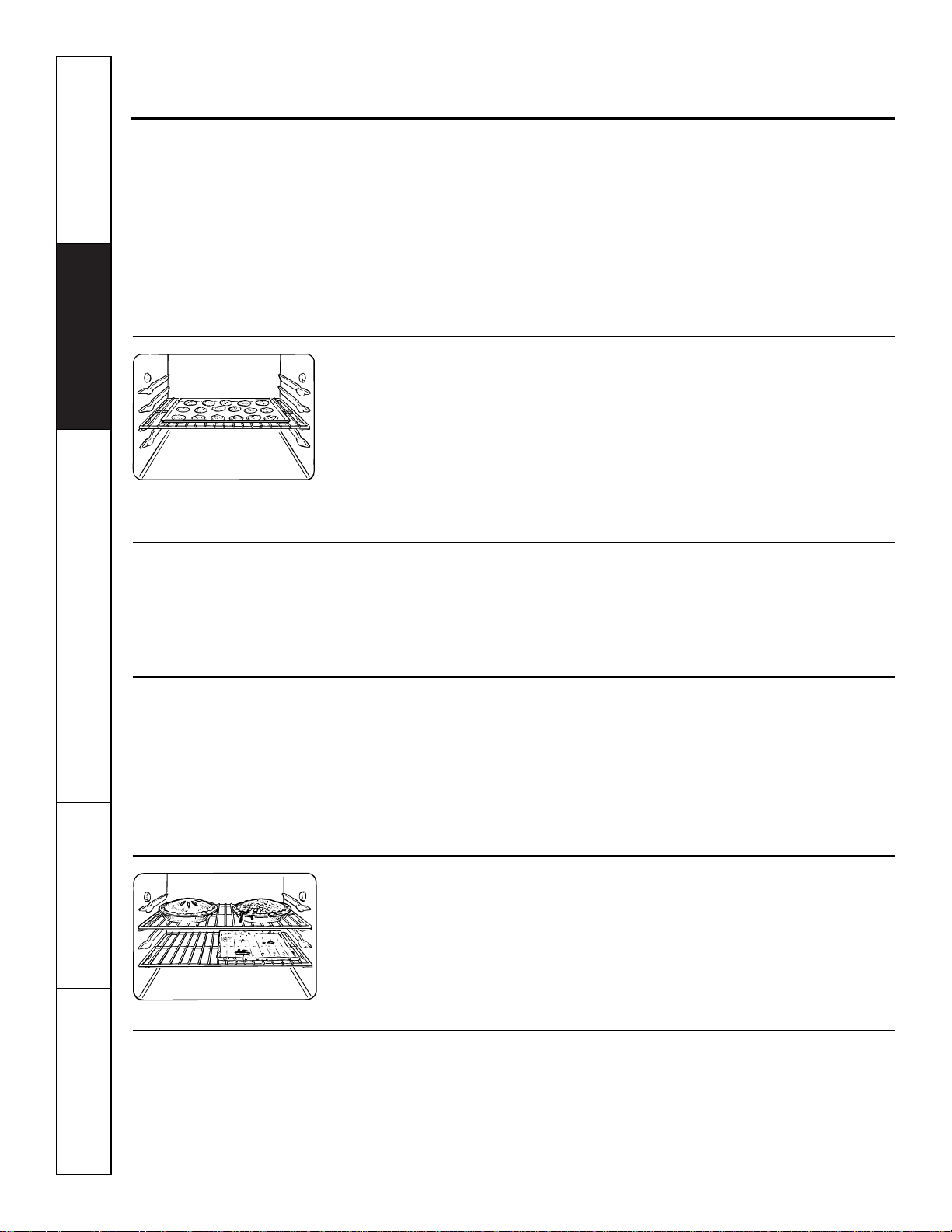
Oven Shelves
Flat cookie sheets (without sides)
produce better-looking cookies. Cookies
baked in a jelly roll pan (short sides all
around) may have darker edges and pale
or light browning may occur.
Do not use a cookie sheet so large that it
touches the walls or the door of the oven.
Never entirely cover a shelf with a large
cookie sheet.
For best results, use only one cookie
sheet in the oven at a time.
Aluminum Foil
Never entirely cover a shelf with
aluminum foil. This will disturb the heat
circulation and result in poor baking.
A smaller sheet of foil may be used to
catch a spillover by placing it on a lower
shelf several inches below the food.
Pies
For best results, bake pies in dark, rough
or dull pans to produce a browner,
crisper crust.
Frozen pies in foil pans should be placed on an
aluminum cookie sheet for baking since the shiny
foil pan reflects heat away from the pie crust; the
cookie sheet helps retain it.
Don’t Peek
Set the timer for the estimated cooking
time and do not open the door to look at
your food. Most recipes provide
minimum and maximum baking times
such as “bake 30-40 minutes.”
DO NOT open the door to check until the
minimum time. Opening the oven door frequently
during cooking allows heat to escape and makes
baking times longer. Your baking results may also
be affected.
Cakes
When baking cakes, warped or bent pans will
cause uneven baking results and poorly shaped
products.
A cake baked in a pan larger than the
recipe recommends will usually be crisper,
thinner and drier than it should be.
If baked in a pan smaller than
recommended, it may be undercooked
and batter may overflow.
Check the recipe to make sure the pan size used
is the one recommended.
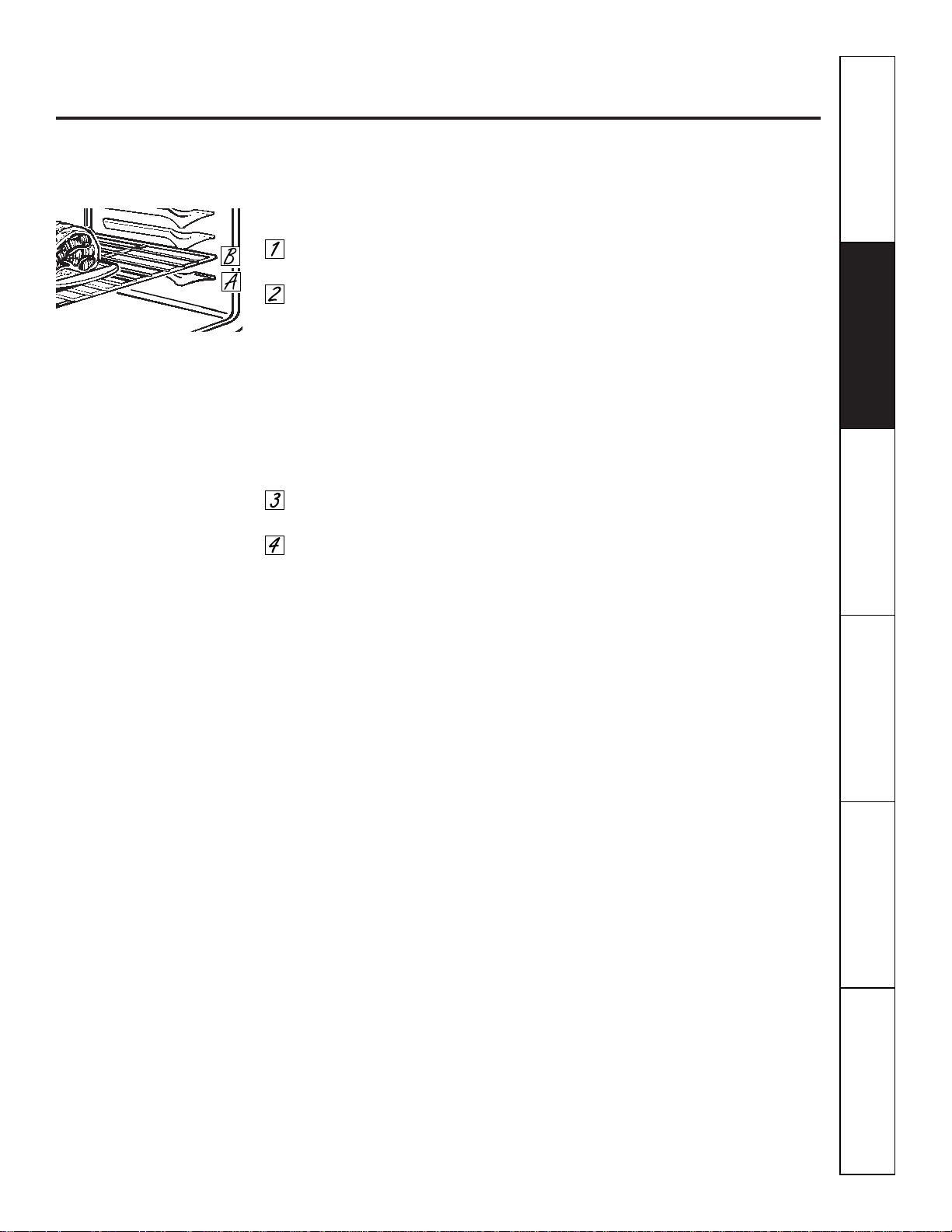
Using the oven for roasting.
Roasting is cooking by dry heat. Tender meat or poultry can be roasted uncovered in your oven. Roasting
temperatures, which should be low and steady, keep spattering to a minimum.
Roasting is really a baking procedure used for meats. Roasting is easy; just follow these directions:
Safety Instructions Operating Instructions Care and Cleaning Installation Instructions Troubleshooting Tips Customer Service
How to Set the Oven For Roasting
Place the shelf in the
A
or
B
position.
No preheating is necessary.
Check the weight of the meat. Place
it fat side up (or for poultry, breast-
side-up) on a roasting rack in a
shallow pan. The melting fat will
baste the meat. Select a pan as close
to the size of the meat as possible.
Line the pan with aluminum foil
when using the pan for marinating,
cooking with fruits, cooking heavily
cured meats, or basting food during
cooking.
Turn the
OVEN TEMP
knob to the
desired setting.
After roasting is complete, turn the
OVEN TEMP
knob to
OFF
and then
remove the food from the oven.
Place the shelf in the A or B
position.
15
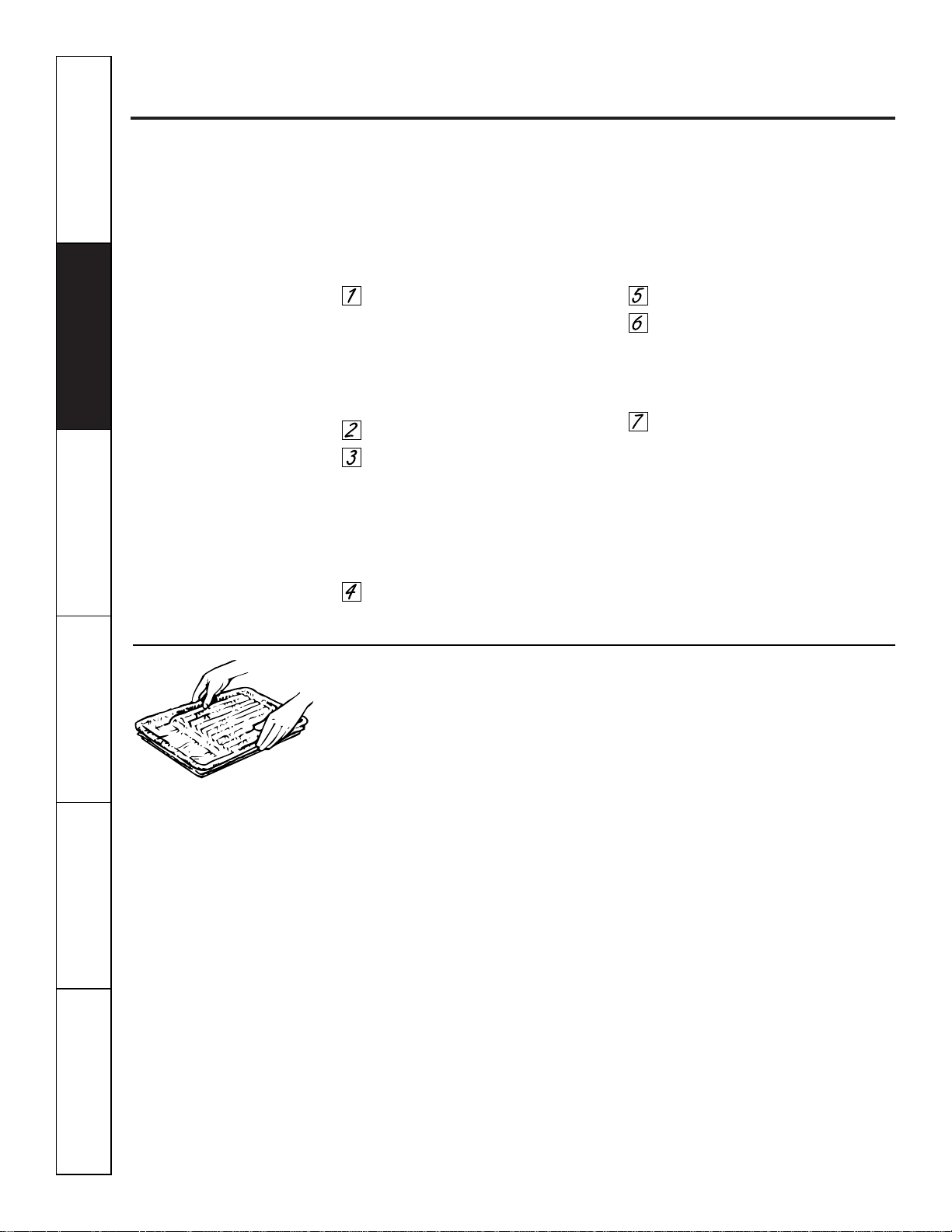
Using the oven for broiling.
Broiling is cooking food by direct heat from above the food. Most fish and tender cuts of meat can be broiled. Follow
these steps to keep spattering and smoking to a minimum.
Your range has a compartment below the oven for broiling. A specially designed broiler pan allows dripping fat to
drain away from the food.
Both the oven and broiler compartment doors should be closed during broiling.
Customer Service Troubleshooting Tips Installation Instructions Care and Cleaning Operating Instructions Safety Instructions
16
How to Set Your Oven for Broiling
You can change the distance of the
food from the heat source by
positioning the broiler pan in the
broiler compartment–
A
(bottom of
broiler compartment) or second
position. Most broiling should be
done in position
A.
Preheat the broiler for best results.
If the meat has fat or gristle around
the edge, cut vertical slashes through
it about 2 inches apart, but don’t cut
into the meat. We recommend that
you trim the fat to prevent excessive
smoking, leaving a layer about 1/8
inch thick.
Close the oven and broiler
compartment door.
Turn the
OVEN TEMP
knob to
BROIL.
Turn most foods once during
cooking. Time foods for about one-
half the total cooking time, turn
food, then continue to cook to
preferred doneness.
Turn the
OVEN TEMP
knob to
OFF.
Remove the broiler pan from the
broiler compartment and serve the
food immediately. Leave the pan
outside the range to cool.
Use of Aluminum Foil
You can use aluminum foil to line your
broiler pan. However, you must mold the
foil tightly to the pan.
17
Safety Instructions Operating Instructions Care and Cleaning Installation Instructions Troubleshooting Tips Customer Service
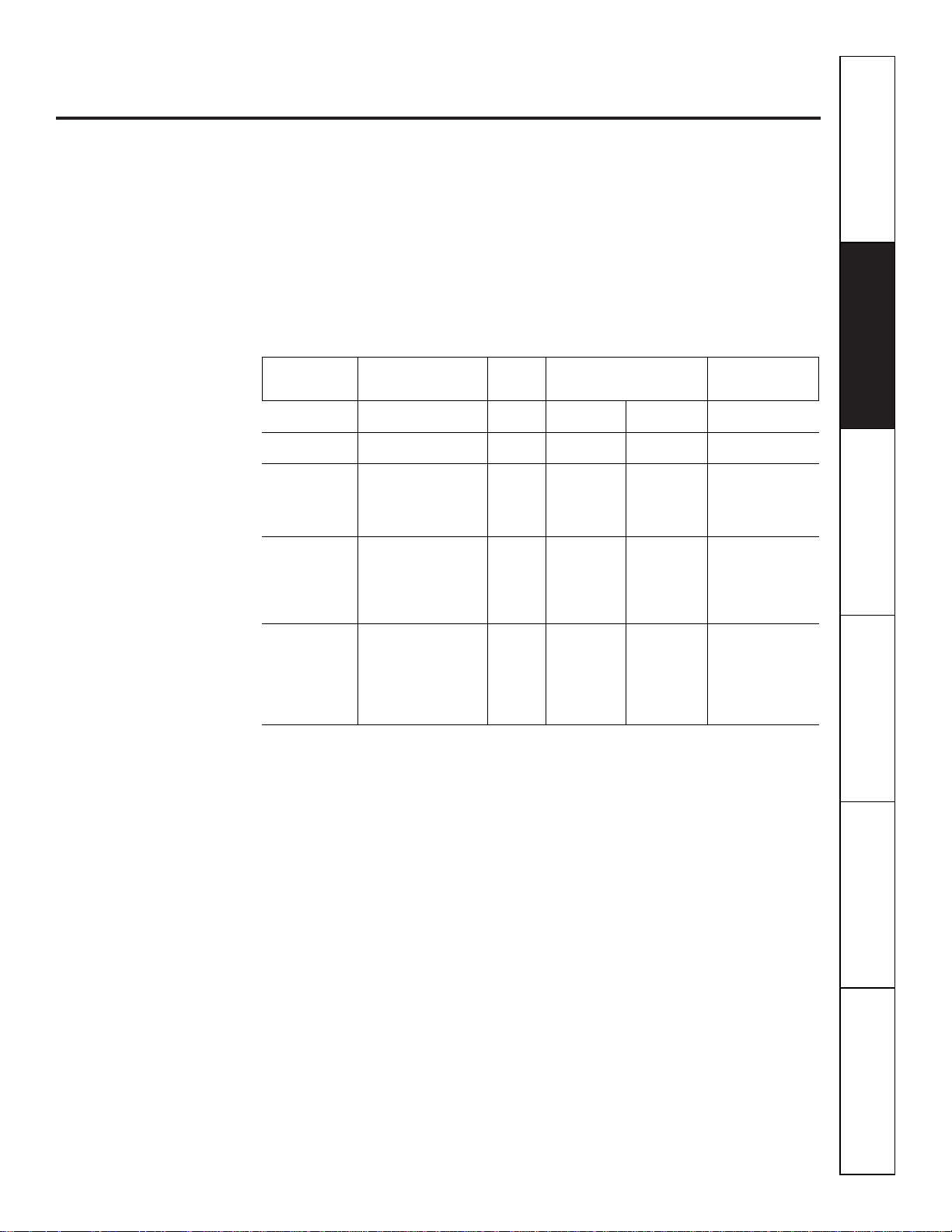
Broiling Guide
■The oven and broiler compartment
doors must be closed during broiling.
■Always use the broiler pan that comes
with your range.
■If desired, marinate meats or chicken
before broiling. Or, brush with
barbecue sauce the last 5 to 10 minutes.
■When arranging food on pan, do not
let fatty edges hang over the sides. The
fat drippings will soil the broiler
compartment.
■Use tongs to turn the meat. Pierced
meat loses juices.
Amount or Shelf Time In Minutes
Food Thickness Position First Side Second Side Comments
Bacon 1/2 lb. B 3
1
⁄2 min. 3 min. Arrange in single layer
(about 8 thin slices)
Ground Beef 1 lb. (4 patties) A 10–11 min. 4–5 min. Space evenly.
1/2 to 3/4″ thick
Beef Steaks
Medium 1 to 1
1
⁄2 lbs. A 12 min. 5–6 min. Steaks less than 1″
thick cook through
before browning. Pan
frying is recommended.
Chicken 1 whole A 30–35 min. 25–30 min. Reduce time about 5
2 to 2
1
⁄2 lbs., to 10 minutes per side
split lengthwise for cut-up chicken.
Brush each side with
melted butter. Broil
skin-side-down first.
Fish 1 lb. fillets B 5 min. 5 min. Handle and turn very
1/4 to 1/2″ thick carefully. Brush with
lemon butter before
and during cooking, if
desired. Preheat
broiler to increase
browning.
Customer Service Troubleshooting Tips Installation Instructions Care and Cleaning Operating Instructions Safety Instructions
18
Care and cleaning of the range.
Be sure electrical power is off and all surfaces are cool before cleaning any part of the range.
Proper care and cleaning are important so your range will give you efficient and satisfactory service. Follow these
directions carefully in caring for your range to assure safe and proper maintenance.
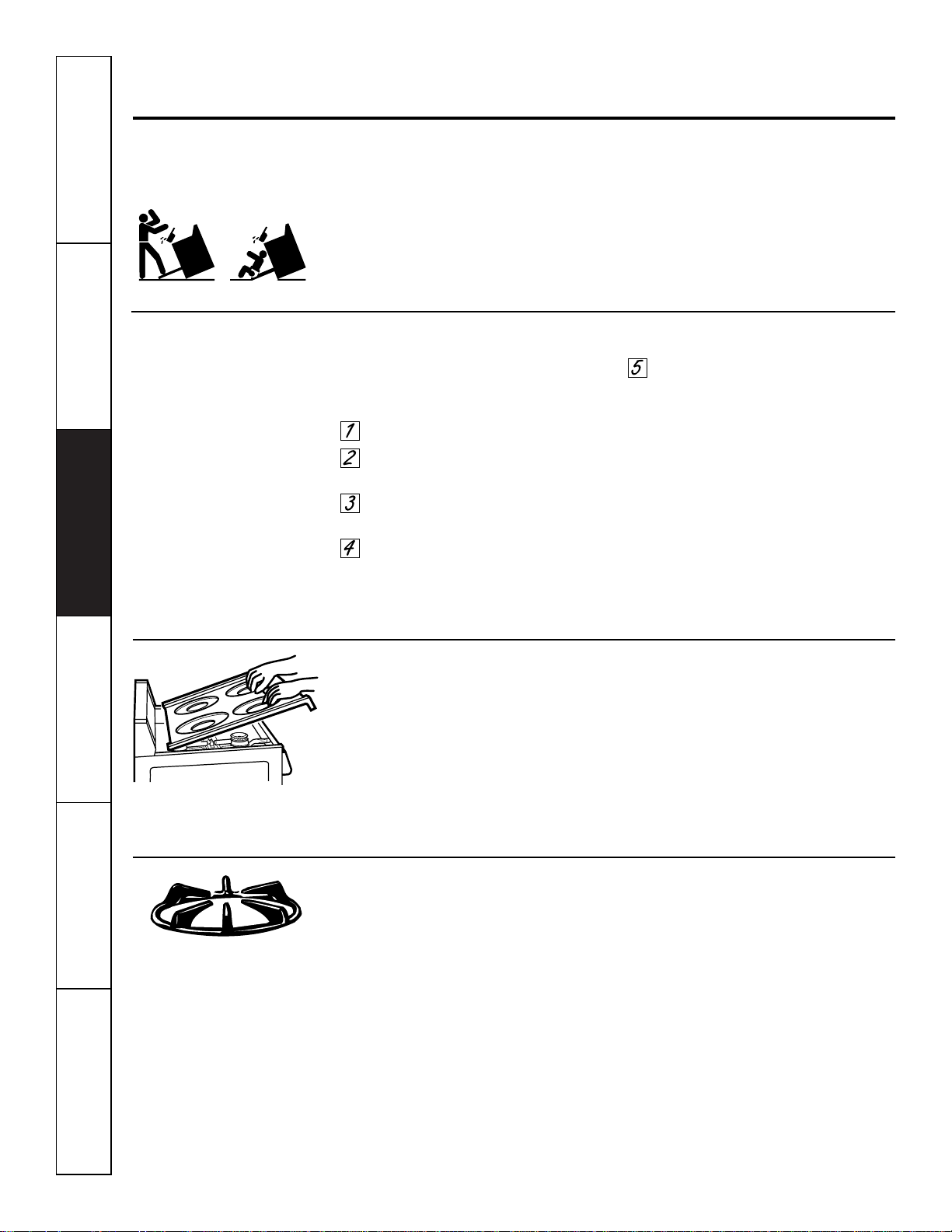
Lift-Up/Off Cooktop
Clean the area under the cooktop often. Built-up
soil, especially grease, may catch on fire.
To make cleaning easier, the cooktop
may be lifted up or off.
Be sure all burners are turned off before
raising the cooktop. Then remove the
grates.
Grasp the two front burner wells and lift
the cooktop up or off. Be careful of the
pilots when the cooktop is up.
After cleaning underneath the cooktop
with hot, soapy water and a clean cloth,
lower or replace the cooktop. Be careful
not to pinch your fingers.
Burner Grates
Grates should be washed regularly and after
spillovers. Wash them in hot, soapy water and
rinse with clean water.
After cleaning, dry thoroughly by putting
them in a warm oven for a few minutes.
Don’t put the grates back on the range
while they are wet. When replacing the
grates, be sure they’re positioned securely
over the burners.
To get rid of burned-on food, place the
grates in a covered container (or plastic
bag) with 1/4 cup ammonia to loosen
the soil. Then scrub with a soap-filled
scouring pad if necessary.
Although they’re durable, the grates will
gradually lose their shine, regardless of
the best care you can give them. This is
due to their continual exposure to high
temperatures.
Do not operate a burner for an extended
period of time without cookware on the
grate. The finish on the grate may chip
without cookware to absorb the heat.
If your range is removed for cleaning, servicing or any reason, be sure the anti-tip
device is re-engaged properly when the range is replaced. Failure to take this
precaution could result in tipping of the range and cause injury.
How to Remove the Range for Cleaning and Servicing
Follow these steps to remove the range
for servicing or cleaning hard to reach
surfaces.
Shut off the gas supply to the range.
Disconnect the electrical supply to
the range.
Disconnect the gas supply tubing to
the range.
Slide the range forward to free the
range foot from the Anti-Tip bracket.
See the Installation Instructions for
the location of the bracket.
Reverse these steps to re-install the
range. If the gas line has been
disconnected, check for gas leaks
after re-connection. See the
Installation Instructions for the gas
lead test method.
NOTE: A trained technician should make the gas
installation, disconnection and re-connection of
the gas supply to the appliance.
19
Safety Instructions Operating Instructions Care and Cleaning Installation Instructions Troubleshooting Tips Customer Service
Burners
The holes in the surface burners of your range
must be kept clean at all times for proper ignition
and an even, unhampered flame.
You should clean the surface burners
routinely, especially after bad spillovers,
which could clog these holes. Wipe off
the surface burners. If heavy spillover
occurs, remove the surface burners
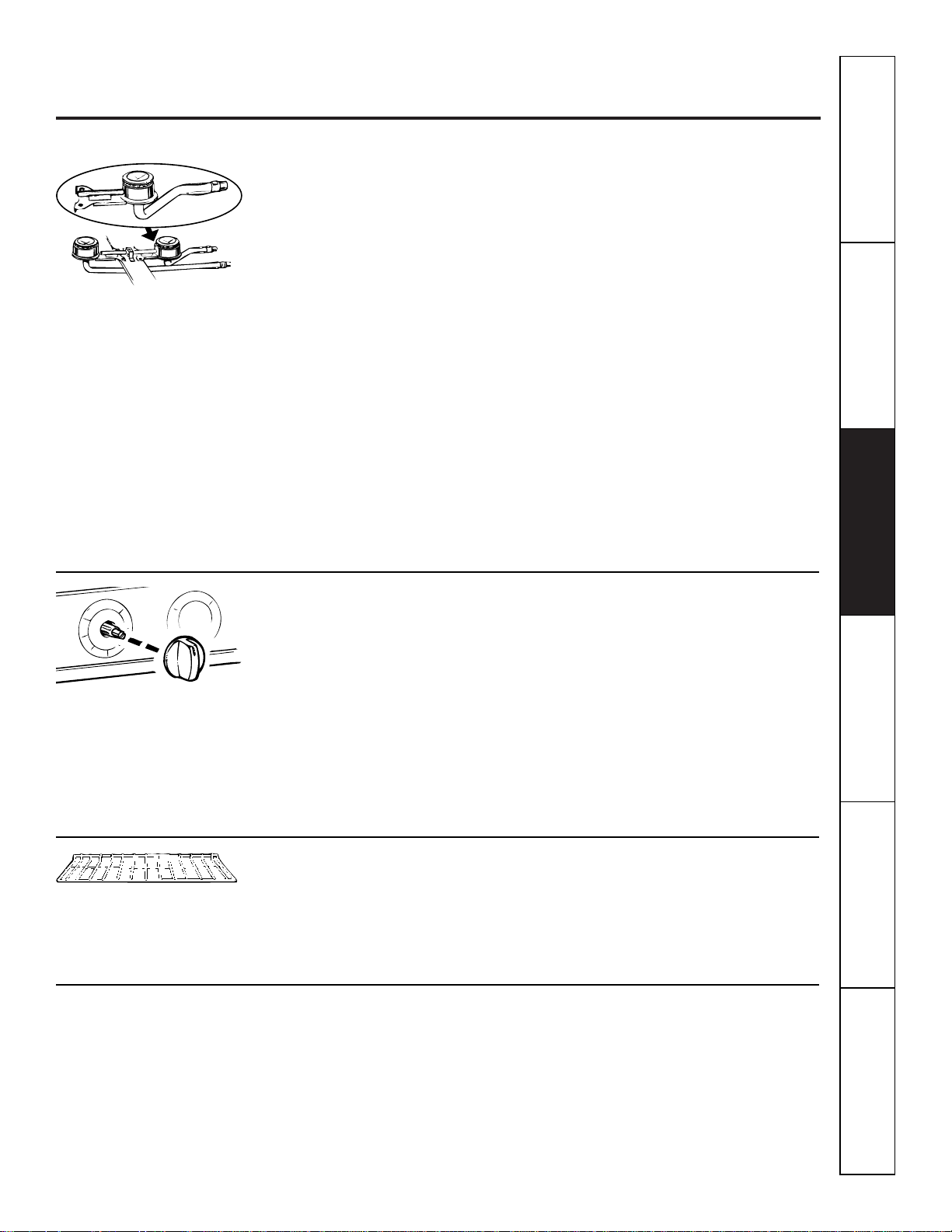
from the range. The burners lift out for
cleaning. Lift up the cooktop and then
lift out the surface burners.
NOTE: A screw holds each of the burners in
place to keep them from wobbling around during
shipment. Remove and discard the shipping
screw. Tilt the burner to one side at the end
closest to the igniter. This disengages it from
the gas valves at the front of the range. It lifts
out easily.
To remove burned-on food,
soak the surface
burner in a solution of mild liquid
detergent and hot water. Soak the surface
burner for 20 to 30 minutes. For more
stubborn stains, use a cleanser like Soft
Scrub® brand or Bon Ami® brand. Rinse
well to remove any traces of the cleanser
that might clog the surface burner
openings. Do not use steel wool because
it will clog the surface burner openings
and scratch the surface burners. If the
holes become clogged, clean them with a
small pin or sewing needle.
Before putting the surface burner back,
shake out excess water and then dry it
thoroughly by setting it in a warm oven
for 30 minutes. Then place it back in the
range, making sure it is properly seated
and level.
Control Panel and Knobs
It’s a good idea to wipe the control panel
after each use of the oven. Clean with
mild soap and water or vinegar and water,
rinse with clean water and polish dry with
a soft cloth.
Do not use abrasive cleansers, strong
liquid cleaners, plastic scouring pads or
oven cleaners on the control panel—they
will damage the finish. A 50/50 solution
of vinegar and hot water works well.
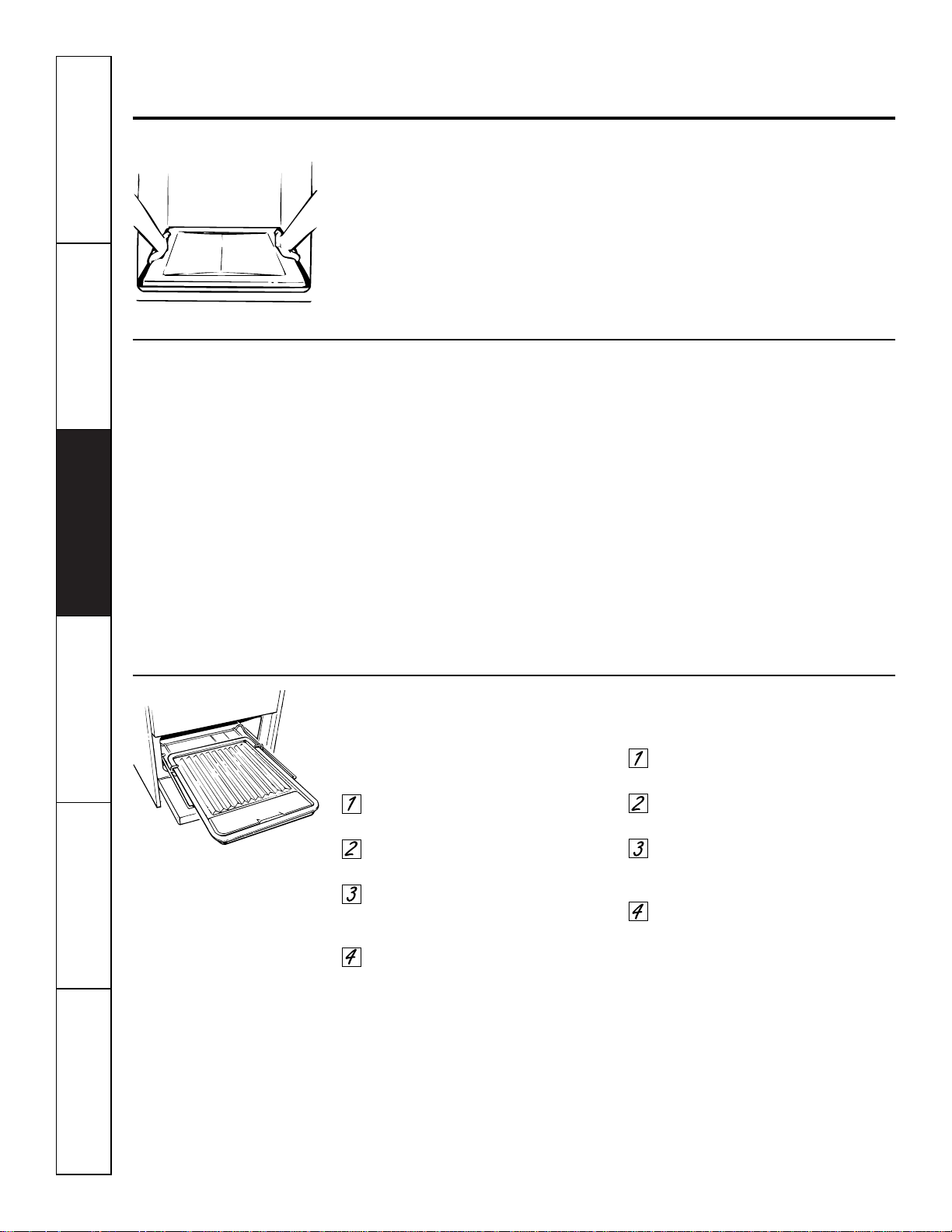
The control knobs may be removed for easier
cleaning.
To remove the knob, pull it straight off
the stem. Wash the knobs in soap and
water or a vinegar and hot water
solution but do not soak.
Oven Shelves
The shelves can be cleaned by hand using
soap and water or with an abrasive
cleaner. After cleaning, rinse the shelves
with clean water and dry.
To remove heavy, burned-on soil, you
may use scouring pads. After scrubbing,
wash with soapy water, rinse and dry.
Metal Parts
Do not use steel wool, abrasives, ammonia
or commercial oven cleaners.
To safely clean surfaces: wash, rinse and
then dry with a soft cloth.
Customer Service Troubleshooting Tips Installation Instructions Care and Cleaning Operating Instructions Safety Instructions
20
Care and cleaning of the range.
Cleaning the Oven Bottom
The oven bottom has a porcelain enamel finish.
To make cleaning easier, protect the oven
bottom from excessive spillovers. This is
particularly important when baking a
fruit pie or other foods with high acid
content. Hot fruit fillings or foods that
are acidic in content, such as tomatoes
or sauerkraut, and sauces with vinegar
or lemon juice, may cause pitting and
damage to the porcelain enamel surface.
To protect the oven bottom surface,
place
a piece of aluminum foil slightly larger
than the baking dish on the shelf below
to catch any boilovers. It should not
completely cover the shelf as this
would cause uneven heat in the oven.
Aluminum foil should not be placed
on the oven bottom.
If a spillover does occur on the oven
bottom, allow the oven to cool first. You
can clean the bottom with soap and
water, a mild abrasive cleanser, soap-filled
steel wool pads or an oven cleaner
following package directions.
Removable Oven Bottom
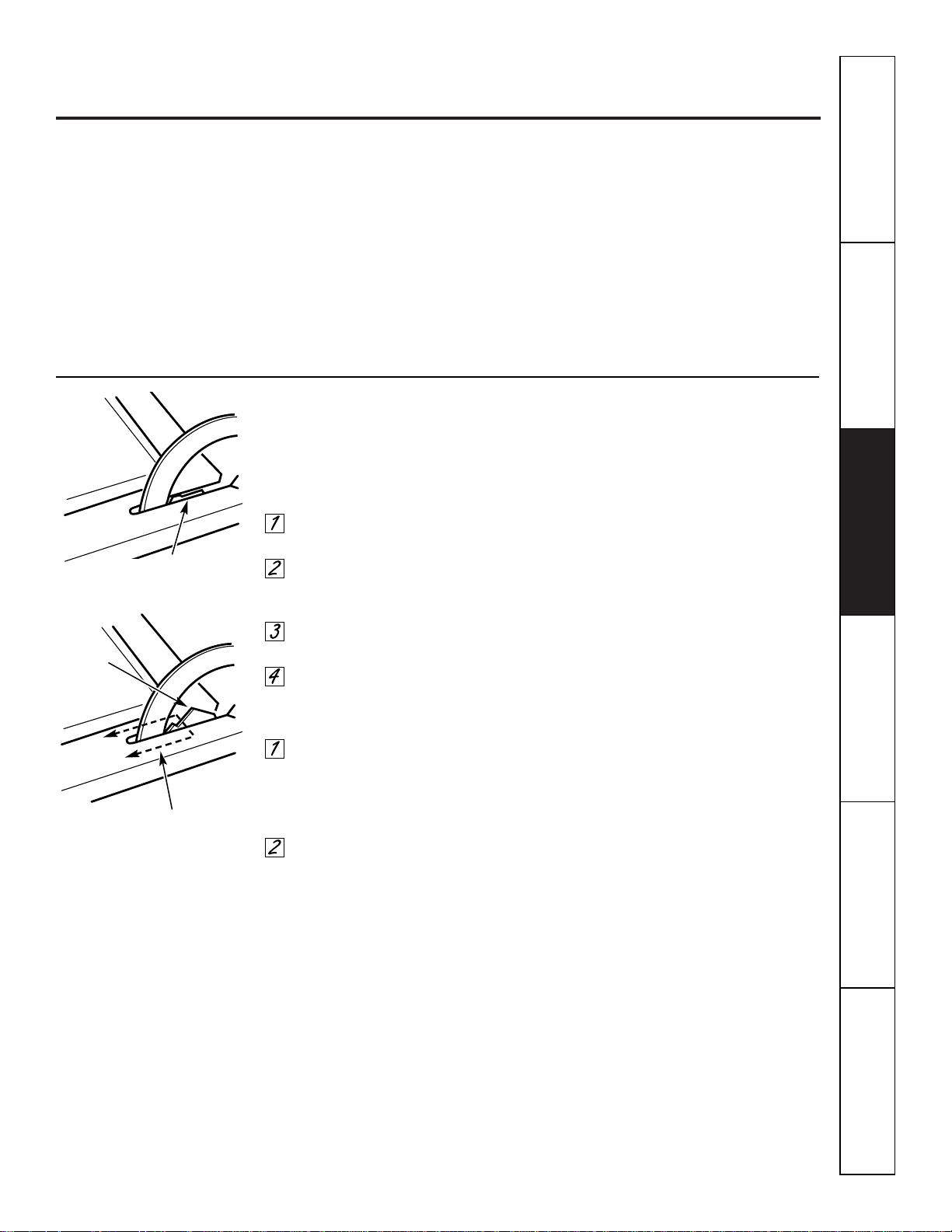
First remove the shelves from the oven.
The oven bottom lifts from the rear.
Grasp each side of the oven bottom and
lift upward from the rear until the bottom
is clear—lift it to remove from the front.
NOTE: If the oven bottom is replaced incorrectly,
it may warp and cause undesirable baking results.
Broiler Drawer
The broiler pan is held in place by a wire
broiler rack.
To open the broiler:
Gently lift up and pull forward on
the drop down broiler door.
Pull the broiler pan forward. It will
reach a temporary stop position.
Continue to pull forward and the
broiler pan will pull out to expose
the entire broiler grill surface.
Remove the broiler pan from the
broiler rack by lifting up on the front
of the broiler pan so it will clear the
wire rack. Then pull forward slightly
and use both hands to lift the pan
free of the rack.
To return the pan to the broiler rack:
Pull the wire rack out to the stop
position.
Insert the pan into the recessed
section of the broiler rack.
Slide the pan in place under the pan
retainers. Push the pan to the rear of
the broiler compartment.
Close the broiler door.
21
Safety Instructions Operating Instructions Care and Cleaning Installation Instructions Troubleshooting Tips Customer Service
Broiler Pan
After broiling, remove the broiler pan
and carefully pour out the grease in the
pan into a proper container.
If food has burned on, sprinkle the pan
with detergent while hot and cover with
wet paper towels or a dishcloth. Burned-
on foods will soak loose while the meal is
being served.
Wash; scour if necessary. Rinse and dry.
The broiler pan may also be cleaned in a
dishwasher. Do not store a soiled broiler
pan anywhere in the range.
Lift-Off Oven Door
(on some models)
The oven door is removable (on some
models) but it is heavy. You may need
help removing and replacing the door.
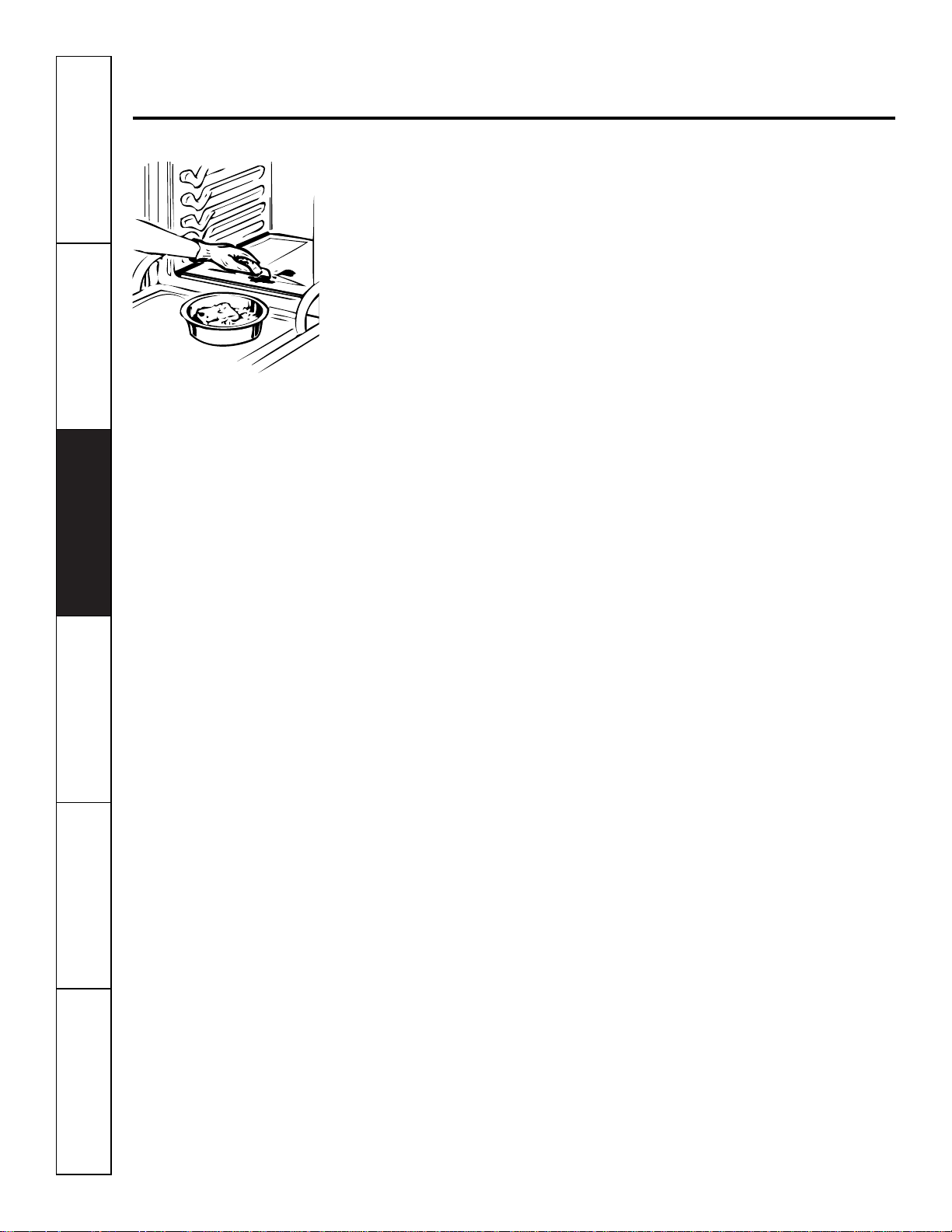
To remove the door:
Open the door to the full open
position.
Raise the locking mechanism by
applying force to the locking
mechanism lever.
Close the door until it stops against
the locking mechanism.
Grasp firmly on each side and lift the
door straight up and off the hinges.
To replace the door:
Position the slots in the bottom of
the door squarely over the hinges.
Then lower the door slowly and
evenly over both hinges at the
same time.
Open the door to the full open
position and press the locking
mechanism back into its original
position.
DO NOT ATTEMPT TO CLOSE THE DOOR
UNTIL THIS STEP IS COMPLETE. THE
HINGE OR DOOR COULD BE DAMAGED.
TO CLEAN THE DOOR:
Inside of door:
■Soap and water will normally do the
job. Heavy spattering or spillovers may
require cleaning with a mild abrasive
cleaner. Soapy, wet metal pads may also
be used. Do not allow food spills with a
high sugar or acid content (such as
milk, tomatoes, sauerkraut, fruit juices
or pie filling) to remain on the surface.
They may cause a dull spot even
after cleaning.
■If necessary, you may use an oven
cleaner. Follow package directions.
Outside of door:
■Use soap and water to thoroughly clean
the top, sides and front of the oven.
Rinse well.
■Spillage of marinades, fruit juices,
tomato sauces and basting materials
containing acids may cause
discoloration and should be wiped up
immediately. When surface is cool,
clean and rinse.
■Do not use oven cleaners, cleansing
powders or harsh abrasives on the
outside of the door.
Locking mechanism lever
To lock
apply force
To unlock apply force
Customer Service Troubleshooting Tips Installation Instructions Care and Cleaning Operating Instructions Safety Instructions
22
Care and cleaning of the range.
Porcelain Oven Interior
With proper care, the porcelain enamel
finish on the inside of the oven will stay
new-looking for years.
Let the range cool before cleaning.
We recommend that you wear rubber
gloves when cleaning the range.
Soap and water will normally do the job.
Heavy spattering or spillovers may
require cleaning with a mild abrasive
cleaner. Soapy, wet metal pads may also
be used. Do not allow food spills with a
high sugar or acid content (such as
tomatoes, sauerkraut, fruit juices or pie
filling) to remain on the surface. They
may cause a dull spot even after cleaning.
Household ammonia may make the
cleaning job easier.
Place 1/2 cup in a
shallow glass or pottery container in a
cold oven overnight. The ammonia
fumes will help loosen the burned-on
grease and food.
If necessary, you may use an oven cleaner.
Follow package directions.
Cautions about using spray-on oven
cleaners:
■Do not spray on the electrical controls
and switches because it could cause
a short circuit and result in sparking
or fire.
■Do not allow a film from the cleaner to
build up on the temperature sensor—it
could cause the oven to heat
improperly. (The sensor is located at
the top of the oven.) Carefully wipe the
sensor clean after each oven cleaning,
being careful not to move the sensor as
a change in its position could affect
how the oven bakes.
■Do not spray any oven cleaner on the
outside of the oven door, handles or
any exterior surface of the oven, wood
or painted surfaces. The cleaner can
damage these surfaces.
23
Installation of the range.
Read these instructions completely and carefully.
Safety Instructions Operating Instructions Care and Cleaning Installation Instructions Troubleshooting Tips Customer Service
Important!
Remove all packing material and literature from
oven before connecting gas and electrical
supply to range.
Before You Begin
Read these instructions completely and
carefully.
IMPORTANT: Save these instructions for the
local electrical inspector’s use.
INSTALLER: Leave these instructions with the
appliance after installation is completed.
CONSUMER: Keep this Owner’s Manual and the
Installation Instructions for future use.
This appliance must be properly grounded.
For Your Safety
If you smell gas:
Open windows.
Don’t touch electrical switches.
Extinguish any open flame.
Immediately call your gas supplier.
Do not store or use combustible materials,
gasoline or other flammable vapors and liquids
in the vicinity of this or any other appliance.
WARNING!
■
Improper installation, adjustment, alteration,
service or maintenance can cause injury or
property damage. Refer to this manual.
For assistance or additional information,
consult a qualified installer, service agency,
manufacturer (dealer) or the gas supplier.
■
Flexible connectors—If the range is
connected with a flexible connector, use
caution when moving it away from the wall.
Flexible connectors are not intended for
repeated bending. Do not allow cleaners to
get on them. Never reuse old flexible
connectors; this can cause gas leaks and
personal injury. Always use NEW flexible
connectors when installing a gas appliance.
They must comply with ANSI Z21.24, latest
edition.
Customer Service Troubleshooting Tips Installation Instructions Care and Cleaning Operating Instructions Safety Instructions
24
Installation of the range.
Read these instructions completely and carefully.
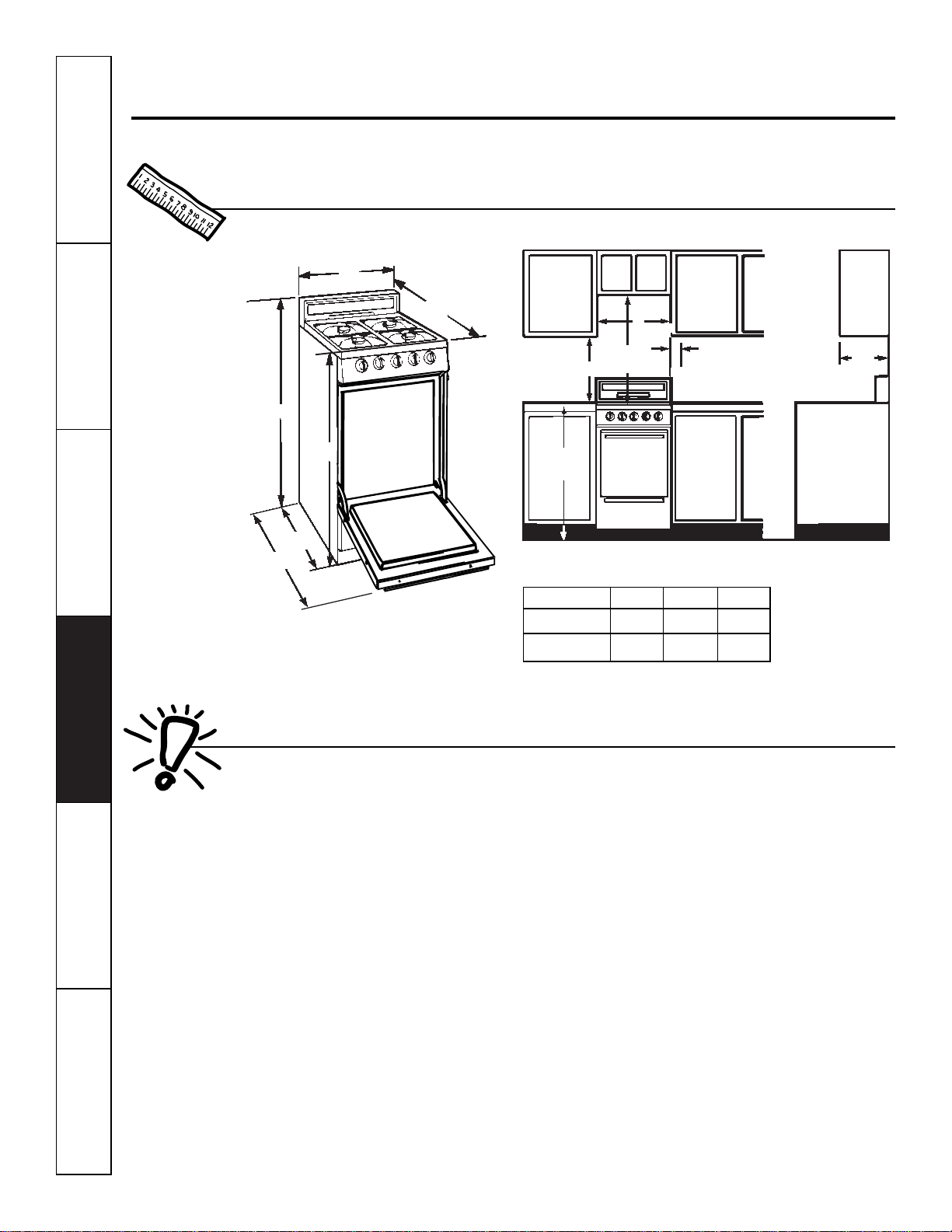
Dimensions and Clearances
Provide adequate clearances between the range and adjacent combustible surfaces.
Models A B C
20
″
Wide 20
″
20
3
⁄
8
″
2
″
24
″
Wide 24
″
24
3
⁄
8
″
0
″
A
36″
25-1/2″*
from wall
to front of
control panel
40
1
⁄2″
40
1
⁄4″
*Depth including handle: 25-9/16.
″
*Depth to front of control knobs: 26-1/8.
″
36″
0
″
clearance below cooking top and at rear of range
13″
Maximum depth
for cabinets above
range top
36″
18″
Minimum to
cabinets on
either side
of range
30″
B
C
Minimum to wall on
either side of range
above 36″ height
Minimum
Important Safety Instructions
Installation of this range must conform with local
codes, or in the absence of local codes, with the
National Fuel Gas Code, ANSI Z223.1, latest
edition. In Canada, installation must conform
with the current Natural Gas Installation Code,
CAN/CGA-B149.1 or the current Propane
Installation Code, CAN/CGA-B149.2, and with
local codes where applicable.
This range has been design-certified by the
American Gas Association according to ANSI
Z21.1, latest edition and Canadian Gas
Association according to CAN/CGA-1.1 latest
edition. As with any appliance using gas and
generating heat, there are certain safety
precautions you should follow. You will find
these precautions in the Important Safety
Instructions in the front of this guide. Read them
carefully.
■A range should
NOT
be installed directly over
kitchen carpeting unless an insulating pad of
1/4-inch thick piece of plywood is placed
between the range and carpet.
■Be sure your range is properly installed by a
qualified installer or service technician.
■This range must be electrically grounded in
accordance with local codes, or in their
absence, with the National Electrical Code
ANSI/NFPA No. 70, latest edition and
Canadian Gas Association according to
CAN/CGA-1.1 latest edition. See Electrical
Connection Information.
■Before installing the range in an area covered
with linoleum or any other synthetic floor
covering, make sure the floor covering can
withstand heat at least 90°F. above room
temperature without shrinking, warping or
discoloring.
■Make sure the wall coverings around the range
can withstand the heat generated by the range.
■Make sure all controls remain in the
OFF
position when the range is not in use.
24″
Safety Instructions Operating Instructions Care and Cleaning Installation Instructions Troubleshooting Tips Customer Service
25
Read these instructions completely and carefully.
Additional Materials You May Need
■Gas line shut-off valve.
■Pipe joint sealant that resists action of LP gas.
■1/2-inch pipe nipple.
For Rigid Connection:
■Pipe fittings as required.
For Flexible Connection:
■Flexible metal appliance connector
(same 3/4-inch or 1/2-inch I.D. as gas
supply line).
■Flare union adapter line
(1/2-inch NPT x 3/4-inch or 1/2-inch I.D.).
Tools You Will Need
For leveling legs:
■Channel lock pliers
For gas supply connection:
■Pipe wrench
For conversion from Natural to LP gas:
■1/2-inch open-end wrench
For burner flame adjustment:
■Phillips head and blade-type screwdrivers
Installing the Backguard
Remove the cooktop.
Place the backguard on top of the end panels
at the rear of the range.
Connect the “disconnect plug” (for power to
the backguard from the range).
Insert the machine screws through the lower
inside flange of the end caps and the end
panels. Secure with the hex nuts provided.
Insert the machine screws through the
elongated holes at the bottom of the
backguard and side flange of the burner box.
Secure with the hex nuts provided.
Attach the lower edge of the backguard to
the vent outlet with 2 sheet metal screws.
Customer Service Troubleshooting Tips Installation Instructions Care and Cleaning Operating Instructions Safety Instructions
26
Installation of the range.
Read these instructions completely and carefully.
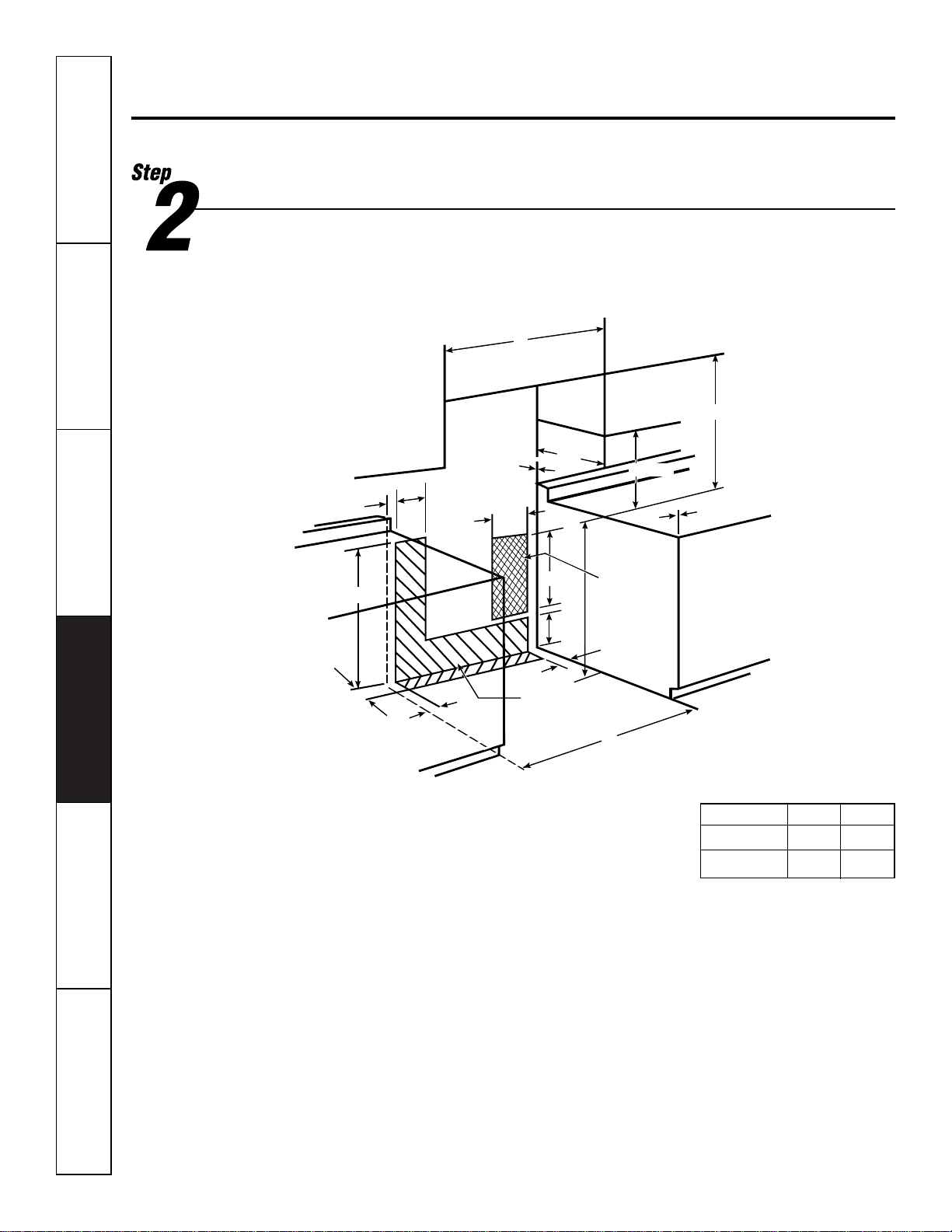
Range Location
Do not set the range over holes in the floor or other locations where it may be subject to strong
drafts. Any opening in the wall behind the range and in the floor under the range should be sealed.
Make sure the flow of combustion or ventilation air is not obstructed.
0″
B
2″
2″
2″
3″
33″
1
1
⁄
2
″
A
2″
9″
11″
13″
6″
Electrical
Connection
Area
Gas Hookup
Area
Check local codes before making connections.
Recommended gas and electric supply location
30″ Min.
18″ Min.
A
Models A B
20
″
Wide 20
3
⁄
8
″
2
″
24
″
Wide 24
3
⁄
8
″
0
″
Max.
Safety Instructions Operating Instructions Care and Cleaning Installation Instructions Troubleshooting Tips Customer Service
Read these instructions completely and carefully.
WARNING!
Anti-Tip Bracket
• ALL RANGES CAN TIP
• INJURY COULD RESULT
• INSTALL ANTI-TIP DEVICE
PACKED WITH RANGE
• SEE INSTRUCTIONS
Tools You Will Need
■Phillips head screwdriver
■1
3
⁄8″or adjustable wrench
■Flat blade screwdriver
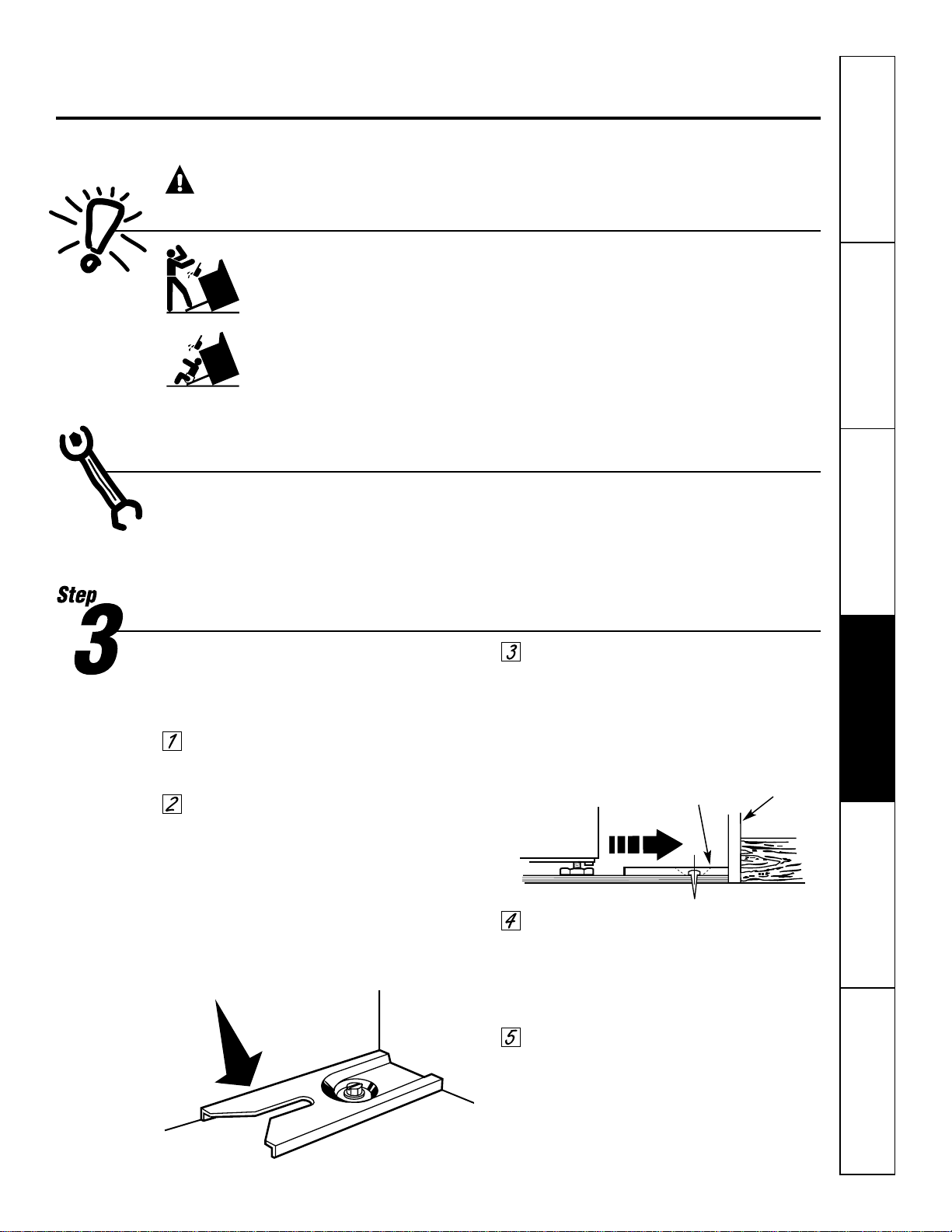
Anti-Tip Bracket Installation Instructions
Anti-tip bracket attaches to the floor to hold either rear
range leg. When fastening to the floor, be sure that the
screw does not penetrate electrical wiring or plumbing. If
you cannot be sure of this, use a shorter screw that will not
penetrate through the flooring.
Decide whether the anti-tip bracket will be
installed on the right or left side of the range
location.
If the bracket side of the range is next to a
cabinet, place the bracket against back wall
and cabinet.
If there is no adjacent cabinet, determine
where the location of the range side (painted
outside panel) will be. Place the bracket with
its outside edge at this location and against
the back wall.
Screw the bracket securely to the floor with
the screw provided. The screw is self-drilling
in wood, plywood, particle and chip board,
and most metal framing. If attaching to
masonry, you can buy suitable screws and/or
anchors at hardware stores. Use a masonry
drill to drill the required holes.
Using the wrench, back out the four range
legs at least two turns. Level the range. See
the
Protect Your Floor
and
Leveling the Range
information in the
Installation the range
section of this manual for leveling
information.
Slide the range into place.
Wall behind range
Wall
Anti-tip bracket
Adjacent cabinet
or final location
of range side panel
Outside edge of bracket
should be flush with the
outside of the range
27
Customer Service Troubleshooting Tips Installation Instructions Care and Cleaning Operating Instructions Safety Instructions
28
Installation of the range.
Read these instructions completely and carefully.
Convert Burner Orifices and Pressure Regulator (if necessary)
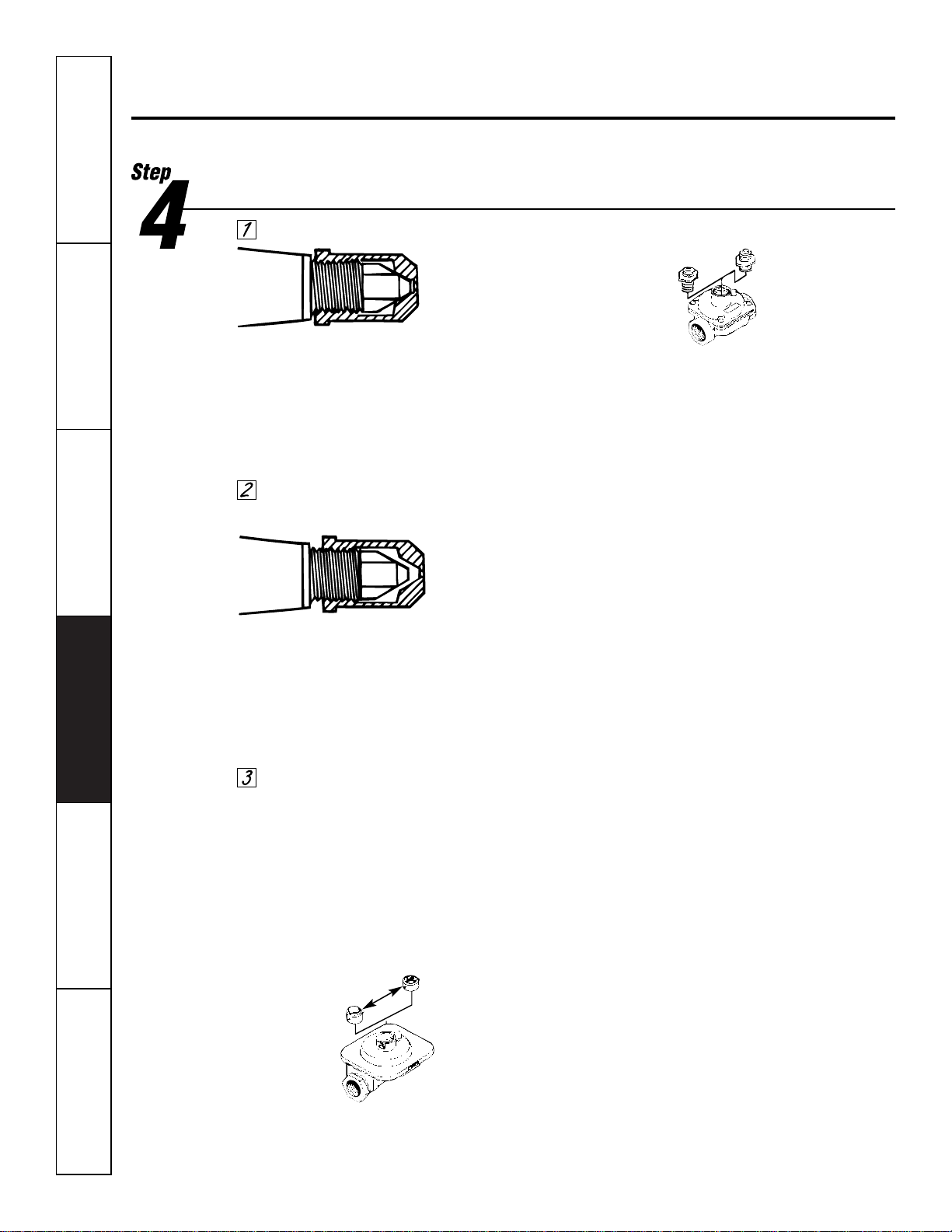
Converting Burner Orifices to LP Gas:
Tighten the orifice hoods for the surface burners
and oven burner approximately two complete
turns to the closed position and adjust top pilots,
if equipped. The gas pressure regulator must be
converted to the LP gas setting so that it will
provide a pressure of 10 inches water column to
the range manifold.
Converting Burner Orifices to Natural Gas:
(only if range has been operated previously on LP gas)
Unscrew the orifice hoods for all burners (top
and oven) approximately two complete turns,
until the flame on the burner does not increase in
length. Adjust the top pilots (if equipped). The
gas pressure regulator must be set to the natural
gas setting so that it will provide a pressure of 4
inches of water column in the range manifold.
Regulator Conversion:
All ranges are equipped with a gas pressure
regulator for controlling and maintaining a
uniform gas pressure in the gas manifold of the
range. The burner orifices are sized for the gas
pressure delivered by the regulator supplied.
The pressure regulator must not be removed.
To convert the regulator from one gas to another,
refer to the following illustration that applies:
Harper-Wyman Regulator:
For a Harper-Wyman regulator, remove converter
cap by inserting a coin into slot in top and
twisting. Turn cap over and re-install.
SCP Regulator:
On the SCP regulator, unscrew the converter
using a 5/8″wrench. Turn the cap over and
reinstall.
NOTE: What you read on the converter cap or plunger is
the type of gas for which the regulator is set. If yours reads
NAT, the regulator is set for natural gas. If yours reads LP,
the regulator is set for LP.
■
For proper operation, the maximum inlet pressure
to the regulator must be no more than 14 inches of
water column pressure.
For checking the
regulator, the inlet pressure must be at least
1-inch of water column (3.4 KPA) greater than
the regulator output setting. If the regulator is
set for 4 inches of water column pressure, the
inlet pressure must be at least 5 inches. If the
regulator is set for 10 inches, the inlet pressure
must be at least 11 inches.
■The gas supply line to the range should be 1/2
inch or 3/4 inch pipe.
For standing pilot models,
make the necessary oven
pilot adjustment (see directions in the
If Range
Has Standing Pilots—Light and Adjust Surface
Burner Pilots
section). Also burner air shutter
adjustments may be necessary on all models to
complete conversion (see the
Surface Burner Air
Shutter Adjustment
section).
LP gas setting
NAT. gas setting
NAT
LPG
NAT
LPG
Converter cap
Safety Instructions Operating Instructions Care and Cleaning Installation Instructions Troubleshooting Tips Customer Service
Read these instructions completely and carefully.
Connect the Range to Gas
The house piping and connector used to connect the range to the main gas supply must be
clean, free of metal shavings, rust, dirt or liquids (oil or water). Contaminants in the supply lines
can work their way into the range manifold and cause failure of gas valves or controls and clog
burners or pilot orifices.
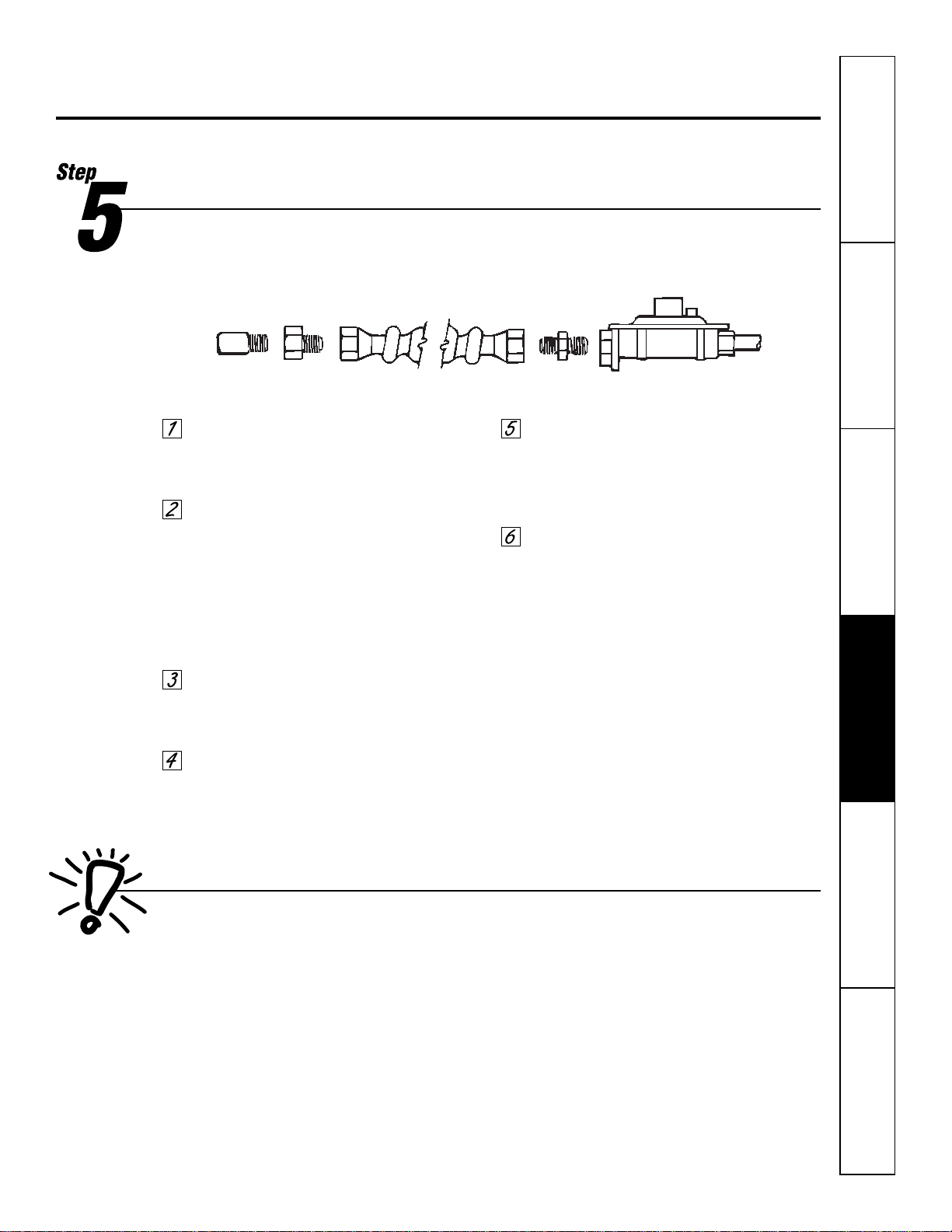
If the range is to be connected to house
piping with flexible or semi-rigid metal
appliance connector, connector nuts
MUST
NOT
be connected directly to pipe threads.
The appliance connector must be installed
by using the proper flare union adapters with
the connector. Cutoff valve, appliance
connector and adapters are not supplied
with the range. (Because solid pipe restricts
moving the range, we recommend use of
A.G.A. certified flexible tubing.) In Canada,
flexible connectors must be single wall metal
connectors no longer than 6 feet in length.
Install a manual shutoff valve in the gas line
in an easily accessible location outside of the
range. Be sure you know how and where to
shut off the gas supply to the range.
Check for leaks. After connecting the range
to gas, check the system for leaks with a liquid
leak detector at all joints and connections.
Tighten all connections as necessary to
prevent gas leakage in the range or supply
line.
CAUTION: Do not use a flame to check for
gas leaks.
Check alignment of valves after connecting
the range to the gas supply to be sure the
manifold pipe has not been moved. A
misalignment could cause the valve knob
stem to rub on the control panel, resulting in
a gas leak at the valve.
Disconnect the range and its individual shut-off
valve from the gas supply piping system during
any pressure testing of the system at test pressures
greater than 1/2 psig.
Isolate the range from the gas supply piping
system by closing its individual manual shut-off
valve during any pressure testing of the gas supply
piping system at test pressures equal to or less
than 1/2 psig.
29
House
piping
Flare union
adapter
Flare union
adapter
Range pressure
regulator
Appliance
connector
Nut Nut
Checking Manifold Gas Pressure
If it should be necessary to check the manifold gas
pressure, connect manometer (water gauge) or
other pressure device to the top burner orifice
farthest from the manifold inlet and turn burner
valve on.
For an accurate pressure check have at least
2 other top burners burning. Be sure the gas
supply inlet pressure is at least one inch above
specified range manifold pressure.
The gas supply pressure should never be over
14 inches W.C. When properly adjusted for
Natural Gas the W.C. pressure is 4 inches; for LP
Gas the W.C. pressure is 10 inches. The serial
plate, located under the main top in the burner
box area, indicates for which type of gas your
range was factory adjusted.
Customer Service Troubleshooting Tips Installation Instructions Care and Cleaning Operating Instructions Safety Instructions
30
Installation of the range.
Read these instructions completely and carefully.
To Make Electrical Connection (if range has electric ignition)
CAUTION—FOR PERSONAL SAFETY: DO NOT
USE AN EXTENSION CORD WITH THIS
APPLIANCE.
■This appliance must be supplied with the
proper voltage and frequency, and connected
to an individual, properly grounded and
polarized branch circuit, protected by a circuit
breaker or time-delay fuse, as noted on the
rating plate.
■Wiring must conform to National Electric
Codes or the prevailing local code for a range of
this kilowatt rating. (See the rating plate under
the cooktop for this information.)
■If the electric supply provided does not meet
the above specifications, call a licensed
electrician.
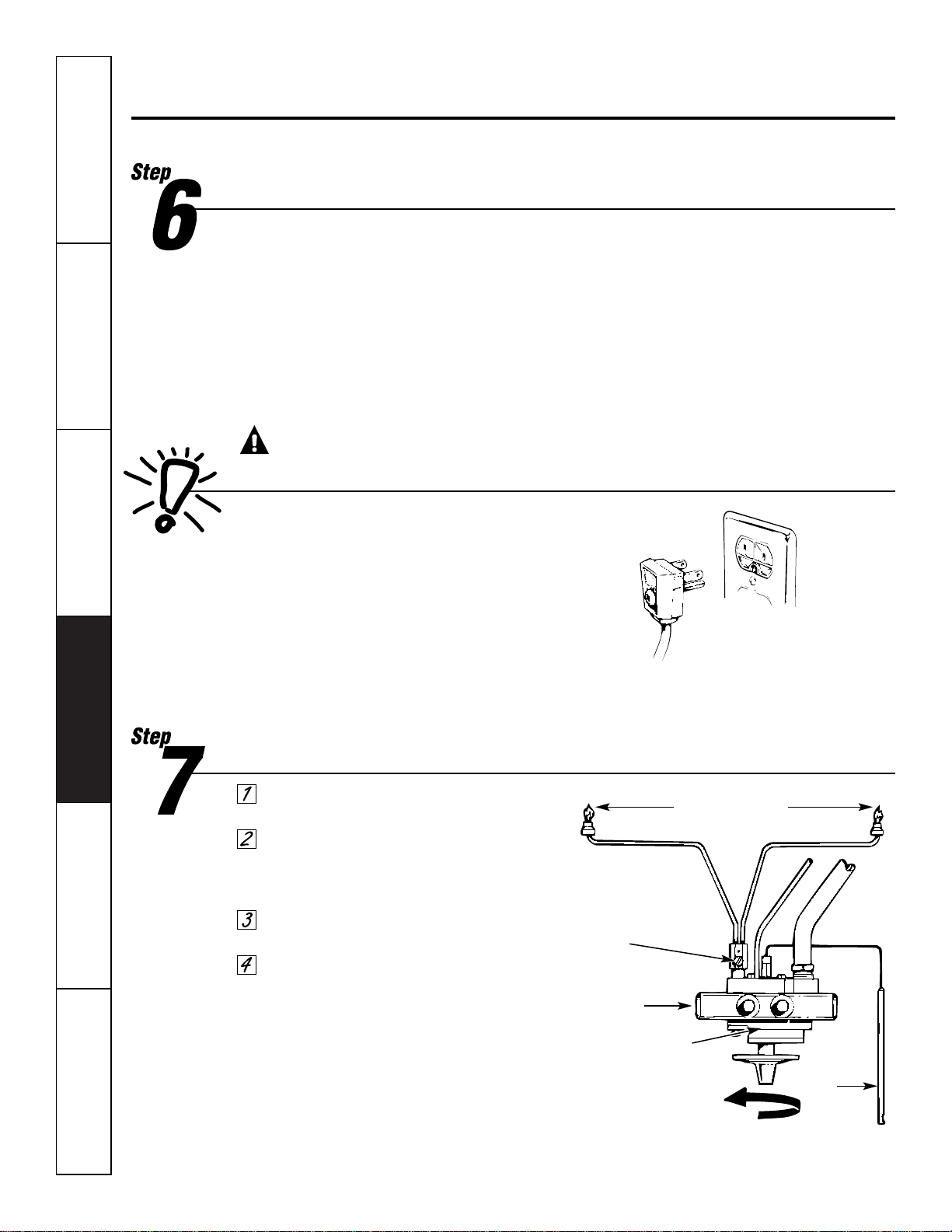
Light and Adjust Surface Burner Pilots (if range has standing pilots)
Purge all air from supply system by turning
one top burner valve fully
ON
for 15 seconds.
Turn valve
OFF
and light pilot burners.
Adjust pilot flames using the adjusting screw
on the back of the thermostat, so that each
flame is approximately 1/4-inch in height.
To light any top burner, push and turn
burner knob to the
LITE
position.
When burner has ignited, rotate knob to
desired flame setting.
WARNING!
Electrical Grounding Instructions
This appliance is equipped with a three prong
grounding plug for your protection against shock
hazard and should be plugged directly into a
properly grounded receptacle. Do not cut or
remove the grounding prong from this plug.
INSURE PROPER GROUND EXISTS BEFORE USE.
Top burner pilots
Top pilots adjustment
screw controls the
rate of gas to the top
burner pilots.
Manifold pipe
Thermostat
To Safety Valve
To Oven Pilots
Thermostat
Sensor
ON
Safety Instructions Operating Instructions Care and Cleaning Installation Instructions Troubleshooting Tips Customer Service
Read these instructions completely and carefully.
31
If Range Has Electric Ignition
There are separate ignition devices for the left
and right hand surface burners. Both of these
ignitors are
ON
when any knob is turned to the
LITE
setting. The ignitors will
spark
as long as any
of the top burner knobs are at the
LITE
setting.
In the event of an electrical power failure, the top
burners can still be used. To light a burner, hold a
lighted kitchen match adjacent to the top burner
to be used and turn valve knob to
LITE. USE
EXTREME CAUTION.
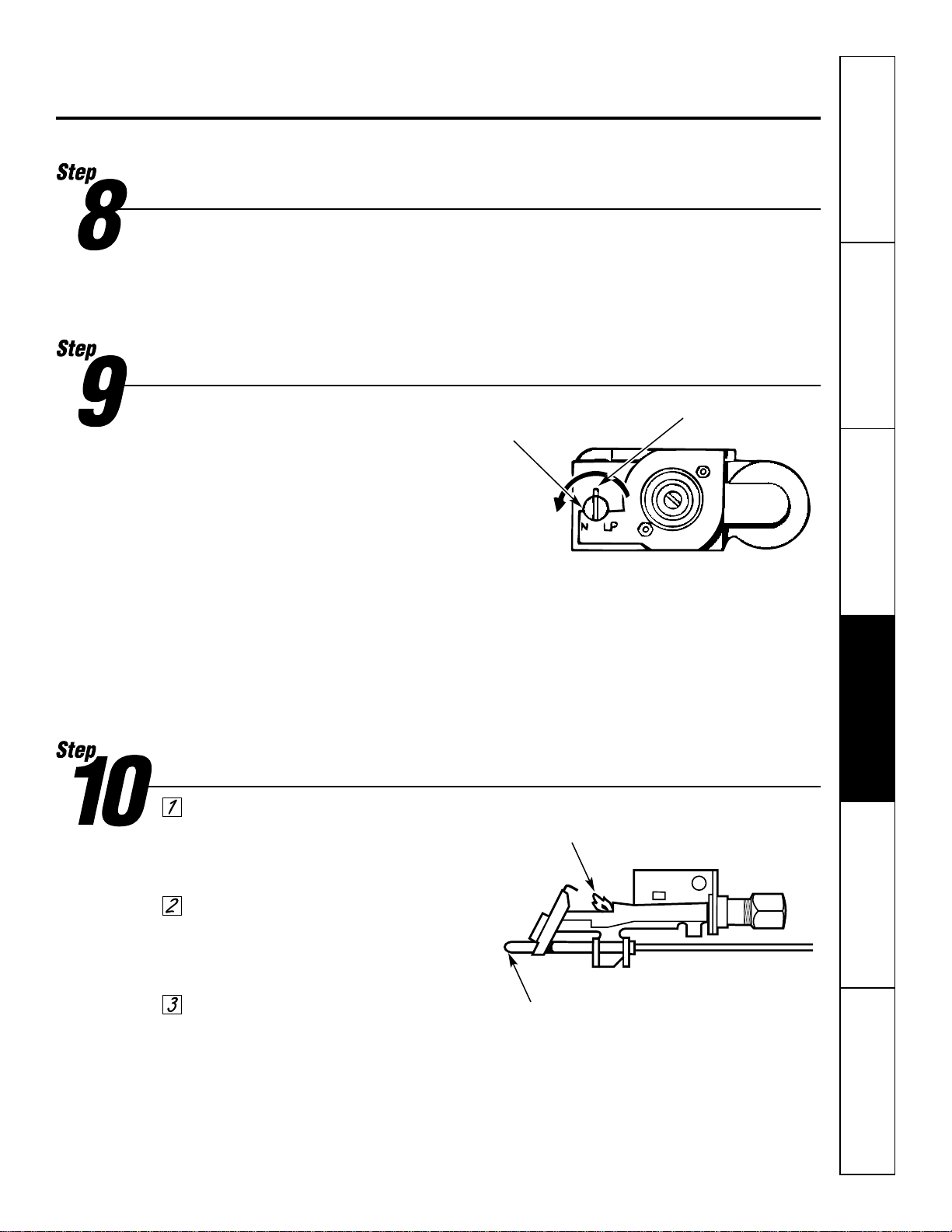
Oven Pilot Adjustment
On pilot models remove thermostat knob.
Check position of pilot gas selector to make sure
selector is turned to the correct position for the
type of gas that is to be used. To change to
LP,
insert small blade screwdriver in slot and turn
fully clockwise so that indicator points to
LP.
To
change to
NAT,
turn fully counterclockwise so that
indicator points to
NAT.
■If desired, the gas to the oven pilot can be
turned off by turning the selector so the pointer
is at the
OFF
position, midway between the
LP
and
NAT
settings. (Thermostat on your range
may not appear exactly as shown in diagram.)
■On electric ignition models the gas to the oven
burner can be turned off. A manual shut-off
valve is provided on manifold pipe.
Front view
Oven Operation
With the oven thermostat dial in the
OFF
position, light standing pilot on oven burner
pilot assembly. On electric ignition models
do not attempt to manually light the oven
pilot.
Turn the thermostat dial to any temperature
setting. The oven pilot flame will enlarge
and engulf the mercury bulb. After
approximately 30–45 seconds the main
burner will come on.
The oven can be used during periods of
power outage. (See the
Using the surface
units
section.)
Oven pilot selector key
switches from LP to NAT
(vice versa).
Pointer
With control knob in OFF
position, light standing pilot.
Flame should appear as shown.
Mercury bulb
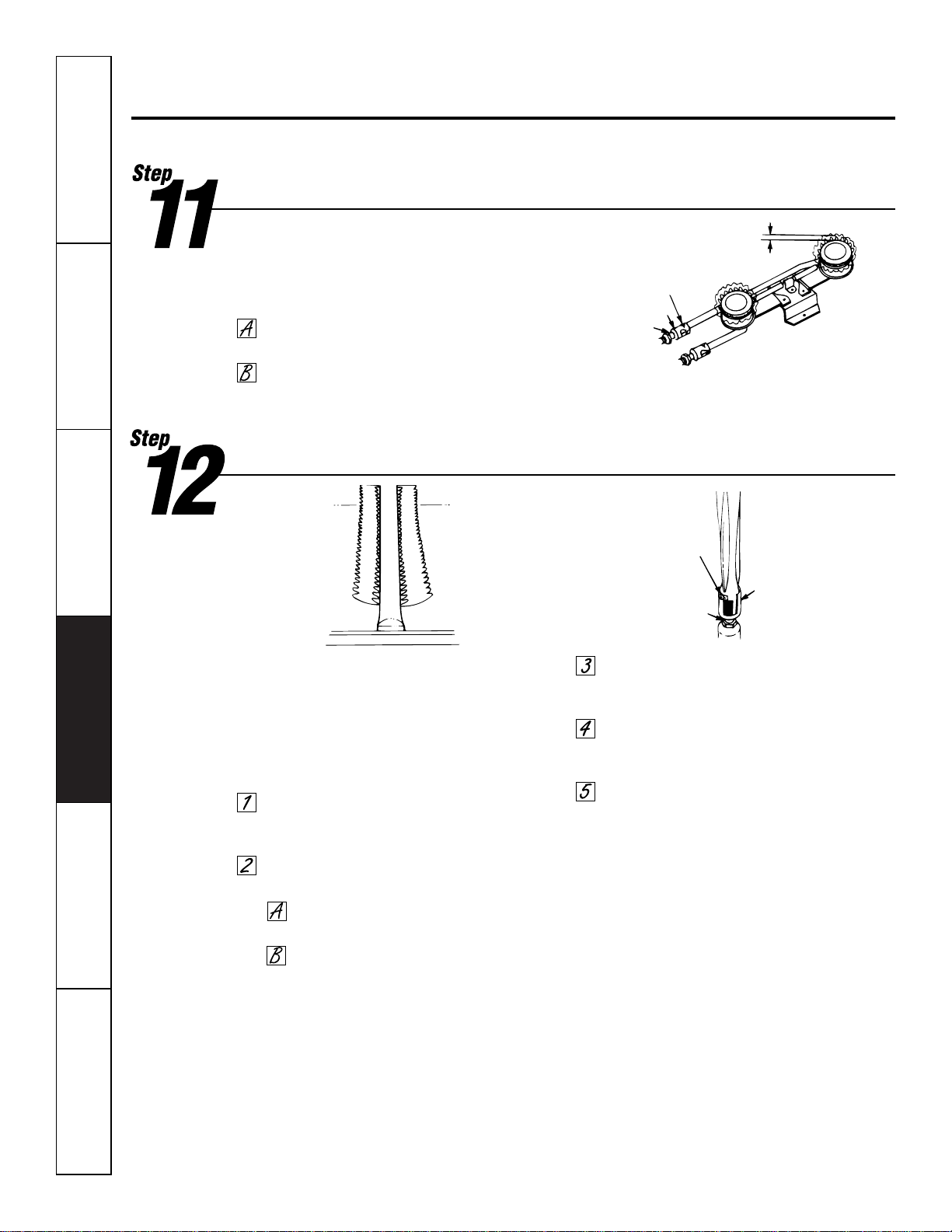
Customer Service Troubleshooting Tips Installation Instructions Care and Cleaning Operating Instructions Safety Instructions
32
Installation of the range.
Read these instructions completely and carefully.
Surface Burner Air Shutter Adjustment
The approximate height of the flame at the
high or full
ON
position is a distinct inner blue
cone of at least 3/4 inch. Turn valve knob
counterclockwise 90° to the full
ON
position
and adjust air shutter as follows:
To correct a yellow flame—Increase size of air
shutter opening.
To correct a lifting, but distinct, blue flame—
Decrease size of air shutter opening.
Oven Burner Air Shutter Adjustment
The oven burner flame should be a clean, blue
flame with distinct inner cones approximately 1/2
inch long. A soft, lazy flame with indistinct cones
means too much gas or not enough air. A noisy
lifting flame means too much air.
If adjustments are necessary:
First loosen the lock screw located at the top
of the air shutter, then rotate the air shutter
to the correct setting, and retighten screw.
Oven burner flame can be checked as
follows (without burner baffle in place):
To correct a yellow flame—Increase size
of air shutter opening.
To correct a lifting, but distinct, blue
flame—Decrease size of air shutter
opening.
The air shutter should be set approximately
2/3 open for natural gas, and approximately
full open on LP gas.
The oven burner air shutter adjustment is
the same on ranges with a gas pilot or electric
ignition.
Repeat steps 1 through 3 for the broil
burner, if equipped, to properly adjust the
broil burner flame.
3/4″
Lock screw
Air shutter
Orifice
Orifice cap
Air shutter
Lock screw
33
Read these instructions completely and carefully.
Safety Instructions Operating Instructions Care and Cleaning Installation Instructions Troubleshooting Tips Customer Service
When All Hookups Are Complete
Make sure all controls are left in the OFF
position.
Make sure the flow of combustion and
ventilation air to the range is unobstructed.
Mobile Home Installation:
Be sure the installation of this range in a
manufactured or mobile home conforms with the
Manufactured Home Construction and Safety
Title 24 CFR, Part 3280 [formerly the Federal
Standard for Mobile Home Construction and
Safety Title 24, H.U.D. (Part 280)] or when such
standards are not applicable, the Standard for
Manufactured Home Installations 1984
(Manufactured Home Sites Communities and
Set-Ups), ANSI A225.1-latest edition, or with local
codes. In Canada, mobile home installation must
be in accordance with the current CAN/CSA
Z240/MH Mobile Home Installation Code.
Model and Serial Number Location:
The serial plate for your range is located under
the cooktop on the right side of the burner box.
In addition to the model and serial numbers, it
tells you the ratings of the burners and type of fuel
and pressure for which the range was adjusted
when it left the factory.
When ordering parts, always include the model
number and serial number to ensure proper
replacement parts. Parts may be obtained
through General Electric/Hotpoint Factory
Service Centers or General Electric/Hotpoint
authorized Customer Care® servicers.
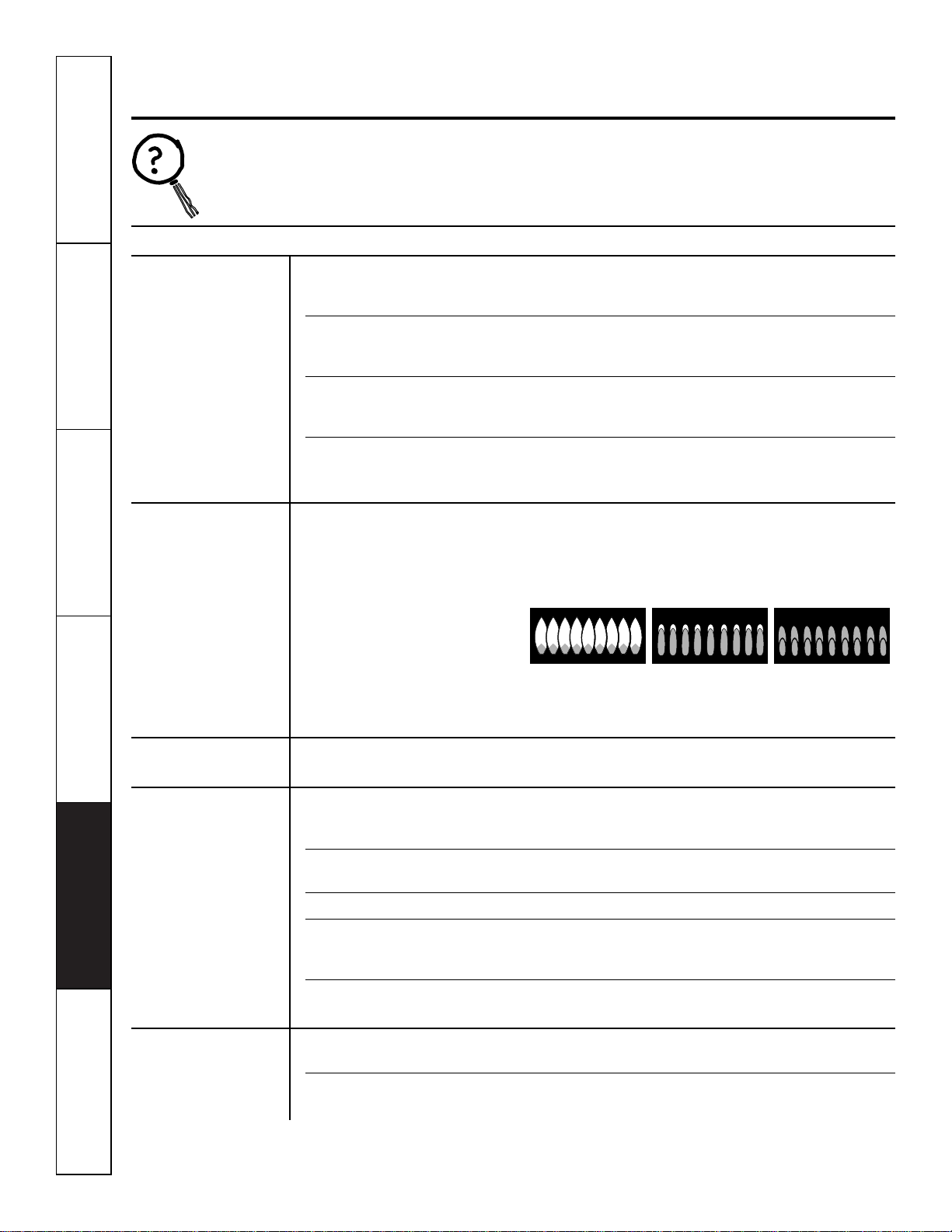
Customer Service Troubleshooting Tips Installation Instructions Care and Cleaning Operating Instructions Safety Instructions
34
Before You Call For Service…
Troubleshooting Tips
Save time and money! Review the chart on this page
first and you may not need to call for service.
Problem Possible Causes What To Do
Top burners do not light
The pilots are not lit. • On models with standing pilots, lift the cooktop and
or do not burn evenly
(on standing pilot models) hold a lit match next to the pilot opening between the
front and rear burners.
Plug on range is not • On models with electric ignition, make sure electrical
completely inserted in plug is plugged into a live, properly grounded outlet.
the electrical outlet.
Burner holes on the side • Remove the burners and clean them with a safety pin
or around the top of the or paper clip. Make sure you do not enlarge the holes.
burner may be clogged.
Burners may not be fitted • Remove the burners and reinstall them properly.
correctly onto the mounting
brackets.
Burners have yellow or
The combustion quality of • Use the illustrations below to determine if your burner
yellow-tipped flames
burner flames needs to be flames are normal. If burner flames look like
A,
call for
determined visually. service. Normal burner flames should look like
B
or
C,
depending on the type of gas you use. With LP gas, some
yellow tipping on outer cones is normal.
A–Yellow flames B–Yellow tips C–Soft blue flames
Call for service on outer cones Normal for natural
Normal for LP gas gas
Burner flames very
LP gas is improperly • Check all steps in the
Installation of the range
large or yellow
connected. section.
Oven will
The thermostat capillary • Make sure the thermostat capillary bulb (located in the
not work
bulb must be clean and upper portion of the oven) is in the correct position, not
unobstructed. touching oven sides and not coated with anything.
The oven vent is blocked. • The oven vent, on the back of the range, must be
unobstructed.
Oven control improperly set. • See the
Using the oven
sections.
Incorrect cookware or • See the
Using the oven for baking or roasting
section.
cookware of improper
size being used.
Oven bottom not securely • See the
Care and cleaning of the range
section.
seated in position.
Strong odor
Improper air/gas ratio • Adjust oven burner air shutter. See the
Installation of
in the oven.
the range
section.
This is temporary. • An odor from the insulation around the oven liner is
normal for the first few times the oven is used.
35
Safety Instructions Operating Instructions Care and Cleaning Installation Instructions Troubleshooting Tips Customer Service
Gas Range Warranty.
All warranty service provided by our Factory Service Centers
or an authorized Customer Care
®
technician. For service,
call 800-GE-CARES.
For The Period Of: We Will Replace, At No Charge To You:
One Year Any part
of the range which fails due to a defect in materials or workmanship.
From the date of the
During this
full one-year warranty,
we will also provide,
free of charge,
all labor
original purchase
and in-home service to replace the defective part.
■Service trips to your home to teach you how to
use the product.
■Improper installation.
■Failure of the product if it is abused, misused, or
used for other than the intended purpose or used
commercially.
■Replacement of house fuses or resetting of circuit
breakers.
■Damage to the product caused by accident, fire,
floods or acts of God.
■Incidental or consequential damage to personal
property caused by possible defects with this appliance.
What is Not Covered:
This warranty is extended to the original purchaser and any succeeding owner for products purchased for
home use within the USA. In Alaska, the warranty excludes the cost of shipping or service calls to your home.
Some states do not allow the exclusion or limitation of incidental or consequential damages. This warranty
gives you specific legal rights, and you may also have other rights which vary from state to state. To know
what your legal rights are, consult your local or state consumer affairs office or your state’s Attorney General.
Warrantor: General Electric Company. Louisville, KY 40225
Printed in the USA
Consumer Support.
GE Appliances Website
www.GEAppliances.com
Have a question or need assistance with your appliance? Try the GE Appliances Website 24 hours a day,
any day of the year! For greater convenience and faster service, you can now download Owner’s Manuals,
order parts, catalogs, or even schedule service on-line. You can also “Ask Our Team of Experts
™
”
your questions, and so much more...
Schedule Service
www.GEAppliances.com
Expert GE repair service is only one step away from your door. Get on-line and schedule your service at
your convenience 24 hours any day of the year! Or call 800-GE-CARES (800-432-2737) during normal
business hours.
Real Life Design Studio
www.GEAppliances.com
GE supports the Universal Design concept—products, services and environments that can be used by
people of all ages, sizes and capabilities. We recognize the need to design for a wide range of physical and
mental abilities and impairments. For details of GE’s Universal Design applications, including kitchen
design ideas for people with disabilities, check out our Website today. For the hearing impaired, please call
800-TDD-GEAC (800-833-4322).
Extended Warranties
www.GEAppliances.com
Purchase a GE extended warranty and learn about special discounts that are available while your warranty
is still in effect. You can purchase it on-line anytime, or call 800-626-2224 during normal business hours.
GE Consumer Home Services will still be there after your warranty expires.
Parts and Accessories
www.GEAppliances.com
Individuals qualified to service their own appliances can have parts or accessories sent directly to their homes
(VISA, MasterCard and Discover cards are accepted). Order on-line today, 24 hours every day or by phone at
800-626-2002 during normal business hours.
Instructions contained in this manual cover procedures to be performed by any user. Other servicing generally
should be referred to qualified service personnel. Caution must be exercised, since improper servicing may cause
unsafe operation.
Contact Us
www.GEAppliances.com
If you are not satisfied with the service you receive from GE, contact us on our Website with all the details
including your phone number, or write to: General Manager, Customer Relations
GE Appliances, Appliance Park
Louisville, KY 40225
Register Your Appliance
www.GEAppliances.com
Register your new appliance on-line—at your convenience! Timely product registration will allow for
enhanced communication and prompt service under the terms of your warranty, should the need arise.
You may also mail in the pre-printed registration card included in the packing material, or detach and
use the form in this Owner’s Manual.