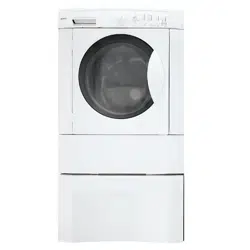
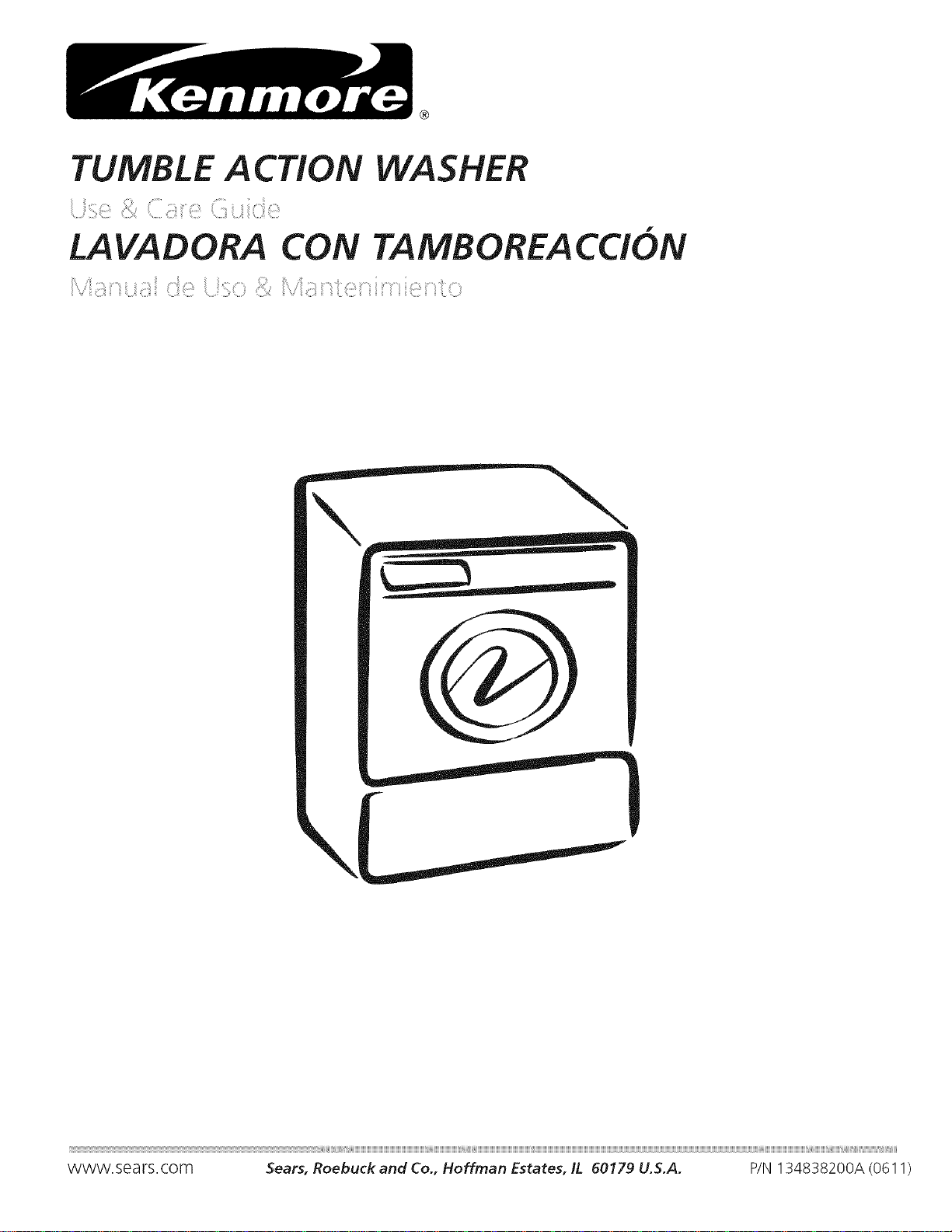
TUMBLE A CTiON WASHER
f
LAVADORA CON TAMBOREACCION
www. sears, com Sears, Roebuck and Co., Hoffman Estates, IL 60179 U.S.A. P/N 134838200A (0611)
Table of Contents
Important Safety Instructions ................................... 2-3
Washing Procedures.............................................. 4-6
Stain Removal...................................................... 6-7
CommonWashing Problems......................................... 8
Careand Cleaning ....................................................... 9
Avoid ServiceChecklist .............................................. 10
Warranty ................................................................. 11
Espanol............................................................ 12-21
Read and Save These Instructions
Record Your Model and Serial Numbers
The model and serial numbers of your washer are found on the
washer serial plate located at the top, inside of the door opening.
Record and retain these numbers.
Model Number:
Serial Number:
Purchase Date:
Note: The instructions
appearing inthis Owner's
Guide are not meant to
cover every possible
condition and situation
that mayoccur. Common
sense and caution must
be practiced when
installing, operating and
maintaining any
appliance.
This Use and Care Guide provides
general operating instructions for
your washer. It also contains
information about features for
several other models. Your washer
may not have every feature
included here.
Usethe washer only as instructed
in this Use and Care Guide and
the Operating Instructions
included with your washer.
Instructional D VD
An instructional DVD has
been included with your
washer. It highlights
features unique to this
tumble action washer and
will help you operate your
washer correctly. This DVD
is especially helpful if your
previous washer was a
vertical-axis model.
Pedestal
A pedestal accessory
specifically designed for this
washer may be used when
elevating the washer for ease
of use.
Failure to use accessories
certified bythe manufacturer
could result in personalinjury,
property damage or damage
to the washer.
Your safety and the safety of others is very important.
We have provided many important safety messages in the Use and Care Guide, Operating Instructions, Installation
Instructions and on your appliance. Always read and obey all safety messages.
This isthe safety alert symbol. This symbol alerts you to hazards that can kill or hurt you or others. All safety messages
will be preceded by the safety alert symbol and the word "DANGER" or "WARNING". Thesewords mean:
You will be killed or seriously injured if you don't follow instructions.
You can be killed or seriously injured if you don't follow instructions.
All safety messages will identify the hazard, tell you how to reduce the chance of injury, and tell you what can
happen if the instructions are not followed.
important Safety instructions SAVETHESEINSTRUCTIONS
You can be killed or seriously injured if you don't follow these Important Safety Instructions:
• To reduce the risk of fire, electrical shock, or injury to persons when using this washer, comply with the basic warnings listed
below.
• Failure to comply with these warnings could result in serious personal injuries.
PreventFire
• Do not wash items that have been previously cleaned in, soaked in, or spotted with gasoline, cleaning solvents, kerosene,
cooking oils, waxes, etc. Do not store these items on or near the washer. These substances give off vapors or chemical reactions
that could ignite or explode.
• Do not put oily or greasy rags or clothing ontop of the washer. Thesesubstances give off vapors that could ignite the materials.
• Do not add gasoline, cleaning solvents, or other flammable or explosive substances to the wash water. These substances give
off vapors that could ignite or explode.
• Under certain conditions, hydrogen gas may be produced in a hot water system that hasnot been usedfor 2 weeks or more.
HYDROGEN GAS IS EXPLOSIVE, If the hot water system has not been used for such a period, before using the washer, turn
on all hot water faucets and let the water flow from each for several minutes. This will release any accumulated hydrogen gas.
Hydrogen gas isflammable; do not smoke or usean open flame during this time.
• Failure to comply with these warnings could result in fire, explosion, serious bodily injury and/or damage to the rubber or plastic
parts of the washer. 2

Important Safety Instructions (Con't)
Avoid fire hazard
or electrical shock. Do not use
an adaptor plug or extension
cord or remove grounding
prong from electrical power
cord. Failure to follow this
warning can cause serious
injury, fire or death.
Grounding
type
Do Not under anywall
circumstances cut, _1
receptacle remove, or bypass _l
the grounding prong _l
,romt.isplugJ
grounding plug
CORRECT
Use this way ONLY
Do not use or mix
liquid chlorine bleach with other
household chemicals such as
toilet cleaners, rust removers,
acid or products containing
ammonia. These mixtures can
produce dangerous fumes which
can ca use serious injury or death.
Protect Children
* Do not allow children to play on or in the washer. Close supervision of children is
necessary when the washer is used near children. As children grow, teach them the
proper, safe use of all appliances.
* Destroy the carton, plastic bag and other packing materials after the washer is
unpacked. Children might usethem for play. Cartons covered with rugs, bedspreads or
plastic sheets can become airtight chambers.
* Keep laundry products out of children's reach.To prevent personal injury, observe all
warnings on product labels.
* Before the washer is removed from service or discarded, remove the washer door to
prevent accidental entrapment.
* Failure to comply with these warnings could result in serious personal injuries.
FOR YOUR SAFETY
Do not store or use gasoline or other flammable vapors or liquids in the vicinity
of this or any other appliance.
Prevent lnjury
* To prevent shock hazard and assure stability during operation, the washer must be
installed and electrically grounded byaqualified serviceperson in accordance with local
codes. Installation instructions are packed inthe washer for installer's reference. Refer
to INSTALLATION INSTRUCTIONSfor detailed grounding procedures. If the washer is
moved to a new location, have it checked and reinstalled by a qualified service person.
* To prevent personal injury or damage to the washer, the electrical power cord of the
washer must be plugged into a properly grounded and polarized 3-prong outlet. The
third grounding prong must never be removed. Ne vet ground the washer to a
gas pipe. Do not use an extension cord or an adaptor plug.
* Follow package directions when using laundry products. Incorrect usage can produce
poisonous gas--resulting in serious injury or death.
Do not combine laundry products for use in I load unless specified on the label.
Do not mix chlorine bleach with ammonia or acids such as vinegar.
* To prevent serious personal injury and damage to the washer:
All repairs and servicing must be performed by an authorized servicer unless
specifically recommended in this Owner's Guide. Useonly authorized factory parts.
Do nottamper with controls.
Do not install or store the washer where it will be exposed to the weather.
* To reduce the risk of electric shock, disconnect this appliance from the power supply
before attempting any user maintenance. Turning the controls to the OFFposition does
not disconnect this appliance from the power supply.
* Toprevent injury, do not reachinto the washer while parts are moving. Before loading,
unloading or adding items, push in the cycle selector knob and allowthe drum to coast
to a complete stop before reaching inside.
* Failure to comply with these warnings could result in serious personal injuries.
* This washer isequipped with an electrical overload protector. The motor will stop if
it becomes overheated. The washer will automatically restart after a cool down period
of up to 30 minutes, if the washer has not been manually turned off during this time.
As an ENERGYSTAR® Partner,
SearsKenmore has determined
that this product meets the ENERGYSTARs
guidelines for energy efficiency.
Printed in U.S.A. 3
Washing Procedures
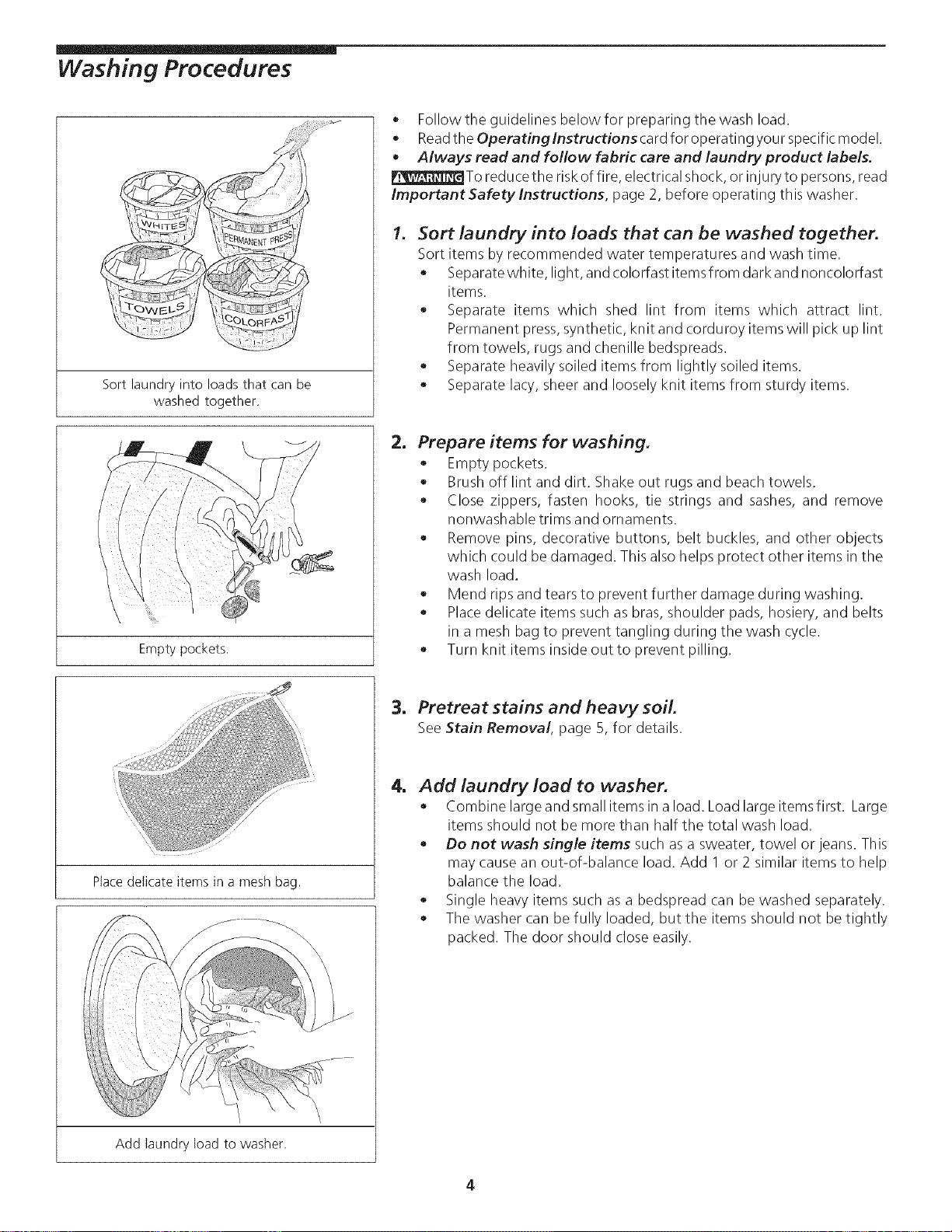
Sort laundry into loads that can be
washed together.
Emptypockets.
• Follow the guidelines below for preparing the wash load.
Readthe Operating lnstructions cardfor operating your specific model.
• Always read and follow fabric care and laundry product labels.
_To reducethe risk of fire, electrical shock, or injury to persons, read
Important Safety Instructions, page 2, before operating thiswasher.
.
Sort laundry into loads that can be washed together.
Sort items by recommended water temperatures and wash time.
Separatewhite, light, and colorfast itemsfrom dark and noncolorfast
items.
Separate items which shed lint from items which attract lint.
Permanent press,synthetic, knit and corduroy items will pick up lint
from towels, rugs and chenille bedspreads.
Separate heavily soiled items from lightly soiled items.
Separate lacy, sheer and loosely knit items from sturdy items.
2. Prepare items for washing.
• Empty pockets.
• Brush off lint and dirt. Shake out rugs and beach towels.
• Close zippers, fasten hooks, tie strings and sashes, and remove
nonwashable trims and ornaments.
• Remove pins, decorative buttons, belt buckles, and other objects
which could be damaged. This also helps protect other items in the
wash load,
• Mend rips and tears to prevent further damage during washing.
Placedelicate items such as bras, shoulder pads, hosiery, and belts
in a mesh bag to prevent tangling during the wash cycle.
Turn knit items inside out to prevent pilling.
Placedelicate itemsin a meshbag.
\
Add laundryload to washer.
3. Pretreat stains and heavy soil
See Stain Removal, page 5, for details.
4. Add laundry load to washer.
Combine large and small items in a load. Load large items first. Large
items should not be more than half the total wash load.
Do not wash single items such as a sweater, towel or jeans. This
may cause an out-of-balance load. Add I or 2 similar items to help
balance the load.
Single heavy items such as a bedspread can be washed separately.
The washer can be fully loaded, but the items should not be tightly
packed. The door should close easily.
Washing Procedures continued
5. Add detergent, bleach and fabric softener to automatic dispenser following these steps:
D
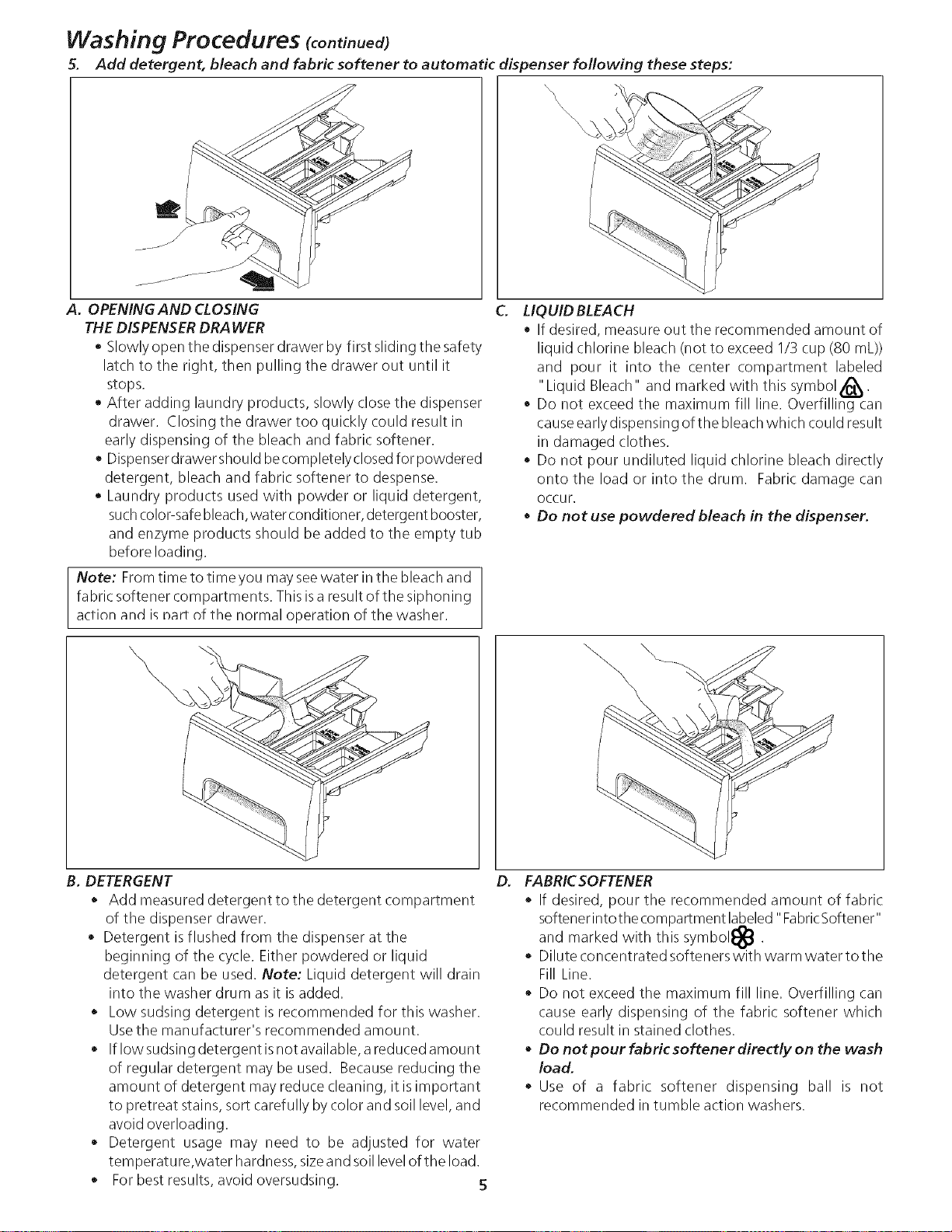
A. OPENING AND CLOSING
THE DISPENSER DRA lIVER
Slowly open the dispenser drawer by first sliding the safety
latch to the right, then pulling the drawer out until it
stops.
After adding laundry products, slowly close the dispenser
drawer. Closing the drawer too quickly could result in
early dispensing of the bleach and fabric softener.
Dispenserdrawer should becompletely closedfor powdered
detergent, bleach and fabric softener to despense.
Laundry products used with powder or liquid detergent,
suchcolor-safebleach,water conditioner, detergent booster,
and enzyme products should be added to the empty tub
before loading.
Note: From time to time you may seewater in the bleach and
fabric softener compartments. This isa result of the siphoning
action and it hart of the normal operation of the washer.
\
\
C
s
LIQUID BLEACH
* If desired, measure out the recommended amount of
liquid chlorine bleach (not to exceed 1/3 cup (80 mL))
and pour it into the center compartment labeled
"Liquid Bleach" and marked with this symbol t/_.
* Do not exceed the maximum fill line. Overfilling can
causeearly dispensing of the bleachwhich could result
in damaged clothes.
Do not pour undiluted liquid chlorine bleach directly
onto the load or into the drum. Fabric damage can
Occur.
* Do not use powdered bleach in the dispenser.
\
B. DETERGENT
* Add measured detergent to the detergent compartment
of the dispenser drawer.
Detergent isflushed from the dispenser at the
beginning of the cycle. Either powdered or liquid
detergent can be used. Note: Liquid detergent will drain
into the washer drum asit isadded.
* Low sudsing detergent is recommended for this washer.
Usethe manufacturer's recommended amount.
If low sudsing detergent isnot available, areduced amount
of regular detergent may be used. Becausereducing the
amount of detergent may reduce cleaning, it isimportant
to pretreat stains, sort carefully bycolor and soil level, and
avoid overloading.
Detergent usage may need to be adjusted for water
temperature,water hardness, sizeand soil levelof the load.
For best results, avoid oversudsing. 5
D. FABRICSOFTENER
* If desired, pour the recommended amount of fabric
softener intothe compartment labeled "FabricSoftener"
and marked with this symbol_
4
Dilute concentrated softeners with warm water to the
Fill Line.
* Do not exceed the maximum fill line. Overfilling can
cause early dispensing of the fabric softener which
could result in stained clothes.
o Do not pour fabric softener directly on the wash
load.
Use of a fabric softener dispensing ball is not
recommended in tumble action washers.
Washing Procedures
continued)
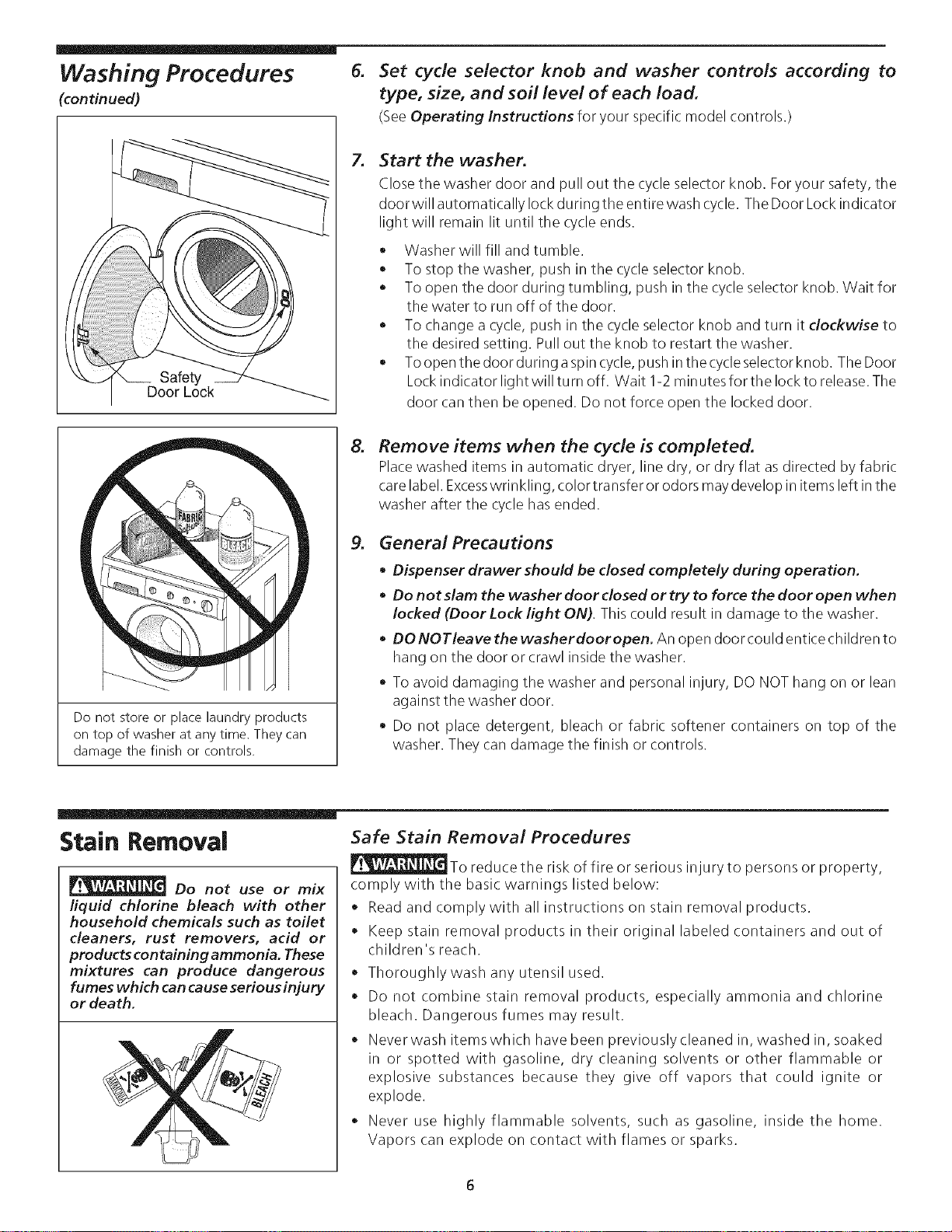
Safety
Door Lock
Do not store or place laundry products
on top of washer at any time. They can
damage the finish or controls.
6. Set cycle selector knob and washer controls according to
type, size, and soil level of each load.
(See Operating Instructions for your specific model controls.)
Z Start the washer.
Close the washer door and pull out the cycle selector knob. For your safety, the
door will automatically lock during the entire wash cycle. The Door Lock indicator
light will remain lit until the cycle ends.
• Washer will fill and tumble.
• To stop the washer, push in the cycle selector knob.
• To open the door during tumbling, push in the cycle selector knob. Wait for
the water to run off of the door.
• To change a cycle, push in the cycle selector knob and turn it clockwise to
the desired setting. Pull out the knob to restart the washer.
• Toopenthedoorduringaspincycle, pushinthecycleselectorknob. TheDoor
Lock indicator light will turn off. Wait I-2 minutes for the lock to release. The
door can then be opened. Do not force open the locked door.
8.
Remove items when the cycle is completed.
Placewashed items in automatic dryer, line dry, or dry flat as directed by fabric
care label. Excesswrinkling, color transfer or odors may develop in items left inthe
washer after the cycle has ended.
9.
General Precautions
• Dispenser drawer should be closed completely during operation.
• Do not slam the washer door closed or try to force the door open when
locked (Door Lock light ON). This could result in damage to the washer.
• DO NOTleave the washerdooropen. An open door could entice children to
hang on the door or crawl inside the washer.
• To avoid damaging the washer and personal injury, DO NOT hang on or lean
against the washer door.
• Do not place detergent, bleach or fabric: softener containers on top of the
washer. They can damage the finish or controls.
Stain Removal
Do not use or mix
liquid chlorine bleach with other
household chemicals such as toilet
cleaners, rust removers, acid or
products containing ammonia. These
mixtures can produce dangerous
fumes which can cause serious injury
or death.
Safe Stain Removal Procedures
_To reduce the risk of fire or serious injury to persons or property,
comply with the basic warnings listed below:
• Read and comply with all instructions on stain removal products.
• Keep stain removal products in their original labeled containers and out of
children's reach.
• Thoroughly wash any utensil used.
• Do not combine stain removal products, especially ammonia and chlorine
bleach. Dangerous fumes may result.
• Neverwash itemswhich have been previouslycleaned in, washed in, soaked
in or spotted with gasoline, dry cleaning solvents or other flammable or
explosive substances because they give off vapors that could ignite or
explode.
• Never use highly flammable solvents, such as gasoline, inside the home.
Vapors can explode on contact with flames or sparks.
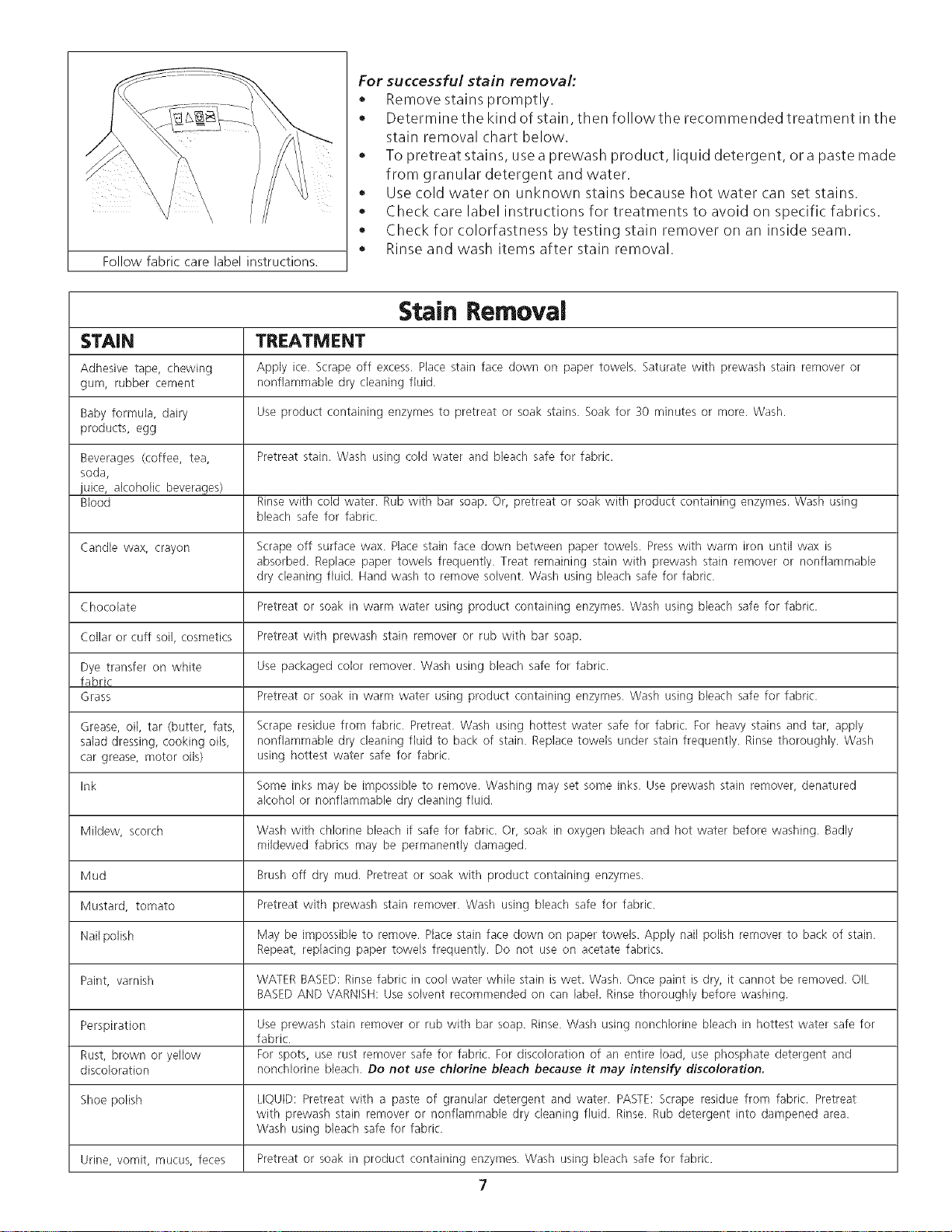
Follow fabric care label instructions.
For successful stain removal:
• Remove stains promptly.
Determine the kind of stain, then followthe recommended treatment in the
stain removal chart below.
To pretreat stains, use a prewash product, liquid detergent, or a paste made
from granular detergent and water.
Use cold water on unknown stains because hot water can set stains.
Check care label instructions for treatments to avoid on specific fabrics.
Check for colorfastness by testing stain remover on an inside seam.
Rinse and wash items after stain removal.
Stain Removal
STAIN TREATM ENT
Adhesive tape, chewing Apply ice. Scrape off excess. Place stain face down on paper towels. Saturate with prewash stain remover or
gum, rubber cement nonflammable dry cleaning fluid.
Baby formula, dairy Use product containing enzymes to pretreat or soak stains. Soak for 30 minutes or more. Wash.
products, egg
Beverages (coffee, tea, Pretreat stain. Wash using cold water and bleach safe for fabric.
soda,
juice, alcoholic beverages)
Blood Rinse with cold water. Rub with bar soap. Or, pretreat or soak with product containing enzymes. Wash using
bleach safe for fabric.
Candle wax, crayon Scrape off surface wax. Place stain face down between paper towels. Press with warm iron until wax is
absorbed. Replace paper towels frequently. Treat remaining stain with prewash stain remover or nonflammable
dry cleaning fluid. Hand wash to remove solvent. Wash using bleach safe for fabric.
Chocolate Pretreat or soak in warm water using product containing enzymes. Wash using bleach safe for fabric.
Collar or cuff soil, cosmetics Pretreat with prewash stain remover or rub with bar soap.
Dye transfer on white Use packaged color remover. Wash using bleach safe for fabric.
fabric
Grass Pretreat or soak in warm water using product containing enzymes. Wash using bleach safe for fabric.
Grease, oil, tar (butter, fats, Scrape residue from fabric. Pretreat. Wash using hottest water safe for fabric. For heavy stains and tar, apply
salad dressing, cooking oils, nonflammable dry cleaning fluid to back of stain. Replace towels under stain frequently. Rinse thoroughly. Wash
car grease, motor oils) using hottest water safe for fabric.
Ink Some inks may be impossible to remove. Washing may set some inks. Use prewash stain remover, denatured
alcohol or nonflammable dry cleaning fluid.
Mildew, scorch Wash with chlorine bleach if safe for fabric. Or, soak in oxygen bleach and hot water before washing. Badly
mildewed fabrics may be permanently damaged.
Mud Brush off dry mud. Pretreat or soak with product containing enzymes.
Mustard, tomato Pretreat with prewash stain remover. Wash using bleach safe for fabric.
Nail polish May be impossible to remove. Place stain face down on paper towels. Apply nail polish remover to back of stain.
Repeat, replacing paper towels frequently. Do not use on acetate fabrics.
Paint, varnish WATER BASED: Rinse fabric in cool water while stain is wet. Wash. Once paint is dry, it cannot be removed. OIL
BASED AND VARNISH: Use solvent recommended on can label. Rinse thoroughly before washing.
Perspiration Use prewash stain remover or rub with bar soap. Rinse. Wash using nonchlorine bleach in hottest water safe for
fabric.
Rust, brown or yellow For spots, use rust remover safe for fabric. For discoloration of an entire load, use phosphate detergent and
discoloration nonchlorine bleach. Do not use chlorine bleach because it may intensify discoloration.
Shoe polish LIQUID: Pretreat with a paste of granular detergent and water. PASTE: Scrape residue from fabric. Pretreat
with prewash stain remover or nonflammable dry cleaning fluid. Rinse. Rub detergent into dampened area.
Wash using bleach safe for fabric.
Urine, vomit, mucus, feces Pretreat or soak in product containing enzymes. Wash using bleach safe for fabric.
7
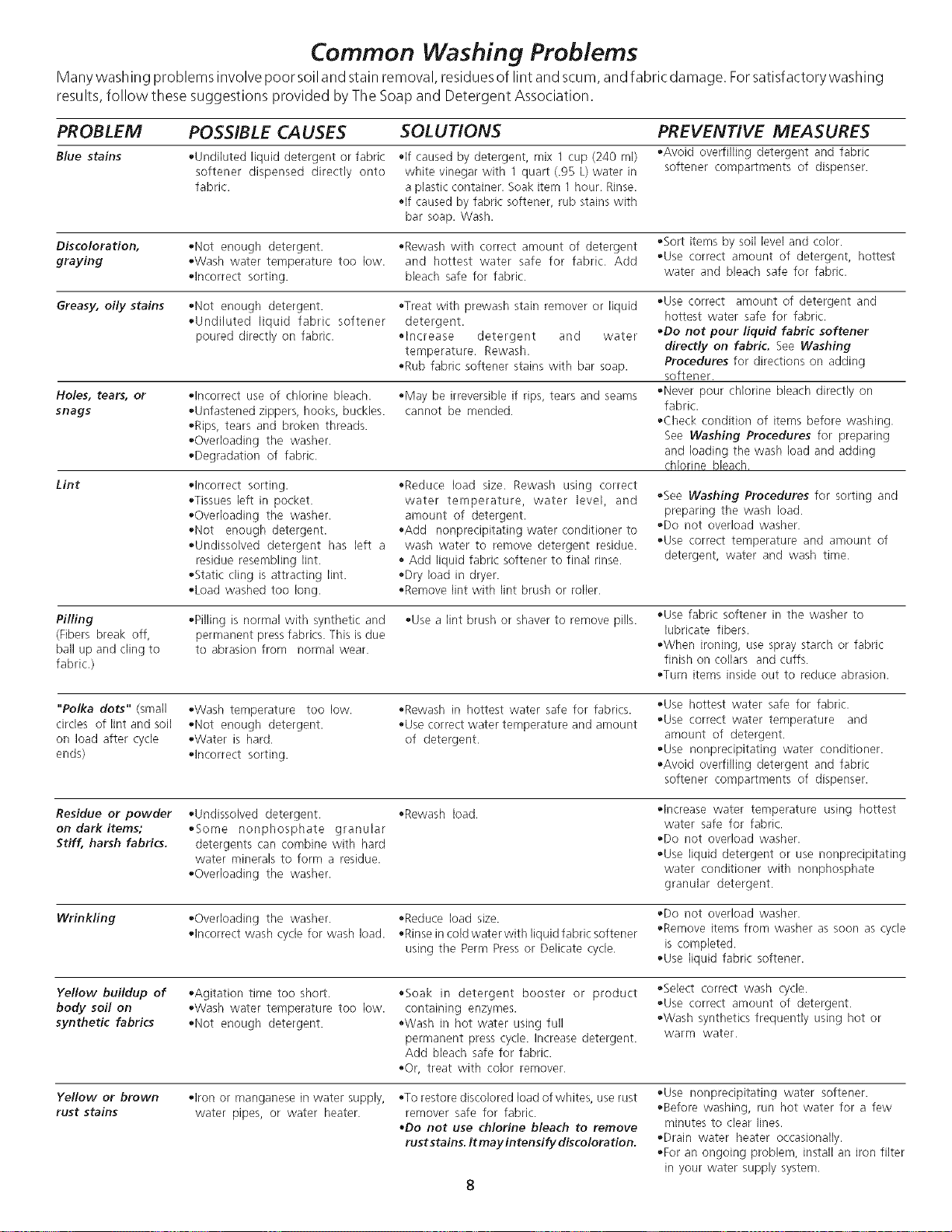
Common Washing Problems
Many washing problems involve poor soiland stain removal, residues of lint and scum, and fabric damage. Forsatisfactory washing
results, follow these suggestions provided by The Soap and Detergent Association.
PROBLEM
Blue stains
Discoloration,
graying
Greasy, oily stains
Holes, tears, or
snags
Lint
Pilling
(Fibers break off,
ball up and cling to
fabric.)
POSSIBLE CAUSES
*Undihted liquid detergent or fabric
softener dispensed directly onto
fabric.
SOLUTIONS
*if caused by detergent, mix 1 cup (240 ml)
white vinegar with 1 quart (.95 L) water in
a plastic container. Soak item 1 hour. Rinse.
*if caused by fabric softener, rub stains with
bar soap. Wash.
PREVENTIVE MEASURES
• Avoid overfilling detergent and fabric
softener compartments of dispenser.
*Not enough detergent. *Rewash with correct amount of detergent .Sort items by soil level and color.
*Wash water temperature too low. and hottest water safe for fabric. Add .Use correct amount of detergent, hottest
*incorrect sorting, bleact_ safe for fabric, water and bleach safe for fabric.
*Not enough detergent.
*Undiluted liquid fabric softener
poured directly on fabric.
*incorrect use of chlorine bleach.
*Unfastened zippers, hooks, buckles.
*Rips, tears and broken threads.
*Overloading the washer.
*Degradation of fabric.
.Treat with prewash stain remover or liquid
detergent.
*increase detergent and water
temperature. Rewash.
*Rub fabric softener stains with bar soap.
*May be irreversible if rips, tears and seams
cannot be mended.
• Use correct amount of detergent and
hottest water safe for fabric.
• Do not pour liquid fabric softener
directly on fabric. Bee Washing
Procedures for directions on adding
softener.
• Never pour chlorine bleach directly on
fabric.
• Check condition of items before washing.
Bee Washing Procedures for preparing
and loading the wash load and adding
chlorine bleach.
.incorrect sorting.
.Tissues left in pocket.
.Overloading the washer.
.Not enough detergent.
.Undissolved detergent has left a
residue resembling lint.
.Static cling is attracting lint.
.Load washed too long.
.Reduce load size. Rewash using correct
water temperature, water level, and
amount of detergent.
.Add nonprecipitating water conditioner to
wash water to remove detergent residue.
* Add liquid fabric softener to final rinse.
.Dry load in dryer.
.Remove lint with lint brush or roller.
• See Washing Procedures for sorting and
preparing the wash load.
• Do not overload washer.
• Use correct temperature and amount of
detergent, water and wash time.
*Pilling is normal with synthetic and
permanent press fabrics. This is due
to abrasion from normal wear.
*Use a lint brush or shaver to remove pills.
• Use fabric softener in the washer to
lubricate fibers.
• When ironing, use spray starch or fabric
finish on collars and cuffs.
• Turn items inside out to reduce abrasion.
"Polka dots" (small
circles of lint and soil
on load after cycle
ends)
.Wash temperature too low.
.Not enough detergent.
.Water is hard.
.Incorrect sorting.
.Rewash in hottest water safe for fabrics.
*Use correct water temperature and amount
of detergent.
• Use hottest water safe for fabric.
• Use correct water temperature and
amount of detergent.
• Use nonprecipitating water conditioner.
• Avoid overfilling detergent and fabric
softener compartments of dispenser.
Residue or powder
on dark items;
Stiff, harsh fabrics.
.Undissolved detergent.
.Some nonphosphate granular
detergents can combine with hard
water minerals to form a residue.
.Overloading the washer.
.Rewash load.
• increase water temperature using hottest
water safe for fabric.
• Do not overload washer.
• Use liquid detergent or use nonprecipitating
water conditioner with nonphosphate
granular detergent.
Wrinkling .Overloading the washer.
.incorrect wash cycle for wash load.
.Reduce load size.
.Rinse in cold water with liquid fabric softener
using the Perm Press or Delicate cycle.
• Do not overload washer.
• Remove items from washer as soot] as cycle
is completed.
• Use liquid fabric softener.
Yellow buildup of
body soil on
synthetic _brics
Yellow or brown
rust stains
.Agitation time too short.
.Wash water temperature too low.
.Not enough detergent.
.Soak in detergent booster or product
containing enzymes.
.Wash in hot water using full
permanent press cycle. Increase detergent.
Add bleach safe for fabric.
*Or, treat with color remover.
• Select correct wash cycle.
• Use correct amount of detergent.
• Wash synthetics frequently using hot or
warm water.
*Iron or manganese in water supply,
water pipes, or water heater.
*To restore discolored load of whites, use rust
remover safe for fabric.
,Do not use chlorine bleach to remove
rust stains. It may intensify discoloration.
• Use nonprecipitating water softener.
• Before washing, run hot water for a few
minutes to clear lines.
• Drain water heater occasionally.
• For an ongoing problem, install an iron filter
in your water supply system.
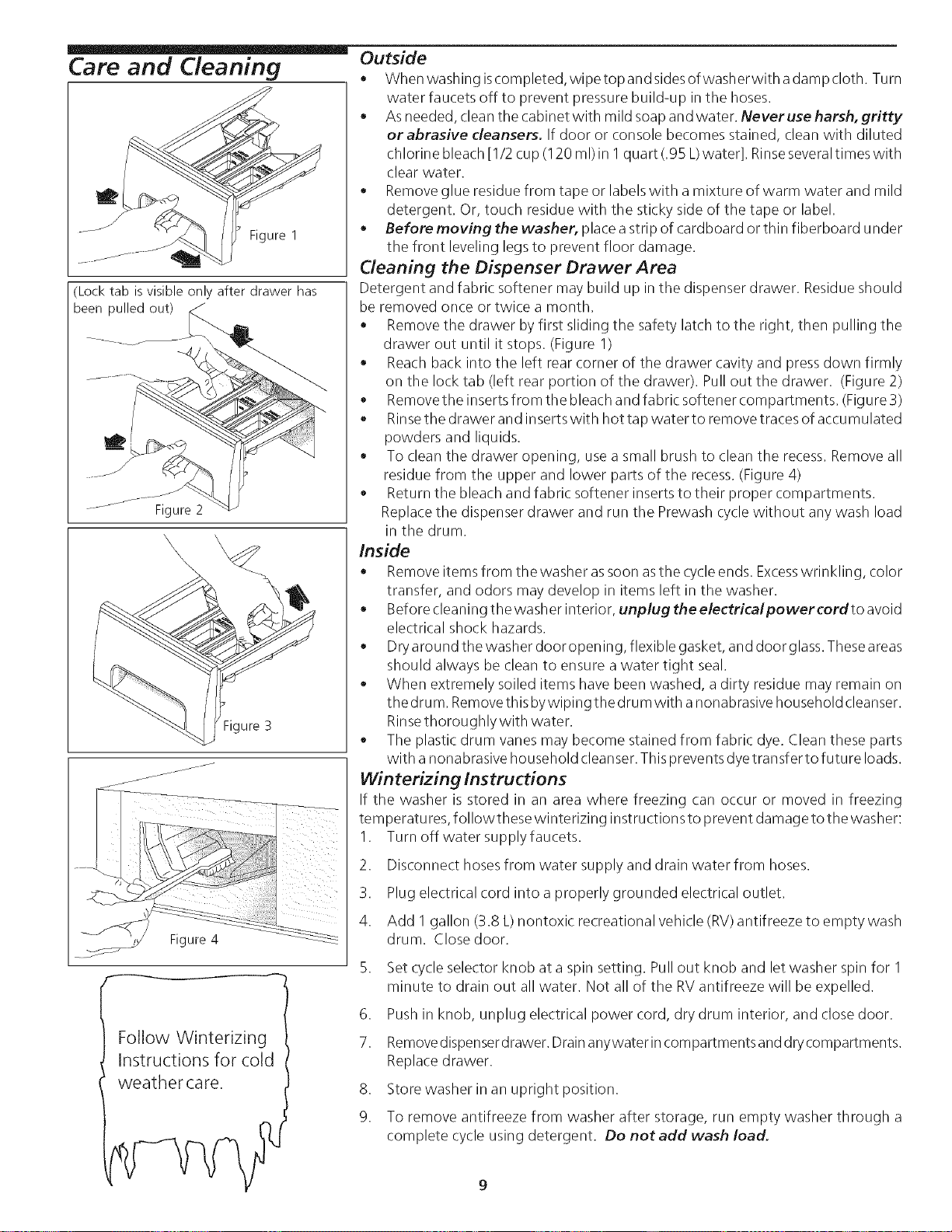
Care and Cleaning
Figure 1
(Lock tab is visible only after drawer has
been pulled out)
:igure 3
Figure 4
Outside
• Whenwashingiscompleted, wipetopandsidesofwasherwithadampcloth. Turn
water faucets off to prevent pressure build-up inthe hoses.
As needed, cleanthe cabinet with mild soap and water. Never use harsh, gritty
or abrasive cleansers. If door or console becomes stained, clean with diluted
chlorine bleach [1/2 cup (120 ml)in 1quart (.95 L)water]. Rinseseveraltimes with
clear water.
Removeglue residue from tape or labels with a mixture of warm water and mild
detergent. Or, touch residue with the sticky side of the tape or label.
• Before moving the washer, place astrip of cardboard or thin fiberboard under
the front leveling legs to prevent floor damage
Cleaning the Dispenser Drawer Area
Detergent and fabric softener may build up in the dispenser drawer Residue should
be removed once or twice a month
Remove the drawer by first sliding the safety latch to the right, then pulling the
drawer out until it stops (Figure 1)
Reach back into the left rear corner of the drawer cavity and press down firmly
on the lock tab (left rear portion of the drawer) Pull out the drawer (Figure 2)
Removethe insertsfrom the bleach and fabric:softener compartments. (Figure3)
Rinsethe drawer and insertswith hot tap water to remove traces of accumulated
powders and liquids.
To clean the drawer opening, use a small brush to clean the recess. Remove all
residue from the upper and lower parts of the recess. (Figure 4)
Return the bleach and fabric softener inserts to their proper compartments.
Replace the dispenser drawer and run the Prewash cycle without any wash load
in the drum.
Inside
Remove items from the washer assoon asthe cycleends Excesswrinkling, color
transfer, and odors may develop in items left in the washer.
Before cleaning the washer interior, unplug the electrical power cord to avoid
electrical shock hazards
Dryaround the washer door opening, flexible gasket, and door glass These areas
should always be clean to ensure a water tight seal.
When extremely soiled items have been washed, a dirty residue may remain on
thedrum Removethisbywipingthedrumwith a nonabrasive householdcleanser
Rinsethoroughlywith water
The plastic drum vanes may become stained from fabric dye. Clean these parts
with a nonabrasive household cleanser This prevents dyetransfer to future loads
Winterizing Instructions
If the washer is stored in an area where freezing can occur or moved in freezing
temperatures, followthese winterizing instructions to prevent damage to the washer:
I Turn off water supply faucets
2 Disconnect hoses from water supply and drain water from hoses
3 Plug electrical cord into a properly grounded electrical outlet
4 Add 1 gallon (38 L) nontoxic recreational vehicle (RV)antifreeze to empty wash
drum Close door
5. Setcycle selector knob at a spin setting. Pull out knob and let washer spin for I
minute to drain out all water. Not all of the RVantifreeze will be expelled.
6. Pushin knob, unplug electrical power cord, dry drum interior, and close door.
7. Removedispenserdrawer. Drainanywater in compartments and drycompartments.
Replace drawer.
8. Store washer in an upright position.
9. To remove antifreeze from washer after storage, run empty washer through a
complete cycle using detergent. Do not add wash load.
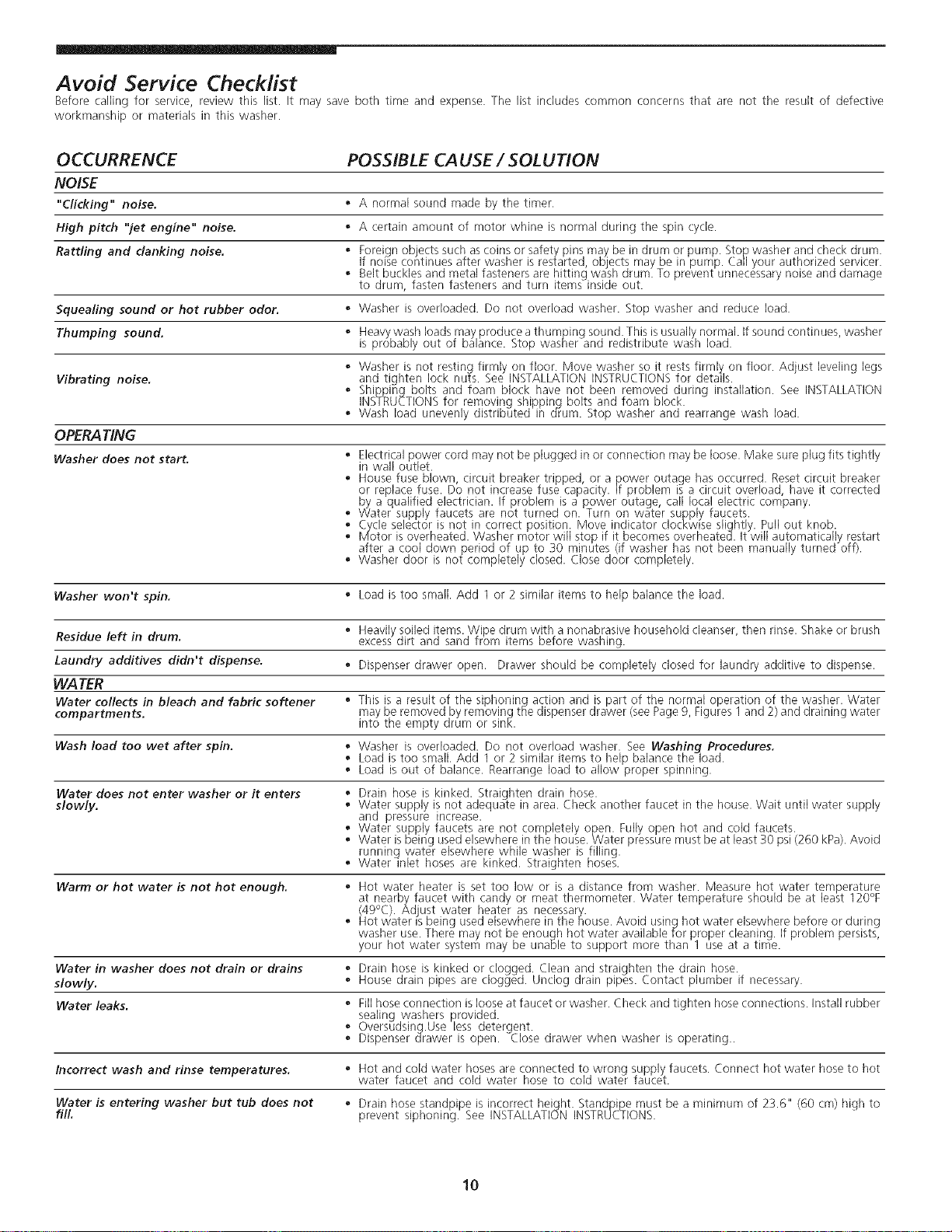
Avoid Service Checklist
Before calling for service, review this list. It may save both time and expense. The list includes common concerns that are not the result of defective
workmansNp or materials in this washer.
OCCURRENCE POSSIBLE CA USE / SOL UT/ON
NOISE
"Clicking" noise. * A normal sound made by the timer.
High pitch "jet engine" noise. * A certain amount of motor wNne is normal during the spin cycle.
Rattling and clanking noise. * Foreign ob ects such as coins or safety pins may be in drum or pump. Stop wast_er and check drum.
If noise continues after washer is restarted, objects may be in pump. Call your authorized servicer.
• Belt buckles and metal fasteners are hitting wash drum. To prevent unnecessary noise and damage
to drum, fasten fasteners and turn items inside out.
Squealing sound or hot rubber odor. * Washer is overloaded. Do not overload washer. Stop washer and reduce load.
Thumping sound. * Heavywash loads may produce a thumping sound. This is usually normal. If sound continues, washer
is probably out of balance. Stop washer-and redistribute wast_ load.
• Washer is not resting firmly on floor. Move washer so it rests firmly on floor. Ad ust leveling legs
Vibrating noise, and tighten lock nuts. See INSTALLATION INSTRUCTIONS for details.
• Shippii'_g bolts and foam block have not been removed during installation. See INBTALLATION
INBTRUCTIONBfor removing shipping bolts and foam block. -
• Wash load unevenly distribi_ted in drum. Stop wast_er and rearrange wash load.
OPERATING
Washer does not start. * Electrical power cord may not be plugged in or connection may be loose. Make sure plug fits tightly
in wall outlet.
• House fuse blown, circuit breaker tripped, or a power outage has occurred. Reset circuit breaker
or replace fuse. Do not increase fuse capacity. If problem i_ a circuit overload, have it corrected
by a qualified electrician. If problem is a power outage, call local electric company.
• Water supply faucets are not turned on. Turn on w_ter supply faucets.
• Cycle selector is not in correct position. Move indicator clockwise slightly. Pull out knob.
• Motor is overheated. Wast_er motor will stop if it becomes overheated. It will automatically restart
after a cool down period of up to 30 minutes (if washer has not been manually turned off).
• Wast_er door is not completely closed. Close door completely.
Washer won't spin. * Load is too small. Add 1 or 2 similar items to help balance the load.
• Heavily soiled items. Wipe drum witt_ a nonabrasive houset_old cleanser, tt_en rinse. Shake or brush
Residue left in drum. excess dirt and sand from items before washing.
Laundry additives didn't dispense. * Dispenser drawer open. Drawer should be completely closed for laundry additive to dispense.
WATER
Water collects in bleach and fabric softener ® This is a result of tile siphoning action and is part of the normal operation of tile washer. Water
compartments, may be removed by removing the dispenser drawer (see Page 9 Figures 1and 2) and draining water
into the empty drum or sinR.
Wash load too wet after spin. * Washer is overloaded. Do not overload washer. See Washing Procedures.
• Load is too small. Add 1 or 2 similar items to help balance the load.
• Load is out of balance. Rearrange load to allow proper spinning.
Water does not enter washer or it enters * Drain hose is kinked. Straighten drain hose.
slowly. * Water supply is not adequate in area. Ct_eckanott_er faucet in the house. Wait until water supply
and pressure increase.
• Water supply faucets are not completely open. Fully open hot and cold faucets.
• Water is Being used elsewhere in the house. Water pressure must be at least 30 psi (260 kPa). Avoid
running water elsewt_ere while wast_er is filling.
• Water-inlet hoses are kinked. Straighten hoses.
Warm or hot water is not hot enough. * Hot water heater is set too low or is a distance from washer. Measure hot water temperature
at nearby faucet with candy or meat thermometer. Water temperature should be at least 120°F
(49°C). Adjust water heater as necessary.
• Hot water is being used elsewhere in the [louse. Avoid using hot water elsewhere before or during
washer use. There may not be enough hot water available for proper cleaning. If problem persists,
your hot water system may be unable to support more titan 1 use at a time.
Water in washer does not drain or drains * Drain hose is kinked or clogged. Clean and straighten the drain hose.
slowly. * House drain pipes are cJog_j_d. Unclog drain pipes. Contact plumber if necessary.
Water leaks. * Fill hose connection is loose at faucet or washer. Check and tighten hose connections. Install rubber
sealing washers provided.
• OversOdsing.Use less detergent.
• Dispenser drawer is open. -Close drawer when wast]er is operating..
Incorrect wash and rinse temperatures. * Hot and cold water hoses are connected to wrong supply faucets. Connect hot water hose to hot
water faucet and cold water hose to cold water faucet.
Water is entering washer but tub does not * Drain hose standpipe is incorrect height. Btandpipe must be a minimum of 23.6" (60 cm) high to
fill. prevent sipt_oning. See INSTALLATION INSTRUqTIONS.
10
Kenmore Appliance Warranty
One Year Limited Warranty
When installed, operated and maintained according to all instructions supplied with the product, if this appliance fails due
to a defect in material or workmanship within one year from the date of purchase, call 1-800-4-MY-HOME®
(1-800-469-4663) to arrange for free repair.
If this appliance is used for other than private family purposes, this warranty applies for only 90 days from the date of
purchase.
This warranty covers only defects in material and workmanship. Sears will NOT pay for:
1. Expendable items that can wear out from normal use, including but not limited to filters, belts, light bulbs, and bags.
2. A service technician to instruct the user in correct product installation, operation or maintenance.
3. A service technician to clean or maintain this product.
4. Damage to or failure of this product if it is not installed, operated or maintained according to all instructions supplied with
the product.
5. Damage to or failure of this product resulting from accident, abuse, misuse or use for other than its intended purpose.
6. Damage to or failure of this product caused by the use of detergents, cleaners, chemicals or utensils other than those
recommended in all instructions supplied with the product.
7. Damage to or failure of parts or systems resulting from unauthorized modifications made to this product.
Disclaimer of implied warranties; limitation of remedies
Customer's sole and exclusive remedy under this limited warranty shall be product repair as provided herein. Implied
warranties, including warranties of merchantability or fitness for a particular purpose, are limited to one year or the shortest
period allowed by law. Sears shall not be liable for incidental or consequential damages. Some states and provinces do not
allow the exclusion or limitation of incidental or consequential damages, or limitations on the duration of implied warranties
of merchantability or fitness, so these exclusions or limitations may not apply to you.
This warranty applies only while this appliance is used in the United States and Canada.
This warranty gives you specific legal rights, and you may also have other rights which vary from state to state.
Sears, Roebuck and Co., Dept. 817WA, Hoffman Estates, IL 60179
Sears Canada Inc., Toronto, Ontario, Canada M5B 2B8
Master Protection Agreement ,ntheU.S.A
Congratulations on making a smart purchase. Your new Kenmore® appliance is designed and manufactured for years of
dependable operation. But like all products, it may require preventive maintenance or repair from time to time. That's when
having a Master Protection Agreement can save you money and aggravation.
The Master Protection Agreement also helps extend the life of your new appliance. Here's what's included in the Agreement:
Parts and labor needed to help keep products operating prop-erly under normal use, not just defects. Our coverage
goes well beyond the product warranty. No deductibles, no functional failure excluded from
coverage-- real protection.
Expert service by a force of more than 10,000 authorized Sears service technicians, which means someone you can
trust will be working on your product.
Unlimited service calls and nationwide service, as often as you want us, whenever you want us.
"No-lemon" guarantee - replacement of your covered product if four or more product failures occur within twelve
months.
Product replacement if your covered product can't be fixed.
Annual Preventive Maintenance Check at your request - no extra charge.
Fast help by phone - we call it Rapid Resolution - phone sup-port from a Sears representative on all products. Think of
us as a "talking owner's manual."
Power surge protection against electrical damage due to power fluctuations.
$250 Food Loss Protection annually for any food spoilage that is the result of mechanical failure of any covered
refrigerator or freezer.
Rental reimbursement if repair of your covered product takes longer than promised.
10% discount off the regular price of any non-covered repair service and related installed parts.
Once you purchase the Agreement, a simple phone call is all that it takes for you to schedule service. You can call anytime day
or night, or schedule a service appointment online.
The Master Protection Agreement is a risk free purchase. If you can-cel for any reason during the product warranty period, we
will provide a full refund. Or, a prorated refund anytime after the product warranty period expires. Purchase your Master
Protection Agreement today! Sears Installation Service
Some limitations and exclusions apply. For Sears guaranteed professional installation of home
For prices and additional information, appliances and items like garage door openers and
call 1-800=827-6655. 11 water heaters, in the U.S.A. call 1-800-4-MY-HOME®