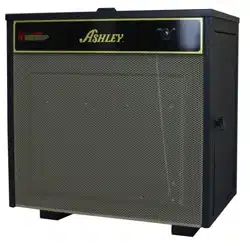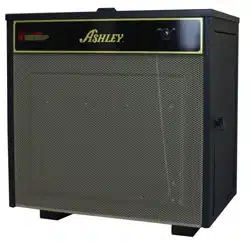
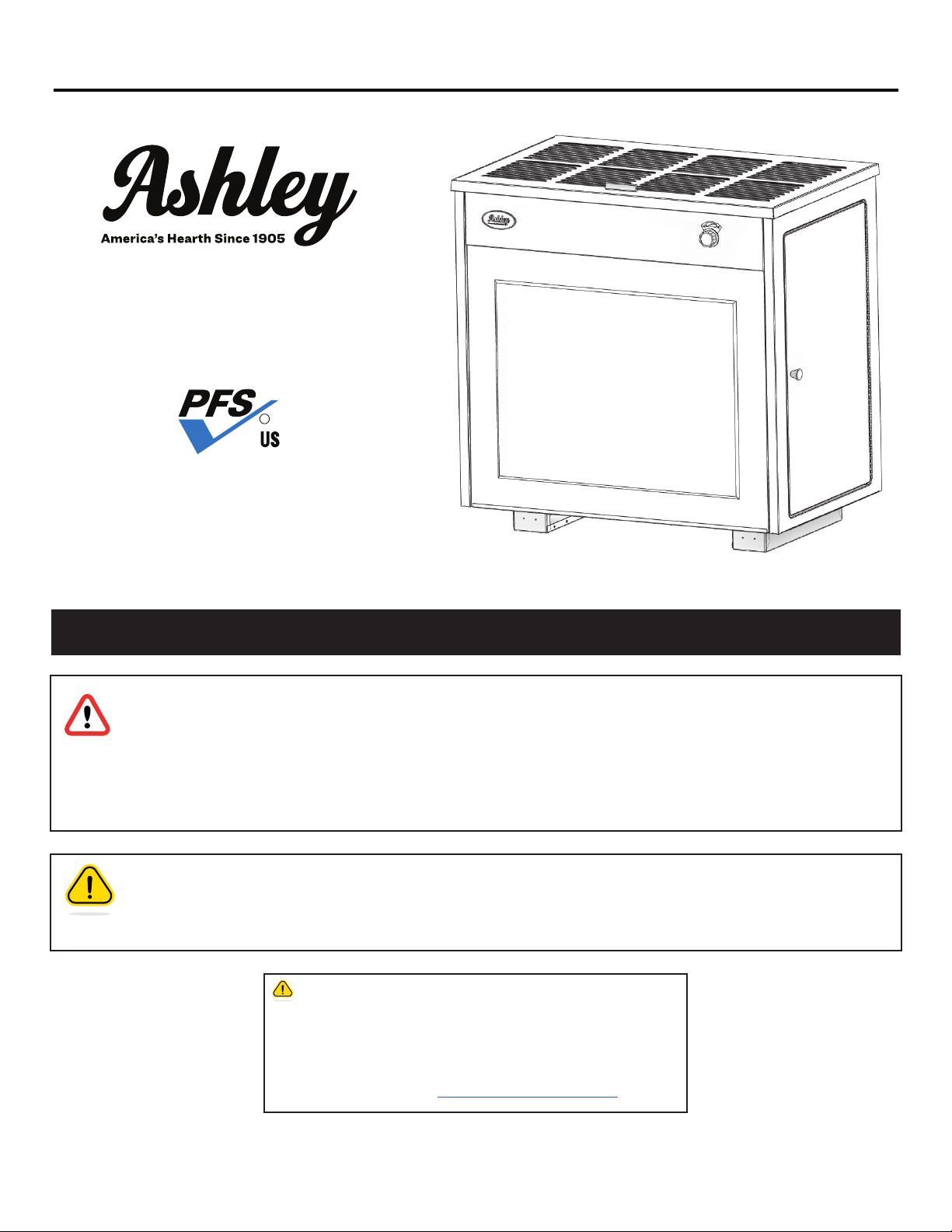
* All Pictures In This Manual Are For Illustrative Purposes Only. Actual Product May Vary.
© 2021 United States Stove Company, 227 Industrial Park Rd., South Pittsburg, TN 37380 Ph. 800-750-2723
THIS MANUAL IS SUBJECT TO CHANGE WITHOUT NOTICE.
Owner’s Instruction and Operation Manual
SAFETY NOTICE: If this heater is not properly installed, a house re may result.
For your safety, follow the installation instructions. Never use make-shift
compromises during the installation of this heater. Contact local building or
re ofcials about permits, restrictions and installation requirements in your
area. NEVER OPERATE THIS PRODUCT WHILE UNATTENDED.
CAUTION! Please read this entire manual before you install or use your new room
heater. Failure to follow instructions may result in property damage, bodily injury,
or even death. Improper Installation Will Void Your Warranty!
Save These Instructions In A Safe Place For Future Reference.
CALIFORNIA PROPOSITION 65 WARNING:
This product can expose you to chemicals including carbon
monoxide, which is known to the State of California to cause
cancer, birth defects, and/or other reproductive harm. For
more information, go to www.P65warnings.ca.gov
Model Number:
CAC/BCAC
COAL ONLY STOVE
851396K-0102K
R
Report #: F20-574
This unit was tested and listed to UL 1482-1996.
DO NOT USE THIS HEATER IN A MOBILE
HOME OR TRAILER
2
© 2021 United States Stove Company
Combustible: Coal
Colors: Black
Flue Pipe Diameter: 6” (153 mm)
Flue Pipe Type: Black or Blued Steel 2100°F (650°C)
Minimum Chimney Height: 12’ (3.7 m)
Dimensions
Overall: Depth x Width x Height: 22-3/16” (564 mm) X 33-11/16” (856 mm) X 34-3/16” (868 mm)
Combustion Chamber: Width x Depth: 22-1/8” (563 mm) X 13” (331 mm)
Door Opening: Width x Height: 10” (254 mm) X 13-1/5” (343 mm)
CAUTIONS:
• HOT WHILE IN OPERATION. KEEP CHILDREN, CLOTHING AND FURNITURE AWAY. CONTACT MAY
CAUSE SKIN BURNS.
• DO NOT USE CHEMICALS OR FLUIDS TO IGNITE THE FIRE.
• DO NOT LEAVE THE STOVE UNATTENDED WHEN THE DOOR IS SLIGHTLY OPENED.
• DO NOT BURN GARBAGE, FLAMMABLE FLUID SUCH AS GASOLINE, NAPHTHA OR MOTOR OIL.
• DO NOT CONNECT TO ANY AIR DISTRIBUTION DUCT OR SYSTEM.
• ALWAYS CLOSE THE DOOR AFTER THE IGNITION.
• YOUR CHIMNEY MUST BE INSPECTED PRIOR TO THE INSTALLATION OF YOUR NEW COAL
STOVE. IN ADDITION, YOU SHOULD HAVE YOUR CHIMNEY INSPECTED FOR CREOSOTE DEPOSTS
MONTHLY DURING THE HEATING SEASON AND ANNUALLY INSPECTED AND CLEANED.
For Customer Service, please
call:
1-800-750-2723 Ext 5050 or;
Text to 423-301-5624 or;
Email us at:
customerservice@usstove.com
Note: Register your product online
at www.usstove.com or download
the free app today. This app is
available only on the App Store for
iPhone and iPad. Search US Stove.
Save your receipt with your records
for any claims.
INTRODUCTION
© 2021 United States Stove Company
3
INSTALLATION CHECKLIST
Your coal stove should be installed by a qualied installer only. An NFI qualied Installer can be found at
www.ncertied.org/public/nd-an-n-pro/
CUSTOMER SERVICE
1-800-750-2723 ext 5050
Text to 423-301-5624
Email to: Customerservice@usstove.com
COMMISSIONING CHECKLIST
This Checklist is to be completed in full by the qualied person who installs this unit. Keep this page for
future reference.
Failure to install and commission according to the manufacturer’s instructions and complete this checklist
will invalidate the warranty.
Please Print
Customer Name: Telephone Number:
Address:
Model:
Serial Number:
Installation Company Name: Phone Number:
Installation Technician’s Name: License Number:
DESCRIPTION OF WORK
Location of installed appliance: _________________________________________________________________________
Venting System: New Venting System Yes No If yes, Brand __________________________________
If no, Date of inspection of existing venting system: ______________________________________________________
COMMISSIONING
Conrm Hearth Pad Installation as per Installation Instructions ..............................................................................................
Conrm proper placement of internal parts ...........................................................................................................................................
Check soundness of door gasket and door seals .................................................................................................................................
Conrm clearances to combustibles as per installation instructions in this manual .................................................
Check the operations of the air controls ....................................................................................................................................................
Conrm the venting system is secure and sealed ...............................................................................................................................
Conrm the stove starts and operates properly ....................................................................................................................................
Check to ensure a CO alarm is installed as per local building codes and is functional .............................................
Explain the safe operation, proper fuel usage, cleaning, and routine maintenance requirements .................
Declaration of Completion: As the qualied person responsible for the work described above, I conrm that
the appliance as associated work has been installed as per manufacturer’s instructions and following any
applicable building and installation codes.
Signed: ___________________________________Print Name: ______________________________ Date: _____________
Home Owner: RETAIN THIS INFORMATION FOR FUTURE REFERENCE
4
© 2021 United States Stove Company
To assure that satisfactory and safe service is
received from this heater:
• Read these instructions entirely before beginning
any part of the installation.
• Use these instructions as a guide during the
installation of the heater.
• Be sure these instructions become the property of
and are reviewed by all future users of this heater
to encourage proper operation and maintenance
of this appliance.
THIS HEATER IS ONLY FOR BURNING COAL. USE
OF ANY OTHER SOLID FUEL EXCEPT FOR COAL
IGNITION PURPOSES IS A VIOLATION OF FEDERAL
LAW.
This heater is designed to burn stove size bituminous
or anthracite coal and to provide heat to one or
more rooms. Because of its radiating characteristics,
this heater must be installed as an unenclosed,
freestanding unit with clearances to combustibles
as specied by these instructions. This heater must
be connected to a Listed Factory-Built Residential
Type and Building Heating Appliance Chimney or
a properly constructed and maintained masonry
chimney.
DO NOT CONNECT THIS UNIT TO A CHIMNEY FLUE
SERVING ANOTHER APPLIANCE.
This heater is not designed to burn lignite coal,
liquid fuels, and gaseous fuels or household refuse.
Any attempt to burn these type fuels, to enclose the
heater or to attach the heater to an air circulation
system or a stoking device can be very hazardous.
THIS HEATER IS NOT DESIGNED TO BE USED IN A
MOBILE HOME.
Do Not Overre - If Heater or Chimney Connector
Glows, You are Overring.
Improper installation or use of this heater can cause:
1. Damage to the heater from overheating.
2. Hazardous temperatures to develope on
combustible materials adjacent to the heater,
chimney connector or chimney.
3. Possible hazardous accumulation of coal gases
within the heater.
4. Release of hazardous gas into the dwelling.
BUILDING CODES AND SAFETY
STANDARDS
Before beginning the installation, you should check
with local building ofcials to assure compliance
with local regulations and codes.
HOW THIS HEATER OPERATES
The chimney draft draws in combustion air through
an adjustable air inlet thermostat located inside the
cabinet. Air ows through and across the bed of fuel,
causing the re to progress through the fuel bed.
Heat is transferred to the air that ows between the
cabinet and the rebox. Any attempt to alter this
air by connecting this heater to a duct system or air
movement fans other than the optional B36 listed
blower, available from your heater dealer, can lead
to improper and possibly hazardous operation of
this heater.
SELECTING A LOCATION FOR THE
HEATER
When selecting a location for the heater, be sure
attention is given to the following considerations:
1. If the heater is to be vented into a Listed High
Temperature Type HT Factory-Built Residential
Type And Building Heating Appliance Chimney,
review the installation instructions for the
chimney to comply with requirements for proper
chimney location, height, space requirements,
etc.
2. If the heater is to be vented into a masonry
chimney, the heater should be located as near
the chimney as possible without failing to
comply with the requirements for minimum
spacing between the chimney connector,
heater and combustibles. (Be sure chimney is
constructed according to NFPA standards.)
3. The location of the heater must provide at least
the minimum clearances between the heater,
chimney connector and combustible materials
as specied in this manual.
4. If the heater is to be located on a combustible
oor, there must be suitable oor space to install
a oor protector beneath and extending beyond
the heater as shown by and as described by the
Floor Protection section of this manual.
5. The heater should be located centrally within
the area where heat is desired but out of trafc
areas to minimize the likelihood of persons
accidentally contacting the hot surface of the
heater.
6. The heater should be located away from
doorways and central heat outlets and inlets
INTRODUCTION
© 2021 United States Stove Company
5
to reduce the chance of drafts blowing smoke,
ashes or sparks out of the heater during
refueling or ash removal.
7. The heater should be located where a small
supply of fuel may be kept conveniently close
but not within 36 inches of the heater.
8. Locate the heater so that drapes, curtains,
furniture and other combustible materials will
not be closer than the clearances shown in this
manual or install a clearance reduction system
(see MINIMUM CLEARANCES TO COMBUSTIBLE
WALLS AND CEILINGS section of this manual
for details).
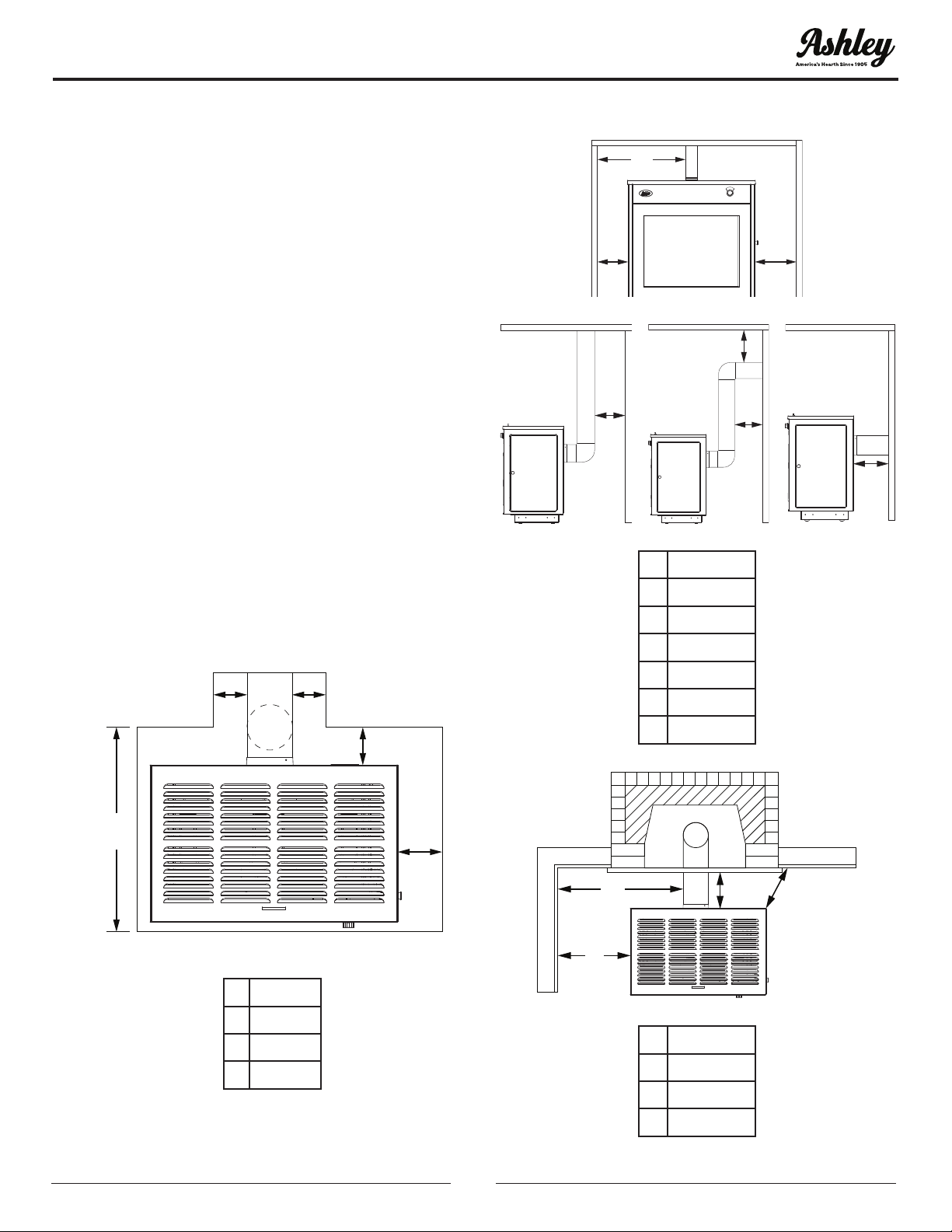
FLOOR PROTECTION
This heater must have a non-combustible oor
protector with a minimum type 1 ember protection
extending beneath the heater if the oor is
constructed of combustible material. If a oor pad
is used, it should be UL listed or equal. The oor
protector should be large enough to extend under
the stove and beyond each side as indicated. If
there is a horizontal run of ue pipe, there needs to
be oor protection under it that extends two inches
beyond either side of the pipe.
D D
C
BA
A 35-1/4”
B 16”
C 8”
D 2”
CLEARANCES
E
F G
J
K
H
L
E 29”
F 16”
G 28”
H 18”
J 18”
K 18”
L 18”
P
N
Q
M
M 16”
N 8” min
P 29” min
Q 18” min
INSTALLATION

6
© 2021 United States Stove Company
1” min
Airspace
Mantel Heat Shield
(min 24-gauge
sheet metal)
Combustible
Mantle
5/8” Thick Fireclay or
Stainless Steel Liner
Extend
Connect
or Into
Liner
Damper
Plate Is
Removed
Or Fastened
In Open
Position
Use
Damper
Adaptor Or
Seal With
Sheetmetal
And
Sealant
Sealed Fireplace Chamber
Cover Plate (Non-combustible)
FACTORY BUILT CHIMNEY
Listed Cap
Maintain 2”
Clearance
Listed
Chimney
Ceiling
Support
Ceiling
Support
Chimney
Connector
*
* Refer to Clearance
to Combustibles
Combustible Wall
Floor
Protector
To Stove
Storm Collar
Flashing
Listed
Chimney
Attic
Insulation
Sheild
Specified
Clearance
Chimney
Connector
Combustible
Ceiling Joists
To Stove
When a metal prefabricated chimney is used, the
manufacturer’s installation instructions must be
followed. You must also purchase (from the same
manufacturer) and install the ceiling support
package or wall pass-through and “T” section
package, restops (where needed), insulation
shield, roof ashing, chimney cap, etc. Maintain
proper clearance to the structure as recommended
by the manufacturer. The chimney must be the
required height above the roof or other obstructions
for safety and proper draft operation.
CHIMNEY CONNECTOR AND CHIMNEYS
It is very important to assure safe and satisfactory
performance from your heater that it be properly
connected to a correctly constructed and
maintained chimney. If a Listed High Temperature
Type HT Factory-Built Residential and Building
Heating Appliance Chimney is used, follow the
chimney manufacturer’s installation instructions
carefully. If a masonry chimney is to be used,
be sure it is constructed to the National Fire
Protection Association (N.F.P.A) and local code
standards. The Chimney connector (pipe from
heater to chimney) must be 6” in diameter and
made from 24 gauge or heavier steel. The length
of the chimney connector and number of elbows*
used should be kept to a minimum. Moisture that
might collect in the chimney should be directed to
the heater by providing a slope of 1/4 inch per foot
in a horizontal run of the chimney connector and
installing all pipes with the crimped end toward
the heater. The chimney connector should extend
at least two inches into the ue of a factory-built
chimney. When making a horizontal connection to
a masonry chimney, the connector should extend
to the inside face of the vertical ue liner. When
connecting the heater to a masonry replace,
the chimney connector should extend into the
chimney’s liner as shown by the side section view.
All chimney connector joints should be sealed
with furnace cement and secured with #8 sheet
metal screws as described by the TO SAFELY AND
PROPERLY INSTALL THIS HEATER section of this
manual. *Use Corrugated Elbows. DO NO USE
MORE THAN TWO 90 DEGREE ELBOWS IN THE
Chimney CONNECTOR. Installations which require
two degree elbows must be vented into a ue of at
least 8” diameter or 8” square to prevent chimney
draft restrictions. DO NOT PASS A CHIMNEY
CONNECTOR THROUGH A FLOOR OR CEILING OF
INSTALLATION
© 2021 United States Stove Company
7
ANY KIND. Only Listed Factory-Built Residential
Type and Building Heating Appliance Chimneys
or masonry chimneys constructed to N.F.P.A.
standards should pass through a oor or ceiling.
PIPE ANGLE UP
HORIZONTAL
TO HEATER
RISE OF HORIZONTAL
CHIMNEY CONNECTOR PIPE
TO CHIMNEY
RISE: 1/4” FOR EACH FOOT
OF CONNECTOR LENGTH
There are ve allowable ways that a chimney
connector can be connected to a masonry chimney
by passing through a combustible wall. NFPA
Standard 211 allows the following wall pass-through
systems.
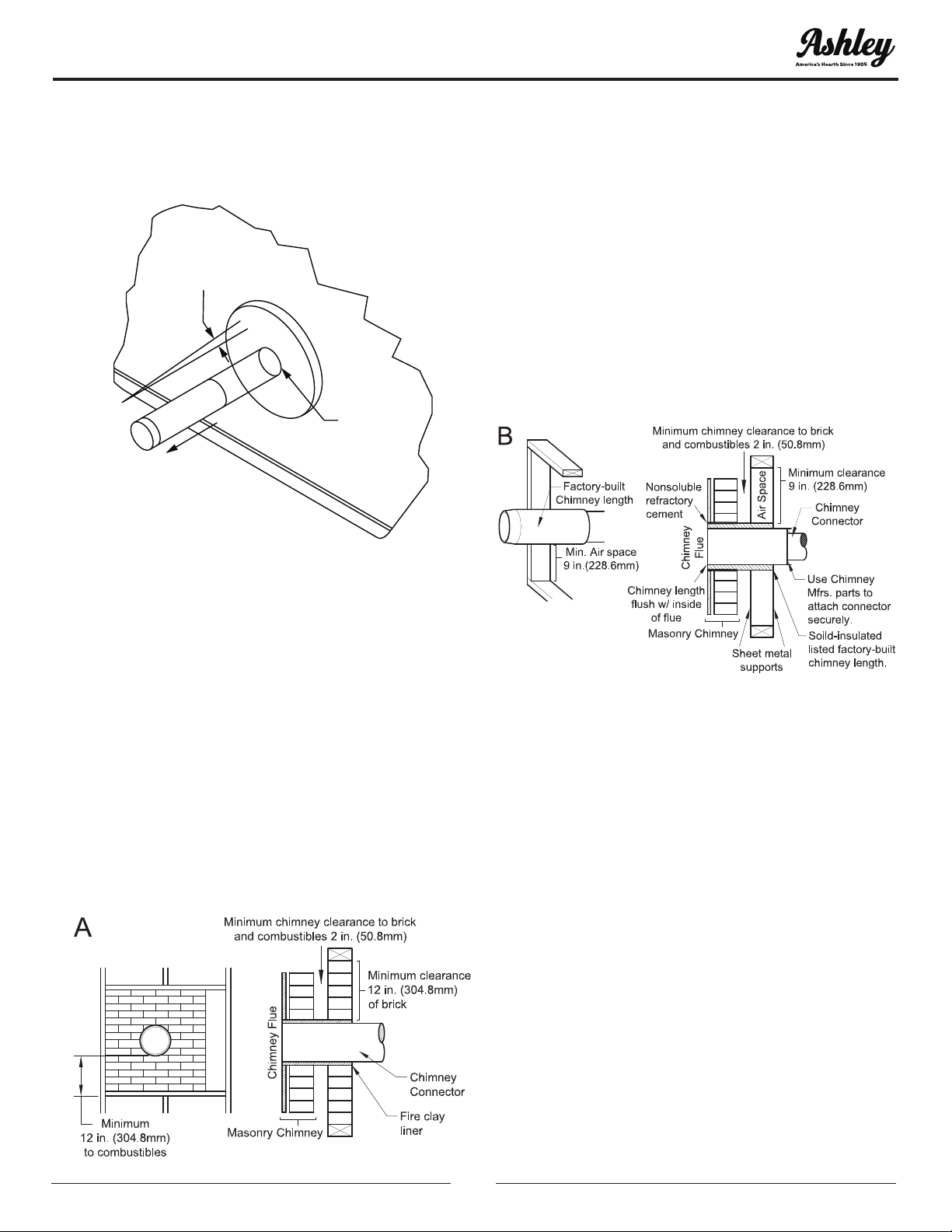
1. Use a minimum 3-1/2” thick brick masonry wall
framed into the combustible wall. A reclay liner
(ASTM C315 or equivalent) having a 5/8” minimum
wall thickness must be used and it must be at
least 12” away from any material that could catch
re. The inside diameter of the reclay liner shall
be sized for the proper snug t of a 6” diameter
chimney connector pipe. The reclay liner shall
run from the outer surface of the brick wall to,
but not beyond, the inner surface of the chimney
ue and shall be rmly cemented in place.
2. Use a solid insulated listed factory-built chimney
(UL 103 HT) length having an inside diameter of
6” and having 1” or more of solid insulation. There
must be at least a 9” air space between the outer
wall of the chimney length and any combustible
materials. The inner end of the chimney length
shall be ush with the inside of the masonry
chimney ue shall be sealed to the ue and to
the brick masonry penetration with non water-
soluble refractory cement. Sheet steel supports
which are at least 24 gauge(0.024”) in thickness
shall be securely fastened to wall surfaces on
all sides. Fasteners between supports and the
chimney length shall not penetrate the chimney
liner.
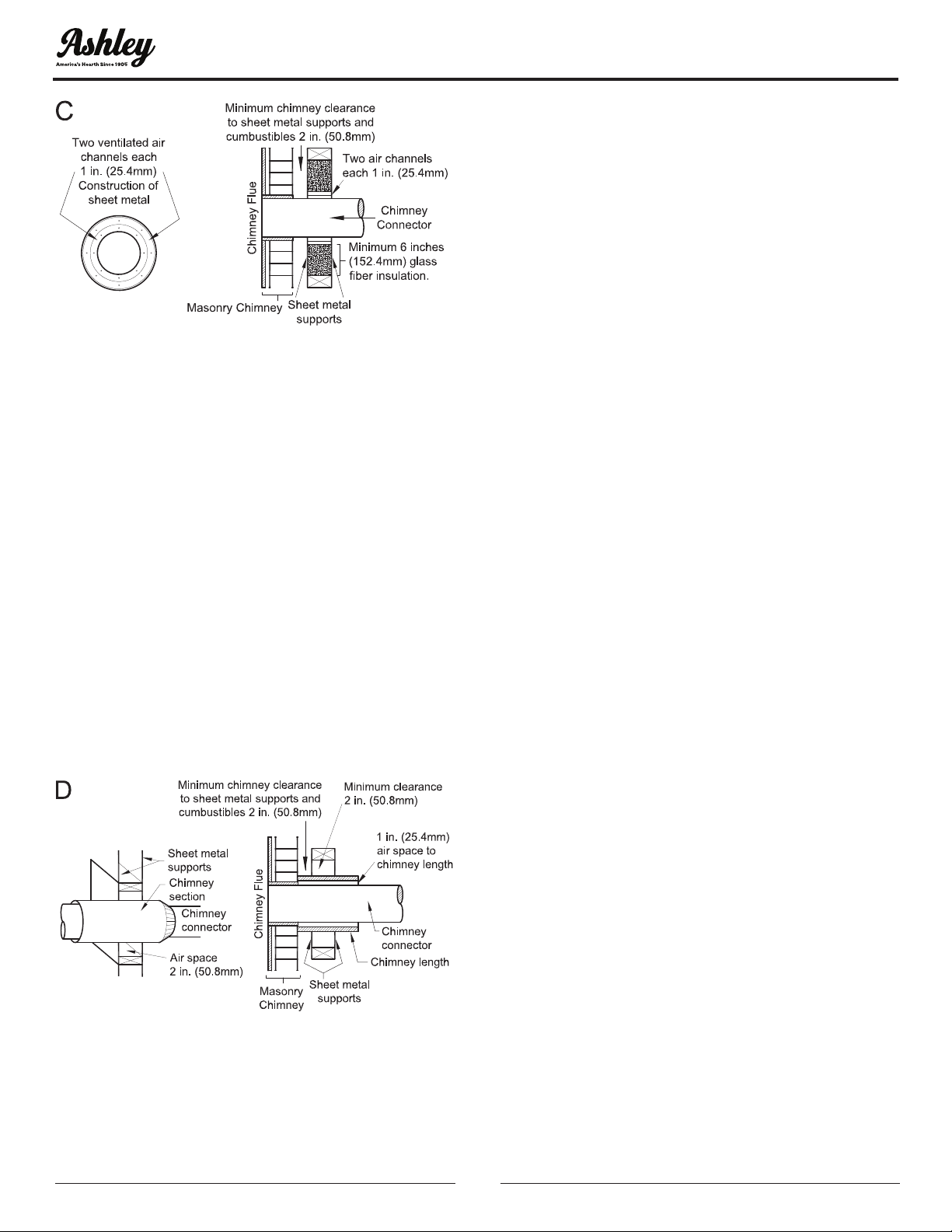
3. Use a 10” diameter ventilated thimble made
of at least 24 gauge(0.024”) steel having two
1” air channels. The ventilated thimble must
be separated from combustible materials by
a minimum of 6” glass ber insulation. The
opening in the combustible wall shall be covered
and the thimble supported with sheet steel
supports which are at least 24 gauge (0.024”)
in thickness. The sheet steel supports shall be
securely fastened to wall surfaces on all sides and
shall be sized to t and hold the chimney section.
Fasteners used to secure chimney sections shall
not penetrate chimney ue liner.
INSTALLATION
8
© 2021 United States Stove Company
4. Use an 8” inside diameter solid insulated listed
factory-built chimney length which has 1” or
more of solid insulation. The minimum length of
this chimney section shall be 12” and will serve
as a pass-through for the 6” diameter chimney
connector. There must be at least a 12” air space
between the outer wall of the chimney section
and any combustible materials. The chimney
section shall be concentric with and spaced 1”
away from the chimney connector by means of
sheet steel support plates on both ends of the
chimney section. The opening in the combustible
wall shall be covered and the chimney section
supported on both sides with sheet steel
supports which are at least 24 gauge (0.024”)
in thickness. The sheet steel supports shall be
securely fastened to wall surfaces on all sides and
shall be sized to t and hold the chimney section.
Fasteners used to secure chimney sections shall
not penetrate chimney ue liner.
5. A listed factory-built wall pass-through system
may be purchased and installed according to
the instructions packaged with it to provide a
safe method of passing the chimney connector
through a combustible wall for connection to a
masonry chimney.
Additional requirements pertaining to oor
protection and the above wall pass-through systems:
1. Insulation material used as part of wall pass-
through system shall be of noncombustible
material and shall have a thermal conductivity of
1.0 Btu • in/ft² • °F (4.88 kg • cal/hr • m² • °C) or less
2. All clearances and thicknesses are minimums:
larger clearances and thickness are acceptable.
3. A chimney thimble, as shown for 3” and 4”
above shall be for types “3” and “4” connections
to facilitate removal of the chimney connector
for cleaning. The chimney thimble shall be of
ASTM C315 reclay with 5/8” minimum wall
thickness , or material or equivalent durability.
The inside diameter of the thimble shall be sized
for the proper snug t of a 6” diameter chimney
connector pipe. The thimble shall be installed
without damage to the chimney ue. The thimble
shall extend through the chimney wall to, but
not beyond, the inner surface of the chimney
ue and shall be permanently cemented in place
with high temperature cement.
4. A chimney connector to a masonry chimney,
except for 2” above, shall extend through the
wall pass-through system to the inner face of the
chimney ue, but not beyond. It does not have to
be fastened in place so long as it cannot accidently
be pulled out of the chimney or shoved into the
chimney ue. If fasteners are used to secure the
chimney connector to a masonry chimney, the
fasteners shall not penetrate the chimney ue
liner.
5. Any material used to close up any opening for
the connector shall be noncombustible.
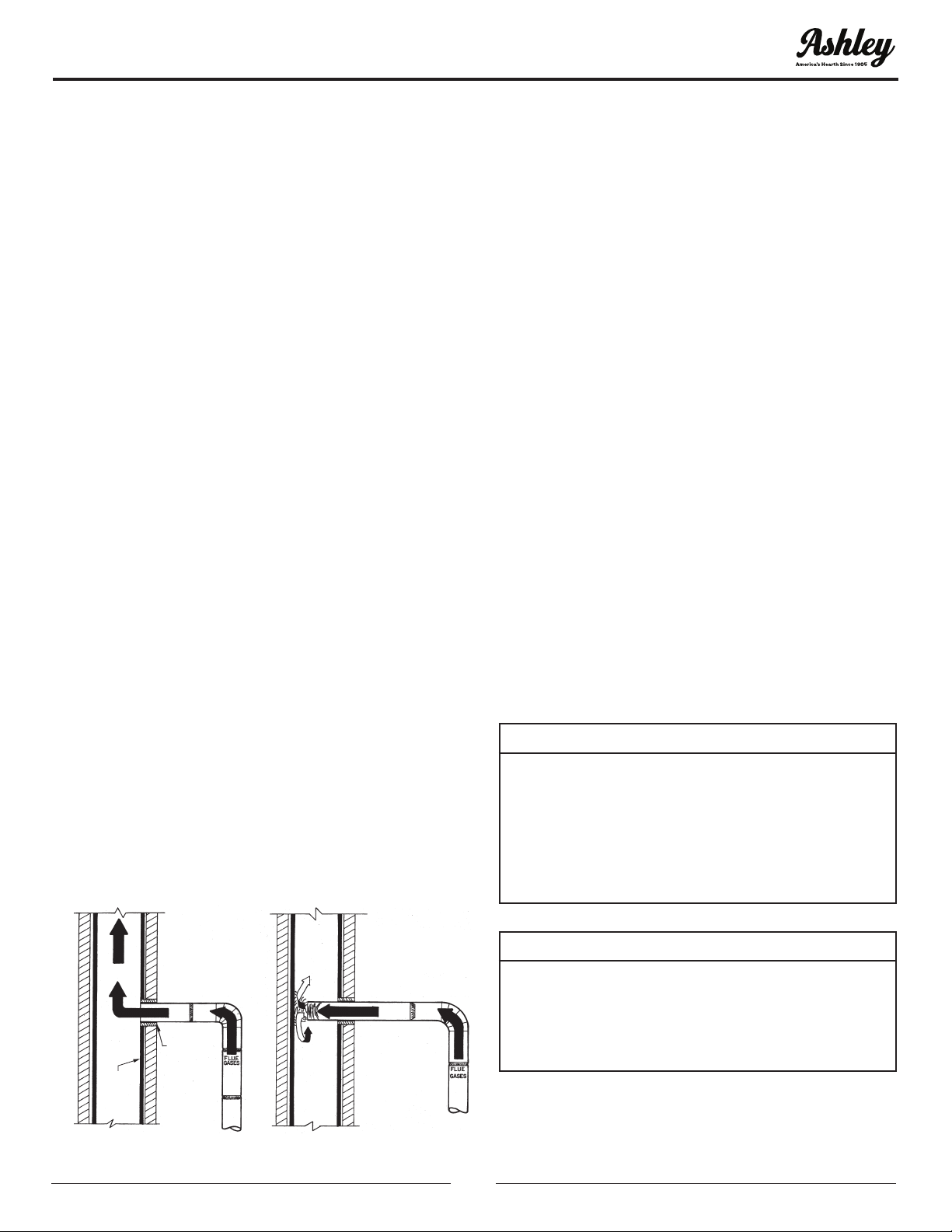
If the chimney connector does not have to pass
through a combustible wall to get to a masonry
chimney, connect the chimney connector to the
masonry chimney as shown. The reclay liner as
shown should be sized for the proper snug t of a
6” diameter chimney connector pipe. The reclay
liner should be rmly cemented in place as shown.
As previously stated, any metal prefabricated
chimney this heater is connected to must be a
listed Hi-Temp Type HT Factory Built Residential
Type and Building Heating Appliance Chimney.
When a metal prefabricated chimney is used, the
manufacturer’s installation instructions must be
followed precisely. You must also purchase (from the
same manufacturer) and install the ceiling support
package or wall pass through and “T” section
INSTALLATION
© 2021 United States Stove Company
9
package, restops (when needed), insulation shield,
roof ashing, chimney cap, etc. Maintain the proper
clearance to the structure as recommended by the
manufacturer. This clearance is usually a minimum
of 2”, although it may vary by manufacturer or for
certain components. A listed chimney cap should
be installed to prevent entrance of rain and help
eliminate down drafts. An unapproved chimney
cap, protector or spark arrester can become
clogged when leaves or other matter. This blocks
the chimney and causes smoke, and the dangerous
carbon monoxide in smoke, to spill back into your
home where it can kill you.
There are basically two methods of metal
prefabricated chimney installation. One method is
to install the chimney inside the residence through
the ceiling and the roof. The other method is to
install an exterior chimney that runs up the outside
of the residence. Single wall pipe is not legal
for outside installation. REMEMBER: Follow the
chimney manufacturer’s installation instructions
and maintain the manufacturer’s specied
clearance distance.
Additional chimney information is presented
throughout this manual. READ IT THOROUGHLY
TO BE MORE THOROUGHLY INFORMED.
PART E
In addition to the methods shown by A, B, C, and
D, a listed factory-built wall pass-through system
may be purchased and installed according to the
instructions packaged with it to provide a safe
method of passing chimney connector through
a combustible wall for a connection to a masonry
chimney.
Connecting Heater’s Chimney Connector to
Masonry Chimney When Chimney Connector Does
Not Have to Pass Through a Combustible Wall
CORRECT CONNECTION
OF CHIMNEY
CONNECTOR TO
MASONRY CHIMNEY:
INSERT CHIMNEY
CONNECTOR TO INSIDE
FACE OF MASONRY
CHIMNEY’S FLUE LINER.
CHIMNEY
THIMBLE
INSIDE
FACE OF
FLUE
LINER
INCORRECT
CONNECTION: CHIMNEY
CONNECTOR INSERTED
TOO FAR INTO
MASONRY CHIMNEY,
CAUSING RESTRICTIONS
HEATER INSPECTION
Before installing the heater, inspect the heater for
external damage and missing parts. Check the
gaskets around the doors to assure that they are still
in place. Also check inside the heater. Report any
deciencies found to your heater dealer and make
sure all problems are resolved before installing the
heater.
TOOLS AND SUPPLIES NEEDED FOR
INSTALLATION
• Electric drill 1/4 or 3/8 inch drive
• 1/8 inch drill bit
• Screw driver (blade type and size to t screws
listed below)
• No. 8 sheet metal screws (for chimney connector
joints)
• Gloves and Safety Glasses
• Ruler or tape measure
• Can or Tube of furnace cement
• Floor Protector
• Rag or several paper towels
• Chimney connector pipes (and elbows, if required)
• Pencil
HEATER INSTALLATION
CAUTION:
IF THIS HEATER IS NOT PROPERLY INSTALLED,
A HOUSE FIRE MAY RESULT. FOR YOUR
SAFETY, FOLLOW THE INSTALLATION
DIRECTIONS. CONTACT LOCAL BUILDING OR
FIRE OFFICIALS ABOUT RESTRICTIONS AND
INSTALLATION INSPECTION REQUIREMENTS
IN YOUR AREA.
CAUTION:
DO NOT CONNECT THIS HEATER TO A CHIMNEY
FLUE SERVING ANOTHER APPLIANCE. THERE IS
A SERIOUS SAFETY RISK IF TWO APPLIANCES
OR HEATERS ARE CONNECTED TO THE SAME
FLUE.
INSTALLATION
10
© 2021 United States Stove Company
CAUTION:
THE HEATER MUST BE PLACED ON A LISTED
FLOOR PROTECTOR AS NOTED IN THIS
MANUAL IF THE FLOOR IS WOOD OR OTHER
COMBUSTIBLE FLOORING. IF CARPET IS
PRESENT, IT MUST BE REMOVED. THE FLOOR
PROTECTOR MUST NOT BE PLACED ON
CARPET.
CAUTION:
MOST WALLS AND CEILINGS CONTAIN
WOOD EVEN THOUGH THEY ARE MADE OF
SHEETROCK OR PLASTER ON THE OUTSIDE.
THESE WALLS AND CEILINGS CAN CATCH
FIRE FROM THE HOT HEATER OR CHIMNEY
CONNECTOR IF THE HEATER AND CHIMNEY
CONNECTOR ARE NOT PROPERLY INSTALLED.
MINIMUM CLEARANCE TO
COMBUSTIBLE WALLS AND CEILINGS
Minimum clearances to unprotected combustible
walls and ceilings as noted in this manual must be
maintained. Drapes, curtains, furniture and other
combustible materials should be kept much further
away from the heater to avoid a re. If you chose to,
you may install the heater and chimney connector
closer to combustible surfaces than indicated in
this manual if a clearance reduction system is also
installed to protect combustible ceiling and wall
near the heater and chimney connector. However,
there are limits as to how close the heater and
chimney connector can be installed to combustible
surfaces protected by a clearance reductions
system. A correctly installed clearance reduction
system protects the combustible surfaces well
beyond the sides and above the top of the heater and
beyond the sides and top of the chimney connector
pipe. Two common types of clearance reductions
systems use sheet metal with a thickness of 28
gauge (galvanized steel, aluminum, copper) or a
3-1/2 inch (4 inch thick nominal) thick masonry wall.
Either of these materials must be spaced out 1 inch
from the combustible surfaces. With sheet metal,
noncombustible spacers are used to maintain
the 1 inch air space. With a masonry wall, metal
wall ties and furring strips, if needed, are used to
anchor the brick to the wall. To avoid excessive heat
transmission, the spacers or wall ties should not
be placed directly behind the heater or chimney
connector. The 1 inch air space provides free air
circulation. It is essential that there be openings at
the top and bottom of these clearance reducers so
cool air can enter at the bottom and warm air exit at
the top. It is the “chimney effect” whereby when the
air in the space is heated, it rises exiting from the
top and being replaced by cooler air at the bottom,
that makes these shields effective. Masonry, or
other noncombustible products, attached directly
to a combustible surface without an air space offer
very little protection and cannot be considered a
clearance reduction system unless specic materials
have been tested and listed for direct attachment
to a combustible surface. The same applies to thin
veneer brick and stone coverings. These materials
provide adequate protection only when mounted
on sheet metal with a 1 inch minimum spacing to the
wall. A variety of prefabricated clearance reduction
systems which have been safety tested and listed
are available through heater dealers. Always look
for a safety listing label on the product when
selecting a clearance reduction system through a
heater dealer and make sure it is designed for use
with solid fuel. The manufacturers of these tested
and listed systems provide specic installation
instructions that must be followed exactly for a safe
installation. Should you chose to make your own
clearance reduction system, contact your local re
department, re marshal or building code inspector
for specic requirements regarding home-
constructed clearance reduction systems and safe
installation clearances to protected combustible
surfaces.
TO SAFELY AND PROPERLY INSTALL
THIS HEATER
1. Install a Listed High Temperature Type HT
Factory-built Residential Type and Building
Heating Appliance Chimney, build a masonry
chimney or adapt an existing chimney to vent
the heater. (See the Chimney Connector and
Chimneys section of this manual for important
information).
2. Purchase the 6-inch diameter chimney
connector pipes that are required. The pipe
should be black or blued steel, 24 gauge
minimum. If elbows are needed, use only
seamless elbows because seamed elbows can
leak smoke. Do not use more that two elbows
or the chimney draft will be restricted (See the
Chimney Connector and Chimneys section of
this manual for details). Number 8 sheet metal
screws and furnace cement will also be needed
INSTALLATION
© 2021 United States Stove Company
11
to assemble the chimney connector pipes. If the
heater is to be installed to a masonry replace
as shown in this manual, you should also obtain
the replace items called for in this manual.
3. If the heater is to be installed on a combustible
oor, purchase a listed noncombustible oor
protector as described in this manual and install
it in the proper location. The oor protector
MUST protect the oor beneath and around the
heater and chimney connector as shown by in
this manual.
4. Assemble the chimney connector pipe sections
to determine if the chimney connector pipe will
correctly extend from the heater ue collar to
the chimney. Any horizontal section of chimney
connector pipe must slope upward at least 1/4”
rise to the horizontal foot to maintain adequate
draft. Always install the chimney connector
pipe with the crimped end toward the heater
to prevent creosote from leaking out of the
joints. Always use the least number of chimney
connector pipe sections possible. Minimum
clearance to combustible walls and ceilings
as noted by in this manual MUST always be
maintained if a clearance reduction system is
not installed.
5. After it is determined that the assembled
chimney connector will properly connect the
heater to the chimney, disassemble all sections
of the chimney connector in preparation for the
nal assembly procedures.
6. Place the crimped end of the rst chimney
connector pipe or elbow into the heater’s ue
collar and mark it through each of the holes in
the heater’s ue collar.
7. Remove the pipe or elbow from the ue collar
and drill 1/8 inch diameter holes at the points
marked by step 6.
8. Apply furnace cement to the inside surface of
the heater’s ue collar, reinstall the rst pipe
or elbow and fasten in place with No. 8 sheet
metal screws. Apply additional furnace cement
to the outside of the chimney connector ue
collar joint if an airtight seal was not achieved
when the pipe or elbow was installed.
9. Assemble the remaining chimney connector
pipes by applying furnace cement to the joints,
drilling 1/8 inch diameter holes for and attaching
each joint with three No. 8 sheet metal screws.
Wipe all excess furnace cement from the pipe
joints with rag or paper towel. Allow the applied
cement to dry before building the rst re in
the heater.
10. Depending on your particular type of
installation, connect the heater’s chimney
connector to a masonry chimney as shown in
this manual, or connect the chimney connector
to a metal prefabricated chimney as specied
by the instructions furnished with the metal
prefabricated chimney or connect the chimney
connector to a masonry replace as shown in
this manual.
DANGER:
IF ANY CLEARANCE TO UNPROTECTED
WALL OR CEILING IS LESS THAN THOSE
SPECIFIED IN THIS MANUAL AFTER HEATER
INSTALLATION IS COMPLETED, A CLEARANCE
REDUCTION SYSTEM MUST BE INSTALLED
BEFORE THE FIRST FIRE IS BUILT IN THE
HEATER; OTHERWISE, THE UNPROTECTED
WALL OR CEILING COULD CATCH FIRE.
REMEMBER, THERE ARE ALSO LIMITS AS TO
HOW CLOSE THE HEATER CAN BE INSTALLED
TO A COMBUSTIBLE SURFACE PROTECTED
BY A CLEARANCE REDUCTION SYSTEM.
REREAD “MINIMUM CLEARANCES TO WALLS
AND COMBUSTIBLE WALLS AND CEILINGS”
PRESENTED EARLIER IN THIS MANUAL.
CAUTION:
FOR YOUR SAFETY, CONTACT YOUR LOCAL FIRE
DEPARTMENT, FIRE MARSHAL, OR BUILDING
CODE INSPECTOR FOR INSPECTION PRIOR TO
AND FOLLOWING CLEARANCE REDUCTION
SYSTEM AND/OR HEATER INSTALLATION.
INSTALLATION
12
© 2021 United States Stove Company
IMPORTANT:
DO NOT USE THE HEATER UNTIL A
PROFESSIONAL INSPECTION HAS BEEN MADE
OF THE ENTIRE INSTALLATION BY YOUR
LOCAL FIRE DEPARTMENT, FIRE MARSHAL
OR BUILDING CODE INSPECTOR. INSTALL
A SMOKE DETECTOR ON EACH FLOOR OF
YOUR HOME; IN CASE OF ACCIDENTAL FIRE
FROM ANY CAUSE IT CAN PROVIDE TIME FOR
ESCAPE.
This heater must be operated as outlined in this
manual or a serious re may occur. THE PAINT
ON THE EXTERIOR OF THE FIREBOX WILL GO
THROUGH A CURING PROCESS DURING THE
FIRST FIRING OF THE HEATER AND WILL EMIT
SMOKE AND ODOR. BE PREPARED FOR THIS BY
RAISING A WINDOW OR OPENING A DOOR TO
PROVIDE VENTILATION. The rst three times the
heater is red, the re should be regulated so as to
increase in intensity gradually to allow the painted
components to cure slowly and to allow the other
components to adjust to their expanded size. Be
sure the room is adequately ventilated and the ue
unobstructed before beginning a re in the heater.
TO BUILD A FIRE
1. Set the heater’s thermostat control knob to the
“Hi” position.
2. Open the heater’s fuel feed door and place
several wadded grapefruit-size newspaper balls
on the heater’s grate. Be sure the heater’s ash
removal door is securely closed.
3. Cover the newspaper balls with dry kindling
sticks. Place the kindling sticks close enough to
one another so the ames can move easily from
one stick to the other. If the kindling is packed
too tightly, the re will suffocate, smoke and
then die out. (NOTE: Softwoods make better
kindling than hardwoods because softwoods
burn faster than the hardwoods.)
NOTE: If the heater tends to smoke when rst lit, a
draft may be induced by holding a torch of rolled-
up newspaper at the opening of the ue collar.
Occasionally, this must be done two or three times
to establish an updraft before proceeding to the
following step 4. It may also help to open a house
door or window slightly.
4. Light the wadded balls of paper in the
heater. Leave the fuel feed door slightly ajar
(approximately 1 to 2 inches) to allow plenty of
oxygen to reach the re, but DO NOT LEAVE
THE HEATER UNATTENDED WHILE ITS FUEL
FEED DOOR IS OPEN.
WARNING:
NEVER USE GASOLINE, GASOLINE-TYPE
LANTERN FUEL, KEROSENE, CHARCOAL
LIGHTER FLUID, OR SIMILAR LIQUIDS TO START
OR “FRESHEN UP” A FIRE IN THIS HEATER.
KEEP ALL SUCH LIQUIDS WELL AWAY FROM
THE HEATER WHILE IT IS IN USE.
CAUTION:
RISK OF EXCESSIVE TEMPERATURES AND
DAME TO UNIT-PROPER OPERATION REQUIRES
THE USE OF ONLY STOVE SIZE BITUMINOUS
OR ANTHRACITE COAL. DO NOT LOAD COAL
ABOVE CHAMBER LINERS. OPERATE WITH
FEED DOOR CLOSED. DO NOT OVERFIRE-IF
HEATER OR CHIMNEY CONNECTOR GLOWS,
YOU ARE OVERFIRING. PREVENT SOOT FIRE-
INSPECT CHIMNEY CONNECTOR AND CHIMNEY
TWICE MONTHLY AND CLEAN IF NECESSARY.
NOTICE:
REMOVE ASHES DAILY, WHEN HEATER IS
IN REGULAR USE. IF ASHES ARE ALLOWED
TO ACCUMULATE AND BUILD UP AROUND
THE GRATES, THE RESULTING LACK OF AIR
CIRCULATION CAN CAUSE DAMAGE TO THE
GRATES.
CAUTION:
KEEP ASH DOOR CLOSED DURING FIRING
OF THE HEATER TO AVOID DEVELOPING
EXCESSIVE TEMPERATURES.
OPERATION
NEVER OPERATE THIS PRODUCT WHILE UNATTENDED

© 2021 United States Stove Company
13
TOP MAY BE
TILTED OPEN AS
INDICATED BY
ARROW
THERMOSTAT
CONTROL
KNOB
AIR
ADJUSTMENT
SHUTTER
PRESSURE
RELIEF
COVER
OPEN
OPEN
5. When the wood is burning briskly, add
additional kindling as required to establish a
good kindling re.
6. When the kindling re has been established
and is burning briskly, cover it with a thin layer of
coal. If you add too much coal you will smother
the re, requiring you to start the whole process
over again. Be patient.
7. Securely close the heater’s fuel feed door as
the coal begins burning. CAUTION: OPERATING
THE HEATER WITH ITS FUEL FEED DOOR
OR ASH REMOVAL DOOR OPENED CREATES
AN ABNORMAL FIRING CONDITION WHICH
CAN OVERHEAT THE HEATER, CHIMNEY AND
ADJACENT COMBUSTIBLE MATERIALS. THIS
CAN DRASTICALLY SHORTEN THE HEATER’S
LIFE AND VOID THE FACTORY WARRANTY.
8. Wait about ten minutes, or until the coal is
burning well, then start adding small quantities
of coal at ten minute intervals until a good coal
re is established.
CAUTION:
• NEVER ADD MORE COAL THAN IS ALREADY
BURNING AND NEVER ADD MORE THAN
TEN POUNDS OF FRESH COAL AT ONE TIME.
• WHEN FRESH COAL IS ADDED, ALWAYS
LEAVE SOME OF THE GLOWING COALS
UNCOVERED.
• NEVER FILL THE HEATER SO THAT THE
BURNING COAL IS ABOVE THE TOP OF THE
HEATER’S CHAMBER LINERS. THIS WILL
CAUSE THE HEATER TO OVERHEAT AND
WILL SHORTEN ITS LIFE.
9. MAKE SURE THAT THE HEATER’S FUEL FEED
DOOR, ASH REMOVAL DOOR, AND CABINET
DOOR ARE SECURELY CLOSED.
10. Set the heater’s thermostat control knob to
a point midway between “HI” and “Lo”. If the
house or heating situation requires a higher or
lower setting to obtain the desired amount of
heat, adjust the heat’s thermostat control knob
accordingly.
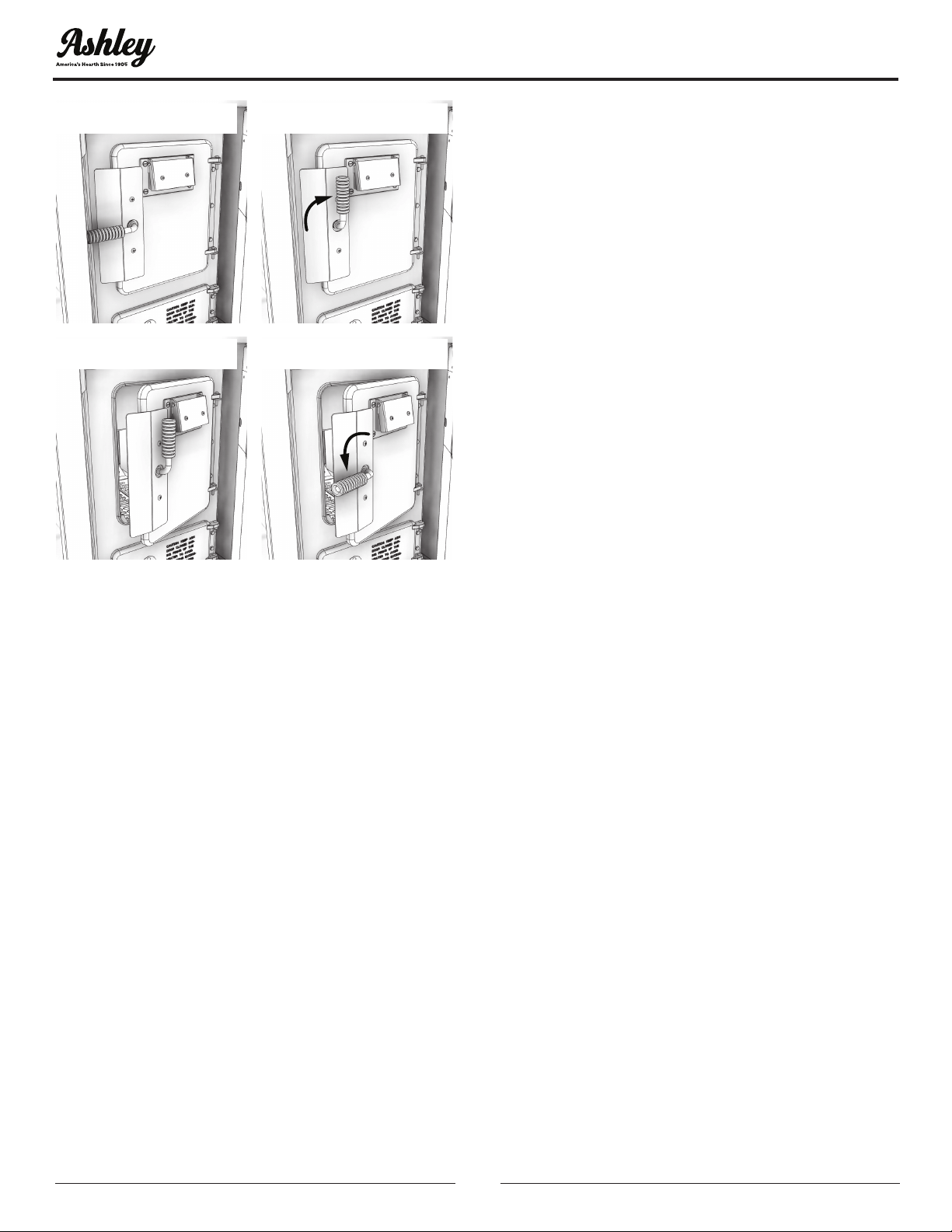
OPENING & CLOSING FUEL FEED DOOR
OPEN: When closed and latched, the door and
handle will be as shown in position number 1. Rotate
the handle until it is as shown in position number 2.
Pull the door open until it stops, approximately one
inch as shown in position 3. Continue to hold the
door open as the handle is returned to its original
position. The door will then open completely as
shown in position number 4.
CLOSED: With the handle as shown in position
number 4, close the door as far as possible. Now
rotate the handle to position number 3 and
completely close the door as shown in position
number 2. Rotate the handle as shown in position
number 1 and apply sufcient pressure to insure
that the door is sealed.
OPERATION
14
© 2021 United States Stove Company
POSITION #1
POSITION #2
POSITION #3
POSITION #4
FIRE TENDING
Fire tending is the occasional poking or stirring of
the burning coal bed to ensure airow through the
coal bed and adding fresh coal as needed. With
experience, you should determine how often re
tending is required to maintain the desired heat
output of the heater. To ensure safe and satisfactory
performance of the heater, the following rules
should be observed:
1. KEEP THE FUEL FEED DOOR AND ASH
REMOVAL DOOR CLOSED EXCEPT WHEN
TENDING THE FIRE OR REMOVING ASHES.
Operating the heater with either of these doors
open can cause the heater to dangerously
overheat and will increase the possibility of
smoke, ash or sparks escaping the heater and
damaging the dwelling or its contents.
2. NEVER FILL THE HEATER ABOVE THE TOP OF
THE CHAMBER LINERS. Overlling the heater
can cause it to overheat, create a re hazard,
and damage the heater.
3. NEVER OPEN THE FUEL FEED DOOR WITHOUT
FIRST TURNING THE THERMOSTAT CONTROL
KNOB TO “HI” FOR AT LEAST 30 SECONDS.
4. NEVER ADD MORE THAN TEN POUNDS
OF FRESH COAL TO THE HEATER AT EACH
REFUELING. Adding large amounts of fresh coal
can cause an accumulation of gases above the
re that can cause backpufng. Backpufng
can occur whenever concentrated gases
accumulate over the re bed and then catch
re quickly. This may cause smoke and ame to
be expelled from the heater during re tending.
Under rare conditions, backpufng can be
severe enough to break apart poorly connected
chimney connector pipes. If backpufng is
experienced, see TROUBLESHOOTING section
of this manual. Backpufng is an abnormal
condition and a potential hazard. Determine
and correct the cause.
5. TURN THERMOSTAT TO “HI” FOR 15 MINUTES
AFTER ADDING FRESH COAL TO A FIRE. This
allows the gases to be driven off and shortens
the length of time the dense smoke is likely to
deposit soot on the chimney walls.
6. DO NOT TAMPER WITH THE INTERNAL
THERMOSTAT MECHANISM. The thermostat
has been designed and calibrated to provide
continuous control of the re for safety and
efciency. Thermostat adjustments are made
with the thermostat control knob only.
7. PREPARE THE HEATER TO HOLD FIRE ALL
NIGHT BY LOADING IT WITH COAL AT LEAST AN
HOUR BEFORE BEDTIME. Burn the heater at
the normal rate for this hour, then turn it back
to a slower burn just before going to bed. This
procedure will help drive excess moisture and
gases out of the coal and minimize soot buildup
during the night. This procedure also minimizes
the likelihood of backpufng.
8. DO NOT OVER FIRE THE HEATER. If any part of
the heater or chimney connector becomes red
hot, the heater is being over red. Immediately
turn the heater’s thermostat to “LO” and keep
the fuel feed door and ash removal door closed
until the heater cools.
DO NOT OVER FIRE THE HEATER. If any part of the
heater or chimney connector becomes red hot turn
the thermostat to low and keep the ash and feed
doors closed until the heater cools.
MINIMUM FIRE ADJUSTMENT
Soot is more likely to accumulate in the chimney
connector and chimney liner during extended
periods of low ring. This accumulation can be
OPERATION

© 2021 United States Stove Company
15
reduced by proper setting of the air shutter on the
ash door. Rotating the air shutter to allow more
air into the re chamber will increase the rate of
the minimum re and reduce the accumulation.
Experience in a particular heating situation
will give guidance in choosing the best setting.
Setting changes are made with common pliers.
Set the shutter to the largest opening and use a
smaller opening only if the heat output cannot be
adequately controlled by the thermostat.
COAL FACTS
Anthracite coal (known as hard coal) is the only
coal with a uniform sizing scale. Before leaving the
coal mine, it is graded into one to the following
categories:
• Nut - from 13/16” to 1-5/8” in diameter.
• Stove - from 1-5/8” to 2-7/16” in diameter.
• Egg - from 2-7/16” to 3-1/4” in diameter.
• Broken - more than 3-1/4” in diameter.
Anthracite coal is hard to ignite; but once it is
burning, it burns freely and cleanly and very hot.
It does not fuse but leaves substantial ash residue.
When anthracite burns with a blue ame, it is
burning properly and the volatile gases released
from the coal are being consumed by the re.
Bituminous coal is easier to ignite than anthracite
coal. Most people think anthracite has a higher
heat content than bituminous, but in actuality,
some bituminous is as good as anthracite.
Bituminous breaks up more in storage and burns
with more smoke than does anthracite. One other
characteristic of bituminous which differentiates it
from anthracite is that, as the coal burns, it tends
to form clinkers whereas anthracite is reduced
mainly to ash. Clinkers are the misshapen, rough,
gray lumps that form when particles in the coal are
heated, melt and fuse together. When bituminous
burns with a yellow ame, it is burning properly and
the volatile gases being released from the coal are
being consumed by the re. Of these two coals,
anthracite is the more expensive. Store in a dry,
ventilated space.
Coal that is improperly stored can catch re from
heat generated by chemical changes occurring
within the coal bed (spontaneous combustion). To
avoid the development of these conditions, coal
quantities that will be stored more than three days
should be kept clean of all combustible materials,
such as leaves, hay, wood, rags, etc., and stored
where the temperature of the air and objects the
coal contacts are 75 degrees F. or less. Alternate
wetting and drying of coal should be avoided. Wet
and dry coal should never be stored where each
will be in contact with the other. If the emission of
heat or unusual odors from a coal storage area is
observed, the process leading up to spontaneous
combustion may be occurring and the re
department should be called immediately. Small
quantities of coal required for re tending must be
kept at least 36” from the heater.
OPERATION
16
© 2021 United States Stove Company
HOW TO TAKE CARE OF THE HEATER
AND VENTING SYSTEM (ROUTINE
MAINTENANCE)
The heater’s outer cabinet may be wiped free
of dust with a soft cloth. The use of any other
cleaning method may damage the cabinet’s nish.
Inspect and clean chimney frequently - under
certain conditions of use, creosote buildup may
occur rapidly. Check the following items regularly
during the heating season to ensure proper heater
operation:
1. Condition of feed door and ash door gaskets--
replace if excessive wear is observed.
2. Condition of feed door, ash door, and cabinet
latching pawls and handles--ensures that
operation will securely close the door. Adjust as
necessary.
At the end of each heating season, the heater should
be thoroughly cleaned of all ashes. Ashes remaining
in the heater in combustion with moisture in the
air can cause severe corrosion of the heater. All
rust spots on the heater should be wire brushed
and covered with a coat of high temperature paint.
If the heater is to be stored until the next heating
season, be sure the storage are is dry. The heater
should never be used with damaged or missing
parts. However, overtime the heater may become
distorted.
DISPOSAL OF ASHES
The ashes should be removed from the heater
anytime they accumulate to within 2 inches of the
grate and at least once each day. Chunks of ash
material called clinkers may accumulate above the
grate. These can be removed by shaking the grate
with the shaker. To minimize the loss of burning
coal into the ash pan, do not shake the grate when
a large re is in progress. When removing the ash
pan from the heater, wear gloves to protect your
hands from glowing embers and hot surfaces.
ASHES SHOULD BE PLACED IN A METAL
CONTAINER WITH A TIGHT FITTING LID. THE
CLOSED CONTAINER OF ASHES SHOULD BE
PLACED ON A NONCOMBUSTIBLE FLOOR OR
ON THE GROUND, WELL AWAY FROM ALL
COMBUSTIBLE MATERIALS, PENDING FINAL
DISPOSAL. IF THE ASHES ARE DISPOSED OF
BY BURIAL IN SOIL OR OTHERWISE LOCALLY
DISPERSED, THEY SHOULD BE RETAINED IN THE
CLOSED CONTAINER UNTIL ALL CINDERS HAVE
THOROUGHLY COOLED.
Ashes should never be placed in wooden or plastic
containers, or in paper or plastic bags, no matter
how long the re has been out. Coals have been
known to stay hot for several days when embedded
in ashes.
VENTING SYSTEM (CHIMNEY
CONNECTOR & CHIMNEY)
The venting system consists of the heater’s chimney
connector (the pipe which connects the heater to
the chimney) and the chimney itself.
SOOT – FORMATION & NEED FOR
REMOVAL
When coal is burned, the products of combustion
combine with moisture to form a soot residue
which accumulates on the ue lining. When
ignited, this soot makes an extremely hot re.
The chimney connector and chimney should be
inspected at least once every two months during
the heating season to determine if a soot buildup
has occurred. If soot has accumulated, it should
be removed to reduce the risk of a chimney re. A
chimney re is usually indicated by a roaring noise
from within the chimney and/or a pinging noise
within the chimney connector. Well developed
chimney res will emit ash and sparks from the
top of the chimney. If a chimney re occurs, turn
the thermostat to “LO”, keep the feed door, ash
and cabinet doors closed, call the re department
and protect the roof by wetting it with a garden
hose or buckets of water. After the chimney re is
over, thoroughly inspect all combustible materials
around the chimney and chimney connector for
res that might have been ignited by the intense
heat. The chimney and chimney connector should
then be inspected for any damage and repairs
made if necessary. Although a properly constructed
chimney should not be damaged by a chimney
re, it is best to prevent chimney res by properly
cleaning the chimney. There are special chimney
cleaning services available in most cities. Most
re departments make free chimney inspections
and can provide assistance in locating chimney
cleaning or repair services.
MAINTENANCE

© 2021 United States Stove Company
17
TROUBLESHOOTING
CHIMNEY CONNECTOR PIPE-
CORROSION INSPECTION
Chimney connector pipes do not last forever.
Corrosion is particularly a problem if the inside of
the pipe tends to get damp from condensation
of ue gases or from rain or snow getting into the
chimney. Just being on an ocean coast can also
accelerate chimney connector pipe corrosion.
Chimney connector pipe replacement may be
necessary more than once a season, but once every
few years is more typical. Every time the chimney
and chimney connector are checked for creosote
buildup, the strength and integrity of the chimney
connector pipes should also be checked.
Problems can arise during the operation of any coal
heater. These problems can usually be traced to such
things as the venting system, draft, aged or failed
parts, fuel, and operator error. The troubleshooting
suggestions contained in this section of the
manual apply to the operation of all coal heaters.
Experience has shown that correct installation and
good operating practices-including routine heater
and venting system maintenance, along with a
good sound chimney, will eliminate most of the
problems mentioned by this section of the manual.
Nonetheless, coal heater operators should make
themselves aware of the nature, cause and solution
to possible problems so as to help themselves
obtain the best possible service from this heater.
VENTING SYSTEM-KEY TO GOOD
HEATER PERFORMANCE
A majority of performance problems with coal
burning heaters can be traced to some factor in
the venting system that is adversely affecting the
heater. Air will ow into the heater and smoke
will ow up the chimney only if there is sufcient
difference between the air pressure in the room
where the heater is located and the air pressure
inside the chimney. As hot gases and smoke ow up
a chimney, the pressure in the chimney is lowered,
creating a difference in pressure inside and outside
the chimney. When this pressure difference, often
referred to as “draft pressure” or simply as “draft”, is
sufcient, air will be drawn into the heater through
its thermostatically controlled inlet air damper.
This air supplies the oxygen necessary for the coal
to burn. If the draft is not sufcient, insufcient
oxygen will reach the burning fuel and it will burn
poorly. This condition can also cause smoke and
dangerous gases to spill or backpuff from the
heater into the room. Backpufng occurs when the
air ow through the heater is insufcient to burn all
the gases being released by the coal causing them
to build up until they ignite as a minor explosion.
This causes smoke to puff out of every opening in
the heater and venting system. Too much draft
may cause excessive temperature in the heater. An
uncontrollable burn or a glowing red heater part
or chimney connector is an indication of excessive
draft. The amount of draft in the chimney depends
on the length of the chimney, local geography,
nearby obstructions (even a tree that has grown tall
can affect the draft of a chimney that was previously
trouble-free), and other factors. The common unit
used to measure draft is “INCHES IF WATER”. To
determine the draft of your chimney, a draft pressure
reading should be taken with a DRAFT METER or a
WATER MANOMETER. This requires someone with
proper equipment and knowledge of how to use it.
Your heater dealer should be able to preform this
task for you or recommend someone who can. For
this heater, installations with a draft of .02 inches of
water or less are considered marginal and will not
burn reliably as noted above. For this heater, it is not
recommended that the draft exceed .06 inches of
water or over ring can occur as noted above. The
recommended operating range for this heater is .03
to .06 inches of water.
IF THE HEATER SMOKES OR BURNS
POORLY OR EXCESSIVE CREOSOTE
ACCUMULATES IN THE CHIMNEY
1. Open a window slightly to see if the conditions
improve. If opening a window improved the
performance of the heater or stops the spillage
of smoke into the room, the problem is caused
by a slight vacuum in the room. The vacuum
can be the result of the room being so tightly
constructed that the air removed from the
room by the heater is not replaced by normal
inltration of air from outside the room.
MAINTENANCE
18
© 2021 United States Stove Company
2. The vacuum can also be caused by the loss
of air from the room through the kitchen or
bathroom ventilating fans, other chimneys or
vents, etc. The only solution to this type problem
is to reduce the air lost from the room or provide
a source for air to enter the room.
3. Check the pipes connecting the heater to the
chimney for loose or unsealed joints that may
allow air to leak into the chimney system.
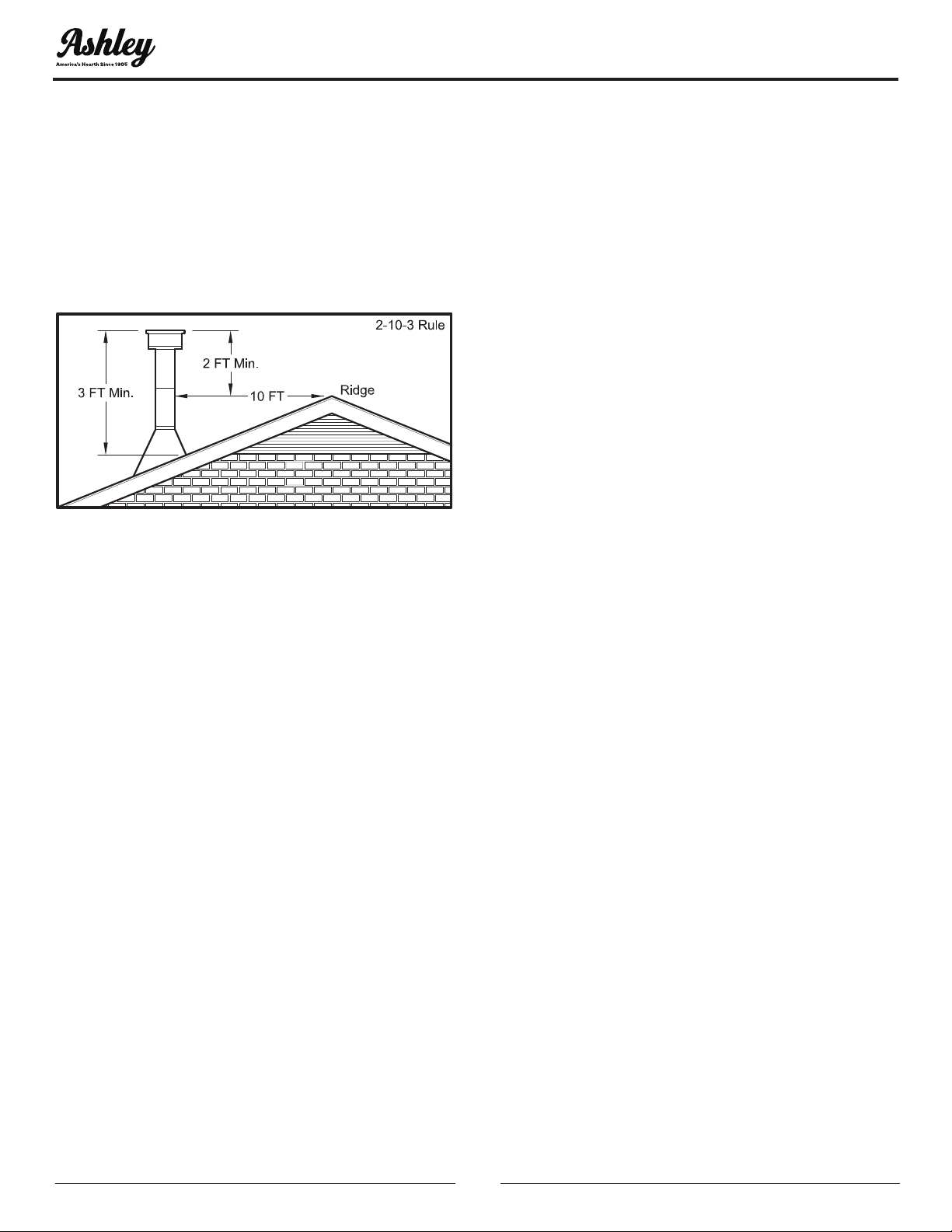
NOTE: Chimney height 3ft minimum (unless)
any obstruction is 10ft or less away from the
outlet then chimney height must be (X) pluse
2ft or the eft minimum, whichever dimension
is greatest. X exquals height of obstruction.
Masonry chimney shown dimensions are same
for metal prefabricated chimney.
4. Examine your method of building and tending
the re in the heater. If you add too much fresh
coal at each refueling, or attempt to operate
the heater at too low a combustion rate for
the amount of coal present in the rebox, your
failure to follow proper practices may be causing
the problem. Also check for ash buildup in the
ash pan. Ashes can restrict air ow through the
burning coal.
5. Check the height of the chimney. A chimney
that is too short will not develop sufcient draft
or allow wind to interfere with the draft.
6. Check the chimney for cracks or holes that
might allow air to leak into the chimney. If the
chimney is equipped with an ash clean out, be
sure the door is closed and ts tightly. The door
may have to be temporarily sealed with tape or
furnace cement to be as air tight as required.
An excellent way to check an exterior chimney
for leaks is to preform a smoke test building
a small coal re in the heater, adding a small
amount of coal to the re to make it smoke
heavily, momentarily blocking the top of the
chimney, and watching for smoke to leak out of
any opening or cracks.
7. Check the entire system for obstructions that
could be causing resistance to the ow of smoke
and gases up the chimney.
8. Check the size of the chimney ue liner. If the
chimney ue liner’s inside dimension is smaller
that 6 inches round or 8 inches square, it will be
too restrictive to the ow of smoke and gases.
A chimney ue liner which has an inside cross-
sectional area of more that 85 square inches is
too large, which will result in excess capacity,
which means less draft and more creosote.
If the chimney ue liner is too large, it may
be improved by restricting the top opening
of the ue to a 6 inch round opening, or in
more extreme cases, the chimney may have
to be relined with a smaller lining and a metal
prefabricated chimney may have to be replaced.
WHAT TO DO IF THE HEATER BURNS
TOO RAPIDLY OR OVERHEATS
1. If the room in which the heater is located
becomes uncomfortably warm on moderately
cool days, it may be because you are placing
too much fuel in the heater for the amount of
heat required to heat your home. Although the
thermostatically controlled inlet air damper on
the heater is intended to control the burning
rate of the fuel, a certain amount of air must
enter the heater at all times to assure the re
does not go out and the fuel burns as cleanly
as possible. Thus you should adjust the amount
of fuel you put in the heater to the outdoor
temperature. Placing excessive fuel in the
heater will cause excessive creosote formation
in the chimney, waste fuel, and make the room
uncomfortably warm.
2. If the heater burns too rapidly or overheats, it
may be because air is leaking around a loose
door gasket or a fuel feed door or ash door
latching pawl and handle may need adjusting.
Check thoroughly for leaks where air may be
entering the heater’s rebox.
3. If the heater burns too rapidly or overheats
due to excessive draft as described earlier, you
may wish to consider purchasing a barometric
damper top be installed in the heater’s chimney
connector. The barometric damper should be
set to regulate a .06 draft through the heater.
Check with your heater dealer.
TROUBLESHOOTING
© 2021 United States Stove Company
19
TROUBLESHOOTING
QUICK REFERENCE FOR COMMON
OPERATIONAL PROBLEMS
Symptom Check for
Fire rate does
not increase
with thermostat
open, smoke
spilling from
feed door when
tending re or
backpufng.
or
Smoke smell in
living space.
Chimney connector pushed
too far into a masonry chimney
thimble restricting draft.
Chimney or chimney connector
restricted with creosote.
Chimney draft reduced by air
entering through:
• Unsealed chimney clean-out
access.
• Loose mortar or cracked
chimney wall.
• Holes in rusted chimney
connector.
• Incompletely sealed chimney
connector joint or thimble
Downdraft in too large chimney
or chimney with no cover.
Combustion air inlet blocked
with ashes.
Chimney too short.
Fire rate too
high when
thermostat
closed.
Feed door or ash door not
securely closed.
Feed door or ash door gasket
worn excessively.
FINAL CHECKLIST, DO’S AND DON’TS
Do’s:
1. Do read and follow the installation, operation
and maintenance manual carefully.
2. Do install a smoke detector in an area that will
give warning in the unlikely event that a re
develops in the area of the heater or the heater
malfunctions.
3. Do be sure that there is a re extinguisher of the
proper type and in good working order accessible
in the unlikely event that a re develops near
the heater of the heater malfunctions.
4. Do check with local building ofcials to be
sure installation of the heater complies with all
building codes and requirements and obtain
required building permits.
5. Do plan your installation with safety as your
primary consideration.
6. Do keep all ammable liquids, gases and
pressurized containers away from heater.
7. Do complete the installation before attempting
to use the heater.
8. Do use only the prescribed materials and parts
for the installation of the heater.
9. Do install the heater in an area that will minimize
the hazards of persons coming in contact with
the hot surfaces of the heater.
10. Do instruct all responsible persons in the proper
and safe operation of the heater.
11. Do instruct all persons, especially children and
elderly persons, of the hazards involved with
the heater and improper and unauthorized
tampering with the heater.
12. Do check the heater for proper adjustment and
operation before leaving it unattended for long
periods of time.
13. Do start a re only with paper, kindling or solid
composition re starters specically designed
for starting a re. The use of liquid re starters
can cause an explosion within the heater.
14. Do use only a Listed High Temperature Type
HT Factory-built Residential Type and Building
Heating Appliance Chimney or a properly
constructed and maintained masonry chimney
to vent this heater.
15. Do use 6-inch diameter chimney connector
pipes made from a minimum of 24 gauge cold
rolled steel.
16. Do place all ashes in a metal container with a tight
tting lid and place them on a noncombustible
surface well away from other combustible
materials until they have completely cooled.
17. Do check the door latching mechanisms
and gaskets regularly and replace parts or
make adjustments as needed to maintain the
intended tightness of the re chamber.
18. Do use a noncombustible oor covering
beneath the heater as required.
19. Do observe all instructions regarding clearance
between the appliance, chimney connector and
combustibles.
20. Do store your fuel supply at least 36 inches from
the heater.
20
© 2021 United States Stove Company
21. Do build res of moderate intensity in the
appliance for the rst three res to allow the
materials to adjust and cure before being
subjected to the intense heat of a large re.
22. Do be sure the heater is located in an area where
combustible vapors are not present.
23. Do use a chimney for this heater that is not used
by another appliance.
24. Do assemble the chimney connector so that
moisture that accumulates within the chimney
will ow back toward the heater.
25. Do remove the ashes from the heater regularly.
26. Do set the thermostat on “HI” and allow the
heater to burn for approximately 15 minutes
after fresh coal is added before reducing the
thermostat setting.
27. Do store coal in such a manner that wet and dry
coal will not mix.
28. Do protect your hands with noncombustible
gloves when loading the heater, removing
ashes, etc.
29. Do keep the heater doors closed except when
refueling the heater or removing ashes.
DON’TS
1. Don’t dry clothing or other articles on or near
the heater.
2. Don’t store or place ammable liquids, gases, or
other pressurized containers near the heater.
3. Don’t use gasoline, gasoline type lantern fuel,
kerosene, charcoal lighter uid, or similar liquids
to start or intensify a re. Using these and other
similar materials can cause an explosion within
the heater.
4. Don’t use an unlisted, type B, or poorly
constructed or maintained chimney to vent this
heater.
5. Don’t use galvanized pipe, steel pipe less than
24 gauge, or pipe of a diameter smaller than 6
inches as a chimney connector.
6. Don’t store ashes in combustible containers,
not store them near combustible materials nor
dispose of them until they have completely
cooled.
7. Don’t use power blowers or air circulation
systems with this heater that are not specically
recommended in this manual.
8. Don’t neglect to inspect regularly and maintain
door gaskets and latching mechanisms to assure
the intended tightness of the re chamber.
9. Don’t install the heater or chimney connector
at clearances less than those specied in this
manual.
10. Don’t install this heater where ammable or
explosive materials or vapors are likely to be
present.
11. Don’t install this heater in a chimney ue that is
used by another appliance.
12. Don’t neglect to clean and inspect your chimney
regularly.
13. Don’t operate this heater with the doors open.
14. Don’t use the heater with missing or damaged
parts.
SAFETY NOTICE
In the unlikely event that your heater “overres”
(a condition evidenced by elbows, stovepipes, and
connectors glowing red in appearance or otherwise
discoloring), then your installation is subject to
excessive draft created by either a chimney too
tall or too great in diameter in conjunction with its
height, or some other factor of an indeterminate
cause. In this event, you should install a barometric
draft regulator. Such installation will preclude any
overring and/or any hazardous consequences of
potential over ring.
Barometric Draft Regulators are generally available
where you purchased your stove or may be ordered
directly from United States Stove Company at a
nominal charge.
TROUBLESHOOTING

© 2021 United States Stove Company
21
PARTS DIAGRAM

22
© 2021 United States Stove Company
KEY PART # DESCRIPTION QTY
1 69212B Inner Unit Assy. 1
2 69532 Thermostat Assy. 1
3-4 24850 Chain & “S” Hook 2.5 ft
7 69207B Draft Plate Assy. 1
8 24812 Manifold Assy. 1
9 88090 Manifold Gasket 1
11 40383 Grate Extension 1
12 40386 Grate Frame 1
13 007716R Right Grate 1
14 007717R Left Grate 1
15 40415 Grate Cog 2
16 40380 Shaker Handle 1
17 25079 Cog Retainer 1
18 69205
Angle Grate Support
Assy.
2
19 69206 Ash Pan Welded 1
20 89066 Ceramic Brick (6 Pack) 10
21 40132 Side Brick Retainer 2
22 40385 Rear Liner 1
23 40381 Rear Retainer 1
24 24835 Smoke Curtain Assy. 1
25 40390 Liner Kit 1
26 40391 Liner Kit 1
27 88094 Gasket 1
28 24819 Flue Collar 1
29 24812 Maniod Relief Assy. 1
30 83485 Door Pin 4
31 69209 Feed Door & Rope Assy. 1
32 DGK3
Feed & Ash Door Gasket
Kit
1
33 22434 Latch (Long) 1
34 24837 Hinge Kit, Feed Door 1
36 24838 Hinge Kit, Ash Door 1
37 25048 Latch Kit For Ash Door 1
38 -------- Refer To Item 32 -
39 69208 Ash Door & Rope Assy. 1
40 89930 Handle Kit 2
42 24828 Radiation Shield Kit 1
43 40412 Front Liner 1
45 89142 Knob, Thermostat 1
46
851397 Control Plate 1
M 851728 Control Plate
47 24849 Rod And Nut Assy. 1
48 69224GO Trim And Screen Assy. 1
49 24851 Left & Right Top Brace 2
50 24824 Radiation Shield Kit 1
51 69221B Left Side Cabinet Assy. 1
52 69202B Cabinet Top Assy. 1
53 891591 Cabinet Top Handle Kit 1
54 25597B Panel Back 1
55 69220B Right Side Cabinet Assy. 1
56 69219B Cabinet Door Assy. 1
57 89635 Door Knob 1
58 83093 Stove Spring Latch 1
59 25551B Top Front Panel 1
IN ORDER TO MAINTAIN WARRANTY, COMPONENTS MUST BE REPLACED USING ORIGINAL
MANUFACTURERS PARTS PURCHASED THROUGH YOUR DEALER OR DIRECTLY FROM THE
APPLIANCE MANUFACTURER. USE OF THIRD PARTY COMPONENTS WILL VOID THE WARRANTY.
PARTS DIAGRAM
To order parts:
Call 1-800-750-2723 Ext 5051 or
Email to: parts@usstove.com
© 2021 United States Stove Company
23
It is recommended that your heating system is serviced regularly and that the appropriate Service Interval
Record is completed.
SERVICE PROVIDER
Before completing the appropriate Service Record below, please ensure you have carried out the service
as described in the manufacturer’s instructions. Always use the manufacturer's specied spare part when
replacement is necessary.
Service 01 Date: _____________________
Engineer Name: _______________________________
License No.: ____________________________________
Company: _____________________________________
Telephone No.: _________________________________
Stove Inspected: Chimney Swept:
Items Replaced: _______________________________
Service 03 Date: _____________________
Engineer Name: _______________________________
License No.: ____________________________________
Company: _____________________________________
Telephone No.: _________________________________
Stove Inspected: Chimney Swept:
Items Replaced: _______________________________
Service 05 Date: _____________________
Engineer Name: _______________________________
License No.: ____________________________________
Company: _____________________________________
Telephone No.: _________________________________
Stove Inspected: Chimney Swept:
Items Replaced: _______________________________
Service 07 Date: _____________________
Engineer Name: _______________________________
License No.: ____________________________________
Company: _____________________________________
Telephone No.: _________________________________
Stove Inspected: Chimney Swept:
Items Replaced: _______________________________
Service 02 Date: _____________________
Engineer Name: _______________________________
License No.: ____________________________________
Company: _____________________________________
Telephone No.: _________________________________
Stove Inspected: Chimney Swept:
Items Replaced: _______________________________
Service 04 Date: _____________________
Engineer Name: _______________________________
License No.: ____________________________________
Company: _____________________________________
Telephone No.: _________________________________
Stove Inspected: Chimney Swept:
Items Replaced: _______________________________
Service 06 Date: _____________________
Engineer Name: _______________________________
License No.: ____________________________________
Company: _____________________________________
Telephone No.: _________________________________
Stove Inspected: Chimney Swept:
Items Replaced: _______________________________
Service 08 Date: _____________________
Engineer Name: _______________________________
License No.: ____________________________________
Company: _____________________________________
Telephone No.: _________________________________
Stove Inspected: Chimney Swept:
Items Replaced: _______________________________
SERVICE RECORD
24
© 2021 United States Stove Company
NOTES