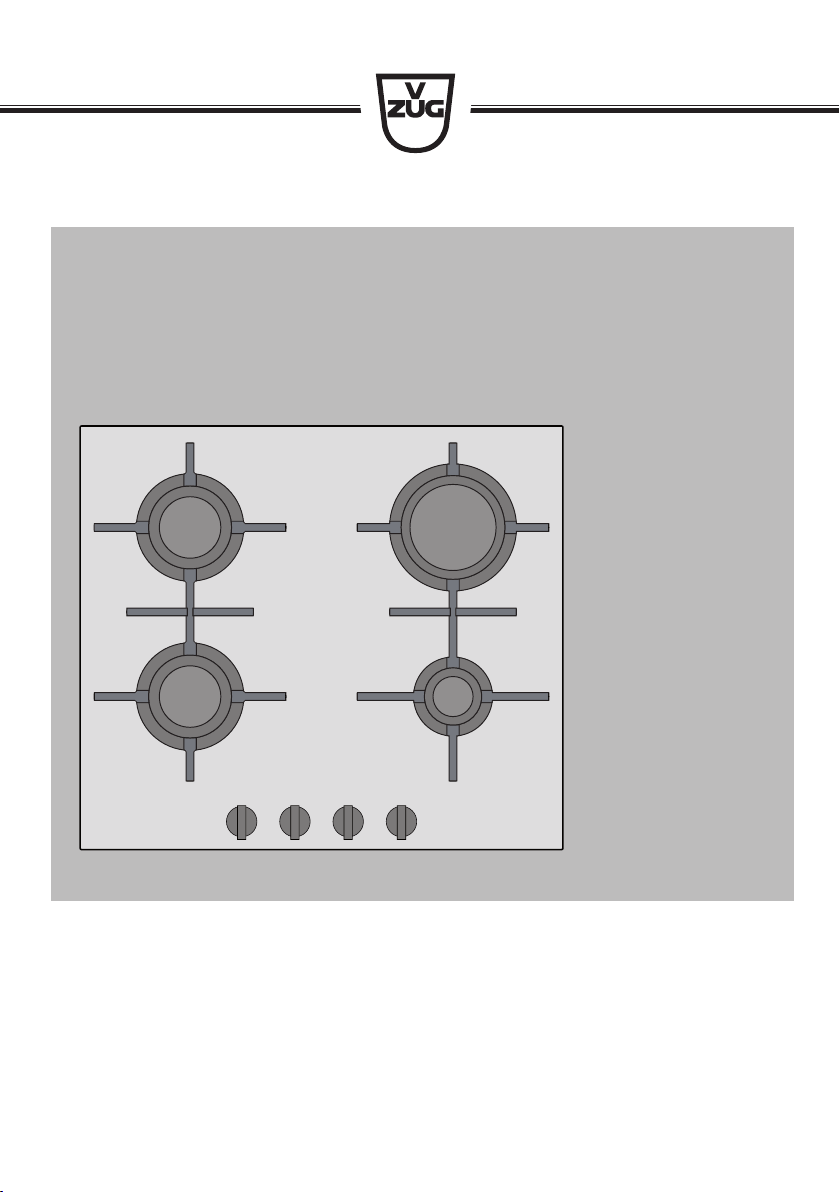
Operating instructions
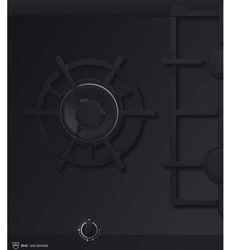
With dial controls GAS641
Gas hob

Thank you for choosing to buy one of our products. Your appliance is made to
high standards and is easy to use. Nevertheless, please take the time to read
these operating instructions in order to familiarise yourself with the appliance
and get the best use out of it.
Please follow the safety precautions.
Modifications
Text, diagrams and data correspond to the technical standard of the appliance
at the time these operating instructions went to press. The right to make tech-
nical modifications for the purpose of the further development of the appliance
is reserved.
Validity
The product family (model number) corresponds to the first alphanumerics on
the identification plate. These operating instructions apply to:
Type Product family Appliance class
GAS641GKAZ 31089 Class 3
DIN EN 30-1-1
Variations depending on the model are noted in the text.
© V-ZUG Ltd, CH-6301 Zug, 2017
2

Contents
1 Safety precautions 4
1.1 Symbols used ........................................................................................................ 4
1.2 General safety precautions ................................................................................. 5
1.3 Appliance-specific safety precautions............................................................... 6
1.4 Instructions for use ............................................................................................... 7
1.5 Warnings................................................................................................................. 9
2 Disposal 10
3 Using for the first time 11
4 Appliance description 12
4.1 Appliance overview.............................................................................................12
4.2 Operating elements ............................................................................................12
4.3 Gas burners .........................................................................................................13
4.4 Safety system.......................................................................................................13
4.5 Cookware .............................................................................................................14
5 Operating the appliance 16
5.1 Electronic ignition................................................................................................16
5.2 Switching a burner off ........................................................................................16
5.3 Power levels.........................................................................................................17
5.4 Cooking guidelines.............................................................................................17
6 Care and cleaning 18
6.1 Care .......................................................................................................................18
6.2 Cleaning................................................................................................................18
7 Trouble-shooting 19
8 Accessories and spare parts 21
9 Technical data 22
9.1 Product fiche........................................................................................................22
10 Index 23
11 Notes 24
12 Service & Support 27
3

1 Safety precautions
1.1 Symbols used
Caution, risk of fire!
Denotes important safety precautions.
Failure to observe said precautions can result in injury or in damage
to the appliance or fittings!
Information and precautions that should be observed.
Information on disposal
Information about the operating instructions
▸ Indicates step-by-step instructions.
– Describes how the appliance reacts to the steps taken.
▪ Indicates a list.
4

1 Safety precautions
1.2 General safety precautions
▪ Read the operating instructions before using the appliance for
the first time.
▪ This appliance can be used by children aged 14 and above
and by persons with reduced physical, sensory or mental cap-
abilities, or lack of experience and/or knowledge, provided
they are supervised or have been instructed on the safe use
of the appliance and have understood the hazards involved.
Children shall not play with the appliance. Cleaning and user
maintenance shall not be undertaken by children without su-
pervision.
▪ If an appliance is not equipped with a mains cable and a plug
or other means for disconnecting from the mains with a con-
tact opening on each pole complying with the conditions of
overvoltage category III for full isolation, an isolating device
must be incorporated into the permanently installed electrical
installation in accordance with the installation regulations.
▪ If the mains cable or gas supply line of this appliance is dam-
aged, it must be replaced by the manufacturer or its Cus-
tomer Services or a similarly qualified person in order to avoid
hazard.
5

1 Safety precautions
1.3 Appliance-specific safety precautions
▪ WARNING: If the surface is cracked, switch the appliance off
and disconnect it from the mains to avoid possible electric
shock. Disconnect the gas supply to the appliance.
▪ WARNING: The appliance and its accessible parts get hot
during use. Do not touch the burners, the pan supports or the
surface of the hob.
▪ WARNING: The cooking process should always be super-
vised. Shorter cooking processes, in particular, must be su-
pervised the entire time.
▪ WARNING: It can be dangerous to leave the hob unattended
when cooking with fat or oil, as this can lead to fires. NEVER
attempt to extinguish a fire with water. Switch the appliance
off and carefully smother the flames with a lid or a fire
blanket.
▪ WARNING: Never store objects on the hob. Risk of fire!
▪ Do not operate the appliance using an external time switch or
a separate remote control system.
▪ Under no circumstances use a steam cleaner to clean this ap-
pliance.
▪ Do not use or store flammable materials in the appliance stor-
age drawer or near this appliance.
▪ Do not spray aerosols in the vicinity of this appliance while it
is in operation.
▪ Do not modify this appliance.
▪ Where this appliance is installed in marine craft or in cara-
vans, it shall not be used as a space heater.
6

1 Safety precautions
1.4 Instructions for use
Operate the appliance competently and follow the advice given in the
«Appliance description» section.
Before using for the first time
▪ The appliance must be installed and connected to the gas and electricity
supply in accordance with the separate installation instructions. Have a cer-
tified installer carry out the necessary work.
Correct use
▪ CAUTION: This appliance is only intended for cooking purposes. It may not
used for other purposes, such as heating a room.
▪ The appliance is designed for use in the home for preparing food. No liabil-
ity is assumed for any damage caused by improper use or incorrect hand-
ling.
▪ Any repairs, modifications or manipulations to the appliance, especially any
gas pipes or electrically live parts, may only be carried out by the manufac-
turer, its customer service department or a similarly qualified person. Re-
pairs if carried out incorrectly may cause serious injury, damage to the ap-
pliance and fittings, as well as affect the functioning of the appliance. If the
appliance is not working properly or in case a repair is needed, follow the
instructions given in the «Service and support» section. Contact our Cus-
tomer Services if necessary.
▪ Use original spare parts only.
▪ Retain these operating instructions for future reference. If you sell the appli-
ance or pass it on to a third party, please ensure these operating instruc-
tions accompany the appliance, together with the installation instructions.
▪ The appliance corresponds to recognized technology standards and the rel-
evant safety regulations. However, proper use of the appliance is essential
to avoid damage and accidents. Please therefore follow the precautions
given in these operating instructions.
▪ The heated surface of the hob, the pan supports and the burners will remain
hot for some time after the appliance is switched off and will cool down only
slowly to room temperature. Please allow sufficient time for the appliance to
cool down before, for instance, cleaning it.
7

1 Safety precautions
Caution: Risk of deflagration!
▪ Unburned gas can accumulate in enclosed areas. Please read the warnings
carefully.
Caution: Risk of toxic fumes!
▪ A gas hob produces heat, moisture and combustion by-products in the
room in which it is used. Ensure the kitchen is well ventilated, especially
when the hob is in use: keep natural ventilation holes open or install a
mechanical ventilation device (extractor hood). Prolonged intensive use of
the appliance may call for additional or more effective ventilation: open a
window or increase the extraction rate of the range hood.
Caution: Fire hazard!
▪ The cooking zones become very hot. Do not rest any objects on the hob.
▪ Do not store or use corrosive, chemical or flammable cleaning agents or
products underneath or near to this household appliance.
Caution: Burns hazard!
▪ Overheated fat and oil can easily catch fire. Never attempt to extinguish
burning oil or fat with water. Danger of explosion! Smother the flames with a
fire blanket. Keep doors and windows closed.
▪ Exercise care when touching cookware handles as they can become hot.
Caution: Risk of injury!
▪ Cookware that is damaged, is not the right size or is not positioned cor-
rectly can cause serious damage. Check the cookware is fit for purpose be-
fore use. Centre the cookware in the middle of the relevant cooking zone.
Follow the tips and warnings that come with suitable cookware.
▪ In the event of a malfunction, turn off the gas and electrical supply to the ap-
pliance. Call our Customer Services.
▪ Do not tamper inside the appliance. If necessary, please call our Customer
Services.
▪ Use of unsuitable protective guards can cause accidents.
▪ If a control knob will not turn, do not force it. Call our Customer Services im-
mediately for repair or replacement.
▪ Keep pets away from the appliance.
Caution: Risk to life!
▪ Packaging materials, e.g. plastic film and polystyrene, can be dangerous for
children. Danger of suffocation! Keep packaging material away from chil-
dren.
8

1 Safety precautions
How to avoid damaging the appliance
▪ In case of overheating, switch the hob off and allow it to cool down com-
pletely. Do not put any dishes on it. Under no circumstances use cold water
to cool it down quickly.
▪ Do not climb on to the appliance.
▪ Do not cut or prepare food on the surface and avoid impact with hard ob-
jects. Do not drag cookware across the surface.
▪ Do not allow food to get onto the surfaces when they are hot, as it can dam-
age them. If food were to get onto the surfaces when they are hot, it must
be cleaned off straightaway.
▪ Only use cookware that is suitable for cooking with gas.
▪ Moving pans and cookware around causes scratches. This can be largely
prevented by lifting pans and cookware up and then placing them down in
position.
▪ The hob is designed to be used – signs of use, such as scratches or the
wear and tear from pans and cookware, are normal. The more intensively it
is used, the greater the signs of use; however, the appliance remains in per-
fect working order and therefore does not give a right of complaint. Safety is
guaranteed at all times.
1.5 Warnings
Please observe the notes on use in the «Cookware» (see page 14)
section.
▪ It is normal for a new appliance to give off an unpleasant smell when it is
first used. It does not indicate the existence of a danger or a defect. The
smell will fade over time.
▪ The colour of the flame can sometimes be orange. This is normal. It occurs
when there is dust in the air, when some liquid spills over, etc.
▪ If a burner flame accidentally goes out, turn the control knob for the burner
to «Off» and wait at least one minute before reigniting it.
▪ A noise can be heard a few seconds after the burner is turned on and off.
This is normal. It indicates that the safety system has opened or shut down
the flow of gas.
▪ Ensure that the appliance is kept clean. If the ignition sparkers or thermo-
couples are dirty, the burners will not light or work properly. Clean the igni-
tion sparkers and thermocouples periodically using a small non-wire brush.
Ensure that the ignition sparkers and thermocouples receive no hard
knocks.
9

2 Disposal
Packaging
▪ All packaging materials (cardboard, plastic film (PE) and polystyrene (EPS))
are marked and should, if possible, be collected for recycling and disposed
of in an environmentally friendly way.
Disconnection
▪ Disconnect the appliance from the electricity and gas supply. With a fixed
appliance, this is to be carried out by a certified installer!
Safety
▪ Disable the appliance to prevent accidents caused by improper use, espe-
cially through children playing.
▪ Pull the plug out of the mains socket or have the appliance disconnected
from the mains by an electrician. Then cut the mains cable off flush with the
appliance.
Disposal
▪ The old appliance should not be discarded as worthless rubbish. If dis-
posed of correctly, the raw materials can be recovered for recycling.
▪ The symbol on the identification plate warns that the appliance may not
be disposed of in normal household waste.
▪ The appliance must be disposed of in accordance with local regulations on
waste disposal. For more information on the handling, disposal and recyc-
ling of the product, please contact the local authorities, the local recycling
facilities for household waste or the retailer from whom you purchased the
appliance.
10
3 Using for the first time
The appliance must be installed and connected to the electricity and
gas supply in accordance with the separate installation instructions.
Have a certified installer carry out the necessary work.
During the first few hours of use, a cooking zone can give off an un-
pleasant smell. This is normal for brand new appliances. Ensure that
the room is well ventilated.
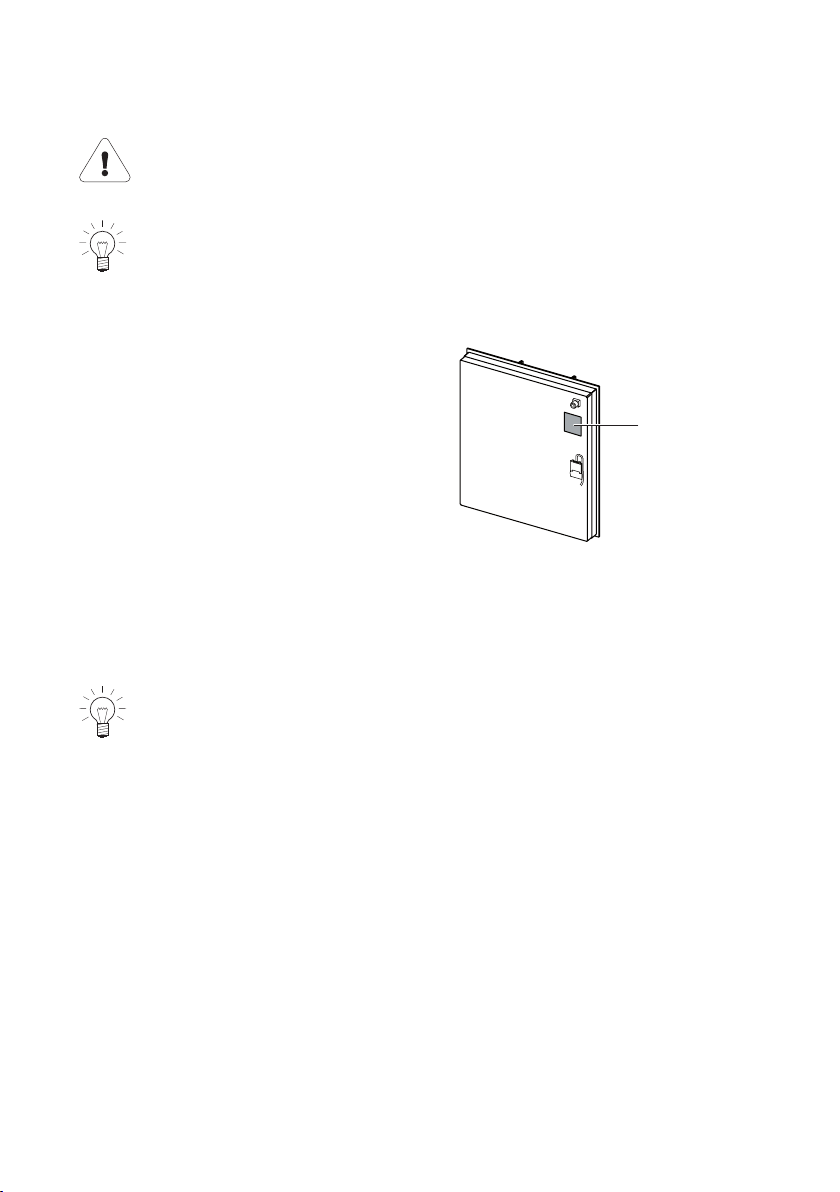
Where is the identification plate?
The identification plate is located on
the underside of the hob.
1
1
Identification plate with serial number (FN)
A second identification plate is supplied and should be affixed in the fitted unit
underneath the hob.
Note down the serial number (FN) of your appliance on the back page of
these operating instructions.
The serial number is required for identifying the appliance. Only then
can customer services guarantee a faultless service.
11
4 Appliance description
4.1 Appliance overview
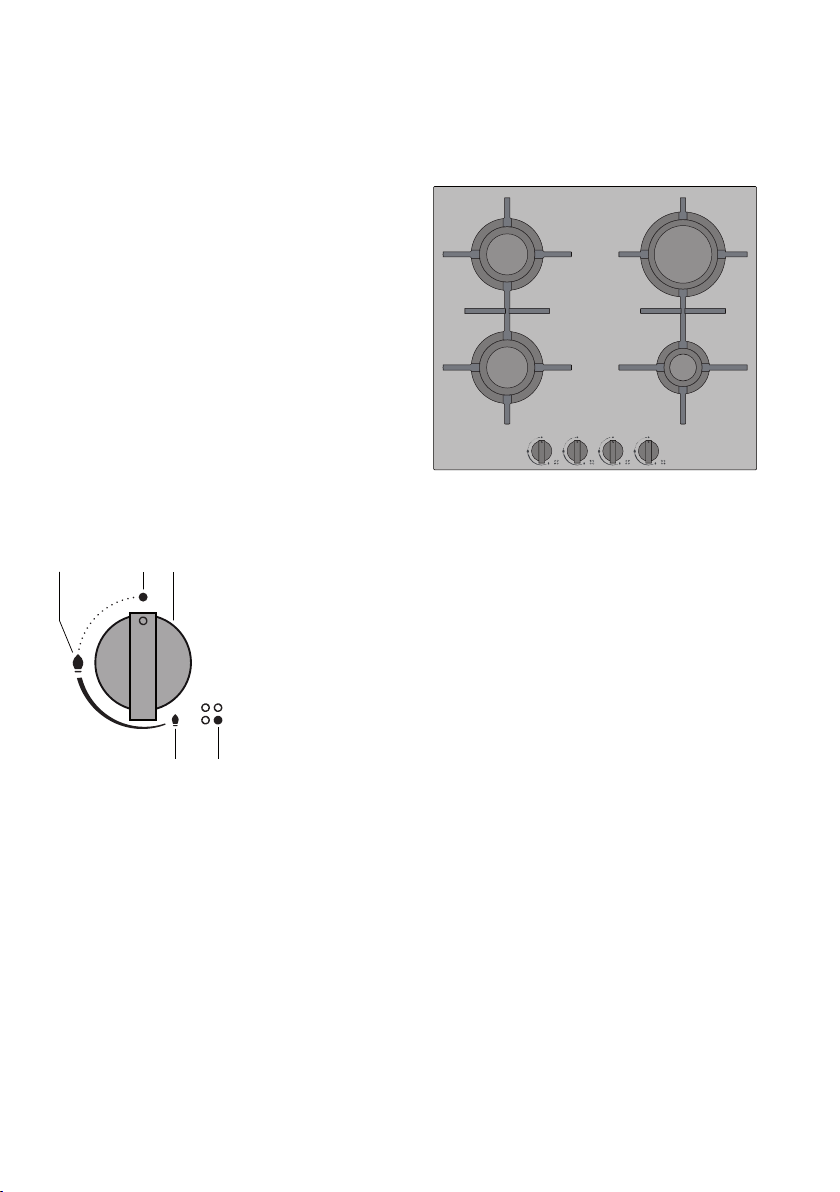
GAS641GKAZ
▪ 2 standard burners (left)
▪ 1 rapid burner (top right)
▪ 1 economy burner (bottom right)
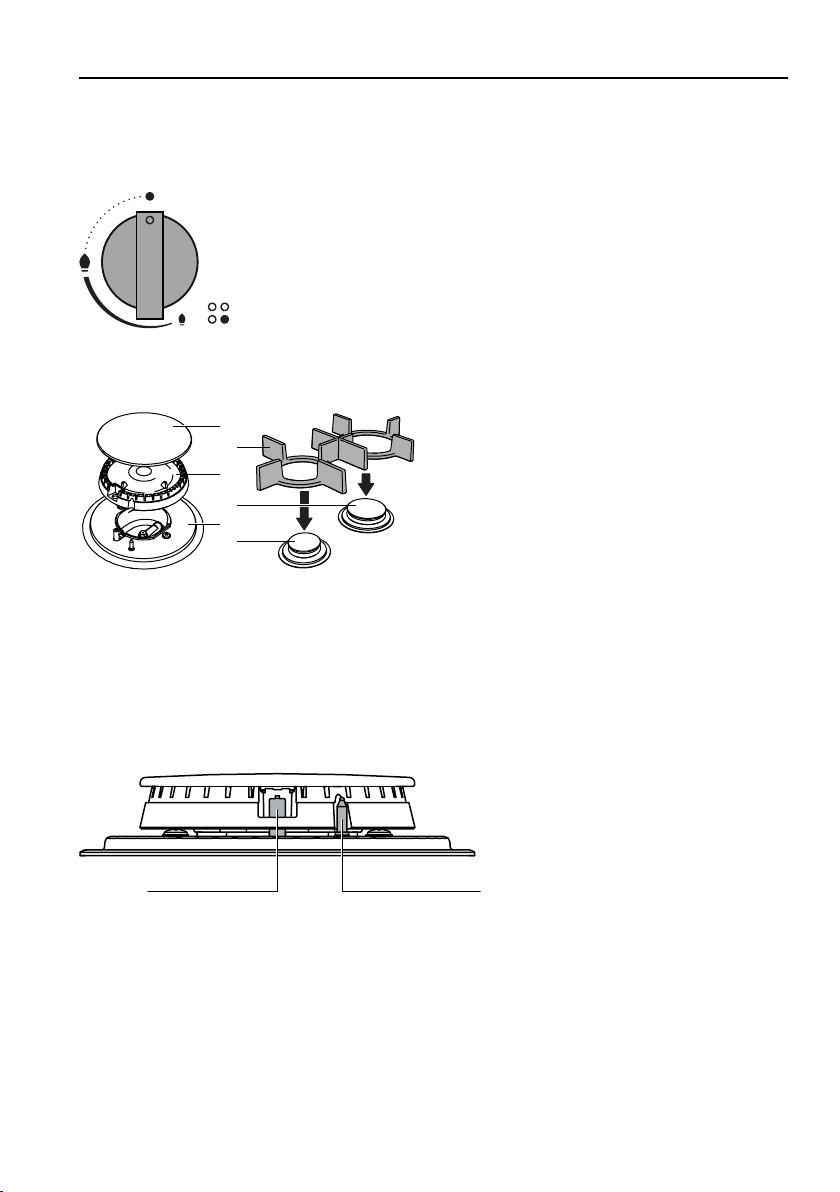
4.2 Operating elements
12
4 5
3
1
Control knob
2
Off position
3
Burner power: max. / Ignition position
4
Burner power: min.
5
Cooking zone
12
4 Appliance description
4.3 Gas burners
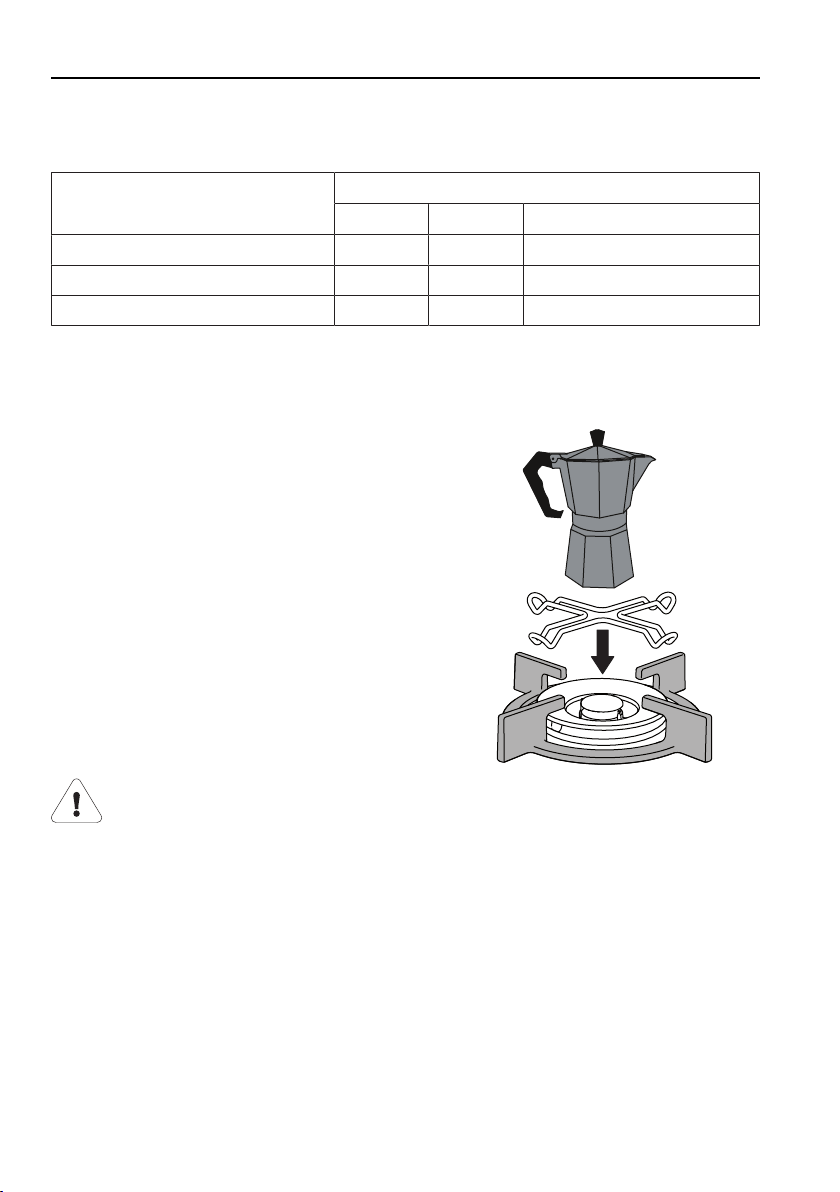
A symbol next to each control knob indicates which cooking zone is being op-
erated.
The pan supports and all the parts of the burners must be positioned correctly
in order that the appliance can be operated correctly. Do not swap the burner
caps around.
1
2
6
3
5
4
1
Burner cap
2
Pan support
3
Flame spreader
4
Standard/Rapid burner
5
Retaining plate for burner
6
Standard/Economy burner
4.4 Safety system
The appliance has a safety system which continuously monitors the flame of
each burner. It prevents the flow of gas if a burner accidentally goes out.
Ignition sparker
Thermocouple
13
4 Appliance description
4.5 Cookware
Suitable cookware
Burner Base diameter
Min. Max. Recommended
Rapid burner 18cm 26cm 22cm
Standard burner 14cm 20cm 18cm
Economy burner 12cm 16cm 14cm
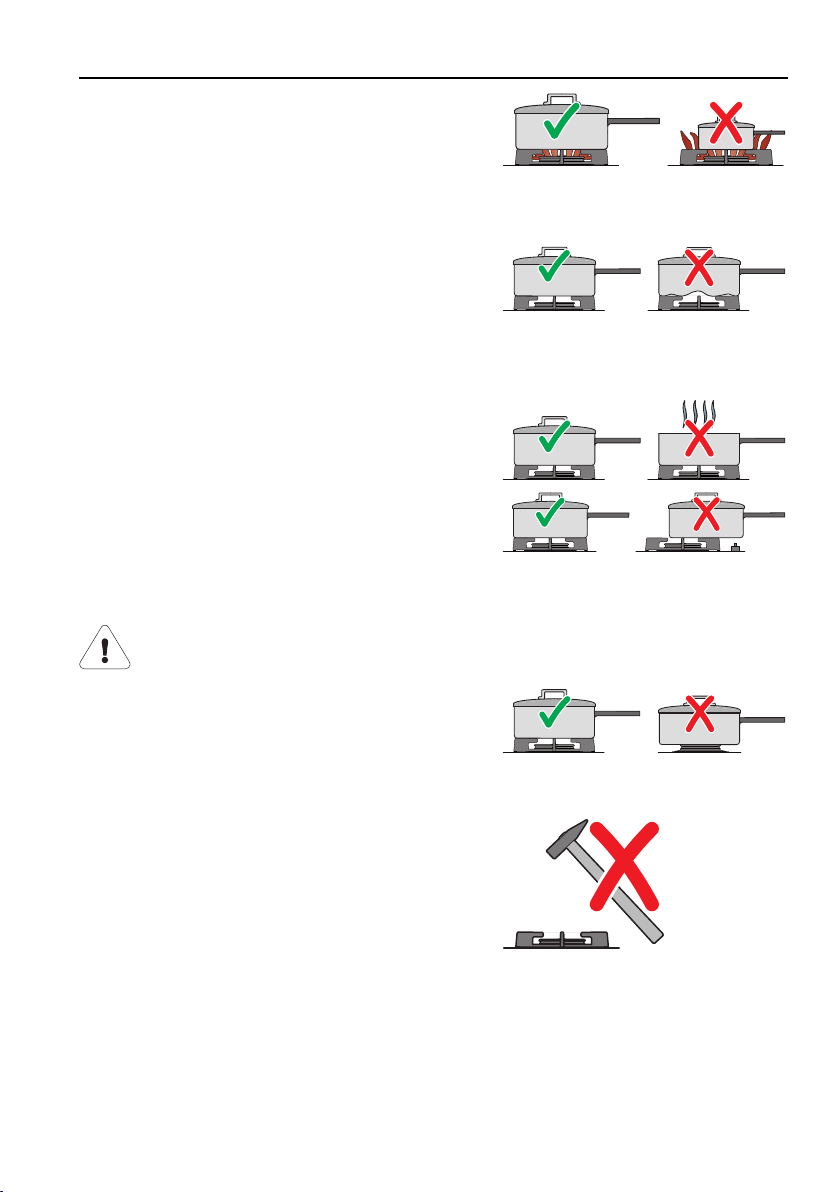
Mocha support
The mocha support is included in the scope of delivery with certain appli-
ances. It is also available as an accessory.
▪ The mocha support is only suitable for use
with mocha coffee makers and pots with a
diameter of at least 8 cm.
▪ The mocha support fits on all cooking
zones. The best heat transfer is achieved
on the economy and wok burners (inner
ring).
Take care that the burner flame only reaches as far as the base of
the mocha pot. The mocha pot handle could otherwise get hot.
We recommend the mocha support be used on the wok, economy or
standard burners.
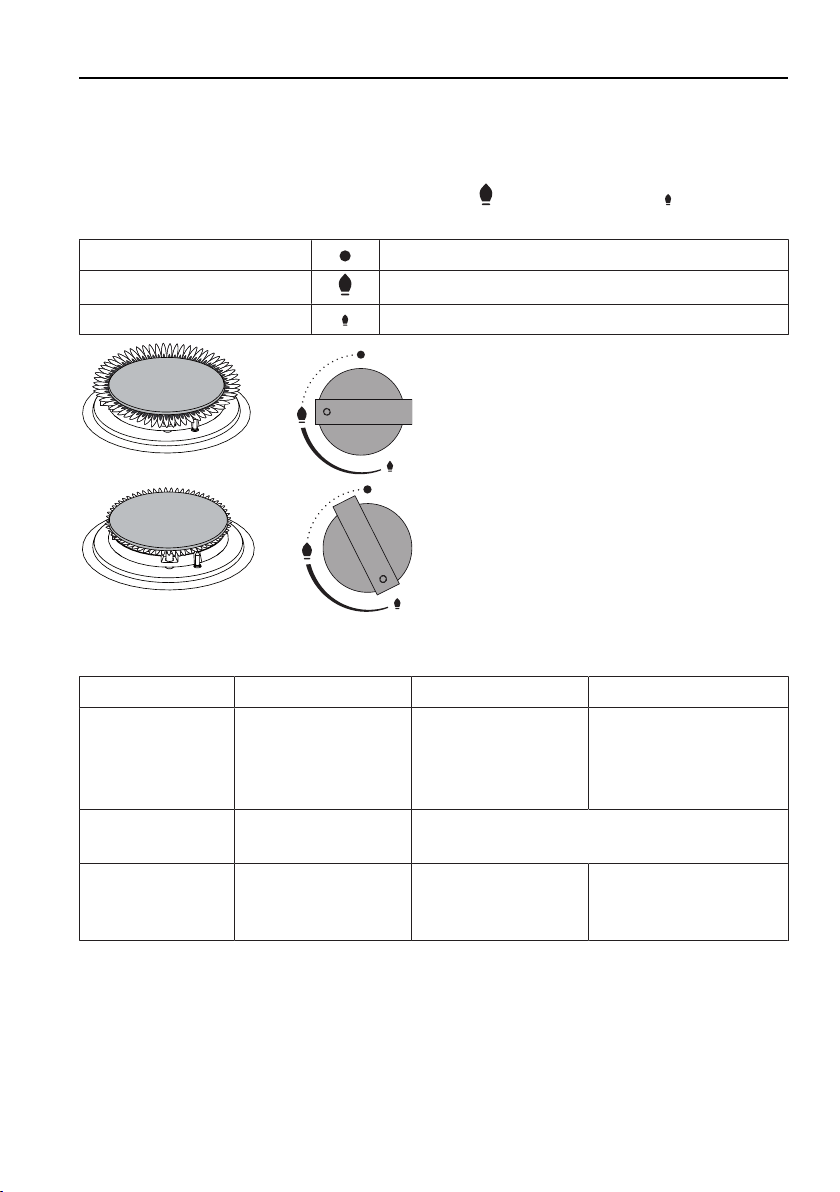
Note on use
The following tips will help you to save energy and prevent damaging the
cookware and the appliance:
14
4 Appliance description
▪ The diameter of the base of the cook-
ware should correspond to the size of
the relevant burner.
▪ Do not place small-diameter cookware
on the large burners. The flame should
not touch the sides of the cookware.
▪ Cookware bases should not be de-
formed and stand stably on the cooking
zone. There is otherwise a risk of tipping
if the base is deformed.
▪ Only use cookware with a thick, flat
base.
▪ Always use a lid and make sure that it
fits properly, otherwise a lot of energy
will be wasted.
▪ Always centre the cookware over the
burner, otherwise it could tip over.
▪ Do not place large pans on the burners
near the operating elements, as these
could overheat and become damaged.
Ensure that the cookware does not protrude over the edge of the
hob.
▪ Place pans on the pan supports, never
directly on the burners.
▪ Make sure that the pan supports, the
gas burners and the burner caps are po-
sitioned correctly before use.
▪ Cookware standing on a cooking zone
should be handled carefully.
▪ Do not strike the cooking zone or put
heavy objects on it.
15

5 Operating the appliance
5.1 Electronic ignition
All hobs have electronic ignition.
▸ Press down the control knob for the required burner and turn it anti-clock-
wise to the ignition position.
▸ Press the control knob.
– The flame ignites.
▸ Hold the control knob down for about 2 seconds so that the flame can be
detected.
– While the control knob is still pressed down, sparks are produced on all
burners to ignite the gas.
▸ Turn the control knob to the desired position and release.
▸ If the flame has not ignited, turn the control knob to «Off» and repeat the
steps. This time, press and hold the control knob for longer (up to 10
seconds).
Ignition by hand in the event of a power failure:
▸ Press down the control knob for the required burner in the ignition position.
▸ Use a flame (cigarette lighter, match, etc.) to ignite the burner.
Risk of deflagration: Ventilate the room well!
If the flame does not ignite after 15 seconds, switch off the burner and
open a door or window. Wait for at least a minute before trying again.
5.2 Switching a burner off
▸ Turn the control knob for the burner in a clockwise direction as far as the
position.
16
5 Operating the appliance
5.3 Power levels
The progressive control knobs can be used to precisely control the power
needed.
The setting range is between the high flame and the low flame .
The possible power levels are:
Position Off position
High flame Max. power
Low flame Min. power
▪ Flame at maximum power.
▪ Flame at minimum power.
5.4 Cooking guidelines
Burner Max. position Medium position Min. position
Rapid burner Frying and
deep frying
Stewing,
reducing
and continue
cooking
Steaming
Standard burner Cooking, steaming
and braising
Reheating
and keeping food warm
Economy burner Steaming,
braising
and cooking
Swelling and
poaching
Melting and
gentle
warming
17

6 Care and cleaning
Do not use any flammable, abrasive, chlorine- or bleach-containing
cleaning agents to clean the appliance. Only use standard food-grade
cleaning agents.
Under no circumstances use metal or steel brushes, copper cloths or
products that contain sand or that scratch for cleaning.
Do not use a steam cleaner to clean the hob, as this could damage it.
Do not use abrasive cleaners, metal scourers, sharp objects, knives or
the like, for removing dried-on food residue from the hob.
6.1 Care
▪ If any liquid boils over, clean it off immediately to prevent it from burning on.
▪ Remove any grains of sand (e.g. from cleaning vegetables) immediately, as
they could scratch the surface of the hob.
6.2 Cleaning
▪ After cooking, allow the appliance to cool down before cleaning it. Clean
the surface with a sponge, water and a mild cleaning agent. For hobs with a
stainless steel surface, use a chrome steel cleaner for the best cleaning res-
ults. Always clean in the direction of the original polish lines.
▪ If dirty, clean the surface of each individual part of the burner when cold
with a sponge, water and mild cleaning agent and rinse off thoroughly with
water. Residue (food that has boiled over, fat splashes, etc.) can eat into
the surface and be very difficult to remove later. For a uniform flame, the
holes and grooves in the burner must always be kept clean.
▪ Pan supports can be cleaned in a dishwasher or by hand. Ensure that the
silicone feet do not come off the pan supports.
▪ Always dry the burners and the pan supports after cleaning them. Water
droplets or damp patches on the hob at the start of cooking may damage
the enamel. After cleaning and drying the flame spreaders and caps, posi-
tion them centrally on the corresponding burners. For an overview of burner
parts, see the Gas burner (see page 13) section.
18
7 Trouble-shooting
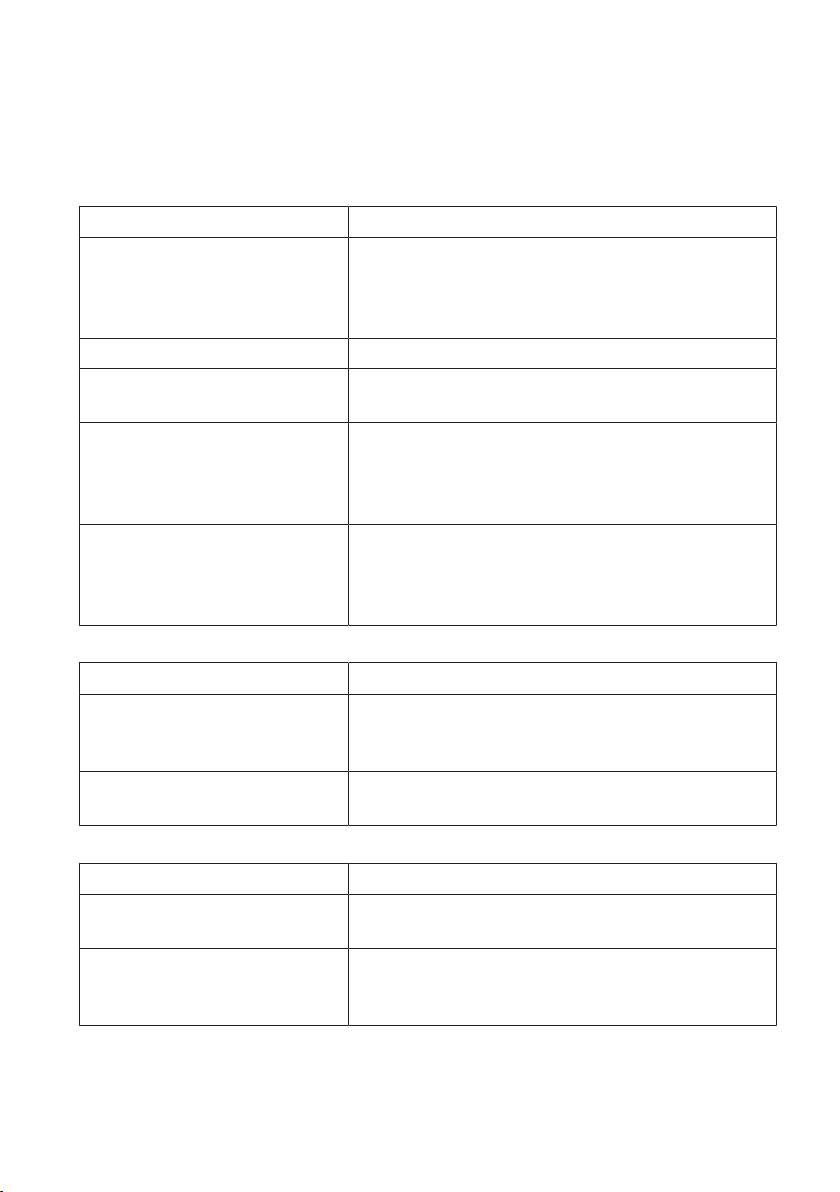
What to do if …
… the ignition is not working?
Possible cause Solution
▪ Food or cleaning product
residue stuck between the
ignition sparkers and the
burners.
▸ Clean the area between the ignition sparker
and the burner.
▪ The burners are wet. ▸ Dry the burner caps carefully.
▪ The burner caps are not
positioned correctly.
▸ Check that the caps are positioned cor-
rectly.
▪ The appliance is not
earthed, is not earthed
correctly or the earthing is
damaged.
▸ Notify our Customer Services.
▪ The thermocouple is dirty. ▸ Clean the area between the thermocouple
and the burner.
Notify Customer Services if the thermo-
couple is not working properly.
… the flame is not uniform?
Possible cause Solution
▪ The parts of the burners
are not positioned cor-
rectly.
▸ Position the burner parts correctly once they
have cooled down.
▪ The grooves on the flame
spreader are dirty.
▸ Clean the grooves on the flame spreader.
... the gas flow is not normal or there is no gas?
Possible cause Solution
▪ Check the gas supply to
the hob.
▸ Open valve in the main distributor or inter-
mediate valves.
▪ If the gas is supplied from
a gas cylinder, check
whether it is empty.
▸ Replace the empty gas cylinder.
19
7 Trouble-shooting
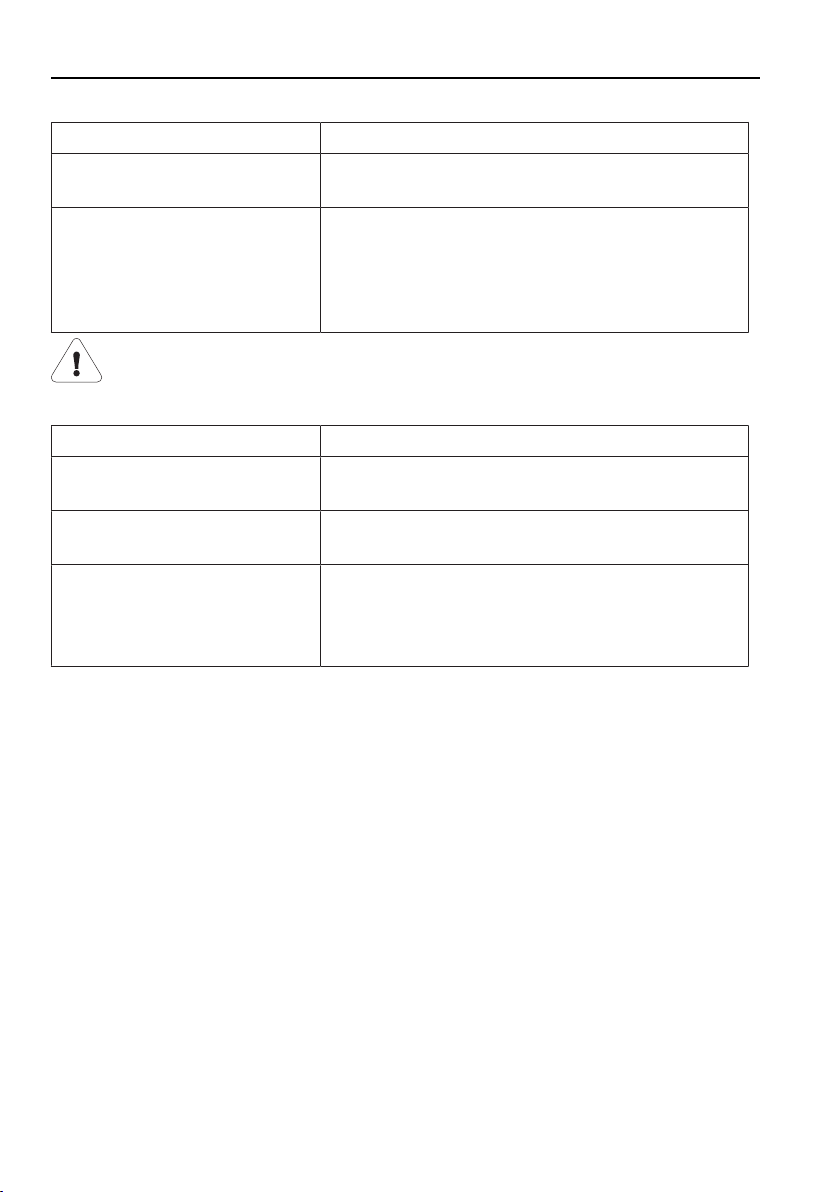
... the kitchen smells of gas?
Possible cause Solution
▪ Incorrect coupling of the
gas cylinder.
▸ Check that the coupling of the gas cylinder
is sound.
▪ Possible gas leak. ▸ Turn off the gas tap, ventilate the room and
immediately notify Customer Services. Do
not use the appliance until ensuring that
there is no gas leak in the installation or ap-
pliance itself.
Ventilate the room well!
... a burner immediately switches off after releasing the control knob?
Possible cause Solution
▪ The control knob was not
pressed for long enough.
▸ When the burner ignites, still keep the con-
trol knob depressed for a few seconds.
▪ The grooves on the flame
spreader are dirty.
▸ Clean the grooves on the flame spreader.
▪ The thermocouple is dirty. ▸ Clean the area between the thermocouple
and the burner.
Notify Customer Services if the thermo-
couple is not working properly.
20
8 Accessories and spare parts
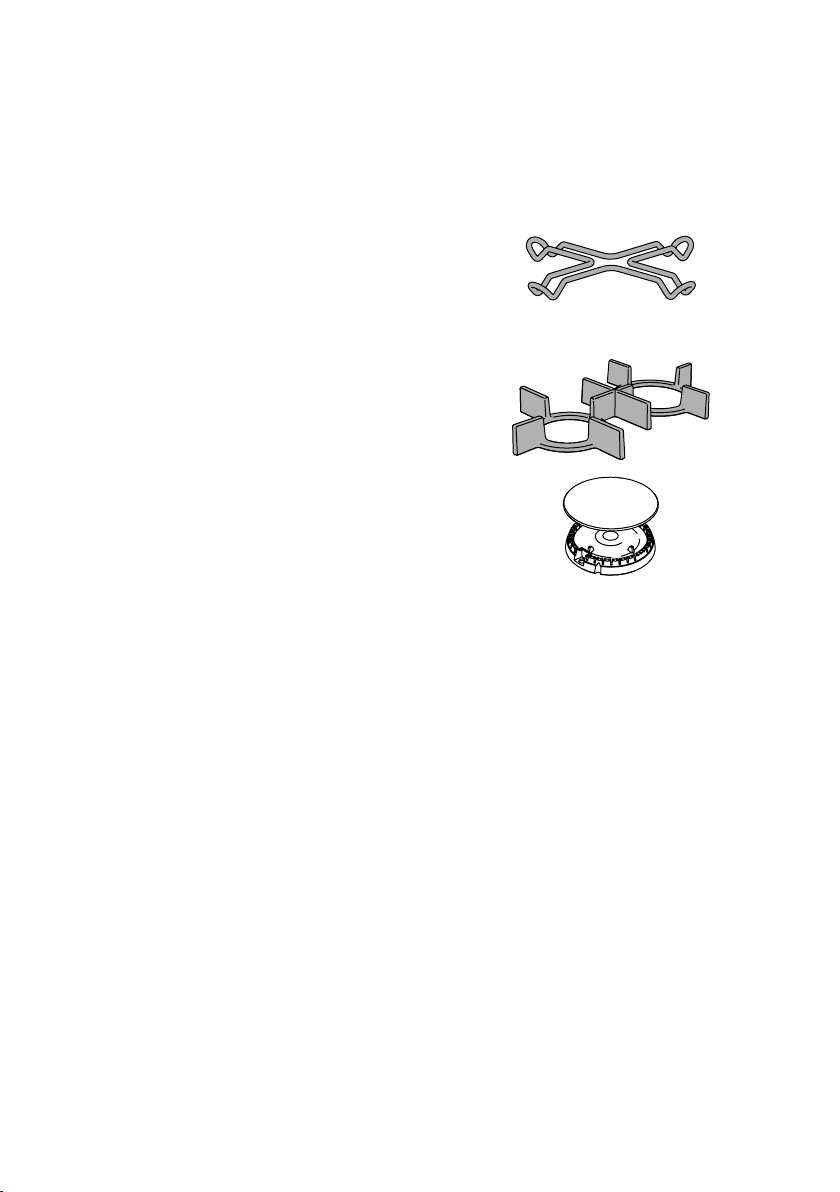
Please give product family of the appliance and exact designation of the ac-
cessory or spare part when ordering parts.
Accessories
Mocha support
Spare parts
Pan support
Standard burner
in black or made from brass
21

9 Technical data
9.1 Product fiche
Model number 31089
Type designation GAS641GKAZ
Type of burner Rapid 2 × standard Economy Total
Nominal heat input (MJ/h)
Natural gas, 1.0 kPa
11.5 6.5 4 28.5
Nominal heat input (MJ/h)
Natural gas, 2.75 kPa
10 5.8 3.3 24.9
22

10 Index
A
Appliance overview ...................................... 12
Appliance-specific safety precautions
.................................................................... 6
B
Burner
Switching off....................................... 16
C
Care................................................................. 18
Cleaning.......................................................... 18
Cooking guidelines....................................... 17
Cookware ....................................................... 14
D
Disconnection................................................ 10
Disposal.......................................................... 10
E
Electronic ignition ......................................... 16
G
Gas burner ..................................................... 13
I
Identification plate......................................... 11
Ignition by hand............................................. 16
Instructions for use ......................................... 7
M
Mocha support .............................................. 14
Model number ................................................. 2
N
Notes............................................................... 24
O
Operating element ........................................ 12
P
Packaging ...................................................... 10
Power levels................................................... 17
Product family.................................................. 2
Product fiche.................................................. 22
S
Safety .............................................................. 10
Safety precautions
General...................................................5
Safety system ................................................ 13
Serial number (FN) ....................................... 11
Service & Support......................................... 27
Symbols ............................................................ 4
T
Technical questions...................................... 27
Trouble-shooting ........................................... 19
Type................................................................... 2
U
Using for the first time.................................. 11
V
Validity............................................................... 2
W
Warranty extensions ..................................... 27
Where is the identification plate?............... 11
23

24
11 Notes

25

26

12 Service & Support
The «Troubleshooting» chapter provides valuable information for dealing with
minor operating faults. This saves you the time, effort and potential cost of having
to call out a service technician.
Information on the V-ZUG warranty can be found at www.vzug.com →Service →Warranty in-
formation. Please read this information carefully.
Please register your V-ZUG appliance online immediately at www.vzug.com →Service
→Warranty registration. This will allow you to take advantage of the best possible support
in the event of an fault in the appliance during the warranty period. You will require the
serial number (FN) and appliance designation to complete the registration process. This
information can be found on the identification plate for your appliance.
My appliance information:
FN:
___________________
Appliance
: _____________________
Always have this appliance information to hand when you contact V-ZUG. Thank you.
The identification plate is located on the underside of the gas hob.
Your repair order
At www.vzug.com →Service→Service number you will find the telephone number of your
nearest V‑ZUG service centre.
Technical questions, accessories, warranty extensions
V-ZUG is happy to help you with any general administrative or technical queries, to take
your orders for accessories and spare parts and to inform you about our progressive ser-
vice agreements.
27

Quick instructions
Please first read the safety precautions in the operating instructions!
Switching a cooking zone on
▸ Press down the control knob for the required burner and turn it anti-clockwise
to the ignition position.
▸ Hold the control knob depressed until the flame ignites.
▸ Select the desired power level.
Switching a cooking zone off
▸ Turn the control knob for the burner in a clockwise direction as far as the po-
sition.
V-ZUG Ltd, Industriestrasse 66, CH-6301 Zug
[email protected], www.vzug.com
1014401-R04