Installation
Instructions
IMPORTANT:
Read
and
save
these
instructions
IMPORTANT:
Installer:
Leave
Installation
Instructions
with
the
owner.
Owner:
Keep
Installation
Instructions
for
future
reference.
Save
Installation
Instructions
for
local
electrical
inspector's
use.
Y
Part
No,
3360618
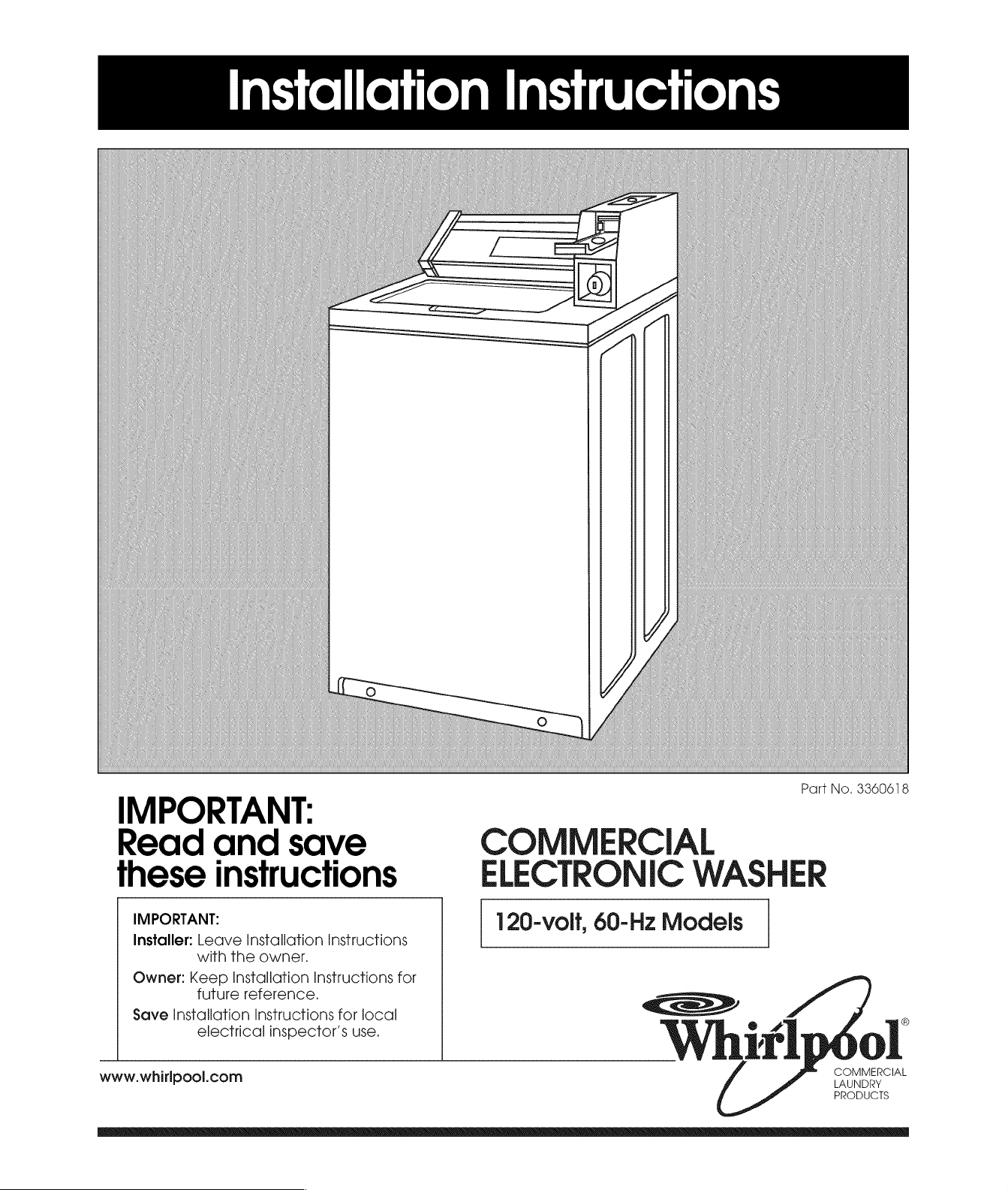
COMMERCIAL
ELECTRONIC
WASHER
120-volt,
60-Hz
Models
JS
,
Wh
ol
if
www.
whirlpool.com
COMMERCIAL
LAUNDRY
PRODUCTS
Before
you
start...
Your
safety
and
the
safety
of
others
is
very
important.
We
have
provided
many
important
Safety
messages
in
this
manual
and
on
your
appliance.
Always
read
and
obey
all
Safety
messages.
This
is
the
safety
alert
symbol.
This
symbol
alerts
you
to
hazards
that
can
kill
or
hurt
you
and
others.
All
safety
messages
will
be
preceded
by
the
safety
alert
symbol
and
the
word
“DANGER”
or
“WARNING”.
These
words
mean:
ADANGER
You
will
be
killed
or
seriously
injured
if
you
don’t
follow
instructions.
AWARNING
You can
be
killed
or
seriously
injured
if
you
don’t
follow
instructions.
All
safety
messages
will
identify
the
hazard,
tell
you
how
to
reduce
the
chance
of
injury,
and
tell
you
what
can
happen
if
the
instructions
are
not
followed.
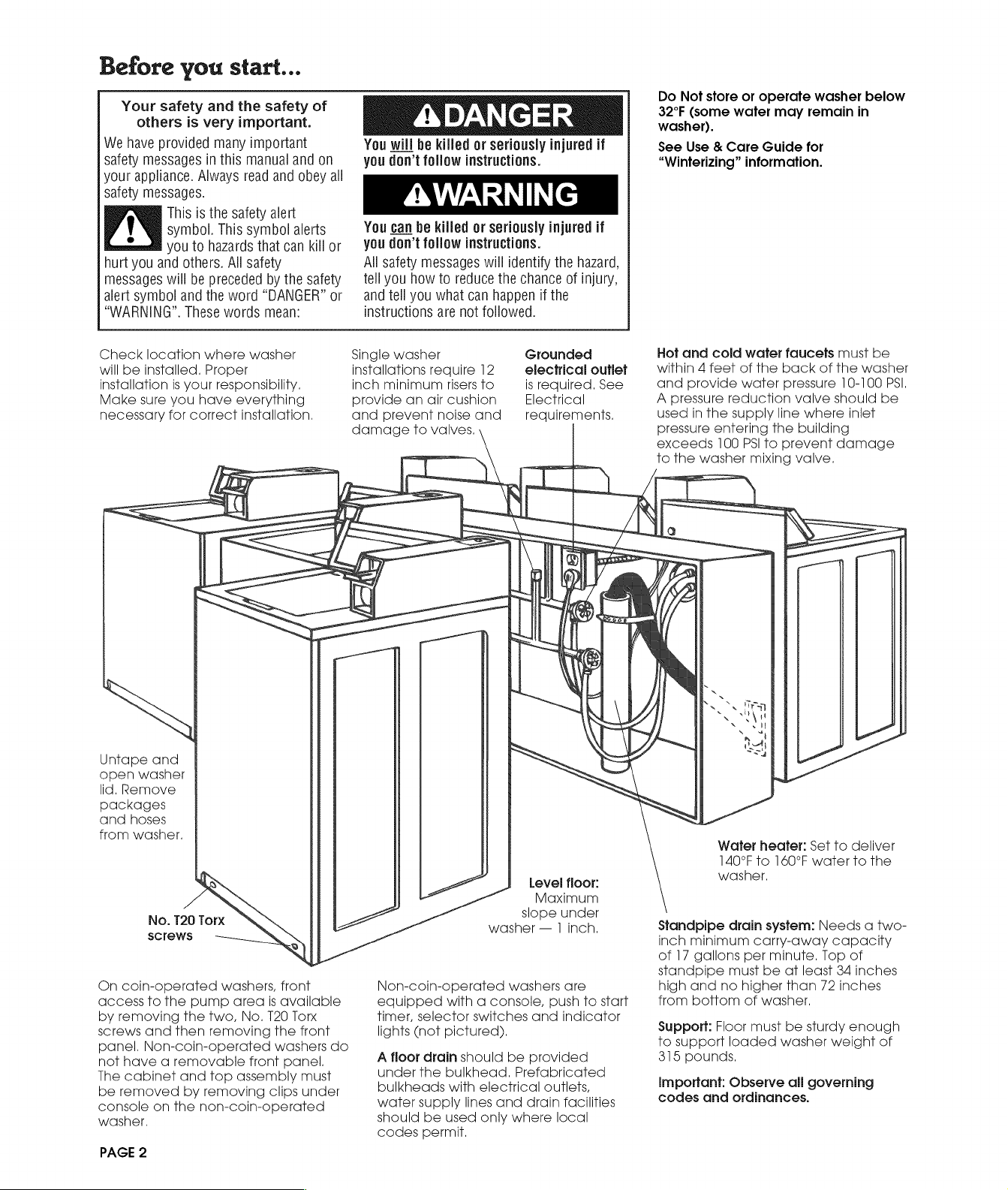
Check
location
where
washer
will
be
installed.
Proper
installation
is
your
responsibility.
Make
sure
you
have
everything
necessary
for
correct
installation.
Untape
and
open
washer
lia.
Remove
packages
and
hoses
from
washer.
Single
washer
installations
require
12
inch
minimum
risers
to
provide
an
air
cushion
and prevent
noise
and
damage
to
valves.
Grounded
electrical
outlet
is
required,
See
Electrical
requirements.
|
°
Level
floor:
Maximum
slope
under
screws
ror
a
washer
—
1
inch,
-
On
coin-operated
washers,
front
access
fo
the
pump
area
is
available
by
removing
the
two,
No. 120
Torx
screws
and
then
removing
the
front
panel.
Non-coin-operated
washers
do
not
have
a
removable
front
panel.
The
cabinet
and
top
assembly
must
be
removed
by
removing
clips
under
console
on
the
non-coin-operated
washer.
PAGE
2
Non-coin-operated
washers
are
equipped
with
a
console,
push
to
start
timer,
selector
switches
and
indicator
lights
(not
pictured),
A
floor
drain
should
be
provided
under
the
bulkhead.
Prefabricated
bulkheads
with
electrical
outlets,
water
supply
lines
and
arain
facilities
should
be
used
only
where
local
codes
permit.
{_—_—
:
a
Do
Not
store
or
operate
washer
below
32°F
(some
water
may
remain
in
washer).
See
Use
&
Care
Guide
for
“Winterizing”
information.
Hot
and
cold
water
faucefs
must
be
within
4
feet
of
the
back
of
the
washer
and
provide water
pressure
10-100
PSI.
A
pressure
reduction
valve
should
be
used
in
the
supply
line
where
inlet
pressure
entering
the
building
exceeds
100
PSI
fo
prevent
damage
to
the
washer
mixing
valve.
Water
heater:
Set
fo
deliver
140°F
fo
160°F
water
to
the
washer.
Standpipe
drain
system:
Needs
a
two-
inch
minimum
carry-away
capacity
of
17
gallons
per
minute.
Top
of
standpipe
must
be
at
least
34
inches
high
and
no
higher
than
72
inches
from
bottom
of
washer.
Support:
Floor
must
be sturdy
enough
To
support
loaded
washer
weight
of
315
pounds.
Important:
Observe
all
governing
codes
and
ordinances.
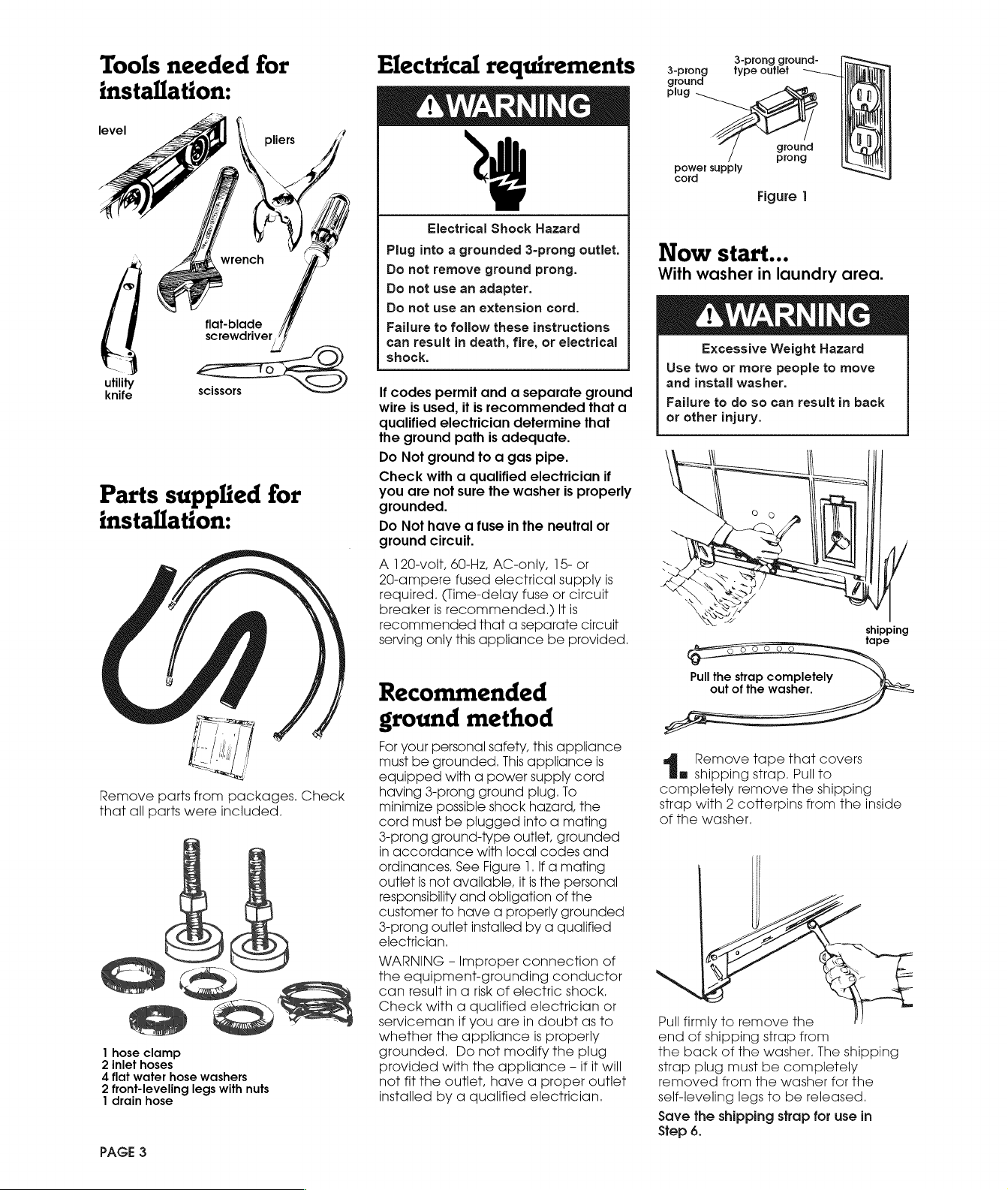
Tools
needed
for
Electrical
requirements
installation:
|
BRAIN
PA
J
|)
ll
w
Electrical
Shock
Hazard
Plug
into
a
grounded
3-prong
outlet.
Do
not
remove
ground
prong.
Do
not
use
an
adapter.
Do
not
use
an
extension
cord.
flat-blade
Failure
to
follow
these
instructions
screwariver,
can
result
in
death,
fire,
or
electrical
~s
—C)
shock.
——
10
tili
:
<>)
utility
scissors
If
codes
permit
and
a
separate
ground
wire
is
used,
it
is
recommended
that
a
qualified
electrician
determine
that
the
ground
path
is
adequate.
Do
Not
ground
fo
a
gas
pipe.
Check
with
a
qualified
electrician
if
Parts
supplied
for
you
are
not
sure
the
washer
is
properly
grounded.
a s
installation:
Do
Not
have
a
fuse
in
the
neutral
or
ground
circuit.
A
120-volt,
60-Hz,
AC-only,
15-
or
20-ampere
fused
electrical
supply
is
required.
Cime-delay
fuse
or
circuit
breaker
is
recommended.)
It
is
recommended
that
a
separate
circuit
serving
only
this
appliance
be
provided.
Recommended
ground
method
For
your
personal
safety,
this
appliance
must
be
grounded.
This
appliance
is
equipped
with
a
power
supply
cord
Remove
parts
from
packages.
Check
having
S-prong
ground
plug.
To
that
all
parts
were
included.
minimize
possible
shock
hazard,
the
cord must
be
plugged
into
a
mating
3-prong
ground-type
outlet,
grounded
in
accordance
with
local
codes
and
ordinances.
See
Figure
1.
If
a
mating
outlet
is
not
available,
it
is
the
personal
responsibility
and
obligation
of
the
customer
to
have
a
properly
grounded
3-prong
outlet
installed
by
a
qualified
electrician.
WARNING
-
Improper
connection
of
q0
(
(Gilt,
the
equipment-grounding
conductor
-
SY
can
result
in
a
risk
of
electric
shock.
'
QS
a
Check
with
a
qualified
electrician
or
Gig?
.
™
serviceman
if
you
are
in
doubt
as
to
*
whether
the
appliance
is
properly
1
hose
clamp
grounded,
Do
not
modify
the
plug
2
inlet
hoses
provided
with
the
appliance
-
if
it
will
4
flat
water
hose
washers
not
fit
the
outlet,
have
a
proper
outlet
ront-leveling
legs with
nuts
:
ve
vo
1
drain
hose
installed
by
a
qualified
electrician.
PAGE
3
3-prong ground-
3-prong
type
outlet
ground
plug
ground
prong
power
supply
cord
Figure
1
Now
start...
With
washer
in
laundry
area.
AWARNING
Excessive
Weight
Hazard
Use
two
or
more
people
to
move
and
install
washer.
Failure
to
do so
can
result
in
back
or
other
injury.
shipping
tape
Pull
the
strap
completely
\\
out
of
the
washer.
/
a
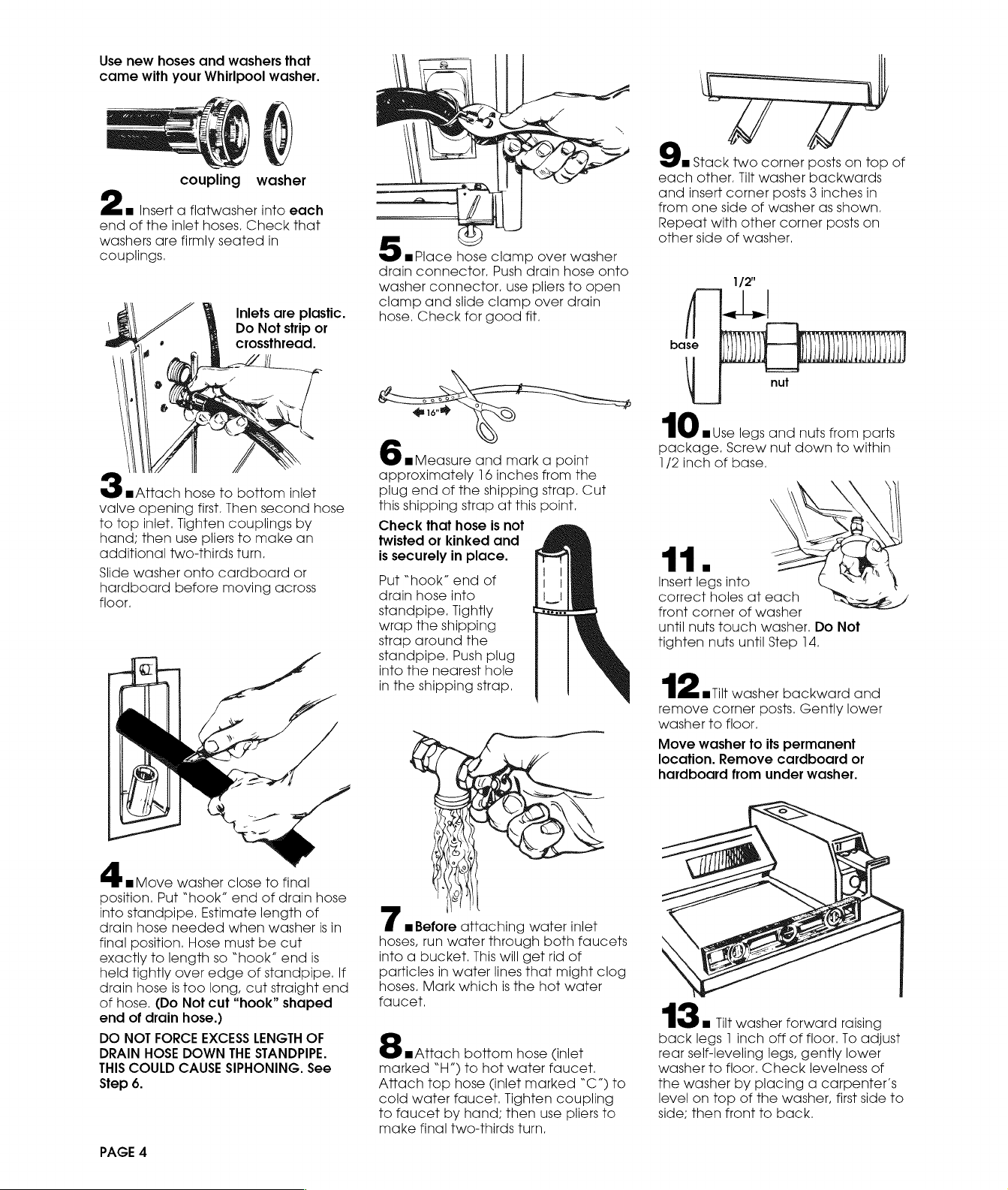
Remove
tape
that
covers
@
shipping
strap.
Pull
fo
completely
remove
the
shipping
strap
with
2
cotterpins
from
the
inside
of
the
washer.
Pull
firmly
to
remove
the
end
of
shipping
strap
from
the
back
of
the
washer.
The
shipping
strap
plug
must
be
completely
removed
from
the
washer
for
the
self-leveling
legs
to
be
released.
Save
the
shipping
strap
for
use
in
Step
6.
Use
new
hoses
and
washers
that
came
with
your
Whirlpool
washer.
2.
Insert
a
flatwasher
into
each
end
of
the
inlet
hoses,
Check
that
washers
are
firmly
seated
in
couplings.
Inlets
are
plastic.
Do
Not
strip
or
crossthread.
/
BD
adtiach
hose
to
bottom
inlet
valve
opening
first.
Then
second
hose
to
top
inlet.
Tighten
couplings
by
hand;
then
use
pliers
fo
make
an
additional
two-thirds
turn.
Slide
washer
onto
cardboard
or
hardboard
before
moving
across
floor,
4.
gm
Move
washer
close
to
final
position.
Put
“hook”
end
of
drain
hose
into
standpipe.
Estimate
length
of
drain
hose
needed
when
washer
is
in
final
position.
Hose
must
be
cut
exactly
to
length
so
“nook”
end
is
held
tightly
over
edge
of
standpipe.
If
drain
hose
is
too
long,
cut
straight
end
of
hose. (Do Not
cut
“hook”
shaped
end
of
drain
hose.)
DO
NOT
FORCE
EXCESS
LENGTH
OF
DRAIN
HOSE
DOWN
THE
STANDPIPE.
THIS
COULD
CAUSE
SIPHONING.
See
Step
6.
PAGE
4
5
mPlace
hose
clamp
over
washer
drain
connector.
Push
drain
hose
onto
washer
connector.
use
pliers
fo
open
clamp
and
slide
clamp
over
drain
hose.
Check
for
good
fit.
6
m
Measure
and
mark
a
point
approximately
16
inches
from
the
plug
end
of
the
shipping
strap.
Cut
this
shipping
strap
at
this
point.
Check
that
hose
is
not
twisted
or
kinked
and
is
securely
in
place.
Spey
Put
“hook”
end
of
drain
hose
into
standpipe.
Tightly
wrap
the
shipping
strap
around
the
standpipe.
Push
plug
into
the
nearest
hole
in
the
shipping
strap.
f
mBefore
attaching
water
inlet
hoses,
run
water
through
both
faucets
into
a
bucket.
This
will
get
rid
of
particles
in
water
lines
that
might
clog
hoses.
Mark
which
is
the hot
water
faucet.
Sa
atiach bottom
hose
Cinlet
marked
“H”)
to
hot
water
faucet.
Attach
top
hose
cinlet
marked
“C”)
to
cold
water
faucet.
Tighten
coupling
to
faucet
by
hand;
then
use
pliers
to
make
final
two-thirds
turn.
9.
Stack
two
corner
posts
on
top
of
each
other,
Tilt
washer
backwards
and
insert
corner
posts
3
inches
in
from
one
side
of
washer
as
shown.
Repeat
with
other
corner
posts
on
other
side
of
washer.
1
/2"
base
nut
10
mw
Use
legs
and
nuts
from
parts
package.
Screw
nut
down
to
within
1/2
inch
of
base.
11.
Insert
legs
into
correct
holes
at
each
front
corner
of
washer
until
nuts
touch
washer.
Do
Not
tighten
nuts
until
Step
14.
12
glilt
washer
backward
and
remove
corner
posts.
Gently
lower
washer
to
floor.
Move
washer
to
its
permanent
location.
Remove
cardboard
or
hardboard
from
under
washer.
13.
Tilt
washer
forward
raising
back
legs
|
inch
off
of
floor.
To
adjust
rear
self-leveling
legs,
gently
lower
washer
fo
floor.
Check
levelness
of
the
washer
by
placing
a
carpenter's
level
on
top
of
the
washer,
first
side
to
side;
then
front
to
back.
1
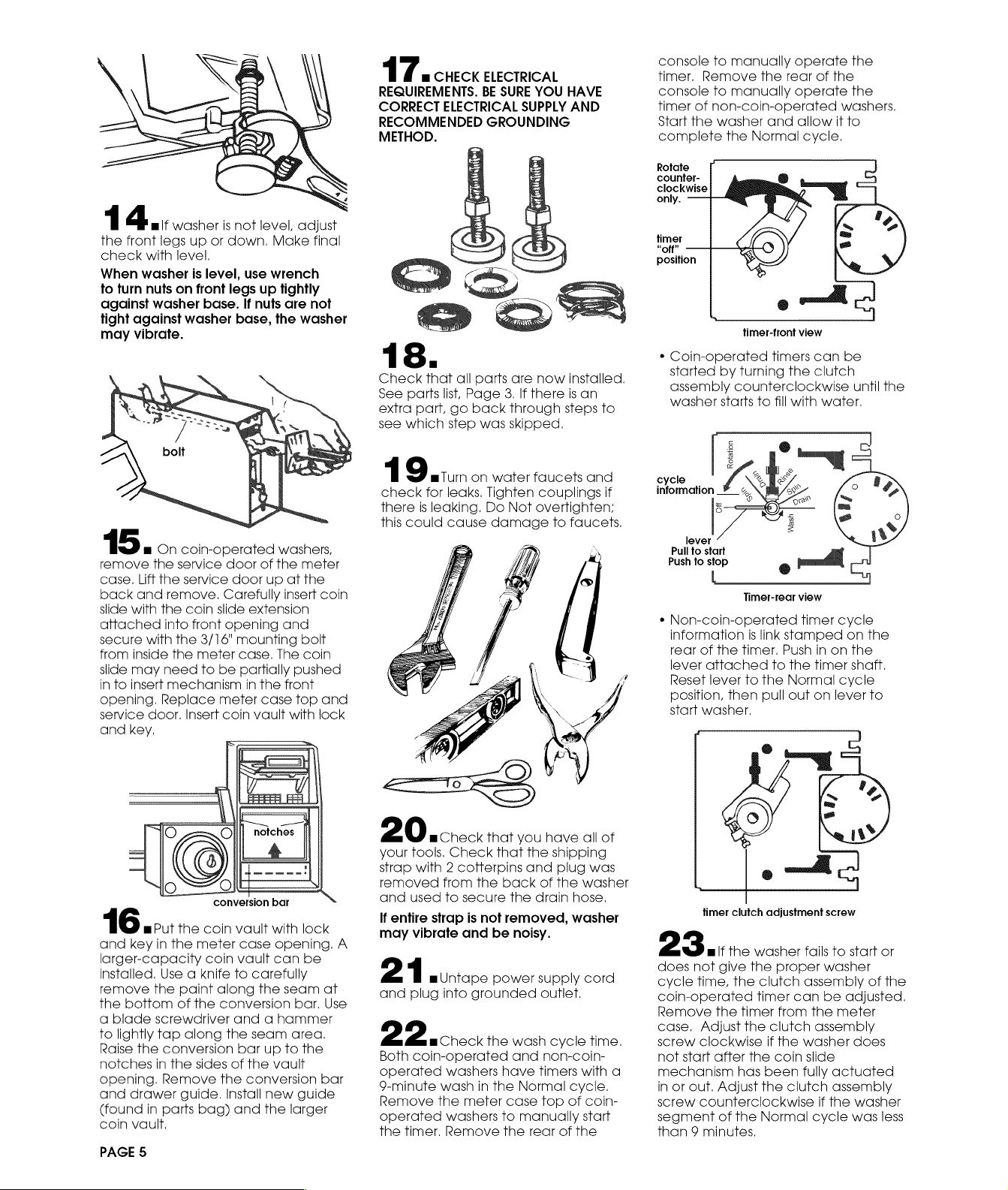
4.
washer
is
not
level,
adjust
the
front
legs
up
or
down.
Make
final
check
with
level.
When
washer
is
level,
use
wrench
to
turn
nuts
on
front
legs
up
tightly
against
washer
base.
If
nuts
are
not
tight
against
washer
base,
the
washer
may
vibrate.
15
g
On
coin-operated
washers,
remove
the
service
door
of
the
meter
case.
Lift
the
service
door
up
at
the
back
and
remove.
Carefully
insert
coin
slide
with
the
coin
slide
extension
attached
into
front
opening
and
secure
with
the
3/16"
mounting
bolt
from
inside
the
meter
case.
The
coin
slide
may
need
to
be
partially
pushed
in
to
insert
mechanism
in
the
front
opening.
Replace
meter
case
top
and
service
door,
Insert
coin
vault
with
lock
and
key.
conversion
bar
16
mPut
the
coin
vault
with
lock
and
key
in
the
meter
case
opening.
A
larger-capacity
coin
vault
can
be
installed.
Use
a
knife
to
carefully
remove
the
paint
along
the
seam
at
the
bottom
of
the
conversion
bar,
Use
a
blade
screwdriver
and
a
hammer
to
lightly
tap
along
the
seam
area.
Raise
the
conversion
bar
up
fo
the
notches
in
the
sides
of
the
vault
opening.
Remove
the
conversion
bar
and
drawer
guide.
Install
new
guide
(found
in
parts
bag)
and
the
larger
coin
vault.
PAGE
5
1
a
m
CHECK
ELECTRICAL
REQUIREMENTS.
BE
SURE
YOU
HAVE
CORRECT
ELECTRICAL
SUPPLY
AND
RECOMMENDED
GROUNDING
METHOD.
0
0°
p
18.
Check
that
all
parts
are
now
installed.
See
parts
list,
Page
3.
If
there
is
an
extra
part,
go
back
through
steps
to
see
which
step
was
skipped.
1
.°
on
water
faucets
and
check
for
leaks.
Tighten
couplings
if
there
is
leaking.
Do
Not
overtighten:
this
could
cause
damage
to
faucets.
20
m
Check
that
you
have
all
of
your
tools,
Check
that
the
shipping
strap
with
2
cotterpins
and
plug
was
removed
from
the
back
of
the
washer
and
used
to
secure
the
drain
hose.
If
entire
strap
is
not
removed,
washer
may
vibrate
and
be
noisy.
2
1
mg
Untape
power
supply
cord
and
plug
info
grounded
outlet.
22.
Check
the
wash
cycle
time.
Both
coin-operated
and
non-coin-
operated
washers
have
timers
with
a
9-minute
wash
in
the
Normal
cycle.
Remove
the
meter
case
top
of
coin-
operated
washers
to
manually
start
the
timer.
Remove
the
rear
of
the
console
to
manually
operate
the
timer.
Remove
the
rear
of
the
console
to
manually
operate
the
timer
of
non-coin-operated
washers.
Start
the
washer
and
allow
it
to
complete
the
Normal
cycle.
Rotate
counter-
oS
clockwise
7
only.
—7
@
~
&
timer
s
“off”
position
|e
A
timer-front
view
¢
Coin-operated
timers
can
be
started
by
Turning
the
clutch
assembly
counterclockwise
until
the
washer
starts
To
fill
with
water.
tation
R
cycle
_
information
lever
Pull to
start
Push
to
stop
Timer-rear
view
¢
Non-coin-operated
timer
cycle
information
is
link
stamped
on
the
rear
of
the
timer.
Push
in
on
the
lever
attached
to
the
timer
shaft.
Reset
lever
to
the
Normal
cycle
position,
then
pull
out
on lever
to
start
washer.
timer
clutch
adjustment
screw
23
alf
the
washer
fails
to
start
or
does
not
give
the
proper
washer
cycle
time,
the
clutch
assembly
of
the
coin-operated
timer
can
be
adjusted.
Remove
the
timer
from
the
meter
case,
Adjust
the
clutch
assembly
screw
clockwise
if
fhe
washer
does
not
start
after
the
coin
slide
mechanism
has
been
fully
actuated
in
or
out,
Adjust
the
clutch
assembly
screw
counterclockwise
if
the
washer
segment
of
the
Normal
cycle
was
less
than
9
minutes.
Owner
options
(coin-
operated
models)
CAUTION:
Disconnect
power
cord.
1.
For
WARM
RINSE
and
WATER
SAVER:
*«
Remove
screws
from
each
end
of
the
console
bottom,
¢
Pull
the
console
bottom
forward);
lift
and
Tilt
it
back,
a.
WARM
RINSE
¢
Connect
J1
to
J2
b.
SAVE
WATER
¢
Pull
out
fab
on
water-level
switch.
2.
If
use
of
a
larger
coin
vault,
lock
and
key
is
desired,
conversion
bar
in
lower
portion
of
coin
vault
area
can
be
removed.
3.
If
additional
security
is
needed,
top
and
cabinet
can
be
locked
to
washer
back
panel
by
using
a
“screw
type”
lock
and
key
in
space
provided
in
top
panel
under
console,
The
“screw
type”
lock
and
key
are
available
from
usual
industry
sources.
Check
list
for
washer
operation
Check
the
following
if
the
washer
is
not
operating
properly:
1.
Power
supply
cord
is
plugged
in.
2.
Circuit
breaker
is
not
tripped
or
fuse
blown.
3.
Timer
has
been
advanced
to
start
of
a
cycle.
.
Water
faucets
are
turned
on.
.
Washer
lid
is
closed,
SN
OO
OF
.
Inlet
valve
is
frozen
if
not
protected
from
the
weather.
8.
Suds
level.
Excess
suds
will
slow
the
spin
and
cause
poor
rinsing.
Operate
the
washer
through
a
complete
cycle
with
no
detergent.
Use
less
detergent
or
a
controlled
suds
type
detergent
in
future loads.
PAGE
6
.
Inlet
and
drain
hoses
are
not
kinked.
Typical
full
load
sizes.
Load
Loading
Load
Loading
Type
Suggestion
Type
Suggestion
Mixed
3
double
sheets
Heavy
3
pair
pants
Load
4
pillowcases
work
3
shirts
6
pair
shorts
clothes
|
coverall
8
T-shirts
4
pair
jeans
2
shirts
1
overall
2
blouses
8
handkerchiefs
Permanent
|
2
double
or
Knits
3
blouses
Press
1
king
size
sneet
4
slacks
|
tablecloth
6
shirts
|
dress
4
tops
1
blouse
A
dresses
2
slacks
3
shirts
2
pillowcases
Operating
Tips
AWARNING
“Z
Fire
Hazard
Never
place
items
in
the
washer
that
are
dampened
with
gasoline
or
other
flammable
fluids.
No
washer
can
completely
remove
oil.
Do
not
dry
anything
that
has
ever
had
any
type
of
oil
on
it
(including
cooking
oils).
Doing
so
can
result
in
death,
explosion,
or
fire.
It
is
recommended
that
fiberglass
items
not
be
washed
in
coin-
operated
washers.
If
these
items
are
washed
in
the
washer,
run
the
washer
through
a
complete
cycie
to
rinse
any
residue
away
that
might
be
left
in
the
washer,
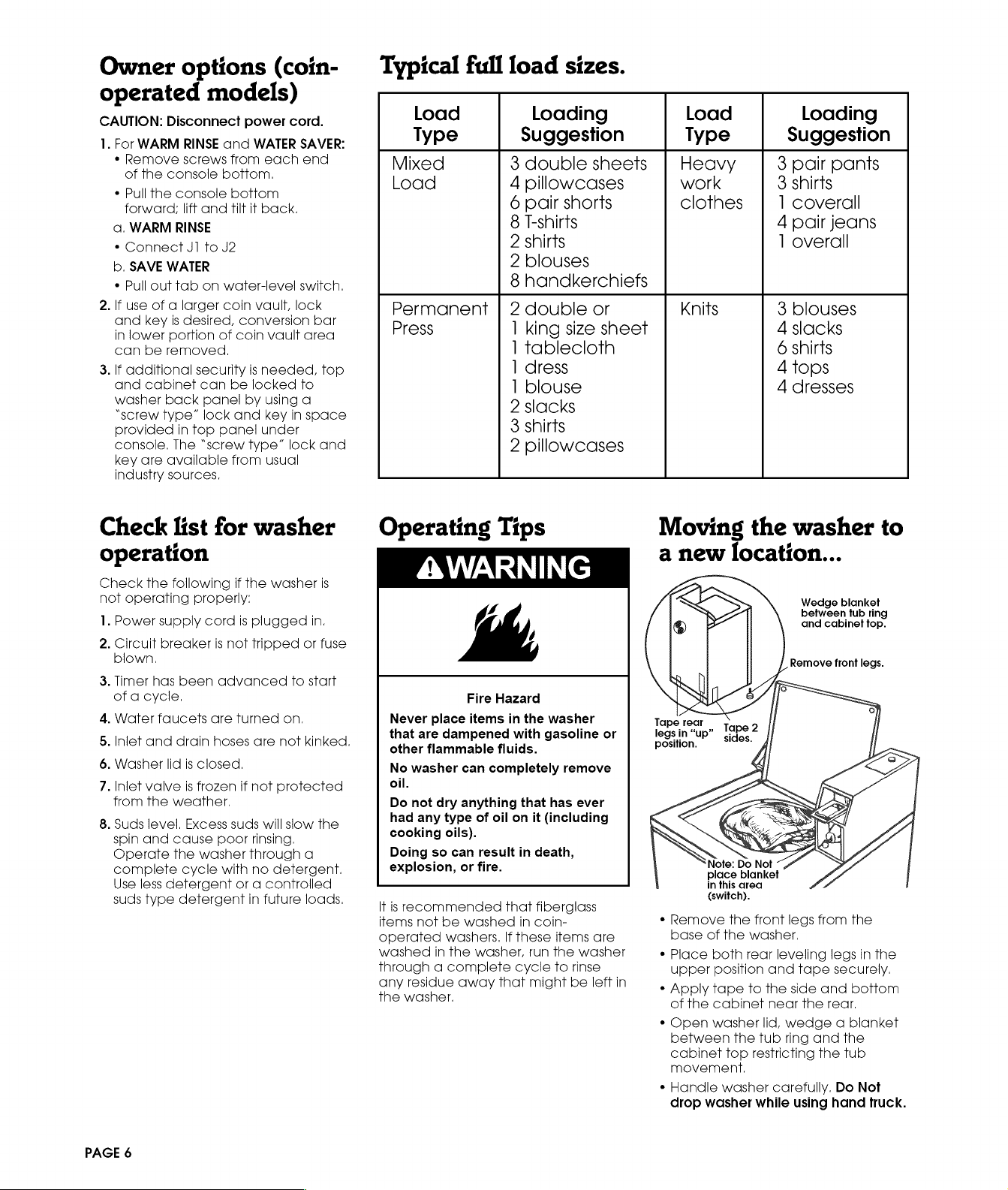
Moving
the
washer
to
a
new
location...
Wedge
blanket
between
tub
ring
and cabinet
top.
Remove
front legs.
Tape
rear
legs
in
“up”
position.
Note:
Do
Not
place
blanket
in
this
area
(switch).
¢
Remove
the
front
legs
from
the
base
of
the
washer.
¢
Place
both
rear
leveling
legs
in
the
upper
position
and
tape
securely.
¢
Apply
tape
to
the
side
and
bottom
of
the
cabinet
near
the
rear.
¢
Open
washer
lid,
wedge
a
blanket
between
the
tub
ring
and
the
cabinet
top
restricting
the tub
movement.
¢
Handle
washer
carefully.
Do
Not
drop
washer
while
using
hand
truck.
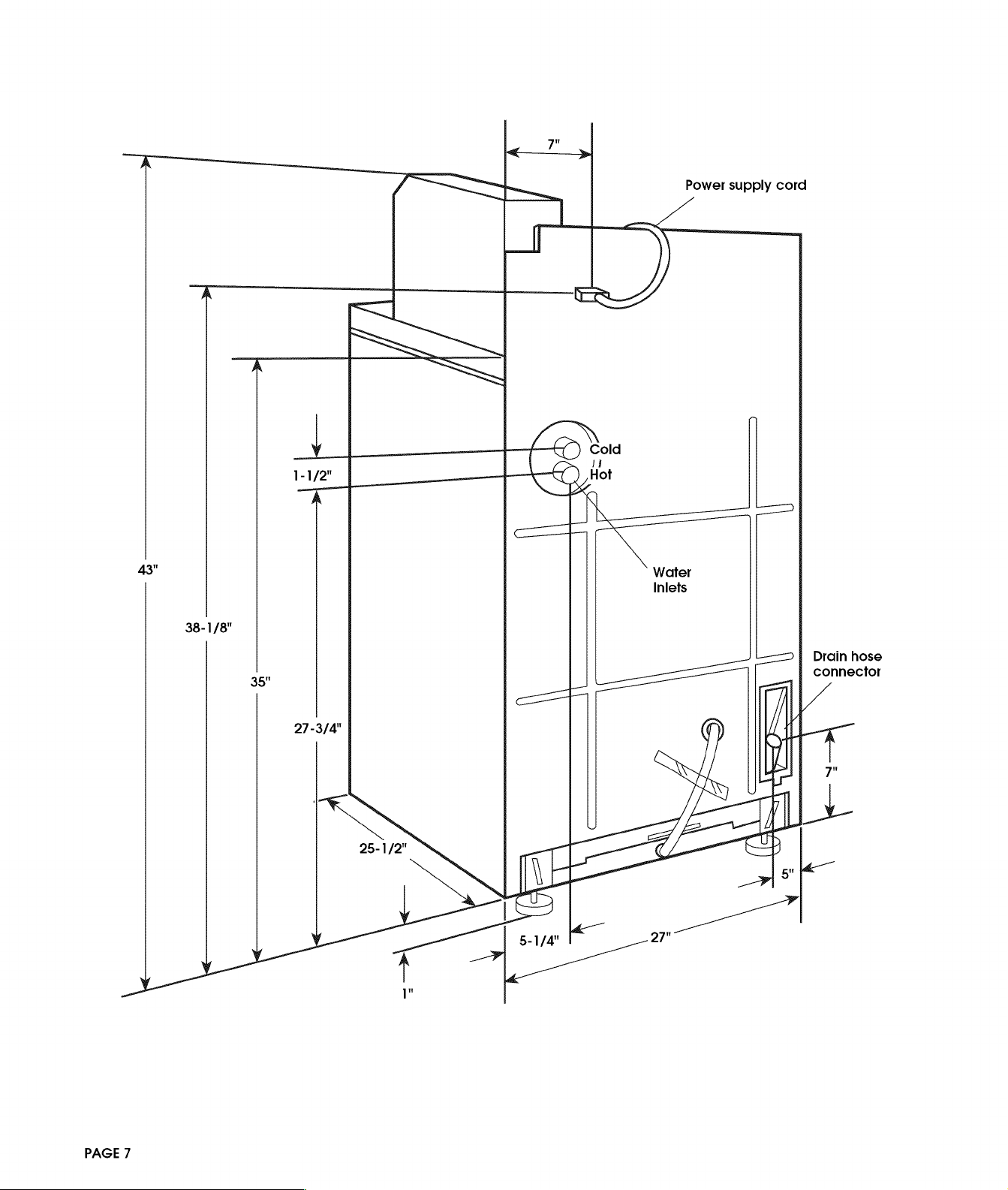
7"
se
—
Power
supply
cord
19)
I
|
A
AN
|
Led
%ou
i
1-1/2"
yet
“Xx
XS
cy
——
cE
nee
43"
Water
Inlets
38-1/8"
L_——>
|
Drain
hose
Pe
connector
35"
—s
27-3/4"
/
an
7"
a
PAGE
7

ol
CORPORATION
Part
No.
3360618
©1999
Whirlbool
Corporation
Prepared
by
Whirloool
Corporation,
Benton
Harbor,
Michigan
49022
Printed
in
U.S.A.