OPERATOR'S MANUAL
L I
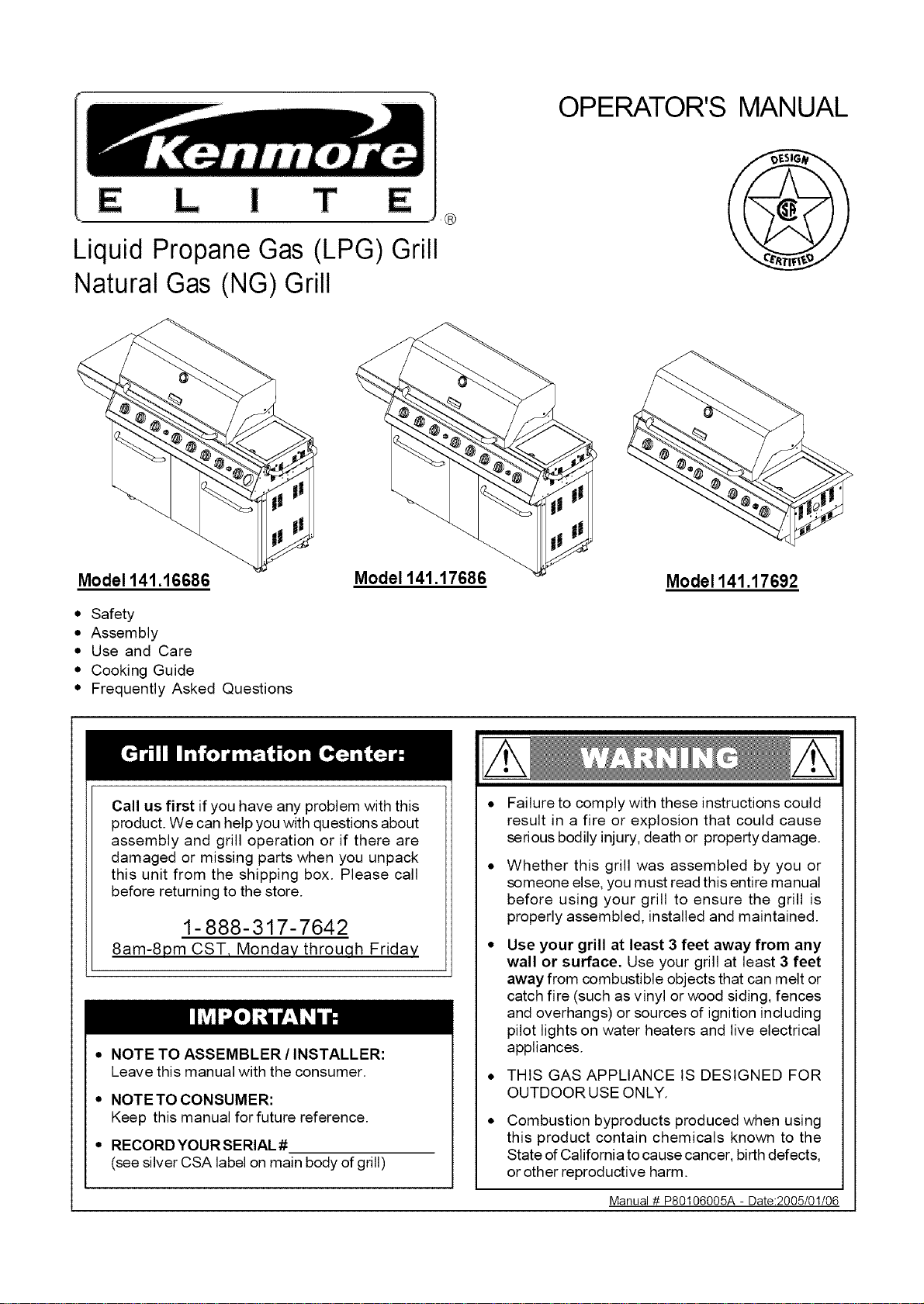
Liquid Propane Gas (LPG) Grill
Natural Gas (NG) Grill
®
Model 141.16686
• Safety
• Assembly
• Use and Care
• Cooking Guide
• Frequently Asked Questions
Model 141.17686
Model 141.17692
Call us first if you have any problem with this
product. We can help you with questions about
assembly and grill operation or if there are
damaged or missing parts when you unpack
this unit from the shipping box. Please call
before returning to the store.
1-888-317-7642
8am-8pm CST, Monday throuqh Friday
• NOTE TO ASSEMBLER / INSTALLER:
Leave this manual with the consumer.
• NOTETO CONSUMER:
Keep this manual for future reference.
• RECORD YOURSERIAL #
(see silver CSA labelon main body of grill)
Failure to comply with these instructions could
result in a fire or explosion that could cause
serious bodily injury, death or propertydamage.
Whether this grill was assembled by you or
someone else, you must read this entire manual
before using your grill to ensure the grill is
properly assembled, installed and maintained.
Use your grill at least 3 feet away from any
wall or surface. Use your grill at least 3 feet
away from combustible objects that can melt or
catch fire (such as vinyl or wood siding, fences
and overhangs) or sources of ignition including
pilot lights on water heaters and live electrical
appliances.
THIS GAS APPLIANCE IS DESIGNED FOR
OUTDOOR USE ONLY.
Combustion byproducts produced when using
this product contain chemicals known to the
State of California to cause cancer, birth defects,
or other reproductive harm.
Manual # P80106005A - Date:2005/01/06
Primary Safety Warnings ........................... 1-3
Warranty Terms and Conditions .................. 2
Pre-Assembly Instructions .............................. 3
Part Diagrams and Lists .......................... 4-9
Assembly Instructions .............................. 10-14
LP Gas Tank Installation ...................... 15-17
Natural Gas Connection .............................. 18
Use & Care Instructions:
• Lighting Instructions ................................. 19
• Troubleshooting .......................................... 20
Cleaning and Maintenance ..................... 21-22
Cooking Guide ........................................ A1-A6
Frequently Asked Questions ................. A7-A8
IF YOU SMELL GAS:
1. Shut off gas to the appliance.
2 Extinguish any open flame.
3. Open lid.
4. If odor continues, keep away from
the appliance and immediately call
your gas supplier or your fire
department.
Lifetime Limited Warranty on Kenmore Elite
Grill Stainless Steel Parts
For the lifetime of this grill, if any of its stainless
steel parts, except for cooking grids and Savor
Plates TM, is defective in material or workmanship,
Sears will repair or replace the part, at our option,
free of charge.
This warranty does not include discoloration of
stainless steel parts due to normal use or
excessive heat, nor does it include scratches or
dents caused by normal use, accident, or improper
maintenance.
Two-Year Full Warranty on Kenmore Elite Grill
For two years from the date of purchase, if this grill
is defective in material or workmanship, Sears will
repair it free of charge.
tf repair proves impossible, Sears will, at your option,
either replace this grill with a new one, or refund the
full purchase price.
This warranty excludes ignitor batteries and grill paint
loss or rusting, which are either expendable parts
that can wear out from normal use in less than a
year, or are conditions that can be the result of
normal use, accident or improper maintenance.
Limited 3 Year Warranty on Selected Grill Parts
From 2 years after the date of purchase for a
3-year period, Sears will replace Cooking Grids,
Savor Plates TM and All Other Parts (except for
Ignitor battery) if they are defective in material and
workmanship. You will be charged for labor.
Warranty Service
Warranty service is available by contacting
Sears at 1-800-4-MY-HOME ®
Warranty Restrictions
• This warranty is void if grill is used for
commercial or rental purposes.
• This grill is safety certified for use only in
the country where purchased. Modification for
use in any other location is a safety hazard
and will void the warranty.
• This warranty gives you specific legal rights,
and you may also have other rights which
vary from state to state.
Sears, Roebuck and Co., Dept. 817WA,
Hoffman Estates, IL 60179 U.S.A.
© Sears, Roebuck and Co.
1. Do not store spare LP cylinder
within 10 feet (3m) of this appliance.
2. Do not store or use gasoline or
other flammable liquids and
vapors within 25 feet (8m) of this
appliance.
3.When cooking with oil/grease, do
not allow the oil/grease to get
hotter than 350°F (117°C).
4. Do not leave oil/grease unattended.
LPG grill models must be used with Liquid
Propane Gas and the regulator assembly
supplied. Natural Gas models must be used
with Natural Gas only. Any attempt to convert
the grill from one fuel type to another is
extremely hazardous and will void the
warranty.
Never use your gas grill in a garage, porch, shed,
breezeway or any other enclosed area.
Never obstruct the flow of ventilation air around
your gas grill housing.
Keep gas regulator hose away from hot grill
surfaces and dripping grease. Avoid unneces-
sary twisting of hose. Visually inspect hose
prior to each use for cuts, cracks, excessive
wear or other damage. If the hose appears
damaged do not use the gas grill. Call Sears
a ®
t 1-800-4-MY-HOME (1-800-469-4663) for a
Kenmore replacement hose.
Grill Installation Codes
The installation must conform with local codes or, in the
absence of local codes, with either the National Fuel Gas
Code, ANSI Z223.1/NFPA 54, or CAN/CGA-B149.1, Natural
Gas and Propane installation Code.
Failure to comply with these instructions may
result in a hazardous situation which, if not
avoided, may result in injury,
Spiders and small insects can spin webs and
nest in the grill ing transit and
warehousing flow
obstruction round the
Burner T_ FIRE"
can cau_ ate an
unsafe €
To .'K
FIRE bes
as follc grill.
Also do _ummer
and fall or in your
area, and if used for an
extended perio¢
1. Remove the screw from the rear of each Burner
using a Phillips Head Screwdriver.
2. Carefully lift each Burner up and away from the
Gas Valve Orifice.
3. Check and clean Burner/Venturi Tubes for insects
and insect nests. A clogged tube can lead to a fire
beneath the grill.
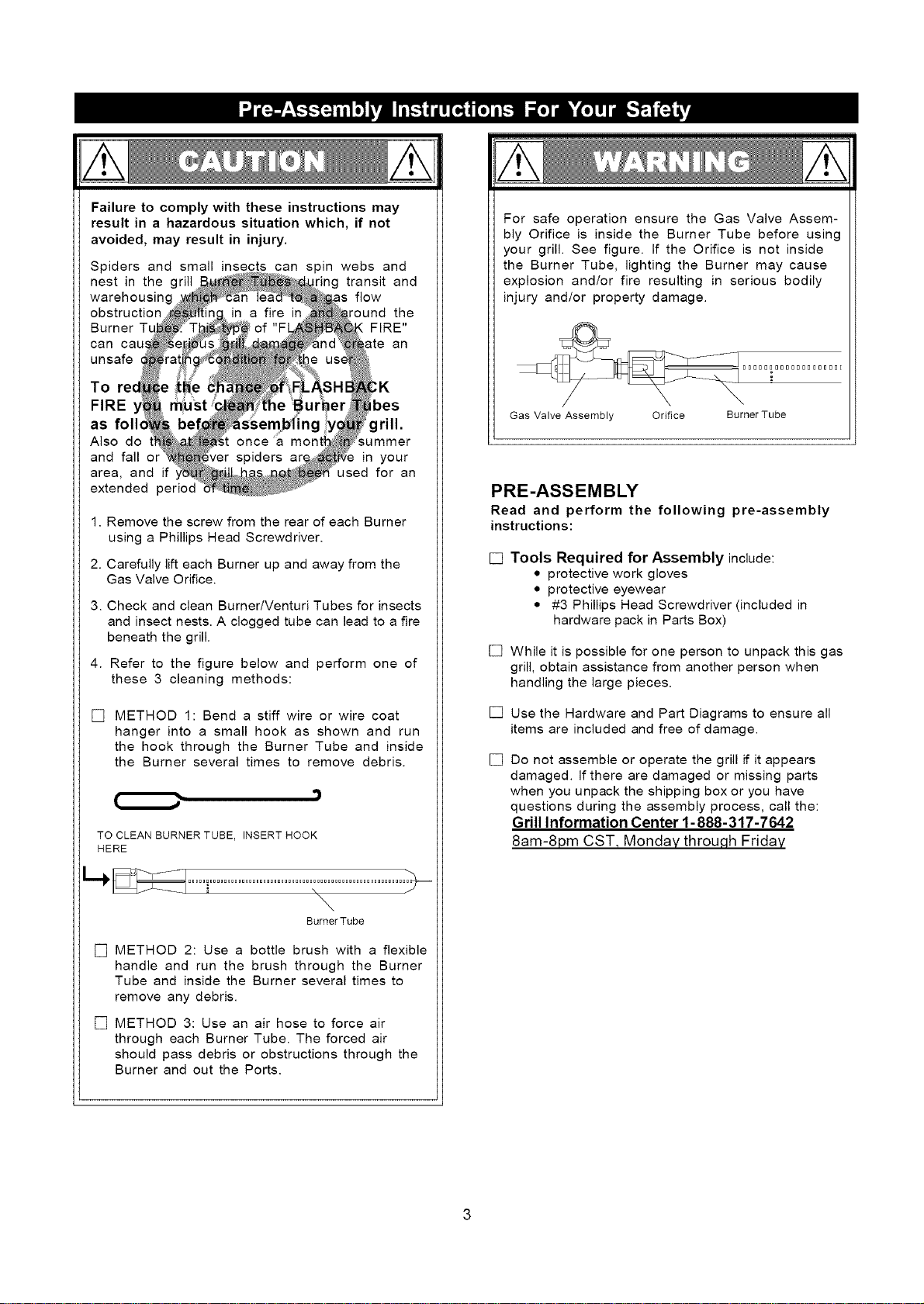
4. Refer to the figure below and perform one of
these 3 cleaning methods:
[] METHOD 1: Bend a stiff wire or wire coat
hanger into a small hook as shown and run
the hook through the Burner Tube and inside
the Burner several times to remove debris.
TO CLEAN BURNER TUBE, INSERT HOOK
HERE
\
BurnerTube
[] METHOD 2: Use a bottle brush with a flexible
handle and run the brush through the Burner
Tube and inside the Burner several times to
remove any debris.
[] METHOD 3: Use an air hose to force air
through each Burner Tube. The forced air
should pass debris or obstructions through the
Burner and out the Ports.
For safe operation ensure the Gas Valve Assem-
bly Orifice is inside the Burner Tube before using
your grill. See figure. If the Orifice is not inside
the Burner Tube, lighting the Burner may cause
explosion and/or fire resulting in serious bodily
injury and/or property damage.
Gas Valve Assembly Orifice Burner Tube
PRE-ASSEMBLY
Read and perform the following pre-assembly
instructions:
[] Tools Required for Assembly include:
• protective work gloves
• protective eyewear
• #3 Phillips Head Screwdriver (included in
hardware pack in Parts Box)
[]
[]
While it is possible for one person to unpack this gas
grill, obtain assistance from another person when
handling the large pieces.
Use the Hardware and Part Diagrams to ensure all
items are included and free of damage.
[]
Do not assemble or operate the grill if it appears
damaged. If there are damaged or missing parts
when you unpack the shipping box or you have
questions during the assembly process, call the:
Grill Information Center 1-888-317-7642
8am-8pm CST, Monday throu,qh Friday
PART # DESCRIPTION
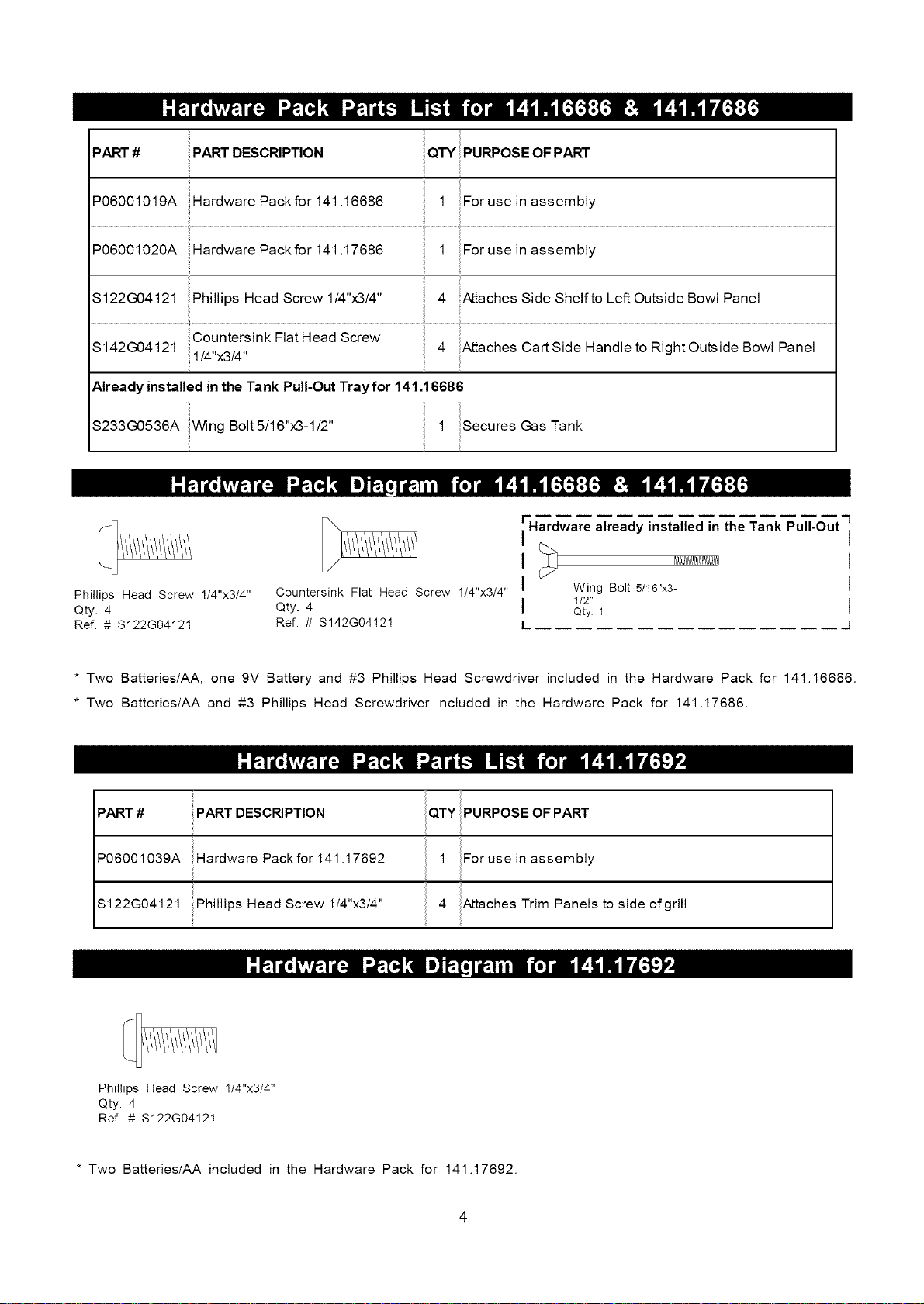
P06001019A Hardware Packfor141.16686 1 For use in assembly
P06001020A Hardware Packfor141.17686 1 For use in assembly
$122G04121 Phillips Head Screw 1/4"x3/4" 4 Attaches Side Shelf to Left Outside Bowl Panel
Counters nk F at Head Screw
$142G04121 .... 4 Attaches CartSide Handle to RightOutside Bowl Panel
11/4X,..1//4
Already installed in the Tank Pull-Out Tray for 141.16686
S233G0536A Wing Bolt5/16"x3-1/2" 1 Secures Gas Tank
Phillips Head Screw 1/4"x3/4"
Qty. 4
Ref. # $122G0412!
, Hardware already installed m the Tank Pull-Out q,
Countersink Flat Head Screw 1/4"x3/4" W ng Bot 5/16"x3- I
Qty. 4 I 1/2" I
Qty 1
Ref. # S142G04!2! L .J
* Two Batteries/AA, one 9V Battery and #3 Phillips Head Screwdriver included in the Hardware Pack for 141.16686.
* Two BatterieslAA and #3 Phillips Head Screwdriver included in the Hardware Pack for 141.17686.
PART # PART DESCRIPTION
PO6O01039A HardwarePackfor141.17692
$122G04121 Phillips Head Screw 1/4"x3/4"
1 Foruse in assembly
4 Attaches Trim Panels to side of grill
Phillips Head Screw 1/4"x3/4"
Qty. 4
Ref. # $122G04121
* Two Batteries/AA included in the Hardware Pack for 141.17692.
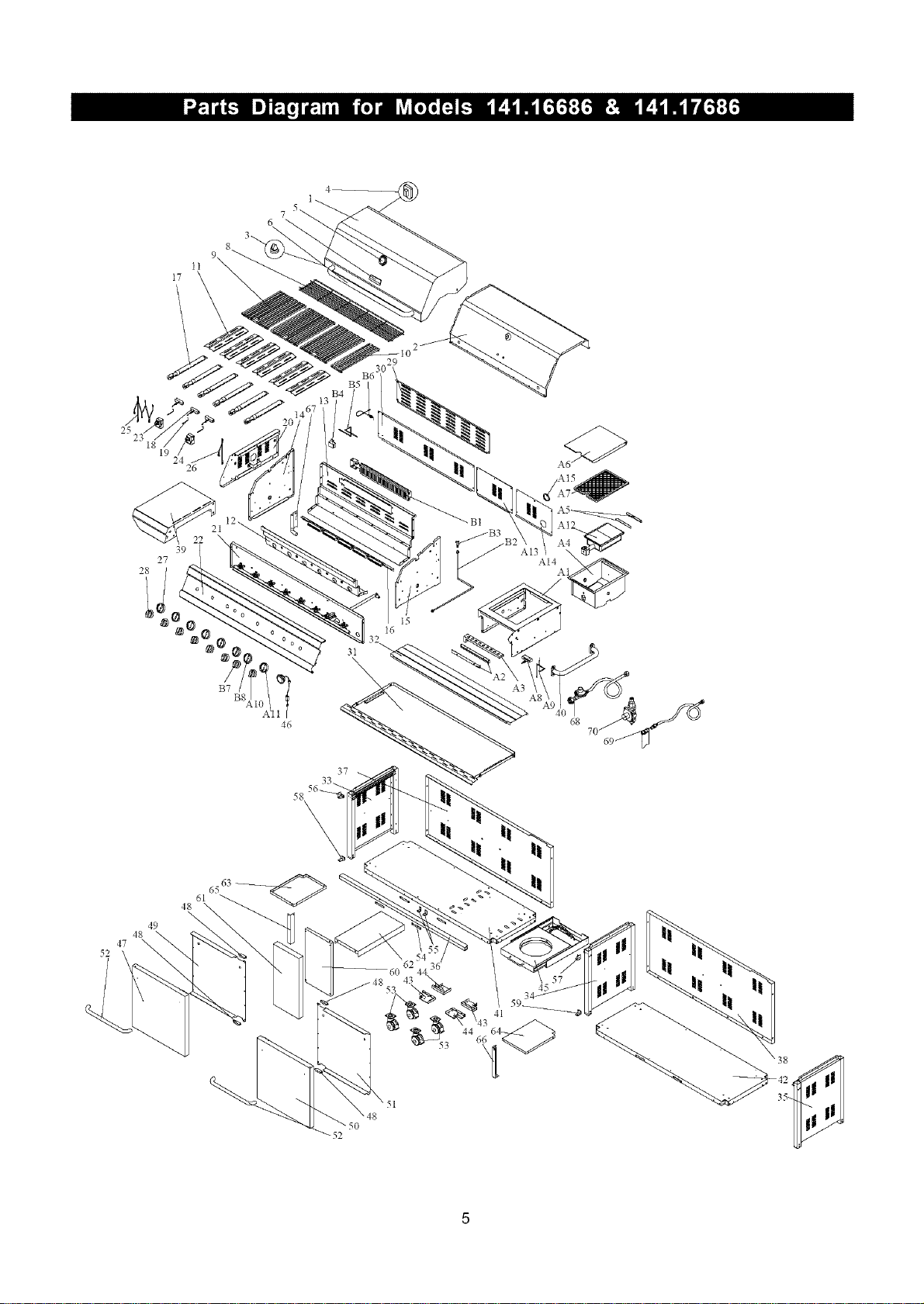
1i
17
25
18
19
24
26
16<>
28
39
27
A14
15
16
32
31
37
5_
49
48
47
61 6563
48
\
62
51
-52
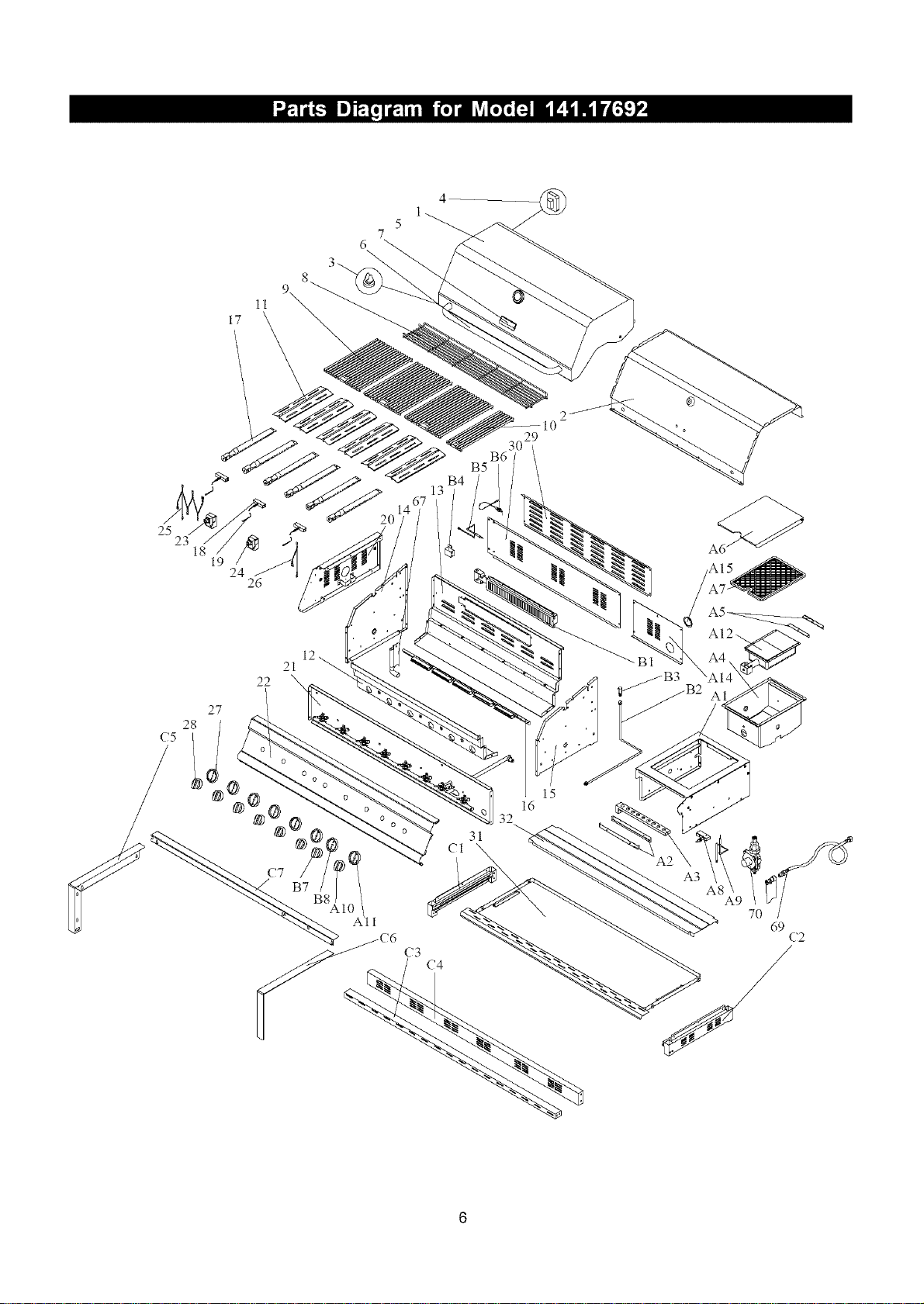
17
11 9\
5
7
6
25
23
18
19
24
26
13
20
3029
B6
B5
B4
(?5
27
28
21
22
12
AI
16
32
31
C1
C7
B7
15
70 /
69
C2
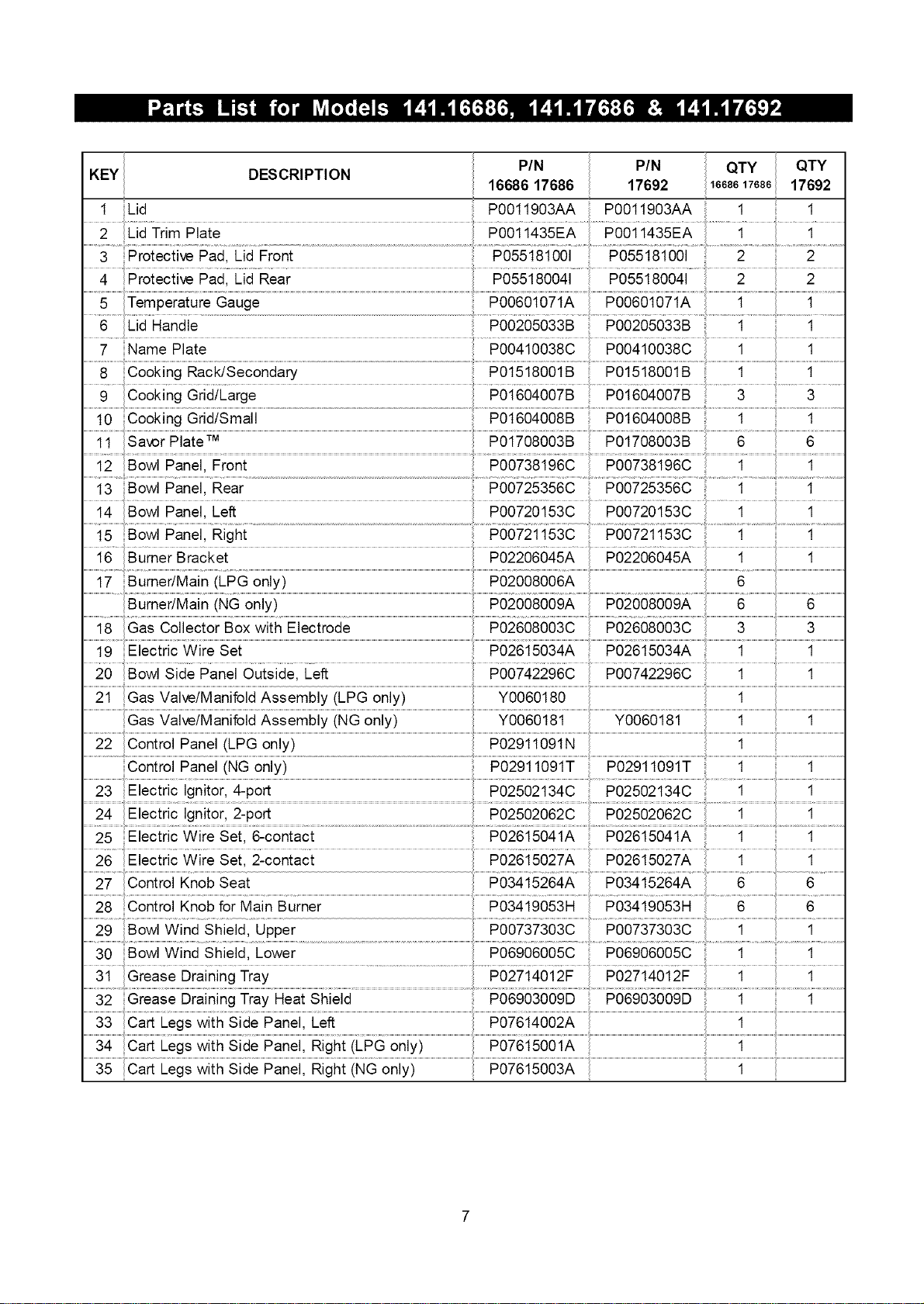
PIN QTY
DESCRIPTION
16686 17686 17692
1 Lid P0011903AA 1
8 Cooking Rack/Secondary
P01518001B
P/N i QTY iii
17692 ii1668617686i
P0011903AA i 1
P01518001B 1
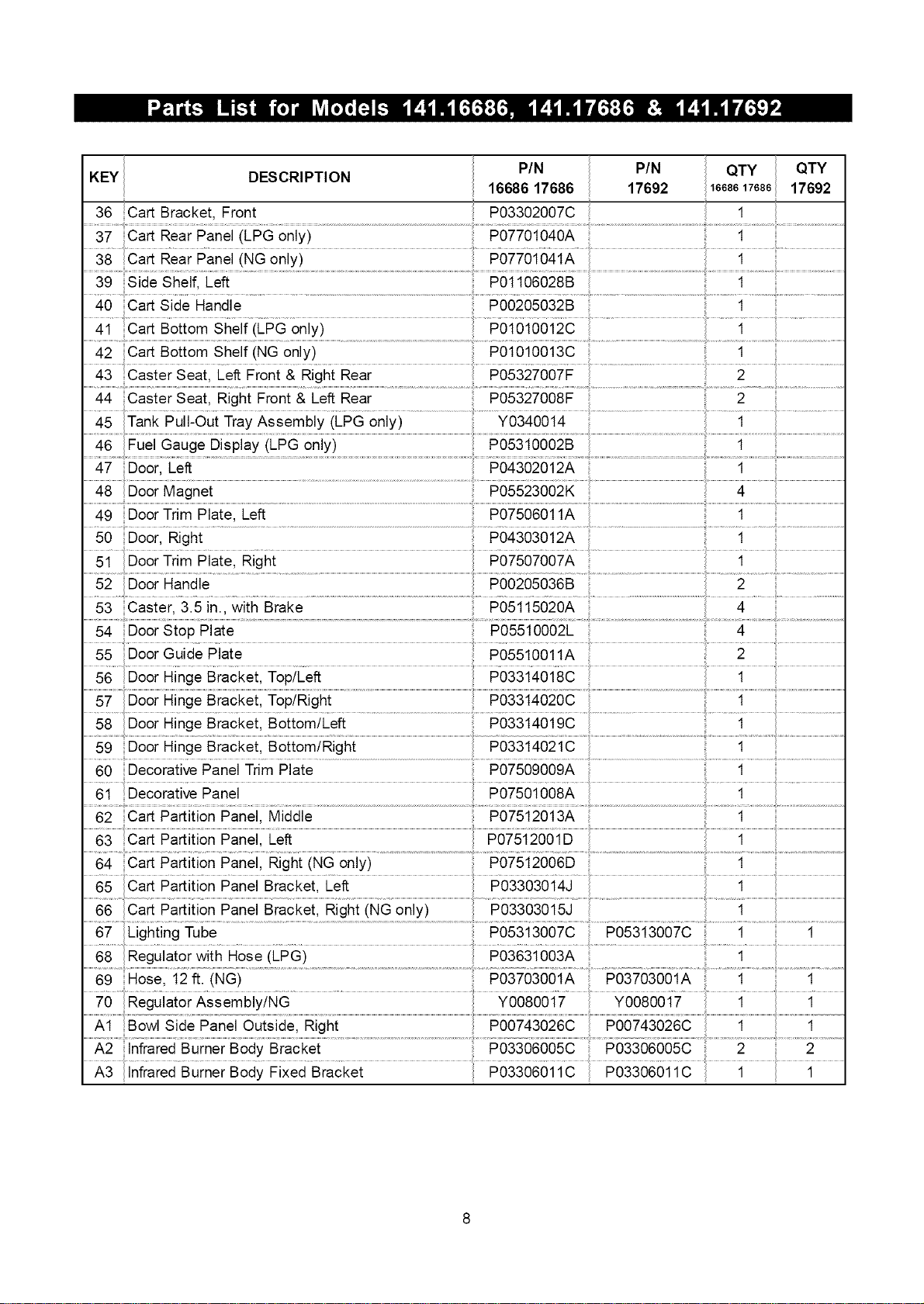
P/N P/N QTY QTY
DESCRIPTION 16686 17686 17692 16686 17686 17692
36 Cart Bracket, Front P03302007C 1
37 Cart Rear Panel (LPG only) P07701040A 1
....40 Cart...........................................................................................................................................................Side Handle 1
44 Caster Seat, Right Front & Left Rear
47 Door, Left
P01010013C
iiii
P05327008F
60 Decorative Panel Trim Plate
P07509009A
62 Cart Partition Panel, Middle P07512013A t
64 Cart Partition Panel, Right (NG only) P07512006D 1
69 Hose, 12 ft. (NG)
P03703001A P03703001A 1
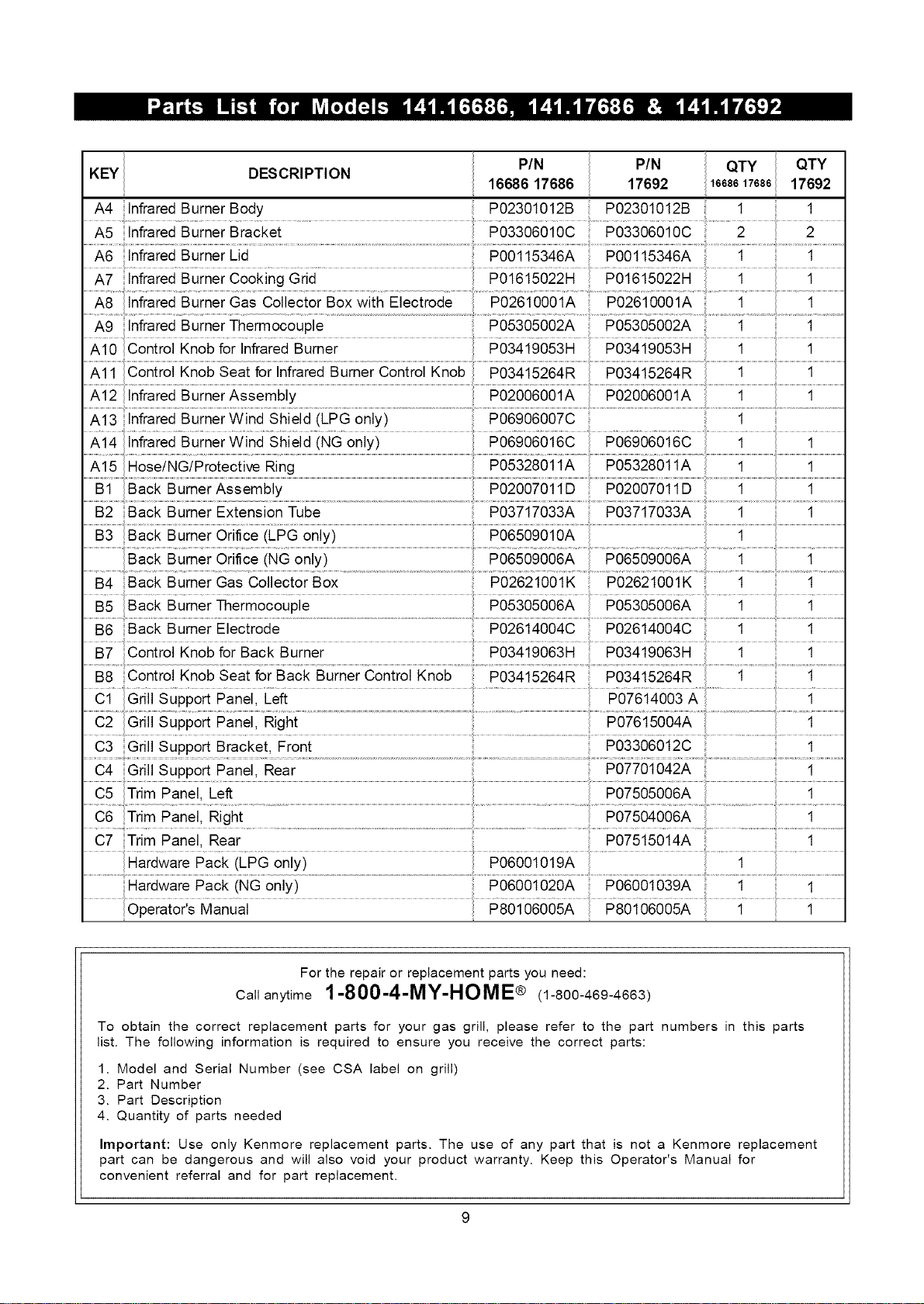
P/N P/N QTY QTY
DESCRIPTION 16686 17686 17692 16686 17686 17692
A4 Infrared Burner Body P02301012B P02301012B 1 1
A9 Infrared Burner Thermocouple
At3 Infrared Burner Wind Shield (LPG only)
B2 Back Burner Extension Tube
B4 Back Burner Gas Collector Box
B6 Back Burner Electrode
P05305002A
P06906007C
P03717033A
P02621001K
P02614004C
P05305002A
P03717033A
P02621001K
P02614004C
1 1
1
1 1
1 1
1 1
B7iilconiioiKnob_i BackBuinei iil¸ P034i9663H¸¸¸iii¸ P034i9663H¸¸¸i!¸ i¸ ii!¸ i¸¸
C3 Grill Support Bracket, Front
...............................
C4 Grill Support Panel, Rear P07701042A 1
P06001020A P06001039A ii 1
Hardware Pack (NG only)
For the repair or replacement parts you need:
Call anytime 1-800-4-MY-HOME® (_-800-4ee-4ees)
To obtain the correct replacement parts for your gas grill, please refer to the part numbers in this parts
list. The following information is required to ensure you receive the correct parts:
1. Model and Serial Number (see CSA label on grill)
2. Part Number
3. Part Description
4. Quantity of parts needed
Important: Use only Kenmore replacement parts. The use of any part that is not a Kenmore replacement
part can be dangerous and will also void your product warranty. Keep this Operator's Manual for
convenient referral and for part replacement.
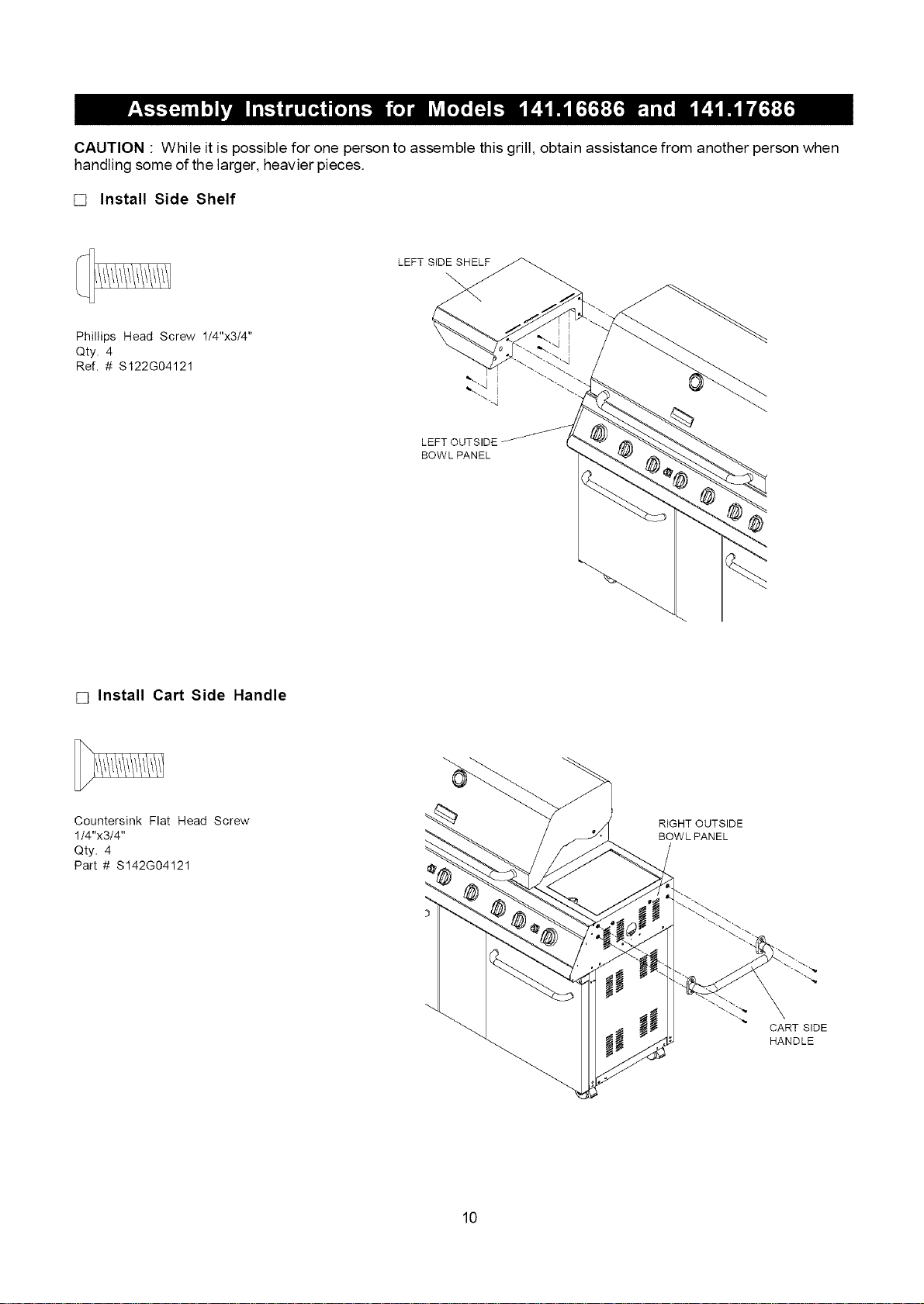
CAUTION " While it is possible for one person to assemble this grill, obtain assistance from another person when
handling some of the larger, heavier pieces.
[] Install Side Shelf
LEFT SiDE SHELF
Phillips Head Screw 1/4"x3/4"
Qty. 4
Ref. # $122G04121
LEFT OUTSIDE
BOWL PANEL
[] Install Cart Side Handle
Countersink Flat Head Screw RIGHTOUTSIDE
1/4"x3t4" BOWLPANEL
Qty. 4
Part # S142G04121
CART SIDE
HANDLE
10
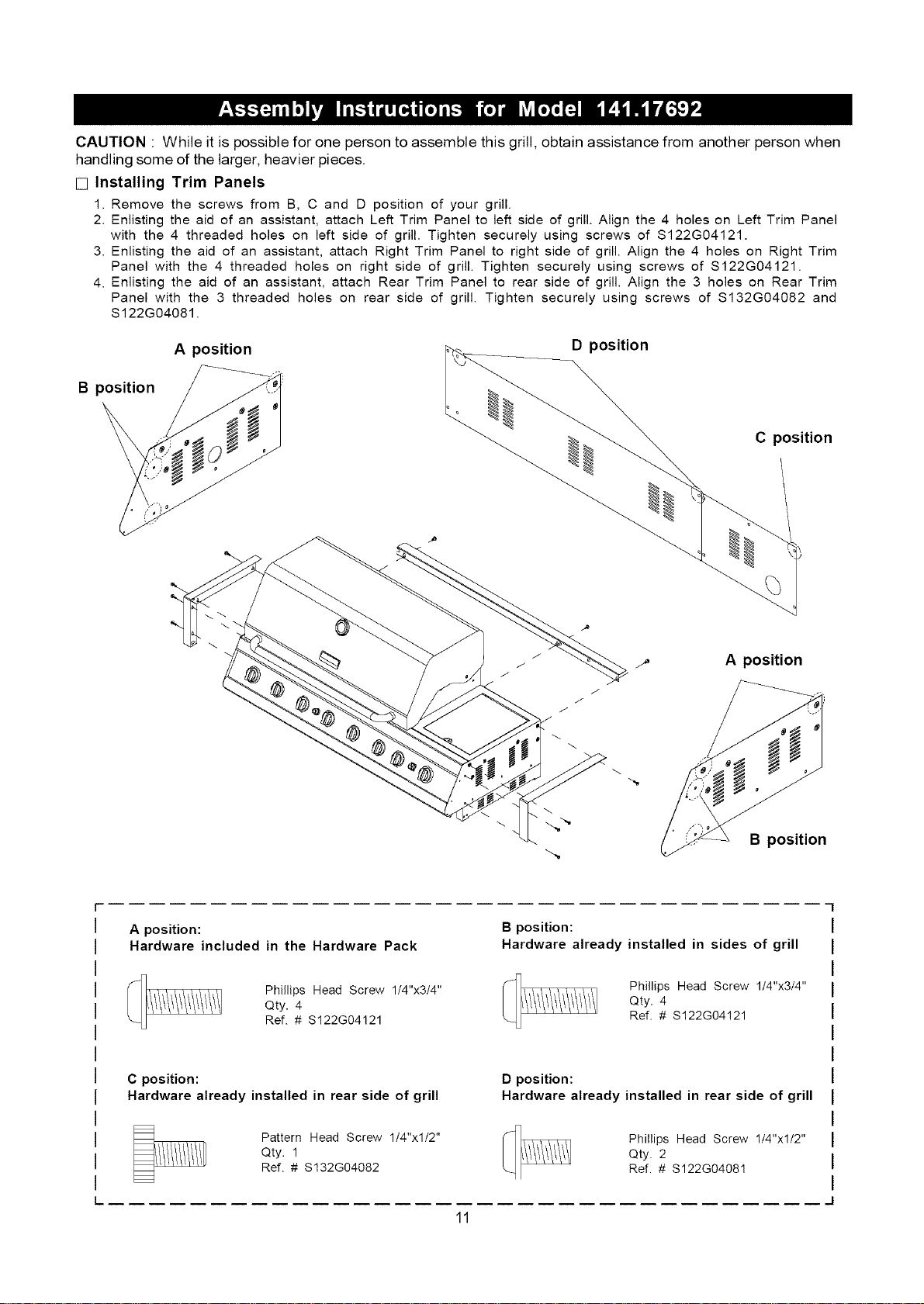
CAUTION : While it is possible for one person to assemble this grill, obtain assistance from another person when
handling some of the larger, heavier pieces.
[] Installing Trim Panels
1. Remove the screws from B, C and D position of your grill.
2. Enlisting the aid of an assistant, attach Left Trim Panel to left side of grill. Align the 4 holes on Left Trim Panel
with the 4 threaded holes on left side of grill. Tighten securely using screws of $122G04121.
3. Enlisting the aid of an assistant, attach Right Trim Panel to right side of grill. Align the 4 holes on Right Trim
Panel with the 4 threaded holes on right side of grill. Tighten securely using screws of $122G04121.
4. Enlisting the aid of an assistant, attach Rear Trim Panel to rear side of grill. Align the 3 holes on Rear Trim
Panel with the 3 threaded holes on rear side of grill. Tighten securely using screws of $132G04082 and
$122G04081.
A position
B position /
D position
C position
A position
B position
F"
A position:
Hardware included in the Hardware Pack
B position:
Hardware already installed in sides of grill
Phillips Head Screw 1/4"x3/4"
Qty. 4
Ref. # $122G04121
Phillips Head Screw 1/4"x3/4"
Qty. 4
Ref. # S122G04!21
C position:
Hardware already installed in rear side of grill
D position:
Hardware already installed in rear side of grill
Pattern Head Screw 1/4"xl/2"
Qty. 1
Ref. # $132G04082
Phillips Head Screw 1/4"xl/2"
Qty. 2
Ref. # $122G0408!
I_
11
PLEASE READ THESE INSTRUCTIONS BEFORE
CONSTRUCTING YOUR GRILL ENCLOSURE
CAUTION: When choosing a location for your gas
grill, keep in mind that it should not be located under
any overhead combustible construction. The side,
bottom and back of the grill should not be closer
than 36 inches to combustible construction.
These instructions wifl provide the measurements
necessary for you or your builder to construct a
masonry structure to house your outdoor gas grill. We
strongly recommend professional installation and
hook-up of a hard=plumbed Natural Gas line to
built-in models.
SPECIFICATION FOR BUILT-IN CONSTRUCTION
1. The masonry of your choice can be used to
construct the walls of your new built-in gas grill.
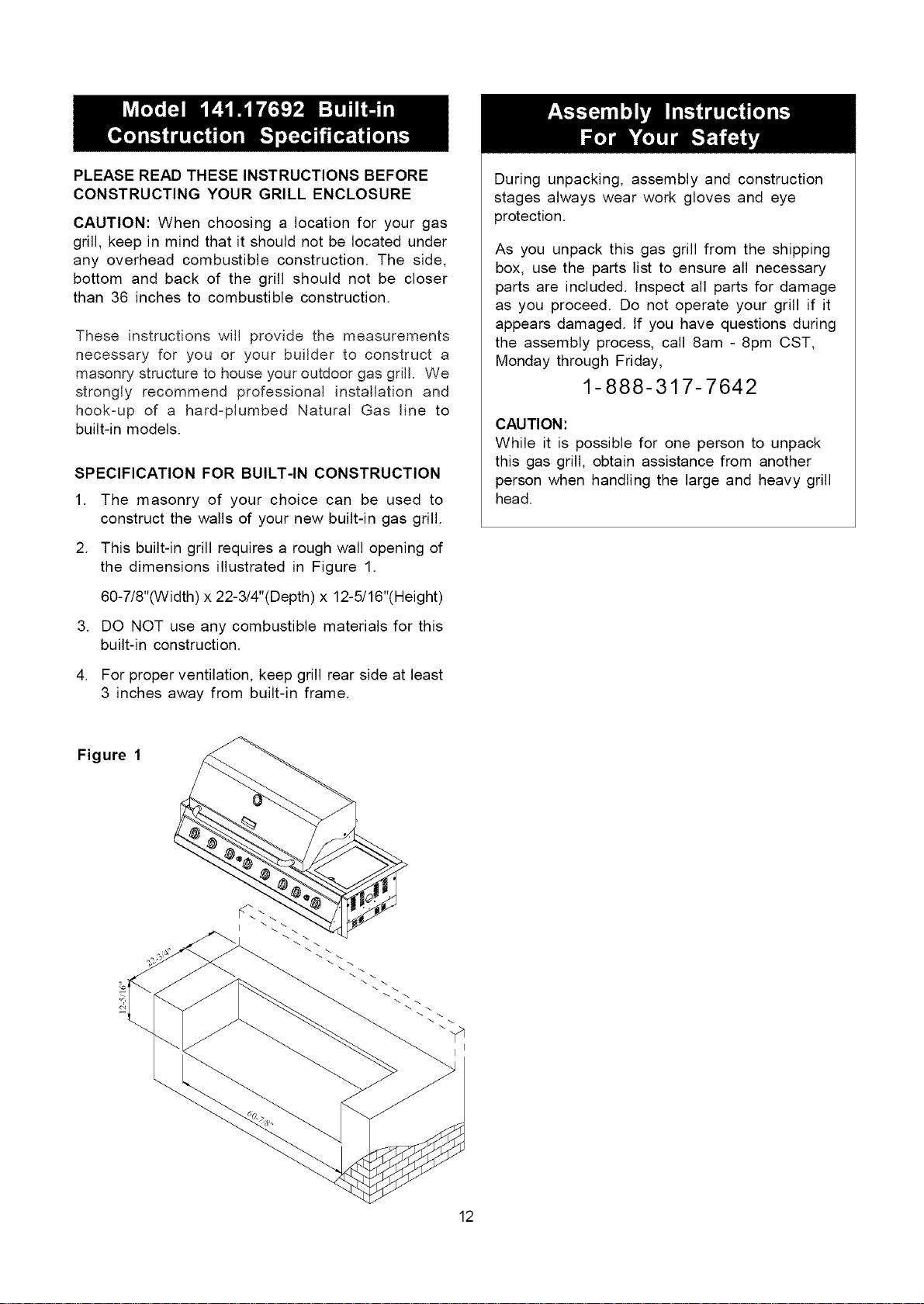
2. This built-in grill requires a rough wall opening of
the dimensions illustrated in Figure 1.
60-7/8"(Width) x 22-3/4"(Depth) x 12-5/16"(Height)
3. DO NOT use any combustible materials for this
built-in construction.
4. For proper ventilation, keep grill rear side at least
3 inches away from built-in frame.
During unpacking, assembly and construction
stages always wear work gloves and eye
protection.
As you unpack this gas grill from the shipping
box, use the parts list to ensure all necessary
parts are included. Inspect all parts for damage
as you proceed. Do not operate your grill if it
appears damaged, tf you have questions during
the assembly process, call 8am - 8pm CST,
Monday through Friday,
1-888-317-7642
CAUTION:
While it is possible for one person to unpack
this gas grill, obtain assistance from another
person when handling the large and heavy grill
head.
Figure 1
12
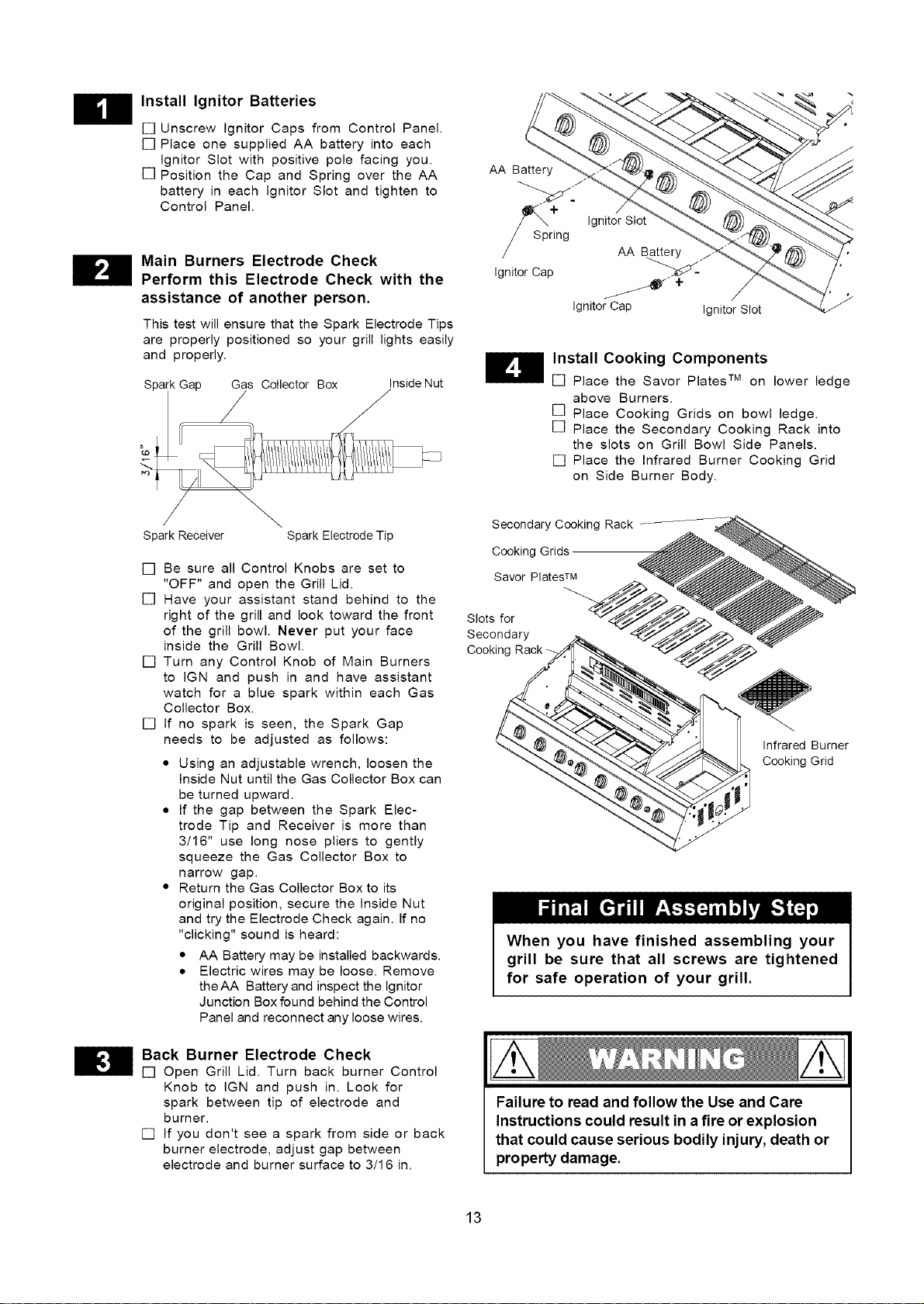
Install Ignitor Batteries
[] Unscrew Ignitor Caps from Control Panel.
[] Place one supplied AA battery into each
ignitor Slot with positive pole facing you.
[] Position the Cap and Spring over the AA
battery in each Ignitor Slot and tighten to
Control Panel.
Main Burners Electrode Check
Perform this Electrode Check with the
assistance of another person.
This test will ensure that the Spark Electrode Tips
are properly positioned so your grill lights easily
and properly.
AA Battery
ring
Ignitor Cap
ignitor Slot
AA Battery
Ignitor Cap Ignitor Slot
Install Cooking Components
[] Place the Savor Plates TM on lower ledge
above Burners.
[] Place Cooking Grids on bowl ledge.
[] Place the Secondary Cooking Rack into
the slots on Grill Bowl Side Panels.
[] Place the Infrared Burner Cooking Grid
on Side Burner Body.
Spark Receiver Spark Electrode Tip
[] Be sure all Control Knobs are set to
"OFF" and open the Grill Lid.
[] Have your assistant stand behind to the
right of the grill and look toward the front
of the grill bowl. Never put your face
inside the Grill Bowl.
[] Turn any Control Knob of Main Burners
to IGN and push in and have assistant
watch for a blue spark within each Gas
Collector Box.
[] If no spark is seen, the Spark Gap
needs to be adjusted as follows:
• Using an adjustable wrench, loosen the
Inside Nut until the Gas Collector Box can
be turned upward.
• If the gap between the Spark Elec-
trode Tip and Receiver is more than
3/16" use long nose pliers to gently
squeeze the Gas Collector Box to
narrow gap.
• Return the Gas Collector Box to its
original position, secure the Inside Nut
and try the Electrode Check again. If no
"clicking" sound is heard:
• AA Battery may be installed backwards.
• Electric wires may be loose. Remove
theAA Battery and inspect the Ignitor
Junction Box found behind the Control
Panel and reconnect any loose wires.
Back Burner Electrode Check
[] Open Grill Lid. Turn back burner Control
Knob to IGN and push in. Look for
spark between tip of electrode and
burner.
[] If you don't see a spark from side or back
burner electrode, adjust gap between
electrode and burner surface to 3/16 in.
Secondary Cooking Rack
Cooking Grids
Savor PlatesTM
Slots for
Secondary
Cooking
Infrared Burner
Cooking Grid
When you have finished assembling your
grill be sure that all screws are tightened
for safe operation of your grill.
and follow the Use and Care
Instructions could result in a fire or explosion
that could cause serious bodily injury, death or
property damage.
13
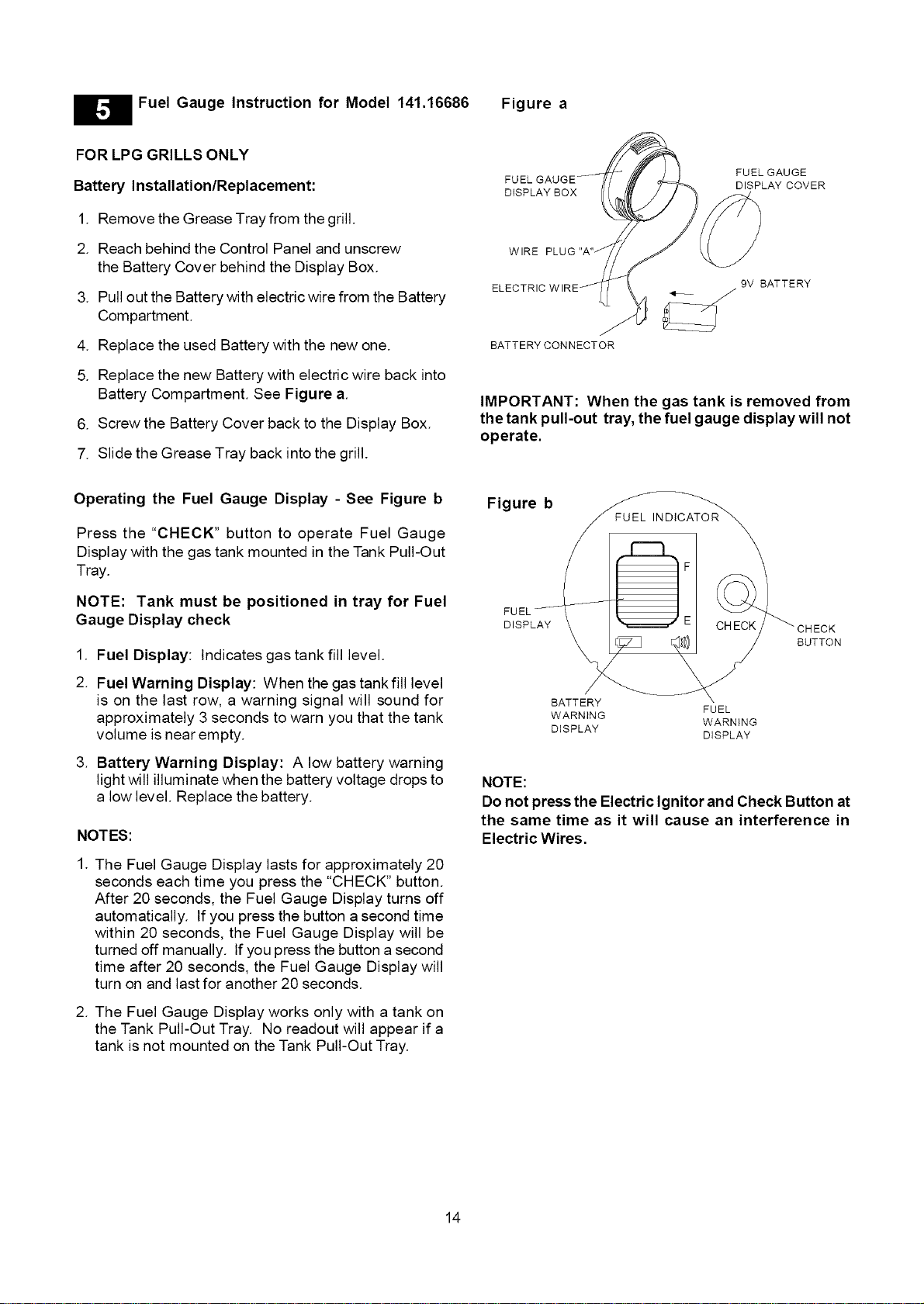
H Fuel Gauge Instruction for Model 141.16686
FOR LPG GRILLS ONLY
Battery Installation/Replacement:
1. Remove the Grease Tray from the grill.
2. Reach behind the Control Panel and unscrew
the Battery Cover behind the Display Box.
3. Pull out the Battery with electric wire from the Battery
Compartment.
4. Replace the used Battery with the new one.
5. Replace the new Battery with electric wire back into
Battery Compartment. See Figure a.
6. Screw the Battery Cover back to the Display Box.
7. Slide the Grease Tray back into the grill.
Figure a
DISPLAY BOX
FUEL GAUGE
DISPLAY COVER
WIRE
BATTERYCONNBCTOR
9V BATTERY
IMPORTANT: When the gas tank is removed from
the tank pull-out tray, the fuel gauge display will not
operate.
Operating the Fuel Gauge Display - See Figure b
Press the "CHECK" button to operate Fuel Gauge
Display with the gas tank mounted in the Tank Pull-Out
Tray.
NOTE: Tank must be positioned in tray for Fuel
Gauge Display check
1. Fuel Display: Indicates gas tank fill level.
2. Fuel Warning Display: When the gas tankfill level
is on the last row, a warning signal will sound for
approximately 3 seconds to warn you that the tank
volume is near empty.
3. Battery Warning Display: A low battery warning
light will illuminate when the battery voltage drops to
a low level. Replace the battery.
NOTES:
1. The Fuel Gauge Display lasts for approximately 20
seconds each time you press the "CHECK" button.
After 20 seconds, the Fuel Gauge Display turns off
automatically. If you press the button a second time
within 20 seconds, the Fuel Gauge Display will be
turned off manually. If you press the button asecond
time after 20 seconds, the Fuel Gauge Display will
turn on and last for another 20 seconds.
2. The Fuel Gauge Display works only with a tank on
the Tank Pull-Out Tray. No readout will appear if a
tank is not mounted on the Tank Pull-Out Tray.
Figure b
DISPLAY
BUTTON
BATTERY
FUEL
WARNING
WARNING
DISPLAY
DISPLAY
NOTE:
Do not press the Electric Ignitor and Check Button at
the same time as it will cause an interference in
Electric Wires.
14
CORRECT LP GAS TANK USE
[] LP Gas grill models are designed for use with a
standard 20 lb. Liquid Propane Gas (LP Gas) tank,
not included with grill. Never connect your gas grill to
an LP Gas tank that exceeds this capacity. A tank of
approximately 12 inches in diameter by 18-1/2 inches
high is the maximum size LP Gas tank to use. You
must use an "OPD" gas tank which offers a listed
Overfill Prevention Device. This safety feature
prevents tank from being overfilled which can cause
malfunction of LP Gas tank, regulator and/or grill.
[] The LP Gas tank must be constructed and marked
in accordance with the Specifications for LP-Gas
Cylinders of the U.S. Department of Transportation
(D.O.T.) or the National Standard of Canada, CAN/
CSA-B339, Cylinders, Spheres and Tubes for
Transportation of Dangerous Goods; and
Commission, as applicable.
[] The LP Gas tank must have a shutoff valve, termi-
nating in an LP Gas supply tank valve outlet, that is
compatible with a Type 1 tank connection device.
The LP Gas tank must also have a safety relief
device that has a direct connection with the vapor
space of the tank.
[] The tank supply system must be arranged for vapor
withdrawal.
[] The LP Gas tank used must have a collar
to protect the tank valve.
[] Never connect an unregulated LP gas tank to your
gas grill. The gas regulator assembly supplied with
your gas grill is adjusted to have an outlet pressure
of 11" water column (W.C.) for connection to an LP
gas tank. Only use the regulator and hose assembly
supplied with your gas grill. Replacement regulators
and hose assemblies must be those specified by
Kenmore.
[] Have your LP Gas dealer check the release valve
after every filling to ensure it remains free of defects.
[] Always keep LP Gas tank in upright position.
[] Do not subject the LP Gas tank to excessive heat.
[] Never store an LP Gas tank indoors. If you store
your gas grill in the garage always disconnect the
LP Gas tank first and store it safely outside.
[] LP Gas tanks must be stored outdoors in a well-
ventilated area and out of the reach of children.
[] Disconnected LP Gas tanks must not be stored in a
building, garage or any other enclosed area.
[] The regulator and hose assembly can be seen after
opening the doors (if applicable) and must be
inspected before each use of the grill. If there is
excessive abrasion or wear or if the hose is cut, it
must be replaced prior to using the grill again.
[] Never light your gas grill with the lid closed or
before checking to ensure the burner tubes are fully
seated over the gas valve orifices.
[] Never allow children to operate your grill. Do not
allow children or pets to play near your grill.
[] Use of alcohol or drugs may impair the ability to
assemble and operate the appliance.
[] Keep fire extinguisher readily accessible. In the
event of a oil/grease fire, do not attempt to extin-
guish with water. Use type B extinguisher or
smother with dirt, sand or baking soda.
[] In the event of rain, cover the grill and turn off the
burner and gas supply.
[] Use your grill on a level, stable surface in an area
clear of combustible materials.
[] Do not leave grill unattended when in use.
[] Do not move the appliance when in use.
[] Allow the grill to cool before moving or storing.
[] Do not use your grill as a heater.
[] This grill is not intended to be installed in or on
recreational vehicles and/or boats.
A. Do not store a spare LP-Gas tank under or near
this appliance.
B. Never fill the tank beyond 80 percent full; and
C. If the information in "(a)" and "(b)" is not followed
exactly, a fire causing death or serious injury may
occur.
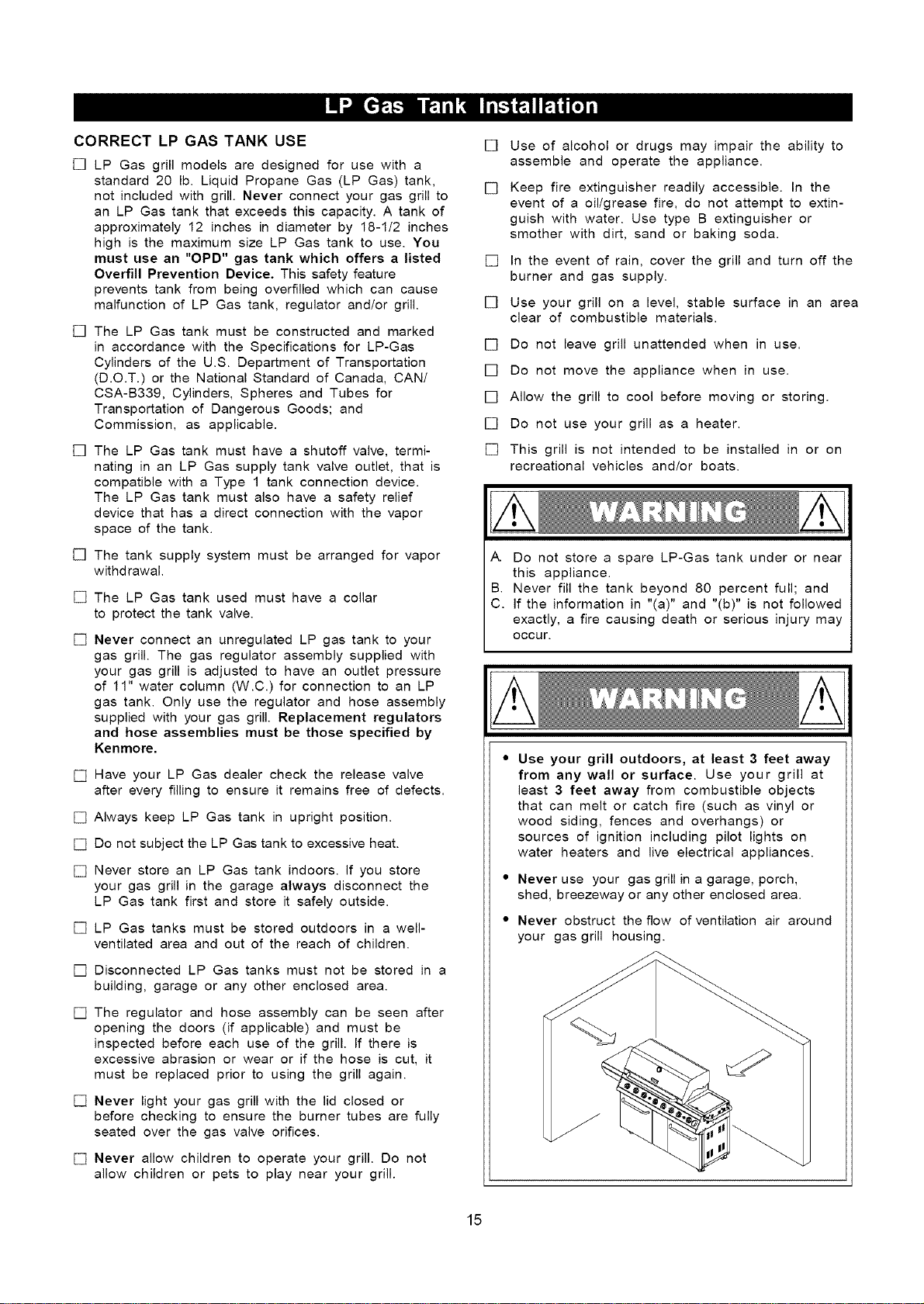
Use your grill outdoors, at least 3 feet away
from any wall or surface. Use your grill at
least 3 feet away from combustible objects
that can melt or catch fire (such as vinyl or
wood siding, fences and overhangs) or
sources of ignition including pilot lights on
water heaters and live electrical appliances.
Never use your gas grill in a garage, porch,
shed, breezeway or any other enclosed area.
Never obstruct the flow of ventilation air around
your gas grill housing.
15
NOTE about LP Gas Tank Exchange Programs
• Many retailers that sell grills offer you the option of
replacing your empty LP Gas tank through an exchange
service. Use only those reputable exchange compa-
nies that inspect, precision fill, test and certify their
tanks. Exchange your tank only for an OPD safety
feature-equipped tank as described in the LP Gas tank
section of this manual.
• Always keep new and exchanged LP Gas tanks in an
upright position during use, transit or storage.
• Leak test new and exchanged LP Gas tanks BEFORE
connecting one to your grill.
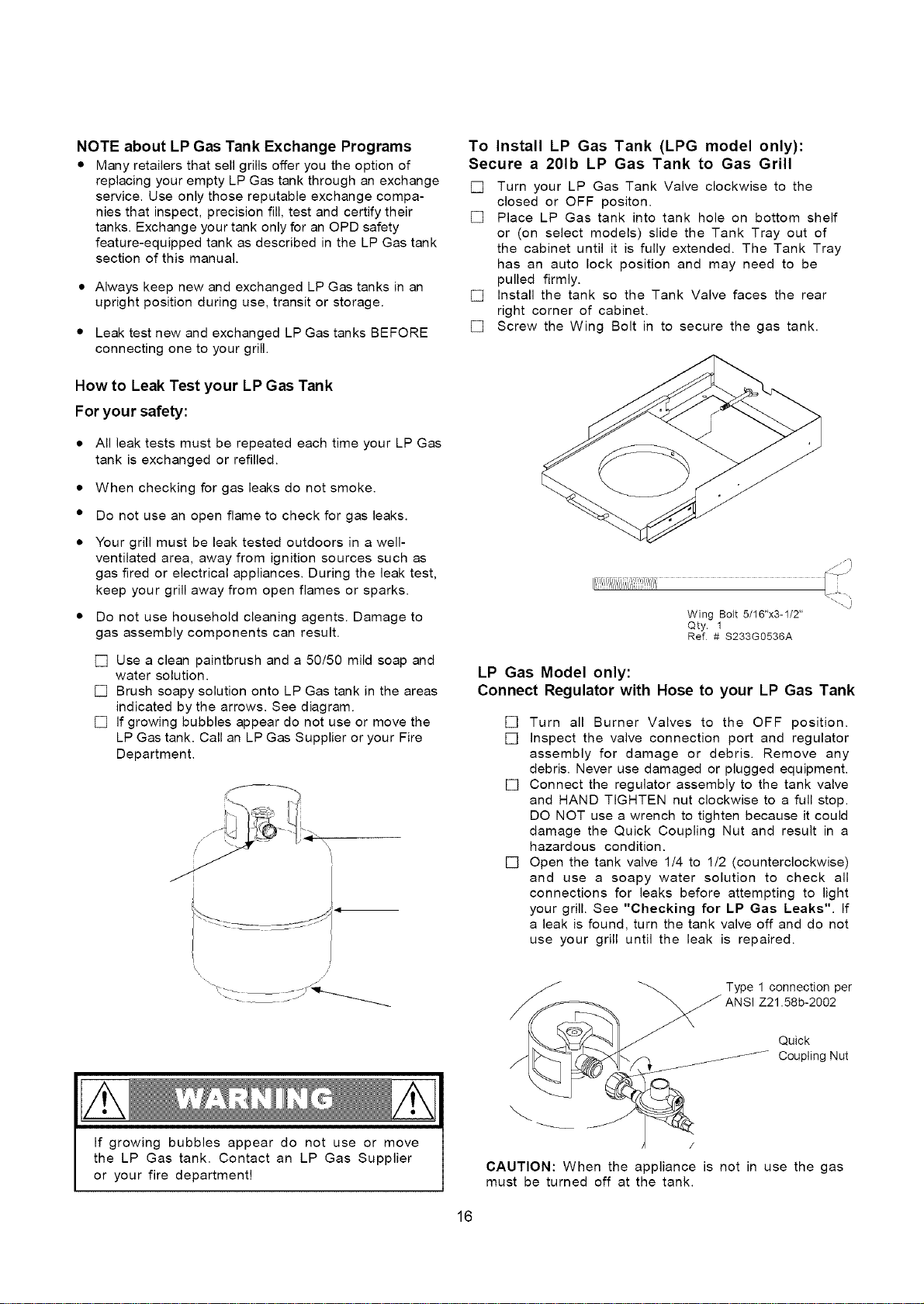
To Install LP Gas Tank (LPG model only):
Secure a 201b LP Gas Tank to Gas Grill
[] Turn your LP Gas Tank Valve clockwise to the
closed or OFF positon.
[] Place LP Gas tank into tank hole on bottom shelf
or (on select models) slide the Tank Tray out of
the cabinet until it is fully extended. The Tank Tray
has an auto lock position and may need to be
pulled firmly.
[] Install the tank so the Tank Valve faces the rear
right corner of cabinet.
[] Screw the Wing Bolt in to secure the gas tank.
How to Leak Test your LP Gas Tank
For your safety:
All leak tests must be repeated each time your LP Gas
tank is exchanged or refilled.
When checking for gas leaks do not smoke.
Do not use an open flame to check for gas leaks.
Your grill must be leak tested outdoors in a well-
ventilated area, away from ignition sources such as
gas fired or electrical appliances. During the leak test,
keep your grill away from open flames or sparks.
Do not use household cleaning agents. Damage to
gas assembly components can result.
[] Use a clean paintbrush and a 50/50 mild soap and
water solution.
[] Brush soapy solution onto LP Gas tank in the areas
indicated by the arrows. See diagram.
[] If growing bubbles appear do not use or move the
LP Gas tank. Call an LP Gas Supplier or your Fire
Department.
t
\
If growing bubbles appear do not use or move
the LP Gas tank. Contact an LP Gas Supplier
or your fire department!
Wing Bolt 5/16"x3-1/2"
Qty. 1
Ref # S233G0536A
LP Gas Model only:
Connect Regulator with Hose to your LP Gas Tank
[] Turn all Burner Valves to the OFF position.
[] inspect the valve connection port and regulator
assembly for damage or debris. Remove any
debris. Never use damaged or plugged equipment.
[] Connect the regulator assembly to the tank valve
and HAND TIGHTEN nut clockwise to a full stop.
DO NOT use a wrench to tighten because it could
damage the Quick Coupling Nut and result in a
hazardous condition.
[] Open the tank valve 1/4 to 1/2 (counterclockwise)
and use a soapy water solution to check all
connections for leaks before attempting to light
your grill. See "Checking for LP Gas Leaks". If
a leak is found, turn the tank valve off and do not
use your grill until the leak is repaired.
Typ_ 12_n5ZbC_t;00Per
Quick
Coupling Nut
CAUTION: When the appliance is not in use the gas
must be turned off at the tank.
16
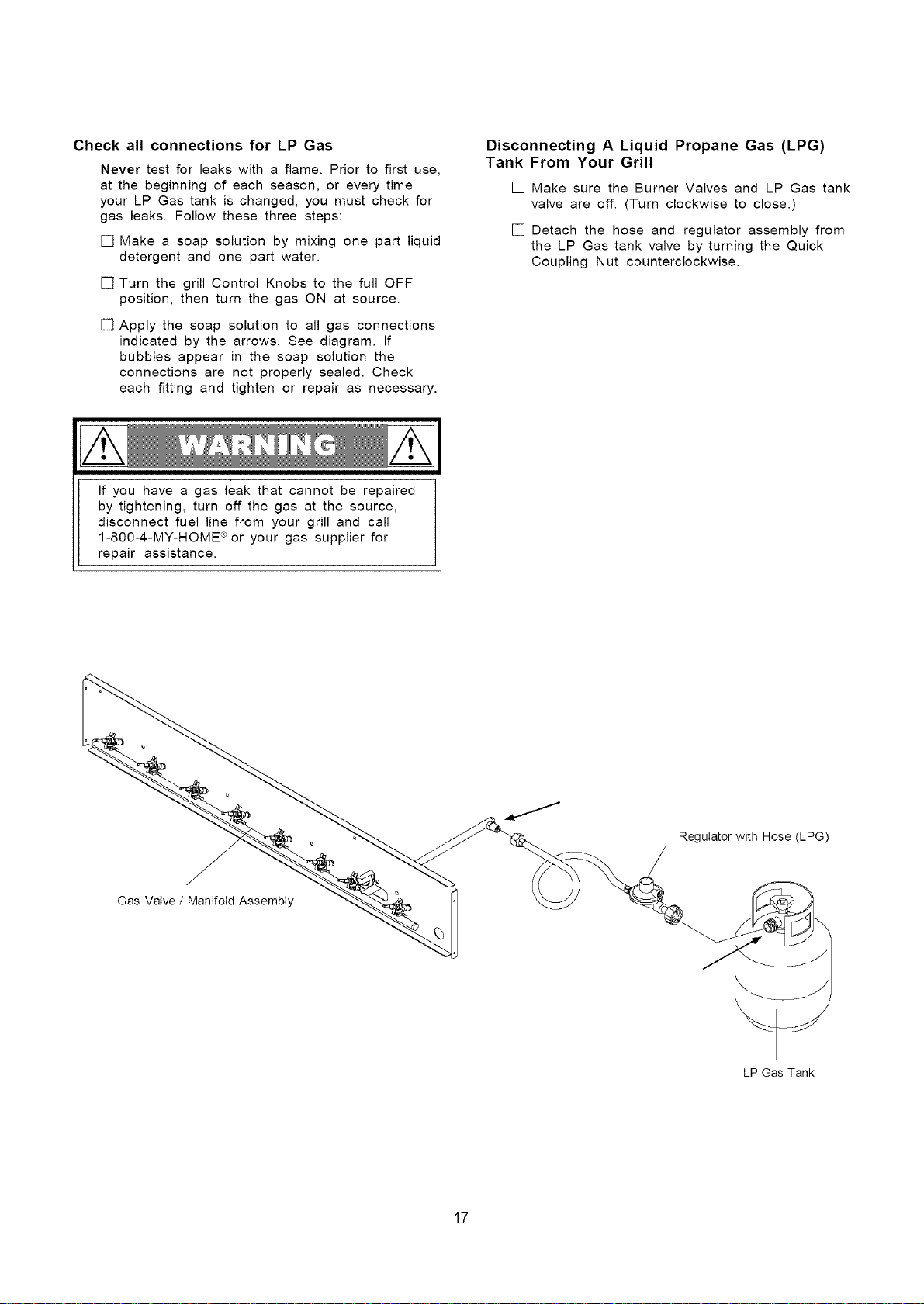
Check all connections for LP Gas
Never test for leaks with a flame. Prior to first use,
at the beginning of each season, or every time
your LP Gas tank is changed, you must check for
gas leaks. Follow these three steps:
[] Make a soap solution by mixing one part liquid
detergent and one part water.
[] Turn the grill Control Knobs to the full OFF
position, then turn the gas ON at source.
[] Apply the soap solution to all gas connections
indicated by the arrows. See diagram. If
bubbles appear in the soap solution the
connections are not properly sealed. Check
each fitting and tighten or repair as necessary.
Disconnecting A Liquid Propane Gas (LPG)
Tank From Your Grill
[] Make sure the Burner Valves and LP Gas tank
valve are off. (Turn clockwise to close.)
[] Detach the hose and regulator assembly from
the LP Gas tank valve by turning the Quick
Coupling Nut counterclockwise.
If you have a gas leak that cannot be repaired
by tightening, turn off the gas at the source,
disconnect fuel line from your grill and call
1-800-4-MY-HOME <_or your gas supplier for
repair assistance.
Regulator with Hose (LPG)
Gas Valve / Manifold Assembly
LP Gas Tank
17
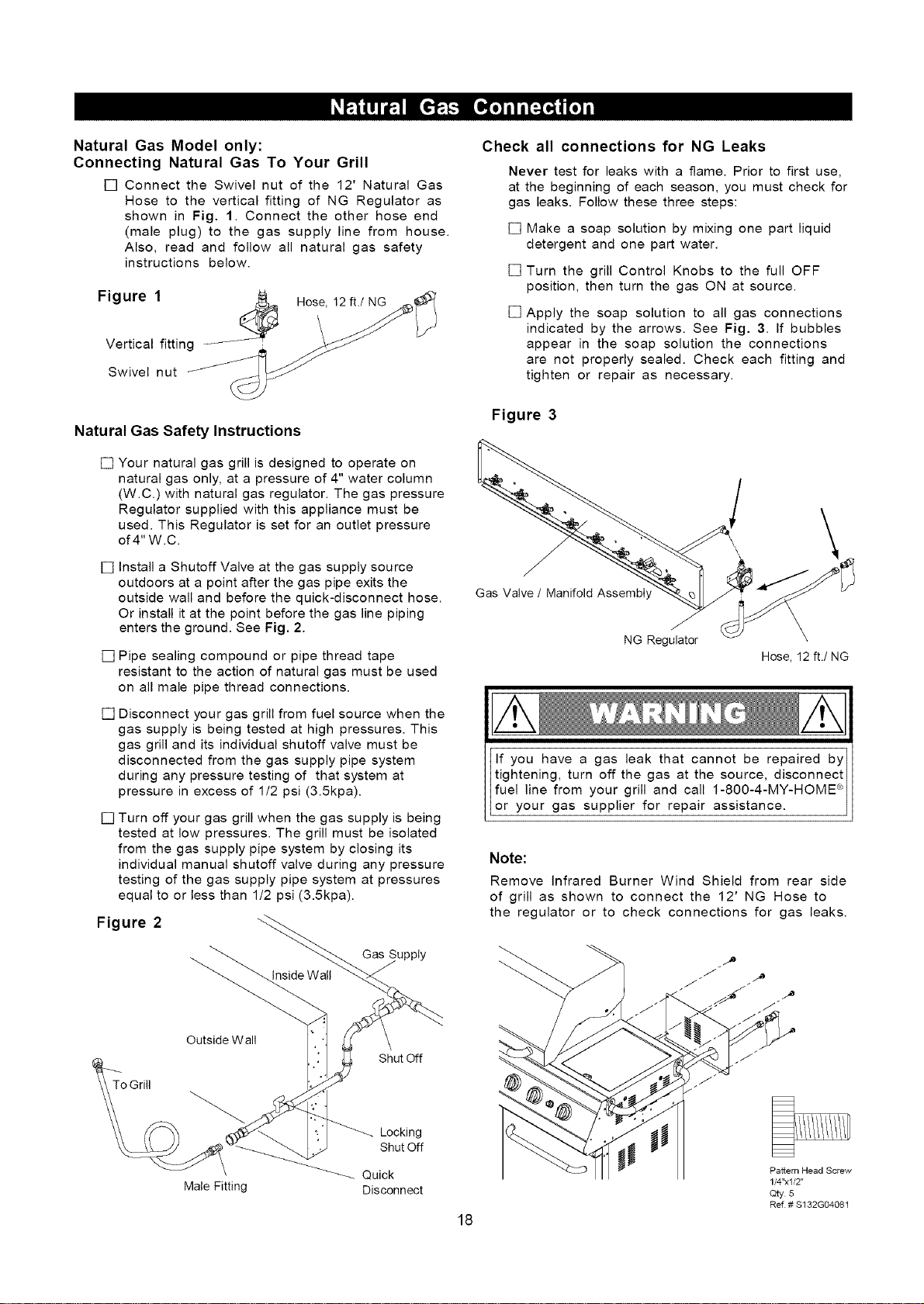
Natural Gas Model only:
Connecting Natural Gas To Your Grill
[] Connect the Swivel nut of the 12' Natural Gas
Hose to the vertical fitting of NG Regulator as
shown in Fig. 1. Connect the other hose end
(male plug) to the gas supply line from house.
Also, read and follow all natural gas safety
instructions below.
Figure 1 _ Hose,12ft./NG
v::t:Ce::ti
Natural Gas Safety Instructions
[]
[]
[]
[]
[]
Your natural gas grill is designed to operate on
natural gas only, at a pressure of 4" water column
(W.C.) with natural gas regulator. The gas pressure
Regulator supplied with this appliance must be
used. This Regulator is set for an outlet pressure
of 4" W.C.
Install a Shutoff Valve at the gas supply source
outdoors at a point after the gas pipe exits the
outside wall and before the quick-disconnect hose.
Or install it at the point before the gas line piping
enters the ground. See Fig. 2.
Pipe sealing compound or pipe thread tape
resistant to the action of natural gas must be used
on all male pipe thread connections.
Disconnect your gas grill from fuel source when the
gas supply is being tested at high pressures. This
gas grill and its individual shutoff valve must be
disconnected from the gas supply pipe system
during any pressure testing of that system at
pressure in excess of 1/2 psi (3.5kpa).
Turn off your gas grill when the gas supply is being
tested at low pressures. The grill must be isolated
from the gas supply pipe system by closing its
individual manual shutoff valve during any pressure
testing of the gas supply pipe system at pressures
equal to or less than 1/2 psi (3.5kpa).
Figure 2
Inside Wall
Outside Wall
To Grill
Gas Supply
Shut Off
Locking
Shut Off
Quick
Mate Fitting Disconnect
Check all connections for NG Leaks
Never test for leaks with a flame. Prior to first use,
at the beginning of each season, you must check for
gas leaks. Follow these three steps:
[] Make a soap solution by mixing one part liquid
detergent and one part water.
[] Turn the grill Control Knobs to the full OFF
position, then turn the gas ON at source.
[] Apply the soap solution to all gas connections
indicated by the arrows. See Fig. 3. If bubbles
appear in the soap solution the connections
are not properly sealed. Check each fitting and
tighten or repair as necessary.
Figure 3
Gas Valve / Manifold Assembly
\
NG Regulator
Hose, 12 ft./NG
If you have a gas leak that cannot be repaired by]
tightening, turn off the gas at the source, disconnect /
fuel line from your grill and call 1-80O-4-MY-HOME° /
or your gas supplier for repair assistance, j
Note:
Remove Infrared Burner Wind Shield from rear side
of grill as shown to connect the 12' NG Hose to
the regulator or to check connections for gas leaks.
18
Pattern Head Screw
1/4"xl/2"
Qty 5
Ref # $132G0408I
Grill Lighting Instructions
1. Before each use, check all hoses for cracks, nicks,
cuts, burns or abrasions. If a hose is damaged in any
way, do not use your grill before replacing the hose
with an authorized part from the Parts List. Also make
sure all gas supply connections are securely
tightened.
2. Familiarize yourself with the safety and Use and Care
instructions in this manual. Do not smoke while
lighting grill or checking gas supply connections.
3. Be sure the LP Gas tank is filled or the Natural Gas
Line is attached to the gas source.
4. Open the Grill Lid.
5. Check that the end of each Burner Tube is properly
located over each Valve Orifice.
Failure to replace a faulty hose, secure gas supply
connections or to open the Lid before proceeding
to the Lighting Procedures could result in a fire or
explosion that could cause serious bodily injury,
death, or property damage.
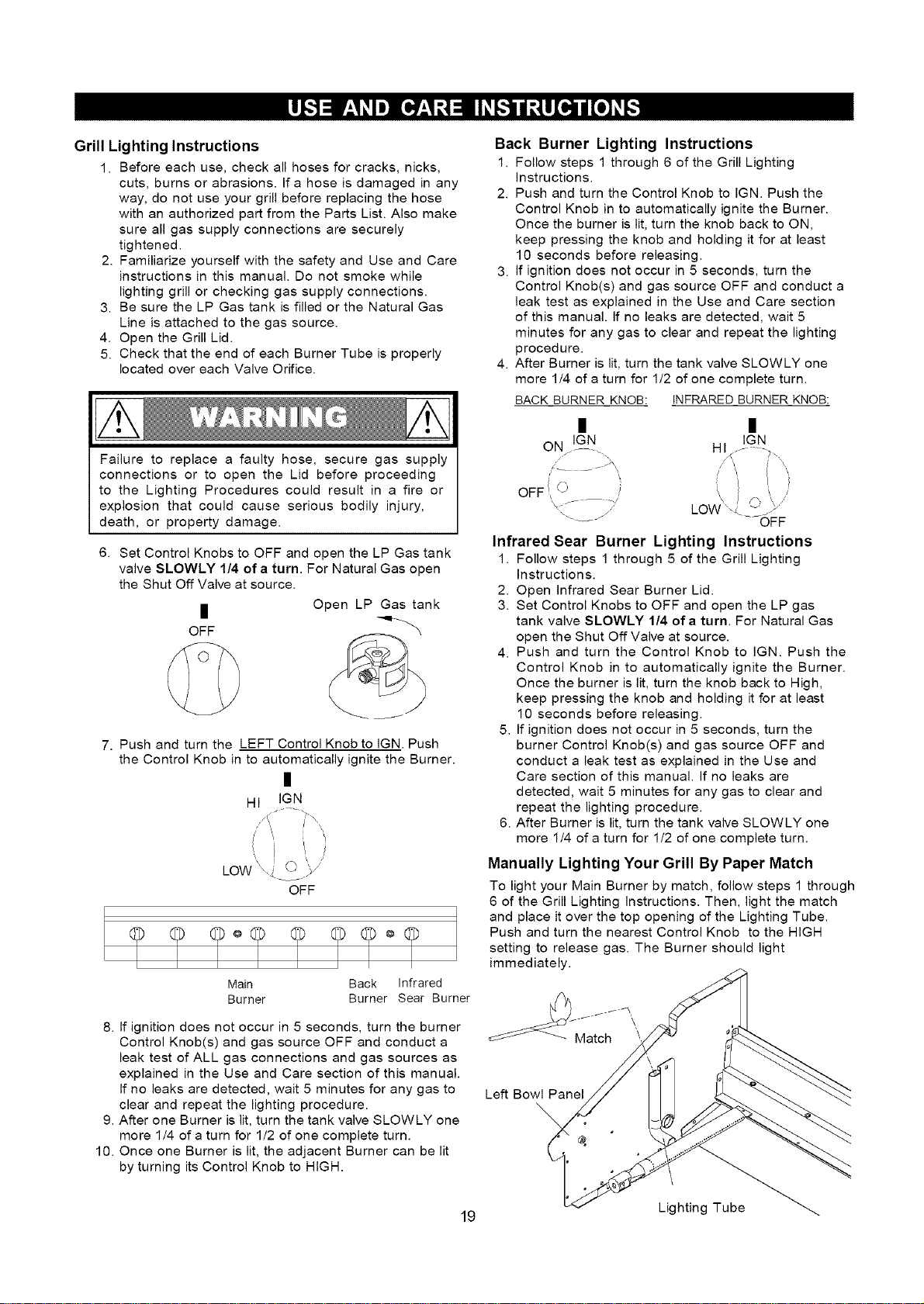
6. Set Control Knobs to OFF and open the LP Gas tank
valve SLOWLY 1/4 of a turn. For Natural Gas open
the Shut Off Valve at source.
| Open LP Gas tank
OFF
7. Push and turn the LEFT Control Knob to IGN. Push
the Control Knob in to automatically ignite the Burner.
|
HI IGN
OFF
Main Back Infrared
Burner Burner Sear Burner
8. If ignition does not occur in 5 seconds, turn the burner
Control Knob(s) and gas source OFF and conduct a
leak test of ALL gas connections and gas sources as
explained in the Use and Care section of this manual.
If no leaks are detected, wait 5 minutes for any gas to
clear and repeat the lighting procedure.
9. After one Burner is lit, turn the tank valve SLOWLY one
more 1/4 of a turn for 1/2 of one complete turn.
10. Once one Burner is lit, the adjacent Burner can be lit
by turning its Control Knob to HIGH.
Back Burner Lighting Instructions
1. Follow steps 1 through 6 of the Grill Lighting
instructions.
2. Push and turn the Control Knob to IGN. Push the
Control Knob in to automatically ignite the Burner.
Once the burner is lit, turn the knob back to ON,
keep pressing the knob and holding it for at least
10 seconds before releasing.
3. If ignition does not occur in 5 seconds, turn the
Control Knob(s) and gas source OFF and conduct a
leak test as explained in the Use and Care section
of this manual. If no leaks are detected, wait 5
minutes for any gas to clear and repeat the lighting
procedure.
4. After Burner is lit, turn the tank valve SLOWLY one
more 1/4 of a turn for 1/2 of one complete turn.
BACK BURNER KNOB: INFRARED BURNER KNOB:
|
IGN
OFF i O j
......... _' --OFF
Infrared Sear Burner Lighting Instructions
1. Follow steps 1 through 5 of the Grill Lighting
Instructions.
2. Open infrared Sear Burner Lid.
3. Set Control Knobs to OFF and open the LP gas
tank valve SLOWLY 1/4 of a turn. For Natural Gas
open the Shut Off Valve at source.
4. Push and turn the Control Knob to IGN. Push the
Control Knob in to automatically ignite the Burner.
Once the burner is lit, turn the knob back to High,
keep pressing the knob and holding it for at least
10 seconds before releasing.
5. If ignition does not occur in 5 seconds, turn the
burner Control Knob(s) and gas source OFF and
conduct a leak test as explained in the Use and
Care section of this manual. If no leaks are
detected, wait 5 minutes for any gas to clear and
repeat the lighting procedure.
6. After Burner is lit, turn the tank valve SLOWLY one
more 1/4 of a turn for 1/2 of one complete turn.
Manually Lighting Your Grill By Paper Match
To light your Main Burner by match, follow steps 1 through
6 of the Grill Lighting instructions. Then, light the match
and place it over the top opening of the Lighting Tube.
Push and turn the nearest Control Knob to the HIGH
setting to release gas. The Burner should light
immediately.
Left Bowl Panel
19 Lighting Tube
Troubleshooting
If the grill fails to light :
1. Turn gas off at source and turn Control Knobs to
OFF. Wait at least 5 minutes for gas to clear, then
retry.
2. if your grill still fails to light, check gas supply
and connections.
3. Repeat lighting procedure. If your grill still fails
to operate, turn the gas off at source, turn the
Control Knobs to OFF, then check the following:
[] Misalignment of Burner Tubes over Orifices
Correction: Reposition Burner Tubes over Orifices.
[]
[]
Obstruction in gas line
Correction: Remove fuel line from grill. Do not
smoke! Open gas supply for one second to clear
any obstruction from fuel line. Close off gas supply
at source and reconnect fuel line to grill.
Plugged Orifice
Correction: Remove Burners from grill by remov-
ing the screw from the rear of each Burner using a
Phillips Head Screwdriver. Carefully lift each
Burner up and away from gas valve Orifice.
Remove the Orifice from gas valve and gently clear
any obstruction with a fine wire. Then reinstall all
Orifices, Burners, Cotter Pins and cooking
com portents.
if an obstruction is suspected in Gas Valves or
Manifold, call the Grill Information Center.
[]
[]
Obstruction in Burner Tubes
Correction: Follow the Burner Tube cleaning
procedure on page 22 of this Operator's Manual.
Misalignment of Ignitor on Burner
Correction: Check for proper position of the
Electrode Tip as shown in step 2 page 13. The
gap between the Spark Electrode Tip and Spark
Receiver should be approximately 3/16". Adjust
if necessary. With the gas supply closed, turn any
Main Burner Control Knob to IGN then push in
and watch for the presence of a spark at the
Electrode.
[]
[]
Disconnected Electric Wires
Correction: inspect the Electric Ignitor (see Parts
List) found behind the Control Panel. Connect loose
Electric wires to Junction Box and try to light the grill.
Weak AA battery
Correction: Unscrew the Ignitor Cap and replace
the battery.
[]
If the grill still does not light you may need to
purge air from the gas line or reset the
regulator excess gas flow device. Note: This
procedure should be done every time a new
LP Gas tank is connected to your grill.
To purge air from your gas line and/or reset
the regulator excess gas flow device:
[] Turn Control Knobs to the OFF position.
[] Turn off the gas at the tank valve.
For Natural Gas shut off NG valve.
[] Disconnect regulator from LP Gas tank.
For Natural Gas disconnect regulator from 12 ft.
Natural Gas Hose.
[]
[]
Let unit stand 5 minutes to allow air to purge.
Reconnect regulator to the LP Gas tank.
For Natural Gas reconnect regulator to 12 ft.
Natural Gas Hose.
[] Turn tank valve on SLOWLY 1/4 of a turn.
For Natural Gas open Shut Off valve.
[] Open the Grill Lid.
[] Push and turn the LEFT Control Knob to IGN.
[] Push the Control Knob in to automatically ignite the
Burner.
Should a FLASHBACK fire occur in or around
the Burner Tubes, follow the instructions below.
Failure to comply with these instructions could
result in a fire or explosion that could cause
serious bodily injury, death, or property damage.
• Shut off gas supply to the gas grill.
• Turn the Control Knobs to OFF position.
• Open the Grill Lid.
• Put out any flame with a Class B fire
extinguisher.
• Once the grill has cooled down, clean
the Burner Tubes and Burners according
to the cleaning instructions in this
Operator's Manual.
Never lean over the grill cooking area while
lighting your gas grill. Keep your face and body
a safe distance (at least 18 inches) from the
Lighting Hole or Burners when lighting your grill
by match.
GRILL INFORMATION CENTER
Call 8am to 8pro CST 1-888-317-7642 Monday through Friday
20
Proper care and maintenance will keep your grill in top
operating condition and prolong its life. Follow these
cleaning procedures on a timely basis and your grill will
stay clean and operate with minimum effort.
CAUTION: Be sure your grill is OFF and cool before cleaning.
Cleaning The Cooking Grids
[] Before initial use, and periodically, wash your
Cooking Grids in a mild soap and warm water
solution. You can use a wash cloth or vegetable
brush to clean your Cooking Grids.
Cleaning The Savor Plates TM
[] Periodically you should wash the Savor Plates TM
in a soap and warm water solution. Use a
vegetable brush to remove stubborn burnt-on
cooking residue. Dry the Savor Plates TM thoroughly
before you reinstall them into the cooking bowl.
Cleaning The Grease Tray and Receptacle
[] To reduce the chance of fire, the Grease Draining
Tray and Grease Receptacle (some models)
should be visually inspected before each grill use.
Remove any grease and wash Grease Tray and
Receptacle with a mild soap and warm water
solution.
Cleaning the Inside of the Grill Lid
[] Grease can have a tendency to build up on the
inside of the Grill Lid and could drip onto deck or
patio when the lid is opened. Visually inspect the
inside of the Grill Lid before each grill use. Remove
any grease and wash with a mild soap and warm
water solution.
Annual Cleaning of The Grill Interior
[] Burning-off excess food after every cookout will
keep it ready for instant use. However,at least every
3 months you must give the entire grill a thorough
cleaning to minimize your risk of grease fire and
keep the grill in top shape. Follow these steps:
1. Turn all Burner Valves to the full OFF position.
2. Turn the LP gas tank valve to the full OFF position.
For Natural Gas shut off valve.
3.
Disconnect the regulator from the gas tank. Inspect
the hose with regulator assembly for cracking, cuts
or any other damage, and replace as neccessary.
Refer to the Parts List in this Operator's Manual.
4. Remove and clean the Savor Plates TM,Cooking
Grids, Cooking Rack and Grill Burners.
5. Cover each Gas Valve Orifice with aluminum foil.
6. Brush the inside and bottom of the grill with a fiber
pad or nylon brush and wash with a mild soap and
warm water solution. Rinse thoroughly and let dry.
7. Remove aluminum foil from Orifices and check
each Orifice for obstruction.
8. Check each Spark Electrode, adjusting as needed.
The space between the Spark Electrode Tip and
Spark Receiver should be approximately 3/16".
9. Replace the Burners and adjust the Gas
Collector Box. The edge of the collector box should
be overlapping the Burner Port.
21
10. Replace Savor Plates TMand Cooking Grids.
11. Reconnect the gas source and observe the
Burner flame for correct operation.
Cleaning Exterior Surfaces:
Before initial use, and periodically thereafter, we
suggest you wash your grill using a mild soap and
warm water solution. You can use a wash cloth or
sponge for this process. Do not use a stiff wire or
brass brush. These will scratch stainless steel and
chip painted surfaces (varies by model) during the
cleaning process.
Cleaning Exterior Stainless Steel Surfaces:
Weathering and extreme heat can cause exterior
stainless steel surfaces to turn tan in color. Machine
oils used in the manufacturing process of stainless
steel can also cause this tanning color. After remov-
ing any protective PVC film from the Grill Lid and
Control Panel use a Stainless Steel Cleaner to polish
the stainless steel surfaces of your grill. Never use
abrasive cleaners or scrubbers because they will
scratch and damage your grill. Follow these steps for
the best results.
1. Turn the LP Gas tank valve (clockwise) to the full
OFF position. Disconnect the regulator and hose
assembly from LP Gas tank. For Natural Gas shut
off valve and disconnect the NG regulator and hose
from valve. Cover exposed gas fitting with
aluminum foil.
2.
3.
Remove dirt or grease using a soft cloth and
polish stainless surfaces. Wipe with a soft cloth.
Remove aluminum foil from exposed gas fitting
and allow grill to air dry before attaching the
regulator and hose to your LP Gas tank, or
attaching the regulator and hose to Natural Gas
valve.
Failure to comply with these instructions may
result in a hazardous situation which, if not
avoided, may result in injury.
Keep grill area clear and free from combustible
materials, gasoline and other flammable vapors
and liquids.
Do not obstruct the flow of air for combustion
and ventilation.
Keep the ventilation openings of the tank enclosure
cabinet free and clear of debris.
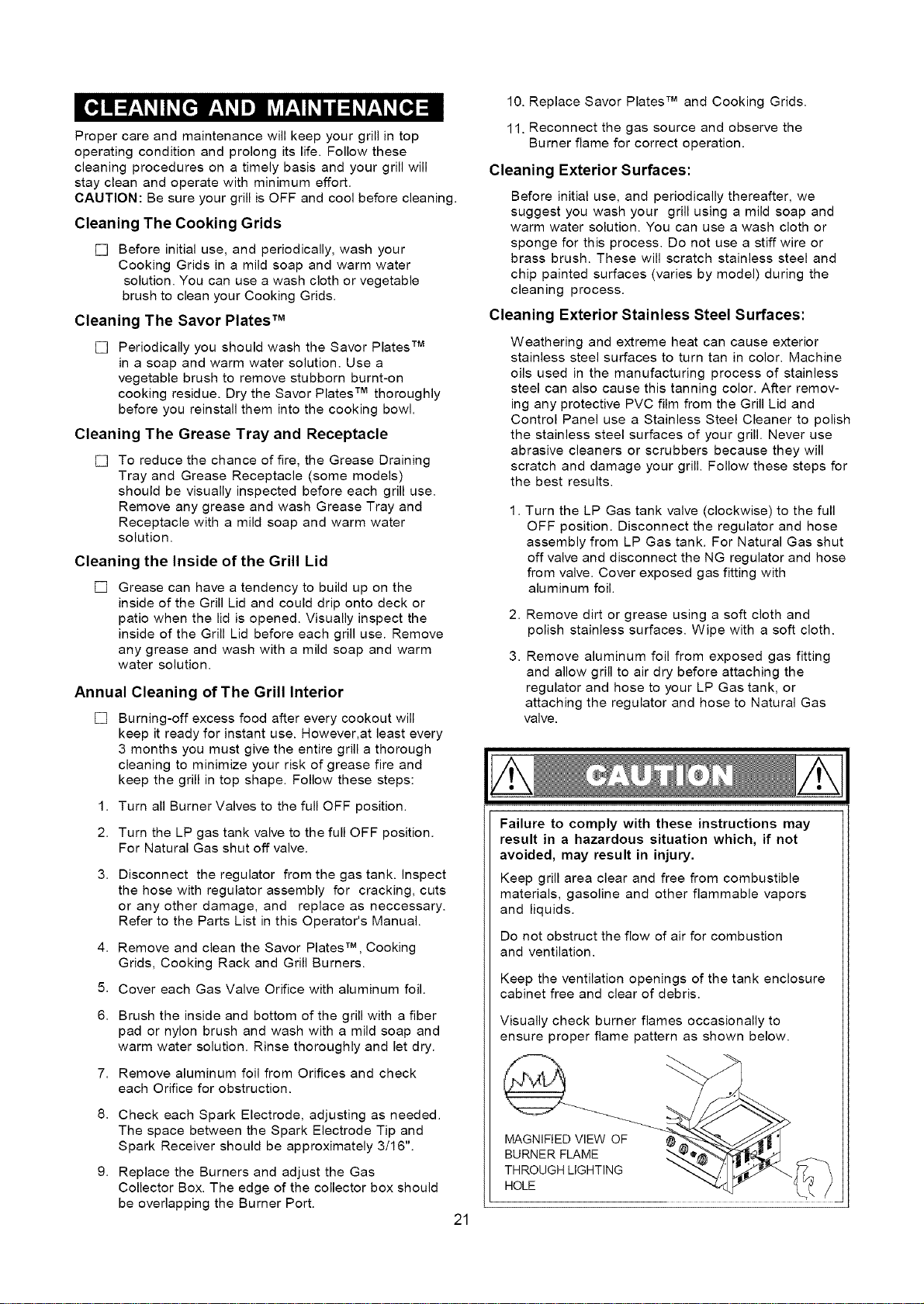
Visually check burner flames occasionally to
ensure proper flame pattern as shown below.
MAGNIFIED VIEW OF
BURNER FLAME
THROUGH LIGHTING
HOLE
ToreducethechanceofFLASHBACKFIREyoumust
cleantheBurnerTubesasfollowsatleastonceamonth
insummerandfallorwheneverspidersareactiveinyour
area,andifyourgrillhasnotbeenusedforanextended
periodoftime.
1.TurnallBurnerValvestothefullOFFposition.
2. TurntheLPGastankvalvetothefullOFFposition.
ForNaturalGasshutoffNGvalve.
3. DetachtheLPGasregulatorassemblyfromyour
gasgrill.ForNaturalGasdetachNGregulatorfrom
yourgrill.
4. RemovetheCookingGrids,SavorPlatesTM and
Grease Trays from your grill.
5. Remove the screw(s) from the rear of each Burner
and the Infra-red Burner using a Phillips Head
Screwdriver.
6. Carefully lift each Burner up and away from the
Gas Valve Orifice.
7. Check and clean burner/venturi tubes for insects
and insect nests. A clogged tube can lead to a fire
beneath the grill.
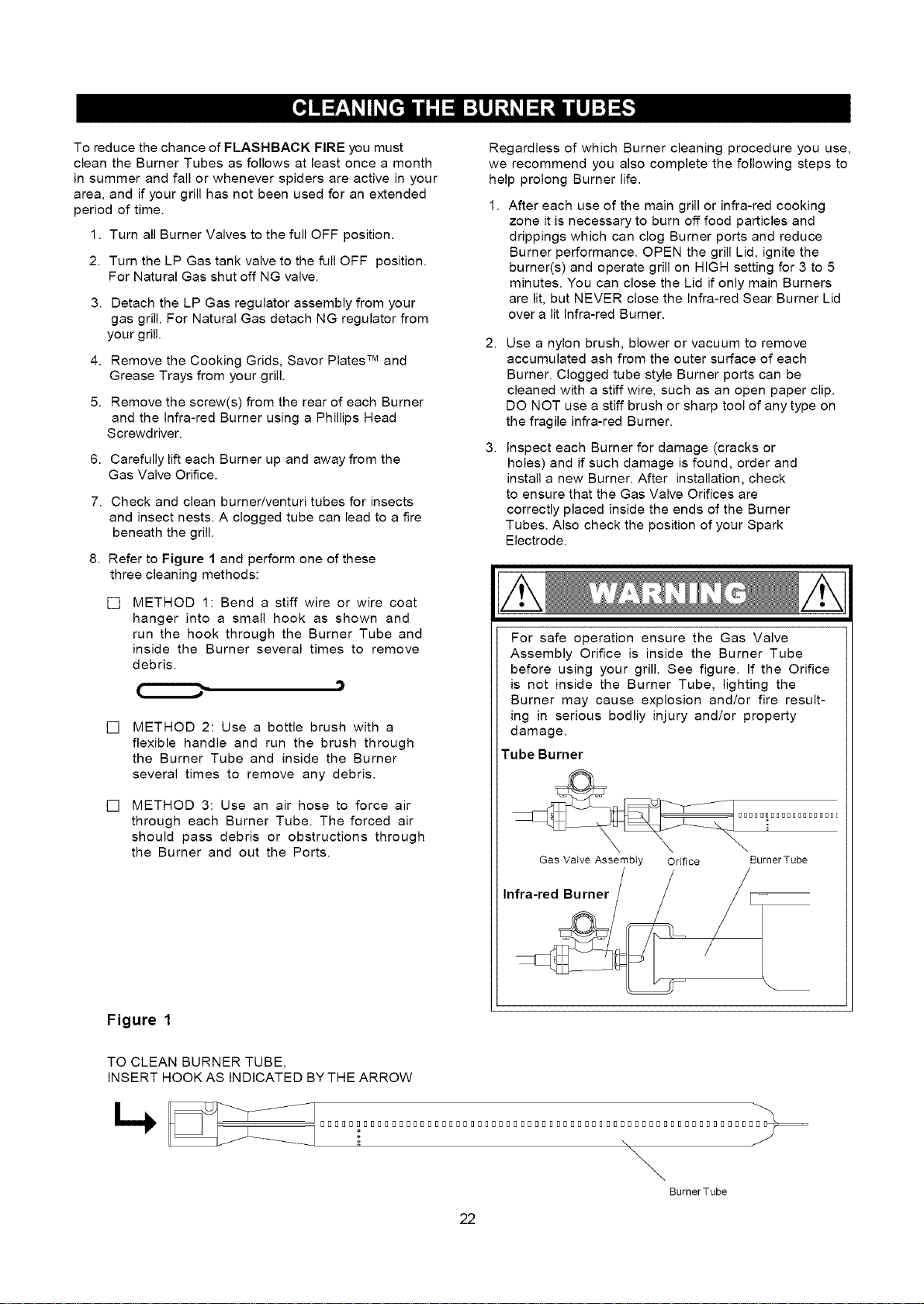
8. Refer to Figure 1 and perform one of these
three cleaning methods:
[]
METHOD 1: Bend a stiff wire or wire coat
hanger into a small hook as shown and
run the hook through the Burner Tube and
inside the Burner several times to remove
debris.
,)
[]
[]
METHOD 2: Use a bottle brush with a
flexible handle and run the brush through
the Burner Tube and inside the Burner
several times to remove any debris.
METHOD 3: Use an air hose to force air
through each Burner Tube. The forced air
should pass debris or obstructions through
the Burner and out the Ports.
Figure 1
Regardless of which Burner cleaning procedure you use,
we recommend you also complete the following steps to
help prolong Burner life.
1.
After each use of the main grill or infra-red cooking
zone it is necessary to burn off food particles and
drippings which can clog Burner ports and reduce
Burner performance. OPEN the grill Lid, ignite the
burner(s) and operate grill on HIGH setting for 3 to 5
minutes. You can close the Lid if only main Burners
are lit, but NEVER close the Infra-red Sear Burner Lid
over a lit Infra-red Burner.
2.
3.
Use a nylon brush, blower or vacuum to remove
accumulated ash from the outer surface of each
Burner. Clogged tube style Burner ports can be
cleaned with a stiff wire, such as an open paper clip.
DO NOT use a stiff brush or sharp tool of any type on
the fragile infra-red Burner.
Inspect each Burner for damage (cracks or
holes) and if such damage is found, order and
install a new Burner. After installation, check
to ensure that the Gas Valve Orifices are
correctly placed inside the ends of the Burner
Tubes. Also check the position of your Spark
Electrode.
For safe operation ensure the Gas Valve
Assembly Orifice is inside the Burner Tube
before using your grill. See figure. If the Orifice
is not inside the Burner Tube, lighting the
Burner may cause explosion and/or fire result-
ing in serious bodily injury and/or property
damage.
Tube Burner
Gas VaIve AssembIy Orifice BurnerTube
TO CLEAN BURNER TUBE,
INSERT HOOK AS INDICATED BY THE ARROW
22
Burn-Off
[] Before cooking on your gas grill for the first time, you
should "burn off" the grill to eliminate any odor or
foreign matter, ignite the main burners, lower the Lid,
andoperate grill on HIGH setting for 3 to 5 minutes.
The Lid must be open if the infra-red burner is lit.
CAUTION: Operating your grill on the HIGH setting for
longer than five minutes may damage certain parts of
your grill. Do not leave your grill unattended when in use.
Preheating
[] To preheat main burners, light your grill on HIGH,
lower the Lid and follow this timetable. To preheat
the infra-red burner the Lid must be open.
• For high temperature cooking, preheat grill 3 to 5
minutes.
• For low temperature cooking, preheat grill 3 minutes.
• To slow cook, preheating is not necessary.
Cooking Temperatures
[] High setting: The HIGH Control Knob setting should
only be used to pre-heat your grill the first 3-5 minutes
and for burning food residue off the grill for 3-5 minutes
after cooking is complete. Never use the HIGH setting
for extended cooking.
[] Medium to Low Settings: Most recipes specify
medium to low settings, including all smoking,
rotisserie cooking and cooking lean cuts such as fish.
An Important Note About Cooking Temperatures
[] The suggested heat settings and cooking times
shown in the following pages are approximate.
Unlike the controlled environment inside your kitchen,
variables including outside temperatures, direction
and conditions of wind, as well as grill location will
affect your grill's heat distribution. Because these
condition vary, and no two backyards are alike, we
offer this guide as a convenience. We recommend
you monitor your grill closely and rotate foods as
needed to prevent overcooking and ensure the most
delicious results every time.
• The infra-red cooking area is for quick searing. Once
seared, reduce heat and continue cooking or move
food to the primary cooking area to finish cooking.
• The middle and back primary cooking areas offer
high heat for grilling.
• The Secondary Cooking Rack offers medium heat for
preparing breads and firm vegetables.
• The front primary cooking area offers less heat and is
ideal for preparing delicate foods and for keeping
cooked foods warm.
Direct Cooking using Main Burners or Infra-red Burner
[] The direct cooking method can be used with the
supplied Cooking Grids and food placed directly over
the lit grill Burners. Direct Cooking requires the Grill
Lid to be open. This method is ideal for searing and
grilling when you want an open-flame barbecued taste.
A-1
Indirect Cooking using Main Burners
[] The indirect cooking method can also be used with
the supplied Cooking Grids. To cook indirectly, the
food should be placed on the left or right side of your
grill with the main Burner lit on the opposite side. Or
place your food on the Secondary Cooking Rack and
light the outer main Burners. Either way, indirect
cooking must be done with the Lid down.
Prepare Cooking Grids for Grilling
[] Greasing the cooking surface will help keep foods
from sticking during the cookout and reduces the
amount of cleanup required. Use a brush to apply a
thin layer of cooking oil or vegetable shortening onto
each Cooking Grid before each cookout. We do not
suggest spray type oils unless they are specified for
high-temperature cooking. Be sure to coat the entire
cooking surface.
Flare-Ups
[] The fats and juices dripping from grilled food can
cause flare-ups which impart a favorably, distinctive
taste and color to food. They should be accepted up
to a point. To minimize flare-ups:
• Use a drip pan under foods that produce a lot of grease.
• Trim excess fat from meats and poultry.
• Preheat the grill properly.
• Clean grill regularly to remove food and grease build-up.
• Reposition your food often to avoid flare-ups.
Failure to comply with these instructions could
result in a fire or explosion that could cause
serious bodily injury, death or property damage.
Never line the bottom of the grill housing or
Savor Plates TM with aluminum foil, sand or any
substance that will restrict the flow of grease
into the Grease Draining Tray and Receptacle.
Before each use of your grill: Pull out the Grease
Tray and remove all grease and food debris to
prevent grease fire hazard.
Use your grill at least 3 feet away from any
wall or surface. Use your grill at least 3 feet
away from combustible objects that can melt or
catch fire (such as vinyl or wood siding, fences
and overhangs) or sources of ignition including
pilot lights on water heaters and live electrical
appliances.
Never use your gas grill in a garage, porch, shed,
breezeway or any other enclosed area.
Your grill will get very hot. Always wear a flame
retardant BBQ Mitt when cooking on your grill.
Never lean over cooking areas while using grill.
Do not touch cooking surfaces, Lid, grill housing
or other parts while grill is in operation, or until
the grill has cooled down after use.
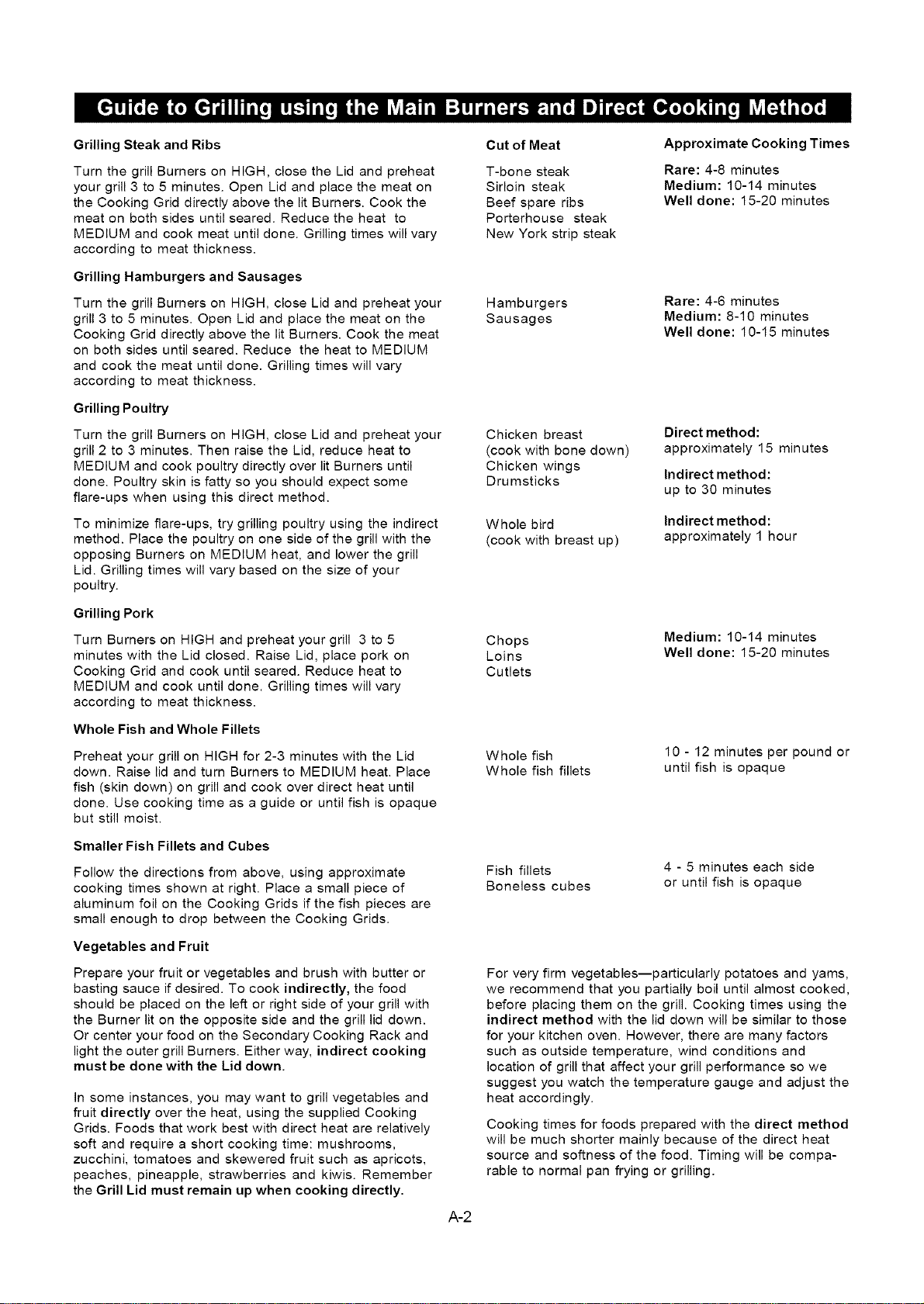
Grilling Steak and Ribs
Turn the grill Burners on HIGH, close the Lid and preheat
your grill 3 to 5 minutes. Open Lid and place the meat on
the Cooking Grid directly above the lit Burners. Cook the
meat on both sides until seared. Reduce the heat to
MEDIUM and cook meat until done. Grilling times will vary
according to meat thickness.
Cut of Meat
T-bone steak
Sirloin steak
Beef spare ribs
Porterhouse steak
New York strip steak
Approximate Cooking Times
Rare: 4-8 minutes
Medium: 10-14 minutes
Well done: 15-20 minutes
Grilling Hamburgers and Sausages
Turn the grill Burners on HIGH, close Lid and preheat your
grill 3 to 5 minutes. Open Lid and place the meat on the
Cooking Grid directly above the lit Burners. Cook the meat
on both sides until seared. Reduce the heat to MEDIUM
and cook the meat until done. Grilling times will vary
according to meat thickness.
Hamburgers
Sausages
Rare: 4-6 minutes
Medium: 8-10 minutes
Well done: 10-15 minutes
Grilling Poultry
Turn the grill Burners on HIGH, close Lid and preheat your
grill 2 to 3 minutes. Then raise the Lid, reduce heat to
MEDIUM and cook poultry directly over lit Burners until
done. Poultry skin is fatty so you should expect some
flare-ups when using this direct method.
To minimize flare-ups, try grilling poultry using the indirect
method. Place the poultry on one side of the grill with the
opposing Burners on MEDIUM heat, and lower the grill
Lid. Grilling times will vary based on the size of your
poultry.
Chicken breast
(cook with bone down)
Chicken wings
Drumsticks
Whole bird
(cook with breast up)
Direct method:
approximately 15 minutes
Indirect method:
up to 30 minutes
Indirect method:
approximately 1 hour
Grilling Pork
Turn Burners on HIGH and preheat your grill 3 to 5
minutes with the Lid closed. Raise Lid, place pork on
Cooking Grid and cook until seared. Reduce heat to
MEDIUM and cook until done. Grilling times will vary
according to meat thickness.
Chops
Loins
Cutlets
Medium: 10-14 minutes
Well done: 15-20 minutes
Whole Fish and Whole Fillets
Preheat your grill on HIGH for 2-3 minutes with the Lid
down. Raise lid and turn Burners to MEDIUM heat. Place
fish (skin down) on grill and cook over direct heat until
done. Use cooking time as a guide or until fish is opaque
but still moist.
Whole fish
Whole fish fillets
10 - 12 minutes per pound or
until fish is opaque
Smaller Fish Fillets and Cubes
Follow the directions from above, using approximate
cooking times shown at right. Place a small piece of
aluminum foil on the Cooking Grids if the fish pieces are
small enough to drop between the Cooking Grids.
Fish fillets
Boneless cubes
4 - 5 minutes each side
or until fish is opaque
Vegetables and Fruit
Prepare your fruit or vegetables and brush with butter or
basting sauce if desired. To cook indirectly, the food
should be placed on the left or right side of your grill with
the Burner lit on the opposite side and the grill lid down.
Or center your food on the Secondary Cooking Rack and
light the outer grill Burners. Either way, indirect cooking
must be done with the Lid down.
In some instances, you may want to grill vegetables and
fruit directly over the heat, using the supplied Cooking
Grids. Foods that work best with direct heat are relatively
soft and require a short cooking time: mushrooms,
zucchini, tomatoes and skewered fruit such as apricots,
peaches, pineapple, strawberries and kiwis. Remember
the Grill Lid must remain up when cooking directly.
For very firm vegetables--particularly potatoes and yams,
we recommend that you partially boil until almost cooked,
before placing them on the grill. Cooking times using the
indirect method with the lid down will be similar to those
for your kitchen oven. However, there are many factors
such as outside temperature, wind conditions and
location of grill that affect your grill performance so we
suggest you watch the temperature gauge and adjust the
heat accordingly.
Cooking times for foods prepared with the direct method
will be much shorter mainly because of the direct heat
source and softness of the food. Timing will be compa-
rable to normal pan frying or grilling.
A-2
Important notes about using the Infra-red Burner
Whether you are a seasoned chef or a newcomer to gas
grilling, infra-red cooking is quite different than grilling
over a traditional burner. Although the primary grill burners
will also sear meat, the infra-red Burner produces a more
intense and concentrated heat that sears the meat more
quickly. This quick searing produces a crisp and flavorful
outer crust and locks in the meat's natural flavor and
juices.
Follow the cooking guidelines provided. Then take some
time to experiment with your Infra-red cooking zone. Also,
read the Cooking Instructions on page A-1 so you
understand the importance of pre-heating, cooking
temperatures and safety warnings.
• The Lid must always be open when the Infra-red
Burner is lit.
• Infra-red cooking times will be much shorter than
traditional grilling so do not leave the grill unattended.
Once lit, leave the Infra-red Burner on High and sear
both sides of meat using the guidelines below.
Once seared, adjust the Infra-red Burner to Low and
continue cooking until desired doneness. You can
also move the seared meat to the primary grilling area
to finish cooking. This method allows you to sear and
prepare larger amounts of meat.
NEVER attempt to douse a flare-up with water which
can damage the Burner. To control flare-ups:
• Trim excess fat from meats and poultry.
• Preheat the Burner properly.
• Clean the Burner regularly to remove food and
grease build-up. See Burner Tube cleaning
instructions in this manual.
• Reposition your food often and consider moving the
seared meat to the primary grilling area to finish
cooking.
Searing Steak and Ribs
Turn the Infra-red Burner on HIGH and preheat for 3 to 5
minutes with the Lid open. Then place the meat on the
Cooking Grid and sear each side for approximately 2
minutes. Reduce the Infra-red Burner to LOW or move
meat to the primary grilling area and finish cooking.
Grilling times will vary according to meat thickness.
Cut of Meat
T-bone steak
Sirloin steak
Beef spare ribs
Porterhouse steak
New York strip steak
Approximate Total Cooking
Time
Rare: 4 minutes
Medium: 6-7 minutes
Well done: 8-10 minutes
Searing Hamburgers and Sausages
Turn the Infra-red Burner on HIGH and preheat for 3 to 5
minutes with the Lid open. Then place the meat on the
Cooking Grid and sear each side for approximately 2
minutes. Reduce the infra-red Burner to LOW or move
food to the primary grilling area and finish cooking. Grilling
times will vary according to meat thickness.
Hamburgers and sausages are fatty so you should expect
some flare-ups when cooking these foods.
To minimize flare-ups follow the instructions above. You
may also consider grilling these and other fatty foods
using the primary grill area and the indirect cooking
method.
Hamburgers
Sausages
Rare: 4 minutes
Medium: 5 minutes
Well done: 6-7 minutes
A-3
An Important Note About Heat Settings
The suggested heat settings shown are approximate.
There are many factors such as outside temperature,
wind conditions and grill location that affect your grill
performance. We offer these cooking times as a
convenience, but suggest you watch the temperature
gauge and adjust the heat accordingly.
Preparing to Roast
Roasting uses the indirect cooking method. Therefore, the
food should be placed on the left or right side of your grill
with the Burner lit on the opposite side. You can also use
the supplied Cooking Grid with an aluminum drip pan
underneath allowing you to collect juices for making
gravies. Remember, indirect cooking requires the Lid of
your grill to be down.
Preheating your grill is not required for slow cooking
methods such as roasting. If you do choose to preheat your
grill before roasting, turn the Burners on HIGH and close Lid
for approximately 2-3 minutes.
Food preparation
Trim meat of excess fat. Truss meat and poultry with
cooking string to retain shape if desired. Bacon strips can
be used to cover the outside surface of lean meat and
poultry to help prevent it from drying out. Another method
for keeping food moist during roasting is to put water in a
cooking pan, then cover with foil. The foil should be
removed for the first or the last part of the cooking time to
ensure proper browning.
Tips for roasting
Except when roasting with water in a roasting pan, the
juices that collect in the pan can be used as the base for a
tasty sauce or gravy. Place a cooking pan directly over the
heat, add extra butter if needed, then add several spoon-
fuls of flour to thicken sauce. Finally, add sufficient chicken
or beef stock to obtain the desired consistency.
Once the meat is cooked, remove it from your grill and
cover with a piece of foil. Allow it to stand for 10-15
minutes which allows the juices to settle. This will make
carving easier and ensure a tender, juicy roast.
Type of Food How Cooked Approximate Cooking Times
Beef Rare 18 minutes per pound
Medium 23 minutes per pound
Well done 27 minutes per pound
Lamb Medium 18 minutes per pound
Well done 23 minutes per pound
Veal 27 minutes per pound
Pork 30-33 minutes per pound
Chicken 20-25 minutes per pound
Duck 25 minutes per pound
Fish 10 minutes per pound
Turkey, under 16 pounds 20-25 per pound + 30 minutes
Turkey, over 16 pounds 18-23 per pound + 15 minutes
BAKING TECHNIQUES
From casseroles and cornbread to delicious desserts like
fondue fruit skewers or crumb cake, baking on the grill is as
easy as baking in the kitchen.
Preparing to Bake
To bake in your new grill you'll need a baking dish or cast-
iron cooking pan, and a pair of flame retardant BBQ Mitts. If
the cooking pan is cast-iron be sure to season the pan
before use.
placed on the left or right side of your grill with the burner lit
on the opposite side.
Tips for Baking
Prepare your favorite recipe as you would in the kitchen.
Foods cooked in the grill for long periods of time should
always be covered in aluminum foil to retain moisture. You
will need to stir the food several times as it bakes, and add
additional liquid if required.
Preheat your grill 3-5 minutes, then lower heat to achieve
the baking temperature desired. Baking uses the indirect
cooking method. Therefore, your cooking pan should be
Watch the temperature, and adjust to cook according to
your recipe directions.
Oven Temperature
Slow 300 ° - 340 ° F
Moderate 355 ° - 390 ° F
High 410 °- 480 ° F
Recommended Grill Setting
Both outside Burners on LOW
1 outside Burner on HIGH and 1 outside Burner on LOW
Both outside Burners on HIGH
A-4
Slow Cooking with a Rotisserie
A Rotisserie Kit is made to fit your grill model. Rotis-
serie cooking produces foods that are moist, flavorful
and attractive. The optional rotisserie system is most
commonly used for cooking meat or poultry and is
designed to cook food slowly. You can place a cooking
pan beneath the food to collect juices for basting and
gravy. To flavor the contents of the cooking pan you
may add herbs, onions, or other spices of your choice.
The cooking times on a rotisserie will be approximately
the same as for oven cooking.
Balancing the Food
In rotisserie cooking, balancing the food is of utmost
importance. The rotisserie must turn evenly or the
stopping and starting action will cause the food to cook
unevenly and possibly burn the heavier side.
The easiest foods to balance are those of uniform
shape and texture. To test if the food is balanced
correctly when secured, place the ends of the rotis-
serie spit loosely in the palms of your hands. If there is
no tendency to roll, give the spit a quarter turn. If it is
still stable, give it a final quarter turn. It should rest
without turning in each of these positions. It can then
be attached to your grill.
Food Preparation
When preparing poultry, truss the birds tightly so that
wings and drumsticks are close to the body of the bird.
The cavity of the bird may be stuffed prior to this. Pull the
neck skin down and, using a small skewer, fix it to the
back of the bird. Push the rotisserie spit through
lengthwise, catching the bird in the fork of the wishbone.
Center the bird and tighten with the holding forks. Test the
balance as described before.
A rolled piece of meat requires the rotisserie skewer to be
inserted through the center of the length of meat, then
secured and balanced.
For meats that contain bones, it is best to secure the
rotisserie skewer diagonally through the meaty sections. If
protruding bones or wings brown too quickly, cover with
pieces of foil.
Preparing to Smoke
Smoking gives food a distinctive, delicious flavor. You will
find a variety of wood chips or pellets available for use in
smoking grilled foods. Pre-soaking of wood chips may
be required so read and follow the manufacturers
instructions for preparing smoking chips prior to use.
Note: It is our experience that many smoking chip
and pellet products do not actually produce a smoke but
instead infuses the food with flavor. Please read product
labels carefully and if in doubt, ask your retailer for details.
Using A Smoker Box
There are many optional smoker boxes available for
purchase. Follow these guidelines and always refer to
the label of your smoking chips or pellets for specific
directions.
Raise your Grill Lid and light the grill. Lower the Grill Lid
allowing your grill to reach the desired cooking tempera-
ture for the food you are grilling. Fill your smoker box with
your prepared smoking chips or pellets. Dried herbs and
spices may also be added to produce different flavors.
Wear a flame retardant BBQ Mitt and place your smoker
box on a Cooking Grid or Savor Plate TM directly above a lit
grill Burner. The heated smoking chips or pellets will
flavor your foods.
Tips for Smoking
You can reduce the strength of the smoke flavor by only
smoking for half or three quarters of the cooking time.
The heat required for smoking is normally LOW to MEDIUM.
Foods naturally high in oils lend themselves well to
smoking, while drier foods benefit from a marinade.
• Tuna steaks, marinated in Asian flavors of sesame
oil, soy sauce and sherry.
• Pork fillets, rubbed with ginger, orange rind and
brushed with maple syrup.
• Mussels, brushed with lemon rind and chili oil.
• Lamb cutlets, marinated in virgin olive oil, lemon,
oregano and black pepper. The same marinade can
be used for a whole leg or rack of lamb.
• Chicken, boneless chicken pieces--especially sliced
breasts.
• Fish, sliced fillets of firm fish, assorted seafood such
as prawns, scallops and calamari.
• Pork, sliced fillets, diced or minced pork, sliced leg
steak, sliced chops.
• Beef, sliced fillet, rib-eye, round, rump, sirloin.
• Lamb, sliced fillet, round, loin.
Vegetables are generally easy to cook on the grill. The
Cooking Rack makes it convenient because you can still
use the main cooking area while the vegetables are
suspended above the grids.
Pre-cook hard vegetables by briefly boiling or
microwaving them before cooking on the grill. Wrap
vegetables in a double thickness of foil to protect them
while cooking on the grill. Then, remove the foil if desired,
10-15 minutes before the end of cooking, brush veg-
etables with butter or oil and finish cooking.
The Cooking Rack can be used for purposes other than
just the obvious. Consider using the rack for warming
French bread, garlic bread, croissants or even bagels.
A small whole fish wrapped in foil also cooks well on the
Cooking Rack. Parcels of seafood such as scallops,
prawns and sliced fish fillets prepared in a sauce and
portioned into small foil wraps cook well this way, too.
A-5
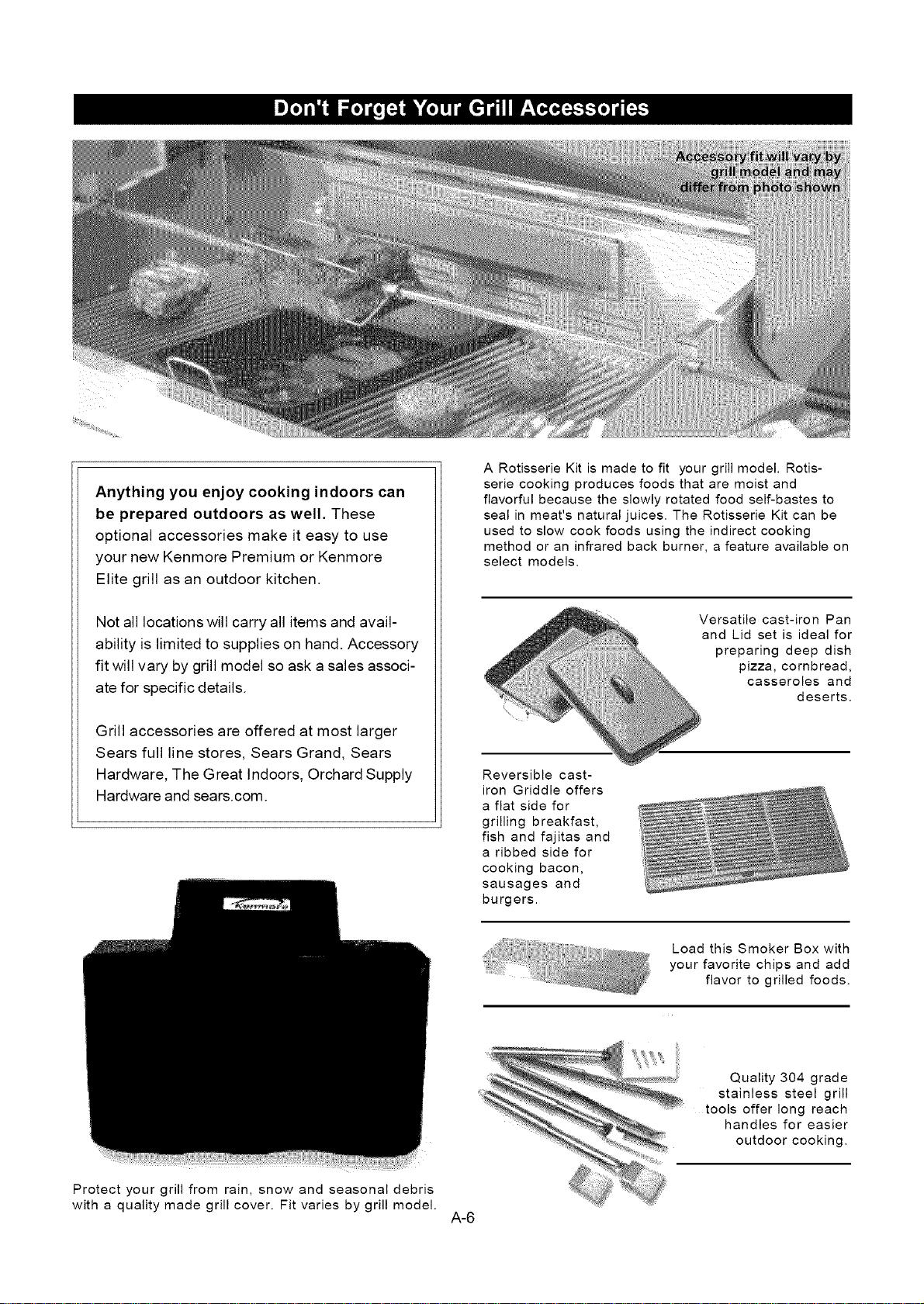
Anything you enjoy cooking indoors can
be prepared outdoors as well. These
optional accessories make it easy to use
your new Kenmore Premium or Kenmore
Elite grill as an outdoor kitchen.
Not all locationswill carry all items and avail-
ability is limited to supplies on hand. Accessory
fit will vary by grill model so ask a sales associ-
ate for specific details.
Grill accessories are offered at most larger
Sears full line stores, Sears Grand, Sears
Hardware, The Great Indoors, Orchard Supply
Hardware and sears.com.
A Rotisserie Kit is made to fit your grill model. Rotis-
serie cooking produces foods that are moist and
flavorful because the slowly rotated food self-bastes to
seal in meat's natural juices. The Rotisserie Kit can be
used to slow cook foods using the indirect cooking
method or an infrared back burner, a feature available on
select models.
Versatile cast-iron Pan
and Lid set is ideal for
preparing deep dish
pizza, cornbread,
casseroles and
deserts.
Reversible cast-
iron Griddle offers
a flat side for
grilling breakfast,
fish and fajitas and
a ribbed side for
cooking bacon,
sausages and
burgers.
Load this Smoker Box with
your favorite chips and add
flavor to grilled foods.
Protect your grill from rain, snow and seasonal debris
with a quality made grill cover. Fit varies by grill model.
A-6
Quality 304 grade
stainless steel grill
tools offer long reach
handles for easier
outdoor cooking.
Question:
Can Iconvert my.qrillfromonefuet typeto another in
otherwords fr0m-LFGto NGorvice Yersa?
An_:
No, your gas grill is manufactured to exact specifications
and is certified for LPG (Liquid Propane Gas) or NG
(Natural Gas) use only. For your safety, conversion kits
are not available, nor will we sell or otherwise provide
parts or information to be used to convert your grill. Any
attempt to convert your grill is dangerous and will void
your warranty.
Question:
Are the serial and model numbers of my grill listed
somewhere for reference?
Answer:
The serial and model numbers are listed on a silver
CSA label placed on the grill. Depending on the grill
model the silver CSA label will be located on the left or
right side bowl panel underneath the side shelf,
underneath the right side of the control panel, outside
left or right of control panel or on the back of the grill
cabinet.
Question:
My grill will not light properly. Why?
Answer:
Always light the Main Burner farthest from the fuel
source first. This will draw gas across the manifold
helping prevent air pockets which obstruct gas-flow and
prevent proper grill lighting. Also try this procedure:
1. Turn gas off at source and turn Control Knobs OFF.
Wait at least 5 minutes for gas to clear, then retry.
2. If your grill still fails to light, turn the Burner Control
Knob(s) and gas source OFF and conduct a leak test
of ALL gas connections and gas sources as
explained in the Use and Care section of this manual.
3. If no leaks are detected, wait 5 minutes for any gas to
clear and repeat the lighting procedure.
Question:
If my ignitor or battey is not working how can I light
my grill manually?
Answer:
If your ignition fails to work or your battery needs
replacing, you can light the match and place it over the
top opening of the Lighting Tube. Never remove the
Cooking Grids or Savor Plates TM and attempt to light the
grill from above. To light your gas grill manually, follow
steps 1 through 6 of Basic Lighting Procedures. Then
light the match and place it over the top opening of the
Lighting Tube. Turn the nearest main Burner Control
Knob to the High setting to release gas. The Burner
should light immediately.
Question:
Sometimes I hear a humming sound coming from my
regulator. What causes this? And - My grill has a low
flame and sometimes will not light, Why?
Answer:
The humming sound is gas flowing through the
regulator. A low volume of sound is normal and will not
interfere with the operation of your grill. Loud or
excessive regulator humming and/or low flow and
intermittent lighting may be caused by the regulator's
excess gas flow device. Opening the tank valve all the
way or too quickly is what triggers the regulator's
safety device to restrict gas flow, preventing excess
gas flow to your grill. Lighting the main Burner farthest
from the fuel source every time will help eliminate air
pockets in the manifold. Note: This procedure should
be done every time a new LP Gas tank is connected to
your grill.
[] Turn all Control Knobs to the OFF position.
[] Turn off the LP Gas tank at the tank valve.
For Natural Gas shut off NG valve.
[] Disconnect regulator from LP Gas tank.
For Natural Gas disconnect regulator from 12 ft.
Natural Gas Hose.
[] Let unit stand for 10 minutes.
[] Reconnect regulator to the LP Gas tank.
For Natural Gas reconnect regulator to 12 ft.
Natural Gas Hose.
[] Open grill Lid (or Side Burner Lid if you are lighting
the Side Burner).
[] Turn the tank valve slowly % of one turn.
For Natural Gas open Shut Off valve.
[] Light main Burner farthest from fuel source.
[] Turn the tank valve slowly one more % of one turn
for ½ of one complete turn.
[] Continue to light Burners moving towards the fuel
source.
[]
Do not turn tank valve more than ½ of one turn on
LPG models.
Question:
Where do I use my grill for safer operation and
better performance?
Answer:
[] Strong winds and low temperatures can affect the
heating and performance of your gas grill so
factor in these elements when positioning your
grill outdoors for cooking.
[] Use your grill at least 3 feet away from any wall or
surface.
[]
[]
Use your grill at least 3 feet away from
combustible objects that can melt or catch fire
(such as vinyl or wood siding, fences and
overhangs) or sources of ignition including pilot
lights on water heaters and live electrical
appliances.
Never use your gas grill in a garage, porch, shed,
breezeway or any other enclosed area.
[] Never obstruct the flow of ventilation air around
your gas grill housing.
A-7
Question:
The Regulator and Hose supplied with my gas grill
does not fit the older LP Gas tank I've used for
years. Why not?
Answer:
The U.S. Government regulates gas appliances and
LP Gas tanks. When regulations are changed the LP
Gas tank fittings are altered to insure compliance. If
your LP Gas tank does not fit the Regulator and Hose
supplied with your new grill, the tank is outdated and
must be replaced. Note: Effective April 1,2002 all LP
Gas tanks sold must include an "OPD" Overfill
Prevention Device. The OPD tanks are identified by
their triangular-shaped valve wheel. This internal
device prevents the LP Gas tank from being overfilled.
Tanks without an OPD valve can not be refilled.
Question:
What type of pipe and fittings will I need to connect
a natural gas grill at my home?
Answer:
Even if your home is plumbed with a natural gas
connection outdoors, there is an additional fitting and
piping required to hook up a natural gas grill. Refer
to the Natural Gas section of this manual for a
diagram of recommended Natural Gas hook-up.
Because each home is unique the type and length of
fittings will vary. This is a technical process that
involves patience and time. The details below will
offer guidance but if you feel uncomfortable with this
procedure you should seek the assistance of a
plumber or gas supply professional.
Gas Line Piping: If the length of line required does not
exceed 50 feet, use a 5/8" O.D. tube. One size larger
should be used for lengths greater than 50 feet. Gas
piping may be copper tubing, type K or L;
polyethylene plastic tube, with a minimum wall
thickness of .062 inch; or standard weight
(schedule 40) steel or wrought iron pipe. Copper
tubing must be tin-lined if the gas contains more than
0.3 grams of hydrogen sulfide per 100 cubic feet of
gas. Plastic tubing is suitable only for outdoor,
underground use. Gas piping in contact with earth, or
any other material which may corrode the piping,
must be protected against corrosion in an approved
manner. Underground piping must have a minimum
of 18" cover.
Shut OffValve:lt is highly recommended that a Shut
Off Valve be installed at the gas supply source
outdoors. Install at a point after the gas pipe exits the
outside wall and before the Quick Disconnect Hose,
or install it at the point before the gas line piping
enters the ground.
Question:
Is it safe to clean my porcelain coated cooking grids
in the dishwasher?
Answer:
Clean your cooking grids by hand if there are any chips
or cracks in the porcelain finish and dry them thoroughly.
if no chips or cracks are present it should be safe to use
the dishwasher. Remember to dry the cooking grids
thoroughly before placing back onto your grill to
minimize rusting.
Question:
What causes grill parts to rust and what affect does
it have on my grill?
Answer:
Rusting is a natural oxidation process and may
appear on cast-iron and steel parts. Rust will not
affect the short term performance of your grill.
To slow the rusting process on steel Cooking Grids
(select models) we recommend greasing the
Cooking Grids before and after each cookout. Use a
brush to apply a thin layer of cooking oil or vegetable
shortening onto each Cooking Grid. We do not
suggest spray type oils unless they are specified for
high-temperature cooking. Be sure to coat the entire
cooking surface including edges and any areas with
chipped porcelain.
Question:
Which is a better cooking surface to grill on;
porcelain coated steel / cast-iron cooking grids or
stainless steel grids?
Answer:
They all have their advantages. For traditional grilling
and searing meats, cast-iron or steel grids offer
better heat conductivity. To protect against the natural
rusting process, steel or cast-iron cooking grids offer
a porcelain finish which requires routine
maintenance to keep the grids well seasoned.
Stainless steel is popular with those who prefer less
maintenance.
A new innovative solution is available on select
models called stainless Therma-Core TM. This
Cooking Grid combines a heat conducting steel core
with an easy-to-clean stainless outer shell.
Question:
Some stainless steel grills specify 304 grade
construction while others do not mention a grade at
all? What is the difference?
Answer:
All stainless grades are not created equal. The 304
grade, also called 18-8 stainless steel, is prized for its
excellent resistance to rust and corrosion and good
performance at high temperatures, which makes it idea
for grill construction.
304 grade stainless steel is by far the most popular
stainless steel and contains 18-20% chromium and
8-10% nickel, making it non-magnetic.
Some stainless steel grills are constructed of Type 430
stainless steel which contains 16-18% chromium but
generally less than 1% nickel. It is magnetic with less
corrosion and rust resistance and designed for limited
temperature use. Beware of stainless steel grills that
offer no claim of grade because what looks shiny on the
sales floor could become a problem on your patio.
How can you tell if a product is made of 304 grade
stainless? Take the simple magnet test. If a magnet
sticks to the stainless steel it is 430 grade. If a magnet
does not stick you can trust its 304 grade quality.
A-8
Your Home
For repair-in your home-of aH major brand app!ian_s
lawn and garden equipment or heating and cooing systems
no matter who made it, no matter who sold lfl
Forme rep acement pads a_essodes and
owners manuab that you need to dooit°yeurse/f
For Sears p_ofessional ins_a_atioe ef home applian_s
and items _ike garage doer openers and water heate_
Cali anyt m® day o s_ght (US,A, asd Canada}
_sea_ corn www_sears ca
Our Home
For repair of car_oin items like vacuums, lawn equipment
and ebctronics call or go on-line for the bcation of yeur nearest

