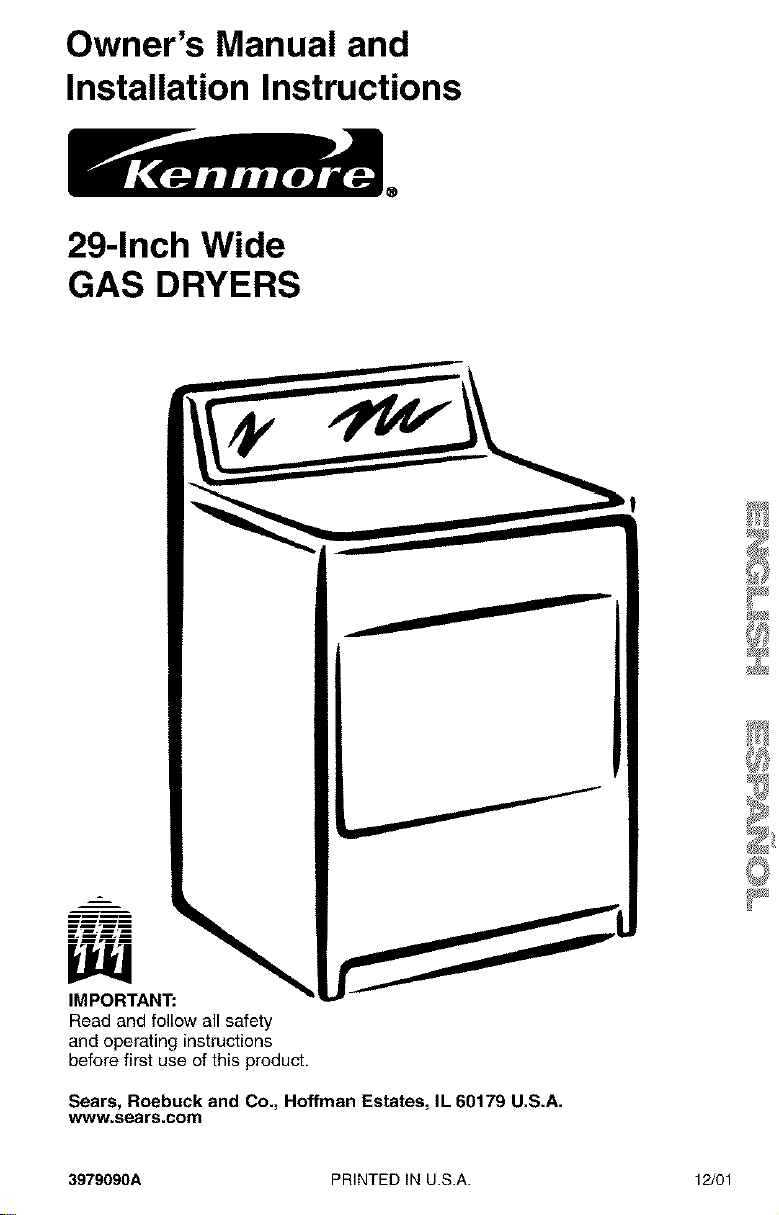
Owner's Manual and
Installation Instructions
29-Inch Wide
GAS DRYERS
IMPORTANT:
Read and follow all safety
and operating instructions
before first use of this product.
Sears, Roebuck and Co., Hoffman Estates, IL 60179 U.S.A.
www.sears.com
3979090A PRINTED IN U.S.A. 12/01
WARNING: For your safety the information in this manual
must be followed to minimize the risk of fire or explosion or
to prevent property damage, personal injury, or death.
-Do not store or use gasoline or other flammable vapors and
liquids in the vicinity of this or any other appliance.
-WHAT TO DO IF YOU SMELL GAS:
• Do not try to light any appliance.
• Do not touch any electrical switch; do not use any phone in your
building.
• Clear the room, building, or area of all occupants.
• Immediately call your gas supplier from a neighbor's phone.
Follow the gas supplier's instructions.
• If you cannot reach your gas supplier, call the fire department.
-Installation and service must be performed by a qualified installer,
service agency,or the gas supplier.
2
BEFORE USING YOUR NEW DRYER
KENMORE DRYER WARRANTY 4
DRYER SAFETY
INSTALLATION INSTRUCTIONS 7
DRYER USE 17
LAUNDRYTIPS
23
DRYER CARE
25
TROUBLESHOOTING 28
WE SERVICE WHAT WE SELL 30
Please read this manual. It will help
you install and operate your new
Kenmore dryer in the most economical
way.
Ifyou need more information about the
care and operation of Kenmore appliances
call your nearest Sears store. You will
need the complete model and
serial numbers when requesting
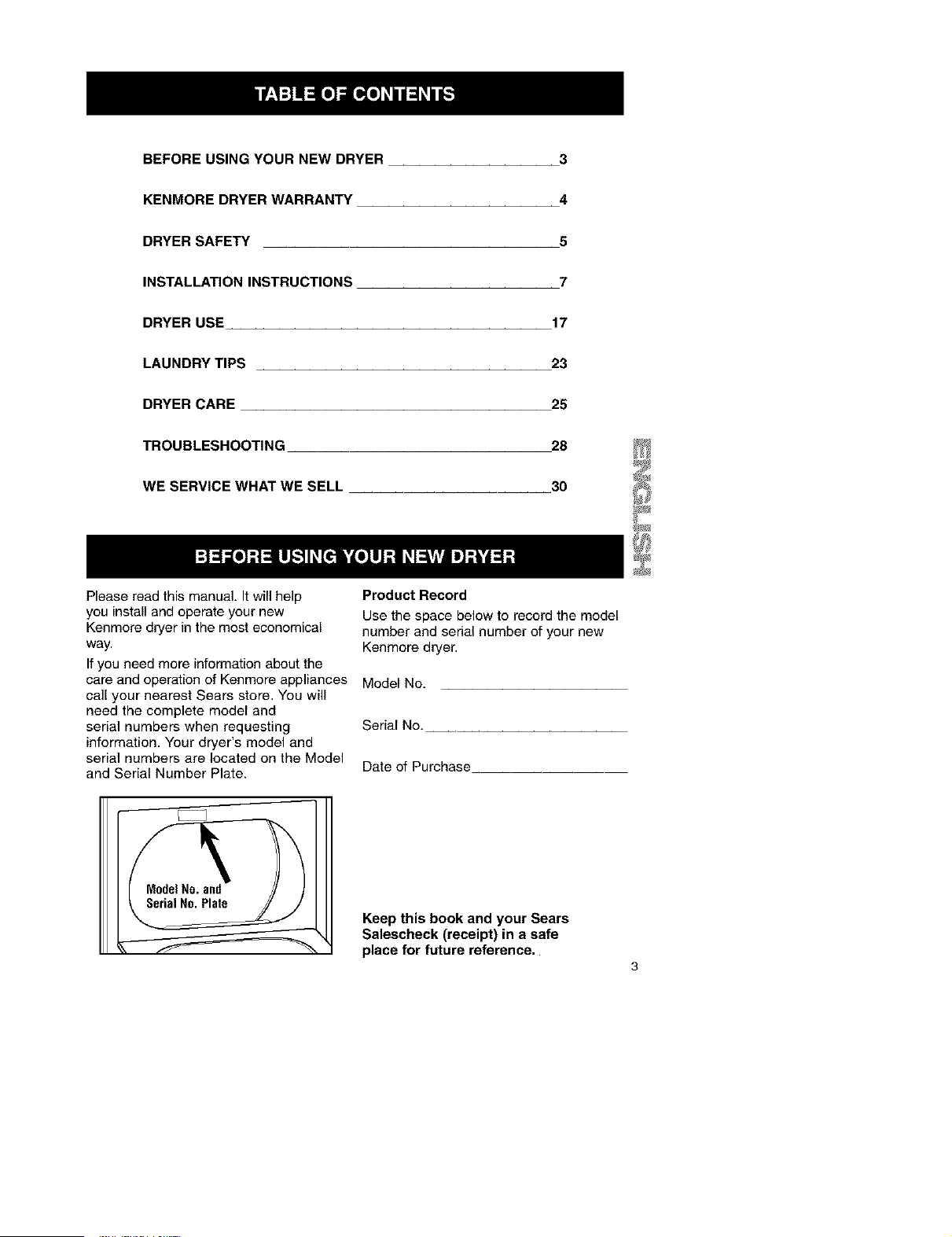
information. Your dryer's model and
serial numbers are located on the Model
and Serial Number Plate.
Product Record
Use the space below to record the model
number and serial number of your new
Kenmore dryer.
Model No.
Serial No.
Date of Purchase
Model No. and
Serial No. Plate
Keep this book and your Sears
Salescheck (receipt) in a safe
place for future reference.
Full One Year Warranty on
Mechanical and Electrical Parts
For one year from the date of purchase,
if this dryer is installed and operated
according to the instructions in this
manual, Sears will repair or replace any
of its mechanical or electrical parts if they
are defective in material or workmanship.
NOTE: Exhausting your dryer with
a plastic vent may void this warranty.
See "Installation Instructions" for
the complete exhaust requirements
for this dryer.
Warranty Restriction
If the dryer is subjected to other than
private family use, all warranty coverage is
effective for only 90 days.
Warranty Service
Warranty service is available by contacting
your nearest Sears Service Center in the
United States.
This warranty applies only while this dryer
is in use in the United States.
This warranty gives you specific legal
rights, and you may also have other rights
which vary from state to state.
Sears, Roebuck and Co., Dept. 817WA,
Hoffman Estates, IL 60179,
For Sears Warranly information or 1ocontact a
Sears Service Center, please reference the service
numbers on the back page of lhis manual.
4
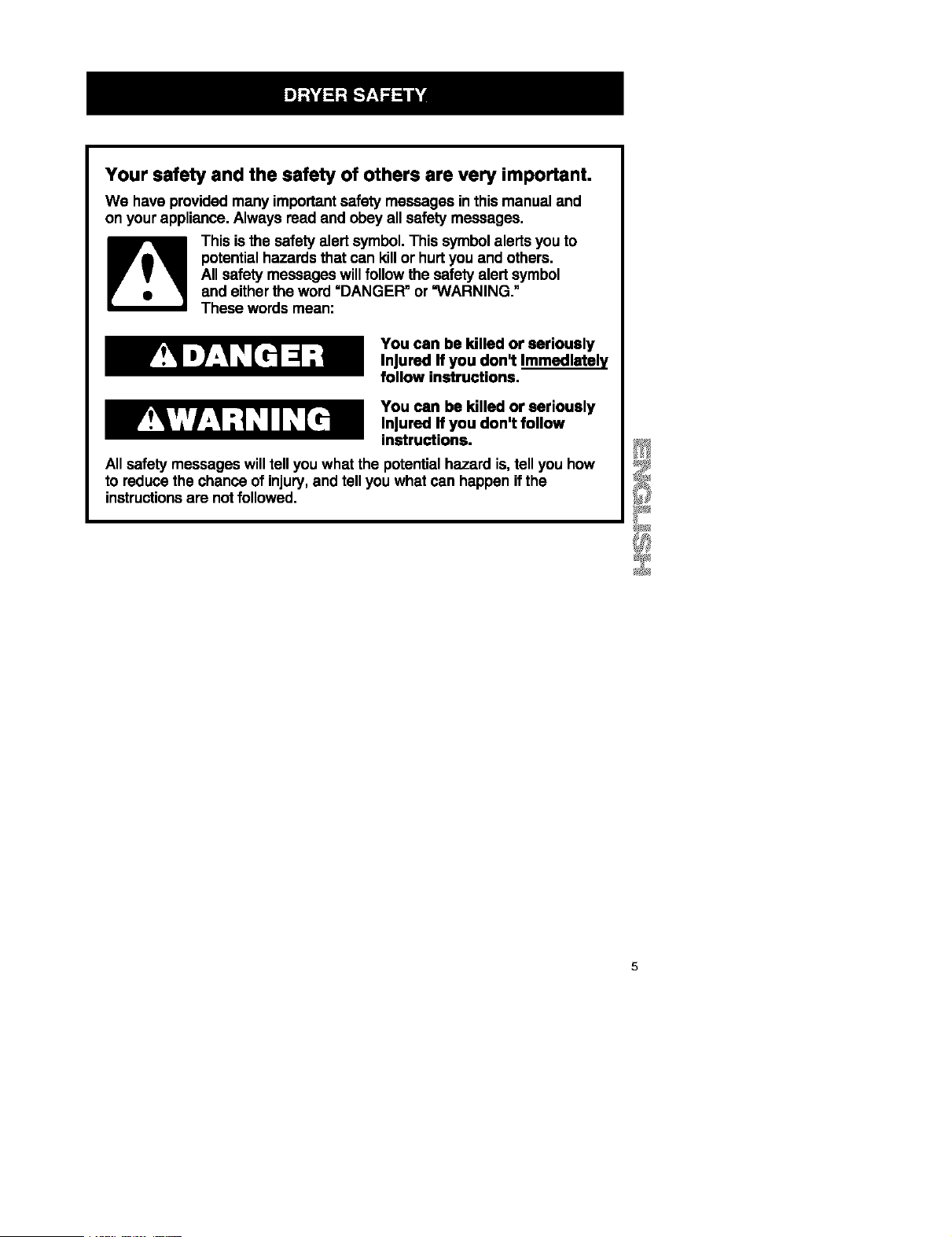
Your safety and the safety of others are very important.
We have providedmany importantsafety messages in this manual and
on yourappliance, Always read and obey all safety messages,
This isthe safety alert symbol.This symbolalerts you to
potentialhazardsthat can killor hurtyouand others,
All safety messages willfollowthe safety alert symbol
and either the word "DANGER" or =WARNING."
These words mean:
You can be killed or seriously
Injured If you don't Immediately
follow instructions.
You can be killed or seriously
Injured If you don't follow
instructions.
All safety messages willtell you what the potentialhazard is,tell you how
to reducethe chance of injury,and tell you what can happen if the
instructionsare notfollowed.
IMPORTANT SAFETY INSTRUCTIONS
WARNING : To reduce the risk of fire, electric shock, or injury to persons
when using the dryer, follow basic precautions, including the following:
• Read all instructions before using
the dryer.
• Do not place items exposed to cook-
ing oils in your dryer. Items contami-
nated with cooking oils may contribute
to a chemical reaction that could
cause a load to catch fire.
• Do not dry articles that have been pre-
viously cleaned in, washed in, soaked
in, or spotted with gasoline, dry-
cleaning solvents, other flammable, or
explosive substances as they give off
vapors that could ignite or explode.
• Do not allow children to play on or in
the dryer. Close supervision of
children is necessary when the dryer
is used near children.
• Before the dryer is removed from
service or discarded, remove the door
to the drying compartment.
• Do not reach into the dryer if the drum
is moving.
• Do not install or store the dryer where
it will be exposed to the weather.
• Do not tamper with controls.
• Do not repair or replace any part of
the dryer or attempt any servicing
unless specifically recommended in
this Owner _ Manual or in
published user-repair instructions
that you understand and have the
skills to carry out.
• Do not use fabric softeners or
products to eliminate static unless
recommended by the manufacturer
of the fabric softener or product.
• Do not use heat to dry articles
containing foam rubber or similarly
textured rubber-like materials.
• Clean lint screen before or after
each load.
• Keep area around the exhaust
opening and adjacent surrounding
areas free from the accumulation
of lint, dust, and dirt.
• The interior of the dryer and
exhaust vent should be cleaned
periodically by qualified service
personnel.
• See the "INSTALLATION
INSTRUCTIONS" section for
grounding requirements.
SAVE THESE INSTRUCTIONS
IMPORTANT: The gas installation must conform with local codes, or in the
absence of local codes, with the National Fuel Gas Code, ANSI Z223.1/NFPA 54.
The dryer must be electrically grounded in accordance with local codes, or in
the absence of local codes, with the National Electrical Code, ANSI/NFPA 70 or
Canadian Electrical Code, CSA C22.1.
6
Tools and Parts
Check that you have everything neces-
sary for correct installation. Proper
installation is your responsibility.
• 8 or 1O in. pipe wrench
• 8 or 10 in. adjustable wrench (for gas
connections)
• flat-blade screwdriver
• adjustable wrench that opens to 1 in.
or hex-head socket wrench (for
adjusting dryer feet)
level
1/4in. nut driver or socket wrench
knife
safety glasses
duct tape
pipe-joint compound resistant to mE
gas
• caulking gun and compound (for
installing new exhaust vent)
• gloves
• pliers
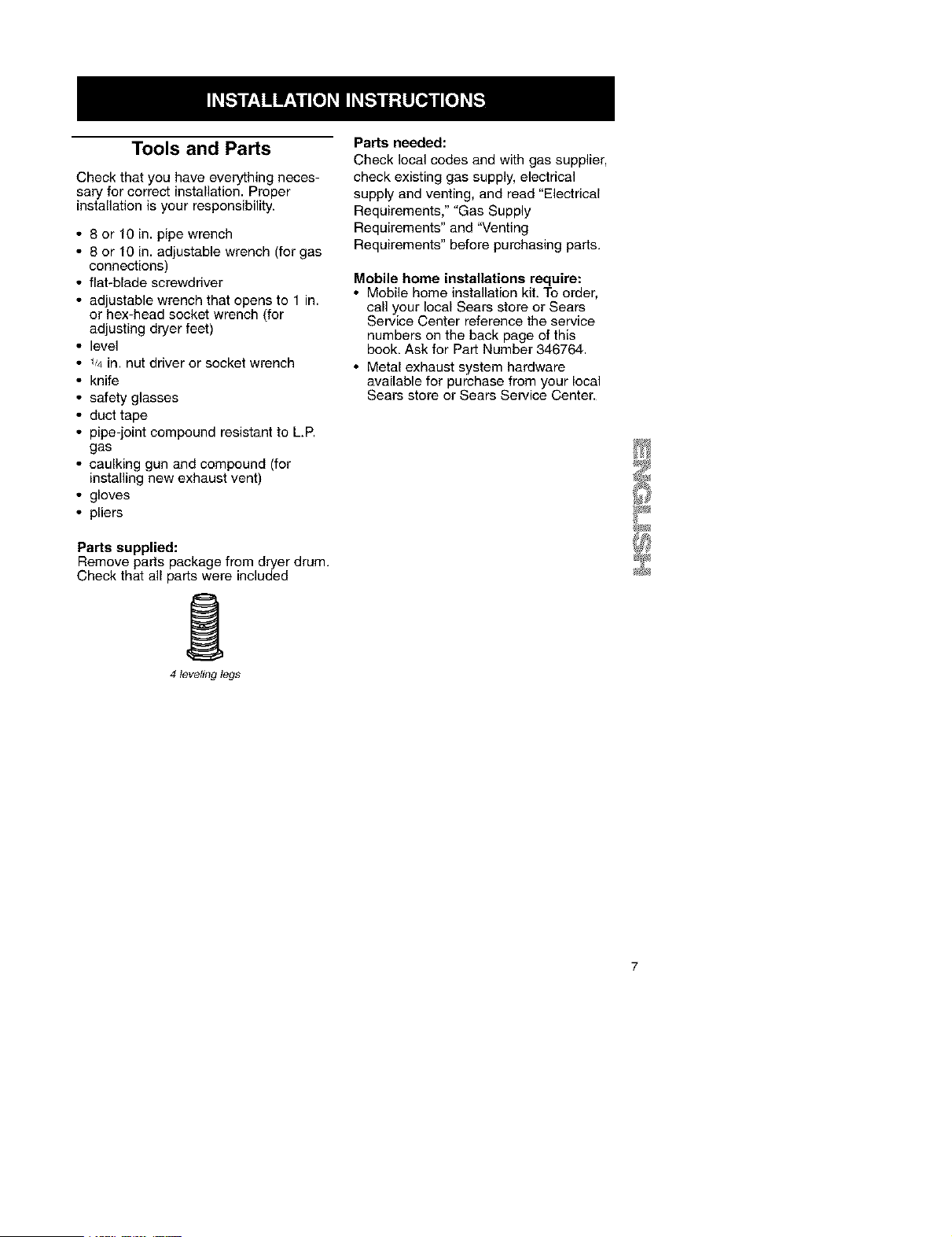
Parts supplied:
Remove parts package from dryer drum.
Check that all parts were included
4 leveling legs
Parts needed:
Check local codes and with gas supplier,
check existing gas supply, electrical
supply and venting, and read "Electrical
Requirements," "Gas Supply
Requirements" and "Venting
Requirements" before purchasing parts.
Mobile home installations require:
• Mobile home installation kit. To order,
call your local Sears stere or Sears
Service Center reference the service
numbers on the back page of this
book. Ask for Part Number 346764.
• Metal exhaust system hardware
available for purchase from your local
Sears store or Sears Service Center.
Location Requirements
Explosion Hazard
Keep flammable materials and vapors,
such as gasoline, away from dryer.
Place dryer at least 18 inches (46 cm)
above the floor for a garage
installation.
Failure to do so can result in death,
explosion, or fire.
You will need
• A location that allows for proper
exhaust installation. A gas dryer must
be exhausted to the outdoors. See
"Venting Requirements."
• A grounded electrical outlet located
within 2 ft (61 cm) of either side of the
dryer. See "Electrical Requirements."
• A sturdy floor to support the dryer with
a total weight (dryer and load) of 200
Ibs (90.7 kgs).
• A level floor with a maximum slope of
1 in. (2.5 cm) under entire dryer. (If
slope is greater than 1 in. [2.5 cm],
install Extended Dryer Feet kit, Part
No. 279810.) Clothes may not tumble
properly and dryers with automatic
sensor cycles may not operate
correctly if dryer is not level.
Do not operate or store your dryer in a
location with year-round temperatures
below 45-°F (7-°C).At lower temperatures,
the dryer might not shut off at the end of
an automatic cycle. Drying times can be
extended.
Install the dryer where it is protected from
water and/or weather.
Check code requirements. Some codes
limit, or do not permit, installation of the
dryer in garages, closets, mobile homes,
or sleeping quarters. Contact your local
building inspector.
NOTE: No other fuel-burning appliance
can be installed in the same closet as a
dryer.
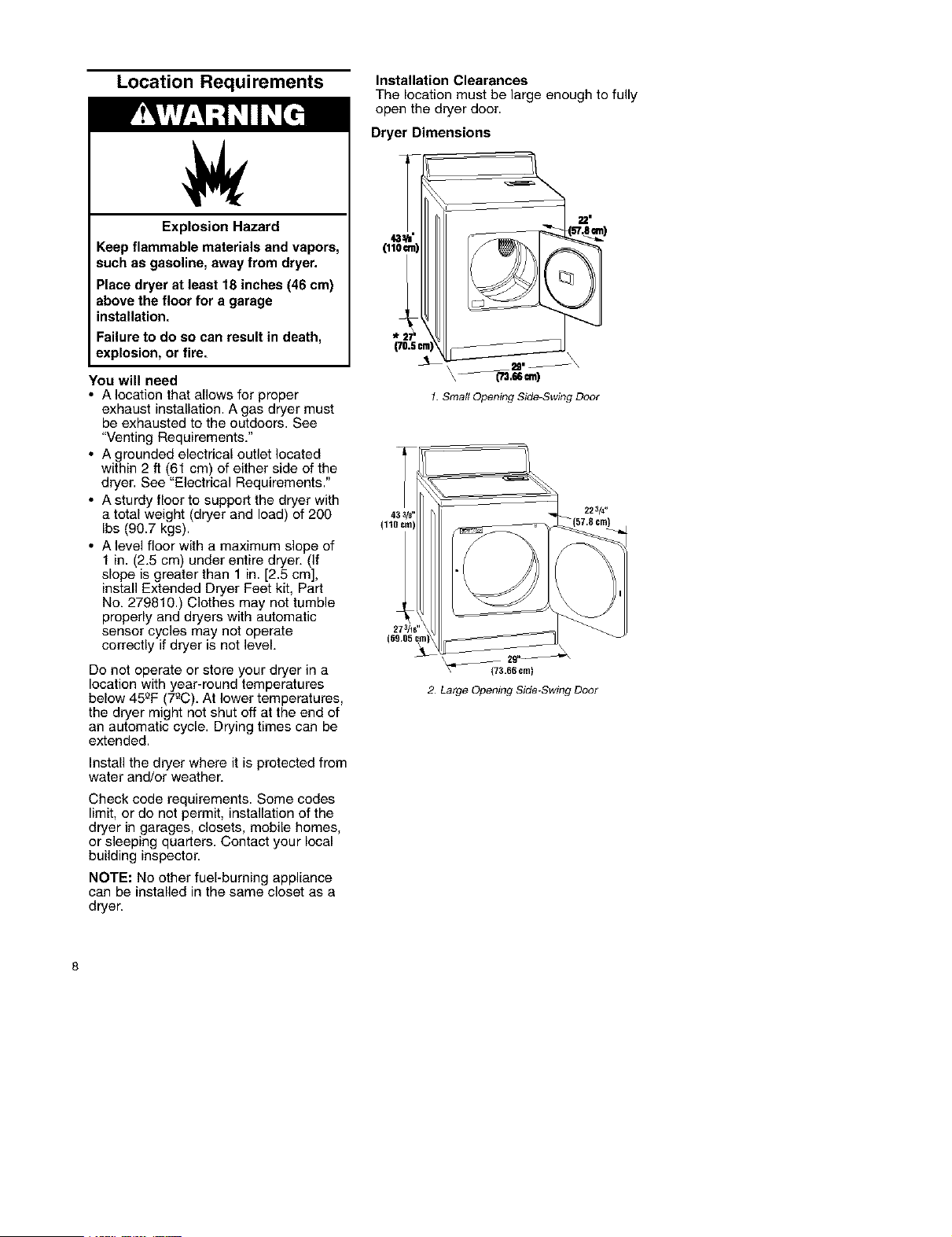
Installation Clearances
The location must be large enough to fully
open the dryer door.
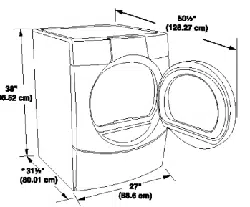
Dryer Dimensions
1. Small Opening Side-Swing Door
_7(73.66 cm)
2 Large Opening Side-Swing Door
8
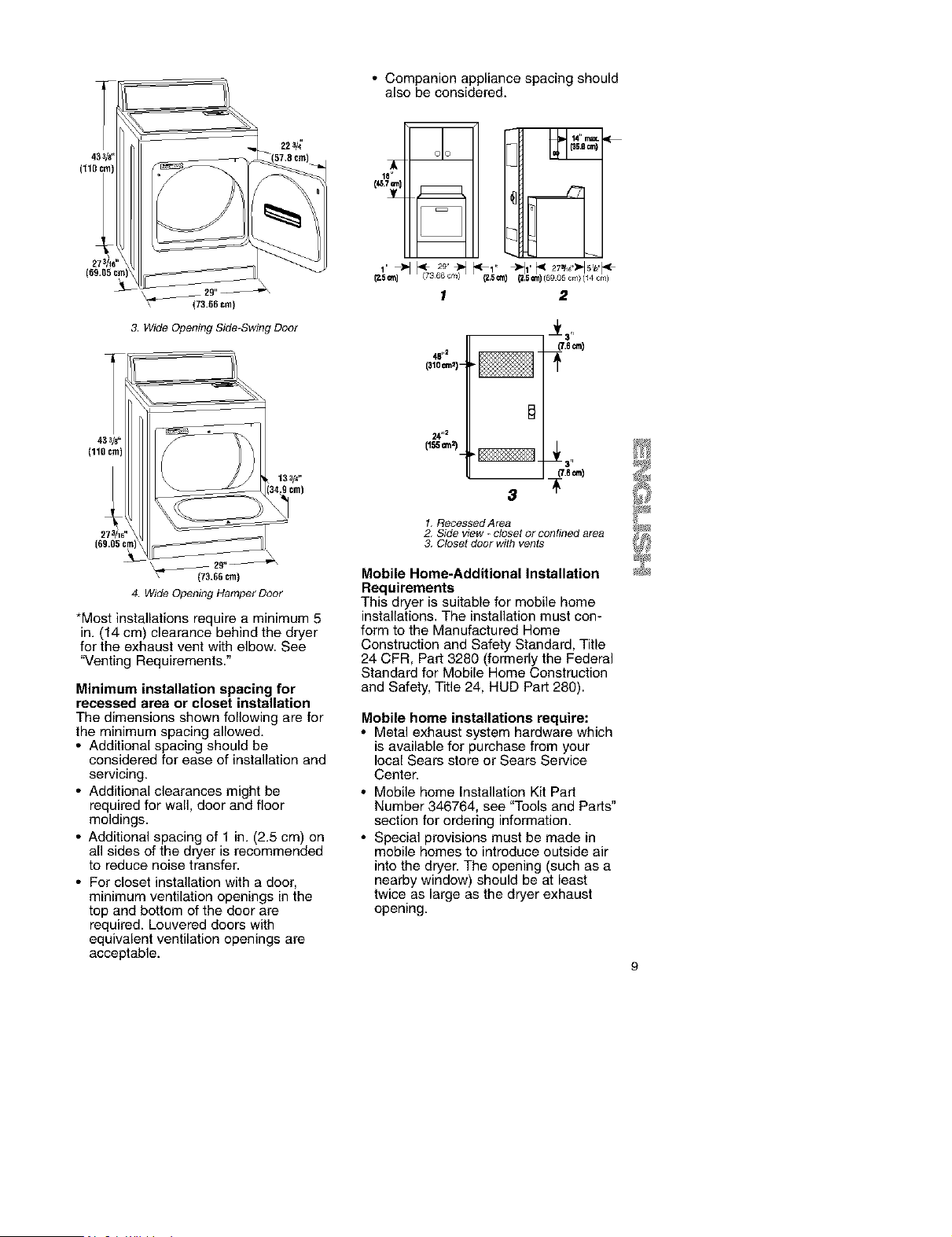
(110
\ 29 "_
_(73.66 cm)
3. Wide Opening Side-Swing Door
(110cln)
133/4"
27_/16"
(69.05 c
4. Wide Opening Hamper Door
*Most installations require a minimum 5
in. (14 cm) clearance behind the dryer
for the exhaust vent with elbow. See
"Venting Requirements."
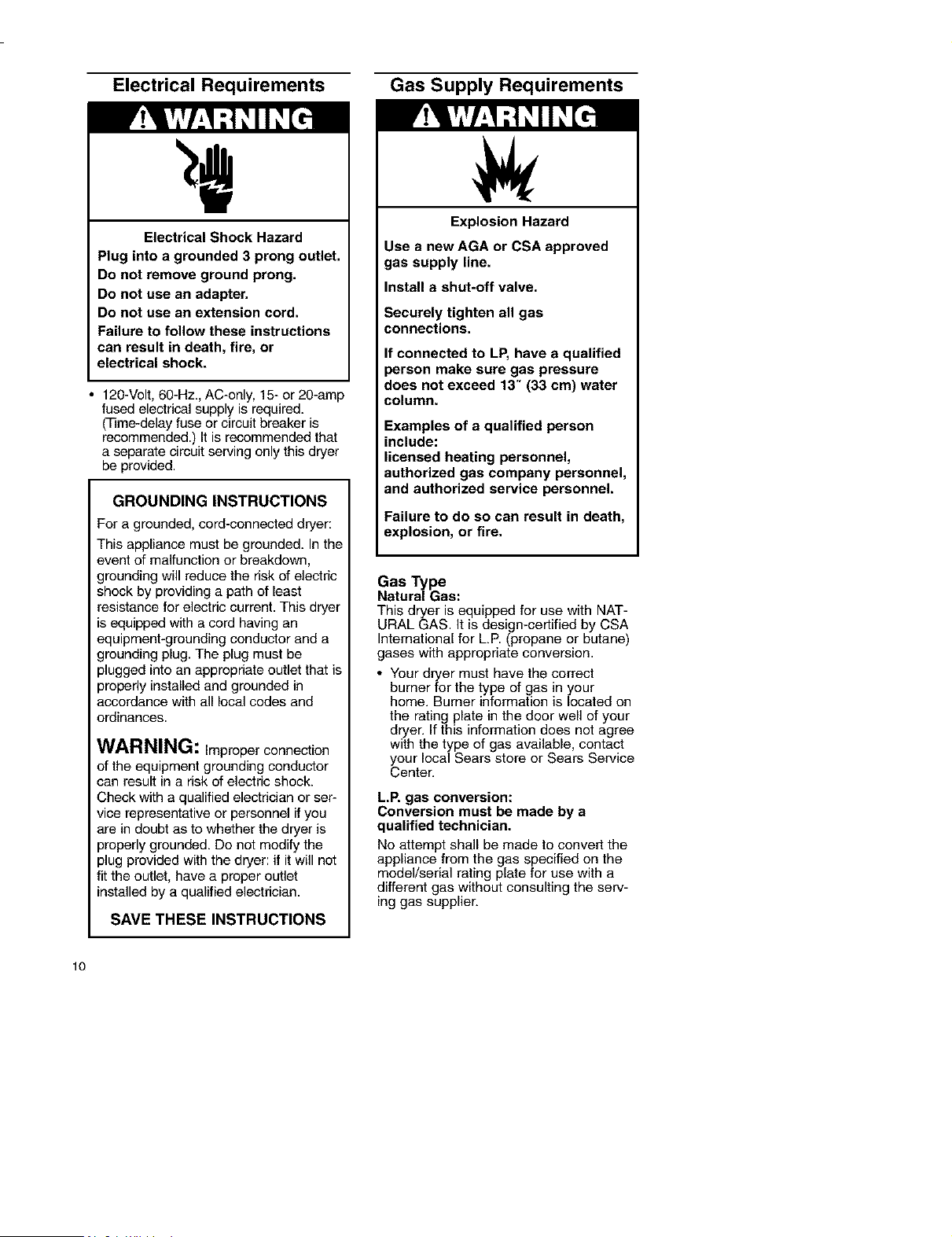
Minimum installation spacing for
recessed area or closet installation
The dimensions shown following are for
the minimum spacing allowed.
• Additional spacing should be
considered for ease of installation and
servicing.
• Additional clearances might be
required for wall, door and floor
moldings.
• Additional spacing of 1 in. (2.5 cm) on
all sides of the dryer is recommended
to reduce noise transfer.
• For closet installation with a door,
minimum ventilation openings in the
top and bottom of the door are
required. Louvered doors with
equivalent ventilation openings are
acceptable.
• Companion appliance spacing should
also be considered.
(_.7_m)
1"
m
-
29' 1" 1" 27_6" 51_2"
_,5i_11 (2,5t_) (6905 cm)(l 4 cm)
1 2
('t.e_)
48'2
(310='al) -
B
24"2
i
3<'
1"/.6_)
3
1. RecessedArea
2. Side view - closet or confined area
3. Closet door with vents
Mobile Home-Additional Installation
Requirements
This dryer is suitable for mobile home
installations. The installation must con-
form to the Manufactured Home
Construction and Safety Standard, Title
24 CFR, Part 3280 (formerly the Federal
Standard for Mobile Home Construction
and Safety, Title 24, HUD Part 280).
Mobile home installations require:
• Metal exhaust system hardware which
is available for purchase from your
local Sears store or Sears Service
Center.
• Mobile home Installation Kit Part
Number 346764, see "Tools and Parts"
section for ordering information.
• Special provisions must be made in
mobile homes to introduce outside air
into the dryer. The opening (such as a
nearby window) should be at least
twice as large as the dryer exhaust
opening.
Electrical Requirements Gas Supply Requirements
Electrical Shock Hazard
Plug into a grounded 3 prong outlet.
Do not remove ground prong.
Do not use an adapter.
Do not use an extension cord.
Failure to follow these instructions
can result in death, fire, or
electrical shock.
12g-Volt, 60-Hz., AC-only, 15- or 20-am
fused electrical supply is required.
(Time-delay fuse or circuit breaker is
recommended.) It is recommended that
a separate circuit serving only this dryer
be provided.
GROUNDINGINSTRUCTIONS
For a grounded, cord-connected dryer:
This appliance must be grounded. In the
event of malfunction or breakdown,
grounding will reduce the risk of electric
shock by providing a path of least
resistance for electdc current. This dryer
is equipped with a cord having an
equipment-grounding conductor and a
grounding plug. The plug must be
plugged into an appropriate outlet that is
prepedy installed and grounded in
accordance with all local codes and
ordinances.
WARNING: improper connection
of the equipment grounding conductor
can result in a dsk of electric shock.
Check with a qualified electrician or ser-
vice representative or personnel if you
are in doubt as to whether the dryer is
properly grounded. De not modify the
plug provided with the dryer: if it will not
fit the outlet, have a proper outlet
installed by a qualified electrician.
SAVE THESE INSTRUCTIONS
Explosion Hazard
Use a new AGA or CSA approved
gas supply line.
Install a shut-off valve.
Securely tighten all gas
connections.
If connected to LP, have a qualified
person make sure gas pressure
does not exceed 13" (33 cm) water
column.
Examples of a qualified person
include:
licensed heating personnel,
authorized gas company personnel,
and authorized service personnel.
Failure to do so can result in death,
explosion, or fire.
Gas Type
Natural Gas:
This dryer is equipped for use with NAT-
URAL GAS. It is design-certified by CSA
International for L.E (propane or butane)
gases with appropriate conversion.
• Your dryer must have the correct
burner for the type of gas in your
home. Burner information is located on
the rating plate in the door well of your
dryer. If this information does not agree
with the type of gas available, contact
your local Sears store or Sears Service
Center.
L.P. gas conversion:
Conversion must be made by a
qualified technician.
No attempt shall be made to convert the
appliance from the gas specified on the
model/serial rating plate for use with a
different gas without consulting the serv-
ing gas supplier.
10
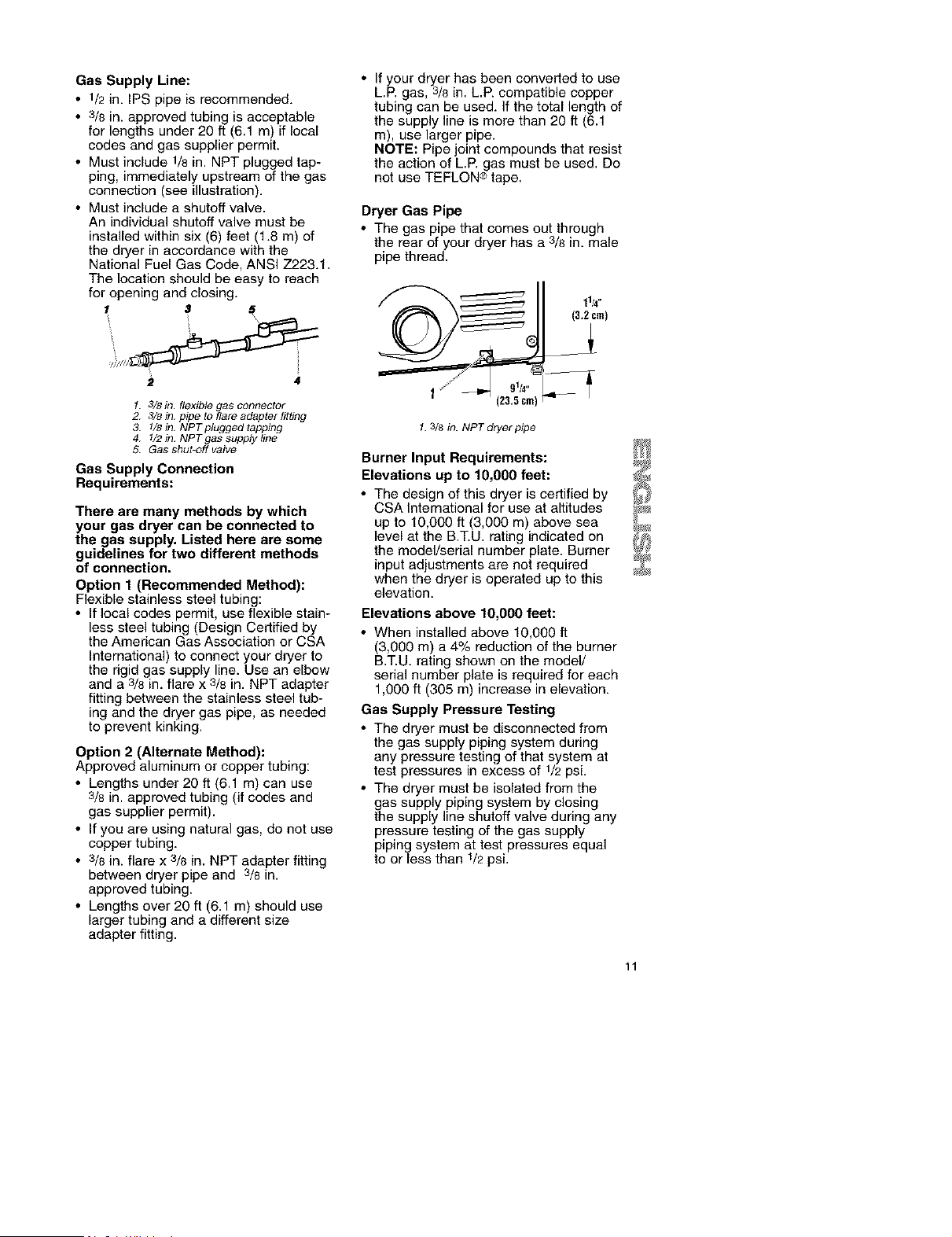
Gas Supply Line:
• 1/2 in. IPS pipe is recommended.
• 3/8 in. approved tubing is acceptable
for lengths under 20 ft (6.1 m) if local
codes and gas supplier permit.
• Must include 1/8 in. NPT plugged tap-
ping, immediately upstream of the gas
connection (see illustration).
• Must include a shutoff valve.
An individual shutoff valve must be
installed within six (6) feet (1.8 m) of
the dryer in accordance with the
National Fuel Gas Code, ANSI Z223.1.
The location should be easy to reach
for opening and closing.
f 3 6
2 4
1. 3/8 in. flexible gas connector
2. 3/8 in. pipe to flare adapter fitting
3. l/sin. NPTpluggedtapping
4. 1/2in. NPT gas supply line
5. Gas shut-off valve
Gas Supply Connection
Requirements:
There are many methods by which
your gas dryer can be connected to
the gas supply. Listed here are some
guidelines for two different methods
of connection.
Option 1 (Recommended Method):
Flexible stainless steel tubing:
• If local codes permit, use flexible stain-
less steel tubing (Design Certified by
the American Gas Association or CSA
International) to connect your dryer to
the rigid gas supply line. Use an elbow
and a 3/8 in. flare x 3/8 in. NPT adapter
fitting between the stainless steel tub-
ing and the dryer gas pipe, as needed
to prevent kinking.
Option 2 (Alternate Method):
Approved aluminum or copper tubing:
• Lengths under 20 ft (6.1 m) can use
3/8 in. approved tubing (if codes and
gas supplier permit).
• If you are using natural gas, do not use
copper tubing.
• 3/8 in. flare x 3/8 in. NPT adapter fitting
between dryer pipe and 3/8 in.
approved tubing.
• Lengths over 20 ft (6.1 m) should use
larger tubing and a different size
adapter fitting.
• If your dryer has been converted to use
L.P. gas,3/,/8in. L.P. compatible copper
tubing can be used. If the total length of
the supply line is more than 20 ft (6.1
m), use larger pipe.
NOTE: Pipe joint compounds that resist
the action of L.E gas must be used. Do
not use TEFLON® tape.
Dryer Gas Pipe
• The gas pipe that comes out through
the rear of your dryer has a 3/8 in. male
pipe thread.
gl/4,,
1z -,4
1.3/8 in. NPT dcyerpipe
11/4"
(3.2 cm)
Burner Input Requirements:
Elevations up to 10,000 feet:
• The design of this dryer is certified by
CSA International for use at altitudes
up to 10,000 ft (3,000 m) above sea
level at the B.T.U. rating indicated on
the model/serial number plate. Burner
input adjustments are not required
when the dryer is operated up to this
elevation.
Elevations above 10,000 feet:
• When installed above 10,000 ft
(3,000 m) a 4% reduction of the burner
B.T.U. rating shown on the model/
serial number plate is required for each
1,O00 ft (305 m) increase in elevation.
Gas Supply Pressure Testing
• The dryer must be disconnected from
the gas supply piping system during
any pressure testing of that system at
test pressures in excess of 1/2psi.
• The dryer must be isolated from the
gas supply piping system by closing
the supply line shutoff valve during any
pressure testing of the gas supply
piping system at test pressures equal
to or less than V2 psi.
11
Venting Requirements Use a heavy metal vent. Do not use plas-
tic or metal foil vent.
Fire Hazard
Use a heavy metal vent.
Do not use a plastic vent.
Do not use a metal foil vent.
Failure to follow these instructions
can result in death or fire.
WARNING: To reduce the risk of
fire, this dryer MUST BE EXHAUSTED
OUTDOORS.
4 in. (10.2 cm) heavy metal exhaust vent
and clamps must be used. DURASAFE TM
venting products are recommended and
are available from your local Sears store
or Sears Service Center.
DURASAFE vent products can be pur-
chased from your dealer. Please refer-
ence the service numbers located on the
back page of this manual or visit our
Intemet site at: www.sears.com.
• Do not exhaust the dryer into any gas
vent, chimney, wall, ceiling, or a
concealed space of a building.
• Do not use an exhaust hood with a
magnetic latch.
• Do not install flexible metal vent in
enclosed walls, ceilings or floors.
• Do not use screws or other fastening
devices that extend into the interior of
the vent to secure vent.
IMPORTANT: Observe all governing
codes and ordinances.
Improper venting can cause moisture
and lint to collect indoors, which may
result in:
• Moisture damage to woodwork,
fumiture, paint, wallpaper, carpets, etc.
• Housecleaning problems and health
problems.
Rigid metal vent is recommended to pre-
vent crushing and kinking.
Flexible metal vent must be fully extend-
ed and supported when the dryer is in its
final position. Remove excess flexible
metal vent to avoid sagging and kinking
that may result in reduced airflow.
An exhaust hood should cap the vent to
prevent rodents and insects from
entering the home.
Exhaust hood must be at least 12 in.
(30.5 cm) from the ground or any object
that may be in the path of the exhaust
(such as flowers, rocks or bushes, etc.).
If using an existing vent system, clean
lint from the entire length of the system
and make sure exhaust hood is not
plugged with lint. Replace any plastic or
metal foil vent with rigid metal or flexible
metal vent.
Use duct tape to seal all joints.
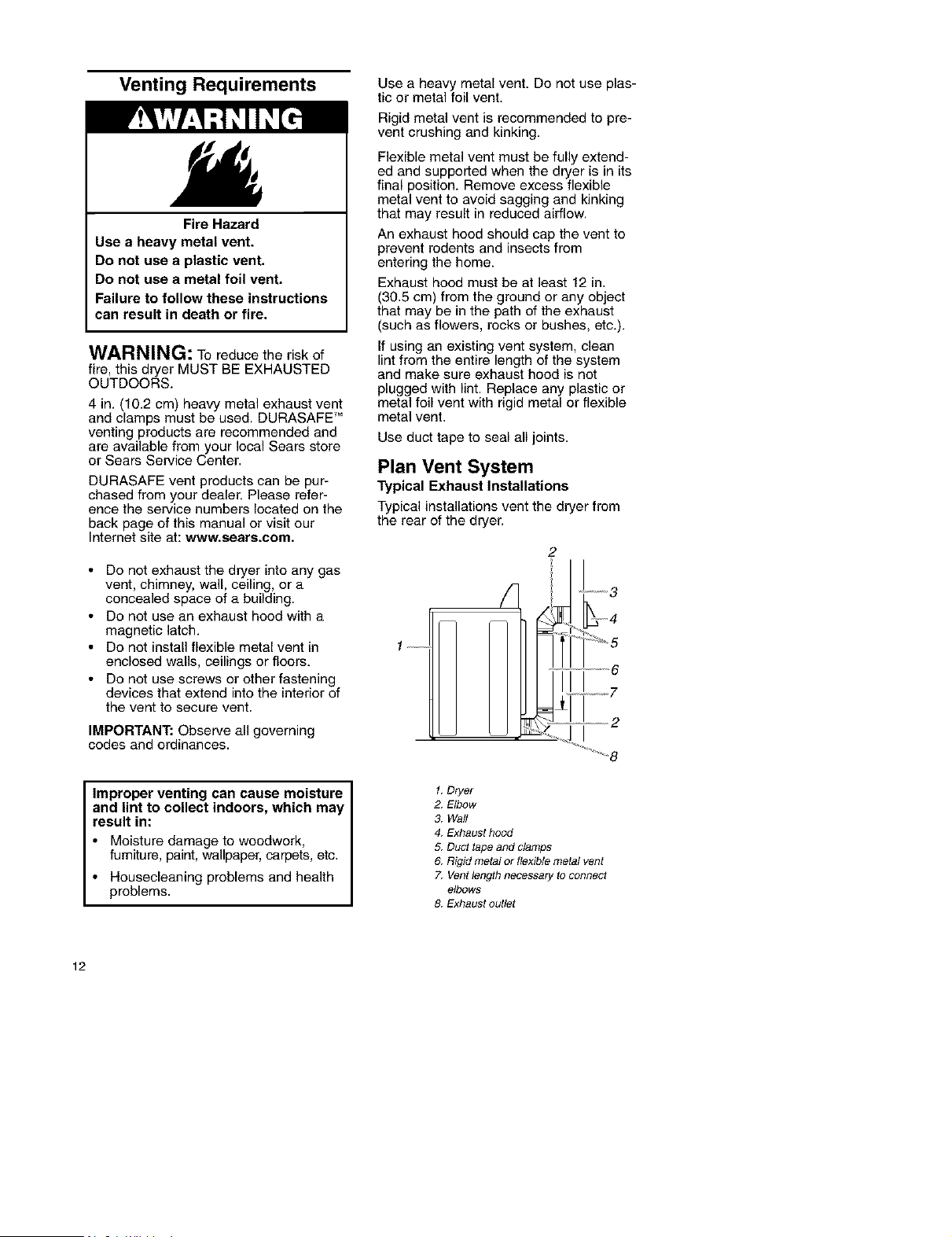
Plan Vent System
Typical Exhaust Installations
Typical installations vent the dryer from
the rear of the dryer.
f--
2
f I
_ .b4
lilT"
i
2
- . C
1. Dryer
2. Elbow
& Wall
4. Exhaust hood
& Duct tape and clamps
& Rigid metal or flexible metal vent
7. Vent length necessary to connect
elbows
8. Exhaust outlet
12
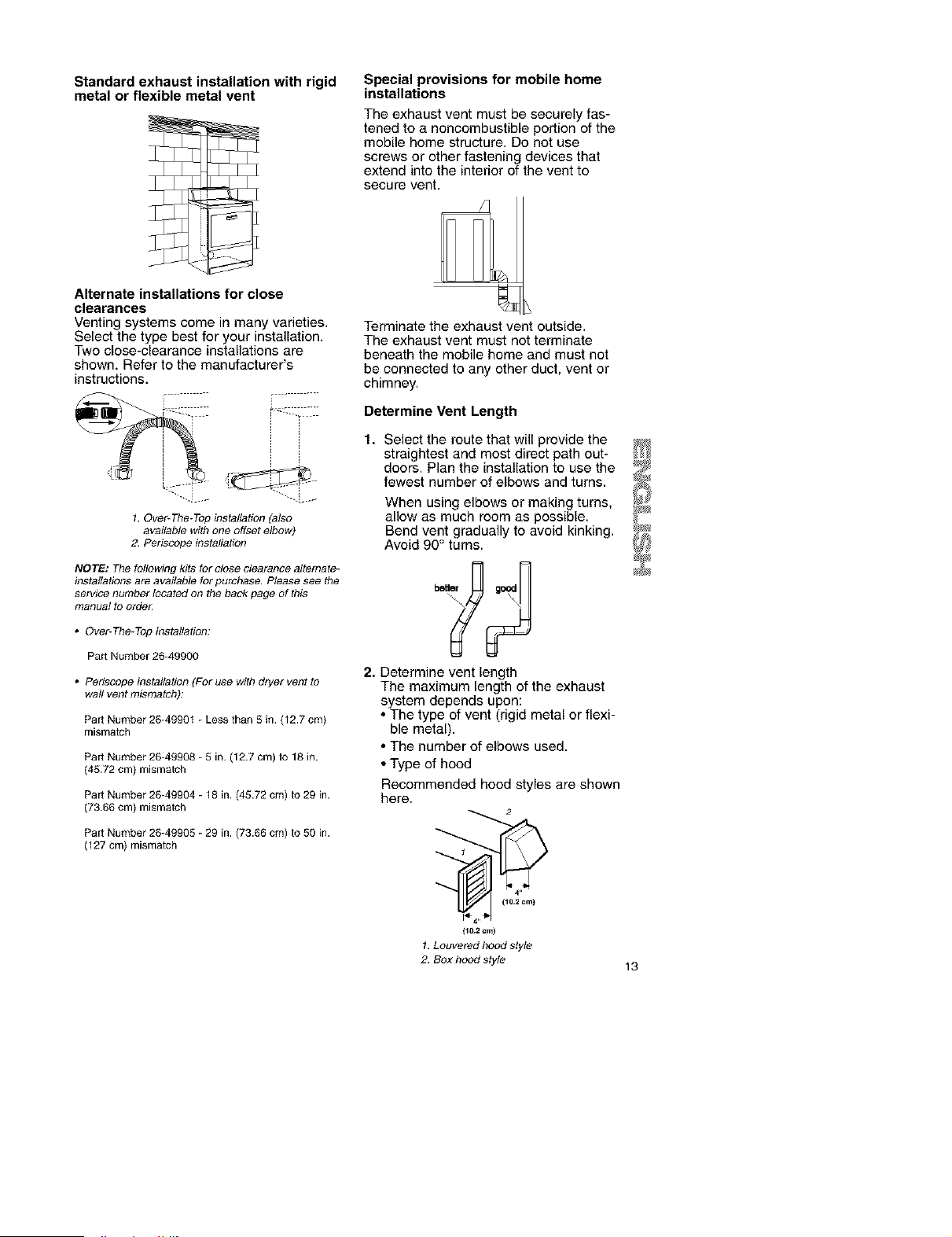
Standard exhaust installation with rigid
metal or flexible metal vent
Alternate installations for close
clearances
Venting systems come in many varieties.
Select the type best for your installation.
Two dose-clearance installations are
shown. Refer to the manufacturer's
instructions.
-..L .....
1. Over-The-Top installation (also
available with one offset elbow)
2. Periscope installation
NOTE: The following kits for close clearance altemate-
installations are available for purchase. Please see the
service number located on the back page of this
manual 1oorde_
• Over-The_Top Installation:
Part Number 26-49900
• Periscope Installation (For use with dryer vent to
wall vent mismatch):
Part Number 26-49901 - Less than 5 in. (12.7 cm)
mismatch
Part Number 26-49908 - 5 in. (12.7 cm) to 18 in.
(45.72 cm) mismatch
Part Number 26-49904 - 18 in. (45.72 cm) to 29 in.
(73.65 cm) mismatch
Part Number 26-49905 - 29 in. (73.56 cm) to 50 in.
(127 cm) mismatch
Special provisions for mobile home
installations
The exhaust vent must be securely fas-
tened to a noncombustible portion of the
mobile home structure. Do not use
screws or other fastening devices that
extend into the interior of the vent to
secure vent.
Terminate the exhaust vent outside.
The exhaust vent must not terminate
beneath the mobile home and must not
be connected to any other duct, vent or
chimney.
Determine Vent Length
t. Select the route that will provide the
straightest and most direct path out-
doors. Plan the installation to use the
fewest number of elbows and turns.
When using elbows or making turns,
allow as much room as possible.
Bend vent gradually to avoid kinking.
Avoid 90° turns.
better good
2. Determine vent length
The maximum length of the exhaust
system depends upon:
• The type of vent (rigid metal or flexi-
ble metal).
• The number of elbows used.
• Type of hood
Recommended hood styles are shown
here.
1
I 4" J
(1&2 cm)
1. Louvorod hood style
2. Box hood style
13
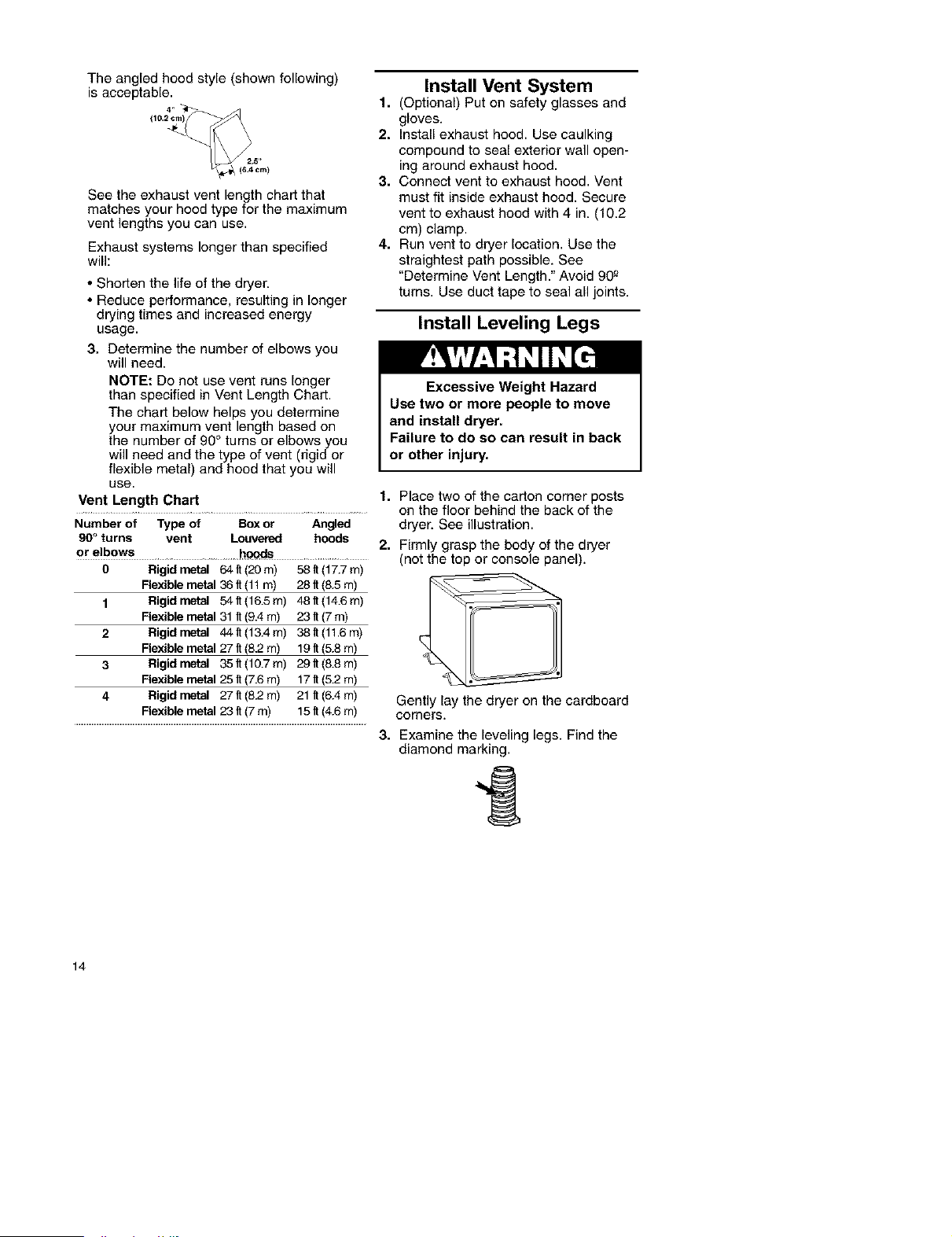
The angled hood style (shown following)
is acceptable.
(6.4 cm)
See the exhaust vent length chart that
matches your hood type for the maximum
vent lengths you can use.
Exhaust systems longer than specified
will:
• Shorten the life of the dryer.
• Reduce performance, resulting in longer
drying times and increased energy
usage.
3. Determine the number of elbows you
will need.
NOTE: Do not use vent runs longer
than specified in Vent Length Chart.
The chart below helps you determine
your maximum vent length based on
the number of 90° turns or elbows you
will need and the type of vent (rigid or
flexible metal) and hood that you will
use.
Vent Length Chart
Number of Type of Boxor Angled
90° turns vent LouvePad hoods
or elbows .......... _s ......
0 Rigidmetal 64_((20rn) 58f((17.7m)
Flexiblemetal36It(11m) 28It(8.5m)
1 Rigidmetal 54ff(16.5m) 48ff(14.6m)
Flexiblemetal 31ff (9.4m) 23f((7m)
2 Rigidmetal 44f((13.4m) 38f((11.6m)
Flexiblemetal27ff (8.2m) 19ff(5.8m)
3 Rigidmetal 35f((10.7m) 29f((8.8m)
Flexiblemetal25ff (7.6m) 17ff(5.2m)
4 Rigidmetal 27f((8.2m) 21ff (6.4m)
Flexiblemetal23f((7m) 15ff(4.6m)
Install Vent System
1. (Optional) Put on safety glasses and
gloves.
2. Install exhaust hood. Use caulking
compound to seal exterior wall open-
ing around exhaust hood.
3. Connect vent to exhaust hood. Vent
must fit inside exhaust hood. Secure
vent to exhaust hood with 4 in. (10.2
cm) clamp.
4. Run vent to dryer location. Use the
straightest path possible. See
"Determine Vent Length." Avoid 90_°
turns. Use duct tape to seal all joints.
Install Leveling Legs
Excessive Weight Hazard
Use two or more people to move
and install dryer.
Failure to do so can result in back
or other injury.
1. Place two of the carton corner posts
on the floor behind the back of the
dryer. See illustration.
2. Firmly grasp the body of the dryer
(not the top or console panel).
Gently lay the dryer on the cardboard
comers.
3. Examine the leveling legs. Find the
diamond marking.
14
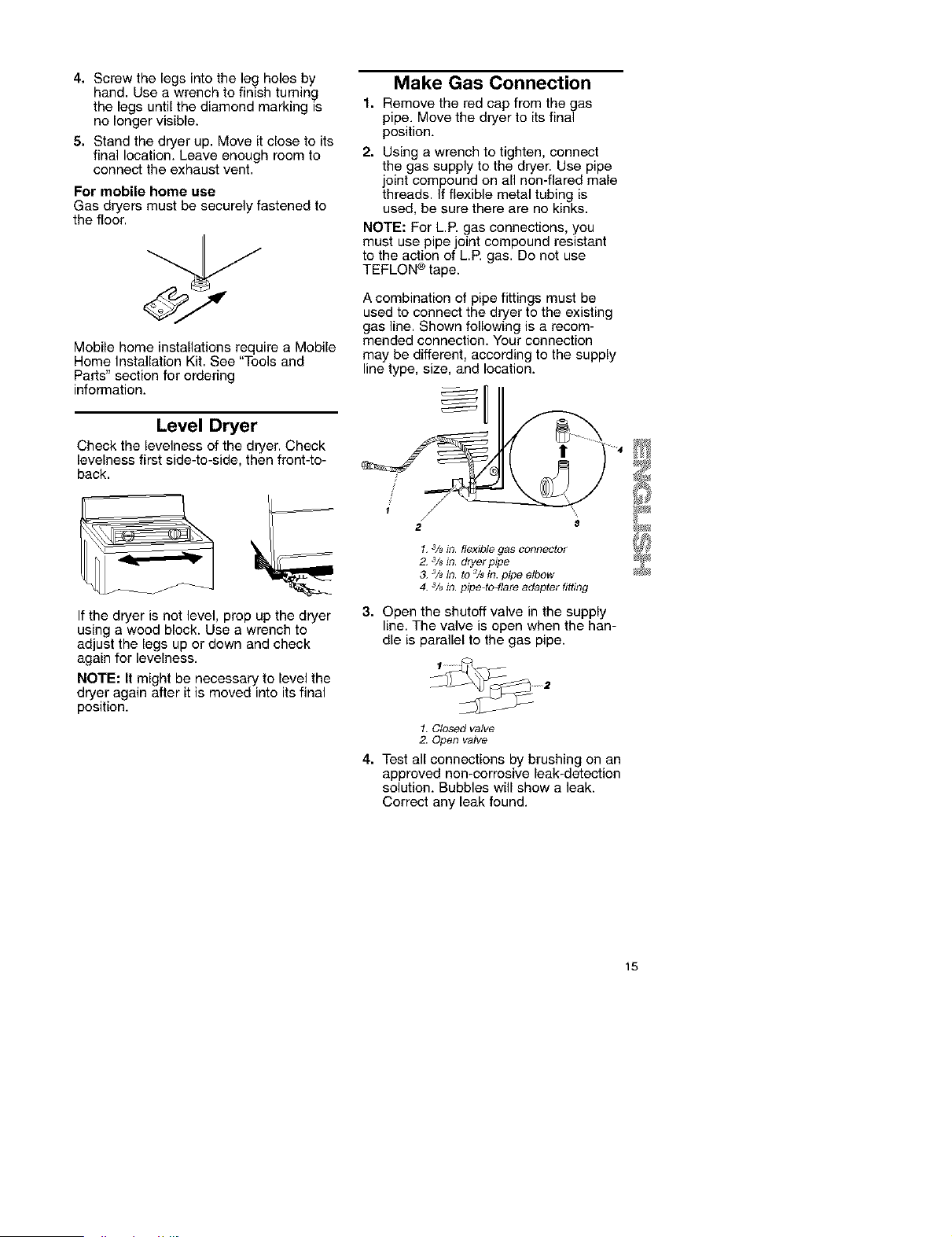
4. Screw the legs into the leg holes by
hand. Use a wrench to finish turning
the legs until the diamond marking is
no longer visible.
5. Stand the dryer up. Move it close to its
final location. Leave enough room to
connect the exhaust vent.
For mobile home use
Gas dryers must be securely fastened to
the floor.
Mobile home installations require a Mobile
Home Installation Kit. See "Tools and
Parts" section for ordering
information.
Level Dryer
Check the levelness of the dryer. Check
levelness first side-to-side, then front-to-
back.
If the dryer is not level, prop up the dryer
using a wood block. Use a wrench to
adjust the legs up or down and check
again for levelness.
NOTE: It might be necessary to level the
dryer again after it is moved into its final
position.
Make Gas Connection
1. Remove the red cap from the gas
pipe. Move the dryer to its final
position.
2. Using a wrench to tighten, connect
the gas supply to the dryer. Use pipe
joint compound on all non-flared male
threads. If flexible metal tubing is
used, be sure there are no kinks.
NOTE: For L.R gas connections, you
must use pipe joint compound resistant
to the action of L.R gas. Do not use
TEFLON ®tape.
A combination of pipe fittings must be
used to connect the dryer to the existing
gas line. Shown following is a recom-
mended connection. Your connection
may be different, according to the supply
line type, size, and location.
!
1
2 8
1. s/. in. flexible gas connector
2. s/. in. dryerpipe
&Slain. to 3/sin. pipe elbow
4. s/. in. pipe-to41are adapter fitting
3. Open the shutoff valve in the supply
line. The valve is open when the han-
dle is parallel to the gas pipe.
1. Closed valve
2. Open valve
4. Test all connections by brushing on an
approved non-corrosive leak-detection
solution. Bubbles will show a leak.
Correct any leak found.
15
Connect Vent
1. Using a 4 in. (10.2 cm) clamp, con-
nect vent to exhaust outlet in dryer. If
connecting to existing vent, make sure
the vent is clean. The dryer vent must
fit over the dryer exhaust outlet and
inside the exhaust hood. Make sure
the vent is secured to exhaust hood
with a 4 in. (10.2 cm) clamp.
2. Move dryer into final position. Do not
crush or kink vent. Make sure dryer is
level
Complete Installation
1. Check to be sure all parts are now
installed. If there is an extra part, go
back through the steps to see which
step was skipped.
2. Check to be sure you have all of your
tools.
3. Dispose of all packaging materials.
4. Check the dryer's final location. Be
sure the vent is not crushed or kinked.
5. Check to be sure the dryer is level.
(See "Level Dryer.")
6. Plug into a grounded 3 prong outlet.
Turn power on.
7. Remove the blue protective film on
the console and any tape remaining
on the dryer.
8. Read "Dryer Use."
9. Wipe the dryer drum interior
thoroughly with a damp cloth to
remove any dust.
10. Set the dryer on a full heat cycle (not
an air cycle) for 20 minutes and start
the dryer.
If the dryer will not start, check
the following:
• Dryer is plugged into a grounded 3
prong outlet.
• Electrical supply is connected.
• House fuse is intact and tight; or
circuit breaker has not tripped.
• Dryer door is closed.
11. When the dryer has been running for
5 minutes, open the dryer door and
feel for heat. If you do not feel heat,
turn the dryer off and check to see if
the gas supply line shutoff valve
is open.
• If the gas supply line shutoff valve
is closed, open it, then repeat the
5-minute test as outlined above.
• If the gas supply line shutoff valve
is open, contact a qualified
technician.
16
Explosion Hazard
Keep flammable materials and
vapors, such as gasoline, away
from dryer.
Do not dry anything that has ever had
anything flammable on it (even after
washing).
Failure to follow these instructions can
result in death, explosion, or fire.
STARTING YOUR DRYER
To get the best drying results, you must
operate your dryer properly. This section
gives you this important information.
NOTE: The drawings in this section show
the basic features of all models covered
by this manual. Refer to the supplied
"Feature Sheet" for your dryer's particular
features.
Fire Hazard
No washer can completely
remove oil.
Do not dry anything that has ever had
any type of oil on it (including cooking
oils).
Items containing foam, rubber,
or plastic must be dried on a
clothesline or by using an Air Cycle.
Failure to follow these instructions can
result in death or fire.
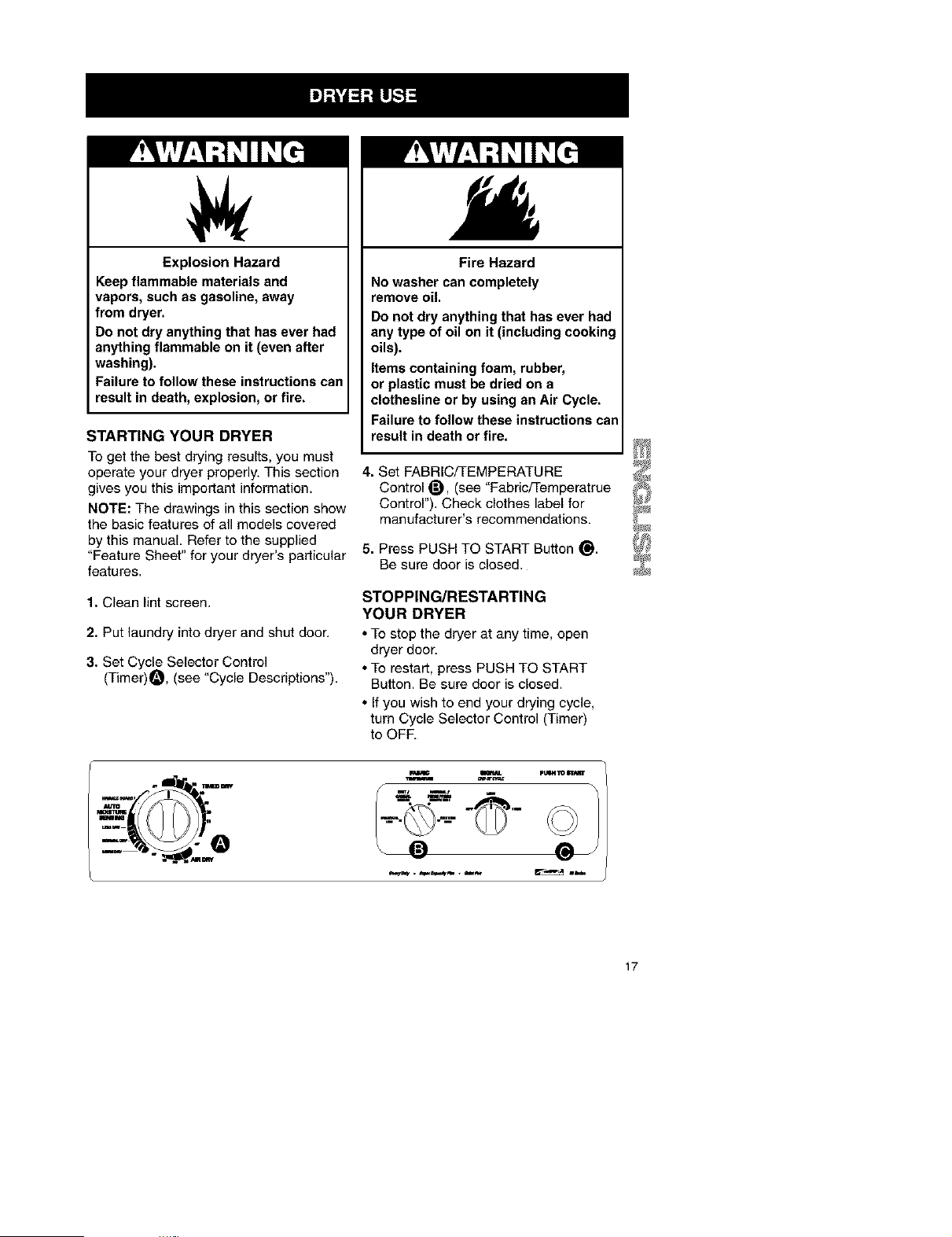
4. Set FABRIC/TEMPERATURE
Control _, (see "Fabric/Temperatrue
Control"). Check clothes label for
manufacturer's recommendations.
5. Press PUSH TO START Button _.
Be sure door is closed.
1. Clean lint screen.
2. Put laundry into dryer and shut door.
3. Set Cycle Selector Control
(Timer)_, (see "Cycle Descriptions").
STOPPING/RESTARTING
YOUR DRYER
• To stop the dryer at any time, open
dryer door.
• To restart, press PUSH TO START
Button. Be sure door is closed.
• If you wish to end your drying cycle,
turn Cycle Selector Control (Timer)
to OFE
17
CYCLE DESCRIPTION
The automatic cycles save you time
by providing the best drying results
in the shortest time. This can help
you save money on utility bills and
reduce the risk of fabric damage.
Using Automatic Drying Cycles
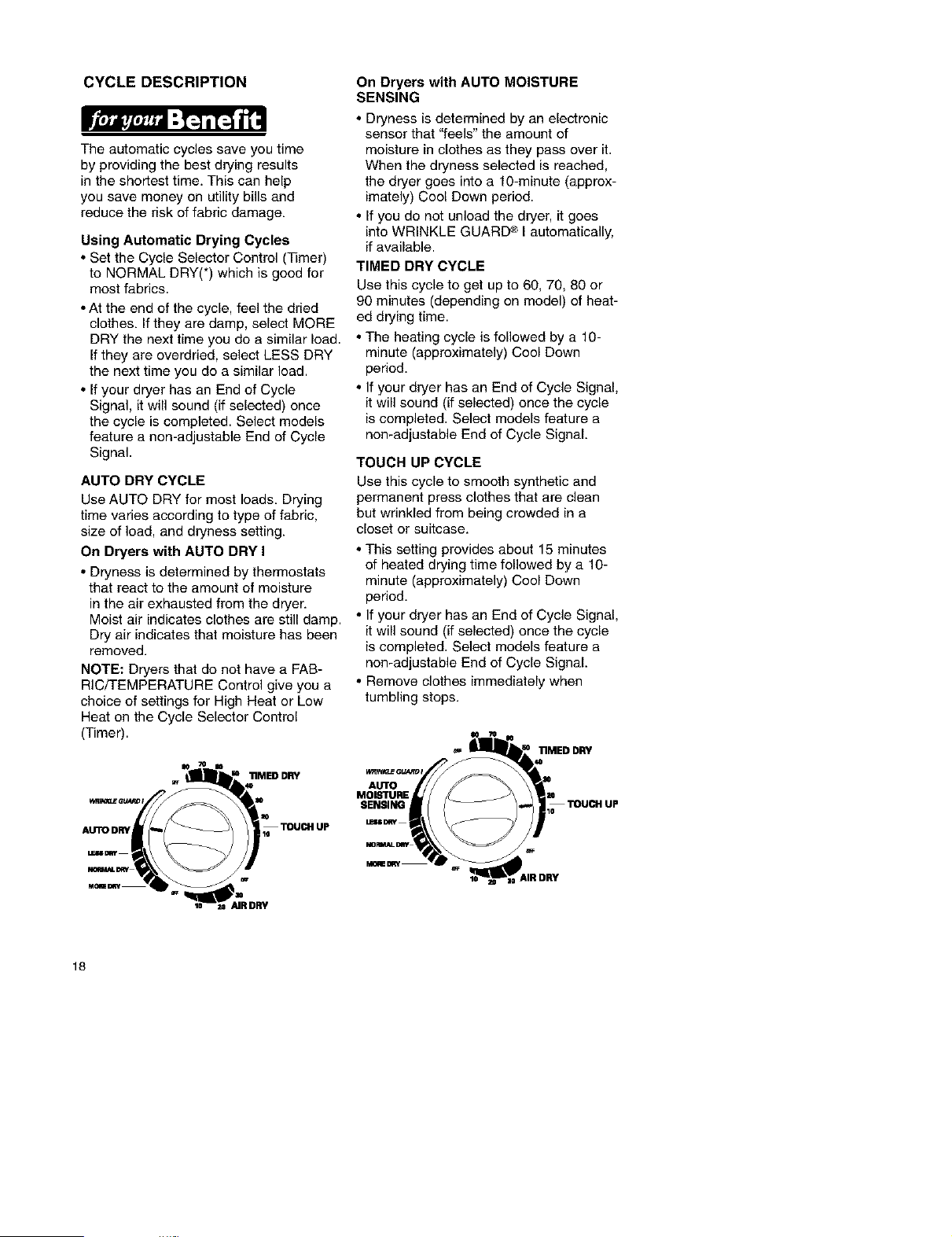
• Set the Cycle Selector Control (Timer)
to NORMAL DRY(*) which is good for
most fabrics.
• At the end of the cycle, feel the dried
clothes. If they are damp, select MORE
DRY the next time you do a similar load.
If they are overdried, select LESS DRY
the next time you do a similar load.
• If your dryer has an End of Cycle
Signal, it will sound (if selected) once
the cycle is completed. Select models
feature a non-adjustable End of Cycle
Signal.
AUTO DRY CYCLE
Use AUTO DRY for most loads. Drying
time varies according to type of fabric,
size of load, and dryness setting.
On Dryers with AUTO DRY I
• Dryness is determined by thermostats
that react to the amount of moisture
in the air exhausted from the dryer.
Moist air indicates clothes are still damp.
Dry air indicates that moisture has been
removed.
NOTE: Dryers that do not have a FAB-
RICFrEMPERATURE Control give you a
choice of settings for High Heat or Low
Heat on the Cycle Selector Control
(Timer).
On Dryers with AUTO MOISTURE
SENSING
• Dryness is determined by an electronic
sensor that "feels" the amount of
moisture in clothes as they pass over it.
When the dryness selected is reached,
the dryer goes into a 10-minute (approx-
imately) Cool Down period.
• If you do not unload the dryer, it goes
into WRINKLE GUARD ® Iautomatically,
if available.
TIMED DRY CYCLE
Use this cycle to get up to 60, 70, 80 or
90 minutes (depending on model) of heat-
ed drying time.
• The heating cycle is followed by a 10-
minute (approximately) Cool Down
period.
• If your dryer has an End of Cycle Signal,
it will sound (if selected) once the cycle
is completed. Select models feature a
non-adjustable End of Cycle Signal.
TOUCH UP CYCLE
Use this cycle to smooth synthetic and
permanent press clothes that are clean
but wrinkled from being crowded in a
closet or suitcase.
• This setting provides about 15 minutes
of heated drying time followed by a 10-
minute (approximately) Cool Down
period.
• If your dryer has an End of Cycle Signal,
it will sound (if selected) once the cycle
is completed. Select models feature a
non-adjustable End of Cycle Signal.
• Remove clothes immediately when
tumbling stops.
]IMED DRY
AUTO
SENSING
18
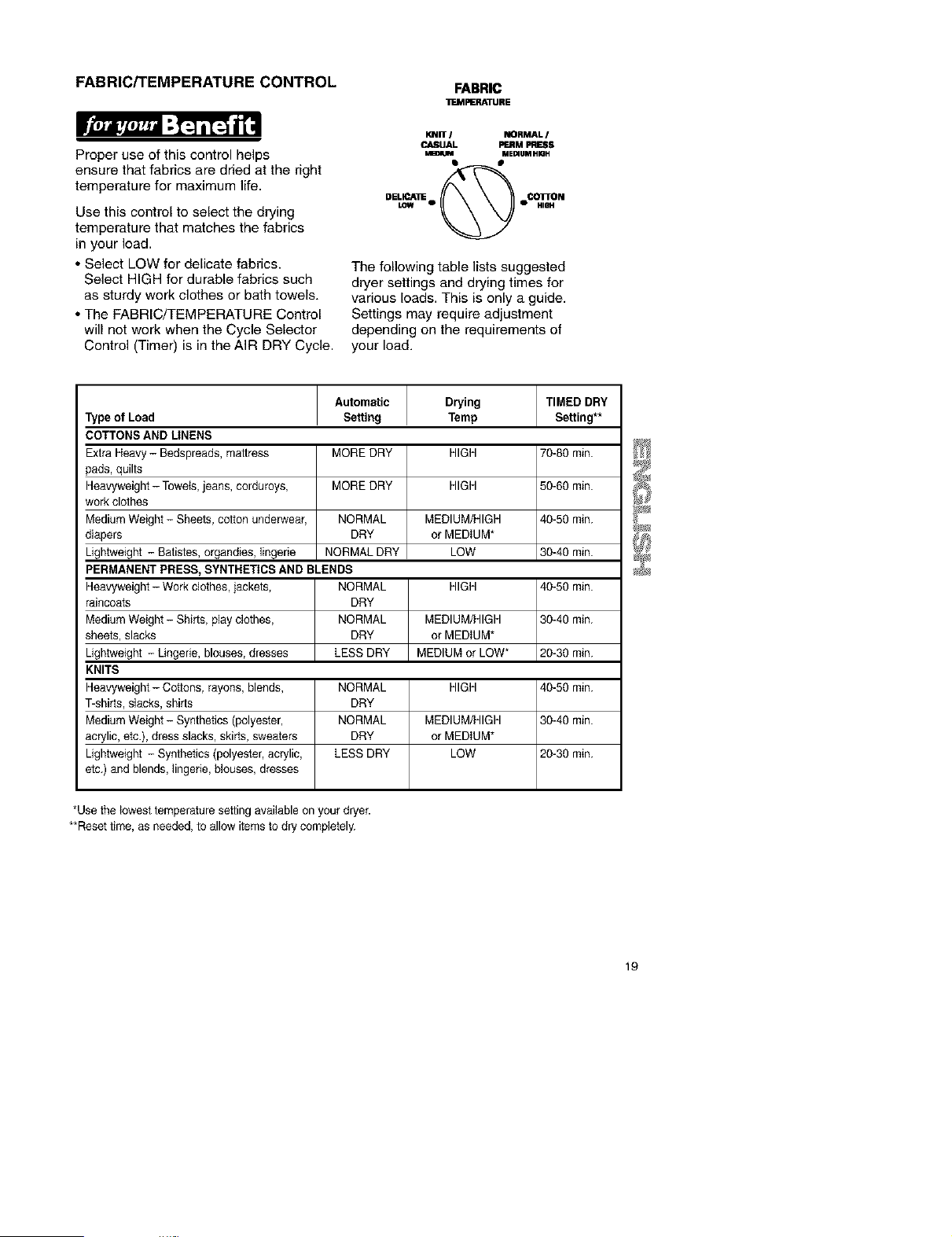
FABRIC/TEMPERATURE CONTROL
Proper use of this control helps
ensure that fabrics are dried at the right
temperature for maximum life.
Use this control to select the drying
temperature that matches the fabrics
in your load.
• Select LOW for delicate fabrics.
Select HIGH for durable fabrics such
as sturdy work clothes or bath towels.
• The FABRIC/TEMPERATURE Control
will not work when the Cycle Selector
Control (Timer) is in the AIR DRY Cycle.
FABRIC
I_MPtERATURE
IOIIT I NORMAL /
CASUAL PEIRM PRESS
i MEDIUMHmH
The following table lists suggested
dryer settings and drying times for
various loads. This is only a guide.
Settings may require adjustment
depending on the requirements of
your load.
Automatic Drying TIMED DRY
Type of Load Setting Temp Setting**
COTTONS AND LINENS
Extra Heavy - Bedspreads, mattress MORE DRY HIGH 70-80 rain.
pads, quilts
Heavyweight- Towels, jeans, corduroys, MORE DRY HIGH 50-60 rain.
work clothes
Medium Weight - Sheets, cotton underwear, NORMAL MEDIUM/HIGH 40-50 rain.
diapers DRY or MEDIUM*
Lightweight - Batistes, organdies, lingerie NORMAL DRY LOW 30-40 rain.
PERMANENT PRESS, SYNTHETICS AND BLENDS
Heavyweight- Work clothes, jackets, NORMAL HIGH 40-50 rain.
raincoats DRY
Medium Weight - Shirts, play clothes, NORMAL MEDIUM/HIGH 30-40 rain.
sheets, slacks DRY or MEDIUM*
Lightweight - Lingerie, blouses, dresses LESS DRY MEDIUM or LOW* 20-30 rain.
KNITS
Heavyweight-Cottons, rayons, blends, NORMAL HIGH 40-50 rain.
T-shirts, slacks, shirts DRY
Medium Weight - Synthetics (polyester, NORMAL MEDIUM/HIGH 30-40 rain.
acrylic, etc.), dress slacks, skirts, sweaters DRY or MEDIUM*
Lightweight - Synthetics (polyester, acrylic, LESS DRY LOW 20-30 rain.
etc.) and blends, lingerie, blouses, dresses
*Use the lowest temperature setting available onyour dryer.
**Reset time, as needed, to allow items to dry completely.
19
USING AIR DRY/AIR FLUFF
Using these cycles gives you all the ben-
efits of hang drying with a shorter drying
time.
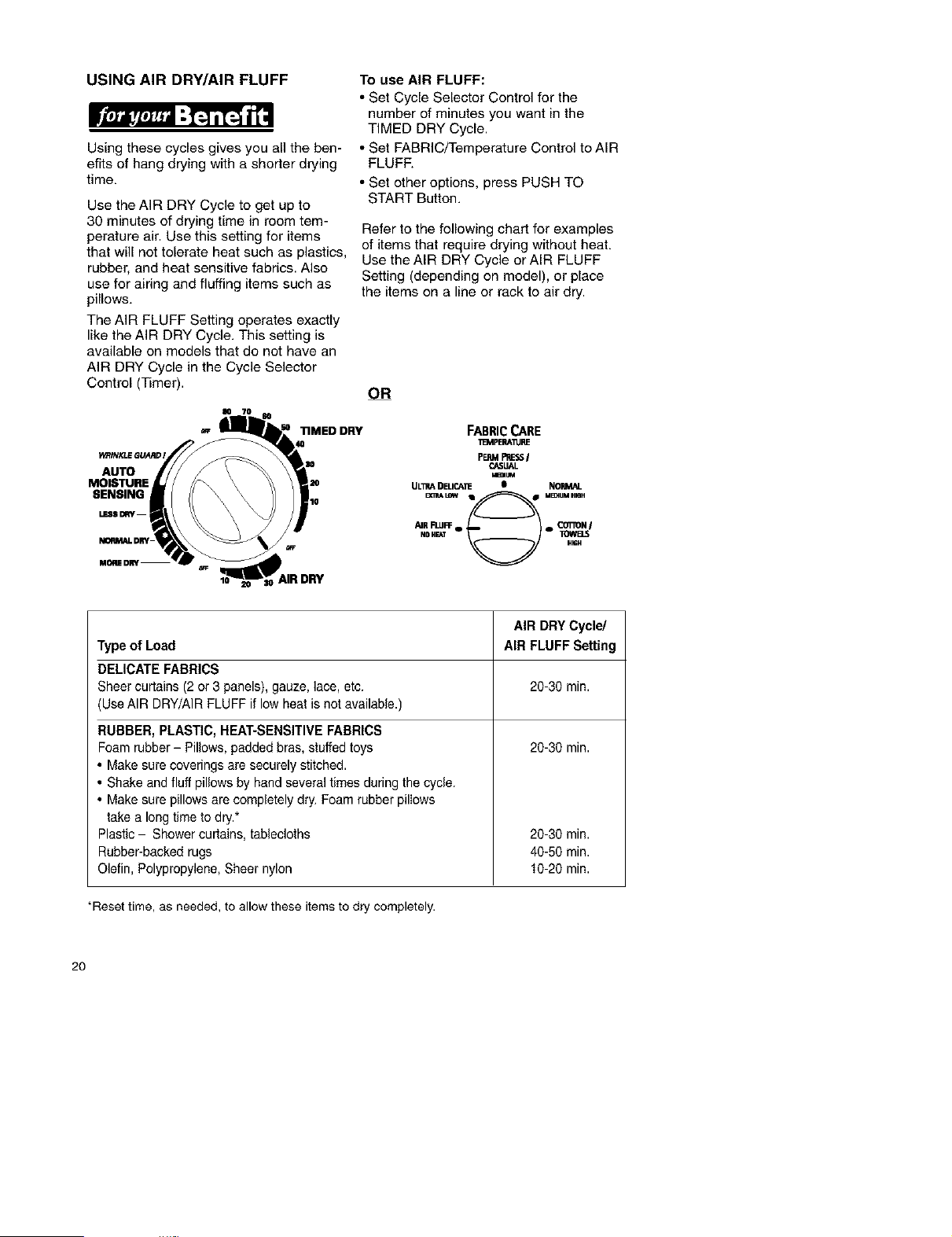
Use the AIR DRY Cycle to get up to
30 minutes of drying time in room tem-
perature air. Use this setting for items
that will not tolerate heat such as plastics,
rubber, and heat sensitive fabrics. Also
use for airing and fluffing items such as
pillows.
The AIR FLUFF Setting operates exactly
like the AIR DRY Cycle. This setting is
available on models that do not have an
AIR DRY Cycle in the Cycle Selector
Control (T_mer).
80 ?0
To use AIR FLUFF:
• Set Cycle Selector Control for the
number of minutes you want in the
TIMED DRY Cycle.
• Set FABRIC/Temperature Control to AIR
FLUFE
• Set other options, press PUSH TO
START Button.
Refer to the following chart for examples
of items that require drying without heat.
Use the AIR DRY Cycle or AIR FLUFF
Setting (depending on model), or place
the items on a line or rack to air dry.
OR
"riMED DRY FABRICCARE
n3_tpERAIURE
_qlNM.E GUARD pERM PRESS I
AUTO CASUAL
MOISTURE UL11qADELICAllE e NORMAL
SENSING
_A LOW • • ME]uM HmH
LESS0RY
AIR FLUff e e COT'FONI
NEH
M_IE ORY
AIR DRYCycle/
Type of Load AIR FLUFF Setting
DELICATE FABRICS
Sheercurtains (2 or 3 panels),gauze, lace, etc. 20-30 min.
(Use AIR DRY/AIRFLUFF if low heatis not available.)
20-30 min.
RUBBER, PLASTIC, HEAT-SENSITIVE FABRICS
Foam rubber - Pillows, paddedbras, stuffed toys
• Make sure coverings are securely stitched.
• Shake and fluff pillows by hand several times during the cycle.
• Make sure pillows are completely dry.Foam rubber pillows
take a long time to dry.*
Plastic- Shower curtains, tablecloths
Rubber-backed rugs
Olefin, Polypropylene, Sheer nylon
20-30 min.
40-50 min.
10-20 min.
*Reset time, as needed, to allow these items to dry completely.
2O
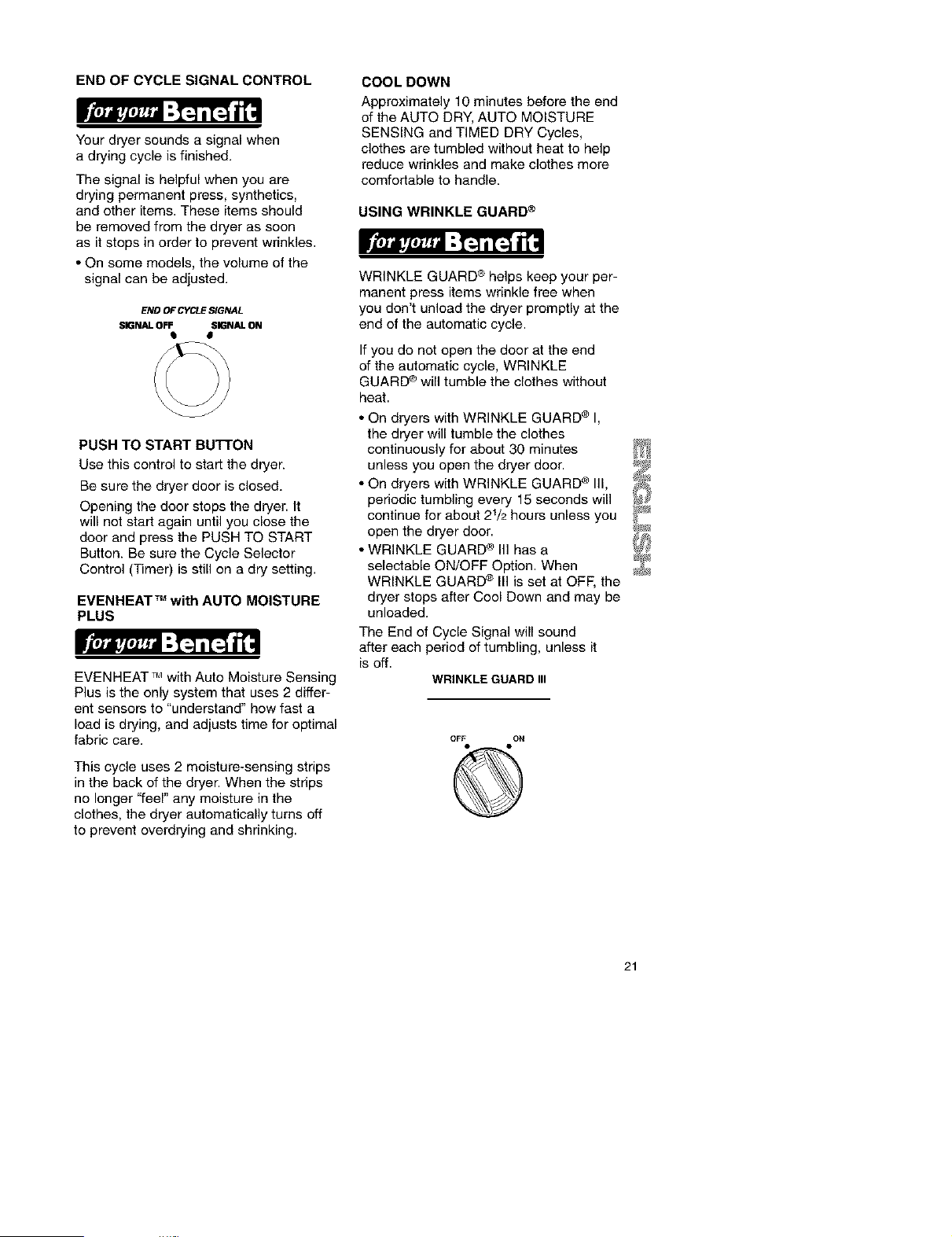
END OFCYCLESIGNALCONTROL
Your dryer sounds a signal when
a drying cycle is finished.
The signal is helpful when you are
drying permanent press, synthetics,
and other items. These items should
be removed from the dryer as soon
as it stops in order to prevent wrinkles.
• On some models, the volume of the
signal can be adjusted.
END OF CYCLE SIGNAL
SIGNAL OFF SIGNAL ON
PUSH TO START BU'I-rON
Use this control to start the dryer.
Be sure the dryer door is closed.
Opening the door stops the dryer. It
will net start again until you close the
door and press the PUSH TO START
Button. Be sure the Cycle Selector
Control (Timer) is still on a dry setting.
EVENHEAT TM with AUTO MOISTURE
PLUS
EVENHEAT TM with Auto Moisture Sensing
Plus is the only system that uses 2 differ-
ent sensors to "understand" hew fast a
lead is drying, and adjusts time for optimal
fabric care.
This cycle uses 2 moisture-sensing strips
in the back of the dryer. When the strips
no longer "feel" any moisture in the
clothes, the dryer automatically turns off
to prevent everdrying and shrinking.
COOLDOWN
Approximately 10 minutes before the end
of the AUTO DRY, AUTO MOISTURE
SENSING and TIMED DRY Cycles,
clothes are tumbled without heat to help
reduce wrinkles and make clothes more
comfortable to handle.
USING WRINKLE GUARD ®
WRINKLE GUARD ® helps keep your per-
manent press items wrinkle free when
you don't unload the dryer promptly at the
end of the automatic cycle.
If you do not open the door at the end
of the automatic cycle, WRINKLE
GUARD ® will tumble the clothes without
heat.
• On dryers with WRINKLE GUARD ® I,
the dryer will tumble the clothes
continuously for about 30 minutes
unless you open the dryer door.
• On dryers with WRINKLE GUARD ® Ill,
periodic tumbling every 15 seconds will
continue for about 21/2hours unless you
open the dryer door.
• WRINKLE GUARD ® III has a
selectable ON/OFF Option. When
WRINKLE GUARD ® III is set at OFF, the
dryer stops after Cool Down and may be
unloaded.
The End of Cycle Signal will sound
after each period of tumbling, unless it
is off.
WRINKLE GUARD III
OFF ON
21
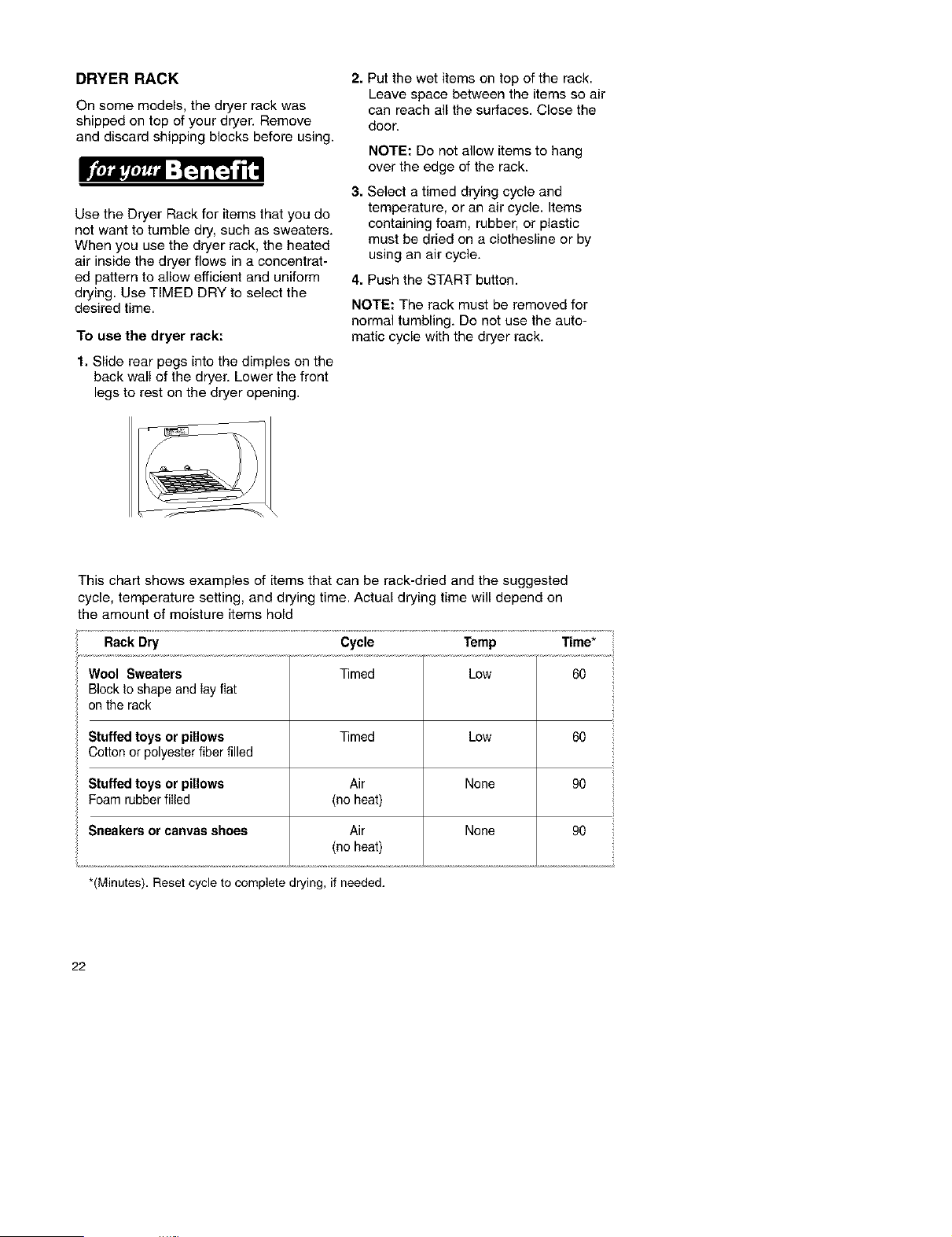
DRYER RACK
On some models, the dryer rack was
shipped on top of your dryer. Remove
and discard shipping blocks before using.
Use the Dryer Rack for items that you do
not want to tumble dry, such as sweaters.
When you use the dryer rack, the heated
air inside the dryer flows in a concentrat-
ed pattern to allow efficient and uniform
drying. Use TIMED DRY to select the
desired time.
To use the dryer rack:
1. Slide rear pegs into the dimples on the
back wall of the dryer. Lower the front
legs to rest on the dryer opening.
2,
Put the wet items on top of the rack.
Leave space between the items so air
can reach all the surfaces. Close the
door.
3,
NOTE: Do not allow items to hang
over the edge of the rack.
Select a timed drying cycle and
temperature, or an air cycle. Items
containing foam, rubber, or plastic
must be dried on a clothesline or by
using an air cycle.
4. Push the START button.
NOTE: The rack must be removed for
normal tumbling. Do not use the auto-
matic cycle with the dryer rack.
This chart shows examples of items that can be rack-dried and the suggested
cycle, temperature setting, and drying time. Actual drying time will depend on
the amount of moisture items hold
Rack Dry Cycle Temp Time*
Wool Sweaters Timed
Block to shape and Iayfiat
on the rack
._tuffedtoys or pillows Timed
_,ottonor polyester fiber filled
._tuffedtoys or pillows Air
=oam rubber filled (no heat)
Sneakers or canvas shoes Air
(no heat)
*(Minutes). Resetcycle to completedrying, if needed.
Low 60
Low 60
None 90
i
None
90 i
22
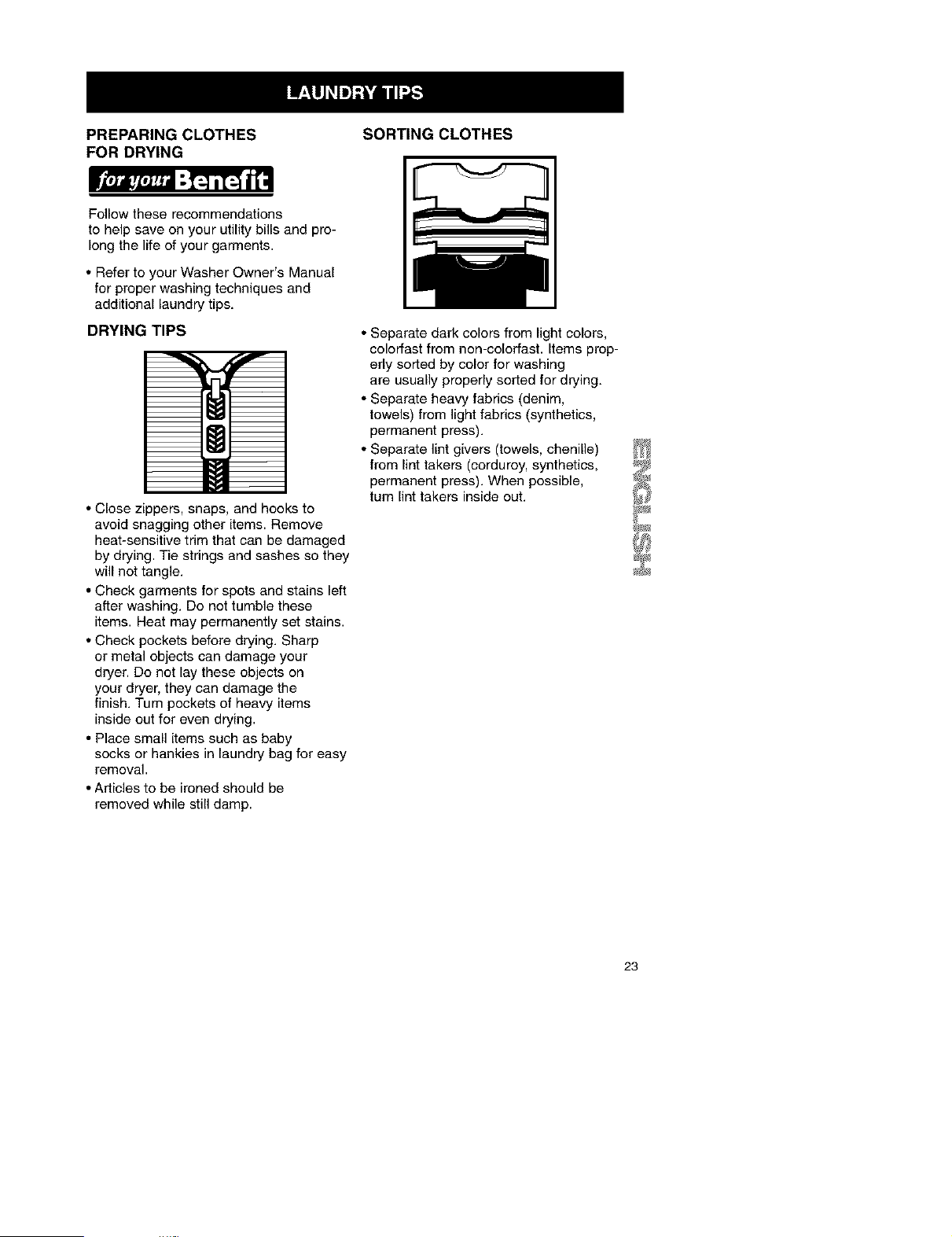
PREPARING CLOTHES SORTING CLOTHES
FOR DRYING
Follow these recommendations
to help save on your utility bills and pro-
long the life of your garments.
• Refer to your Washer Owner's Manual
for proper washing techniques and
additional laundry tips.
DRYING TIPS
• Close zippers, snaps, and hooks to
avoid snagging other items. Remove
heat-sensitive trim that can be damaged
by drying. Tie strings and sashes so they
will not tangle.
• Check garments for spots and stains left
after washing. Do not tumble these
items. Heat may permanently set stains.
• Check pockets before drying. Sharp
or metal objects can damage your
dryer. Do not lay these objects on
your dryer, they can damage the
finish. Turn pockets of heaW items
inside out for even drying.
• Place small items such as baby
socks or hankies in laundry bag for easy
removal.
• Articles to be ironed should be
removed while still damp.
• Separate dark colors from light colors,
colorfast from non-colorfast. Items prop-
erly sorted by color for washing
are usually properly sorted for drying.
• Separate heavy fabrics (denim,
towels) from light fabrics (synthetics,
permanent press).
• Separate lint givers (towels, chenille)
from lint takers (corduroy, synthetics,
permanent press). When possible,
turn lint takers inside out.
23
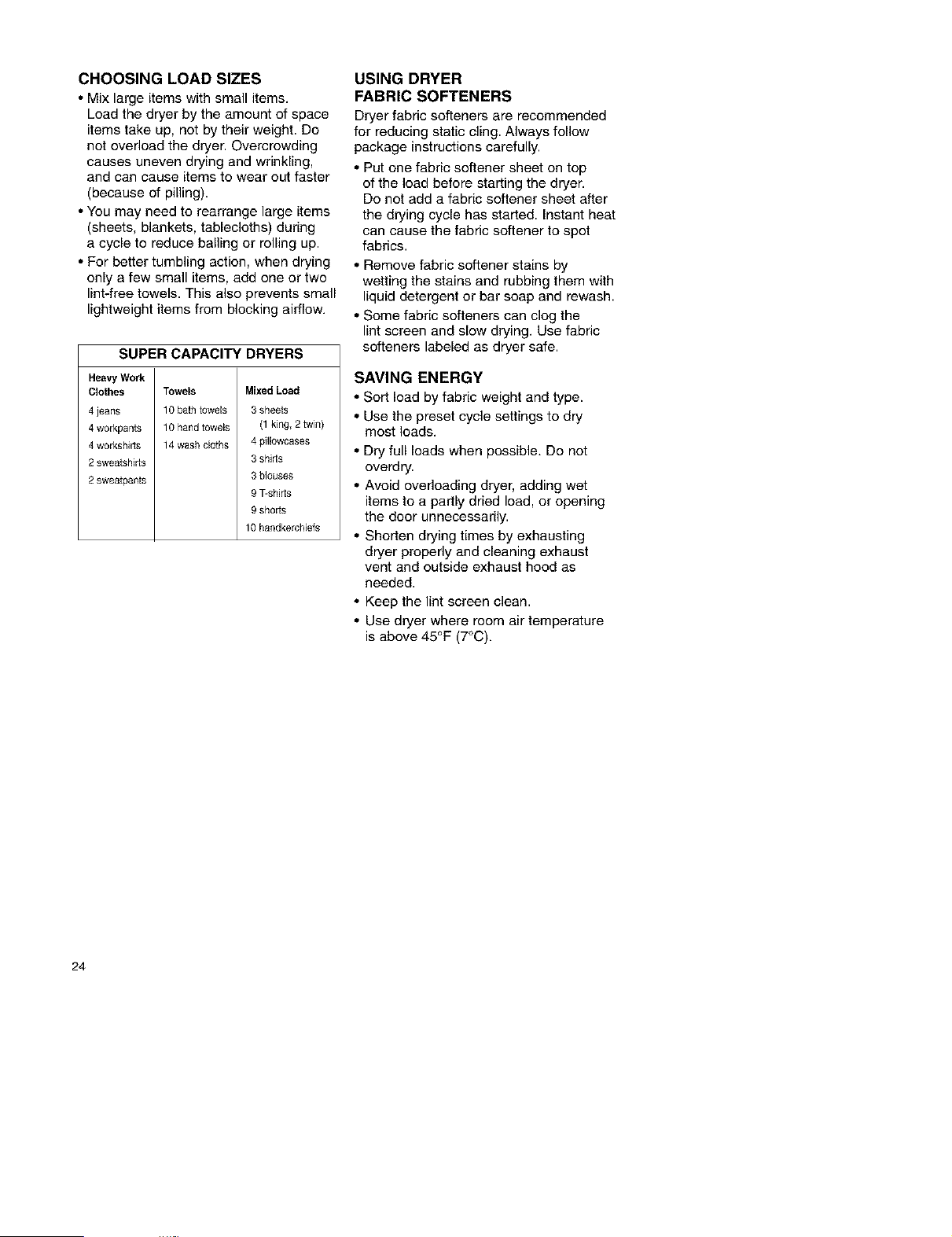
CHOOSING LOAD SIZES
• Mix large items with small items.
Load the dryer by the amount of space
items take up, net by their weight. Do
net overload the dryer. Overcrowding
causes uneven drying and wrinkling,
and can cause items to wear out faster
(because of pilling).
• You may need to rearrange large items
(sheets, blankets, tablecloths) during
a cycle to reduce bailing or rolling up.
• For better tumbling action, when drying
only a few small items, add one or two
lint-free towels. This also prevents small
lightweight items from blocking airflow.
SUPER CAPACITY DRYERS
Heavy Work
Clothes
4 jeans
4 w0rkpants
4 w0rkshirts
2 sweatshirts
2 sweatpants
Towels
10 bath towels
10 hand towels
14 wash cloths
Mixed Load
3 sheets
(1 king, 2 twin)
4 pillowcases
3 shirts
3 blouses
9 T-shirts
9 shorts
10 handkerchiefs
USING DRYER
FABRIC SOFTENERS
Dryer fabric softeners are recommended
for reducing static cling. Always follow
package instructions carefully.
• Put one fabric softener sheet on top
of the load before starting the dryer.
De net add a fabric softener sheet after
the drying cycle has started. Instant heat
can cause the fabric softener to spot
fabrics.
• Remove fabric softener stains by
wetting the stains and rubbing them with
liquid detergent or bar soap and rewash.
• Some fabric softeners can clog the
lint screen and slow drying. Use fabric
softeners labeled as dryer safe.
SAVING ENERGY
• Sort load by fabric weight and type.
• Use the preset cycle settings to dry
most loads.
• Dry full loads when possible. Do not
overdry.
• Avoid overloading dryer, adding wet
items to a partly dried load, or opening
the door unnecessarily.
• Shorten drying times by exhausting
dryer properly and cleaning exhaust
vent and outside exhaust hood as
needed.
• Keep the lint screen clean.
• Use dryer where room air temperature
is above 45°F (7°C).
24
CLEANING YOUR DRYER
Proper care of your dryer can extend its
life and help you avoid costly
service calls.
Explosion Hazard
Use nonflammable cleaner.
Failure to do so can result in death,
explosion, or fire.
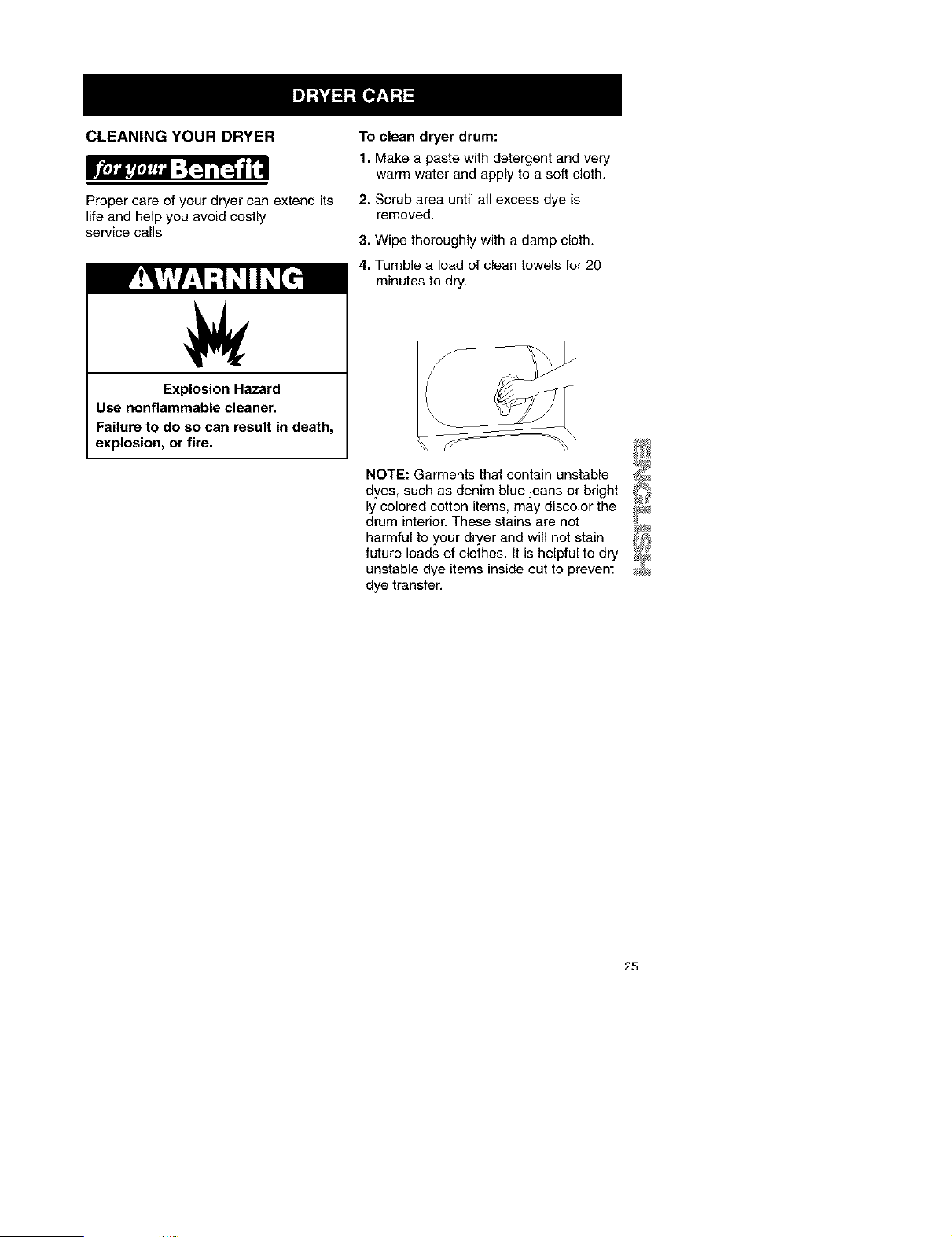
To clean dryer drum:
1. Make a paste with detergent and very
warm water and apply to a soft cloth.
2. Scrub area until all excess dye is
removed.
3. Wipe thoroughly with a damp cloth.
4. Tumble a load of clean towels for 20
minutes to dry.
NOTE: Garments that contain unstable
dyes, such as denim blue jeans or bright-
ly colored cotton items, may discolor the
drum interior. These stains are net
harmful to your dryer and will not stain
future loads of clothes. It is helpful to dry
unstable dye items inside out to prevent
dye transfer.
25
CLEANING THE LINT SCREEN
Remove Lint Before Every Load
The lint screen is located on top of your
dryer. Remove lint before starting every
load. A screen blocked by lint can
increase drying time.
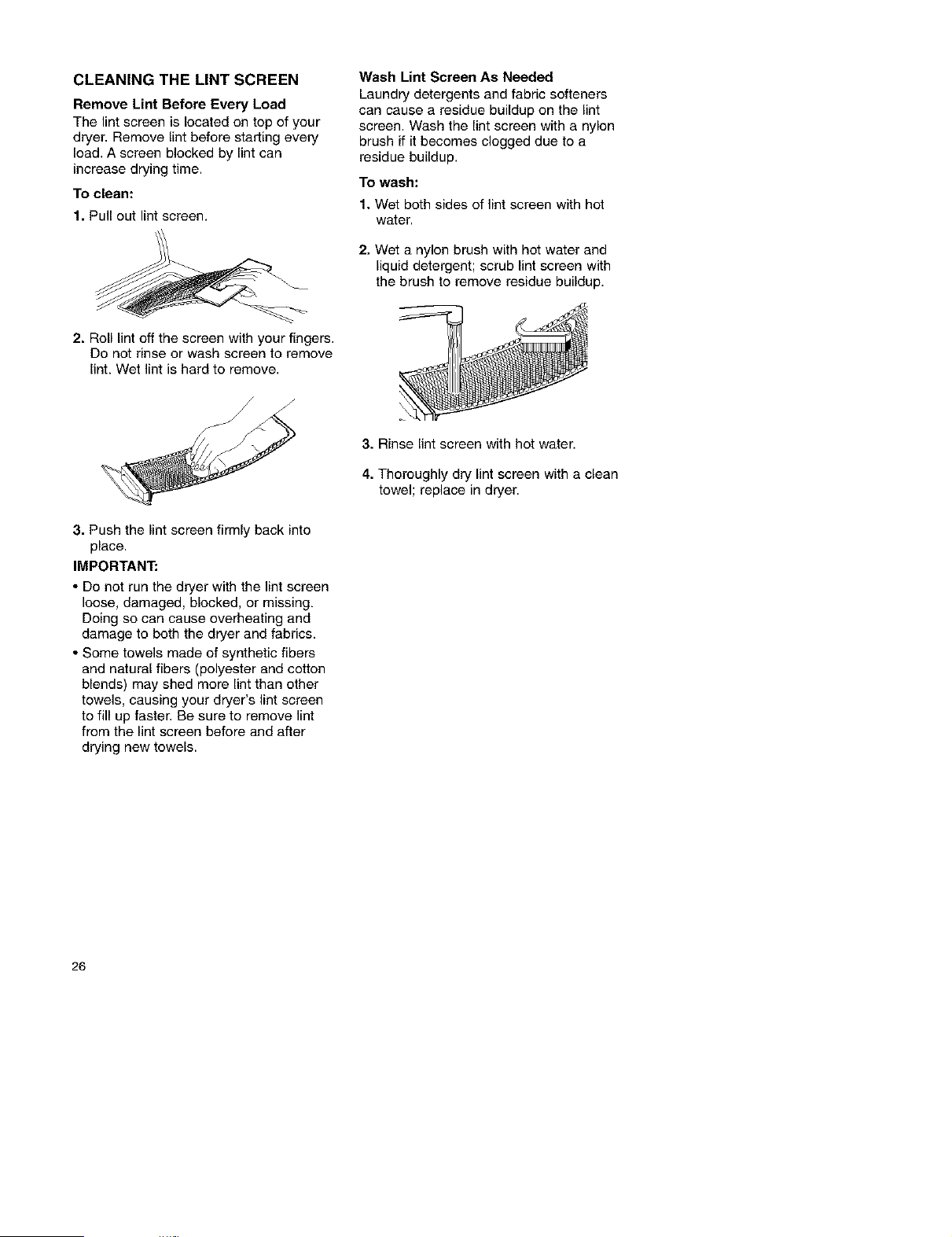
To clean:
1. Pull out lint screen.
2. Roll lint oft the screen with your fingers.
Do not rinse or wash screen to remove
lint. Wet lint is hard to remove.
Wash Lint Screen As Needed
Laundry detergents and fabric softeners
can cause a residue buildup on the lint
screen. Wash the lint screen with a nylon
brush if it becomes clogged due to a
residue buildup.
To wash:
1. Wet both sides of lint screen with hot
water.
2. Wet a nylon brush with hot water and
liquid detergent; scrub lint screen with
the brush to remove residue buildup.
3. Rinse lint screen with hot water.
4. Thoroughly dry lint screen with a clean
towel; replace in dryer.
3. Push the lint screen firmly back into
place.
IMPORTANT:
• Do not run the dryer with the lint screen
loose, damaged, blocked, or missing.
Doing so can cause overheating and
damage to both the dryer and fabrics.
• Some towels made of synthetic fibers
and natural fibers (polyester and cotton
blends) may shed more lint than other
towels, causing your dryer's lint screen
to fill up faster. Be sure to remove lint
from the lint screen before and after
drying new towels.
26
REMOVING ACCUMULATED LINT
From Inside the Dryer Cabinet
Lint should be removed every 2 years or
more often, depending on dryer usage.
Cleaning should be done by a qualified
person.
From the Exhaust Vent
Lint should be removed every 2 years or
more often, depending on dryer usage.
MOVING CARE
• Disconnect power.
• Close shut-off valve in gas supply line.
• Disconnect gas supply line pipe and
remove fittings attached to dryer pipe.
• Cap the open fuel supply line.
• Make sure leveling legs are secure
in dryer base.
• Use masking tape to secure dryer door.
VACATION CARE
• Disconnect power.
• Close shut-off valve in gas supply line.
• Wash lint screen.
TO CHANGE DRUM LIGHT
The dryer light automatically turns on
inside the dryer drum when you open
the door.
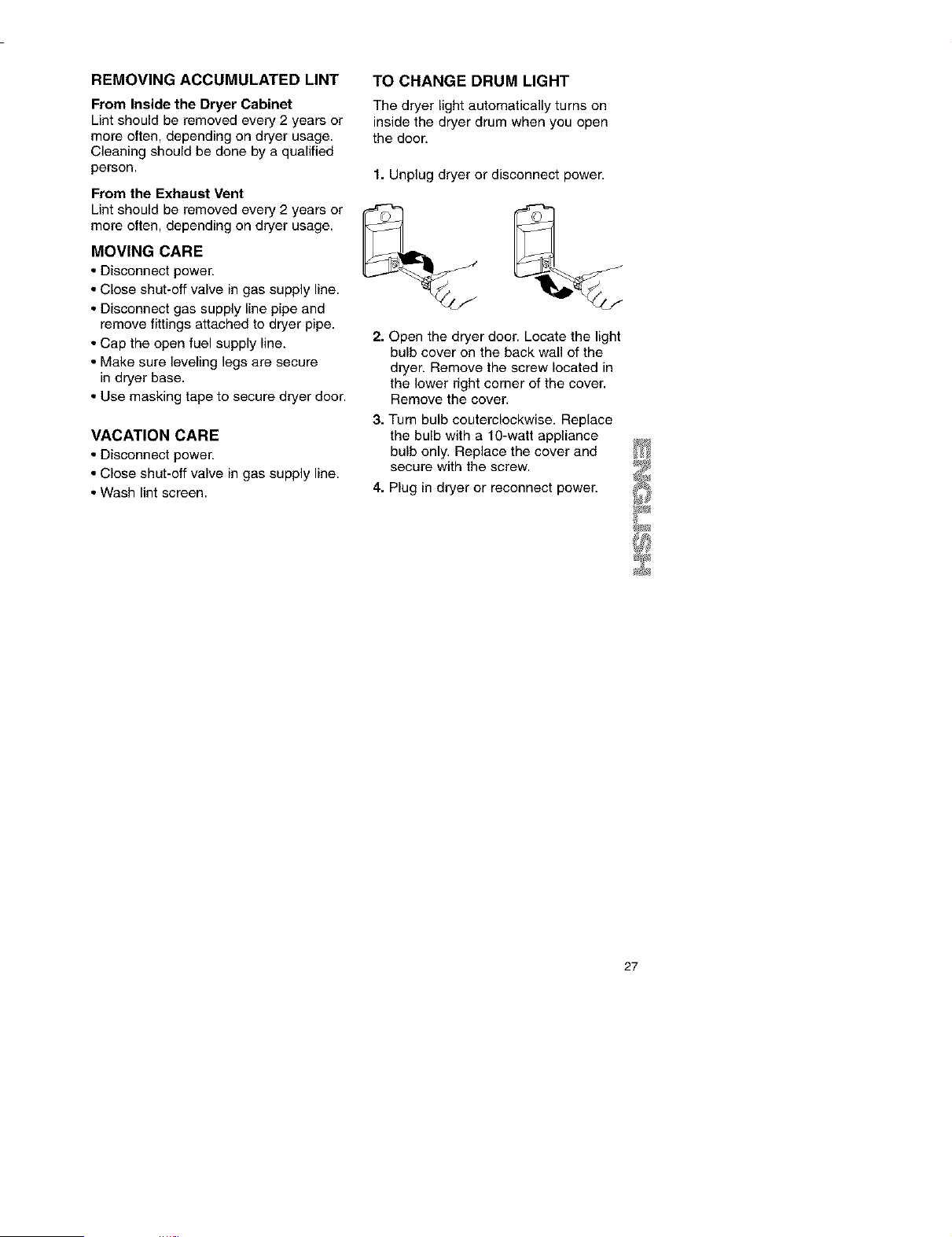
1. Unplug dryer or disconnect power.
2. Open the dryer door. Locate the light
bulb cover on the back wall of the
dryer. Remove the screw located in
the lower right comer of the cover.
Remove the cover.
3, Tum bulb couterclockwise. Replace
the bulb with a 10-watt appliance
bulb only. Replace the cover and
secure with the screw.
4. Plug in dryer or reconnect power.
27
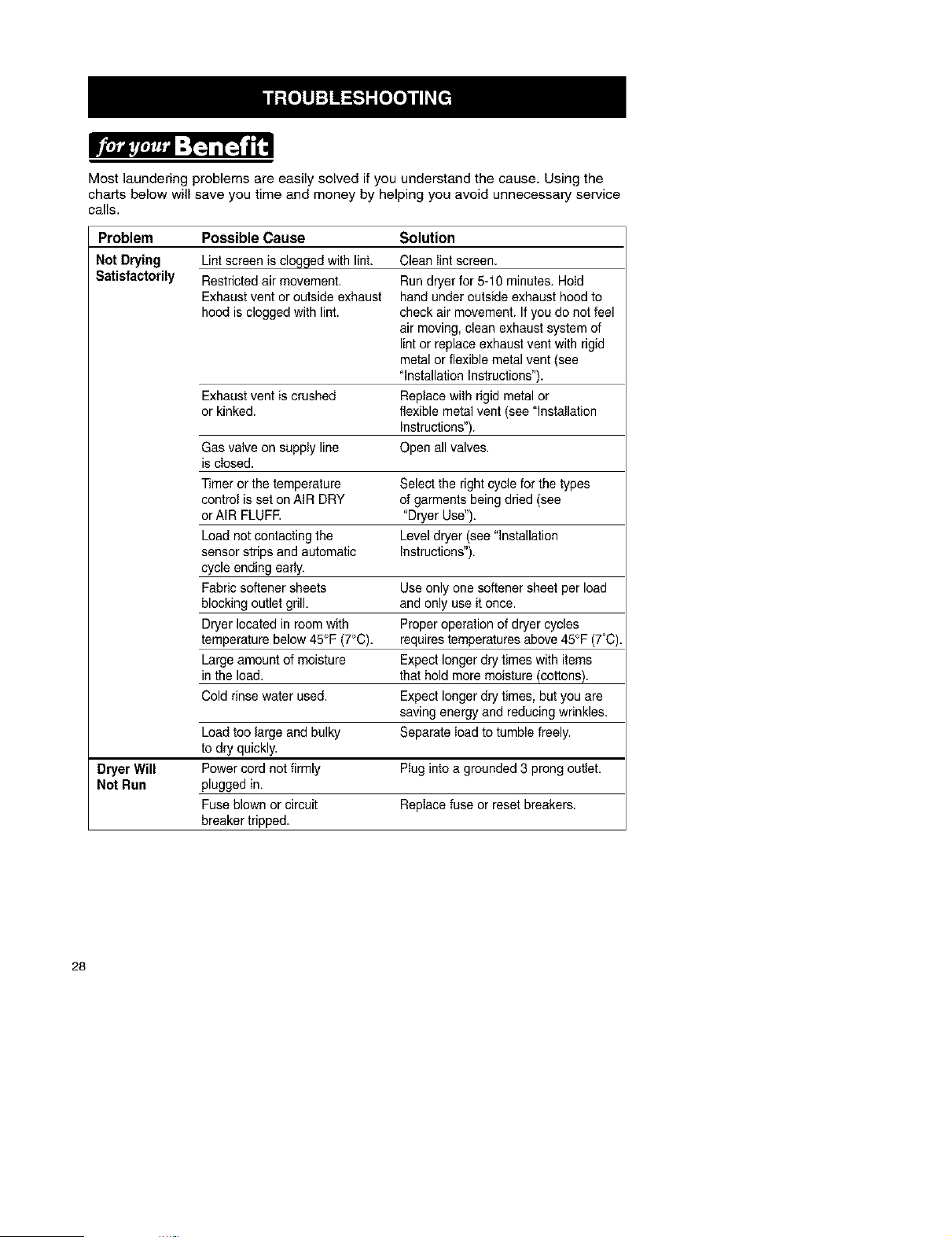
Most laundering problems are easily solved if you understand the cause. Using the
charts below will save you time and money by helping you avoid unnecessary service
calls.
Problem
Not Drying
Satisfactorily
Possible Cause Solution
Lint screen is clogged with lint.
Restricted air movement.
Exhaust vent or outside exhaust
hood is clogged with lint.
Clean lint screen.
Run dryer for 5-10 minutes. Hold
hand under outside exhaust hoodto
check air movement. If you do not feel
air moving, clean exhaust system of
lint or replace exhaust vent with rigid
metal or flexible metal vent (see
"installation Instructions").
Exhaust vent is crushed Replace with rigid metal or
or kinked, flexible metal vent (see"installation
Instructions").
Gas valve on supply line Open all valves.
is closed.
Timer or the temperature Select the right cycle for the types
control is set on AIR DRY of garments beingdried (see
or AIR FLUFE "Dryer Use").
Load not contactingthe Leveldryer (see "installation
sensor strips and automatic Instructions").
cycle ending early.
Fabric softener sheets Use only one softener sheet per load
blockingoutlet grill, and only use it once.
Dryer located in room with Proper operation of dryer cycles
temperature below 45°F (7°C). requirestemperatures above45°F (TC).
Largeamount of moisture Expect longer dry times with items
in the load. that hold more moisture (cottons).
Cold rinse water used. Expect longer dry times, but you are
saving energy and reducing wrinkles.
Load too large and bulky Separate load to tumble freely.
to dry quickly.
Dryer Will Power cord not firmly Plug into a grounded 3 prongoutlet.
Not Run plugged in.
Fuse blown or circuit Replacefuse or reset breakers.
breaker tripped.
28
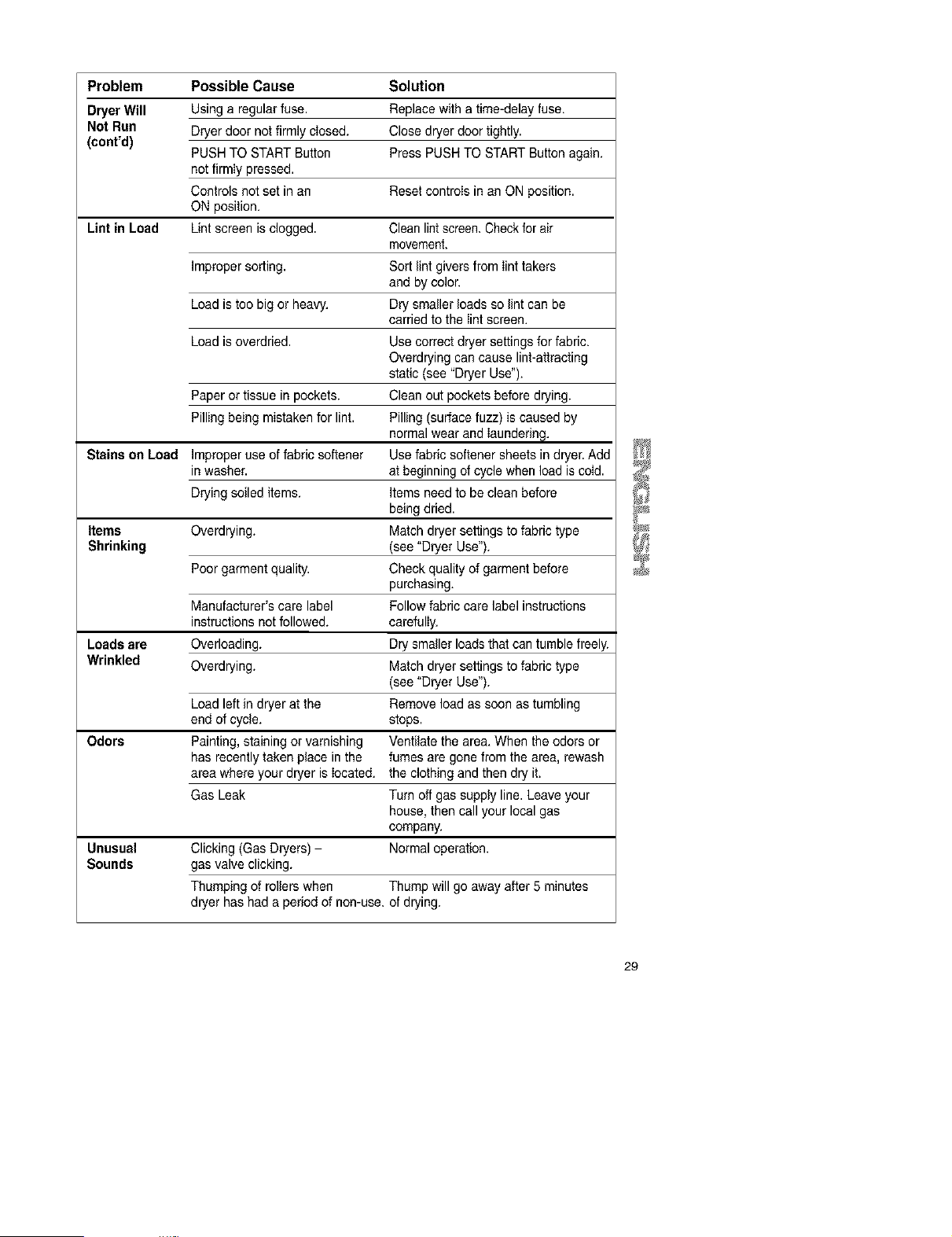
Problem Possible Cause Solution
Dryer Will Using a regular fuse. Replace with a time-delay fuse.
Not Run Dryer door not firmly closed. Close dryer door tightly.
(cent'd)
PUSH TO START Button Press PUSH TO START Buttonagain.
not firmly pressed.
Controls not set in an Reset controls in an ON position.
ON position.
Lint in Load Lint screen is clogged. Cleanlint screen.Checkfor air
movement.
Improper sorting. Sort lint givers from lint takers
and by color.
Load is too big or heavy, Dry smaller loads solint can be
carriedto the lint screen.
Load is overdried. Use correctdryer settings for fabric.
Overdrying can cause lint-attracting
static (see "Dryer Use").
Paper or tissue in pockets. Clean out pockets before drying.
Stains on Load
Pilling being mistaken for lint.
Improper use of fabric softener
in washer.
Pilling (surface fuzz) is caused by
normal wear and Iaunderin_.
Use fabric softener sheets in dryer.Add
at beginningof cycle when load iscold.
Drying soiled items. Items need to be clean before
being dried.
Items Overdrying. Match dryer settings to fabric type
Shrinking (see "Dryer Use").
Poor garment quality. Check quality of garment before
purchasing.
Manufacturer's care label Follow fabric care label instructions
instructions not followed, carefully,
Loads are Overloading. Dry smallerloads that can tumble freely.
Wrinkled Overdrying. Match dryer settings to fabric type
(see "Dryer Use").
Load left in dryer at the Remove load as soon as tumbling
end of cycle, stops.
Odors Painting, staining or varnishing Ventilate the area. When the odors or
has recently taken place in the fumes are gone from the area, rewash
area where your dryer islocated, the clothingand then dry it.
Gas Leak Turn off gas supply line. Leave your
house, then call your local gas
company.
Unusual Clicking (Gas Dryers) - Normal operation.
Sounds gas valve clicking.
Thumping of rollers when Thump will go away after 5 minutes
dryer has had a period of non-use, of drying.
29
Your purchase has added value because you can depend on Sears HomeCentral®
for service. With over 12,000 trained repair specialists and access to over 4.2 million
parts and accessories, we have the tools, parts, knowledge and skills te ensure our
pledge: We Service What We Sell.
Sears Maintenance Agreements
Your Kenmore appliance is designed, manufactured and tested te provide years of
dependable operation. Yet any major appliance may require service from time te time.
The Sears Maintenance Agreement offers you an outstanding service program,
affordably priced.
Sears Maintenance Agreements
• Is your way te buy tomorrow's service at today's prices.
• Eliminates repair bills resulting from nermal wear and tear.
• Provides fer nen-technical and instructional assistance.
• Even if you don't need repairs, provides an annual Preventive Maintenance Check,
at your request, to ensure that your appliance is in proper running condition.
Some limitations apply. For more information, call 1-800-827-6655.
3O
Forrepairofmajorbrandappliancesinyour own home...
nomatterwhomadeit,nomatterwhosolditl
1-800-4-MY-HOME ® AnyUme,dayornight
(1-e00._SS-46_) (U.S._andCanada)
www.Nars.oom www.sears.ca
www.sears.oom
...... iiiiiiiii
Forthereplacementparts,accessoriesandowner'smanuals
thatyouneedtodo-it-yourself,callSearsPadsDIrectS"l
1-800-366-PART 6a.m.- 11p.m.CST,7 daysaweek
(1-800-366-7278) (U.S.A.only)
www.sears.com/partscl,rect
TOpurchaseorinquireabouta SearsServiceAgreement
orSearsMaintenanceAgreement:
1-soo-s27-6.5 1-800-381-66.
7a.m.- 5p.m.CST,MorL-Sat. 9a.m.- 8p.m.EST,M- F,4p.m.Sat.
1-888-SU-HOGARs"
(1-_e-7_-e427)
I SEARS 1
HomeCentral®J