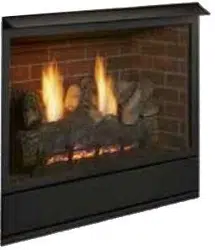
Woodburning Fireplace
Model: SSTB11
Installation, Operation and Maintenance Manual
For Residential or Manufactured Home Installation
87D0174 3/11 Rev. 5
530943
SSTB cover
This replace is listed by OMNI-Test Laboratories for use
with “11CF” Series Chimney System Components.

87D0174
SSTB11 Woodburning Fireplace
CONTENTS
Congratulations!
You have chosen the nest wood burning replace available. Your replace has been designed for years of heating
and viewing enjoyment. Please take time to read this entire manual before installing or operating your replace.
Table of Contents
Listing and Code Approvals ..........................................................................................................................
Important Safety Information ........................................................................................................................ 3
Operation Guidelines ....................................................................................................................................4
Product Features ..........................................................................................................................................6
Fireplace Dimensions ...................................................................................................................................7
Fireplace Location ........................................................................................................................................ 8
Installation Preparation .................................................................................................................................9
Floor Protection .......................................................................................................................................... 10
Fireplace Components ............................................................................................................................... 11
Fireplace Installation...................................................................................................................................1
Chimney Installation ................................................................................................................................... 1
Chimney Offset and Cap Installation ..........................................................................................................14
Outside Combustion Air .............................................................................................................................19
Gas Appliance Installation ..........................................................................................................................
Trim Installation ..........................................................................................................................................4
Fireplace Operation ....................................................................................................................................5
Maintenance & Safety ................................................................................................................................7
Replacement Parts .....................................................................................................................................30
Warranty .....................................................................................................................................................31
Listing And Code Approvals
The instructions contained in this manual provide the information necessary to install this replace in accordance with
Underwriter’s Laboratories requirements and in compliance with the National Fire Protection Association Standard No.
11. Some codes may require the replace and chimney be electrically grounded. Before beginning the installation, you
should check with local building ofcials to obtain required permits and assure compliance with local regulations and
coded. If you encounter problems with code requirements, contact your dealer for assistance.
These Fireplace models are listed by OMNI-Test Laborato-
ries, Inc. to U.L. 17-standard for factory-built replaces. The
design of this replace and these instructions complied with
applicable safety standard for a factory built replace in effect
at the time the replace was manufactured. You should be
aware, however, that failure to install, operate, and maintain
this or any other factory built replace properly can result in
a house re or other occurrences that could cause deaths, injuries, and property damages. It is very important that
the persons installing and/or supervising the installation of this replace have appropriate skills in using the tools and
techniques required; and reading and comprehension skills sufcient to read and follow these instructions. These in-
structions contain warnings, cautions, and notes to emphasize important safety information. To assure that safe and
satisfactory service is received from this replace, please read the following special notices and all the contents of this
manual.
SSTB11
listed by OMNI-Test Laboratories to
ANSI/UL 127 / ULC-S610 Standards
for Factory-built Fireplaces

87D0174
3
SSTB11 Woodburning Fireplace
IMPORTANT SAFETY INFORMATION
Installer Owner
Please leave these instructions with the owner. Please retain these instructions for future reference.
1. Read these instructions entirely before beginning any
part of the installation. Save these instructions for any
future repairs.
. Use these instructions as a guide during the installa-
tion of the replace.
3. Be sure these instructions become the property of and
are reviewed by all future users of this replace to en-
courage proper operation and maintenance.
4. All the parts used with this replace system must be
installed in accordance with these installation instruc-
tions. Failure to do so may be hazardous and will void
the warranty.
5. This replace and accessories should not be altered
in any way that is not specically recommended in this
manual.
6. Refer to your local building code for local requirements
pertaining to installation of factory-built replaces.
These replaces are intended for installation and use
according to standard NFPA NO.11 of the National
Fire Protection Association.
7. This replace must not be installed with a masonry
ue.
8. This replace and chimney should not be used for
venting a wood or coal burning heater or replace in-
sert.
WARNING: Do not install a separate solid fuel insert
or gas replace insert into this replace and chimney
system without written authorization.
9. WARNING: Do not pack required air spaces with
combustible material or insulation not specically rec-
ommended for use in such areas.
Improper Installation
Improper installation or use of this replace will void the warranty and can cause:
1. Damage to the replace from overheating.
. Hazardous temperatures to develop on combustible materials adjacent to the replace
or chimney.
3. The emission of smoke, sparks or hazardous gases into the dwelling.
4. Leakage of rain water into the dwelling.
Intended Product Usage
The replace is designed to sit directly on a combustible
oor. The replace must be installed with zero clearance
to combustible building materials at the side and top
spacers. Only parts manufactured by MHSC and labeled
for use with the replace should be used in the installa-
tion of this replace except for special roof ashings that
may be fabricated locally. The use of improper parts in
the installation can be hazardous and voids the warranty
offered by MHSC.
This replace is designed to burn wood. This replace
is not designed to burn coal, unplumbed liquid fuels, un-
plumbed gaseous fuels or household refuse. Any attempt
to burn these fuels in the replace can be hazardous.
This replace is not designed for installation in a manu-
factured home without a vented attic space. In a vented
manufactured home, an MT16 ceiling thimble, glass doors
and an AK6 outside air kit must be used.
WARNING: This replace and chimney must not be used
for venting a solid fuel heater or replace insert unless
written authorization is given by MHSC. Failure to heed
this warning may cause a re hazard and will void the
warranty.
This replace is intended for supplemental heating only
and is not intended for use as a primary heating system.
Use solid wood, plumbed propane (LP) or Natural
Gas fuel only.
Do not use a replace insert or other product not
specied for use with this replace.
Fireplace also for use in mobile homes with solid fuel
only.
WARNING
!
HOT GLASS WILL
CAUSE BURNS.
DO NOT TOUCH GLASS
UNTIL COOLED.
NEVER ALLOW CHILDREN
TO TOUCH GLASS.

4
87D0174
SSTB11 Woodburning Fireplace
OPERATION GUIDELINES
As wood is burned in this replace, room air enters the
side vents of the SSTB11 and circulates around the re-
box. This air circulation cools the rebox and must not be
blocked or restricted in any manner. Blocking the airow
can cause a re hazard.
When an AK4 combustion air assembly and a combus-
tion air duct are attached to the connecting point on the
left or right side of the replace, combustion air may enter
the rebox through a dampered opening behind the left or
right side brick. This feature is designed for your benet
to reduce the room air used for combustion and to prevent
excessive loss of heat from the room. When the replace
is in use, this damper should be open. When the replace
is not in use, the damper should be closed to prevent cold
air from entering the rebox. The combustion air damper
is open when the lever, located on the left and right side
of the rebox near the top of the rebrick, is up and closed
when the lever is down.
Outside air for combustion is optional unless required by
federal, state or local building codes. See the section of
this manual providing the instructions for installation of
the combustion air assembly. The design of the replace
allows the routing of the combustion air duct up, down, or
horizontally to obtain the outside combustion air. This per-
mits exibility in planning your installation. Refer to Page
19, Figures 24 & 25 for typical installation methods. Re-
view the precautions and recommendations in this manu-
al pertaining to outside combustion air installation.
The replace is also equipped with a ue damper, which
must be open when the replace is in use. The ue
damper control lever is located inside the replace. The
counterweighted damper is operated by simply pushing
up to open or pulling down to close the damper. When
the replace is not in use, the damper should be closed
to prevent cold air from entering the chimney as well as
preventing warm air in the room from escaping up the
chimney.
NOTE: It is normal for a small amount of smoke to be re-
leased from the upper portion of the replace the rst few
times you use your new replace. This results from an oil
residue on the metal. Open a door or window to allow the
smoke to escape.
The grate included with this replace helps to appropri-
ately locate and contain the burning wood. Failure to use
this grate may cause overheating of parts of the replace
and allow large pieces of burning wood to roll forward out
of the rebox. If the grate becomes warped or damaged, it
must be replaced with grate number 07954 only.
WARNING: Fireplaces equipped with doors should be
operated only with the doors fully open or doors fully
closed. If doors are left partly open, gas and ame may
be drawn out of the replace opening, creating risks of
both re and smoke.
All replace chimneys are in direct contact with cold air
on the exterior of the structure. Consequently, when the
replace is not in use, cold air can fall down the chimney
of the replace to cool off the replace chase. Therefore,
the replace chase must be insulated to minimize the risk
of cold air inltration to the home. Even if the replace
chase is adequately insulated, this cannot completely
ensure that cold air inltration into the structure will be
eliminated. Cold air inltration is a possibility with any
replace or device that freely communicates with the air
on the outside of the structure. Today’s homes are more
energy-efcient and, therefore, better insulated and tightly
constructed. Unfortunately, when air is removed from the
house, as by a bathroom fan, or consumed by a furnace,
additional air is needed to replace the air consumed. Un-
less the additional air is supplied, this can cause a nega-
tive pressure in the home. When this happens, the house
will draw in outside air from the cracks in the windows,
down the replace ue or other locations of air leakage in
the home. Because cold air inltration may be unavoid-
able in some structures, MHSC is not responsible for heat
loss or air inltration through or around the replace.
WARNING: Due to the fact this replace has two (2)
openings, it is more susceptible to the adverse effects
of drafts or pressure changes in the room or rooms
it serves. The replace should be operated with both
sets of doors closed to prevent smoke or ame spill-
age out of the replace openings caused by drafts or
pressure changes. The door should only be opened
during the very brief period to add wood to the re or
to remove ashes. Refer to Page 25, Figure 31
The Problem
Depressurization (negative pressure) is caused by the
interaction of air where small differences in air pressure
between indoors and outdoors (pressure differentials)
amounting to no more than .0001 atmosphere creates a
‘stack effect’ - the tendency for air to rise whenever it is
warmer than the surrounding atmosphere.
The stack effect is the working principle of all chimney
systems. Heated ue gases rise up the chimney and vent
into the atmosphere pulling cooler air behind it to ll the
void. Therefore, when the air is warmer indoors than out-
doors, air tends to ow in through the lower part of the
structure and out through the upper part. Air turnover is
accomplished by inltration through various openings and
in particular around windows and doors, penetrations cre-
ated for pipes and wiring as well as replaces, water heat-
ers and furnace ue pipes. If a person would measure the
ow of air inside a typical home, he would be amazed at
the amount of movement that occurs even though the
condition is not generally noticeable.
Based on the ‘stack principle’, the house itself acts as if it
were a short, fat chimney with air moving from the bottom
of the structure to the top.

87D0174
5
SSTB11 Woodburning Fireplace
OPERATION GUIDELINES
Typical Scenario
If we take an example of a typical home with its natu-
ral stack effect and add weather proong which makes
a structure even tighter, place vents in the structure for
exhaust fans for bathrooms and stoves, add a large attic
fan plus ues required for venting water heater, furnace
and replace gases, we create an opportunity for a great
air tug-of-war.
During winter months, the air within the home is generally
much warmer and less dense than the outside air and,
as a result, the cooler outside air seeks ways to work into
the structure. The easiest link to the interior of the home
is generally through ues and other openings connected
directly to the inside.
A typical comment comes from the person who states,
“I don’t seem to get a good draft and when I open my
damper, cold air rushes in.” In this case you are imme-
diately tipped off to the probable cause of the problem
- depressurization. The ue system is simply a conduit
through which incoming air is drawn into the home to
equalize pressure.
Depressurization is a contributing factor to back drafting
75% of the time and is the sole cause of back drafting
40% of the time. The greater the exhaust capacity and
the tighter the building envelope, the more a house will
depressurize.
The combination of forces of exhausting air from the house
can be so strong that it is possible for hot ue gases from
the re in the replace to be overpowered resulting in a
down draft during or at the end of the re cycle. The com-
peting factors are the exhaust devices located throughout
the home which work in concert with the natural draw of
the house causing a depressurized environment pulling
at the bottom of the chimney, thereby reducing the net
chimney draft.
Air is pulled down the chimney where it provides make-up
air (replacement air). The cool back drafting air coming
down the chimney will not allow all of the hot combustion
gases to rise up the chimney, therefore, chimney drafting
is curtailed resulting in the escape of gases and smoke
into the living area.
It doesn’t take a lot of activity to create a depressurization
effect. For example, a typical gas furnace requires 1,450
cubic feet of air per hour for proper combustion and an-
other 4,000 cubic feet of air per hour to maintain a draft.
All this air has to come from somewhere.
A surprising amount of outdoor air manages to leak into a
house by inltration but the point is, inltrating air can not
be depended upon as a reliable source of combustion air.
Add to this factor a replace that needs combustion air
to operate in a properly insulted, air tight home and you
quickly realize how a problem can occur.
6
87D0174
SSTB11 Woodburning Fireplace
FP2178
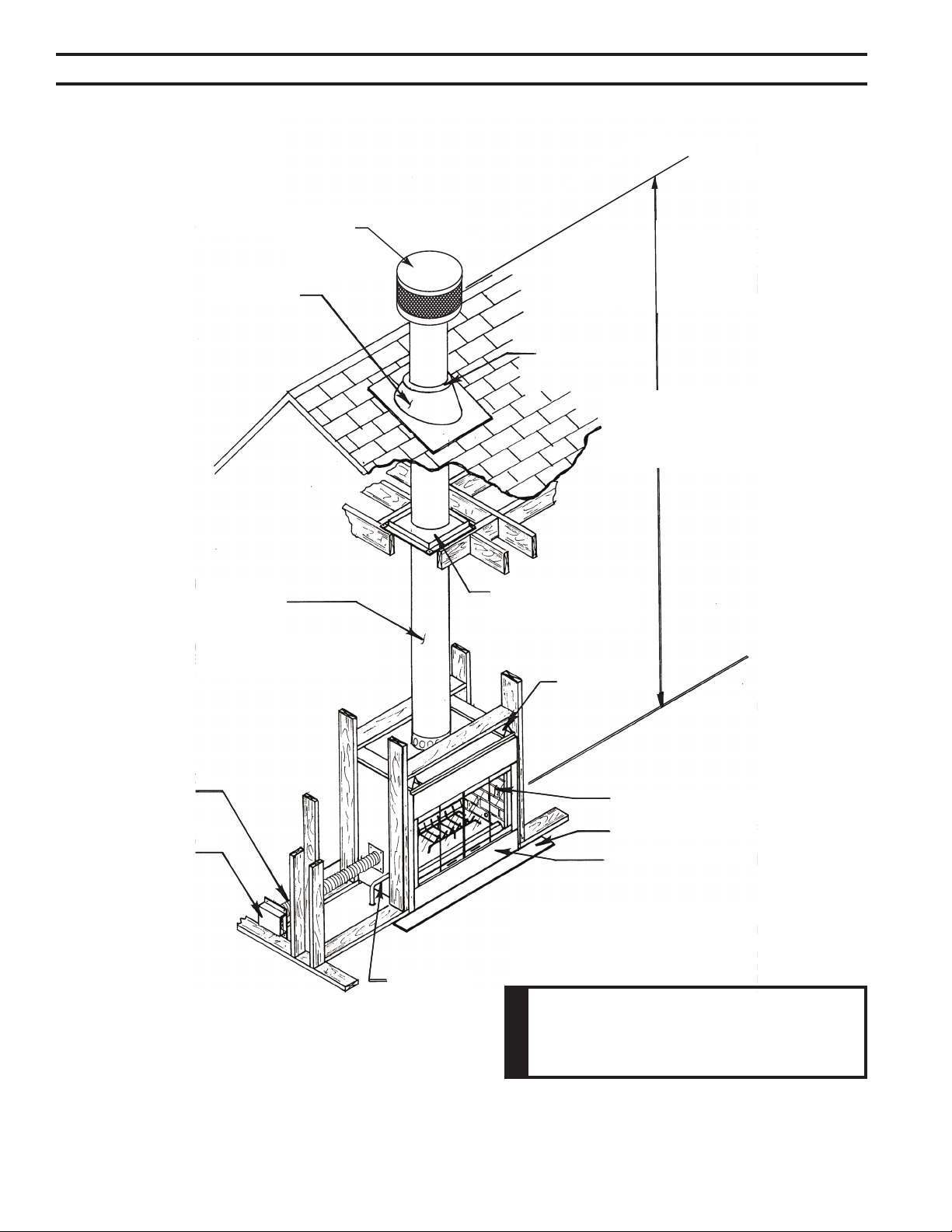
SSTB features
PRODUCT FEATURES
Figure 1
Residential Installation
Chimney Cap
Roof Flashing
(Flue Outlet Height)
Storm Collar
13 ft. = Min. Height (No offsets)
13 ft. = Min. Height ( 30° Elbows)
1 ft. = Min. Height (4 30° Elbows)
90 ft. = Max. Height (Chimney support
every 0 ft.)
11CF1 (1 ft. pipe)
11CF18 (1Z\x ft. pipe)
11CF3 (3 ft. pipe)
11CF4 (4 ft. pipe)
Maintain ” Minimum Air
Space Between Chimney
and Combustibles
Fireplace Model
SSTB11
Flexible Duct
Type FP-4-U
(Optional)
Combustion Air As-
sembly (Optional)
Metal Safety Strip
(Floor Line)
Top Spacer
Firestop
(Requires 17 x 17 framing)
WH36 Glass Doors
(standard)
Gas Line
(Optional)
Combustible materials should not be installed below
top spacer. Noncombustible materials such as brick
or tile may be used to trim face or the replace, com-
bustibles must not overlap the black painted face of
replace more than 1/8”.
NOTE
87D0174
7
SSTB11 Woodburning Fireplace
C
L
21”
C
L
1/2”
126M”
2456O”
2556O”
1/2”
11” Dia.
13” Dia.
1156O"
256O”
1056M”
126M”
1556M”
256O”
9556QE”
9/16" Ref.
4”
1156QE”
2356M”
856QE”
426”
4656QE”
38”
42”
4356O”
Min. Framing Dim.
3/4” Ref.
3/4”
539043
SSTB dims
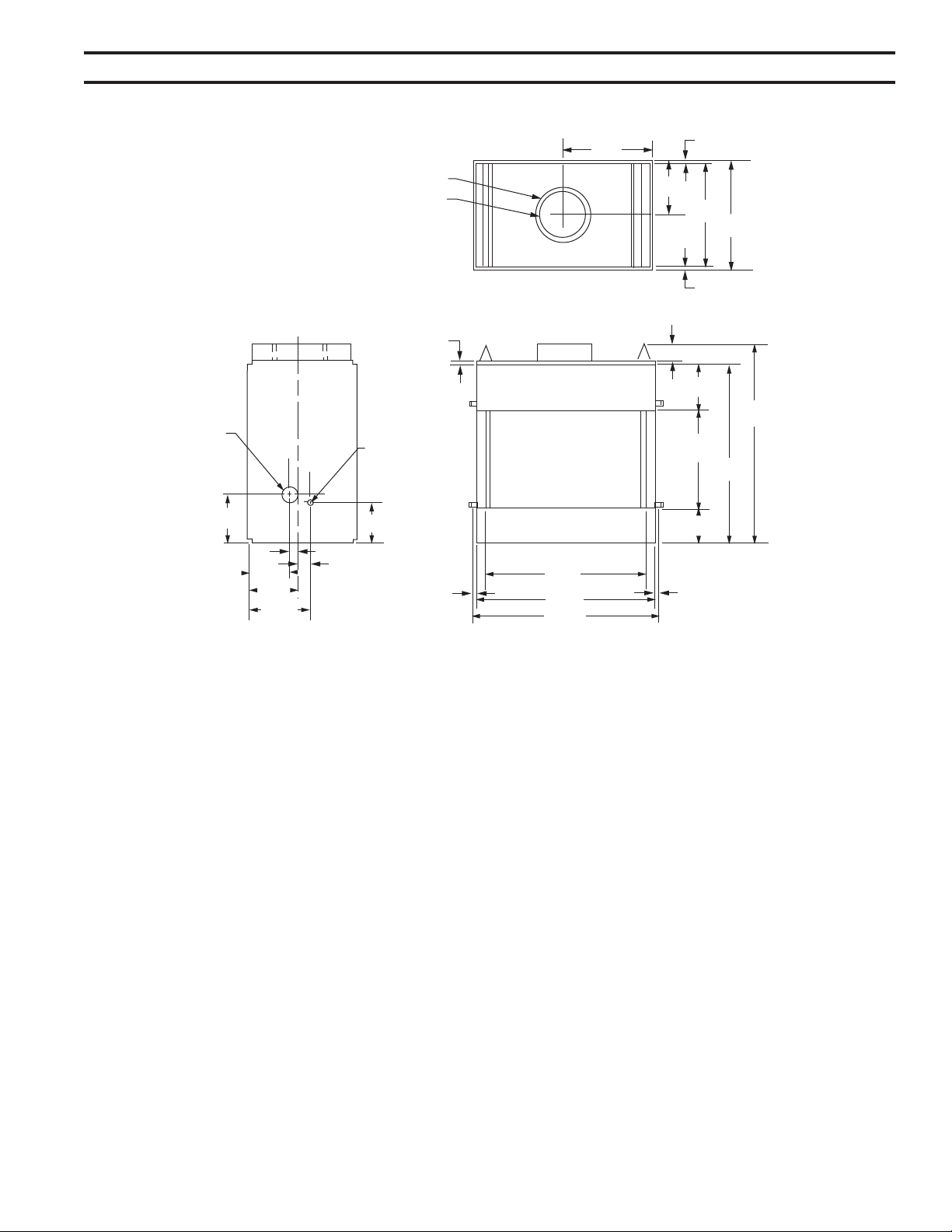
FIREPLACE DIMENSIONS
Figure 2
Front View
Side View
Gas Line
Opening
Outside Air
(1 Side Only)
Glass Doors Re-
moved for Clarity
Top View
Air Space Required
to Combustibles
8
87D0174
SSTB11 Woodburning Fireplace
FIREPLACE LOCATION
This replace does not weigh more than large pieces of furniture and can normally
be located near a load bearing wall without requiring additional foundations or sup-
ports. If however, the replace is to be trimmed with a heavy stone or brick facing
and hearth extension, be sure the supporting structure is adequate.
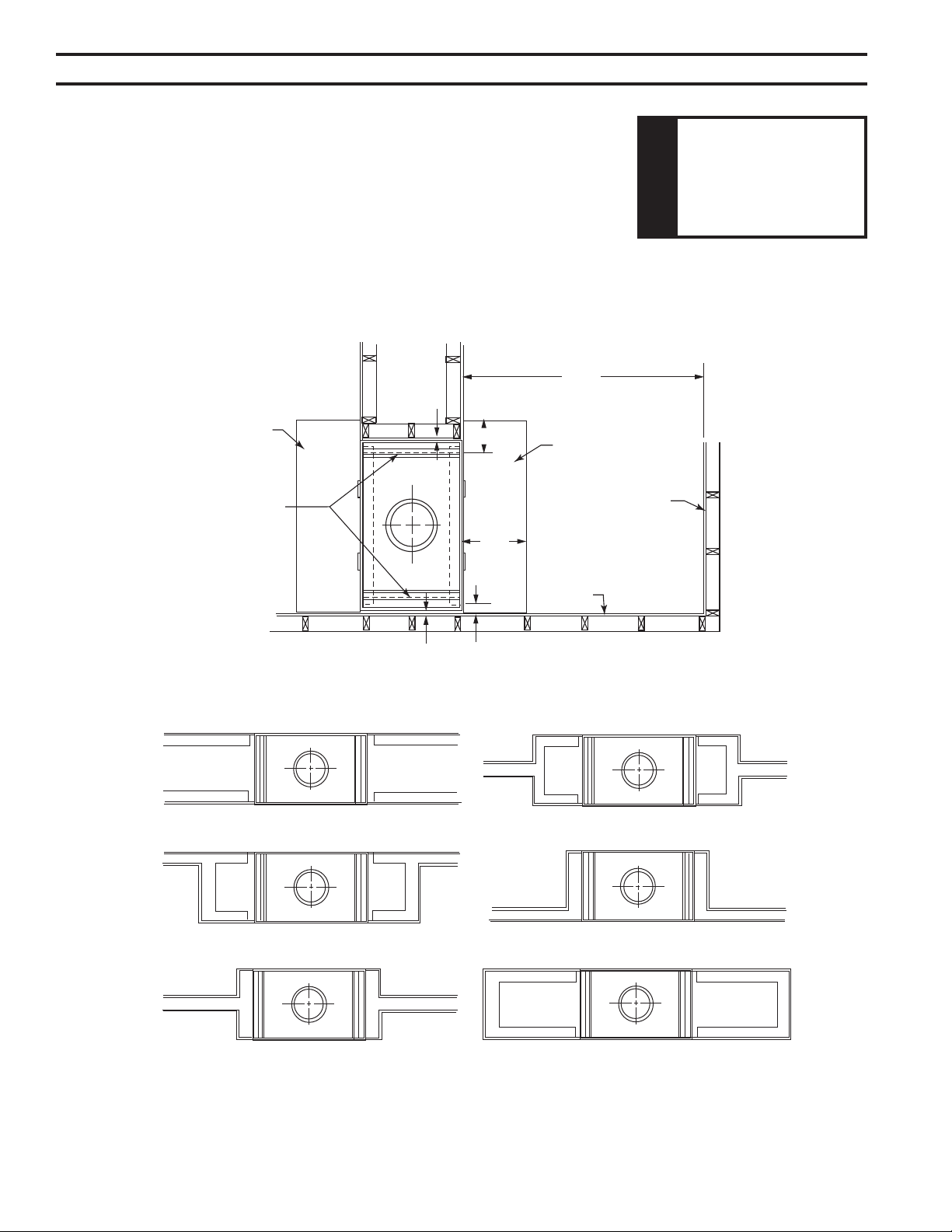
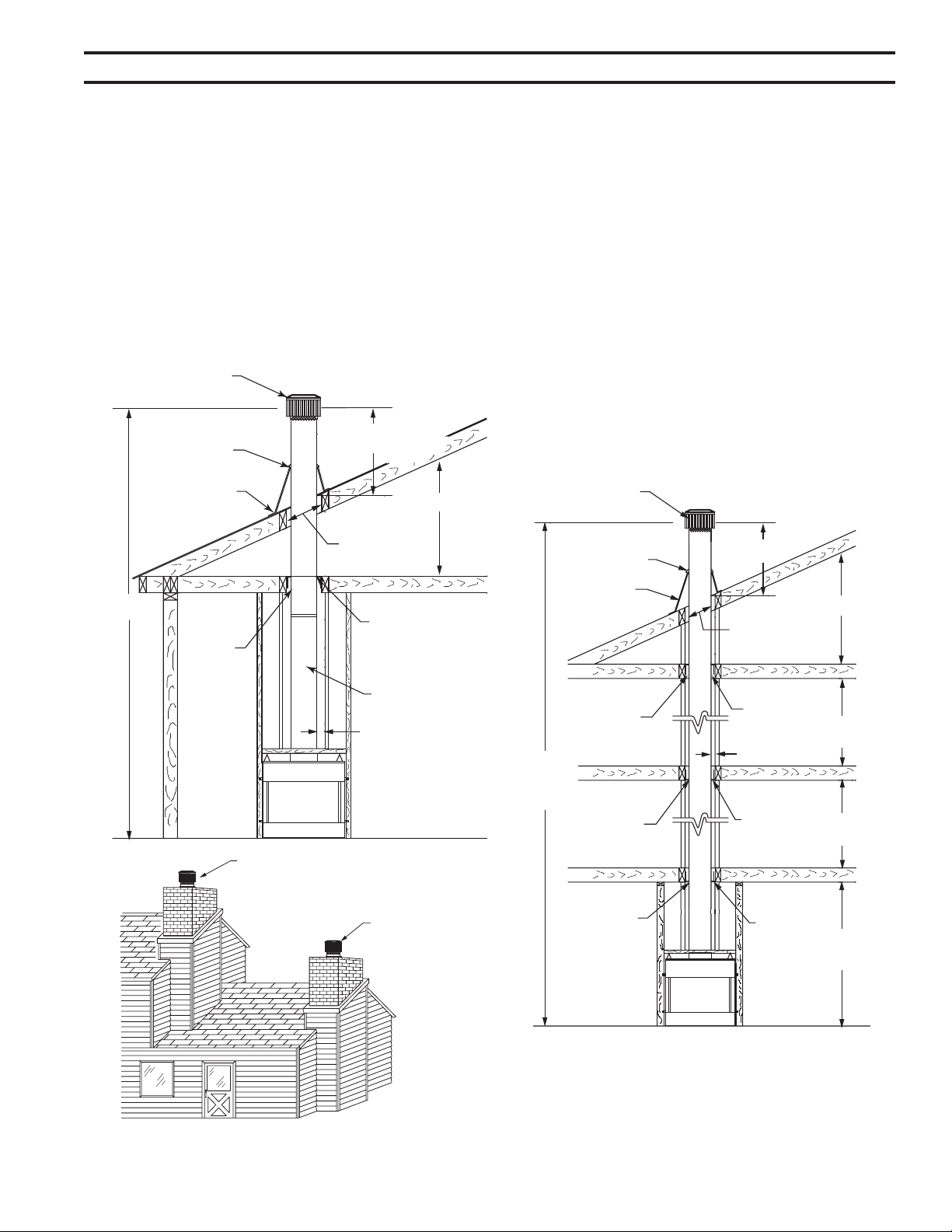
Figures 3 and 4 provide dimensional details of the replace, required spacing to
combustible walls, and some suggested replace locations. When selecting a loca-
tion, choose one that is away from frequently opened doors, central heat outlets or
returns, or other places where air movements may disturb the airow around the
replace. Air turbulence near the replace may cause smoke to spill out of the replace opening.
CAUTION
Do not install replace
over carpeting.
&0
FIREPLACELOCATION
16”
3/4”
26M” Min.
60”
3/4”
8”
Model H165
Hearth Extension
Model H165
Hearth Extension
Parallel
Back Wall
Perpendicular
Side Wall
Side Brick Outline
Glass Door
Glass Door
Min. Air
Space
Min. Air Space
FP179
Figure 3
&0
FIREPLACELOCATIONS
Top Views
Parallel Walls
‘Y’ Type Walls
‘T’ Type Walls
‘L’ Type Walls
‘C’ Type Walls
‘H’ Type Walls
FP180
Figure 4
87D0174
9
SSTB11 Woodburning Fireplace
INSTALLATION PREPARATION
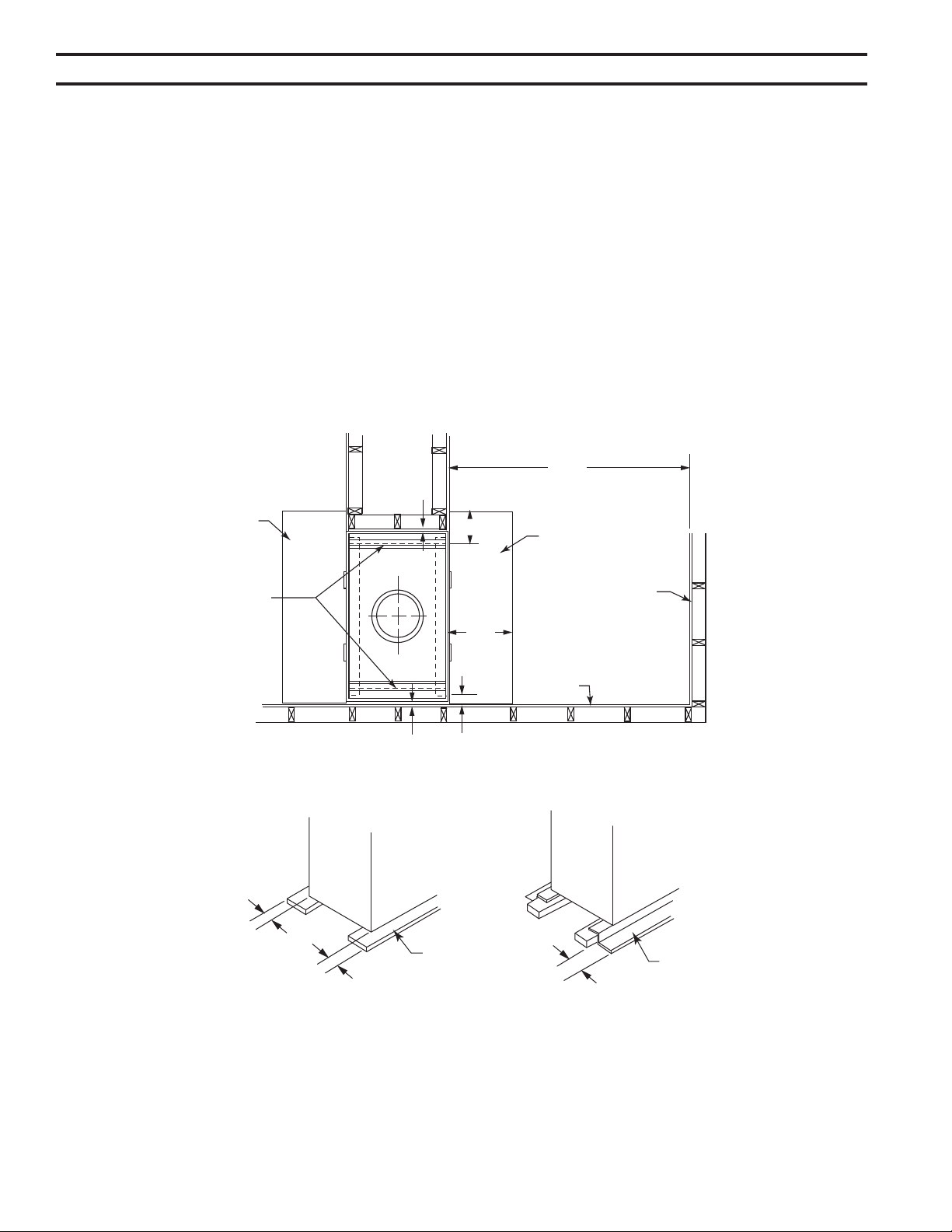
Survey the planned location for the replace for overhead plumbing or electrical wires, etc., that might complicate the
installation or endanger persons installing or cleaning the chimney. Avoid a location where the chimney cap will be near
abrupt changes in the roof shape, nearby wall or embankments, under or near trees or above the roof of a single story
wing of a two story building as shown by Figure 6. All these conditions can cause turbulence or pressure conditions
that can cause poor chimney draft and smoke spillage from the replace opening. Elbows may be used to offset the
chimney to avoid obstructions or to locate the chimney cap in a preferred location. Refer to the sections of this manual
pertaining to chimney offsets for instructions on proper elbow use. Poor installation or location of the chimney cap and/or
components can cause wind blown rain to enter the chimney.
Be sure the selected location will allow a 17” square combustible material-free space for the chimney to pass through.
If the chimney is to pass through living or storage spaces, be sure there is adequate space to enclose the chimney to
avoid personal contact with, or damage to, the chimney.
13’ Min.
FP1881
single story install
8/08
Figure 5
Single Story Installation with Attic Space
Chimney Cap
Storm Collar
Flashing
17”
Square
Opening
in Joist
” Min. Clearance to
Combustibles
“11CF” Series Chim-
ney Components
Firestop Spacer (” Air
Space Clearance to
Combustibles)
Attic Space
3’ Min. or ’ Above
Any Point Within 10’
Flue Outlet Height
Refer to Table 1
for Roof Open-
ing Size
FP1881
FP1882
chimney location
8/08
Figure 6
Preferred Location
Poor Location
FP188
3 ft. Min.
FP1883
multistory install
8/08
Figure 7
Multiple Story Installation
Chimney Cap
Storm Collar
(Included with cap)
Flashing
Refer to Table 1
for Roof Opening
Size
Attic Space
Firestop
Spacer (”
Air Space
Clearance to
Combustibles)
” Clearance to
Combustibles (Min.)
17” Square
Opening in
Joist
Max.
Installation
Height - 86
ft. Chimney
Third Floor
Area
Second
Floor Area
First Floor
Area
Flue Outlet Height
17” Square
Opening in
Joist
17” Square
Opening in
Joist
Firestop
Spacer (”
Air Space
Clearance to
Combustibles)
Firestop
Spacer (”
Air Space
Clearance to
Combus-
tibles)
FP1883
10
87D0174
SSTB11 Woodburning Fireplace
FLOOR PROTECTION
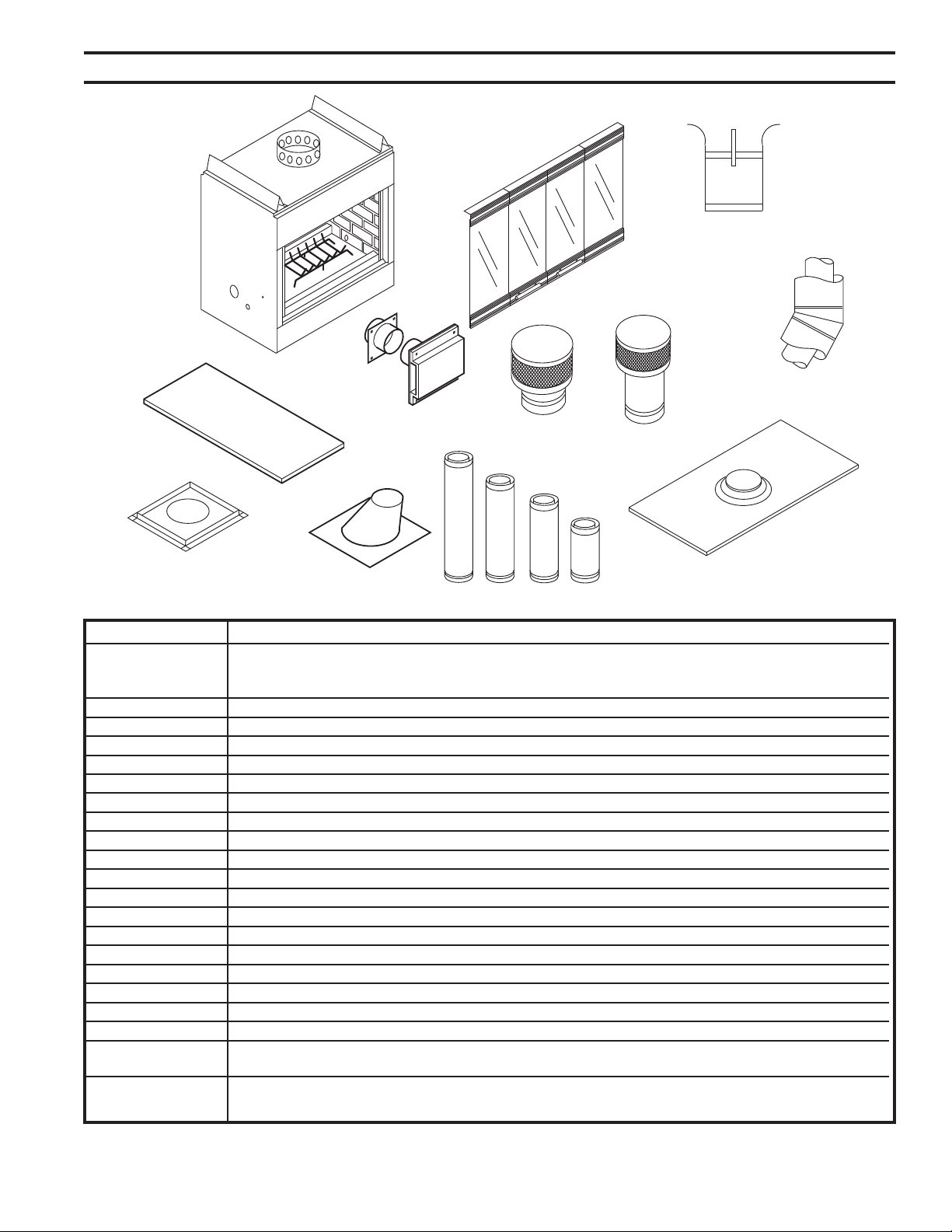
If this replace is installed on a combustible oor, the oor area 16 inches in front of, and 8 inches either side of the
replace opening must be protected by an insulating noncombustible hearth extension. Figure 8
With either type hearth extension minor shifting of the supporting oor or expansion and contraction may eventually
cause a crack to develop between the hearth extension and the face of the replace. To help prevent the crack from
developing, the hearth extension materials must be rmly fastened in place. Wall ties should be screwed to the face
of the replace and imbedded in the mortar joints of brick, stone, or other non-combustible materials. The metal safety
strip packed with the replace must be placed beneath the replace and extended under the hearth extension or into
a mortar joint of the hearth extension as shown by Figure 9. In the event a crack does eventually develop, the metal
safety strip will serve as a barrier to prevent sparks or embers from falling from the replace onto combustible ooring
materials.
&0
FIREPLACELOCATION
16”
3/4”
26M” Min.
60”
3/4”
8”
Model H165
Hearth Extension
Model H165
Hearth Extension
Parallel
Back Wall
Perpendicular
Side Wall
Side Brick Outline
Glass Door
Glass Door
Min. Air
Space
Min. Air Space
FP179
Figure 8
NOTE: If noncombustible hearth extension materials are to be
placed at or below the level of the bottom of the replace, insu-
lation board is not required.
If the replace is recessed into the oor or the hearth is elevat-
ed with combustible materials, an MHSC H165 hearth exten-
sion kit or equivalent must be used for additional protection.
&0
SAFETYSTRIP
Metal Safety
Strip
( Required)
”
”
”
Special ‘Z’ Metal
Safety Strip
( Required)
FP183
Figure 9
87D0174
11
SSTB11 Woodburning Fireplace
FIREPLACE COMPONENTS
Model Number Description
SSTB11 See-Thru replace with standard glass doors and wire mesh rescreens, heavy duty regrate, and self-
sealing ue damper. Fireplace is provided with openings to accept outside combustion air kits and gas
line access for optional listed decorative gas appliance.
11CF1 1” chimney section
11CF18 18” chimney section
11CF3 36” chimney section
11CF4 48” chimney section
11CF30- 30° elbows (package contains two 11” diameter elbows) One pair is required for each offset.
11CS Chimney support (required when chimney height exceeds 30 feet)
SLTCF11 Chimney cap for contemporary installations.
RLTCF11 Round chimney cap for contemporary installations.
RLTCF11L Extended chimney cap for contemporary installations.
8-6-1 0-6/1 pitch ashing for contemporary installation.
8-1-1 6/1 to 1/1 pitch ashing for contemporary installation.
FSA Vertical Firestop spacer - One required at each ceiling or oor level.
FS6A 30° Firestop spacer - for 30° chimney incline through ceiling or oor.
FP-4-U 4” exible combustion air duct-8-foot lengths.
FP-6-U 6” exible combustion air duct 8 foot lengths. For manufactured home installation.
403 4-inch duct connector (for splicing FP-4 ducts). Includes two clamps.
AK4 4” outside combustion air assembly.
AK6 6” outside combustion air kit. Required on manufactured home installation.
ST44TK Optional decorative brass nish surround. Frames replace opening to provide an economical
installation with an expensive look.
H165
Hearth extension-protects oor against sparks and radian heat (residential installation) 16” x 5”
Figure 10
WH36
Glass Doors
(Standard)
Chimney
Support
11CS
30° Elbow Set
11CF30-2
Hearth
Extension Kit
H1652
Firestop Spacer
FS2A, FS6A
Flashing
8-6-12, 8-12-12
AK4
Combustion
Air Assembly
(AK6 for
Manufactured Home
Installation)
Chimney Cap
RLTCF11
SLTCF11
Extended
Chimney Cap
RLTCF11L
Chimney Sections
11CF4 11CF3 11CF18 11CF1
Flat Flashing
36"x72" (13.5" Diameter Hole)
FP2184
SSTB fireplace components
1/09
SSTB
See-thru
Fireplace
SSTB11
See-thru
Fireplace
1
87D0174
SSTB11 Woodburning Fireplace
FIREPLACE INSTALLATION
Location Selection
Unpack and check the replace and chimney for dam-
age. If any items have been damaged, report this to your
dealer. Before beginning the installation, be sure you
have the proper parts in sufcient quantity. Refer to re-
placement parts page for proper identication of parts.Do
not substitute parts. Use only parts listed for use with the
Model SSTB11 replace.
Fireplace Installation
1. Refer to Figure 1 for an example of a typical installa-
tion of the replace components.
. Be sure the location of the replace will provide the
required clearances indicated by Figures 2, 3 & 5 and
the minimum chimney air space clearance to combus-
tibles of ”.
3. Set the replace in the desired location and be sure
it is securely supported and leveled. Check the face
of the replace with a carpenter’s level and if it is not
plumb; correct it by placing shims under the edges of
the replace.
4. Block in the replace to prevent any shifting of the re-
box. Secure the replace with nails or screws through
the anges located on each side of the replace. Do
not enclose the replace until the combustion air duct
and chimney pipes are installed.
NOTE: Some local codes may require electrically ground-
ing the replace and chimney.
Chimney Installation
In order to assure safe and satisfactory performance of
the replace, it is very important to properly install the
chimney. This is an important part of the installation and
the sections of this manual pertaining to chimney installa-
tion should be reviewed very thoroughly.
For your safety, some of the important things to remem-
ber in regard to chimneys are listed below:
1. Use only parts and accessories labeled for use with
this replace.
. Use only undamaged parts and accessories.
3. Enclose the chimney where it passes through the liv-
ing spaces to prevent contact with and possible dam-
age to the chimney.
4. Install restop spacers at each ceiling level.
5. Install the proper chimney cap or chimney housing on
the chimney to prevent the entry of rain and debris
into the chimney and to assure the proper venting of
smoke.
6. Do not use more than four (4) elbows in the chimney.
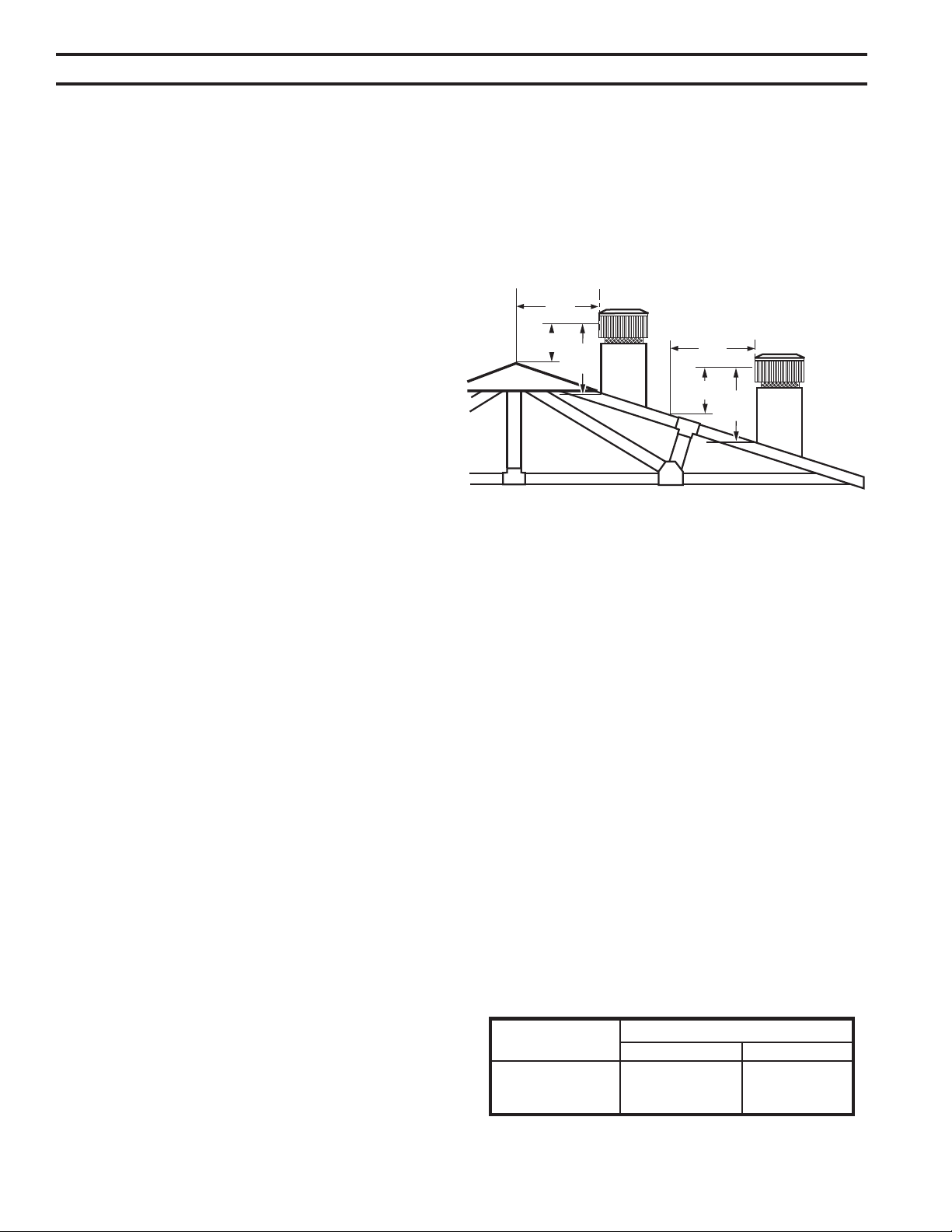
NOTE: Flue outlet should be 4” above all portions of the
building within 10’ as shown in the illustration. The chim-
ney must not extend more than 90” above the roof without
additional support.
AC617
Figure 11
2' Min.
2' Min.
3'
Min.
10'
3'
Min.
10'
AC617
RLTSKC8
2/11/98
NOTE: To select the proper chimney height, refer to Fig-
ure 1. The ue outlet must be a minimum of 3’ above the
highest point where the chimney penetrates the roof and
a minimum of ’ above all portions of the building within
10’. If the chimney is to include elbows to offset the chim-
ney, refer to the Chimney Offset and Cap Installation sec-
tion of this manual. There must be at least ” air space
between all sections of the chimney and combustible ma-
terials between oors.
CHIMNEY INSTALLATION
1. Lay out, cut and frame openings through all ceilings
and the roof at the point where the chimney will pass
through. Unless the chimney is to be offset, the point
where the center line of the chimney will pass through
the ceiling and roof can be determined with a plumb
line as shown in Figure 12. The replace should be
located in the planned installation position. After the
center line is established and a nail is driven to mark
the point, the opening can be cut if you are satised
with the chimney location relative to ceiling and roof
joists and/or any other obstructions. The roof opening
center line should be marked by driving a nail through
the roof from underneath that will penetrate the roof
and can be located from the rooftop. If the chimney is
to penetrate a pitched roof, the hole in the roof must
be rectangular instead of square and should be sized
according to Table 1.
FP 548b
SHR
5/11/99 djt
Angle of Chimney at Ceiling
Size of Chimney
Vertical
30˚
11" CF 2-Wall
FS2A
1756O" x 1756O"
(445 x 445 mm)
FS6A
17(6" x 296"
(454 x 753 mm)
CHIMNEY HOLE SIZE
Table 1
87D0174
13
SSTB11 Woodburning Fireplace
CHIMNEY INSTALLATION
&P
CENTERPOINT
Centerline of
Chimney
Figure 12
Actual Center Point
Plumb Line
Plumb Bob
Imaginary Center
Point
FP1891
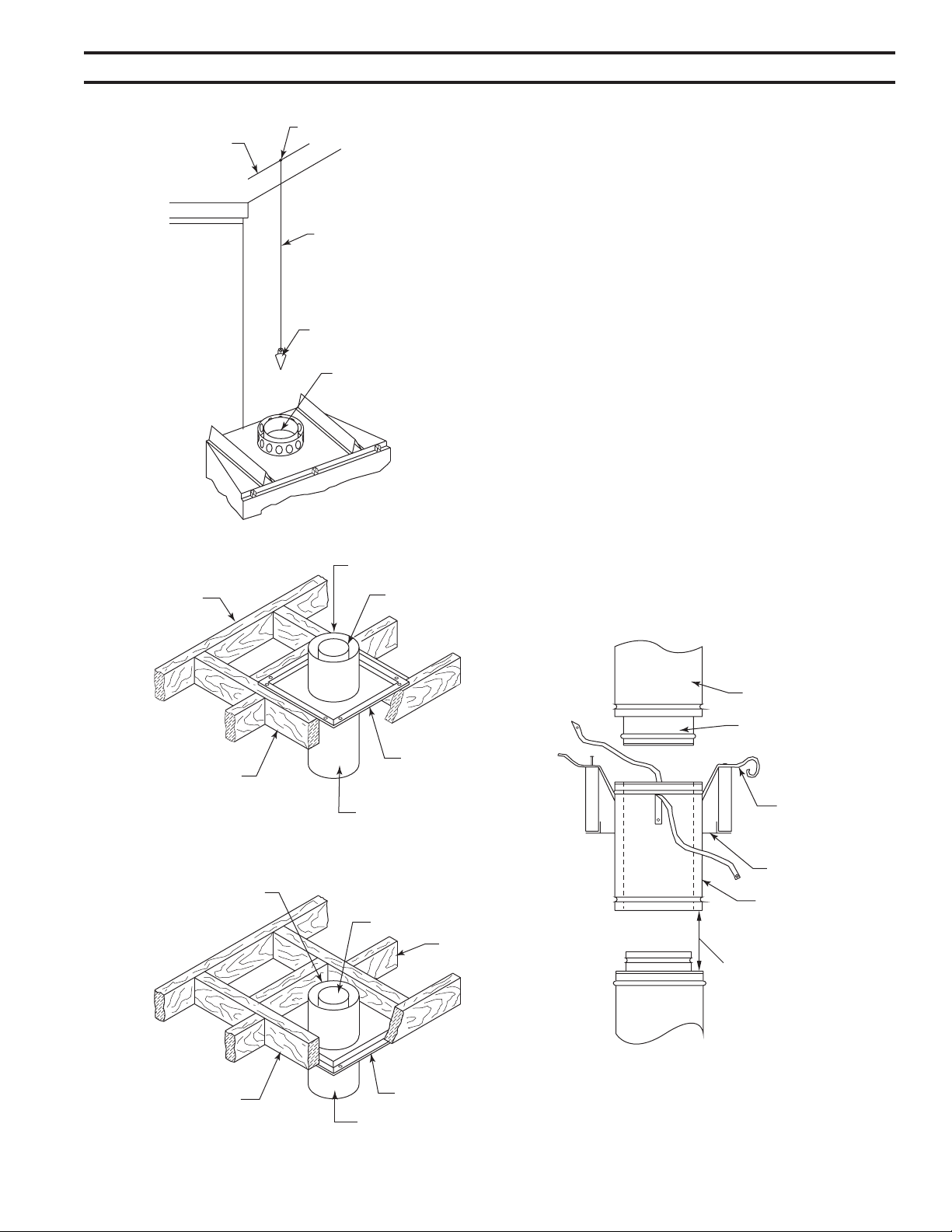
. Install the restop spacer as required from beneath the
ceiling unless the space above is attic space. In an at-
tic, the restop spacer should be installed at the oor
level of the attic. You must have joists or headers on
all four sides of the spacer and use a minimum of four
8-penney nails to secure the spacer.
3. To install the chimney sections, insert the male end of
the ue, the smallest diameter pipe, into the ue outlet
of the replace and press down until the snap locks
engage. Continue the process, adding the chimney
sections on top of each other until the chimney is at
least six inches above the roof opening on all sided. As
the chimney sections are installed, check each joint to
make sure it is properly locked to the previous section.
If additional strength of the outer pipe joints is desired,
you may use two or three sheet metal screws placed
through the area where the outer pipes overlap one
another. To install these screws, drill a 1/8-inch diame-
ter hole through the chimney sections, taking care not
to penetrate the inner ue pipe. WARNING: Be very
careful when drilling the holes into the outer pipe. The
drill must not penetrate the inner stainless steel pipe.
NOTE: If you intend to have a total replace installation
of more that 30 feet you must use chimney support model
11CS at or below 30 feet to support the weight of addi-
tional chimney pipe.
FP1890
chimney install
8/08
Figure 14
Outer Pipe
Flue
Support Straps
Fasten Securely
Firestop
Chimney Support
Snap Lock Chimney
Support Securely to
Lower pipes Before
Fastening Support
Straps
FP1890
&0
FIRESTOPINSTALL
Figure 13
Firestop Spacer Installation at Attic Level
Inlet Air Pipe
Ceiling Joist
Flue Pipe
Firestop Spacer
Chimney Section
Header
Firestop Spacer Installation at Floor Levels
Floor
Joist
Inlet Air Pipe
Flue Pipe
Firestop Spacer
Chimney Section
Header
FP189

14
87D0174
SSTB11 Woodburning Fireplace
CHIMNEY INSTALLATION
To install the chimney support, place the crimped end of
the ue and outlet air duct portions into the last section
of chimney pipe. Push down until the outside or inlet air
duct of the chimney support overlaps and snap locks the
chimney support into the chimney section.
Nail the support straps tightly to a building frame member
or ceiling joist as shown by Figure 14. You must use at
least two 8-penney nails per strap.
Elbow Installation
The following are important points that should be ob-
served when installing elbows on the replace:
1. The support straps of all elbows not installed directly
on top of the replace should be nailed securely to the
surrounding structure. This allows the support strap to
carry the weight of the chimney above the elbow and
prevents this weight from breaking the elbow or chim-
ney sections apart.
. Elbows should not be used in any combination that
inclines the chimney more than 30 degrees from verti-
cal.
3. The limitations on the quantity of elbows per chimney
are as follows: If the total height of the replace and
chimney is—13’ or more — two () elbows may be
used in the chimney. 1’ or more — four (4) elbows
may be used in the chimney.
4. The inclined portions of chimneys that pass through
living spaces likely to be used for storage should be
enclosed to avoid contact with and possible damage to
the chimney. The minimum air space of ” between the
chimney and enclosing materials must be maintained.
5. The length of the inclined portion of chimney between
elbows must not exceed 6’ when unsupported or 0’ if
the chimney is supported at 6’ intervals with support
such as metal support straps.
6. When enclosing the elbows and inclined portions of
the chimney, enclosing materials must be installed ver-
tically to maintain the required ” minimum air space
clearance to the chimney at the extremities of the off-
set. It is recommended that enclosing material not fol-
low the inclined portions of the chimney.
&0
ELBOW
Figure 15
Inlet Air
Pipe
Flue
All four (4) support straps must
be nailed on to framing mem-
ber around the elbow with a
minimum of two () 8-Penny
nails per strap
NOTE: Although both halves of the
elbow set may have tie straps, only
the top half must be secured. The
bottom elbow half is not required to
be secured for added stabilization of
pipe.
FP1893
Offset Installation Sequence
1. Determine the location and amount of offset required,
then select the combinations of chimney sections and
elbows required from the offset chart. Refer to Page
15.
. Install the rst elbow by placing the extended ue into
the mating part of the replace or chimney section.
Push down until the outside or inlet air duct of the el-
bow overlaps and the snaps lock the elbow into the
replace or chimney section.
3. Nail the support straps to the framing member with a
minimum of two 8-penny nails per strap.
4. Install the sections of pipe between elbows until the
proper number of chimney sections have been in-
stalled.
5. Install the second elbow to return the run of the chim-
ney to vertical.
6. Nail the support straps of the second elbow to a build-
ing frame member.
7. Continue installing the vertical portion of the chimney.
NOTE: If the inclined portion of the chimney passes
through a oor or ceiling, a restop spacer should be in-
stalled to provide the restop and support required. Be
sure proper spacing in maintained between the chimney
and combustibles.
87D0174
15
SSTB11 Woodburning Fireplace
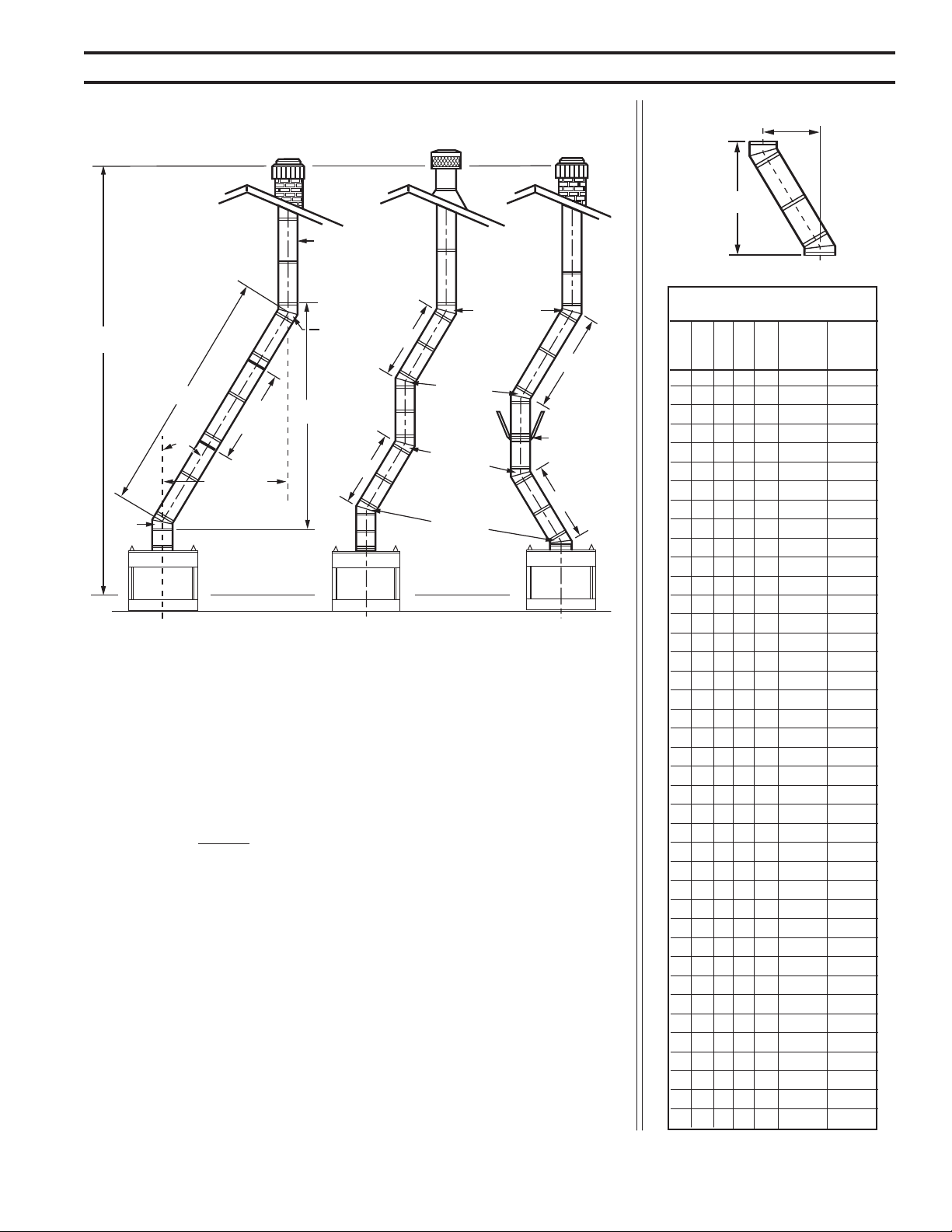
Chimney Requirements - Offset Installations
0 0 0 0 0 3" 11"
1 0 0 0 0 8Z\₄" 0"
0 1 0 0 0 11Z\₄" 5Z\₄"
0 0 0 0 13Z\x" 9Z\₄"
1 1 0 0 0 16Z\x" 34Z\₄"
0 0 1 0 0 0Z\₄" 40³\₄"
1 0 0 0 1³\₄" 43Z\x"
0 0 0 1 0 6Z\₄" 51Z\₄"
0 1 1 0 0 8Z\x" 55Z\₄"
1 0 0 1 0 31Z\x" 60Z\₄”
0 1 0 1 0 34Z\x" 65Z\x"
0 0 0 0 37Z\x" 70³\₄"
1 1 0 1 1 41Z\x" 77³\₄"
0 0 1 1 1 45" 83³\₄"
0 1 0 1 47Z\₄" 87Z\x"
0 0 0 1 51" 94"
0 1 1 1 1 53Z\₄" 98"
0 0 3 0 1 56Z\₄" 103Z\₄"
0 1 0 1 59Z\₄" 108Z\x"
0 0 1 1 6Z\₄" 113Z\x"
0 1 3 0 1 64Z\x" 117Z\x"
0 0 1 1 68Z\₄" 14"
0 1 1 1 70Z\x" 18"
0 0 0 3 1 74Z\₄" 134Z\x"
0 1 1 78" 140³\₄"
0 0 3 1 81" 146"
0 1 0 3 84" 151Z\₄"
0 0 87" 156Z\x"
0 1 3 1 89Z\₄" 160Z\₄"
0 0 1 3 93" 166³\₄"
0 1 95Z\₄" 170³\₄"
0 0 0 4 99Z\₄" 177³\₄"
0 1 1 3 101Z\₄" 181³\₄"
0 0 3 104Z\₄" 186Z\₄"
0 1 0 4 107Z\₄" 191Z\x"
0 0 3 110Z\₄" 196³\₄"
0 1 3 3 114" 03Z\₄"
0 0 1 4 3 117³\₄" 09³\₄"
0 1 3 3 10" 13Z\x"
0 0 0 5 3 13³\₄" 0"
30° Elbow Offsets
1'
1¹⁄₂'
3' 4'
Chimney
Support
Offset
Rise
Notes: G + H cannot exceed 0 feet.
*11CF Chimney airspace clearance = " minimum.
Illustration Key
The following safety rules apply to offset
installations (letters correspond with illustra-
tion above):
A. Height of the chimney is measured from
the hearth to the chimney exit.
SSTB11
Max.: 86’0”
Min.:
0 Elbows 18’0"
Elbows* 4’0”
4 Elbows* 30'0"
B. Do not use more than 4 elbows per chim-
ney.
Attach the straps of the return (top) elbow to a
structural framing member.
The offset (rst) elbow of any pair does not
have straps.
FP69
C. The chimney cannot be more than
30° from the vertical plane in any instal-
lation.
D. The maximum length of the angled
run of the total chimney system is 0
feet. (G plus H cannot exceed 0 feet.)
E. A chimney support (Model 11CS)
is required every 6 feet of angled run
of chimney. Chimney supports are
required for every 30 feet and 60 feet
chimney height above the hearth.
Determine the offset distance of your
chimney arrangement from the center-
line of the replace to the centerline of
the chimney where it is to pass through
the rst ceiling.
NOTE: This offset distance may not be
your full offset distance. See Examples
and 3.
IWF282
MBUF
5/26/96
Offset
Rise
FP8
D
B
G
H
B
C
E
6 FT.
G
H
A
IWF269
MBUF
5/16/96
rev. 5/25
30°
Return
Elbow
Chimney Flue Exit
Chimney
Section
Rise
30°
Offset
Elbow
11CS Sup-
port
Offset
30°
Offset
Elbow
30°
Return
Elbow
Example 1 Example 2
Example 3
Elbow
Hearth Floor
Figure 16
CHIMNEY OFFSET INSTALLATION
16
87D0174
SSTB11 Woodburning Fireplace
CHIMNEY OFFSET AND CAP INSTALLATION
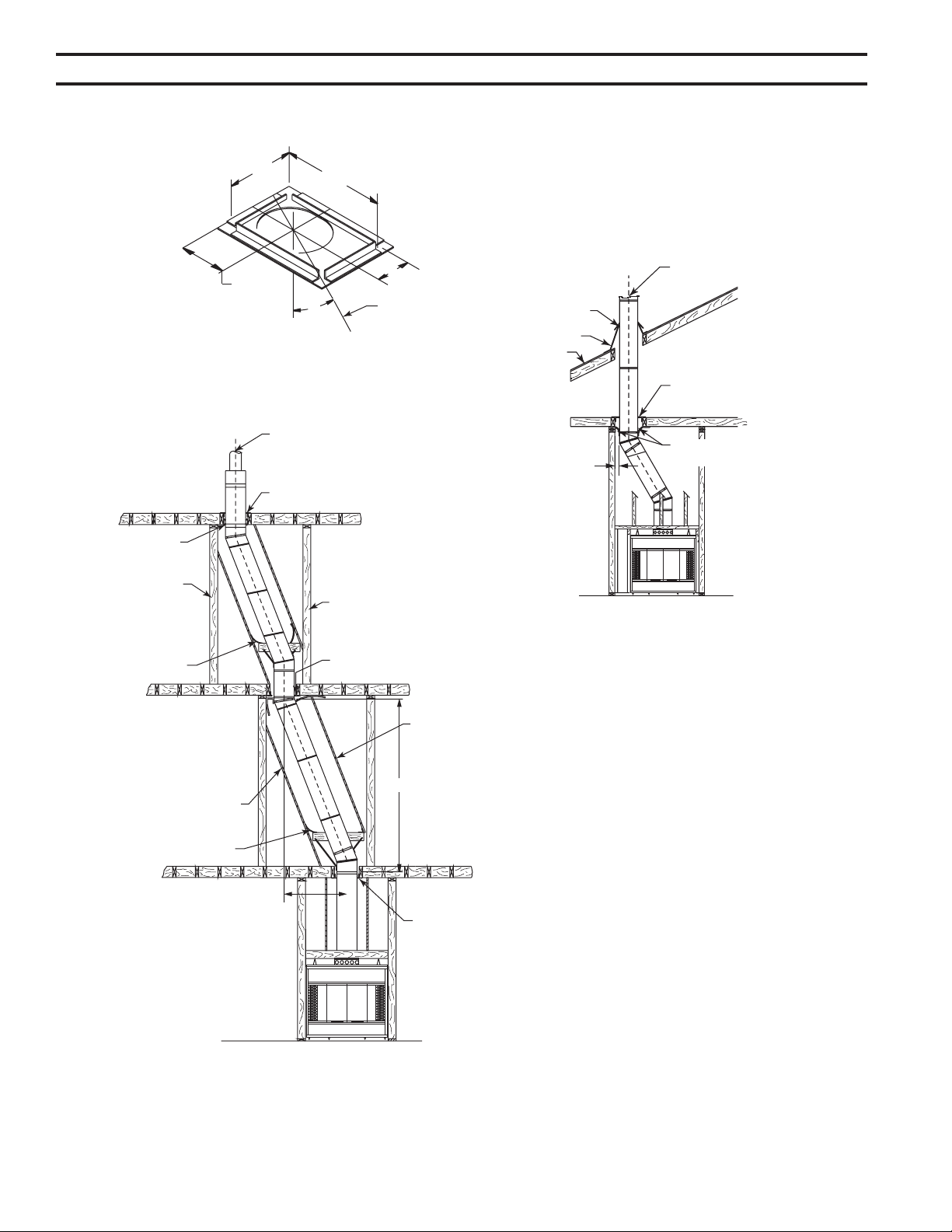
17”
2256QE”
756M”
30°
76QE”
FP1894
firestop spacer
8/08
Figure 17
Centerline of
Chimney
Firestop
Spacer
&0
SINGLESTORYOFFSET
C
L
Continue chimney to proper
height and install round chimney
cap or chimney housing
Firestop Spacer as
Required
Fasten Support Straps
Securely
NOTE: Two ()
elbows may be used
when total installation
height exceeds 13’
Storm Collar
Flashing
Roof
” Minimum Air
Space Clearance
to Combus-
tibles with use of
Firestop
FP185
Figure 19
C
L
C
L
&0
MULTISTORYOFFSET
Continue chimney through roof
and install round chimney cap
or chimney housing
Firestop Spacer ” Minimum Air Space
Clearance at Joist
Vertical Chimney
Enclosure
Chimney Must Be Enclosed
in Accessible Areas
Firestop Spacer
Diagonal Chimney
Enclosure
RISE
Firestop Spacer ”
Air Space Clearance
to Combustibles
NOTE: Four (4) elbows may be
used when toatl installation height
exceeds 4 ft.
Maximum four (4) elbows per
Fireplace
Offset Max 10’
Support Straps
Diagonal Chimney
Enclosure
Vertical Chimney Enclosure
Recommended.
Diagonal Chimney Enclosure
Acceptable
Fasten All Support
Straps Securely
Vertical Chimney
Enclosure
Support Straps Not
to Penetrate Firestop
FP186
Figure 18
87D0174
17
SSTB11 Woodburning Fireplace
CHIMNEY OFFSET INSTALLATION
&0
SCRIBELINE
Hold 13” Diameter
(Outside) Pipe Vertical
Scribe Line
at Bottom
NOTE: RLTCF11L chimney cap is same
as RLTCF11 with the exception of a
longer telescoping pipe which may be
needed for special installations such as
chase installations.
FP1897
Figure 20
*36”
1856O”
FP1898
chimney cap install
8/08
Chimney Cap
Apply Mastic Here
Storm Collar
Flashing
* or ’ Above Any Point Within 10’
FP1898
Figure 21
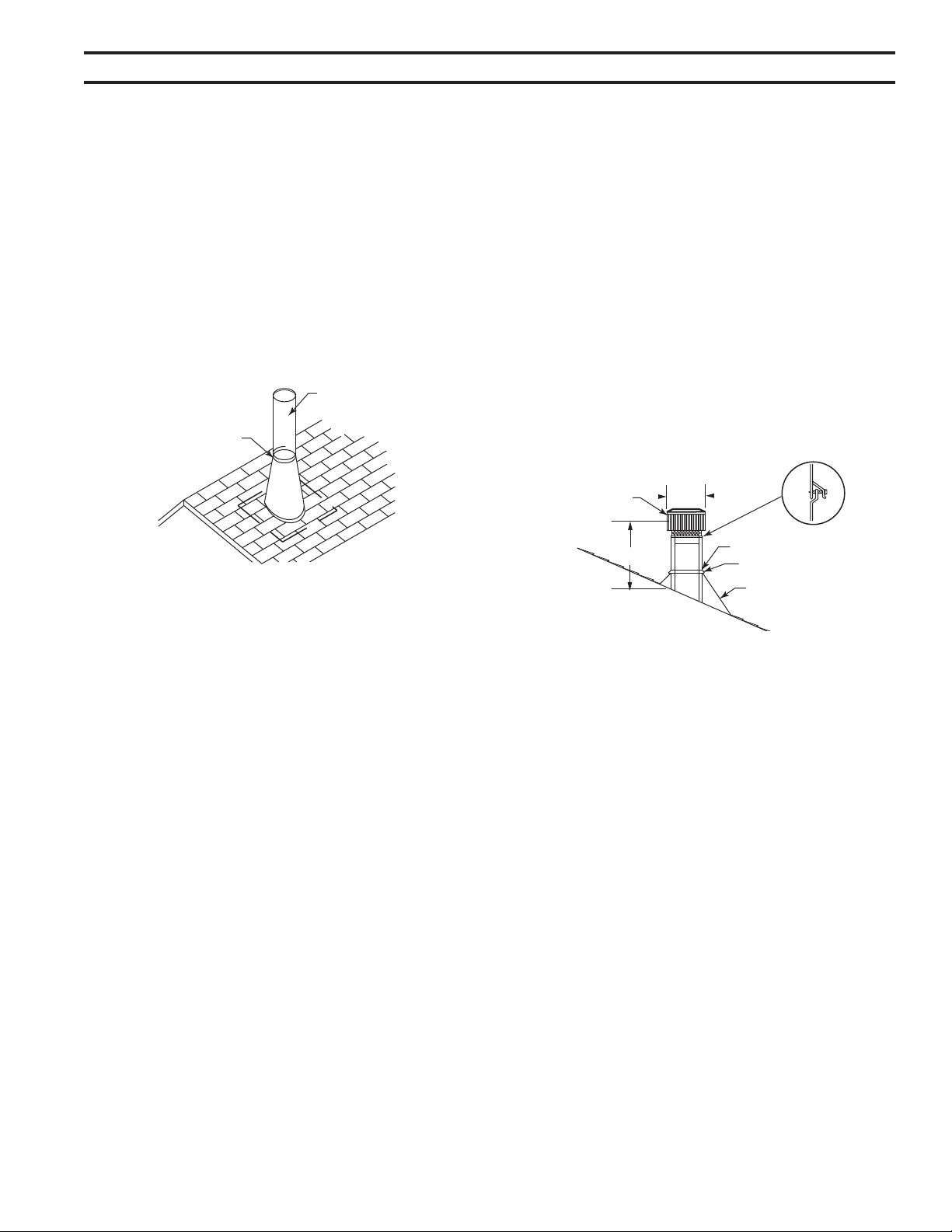
1. Extend the regular chimney sections until the top of
the chimney is 4” below the total ue height desired.
Do not snap the last section of inlet air duct or largest
diameter pipe in place until Step 3 is completed.
. Remove the shingles from around the chimney so that
the ashing may be installed, with the upper part of the
ashing under the shingles.
3. Set the ashing on the roof. Hold a section of the out-
side pipe (13” diameter) on the ashing and scribe a
line around the ashing, then cut the top off the ashing
by cutting 1/4 inch below the scribed line. This should
increase the diameter of the ashing outlet sufciently
to allow the ashing to be placed over the chimney.
Figure 20
4. Snap the last section of inlet air duct in place and slide
the ashing over the chimney. Adjust the chimney to
assure that the proper minimum clearances are main-
tained.
5. Nail the ashing securely in place with eight nails.
6. Seal the crack between the top of the ashing and the
chimney with mastic. Leave some excess mastic at
this area to be used in step eight. NOTE: Use pliers
and wear gloves when performing step seven to mini-
mize the danger of cutting your hands on the edge of
the storm collar.
7. Place the storm collar around the chimney and put the
collar together like a belt in belt loops. Slide the end
of collar under the two loops on the other end with the
loops facing up. Overlap the ends of the collar until
it is tight against the chimney. Bend the free end of
the collar back over the loops to hold the storm collar
securely together. The excess end of the storm collar
may be trimmed off.
8. Slide the storm collar down snugly against the ashing
until the excess mastic left in step six is forced up into
the crack between the storm collar and the chimney.
This should make the joint between the ashing and
the chimney watertight.
9. Install the chimney cap by placing the cap into match-
ing parts of the last chimney section. Then punch or
drill 1/8 inch diameter holes in the inlet air duct (chim-
ney pipe) where specied on the brackets and fasten
it down with the No. 8 screws provided. Do not pen-
etrate the inner stainless steel pipe while installing the
screws.
10.Check all the parts of the replace, chimney and chim-
ney termination cap to assure that no parts have been
damaged or bent during installation and that all parts
have been installed properly.
NOTE: The metal used for the chimney cap has a rust
protective coating but the cut edges of the parts are not
protected. To prevent rusting and rust staining of nearby
structures, exposed parts of the chimney and chimney
cap should be detergent washed and painted with a gal-
vanized primer paint.
18
87D0174
SSTB11 Woodburning Fireplace
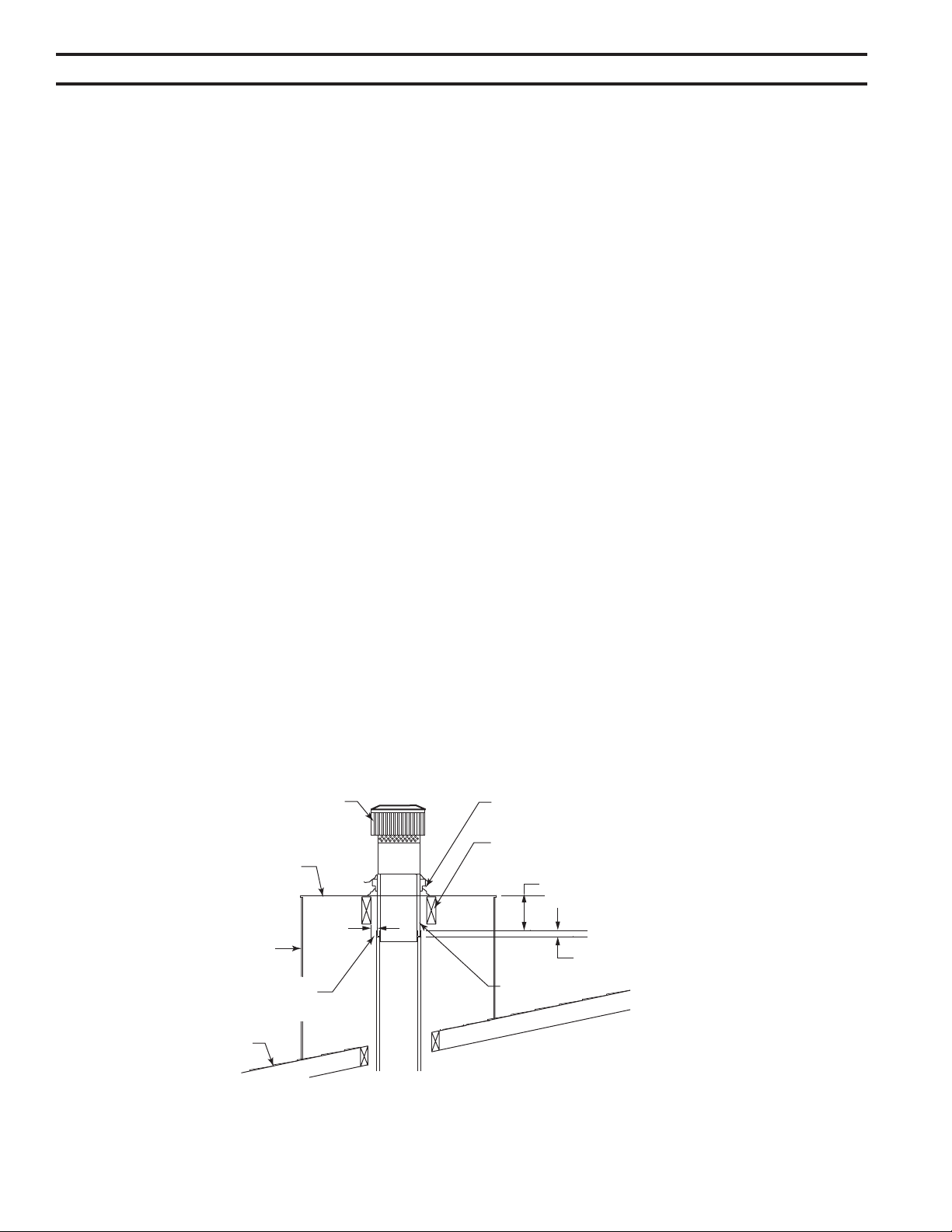
CHIMNEY CAP CHASE INSTALLATION
The preinstalled chimney sections should be no more than 13” below the top of the chase.
The installation should be planned so that either a two-foot or three-foot chimney section will
be used for the top section. This is necessary to ensure complete engagement of the inlet air
telescope and chimney cap into the top section.
1. Extend the chimney sections until the top of the chimney is not more than 13” below the top
of the chase.
. Center the hole in the chase cover over the chimney. The chase cover overhang should be
lanced, formed over the chase and secured with nails. This prevents water from seeping
under the chase cover. If two or more chase covers are to be used on the same chase, they
should be soldered together to form two watertight seams.
3. Place the outer telescope inside the hole in the chase cover and lower it down into the mat-
ing pipe of the chimney until the support brackets on the telescope section rest on the ange
of the chase cover.
4. Bend the tab with a hole on each bracket outward and secure cap to ashing, using the tabs
provided.
5. Once the telescope is secured, place the rain shield over the top of the telescope pipe as-
sembly. The rain shield will be supported by the telescope brackets.
CAUTION: Be careful around electrical wires to avoid the electrical shock hazard of contacting
the wires with the metal chimney components.
NOTE: When two replace chimneys are terminated above the same chase, the centers of the
chimney caps should be at least 4” apart to help prevent smoke from a replace in use from
being drawn down the chimney of a replace that is not in use. Additional spacing between
caps or staggering the height of the caps will further lessen the likelihood of this occurring.
6. Place cap assembly into position by aligning the ue telescope into the last section of ue
pipe and lower it down until the 3 cap legs rest on the top edge of the outer telescope pipe.
Secure legs of cap to the telescope with screws provided.
7. Check all parts of the chimney and chimney cap to assure that no parts have been damaged
or bent during installation and that all parts have been installed properly.
NOTE: The metal used for the chimney and chimney cap has a rust-protective coating but the
cut edges of the parts are not protected. To prevent rusting and rust staining of nearby struc-
tures, exposed parts of the chimney and chimney cap should be detergent-washed and painted
with galvanized primer paint.
156O” Min.
Overlap
2” Min.
FP1899
chimney cap
8/08
RLTCF11 Chimney Cap
Design Incorporates Lon-
ger Duct and Flue Pipe for
Chase Type Installation
Chase Top Flat Flashing Does
Not Require Venting or Standoff
Spacers Around Perimeter
Chase
Roof Line
Maintain ” Minimum Air Space
Clearance to Combustibles
Above Roof Line
Using Tabs Provided, Secure Outer
Telescoping to the Flat Flashing
On Large Chase Tops it is Recommended that
Cross Supports be used to Provide Additional
Support to Eliminate Sagging of the Flashing
13” Max. Space Between Chimney
Section and Chase Cover
Outer Telescope
NOTE: Locally built chase ashings must incorporate a
13Z\₄ min. to 13³\₄ max. x ” high min. anged hole for proper
installation of the RLTCF11 chimney cap.
Figure 22
FP1899
87D0174
19
SSTB11 Woodburning Fireplace
OUTSIDE COMBUSTION AIR PRECAUTIONS & RECOMMENDATIONS
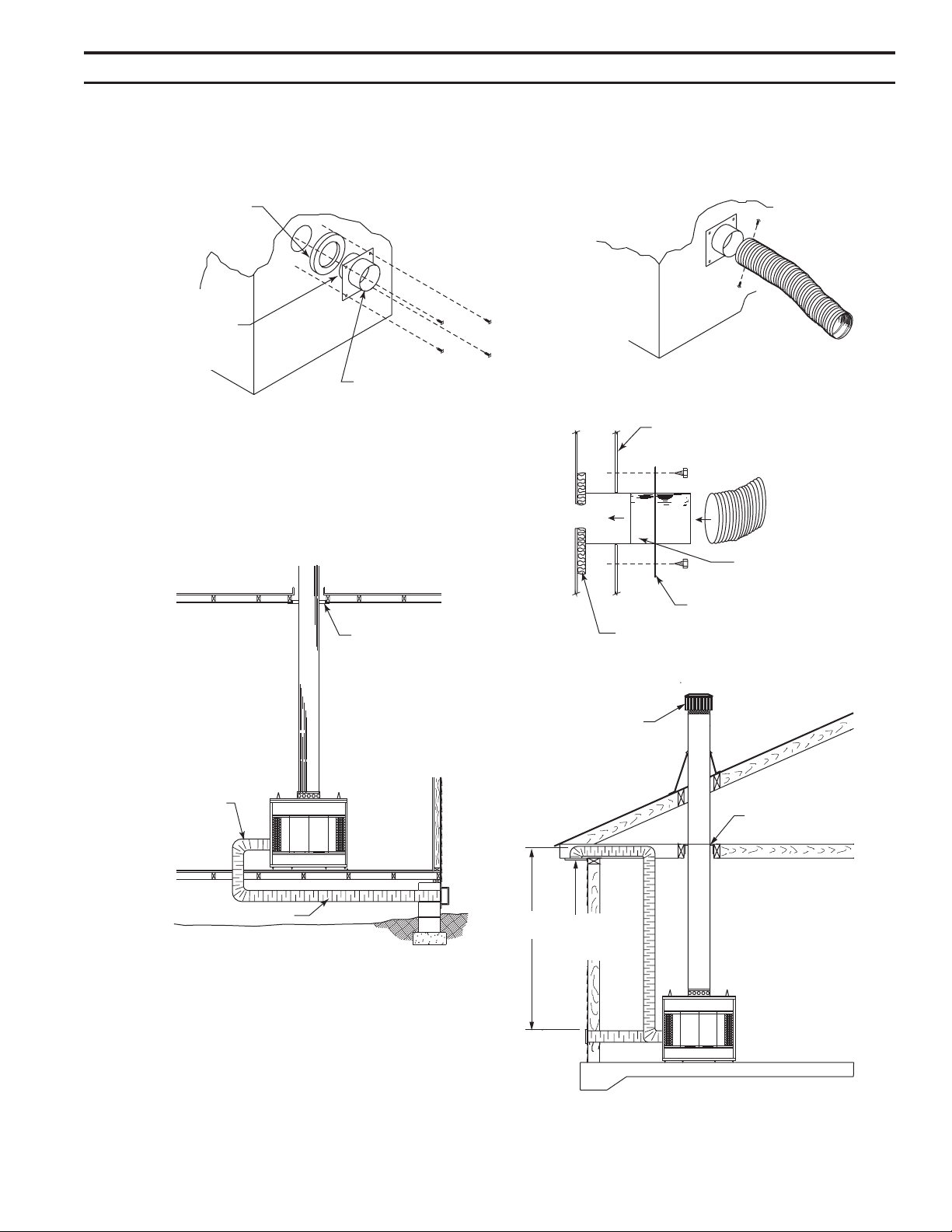
NOTE: The use of outside air for combustion is optional unless required by building codes. It is
only necessary to supply outside combustion air to one side of the replace. Use the Model AK4
combustion air kit.
FP1900
OA start collar
8/08
Insulation Ring
Insert Shortest Side of the
Tube through the Fireplace
Outer Wrap to Properly
Seal Against Firebox Wall
and Gasket
Longer Length of the Tube
to Outside
Secure Outside Air Starting Collar to Fireplace
Figure 23
Step 1: Secure outside air starting collar to left side of re-
place with four (4) sheet metal screws provided.
NOTE: The starting collar extends through the outer replace
jacket and will seal against the rebox wall when secured as
indicated.
FP1901
secure outside duct
8/08
Step 2: Secure outside duct to starting
collar with duct clamp or screws.
Fireplace Outer Wrap
AK4 Combustion Air
Kit (Shortest Toward
Firebox)
AK4 Mounting Plate
Firebox Insulation Seal
FP1900
FP1901
&0
ABOVEBASEMENT
Second Floor
Firestop Spacer
Duct Extended
to Miss Joint
To Outside Wall
Installation Above Basement
or Crawl Space
FP186
Figure 24
8‘ Max.
FP2187
OA soffit install
1/09
Firestop
Spacer
CAUTION: Do not take
combustion air from at-
tic space or garage.
Concrete Slab Installation
(Optional Outside Air Runs)
Inlet Grille in
Soft
(Overhang)
Termination Cap
Figure 25
FP187
0
87D0174
SSTB11 Woodburning Fireplace
&0
!+INSTALL
Screw
Nail
Holes
Screws
AK4 Inlet Air Vent
Duct
Extending
3” min.
6” Diameter Hole
OUTSIDE COMBUSTION AIR PRECAUTIONS & RECOMMENDATIONS
Outside Combustion Air Recommendations (continued)
1. Extremely long runs and numerous turns in the duct leading from the replace to the combustion air
assembly should be avoided. These conditions will increase the resistance to the free ow of air
through the duct. Refer to Figures 1, 24, and 25 for methods of installing the outside air for combus-
tion assemblies.
. The combustion air assembly should be located at an exterior location, which is not likely to be ac-
cidentally blocked in any manner. The assembly should be located above the snow line to prevent
blockage by snow accumulation.
3. The combustion air inlet assembly should never be mounted in a garage or storage area where com-
bustible fumes such as gasoline might be drawn into the replace.
4. Combustion air can be drawn from the crawl space under a house when an adequate supply of air
is provided by open ventilation.
5. Do not take combustion air from attic space or garage space.
Figure 26
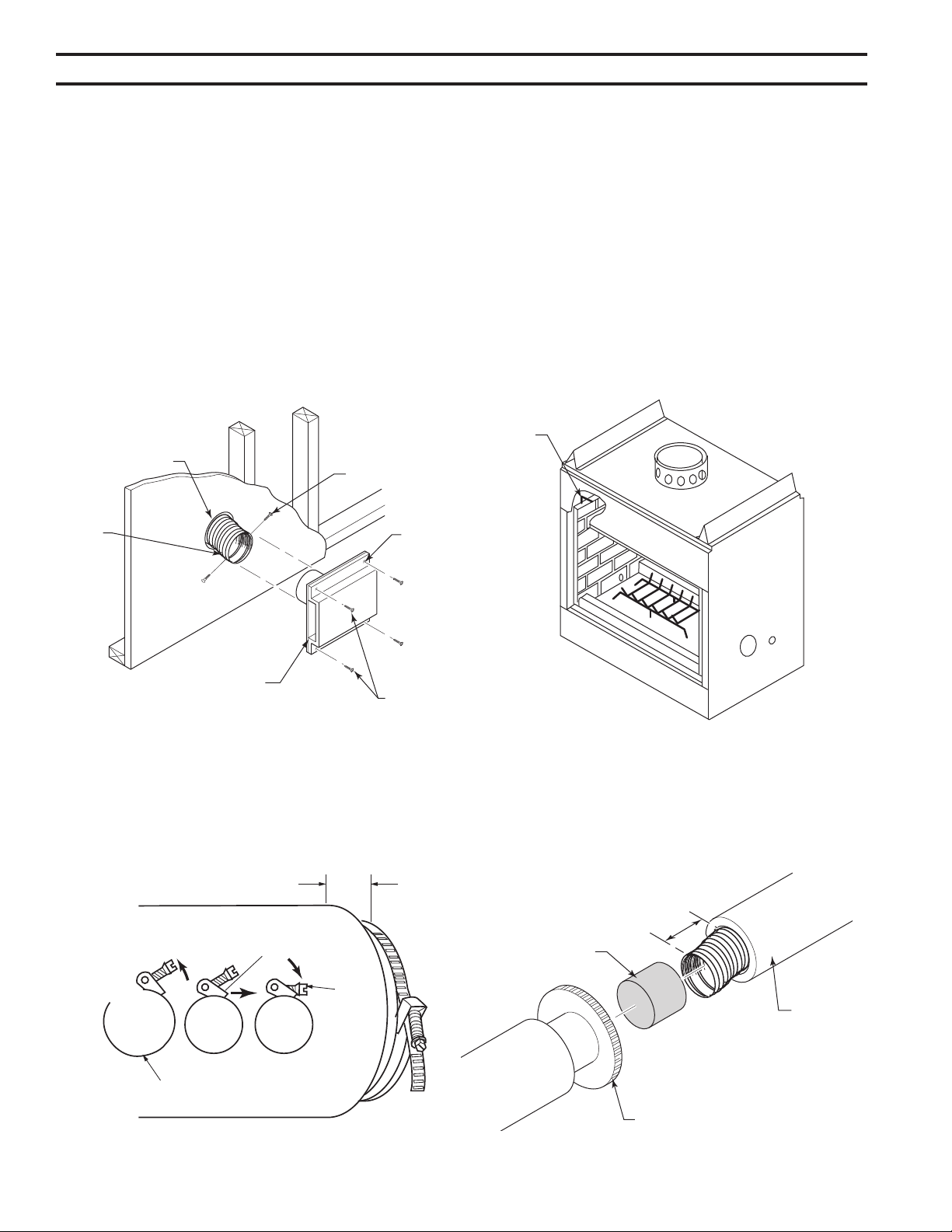
Outside Air Control Lever
(Lift to Open, Pull Down
to Close)
Installing Model 403 Duct Connector
1. Push insulation back approximately ” from the end of each duct.
. Slip each duct over duct connector until an equal length of connector extends into each duct.
3. Place duck clamp over the end of each duct. Tighten duct clamp down snuggly.
4. Push insulation back into place and over duct clamp.
1 2 3
2“
App.
FP1906
Duct connector
8/08
Loop Disengaged
Clamp Around
Duct
Slip Band
Through
Housing
Snap Screw
Down and
Tighten
Band
Screw
&0
$UCTCONNECTOR
Approximately
2”
Duct Connector
Insulation
Duct Clamp
&0
/!LEVER
FP188
Figure 27
Figure 28
FP1906
FP1907

87D0174
1
SSTB11 Woodburning Fireplace
COMBUSTION AIR ASSEMBLY
Model AK-4 Combustion Air Assembly
1. Remove the cover plate from the 4-inch outlet opening location on the left outside of the re-
place. DO NOT remove the cover if the outside air will not be connected.
. Place the insulation ring between the AK-4 starting collar and replace wall and place the start-
ing collar (4 inch) into the hole on the left side of the replace. Fasten it in place with the four
sheet metal screws provided.
3. Cut a 6-inch diameter opening for model AK-4 in the outside wall covering where the outside
vent is to be located.
4. Select and cut a piece of duct sufcient length to attach to the replace and protrude at least
three inches beyond the face of the wall to which the AK-4 inlet air vent will be attached. The
duct may be cut with a standard pocket knife (use FP-4 U duct for maximum efciency and
safety). Do not use a combustible duct. Always use UL Listed Class 0 or 1 duct material.
5. If the duct is the insulated type, push the insulation back from one end of the duct approximately
two inches.
6. Slip the exposed end of the duct over the starting collar on the replace.
7. Using the sheet metal screws provided, secure the duct end to the collar attached to the re-
place.
8. Nail or screw the combustion air assembly to the surface of the wall.
NOTE: If the wall covering is brick or stone, use appropriate masonry fasteners. Mount the com-
bustion air assembly with “TOP’” upward to prevent cold air from entering through the wall. If it is
necessary to splice the duct, a model 403-duct connector should be used to splice duct sections.

87D0174
SSTB11 Woodburning Fireplace
GAS APPLIANCE INSTALLATION
WARNING: Improper installation or operation of a gas
appliance in this replace can allow unburned gas to leak
out which will cause a re or explosion hazard, or the re-
lease of poisonous carbon monoxide into the dwelling
which can cause serious injury or death to its inhabitants.
To reduce these risks to a minimum, the following impor-
tant notices and instructions should be read and followed
carefully.
MHSC replaces are designed to accept a 1/ inch gas
line for installation of an approved gas appliance. (MHSC
manufactures a wide variety of gas logs for use in MHSC
replaces.)
Be sure to have the appliance installed in accordance with
building codes.
IMPORTANT NOTICES:
Gas pipe installation is intended for connection to a deco-
rative gas appliance only when (1.) incorporating an auto-
matic shutoff device and (.) complying with the Standard
for Decorative Gas Appliances for Installation in Vented
Fireplaces (ANSI Z1.60) or Gas-Fired Log Lighters for
Woodburning Fireplaces.
1. The provision for a gas line is intended for connection
to a decorative gas appliance which and complies with
the Standard for Decorative Gas Appliances for Instal-
lation in Vented Fireplaces, ANSIZ1.60. If a deco-
rative gas appliance is installed, it must be installed
in accordance with the National Fuel Gas Code, AN-
SIZ3.1.
CAUTION: When a decorative gas appliance is in-
stalled, the replace damper must be xed in a man-
ner which will maintain the minimum permanent vent
opening at all times.
The installation of an unvented gas appliance (blue
ame) may be installed which incorporates an auto-
matic shutoff device, and complies with the National
Fuel Gas Code Z3.1, Latest Edition.
If an unvented gas appliance (blue ame) is installed
it must incorporate an automatic shutoff device, and
must be installed in accordance with with the National
Fuel Gas Code Z3.1, Latest edition.
BTU input of a gas appliance installed in replace
should be rated less than 100,000 Btu/hr.
CAUTION: If an unvented gas appliance is installed in
the replace, the gas appliance must only be operated
with the replace glass door fully open (if included).
The installer of the replace and gas appliance must
describe the operation of the replace and appliance
to the people who will be operating them and leave all
instruction manuals with the operator of the replace.
NOTE: When installing an ANSI Z1.11. ventless ap-
pliance, the nishing material used for the mantel must
be rated at 50°F or greater.
WARNING: Do not operate an unvented gas log set in
this replace with the chimney removed.
. An approved gas shut off valve must be located out-
side the replace in an area accessible to the users of
the replace.
3. All gas piping and tting must be either steel or mal-
leable iron. Unions must be of the ground joint type.
4. Some code authorities prohibit or place restrictions on
the use of gas appliances in replaces. Check with lo-
cal code authorities before proceeding with the instal-
lation.
5. The gas appliance and all connecting gas piping should
only be installed by a licensed gas appliance installer.
6. The installer should advise the persons who will use
the replace to set the replace damper in full open
position when the appliance is in use.
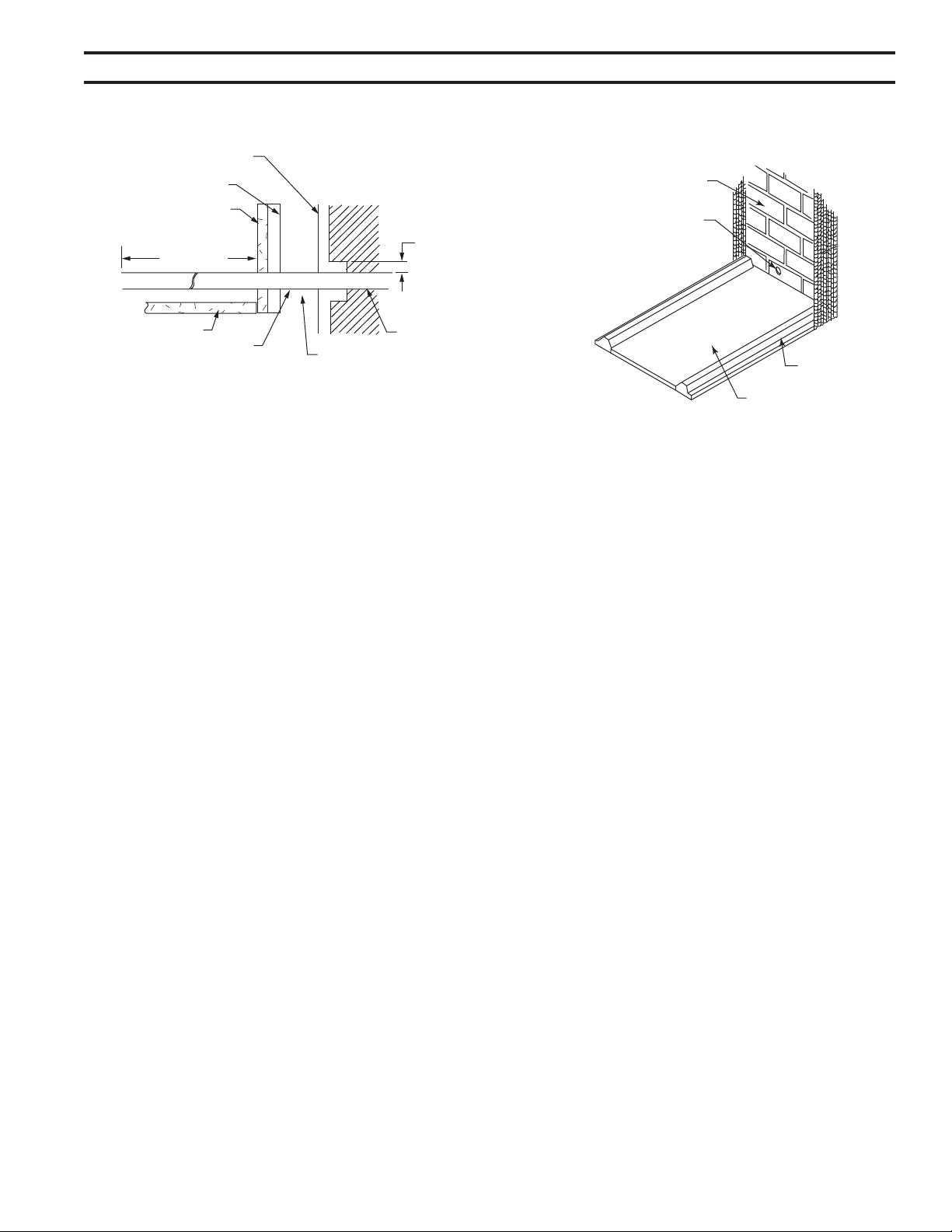
The following instructions only apply to passing the gas
line through the replace wall. Follow the instructions pro-
vided by the appliance for the gas line, testing and adjust-
ing it.
1. Locate the recessed area in the side refractory panel
as shown by Figure 29.
. Tap out a round hole in the brick liner with a hammer
by tapping lightly on the recessed area.
3. Remove the two screws that hold the cover plates on
the jacket wrap and discard the cover plate.
4. Use a screwdriver or similar tool to push the loose in-
sulation out of the tube between the rebox and the
outer jacket of the replace.
5. Install the 1/” gas pipe through the tube between the
rebox and jacket.
NOTE: Gas pipe should not come in contact with
any wood structures until it has reached a point at
least one (1) inch away from replace side.
6. Attach the gas appliance to the gas pipe according to
the appliance makers instructions.
7. Pack the insulation removed in step 4 around the pipe
to prevent air owing through the tube either into or out
of the rebox.
8. Be sure the gas is turned off at the appliance, then turn
the gas on at the cut off valve and test the gas line con-
nections for leaks with soapy water solution or a liquid
leak detector. DO NOT USE A MATCH OR OTHER
FLAME SOURCE TO CHECK FOR GAS LEAKS. If a
gas leak is detected, turn the gas off immediately and
x the leak.
9. Proceed with testing the appliance for leaks and ad-
justing it as required by the manufacturer instructions.
87D0174
3
SSTB11 Woodburning Fireplace
GAS APPLIANCE INSTALLATION
CAUTION: When using a gas appli-
ance, the replace damper must be
set in fully open position.
&0
GASLINEINSTALLATION
Figure 29
Outer Fireplace Wrap
Inner Fireplace Wrap
Side Brick
4” Max.
Fireplace Firebrick
Hearth Brick
Gas Line Access Tube
Repack Insulation Around
Gas Line Where it Passes
Through Gas Line Access
Tube for Proper Seal
Maintain 1/” Minimum Air Space
Clearance to Combustibles for
Gas Line Out to 4” From Side of
the Fireplace
Combustible Materials May Be Located
at Zero Clearance to Gas Line Beyond
4” From Fireplace Side.
Side Brick
Knockout
Gas Line Plumbing Detail
Hearth Ledge
Hearth Refractory
FP189
4
87D0174
SSTB11 Woodburning Fireplace
Applying Decorative Trim To The Fireplace
The face of your replace may be left exposed or trimmed with any noncombustible material such
as brick, stone or marble. If a trim is installed, be sure it is fastened snugly to the face of the re-
place. A crack between the material and the face of the replace could pose a re hazard and im-
pair the proper operation of the replace. Blocking the replace with framing and attaching the base
to the supporting oor will further reduce the possibility of such a crack developing.
Wall ties should be fastened to the face of the replace with sheet metal screws and placed in the
mortar joints of masonry trim.
Combustible material must not be installed below the top spacers of the replace or overlap the
sides of the replace face. Seal the face of the replace to the surrounding wall with non-combus-
tible caulk or trim materials to prevent cold air leakage around the replace.
TRIM INSTALLATION
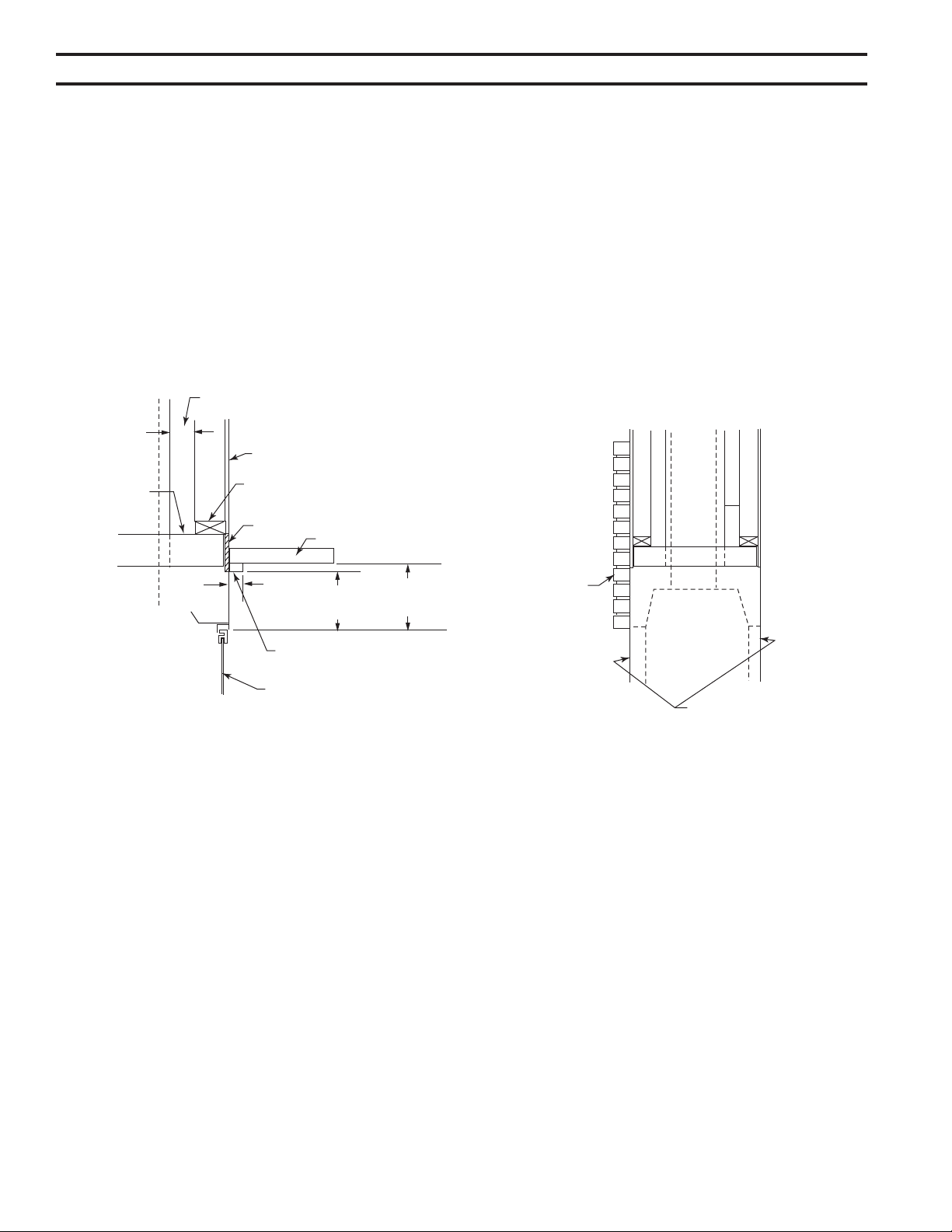
&0
TRIMINSTALL
1156O”
Min.
12"
Min.
156O”
Min.
Maintain ” Min. Clearance
to Combustible Construction
from Chimney Pipe
Finish Wall
Header Framing
Noncombustible Required
Below ‘V’ Spacer
Mantel
Top ‘V’ Spacer
Combustible Trim
(See Note)
Glass Doors
NOTE: Combustible trim must not overlap the black
painted face of the replace by more than 1/8”
Noncombustible tile,
brick, stone, etc. materi-
als may be installed over
black painted face of the
replace. Special eld
fabricated lintel bars may
be installed directly to the
replace face as needed
to provide support for the
nishing materials
Glass Doors
FP190
Figure 30
Cross Sectional View of Fireplace
Upper Panel, Mantel and Framing
87D0174
5
SSTB11 Woodburning Fireplace
FIREPLACE OPERATION
WARNING: If a decorative gas appliance is used in the
replace the replace damper must be xed in an open
position. (See additional operation information in section
titled “Operation Guidelines”.)
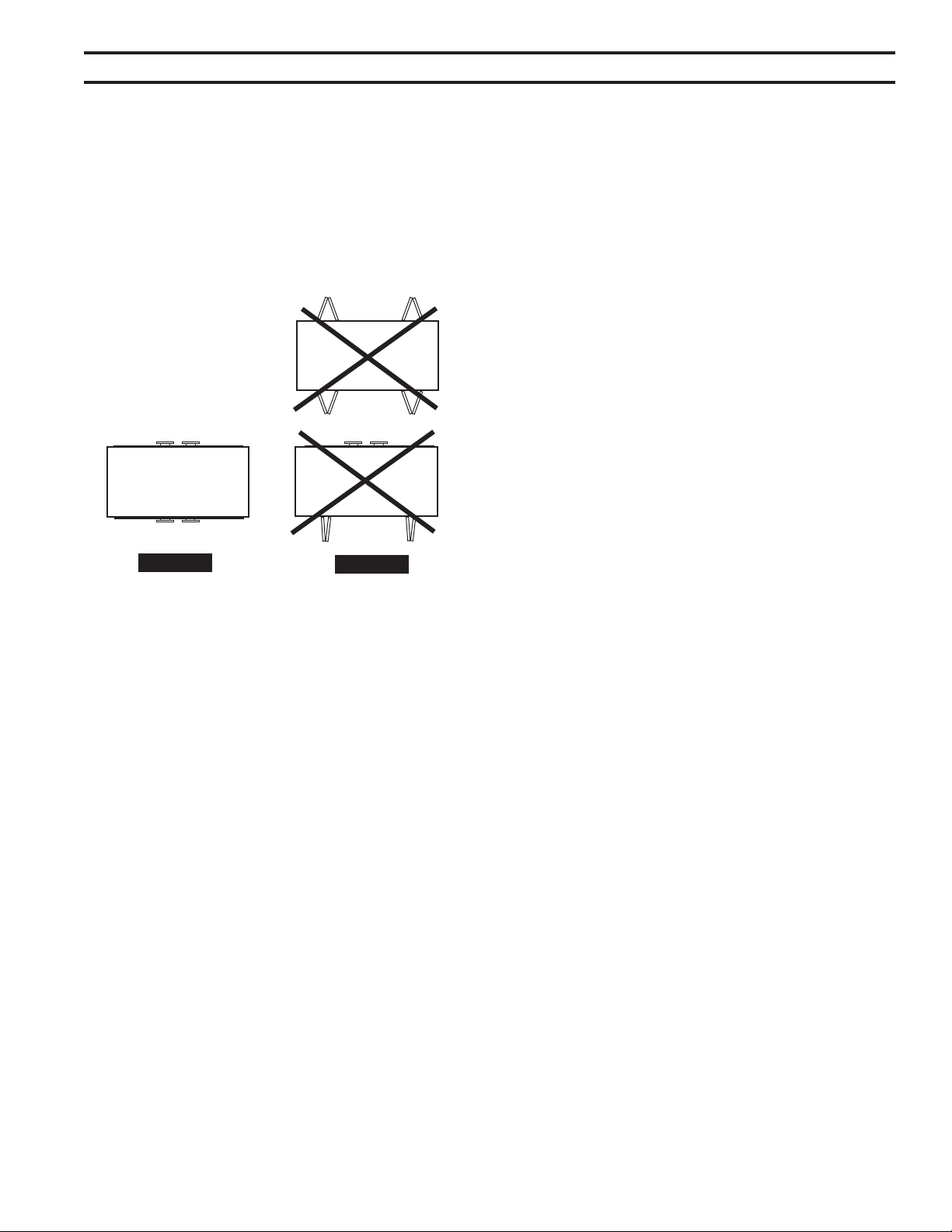
WARNING: Fireplaces equipped with doors should be
operated only with the doors fully open or doors fully
closed. If doors are left partly open, gas and ame may
be drawn out of the replace opening, creating risks of
both re and smoke. Figure 31
RIGHT
WRONG
CLOSED
FP2529
door position
Operate Fireplace Only With
all Doors in the Fully Closed
Position
FP59
Figure 31
Advantages of a Wood Burning Fireplace
These are the practical, ecological advantages of wood
as a fuel. Also to be considered is the aesthetic appeal.
Most of us consider a wood re with nostalgia. We enjoy
the aroma, and nd the ickering light of a cozy hearth
conductive to a happy remembrance of things past. Wood
has a low ash content. And the little ash that remains af-
ter burning is useful in home gardening as a fertilizer and
soil conditioner. WARNING: This appliance is not for use
as cooking equipment.
Which Woods Are Best?
Each wood species offers something different in aroma
or heat value, and you should consider your needs and
desires before building your re. Softwoods, like pine,
spruce, and r are easy to ignite because they are res-
inous. However, a re built entirely of softwoods burns
out quickly and requires frequent replenishment. While
a softwood re is not too desirable for a long evening, it’s
ne in the morning when you want quick warmth, or late in
the evening when you want a re that will burn out before
you go to bed.
On occasion when a longer re is desired, it’s best to
combine softwoods with the heavier hardwoods such as
ash, beech, birch, maple, oak and hickory. These hard-
wood species burn less rapidly, with shorter ames, and
produce steady, glowing coals.
For the most pleasing aroma, burn the wood of fruit trees
such as apple and cherry, or nut trees such as beech,
hickory and pecan. Such wood is generally more expen-
sive, but a little combined with other wood, goes a long
way. Start your re with a mixture of softwood and hard-
wood, then add some fruit or nut wood for nostalgic aro-
ma. Since most woods will not burn well when freshly cut,
the wood you purchase should be reasonably dry. The
sizes you buy are dictated by the size of your replace.
Purchase logs that will t when laid across your grate, and
ask that the larger, heavier logs be split. Kindling should
be short, easily split lengths of softwood, lumber yard or
mill scraps, or twigs and branches gathered from your
yard.
How To Build A Better Fire
The rst three res should be of moderate size to allow
the replace to adjust and the bricks to cure before be-
ing subjected to larger res. First, make sure your room
is well ventilated, your damper open and the ue is un-
obstructed. Then make sure your wood is dry and sea-
soned. Unseasoned wood burns poorly and coupled with
poor ventilation or an obstructed chimney, leads to smok-
ing problems. If your replace is equipped with an outside
combustion air assembly, open the combustion air inlet by
pushing upward on the lever located above the rebrick
on the left side of the rebox.
NEVER USE GASOLINE, GASOLINE-TYPE LANTERN
FUEL, KEROSENE, CHARCOAL LIGHTER FLUID, OR
SIMILAR LIQUIDS TO START OR “FRESHEN UP” A
FIRE IN THIS FIREPLACE. KEEP ALL SUCH LIQUIDS
WELL AWAY FROM THE FIREPLACE WHILE IT IS IN
USE. USE OF THIS FUEL CAN CAUSE A SERIOUS
EXPLOSION.
Prepare your re by placing two logs on the iron grate or
re basket, and laying the tinder between them. Tinder
may be dry scrap paper, twigs, or bark. On top place a
small handful of twigs or split softwood kindling. Place
more dry logs over this base. Keep logs close together,
as narrow air spaces between them promote better drafts,
and heat reected between adjacent surfaces aids in rais-
ing and maintaining combustion temperatures.
You’ll need a minimum of three logs, preferably four, to
make a good re. Add kindling and new logs as needed
to rekindle a dying re. New logs should be added at the
rear grate after raking the coals toward the front. DO NOT
OVERFIRE THE FIREPLACE. Overre conditions may
be created by large amounts of kindling, building scraps,
or other improper fuels.
Ashes, important because they form a bed of glowing
coals, should only be left to accumulate within an inch or
two of the bottom of the grate. Excess ashes can be used
to check a aming re; or to “bank” your re, cover the

6
87D0174
SSTB11 Woodburning Fireplace
FIREPLACE OPERATION
logs with ashes. A “banked” re will hold glowing coals for
8-10 hours, thereby saving a re for later use.
Wood vs. Fossil Fuels
Compared to fossil fuels, a full cord of dry hickory weighs
about two tons and is approximately equal in heating
value to a ton of hard coal. On a pound basis, heavy
hardwoods have about half the heating value of coal. The
tabulation shows the relative densities and heat values
of a variety of dry woods. Varieties at the top of the list
(Dogwood) burn longer and those near the bottom (White
Pine) ignite and burn quicker. A combination of both light
and heavy wood is desired.
Species Density Heat Value
Dogwood .70-.79 100-107
Hickory .70-.74 100
Oak .60-.73 86-99
Black Locust .69-.70 95-98
Beech .64-.66 89-91
Hard Maple .58-.65 83-88
Birch .55-.64 79-86
Apple .58-.6 83-84
Ash .57-.61 73-81
Southern Pine .51-.60 73-81
Elm .50-.59 71-80
Cherry .50-.5 70
Douglas Fir .45-.51 64-69
Spruce .41-.44 59
Redwood .33-.40 47-54
White Pine .35-.37 50
A Few Words of Caution
Beware of burning certain material in your replace.
Among these are plastics, poison ivy twigs and stems,
and chemically treated woods such as discarded poles
and railroad ties. These not only create air pollution, but
can induce extreme irritation for some individuals.
Use hemlock, spruce, juniper and other resinous woods
with caution. They contain moisture pockets which, upon
heating, “pop” with considerable vigor.
Always use a re screen. And always “bank” a re, or at
least push all unburned fuel to the rear of the grate before
leaving a re unattended. Do not use this replace as an
incinerator.
Because the termination of the chimney above the roof
is exposed to wind and cold and the pressure changes
these and other environmental conditions may cause, a
sufcient chimney draft may be hard to establish at times.
At other times the draft may be sufciently disrupted to
cause smoke to spill from the replace opening. If prob-
lems with chimney draft occur, help start chimney draft
before you build a re by holding a piece of burning paper
near the ue opening at the top of the rebox to preheat
the chimney. If smoke spills from the replace opening af-
ter the re is burning, open a window on the up wind side
of the house that is far enough away form the replace
that the wind will not blow across the replace opening,
push the burning wood as near the back of the replace
as possible, and if the replace is equipped with glass
doors, close them.
DO NOT LEAVE CHILDREN OR PHYSICALLY OR MEN-
TALLY HANDICAPPED, OR SENILE PERSONS ALONE
WITH A BURNING FIREPLACE.

87D0174
7
SSTB11 Woodburning Fireplace
MAINTENANCE & SAFETY
Fuel Storage
Wood can be dried sufciently for burning within a few
weeks if protected form rain in a low humidity area. It is
far better to cut wood and allow it to dry for a year. In all
cases, the wood should be stacked so that both ends of
the sticks are exposed to the air and protected from rain.
The drier the wood, the more usable heat produced by the
re and less likely rapid accumulation of soot and creo-
sote within the chimney is to occur. See the section of this
manual concerning chimney maintenance for information
concerning the hazards of soot a creosote accumulation.
Small quantities of wood required for re tending must be
kept at least 30 inches from the replace.
Disposal of Ashes
Ashes should be placed in a metal container with a tight
tting lid. The closed container of ashes should be placed
on a noncombustible oor or on the ground well away
from all combustible materials pending nal disposal. If
the ashes are disposed of by burial in soil or otherwise
locally dispersed, they should be retained in the closed
container until all cinder has thoroughly cooled. Ashes
should never be placed in a container with combustible
materials.
Chimney Maintenance
Creosote, Formation and Need for Removal: When wood
is burned slowly, it produces tar and other organic vapors,
which combine with expelled moisture to form creosote.
The creosote vapors condense in the relatively cool chim-
ney ue of a slow-burning re. As a result, creosote resi-
due accumulates on the ue lining. When ignited, this
creosote makes an extremely hot re.
The chimney should be inspected at least twice a year
during the heating season to determine if a creosote
buildup has occurred.
If creosote has accumulated it should be removed to re-
duce the risk of a chimney re.
The chimney cap can be removed for inspection, main-
tenance and cleaning by removing three screws from the
support legs and lifting upward.
When the replace is rst in use, inspect the chimney fre-
quently and clean the chimney any time an accumulation
is observed on the ue walls. The frequency of these in-
spections can be increased or reduced appropriately after
a pattern of accumulation has been established. Please
note, however, that changes in the outside environmental
conditions such as temperature and humidity or changes
in the operation of the replace can lead to rapid buildup
of soot and/or creosote.
To clean the chimney, obtain the services of a qualied
and reputable chimney sweep, or remove the accumula-
tion with brushes on wooden or berglass poles. Do not
use metal pipes, chains, wires, etc., to clean the chimney
because such items can scratch the surface of the stain-
less steel ue which can shorten the life of the ue and
provide a rough surface for soot particles to attach to.
Be sure to cover nearby furnishing and arrange some
method of catching soot and creosote particles that may
fall during the chimney cleaning process. If glass doors
are installed on the replace, they should be closed. Extra
caution must be used to avoid damage to the ue damper
during the cleaning process.
In addition to checking and cleaning the chimney on a
regular basis, be sure to inspect the chimney before start-
ing a re at the beginning of each heating season. Make
sure the chimney is clear from any accumulation of soot,
creosote or any other debris, and that all joints are intact.
MHSC does not recommend chemical cleaners because
some may contain elements that corrode the metal parts
of the chimney or replace.
Fireplace Maintenance
At the end of each heating season or when the replace
will not be in use for an extended time, the ashes should
be removed and the hearth area should be swept as clean
as is practical. The slow absorption of moisture into the
ashes over a long period of time could cause a condition
which would be corrosive to the metal replace parts.
At the beginning of each heating season, always operate
the ue damper and make sure it has not become stuck
from soot, creosote, etc., during the period of inactivity.
Keep the lower and upper grille panels clean and free
from dirt and lint accumulation at all times to get the maxi-
mum efciency from your replace.
As you use the replace, expansion and contraction will
cause minor cracking of the hearth, back, and side refrac-
tory materials. This is normal and unavoidable. If the
cracks become large enough or parts dislodge and metal
behind the refractory is exposed, the refractory panels
should be replaced with new panels that can be obtained
from you replace dealer.
Glass Door Maintenance
For glass door maintenance, see instructions provided
with the glass doors.
Checklist of Do’s and Dont’s
DO’S
1. Do check with local building ofcials to be sure the
installation of the replace complies with all building
codes and requirements and obtain required building
permits. Do plan your installation with safety as you
primary consideration.
. Do use only the prescribed material and parts for the
installation of the replace.
3. Do insulate the exterior walls surrounding the replace
to prevent excessive heat loss from the replace.

8
87D0174
SSTB11 Woodburning Fireplace
MAINTENANCE & SAFETY
4. Do trim the face of the replace only with noncombus-
tible materials.
5. Do attach the noncombustible face trim material rmly
to the face of the replace.
6. Do block in or fasten the replace to prevent the pos-
sibility of the replace shifting out of position.
7. Do enclose the chimney where it passes through liv-
ing spaces or spaces accessible for storage purposes
to prevent contact with and possible damage to the
chimney.
8. Do install restop spacers at each ceiling level when
the chimney is installed in a multistory building.
9. Do install the proper chimney cap or chimney housing
on the chimney to prevent rain and debris from enter-
ing the chimney.
10. Do keep all ammable liquids, gases and pressurized
containers away form the replace.
11. Do check the replace for proper adjustment and op-
eration before leaving it unattended for long periods
of time.
1. Do inspect and clean the replace chimney regularly.
13. Do keep the re screens closed when the replace is
left unattended to minimize the danger of sparks pop-
ping out of the replace.
14. Do use the grate furnished with and for this replace.
15. Do start a re only with paper, kindling or solid com-
position re starters specically designed for starting
a re. The use of liquid re starter can cause an ex-
plosion within the replace.
16. Do place all ashes in a metal container with a tight t-
ting lid and place them on a noncombustible surface
well away from other combustible materials until they
have completely cooled.
17. Do store your fuel supply at a distance equal to or
greater than the spacing recommended for combus-
tible materials from the replace.
18. Do build res of moderate intensity in the replace
for the rst three res to allow materials to adjust and
cure before being subjected to the intense heat of a
large re.
DONT’S
1. Don’t allow other installations or operation consider-
ations to take priority over safety considerations.
. Don’t attempt to use the replace until the installation
is complete.
3. Don’t use unlisted parts and accessories with the re-
place except for special ashings that may be fabri-
cated locally.
4. Don’t use damaged parts or accessories with this re-
place.
5. Don’t install the replace in an exposed or uninsu-
lated area.
6. Don’t install the replace over carpeting.
7. Don’t install the replace on a poorly constructed
base or fail to fasten down or attach the replace to
prevent it from shifting out of position.
8. Don’t create or allow a crack to develop between the
metal face of the replace and noncombustible trim.
9. Don’t install the replace where ammable or explo-
sive liquids or vapors are likely to be present.
10. Don’t neglect all the considerations mentioned in
this manual concerning clearances to combustibles,
spacing from obstructions and proper chimney height
when selecting the location and installing the chim-
ney.
11. Don’t allow insulating materials to contact the chim-
ney.
1. Don’t forget to support at chase ashing to prevent
water from puddling.
13. Don’t neglect to apply caulking or mastic to the re-
quired joints of the ashing and between the ashing
roof.
14. Don’t dry clothing or other articles near the replace.
15. Don’t store or place ammable liquids, gases or pres-
surized containers near the replace.
16. Don’t neglect to instruct all responsible persons in the
proper and safe operation of the replace.
17. Don’t fail to instruct all persons, especially children
and elderly persons, concerning the hazards of im-
proper operation and unauthorized tampering with
the replace.
18. Don’t use this replace to burn paper, cardboard, or
other debris.
19. Don’t neglect to inspect and clean the chimney regu-
larly.
0. Don’t operate the replace with the glass re screen
doors partially open. The doors should always be
fully open or fully closed.
1. Don’t use gasoline, kerosene, engine oil, or charcoal
lighter uid.
. Don’t store fuel supply closer to the replace than the
minimum spacing required for combustible materials.
3. Don’t subject the replace to the intense heat of a
large re the rst three times the replace is used, but
build moderate res to allow the materials to cure and
adjust.
4. Don’t clean the chimney with metallic devices or
chemical cleaners.
5. Don’t use the replace or chimney for venting wood
or coal burning heaters or inserts unless approved in
writing by MHSC.
6. Don’t put combustibles within 8 inches of the re-
place opening.

87D0174
9
SSTB11 Woodburning Fireplace
WARNING: IF NOT INSTALLED, OPERATED AND MAINTAINED IN ACCORDANCE WITH THE MANU-
FACTURERS INSTRUCTIONS, THIS PRODUCT COULD EXPOSE YOU TO SUBSTANCES IN FUEL OR
FROM FUEL COMBUSTION WHICH CAN CAUSE DEATH OR SERIOUS ILLNESS AND WHICH ARE
KNOWN TO THE STATE OF CALIFORNIA TO CAUSE CANCER, BIRTH DEFECTS OR OTHER REPRO-
DUCTIVE HARM. ALSO, OPERATION, INSTALLATION AND SERVICING OF THIS PRODUCT COULD
EXPOSE YOU TO AIRBORNE PARTICLES OF GLASS WOOL FIBERS KNOWN TO THE STATE OF
CALIFORNIA TO CAUSE CANCER THROUGH INHALATION.
MAINTENANCE & SAFETY
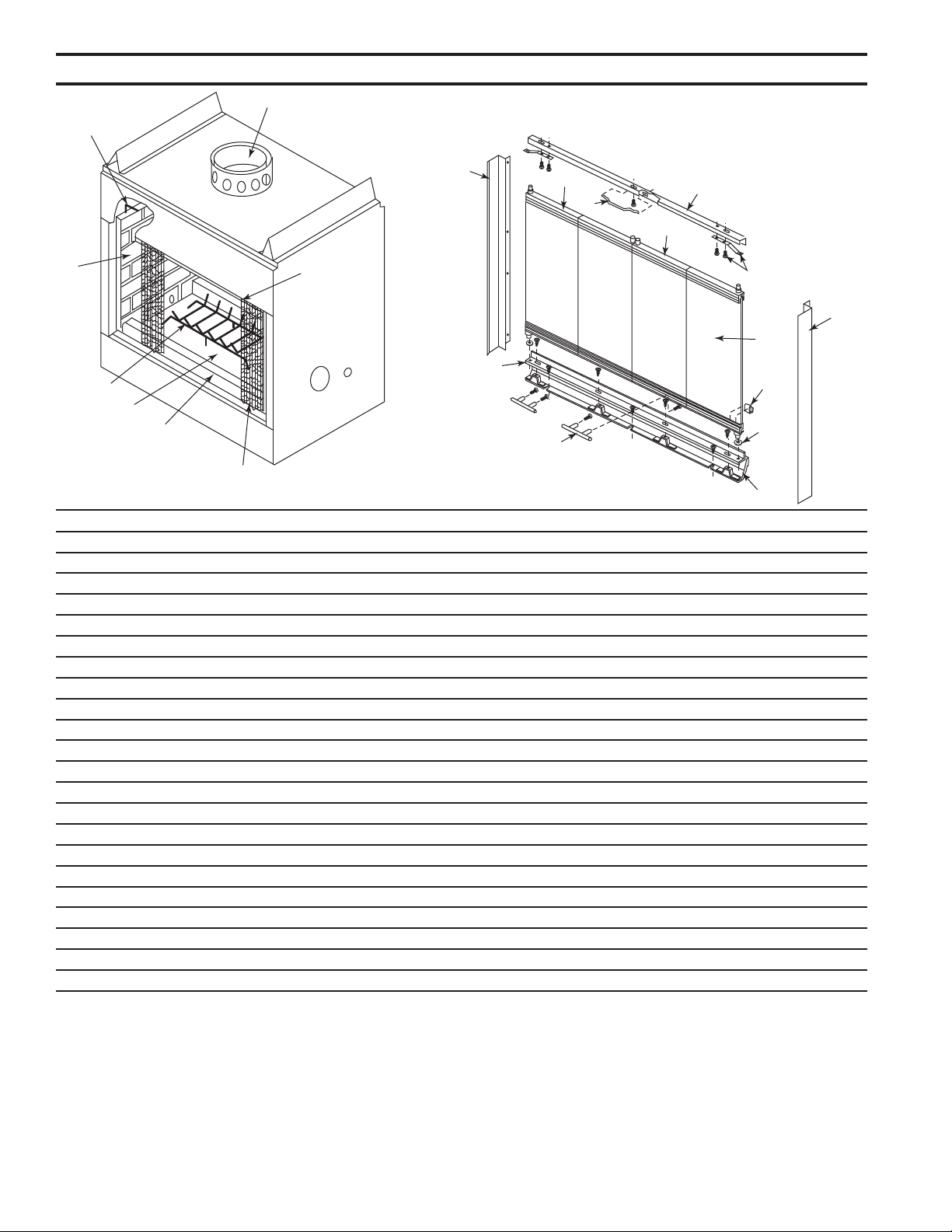
30
87D0174
SSTB11 Woodburning Fireplace
REPLACEMENT PARTS
Ref. Description Qty. Part No.
1. Rod, Damper 1 047647
. Weldment Damper Weight 1 047649
3. Handle Damper 1 037391
4. Weldment, Air Door Rod 1 050340
5. Side Brick Assy 050006
6. Grate Ptd. Assy 1 050145
7. Hearth Refractory 1 05099
8. Hearth Ledge 050007
9. Panel Firescreen w/Pull 4 06398
10. Rod Curtain 4 034839
11. Package Hardware 03703
1. Handle Package Assy 037438
13. Spring Door Closure 037416
14. Track Top Ptd. Assy 036998
15. Air Deector Ptd. Assy 037005
16. Track Bottom Ptd. Assy 036999
17. Left Door Assy 038851
18. Right Door Assy 038850
19. Glass Panel 8 038847
0. Retainer Glass Spring 3 038785
1. Air Divider, Right 050156
. Air Divider, Left 050155
1,2,3
10
9
8
7
6
5
4
21
18
14
11
19
20
11
15
12
16
22
17
13
539043
SSTB parts
1/09
All repair part orders should be placed through your local dealer. To ensure prompt and accurate ser-
vice, please provide the following information when placing a repair part order: Model number of your
Appliance, Part Name, Part Number, and Quantity of parts needed.
Technical Service Department
MHSC
149 Cleveland Drive
Paris, KY 40361
www.mhsc.com

87D0174
31
SSTB11 Woodburning Fireplace
FACTORY-BUILT FIREPLACE AND COMPONENTS
(except blowers)
LIMITED WARRANTY
What is Covered and For How Long
• Five-Year Coverage - For ve years from the date this replace and components are rst purchased for use,
MHSC will, at its option, repair or replace any defective part of this replace or components, or refund to you a sum
not to exceed the factory retail price in effect at the time of purchase.
• Ten-Year Coverage - From the sixth through the tenth year following the date this replace or accessory is rst
purchased for use, MHSC will make available to you, at our factory, a free replacement for any defective part in this
replace or accessory.
• Twenty-Five-Year Availability of Replacement Parts - From the eleventh through the twenty-fth year following
the date this replace or accessory is rst purchased for use, MHSC will make available at our factory replacement
parts for this replace or accessory, which you may purchase for the list price current at the time your purchase
order is received.
What is Not Covered
This limited warranty does not cover:
• Transportation or shipping cost.
• The cost of a service call to diagnose trouble.
• Painted surfaces.
• Damage or defect caused by improper installation, accident, misuse, abuse or alteration.
• Poor ventilation of smoke or gases caused by air-conditioning and heating systems, exhaust fans or pressure dif-
ferentials produced by wind.
• Broken glass components.
• Cracks in ceramic and castable parts that do not affect safe operation.
• We do not warrant this replace to be in compliance with your local building code. Building codes vary greatly
throughout the country, and you should determine whether your local building code contains restrictions on the use
of this replace before you purchase it.
• Blowers or fans, which are warranted separately.
• Heat loss due to the passage of heat or air through or around the replace.
Also, under our ve year coverage, we do not pay the cost of removal and replacement of any portion of the structure
in which the replace is situated, made necessary by the repair, removal or re-installation of the replace.
And under our twenty-ve year warranty of availability of replacement parts, we only promise to maintain a supply of
replacement parts at our factory for you to purchase.
Limitations and Exclusions
1. No one has authority to add to or vary this limited warranty, or to create for MHSC any other obligation of liability in
connection with this replace and accessory.
. MHSC shall not be liable for incidental, consequential, special or contingent damages you might suffer as a result
of its breach of the written warranty or any implied warranty. Some states do not allow the exclusion of limitation of
incidental or consequential damages, so the above limitations may not apply to you.
3. This warranty applies only to the original purchaser of the replace or to the original owner of the dwelling when the
replace is installed in a new dwelling and may not be transferred.
4. This warranty applies only to a replace sold and used in the United States.
Your Duties
This replace must be installed by a qualied installer according to your local building codes and installation instruc-
tions and operated according to the owner’s instructions. You must keep an invoice, canceled check or payment
record to verify the purchase date of the replace.
If Warranty Service is Needed...
1. Contact your supplier. Make sure you have your warranty, your sales receipt and the model/serial number of your
MHSC product.
. DO NOT ATTEMPT TO DO ANY SERVICE WORK YOURSELF.

MHSC
149 Cleveland Drive • Paris, Kentucky 40361
www.mhsc.com