AB
OWNER'S MANUAL
Micro Component System
MCR-B043D
i En
1 To assure the finest performance, please read this manual
carefully. Keep it in a safe place for future reference.
2 Install this unit in a well ventilated, cool, dry, clean place -
away fro
m direct sunlight, heat sources, vibration, dust,
moisture and cold. For proper ventilation, allow the
following minimum clearances.
Top: 15 cm (6 in)
Rear: 10 cm (4 in)
Sides: 10 cm (4 in)
3 Locate this unit away from other elec
trical appliances,
motors,
or transformers to avoid humming sounds.
4 Do not expose this unit to sudden temperature changes
from cold
to hot, and do not locate this unit in an
environment with high humidity (i.e. a room with a
humidifier) to prevent condensation inside this unit, which
may cause an electrical shock, fire, damage to this unit,
and/or personal injury.
5 Avoid installing this unit w
h
ere foreign object may fall
onto this unit and/or this unit may be exposed to liquid
dripping or splashing. On the top of this unit, do not place:
– Other components, as they may cause damage and/or
discoloration on the surface of this unit.
– Burning objects (i.e. candles), as they may cause fire,
damage to this unit, and/or
personal injury.
– Containers with liquid in them, as
they may fall and liquid
may cause electrical shock to the user and/or damage to
this unit.
6 Do not cover this unit with a newspaper, tablecloth,
curtain, etc. in order not to obstruct heat radiation. If the
temperature inside this unit rises, it may cause fire,
damage to this unit, and/or personal injury.
7 Do not plug in this unit to a wall outlet until all
con
n
ections are complete.
8 Do not operate this unit upside-down. It may
overheat,
possibly causing damage.
9 Do not use force on switches, knobs and/or cords.
10 When disconnecting the power cable from the wall outlet,
grasp the
plug; do not pull the cable.
11 Do not clean this unit with chemical solvents; this might
damage the
finish. Use a clean, dry cloth.
12 Only voltage specified on this unit must be used.
Using
this unit with a higher voltage than specified is dangerous
and may cause fire, damage to this unit, and/or personal
injury. Yamaha will not be held responsible for any
damage resulting from use of this unit with a voltage other
than specified.
13 To prevent damage by lightning, keep the power cable
disconnec
t
ed from a wall outlet or this unit during a
lightning storm.
14 Do not attempt to modify or fix this
unit.
Contact qualified
Yamaha service personnel when any service is needed.
The cabinet should never be opened for any reasons.
15 When not planning to use this un
it
for long periods of time
(i.e. vacation), disconnect the AC power plug from the
wall outlet.
16 Be sure to read the “TROUBLESHOOTING” section on
common operating errors before concluding that this unit
is faulty.
17 Before moving this unit, press to set the unit to off,
and disconnect the AC power plug from the wall outlet.
18 Condensation will form when the surrounding
temperature change
s sudden
ly. Disconnect the power
cable from the outlet, then leave this unit alone.
19 When using this unit for a long time, this unit may become
w
a
rm. Turn off, then leave this unit alone for cooling.
20 Install this unit near the wall outlet and where the AC
power plug can be reached easily.
21
The batteries shall not be exposed to excessive heat such
as sunsh
ine, fire or the like. When you dispose of
batteries, follow your regional regulations.
– Keep the batteries in a location out of reach of children.
Batteries can be dangerous if a child were to put in his or
her mouth.
– If the batteries grow old, the effective operation range of
the re
mote control decreases considerably. If this happens,
replace the batteries with new one as soon as possible.
– Do not use old batteries together with new ones.
– Do not use different types of batteries (such as alkaline
and manganese batteries)
together. Read the packaging
carefully as these different types of batteries may have the
same shape and color.
– Exhausted batteries may leak. If
the batter
ies have leaked,
dispose of them immediately. Avoid touching the leaked
material or letting it come into contact with clothing, etc.
Clean the battery compartment thoroughly before
installing new batteries.
– If you plan not to use the unit for a long period of time,
r
e
move the batteries from the unit. Otherwise, the batteries
will wear out, possibly resulting in a leakage of battery
liquid that may damage the unit.
– Do not throw away batteries with general house waste.
D
is
pose of them correctly in accordance with your local
regulations.
22 Excessive sound pressure from earphones and headphones
can cause hearing loss.
CAUTION: READ THIS BEFORE OPERATING YOUR UNIT.
This unit is not disconnected from the AC power source as
long as it is connected to the wall outlet, even if this unit
itself is turned off by . In this state, this unit is designed
to consume a very small quantity of power.
WARNING
TO REDUCE THE RISK OF FIRE OR ELECTRIC
SHOCK
, DO NOT EXPOSE THIS UNIT TO RAIN OR
MOISTURE.
CAUTION
Danger of explosion if battery is incorrectly replaced.
Replace on
ly with the same or equivalent type.
There is a chance that placing this unit too close to a CRT-
base
d (Braun tube) TV set might impair picture color.
Should this happen, move this unit away from the TV set.
1 En
NAMES OF PARTS AND THEIR FUNCTIONS ........2
Front panel.....................................................................2
Front panel display.........................................................2
Remote control...............................................................3
CONNECTIONS ........................................................4
Connecting the speakers and antenna ..........................4
Connecting the power cable...........................................5
Other connections ..........................................................5
About the standby state .................................................5
ADJUSTING THE CLOCK (OPTION MENU) ...........6
LISTENING TO CD AND USB DEVICE
S .................7
Listening to a CD............................................................7
Listening to a USB device ..............................................8
Using repeat/shuffle playback (remote control only)
......
8
LISTENING TO MUSIC FROM YOUR Bluetooth
COMPONENT............................................................9
Playing back from your Bluetooth component................9
Connecting an already-paired component via Bluetooth
....10
Disconnecting a Bluetooth connection ...................
......10
LISTENING TO DAB STATIONS............................11
Preparing for DAB reception ........................................11
Selecting DAB stations.................................................12
Presetting DAB stations (remote control only) .............13
Selecting preset DAB stations......................................14
Checking the signal strength of DAB stations
(Option menu) ..............................................................14
LISTENING TO FM STATIONS ..............................15
Selecting an FM station................................................15
Presetting FM stations (remote control only) .......
........16
Selecting preset FM stations........................................17
LISTENING TO EXTERNAL SOURCES ................17
USEFUL FUNCTIONS ............................................18
Using the Option menu ................................................18
Using the sleep timer ...................................................19
Using the alarm function (IntelliAlarm) .........................19
Setting the alarm ..........................................................20
Operations while the alarm sound is playing................21
TROUBLESHOOTING ............................................22
NOTES ON DISCS AND USB DEVICES................25
SPECIFICATIONS...................................................
26
CONTENTS
• Play back music from external devices such as your audio/data CDs, USB devices, or external devices via the AUX jack,
and listen to the radio.
• Listen to the DAB radio.
•By the Bluetooth technology, you can enjoy clear sound without wire connections.
• Use your favorite music or a beep tone as an alarm. When the set time arrives, the music you select is played at the volume
that you specify, giving you the ideal start to your day (IntelliAlarm function).
• You can easily store and recall of your favorite radio stations, up to 30 FM and 30 DAB stations.
• Bass, middle, and treble can be adjusted to your taste.
About this manual
• If an operation can be performed using either the buttons on the unit itself or from the remote control, the explanation will
focus on operation using the remote control.
• indicates precautions for use of the unit and its feature limitations.
• indicates supplementary explanations for better use.
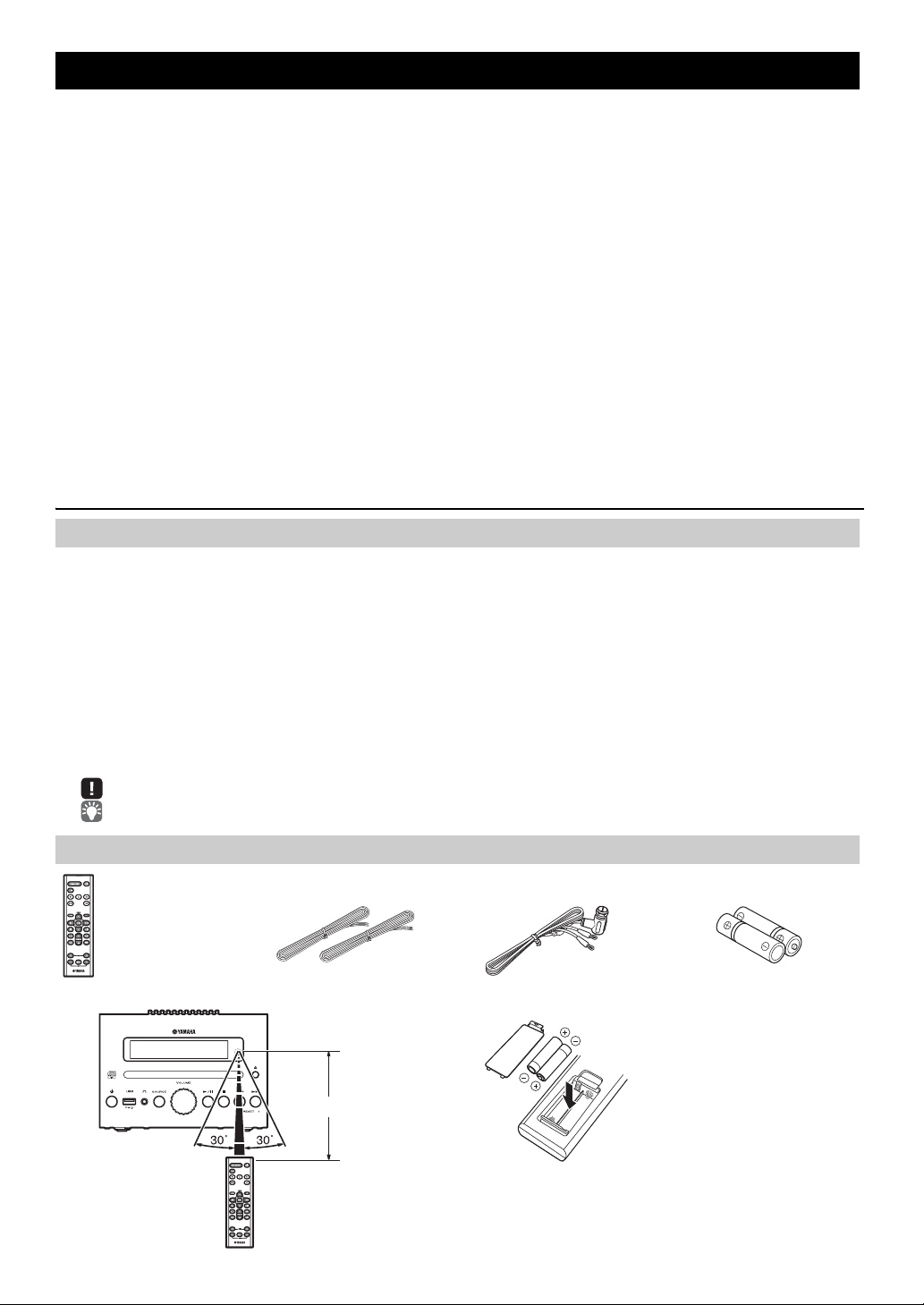
How to use the remote control Installing batteries in the remote control
Features
Supplied accessories
Batteries (x 2)
(AAA, R03, UM-4)
Remote control Speaker cable
(1.5 m (4.9') x 2)
DAB/FM antenna
Within 6 m (20')
Check the “+” and “-” of the
batteries and insert them the
correct way around.
2 En
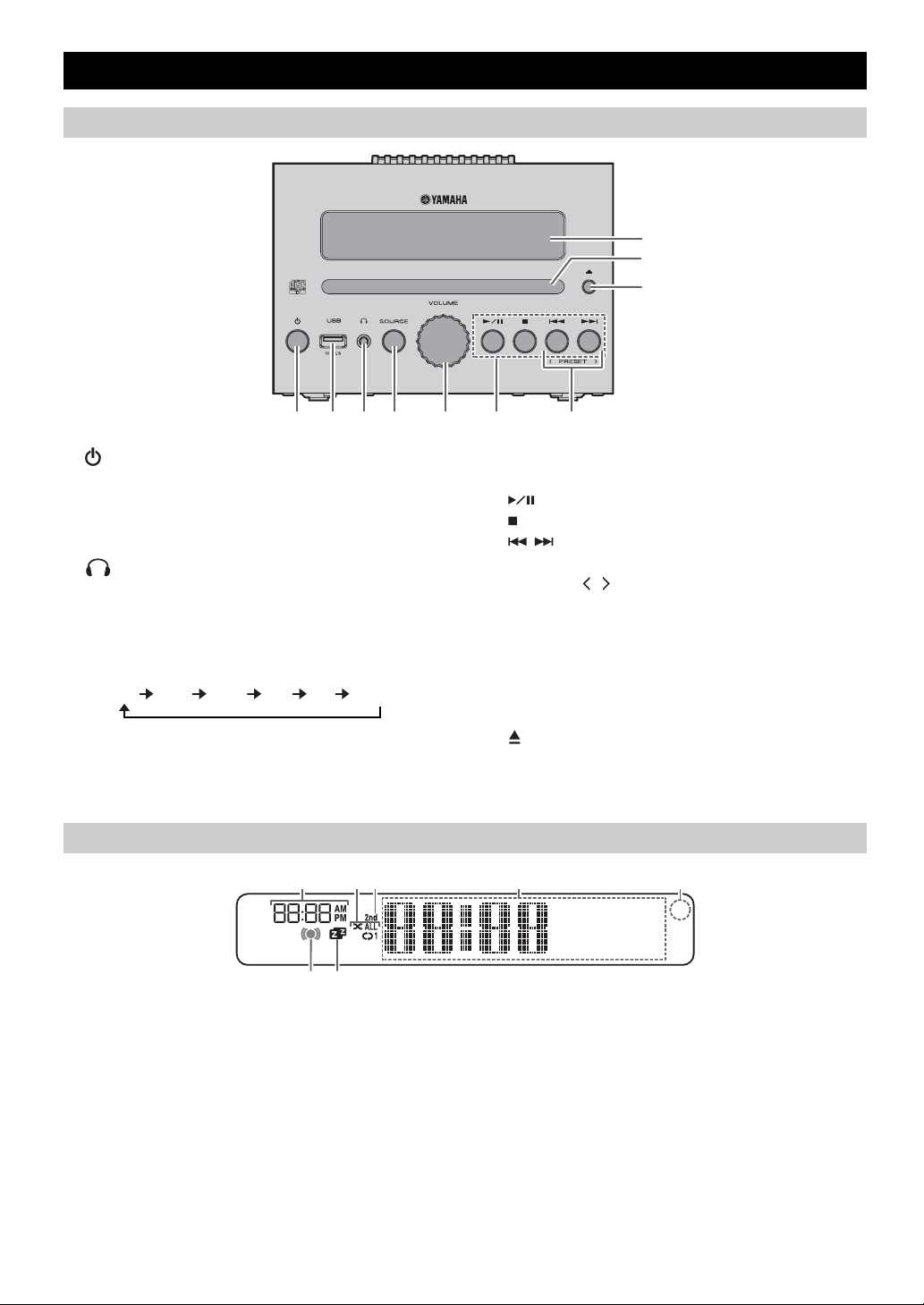
1 (Power)
Press to turn the unit on/off (standby).
There are two types of the standby state (☞ P. 5).
2 USB port
Connect your USB device here (
☞
P. 5, 8).
3 (Headphone jack)
Connect headphones here.
4 SOURCE
Switch the audio source to be played.
Pressing this repeatedly will change the selection in the
following order.
CD USB
DAB FM BT AUX
5 VOLUME knob
Adjust the volume.
6 Audio control buttons
Use these to operate the CD/USB device.
7 PRESET /
Use these buttons to select a radio station that you’ve
stored (☞ P. 16, 17).
8 Front panel display
The clock and other information is displayed here.
9 Disc slot
Insert a CD here ( ☞ P. 7).
0 (Eject button)
Eject the CD (cannot be operated while the option menu
(☞ P. 18) is displayed).
1 Alarm time
Indicates the alarm time (☞ P. 20).
2 Repeat/shuffle indicator
Displays the playback mode (☞ P. 8).
3 Secondary indicator
Turns on if a secondary station is playing when you
listen to a DAB station.
4 Multi-function indicator
Displays various information, including the clock time,
information about the currently-playing track, and the
frequency of the radio station.
5 Remote control signal receiver
Make sure that this sensor is not obstructed (☞ P. 1).
6 Alarm indicator
Turns on if the alarm has been set (☞ P. 20).
7 Sleep indicator
Turns on if the sleep timer has been set (☞ P. 19).
NAMES OF PARTS AND THEIR FUNCTIONS
Front panel
:
1 2 3 4 56 7
8
9
: Play/Pause
: Stop
/ :
Skip, Search backward/forward (press and hold
down)
Front panel display
~~~~~~
~~~~~~
541 23
6 7
3 En
NAMES OF PARTS AND THEIR FUNCTIONS
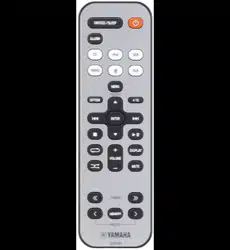
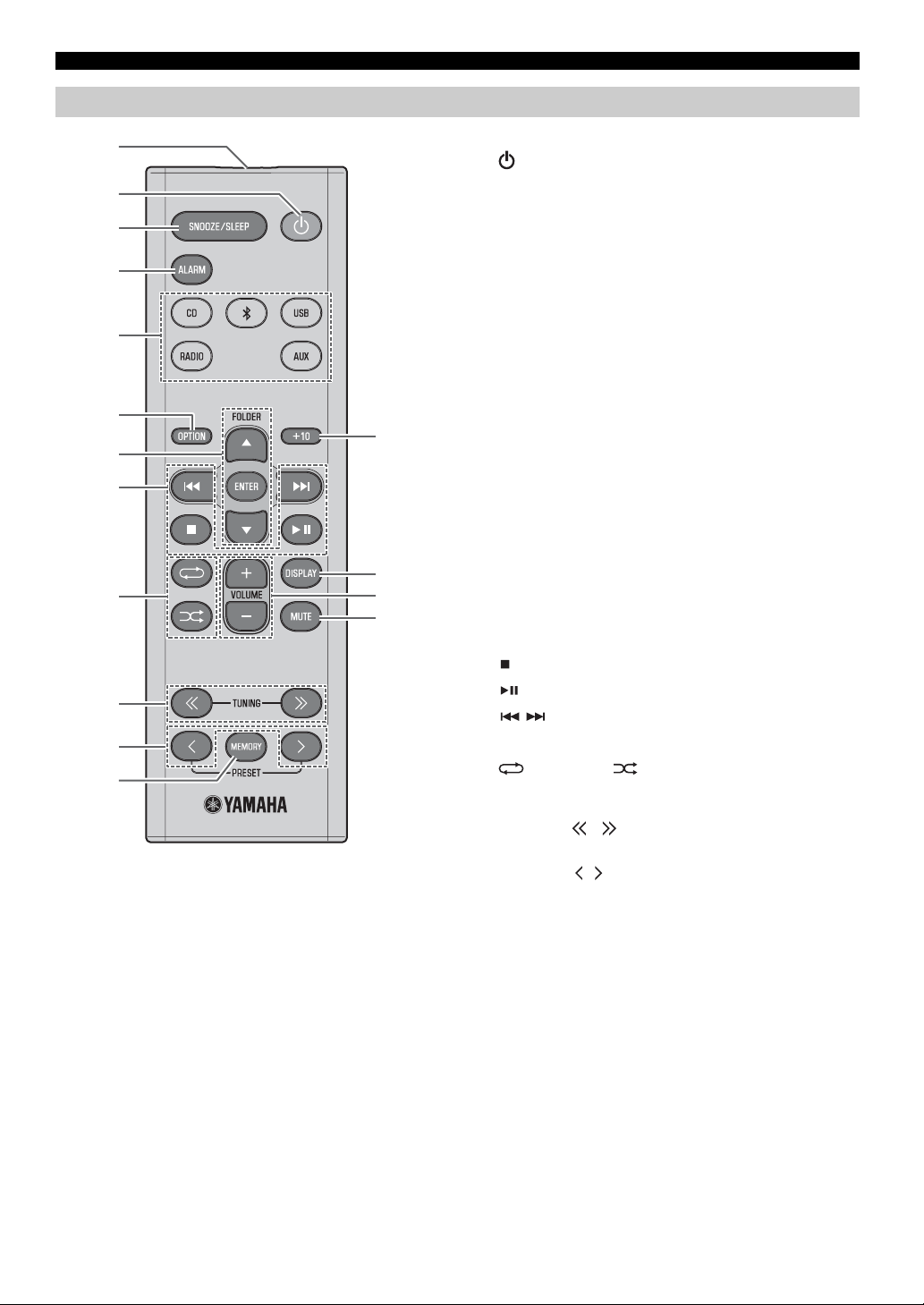
1 Remote control signal transmitter
2 (Power)
Press to turn the unit on/off (standby).
There are two types of the standby state (☞ P. 5).
3 SNOOZE/SLEEP
Set the sleep timer or switch the alarm to snooze mode
(☞ P. 19, 21).
4 ALARM
Switch the alarm on/off (☞ P. 21).
5 Source buttons
Switch the audio source to be played. If you press one of
these while the unit is in standby (except ECO standby),
the unit will automatically turn on.
When listening to the radio, press
RADIO to switch
between DAB/FM.
6 OPTION
Display the option menu (☞ P. 18).
7 Item selection buttons
FOLDER /: Switch the playback folder and select
items or edit numerical values when
playing music on data CDs or USB
devices.
ENTER: Confi
r
m a selected item or value.
8 Audio control buttons
Use these to operate the CD/USB device.
9 (Repeat)/ (Shuffle)
Play music on a CD or USB device in repeat/shuffle
mode (☞ P. 8).
0 TUNING /
Tune the radio (☞ P. 15, 16).
A PRESET /
Select a radio station that you stored (☞ P. 16, 17).
B MEMORY
Store a radio station (☞ P. 16).
C +10
Skip ten songs ahead of the currently-playing song.
When playing a data CD or a USB device, this button
skips ten songs within
the current folder.
D DISPLAY
Switch the information shown in the front panel display
(☞ P. 7, 8, 15).
E VOLUME + / –
Adjust the volume.
F MUTE
Mute or unmute the sound.
Remote control
3
4
5
8
9
:
A
B
1
7
2
D
C
F
6
E
: Stop
: Play/Pause
/ :
Skip, Search backward/forward (press and hold
down)
4 En
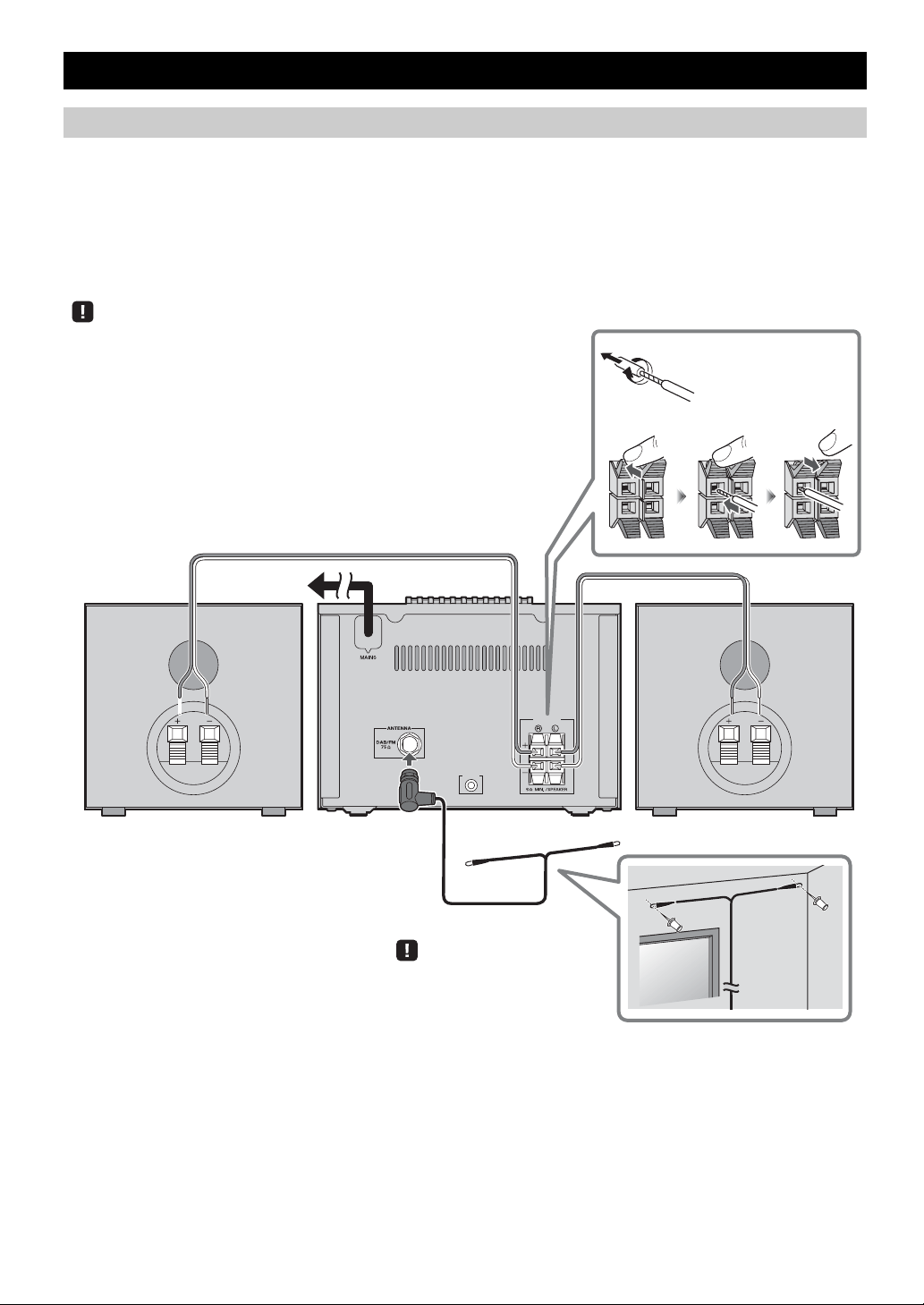
Connect the speakers and antenna.
Do not connect this unit’s power cable until you’ve finished connecting all cables.
If the radio reception is poor, try changing the heig
ht or direction
or placement of the antenna to find a location that has better
reception.
If you use a commercially available outdo
or antenna in
stead of the supplied antenna, reception may be better.
CONNECTIONS
Connecting the speakers and antenna
SPEAKERS
AUX IN
Speakers
• You must peel off the insulation (covering) from the tip of the speaker cable to
expose the conductor.
• Check the connections; make sure that left and right (L, R) and polarity (red: +,
black: –) are connected correctly. If connections are incorrect, the sound will be
unnatural and the low frequencies may be insufficient. There might not be any
sound at all if connections are incorrect.
• Take care that the conductors of the speaker cable do not touch each other, and that
the conductors do not touch any other metal part. Such conditions can damage this
unit or the speakers.
• Use only the supplied speakers. Using other speakers may result in unnatural sound.
• If you’re using this unit nearby a CRT display and you notice distorted color or
noise in the display, move the speakers farther away from the display.
Twist the bare wires
tightly so the individual
strands are not splayed.
DAB/FM antenna
Be sure to stretch out the antenna.
To the AC
wall outlet
5 En
CONNECTIONS
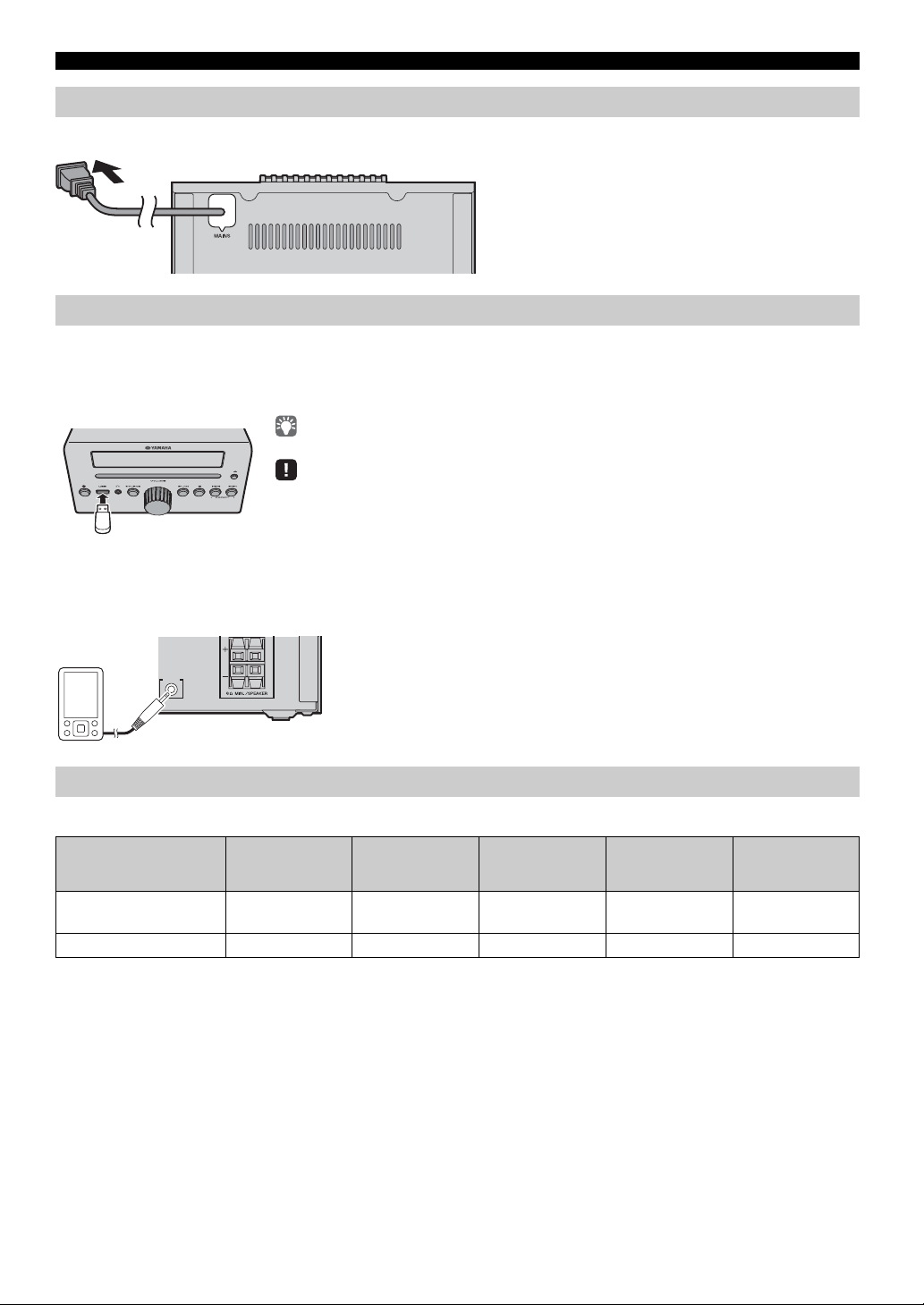
When you’ve completed all connections, connect this unit’s power cable to an AC outlet.
USB device
Connect your USB device to the USB port on the front panel. For details on playable files, refer to “NOTES ON DISCS AND
USB DEVICES” (☞ P.
25).
External devices
Using a commercially available 3.5 mm mini-plug cable, connect your external device to the AUX jack on the rear panel of
this unit.
This unit has the following two types of standby
state. Select the mode in POWER SAVING settings menu (☞ P. 1 8 ).
* Default setting
Connecting the power cable
Other connections
About the standby state
Mode
Setting menu
(POWER
SAVING)
Clock display
Bluetooth
connection
Charging of USB
devices
Alarm setting
ECO standby
*
(power saving mode)
ECO No clock display Disable Enable Disable
Standby NORMAL Show Enable Enable Enable
Rear panel
The USB device is automatically charged when this unit is connected to the AC outlet.
• Stop playback before disconnecting the USB device.
• Charging may not be possible depending on the USB device.
AUX IN
Rear panel
6 En
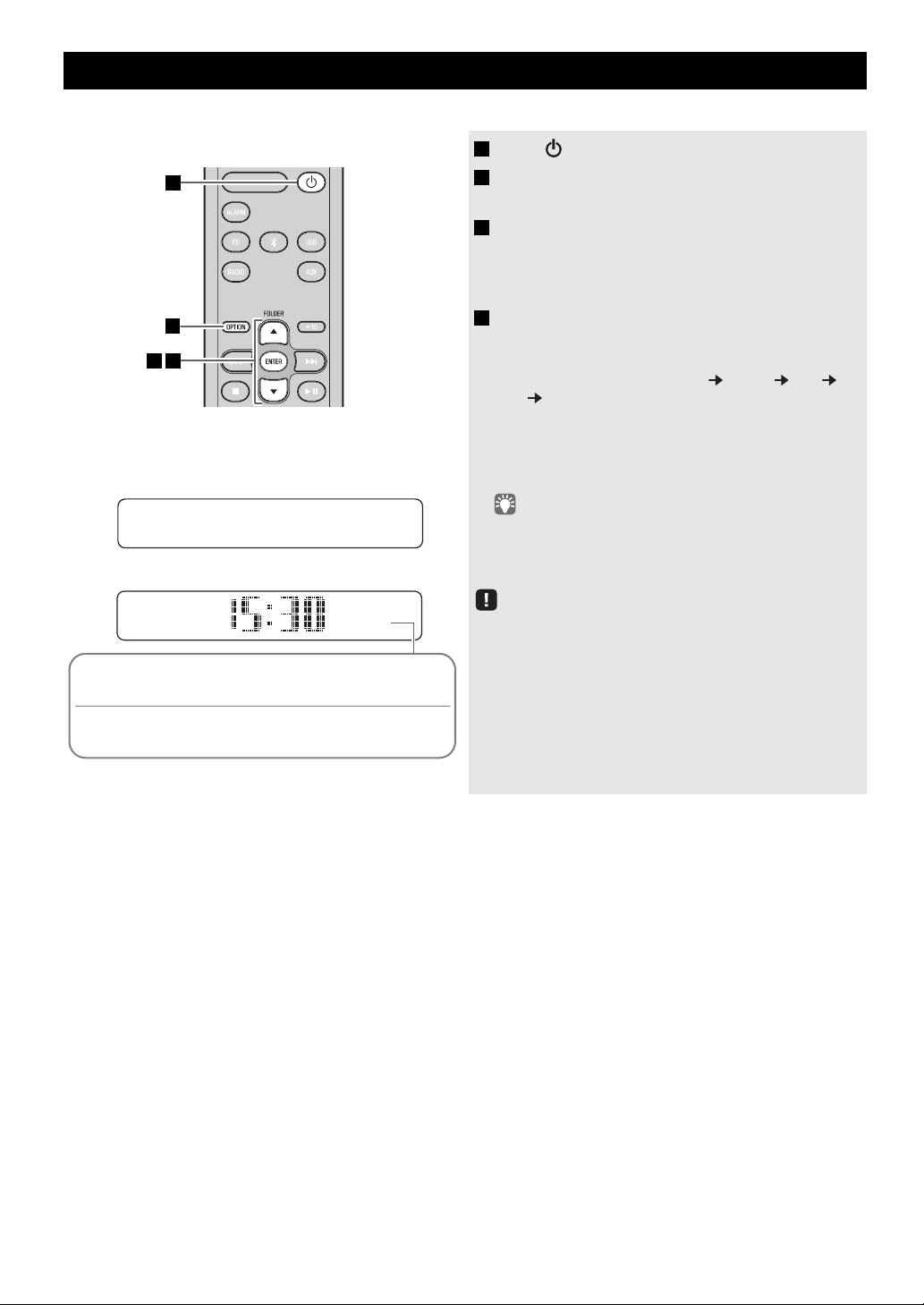
You’ll use the option menu (☞ P. 18) to set this unit’s date and time.
ADJUSTING THE CLOCK (OPTION MENU)
1 Press to turn the unit on.
2 Press OPTION.
The option menu will appear.
3 Press / to select “CLOCK SET,” and then
press ENTER.
The display will indicate “CLOCK YEAR,” and the
numerical value to be set will blink.
4 Set the date and time.
Press ▲/▼ to edit each numerical value, and then press
ENTER to confirm the setting.
Set the items in the order of year month day
hour minute.
When clock setting has finished,
the
display will indicate
“Completed!”
The clock will be set to 0
second the
moment you
complete the clock settings.
• While making these settings, you can press DISPLAY to
select the time format (12-hour / 24-hour).
• If you decide to cancel withou
t changing the setting, press
OPTION before confirming the change.
The time settings will be reset if the unit
remains unpow
ered for
about one hour.
26
Apr
Jan Feb Mar Apr May Jun
January February March April May June
Jul Aug Sep Oct Nov Dec
July August September October November December
2
43
15:30
CD
Display (24-hour) when the unit is on
Display (24-hour) when the unit is off (standby)
*
Clock display
1
* In ECO standby, the clock display will disappear.
7 En
Skipping folders (remote control only)
Display information (remote control only)
LISTENING TO CD AND USB DEVICES
The unit will operate as follows when playing back tracks/files on CD/USB devices.
• If the CD/USB device being played is stopped,
the track that you listened will start playback from the beginning of the
track the next time you play.
• If you press while playback is stopped, tracks will
play as
follows the next time playback begins:
− Audio CD: Play from the first track of the CD.
−
Data CD*/USB device:
Play from the first track of the folder contains the track you listened to last time.
• This unit automatically turns off if no operation has been performed for 20 minutes after CD/USB device playback is
stopped.
* “Data CD” is a CD that contains MP3/WMA files.
For details on playable discs and files, refer to “NOTES ON DISCS AND USB DEVICES” (☞ P.
25).
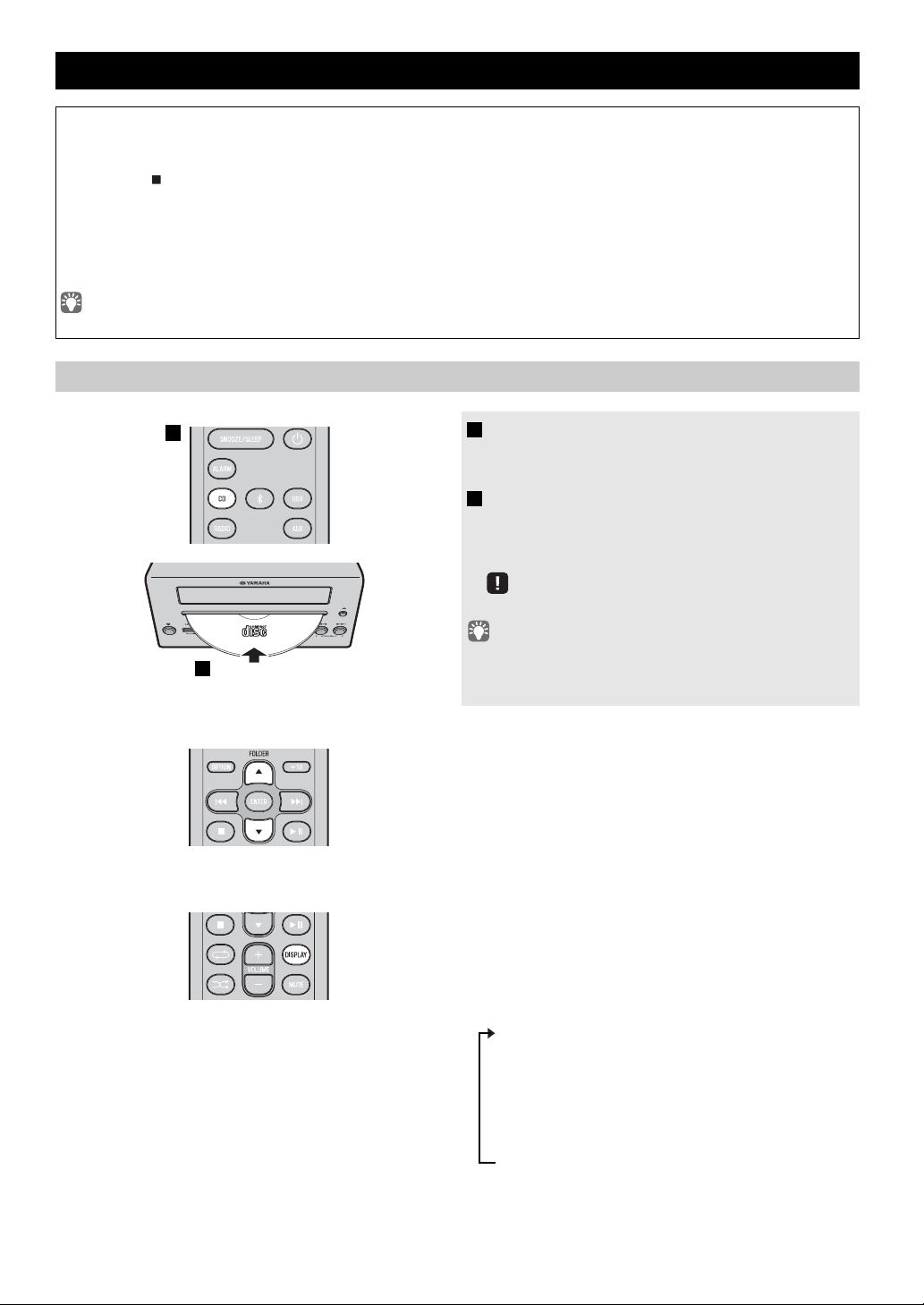
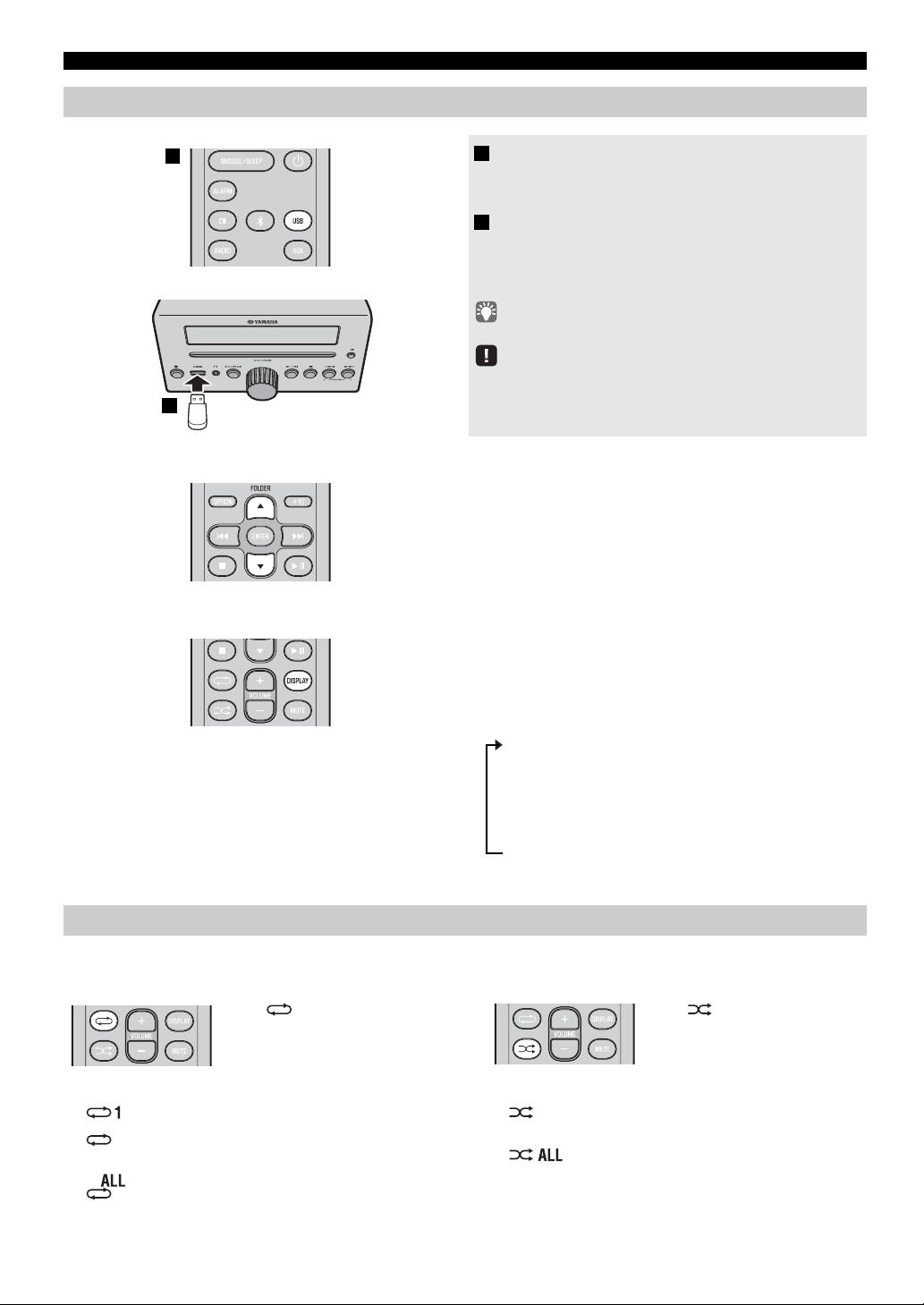
Listening to a CD
1 Press the CD source button to switch the
audio source to CD.
If a CD is already inserted, playback will start.
2 Insert a CD into the disc slot.
Playback starts automatically.
Playback can be controlled with either the remote
control, or
the front panel on this unit (☞ P. 2, 3
).
Insert the CD with the label side facing upward.
Folders and files on a data CD are played in alphabetical order.
While a data CD is playing, you can use the remote control’s
FOLDER ▲/▼ buttons to select the folder.
The folder number (only for a data CD) or the song/file
number is shown f
or several seconds when starting playback
or skipping tracks.
If you press
DISPLAY
on the remote control while a song is
playing or paused, the information shown on the front panel
display will be switched in the following order.
- Elapsed song playback time
- Remaining song playback time (only for an audio CD)
- Song name*
- Album name*
- Artist name*
- File name (only for a data CD)
- Folder name (only for a data CD)
* Shown only if this data is included in the song.
1
2
LISTENING TO CD AND USB DEVICES
8 En
Skipping folders (remote control only)
Display information (remote control only)
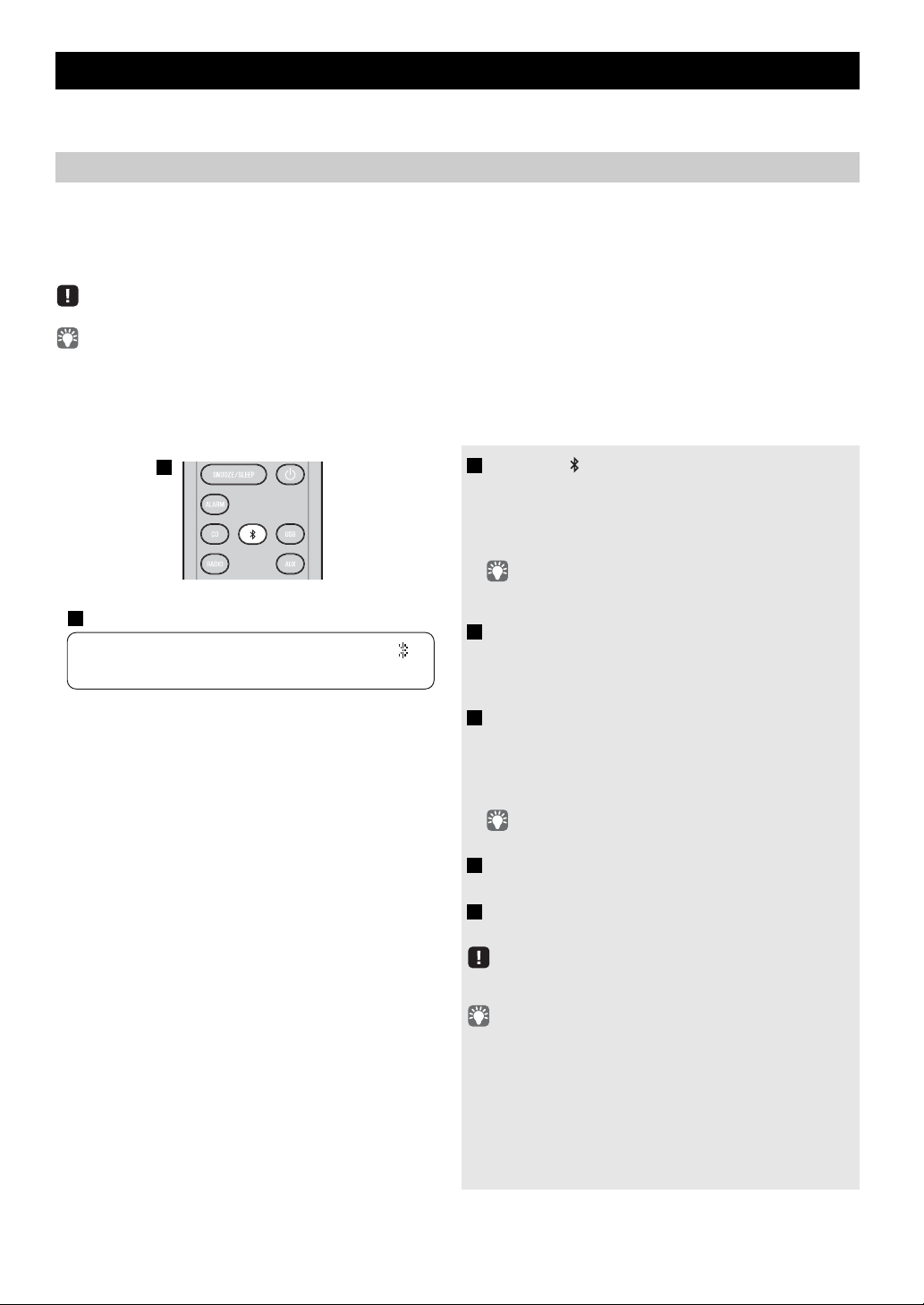
The playback status is shown by the repeat/shuffle indicator in the front panel display.
Repeat playback Shuffle playback
Listening to a USB device
1 Press the USB source button to switch the
audio source to USB.
If a USB device is already connected, playback will start.
2 Connect a USB device to the USB port.
Playback starts automatically.
Playback can be controlled with either the remote control,
or the front panel
on this unit (
☞
P. 2, 3).
Folders and files will play in the order in which they were written.
Stop playback before disconnecting the USB device.
While a USB device is playing, you can use the remote
control’s FOLDER ▲/▼ buttons to select the folder.
The folder/file number is shown for several seconds when
starting
playback or skipping tracks.
If you press
DISPLAY
on the remote control while a song is
playing or paused, the information shown on the front panel
display will be switched in the following order
.
- Elapsed song playback time
- Song name*
- Album name*
- Artist name*
- File name
- Folder name
* Shown only if this data is included in the song.
Using repeat/shuffle playback (remote control only)
1
2
Press (repeat) repeatedly to
select one of the following
playback modes.
No display: Repeat mode off
: 1 track
: All tracks within the folder (data CD/USB device
only)
: All tracks
Press (shuffle) repeatedly to
select one of the following
playback modes.
No display: Shuffle mode off
: All tracks within the folder (data CD/USB device
only)
: All tracks
9 En
This unit provides Bluetooth functionality. You can enjoy wireless music playback from your Bluetooth component (mobile
phone, digital audio player, etc.). Please also refer to the owner’s manual of your Bluetooth component.
You’ll need to perform the pairing operatio
n the first time you use your Bluetooth component with this unit, or if the pairing
settings have been deleted. Pairing is an operation that registers the communicating component (subsequently called “the
other component”) with this unit. Once pairing has been completed, subsequent reconnection will be easy even after the
Bluetooth connection is disconnected (☞ P. 1 0 ). If pair
ing is not successful, refer to the item “Bluetooth” in
“TROUBLESHOOTING” (☞ P. 2 3).
Yamaha does not guarantee all connections between this unit and Bluetooth component.
• This unit can be paired with up to 4 other components. When pairing
with the fifth component has succeeded, pairing data for the
component with the oldest connection date will be deleted.
• While connecting to the Blu
etooth component and perform the pairing with another component, the current Bluetooth connection will be
canceled.
LISTENING TO MUSIC FROM YOUR
Bluetooth
COMPONENT
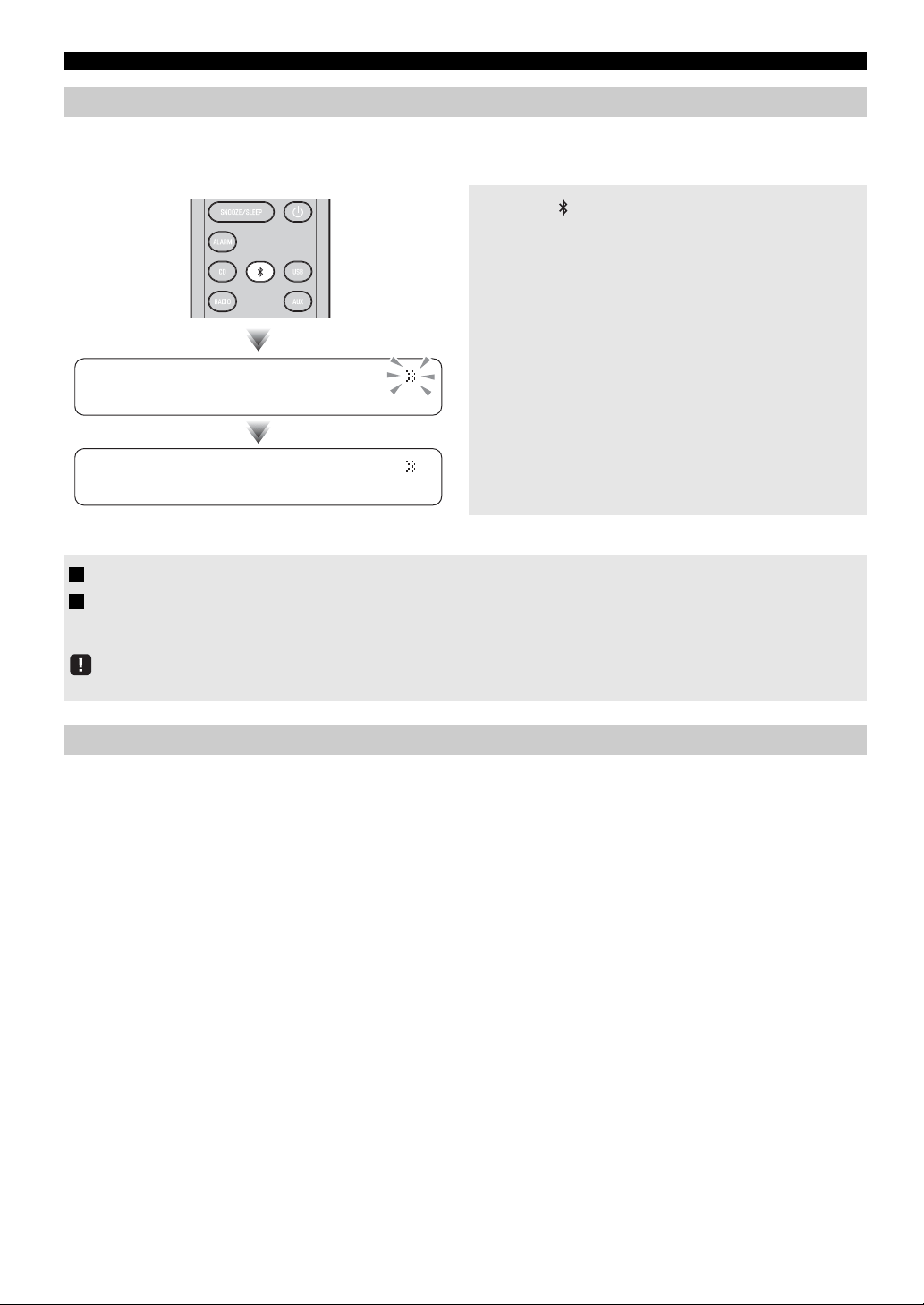
Playing back from your Bluetooth component
1 Press the source button for more than 2
seconds to enter pairing mode.
• Pairing mode lasts for 5 minutes.
• In pairing mode, the front panel display of this unit will
indicate “BT Pairing...”.
You can also enter pairing mode by holding down SOURCE on
this unit.
2 Perform Bluetooth pairing on the other
component.
For details refer to the owner’s manual of the other
component.
3 From the Bluetooth connection list of the other
component, choose this unit (MCR-B043D
Ya m
a h a ).
When pairing has been completed, the front panel display
of this unit will indicate “BT Pairing OK”.
If you are asked to enter a password, enter the numerals “0000”.
4 Connect this unit and your other component
via Bluetooth.
5 Play back music from your Bluetooth
component.
Take care that the volume setting of this unit is not too high. We
recommend that you adjust the volume on the other component.
• If you connect via Blu
eto
oth from your other component while
this unit is in standby (except ECO standby), this unit will
automatically turn on.
• If you disconnect the Blu
etooth connection from your other
component while the audio source is set to Bluetooth, this unit
will automatically turn off.
• If Bluetooth is se
lected as the audio source, this unit will
automatically turn off when 20 minutes have elapsed without any
Bluetooth connection nor any operation performed.
1
15:30
BT
Pairing OK
3
LISTENING TO MUSIC FROM YOUR Bluetooth COMPONENT
10 En
Once pairing has been completed, connecting a Bluetooth will be easy the next time.
Connecting from this unit
Connecting from the other component
If any of the following operations are performed while a Bluetooth connection is being used, the Bluetooth connection will be
disconnected.
• Switch the audio source other than Blueto
oth.
•
Turn the unit off.
• Turn off the Bluetooth setting of the
other co
mponent.
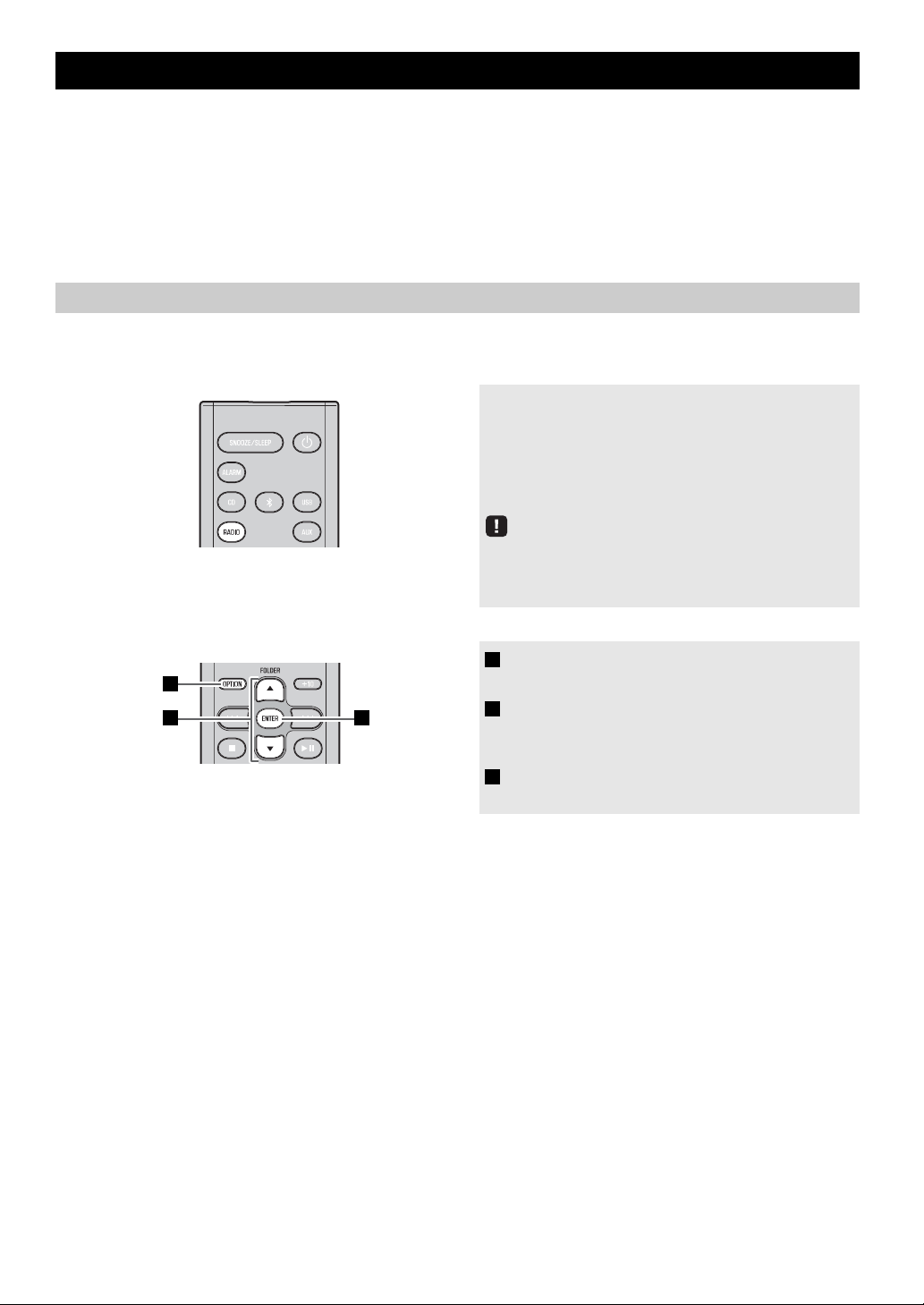
Connecting an already-paired component via Bluetooth
Press the source button to switch the audio
source to Bl
uetooth.
The Bluetooth indicator will blink in the front panel display;
this unit will search for the other component that was most
recently connected via Bluetooth, and will then establish a
connection (You must first turn on the Bluetooth setting of
the other component).
When the Bluetooth connection has b
een established, the
Bluetooth indicator will light, and the name of the other
component will be displayed.
1 In the Bluetooth settings of the other component, turn Bluetooth on.
2
From the
Bluetooth
connection list of the other component, choose this unit (MCR-B043D Yamaha).
The Bluetooth connection will be established, and the front panel display of this unit will indicate the name of the other
component.
Bluetooth
connections cannot be established from the other component when this unit is in ECO standby (
☞
P. 5 ).
Disconnecting a Bluetooth connection
15:30
15:30
BT
_____
11 En
DAB (Digital Audio Broadcasting) and DAB
+
use digital signals for clearer sound and more stable reception compared to
analog signals.
DAB
+
is based on the original DAB standard but uses a more efficient audio codec.
DAB and DAB
+
are broadcast in blocks of data called “ensembles” containing up to several radio stations that are
simultaneously broadcast.
DAB and DAB
+
can also include an extensive amount of text information, enabling you to select a station by name.
Other information, such as the ensemble name or the status of the digital sig
nal, can be displayed on the front panel display.
“DAB” described in this manual may also refer to “DAB
+
”.
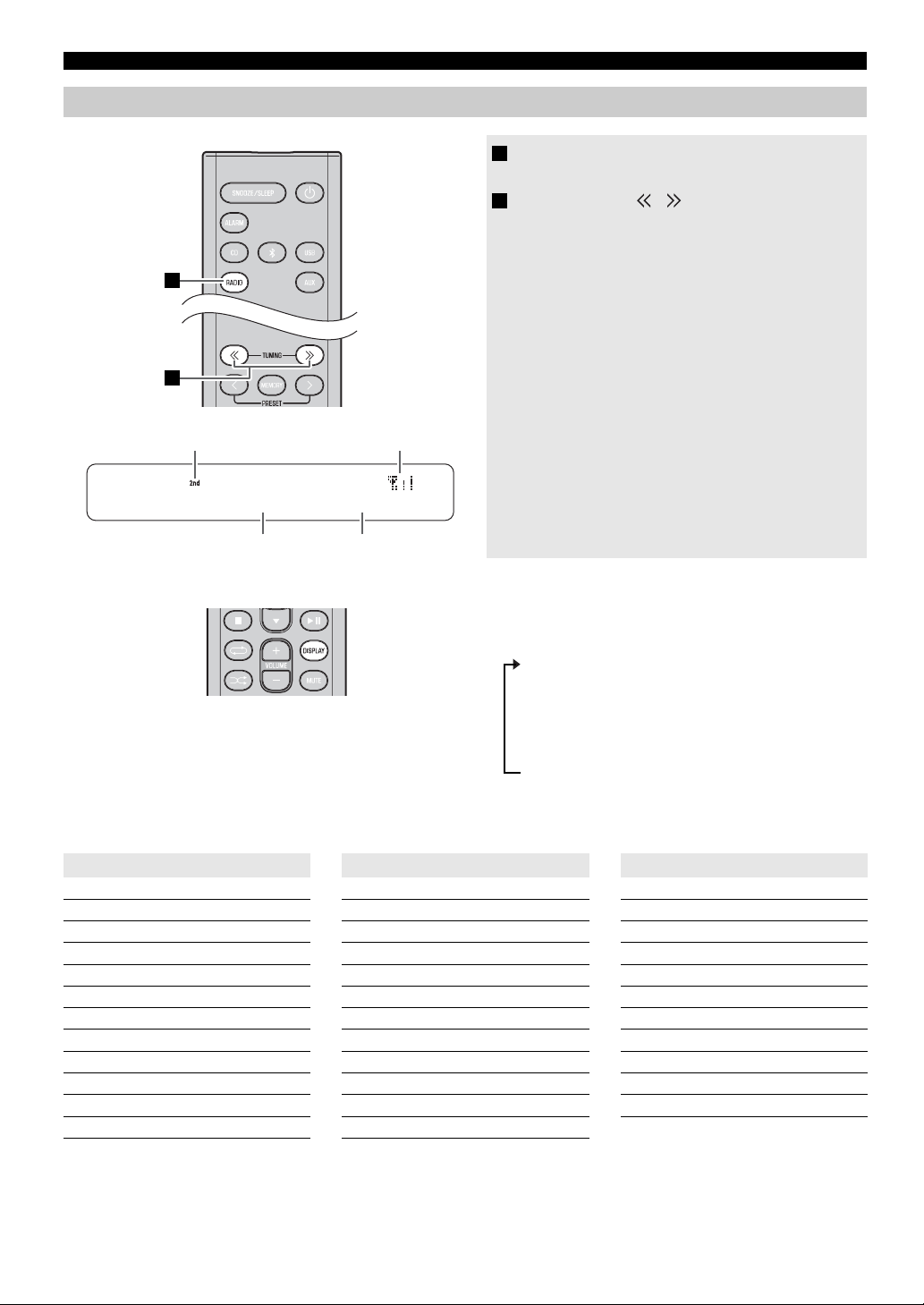
Before tuning into DAB stations, an initial scan must
be performed. When you select the DAB for the first time, the initial
scan is performed automatically.
To listen to a DAB station, connect the
antenna as described
in “Connecting the speakers and antenna” (☞ P. 4 ) .
Performing the initial scan again (Option menu)
LISTENING TO DAB STATIONS
Preparing for DAB reception
Press the RADIO source button to switch the
audio source to DAB.
The initial scan starts. During the scan, the degree of
progress is displayed on the front panel display.
When scan is completed, the number of receivable DAB
stations appear on the front panel display.
If the initial scan is performed, stored DAB station information
and preset DAB stations are cleared.
1 Press OPTION.
The option menu will appear.
2 Press / to select DAB INIT SCAN, and
then press ENTER.
The display will indicate “Press ENTER”.
3 Press ENTER.
The initial scan starts.
3
2
1
LISTENING TO DAB STATIONS
12 En
Display information (remote control only)
DAB frequency information
This unit can receive Band III only.
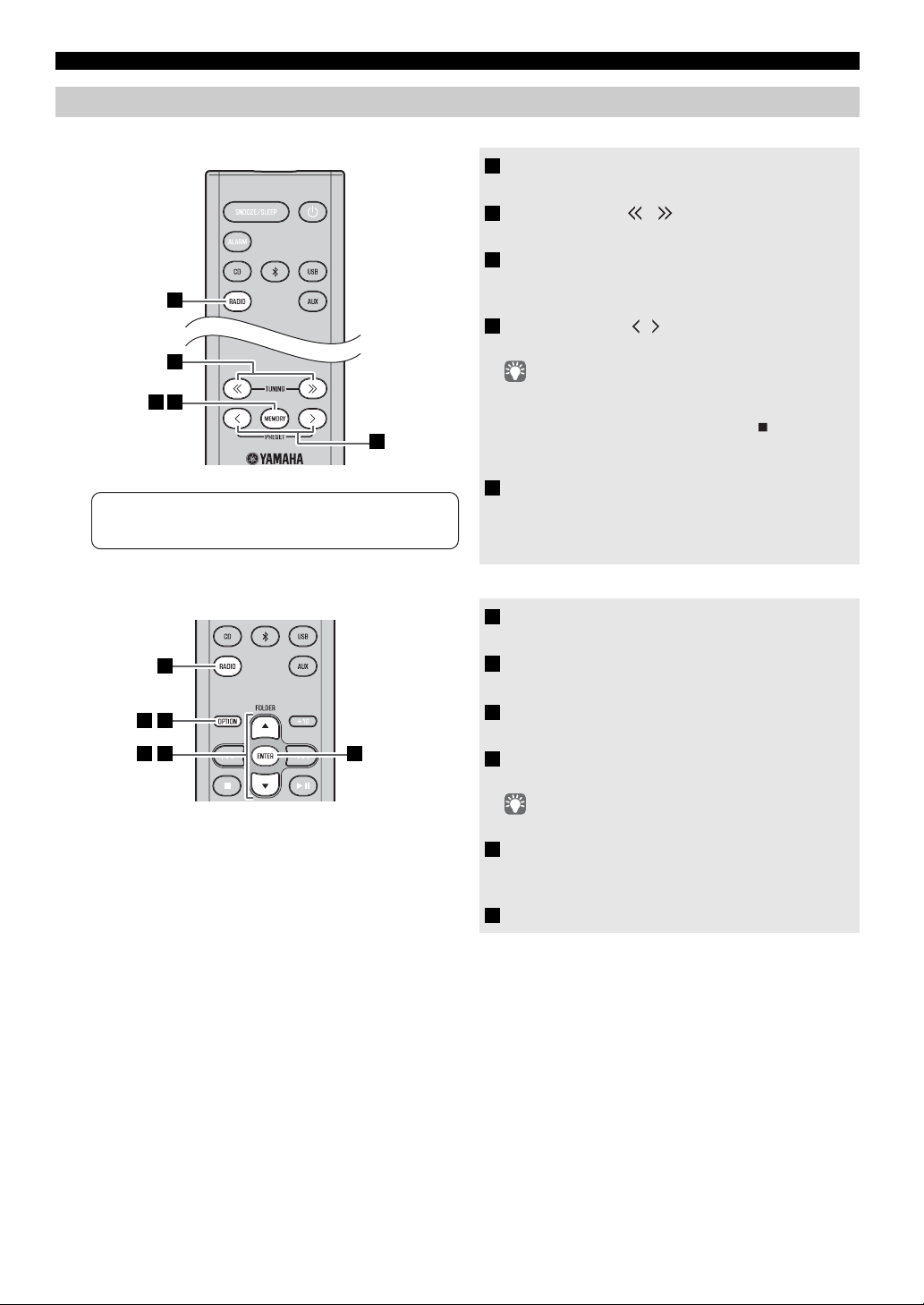
Selecting DAB stations
1 Press the RADIO source button to switch
the audio source to DAB.
2 Press TUNING / to select the DAB
station.
While receiving DAB, DAB station information is
shown on the front panel display.
If the unit does not receive a DAB signal, “Off Air” is
displayed instead of the DAB station name.
1 Secondary indicator:
Some stations have sub (secondary) stations.
If a secondary station is playing, the secondary
indi
cator is displayed.
2 Signal strength indicator:
Shows current signal strength.
3 Preset number
4 DAB station name
If you press DISP
LAY on the remote control, the
information shown on the front panel display will be
switched in the following order.
- STATION LABEL, PRESET NUMBER
- DLS (Dynamic Label Segment)
- ENSEMBLE LABEL
- CHANNEL/FREQ (Channel label and frequency)
- SIGNAL QUALITY
- AUDIO FORMAT (Audio format, DRC)
Frequency Channel label Frequency Channel label Frequency Channel label
174.928 5A 197.648 8B 220.352 11C
176.640 5B 199.360 8C 222.064 11D
178.352 5C 201.072 8D 223.936 12A
180.064 5D 202.928 9A 225.648 12B
181.936 6A 204.640 9B 227.360 12C
183.648 6B 206.352 9C 229.072 12D
185.360 6C 208.064 9D 230.784 13A
187.072 6D 209.936 10A 232.496 13B
188.928 7A 211.648 10B 234.208 13C
190.640 7B 213.360 10C 235.776 13D
192.352 7C 215.072 10D 237.488 13E
194.064 7D 216.928 11A 239.200 13F
195.936 8A 218.640 11B
1
2
10:30
DAB01STATION1
1 2
43
13 En
LISTENING TO DAB STATIONS
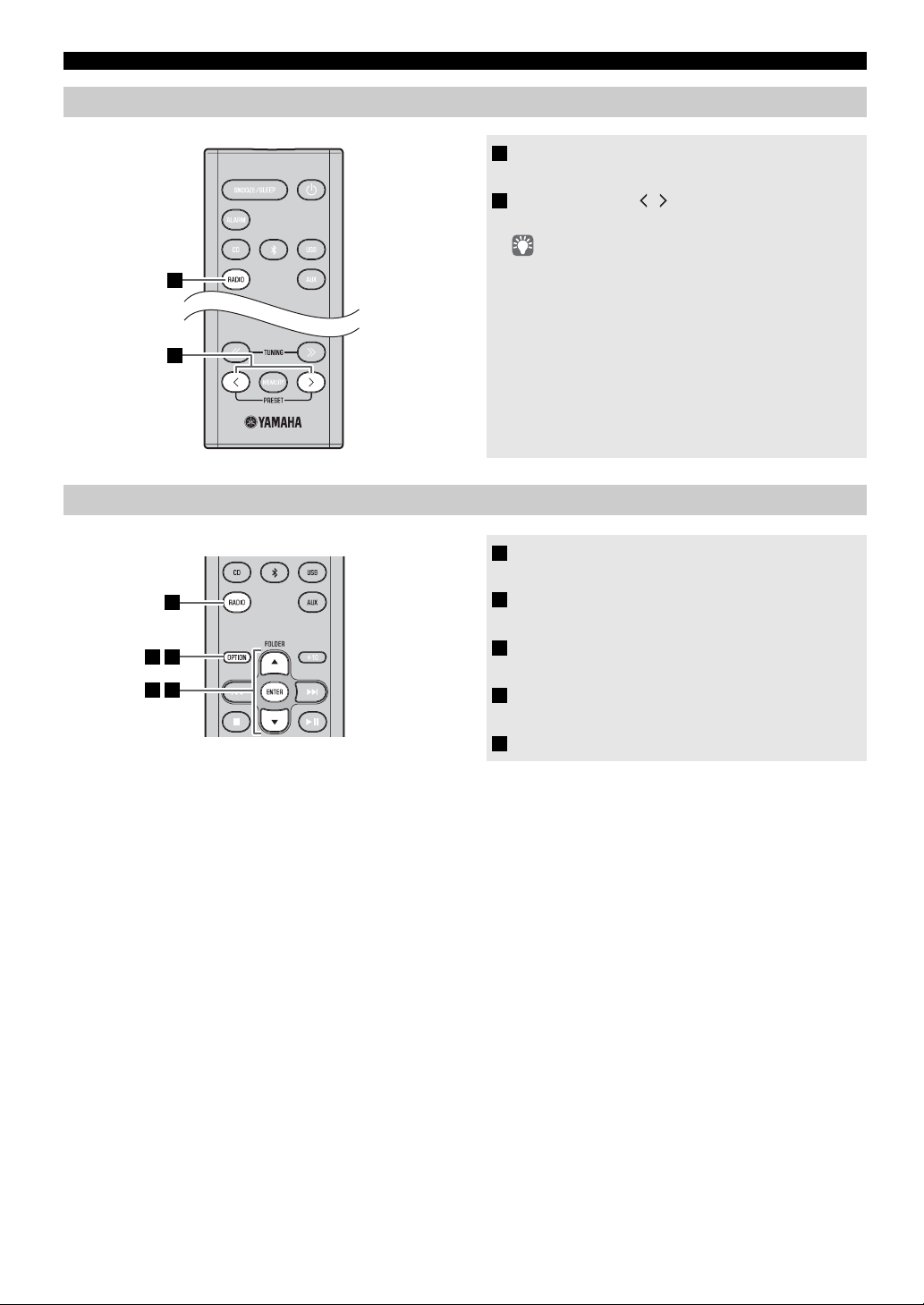
Use the preset function to store your favorite 30 stations.
Deleting a stored preset (Option menu)
Presetting DAB stations (remote control only)
1 Press the RADIO source button to switch
the audio source to DAB.
2 Press TUNING / to select a station that
you want to preset.
3 Press MEMORY.
The display will indicate “PRESET MEMORY,” and
the preset number will blink.
4 Press PRESET / to select the preset
number that you want to store.
• The lowest preset number that has not been stored will be
selected first.
• If you want to cancel the pres
etting, press .
• If you select a preset number in which a
station has already
been stored, it will be overwritten by the new station.
5 Press MEMORY.
This stores the DAB station.
When presetting has finished, the display will indicate
“Completed!”.
1 Press the RADIO source button to switch
the audio source to DAB.
2 Press OPTION.
The option menu will appear.
3 Press / to select PRESET DELETE, and
then press ENTER.
4 Press / to select the preset number that
you want to delete.
If you want to cancel the deleting, press OPTION.
5 Press ENTER to complete the operation.
When deleting has finished, the display will indicate
“Deleted!”.
6 Press OPTION to exit the option menu.
4
2
53
1
4
5
3
1
62
10:30
DAB01STATION1
LISTENING TO DAB STATIONS
14 En
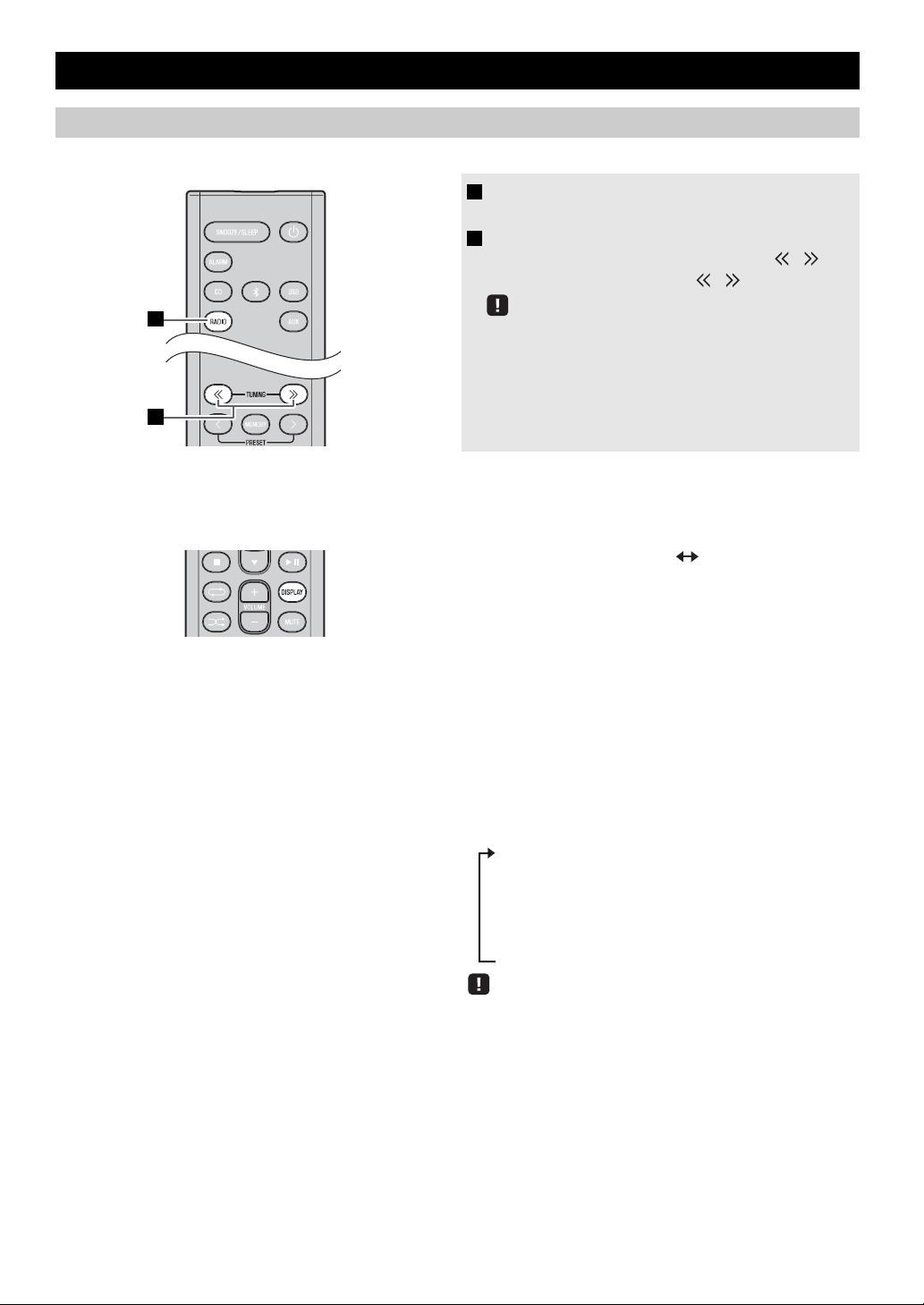
Selecting preset DAB stations
1 Press the RADIO source button to switch
the audio source to DAB.
2 Press PRESET / to select the DAB
station that you want to hear.
You can only select presets that have been stored.
Checking the signal strength of DAB stations (Option menu)
1 Press the RADIO source button to switch
the audio source to DAB.
2 Press OPTION.
The option menu will appear.
3 Press / to select TUNE AID, and then
press ENTER.
4 Press / to select the DAB station.
The signal strength will appear.
5 Press OPTION to exit the option menu.
1
2
43
1
52
15 En
To listen to the FM station, connect the antenna as described in “Connecting the speakers and antenna” (☞ P. 4 ).
Display information (remote control only)
If you press DISPLAY on the remote control, the information shown on the front panel display will be switched in the
following order.
LISTENING TO FM STATIONS
Selecting an FM station
1 Press the RADIO source button to switch the
audio source to FM.
2 Tune FM stations
Automatic tuning: Press and hold TUNING / .
Manual tuning: Press TUNING / repeatedly.
If you tune to a station manually while receiving FM, the sound
will be monaural.
Preset number and frequency
Reception status*
* Example of reception status indication.
TUNED/STEREO: A strong FM stereo broadcast is
being received.
TUNED/MONO: A monaural FM broadcast is being
received (even if the FM broadcast is
stereo, reception will be monaural if
the signal is weak).
Not TUNED: No broadcast is being received.
Displaying Radio Data Sy
stem
information
If you press DISPLAY on
the remote control while Radio
Data System information is being received, the information
shown on the front panel display will be switched in the
following order.
- PS (Program Service)
- PTY (Program Type)
-RT (Radio Text)
-CT (Clock Time)
- Reception status
- Preset number and frequency
If the signal transmission of the Radio D
a
ta System station is too
weak, this unit may not be able to receive Radio Data System
information completely. In particular, RT (Radio Text) information
uses a lot of bandwidth, so it may be less available compared to
other types of information.
1
2
LISTENING TO FM STATIONS
16 En
Use the preset function to store your favorite 30 stations.
First, press the RADIO source
button to switch the audio source to FM.
Auto preset
This method tunes automatically, and automatically presets only the stations that have good reception.
Manual preset
Deleting a stored preset (Option menu)
Presetting FM stations (remote control only)
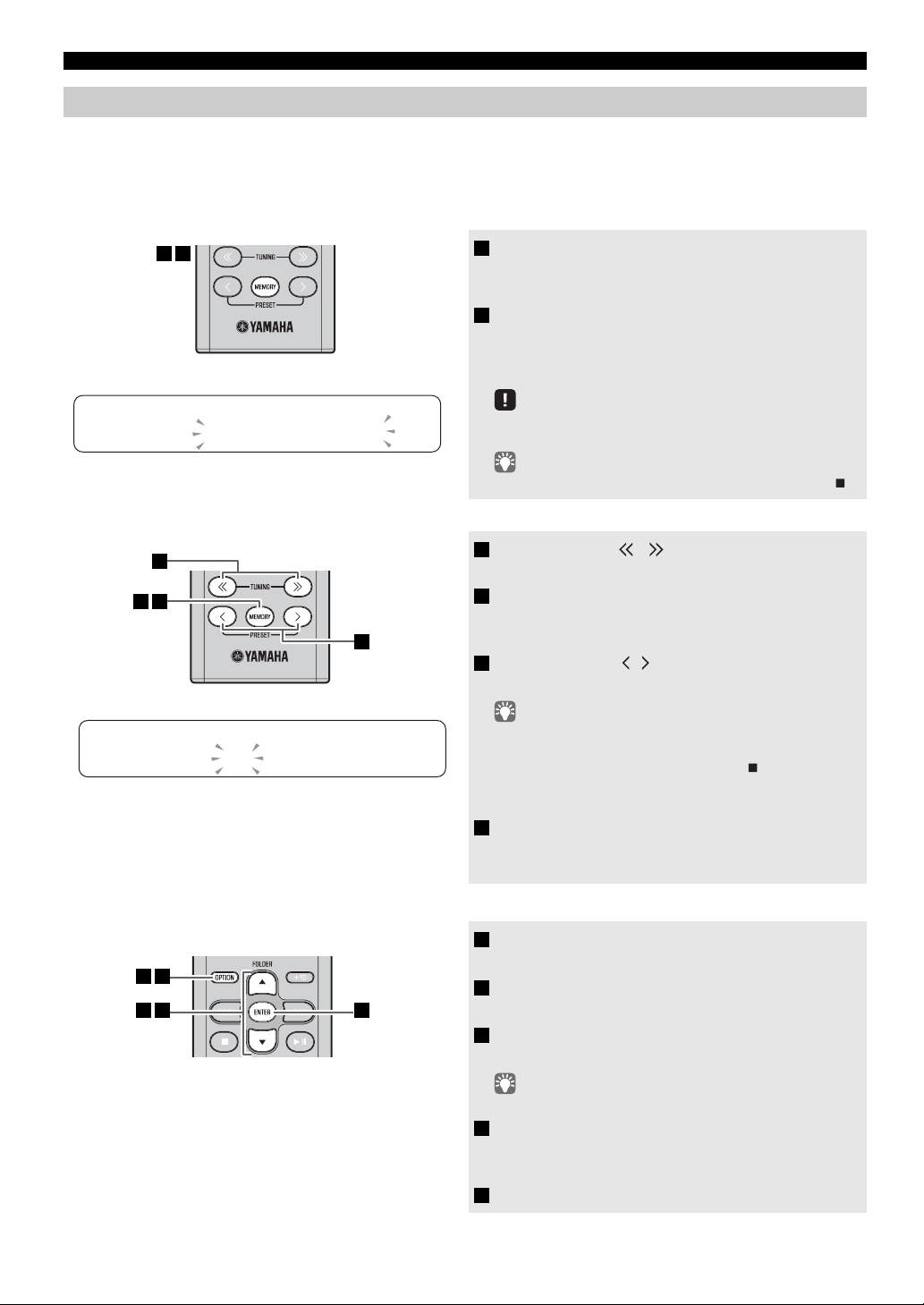
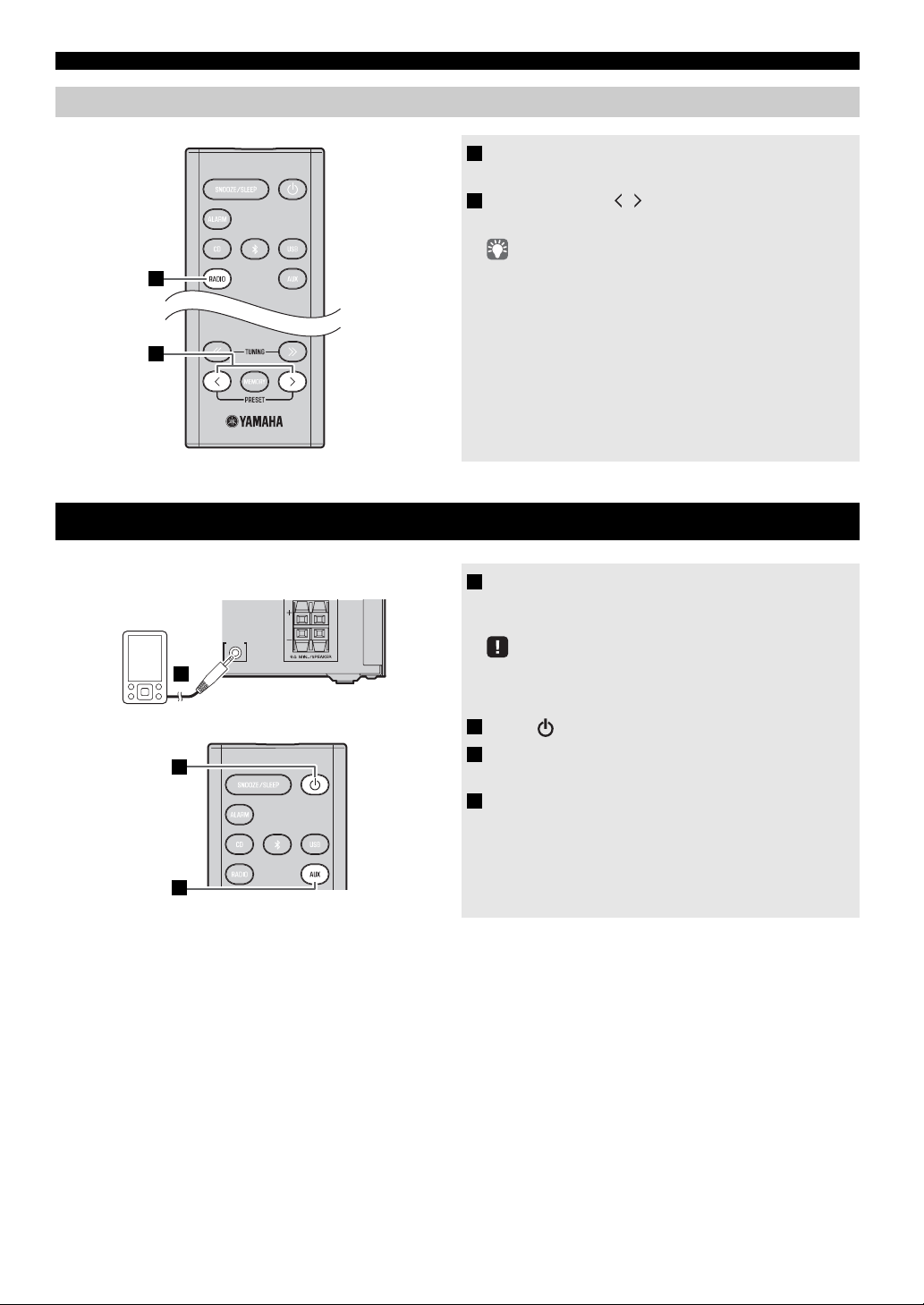
1 Press and hold down MEMORY.
“AUTO PRESET” will appear and “Press MEMORY”
will blink.
2 Press MEMORY.
Auto preset will begin.
When presetting has finished, th
e display will indicate
“Completed!”.
When you perform auto preset, all stored stations are cleared
and the new stations are stored.
If you want to stop auto preset before it is completed, press .
1 Press TUNING / to tune a station that
you want to preset.
2 Press MEMORY.
The display will indicate “PRESET MEMORY,” and the
preset number will blink.
3 Press PRESET / to select the preset
number that you want to store.
• The lowest preset number that has not been stored will be
selected first.
• If you want to cancel the presetting, press .
• If you select a preset number in which a s
tation has already
been stored, it will be overwritten by the new station.
4 Press MEMORY.
When presetting has finished, the display will indicate
“Completed!”.
1 Press OPTION.
The option menu will appear.
2 Press / to select PRESET DELETE, and
then press ENTER.
3 Press / to select the preset number that
you want to delete.
If you want to cancel the deleting, press OPTION.
4 Press ENTER to complete the operation.
When deleting has finished, the display will indicate
“Deleted!”.
5 Press OPTION to exit the option menu.
AUTO PRESET
Press MEMORY
1 2
PRESETMEMORY
FM0187.50MHz
3
1
42
1 5
3 42
17 En
LISTENING TO FM STATIONS
Selecting preset FM stations
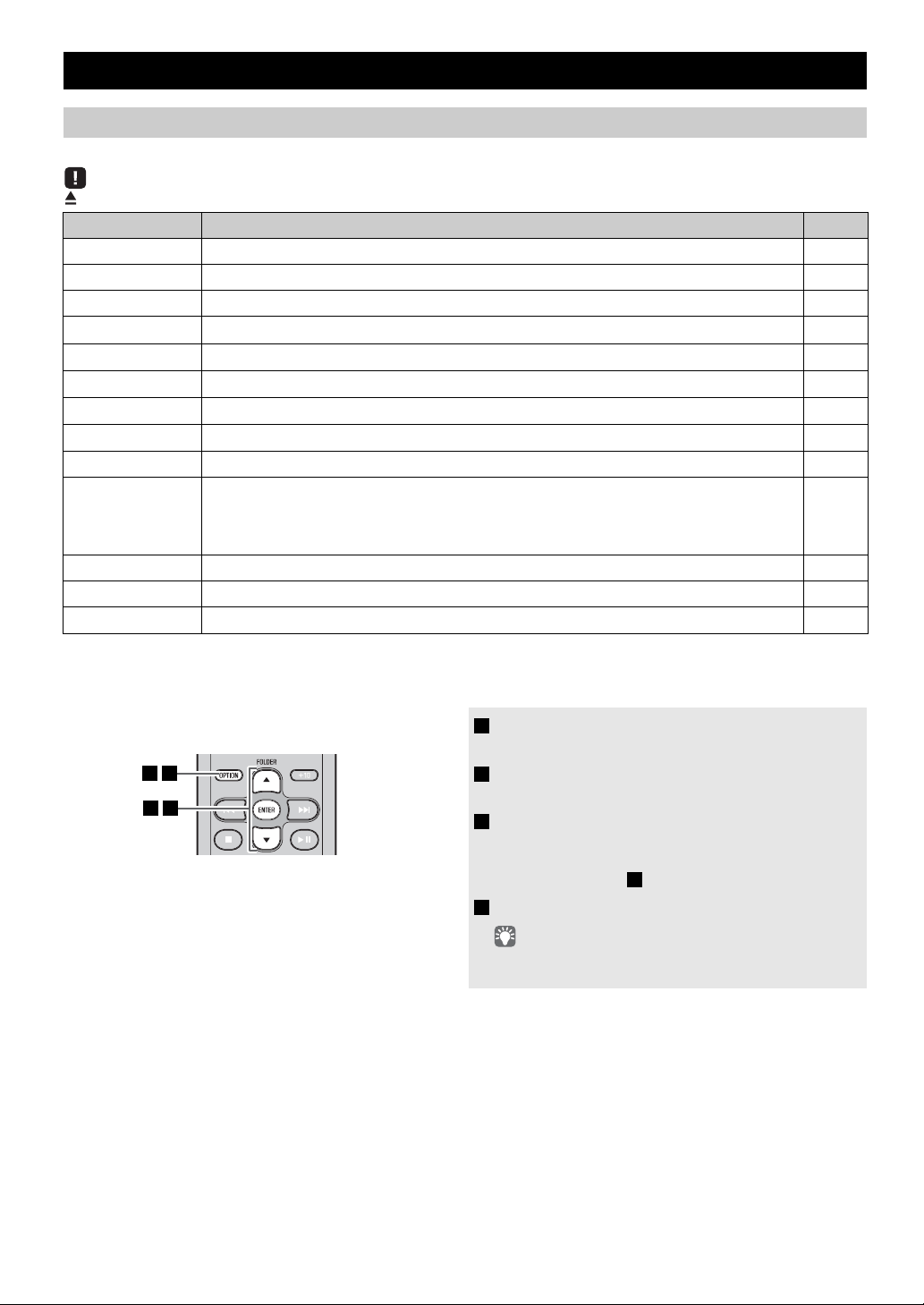
1 Press the RADIO source button to switch the
audio source to FM.
2 Press PRESET / to select the FM station
that you want to hear.
You can only select presets that have been stored.
LISTENING TO EXTERNAL SOURCES
1 Using a commercially available 3.5 mm mini-
plug cable, connect your external device to the
AUX jack on the rear panel of this unit.
• Turn the unit off before connecting the audio cable.
• Turn down the volume of the unit and your external audio
devi
ce before connection.
2 Press to turn the unit on.
3 Press the AUX source button to switch the
audio source to AUX.
4 Start playback on the connected external
audio device.
1
2
AUX IN
1
2
Rear panel
3
18 En
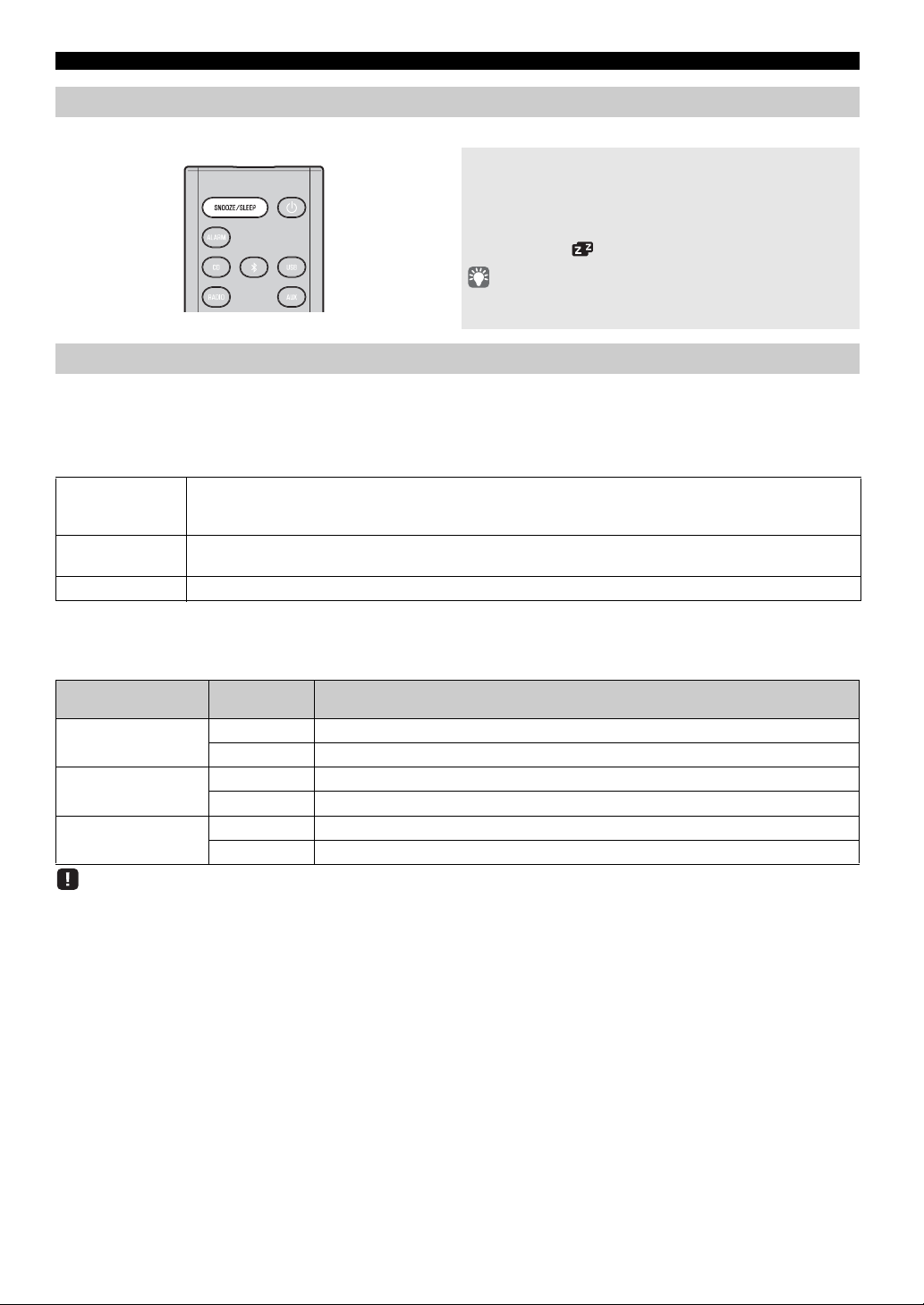
When you press
OPTION
, the option menu will appear in the front panel display, allowing you to make the following settings.
(eject button) cannot be operated while the option menu is displayed.
* Default setting
Procedure for settings
USEFUL FUNCTIONS
Using the Option menu
Option menu Setting or range See page
PRESET DELETE Deletes a stored preset (shown only if
the audio source is DAB/FM).
13, 16
DAB INIT SCAN Performs the initial scan (shown only if the audio source is DAB).
11
DAB TUNE AID Checks the signal strength of DAB station (shown only if the audio source is DAB).
14
DIMMER
Adjusts the brightness of the front panel display (1
*
: bright, 2: medium, 3: dim).
–
EQ LOW
Adjusts the tonal character (low frequencies) (–10
- 0
*
- +10 dB).
–
EQ MID
Adjusts the tonal character (mid frequencies) (–10 - 0
*
- +10 dB).
–
EQ HIGH
Adjusts the tonal character (high frequencies) (–10 - 0
*
- +10 dB).
–
BALANCE
Adjusts the volume balance of the left and right speakers (L+10 - CENT
ER
*
- R+10).
–
POWER SAVING Switches the standby state, NORMAL or ECO (power saving mode)
5
AUTO PWR
STDBY
You can specify the time after which the unit will turn off automatically.
If no operation occurs for the duration you specify, the unit will turn off automatically
(
TIME 12H
: 12 hours,
TIME 8H
*
: 8 hours,
TIME 4H
: 4 hours,
TIME 2H
: 2 hours,
OFF
: the unit
will not turn off).
–
CLOCK SET Sets the date and time.
6
ALARM SET Sets the alarm.
20
BLUETOOTH
Connects this unit and your component via Bluetooth (ON
*
: enable, OFF: disable).
9
1 Press OPTION.
The option menu will appear.
2 Press / to select the menu item that you
want to set, and then press ENTER.
3 Press / to edit the setting, and then press
ENTER to confirm the setting.
If you want to continue making other settings, repeat the
procedure from step .
4 Press OPTION to exit the option menu.
If you decide to cancel without changing the setting, press
OPTION before confirming the change.
1
3
4
2
2
19 En
USEFUL FUNCTIONS
When the specified time has elapsed, the unit will turn off automatically.
The unit includes an alarm function that plays back audio sources or a set of beep (internal alarm so
und) at the set time using
a variety of different methods. The alarm function has the following features.
3 types of alarms
Select from 3 alarm types, combining music and beep sounds.
Various audio sources
You can choose from audio CD, data CD, USB device, or DAB/FM. The following playback methods can also be selected
depending on the audio source:
You can not choose Bluetooth and AUX as the audio source.
Snooze
The snooze function can be enabled to replay the alarm after 5 minutes (☞ P. 2 1 ).
Using the sleep timer
Press SNOOZE/SLEEP repeatedly to specify the
time after which the unit will turn off.
You can specify 30, 60, 90, 120 or OFF.
When you select a time, the sleep timer is turned on, and the
sleep indicator ( ) is shown in the front panel display.
If you press SNOOZE/SLEEP while the sleep timer is activated,
the sleep timer setting will be canceled.
Using the alarm function (IntelliAlarm)
SOURCE+BEEP
The selected audio source and the beep sound are played at th
e set time.
Source playback begins to fade in 3
minutes before the set time and the volume gradually increases to the set volume. Then, at the set time, the
beep sound is activated.
SOURCE
The selected audio source is played at the set time. The volume fades in gradually and increases to the set
volume.
BEEP The beep sound is played at the set time.
Source
Playback
method
Function
Audio CD
Selected track The selected track is played repeatedly.
Resume The track you listened to last time is played back.
Data CD/USB device
Folder The selected folder is played repeatedly.
Resume The track you listened to last time is played back.
DAB/FM
Preset station The selected preset station is played.
Resume The DAB/FM station you listened to la
st time
is played back.
USEFUL FUNCTIONS
20 En
Setting the alarm time and alarm type (Option menu)
The alarm will not function when the unit is in ECO standby. To use the alarm function, set the Option menu item POWER SAVING to
NORMAL (☞ P. 1 8 ).
Setting the alarm
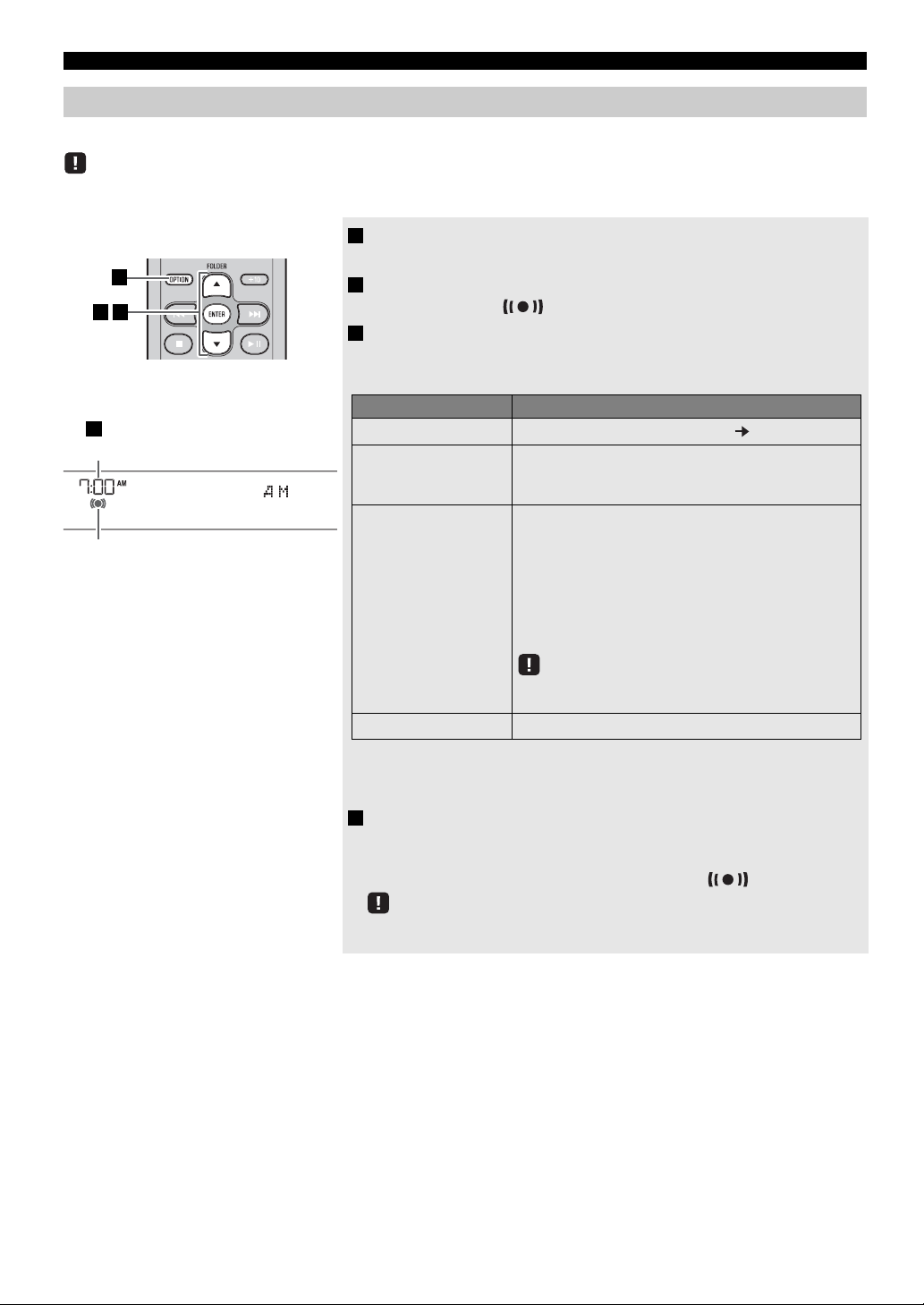
1 Press OPTION.
The option menu will appear.
2 Press / to select “ALARM SET”, and then press ENTER.
The alarm indicator ( ) and numerical value you’re setting will blink.
3 Set the alarm.
Set items 1-4 described below.
Press
/ to select a numerical value, and press ENTER to confirm it.
4 Complete the settings.
When you set the VOLUME for item 4, the display will indicate
“Completed!” and your settings will be confirmed.
The alarm will be turned on and the alarm indicator ( ) will light.
If you press OPTION or turn the unit off while making alarm settings, the settings will
be cancelled.
4
9:12
Completed!
Alarm time
Alarm indicator
3
1
2
*
If you choose RESUME when specifying the track/folder/preset number, the last-
played track/folder/station will be played (resume playback)
Items Setting or range
1
ALARM TIME
Make settings in the order of hours minutes.
2
ALARM TYPE
Select from SOURCE+BEEP, SOURCE or BEEP. For
details, refer to “3 types of alarms” (
☞ P. 19).
If you selected BEEP, proceed to item
4.
3
ALARM SOURCE
(If you selected
SOURCE+BEEP or
SOURCE as the
alarm type)
CD: Play back music from a CD.
Specify the track number (data CD: folder
number) (RESUME
*
, 1-99).
USB: Play back music from a USB device.
Specify the folder number (RESUME, 1-999).
DAB/FM: Play a DAB/FM station.
Specify the preset number (RESUME,
1-30).
If the selected source cannot be played back at the time set
for the alarm, the beep sound is played back.
4
ALARM VOLUME
Specifies the volume (5-60) of the alarm.
21 En
USEFUL FUNCTIONS
Switching the alarm on/off
When the set time arrives, the selected alarm sound will play. During playback, the following operations are available.
To pause the alarm (Snooze)
To turn the alarm off
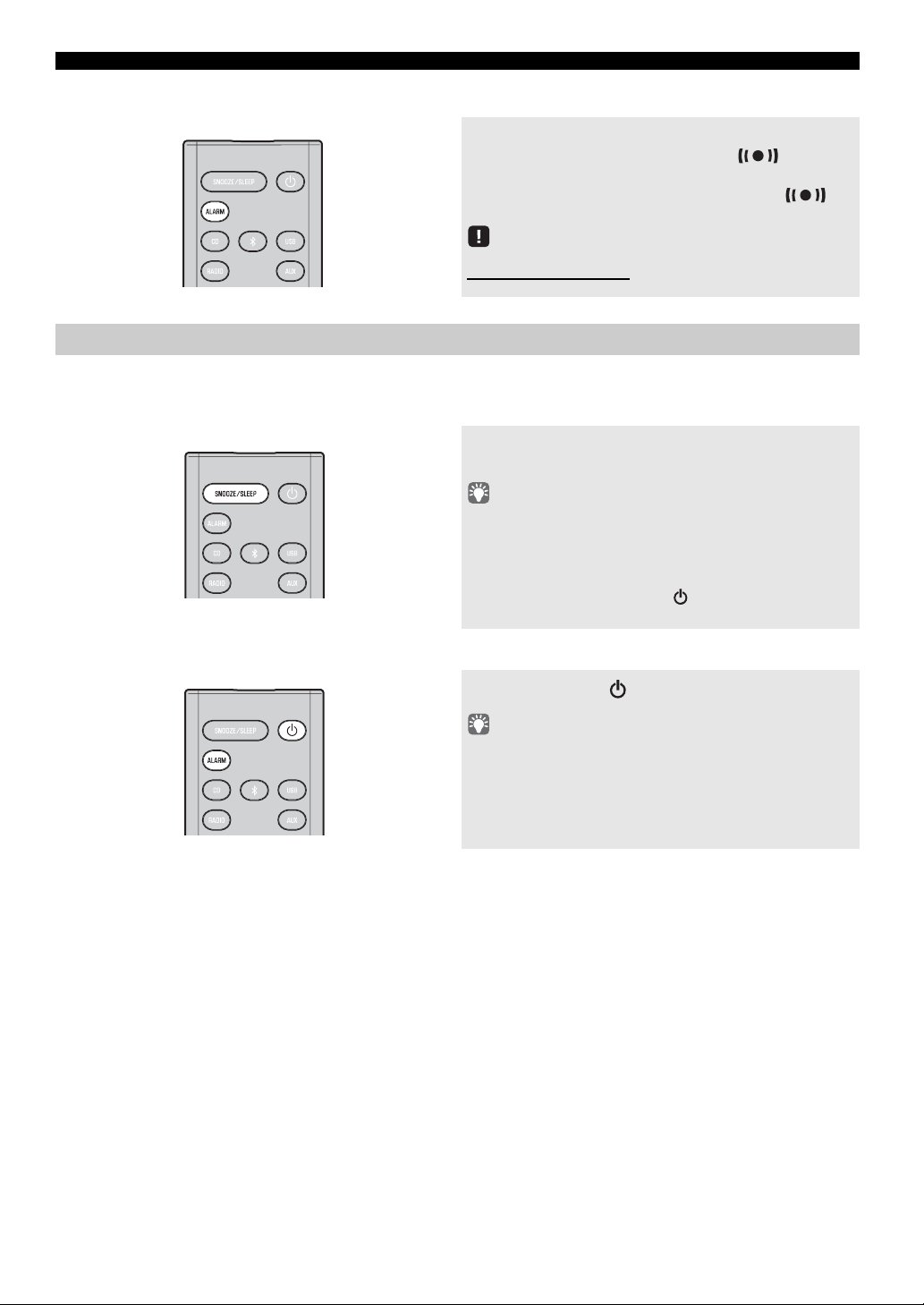
Press ALARM to turn the alarm on/off.
When the alarm is on, the alarm indicator ( ) will light,
and the alarm time will be shown.
If you press ALARM ag
ain
, the alarm indicator ( )
and the alarm will turn off.
If the Option menu item POWER SAVING is set to ECO,
the alarm will not function (☞ P. 1 8 ).
Operations while the alarm sound is playing
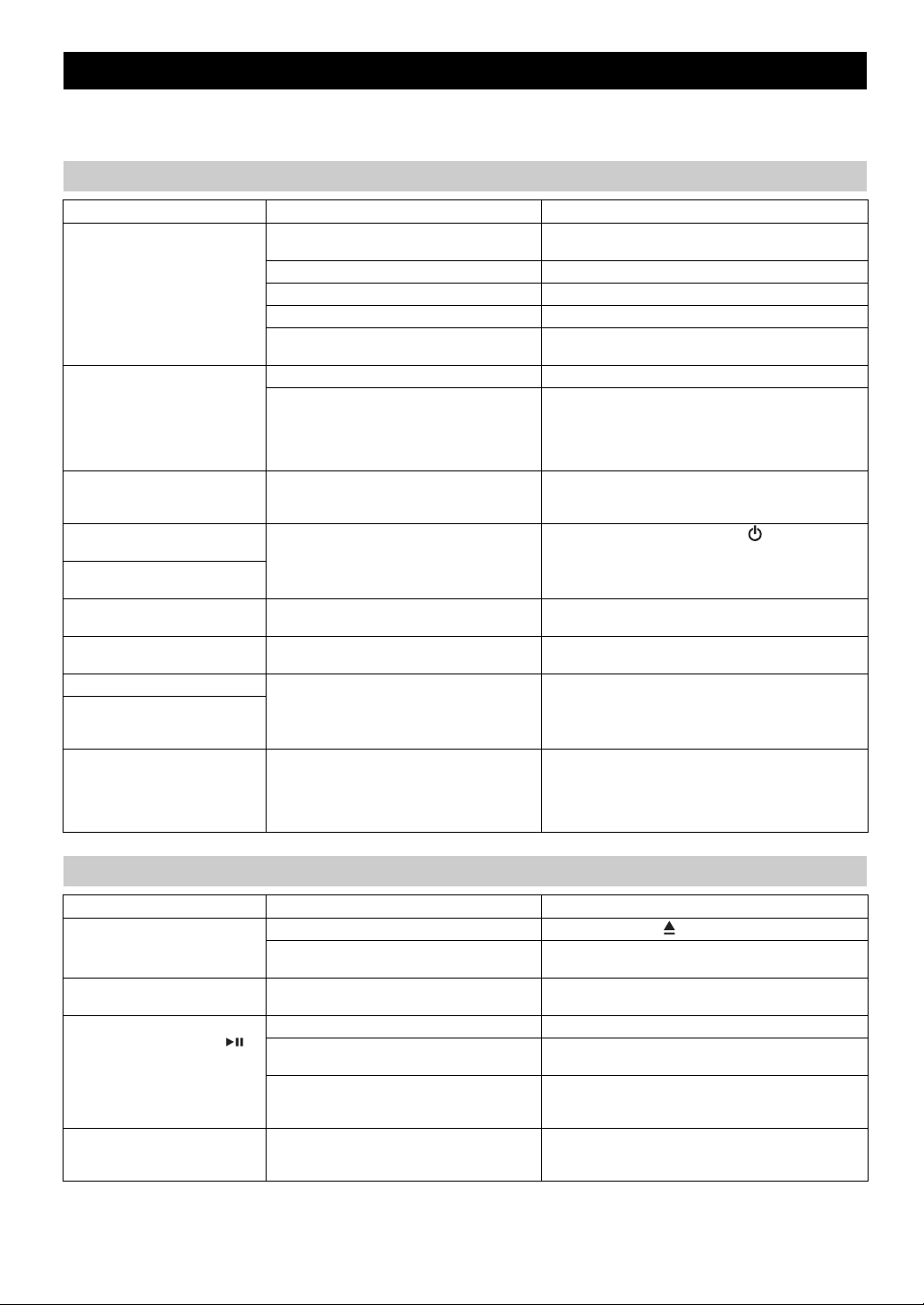
Press SNOOZE/SLEEP.
Snooze will stop the alarm and play it again 5 minutes later.
• If SOURCE + BEEP is set as the alarm type, you can press
SNOOZE/SLEEP once to stop the beep sound, and twice to stop
the audio source.
5 minutes after the audio source is stopped,
it will
start fading in
again and the beep sound will resume.
• Buttons on the unit other than the will also function as the
snooze button.
Press ALARM or .
• You can also stop the alarm by holding down SNOOZE/SLEEP.
• If you don’t stop the alarm, it will stop a
utomatically after 60
minutes and the unit will turn off.
• The alarm setting will be saved even if the alarm is turned off.
If the
alarm is turned on ag
ain by pressing ALARM, the alarm
will sound with the previous alarm settings.
22 En
If there is a problem with the unit, check the following list first. If you cannot resolve the problem with the suggested
solutions or if the problem is not listed below, turn off and unplug the unit, and consult the
nearest authorized Yamaha dealer
or service center.
TROUBLESHOOTING
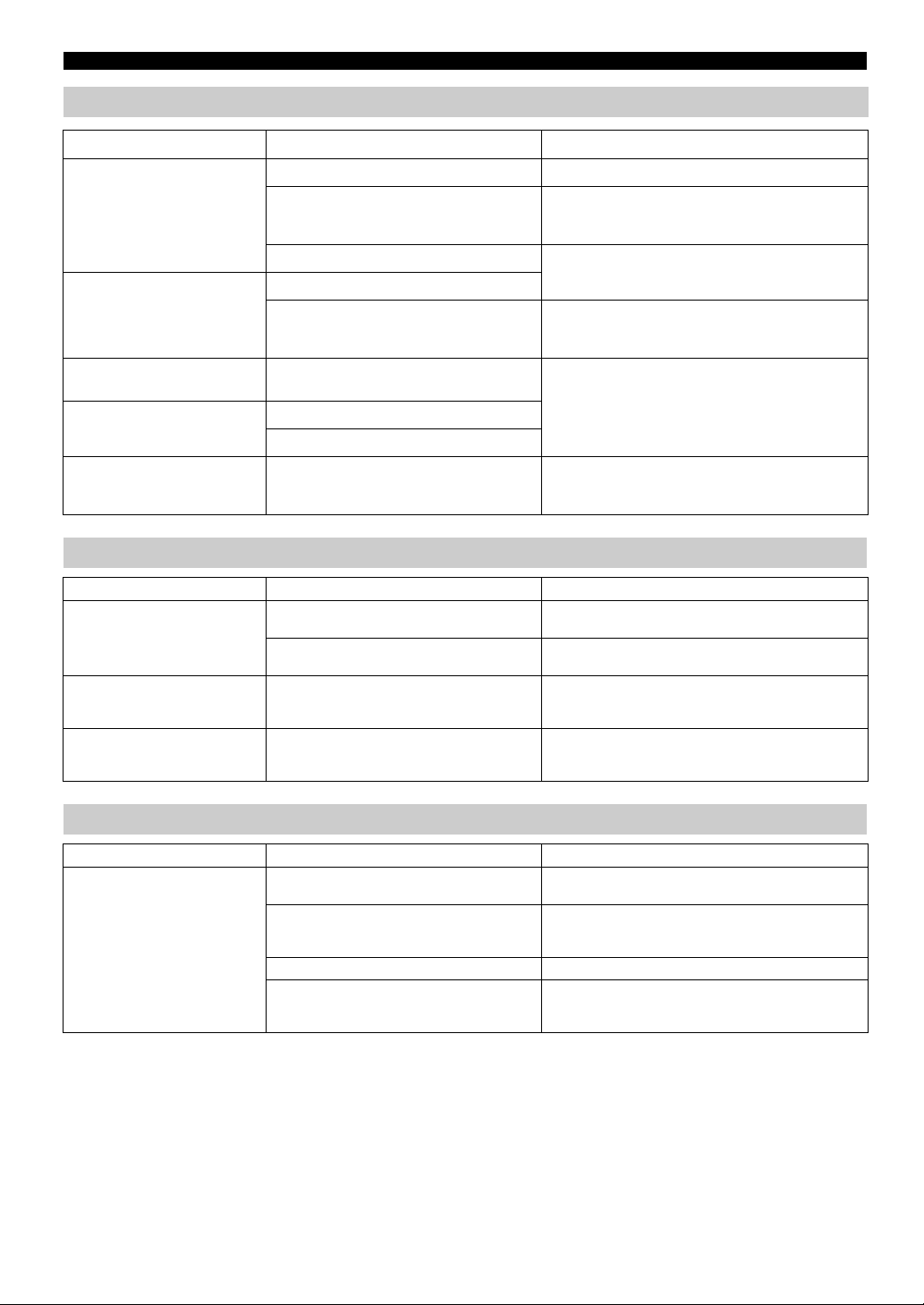
General
Problem Cause Solution
The speakers make no sound. The volume might be set to the minimum level,
or muted.
Adjust the volume level.
The source may be incorrect. Select the correct source.
The speakers may not be connected securely. Check the connections (☞ P. 4).
Headphones are connected. Remove the headphones.
The volume of a connected external device is not
loud enough.
Raise the volume of the external device.
Sound suddenly turns off. The sleep timer may be set (☞ P. 19). Turn the unit on and play the source again.
The auto power standby function may have
operated.
When the time specified for AUTO PWR STDBY in the
option menu has elapsed (☞ P. 18) or when 20 minutes
have elapsed without any operation being performed after
stopping USB device or CD playback, the unit will turn off
automatically.
Sound is cracked/distorted or
there is abnormal noise.
Input source volume is excessive, or volume of
this unit is excessive (especially Bass).
Adjust volume with VOLUME, or use the option menu
(☞ P. 18) to adjust the bass range. If an external device is
playing back, lower the volume of the external device.
The unit does not operate
properly.
The unit may have received a strong electrical
shock such as lightning or excessive static
electricity, or power supply may have dropped.
Restart the unit by holding down the for about 10
seconds.
The unit turns on but
immediately shuts off.
A digital or high-frequency
equipment produces noises.
The unit may be placed too close to the digital or
high-frequency equipment.
Place the unit farther away from the equipment.
The clock setting has been
cleared.
The unit remained unpowered for about one hour. Plug the power cable into the wall outlet firmly, and set the
clock again (☞ P. 6).
Alarm does not sound. The unit is set to ECO standby. In the option menu, set POWER SAVING to NORMAL
(☞ P. 18).
The front panel display indicates
“ALARM not work” and can’t
set the alarm.
The unit turns off unexpectedly. The auto power standby function may have
operated.
When the time specified for AUTO PWR STDBY in the
option menu has elapsed (☞ P. 18) or when 20 minutes
have elapsed without any operation being performed after
stopping USB device or CD playback, the unit will turn off
automatically.
CD playback
Problem Cause Solution
Disc cannot be inserted. Another disc is already inserted. Unload the disc with .
You are attempting to insert a disc that cannot be
used by this unit.
Use a disc supported by the unit (☞ P. 25).
Some button operations do not
work.
The disc loaded into the unit may not be
compatible.
Use a disc supported by the unit (☞ P. 25).
Playback does not start
immediately after pressing
(stops immediately).
The disc may be dirty. Wipe the disc clean (☞ P. 25).
The disc loaded into the unit may not be
compatible.
Use a disc supported by the unit (☞ P. 25).
If the unit was moved from a cold to warm place,
condensation may have formed on the disc
reading lens.
Wait for an hour or two until the unit adjusts to the room
temperature, and try again.
The front panel display indicates
“no operation”, and a disc cannot
be inserted or unloaded.
The option menu is displayed. Alternatively, the
alarm is playing.
Press OPTION to exit the option menu. Alternatively,
press ALARM to stop the alarm.
23 En
TROUBLESHOOTING
When you insert a disc, the front
panel display indicates “CD No
Disc” or “CD Unknown.”
The disc loaded into the unit may not be
compatible.
Use a disc supported by the unit (☞ P. 25).
The disc may be dirty, or a foreign object may
have adhered to it.
Wipe the disc clean. Alternatively, remove any foreign
object that has adhered to the disc (☞ P. 25).
The disc does not contain playable files. Use a disc contains playable files (☞ P. 25).
The disc was inserted upside down. Insert the disc with the label facing upward.
USB device playback
Problem Cause Solution
MP3/WMA file in the USB device
does not play.
The USB device is not recognized. Turn the unit off and reconnect the USB device to the unit.
If the solutions above do not resolve the problem, the USB
device is not playable on the unit (☞ P. 25).
The USB device does not contain playable files. Use a USB device contains playable files (☞ P. 25).
When you connect a USB device,
the front panel display indicates
“USB OverCurrent,” and then
the front panel display goes
blank.
An incompatible USB device was connected to
the unit. Alternatively, the USB device is not
connect firmly to the unit.
Turn the unit off and reconnect the USB device to the unit.
If it does not resolve the problem, the USB device is not
playable on the unit (☞ P. 25).
Bluetooth
Problem Cause Solution
Cannot make this unit paired
with the other component.
The other component does not support A2DP. Perform pairing operations with a component which
supports A2DP.
A Bluetooth adaptor, etc. that you want to pair
with this unit has a password other than “0000”.
Use a Bluetooth adaptor, etc. whose password is “0000”.
This unit and the other component are too far
apart.
Move the other component closer to this unit.
There is a device (microwave oven, wireless
LAN, etc.) outputs signals in the 2.4 GHz
frequency band nearby.
Move this unit away from the device that is emitting radio-
frequency signals.
In the option menu, BLUETOOTH is set to
OFF.
In the option menu, set BLUETOOTH to ON (☞ P. 18).
Can’t establish a Bluetooth
connection.
This unit is not registered on the other
component’s Bluetooth connection list.
Perform pairing operations again (☞ P. 9).
In the option menu, BLUETOOTH is set to
OFF.
In the option menu, set BLUETOOTH to ON (☞ P. 18).
No sound is produced or the
sound is interrupted during
playback.
The Bluetooth connection of this unit with the
other component is disconnected.
Perform Bluetooth connection operations again (☞ P. 10).
This unit and the other component are too far
apart.
Move the other component closer to this unit.
There is a device (microwave oven, wireless
LAN, etc.) outputs signals in the 2.4 GHz
frequency band nearby.
Move this unit away from the device that is emitting radio-
frequency signals.
The other component’s Bluetooth function is off. Turn on the Bluetooth function of the other component.
The other component is not set to send Bluetooth
audio signals to this unit.
Check that the Bluetooth function of the other component
is set properly.
The pairing setting of the other component is not
set to this unit.
Set the pairing setting of the other component to this unit.
The other component’s volume is set to the
minimum.
Increase the volume level.
Problem Cause Solution
TROUBLESHOOTING
24 En
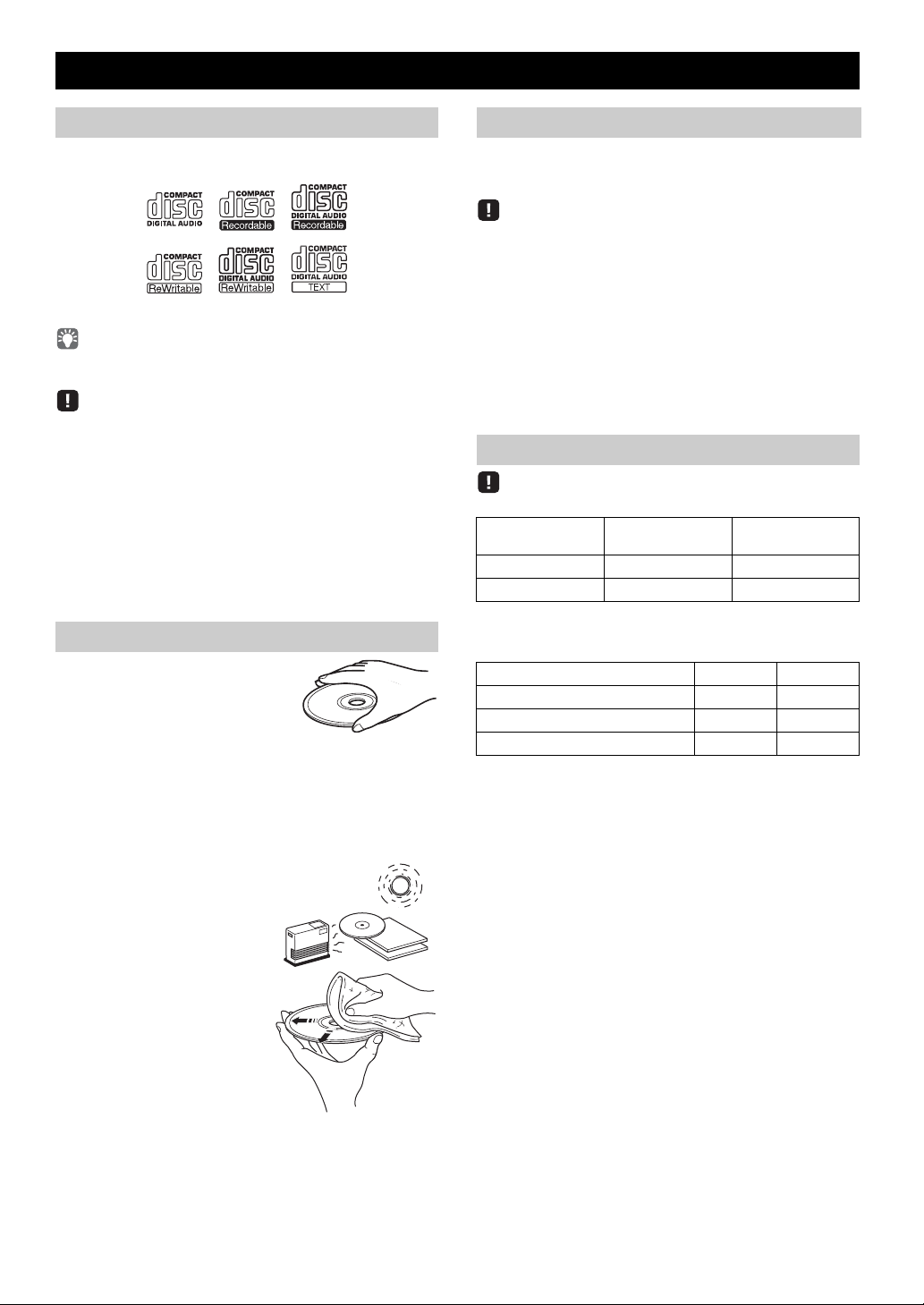
DAB reception
Problem Cause Solution
Cannot tune into any DAB
stations.
The initial scan operations were not performed. Perform the initial scan operations (☞ P. 11).
There is no DAB coverage in your area. Check with your dealer or WorldDMB Online at
“http://www.worlddab.org” for a listing of the DAB
coverage in your area.
The DAB signals are too weak. Change the height, direction, or placement of the antenna.
The initial scan operations are
not successful and “Not Found”
appears on the front panel
display.
The DAB signals are too weak.
There is no DAB coverage in your area. Check with your dealer or WorldDMB Online at
“http://www.worlddab.org” for a listing of the DAB
coverage in your area.
The DAB station reception is
weak.
The DAB signals are too weak. Change the height, direction, or placement of the antenna.
There is noise interference (e.g.
hiss, crackle, or jitter).
The antenna needs to be repositioned.
The DAB signals are too weak.
The DAB station information
does not appear or is inaccurate.
The DAB station may be temporarily out of
service, or the DAB station information is not
provided by the DAB broadcaster.
Contact the DAB broadcaster.
FM reception
Problem Cause Solution
Too much noise. The antenna may be connected improperly. Make sure the antenna is connected properly (☞ P. 4) or
use a commercially available outdoor antenna.
The antenna is too close to the unit or to an
electronic device.
Position the antenna as far away as possible from the unit
or the electronic device.
Too much noise during stereo
broadcast.
The radio station you selected may be far from
your area, or the radio wave reception is weak in
your area.
Try manual tuning to improve the signal quality (☞ P. 15)
or use a commercially available outdoor antenna.
Even with an outdoor antenna,
radio wave reception is weak.
(Sound is distorted.)
Multipath reflection or other radio interferences
may have occurred.
Change the height, direction, or placement of the antenna
(☞ P. 4).
Remote control
Problem Cause Solution
The remote control does not work
properly.
The remote control may be operated outside its
operation range.
For information on the remote control operation range,
refer to “How to use the remote control” (☞ P. 1 ) .
The remote control signal receiver on the unit
(☞ P. 2) may be exposed to direct sunlight or
lighting (inverted fluorescent lamps).
Change the lighting or orientation of the unit.
The battery may be worn out. Replace the battery with a new one (☞ P. 1).
There are obstacles between the remote control
signal receiver on the unit (☞ P. 2) and the
remote control.
Remove the obstacles.
25 En
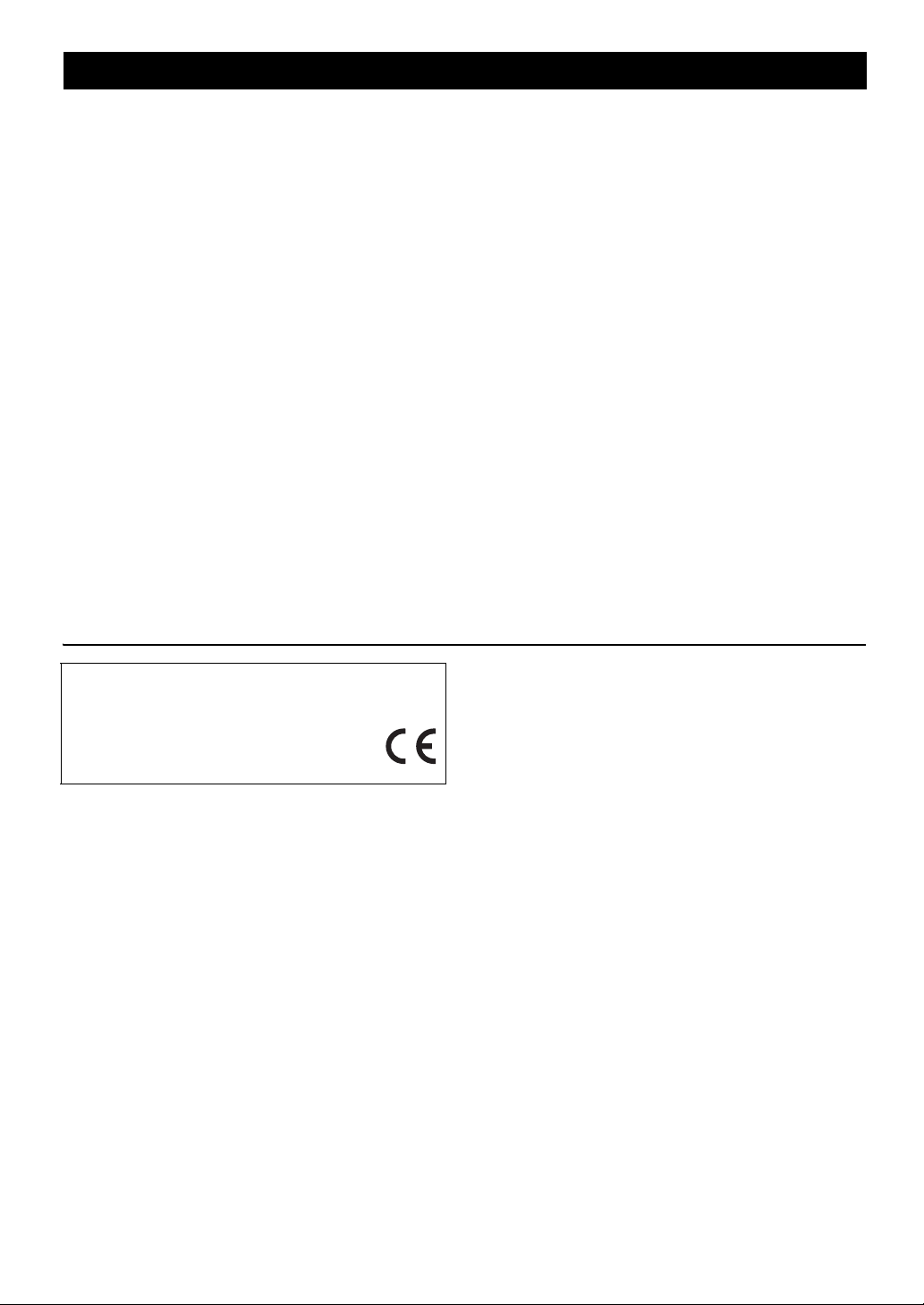
This unit is designed for use with audio CD, CD-R*, and
CD-RW* with the logos followings.
* ISO 9660 format CD-R/RW
This unit can play back discs bearing any of the logo marks above.
A disc logo mark is printed on the disc and the disc jacket.
•
Do not load any other type of disc into this unit. Doing so may
damage this unit.
•
CD-R/RW cannot be played back unless finalized.
• Some discs cannot be played back depending on the disc
characteristics or rec
ording conditions.
• Do not use any non-standard shaped discs suc
h as a heart-shaped
disc.
• Do not use discs with many scratches on their surface.
• Do not load a cracked, warped, or glued disc.
• Do not use 8-cm discs.
• Do not touch the surface of the
disc. Hold a disc by its edge (and
the ce
nter hole).
• Do not use a pencil or pointed
ma
rker to write on
the disc.
• Do not put a tape, seal, glue, etc., on a disc.
• Do not use a protective cover to prevent scr
atches.
• Do not load more than one disc into this unit at one time.
This can cause damage
to both this unit and the discs.
• Do not insert any foreign objects into
the disc slot.
•
Do not expose a disc to direct
sunlight, high temperature,
high humidity, or a lot of dust.
• If a disc becomes dirty, wipe it
with a clean, dry cloth from the
ce
nt
er out to the edge. Do not
use re
cord cleaner or paint
thinne
r.
• To avoid malfunction, do not
use a commercially available
le
ns cleaner.
This unit supports USB mass storage
class devices (
e.g.,
flash memories or portable audio players) using FAT16 or
FAT
32 format.
• Some devices may not work properly even if they meet the
requirements.
• Do not connect devices other than USB mass storage class
devices (suc
h as USB chargers or USB hubs), PCs, card readers,
an ex
ternal HDD, etc.
• Yamaha will not be held responsible for
any damage to or data
loss on the USB device occurring while the device is connected
to this unit.
• Playability of and power supply to all kind of
USB devices are
not guaranteed.
• USB devices with encryption cannot be used.
• The unit can play back:
** Both constant and variable b
itrates are supported.
• The maximum numbers of files/folders that
can be played on the
unit are as follows.
• Copyright-protected files cannot be played back.
NOTES ON DISCS AND USB DEVICES
CD information
Handling a disc
Caution
USB device information
About MP3 or WMA files
File Bitrate (kbps)
Sampling
frequency (kHz)
MP3 8-320** 16-48
WMA 16-320** 22.05-48
Data CD USB
Maximum total number of file 512 9999
Maximum folder number 255 999
Maximum file number per folder 511 255
26 En
PLAYER SECTION
CD
• Media ........................................................................... CD, CD-R/RW
• Audio format.................................................. Audio CD, MP3, WMA
USB
• Audio format.....................................................................MP3, WMA
AUX
• Input connector ............................. 3.5 mm (1/8 ") STEREO mini jack
Bluetooth SECTION
• Bluetooth version .................................................................... Ver. 3.0
• Supported profile ......................................................... A2DP, AVRCP
• Supported codecs .......................................................................... SBC
• Wireless output ........................................................ Bluetooth Class 2
• Maximum communication distance ......... 10 m (without obstructions)
AMPLIFIER SECTION
• Maximum output power..........15 W + 15 W (6 Ω 1 kHz, 10 % THD)
• Headphones
.............. 3.5 mm (1/8 in) STEREO mini jack (Impedance 16 to 32 Ω)
• Equalizer characteristics
EQ Low (Bass)/EQ Mid (Middle)/EQ High (Treble).............. ±10 dB
TUNER SECTION
Tuning range
• DAB/DAB
+
...............................................174 to 240 MHz (Band III)
• FM ...................................................................... 87.50 to 108.00 MHz
SPEAKER SECTION
• Type ....................................................................Full range bass reflex
non magnetic shielding type
• Driver....................................................... 11 cm (4-1/2") cone type ×1
• Frequency response .......................................... 50 to 20 kHz (–10 dB)
•
Dimensions (W × H × D)
..........................................129 (5-1/8") × 126 (4") × 251 (9-7/8") mm
•Weight......................................................................... 1.5 kg (3.3 lbs.)
GENERAL
• Power supply
[U.K. model]..............................................................AC 230 V, 5 0 Hz
[Australia model].......................................................AC 240 V, 5 0 Hz
• Power consumption ......................................................................30 W
• Standby consumption
.................................. 3.5 W or less (NORMAL)/0.5 W or less (ECO)
•
Dimensions (W × H × D)
........................................180 (7-1/8") × 130 (5-1/8") × 281 (11") mm
• Weight ......................................................................... 2.6 kg (5.7 lbs.)
Specifications are subject to change without notice.
LASER SAFETY
This unit employs a laser. Due to possible eye injury, only a
qualified service person should remove the cover or attempt to
service this device.
DANGER
This unit emits visible laser radiation when open. Avoid direct eye
exposure to beam. When this unit is plugged into the wall outlet,
do not place your eyes close to the opening of the disc slot and
other openings to look into inside.
Bluetooth
• Bluetooth is a technology for wireless communication between
devices within an area of about 10 meters (33 ft) employing the
2.4 GHz frequency band, a band which can be used without a
license.
• Bl
uetooth is a
registered trademark of the Bluetooth SIG and is
used by Yamaha in accordance with a license agreement.
Handling Bluetooth communications
• The 2.4 GHz band used by Bluetooth compatible devices is a
radio band shared by many types of equipment. While Bluetooth
compatible devices use a technology minimizing the influence of
other components using the same radio band, such influence may
reduce the speed or distance of communications and in some
cases interrupt communications.
• The speed of signal transfer and the distance at which
communication
is possible diff
ers according to the distance
between the communicating devices, the presence of obstacles,
radio wave conditions and the type of equipment.
• Yamaha does not guarantee all wireless connections between this
unit
and devices compatible
with Bluetooth function.
SPECIFICATIONS
We, Yamaha Music Europe GmbH hereby declare that this unit
is in compliance with the essential requirements and other
relevant provisions of Directive 1999/5/EC.
Yamaha Music Europe GmbH
Siemensstr. 22-34 25462 Rellingen, Germany
Tel: +49-4101-303-0
27 En
■ For U.K. customers
If the socket outlets in the home are not suitable for the plug
supplied with this appliance, it should be cut off and an appropriate
3 pin plug fitted. For details, refer to the instructions described
below.
The plug severed from the mains lead must be destroyed, as a plug
with bared f
lexible
cord is hazardous if engaged in a live socket
outlet.
■ Special Instructions for U.K. Model
Information for Users on Collection and Disposal
of Old Equipment and Used Batteries
These symbols on the products, packaging, and/or
accompanying documents mean that used electrical
and electronic products and batteries should not be
mixed with general household waste.
For proper treatment, recovery
and recycling of old
products and used batteries, please take them to
applicable collection points, in accordance with your
national legislation and the Directives 2002/96/EC
and 2006/66/EC.
By disposing of these products and batteries correctly,
you will he
lp to save valuable resources and prevent
any potential negative effects on human health and the
environment which could otherwise arise from
inappropriate waste handling.
For more information about c
o
llection and recycling
of old products and batteries, please contact your local
municipality, your waste disposal service or the point
of sale where you purchased the items.
[Information on Disposal in other Countries
outsid
e the European Union]
These symbols are only valid in the Eu
ropean Union.
If you wish to discard these items, please contact your
local authorities or dealer and ask for the correct
method of disposal.
Note for the battery symbol (bottom two
symb
o
l examples):
This symbol might be used in combination with a
chemi
cal symbol. In this case it complies with the
requirement set by the Directive for the chemical
involved.
If there should be color blotching or
noise when used near a
TV, move this unit away from the TV when using it.
Do not use this unit within 22 cm (
9
inches) of persons with a
heart pacemaker implant or defibrillator implant.
Radio waves may affect electro-medical devices.
Do not use this unit near medical devices or inside medical
f
acilities.
T
he user shall not reverse engineer
, decompile,
alter, translate
or disassemble the software used in this unit, whether in part or
in whole. For corporate users, employees of the corporation
itself as well as its business partners shall observe the
contractual bans stipulated within this clause. If the stipulations
of this clause and this contract cannot be observed, the user
shall immediately discontinue using the software.
LASER
Type Semiconductor laser GaAS/GaAlAs
Wave length 790 nm
Output Power 7 mW
CAUTION
Use of controls or adjustments or performance of procedures
other than those specified herein may result in hazardous
radiation exposure.
IMPORTANT
THE WIRES IN MAINS LEAD ARE COLOURED IN
ACCORDANCE WITH THE FOLLOWING CODE:
Blue: NEUTRAL
Brown: LIVE
As the colours of the wires in the mains
le
ad of this apparatus
may not correspond with the coloured markings identifying
the terminals in your plug, proceed as follows:
The wire which is coloured BLUE
must be connected to the
terminal which is marked with the letter N or coloured
BLACK. The wire which is coloured BROWN must be
connected to the terminal which is marked with the letter L or
coloured RED.
Make sure that neither core is connec
ted to
the earth terminal
of the three pin plug.
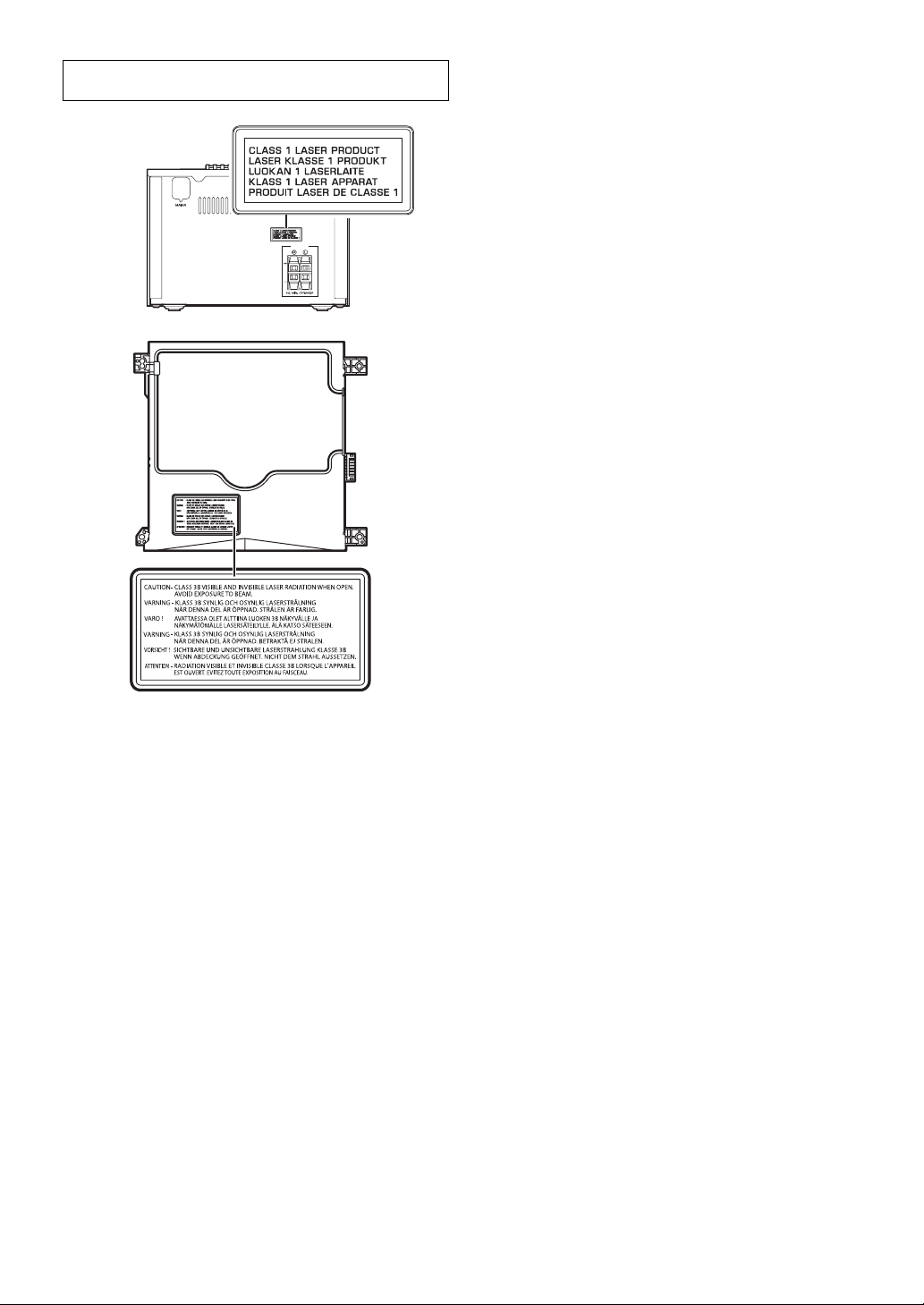
28 En
The laser component in this product is capable of emitting
radiation exceeding the limit for Class 1.
SPEAKERS

© 2015 Yamaha Corporation Printed in Malaysia ZR44230