INSTALLATION, USE AND MAINTENANCE INSTRUCTION
COMMERCIAL INFORMATION FOR THE CONSUMER
TECHNICAL INFORMATION
TYPE:FSED
GB
SEM1-SEM2-SEM5-SEM7-SEM8

2
3
The symbol on the product or on its packaging indicates that this product may not be
treated as household waste. Instead it shall be handed over to the applicable collection
point for the recycling of electrical and electronic equipment. By ensuring this product
is disposed of correctly, you will help prevent potential negative consequences for the
environment and human health, which could otherwise be caused by inappropriate
waste handling of this product. For more detailed information about recycling of this
product, please contact your local city oce, your household waste disposal service or
the shop where you purchased the product. This appliance is marked according to the
European directive 2002/96/EC on waste electrical and electronic equipment (WEEE).
GB

Warnings!
The air outlet of the appliance must not be connected to a ue which is used for exhausting
other fumes from appliances, such as a central heating, boilers etc..
For the external exhausting of the fumes, comply with the regulations in force.
Ventilate the room suitably according to the laws in force when the appliance is working to-
gether with gas, oil or coal burning appliances, at the same time.
The motor of the peripheral exhausting group is powered by the cooker-hood placed in the
kitchen.
Before connecting the cooker hood to the mains supply, make sure that the voltage indicated in
the rating plate corresponds to the mains voltage in the home.
Before carrying out any sort of maintenance or cleaning operation, make sure that the appliance
is disconnected from the electrical mains.
An appropriate maintenance ensures a good working and a good performance in the long run.
Usefulwarnings:
- Use an air outlet pipe with a maximum length not higher than 5 meters.
- Limit the number of bends in the exhausting pipe as every bend reduces the performance up
to one linear meter. (If you use 2 90° bends, than the length of the pipe has not to be higher
than 3 meters).
- The material for the pipe has to be approved by an authorized company.
- It is important to avoid changes in the diameter (we recommend a diameter of 150mm).
- Read carefully the manual of instructions and installation of the unit.
- Sirius will not be responsible for problems of capacity and/ or noise level due to the missed
respect of the warnings included in the manual of instructions.
- SEM6/7 are equipped with a 200mm diameter hole for the exhausting pipe. If the unit that
has to be connected to the remote fan is already equipped with a 200mm diameter hole, the
nit is recommended to use a pipe with the same diameter in order to get good performances.
Otherwise, if the unit is equipped with a 150mm diameter hole, than it is recommended to use
the joint (from 200mm to 150mm), already supplied with the unit.
The electric box cable should not be cut or joined together with other cables, since it could
compromise the proper working and the safety conditions of the appliance. Furthermore, this
will invalidate the manufacturer’s warranty coverage.
Warnings!
The SEM6 suction centrals can be connected to any other products from the same manufacturer
if they are equipped with the External Motor version. In case they are connected to products
from other suppliers.
The manufacturer cannot be held responsible for damages caused by a dierent use. No gua-
rantee or indemnity will be due.
4
GB

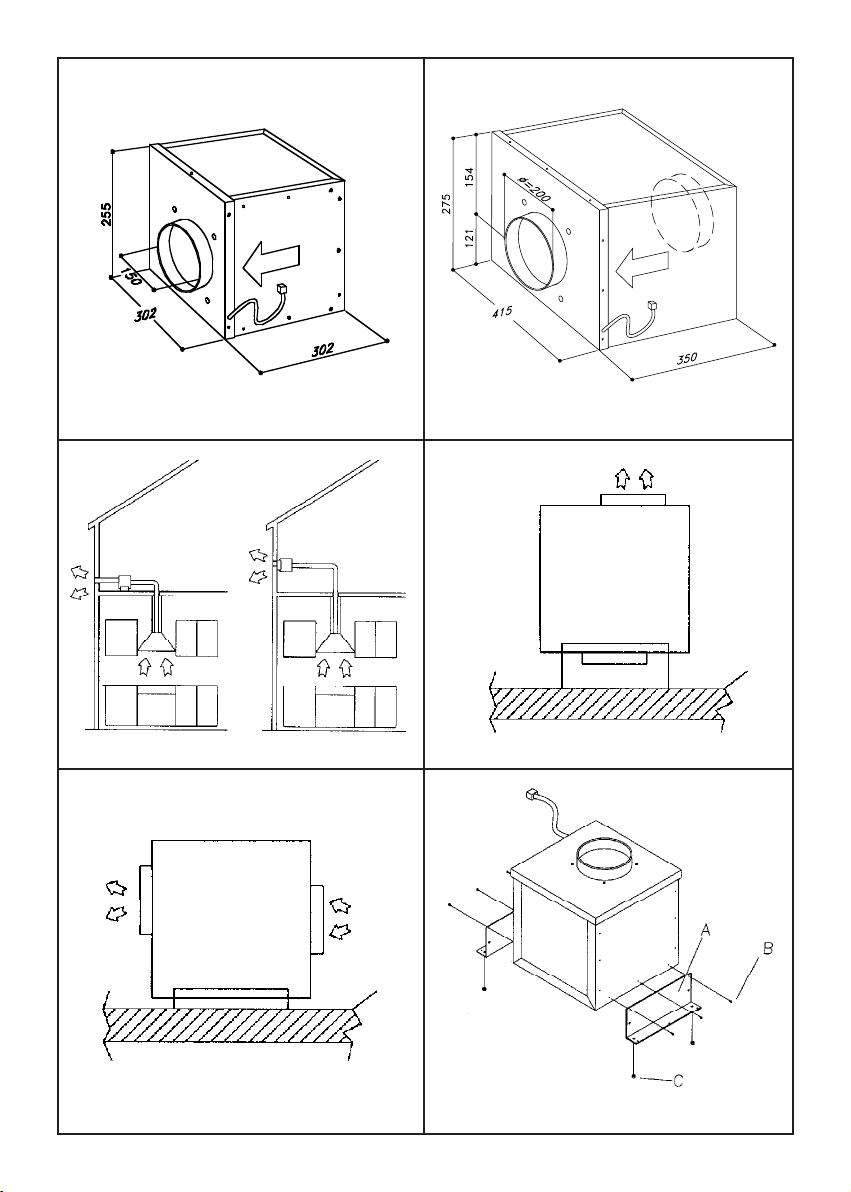
SEM1(dis.1)-SEM8(dis.1a)
Warning!Theperipheralexhaustinggroup(remotettedextractionmotor)isbuiltinclass
II(symbolontheratingplate),thereforeitmustnotbeearthed.
The appliance is designed to exhaust fumes and odours very silently and in the best way. It
must be installed in the house and connected to the cooker-hood, which is in the kitchen (g.
2)
Typesofinstallation: to make the installation easy, the appliance can be xed on the wall,
on the ceiling or on the oor in a horizontal position (g. 3 ) or vertically (g. 4) to the xing
level.
Note:intheverticalxing,thebracketssuppliedcanbeusedonlyonthelongestside(g.6).
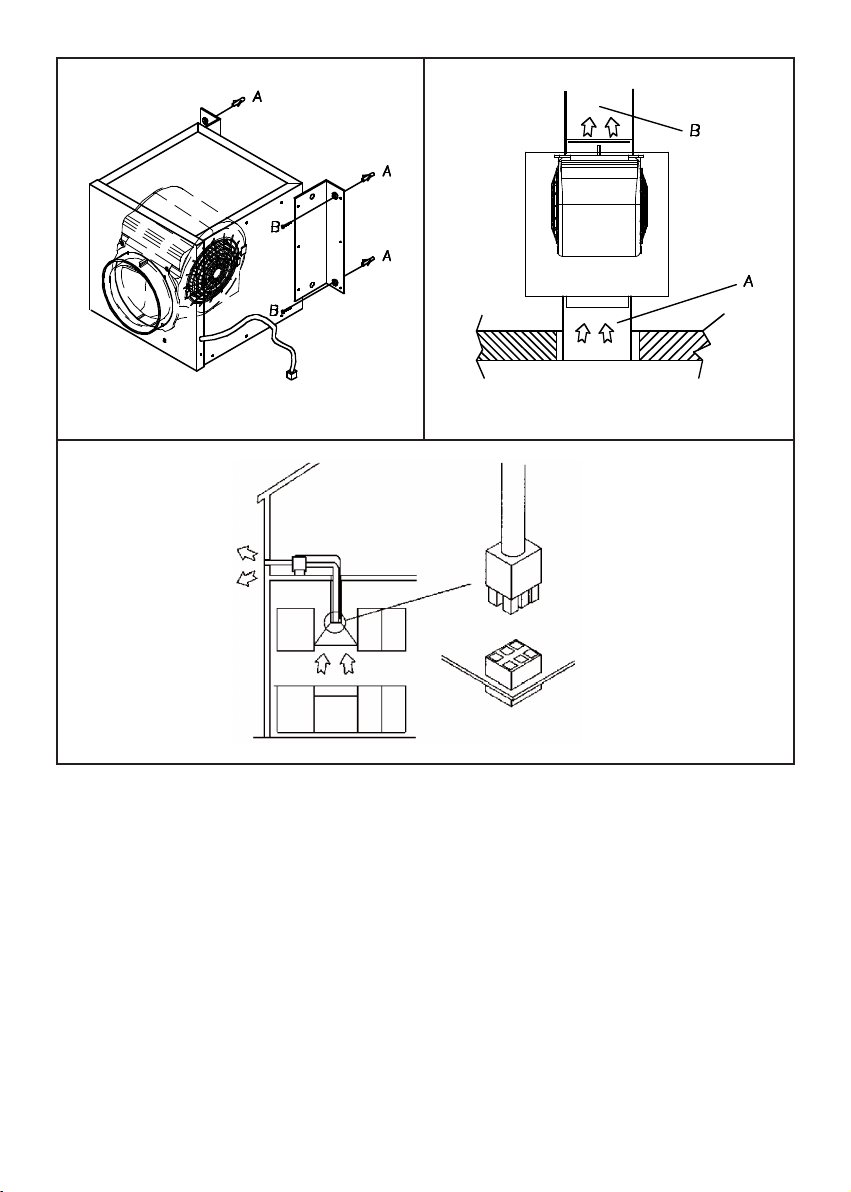
Installationoftheappliance: after deciding the position and the type of installation, insert the
anti-vibration rubber caps in the holes of the brackets supplied (g. 5C).
Therubbercapsmustbeputonthesideswhichareincontactwiththewall.
Put the brackets (g. 5A) on the remote tted extraction motor by matching its holes with those
of the brackets. Fix with the screws supplied (g. 5B).
Put the group on the point previously chosen for the installation and mark the points on the wall
where the holes must be drilled.
Insert the dowels supplied in the holes (g. 6A). Put the remote tted extraction motor on the
wall by matching the holes of the brackets with the plastic dowels. Screw with the screws sup-
plied (g. 6B).
Connectionofthepipes: the appliance is endowed with an entrance and an outlet to connect
the pipes. Before connecting the exhaust pipes, check the direction of the air showed on the
external label (g. 7). Connect the pipes and x them with appropriate metal clamps (exhaust
pipes and metal clamps have to be supplied by the installer). The pipe (g. 7A) must be con-
nected with the cooker-hood placed in the kitchen, and the pipe (g. 7B) must be directed
outside the building.
ElectricalconnectionofthehoodSEM1: the appliance is equipped with a 7m electrical ca-
ble with a six- pin connection at one end. Insert it into the hood’s connection (External Motor
version)
ElectricalconnectiontothehoodSEM8:the unit is supplied with a pipe 7 meters long. After
having let the cable pass through the plastic pipe (g. 12E) placed in the wall (g. 12D), placed
it closed to the unit and connect the 6 poles connector (g. 12E) and the 2 poles connector (g.
12G).
5

SEM2(g.9)
Warning!Theremotettedexhaustinggroup(externalmotor)isbuiltinclassIplate,the-
reforeitneedstheearthconnection.
The appliance was designed to exhaust odours and vapours in the best way. The appliance is
to be installed on the outside wall of the house and connetted to the cooker-hood which is in
the kitchen (g. 10)
Installation: the mounting of the appliance is to be made by qualied technicians. Using the
appropriate drilling jig (g. 11) drill all the holes marked on it into the external wall, by paying
attention not to damage water pipes or power lines.
Theholesonthewallaretobedrilledwitha8mm.bit.Insert,stepbystep,thefollowing
partsintheholesdrilled:
- the corresponding plastic dowels supplied (g. 11A)
- the two telescopic pipes in the hole of 160 mm.
- the plastic pipe of 40 mm. diameter.
Before leaning the appliance against the wall, insert the supply cord in the plastic pipe. Fix the
appliance without the stainless steel external body, which was previously removed from the
motor block, by matching the holes of the motor block with the holes on the wall. Tighten with
the screws supplied (g.11B).
Connectionofthepipes: the appliance is endowed with an air entrance to be connected with
the telescopic pipes and an air outlet.
After xing the appliance on the external wall, connect the two telescopic pipes, which are pla-
ced inside the wall, with the cooker-hood through the exible pipes (g. 12).
The xing between the pipes have to be made with appropriate metal clamps (pipes and clamps
are supplied by the installer).
Electricalconnectiontothehood:
the unit is supplied with a pipe 7 meters long. After having let the cable pass through the plastic
pipe (g. 12E) placed in the wall (g. 12D), placed it closed to the unit and connect the 6 poles
connector (Fig. 12E) and the 2 poles connector (Fig. 12G).
In order to avoid water inltrations, please apply silicone on the product perimeter, close to
the wall.
Installationofthestainlesssteelexternalbody: put the stainless steel body again, by ma-
tching the air exhausting grid with the air outlet of the motor block (g. 13).
6

SEM5(g.21)
Warning! The remote tted exhausting group (external motor) is built in class II (see
symbolontheratingplate),thereforeitmustnotbeearthed.
This model has been specically studied to suction vapours and odours without noise.It should
be installed outside and connected to the hood in the kitchen (g. 22).
Roofinstallation: make a 22 x 22 cm square opening on the roof, and then insert the lower part
of the remote tted exhausting motor (g. 23).
Put the two brackets as shown in g 24A and mark the holes you are going to drill on the lower
part of the remote tted exhausting motor.
Make all the holes, and then fasten securely.
Insert the pipe connecting the hood outlet line with the upper part of the remote tted extrac-
tion motor (g.25A); the pipe should pass into the lower part of the remote tted exhausting
motor (g. 25).
Fix the pipe to the upper part of the remote tted exhausting motor with a metal hose clamp.
Assembly the upper and the lower part of the remote tted exhausting motor using the 8 screws
provided (g.25B).
Electricalconnectionofthehood: the appliance is equipped with a 7m electrical cable. Con-
nect it to the six-pin connection of the appliance in the kitchen.
7

SEM7(dis.27)
Warning!
The remote tted exhausting group (external motor) is built in class I plate, therefore it needs
the earth connection.
The appliance was designed to exhaust odors and vapors in the best way. The appliance is to
be installed on the outside wall of the house and connected to the cooker-hood which is in the
kitchen (g. 28)
Installation:
the mounting of the appliance is to be made by qualied technicians. Using the appropriate
drilling jig (g. 29) drill all the holes marked on it into the external wall, by paying attention not
to damage water pipes or power lines. The holes on the wall are to be drilled with a 8 mm. bit.
Insert,stepbystep,thefollowingpartsintheholesdrilled:
- the corresponding plastic dowels supplied (g. 29)
- the two telescopic pipes in the hole of 200 mm.
- the plastic pipe of 40 mm. diameter.
Before leaning the appliance against the wall, please remove the stainless steel carter using the
8 perimetrical screws (g. 30), then insert the supply cord in the plastic pipe. Fix the appliance
without the stainless steel external body, which was previously removed from the motor block,
by matching the holes of the motor block with the holes on the wall. Tighten with the screws
supplied.
Connectionofthepipes:
the appliance is endowed with an air entrance to be connected with the telescopic pipes and an
air outlet. After xing the appliance on the external wall, connect the two telescopic pipes (g.
12C), which are placed inside the wall, with the cooker-hood through the exible pipes.
The xing operations have to be carried out by using suitable metallic tools (pipes and tools
have to be supplied by the installers).
Electricalconnectiontothehood:
the unit is supplied with a pipe 7 meters long. After having let the cable pass through the plastic
pipe (g. 12E) placed in the wall (g. 12D), placed it closed to the unit and connect the 6 poles
connector (Fig. 12E) and the 2 poles connector (Fig. 12G).
In order to avoid water inltrations, please apply silicone on the product perimeter, close to
the wall.
Installationoftheexternalcarter:
mount the aesthetic carter making sure that the grill will match with the block motor air outlet
(dis. 30).
8
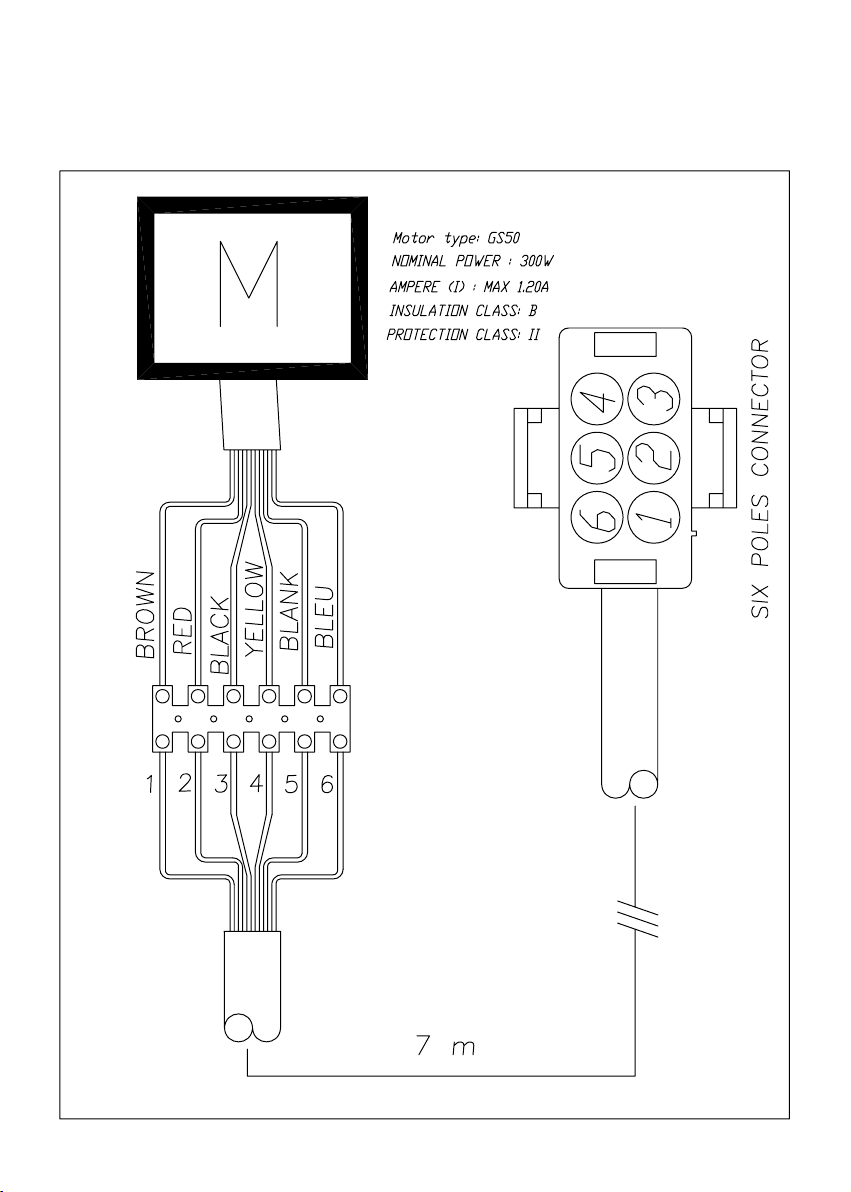
9
WIRING DIAGRAM SEM1 - SEM5
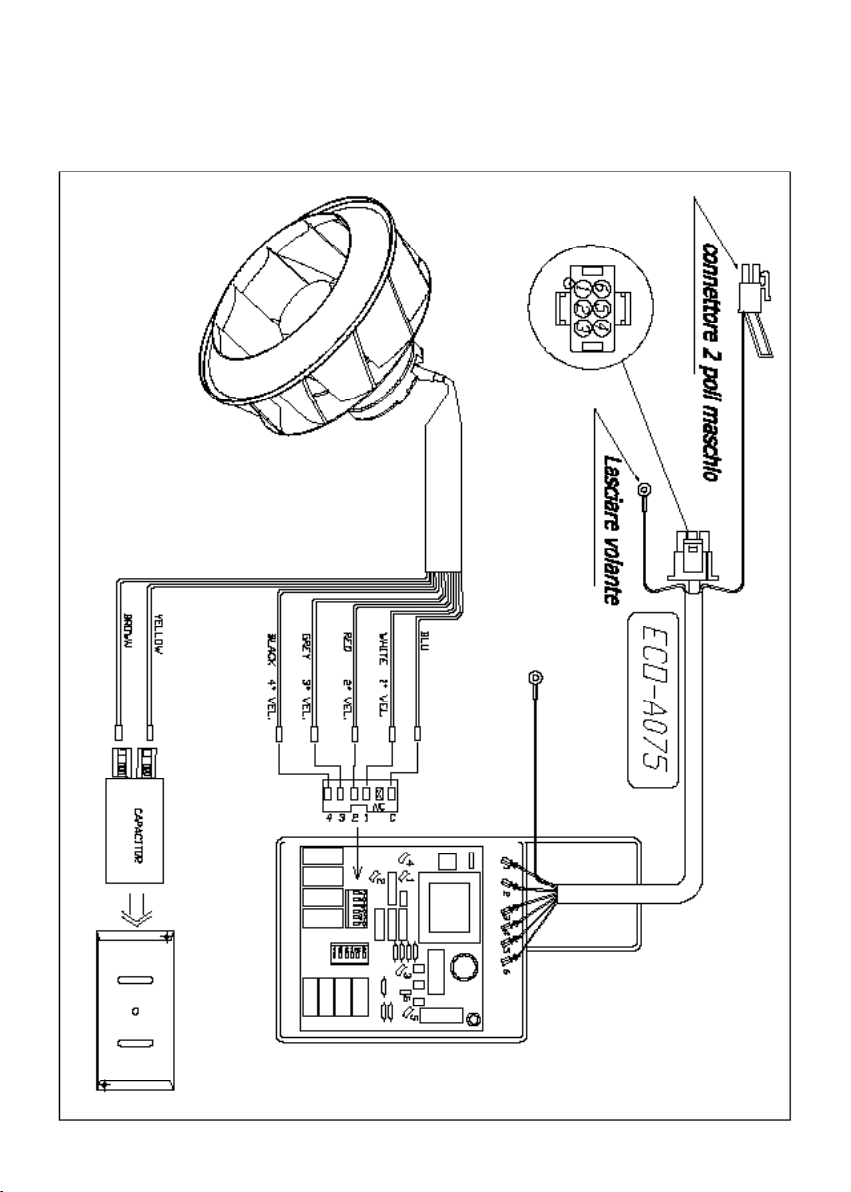
10
WIRING DIAGRAM SEM2
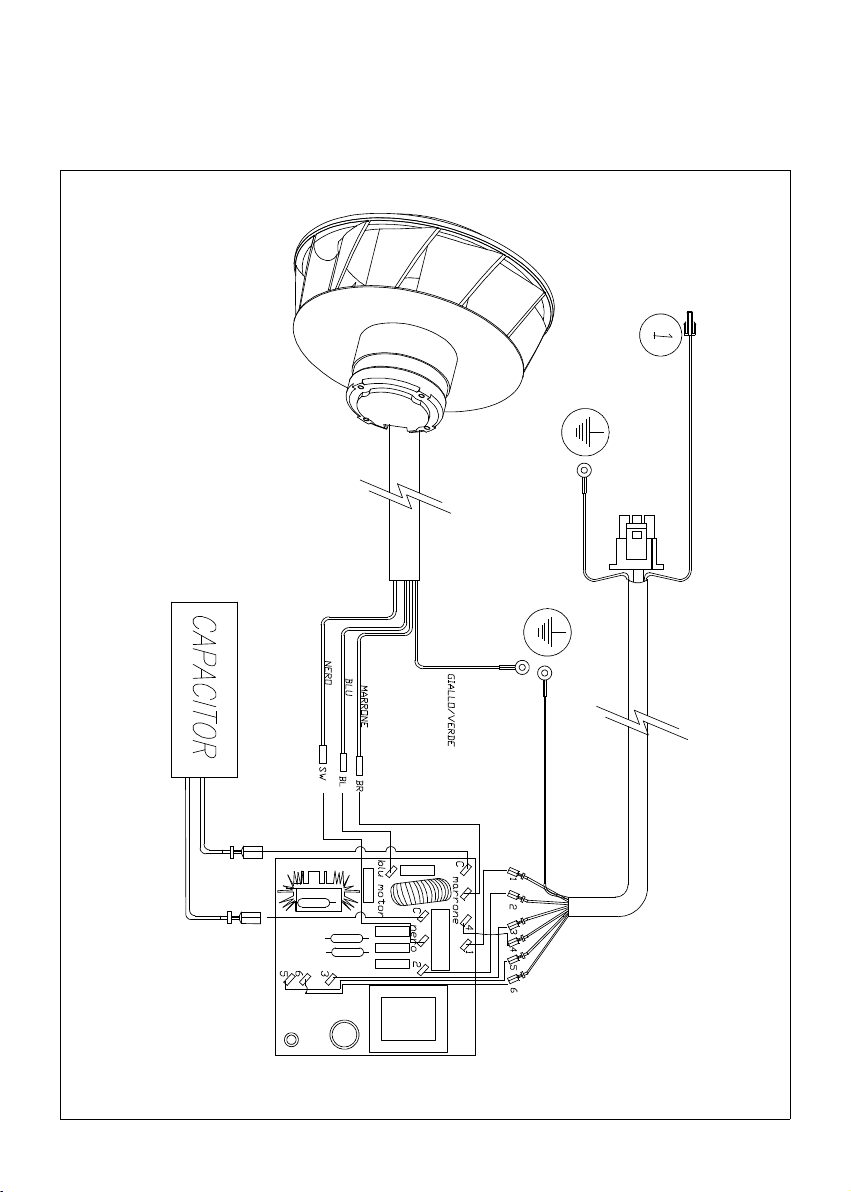
11
WIRING DIAGRAM SEM7
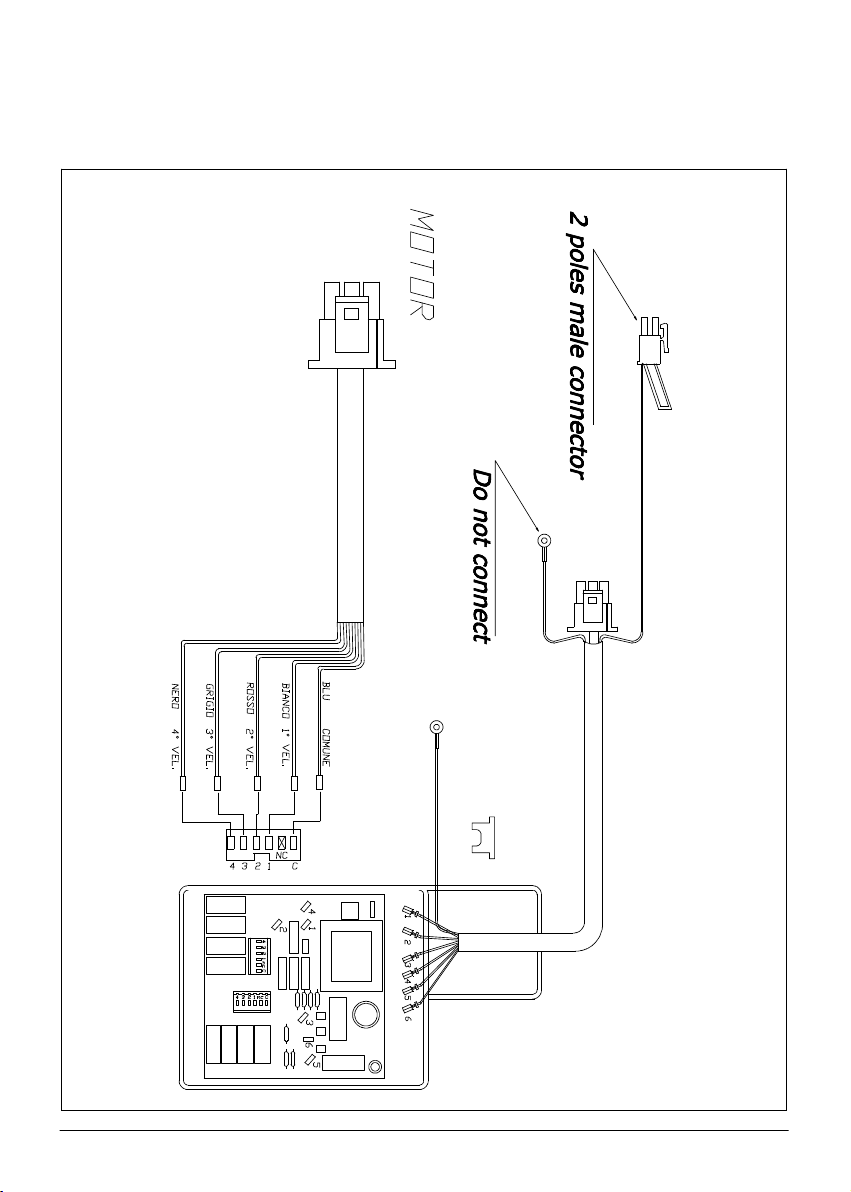
12
WIRING DIAGRAM SEM8
13
1a
2
5
1
4
2
OK
OK
OK
OK
OK
OK
OK
OK
OK
OK
OK
OK
OK
OK
OK OK
OK
OK
OK
OK
OK
OK
OK
SEM 1
(dis.1)
Attenzione! Il gruppo di aspirazione periferico (centralina) SEM 1 è in classe II (simbolo sulla targhetta dati tecnici
), pertanto non necessita di collegamento a terra.
L’appa recchio è stato progettato per aspirare i vapori e gli odori in modo otti male con estrema silenziosità.
L’apparecchio dovrà essere istallato all’interno dell’abitazione collegandolo alla cappa che si trova in cucina (dis.2) o alla
unità di comando SCET - 1.
Modalità di fissaggio: per facilitare le operazioni di in
stallazione, l’apparecchio può essere fissato a parete, a soffitto o
sul pavimento in posizione orizzontale (dis.3) o verticale (dis.4) rispetto al piano di fissaggio.
NOTA: Nel caso del fissaggio verticale, si possono utilizzare le staffe in dotazione solo dalla parte più lunga (fig. 6).
Fissaggio dell’apparecchio: una volta stabilito la posizione e il modo di fissaggio, bisogna introdurre i gommini anti-
vibrazioni nelle staffe in dotazione (dis.5C).
I gommini
vanno messi nei lati che andranno a contatto con il muro.
Appoggiare le staffe (dis.5A) sulla centralina facendo coincidere i fori di quest’ultima con quelli delle staffe e fissare con
le viti in dotazione (dis.5B)
Appoggiare il tutto nel punto di fissaggio deciso in precedenza segnando, sulla parete, i punti dove bisognerà effettuare i fori.
Nei fori eseguiti inserire i tasselli in dotazione (dis.6A).
Appoggiare la centralina sulla parete facendo coincidere i fori de
lle staffe con i tasselli in plastica e avvitare il tutto con le
viti in dotazione (dis.6B).
Collegamento dei tubi: l’apparecchio è predisposto con un’entrata e un’uscita per il collegamento dei tubi (verificare la
direzione dell’aria tramite l’etichetta esterna prima del montaggio dei tubi di evacuazione dis.7), collegare i tubi e fissarli
con idonee fascette metalliche (tubi e fascette sono a cura dell’installatore). Il tubo (dis.7A) va collegato alla cappa posta
nella cucina, il tubo (dis.7B) va indirizzato ve
rso l’esterno dell’edificio.
Collegamento elettrico alla cappa: l’apparecchio è dotato di un cavo di collegamento lungo 7 metri. Il cavo, alla sua estremità,
ha una connessione a sei poli che deve essere inserita in quella fissata sulla cappa (dis.8) o alla unità di comando SCET - 1.
SEM 2
(dis.9)
Attenzione! Il gruppo di aspirazione periferico (centralina) SEM 2 è in classe I e pertanto necessita di collegamento
a terra.
L’apparecc
hio è stato progettato per aspirare i vapori e gli odori in modo ottimale.
L’apparecchio dovrà essere istallato all’esterno dell’abitazione collegandolo alla cappa che si trova in cucina (dis.10) o alla
unità di comando SCET - 1.
Modalità di fissaggio: il montaggio dell’apparecchio deve essere effettuato da personale qualificato. Usando l’apposita
maschera di foratura (dis.11) praticare sulla parete esterna tutti i fori indicati nella stessa facendo attenzione a non
danneggiare tubature dell’a
cqua o linee elettriche.
I fori alla parete dovranno essere effettuati con una punta da da 8 mm. Nei fori praticati dovranno essere progressivamente:
•Inseriti i relativi tasselli in plastica in dotazione (dis.11A).
•Inseriti i due tubi telescopici nel foro da 160 mm.
•Inserire il tubo in plastica da 40 mm.
Prima di appoggiare l’apparecchio sul muro bisogna inserire la connessione elettrica nel tubo in plastica. Fissare l
’apparecchio
senza carter estetico in acciaio, precedentemente tolto dal blocco motore, facendo coincidere i fori del blocco motore
stesso con i fori sul muro e serrando con le viti in dotazione (dis.11B).
Collegamento dei tubi: l’apparecchio è predisposto con un entrata dell’aria per il collegamento dei tubi telescopici, e un
uscita.
Dopo che l’apparecchio è stato fissato alla parete esterna, i due tubi telescopici posti all’interno della parete devono essere
colle
gati con la cappa tramite i tubi flessibili (dis.12).
Il fissaggio tra i tubi deve essere effettuato con idonee fascette metalliche (tubi e fascette sono a cura dell’installatore).
Collegamento elettrico alla cappa: l’apparecchio è dotato di un cavo di collegamento lungo 7 metri. Dopo aver fatto
passare il cavo attraverso il tubo in plastica posto nel muro, inserire la connessione a sei poli sulla cappa e collegare il
filo messa a terra sulla vite adiacente alla connessione tramite dado e rondella (dis.14), in
alternativa il collegamento
elettrico va fatto alla unità di comando SCET - 1.
Al fine di evitare possibili infiltrazioni d'acqua disporre accuratamente del silicone in corrispondenza del perimetro del
prodotto, in prossimità del muro.
Montaggio carter esterno: rimontare il carter estetico facendo coincidere la griglia con l’uscita aria del blocco motore (dis.13).
47
SEM 1
(fig.1)
Warning! The peripheral exhausting group (remote fitted extract
ion motor) is built in class II (symbol on the rating
plate), therefore it must not be earthed.
The appliance is designed to exhaust fumes and odours very silently and in the best way. It must be installed in the house
and connected to the cooker-hood, which is in the kitchen (fig. 2) or to the SCET control unit 1.
Types of installation: to make the installation easy, the appliance can be fixed on the wall, on the ceiling or on the floor
in a horizon
tal position (fig. 3 ) or vertically (fig. 4) to the fixing level.
Note: in the vertical fixing, the brackets supplied can be used only on the longest side (fig. 6).
Installation of the appliance: after deciding the position and the type of installation, insert the anti-vibration rubber caps
in the holes of the brackets supplied (fig. 5C).
The rubber caps must be put on the sides which are in contact with the wall.
Put the brackets (fig. 5A) on the remote fitted extract
ion motor by matching its holes with those of the brackets. Fix with
the screws supplied (fig. 5B).
Put the group on the point previously chosen for the installation and mark the points on the wall where the holes must
be drilled.
Insert the dowels supplied in the holes (fig. 6A). Put the remote fitted extraction motor on the wall by matching the holes
of the brackets with the plastic dowels. Screw with the screws supplied (fig. 6B).
Connection of the pipes: the appliance is endowed with an entra
nce and an outlet to connect the pipes. Before connecting
the exhaust pipes, check the direction of the air showed on the external label (fig. 7). Connect the pipes and fix them with
appropriate metal clamps (exhaust pipes and metal clamps have to be supplied by the installer). The pipe (fig. 7A) must
be connected with the cooker-hood placed in the kitchen, and the pipe (fig. 7B) must be directed outside the building.
Electrical connection of the hood: the appliance is equipped with a 7m elec
trical cable with a six- pin connection at one
end. Insert it into the hood’s connection (External Motor version) or into the SCET-1 central unit (see fig. 8 for the end
result).
SEM 2
(fig.9)
Warning! The remote fitted exhausting group (external motor) is built in class I plate, therefore it needs the earth
connection.
The appliance was designed to exhaust odours and vapours in the best way. The appliance is to be installed on the outside
wall of the house and connetted to the cooker-hood
which is in the kitchen (fig. 10) or to the SCET control unit 1.
Installation: the mounting of the appliance is to be made by qualified technicians. Using the appropriate drilling jig (fig.
11) drill all the holes marked on it into the external wall, by paying attention not to damage water pipes or power lines.
The holes on the wall are to be drilled with a 8 mm. bit. Insert, step by step, the following parts in the holes drilled:
•the corresponding plastic dowels supplied (fig. 11A)
•the two telescopic pipes in the hole of 16
0 mm.
•the plastic pipe of 40 mm. diameter.
Before leaning the appliance against the wall, insert the supply cord in the plastic pipe. Fix the appliance without the
stainless steel external body, which was previously removed from the motor block, by matching the holes of the motor
block with the holes on the wall. Tighten with the screws supplied (fig.11B).
Connection of the pipes: the appliance is endowed with an air entrance to be connected with the telescopic pipes and an
air outlet.
After fix
ing the appliance on the external wall, connect the two telescopic pipes, which are placed inside the wall, with the
cooker-hood through the flexible pipes (fig. 12).
The fixing between the pipes have to be made with appropriate metal clamps (pipes and clamps are supplied by the
installer).
Electrical connection of the hood: the appliance is equipped with a 7m electrical cable. Make the cable pass through the
plastic hose in the wall (see fig. 12E), connect it to the appliance in the kitchen and
then connect the ground wire to the
screw near the connection by means of nut and washer (see fig. 14). You can otherwise make the electrical connection
to the SCET-1 central unit.
In order to avoid water infiltrations, pl eas eapply silicon e on theproduc t per imeter, close to the wall.
Installation of the stainless steel external body: put the stainless steel body again, by matching the air exhausting grid
with the air outlet of the motor block (fig. 13).
90004200072 - GM 07/10
23
19
SEM 1
1 2
3
4 5
6 7
8
2
OK
OK
OK
OK
OK
OK
OK
OK
OK
OK
OK
OK
OK
OK
OK OK
OK
OK
OK
OK
OK
OK
OK
SEM 1 (dis.1)
Attenzione! Il gruppo di aspirazione periferico (centralina) SEM 1 è in classe II (simbolo sulla targhetta dati tecnici
), pertanto non necessita di collegamento a terra.
L’appa recchio è stato progettato per aspirare i vapori e gli odori in modo otti male con estrema silenziosità.
L’apparecchio dovrà essere istallato all’interno dell’abitazione collegandolo alla cappa che si trova in cucina (dis.2) o alla
unità di comando SCET - 1.
Modalità di fissaggio: per facilitare le operazioni di in
stallazione, l’apparecchio può essere fissato a parete, a soffitto o
sul pavimento in posizione orizzontale (dis.3) o verticale (dis.4) rispetto al piano di fissaggio.
NOTA: Nel caso del fissaggio verticale, si possono utilizzare le staffe in dotazione solo dalla parte più lunga (fig. 6).
Fissaggio dell’apparecchio: una volta stabilito la posizione e il modo di fissaggio, bisogna introdurre i gommini anti-
vibrazioni nelle staffe in dotazione (dis.5C).
I gommini
vanno messi nei lati che andranno a contatto con il muro.
Appoggiare le staffe (dis.5A) sulla centralina facendo coincidere i fori di quest’ultima con quelli delle staffe e fissare con
le viti in dotazione (dis.5B)
Appoggiare il tutto nel punto di fissaggio deciso in precedenza segnando, sulla parete, i punti dove bisognerà effettuare i fori.
Nei fori eseguiti inserire i tasselli in dotazione (dis.6A).
Appoggiare la centralina sulla parete facendo coincidere i fori de
lle staffe con i tasselli in plastica e avvitare il tutto con le
viti in dotazione (dis.6B).
Collegamento dei tubi: l’apparecchio è predisposto con un’entrata e un’uscita per il collegamento dei tubi (verificare la
direzione dell’aria tramite l’etichetta esterna prima del montaggio dei tubi di evacuazione dis.7), collegare i tubi e fissarli
con idonee fascette metalliche (tubi e fascette sono a cura dell’installatore). Il tubo (dis.7A) va collegato alla cappa posta
nella cucina, il tubo (dis.7B) va indirizzato ve
rso l’esterno dell’edificio.
Collegamento elettrico alla cappa: l’apparecchio è dotato di un cavo di collegamento lungo 7 metri. Il cavo, alla sua estremità,
ha una connessione a sei poli che deve essere inserita in quella fissata sulla cappa (dis.8) o alla unità di comando SCET - 1.
SEM 2 (dis.9)
Attenzione! Il gruppo di aspirazione periferico (centralina) SEM 2 è in classe I e pertanto necessita di collegamento
a terra.
L’apparecc
hio è stato progettato per aspirare i vapori e gli odori in modo ottimale.
L’apparecchio dovrà essere istallato all’esterno dell’abitazione collegandolo alla cappa che si trova in cucina (dis.10) o alla
unità di comando SCET - 1.
Modalità di fissaggio: il montaggio dell’apparecchio deve essere effettuato da personale qualificato. Usando l’apposita
maschera di foratura (dis.11) praticare sulla parete esterna tutti i fori indicati nella stessa facendo attenzione a non
danneggiare tubature dell’a
cqua o linee elettriche.
I fori alla parete dovranno essere effettuati con una punta da da 8 mm. Nei fori praticati dovranno essere progressivamente:
•Inseriti i relativi tasselli in plastica in dotazione (dis.11A).
•Inseriti i due tubi telescopici nel foro da 160 mm.
•Inserire il tubo in plastica da 40 mm.
Prima di appoggiare l’apparecchio sul muro bisogna inserire la connessione elettrica nel tubo in plastica. Fissare l
’apparecchio
senza carter estetico in acciaio, precedentemente tolto dal blocco motore, facendo coincidere i fori del blocco motore
stesso con i fori sul muro e serrando con le viti in dotazione (dis.11B).
Collegamento dei tubi: l’apparecchio è predisposto con un entrata dell’aria per il collegamento dei tubi telescopici, e un
uscita.
Dopo che l’apparecchio è stato fissato alla parete esterna, i due tubi telescopici posti all’interno della parete devono essere
colle
gati con la cappa tramite i tubi flessibili (dis.12).
Il fissaggio tra i tubi deve essere effettuato con idonee fascette metalliche (tubi e fascette sono a cura dell’installatore).
Collegamento elettrico alla cappa: l’apparecchio è dotato di un cavo di collegamento lungo 7 metri. Dopo aver fatto
passare il cavo attraverso il tubo in plastica posto nel muro, inserire la connessione a sei poli sulla cappa e collegare il
filo messa a terra sulla vite adiacente alla connessione tramite dado e rondella (dis.14), in
alternativa il collegamento
elettrico va fatto alla unità di comando SCET - 1.
Al fine di evitare possibili infiltrazioni d'acqua disporre accuratamente del silicone in corrispondenza del perimetro del
prodotto, in prossimità del muro.
Montaggio carter esterno: rimontare il carter estetico facendo coincidere la griglia con l’uscita aria del blocco motore (dis.13).
47
SEM 1 (fig.1)
Warning! The peripheral exhausting group (remote fitted extract
ion motor) is built in class II (symbol on the rating
plate), therefore it must not be earthed.
The appliance is designed to exhaust fumes and odours very silently and in the best way. It must be installed in the house
and connected to the cooker-hood, which is in the kitchen (fig. 2) or to the SCET control unit 1.
Types of installation: to make the installation easy, the appliance can be fixed on the wall, on the ceiling or on the floor
in a horizon
tal position (fig. 3 ) or vertically (fig. 4) to the fixing level.
Note: in the vertical fixing, the brackets supplied can be used only on the longest side (fig. 6).
Installation of the appliance: after deciding the position and the type of installation, insert the anti-vibration rubber caps
in the holes of the brackets supplied (fig. 5C).
The rubber caps must be put on the sides which are in contact with the wall.
Put the brackets (fig. 5A) on the remote fitted extract
ion motor by matching its holes with those of the brackets. Fix with
the screws supplied (fig. 5B).
Put the group on the point previously chosen for the installation and mark the points on the wall where the holes must
be drilled.
Insert the dowels supplied in the holes (fig. 6A). Put the remote fitted extraction motor on the wall by matching the holes
of the brackets with the plastic dowels. Screw with the screws supplied (fig. 6B).
Connection of the pipes: the appliance is endowed with an entra
nce and an outlet to connect the pipes. Before connecting
the exhaust pipes, check the direction of the air showed on the external label (fig. 7). Connect the pipes and fix them with
appropriate metal clamps (exhaust pipes and metal clamps have to be supplied by the installer). The pipe (fig. 7A) must
be connected with the cooker-hood placed in the kitchen, and the pipe (fig. 7B) must be directed outside the building.
Electrical connection of the hood: the appliance is equipped with a 7m elec
trical cable with a six- pin connection at one
end. Insert it into the hood’s connection (External Motor version) or into the SCET-1 central unit (see fig. 8 for the end
result).
SEM 2 (fig.9)
Warning! The remote fitted exhausting group (external motor) is built in class I plate, therefore it needs the earth
connection.
The appliance was designed to exhaust odours and vapours in the best way. The appliance is to be installed on the outside
wall of the house and connetted to the cooker-hood
which is in the kitchen (fig. 10) or to the SCET control unit 1.
Installation: the mounting of the appliance is to be made by qualified technicians. Using the appropriate drilling jig (fig.
11) drill all the holes marked on it into the external wall, by paying attention not to damage water pipes or power lines.
The holes on the wall are to be drilled with a 8 mm. bit. Insert, step by step, the following parts in the holes drilled:
•the corresponding plastic dowels supplied (fig. 11A)
•the two telescopic pipes in the hole of 16
0 mm.
•the plastic pipe of 40 mm. diameter.
Before leaning the appliance against the wall, insert the supply cord in the plastic pipe. Fix the appliance without the
stainless steel external body, which was previously removed from the motor block, by matching the holes of the motor
block with the holes on the wall. Tighten with the screws supplied (fig.11B).
Connection of the pipes: the appliance is endowed with an air entrance to be connected with the telescopic pipes and an
air outlet.
After fix
ing the appliance on the external wall, connect the two telescopic pipes, which are placed inside the wall, with the
cooker-hood through the flexible pipes (fig. 12).
The fixing between the pipes have to be made with appropriate metal clamps (pipes and clamps are supplied by the
installer).
Electrical connection of the hood: the appliance is equipped with a 7m electrical cable. Make the cable pass through the
plastic hose in the wall (see fig. 12E), connect it to the appliance in the kitchen and
then connect the ground wire to the
screw near the connection by means of nut and washer (see fig. 14). You can otherwise make the electrical connection
to the SCET-1 central unit.
In or der to avoid water infiltrations, pl eas eapp ly silicon e on theproduc t per imeter, clos e to the wall.
Installation of the stainless steel external body: put the stainless steel body again, by matching the air exhausting grid
with the air outlet of the motor block (fig. 13).
90004200072 - GM 07/10
23
19
SEM 1
1 2
3
4 5
6 7
8
3
2
OK
OK
OK
OK
OK
OK
OK
OK
OK
OK
OK
OK
OK
OK
OK OK
OK
OK
OK
OK
OK
OK
OK
SEM 1 (dis.1)
Attenzione! Il gruppo di aspirazione periferico (centralina) SEM 1 è in classe II (simbolo sulla targhetta dati tecnici
), pertanto non necessita di collegamento a terra.
L’appa recchio è stato progettato per aspirare i vapori e gli odori in modo otti male con estrema silenziosità.
L’apparecchio dovrà essere istallato all’interno dell’abitazione collegandolo alla cappa che si trova in cucina (dis.2) o alla
unità di comando SCET - 1.
Modalità di fissaggio: per facilitare le operazioni di in
stallazione, l’apparecchio può essere fissato a parete, a soffitto o
sul pavimento in posizione orizzontale (dis.3) o verticale (dis.4) rispetto al piano di fissaggio.
NOTA: Nel caso del fissaggio verticale, si possono utilizzare le staffe in dotazione solo dalla parte più lunga (fig. 6).
Fissaggio dell’apparecchio: una volta stabilito la posizione e il modo di fissaggio, bisogna introdurre i gommini anti-
vibrazioni nelle staffe in dotazione (dis.5C).
I gommini
vanno messi nei lati che andranno a contatto con il muro.
Appoggiare le staffe (dis.5A) sulla centralina facendo coincidere i fori di quest’ultima con quelli delle staffe e fissare con
le viti in dotazione (dis.5B)
Appoggiare il tutto nel punto di fissaggio deciso in precedenza segnando, sulla parete, i punti dove bisognerà effettuare i fori.
Nei fori eseguiti inserire i tasselli in dotazione (dis.6A).
Appoggiare la centralina sulla parete facendo coincidere i fori de
lle staffe con i tasselli in plastica e avvitare il tutto con le
viti in dotazione (dis.6B).
Collegamento dei tubi: l’apparecchio è predisposto con un’entrata e un’uscita per il collegamento dei tubi (verificare la
direzione dell’aria tramite l’etichetta esterna prima del montaggio dei tubi di evacuazione dis.7), collegare i tubi e fissarli
con idonee fascette metalliche (tubi e fascette sono a cura dell’installatore). Il tubo (dis.7A) va collegato alla cappa posta
nella cucina, il tubo (dis.7B) va indirizzato ve
rso l’esterno dell’edificio.
Collegamento elettrico alla cappa: l’apparecchio è dotato di un cavo di collegamento lungo 7 metri. Il cavo, alla sua estremità,
ha una connessione a sei poli che deve essere inserita in quella fissata sulla cappa (dis.8) o alla unità di comando SCET - 1.
SEM 2
(dis.9)
Attenzione! Il gruppo di aspirazione periferico (centralina) SEM 2 è in classe I e pertanto necessita di collegamento
a terra.
L’apparecc
hio è stato progettato per aspirare i vapori e gli odori in modo ottimale.
L’apparecchio dovrà essere istallato all’esterno dell’abitazione collegandolo alla cappa che si trova in cucina (dis.10) o alla
unità di comando SCET - 1.
Modalità di fissaggio: il montaggio dell’apparecchio deve essere effettuato da personale qualificato. Usando l’apposita
maschera di foratura (dis.11) praticare sulla parete esterna tutti i fori indicati nella stessa facendo attenzione a non
danneggiare tubature dell’a
cqua o linee elettriche.
I fori alla parete dovranno essere effettuati con una punta da da 8 mm. Nei fori praticati dovranno essere progressivamente:
•Inseriti i relativi tasselli in plastica in dotazione (dis.11A).
•Inseriti i due tubi telescopici nel foro da 160 mm.
•Inserire il tubo in plastica da 40 mm.
Prima di appoggiare l’apparecchio sul muro bisogna inserire la connessione elettrica nel tubo in plastica. Fissare l
’apparecchio
senza carter estetico in acciaio, precedentemente tolto dal blocco motore, facendo coincidere i fori del blocco motore
stesso con i fori sul muro e serrando con le viti in dotazione (dis.11B).
Collegamento dei tubi: l’apparecchio è predisposto con un entrata dell’aria per il collegamento dei tubi telescopici, e un
uscita.
Dopo che l’apparecchio è stato fissato alla parete esterna, i due tubi telescopici posti all’interno della parete devono essere
colle
gati con la cappa tramite i tubi flessibili (dis.12).
Il fissaggio tra i tubi deve essere effettuato con idonee fascette metalliche (tubi e fascette sono a cura dell’installatore).
Collegamento elettrico alla cappa: l’apparecchio è dotato di un cavo di collegamento lungo 7 metri. Dopo aver fatto
passare il cavo attraverso il tubo in plastica posto nel muro, inserire la connessione a sei poli sulla cappa e collegare il
filo messa a terra sulla vite adiacente alla connessione tramite dado e rondella (dis.14), in
alternativa il collegamento
elettrico va fatto alla unità di comando SCET - 1.
Al fine di evitare possibili infiltrazioni d'acqua disporre accuratamente del silicone in corrispondenza del perimetro del
prodotto, in prossimità del muro.
Montaggio carter esterno: rimontare il carter estetico facendo coincidere la griglia con l’uscita aria del blocco motore (dis.13).
47
SEM 1 (fig.1)
Warning! The peripheral exhausting group (remote fitted extract
ion motor) is built in class II (symbol on the rating
plate), therefore it must not be earthed.
The appliance is designed to exhaust fumes and odours very silently and in the best way. It must be installed in the house
and connected to the cooker-hood, which is in the kitchen (fig. 2) or to the SCET control unit 1.
Types of installation: to make the installation easy, the appliance can be fixed on the wall, on the ceiling or on the floor
in a horizon
tal position (fig. 3 ) or vertically (fig. 4) to the fixing level.
Note: in the vertical fixing, the brackets supplied can be used only on the longest side (fig. 6).
Installation of the appliance: after deciding the position and the type of installation, insert the anti-vibration rubber caps
in the holes of the brackets supplied (fig. 5C).
The rubber caps must be put on the sides which are in contact with the wall.
Put the brackets (fig. 5A) on the remote fitted extract
ion motor by matching its holes with those of the brackets. Fix with
the screws supplied (fig. 5B).
Put the group on the point previously chosen for the installation and mark the points on the wall where the holes must
be drilled.
Insert the dowels supplied in the holes (fig. 6A). Put the remote fitted extraction motor on the wall by matching the holes
of the brackets with the plastic dowels. Screw with the screws supplied (fig. 6B).
Connection of the pipes: the appliance is endowed with an entra
nce and an outlet to connect the pipes. Before connecting
the exhaust pipes, check the direction of the air showed on the external label (fig. 7). Connect the pipes and fix them with
appropriate metal clamps (exhaust pipes and metal clamps have to be supplied by the installer). The pipe (fig. 7A) must
be connected with the cooker-hood placed in the kitchen, and the pipe (fig. 7B) must be directed outside the building.
Electrical connection of the hood: the appliance is equipped with a 7m elec
trical cable with a six- pin connection at one
end. Insert it into the hood’s connection (External Motor version) or into the SCET-1 central unit (see fig. 8 for the end
result).
SEM 2
(fig.9)
Warning! The remote fitted exhausting group (external motor) is built in class I plate, therefore it needs the earth
connection.
The appliance was designed to exhaust odours and vapours in the best way. The appliance is to be installed on the outside
wall of the house and connetted to the cooker-hood
which is in the kitchen (fig. 10) or to the SCET control unit 1.
Installation: the mounting of the appliance is to be made by qualified technicians. Using the appropriate drilling jig (fig.
11) drill all the holes marked on it into the external wall, by paying attention not to damage water pipes or power lines.
The holes on the wall are to be drilled with a 8 mm. bit. Insert, step by step, the following parts in the holes drilled:
•the corresponding plastic dowels supplied (fig. 11A)
•the two telescopic pipes in the hole of 16
0 mm.
•the plastic pipe of 40 mm. diameter.
Before leaning the appliance against the wall, insert the supply cord in the plastic pipe. Fix the appliance without the
stainless steel external body, which was previously removed from the motor block, by matching the holes of the motor
block with the holes on the wall. Tighten with the screws supplied (fig.11B).
Connection of the pipes: the appliance is endowed with an air entrance to be connected with the telescopic pipes and an
air outlet.
After fix
ing the appliance on the external wall, connect the two telescopic pipes, which are placed inside the wall, with the
cooker-hood through the flexible pipes (fig. 12).
The fixing between the pipes have to be made with appropriate metal clamps (pipes and clamps are supplied by the
installer).
Electrical connection of the hood: the appliance is equipped with a 7m electrical cable. Make the cable pass through the
plastic hose in the wall (see fig. 12E), connect it to the appliance in the kitchen and
then connect the ground wire to the
screw near the connection by means of nut and washer (see fig. 14). You can otherwise make the electrical connection
to the SCET-1 central unit.
In order to avoid water infiltrations, pl eas eapply silicon e on theproduc t per imeter, close to the wall.
Installation of the stainless steel external body: put the stainless steel body again, by matching the air exhausting grid
with the air outlet of the motor block (fig. 13).
90004200072 - GM 07/10
23
19
SEM 1
1 2
3
4 5
6 7
8
2
OK
OK
OK
OK
OK
OK
OK
OK
OK
OK
OK
OK
OK
OK
OK OK
OK
OK
OK
OK
OK
OK
OK
SEM 1 (dis.1)
Attenzione! Il gruppo di aspirazione periferico (centralina) SEM 1 è in classe II (simbolo sulla targhetta dati tecnici
), pertanto non necessita di collegamento a terra.
L’appa recchio è stato progettato per aspirare i vapori e gli odori in modo otti male con estrema silenziosità.
L’apparecchio dovrà essere istallato all’interno dell’abitazione collegandolo alla cappa che si trova in cucina (dis.2) o alla
unità di comando SCET - 1.
Modalità di fissaggio: per facilitare le operazioni di in
stallazione, l’apparecchio può essere fissato a parete, a soffitto o
sul pavimento in posizione orizzontale (dis.3) o verticale (dis.4) rispetto al piano di fissaggio.
NOTA: Nel caso del fissaggio verticale, si possono utilizzare le staffe in dotazione solo dalla parte più lunga (fig. 6).
Fissaggio dell’apparecchio: una volta stabilito la posizione e il modo di fissaggio, bisogna introdurre i gommini anti-
vibrazioni nelle staffe in dotazione (dis.5C).
I gommini
vanno messi nei lati che andranno a contatto con il muro.
Appoggiare le staffe (dis.5A) sulla centralina facendo coincidere i fori di quest’ultima con quelli delle staffe e fissare con
le viti in dotazione (dis.5B)
Appoggiare il tutto nel punto di fissaggio deciso in precedenza segnando, sulla parete, i punti dove bisognerà effettuare i fori.
Nei fori eseguiti inserire i tasselli in dotazione (dis.6A).
Appoggiare la centralina sulla parete facendo coincidere i fori de
lle staffe con i tasselli in plastica e avvitare il tutto con le
viti in dotazione (dis.6B).
Collegamento dei tubi: l’apparecchio è predisposto con un’entrata e un’uscita per il collegamento dei tubi (verificare la
direzione dell’aria tramite l’etichetta esterna prima del montaggio dei tubi di evacuazione dis.7), collegare i tubi e fissarli
con idonee fascette metalliche (tubi e fascette sono a cura dell’installatore). Il tubo (dis.7A) va collegato alla cappa posta
nella cucina, il tubo (dis.7B) va indirizzato ve
rso l’esterno dell’edificio.
Collegamento elettrico alla cappa: l’apparecchio è dotato di un cavo di collegamento lungo 7 metri. Il cavo, alla sua estremità,
ha una connessione a sei poli che deve essere inserita in quella fissata sulla cappa (dis.8) o alla unità di comando SCET - 1.
SEM 2 (dis.9)
Attenzione! Il gruppo di aspirazione periferico (centralina) SEM 2 è in classe I e pertanto necessita di collegamento
a terra.
L’apparecc
hio è stato progettato per aspirare i vapori e gli odori in modo ottimale.
L’apparecchio dovrà essere istallato all’esterno dell’abitazione collegandolo alla cappa che si trova in cucina (dis.10) o alla
unità di comando SCET - 1.
Modalità di fissaggio: il montaggio dell’apparecchio deve essere effettuato da personale qualificato. Usando l’apposita
maschera di foratura (dis.11) praticare sulla parete esterna tutti i fori indicati nella stessa facendo attenzione a non
danneggiare tubature dell’a
cqua o linee elettriche.
I fori alla parete dovranno essere effettuati con una punta da da 8 mm. Nei fori praticati dovranno essere progressivamente:
•Inseriti i relativi tasselli in plastica in dotazione (dis.11A).
•Inseriti i due tubi telescopici nel foro da 160 mm.
•Inserire il tubo in plastica da 40 mm.
Prima di appoggiare l’apparecchio sul muro bisogna inserire la connessione elettrica nel tubo in plastica. Fissare l
’apparecchio
senza carter estetico in acciaio, precedentemente tolto dal blocco motore, facendo coincidere i fori del blocco motore
stesso con i fori sul muro e serrando con le viti in dotazione (dis.11B).
Collegamento dei tubi: l’apparecchio è predisposto con un entrata dell’aria per il collegamento dei tubi telescopici, e un
uscita.
Dopo che l’apparecchio è stato fissato alla parete esterna, i due tubi telescopici posti all’interno della parete devono essere
colle
gati con la cappa tramite i tubi flessibili (dis.12).
Il fissaggio tra i tubi deve essere effettuato con idonee fascette metalliche (tubi e fascette sono a cura dell’installatore).
Collegamento elettrico alla cappa: l’apparecchio è dotato di un cavo di collegamento lungo 7 metri. Dopo aver fatto
passare il cavo attraverso il tubo in plastica posto nel muro, inserire la connessione a sei poli sulla cappa e collegare il
filo messa a terra sulla vite adiacente alla connessione tramite dado e rondella (dis.14), in
alternativa il collegamento
elettrico va fatto alla unità di comando SCET - 1.
Al fine di evitare possibili infiltrazioni d'acqua disporre accuratamente del silicone in corrispondenza del perimetro del
prodotto, in prossimità del muro.
Montaggio carter esterno: rimontare il carter estetico facendo coincidere la griglia con l’uscita aria del blocco motore (dis.13).
47
SEM 1 (fig.1)
Warning! The peripheral exhausting group (remote fitted extract
ion motor) is built in class II (symbol on the rating
plate), therefore it must not be earthed.
The appliance is designed to exhaust fumes and odours very silently and in the best way. It must be installed in the house
and connected to the cooker-hood, which is in the kitchen (fig. 2) or to the SCET control unit 1.
Types of installation: to make the installation easy, the appliance can be fixed on the wall, on the ceiling or on the floor
in a horizon
tal position (fig. 3 ) or vertically (fig. 4) to the fixing level.
Note: in the vertical fixing, the brackets supplied can be used only on the longest side (fig. 6).
Installation of the appliance: after deciding the position and the type of installation, insert the anti-vibration rubber caps
in the holes of the brackets supplied (fig. 5C).
The rubber caps must be put on the sides which are in contact with the wall.
Put the brackets (fig. 5A) on the remote fitted extract
ion motor by matching its holes with those of the brackets. Fix with
the screws supplied (fig. 5B).
Put the group on the point previously chosen for the installation and mark the points on the wall where the holes must
be drilled.
Insert the dowels supplied in the holes (fig. 6A). Put the remote fitted extraction motor on the wall by matching the holes
of the brackets with the plastic dowels. Screw with the screws supplied (fig. 6B).
Connection of the pipes: the appliance is endowed with an entra
nce and an outlet to connect the pipes. Before connecting
the exhaust pipes, check the direction of the air showed on the external label (fig. 7). Connect the pipes and fix them with
appropriate metal clamps (exhaust pipes and metal clamps have to be supplied by the installer). The pipe (fig. 7A) must
be connected with the cooker-hood placed in the kitchen, and the pipe (fig. 7B) must be directed outside the building.
Electrical connection of the hood: the appliance is equipped with a 7m elec
trical cable with a six- pin connection at one
end. Insert it into the hood’s connection (External Motor version) or into the SCET-1 central unit (see fig. 8 for the end
result).
SEM 2
(fig.9)
Warning! The remote fitted exhausting group (external motor) is built in class I plate, therefore it needs the earth
connection.
The appliance was designed to exhaust odours and vapours in the best way. The appliance is to be installed on the outside
wall of the house and connetted to the cooker-hood
which is in the kitchen (fig. 10) or to the SCET control unit 1.
Installation: the mounting of the appliance is to be made by qualified technicians. Using the appropriate drilling jig (fig.
11) drill all the holes marked on it into the external wall, by paying attention not to damage water pipes or power lines.
The holes on the wall are to be drilled with a 8 mm. bit. Insert, step by step, the following parts in the holes drilled:
•the corresponding plastic dowels supplied (fig. 11A)
•the two telescopic pipes in the hole of 16
0 mm.
•the plastic pipe of 40 mm. diameter.
Before leaning the appliance against the wall, insert the supply cord in the plastic pipe. Fix the appliance without the
stainless steel external body, which was previously removed from the motor block, by matching the holes of the motor
block with the holes on the wall. Tighten with the screws supplied (fig.11B).
Connection of the pipes: the appliance is endowed with an air entrance to be connected with the telescopic pipes and an
air outlet.
After fix
ing the appliance on the external wall, connect the two telescopic pipes, which are placed inside the wall, with the
cooker-hood through the flexible pipes (fig. 12).
The fixing between the pipes have to be made with appropriate metal clamps (pipes and clamps are supplied by the
installer).
Electrical connection of the hood: the appliance is equipped with a 7m electrical cable. Make the cable pass through the
plastic hose in the wall (see fig. 12E), connect it to the appliance in the kitchen and
then connect the ground wire to the
screw near the connection by means of nut and washer (see fig. 14). You can otherwise make the electrical connection
to the SCET-1 central unit.
In order to avoid water infiltrations, pl eas eapply silicon e on theproduc t per imeter, close to the wall.
Installation of the stainless steel external body: put the stainless steel body again, by matching the air exhausting grid
with the air outlet of the motor block (fig. 13).
90004200072 - GM 07/10
23
19
SEM 1
1 2
3
4 5
6 7
8
2
OK
OK
OK
OK
OK
OK
OK
OK
OK
OK
OK
OK
OK
OK
OK OK
OK
OK
OK
OK
OK
OK
OK
SEM 1 (dis.1)
Attenzione! Il gruppo di aspirazione periferico (centralina) SEM 1 è in classe II (simbolo sulla targhetta dati tecnici
), pertanto non necessita di collegamento a terra.
L’appa recchio è stato prog ettato per aspirare i vapori e gli odori in modo otti male con estrema silenziosità.
L’apparecchio dovrà essere istallato all’interno dell’abitazione collegandolo alla cappa che si trova in cucina (dis.2) o alla
unità di comando SCET - 1.
Modalità di fissaggio: per facilitare le operazioni di in
stallazione, l’apparecchio può essere fissato a parete, a soffitto o
sul pavimento in posizione orizzontale (dis.3) o verticale (dis.4) rispetto al piano di fissaggio.
NOTA: Nel caso del fissaggio verticale, si possono utilizzare le staffe in dotazione solo dalla parte più lunga (fig. 6).
Fissaggio dell’apparecchio: una volta stabilito la posizione e il modo di fissaggio, bisogna introdurre i gommini anti-
vibrazioni nelle staffe in dotazione (dis.5C).
I gommini
vanno messi nei lati che andranno a contatto con il muro.
Appoggiare le staffe (dis.5A) sulla centralina facendo coincidere i fori di quest’ultima con quelli delle staffe e fissare con
le viti in dotazione (dis.5B)
Appoggiare il tutto nel punto di fissaggio deciso in precedenza segnando, sulla parete, i punti dove bisognerà effettuare i fori.
Nei fori eseguiti inserire i tasselli in dotazione (dis.6A).
Appoggiare la centralina sulla parete facendo coincidere i fori de
lle staffe con i tasselli in plastica e avvitare il tutto con le
viti in dotazione (dis.6B).
Collegamento dei tubi: l’apparecchio è predisposto con un’entrata e un’uscita per il collegamento dei tubi (verificare la
direzione dell’aria tramite l’etichetta esterna prima del montaggio dei tubi di evacuazione dis.7), collegare i tubi e fissarli
con idonee fascette metalliche (tubi e fascette sono a cura dell’installatore). Il tubo (dis.7A) va collegato alla cappa posta
nella cucina, il tubo (dis.7B) va indirizzato ve
rso l’esterno dell’edificio.
Collegamento elettrico alla cappa: l’apparecchio è dotato di un cavo di collegamento lungo 7 metri. Il cavo, alla sua estremità,
ha una connessione a sei poli che deve essere inserita in quella fissata sulla cappa (dis.8) o alla unità di comando SCET - 1.
SEM 2 (dis.9)
Attenzione! Il gruppo di aspirazione periferico (centralina) SEM 2 è in classe I e pertanto necessita di collegamento
a terra.
L’apparecc
hio è stato progettato per aspirare i vapori e gli odori in modo ottimale.
L’apparecchio dovrà essere istallato all’esterno dell’abitazione collegandolo alla cappa che si trova in cucina (dis.10) o alla
unità di comando SCET - 1.
Modalità di fissaggio: il montaggio dell’apparecchio deve essere effettuato da personale qualificato. Usando l’apposita
maschera di foratura (dis.11) praticare sulla parete esterna tutti i fori indicati nella stessa facendo attenzione a non
danneggiare tubature dell’a
cqua o linee elettriche.
I fori alla parete dovranno essere effettuati con una punta da da 8 mm. Nei fori praticati dovranno essere progressivamente:
•Inseriti i relativi tasselli in plastica in dotazione (dis.11A).
•Inseriti i due tubi telescopici nel foro da 160 mm.
•Inserire il tubo in plastica da 40 mm.
Prima di appoggiare l’apparecchio sul muro bisogna inserire la connessione elettrica nel tubo in plastica. Fissare l
’apparecchio
senza carter estetico in acciaio, precedentemente tolto dal blocco motore, facendo coincidere i fori del blocco motore
stesso con i fori sul muro e serrando con le viti in dotazione (dis.11B).
Collegamento dei tubi: l’apparecchio è predisposto con un entrata dell’aria per il collegamento dei tubi telescopici, e un
uscita.
Dopo che l’apparecchio è stato fissato alla parete esterna, i due tubi telescopici posti all’interno della parete devono essere
colle
gati con la cappa tramite i tubi flessibili (dis.12).
Il fissaggio tra i tubi deve essere effettuato con idonee fascette metalliche (tubi e fascette sono a cura dell’installatore).
Collegamento elettrico alla cappa: l’apparecchio è dotato di un cavo di collegamento lungo 7 metri. Dopo aver fatto
passare il cavo attraverso il tubo in plastica posto nel muro, inserire la connessione a sei poli sulla cappa e collegare il
filo messa a terra sulla vite adiacente alla connessione tramite dado e rondella (dis.14), in
alternativa il collegamento
elettrico va fatto alla unità di comando SCET - 1.
Al fine di evitare possibili infiltrazioni d'acqua disporre accuratamente del silicone in corrispondenza del perimetro del
prodotto, in prossimità del muro.
Montaggio carter esterno: rimontare il carter estetico facendo coincidere la griglia con l’uscita aria del blocco motore (dis.13).
47
SEM 1 (fig.1)
Warning! The peripheral exhausting group (remote fitted extract
ion motor) is built in class II (symbol on the rating
plate), therefore it must not be earthed.
The appliance is designed to exhaust fumes and odours very silently and in the best way. It must be installed in the house
and connected to the cooker-hood, which is in the kitchen (fig. 2) or to the SCET control unit 1.
Types of installation: to make the installation easy, the appliance can be fixed on the wall, on the ceiling or on the floor
in a horizon
tal position (fig. 3 ) or vertically (fig. 4) to the fixing level.
Note: in the vertical fixing, the brackets supplied can be used only on the longest side (fig. 6).
Installation of the appliance: after deciding the position and the type of installation, insert the anti-vibration rubber caps
in the holes of the brackets supplied (fig. 5C).
The rubber caps must be put on the sides which are in contact with the wall.
Put the brackets (fig. 5A) on the remote fitted extract
ion motor by matching its holes with those of the brackets. Fix with
the screws supplied (fig. 5B).
Put the group on the point previously chosen for the installation and mark the points on the wall where the holes must
be drilled.
Insert the dowels supplied in the holes (fig. 6A). Put the remote fitted extraction motor on the wall by matching the holes
of the brackets with the plastic dowels. Screw with the screws supplied (fig. 6B).
Connection of the pipes: the appliance is endowed with an entra
nce and an outlet to connect the pipes. Before connecting
the exhaust pipes, check the direction of the air showed on the external label (fig. 7). Connect the pipes and fix them with
appropriate metal clamps (exhaust pipes and metal clamps have to be supplied by the installer). The pipe (fig. 7A) must
be connected with the cooker-hood placed in the kitchen, and the pipe (fig. 7B) must be directed outside the building.
Electrical connection of the hood: the appliance is equipped with a 7m elec
trical cable with a six- pin connection at one
end. Insert it into the hood’s connection (External Motor version) or into the SCET-1 central unit (see fig. 8 for the end
result).
SEM 2 (fig.9)
Warning! The remote fitted exhausting group (external motor) is built in class I plate, therefore it needs the earth
connection.
The appliance was designed to exhaust odours and vapours in the best way. The appliance is to be installed on the outside
wall of the house and connetted to the cooker-hood
which is in the kitchen (fig. 10) or to the SCET control unit 1.
Installation: the mounting of the appliance is to be made by qualified technicians. Using the appropriate drilling jig (fig.
11) drill all the holes marked on it into the external wall, by paying attention not to damage water pipes or power lines.
The holes on the wall are to be drilled with a 8 mm. bit. Insert, step by step, the following parts in the holes drilled:
•the corresponding plastic dowels supplied (fig. 11A)
•the two telescopic pipes in the hole of 16
0 mm.
•the plastic pipe of 40 mm. diameter.
Before leaning the appliance against the wall, insert the supply cord in the plastic pipe. Fix the appliance without the
stainless steel external body, which was previously removed from the motor block, by matching the holes of the motor
block with the holes on the wall. Tighten with the screws supplied (fig.11B).
Connection of the pipes: the appliance is endowed with an air entrance to be connected with the telescopic pipes and an
air outlet.
After fix
ing the appliance on the external wall, connect the two telescopic pipes, which are placed inside the wall, with the
cooker-hood through the flexible pipes (fig. 12).
The fixing between the pipes have to be made with appropriate metal clamps (pipes and clamps are supplied by the
installer).
Electrical connection of the hood: the appliance is equipped with a 7m electrical cable. Make the cable pass through the
plastic hose in the wall (see fig. 12E), connect it to the appliance in the kitchen and
then connect the ground wire to the
screw near the connection by means of nut and washer (see fig. 14). You can otherwise make the electrical connection
to the SCET-1 central unit.
In or der to avoid water infiltrations, pleas eapply silicon e on theproduc t per imeter, close to the wall.
Installation of the stainless steel external body: put the stainless steel body again, by matching the air exhausting grid
with the air outlet of the motor block (fig. 13).
90004200072 - GM 07/10
23
19
SEM 1
1 2
3
4 5
6 7
8
SEM1
14
7
8
6
2
OK
OK
OK
OK
OK
OK
OK
OK
OK
OK
OK
OK
OK
OK
OK OK
OK
OK
OK
OK
OK
OK
OK
SEM 1 (dis.1)
Attenzione! Il gruppo di aspirazione periferico (centralina) SEM 1 è in classe II (simbolo sulla targhetta dati tecnici
), pertanto non necessita di collegamento a terra.
L’appa recchio è stato prog ettato per aspirare i vapori e gli odori in modo otti male con estrema sil enziosità.
L’apparecchio dovrà essere istallato all’interno dell’abitazione collegandolo alla cappa che si trova in cucina (dis.2) o alla
unità di comando SCET - 1.
Modalità di fissaggio: per facilitare le operazioni di in
stallazione, l’apparecchio può essere fissato a parete, a soffitto o
sul pavimento in posizione orizzontale (dis.3) o verticale (dis.4) rispetto al piano di fissaggio.
NOTA: Nel caso del fissaggio verticale, si possono utilizzare le staffe in dotazione solo dalla parte più lunga (fig. 6).
Fissaggio dell’apparecchio: una volta stabilito la posizione e il modo di fissaggio, bisogna introdurre i gommini anti-
vibrazioni nelle staffe in dotazione (dis.5C).
I gommini
vanno messi nei lati che andranno a contatto con il muro.
Appoggiare le staffe (dis.5A) sulla centralina facendo coincidere i fori di quest’ultima con quelli delle staffe e fissare con
le viti in dotazione (dis.5B)
Appoggiare il tutto nel punto di fissaggio deciso in precedenza segnando, sulla parete, i punti dove bisognerà effettuare i fori.
Nei fori eseguiti inserire i tasselli in dotazione (dis.6A).
Appoggiare la centralina sulla parete facendo coincidere i fori de
lle staffe con i tasselli in plastica e avvitare il tutto con le
viti in dotazione (dis.6B).
Collegamento dei tubi: l’apparecchio è predisposto con un’entrata e un’uscita per il collegamento dei tubi (verificare la
direzione dell’aria tramite l’etichetta esterna prima del montaggio dei tubi di evacuazione dis.7), collegare i tubi e fissarli
con idonee fascette metalliche (tubi e fascette sono a cura dell’installatore). Il tubo (dis.7A) va collegato alla cappa posta
nella cucina, il tubo (dis.7B) va indirizzato ve
rso l’esterno dell’edificio.
Collegamento elettrico alla cappa: l’apparecchio è dotato di un cavo di collegamento lungo 7 metri. Il cavo, alla sua estremità,
ha una connessione a sei poli che deve essere inserita in quella fissata sulla cappa (dis.8) o alla unità di comando SCET - 1.
SEM 2 (dis.9)
Attenzione! Il gruppo di aspirazione periferico (centralina) SEM 2 è in classe I e pertanto necessita di collegamento
a terra.
L’apparecc
hio è stato progettato per aspirare i vapori e gli odori in modo ottimale.
L’apparecchio dovrà essere istallato all’esterno dell’abitazione collegandolo alla cappa che si trova in cucina (dis.10) o alla
unità di comando SCET - 1.
Modalità di fissaggio: il montaggio dell’apparecchio deve essere effettuato da personale qualificato. Usando l’apposita
maschera di foratura (dis.11) praticare sulla parete esterna tutti i fori indicati nella stessa facendo attenzione a non
danneggiare tubature dell’a
cqua o linee elettriche.
I fori alla parete dovranno essere effettuati con una punta da da 8 mm. Nei fori praticati dovranno essere progressivamente:
•Inseriti i relativi tasselli in plastica in dotazione (dis.11A).
•Inseriti i due tubi telescopici nel foro da 160 mm.
•Inserire il tubo in plastica da 40 mm.
Prima di appoggiare l’apparecchio sul muro bisogna inserire la connessione elettrica nel tubo in plastica. Fissare l
’apparecchio
senza carter estetico in acciaio, precedentemente tolto dal blocco motore, facendo coincidere i fori del blocco motore
stesso con i fori sul muro e serrando con le viti in dotazione (dis.11B).
Collegamento dei tubi: l’apparecchio è predisposto con un entrata dell’aria per il collegamento dei tubi telescopici, e un
uscita.
Dopo che l’apparecchio è stato fissato alla parete esterna, i due tubi telescopici posti all’interno della parete devono essere
colle
gati con la cappa tramite i tubi flessibili (dis.12).
Il fissaggio tra i tubi deve essere effettuato con idonee fascette metalliche (tubi e fascette sono a cura dell’installatore).
Collegamento elettrico alla cappa: l’apparecchio è dotato di un cavo di collegamento lungo 7 metri. Dopo aver fatto
passare il cavo attraverso il tubo in plastica posto nel muro, inserire la connessione a sei poli sulla cappa e collegare il
filo messa a terra sulla vite adiacente alla connessione tramite dado e rondella (dis.14), in
alternativa il collegamento
elettrico va fatto alla unità di comando SCET - 1.
Al fine di evitare possibili infiltrazioni d'acqua disporre accuratamente del silicone in corrispondenza del perimetro del
prodotto, in prossimità del muro.
Montaggio carter esterno: rimontare il carter estetico facendo coincidere la griglia con l’uscita aria del blocco motore (dis.13).
47
SEM 1 (fig.1)
Warning! The peripheral exhausting group (remote fitted extract
ion motor) is built in class II (symbol on the rating
plate), therefore it must not be earthed.
The appliance is designed to exhaust fumes and odours very silently and in the best way. It must be installed in the house
and connected to the cooker-hood, which is in the kitchen (fig. 2) or to the SCET control unit 1.
Types of installation: to make the installation easy, the appliance can be fixed on the wall, on the ceiling or on the floor
in a horizon
tal position (fig. 3 ) or vertically (fig. 4) to the fixing level.
Note: in the vertical fixing, the brackets supplied can be used only on the longest side (fig. 6).
Installation of the appliance: after deciding the position and the type of installation, insert the anti-vibration rubber caps
in the holes of the brackets supplied (fig. 5C).
The rubber caps must be put on the sides which are in contact with the wall.
Put the brackets (fig. 5A) on the remote fitted extract
ion motor by matching its holes with those of the brackets. Fix with
the screws supplied (fig. 5B).
Put the group on the point previously chosen for the installation and mark the points on the wall where the holes must
be drilled.
Insert the dowels supplied in the holes (fig. 6A). Put the remote fitted extraction motor on the wall by matching the holes
of the brackets with the plastic dowels. Screw with the screws supplied (fig. 6B).
Connection of the pipes: the appliance is endowed with an entra
nce and an outlet to connect the pipes. Before connecting
the exhaust pipes, check the direction of the air showed on the external label (fig. 7). Connect the pipes and fix them with
appropriate metal clamps (exhaust pipes and metal clamps have to be supplied by the installer). The pipe (fig. 7A) must
be connected with the cooker-hood placed in the kitchen, and the pipe (fig. 7B) must be directed outside the building.
Electrical connection of the hood: the appliance is equipped with a 7m elec
trical cable with a six- pin connection at one
end. Insert it into the hood’s connection (External Motor version) or into the SCET-1 central unit (see fig. 8 for the end
result).
SEM 2 (fig.9)
Warning! The remote fitted exhausting group (external motor) is built in class I plate, therefore it needs the earth
connection.
The appliance was designed to exhaust odours and vapours in the best way. The appliance is to be installed on the outside
wall of the house and connetted to the cooker-hood
which is in the kitchen (fig. 10) or to the SCET control unit 1.
Installation: the mounting of the appliance is to be made by qualified technicians. Using the appropriate drilling jig (fig.
11) drill all the holes marked on it into the external wall, by paying attention not to damage water pipes or power lines.
The holes on the wall are to be drilled with a 8 mm. bit. Insert, step by step, the following parts in the holes drilled:
•the corresponding plastic dowels supplied (fig. 11A)
•the two telescopic pipes in the hole of 16
0 mm.
•the plastic pipe of 40 mm. diameter.
Before leaning the appliance against the wall, insert the supply cord in the plastic pipe. Fix the appliance without the
stainless steel external body, which was previously removed from the motor block, by matching the holes of the motor
block with the holes on the wall. Tighten with the screws supplied (fig.11B).
Connection of the pipes: the appliance is endowed with an air entrance to be connected with the telescopic pipes and an
air outlet.
After fix
ing the appliance on the external wall, connect the two telescopic pipes, which are placed inside the wall, with the
cooker-hood through the flexible pipes (fig. 12).
The fixing between the pipes have to be made with appropriate metal clamps (pipes and clamps are supplied by the
installer).
Electrical connection of the hood: the appliance is equipped with a 7m electrical cable. Make the cable pass through the
plastic hose in the wall (see fig. 12E), connect it to the appliance in the kitchen and
then connect the ground wire to the
screw near the connection by means of nut and washer (see fig. 14). You can otherwise make the electrical connection
to the SCET-1 central unit.
In order to avoid water infiltrations, pl eas eapply silicon e on theproduc t per imeter, close to the wall.
Installation of the stainless steel external body: put the stainless steel body again, by matching the air exhausting grid
with the air outlet of the motor block (fig. 13).
90004200072 - GM 07/10
23
19
SEM 1
1 2
3
4 5
6 7
8
2
OK
OK
OK
OK
OK
OK
OK
OK
OK
OK
OK
OK
OK
OK
OK OK
OK
OK
OK
OK
OK
OK
OK
SEM 1 (dis.1)
Attenzione! Il gruppo di aspirazione periferico (centralina) SEM 1 è in classe II (simbolo sulla targhetta dati tecnici
), pertanto non necessita di collegamento a terra.
L’appa recchio è stato prog ettato per aspirare i vapori e gli odori in modo otti male con estrema sil enziosità.
L’apparecchio dovrà essere istallato all’interno dell’abitazione collegandolo alla cappa che si trova in cucina (dis.2) o alla
unità di comando SCET - 1.
Modalità di fissaggio: per facilitare le operazioni di in
stallazione, l’apparecchio può essere fissato a parete, a soffitto o
sul pavimento in posizione orizzontale (dis.3) o verticale (dis.4) rispetto al piano di fissaggio.
NOTA: Nel caso del fissaggio verticale, si possono utilizzare le staffe in dotazione solo dalla parte più lunga (fig. 6).
Fissaggio dell’apparecchio: una volta stabilito la posizione e il modo di fissaggio, bisogna introdurre i gommini anti-
vibrazioni nelle staffe in dotazione (dis.5C).
I gommini
vanno messi nei lati che andranno a contatto con il muro.
Appoggiare le staffe (dis.5A) sulla centralina facendo coincidere i fori di quest’ultima con quelli delle staffe e fissare con
le viti in dotazione (dis.5B)
Appoggiare il tutto nel punto di fissaggio deciso in precedenza segnando, sulla parete, i punti dove bisognerà effettuare i fori.
Nei fori eseguiti inserire i tasselli in dotazione (dis.6A).
Appoggiare la centralina sulla parete facendo coincidere i fori de
lle staffe con i tasselli in plastica e avvitare il tutto con le
viti in dotazione (dis.6B).
Collegamento dei tubi: l’apparecchio è predisposto con un’entrata e un’uscita per il collegamento dei tubi (verificare la
direzione dell’aria tramite l’etichetta esterna prima del montaggio dei tubi di evacuazione dis.7), collegare i tubi e fissarli
con idonee fascette metalliche (tubi e fascette sono a cura dell’installatore). Il tubo (dis.7A) va collegato alla cappa posta
nella cucina, il tubo (dis.7B) va indirizzato ve
rso l’esterno dell’edificio.
Collegamento elettrico alla cappa: l’apparecchio è dotato di un cavo di collegamento lungo 7 metri. Il cavo, alla sua estremità,
ha una connessione a sei poli che deve essere inserita in quella fissata sulla cappa (dis.8) o alla unità di comando SCET - 1.
SEM 2 (dis.9)
Attenzione! Il gruppo di aspirazione periferico (centralina) SEM 2 è in classe I e pertanto necessita di collegamento
a terra.
L’apparecc
hio è stato progettato per aspirare i vapori e gli odori in modo ottimale.
L’apparecchio dovrà essere istallato all’esterno dell’abitazione collegandolo alla cappa che si trova in cucina (dis.10) o alla
unità di comando SCET - 1.
Modalità di fissaggio: il montaggio dell’apparecchio deve essere effettuato da personale qualificato. Usando l’apposita
maschera di foratura (dis.11) praticare sulla parete esterna tutti i fori indicati nella stessa facendo attenzione a non
danneggiare tubature dell’a
cqua o linee elettriche.
I fori alla parete dovranno essere effettuati con una punta da da 8 mm. Nei fori praticati dovranno essere progressivamente:
•Inseriti i relativi tasselli in plastica in dotazione (dis.11A).
•Inseriti i due tubi telescopici nel foro da 160 mm.
•Inserire il tubo in plastica da 40 mm.
Prima di appoggiare l’apparecchio sul muro bisogna inserire la connessione elettrica nel tubo in plastica. Fissare l
’apparecchio
senza carter estetico in acciaio, precedentemente tolto dal blocco motore, facendo coincidere i fori del blocco motore
stesso con i fori sul muro e serrando con le viti in dotazione (dis.11B).
Collegamento dei tubi: l’apparecchio è predisposto con un entrata dell’aria per il collegamento dei tubi telescopici, e un
uscita.
Dopo che l’apparecchio è stato fissato alla parete esterna, i due tubi telescopici posti all’interno della parete devono essere
colle
gati con la cappa tramite i tubi flessibili (dis.12).
Il fissaggio tra i tubi deve essere effettuato con idonee fascette metalliche (tubi e fascette sono a cura dell’installatore).
Collegamento elettrico alla cappa: l’apparecchio è dotato di un cavo di collegamento lungo 7 metri. Dopo aver fatto
passare il cavo attraverso il tubo in plastica posto nel muro, inserire la connessione a sei poli sulla cappa e collegare il
filo messa a terra sulla vite adiacente alla connessione tramite dado e rondella (dis.14), in
alternativa il collegamento
elettrico va fatto alla unità di comando SCET - 1.
Al fine di evitare possibili infiltrazioni d'acqua disporre accuratamente del silicone in corrispondenza del perimetro del
prodotto, in prossimità del muro.
Montaggio carter esterno: rimontare il carter estetico facendo coincidere la griglia con l’uscita aria del blocco motore (dis.13).
47
SEM 1 (fig.1)
Warning! The peripheral exhausting group (remote fitted extract
ion motor) is built in class II (symbol on the rating
plate), therefore it must not be earthed.
The appliance is designed to exhaust fumes and odours very silently and in the best way. It must be installed in the house
and connected to the cooker-hood, which is in the kitchen (fig. 2) or to the SCET control unit 1.
Types of installation: to make the installation easy, the appliance can be fixed on the wall, on the ceiling or on the floor
in a horizon
tal position (fig. 3 ) or vertically (fig. 4) to the fixing level.
Note: in the vertical fixing, the brackets supplied can be used only on the longest side (fig. 6).
Installation of the appliance: after deciding the position and the type of installation, insert the anti-vibration rubber caps
in the holes of the brackets supplied (fig. 5C).
The rubber caps must be put on the sides which are in contact with the wall.
Put the brackets (fig. 5A) on the remote fitted extract
ion motor by matching its holes with those of the brackets. Fix with
the screws supplied (fig. 5B).
Put the group on the point previously chosen for the installation and mark the points on the wall where the holes must
be drilled.
Insert the dowels supplied in the holes (fig. 6A). Put the remote fitted extraction motor on the wall by matching the holes
of the brackets with the plastic dowels. Screw with the screws supplied (fig. 6B).
Connection of the pipes: the appliance is endowed with an entra
nce and an outlet to connect the pipes. Before connecting
the exhaust pipes, check the direction of the air showed on the external label (fig. 7). Connect the pipes and fix them with
appropriate metal clamps (exhaust pipes and metal clamps have to be supplied by the installer). The pipe (fig. 7A) must
be connected with the cooker-hood placed in the kitchen, and the pipe (fig. 7B) must be directed outside the building.
Electrical connection of the hood: the appliance is equipped with a 7m elec
trical cable with a six- pin connection at one
end. Insert it into the hood’s connection (External Motor version) or into the SCET-1 central unit (see fig. 8 for the end
result).
SEM 2
(fig.9)
Warning! The remote fitted exhausting group (external motor) is built in class I plate, therefore it needs the earth
connection.
The appliance was designed to exhaust odours and vapours in the best way. The appliance is to be installed on the outside
wall of the house and connetted to the cooker-hood
which is in the kitchen (fig. 10) or to the SCET control unit 1.
Installation: the mounting of the appliance is to be made by qualified technicians. Using the appropriate drilling jig (fig.
11) drill all the holes marked on it into the external wall, by paying attention not to damage water pipes or power lines.
The holes on the wall are to be drilled with a 8 mm. bit. Insert, step by step, the following parts in the holes drilled:
•the corresponding plastic dowels supplied (fig. 11A)
•the two telescopic pipes in the hole of 16
0 mm.
•the plastic pipe of 40 mm. diameter.
Before leaning the appliance against the wall, insert the supply cord in the plastic pipe. Fix the appliance without the
stainless steel external body, which was previously removed from the motor block, by matching the holes of the motor
block with the holes on the wall. Tighten with the screws supplied (fig.11B).
Connection of the pipes: the appliance is endowed with an air entrance to be connected with the telescopic pipes and an
air outlet.
After fix
ing the appliance on the external wall, connect the two telescopic pipes, which are placed inside the wall, with the
cooker-hood through the flexible pipes (fig. 12).
The fixing between the pipes have to be made with appropriate metal clamps (pipes and clamps are supplied by the
installer).
Electrical connection of the hood: the appliance is equipped with a 7m electrical cable. Make the cable pass through the
plastic hose in the wall (see fig. 12E), connect it to the appliance in the kitchen and
then connect the ground wire to the
screw near the connection by means of nut and washer (see fig. 14). You can otherwise make the electrical connection
to the SCET-1 central unit.
In order to avoid water infiltrations, pl eas eapply silicon e on theproduc t per imeter, close to the wall.
Installation of the stainless steel external body: put the stainless steel body again, by matching the air exhausting grid
with the air outlet of the motor block (fig. 13).
90004200072 - GM 07/10
23
19
SEM 1
1 2
3
4 5
6 7
8
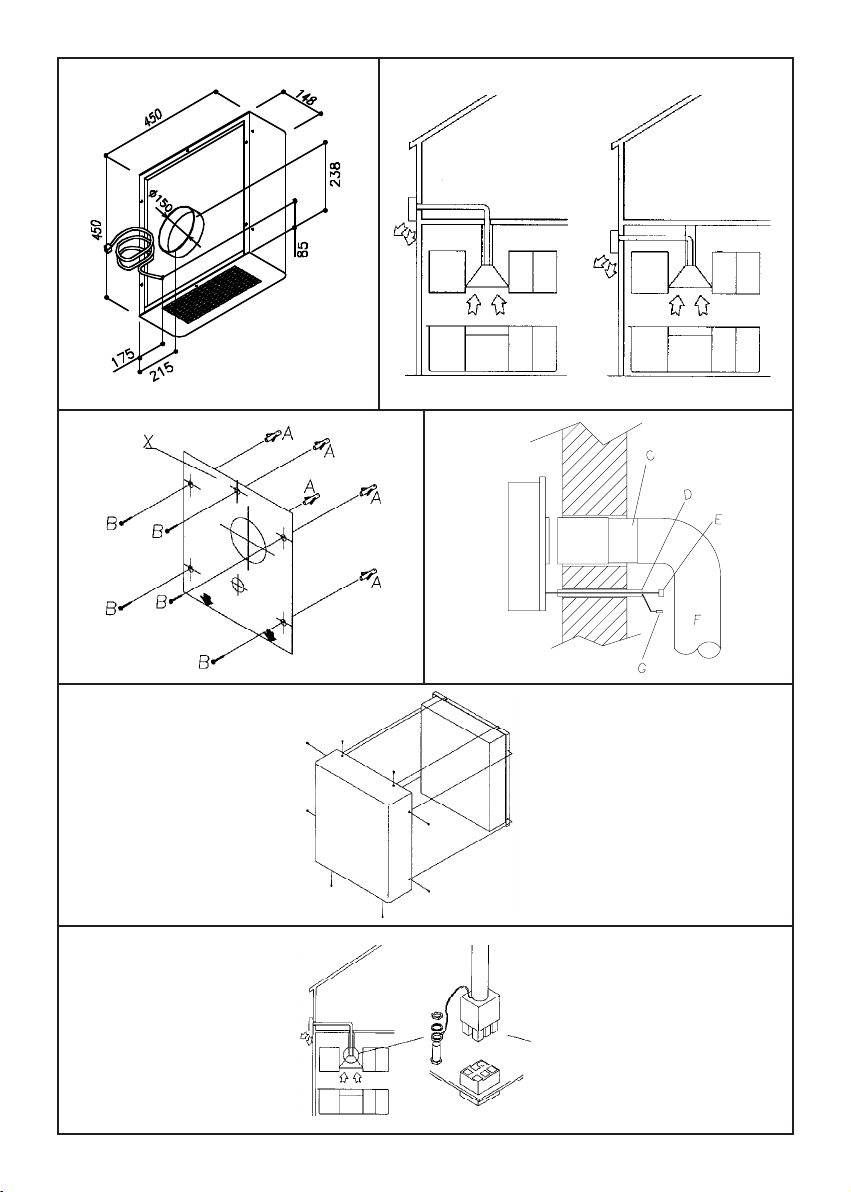
15
13
14
2
OK
OK
OK
OK
OK
OK
OK
OK
OK
OK
OK
OK
OK
OK
OK OK
OK
OK
OK
OK
OK
OK
OK
SEM 1 (dis.1)
Attenzione! Il gruppo di aspirazione periferico (centralina) SEM 1 è in classe II (simbolo sulla targhetta dati tecnici
), pertanto non necessita di collegamento a terra.
L’appa recchio è stato prog ettato per aspirare i vapori e gli odori in modo otti male con estrema silenziosità.
L’apparecchio dovrà essere istallato all’interno dell’abitazione collegandolo alla cappa che si trova in cucina (dis.2) o alla
unità di comando SCET - 1.
Modalità di fissaggio: per facilitare le operazioni di
installazione, l’apparecchio può essere fissato a parete, a soffitto o
sul pavimento in posizione orizzontale (dis.3) o verticale (dis.4) rispetto al piano di fissaggio.
NOTA: Nel caso del fissaggio verticale, si possono utilizzare le staffe in dotazione solo dalla parte più lunga (fig. 6).
Fissaggio dell’apparecchio: una volta stabilito la posizione e il modo di fissaggio, bisogna introdurre i gommini anti-
vibrazioni nelle staffe in dotazione (dis.5C).
I gommini
vanno messi nei lati che andranno a contatto con il muro.
Appoggiare le staffe (dis.5A) sulla centralina facendo coincidere i fori di quest’ultima con quelli delle staffe e fissare con
le viti in dotazione (dis.5B)
Appoggiare il tutto nel punto di fissaggio deciso in precedenza segnando, sulla parete, i punti dove bisognerà effettuare i fori.
Nei fori eseguiti inserire i tasselli in dotazione (dis.6A).
Appoggiare la centralina sulla parete facendo coincidere i fori d
elle staffe con i tasselli in plastica e avvitare il tutto con le
viti in dotazione (dis.6B).
Collegamento dei tubi: l’apparecchio è predisposto con un’entrata e un’uscita per il collegamento dei tubi (verificare la
direzione dell’aria tramite l’etichetta esterna prima del montaggio dei tubi di evacuazione dis.7), collegare i tubi e fissarli
con idonee fascette metalliche (tubi e fascette sono a cura dell’installatore). Il tubo (dis.7A) va collegato alla cappa posta
nella cucina, il tubo (dis.7B) va indirizzato v
erso l’esterno dell’edificio.
Collegamento elettrico alla cappa: l’apparecchio è dotato di un cavo di collegamento lungo 7 metri. Il cavo, alla sua estremità,
ha una connessione a sei poli che deve essere inserita in quella fissata sulla cappa (dis.8) o alla unità di comando SCET - 1.
SEM 2 (dis.9)
Attenzione! Il gruppo di aspirazione periferico (centralina) SEM 2 è in classe I e pertanto necessita di collegamento
a terra.
L’apparec
chio è stato progettato per aspirare i vapori e gli odori in modo ottimale.
L’apparecchio dovrà essere istallato all’esterno dell’abitazione collegandolo alla cappa che si trova in cucina (dis.10) o alla
unità di comando SCET - 1.
Modalità di fissaggio: il montaggio dell’apparecchio deve essere effettuato da personale qualificato. Usando l’apposita
maschera di foratura (dis.11) praticare sulla parete esterna tutti i fori indicati nella stessa facendo attenzione a non
danneggiare tubature dell’
acqua o linee elettriche.
I fori alla parete dovranno essere effettuati con una punta da da 8 mm. Nei fori praticati dovranno essere progressivamente:
•Inseriti i relativi tasselli in plastica in dotazione (dis.11A).
•Inseriti i due tubi telescopici nel foro da 160 mm.
•Inserire il tubo in plastica da 40 mm.
Prima di appoggiare l’apparecchio sul muro bisogna inserire la connessione elettrica nel tubo in plastica. Fissare
l’apparecchio
senza carter estetico in acciaio, precedentemente tolto dal blocco motore, facendo coincidere i fori del blocco motore
stesso con i fori sul muro e serrando con le viti in dotazione (dis.11B).
Collegamento dei tubi: l’apparecchio è predisposto con un entrata dell’aria per il collegamento dei tubi telescopici, e un
uscita.
Dopo che l’apparecchio è stato fissato alla parete esterna, i due tubi telescopici posti all’interno della parete devono essere
coll
egati con la cappa tramite i tubi flessibili (dis.12).
Il fissaggio tra i tubi deve essere effettuato con idonee fascette metalliche (tubi e fascette sono a cura dell’installatore).
Collegamento elettrico alla cappa: l’apparecchio è dotato di un cavo di collegamento lungo 7 metri. Dopo aver fatto
passare il cavo attraverso il tubo in plastica posto nel muro, inserire la connessione a sei poli sulla cappa e collegare il
filo messa a terra sulla vite adiacente alla connessione tramite dado e rondella (dis.14), in
alternativa il collegamento
elettrico va fatto alla unità di comando SCET - 1.
Al fine di evitare possibili infiltrazioni d'acqua disporre accuratamente del silicone in corrispondenza del perimetro del
prodotto, in prossimità del muro.
Montaggio carter esterno: rimontare il carter estetico facendo coincidere la griglia con l’uscita aria del blocco motore (dis.13).
47
SEM 1 (fig.1)
Warning! The peripheral exhausting group (remote fitted extrac
tion motor) is built in class II (symbol on the rating
plate), therefore it must not be earthed.
The appliance is designed to exhaust fumes and odours very silently and in the best way. It must be installed in the house
and connected to the cooker-hood, which is in the kitchen (fig. 2) or to the SCET control unit 1.
Types of installation: to make the installation easy, the appliance can be fixed on the wall, on the ceiling or on the floor
in a horizo
ntal position (fig. 3 ) or vertically (fig. 4) to the fixing level.
Note: in the vertical fixing, the brackets supplied can be used only on the longest side (fig. 6).
Installation of the appliance: after deciding the position and the type of installation, insert the anti-vibration rubber caps
in the holes of the brackets supplied (fig. 5C).
The rubber caps must be put on the sides which are in contact with the wall.
Put the brackets (fig. 5A) on the remote fitted extrac
tion motor by matching its holes with those of the brackets. Fix with
the screws supplied (fig. 5B).
Put the group on the point previously chosen for the installation and mark the points on the wall where the holes must
be drilled.
Insert the dowels supplied in the holes (fig. 6A). Put the remote fitted extraction motor on the wall by matching the holes
of the brackets with the plastic dowels. Screw with the screws supplied (fig. 6B).
Connection of the pipes: the appliance is endowed with an entr
ance and an outlet to connect the pipes. Before connecting
the exhaust pipes, check the direction of the air showed on the external label (fig. 7). Connect the pipes and fix them with
appropriate metal clamps (exhaust pipes and metal clamps have to be supplied by the installer). The pipe (fig. 7A) must
be connected with the cooker-hood placed in the kitchen, and the pipe (fig. 7B) must be directed outside the building.
Electrical connection of the hood: the appliance is equipped with a 7m ele
ctrical cable with a six- pin connection at one
end. Insert it into the hood’s connection (External Motor version) or into the SCET-1 central unit (see fig. 8 for the end
result).
SEM 2 (fig.9)
Warning! The remote fitted exhausting group (external motor) is built in class I plate, therefore it needs the earth
connection.
The appliance was designed to exhaust odours and vapours in the best way. The appliance is to be installed on the outside
wall of the house and connetted to the cooker-hoo
d which is in the kitchen (fig. 10) or to the SCET control unit 1.
Installation: the mounting of the appliance is to be made by qualified technicians. Using the appropriate drilling jig (fig.
11) drill all the holes marked on it into the external wall, by paying attention not to damage water pipes or power lines.
The holes on the wall are to be drilled with a 8 mm. bit. Insert, step by step, the following parts in the holes drilled:
•the corresponding plastic dowels supplied (fig. 11A)
•the two telescopic pipes in the hole of 1
60 mm.
•the plastic pipe of 40 mm. diameter.
Before leaning the appliance against the wall, insert the supply cord in the plastic pipe. Fix the appliance without the
stainless steel external body, which was previously removed from the motor block, by matching the holes of the motor
block with the holes on the wall. Tighten with the screws supplied (fig.11B).
Connection of the pipes: the appliance is endowed with an air entrance to be connected with the telescopic pipes and an
air outlet.
After f
ixing the appliance on the external wall, connect the two telescopic pipes, which are placed inside the wall, with the
cooker-hood through the flexible pipes (fig. 12).
The fixing between the pipes have to be made with appropriate metal clamps (pipes and clamps are supplied by the
installer).
Electrical connection of the hood: the appliance is equipped with a 7m electrical cable. Make the cable pass through the
plastic hose in the wall (see fig. 12E), connect it to the appliance in the kitchen an
d then connect the ground wire to the
screw near the connection by means of nut and washer (see fig. 14). You can otherwise make the electrical connection
to the SCET-1 central unit.
In or der to avoid water infiltrations, pl eas eapply silicon e on theproduc t per imeter, clos e to the wall.
Installation of the stainless steel external body: put the stainless steel body again, by matching the air exhausting grid
with the air outlet of the motor block (fig. 13).
20
SEM 2
9 10
11 12
13
14
90004200072 - GM 07/10
23
2
OK
OK
OK
OK
OK
OK
OK
OK
OK
OK
OK
OK
OK
OK
OK OK
OK
OK
OK
OK
OK
OK
OK
SEM 1 (dis.1)
Attenzione! Il gruppo di aspirazione periferico (centralina) SEM 1 è in classe II (simbolo sulla targhetta dati tecnici
), pertanto non necessita di collegamento a terra.
L’appa recchio è stato progettato per aspirare i vapori e gli odori in modo otti male con estrema silenziosità.
L’apparecchio dovrà essere istallato all’interno dell’abitazione collegandolo alla cappa che si trova in cucina (dis.2) o alla
unità di comando SCET - 1.
Modalità di fissaggio: per facilitare le operazioni di
installazione, l’apparecchio può essere fissato a parete, a soffitto o
sul pav imento in posizione orizz ontale (dis.3) o ve rticale (dis.4) ris petto al piano di fissaggio.
NOTA: Nel caso del fissaggio verticale, si possono utilizzare le staffe in dotazione solo dalla parte più lunga (fig. 6).
Fissaggio dell’apparecchio: una volta stabilito la posizione e il modo di fissaggio, bisogna introdurre i gommini anti-
vibrazioni nelle staffe in dotazione (dis.5C).
I gommini
vanno messi nei lati che andranno a contatto con il muro.
Appoggiare le staffe (dis.5A) sulla centralina facendo coincidere i fori di quest’ultima con quelli delle staffe e fissare con
le viti in dotazione (dis.5B)
Appoggiare il tutto nel punto di fissaggio deciso in precedenza segnando, sulla parete, i punti dove bisognerà effettuare i fori.
Nei fori eseguiti inserire i tasselli in dotazione (dis.6A).
Appoggiare la centralina sulla parete facendo coincidere i fori d
elle staffe con i tasselli in plastica e avvitare il tutto con le
viti in dotazione (dis.6B).
Collegamento dei tubi: l’apparecchio è predisposto con un’entrata e un’uscita per il collegamento dei tubi (verificare la
direzione dell’aria tramite l’etichetta esterna prima del montaggio dei tubi di evacuazione dis.7), collegare i tubi e fissarli
con idonee fascette metalliche (tubi e fascette sono a cura dell’installatore). Il tubo (dis.7A) va collegato alla cappa posta
nella cucina, il tubo (dis.7B) va indirizzato v
erso l’esterno dell’edificio.
Collegamento elettrico alla cappa: l’apparecchio è dotato di un cavo di collegamento lungo 7 metri. Il cavo, alla sua estremità,
ha una connessione a sei poli che deve essere inserita in quella fissata sulla cappa (dis.8) o alla unità di comando SCET - 1.
SEM 2 (dis.9)
Attenzione! Il gruppo di aspirazione periferico (centralina) SEM 2 è in classe I e pertanto necessita di collegamento
a terra.
L’apparec
chio è stato progettato per aspirare i vapori e gli odori in modo ottimale.
L’apparecchio dovrà essere istallato all’esterno dell’abitazione collegandolo alla cappa che si trova in cucina (dis.10) o alla
unità di comando SCET - 1.
Modalità di fissaggio: il montaggio dell’apparecchio deve essere effettuato da personale qualificato. Usando l’apposita
maschera di foratura (dis.11) praticare sulla parete esterna tutti i fori indicati nella stessa facendo attenzione a non
danneggiare tubature dell’
acqua o linee elettriche.
I fori alla parete dovranno essere effettuati con una punta da da 8 mm. Nei fori praticati dovranno essere progressivamente:
•Inseriti i relativi tasselli in plastica in dotazione (dis.11A).
•Inseriti i due tubi telescopici nel foro da 160 mm.
•Inserire il tubo in plastica da 40 mm.
Prima di appoggiare l’apparecchio sul muro bisogna inserire la connessione elettrica nel tubo in plastica. Fissare
l’apparecchio
senza carter estetico in acciaio, precedentemente tolto dal blocco motore, facendo coincidere i fori del blocco motore
stesso con i fori sul muro e serrando con le viti in dotazione (dis.11B).
Collegamento dei tubi: l’apparecchio è predisposto con un entrata dell’aria per il collegamento dei tubi telescopici, e un
uscita.
Dopo che l’apparecchio è stato fissato alla parete esterna, i due tubi telescopici posti all’interno della parete devono essere
coll
egati con la cappa tramite i tubi flessibili (dis.12).
Il fissaggio tra i tubi deve essere effettuato con idonee fascette metalliche (tubi e fascette sono a cura dell’installatore).
Collegamento elettrico alla cappa: l’apparecchio è dotato di un cavo di collegamento lungo 7 metri. Dopo aver fatto
passare il cavo attraverso il tubo in plastica posto nel muro, inserire la connessione a sei poli sulla cappa e collegare il
filo messa a terra sulla vite adiacente alla connessione tramite dado e rondella (dis.14), in
alternativa il collegamento
elettrico va fatto alla unità di comando SCET - 1.
Al fine di evitare possibili infiltrazioni d'acqua disporre accuratamente del silicone in corrispondenza del perimetro del
prodotto, in prossimità del muro.
Montaggio carter esterno: rimontare il carter estetico facendo coincidere la griglia con l’uscita aria del blocco motore (dis.13).
47
SEM 1 (fig.1)
Warning! The peripheral exhausting group (remote fitted extrac
tion motor) is built in class II (symbol on the rating
plate), therefore it must not be earthed.
The appliance is designed to exhaust fumes and odours very silently and in the best way. It must be installed in the house
and connected to the cooker-hood, which is in the kitchen (fig. 2) or to the SCET control unit 1.
Types of installation: to make the installation easy, the appliance can be fixed on the wall, on the ceiling or on the floor
in a horizo
ntal position (fig. 3 ) or vertically (fig. 4) to the fixing level.
Note: in the vertical fixing, the brackets supplied can be used only on the longest side (fig. 6).
Installation of the appliance: after deciding the position and the type of installation, insert the anti-vibration rubber caps
in the holes of the brackets supplied (fig. 5C).
The rubber caps must be put on the sides which are in contact with the wall.
Put the brackets (fig. 5A) on the remote fitted extrac
tion motor by matching its holes with those of the brackets. Fix with
the screws supplied (fig. 5B).
Put the group on the point previously chosen for the installation and mark the points on the wall where the holes must
be drilled.
Insert the dowels supplied in the holes (fig. 6A). Put the remote fitted extraction motor on the wall by matching the holes
of the brackets with the plastic dowels. Screw with the screws supplied (fig. 6B).
Connection of the pipes: the appliance is endowed with an entr
ance and an outlet to connect the pipes. Before connecting
the exhaust pipes, check the direction of the air showed on the external label (fig. 7). Connect the pipes and fix them with
appropriate metal clamps (exhaust pipes and metal clamps have to be supplied by the installer). The pipe (fig. 7A) must
be connected with the cooker-hood placed in the kitchen, and the pipe (fig. 7B) must be directed outside the building.
Electrical connection of the hood: the appliance is equipped with a 7m ele
ctrical cable with a six- pin connection at one
end. Insert it into the hood’s connection (External Motor version) or into the SCET-1 central unit (see fig. 8 for the end
result).
SEM 2 (fig.9)
Warning! The remote fitted exhausting group (external motor) is built in class I plate, therefore it needs the earth
connection.
The appliance was designed to exhaust odours and vapours in the best way. The appliance is to be installed on the outside
wall of the house and connetted to the cooker-hoo
d which is in the kitchen (fig. 10) or to the SCET control unit 1.
Installation: the mounting of the appliance is to be made by qualified technicians. Using the appropriate drilling jig (fig.
11) drill all the holes marked on it into the external wall, by paying attention not to damage water pipes or power lines.
The holes on the wall are to be drilled with a 8 mm. bit. Insert, step by step, the following parts in the holes drilled:
•the corresponding plastic dowels supplied (fig. 11A)
•the two telescopic pipes in the hole of 1
60 mm.
•the plastic pipe of 40 mm. diameter.
Before leaning the appliance against the wall, insert the supply cord in the plastic pipe. Fix the appliance without the
stainless steel external body, which was previously removed from the motor block, by matching the holes of the motor
block with the holes on the wall. Tighten with the screws supplied (fig.11B).
Connection of the pipes: the appliance is endowed with an air entrance to be connected with the telescopic pipes and an
air outlet.
After f
ixing the appliance on the external wall, connect the two telescopic pipes, which are placed inside the wall, with the
cooker-hood through the flexible pipes (fig. 12).
The fixing between the pipes have to be made with appropriate metal clamps (pipes and clamps are supplied by the
installer).
Electrical connection of the hood: the appliance is equipped with a 7m electrical cable. Make the cable pass through the
plastic hose in the wall (see fig. 12E), connect it to the appliance in the kitchen an
d then connect the ground wire to the
screw near the connection by means of nut and washer (see fig. 14). You can otherwise make the electrical connection
to the SCET-1 central unit.
In order to avoid water infiltrations, pl eas eapply silicon e on theproduc t per imeter, close to the wall.
Installation of the stainless steel external body: put the stainless steel body again, by matching the air exhausting grid
with the air outlet of the motor block (fig. 13).
20
SEM 2
9 10
11 12
13
14
90004200072 - GM 07/10
23
2
OK
OK
OK
OK
OK
OK
OK
OK
OK
OK
OK
OK
OK
OK
OK OK
OK
OK
OK
OK
OK
OK
OK
SEM 1 (dis.1)
Attenzione! Il gruppo di aspirazione periferico (centralina) SEM 1 è in classe II (simbolo sulla targhetta dati tecnici
), pertanto non necessita di collegamento a terra.
L’appa recchio è stato progettato per aspirare i vapori e gli odori in modo otti male con estrema sil enziosità.
L’apparecchio dovrà essere istallato all’interno dell’abitazione collegandolo alla cappa che si trova in cucina (dis.2) o alla
unità di comando SCET - 1.
Modalità di fissaggio: per facilitare le operazioni di
installazione, l’apparecchio può essere fissato a parete, a soffitto o
sul pav im ento in po sizione orizzontale (dis.3) o verticale (dis.4) ris petto al piano di fissaggio.
NOTA: Nel caso del fissaggio verticale, si possono utilizzare le staffe in dotazione solo dalla parte più lunga (fig. 6).
Fissaggio dell’apparecchio: una volta stabilito la posizione e il modo di fissaggio, bisogna introdurre i gommini anti-
vibrazioni nelle staffe in dotazione (dis.5C).
I gommini
vanno messi nei lati che andranno a contatto con il muro.
Appoggiare le staffe (dis.5A) sulla centralina facendo coincidere i fori di quest’ultima con quelli delle staffe e fissare con
le viti in dotazione (dis.5B)
Appoggiare il tutto nel punto di fissaggio deciso in precedenza segnando, sulla parete, i punti dove bisognerà effettuare i fori.
Nei fori eseguiti inserire i tasselli in dotazione (dis.6A).
Appoggiare la centralina sulla parete facendo coincidere i fori d
elle staffe con i tasselli in plastica e avvitare il tutto con le
viti in dotazione (dis.6B).
Collegamento dei tubi: l’apparecchio è predisposto con un’entrata e un’uscita per il collegamento dei tubi (verificare la
direzione dell’aria tramite l’etichetta esterna prima del montaggio dei tubi di evacuazione dis.7), collegare i tubi e fissarli
con idonee fascette metalliche (tubi e fascette sono a cura dell’installatore). Il tubo (dis.7A) va collegato alla cappa posta
nella cucina, il tubo (dis.7B) va indirizzato v
erso l’esterno dell’edificio.
Collegamento elettrico alla cappa: l’apparecchio è dotato di un cavo di collegamento lungo 7 metri. Il cavo, alla sua estremità,
ha una connessione a sei poli che deve essere inserita in quella fissata sulla cappa (dis.8) o alla unità di comando SCET - 1.
SEM 2 (dis.9)
Attenzione! Il gruppo di aspirazione periferico (centralina) SEM 2 è in classe I e pertanto necessita di collegamento
a terra.
L’apparec
chio è stato progettato per aspirare i vapori e gli odori in modo ottimale.
L’apparecchio dovrà essere istallato all’esterno dell’abitazione collegandolo alla cappa che si trova in cucina (dis.10) o alla
unità di comando SCET - 1.
Modalità di fissaggio: il montaggio dell’apparecchio deve essere effettuato da personale qualificato. Usando l’apposita
maschera di foratura (dis.11) praticare sulla parete esterna tutti i fori indicati nella stessa facendo attenzione a non
danneggiare tubature dell’
acqua o linee elettriche.
I fori alla parete dovranno essere effettuati con una punta da da 8 mm. Nei fori praticati dovranno essere progressivamente:
•Inseriti i relativi tasselli in plastica in dotazione (dis.11A).
•Inseriti i due tubi telescopici nel foro da 160 mm.
•Inserire il tubo in plastica da 40 mm.
Prima di appoggiare l’apparecchio sul muro bisogna inserire la connessione elettrica nel tubo in plastica. Fissare
l’apparecchio
senza carter estetico in acciaio, precedentemente tolto dal blocco motore, facendo coincidere i fori del blocco motore
stesso con i fori sul muro e serrando con le viti in dotazione (dis.11B).
Collegamento dei tubi: l’apparecchio è predisposto con un entrata dell’aria per il collegamento dei tubi telescopici, e un
uscita.
Dopo che l’apparecchio è stato fissato alla parete esterna, i due tubi telescopici posti all’interno della parete devono essere
coll
egati con la cappa tramite i tubi flessibili (dis.12).
Il fissaggio tra i tubi deve essere effettuato con idonee fascette metalliche (tubi e fascette sono a cura dell’installatore).
Collegamento elettrico alla cappa: l’apparecchio è dotato di un cavo di collegamento lungo 7 metri. Dopo aver fatto
passare il cavo attraverso il tubo in plastica posto nel muro, inserire la connessione a sei poli sulla cappa e collegare il
filo messa a terra sulla vite adiacente alla connessione tramite dado e rondella (dis.14), in
alternativa il collegamento
elettrico va fatto alla unità di comando SCET - 1.
Al fine di evitare possibili infiltrazioni d'acqua disporre accuratamente del silicone in corrispondenza del perimetro del
prodotto, in prossimità del muro.
Montaggio carter esterno: rimontare il carter estetico facendo coincidere la griglia con l’uscita aria del blocco motore (dis.13).
47
SEM 1 (fig.1)
Warning! The peripheral exhausting group (remote fitted extrac
tion motor) is built in class II (symbol on the rating
plate), therefore it must not be earthed.
The appliance is designed to exhaust fumes and odours very silently and in the best way. It must be installed in the house
and connected to the cooker-hood, which is in the kitchen (fig. 2) or to the SCET control unit 1.
Types of installation: to make the installation easy, the appliance can be fixed on the wall, on the ceiling or on the floor
in a horizo
ntal position (fig. 3 ) or vertically (fig. 4) to the fixing level.
Note: in the vertical fixing, the brackets supplied can be used only on the longest side (fig. 6).
Installation of the appliance: after deciding the position and the type of installation, insert the anti-vibration rubber caps
in the holes of the brackets supplied (fig. 5C).
The rubber caps must be put on the sides which are in contact with the wall.
Put the brackets (fig. 5A) on the remote fitted extrac
tion motor by matching its holes with those of the brackets. Fix with
the screws supplied (fig. 5B).
Put the group on the point previously chosen for the installation and mark the points on the wall where the holes must
be drilled.
Insert the dowels supplied in the holes (fig. 6A). Put the remote fitted extraction motor on the wall by matching the holes
of the brackets with the plastic dowels. Screw with the screws supplied (fig. 6B).
Connection of the pipes: the appliance is endowed with an entr
ance and an outlet to connect the pipes. Before connecting
the exhaust pipes, check the direction of the air showed on the external label (fig. 7). Connect the pipes and fix them with
appropriate metal clamps (exhaust pipes and metal clamps have to be supplied by the installer). The pipe (fig. 7A) must
be connected with the cooker-hood placed in the kitchen, and the pipe (fig. 7B) must be directed outside the building.
Electrical connection of the hood: the appliance is equipped with a 7m ele
ctrical cable with a six- pin connection at one
end. Insert it into the hood’s connection (External Motor version) or into the SCET-1 central unit (see fig. 8 for the end
result).
SEM 2 (fig.9)
Warning! The remote fitted exhausting group (external motor) is built in class I plate, therefore it needs the earth
connection.
The appliance was designed to exhaust odours and vapours in the best way. The appliance is to be installed on the outside
wall of the house and connetted to the cooker-hoo
d which is in the kitchen (fig. 10) or to the SCET control unit 1.
Installation: the mounting of the appliance is to be made by qualified technicians. Using the appropriate drilling jig (fig.
11) drill all the holes marked on it into the external wall, by paying attention not to damage water pipes or power lines.
The holes on the wall are to be drilled with a 8 mm. bit. Insert, step by step, the following parts in the holes drilled:
•the corresponding plastic dowels supplied (fig. 11A)
•the two telescopic pipes in the hole of 1
60 mm.
•the plastic pipe of 40 mm. diameter.
Before leaning the appliance against the wall, insert the supply cord in the plastic pipe. Fix the appliance without the
stainless steel external body, which was previously removed from the motor block, by matching the holes of the motor
block with the holes on the wall. Tighten with the screws supplied (fig.11B).
Connection of the pipes: the appliance is endowed with an air entrance to be connected with the telescopic pipes and an
air outlet.
After f
ixing the appliance on the external wall, connect the two telescopic pipes, which are placed inside the wall, with the
cooker-hood through the flexible pipes (fig. 12).
The fixing between the pipes have to be made with appropriate metal clamps (pipes and clamps are supplied by the
installer).
Electrical connection of the hood: the appliance is equipped with a 7m electrical cable. Make the cable pass through the
plastic hose in the wall (see fig. 12E), connect it to the appliance in the kitchen an
d then connect the ground wire to the
screw near the connection by means of nut and washer (see fig. 14). You can otherwise make the electrical connection
to the SCET-1 central unit.
In order to avoid water infiltrations, pl eas eapply silicon e on th eproduc t per imeter, close to the wall.
Installation of the stainless steel external body: put the stainless steel body again, by matching the air exhausting grid
with the air outlet of the motor block (fig. 13).
20
SEM 2
9 10
11 12
13
14
90004200072 - GM 07/10
23
SEM2
2
OK
OK
OK
OK
OK
OK
OK
OK
OK
OK
OK
OK
OK
OK
OK OK
OK
OK
OK
OK
OK
OK
OK
SEM 1 (dis.1)
Attenzione! Il gruppo di aspirazione periferico (centralina) SEM 1 è in classe II (simbolo sulla targhetta dati tecnici
), pertanto non necessita di collegamento a terra.
L’appa recchio è stato prog ettato per aspirare i vapori e gli odori in modo otti male con estrema sil enziosità.
L’apparecchio dovrà essere istallato all’interno dell’abitazione collegandolo alla cappa che si trova in cucina (dis.2) o alla
unità di comando SCET - 1.
Modalità di fissaggio: per facilitare le operazioni di
installazione, l’apparecchio può essere fissato a parete, a soffitto o
sul pavimento in posizione orizzontale (dis.3) o verticale (dis.4) rispetto al piano di fissaggio.
NOTA: Nel caso del fissaggio verticale, si possono utilizzare le staffe in dotazione solo dalla parte più lunga (fig. 6).
Fissaggio dell’apparecchio: una volta stabilito la posizione e il modo di fissaggio, bisogna introdurre i gommini anti-
vibrazioni nelle staffe in dotazione (dis.5C).
I gommini
vanno messi nei lati che andranno a contatto con il muro.
Appoggiare le staffe (dis.5A) sulla centralina facendo coincidere i fori di quest’ultima con quelli delle staffe e fissare con
le viti in dotazione (dis.5B)
Appoggiare il tutto nel punto di fissaggio deciso in precedenza segnando, sulla parete, i punti dove bisognerà effettuare i fori.
Nei fori eseguiti inserire i tasselli in dotazione (dis.6A).
Appoggiare la centralina sulla parete facendo coincidere i fori d
elle staffe con i tasselli in plastica e avvitare il tutto con le
viti in dotazione (dis.6B).
Collegamento dei tubi: l’apparecchio è predisposto con un’entrata e un’uscita per il collegamento dei tubi (verificare la
direzione dell’aria tramite l’etichetta esterna prima del montaggio dei tubi di evacuazione dis.7), collegare i tubi e fissarli
con idonee fascette metalliche (tubi e fascette sono a cura dell’installatore). Il tubo (dis.7A) va collegato alla cappa posta
nella cucina, il tubo (dis.7B) va indirizzato v
erso l’esterno dell’edificio.
Collegamento elettrico alla cappa: l’apparecchio è dotato di un cavo di collegamento lungo 7 metri. Il cavo, alla sua estremità,
ha una connessione a sei poli che deve essere inserita in quella fissata sulla cappa (dis.8) o alla unità di comando SCET - 1.
SEM 2 (dis.9)
Attenzione! Il gruppo di aspirazione periferico (centralina) SEM 2 è in classe I e pertanto necessita di collegamento
a terra.
L’apparec
chio è stato progettato per aspirare i vapori e gli odori in modo ottimale.
L’apparecchio dovrà essere istallato all’esterno dell’abitazione collegandolo alla cappa che si trova in cucina (dis.10) o alla
unità di comando SCET - 1.
Modalità di fissaggio: il montaggio dell’apparecchio deve essere effettuato da personale qualificato. Usando l’apposita
maschera di foratura (dis.11) praticare sulla parete esterna tutti i fori indicati nella stessa facendo attenzione a non
danneggiare tubature dell’
acqua o linee elettriche.
I fori alla parete dovranno essere effettuati con una punta da da 8 mm. Nei fori praticati dovranno essere progressivamente:
•Inseriti i relativi tasselli in plastica in dotazione (dis.11A).
•Inseriti i due tubi telescopici nel foro da 160 mm.
•Inserire il tubo in plastica da 40 mm.
Prima di appoggiare l’apparecchio sul muro bisogna inserire la connessione elettrica nel tubo in plastica. Fissare
l’apparecchio
senza carter estetico in acciaio, precedentemente tolto dal blocco motore, facendo coincidere i fori del blocco motore
stesso con i fori sul muro e serrando con le viti in dotazione (dis.11B).
Collegamento dei tubi: l’apparecchio è predisposto con un entrata dell’aria per il collegamento dei tubi telescopici, e un
uscita.
Dopo che l’apparecchio è stato fissato alla parete esterna, i due tubi telescopici posti all’interno della parete devono essere
coll
egati con la cappa tramite i tubi flessibili (dis.12).
Il fissaggio tra i tubi deve essere effettuato con idonee fascette metalliche (tubi e fascette sono a cura dell’installatore).
Collegamento elettrico alla cappa: l’apparecchio è dotato di un cavo di collegamento lungo 7 metri. Dopo aver fatto
passare il cavo attraverso il tubo in plastica posto nel muro, inserire la connessione a sei poli sulla cappa e collegare il
filo messa a terra sulla vite adiacente alla connessione tramite dado e rondella (dis.14), in
alternativa il collegamento
elettrico va fatto alla unità di comando SCET - 1.
Al fine di evitare possibili infiltrazioni d'acqua disporre accuratamente del silicone in corrispondenza del perimetro del
prodotto, in prossimità del muro.
Montaggio carter esterno: rimontare il carter estetico facendo coincidere la griglia con l’uscita aria del blocco motore (dis.13).
47
SEM 1 (fig.1)
Warning! The peripheral exhausting group (remote fitted extrac
tion motor) is built in class II (symbol on the rating
plate), therefore it must not be earthed.
The appliance is designed to exhaust fumes and odours very silently and in the best way. It must be installed in the house
and connected to the cooker-hood, which is in the kitchen (fig. 2) or to the SCET control unit 1.
Types of installation: to make the installation easy, the appliance can be fixed on the wall, on the ceiling or on the floor
in a horizo
ntal position (fig. 3 ) or vertically (fig. 4) to the fixing level.
Note: in the vertical fixing, the brackets supplied can be used only on the longest side (fig. 6).
Installation of the appliance: after deciding the position and the type of installation, insert the anti-vibration rubber caps
in the holes of the brackets supplied (fig. 5C).
The rubber caps must be put on the sides which are in contact with the wall.
Put the brackets (fig. 5A) on the remote fitted extrac
tion motor by matching its holes with those of the brackets. Fix with
the screws supplied (fig. 5B).
Put the group on the point previously chosen for the installation and mark the points on the wall where the holes must
be drilled.
Insert the dowels supplied in the holes (fig. 6A). Put the remote fitted extraction motor on the wall by matching the holes
of the brackets with the plastic dowels. Screw with the screws supplied (fig. 6B).
Connection of the pipes: the appliance is endowed with an entr
ance and an outlet to connect the pipes. Before connecting
the exhaust pipes, check the direction of the air showed on the external label (fig. 7). Connect the pipes and fix them with
appropriate metal clamps (exhaust pipes and metal clamps have to be supplied by the installer). The pipe (fig. 7A) must
be connected with the cooker-hood placed in the kitchen, and the pipe (fig. 7B) must be directed outside the building.
Electrical connection of the hood: the appliance is equipped with a 7m ele
ctrical cable with a six- pin connection at one
end. Insert it into the hood’s connection (External Motor version) or into the SCET-1 central unit (see fig. 8 for the end
result).
SEM 2
(fig.9)
Warning! The remote fitted exhausting group (external motor) is built in class I plate, therefore it needs the earth
connection.
The appliance was designed to exhaust odours and vapours in the best way. The appliance is to be installed on the outside
wall of the house and connetted to the cooker-hoo
d which is in the kitchen (fig. 10) or to the SCET control unit 1.
Installation: the mounting of the appliance is to be made by qualified technicians. Using the appropriate drilling jig (fig.
11) drill all the holes marked on it into the external wall, by paying attention not to damage water pipes or power lines.
The holes on the wall are to be drilled with a 8 mm. bit. Insert, step by step, the following parts in the holes drilled:
•the corresponding plastic dowels supplied (fig. 11A)
•the two telescopic pipes in the hole of 1
60 mm.
•the plastic pipe of 40 mm. diameter.
Before leaning the appliance against the wall, insert the supply cord in the plastic pipe. Fix the appliance without the
stainless steel external body, which was previously removed from the motor block, by matching the holes of the motor
block with the holes on the wall. Tighten with the screws supplied (fig.11B).
Connection of the pipes: the appliance is endowed with an air entrance to be connected with the telescopic pipes and an
air outlet.
After f
ixing the appliance on the external wall, connect the two telescopic pipes, which are placed inside the wall, with the
cooker-hood through the flexible pipes (fig. 12).
The fixing between the pipes have to be made with appropriate metal clamps (pipes and clamps are supplied by the
installer).
Electrical connection of the hood: the appliance is equipped with a 7m electrical cable. Make the cable pass through the
plastic hose in the wall (see fig. 12E), connect it to the appliance in the kitchen an
d then connect the ground wire to the
screw near the connection by means of nut and washer (see fig. 14). You can otherwise make the electrical connection
to the SCET-1 central unit.
In order to avoid water infiltrations, pl eas eapply silicon e on theproduc t per imeter, clos e to the wall.
Installation of the stainless steel external body: put the stainless steel body again, by matching the air exhausting grid
with the air outlet of the motor block (fig. 13).
20
SEM 2
9 10
11 12
13
14
90004200072 - GM 07/10
23
2
OK
OK
OK
OK
OK
OK
OK
OK
OK
OK
OK
OK
OK
OK
OK OK
OK
OK
OK
OK
OK
OK
OK
SEM 1 (dis.1)
Attenzione! Il gruppo di aspirazione periferico (centralina) SEM 1 è in classe II (simbolo sulla targhetta dati tecnici
), pertanto non necessita di collegamento a terra.
L’appa recchio è stato progettato per aspirare i vapori e gli odori in modo otti male con estrema silenziosità.
L’apparecchio dovrà essere istallato all’interno dell’abitazione collegandolo alla cappa che si trova in cucina (dis.2) o alla
unità di comando SCET - 1.
Modalità di fissaggio: per facilitare le operazioni di
installazione, l’apparecchio può essere fissato a parete, a soffitto o
sul pavimento in po sizione orizzontale (dis.3) o verticale (dis.4) rispetto al piano di fissaggio.
NOTA: Nel caso del fissaggio verticale, si possono utilizzare le staffe in dotazione solo dalla parte più lunga (fig. 6).
Fissaggio dell’apparecchio: una volta stabilito la posizione e il modo di fissaggio, bisogna introdurre i gommini anti-
vibrazioni nelle staffe in dotazione (dis.5C).
I gommini
vanno messi nei lati che andranno a contatto con il muro.
Appoggiare le staffe (dis.5A) sulla centralina facendo coincidere i fori di quest’ultima con quelli delle staffe e fissare con
le viti in dotazione (dis.5B)
Appoggiare il tutto nel punto di fissaggio deciso in precedenza segnando, sulla parete, i punti dove bisognerà effettuare i fori.
Nei fori eseguiti inserire i tasselli in dotazione (dis.6A).
Appoggiare la centralina sulla parete facendo coincidere i fori d
elle staffe con i tasselli in plastica e avvitare il tutto con le
viti in dotazione (dis.6B).
Collegamento dei tubi: l’apparecchio è predisposto con un’entrata e un’uscita per il collegamento dei tubi (verificare la
direzione dell’aria tramite l’etichetta esterna prima del montaggio dei tubi di evacuazione dis.7), collegare i tubi e fissarli
con idonee fascette metalliche (tubi e fascette sono a cura dell’installatore). Il tubo (dis.7A) va collegato alla cappa posta
nella cucina, il tubo (dis.7B) va indirizzato v
erso l’esterno dell’edificio.
Collegamento elettrico alla cappa: l’apparecchio è dotato di un cavo di collegamento lungo 7 metri. Il cavo, alla sua estremità,
ha una connessione a sei poli che deve essere inserita in quella fissata sulla cappa (dis.8) o alla unità di comando SCET - 1.
SEM 2
(dis.9)
Attenzione! Il gruppo di aspirazione periferico (centralina) SEM 2 è in classe I e pertanto necessita di collegamento
a terra.
L’apparec
chio è stato progettato per aspirare i vapori e gli odori in modo ottimale.
L’apparecchio dovrà essere istallato all’esterno dell’abitazione collegandolo alla cappa che si trova in cucina (dis.10) o alla
unità di comando SCET - 1.
Modalità di fissaggio: il montaggio dell’apparecchio deve essere effettuato da personale qualificato. Usando l’apposita
maschera di foratura (dis.11) praticare sulla parete esterna tutti i fori indicati nella stessa facendo attenzione a non
danneggiare tubature dell’
acqua o linee elettriche.
I fori alla parete dovranno essere effettuati con una punta da da 8 mm. Nei fori praticati dovranno essere progressivamente:
•Inseriti i relativi tasselli in plastica in dotazione (dis.11A).
•Inseriti i due tubi telescopici nel foro da 160 mm.
•Inserire il tubo in plastica da 40 mm.
Prima di appoggiare l’apparecchio sul muro bisogna inserire la connessione elettrica nel tubo in plastica. Fissare
l’apparecchio
senza carter estetico in acciaio, precedentemente tolto dal blocco motore, facendo coincidere i fori del blocco motore
stesso con i fori sul muro e serrando con le viti in dotazione (dis.11B).
Collegamento dei tubi: l’apparecchio è predisposto con un entrata dell’aria per il collegamento dei tubi telescopici, e un
uscita.
Dopo che l’apparecchio è stato fissato alla parete esterna, i due tubi telescopici posti all’interno della parete devono essere
coll
egati con la cappa tramite i tubi flessibili (dis.12).
Il fissaggio tra i tubi deve essere effettuato con idonee fascette metalliche (tubi e fascette sono a cura dell’installatore).
Collegamento elettrico alla cappa: l’apparecchio è dotato di un cavo di collegamento lungo 7 metri. Dopo aver fatto
passare il cavo attraverso il tubo in plastica posto nel muro, inserire la connessione a sei poli sulla cappa e collegare il
filo messa a terra sulla vite adiacente alla connessione tramite dado e rondella (dis.14), in
alternativa il collegamento
elettrico va fatto alla unità di comando SCET - 1.
Al fine di evitare possibili infiltrazioni d'acqua disporre accuratamente del silicone in corrispondenza del perimetro del
prodotto, in prossimità del muro.
Montaggio carter esterno: rimontare il carter estetico facendo coincidere la griglia con l’uscita aria del blocco motore (dis.13).
47
SEM 1 (fig.1)
Warning! The peripheral exhausting group (remote fitted extrac
tion motor) is built in class II (symbol on the rating
plate), therefore it must not be earthed.
The appliance is designed to exhaust fumes and odours very silently and in the best way. It must be installed in the house
and connected to the cooker-hood, which is in the kitchen (fig. 2) or to the SCET control unit 1.
Types of installation: to make the installation easy, the appliance can be fixed on the wall, on the ceiling or on the floor
in a horizo
ntal position (fig. 3 ) or vertically (fig. 4) to the fixing level.
Note: in the vertical fixing, the brackets supplied can be used only on the longest side (fig. 6).
Installation of the appliance: after deciding the position and the type of installation, insert the anti-vibration rubber caps
in the holes of the brackets supplied (fig. 5C).
The rubber caps must be put on the sides which are in contact with the wall.
Put the brackets (fig. 5A) on the remote fitted extrac
tion motor by matching its holes with those of the brackets. Fix with
the screws supplied (fig. 5B).
Put the group on the point previously chosen for the installation and mark the points on the wall where the holes must
be drilled.
Insert the dowels supplied in the holes (fig. 6A). Put the remote fitted extraction motor on the wall by matching the holes
of the brackets with the plastic dowels. Screw with the screws supplied (fig. 6B).
Connection of the pipes: the appliance is endowed with an entr
ance and an outlet to connect the pipes. Before connecting
the exhaust pipes, check the direction of the air showed on the external label (fig. 7). Connect the pipes and fix them with
appropriate metal clamps (exhaust pipes and metal clamps have to be supplied by the installer). The pipe (fig. 7A) must
be connected with the cooker-hood placed in the kitchen, and the pipe (fig. 7B) must be directed outside the building.
Electrical connection of the hood: the appliance is equipped with a 7m ele
ctrical cable with a six- pin connection at one
end. Insert it into the hood’s connection (External Motor version) or into the SCET-1 central unit (see fig. 8 for the end
result).
SEM 2
(fig.9)
Warning! The remote fitted exhausting group (external motor) is built in class I plate, therefore it needs the earth
connection.
The appliance was designed to exhaust odours and vapours in the best way. The appliance is to be installed on the outside
wall of the house and connetted to the cooker-hoo
d which is in the kitchen (fig. 10) or to the SCET control unit 1.
Installation: the mounting of the appliance is to be made by qualified technicians. Using the appropriate drilling jig (fig.
11) drill all the holes marked on it into the external wall, by paying attention not to damage water pipes or power lines.
The holes on the wall are to be drilled with a 8 mm. bit. Insert, step by step, the following parts in the holes drilled:
•the corresponding plastic dowels supplied (fig. 11A)
•the two telescopic pipes in the hole of 1
60 mm.
•the plastic pipe of 40 mm. diameter.
Before leaning the appliance against the wall, insert the supply cord in the plastic pipe. Fix the appliance without the
stainless steel external body, which was previously removed from the motor block, by matching the holes of the motor
block with the holes on the wall. Tighten with the screws supplied (fig.11B).
Connection of the pipes: the appliance is endowed with an air entrance to be connected with the telescopic pipes and an
air outlet.
After f
ixing the appliance on the external wall, connect the two telescopic pipes, which are placed inside the wall, with the
cooker-hood through the flexible pipes (fig. 12).
The fixing between the pipes have to be made with appropriate metal clamps (pipes and clamps are supplied by the
installer).
Electrical connection of the hood: the appliance is equipped with a 7m electrical cable. Make the cable pass through the
plastic hose in the wall (see fig. 12E), connect it to the appliance in the kitchen an
d then connect the ground wire to the
screw near the connection by means of nut and washer (see fig. 14). You can otherwise make the electrical connection
to the SCET-1 central unit.
In order to avoid water infiltrations, pl eas eapp ly silicon e on theproduc t per imeter, close to the wall.
Installation of the stainless steel external body: put the stainless steel body again, by matching the air exhausting grid
with the air outlet of the motor block (fig. 13).
20
SEM 2
9 10
11 12
13
14
90004200072 - GM 07/10
23
12
9
10
11
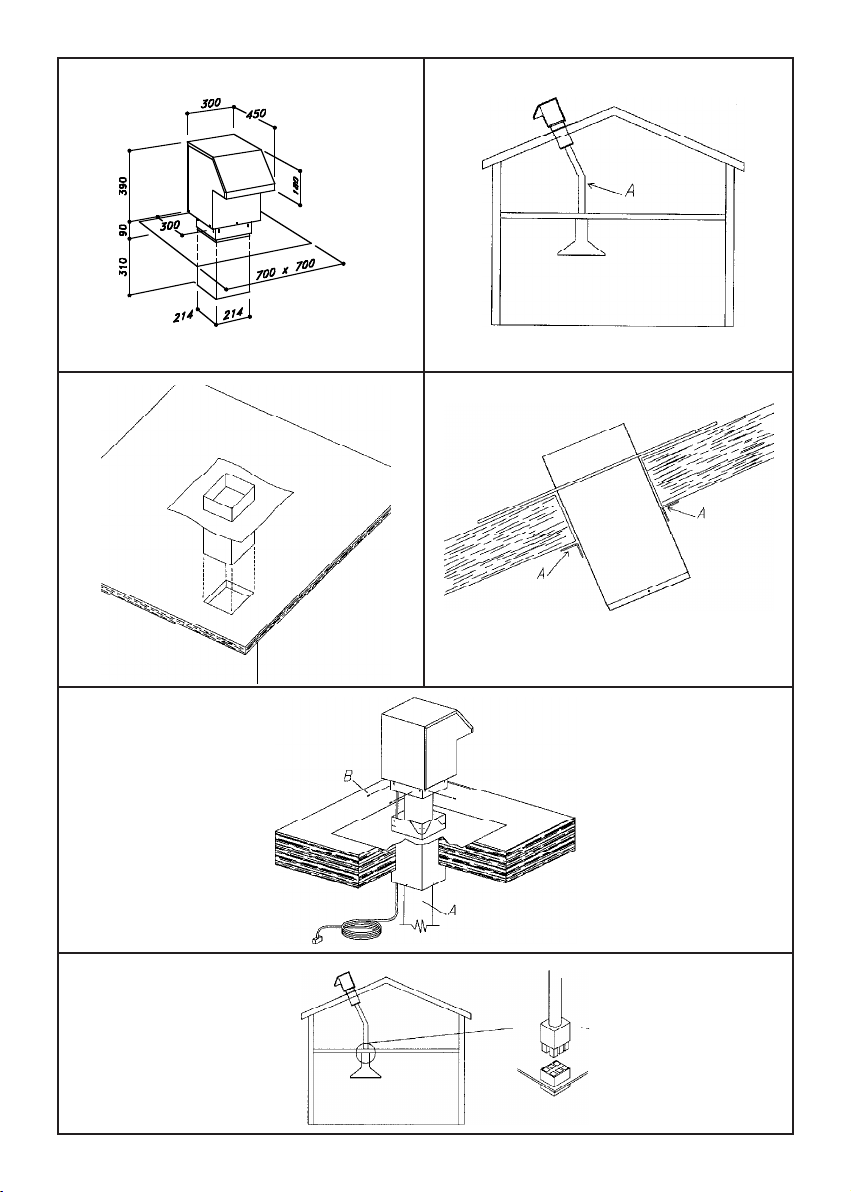
16
22
21
26
24
25
SEM5
2
OK
OK
OK
OK
OK
OK
OK
OK
OK
OK
OK
OK
OK
OK
OK OK
OK
OK
OK
OK
OK
OK
OK
SEM 1 (dis.1)
Attenzione! Il gruppo di aspirazione periferico (centralina) SEM 1 è in classe II (simbolo sulla targhetta dati tecnici
), pertanto non necessita di collegamento a terra.
L’appa recchio è stato prog ettato per aspirare i vapori e gli odori in modo otti male con estrema silenziosità.
L’apparecchio dovrà essere istallato all’interno dell’abitazione collegandolo alla cappa che si trova in cucina (dis.2) o alla
unità di comando SCET - 1.
Modalità di fissaggio: per facilitare le operazion
i di installazione, l’apparecchio può essere fissato a parete, a soffitto o
sul pavimento in po sizione orizzontale (dis.3) o verticale (dis.4) ris petto al piano di fissaggio.
NOTA: Nel caso del fissaggio verticale, si possono utilizzare le staffe in dotazione solo dalla parte più lunga (fig. 6).
Fissaggio dell’apparecchio: una volta stabilito la posizione e il modo di fissaggio, bisogna introdurre i gommini anti-
vibrazioni nelle staffe in dotazione (dis.5C).
I gommi
ni vanno messi nei lati che andranno a contatto con il muro.
Appoggiare le staffe (dis.5A) sulla centralina facendo coincidere i fori di quest’ultima con quelli delle staffe e fissare con
le viti in dotazione (dis.5B)
Appoggiare il tutto nel punto di fissaggio deciso in precedenza segnando, sulla parete, i punti dove bisognerà effettuare i fori.
Nei fori eseguiti inserire i tasselli in dotazione (dis.6A).
Appoggiare la centralina sulla parete facendo coincidere i for
i delle staffe con i tasselli in plastica e avvitare il tutto con le
viti in dotazione (dis.6B).
Collegamento dei tubi: l’apparecchio è predisposto con un’entrata e un’uscita per il collegamento dei tubi (verificare la
direzione dell’aria tramite l’etichetta esterna prima del montaggio dei tubi di evacuazione dis.7), collegare i tubi e fissarli
con idonee fascette metalliche (tubi e fascette sono a cura dell’installatore). Il tubo (dis.7A) va collegato alla cappa posta
nella cucina, il tubo (dis.7B) va indirizzato
verso l’esterno dell’edificio.
Collegamento elettrico alla cappa: l’apparecchio è dotato di un cavo di collegamento lungo 7 metri. Il cavo, alla sua estremità,
ha una connessione a sei poli che deve essere inserita in quella fissata sulla cappa (dis.8) o alla unità di comando SCET - 1.
SEM 2 (dis.9)
Attenzione! Il gruppo di aspirazione periferico (centralina) SEM 2 è in classe I e pertanto necessita di collegamento
a terra.
L’appar
ecchio è stato progettato per aspirare i vapori e gli odori in modo ottimale.
L’apparecchio dovrà essere istallato all’esterno dell’abitazione collegandolo alla cappa che si trova in cucina (dis.10) o alla
unità di comando SCET - 1.
Modalità di fissaggio: il montaggio dell’apparecchio deve essere effettuato da personale qualificato. Usando l’apposita
maschera di foratura (dis.11) praticare sulla parete esterna tutti i fori indicati nella stessa facendo attenzione a non
danneggiare tubature de
ll’acqua o linee elettriche.
I fori alla parete dovranno essere effettuati con una punta da da 8 mm. Nei fori praticati dovranno essere progressivamente:
•Inseriti i relativi tasselli in plastica in dotazione (dis.11A).
•Inseriti i due tubi telescopici nel foro da 160 mm.
•Inserire il tubo in plastica da 40 mm.
Prima di appoggiare l’apparecchio sul muro bisogna inserire la connessione elettrica nel tubo in plastica. Fissar
e l’apparecchio
senza carter estetico in acciaio, precedentemente tolto dal blocco motore, facendo coincidere i fori del blocco motore
stesso con i fori sul muro e serrando con le viti in dotazione (dis.11B).
Collegamento dei tubi: l’apparecchio è predisposto con un entrata dell’aria per il collegamento dei tubi telescopici, e un
uscita.
Dopo che l’apparecchio è stato fissato alla parete esterna, i due tubi telescopici posti all’interno della parete devono essere
c
ollegati con la cappa tramite i tubi flessibili (dis.12).
Il fissaggio tra i tubi deve essere effettuato con idonee fascette metalliche (tubi e fascette sono a cura dell’installatore).
Collegamento elettrico alla cappa: l’apparecchio è dotato di un cavo di collegamento lungo 7 metri. Dopo aver fatto
passare il cavo attraverso il tubo in plastica posto nel muro, inserire la connessione a sei poli sulla cappa e collegare il
filo messa a terra sulla vite adiacente alla connessione tramite dado e rondella (dis.14)
, in alternativa il collegamento
elettrico va fatto alla unità di comando SCET - 1.
Al fine di evitare possibili infiltrazioni d'acqua disporre accuratamente del silicone in corrispondenza del perimetro del
prodotto, in prossimità del muro.
Montaggio carter esterno: rimontare il carter estetico facendo coincidere la griglia con l’uscita aria del blocco motore (dis.13).
47
SEM 1 (fig.1)
Warning! The peripheral exhausting group (remote fitted extr
action motor) is built in class II (symbol on the rating
plate), therefore it must not be earthed.
The appliance is designed to exhaust fumes and odours very silently and in the best way. It must be installed in the house
and connected to the cooker-hood, which is in the kitchen (fig. 2) or to the SCET control unit 1.
Types of installation: to make the installation easy, the appliance can be fixed on the wall, on the ceiling or on the floor
in a hori
zontal position (fig. 3 ) or vertically (fig. 4) to the fixing level.
Note: in the vertical fixing, the brackets supplied can be used only on the longest side (fig. 6).
Installation of the appliance: after deciding the position and the type of installation, insert the anti-vibration rubber caps
in the holes of the brackets supplied (fig. 5C).
The rubber caps must be put on the sides which are in contact with the wall.
Put the brackets (fig. 5A) on the remote fitted extr
action motor by matching its holes with those of the brackets. Fix with
the screws supplied (fig. 5B).
Put the group on the point previously chosen for the installation and mark the points on the wall where the holes must
be drilled.
Insert the dowels supplied in the holes (fig. 6A). Put the remote fitted extraction motor on the wall by matching the holes
of the brackets with the plastic dowels. Screw with the screws supplied (fig. 6B).
Connection of the pipes: the appliance is endowed with an en
trance and an outlet to connect the pipes. Before connecting
the exhaust pipes, check the direction of the air showed on the external label (fig. 7). Connect the pipes and fix them with
appropriate metal clamps (exhaust pipes and metal clamps have to be supplied by the installer). The pipe (fig. 7A) must
be connected with the cooker-hood placed in the kitchen, and the pipe (fig. 7B) must be directed outside the building.
Electrical connection of the hood: the appliance is equipped with a 7m
electrical cable with a six- pin connection at one
end. Insert it into the hood’s connection (External Motor version) or into the SCET-1 central unit (see fig. 8 for the end
result).
SEM 2 (fig.9)
Warning! The remote fitted exhausting group (external motor) is built in class I plate, therefore it needs the earth
connection.
The appliance was designed to exhaust odours and vapours in the best way. The appliance is to be installed on the outside
wall of the house and connetted to the cooker-h
ood which is in the kitchen (fig. 10) or to the SCET control unit 1.
Installation: the mounting of the appliance is to be made by qualified technicians. Using the appropriate drilling jig (fig.
11) drill all the holes marked on it into the external wall, by paying attention not to damage water pipes or power lines.
The holes on the wall are to be drilled with a 8 mm. bit. Insert, step by step, the following parts in the holes drilled:
•the corresponding plastic dowels supplied (fig. 11A)
•the two telescopic pipes in the hole of
160 mm.
•the plastic pipe of 40 mm. diameter.
Before leaning the appliance against the wall, insert the supply cord in the plastic pipe. Fix the appliance without the
stainless steel external body, which was previously removed from the motor block, by matching the holes of the motor
block with the holes on the wall. Tighten with the screws supplied (fig.11B).
Connection of the pipes: the appliance is endowed with an air entrance to be connected with the telescopic pipes and an
air outlet.
After
fixing the appliance on the external wall, connect the two telescopic pipes, which are placed inside the wall, with the
cooker-hood through the flexible pipes (fig. 12).
The fixing between the pipes have to be made with appropriate metal clamps (pipes and clamps are supplied by the
installer).
Electrical connection of the hood: the appliance is equipped with a 7m electrical cable. Make the cable pass through the
plastic hose in the wall (see fig. 12E), connect it to the appliance in the kitchen
and then connect the ground wire to the
screw near the connection by means of nut and washer (see fig. 14). You can otherwise make the electrical connection
to the SCET-1 central unit.
In order to avoid water infiltrations, pl eas eapp ly silicon e on theproduc t perimeter, clos e to the wall.
Installation of the stainless steel external body: put the stainless steel body again, by matching the air exhausting grid
with the air outlet of the motor block (fig. 13).
22
SEM 5
21
23
25
26
22
24
90004200072 - GM 07/10
23
2
OK
OK
OK
OK
OK
OK
OK
OK
OK
OK
OK
OK
OK
OK
OK OK
OK
OK
OK
OK
OK
OK
OK
SEM 1 (dis.1)
Attenzione! Il gruppo di aspirazione periferico (centralina) SEM 1 è in classe II (simbolo sulla targhetta dati tecnici
), pertanto non necessita di collegamento a terra.
L’appa recchio è stato prog ettato per aspirare i vapori e gli odori in modo otti male con estrema silenziosità.
L’apparecchio dovrà essere istallato all’interno dell’abitazione collegandolo alla cappa che si trova in cucina (dis.2) o alla
unità di comando SCET - 1.
Modalità di fissaggio: per facilitare le operazion
i di installazione, l’apparecchio può essere fissato a parete, a soffitto o
sul pavimento in po sizione orizzontale (dis.3) o ve rticale (dis.4) rispetto al piano di fis saggio.
NOTA: Nel caso del fissaggio verticale, si possono utilizzare le staffe in dotazione solo dalla parte più lunga (fig. 6).
Fissaggio dell’apparecchio: una volta stabilito la posizione e il modo di fissaggio, bisogna introdurre i gommini anti-
vibrazioni nelle staffe in dotazione (dis.5C).
I gommi
ni vanno messi nei lati che andranno a contatto con il muro.
Appoggiare le staffe (dis.5A) sulla centralina facendo coincidere i fori di quest’ultima con quelli delle staffe e fissare con
le viti in dotazione (dis.5B)
Appoggiare il tutto nel punto di fissaggio deciso in precedenza segnando, sulla parete, i punti dove bisognerà effettuare i fori.
Nei fori eseguiti inserire i tasselli in dotazione (dis.6A).
Appoggiare la centralina sulla parete facendo coincidere i for
i delle staffe con i tasselli in plastica e avvitare il tutto con le
viti in dotazione (dis.6B).
Collegamento dei tubi: l’apparecchio è predisposto con un’entrata e un’uscita per il collegamento dei tubi (verificare la
direzione dell’aria tramite l’etichetta esterna prima del montaggio dei tubi di evacuazione dis.7), collegare i tubi e fissarli
con idonee fascette metalliche (tubi e fascette sono a cura dell’installatore). Il tubo (dis.7A) va collegato alla cappa posta
nella cucina, il tubo (dis.7B) va indirizzato
verso l’esterno dell’edificio.
Collegamento elettrico alla cappa: l’apparecchio è dotato di un cavo di collegamento lungo 7 metri. Il cavo, alla sua estremità,
ha una connessione a sei poli che deve essere inserita in quella fissata sulla cappa (dis.8) o alla unità di comando SCET - 1.
SEM 2 (dis.9)
Attenzione! Il gruppo di aspirazione periferico (centralina) SEM 2 è in classe I e pertanto necessita di collegamento
a terra.
L’appar
ecchio è stato progettato per aspirare i vapori e gli odori in modo ottimale.
L’apparecchio dovrà essere istallato all’esterno dell’abitazione collegandolo alla cappa che si trova in cucina (dis.10) o alla
unità di comando SCET - 1.
Modalità di fissaggio: il montaggio dell’apparecchio deve essere effettuato da personale qualificato. Usando l’apposita
maschera di foratura (dis.11) praticare sulla parete esterna tutti i fori indicati nella stessa facendo attenzione a non
danneggiare tubature de
ll’acqua o linee elettriche.
I fori alla parete dovranno essere effettuati con una punta da da 8 mm. Nei fori praticati dovranno essere progressivamente:
•Inseriti i relativi tasselli in plastica in dotazione (dis.11A).
•Inseriti i due tubi telescopici nel foro da 160 mm.
•Inserire il tubo in plastica da 40 mm.
Prima di appoggiare l’apparecchio sul muro bisogna inserire la connessione elettrica nel tubo in plastica. Fissar
e l’apparecchio
senza carter estetico in acciaio, precedentemente tolto dal blocco motore, facendo coincidere i fori del blocco motore
stesso con i fori sul muro e serrando con le viti in dotazione (dis.11B).
Collegamento dei tubi: l’apparecchio è predisposto con un entrata dell’aria per il collegamento dei tubi telescopici, e un
uscita.
Dopo che l’apparecchio è stato fissato alla parete esterna, i due tubi telescopici posti all’interno della parete devono essere
c
ollegati con la cappa tramite i tubi flessibili (dis.12).
Il fissaggio tra i tubi deve essere effettuato con idonee fascette metalliche (tubi e fascette sono a cura dell’installatore).
Collegamento elettrico alla cappa: l’apparecchio è dotato di un cavo di collegamento lungo 7 metri. Dopo aver fatto
passare il cavo attraverso il tubo in plastica posto nel muro, inserire la connessione a sei poli sulla cappa e collegare il
filo messa a terra sulla vite adiacente alla connessione tramite dado e rondella (dis.14)
, in alternativa il collegamento
elettrico va fatto alla unità di comando SCET - 1.
Al fine di evitare possibili infiltrazioni d'acqua disporre accuratamente del silicone in corrispondenza del perimetro del
prodotto, in prossimità del muro.
Montaggio carter esterno: rimontare il carter estetico facendo coincidere la griglia con l’uscita aria del blocco motore (dis.13).
47
SEM 1 (fig.1)
Warning! The peripheral exhausting group (remote fitted extr
action motor) is built in class II (symbol on the rating
plate), therefore it must not be earthed.
The appliance is designed to exhaust fumes and odours very silently and in the best way. It must be installed in the house
and connected to the cooker-hood, which is in the kitchen (fig. 2) or to the SCET control unit 1.
Types of installation: to make the installation easy, the appliance can be fixed on the wall, on the ceiling or on the floor
in a hori
zontal position (fig. 3 ) or vertically (fig. 4) to the fixing level.
Note: in the vertical fixing, the brackets supplied can be used only on the longest side (fig. 6).
Installation of the appliance: after deciding the position and the type of installation, insert the anti-vibration rubber caps
in the holes of the brackets supplied (fig. 5C).
The rubber caps must be put on the sides which are in contact with the wall.
Put the brackets (fig. 5A) on the remote fitted extr
action motor by matching its holes with those of the brackets. Fix with
the screws supplied (fig. 5B).
Put the group on the point previously chosen for the installation and mark the points on the wall where the holes must
be drilled.
Insert the dowels supplied in the holes (fig. 6A). Put the remote fitted extraction motor on the wall by matching the holes
of the brackets with the plastic dowels. Screw with the screws supplied (fig. 6B).
Connection of the pipes: the appliance is endowed with an en
trance and an outlet to connect the pipes. Before connecting
the exhaust pipes, check the direction of the air showed on the external label (fig. 7). Connect the pipes and fix them with
appropriate metal clamps (exhaust pipes and metal clamps have to be supplied by the installer). The pipe (fig. 7A) must
be connected with the cooker-hood placed in the kitchen, and the pipe (fig. 7B) must be directed outside the building.
Electrical connection of the hood: the appliance is equipped with a 7m
electrical cable with a six- pin connection at one
end. Insert it into the hood’s connection (External Motor version) or into the SCET-1 central unit (see fig. 8 for the end
result).
SEM 2
(fig.9)
Warning! The remote fitted exhausting group (external motor) is built in class I plate, therefore it needs the earth
connection.
The appliance was designed to exhaust odours and vapours in the best way. The appliance is to be installed on the outside
wall of the house and connetted to the cooker-h
ood which is in the kitchen (fig. 10) or to the SCET control unit 1.
Installation: the mounting of the appliance is to be made by qualified technicians. Using the appropriate drilling jig (fig.
11) drill all the holes marked on it into the external wall, by paying attention not to damage water pipes or power lines.
The holes on the wall are to be drilled with a 8 mm. bit. Insert, step by step, the following parts in the holes drilled:
•the corresponding plastic dowels supplied (fig. 11A)
•the two telescopic pipes in the hole of
160 mm.
•the plastic pipe of 40 mm. diameter.
Before leaning the appliance against the wall, insert the supply cord in the plastic pipe. Fix the appliance without the
stainless steel external body, which was previously removed from the motor block, by matching the holes of the motor
block with the holes on the wall. Tighten with the screws supplied (fig.11B).
Connection of the pipes: the appliance is endowed with an air entrance to be connected with the telescopic pipes and an
air outlet.
After
fixing the appliance on the external wall, connect the two telescopic pipes, which are placed inside the wall, with the
cooker-hood through the flexible pipes (fig. 12).
The fixing between the pipes have to be made with appropriate metal clamps (pipes and clamps are supplied by the
installer).
Electrical connection of the hood: the appliance is equipped with a 7m electrical cable. Make the cable pass through the
plastic hose in the wall (see fig. 12E), connect it to the appliance in the kitchen
and then connect the ground wire to the
screw near the connection by means of nut and washer (see fig. 14). You can otherwise make the electrical connection
to the SCET-1 central unit.
In order to avoid water infiltrations, pl eas eapp ly silicon e on theproduc t perimeter, clos e to the wall.
Installation of the stainless steel external body: put the stainless steel body again, by matching the air exhausting grid
with the air outlet of the motor block (fig. 13).
22
SEM 5
21
23
25
26
22
24
90004200072 - GM 07/10
23
2
OK
OK
OK
OK
OK
OK
OK
OK
OK
OK
OK
OK
OK
OK
OK OK
OK
OK
OK
OK
OK
OK
OK
SEM 1 (dis.1)
Attenzione! Il gruppo di aspirazione periferico (centralina) SEM 1 è in classe II (simbolo sulla targhetta dati tecnici
), pertanto non necessita di collegamento a terra.
L’appa recchio è stato prog ettato per aspirare i vapori e gli odori in modo otti male con estrema silenziosità.
L’apparecchio dovrà essere istallato all’interno dell’abitazione collegandolo alla cappa che si trova in cucina (dis.2) o alla
unità di comando SCET - 1.
Modalità di fissaggio: per facilitare le operazion
i di installazione, l’apparecchio può essere fissato a parete, a soffitto o
sul pavimento in po sizione orizzontale (dis.3) o verticale (dis.4) rispetto al piano di fis saggio.
NOTA: Nel caso del fissaggio verticale, si possono utilizzare le staffe in dotazione solo dalla parte più lunga (fig. 6).
Fissaggio dell’apparecchio: una volta stabilito la posizione e il modo di fissaggio, bisogna introdurre i gommini anti-
vibrazioni nelle staffe in dotazione (dis.5C).
I gommi
ni vanno messi nei lati che andranno a contatto con il muro.
Appoggiare le staffe (dis.5A) sulla centralina facendo coincidere i fori di quest’ultima con quelli delle staffe e fissare con
le viti in dotazione (dis.5B)
Appoggiare il tutto nel punto di fissaggio deciso in precedenza segnando, sulla parete, i punti dove bisognerà effettuare i fori.
Nei fori eseguiti inserire i tasselli in dotazione (dis.6A).
Appoggiare la centralina sulla parete facendo coincidere i for
i delle staffe con i tasselli in plastica e avvitare il tutto con le
viti in dotazione (dis.6B).
Collegamento dei tubi: l’apparecchio è predisposto con un’entrata e un’uscita per il collegamento dei tubi (verificare la
direzione dell’aria tramite l’etichetta esterna prima del montaggio dei tubi di evacuazione dis.7), collegare i tubi e fissarli
con idonee fascette metalliche (tubi e fascette sono a cura dell’installatore). Il tubo (dis.7A) va collegato alla cappa posta
nella cucina, il tubo (dis.7B) va indirizzato
verso l’esterno dell’edificio.
Collegamento elettrico alla cappa: l’apparecchio è dotato di un cavo di collegamento lungo 7 metri. Il cavo, alla sua estremità,
ha una connessione a sei poli che deve essere inserita in quella fissata sulla cappa (dis.8) o alla unità di comando SCET - 1.
SEM 2 (dis.9)
Attenzione! Il gruppo di aspirazione periferico (centralina) SEM 2 è in classe I e pertanto necessita di collegamento
a terra.
L’appar
ecchio è stato progettato per aspirare i vapori e gli odori in modo ottimale.
L’apparecchio dovrà essere istallato all’esterno dell’abitazione collegandolo alla cappa che si trova in cucina (dis.10) o alla
unità di comando SCET - 1.
Modalità di fissaggio: il montaggio dell’apparecchio deve essere effettuato da personale qualificato. Usando l’apposita
maschera di foratura (dis.11) praticare sulla parete esterna tutti i fori indicati nella stessa facendo attenzione a non
danneggiare tubature de
ll’acqua o linee elettriche.
I fori alla parete dovranno essere effettuati con una punta da da 8 mm. Nei fori praticati dovranno essere progressivamente:
•Inseriti i relativi tasselli in plastica in dotazione (dis.11A).
•Inseriti i due tubi telescopici nel foro da 160 mm.
•Inserire il tubo in plastica da 40 mm.
Prima di appoggiare l’apparecchio sul muro bisogna inserire la connessione elettrica nel tubo in plastica. Fissar
e l’apparecchio
senza carter estetico in acciaio, precedentemente tolto dal blocco motore, facendo coincidere i fori del blocco motore
stesso con i fori sul muro e serrando con le viti in dotazione (dis.11B).
Collegamento dei tubi: l’apparecchio è predisposto con un entrata dell’aria per il collegamento dei tubi telescopici, e un
uscita.
Dopo che l’apparecchio è stato fissato alla parete esterna, i due tubi telescopici posti all’interno della parete devono essere
c
ollegati con la cappa tramite i tubi flessibili (dis.12).
Il fissaggio tra i tubi deve essere effettuato con idonee fascette metalliche (tubi e fascette sono a cura dell’installatore).
Collegamento elettrico alla cappa: l’apparecchio è dotato di un cavo di collegamento lungo 7 metri. Dopo aver fatto
passare il cavo attraverso il tubo in plastica posto nel muro, inserire la connessione a sei poli sulla cappa e collegare il
filo messa a terra sulla vite adiacente alla connessione tramite dado e rondella (dis.14)
, in alternativa il collegamento
elettrico va fatto alla unità di comando SCET - 1.
Al fine di evitare possibili infiltrazioni d'acqua disporre accuratamente del silicone in corrispondenza del perimetro del
prodotto, in prossimità del muro.
Montaggio carter esterno: rimontare il carter estetico facendo coincidere la griglia con l’uscita aria del blocco motore (dis.13).
47
SEM 1 (fig.1)
Warning! The peripheral exhausting group (remote fitted extr
action motor) is built in class II (symbol on the rating
plate), therefore it must not be earthed.
The appliance is designed to exhaust fumes and odours very silently and in the best way. It must be installed in the house
and connected to the cooker-hood, which is in the kitchen (fig. 2) or to the SCET control unit 1.
Types of installation: to make the installation easy, the appliance can be fixed on the wall, on the ceiling or on the floor
in a hori
zontal position (fig. 3 ) or vertically (fig. 4) to the fixing level.
Note: in the vertical fixing, the brackets supplied can be used only on the longest side (fig. 6).
Installation of the appliance: after deciding the position and the type of installation, insert the anti-vibration rubber caps
in the holes of the brackets supplied (fig. 5C).
The rubber caps must be put on the sides which are in contact with the wall.
Put the brackets (fig. 5A) on the remote fitted extr
action motor by matching its holes with those of the brackets. Fix with
the screws supplied (fig. 5B).
Put the group on the point previously chosen for the installation and mark the points on the wall where the holes must
be drilled.
Insert the dowels supplied in the holes (fig. 6A). Put the remote fitted extraction motor on the wall by matching the holes
of the brackets with the plastic dowels. Screw with the screws supplied (fig. 6B).
Connection of the pipes: the appliance is endowed with an en
trance and an outlet to connect the pipes. Before connecting
the exhaust pipes, check the direction of the air showed on the external label (fig. 7). Connect the pipes and fix them with
appropriate metal clamps (exhaust pipes and metal clamps have to be supplied by the installer). The pipe (fig. 7A) must
be connected with the cooker-hood placed in the kitchen, and the pipe (fig. 7B) must be directed outside the building.
Electrical connection of the hood: the appliance is equipped with a 7m
electrical cable with a six- pin connection at one
end. Insert it into the hood’s connection (External Motor version) or into the SCET-1 central unit (see fig. 8 for the end
result).
SEM 2 (fig.9)
Warning! The remote fitted exhausting group (external motor) is built in class I plate, therefore it needs the earth
connection.
The appliance was designed to exhaust odours and vapours in the best way. The appliance is to be installed on the outside
wall of the house and connetted to the cooker-h
ood which is in the kitchen (fig. 10) or to the SCET control unit 1.
Installation: the mounting of the appliance is to be made by qualified technicians. Using the appropriate drilling jig (fig.
11) drill all the holes marked on it into the external wall, by paying attention not to damage water pipes or power lines.
The holes on the wall are to be drilled with a 8 mm. bit. Insert, step by step, the following parts in the holes drilled:
•the corresponding plastic dowels supplied (fig. 11A)
•the two telescopic pipes in the hole of
160 mm.
•the plastic pipe of 40 mm. diameter.
Before leaning the appliance against the wall, insert the supply cord in the plastic pipe. Fix the appliance without the
stainless steel external body, which was previously removed from the motor block, by matching the holes of the motor
block with the holes on the wall. Tighten with the screws supplied (fig.11B).
Connection of the pipes: the appliance is endowed with an air entrance to be connected with the telescopic pipes and an
air outlet.
After
fixing the appliance on the external wall, connect the two telescopic pipes, which are placed inside the wall, with the
cooker-hood through the flexible pipes (fig. 12).
The fixing between the pipes have to be made with appropriate metal clamps (pipes and clamps are supplied by the
installer).
Electrical connection of the hood: the appliance is equipped with a 7m electrical cable. Make the cable pass through the
plastic hose in the wall (see fig. 12E), connect it to the appliance in the kitchen
and then connect the ground wire to the
screw near the connection by means of nut and washer (see fig. 14). You can otherwise make the electrical connection
to the SCET-1 central unit.
In order to avoid water infiltrations, pl eas eapp ly silicon e on theproduc t perimeter, clos e to the wall.
Installation of the stainless steel external body: put the stainless steel body again, by matching the air exhausting grid
with the air outlet of the motor block (fig. 13).
22
SEM 5
21
23
25
26
22
24
90004200072 - GM 07/10
23
23
2
OK
OK
OK
OK
OK
OK
OK
OK
OK
OK
OK
OK
OK
OK
OK OK
OK
OK
OK
OK
OK
OK
OK
SEM 1 (dis.1)
Attenzione! Il gruppo di aspirazione periferico (centralina) SEM 1 è in classe II (simbolo sulla targhetta dati tecnici
), pertanto non necessita di collegamento a terra.
L’appa recchio è stato progettato per aspirare i vapori e gli odori in modo otti male con estrema silenziosità.
L’apparecchio dovrà essere istallato all’interno dell’abitazione collegandolo alla cappa che si trova in cucina (dis.2) o alla
unità di comando SCET - 1.
Modalità di fissaggio: per facilitare le operazion
i di installazione, l’apparecchio può essere fissato a parete, a soffitto o
sul pavim ento in posizione orizzontale (dis.3) o ve rticale (dis.4) rispetto a l piano di fis saggio.
NOTA: Nel caso del fissaggio verticale, si possono utilizzare le staffe in dotazione solo dalla parte più lunga (fig. 6).
Fissaggio dell’apparecchio: una volta stabilito la posizione e il modo di fissaggio, bisogna introdurre i gommini anti-
vibrazioni nelle staffe in dotazione (dis.5C).
I gommi
ni vanno messi nei lati che andranno a contatto con il muro.
Appoggiare le staffe (dis.5A) sulla centralina facendo coincidere i fori di quest’ultima con quelli delle staffe e fissare con
le viti in dotazione (dis.5B)
Appoggiare il tutto nel punto di fissaggio deciso in precedenza segnando, sulla parete, i punti dove bisognerà effettuare i fori.
Nei fori eseguiti inserire i tasselli in dotazione (dis.6A).
Appoggiare la centralina sulla parete facendo coincidere i for
i delle staffe con i tasselli in plastica e avvitare il tutto con le
viti in dotazione (dis.6B).
Collegamento dei tubi: l’apparecchio è predisposto con un’entrata e un’uscita per il collegamento dei tubi (verificare la
direzione dell’aria tramite l’etichetta esterna prima del montaggio dei tubi di evacuazione dis.7), collegare i tubi e fissarli
con idonee fascette metalliche (tubi e fascette sono a cura dell’installatore). Il tubo (dis.7A) va collegato alla cappa posta
nella cucina, il tubo (dis.7B) va indirizzato
verso l’esterno dell’edificio.
Collegamento elettrico alla cappa: l’apparecchio è dotato di un cavo di collegamento lungo 7 metri. Il cavo, alla sua estremità,
ha una connessione a sei poli che deve essere inserita in quella fissata sulla cappa (dis.8) o alla unità di comando SCET - 1.
SEM 2 (dis.9)
Attenzione! Il gruppo di aspirazione periferico (centralina) SEM 2 è in classe I e pertanto necessita di collegamento
a terra.
L’appar
ecchio è stato progettato per aspirare i vapori e gli odori in modo ottimale.
L’apparecchio dovrà essere istallato all’esterno dell’abitazione collegandolo alla cappa che si trova in cucina (dis.10) o alla
unità di comando SCET - 1.
Modalità di fissaggio: il montaggio dell’apparecchio deve essere effettuato da personale qualificato. Usando l’apposita
maschera di foratura (dis.11) praticare sulla parete esterna tutti i fori indicati nella stessa facendo attenzione a non
danneggiare tubature de
ll’acqua o linee elettriche.
I fori alla parete dovranno essere effettuati con una punta da da 8 mm. Nei fori praticati dovranno essere progressivamente:
•Inseriti i relativi tasselli in plastica in dotazione (dis.11A).
•Inseriti i due tubi telescopici nel foro da 160 mm.
•Inserire il tubo in plastica da 40 mm.
Prima di appoggiare l’apparecchio sul muro bisogna inserire la connessione elettrica nel tubo in plastica. Fissar
e l’apparecchio
senza carter estetico in acciaio, precedentemente tolto dal blocco motore, facendo coincidere i fori del blocco motore
stesso con i fori sul muro e serrando con le viti in dotazione (dis.11B).
Collegamento dei tubi: l’apparecchio è predisposto con un entrata dell’aria per il collegamento dei tubi telescopici, e un
uscita.
Dopo che l’apparecchio è stato fissato alla parete esterna, i due tubi telescopici posti all’interno della parete devono essere
c
ollegati con la cappa tramite i tubi flessibili (dis.12).
Il fissaggio tra i tubi deve essere effettuato con idonee fascette metalliche (tubi e fascette sono a cura dell’installatore).
Collegamento elettrico alla cappa: l’apparecchio è dotato di un cavo di collegamento lungo 7 metri. Dopo aver fatto
passare il cavo attraverso il tubo in plastica posto nel muro, inserire la connessione a sei poli sulla cappa e collegare il
filo messa a terra sulla vite adiacente alla connessione tramite dado e rondella (dis.14)
, in alternativa il collegamento
elettrico va fatto alla unità di comando SCET - 1.
Al fine di evitare possibili infiltrazioni d'acqua disporre accuratamente del silicone in corrispondenza del perimetro del
prodotto, in prossimità del muro.
Montaggio carter esterno: rimontare il carter estetico facendo coincidere la griglia con l’uscita aria del blocco motore (dis.13).
47
SEM 1 (fig.1)
Warning! The peripheral exhausting group (remote fitted extr
action motor) is built in class II (symbol on the rating
plate), therefore it must not be earthed.
The appliance is designed to exhaust fumes and odours very silently and in the best way. It must be installed in the house
and connected to the cooker-hood, which is in the kitchen (fig. 2) or to the SCET control unit 1.
Types of installation: to make the installation easy, the appliance can be fixed on the wall, on the ceiling or on the floor
in a hori
zontal position (fig. 3 ) or vertically (fig. 4) to the fixing level.
Note: in the vertical fixing, the brackets supplied can be used only on the longest side (fig. 6).
Installation of the appliance: after deciding the position and the type of installation, insert the anti-vibration rubber caps
in the holes of the brackets supplied (fig. 5C).
The rubber caps must be put on the sides which are in contact with the wall.
Put the brackets (fig. 5A) on the remote fitted extr
action motor by matching its holes with those of the brackets. Fix with
the screws supplied (fig. 5B).
Put the group on the point previously chosen for the installation and mark the points on the wall where the holes must
be drilled.
Insert the dowels supplied in the holes (fig. 6A). Put the remote fitted extraction motor on the wall by matching the holes
of the brackets with the plastic dowels. Screw with the screws supplied (fig. 6B).
Connection of the pipes: the appliance is endowed with an en
trance and an outlet to connect the pipes. Before connecting
the exhaust pipes, check the direction of the air showed on the external label (fig. 7). Connect the pipes and fix them with
appropriate metal clamps (exhaust pipes and metal clamps have to be supplied by the installer). The pipe (fig. 7A) must
be connected with the cooker-hood placed in the kitchen, and the pipe (fig. 7B) must be directed outside the building.
Electrical connection of the hood: the appliance is equipped with a 7m
electrical cable with a six- pin connection at one
end. Insert it into the hood’s connection (External Motor version) or into the SCET-1 central unit (see fig. 8 for the end
result).
SEM 2 (fig.9)
Warning! The remote fitted exhausting group (external motor) is built in class I plate, therefore it needs the earth
connection.
The appliance was designed to exhaust odours and vapours in the best way. The appliance is to be installed on the outside
wall of the house and connetted to the cooker-h
ood which is in the kitchen (fig. 10) or to the SCET control unit 1.
Installation: the mounting of the appliance is to be made by qualified technicians. Using the appropriate drilling jig (fig.
11) drill all the holes marked on it into the external wall, by paying attention not to damage water pipes or power lines.
The holes on the wall are to be drilled with a 8 mm. bit. Insert, step by step, the following parts in the holes drilled:
•the corresponding plastic dowels supplied (fig. 11A)
•the two telescopic pipes in the hole of
160 mm.
•the plastic pipe of 40 mm. diameter.
Before leaning the appliance against the wall, insert the supply cord in the plastic pipe. Fix the appliance without the
stainless steel external body, which was previously removed from the motor block, by matching the holes of the motor
block with the holes on the wall. Tighten with the screws supplied (fig.11B).
Connection of the pipes: the appliance is endowed with an air entrance to be connected with the telescopic pipes and an
air outlet.
After
fixing the appliance on the external wall, connect the two telescopic pipes, which are placed inside the wall, with the
cooker-hood through the flexible pipes (fig. 12).
The fixing between the pipes have to be made with appropriate metal clamps (pipes and clamps are supplied by the
installer).
Electrical connection of the hood: the appliance is equipped with a 7m electrical cable. Make the cable pass through the
plastic hose in the wall (see fig. 12E), connect it to the appliance in the kitchen
and then connect the ground wire to the
screw near the connection by means of nut and washer (see fig. 14). You can otherwise make the electrical connection
to the SCET-1 central unit.
In order to avoid water infiltrations, pl eas eapp ly silicon e on theproduc t per imeter, clos e to the wall.
Installation of the stainless steel external body: put the stainless steel body again, by matching the air exhausting grid
with the air outlet of the motor block (fig. 13).
22
SEM 5
21
23
25
26
22
24
90004200072 - GM 07/10
23
2
OK
OK
OK
OK
OK
OK
OK
OK
OK
OK
OK
OK
OK
OK
OK OK
OK
OK
OK
OK
OK
OK
OK
SEM 1 (dis.1)
Attenzione! Il gruppo di aspirazione periferico (centralina) SEM 1 è in classe II (simbolo sulla targhetta dati tecnici
), pertanto non necessita di collegamento a terra.
L’appa recchio è stato prog ettato per aspirare i vapori e gli odori in modo otti male con estrema silenziosità.
L’apparecchio dovrà essere istallato all’interno dell’abitazione collegandolo alla cappa che si trova in cucina (dis.2) o alla
unità di comando SCET - 1.
Modalità di fissaggio: per facilitare le operazion
i di installazione, l’apparecchio può essere fissato a parete, a soffitto o
sul pavimento in po sizione orizzontale (dis.3) o verticale (dis.4) ris petto al piano di fissaggio.
NOTA: Nel caso del fissaggio verticale, si possono utilizzare le staffe in dotazione solo dalla parte più lunga (fig. 6).
Fissaggio dell’apparecchio: una volta stabilito la posizione e il modo di fissaggio, bisogna introdurre i gommini anti-
vibrazioni nelle staffe in dotazione (dis.5C).
I gommi
ni vanno messi nei lati che andranno a contatto con il muro.
Appoggiare le staffe (dis.5A) sulla centralina facendo coincidere i fori di quest’ultima con quelli delle staffe e fissare con
le viti in dotazione (dis.5B)
Appoggiare il tutto nel punto di fissaggio deciso in precedenza segnando, sulla parete, i punti dove bisognerà effettuare i fori.
Nei fori eseguiti inserire i tasselli in dotazione (dis.6A).
Appoggiare la centralina sulla parete facendo coincidere i for
i delle staffe con i tasselli in plastica e avvitare il tutto con le
viti in dotazione (dis.6B).
Collegamento dei tubi: l’apparecchio è predisposto con un’entrata e un’uscita per il collegamento dei tubi (verificare la
direzione dell’aria tramite l’etichetta esterna prima del montaggio dei tubi di evacuazione dis.7), collegare i tubi e fissarli
con idonee fascette metalliche (tubi e fascette sono a cura dell’installatore). Il tubo (dis.7A) va collegato alla cappa posta
nella cucina, il tubo (dis.7B) va indirizzato
verso l’esterno dell’edificio.
Collegamento elettrico alla cappa: l’apparecchio è dotato di un cavo di collegamento lungo 7 metri. Il cavo, alla sua estremità,
ha una connessione a sei poli che deve essere inserita in quella fissata sulla cappa (dis.8) o alla unità di comando SCET - 1.
SEM 2 (dis.9)
Attenzione! Il gruppo di aspirazione periferico (centralina) SEM 2 è in classe I e pertanto necessita di collegamento
a terra.
L’appar
ecchio è stato progettato per aspirare i vapori e gli odori in modo ottimale.
L’apparecchio dovrà essere istallato all’esterno dell’abitazione collegandolo alla cappa che si trova in cucina (dis.10) o alla
unità di comando SCET - 1.
Modalità di fissaggio: il montaggio dell’apparecchio deve essere effettuato da personale qualificato. Usando l’apposita
maschera di foratura (dis.11) praticare sulla parete esterna tutti i fori indicati nella stessa facendo attenzione a non
danneggiare tubature de
ll’acqua o linee elettriche.
I fori alla parete dovranno essere effettuati con una punta da da 8 mm. Nei fori praticati dovranno essere progressivamente:
•Inseriti i relativi tasselli in plastica in dotazione (dis.11A).
•Inseriti i due tubi telescopici nel foro da 160 mm.
•Inserire il tubo in plastica da 40 mm.
Prima di appoggiare l’apparecchio sul muro bisogna inserire la connessione elettrica nel tubo in plastica. Fissar
e l’apparecchio
senza carter estetico in acciaio, precedentemente tolto dal blocco motore, facendo coincidere i fori del blocco motore
stesso con i fori sul muro e serrando con le viti in dotazione (dis.11B).
Collegamento dei tubi: l’apparecchio è predisposto con un entrata dell’aria per il collegamento dei tubi telescopici, e un
uscita.
Dopo che l’apparecchio è stato fissato alla parete esterna, i due tubi telescopici posti all’interno della parete devono essere
c
ollegati con la cappa tramite i tubi flessibili (dis.12).
Il fissaggio tra i tubi deve essere effettuato con idonee fascette metalliche (tubi e fascette sono a cura dell’installatore).
Collegamento elettrico alla cappa: l’apparecchio è dotato di un cavo di collegamento lungo 7 metri. Dopo aver fatto
passare il cavo attraverso il tubo in plastica posto nel muro, inserire la connessione a sei poli sulla cappa e collegare il
filo messa a terra sulla vite adiacente alla connessione tramite dado e rondella (dis.14)
, in alternativa il collegamento
elettrico va fatto alla unità di comando SCET - 1.
Al fine di evitare possibili infiltrazioni d'acqua disporre accuratamente del silicone in corrispondenza del perimetro del
prodotto, in prossimità del muro.
Montaggio carter esterno: rimontare il carter estetico facendo coincidere la griglia con l’uscita aria del blocco motore (dis.13).
47
SEM 1 (fig.1)
Warning! The peripheral exhausting group (remote fitted extr
action motor) is built in class II (symbol on the rating
plate), therefore it must not be earthed.
The appliance is designed to exhaust fumes and odours very silently and in the best way. It must be installed in the house
and connected to the cooker-hood, which is in the kitchen (fig. 2) or to the SCET control unit 1.
Types of installation: to make the installation easy, the appliance can be fixed on the wall, on the ceiling or on the floor
in a hori
zontal position (fig. 3 ) or vertically (fig. 4) to the fixing level.
Note: in the vertical fixing, the brackets supplied can be used only on the longest side (fig. 6).
Installation of the appliance: after deciding the position and the type of installation, insert the anti-vibration rubber caps
in the holes of the brackets supplied (fig. 5C).
The rubber caps must be put on the sides which are in contact with the wall.
Put the brackets (fig. 5A) on the remote fitted extr
action motor by matching its holes with those of the brackets. Fix with
the screws supplied (fig. 5B).
Put the group on the point previously chosen for the installation and mark the points on the wall where the holes must
be drilled.
Insert the dowels supplied in the holes (fig. 6A). Put the remote fitted extraction motor on the wall by matching the holes
of the brackets with the plastic dowels. Screw with the screws supplied (fig. 6B).
Connection of the pipes: the appliance is endowed with an en
trance and an outlet to connect the pipes. Before connecting
the exhaust pipes, check the direction of the air showed on the external label (fig. 7). Connect the pipes and fix them with
appropriate metal clamps (exhaust pipes and metal clamps have to be supplied by the installer). The pipe (fig. 7A) must
be connected with the cooker-hood placed in the kitchen, and the pipe (fig. 7B) must be directed outside the building.
Electrical connection of the hood: the appliance is equipped with a 7m
electrical cable with a six- pin connection at one
end. Insert it into the hood’s connection (External Motor version) or into the SCET-1 central unit (see fig. 8 for the end
result).
SEM 2 (fig.9)
Warning! The remote fitted exhausting group (external motor) is built in class I plate, therefore it needs the earth
connection.
The appliance was designed to exhaust odours and vapours in the best way. The appliance is to be installed on the outside
wall of the house and connetted to the cooker-h
ood which is in the kitchen (fig. 10) or to the SCET control unit 1.
Installation: the mounting of the appliance is to be made by qualified technicians. Using the appropriate drilling jig (fig.
11) drill all the holes marked on it into the external wall, by paying attention not to damage water pipes or power lines.
The holes on the wall are to be drilled with a 8 mm. bit. Insert, step by step, the following parts in the holes drilled:
•the corresponding plastic dowels supplied (fig. 11A)
•the two telescopic pipes in the hole of
160 mm.
•the plastic pipe of 40 mm. diameter.
Before leaning the appliance against the wall, insert the supply cord in the plastic pipe. Fix the appliance without the
stainless steel external body, which was previously removed from the motor block, by matching the holes of the motor
block with the holes on the wall. Tighten with the screws supplied (fig.11B).
Connection of the pipes: the appliance is endowed with an air entrance to be connected with the telescopic pipes and an
air outlet.
After
fixing the appliance on the external wall, connect the two telescopic pipes, which are placed inside the wall, with the
cooker-hood through the flexible pipes (fig. 12).
The fixing between the pipes have to be made with appropriate metal clamps (pipes and clamps are supplied by the
installer).
Electrical connection of the hood: the appliance is equipped with a 7m electrical cable. Make the cable pass through the
plastic hose in the wall (see fig. 12E), connect it to the appliance in the kitchen
and then connect the ground wire to the
screw near the connection by means of nut and washer (see fig. 14). You can otherwise make the electrical connection
to the SCET-1 central unit.
In order to avoid water infiltrations, pl eas eapp ly silicon e on theproduc t perimeter, clos e to the wall.
Installation of the stainless steel external body: put the stainless steel body again, by matching the air exhausting grid
with the air outlet of the motor block (fig. 13).
22
SEM 5
21
23
25
26
22
24
90004200072 - GM 07/10
23
2
OK
OK
OK
OK
OK
OK
OK
OK
OK
OK
OK
OK
OK
OK
OK OK
OK
OK
OK
OK
OK
OK
OK
SEM 1 (dis.1)
Attenzione! Il gruppo di aspirazione periferico (centralina) SEM 1 è in classe II (simbolo sulla targhetta dati tecnici
), pertanto non necessita di collegamento a terra.
L’apparecchio è stato prog ettato per aspirare i vapori e gli odori in modo otti male con estrema sil enziosità.
L’apparecchio dovrà essere istallato all’interno dell’abitazione collegandolo alla cappa che si trova in cucina (dis.2) o alla
unità di comando SCET - 1.
Modalità di fissaggio: per facilitare le operazion
i di installazione, l’apparecchio può essere fissato a parete, a soffitto o
sul pavimento in posizione orizz onta le (dis.3) o verticale (dis.4) ris petto al piano di fis saggio.
NOTA: Nel caso del fissaggio verticale, si possono utilizzare le staffe in dotazione solo dalla parte più lunga (fig. 6).
Fissaggio dell’apparecchio: una volta stabilito la posizione e il modo di fissaggio, bisogna introdurre i gommini anti-
vibrazioni nelle staffe in dotazione (dis.5C).
I gommi
ni vanno messi nei lati che andranno a contatto con il muro.
Appoggiare le staffe (dis.5A) sulla centralina facendo coincidere i fori di quest’ultima con quelli delle staffe e fissare con
le viti in dotazione (dis.5B)
Appoggiare il tutto nel punto di fissaggio deciso in precedenza segnando, sulla parete, i punti dove bisognerà effettuare i fori.
Nei fori eseguiti inserire i tasselli in dotazione (dis.6A).
Appoggiare la centralina sulla parete facendo coincidere i for
i delle staffe con i tasselli in plastica e avvitare il tutto con le
viti in dotazione (dis.6B).
Collegamento dei tubi: l’apparecchio è predisposto con un’entrata e un’uscita per il collegamento dei tubi (verificare la
direzione dell’aria tramite l’etichetta esterna prima del montaggio dei tubi di evacuazione dis.7), collegare i tubi e fissarli
con idonee fascette metalliche (tubi e fascette sono a cura dell’installatore). Il tubo (dis.7A) va collegato alla cappa posta
nella cucina, il tubo (dis.7B) va indirizzato
verso l’esterno dell’edificio.
Collegamento elettrico alla cappa: l’apparecchio è dotato di un cavo di collegamento lungo 7 metri. Il cavo, alla sua estremità,
ha una connessione a sei poli che deve essere inserita in quella fissata sulla cappa (dis.8) o alla unità di comando SCET - 1.
SEM 2 (dis.9)
Attenzione! Il gruppo di aspirazione periferico (centralina) SEM 2 è in classe I e pertanto necessita di collegamento
a terra.
L’appar
ecchio è stato progettato per aspirare i vapori e gli odori in modo ottimale.
L’apparecchio dovrà essere istallato all’esterno dell’abitazione collegandolo alla cappa che si trova in cucina (dis.10) o alla
unità di comando SCET - 1.
Modalità di fissaggio: il montaggio dell’apparecchio deve essere effettuato da personale qualificato. Usando l’apposita
maschera di foratura (dis.11) praticare sulla parete esterna tutti i fori indicati nella stessa facendo attenzione a non
danneggiare tubature de
ll’acqua o linee elettriche.
I fori alla parete dovranno essere effettuati con una punta da da 8 mm. Nei fori praticati dovranno essere progressivamente:
•Inseriti i relativi tasselli in plastica in dotazione (dis.11A).
•Inseriti i due tubi telescopici nel foro da 160 mm.
•Inserire il tubo in plastica da 40 mm.
Prima di appoggiare l’apparecchio sul muro bisogna inserire la connessione elettrica nel tubo in plastica. Fissar
e l’apparecchio
senza carter estetico in acciaio, precedentemente tolto dal blocco motore, facendo coincidere i fori del blocco motore
stesso con i fori sul muro e serrando con le viti in dotazione (dis.11B).
Collegamento dei tubi: l’apparecchio è predisposto con un entrata dell’aria per il collegamento dei tubi telescopici, e un
uscita.
Dopo che l’apparecchio è stato fissato alla parete esterna, i due tubi telescopici posti all’interno della parete devono essere
c
ollegati con la cappa tramite i tubi flessibili (dis.12).
Il fissaggio tra i tubi deve essere effettuato con idonee fascette metalliche (tubi e fascette sono a cura dell’installatore).
Collegamento elettrico alla cappa: l’apparecchio è dotato di un cavo di collegamento lungo 7 metri. Dopo aver fatto
passare il cavo attraverso il tubo in plastica posto nel muro, inserire la connessione a sei poli sulla cappa e collegare il
filo messa a terra sulla vite adiacente alla connessione tramite dado e rondella (dis.14)
, in alternativa il collegamento
elettrico va fatto alla unità di comando SCET - 1.
Al fine di evitare possibili infiltrazioni d'acqua disporre accuratamente del silicone in corrispondenza del perimetro del
prodotto, in prossimità del muro.
Montaggio carter esterno: rimontare il carter estetico facendo coincidere la griglia con l’uscita aria del blocco motore (dis.13).
47
SEM 1 (fig.1)
Warning! The peripheral exhausting group (remote fitted extr
action motor) is built in class II (symbol on the rating
plate), therefore it must not be earthed.
The appliance is designed to exhaust fumes and odours very silently and in the best way. It must be installed in the house
and connected to the cooker-hood, which is in the kitchen (fig. 2) or to the SCET control unit 1.
Types of installation: to make the installation easy, the appliance can be fixed on the wall, on the ceiling or on the floor
in a hori
zontal position (fig. 3 ) or vertically (fig. 4) to the fixing level.
Note: in the vertical fixing, the brackets supplied can be used only on the longest side (fig. 6).
Installation of the appliance: after deciding the position and the type of installation, insert the anti-vibration rubber caps
in the holes of the brackets supplied (fig. 5C).
The rubber caps must be put on the sides which are in contact with the wall.
Put the brackets (fig. 5A) on the remote fitted extr
action motor by matching its holes with those of the brackets. Fix with
the screws supplied (fig. 5B).
Put the group on the point previously chosen for the installation and mark the points on the wall where the holes must
be drilled.
Insert the dowels supplied in the holes (fig. 6A). Put the remote fitted extraction motor on the wall by matching the holes
of the brackets with the plastic dowels. Screw with the screws supplied (fig. 6B).
Connection of the pipes: the appliance is endowed with an en
trance and an outlet to connect the pipes. Before connecting
the exhaust pipes, check the direction of the air showed on the external label (fig. 7). Connect the pipes and fix them with
appropriate metal clamps (exhaust pipes and metal clamps have to be supplied by the installer). The pipe (fig. 7A) must
be connected with the cooker-hood placed in the kitchen, and the pipe (fig. 7B) must be directed outside the building.
Electrical connection of the hood: the appliance is equipped with a 7m
electrical cable with a six- pin connection at one
end. Insert it into the hood’s connection (External Motor version) or into the SCET-1 central unit (see fig. 8 for the end
result).
SEM 2 (fig.9)
Warning! The remote fitted exhausting group (external motor) is built in class I plate, therefore it needs the earth
connection.
The appliance was designed to exhaust odours and vapours in the best way. The appliance is to be installed on the outside
wall of the house and connetted to the cooker-h
ood which is in the kitchen (fig. 10) or to the SCET control unit 1.
Installation: the mounting of the appliance is to be made by qualified technicians. Using the appropriate drilling jig (fig.
11) drill all the holes marked on it into the external wall, by paying attention not to damage water pipes or power lines.
The holes on the wall are to be drilled with a 8 mm. bit. Insert, step by step, the following parts in the holes drilled:
•the corresponding plastic dowels supplied (fig. 11A)
•the two telescopic pipes in the hole of
160 mm.
•the plastic pipe of 40 mm. diameter.
Before leaning the appliance against the wall, insert the supply cord in the plastic pipe. Fix the appliance without the
stainless steel external body, which was previously removed from the motor block, by matching the holes of the motor
block with the holes on the wall. Tighten with the screws supplied (fig.11B).
Connection of the pipes: the appliance is endowed with an air entrance to be connected with the telescopic pipes and an
air outlet.
After
fixing the appliance on the external wall, connect the two telescopic pipes, which are placed inside the wall, with the
cooker-hood through the flexible pipes (fig. 12).
The fixing between the pipes have to be made with appropriate metal clamps (pipes and clamps are supplied by the
installer).
Electrical connection of the hood: the appliance is equipped with a 7m electrical cable. Make the cable pass through the
plastic hose in the wall (see fig. 12E), connect it to the appliance in the kitchen
and then connect the ground wire to the
screw near the connection by means of nut and washer (see fig. 14). You can otherwise make the electrical connection
to the SCET-1 central unit.
In order to avoid water infiltrations, pleas eapp ly silicon e on theproduc t per imeter, clos e to the wall.
Installation of the stainless steel external body: put the stainless steel body again, by matching the air exhausting grid
with the air outlet of the motor block (fig. 13).
22
SEM 5
21
23
25
26
22
24
90004200072 - GM 07/10
23
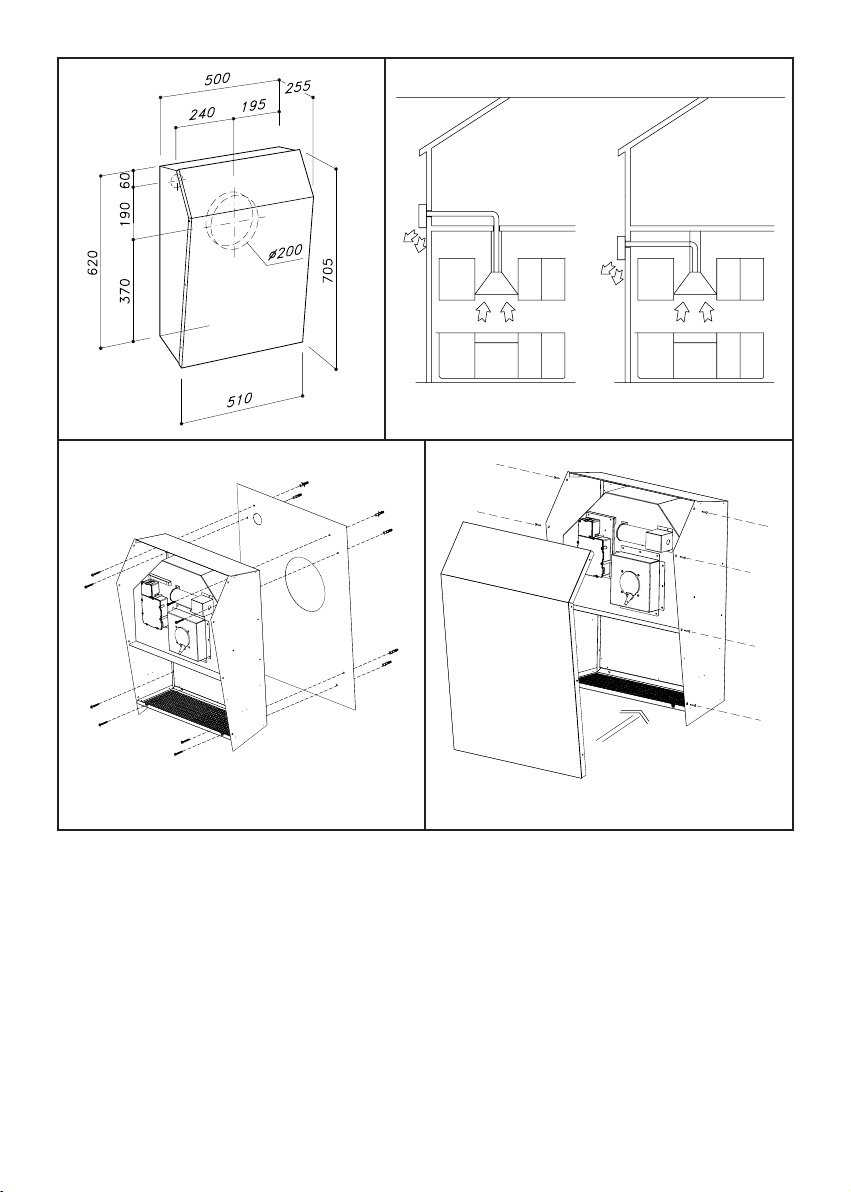
17
28
29
SEM7
27
30

18

19

9004200486 - GM 04/12