
MANUAL 1185836 REV 9 (10/16)
$21.00
PLATINUM SERIES RANGE
MANUAL SECTION SR
IMPORTANT FOR FUTURE REFERENCE
Please complete this information and retain
this manual for the life of the equipment:
Model #: __________________________
Serial #:___________________________
Date Purchased: ____________________
Owner’s Manual
Platinum Series Range
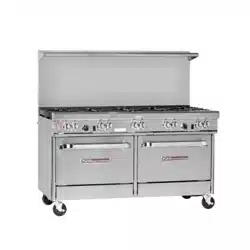
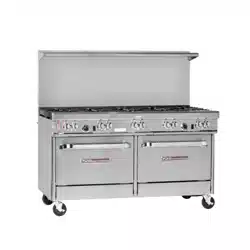
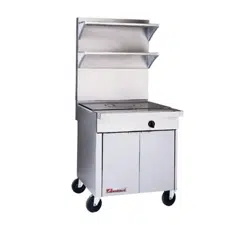
Flush Open Burner Models
Step-Up Open Burner Models
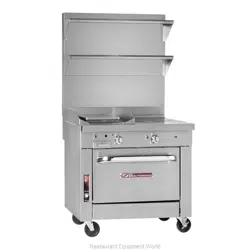
Combination Open-Burner Hot-Top Models
Combination Open-Burner Griddle Models
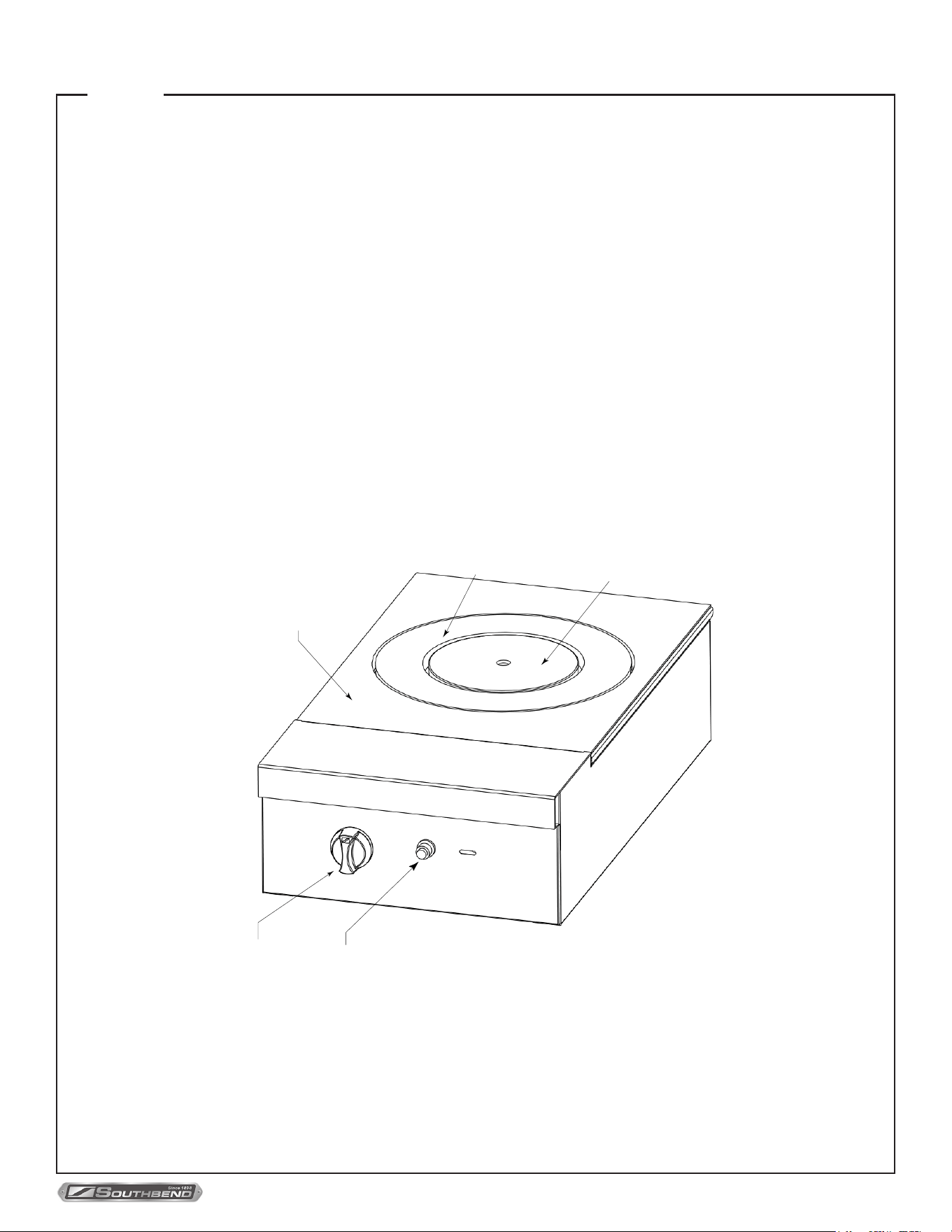
Graduated Hot-Top Models
Uniform Hot-Top Models
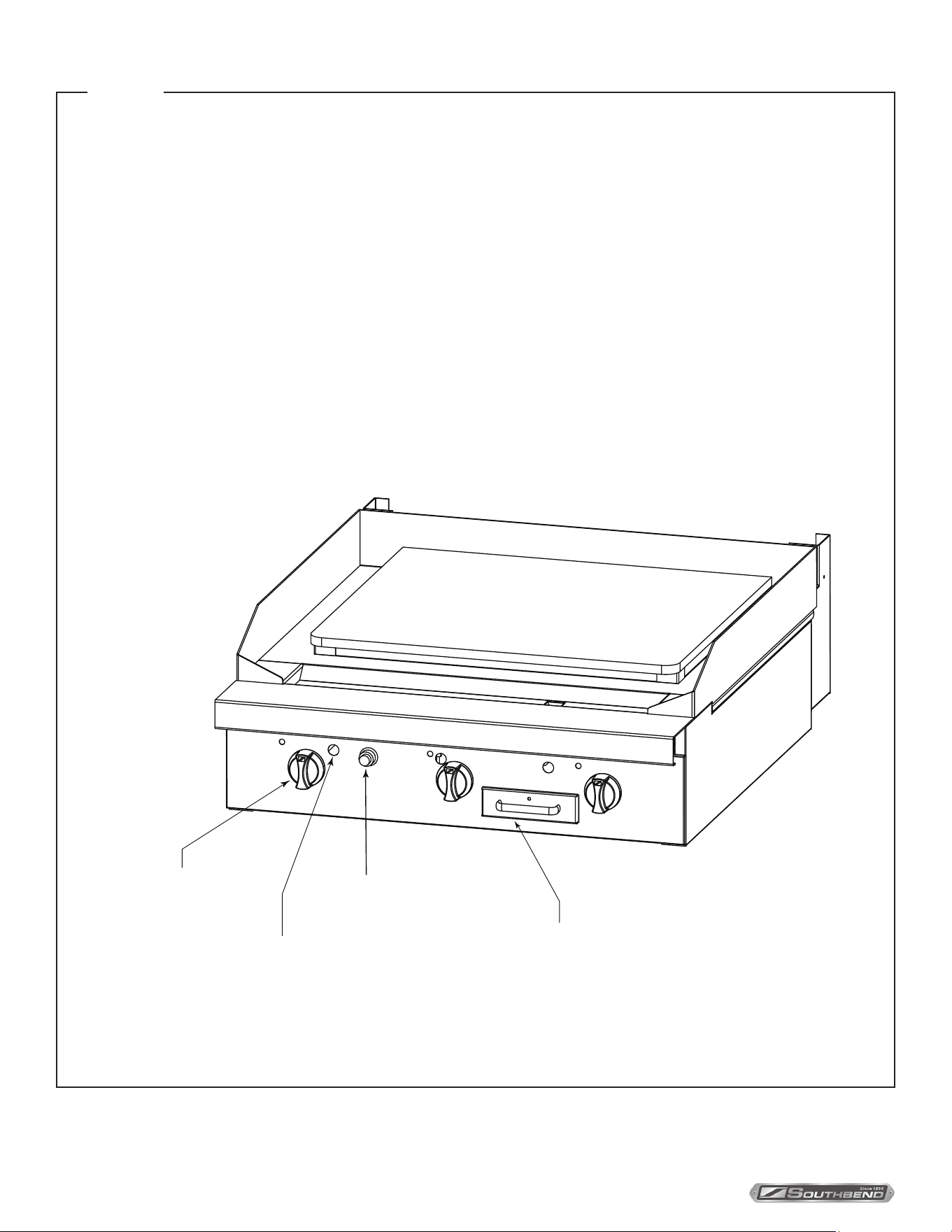
Plancha Models
French Top Models
Induction Models
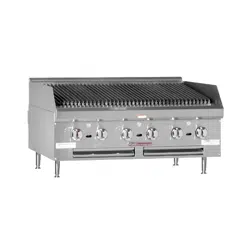
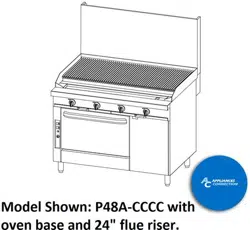
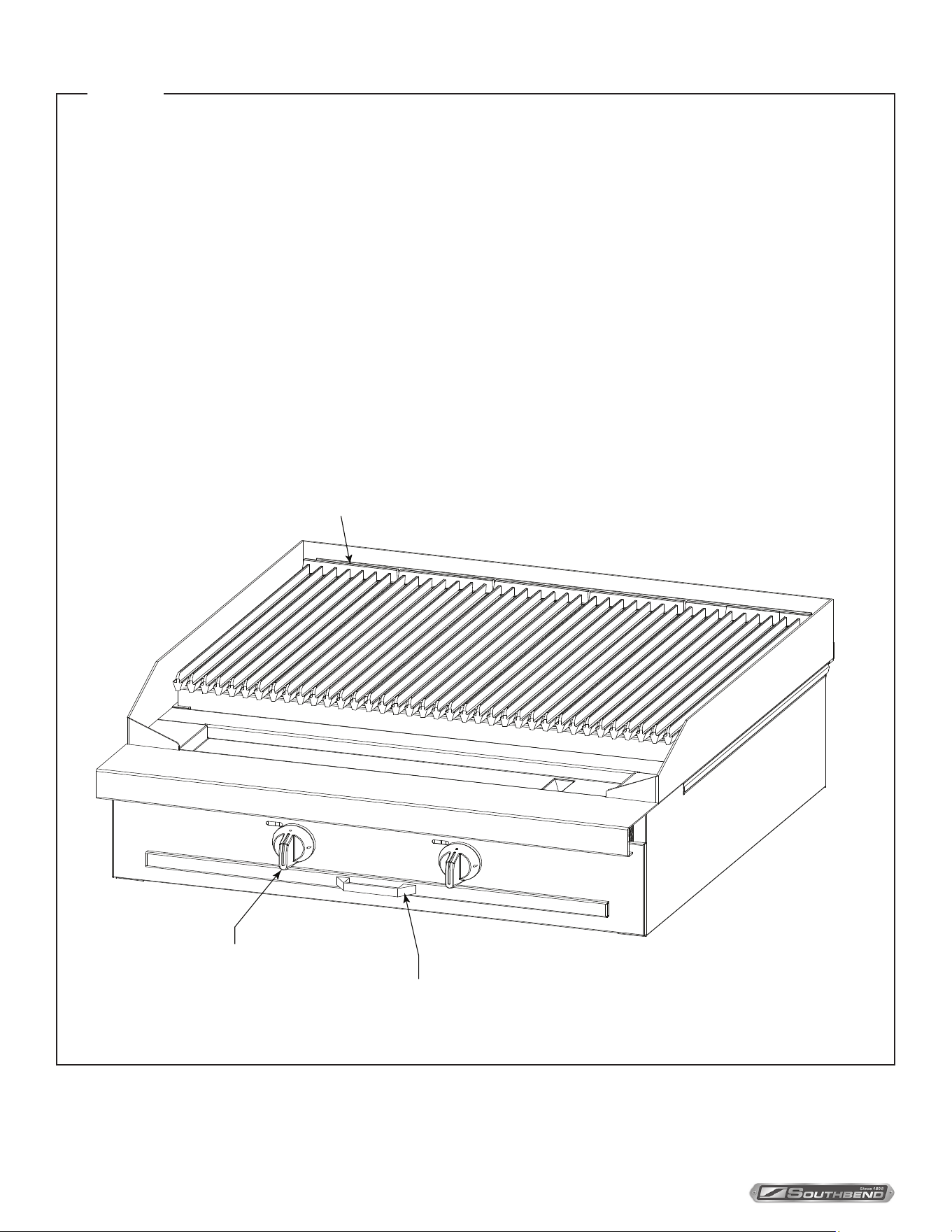
Charbroliler Models
Standard Griddle Models
Thermostatic Griddle Models
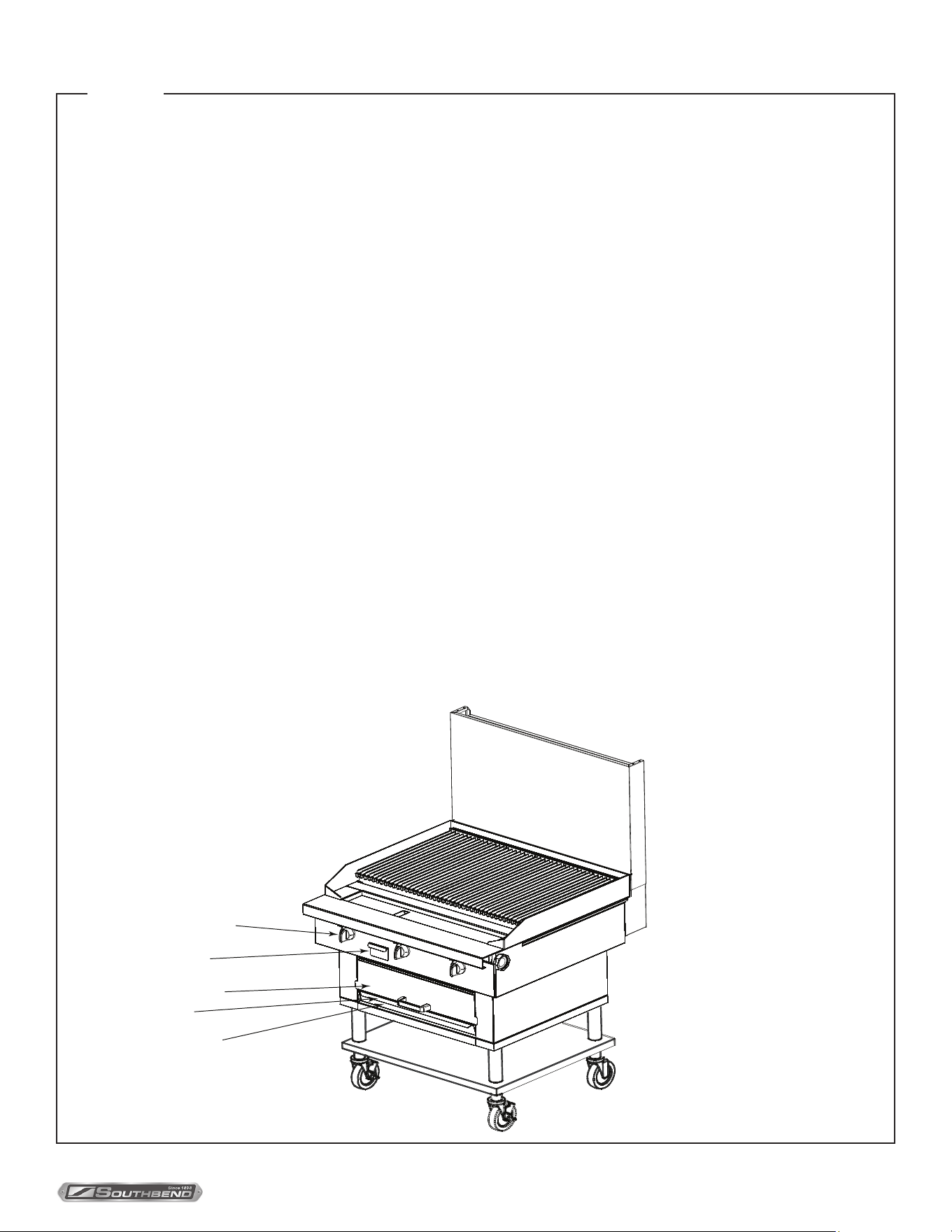
Wood Smoker
WARNING
Improper installation, adjustment, alteration, service, or maintenance can cause property damage, injury, or death.
Read installation, operation, and maintenance instructions thoroughly before installing or servicing this equipment.
1100 Old Honeycutt Road Fuquay-Varina, North Carolina 27526 USA • www.southbendnc.com
Model P32N-PPP
Model P32N-HH
Model P32A-XX
Model P48W-CCCC
Model P18N-F
Model P36N-III
Model P32N-BBB
Model P32N-CC
Model P32N-TT
Model P32N-GRAD
PLATINUM SERIES RANGE
PAGE
2
OF 57
OWNER’S MANUAL 1185836 REV 9 (10/16)
SAFETY PRECAUTIONS
Before installing and operating this equipment, be sure everyone involved in its operation is fully trained and aware of
precautions. Accidents and problems can be caused by failure to follow fundamental rules and precautions.
The following symbols, found throughout this manual, alert you to potentially dangerous conditions to the operator,
service personnel, or to the equipment.
CAUTION
WARNING
NOTICE
This symbol warns of immediate hazards that will result in severe injury or death.
This symbol refers to a potential hazard or unsafe practice that could result in injury or death.
This symbol refers to a potential hazard or unsafe practice that could result in injury, product
damage, or property damage.
This symbol refers to information that needs special attention or must be fully
understood, even though not dangerous.
WARNING
FIRE HAZARD
FOR YOUR SAFETY
Do not store or use gasoline or other ammable vapors and liquids in the vicinity of cooking appliances.
Keep area around cooking appliances free and clear of combustibles.
Purchaser of equipment must post in a prominent location detailed instructions to be followed in the event the
operator smells gas. Obtain the instructions from the local gas supplier.
WARNING
ELECTRIC SHOCK HAZARD
For appliances that use electric power, disconnect the power to the appliance before cleaning. Do not remove
panels that require tools to remove.
NOTICE
Southbend appliances are intended for commercial use only. Not for household use.
Warranty will be void if service work is performed by other than a qualied technician, or if other than genuine
Southbend replacement parts are installed.
Give this Owner’s Manual and important papers to the proper authority to retain for future reference.
DANGER
WARNING
EXPLOSION AND ASPHYXIATION HAZARD
In the event a gas odor is detected, shut down equipment at the main gas shut-off valve and immediately call the
emergency phone number of your gas supplier.
Improper ventilation can result in headaches, drowsiness, nausea, and could result in death. Do not obstruct the
ow of combustion and ventilation air to and from cooking appliances.
WARNING
BURN HAZARD
Contact with hot surfaces will cause severe burns. Always use caution when operating cooking appliances.
SAFETY PRECAUTIONS
Copyright © 2014 by Southbend. All rights reserved. Published in the United States of America.

PLATINUM SERIES RANGE
OWNER’S MANUAL 1185836 REV 9 (10/16)
PAGE
3
OF 57
INTRODUCTION
Congratulations! You have purchased one of the nest pieces of heavy-duty commercial cooking equipment on the
market.
You will nd that your new equipment, like all Southbend equipment, has been designed and manufactured to meet the
toughest standards in the industry. Each piece of Southbend equipment is carefully engineered and designs are veried
through laboratory tests and eld installations. With proper care and eld maintenance, you will experience years of
reliable, trouble-free operation. For best results, read this manual carefully.
RETAIN THIS MANUAL FOR FUTURE REFERENCE.
This manual is for Southbend Platinum Series Sectional Ranges.
This manual does NOT cover Southbend sectional fryers, fryer lter systems, salamander broilers, upright broilers,
cheese melters, or refrigerated bases. Those appliances have their own manuals.
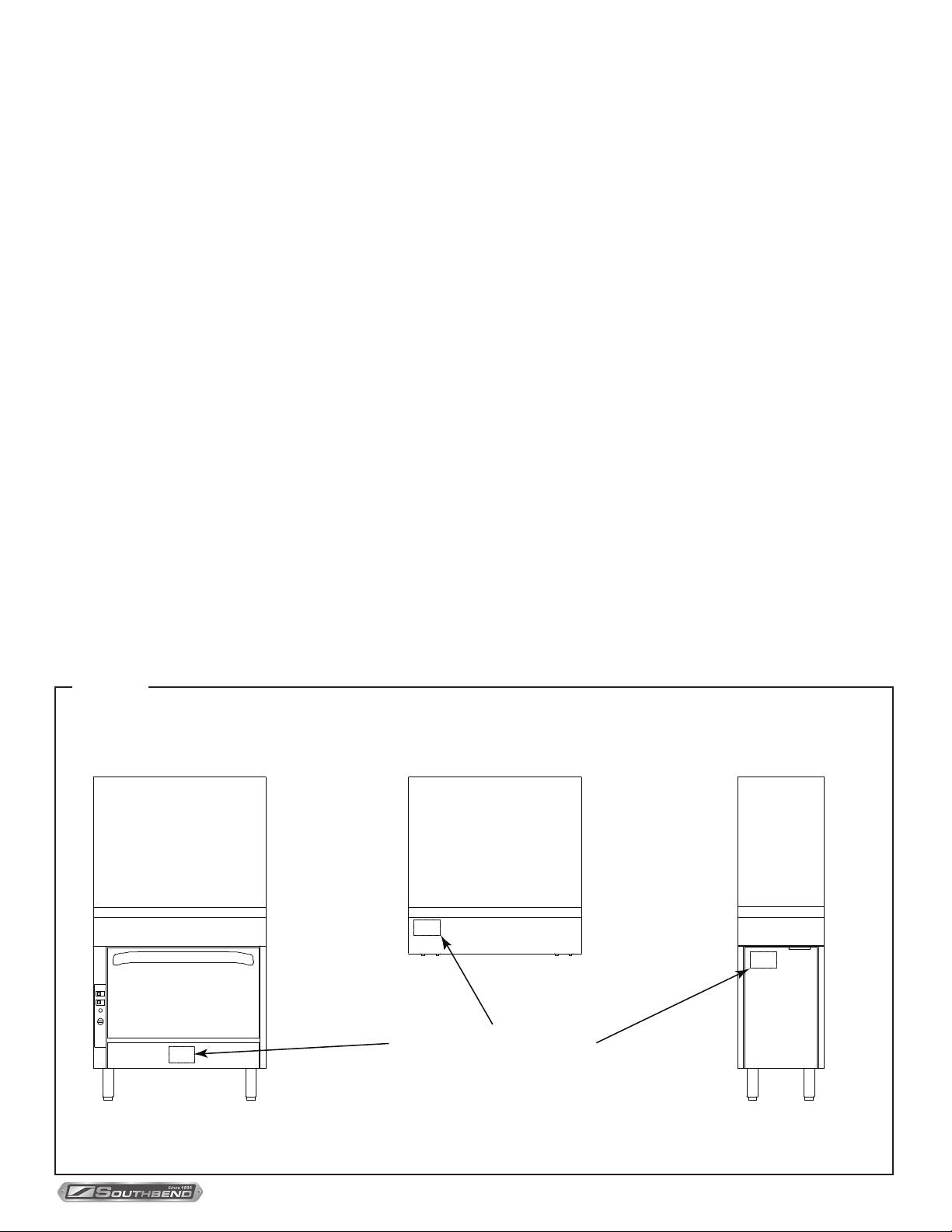
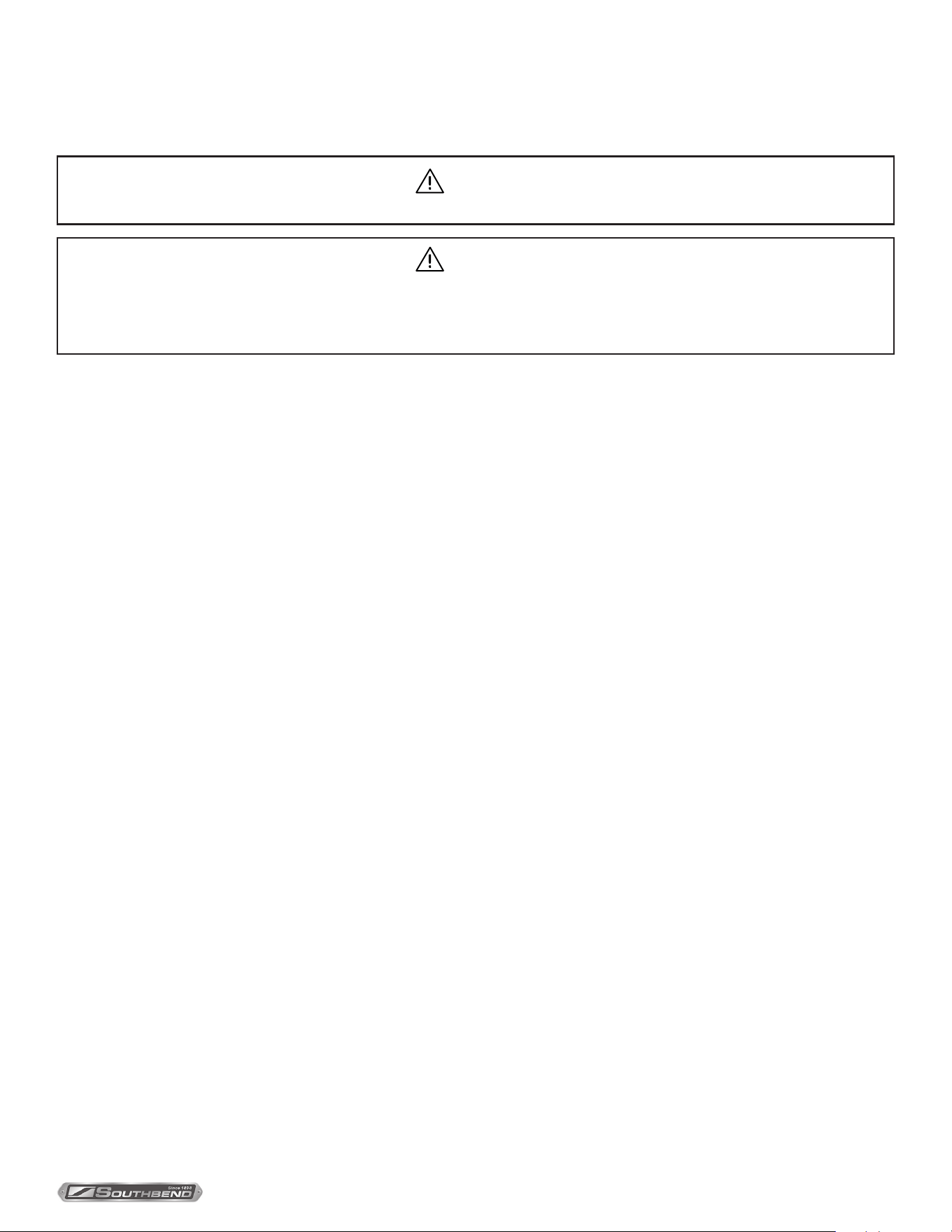
The location of the serial plate depends on the type of base (see Figure 1 below). On models with oven bases, the
serial plate is located on the backside of the kick-plate below the oven door (lift the kick-plate straight up and tilt the top
edge out and down.) On models with a cabinet base, the serial plate is located inside the left cabinet door. On modular
(countertop) models, the serial plate is located inside the front valve panel.
Read these instructions carefully before attempting installation. Installation and initial startup should be performed by
a qualied installer. Unless the installation instructions for this product are followed by a qualied service technician (a
person experienced in and knowledgeable with the installation of commercial gas and/or electric cooking equipment) then
the terms and conditions on the Manufacturer’s Limited Warranty will be rendered void and no warranty of any kind shall
apply.
In the event you have questions concerning the installation, use, care, or service of the product, contact:
Southbend Technical Service
1100 Old Honeycutt Road
Fuquay-Varina, North Carolina 27526 USA
www.southbendnc.com
Location of Serial Plate
Figure 1
Location of Serial Plate
INTRODUCTION
PLATINUM SERIES RANGE
PAGE
4
OF 57
OWNER’S MANUAL 1185836 REV 9 (10/16)
SPECIFICATIONS
WARNING
MINIMUM CLEARANCES FROM COMBUSTIBLE CONSTRUCTION
There must be adequate clearance between the cooking equipment and combustible construction. Clearance must
also be provided for servicing and for operation.
Open-Top
Standard-Burner
Models
Open-Top
PyroMax-Burener
Models
Griddle
Models
Uniform Hot-Top
Models
Plancha
Graduated
Hot-Top
Models
Sides 10” 13” 10” 10” 6”
Back 6” 6” 12” 12” 6”
Floor* 0” 0” 0” 0” 0”
NOTICE
Local codes regarding installation vary greatly from one area to another. The National Fire Protection Association,
Inc., states in its NFPA 96 latest edition that local codes are the “authority having jurisdiction” when it comes to
installation requirements for equipment. Therefore, installations should comply with all local codes.
Southbend reserves the right to change specications and product design without notice. Such revisions do not entitle
the buyer to corresponding changes, additions, or replacements for previously purchased equipment.
Southbend appliances are intended for commercial use only, not for household use.
The installation must conform with local codes, or in the absence of local codes, with the National Fuel Gas Code,
ANSI Z223.1, Natural Gas Installation Code, CAN/CGA-B149.1, or the Propane Installation Code CAN/CGA-B149.2,
as applicable, including:
1. The appliance and its individual shutoff valve must be disconnected from the gas supply piping system during any
pressure testing of that system at test pressures in excess of 1/2 psi (3.45 kPa).
2. The appliance must be isolated from the gas supply piping system by closing its individual manual shutoff valve
during any pressure testing of the gas supply piping system at test pressures equal to or less than 1/2 psi (3.45 kPa).
CLEARANCES
Do NOT install sectional charbroilers or wood smokers next to combustible materials.
* Models with 6” legs or casters are suitable for installation on combustible oors.
Adequate clearance must be provided in the aisle in front of the unit to permit operation (including opening of doors
and/or removal of grease drawers, drippings trays, and/or oven racks), as well as for servicing. No additional clearance
is required for servicing as the sectional range is serviceable from the front.
Models with a convection-type oven require a minimum clearance of 2” between the motor on the back and
non-combustible construction. Care must be taken to provide adequate air circulation to prevent the motor from
overheating.
Minimum clearance from noncombustible construction is zero on the sides and back for all models (except for models
with a convection-type oven).
The high-temperature ue products ow out through the top of the ue riser of all models, and from the top of open-top
and charbroiler models. Installation under a vented hood is recommended.
Salamander broilers and cheese melters mounted on the ue riser of a sectional range may require additional
minimum clearances (see the documentation for those appliances).
SPECIFICATIONS

PLATINUM SERIES RANGE
OWNER’S MANUAL 1185836 REV 9 (10/16)
PAGE
5
OF 57
VENTILATION
WARNING
Improper ventilation can result in personal injury or death. Ventilation which fails to properly remove ue products
can cause headaches, drowsiness, nausea, or could result in death.
All gas appliances must be installed in such a manner that the ow of combustion and ventilation air is not obstructed.
Provisions for adequate air supply must be provided. Do not obstruct the area under the control panel or below the
oven door (on the front), or the area below the ue riser (on the back) as combustion air enters through these areas.
NOTICE
Proper ventilation is the owner’s responsibility. Any problem due to improper ventilation will not be covered by the
warranty.
Be sure to inspect and clean the ventilation system according to the ventilation equipment manufacturer’s
instructions.
Air for combustion enters from the front below the valve panel, as well as from the rear into the burner box. Ranges
with solid tops (griddles, planchas and hot-tops) vent their ue products up the ue riser. On units with a base oven,
combustion air enters from the front below the oven door. Oven ue products are vented up the ue riser.
Lack of sufcient ventilation will cause poor burner and pilot operating characteristics, resulting in inefcient
performance. Such conditions also cause high ambient temperatures at the manifold area and create valve and
thermostat problems.
If a ventilation canopy is used, it is recommended that the canopy extend 6” past the sectional range and that the
bottom edge be located 6’6” from the oor. Filters should be installed at an angle of 45° or more from the horizontal.
This position prevents dripping grease, and facilitates collecting the run-off grease in a drip pan under the lter.
A strong exhaust fan tends to create a vacuum in the room and may interfere with burner performance or may
extinguish pilot ames. Fresh air openings approximately equal to the fan area will relieve such a vacuum. The
exhaust fan should be installed at least 2” above the top of the ue riser.
If the sectional range is connected directly to an outside ue, a CSA design certied down draft diverter must be
installed.
In case of unsatisfactory performance by any gas appliance, check the appliance with the exhaust fan turned OFF. Do
this only long enough to check whether doing so corrects any problems with equipment performance. Then turn the
exhaust fan back on and let it run to remove any exhaust that may have accumulated during the test.
GAS SUPPLY
The sectional range is design-certied for operation on natural or propane gases. The sectional range is shipped
congured and adjusted for the type of gas specied by the purchaser, which is indicated on the serial plate (see
Figure 1 on page 3). Connect the sectional range ONLY to the type of gas for which it is congured and adjusted.
Each section has a 1-1/4” front gas manifold that can be coupled to adjacent section(s). Sections can be ordered with
an optional 1” rear gas connection with a male NPT connector. Minimum supply pressure is 7” W.C. for natural gas,
11” W.C. for propane. An external pressure regulator and shut off valve must be provided. If using a exible-hose
gas connection, the I.D. of the hose must not be smaller than the connector on the unit and must comply with ANSI
Z21.69. Provide an adequate means of restraint to prevent undue strain on the gas connection.
If applicable, the vent line from the gas appliance pressure regulator shall be installed to the outdoors in accordance
with local codes, or in the absence of local codes, with the National Fuel Gas Code, ANSI Z223.1, Natural Gas
Installation Code, CAN/CGA-B149.1, or the Propane Installation Code CAN/CGA-B149.2, as applicable.
An adequate gas supply is imperative. Undersized or low pressure lines will restrict the volume of gas required for
satisfactory performance. Fluctuations of more than 25% on natural gas or 10% on propane gas will create problems
and affect burner operating characteristics. A 1/8” pressure tap is located on the manifold to measure the manifold
pressure. The supply line to the sectional range should be no smaller than the inside diameter of the pipe on the
sectional range to which it is connected.
SPECIFICATIONS

PLATINUM SERIES RANGE
PAGE
6
OF 57
OWNER’S MANUAL 1185836 REV 9 (10/16)
ELECTRICITY SUPPLY
Units with convection-oven bases with optional electronic ignition require electric power (50Hz or 60Hz single-phase
AC). 120V models have a 7-foot (2134 mm) power cord with a grounded plug (1.0 amps for “D” Models and 4.8 amps
for “A” Models). The 208/240V models have a terminal block for connection to a single-phase 208/240V source (1.0
amps for “D” Models and 2.6 amps for the “A” Models).
For units equipped with Induction hobs, consult the data label on the unit for voltage and amperage information. “A”
model units my have a separate power cord for the lower ovens and a terminal block for the induction hobs.
The appliance, when installed, must be electrically grounded in accordance with local codes, or in the absence of local
codes, with the National Electrical Code, ANSI/NFPA 70, or the Canadian Electrical Code, CSA C22.2, as applicable.
An electrical diagram is located on the rear of the range, near the motor.
SPECIFICATIONS

PLATINUM SERIES RANGE
OWNER’S MANUAL 1185836 REV 9 (10/16)
PAGE
7
OF 57
OPERATION
DANGER
EXPLOSION HAZARD
In the event a gas odor is detected, shut down equipment at the main shut off valve. Immediately call the emergency
phone number of your gas supplier.
CAUTION
If a pilot ame pilot should go out, the ow of gas to the corresponding burner is NOT interrupted. Consequently, it
is the responsibility of the operator to check the ignition of each burner immediately EVERY TIME a burner is turned
on. Should ignition fail after 10 seconds, turn off the burner, wait 5 minutes, and then try again.
LIGHTING AFTER GAS HAS BEEN SHUT OFF
When turning on the main gas supply to a sectional range, do the following:
1. Make sure that all the control knobs and power switches of all the connected appliances are in the OFF position.
2. Turn on the gas-supply shut-off valve(s).
3. Light the standing pilots of each connected appliance.
4. Light the ovens of the sectional range rst, then wait six minutes before turning on the top sections.
This enables all air to be purged from the sectional-range gas piping.
SHUTDOWN OF ENTIRE RANGE
To place the range in a standby state (ready for use), Oven bases with the electronic ignition option, turn all burner
control knobs to OFF, set all thermostats to their lowest position, and switch all ovens OFF. The pilots will remain lit.
On the standing pilot units, same as above except turn thermostat knob to the “OFF” position. The pilots will remain lit.
To completely shut down the range for an extended period (or prior to disconnecting the gas supply), place the range
in a standby state (as described in the previous paragraph), then turn OFF the manual shut-off valves of all gas supply
connections. This will extinguish the pilots.
OPERATION
PLATINUM SERIES RANGE
PAGE
8
OF 57
OWNER’S MANUAL 1185836 REV 9 (10/16)
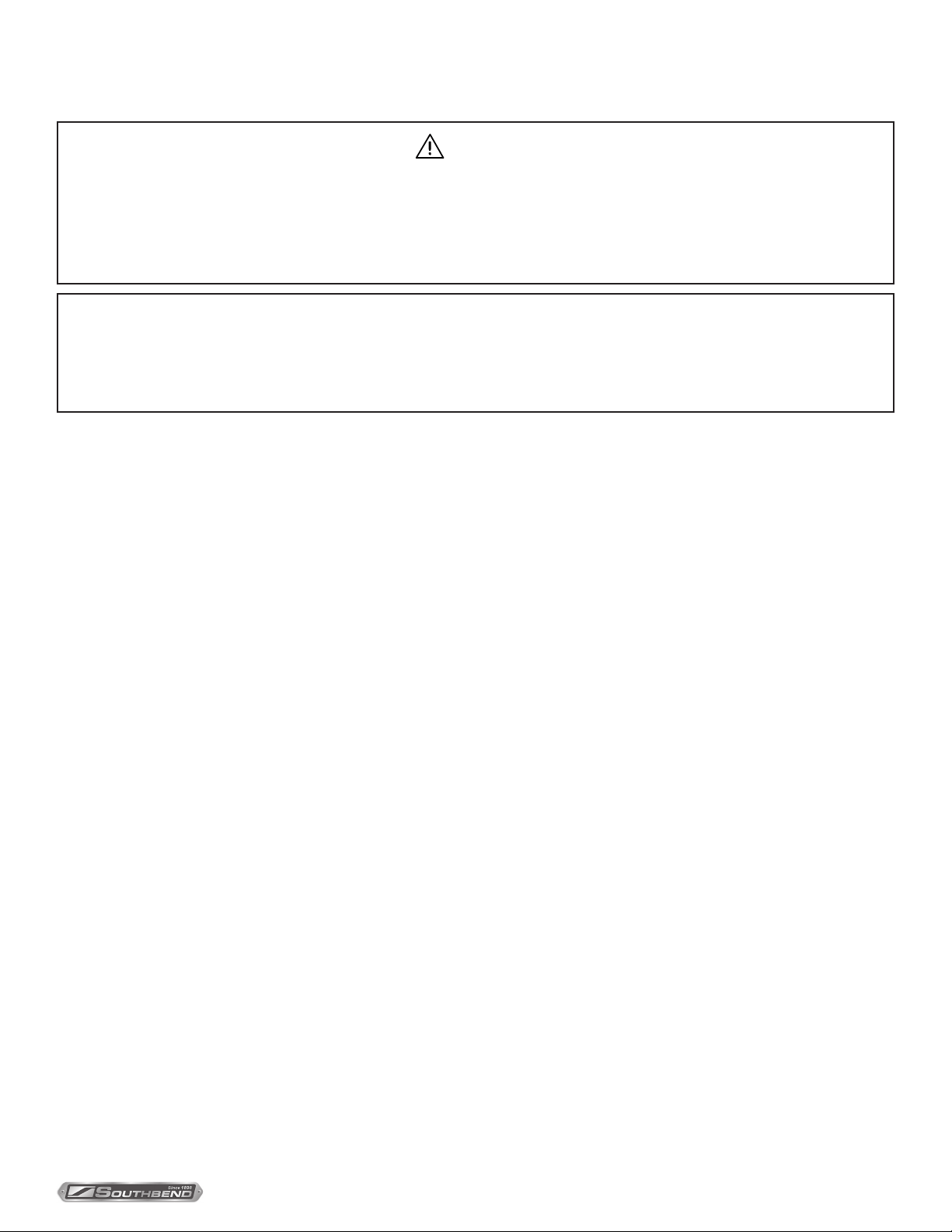
Figure 2
Operation of Open-Burner Sections
Each knob can be turned to OFF or to any position in the range
from LOW to HIGH. The left knob controls the rear burner,
while the right knob controls the front burner. Each knob can
be turned to OFF or to any position in the range from LOW to
HIGH.
To start cooking, turn the appropriate control knob to HIGH.
Visually check that the burner ignites. The gas does NOT
automatically shut off if the burner does not ignite! If
the burner does not ignite, check and/or light the pilots (see
procedure at right). When the burner is hot, the burner ame
should appear blue and steady (some slight yellowing of the
ame tips may occur when using propane gas).
While cooking, do not allow excessive drippings and/or debris
to accumulate on or below the burners. When necessary, pull
out and clean the drippings tray.
When done cooking, turn the appropriate control knob to OFF.
(The pilot should remain lit).
Each burner has a pilot located beside the burner. To light a
pilot, do the following:
1. Check that the burner control knob is in the OFF position.
2. Check that the pilot is in the correct position beside the
burner.
3. Turn on the gas supply to the sectional range (if not
already on).
4. Light the pilot with a match or a pilot-lighting device. The
pilot ame should be blue and steady.
Burner Grate
(lifts out for cleaning)
Front-Burner
Control Knob
(OFF, LOW-to-HIGH)
Drippings Tray
(slides out for cleaning)
Rear-Burner
Control Knob
(OFF, LOW-to-HIGH)
OPERATION
PLATINUM SERIES RANGE
OWNER’S MANUAL 1185836 REV 9 (10/16)
PAGE
9
OF 57
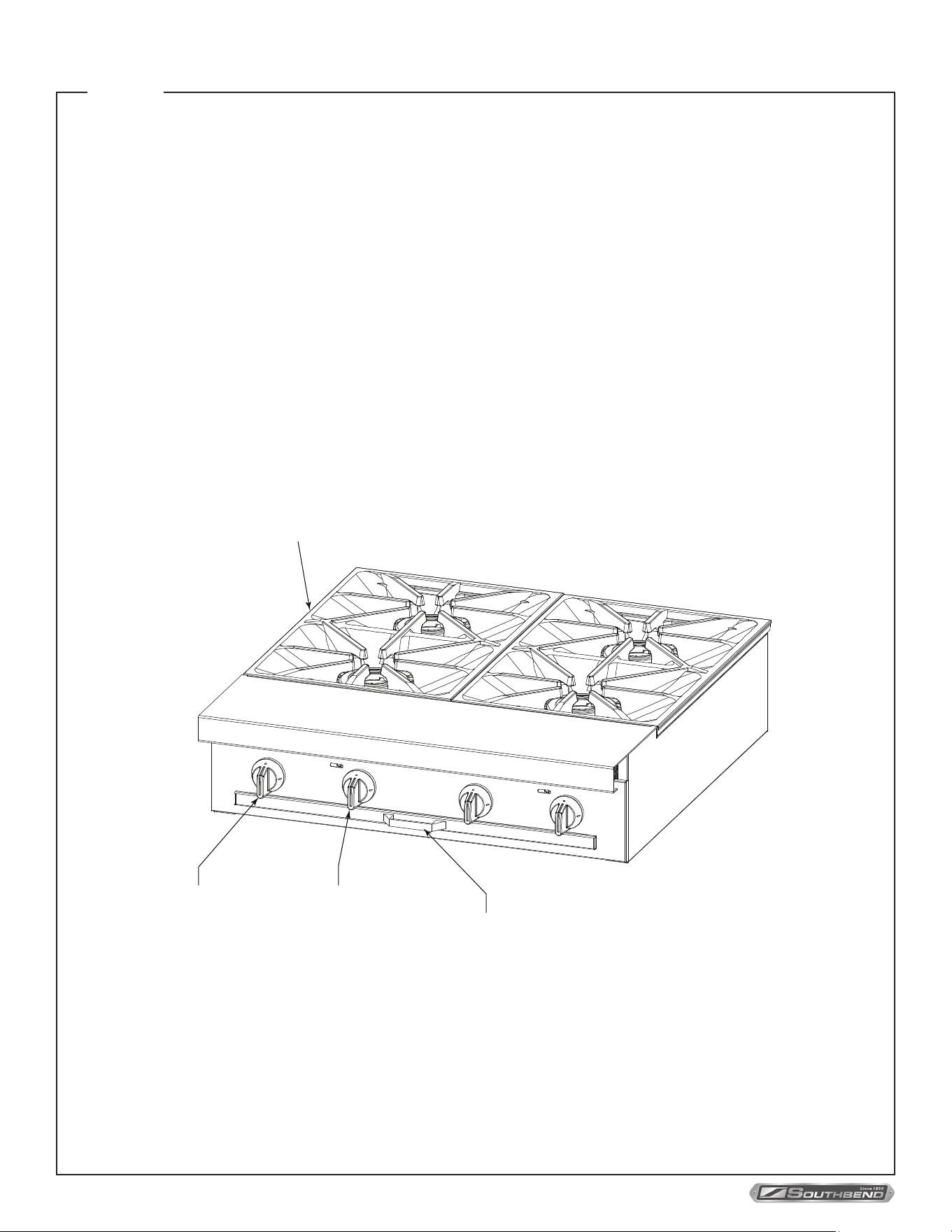
Figure 3
Operation of Uniform Hot-Top Section
Each control knob can be turned to OFF or to any position in
the range from LOW to HIGH. When the control is set to HIGH,
the hot top surface will heat to about 700°F (370°C).
To start cooking, turn the appropriate control knob to HIGH.
Visually check that the burner ignites. The gas does NOT
automatically shut off if the burner does not ignite! If
the burner does not ignite, check and/or light the pilots (see
procedure at right). When the burner is hot, the burner ame
should appear blue and steady (some slight yellowing of the
ame tips may occur when using propane gas).
Do not waste gas and abuse equipment by leaving the
burner on HIGH all the time. Damage to the plates and
certain electronic components may occur, and MAY VOID
YOUR WARRANTY. During idle periods, turn the control to
LOW to keep the top warm.
When done cooking, turn the appropriate control knob to OFF.
(The pilot should remain lit).
Each burner has a pilot located near the front of the burner. To
light the pilots, do the following:
1. Check that the control knob is in the OFF position.
2. Turn on the gas supply to the sectional range (if not already
on).
3. Lift up a hot-top section plate.
4. Verify pilots are lit. If spark ignition system is faulty, light pilot
manually with a match or pilot lightning device.
5. Push spark ignition button for approximately 10 seconds.
6. Replace hot-top section before use.
Burner Control Knob
(OFF, HIGH-to-LOW)
Uniform Hot Top Plate
(lifts out for cleaning
and lighting pilot)
Push Button Ignitor
OPERATION
PLATINUM SERIES RANGE
PAGE
10
OF 57
OWNER’S MANUAL 1185836 REV 9 (10/16)
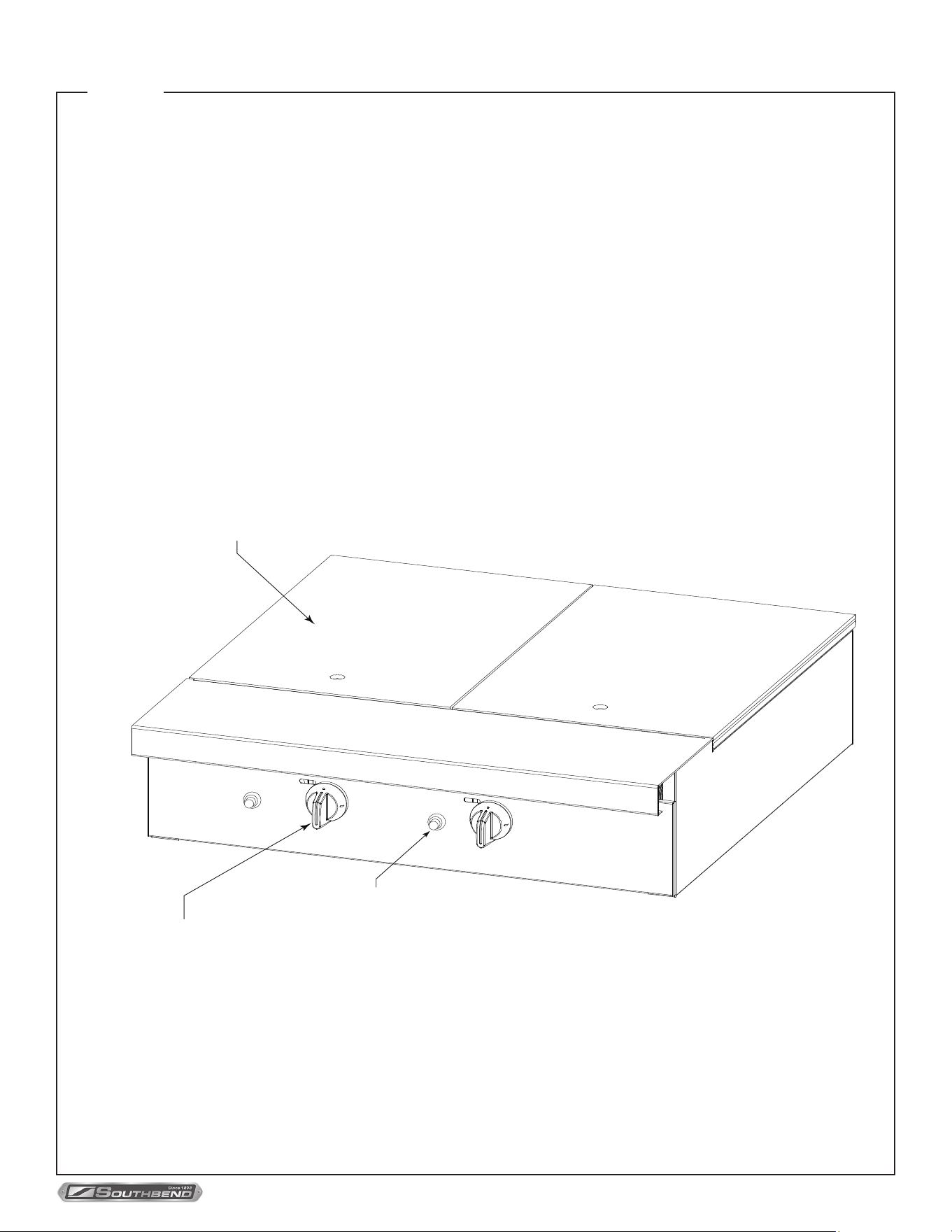
Figure 4
Operation of Graduated Hot-Top Section
Each control knob can be turned to OFF or to any position in
the range from LOW to HIGH. When the control is set to HIGH,
the round center section will heat to about 725°F (385°C), the
ring-shaped section will heat to about 625°F (330°C), and the
outer areas will heat to about 500°F (260°C).
To start cooking, turn the control knob to HIGH. Visually check
that the burner ignites. The gas does NOT automatically shut
off if the burner does not ignite! If the burner does not ignite,
check and/or light the pilots (see procedure at right). When the
burner is hot, the burner ame should appear blue and steady
(some slight yellowing of the ame tips may occur when using
propane gas).
Do not waste gas and abuse equipment by leaving the
burner on HIGH all the time. Damage to the plates and
certain electronic components may occur, and MAY VOID
YOUR WARRANTY.
When done cooking, turn the control knob to OFF. (The pilot
should remain lit).
Each 32”,36”-wide section has one burner. The pilot is located
adjacent to the burner. To light the pilot, do the following:
1. Check that the control knob is in the OFF position.
2. Turn on the gas supply to the sectional range (if not already
on).
3. Remove round center plate.
4. Push spark ignition button for approximately 10 seconds.
5. Verify pilots are lit. If spark ignition system is faulty, light pilot
manually with a match or pilot lighting device.
6. Replace round center plate before use.
Burner Control Knob
(OFF, HIGH-to-LOW)
Medium Temperature Area
(plate lifts out for cleaning)
HighTemperature Area
(plate lifts out for cleaning
and lighting pilot)
Lower Temperature Area
(plate lifts out for cleaning)
Push Button Ignitor
OPERATION
PLATINUM SERIES RANGE
OWNER’S MANUAL 1185836 REV 9 (10/16)
PAGE
11
OF 57
Figure 5
Operation of French Hot-Top Section
Each control knob can be turned to OFF or to any position in
the range from LOW to HIGH. When the control is set to HIGH,
the round center section will heat to about 900°F (482°C), the
ring-shaped section will heat to about 800°F (427°C), and the
outer areas will heat to about 600°F (316°C).
To start cooking, turn the control knob to HIGH. Visually check
that the burner ignites. The gas does NOT automatically shut
off if the burner does not ignite! If the burner does not ignite,
check and/or light the pilots (see procedure at right). When the
burner is hot, the burner ame should appear blue and steady
(some slight yellowing of the ame tips may occur when using
propane gas).
Do not waste gas and abuse equipment by leaving the
burner on HIGH all the time. Damage to the plates and certain
electronic components may occur, and MAY VOID YOUR
WARRANTY.
When done cooking, turn the control knob to OFF. (The pilot
should remain lit).
Each 18”-wide section has one burner. The pilot is located
adjacent to the burner. To light the pilot, do the following:
1. Check that the control knob is in the OFF position.
2. Turn on the gas supply to the sectional range (if not already
on).
3. Remove round center plate.
4. Push spark ignition button for approximately 10 seconds.
5. Verify pilots are lit. If spark ignition system is faulty, light pilot
manually with a match or pilot lighting device.
6. Replace round center plate before use.
Lower Temperature Area
(plate lifts out for cleaning)
Medium Temperature Area
(plate lifts out for cleaning)
HighTemperature Area
(plate lifts out for cleaning
and lighting pilot)
Burner Control Knob
(OFF, LOW-to-HIGH)
Push Button Ignitor
OPERATION
PLATINUM SERIES RANGE
PAGE
12
OF 57
OWNER’S MANUAL 1185836 REV 9 (10/16)
Figure 6
Operation of Charbroiler Section
Each control knob can be turned to OFF, or to any position in
the range from LOW-to-HIGH. Each 6”-wide burner top-grate
can be turned over to provide either wide branding marks or
narrower branding marks with channels to carry away drippings
(and so reduce are up). The back-to-front slope of each top-
grate is adjusted by positioning the back end of the top-grate
on either the lower or the higher grate-support rail. The radiants
(just above the burners) can be reversed front-and-back to
provide higher heat toward the back than the front, or vice
versa. “Lava rock” briquettes can be placed on grates located
above the radiants.
To start cooking, turn the appropriate control knob to HIGH.
Visually check that the burner ignites. The gas does NOT
automatically shut off if the burner does not ignite! If
the burner does not ignite, check and/or light the pilots (see
procedure at right). When the burner is hot, the burner ame
should appear blue and steady (some slight yellowing of the
ame tips may occur when using propane gas).
When done cooking, turn the appropriate control knob to OFF.
(The pilot should remain lit).
Each burner, has a pilot located near the front. To light the
pilots, do the following:
1. Check that the burner control knob is in the OFF position.
2. Lift up a grate in order to expose the two pilots.
3. Check that each pilot is in the correct position.
4. Turn on the gas supply to the sectional range (if not already
on
5. Light the pilots with a match or a pilot-lighting device. The
pilot ames should be blue and steady.
Grates
(lift out for cleaning)
Burner Control Knob
(OFF, HIGH-to-LOW)
Drippings Tray
(slides out for cleaning)
OPERATION
PLATINUM SERIES RANGE
OWNER’S MANUAL 1185836 REV 9 (10/16)
PAGE
13
OF 57
Figure 7
Operation of Wood Smoker Section
Each control knob can be turned to OFF, or to any position in
the range from LOW to HIGH. Each 6”-wide burner top-grate
can be turned over to provide either wide branding marks or
narrower branding marks with channels to carry away drippings
(and so reduce are up). The back-to-front slope of each top-
grate is adjusted by positioning the back end of the top-grate
on either the lower or the higher grate-support rail. The radiants
(just above the burners) can be reversed front-and-back to
provide higher heat toward the back than the front, or vice
versa.
To start cooking, turn the appropriate control knob to HIGH.
Visually check that the burner ignites. The gas does NOT
automatically shut off if the burner does not ignite! If
the burner does not ignite, check and/or light the pilots (see
procedure at right). When the burner is hot, the burner ame
should appear blue and steady (some slight yellowing of the
ame tips may occur when using propane gas).
The smoker can use either split or chunk wood. (Chunk wood
can be ordered from Southbend; Hickory Chunks, 10 lb bag,
Southbend P/N 1188495; or Mesquite Chunks, 10 lb bag
Southbend P/N 1188496.) Split wood pieces can be up to 4”
diameter and 20” long.
Wood life can be extended by pre-soaking the wood in water for
a couple of hours prior to use. Do not soak the wood overnight
as it will become too saturated and delay ignition.
WARNING / CAUTION: Never use treated wood. When
burned, treated wood can release pollutants harmful to your
health into the air.
Each burner has a pilot located near the front. To light the
pilots, do the following:
1. Check that the burner control knob is in the OFF position.
2. Lift up a grate in order to expose the two pilots.
3. Check that each pilot is in the correct position.
4. Turn on the gas supply to the sectional range (if not already
on).
5. Light the pilots with a match or a pilot-lighting device. The
pilot ames should be blue and steady.
To start cooking, do the following:
1. Fill Water/Catch Tray with water to bottom of wood grate.
2. Open the Smoker Box Door and place an even layer
of selected wood on the grate inside the smoker box.
The Smoker Box Door should be kept closed during normal
operation.
3. Turn control knobs to HIGH position. Visually check that
the burner ignites. The wood will then ignite. (Ignition time
for wood in the smoker will vary due to moisture content and
type of wood used.)
4. Once the wood ignites, adjust the control knobs to the
desired setting for cooking.
When done cooking, do the following:
1. Turn the control knobs to OFF. (The pilots should remain lit).
2. Extinguish all remaining embers, or allow all wood to
burnout.
3. Place all remaining wood in a re-safe container.
4. Remove and clean wood grate.
5. Remove Water/Catch Tray and dispose of its content in a
re-safe container.
B
urner Control Knob
(
OFF, HIGH-to-LOW)
G
rease Drawer
S
moker Box Door
W
ood Grate
W
ater/Catch Tray
OPERATION
PLATINUM SERIES RANGE
PAGE
14
OF 57
OWNER’S MANUAL 1185836 REV 9 (10/16)
Figure 8
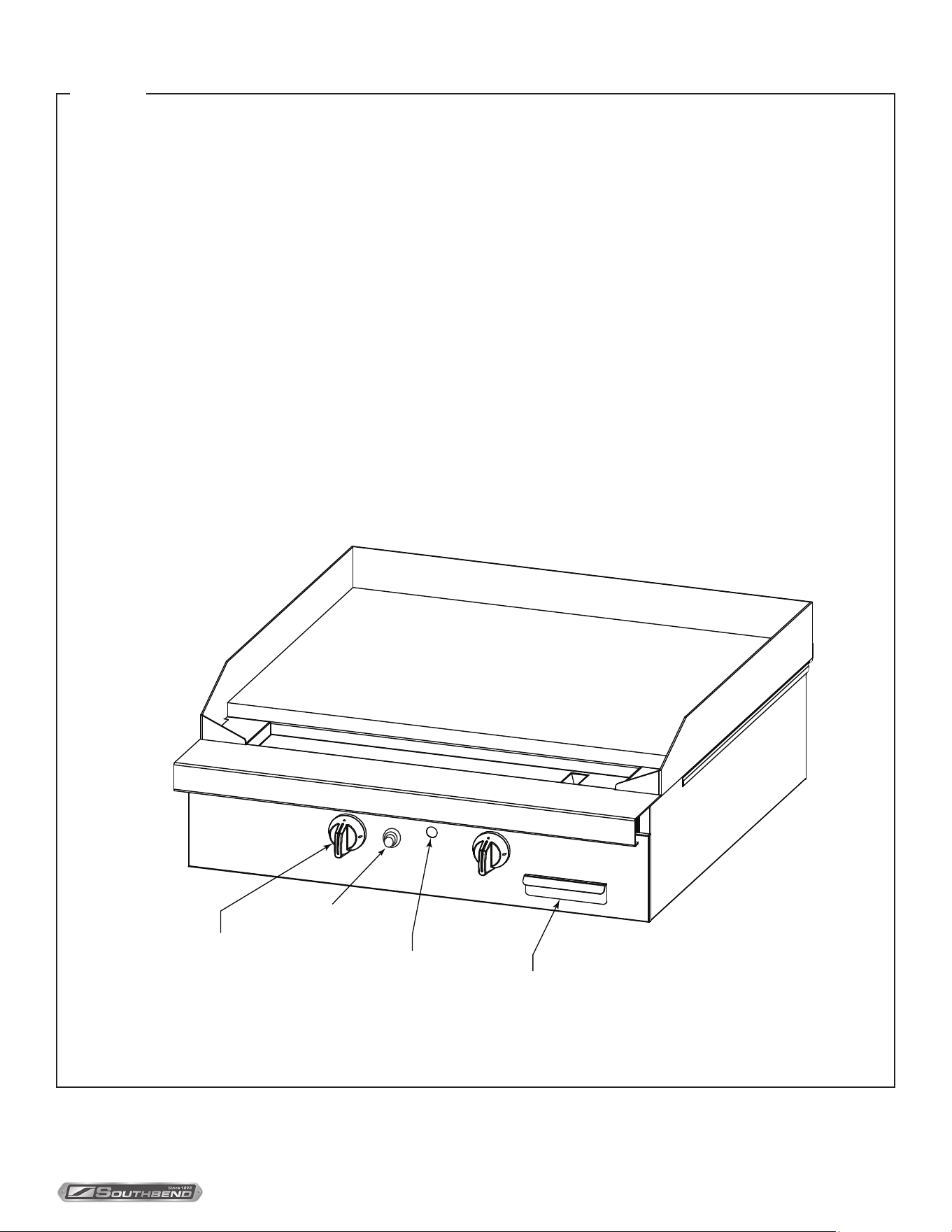
Operation of Plancha Griddle Sections
Each control knob can be turned to OFF or to any position in
the range from low to high.
To start cooking, turn the control knob to HIGH. Check that the
burner ignites. The gas does NOT automatically shut off if
the burner does not ignite! If the burner does not ignite, check
and/or light the pilots (see procedure at right). When the burner
is hot, the burner ame should appear blue and steady (some
slight yellowing of the ame tips may occur when using propane
gas).
Always remember to heat the Plancha slowly because quick
heating may cause costly damage. Never place utensils on the
griddle.
Do not waste gas and abuse equipment by leaving the
Plancha on HIGH all the time. Damage to the Placha and
certain electronic components may occur, and MAY VOID
YOUR WARRANTY.
When necessary while cooking, pull out and empty the grease
drawer.
When done cooking, turn the appropriate control knob to OFF.
(The pilot should remain lit).
Each burner has a pilot that is lit using the spark igniter push
button, (if equipped) or a long match inserted thorough a hole
in the front valve panel. (A 32”-wide Plancha has three pilots.)
To light the pilot, do the following:
1. Check that all the control knobs are in the OFF position.
2. Turn on the gas supply to the sectional range (if not already
on).
3. Push spark ignition button for approximately 10 seconds.
4. Verify pilots are lit by looking through site holes in valve
panel. If spark ignition system is faulty, light pilots manually.
5. Pilots are lit manually by inserting a long match (at least 11”
long) or pilot-lighting device straight into the hole on the front
valve panel for each burner of the Plancha.
Burner Control Knob
Push Button
Ignitor
Pilot-Lighting
Opening
(OFF, LOW-to-HIGH)
Grease Drawer
(slides out for cleaning)
OPERATION
PLATINUM SERIES RANGE
OWNER’S MANUAL 1185836 REV 9 (10/16)
PAGE
15
OF 57
Figure 9
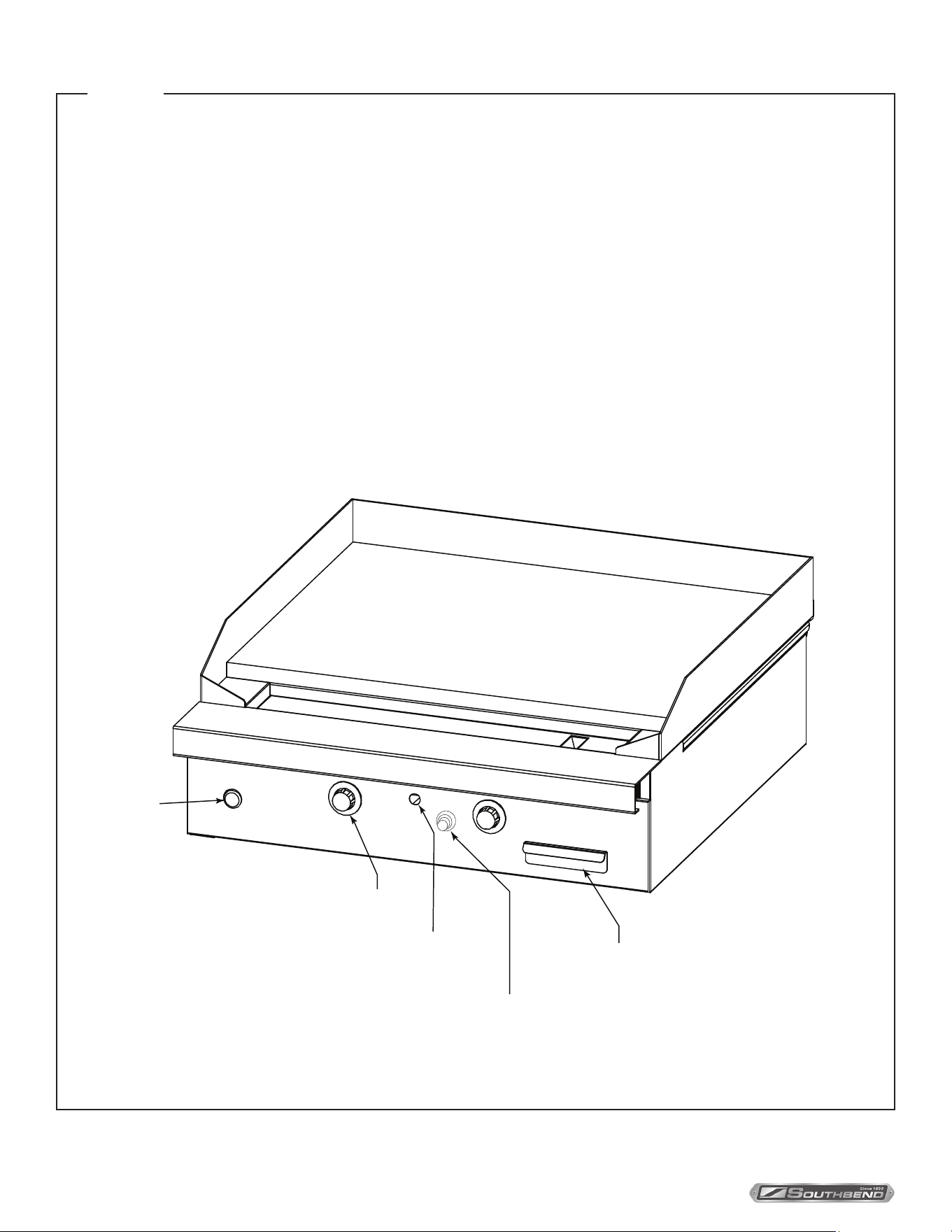
Operation of Standard (Non-Thermostatic) Griddle Sections
Each control knob can be turned to OFF, or any postion in the
range from LOW-to-HIGH.
To start cooking, turn the control knob to HIGH. Check that the
burner ignites. The gas does NOT automatically shut off if
the burner does not ignite! If the burner does not ignite, check
and/or light the pilots (see procedure at right). When the burner
is hot, the burner ame should appear blue and steady (some
slight yellowing of the ame tips may occur when using propane
gas).
Always remember to heat the griddle slowly because quick
heating may cause costly damage. Never place utensils on the
griddle.
Do not waste gas and abuse equipment by leaving the
griddle on HIGH all the time. Damage to the griddle and
certain electronic components may occur, and MAY VOID
YOUR WARRANTY. During idle periods, turn the control to
LOW to keep the griddle warm. (Do not allow the griddle to
overheat above 550°F (288°C), as this will cause warping or
breakage.)
When necessary while cooking, pull out and empty the grease
drawer.
When done cooking, turn the appropriate control knob to OFF.
(The pilot should remain lit).
Each griddle section up to 36” wide, has a single pilot that is lit
using a spark ignitor push button (if equipped) or a long match
inserted thorough a hole in the front valve panel. (A 48”-wide
griddle has two pilots.) To light the pilot, do the following:
1. Check that all the control knobs are in the OFF position.
2. Turn on the gas supply to the sectional range (if not already
on).
3. Push spark ignition button for approximately 10 seconds.
4. Verify pilot is lit by looking through site hole in valve
panel. If spark ignition system is faulty, light pilots manually.
5. Pilots are lit manually by inserting a long match (at least 11”
long) or pilot-lighting device straight into the hole on the front
valve panel of the griddle.
Pilot-Lighting
Opening
Burner Control Knob
(OFF, HIGH, or LOW)
Grease Drawer
(slides out for cleaning)
Push Button Ignitor
OPERATION
PLATINUM SERIES RANGE
PAGE
16
OF 57
OWNER’S MANUAL 1185836 REV 9 (10/16)
Figure 10
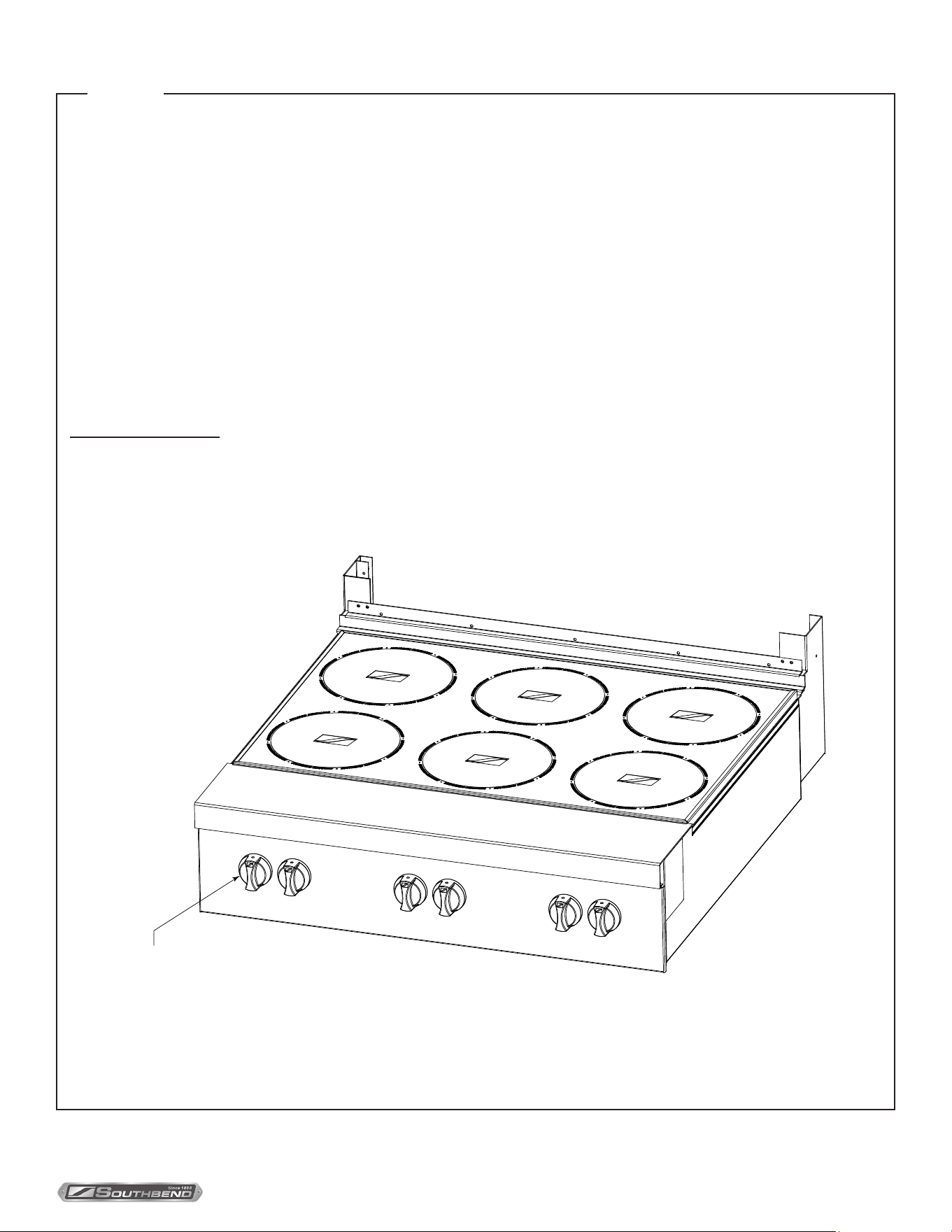
Operation of Thermostatic Griddle Sections
Each control knob that can be turned to OFF, or to any
temperature in the range 150°F to 400°F (66°C to 204°C).
To start cooking, turn on the appropriate control knob. Check
that the burner ignites. If the burner does not ignite, check and/
or light the pilots (see procedure at right).
Never place utensils on the griddle.
Do not waste gas and abuse equipment by leaving the griddle
set at a high temperature all the time. Damage to the griddle
and certain electronic components may occur, and MAY VOID
YOUR WARRANTY. During idle periods, turn the control to a
low temperature to keep the griddle warm. (Do not allow the
griddle to overheat above 550°F (288°C), as this will cause
warping or breakage.)
When necessary while cooking, pull out and empty the grease
drawer.
When done cooking, turn the appropriate control knob to OFF.
(The pilot should remain lit).
Each griddle section up to 36” wide has a single pilot that is lit
using a long match inserted thorough a hole in the front valve
panel. (A 48”-wide griddle has two pilots.) To light the pilot, do
the following:
1. Check that all control knobs are in the OFF position.
2. Turn on the gas supply to the sectional range (if not already
on).
3. Press and hold in the Safety Switch Button.
4. Push spark ignition button for approximately 10 seconds.
5. Verify pilots are lit by looking through site hole in valve
panel. If spark ignition system is faulty, light pilots manually.
6. Pilots are lit manually by inserting a long match (at least 11”
long) or pilot-lighting device straight into the hole on the front
valve panel of the griddle.
7. After about a minute, release the Safety Switch Button. The
pilot should remain lit.
Pilot-Lighting
Opening
Burner Control Knob
(OFF, temperature)
Grease Drawer
(slides out for cleaning)
Safety
Switch
Button
Push Button Ignitor
OPERATION
PLATINUM SERIES RANGE
OWNER’S MANUAL 1185836 REV 9 (10/16)
PAGE
17
OF 57
Figure 10
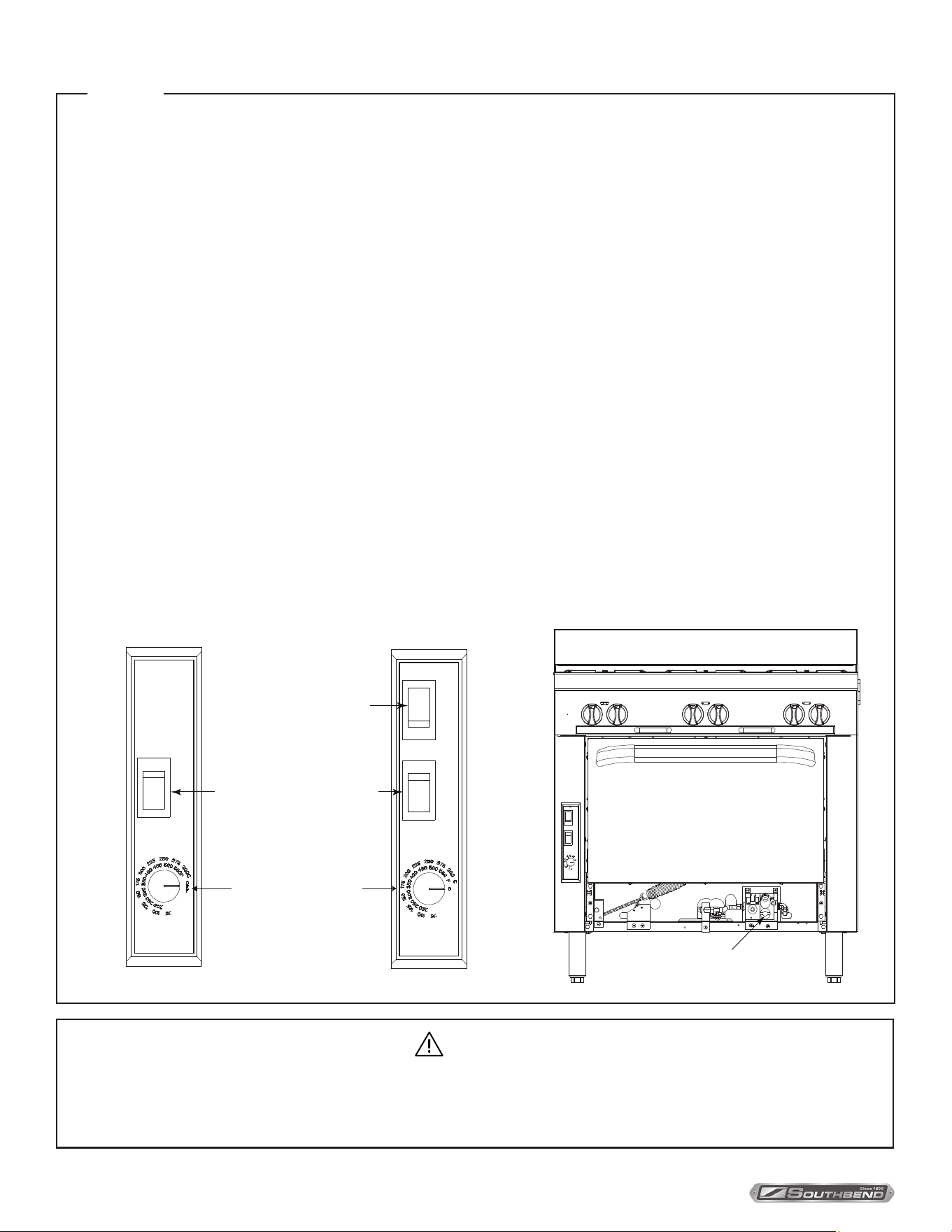
Operation of Induction Sections
CAUTION! PAN HANDLE HEATING!
Metal handles that are low on the pan may heat much the same
as they will on a gas burner. Take care when moving pans to
use insulated mitts.
Each induction hob has a knob that can adjust the power level
from 1 to 9. The power setting is proportional to the maximum
power available for that individual hob. Each hob also has
a power level indicator under the glass that will display the
selected power level. The power level indicator can also display
an error code in the event of a malfunction (see troubleshooting
section for error codes).
To operate the induction section, place an induction efcient
pan on top of the cooking hob and turn the knob to the desired
power level.
Important information:
Never heat an empty pan. It may damage the induction hob unit
and cookware and can overheat the unit. When overheating
occurs, an error code will ash on the display. When the internal
temperature returns to normal, the hob can be used again.
OPERATION
Remember to turn the hobs off after each use.
If the ambient air temperature around the hob gets too
high the unit may overheat.
Be sure to dry off the pan before use. Water droplets left
on the outside of the pan may begin to boil and spatter as
the pan temperature rises.
Do not use aluminum foil on top of the induction hobs.
Do not use the induction hobs around areas where water
can be found.
Do not store the induction hob unit outside
Do not obstruct, block or alter the air entrance or outlets
that are behind the unit and do not stick foreign objects
into these openings.
Do not strike or damage the hobs or glass tops. This can
cause the glass to crack which will void the warranty.
Burner Control Knob
(OFF, LOW-to-HIGH)
PLATINUM SERIES RANGE
PAGE
1 8
OF 57
OWNER’S MANUAL 1185836 REV 9 (10/16)
Figure 11
Operation of Oven
Each oven has a thermostatic control that can be set in the
range 175°F to 550°F (66°C to 260°C). Convection ovens have
a fan that can be set to HI speed or LO speed.
For advice on using a convection oven, see the information on
the following two pages of this manual.
While cooking, if the door is opened on a convection oven, the
fan and heat will temporarily stop until the door is closed.
Do not allow excessive drippings and/or debris to accumulate
on the interior of the oven. When necessary, pull out and clean
the oven-bottom tray.
To light and start cooking, do the following:
FOR UNITS WITH A STANDING PILOT
1. Open kick panel and locate knob on valve assembly.
2. Turn the knob to PILOT and press inward. While holding the
knob inward, light the pilot with an appropriate lighter.
3. Hold knob in the inward position for 30 seconds and release.
The pilot should remain lit.
4. Turn the knob to ON and close kick panel.
5. Select on the thermostat the cooking temperature
appropriate for the food to be cooked.
6. For convection ovens, select the fan speed appropriate for
the food to be cooked.
FOR UNITS WITH ELECTRONIC IGNITION
1. Turn the Oven Gas Shut-Off Valve to ON.
2. Set the Oven Power Switch to ON. The pilot will light
automatically (You will hear a “snapping” sound until the pilot
ignites.)
3. Select on the thermostat the cooking temperature
appropriate for the food to be cooked.
4. For convection ovens, select the fan speed appropriate for
the food to be cooked.
5. On units with a cooking light, the light will go out when the
oven reaches the set temperature.
When done cooking, turn the Oven Power Switch to OFF and
turn the Oven Gas Shut-Off Valve to OFF.
WARNING
THE USE OF ALUMINUM FOIL CAN CAUSE HEAT DISTRIBUTION PROBLEMS IN OVENS. EXTREME CARE
MUST BE USED WHEN PLACING ALUMINUM FOIL IN THE OVEN TO ENSURE THAT IT DOES NOT BLOCK OR
CHANGE THE AIR FLOW. THE USE OF ALUMINUM FOIL MAY VOID THE PRODUCT WARRANTY IF ITS USE IS
ASCERTAINED TO BE A PROBLEM.
Oven Power Switch
Fan-Speed Switch
(for Convection Ovens)
PILOT-ON Knob
Oven Thermostat
Controls for Ovens
with Electronic Ignition
C
ontrols for Ovens
with Standing Pilot
OPERATION

PLATINUM SERIES RANGE
OWNER’S MANUAL 1185836 REV 9 (10/16)
PAGE
19
OF 57
SUGGESTIONS FOR COOKING USING A CONVECTION OVEN
As a guide, set oven temperatures 25 to 50 degrees lower than called for in recipes using conventional (non-convection) ovens.
FROZEN ENTREE PRODUCTS: Punch holes in lid before heating. Tent lid if product has a tendency to stick, i.e.,
lasagna or macaroni and cheese. Use manufacturer’s convection oven directions for time and temperature or reduce conventional
oven temperature 50 degrees for a 6-1/2 size pan load. Some products may cook in 10 to 15 minutes less time than recommended for
convection ovens if prepared from frozen in a 6 pan load.
Time and temperatures will vary depending upon load, mix, size of portion, and other factors. Use the following chart to develop your
own cooking techniques:
Product
Timing
(minutes)
Temperature
Setting
Number of
Racks Used
Count per
Pan/Rack
Hamburger buns, 3 oz. - 4” 18 375° 3 24
Yeast rolls - 1 oz.
Use temperature and time recommended by manufacturer
for convection ovens for a 3 pan load.
10 400° 3 48
Fruit pies, 46 oz. frozen
Use temperature and time from manufacturer’s directions
for convection ovens for a 12 pie load placed on 3 bun
pans.
50 375° 3 4
Egg custard pies, 44 oz. frozen 60 325° 3 4
Dutch apple pies, 46 oz. frozen 50 350° 3 4
Baked potatoes, 8 oz.
Wash and wrap in potato foil. Place 30 potatoes on 18 x
24 bun pan — 3 pans per load. Bake in 400°F oven for 1
hour.
60 400° 3 30 (wrapped)
Pre-blanched potatoes, frozen
Spread on ungreased bun pans, 3 pans per load. Bake at
400°F, stirring once, for 15 to 18 minutes
16 400° 3 5lb.
Fish portions, pre-cooked, breaded, 3 oz.
Use manufacturer’s recommended temperature and time
for convection oven for a 3 pan load.
16 400° 3 32
Macaroni & cheese, 6 lbs. - 40° temp. 45 400° 3 2-6lbs.
Lasagna w/meat sauce, 6 lb. - 40° temp. 60 350° 3 2-6lbs.
Lasagna w/meat sauce, 6 lb. - frozen 75 350° 3 2-6lbs.
Salisbury steak w/gravy, 6 lb. - 40° temp. 45 400° 3 2-6lbs.
Top round of beef No. 168
14 lb. - rare 140° internal
14 min./lbs.
250° 1 1-2
14 lb. - medium 150° internal
14 min./lbs.
250° 1 1-2
14 lb. - well done 160° internal
14 min./lbs.
250° 1 1-2
OPERATION

PLATINUM SERIES RANGE
PAGE
20
OF 57
OWNER’S MANUAL 1185836 REV 9 (10/16)
CORRECTING PROBLEMS WHEN COOKING WITH A CONVENTION OVEN
If... Then...
Cakes are dark on the sides and not done in the center… lower oven temperature
Cake edges are too brown… reduce number of pans or lower oven temperature
Cakes have light outer color… raise temperature
Cake settles slightly in the center… bake longer or raise oven temperature slightly. Do not open
doors too often for long periods.
Pies have uneven color… reduce number of pies per rack.
Meats are browned, but not done in center… lower oven temperature and roast longer
Meats are well done and not browned… raise temperature. Limit amount of moisture
Cakes ripple… pans are overloaded or batter is too thin
There is excessive meat shrinkage… lower oven temperature.
Cakes are too coarse… lower oven temperature
OPERATION
PLATINUM SERIES RANGE
OWNER’S MANUAL 1185836 REV 9 (10/16)
PAGE
21
OF 57
CLEANING & MAINTENANCE
WARNING
Disconnect the power supply to the appliance before cleaning. Do not remove panels that require tools to remove.
Southbend appliances are sturdily constructed of the best materials and are designed to provide durable service when
treated with ordinary care. To expect the best performance, your equipment must be maintained in good condition and
cleaned daily. Naturally, the periods for this care and cleaning depend on the amount and degree of usage.
Following daily and periodic maintenance procedures will enhance long life for your equipment. Climatic conditions (such
as salt air) may require more thorough and frequent cleaning or the life of the equipment could be adversely affected.
Keep exposed, cleanable areas clean at all times.
The daily cleaning procedure is as follows:
1. Shut off the main gas supply and allow the sectional range to cool.
2. Pull out, empty, and clean all drippings trays and grease drawers.
3. Remove and clean all oven racks and oven-bottom trays. Wipe clean the interior of the oven.
4. Visually check for any food and/or debris that may have fallen down into the burner areas.
5. Wipe clean all exterior surfaces.
6. Replace the cleaned and dried drippings trays, grease drawers, and oven components.
7. Check that nothing has been left on or near the sectional range that might block the entry of combustion air or
the escape of combustion exhaust.
DAILY CLEANING AND MAINTENANCE
MONTHLY CLEANING AND MAINTENANCE
The following tasks should be performed monthly:
1. Clean around burners air mixers and orices if depris has accumulated in these areas.
2. Check for proper pilot operation. Check that the pilot ames are blue (with little or no yellow in the ame tips), stable (not lifting off
the pilots), and not producing carbon. If adjustment is necessary, call for service.
3. Check for proper burner operation. The burner ames should be blue and stable. If adjustment is necessary, call for service.
the escape of combustion exhaust.
SEMIANNUAL CLEANING AND MAINTENANCE
At least twice a year the venting system should be examined and cleaned.
STAINLESS-STEEL SURFACES
To remove normal dirt, grease and product residue from stainless steel surfaces that operate at LOW temperature,
use ordinary soap and water (with or without detergent) applied with a sponge or cloth. Dry thoroughly with a clean cloth.
To remove BAKED-ON grease and food splatter, or condensed vapors; apply cleanser to a damp cloth or sponge and
rub cleanser on the metal in the direction of the polishing lines on the metal. Rubbing cleanser, as gently as possible,
in the direction of the polished lines will not mar the nish of the stainless steel. NEVER RUB WITH A CIRCULAR
MOTION. Soil and burnt deposits which do not respond to the above procedure can usually be removed by rubbing
the surface with SCOTCH-BRITE scouring pads or STAINLESS scouring pads. DO NOT USE ORDINARY STEEL
CLEANING
WARNING
Adjustments and service work should be performed only by a qualied technician who is experienced in, and
knowledgeable with the operation of commercial gas cooking equipment. To assure condence, contact your
authorized service agency for reliable service, advice and other assistance with your appliance. Insist upon genuine
factory parts to be used for any repair or service of your appliance.

PLATINUM SERIES RANGE
PAGE
22
OF 57
OWNER’S MANUAL 1185836 REV 9 (10/16)
WOOL as any particles left on the surface will rust and further spoil the appearance of the nish. NEVER USE A WIRE
BRUSH, STEEL SCOURING PADS (EXCEPT STAINLESS), SCRAPER, FILE OR OTHER STEEL TOOLS. Surfaces
which are marred collect dirt more rapidly and become more difcult to clean. Marring also increases the possibility of
corrosive attack. Renishing may then be required.
“Heat tint” is darkened areas that sometimes appear on stainless steel surfaces where the area has been subjected
to excessive heat. These darkened areas are caused by thickening of the protective surface of the stainless steel and
are not harmful. Heat tint can normally be removed by the foregoing, but tint which does not respond to this procedure
calls for a vigorous scouring in the direction of the polish lines using SCOTCH-BRITE scouring pads or a STAINLESS
scouring pad in combination with a powered cleanser. Heat tint may be lessened by reducing heat to equipment during
slack periods.
BLACK BAKED-ENAMEL SURFACES
Allow appliance to cool somewhat after use and wash black baked-enamel surfaces with a hot, mild detergent or soap
solution. In particular, clean off all grease deposits. Dry thoroughly with a dry cloth.
OPEN-BURNERS AND GRATES
The grates can be removed and cleaned with a solution of hot water and strong soap or detergent. The burners
themselves require little attention, but if spillage should occur, it may be necessary to clean around pilot areas, air mixer
and under burners. Use a wire brush if necessary. Periodically, open-burners should be removed and cleaned. Allow the
interior of the burner to drain, and dry thoroughly before replacing.
HOT-TOP SURFACES
Before cleaning hot-top surfaces, allow them to cool. If water is used on hot-tops while they are still hot, they may crack,
so avoid this practice. The hot-top plates can be removed and cleaned with hot water and detergent. A wire brush
may be used on the underside of the hot top plate. It is recommended not to clean tops while still on the range, even if
cooled, as excess water will drip into the burner box and deteriorate the metal.
CARE OF GRIDDLES
A griddle should be carefully cared for in order to avoid possible damage. (The griddle should have been tempered as
part of the installation procedure, see page 28). Use a Norton Alundum Griddle Brick to clean the griddle. Do not use
any type of steel wool. Small particles may be left on the surface and get into food products. Do not clean spatula by
hitting the edge on the griddle plate. Such action will only cut and pit the griddle plate, leaving it rough and hard to clean.
CARE OF INDUCTION HOBS
A induction hob should be carefully cared for in order to avoid possible damage. Never immerse the unit in water. Turn
the unit off and disconnect power. Wipe off the outside and glass with an appropriate cleaner for the surface you are
cleaning, rinse using minimal water and dry. After the unit is completely dry, reconnect power.
OVEN INTERIOR
WARNING
FOR YOUR SAFETY, DISCONNECT THE POWER SUPPLY TO THE SECTIONAL RANGE BEFORE CLEANING
THE OVEN. WHEN CLEANING THE BLOWER WHEEL OF A CONVECTION OVEN, BE SURE TO HAVE THE
POWER SWITCH IN THE “OFF” POSITION.
To clean the oven interior, rst allow the oven to cool. Remove oven bottom and clean it by rubbing with strong detergent
and a Brillo pad or similar scrubber. “Spillovers” should be cleaned from the bottom as soon as possible to prevent
carbonizing and a “burnt-on” condition. For stubborn accumulations, commercial oven cleaners are recommended.
The porcelain oven door lining can be cleaned in a similar manner. The side, rear and top lining should be wiped only with
a cloth dampened with a mild detergent and water. Avoid using excessive amounts of water, as this may drip into burner
compartment and deteriorate the metal in that area. Do not use strong commercial cleaners or abrasive pads on the side,
rear or top linings, as they may damage the nish or leave gray residue
CLEANING

PLATINUM SERIES RANGE
OWNER’S MANUAL 1185836 REV 9 (10/16)
PAGE
23
OF 57
INSTALLATION
NOTICE
These installation procedures must be followed by qualied personnel or warranty will be void.
Local codes regarding installation vary greatly from one area to another. The National Fire Protection Association,
Inc., states in its NFPA 96 latest edition that local codes are the “authority having jurisdiction” when it comes to
installation requirements for equipment. Therefore, installations should comply with all local codes.
The installation must conform with local codes, or in the absence of local codes, with the National Fuel Gas Code,
ANSI Z223.1, Natural Gas Installation Code, CAN/CGA-B149.1, or the Propane Installation Code CAN/CGA-B149.2,
as applicable, including:
1. The appliance and its individual shutoff valve must be disconnected from the gas supply piping system during any
pressure testing of that system at test pressures in excess of 1/2 psi (3.45 kPa).
2. The appliance must be isolated from the gas supply piping system by closing its individual manual shutoff valve
during any pressure testing of the gas supply piping system at test pressures equal to or less than 1/2 psi (3.45 kPa).
NOTICE
In the Commonwealth of Massachusetts all gas appliances vented by either mechanical systems or ventilation hoods
shall comply with 248 CMR interlocking requirements.
This installation procedure does NOT cover Southbend sectional fryers, fryer lter systems, salamander broilers, upright
broilers, cheese melters, or refrigerated bases. Consult the manuals of those appliances when they are being installed as
part of a sectional range battery.
STEP 1: UNPACKING
IMMEDIATELY INSPECT FOR SHIPPING DAMAGE
All containers should be examined for damage before and during unloading. The freight carrier has assumed
responsibility for its safe transit and delivery. If damaged equipment is received, either apparent or concealed, a claim
must be made with the delivering carrier.
Apparent damage or loss must be noted on the freight bill at the time of delivery. The freight bill must then be signed
by the carrier representative (Driver). If the bill is not signed, the carrier may refuse the claim. The carrier can supply
the necessary forms.
A request for inspection must be made to the carrier within 15 days if there is concealed damage or loss that is
not apparent until after the equipment is uncrated. The carrier should arrange an inspection. Be certain to hold all
contents plus all packing material.
For each section, do the following:
1. Cut the banding straps and remove the corrugated cardboard surrounding the section. (If legs, casters, a ue riser,
and/or shelf components were shipped in the same container, set them aside for installation in later steps of this
procedure. Do not remove any tags or labels attached to the range until the range is installed and working properly.
2. Cut the banding strap holding the range to the wooden skid.
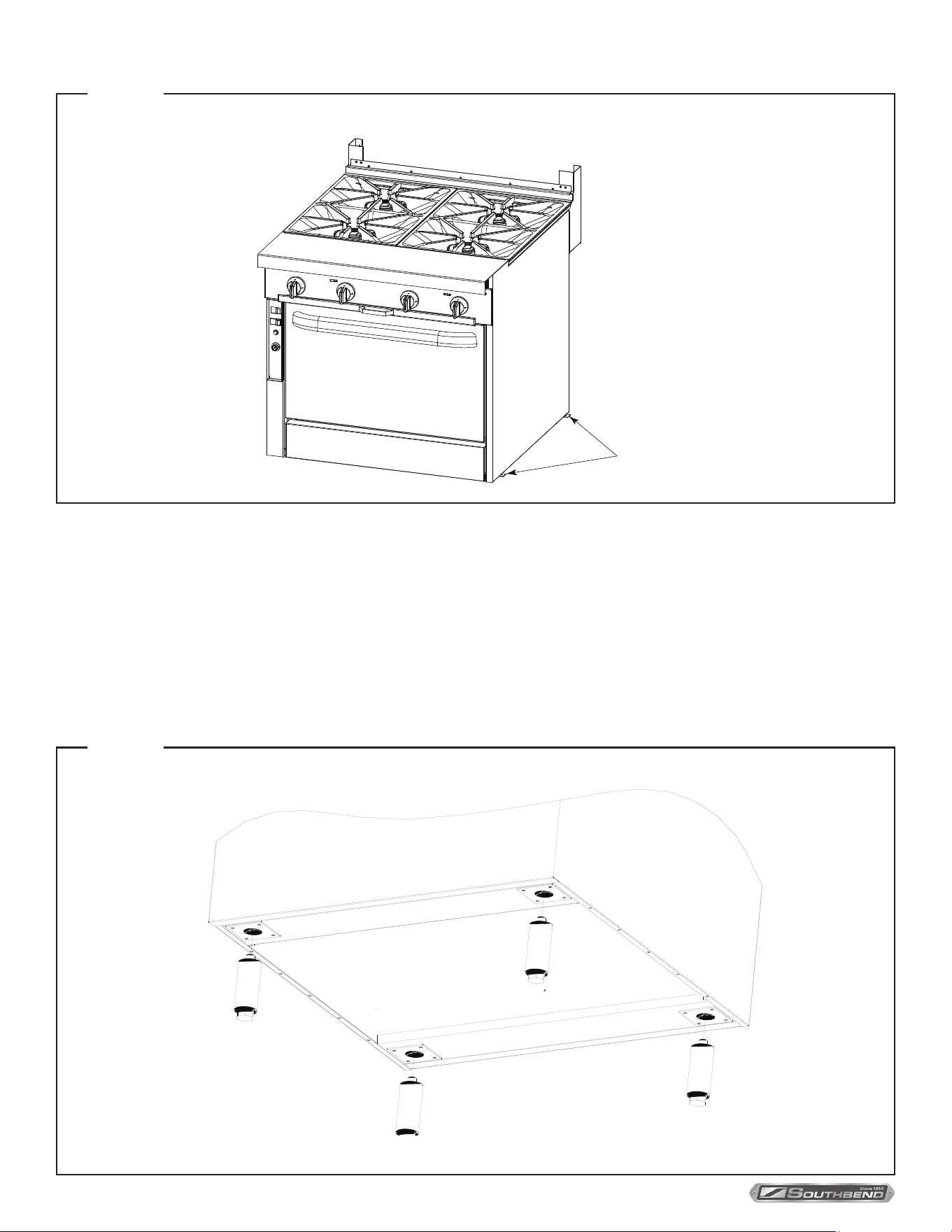
3. Unbolt the shipping hold-down brackets from the skid, then remove the brackets from the appliance (see Figure 12).
4. If the range is to be installed on 6” legs, go to Step 2a.
If the range is to be installed on 6” casters, go to Step 2b.
If the range is to be installed on a caster-frame, go to Step 2c.
INSTALLATION
PLATINUM SERIES RANGE
PAGE
24
OF 57
OWNER’S MANUAL 1185836 REV 9 (10/16)
Removal of Shipping Hold-Down Brackets
Figure 12
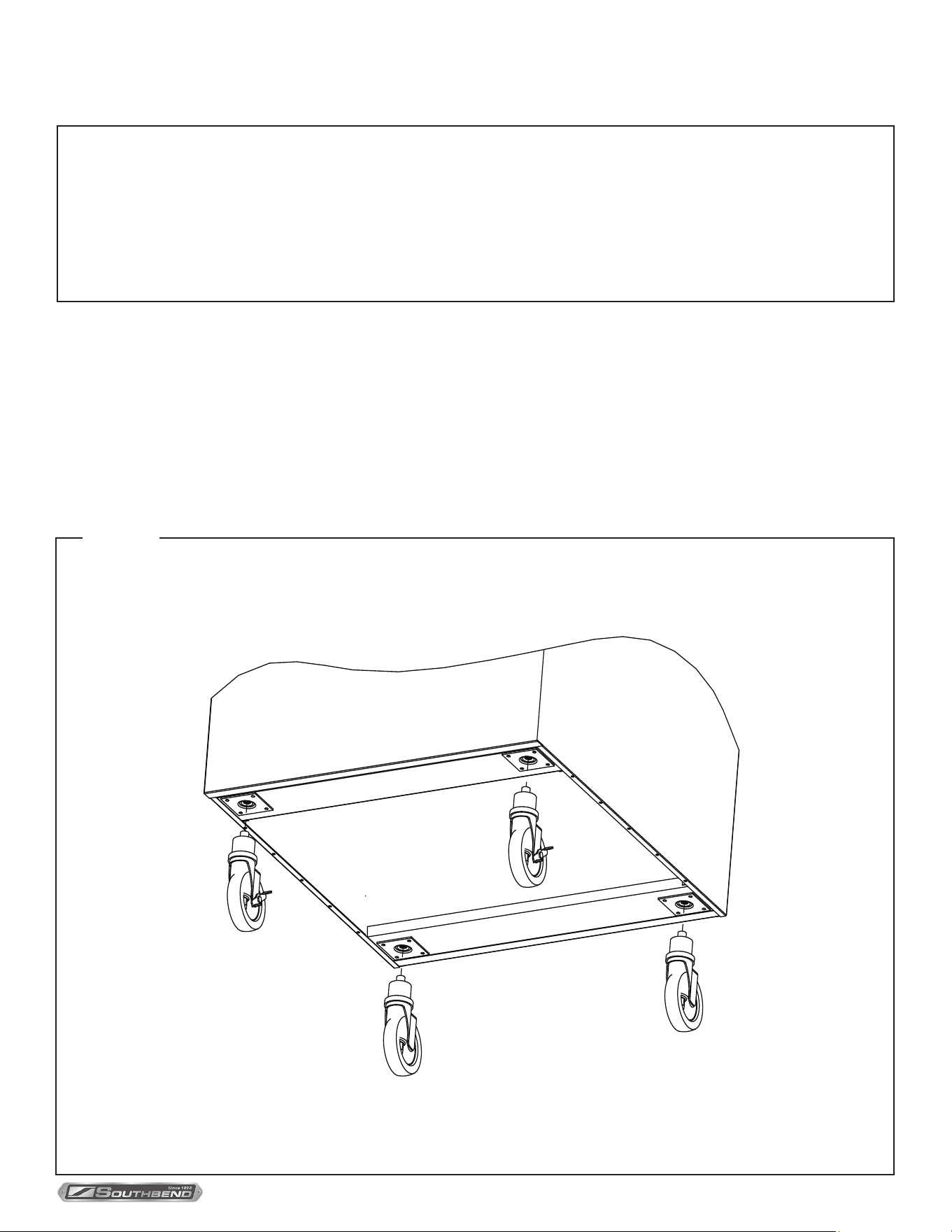
STEP 2A: ATTACH LEGS
A set of four legs is packed with units ordered with legs. (For units ordered with casters, go to Step 2b.)
A threaded leg pad is fastened to the base frame at each corner. Each leg has a corresponding mating thread. The legs
can be adjusted to overcome a slightly uneven oor.
1. Raise the range sufciently to allow the legs to be attached. For safety, “shore up” and support the range with an
adequate blocking arrangement strong enough to support the load.
2. Screw the legs into the holes in the centers of the leg pads (see Figure 13).
3. Lower the range gently onto a level surface. Never drop or allow the range to fall.
4. Go on to Installation Step 4.
Installation of Legs
Figure 13
Shipping
Hold-Down
Brackets
INSTALLATION
PLATINUM SERIES RANGE
OWNER’S MANUAL 1185836 REV 9 (10/16)
PAGE
25
OF 57
STEP 2B: ATTACH CASTERS
NOTICE
For an appliance equipped with casters, (1) the installation shall be made with a connector that complies with the
Standard for Connectors for Movable Gas Appliances, ANSI Z21.69 or Connectors for Moveable Gas Appliances,
CAN/CGA-6.16, and a quick-disconnect device that complies with the Standard for Quick-Disconnect Devices for
Use With Gas Fuel, ANSI Z21.41, or Quick Disconnect Devices for Use with Gas Fuel, CAN1-6.9, (2) adequate
means must be provided to limit the movement of the appliance without depending on the connector and the quick-
disconnect device or its associated piping to limit the appliance movement and (3) the restraining means should be
attached to a frame member on the back of the unit.
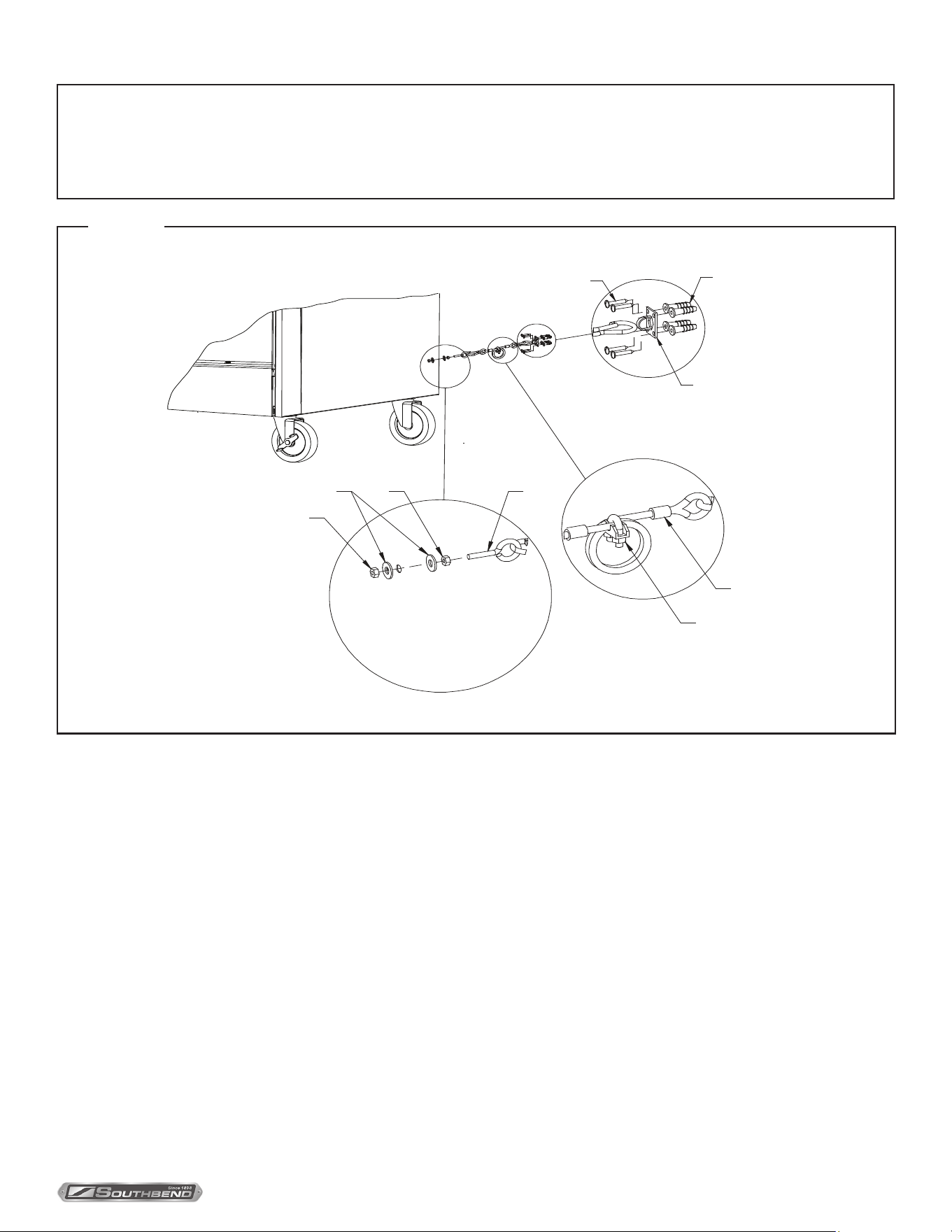
A set of four casters is packed with units ordered with casters (instead of legs).
A threaded leg pad is fastened to the base frame at each corner. Each caster has a corresponding mating thread. The
casters can be adjusted to overcome a slightly uneven oor. Casters are provided with a Zerk tting for proper
lubrication when required.
1. Raise unit sufciently to allow the casters to be attached. For safety, “shore up” and support the range with an
adequate blocking arrangement strong enough to support the load.
2. Screw the casters into the holes in the centers of the leg pads (see Figure 14). Install the casters that have a locking
brake under the front of the range.
3. Lower the range gently onto a level surface. Never drop or allow the range to fall.
4. Go to Installation Step 3.
Installation of Casters
Figure 14
INSTALLATION

PLATINUM SERIES RANGE
PAGE
26
OF 57
OWNER’S MANUAL 1185836 REV 9 (10/16)
STEP 2C: MOUNT UNIT ON CASTER FRAME
NOTICE
For an appliance equipped with casters, (1) the installation shall be made with a connector that complies with the
Standard for Connectors for Movable Gas Appliances, ANSI Z21.69 or Connectors for Moveable Gas Appliances,
CAN/CGA-6.16, and a quick-disconnect device that complies with the Standard for Quick-Disconnect Devices for
Use With Gas Fuel, ANSI Z21.41, or Quick Disconnect Devices for Use with Gas Fuel, CAN1-6.9, (2) adequate
means must be provided to limit the movement of the appliance without depending on the connector and the quick-
disconnect device or its associated piping to limit the appliance movement and (3) the restraining means should be
attached to a frame member on the back of the unit.
The range can be mounted on an optional caster frame. The frame will have a threaded leg pad at each corner. Each
caster has a corresponding mating thread. The casters can be adjusted to overcome a slightly uneven oor. Casters are
provided with a Zerk tting for proper lubrication when required.
1. Assemble the caster frame components.
2. Screw the casters into the holes in the centers of the leg pads of the caster frame. Install the casters that have a
locking brake under the front of the battery.
3. Lower the caster frame gently onto a level surface. Never drop or allow the frame to fall.
4. Block and brace the frame so that it will not move while the battery sections are installed on it.
5. Lift and gently place the range in position on the caster frame. Never drop or allow the range to fall.
6. Bolt the range to the caster frame.
7. Go to Installation Step 3.
STEP 3: ATTACH RESTRAINT TO UNIT MOUNTED ON CASTERS
NOTICE
For an appliance equipped with casters, (1) the installation shall be made with a connector that complies with the
Standard for Connectors for Movable Gas Appliances, ANSI Z21.69 or Connectors for Moveable Gas Appliances,
CAN/CGA-6.16, and a quick-disconnect device that complies with the Standard for Quick-Disconnect Devices for
Use With Gas Fuel, ANSI Z21.41, or Quick Disconnect Devices for Use with Gas Fuel, CAN1-6.9, (2) adequate
means must be provided to limit the movement of the appliance without depending on the connector and the quick-
disconnect device or its associated piping to limit the appliance movement and (3) the restraining means should be
attached to a frame member on the back of the unit.
Install the restraint cable to a range (or battery) mounted on casters using the following procedure:
1.Secure the restraining-device bracket (item “B” in Figure 15) to a wall stud located as close as possible to the
appliance connector inlet and outlet connections. Use four #12 screws (items “C”) and plastic anchors (items “A”) if
necessary.
2.Install eye-bolt (item “F”) to a frame member on the rear of the equipment. After checking carefully behind the frame
member for adequate clearance, drill a 1/4” hole through the frame member.
3. Thread hex nut (item “G”) and slide the washer (item “H”) onto the eye-bolt. Insert the eye-bolt through the 1/4” drilled
hole and secure with a washer (item “H”) and nylon lock nut (item “I”).
4. Using the spring-loaded snap hooks, attach the restraining device to the bracket and the eye-bolt.
5. Using the cable clamp (item “D”), adjust the restraining device extended length to prevent over-bending or kinking of
the appliance connector.
For units not equipped with ame safety devices, be sure all valves are turned off prior to disconnecting. After
reconnecting, be sure all control knobs are turned off and all pilots are lit.
INSTALLATION
PLATINUM SERIES RANGE
OWNER’S MANUAL 1185836 REV 9 (10/16)
PAGE
27
OF 57
NOTICE
Adequate means must be provided to limit the movement of the appliance without depending on the connector and
the quick-disconnect device or its associated piping to limit the appliance movement.
The restraining means should be attached to a frame member on the back of the unit.
Installation of Cable Restraint
Figure 15
STEP 4: CONNECT BATTERY SECTIONS
If the range is part of a battery, and the battery was shipped partially disassembled, connect the battery sections using the
following procedure.
1. Remove valve panels from all sections. Mark them so that they can be returned to their respective section.
2. Position the center section of the battery and carefully level that unit. Use a long spirit level four ways; across front
top rail and the rear edge, and along each side edge.
3. If not already in place, attach pipe-union to front manifold of the battery. Screw it in far enough to be able to slide the
adjacent section into position.
4. Bring up adjacent section and level it using the same method and by using the center unit as reference. Match front
rails and rear edge. When a battery is set on a masonry base and legs are not used, shims may be used. Special
attention should be given to griddle ranges to allow proper drainage.
5. Bolt the frames of the sections together.
6. Connect the front manifolds using the pipe-union.
7. Attach the trim-strip between the section tops.
8. Install the continuous front-rail, if ordered.
9. Slide control knobs onto their shafts (to operate the sections during the installation procedure), but do not yet
reattach valve panels or front-panel trim pieces.
F
G
H
I
B
C
E
D
A
INSTALLATION
PLATINUM SERIES RANGE
PAGE
2 8
OF 57
OWNER’S MANUAL 1185836 REV 9 (10/16)
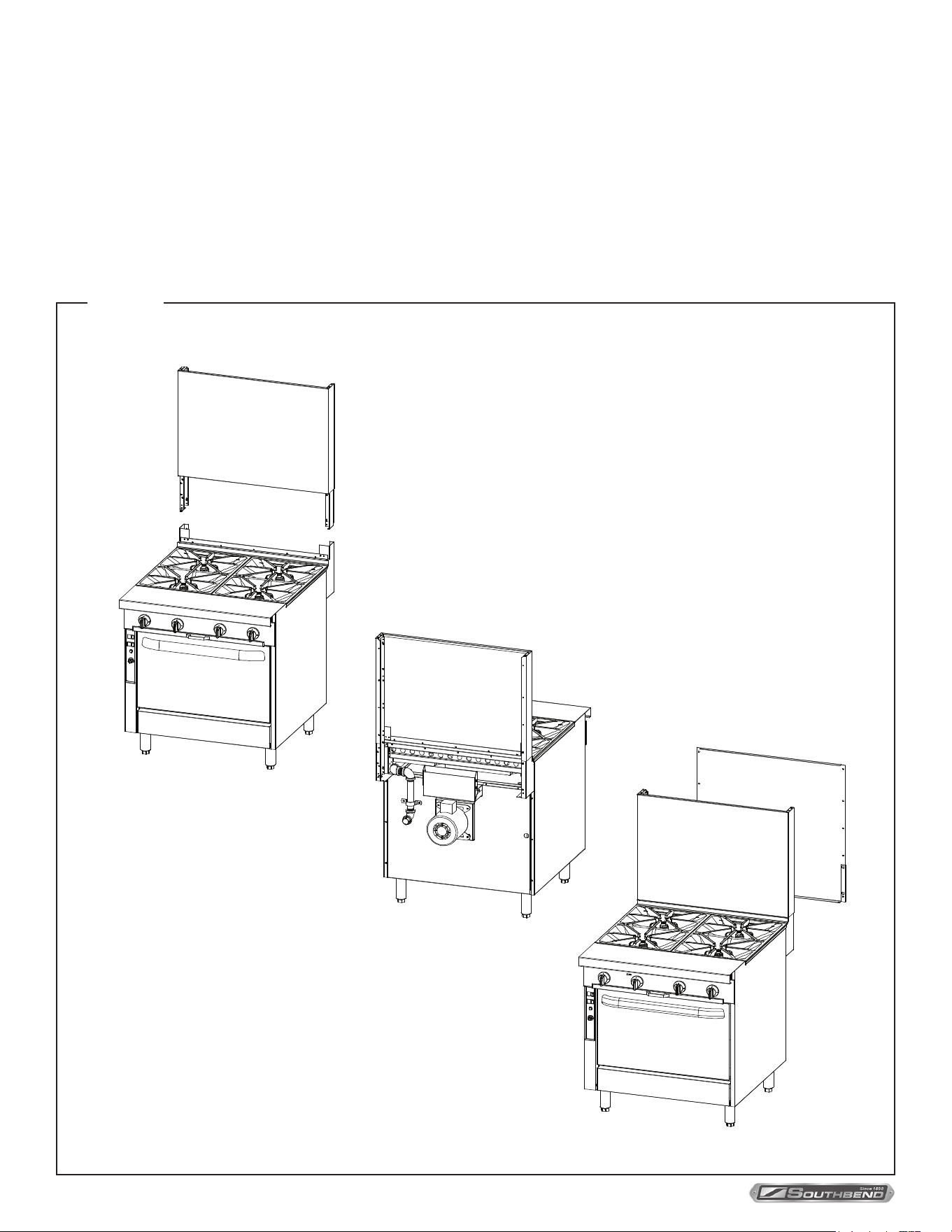
STEP 5: ATTACH FLUE RISER AND SHELF ASSEMBLIES
Install the ue riser(s) using the following procedure (as shown in Figure 16).
1. Attach any salamander broilers and ue-riser-mounted cheese melters to appropriate sections following the
installation procedure in the manuals for those options.
2. Slide each ue riser down onto the brackets projecting from the back of the corresponding section(s) of the
sectional range. Secure the ue riser to the brackets with the four provided 1/4-20x3/4 hex-head bolts, at washers,
and lockwashers. Also, secure the bottom edge of the ue riser to the top rear edge of the sectional range using the
provided #10 sheet metal screws.
3. If access to the interior of the ue riser is necessary to make gas connections, make those connections at this time.
Installation of Flue Riser
Figure 16
Slide the front of the flue riser down into
the brackets on the sectional range.
Secure the flue riser to the
brackets using the provided
fasteners. Also secure the
bottom edge of the flue riser
to the top rear edge of the
sectional range.
Attach the rear of the flue riser
to the front of the flue riser
using the provided fasteners.
INSTALLATION

PLATINUM SERIES RANGE
OWNER’S MANUAL 1185836 REV 9 (10/16)
PAGE
29
OF 57
4. Attach each wall shield to the back of the corresponding ue riser using the provided #10 sheet metal screws.
5. Connect the top side edges of adjoining ue risers using the provided small plates and screws.
6. If tubed shelves were installed, place the tubes in place in the shelf brackets.
7. If sloped enclosures were ordered (for ue-mounted salamander broilers and/or cheese melters), install them at
this time.
STEP 6: CONNECT ELECTRICITY (FOR SECTIONS WITH OVEN-BASES &
INDUCTION HOBS)
A wiring diagram is located behind the kick panel of the oven-base ranges. Be sure that the input voltage and phase
match the requirements shown on the serial plate.
Oven-base ranges ordered with a 115V, 60Hz, single-phase electrical rating are factory-supplied with a three-wire cord
with a three-prong plug that ts any standard three-prong grounded receptacle. Each standard oven requires a 15 ampere
supply, while each convection oven requires a 20 ampere supply.
Oven-base ranges ordered with a 208/236V, 60Hz, single- or three-phase electrical rating are factory-equipped with a
two-pole terminal block located behind cover plate located on the rear of the unit. To connect the supply wires, remove
the cover plate. Route the supply wires and the grounding wire through the strain relief tting to the terminal block. Insert
the supply wires, one each, into the two poles of the terminal block and tighten the screws. Insert the ground wire into the
grounding lug and tighten the screw. Re-attach the cover plate.
Three phase units are wired as above, using only two supply wires. The third wire is not used and must be properly
terminated.
All units are shipped wired as specied by factory order. Conversion between single-phase and three-phase can be
accomplished by referring to phase loading and line amperes chart on the wiring diagram for wire size and ampere
requirements.
For units equipped with Induction hobs, consult the data label on the unit for voltage and amperage information. “A” model
units my have a separate power cord for the lower ovens and a terminal block for the induction hobs.
STEP 7: CONNECT GAS SUPPLY
If the sectional range is being installed at over 2,000 feet altitude and that information was not specied when ordered,
contact the appropriate authorized Southbend Service Representative or the Southbend Service Department. Failure to
install with proper orice sizing will result in poor performance and may void the warranty.
The sectional range is design-certied for operation on natural or propane gases. The sectional range is shipped
congured and adjusted for the type of gas specied by the purchaser, which is indicated on the serial plate (see Figure 1
on page 3). Connect the sectional range ONLY to the type of gas for which it is congured and adjusted.
Minimum supply pressure is 7” W.C. for natural gas, 11” W.C. for propane. An external pressure regulator and shut off
valve are provided. If using a exible-hose gas connection, the I.D. of the hose must not be smaller than the connector on
the sectional range, and must comply with ANSI Z21.69. Provide an adequate means of restraint to prevent undue strain
on the gas connection.
If applicable, the vent line from the gas pressure regulator shall be installed to the outdoors in accordance with local
codes, or in the absence of local codes, with the National Fuel Gas Code, ANSI Z223.1, Natural Gas Installation Code,
CAN/CGA-B149.1, or the Propane Installation Code CAN/CGA-B149.2, as applicable.
An adequate gas supply is imperative. Undersized or low pressure lines will restrict the volume of gas required for
satisfactory performance. Fluctuations of more than 25% on natural gas or 10% on propane gas will create problems and
affect burner operating characteristics. A 1/8” pressure tap is located on the manifold to measure the manifold pressure.
The supply line to the sectional range should be no smaller than the inside diameter of the pipe on the sectional range to
which it is connected.
CAUTION
ALL PIPE JOINTS AND CONNECTIONS MUST BE TESTED THOROUGHLY FOR GAS LEAKS. USE ONLY SOAPY
WATER FOR TESTING ON ALL GASES. NEVER USE AN OPEN FLAME TO CHECK FOR GAS LEAKS. ALL
CONNECTIONS MUST BE CHECKED FOR LEAKS AFTER THE APPLIANCE HAS BEEN PUT INTO OPERATION.
TEST PRESSURE SHOULD NOT EXCEED 14” W.C
INSTALLATION

PLATINUM SERIES RANGE
PAGE
30
OF 57
OWNER’S MANUAL 1185836 REV 9 (10/16)
Do the following to connect the gas supply:
1. Check that all control knobs on the sectional range are in the OFF position.
2. Purge the gas supply line to clean out dust, dirt, or other foreign matter before connecting the line to the sectional
range.
3. The gas connection piping may have been partially installed at the factory. If necessary, attach the gas connection of
any appliances mounted on a ue riser.
4. Locate the pressure regulator(s) packed with the sectional range. Install the pressure regulator, taking care that the
direction of gas ow corresponds to the arrow on the side of the pressure regulator.
CAUTION
HOLD THE PRESSURE REGULATOR WITH A WRENCH WHEN TIGHTENING THE CONNECTION TO THE
SUPPLY PIPE TO AVOID DAMAGE TO THE REGULATOR, VALVE, AND OTHER COMPONENTS.
5. Install a service shut-off valve to the pressure regulator, and connect the gas supply line to the shut-off valve.
6. If applicable, install the vent line of the pressure regulator to the outdoors.
7. Turn on the gas and immediately check for leaks using soapy water.
8. If the optional sloped enclosure for a ue-mounted model was ordered, install it at this time.
STEP 8: CONNECT WATER SUPPLY
If a rail-mounted ll-hose was ordered (as a special option), there will be a corresponding water connection on the back of
the section. Connect the water supply.
STEP 9: CHECK THE INSTALLATION
Check the installation, as follows:
1. Check that all screws and bolts are tightened.
2. Check electrical connection(s).
3. Check that the gas connection has been made correctly.
4. Check water connection(s).
5. Move the battery into the nal position at which it will be operated.
6. Check that the battery is level. If not, adjust the legs or casters.
7. Check that the appropriate minimum clearances are satised (see page 4).
8. Check that there is sufcient clearance to open all doors and pull-out all grease trays and crumb trays.
9. Check that adequate ventilation (fresh air supply and hood exhaust) is available to the room in which the appliance
will operate.
10. Wipe clean all cooking surfaces (especially griddles).
11. Check that nothing is obstructing the air intake openings and/or the combustion-exhaust openings.
STEP 10: CHECK OPERATION OF EACH SECTION
Check the operation of each section, as follows:
1. Turn electricity supply on.
2. Turn gas supply on. Immediately check all gas connections for leaks using soapy water.
3. Turn water supply on (if applicable). Check for water leaks.
4. Light all pilots (see the appropriate Operation section elsewhere in this manual). Start with the section(s) furthest from
the gas supply connection(s) to purge air from the gas lines. Check all pilots for correct ame height.
5. Turn on the burners of each section using only the lowest temperature settings (for now). Check all burners for
correct ame appearance and height.
6. Begin to break-in all griddle surfaces by turning on all griddle burners to LOW for at least one hour. (In case any
problems occur, do not leave the battery unattended during this time!) This will temper the griddle surface and avoid
possible damage.
INSTALLATION

PLATINUM SERIES RANGE
OWNER’S MANUAL 1185836 REV 9 (10/16)
PAGE
31
OF 57
7. Check operation of all sections (except griddles) for the full-range of operating settings, including checking all burners
for correct ame appearance and height at the HIGH settings.
8. Complete the break-in of all griddle surfaces (after they have been operating at LOW for at least one hour) by
gradually bringing each griddle up to frying temperature. Then spread over each griddle three or four ounces of beef
suet, or as a substitute, baking soda, to season it. Never allow water on a hot griddle and never wash it with soap and
water.
9. Check that gas supply is adequate by simultaneously turning on all burners of all sections to their highest setting,
then again checking that all burner ames have correct appearance and height.
10. Check that electricity supply is adequate by simultaneously turning on all electrical elements (if any) and turning the
blower setting of all convection ovens (if any) to HIGH.
11. Check that water supply is adequate by simultaneously operating all ll hoses (if any). (Do not allow water to spill
onto a hot griddle.)
12. Turn-off all burners and allow all battery sections to cool.
STEP 11: ATTACH VALVE-PANEL(S) AND FRONT TRIM PANELS
Attach the valve panel(s) and front trim panels, as follows:
1. After the battery has cooled, again check all gas connections for gas leaks using soapy water.
2. Attach the front-trim panels for the adjoining sections.
3. Remove control knobs, grease drawers, and drippings-trays as necessary to enable installation of the valve panel(s).
4. Attach the valve panel(s).
5. Re-attach the control knobs. Insert all grease drawers and drippings trays.
STEP 12: WIPE-CLEAN AND SHUT-DOWN RANGE
Complete the installation by leaving the sectional range ready for customer use:
1. Wipe clean all surfaces.
2. Unless the sectional range is to be placed in service immediately, shut off the gas, electricity, and water supplies.
3. Make sure that a copy of this manual will be available to the people who will operate and maintain the sectional
range.
INSTALLATION
PLATINUM SERIES RANGE
PAGE
32
OF 57
OWNER’S MANUAL 1185836 REV 9 (10/16)
WARNING
Improper ventilation can result in personal injury or death. Ventilation which fails to properly remove ue products
can cause headaches, drowsiness, nausea, or could result in death.
All gas appliances must be installed in such a manner that the ow of combustion and ventilation air is not obstructed.
Provisions for adequate air supply must be provided. Do not obstruct the area under the control panel or below the
oven door (on the front), or the area below the ue riser (on the back) as combustion air enters through these areas.
SERVICE
NOTICE
Improper ventilation can result in personal injury or death. Ventilation which fails to properly remove ue products
can cause headaches, drowsiness, nausea, or could result in death.
All gas appliances must be installed in such a manner that the ow of combustion and ventilation air is not obstructed.
Provisions for adequate air supply must be provided. Do not obstruct the area under the control panel or below the
oven door (on the front), or the area below the ue riser (on the back) as combustion air enters through these areas.
The location of the serial plate depends on the type of base (see Figure 1 on page 3). On models with oven bases, the
serial plate is located on the backside of the kick-plate below the oven door (lift the kick-plate straight up and tilt the top
edge out and down.) On models with a cabinet base, the serial plate is located inside the left cabinet door. On modular
(countertop) models, the serial plate is located inside the front valve panel.
Replacement parts (including parts not listed in this manual) may be ordered either through a Southbend Authorized Parts
Distributor or a Southbend Authorized Service Agency.
When ordering parts, please supply the Model Number, Serial Number, Part Number, and Part Description.
ACCESS TO SERVICEABLE COMPONENT
To open the kick panel below the oven door, lift the kick panel straight up and pull the top edge away from the oven. The
kick panel is hinged at the bottom corners.
To remove the valve panel, rst remove the knobs. Then remove the two screws on the bottom of the valve panel (except
on modular-countertop base models). Pull the bottom of the valve panel away from the range. The top edge of the valve
panel has two small slots that hook over tabs on the frame.
To access the rear of the oven control panel, rst remove the valve panel. Then remove the screw that holds the top of
the oven control panel in place. Tilt the top of the oven control panel outward, being careful not to damage the wires or the
thermostat sensor.
To service the blower motor from the front of the oven, rst remove the blower bafe from the rear of the oven cavity (lift
it up and out). Then disconnect the motor-mount plate by removing the eight hex nuts that secure it to the oven interior
back. Pull the mount-plate, with motor attached, into the oven cavity.
SERVICE

PLATINUM SERIES RANGE
OWNER’S MANUAL 1185836 REV 9 (10/16)
PAGE
33
OF 57
Problem Look for -
None of the burners and pilots will turn on nter… – Main gas supply to unit is OFF.
All burners produce excessive carbon deposits – Incorrect gas type is being supllied to the range
– Primary air not adjusted property.
Only some burners produce excessive carbon deposits – Incorrect orices.
– Primary air not adjusted properly.
Only some pilots produce excessive carbon deposits – Pilot not adjusted properly.
– Incorrect pilot orice.
Top burner (not oven) will not come on – Pilot out.
– For thermostatic griddles, gas shut off valve is in OFF position.
– For thermostatic griddles, button on safety switch is not being held in
long enough after lighting pilot.
Top section pilot will not remain lit – Pilot ame not adjusted properly.
– Clogged orice.
– Draft condition.
– Improper ventilation system.
– Air in gas line.
SERVICING BURNERS AND PILOTS
All orice sizes and burner rates are properly set at the factory and should not be altered.
Each burner should have a steady blue ame on each port of the burner. When using propane, the burners may have a
small amount of yellow tipping.
If the ame is rising up off of the ports adjust the burner shutter to be further closed. If the ame is long and yellow adjust
the burner shutter to be further open.
Over-gassed burners DO NOT heat as efciently as those that are properly adjusted. Such conditions also create “hot
spots” on griddles and hot tops. Floating and unstable burner and pilot ames will result when solid tops are lowered
into position because the rear openings of the burner compartment are not adequate to vent the enormous ue products
generated by over-gassed burners. The “unburned” gas will ignite at the rear and burn in this section and even up inside
the ue riser, causing structural members in this area to deteriorate. Also, some of these hot ue products will vent forward
into the manifold compartment resulting in problems with valves and thermostats due to overheating. AGAIN, over-gassed
burners waste energy and cause service problems.
Note that the burners of griddle, charbroiler, and uniform hot-top models are long, and so the burner ame may oat when
cold. Allow the burner to heat before making burner adjustments.
Propane burners may have a slight popping noise when turned off. This is normal.
Check that the burner is level and in its support brackets.
Check that the burner is clean and all of its ports are clear.
Check that each burner valve and orice is in alignment with the burner.
Remove the burner and check that its venturi is clean and free of buildup and debris.
With each burner removed check that the orice size is correct and clean and free of buildup and debris.
If it is necessary to remove a griddle top to service the burners, use extreme care since the griddle plate is very heavy.
When raising a thermostatic griddle top, remove the thermostat bulbs from the tubes on the bottom of the griddle plate.
When re-installing, re-insert the thermostat bulbs and be sure the capillary tubes are away from burners, ames and
excessive heat.
TROUBLESHOOTING BURNERS AND PILOTS
The following table lists the possible causes of burner and pilot related problems that may occur.
SERVICE
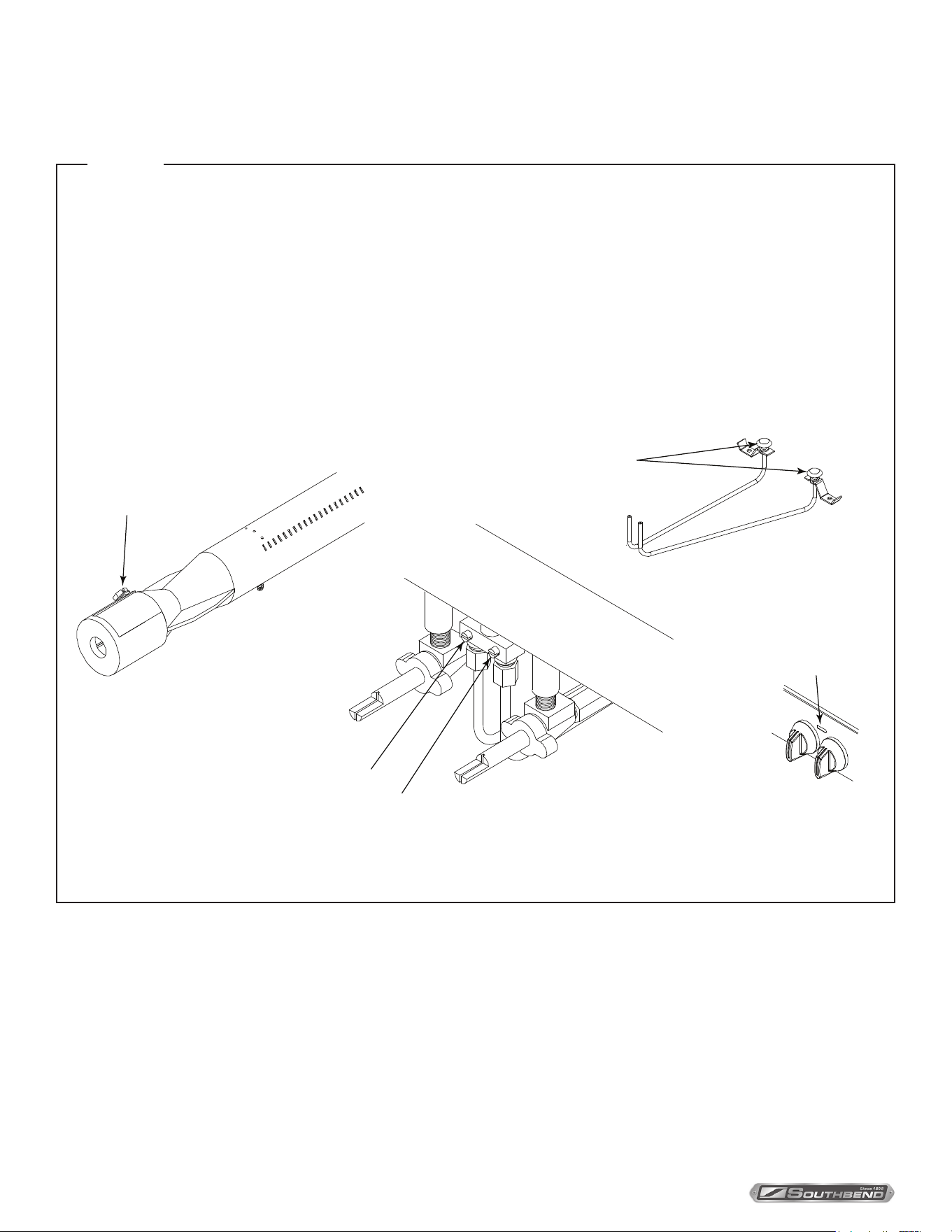
PLATINUM SERIES RANGE
PAGE
34
OF 57
OWNER’S MANUAL 1185836 REV 9 (10/16)
Adjustment of Charbroiler, Standard-Griddle, and Uniform Hot-Top Burners and Pilots
The burner valves are not adjustable. The burner orice is of the xed type, sized for the type of gas and the operating
altitude. To adjust the burner air-gas mixture, loosen the screw that secures the air shutter on the mixer face and rotate
the mixer cap to obtain a clear, stable blue ame with a distinct inner cone at each port. Excessive primary air causes
“blowing” (the ames leaving the ports), while insufcient primary air causes a soft or yellow tipped ame.
The pilots are near the front of the burners, and are held in position by brackets. To adjust a pilot ame, insert a
screwdriver through the opening in the valve panel between the control knobs and turn the appropriate pilot adjustment
screw counterclockwise to increase the size of the pilot ame, or clockwise to decrease the size of the pilot ame. The
maximum ame size is approximately 3/4” with a slight yellow tip. The rst indication of over-adjustment is when the
ame tip becomes more yellow and begins to generate carbon, which appears as rising black streaks.
Continued over-adjustment leads to unstable lifting and a blowing condition.
Figure 17
Pilot-ame outage is often due to an unstable ame caused by over-adjustment to the point where the pilot ame is
leaving its port, or “blowing off.” Sometimes the pilots are increased too much in an effort to improve ignition, resulting in
this unstable condition.
Adjustment screw for left-burner pilot
Air Shutter
Access hole
for pilot
adjustment
Adjustment screw for right-burner pilot
Pilots
SERVICE
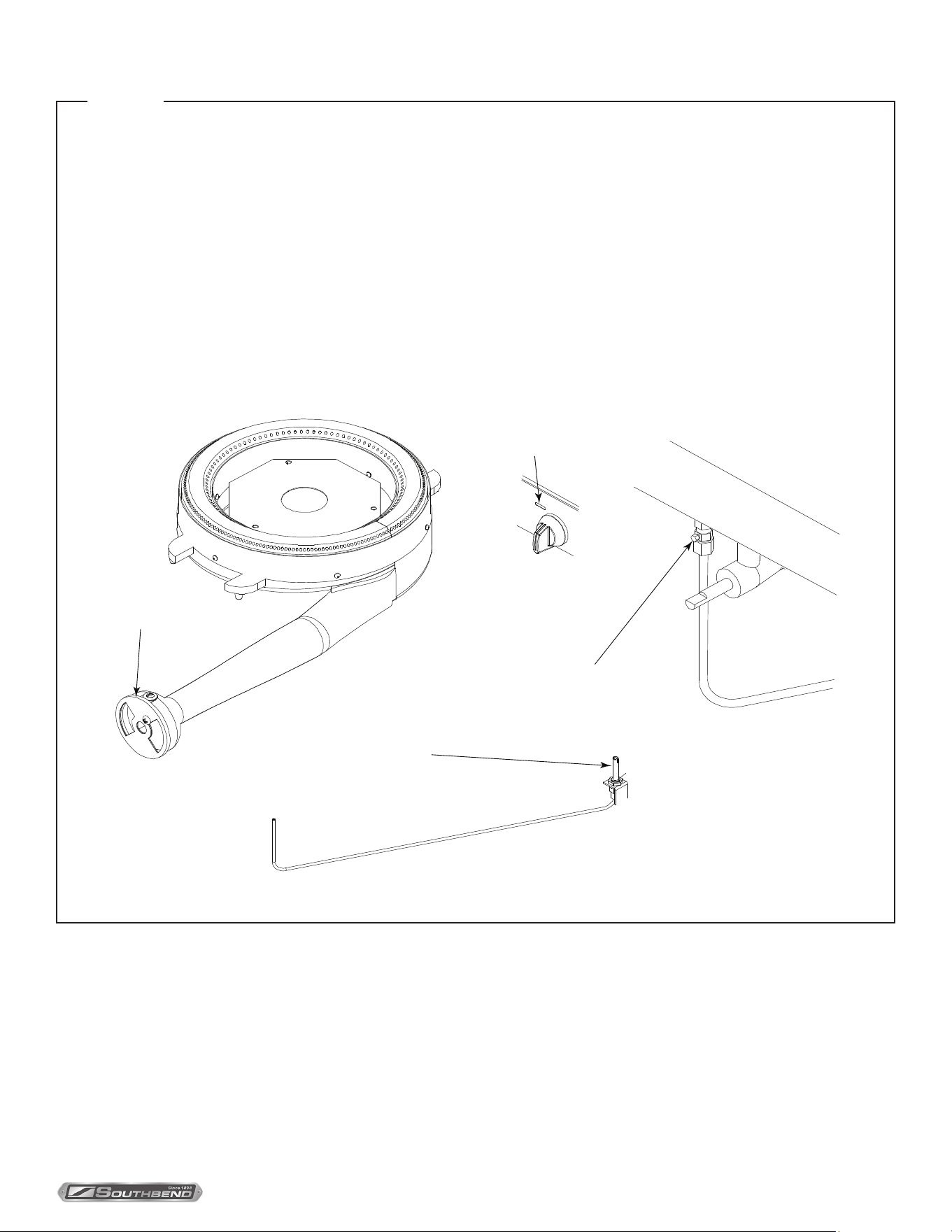
PLATINUM SERIES RANGE
OWNER’S MANUAL 1185836 REV 9 (10/16)
PAGE
35
OF 57
Adjustment of Graduated Hot-Top Pilot and Burner
The burner valves are not adjustable. The burner orice is of the xed type, sized for the type of gas and the operating
altitude. To adjust the burner air-gas mixture, loosen the screw that secures the air shutter on the mixer face and rotate
the mixer cap to obtain a clear, stable blue ame with a distinct inner cone at each port. Excessive primary air causes
“blowing” (the ames leaving the ports), while insufcient primary air causes a soft or yellow tipped ame.
The pilot is beside the burner, and is held in position by a bracket. To adjust the pilot ame, insert a screwdriver through
the opening in the valve panel beside the control knob and turn the pilot adjustment screw counterclockwise to increase
the size of the pilot ame, or clockwise to decrease the size of the pilot ame. The maximum ame size is approximate-
ly 3/4” with a slight yellow tip. The rst indication of over-adjustment is when the ame tip becomes more yellow and
begins to generate carbon, which appears as rising black streaks. Continued over-adjustment leads to unstable lifting
and a blowing condition.
Figure 18
Adjustment screw for pilot
Air Shutter
Access hole
for pilot
adjustment
Pilot
SERVICE
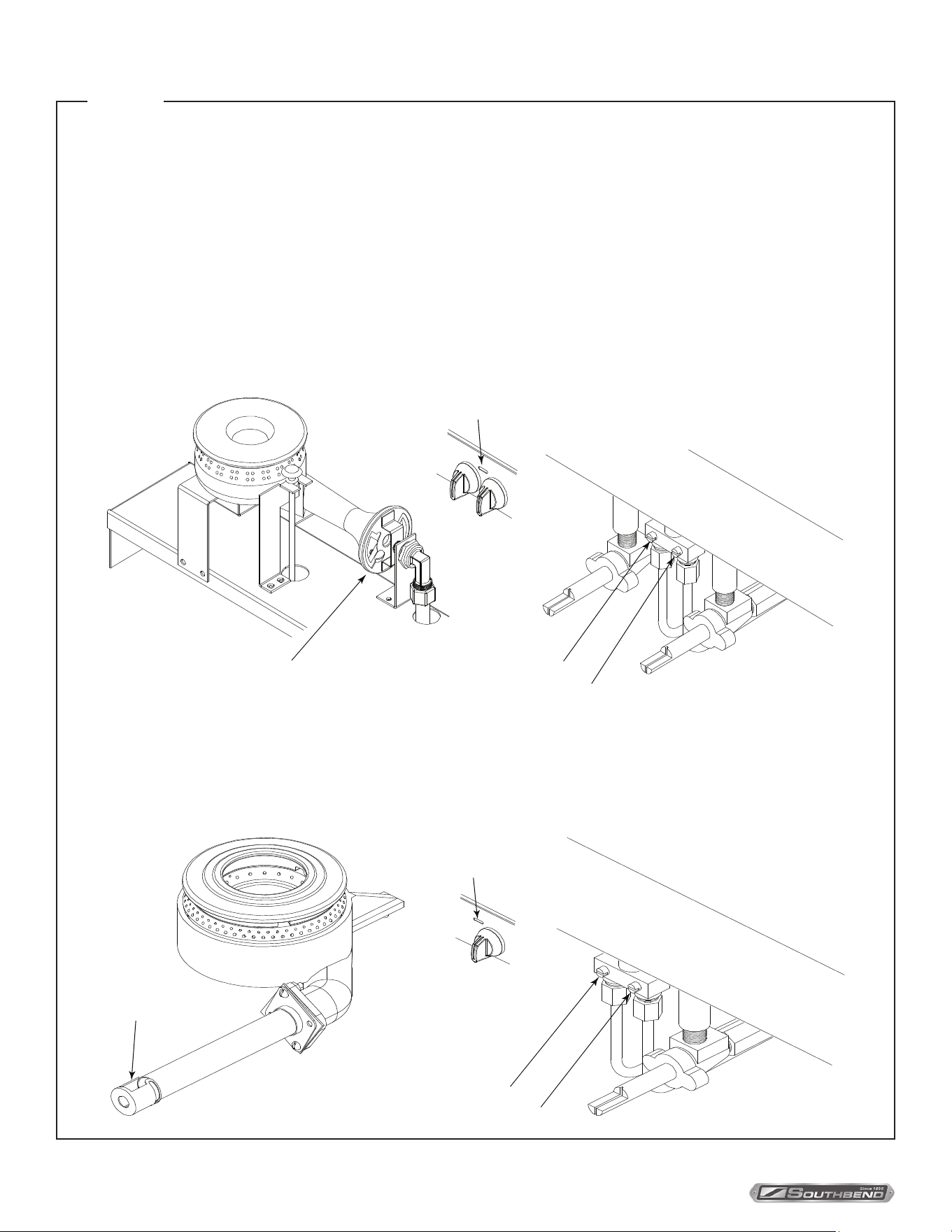
PLATINUM SERIES RANGE
PAGE
36
OF 57
OWNER’S MANUAL 1185836 REV 9 (10/16)
Adjustment of 33K and 45K Open-Top Burners and Pilots
The burner valves are not adjustable. The burner orice is of the xed type, sized for the type of gas and the operating
altitude. To adjust the burner air-gas mixture, loosen the screw that secures the air shutter on the mixer face and rotate
the mixer cap to obtain a clear, stable blue ame with a distinct inner cone at each port. Excessive primary air causes
“blowing” (the ames leaving the ports), while insufcient primary air causes a soft or yellow tipped ame.
The pilot is beside the burner, and is held in position by a bracket. To adjust the pilot ame, insert a screwdriver through
the opening in the valve panel beside the control knob and turn the pilot adjustment screw counterclockwise to increase
the size of the pilot ame, or clockwise to decrease the size of the pilot ame. The maximum ame size is approximate-
ly 3/4” with a slight yellow tip. The rst indication of over-adjustment is when the ame tip becomes more yellow and
begins to generate carbon, which appears as rising black streaks. Continued over-adjustment leads to unstable lifting
and a blowing condition.
Figure 19
33K-Open-Burner Models
Adjustment screw for rear-burner pilot
Air Shutter
Access hole
for pilot
adjustment
Adjustment screw for front-burner pilot
Adjustment screw for rear-burner pilot
Air Shutter
Access hole
for pilot
adjustment
Adjustment screw for front-burner pilot
45K-Open-Burner Model
SERVICE
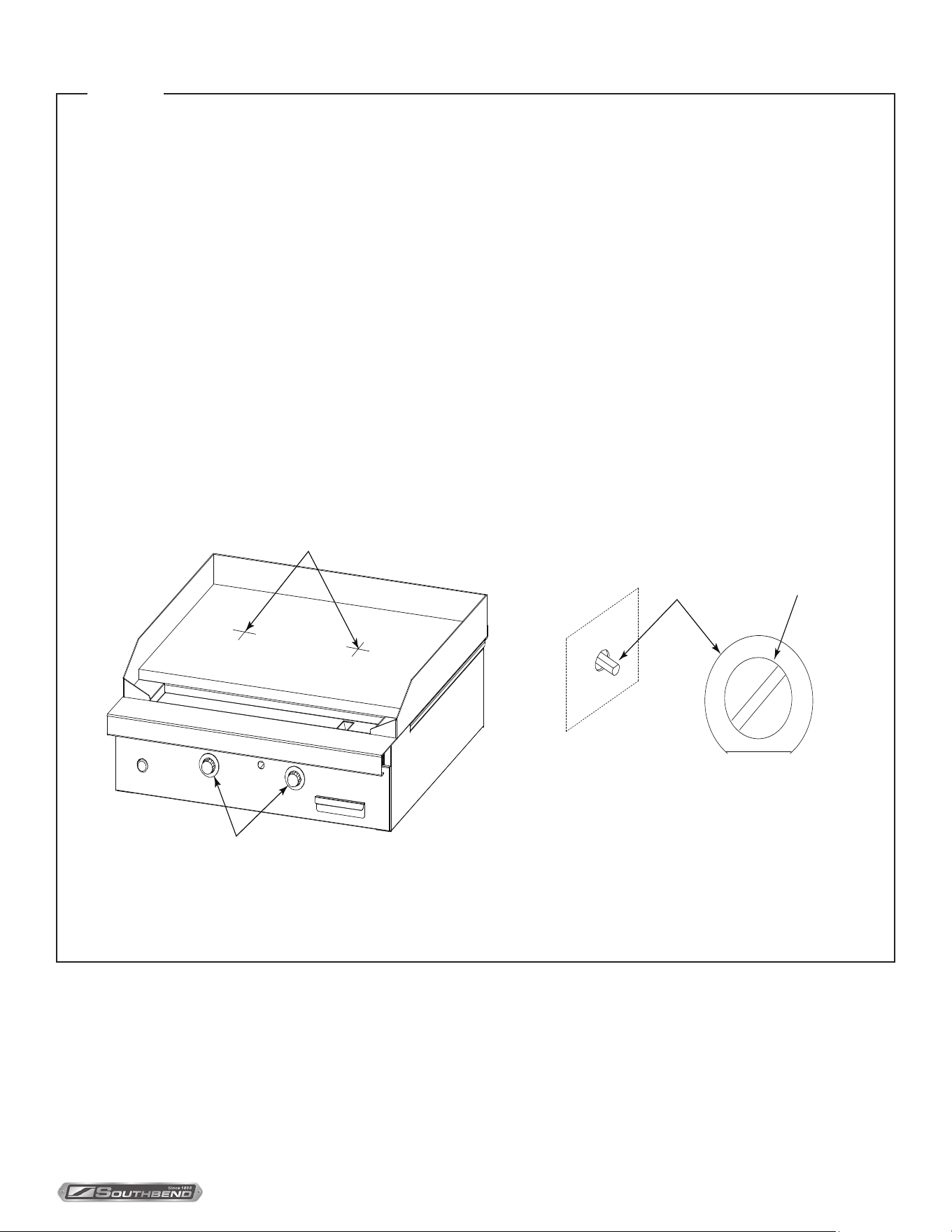
PLATINUM SERIES RANGE
OWNER’S MANUAL 1185836 REV 9 (10/16)
PAGE
37
OF 57
Adjustment of Thermostatic-Griddle Thermostat
Each 16”-wide section of a thermostatic griddle has a control knob that operates a snap-action thermostatic valve. Each
valve is adjusted at the factory. If the griddle surface temperature is different from the thermostat dial setting, adjust the
thermostatic valve using the following procedure:
1. Turn all the control knobs to the 300°F.
2. Wait 30 minutes for the griddle temperature to stabilize (or 1 hour if the griddle was cold).
3. Place a reliable thermometer or test-instrument thermocouple (able to register 300°F) halfway back from the front
to the back of the griddle and directly in line with the 16”-wide section’s control knob (see drawing below). Check the
temperature of each section every ve minutes until the temperature does not change by more than 30°F between
two consecutive measurements.
4. If the average temperature of any section is not within 30°F of the knob setting (300°F), adjust the corresponding
thermostatic valve. To do so, remove the control knob (being careful to not turn the stem, which would change the
temperature setting). While holding the stem in place, turn the calibration screw (see drawing below). If the actual
measured temperature is lower than the dial setting, turn the screw counterclockwise. If the measured temperature is
higher than the dial setting, turn the screw clockwise. Replace the control knob.
5. Wait for the griddle temperature to stabilize, then again check the temperature (as described above).
Figure 20
Measure temperature of each 16"-wide section
half-way back and in line with control knob.
Each knob is attached to a thermostatic
valve located behind the valve panel.
Calibrate the thermostat by holding the
shaft in place while turning the screw
counterclockwise to increase the temperature,
or clockwise to decrease the temperature.
With a control knob removed,
its valve shaft will extend out
of the valve panel.
Shaft
Screw
SERVICE
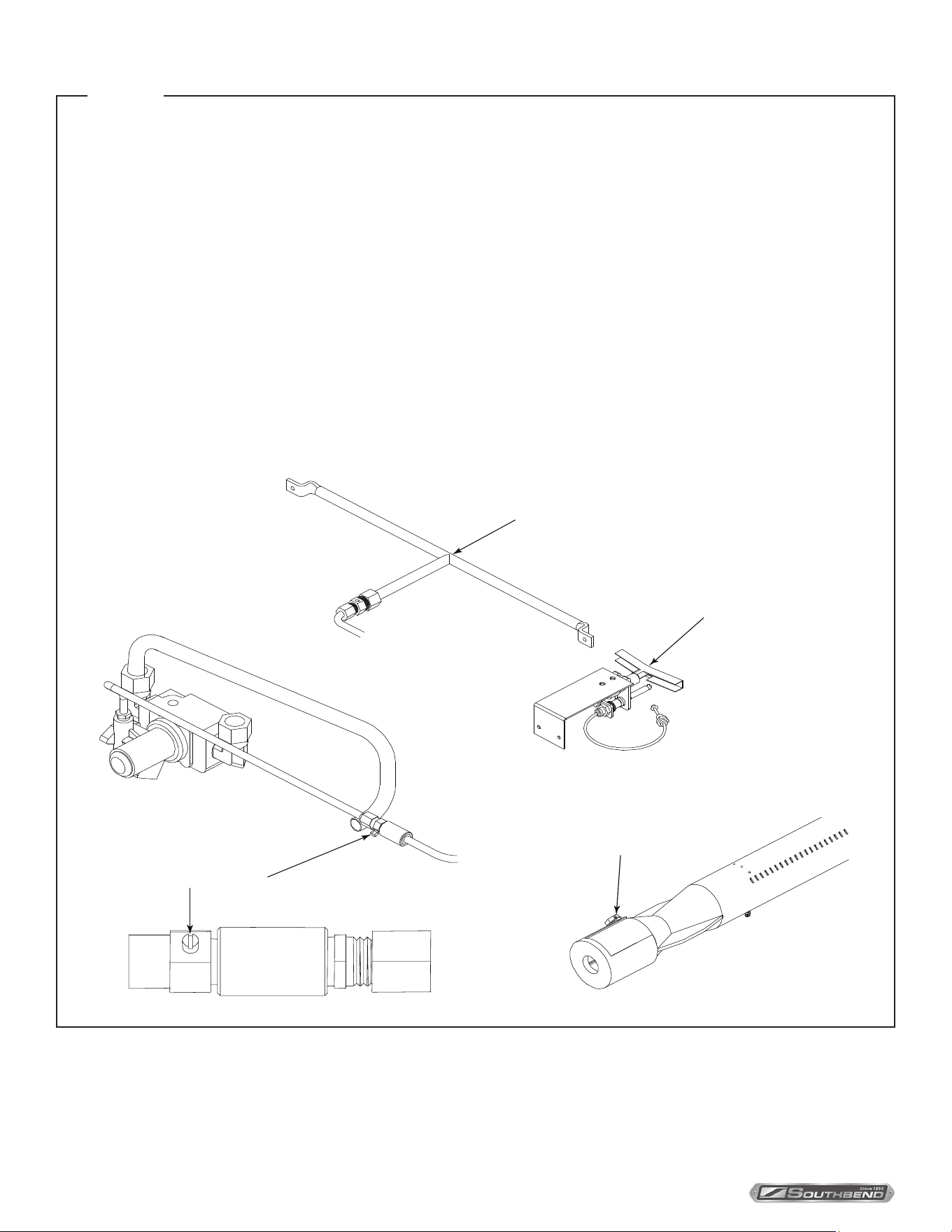
PLATINUM SERIES RANGE
PAGE
3 8
OF 57
OWNER’S MANUAL 1185836 REV 9 (10/16)
Adjustment of Thermostatic-Griddle Burners and Pilot
The thermostatic burner valve is adjustable (see page 38). The burner orice is of the xed type, sized for the type of
gas and the operating altitude. To adjust the burner air-gas mixture, loosen the screw that secures the air shutter on the
mixer face and rotate the mixer cap to obtain a clear, stable blue ame with a distinct inner cone at each port. Exces-
sive primary air causes “blowing” (the ames leaving the ports), while insufcient primary air causes a soft or yellow
tipped ame.
The pilot(s) and pilot-runner(s) are located near the front of the burners, but the pilot adjustment valve is located in the
gas line between the safety switch and the pilot. If the pilot needs adjustment, do the following:
1. Remove the control knobs, and remove the valve panel (see page 33).
2. If necessary, light the pilot.
3. Locate the pilot adjustment valve (see drawing below). Turn the pilot adjustment screw counterclockwise to increase
the size of the pilot ame, or clockwise to decrease the size of the pilot ame. The pilot ame should be about 1/2”
high with a slight yellow tip, and cover the thermocouple tip. The rst indication of over-adjustment is when the ame
tip becomes more yellow and begins to generate carbon, which appears as rising black streaks. Continued over-
adjustment leads to unstable lifting and a blowing condition.
4. Replace the valve panel and control knobs.
Figure 21
Adjustment screw for pilot
Air Shutter
Pilot
Pilot Runner
SERVICE
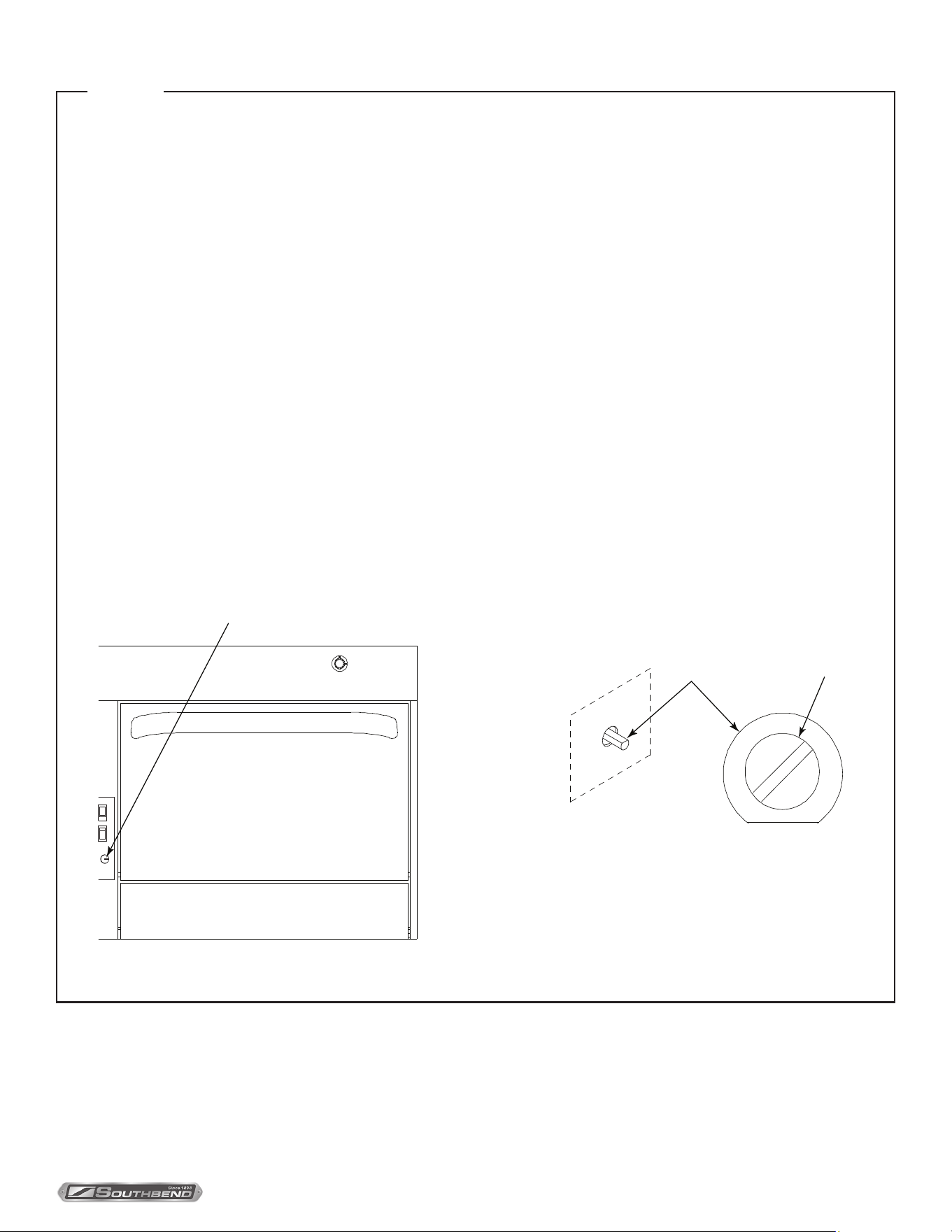
PLATINUM SERIES RANGE
OWNER’S MANUAL 1185836 REV 9 (10/16)
PAGE
39
OF 57
Adjustment of Oven Thermostat
The oven thermostat is carefully calibrated at the factory so that the dial setting matches the actual oven temperature.
Field recalibration is seldom necessary, and should not be resorted to unless considerable cooking experience denite-
ly proves that the control is not maintaining the temperatures to which the dial is set.
Obtain a test instrument or a reliable mercury thermometer, then do the following:
1. Place the thermocouple of test instrument or the thermometer in the middle of the oven.
2. Turn on the oven and set the thermostat to 400°F.
3. After the oven has been on about 20 minutes check oven temperature. The oven door should be open for as short a
time as possible. Use a ashlight, if necessary, to see the thermometer clearly.
4. Continue to check the temperature at 5-minute intervals until two successive readings are within 5 degrees of each
other.
The thermostat should be recalibrated if the reading is not within 20 degrees of the dial setting (400°F). If calibration is
required, adjust the thermostat, as follows:
5. Remove the oven temperature control knob. Be careful to not turn the stem (which would change the temperature
setting).
6. While holding the stem in place, turn the calibration screw (see drawing below). If the actual measured temperature
is lower than the dial setting, turn the screw counterclockwise. If the measured temperature is higher than the dial
setting, turn the screw clockwise. Replace the control knob.
7. Set the oven temperature to 450°F. After about 20 minutes, check the oven temperature. Continue to check the
temperature at 5-minute intervals until two successive readings are within 5 degrees of each other. If the actual oven
temperature is not within 20 degrees of the dial setting (450°F), replace the thermostat.
Figure 22
Calibrate the thermostat by holding the
shaft in place while turning the screw
counterclockwise to increase the temperature,
or clockwise to decrease the temperature.
With the control knob removed,
the control shaft will extend out
of the control panel.
Remove oven thermostat
control knob.
Shaft
Scre
w
SERVICE
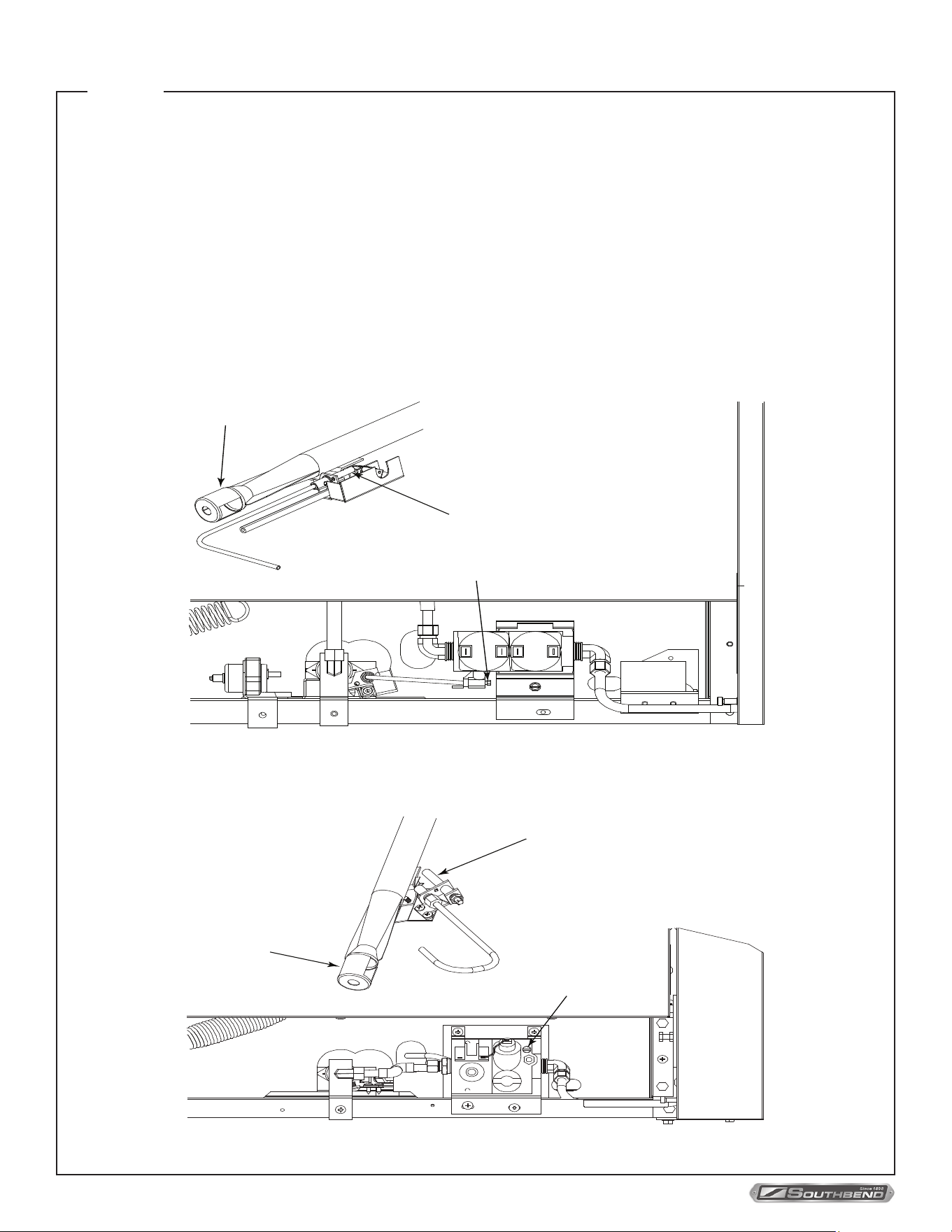
PLATINUM SERIES RANGE
PAGE
40
OF 57
OWNER’S MANUAL 1185836 REV 9 (10/16)
Adjustment of Oven Pilot and Burner
The burner orice is of the xed type, sized for the type of gas and the operating altitude. To adjust the burner air-gas
mixture, loosen the screw that secures the air shutter on the mixer face and rotate the mixer cap to obtain a clear,
stable blue ame with a distinct inner cone at each port. Excessive primary air causes “blowing” (the ames leaving the
ports), while insufcient primary air causes a soft or yellow tipped ame.
The oven pilot ame is adjusted by using a screwdriver to turn the adjusting screw on the pilot line valve (see drawing
below). The pilot line valve is located behind the kick panel below the oven door. To gain access, lift the kick panel
straight up and pull the top edge out. The pilot ame is properly adjusted when it is just large enough to maintain a
glowing red color of the ame switch capillary bulb. The rst indication of over-adjustment is when the ame tip be-
comes yellow and begins to generate carbon, which appears as rising black streaks. Continued over-adjustment leads
to unstable lifting and a blowing condition
Figure 23
Adjustment Screw for Pilot
Air Shutter
Pilot
UNITS WITH STANDING PILOT
UNITS WITH ELECTRONIC IGNITION
Air Shutter
Pilot
Adjustment Screw for Pilot
SERVICE

PLATINUM SERIES RANGE
OWNER’S MANUAL 1185836 REV 9 (10/16)
PAGE
41
OF 57
ADJUSTMENT OF MANIFOLD GAS PRESSURE
There is not an internal pressure regulator. The external pressure regulators supplied by Southbend are factory set at
6” W.C. for natural gas and 10” W.C. for propane gas. To check the manifold pressure, do the following:
1. Turn OFF all thermostats, burner controls, gas shut-off valves, and the external gas supply connection(s).
2. Remove the valve panel and locate the 1/8” plug in the front manifold furthest from the gas connection location.
Remove the plug and install a tting appropriate to connect a manometer.
3. Turn ON all gas supply valves and light all pilots.
4. Turn all burners and ovens to full ON position and read manometer.
5. If manometer does not read 6” W.C. for natural gas (or 10” W.C. for propane gas) adjust regulator by removing
the cap from the top of regulator. Use a screwdriver to rotate the regulator adjustment screw clockwise to increase
pressure, or counterclockwise to decrease pressure, until manometer shows correct reading.
6. Turn OFF all thermostats, burner controls, gas shut-off valves, and the external gas supply connection(s).
7. Remove manometer tting and replace plug in manifold.
8. Turn ON all gas valves and light all pilots.
9. Replace valve panel.
SERVICE
PLATINUM SERIES RANGE
PAGE
42
OF 57
OWNER’S MANUAL 1185836 REV 9 (10/16)
TROUBLESHOOTING
WARNING
ADJUSTMENTS AND SERVICE WORK MAY BE PERFORMED ONLY BY A QUALIFIED TECHNICIAN WHO IS
EXPERIENCED IN, AND KNOWLEDGEABLE WITH, THE OPERATION OF COMMERCIAL COOKING EQUIPMENT.
HOWEVER, TO ASSURE YOUR CONFIDENCE, CONTACT YOUR AUTHORIZED SERVICE AGENCY FOR RELIABLE
SERVICE, DEPENDABLE ADVICE OR OTHER ASSISTANCE, AND FOR GENUINE FACTORY PARTS.
NOTICE
Warranty will be void and the manufacturer is relieved of all liability if service work is performed by other than a qualied
technician, or if other than genuine Southbend replacement parts are installed.
Replacement parts (including parts not listed in this manual) may be ordered either through a Southbend Authorized Parts
Distributor or a Southbend Authorized Service Agency.
When ordering parts, please supply the Model Number, Serial Number, Part Number, and Part Description.
In case of problems in operation at initial installation, check type of gas and manifold pressure and compare with
information listed on the serial plate.
TROUBLESHOOTING FLOWCHARTS, PROCEDURES, AND WIRING DIAGRAMS
Find the symptom below that corresponds to the malfunction, then turn to the corresponding page. Follow the owchart on
that page until the problem is solved.
Troubleshooting Flowchart, Procedure, or Wiring Diagram Page
Troubleshooting Oven
43
Troubleshooting Base Oven 44
Troubleshooting Oven Pilot 44
Troubleshooting Induction Hobs 45
Flowchart of 120 Volt Electronic Ignition (Option) 46
Convection-Oven Blower Runs Intermittently 47
Convection-Oven Blower Does Not Run 48
Wiring Diagram for Oven Bases with Standing Pilot 50
Wiring Diagram for 120 Volt Oven Bases with Electronic Ignition 51
Wiring Diagram for 240 Volt Oven Bases with Electronic Ignition 52
NOTICE
This section contains troubleshooting owcharts, procedures, and electric schematics to assist a qualied service
technician in the servicing of Southbend cooking equipment. Information in the troubleshooting section is intended only
as a guideline to isolate and test components. Before performing repair or ordering parts contact a Southbend Technical
Service representative at 919-762-1000 option 2.
TROUBLESHOOTING
PLATINUM SERIES RANGE
OWNER’S MANUAL 1185836 REV 9 (10/16)
PAGE
43
OF 57
CAUTION
Proper and efcient operation of oven is dependent on correct installation and function of components. Always verify
that components are in place and functioning as intended.
Problem Look for - 1
Oven will not come on. – Oven gas shut-off valve is OFF
– Power switch is OFF
– Problem with power switch
– Problem with pilot solenoid
– Problem with main gas solenoid
– Problem with wiring
– Problem with spark ignition module
– Problem with ame sensor switch
Oven pilot will not light – Oven gas shut-off valve is OFF
– Problem with power switch
– Problem with pilot solenoid
– Problem with wiring
– Problem with spark ignition module
Convection blower motor will not run – Problem with fan speed switch
– Problem with door switch
– Problem with blower motor
– Problem with wiring
Oven will not maintain set temperature – Problem with oven thermostat
– Problem with door switch
Oven door too difcult to lift – Problem with door spring
– Problem with door roller assembly
The following table lists the possible causes of oven-related problems that may occur
WARNING
Before attempting to service or replace any electrical component, make sure that the power source has been
disconnected.
CAUTION
When changing motor or servicing unit, always verify that blower wheel rotation is clockwise when looking into the
oven cavity.
The motor is serviceable from the front of the unit through the oven cavity.
Motor lubrication information can be found on the permanent label located on the motor.
If the blower does not run at all, consult the wiring diagrams in this manual (beginning Figure 16), or behind the oven kick
plate.
If the blower runs intermittently, consult the following owchart.
TROUBLESHOOTING OVEN
SERVICING CONVECTION OVEN BLOWER MOTOR
TROUBLESHOOTING
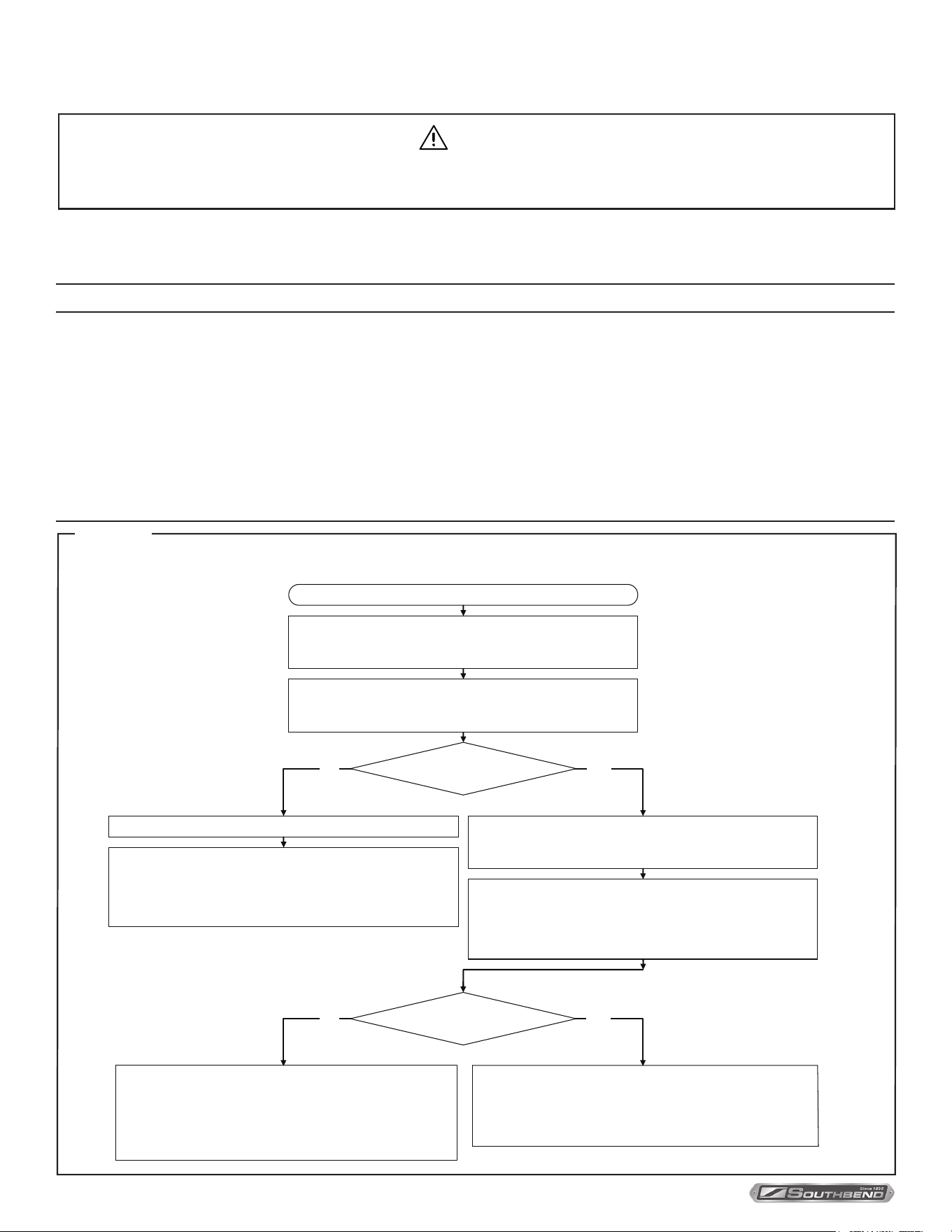
PLATINUM SERIES RANGE
PAGE
44
OF 57
OWNER’S MANUAL 1185836 REV 9 (10/16)
Probelm Look for -
Oven will not come on. – Oven pilot is out.
Oven pilot will not stay ignited – Pilot gas not adjusted properly.
– Bad thermopile.
– Bad thermopile connections at safety valve.
– Bad safety valve.
– Clogged orice.
– Dirty pilot
– Draft condition.
– Improper ventilation system.
– Air in gas line.
CAUTION
Proper and efcient operation of oven is dependent on correct installation and function of components. Always verify
that components are in place and functioning as intended.
TROUBLESHOOTING BASE OVEN
Consult the following table and the owchart that begins on the following page.
Figure 14
Troubleshooting Oven Pilot
Oven pilot does not work.
Does the pilot light?
No
Yes
Check that the oven pilot adjustment on the gas valve is open.
Continue to hold the button for 30 seconds. The pilot should remain
lit after the button is released. If it does not, wait five minutes and
try again.
If the pilot will not remain lit, do the following: Set a multimeter to
the thermopile connections on the safety valve to test the DC
millivolts of the thermopile. While holding the button, light the pilot
and messure the voltage produced by the thermopile. The voltage
should read abobe 450 millivolts.
If the pilot is not lit, attempt to light the pilot by raising the kick panel
slightly and rotating its top edge outward. Press and hold the button
on the oven safety valve and put a flame to the pilot.
If the pilot still will not light, do the following: Remove the oven
bottom. Loosen the pilot nut on the burner bracket. Remove the
pilot tube from the safety valve. Remove the pilot orifice from the
pilot or end of the tube and check for debris.
Re-install the pilot orifice and tubing.
Check whether the pilot flame is lit by looking through the hole in
the bottom of the oven. Leave the oven door open for five minutes
to allow gas fumes to clear.
If the voltage does not rise above 450 millivolts, then adjust or
clean the pilot assembly to chieve a larger flame. If the voltage
will not adjust properly, then replace the thermopile.
if you continue to have issues after replacing the thermpile, then
contact Southbend Technical Support for assistance at
919-762-7621000 option 2.
Does the pilot light?
No
Yes
If the voltage of the thermopile is oven 450 millivolts, then remove
the thermostat wires and test the pilot again. If the pilot continues
to fail, then replace the safely Value. If you continue to have
issues after replacing the safety valve, then contact Southbend
Technical Support for assistance at 919-762-1000 option 2.
TROUBLESHOOTING
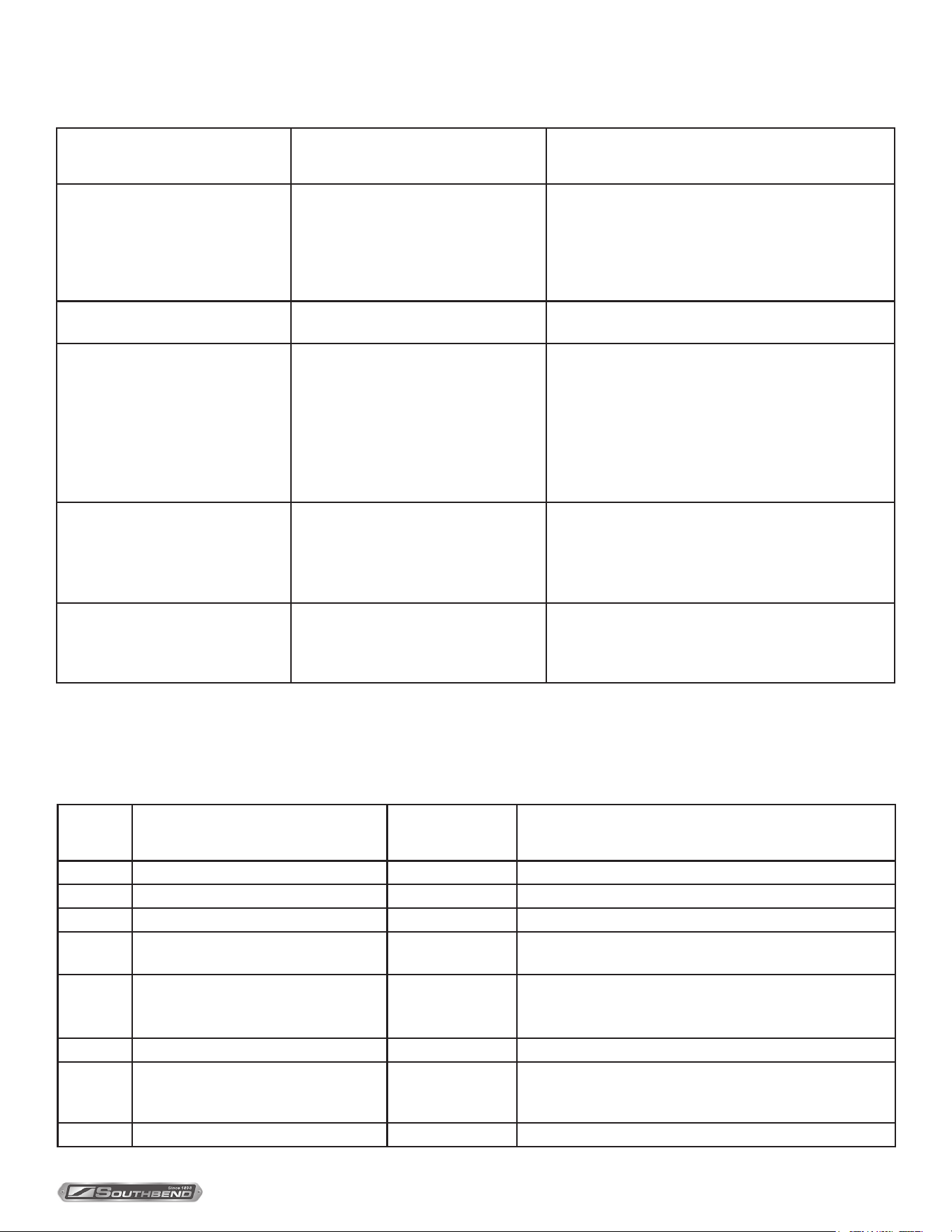
PLATINUM SERIES RANGE
OWNER’S MANUAL 1185836 REV 9 (10/16)
PAGE
45
OF 57
TROUBLESHOOTING
Symptom Possible Cause Possible Solution
No power
(No lights or fan noise)
• Unit unplugged
• No power to receptacle
• Plug unit into appropriate receptacle
• Make sure that receptacle is energized
• Check wall switches
• Check circuit breakers
• Plug a different electronic device into the
receptacle to make sure that power is present
Pan does not heat • Pan is not induction efcient
• Pan not centered
• Use induction efcient pan
• Center pan
Hob unit suddenly stops heating • Possible power brown out
• Circuit shared with another
electrical device
• Safety shut-off engaged
• Assure proper voltage/power levels
• Make sure the unit is not sharing a circuit with
other electrical devices
• The safety shut-off will engage if an empty pan
is left on the hob unit’s surface while the unit is
working at full power. Make sure that the unit’s
surface is clear. Wait 15-20 minutes for the unit
to reset.
Pan does not get hot enough
even though power levels are
set to maximum – induction
efcient pans in use
• Extension cord in use
• Circuit shared with another
electrical device
• DO NOT use extension cords. Extension
cords may affect the power levels reaching the
appliance.
• Make sure that the hob unit is not sharing a
circuit with other electrical devices.
Pan heats unevenly, does
not maintain heat level, or
overheats
• Pan is not induction efcient
• Pan bottom may not be at
enough
• Pan not centered
• Use induction efcient pan
• Use atter pan
• Center pan
TROUBLESHOOTING INDUCTION HOBS
ERROR CODES
In the event of a possible malfunction, your hob unit will ash an error code on the LED display. Please consult the follow-
ing table when encountering an error code.
To reset error conditions, remove the pan from the unit turn the power know to the vertical off position, or unplug the unit.
Error Error Cause Display Troubleshooting
1 Broken Temperature Sensor E-01 Service required
2 Incompatible pan E-02 Try different cookware
3 Over current (peak) E-03 Try different cookware. Service may be required.
4 Overheat E-04 Turn off. Let unit cool 15 minutes. Keep surrounding
air temperature below 115°F/46°C.
6 High line voltage E-06 To reset, unplug unit, wait 5 seconds, and plug
in again. If problem persists, have an electrician
monitor the line voltage.
7 Hardware failure E-07 Service required.
8 Zero cross failure E-08 Turn unit off, then on. Plug unit into outlet on
different circuit breaker. If problem persists, have an
electrician monition the line voltage.
9 Hardware failure E-09 Service required.
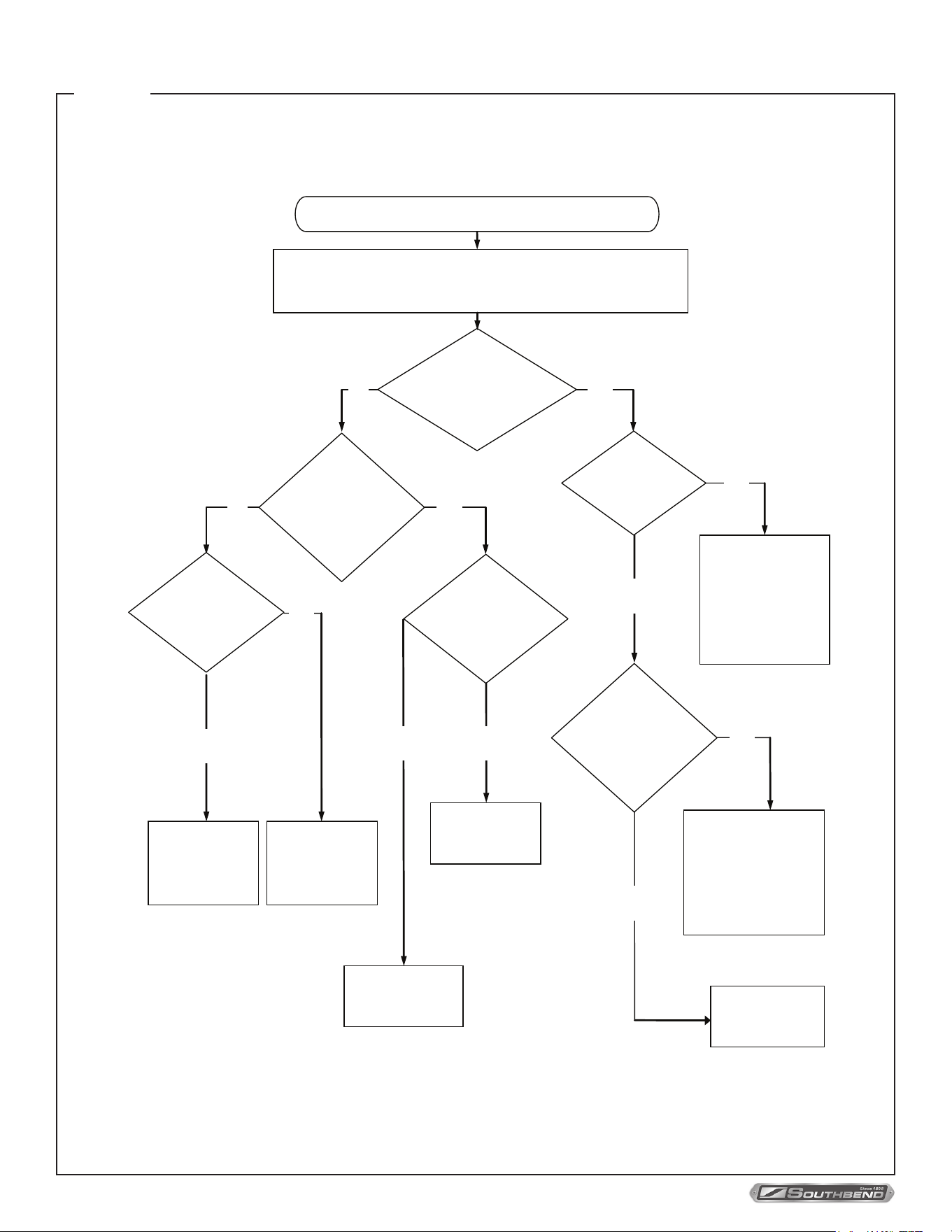
PLATINUM SERIES RANGE
PAGE
46
OF 57
OWNER’S MANUAL 1185836 REV 9 (10/16)
Figure 15
120 Volt Electronic Ignition (Option)
Oven will not ignite.
Check incoming power and oven power switch. If switch power switch is faulty, replace and attempt to
ignite oven. If power switch functions properly and incoming power is present proceed to next step.
Does oven spark at pilot with oven
power switch and thermostat on?
No
Yes
Check gas flow to solenoid. If
gas flow is present at inlet and
no gas flow is present at
outlet, replace solenoid and
attempt to ignite oven.
Do pilot and main gas
solenoid have power?
Replace ignition module
and attempt to ignite oven.
Check all wiring and connections
between ignition module and
solenoid. If wire breaks or loose
connections are not found, call
Southbend Technical Service.
No
Yes
Test blue and both white
wires at ignition module for
power. Is power present?
No
Yes
Does spark ignitor have
bad connection, wire
break or shorting
?
Yes
Replace spark ignitor and
attempt to ignite oven.
Will fan operate with
power switch on and door
closed?
Replace ignition module
and attempt to ignite oven.
No
Yes
Yes
Test thermostat and
replace if needed.
attempt to ignite oven.
Test door switch and
replace if needed.
attempt to ignite oven.
No
No
Test red and both white
wires at ignition module for
power. Is power present?
TROUBLESHOOTING
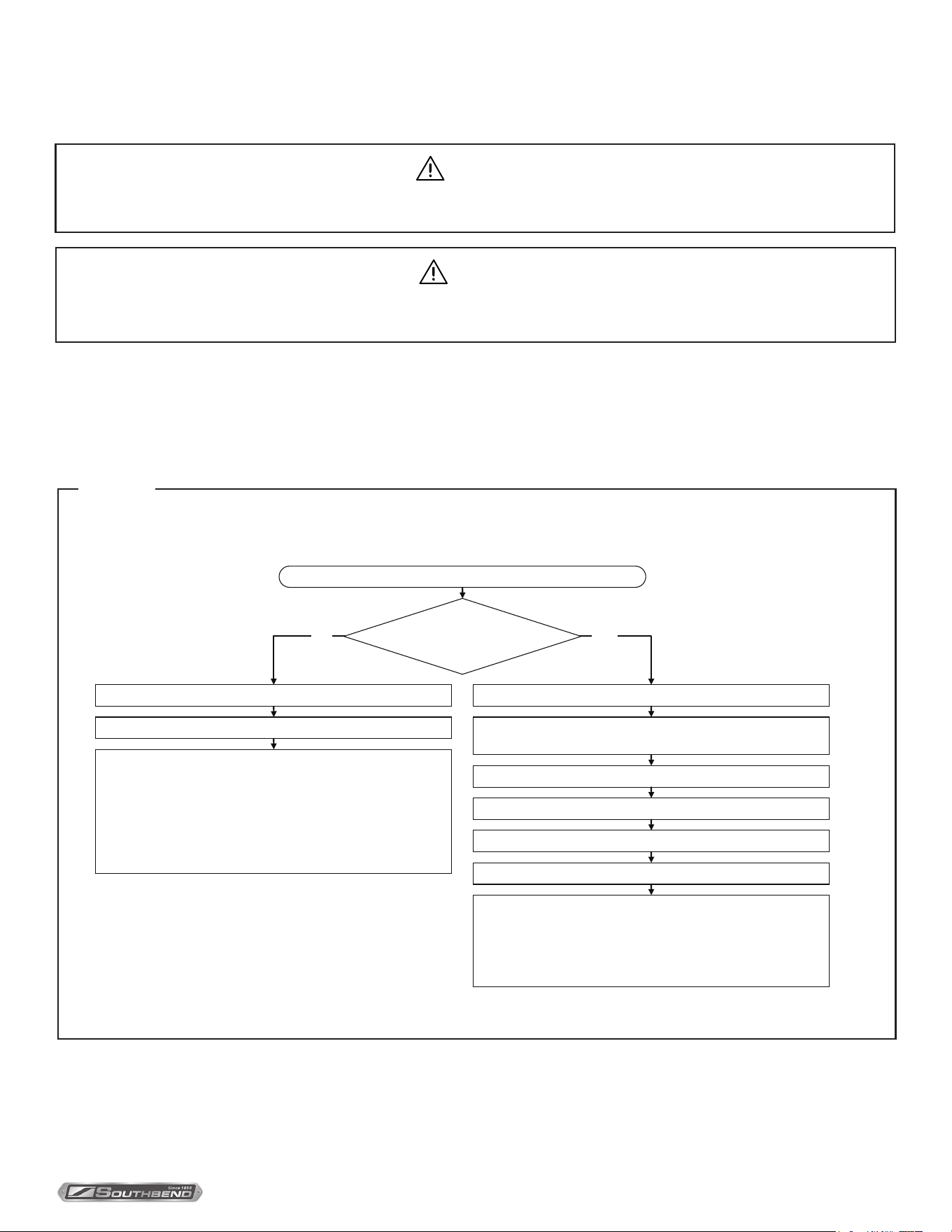
PLATINUM SERIES RANGE
OWNER’S MANUAL 1185836 REV 9 (10/16)
PAGE
47
OF 57
TROUBLESHOOTING CONVECTION-OVEN BLOWER
WARNING
Before attempting to service or replace any electrical component, make sure power source has been disconnected.
CAUTION
When changing motor or servicing oven, always verify that blower wheel rotation is clockwise when looking into the
oven cavity.
If the blower does not run at all, consult the owchart that begins on the next page. If the blower runs intermittently,
consult the owchart on this page.
The appropriate wiring diagram for the oven can be found on the rear of the oven (as well as at the end of this section of
this manual).
Figure 16
Convection-Oven Blower Runs Intermittently
DISCONNECT POWER AT CIRCUIT BREAKER.
Convection-oven blower runs intermittently.
Check that there are no air-flow obstructions around the range.
Does the problem
occur only when the oven
is hot?
No
Yes
Check that the blower motor air vents are not obstructed.
Check that the blower motor is not pressing against the wall
behind the range.
Check for excessive grease and dust buildup on the motor.
Check for sources of excessive heat behind the range.
Check for hot-air leaks around the motor pocket.
Check all wiring for loose connections or breaks.
With the blower turned ON, turn the oven thermostat to OFF and
allow the oven to cool. If the blower motor runs continuously
when the oven is cool, turn the oven thermostat to the highest
setting. If the blower motor shuts off when the oven becomes hot,
and if there are no sources of excessive heat around the blower
motor, replace the blower motor.
Remove the cover from the junction box on the back of the range.
Disconnect the black wire and place an ammeter in the circuit.
CAUTION: Check that the ammeter is rated for at least 40
amperes! Reconnect the power to the range and turn on the
blower switch while watching the ammeter. The reading should
surge and then return to the rated current of the motor when
running at high speed. If the measured current exceeds the motor
rating, replace the blower motor.
TROUBLESHOOTING
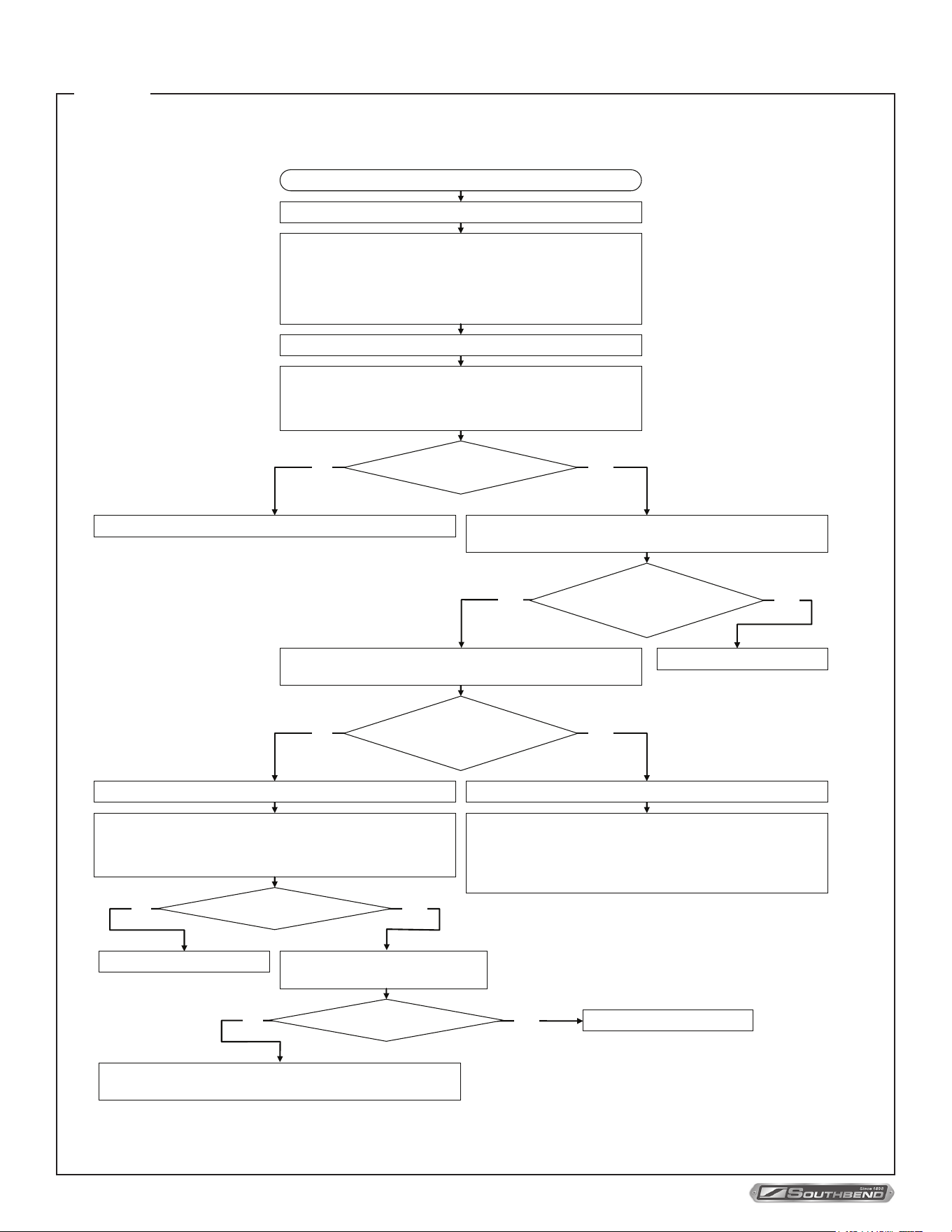
PLATINUM SERIES RANGE
PAGE
4 8
OF 57
OWNER’S MANUAL 1185836 REV 9 (10/16)
Figure 17
Convection-Oven Blower Does Not Run
DISCONNECT POWER AT CIRCUIT BREAKER.
Convection-oven blower does not run.
Open the kick panel below the oven door by raising it slightly and
tilting the top edge outward. Locate the door switch and check that
one wire is connected to the common (90° bottom) terminal of the
switch. Move the other wire to the normally open (lower leg)
terminal on the side of the door switch.
Check power supply to range.
Does the measured
voltage match the rated voltage
of the range?
Is there continuity?
No
Yes
DISCONNECT POWER AT CIRCUIT BREAKER.
Remove the control knobs from the front of the range. Remove the
screws that secure the top of the control panel and carefully tilt the
panel forward to expose the back of the blower switch that is
mounted in the front panel. CAUTION: Be careful not to damage
the wiring behind the control panel. Remove the protective cover
from the blower control switch.
Replace the blower control switch.
Check that the switch wires and terminals are secure.
Reconnect the power supply. Use a voltmeter to measure the
voltage across the center terminals of switch wires 1 and 2.
Use a multimeter to check the continuity across the terminals of
blower-switch wires 1 and 3 (refer to the appropriate wiring diagram
in this manual or on the range). With the switch in the ON position,
there should be continuity.
Yes
No
Re-assemble the switch cover and control panel. Turn on the
blower-control switch and open the oven door.
Does the blower
run with the oven door
open?
No
Yes
Open the kick panel below the oven door by raising it slightly and
tilting the top edge outward. Locate the door switch and check for
continuity across the wired switch terminals while pressing the
switch actuator lever.
DISCONNECT POWER AT CIRCUIT BREAKER.
Loosen the two screws on the door switch bracket and adjust it so
that the door switch is pressed when the oven door is closed.
Replace door switch.
Close the oven door (which should
press the door-switch actuator lever).
Is there continuity?
No
Yes
Is there continuity?
No
Yes
Continue on next page.
TROUBLESHOOTING
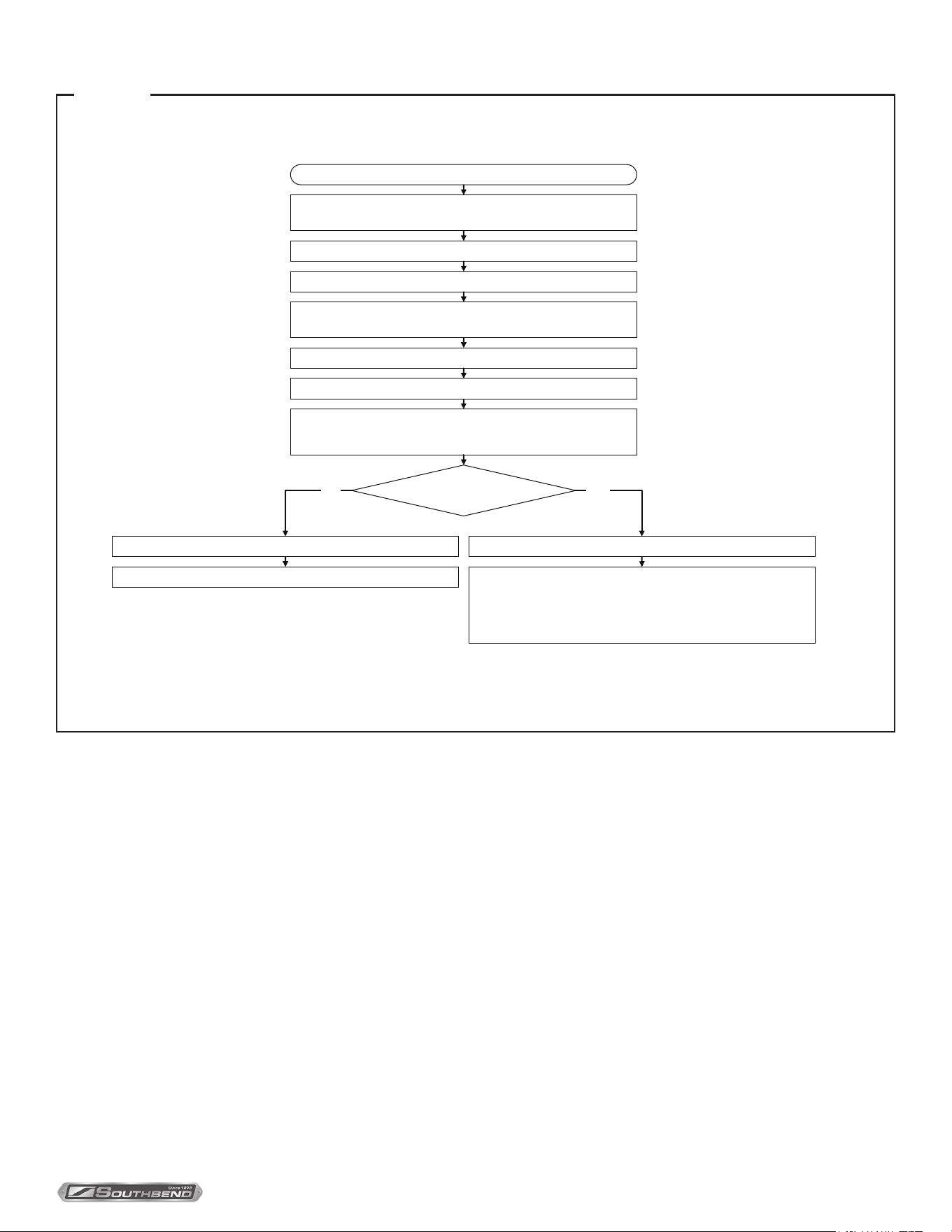
PLATINUM SERIES RANGE
OWNER’S MANUAL 1185836 REV 9 (10/16)
PAGE
49
OF 57
Figure 18
Convection-Oven Blower Does Not Run, Continued
DISCONNECT POWER AT CIRCUIT BREAKER.
(Continuing from previous page.)
Is there voltage?
No
Yes
Remove the wire terminal cover from the blower motor.
Check all wiring for loose terminals or breaks.
Check that the common wire is connected to the motor black wire.
Reconnect the power supply and turn on blower-control switch.
Use a voltmeter to measure the voltage between the black wire and
the white wire.
Remove the wire nuts from the red, white, and black wires.
Check that the resistance across the white and black wires is
approximately 1.9 ohms. Check that the resistance across the
white and red wires is also approximately 1.9 ohms. If either
resistance is incorrect, replace the blower motor.
DISCONNECT POWER AT CIRCUIT BREAKER.
Check that the red wire is capped off.
Remove the wire nuts from the black and the white wires. Check
that in each case the wires are twisted together securely.
Check that the neutral wire is connected to the white wire.
CHECK THAT POWER IS DISCONNECTED
AT CIRCUIT BREAKER.
TROUBLESHOOTING
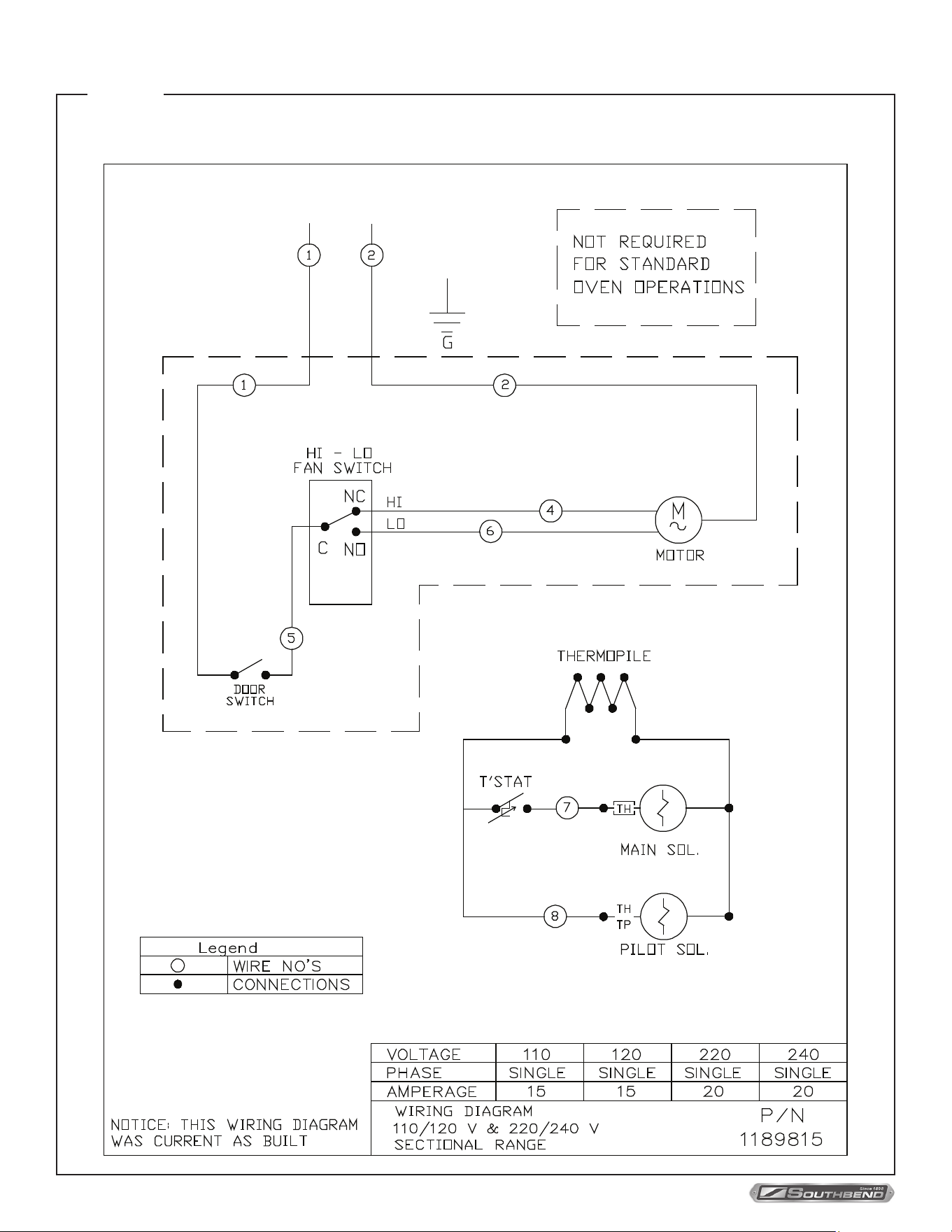
PLATINUM SERIES RANGE
PAGE
50
OF 57
OWNER’S MANUAL 1185836 REV 9 (10/16)
Wiring Diagram for Oven Bases with Standing Pilot
Figure 19
TROUBLESHOOTING
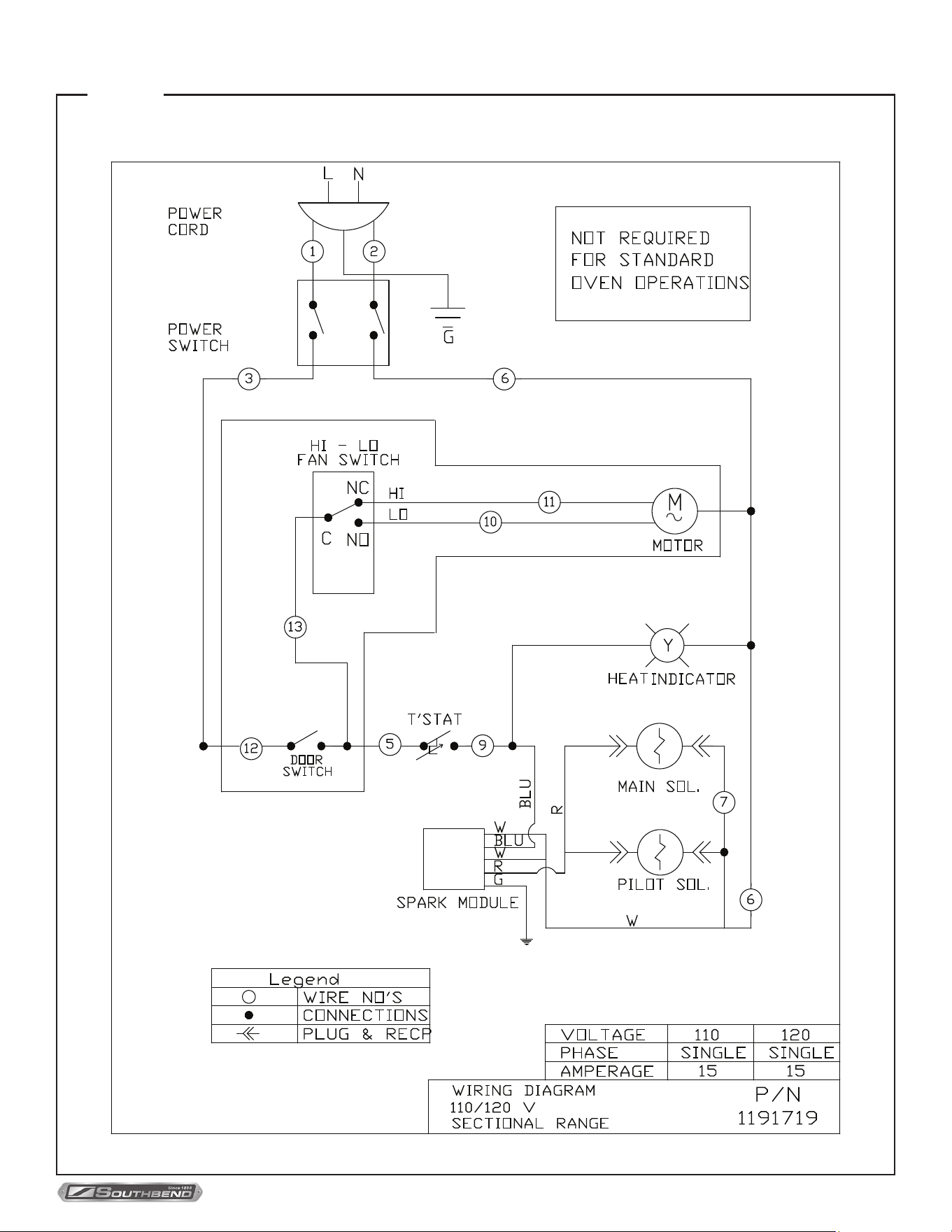
PLATINUM SERIES RANGE
OWNER’S MANUAL 1185836 REV 9 (10/16)
PAGE
51
OF 57
Wiring Diagram for 120 Volt Oven Bases with Electronic Ignition
Figure 20
TROUBLESHOOTING
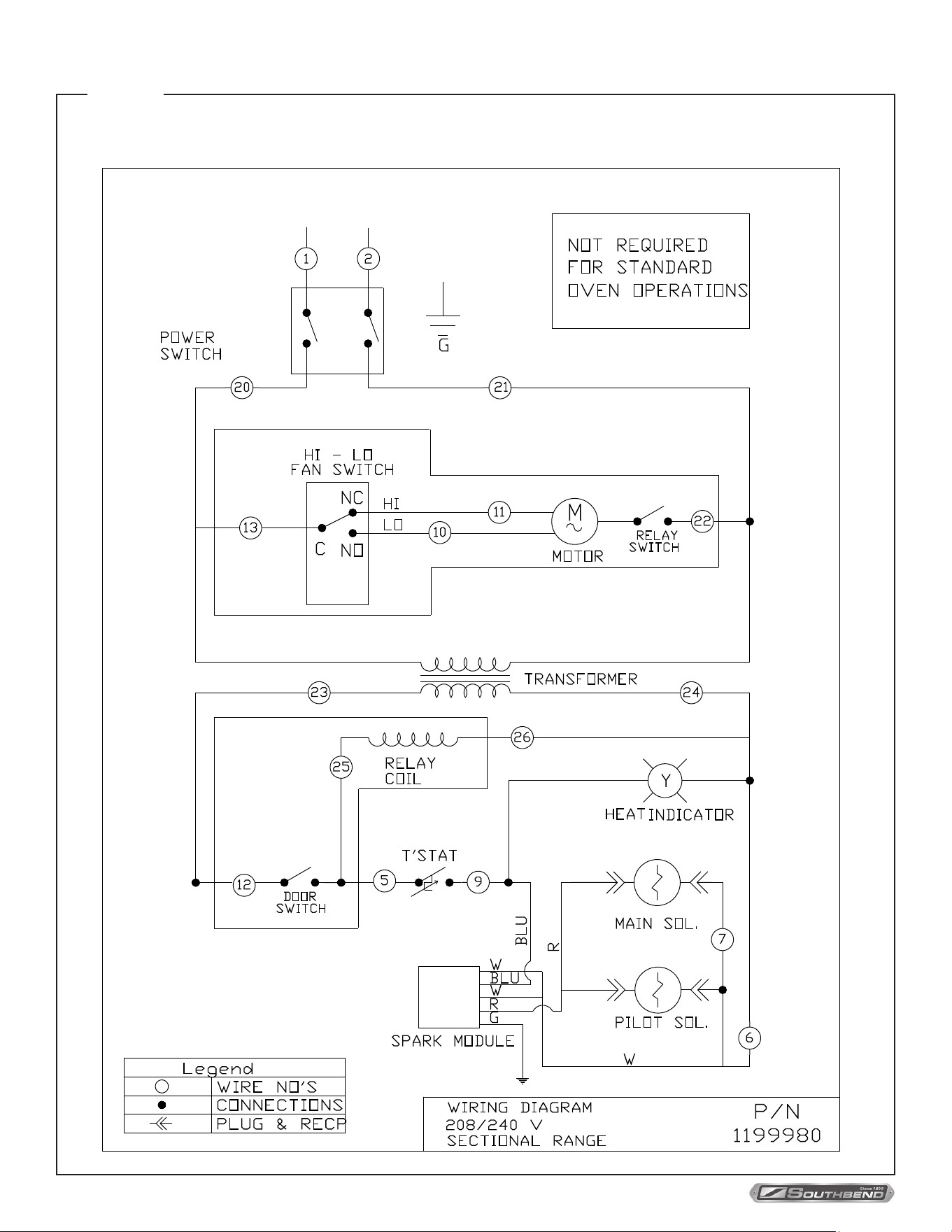
PLATINUM SERIES RANGE
PAGE
52
OF 57
OWNER’S MANUAL 1185836 REV 9 (10/16)
Wiring Diagram for 240 Volt Oven Bases with Electronic Ignition
Figure 21
TROUBLESHOOTING

PLATINUM SERIES RANGE
OWNER’S MANUAL 1185836 REV 9 (10/16)
PAGE
53
OF 57
Notes:

PLATINUM SERIES RANGE
PAGE
54
OF 57
OWNER’S MANUAL 1185836 REV 9 (10/16)
Notes:

PLATINUM SERIES RANGE
OWNER’S MANUAL 1185836 REV 9 (10/16)
PAGE
55
OF 57
Notes:

PLATINUM SERIES RANGE
PAGE
56
OF 57
OWNER’S MANUAL 1185836 REV 9 (10/16)
Notes:

PLATINUM SERIES RANGE
OWNER’S MANUAL 1185836 REV 9 (10/16)
PAGE
57
OF 57
Notes:

PLATINUM SERIES RANGE
PAGE
5 8
OF 57
OWNER’S MANUAL 1185836 REV 9 (10/16)
A product with the Southbend name incorporates the best in durability and low maintenance. We all recognize, however,
that replacement parts and occasional professional service may be necessary to extend the useful life of this appliance.
When service is needed, contact a Southbend Authorized Service Agency, or your dealer. To avoid confusion, always
refer to the model number, serial number, and type of your appliance.
Southbend
1100 Old Honeycutt Road Fuquay-Varina, North Carolina 27526 USA
www.southbendnc.com