Chapter 1: Introduction
Read this chapter before use.
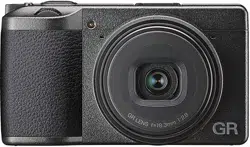
This chapter gives you an overview of the RICOH GR III.
Chapter 2: Getting Started
Read this chapter before using the RICOH GR III for the first time.
This chapter explains about basic operations such as turning the camera on,
performing shooting, and playing back images.
Chapters 3 and Later
Read these chapters when you want to learn more about the different
camera functions.
These chapters explain about shooting and playback functions, as well as
how to customize the camera settings and use it with a computer.
Operating Manual
The serial number is located on the bottom of the camera.
Model: R02010

Regarding User Registration
Thank you for purchasing a RICOH IMAGING product.
In order to provide you with the best customer support and service experi-
ence for the product you have purchased, we ask you to complete the user
registration.
Visit the following website to complete the user registration.
http://www.ricoh-imaging.com/registration/
Registered users will be notified by e-mail about important customer sup-
port information, such as firmware version updates, etc.

1
Introduction
This Operating Manual provides information on how to use the shooting and playback
functions of this camera and related precautions.
Thoroughly read this Operating Manual to make the best use of the functions available
with this camera. Be sure to keep this Operating Manual for future reference.
It is recommended to update the camera firmware to the latest version before using
the camera.
For details on the latest firmware version, refer to the following firmware download site.
http://www.ricoh-imaging.co.jp/english
RICOH IMAGING COMPANY, LTD.
Safety precautions Read all safety precautions thoroughly to ensure safe use.
Test shots Take test shots to ensure that the camera is working properly be-
fore taking pictures on important occasions.
Copyright Reproduction or alteration of copyrighted documents, magazines,
and other materials, other than for personal, home, or other simi-
larly limited purposes, without the consent of the copyright holder,
is prohibited.
Exemption from liability RICOH IMAGING COMPANY assumes no liability for failure to record
or display images as a result of product malfunction.
Radio interference Operating this camera in the vicinity of other electronic equipment
may adversely affect both the camera and the other device. Inter-
ference is particularly likely if the camera is used in close proximity
to a radio/TV receiver. In such case, take the following measures.
• Keep the camera as far away as possible from the radio/TV re-
ceiver.
• Reorient the antenna of the radio/TV receiver.
• Use a different wall outlet.
This publication may not be reproduced in whole or in part without RICOH IMAGING COMPANY’s express written
permission.
© RICOH IMAGING COMPANY, LTD. 2019
RICOH IMAGING COMPANY reserves the right to change the contents of this manual at any time without prior
notice.
Every effort has been made to ensure the accuracy of the information in this manual. Should you nevertheless
notice any errors or omissions, we would be grateful if you would notify us at the address listed on the back cover
of this manual.
2
About the Wireless LAN and Bluetooth® Functions
• Do not use the camera in a place where electrical products, AV/OA devices, and so on generate magnetic fields
and electromagnetic waves.
• If the camera is affected by magnetic fields and electromagnetic waves, it may not be able to communicate.
• If the camera is used near a TV or a radio, poor reception or TV screen glitch may occur.
• If there are multiple wireless LAN access points or Bluetooth® devices near the camera and the same channel is
used, search operation may not be executed correctly.
• The security of your data stored, sent, or received is your own responsibility.
In the frequency band used by the camera, along with industrial, scientific, and medical devices such as micro-
wave ovens, premises radio stations (wireless stations requiring license) and specified low power radio stations
(wireless stations not requiring license) for mobile object identification used in factory production lines, etc., and
amateur radio stations (wireless stations requiring license) are operated.
1. Before using the camera, confirm that premises radio stations and specified low power radio stations for
mobile object identification and amateur radio stations are not operated in the vicinity.
2. In the event that the camera causes harmful radio wave interference to premises radio stations for mobile
object identification, immediately change the frequency being used to avoid interference.
3. If you have other troubles such that the camera causes harmful radio wave interference to specified low
power radio stations for mobile object identification or to amateur radio stations, contact your nearest service
center.
This camera conforms to the technical standards under the Radio Law and Telecommunications Business Law and
the certification of conformance to technical standards can be displayed on the monitor.
Displaying the Certification Marks -----------------------------------------------------------------------------------------------------------------
1 Display the menu.
Refer to “Setting from the Menus” (p.25) for how to display the menu.
2 Select [Certification Marks] in the E8 menu.
Trademarks
• Microsoft and Windows are registered trademarks of Microsoft Corporation in the United States of America and
other countries.
• Mac, macOS, OS X, and App Store are trademarks of Apple Inc., registered in the U.S. and other countries.
• IOS is a trademark or registered trademark of Cisco in the U.S. and other countries and is used under license.
• Adobe, the Adobe logo, and Adobe Reader are registered trademarks or trademarks of Adobe Systems Incorpo-
rated in the United States and/or other countries.
• This product includes DNG technology under license by Adobe Systems Incorporated.
• The DNG logo is either a registered trademark or trademark of Adobe Systems Incorporated in the United States
and/or other countries.
• SDXC Logo is a trademark of SD-3C, LLC.
• Google, Google Play, and Android are trademarks or registered trademarks of Google Inc.
• The Bluetooth® word mark and logos are registered trademarks owned by Bluetooth SIG, Inc., and any use of such
marks by Ricoh Company, Ltd. is under license.
• USB Type-C is a trademark of USB Implementers Forum.
• DisplayPort is a trademark owned by the Video Electronics Standards Association in the United States and other
countries.
• HDMI, the HDMI logo, and High-Definition Multimedia Interface are trademarks or registered trademarks of HDMI
Licensing, LLC in the United States and/or other countries.
All other trademarks are the property of their respective owners.
• This product uses the RICOH RT font designed by Ricoh Company Ltd.

3
AVC Patent Portfolio License
This product is licensed under the AVC Patent Portfolio License for the personal use of a consumer or other uses
in which it does not receive remuneration to (i) encode video in compliance with the AVC standard (“AVC video”)
and/or (ii) decode AVC video that was encoded by a consumer engaged in a personal activity and/or was obtained
from a video provider licensed to provide AVC video. No license is granted or shall be implied for any other use.
Additional information may be obtained from MPEG LA, L.L.C.
See http://www.mpegla.com.
Announcement about the Open Source Software
This product includes the open source software (OSS) licensed under the GNU General Public License (GPL), GNU
Lesser General Public License (LGPL), and/or other licenses. The information about licenses of each OSS used in
this product is saved in the product internal memory as a text file. Connect this product to a computer, access the
“oss_license” folder in the “Software License” folder, and open the text file to read the license terms.
The source codes of OSS used in this product are disclosed under the license terms of GPL, LGPL, etc. If you need
the source codes, access the following URL.
http://www.ricoh-imaging.co.jp/english/products/oss/

4
Safety Precautions
Warning Symbols
Various symbols are used throughout this Operating Manual and on the product to
prevent physical harm to you or other people and damage to property. The symbols
and their meanings are explained below.
Danger
This symbol indicates matters that may lead to imminent risk of
death or serious injury if ignored or incorrectly handled.
Warning
This symbol indicates matters that may lead to death or serious injury
if ignored or incorrectly handled.
Caution
This symbol indicates matters that may lead to injury or physical
damage if ignored or incorrectly handled.
Meaning of Symbols
The symbol alerts you to actions that must be performed.
The symbol alerts you to prohibited actions.
The symbol may be combined with other symbols to indicate that a spe-
cific action is prohibited.
Example:
: Do not touch : Do not disassemble
Observe the following precautions to ensure safe use of this camera.
Danger
QQ
Do not attempt to disassemble, repair, or alter the camera yourself. The
high-voltage circuitry in the equipment poses significant electrical hazard.
QQ
Do not attempt to disassemble, alter, or directly solder the battery.
QQ
Do not put the battery in a fire, attempt to heat it, use or leave it in a high
temperature environment such as next to a fire or inside a car. Do not put
it into water or the sea or allow it to get wet.
QQ
Do not attempt to pierce, hit, compress, drop, or subject the battery to any
other severe impact or force.
QQ
Do not use a battery that is significantly damaged or deformed.
QQ
Do not connect the positive (+) and negative (-) poles of the battery with a
wire or other metallic item. Also, do not carry or store together with metal
objects such as ballpoint pens and necklaces.
5
QQ
Use the camera or battery charger BJ-11 to charge the battery. Do not
use the battery with any camera except the cameras compatible with the
DB-110.
QQ
Stop using the camera immediately in the event of abnormalities such as
smoke, unusual odors, or excessive heat being emitted. Contact your near-
est dealer or service center for repair.
QQ
If the battery fluid leaks and gets into your eyes, immediately wash your
eyes thoroughly with tap water or other clean water without rubbing, and
seek medical attention immediately.
Warning
QQ
Turn off the power immediately in the event of abnormalities such as
smoke or unusual odors being emitted. Remove the battery as soon as
possible, being careful to avoid electric shocks or burns. If you are drawing
power from a household electrical outlet, be sure to unplug the power
plug from the outlet. Failure to observe this precaution could result in
fire or electric shocks. Contact the nearest service center at your earliest
convenience. Stop using the camera immediately if it is malfunctioning.
QQ
Turn off the power immediately if any metallic object, water, liquid, or oth-
er foreign object gets into the camera. Remove the battery and memory
card as soon as possible, being careful to avoid electric shocks or burns.
If you are drawing power from a household electrical outlet, be sure to
unplug the power plug from the outlet. Failure to observe this precaution
could result in fire or electric shocks. Contact the nearest service center
at your earliest convenience. Stop using the camera immediately if it is
malfunctioning.
QQ
If the monitor is damaged, avoid any contact with the liquid crystal inside it.
Follow the appropriate emergency measures below.
• SKIN: If any of the liquid crystal gets on your skin, wipe it off and rinse the
affected area thoroughly with water, then wash well with soap.
• EYES: If it gets in your eyes, wash your eyes with clean water for at least 15
minutes and seek medical advice immediately.
• INGESTION: If any of the liquid crystal is ingested, rinse the mouth out
thoroughly with water. Have the person drink a large amount of water and
induce vomiting. Seek medical assistance immediately.
6
QQ
Follow these precautions to prevent the battery from leaking, overheat-
ing, igniting, or exploding.
• Do not use a battery other than those specifically recommended for the
camera.
• Do not carry or store the battery together with metal objects such as ball-
point pens, necklaces, coins, and hairpins.
• Do not put the battery into a microwave or high pressure container.
• If leakage of battery fluid, a strange odor, color change, etc. is noticed dur-
ing use or during charging, remove the battery from the camera or battery
charger immediately and keep it away from fire.
QQ
Observe the following in order to prevent fire, electrical shock, or cracking
of the battery while charging.
• Use only the indicated power supply voltage. Also avoid the use of multi-
socket adapters and extension cords.
• Do not damage, bundle, or alter power cords. Also, do not place heavy
objects on, stretch, or bend power cords.
• Do not connect or disconnect the power plug with wet hands. Always grip
the plug section when disconnecting a power plug. Do not cover the cam-
era while charging the battery.
QQ
Keep the battery and memory card used in the camera out of the reach of
children to prevent accidental swallowing. The battery and memory card
are harmful if swallowed. Seek medical assistance immediately.
QQ
Keep the camera out of the reach of children. For children, accidents may
occur because they cannot understand the contents of “Safety Precau-
tions” and “Precautions for Use”.
QQ
Do not touch the internal components of the camera if they become ex-
posed as a result of being dropped or damaged. The high-voltage circuitry
in the equipment could lead to electric shocks. Remove the battery as
soon as possible, being careful to avoid electric shocks or burns. Take the
camera to your nearest dealer or service center if it is damaged.
QQ
Do not use the camera in wet areas such as a kitchen. Failure to observe
this precaution could result in fire or electric shocks.
QQ
Do not use the camera near flammable gases, gasoline, benzine, thinner,
or similar substances. Failure to observe this precaution could result in an
explosion, fire, or burns.
QQ
Do not use the camera in a location where usage is restricted or prohib-
ited, such as on airplanes. Failure to observe this precaution could result
in an accident.
QQ
Wipe off any dust that accumulates on the power plug. Failure to observe
this precaution could result in fire.
QQ
When using a household power outlet, always use the dedicated AC
adapter. Failure to observe this precaution could result in fire, electric
shocks, or product malfunction.
7
QQ
Do not use the battery charger or AC adapter with commercially available
electronic transformers when traveling abroad. Failure to observe this pre-
caution could result in fire, electric shocks, or product malfunction.
QQ
Use only the indicated power supply voltage. Failure to observe this pre-
caution could result in fire or electric shocks.
QQ
Do not damage, bundle, or alter power cords. Also, to avoid damaging
power cords and the risk of fire or electric shocks, do not place heavy ob-
jects on, stretch, or bend power cords.
QQ
Do not connect or disconnect the power plug with wet hands. Failure to
observe this precaution could result in electric shocks.
QQ
Always grip the plug section when disconnecting a power plug. Do not
pull the power cord. This can damage the power cord and result in fire
or electric shocks.
QQ
If any metallic object, water, liquid, or other foreign object gets into the
camera, immediately remove the power plug from the outlet and contact
a service center for repair. Failure to observe this precaution could result
in fire or electric shocks.
QQ
If an abnormality such as an unusual sound or smoke is emitted from the
camera, immediately remove the power plug from the outlet and contact
your nearest dealer or service center for repair. Stop using the camera im-
mediately if it is malfunctioning.
QQ
Do not attempt to disassemble the camera yourself. The high-voltage cir-
cuitry in the equipment could lead to electric shocks.
QQ
Do not use the camera in a bathroom. Failure to observe this precaution
could result in fire or electric shocks.
QQ
Do not touch the power plug during a lightning storm. Failure to observe
this precaution could result in electric shocks.
QQ
Keep the battery out of the reach of children.
QQ
If the battery does not finish charging after the prescribed charging time,
discontinue charging.
QQ
Do not put the battery into a microwave or high pressure container.
QQ
If the battery leaks or emits an unusual odor, immediately move it away
from any sources of fire.
8
Caution
QQ
Contact with fluid leaking from a battery can lead to burns. If part of your
body comes in contact with a damaged battery, rinse the area with water
immediately. (Do not use soap.)
If a battery starts to leak, remove it immediately from the camera and wipe
the battery chamber thoroughly before replacing it with a new battery.
QQ
Plug the power plug securely into the electrical outlets. Failure to observe
this precaution could result in fire.
QQ
Do not allow the camera to get wet. In addition, do not operate it with wet
hands. Failure to observe this precaution could result in electric shocks.
QQ
Do not fire the flash at drivers of vehicles, as this may cause the driver to
lose control and result in a traffic accident. Failure to observe this precau-
tion could result in a traffic accident.
QQ
Remove the power plug from the outlets before cleaning the camera.
QQ
Remove the power plug from the outlets when the camera is not used.
QQ
Do not cover the camera while using it. Failure to observe this precaution
could result in fire.
QQ
Do not short the terminals or metal contacts on the power cords. Failure to
observe this precaution could result in fire.
QQ
Do not use the camera in wet areas or areas subject to oil smoke such as
a kitchen. Failure to observe this precaution could result in fire or electric
shocks.
Safety Precautions
for Accessories
When using optional products, carefully read the user’s manuals pro-
vided with the product before using that product.

9
Introduction ........................................................................................................................... 1
Safety Precautions ................................................................................................................ 4
1
Introduction 13
Checking the Contents of the Package ......................................................................13
Names and Functions of the Working Parts ..............................................................14
Operating Controls ...........................................................................................................................16
Indicators on the Monitor ................................................................................................18
Shooting Screen .................................................................................................................................18
Playback Screen .................................................................................................................................19
Changing the Screen Display ........................................................................................................ 20
Using the Touch Panel......................................................................................................................21
How to Change Function Settings ...............................................................................22
Using the Button/Lever ...................................................................................................................22
Setting from the Menus ..................................................................................................................25
Menu List ............................................................................................................................... 27
A Still Image Settings Menus ..................................................................................................... 27
B Movie Settings Menus ..............................................................................................................30
C Playback Settings Menus.........................................................................................................32
D Customize Settings Menus ..................................................................................................... 33
E Setup Menus ................................................................................................................................ 35
2
Getting Started 37
Setting the Battery and a Memory Card ....................................................................37
Inserting the Battery and a Memory Card ................................................................................ 37
Charging the Battery ........................................................................................................................ 38
Initial Settings ...................................................................................................................... 40
Turning the Camera On ................................................................................................................... 40
Setting the Language and the Date and Time ........................................................................ 41
Formatting a Memory Card ............................................................................................................42
Basic Shooting Operation ................................................................................................44
Shooting in the Program Mode .................................................................................................... 44
Viewing the Captured Images.......................................................................................................46
3
Taking Pictures 48
Taking Still Images .............................................................................................................48
Setting the Exposure Mode ...........................................................................................................48
Using Exposure Compensation ....................................................................................................53
Recording Movies ............................................................................................................... 54
Playing Back Movies .........................................................................................................................56
Contents

10
Setting the Focus ................................................................................................................ 57
Setting the Focus Mode ..................................................................................................................57
Shooting Close-ups (Macro) .......................................................................................................... 61
Shooting with a Single Press of the Shutter Release Button (Full Press Snap) ............ 62
Setting the Exposure ......................................................................................................... 63
Selecting a Metering Method ....................................................................................................... 63
Setting the ISO Sensitivity .............................................................................................................. 64
Using a Flash ........................................................................................................................................65
Reducing Noise ..................................................................................................................................67
Setting the White Balance ...............................................................................................69
Setting the White Balance Manually ...........................................................................................72
Setting the Color Temperature ..................................................................................................... 73
Setting the Drive Mode .................................................................................................... 74
Shooting Continuously (Continuous Shooting) ..................................................................... 75
Shooting with Varied Exposure Values (Bracketing) ............................................................. 76
Shooting While Merging Images Together (Multi-exposure) ............................................ 77
Shooting Automatically at Set Intervals (Interval Shooting) ............................................. 79
Recording Star Trails (Interval Composite) ...............................................................................81
Using the Self-timer .......................................................................................................................... 83
Configuring the Capture Settings ................................................................................84
Image Capture Settings ...................................................................................................................84
Movie Capture Settings ................................................................................................................... 85
Setting the Image Finishing Tone and Correction ..................................................86
Using the ND Filter ............................................................................................................................86
Reducing Moiré (AA Filter Simulator) ......................................................................................... 86
Setting the Image Atmosphere (Image Control)....................................................................87
Correcting the Peripheral Illumination ...................................................................................... 89
Correcting a Range of Tones (D-Range Correction) .............................................................. 89
Reducing Blurring of Images ......................................................................................................... 90
4
Playback Functions 91
Using the Playback Functions ........................................................................................ 91
Changing the Playback Method ....................................................................................92
Displaying Multiple Images ...........................................................................................................92
Displaying Rotated Images ............................................................................................................ 94
Connecting the Camera to an AV Device .................................................................................. 95
Organizing Files ...................................................................................................................96
Deleting Files .......................................................................................................................................96
Protecting Images from Deletion ................................................................................................97
Copying Images and Movies in the Internal Memory to a Memory Card ..................... 98
Transferring Images .......................................................................................................................... 99

11
Editing and Processing Images ...................................................................................100
Developing RAW Images ..............................................................................................................100
Changing the Image Size ..............................................................................................................102
Correcting Highlight/Shadow Areas (Levels Adjustment) ................................................103
Correcting the White Balance .....................................................................................................105
Correcting Color Moiré ..................................................................................................................106
Adjusting the Image Quality .......................................................................................................107
Editing Movies ..................................................................................................................................108
5
Sharing Images 110
Using the Camera with a Computer ..........................................................................110
Using the Camera with a Communication Device................................................111
Connecting to a Communication Device via Bluetooth® ..................................................112
Enabling the Wireless LAN Function .........................................................................................114
Operating the Camera with a Communication Device ......................................................116
6
Changing the Settings 117
Saving Frequently Used Settings ................................................................................117
Saving the Settings .........................................................................................................................117
Assigning Settings to the Mode Dial ........................................................................................119
Using the Saved User Mode .........................................................................................................120
Customizing the Button Functions ............................................................................121
Registering Functions to the ADJ. Mode .................................................................................121
Changing the Functions of the Fn Button ..............................................................................123
Setting the Function of the Shutter Release Button ...........................................................125
Display and Sound Settings ..........................................................................................126
Setting the Information Displayed During Shooting/Playback ......................................126
Setting the Instant Review Display ...........................................................................................127
Setting the Live View Display ......................................................................................................128
Setting the Brightness and Tone of the Monitor ..................................................................128
Setting the Lamp .............................................................................................................................129
Setting the Sound Effects .............................................................................................................130
Power Saving Settings ....................................................................................................131
Automatically Turning the Power Off .......................................................................................131
Dimming the Display......................................................................................................................132
File Management Settings ............................................................................................133
Specifying the Folder/File Settings ...........................................................................................133
Setting the Copyright Information ............................................................................................138

12
7
Appendix 139
Attaching Optional Accessories ..................................................................................139
Conversion Lens/Lens Adapter ...................................................................................................139
AC Adapter .........................................................................................................................................140
Troubleshooting ...............................................................................................................141
Power Supply ....................................................................................................................................141
Shooting .............................................................................................................................................142
Playback/Deletion ...........................................................................................................................144
Others ..................................................................................................................................................145
Error Messages ..................................................................................................................................145
Main Specifications ..........................................................................................................147
Camera ................................................................................................................................................147
USB Power Adapter AC-U1/AC-U2 .............................................................................................150
Rechargeable Battery DB-110 .....................................................................................................150
Image Storage Capacity ................................................................................................................151
Operating Environment ................................................................................................................152
Using the Camera Abroad .............................................................................................153
Precautions for Use ..........................................................................................................154
Camera Care and Storage ..............................................................................................156
Warranty Policy..................................................................................................................157
Regulatory Compliance Statements ..........................................................................158
Index......................................................................................................................................164
1
Introduction
13
Introduction
Checking the Contents of the Package
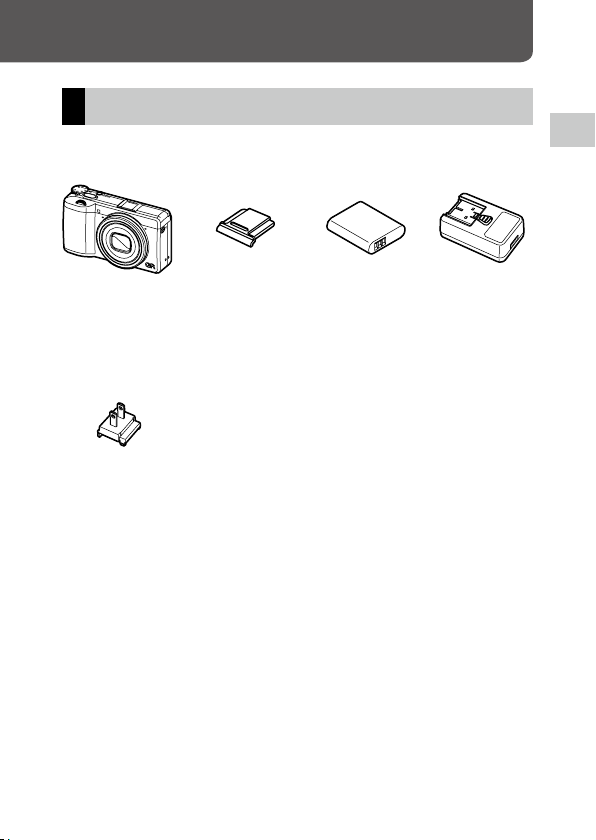
Before using your digital camera, confirm that the package contains the
items listed below.
RICOH GR III Hot shoe cover
(Installed on the cam-
era)
Rechargeable
battery
(DB-110)
USB power
adapter
(AC-U1 or
AC-U2)*
* Differs depend-
ing on the
region.
g
USB cable (I-USB166)
g
Hand strap
g
Operating Manual (this manual)
Power plug
1
Introduction
14
Names and Functions of the Working Parts
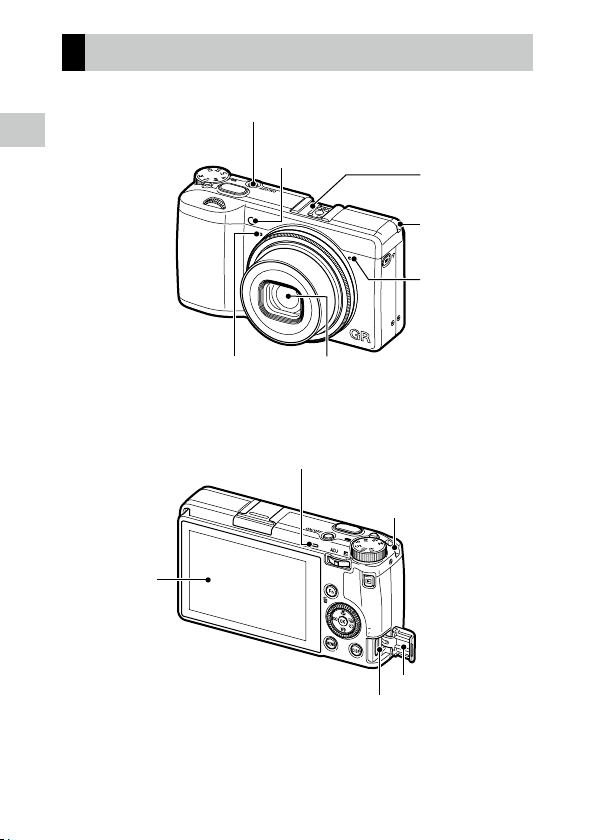
Power button lamp
Hot shoe
Microphone
Lens
AF assist light/
self-timer lamp
Microphone
Strap eyelet
Strap eyelet
Status lamp
Terminal cover
USB terminal (USB Type-C)
Monitor
1
Introduction
15
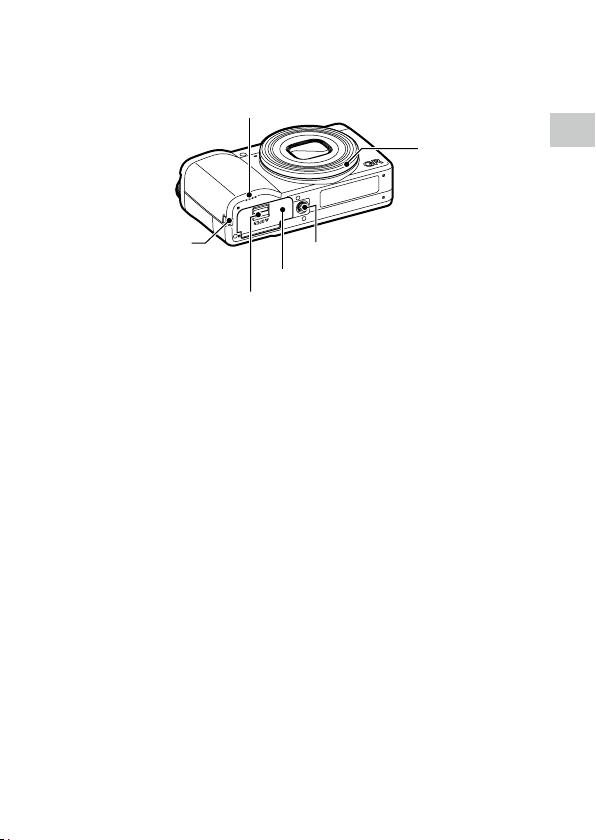
Ring cap
Tripod screw hole
Release lever
Battery/card cover
Speaker
Strap eyelet
1
Introduction
16
Operating Controls
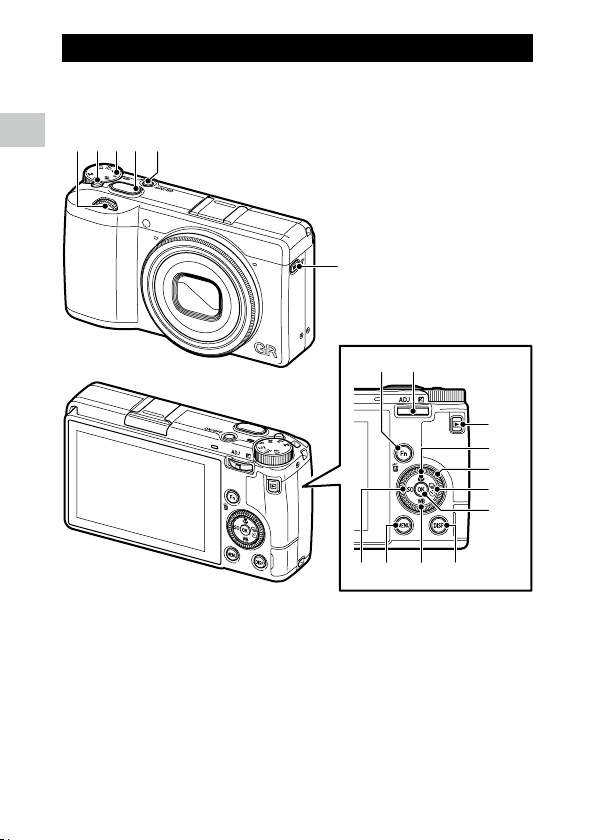
This section explains about operating controls.
The icons in parentheses are used in the descriptions of this manual.
14
16
17
15
13
11 12
9
78
1234 5
6
10
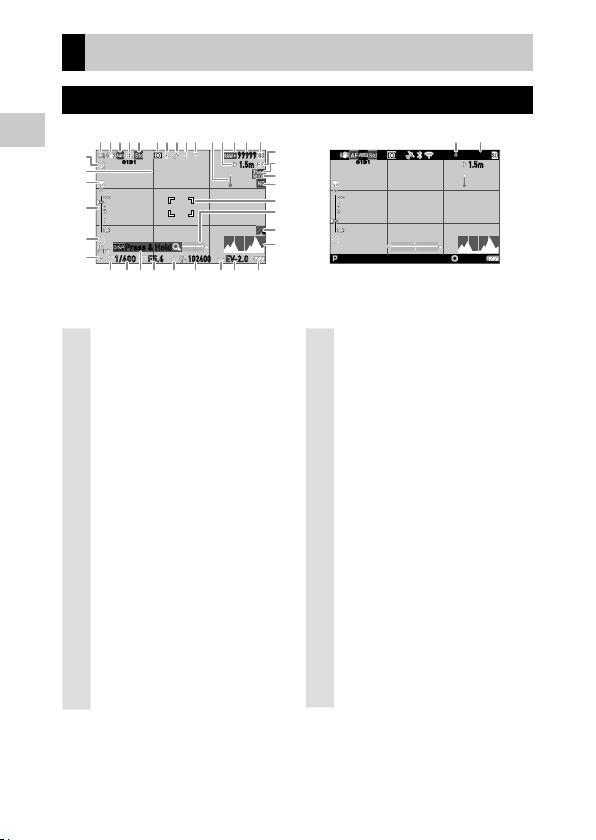
1 Front e-dial (p)
Rotate the dial to change values for camera set-
tings such as exposure. (p.49)
In the playback mode, rotate the dial to mag-
nify the image or display multiple images at the
same time. (p.46, p.92)
2 Lock button
Press to allow the mode dial to be turned.
3 Mode dial
Changes the exposure mode. (p.48)
4 Shutter release button (z)
Press to capture images.
Press halfway to activate autofocus. (p.44)

1
Introduction
17
5 Power button
Turns the power on or off. (p.40)
6 Movie/Wireless button (k/m)
Switches between still image mode and movie
mode. (p.54)
Press and hold to turn the wireless LAN function
on and off. (p.115)
7 Fn/Delete button (h/i)
Calls assigned function. (p.24)
In the playback mode, press to delete images.
(p.46)
8 ADJ./EV compensation lever
(n/o/q)
Press the lever to the left or right to change val-
ues for camera settings such as exposure.
In the shooting mode, press to switch to ADJ.
mode. (p.23)
9 ISO/Left button (u/c)
Press to change the ISO sensitivity. (p.64)
Moves the cursor to the left when an item is
selected.
10 MENU button (f)
Displays a menu. Press this button while the
menu is displayed to return to the previous
screen. (p.25)
11 White balance/Down button (t/b)
Displays the white balance setting screen.
(p.70)
Moves the cursor down when an item is se-
lected.
12 DISP button (j)
Switches the display between the shooting in-
formation and playback information. (p.20)
Press and hold this button in shooting mode to
magnify the Live View image. (p.45)
13 Playback button (g)
Switches between the shooting mode and the
playback mode. (p.46)
14 Macro/Up button (s/a)
Switches to macro mode. (p.61)
Moves the cursor up when an item is selected.
15 Control dial (r)
Rotate this dial to change menu items, values
for camera settings such as exposure, or images
to be displayed on the screen. (p.49)
16 Drive/Right button (v/d)
Displays the drive mode setting screen. (p.74)
Moves the cursor to the right when an item is
selected.
17 OK button (e)
Confirms the selected items such as menus.
1
Introduction
18
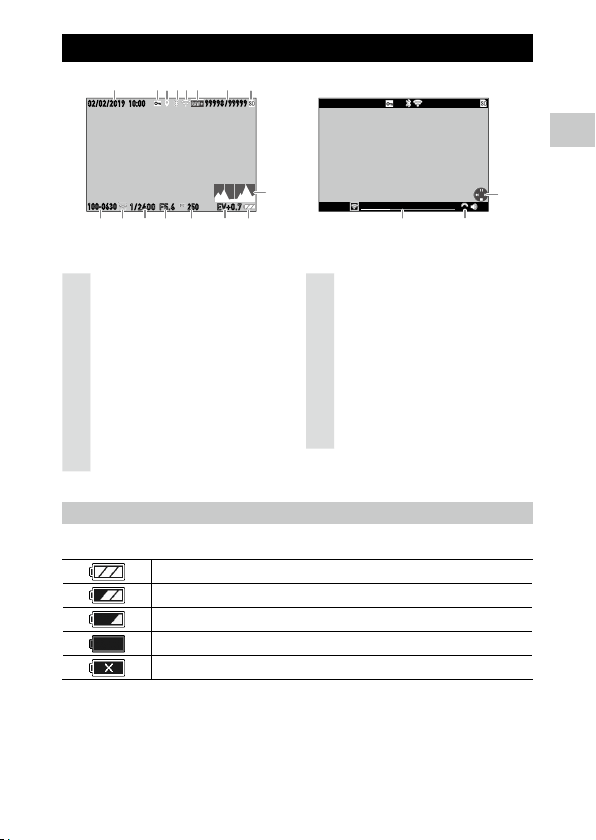
1 Drive (p.74)
2 Shake Reduction/Movie SR (p.90)
3 Focus (p.57)
4
White Balance
(p.69)
5 Image Control (p.87)
6 AE Metering (p.63)
7 Flash Mode (p.66)
8 GPS positioning status (p.116)
9 Bluetooth® communication (p.112)
10 Wireless LAN communication (p.114)
11 Temperature warning
12 Snap Focus Distance (p.57)
13 File Format/JPEG Recorded Pixels (p.84)
14 Number of storable images
15 Storage location
16 Self-timer (p.83)
17 Grid Guide (p.126)
18 Macro Mode (p.61)
19 Focus bar/Depth of field (p.60)
20 Operation guide
21 Exposure mode (p.48)
22 Full Press Snap (p.62)
23 Crop (p.85)
24 Conversion lens (p.139)
25 ND Filter (p.86)
26 Focus frame (p.44)
27
Electronic Level
(p.126)
28 AA Filter Simulator (p.86)
29 Histogram (p.126)
30 Front e-dial
31 Shutter speed (p.49)
32 Aperture value (p.49)
33 Control dial
34 Sensitivity (p.63)
35 ADJ./EV compensation lever
36 Exposure indicator/Exposure compensation
(p.53)
37 Battery level (p.19)
38 Recording indicator
39 Recording time/Remaining recording time
Indicators on the Monitor
Shooting Screen
F5.6 EV-2.0
102400
1.5m
99999
1/400
G1B1
Press & Hold
12
3
45 6
7
11 131210 14 15
22
23
2
4
25
26
27
28
29
30 31 20 32 34 35 36 37
16
18
19
20
21
9
8
33
17
0:58´58˝
1.5m
G1B1
EV-2.0
38
39
Still image mode Movie mode
1
Introduction
19
Playback Screen
99998 99999
/
100-0630
EV+0.71/2400 F5.6
250
10:00
02/02/2019
1
2
3
76 8
9
10 11 13 14 15 16
5
4
12
9998/9999
00´ 20˝
999-9999
10:00
5
02/02/2019
17 18
18
Still image mode Movie mode
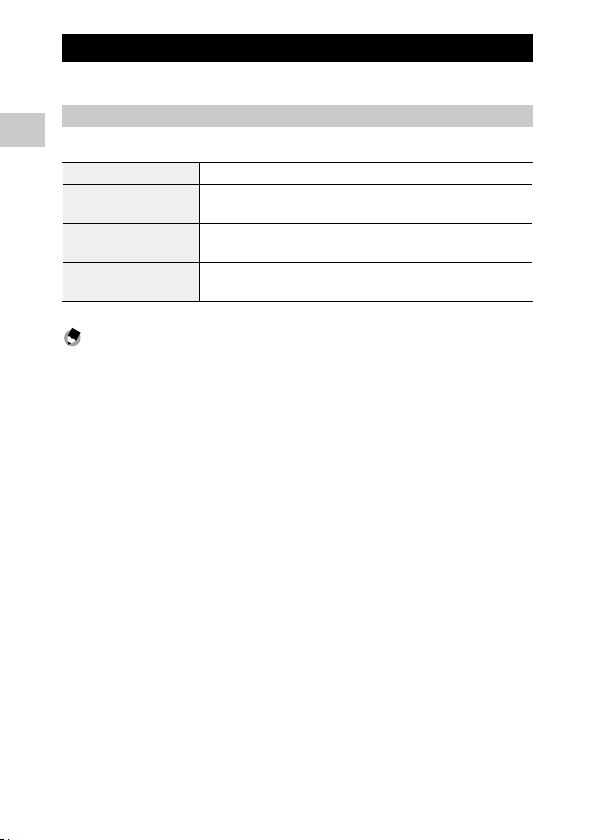
1 Shooting date and time
2 Protect (p.97)
3 GPS information (p.116)
4 Bluetooth® communication (p.112)
5 Wireless LAN communication (p.114)
6 File Format/JPEG Recorded Pixels (p.84)
7 Current file/Total files
8 Data source
9 Histogram
10 Folder number/File number (p.133)
11 Image transfer status (p.99)
12
Shutter speed
13 Aperture Value
14 Sensitivity
15 Exposure compensation
16 Battery level
17 Length of time of the recorded movie/
Elapsed time
18 Operation guide
Battery Level
The icon display changes depending on the battery level.
The battery level is sufficient.
The battery level started to drop.
The battery level is low. Charge the battery.
The camera will turn off soon.
There is a problem with the battery.
1
Introduction
20
Changing the Screen Display
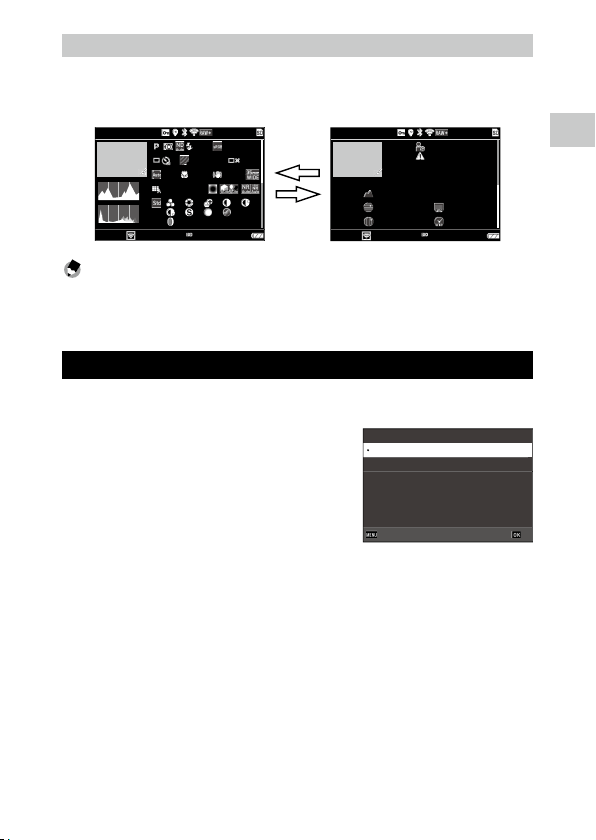
You can switch the information displayed on the screen by pressing j.
Shooting Mode
The information displayed on the shooting screen can be switched.
Standard Info. Display Displays all the information.
Simplified Info. Display Displays only the information regarding the exposure, AE lock, autofocus
frame, and MF operation guide.
No Information Display Displays the information only when camera settings are changed. Autofocus
frame is displayed during range-finding.
Display Off Does not display the autofocus frame and Live View but the information
when the camera settings are changed.
Memo ---------------------------------------------------------------------------------------------------------
• You can specify the displayed information in [Shooting Info. Display] of the D3 menu. (p.126)
1
Introduction
21
Playback Mode
You can switch the screen display among [Standard Info. Display], [Detailed
Info. Display], and [No Information Display] in the single image display.
Use ab to switch the page in [Detailed Info. Display].
99998 99999
1.5m
+0.3
6000x4000
/
100-0630
1/2400 F5.6 EV+0.7
102400
1/2400 F5.6 EV+0.7
102400
00:00´23˝
G1A1
35.0mm
10
0 0 0 0
0
1
R+200%:G-100%:B-100%
0 0 0
0
99998 99999
XXXXXXXXXXX
/
100-0630
42m
N 35°
E138° 10:10:01
10:0010:00
02/02/201902/02/2019
02/02/2019
b
a
Memo ---------------------------------------------------------------------------------------------------------
• You can specify the displayed information in [Playback Info. Display] of the D3 menu. (p.126)
• [Histogram], [Grid Guide], and [Highlight Alert] are not displayed for movies.
Using the Touch Panel
You can perform operations such as selecting functions and setting the AF
point for shooting with the touch panel.
When not using the touch panel function,
set [LCD Touch Operation] to [Off] in the D2
menu.
LCD Touch Operation
On
Off
CancelCancel OKOK
1
Introduction
22
How to Change Function Settings
Using the Button/Lever
Using the Direct Keys
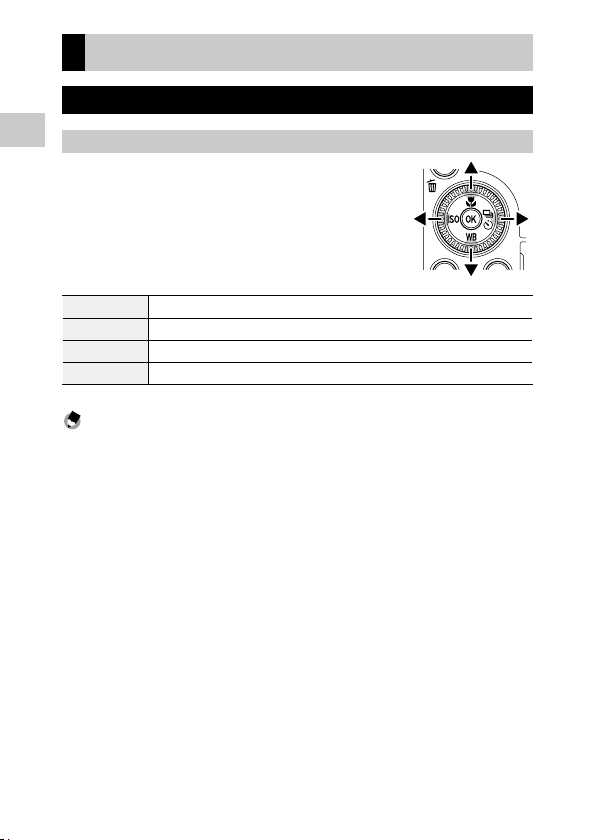
Quick settings are possible by pressing abcd in
the shooting mode. The following functions can be
activated.
a (s) Macro Mode (p.61)
b (t) White Balance (p.69)
c (u) ISO Setting (p.63)
d (v) Drive Mode (p.74)
Memo ---------------------------------------------------------------------------------------------------------
• The functions mentioned above can be set from the A menu by pressing f.
• The functions assigned to c/d can be changed with [ISO Button] and [Drive Button] of [Fn Button
Setting] in the D2 menu. (p.123)
1
Introduction
23
Using the ADJ. Lever
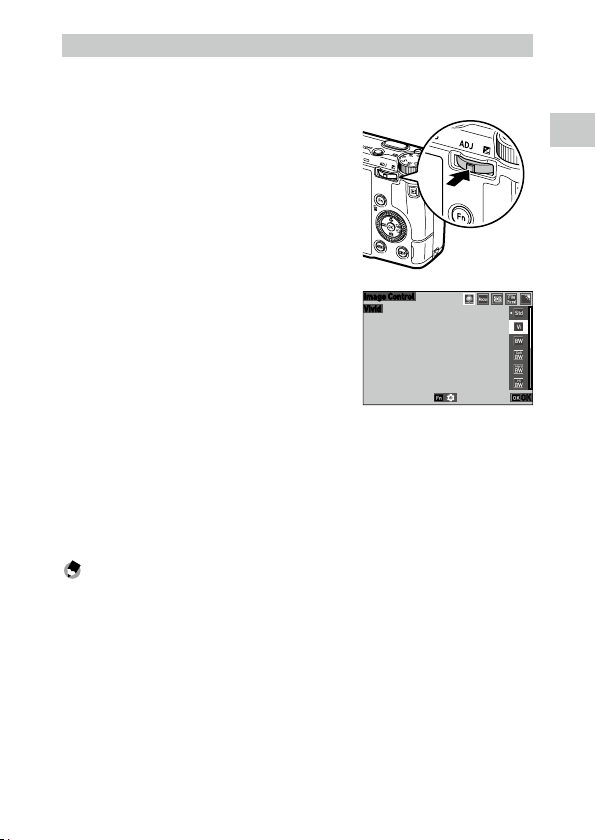
The assigned functions can be easily recalled by pressing n in the shoot-
ing mode.
1 Press n in the shooting mode.
The mode switches to the ADJ. mode and the
icons for the assigned functions appear.
2 Use cd to select a function.
By default, the following functions can be
selected.
• Image Control (p.87)
• Focus (p.57)
• AE Metering (p.63)
• File Format (p.84)
• Outdoor View Setting (p.129)
3 Use ab to select a setting.
When making detailed settings, press h.
4 Press e.
The selected function is set and the camera is ready to perform shooting.
Memo ---------------------------------------------------------------------------------------------------------
• The functions for ADJ. mode can be changed in [ADJ Mode Setting] of the D2 menu. (p.121)
• When [Shutter Btn. Confirmation] is set to [On] in the D2 menu, pressing z halfway com-
pletes the setting of ADJ. mode. (p.125)
OK
Vivid
Image Control
1
Introduction
24
Using the Fn Button
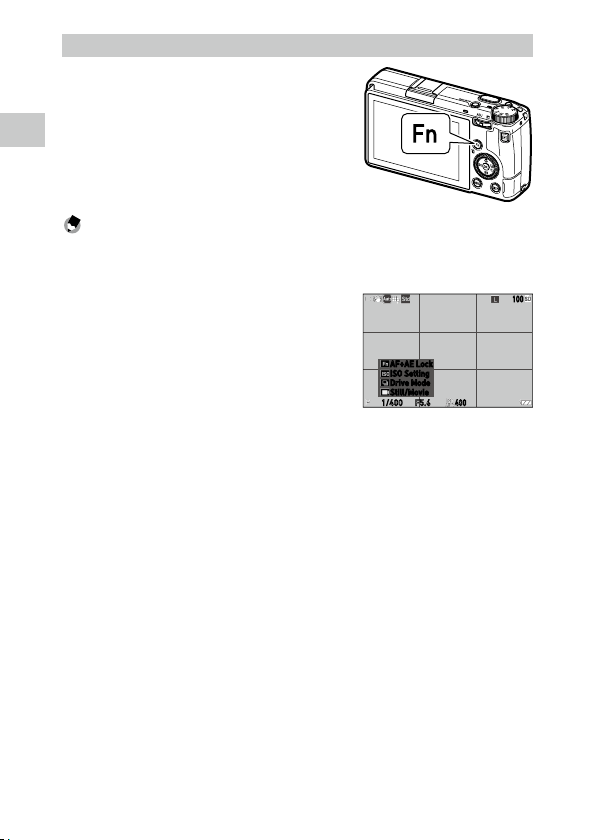
The assigned function can be activated by
pressing h in the shooting mode. By default,
[AF+AE Lock] is assigned.
Memo ---------------------------------------------------------------------------------------------------------
• The function of h can be changed in [Fn Button Setting] of the D2 menu. [ISO Button] (c),
[Drive Button] (d), and [Movie/Wireless Button] (k) can also be set in [Fn Button Setting].
(p.123)
• When the power is turned on or the mode dial is turned,
the current function of the button is displayed. If [Guide
Display] is set to [Off] in the E2 menu, the function is
not displayed.
100
F5.6
400
1/400
AF+AE Lock
ISO Setting
Drive Mode
Still/Movie
1
Introduction
25
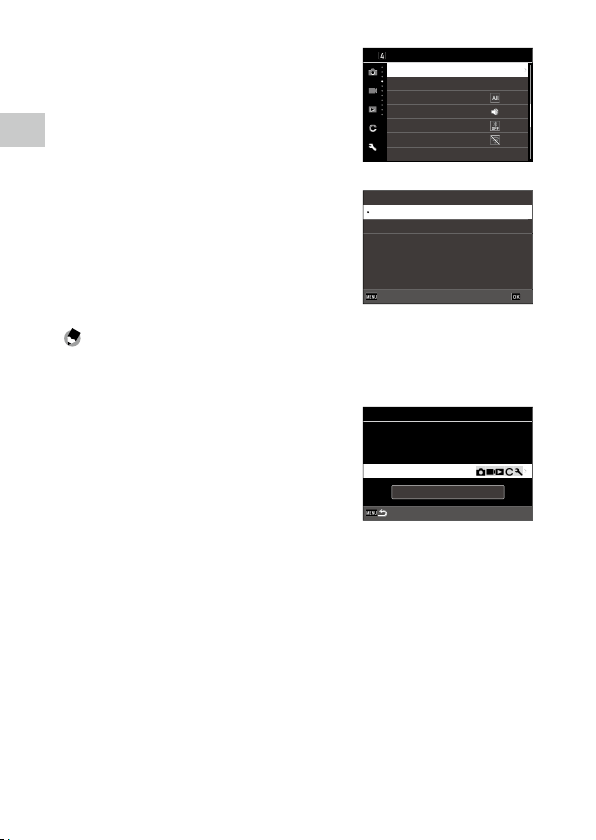
Setting from the Menus
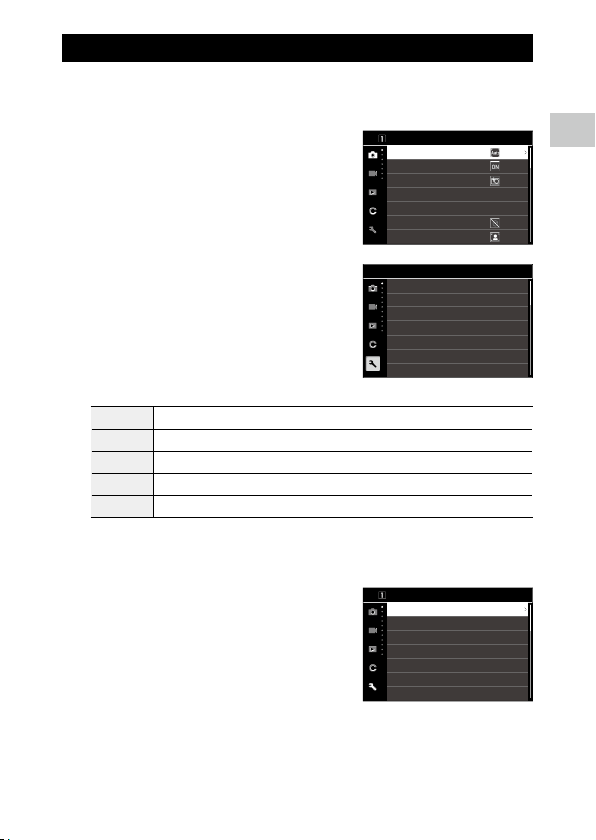
Most functions are set from the menus.
1 Press f.
The A1 menu appears.
2 When changing the menu type, press
c twice, and then use ab to select
a type.
A Still Image Settings menus (p.27)
B Movie Settings menus (p.30)
C Playback Settings menus (p.32)
D Customize Settings menus (p.33)
E Setup menus (p.35)
3 Press d twice.
4 Use ab to select a function.
Each menu type includes 1 to 11 menus.
To switch the screen display on a menu-by-
menu basis, press c and then ab.
2.5m
Face Detection
AF Assist Light
Snap Focus Distance
Full Press Snap
Focus Peaking
AF.C Setting
Focus
Focus Settings
On
R0
RICOH
Format
Create New Folder
Folder Name
File Name
Sequential Numbering
Reset Numbering
Copyright Information
Setup
R0
RICOH
File Setting
Create New Folder
Folder Name
File Name
Sequential Numbering
Reset Numbering
Copyright Information
Format
1
Introduction
26
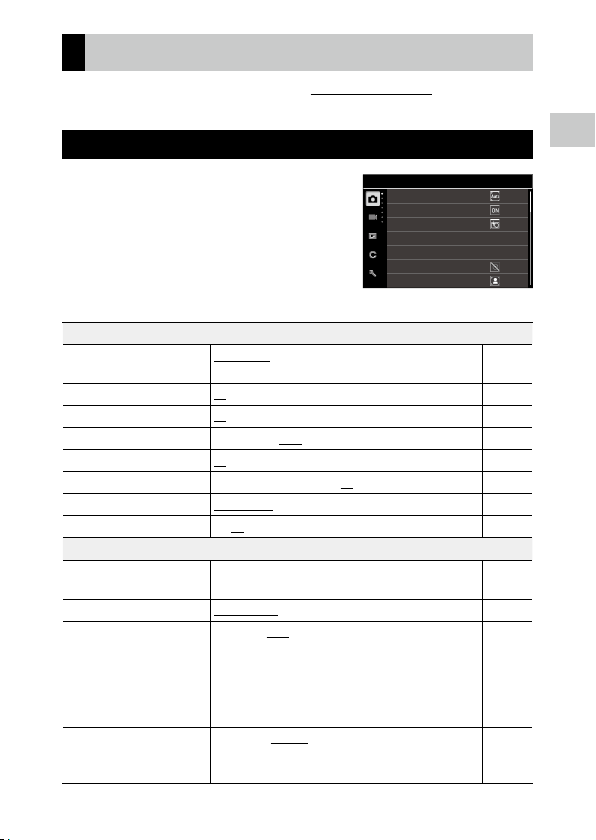
5 Find a function to set, and press d.
The settings for the selected setting item are
displayed.
6 Use ab to select a setting, and
press e.
The screen in Step 4 reappears.
Press f to return to the previous screen.
When you have finished setting, press f
several times to return to previous screens.
Memo ---------------------------------------------------------------------------------------------------------
• When f is pressed, the last used menu screen appears first. To display the most appropriate
menus for the camera settings at that time, set [Store Cursor Position] to [Off] in the E2 menu.
• p (front e-dial) or r (control dial) can be turned in place of ab.
• The setting is saved even after the power is turned off.
Each menu type can be restored to the default settings in
[Reset] of the E11 menu.
2
Indicator Lamps
Power Button Lamp On
On
Count Down
Volume
Sound Effects
Bluetooth Setting
Wireless LAN Setting
Smartphone Link
CancelCancel OKOK
On
Off
Power Button Lamp
Reset
Reset Item
Execute Reset
Select items to reset.
1
Introduction
27
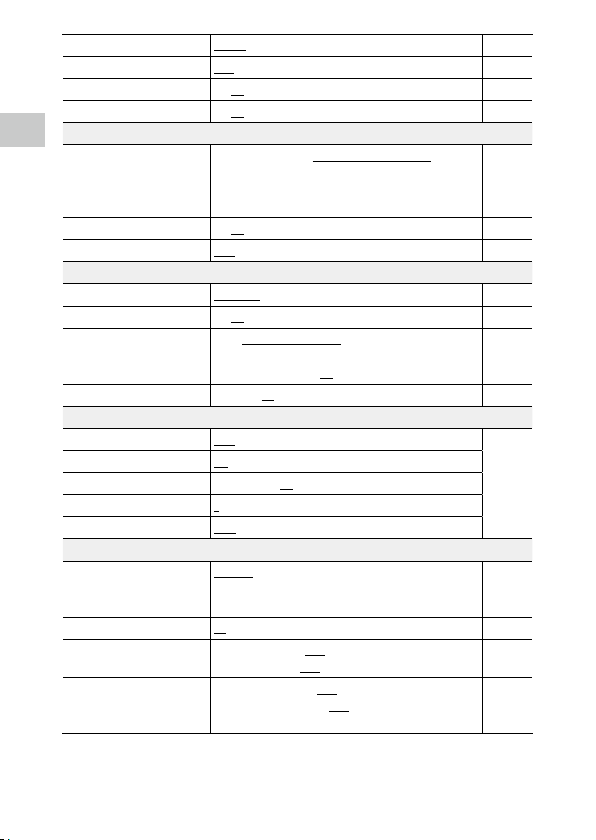
Menu List
The following menus are available. (The underlined settings and the square-
bracketed settings are the default settings.)
A Still Image Settings Menus
A1 Focus Settings
Focus
Auto-area AF, Select AF, Pinpoint AF, Tracking AF, Continuous
AF, MF, Snap, Z
p.57
Face Detection
On, Use only in Auto-area AF, Off p.58
AF Assist Light
On, Off p.58
Snap Focus Distance
1m, 1.5m, 2m, 2.5m, 5m, Z p.57
Full Press Snap
On, Off p.62
Focus Peaking
Highlight Edge, Extract Edge, Off p.58
AF.C Setting
Focus-priority, FPS-priority p.57
MF Auto Magnification
On, Off p.60
A2 Exposure Setting
Exposure Mode Program AE, Aperture Priority AE, Shutter Priority AE, Manual
Exposure
p.120
AE Metering
Multi-segment, Center-weighted, Spot, Highlight-weighted p.63
ISO Setting
ISO Setting: AUTO, 100 to 102400
ISO Auto Upper Limit: From one setting higher than the lowest
ISO sensitivity to the highest ISO sensitivity [6400]
ISO Auto Lower Limit: From the lowest ISO sensitivity to one
setting lower than the highest ISO sensitivity [100]
Minimum Shutter Speed: 1 to 1/1000 sec. [1/30]
p.64
Flash Mode
Flash Mode: Flash On, Flash On+Red-eye, Slow-speed Sync,
Slow Sync+Red-eye
Flash Exposure Comp.: -2.0 to +1.0
p.66
2.5m
Face Detection
AF Assist Light
Snap Focus Distance
Full Press Snap
Focus Peaking
AF.C Setting
Focus
Still Image Settings
On
1
Introduction
28
Program Line Normal, Max Aperture Priority p.51
ND Filter
Auto, On, Off p.86
Auto EV Compensation
On, Off p.49
Link AE and AF Point
On, Off p.63
A3 White Balance Settings
White Balance
Auto White Balance, Multi Auto White Balance, Daylight,
Shade, Cloudy, Fl. - Daylight Color, Fl. - Daylight White, Fl. -
Cool White, Fl. - Warm White, Tungsten, CTE, Manual White
Balance, Color Temperature
p.69
WB Fine-tuning
On, Off p.71
AWB in Tungsten Light
High, Low p.71
A4 Shooting Settings
Still/Movie
Still Image, Movie p.54
Macro Mode
On, Off p.61
Drive Mode
Drive: Single Frame Shooting, Continuous Shooting, Bracket-
ing, Multi-exposure, Interval Shooting, Interval Composite
Self-timer: 10sec., 2sec., Off
p.74
AA Filter Simulator
High, Low, Off p.86
A5 Image Capture Settings
File Format
JPEG, RAW, RAW+JPEG p.84
Aspect Ratio
3:2, 1:1
Crop
35mm, 50mm, Off
JPEG Recorded Pixels
L, M, S, XS
Color Space
sRGB, AdobeRGB
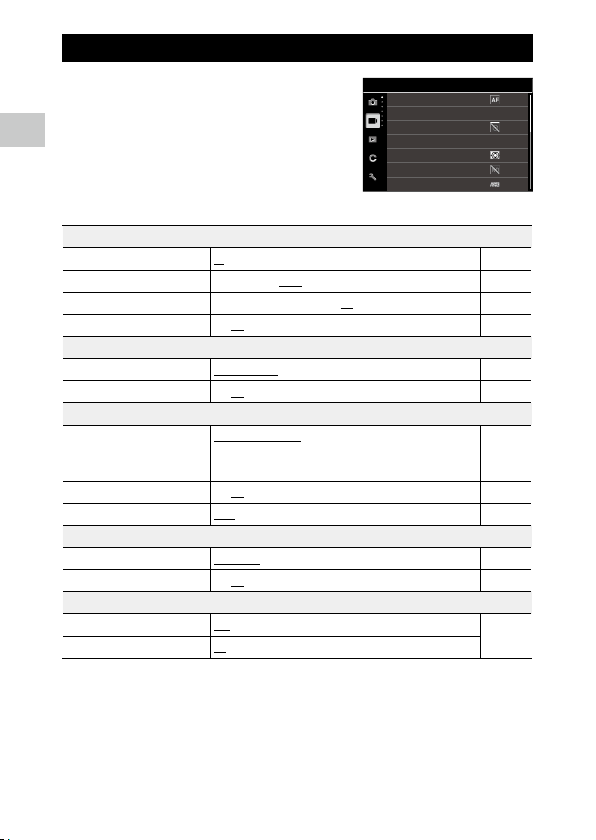
A6 Image Process Settings
Image Control
Standard, Vivid, Monotone, Soft Monotone, Hard Monotone,
Hi-Contrast B&W, Positive Film, Bleach Bypass, Retro, HDR
Tone, Custom1, Custom2
p.87
Peripheral Illumin. Corr.
On, Off p.89
D-Range Correction
Highlight Correction: Auto, On, Off
Shadow Correction: Auto, Low, Medium, High, Off
p.84
Noise Reduction
Slow Shutter Speed NR: Auto, On, Off
High-ISO Noise Reduction: Auto, Low, Medium, High, Custom,
Off
p.63

1
Introduction
30
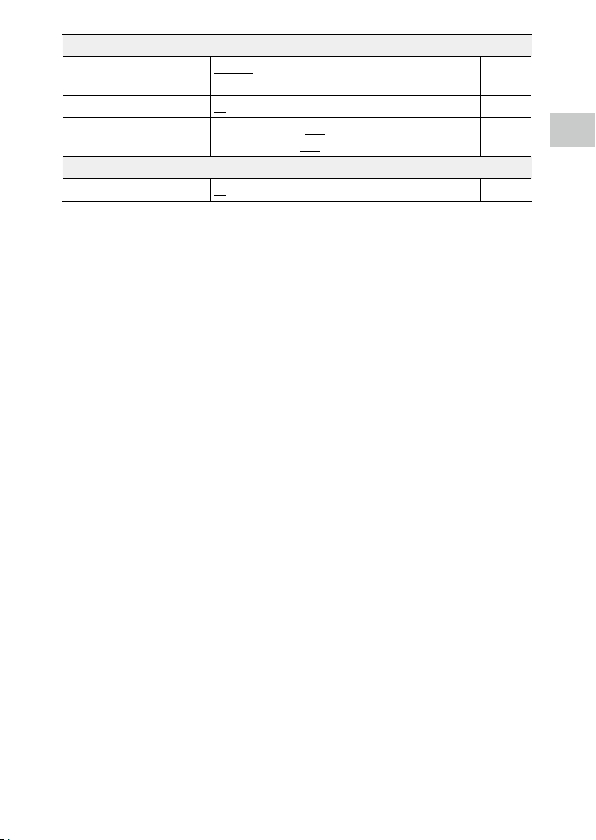
B Movie Settings Menus
B1 Focus Settings
Focus
AF, MF, Snap, Z p.57
Snap Focus Distance
1m, 1.5m, 2m, 2.5m, 5m, Z p.57
Focus Peaking
Highlight Edge, Extract Edge, Off p.58
MF Auto Magnification
On, Off p.60
B2 Exposure Setting
AE Metering
Multi-segment, Center-weighted, Spot, Highlight-weighted p.63
ND Filter
On, Off p.86
B3 White Balance Settings
White Balance
Auto White Balance, Daylight, Shade, Cloudy, Fl. - Daylight
Color, Fl. - Daylight White, Fl. - Cool White, Fl. - Warm White,
Tungsten, CTE, Manual White Balance, Color Temperature
p.69
WB Fine-tuning
On, Off p.71
AWB in Tungsten Light
High, Low p.71
B4 Shooting Settings
Still/Movie
Still Image, Movie p.54
Macro Mode
On, Off p.61
B5 Movie Capture Settings
Framerate
60p, 30p, 24p p.85
Sound Recording
On, Off
2.5m
Movie Settings
Focus
Snap Focus Distance
Focus Peaking
ND Filter
White Balance
MF Auto Magnification
AE Metering
Off
1
Introduction
31
B6 Image Process Settings
Image Control
Standard, Vivid, Monotone, Hard Monotone, Hi-Contrast B&W,
Positive Film, Bleach Bypass, Retro, Custom1, Custom2
p.87
Peripheral Illumin. Corr.
On, Off p.89
D-Range Correction
Highlight Correction: Auto, Off
Shadow Correction: Auto, Low, Medium, High, Off
p.84
B7 Shooting Assist
Movie SR
On, Off p.90
1
Introduction
32
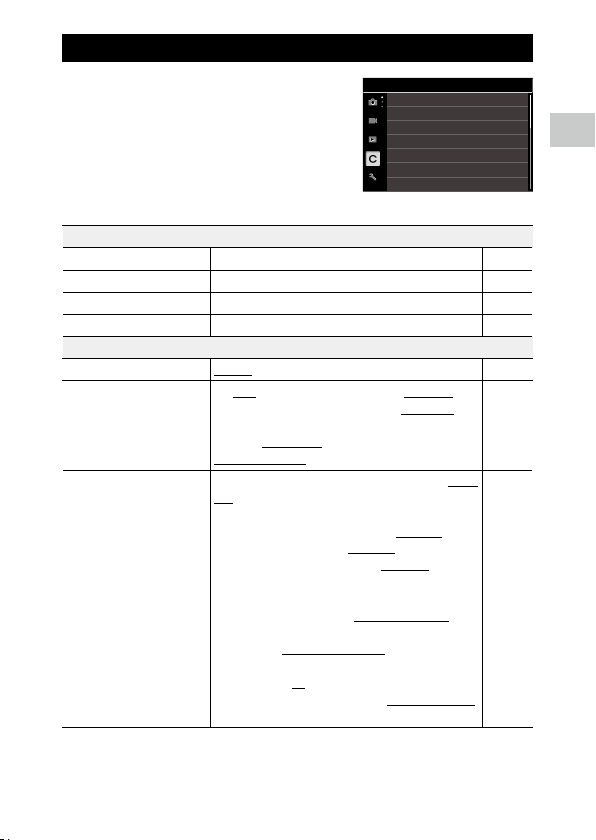
C Playback Settings Menus
C1 File Management
Delete Delete 1 Image, Delete All Images p.96
Protect Protect 1 Image, Protect All Images p.97
Image Rotation 90° (counterclockwise), 180°, 90° (clockwise) p.94
Image Copy — p.98
File Transfer Transfer 1 Image p.99
C2 Image Edit
RAW Development JPEG Recorded Pixels, Aspect Ratio, Color Space, White Bal-
ance, Image Control, Peripheral Illumin. Corr., Sensitivity,
High-ISO Noise Reduction, Shadow Correction
p.100
Resize — p.102
Cropping — p.102
Levels Adjustment — p.103
WB Adjustment — p.105
Color Moiré Correction Low, Medium, High p.106
Base Parameter Adj Brightness, Saturation, Hue, Contrast, Sharpness p.107
Movie Edit Cut, Divide p.108
C3 Playback Settings
Auto Image Rotation
On, Off p.94
Playback Order Options
File No., Shooting Date/Time p.92
Playback Sound Volume 0 to 20 [10] p.56
Playback Settings
Delete
Protect
Image Rotation
Image Copy
File Transfer
RAW Development
Resize
1
Introduction
33
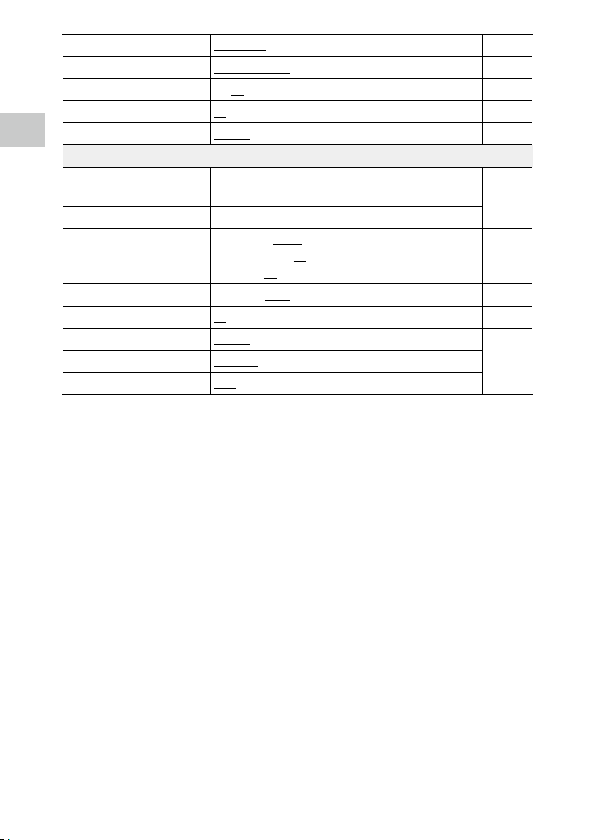
D Customize Settings Menus
D1 User Mode
Save Settings — p.117
Rename — p.118
Recall — p.119
Delete Settings — p.118
D2 Customize Controls
M Mode Dial Setting
Custom1, Custom2 p.52
ADJ Mode Setting
Off, Focus [Setting2], Snap Focus Distance, File Format [Set-
ting4], Aspect Ratio, JPEG Recorded Pixels, AE Metering [Set-
ting3], ISO Setting, Flash Mode, Flash Exposure Comp., Drive,
Self-timer, Image Control [Setting1], One Push AE in M Mode,
Outdoor View Setting [Setting5]
p.121
Fn Button Setting
Off, Focus, Set MF, Set Snap, Set Tracking AF, Enable AF, AF+AE
Lock [Fn Button], AE Lock, Face Detection, Snap Focus Dis-
tance, File Format, JPEG RAW, JPEG RAW+, Aspect Ra-
tio, Crop, JPEG Recorded Pixels, Framerate, Still/Movie [Movie/
Wireless Button], AE Metering, ISO Setting [ISO Button], Flash
Mode, Flash Exposure Comp., ND Filter, Drive Mode [Drive But-
ton], Drive, Continuous Shooting, Self-timer, Image Control,
Shake Reduction, One Push AE in M Mode, 4-way Controller
Action, Outdoor View Setting, Wireless LAN Setting [Hold
Movie/Wireless Btn.], Preview
Focus Settings: Same as Shutter Button, Auto-area AF, Select
AF, Pinpoint AF, Tracking AF, Continuous AF
Keep AE Lock: On, Off
One Push AE in M Mode: Program AE, Aperture Priority AE,
Shutter Priority AE
p.123
Customize Settings
Save Settings
Rename
Recall
Delete Settings
M Mode Dial Setting
ADJ Mode Setting
Fn Button Setting
1
Introduction
34
Shutter Button Setting AF+AE Lock, AE Lock p.125
4-way Controller
Direct Key Priority, AF point change Priority p.59
Shutter Btn. Confirmation
On, Off p.125
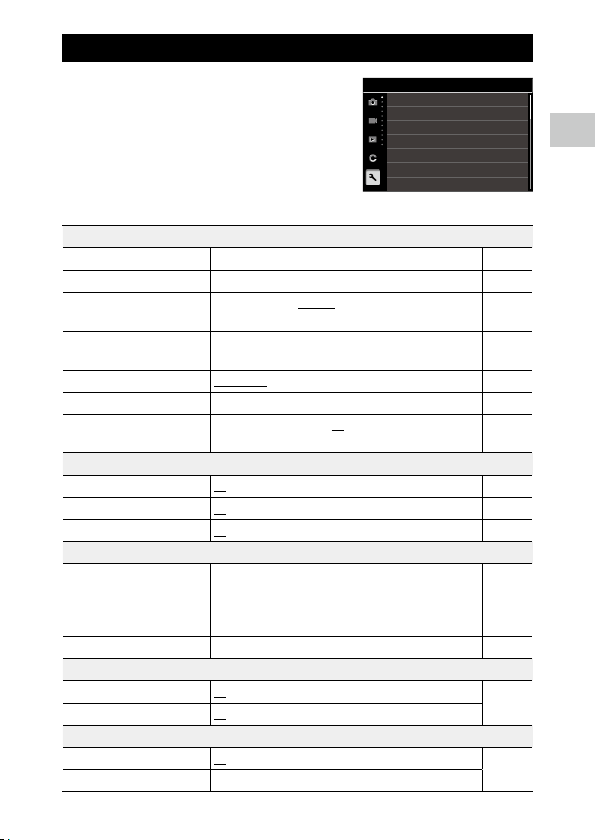
LCD Touch Operation
On, Off p.21
Touch AF
AF Point, AF Point+Focus, AF Point+Focus+Shoot, Off p.50
D3 Display Customization
Shooting Info. Display Standard Info. Display, Simplified Info. Display, No Information
Display, Display Off
p.126
Playback Info. Display Standard Info. Display, No Information Display
Instant Review
Display Time: 0.5sec., 1sec., 2sec., 3sec., Hold, Off
Zoom Review: On, Off
Delete: On, Off
p.127
Quick Zoom
x4, x8, x16, 100% p.127
Focus Magnification
On, Off p.47
Grid Style
3x3 Grid, 4x4 Grid p.128
Electronic Level Type
Level+Tilt, Level
Flicker Reduction
50Hz, 60Hz
1
Introduction
35
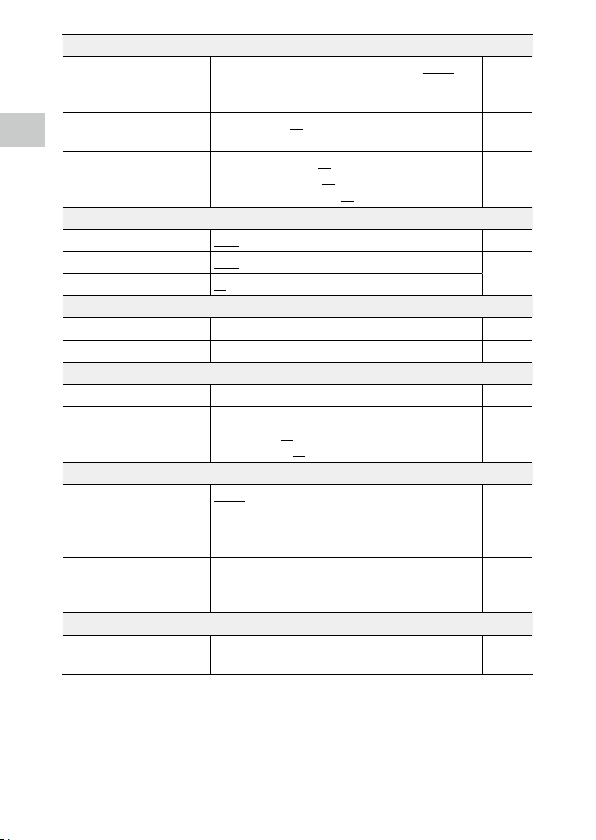
E Setup Menus
E1 File Setting
Format Memory Card, Internal Memory p.42
Create New Folder — p.133
Folder Name
Folder Name: Date, Optional
A freely defined string of characters [RICOH]
p.134
File Name Still Image: A freely defined string of two characters [R0]
Movie: A freely defined string of two characters [R0]
p.136
Sequential Numbering
Folder & File, File, Off p.137
Reset Numbering — p.137
Copyright Information
Embed Copyright Data: On, Off
Copyright Information: A freely defined string of 32 characters
p.138
E2 Display Settings
Store Cursor Position
On, Off p.26
Guide Display
On, Off p.24
Animation Setting
On, Off p.47
E3 LCD Setting
LCD Setting Brightness: -7 to +7
Saturation: -7 to +7
Adjust: Blue-Amber: -7 to +7
Adjust: Green-Magenta: -7 to +7
p.128
Outdoor View Setting -2 to +2 p.129
E4 Indicator Lamps
Power Button Lamp
On, Off p.129
Count Down
On, Off
E5 Sound Effects Setting
Sound Effects
All, Shutter Sound Only p.130
Volume 0 to 3 [2]
R0
RICOH
Format
Create New Folder
Folder Name
File Name
Sequential Numbering
Reset Numbering
Copyright Information
Setup
1
Introduction
36
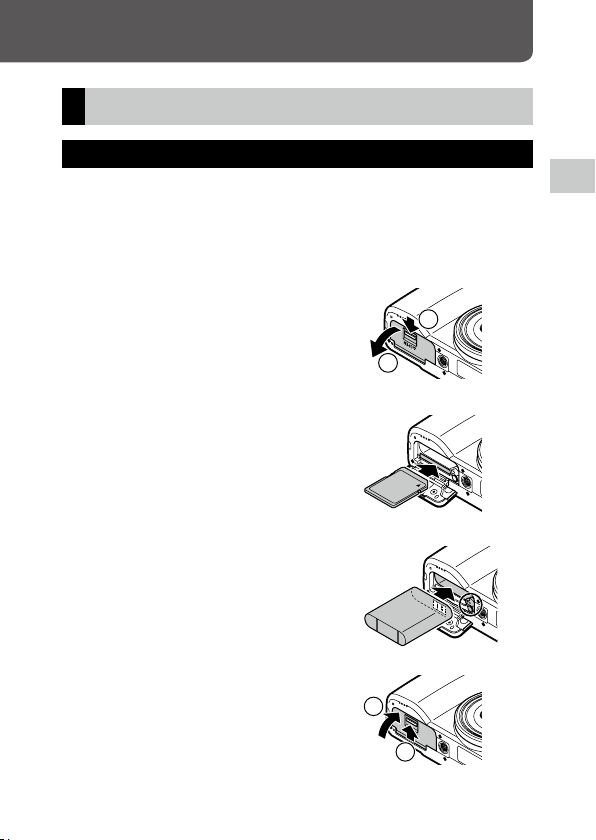
E6 Wireless Connection
Bluetooth Setting
Action Mode: On anytime, On when power is on, Disable
Pairing
Communication Info.
p.112
Wireless LAN Setting
Action Mode: On, Off
Communication Info.
p.114
Smartphone Link
Store Location Info.: On, Off
Auto Image Transfer: On, Off
Image Transfer while Off: On, Off
p.113
E7 Power Supply Settings
Auto Power Off
1min., 3min., 5min., 10min., 30min., Off p.131
Sleep Mode
1min., 3min., 5min., 10min., 30min., Off p.132
LCD Auto Dim
On, Off
E8 About This Device
Firmware Info/Options — —
Certification Marks — p.2
E9 Sensor Maintenance
Pixel Mapping — p.144
Dust Removal
Execute Dust Removal
Startup Action: On, Off
Shutdown Action: On, Off
p.144
E10 Language/Date Setting
Language/H
English, French, German, Spanish, Portuguese, Italian, Dutch,
Danish, Swedish, Finnish, Polish, Czech, Hungarian, Turkish,
Greek, Russian, Thai, Korean, Traditional Chinese, Simplified
Chinese, Japanese
p.41
Date Adjustment Date Format: Y/M/D, D/M/Y, M/D/Y
Date: 1/1/2019 to 12/31/2067
Time: 00:00 to 23:59
p.41
E11 Reset
Reset Reset Item: A, B, C, D, E
Execute Reset
p.26
2
Getting Started
37
Getting Started
Setting the Battery and a Memory Card
Inserting the Battery and a Memory Card
SD memory cards, SDHC memory cards, and SDXC memory cards can be
used with this camera. “Memory card” refers to these memory cards in this
manual.
1 Make sure that the camera power is off.
2 Slide the release lever on the bottom
of the camera toward OPEN to open
the battery/card cover.
3 Make sure that the memory card is
facing the right way and then push
the card all the way in until it clicks.
To remove it, press in the memory card and
then release your hand.
4 Insert the battery.
Use the battery to press the latch and insert
the battery all the way into the battery com-
partment.
To remove the battery, slide the latch.
5 Close the battery/card cover and
slide the release lever in the opposite
direction of OPEN to lock it in place.
1
2
1
2

2
Getting Started
38
Data Storage Location
Images taken and movies recorded with this camera are saved in the internal
memory or a memory card.
Memo ---------------------------------------------------------------------------------------------------------
• You can copy all data stored in the internal memory to a memory card. (p.98)
• The storage capacity varies depending on the memory card. (p.151)
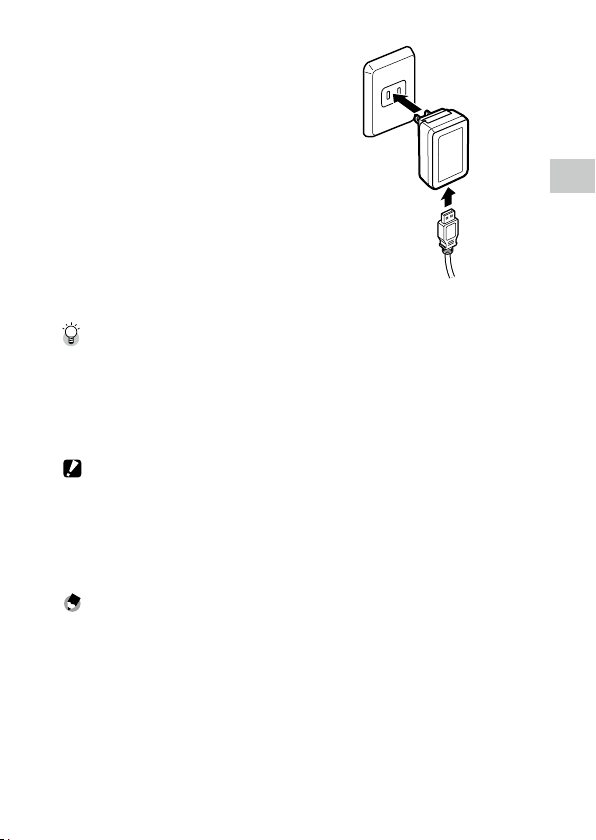
Charging the Battery
Charge the rechargeable battery DB-110 using the provided USB cable
I-USB166, USB power adapter AC-U1/AC-U2, and power plug before use.
1 Insert the power plug to the USB
power adapter.
Insert it until it clicks into place.
2 Open the terminal cover, and connect
the USB cable to the USB terminal.
2
Getting Started
39
3 Connect the USB cable to the USB
power adapter.
4 Plug the USB power adapter into a
power outlet.
The status lamp of the camera turns on and
charging starts.
Depending on the battery level, the charg-
ing time differs. An exhausted battery will
be fully recharged in about 2.5 hours (at 25°C
(77°F)).
When charging is complete, the status lamp
turns off. Unplug the USB power adapter
from the power outlet.
Storage Capacity --------------------------------------------------------------------------------------------
• About 200 pictures can be taken when the battery is fully charged.
• This is based on tests conducted according to CIPA standards under the following conditions: At 23°C
(73°F) temperature; the monitor is on; a picture is taken every 30 seconds; the camera is turned off
and back on after 10 pictures are taken.
• The storage capacity is for reference. For long periods of use, it is recommended that you carry spare
batteries.
Caution -------------------------------------------------------------------------------------------------------
• Use only genuine rechargeable battery (DB-110).
• If the battery starts to run down more quickly even after being charged, the battery has reached the
end of its service life. In this case, replace the battery with a new one.
• The battery may become very hot immediately after operation. Turn the camera off and leave it to
cool down sufficiently before removing the battery.
• If you turn the camera on while charging the battery, the charging is interrupted.
Memo ---------------------------------------------------------------------------------------------------------
• You can also charge the battery by connecting the camera to a computer using the USB cable. (p.110)
• The battery can also be recharged with the optional battery charger BJ-11.
3
4
2
Getting Started
40
Initial Settings
Turn the camera on and make the initial settings.
Turning the Camera On
1 Press the power button.
The power button lamp lights, and then the
status lamp blinks for several seconds.
The first time the camera is turned on after
purchase, the [Language/H] screen ap-
pears.
When the power button is pressed again, the
power turns off.
Turning the Camera On in the Playback Mode --------------------------------------------------------
• When g is pressed and held with the camera turned off, the camera turns on in the playback mode.
The following operations are available.
g Turns off the power of the camera.
Press z halfway Switches the camera to the shooting mode.
Turning the Camera On with the Wireless LAN Function Enabled ---------------------------------
• When g is pressed and held with the camera turned off until a beep sounds, the camera turns on
in the playback mode with the wireless LAN function enabled. (p.115)
• When the wireless LAN function is enabled using g, the camera is not switched to the shooting
mode even if z is pressed. When performing shooting or other operations, press g to turn
the camera off and press the power button to turn the camera back on.
Memo ---------------------------------------------------------------------------------------------------------
• The power button lamp can be set to [Off] in [Power Button Lamp] of the E4 menu. (p.129)
• If no operations are made for about one minute (default setting), the camera turns off automatically
to suppress battery drain. The power saving function can be set in the E7 menu. (p.131)
• The number of images taken on the day (except the deleted images) is displayed when the power
is turned off.

2
Getting Started
41
Setting the Language and the Date and Time
You can set the display language for menus and the date and time.
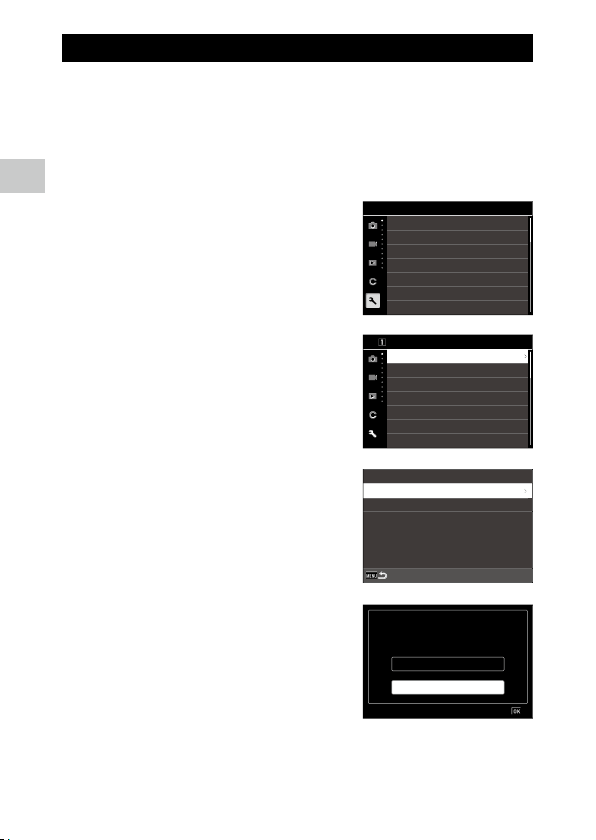
1 Use ab to select a language, and press e.
The selected language is set and the [Date Adjustment] screen appears.
2 Set the display format and the date
and time.
Use cd to select an item and ab to
change the value.
Press f to cancel the setting.
3 Press e.
The date and time are set and the camera is
ready to take a picture.
Memo ---------------------------------------------------------------------------------------------------------
• If the battery is removed for about five days, the date and time settings will be lost. To retain the
date and time settings, insert a battery with sufficient power for at least two hours, and then remove
the battery.
• You can change the language and the date and time settings in the E10 menu.
00 0001 ///M/D/Y 01
Cancel OK
Date Adjustment
Set the Date Format,
Date and Time.
2019
2
Getting Started
42
Formatting a Memory Card
When using a new memory card or a memory card used with another device,
be sure to format the memory card with this camera. The internal memory
can also be formatted with the same operations.
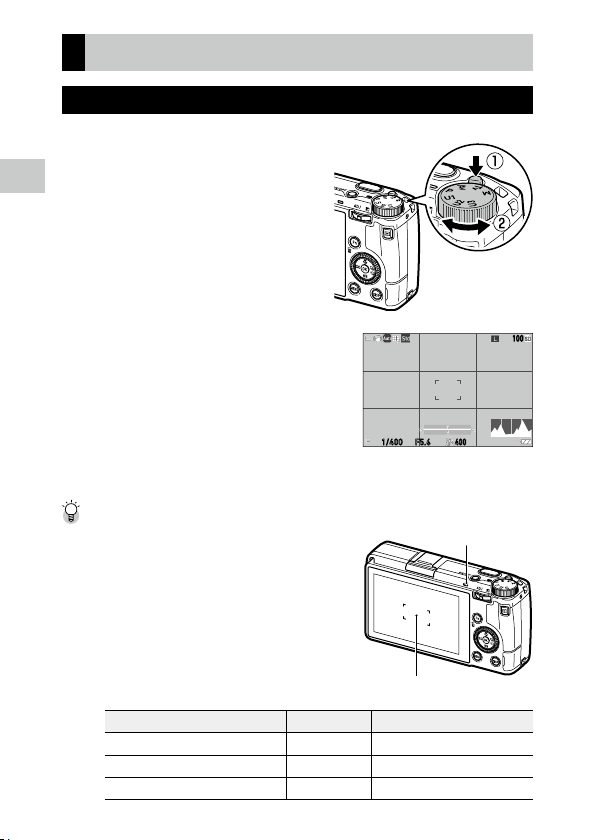
1 Press f.
The menu appears.
2 Press c twice, and then use ab to
select E.
3 Press d twice, select [Format], and
press d.
4 Use ab to select [Memory Card] or
[Internal Memory], and press d.
The confirmation screen appears.
5 Use a to select [Execute], and press
e.
The memory is formatted and the screen in
Step 4 reappears.
6 Press f twice.
The shooting screen reappears.
R0
RICOH
Format
Create New Folder
Folder Name
File Name
Sequential Numbering
Reset Numbering
Copyright Information
Setup
R0
RICOH
File Setting
Create New Folder
Folder Name
File Name
Sequential Numbering
Reset Numbering
Copyright Information
Format
Format
Memory Card
Internal Memory
All data in Memory Card
will be deleted.
Execute
Cancel
OK

2
Getting Started
43
Caution -------------------------------------------------------------------------------------------------------
• Do not remove the memory card while formatting, or the card may be damaged.
• Formatting deletes all data, both protected and unprotected.
Memo ---------------------------------------------------------------------------------------------------------
• When a memory card is formatted, the volume label “RICOH GR” is assigned to the card.
2
Getting Started
44
Basic Shooting Operation
Shooting in the Program Mode
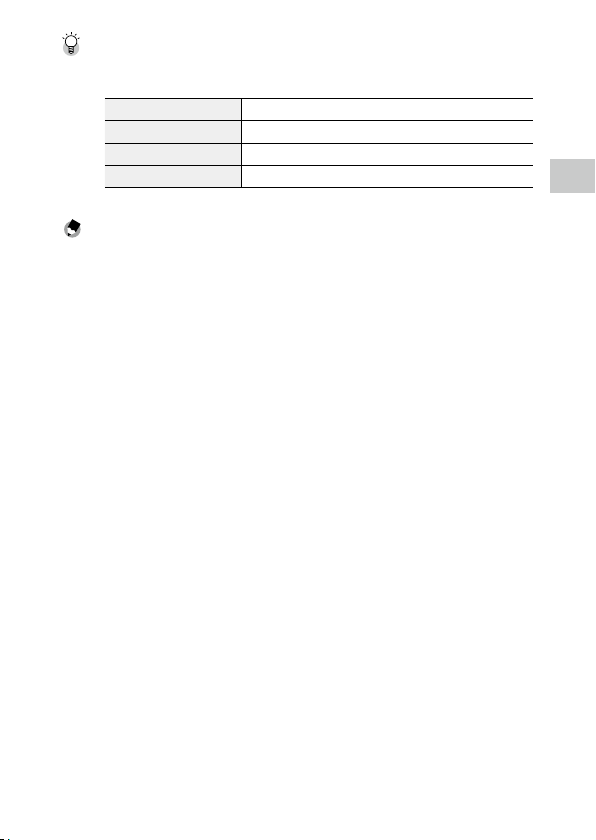
1 Set the mode dial to J while
pressing the lock button.
The exposure mode is set to [Program
AE] and the Live View is displayed.
2 Press z halfway.
Focus is adjusted, and exposure is set.
The distance is measured from up to 25
points and the green focus frame appears for
the area in focus.
3 Press z fully.
The image you have just taken is displayed
on the monitor (Instant Review) and saved.
Focus ----------------------------------------------------------------------------------------------------------
• The status lamp and the frame color show whether the
subject is in focus.
Focus Status Frame Color Status Lamp
Before focusing White Off
Subject in focus Green Green (on)
Unable to focus Red Green (blinks)
100
F5.6
400
1/400
Status lamp
Focus frame
2
Getting Started
45
Magnifying Live View image -----------------------------------------------------------------------------
• The Live View image can be magnified.
The following operations are available.
Press and hold j Magnifies the Live View image.
p Switches the magnification between [x4] and [x16].
abcd/Slide Moves the magnified area.
e Resets to the entire image display.
• The image cannot be magnified during recording in B mode.
Memo ---------------------------------------------------------------------------------------------------------
• You can set the display and operation of [Instant Review] that displays the captured image immedi-
ately after shooting in the D3 menu. (p.127)
2
Getting Started
46
Viewing the Captured Images
Review the captured image on the monitor.
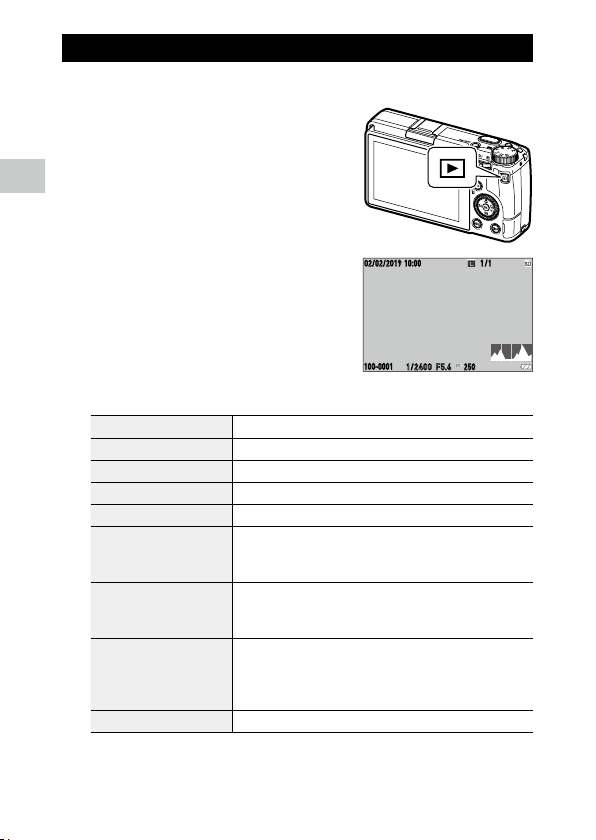
1 Press g.
The camera switches to the playback mode
and the last image you took is displayed.
(Single image display)
2 View an image.
The following operations are available.
cd/Flick Displays the previous or next image.
i Deletes the image. (p.96)
p to the right/Pinch out Magnifies the image.
p to the left/Pinch in In magnified view: Reduces the image.
abcd/Slide In magnified view: Moves the magnified area.
Press n/Double-tap Magnifies the image with the magnification ([x4], [x8], [x16],
[100%]) set in [Quick Zoom] of the D3 menu. (p.127)
In magnified view: Returns to the single image display.
n to the left or right/r Displays the previous or next image.
In magnified view: Displays the previous or next image without
changing the magnification.
j Switches between [Standard Info. Display], [Detailed Info. Display],
and [No Information Display].
In magnified view: Switches between [Standard Info. Display] and
[No Information Display].
k Displays the playback functions setting screen. (p.91)
1 1
/
100-0001
1/2400 F5.6
250
10:00
02/02/2019

2
Getting Started
47
Memo ---------------------------------------------------------------------------------------------------------
• If [Focus Magnification] is set to [On] (default setting) in the D3 menu, the image is magnified
centering on the AF point set in shooting.
• Movies cannot be magnified.
• If the image is switched to the previous or next image by flicking on the touch panel, animation is
displayed. The function can be set to [Off] in [Animation Setting] of the E2 menu.
3
48
Taking Pictures
Taking Pictures
Taking Still Images
Setting the Exposure Mode
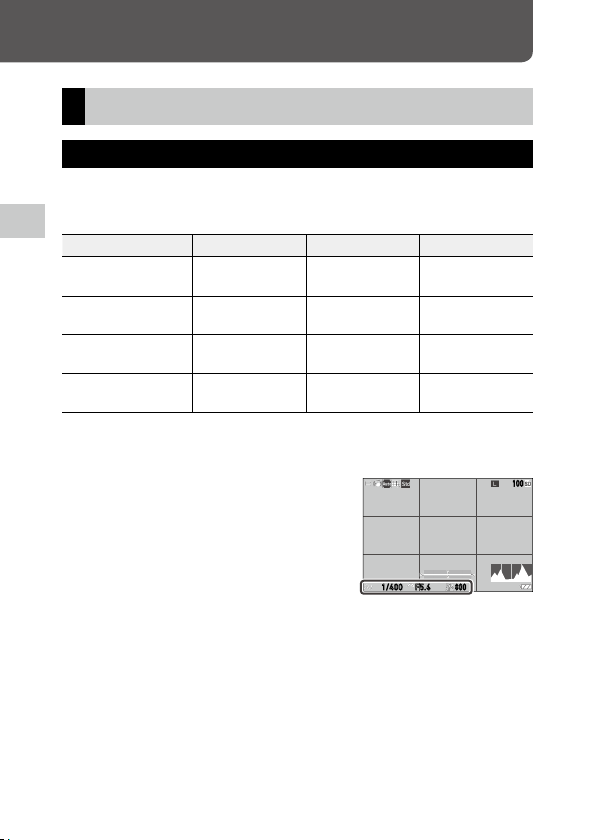
Set an aperture value or shutter speed for shooting. The following settings
can be set.
2: Available #: Conditionally available
Exposure Mode Aperture Value Shutter Speed Sensitivity
J
Program AE
#
*1
#
*1
2
K
Aperture Priority AE
2 Automatically set 2
L
Shutter Priority AE
Automatically set 2 2
N
Manual Exposure
2 2 2
*1 The Program Shift allows you to select the combination of aperture value and shutter speed.
1 Set the mode dial to J, K, L, or N.
The exposure mode and set value are dis-
played on the shooting screen.
100
F5.6
800
1/400
3
49
Taking Pictures
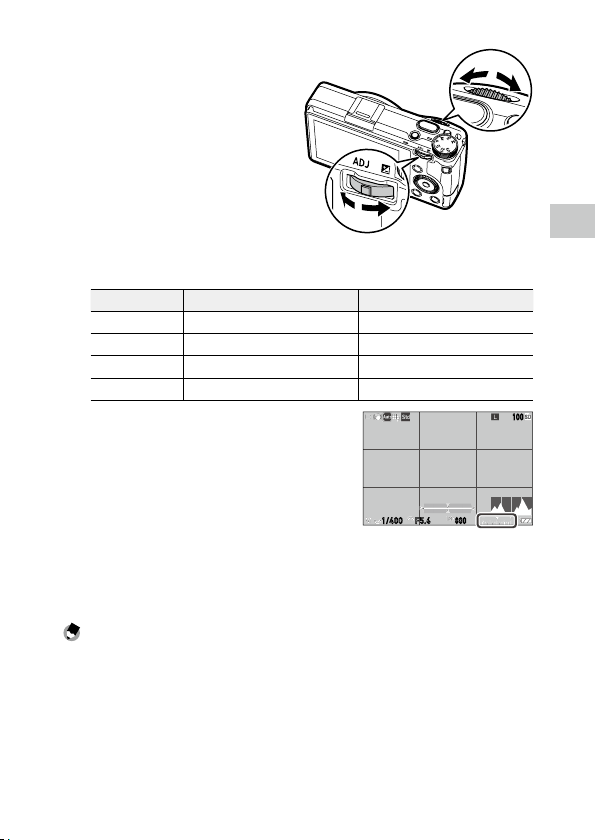
2 Turn p or n to change a
value.
The following settings can be changed.
Exposure Mode p Turn n to the Left or Right (q)
J Program shift Exposure compensation
K Aperture value Exposure compensation
L Shutter speed Exposure compensation
N Aperture value Shutter speed
In N mode, the exposure indicator is dis-
played. As a guide, the exposure is correct
when the exposure indicator is in the center.
When the exposure value is in the range of
±2 EV, the indicator changes according to the
exposure value. The indicator turns red when
the values are outside this range. When the
ISO sensitivity is set to ISO AUTO, the expo-
sure compensation can be adjusted using
r.
3 Shoot.
Memo ---------------------------------------------------------------------------------------------------------
• If [Auto EV Compensation] is set to [On] in the A2 menu, the exposure is automatically compen-
sated when the correct exposure cannot be achieved in K or L mode.
• Pressing z halfway activates the autofocus and AE Lock. To activate only the AE Lock, set [Shut-
ter Button Setting] to [AE Lock] in the D2 menu. (p.125)
100
F5.6
800
1/400
3
50
Taking Pictures
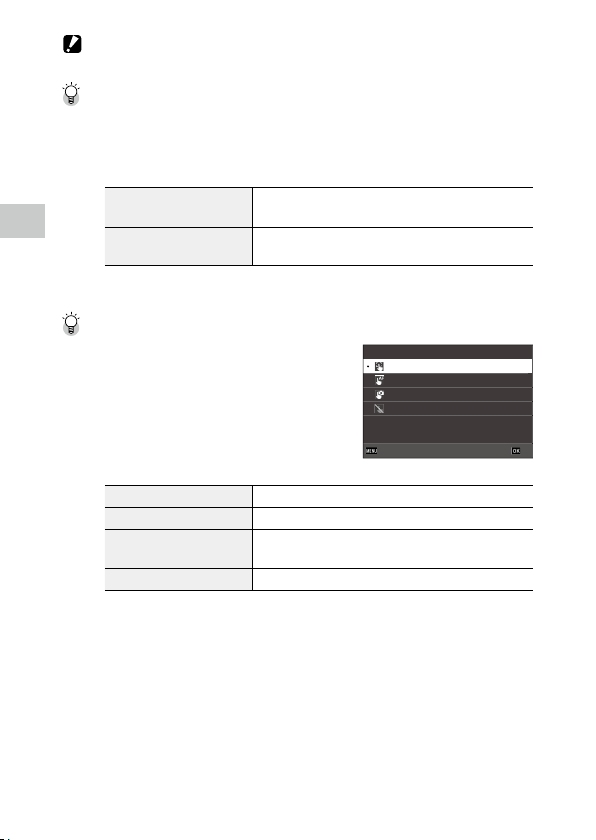
Caution -------------------------------------------------------------------------------------------------------
• Images are not displayed on the monitor during shooting.
AE Lock --------------------------------------------------------------------------------------------------------
• The exposure value is locked while z is pressed halfway, and the lock is canceled when the
button is released.
• [AF+AE Lock] or [AE Lock] can be registered to [Fn Button Setting] in the D2 menu to use the func-
tion with h. By default, [AF+AE Lock] is assigned to h. (p.123)
AF+AE Lock Locks the focus and exposure value.
The lock is canceled when the button is released.
AE Lock When [Keep AE Lock] is set to [On] in [Fn Button Setting] of the
D2 menu, the AE lock is kept if the button in released.
• If the sensitivity is fixed at a certain sensitivity in N mode or if the shutter speed is set to [B], [T], or
[BT], the AE lock function is not available.
AF Using the Touch Panel ---------------------------------------------------------------------------------
• By default, only the AF point can be changed using the
touch panel. To perform autofocus and shooting using the
touch panel, set [Touch AF] in the D2 menu.
AF Point Sets the AF point to the touched point.
AF Point+Focus Sets the AF point to the touched point and performs autofocus.
AF Point+Focus+Shoot Sets the AF point to the touched point, performs autofocus, and
shoots.
Off Does not use the touch AF.
When the touch AF is activated in B mode, autofocus is performed with [AF Point+Focus].
CancelCancel OKOK
AF Point
AF Point+Focus
AF Point+Focus+Shoot
Off
Touch AF
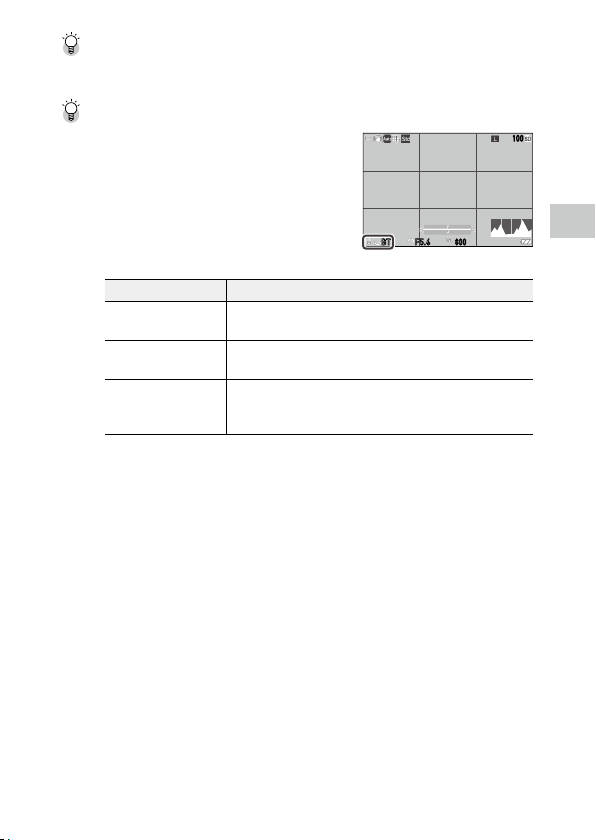
3
51
Taking Pictures
Program Line ------------------------------------------------------------------------------------------------
• You can set the program line for J mode to [Max Aperture Priority] in [Program Line] of the A2
menu.
Bulb, Time, and Bulb Timer -------------------------------------------------------------------------------
• If the sensitivity is fixed at a certain sensitivity in N
mode, [B], [T], or [BT] can be set for the shutter speed.
Shutter Speed Operation
B
Bulb
Exposure is continued while z is pressed, and canceled when
the button is released.
T
Time
Exposure is started when z is pressed, and ended when the
button is pressed again.
BT
Bulb timer
Exposure is started when z is pressed, and ended after the set
time has elapsed.
Set the exposure time using r.
• [B] and [T] are available when [Drive Mode] is set to [Single Frame Shooting] or [Multi-exposure],
and [BT] is available when [Drive Mode] is set to [Single Frame Shooting], [Multi-exposure], [Interval
Shooting], or [Interval Composite].
• Operation is also possible using the optional cable switch (CA-3) in place of z. When using the
cable switch, connect it to the camera with the provided USB cable.
• [One Push AE in M Mode] in [Fn Button Setting] of the D2 menu does not work.
100
BT F5.6
800
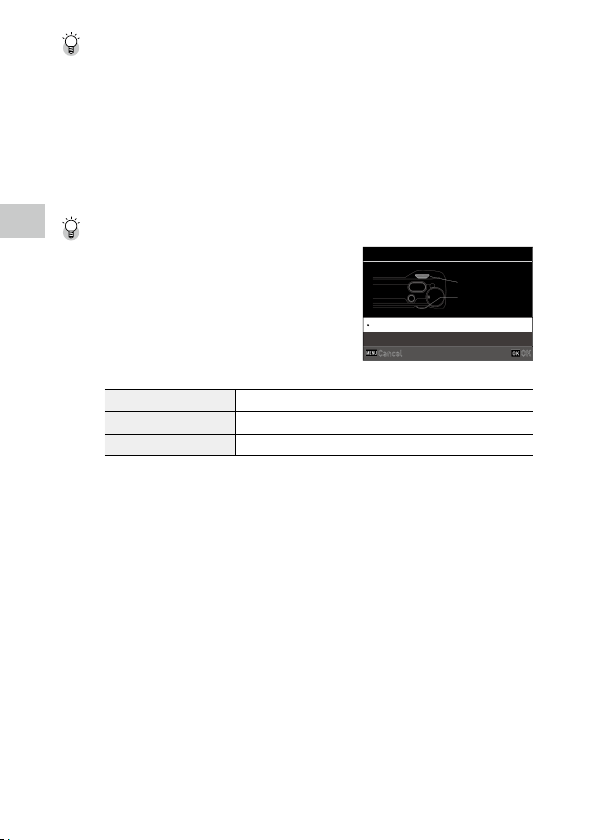
3
52
Taking Pictures
Preview -------------------------------------------------------------------------------------------------------
• When [Hold Movie/Wireless Btn.] is set to [Preview] in [Fn Button Setting] of the D2 menu, the
Preview is available. (p.123) If you press and hold k, the aperture is adjusted to the set aperture
value, and you can check the depth of field. It is canceled when k is released.
• When [Hold Movie/Wireless Btn.] is set to [Wireless LAN Setting] (default setting), k works as the
switch to turn on/off the wireless LAN function. In this case, the Preview is not available.
• In the Preview mode, you cannot perform shooting and change the aperture value.
• When using the flash, the actual aperture value may differ from the Preview.
• The Preview is used for checking the depth of field, so it may not function properly with AE.
• This function is not available in B mode.
Functions in
N
Mode -------------------------------------------------------------------------------------
• The functions for p and n in N mode can be
switched in [M Mode Dial Setting] of the D2 menu.
• When [One Push AE in M Mode] is registered in [Fn Button
Setting] (p.123) of the D2 menu, you can select the
priority of values for when the button is pressed,.
Program AE Adjusts both the aperture value and shutter speed.
Aperture Priority AE Sets the aperture value to a fixed value and adjusts the shutter speed.
Shutter Priority AE Sets the shutter speed to a fixed value and adjusts the aperture value.
When ISO AUTO is set, [One Push AE in M Mode] does not work.
M Mode Dial Setting
Custom1
Custom2
Aperture
Shutter Speed
Cancel OK
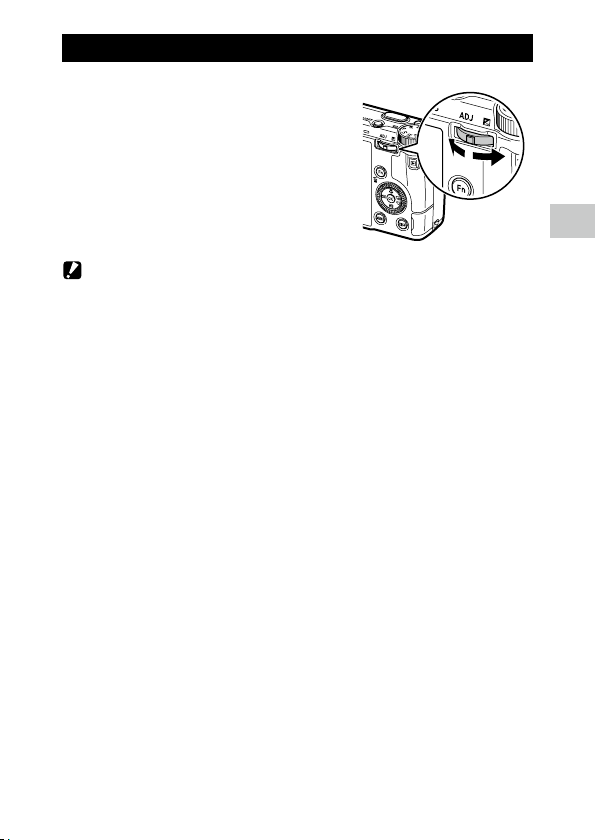
3
53
Taking Pictures
Using Exposure Compensation
1 Press n (o) to the left or right.
The value will be plus (+) when the button is
pressed to the right, and minus (-) when it is
pressed to the left.
In N mode, turn r.
Settings can be made in the range of ±5.0 EV
(±2.0 EV in B mode) in increments of 1/3 EV
steps.
Caution -------------------------------------------------------------------------------------------------------
• Exposure compensation is not available when the sensitivity is fixed at a certain sensitivity in N
mode.
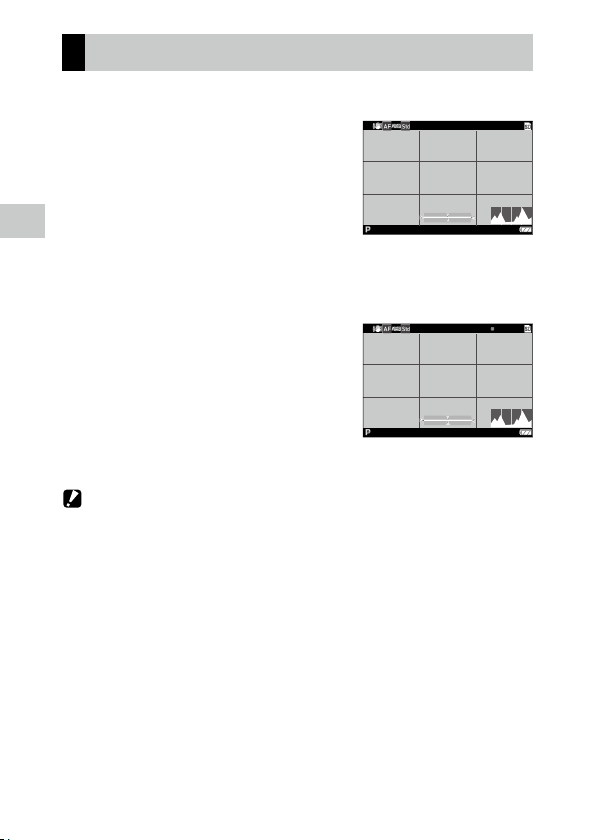
3
54
Taking Pictures
Recording Movies
1 Press k.
The camera enters B mode.
You can switch the camera to the movie
mode also from [Still/Movie] of the A4/B4
menu.
2 Focus on the subject.
When [Focus] is set to [AF], press z halfway.
3 Press z fully.
Recording starts.
The recording time is displayed while record-
ing.
4 Press z again.
Recording stops.
Caution -------------------------------------------------------------------------------------------------------
• When [Sound Recording] is set to [On] (default setting) in the B5 menu, camera operation sounds
are also recorded.
• If the internal temperature of the camera becomes high during recording, recording may be termi-
nated.
• The following functions cannot be used in B mode.
• Flash
• Wireless LAN
1:00´00˝
0:01´58˝

3
55
Taking Pictures
Memo ---------------------------------------------------------------------------------------------------------
• Movies are recorded in J mode regardless of the mode dial setting. Exposure compensation is pos-
sible.
• When [Touch AF] is activated in the D2 menu, autofocus can be performed using the touch panel
even while recording movies.
• You can record a movie continuously up to 4 GB or 25 minutes. Recording stops when the memory
card or internal memory becomes full. The maximum recording time per shooting depends on the
capacity of the memory card. (p.151) Shooting may stop even before the maximum recording time
is reached.
• The amount of time remaining is calculated based on the amount of memory available and may not
diminish at an even rate.
• Use a memory card of Speed Class 6 or higher for recording movies.
• The use of the battery with sufficient power or the optional AC adapter (D-AC166) is recommended.
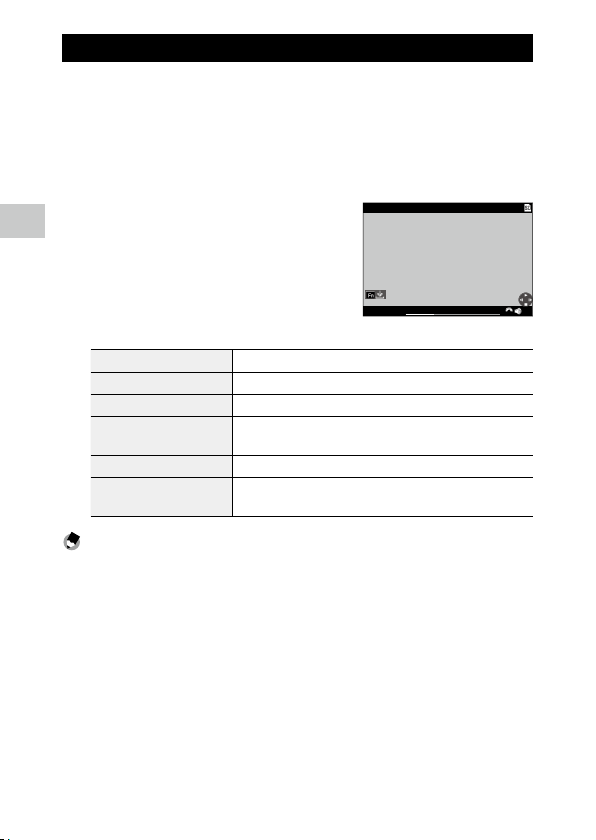
3
56
Taking Pictures
Playing Back Movies
1 Press g.
An image is displayed in the single image display of playback mode.
2 Use cd to select a movie to play back.
The first frame of the movie is displayed as a still image.
3 Play back a movie.
a/Tap Plays back/Pauses a movie.
b/Double-tap Stops playback.
p Adjusts the sound volume (0 to 20).
cd During playback: Fast-reverses/Fast-forwards playback.
While playback is paused: Reverses/Forwards a frame.
h While playback is paused: Saves a still image as a JPEG file.
j Switches between [Standard Info. Display] and [No Information
Display].
Memo ---------------------------------------------------------------------------------------------------------
• The sound volume at the start of movie playback can be set in [Playback Sound Volume] of the C3
menu.
• In [Movie Edit] of the C2 menu, a movie file can be divided into multiple segments or clipped.
(p.108)
10/9999
00´ 20˝
100-0010
10:00
5
02/02/2019
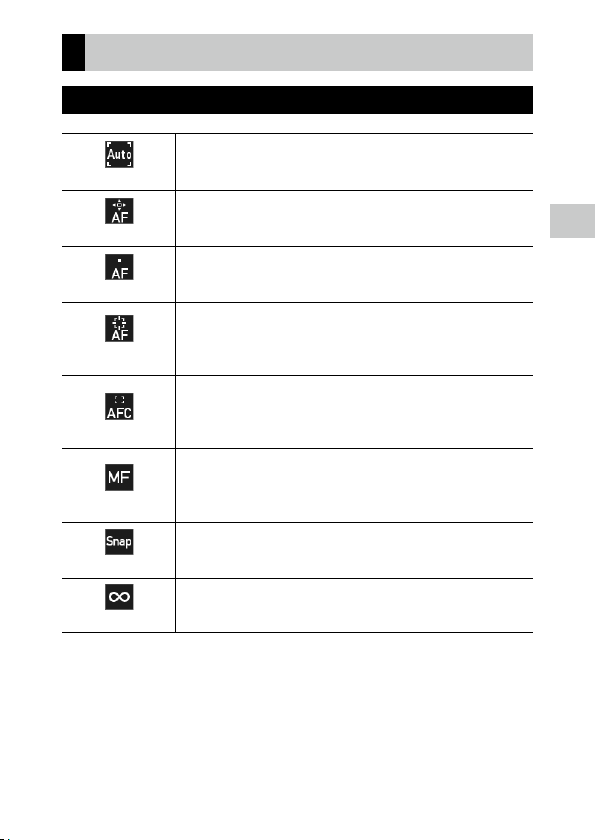
3
57
Taking Pictures
Setting the Focus
Setting the Focus Mode
Auto-area AF
Measures the distances from 5 × 5 AF areas and focuses to the optimum AF area.
(Default setting)
Select AF
Focuses to the selected AF areas. (p.59)
Pinpoint AF
Focuses on a smaller area than [Select AF]. (p.59)
Tracking AF
Tracks the subject and continually focuses. (p.59)
When z is pressed halfway, the subject inside the frame in the center of the
monitor is set as the target to be tracked, and a green target symbol appears. When
a tracking target cannot be found, the frame turns red.
Continuous AF
Keeps focusing while z is pressed halfway. (p.59)
[Focus-priority] or [FPS-priority] can be set in [AF.C Setting] of the A1 menu.
MF
Focuses manually. (p.60)
Snap
Fixes the focus to the set distance.
Set a distance in [Snap Focus Distance] of the A1 menu.
Turn p while pressing a to change the set distance.
Z
Fixes the focus distance at infinity. This is useful for shooting distant scenes.
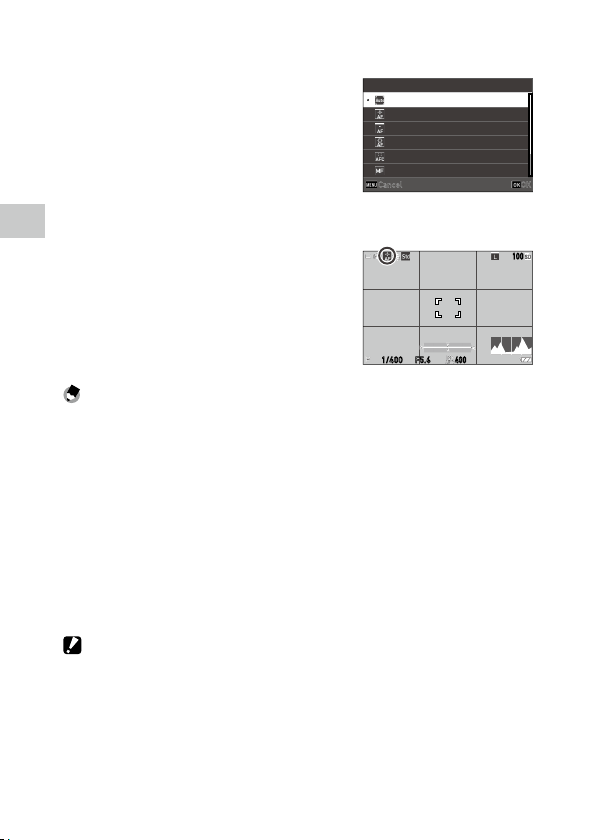
3
58
Taking Pictures
1 Select [Focus] in the A1/B1 menu, and press d.
2 Use ab to select a setting.
In B mode, select from [AF], [MF], [Snap],
and [Z].
3 Press e.
4 Press f.
The focus mode icon appears on the shoot-
ing screen.
Memo ---------------------------------------------------------------------------------------------------------
• This function can be registered to [ADJ Mode Setting] or [Fn Button Setting] of the D2 menu.
(p.121, p.123)
If [Set MF], [Set Snap], or [Set Tracking AF] is set to [Fn Button Setting], the focus modes can be
switched with button operation only.
• When [Auto-area AF], [Select AF], or [Pinpoint AF] is set, faces of people are automatically detected.
The setting can be changed to [Use only in Auto-area AF] or [Off] in [Face Detection] of the A1
menu.
• When [Auto-area AF], [Select AF], or [Pinpoint AF] is set, the AF assist light on the front of the camera
lights as necessary. The AF assist light can be set to [Off] in [AF Assist Light] of the A1 menu.
• When [Focus Peaking] is set to [Highlight Edge] or [Extract Edge] in the A1/B1 menu, the out-
line of the subject in focus is emphasized, and this makes it easier to check the focus.
• By default, the autofocus works with h. The action of h can be set in [Focus Settings] of [Fn
Button Setting] in the D2 menu. (p.124)
Caution -------------------------------------------------------------------------------------------------------
• When [Shutter Button Setting] is set to [AE Lock] in the D2 menu, the autofocus does not work
when z is pressed halfway. (p.125)
Auto-area AF
MF
Select AF
Pinpoint AF
Tracking AF
Continuous AF
Focus
Cancel OK
100
F5.6
400
1/400
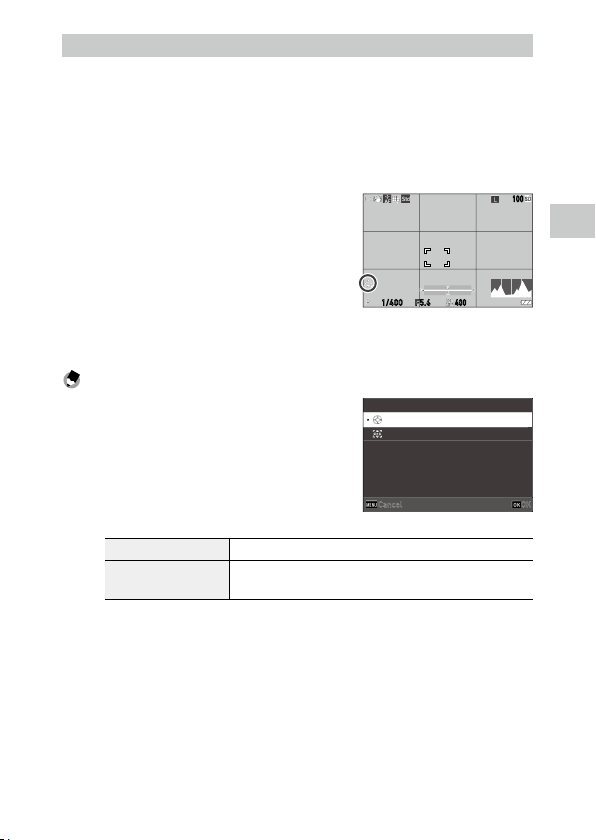
3
59
Taking Pictures
Selecting the Desired AF Point
1 Set [Select AF], [Pinpoint AF], [Tracking AF], or [Continuous AF]
in [Focus] of the A1 menu.
2 Press e on the shooting screen.
The AF point can be changed.
3 Use abcd to set an AF point.
Press and hold e to reset the AF point to
the center.
4 Press e.
The AF point is set.
Memo ---------------------------------------------------------------------------------------------------------
• When [4-way Controller] is set to [AF point change Prior-
ity] in the D2 menu, the AF point can be moved using
abcd without pressing e. In this case, the but-
ton functions are as follows.
e Resets the AF point to the center.
Press and hold e Switches between the AF point setting by abcd and the di-
rect functions (stuv).
100
F5.6
400
1/400
4-way Controller
Direct Key Priority
AF point change Priority
Cancel OK
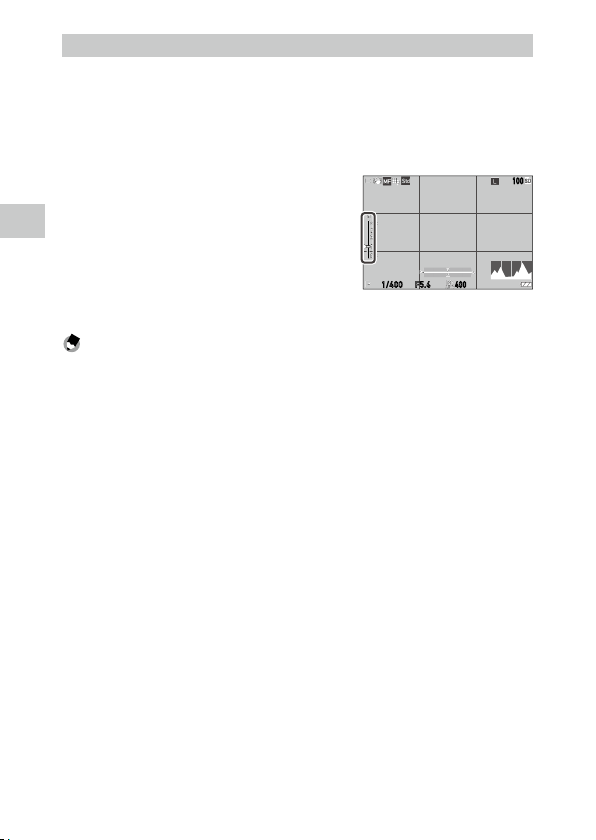
3
60
Taking Pictures
Focusing Manually (Manual Focus)
If the camera fails to focus automatically, you can focus manually.
The manual focus enables shooting at a fixed distance.
1 Set [MF] in [Focus] of the A1/B1 menu.
The focus bar appears on the shooting screen.
2 Press a.
d appears on the focus bar.
3 Use r to set a focus distance.
Memo ---------------------------------------------------------------------------------------------------------
• If [MF Auto Magnification] is set to [On] in the A1/B1 menu, the image on the shooting screen
is automatically magnified. This makes it easier to focus.
100
F5.6
400
1/400
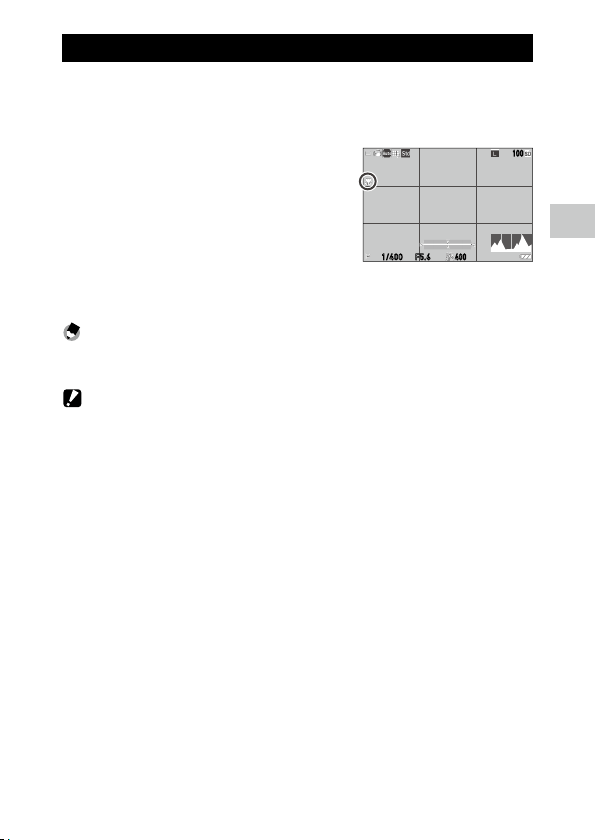
3
61
Taking Pictures
Shooting Close-ups (Macro)
The camera focuses to the range of 6 to 12 cm from the front edge of the
lens.
1 Press a (s) in the shooting mode.
The camera enters the macro mode and the
macro icon appears on the shooting screen.
2 Shoot.
To cancel the macro mode, press a again.
Memo ---------------------------------------------------------------------------------------------------------
• The macro mode can be set to [On] or [Off] in [Macro Mode] of the A4/B4 menu.
• When [Focus] is set to [Snap] or [Z], [Select AF] is applied.
Caution -------------------------------------------------------------------------------------------------------
• When [Focus] is set to [MF], pressing a enables focus distance adjustment. (p.60) To enter the
macro mode, set [Macro Mode] in the A4/B4 menu.
100
F5.6
400
1/400
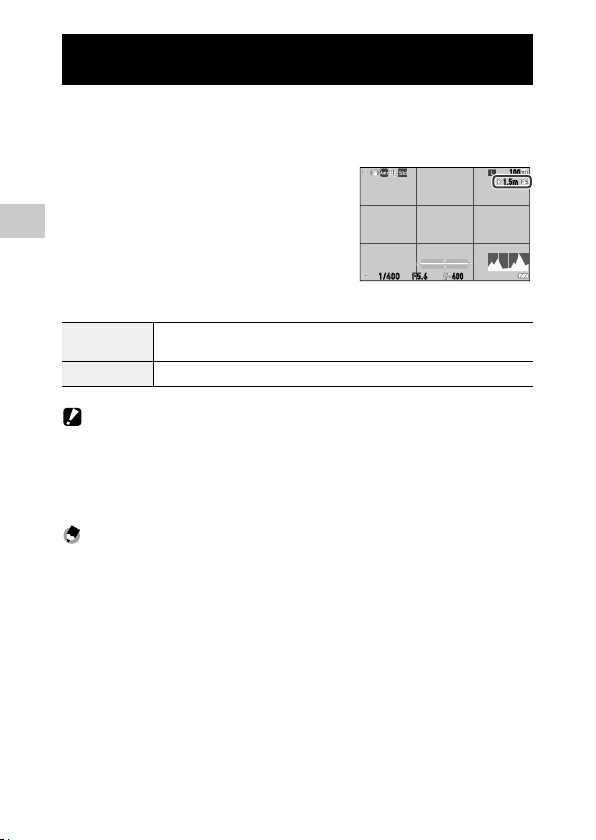
3
62
Taking Pictures
Shooting with a Single Press of the Shutter Release But-
ton (Full Press Snap)
While pressing z halfway operates autofocus, pressing z fully
quickly performs shooting at the set focal distance. This function is called
“Full Press Snap”. The camera focuses at the distance set in [Snap Focus Dis-
tance] of the A1/B1 menu.
Set [Full Press Snap] of the A1 menu.
When set to [On], the icon and shooting dis-
tance are displayed on the shooting screen.
On Performs shooting by focusing at the distance set in [Snap Focus Distance] when
z is fully pressed.
Off Performs autofocus and then shooting.
Caution -------------------------------------------------------------------------------------------------------
• “Full Press Snap” is not available in the following cases.
• B mode
• Macro mode
• When [Focus] is set to [MF], [Snap], or [Z]
• When [Drive Mode] is set to [Self-timer]
Memo ---------------------------------------------------------------------------------------------------------
• Even when [Full Press Snap] is set to [On], the camera focuses at the setting in [Focus] when z
is pressed halfway.
100
F5.6
400
1/400
1.5m

3
63
Taking Pictures
Setting the Exposure
Selecting a Metering Method
Set the metering method in [AE Metering] of
the A2/B2 menu.
Multi-segment
Meters exposure in multiple areas of the frame.
Center-weighted
Meters exposure with emphasis on the center.
Spot
Meters exposure within a narrow range.
Use this option when metering exposure in a part of an image or when the metering
target subject is small.
Highlight-weighted
Meters exposure in multiple areas of the frame with emphasis on the bright areas.
Memo ---------------------------------------------------------------------------------------------------------
• This function can be registered to [ADJ Mode Setting] of the D2 menu. (p.121)
• When [Link AE and AF Point] is set to [On] in the A2 menu, the metering point and the AF point can
be linked in the following combinations of the [AE Metering] and [Focus] settings.
AE Metering Focus
Multi-segment [Select AF], [Pinpoint AF], [Tracking AF], or [Continuous AF]
Spot [Select AF], [Pinpoint AF], or [Continuous AF]
CancelCancel
OKOK
Multi-segment
Center-weighted
Spot
Highlight-weighted
AE Metering
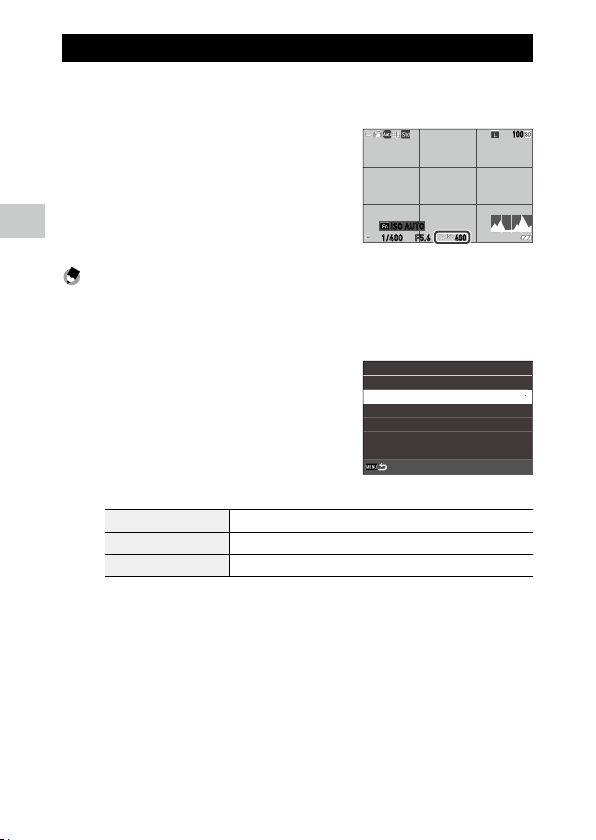
3
64
Taking Pictures
Setting the ISO Sensitivity
1 Press c (u).
2 Use r to change the value.
Values from ISO 100 to ISO 102400 can be set.
Press h to reset to ISO AUTO. Press h again
to reset to the value set last.
Memo ---------------------------------------------------------------------------------------------------------
• This function can be set to [ADJ Mode Setting] of the D2 menu. (p.121)
• Images taken with a higher sensitivity may appear grainy.
• Depending on the ISO sensitivity setting, the setting of [D-Range Correction] in the A6 menu is
disabled. (p.84)
• ISO sensitivity can also be set in [ISO Setting] of the A2
menu. The detailed settings of ISO AUTO can be set from
the menu.
ISO Auto Upper Limit Select the highest ISO sensitivity for ISO AUTO.
ISO Auto Lower Limit Select the lowest ISO sensitivity for ISO AUTO.
Minimum Shutter Speed Select the shutter speed to increase the sensitivity for ISO AUTO.
• When the setting of [ISO Button] has been changed in [Fn Button Setting] (p.123) of the D2
menu, set in the A2 menu.
100
F5.6
400
1/400
ISO AUTO
AUTO
100
1/125
6400
ISO Setting
ISO Auto Upper Limit
ISO Auto Lower Limit
ISO Setting
Minimum Shutter Speed
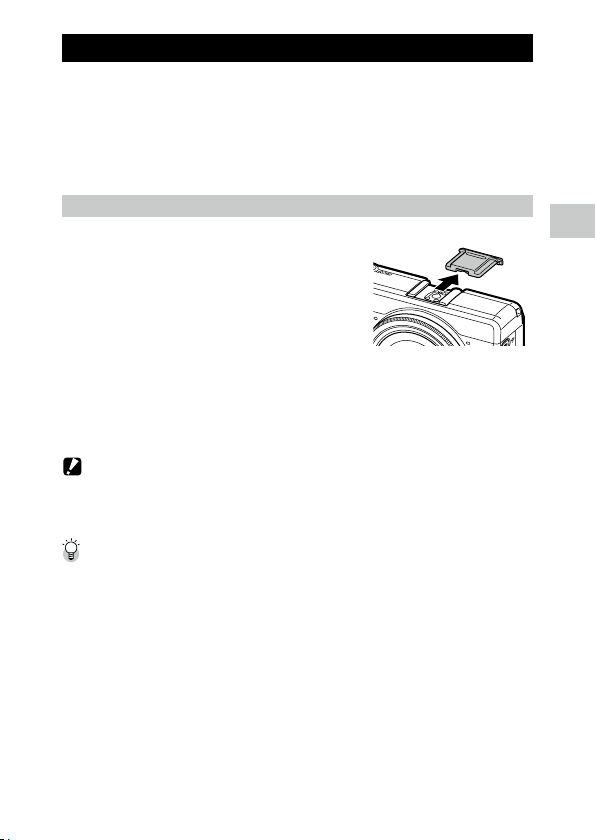
3
65
Taking Pictures
Using a Flash
When a flash unit (optional) is connected to the camera, you can discharge
a flash for shooting.
The following flash units can be used.
• PENTAX AF540FGZ, PENTAX AF540FGZ II
• PENTAX AF360FGZ, PENTAX AF360FGZ II
• PENTAX AF201FG
Connecting a Flash Unit
1 Remove the hot shoe cover from the
camera.
2 Turn the camera and the external flash unit off and attach the
flash unit to the camera hot shoe.
3 Turn the camera and the external flash unit on.
Caution -------------------------------------------------------------------------------------------------------
• Turn the external flash unit off before removing it from the camera.
• If the external flash unit is not recognized by the camera, turn the camera and external flash unit off
and then remove and reattach the flash.
Using Other External Flash Units ------------------------------------------------------------------------
• Use only flash units with one signal terminal, which must be an X-contact with a positive voltage of
no more than 20 V.
• When other external flash units are used, you cannot set the flash mode. The flash always operates
with [Flash On].
• A flash signal is output to the X-contact of the hot shoe regardless of the flash setting.
• Use an external flash unit with a lighting angle that covers the angle of view of the shooting lens.

3
66
Taking Pictures
Setting the Flash Mode
Flash On
Always fires the flash. (Default setting)
Flash On+Red-eye
Forces the flash to fire while reducing the red-eye phenomenon.
Slow-speed Sync
Fires the flash with the shutter speed slowed. Use when taking nightscape pictures
that include people. Use of a tripod is recommended to prevent blur.
Slow Sync+Red-eye
Fires the flash with the shutter speed slowed while reducing the red-eye phenom-
enon.
1 Select [Flash Mode] in the A2 menu, and press d.
2 Select [Flash Mode], and press d.
3 Use ab to select a flash mode, and
press e.
4 To compensate the flash exposure, select [Flash Exposure
Comp.], and press d.
5 Select a compensation value, and
press e.
Settings can be made in the range from -2.0
to +1.0.
6 Press f twice.
Caution -------------------------------------------------------------------------------------------------------
• In L and N modes, [Slow-speed Sync] and [Slow Sync+Red-eye] cannot be selected.
Flash Mode
Flash On
Flash On+Red-eye
Slow-speed Sync
Slow Sync+Red-eye
CancelCancel OKOK
+0.3
-0.3
-0.7
0.0
-1.0
-1.3
Flash Exposure Comp.
CancelCancel OKOK
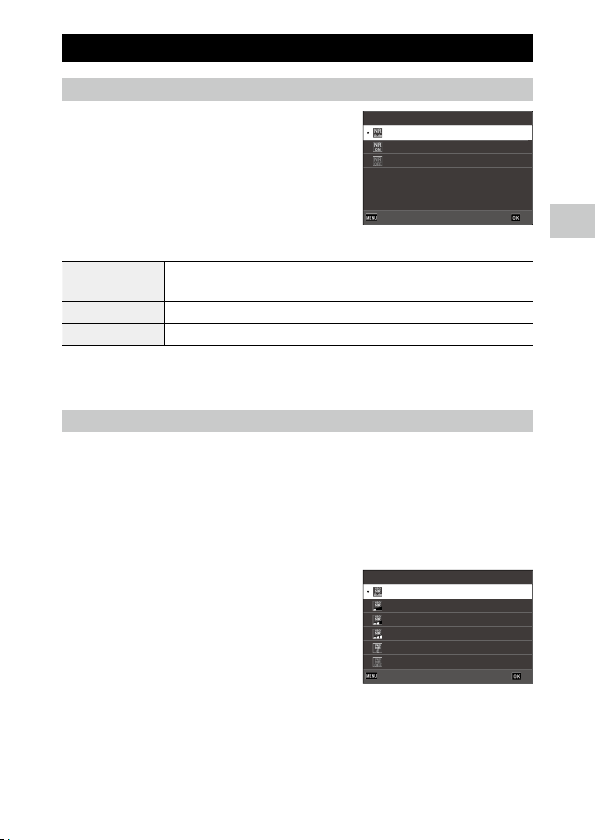
3
67
Taking Pictures
Reducing Noise
Slow Shutter Speed Noise Reduction
Using a long shutter speed results in a noisy
image. When [Slow Shutter Speed NR] is set in
the A6 menu, noise reduction processing is
carried out.
Auto Applies the noise reduction according to the shutter speed, sensitivity, and internal
temperature of the camera.
On Applies the noise reduction when the shutter speed is slower than 1 second.
Off Does not apply the noise reduction at any ISO setting.
The status lamp blinks while the processing of [Slow Shutter Speed NR] is
being performed.
High-ISO Noise Reduction
You can reduce the amount of noise when image are taken with a higher
sensitivity.
1 Select [High-ISO Noise Reduction] in [Noise Reduction] of the
A6 menu, and press d.
The [High-ISO Noise Reduction] screen appears.
2 Use ab to select a setting, and
press e.
Slow Shutter Speed NR
Auto
On
Off
CancelCancel OKOK
High-ISO Noise Reduction
Auto
Low
Medium
High
Custom
Off
CancelCancel OKOK
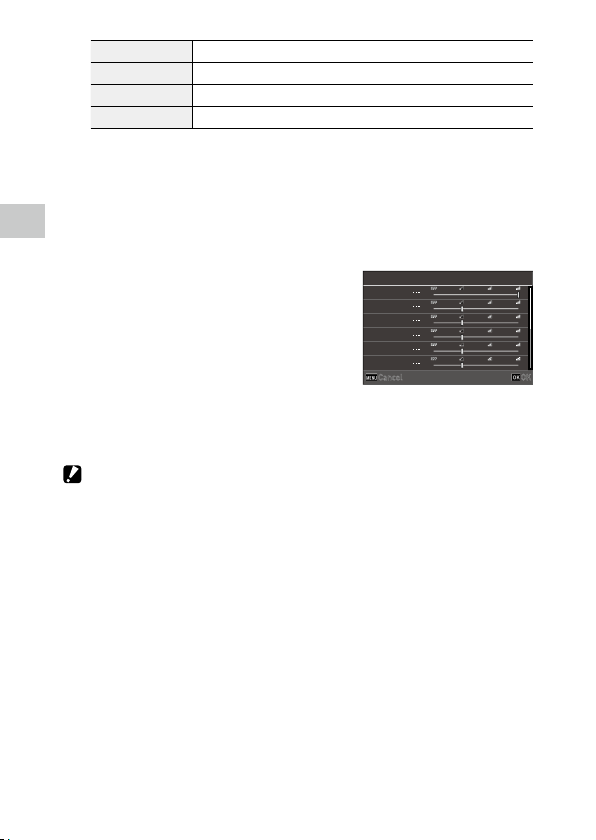
3
68
Taking Pictures
Auto Automatically reduces noises according to the ISO sensitivity.
Low, Medium, High Applies Noise Reduction at constant chosen level throughout ISO range.
Custom The Noise Reduction level can be set for each ISO setting.
Off Does not apply Noise Reduction at any ISO setting.
The [Noise Reduction] screen appears.
When [Custom] is selected, proceed to the next step.
When other settings are selected, proceed to Step 5.
3 Select [Custom Options], and press d.
The ISO sensitivity setting screen appears.
4 Use ab to select an ISO sensitivity
and cd to select a level.
5 Press e.
6 Press f twice.
Caution -------------------------------------------------------------------------------------------------------
• When noise reduction is set, it may take longer than normal to save images.
SO 100
SO 200
SO 400
SO 800
SO 1600
SO 3200
High-ISO Noise Reduction
Cancel OK
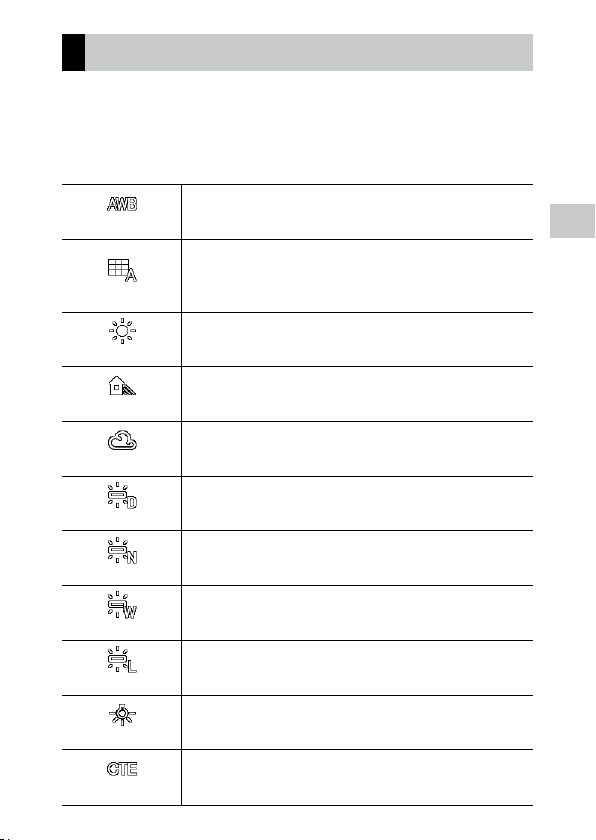
3
69
Taking Pictures
Setting the White Balance
Make adjustments to the white balance so that white subjects will appear
white under any kind of light.
If the white balance is not how you thought it would be when shooting
an object of a single color or when shooting under multiple light sources,
change the setting.
Auto White Balance
Adjusts the white balance automatically.
Multi Auto White Balance
Automatically optimizes the white balance to match each of the separate areas
of light even when multiple light sources are mixed together, such as sunlight
and flash.
This cannot be selected in B mode.
Daylight
Used when shooting in daylight under clear skies.
Shade
Used when shooting in shade.
Cloudy
Used when shooting in daylight under cloudy skies.
Fl. - Daylight Color
Used with daylight fluorescent lighting.
Fl. - Daylight White
Used with neutral white fluorescent lighting.
Fl. - Cool White
Used with cool white fluorescent lighting.
Fl. - Warm White
Used with warm white fluorescent lighting.
Tungsten
Used with incandescent lighting.
CTE
Exaggerates the color of the light source to leave the color of the subject.
Use this setting when you want to emphasize the color used for most part of the
image.
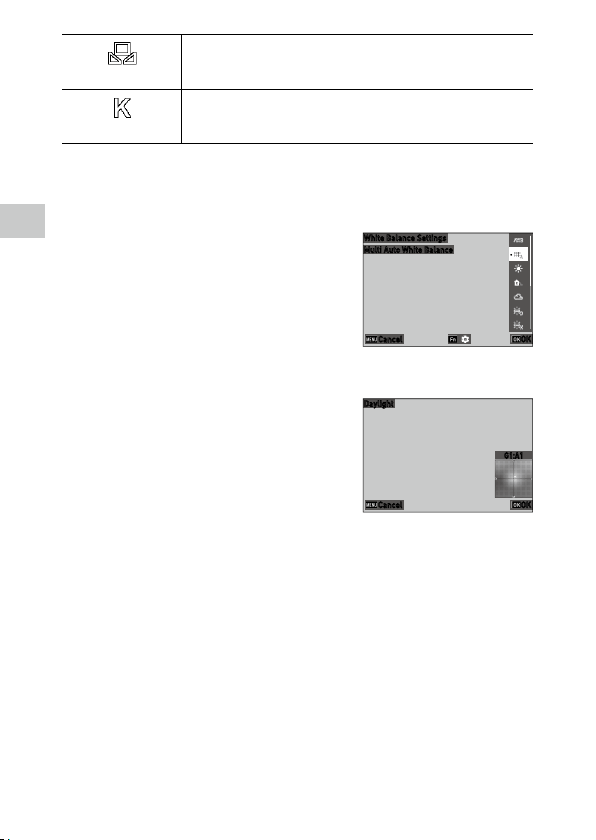
3
70
Taking Pictures
Manual White Balance
Set the white balance manually. (p.72)
Color Temperature
Set the color temperature between 2500 to 10000 K. (p.73)
1 Press t (b) in the shooting mode.
The [White Balance] screen appears.
2 Use ab to select a setting.
If no compensation is required, proceed to
Step 6.
Refer to p.72 for details on [Manual White
Balance] and p.73 for [Color Temperature].
3 Press h.
4 Use abcd to fine-tune the color.
5 Press e.
The screen in Step 2 reappears.
Cancel
Multi Auto
White Balance
White Balance Settings
OK
G1:A1
Cancel OK
Daylight
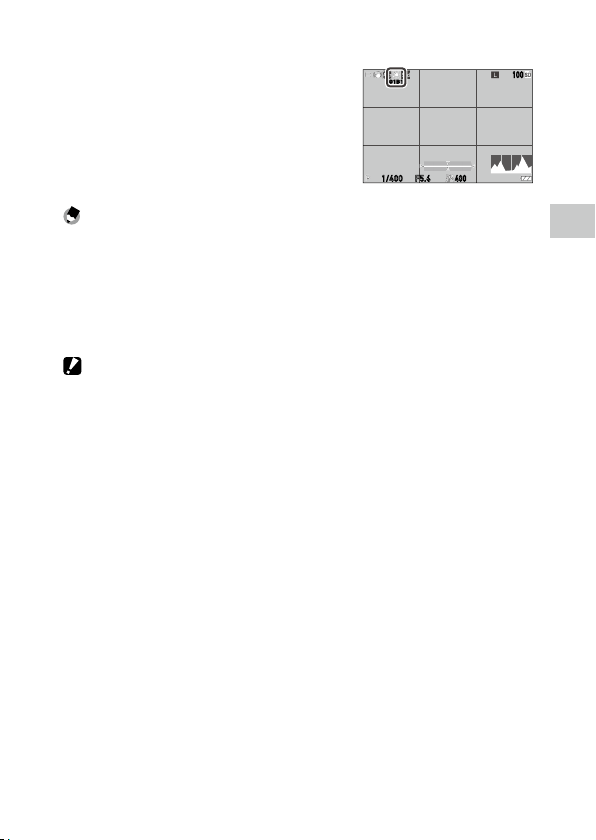
3
71
Taking Pictures
6 Press e.
The white balance icon appears on the shoot-
ing screen.
Memo ---------------------------------------------------------------------------------------------------------
• The white balance can also be set in [White Balance] of the A3/B3 menu.
• When [Composite Mode] is set to [Average] in [Multi-exposure] of [Drive Mode] (p.77), [Auto White
Balance] is applied even if [Multi Auto White Balance] is set.
• To automatically adjust the white balance when the light source is specified, set [WB Fine-tuning] to
[On] in the A3/B3 menu.
• You can set the tungsten light color tone for [Auto White Balance] in [AWB in Tungsten Light] of the
A3/B3 menu.
Caution -------------------------------------------------------------------------------------------------------
• The white balance may not be adjusted correctly for a subject that is mostly dark.
• When using a flash, set the white balance to [Auto White Balance], [Multi Auto White Balance], or
[Manual White Balance]. The white balance may not be adjusted correctly for other settings.
100
F5.6
400
1/400
G1B1
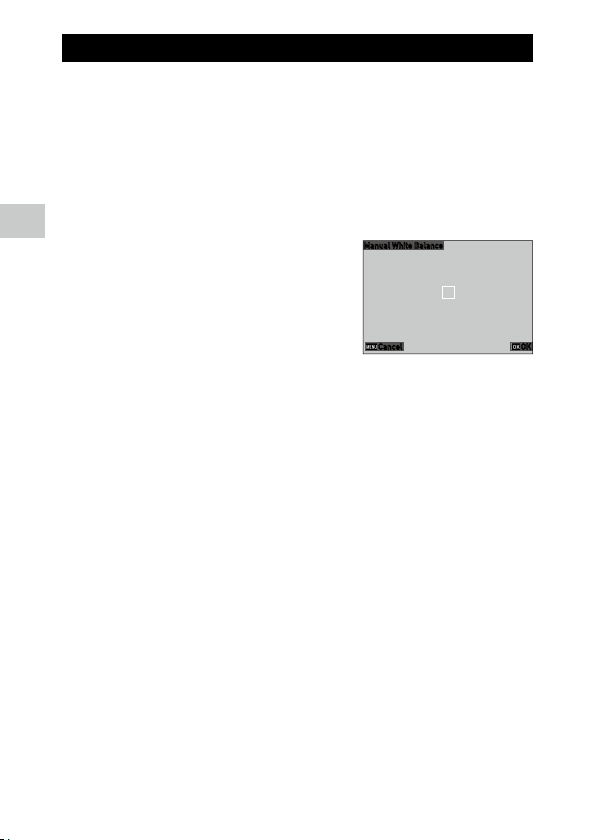
3
72
Taking Pictures
Setting the White Balance Manually
1 Select [Manual White Balance] in Step 2 on p.70.
2 Aim the camera at a white subject, such as a sheet of paper,
under the light for shooting.
3 Press j.
An image to be used for white balance adjustment is taken.
4 Use abcd to adjust the point.
5 Press e.
The [White Balance] screen reappears.
6 Press e.
The shooting screen reappears.
Cancel
Manual White Balance
OK
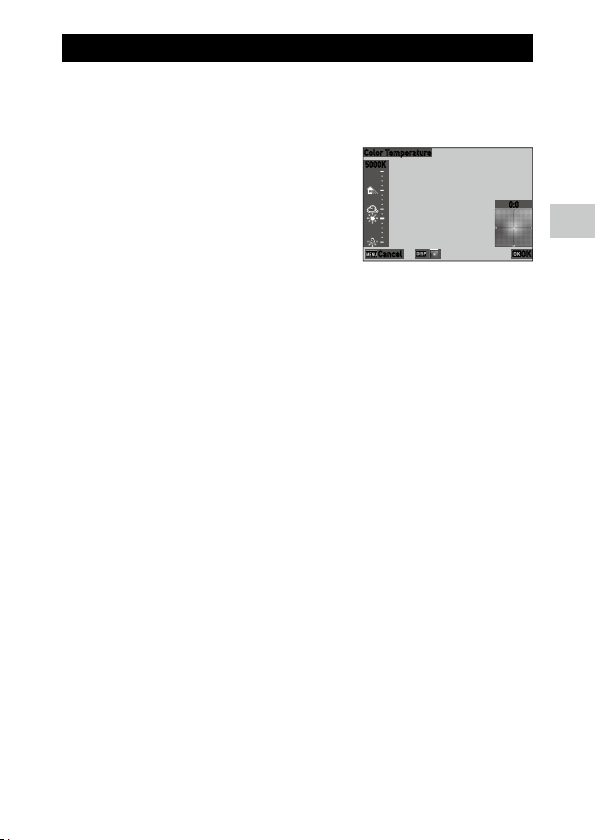
3
73
Taking Pictures
Setting the Color Temperature
1 Select [Color Temperature] in Step 2 on p.70, and press d.
The [Color Temperature] screen appears.
2 Use ab to set a value.
The color temperature can be set between
2500 to 10000 K in increments of 10 K.
Press j to fine-tune the color.
3 Press e.
The [White Balance] screen reappears.
4 Press e.
The shooting screen reappears.
0:0
5000K
Cancel
OK
Color Temperature
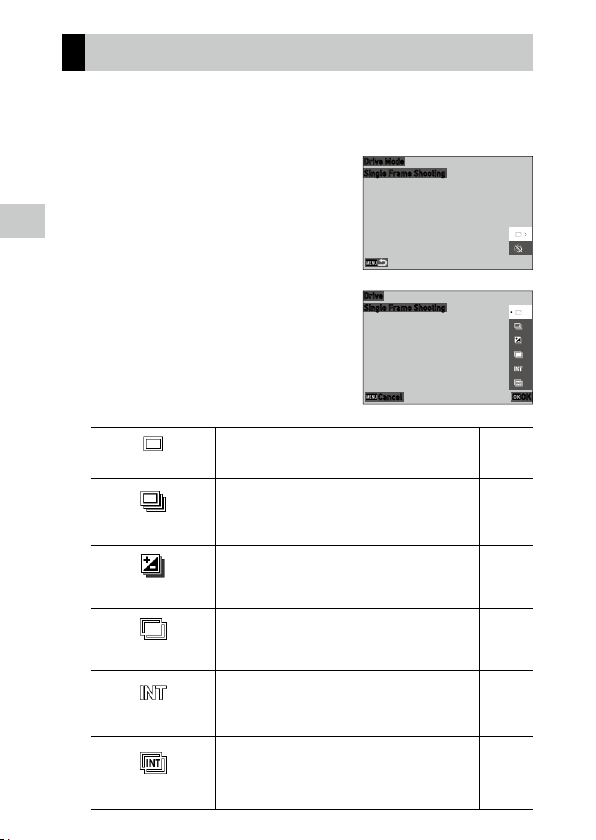
3
74
Taking Pictures
Setting the Drive Mode
1 Press v (d) in the shooting mode.
The [Drive Mode] screen appears.
2 Press d.
The [Drive] screen appears.
For [Self-timer], refer to p.83.
3 Use ab to select a drive mode.
Single Frame Shooting
Takes a single picture per shooting. —
Continuous Shooting
Performs continuous shooting while z is pressed. p.79
Bracketing
Takes three images with different exposure settings. p.76
Multi-exposure
Takes images while merging them together. p.77
Interval Shooting
Takes pictures automatically at a fixed interval. p.79
Interval Composite
Merges a series of images taken continuously in such a way
that the bright areas remain. Use this function when you
want to record the trails of light formed by stars or the moon
during nightscape shooting at a fixed position.
p.81
Drive Mode
Single
Frame Shooting
Cancel OK
Drive
Single
Frame Shooting
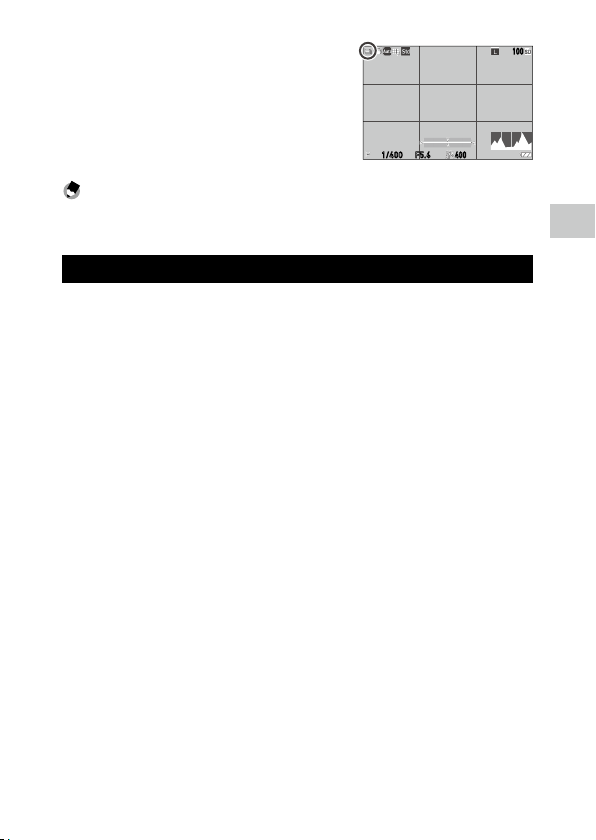
3
75
Taking Pictures
4 Press e.
The drive mode icon appears on the shoot-
ing screen.
Memo ---------------------------------------------------------------------------------------------------------
• The drive mode can also be set in [Drive Mode] of the A4 menu.
Shooting Continuously (Continuous Shooting)
1 Select [Continuous Shooting] in Step 3 on p.74.
2 Press and hold z on the shooting screen.
Pictures continue to be taken as long as you hold down z.
100
F5.6
400
1/400
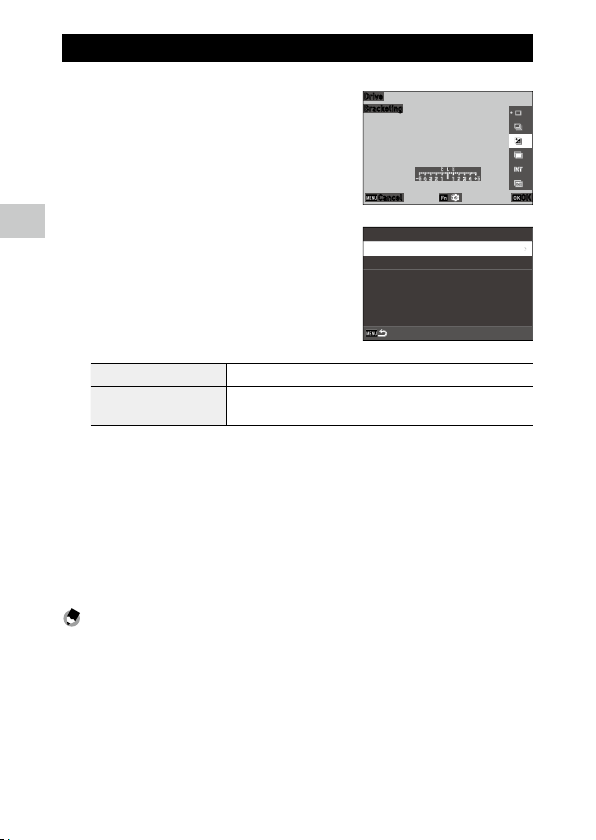
3
76
Taking Pictures
Shooting with Varied Exposure Values (Bracketing)
1 Select [Bracketing] in Step 3 on
p.74, and press h.
The detailed setting screen appears.
2 Use abcd to change the setting.
Bracket Value Sets the range in which to change the exposure from ±0.3 to ±5.0.
Bracketing Order Sets the order of 3 images to be taken from [0 - +], [- 0 +], [+ 0 -],
and [0 + -].
3 Press f.
The [Drive] screen reappears.
4 Press e.
The shooting screen reappears.
5 Press z.
Three images are saved in the set order with one release of the shutter.
Memo ---------------------------------------------------------------------------------------------------------
• When using the flash, pictures are taken while automatically changing flash exposure.
Drive
Br
acketing
Cancel OK
±0.3
0−+
Bracketing
Bracket Value
Bracketing Order
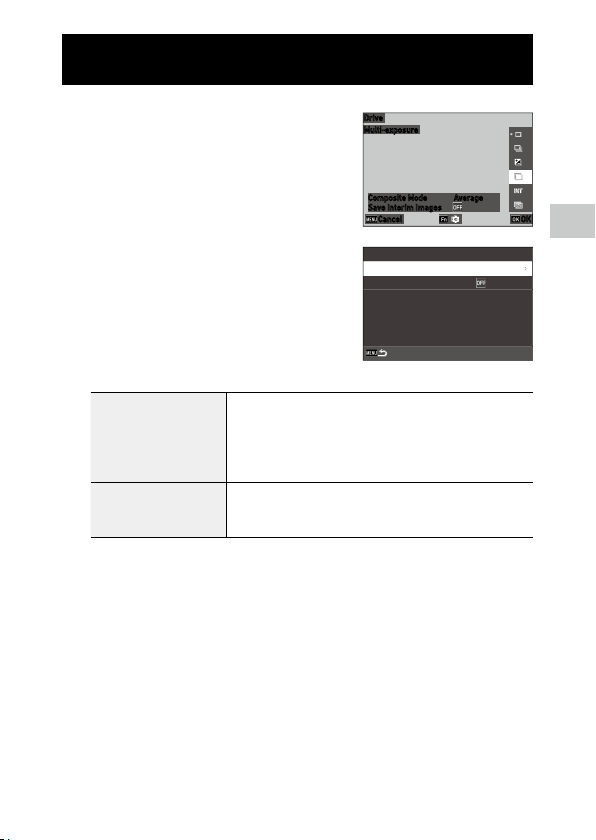
3
77
Taking Pictures
Shooting While Merging Images Together (Multi-expo-
sure)
1 Select [Multi-exposure] in Step 3 on
p.74, and press h.
The detailed setting screen appears.
2 Use abcd to change the setting.
Composite Mode [Average]: Creates a composite image with the average exposure.
[Additive]: Creates a composite image with the cumulatively added
exposure.
[Bright]: Creates a composite image replacing only the portions that
are brighter compared with the first image.
Save Interim Images Specifies whether to save unprocessed images and images in the
middle of processing.
Images in the middle of processing are saved in JPEG format.
3 Press f.
The [Drive] screen reappears.
4 Press e.
The shooting screen reappears.
5 Take the first image.
Save Interim Images
Composite Mode
Average
Multi-exposur
e
Drive
Cancel OK
Multi-exposure
Composite Mode
Save Interim Images
Average

3
78
Taking Pictures
6 To take the next image, select [Next
shot], and then press e.
To retake the image, select [Retake shot].
7 Take the next image.
Repeat Steps 6 and 7.
To return to the previous merged image, select [Retake shot].
8 Select [Complete] to end shooting.
The merged image is saved.
Caution -------------------------------------------------------------------------------------------------------
• The settings for the following functions cannot be changed during the multiple exposure shooting.
• [White Balance] of the A3 menu
• [Drive Mode] of the A4 menu
• [File Format], [Aspect Ratio], [Crop], and [JPEG Recorded Pixels] of the A5 menu
• [Image Control] of the A6 menu
Next shotNext shot
Retake shot
Complete
Execute
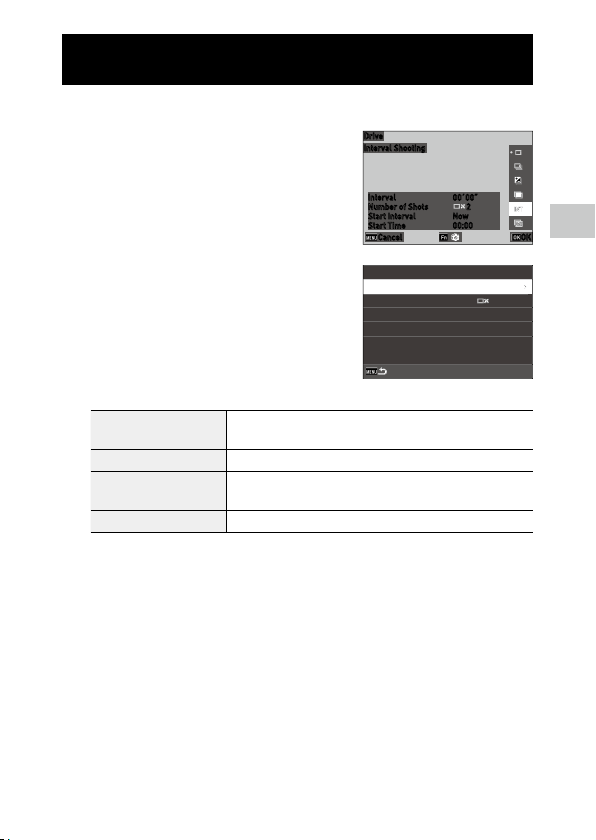
3
79
Taking Pictures
Shooting Automatically at Set Intervals (Interval Shoot-
ing)
The camera takes pictures automatically at fixed intervals.
1 Select [Interval Shooting] in Step 3 on
p.74, and press h.
The detailed setting screen appears.
2 Use abcd to change the setting.
Interval Specifies the shooting interval to the minimum time or in the range
up to 60 minutes.
Number of Shots Specifies the number of shots to [
Z] or from [2] to [99].
Start Interval Specifies whether to take the first image immediately or at the set
time.
Start Time Specifies the time when [Start Interval] is set to [Set Time].
3 Press f.
The [Drive] screen reappears.
4 Press e.
The shooting screen reappears.
5 Press z.
When [Start Interval] is set to [Now], the first image is taken. When [Set Time]
is set, shooting starts at the set time.
To cancel shooting, press e.
2
00:00
00´00˝
Drive
Interval Shooting
Interval
Number of Shots
Start Interval
Start Time
Now
Cancel OK
00´01˝
2
00:00
Interval Shooting
Interval
Number of Shots
Start Interval Now
Start Time

3
80
Taking Pictures
Caution -------------------------------------------------------------------------------------------------------
• Depending on the shooting settings, the time until the next picture is taken may be longer than the
time set for interval shooting.
• When the shooting interval is short, the exposure for the first image may be used for the second
and later images.
• The interval shooting is canceled if the exposure mode is changed or the power is turned off.
Memo ---------------------------------------------------------------------------------------------------------
• For each interval shooting, a new folder is created and the captured images are saved there.
• If shooting is performed with “Full Press Snap” when [Focus] (p.57) is set to [MF], [Snap], or [Z]
in the A1 menu, the focus is fixed at the position of the first shot.
• The use of the battery with sufficient power or the optional AC adapter (D-AC166) is recommended.
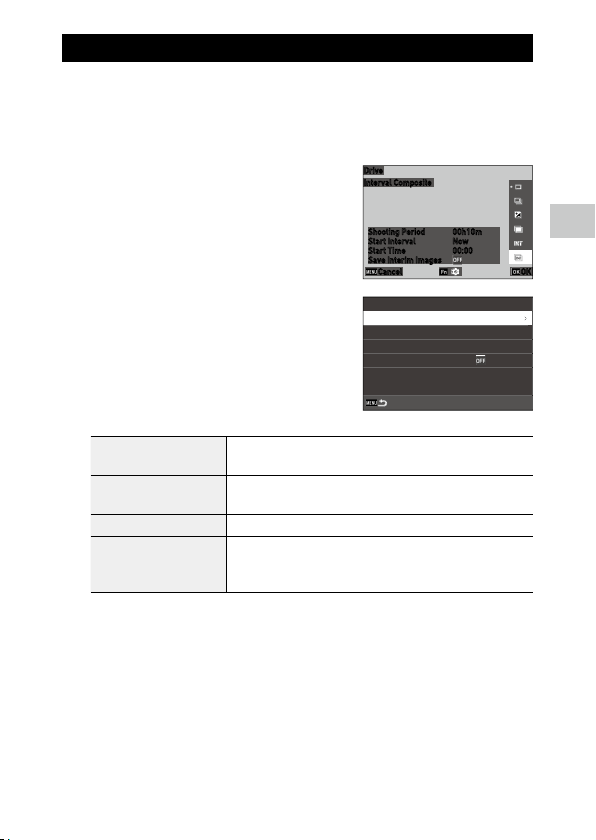
3
81
Taking Pictures
Recording Star Trails (Interval Composite)
1 Mount the camera on a tripod, and take a test shot.
Set the exposure, focus mode, and white balance, and then check the com-
position. Images are merged with this exposure setting.
2 Select [Interval Composite] in Step 3
on p.74, and press h.
The detailed setting screen appears.
3 Use abcd to change the setting.
Shooting Period Specifies the shooting period to [Z] or in the range from 10 minutes
to 24 hours.
Start Interval Specifies whether to take the first image immediately or at the set
time.
Start Time Specifies the time when [Start Interval] is set to [Set Time].
Save Interim Images Specifies whether to save unprocessed images and images in the
middle of processing.
Images in the middle of processing are saved in JPEG format.
4 Press f.
The [Drive] screen reappears.
5 Press e.
The shooting screen reappears.
00h10m
00:00
Drive
Interval Composite
Shooting Period
Start Interval
Start Time
Save Interim Images
Now
Cancel OK
00:00
00h10m
Interval Composite
Shooting Period
Start Interval
Start Time
Save Interim Images
Now

3
82
Taking Pictures
6 Take the first image.
Images are taken continuously at the shortest interval.
To check the images being merged, press z halfway.
If z is pressed fully, the images merged up to that point are saved as they
are, and the interval composite shooting starts with a new image.
To cancel shooting, press e.
Caution -------------------------------------------------------------------------------------------------------
• If e is pressed or z is fully pressed during exposure, the image at that moment is not
merged.
• The interval shooting is canceled if the exposure mode is changed or the power is turned off.
• Autofocus is not performed for the second image and subsequent images.
• [Slow Shutter Speed NR] of [Noise Reduction] in the A6 menu and [Shake Reduction] of the A7
menu are fixed to [Off].
Memo ---------------------------------------------------------------------------------------------------------
• For each interval composite, a new folder is created and the images are saved there.
• The values of the following settings are fixed when the first image is taken.
• ISO sensitivity, shutter speed, and aperture value when ISO AUTO is set
• White balance value when the white balance is set to [Auto White Balance]
• During shooting in a dark location, using the optional external viewfinder (GV-1/GV-2) is convenient.

3
83
Taking Pictures
Using the Self-timer
In the drive modes other than [Continuous
Shooting], [Self-timer] can be used.
The self-timer can be set to [10sec.] or [2sec.].
The AF assist light blinks during the count-
down for self-timer shooting.
Memo ---------------------------------------------------------------------------------------------------------
• The self-timer can only be used for the first image in [Interval Shooting] and [Interval Composite].
When [Start Interval] is set to [Set Time], the self-timer cannot be used.
• You can set the AF assist light not to blink during the countdown. (p.129)
Cancel OK
Self-timer
10sec.
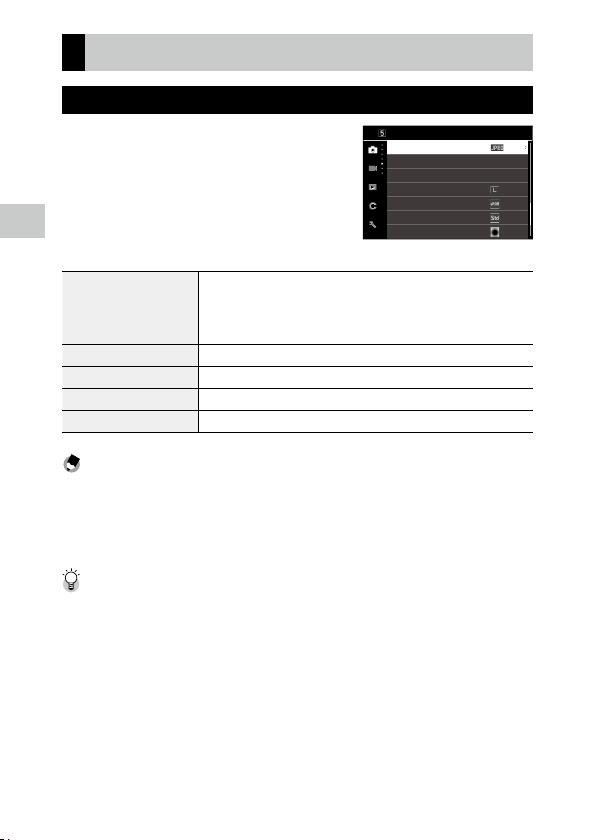
3
84
Taking Pictures
Configuring the Capture Settings
Image Capture Settings
Set the file format for still images in [Image
Capture Settings] of the A5 menu.
File Format [JPEG]
[RAW]: Records a RAW image (DNG format).
[RAW+JPEG]: Records a RAW image simultaneously with a JPEG
image.
Aspect Ratio [3:2], [1:1]
Crop [35mm], [50mm], [Off]
JPEG Recorded Pixels [L], [M], [S], [XS]
Color Space [sRGB], [AdobeRGB]
Memo ---------------------------------------------------------------------------------------------------------
• When [Aspect Ratio] is set to [1:1], black band(s) appears at the right and left sides of the monitor.
• This function can be registered to [ADJ Mode Setting] or [Fn Button Setting] in the D2 menu.
(p.121, p.123)
If [JPEG RAW] or [JPEG RAW+] is set to [Fn Button Setting], the image format can be easily
switched.
Shooting RAW Images -------------------------------------------------------------------------------------
• A RAW image can be converted to JPEG format in [RAW Development] of the C2 menu. (p.100)
• The following functions are not reflected in RAW images. These functions can be reflected when a
RAW image is converted to JPEG format in [RAW Development] of the C2 menu.
• Image Control
• Shadow Correction
When [RAW+JPEG] is set, the functions mentioned above are reflected in JPEG images only.
3:2
Image Capture Settings
File Format
Aspect Ratio
Crop Off
JPEG Recorded Pixels
Color Space
Image Control
Peripheral Illumin. Corr.
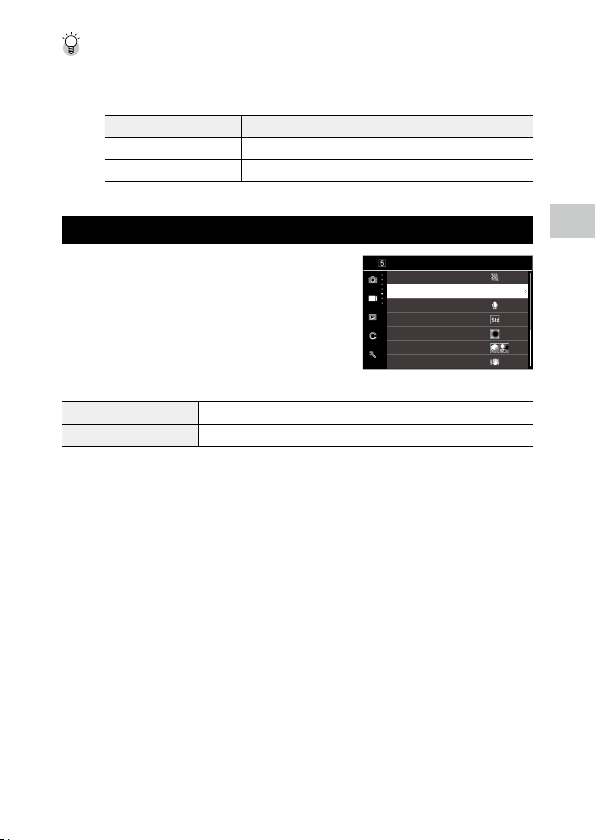
3
85
Taking Pictures
Crop -----------------------------------------------------------------------------------------------------------
• When [Crop] is set to [35mm] or [50mm], the 35 mm equivalent angle of view is changed from de-
fault 28 mm to 35 mm or 50 mm, and the image display is also changed.
• When [Crop] is set, a restriction is applied to [JPEG Recorded Pixels].
Crop JPEG Recorded Pixels
35mm When [L] is set: Records images with [M].
50mm When [L] or [M] is set: Records images with [S].
Movie Capture Settings
Set the file format for movies in [Movie Capture
Settings] of the B5 menu.
Framerate [60p], [30p], [24p]
Sound Recording [On], [Off]
Movie SR
60p
Movie Capture Settings
Framerate
Sound Recording
Macro Mode
Image Control
Peripheral Illumin. Corr.
D-Range Correction
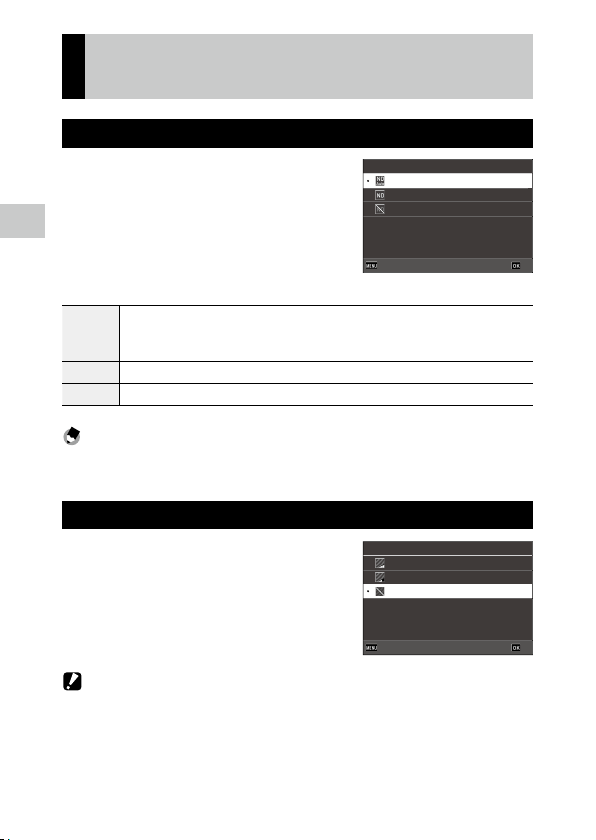
3
86
Taking Pictures
Setting the Image Finishing Tone and Cor-
rection
Using the ND Filter
With [ND Filter] in the A2/B2 menu, you can
set whether or not to always use the camera’s
internal ND filter.
Auto The camera determines whether to turn the function on or off according to conditions. The ND
filter is used if the icon is displayed on the shooting screen when z is pressed halfway.
[Auto] cannot be selected in B mode.
On The ND filter is always used. The icon is displayed on the shooting screen.
Off The ND filter is not used.
Memo ---------------------------------------------------------------------------------------------------------
• This function can be registered to [Fn Button Setting] in the D2 menu. (p.123)
Reducing Moiré (AA Filter Simulator)
A moiré reduction effect simulating that of a
low-pass filter can be achieved with [AA Filter
Simulator] of the A4 menu.
[High], [Low], or [Off] can be selected.
Caution -------------------------------------------------------------------------------------------------------
• When shooting with a fast shutter speed or using a flash, the full effect of this function may not be
achieved.
CancelCancel OKOK
Auto
On
Off
ND Filter
High
Low
Off
AA Filter Simulator
CancelCancel OKOK
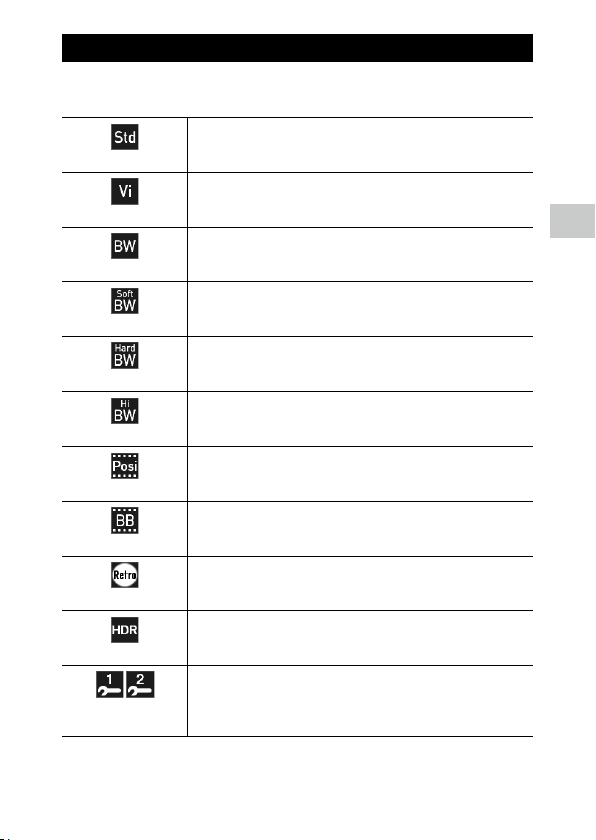
3
87
Taking Pictures
Setting the Image Atmosphere (Image Control)
Images with varied saturation and contrast can be taken.
The settings such as the hue can be changed to take distinctive images.
Standard
Takes images with normal image quality.
Vivid
Takes images with sharp and vivid colors.
Monotone
Takes a black and white image.
Soft Monotone
Takes a black and white image that gives soft impression.
Hard Monotone
Takes a black and white image that gives hard impression.
Hi-Contrast B&W
Takes a black and white image with stronger contrast. Makes it possible to take
images with a grainy feel, such as that created with ultra-high-sensitivity film in
a film camera or with push processing film at the development stage.
Positive Film
Takes highly saturated images like those taken with positive film.
Bleach Bypass
Takes images with low saturation and high contrast.
Retro
Takes images that look like old photos.
HDR Tone
Takes images finished like a painting with enhanced fine contrast.
Custom1
Custom2
Two settings can be registered.
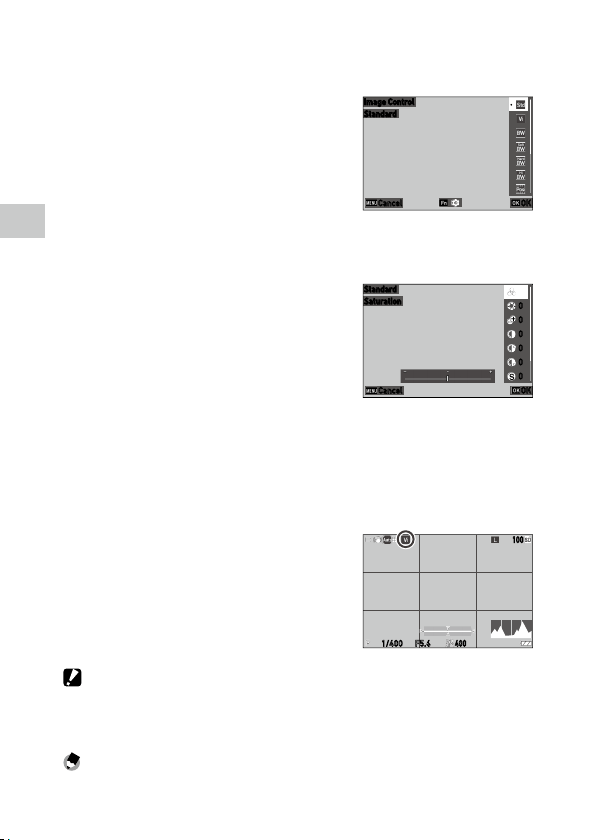
3
88
Taking Pictures
1 Select [Image Control] in the A6/B6 menu, and press d.
The [Image Control] screen appears.
2 Use ab to select an image.
Proceed to Step 6 if you do not need to
change the parameters.
3 Press h.
The detailed setting screen appears.
4 Use abcd to change the setting.
Available parameters vary depending on the
selected image.
5 Press e.
The screen in Step 2 reappears.
6 Press e.
7 Press f.
The icon appears on the shooting screen.
Caution -------------------------------------------------------------------------------------------------------
• [Soft Monotone] and [HDR Tone] cannot be selected in B mode.
• The [Image Control] setting is not applied to RAW images. It can be set when [RAW Development] of
the C2 menu is performed. (p.100)
Memo ---------------------------------------------------------------------------------------------------------
• This function can be registered to [ADJ Mode Setting] or [Fn Button Setting] in the D2 menu.
(p.121, p.123)
Image Control
Standar
d
Cancel OK
0
0
0
0
0
0
0
Standard
Satur
ation
Cancel
OK
100
F5.6
400
1/400
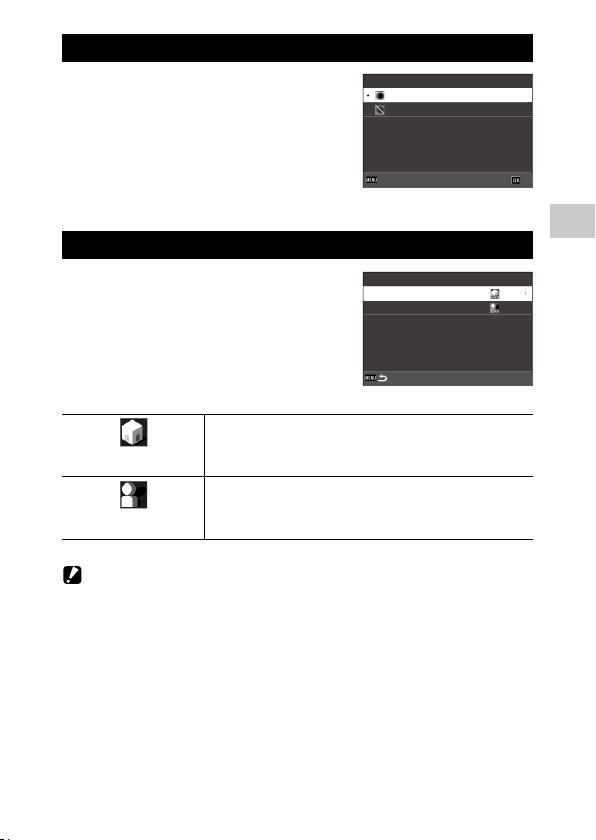
3
89
Taking Pictures
Correcting the Peripheral Illumination
With [Peripheral Illumin. Corr.] of the A6/B6
menu, you can reduce peripheral light fall-off
occurring due to lens properties.
Correcting a Range of Tones (D-Range Correction)
With [D-Range Correction] of the A6/B6
menu, you can expand an image gradation to
make the bright and dark portions of an image
clearly visible.
Highlight Correction
[Auto], [On], or [Off] can be selected.
[On] cannot be selected in B mode.
Shadow Correction
[Auto], [Low], [Medium], [High], or [Off] can be selected.
Caution -------------------------------------------------------------------------------------------------------
• When [Shadow Correction] is set to [High], noise may be noticeable in images.
• When the ISO sensitivity is set to a value lower than ISO 200, [Highlight Correction] has no effect.
CancelCancel OKOK
On
Off
Peripheral Illumin. Corr.
D-Range Correction
Highlight Correction
Shadow Correction
3
90
Taking Pictures
Reducing Blurring of Images
To automatically reduce blurring of images, set the following functions.
By default, both settings are set to [On].
Still image mode [Shake Reduction] of the A7 menu
Movie mode [Movie SR] of the B7 menu
Memo ---------------------------------------------------------------------------------------------------------
• If [Shake Reduction] is set to [Fn Button Setting] in the D2 menu, the Shake Reduction function can
be turned on and off with button operation only. (p.123)
• When [Self-timer] is set in [Drive Mode], [Shake Reduction] is automatically set to [Off]. To fix the
setting to [On], set [Auto SR Off] to [Disable Auto SR Off] in the A7 menu.
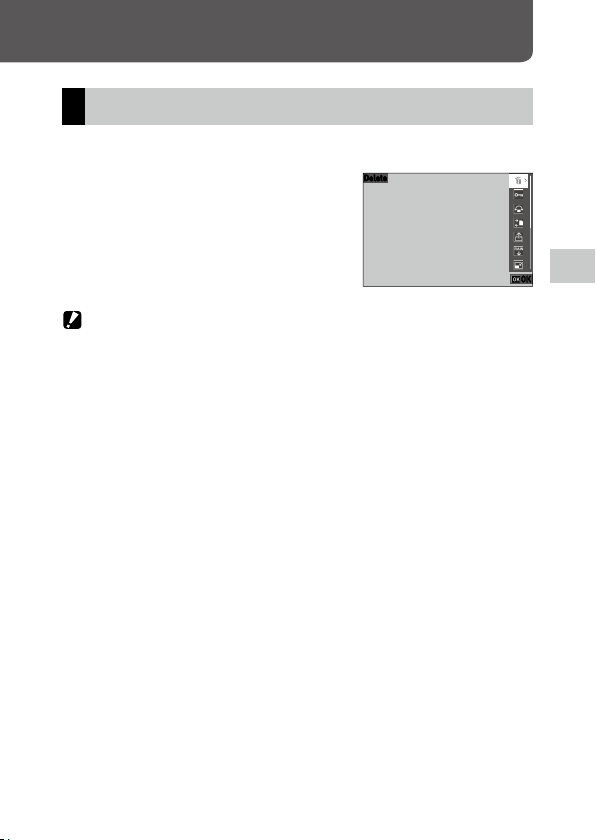
4
Playback Functions
91
Playback Functions
Using the Playback Functions
You can set the playback functions from the C menu or on the playback
functions setting screen.
Press k in the playback mode to display the
playback functions setting screen. The C1/
C2 menu settings can be set on the playback
functions setting screen.
Caution -------------------------------------------------------------------------------------------------------
• The playback functions that are not supported by the displayed image cannot be used.
Delete
OK
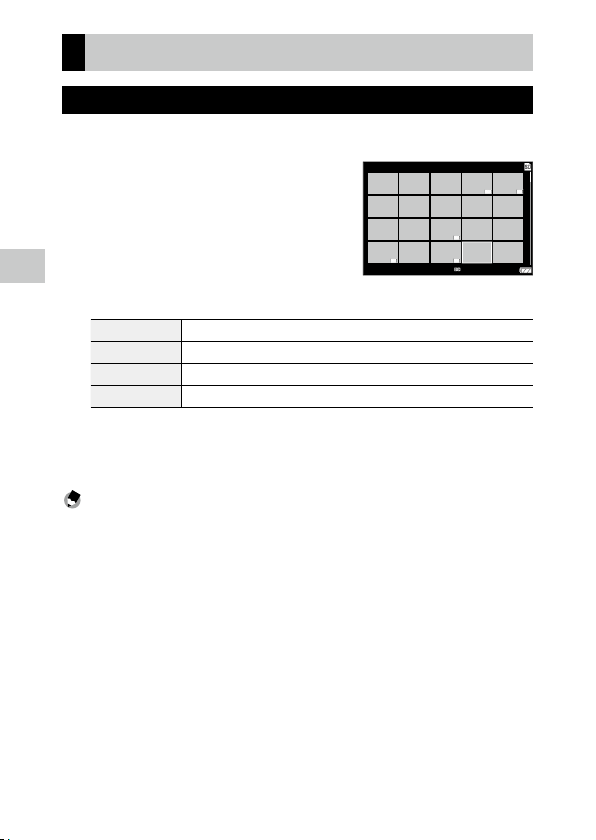
4
Playback Functions
92
Changing the Playback Method
Displaying Multiple Images
You can display multiple images in the thumbnail view.
1 Turn p to the left once in the single
image display of playback mode.
Multiple images are displayed.
The following operations are available.
abcd Moves the selection frame.
j Switches between 20-image view and 48-image view.
i Deletes the selected image.
k Displays the playback functions setting screen.
2 Press e.
The selected image is displayed in the single image display.
Memo ---------------------------------------------------------------------------------------------------------
• Images are played back in order of shooting date. The playback order can be changed to [File No.] in
[Playback Order Options] of the C3 menu.
• If you select [Delete], [Protect], or [File Transfer] of the C1 menu while multiple images are dis-
played, each function is applied to all the displayed images.
100 99999
/
100-0630
1/2400 F5.6 EV+0.7
6400
10:00
02/02/2019
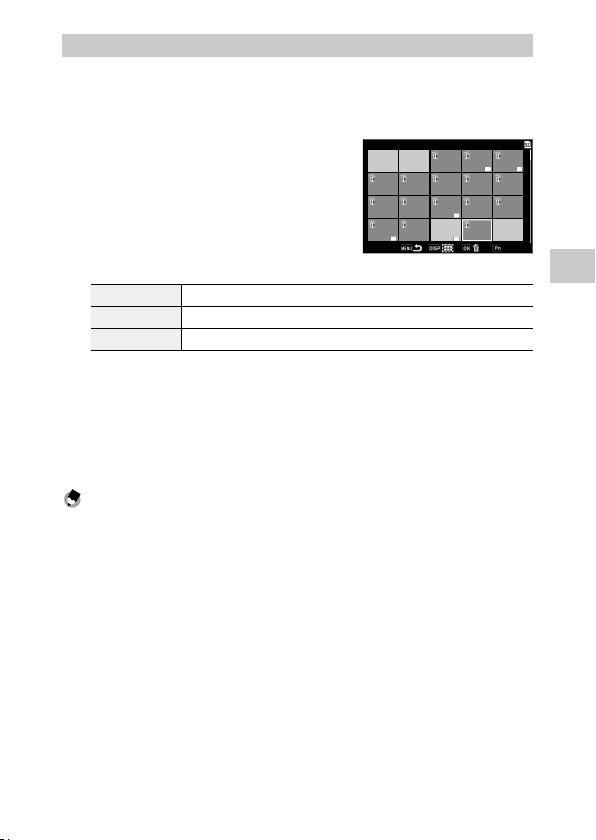
4
Playback Functions
93
Selecting and Deleting Multiple Images
1 Press i on the screen in Step 1 of “Displaying Multiple Images”
(p.92).
2 Select images in multi-image display.
abcd Moves the selection frame.
e Selects/Deselects an image.
j Selects the starting or ending point for image selection range.
3 Press h.
The deletion confirmation screen appears.
4 Select [Execute], and press e.
The selected images are deleted.
Memo ---------------------------------------------------------------------------------------------------------
• Protected images cannot be selected.
• The method to select multiple images is the same also for the following functions.
• Protect (p.97)
• File Transfer (p.99)
Display the C menus or playback functions setting screen in Step 1 of “Displaying Multiple Images”
(p.92), and select the function.
100 99999
/
100-0100
10:00
02/02/2019
Execute
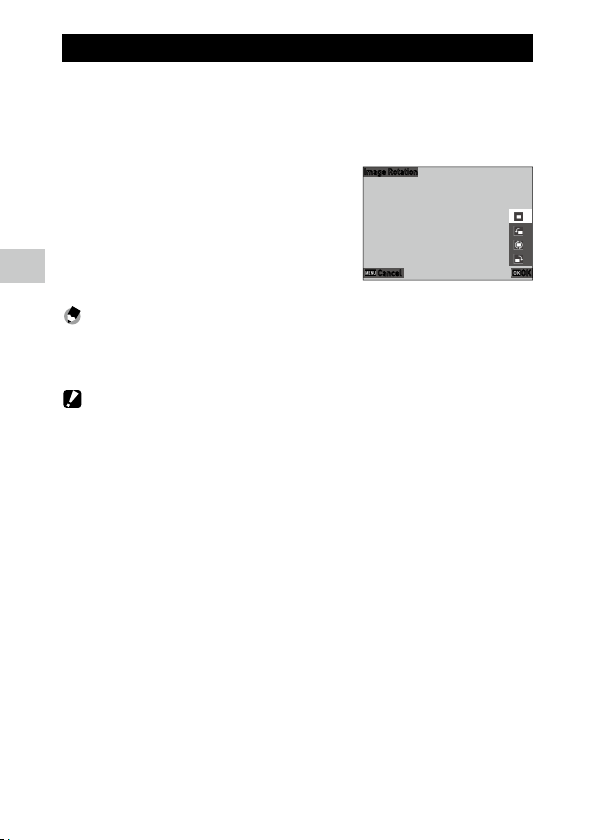
4
Playback Functions
94
Displaying Rotated Images
You can change image rotation information.
1 Select [Image Rotation] in the C1 menu or on the playback
functions setting screen, and press d.
2 Select the rotation direction, and
press e.
Memo ---------------------------------------------------------------------------------------------------------
• In the playback mode, the displayed image is rotated according to the camera’s orientation. When
[Auto Image Rotation] is set to [Off] in the C3 menu, the image display orientation is fixed regard-
less of the [Image Rotation] setting.
Caution -------------------------------------------------------------------------------------------------------
• Rotation direction cannot be changed when the write-protect switch on the memory card is locked
or for the following images.
• Movies
• Protected images
Image Rotation
Cancel OK
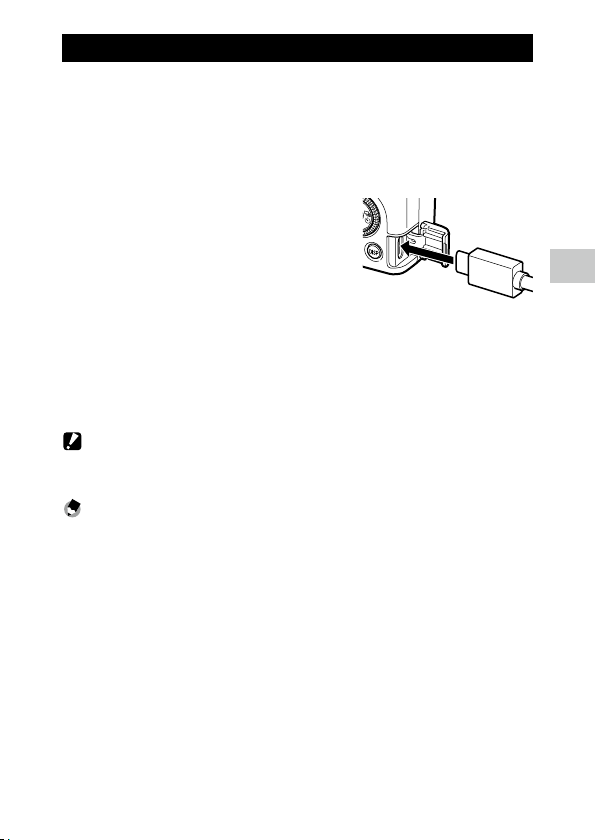
4
Playback Functions
95
Connecting the Camera to an AV Device
Connect the camera to an AV device such as TVs to display Live View images
while shooting or to play back images.
Prepare a commercially available conversion cable that is suitable for the de-
vice connected to the camera.
1 Turn the AV device and camera off.
2 Open the terminal cover of the
camera, and connect the conversion
cable to the USB terminal.
3 Connect the other end of the conversion cable to the input
terminal on the AV device.
For details, refer to the operating manual for the AV device.
4 Turn the AV device and camera on.
Caution -------------------------------------------------------------------------------------------------------
• While the camera is connected to an AV device, nothing is displayed on the camera monitor.
• The audio of the video is output from the AV device. Adjust the volume on the AV device.
Memo ---------------------------------------------------------------------------------------------------------
• The USB terminal (USB Type-C) on this camera supports DisplayPort.
• To output images to a device with an HDMI® terminal, used a USB (Type-C)-to-HDMI® adapter. Some
adapters cannot be used with this camera.
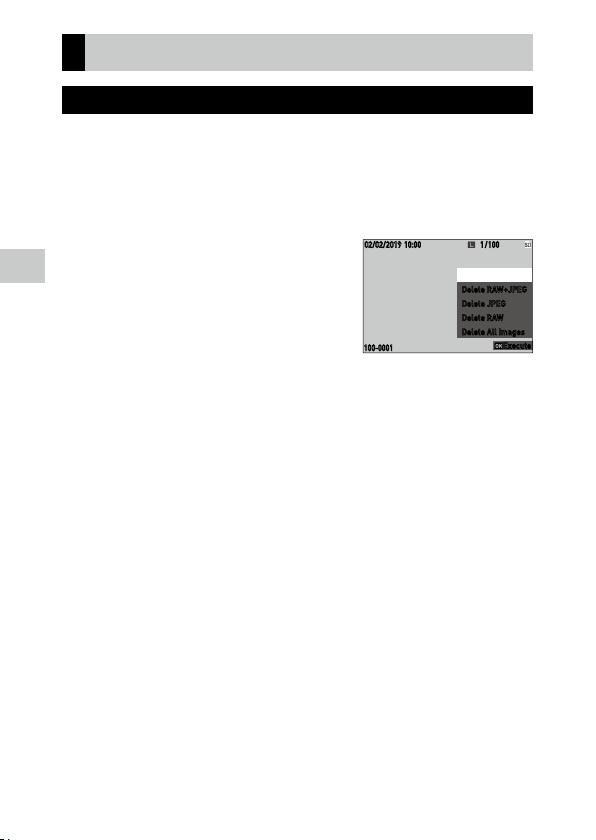
4
Playback Functions
96
Organizing Files
Deleting Files
1 Select [Delete] in the C1 menu or on the playback functions
setting screen.
2 Select [Delete 1 image] or [Delete All Images].
When [Delete 1 image] is selected, use cd to select an image.
For images taken with [File Format] set to
[RAW+JPEG], you can select file formats to
delete.
When [Delete All Images] is selected, you
cannot select file formats to delete.
3 Press e.
The image is deleted.
Repeat Steps 2 and 3 to delete another image.
To end the process, select [Cancel].
1 100
/
100-0001
10:00
Delete JPEG
Delete RAW
Delete All Images
CancelCancel
Delete RAW+JPEG
Execute
02/02/2019
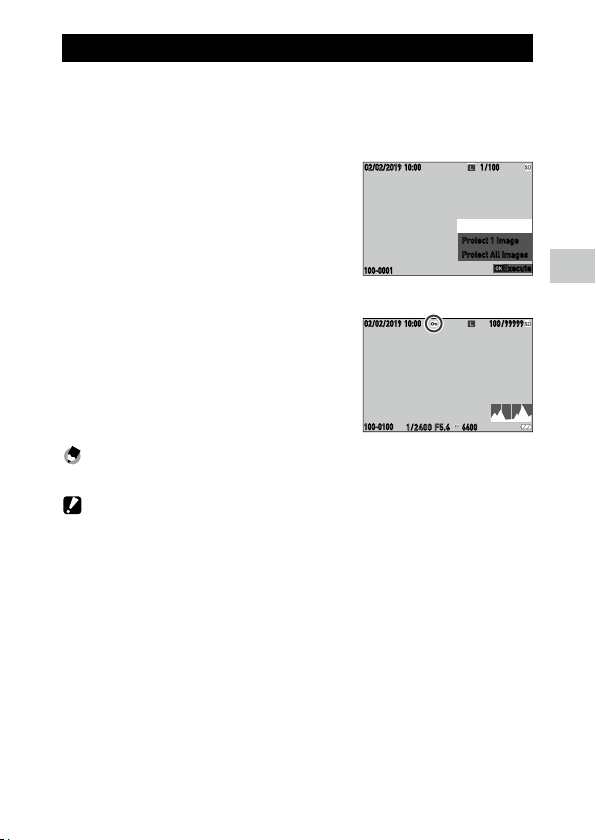
4
Playback Functions
97
Protecting Images from Deletion
You can protect images to prevent them from being deleted accidentally.
1 Select [Protect] in the C1 menu or on the playback functions
setting screen.
2 Select [Protect 1 Image] or [Protect
All Images].
When [Protect 1 Image] is selected, use cd
to select an image.
3 Press e.
When [Protect 1 Image] is selected, the se-
lected image is protected.
To protect another image, repeat Steps 2 and
3.
When [Protect All Images] is selected, select
[Protect] or [Unprotect]. All images are pro-
tected or unprotected.
Memo ---------------------------------------------------------------------------------------------------------
• To unprotect the image, set [Protect] again.
Caution -------------------------------------------------------------------------------------------------------
• If [Format] of the E1 menu is performed, protected images are also deleted.
1 100
/
100-0001
10:00
Protect 1 Image
Protect All Images
Execute
CancelCancel
02/02/2019
100 99999
/
100-0100
1/2400 F5.6
6400
10:00
02/02/2019

4
Playback Functions
98
Copying Images and Movies in the Internal Memory to a
Memory Card
You can copy the still images and movies stored in the internal memory to
a memory card.
1 Insert a memory card.
2 Select [Image Copy] in the C1 menu or on the playback
functions setting screen, and press d.
3 Select [Execute], and press e.
The still images and movies stored in the internal memory are copied in a
new folder.
Caution -------------------------------------------------------------------------------------------------------
• If there is not enough space available on the copy destination memory card, a message indicating
that there is insufficient space appears.
• Copying from a memory card to the internal memory is not possible.
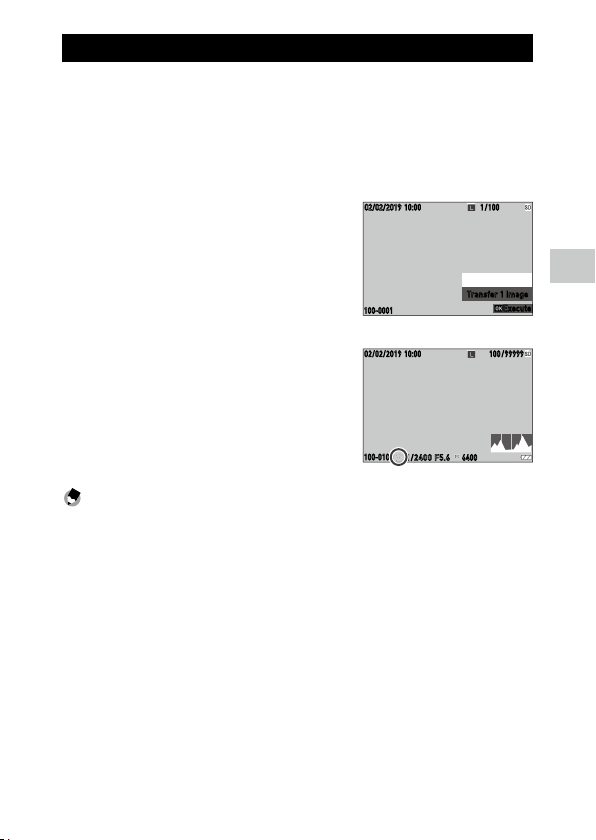
4
Playback Functions
99
Transferring Images
Select images to transfer to a communication device and set the transfer
reservation. When the camera is connected to a communication device via
wireless LAN, the file transfer automatically starts.
1 Select [File Transfer] in the C1 menu or on the playback
functions setting screen.
2 Select [Transfer 1 image].
Use cd to select an image.
For images taken with [File Format] set to
[RAW+JPEG], you can select file formats to
transfer.
3 Press e.
The transfer reservation is set for the image.
To transfer another image, repeat Steps 2
and 3.
Memo ---------------------------------------------------------------------------------------------------------
• To cancel the transfer reservation, set [File Transfer] again.
• Refer to “Using the Camera with a Communication Device” (p.111) for how to connect the camera
and a communication device.
1 100
/
100-0001
10:00
Execute
Transfer 1 image
CancelCancel
02/02/2019
100 99999
/
100-0100
1/2400 F5.6
6400
10:00
02/02/2019
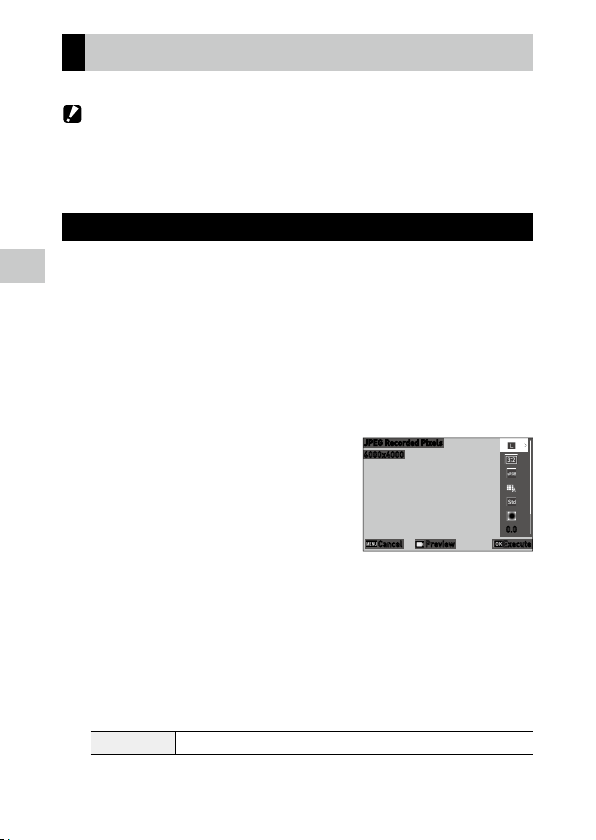
4
Playback Functions
100
Editing and Processing Images
You can edit and process taken images and then save them as new images.
Caution -------------------------------------------------------------------------------------------------------
• Only JPEG images taken with this camera can be edited and processed (only RAW images in [RAW De-
velopment]). Still images saved from movies cannot be edited and processed. If you edit and process
images repeatedly, image quality will deteriorate.
Developing RAW Images
You can convert RAW images into JPEG format and then save them as new
files. Various settings such as [White Balance] and [Image Control] can be
configured and saved.
1 Display a RAW image in C mode.
2 Select [RAW Development] in the C2 menu or on the playback
functions setting screen, and press e.
The [RAW Development] screen appears.
3 Use ab to select a parameter.
The following settings are available.
• JPEG Recorded Pixels
• Aspect Ratio
• Color Space
• White Balance
• Image Control
• Peripheral Illumin. Corr.
• Sensitivity
• High-ISO Noise Reduction
• Shadow Correction
The settings that were set at the time of shooting are initially selected.
You can select only the changeable settings.
k Displays the preview.
0.0
6000x4000
JPEG Recorded Pixels
Cancel Execute
Preview
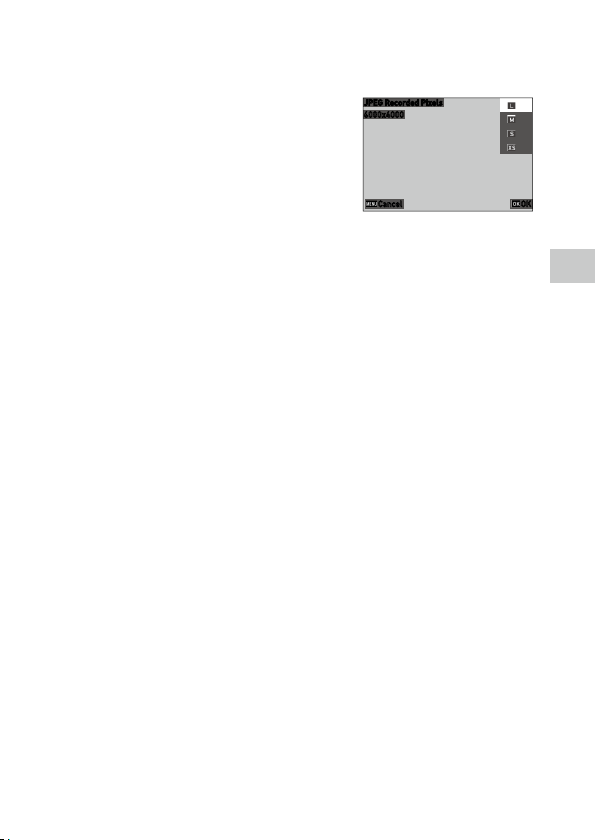
4
Playback Functions
101
4 Press d.
The detailed setting screen appears.
5 Use ab to select a setting.
The detailed setting screen appears when
h is pressed for [White Balance] or [Image
Control].
6 Press e.
The parameter setting screen reappears.
7 When you have finished configuring all of the settings, press
e.
A new JPEG image is saved.
6000x4000
JPEG Recorded Pixels
Cancel OK
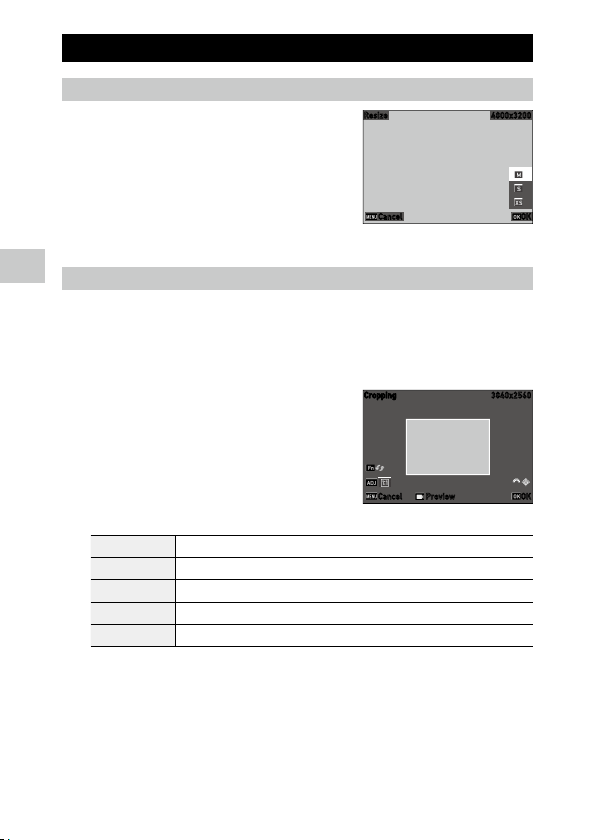
4
Playback Functions
102
Changing the Image Size
Changing the Number of Recorded Pixels (Resize)
In [Resize] of the C2 menu, JPEG files can be
reduced in size. The smaller size than the [JPEG
Recorded Pixels] setting for shooting can be
selected.
Cropping Images
You can crop a part of JPEG images and then save the images.
1 Select [Cropping] in the C2 menu or on the playback functions
setting screen, and press d.
2 Specify the range to crop.
abcd Moves the cropping frame.
Press n Changes the aspect ratio of the cropping frame (3:2 or 1:1).
p Changes the cropping size.
h Rotates the cropping frame.
k Displays the preview.
3 Press e.
The cropped image is saved as a new image.
4800x3200
Resize
Cancel OK
3840x2560
Cropping
Cancel OK
Preview
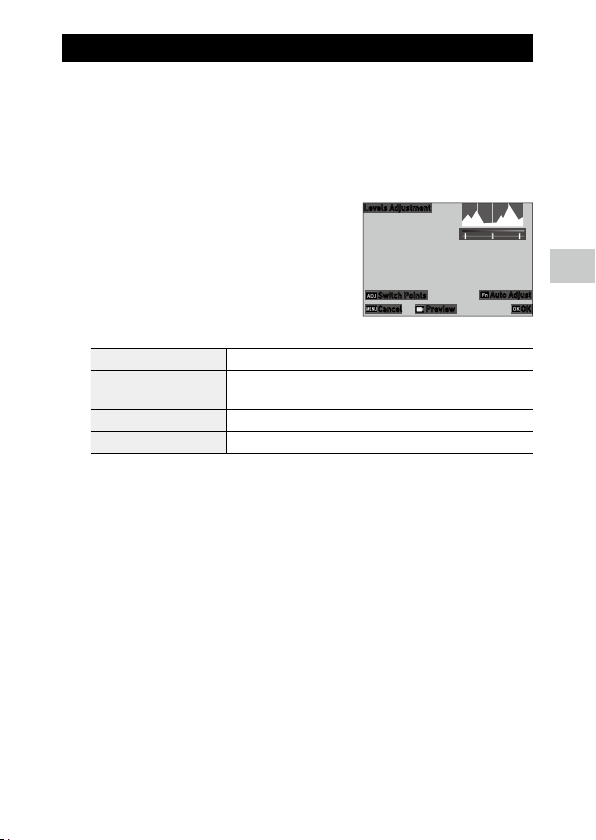
4
Playback Functions
103
Correcting Highlight/Shadow Areas (Levels Adjustment)
You can correct the brightness and contrast of the highlight, mid-tone, and
shadow areas in JPEG images.
1 Select [Levels Adjustment] in the C2 menu or on the playback
functions setting screen, and press d.
The [Levels Adjustment] screen appears.
2 Adjust the value.
Press n Switches the adjustment points.
cd/
n to the left or right
Adjusts the value.
h Performs the auto correction.
k Displays the preview.
3 Press e.
The image is saved as a new image.
Levels Adjustment
Switch Points
Cancel OK
Preview
Auto Adjust
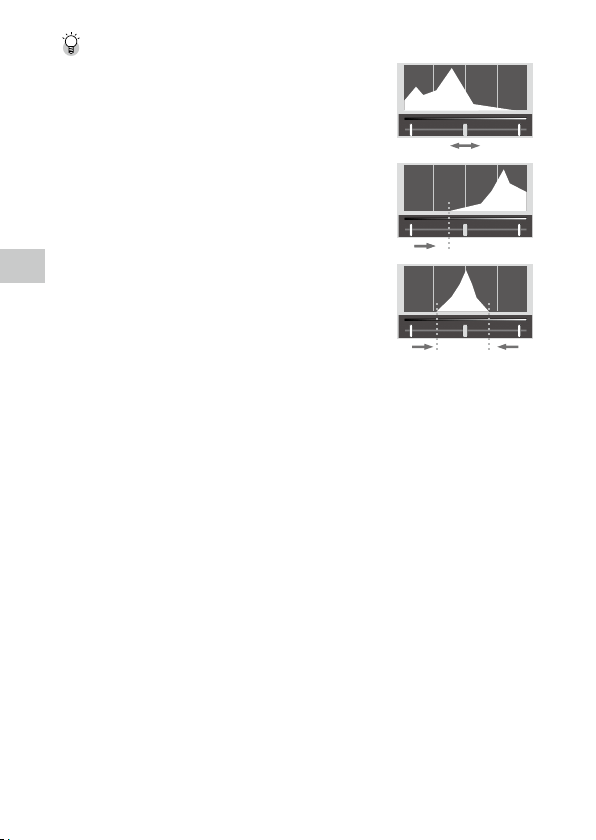
4
Playback Functions
104
How to Perform Corrections ------------------------------------------------------------------------------
• Slide the center thumb to the right or left to adjust the overall
image brightness. Sliding the thumb to the left makes the image
brighter. Sliding the thumb to the right makes the image darker.
• For overexposed images, slide the left thumb to the right until it
reaches the left end of the histogram. For underexposed images,
slide the right thumb to the left until it reaches the right end of
the histogram.
• When the spikes of the histogram are concentrated in the center
and the image contrast is low, slide the right and left thumbs to
both ends of the histogram.
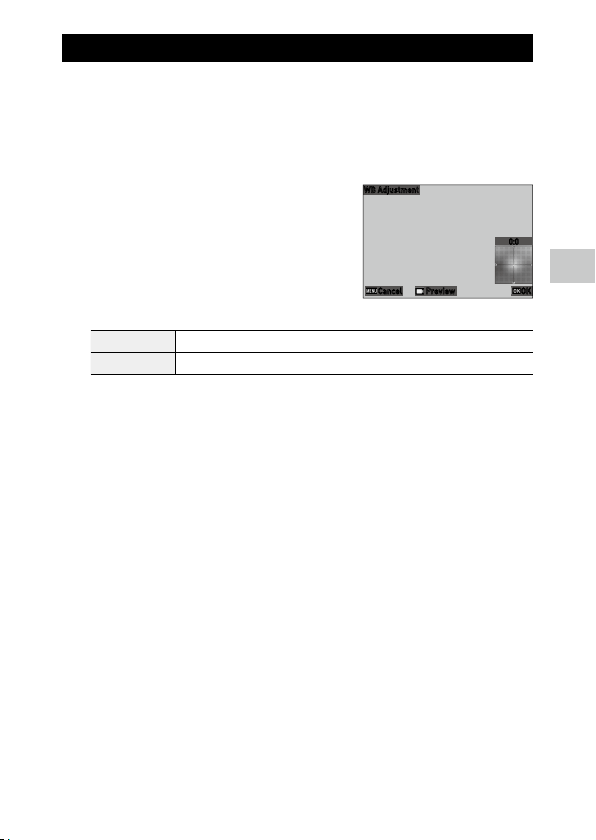
4
Playback Functions
105
Correcting the White Balance
You can correct the white balance of JPEG images.
1 Select [WB Adjustment] in the C2 menu or on the playback
functions setting screen, and press d.
The [WB Adjustment] screen appears.
2 Adjust the value.
abcd Moves the adjustment points.
k Displays the preview.
3 Press e.
The image is saved as a new image.
0:0
Cancel OK
WB Adjustment
Preview
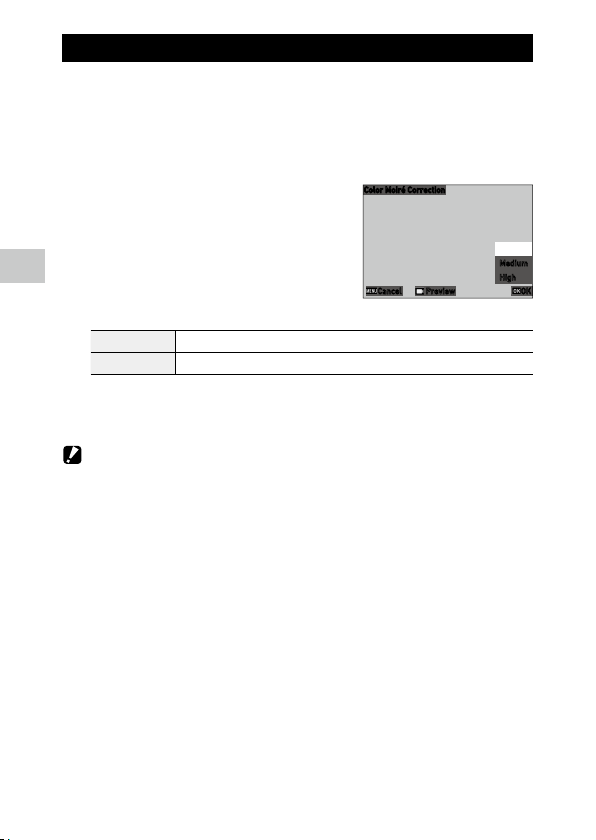
4
Playback Functions
106
Correcting Color Moiré
You can correct color moiré in images.
1 Select [Color Moiré Correction] in the C2 menu or on the
playback functions setting screen, and press d.
The [Color Moiré Correction] screen appears.
2 Adjust the value.
ab Selects the correction level.
k Displays the preview.
3 Press e.
The image is saved as a new image.
Caution -------------------------------------------------------------------------------------------------------
• Some images may not be corrected properly.
• If you perform [Color Moiré Correction], color loss or color bleeding may occur.
Color Moiré Correction
Cancel
Low
Medium
High
OK
Preview
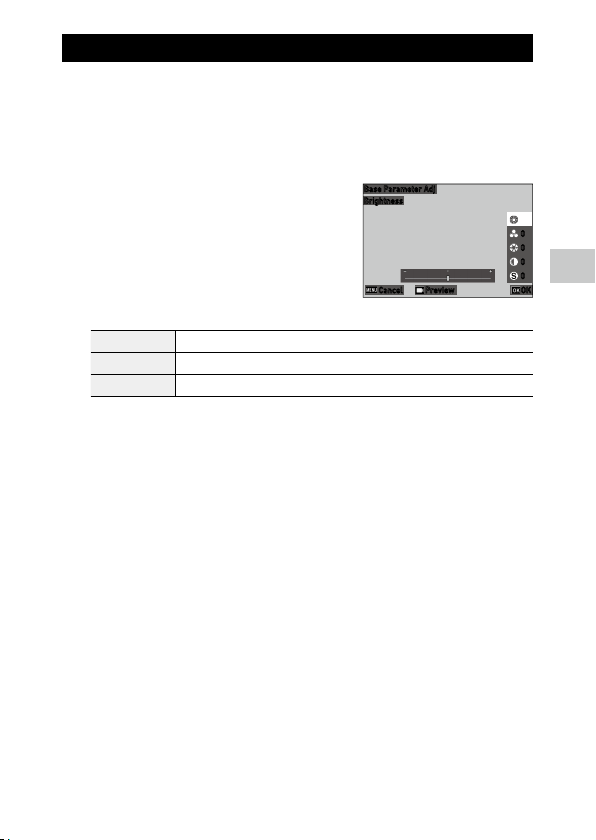
4
Playback Functions
107
Adjusting the Image Quality
You can adjust the quality level of JPEG images.
1 Select [Base Parameter Adj] in the C2 menu or on the playback
functions setting screen, and press d.
The [Base Parameter Adj] screen appears.
2 Adjust the value.
ab Selects [Brightness], [Saturation], [Hue], [Contrast], or [Sharpness].
cd Selects a value (±4).
k Displays the preview.
3 Press e.
The image is saved as a new image.
00
0
0
0
0
Cancel OK
Preview
Brightnes
s
Base Parameter Adj
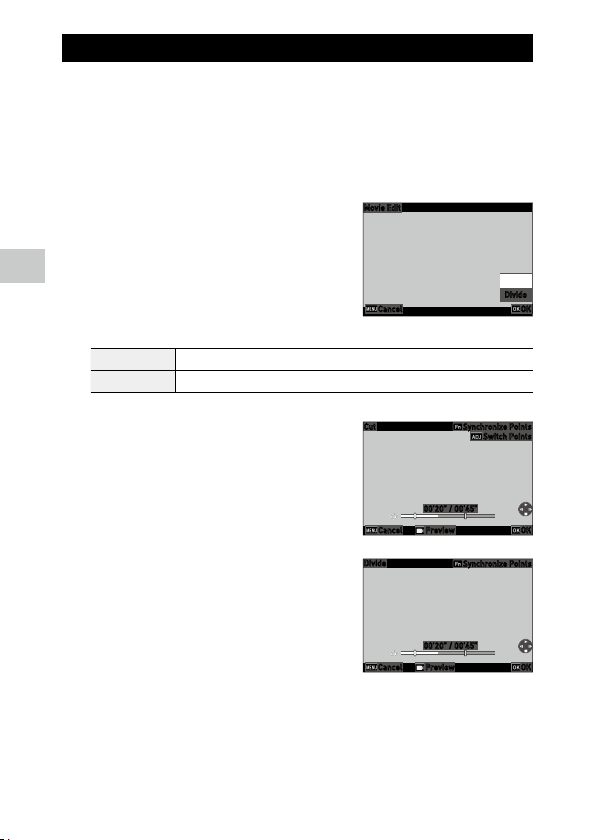
4
Playback Functions
108
Editing Movies
You can clip or divide a movie file into multiple segments and save as new
files.
1 Select [Movie Edit] in the C2 menu or on the playback
functions setting screen, and press d.
The [Movie Edit] screen appears.
2 Select [Cut] or [Divide], and press e.
Cut Saves a range specified with the starting and ending points as a new movie file.
Divide Divides a movie into two files at the specified devision point and saves as new files.
3 Specify the starting and ending points
or division point.
You can play or pause the movie in the same
manner as when viewing a movie in the play-
back mode.
Cut
OKCancel
Movie Edit
Divide
00’20” / 00’45”
Cut Synchronize Points
Switch Points
OKCancel Preview
00’20” / 00’45”
Divide
OKCancel Preview
Synchronize Points
4
Playback Functions
109
The following operations are also available.
Press n [Cut]: Switches between the starting and ending points.
r [Cut]: Moves the starting or ending point.
[Divide]: Moves the division point.
h [Cut]: Moves the starting or ending point to the playback point.
[Divide]: Moves the division point to the playback point.
k Displays the preview.
4 Press e.
The movie file is saved as a new file.
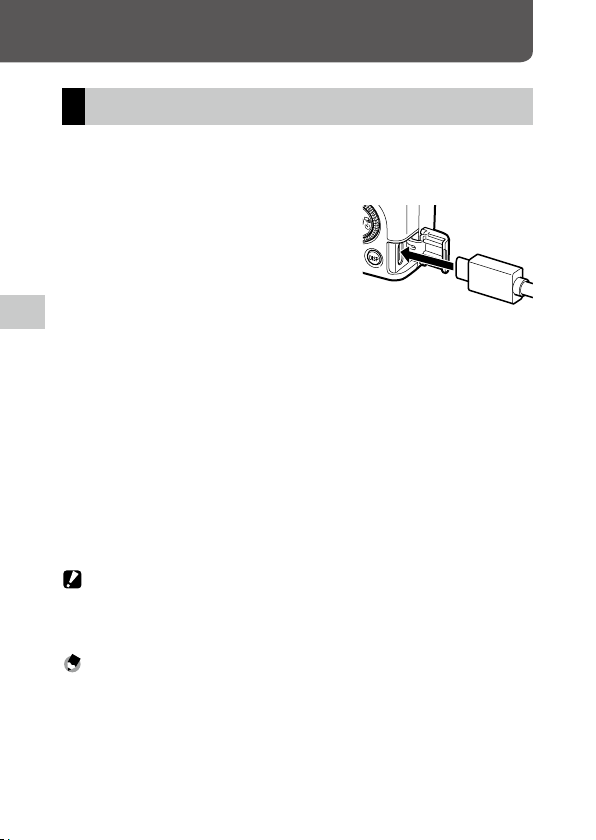
5
Sharing Images
110
Sharing Images
Using the Camera with a Computer
Connect the camera to a computer using the provided USB cable.
1 Turn the camera off.
2 Open the terminal cover of the
camera, and connect the USB cable to
the USB terminal.
3 Connect the USB cable to the USB port of the computer.
The camera turns on and enters the playback mode.
The camera is recognized as a device by the computer.
When a memory card is inserted, the files on the memory card are displayed.
When a memory card is not inserted, the files in the internal memory are
displayed.
4 Copy the captured images to the computer.
5 Disconnect the camera from the computer when the copy is
complete.
6 Remove the USB cable from the camera.
Caution -------------------------------------------------------------------------------------------------------
• Do not remove the USB cable while copying images.
• If the battery level is low, it may take some time until the camera is recognized by the computer.
• For Mac, images with a size of 4 GB or more cannot be transferred.
Memo ---------------------------------------------------------------------------------------------------------
• When the camera is connected to a computer, it is recognized as a device with the name “RICOH GR III”.
• The battery is charged when the camera is connected to the computer and the camera is turned off.
• Refer to “Operating Environment” (p.152) for system requirements to connect the camera to a com-
puter.
5
Sharing Images
111
Using the Camera with a Communication
Device
The camera can be operated from a communication device and the images
saved in the camera can be displayed on/imported to the communication
device by connecting both the devices via Bluetooth® or wireless LAN and
using the dedicated app “Image Sync”.
Memo ---------------------------------------------------------------------------------------------------------
• The captured images can be transferred to the communication device by specifying them in [File
Transfer] of the C1 menu. (p.99) The images can also be transferred automatically after shoot-
ing. (p.116) When the captured images are transferred, the camera is connected to the communica-
tion device via a wireless LAN.
• The Bluetooth® connection and the wireless LAN connection can be switched using the Image Sync.
• When using the camera with a communication device, refer to the operating manual of the device
and the Image Sync website. (p.116).
Caution -------------------------------------------------------------------------------------------------------
• The Bluetooth® function is disabled in the following case.
• When the camera is connected to an AV device
• The wireless LAN function is disabled in the following cases.
• B mode
• During the USB connection
• When the camera is connected to an AV device
• When the OS of the communication device is iOS, images with a size of 4 GB or more cannot be trans-
ferred.
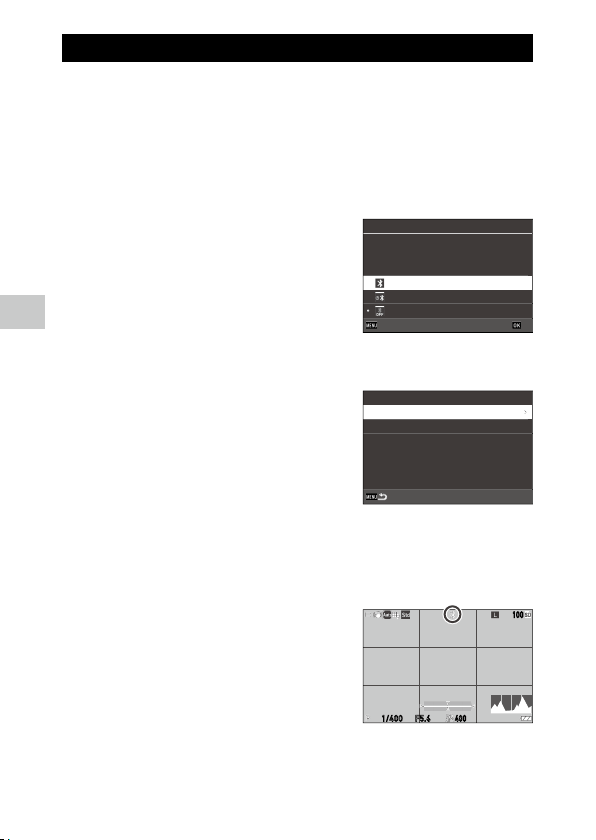
5
Sharing Images
112
Connecting to a Communication Device via Bluetooth®
1 Turn on the Bluetooth® function of the communication device.
2 Select [Bluetooth Setting] in the E6 menu, and press d.
The [Bluetooth Setting] screen appears.
3 Select [Action Mode], and press d.
4 Select [On anytime] or [On when
power is on], and press e.
5 Select [Pairing], and press d.
6 Select [Execute Pairing], and press
e.
The camera enters a pairing standby state,
and the camera’s [Device Name] and [Pass-
word] are displayed.
7
Enter the device name of the camera and the authentication code
on the communication device.
The camera and the communication device are paired.
When the camera is connected to the com-
munication device via Bluetooth®, the icon
indicating the connected status appears.
Action Mode
Allows Bluetooth connection
even when the camera
is turned off.
On anytime
On when power is on
Disable
CancelCancel OKOK
Execute Pairing
Paired Devices
Pairing
100
F5.6
400
1/400
5
Sharing Images
113
Caution -------------------------------------------------------------------------------------------------------
• When the OS of the communication device is iOS, connect it to the camera using the Image Sync. For
details on the Image Sync, refer to “Operating the Camera with a Communication Device” (p.116).
• Note that when [On when power is on] is selected in Step 4, the camera emits radio waves even if
its power is off.
• Do not attempt to use the Bluetooth® function in a location where the use of Bluetooth® devices is
restricted or prohibited, such as on airplanes.
• When using the Bluetooth® function, observe local laws and regulations governing radio commu-
nication.
Memo ---------------------------------------------------------------------------------------------------------
• Once the pairing is established , the camera can be connected to the communication device via Blue-
tooth® only by the operations in Steps 1 to 4 from next time.
• Select [Paired Devices] on the screen in Step 6 to display the names of paired communication devices.
You can cancel the pairing by pressing h on this screen. The pairing can be established with up to
six communication devices.
• Select [Communication Info.] in Step 3 to display the camera’s [Device Name].
• When the pairing cannot be established from the camera, execute the pairing from the communica-
tion device.
• When [On anytime] is set in Step 4, you can set whether to transfer images while the power is off in
[Image Transfer while Off] of [Smartphone Link] in the E6 menu. (p.116)
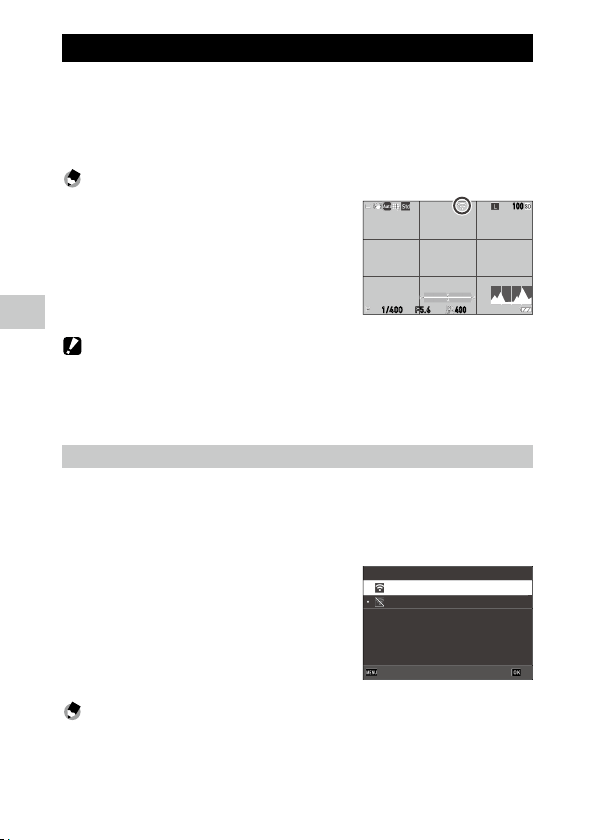
5
Sharing Images
114
Enabling the Wireless LAN Function
The wireless LAN function is off when the camera is turned on. Turn on the
function using one of the following methods.
• Setting from the menus (p.114)
• Pressing and holding k (m) (p.115)
• Pressing and holding g (p.115)
Memo ---------------------------------------------------------------------------------------------------------
• When the wireless LAN function is turned on, the icon
indicating the wireless LAN status appears on the screen.
• Even after the wireless LAN function is turned on, it turns
off when the camera is turned off and on again.
Caution -------------------------------------------------------------------------------------------------------
• Do not attempt to use the wireless LAN function in a location where the use of wireless LAN devices is
restricted or prohibited, such as on airplanes.
• When using the wireless LAN function, observe local laws and regulations governing radio commu-
nication.
Setting from the Menus
1 Select [Wireless LAN Setting] in the E6 menu, and press d.
2 Select [Action Mode], and press d.
3 Select [On], and press e.
Memo ---------------------------------------------------------------------------------------------------------
• Select [Communication Info.] in Step 2 to display the camera’s [SSID], [Password], and [MAC Address].
To reset the SSID and password to the default settings, press h.
• The certification marks of the wireless LAN can be displayed in [Certification Marks] of the E8
menu. (p.2)
100
F5.6
400
1/400
CancelCancel OKOK
On
Off
Action Mode
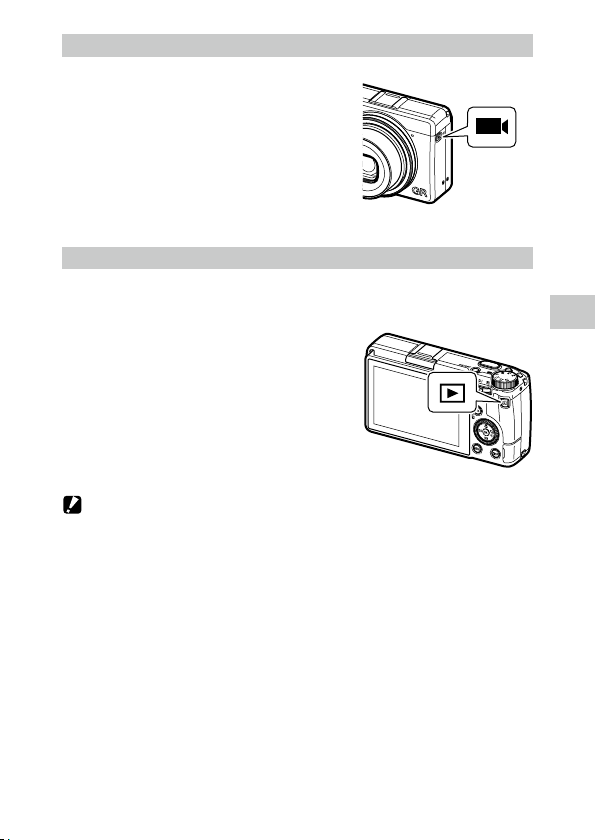
5
Sharing Images
115
Pressing and Holding the Movie/Wireless Button
1 Press and hold k.
A beep sounds and the wireless LAN icon ap-
pears on the shooting screen.
Press and hold k again to turn off the wire-
less LAN function.
Pressing and Holding the Playback Button
The wireless LAN function can be turned on in the playback mode from the
power-off state of the camera.
1 Press and hold g with the camera
turned off until a beep sounds.
The camera is turned on in the playback mode
and the wireless LAN function is turned on.
Caution -------------------------------------------------------------------------------------------------------
• When the wireless LAN function is turned on using g, the camera does not enter the shooting
mode even if the shutter release button is pressed. When performing shooting or other operations,
press g to turn the camera off and press the power button to turn the camera back on.
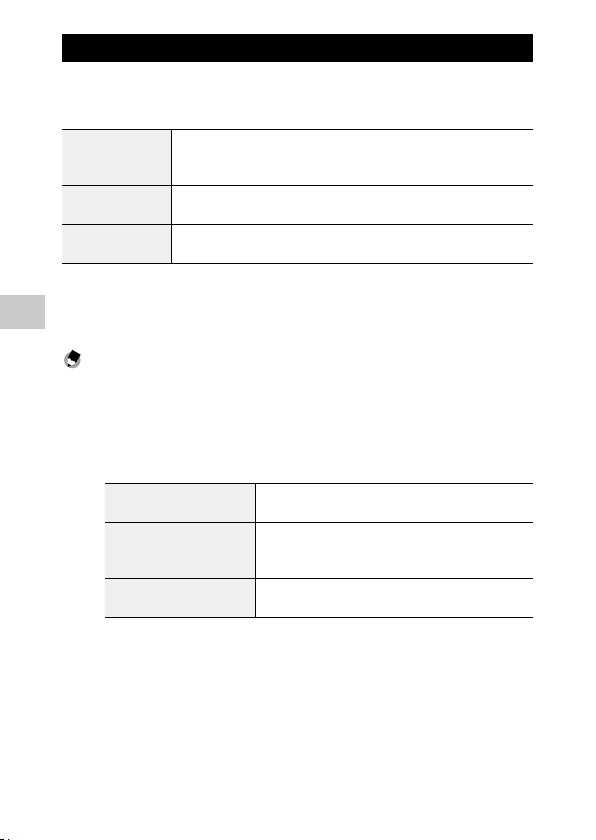
5
Sharing Images
116
Operating the Camera with a Communication Device
The following functions can be used by connecting the camera to a com-
munication device via Bluetooth® or wireless LAN and using the dedicated
app “Image Sync”.
Remote Capture Displays the shooting screen of the camera on the communication device, and en-
ables controlling exposure settings and shooting by operating the communication
device.
Image View Displays the images saved in the camera on the communication device and imports
them to the communication device.
Time Synchronization Synchronizes the date and time displayed on the camera with the date and time
settings of the communication device.
Image Sync supports iOS and Android™, and can be downloaded from the
App Store or Google Play™. For the supported operating system and other
details, refer to the download site.
Memo ---------------------------------------------------------------------------------------------------------
• For how to connect the camera to a communication device and details on the Image Sync, refer to
the following website.
http://www.ricoh-imaging.co.jp/english/products/app/image-sync2/
• You can use the Image Sync installed on the communication device to operate the camera and adjust
the camera’s date and time.
• You can make the following settings in [Smartphone Link] of the E6 menu.
Store Location Info. Records the location information of the communication device
in captured images.
Auto Image Transfer Automatically transfers captured images to the communica-
tion device after shooting. The format of transferred files can
be selected.
Image Transfer while Off Sets whether to continue to transfer images when the camera is
turned off during transfer processing.
• When the camera is connected with a communication device via Bluetooth®, the wireless LAN func-
tion automatically turns on and off according to the situation.
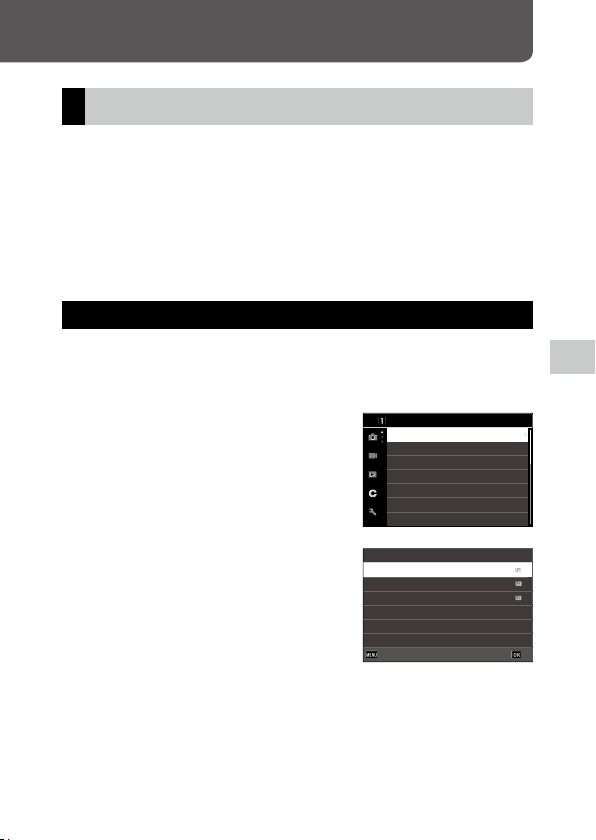
6
Changing the Settings
117
Changing the Settings
Saving Frequently Used Settings
You can save up to six frequently used settings and assign the settings to
the mode dial P, Q, and R so that you can easily recall the settings
for shooting.
The following settings can be saved.
• Exposure mode
• Exposure compensation
• A menu settings (with exceptions)
• D2 menu settings and the [Grid Style]
setting of the D3 menu
• E3/E4/E5 menu settings
Saving the Settings
Up to six sets of settings can be saved.
1 Set the exposure mode and all the necessary settings to save.
2 Select [Save Settings] in the D1
menu, and press d.
The [Save Settings] screen appears.
3 Select from [BOX1] to [BOX6], and
press e.
User Mode
Save Settings
Rename
Recall
Delete Settings
M Mode Dial Setting
ADJ Mode Setting
Fn Button Setting
BOX1
:
BOX2
:
BOX3
:
BOX4
:
BOX5
:
BOX6
:
Save Settings
CancelCancel OKOK
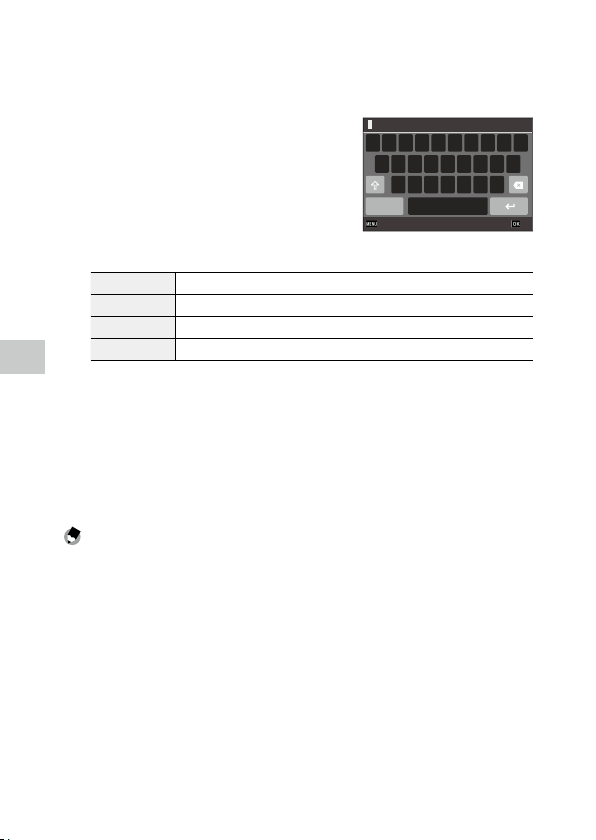
6
Changing the Settings
118
4 Select whether to enter a Box name, and press e.
When [Cancel] is selected, proceed to Step 7.
When [Enter Name] is selected, the text-entry screen appears.
5 Enter a Box name.
Up to 32 single-byte alphanumeric charac-
ters and symbols can be entered.
The following operations are available.
abcd Moves the text selection cursor.
r/p Moves the text selection cursor up and down.
n Moves the text selection cursor to the right and left.
e Enters a character selected with the text selection cursor.
You can use the touch panel for the operations.
6 After entering the text, move the text selection cursor to 1,
and press e.
The confirmation screen appears.
7 After checking the setting, press e.
The D1 menu reappears.
Memo ---------------------------------------------------------------------------------------------------------
• If a name is not entered, the registration date and time will be the name.
• To change the name, select [Rename] in the D1 menu.
• To delete the setting, select [Delete Settings] in the D1 menu.
㹵e r t y u i o pq
s d f g h j k la
z
123
x c v b n m
Cancel OK
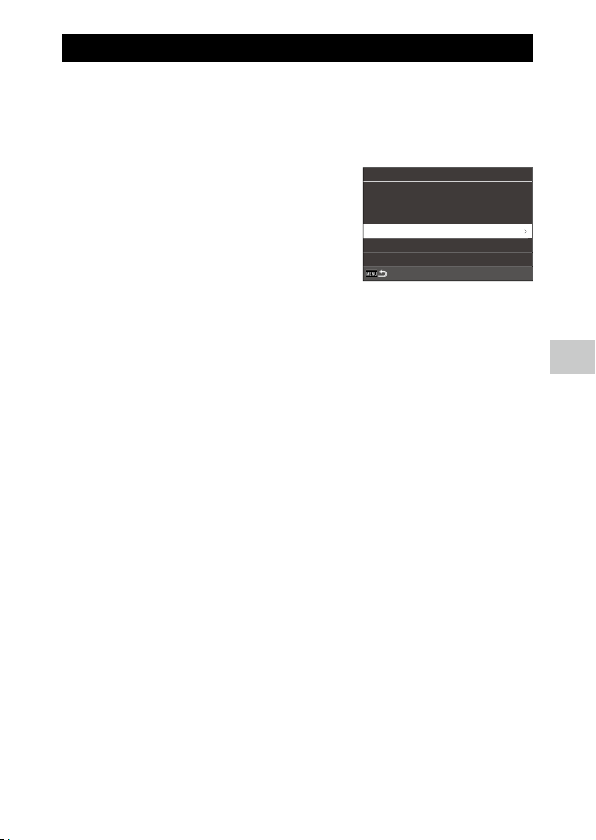
6
Changing the Settings
119
Assigning Settings to the Mode Dial
You can assign the saved settings to the mode dial.
1 Select [Recall] in the D1 menu, and press d.
The [Recall] screen appears.
2 Select the mode dial to assign the
saved setting to from USER1 (P),
USER2 (Q), or USER3 (R), and
press d.
3 Select from [BOX1] to [BOX6], and press e.
The selected setting is assigned to the mode dial.
The screen in Step 2 reappears.
USER1:
USER2:
USER3:
Recall
Assign settings saved
in User Mode Box
to Mode Dial.
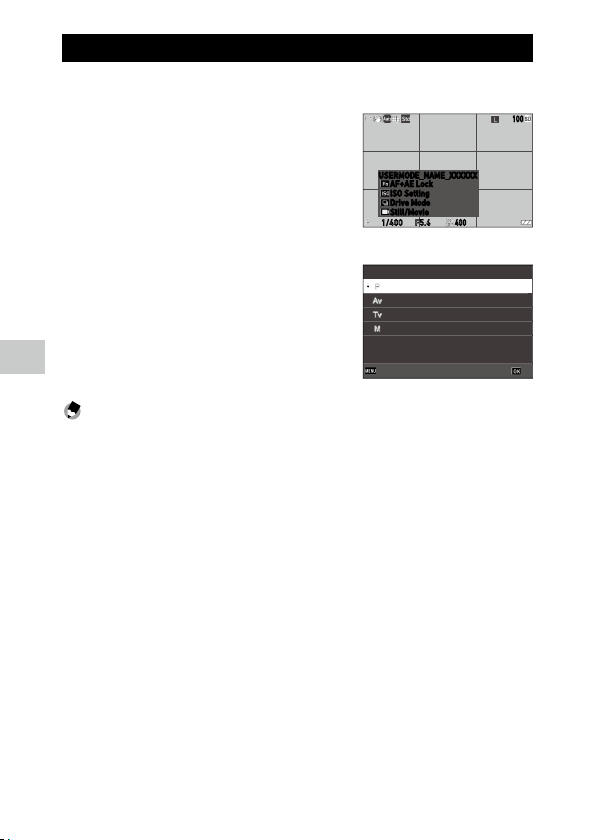
6
Changing the Settings
120
Using the Saved User Mode
1 Set the mode dial to P, Q, or R in the shooting mode.
The user mode guide appears on the shoot-
ing screen.
2 Change the setting as necessary.
To change the exposure mode, set [Exposure
Mode] in the A2 menu.
Memo ---------------------------------------------------------------------------------------------------------
• The setting changed in Step 2 is not saved in the camera. If the mode dial is turned, the setting is reset
to the saved setting. To change the saved setting, save a setting in [Save Settings] again.
• If the Box settings assigned to the mode dial are changed, the settings applied to the mode dial are
also changed.
100
F5.6
400
1/400
USERMODE_NAME_XXXXXX
AF+AE Lock
ISO Setting
Drive Mode
Still/Movie
Program AE
Shutter Priority AE
Aperture Priority AE
Manual Exposure
Exposure Mode
CancelCancel OKOK
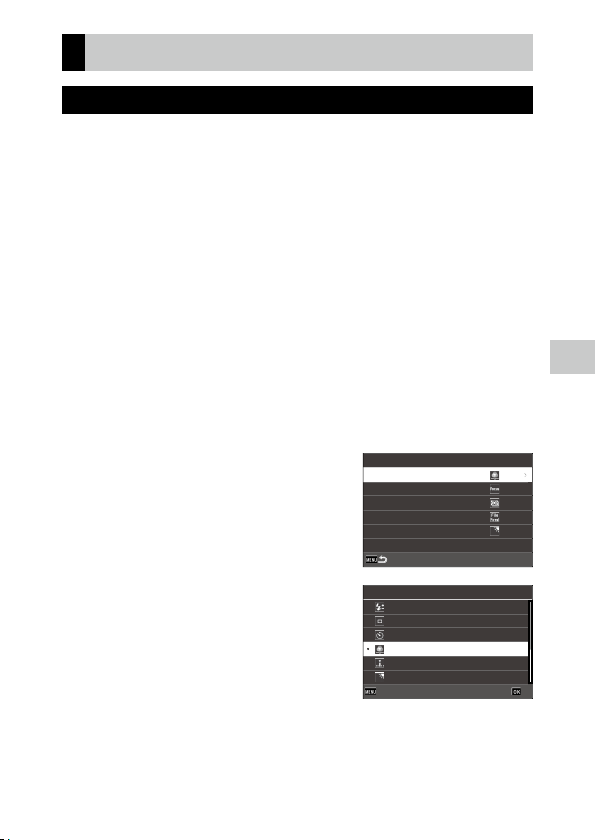
6
Changing the Settings
121
Customizing the Button Functions
Registering Functions to the ADJ. Mode
You can change the settings for “ADJ. mode” of which functions can be easily
used by pressing n.
Five functions in the following shooting functions can be registered. (The
functions indicated with a square-bracketed item are the default settings
for the item.)
• Off
• Focus [Setting2]
• Snap Focus Distance
• File Format [Setting4]
• Aspect Ratio
• JPEG Recorded Pixels
• AE Metering [Setting3]
• ISO Setting
• Flash Mode
• Flash Exposure Comp.
• Drive
• Self-timer
• Image Control [Setting1]
• One Push AE in M Mode
• Outdoor View Setting [Setting5]
1 Select [ADJ Mode Setting] in the D2 menu, and press d.
The [ADJ Mode Setting] screen appears.
2 Select from [Setting1] to [Setting5],
and press d.
3 Select the function to register, and
press e.
The function for the ADJ. mode is changed.
ADJ Mode Setting
Setting1
Setting2
Setting3
Setting4
Setting5
Flash Exposure Comp.
Drive
Self-timer
Image Control
One Push AE in M Mode
Outdoor View Setting
Setting1
CancelCancel OKOK
6
Changing the Settings
122
Caution -------------------------------------------------------------------------------------------------------
• The settings changed in [ADJ Mode Setting] are enabled in the still image mode only. [Image Control],
[Focus], [AE Metering], [Framerate], and [Outdoor View Setting] are registered for the B mode, and
they cannot be changed.
Memo ---------------------------------------------------------------------------------------------------------
• Refer to “Using the ADJ. Lever” (p.23) for how to use the ADJ. mode.

6
Changing the Settings
123
Changing the Functions of the Fn Button
You can change the functions for when h, c, d, or k is pressed.
The following functions can be assigned to each button. (The functions in-
dicated with a square-bracketed item are the default settings for the item.)
Pressing h, c, d, or k
• Off
• Focus
• Set MF
• Set Snap
• Set Tracking AF
• Enable AF
• AF+AE Lock [Fn Button]
• AE Lock
• Face Detection
• Snap Focus Distance
• File Format
• JPEG RAW
• JPEG RAW+
• Aspect Ratio
• Crop
• JPEG Recorded Pixels
• Framerate
• Still/Movie [Movie/Wireless Button]
• AE Metering
• ISO Setting [ISO Button]
• Flash Mode
• Flash Exposure Comp.
• ND Filter
• Drive Mode [Drive Button]
• Drive
• Continuous Shooting
• Self-timer
• Image Control
• Shake Reduction
• One Push AE in M Mode
• 4-way Controller Action
• Outdoor View Setting
Pressing and holding k
• Wireless LAN Setting [Hold Movie/
Wireless Btn.]
• Preview
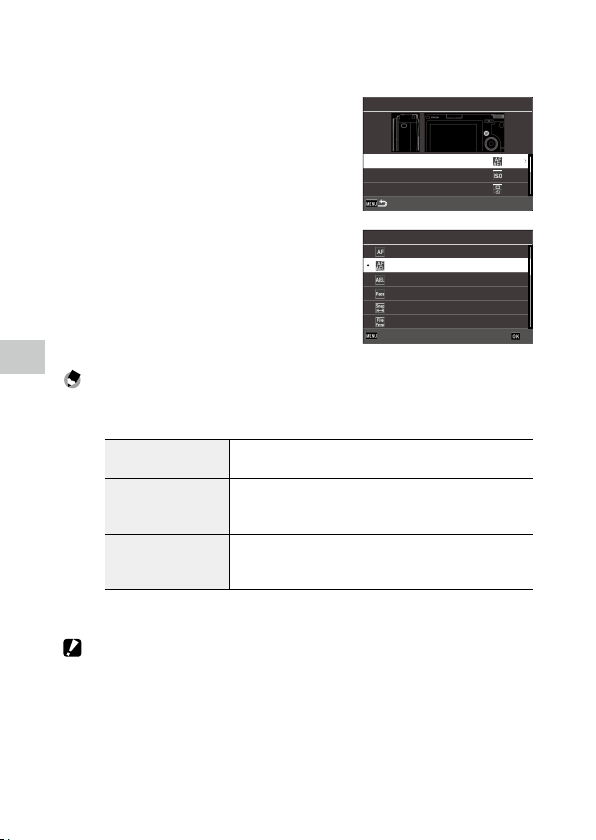
6
Changing the Settings
124
1 Select [Fn Button Setting] in the D2 menu, and press d.
The [Fn Button Setting] screen appears.
2 Select the button to change the
setting of, and press d.
3 Select the function to assign, and
press e.
The button function is changed.
Memo ---------------------------------------------------------------------------------------------------------
• On the [Fn Button Setting] screen, you can set the button functions for when the functions corre-
sponding to the following operations are assigned.
Focus Settings Select the button function from [Same as Shutter Button], [Auto-area
AF], [Select AF], [Pinpoint AF], [Tracking AF], or [Continuous AF].
Keep AE Lock When set to [On], AE lock is turned on and off each time the button is
pressed. When set to [Off], AE lock is only enabled while the button
is pressed.
One Push AE in M Mode If the button is pressed in the N mode, the exposure is automatically
adjusted to the correct exposure. Select the mode to adjust from [Pro-
gram AE], [Aperture Priority AE], or [Shutter Priority AE].
• When the power is turned on or the mode dial is turned, the current function of the button is dis-
played. If [Guide Display] is set to [Off] in the E2 menu, the function is not displayed.
Caution -------------------------------------------------------------------------------------------------------
• The function of h is enabled in the shooting mode only. Only [Wireless LAN Setting] is available
in the playback mode.
• [Enable AF], [AF+AE Lock], [AE Lock], and [One Push AE in M Mode] cannot be assigned to k.
Fn Button Setting
Fn Button
ISO Button
Drive Button
Enable AF
AF+AE Lock
AE Lock
Face Detection
Snap Focus Distance
File Format
Fn Button
CancelCancel OKOK
6
Changing the Settings
125
Setting the Function of the Shutter Release Button
You can set the function for when z is pressed in the D2 menu.
Shutter Button Setting Sets whether to perform autofocus and AE Lock, or only AE lock when z
is pressed halfway.
Shutter Btn. Confirmation Sets whether to complete the setting by pressing z halfway when setting
functions on the Live View screen such as in the ADJ. mode. This setting is also
applied to when autofocus is activated using h.
[On]: Completes settings by pressing z halfway.
[Off]: Returns to the setting screen after z is pressed halfway.
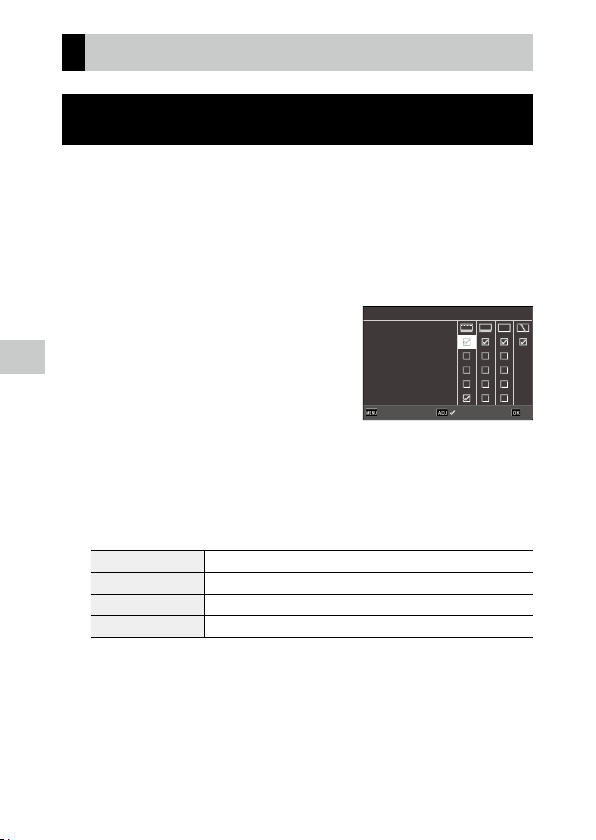
6
Changing the Settings
126
Display and Sound Settings
Setting the Information Displayed During Shooting/
Playback
You can set the information displayed when the display is switched using
j in the shooting mode or playback mode.
1 Select [Shooting Info. Display] or [Playback Info. Display] in the
D3 menu, and press d.
The [Shooting Info. Display] or [Playback Info. Display] screen appears.
For [Playback Info. Display], proceed to Step 3.
2 Use cd to select [LCD Display], and
press n to set each display mode
on/off.
[Standard Info. Display], [Simplified Info. Dis-
play], [No Information Display], and [Display
Off ] can be set.
Display modes without a check mark are not
displayed when j is pressed during shoot-
ing. Select at least one display mode.
3 Use abcd to select a display item, and press n to set it on/
off.
[Shooting Info. Display]
Histogram Displays a histogram.
Grid Guide Displays a guide grid.
Highlight Alert Blinks areas expected to be overexposed in red during shooting.
Electronic Level Displays an indicator for confirming camera tilt.
LCD Display
Histogram
Grid Guide
Highlight Alert
Electronic Level
Shooting Info. Display
CancelCancel OKOK
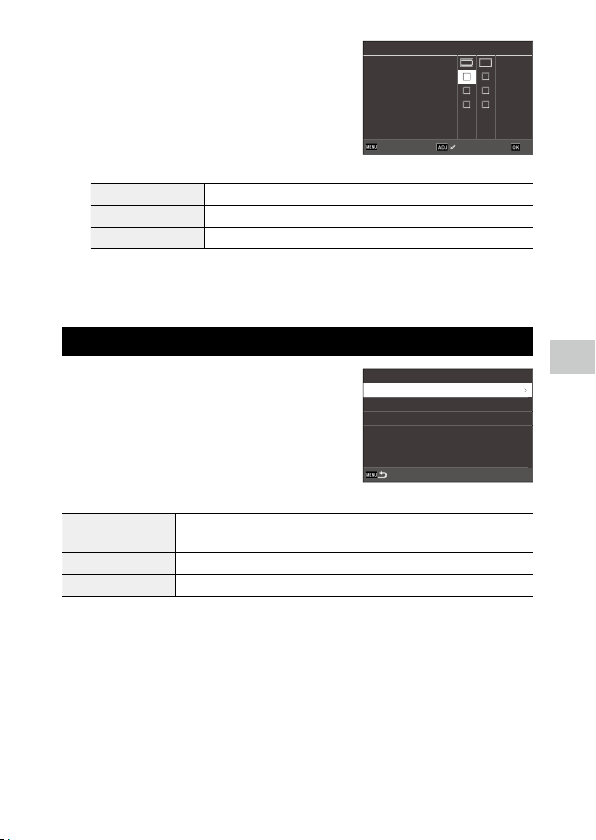
6
Changing the Settings
127
[Playback Info. Display]
Histogram Displays a histogram for the image.
Grid Guide Displays grid lines.
Highlight Alert Blinks overexposed areas in red.
4 Press e.
Setting the Instant Review Display
You can set the information displayed in “In-
stant Review” that displays the captured image
immediately after shooting in [Instant Review]
of the D3 menu.
Display Time Sets the display time of Instant Review.
When set to [Hold], the image is displayed until z is pressed halfway.
Zoom Review Magnifies the image by turning p or pressing n during Instant Review.
Delete Deletes the image by pressing i during Instant Review.
The initial magnification when magnifying images by pressing n in Instant
Review or the single image display of playback mode can be set in [Quick
Zoom] in the D3 menu.
Histogram
Grid Guide
Highlight Alert
Playback Info. Display
CancelCancel OKOK
Instant Review
Display Time
Zoom Review
Delete
0.5sec.
Off
Off
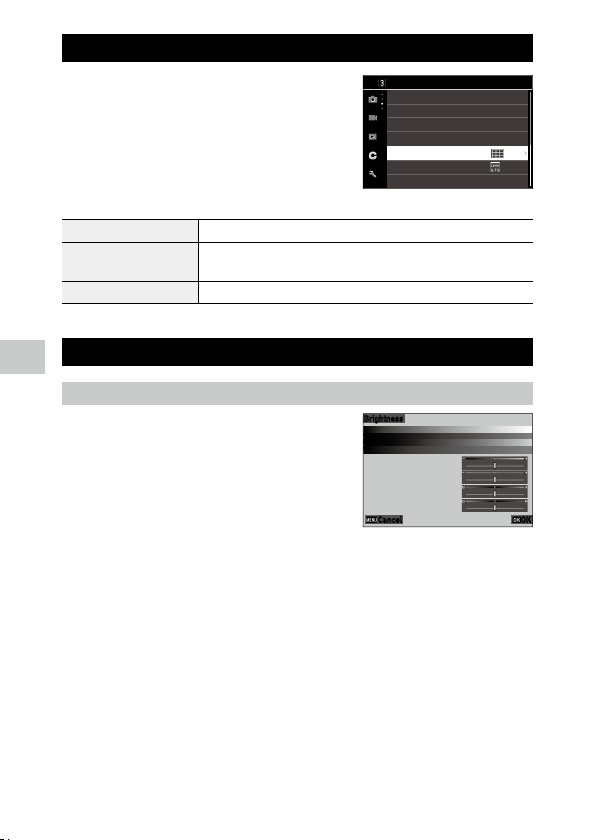
6
Changing the Settings
128
Setting the Live View Display
You can set the following settings for the Live
View display in the D3 menu.
Grid Style Select the grid style from [3x3 Grid] or [4x4 Grid].
Electronic Level Type Select whether to display the horizontal level only, or horizontal level and
tilt (vertical direction).
Flicker Reduction Cuts down flickers on the Live View screen by setting the power frequency.
Setting the Brightness and Tone of the Monitor
LCD Setting
You can set [Brightness], [Saturation], [Adjust:
Blue-Amber], and [Adjust: Green-Magenta] in
[LCD Setting] of the E3 menu.
50Hz
100%
Display Customization
Instant Review
Playback Info. Display
Quick Zoom
Focus Magnification
Grid Style
Electronic Level Type
Flicker Reduction
0.5sec.
On
Cancel OK
Brightness
6
Changing the Settings
129
Outdoor View Setting
If the monitor display is difficult to see when
you take pictures outdoors or in other situa-
tions, adjust the brightness of the monitor in
[Outdoor View Setting] of the E3 menu.
Memo ---------------------------------------------------------------------------------------------------------
• This function can be registered to [ADJ Mode Setting] of the D2 menu. (p.121)
Setting the Lamp
You can set the lamp illumination setting in the
E4 menu.
Power Button Lamp Sets whether to turn the power button lamp on when the power is turned on.
Count Down Sets whether to blink the AF assist light when shooting using [Self-timer] of
[Drive Mode].
Outdoor View Setting
CancelCancel OKOK
2
Indicator Lamps
Power Button Lamp On
On
Count Down
Volume
Sound Effects
Bluetooth Setting
Wireless LAN Setting
Smartphone Link
6
Changing the Settings
130
Setting the Sound Effects
You can set the sound effects in the E5 menu.
Sound Effects [All]: Outputs shutter sound, in-focus sound, timer countdown sound, and
switching sound of turning the wireless LAN on and off.
[Shutter Sound Only]: Outputs shutter sound only.
Volume Sets the sound volume. When set to [0], all sound effects are turned off.
2
Sound Effects Setting
Sound Effects
Volume
Wireless LAN Setting
Smartphone Link
Auto Power Off
Sleep Mode
Bluetooth Setting
1min.
1min.
6
Changing the Settings
131
Power Saving Settings
Automatically Turning the Power Off
The camera turns off automatically if no op-
erations are made for a certain period of time.
You can set [1min.], [3min.], [5min.], [10min.],
[30min.], or [Off] in [Auto Power Off] in the
E7 menu.
To resume operation, press the power button.
Memo ---------------------------------------------------------------------------------------------------------
• [Auto Power Off] is not available in the following cases.
• During movie recording or playback
• During shooting with [Interval Shooting] or [Interval Composite] of [Drive Mode]
• During movie playback
• During data processing
• During image transfer
• While the camera is connected to a computer
• While the camera is connected to a communication device with the Image Sync
Auto Power Off
1min.
CancelCancel OKOK
3min.
5min.
10min.
30min.
Off
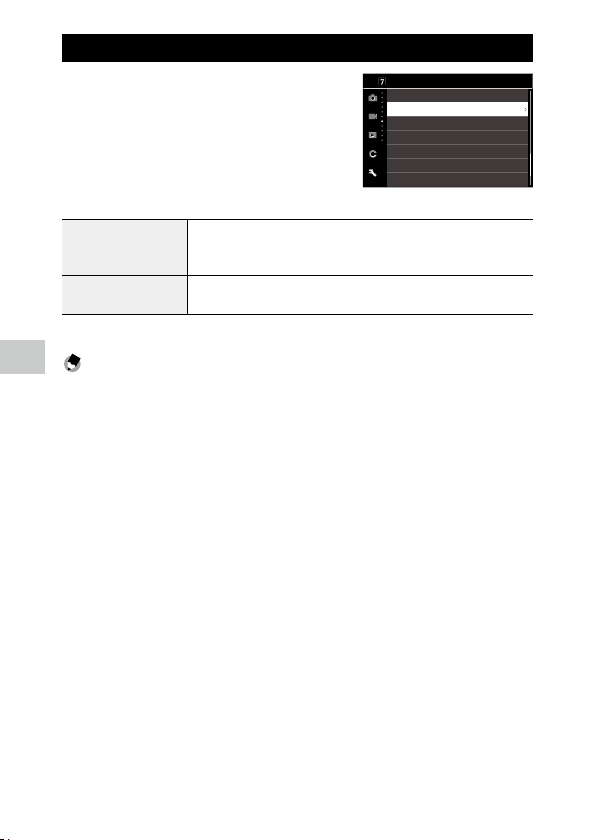
6
Changing the Settings
132
Dimming the Display
The camera dims the display automatically if
no operations are performed during the set
time. The following settings can be set in the
E7 menu.
Sleep Mode Turns off the monitor automatically if no operations are performed during the
set time. The status lamp lights in the sleep mode.
[1min.], [3min.], [5min.], [10min.], [30min.], or [Off] can be set.
LCD Auto Dim Dims the display automatically if the camera is not moved within five seconds.
[On] or [Off] can be set.
If the camera is operated, the original brightness is restored.
Memo ---------------------------------------------------------------------------------------------------------
• [Sleep Mode] is not available in the following cases.
• During shooting with [Interval Shooting] or [Interval Composite] of [Drive Mode]
• During movie recording or playback
• While an AV device is connected to the camera
• While the camera is connected to a communication device with the Image Sync
• [LCD Auto Dim] is not available in the following cases.
• During Instant Review
• In the playback mode
• While an AV device is connected to the camera
Power Supply Settings
Sleep Mode
1min.
1min.
On
LCD Auto Dim
Auto Power Off
About This Device
Certification Marks
Pixel Mapping
Dust Removal
6
Changing the Settings
133
File Management Settings
Specifying the Folder/File Settings
By default, files and folders are automatically named as follows.
File Name R0000001.JPG to R0999999.JPG
Folder Name 100 to 999
When the file number exceeds R0
9999, the next folder is created and the
file number becomes R0
0001. If the file number exceeds R0
9999 when
the folder number is 999, no more files can be stored on the memory card
currently inserted.
The file and folder names can be changed.
Create New Folder
When [Create New Folder] is selected in the E1 menu, a folder is created
with a new number when the next image is saved.
Caution -------------------------------------------------------------------------------------------------------
• You cannot successively create multiple folders.
Memo ---------------------------------------------------------------------------------------------------------
• During shooting with [Interval Shooting] or [Interval Composite] of [Drive Mode], a new folder is
automatically created.
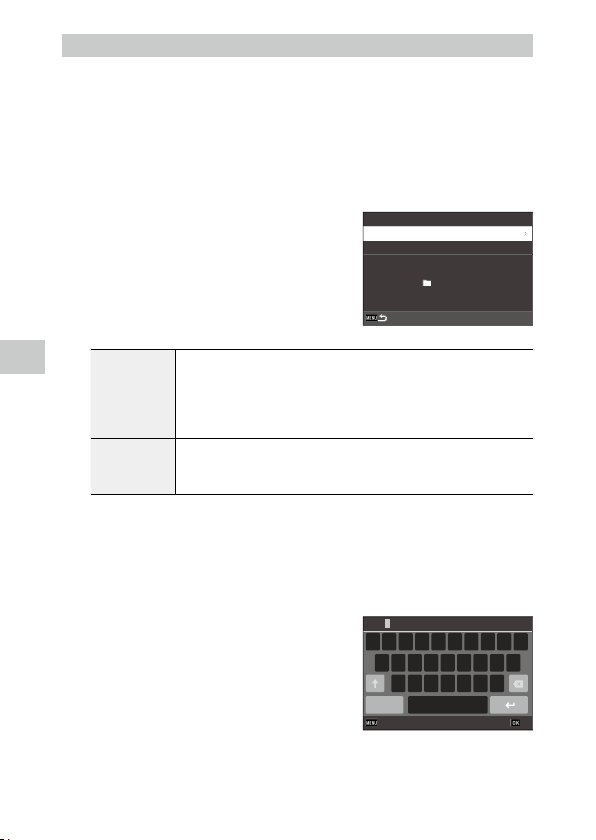
6
Changing the Settings
134
Folder Name
When images are captured with this camera, a folder is automatically cre-
ated and the captured images are stored in it. Each folder name consists of a
sequential number from 100 to 999 and a string of five characters.
The character string in the folder name can be changed.
1 Select [Folder Name] in the E1 menu, and press d.
The [Folder Name] screen appears.
2 Select [Date] or [Optional] in [Folder
Name].
Date Assigns four digits of the month and day of the shooting date after the folder
number.
The month and day appear according to the date format set in [Date Adjustment]
of the E10 menu.
Example) 101_0125: Images taken on January 25th
Optional Assigns a freely defined string of five characters after the folder number.
(Default: RICOH)
Example) 101RICOH
Proceed to Step 6 if you select [Date] or do not need to change the character
string.
3 Press d to select [Enter Text], and press d.
The text-entry screen appears.
4 Enter a folder name.
Up to five single-byte alphanumeric charac-
ters can be entered.
RICOH
100RICOH
Folder Name
Folder Name Optional
Enter Text
㹕E R T Y U I O PQ
S D F G H J K LA
Z
123
X C V B N M
RICOH
_
Cancel OK
6
Changing the Settings
135
The following operations are available.
abcd Moves the text selection cursor.
r/p Moves the text selection cursor up and down.
n Moves the text selection cursor to the right and left.
e Enters a character selected with the text selection cursor.
You can use the touch panel for the operations.
5 After entering the text, move the text selection cursor to 1,
and press e.
The confirmation screen appears.
6 After checking the setting, press e.
The [Folder Name] screen reappears.
Memo ---------------------------------------------------------------------------------------------------------
• If the folder name is changed, a folder with a new number is created the next time shooting is per-
formed.
Caution -------------------------------------------------------------------------------------------------------
• The maximum folder number is 999. If the folder name is changed or a new folder is created after the
folder number reaches 999, you cannot capture new images. Also, you cannot capture new images
when the file name number reaches 9999.
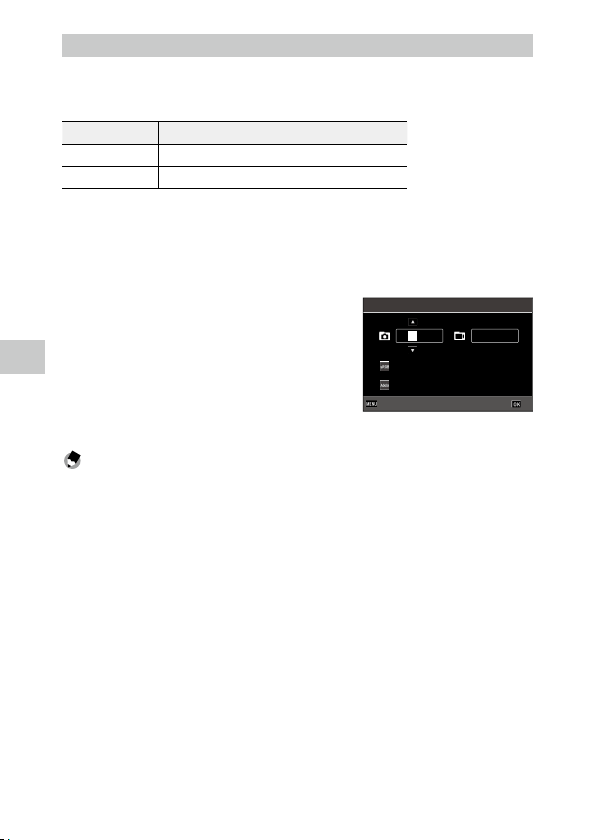
6
Changing the Settings
136
File Name
For still images, one of the following string of characters is used as the file
name prefix depending on the [Color Space] (p.84) setting of the A5
menu.
Color Space File Name
sRGB R0
.JPG
AdobeRGB _R
.JPG
You can change the first two characters of file names from “R0”.
1 Select [File Name] in the E1 menu, and press d.
The [File Name] screen appears.
2 Use cd to select A or B, and use
ab to select a character to enter.
Uppercase alphanumeric characters and “_”
can be entered.
3 Press e.
Memo ---------------------------------------------------------------------------------------------------------
• When [Color Space] is set to [AdobeRGB], the file name prefix is “_” and first character of the entered
character string is used as the file name.
R
0R
0
R0000001.JPG R0000001.MOV
_R000001.JPG
Cancel OK
File Name
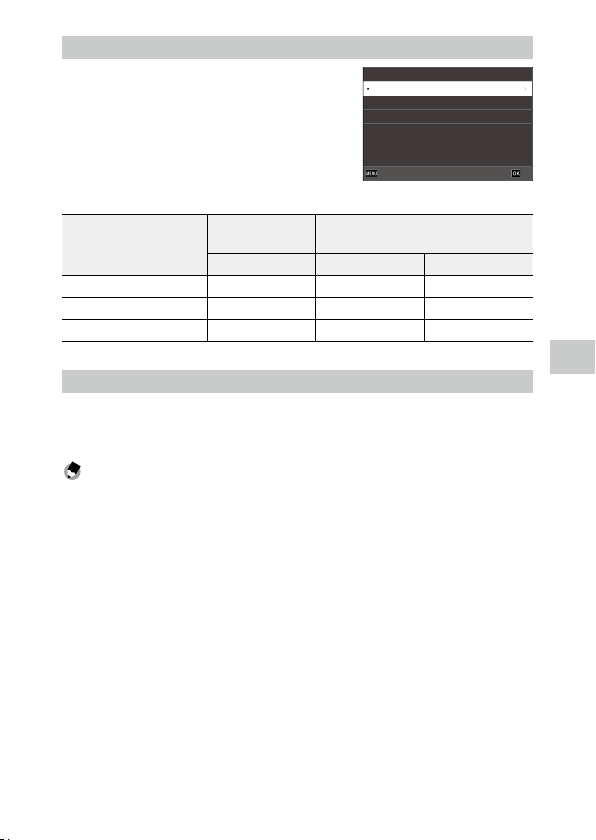
6
Changing the Settings
137
Sequential Numbering
In [Sequential Numbering] of the E1 menu,
you can set whether to continue the sequen-
tial numbering for folder and file names even
when a new folder is created or memory cards
are replaced.
Sequential Numbering
When a New Folder Is
Created
When Memory Cards Are Replaced
File No. Folder No. File No.
Folder & File Continues Continues Continues
File Continues Resets Continues
Off Resets Resets Resets
Reset Numbering
If [Reset Numbering] of the E1 menu is performed, a folder with a new
number is created and file number starts from 0001 when shooting is per-
formed next time.
Memo ---------------------------------------------------------------------------------------------------------
• When the file number reaches 9999, a new folder is created and the file number is reset.
• When a memory card is not inserted, the file number in the internal memory is reset.
Sequential Numbering
Folder & File
CancelCancel OKOK
File
Off
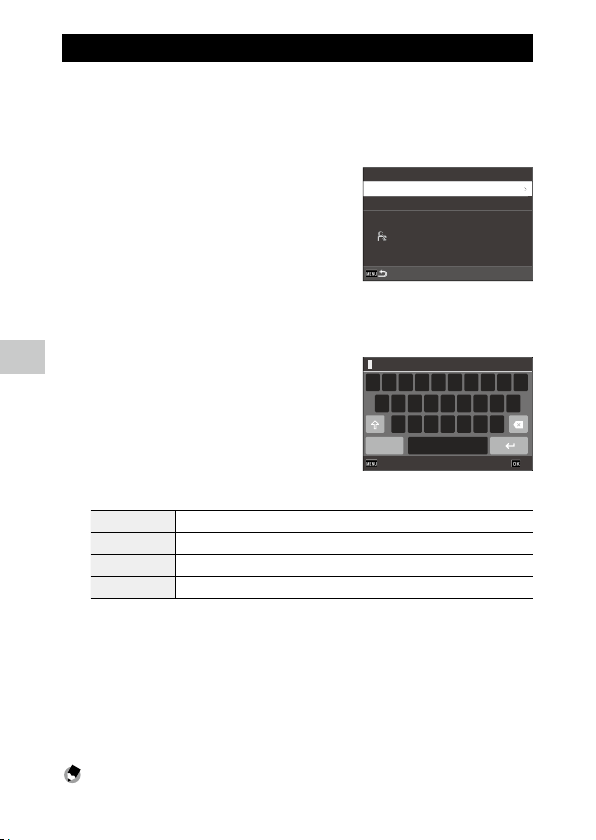
6
Changing the Settings
138
Setting the Copyright Information
You can set the copyright information embedded in the Exif data.
1 Select [Copyright Information] in the E1 menu, and press d.
The [Copyright Information] screen appears.
2 Select [On] or [Off] in [Embed
Copyright Data], and press e.
3 Press d in [Copyright Holder].
The text-entry screen appears.
4 Enter the copyright holder.
Up to 32 single-byte alphanumeric charac-
ters and symbols can be entered.
The following operations are available.
abcd Moves the text selection cursor.
r/p Moves the text selection cursor up and down.
n Moves the text selection cursor to the right and left.
e Enters a character selected with the text selection cursor.
You can use the touch panel for the operations.
5 After entering the text, move the text selection cursor to 1,
and press e.
The confirmation screen appears.
6 After checking the setting, press e.
The [Copyright Information] screen reappears.
Memo ---------------------------------------------------------------------------------------------------------
• You can check the Exif information in [Detailed Info. Display] (p.21) in the playback mode.
XXXXXXXXXXXXXXX
Copyright Information
Embed Copyright Dat
aO
ff
Copyright Holder
㹵e r t y u i o pq
s d f g h j k la
z
123
x c v b n m
Cancel OK
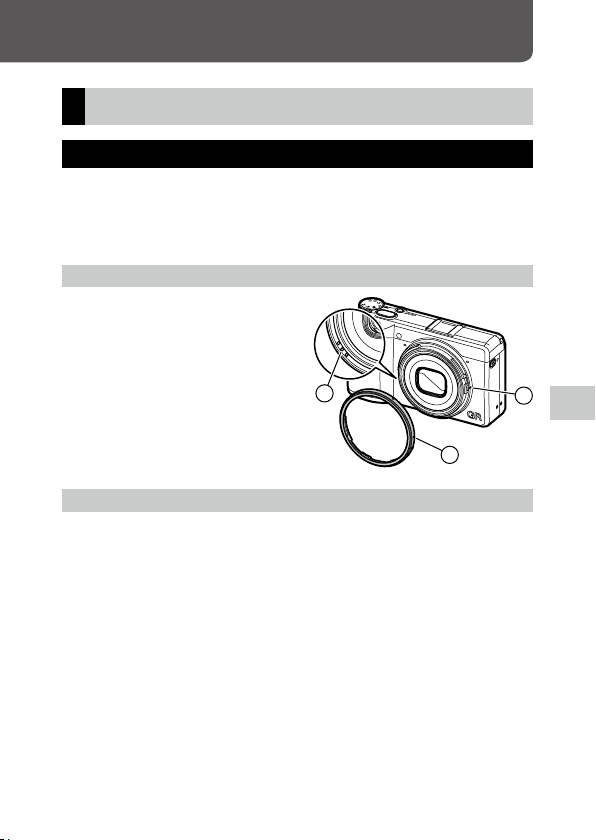
7
Appendix
139
Appendix
Attaching Optional Accessories
Conversion Lens/Lens Adapter
Remove the ring cap before using the wide conversion lens (GW-4) and lens
adapter (GA-1).
For details on handling the wide conversion lens and lens adapter, refer to
the User’s Manual provided with the products.
Removing the Ring Cap
Turn the camera off and rotate the
cap counterclockwise until it can be
removed. Do not touch the converter
pins (
1
).
For removing the lens adapter, turn it
counterclockwise.
Attaching the Ring Cap
With the camera turned off, align the marking on the ring cap (
3
) with the
marking on the camera body (
2
), and turn the ring cap clockwise until it
clicks.
2
3
1
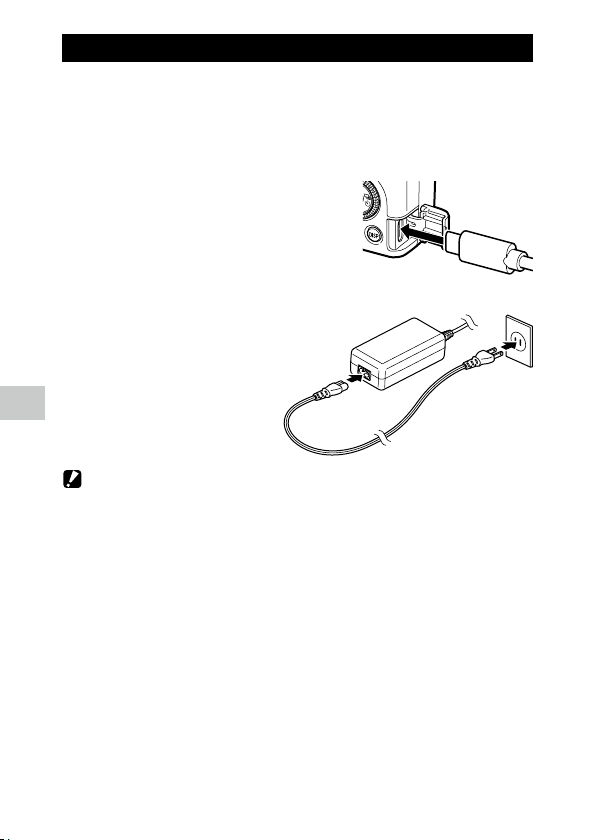
7
Appendix
140
AC Adapter
If you intend to use the camera continuously for a long period, the use of the
AC adapter (D-AC166) is recommended.
1 Make sure that the camera is turned off, and open the terminal
cover.
2 Connect the USB cable (Type-C) of
the AC adapter to the USB terminal of
the camera.
3 Connect the AC plug cord
to the AC adapter, and
plug the cord into the
power outlet.
Caution -------------------------------------------------------------------------------------------------------
• Securely connect the power plug and AC plug cord.
• When the camera is not used, unplug the AC adapter from the power outlet and disconnect it from
the camera.
• If the AC adapter is disconnected from the camera or the power plug is unplugged from the power
outlet during use of the camera, the data may be lost.
• Do not move the camera by holding the AC adapter cable while the AC adapter is used.
• The AC adapter may not be usable depending on the country and region.
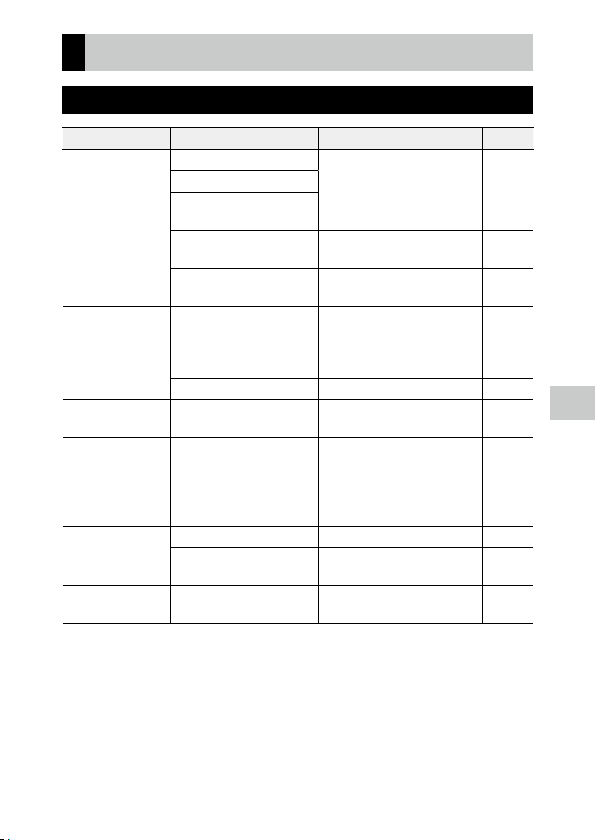
7
Appendix
141
Troubleshooting
Power Supply
Problem Cause Solution Page
The camera does not
turn on.
The battery is not inserted. Charge the battery and correctly
insert it into the camera.
p.38
The battery is exhausted.
The battery is not inserted in the
correct orientation.
The battery is incompatible. Use the battery DB-110 exclusively
developed for this camera.
—
The AC adapter is not correctly
connected.
Connect the AC adapter correctly. —
The camera turns off
during use.
The [Auto Power Off] function
has been activated because the
camera was not operated for a
certain period of time.
Turn the camera back on. p.40
The battery is exhausted. Charge the battery. p.38
The camera does not
turn off.
The camera is malfunctioning. Take the battery out and insert
it again.
p.37
The low battery indica-
tor is displayed or the
camera turns off even
when a fully charged
battery is installed.
The battery is incompatible. Use the battery DB-110 exclusively
developed for this camera.
—
The battery cannot be
charged.
The battery has failed. Replace the battery with a new one. —
The battery is hot. Let the battery cool down to room
temperature.
—
The battery is quickly
exhausted.
Ambient temperature is very
high or very low.
— —
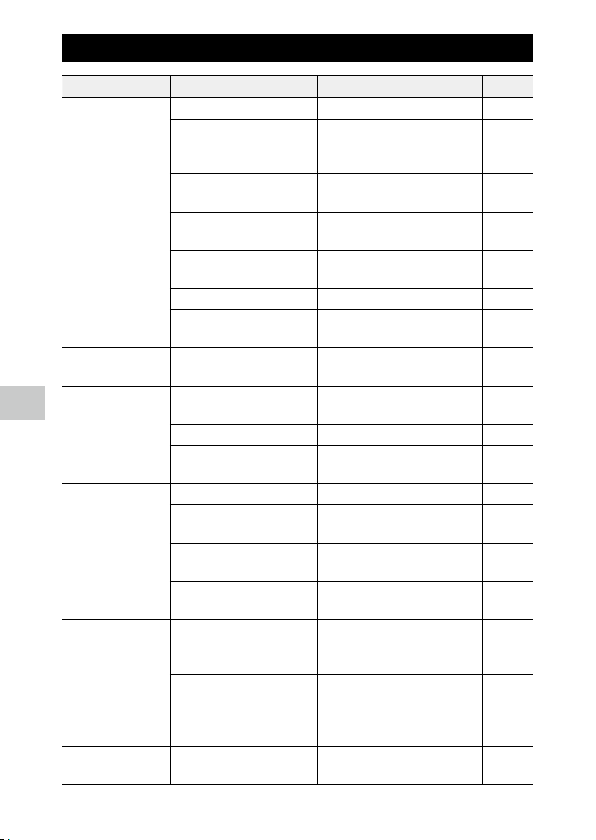
7
Appendix
142
Shooting
Problem Cause Solution Page
Shooting cannot be
performed by pressing
z.
The battery is exhausted. Charge the battery. p.38
The camera is turned off or not in
the shooting mode.
Turn the camera on or press z
to switch the camera to the shooting
mode.
p.40
The memory card is not
formatted.
Perform [Format] in the E1 menu. p.42
The memory card is full. Insert a new card, or delete
unwanted files.
p.96
The memory card has reached
end of its service life.
Insert a new memory card. —
The memory card is locked. Unlock the card. —
The memory card contacts
are dirty.
Clean with soft, dry cloth. —
Images cannot be
checked after shooting.
Confirmation time is too short. Change the [Display Time] setting of
[Instant Review] in the D3 menu.
p.127
The monitor is blank. The monitor brightness is dark. Adjust the brightness of the monitor
in the E3 menu.
p.128
The monitor is off. Press j to turn the monitor on. p.20
An AV device is connected to
the camera.
Remove the cable from the camera. p.95
The camera is unable
to focus in autofocus
mode.
The lens is dirty. Clean with soft, dry cloth. —
The subject is not at center
of frame.
Lock the focus for shooting. —
The subject is not suitable for
autofocus.
Lock the focus or set the focus mode
to [MF] for shooting.
p.60
The subject is too close. Use the macro mode or move away
from the subject.
p.61
Images are blurred. The camera was moved when
z is pressed.
Hold the camera with your elbows
pressed against your body, or use
a tripod.
—
When shooting in a dark place,
the shutter speed slows down
and pictures become easily
blurred.
Use a flash, or set [ISO Setting] to a
high ISO sensitivity.
p.65
p.63
The flash does not
discharge.
A function preventing flash
operation is selected.
Check the settings and mode. —

7
Appendix
143
Problem Cause Solution Page
The flash does not
illuminate the subject.
The subject is dark. Adjust the flash output. p.66
Flash output is not appropriate.
Images are too bright. Flash output is not appropriate. Adjust the flash output, move away
from the subject, or use a different
light source.
p.66
The monitor brightness is not
appropriate.
Adjust the brightness of the monitor
in the E3 menu.
p.128
Images are too dark. The monitor brightness is not
appropriate.
Adjust the brightness of the monitor
in the E3 menu.
p.128
The exposure compensation is
set to a negative value.
Change the exposure compensa-
tion value.
p.53
The colors of images
are unnatural.
The camera is unable to adjust
white balance for shooting con-
ditions using auto white balance.
Include a white object with the
subject or select the settings other
than [Auto White Balance] for [White
Balance].
p.69
The monitor brightness
changes during
autofocus.
Ambient lighting is poor or dif-
fers from that used for autofocus.
This is normal and does not indicate
a malfunction.
—
Electronic level indica-
tors are not displayed.
Electronic level indicators are
hidden.
Check the [Shooting Info. Display]
setting in the D3 menu.
p.126
The image is not level
although level indicator
showed that the
camera was level.
The camera was moving during
shooting because you were on
a moving object or due to other
causes.
Do not move the camera during
shooting.
—
The subject is not level. Check the subject. —
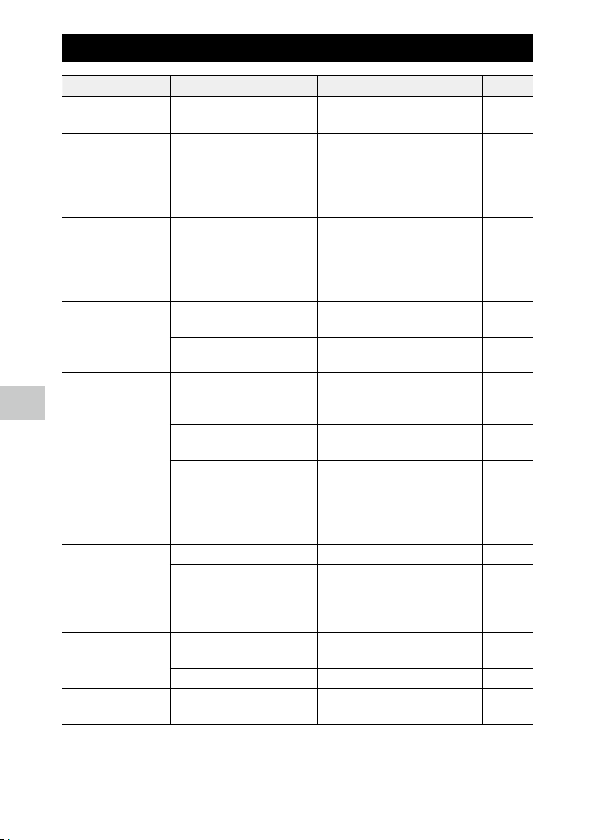
7
Appendix
144
Playback/Deletion
Problem Cause Solution Page
Shooting information is
not displayed.
Information display is set to [No
Information Display].
Press j to switch the information
displayed on the screen.
p.20
Dust or dirt particles
appear in images.
The sensor is dirty or dusty. Perform [Dust Removal] in the
E9 menu.
The Dust Removal function can be
activated every time the camera is
turned on and off.
—
Pixel defects such as
bright spots and dark
spots appear in the
image.
There are defective pixels in
the sensor.
Perform [Pixel Mapping] in the
E9 menu.
It takes about 30 seconds to correct
the defective pixels, so be sure to
install a fully charged battery.
—
Images are not
displayed on an AV
device.
The cable is not correctly
connected.
Connect the cable correctly. p.95
The input setting of the AV
device is incorrect.
Check the AV device settings. —
The images on the
memory card cannot be
played back.
The images are not
displayed on the
monitor.
The inserted memory card is not
formatted with this camera.
Insert a memory card formatted
using [Format] of the E1 menu in
this camera.
p.42
The memory card contacts
are dirty.
Clean with soft, dry cloth. —
The card is malfunctioning. There is no problem with the camera
if images in another memory card
can be played back with this camera.
Do not use a memory card that has
a problem.
—
The monitor turned off. The battery is exhausted. Charge the battery. p.38
The [Auto Power Off] function
has been activated because the
camera was not operated for a
certain period of time.
Turn the camera back on. p.40
File(s) cannot be
deleted.
[Protect] is set for the image(s). Cancel the protection in [Protect] of
the C1 menu.
p.97
The memory card is locked. Unlock the card. —
The memory card can-
not be formatted.
The memory card is locked. Unlock the card. —
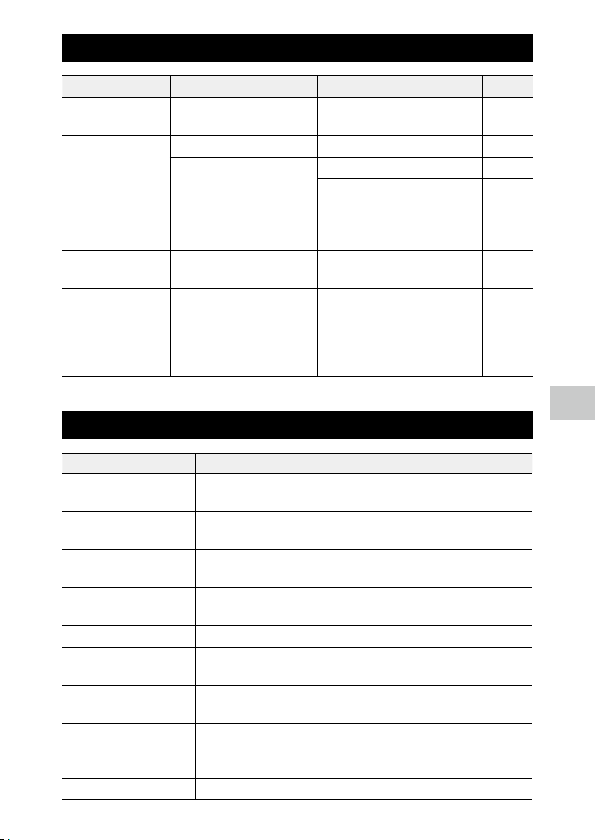
7
Appendix
145
Others
Problem Cause Solution Page
The memory card
cannot be inserted.
The card is not in the correct
orientation.
Insert the memory card in the
correct orientation.
p.37
Camera controls have
no effect.
The battery is exhausted. Charge the battery. p.38
The camera is malfunctioning. Turn the camera back on. p.40
Take the battery out and insert
it again.
When the AC adapter is used,
reconnect it.
p.37
Date is not set correctly. Date and time are not set
correctly.
Set date and time correctly in the
E10 menu.
p.41
The date setting has
been reset.
The battery was removed. If the battery is removed for more
than about five days, the date
setting will be lost.
Set date and time in the E10
menu.
p.41
Error Messages
Error Message Description
Memory card full. The memory card is full and no more images can be saved. Insert a new
memory card or delete unwanted files. (p.96)
Internal memory full. The internal memory is full and no more images can be saved. Insert a
memory card or delete unwanted files. (p.96)
No image. There are no images that can be played back on the memory card and
internal memory.
This image cannot be
displayed.
You are trying to play back an image in a format not supported by this
camera. You may be able to play it back on a computer.
No card in the camera. There is no memory card inserted in the camera.
Memory card error. The memory card has a problem, and shooting and playback are impossible.
You may be able to play it back on a computer.
Internal Memory Error. There is a problem with the internal memory. Format the internal memory.
(p.42)
Card is not formatted. The memory card you have inserted is unformatted or has been previously
used on another device. Use the card after formatting it with this camera.
(p.42)
Card is locked. The write-protect switch on the memory card inserted is locked.
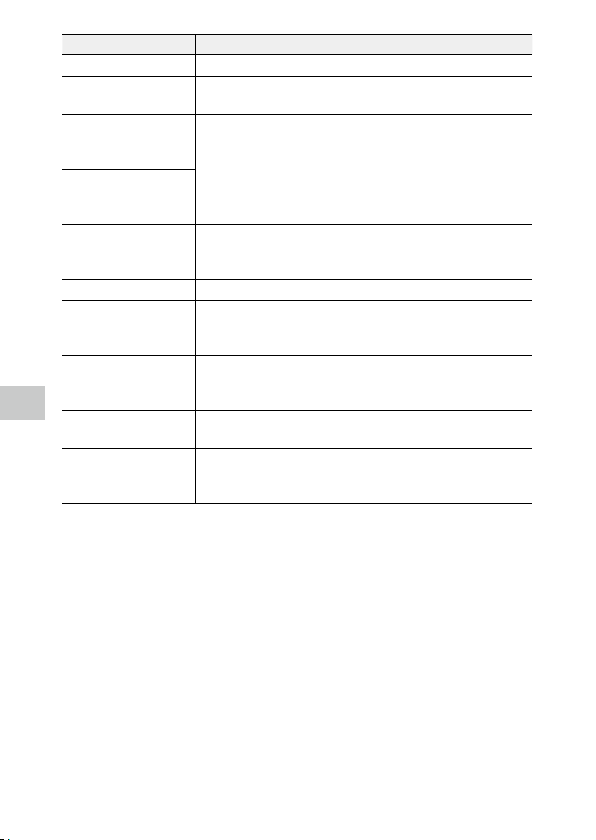
7
Appendix
146
Error Message Description
Cannot use this card. A memory card not compatible with this camera is inserted.
This image cannot be
magnified.
You are trying to magnify an image that cannot be magnified.
Not enough battery power
remaining to activate Pixel
Mapping.
These messages appear if you try to perform the pixel mapping or firmware
update when the battery level is insufficient. Install a fully charged battery.
Not enough battery power
remaining to update the
firmware.
Image folder cannot be
created.
The maximum folder number (999) has been reached, and no more images
can be saved. Insert a new memory card or format the card or internal
memory. (p.42)
Unable to store image. The image could not be saved because of a memory card error.
This image cannot be
processed.
This message appears when you try to perform the functions in the C2
menu for the images captured using other cameras, or [Resize] or [Cropping]
for the minimum-sized images.
The camera will turn off
to prevent damage from
overheating.
The camera will turn off because its internal temperature is too high. Leave
the camera turned off until it has had time to cool down before turning on
the camera again.
Update failed. The update could not be performed correctly. Turn the camera off and on, and
then perform the update again.
Unable to update firmware.
There is a problem with the
firmware update file.
There is a problem with the firmware update file. Download the update file
again, and then perform the update.
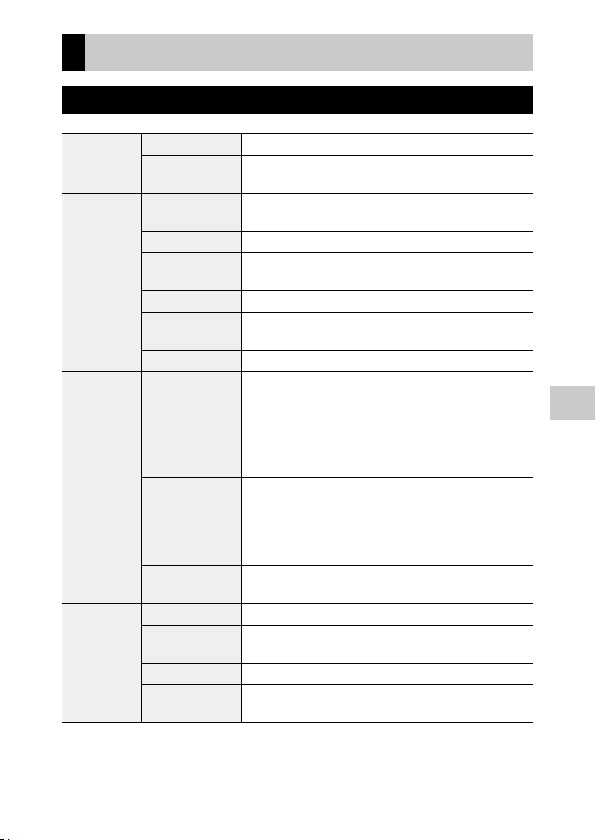
7
Appendix
147
Main Specifications
Camera
Lens Lens Construction 6 elements in 4 groups (2 aspherical lens elements)
Focal Length /
Aperture
18.3 mm (approx. 28 mm in 35 mm equivalent focal length) /
F2.8 to F16
Image Capture
Unit
Image Sensor Type: Primary color filter CMOS
Size: 23.5 mm × 15.6 mm
Effective Pixels Approx. 24.24 megapixels
Sensitivity
(standard output)
ISO 100 to ISO 102400: Auto (ISO Auto Lower/Upper Limit and
Minimum Shutter Speed can be set), Manual
Image Stabilization 3-axis sensor-shift shake reduction (SR)
Anti-Aliasing Filter
Simulator
Moiré reduction using SR unit (Off, Low, High)
Dust Removal Image sensor cleaning using ultrasonic vibrations “DR II”
File Format Still Image File format: RAW (DNG) 14-bit, JPEG (Exif 2.3), DCF 2.0 compliant
Color space: sRGB, AdobeRGB
Recorded pixels: [3:2] L (24M: 6000×4000), M (15M: 4800×3200),
S (7M: 3360×2240), XS (2M: 1920×1280)
[1:1] L (16M: 4000×4000), M (10M: 3200×3200),
S (5M: 2240×2240), XS (1.6M: 1280×1280)
Movie File format: MPEG4 AVC/H.264 (MOV)
Recorded pixels: Full HD (1920×1080, 60p/30p/24p)
Sound recording: Built-in stereo microphone
Recording time: Up to 25 minutes or 4 GB; automatically stops
recording if the internal temperature of the camera becomes high.
Storage Medium Internal memory (approx. 2 GB), SD/SDHC*/SDXC* memory card
* UHS-I compatible
Focus Type Hybrid AF (image plane phase-matching and contrast detection)
Focus Mode Auto-area AF, Select AF, Pinpoint AF, Tracking AF, Continuous AF,
MF, Snap,
Z
Face Detection On, Use only in Auto-area AF, Off
Focus Range
(from lens face)
Normal: Approx. 0.1 m to Z, Macro mode: Approx. 0.06 to 0.12 m
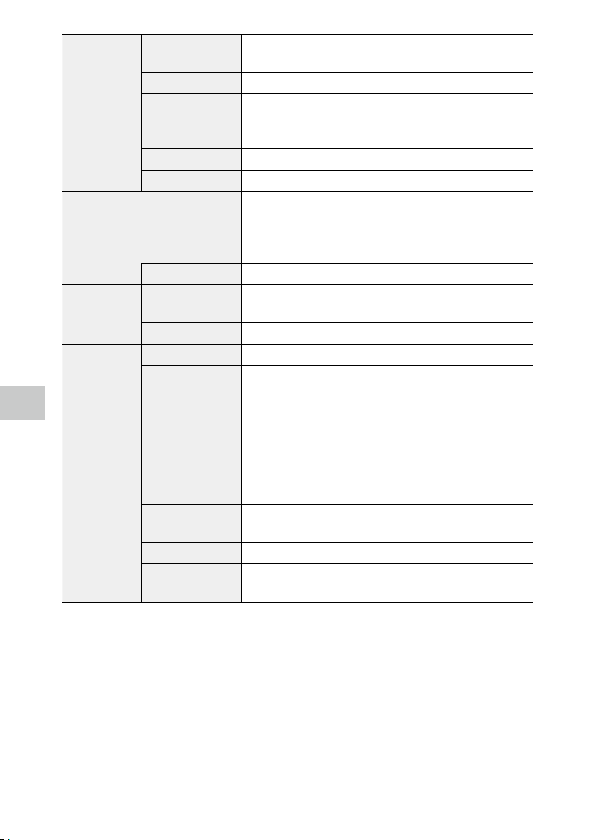
7
Appendix
148
Exposure
Control
Exposure Mode Program AE, Aperture Priority AE, Shutter Priority AE, Manual
Exposure
Metering Mode Multi-segment, Center-weighted, Spot, Highlight-weighted
Shutter Speed 1/4000 to 30 seconds (limitation by the aperture: 1/2500 seconds
at F2.8; 1/4000 seconds at F5.6 or greater)
Bulb timer (10 seconds to 20 minutes), Bulb, Time
EV Compensation Still image: ±5 EV (1/3 EV steps), Movie: ±2 EV (1/3 EV steps)
ND Filter (2 EV) Auto, On, Off
White Balance Auto White Balance, Multi Auto White Balance, Daylight, Shade,
Cloudy, Fl. - Daylight Color, Fl. - Daylight White, Fl. - Cool White,
Fl. - Warm White, Tungsten, CTE, Manual White Balance, Color
Temperature
Fine Adjustment Adjustable ±14 steps on A-B axis and G-M axis
Drive Mode Drive Single Frame Shooting, Continuous Shooting, Bracketing, Multi-
exposure, Interval Shooting, Interval Composite
Self-timer 10 seconds, 2 seconds, Off
Shooting
Functions
Crop 35 mm, 50 mm, Off
Image Control Standard, Vivid, Monotone, Soft Monotone, Hard Monotone,
Hi-Contrast B&W, Positive Film, Bleach Bypass, Retro, HDR Tone,
Custom1, Custom2
Adjustment parameter: Saturation, Hue, High/Low Key
Adjustment, Contrast, Contrast (Highlight), Contrast (Shadow),
Sharpness, Shading, Clarity, Toning, Filter Effect, Grain Effect, HDR
Tone Level (available parameters vary depending on the selected
image)
Dynamic Range
Correction
Highlight Correction, Shadow Correction
Noise Reduction Slow Shutter Speed Noise Reduction, High-ISO Noise Reduction
Display Display magnification (4×, 16×), Grid display (3×3 Grid, 4×4
Grid), Histogram, Highlight Alert, Electronic Level Display
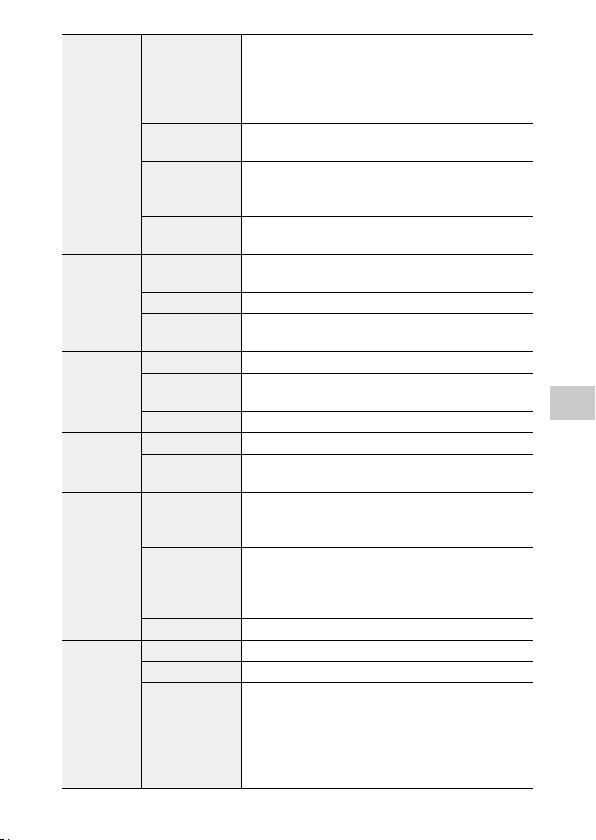
7
Appendix
149
Playback
Functions
Playback View Single image display, Multiple image display (20 thumbnails,
48 thumbnails), Display magnification (up to 16×, 100% view
and Quick Zoom view available), Histogram (Y histogram, RGB
histogram), Grid display (3×3 Grid, 4×4 Grid), Highlight Alert,
Auto Image Rotation
Base Parameter
Adjustment
Brightness, Saturation, Hue, Contrast, Sharpness
RAW Development JPEG Recorded Pixels, Aspect Ratio, Color Space, White Balance,
Image Control, Peripheral Illumination Correction, Sensitivity,
High-ISO Noise Reduction, Shadow Correction
Edit Resize, Cropping, Levels Adjustment, White Balance Adjustment,
Color Moiré Correction, Movie Edit (Cut, Divide)
LCD Monitor Type 3.0 inch TFT color LCD (aspect ratio 3:2), Approx. 1037K dots, Wide
viewing angle, Air-gapless tempered glass
Touch Panel Capacitive sensing method
Adjustment Brightness, Saturation, Blue/Amber, Green/Magenta, Outdoor
View Setting: ±2 steps
Wireless LAN Standards IEEE 802.11b/g/n (HT20) (standard wireless LAN protocol)
Frequency
(center frequency)
2412 to 2462 MHz (Ch 1 to Ch 11)
Security Authentication: WPA2, Encryption: AES
Bluetooth® Standards Bluetooth® v4.2 BLE (Bluetooth Low Energy)
Frequency
(center frequency)
2402 to 2480 MHz (Ch 0 to Ch 39)
Interfaces USB Type-C Battery recharge and camera power supply (optional AC adapter
required), Data transfer: MTP, Video output: DisplayPort over USB-C
(DisplayPort alternative mode)
Hot Shoe Compatible with P-TTL auto flash
Flash mode: Flash On, Flash On+Red-eye, Slow-speed Sync, Slow
Sync+Red-eye
Flash Exposure Compensation: -2.0 to +1.0
Lens Adapter Pin Available
Power Supply Battery Type Rechargeable battery DB-110
AC Adapter AC adapter kit K-AC166 (optional)
Battery Life Number of recordable images: Approx. 200 images
Playback time: Approx. 180 minutes
* Tested in compliance with CIPA standard using a fully charged
rechargeable battery at a temperature of 23°C (73°F). Actual
results may vary depending on the shooting conditions/circum-
stances.
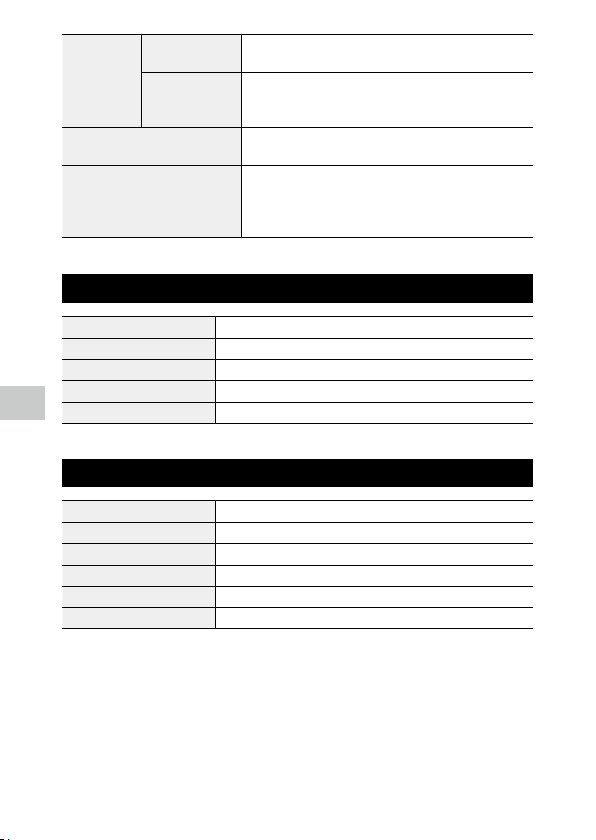
7
Appendix
150
Dimensions
and Weight
Dimensions Approx. 109.4 mm (W) × 61.9 mm (H) × 33.2 mm (D) (excluding
operating controls and protrusions)
Weight Approx. 257 g (including the dedicated battery and an SD memory
card)
Approx. 227 g (body only)
Included Accessories Rechargeable battery DB-110, USB power adapter, Power plug,
USB cable I-USB166, Hand strap
Language English, French, Germany, Spanish, Portuguese, Italy, Dutch,
Danish, Swedish, Finnish, Polish, Czech, Hungarian, Turkey, Greek,
Russian, Thai, Korean, Simplified Chinese, Traditional Chinese,
Japanese
USB Power Adapter AC-U1/AC-U2
Power Supply 100 to 240 V (50/60 Hz), 0.2 A AC
Output 5.0 VDC, 1000 mA
Operating Temperature 10 to 40°C (50 to 104°F)
Dimensions 42.5 mm (W) × 22 mm (H) × 66.5 mm (D) (excluding the power plug)
Weight Approx. 40 g (excluding the power plug)
Rechargeable Battery DB-110
Nominal Voltage 3.6 V
Rated Capacity 1350 mAh, 4.9 Wh
Operating Temperature 0 to 40°C (32 to 104°F)
Storage Temperature -10 to 45°C (14 to 104°F)
Dimensions 39.8 mm (W) × 34.2 mm (H) × 8.5 mm (D)
Weight Approx. 26 g
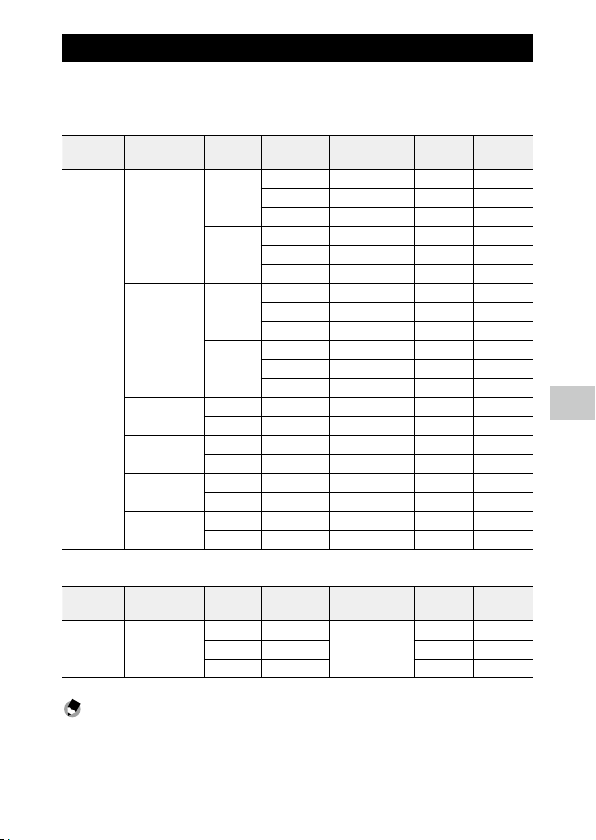
7
Appendix
151
Image Storage Capacity
The following table shows the approximate number of images and record-
ing time (in seconds) of movies that can be saved in the internal memory
and a memory card in various formats.
File Format/JPEG
Recorded Pixels
Aspect Ratio Focal Length
*1
Number of Recorded
Pixels
Internal
Memory
Memory Card
8 GB
Still image RAW 3:2 28 mm 6000 × 4000 40 150
35 mm 4800 × 3200 40 154
50 mm 3360 × 2240 41 157
1:1 28 mm 4000 × 4000 40 153
35 mm 3200 × 3200 41 156
50 mm 2240 × 2240 42 158
RAW+ 3:2 28 mm 6000 × 4000 31 117
35 mm 4800 × 3200 34 129
50 mm 3360 × 2240 38 143
1:1 28 mm 4000 × 4000 34 128
35 mm 3200 × 3200 36 138
50 mm 2240 × 2240 39 148
L 3:2 — 6000 × 4000 140 527
1:1 — 4000 × 4000 209 788
M 3:2 — 4800 × 3200 218 820
1:1 — 3200 × 3200 324 1220
S 3:2 — 3360 × 2240 437 1646
1:1 — 2240 × 2240 645 2428
XS 3:2 — 1920 × 1280 1253 4717
1:1 — 1280 × 1280 1810 6813
*1 35 mm equivalent focal length
Resolution Aspect Ratio Framerate
Number of Recorded
Pixels
Internal
Memory
Memory Card
8 GB
Movie Full HD 16:9 60p 1920 × 1080 3:16 12:17
16:9 30p 6:25 24:09
16:9 24p 7:57 29:56
Memo ---------------------------------------------------------------------------------------------------------
• The figures for movies are the total time length that can be recorded. The maximum recording time
per shooting is 25 minutes or the equivalent of 4 GB.
• The number of images that can be taken may differ from the number of storable images displayed
on the monitor.
• The storage capacity varies depending on the shooting conditions and the capacity of the memory.
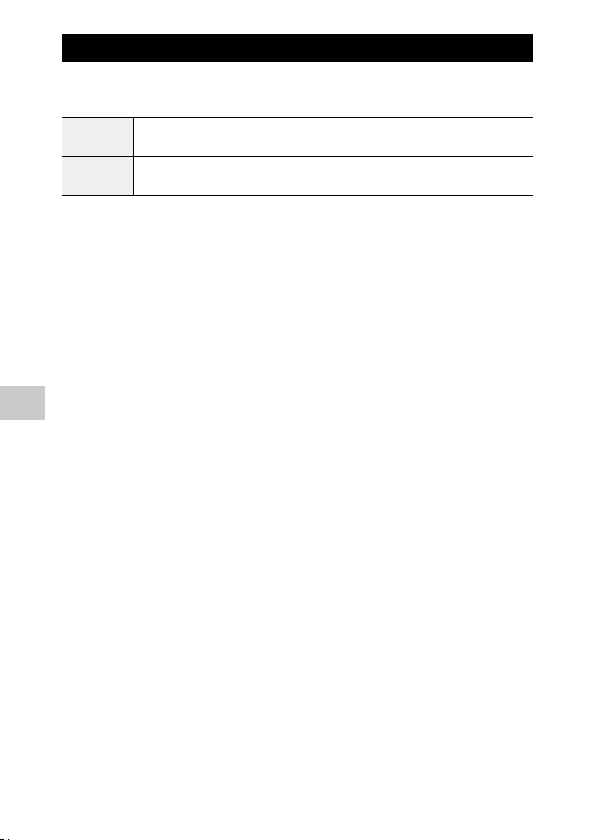
7
Appendix
152
Operating Environment
It is confirmed that a USB connection can be established between the cam-
era and the following OSs.
Windows® Windows® 10 (FCU, CU) (32-bit, 64-bit), Windows® 8.1 (32-bit, 64-bit), Windows® 8 (32-bit,
64-bit), or Windows® 7 (32-bit, 64-bit)
Mac macOS 10.14 Mojave, macOS 10.13 High Sierra, macOS 10.12 Sierra, OS X 10.11 El Capitan,
OS X 10.10 Yosemite

7
Appendix
153
Using the Camera Abroad
USB Power Adapter (AC-U1/AC-U2), AC Adapter (D-AC166), and
Battery Charger (BJ-11)
These products are for use with currents of 100 to 240 V and 50 or 60 Hz.
Before traveling, purchase a travel adapter for connection to the type of out-
lets used at your destination.
Do not use these products with electrical transformers, as this could damage
the camera.
7
Appendix
154
Precautions for Use
Camera
• Do not drop the camera or subject it to physical shocks.
• When carrying the camera, be careful that it does not strike other objects. Particular
care is required to protect the lens and monitor.
• Battery may become hot with extended use. Wait for the battery to cool before re-
moving it from the camera.
• The monitor may be difficult to read in direct sunlight.
• You may notice that monitor varies in brightness or contains pixels that do not light
or that are always lit. This is common to all LCD monitors and does not indicate a
malfunction.
• Do not apply force to the monitor.
• Abrupt changes in temperature may cause condensation, resulting in visible conden-
sation inside the lens or camera malfunction. This can be avoided by placing the cam-
era in a plastic bag to slow the temperature change, and removing it only after the air
in the bag has reached the same temperature of its surroundings.
• To prevent damage to the product, do not insert objects into the holes in the micro-
phone and speaker coverings.
• Do not allow the camera to get wet. In addition, do not operate it with wet hands. Fail-
ure to observe this precaution could result in product malfunction or electric shock.
• Take a test shot to ensure that the camera is functioning properly before using it on
important occasions such as travel or weddings. We recommend that you keep this
manual and spare batteries at hand.
Conditions that May Cause Condensation -------------------------------------------------------------
• If you move to an area with a sharply different temperature
• If humidity is high
• In a cold room after the heater has come on, or where the camera is exposed to cold air from an air
conditioner or other device
7
Appendix
155
USB Power Adapter AC-U1/AC-U2
• Use the USB cable contained in the package.
• Do not subject the power adapter to severe impact or force.
• Do not use in extreme high or low temperatures or areas subject to vibration.
• Do not use in an area subject to direct sunlight or high temperature.
• Unplug the power plug from the power outlet after charging. Failure to observe this
precaution could result in fire.
• Do not allow other metallic objects to come in contact with the connectors, or con-
tacts of the rechargeable battery as this can result in a short circuit.
• The operating temperature range is 10 to 40°C (50 to 104°F). Charging takes longer at
temperatures below 10°C (50°F).
Caution -------------------------------------------------------------------------------------------------------
• Use of other batteries can cause explosion.
Rechargeable Battery DB-110
• This is a lithium-ion battery.
• The battery is not fully charged at the time of purchase, so be sure to charge the
battery before use.
• Do not open or damage the battery as this can result in fire or injury. In addition, do
not heat the battery above 60°C (140°F) or expose the battery to fire.
• Due to the battery characteristics, the battery usage time may be shortened when
used in a cold environment, even if the battery is fully charged. Keep the battery
warm by placing it in a pocket or have a backup battery ready.
• When not in use, be sure to remove the battery from the camera or the battery char-
ger. A small amount of current can leak from the battery even when the power is
off, creating excessive discharge and making the battery unusable. If the battery is
removed for more than five days, the date and time settings will be lost. In this case,
reset the date and time.
• If the battery is not used for a long time, charge the battery for 15 minutes once a
year before storing.
• Store in a dry, cool place with an ambient temperature between 15°C and 25°C (59°F
and 77°F). Avoid storing in extreme high or low temperatures.
• After charging the battery, do not immediately charge it again.
• Charge the battery at an ambient temperature between 10°C and 40°C (50°F and
104°F). Charging the battery at a high temperature can deteriorate the battery. Charg-
ing at a low temperature may prevent full charging.
• If the battery usage time becomes very short even when fully charged, the battery
has reached the end of its service life. Replace with a new battery. Be sure to use a
replacement battery recommended by RICOH IMAGING.
• The charging time with the AC-U1/AC-U2 is approximately 2.5 hours (at 25°C (77°F)).

7
Appendix
156
Camera Care and Storage
Caring for the Camera
• Image quality can be affected by fingerprints and other foreign matter on the lens.
Avoid touching the lens with your fingers.
• Remove dust or lint on the lens with a commercially available blower, or gently clean
the lens with a soft, dry cloth.
• Clean the camera thoroughly after using it at the beach in a place where chemicals
are handled.
• In the unlikely event of malfunction, consult your nearest repair center.
• The camera contains high-voltage circuits. Do not disassemble it.
• Do not expose the camera to volatile substances such as thinner, benzine, or pesti-
cides. Failure to observe this precaution could result in damage to the camera or its
coatings.
• The monitor is easily scratched. Avoid touching it with hard objects.
• Clean the monitor by wiping it with a soft cloth dampened with a small amount of any
monitor cleaner that does not contain organic solvents.
Storage
• Do not store the camera where it will be exposed to:
Extreme heat or humidity, large changes in temperature or humidity
Dust, dirt, sand
Severe vibration
Prolonged contact with chemicals including pesticides, or with vinyl or rubber
products
Strong magnetic fields (for example, in the vicinity of a monitor, transformer, or
magnet)
• Remove the battery if the product is left unused for a long period of time.
Before Cleaning
• Be sure to turn the camera off.
• Remove the battery and AC adapter from the camera.

7
Appendix
157
Warranty Policy
All our cameras purchased through authorized bona fide photographic distribution channels
are guaranteed against defects of material or workmanship for a period of twelve months from
the date of your purchase. Service will be rendered, and defective parts will be replaced without
cost to you within that period, provided the camera does not show evidence of impact, sand
or liquid damage, mishandling, tampering, battery or chemical corrosion, operation contrary to
operating instructions, or modification by an unauthorized repair shop. The manufacturer or its
authorized representatives shall not be liable for any repair or alterations except those made
with its written consent and shall not be liable for damages from delay or loss of use or from
other indirect or consequential damages of any kind, whether caused by defective material or
workmanship or otherwise; and it is expressly agreed that the liability of the manufacturer or its
representatives under all guarantees or warranties, whether expressed or implied, is strictly lim-
ited to the replacement of parts as hereinbefore provided. No refunds will be made on repairs
by non-authorized service facilities.
Procedure During 12-month Warranty Period
Any camera which proves defective during the 12-month warranty period should be returned
to the dealer from whom you purchased the camera or to the manufacturer. If there are no
representatives of the manufacturer in your country, send the camera to the manufacturer, with
postage prepaid. In this case, it will take a considerable length of time before the camera can
be returned to you owing to the complicated customs procedures required. If the camera is
covered by warranty, repairs will be made and parts replaced free of charge, and the camera
will be returned to you upon completion of servicing. If the camera is not covered by warranty,
regular charges of the manufacturer or of its representatives will apply. Shipping charges are
to be borne by the owner. If your camera was purchased outside of the country where you
wish to have it serviced during the warranty period, regular handling and servicing fees may
be charged by the manufacturer’s representatives in that country. Notwithstanding this, your
camera returned to the manufacturer will be serviced free of charge according to this procedure
and warranty policy. In any case, however, shipping charges and customs clearance fees to be
borne by the sender. To prove the date of your purchase when required, please keep the receipt
or bills covering the purchase of your camera for at least a year. Before sending your camera for
servicing, please make sure that you are sending it to the manufacturer’s authorized represen-
tatives or their approved repair shops, unless you are sending it directly to the manufacturer.
Always obtain a quotation for the service charge, and only after you accept the quoted service
charge, instruct the service station to proceed with the servicing.
• This warranty policy does not affect the customer’s statutory rights.
• The local warranty policies available from our distributors in some countries can
supersede this warranty policy. Therefore, we recommend that you review the
warranty card supplied with your product at the time of purchase, or contact
our distributor in your country for more information and to receive a copy of
the warranty policy.

7
Appendix
158
Regulatory Compliance Statements
For Customers in USA
STATEMENT OF FCC COMPLIANCE
This device complies with Part 15 of the FCC Rules. Operation is subject to the following
two conditions: (1) This device may not cause harmful interference, and (2) this device
must accept any interference received, including interference that may cause undesired
operation.
Changes or modifications not approved by the party responsible for compliance could
void the user’s authority to operate the equipment.
This equipment has been tested and found to comply with the limits for a Class B digital
device, pursuant to part 15 of the FCC Rules. These limits are designed to provide reason-
able protection against harmful interference in a residential installation. This equipment
generates, uses and can radiate radio frequency energy and, if not installed and used in
accordance with the instructions, may cause harmful interference to radio communi-
cations. However, there is no guarantee that interference will not occur in a particular
installation. If this equipment does cause harmful interference to radio or television
reception, which can be determined by turning the equipment off and on, the user is
encouraged to try to correct the interference by one or more of the following measures:
• Reorient or relocate the receiving antenna.
• Increase the separation between the equipment and receiver.
• Connect the equipment into an outlet on a circuit different from that to which the
receiver is connected.
* Consult the dealer or an experienced radio/TV technician for help.
This transmitter must not be co-located or operated in conjunction with any other an-
tenna or transmitter.
The available scientific evidence does not show that any health problems are associated
with using low power wireless devices. There is no proof, however, that these low power
wireless devices are absolutely safe. Low power Wireless devices emit low levels of radio
frequency energy (RF) in the microwave range while being used. Whereas high levels of
RF can produce health effects (by heating tissue), exposure of low-level RF that does not
produce heating effects causes no known adverse health effects. Many studies of low-
level RF exposures have not found any biological effects. Some studies have suggested
that some biological effects might occur, but such findings have not been confirmed
by additional research. R02010 has been tested and found to comply with FCC radia-
tion exposure limits set forth for an uncontrolled environment and meets the FCC radio
frequency (RF) Exposure Guidelines.
7
Appendix
159
Declaration of Conformity
According to 47CFR, Parts 2 and 15 for
Class B Personal Computers and Peripherals
We: RICOH IMAGING AMERICAS CORPORATION
Located at: 5 Dedrick Place, West Caldwell,
New Jersey 07006, U.S.A.
Phone: 800-877-0155
FAX: 973-882-2008
Declare under sole responsibility that the product identified herein complies with 47CFR
Parts 2 and 15 of the FCC rules as a Class B digital device. Each product marketed is
identical to the representative unit tested and found to be compliant with the stan-
dards. Records maintained continue to reflect the equipment being produced can be
expected to be within the variation accepted, due to quantity production and testing
on the statistical basis as required by 47CFR §2.909. Operation is subject to the following
two conditions: (1) This device may not cause harmful interference, and (2) This device
must accept any interference received, including interference that may cause undesired
operation. The above named party is responsible for ensuring that the equipment com-
plies with the standards of 47CFR §15.101 to §15.109.
Product Name: Digital Camera
Model Number: R02010
Contact person: Customer Service Manager
Date and Place: October, 2018 West Caldwell

7
Appendix
160
For Customers in Canada
Innovation, Science and Economic Development Canada (ISED)
Regulatory Compliance Notice
This Class B digital apparatus complies with Canadian ICES-003 (B).
This device complies with Innovation, Science and Economic Development Canada li-
cence-exempt RSS standard(s). Operation is subject to the following two conditions: (1)
this device may not cause interference, and (2) this device must accept any interference,
including interference that may cause undesired operation of the device.
The available scientific evidence does not show that any health problems are associated
with using low power wireless devices. There is no proof, however, that these low power
wireless devices are absolutely safe. Low power wireless devices emit low levels of radio
frequency energy (RF) in the microwave range while being used. Whereas high levels of
RF can produce health effects (by heating tissue), exposure of low-level RF that does not
produce heating effects causes no known adverse health effects. Many studies of low-
level RF exposures have not found any biological effects. Some studies have suggested
that some biological effects might occur, but such findings have not been confirmed by
additional research. The GR III has been tested and found to comply with ISED radiation
exposure limits set forth for an uncontrolled environment and meets RSS-102 of the
ISED radio frequency (RF) Exposure rules.
Pour les utilisateurs au Canada
Avis de conformité à la réglementation d’Innovation, Sciences et
Développement économique Canada (ISDE)
Cet appareil numérique de la classe B est conforme à la norme NMB-003 (B) du Canada.
Le présent appareil est conforme aux CNR d’Innovation, Sciences et Développement
économique Canada applicables aux appareils radio exempts de licence. L’exploitation
est autorisée aux deux conditions suivantes : (1) l’appareil ne doit pas produire de brouil-
lage, et (2) l’utilisateur de l’appareil doit accepter tout brouillage radioélectrique subi,
même si le brouillage est susceptible d’en compromettre le fonctionnement.
Les connaissances scientifiques dont nous disposons n’ont mis en évidence aucun prob-
lème de santé associé à l’usage des appareils sans fil à faible puissance. Nous ne sommes
cependant pas en mesure de prouver que ces appareils sans fil à faible puissance sont
entièrement sans danger. Les appareils sans fil à faible puissance émettent une énergie
fréquence radioélectrique (RF) très faible dans le spectre des micro-ondes lorsqu’ils sont
utilisés. Alors qu’une dose élevée de RF peut avoir des effets sur la santé (en chauffant les
tissus), l’exposition à de faibles RF qui ne produisent pas de chaleur n’a pas de mauvais
effets connus sur la santé. De nombreuses études ont été menées sur les expositions
aux RF faibles et n’ont découvert aucun effet biologique. Certaines études ont suggéré
qu’il pouvait y avoir certains effets biologiques, mais ces résultats n’ont pas été confirmés
par des recherches supplémentaires. Le GR III a été testé et jugé conforme aux limites
d’exposition aux rayonnements ISDE énoncées pour un environnement non contrôlé et
respecte les règles d’exposition aux fréquences radioélectriques (RF) CNR-102 de l’ISDE.
7
Appendix
161
For Customers in Europe
Information for Users on Collection and Disposal of Old Equip-
ment and Used Batteries
1. In the European Union
These symbols on the products, packaging and/or accompanying docu-
ments mean that used electrical and electronic equipment and batteries
should not be mixed with general household waste.
Used electrical/electronic equipment and batteries must be treated sepa-
rately and in accordance with legislation that requires proper treatment,
recovery and recycling of these products.
By disposing of these products correctly you will help ensure that the
waste undergoes the necessary treatment, recovery and recycling and
thus prevent potential negative effects on the environment and human
health which could otherwise arise due to inappropriate waste handling.
If a chemical symbol is added beneath the symbol shown above, in accordance with the
Battery Directive, this indicates that a heavy metal (Hg = Mercury, Cd = Cadmium, Pb =
Lead) is present in the battery at a concentration above an applicable threshold speci-
fied in the Battery Directive.
For more information about collection and recycling of used products, please contact
your local authorities, your waste disposal service or the point of sale where you pur-
chased the products.
2. In other countries outside the EU
These symbols are only valid in the European Union. If you wish to discard used prod-
ucts, please contact your local authorities or dealer and ask for the correct method of
disposal.
For Switzerland: Used electrical/electronic equipment can be returned free of charge to
the dealer, even when you don’t purchase a new product. Further collection facilities are
listed on the home page of www.swico.ch or www.sens.ch.
7
Appendix
162
Notice to Users in EEA Countries
This product complies with the essential requirements and provisions of RE Directive
2014/53/EU.
The CE Declaration of Conformity is available by accessing the URL:
http://www.ricoh-imaging.co.jp/english/support/declaration_of_conformity.html
and selecting the product applicable.
Operating frequency band: 2400 MHz - 2483.5 MHz
Maximum radio-frequency power: 9.15 dBm EIRP
European importer: RICOH IMAGING EUROPE S.A.S.
Parc Tertiaire SILIC 7-9, avenue Robert Schuman - B.P. 70102, 94513 Rungis Cedex,
FRANCE
Manufacturer: RICOH IMAGING COMPANY, LTD.
1-3-6, Nakamagome, Ohta-ku, Tokyo 143-8555, JAPAN
The CE Mark is a Directive conformity mark of the European Union.

7
Appendix
163
For Customers in Thai
This telecommunication equipment conforms to the technical standards or require-
ments of NBTC.

164
Index
Numerics
4-way Controller .......................................... 59
A
AC adapter .................................................. 140
ADJ. lever ........................................................ 23
ADJ. mode ................................................... 121
AdobeRGB ...................................................... 84
AE Lock ............................................................ 50
AE Metering ................................................... 63
AF Assist Light .............................................. 58
AF point .......................................................... 59
Animation Setting ....................................... 47
Anti-Aliasing Filter Simulator .................. 86
Aperture Priority AE .................................... 48
Aperture value .............................................. 48
Aspect Ratio .................................................. 84
Auto-area AF (Focus) .................................. 57
Auto bracketing ........................................... 76
Auto EV Compensation ............................. 49
Auto Image Rotation .................................. 94
Auto Image Transfer ................................ 116
Auto Power Off .......................................... 131
Auto SR Off..................................................... 90
Auto White Balance (White Balance) .... 69
AV device ........................................................ 95
Av mode.......................................................... 48
B
Base Parameter Adj .................................. 107
Battery ...................................................... 37, 38
Battery level ................................................... 19
Bleach Bypass (Image Control) ............... 87
Bluetooth®................................................... 112
Bracketing ...................................................... 76
Bulb .................................................................. 51
Bulb timer ....................................................... 51
Button .............................................................. 16
C
Card .................................................................. 37
Care................................................................ 156
Center-weighted (AE Metering) ............. 63
Certification Marks ........................................ 2
Changing display ......................................... 20
Charging the battery .................................. 38
Cloudy (White Balance) ............................. 69
Color Moiré Correction ........................... 106
Color Space .................................................... 84
Color Temperature (White Balance) ...... 73
Communication device .......................... 111
Connection to a computer .................... 110
Continuous AF (Focus)............................... 57
Continuous Shooting ................................. 75
Conversion lens ......................................... 139
Copyright Information ............................ 138
Correcting a range of tones ..................... 89
Count Down ............................................... 129
Create New Folder .................................... 133
Crop .................................................................. 84
Cropping ...................................................... 102
CTE (White Balance) ................................... 69
Customization ........................................... 121
Customize Settings menus ...................... 33
Cut (Movie) ................................................. 108
D
Date Adjustment ......................................... 41
Daylight (White Balance) .......................... 69
Delete .............................................................. 96
Dial .................................................................... 16
Direct keys ...................................................... 22
DisplayPort .................................................... 95
Divide (Movie) ........................................... 108
DNG .................................................................. 84
Drive Mode .................................................... 74
Dust Removal ............................................. 144
Dynamic Range Compensation ............. 89
E
Editing images ........................................... 100
Electronic Level ......................................... 126
Electronic Level Type ............................... 128
EV compensation ........................................ 53
Exif ................................................................. 138
Exposure Mode .................................. 48, 120
F
Face Detection .............................................. 58
File Format ..................................................... 84
File Name ..................................................... 136
File Transfer .................................................... 99
Flash ................................................................. 65
Flash Exposure Compensation ............... 66
Flash Mode..................................................... 66

165
Flash On (Flash) ............................................ 66
Flash On+Red-eye (Flash) ......................... 66
Flicker Reduction ...................................... 128
Fluorescent (White Balance) .................... 69
Fn button ........................................................ 24
Fn Button Setting ..................................... 123
Focus ......................................................... 44, 58
Focus bar ........................................................ 60
Focus frame ................................................... 44
Focus Magnification ................................... 47
Focus Peaking ............................................... 58
Folder Name ............................................... 134
Format ............................................................. 42
Framerate ....................................................... 85
Full Press Snap .............................................. 62
G
Grid Guide ................................................... 126
Grid Style ..................................................... 128
Guide Display ...................................... 24, 124
H
Hard Monotone (Image Control) ........... 87
HDR Tone (Image Control)........................ 87
High Contrast Black & White
(Image Control) ........................................ 87
High-ISO Noise Reduction ....................... 67
Highlight Alert ........................................... 126
Highlight Correction .................................. 89
Highlight-weighted (AE Metering)........ 63
Histogram.................................................... 126
I
Image Capture Settings ............................ 84
Image Control ............................................... 87
Image Copy ................................................... 98
Image Rotation ............................................. 94
Image Sync ................................................. 116
Image Transfer while Off ........................ 116
Infinity (Focus) .............................................. 57
Initial settings ............................................... 40
Instant Review .................................... 44, 127
Internal memory ................................... 38, 98
Interval Composite ..................................... 81
Interval Shooting ......................................... 79
ISO sensitivity................................................ 64
ISO Setting ..................................................... 64
J
JPEG Recorded Pixels ................................. 84
K
Keep AE Lock .............................................. 124
L
Language setting ........................................ 41
LCD Auto Dim ............................................ 132
LCD Setting ................................................. 128
Lens adapter ............................................... 139
Levels Adjustment ................................... 103
Lever ................................................................. 16
Link AE and AF Point .................................. 63
M
Macro ............................................................... 61
Magnifying captured image .................... 46
Magnifying Live View image ................... 45
Manual Exposure ......................................... 48
Manual focus ................................................. 60
Manual White Balance
(White Balance) ........................................ 72
Memory card ................................................. 37
Menu ................................................................ 25
MF ..................................................................... 60
MF Auto Magnification .............................. 60
M mode ........................................................... 48
M Mode Dial Setting................................... 52
Monitor ........................................................... 18
Monotone (Image Control) ...................... 87
Movie ............................................................... 54
Movie Capture Settings ............................. 85
Movie Edit ................................................... 108
Movie Settings menus ............................... 30
Movie SR ......................................................... 90
Multi Auto White Balance
(White Balance) ........................................ 69
Multi-exposure ............................................. 77
Multiple image display .............................. 92
Multiple image selection ......................... 93
Multi-segment (AE Metering) ................. 63
N
ND Filter .......................................................... 86
Noise Reduction........................................... 67

166
O
One Push AE in M Mode.................. 52, 124
Operating environment ......................... 152
Outdoor View Setting ............................. 129
P
Package contents ........................................ 13
Pairing........................................................... 112
Peripheral Illumination Correction ....... 89
Pinpoint AF (Focus) ..................................... 57
Pixel Mapping ............................................ 144
Playback ................................................... 46, 91
Playback Information Display .............. 126
Playback Order Options ............................ 92
Playback Settings menus .......................... 32
P mode ............................................................ 48
Positive Film (Image Control) .................. 87
Power ............................................................... 40
Power Button Lamp ................................. 129
Preview ............................................................ 52
Processing images ................................... 100
Program AE .................................................... 48
Program Line ................................................. 51
Program mode ............................................. 44
Protect ............................................................. 97
Q
Quick Zoom ................................................ 127
R
RAW .................................................................. 84
RAW Development................................... 100
Reducing blurring of images................... 90
Remote Capture ........................................ 116
Reset .......................................................... 26, 42
Reset Numbering ..................................... 137
Resize ............................................................ 102
Retro (Image Control) ................................ 87
Ring cap ....................................................... 139
S
Saving power ............................................. 131
SD memory card .......................................... 37
Select AF (Focus) .......................................... 57
Self-timer ........................................................ 83
Sensitivity ....................................................... 64
Sequential Numbering ........................... 137
Setup menus ................................................. 35
Shade (White Balance) .............................. 69
Shadow Correction ..................................... 89
Shake Reduction .......................................... 90
Sharing ......................................................... 110
Shooting close-ups ..................................... 61
Shooting Information Display ............. 126
Shutter Button Confirmation ............... 125
Shutter Button Setting ........................... 125
Shutter Priority AE ....................................... 48
Shutter speed ............................................... 48
Single image display .................................. 46
Sleep Mode ................................................. 132
Slow Shutter Speed Noise
Reduction ................................................... 67
Slow-speed Sync (Flash) ............................ 66
Slow Sync+Red-eye (Flash) ...................... 66
Smartphone ............................................... 111
Smartphone Link ...................................... 116
Snap (Focus) .................................................. 57
Snap Focus Distance .................................. 57
Soft Monotone (Image Control) ............. 87
Sound Effects ............................................. 130
Sound Recording ......................................... 85
Specifications ............................................. 147
Spot (AE Metering) ...................................... 63
sRGB ................................................................. 84
Still Image Settings menus ...................... 27
Storage ......................................................... 156
Storage capacity ................................ 39, 151
Store Cursor Position .................................. 26
Store Location Information ................... 116
T
Time .................................................................. 51
Touch AF ......................................................... 50
Touch panel ................................................... 21
Tracking AF (Focus) ..................................... 57
Tungsten (White Balance) ........................ 69
TV ...................................................................... 95
Tv mode .......................................................... 48
U
USB cable ..................................................... 110
USB power adapter ..................................... 38
User Mode ................................................... 117
V
Vivid (Image Control) ................................. 87
Volume ......................................................... 130
Volume label ................................................. 43

*4QCMZ020*
RICOH IMAGING COMPANY, LTD.
1-3-6, Nakamagome, Ohta-ku, Tokyo 143-8555,
JAPAN
(http://www.ricoh-imaging.co.jp)
RICOH IMAGING EUROPE
S.A.S.
Parc Tertiaire SILIC 7-9, avenue Robert Schuman -
B.P. 70102, 94513 Rungis Cedex, FRANCE
(http://www.ricoh-imaging.eu)
RICOH IMAGING
AMERICAS CORPORATION
5 Dedrick Place, West Caldwell, New Jersey 07006,
U.S.A.
(http://www.us.ricoh-imaging.com)
RICOH IMAGING CANADA
INC.
5560 Explorer Drive Suite 100, Mississauga, Ontario,
L4W 5M3, CANADA
(http://www.ricoh-imaging.ca)
RICOH IMAGING CHINA
CO., LTD.
Room A 23F Lansheng Building, 2-8 Huaihaizhong
Road, Huangpu District, Shanghai, CHINA
(http://www.ricoh-imaging.com.cn)
http://www.ricoh-imaging.co.jp/english
This contact information may change without
notice. Please check the latest information on our
websites.
RICOH IMAGING COMPANY, LTD.
November, 2018
EN
EN USA GB GB AE AE
Printed in Vietnam