Operating Instructions
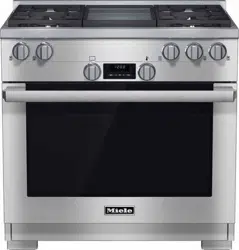
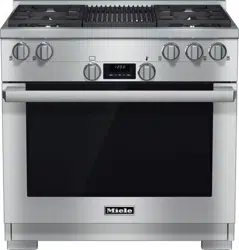
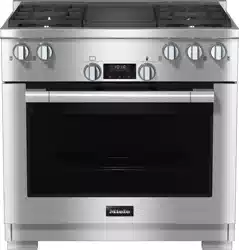
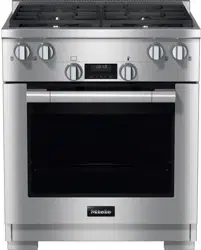
36" All Gas Range (Convection Oven)
To prevent accidents and damage to the range, you must read all in-
structions supplied before installing or using the appliance.
en-US, CA M.-Nr. 10 944 260
IMPORTANT SAFETY INSTRUCTIONS
2
WARNING
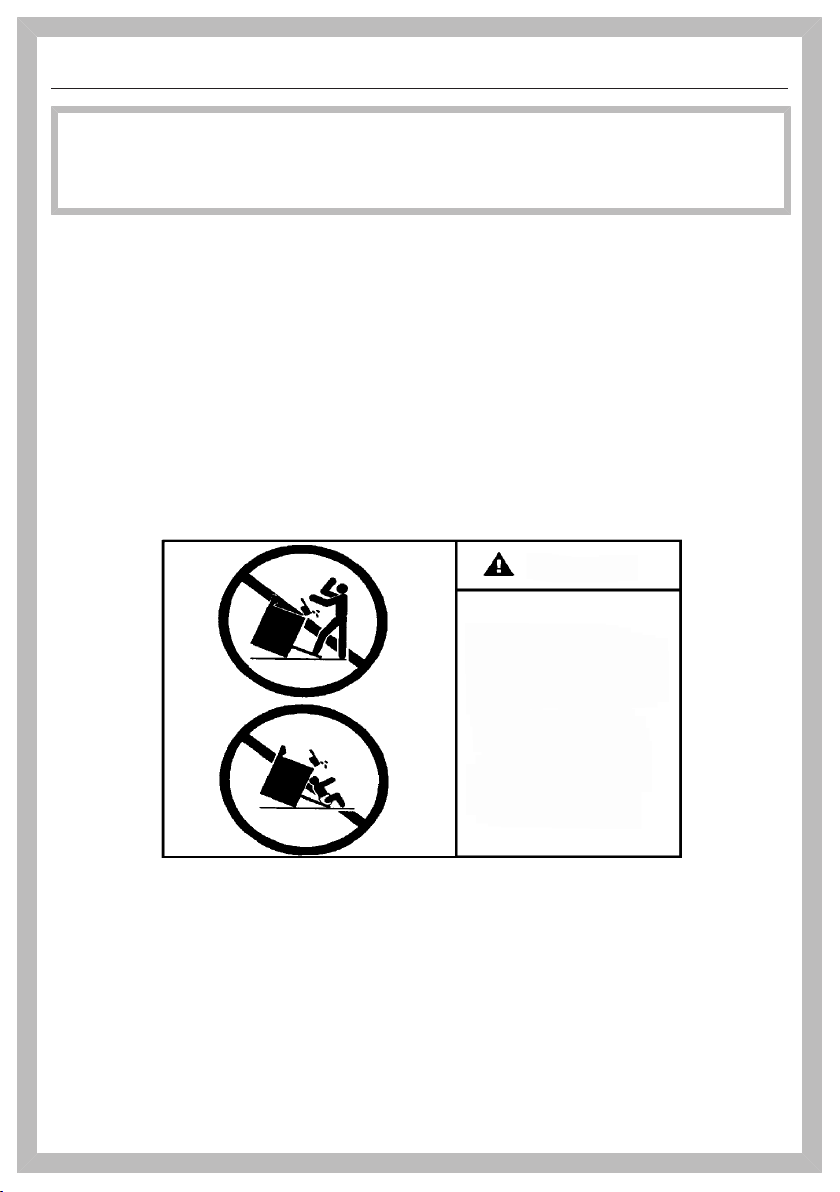
Children and adults can tip over the range if has not been secured.
This may lead to fatal injuries.
This range must be secured and connected using the anti-tip de-
vice according to the installation instructions.
If you have moved the range, slide the locking latch onto the anti-
tip device until you feel it lock into place.
Do not use the range if the anti-tip device has not been properly
installed and engaged.
Failure to observe the information contained in the installation in-
structions can lead to serious or fatal injuries for children and adults.
All ranges can tip
Injury to persons
could result
Install anti-tip devices
packed with range
See installation
instructions
WARNING
IMPORTANT SAFETY INSTRUCTIONS
3
WARNING: If the information in this manual is not followed exactly, a fire or
explosion may result causing property damage, personal injury, or death.
– Do not use or store gasoline or other combustible liquids or vapors in the vicinity
of this or any other appliance.
– WHAT TO DO IF YOU SMELL GAS
– Do not try to light any appliance.
– Do not touch any electric switches.
– Do not use any phones inside your building.
– Immediately call your gas supplier from a neighbor's phone. Follow the gas
supplier's instructions.
– If you are unable to reach your gas provider, call the fire department.
– Installation and service must be performed by a qualified installer, qualified ser-
vice agency or your gas provider.
(In Massachusetts, installation must be performed by a licensed installer / gas
fitter.)
– Note to the installer:
Please give these installation instructions to the consumer for the local electri-
cal/gas inspector.
®
®

Contents
4
IMPORTANT SAFETY INSTRUCTIONS ................................................................ 2
IMPORTANT SAFETY INSTRUCTIONS ................................................................ 7
Guide to the range............................................................................................... 21
HR 1134-1 ............................................................................................................. 21
HR 1135-1, HR 1136-1.......................................................................................... 22
Control panel ....................................................................................................... 23
HR 1134-1 ............................................................................................................. 23
HR 1135-1, HR 1136-1.......................................................................................... 23
Burner knob........................................................................................................... 23
Temperature selector ............................................................................................ 24
Operating mode selector ...................................................................................... 24
Clock / Timer ......................................................................................................... 24
Display.............................................................................................................. 24
Symbols in the display ..................................................................................... 24
Sensor buttons.................................................................................................25
Temperature indicator ................................................................................. 25
Features................................................................................................................ 26
Model numbers .................................................................................................... 26
Data plate ............................................................................................................. 26
Items included with this range............................................................................... 26
Standard and optional accessories....................................................................... 26
Shelf runners .................................................................................................... 26
Universal tray and Wire oven rack.................................................................... 27
FlexiClips with wire rack HFCBBR36-2........................................................... 27
Oven safety features ............................................................................................. 31
System lock for the oven ............................................................................. 31
Safety shut-off.................................................................................................. 31
Cooling fan ....................................................................................................... 31
Vented oven door ............................................................................................. 31
Safety Door Lock for Self Clean....................................................................... 31
PerfectClean surfaces ........................................................................................... 32
Self Clean ready accessories ................................................................................ 32
Before first use .................................................................................................... 33
Before using for the first time................................................................................ 33
Setting the time of day for the first time ............................................................... 33
Heating the oven ................................................................................................... 33
Operating the oven.............................................................................................. 35
Energy saving tips ................................................................................................. 35

Contents
5
Using the oven ...................................................................................................... 36
Cooling fan ........................................................................................................... 36
Preheating the oven .............................................................................................. 36
Guide to the modes............................................................................................. 37
Clock / Timer ....................................................................................................... 38
Turning a cooking program On / Off automatically ............................................... 38
Setting the cooking time .................................................................................. 38
Setting a cooking time and finish time ............................................................. 39
At the end of the cooking time ......................................................................... 40
Changing the cooking time .............................................................................. 40
Deleting a cooking time.................................................................................... 40
Deleting a finish time ........................................................................................ 41
Changing the time of day ...................................................................................... 41
Changing factory default settings ......................................................................... 42
System lock ...................................................................................................... 45
Timer ..................................................................................................................... 47
Setting the timer............................................................................................... 47
Bake...................................................................................................................... 49
Roast .................................................................................................................... 51
Slow Roasting...................................................................................................... 52
Broil....................................................................................................................... 54
Defrost.................................................................................................................. 56
Canning ................................................................................................................ 57
Dehydrate............................................................................................................. 58
Frozen food .......................................................................................................... 59
Cleaning and care ............................................................................................... 60
Unsuitable cleaning agents ................................................................................... 61
Normal soiling........................................................................................................ 62
Stubborn soiling .................................................................................................... 62
Operating mode and temperature selectors in stainless steel .............................. 63
Self Cleaning the oven interior .............................................................................. 64
Preparing for the Self Clean program............................................................... 65
Starting the Self Clean program ....................................................................... 65
At the end of the Self Clean program............................................................... 67
The Self Clean program is canceled ................................................................ 67

Contents
6
Door removal......................................................................................................... 69
Reinstalling the door ............................................................................................. 70
Removing the shelf runners................................................................................... 71
Frequently Asked Questions .............................................................................. 72
Technical Service................................................................................................. 76
Contact in case of fault ......................................................................................... 76
Warranty ................................................................................................................ 76

IMPORTANT SAFETY INSTRUCTIONS
7
When using the appliance, follow basic safety precautions, including the fol-
lowing:
Read all instructions before installation and use of the range to prevent acci-
dents and machine damage.
This range complies with current safety requirements. However,
improper use of the appliance can result in personal injury or dam-
age to property.
Please read the installation instructions carefully before installing
and connecting the appliance.
Read the operating instructions before using the range for the first
time. To prevent accidents and damage to the appliance, always
observe both the installation instructions and operating instruc-
tions. Both documents contain important information about instal-
lation, safety, use and maintenance.
Miele cannot be held liable for damage occurring as a result of
non-compliance with the instructions.
Keep these installation instructions and operating instructions in a
safe place and pass them on to any future owner.

IMPORTANT SAFETY INSTRUCTIONS
8
Appropriate use
This appliance is intended for residential use only. Use only as de-
scribed in these operating instructions.
This appliance is not intended for outdoor use.
Only use this oven for residential cooking, and the purposes de-
scribed in this manual.
Other uses are not permitted and can be dangerous.
Risk of Fire! Do not use this oven to store or dry flammable mate-
rials.
Persons who lack physical, sensory or mental abilities, or experi-
ence with the appliance should not use it without supervision or in-
struction by a responsible person.

IMPORTANT SAFETY INSTRUCTIONS
9
Safety with children
As with any appliance, close supervision is necessary when the
oven is used by children.
Do not leave children unattended: Children should not be alone or
unsupervised in the area where the appliance is installed. Do not al-
low them to sit or stand on the appliance.
As with any appliance, close supervision is necessary when used
by children.
Children 8 years and older may only use the oven unsupervised if
they have been shown how to use it safely and recognize and under-
stand the consequences of incorrect operation.
Children must not be allowed to clean or maintain the appliance
unsupervised.
Children should not be left alone or unattended in an area where
an oven is in use. Never allow children to operate, sit or stand on any
part of the oven. Caution: Do not store items of interest to children
in cabinets above an oven. Children climbing on the oven to reach
these items could be injured.
Danger of burns. The oven gets hot at the oven door glass, the
vapor vent, the handle and the operating controls. Do not allow chil-
dren to touch or play in, on or near the oven.
Danger of burns.
Children's skin is more sensitive to high temperatures than that of
adults. The oven becomes hotter during self-cleaning than it does in
normal use. Do not let children touch the oven while the Self Clean
program is running.
Burn Hazard - Do not allow children to use the oven. Failure to do
so can result in severe burns or serious injury.
Danger of suffocation! Ensure that any plastic wrappings, bags,
etc. are disposed of safely and kept out of the reach of children.

IMPORTANT SAFETY INSTRUCTIONS
10
Burn hazard!
Keep the spaces above and behind the range clear of any items that
could draw the attention of children. Otherwise, they can be tempted
into climbing onto the appliance.
Danger of injury. Never allow children to hang or lean on any part
of the appliance.

IMPORTANT SAFETY INSTRUCTIONS
11
Technical safety
Unauthorized installation, maintenance, and repairs can cause
considerable danger for the user. Installation, maintenance, and re-
pairs must only be carried out by a Miele authorized technician.
Do not carry or lift the range by the oven door handle or the con-
trol panel!
Maintenance by the user: Never repair or replace any part of the
appliance unless the instructions specifically recommend doing so.
Service work should only be performed by a qualified technician.
A damaged range can be dangerous. Always check for visible
signs of damage. Never use a damaged appliance.
Reliable and safe operation of the range can only be guaranteed if
it is connected to the public power supply.
The electrical safety of the range can only be guaranteed when it
is properly grounded. Compliance with this essential safety require-
ment is absolutely mandatory. If in any doubt, please have the build-
ing's wiring system inspected by a qualified electrician.
Proper installation: Make sure that your appliance has been in-
stalled correctly and that it has been grounded by a qualified techni-
cian.
The oven is not to be operated until it has been properly installed
within cabinetry.
To avoid damaging the range, make sure that the connection data
(voltage and frequency) on the data plate correspond to the build-
ing's power supply before connecting the appliance.
When in doubt, consult a qualified electrician.
Do not use a power strip or extension cord to connect the range
to electricity. These are a fire hazard and do not guarantee the re-
quired level of appliance safety.

IMPORTANT SAFETY INSTRUCTIONS
12
This appliance must not be installed and operated in mobile in-
stallations (e.g. on a ship).
Danger of electric shock!
Under no circumstances open the outer casing of the appliance.
Do not repair or replace any part of the appliance unless specifi-
cally recommended in the operating instructions. All other servicing
should be referred to a qualified technician.
Defective components should be replaced by Miele original parts
only. Only with these parts can safety of the appliance be assured as
intended by the manufacturer.
During installation, maintenance and repair work, e.g. if the oven
lighting is broken, the range must be completely disconnected from
the household electricity supply (see“Frequently asked questions”).
The gas inlet valve must be closed. It is only completely isolated
from the supply when:
– The circuit breakers have been switched off, or
– the fuses of the electrical installation have been completely re-
moved, or
– the plug (if present) is removed from the socket. To do this, pull
the plug not the cord.
– Shut off the gas supply and disconnect the range from the gas
supply. Installation and maintenance of the gas connection must
be performed by qualified installers, service agencies or gas
providers.
If the range is installed behind a cabinet door, do not close the
door while the appliance is in operation. Heat and moisture can build
up behind the closed door and cause damage to the range and to
the surrounding cabinets and flooring. Do not close the door until the
appliance has completely cooled down.

IMPORTANT SAFETY INSTRUCTIONS
13
Reaching over a hot cooktop to access the cabinets can result in
burns. You can reduce the risk of burns by installing a range hood
that extends at least 4 3/4" (12 cm) past the bottom of the cabinets.

IMPORTANT SAFETY INSTRUCTIONS
14
Correct use
The oven becomes very hot while in use. Use caution to en-
sure that you are not burned on the heating elements or interior
surfaces of the oven. Use pot holders when placing food in the
oven, adjusting the racks, etc. in a hot oven.
Burn hazard!
Hot vapors are emitted above the island trim during Self Clean as
well as when cooking food in the oven. You could burn yourself on
the hot vapors.
Do not reach above the island trim and keep others away from it
when you are using the oven.
Hot vapors are emitted above the island trim during Self Clean as
well as when cooking food in the oven.
The emission of vapors can soil and discolor surfaces above the is-
land trim. Take precautions to protect sensitive surfaces such as
marble, granite, and tiles against soiling and discoloration (surfaces
of this nature can be difficult or even impossible to clean).
Caution: Heating elements may be hot even though they are not
glowing. Interior surfaces of an oven become hot enough to cause
burns. External parts of the oven such as the door glass, vents, and
the control panel can become hot. During and after use, do not
touch, or let clothing or other flammable materials come into contact
with heating elements or interior surfaces of the oven until they have
had sufficient time to cool.
Do not let food sit in the oven for an extended period of time be-
fore or after cooking. Doing so can result in food poisoning or sick-
ness.
Use only dry, heat-resistant potholders. Moist or damp potholders
used on hot surfaces may result in steam burns. Do not let pothold-
ers come in contact with oil or grease. Do not substitute dish towels
or other bulky items for potholders. Do not let potholders touch hot
heating elements.

IMPORTANT SAFETY INSTRUCTIONS
15
Loose fitting or hanging garments present a fire hazard. Wear
proper apparel while operating the appliance.
Do not heat unopened containers of food in the oven, pressure
may cause the containers to burst and result in injury.
Never pour cold water onto hot surfaces in a hot oven.
The steam created could cause serious burns or scalding and the
sudden change in temperature can damage the enamel in the oven.
To prevent burns, always place oven racks at their desired height
while the oven is cool. If the rack must be moved while the oven is
hot, do not let pot holders touch hot heating elements.
Open the door carefully to allow hot air or steam to escape before
placing or removing food.
To prevent burns, allow the heating elements to cool before
cleaning by hand.
Do not leave the oven door open unnecessarily as someone may
trip over it or be injured by it.
Never leave the appliance unattended when cooking with oil or
fat. They can ignite if overheated. Do not use water on grease
fires.Turn off the oven immediately and suffocate the flames by keep-
ing the oven door closed.
Smother the fire or flames, or use a dry chemical extinguishing
agent or foam fire extinguisher.
Never store flammable liquids and materials in, above or under an
oven, or near cooking surfaces.
Do not use the oven to heat the room. The high temperatures radi-
ated could cause objects near the oven to catch fire.

IMPORTANT SAFETY INSTRUCTIONS
16
WARNING
NEVER use this appliance as a space heater to heat or warm the
room. Doing so may result in carbon monoxide poisoning and
overheating of the oven.
WARNING
NEVER use this appliance as storage space. Doing so may result
in carbon monoxide poisoning and overheating of the oven.
WARNING
NEVER cover any slots, holes or passages in the oven bottom or
cover an entire rack with materials such as aluminum foil. Doing so
blocks air flow through the oven and may cause carbon monoxide
poisoning. Aluminum foil linings may also trap heat, causing a fire
hazard.
Broiling food for an excessively long time can cause it to dry out
and may result in the food catching fire.
Do not exceed recommended broiling times.
Some foods dry out very quickly and can be ignited by high broil-
ing temperatures.
Do not use broiling functions for crisping rolls or bread or to dry
flowers or herbs. Instead use the Conv Bake (Convection
Bake)mode.
Use caution when using alcohol in your recipes. Alcohol evapo-
rates at high temperatures but may, in rare circumstances, combust
on the hot heating elements.
Plastic containers, which are not heat-resistant, melt and may ig-
nite at high temperatures and can damage the oven. Use only plastic
containers that are indicated by the manufacturer as being suitable
for use in ovens.

IMPORTANT SAFETY INSTRUCTIONS
17
When residual heat is used to keep food warm, the high level of
humidity and condensation can cause damage in the oven. The con-
trol panel, countertop or cabinetry may also be damaged.
Do not switch the oven off completely while food is inside it, but se-
lect the lowest possible temperature for the oven mode you are us-
ing. This will ensure the fan will automatically continue to run.
It is recommended to cover all cooked food that is left in the oven
to be kept warm. This will prevent moisture from condensing on the
interior of the oven.
To avoid damage, do not place aluminum foil, pots, pans or bak-
ing sheets directly on the oven floor. This can cause a build up of
heat that will damage the oven floor.
Do not slide pots or pans on the oven floor. This could scratch
and damage the surface.
The door can support a maximum weight of 33lbs (15kg). Do not
sit on or lean against an open door, and do not place heavy objects
on it. Also make sure that nothing can get trapped between the door
and the oven cavity. The oven could get damaged.
This oven must only be used for cooking food. Fumes, vapors or
heat given off by glues, plastics or flammable liquids and materials
could be hazardous. Do not use it as a dryer, kiln, dehumidifier, etc.
Do not obstruct the flow of combustion and ventilation air.
Do not let metal objects (aluminum foil, pans) come in contact
with the heating element.
Make certain that the power cords of small appliances do not
come in contact with or get caught in the oven door.

IMPORTANT SAFETY INSTRUCTIONS
18
When baking frozen pizzas or pies, place them on the wire rack
lined with parchment paper. Do not use the baking tray or the roast-
ing pan for frozen foods with a large surface area. The tray or pan
could become warped and difficult to remove from the oven when
hot. Frozen foods like french fries, chicken nuggets, etc. can be
baked on the baking tray.

IMPORTANT SAFETY INSTRUCTIONS
19
Cleaning and maintenance
Do not use a steam cleaner to clean this oven.
Steam could penetrate electrical components and cause a short cir-
cuit.
Only clean parts listed in these Operating and Installation Instruc-
tions.
Scratches on the door glass can cause the glass to break.
Do not use abrasive cleaners, hard sponges, brushes or sharp metal
tools to clean the door glass.
The shelf runners can be removed for cleaning purposes (see
“Cleaning and care”). Ensure they are correctly fitted after cleaning
and never operate the oven without the shelf runners inserted.
There is a seal around the oven interior which seals the inside of
the door. Take care not to rub, damage or move the gasket. Do not
clean the door gasket - the door gasket is essential for a good seal.
Do not use a protective coating to line the oven and do not use
commercial oven cleaner unless certified for use in a self-cleaning
oven.
Debris should be removed before running the Self Clean program.
If not removed this debris can smoke causing the self-cleaning pro-
gram to turn itself off.

IMPORTANT SAFETY INSTRUCTIONS
20
Accessories
Use only genuine original Miele parts. If parts or accessories from
other manufacturers are used, the warranty will become void.
The high temperatures used during self-cleaning will damage ac-
cessories that are not designed for cleaning in the Self Clean pro-
gram. Please remove these accessories from the oven before start-
ing the Self Clean program. This also applies to accessories pur-
chased separately (see “Cleaning and care”).
SAVE THESE INSTRUCTIONS AND REVIEW THEM PERIODICALLY

Guide to the range
21
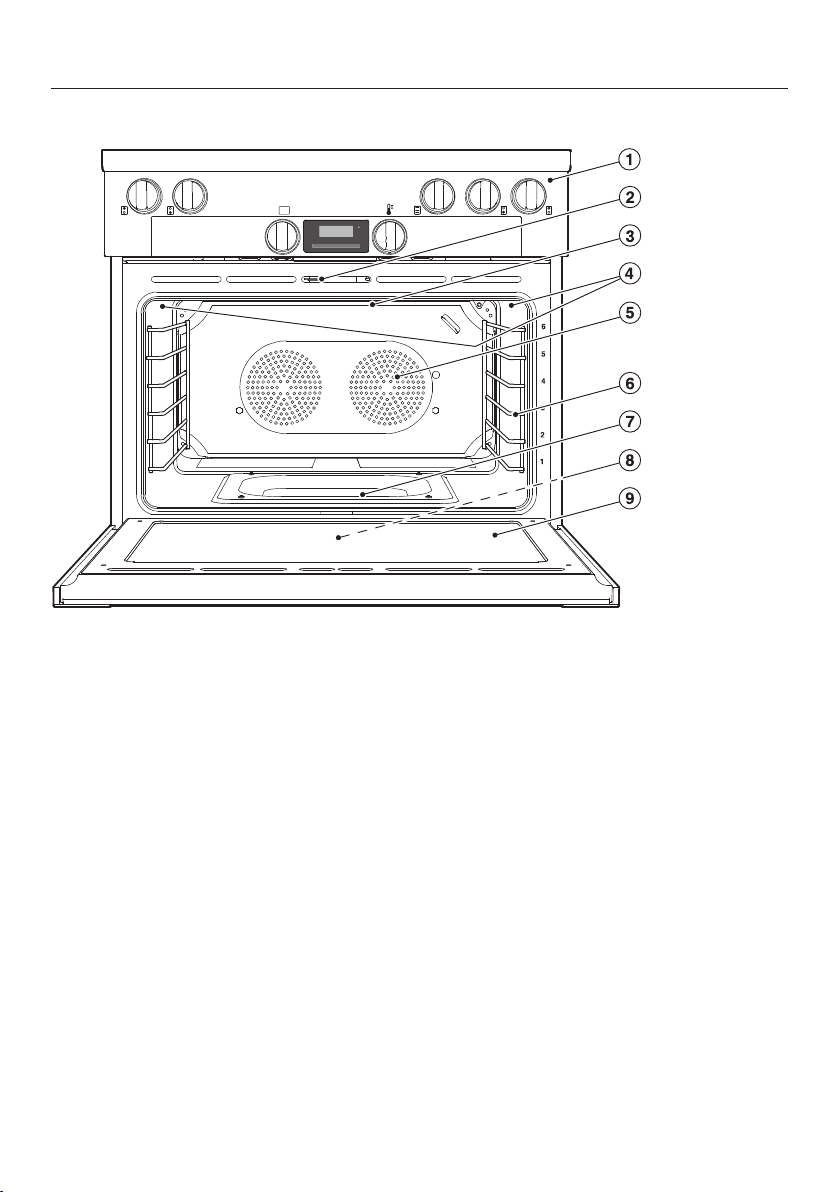
HR 1134-1
a
Oven and cooktop controls
b
Door lock with contact switch for Self
Clean
c
Browning/Broiling element
d
Oven interior lighting
e
Twin Convection Fans
f
Side runners with 6shelf levels
g
Baking element
h
Data plate
The data plate is located behind the
toe kick cover.
i
Door
Guide to the range
22
HR 1135-1, HR 1136-1
a
Oven and cooktop controls
b
Door lock with contact switch for Self
Clean
c
Browning/Broiling element
d
Oven interior lighting
e
Twin Convection Fans
f
Side runners with 6shelf levels
g
Baking element
h
Data plate
The data plate is located behind the
toe kick cover.
i
Door
Control panel
23
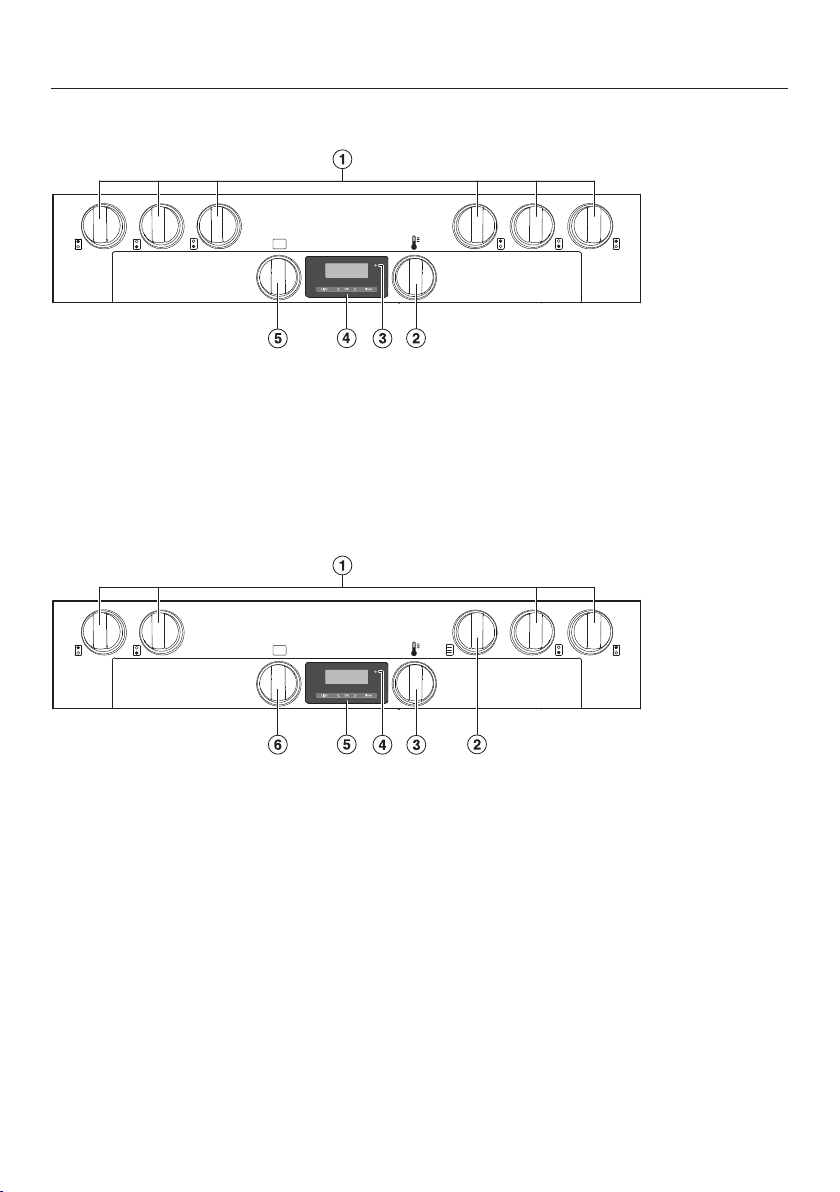
HR 1134-1
a
Cooking zone controls
b
Temperature selector
c
Optical interface
(for Miele Technical Service only)
d
Timer with display and sensor but-
tons for light, , OK, , and timer.
e
Mode selector
HR 1135-1, HR 1136-1
a
Cooking zone controls
b
Control knobs
HR 1135-1: Grill
HR 1136-1: Griddle
c
Temperature selector
d
Optical interface
(for Miele Technical Service only)
e
Timer with display and sensor but-
tons for light, , OK, , and timer.
f
Mode selector
Burner knob
With the burner knob, you can ignite the burner and regulate the flame. The burn-
ers can be variably adjusted between the lowest and highest settings.
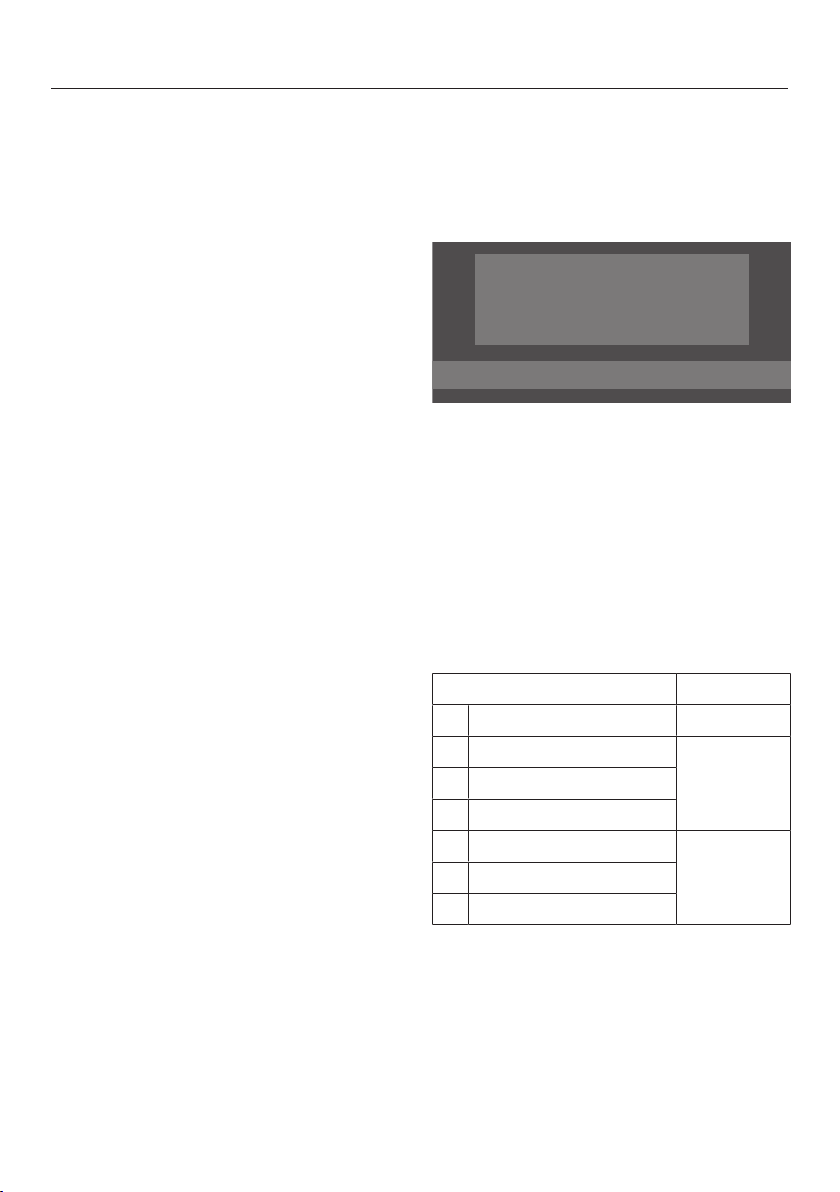
Control panel
24
Temperature selector
The temperature selector is used to se-
lect the temperature for a operating
mode.
To ignite a burner, push in the tempera-
ture selector and turn it counterclock-
wise. The ignitor “clicks” and ignites the
gas.
It can be turned clockwise until a resis-
tance is felt and then turned back
again.
The temperature settings are marked on
the temperature selector.
Operating mode selector
To select an operating mode.
It can be turned clockwise or counter-
clockwise.
The operating modes are printed on the
mode selector.
Operating modes
– Bake
– Broil
– Clean (Self Clean)
– Conv Broil (Convection Broil)
– Conv Bake (Convection Bake)
Clock / Timer
The clock/timer is operated via the Dis-
play with the sensor buttons.
Display
h min
Light OK Timer
The display shows the time of day or
your settings.
See “Clock / Timer” for more informa-
tion.
Symbols in the display
Depending on the position of the mode
selector and/or which button is
pressed, the following symbols will ap-
pear:
Symbol / Mode
Timer Any
Temperature indicator
Operating
mode
Cooking time
Finish time
Settings Off
Time of day
System lock
A mode can only be set or changed if
the mode selector is in the correct posi-
tion.

Control panel
25
Sensor buttons
The range has sensor buttons for light,
, OK, , and timer, which react to the
touch of a finger. Each touch is con-
firmed with an audible tone.
The tone can be turned on or off by se-
lecting the status in the settings
(see “Settings”).
Temperature indicator
The temperature indicator light lights
up when the oven is heating.
When the set temperature is reached,
– the oven heating turns off,
– and the temperature indicator light
goes out.
The temperature regulator ensures that
the oven heating and temperature indi-
cator light turn back on again when the
oven temperature falls below the level
set.

Features
26
Model numbers
A list of the ovens described in these
operating instructions can be found on
the back page.
Data plate
The data plate is behind the toe-kick.
The toe-kick cover is attached to the
base of the range by magnets so it can
be removed and put back again easily.
There you can find the model number,
the serial number and the connection
data (voltage/frequency/maximum rated
load) for your range.
Have this information available when
contacting Miele Technical Service.
Items included with this range
The following items are included with
this appliance:
– Installation Instructions for the range
– The Operating Instructions for the
range:
– Gas Cooktop
– Gas Oven
– An anti-tip device including screws
for fastening the range
– Various accessories
Standard and optional acces-
sories
Accessories vary depending on
model. All ovens are supplied with
shelf runners, a universal tray and a
wire oven rack. Depending on the
model, your oven may also come with
the additional accessories listed.
All accessories and cleaning and care
products in these instructions are de-
signed to be used with Miele ovens.
These can be ordered from the Miele
web store, Miele Technical Service, or
from your Miele dealer.
When ordering, please have ready the
model number of your oven and of the
desired accessories.
Shelf runners
The shelf runners are located on the
right and left-hand sides of the oven
with the levels for inserting accessories.
The shelf level numbers are indicated
on the front of the oven frame.
Each level consists of a strut on which
you can place the wire oven rack, for
example.
The runners can be removed. See
“Cleaning and Care”.
Features
27
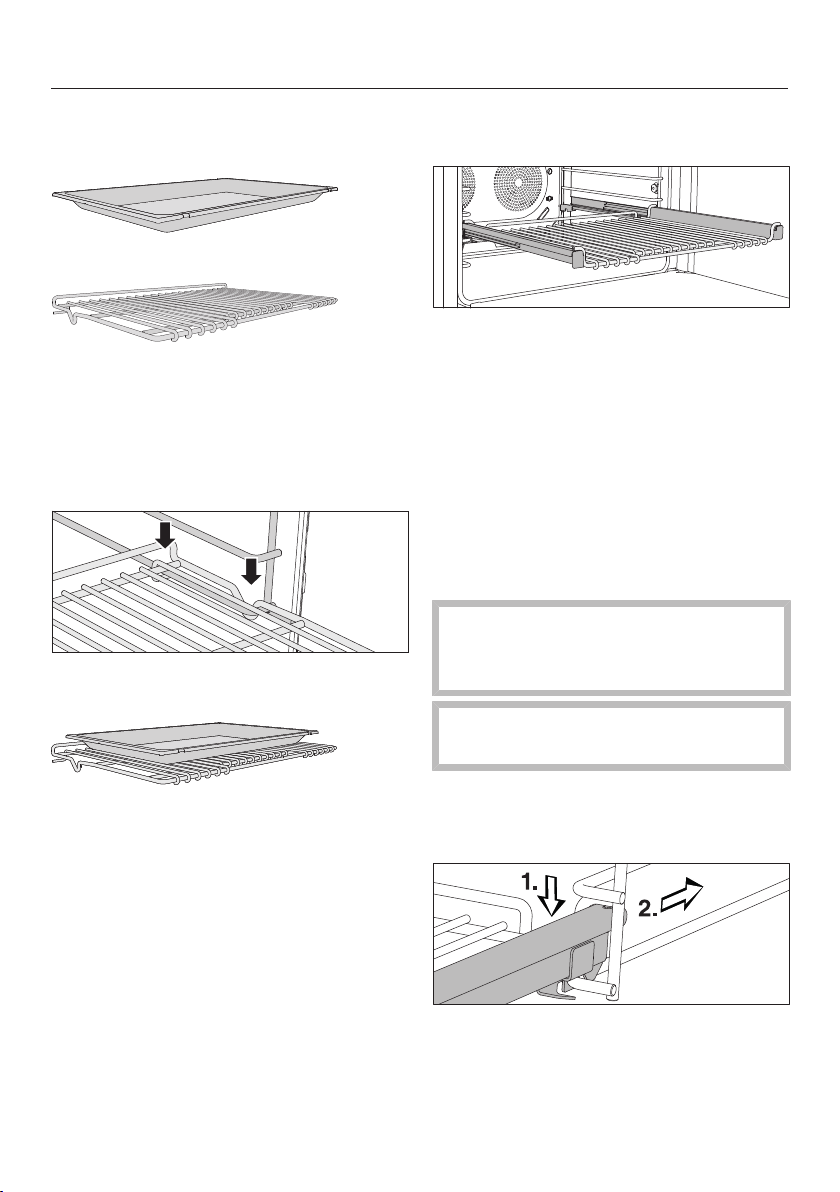
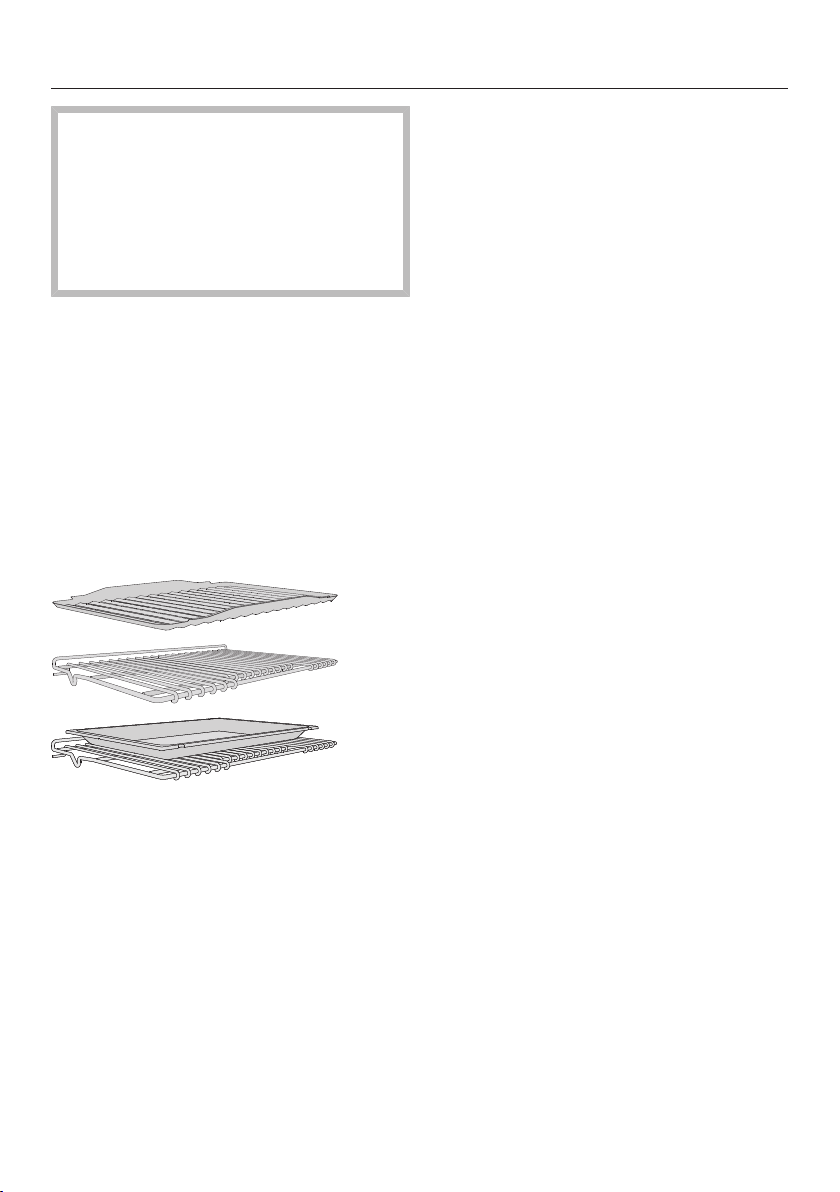
Universal tray and Wire oven rack
Universal tray HUBB30-1
Wire oven rack HBBR36-2
Non-tip safety notches are located on
the shorter sides of these acces-
sories.These prevent the trays being
pulled completely out of the side run-
ners when you only wish to pull them
out partially.
Always place the wire oven rack on the
runner with the notch facing down.
When using the universal tray, place it
directly on the wire oven rack.
FlexiClips with wire rack
HFCBBR36-2
The FlexiClips with wire rack can be
mounted on any shelf level and pulled
completely out of the oven This allows
you to see the food easily.
The FlexiClips with wire rack is pushed
in and then locked onto a level.
The rack can hold a maximum of 33 lbs
(15 kg).
Installing and removing the FlexiClips
with wire rack
Danger of burns! Make sure the
heating elements are turned off and
that the oven cavity is cool.
Do not pull the FlexiClips apart dur-
ing installation or removal.
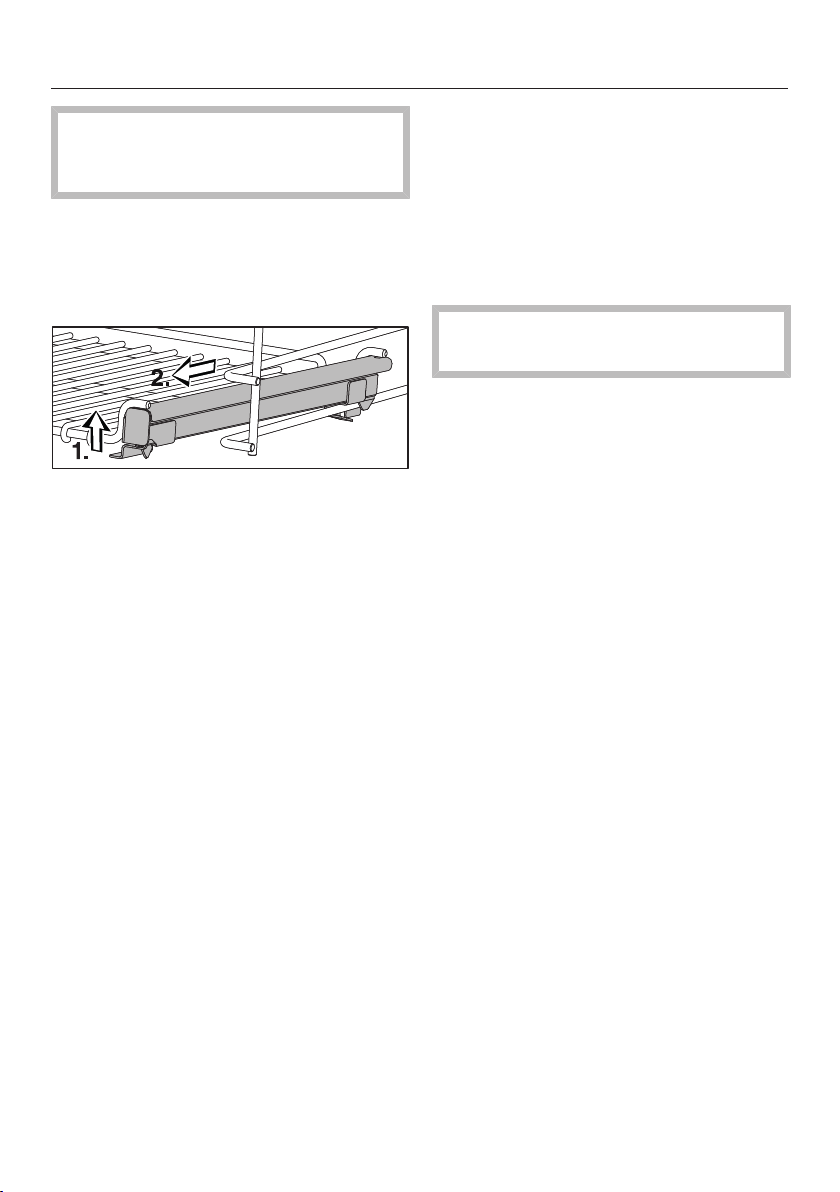
Hold the FlexiClips with wire rack with
both hands and position it in front of
the desired level.
Insert the FlexiClips with wire rack
onto the level (1.) and slide it along
the struts of the level (2.) until it clicks
into place.
Features
28
If the FlexiClips with wire rack jams
when sliding it onto the level, pull it
out using some force and reinsert.
To removing the FlexiClips with wire
rack:
Push the FlexiClips with wire rack in
all the way.
Using both hands lift the front of the
FlexiClips with wire rack on both
sides (1.) and pull it out of the level
(2.).
Using the universal tray
When using the universal tray, place it
directly on the FlexiClips with wire
rack.
Temperature selector with °C scale
The range is delivered with a tempera-
ture selector with °F scale. You can get
the temperature selector with °C scale
as an accessory. Specify the model of
your range when purchasing.
Replacing the temperature selector
Do not operate the range without
an installed temperature selector.
Turn the temperature selector to
(Off).
Pull the temperature selector off the
range horizontally.
Install the new temperature sensor in
the same position and push it onto
the range.
Features
29
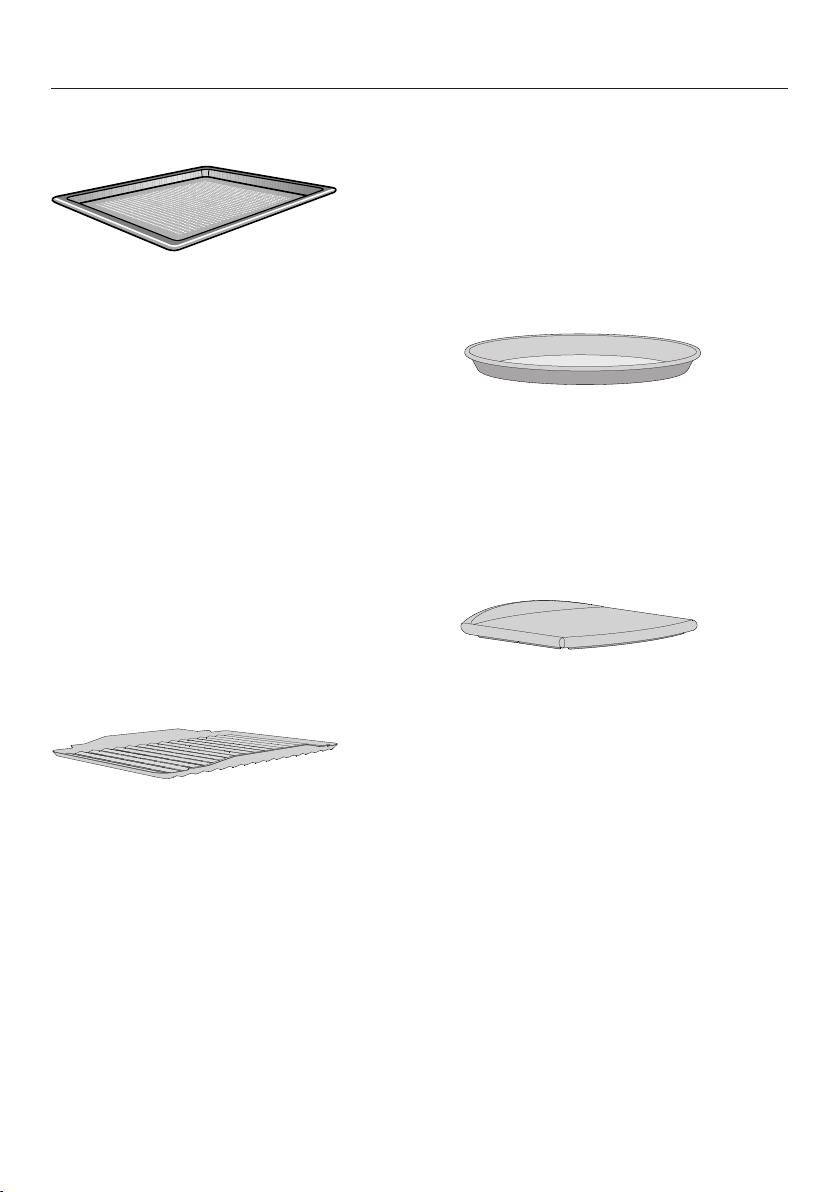
Perforated Gourmet baking tray
HBBL71
The perforated Gourmet baking tray has
been specially developed for the prepa-
ration of baked goods made from fresh
yeast and quark doughs.
The tiny perforations assist in browning
the underside of baked goods.
The tray can also be used for dehydrat-
ing or drying food.
The enameled surface has been treated
with PerfectClean.
The round perforated baking tray
HBFP27-1 can be used for the same
things.
The perforated baking tray can be
placed on the rack.
Grilling and Roasting insert
HGBB30-1
Grilling:
The grilling and roasting insert is placed
on the wire oven rack. To collect drip-
pings from the meat or poultry, use the
universal tray on a second wire oven
rack on level 1.
Roasting:
The grilling and roasting insert is placed
in the universal tray.
The drippings from the meat or poultry
are collected under the insert reducing
spattering in the oven.
The drippings can then be used for
gravy and sauces.
The surface has been treated with Per-
fectClean enamel for easy cleaning.
The use of the grilling and roasting in-
sert can reduce excessive smoke.
Round baking form HBF27-1
This circular form is suitable for cooking
fresh or frozen pizzas, flat cakes, tarts
and baked goods.
The surface has been treated with Per-
fectClean enamel.
Gourmet Baking Stone HBS60
The baking stone is ideal for baking
dishes with a crisp bottom such as
pizza and bread.
The baking stone is made from a heat
retaining stone and is glazed. Place the
stone directly on the wire rack.
A wooden peel is supplied with it for
placing food on and off the stone.
Features
30
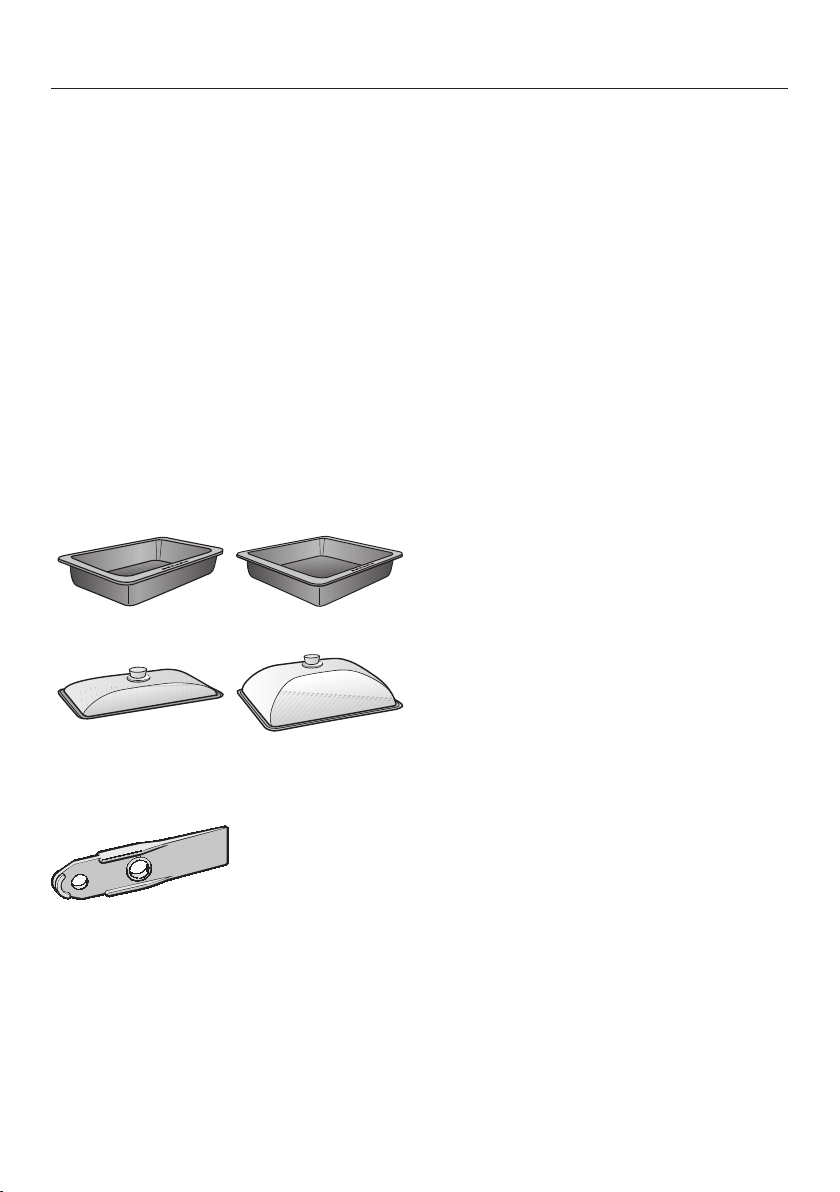
HUB Gourmet casserole dishes
HBD casserole dish lids
Miele Gourmet casserole dishes can be
placed directly on the wire oven rack.
The surface of the casserole dishes has
a non-stick coating.
Gourmet casserole dishes are available
in different depths. The width and the
height are the same.
Suitable lids are available separately.
Please quote the model number when
ordering.
Depth:
81/2"(22cm)
Depth:
133/4"(35cm)
HUB62-22 * HUB62-35 *
HBD60-22 HBD60-35
* Suitable for use on induction cooktops
Opener
The opener allows you to open the
cover of the oven light.
Miele Oven Cleaner
Miele oven cleaner is suitable for re-
moving stubborn soiling. It is not neces-
sary to preheat the oven before use.

Features
31
Oven safety features
System lock for the oven
The system lock prevents the oven from
being used unintentionally (see “System
lock ”).
The system lock will remain activated
even after a power failure.
Safety shut-off
The oven automatically turns itself off if
it is used for an exceedingly long pe-
riod. The length of time depends on the
oven mode being used.
Cooling fan
The cooling fan comes on automatically
when a cooking program is started. The
cooling fan mixes hot air from the oven
cavity with cool room air before venting
it out into the kitchen through vents lo-
cated between the appliance door and
the control panel.
The cooling fan will continue to run for a
while after a program is complete to
prevent moisture from building up in the
oven, on the control panel or surround-
ing cabinetry.
When the temperature in the oven has
fallen sufficiently, the cooling fan will
turn off automatically.
Vented oven door
The oven door is made of glass panes
that have a heat-reflective coating on
part of their surface.
During operation, air is also circulated
through the door to keep the outer
panel cool.
The door can be removed and disas-
sembled for cleaning purposes (see
“Cleaning and care”).
Safety Door Lock for Self Clean
For safety reasons, the door is locked
as soon as the Self Clean program is
started. After the self-cleaning program
has finished, the door will remain locked
until the temperature in the oven has
fallen below 535°F (280°C).

Features
32
PerfectClean surfaces
The revolutionary PerfectClean finish is
a smooth, non-stick surface that is ex-
ceptionally easy to clean.
Food and grime from baking or roasting
are easily removed.
Do not use ceramic knives, as these
will scratch the PerfectClean surface.
Follow the instructions in the “Cleaning
and Care” section of this manual so the
anti-stick and easy cleaning properties
are retained.
The following have all been treated with
PerfectClean:
– Universal tray
– Grilling and Roasting insert
– Perforated baking tray
– Round baking form
Self Clean ready accessories
The following accessories can be left in
the oven during the Self Clean program.
– Shelf runners,
– FlexiClips with wire rack
– Wire oven rack
See “Cleaning and care” for more infor-
mation.

Before first use
33
Before using for the first time
The range may only be operated
after it has been installed properly.
Read the operating and installation
instructions carefully before installing
the range..
Read the operating instructions care-
fully before starting up the range.
The time of day can only be changed
when the mode selector is set to Off.
Set the time of day.
Setting the time of day for the
first time
The time of day is shown in 12 hour
clock format.
After connection the oven to the electri-
cal supply will appear in the dis-
play and a will flash under :
Use or to set the time of day.
Confirm with OK.
The time of day is now saved.
Change the time of day to a 12-hour
format by setting h in the settings
menu (see “Settings”).
During a power failure, the time of day
will be saved for approx. 200 hours. If
the power returns within this period of
time the current time of day is dis-
played again. If the power is out for an
extended period of time the time of
day will need to be reset.
The time is day is turned off by default
(see “Settings - ”).
The display will appear dark when the
oven is turned off. The time of day
continues to run unseen in the back-
ground.
Heating the oven
New ovens may have a slight odor dur-
ing their first use. Heating up the oven
for at least an hour with nothing in it will
eliminate the odor.
Ensure that the kitchen is well venti-
lated while the appliance is being
heated up for the first time.
Close doors to other rooms to pre-
vent the smell spreading throughout
the house.
Remove any protective wrapping and
sticky labels from the oven.
Take all accessories out of the oven
and clean them (see “Cleaning and
care”).
Before heating the oven up, wipe the
interior with a damp cloth to remove
any dust or bits of packaging that
may have accumulated in the oven
cavity during storage and unpacking.

Before first use
34
All Gas Range
Risk of injury caused by hot vapors.
Hot vapors are emitted above the is-
land trim during Self Clean as well as
when cooking food in the oven.
You could burn yourself on the hot
vapors.
Do not reach above the island trim
and keep others away from it when
you are using the oven.
All Gas Range
Hot vapors are emitted above the is-
land trim during Self Clean as well as
when cooking food in the oven.
The emission of vapors can soil and
discolor surfaces above the island
trim.
Take precautions to protect sensitive
surfaces such as marble, granite,
and tiles against soiling and discol-
oration (surfaces of this nature can
be difficult or even impossible to
clean).
Select the operating mode Conv
Bake (Convection Bake)
The oven heating element, lighting and
cooling fan will turn on.
To ignite the burner, push in the tem-
perature selector and turn it clock-
wise to the maximum possible tem-
perature.
The ignitor “clicks” and ignites the gas.
Heat up the oven for at least an hour.
Once the heating up process is com-
plete, turn the mode selector to Off
and the temperature selector to
(Off).
After heating up for the first time
Danger of burns! Allow the oven
to cool before cleaning.
Select “Light” to turn on the oven
light.
Clean the oven interior with warm wa-
ter and liquid dish soap, applied with
a soft sponge or cloth.
Dry all surfaces with a soft cloth.
Turn the oven lighting off.
Leave the oven door open until the
oven interior is completely dry.

Operating the oven
35
All Gas Range
Risk of injury caused by hot vapors.
Hot vapors are emitted above the is-
land trim during Self Clean as well as
when cooking food in the oven.
You could burn yourself on the hot
vapors.
Do not reach above the island trim
and keep others away from it when
you are using the oven.
All Gas Range
Hot vapors are emitted above the is-
land trim during Self Clean as well as
when cooking food in the oven.
The emission of vapors can soil and
discolor surfaces above the island
trim.
Take precautions to protect sensitive
surfaces such as marble, granite,
and tiles against soiling and discol-
oration (surfaces of this nature can
be difficult or even impossible to
clean).
Energy saving tips
– Remove any accessories from the
oven that you do not require for
cooking.
– Try not to open the door when cook-
ing.
– If a temperature range is given, it is
best to select the lower temperature
and check the food after the shortest
cooking time given.
– Use the operating mode Conv Bake
(Convection Bake). You can use
cooking temperatures 10-30° lower
than when using other modes.
– Conv Broil (Convection Broil) can be
used for a wide variety of foods.
Lower temperatures can be used than
with other broil modes that use the
maximum temperature setting.
Using residual heat
Tip: When cooking using temperatures
above 285°F (140°C) and cooking dura-
tions longer than 30 minutes, you can
turn the temperature selector to the
(Off) position about 5 minutes before
the end of cooking. The heating ele-
ments will turn off and the residual heat
in the oven will be sufficient to finish
cooking the food.

Operating the oven
36
Using the oven
Place the food in the oven.
Using the mode selector, select the
required oven mode.
The oven lighting and the TwinPower
fans will turn on.
Select the temperature using the tem-
perature selector.
The oven heating will turn on.
After the cooking process:
Turn the mode selector to Off and the
temperature selector to (Off).
Take the food out of the oven.
Cooling fan
After the cooking process the cooling
fan will continue to run for a while after
a program is complete to prevent mois-
ture from building up in the oven, on the
control panel or surrounding cabinetry.
When the temperature in the oven has
fallen sufficiently the cooling fan will
turn off automatically.
Preheating the oven
It is always necessary to preheat the
oven cavity.

Guide to the modes
37
The oven has a range of modes for pre-
paring a variety of foods.
Bake
(Baking element)
This mode uses traditional baking tech-
niques to perfect pies and biscuits.
Broil
(Browning / Broiling element)
Use this function for broiling or searing
small quantities. Ideal for chops, ribs,
browning baked dishes and toasting
bread.
Conv Broil(Convection Broil)
(Browning / Broiling element + Convec-
tion fans)
This allows for a lower temperature to
be used then when using broil. Ideal for
broiling thicker cuts of meat (e.g.
roulades, chicken). This function distrib-
utes hot air from the browning / broiling
element over the food using the fan.
Conv Bake (Convection Bake)
(Baking element + Convection fans)
Use this mode for baking and roasting.

Clock / Timer
38
Turning a cooking program
On / Off automatically
You can set a cooking program to turn
on or off automatically. First the mode
and cooking temperature must be se-
lected.
The maximum duration that can be set
for a cooking program is 12hours.
It It is recommended to use the auto-
matic On/Off feature when roasting. Do
not delay the start of the program for
too long when baking. Cake mixtures
and doughs will dry out, and the leav-
ening agents will lose their effective-
ness.
Setting the cooking time
Example: Baking a cake for 1 hour 5
minutes.
Place the food in the oven.
Select the required oven mode and
temperature.
The oven heating, lighting and cooling
fan will turn on.
Select OK.
If necessary, move the symbol
with or until it appears under .
Confirm with OK.
h will appear in the display along
with a flashing under .
h
Use or to set the cooking time
().
Confirm with OK.
The cooking time is saved and then
counts down in minutes, with the last
minute counting down in seconds.
The symbol indicates that a cooking
time has been set.

Clock / Timer
39
Setting a cooking time and finish
time
Example: The time is now 11:15 AM;
you want a dish with a cooking time of
90 minutes to be ready by 1:30 PM.
Place the food in the oven.
Select the required oven mode and
temperature.
The oven heating, lighting and cooling
fan will turn on.
Set the cooking time:
Select OK.
If necessary, move the symbol
with or until it appears under .
Confirm with OK.
h will appear in the display along
with a flashing under .
Use or to set the cooking time
().
Confirm with OK.
The cooking time is saved and then
counts down in minutes:
h
Set the finish time:
Move the symbol with or until
it appears under .
appears:
Confirm with OK.
will appear in the display (current
time of day + cooking time = + ):
Use or to set the end of the
cooking time ().
Confirm with OK.
The finish time is now saved:
The oven heating, lighting and cooling
fan will turn off.
As soon as the start time ( - =
) has been reached, the oven heat-
ing, lighting and cooling fan will turn on.

Clock / Timer
40
At the end of the cooking time
– appears in the display,
– flashes,
– the oven heating and lighting will turn
off,
– the cooling fan will continue to run,
and
– a signal will sound if turned on (see
“Settings - ”).
Turn the mode selector to Off.
Take the food out of the oven.
If the dish is not cooked to your liking,
you can extend the cooking time by
entering a new time.
Changing the cooking time
Select OK.
If necessary, move the symbol
with or until it appears under .
The cooking time remaining appears in
the display.
Confirm with OK.
Change the cooking time with or
.
Confirm with OK.
The changed cooking time is now
saved.
Deleting a cooking time
Select OK.
If necessary, move the symbol
with or until it appears under .
Confirm with OK.
The symbol will flash under .
Use to set the cooking time to
.
Confirm with OK.
The cooking time and finish time are
deleted.
Select OK.
The current temperature will appear.
The oven heating remains turned on.
If you would like to complete the cook-
ing program:
Turn the mode selector to Off.
Take the food out of the oven.
Turn the oven off.
If you turn the mode selector to 0, the
settings for the cooking time and the
finish time will be deleted.

Clock / Timer
41
Deleting a finish time
Select OK.
If necessary, move the symbol
with or until it appears under .
Confirm with OK.
The symbol will flash under .
Use or to set the end of the
cooking time to .
Confirm with OK.
The finish time is now deleted.
Changing the time of day
The time of day can only be changed
when the mode selector is set to Off.
Turn the mode selector to Off.
Select OK.
Move the symbol with or until
it appears under .
Confirm with OK.
The symbol will flash under .
Use or to set the time of day.
Confirm with OK.
The time of day is now saved.
During a power failure, the time of day
will be saved for approx. 200 hours.
When the power returns within this pe-
riod of time the current time is dis-
played again.
After an extended power failure, the
time of day will need to be reset.

Clock / Timer
42
Changing factory default set-
tings
The appliance is supplied with a num-
ber of default settings (see the “Settings
overview” chart).
A setting can be changed by altering its
status.
The settings can only be changed
when the mode selector is on Off.
Select OK.
If necessary, move the symbol
with or until it appears under .
Confirm with OK.
appears:
If you want to change another setting,
select the appropriate number with
or .
Confirm with OK.
The setting is selected and the current
status appears, e.g. .
To change the status:
Set the desired status using or .
Confirm with OK.
The status is saved and the setting ap-
pears again.
If you would like to change additional
settings, repeat the process.
If you have completed changing set-
tings, select .
The settings will remain in memory
even in the event of a power failure.

Clock / Timer
43
Settings overview
Setting Status
Time of day
display
* The time of day display is turned off.
The display is dark when the oven is turned off. The
time of day continues to run unseen in the background.
If you have selected status , the oven must be turned
on before it can be used. This also applies for the Timer
and Light.
The oven also switches off automatically if no settings
are selected within a certain period of time (approx. 30
minutes).
The time of day display is turned on
and is visible in the display.
Buzzer vol-
ume
The buzzer is Off.
to
*
The buzzer is On.
The volume can be changed. The corresponding buzzer
will be heard when a status is selected.
Keypad tone
The keypad tone is turned off.
* The keypad tone is turned on.
Clock format
The time of day is shown in a 24-hour format.
* The time of day is shown in the 12-hour format.
If you change the clock after 1 pm (13:00) from a 12-
hour clock to a 24-hour clock, you will need to update
the hours for the time of day accordingly.
* Factory default

Clock / Timer
44
Setting Status
Display
brightness
to
,
*
Different levels of brightness can be selected for the
display.
: Minimum brightness
: Maximum brightness
Lighting
* The oven interior lighting is on for 15 seconds and then
turns off automatically.
The oven interior lighting is permanently turned on.
Temperature
regulation
to
The temperature can be modified so that it is slightly
higher or lower than shown.
The higher the level, the higher the cooking tempera-
ture.
Demo Mode
* Select and press OK for approx. 4 seconds. When
appears in the display the demo mode is deacti-
vated.
Select and press OK for approx. 4 seconds. When
appears in the display the demo mode is active.
The oven can be operated, but the oven heating does
not work. For personal use you do not need this setting.
* Factory default

Clock / Timer
45
System lock
The system lock prevents the oven
from being used unintentionally.
The system lock is set of off by default.
This can be changed by setting the sta-
tus :
– = Off
– = On
The status of the system lock can only
be changed when the mode selector
is in the Off position.
To activate the system lock
Select OK.
Move the symbol with or until
it appears under .
Confirm with OK.
The currently set status appears
and the symbol flashes under :
Use or to set the status .
Confirm with OK.
The system lock is turned on.
When the appliance is turned on again,
the symbol will appear in the display
to remind you that the system lock has
been activated.
The system lock will remain activated
even after a power failure.

Clock / Timer
46
Deactivating the system lock for a
cooking process
Select an operating mode.
The and symbols will appear
along with the current time of day:
Press and hold OK until goes out.
The oven can now be used.
Deactivating the system lock
Turn the mode selector to Off.
Press and hold OK until goes out.
Select OK.
Move the symbol with or until
it appears under .
Confirm with OK.
The currently set status appears and
the symbol flashes under .
Use or to select the status .
Confirm with OK.
The system lock is Off.
The symbol disappears.

Clock / Timer
47
Timer
The timer can be used to time any ac-
tivity in the kitchen, e.g. boiling eggs.
The timer can also be used at the same
time as a cooking program if a start and
finish time have been set, e.g. a re-
minder to stir the dish or add season-
ing.
A maximum time of 99 minutes and 55
seconds can be set for the timer.
Setting the timer
Example: Boiling eggs and setting the
timer for 6 minutes and 20 seconds.
Select Timer.
will appear in the display with
flashing under :
min
Use or to set the timer as de-
sired.
min
Confirm with OK.
The timer settings are saved and will
count down in seconds:
min
The symbol indicates that the timer
has been set.

Clock / Timer
48
At the end of the timer
– flashes,
– the time starts counting upwards,
– a signal will sound if turned on (see
“Settings - ”).
Select Timer.
The signal will turn off and the symbols
in the display will go out.
Resetting the timer
Select Timer.
The current timer appears.
Change the time set with or .
Confirm with OK.
The changed time is saved and will
count down in seconds.
Canceling the timer
Select Timer.
Use to reduce the timer to .
Confirm with OK.
The timer has been canceled.

Bake
49
Eating food which has been cooked
correctly is important for good
health.
Only bake cakes, pizza, french fries,
etc. until they are golden brown. Do
not overcook them.
Operating modes
Depending on how you would like the
food prepared, you can use Conv Bake
(Convection Bake) or Bake.
Bakeware
The bakeware used depends on the
oven mode chosen and how the food is
prepared.
– Conv Bake (Convection Bake):
Baking tray, Universal tray, any heat-
resistant baking dishes.
– Bake:
For delicate foods avoid dark baking
dishes made of metal, enamel, dark-
ened tin, or matt aluminum.
– Always place baking pans on the wire
rack.
Position rectangular pans with the
longer side across the width of the
rack. This will allow for optimum heat
distribution and even baking results.
– When baking cakes with fruit top-
pings or deep cakes, place the pan
on a baking sheet to catch any
spillages.
Parchment paper / Greasing the pan
All Miele accessories (baking tray, uni-
versal tray, perforated baking tray and
round baking dish) are treated with Per-
fectClean finish.
Surfaces treated with PerfectClean fin-
ish generally do not need to be greased
or covered with parchment paper.
Parchment paper is only needed with:
– anything with a high salt content (e.g.
pretzels, bread sticks), because
sodium can damage the PerfectClean
surface;
– meringues or dishes with a high egg-
white content, because they are more
likely to stick,
– frozen food cooked on the wire oven
rack.

Bake
50
Temperature
As a general rule, select the lower tem-
perature given in the chart.
Choosing a baking temperature higher
than those recommended may reduce
the cooking time, but will lead to un-
even browning, and unsatisfactory
cooking results.
Preheating
It is always necessary to preheat the
oven cavity.
Select the operating mode and temper-
ature. Preheat the oven for about 15
minutes with the door closed. As soon
as the oven cavity is preheated, you
can put the food in the oven.
Baking duration
Check if the food is cooked at the end
of the shortest duration quoted. To
check if a cake is ready insert a wooden
skewer or toothpick into the center, it
should come out clean.
Shelf level
The shelf level on which you place your
food to bake will depend on the oven
mode and the number of trays being
used.
– Conv Bake (Convection Bake)
1 Tray: level 3
2 trays: levels 3+5
– Bake
1tray: level3
Bake moist baked goods and cakes/
pies on no more than two levels at the
same time.

Roast
51
Always follow USDA guidelines on
food safety.
Operating modes
Depending on how you would like the
food prepared, you can use Conv Bake
(Convection Bake) or Bake.
Cookware
Any heat-resistant cookware can be
used:
Wire oven rack, grilling and roasting in-
sert (if available) on top of the universal
tray, roasting pans, heat-resistant glass/
earthen/cast iron cookware and roast-
ing bags.
Temperature
As a general rule, select the lower tem-
perature provided in the chart.
If higher temperatures are used, the
meat will brown on the outside, but will
not be properly cooked through.
When cooking with Conv Bake (Con-
vection Bake), select a temperature ap-
prox. 25°F (20°C) lower than when us-
ing Bake.
Select a temperature of approx. 25°F
(10°C) lower than quoted in the roasting
chart for meat weighing more than 6.5
lbs (3 kg).
The roasting process will take longer,
but the meat will cook evenly through
and the skin or crackling will not be too
thick.
When roasting on the rack, set a tem-
perature approx. 10° lower than if using
an oven dish.
Preheating
It is always necessary to preheat the
oven cavity.
Select the operating mode and temper-
ature. Preheat the oven for about 15
minutes with the door closed. As soon
as the oven cavity is preheated, you
can put the food in the oven.
Shelf levels
In most cases level 3 should be used.
With large items, such as a turkey, use
level 1 or 2.
Tips
– Browning: Browning only occurs to-
wards the end of the roasting time.
Remove the lid about halfway
through the roasting time if a more in-
tensive browning result is desired.
– Resting time: At the end of the pro-
gram, take the roast out of the oven,
cover with aluminum foil and let stand
for about 10 minutes. This helps re-
tain the juices when the meat is
sliced.
– Roast Chicken: For a crisp skin, baste
the poultry 10minutes before the end
of the cooking time with lightly salted
water.

Slow Roasting
52
This cooking method is ideal for cook-
ing beef, pork, veal or lamb when a ten-
der result is desired.
First, using a cooktop sear the meat on
all sides to seal in the juices.
Then place the meat in a preheated
oven. It will be cooked at a low temper-
ature for an extended time allowing the
meat to become very tender.
The meat will rest and the juices start to
circulate evenly throughout.
This gives the meat a very tender and
juicy result.
Tips
– Use fresh, lean meat that has been
trimmed. Remove the bones before
cooking.
– When searing, use a suitable cooking
oil or fat that can withstand high tem-
peratures (e.g. clarified butter, veg-
etable oil).
– Do not cover the meat during cook-
ing.
Cooking will take approx. 2-4 hours,
depending on the size and weight of
the meat, as well as the desired de-
gree of doneness and browning.
Operation
Use the universal tray with the broil-
ing and roasting insert.
Slide the universal tray and rack onto
shelf level 3.
Select Bake and a temperature of
175-225°F (80-100°C).
Preheat the oven with the universal
tray and wire rack for approx. 15min-
utes.
While the oven is preheating, sear the
meat on all sides on the cooktop.
Burn hazard!
Use pot holders when inserting, re-
moving or turning hot food, or when
adjusting shelves, etc. in a hot oven.
Place the seared meat on the univer-
sal tray.
Allow the meat to finish cooking as
desired.
On ovens with a clock/timer, you can
set the cooking process to finish auto-
matically (see“Clock/Timer - Setting
the cooking duration”).
After the cooking program
– Meat can be carved straight from the
oven. It does not need to rest.
– The meat can be left in the oven after
the program is complete. This will not
affect results in any way.
– The meat is at an ideal temperature
to eat straight away. Serve on pre-
warmed plates with a hot sauce or
gravy to keep warm.
Cooking time / Core tempera-
tures
Always follow USDA guidelines on
food safety.

Slow Roasting
53
Meat Time
[min]
Core
Temp.
[°F / °C] **
Fillet of beef 80–100 138 / 59
Roast beef
– rare
– medium
– well done
50–70
100–130
160–190
118 / 48
135 / 57
156 / 69
Pork tenderloin 80–100 145 / 63
Smoked pork
chop *
140–170 154 / 68
Veal fillet 80–100 140 / 60
Veal loin * 100–130 145 / 63
Saddle of lamb * 50–80 140 / 60
*
boneless
**
If desired, use a roast probe to monitor
the core temperature.
Broil
54
Danger of burns!
Broil with the oven door closed. If
you broil with the door open the hot
air will escape from the oven before
it has been cooled by the cooling
fan.
The controls will get hot.
Oven modes
Broil / Conv Broil (Convection Broil)
For broiling thin cuts of meat and
browning.
The entire browning/broiling element
will become red hot to produce the nec-
essary heat.
Dishes
Place the grilling and roasting insert (if
available) on the rack.
Then also place the universal tray on a
second rack in shelf 1 to catch any
juices that drip from the meat.
The use of the grilling and roasting in-
sert can reduce excessive smoke.
Temperature
As a general rule, select the lower tem-
perature given in the chart.
If higher temperatures are used, the
meat will brown on the outside, but will
not be properly cooked through.
Preheating
Always preheat the oven for about
15minutes with the door closed before
Broiling.
Shelf level
Select the shelf level according to the
thickness of the food.
– Broil: level 4 or 5
– Conv Broil (Convection Broil): level 2
or 3
Broiling duration
– Flat pieces of fish and meat usually
take 3–6minutes per side.
When broiling thicker pieces, each
side will take a bit longer. Make sure
that the pieces have roughly the
same thickness so that their broiling
times do not vary too greatly.
– Turn the food halfway through cook-
ing.

Broil
55
Testing doneness
Always follow USDA guidelines for
safe food temperatures.
Tip: If the surface of a thicker cut of
meat is browned but the center is still
raw, move the food to a lower level or
reduce the temperature and continue
cooking. This will stop the surface from
becoming too dark.
Preparing food for broiling
Rinse the meat under cold water and
pat dry. Do not season the meat with
salt before broiling, this will draw out
the juices.
Brush the meat with oil, if necessary.
Do not use other types of fat as they
can easily burn and cause smoke.
Broil
Place the grilling and roasting insert
(if available) on the wire oven rack.
Place the food on top.
Select the Broil operating mode.
Turn the temperature selector to Broil
().
Preheat the Browning/Broiling ele-
ment for approx. 15 minutes with the
door closed.
Danger of burns!
When the oven is hot use pot holders
to insert, remove or turn the food, or
when adjusting the oven shelves,
etc.
Place the universal tray on a second
wire oven rack und place both on
level 1.
Place the food on the appropriate
shelf level (see the “Broiling chart”).
Close the door.
Turn the food halfway through cook-
ing.

Defrost
56
The oven cavity lighting should be
switched on permanently. If the oven
cavity lighting switches off after 15
seconds, change the setting and
select the status (see the “Timer –
Changing the factory default settings”
chapter).
Use Conv Bake (Convection Bake)
without setting the temperature to
gently defrost food.
The fan will turn on and circulate air at
room temperature around the oven cav-
ity.
Danger of salmonella poisoning.
It is particularly important to observe
food hygiene rules when defrosting
poultry. Always observe USDA food
safety guidelines.
Do not use the liquid produced dur-
ing defrosting.
Tips
– Remove the packaging and place the
frozen food on the universal tray or in
a suitable bowl or dish.
– Use the universal tray with the rack
placed on top of it for defrosting
poultry. This way the food will not be
lying in the defrosted liquid.
– Fish does not need to be fully de-
frosted before cooking. Defrost until
the food has started to thaw. The sur-
face will then be sufficiently thawed
to take herbs and seasoning.
Defrosting durations
The duration needed for defrosting de-
pends on the type and weight of the
frozen food:
Frozen food
[oz/g]
[min]
Chicken 28/800 90–120
Meat
17.5/500 60–90
35/1,000 90–120
Sausage 17.5/500 30–50
Fish 35/1,000 60–90
Strawberries 10.5/300 30–40
Butter cake
17.5/500 20–30
Bread 17.5/500 30–50
Weight / Defrosting duration

Canning
57
Always follow the USDA canning
guidelines.
Canning containers
Danger of injury!
Do not use the appliance to heat up
or can food in sealed jars or contain-
ers. Pressure will build up inside
them and they can explode causing
damage to the appliance, as well as
the risk of injury and scalding.
Only use jars designed for canning:
– Canning jars
– Jars with twist-off lids
After canning
Danger of burns!
Use pot holders when removing the
jars from the oven.
Take the jars out of the oven.
Cover the jars with a towel and leave
to set for approx. 24 hours.
Make sure all jars are closed properly
when storing them.
Dehydrate
58
Dehydrating is a traditional method of
preserving fruit, certain vegetables and
herbs.
It is important that fruit and vegetables
are ripe and not bruised before they are
dehydrated.
Prepare the food for dehydrating.
– Peel and core apples, and cut into
slices 1/4" (.5 cm) thick.
– Core plums if necessary.
– Peel, core and cut pears into wedges.
– Peel and slice bananas.
– Clean mushrooms, then either halve
or slice them.
– Remove parsley and dill from the
stem.
Distribute the food evenly over the
roasting pan.
Select the Conv Bake (Convection
Bake) operating mode.
Select a temperature of 175-225°F
(80–100°C).
Place the universal tray on shelf level
3.
When using Conv Bake (Convection
Bake) you can dehydrate on levels
2+4 at the same time.
Turn the food to be dried halfway
through the dehydrating time.
Food to be dried Dehydrating time
Fruit 2–8 hours
Vegetables 3–8 hours
Herbs 50–60minutes
Reduce the temperature if condensa-
tion begins to form in the oven.
Danger of burns!
Use pot holders when removing the
dehydrated food from the oven.
Allow the fruit or vegetables to cool
down after dehydrating.
Dried fruit must be completely dry, but
also soft and elastic. Juice should not
escape when cut.
Store in sealed glass jars or tins.

Frozen food
59
Tips
Cakes, pizza, baguettes
– Bake on parchment paper placed on
the wire oven rack.
Do not use the baking tray or the uni-
versal tray for frozen foods with a
large surface area. The tray could be-
come warped and difficult to remove
from the oven when hot. Additional
use will make the distortion worse.
– Use the lowest temperature recom-
mended by the manufacturer.
French fries, croquettes and similar
items
– These items can be cooked on the
baking tray or universal tray.
Place baking parchment on the tray
so that they cook gently.
– Use the lowest temperature recom-
mended by the manufacturer.
– Turn several times during cooking.
Preparation
Eating food which has been cooked
correctly is important for good
health.
Select the oven mode and tempera-
tures recommended by the manufac-
turer.
Preheat the oven.
Place the food in the preheated oven
on the recommended shelf level.
Check the food at the end of the
shortest time recommended on the
packaging.

Cleaning and care
60
Burn hazard!
Make sure the heating elements are
turned off and allowed to cool com-
pletely.
Risk of injury!
The steam from a steam cleaner
could reach electrical components
and cause a short circuit.
Do not use a steam cleaner to clean
the range.
Do not spray any liquids, such as
cleaning agent, into the openings on
the bottom and top of the oven cav-
ity.
Prevent liquids from getting into the
openings of the bottom and top of
the oven cavity.
All surfaces can discolor or be dam-
aged if unsuitable cleaning agents
are used. The front of the oven, in
particular, will be damaged by oven
cleaners and descalers.
All surfaces are susceptible to
scratching. Scratches on glass sur-
faces may cause a breakage.
Immediately remove any residues left
by cleaning agents.
All Gas Range
Risk of injury caused by hot vapors.
Hot vapors are emitted above the is-
land trim during Self Clean as well as
when cooking food in the oven.
You could burn yourself on the hot
vapors.
Do not reach above the island trim
and keep others away from it when
you are using the oven.
All Gas Range
Hot vapors are emitted above the is-
land trim during Self Clean as well as
when cooking food in the oven.
The emission of vapors can soil and
discolor surfaces above the island
trim.
Take precautions to protect sensitive
surfaces such as marble, granite,
and tiles against soiling and discol-
oration (surfaces of this nature can
be difficult or even impossible to
clean).

Cleaning and care
61
Unsuitable cleaning agents
To avoid damaging surfaces when
cleaning, do not use:
– Cleaners containing soda, ammonia,
acids or chlorides
– Lime removers on the front of the
ovens
– Abrasive cleaning agents, such as
scouring powder, scouring cream,
pumice stones
– Solvent-based cleaners
– Stainless steel cleaners
– Dishwasher cleaners
– Glass cleaners
– Ceramic cooktop cleaners
– Hard, abrasive sponges and brushes,
such as pot scrubbers or used
sponges that still contain traces of
abrasive cleaner
– Eraser sponges
– Sharp metal scrapers
– Steel wool
– Spot cleaners
– Oven cleaners
– Stainless steel scouring pads
If stains and food residues are al-
lowed to remain on surfaces for a
longer period of time, it may no
longer be possible to remove them.
Continued use without cleaning will
make the oven much harder to clean.
Remove any soiling immediately.
The accessories are not dishwasher-
safe.
– Soiling caused by spilled fruit juices
and cake mixtures is best removed
while the oven is still warm. Use cau-
tion and make sure the oven is not
too hot.
– To make cleaning easier, you can dis-
mantle the oven door and remove the
side runners.

Cleaning and care
62
Normal soiling
There is a seal around the oven inte-
rior which seals the inside of the
door.
Take care not to rub, damage or
move the gasket.
Do not clean the door gasket - the
door gasket is essential for a good
seal.
Remove normal soiling immediately
using a clean sponge with warm wa-
ter and liquid dish soap applied with
a clean, damp microfiber cloth.
After cleaning, ensure that any deter-
gent residue is removed with clean
water.
This is particularly important when
cleaning surfaces treated with Per-
fectClean enamel as detergent
residue can impair the non-stick
properties.
After cleaning, dry the surfaces with a
soft cloth.
Stubborn soiling
Do not use a protective coating (i.e.
tin foil) to line the oven and do not
use commercial oven cleaner unless
certified for use in a self-cleaning
oven.
Remove coarse soiling from the oven
and scrape any burnt-on residues off
enameled surfaces with a glass
scraper.
Use the Self Clean program. See
“Cleaning the oven interior with Self
Clean” for more information.
Spilled fruit and roasting juices may
cause lasting discoloration or matte
patches on enameled surfaces. This
does not affect the functional char-
acteristics of the finish. Do not at-
tempt to remove these marks. Clean
them following the instructions given
here.
Baked on deposits can be removed
with a glass scraper or with a non-
abrasive steel wool pad, warm water
and liquid dish soap.

Cleaning and care
63
The cavity does not need to be treated
with oven cleaner as it is equipped
with a Self Clean program.
If necessary, the scouring pad on the
back of a non-scratching washing-up
sponge can be used to remove the
soiling after the holding time.
After cleaning, remove all oven clean-
ing agent residues thoroughly with
clean water, and then dry the sur-
faces.
Operating mode and tempera-
ture selectors in stainless steel
The operating mode and temperature
selectors may become discolored if
they are not cleaned regularly.
Do not clean the operating mode or
temperature selectors in a dish-
washer or with a stainless steel
cleaner.
Clean the operating mode and tem-
perature selectors using a soft
sponge, warm water, and a small
amount of liquid dish soap.

Cleaning and care
64
Self Cleaning the oven interior
Instead of cleaning the oven by hand
you can use the Self Clean program .
During self cleaning the oven interior is
heated up to over 750°F (400°C). Any
residual soiling is broken down and re-
duced to ash by the high temperatures.
This oven has three levels for self clean-
ing, each with a different duration:
– Level 1 for light soiling,
– Level 2 for heavier soiling,
– Level 3 for very heavy soiling.
Once the Self Clean program has been
started, the door will automatically
locked. The door cannot be opened
again until the program has ended.
If desired, the timer can be used to de-
lay the start of the Self Clean program.
At the end of the program any residues,
such as ash from the cleaning process,
can be easily wiped away.
All Gas Range
Risk of injury caused by hot vapors.
Hot vapors are emitted above the is-
land trim during Self Clean as well as
when cooking food in the oven.
You could burn yourself on the hot
vapors.
Do not reach above the island trim
and keep others away from it when
you are using the oven.
All Gas Range
Hot vapors are emitted above the is-
land trim during Self Clean as well as
when cooking food in the oven.
The emission of vapors can soil and
discolor surfaces above the island
trim.
Take precautions to protect sensitive
surfaces such as marble, granite,
and tiles against soiling and discol-
oration (surfaces of this nature can
be difficult or even impossible to
clean).
Once you start the Self Clean pro-
gram, the grill and the griddle will be
turned off.
During the Self Clean program, the
grill and the griddle cannot be turned
on.

Cleaning and care
65
Preparing for the Self Clean program
The high temperatures used during
self cleaning will damage acces-
sories that are not designed for
cleaning in the Self Clean program.
Please remove these accessories
from the oven before starting the Self
Clean program. This also applies to
accessories purchased separately.
The following accessories are suitable
for cleaning during the Self Clean pro-
gram and can remain in the oven:
– Shelf runners
– Wire oven rack HBBR36-2
Take all accessories that are not “Self
Clean safe” out of the oven.
Do not put accessories that are
suited for the Self Clean program on
the top level, but rather use the levels
below.
If not removed, coarse soiling can
smoke and cause the Self Clean pro-
gram to turn itself off.
Remove any coarse soiling before
running the Self Clean program.
Starting the Self Clean program
Risk of burns!
When self cleaning the front of the
oven becomes hotter than with nor-
mal oven use.
Prevent children from touching the
oven during the Self Clean program.
Select Clean (Self Clean).
appears in the display. The number
flashes.
Use or to select between ,
or .
Select the Self Clean level desired.
Confirm with OK.
The Self Clean program will now start.
will appear in the display.
will flash until the door is locked.
The oven heating and the cooling fan
will then turn on automatically.

Cleaning and care
66
The oven light will not turn on during
the Self Clean program.
To see how the Self Clean program is
progressing, highlight in the display.
Select OK.
If necessary, move the symbol
with or until it appears under .
The time remaining for the Self Clean
program will appear in the display. The
duration cannot be altered.
If you have set a timer you will hear a
signal, will flash and the time will
count down. Once you press OK, the
audible and visual signals will turn off.
and the number of the Self Clean
level chosen will reappear.
Delaying the start of the Self Clean
program
Start the program as described and
then set the desired finish time within
the first five minutes of starting the pro-
gram.
Select OK.
Move the symbol with or until
it appears under .
appears.
Confirm with OK.
The display will then show the finish
time calculated from the current time of
day plus the duration of the selected
Self Clean program.
Set the desired finish time using or
.
Confirm with OK.
The finish time is now set and has been
saved.
The oven heating will turn off.
The finish time can be changed at any
time up until the start time for the pro-
gram.
As soon as the start time is reached,
the oven heating and the cooling fan
will turn on. The duration will appear in
the display.

Cleaning and care
67
At the end of the Self Clean program
h
, and will appear in the dis-
play.
The door is locked as long as the
symbol is lit up. The symbol will start
flashing as soon as the door lock has
been deactivated.
When the door lock has been deacti-
vated:
– goes out,
– flashes,
– short signals will sound if the signal
tone is activated (see “Settings –
”).
Turn the mode selector to Off.
Acoustic and visual signals are turned
off.
Danger of burns!
Danger of burns! Wait until the oven
has cooled down before removing
any residual soiling left in the oven
compartment from the Self Clean
program.
Wipe any residues (e.g.ash) left be-
hind after the Self Clean program out
of the oven compartment and off of
any accessories. The amount of ash
will vary depending on how dirty the
oven was.
Most soiling can be easily removed
using a clean, soft sponge and a mild
solution of warm water and liquid dish
soap.
Depending on the degree of soiling
before cleaning, there may be a visible
layer of soiling across the inner glass
pane on the door. This should be re-
moved using the scouring side of a
dish sponge or with a stainless steel
spiral sponge and liquid dish soap.
Please note:
– There is a fiberglas seal around the
oven interior which seals the inside of
the door. Take care not to rub, dam-
age or move the gasket. Do not clean
the door gasket - the door gasket is
essential for a good seal.
– Spilt fruit juices may cause lasting
discoloration to enameled surfaces.
This discoloration is permanent but
will not affect the efficiency of the
enamel. Do not attempt to remove
these marks.
The Self Clean program is canceled
If the Self Clean program is cancelled,
the oven door will remain locked until
the temperature inside the oven drops
to below 535°F (280°C). The sym-
bol will light up until the temperature
has dropped below this level. The
door can be opened as soon as the
symbol starts flashing.
The following will cause the Self Clean
program to cancel:
– Turning the mode selector to Off.

Cleaning and care
68
Once the door has been unlocked,
will go out and the time of day will
reappear in the display. If necessary,
start the Self Clean program again.
– Turning the mode selector to a differ-
ent function.
and appear in the display.
Once the door has been unlocked,
will go out and will flash.
– A power failure.
and appear in the display.
Once the door has been unlocked,
will go out and will flash.
When power is restored will light
up until the temperature in the oven
has dropped below 535°F (280°C).
will then appear in the display. The
door lock releases and the time of
day reappears.
Cleaning and care
69
Door removal
The door weighs approx. 22kg).
The oven door is connected to the
hinges by retainers.
Before removing the door from the re-
tainers, the locking clamps on both
hinges have to be released.
Open the door fully.
Release the locking clamps by turn-
ing them as far as they will go.
Do not pull the door horizontally off
its retainers, as they will spring back
against the oven.
Do not pull the door off the retainers
by the handle, as the handle could
break off.
Raise the door up till it rests partially
open.
Hold the door on either side and pull
it diagonally upwards from the hinge
guides. Make sure that you lift the
door off straight.
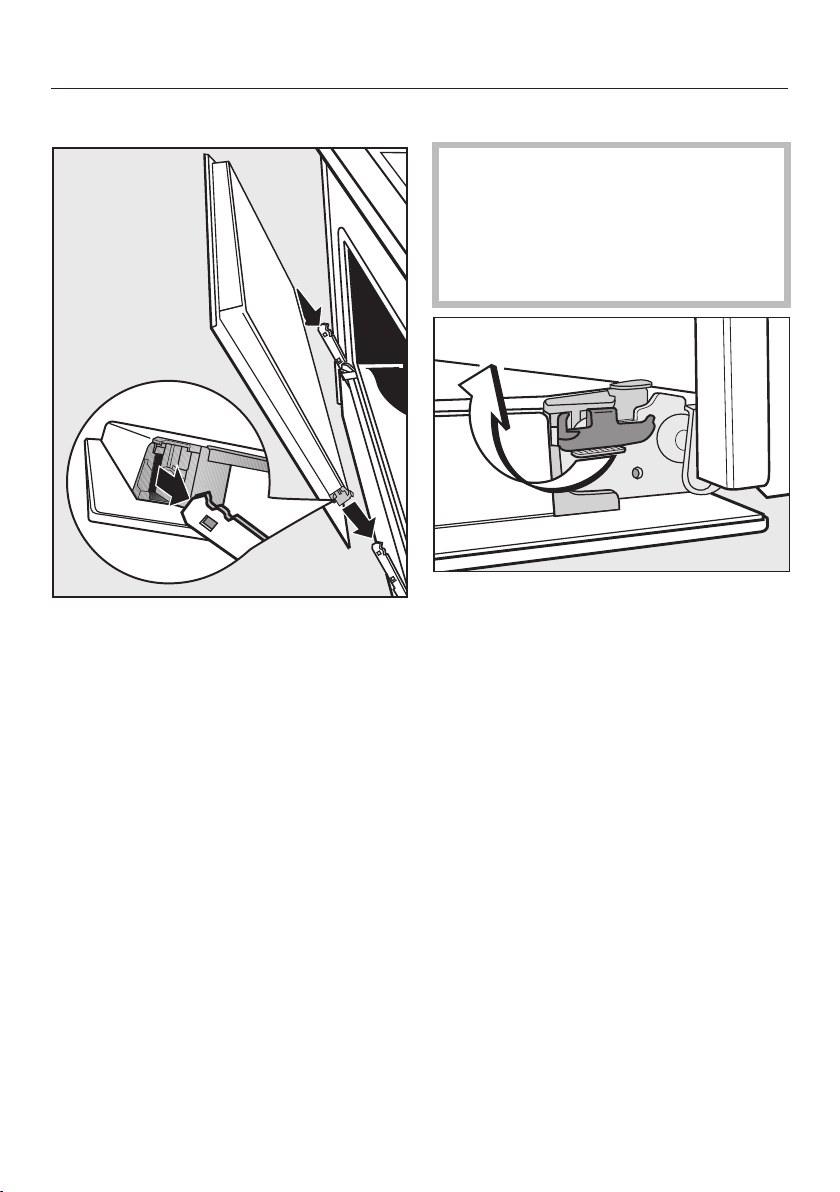
Cleaning and care
70
Reinstalling the door
Hold both sides of the door securely
and carefully fit it onto the brackets of
the hinges.
Make sure that the door goes on
straight.
Open the door fully.
If the locking clamps are not locked,
the door can easily become de-
tached from the brackets and be
damaged.
You must make sure that the locking
clamps are locked again.
To relock the locking clamps, turn
them back up to the horizontal posi-
tion as far as they will go.
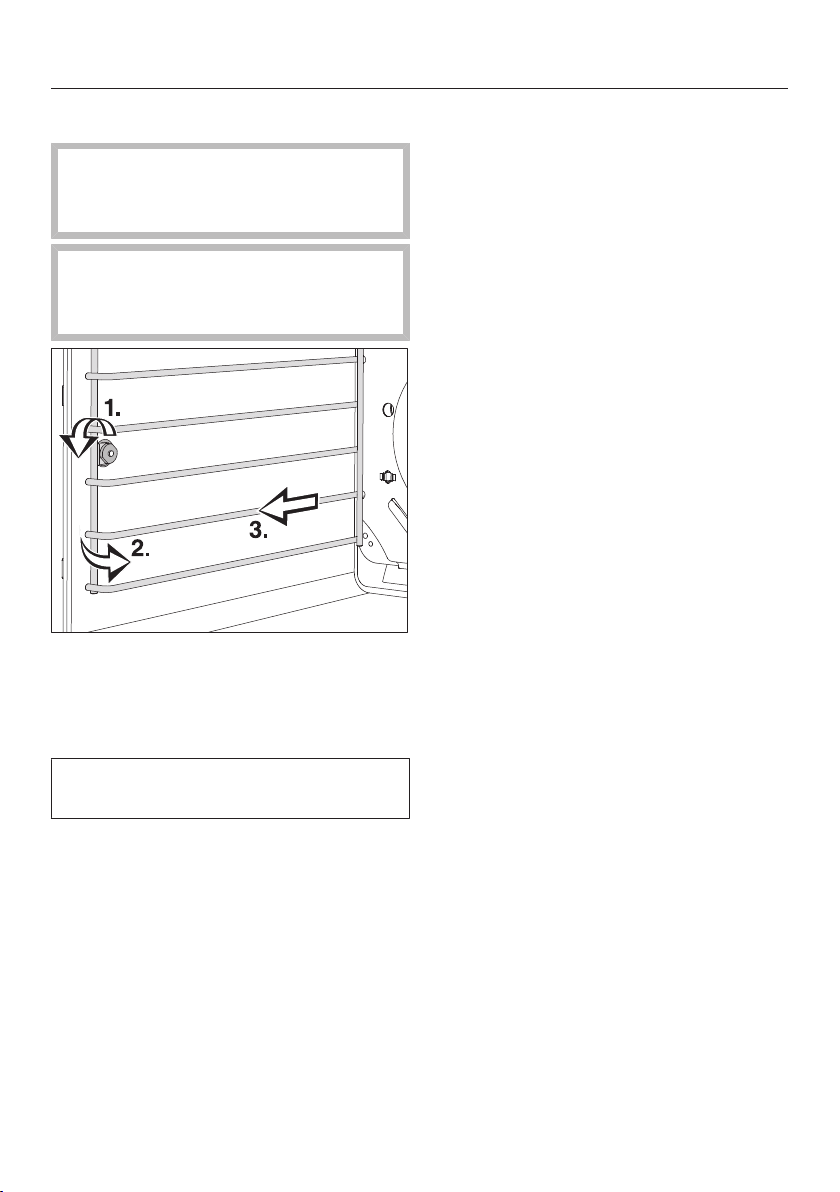
Cleaning and care
71
Removing the shelf runners
Danger of injury!
Do not use the oven without the shelf
runners correctly inserted.
Danger of burns! Make sure the
heating elements are turned off and
that the oven cavity is cool.
Loosen the screw (1.).
Pull the runners out of the holder (2.)
at the front of the oven, and then pull
them out of the oven (3.).
The runners can be reinstalled in the
reverse order.
Be sure that all parts are installed
correctly.

Frequently Asked Questions
72
With the help of the following guide minor faults in the performance of the ma-
chine, some of which may result from incorrect operation, can be remedied with-
out contacting the Service Department.
This guide may help you to find the reason for the fault, and how to correct it.
Problem Possible cause and solution
This display is dark. There is no power to the appliance.
Check if the circuit breaker has tripped.
The oven does not heat
up.
Only an oven mode or a temperature has been se-
lected.
Select a mode and a temperature.
The system lock is On.
Turn off the system lock (see “System lock ”).
There is no power to the appliance.
Check if the circuit breaker has tripped. If it has,
contact a qualified electrician or Miele.
Demo mode has been activated. appears in the
display.
The oven can be operated but does not heat up.
Deactivate Demo mode (see “Settings – ”).

Frequently Asked Questions
73
Problem Possible cause and solution
flashes in the dis-
play.
There has been a power failure.
Reset the time of day (see “Using for the first
time”).
Cooking times will also need to be reset.
appears unex-
pectedly in this
display and the
symbol
flashes at the
same time. The
signal may also
be sounding.
The oven has been operating for an unusually long
period of time, this has activated the “Safety switch-
off feature”.
Turn the mode selector to OFF. The oven is now
ready to use.
appears in the
display.
The Self Clean program door lock is not locking.
Turn the mode selector to the Self Clean program
again.
If the problem persists, contact Miele Technical
Service.
appears in the
display.
The door lock for the Self Clean program will not de-
activate.
Turn the mode selector to the Off position and turn
the oven off.
If the problem persists, contact Miele Technical
Service.
appears in the dis-
play.
A fault has occurred that you cannot resolve.
Contact Miele Technical Service.
A noise is heard after
the cooking process is
complete.
After the cooking process the cooling fan will con-
tinue to run for a while after a program is complete to
prevent moisture from building up in the oven, on the
control panel or surrounding cabinetry.
The cooling fan will turn off automatically.
The oven has turned it-
self off.
The oven turns off automatically if a button is not
pressed after a certain amount of time or after a
cooking program has ended to save power.
Turn the oven back on.
The oven lighting turns
off after a short time.
The oven is factory set to turn off automatically after
15 seconds. This setting can be changed (see “Set-
tings overview – ”).
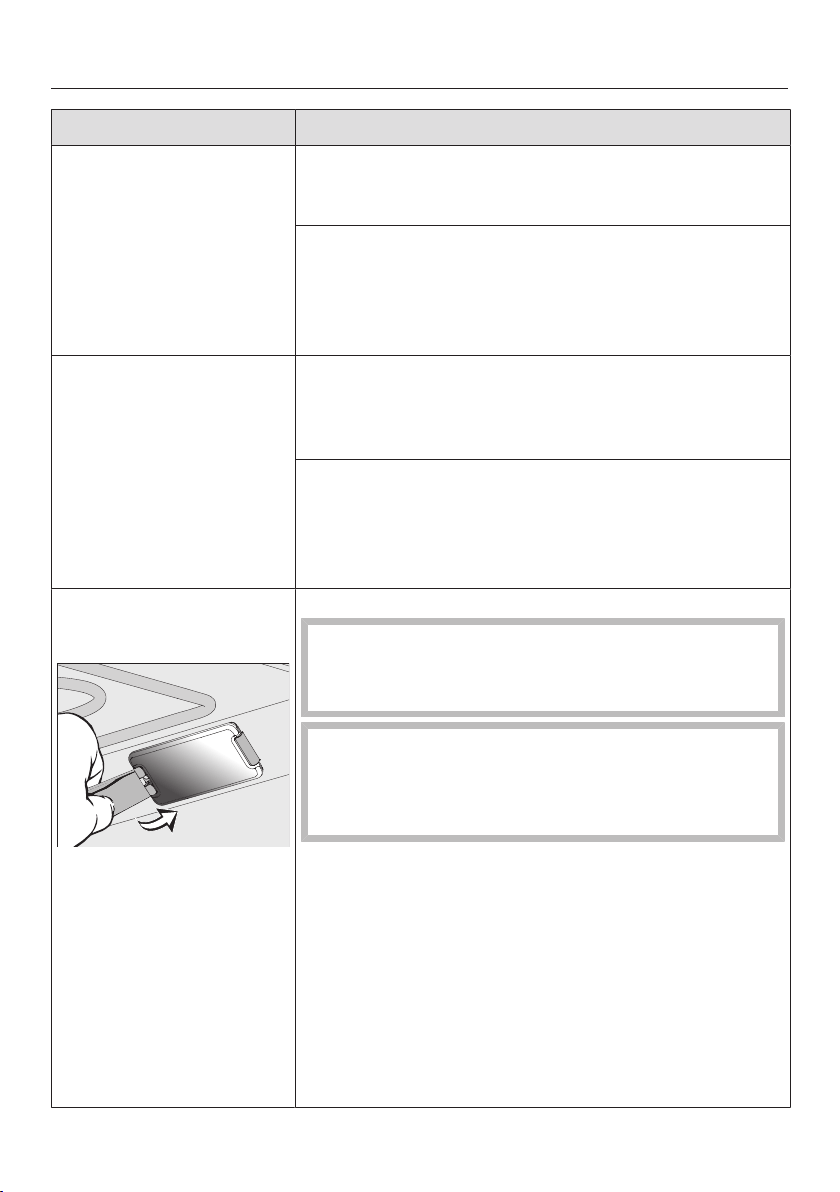
Frequently Asked Questions
74
Problem Possible cause and solution
Baked goods are not
cooked properly after
following the times
given in the chart.
A different temperature than that given in the recipe
was used.
Select the temperature required for the recipe.
The ingredient quantities are different from those
given in the recipe.
Double check the recipe. The addition of more liq-
uid or more eggs will make a wetter mixture which
will take longer to cook.
The browning is un-
even.
The wrong temperature or shelf level was selected.
There will always be a slight unevenness. If the un-
evenness is great, check whether the correct tem-
perature and shelf level were selected.
That material or color of the bakeware is not suitable
for the oven mode selected.
When using Bake, do not use matt, dark-colored
pans. Light-colored, shiny pans will produce the
best results.
The oven lighting does
not turn on.
The halogen bulb needs to be replaced.
Danger of burns!
Make sure the heating elements are turned off and
allowed to cool completely.
The lamp cover may be damaged if it falls.
When removing the cover hold it firmly so that it
does not fall. Place a towel on the oven floor and
open door to avoid damage.
Disconnect the appliance from the power supply.
Loosen the bulb cover with the tool supplied at the
back of the frame.
Do not touch the halogen bulb with bare fingers.
Observe the manufacturer's instructions.
Remove the halogen bulb.
Replace it with a new halogen bulb (Sylvania
66740, 120V, 40W, G9, FS1).
Press the bulb cover back into place.
Reconnect the oven to the electrical supply.

Frequently Asked Questions
75
Problem Possible cause and solution
There is soiling in the
over after the Self Clean
program.
The Self Clean program burns off soiling in the oven
and leaves it as ash.
Using a soft sponge, warm water and liquid dish
soap remove the ashes.
If coarse soiling remains, start the Self Clean pro-
gram again with a longer duration.
The Grill and Griddle
cannot be turned on
The grill and the griddle plate are turned off as soon
as the Self clean program is started.
This is not a fault. The safety shut-off has been acti-
vated.
The controls make further attempts at re-ignition at
approx. one minute intervals (max. 5 attempts).
Turn off the grill and griddle control knob. As soon
as Self clean is finished the grill and the griddle
plate can be switched on again.
The grill and griddle cannot be turned on during Self
clean.
This is not a fault. The safety shut-off has been acti-
vated.
The controls make further attempts at re-ignition at
approx. one minute intervals (max. 5 attempts).
Turn off the grill and griddle control knob. As soon
as Self clean is finished the grill and the griddle
plate can be switched on again.
The rack and other ac-
cessories make a noise
when being pushed into
or pulled out of the
oven.
The heat resistant surface of the shelf runners creates
friction when accessories are taken in and out of the
oven.
To reduce the friction, lubricate the runners with a
few drops of cooking oil applied with a paper
towel. Repeat this process after each Self Clean
program.

Technical Service
76
Contact in case of fault
In the event of a fault which you cannot
remedy yourself, please contact your
Miele dealer or Miele Technical Service.
Contact information for Miele Techni-
cal Service can be found at the end of
this document.
Please quote the model and serial num-
ber of your appliance when contacting
Miele. Both pieces of information can
be found on the data plate.
You will find this information on the data
plate, which is behind the toe-kick
cover.
Warranty
For further information, please refer to
your warranty booklet.



9 Independence Way
Princeton, NJ 08540
Phone:
Fax:
www.mieleusa.com
U.S.A.
Miele, Inc.
National Headquarters
Please have the model and serial number
of your appliance available when
contacting Customer Service.
Canada
Importer
Miele Limited
Headquarters and Miele Centre
800-843-7231
609-419-4298
Customer Service & Support
Phone:
Fax:
161 Four Valley Drive
Vaughan, ON L4K 4V8
www.miele.ca
888-99-MIELE(64353)
888-586-8056
Customer Care Centre
Phone:
800-565-6435
905-532-2272
International Headquarters
Miele & Cie. KG
Carl-Miele-Straße 29
33332 Gütersloh
Germany

M.-Nr. 10 944 260 / 04
en-US, CA
HR1134-1, HR1135-1, HR1136-1