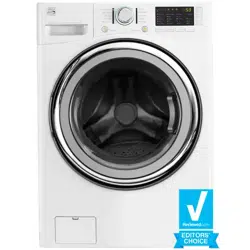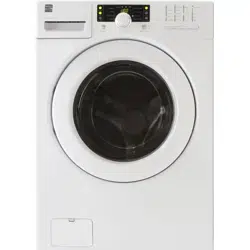
Use & Care Guide
Manual de Uso y Cuidado
English / Espafiol
IiX::o__best _esuks a IOWoS_dsing, HE kgh EF)c ency
Ii}_:,e_gen_ nade tot hg e_fic_':n(y waslq_ s must
be used,,
Para >bten_':r I>s mejo es es _ltados, d_:x:r,'_
ut zarse un @':tetg_':nte HE paa avadc as @':
ata eficacia y has espun_a
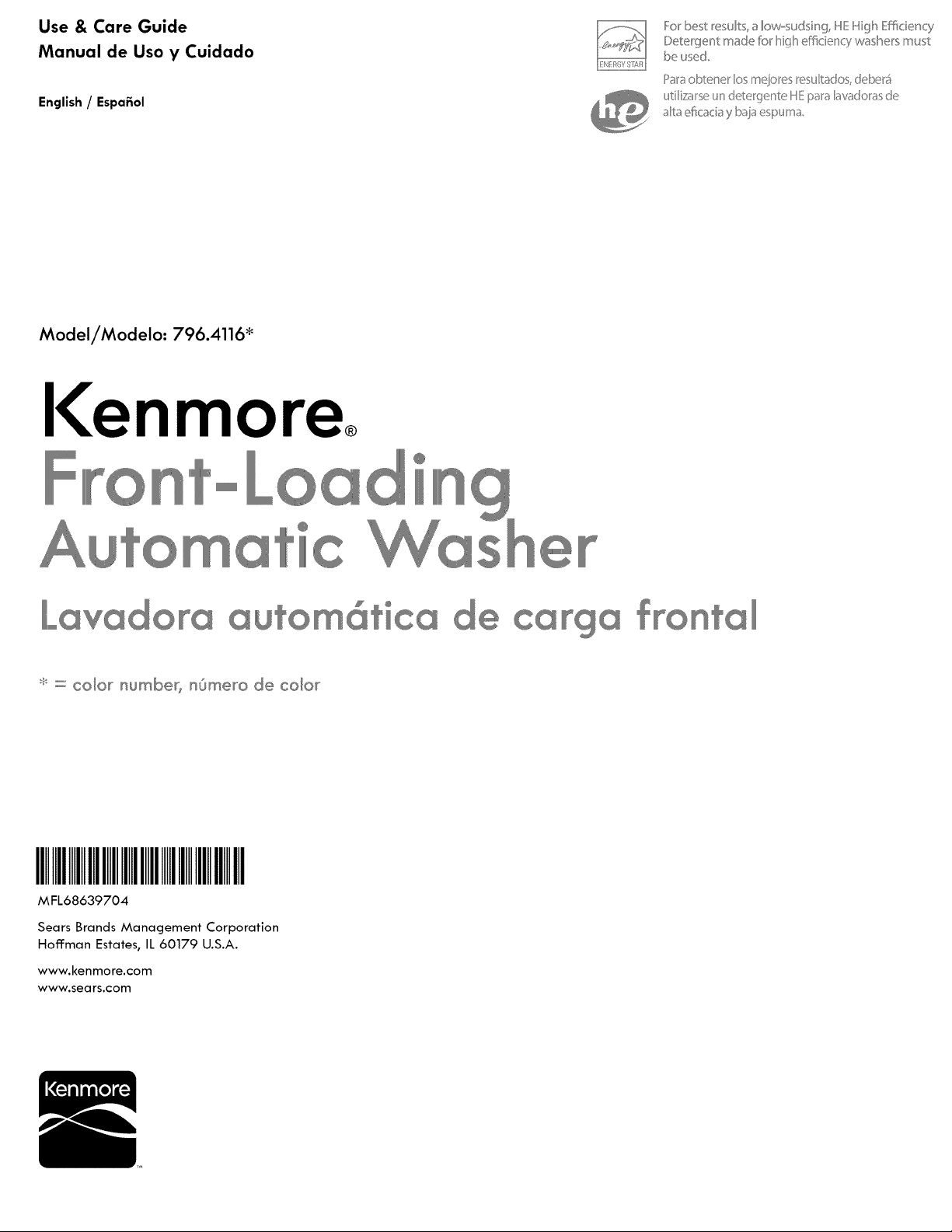
Model/Modelo: 796.4116"
I<enmore
@
@
®uto®6tic® de c® ®
s ..............co/or numb÷(, nOmero de co/or
IIIIIIIIIIIIIIIIIIIIII
MFL68639704
Sears Brands Management Corporation
HofFman Estates, IL 60179 U.S.A.
www.kenmore.com
www.sears.com
IMPORTANT SAFETY INSTRUCTIONS ......................... 3-5
GROUNDING REQUIREMENTS ...................................... 5
FEATURES AND BENEFITS
Key Parts and Components ................................................. 6
included Accessories ........................................................... 6
Optional Accessories ........................................................... 6
INSTALLATION REQUIREMENTS
Key Dimensions and Specifications ................................... 7
Choose the Proper Location ............................................... 7
Flooring .................................................................................. 7
Clearances ............................................................................ 7
INSTALLATION INSTRUCTIONS
Unpacking and Removing Shipping Bolts ......................... 8
Connecting the Water Lines................................................ 9
Connecting the Drain Hose ............................................... 10
Connecting to the Power Supply ....................................... 10
Leveling the Washer ........................................................... 11
installation of Non-Skid Pads (optional) ........................... 11
HOW TO USE
Control Panel Features ........................................................ 12
Operating the Washer ......................................................... 13
Cycle Guide .................................................................... 14-15
Sorting Wash Loads ............................................................ 16
About the Dispenser Drawer .............................................. 17
Detergent and Dispenser Use ............................................. 18
Magnetic Door Plunger ...................................................... 18
Time and Status Display .................................................... 19
Cycle Modifier Buttons....................................................... 20
Option Buttons ..................................................................... 21
Delay Start ........................................................................ 21
Extra Rinse ........................................................................ 21
Pre Wash ........................................................................... 21
Special Functions ............................................................... 22
Control Lock..................................................................... 22
Clean Washer ................................................................. 22
Auto Soak ......................................................................... 22
CARE AND CLEANING
Regular Cleaning .......................................................... 23-24
Cleaning the Exterior ...................................................... 23
Care and Cleaning of the interior ................................ 23
Clean Washer ................................................................ 23
Door Seal and Glass Cleaning ...................................... 23
Removing Mineral Buildup .............................................. 23
Storing the Washer ........................................................ 24
Cleaning the Dispenser .................................................. 24
Maintenance .................................................................. 25-26
Cleaning the Water inlet Filters.................................... 25
Cleaning the Drain Pump Filter ..................................... 26
KENMORE CONNECT TM System ......................................... 27
TROUBLESHOOTING GUIDE
Normal Sounds You May Hear ......................................... 28
Before Calling for Service .......................................... 28-30
WARRANTY .................................................................. 31
In the space below, record the date of purchase, model,
and serial number of your product. You will find the model and
serial number printed on an identification plate located inside
the washer door. Have these items of information available
whenever you contact Sears concerning your
product.
Model No.
Date of Purchase
Serial No.
Save these instructions and your sales receipt for future
reference.
Master Protection Agreements
Congratulations on making a smart purchase. Your new
Kenmore ® product is designed and manufactured for
years of dependable operation. But like all products, it
may require preventive maintenance or repair from time
to time. That's when having a Master Protection
Agreement can save you money and aggravation.
The Master Protection Agreement also helps extend the
life of your new product. Here's what the
Agreement* includes:
oparts and labor needed to help keep products
operating properly under normal use, not just defects.
Our coverage goes well beyond the product warranty.
No deductible, no functional failure excluded from
coverage - real protection.
oExpert service by a force of more than 10,000
authorized Sears service technicians, which means
someone you can trust will be working on your product.
oUnlimited service calls and nationwide service, as
often as you want us, whenever you want us.
o_No-lemon" guarantee - replacement of your covered
product if four or more product failures occur within
twelve months.
oproduct replacement if your covered product can not
be fixed.
*Annual Preventive Maintenance Check at your request
- no extra charge.
*Fast help by phone - we call it Rapid Resolution.
Phone support from a Sears representative on all
products. Think of us as a ""talking owner's manual."
*Power surge protection against electric damage clue to
power fluctuations.
*$250 food loss protection annually for any food
spoilage that is the result of mechanical failure of any
covered refrigerator or freezer.
*Rental reimbursement if repair of your covered
product takes longer than promised.
"25°/0 discount off: the regular price of any non-covered
repair service and related installed parts.
Once you purchase the Agreement, a simple phone
call is all that it takes for you to schedule service. You
can call at any time day or night or schedule a service
appointment online.
The Master Protection Agreement is a risk-free purchase.
If you cancel for any reason during the product
warranty period, we will provide a full refund, or a
prorated refund any time after the product warranty
period expires. Purchase your Master Protection
Agreement today!
Some limitations and exclusions apply.
For prices and additional information in the U.S.A.
call 1-800-827-6655.
*Coverage in Canada varies on some items.
For full details call Sears Canada at 1-800-361-6665.
Sears Installation Service
For Sears professional installation of home appliances,
garage door openers, water heaters, and other major
home items, in the U.S.A. or Canada call:
1-800-4-MY-HOME ®.
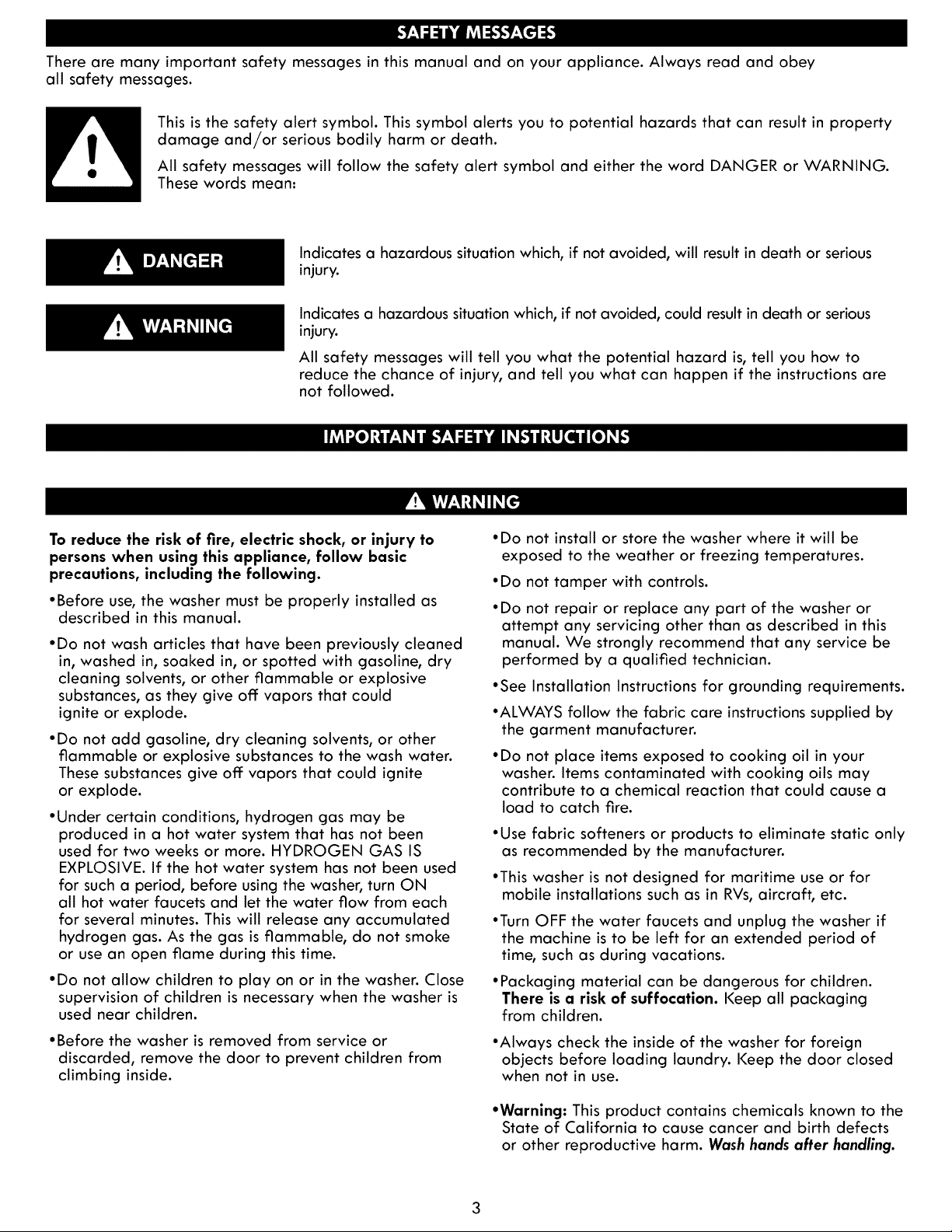
There are many important safety messages in this manual and on your appliance. Always read and obey
all safety messages.
This is the safety alert symbol. This symbol alerts you to potential hazards that can result in property
damage and/or serious bodily harm or death.
All safety messages will follow the safety alert symbol and either the word DANGER or WARNING.
These words mean:
Indicates a hazardous situation which, if not avoided, will result in death or serious
injury.
Indicates a hazardous situation which, if not avoided, could result in death or serious
injury.
All safety messages will tell you what the potential hazard is, tell you how to
reduce the chance of injury, and tell you what can happen if the instructions are
not followed.
To reduce the risk of fire, electric shock, or injury to
persons when using this appliance, follow basic
precautions, including the following.
• Before use, the washer must be properly installed as
described in this manual.
• Do not wash articles that have been previously cleaned
in, washed in, soaked in, or spotted with gasoline, dry
cleaning solvents, or other flammable or explosive
substances, as they give off vapors that could
ignite or explode.
• Do not add gasoline, dry cleaning solvents, or other
flammable or explosive substances to the wash water.
These substances give off vapors that could ignite
or explode.
•Under certain conditions, hydrogen gas may be
produced in a hot water system that has not been
used for two weeks or more. HYDROGEN GAS IS
EXPLOSIVE. If the hot water system has not been used
for such a period, before using the washer, turn ON
all hot water faucets and let the water flow from each
for several minutes. This will release any accumulated
hydrogen gas. As the gas is flammable, do not smoke
or use an open flame during this time.
• Do not allow children to play on or in the washer. Close
supervision of children is necessary when the washer is
used near children.
•Before the washer is removed from service or
discarded, remove the door to prevent children from
climbing inside.
• Do not install or store the washer where it will be
exposed to the weather or freezing temperatures.
• Do not tamper with controls.
• Do not repair or replace any part of the washer or
attempt any servicing other than as described in this
manual. We strongly recommend that any service be
performed by a qualified technician.
•See Installation Instructions for grounding requirements.
•ALWAYS follow the fabric care instructions supplied by
the garment manufacturer.
• Do not place items exposed to cooking oil in your
washer. Items contaminated with cooking oils may
contribute to a chemical reaction that could cause a
load to catch fire.
•Use fabric softeners or products to eliminate static only
as recommended by the manufacturer.
•This washer is not designed for maritime use or for
mobile installations such as in RVs, aircraft, etc.
•Turn OFF the water faucets and unplug the washer if
the machine is to be left for an extended period of
time, such as during vacations.
• Packaging material can be dangerous for children.
There is a risk of suffocation. Keep all packaging
from children.
•Always check the inside of the washer for foreign
objects before loading laundry. Keep the door closed
when not in use.
• Warning: This product contains chemicals known to the
State of California to cause cancer and birth defects
or other reproductive harm. Wash hands after handling.
To reduce the risk of fire, electric shock, or injury to
persons when using this appliance, follow basic
precautions, including the following.
*Unplug the washer before cleaning to avoid the risk of
electric shock.
• Never use harsh chemicals, abrasive cleaners, or
solvents to clean the washer. They will damage
the finish.
*Do not put oily or greasy rags or clothing on top of
the washer. These substances give off vapors that
could ignite the materials.
*Do not wash items that are soiled with vegetable or
cooking oil. These items may contain some oil after
laundering and may catch fire.
• Disconnect this appliance from the power supply
before attempting any user maintenance. Turning the
controls to the OFF position does not disconnect this
appliance from the power supply. Failure to follow this
warning can cause serious injury, fire, electric shock,
or death.
*Do not combine detergents, fabric softeners, and/or
other laundry products from different manufacturers
for use in a load, unless specified on the fabric label.
*Do not mix chlorine bleach with ammonia or acids
such as vinegar. Follow package directions when
using laundry products. Incorrect usage can produce
poisonous gas, resulting in serious injury or death.
*Do not reach into the washer while parts are moving.
Before loading, unloading, or adding items, push in the
cycle selector knob and allow the drum to coast to a
complete stop before reaching inside. Failure to follow
this warning can cause serious injury, fire, electric shock
or death.
• Refer to INSTALLATION INSTRUCTIONS for detailed
grounding procedures. Installation instructions are
packed in the washer for the installer's reference. If the
washer is moved to a new location, have it checked
and reinstalled by a qualified service technician. Failure
to follow this warning can cause serious injury, fire,
electric shock, or death.
• Do not, under any circumstances, cut or remove the
third (ground) prong from the power cord. Failure to
follow this warning can cause seriousinjury, fire, electric
shock, or death.
• For personal safety, this appliance must be properly
grounded. Failure to follow this warning can cause
serious injury, fire, electric shock, or death.
• The power cord of this appliance is equipped with a
3-prong (grounding) plug which mates with a standard
3-prong (grounding) wall outlet to minimize the possibility
of electric shockhazard from this appliance.
• This washer must be plugged into a 120VAC, 60Hz
grounded outlet. Failure to follow this warning can
cause serious injury, fire, electric shock, or death.
• Have the wall outlet and circuit checked by a
qualified electrician to make sure the outlet is properly
grounded. Failure to follow this warning can cause
serious injury, fire, electric shock, or death.
• Where a standard 2-prong wall outlet is encountered,
it is your personal responsibility and obligation to
have it replaced with a properly grounded 3-prong
wall outlet. Failure to follow this warning can cause
serious injury, fire, electric shock, or death.
• Do not install on carpet. Install the washer on a solid
floor. Failure to follow this warning can cause serious
leak damage.
• Do not remove the grounding prong. Do not use
an adapter or extension cord. Plug into a grounded
3-prong outlet. Failure to follow these warnings can
cause serious injury, fire, electric shock, or death.
4
• The washer should always be plugged into its own
individual electrical outlet which has a voltage rating
that matches the rating plate. This provides the best
performance and also prevents overloading house
wiring circuits which could cause a fire hazard from
overheated wires.
*Never unplug your washer by pulling on the power
cord. Always grip plug firmly and pull straight out
from the outlet. Failure to follow this warning can
cause serious injury, fire, electric shock, or death.
*Immediately repair or replace all power cords that
have become frayed or otherwise damaged. Do not
use a cord that shows cracks or abrasion damage
along its length or at either end. Consult with a
qualified service technician. Failure to follow this
warning can cause serious injury, fire, electric shock,
or death.
• When installing or moving the washer, be careful not
to pinch, crush, or damage the power cord. Failure
to follow this warning can cause serious injury, fire,
electric shock, or death.
• The washer must be installed and electrically
grounded by a qualified service technician in
accordance with local codes to prevent shock hazard
and assure stability during operation.
*The washer is heavy. Two or more people may be
needed to install and move the appliance. Failure
to do so can result in damage to property or serious
bodily injury.
• Store and install the washer where it will not be
exposed to temperatures below freezing or exposed
to outdoor weather conditions. Failure to follow this
warning can cause serious leak damage.
• To reduce the risk of electric shock, do not install
the washer in humid spaces. Failure to follow this
warning can cause serious injury, fire, electric shock, or
death.
•Do not allow children to play on or in the washer. Close
supervision of children is necessary when the washer is
used near children. As children grow, teach them the
proper, safe use of all appliances. Failure to comply with
these warnings could result in serious personal injury.
• Destroy the carton, plastic bag, and other packing
materials after the washer is unpacked. Children
might use them for play. Cartons covered with rugs,
bedspreads, or plastic sheets can become airtight
chambers. Failure to comply with these warnings could
result in serious personal injury.
• Keep laundry products out of children's reach. To
prevent personal injury, observe all warnings on
product labels. Failure to comply with these warnings
could result in serious personal injury.
• Before your washer is removed from service or
discarded, remove the door to the washing compartment
to avoid the danger of children or small animals
getting trapped inside. Failure to do so can result in
serious personal injury or death.
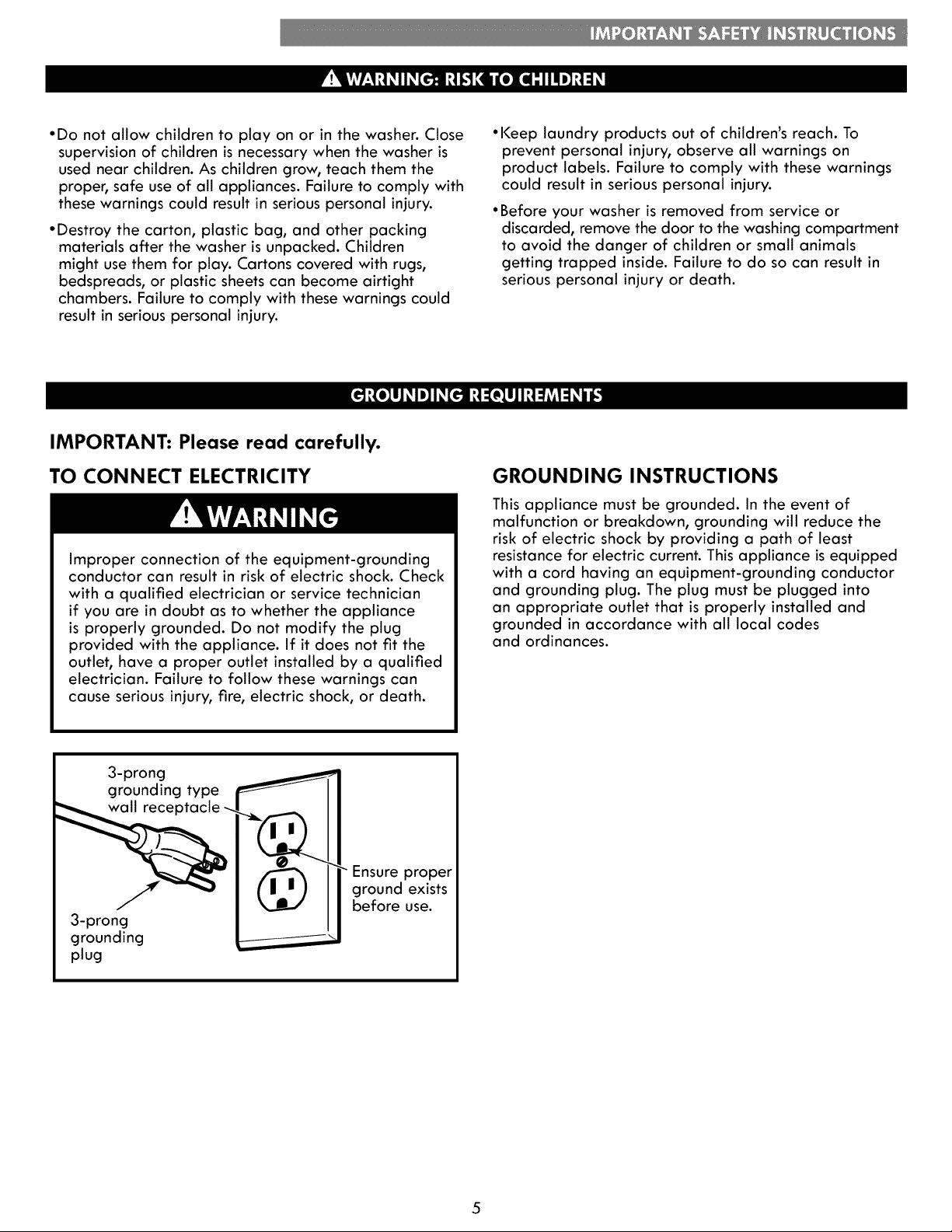
IMPORTANT: Please read carefully'.
TO CONNECT ELECTRICITY
Improper connection of the equipment-grounding
conductor can result in risk of electric shock. Check
with a qualified electrician or service technician
if you are in doubt as to whether the appliance
is properly grounded. Do not modify the plug
provided with the appliance. If it does not fit the
outlet, have a proper outlet installed by a qualified
electrician. Failure to follow these warnings can
cause serious injury, fire, electric shock, or death.
GROUNDING INSTRUCTIONS
This appliance must be grounded. In the event of
malfunction or breakdown, grounding will reduce the
risk of electric shock by providing a path of least
resistance for electric current. This appliance is equipped
with a cord having an equipment-grounding conductor
and grounding plug. The plug must be plugged into
an appropriate outlet that is properly installed and
grounded in accordance with all local codes
and ordinances.
3-prong
grounding type
wall receptacle
J
3-prong
grounding
plug
L_
Ensure proper
ground exists
before use.
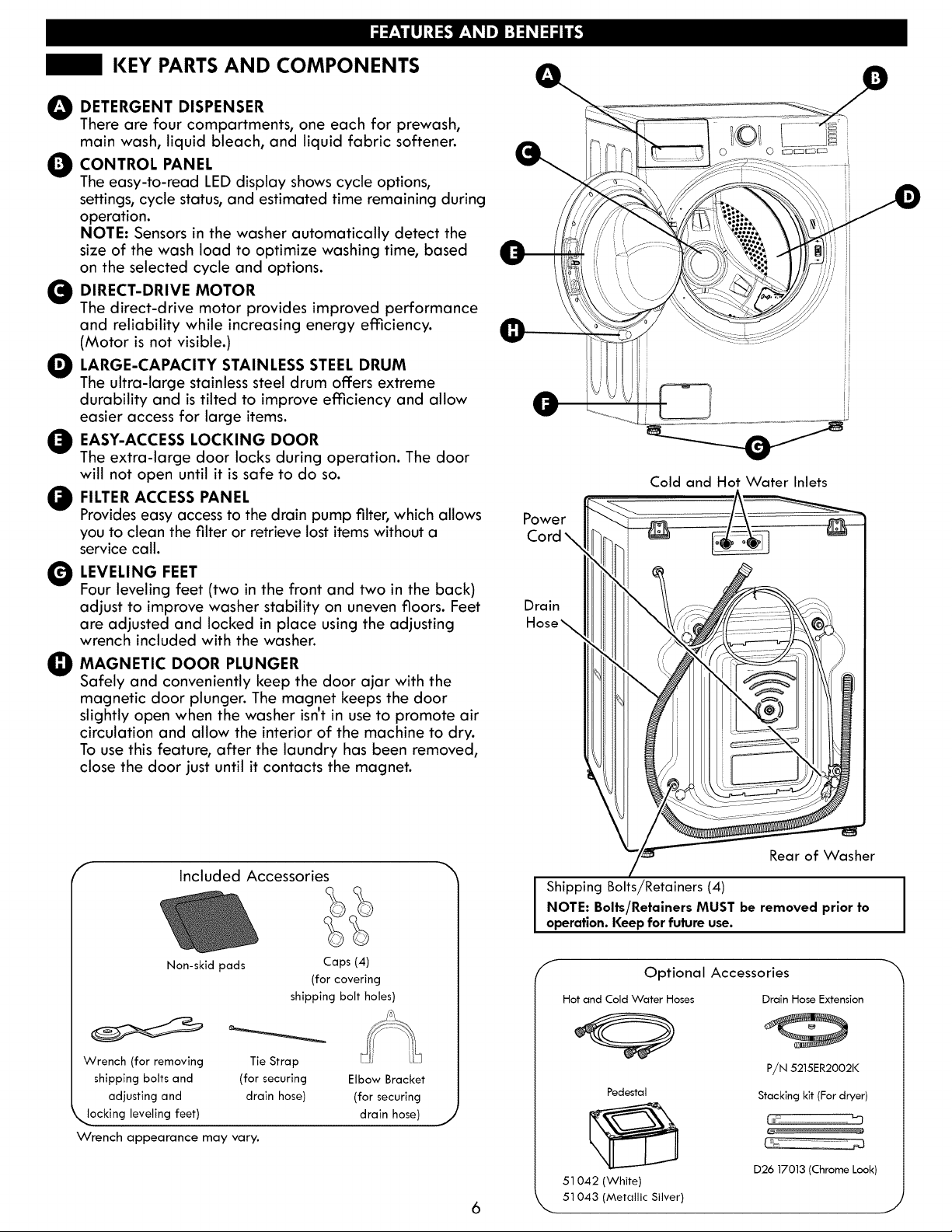
I KEY PARTS AND COMPONENTS
O ETERGENT DISPENSER
There are four compartments, one each for prewash,
main wash, liquid bleach, and liquid fabric softener.
O ONTROL PANEL
The easy-to-read LED display shows cycle options,
settings, cycle status, and estimated time remaining during
operation.
NOTE: Sensors in the washer automatically detect the
size of the wash load to optimize washing time, based
on the selected cycle and options.
O IRECT-DRIVE MOTOR
The direct-drive motor provides improved performance
and reliability while increasing energy efficiency.
(Motor is not visible.)
O ARGE-CAPACITY STAINLESS STEEL DRUM
The ultra-large stainless steel drum ofi:ers extreme
durability and is tilted to improve efficiency and allow
easier access for large items.
O ASY-ACCESS LOCKING DOOR
The extra-large door locks during operation. The door
will not open until it is safe to do so.
O ILTER ACCESS PANEL
Provides easy access to the drain pump filter, which allows
you to clean the filter or retrieve lost items without a
service call.
LEVELING FEET
Four leveling feet (two in the front and two in the back)
adjust to improve washer stability on uneven floors. Feet
are adjusted and locked in place using the adjusting
wrench included with the washer.
O AGNETIC DOOR PLUNGER
Safely and conveniently keep the door ajar with the
magnetic door plunger. The magnet keeps the door
slightly open when the washer isn't in use to promote air
circulation and allow the interior of the machine to dry.
To use this feature, after the laundry has been removed,
close the door just until it contacts the magnet.
Powe r
Cord
Drain
Cold and Hot Water Inlets
f
Included Accessories
Non-skid pads Caps (4)
(for covering
shipping bolt holes)
Wrench (for removing Tie Strap
shipping bolts and (for securing
adjusting and drain hose)
_tocking leveling feet)
Wrench appearance may vary.
Elbow Bracket
(for securing
drain hose)
Rear of Washer
I Shipping Bolts/Retainers (4)
NOTE: Bolts/Retainers MUST be removed prior to
operation. Keep for future use.
/
Optional Accessories
Hot and Cold Water Hoses Drain Hose Extension
Pedestal
51042 (White)
51043 (Metallic Silver)
P/N 5215ER2002K
Stacking kit (For dryer)
D26 17013 (Chrome Look)
I
KEY DIMENSIONS AND SPECIFICATIONS
Description Front-Loading Washer
Rated Voltage/Frequency 120VAC, 60Hz
Dimensions 27 in. (W) X 29 3,,_in. (D) X 38 11/16in. (H), 51 in. (D, door open)
68.6 cm (W) X 75.6 cm (D) X 98.3 cm (H), 129.5 cm (D, door open)
Net Weight 196.2 Ib (89kg)
CHOOSE THE PROPER LOCATION
WARNING
oThis washer is heaw/. Two or more people are
required when moving and unpacking the washer.
Failure to do so may result in damage to property or
serious bodily harm.
• Store and install the washer where it will not be
exposed to temperatures below freezing or exposed
to outdoor weather conditions. Failure to follow this
warning can cause serious injury, fire, electric shock,
or death.
• Properly ground the washer to conform with all
electric governing codes and ordinances. Failure
to follow this warning can cause serious injury, fire,
electric shock, or death.
°To reduce the risk of electric shock, do not install the
washer in humid spaces. Failure to follow this warning
can cause serious injury, fire, electric shock, or death.
•To ensure proper air flow, do not block the large
opening on the bottom of the washer with carpeting
or other materials.
• Do not remove the ground prong. Do not use an
adapter or extension cord. Plug into a grounded
3-prong outlet. Failure to follow this warning can cause
serious injury, fire, electric shock, or death.
NOTE: Installing the washer in a humid space, or
installing or storing the washer where it will be exposed
to the weather or freezing temperatures, may result in
rust or other damage that is not covered by the product
warranty.
Power Outlet
•The power outlet must be within 60 in. (1.5 m) of either
side of the washer.
•The appliance and outlet must be positioned so that
the plug is easily accessible.
• Do not overload the outlet with more than
one appliance.
•The outlet must be grounded in accordance with
current wiring electric codes and regulations.
• Time-delay fuse or circuit breaker is recommended.
NOTE: It is the personal responsibility and obligation of
the product owner to have a proper outlet installed by a
qualified service technician.
FLOORING
•To minimize noise and vibration, the washer MUST be
installed on a solidly constructed floor. See the NOTE
to your right.
•Allowable slope under the entire washer is a maximum
1 in. difference from side to side or from front to back.
• Installing on carpeting and soft tile surfaces is
not recommended.
• Never install the washer on a platform or weakly
supported structure.
7
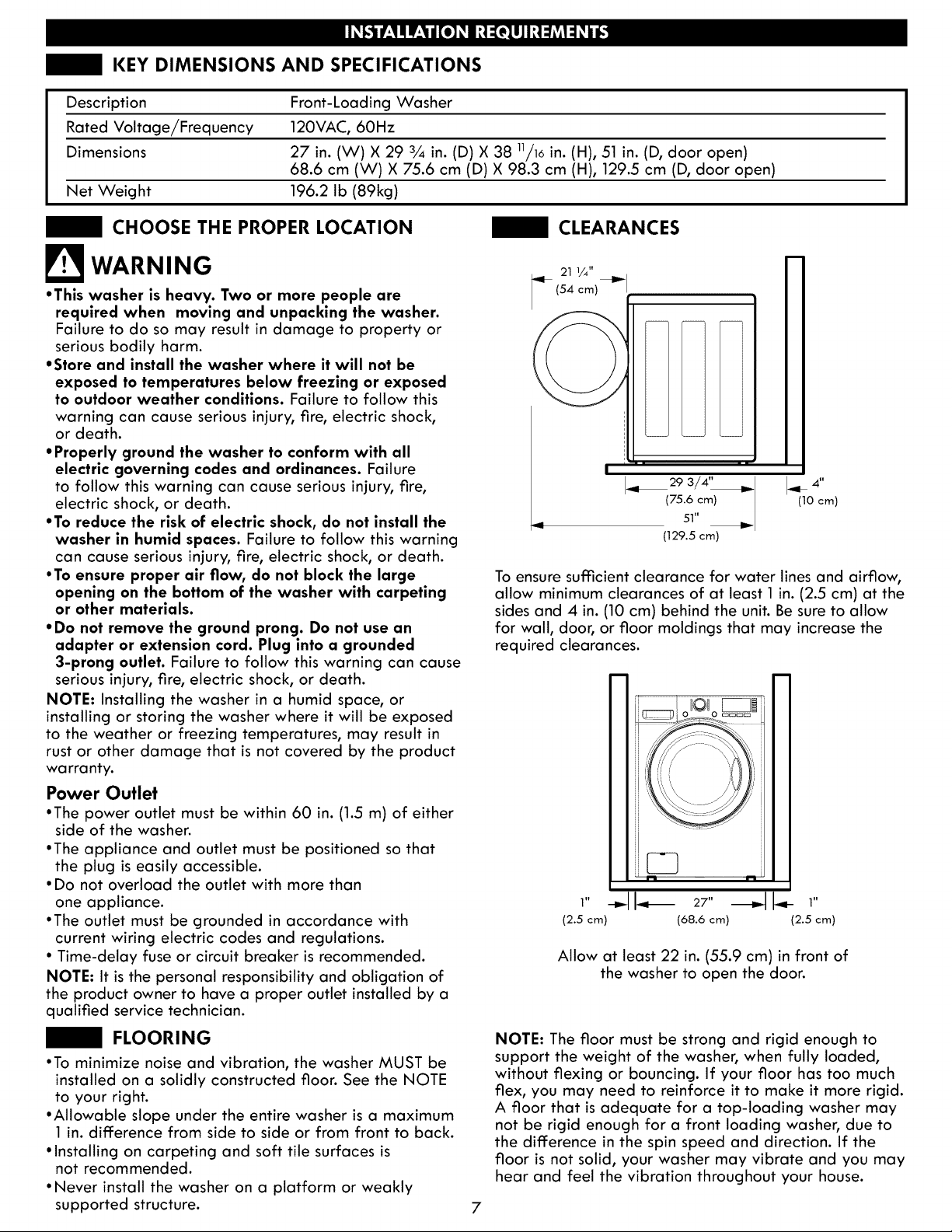
CLEARANCES
21 1/4"
_(54 cm)_1
i
"41
J_I 29 3/4" _ J_ 4"
(75.6 ¢m) (10 cm)
51"
(129.5 cm)
To ensure sufflcient clearance for water lines and airflow,
allow minimum clearances of at least 1 in. (2.5 cm) at the
sides and 4 in. (10 cm) behind the unit. Be sure to allow
for wall, door, or floor moldings that may increase the
required clearances.
1 27 1
(2.5 cm) (68.6 cm) (2.5 cm)
Allow at least 22 in. (55.9 cm) in front of
the washer to open the door.
NOTE: The floor must be strong and rigid enough to
support the weight of the washer, when fully loaded,
without flexing or bouncing. If your floor has too much
flex, you may need to reinforce it to make it more rigid.
A floor that is adequate for a top-loading washer may
not be rigid enough for a front loading washer, due to
the difference in the spin speed and direction. If the
floor is not solid, your washer may vibrate and you may
hear and feel the vibration throughout your house.
UNPACKING AND REMOVING SHIPPING BOLTS
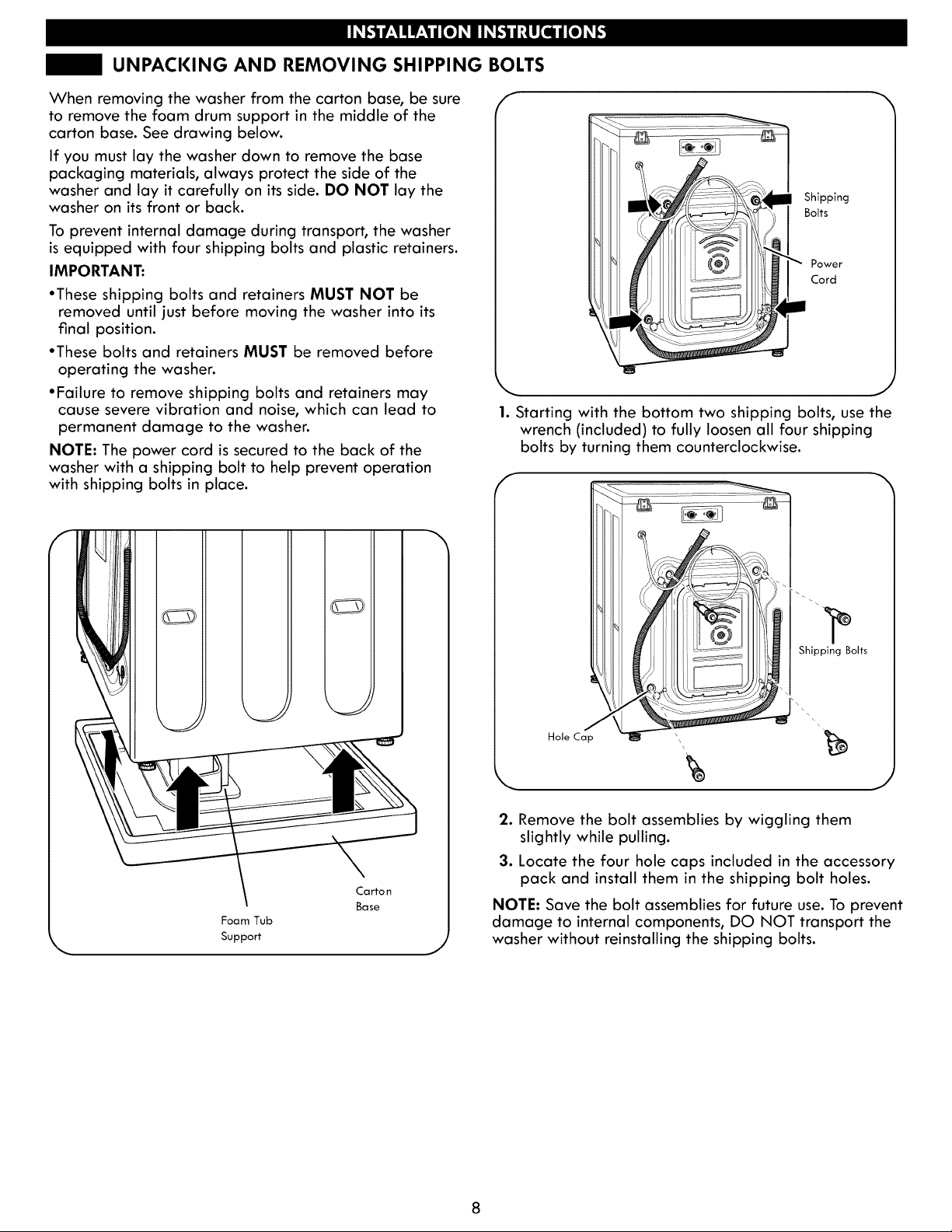
When removing the washer from the carton base, be sure
to remove the foam drum support in the middle of the
carton base. See drawing below.
If you must lay the washer down to remove the base
packaging materials, always protect the side of the
washer and lay it carefully on its side. DO NOT lay the
washer on its front or back.
To prevent internal damage during transport, the washer
is equipped with four shipping bolts and plastic retainers.
IMPORTANT:
• These shipping bolts and retainers MUST NOT be
removed until just before moving the washer into its
final position.
• These bolts and retainers MUST be removed before
operating the washer.
• Failure to remove shipping bolts and retainers may
cause severe vibration and noise, which can lead to
permanent damage to the washer.
NOTE: The power cord is secured to the back of the
washer with a shipping bolt to help prevent operation
with shipping bolts in place.
f
|
J
1. Starting with the bottom two shipping bolts, use the
wrench (included) to fully loosen all four shipping
bolts by turning them counterclockwise.
Shipping Bolts
2. Remove the bolt assemblies by wiggling them
slightly while pulling.
3. Locate the four hole caps included in the accessory
pack and install them in the shipping bolt holes.
NOTE: Save the bolt assemblies for future use. To prevent
damage to internal components, DO NOT transport the
washer without reinstalling the shipping bolts.
CONNECTING THE WATER LINES
• IMPORTANT: Use new hoses when installing the
washer. Do NOT reuse old hoses.
• IMPORTANT: Use ONLY the inlet hoses provided with
this washer. Aftermarket hoses are not guaranteed to fit or
function correctly. Other hoses may not tighten correctly
and could cause leaks. Subsequent damage to product
or property will not be covered under the terms of the
product warranty.
•Water supply pressure must be between 14.5 psi and
116 psi (100-800 kPa). If the water supply pressure is more
than 116psi, a pressure reducing valve must be installed.
• Periodically check the hose for cracks, leaks, and wear,
and replace the hose if necessary.
•Make sure that the water lines are not stretched,
pinched, crushed, or kinked.
•The washer should never be installed or stored in a
location subject to freezing temperatures. Damage to the
water lines and internal mechanisms of the washer can
result. If the washer was exposed to freezing temperatures
prior to installation, allow it to stand at room temperature
for several hours before use and check for leaks prior
to operation.
Rubber Seal Rubber Seal
Water Hose e_
(to water inlet Water Hos
on washer) (to tap)
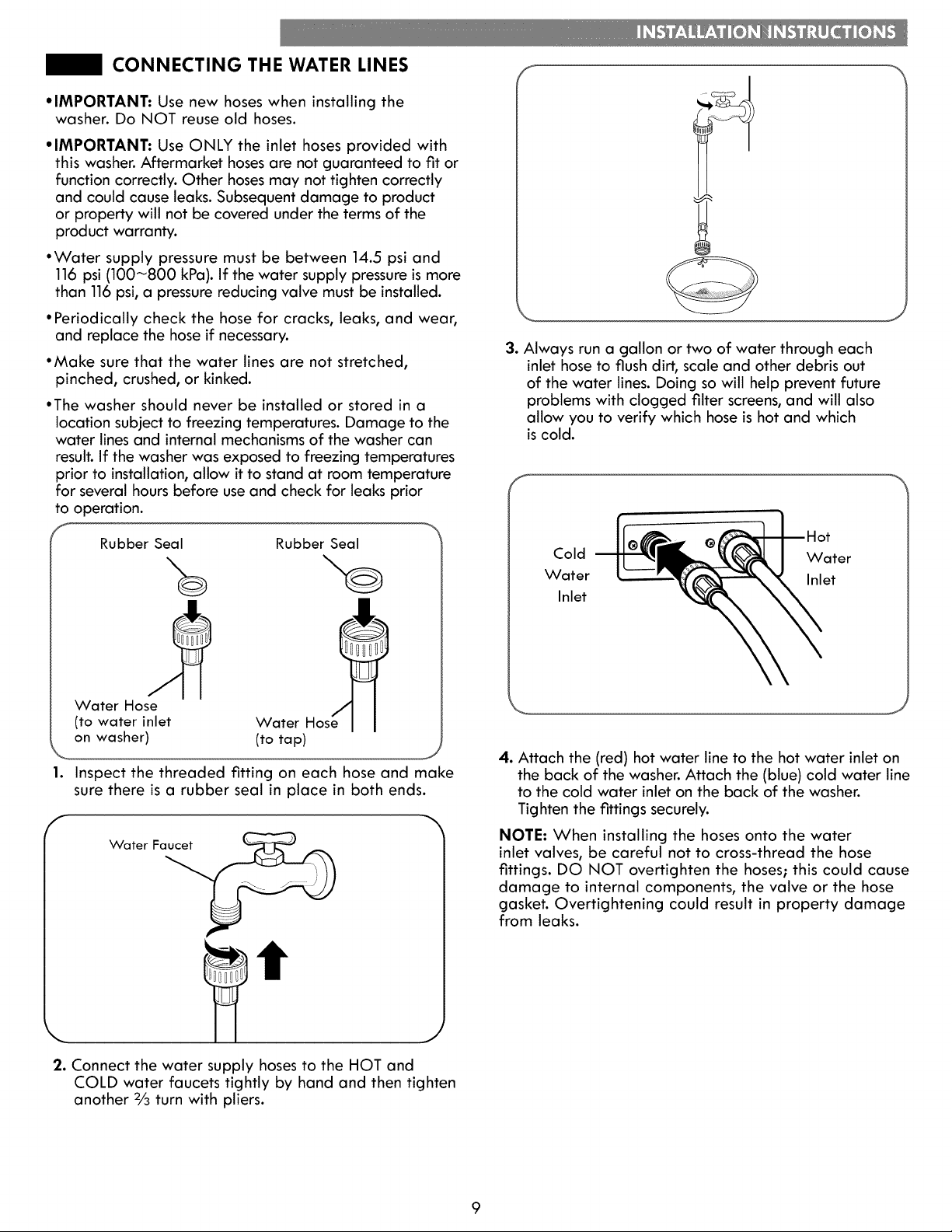
1. Inspect the threaded fitting on each hose and make
sure there is a rubber seal in place in both ends.
f
Water Fa_
2. Connect the water supply hoses to the HOT and
COLD water faucets tightly by hand and then tighten
another 2/3 turn with pliers.
f
3. Always run a gallon or two of water through each
inlet hose to flush dirt, scale and other debris out
of the water lines. Doing so will help prevent future
problems with clogged filter screens, and will also
allow you to verify which hose is hot and which
is cold.
Cold Water
Water Inlet
Inlet
4. Attach the (red) hot water line to the hot water inlet on
the back of the washer. Attach the (blue) cold water line
to the cold water inlet on the back of the washer.
Tighten the fittings securely.
NOTE: When installing the hoses onto the water
inlet valves, be careful not to cross-thread the hose
fittings. DO NOT overtighten the hoses; this could cause
damage to internal components, the valve or the hose
gasket. Overtightening could result in property damage
from leaks.
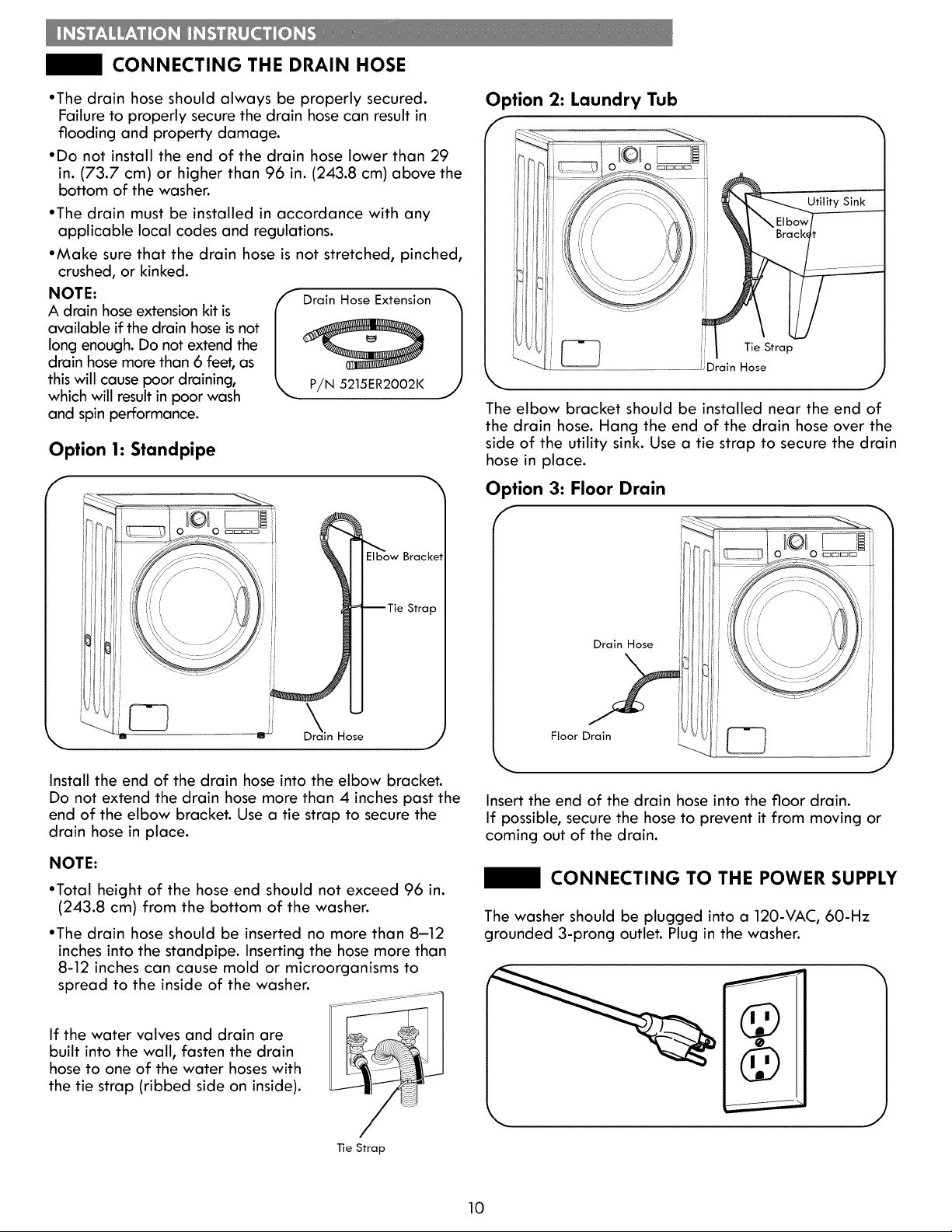
CONNECTING THE DRAIN HOSE
• The drain hose should always be properly secured.
Failure to properly secure the drain hose can result in
flooding and property damage.
• Do not install the end of the drain hose lower than 29
in. (73.7 cm) or higher than 96 in. (243.8 cm) above the
bottom of the washer.
• The drain must be installed in accordance with any
applicable local codes and regulations.
• Make sure that the drain hose is not stretched, pinched,
crushed, or kinked.
NOTE:
A drain hose extension kit is
available if the drain hose is not
long enough. Do not extend the
drain hose more than 6 feet, as
this will cause poor draining,
which will result in poor wash
and spin performance.
I Drain Hose Extension
P/N 5215ER20021<
Option 1: Standpipe
f
Hose
Brooke
Strop
J
Install the end of the drain hose into the elbow bracket.
Do not extend the drain hose more than 4 inches past the
end of the elbow bracket. Use a tie strap to secure the
drain hose in place.
NOTE:
• Total height of the hose end should not exceed 96 in.
(243.8 cm) from the bottom of the washer.
• The drain hose should be inserted no more than 8-12
inches into the standpipe. Inserting the hose more than
8-12 inches can cause mold or microorganisms to
spread to the inside of the washer.
If the water valves and drain are
built into the wall, fasten the drain
hose to one of the water hoses with
the tie strap (ribbed side on inside).
Tie Strap
Option 2: Laundry Tub
Utility Sink
The elbow bracket should be installed near the end of
the drain hose. Hang the end of the drain hose over the
side of the utility sink. Use a tie strap to secure the drain
hose in place.
Option 3: Floor Drain
f
Drain Hose
\
Floor Drain
J
Insert the end of the drain hose into the floor drain.
If possible, secure the hose to prevent it from moving or
coming out of the drain.
CONNECTING TO THE POWER SUPPLY
The washer should be plugged into a 120-VAC, 60-Hz
grounded 3-prong outlet. Plug in the washer.
J
10
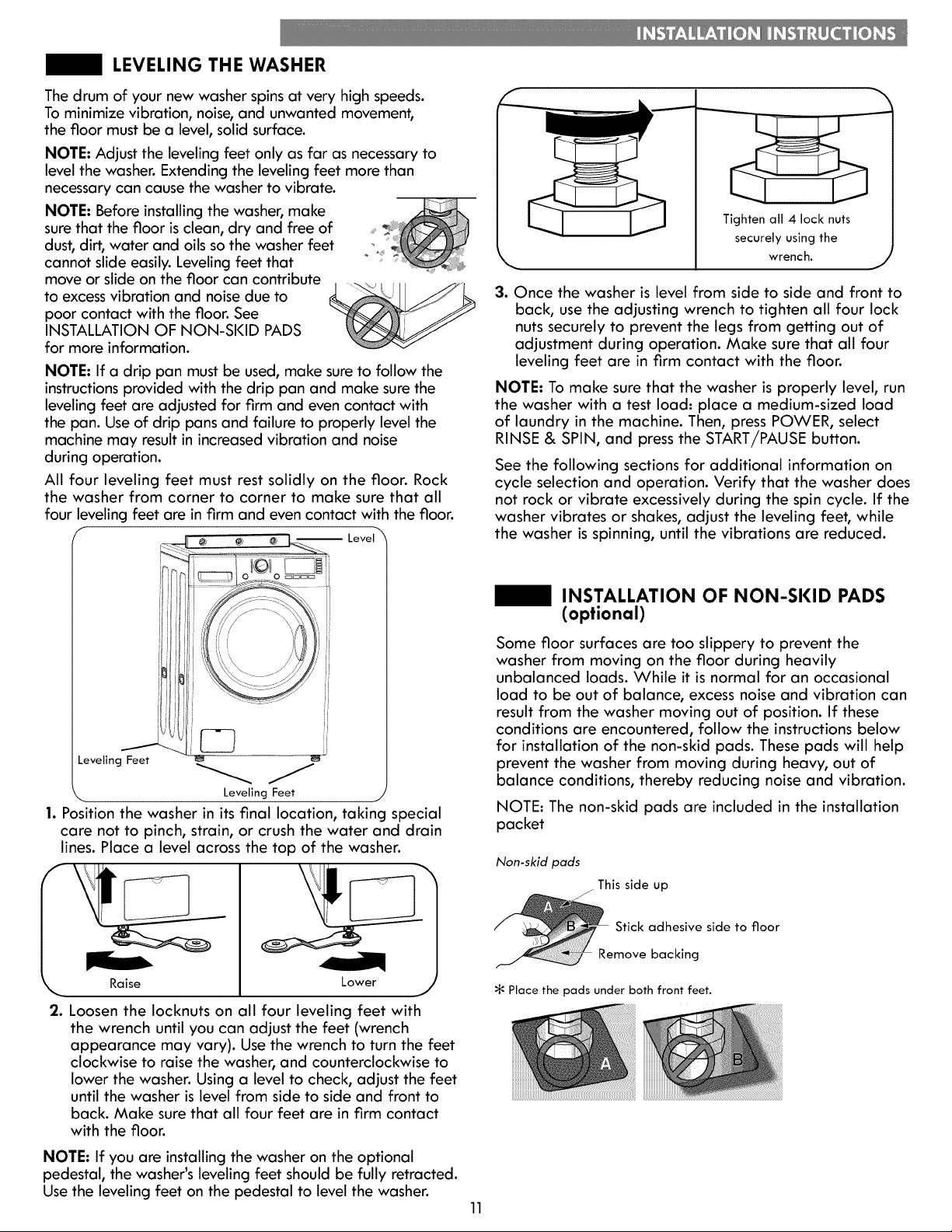
LEVELING THE WASHER
The drum of your new washer spins at very high speeds.
To minimize vibration, noise, and unwanted movement,
the floor must be a level, solid surface.
NOTE: Adjust the leveling feet only as far as necessary to
level the washer. Extending the leveling feet more than
necessary can cause the washer to vibrate.
NOTE: Before installing the washer, make
sure that the floor is clean, dry and free of
dust, dirt, water and oils so the washer feet
cannot slide easily. Leveling feet that
move or slide on the floor can contribute
to excess vibration and noise due to
poor contact with the floor. See
INSTALLATION OF NON-SKID PADS
for more information.
NOTE: If a drip pan must be used, make sure to follow the
instructions provided with the drip pan and make sure the
leveling feet are adjusted for firm and even contact with
the pan. Use of drip pans and failure to properly level the
machine may result in increased vibration and noise
during operation.
All four leveling feet must rest solidly on the floor. Rock
the washer from corner to corner to make sure that all
four leveling feet are in firm and even contact with the floor.
@ @ @ _ Level
Leveling Feet
\ Leveling Feet j
1. Position the washer in its final location, taking special
care not to pinch, strain, or crush the water and drain
lines. Place a level across the top of the washer.
Raise Lower
J
2. Loosen the Iocknuts on all four leveling feet with
the wrench until you can adjust the feet (wrench
appearance may vary). Use the wrench to turn the feet
clockwise to raise the washer, and counterclockwise to
lower the washer. Using a level to check, adjust the feet
until the washer is level from side to side and front to
back. Make sure that all four feet are in firm contact
with the floor.
NOTE: If you are installing the washer on the optional
pedestal, the washer's leveling feet should be fully retracted.
Use the leveling feet on the pedestal to level the washer.
11
3. Once the washer is level from side to side and front to
back, use the adjusting wrench to tighten all four lock
nuts securely to prevent the legs from getting out of
adjustment during operation. Make sure that all four
leveling feet are in firm contact with the floor.
NOTE: To make sure that the washer is properly level, run
the washer with a test load: place a medium-sized load
of laundry in the machine. Then, press POWER, select
RINSE & SPIN, and press the START/PAUSE button.
See the following sections for additional information on
cycle selection and operation. Verify that the washer does
not rock or vibrate excessively during the spin cycle. If the
washer vibrates or shakes, adjust the leveling feet, while
the washer is spinning, until the vibrations are reduced.
INSTALLATION OF NON-SKID PADS
(optional)
Some floor surfaces are too slippery to prevent the
washer from moving on the floor during heavily
unbalanced loads. While it is normal for an occasional
load to be out of balance, excess noise and vibration can
result from the washer moving out of position. If these
conditions are encountered, follow the instructions below
for installation of the non-skid pads. These pads will help
prevent the washer from moving during heavy, out of
balance conditions, thereby reducing noise and vibration.
NOTE: The non-skid pads are included in the installation
packet
Non-skid pads
This side up
_ Stick adhesive side to floor
move backing
:_ Place the pads under both front feet.
WARNING: To reduce the risk of fire, electric shock, or injury to persons, read and follow this
entire Use & Care Guide, including the Important Safety Instructions, before operating this washer.
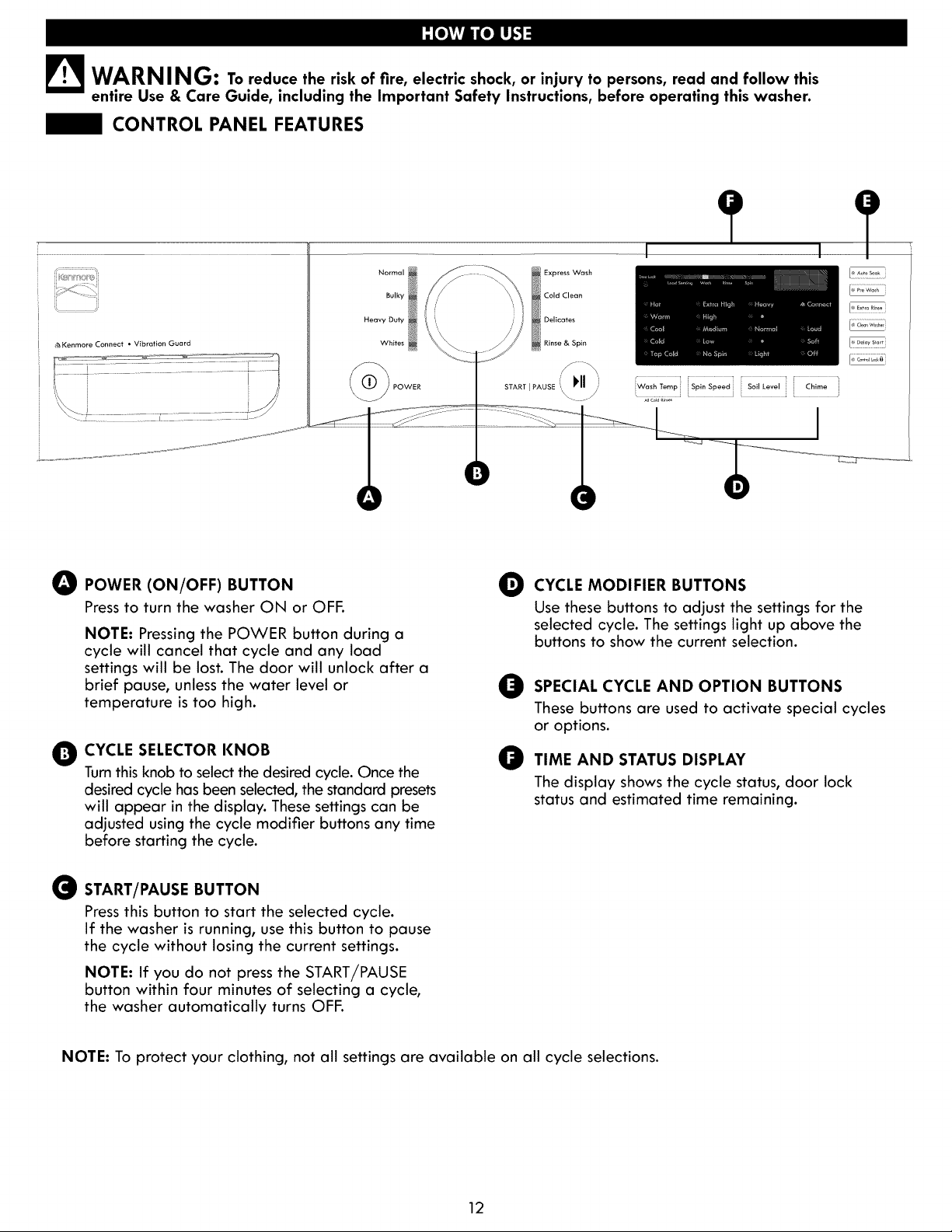
CONTROL PANEL FEATURES
i.............................
_ Kenrnore Connect * Vibration Guard
[ 7
Wash Temp i Spin Speed i Soil Level Chime
I
O POWER (ON/OFF) BUTTON
Press to turn the washer ON or OFF.
NOTE: Pressing the POWER button during a
cycle will cancel that cycle and any load
settings will be lost. The door will unlock after a
brief pause, unless the water level or
temperature is too high.
0
CYCLE SELECTOR KNOB
Turn this knob to select the desired cycle. Once the
desired cycle has been selected, the standard presets
will appear in the display. These settings can be
adjusted using the cycle modifier buttons any time
before starting the cycle.
O START/PAUSE BUTTON
Press this button to start the selected cycle.
If the washer is running, use this button to pause
the cycle without losing the current settings.
NOTE: If you do not press the START/PAUSE
button within four minutes of selecting a cycle,
the washer automatically turns OFF.
O CYCLE MODIFIER BUTTONS
Use these buttons to adjust the settings for the
selected cycle. The settings light up above the
buttons to show the current selection.
O SPECIAL CYCLE AND OPTION BUTTONS
These buttons are used to activate special cycles
or options.
O TIME AND STATUS DISPLAY
The display shows the cycle status, door lock
status and estimated time remaining.
NOTE: To protect your clothing, not all settings are available on all cycle selections.
12
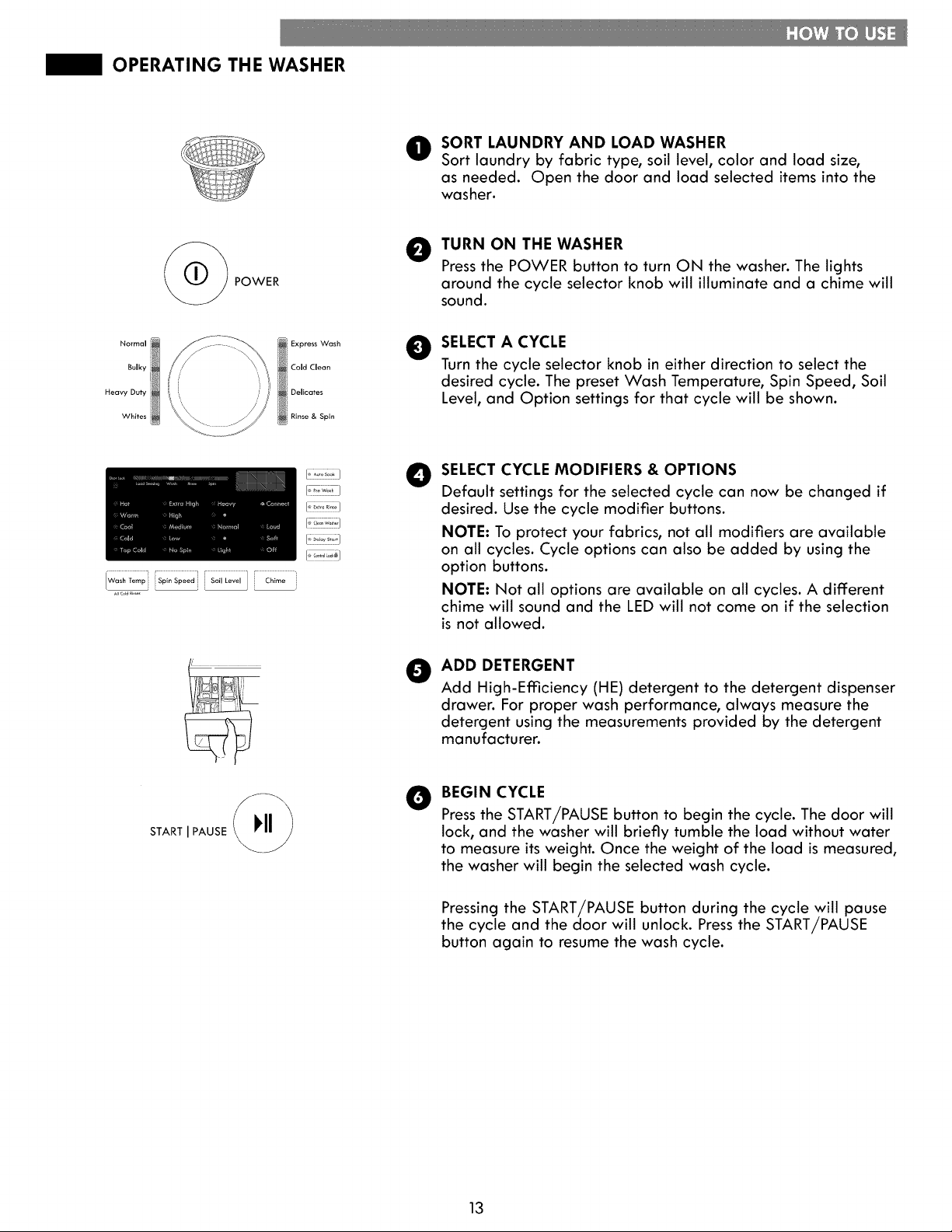
1 OPERATING THE WASHER
O SORT LAUNDRY AND LOAD WASHER
Sort laundry by fabric type, soil level, color and load size,
as needed. Open the door and load selected items into the
washer.
POWER
O
TURN ON THE WASHER
Press the POWER button to turn ON the washer. The lights
around the cycle selector knob will illuminate and a chime will
sound.
Normal
Bulky
Heavy Duty
Whites
O
SELECT A CYCLE
Turn the cycle selector knob in either direction to select the
desired cycle. The preset Wash Temperature, Spin Speed, Soil
Level, and Option settings for that cycle will be shown.
O
SELECT CYCLE MODIFIERS & OPTIONS
Default settings for the selected cycle can now be changed if
desired. Use the cycle modifier buttons.
NOTE: To protect your fabrics, not all modifiers are available
on all cycles. Cycle options can also be added by using the
option buttons.
NOTE: Not all options are available on all cycles. A different
chime will sound and the LED will not come on if the selection
is not allowed.
O
ADD DETERGENT
Add High-Efficiency (HE) detergent to the detergent dispenser
drawer. For proper wash performance, always measure the
detergent using the measurements provided by the detergent
manufacturer.
START I PAUSE
O
BEGIN CYCLE
Pressthe START/PAUSE button to begin the cycle. The door will
lock, and the washer will briefly tumble the load without water
to measure its weight. Once the weight of the load is measured,
the washer will begin the selected wash cycle.
Pressing the START/PAUSE button during the cycle will pause
the cycle and the door will unlock. Press the START/PAUSE
button again to resume the wash cycle.
13
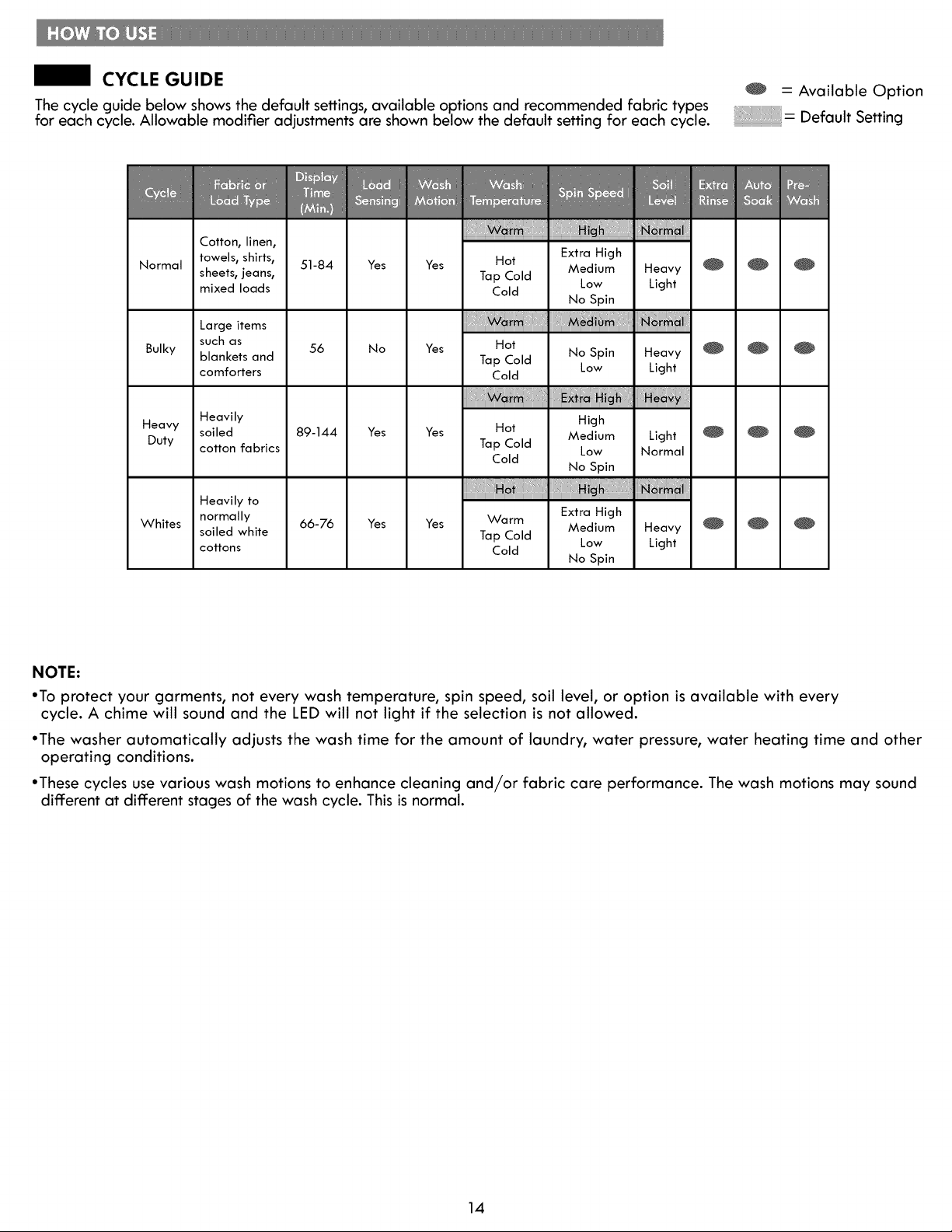
CYCLE GUIDE _ -- Available Option
The cycle guide below showsthe default settings,available options and recommended fabric types
for each cycle. Allowable modifier adjustments are shown below the default setting for each cycle. Default Setting
Cotton, linen,
Normal towels, shirts,
sheets, jeans,
mixed loads
Large items
such as
Bulky blankets and
comforters
Heavy Heavily
soiled
Duty
cotton fabrics
Whites
Heavily to
Extra High
normally Warm
Medium
soiled white Tap Cold
Low
cottons Cold
No Spin
NOTE:
• To protect your garments, not every wash temperature, spin speed, soil level, or option is available with every
cycle. A chime will sound and the LED will not light if the selection is not allowed.
• The washer automatically adjusts the wash time for the amount of laundry, water pressure, water heating time and other
operating conditions.
• These cycles use various wash motions to enhance cleaning and/or fabric care performance. The wash motions may sound
difl:erent at difl:erent stages of the wash cycle. This is normal.
14
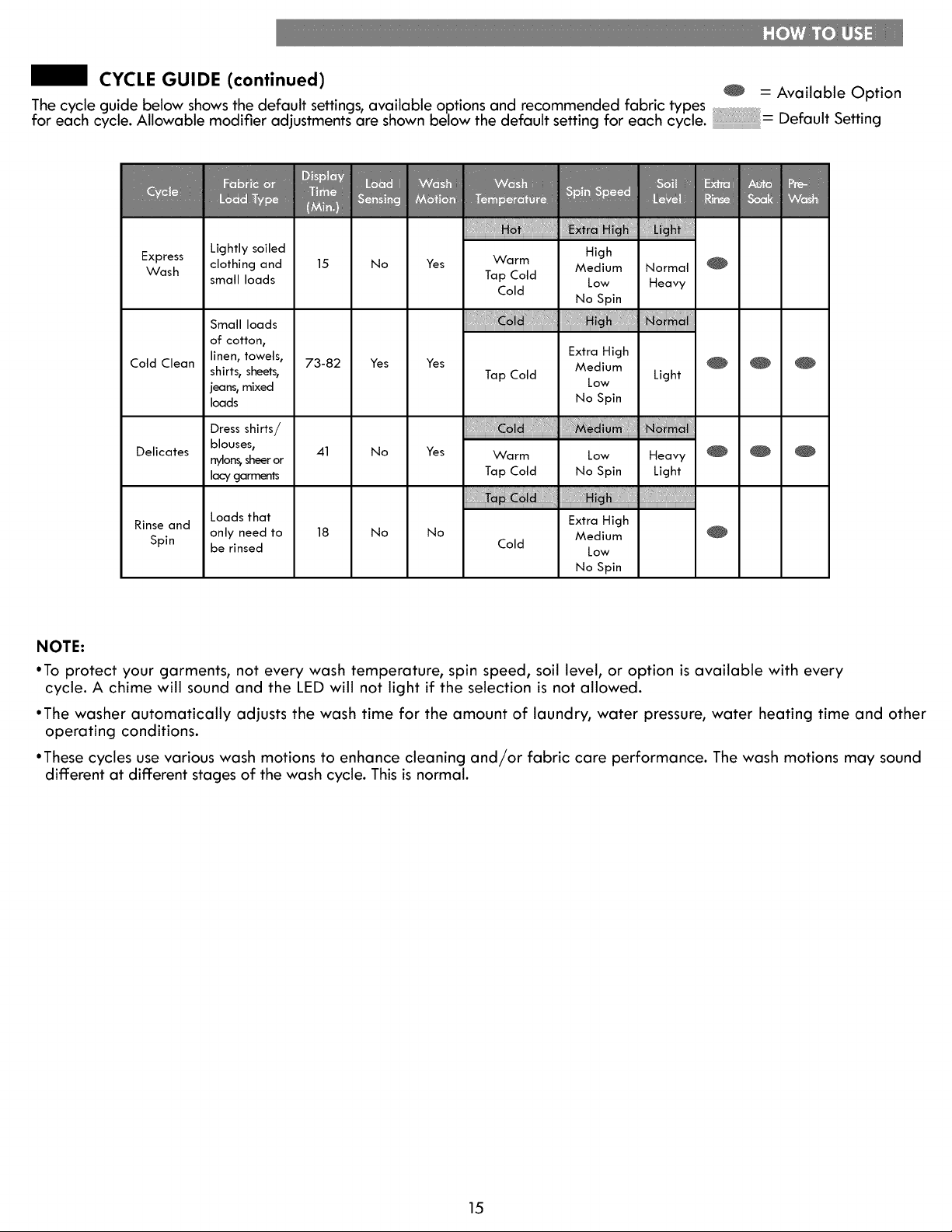
CYCLE GUIDE (continued) _ = Available Option
The cycle guide below shows the default settings, available options and recommended fabric types
for each cycle. Allowable modifier adjustments are shown below the default setting for each cycle. _:iii:i:i:i:i:i= Default Setting
Express Lightly soiled
Wash clothing and
small loads
Cold Clean
Delicates
Small loads
of cotton,
linen, towels,
shirts, sheets,
jeans, mixed
loads
Dress shirts/
blouses,
nylons,sheeror
lacy garments
Rinse and Loads that Extra High
Spin only need to Medium
be rinsed Cold Low
No Spin
NOTE:
• To protect your garments, not every wash temperature, spin speed, soil level, or option is available with every
cycle. A chime will sound and the LED will not light if the selection is not allowed.
• The washer automatically adjusts the wash time for the amount of laundry, water pressure, water heating time and other
operating conditions.
• These cycles use various wash motions to enhance cleaning and/or fabric care performance. The wash motions may sound
difl:erent at difl:erent stages of the wash cycle. This is normal.
15
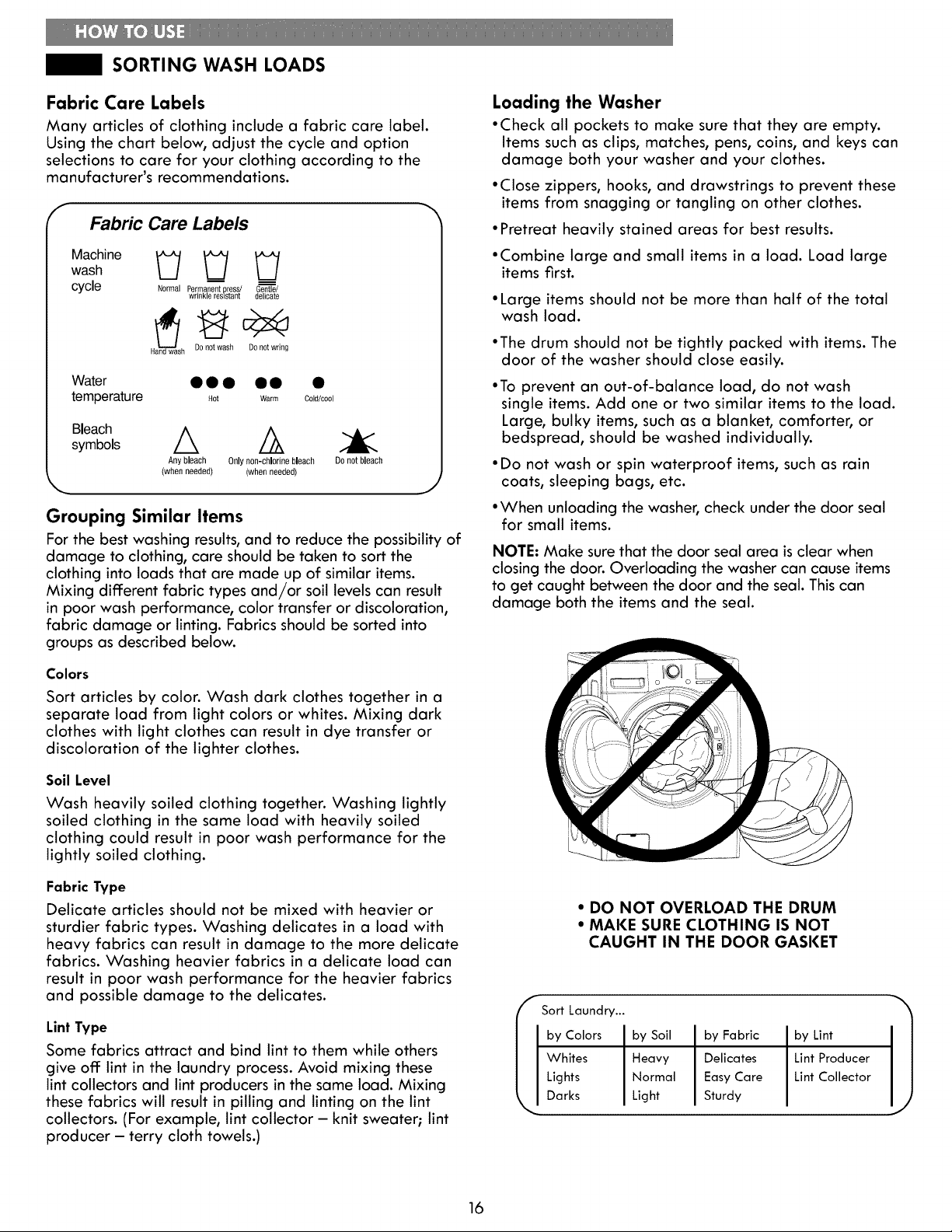
SORTING WASH LOADS
Fabric Care Labels
Many articles of clothing include a fabric care label.
Using the chart below, adjust the cycle and option
selections to care for your clothing according to the
manufacturer's recommendations.
f
Fabric Care Labels
Machine
wash
cycle
Normal Permanent press/ Gentle/
wrinkle resistant delicate
H h Donotwash Donot wring
Water • • • • • •
temperature Hot Warm Cold/cool
Bleach
symbols _ /A/_A
Any bleach Only non-chlorine bleach Do not bleach
(when needed) (when needed)
Grouping Similar Items
For the best washing results, and to reduce the possibility of
damage to clothing, care should be taken to sort the
clothing into loads that are made up of similar items.
Mixing different fabric types and/or soil levels can result
in poor wash performance, color transfer or discoloration,
fabric damage or linting. Fabrics should be sorted into
groups as described below.
Colors
Sort articles by color. Wash dark clothes together in a
separate load from light colors or whites. Mixing dark
clothes with light clothes can result in dye transfer or
discoloration of the lighter clothes.
Soil Level
Wash heavily soiled clothing together. Washing lightly
soiled clothing in the same load with heavily soiled
clothing could result in poor wash performance for the
lightly soiled clothing.
Fabric Type
Delicate articles should not be mixed with heavier or
sturdier fabric types. Washing delicates in a load with
heavy fabrics can result in damage to the more delicate
fabrics. Washing heavier fabrics in a delicate load can
result in poor wash performance for the heavier fabrics
and possible damage to the delicates.
Lint Type
Some fabrics attract and bind lint to them while others
give off lint in the laundry process. Avoid mixing these
lint collectors and lint producers in the same load. Mixing
these fabrics will result in pilling and linting on the lint
collectors. (For example, lint collector - knit sweater; lint
producer- terry cloth towels.)
Loading the Washer
• Check all pockets to make sure that they are empty.
Items such as clips, matches, pens, coins, and keys can
damage both your washer and your clothes.
• Close zippers, hooks, and drawstrings to prevent these
items from snagging or tangling on other clothes.
• Pretreat heavily stained areas for best results.
• Combine large and small items in a load. Load large
items first.
• Large items should not be more than half of the total
wash load.
• The drum should not be tightly packed with items. The
door of the washer should close easily.
• To prevent an out-of-balance load, do not wash
single items. Add one or two similar items to the load.
Large, bulky items, such as a blanket, comforter, or
bedspread, should be washed individually.
• Do not wash or spin waterproof items, such as rain
coats, sleeping bags, etc.
• When unloading the washer, check under the door seal
for small items.
NOTE: Make sure that the door seal area is clear when
closing the door. Overloading the washer can cause items
to get caught between the door and the seal. This can
damage both the items and the seal.
• DO NOT OVERLOAD THE DRUM
• MAKE SURE CLOTHING IS NOT
CAUGHT IN THE DOOR GASKET
Sort Laundry...
by Colors
Whites
Lights
Darks
by Soil
Heavy
Normal
Light
by Fabric
Delicates
Easy Care
Sturdy
by Lint
Lint Producer
Lint Collector
16
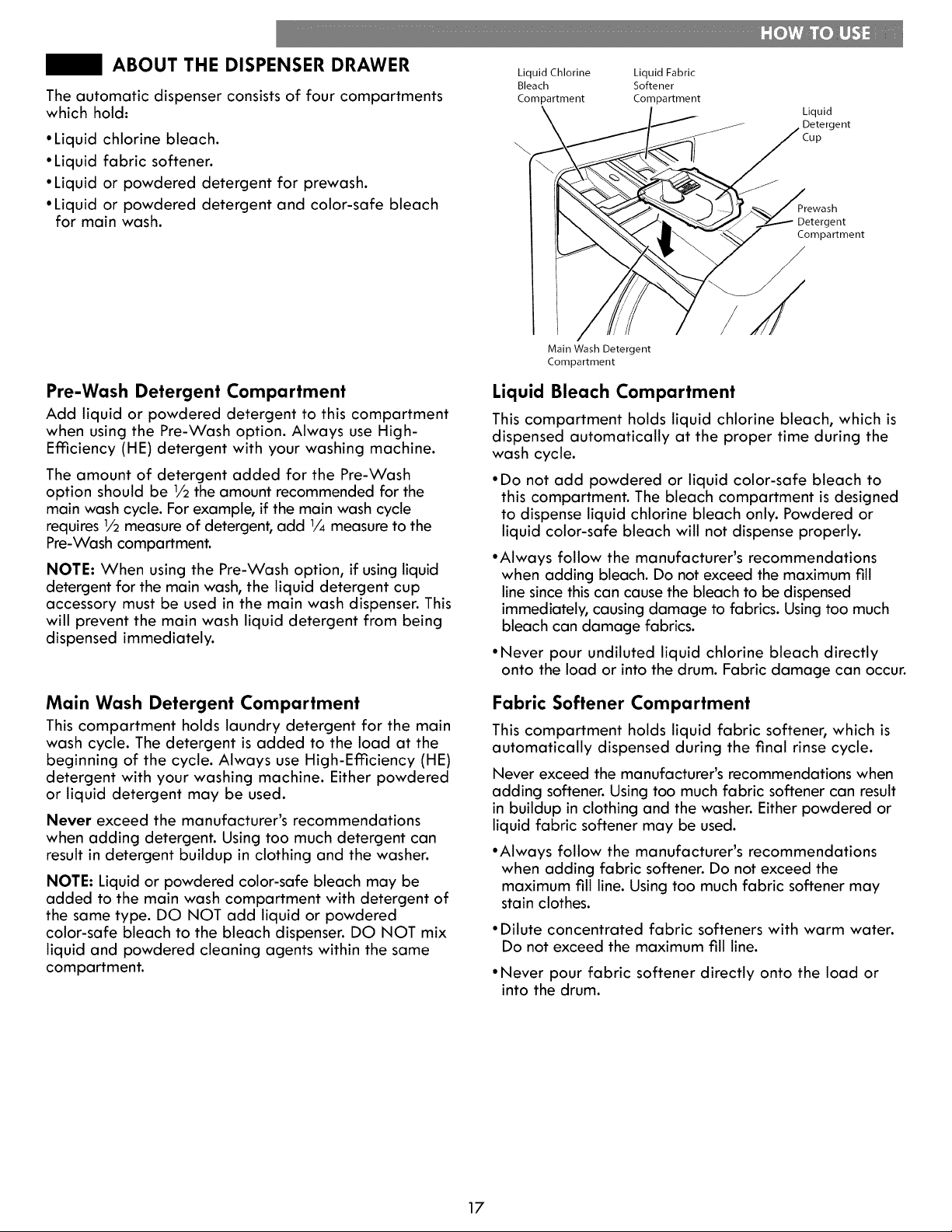
1 ABOUT THE DISPENSER DRAWER
The automatic dispenser consists of four compartments
which hold:
• Liquid chlorine bleach.
• Liquid fabric softener.
• Liquid or powdered detergent for prewash.
• Liquid or powdered detergent and color-safe bleach
for main wash.
Liquid Chlorine
Bleach
Compartment
Liquid Fabric
Softener
Compartment
Liquid
lent
Cup
Detergent
Compartment
/
Pre-Wash Detergent Compartment
Add liquid or powdered detergent to this compartment
when using the Pre-Wash option. Always use liigh-
Efficiency (liE) detergent with your washing machine.
The amount of detergent added for the Pre-Wash
option should be 1/2the amount recommended for the
main wash cycle. For example, if the main wash cycle
requires 1/2measure of detergent, add 1/4measure to the
Pre-Wash compartment.
NOTE: When using the Pre-Wash option, if using liquid
detergent for the main wash, the liquid detergent cup
accessory must be used in the main wash dispenser. This
will prevent the main wash liquid detergent from being
dispensed immediately.
Main Wash Detergent Compartment
This compartment holds laundry detergent for the main
wash cycle. The detergent is added to the load at the
beginning of the cycle. Always use High-Efficiency (HE)
detergent with your washing machine. Either powdered
or liquid detergent may be used.
Never exceed the manufacturer's recommendations
when adding detergent. Using too much detergent can
result in detergent buildup in clothing and the washer.
NOTE: Liquid or powdered color-safe bleach may be
added to the main wash compartment with detergent of
the same type. DO NOT add liquid or powdered
color-safe bleach to the bleach dispenser. DO NOT mix
liquid and powdered cleaning agents within the same
compartment.
Main Wash Detergent
Compartment
Liquid Bleach Compartment
This compartment holds liquid chlorine bleach, which is
dispensed automatically at the proper time during the
wash cycle.
• Do not add powdered or liquid color-safe bleach to
this compartment. The bleach compartment is designed
to dispense liquid chlorine bleach only. Powdered or
liquid color-safe bleach will not dispense properly.
• Always follow the manufacturer's recommendations
when adding bleach. Do not exceed the maximum fill
line since this can cause the bleach to be dispensed
immediately, causing damage to fabrics. Using too much
bleach can damage fabrics.
• Never pour undiluted liquid chlorine bleach directly
onto the load or into the drum. Fabric damage can occur.
Fabric Softener Compartment
This compartment holds liquid fabric softener, which is
automatically dispensed during the final rinse cycle.
Never exceed the manufacturer's recommendations when
adding softener. Using too much fabric softener can result
in buildup in clothing and the washer. Either powdered or
liquid fabric softener may be used.
• Always follow the manufacturer's recommendations
when adding fabric softener. Do not exceed the
maximum fill line. Using too much fabric softener may
stain clothes.
• Dilute concentrated fabric softeners with warm water.
Do not exceed the maximum fill line.
*Never pour fabric softener directly onto the load or
into the drum.
17
DETERGENT AND DISPENSER USE
A Word About Detergents
High-Efficiency (HE) detergents produce fewer suds,
dissolve more efficiently to improve washing and rinsing
performance, and help to keep the interior of your
washer clean. Using detergent that is not HE may cause
oversudsing and unsatisfactory performance which
could result in error codes, cycle failure, and
machine damage.
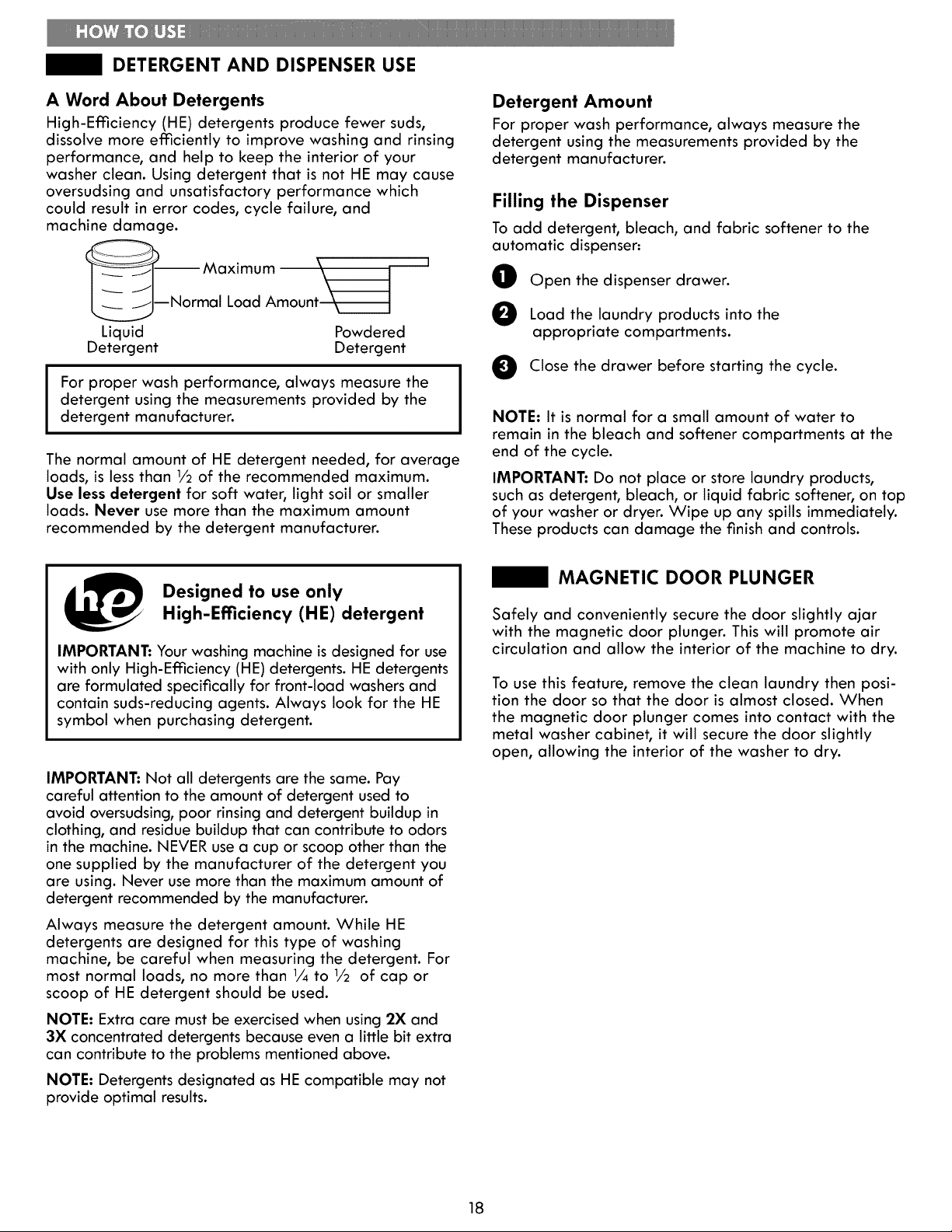
---_ Maximum __[_l
ormal Load Amount
Liquid Powdered
Detergent Detergent
For proper wash performance, always measure the
detergent using the measurements provided by the
detergent manufacturer.
The normal amount of HE detergent needed, for average
loads, is less than 1/2of the recommended maximum.
Use less detergent for soft water, light soil or smaller
loads. Never use more than the maximum amount
recommended by the detergent manufacturer.
Detergent Amount
For proper wash performance, always measure the
detergent using the measurements provided by the
detergent manufacturer.
Filling the Dispenser
To add detergent, bleach, and fabric softener to the
automatic dispenser:
Open the dispenser drawer.
Load the laundry products into the
appropriate compartments.
Close the drawer before starting the cycle.
NOTE: It is normal for a small amount of water to
remain in the bleach and softener compartments at the
end of the cycle.
IMPORTANT: Do not place or store laundry products,
such as detergent, bleach, or liquid fabric softener, on top
of your washer or dryer. Wipe up any spills immediately.
These products can damage the finish and controls.
Designed to use only
High-Efficiency (HE) detergent
IMPORTANT: Your washing machine is designed for use
with only High-Efficiency (HE) detergents. HE detergents
are formulated specifically for front-load washers and
contain suds-reducing agents. Always look for the HE
symbol when purchasing detergent.
IMPORTANT: Not all detergents are the same. Pay
careful attention to the amount of detergent used to
avoid oversudsing, poor rinsing and detergent buildup in
clothing, and residue buildup that can contribute to odors
in the machine. NEVER use a cup or scoop other than the
one supplied by the manufacturer of the detergent you
are using. Never use more than the maximum amount of
detergent recommended by the manufacturer.
Always measure the detergent amount. While HE
detergents are designed for this type of washing
machine, be careful when measuring the detergent. For
most normal loads, no more than 1/4 to 1/2 of cap or
scoop of HE detergent should be used.
NOTE: Extra care must be exercised when using 2X and
3X concentrated detergents because even a little bit extra
can contribute to the problems mentioned above.
NOTE: Detergents designated as HE compatible may not
provide optimal results.
MAGNETIC DOOR PLUNGER
Safely and conveniently secure the door slightly ajar
with the magnetic door plunger. This will promote air
circulation and allow the interior of the machine to dry.
To use this feature, remove the clean laundry then posi-
tion the door so that the door is almost closed. When
the magnetic door plunger comes into contact with the
metal washer cabinet, it will secure the door slightly
open, allowing the interior of the washer to dry.
18
TIME AND STATUS DISPLAY
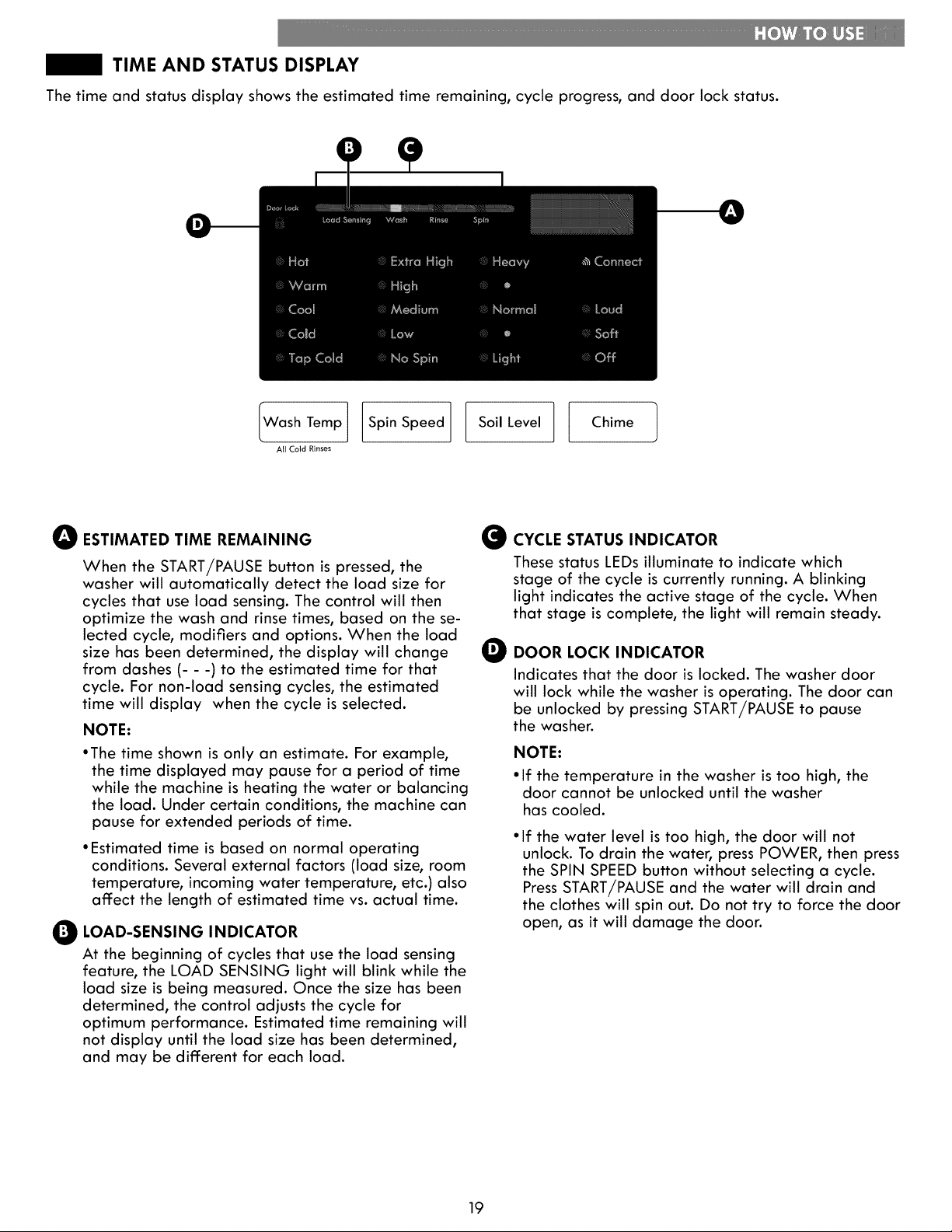
The time and status display shows the estimated time remaining, cycle progress, and door lock status.
IWashTem0ISpnSpeed]SoiLeve[ Chime1
A_I Cold Rinses
O ESTIMATED TIME REMAINING _i
When the START/PAUSE button is pressed, the
washer will automatically detect the load size for
cycles that use load sensing. The control will then
optimize the wash and rinse times, based on the se-
lected cycle, modifiers and options. When the load
size has been determined, the display will change
from dashes (- - -) to the estimated time for that
cycle. For non-load sensing cycles, the estimated
time will display when the cycle is selected.
NOTE:
• The time shown is only an estimate. For example,
the time displayed may pause for a period of time
while the machine is heating the water or balancing
the load. Under certain conditions, the machine can
pause for extended periods of time.
• Estimated time is based on normal operating
conditions. Several external factors (load size, room
temperature, incoming water temperature, etc.) also
affect the length of estimated time vs. actual time.
O LOAD-SENSING INDICATOR
At the beginning of cycles that use the load sensing
feature, the LOAD SENSING light will blink while the
load size is being measured. Once the size has been
determined, the control adjusts the cycle for
optimum performance. Estimated time remaining will
not display until the load size has been determined,
and may be different for each load.
O
CYCLE STATUS INDICATOR
These status LEDs illuminate to indicate which
stage of the cycle is currently running. A blinking
light indicates the active stage of the cycle. When
that stage is complete, the light will remain steady.
DOOR LOCI( INDICATOR
Indicates that the door is locked. The washer door
will lock while the washer is operating. The door can
be unlocked by pressing START/PAUSE to pause
the washer.
NOTE:
• If the temperature in the washer is too high, the
door cannot be unlocked until the washer
has cooled.
• If the water level is too high, the door will not
unlock. To drain the water, press POWER, then press
the SPIN SPEED button without selecting a cycle.
Press START/PAUSE and the water will drain and
the clothes will spin out. Do not try to force the door
open, as it will damage the door.
19
CYCLE MODIFIER BUTTONS
Each cycle has default settings that are selected
automatically. You may also customize these settings
using the cycle modifier buttons. Press the button for the
desired modifier until the indicator light for the desired
value is lit. The washer automatically adjusts the water
level for the type and size of wash load for best results
and maximum efficiency. Due to the high-efficiency
nature of this product, water levels may be much lower
than expected. This is normal operation and cleaning/
rinsing performance will not be compromised.
NOTE: To protect your garments, not every wash
temperature, spin speed, soil level, or option is available
with every cycle. A chime will sound and the LED will not
light if a selection is not allowed.
[Washmemp[S0inSpee l[
Atl CoId Rinses
Soil Level
Chime
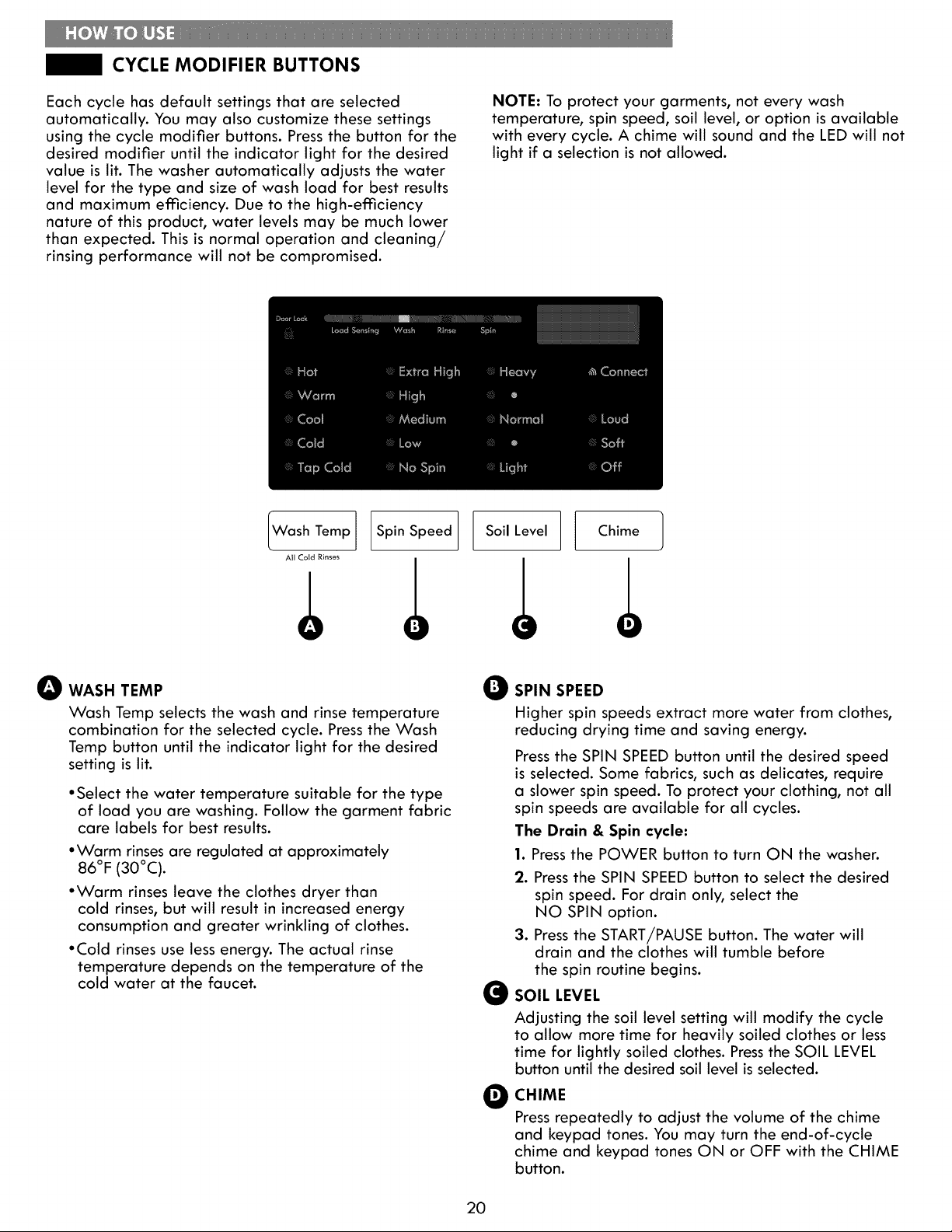
O WASH TEMP
Wash Temp selects the wash and rinse temperature
combination for the selected cycle. Press the Wash
Temp button until the indicator light for the desired
setting is lit.
*Select the water temperature suitable for the type
of load you are washing. Follow the garment fabric
care labels for best results.
• Warm rinses are regulated at approximately
86°F (30°C).
• Warm rinses leave the clothes dryer than
cold rinses, but will result in increased energy
consumption and greater wrinkling of clothes.
• Cold rinses use less energy. The actual rinse
temperature depends on the temperature of the
cold water at the faucet.
O SPIN SPEED
0
0
Higher spin speeds extract more water from clothes,
reducing drying time and saving energy.
Press the SPIN SPEED button until the desired speed
is selected. Some fabrics, such as delicates, require
a slower spin speed. To protect your clothing, not all
spin speeds are available for all cycles.
The Drain & Spin cycle:
1. Pressthe POWER button to turn ON the washer.
2. Press the SPIN SPEED button to select the desired
spin speed. For drain only, select the
NO SPIN option.
3. Press the START/PAUSE button. The water will
drain and the clothes will tumble before
the spin routine begins.
SOIL LEVEL
Adjusting the soil level setting will modify the cycle
to allow more time for heavily soiled clothes or less
time for lightly soiled clothes. Press the SOIL LEVEL
button until the desired soil level is selected.
CHIME
Press repeatedly to adjust the volume of the chime
and keypad tones. You may turn the end-of-cycle
chime and keypad tones ON or OFF with the CHIME
button.
2O
OPTION BUTTONS
Your washing machine features several additional cycle
options that customize cycles to meet your individual needs.
@
@
@
Turn ON the washer and turn the cycle selector knob to
select the desired cycle.
Use the cycle modifier buttons to adjust the settings for
that cycle.
Pressthe cycle option button(s) for the option(s) you
would like to add. The button will light when that option
is selected. For secondary functions, press and hold
the button for five seconds. The LED will blink when
the secondary option is selected. Both options cannot be
selected together.
O f the selected option is not allowed for the selected
cycle, the chime will sound twice to alert you and
the LED will not illuminate.
Pressthe START/PAUSE button to start the cycle. After a
brief delay, the door will lock and the cycle will begin.
NOTE: To protect your garments, not every option is
available with every cycle.
NOTE: If the START/PAUSE button is not pressed within four
minutes, the control will shut off: and the settings will be lost.
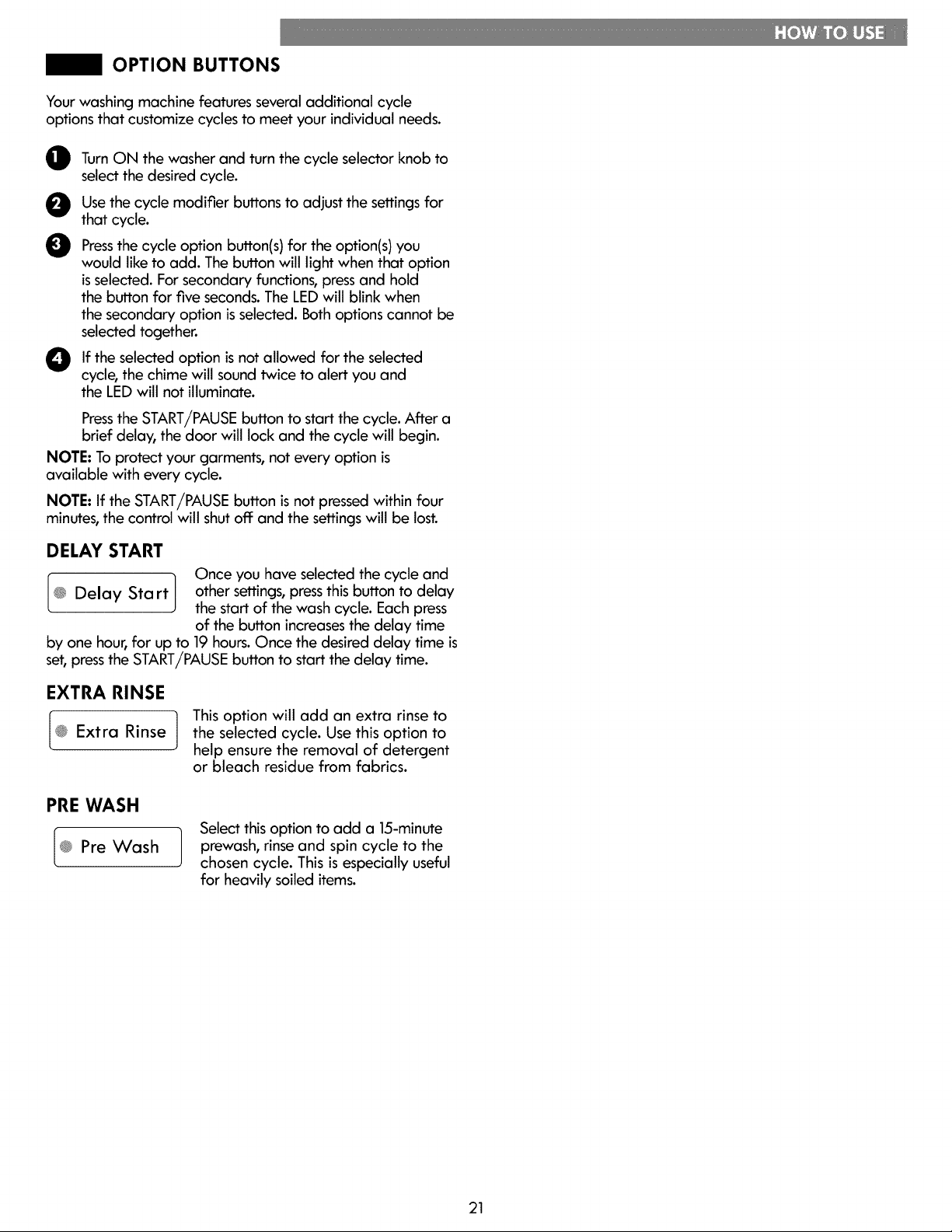
DELAY START
_ Once you have selected the cycle and
@ Delay Start ] other settings, press this button to delay
the start of the wash cycle. Each press
of the button increases the delay time
by one hour, for up to 19 hours. Once the desired delay time is
set, pressthe START/PAUSE button to start the delay time.
EXTRA RINSE
[@ Extra Rinse ]
This option will add an extra rinse to
the selected cycle. Use this option to
help ensure the removal of detergent
or bleach residue from fabrics.
PRE WASH
@ Pre Wash
Select this option to add a 15-minute
prewash, rinse and spin cycle to the
chosen cycle. This is especially useful
for heavily soiled items.
21
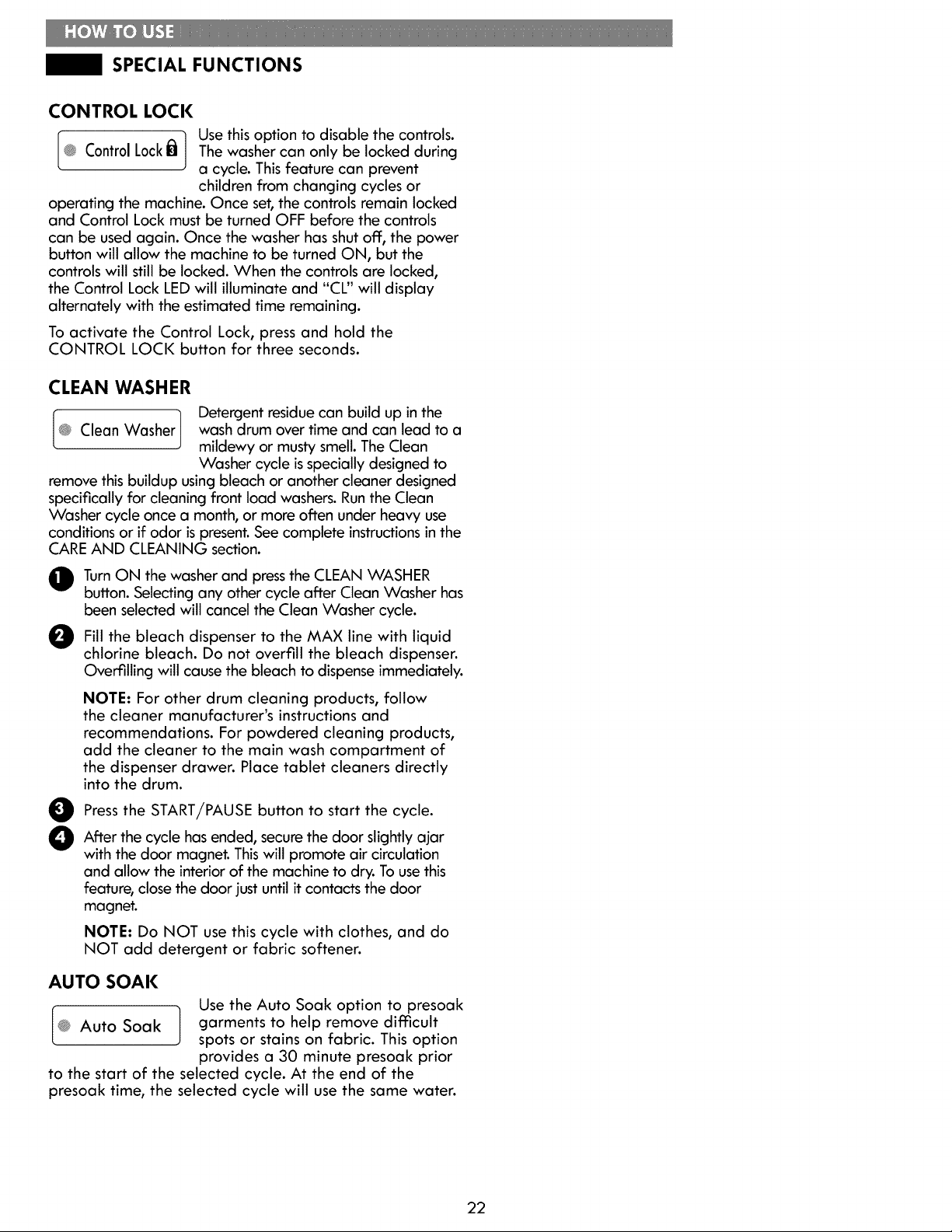
I SPECIAL FUNCTIONS
CONTROL LOCI(
] Use this option to disable the controls.
@ Control LockJ_ The washer can only be locked during
J
a cycle. This feature can prevent
children from changing cycles or
operating the machine. Once set, the controls remain locked
and Control Lock must be turned OFF before the controls
can be used again. Once the washer has shut off, the power
button will allow the machine to be turned ON, but the
controlswill still be locked. When the controls are locked,
the Control Lock LED will illuminate and "CL" will display
alternately with the estimated time remaining.
To activate the Control Lock, press and hold the
CONTROL LOCI( button for three seconds.
CLEAN WASHER
I 1 Detergent residue can build up in the
@ Clean WasherJ wash drum over time and can lead to a
mildewy or musty smell. The Clean
Washer cycle is specially designed to
remove this buildup using bleach or another cleaner designed
specifically for cleaning front load washers. Run the Clean
Washer cycle once a month, or more often under heavy use
conditionsor if odor is present. See complete instructions in the
CARE AND CLEANING section.
l urn ON the washer and press the CLEAN WASHER
button. Selecting any other cycle after Clean Washer has
been selected will cancel the Clean Washer cycle.
O Fill the bleach the MAX line with
dispenser
to
liquid
chlorine bleach. Do not overfill the bleach dispenser.
Overfilling will cause the bleach to dispense immediately.
NOTE: For other drum cleaning products, follow
the cleaner manufacturer's instructions and
recommendations. For powdered cleaning products,
add the cleaner to the main wash compartment of
the dispenser drawer. Place tablet cleaners directly
into the drum.
Press the START/PAUSE button to start the cycle.
After the cycle has ended, secure the door slightly ajar
with the door magnet. Thiswill promote air circulation
and allow the interior of the machine to dry. To use this
feature, close the door just until it contacts the door
magnet.
NOTE: Do NOT use this cycle with clothes, and do
NOT add detergent or fabric softener.
AUTO SOAK
Use the Auto Soak option to presoak
[@ AutoSoak ] garments to help remove difficult
spots or stains on fabric. This option
provides a 30 minute presoak prior
to the start of the selected cycle. At the end of the
presoak time, the selected cycle will use the same water.
22
i nplug the washer before cleaning to avoid the risk of electric shock. Failure to follow this warning can
cause serious injury, fire, electric shock, or death.
Never use harsh chemicals, abrasive cleaners, or solvents to clean the washer. They will damage the finish.
WARNING: To reduce the risk of fire, electric shock, or injury to persons, read and follow this
entire Use & Care Guide, including the Important Safety Instructions, before operating this washer.
REGULAR CLEANING
Cleaning the Exterior
Proper care of your washer can extend its life. The outside of
the machine can be cleaned with warm water and a mild,
nonabrasive household detergent.
Immediately wipe off any spills with a soft, damp cloth.
IMPORTANT: Do not use solvents, cleaning alcohols, or simi-
lar products. Never use steel wool or abrasive cleaners
because they can damage the surface.
Care and Cleaning of the Interior
Use a towel or soft cloth to wipe around the washer door
opening, door seal, and door glass. These areas should be
kept clean to ensure a watertight seal. Be sure to wipe
under the inside rubber seal to remove any moisture or soil.
Always remove items from the washer as soon as the cycle
is complete. Leaving damp items in the washer can cause
wrinkling, color transfer, and odor. Run the CLEAN WASHER
cycle once a month, or more often if needed, to remove
detergent buildup and other residue.
Clean Washer
0
0
0
Remove any clothing in the drum.
Open the dispenser drawer.
Add liquid chlorine bleach or another drum cleaner
designed specifically for cleaning front load
washers.
- If using liquid chlorine bleach
Add liquid chlorine bleach to the bleach
compartment of the drawer. (NOTE : Do not
exceed the maximum fill line and do not pour
undiluted liquid bleach directly into the wash
drum.)
- If using powder cleaner
Remove the liquid detergent cup and add powder
cleaner to the main wash compartment of the
dispenser drawer.
- If using tablet cleaner
Add tablet cleaner directly to the wash drum.
NOTE:
• Do not add tablet cleaner to the dispenser drawer.
• Do not add any laundry detergent or fabric softener to
the drawer when using CLEAN WASHER.
O Turn ON the washer and press the CLEAN WASHER
button. Selecting any other cycle after Clean Washer
has been selected will cancel the Clean Washer cycle.
Door Seal and Glass Cleaning
Due to the location and nature of the door seal, some
detergent and soil residue may build up on the door glass
and seal. Periodic cleaning with a bleach solution can help
remove buildup and stains, and can help sanitize the seal to
prevent odors.
NOTE: Wear rubber gloves and eye protection while
performing the following procedure:
O Dilute 3,,_cup (177 ml) liquid chlorine bleach in 1
gallon (3.8 L) of warm/hot water.
O
O
O
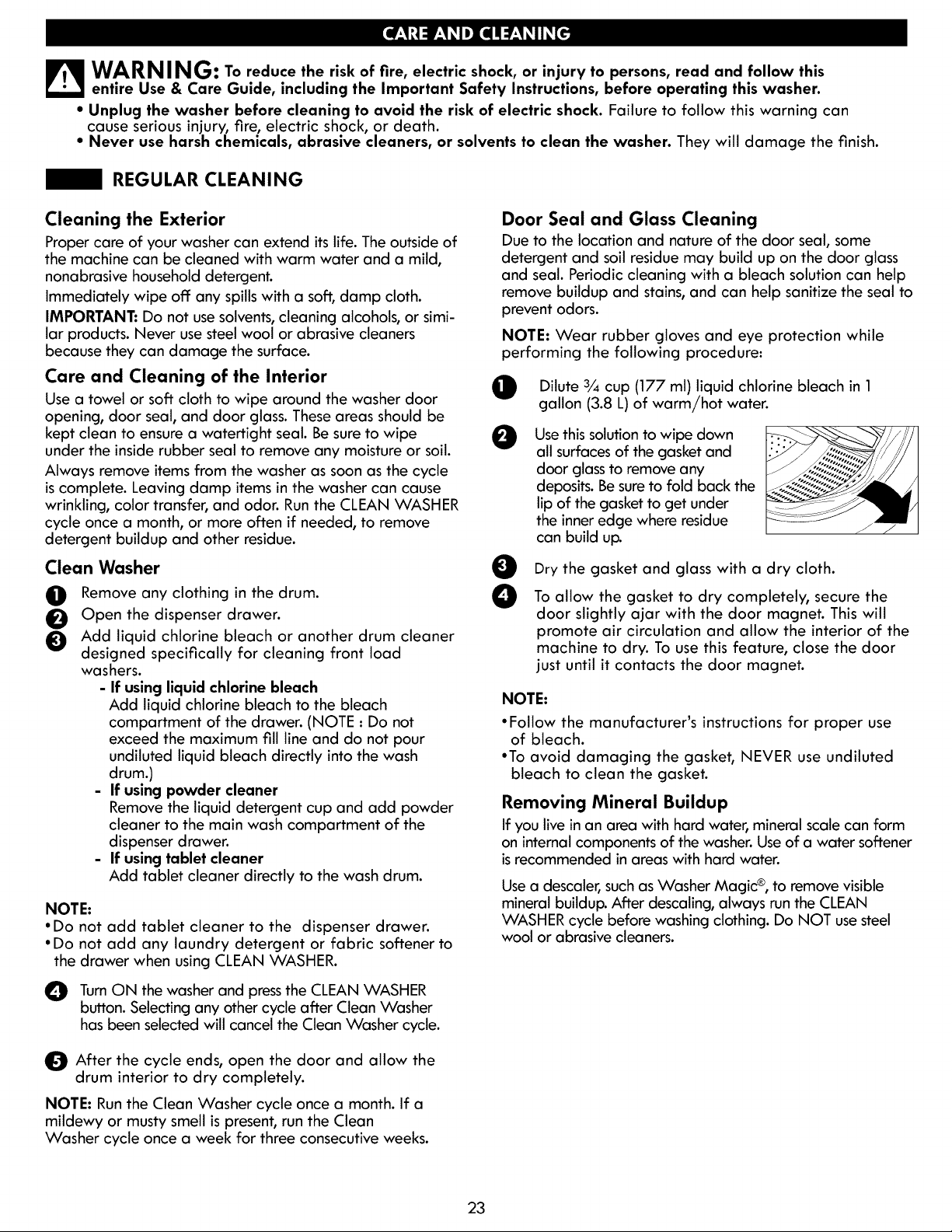
Usethis solution to wipe down
all surfaces of the gasket and
door glass to remove any
deposits. Besure to fold back the
lip of the gasket to get under
the inner edge where residue
can build up.
Dry the gasket and glass with a dry cloth.
To allow the gasket to dry completely, secure the
door slightly ajar with the door magnet. This will
promote air circulation and allow the interior of the
machine to dry. To use this feature, close the door
just until it contacts the door magnet.
NOTE:
• Follow the manufacturer's instructions for proper use
of bleach.
• To avoid damaging the gasket, NEVER use undiluted
bleach to clean the gasket.
Removing Mineral Buildup
If you live in an area with hard water, mineral scale can form
on internal components of the washer. Use of a water softener
is recommended in areas with hard water.
Use a descaler, such as Washer Magic ®,to remove visible
mineral buildup. After descaling, always run the CLEAN
WASHER cycle before washing clothing. Do NOT use steel
wool or abrasive cleaners.
_t After the cycle ends, open the door and allow the
drum interior to dry completely.
NOTE: Run the Clean Washer cycle once a month. If a
mildewy or musty smell is present, run the Clean
Washer cycle once a week for three consecutive weeks.
23
I REGULAR CLEANING (continued)
Storing the Washer
If the washer will not be used for an extended period of time
and is in an area that could be exposed to freezing
temperatures, perform the following steps to protect the
washer from damage.
I Turn OFF the water supply.
Disconnect hoses from water supply and drain water
from hoses.
O Plug the power cord into a properly grounded
electrical outlet.
O Add 1 gallon of nontoxic recreational vehicle (RV)
antifreeze to the empty wash drum and close the door.
0
Pressthe POWER buffon, then press the SPIN SPEED
button without selecting a cycle. Pressthe START/PAUSE
button to activate the drain pump. Thiswill expel some
of the antifreeze, leaving enough to protect the washer
from damage.
Unplug the power cord, dry the drum interior with a soft
cloth, and close the door.
0
Refer to the instructions below to clean and dry the
dispenser drawer.
O Store the washer in an upright position.
O o remove the antifreeze from the washer after
storage, run the EXPRESS WASH cycle. Do not add
laundry to this cycle.
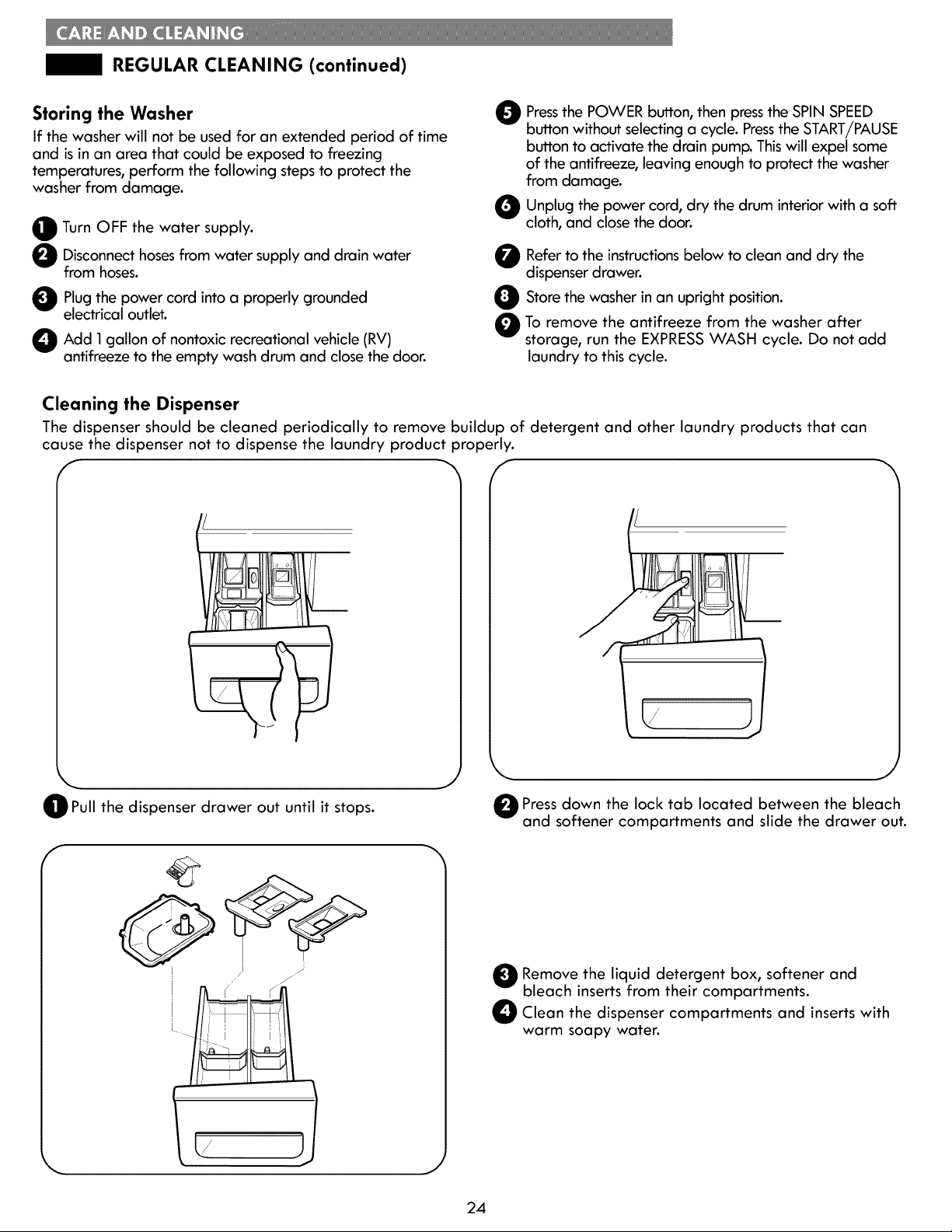
Cleaning the Dispenser
The dispenser should be cleaned periodically to remove buildup of detergent and other laundry products that can
cause the dispenser not to dispense the laundry product properly.
f _ f
O Pull the dispenser drawer out until it stops.
f
j,-
J
t
J
Press down the lock tab located between the bleach
and softener compartments and slide the drawer out.
Remove the liquid detergent box, softener and
bleach inserts from their compartments.
Clean the dispenser compartments and inserts with
warm soapy water.
24
MAINTENANCE
Cleaning the Water Inlet Filters
If the washer does not fill properly, an error message will
show on the display. The inlet valve filter screens could
be plugged by hard water scale, sediment in the water
supply, or other debris.
NOTE: The inlet screens protect the delicate parts of the
inlet valve from being damaged by particles that could
enter the valves with the water supply. Operating the
washer with these filters removed could cause a valve to
fail to open, resulting in flooding and/or
property damage.
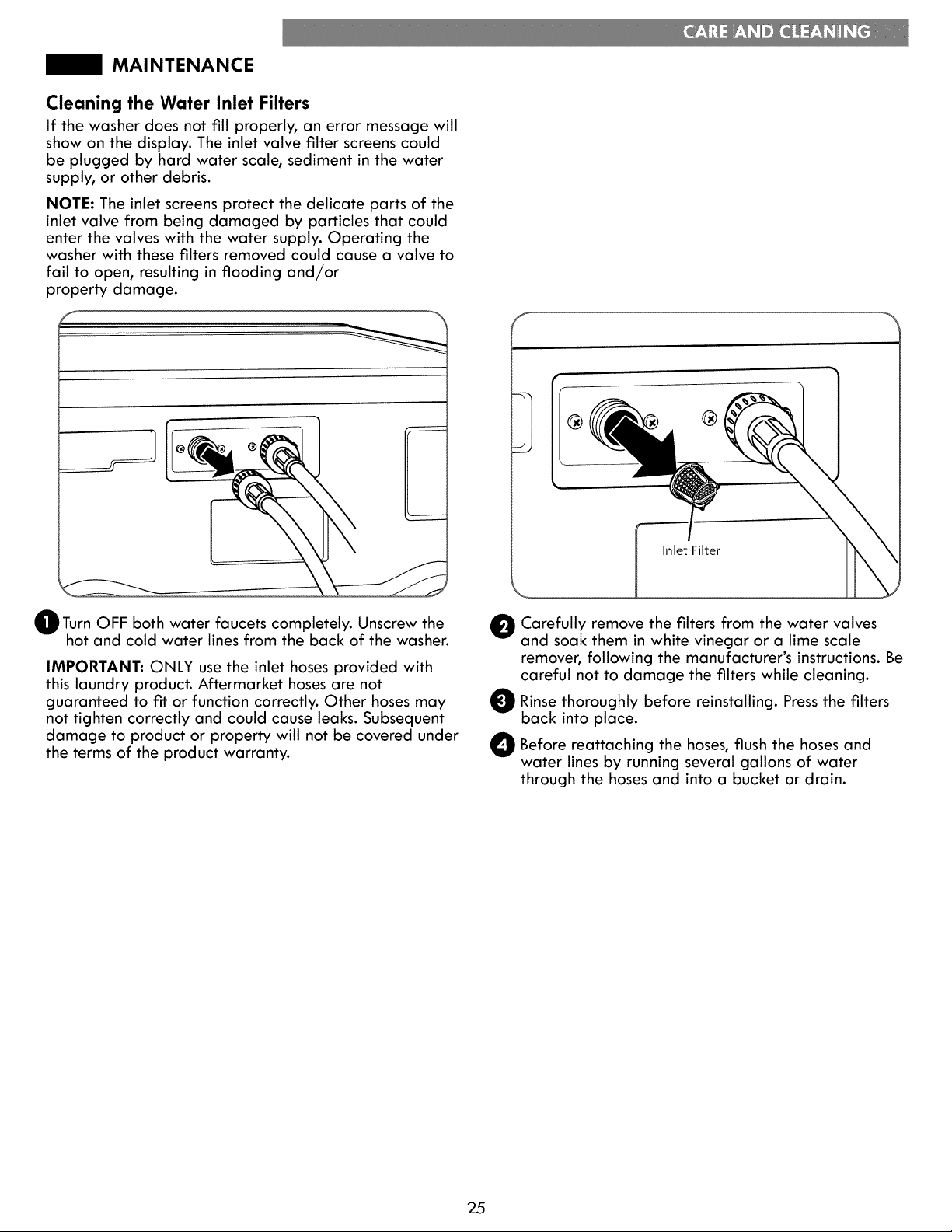
O Turn OFF both water faucets completely. Unscrew the
hot and cold water lines from the back of the washer.
IMPORTANT: ONLY use the inlet hoses provided with
this laundry product. Aftermarket hoses are not
guaranteed to fit or function correctly. Other hoses may
not tighten correctly and could cause leaks. Subsequent
damage to product or property will not be covered under
the terms of the product warranty.
@
@
Inlet Filter
Carefully remove the filters from the water valves
and soak them in white vinegar or a lime scale
remover, following the manufacturer's instructions. Be
careful not to damage the filters while cleaning.
Rinse thoroughly before reinstalling. Press the filters
back into place.
Before reattaching the hoses, flush the hoses and
water lines by running several gallons of water
through the hoses and into a bucket or drain.
25
MAINTENANCE (continued)
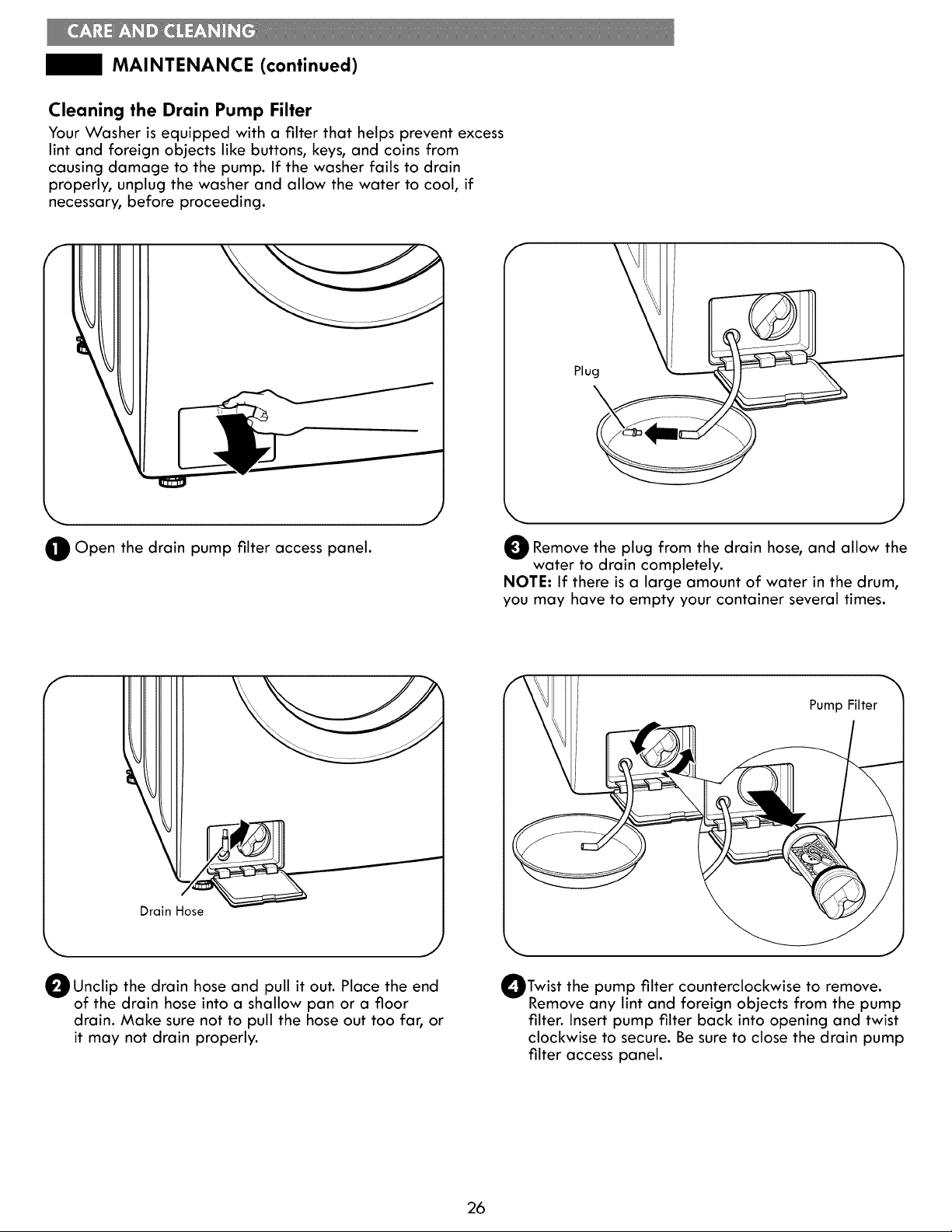
Cleaning the Drain Pump Filter
Your Washer is equipped with a filter that helps prevent excess
lint and foreign objects like buttons, keys, and coins from
causing damage to the pump. If the washer fails to drain
properly, unplug the washer and allow the water to cool, if
necessary, before proceeding.
O Open the drain pump filter access panel.
Plug
J
Remove the from the drain and allow the
plug hose,
water to drain completely.
NOTE: If there is a large amount of water in the drum,
you may have to empty your container several times.
Drain Hose
O Unclip the drain hose and pull it out. Place the end
of the drain hose into a shallow pan or a floor
drain. Make sure not to pull the hose out too far, or
it may not drain properly.
Pump Filter
OTwist pump to remove.
the filter counterclockwise
Remove any lint and foreign objects from the pump
filter. Insert pump filter back into opening and twist
clockwise to secure. Be sure to close the drain pump
filter access panel.
26
Should you experience any problems with your
washing machine, it has the capability of transmitting
data via your telephone to the Kenmore Connect
Team. This gives you the capability of speaking
directly to our specially trained technicians. The
technician records the data transmitted from your
machine and uses it to analyze the issue, providing a
fast and effective diagnosis.
Using the Kenmore Connect TM System
If you experience problems with your washer, call
1-800-4-MY-HOME ®. Only use the Kenmore Connect
System feature when instructed to do so by the
Kenmore Connect Team. The transmission sounds that
you will hear are normal and sound similar to a fax
machine.
Kenmore Connect cannot be activated unless your
washing machine is turned on by pressing the POWER
button. If your washing machine is unable to turn
on, then troubleshooting must be done without using
Kenmore Connect.
First, call 1-800-4-MY-HOME ® (1-800-469-4663). If the number of the phone you are using is on file and is
associated with your washing machine, you will be quickly relayed to a Kenmore Connect TM Team agent. Only use
the Kenmore Connect TM feature when instructed to do so by the Kenmore Connect TM Team agent.
/
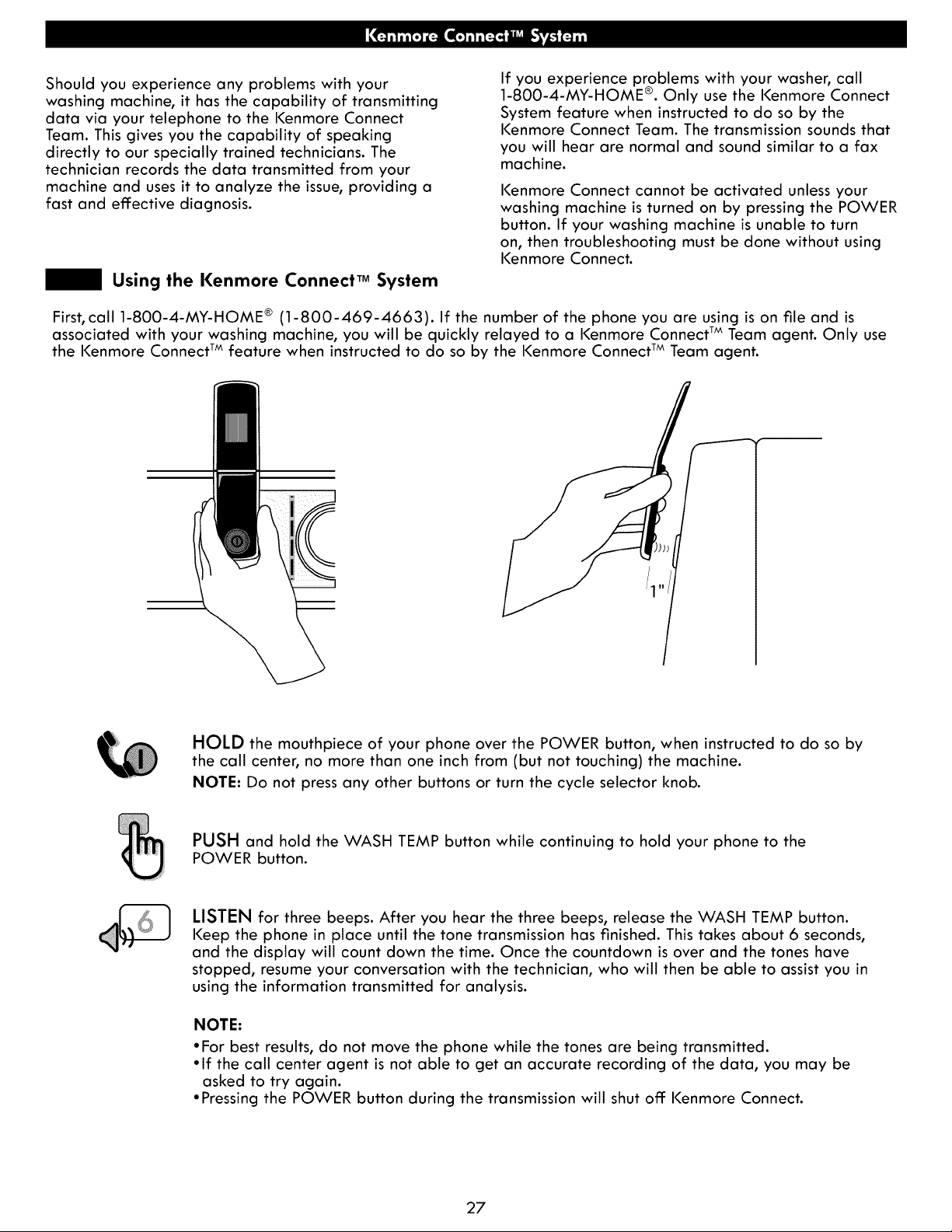
HOLD the mouthpiece of your phone over the POWER button, when instructed to do so by
the call center, no more than one inch from (but not touching) the machine.
NOTE: Do not press any other buttons or turn the cycle selector knob.
PUSH and hold the WASH TEMP button while continuing to hold your phone to the
POWER button.
LISTEN for three beeps. After you hear the three beeps, release the WASH TEMP button.
Keep the phone in place until the tone transmission has finished. This takes about 6 seconds,
and the display will count down the time. Once the countdown is over and the tones have
stopped, resume your conversation with the technician, who will then be able to assist you in
using the information transmitted for analysis.
NOTE:
• For best results, do not move the phone while the tones are being transmitted.
• If the call center agent is not able to get an accurate recording of the data, you may be
asked to try again.
• Pressing the POWER button during the transmission will shut off Kenmore Connect.
27

NORMAL SOUNDS YOU MAY HEAR
The following sounds may be heard while the washer is
operating. They are normal.
Clicking:
Door locking mechanism clicks when the door locks and
unlocks.
Spraying or hissing:
Water spraying or circulating during the cycle.
Humming or gurgling:
Drain pump is pumping water from the washer at times
during a cycle.
Splashing:
Clothes tumbling in the drum during the wash and rinse
cycles.
BEFORE CALLING FOR SERVICE
If your washer does not function properly or does not function at all, check the following before you call for service.
i !!i!iili
Rattling and clanking Foreign objects, such as keys, coins, or safety Stop washer, check drum and drain filter for
noise pins, may be in drum or pump. foreign objects. If noise continues after washer is
Thumping sound
Vibrating noise
Water leaking around
washer
Heavy wash loads may produce a
thumping sound.
Washer load may be out of balance.
Washing shoes or tightly tangled clothes.
Shipping bolts and/or packaging materials
were not removed.
Wash load may be unevenly distributed in
the drum.
Not all leveling feet are resting firmly and
evenly on the floor.
Floor not rigid enough.
Inlet hose connection is loose at tap
or washer.
House drain pipes are clogged.
Drain hose has come out of drain.
Drain hose is not inserted far enough.
Door glass is dirty.
Too much detergent or incorrect detergent.Excessive sudsing
restarted, call for service.
This is normal. If sound continues, washer is
probably out of balance. Stop and
redistribute wash load.
Pause the cycle and redistribute the load
after the door unlocks.
See the UNPACKING AND REMOVING SHIP-
PING BOLTSsection in the installation require-
ments.
Pausethe cycle and redistribute the load after
the door unlocks.
See Leveling the Washer in the Installation
Instructions.
Make sure that the floor is solid and does
not flex. See Flooring in the Installation
Requirements.
Check hoses. Check and tighten hose
connections.
Unclog drain pipe. Contact a plumber if
necessary.
Tie drain hose to inlet hose or standpipe to
prevent it from coming out during drain. It
should be inserted about 8-12 inches into
the standpipe.
Inspect door glass periodically to make
sure there is no buildup of residue or other
foreign matter. Follow cleaning instructions.
Only use detergent with the High-Efficiency (HE) logo. See Detergent
Use in the How to Use section.
28
BEFORE CALLING FOR SERVICE (continued)
! !!
Staining Bleach or softener dispensed Dispenser compartment is overfilled causing
too soon. bleach or softener to dispense immediately.
Washer will not turn ON
Door will not unlock
when cycle is stopped or
paused
Washcycle time is longer
than usual
Musty or mildewy odor in
washer
Bleach or softener was added
directly to the wash load in the drum.
Washer was not unloaded promptly.
Wrinkling
Clothes were not properly sorted.
Power cord is not properly plugged in.
House fuse is blown, circuit breaker
has tripped, or power outage has
occurred.
House fuse is blown, circuit breaker
has tripped, due to multiple
appliances on one outlet.
Interior temperature of washer is too high.
Water level in washer is too high.
The washer automatically adjusts the
wash time for the amount of laundry,
water pressure, water heating time and
other operating conditions.
Incorrect or too much detergent has
been used.
Inside of drum was not cleaned prop-
erly.
Washer not unloaded promptly.
Washer overloaded.
Hot and cold water inlet hoses are
reversed.
Dispenser drawer closed too quickly causing
bleach or softener to dispense immediately.
Laundry chemicals must be loaded into the
dispenser.
Always remove items from the washer as soon
as possible after the cycle is complete.
Always wash dark colors separately from light
colors and whites to prevent discoloration.
Never wash heavily soiled items with lightly
soiled items.
Make sure that the plug is plugged securely into
a grounded, 3-prong, 120-VAC, 60-Hz outlet.
Reset circuit breaker or replace fuse. Do not
increase fuse capacity. If the problem is a circuit
overload, have it corrected by a qualified
electrician.
Reset circuit breaker or replace fuse. If more
than one appliance is connected to the outlet,
call an electrician to have an additional circuit
installed.
The washer door has a safety feature to prevent
personal injury. For example, if the washer is
paused during the hot wash stage of a cycle,
the interior temperature of the drum will be very
hot, so the door will not unlock. This is normal.
Allow the washer to cool until the DOOR LOCI(
indicator turns OFF on the display.
To drain the water, press POWER, then press the
SPIN SPEED button without selecting a cycle.
This is normal. The washer adjusts cycle time auto-
matically to provide optimal results for the selected
cycle. The time remaining shown in the display is only
an estimate. Actual time may vary.
Use only High-Efficiency (HE) detergent in
accordance with the manufacturer's instructions.
Run the CLEAN WASHER g cycle regularly. Be
sure to wipe around and under the door seal
frequently. See Care and Cleaning of the Inte-
rior.
Clean around door seal/glass to prevent odor.
Always remove items from the washer as soon
as the cycle is complete.
When washing large loads, do not overstuff: the
drum. The washer can be fully loaded, but the
drum should not be tightly packed and the door
should close easily.
Hot water rinse can set wrinkles in garments.
Check the inlet hose connections.
29
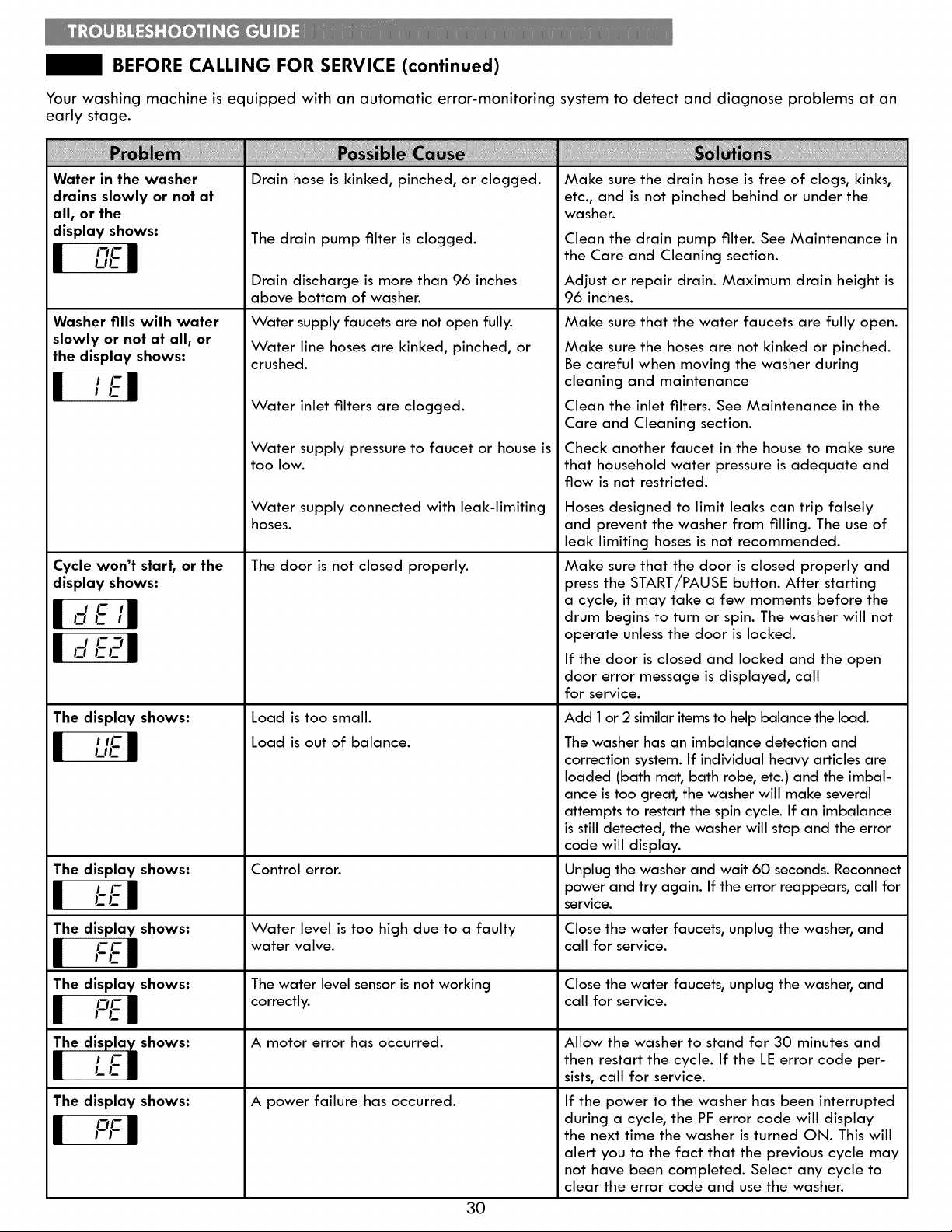
BEFORE CALLING FOR SERVICE (continued)
Your washing machine is equipped with an automatic error-monitoring system to detect and diagnose problems at an
early stage.
!i ii !ii
Water in the washer
drains slowly or not at
all, or the
display shows:
i '-"-,_,c|
Washer fills with water
slowly or not at all, or
the display shows:
I ;E!
Drain hose is kinked, pinched, or clogged.
The drain pump filter is clogged.
Drain discharge is more than 96 inches
above bottom of washer.
Water supply faucets are not open fully.
Water line hoses are kinked, pinched, or
crushed.
Water inlet filters are clogged.
Water supply pressure to faucet or house is
too low.
Make sure the drain hose is free of clogs, kinks,
etc., and is not pinched behind or under the
washer.
Clean the drain pump filter. See Maintenance in
the Care and Cleaning section.
Adjust or repair drain. Maximum drain height is
96 inches.
Make sure that the water faucets are fully open.
Make sure the hoses are not kinked or pinched.
Be careful when moving the washer during
cleaning and maintenance
Clean the inlet filters. See Maintenance in the
Care and Cleaning section.
Check another faucet in the house to make sure
that household water pressure is adequate and
flow is not restricted.
Water supply connected with leak-limiting Hoses designed to limit leaks can trip falsely
hoses, and prevent the washer from filling. The use of
leak limiting hoses is not recommended.
Cycle won't start, or the The door is not closed properly. Make sure that the door is closed properly and
display shows: press the START/PAUSE button. After starting
IdE:!
11-_7
I CI I._ C !
The display shows:
I I II-,_,,-|
The display shows:
display shows:
I-J-
display shows:
display shows:
I I-
,_,_-il
Load is too small.
Load is out of balance.
Control error.
Water level is too high due to a faulty
water valve.
The water level sensor is not working
correctly.
A motor error has occurred.
A power failure has occurred.The display shows:
I ;F!
a cycle, it may take a few moments before the
drum begins to turn or spin. The washer will not
operate unless the door is locked.
If the door is closed and locked and the open
door error message is displayed, call
for service.
Add 1 or 2 similar items to help balance the load.
The washer has an imbalance detection and
correction system. If individual heavy articles are
loaded (bath mat, bath robe, etc.) and the imbal-
ance is too great, the washer will make several
attempts to restart the spin cycle. If an imbalance
is still detected, the washer will stop and the error
code will display.
Unplug the washer and wait 60 seconds. Reconnect
power and try again. If the error reappears, call for
service.
Close the water faucets, unplug the washer, and
call for service.
Close the water faucets, unplug the washer, and
call for service.
Allow the washer to stand for 30 minutes and
then restart the cycle. If the LE error code per-
sists, call for service.
If the power to the washer has been interrupted
during a cycle, the PF error code will display
the next time the washer is turned ON. This will
alert you to the fact that the previous cycle may
not have been completed. Select any cycle to
clear the error code and use the washer.
30
f
I(enmore Limited Warranty
FOR ONE YEAR from the date of sale this appliance is warranted against defects in material or
workmanship when it is correctly installed, operated and maintained according to all supplied instructions.
WITH PROOF OF SALE, a defective appliance will receive free repair or replacement at option of seller.
To arrange for warranty service, call 1-800-4-MY-I-IOME® (1-800-469-4663).
This warranty applies for only 90 DAYS from the sale date if this appliance is ever used for other than
private household purposes.
This warranty covers ONLY defects in material and workmanship, and will NOT pay for:
1. Expendable items that can wear out from normal use, including but not limited to filters, belts, screw-in
base light bulbs and bags.
2. A service technician to instruct the user in correct product installation, operation or maintenance.
3. A service technician to clean or maintain this product.
4. Damage to or failure of this product if it is not installed, operated or maintained according to all
instructions supplied with the product.
5. Damage to or failure of this product resulting from accident, abuse, misuse or use for other than its
intended purpose.
6. Damage to or failure of this product caused by the use of detergents, cleaners, chemicals or utensils
other than those recommended in all instructions supplied with the product.
7. Damage to or failure of parts or systems resulting from unauthorized modifications made to this product.
Disclaimer of implied warranties; limitation of remedies
Customer's sole and exclusive remedy under this limited warranty shall be product repair as provided herein.
Implied warranties, including warranties of merchantability or fitness for a particular purpose, are limited
to one year or the shortest period allowed by law. Seller shall not be liable for incidental or consequential
damages. Some states and provinces do not allow the exclusion or limitation of incidental or consequential
damages, or limitation on the duration of implied warranties of merchantability or fitness, so these exclusions
or limitations may not apply to you.
This warranty applies only while this appliance is used in the United States.
This warranty gives you specific legal rights, and you may also have other rights which vary from state to state.
Sears Brands Management Corporation, Hoffman Estates, IL 60179
J
31
INSTRUCCIONES IMPORTANTES SOBRE SEGURIDAD ..... 33-35
REQUISITOS DE CONEXION A TIERRA ................................ 35
FUNCIONES Y VENTAJAS
Piezas y componentes claves ..................................................... 36
Accesorios incluidos .................................................................... 36
Accesorios opcionales ................................................................. 36
REQUISITOS DE INSTALACION
Dimensiones y especificaciones clave ...................................... 37
C6mo elecjir la ubicaci6n m6s adecuada ................................ 37
Tipo de piso .................................................................................. 37
Espacios de instalaci6n ............................................................... 37
INSTRUCCIONES PARA LA INSTALACION
Desempaquetado y desembalaje de pernos de transporte.. 38
Conexi6n de las tuberfas de agua ............................................. 39
Conexi6n de la manguera de drenaje ..................................... 40
Conexi6n del suministro el_ctrico .............................................. 40
Nivelaci6n de la lavadora ......................................................... 41
Instalaci6n de almohadillas antirresbalantes (opcional) ........ 41
INSTRUCCIONES DE USO
Funciones del panel de control ................................................... 42
Manejo de la lavadora ................................................................. 43
Gufa de ciclos ......................................................................... 44-45
Clasificaci6n de las cargas de lavado ...................................... 46
Acerca della gaveta del dispensador ..................................... 47
Uso del detergente y dispensador ............................................. 48
Retenedor de puerta macjn6tico ................................................ 48
Pantalla de tiempo y estado ...................................................... 49
Botones modificadores de ciclo ................................................. 50
Botones de opci6n ......................................................................... 51
Delay Start (Inicio demorado) ................................................ 51
Extra Rinse (Enjuague extra) .................................................... 51
Pre-Wash (Prelavado) ............................................................... 51
Funciones especiales .................................................................... 52
Control Lock (BLOQUEO DE CONTROLES) ......................... 53
Clean Washer (Limpiar Lavadora) ....................................... 53
Auto Soak (Remojo Automatico) ........................................... 53
CUIDADO Y LIMPIEZA
Limpieza regular ..................................................................... 53-54
Limpieza del exterior .............................................................. 53
Cuidado y limpieza del interior ............................................. 53
Clean Washer (Limpiar Lavadora) ...................................... 53
Limpieza de la junta de la puerta y el vidrio ....................... 53
Eliminaci6n de la acumulaci6n de minerales ....................... 53
Almacenamiento de la lavadora ........................................... 54
Limpieza del dispensador ....................................................... 54
Mantenimiento ........................................................................ 55-56
Limpieza de los filtros de entrada de agua ......................... 55
Limpieza del filtro de bomba de drenaje ............................ 56
I(ENMORE CONNECT TM Sistima .......................................... 57
GUJA DE SOLUCION DE PROBLEMAS ................................... 58
Sonidos normales que se pueden escuchar ............................. 58
Antes de solicitar asistencia t_cnica ................................... 58-60
GARANTJA ............................................................................ 61
En el espacio de abajo, registre la fecha de la compra, el modelo y
n0mero de serie del producto. Usted encontrar6 el n0mero de modelo
y de serie impreso en una placa de identificaci6n ubicada dentro de la
puerta de la lavadora. Tenga esta informaci6n a mano siempre que se
ponga en contacto con Sears en relaci6n con su producto.
N. ° de modelo
Fecha de compra
N. ° de serie
Guarde estas instrucciones y su recibo de venta para
referencia futura.
32
Acuerdos maestros de protecci6n
Felicidades par haber realizado una compra inteligente. Su nuevo
producto Kenmore ® est6 dise_ado y fabricado para brindar a_os
de funcionamiento fiable. No obstante, al igual que cualquier otro
producto, es posible que requiera un mantenimiento preventivo
o alcjuna reparaci6n cada cierto tiempo. Ahf es cuando contar
con un Acuerdo maestro de protecci6n puede ayudarle a ahorrar
tiempo y dinero.
El acuerdo maestro de protecci6n tambi_n Io ayuda a extender la
vida 6til de su nuevo producto. El Acuerdo* incluye los sicjuientes
puntos:
• Piezas y mano de obra necesarias para mantener los productos
en buen funcionamiento bajo un uso normal, no 6nicamente los
defectos de fabricaci6n. Nuestra cobertura va mucho mas all_ de la
garantia del producto. No hay ninguna falla funcional deducible que
se excluya de la cobertura: se trata de una protecci6n real.
°ServJcJo experto mediante un grupo de m6s de 10.000 t_cnJcos
autorizados de Sears, Io que sicjnifica que alcjuien en quien puede
confiar va a trabajar en su producto.
• Visitas a su domicilio ilimitadas ¥ servicio en todo el pais todas
las veces que nos necesite, cuando nos necesite.
• Garantia pot defectos de fabricaci6n: reemplazo de su producto
si se producen cuatro o m6s fallas dentro de los doce meses.
• Reemplazo del producto: si _ste no puede repararse.
• Control de mantenimiento preventivo anual a pedido, sin carcjos
extra.
• Ayuda r6pida por tel_fono.. Io Ilamamos resoluci6n r6pida.
Soporte telef6nico de un representante de Sears sobre todos los
productos. Piense en nosotros como un "manual de usuario que
habla".
• Protecci6n de picos de tensi6n contra dafios el6ctricos debidos a
fluctuaciones de la energfa.
• Protecci6n anual de $250 por p_rdicla de comida que se
haya producido como resultado una falla mec6nica cualquier
refricjerador o concjelador cubierto.
• Reintegro por alquiler si la reparaci6n de su producto tarda m6s
de Io prometido.
• 25°/0 de descuento del precio normal de cualquier servicio de
reparaci6n no cubierto y de piezas relacionadas instaladas.
Una vez que adquiera el Acuerdo, s61o tiene que hacer un Ilamado
telef6nico para programar el servicio. Puede Ilamar en cualquier
momento de dfa o de noche, o coordinar un servicio t_cnico online.
El Acuerdo maestro de protecci6n es una compra sin riescjos.
Si usted Io cancela por cualquier raz6n durante el perfodo de
garanffa del producto, le devolveremos la totalidad del dinero, o
una devoluci6n prorrateada en cualquier momento despu_s de que
expire el perfodo de garanffa. Adquiera hoy mismo su Acuerdo
maestro de protecci6n.
Se aplican algunas limitaciones y exclusiones.
Para consultar precios y e informaci6n adicional en los EE. UU.
Ilame al 1-800-827-6655.
* La cobertura en Canad_ varia en algunos aspectos.
Para m_s detalles, Ilame a Sears Canad_ a 1-800-361-6665.
Servicio de instalaci6n de Sears
Para solicitar la instalaci6n profesional de Sears de
electrodom_sticos, dispositivos para apertura de puertas de cjaraje,
calentadores de acjua y otros electrodom_sticos, Ilame en los EE.
UU. o Canad6 a: 1-800-4-MY-HOME ®.
Enestemanualyensuelectrodom6sticofiguranmuchosmensajesimportantesdeseguridad.Leay cumplasiempre
contodoslosmensajesdeseguridad.
F:ste es el sfmbolo de alerta de seguridad. Este sfmbolo Io alerta sobre posibles riesgos que pueden resultar en dafios
sobre la propiedad y/o lesiones fisicas graves o la muerte.
Todos los mensajes de seguridad incluir6 el sfmbolo de alerta y la palabra PELIGRO o ADVERTENCIA.
Estas palabras significan:
Si no se siguen estas instrucciones sobre seguridad, se pueden producir dafios materiales y/o
lesiones personales graves o la muerte.
Si no se siguen estas instrucciones sobre seguridad, se pueden producir dafios materiales y/o
lesiones personales graves o la muerte.
Todos los mensajes de seguridad le indicar6n cu61 es el peligro potencial, le indicar6n c6mo
reducir el riesgo de lesiones y Io que puede suceder si no se siguen las instrucciones.
Para reducir el riesgo de incendio, descarga el6ctrica o
lesiones personales al utilizar este electrodom6stico, siga estas
precauciones b6sicas, entre las que se incluven las siguientes:
• Antes de utilizar la lavadora, es necesario instalarla
correctamente, seg6n se describe en este manual.
• No lave artfculos que previamente hayan sido limpiados, lavados,
sumergidos o salpicados con gasolina, disolventes de limpieza en
seco o cualquier otra sustancia inflamable o explosiva, ya que
pueden desprender vapores que podrMn incendiarse o explotar.
• No agregue gasolina, disolventes de limpieza en seco u otras
sustancias explosivas al agua de lavado. Estas sustancias emanan
vapores que podrMn encenderse o explotar.
• Bajo ciertas condiciones, se puede producir gas hidr6geno en un
sistema de agua caliente que no se haya usado por un plazo de
2 semanas o m6s. EL GAS HIDROGENO ES EXPLOSIVO. Si no se
ha usado el sistema de agua caliente durante tal perfodo, antes
de utilizar la lavadora, abra todas las Ilaves de agua caliente y
deje que el agua fluya durante algunos minutos. Esto liberar6
cualquier gas hidr6geno acumulado. Ya que el gas es inflamable,
no fume ni use ninguna llama abierta durante este perfodo.
• No deje que los nifios jueguen en la lavadora o dentro de
ella. Cuando se usa la lavadora cerca de los nifios se necesita
supervisi6n minuciosa.
• Antes de poner la lavadora fuera de servicio o tirarla, retire la
puerta para que los nifios no puedan trepar al interior.
• No instale ni guarde la lavadora cuando est6 expuesta a la
intemperie o temperaturas de congelamiento.
• No toquetee los controles.
• No repare ni cambie ninguna pieza de la lavadora ni intente
dar un mantenimiento diferente al descrito en este manual.
Recomendamos enf6ticamente que el mantenimiento Io brinde
una persona calificada.
• Vea las Instrucciones para la instalaci6n para referirse a los
requisitos de conexi6n a tierra.
• Siga SIEMPRE las instrucciones de cuidado de la prenda provistas
por el fabricante de las prendas.
• No coloque prendas expuestas a aceite comestible en su
lavadora. Las prendas contaminadas con aceites comestibles
podrMn contribuir a la formaci6n de una reacci6n qufmica que
cause que una carga de lavado se incendie.
• Use suavizantes o productos para eliminar est6tica 6nicamente
del modo recomendado por el fabricante.
• Esta lavadora no esta disefiada para uso marino o instalaciones
m6viles tales como vehfculos recreativos, aeronaves, etc.
• Cierre las Ilaves de agua y desenchufe la lavadora siva a dejar
la lavadora sin funcionar por un perfodo prolongado de tiempo,
como durante las vacaciones.
• El material de embalaje podrM resultar peligroso para los nifios.
Existe riesgo de asfixia. Mantenga todos los elementos de
embalaje fuera del alcance de los nifios.
• Antes de cargar la lavadora, siempre revise que no haya objetos
extrafios en su interior. Mantenga la puerta cerrada cuando no se
use.
• ADVERTENClA: Este producto contiene qufmicos conocidos por
el Estado de California como causantes de c6ncer y defectos de
nacimiento u otros dafios reproductivos. L6vese las manos despu6s
de manipular.
33
Para reducir el riesgo de incendio, descarga el_ctrica o
lesiones personales al utilizar este electrodom_stico, siga estas
precauciones b6sicas, entre las que se incluven las siguientes:
• Desenchufe la lavadora antes de proceder a su limpieza para
evitar posibles descargas el_ctricas.
• No utilice nunca productos quimicos fuertes, limpiadores
abrasivos o disolventes para limpiar la lavadora. Da_ar6n el
acabado.
• No coloque patios grasosos o aceitosos sobre la lavadora. Estas
sustancias despiden vapores que podrfan prender fuego a los
materiales.
• No lave prendas que est_n sucias con aceite vegetal o de
cocina. Las mismas pueden quedar con algo de aceite luego del
lavado y prenderse fuego.
• Desconecte este electrodom_stico de la toma de corriente
antes de realizar cualquier funci6n de mantenimiento. Colocar
los controles en la posici6n OFF (apagado) no desconecta el
electrodom_stico de la toma de corriente. Si no se cumple con
esta advertencia se podr6n producir lesiones graves, incendios,
descargas el_ctricas o muerte.
• No combine detergentes, suavizantes V otros productos de
lavanderia de diferentes fabricantes en una misma carga, a
menos que asi se especifique en la etiqueta.
• No mezcle blanqueador con cloro con amoniaco o 6cidos, como
vinagre. Siga las direcciones del paquete al usar productos de
lavanderia. Un uso indebido puede producir gases venenosos, Io
que puede resultar en heridas graves o la muerte.
• No coloque las manos dentro de la lavadora cuando sus partes
est_n en movimiento. Antes de cargar, descargar o agregar
prendas, presione la perilla selectora de ciclos V espere hasta
que la tina se detenga totalmente antes de meter las manos en su
interior. Si no se cumple con esta advertencia se podr6n producir
lesiones graves, incendios, descargas el_ctricas o muerte.
• Consulte las INSTRUCCIONES DE INSTALACION para obtener
informaci6n detallada de los procedimientos de conexi6n a tierra. Junto
con la lavadora se encuentran las instruccionesde instalaci6n como
referencia. Si cambiara de lugar la lavadora, contrate a una persona del
servicio califlcada para que la controle y reinstale. Si no se cumple con
esta advertencia se podr6n producir lesiones graves, incendios, descargas
el6ctricas o muerre.
• Bajo ninguna circunstancia, corte o quite la tercera clavi]a (de conexi6n a
tierra) del cable elf_ctrico.Si no se cumple con esta adve_encia se I_:]rc_n
producir lesionesgraves, incendios, descargas el_:tricas o mue_e.
• Por motivos de seguridad personal, este electrodom,_stico debe estar
conectado a tierra adecuadamente. Si no se cumple con esta adve_encia
se podr6n producir lesionesgraves, incendios, descargas el_-tricas o
muerte.
• El cable de alimentaci6n de este electrodom_stico est6 equipado con un
enchufe de tins clavijas (de conexi6n a tierra) que coincide con una toma
de corriente para tres clavijas (de conexi6n a tierra) para asf minimizar la
posibilidad de descarga el_ctrica de este electrodom_stico.
• Esta lavadora debe estar enchufada a una toma de corriente de 120 V de
CA, 60 Hz y con conexi6n a tierra. Si no se cumple con esta adve_encia
se podr6n producir lesionesgraves, incendios, descargas el_-tricas o
muerte.
• Solicite a un eledricista calificado que controle la toma de corriente V
el circuito elf_trico para asegurarse de que la toma de corriente est6
corredamente conedada a tierra. Si no se cumple con esta adve_encia se
podr6n producir lesionesgraves, incendios,descargas el_ctricas o mue_e.
• Si 6nicamente se dispone de una toma de corriente de 2 clavijas, ser6
responsabilidad V obligaci6n suya sustituirlo por otra de 3 clavijas, de
conexi6n a tierra, V adecuada para este uso. Si no se cumple con esta
advertencia se podr6n producir lesionesgraves, incendios,descargas
el_ctricas o mue_e.
• No instalar sobre alfombra. Instale la lavadora sobre piso firme. Si no se
cumple con esta advertencia, se podrc]n producir da_os por filtraciones.
• No elimine el cable de conexi6n a tierra. No use un adaptador o
pmlongador. Enchufe en una toma de corriente con conexi6n a tierra
de 3 clavijas. Si no se cumple con estas adve_encias se podrc_n producir
lesionesgraves, incendios, descargas el_:tricas o mue_e.
• La lavadora deberia estar siempre conectada a un enchufe
individual con un/ndice de voltaje equivalente al que figura en
su etiqueta de caracteristicas t_cnicas. Esto garantiza el mejor
funcionamiento y adem6s previene la sobrecarga de los circuitos
del hogar, Io cual podrfa ocasionar riesgos de incendio debido al
recalentamiento de cables.
• Nunca desenchufe su lavadora jalando del cable de corriente.
Siempre tome su enchufe firmemente y jale del mismo hacia fuera
para retirarlo. Si no se cumple con esta advertencia se podr6n
producir lesiones graves, incendios, descargas el_ctricas o muerte.
• Repare o reemplace de inmediato todos los cables de corriente
pelados o con cualquier tipo de datio. No use un cable con
cortaduras o abrasi6n sobre su extensi6n o extremos. Consulte a
una persona calificada del servicio t_cnico. Si no se cumple con
esta advertencia se podr6n producir lesiones graves, incendios,
descargas el_ctricas o la muerte.
• AI instalar o cambiar de lugar la lavadora, evite todo tipode
cortes u otros datios en el cable de corriente. Si no se cumple
con esta advertencia, se podr6n producir lesiones graves,
incendios, descargas el_ctricas o muerte.
• La lavadora debe ser instalada y conectada a tierra por una
persona especializada del servicio t_cnico cumpliendo con los
c6digos locales para prevenir riesgos de descargas y asegurar la
estabilidad durante el funcionamiento.
• La lavadora es pesada. Se necesitan dos o m6s personas para
instalar V trasladar el electrodom_stico. Si no se cumple esta
advertencia, se podr6n producir da_os en la propiedad y graves
lesiones personales.
• No almacene ni instale la lavadora en lugares expuestos a
temperaturas de congelaci6n ni a inclemencias meteorol6gicas.
Si no se cumple con esta advertencia, se podr6n producir da_os
por filtraciones.
• Con el fin de reducir el riesgo de descargas el_ctricas no
instale la lavadora en espacios h6medos. Si no se cumple con
esta advertencia, se podr6n producir lesiones graves, incendios,
descargas el_ctricas o muerte.
34
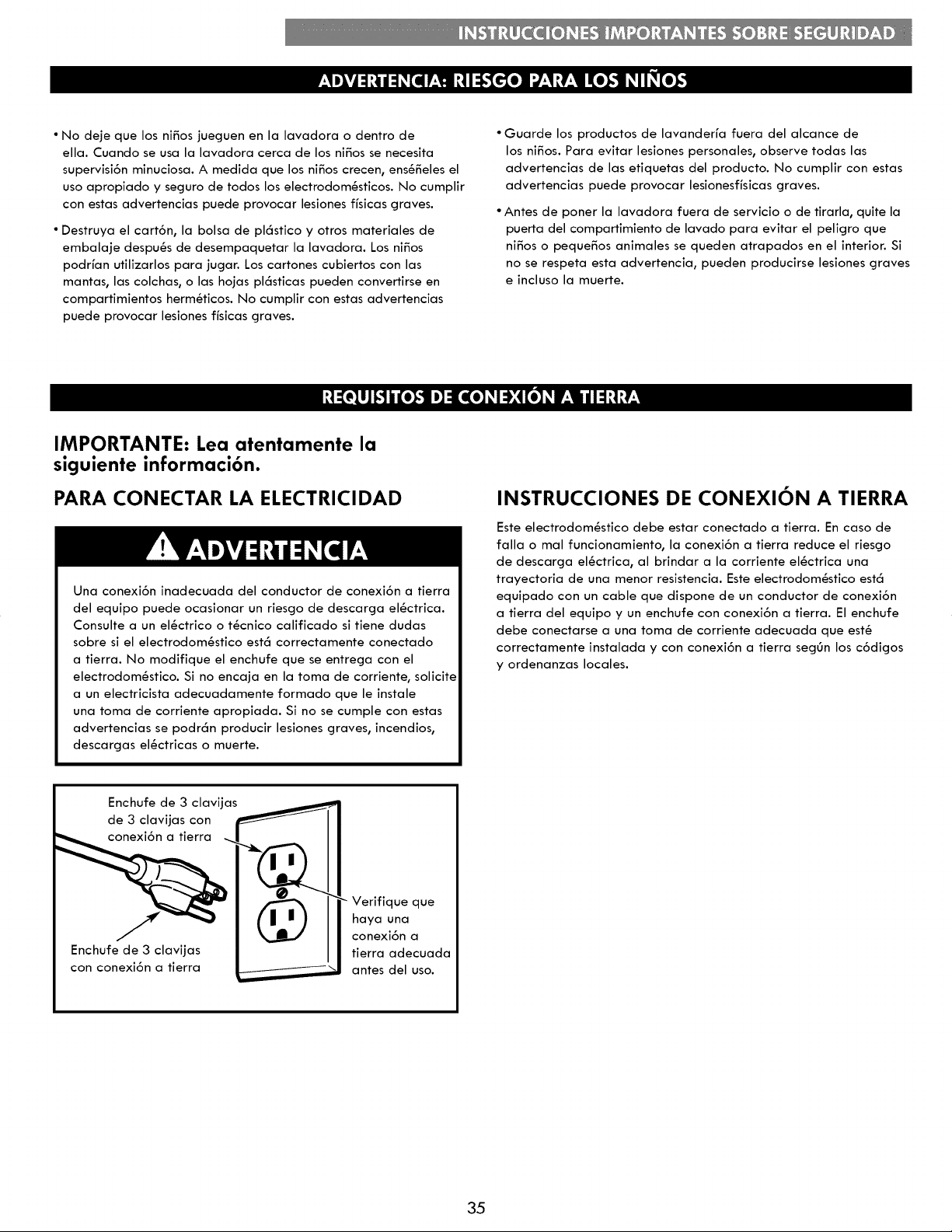
• No deje que los nifios jueguen en la lavadora o dentro de
ella. Cuando se usa la lavadora cerca de los nifios se necesita
supervisi6n minuciosa. A medida que los nifios crecen, ens_eles el
uso apropiado y seguro de todos los electrodom_sticos. No cumplir
con estas advertencias puede provocar lesiones ffsicas graves.
• Destruya el cart6n, la bolsa de pl_stico y otros materiales de
embalaje despu6s de desempaquetar la lavadora. Los nifios
podrfan utilizarlos para jugar. Los cartones cubiertos con las
mantas, las colchas, o las hojas pl_sticas pueden convertirse en
compartimientos hermSticos. No cumplir con estas advertencias
puede provocar lesiones ffsicas graves.
• Guarde los productos de lavanderfa fuera del alcance de
los nifios. Para evitar lesiones personales, observe todas las
advertencias de las etiquetas del producto. No cumplir con estas
advertencias puede provocar lesionesffsicas graves.
• Antes de poner la lavadora fuera de servicio o de tirarla, quite la
puerta del compartimiento de lavado para evitar el peligro que
nifios o peque_os animales se queden atrapados en el interior. Si
no se respeta esta advertencia, pueden producirse lesiones graves
e incluso la muerte.
IMPORTANTE" Lea atentamente la
siguiente informaci6n.
PARA CONECTAR LA ELECTRICIDAD
Una conexi6n inadecuada del conductor de conexi6n a tierra
del equipo puede ocasionar un riesgo de descarga elSctrica.
Consulte a un elSctrico o tScnico calificado si tiene dudas
sobre si el electrodomSstico est_ correctamente conectado
a tierra. No modifique el enchufe que se entrega con el
electrodomSstico. Si no encaja en la toma de corriente, solicite
a un electricista adecuadamente formado que le instale
una toma de corriente apropiada. Si no se cumple con estas
advertencias se podr_n producir lesiones graves, incendios,
descargas elSctricas o muerte.
INSTRUCCIONES DE CONEXION A TIERRA
Este electrodom_stico debe estar conectado a tierra. En caso de
falla o mal funcionamiento, la conexi6n a tierra reduce el riesgo
de descarga elSctrica, al brindar a la corriente elSctrica una
trayectoria de una menor resistencia. Este electrodomSstico est_
equipado con un cable que dispone de un conductor de conexi6n
a tierra del equipo y un enchufe con conexi6n a tierra. El enchufe
debe conectarse a una toma de corriente adecuada que est_
correctamente instalada y con conexi6n a tierra seg6n los c6digos
y ordenanzas locales.
Enchufe de 3 clavijas
de 3 clavijas con
conexi6n a tierra
J
Enchufe de 3 clavijas
con conexi6n a tierra
" Verifique que
haya una
conexi6n a
tierra adecuada
antes del uso.
35
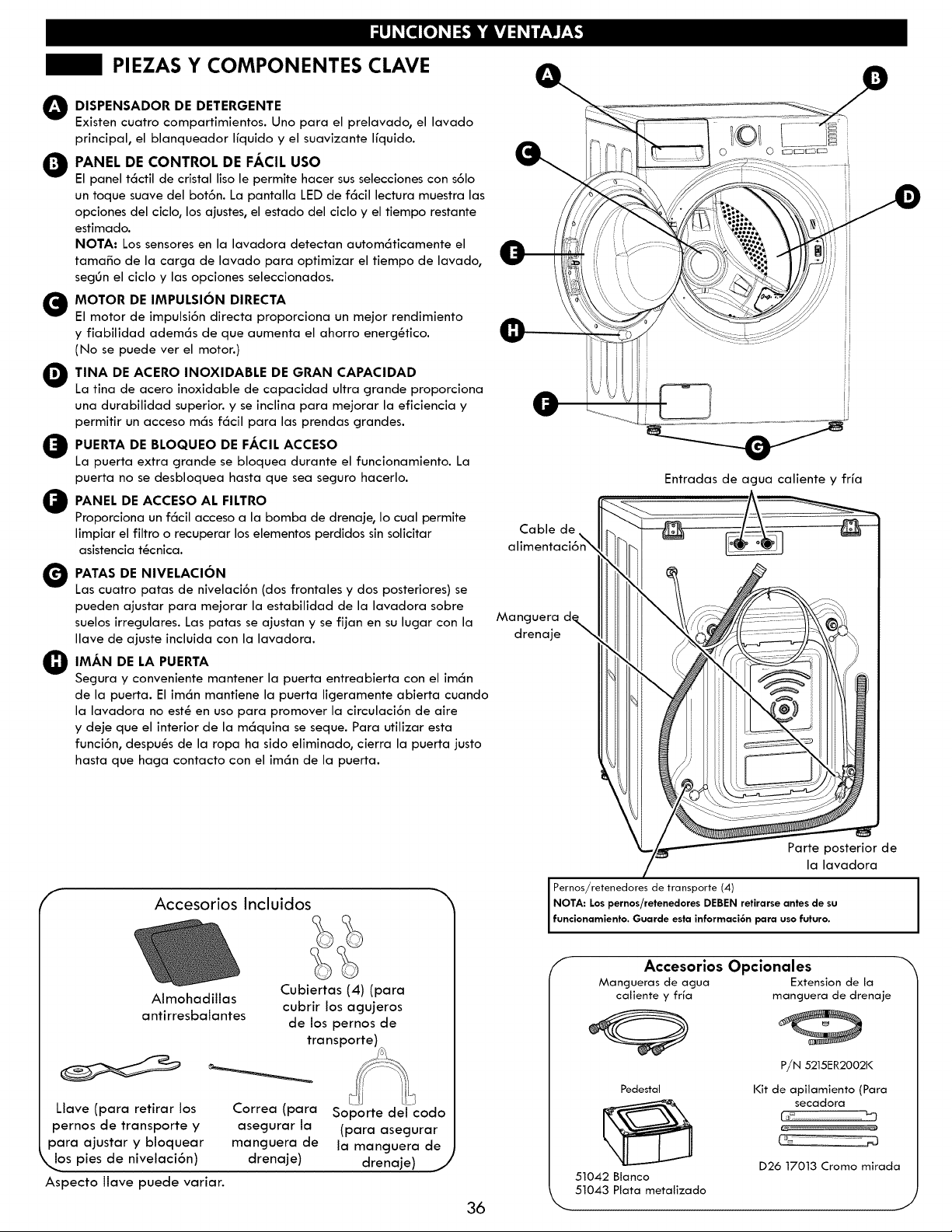
PIEZAS Y COMPONENTES CLAVE
O ISPENSADOR DE DETERGENTE
Existen cuatro compartimientos. Uno para el prelavado, el lavado
principal, el blanqueador Ifquido y el suavizante Ifquido.
PANEL DE CONTROL DE F_,CIL US©
El panel t_ctil de cristal liso le permite hacer sus selecciones con s61o
un toque suave del bot6n. La pantalla LED de f6cil lectura muestra las
opciones del ciclo, los ajustes, el estado del ciclo y el tiempo restante
estimado.
NOTA: Los sensores en la lavadora detectan autom6ticamente el
tama_o de la carga de lavado para optimizar el tiempo de lavado,
seg0n el ciclo y las opciones seleccionados.
O MOTOR DE IMPULSION DIRECTA
El motor de impulsi6n directa proporciona un mejor rendimiento
y fiabilidad adem6s de que aumenta el ahorro energ_tico.
(No se puede ver el motor.)
O INA DE ACERO INOXIDABLE DE GRAN CAPACIDAD
La tina de acero inoxidable de capacidad ultra grande proporciona
una durabilidad superior, y se inclina para mejorar la eficiencia y
permitir un acceso m6s f6cil para las prendas grandes.
PUERTA DE BLOQUEO DE I:AClL ACCESO
La puerta extra grande se bloquea durante el funcionamiento. La
puerta no se desbloquea hasta que sea seguro hacerlo.
PANEL DE ACCESO AL FILTRO
Proporciona un f6cil acceso a la bomba de drenaje, Io cual permite
limpiar el filtro o recuperar los elementos perdidos sin solicitar
asistencia t6cnica.
O ATAS DE NIVELACION
las cuatro patas de nivelaci6n (dos frontales y dos posteriores) se
pueden ajustar para mejorar la estabilidad de la lavadora sobre
suelos irregulares, las patas se ajustan y se fijan en su lugar con la
Ilave de ajuste incluida con la lavadora.
O MAN DE LA PUERTA
Segura y conveniente mantener la puerta entreabierta con el im6n
de la puerta. El im6n mantiene la puerta ligeramente abierta cuando
la lavadora no est& en uso para promover la circulaci6n de aire
y deje que el interior de la m6quina se seque. Para utilizar esta
funci6n, despu6s de la ropa ha sido eliminado, cierra la puerta justo
hasta que haga contacto con el im6n de la puerta.
Cable de
Manguera de,,,
drenaje \
i
Entradas de agua caliente y frfa
f
Accesorios Incluidos
Cubiertas (4) (para
Almohadillas
cubrir los agujeros
antirresbalantes
de los pernos de
transporte)
Llave (para retirar los
pernos de transporte y
para ajustar y bloquear
x_os pies de nivelaci6n)
Aspecto Ilave puede variar.
Correa (para Soporte del codo
asegurar la (para asegurar
manguera de la manguera de
drenaje) drenaje) j
Parte posterior de
la lavadora
Pernos/retenedores de transporte (4)
NOTA: Los pernos/retenedores DEBEN retirarse antes de su
funcionamiento. Guarde esta informaci6n para usa futuro.
f Accesorios Opcionales
Mangueras de agua Extension de la
caliente y frfa manguera de drenaje
P/N 5215ER2002K
Pedestal
51042 Blanco
51043 Plata metalizado
Kit de apilamiento (Para
secadora
D26 17013 Cromo mirada
36 _- J
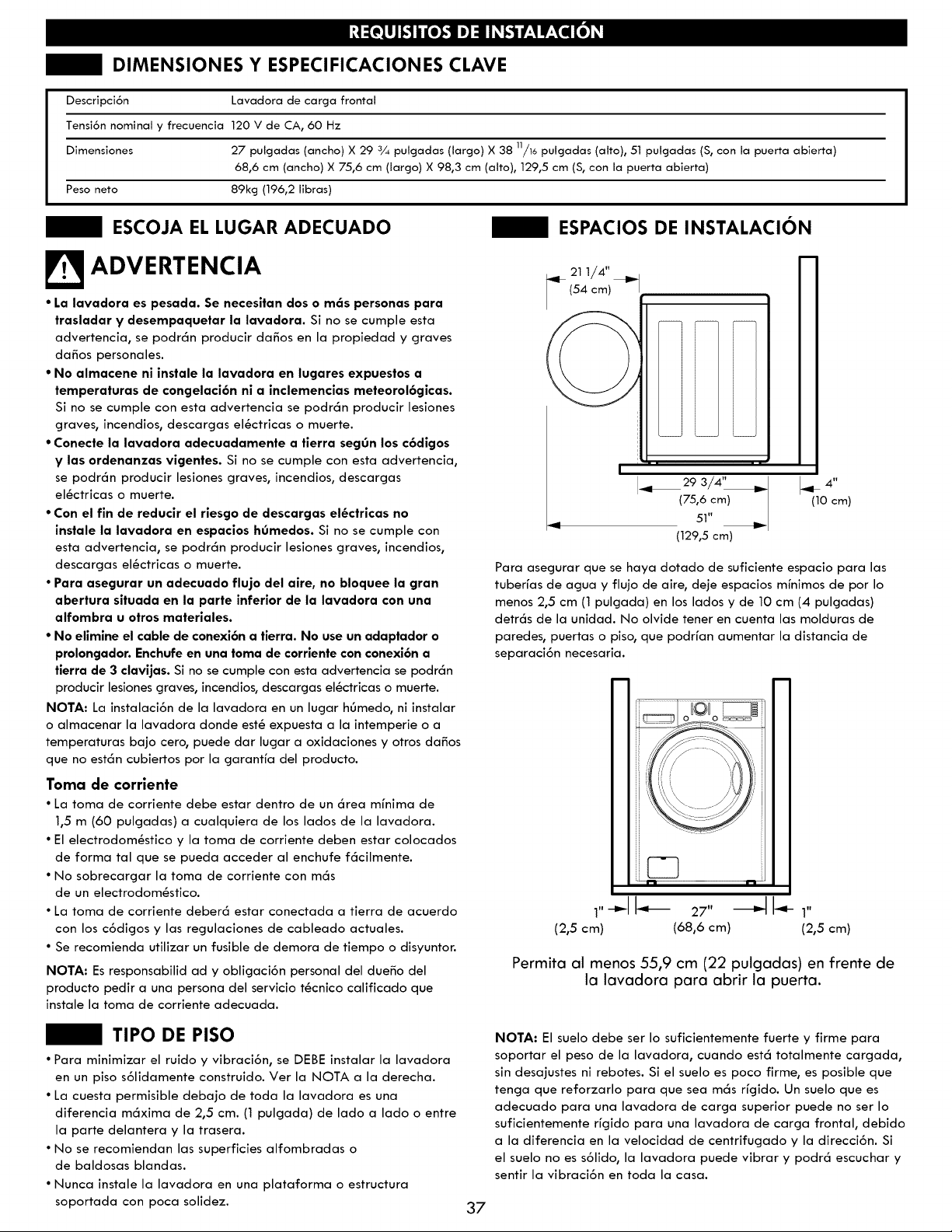
DIMENSIONES Y ESPECIFICACIONES CLAVE
Descripci6n Lavadora de carga frontal
Tensi6n nominal y frecuencia 120 V de CA, 60 Hz
Dimensiones 27 pulgadas (ancho) X 29 3_ pulgadas (largo) X 38 11/16 pulgadas (alto), 51 pulgadas (S, con la puerta abierta)
68,6 cm (ancho) X 75,6 cm (largo) X 98,3 cm (alto), 129,5 cm (S, con la puerta abierta)
Peso neto 89kg (196,2 libras)
ESCOJA EL LUGAR ADECUADO
ADVERTENCIA
• La lavadora es pesada. Se necesitan dos o m_s personas para
trasladar y desempaquetar la lavadora. Si no se cumple esta
advertencia, se podr6n producir da_os en la propiedad y graves
da_os personales.
• No almacene ni instale la lavadora en lugares expuestos a
temperaturas de congelaci6n ni a inclemencias meteorol6gicas.
Si no se cumple con esta advertencia se podr6n producir lesiones
graves, incendios, descargas el_ctricas o muerte.
• Conecle la lavadora adecuadamente a tierra seg0n los c6digos
y las ordenanzas vigentes. Si no se cumple con esta advertencia,
se podr6n producir lesiones graves, incendios, descargas
el&ctricas o muerte.
• Con el fin de reducir el riesgo de descargas el_ctricas no
instale la lavadora en espacios h0medos. Si no se cumple con
esta advertencia, se podr6n producir lesiones graves, incendios,
descargas el_ctricas o muerte.
• Para asegurar un adecuado flujo del aire, no bloquee la gran
aberlura situada en la parle inferior de la lavadora con una
alfombra u otros materiales.
• No elimine el cable de conexi6n a tierra. No use un adaptador o
prolongador. Enchufe en una toma de corriente con conexi6n a
tierra de 3 clavijas. Si no se cumple con esta advertencia se podr6n
producir lesiones graves, incendios, descargas el_ctricas o muerte.
NOTA: La instalaci6n de la lavadora en un lugar h6medo, ni instalar
o almacenar la lavadora donde est_ expuesta a la intemperie o a
temperaturas bajo cero, puede dar lugar a oxidaciones y otros da_os
que no est6n cubiertos por la garantfa del producto.
Toma de corriente
• La toma de corriente debe estar dentro de un 6rea mfnima de
1,5 m (60 pulgadas) a cualquiera de los lados de la lavadora.
• El electrodom_stico y la toma de corriente deben estar colocados
de forma tal que se pueda acceder al enchufe f6cilmente.
• No sobrecargar la toma de corriente con m6s
de un electrodom_stico.
• La toma de corriente deber6 estar conectada a tierra de acuerdo
con los c6digos y las regulaciones de cableado actuales.
• Se recomienda utilizar un fusible de demora de fiempo o disyuntor.
NOTA: Es responsabilid ad y obligaci6n personal del due_o del
producto pedir a una persona del servicio t_cnico calificado que
instale la toma de corriente adecuada.
ESPACIOS DE INSTALACION
,'41
I_ t 29 3/4" J J_ 4"
(75,6 cm) (10 cm)
51"
(129,5 cm)
Para asegurar que se haya dotado de suficiente espacio para las
tuberfas de agua y flujo de aire, deje espacios mfnimos de por Io
menos 2,5 cm (1 pulgada) en los lados y de 10 cm (4 pulgadas)
detr6s de la unidad. No olvide tener en cuenta las molduras de
paredes, puertas o piso, que podrfan aumentar la distancia de
separaci6n necesaria.
oH©lo
ii ii
27,,
(2,5 cm) (68,6 cm) (2,5 cm)
Permita al menos 55,9 cm (22 pulgadas) en frente de
la lavadora para abrir la puerta.
TIPO DE PISO
• Para minimizar el ruido y vibraci6n, se DEBE instalar la lavadora
en un piso s61idamente construido. Ver la NOTA a la derecha.
• La cuesta permisible debajo de toda la lavadora es una
diferencia m6xima de 2,5 cm. (1 pulgada) de lado a lado o entre
la parte delantera y la trasera.
• No se recomiendan las superficies alfombradas o
de baldosas blandas.
• Nunca instale la lavadora en una plataforma o estructura
soportada con poca solidez.
NOTA" El suelo debe ser Io suficientemente fuerte y firme para
soportar el peso de la lavadora, cuando est6 totalmente cargada,
sin desajustes ni rebotes. Si el suelo es poco firme, es posible que
tenga que reforzarlo para que sea m6s rfgido. Un suelo que es
adecuado para una lavadora de carga superior puede no ser Io
suficientemente rfgido para una lavadora de carga frontal, debido
a la diferencia en la velocidad de centrifugado y la direcci6n. Si
el suelo no es s61ido, la lavadora puede vibrar y podr6 escuchar y
sentir la vibraci6n en toda la casa.
37
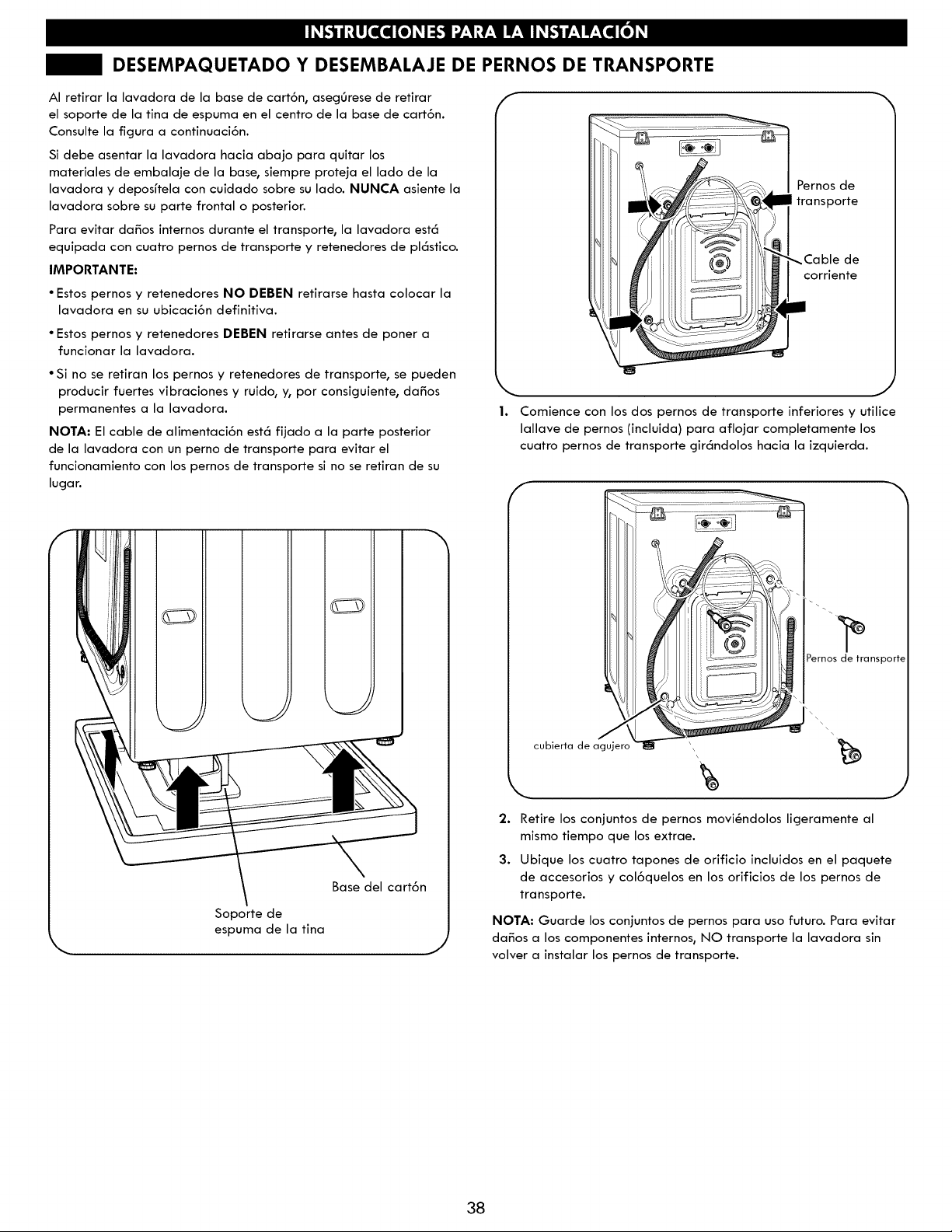
I DESEMPAQUETADO Y DESEMBALAJE DE PERNOS DE TRANSPORTE
AI retirar la lavadora de la base de cart6n, aseg0rese de retirar
el soporte de la tina de espuma en el centro de la base de cart6n.
Consulte la figura a continuaci6n.
Si debe asentar la lavadora hacia abajo para quitar los
materiales de embalaje de la base, siempre proteja el lado de la
lavadora y deposffela con cuidado sobre su lado. NUNCA asiente la
lavadora sobre su parte frontal o posterior.
Para evitar dafios internos durante el transporte, la lavadora est_
equipada con cuatro pernos de transporte y retenedores de pl_stico.
IMPORTANTE:
• Estos pernos y retenedores NO DEBEN retirarse hasta colocar la
lavadora en su ubicaci6n definitiva.
• Estos pernos y retenedores DEBEN retirarse antes de poner a
funcionar la lavadora.
• Si no se retiran los pernos y retenedores de transporte, se pueden
producir fuertes vibraciones y ruido, y, por consiguiente, dafios
permanentes a la lavadora.
NOTA: El cable de alimentaci6n est5 fijado a la parte posterior
de la lavadora con un perno de transporte para evitar el
funcionamiento con los pernos de transporte si no se retiran de su
lugar.
f
Pernos de
transporte
_Cable de
corriente
I
1.
J
Comience con los dos pernos de transporte inferiores y utilice
lallave de pernos (incluida) para aflojar completamente los
cuatro pernos de transporte gir_ndolos hacia la izquierda.
f
Soporte de
espuma de la tina
Base del cart6n
Pernos de transport_
\\
cubierta de agujero _
2. Retire los conjuntos de pernos movi_ndolos ligeramente al
mismo tiempo que los extrae.
3. Ubique los cuatro tapones de orificio incluidos en el paquete
de accesorios y col6quelos en los orificios de los pernos de
transporte.
NOTA: Guarde los conjuntos de pernos para uso futuro. Para evitar
da_os a los componentes internos, NO transporte la lavadora sin
volver a instalar los pernos de transporte.
38
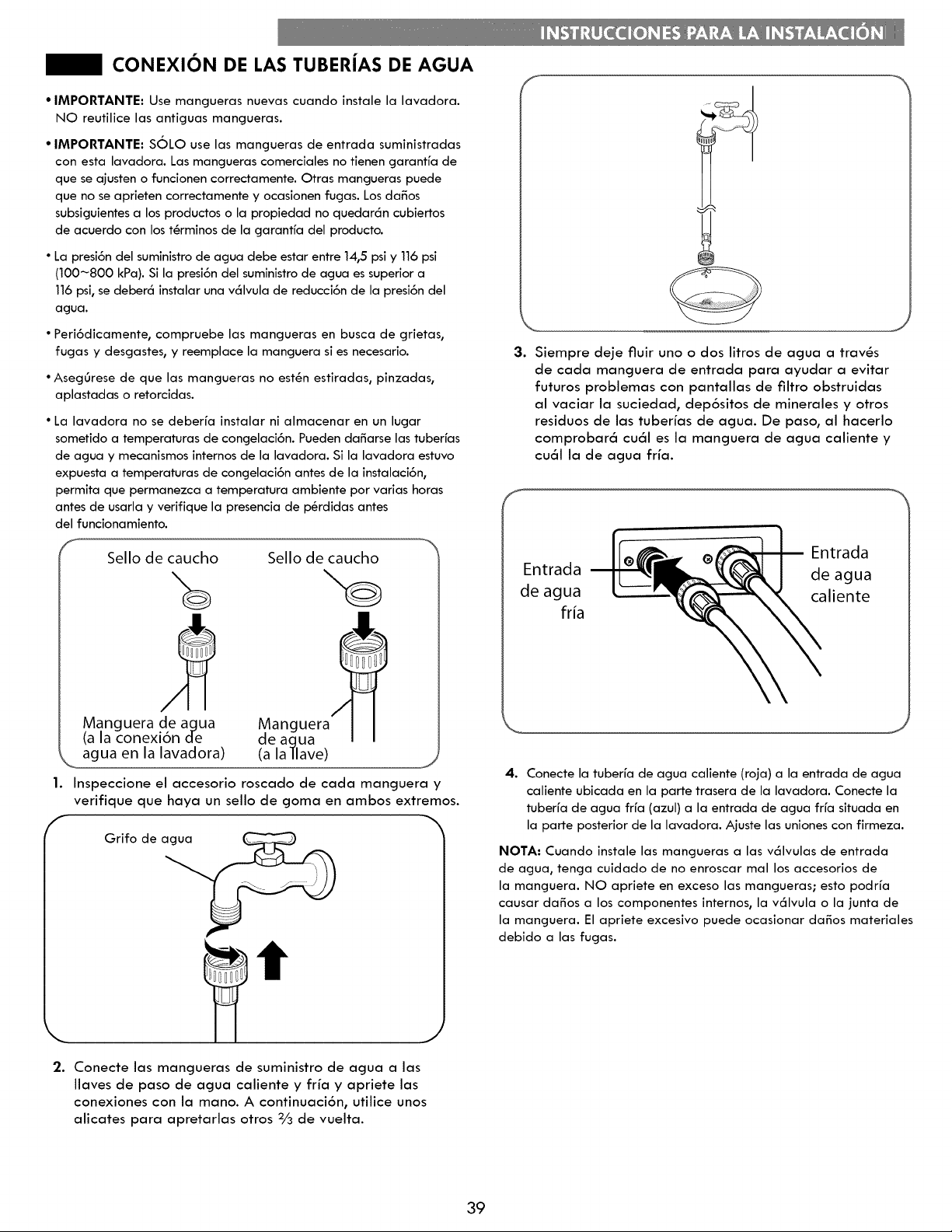
CONEXION DE LAS TUBERJAS DE AGUA
• IMPORTANTE" Use mangueras nuevas cuando instale la lavadora.
NO reutilice las antiguas mangueras.
• IMPORTANTE: SOLO use las mangueras de entrada suministradas
con esta lavadora. Las mangueras comerciales no tienen garantfa de
que se ajusten o funcionen correctamente. Otras mangueras puede
que no se aprieten correctamente y ocasionen fugas. Los dafios
subsiguientes a los productos o la propiedad no quedar6n cubiertos
de acuerdo con los t@rminos de la garantfa del producto.
• La presi6n del suministro de agua debe estar entre 14,5 psi y 116 psi
(100-800 kPa). Si la presi6n del suministro de agua es superior a
116 psi, se deber6 instalar una v61vula de reducci6n de la presi6n del
agua.
• Peri6dicamente, compruebe las mangueras en busca de grietas,
fugas y desgastes, y reemplace la manguera si es necesario.
• AsegOrese de que las mangueras no est@n estiradas, pinzadas,
aplastadas o retorcidas.
• La lavadora no se deberfa instalar ni almacenar en un lugar
sometido a temperaturas de congelaci6n. Pueden dafiarse las tuberfas
de agua y mecanismos internos de la lavadora. Si la lavadora estuvo
expuesta a temperaturas de congelaci6n antes de la instalaci6n,
permita que permanezca a temperatura ambiente por varias horas
antes de usarla y verifique la presencia de p@rdidas antes
del funcionamiento.
,
f
Sello de caucho
Manguera de adgua
(a la conexidn
agua en la lavadora)
Sello de caucho
Manguera
de agua
(a lallave)
Inspeccione el accesorio roscado de cada mancjuera y
verifique que haya un sello de cjoma en ambos extremos.
Grifo de a_
J
2. Conecte las mancjueras de suministro de acjua alas
Ilaves de paso de agua caliente y fria y apriete las
conexiones con la mano. A continuaci6n, utilice unos
alicates para apretarlas otros 2/3 de vuelta.
,
Siempre deje fluir uno o dos litros de acjua a trav@s
de cada manguera de entrada para ayudar a evitar
futuros problemas con pantallas de filtro obstruidas
al vaciar la suciedad, dep6sitos de minerales y otros
residuos de las tuberfas de acjua. De paso, al hacerlo
comprobar6 cu61 es la manguera de agua caliente y
cu61 la de agua frfa.
f
-- Entrada
Entrada de agua
de agua caliente
fria
J
4. Conecte la tuberfa de agua caliente (roja) a la entrada de agua
caliente ubicada en la parte trasera de la lavadora. Conecte la
tuberfa de agua frfa (azul) a la entrada de agua frfa situada en
la parte posterior de la lavadora. Ajuste las uniones con firmeza.
NOTA: Cuando instale las mangueras alas v61vulas de entrada
de agua, tenga cuidado de no enroscar mal los accesorios de
la manguera. NO apriete en exceso las mangueras; esto podrfa
causar dafios a los componentes internos, la v61vula o la junta de
la manguera. El apriete excesivo puede ocasionar dafios materiales
debido a las fugas.
39
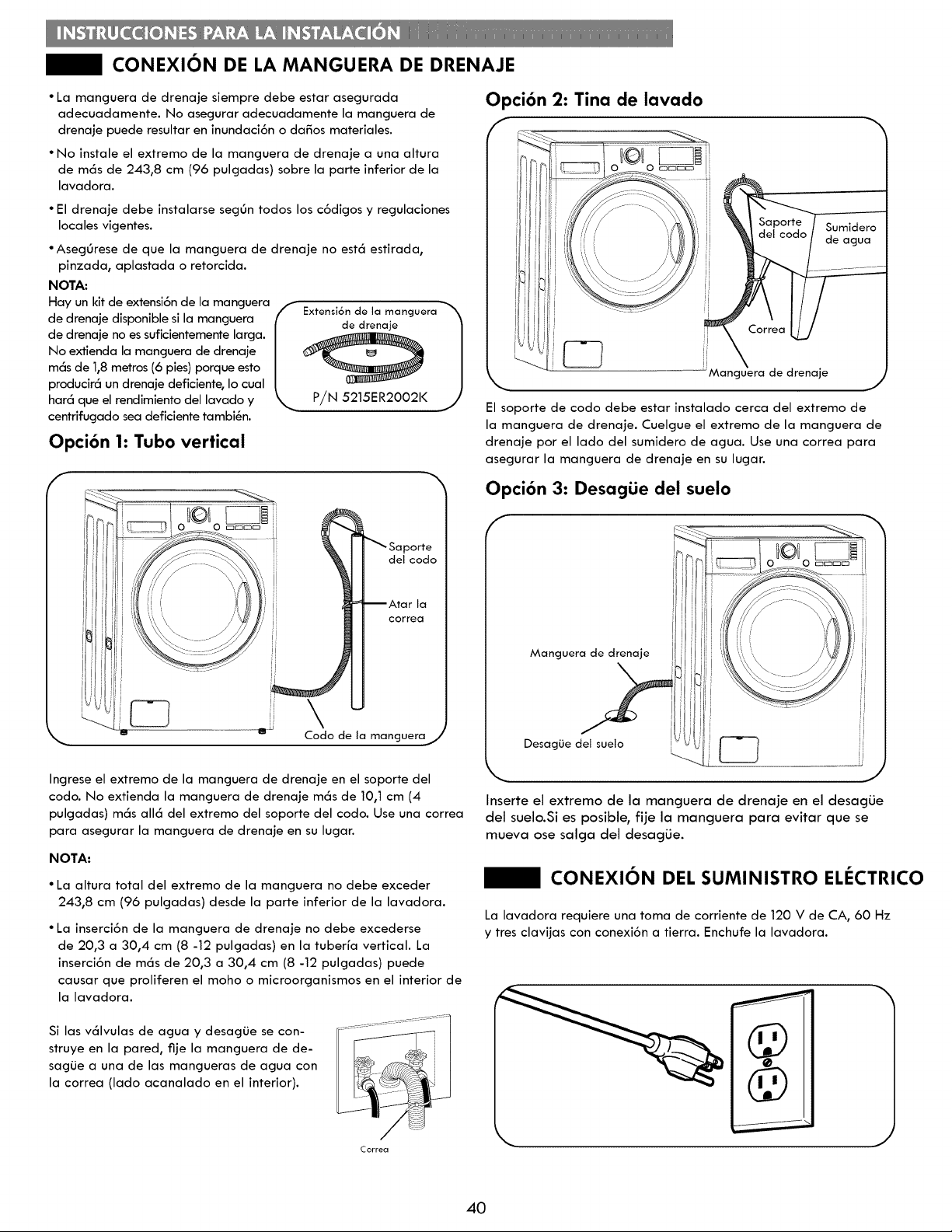
CONEXION DE LA MANGUERA DE DRENAJE
• La manguera de drenaje siempre debe estar asegurada
adecuadamente. No asegurar adecuadamente la manguera de
drenaje puede resultar en inundaci6n o dafios materiales.
• No instale el extremo de la manguera de drenaje a una altura
de m6s de 243,8 cm (96 pulgadas) sobre la parte inferior de la
lavadora.
• El drenaje debe instalarse segOn todos los c6digos y regulaciones
locales vigentes.
• AsegOrese de que la manguera de drenaje no est6 estirada,
pinzada, aplastada o retorcida.
NOTA"
Hay un kit de extensi6n de la manguera f _X
de drenaje disponible si la manguera ( Extensi6n de la manguera
J
de drenaje
de drenaje no es suficientemente larga. |
No extienda la manguera de drenaje |
m6s de 1,8 metros (6 pies) porque esto |
producir6 un drenaje deficiente, Io cual [
har6 que el rendimiento del lavado y _,_ P/N 5215ER2002K
centrifugado sea deficiente tambi_n.
Opci6n 1: Tubo vertical
f
\
\
Codo de la
guera
Ingrese el extremo de la manguera de drenaje en el soporte del
codo. No extienda la manguera de drenaje m6s de 10,1 cm (4
pulgadas) m6s all6 del extremo del soporte del codo. Use una correa
para asegurar la manguera de drenaje en su lugar.
NOTA"
• La altura total del extremo de la manguera no debe exceder
243,8 cm (96 pulgadas) desde la parte inferior de la lavadora.
• La inserci6n de la manguera de drenaje no debe excederse
de 20,3 a 30,4 cm (8 -12 pulgadas) en la tuberM vertical. La
inserci6n de m6s de 20,3 a 30,4 cm (8 -12 pulgadas) puede
causar que proliferen el moho o microorganismos en el interior de
la lavadora.
Si las v61vulas de agua y desagOe se con-
struye en la pared, fije la manguera de de-
sagOe a una de las mangueras de agua con
la correa (lado acanalado en el interior).
Correa
Opci6n 2: Tina de lavado
__ Sumidero
__ _delc°d deagua
Correa
_;Mancjuera de drenaje
J
El soporte de codo debe estar instalado cerca del extremo de
la manguera de drenaje. Cuelgue el extremo de la manguera de
drenaje por el lado del sumidero de agua. Use una correa para
asegurar la manguera de drenaje en su lugar.
Opci6n 3: DesagiJe del suelo
r
Manguera de drenaje
DesagLie del suelo
Inserte el extremo de la manguera de drenaje en el desagLie
del suelo.Si es posible, fije la manguera para evitar que se
mueva ose salga del desagLie.
CONEXION DEL SUMINISTRO ELECTRICO
La lavadora requiere una toma de corriente de 120 V de CA, 60 Hz
y tres clavijas con conexi6n a fierra. Enchufe la lavadora.
J
4O
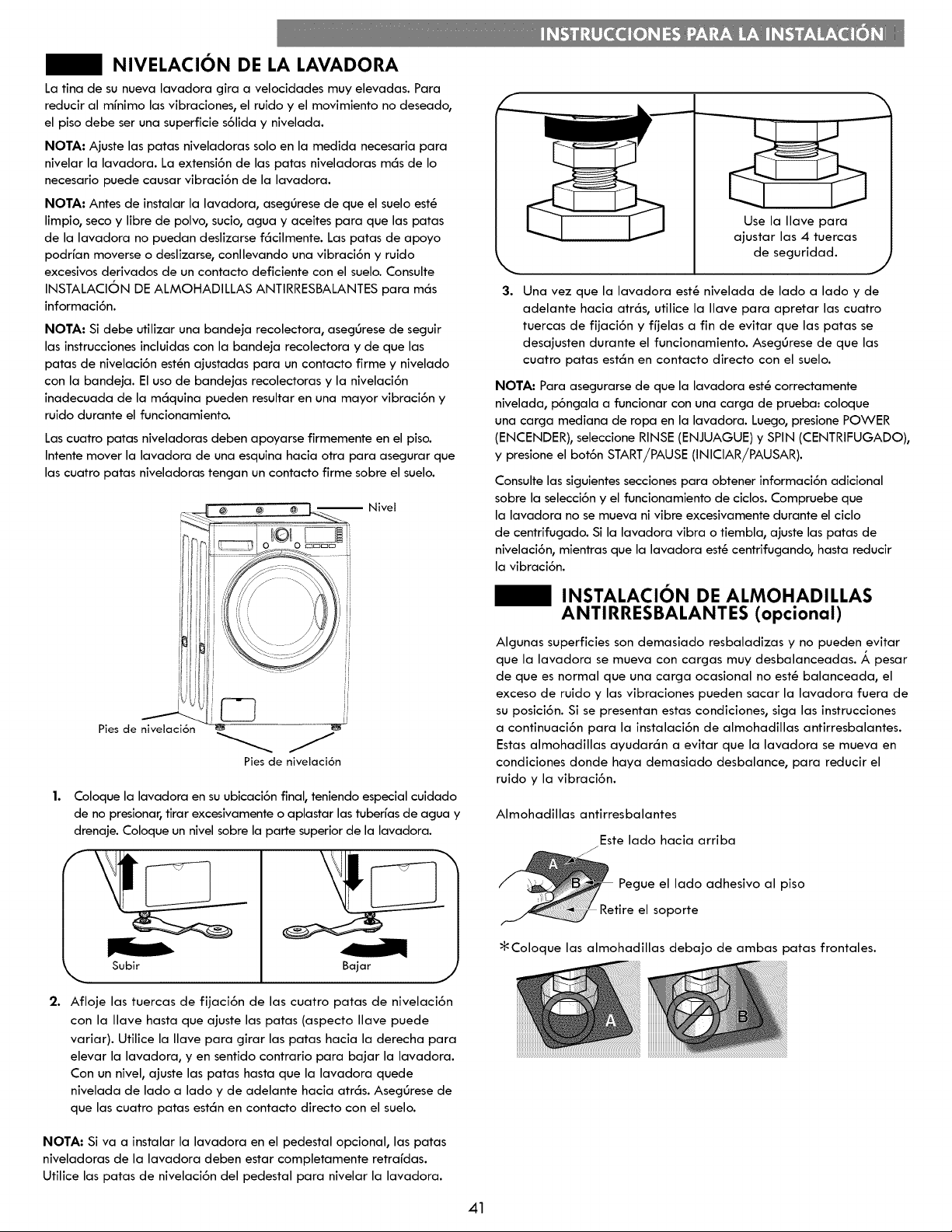
/ NIVELACION DE LA LAVADORA
La tina de su nueva lavadora gira a velocidades muy elevadas. Para
reducir al mfnimo las vibraciones, el ruido y el movimiento no deseado,
el piso debe ser una superficie s61ida y nivelada.
NOTA: Ajuste las patas niveladoras solo en la medida necesaria para
nivelar la lavadora. La extensi6n de las patas niveladoras m6s de Io
necesario puede causar vibraci6n de la lavadora.
NOTA: Antes de instalar la lavadora, aseg0rese de que el suelo est_
limpio, seco y libre de polvo, sucio, agua y aceites para que las patas
de la lavadora no puedan deslizarse f6cilmente. Las patas de apoyo
podrMn moverse o deslizarse, conllevando una vibraci6n y ruido
excesivos derivados de un contacto deficiente con el suelo. Consulte
INSTALACION DE ALMOHADILLAS ANTIRRESBALANTES para m6s
informaci6n.
NOTA: Si debe utilizar una bandeja recolectora, aseg0rese de seguir
las instrucciones incluidas con la bandeja recolectora y de que las
patas de nivelaci6n est_n ajustadas para un contacto firme y nivelado
con la bandeja. El uso de bandejas recolectoras y la nivelaci6n
inadecuada de la m6quina pueden resultar en una mayor vibraci6n y
ruido durante el funcionamiento.
Las cuatro patas niveladoras deben apoyarse firmemente en el piso.
Intente mover la lavadora de una esquina hacia otra para asegurar que
las cuatro patas niveladoras tengan un contacto firme sobre el suelo.
C_
Nivel
Pies de nivelaci6n _"
Pies de nivelaci6n
1. Coloque la lavadora en su ubicaci6n final, teniendo especial cuidado
de no presionar, tirar excesivamente o aplastar las tuberMs de agua y
drenaje. Coloque un nivel sobre la parte superior de la lavadora.
Subir
Bajar
1
2. Afloje las tuercas de fijaci6n de las cuatro patas de nivelaci6n
con la Ilave hasta que ajuste las patas (aspecto Ilave puede
variar). Utilice la Ilave para girar las patas hacia la derecha para
elevar la lavadora, yen sentido contrario para bajar la lavadora.
Con un nivel, ajuste las patas hasta que la lavadora quede
nivelada de lado a lado y de adelante hacia atr6s. Aseg6rese de
que las cuatro patas est6n en contacto directo con el suelo.
Use la Ilave para
ajustar las 4 tuercas
de seguridad.
3.
Una vez que la lavadora est_ nivelada de lado a lado y de
adelante hacia atr6s, utilice la Ilave para apretar las cuatro
tuercas de fijaci6n y fijelas a fin de evitar que las patas se
desajusten durante el funcionamiento. Aseg0rese de que las
cuatro patas est6n en contacto directo con el suelo.
NOTA: Para asegurarse de que la lavadora est_ correctamente
nivelada, p6ngala a funcionar con una carga de prueba: coloque
una carga mediana de ropa en la lavadora. Luego, presione POWER
(ENCENDER), seleccione RINSE (ENJUAGUE) y SPIN (CENTRIFUGADO),
y presione el bot6n START/PAUSE (INICIAR/PAUSAR).
Consulte las siguientes secciones para obtener informaci6n adicional
sobre la selecci6n y el funcionamiento de ciclos. Compruebe que
la lavadora no se mueva ni vibre excesivamente durante el ciclo
de centrifugado. Si la lavadora vibra o tiembla, ajuste las patas de
nivelaci6n, mientras que la lavadora est_ centrifugando, hasta reducir
la vibraci6n.
/ INSTALACION DE ALMOHADILLAS
ANTI RRESBALANTES (opcional)
Algunas superficies son demasiado resbaladizas y no pueden evitar
que la lavadora se mueva con cargas muy desbalanceadas. ,_, pesar
de que es normal que una carga ocasional no est_ balanceada, el
exceso de ruido y las vibraciones pueden sacar la lavadora fuera de
su posici6n. Si se presentan estas condiciones, siga las instrucciones
a continuaci6n para la instalaci6n de almohadillas antirresbalantes.
Estas almohadillas ayudar6n a evitar que la lavadora se mueva en
condiciones donde haya demasiado desbalance, para reducir el
ruido y la vibraci6n.
Almohadillas antirresbalantes
Este lado hacia arriba
Pegue el lado adhesivo al piso
tire el soporte
>_:Coloque las almohadillas debajo de ambas patas frontales.
NOTA: Siva a instalar la lavadora en el pedestal opcional, las patas
niveladoras de la lavadora deben estar completamente retrafdas.
Utilice las patas de nivelaci6n del pedestal para nivelar la lavadora.
41
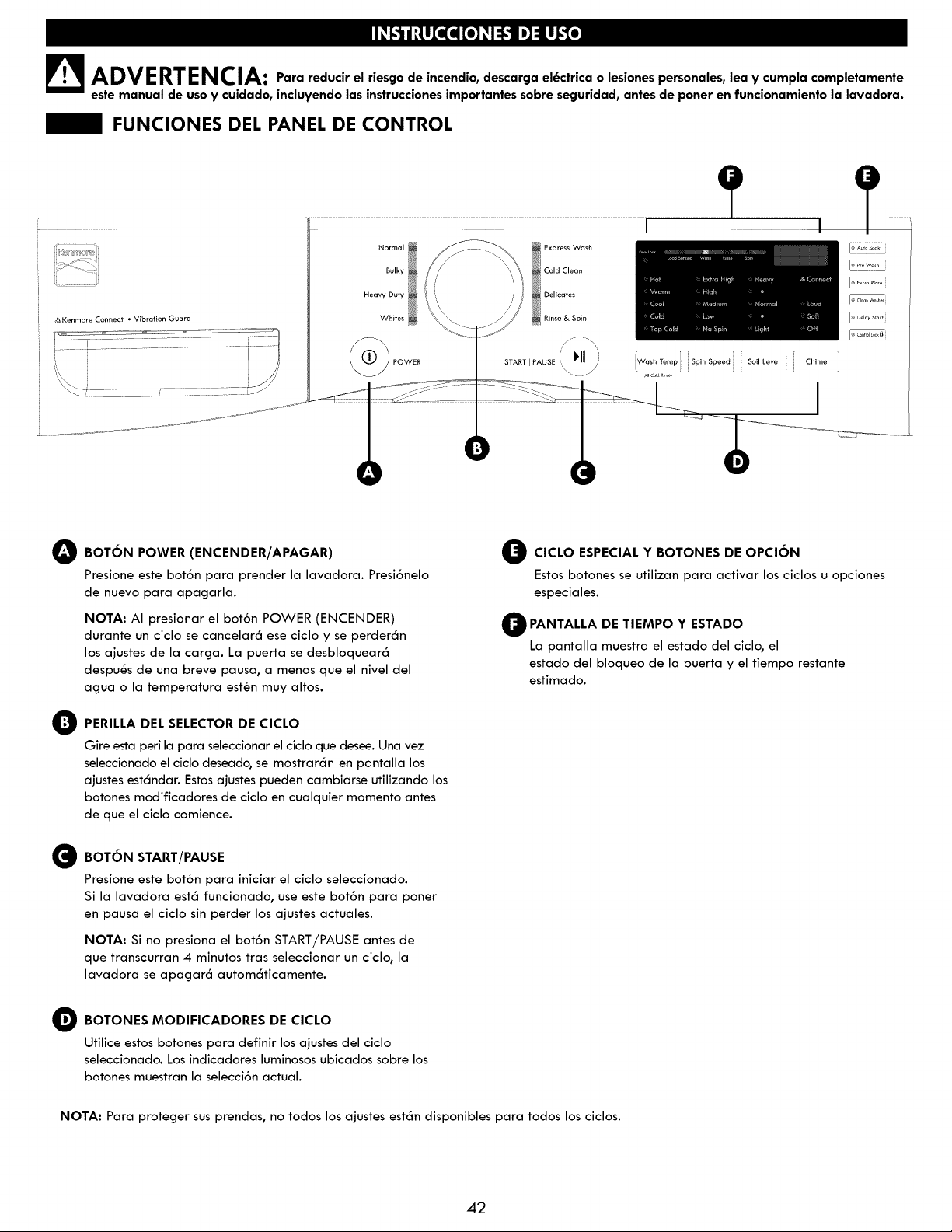
ADVERTENCIA: Para reducir el riesgo de incendio, descarga el_ctrica o lesionespersonales, lea y cumpla completamente
este manual de uso y cuidado, incluyendo las instruccionesimportantes sobre seguridad, antes de porteren funcionamiento la lavadora.
FUNCIONES DEL PANEL DE CONTROL
_Kenmore Connect ° Vibration G_ard
t ......_ ........... _- _ 111- _i-
_(.......................... I
Normal
Bulky
Heavy Duty
_ POWER
Express Wash
Cold Clean
Delicates
/
Rinse & Spin
STARTIPAUSE HI
\_ J
F q F ]
::Wash Temp i Spin Speed i Soll Level Chime
O BOTON POWER (ENCENDER/APAGAR)
Presione este bot6n para prender la lavadora. Presi6nelo
de nuevo para apagarla.
NOTA: AI presionar el bot6n POWER (ENCENDER)
durante un ciclo se cancelar6 ese ciclo y se perder6n
los aiustes de la carga. La puerta se desbloquear6
despu_s de una breve pausa, a menos que el nivel del
agua o la temperatura est_n muy altos.
O
PERILLA DEL SELECTOR DE CICLO
Gire esta perilla para seleccionar el ciclo que desee. Una vez
seleccionado el ciclo deseado, se mostrar6n en pantalla los
aiustes est6ndar. Estos aiustes pueden cambiarse utilizando los
botones modificadores de ciclo en cualquier momento antes
de que el ciclo comience.
O BOTON START/PAUSE
Presione este bot6n para iniciar el ciclo seleccionado.
Si la lavadora est6 funcionado, use este bot6n para poner
en pausa el ciclo sin perder los ajustes actuales.
NOTA: Si no presiona el bot6n START/PAUSE antes de
que transcurran 4 minutos tras seleccionar un ciclo, la
lavadora se apagar6 autom6ticamente.
O
BOTONES MODIFICADORES DE CICLO
Utilice estos botones para definir los aiustes del ciclo
seleccionado. Los indicadores luminosos ubicados sobre los
botones muestran la selecci6n actual.
O CICLO ESPECIAL Y BOTONES DE OPCION
Estos botones se utilizan para activar los ciclos u opciones
especiales.
O ANTALLA DE TIEMPO Y ESTADO
La pantalla muestra el estado del ciclo, el
estado del bloqueo de la puerta y el tiempo restante
estimado.
NOTA: Para proteger sus prendas, no todos los ajustes est6n disponibles para todos los ciclos.
42
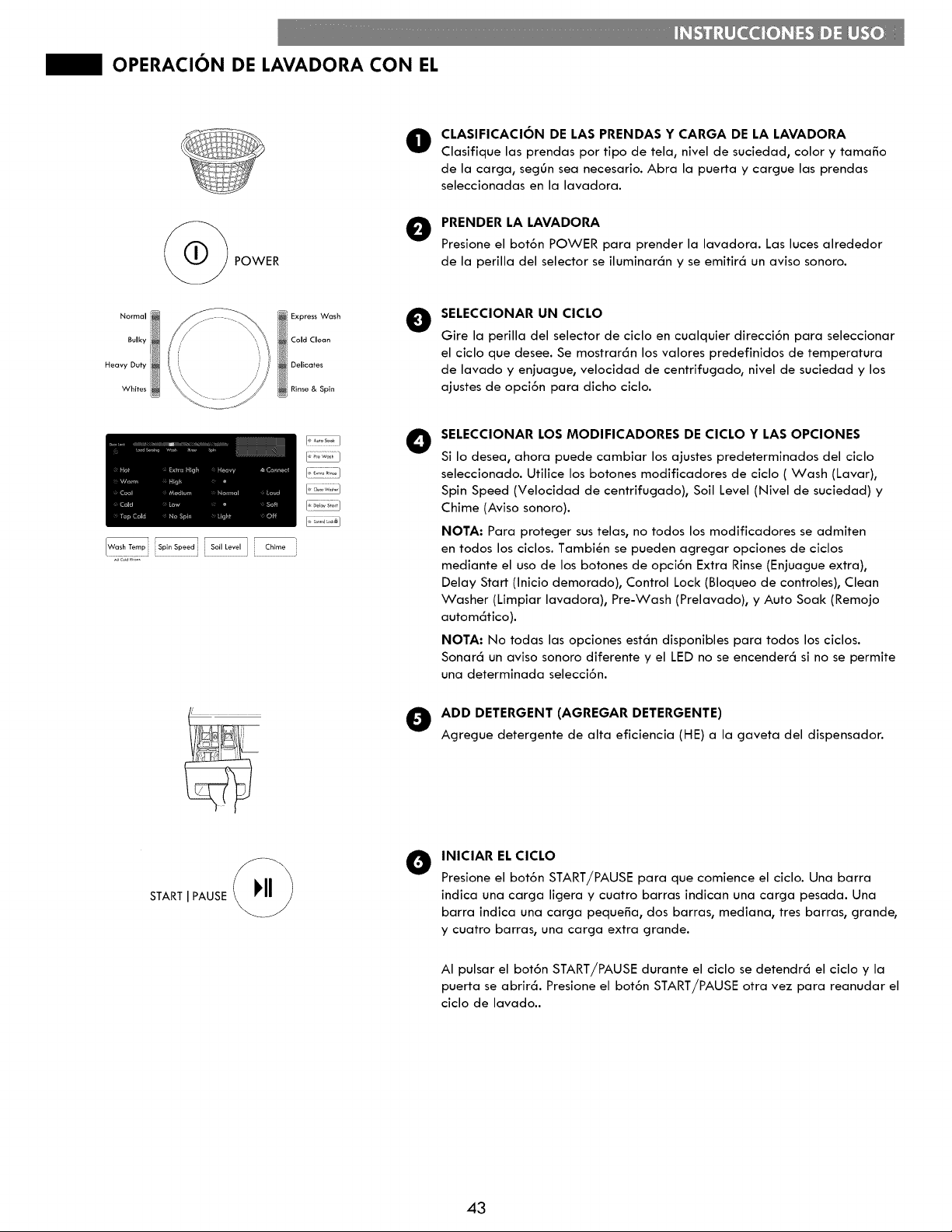
OPERACION DE LAVADORA CON EL
Normal
Bulky
Heavy Duty
Whites
POWER
Express Wash
Cold Clean
Delicates
Rinse & Spin
O LASIFICACION DE LAS PRENDAS Y CARGA DE LA LAVADORA
Clasifique las prendas por tipo de tela, nivel de suciedad, color y tamafio
de la carga, seg6n sea necesario. Abra la puerta y cargue las prendas
seleccionadas en la lavadora.
PRENDER LA LAVADORA
Presione el bot6n POWER para prender la lavadora. Las luces alrededor
de la perilla del selector se iluminar6n y se emitir6 un aviso sonoro.
0
SELECCIONAR UN CICLO
Gire la perilla del selector de ciclo en cualquier direcci6n para seleccionar
el ciclo que desee. Se mostrar6n los valores predefinidos de temperatura
de lavado y enjuague, velocidad de centrifugado, nivel de suciedad y los
ajustes de opci6n para dicho ciclo.
7 s °spood
_J
I.......:o,_}
O
SELECCIONAR LOS MODIFICADORES DE CICLO Y LAS OPCIONES
Si Io desea, ahora puede cambiar los ajustes predeterminados del ciclo
seleccionado. Utilice los botones modificadores de ciclo ( Wash (Lavar),
Spin Speed (Velocidad de centrifugado), Soil Level (Nivel de suciedad) y
Chime (Aviso sonoro).
NOTA: Para proteger sus telas, no todos los modificadores se admiten
en todos los ciclos. Tambi_n se pueden agregar opciones de ciclos
mediante el uso de los botones de opci6n Extra Rinse (Enjuague extra),
Delay Start (Inicio demorado), Control Lock (Bloqueo de controles), Clean
Washer (Limpiar lavadora), Pre-Wash (Prelavado), y Auto Soak (Remojo
autom6tico).
NOTA: No todas las opciones est6n disponibles para todos los ciclos.
Sonar6 un aviso sonoro diferente y el LED no se encender6 si no se permite
una determinada selecci6n.
O ADD DETERGENT (AGREGAR DETERGENTE)
Agregue detergente de alta eficiencia (HE) a la gaveta del dispensador0
START I PAUSE
O
INICIAR EL CICLO
Presione el bot6n START/PAUSE para que comience el ciclo. Una barra
indica una carga ligera y cuatro barras indican una carga pesada. Una
barra indica una carga pequeSa, dos barras, mediana, tres barras, grande,
y cuatro barras, uno cargo extra grande.
AI pulsar el bot6n START/PAUSE durante el ciclo se detendr6 el ciclo y la
puerta se abrir6. Presione el bot6n START/PAUSE otra vez para reanudar el
ciclo de lavado..
43
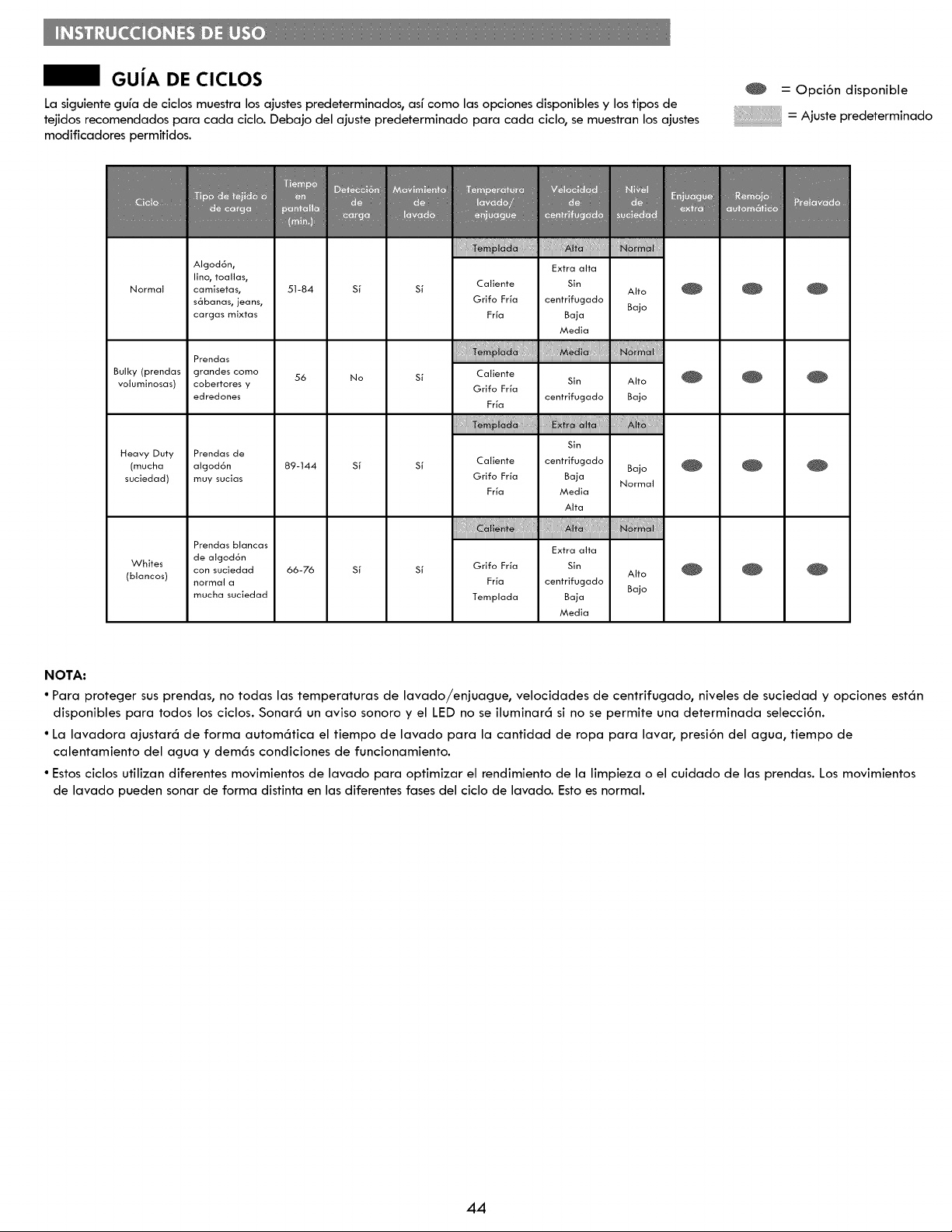
GUJA DE CICLOS
La siguiente gufa de ciclos muestra los ajustes predeterminados, asf como las opciones disponibles y los tipos de
tejidos recomendados para cada ciclo. Debajo del ajuste predeterminado para cada ciclo, se muestran los ajustes
modificadores permitidos.
= Opci6n disponible
= Ajuste predeterminado
NormaJ
Bulky (prendas
voluminosas)
Heavy Duty
(mucha
suciedad)
Whites
(blancos)
Algod6n,
lino, toallas,
camisetas,
s6banas, jeans,
cargas mixtas
Prendas
grandes como
cobertores y
edredones
Prendas de
algod6n
muy sucias
Prendas blancas
de aJgod6n
con suciedad
normal a
mucha suciedad
CaJiente
Grifo Fr[a
Fr[a
Caliente
Grifo Fr[a
Fr[a
Caliente
Grifo Fr[a
Fr[a
Grifo Fr[a
Fr[a
Templada
Extra alta
Sin
centrifugado
Baja
Media
Sin
centrifugado
Sin
centrifugado
Baja
Media
Alia
Extra alta
Sin
centrifugado
Baja
Media
NOTA:
• Para proteger sus prendas, no todas las temperaturas de lavado/enjuague, velocidades de centrifugado, niveles de suciedad y opciones estdn
disponibles para todos los ciclos. Sonard un aviso sonoro y el LED no se iluminard si no se permite una determinada selecci6n.
• La lavadora ajustard de forma automdtica el tiempo de lavado para la cantidad de ropa para lavar, presi6n del agua, tiempo de
calentamiento del agua y demds condiciones de funcionamiento.
• Estos ciclos utilizan diferentes movimientos de lavado para optimizar el rendimiento de la limpieza o el cuidado de las prendas. Los movimientos
de lavado pueden sonar de forma distinta en las diferentes fases del ciclo de lavado. Esto es normal.
44
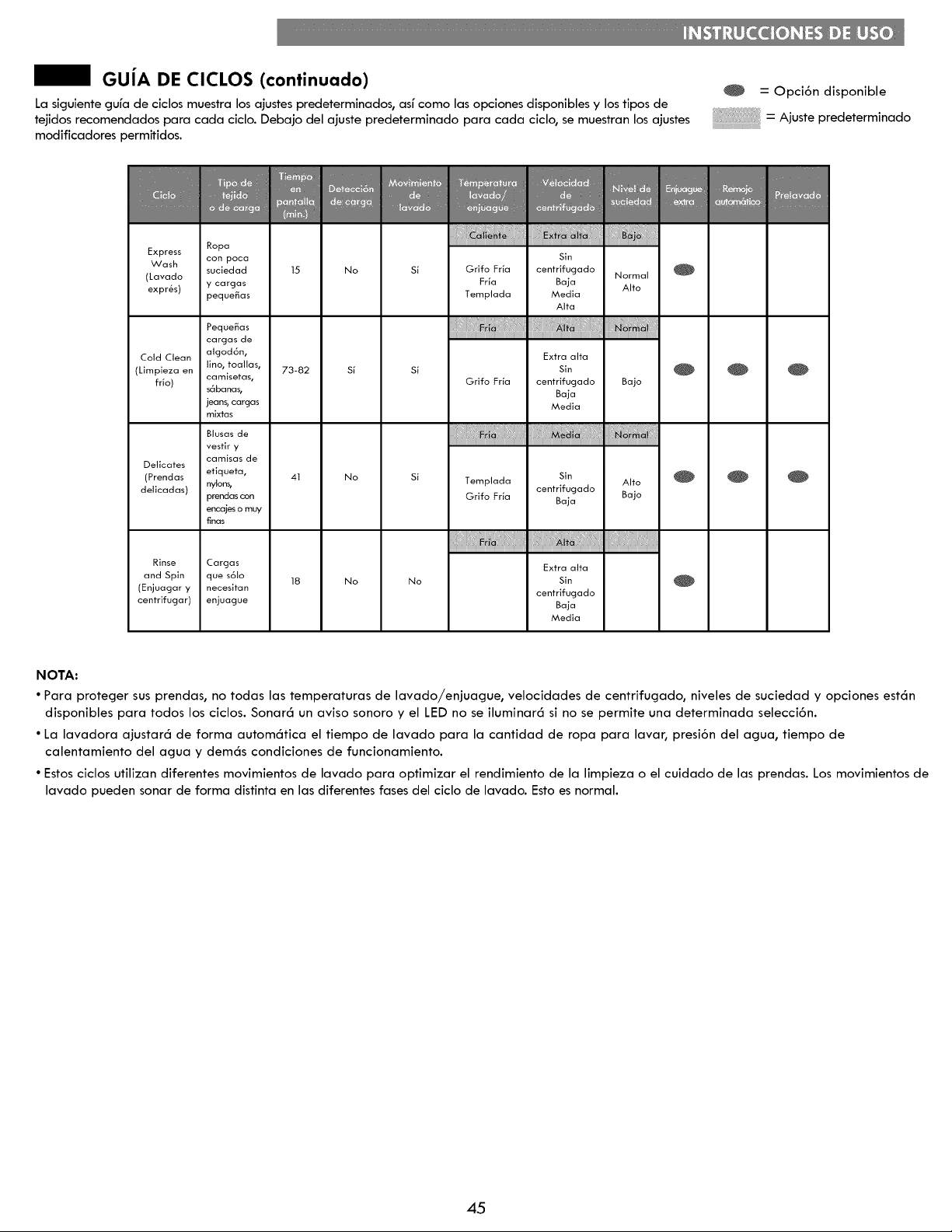
GUJA DE CICLOS (continuado)
La siguiente gufa de ciclos muestra los ajustes predeterminados, asf como las opciones disponibles y los tipos de
tejidos recomendados para cada ciclo. Debajo del ajuste predeterminado para cada ciclo, se muestran los ajustes
modificadores permitidos.
= Opci6n disponible
= Ajuste predeterminado
Express
Wash
(Lavado
expr_s)
Cold Clean
(Limpieza en
frio)
Delicates
(Prendas
delicadas)
Rinse
and Spin
(Enjuagar y
centrifugar)
Ropa
con poca
sudedad
y cargas
peque_as
Peque_as
cargas de
algod6n,
Jino, toallas,
camisetas,
s6banas,
jeans, cargas
mixtas
Blusas de
vestir y
camisas de
etiqueta,
nylons,
prendas con
encajes o muy
finas
Cargas
que s61o
necesJtan
enjuague
Si
Si
Si
No
Grifo Fr[a
Fria
Templada
Grifo Fria
Templada
Grifo Fria
Sin
centrifugado
Baja
Media
Affa
Extra alta
Sin
centrifugado
Baja
Media
Sin
centrifugado
Baja
Extra alta
Sin
centrifugado
Baja
Media
NOTA:
• Para proteger sus prendas, no todas las temperaturas de lavado/enjuague, velocidades de centrifugado, niveles de suciedad y opciones estdn
disponibles para todos los ciclos. Sonar6 un aviso sonoro y el LED no se iluminar6 si no se permite una determinada selecci6n.
• La lavadora ajustar6 de forma automdtica el tiempo de lavado para la cantidad de ropa para lavar, presi6n del agua, tiempo de
calentamiento del agua y demds condiciones de funcionamiento.
• Estos ciclos utilizan diferentes movimientos de lavado para optimizar el rendimiento de la limpieza o el cuidado de las prendas. Los movimientos de
lavado pueden sonar de forma distinta en las diferentes fases del ciclo de lavado. Esto es normal.
45
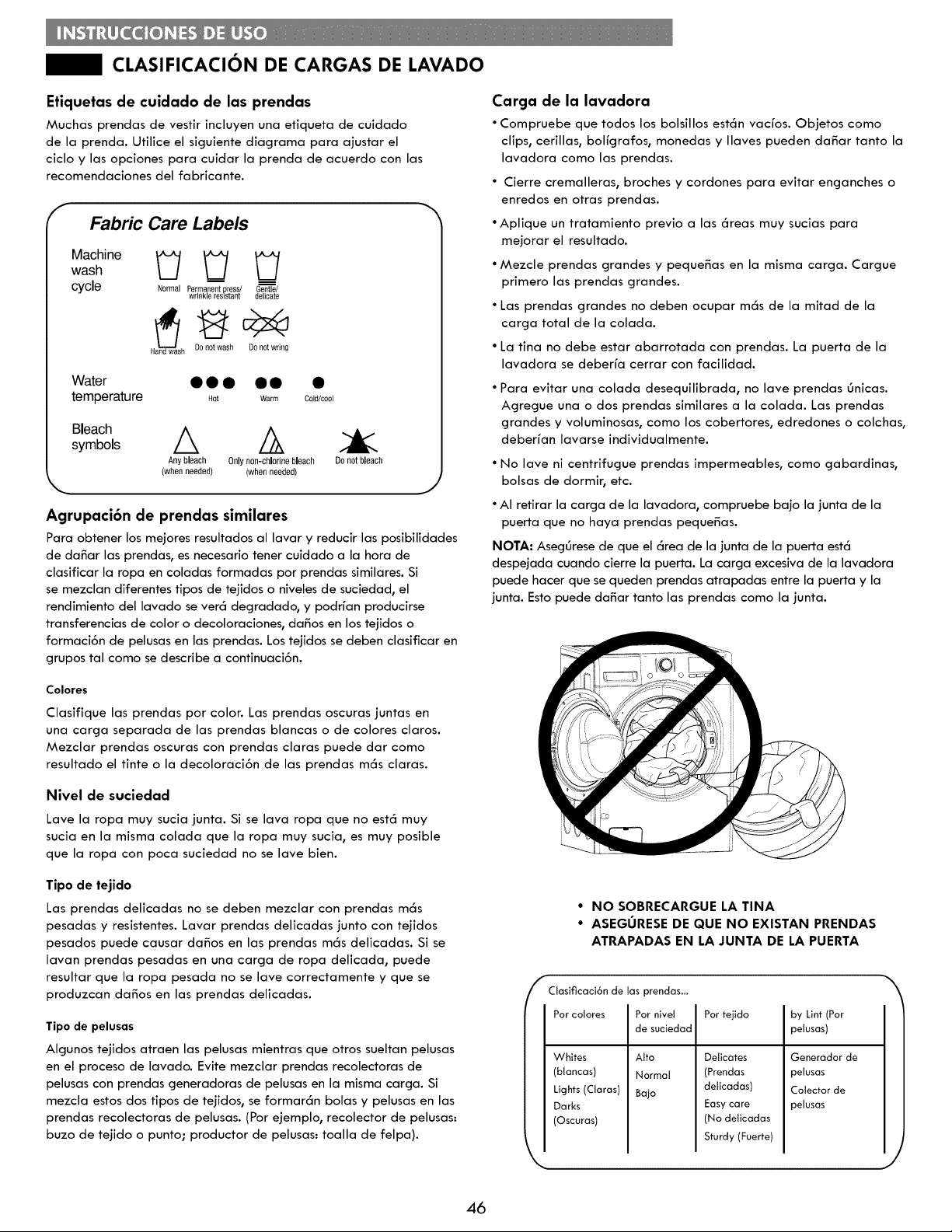
/ CLASIFICACION DE CARGAS DE LAVADO
Etiquetas de cuidado de las prendas
Muchas prendas de vestir incluyen una etiqueta de cuidado
de la prenda. Utilice el siguiente diagrama para ajustar el
ciclo y las opciones para cuidar la prenda de acuerdo con las
recomendaciones del fabricante.
f
Fabric Care Labels
Machine
wash
cycle
Normal Permanent press/ Gentle/
wrinkle resistant delicate
H h Donotwash Donot wring
Water • • • • • •
temperature Hot Warm Cold/cool
Bleach
symbols /_ //k/)k ._
Any bleach Only non-chlorine bleach Do not bleach
(when needed) (when needed)
Agrupaci6n de prendas similares
Para obtener los mejores resultados al lavar y reducir las posibilidades
de da_ar las prendas, es necesario tener cuidado a la hora de
clasificar la ropa en coladas formadas por prendas similares. Si
se mezclan diferentes tipos de tejidos o niveles de suciedad, el
rendimiento del lavado se verd degradado, y podrfan producirse
transferencias de color o decoloraciones, da_os en los tejidos o
formaci6n de pelusas en las prendas. Los tejidos se deben clasificar en
grupos tal como se describe a continuaci6n.
Colores
Clasifique las prendas por color. Las prendas oscuras juntas en
una carga separada de las prendas blancas o de colores claros.
Mezclar prendas oscuras con prendas claras puede dar como
resultado el tinte o la decoloraci6n de las prendas mds claras.
Nivel de suciedad
Lave la ropa muy sucia junta. Si se lava ropa que no est6 muy
sucia en la misma colada que la ropa muy sucia, es muy posible
que la ropa con poca suciedad no se lave bien.
Tipo de tejido
Las prendas delicadas no se deben mezclar con prendas mds
pesadas y resistentes. Lavar prendas delicadas junto con tejidos
pesados puede causar da5os en las prendas mds delicadas. Si se
lavan prendas pesadas en una carga de ropa delicada, puede
resultar que la ropa pesada no se lave correctamente y que se
produzcan da5os en las prendas delicadas.
Tipo de pelusas
Algunos tejidos atraen las pelusas mientras que otros sueltan pelusas
en el proceso de lavado. Evite mezclar prendas recolectoras de
pelusas con prendas generadoras de pelusas en la misma carga. Si
mezcla estos dos tipos de tejidos, se formardn bolas y pelusas en las
prendas recolectoras de pelusas. (Por ejemplo, recolector de pelusas:
buzo de tejido o punto; productor de pelusas: toalla de felpa).
Carga de la lavadora
• Compruebe que todos los bolsillos estdn vacfos. Objetos como
clips, cerillas, bolfgrafos, monedas y Ilaves pueden da_ar tanto la
lavadora como las prendas.
• Cierre cremalleras, broches y cordones para evitar enganches o
enredos en otras prendas.
• Aplique un tratamiento previo alas dreas muy sucias para
mejorar el resultado.
• Mezcle prendas grandes y peque5as en la misma carga. Cargue
primero las prendas grandes.
• Las prendas grandes no deben ocupar mds de la mitad de la
carga total de la colada.
• La tina no debe estar abarrotada con prendas. La puerta de la
lavadora se deberfa cerrar con facilidad.
• Para evitar una colada desequilibrada, no lave prendas 0nicas.
Agregue una o dos prendas similares a la colada. Las prendas
grandes y voluminosas, como los cobertores, edredones o colchas,
deberfan lavarse individualmente.
• No lave ni centrifugue prendas impermeables, como gabardinas,
bolsas de dormir, etc.
• AI retirar la carga de la lavadora, compruebe bajo la junta de la
puerta que no haya prendas peque5as.
NOTA: AsegOrese de que el drea de la junta de la puerta estd
despejada cuando cierre la puerta. La carga excesiva de la lavadora
puede hacer que se queden prendas atrapadas entre la puerta y la
junta. Esto puede da5ar tanto las prendas como la junta.
• NO SOBRECARGUE LA TINA
• ASEGORESE DE QUE NO EXISTAN PRENDAS
ATRAPADAS EN LA JUNTA DE LA PUERTA
Clasificaci6n de [as prendas... _'_
Par colores Par nivel
\
Whites
(blancas)
Lights (Claras)
Darks
(Oscuras)
de suciedad
Alto
Normal
Bajo
Por tejido
Delicates
(Prendas
delicadas)
Easy care
(No delicadas
Sturdy (Fuerte)
by Lint (Por
pelusas)
Generador de
pelusas
Colector de
pelusas
J
46
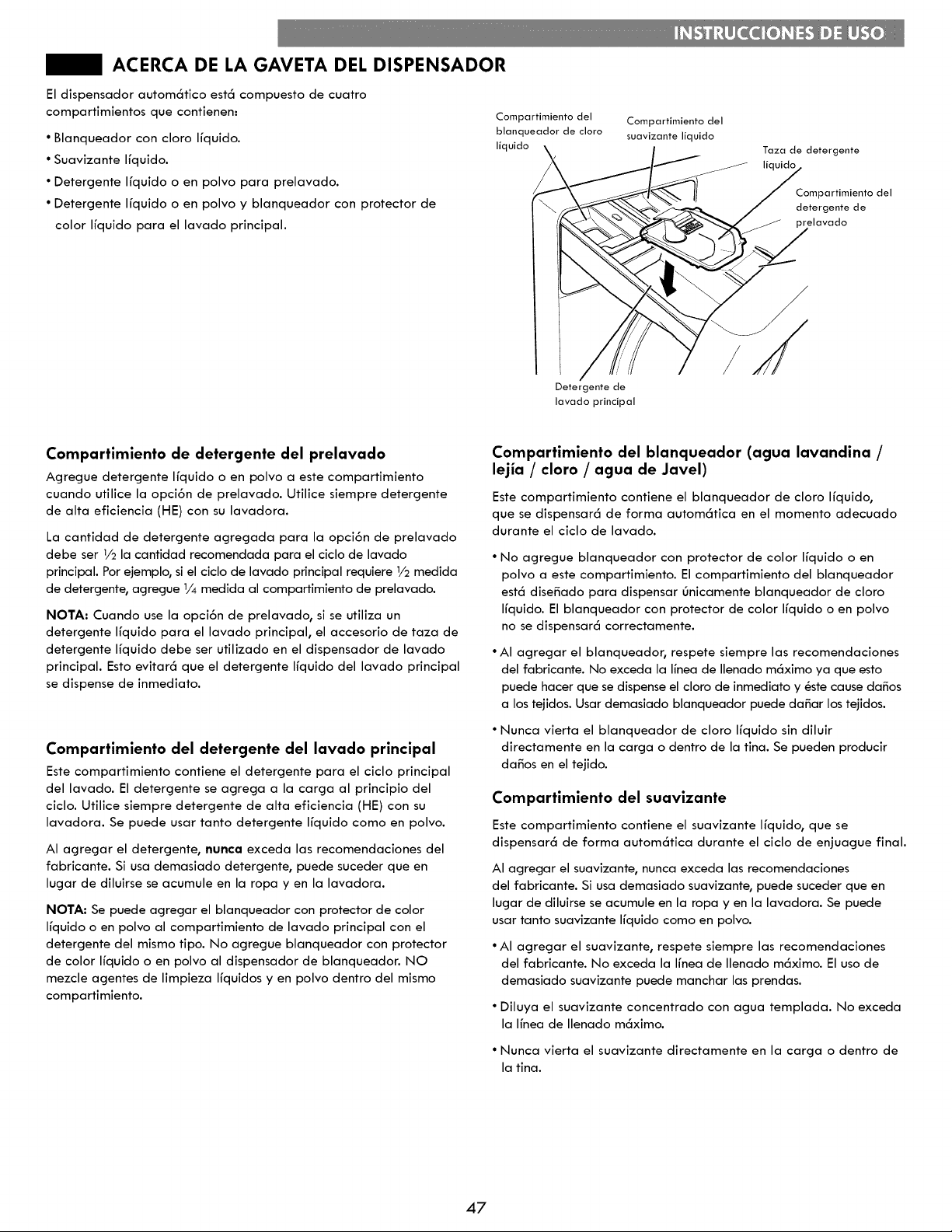
ACERCA DE LA GAVETA DEL DISPENSADOR
El dispensador autom6tico est6 compuesto de cuatro
compartimientos que contienen:
• Blanqueador con cloro Ifquido.
• Suavizante Ifquido.
• Detergente Ifquido o en polvo para prelavado.
• Detergente Ifquido o en polvo y blanqueador con protector de
Compartimiento de1
blanqueador de clara
llquido
color Ifquido para el lavado principal.
Compartimiento del
suavizante llquido
Taza de detergente
Compartlmiento de1
detergente de
orelavado
Detergente de
lavado principal
Compartimiento de detergente del prelavado
Agregue detergente Ifquido o en polvo a este compartimiento
cuando utilice la opci6n de prelavado. Utilice siempre detergente
de alta eficiencia (HE) con su lavadora.
La cantidad de detergente agregada para la opci6n de prelavado
debe ser 1/2 la cantidad recomendada para el ciclo de lavado
principal. Por ejemplo, si el ciclo de lavado principal requiere 1/2 medida
de detergente, agregue 1/4 medida al compartimiento de prelavado.
NOTA: Cuando use la opci6n de prelavado, si se utiliza un
detergente Ifquido para el lavado principal, el accesorio de taza de
detergente Ifquido debe ser utilizado en el dispensador de lavado
principal. Esto evitar6 que el detergente Ifquido del lavado principal
se dispense de inmediato.
Compartimiento del detergente del lavado principal
Este compartimiento contiene el detergente para el ciclo principal
del lavado. El detergente se agrega a la carga al principio del
ciclo. Utilice siempre detergente de alta eficiencia (HE) con su
lavadora. Se puede usar tanto detergente Ifquido como en polvo.
AI agregar el detergente, nunca exceda las recomendaciones del
fabricante. Si usa demasiado detergente, puede suceder queen
lugar de diluirse se acumule en la ropa yen la lavadora.
NOTA: Se puede agregar el blanqueador con protector de color
Ifquido o en polvo al compartimiento de lavado principal con el
detergente del mismo tipo. No agregue blanqueador con protector
de color Ifquido o en polvo al dispensador de blanqueador. NO
mezcle agentes de limpieza Ifquidos yen polvo dentro del mismo
compartimiento.
Compartimiento del blanqueador (agua lavandina /
lejia / clara / agua de Javel)
Este compartimiento contiene el blanqueador de cloro Ifquido,
que se dispensar6 de forma autom6tica en el momento adecuado
durante el ciclo de lavado.
• No agregue blanqueador con protector de color Ifquido o en
polvo a este compartimiento. El compartimiento del blanqueador
est6 dise_ado para dispensar Onicamente blanqueador de cloro
Ifquido. El blanqueador con protector de color Ifquido o en polvo
no se dispensar6 correctamente.
• AI agregar el blanqueador, respete siempre las recomendaciones
del fabricante. No exceda la Ifnea de Ilenado m6ximo ya que esto
puede hacer que se dispense el cloro de inmediato y _ste cause da_os
a los tejidos. Usar demasiado blanqueador puede da_ar los tejidos.
• Nunca vierta el blanqueador de cloro Ifquido sin diluir
directamente en la carga o dentro de la tina. Se pueden producir
da_os en el tejido.
Compartimiento del suavizante
Este compartimiento contiene el suavizante Ifquido, que se
dispensar6 de forma autom6tica durante el ciclo de enjuague final.
AI agregar el suavizante, nunca exceda las recomendaciones
del fabricante. Si usa demasiado suavizante, puede suceder que en
lugar de diluirse se acumule en la ropa yen la lavadora. Se puede
usar tanto suavizante Ifquido como en polvo.
• AI agregar el suavizante, respete siempre las recomendaciones
del fabricante. No exceda la Ifnea de Ilenado m6ximo. El uso de
demasiado suavizante puede manchar las prendas.
• Diluya el suavizante concentrado con agua templada. No exceda
la Ifnea de Ilenado m6ximo.
• Nunca vierta el suavizante directamente en la carga o dentro de
la tina.
47
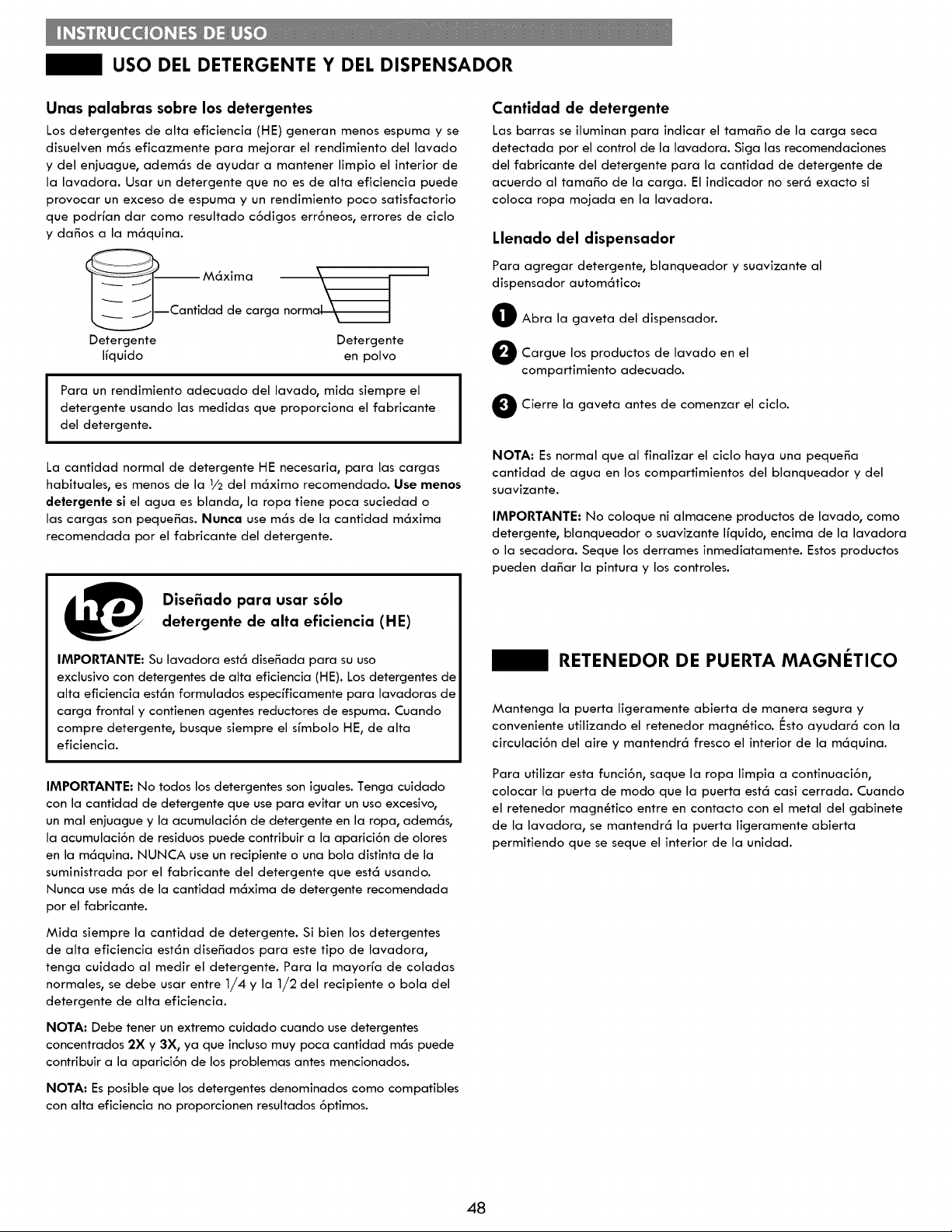
USO DEL DETERGENTE Y DEL DISPENSADOR
Unas palabras sobre los detergentes
Los detergentes de alta eficiencia (HE) generan menos espuma y se
disuelven m6s eficazmente para mejorar el rendimiento del lavado
y del enjuague, adem6s de ayudar a mantener limpio el interior de
la lavadora. Usar un detergente que no es de alta eficiencia puede
provocar un exceso de espuma y un rendimiento poco satisfactorio
que podrfan dar como resultado c6digos err6neos, errores de ciclo
y dafios a la m6quina.
-- Mdxima I
Cantidad de carga norma! ___
Detergente Detergente
Ifquido en polvo
Para un rendimiento adecuado del lavado, mida siempre el
detergente usando las medidas que proporciona el fabricante
del detergente.
La cantidad normal de detergente HE necesaria, para las cargas
habituales, es menos de la 1/2 del maximo recomendado. Use menos
cletergente $1 el agua es blanda, la ropa tiene poca suciedad o
las cargas son pequefias. Nunca use mas de la cantidad maxima
recomendada por el fabricante del detergente.
Disefiado para usar s61odetergente de alta eficiencia (HE)
IMPORTANTE: Su lavadora esta disefiada para su uso
exclusivo con detergentes de alta eficiencia (HE). Los detergentes de
alta eficiencia estan formulados especfficamente para lavadoras de
carga frontal y contienen agentes reductores de espuma. Cuando
compre detergente, busque siempre el sfmbolo HE, de alta
eficiencia.
IMPORTANTE" No todos los detergentes son iguales. Tenga cuidado
con la cantidad de detergente que use para evitar un uso excesivo,
un mal enjuague y la acumulaci6n de detergente en la ropa, ademas_
la acumulaci6n de residuos puede contribuir a la aparici6n de olores
en la maquina. NUNCA use un recipiente o una bola distinta de la
suministrada por el fabricante del detergente que esta usando.
Nunca use mas de la cantidad maxima de detergente recomendada
por el fabricante.
Mida siempre la cantidad de detergente. Si bien los detergentes
de alta eficiencia estan disefiados para este tipo de lavadora,
tenga cuidado al medir el detergente. Para la mayorfa de coladas
normales, se debe usar entre ]/4 y la ]/2 del recipiente o bola del
detergente de alta eficiencia.
NOTA: Debe tener un extremo cuidado cuando use detergentes
concentrados 2X y 3X, ya que incluso muy poca cantidad mas puede
contribuir a la aparici6n de los problemas antes mencionados.
NOI"A: Es posible que los detergentes denominados como compatibles
con alta eficiencia no proporcionen resultados 6ptimos.
Cantidad de detergente
Las barras se iluminan para indicar el tamafio de la carga seca
detectada por el control de la lavadora. Siga las recomendaciones
del fabricante del detergente para la cantidad de detergente de
acuerdo al tamafio de la carga. El indicador no sera exacto si
coloca ropa mojada en la lavadora.
Llenado del dispensador
Para agregar detergente, blanqueador y suavizante al
dispensador autom6tico:
O Abra la gaveta del dispensador.
O Cargue los de lavado el
productos
en
compartimiento adecuado.
O Cierre la gaveta antes de comenzar el ciclo.
NOTA: Es normal que al finalizar el ciclo haya una pequefia
cantidad de agua en los compartimientos del blanqueador y del
suavizante.
IMPORTANTE: No coloque ni almacene productos de lavado, como
detergente, blanqueador o suavizante Ifquido, encima de la lavadora
o la secadora. Seque los derrames inmediatamente. Estos productos
pueden dafiar la pintura y los controles.
1 RETENEDOR DE PUERTA MAGNI_TICO
Mantenga la puerta ligeramente abierta de manera segura y
conveniente utilizando el retenedor magn_tico. _:sto ayudara con la
circulaci6n del aire y mantendra fresco el interior de la maquina.
Para utilizar esta funci6n, saque la ropa limpia a continuaci6n,
colocar la puerta de modo que la puerta esta casi cerrada. Cuando
el retenedor magn_tico entre en contacto con el metal del gabinete
de la lavadora, se mantendra la puerta ligeramente abierta
permitiendo que se seque el interior de la unidad.
48
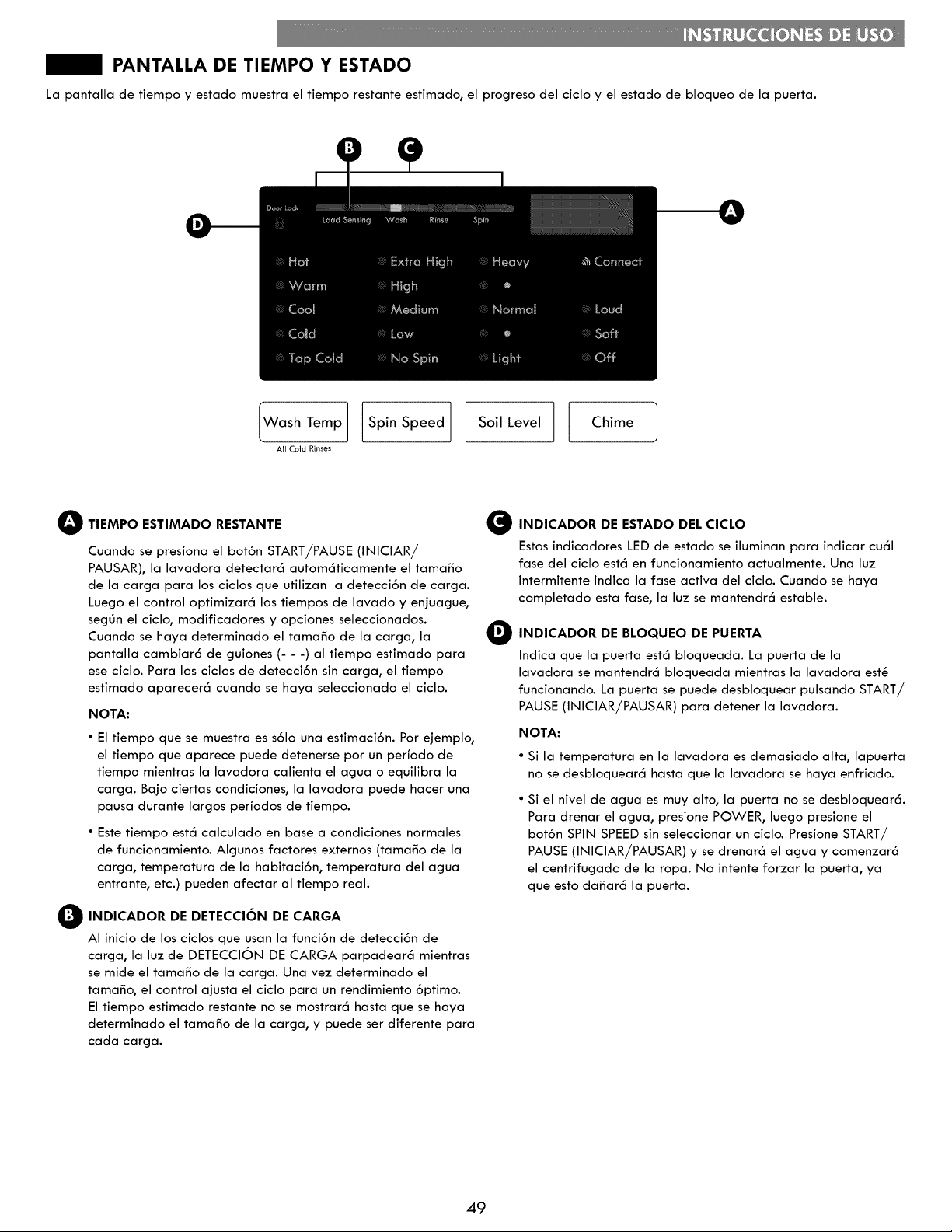
PANTALLA DE TIEMPO Y ESTADO
La pantalla de tiempo y estado muestra el tiempo restante estimado, el progreso del ciclo y el estado de bloqueo de la puerta.
IWashTem0ISpnSpeed]SoiLeve[Chine1
A_I Cold Rinses
O TIEMPO ESTIMADO RESTANTE _1
Cuando se presiona el bot6n START/PAUSE (INICIAR/
PAUSAR), la lavadora detectar6 autom6ticamente el tamafio
de la carga para los ciclos que utilizan la detecci6n de carga.
Luego el control optimizar6 los tiempos de lavado y enjuague,
seg6n el ciclo, modificadores y opciones seleccionados.
Cuando se haya determinado el tamafio de la carga, la
pantalla cambiar6 de guiones (- - -) al tiempo estimado para
ese ciclo. Para los ciclos de detecci6n sin carga, el tiempo
estimado aparecer6 cuando se haya seleccionado el ciclo.
NOTA:
• El tiempo que se muestra es s61o una estimaci6n. Por ejemplo,
el tiempo que aparece puede detenerse por un perfodo de
tiempo mientras la lavadora calienta el agua o equilibra la
carga. Bajo ciertas condiciones, la lavadora puede hacer una
pausa durante largos perfodos de tiempo.
• Este tiempo est6 calculado en base a condiciones normales
de funcionamiento. Algunos factores externos (tamafio de la
carga, temperatura de la habitaci6n, temperatura del agua
entrante, etc.) pueden afectar al tiempo real.
O INDICADOR DE DETECCION DE CARGA
AI inicio de los ciclos que usan la funci6n de detecci6n de
carga, la luz de DETECCI6N DE CARGA parpadear6 mientras
se mide el tamafio de la carga. Una vez determinado el
tamafio, el control ajusta el ciclo para un rendimiento 6ptimo.
El tiempo estimado restante no se mostrar6 hasta que se haya
determinado el tamafio de la carga, y puede ser diferente para
cada carga.
O
INDICADOR DE ESTADO DEL CICLO
Estos indicadores LED de estado se iluminan para indicar cu61
fase del ciclo est6 en funcionamiento actualmente. Una luz
intermitente indica la fase activa del ciclo. Cuando se haya
completado esta fase, la luz se mantendr6 estable.
INDICADOR DE BLOQUEO DE PUERTA
Indica que la puerta est6 bloqueada. La puerta de la
lavadora se mantendr6 bloqueada mientras la lavadora est_
funcionando. La puerta se puede desbloquear pulsando START/
PAUSE (INICIAR/PAUSAR) para detener la lavadora.
NOTA"
• Si la temperatura en la lavadora es demasiado alta, lapuerta
no se desbloquear6 hasta que la lavadora se haya enfriado.
• Si el nivel de agua es muy alto, la puerta no se desbloquear6.
Para drenar el agua, presione POWER, luego presione el
bot6n SPIN SPEED sin seleccionar un ciclo. Presione START/
PAUSE (INICIAR/PAUSAR) y se drenar6 el agua y comenzar6
el centrifugado de la ropa. No intente forzar la puerta, ya
que esto dafiar6 la puerta.
49
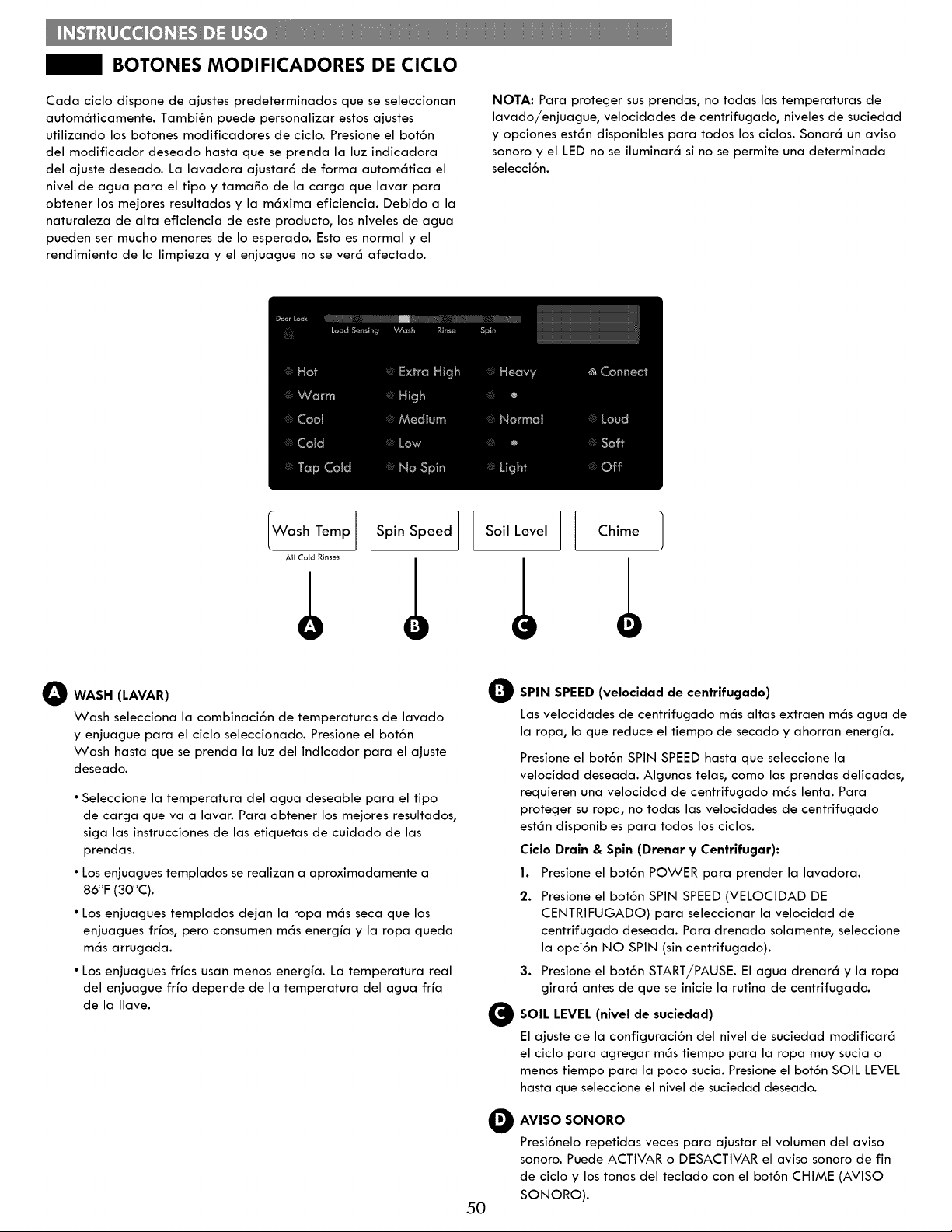
BOTONES MODIFICADORES DE CICLO
Cada ciclo dispone de ajustes predeterminados que se seleccionan
autom6ticamente. Tambi_n puede personalizar estos ajustes
utilizando los botones modificadores de ciclo. Presione el bot6n
del modificador deseado hasta que se prenda la luz indicadora
del ajuste deseado. La lavadora ajustar6 de forma autom6tica el
nivel de agua para el tipo y tama_o de la carga que lavar para
obtener los mejores resultados y la m6xima eficiencia. Debido a la
naturaleza de alta eficiencia de este producto, los niveles de agua
pueden ser mucho menores de Io esperado. Esto es normal y el
rendimiento de la limpieza y el enjuague no se ver6 afectado.
NOTA: Para proteger sus prendas, no todas las temperaturas de
lavado/enjuague, velocidades de centrifugado, niveles de suciedad
y opciones est6n disponibles para todos los ciclos. Sonar6 un aviso
sonoro y el LED no se iluminar6 si no se permite una determinada
selecci6n.
[Washmemp[S0inSpee l[
Atl CoId Rinses
Soil Level
Chime
O WASH (LAVAR)
Wash selecciona la combinaci6n de temperaturas de lavado
y enjuague para el ciclo seleccionado. Presione el bot6n
Wash hasta que se prenda la luz del indicador para el ajuste
deseado.
• Seleccione la temperatura del agua deseable para el tipo
de carga que va a lavar. Para obtener los mejores resultados,
siga las instrucciones de las etiquetas de cuidado de las
prendas.
• Los enjuagues templados se realizan a aproximadamente a
86°F (30°C).
• Los enjuagues templados dejan la ropa m6s seca que los
enjuagues frfos, pero consumen m6s energfa y la ropa queda
m6s arrugada.
• Los enjuagues frfos usan menos energfa. La temperatura real
del enjuague fifo depende de la temperatura del agua frfa
de la Ilave.
O SPIN SPEED (velocidad de centrifugado)
Las velocidades de centrifugado m6s altas extraen m6s agua de
la ropa, Io que reduce el fiempo de secado y ahorran energfa.
Presione el bot6n SPIN SPEED hasta que seleccione la
velocidad deseada. Algunas telas, como las prendas delicadas,
requieren una velocidad de centrifugado m6s lenta. Para
proteger su ropa, no todas las velocidades de centrifugado
est6n disponibles para todos los ciclos.
Ciclo Drain & Spin (Drenar y Centrifugar):
1. Presione el bot6n POWER para prender la lavadora.
2. Presione el bot6n SPIN SPEED (VELOCIDAD DE
CENTRIFUGADO) para seleccionar la velocidad de
centrifugado deseada. Para drenado solamente, seleccione
la opci6n NO SPIN (sin centrifugado).
3. Presione el bot6n START/PAUSE. El agua drenar6 y la ropa
girar6 antes de que se inicie la rutina de centrifugado.
_SOIL LEVEL (nivel de suciedad)
El ajuste de la configuraci6n del nivel de suciedad modificar6
el ciclo para agregar m6s tiempo para la ropa muy sucia o
menos tiempo para la poco sucia. Presione el bot6n SOIL LEVEL
hasta que seleccione el nivel de suciedad deseado.
O
5O
AVISO SONORO
Presi6nelo repetidas veces para ajustar el volumen del aviso
sonoro. Puede ACTIVAR o DESACTIVAR el aviso sonoro de fin
de ciclo y los tonos del teclado con el bot6n CHIME (AVISO
SONORO).

BOTONES DE OPCION
La lavadora incluye varias opciones adicionales
pard adaptar los ciclos a sus necesidades particulares.
_ Prenda la lavadora (posici6n ON) Dire la perilla del selector
Y pard
seleccionar el ciclo deseado.
Use los botones modificadores de ciclo pard configurar los ajustes
pard ese ciclo.
Presione los botones de opci6n de ciclo las opciones desee
pard que
agregar. El bot6n se prenderd cuando seleccione la opci6n. Pard
las funciones secundarias, mantenga presionado el bot6n por cinco
segundos. La luz LED parpadeard cuando se seleccione la opci6n
secundaria. No se pueden seleccionar ambas opciones al mismo
tiempo.
O Si opci6n no se permite pard ciclo,
la seleccionada el el aviso sonard
dos veces pard alertarle y el LED no se iluminard.
Presione el bot6n START/PAUSE pard iniciar el ciclo. Despu_s de una
breve demora, la puerta se bloqueard y el ciclo se iniciard.
NOTA= Pard proteger sus prendas, no todas las opciones
estdn disponibles en todos los ciclos.
NOTA= Si no se presiona el bot6n START/PAUSE dentro de cuatro
minutos, el control se apagard y los ajustes se perderdn.
DELAY START (INICIO DEMORADO)
] Una vez que haya seleccionado el ciclo y otros
® Delay Start J ajustes, presione este bot6n pard demorar el
inicio del ciclo de lavado. Cada vez que se
presiona el bot6n, aumenta el tiempo de demora en una hora, hasta 19
horas. Una vez que se establezca el tiempo de demora, presione el bot6n
START/PAUSE pard comenzar el tiempo de demora.
EXTRA RINSE (enjuague extra)
] Esta opci6n agregard un enjuague extra al
® Extra Rinse J ciclo seleccionado. Use esta opci6n pard
asegurarse de la total eliminaci6n de los
residuos de detergentes o blanqueadores de las telas.
PRE-WASH (PRELAVADO)
] Seleccione esta opci6n parD agregar un
® Pre Wash ] prelavado de 15 minutos, ciclo de enjuague
y centrifugado al ciclo seleccionado. Esto
es especialmente t)til pard las prendas muy sucias.
51
FUNCIONES ESP ECIALES
CONTROL LOCI( (bloqueo de los controles)
1 Utilice esta opci6n para deshabilitar los
® Control LockJ_ 1 controles. La lavadora s61o se puede bloquear
durante un ciclo. Esta funci6n impide que los
ni_os cambien los ciclos o manejen la
mdquina. Una vez activado, los controles permanecen bloqueados yes
necesario DESACTIVAR el bloqueo de los controles antes de poder
utilizar los controles nuevamente. Una vez apagada la lavadora, el
bot6n de alimentaci6n permitird prender la mdquina, pero los controles
continuardn bloqueados. Si los controles estdn bloqueados, se iluminard
el LED de CONTROL LOCI( y en la pantalla se alternardn las letras "CL"
con el tiempo del ciclo estimado. Mantenga presionado el bot6n
CONTROL LOCI( per tres segundos para activar o desactivar los
controles.
CLEAN WASHER (limpiar lavadora)
] El ciclo CLEAN WASHER est6 especialmente
® Clean WasherJ diseSado para eliminar esta acumulaci6n
usando blanqueador u otro limpiador diseSado
especfficamente para la limpieza de lavadoras
de carga frontal. Utilice el ciclo CLEAN WASHER una vez al mes, o mds a
menudo en condiciones de uso intensivo, o si advierte la presencia de
olores.
Encienda la lavadora y presione el bot6n CLEAN WASHER. La
selecci6n de cualquier otro ciclo despu_s de haber seleccionado
CLEAN WASHER hard que se cancele el ciclo CLEAN WASHER.
Rellene el dispensador de blanqueador hasta la Ifnea MAX
con
blanqueador con cloro Ifquido. No sobrellene el dispensador
de blanqueador. El sobrellenado puede causar que el blanqueador
se dispense inmediatamente.
NOTA: Para otros productos de limpieza de tinas, siga las
instrucciones y recomendaciones del fabricante del limpiador.
Agregue los productos de limpieza en polvo al compartimiento
de lavado principal de la gaveta del dispensador. Coloque los
limpiadores en tabletas directamente en la tina.
Presione el bot6n START/PAUSE para que comience el ciclo.
Cuando finalice el ciclo, abra la puerta y deje que el interior
de la tina se seque completamente.
NOTA: NO use este ciclo con ropa y NO agregue detergente
ni suavizante.
AUTO SOAR (REMOJO AUTOMATICO)
] Use la opci6n AUTO SOAK para remojar
® Auto Soak J previamente las prendas con el fin de
eliminar las manchas diffciles de las
prendas. Esta opci6n proporciona un
remojado previo de 30 minutos antes de que comience el ciclo
seleccionado. AI final del tiempo de remojo previo, el ciclo
seleccionado utilizar6 la misma agua.
52
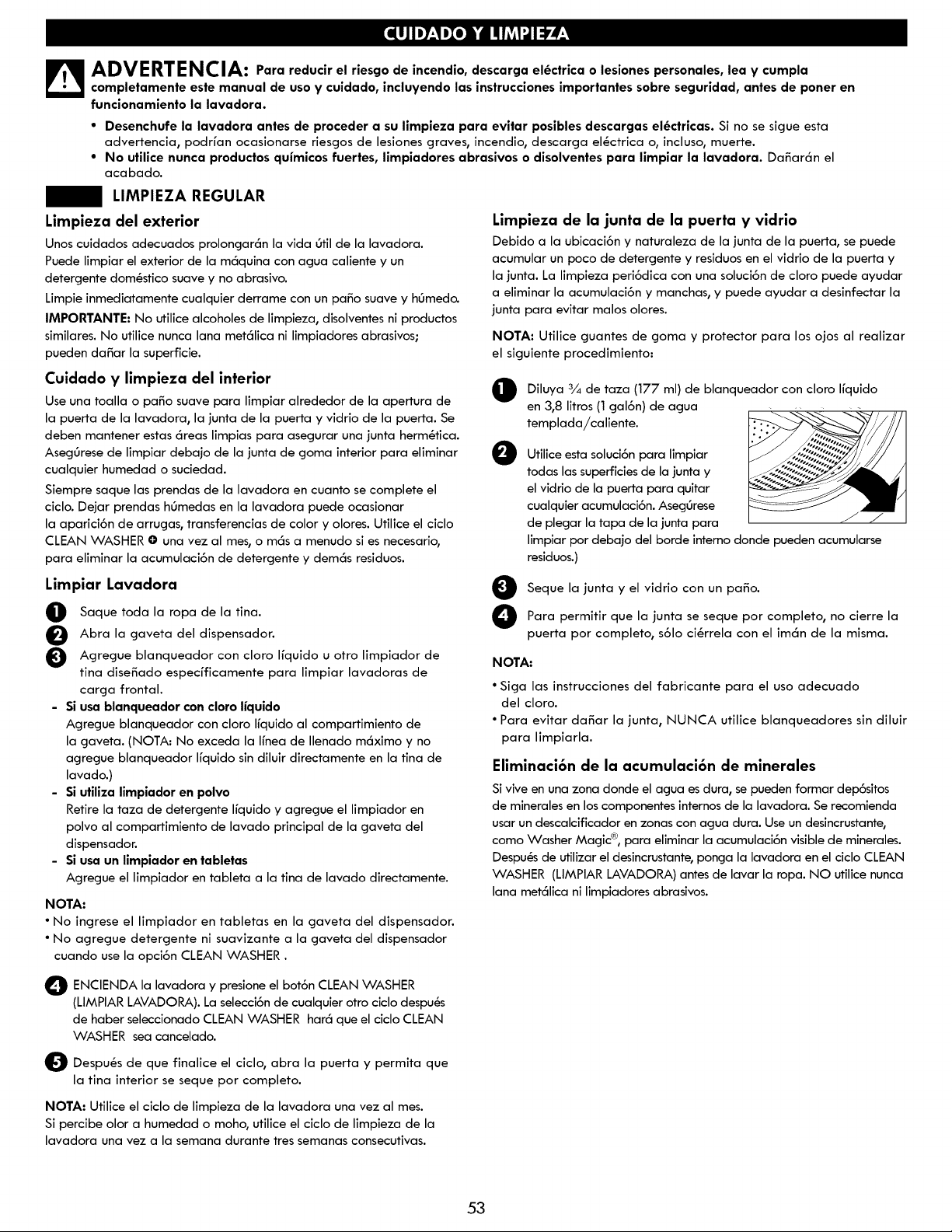
ADVERTENCIA: Para reducir el riesgo de incendio, descarga el_ctrica o lesiones personales, lea y cumpla
cornpletarnente este manual de usa y cuidado, incluyendo las instruccionesirnportantes sabre seguridad, antes de porter en
funcionarniento la lavadora.
• Desenchufe la lavadora antes de proceder a su limpieza para evitar posibles descargas el_ctricas. Si no se sigue esta
advertencia, podrfan ocasionarse riesgos de lesiones graves, incendio, descarga el_ctrica o, incluso, muerte.
• No utilice nunca productos quimicos fuertes, limpiadores abrasivos o disalventes para limpiar la lavadora. Da_ardn el
acabado.
LIMPIEZA REGULAR
Limpieza del exterior
Unos cuidados adecuados prolongardn la vida _)tilde la lavadora.
Puede limpiar el exterior de la mdquina con agua caliente y un
detergente dom_stico suave y no abrasivo.
Limpie inmediatamente cualquier derrame con un paso suave y h_)medo.
IMPORTANTE: No utilice alcoholes de limpieza, disolventes ni productos
similares. No utilice nunca lana metdlica ni limpiadores abrasivos;
pueden da_ar la superficie.
Cuidado y limpieza del interior
Use una toalla o paso suave para limpiar alrededor de la apertura de
la puerta de la lavadora, la junta de la puerta y vidrio de la puerta. Se
deben mantener estas dreas limpias para asegurar una junta herm_tica.
Aseg0rese de limpiar debajo de la junta de goma interior para eliminar
cualquier humedad o suciedad.
Siempre saque las prendas de la lavadora en cuanto se complete el
ciclo. Dejar prendas h0medas en la lavadora puede ocasionar
la aparici6n de arrugas, transferencias de color y olores. Utilice el ciclo
CLEAN WASHER O una vez al mes, o mds a menudo si es necesario,
para eliminar la acumulaci6n de detergente y demds residuos.
Limpiar Lavadora
O
O
O
Saque toda la ropa de la tina.
Abra la gaveta del dispensador.
Agregue blanqueador con cloro Ifquido u otro limpiador de
tina dise_ado especfficamente para limpiar lavadoras de
carga frontal.
Si usa blanqueador con cloro liquido
Agregue blanqueador con cloro Ifquido al compartimiento de
la gaveta. (NOTA: No exceda la Ifnea de Ilenado mdximo y no
agregue blanqueador Ifquido sin diluir directamente en la tina de
lavado.)
Si utiliza limpiador en polvo
Retire la taza de detergente Ifquido y agregue el limpiador en
polvo al compartimiento de lavado principal de la gaveta del
dispensador.
Si usa un limpiador en tabletas
Agregue el limpiador en tableta a la tina de lavado directamente.
NOTA:
• No ingrese el limpiador en tabletas en la gaveta del dispensador.
• No agregue detergente ni suavizante a la gaveta del dispensador
cuando use la opci6n CLEAN WASHER.
Limpieza de la junta de la puerta y vidrio
Debido a la ubicaci6n y naturaleza de la junta de la puerta, se puede
acumular un poco de detergente y residuos en el vidrio de la puerta y
la junta. La limpieza peri6dica con una soluci6n de cloro puede ayudar
a eliminar la acumulaci6n y manchas, y puede ayudar a desinfectar la
junta para evitar malos olores.
NOTA: Utilice guantes de goma y protector para los ojos al realizar
el siguiente procedimiento:
Diluya 3¼ de
en 3,8 litros (1 gal6n) de agua
templada/caliente.
O
O
O
taza (177 ml) de blanqueador con cloro Ifquido
Utilice esta soluci6n para limpiar
todas las superficies de la junta y
el vidrio de la puerta para quitar
cualquier acumulaci6n. AsegOrese
de plegar la tapa de la junta para
limpiar per debajo del borde interno donde pueden acumularse
residuos.)
Seque la junta y el vidrio con un pa_o.
Para permitir que la junta se seque por completo, no cierre la
puerta por completo, s61o ci_rrela con el imdn de la misma.
NOTA"
• Siga las instrucciones del fabricante para el uso adecuado
del cloro.
• Para evitar da_ar la junta, NUNCA utilice blanqueadores sin diluir
para limpiarla.
Eliminaci6n de la acumulaci6n de minerales
Si vive en una zona donde el agua es dura, se pueden formar dep6sitos
de minerales en los componentes internos de la lavadora. Se recomienda
usar un descalcificador en zonas con agua dura. Use un desincrustante,
como Washer Magic ®, para eliminar la acumulaci6n visible de minerales.
Despu6s de utilizar el desincrustante, ponga la lavadora en el ciclo CLEAN
WASHER (LIMPIAR LAVADORA) antes de lavar la ropa. NO utilice nunca
lana metdlica ni limpiadores abrasivos.
O ENCIENDA la lavadora el bot6n CLEAN WASHER
presione
Y
(LIMPIAR LAVADORA). La selecci6n de cualquier otro ciclo despu_s
de haber seleccionado CLEAN WASHER har6 que el ciclo CLEAN
WASHER sea cancelado.
O Despu_s de que finalice el ciclo, abra la puerta y permita que
la tina interior se seque por completo.
NOTA: Utilice el ciclo de limpieza de la lavadora una vez al mes.
Si percibe olor a humedad o moho, utilice el ciclo de limpieza de la
lavadora una vez a la semana durante tres semanas consecutivas.
53
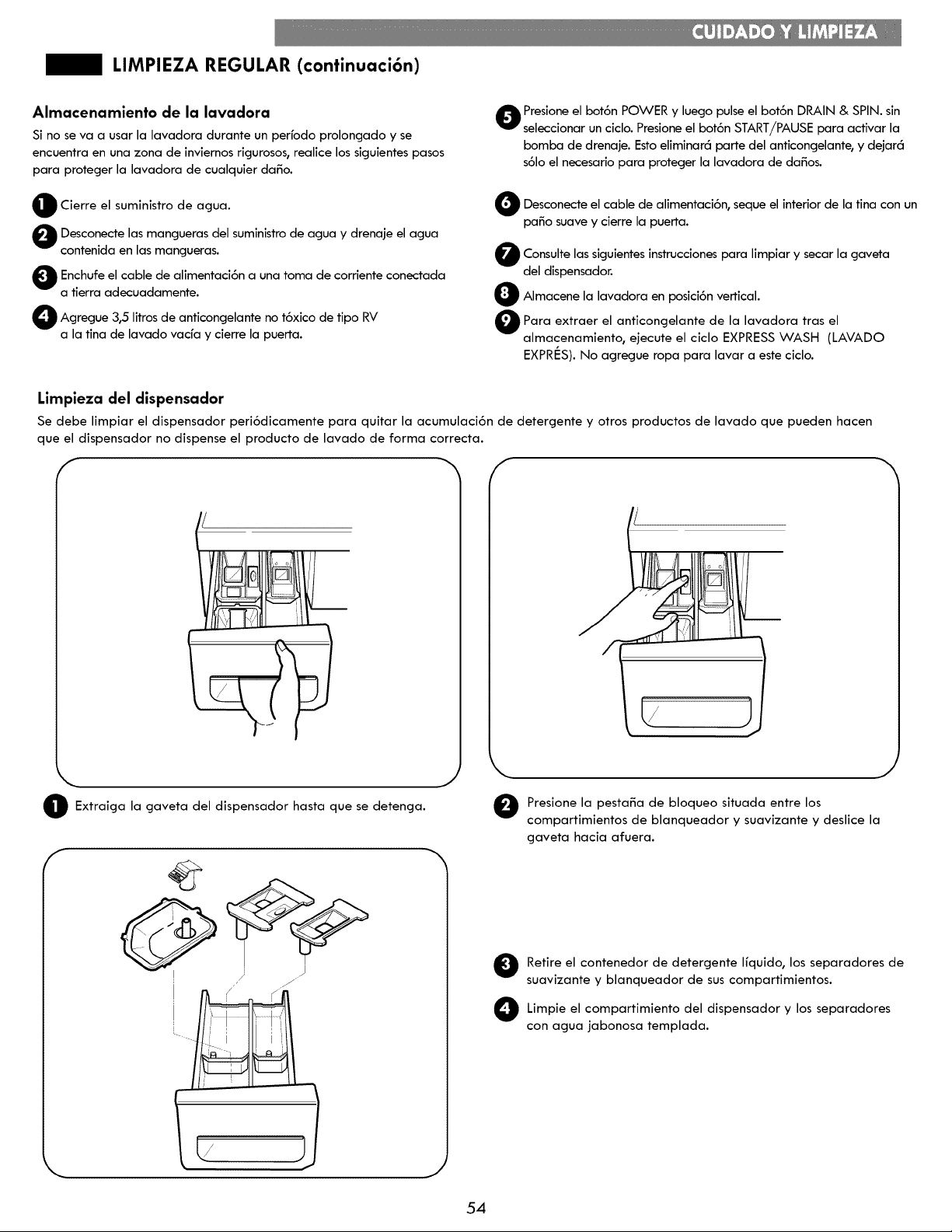
LIMPIEZA REGULAR (continuaci6n)
Almacenamiento de la lavadora
Si no se va a usar la lavadora durante un perfodo prolongado y se
encuentra en una zona de inviernos rigurosos, realice los siguientes pasos
para proteger la lavadora de cualquier dafio.
_ Cierre el suministro de agua.
Desconecte las mangueras del suministro de agua y drenaje el agua
contenida en las mangueras.
O nchufe el cable de alimentaci6n a una toma de corriente conectada
a tierra adecuadamente.
O Agregue 3,5 litros de anticongelante no t6xico de tipo RV
a la tina de lavado vacfa y cierre la puerta.
Presione el bot6n POWER y luego pulse el bot6n DRAIN & SPIN. sin
seleccionar un ciclo. Presione el bot6n START/PAUSE para activar la
bomba de drenaje. Esto eliminar6 parte del anticongelante, y dejar6
s61oel necesario para proteger la lavadora de dafios.
Desconecte el cable de el interior de la tina
alimentaci6n,
seque
con un
patio suave y cierre la puerta.
O Consulte siguientes para limpiar y secar gaveta
las instrucciones la
del dispensador.
O Almacene la lavadora en posici6n vertical.
O Para extraer el de la lavadora tras el
anticongelante
olmacenamiento, ejecute el ciclo EXPRESS WASH (LAVADO
EXPRI_S). No agregue ropa para lavar a este ciclo.
Limpieza del dispensador
Se debe limpiar el dispensador peri6dicamente para quitar la acumulaci6n de detergente y otros productos de lavado que pueden hacen
que el dispensador no dispense el producto de lavado de forma correcta.
f _ f
O Extraiga gaveta dispensador que se detenga.
la del hasta
f
i
t
J
J
Presione la pestafia de bloqueo situada entre los
compartimientos de blanqueador y suavizante y deslice la
gaveta hacia afuera.
O etire el contenedor de detergente Ifquido, los separadores de
suavizante y blanqueador de sus compartimientos.
O Limpie compartimiento dispensador y separadores
el del los
con agua jabonosa templada.
54
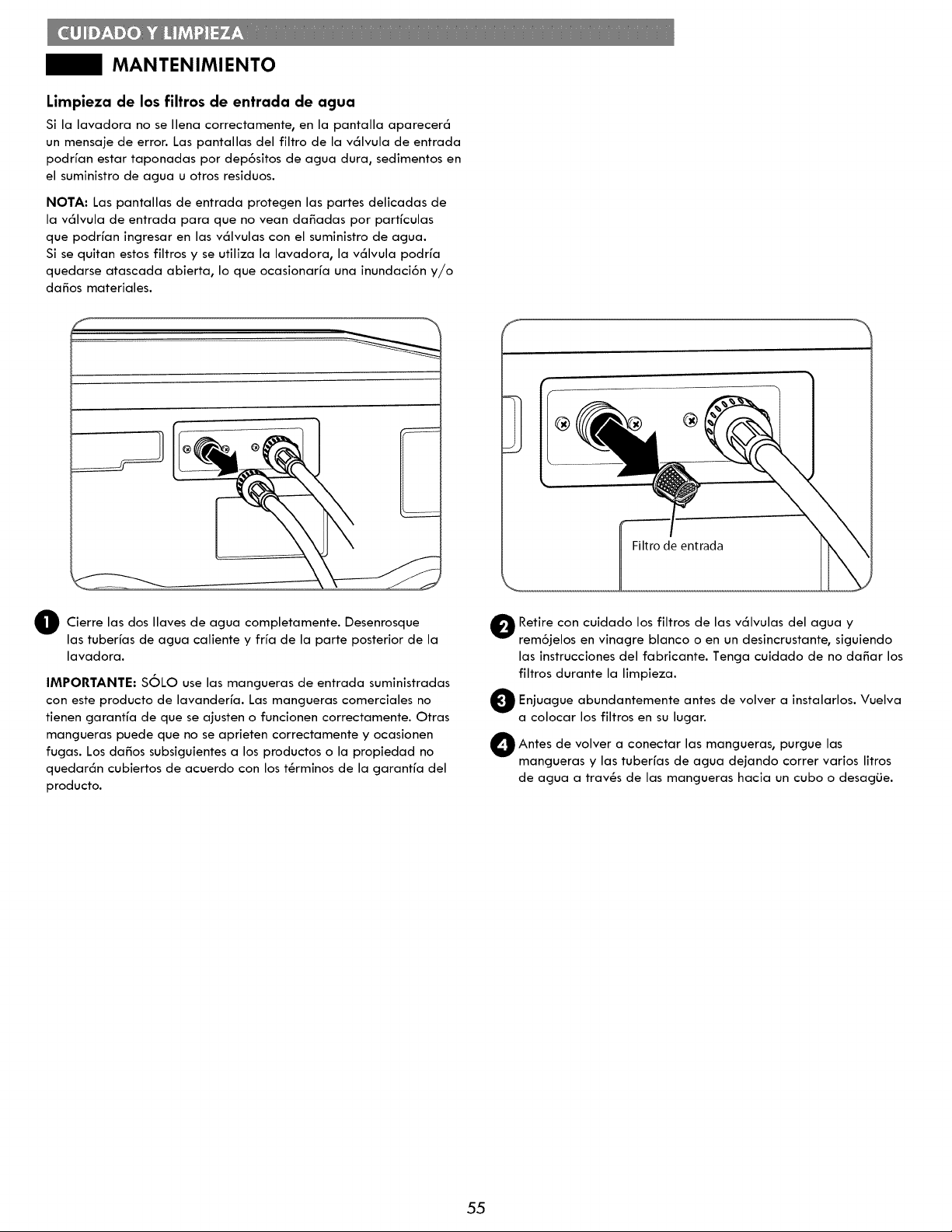
MANTENIMIENTO
Limpieza de los filtros de entrada de agua
Si la lavadora no se Ilena correctamente, en la pantalla aparecer6
un mensaje de error. Las pantallas del filtro de la v61vula de entrada
podrfan estar taponadas por dep6sitos de agua dura, sedimentos en
el suministro de agua u otros residuos.
NOTA: Las pantallas de entrada protegen las partes delicadas de
la v61vula de entrada para que no vean dafiadas por partfculas
que podrfan ingresar en las v61vulas con el suministro de agua.
Si se quitan estos filtros y se utiliza la lavadora, la v61vula podrfa
quedarse atascada abierta, Io que ocasionarfa una inundaci6n y/o
dafios materiales.
F
@
Filtro de entrada
Cierre las dos Ilaves de
completamente. Desenrosqueoguo
lastuberfasde oguo calientey frfade la porte posteriorde la
lavodoro.
IMPORTANTE" SOLO use las mangueras de entrada suministradas
con este producto de lavanderfa. Las mangueras comerciales no
tienen garantfa de que se ajusten o funcionen correctamente. Otras
mangueras puede que no se aprieten correctamente y ocasionen
fugas. Los dafios subsiguientes a los productos o la propiedad no
quedar6n cubiertos de acuerdo con los t_rminos de la garantfa del
producto.
Retire con cuidado los filtros de las v61vulas del
agua Y
rem6jelos en vinagre blanco o en un desincrustante, siguiendo
las instrucciones del fabricante. Tenga cuidado de no dafiar los
filtros durante la limpieza.
O Enjuague abundantemente antes de volver instalarlos. Vuelva
a
a colocar los filtros en su lugar.
O Antes de volver conectar las las
a
mangueros, purgue
mangueras y las tuberfas de agua dejando correr varios litros
de agua a trav_s de las mangueras hacia un cubo o desagOe.
55

/ MANTENIMIENTO (continuaci6n)
Limpieza del filtro de bomba de drenaje
La lavadora est_ equipada con un filtro que ayuda a evitar que el exceso
de pelusa y objetos extrafios como botones, Ilaves y monedas ocasionen
dafios a la bomba. Si la lavadora no drena correctamente, desconecte
la lavadora y deje que el agua se enfrfe, si es necesario, antes del
procedimiento.
O Abra el panel de acceso al filtro de la bomba de drenaje.
Enchufe
b
,. j
ORetire el conector de la de el
drenaje permita
manguera Y que
agua drene por completo.
NOTA: Si hay una gran cantidad de agua en la tina, puede que
tenga que vaciar el recipiente varias veces.
Manguera
de drenaje
O Desconecte la de tire de ella.
drenaje Coloquemanguera Y
el extremo de la bomba de drenaje en un recipiente llano o
en el desag0e del suelo. Asegt)rese de no tirar demasiado la
manguera, o es posible que no drene de manera adecuada.
O Gire el filtro de la bomba hacia la izquierda retirarlo.
para
Elimine cualquier pelusa y objeto extrafio del filtro de la
bomba. Vuelva a colocar el filtro de la bomba en la apertura
y gire a la derecha para asegurarlo. Aseg_)rese de cerrar el
panel de acceso al filtro de la bomba de drenaje.
56
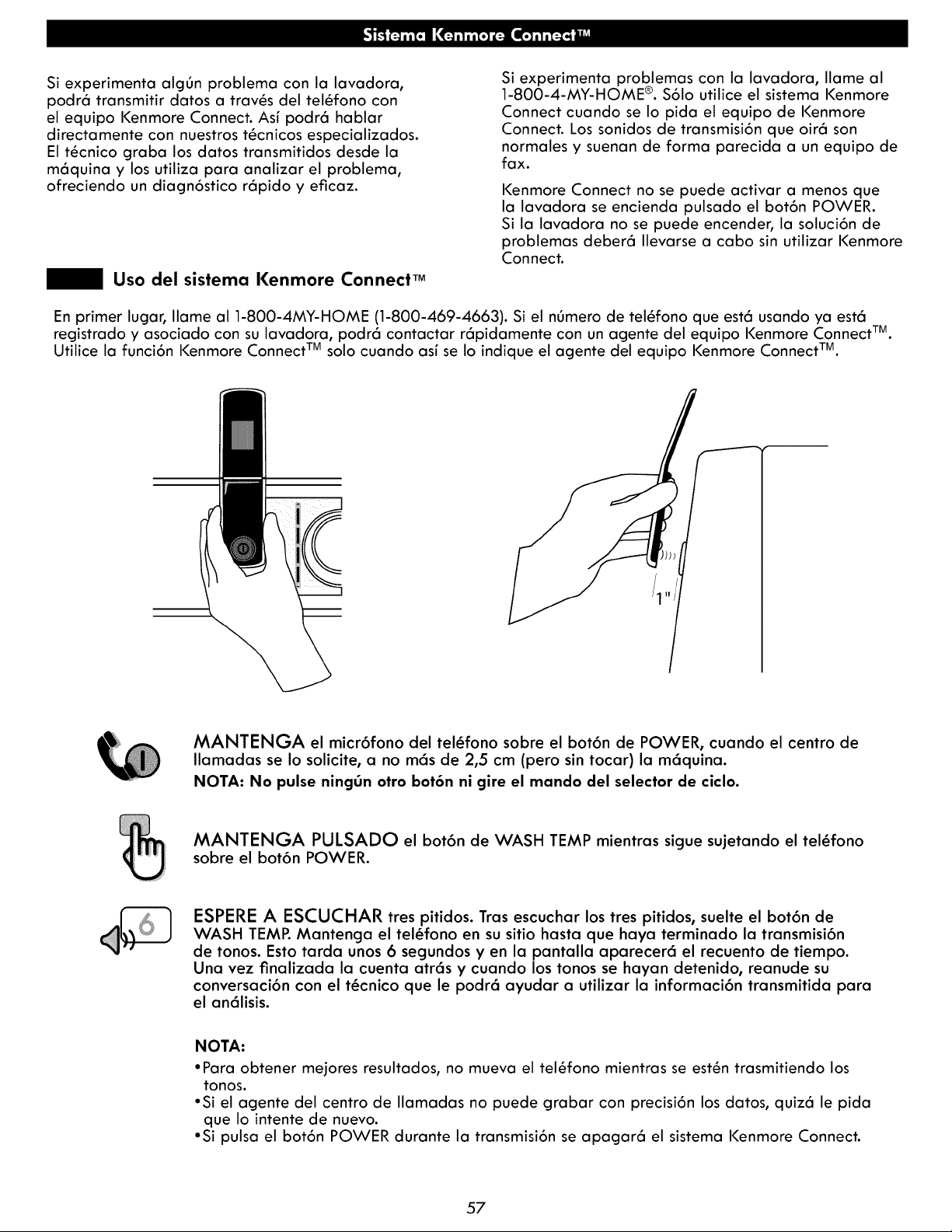
Si experimenta algOn problema con la lavadora,
podr6 transmitir datos a trav6s del tel6fono con
el equipo Kenmore Connect. Asi podr6 hablar
directamente con nuestros t6cnicos especializados.
El t6cnico graba los datos transmitidos desde la
m6quina y los utiliza para analizar el problema,
ofreciendo un diagn6stico r6pido y eficaz.
Uso del sistema Kenmore Connect TM
Si experimenta problemas con la lavadora, Ilame al
1-800-4-MY-HOME ®. $61o utilice el sistema Kenmore
Connect cuando se Io pida el equipo de Kenmore
Connect. Los sonidos de transmisi6n que oir6 son
normales y suenan de forma parecida a un equipo de
fax.
Kenmore Connect no se puecle activar a menos que
la lavadora se encienda pulsado el bot6n POWER.
Si la lavadora no se puede encender, la soluci6n de
problemas deber6 Ilevarse a cabo sin utilizar Kenmore
Connect.
En primer lugar, Ilame al 1-800-4MY-HOME (1-800-469-4663). Si el nOmero de tel6fono que est6 usando ya est6
registrado y asociado con su lavadora, podr6 contactar r6pidamente con un agente del equipo Kenmore Connect TM.
Utilice la funci6n Kenmore Connect TM solo cuando asi se Io indique el agente del equipo Kenmore Connect TM.
/
MANTENGA el micr6fono clel tel@fono sobre el bot6n de POWER, cuanclo el centro de
Ilamaclas se Io solicite, a no m6s de 2,5 cm (pero sin tocar) la m6quina.
NOTA: No pulse ningOn otro bot6n ni gire el mando del selector de ciclo.
MANTENGA PULSADO el bot6n de WASH TEMP mientras sigue sujetanclo el tel@fono
sobre el bot6n POWER.
ESPERE A ESCUCHAR tres pitidos. Tras escuchar los tres pitidos, suelte el bot6n de
WASH TEMP. Mantenga el tel@fono en su sitio hasta que haya terminado la transmisi6n
de tonos. Esto tarda unos 6 segundos y en la pantalla aparecer6 el recuento de tiempo.
Una vez finalizada la cuenta atr6s y cuando los tonos se hayan detenido, reanude su
conversaci6n con el t@cnico que le podr6 ayudar a utilizar la informaci6n transmitida para
el an61isis.
NOTA:
• Para obtener mejores resultados, no mueva el tel6fono mientras se est6n trasmitiendo los
tonos.
• Si el agente del centro de Ilamadas no puede grabar con precisi6n los datos, quiz6 le pida
que Io intente de nuevo.
• Si pulsa el bot6n POWER durante la transmisi6n se apagar6 el sistema Kenmore Connect.
57
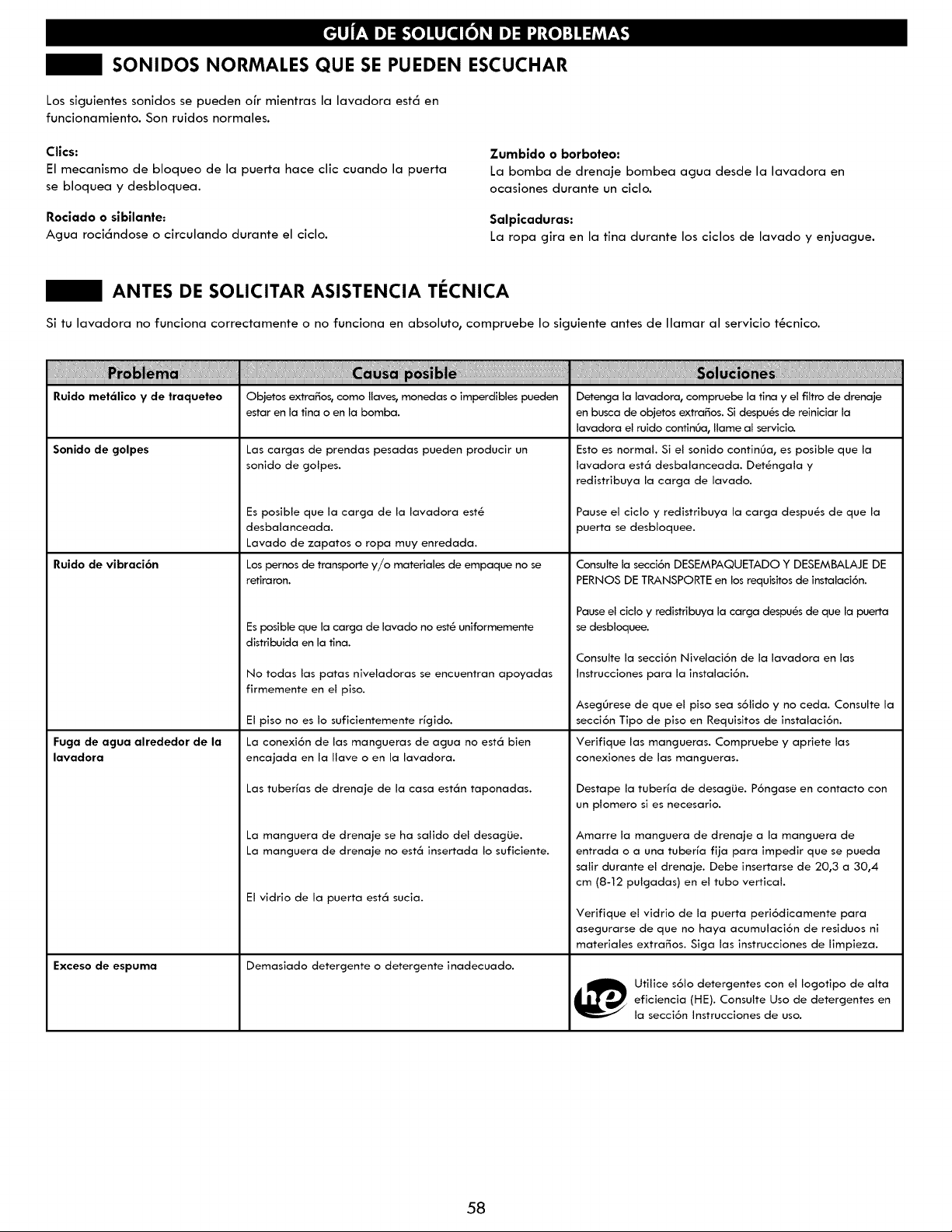
SONIDOS NORMALES QUE SE PUEDEN ESCUCHAR
Los siguientes sonidos se pueden ofr mientras la lavadora est6 en
funcionamiento. Son ruidos normales.
Clics"
El mecanismo de bloqueo de la puerta hace clic cuando la puerta
se bloquea y desbloquea.
Rociado o sibilante:
Agua roci6ndose o circulando durante el ciclo.
Zumbido o borboteo:
La bomba de drenaje bombea agua desde la lavadora en
ocasiones durante un ciclo.
Salpicacluras.
La ropa gira en la tina durante los ciclos de lavado y enjuague.
ANTES DE SOLICITAR ASISTENCIA TECNICA
Si tu lavadora no funciona correctamente o no funciona en absoluto, compruebe Io siguiente antes de Ilamar al servicio t6cnico.
Ruido met_lico y de traqueteo Obietos extrafios, como Ilaves, monedas o imperdibles pueden Detenga la lavadora, compruebe la tina y el filtro de drenaie
estar en la tina o en la bomba, en busca de obietos extra_os. Si despu6s de reiniciar la
Sonido de golpes Las cargas de prendas pesadas pueden producir un
sonido de golpes.
Ruido de vibraci6n
Fuga de agua alrecledor de la
lavaclora
Es posible que la carga de la lavadora est6
desbalanceada.
Lavado de zapatos o ropa muy enredada.
Los pernos de transporte y/o materiales de empaque no se
retiraron.
Es posible que la carcja de lavado no est6 uniformemente
distribuida en la tina.
Exceso de espuma
No todas las patas niveladoras se encuentran apoyadas
firmemente en el piso.
El piso no es Io suficientemente rfgido.
La conexi6n de las mangueras de agua no est6 bien
encajada en la Ilave o en la lavadora.
Las tuberfas de drenaje de la casa est6n taponadas.
La manguera de drenaje se ha salido del desagiJe.
La manguera de drenaje no est6 insertada Io suficiente.
El vidrio de la puerta est6 sucia.
Demasiado detergente o detergente inadecuado.
lavadora el ruido continOa, Ilame al servicio.
Esto es normal. Si el sonido continOa, es posible que la
lavadora est6 desbalanceada. Det6ngala y
redistribuya la carga de lavado.
Pause el ciclo y redistribuya la carga despu6s de que la
puerta se desbloquee.
Consulte la secci6n DESEMPAQUETADO Y DESEMBALAJE DE
PERNOS DE TRANSPORTE en los requisitos de instalaci6n.
Pause el ciclo y redistribuya la carga despu6s de que la puerta
se desbloquee.
Consulte la secci6n Nivelaci6n de la lavadora en las
Instrucciones para la instalaci6n.
AsegOrese de que el piso sea s61ido y no ceda. Consulte la
secci6n Tipo de piso en Requisitos de instalaci6n.
Verifique las mangueras. Compruebe y apriete las
conexiones de las mangueras.
Destape la tuberfa de desagiJe. P6ngase en contacto con
un plomero si es necesario.
Amarre la manguera de drenaje a la manguera de
entrada o a una tuberfa fija para impedir que se pueda
salir durante el drenaje. Debe insertarse de 20,3 a 30,4
cm (8-12 pulgadas) en el tubo vertical.
Verifique el vidrio de la puerta peri6dicamente para
asegurarse de que no haya acumulaci6n de residuos ni
materiales extrafios. Siga las instrucciones de limpieza.
Utilice s61o detergentes con el Iogotipo de alta
eficiencia (HE). Consulte Uso de detergentes en
la secci6n Instrucciones de uso.
58
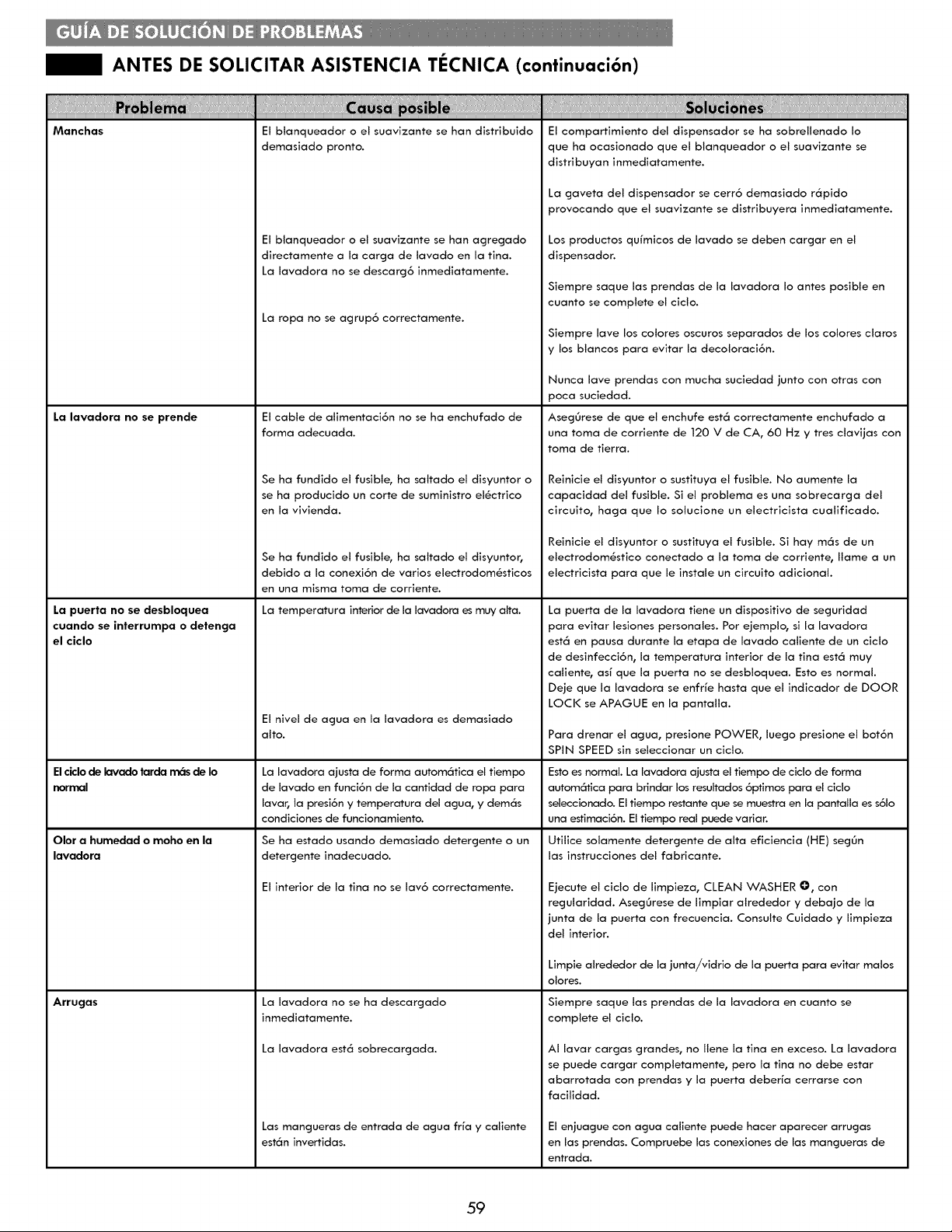
ANTES DE SOLICITAR ASISTENCIA TIECNICA (continuaci6n)
! J ! !
Manchas
La lavadora no se prende
El blanqueador o el suavizante se han distribuido
La puerta no se desbloquea
cuando se interrumpa o detenga
el ciclo
Elcidode la-vadotarda rn_sde Io
normal
Olor a humedad o moho en la
lavadora
Arrugas
demasiado pronto.
El blanqueador o el suavizante se han agregado
directamente a la carga de lavado en la tina.
La lavadora no se descarg6 inmediatamente.
La ropa no se agrup6 correctamente.
El cable de alimentaci6n no se ha enchufado de
forma adecuada.
Se ha fundido el fusible, ha saltado el disyuntor o
se ha producido un corte de suministro el6ctrico
en la vivienda.
Se ha fundido el fusible, ha saltado el disyuntor,
debido a la conexi6n de varios electrodom6sticos
en una misma toma de corriente.
La temperatura interior de la lavadora es muy alta.
El nivel de agua en la lavadora es demasiado
alto.
La lavadora ajusta de forma autom6tica el tiempo
de lavado en funci6n de la cantidad de ropa para
lavar, la presi6n y temperatura del agua, y dem6s
condiciones de funcionamiento.
Se ha estado usando demasiado detergente o un
detergente inadecuado.
El interior de la tina no se lav6 correctamente.
La lavadora no se ha descargado
inmediatamente.
La lavadora est6 sobrecargada.
Las mangueras de entrada de agua frfa y caliente
est6n invertidas.
El compartimiento del dispensador se ha sobrellenado Io
que ha ocasionado que el blanqueador o el suavizante se
distribuyan inmediatamente.
La gaveta del dispensador se cerr6 demasiado r6pido
provocando que el suavizante se distribuyera inmediatamente.
Los productos qufmicos de lavado se deben cargar en el
dispensador.
Siempre saque las prendas de la lavadora Io antes posible en
cuanto se complete el ciclo.
Siempre lave los colores oscuros separados de los colores claros
y los blancos para evitar la decoloraci6n.
Nunca lave prendas con mucha suciedad junto con otras con
poca suciedad.
AsegOrese de que el enchufe est6 correctamente enchufado a
una toma de corriente de 120 V de CA, 60 Hz y tres clavijas con
toma de tierra.
Reinicie el disyuntor o sustituya el fusible. No aumente la
capacidad del fusible. Si el problema es una sobrecarga del
circuito, haga que Io solucione un electricista cualificado.
Reinicie el disyuntor o sustituya el fusible. Si hay m6s de un
electrodom6stico conectado a la toma de corriente, Ilame a un
electricista para que le instale un circuito adicional.
La puerta de la lavadora tiene un dispositivo de seguridad
para evitar lesiones personales. Pot ejemplo, si la lavadora
est6 en pausa durante la etapa de lavado caliente de un ciclo
de desinfecci6n, la temperatura interior de la tina est6 muy
caliente, asf que la puerta no se desbloquea. Esto es normal.
Deje que la lavadora se enfrfe hasta que el indicador de DOOR
LOCI( se APAGUE en la pantalla.
Para drenar el agua, presione POWER, luego presione el bot6n
SPIN SPEED sin seleccionar un ciclo.
Esto es normal. La lavadora ajusta el tiempo de ciclo de forma
autom6tica para brindar los resultados 6ptimos para el ciclo
seleccionado. El tiempo restante que se muestra en la pantalla es s61o
una estimaci6n. El tiempo real puede variar.
Utilice solamente detergente de alta eficiencia (HE) segOn
las instrucciones del fabricante.
Ejecute el ciclo de limpieza, CLEAN WASHER O, con
regularidad. AsegOrese de limpiar alrededor y debajo de la
junta de la puerta con frecuencia. Consulte Cuidado y limpieza
del interior.
Limpie alrededor de la junta/vidrio de la puerta para evitar malos
olores.
Siempre saque las prendas de la lavadora en cuanto se
complete el ciclo.
AI lavar cargos grandes, no Ilene la tina en exceso. La lavadora
se puede cargar completamente, pero la tina no debe estar
abarrotada con prendas y la puerta deberfa cerrarse con
facilidad.
El enjuague con agua caliente puede hacer aparecer arrugas
en las prendas. Compruebe las conexiones de las mangueras de
entrada.
59
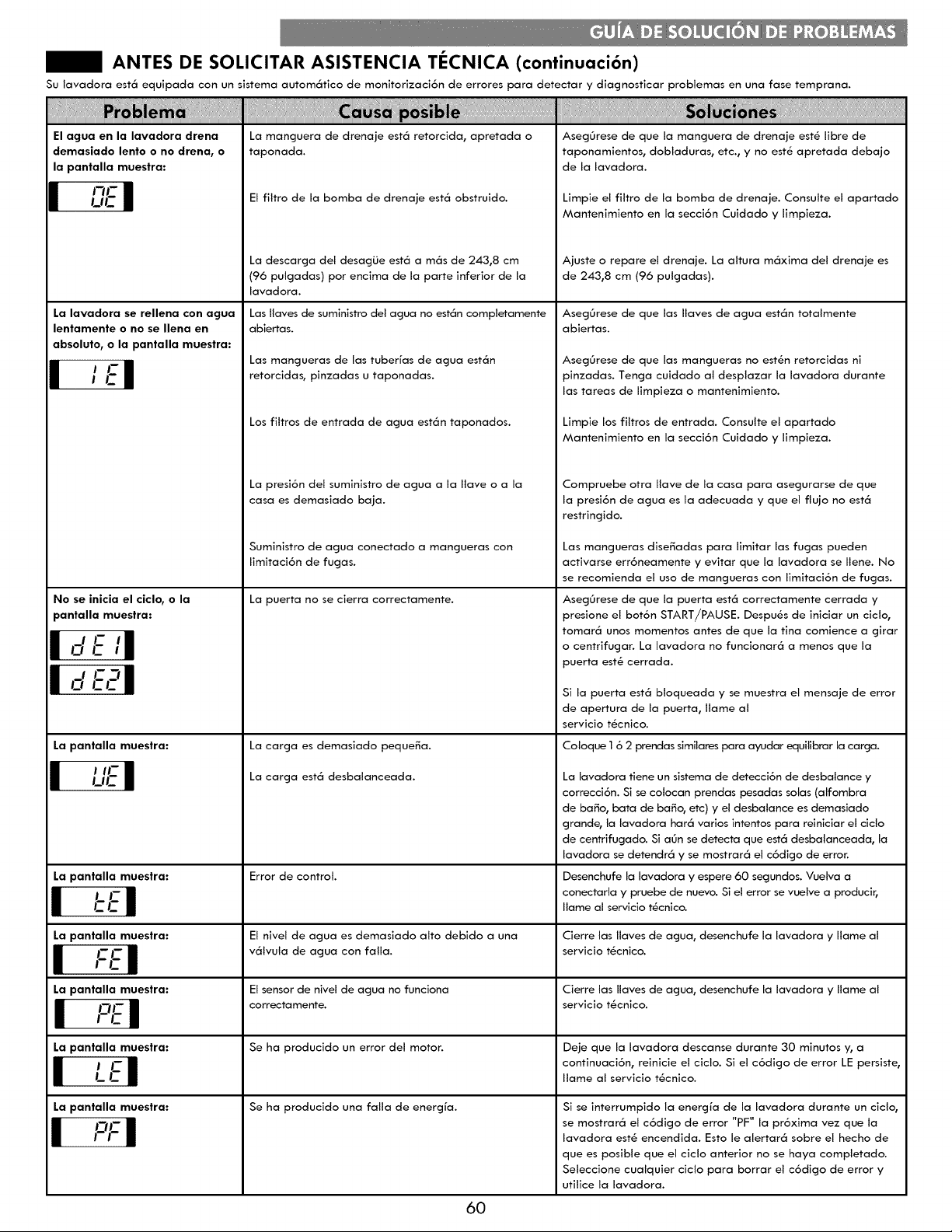
ANTES DE SOLICITAR ASISTENCIA TI_CNICA (continuaci6n)
Su lavadora est6 equipada con un sistema autom6tico de monitorizaci6n de errores para detectar y diagnosticar problemas en una fase temprana.
El agua en la lavadora drena
demasiado lento o no drena, o
la pantalla muestra:
I-II-,_,,:!1
La lavadora se rellena con agua
lentamente o no se Ilena en
absoluto, o la pantalla muestra:
I tE!
No se inicia el ciclo, o la
pantalla muestra:
I JE!!
I ,_l ,_-L-!
La pantalla muestra:
I I II-,_,,:|
La pantalla muestra:
! "-!1212
La pantalla muestra:
I '-'-,-,:|
La pantalla muestra:
/_71--'-':1
La pantalla muestra:
I "-,_,:|
La pantalla muestra:
I PFI
La manguera de drenaje est6 retorcida, apretada o
taponada.
El filtro de la bomba de drenaje est6 obstruido.
La descarga del desagi.ie est6 a m6s de 243,8 cm
(96 pulgadas) por encima de la parte inferior de la
lavadora.
Las Ilaves de suministro del agua no est6n completamente
abiertas.
Las mangueras de las tuberfas de agua est6n
retorcidas, pinzadas u taponadas.
Los filtros de entrada de agua est6n taponados.
La presi6n del suministro de agua a la Ilave o a la
casa es demasiado baja.
Suministro de agua conectado a mancjueras con
limitaci6n de fugas.
La puerta no se cierra correctamente.
La carga es demasiado peque_a.
La carcja est6 desbalanceada.
Error de control.
El nivel de agua es demasiado alto debido a una
v61vula de agua con falla.
El sensor de nivel de agua no funciona
correctamente.
Se ha producido un error del motor.
Se ha producido una falla de energfa.
Aseg0rese de que la manguera de drenaje est6 libre de
taponamientos, dobladuras, etc., y no est6 apretada debajo
de la lavadora.
Limpie el filtro de la bomba de drenaje. Consulte el apartado
Mantenimiento en la secci6n Cuidado y limpieza.
Ajuste o repare el drenaje. La altura m6xima del drenaje es
de 243,8 cm (96 pulgadas).
AsegOrese de que las Ilaves de agua est6n totalmente
abiertas.
AsegOrese de que las mangueras no est6n retorcidas ni
pinzadas. Tenga cuidado al desplazar la lavadora durante
las tareas de limpieza o mantenimiento.
Limpie los filtros de entrada. Consulte el apartado
Mantenimiento en la secci6n Cuidado y limpieza.
Compruebe otra Ilave de la casa para asegurarse de que
la presi6n de agua es la adecuada y que el flujo no est6
restringido.
Las mangueras dise_adas para limitar las fugas pueden
activarse err6neamente y evitar que la lavadora se Ilene. No
se recomienda el uso de mangueras con limitaci6n de fugas.
AsegOrese de que la puerta est6 correctamente cerrada y
presione el bot6n START/PAUSE. Despu_s de iniciar un cicto,
tomar6 unos momentos antes de que la tina comience a girar
o centrifugar. La lavadora no funcionar6 a menos que la
puerta est_ cerrada.
Si la puerta est6 bloqueada y se muestra el mensaje de error
de apertura de la puerta, Ilame al
servicio t6cnico.
Coloque 1 6 2 prendas similares para awdar equilibrar la carga.
La lavadora tiene un sistema de detecci6n de desbalance y
correcci6n. Si se colocan prendas pesadas solas (alfombra
de ba_o, bata de ba_o, etc) y el desbalance es demasiado
grande, la lavadora bar6 varios intentos para reiniciar el ciclo
de centrifugado. Si aOn se detecta que est6 desbalanceada, la
lavadora se detendr6 y se mostrar6 el c6digo de error.
Desenchufe la lavadora y espere 60 segundos. Vuelva a
conectarla y pruebe de nuevo. Si el error se vuelve a producir,
Ilame al servicio t_cnico.
Cierre las Ilaves de agua, desenchufe la lavadora y Ilame al
servicio t6cnico.
Cierre las Ilaves de agua, desenchufe la lavadora y Ilame al
servicio t6cnico.
Deje que la lavadora descanse durante 30 minutos y, a
continuaci6n, reinicie el ciclo. Si el c6digo de error LE persiste,
Ilame al servicio t6cnico.
Si se interrumpido la energ_a de la lavadora durante un ciclo,
se mostrar6 el c6digo de error "PF" la pr6xima vez que la
lavadora est& encendida. Esto le alertar6 sobre el hecho de
que es posible que el ciclo anterior no se haya completado.
Seleccione cualquier ciclo para borrar el c6digo de error y
utilice la lavadora.
6O
f_Garantia limitada de Kenmore
POR UN AIqlO a partir de la fecha de venta, este electrodom6stico est6 cubierto por la garanfia
contra defectos de material o mano de obra cuando la instalaci6n, operaci6n y mantenimiento del
electrodom6stico son correctos y siguen todas las instrucciones suministradas.
JUNTO CON LA PRUEBA DE VENTA, el electrodom6stico defectuoso recibir6 sin cargo su reparaci6n o
reemplazo, a opci6n del vendedor.
Para solicitar servicio en garanfia, comuniquese ah 1-800-4-MY-HOME® (1-800-469-4663).
Esta cobertura de garanfia aplica s61o por 90 dfas a partir de la fecha de venta si el electrodom6stico es
utilizado para otro fin que no sea de uso dom6stico.
Esta garantia cubre 6nicamente los defectos de material y mano de obra, y NO pagar6:
1. Elementos consumibles que puedan desgastarse debido al uso normal, incluyendo entre otros, los filtros,
correas, bombillas y bolsas extraibles.
2. Un t6cnico de servicio para ense_ar al usuario la instalaci6n, funcionamiento o mantenimiento correctos
del producto.
3. Un t6cnico de servicio para realizar labores de limpieza o mantenimiento del producto.
4. Da_os o averias como consecuencia de no seguir todas las instrucciones de instalaci6n, funcionamiento o
mantenimiento incluidas con el producto.
5. Da_os o averias en caso de accidente, abuso, uso inadecuado o uso con prop6sitos distintos a los fines
para los que el producto fue dise_ado.
6. Da_os o averias en caso de utilizar detergentes, limpiadores, sustancias qufmicas o utensilios distintos a
los recomendados en las instrucciones incluidas con el producto.
7. Da_os o fallas de los componentes o sistemas como resultado de modificaciones hechas sin autorizaci6n
a este producto.
Descargo de responsabilidad de garantias implicitas; limitaci6n de acciones legales
El Onico y exclusivo recurso del cliente bajo esta garanfia limitada ser6 la reparaci6n del producto como
se indica en la presente. Las garanfias implfcitas, incluyendo garanfias de comerciabilidad y aptitud para
un objetivo particular, se encuentran limitadas a un a_o o al perfodo m6s corto permitido por la ley. Sears
no ser6 responsable de los da_os incidentales o derivados. Algunos estados y provincias no permiten la
exclusi6n o limitaci6n de da_os o limitaciones incidentales o resultantes, o limitaciones sobre la duraci6n de
garanfias implfcitas o de comerciabilidad o aptitud, por Io tanto las limitaciones o exclusiones anteriores
pueden no aplicarse en su caso.
Esta garanfia podr6 aplicarse s61o si este electrodom6stico se utiliza en los Estados Unidos.
Esta garanfia le otorga derechos legales especfficos, y usted tambi6n puede contar con otros derechos, que
pueden variar de estado a estado.
Sears Brands Management Corporation, Hoffman Estates, IL 60179
J
61
62
63
Your Home
For troubleshooting, product manuals and expert advice:
managemyiife
www.managemylife.com
For repair - in your home - of all major brand appliances,
lawn and garden equipment, or heating and cooling systems,
no matter who made it, no matter who sold it!
For the replacement parts, accessories and
owner's manuals that you need to do-it-yourself.
For Sears professional installation of home appliances
and items like garage door openers and water heaters.
1-800-4-MY-HOME ® (1-800-469-4663)
Call anytime, day or night (U.S.A. and Canada)
www.sears.com www.sears.ca
Our Home
For repair of carry-in items like vacuums, lawn equipment,
and electronics, call anytime for the location of your nearest
Sears Parts & Repair Service Center
1-800-488-1222 (U.S.A.) 1-800-469-4663 (Canada)
www.sears.com www.sears.ca
To purchase a protection agreement on a product serviced by Sears:
1-800-827-6655 (U.S.A.) 1-800-361-6665 (Canada)
Para pedir servicio de reparaci6n
a domicilio, y para ordenar piezas:
1-888-SU-HOGAR ®
(1-888-784-6427)
www.sears.com
Au Canada pour service en frangais:
1-800-LE-FOYER Mc
(1-800-533-6937)
www.sears.ca
® Registered Trademark / TMTrademark of KCD IP, LLC in the United States, or Sears Brands, LLC in other countries
® Marca Registrada / TMMarca de F_brica de KCD IP, LLC en Estados Unidos, o Sears Brands, LLC in otros paises
MCMarque de commerce / MDMarque d6pos6e de Sears Brands, LLC