MODEL GM8155XJ
3828W5A8401/8205981
)liances
UseCare
Microwave-
ConvectionOven
A Note to You ................................................ 2
Microwave Oven Safety ................................ 3
Installation Instructions ................................ 5
Getting to Know Your Microwave Oven ......7
How your microwave oven works ............ 7
How convection cooking works .............. 7
How combination cooking works ............ 7
Microwave cooking tips ............................ 7
Radio interference ...................................... 9
For the best cooking results .................... 9
Testing your microwave oven .................. 9
Oven utensils guide .................................... 9
Testing your dinnerware or cookware .,,,.10
Operating tips .......................................... 10
Electrical connection .............................. 10
Microwave oven features ........................ 11
Control panel features ............................ 12
Using OPTIONS ........................................ 13
Built-in kits ................................................ 13
Setting the clock ...................................... 14
Using the minute timer ............................ 14
Using Your Microwave Oven ...................... 15
Cooking at high cook power .................. 15
Cooking at different cook powers .......... 15
Cooking with more than one cook cycle.,16
Using DEFROST ...................................... 17
Using manual defrost .............................. 17
Defrosting tips .......................................... 17
Using JET START TM Feature .................. 18
Using WARM HOLD ................................ 18
Sensor Cooking .......................................... 19
Using SENSOR COOK ............................ 19
Sensor cooking chart .............................. 19
Using SENSOR REHEAT .......................... 20
Sensor reheating chart ............................ 20
Using SENSOR POPCORN .................... 20
Sensor popcorn chart .............................. 20
Convection and Combination Cooking ......21
Manual convection cooking .................... 21
Helpful hints for convection cooking ,...21
Using the Drip Pan .................................. 21
Raising (proofing) bread .......................... 22
Manual combination cooking .................. 22
Helpful hints for combination cooking ,.22
Auto convection cooking ........................ 22
Caring for Your Microwave Oven .............. 25
Questions and Answers .............................. 26
Troubleshooting .......................................... 27
Requesting Assistance or Service ............ 28
Warranty ........................................................ 29
t-800-z53-t30t
Call our Customer Interaction Center
with questions or comments.
www.whirlpool.com
ANOTETOYou
The Whirlpool ®Brand is committed to designing quality products that consistently perform for you to make your
life easier. To ensure that you enjoy years of trouble-free operation, we developed this Use and Care Guide.
It is full of valuable information about how to operate and maintain your appliance properly. Please read it
carefully.
Also, please complete and mail the Product Registration Card provided with your appliance. The card helps
us notify you about any new information on your appliance.
Whenever you call to request service for your appliance,
you need to know your complete model number and
serial number. You can find this information on the
model and serial number label/plate (see the diagram in
the "Getting to Know Your Microwave Oven" section).
Please also record the purchase date of your appliance
and your dealer's name, address, and telephone number.
Model Number
Serial Number
Purchase Date
Dealer Name
Dealer Address
Dealer Phone
Keep this book and the sales slip together for future reference. It is important for you to save
your sales receipt showing the date of purchase. Proof of purchase will assure you of in-
warranty service.
.....................i;iiiiiii!!!!!i
To find detailed product information, the location of the nearest Whirlpool dealer or designated servicer, to
purchase an accessory item, or register your appliance on-line, please visit our Web site at
www.whirlpool.com
MICROWAVEOVENSAFETY
Your safety and the safety of others are very important.
We have provided many important safety messages in this manual and on your appliance. Always read and
obey all safety messages.
This is the safety alert symbol.
This symbol alerts you to potential hazards that can kill or hurt you and others.
All safety messages will follow the safety alert symbol and either the word "DANGER" or
"WARNING." These words mean:
You can be killed or seriously injured if you don't
immediately follow instructions.
You can be killed or seriously injured if you don't
follow instructions.
All safety messages will tell you what the potential hazard is, tell you how to reduce the chance of injury,
and tell you what can happen if the instructions are not followed.
IMPORTANT SAFETY INSTRUCTIONS
When using electrical appliances basic safety precautions should be followed, including the following:
WARNING: To reduce the risk of burns,
electric shock, fire, injury to persons or exposure
to excessive microwave energy:
• Read all instructions before using the
microwave OVER.
• Read and follow the specific "PRECAUTIONS TO
AVOID POSSIBLE EXPOSURE TO EXCESSIVE
MICROWAVE ENERGY" found in this section.
• The microwave oven must be grounded. Connect
only to properly grounded outlet. See "GROUND-
ING INSTRUCTIONS" found in the "Installation
Instructions" section.
• Install or locate the microwave oven only in
accordance with the installation instructions.
• Some products such as whole eggs and sealed
containers - for example, closed glass jars -
may explode and should not be heated in the
microwave oven.
• Use the microwave oven only for its intended use
as described in this manual. Do not use corrosive
chemicals or vapors in the microwave oven. This
type of oven is specifically designed to heat,
cook, or dry food. It is not designed for industrial
or laboratory use.
• As with any appliance, close supervision is
necessary when used by children.
• Do not operate the microwave oven if it has a
damaged cord or plug, if it is not working properly,
or if it has been damaged or dropped.
• The microwave oven should be serviced only by
qualified service personnel. Call an authorized
service company for examination, repair or
adjustment.
• Do not cover or block any openings on the
microwave OVER.
• Do not store the microwave oven outdoors. Do
not use the microwave oven near water - for
example, near a kitchen sink, in a wet basement,
or near a swimming pool, and the like.
• Do not immerse cord or plug in water.
• Keep cord away from heated surfaces.
• Do not let cord hang over edge of table or
COuRter.
• See door surface cleaning instructions in the
"Caring for Your Microwave Oven" section.
SAVE THESE INSTRUCTIONS
continued on next page
IMPORTANT SAFETY INSTRUCTIONS
• Do not operate any heating or cooking appliance
beneath the microwave oven.
• Do not mount microwave oven over or Rear any
portion of a heating or cooking appliance.
• Do not mount over a sink.
• Do not store anything directly on top of the
microwave oven surface when the microwave
oven is in operation.
• To reduce the risk of fire in the oven cavity:
- Do not overcook food. Carefully attend the
microwave oven if paper, plastic, or other
combustible materials are placed inside the
oven to facilitate cooking.
- Remove wire twist-ties from paper or plastic
bags before placing bag in oven.
- If materials inside the oven should ignite, keep
oven door closed, turn oven off, and disconnect
the power cord, or shut off power at the fuse or
circuit breaker panel.
- Do not use the cavity for storage purposes. Do
not leave paper products, cooking utensils, or
food in the cavity when not in use.
SAVE THESE INSTRUCTIONS
PRECAUTIONS TO AVOID POSSIBLE EXPOSURE TO
EXCESSIVE MICROWAVE ENERGY
(a) Do not attempt to operate this oven with the
door open since open-door operation can result
in harmful exposure to microwave energy. It is
important not to defeat or tamper with the safety
interlocks.
(b)Do not place any object between the oven front
face and the door or allow soil or cleaner residue
to accumulate on sealing surfaces.
(c) Do not operate the oven if it is damaged. It is
particularly important that the oven door close
properly and that there is no damage to the:
(1) door (bent),
(2) hinges and latches (broken or loosened),
(3) door seals and sealing surfaces.
(d) The oven should not be adjusted or repaired by
anyone except properly qualified service personnel.
INSTALLATIONINSTRUCTIONS
Before you begin operating the oven, carefully read the following instructions.
1. Empty the microwave oven. Clean the inside with
a soft, clamp cloth. Check for damage such as a
door that isn't lined up correctly, damage around
the door, or dents inside the oven or on the
exterior. If there is any damage, do not operate the
oven until a designated service technician has
checked it and made any needed repairs.
2. Put the oven on a cart, counter, table, or shelf that is
strong enough to hold the oven and the food and
utensils you put in it. (The control side of the unit
is the heavy side. Use care when handling the
oven.) The weight of the oven is about 55 Ibs
(25 kg). The microwave oven should be at a
temperature above 50°F (10°C) for proper operation.
NOTE: You can build your microwave oven into a
wall or cabinet by using one of the trim kits listed in
the "Built-in kits" section.
ooooooooooooooo
0°%%%%%%%%%%%%%%%%
%%%_%%%%%%%%%%%%%%
%%%%%%%%%%%%%%%%%%
%%%%%%°%%%q_%%%%%
%_%%%o %%%%%%%%%
%%%%% 0%%%%%%%%
®
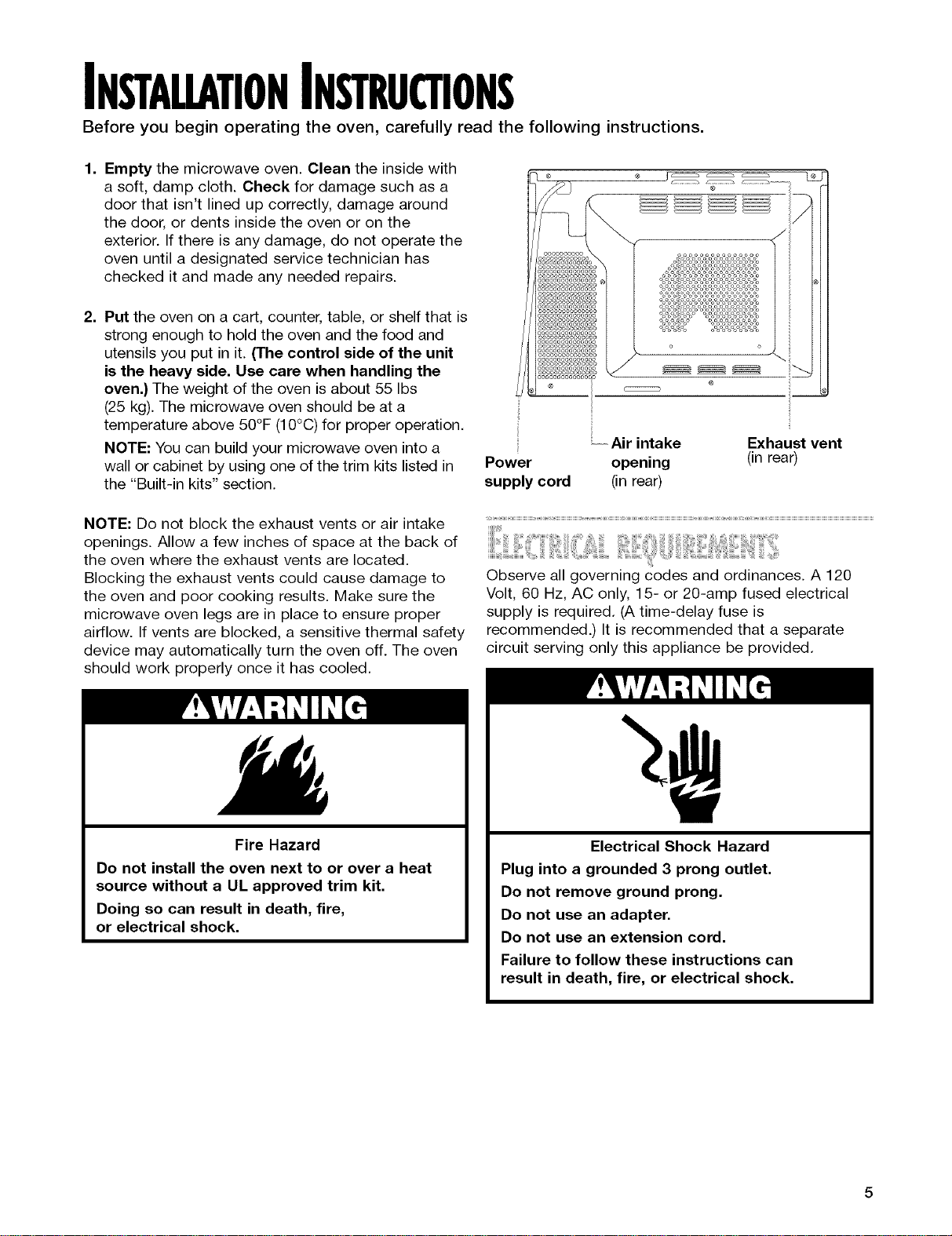
Air intake Exhaust vent
Power opening (in rear)
supply cord (in rear)
NOTE: Do not block the exhaust vents or air intake
openings. Allow a few inches of space at the back of
the oven where the exhaust vents are located.
Blocking the exhaust vents could cause damage to
the oven and poor cooking results. Make sure the
microwave oven legs are in place to ensure proper
airflow. If vents are blocked, a sensitive thermal safety
device may automatically turn the oven off. The oven
should work properly once it has cooled.
Observe all governing codes and ordinances. A 120
Volt, 60 Hz, AC only, 15- or 20-amp fused electrical
supply is required. (A time-delay fuse is
recommended.) It is recommended that a separate
circuit serving only this appliance be provided.
Fire Hazard
Do not install the oven next to or over a heat
source without a UL approved trim kit.
Doing so can result in death, fire,
or electrical shock.
Electrical Shock Hazard
Plug into a grounded 3 prong outlet.
Do not remove ground prong.
Do not use an adapter.
Do not use an extension cord.
Failure to follow these instructions can
result in death, fire, or electrical shock.
i!iiiii!iiii!i!_!!'iiii_lii!__ii!iii'!iJ!_iii_iii!_ii"iiiiil',ii'l!_i!iiii'i_i_i!ii_!_il;;;'!!'_ii'i'ili!il¸i'_'iliii!!i'ii!i!!i_¸_iiiiiliiiii!Iiill_lllllllllllllllllllllllllllll_
ii:i iii ii;i;iii:iiii iiiiiilj iii iiii!!!i iliiiii!iii!i ii:il!!!!iiiii iii,,,!iiiilii:iili¸
GROUNDING INSTRUCTIONS
• For all cord connected appliances:
The microwave oven must be grounded. In the
event of an electrical short circuit, grounding
reduces the risk of electric shock by providing an
escape wire for the electric current. The
microwave oven is equipped with a cord having
a grounding wire with a grounding plug. The plug
must be plugged into an outlet that is properly
installed and grounded.
WARNING: Improper use of the grounding plug
can result in a risk of electric shock.
Consult a qualified electrician or serviceman if the
grounding instructions are not completely
understood, or if doubt exists as to whether the
microwave oven is properly grounded.
Do not use an extension cord. If the power supply
cord is too short, have a qualified electrician or
serviceman install an outlet near the microwave oven.
• For a permanently connected appliance:
The microwave oven must be connected to a
grounded, metallic, permanent wiring system, or
an equipment grounding conductor should be run
with the circuit conductors and connected to the
equipment grounding terminal or lead on the
microwave oven.
SAVE THESE INSTRUCTIONS
GETTINGTOKNOWYOURMICROWAVEOVEN
This section discusses the concepts behind microwave cooking. It also shows you the basics
you need to know to operate your microwave oven. Please read this information before you use
your oven.
Microwave energy is not hot. It causes food to make
its own heat, and it's this heat that cooks the food.
Microwaves are like TV waves, radio waves, or light
waves. You cannot see them, but you can see what
they do.
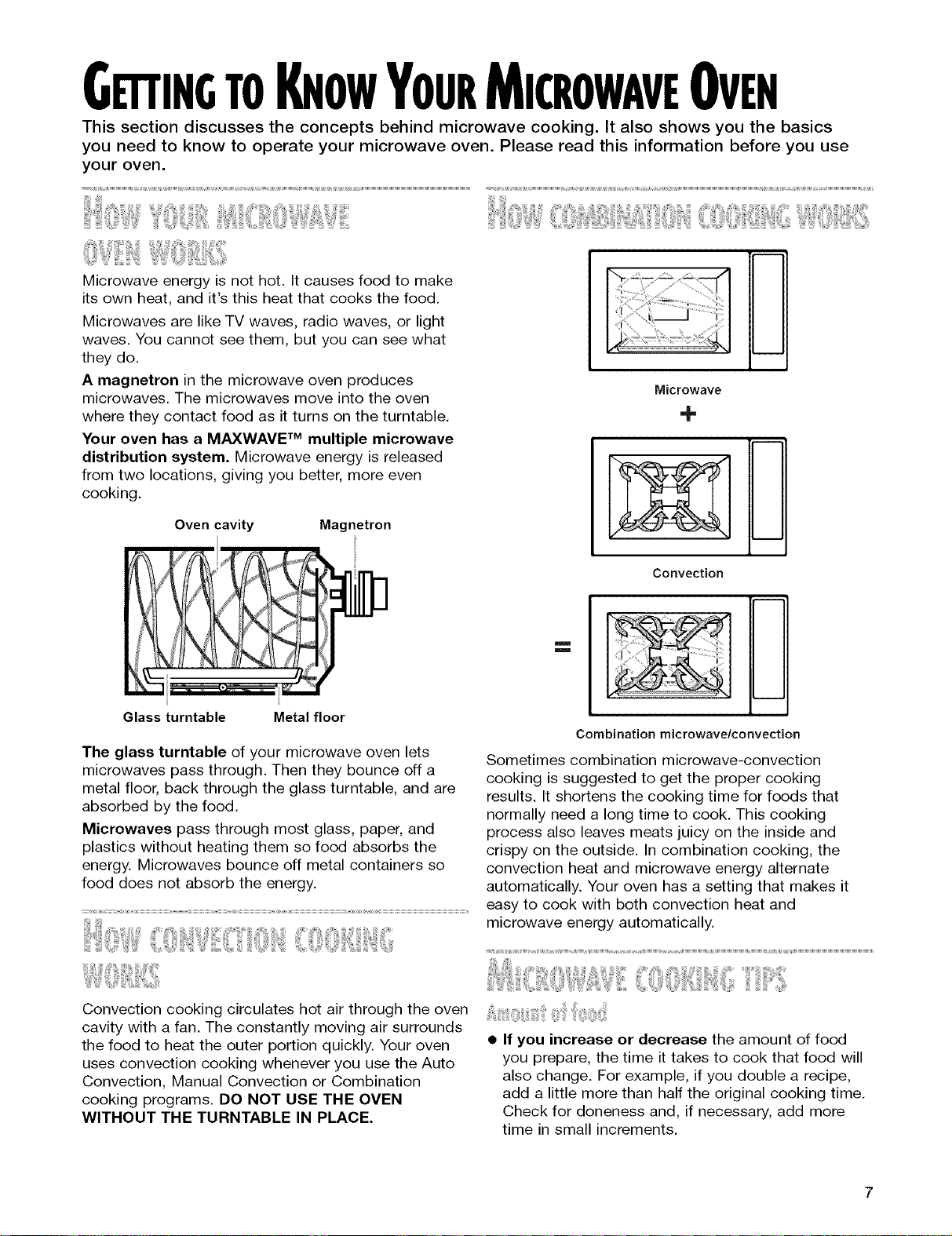
A magnetron in the microwave oven produces
microwaves. The microwaves move into the oven
where they contact food as it turns on the turntable.
Your oven has a MAXWAVE TM multiple microwave
distribution system. Microwave energy is released
from two locations, giving you better, more even
cooking.
Oven cavity Magnetron
_"i',,,,,,,,,, _ ,,,," ",,, "%,
Microwave
+
Convection
\
Glass turntable Metal floor
The glass turntable of your microwave oven lets
microwaves pass through. Then they bounce off a
metal floor, back through the glass turntable, and are
absorbed by the food.
Microwaves pass through most glass, paper, and
plastics without heating them so food absorbs the
energy. Microwaves bounce off metal containers so
food does not absorb the energy.
m
m
Combination microwave/convection
Sometimes combination microwave-convection
cooking is suggested to get the proper cooking
results. It shortens the cooking time for foods that
normally need a long time to cook. This cooking
process also leaves meats juicy on the inside and
crispy on the outside. In combination cooking, the
convection heat and microwave energy alternate
automatically. Your oven has a setting that makes it
Convection cooking circulates hot air through the oven
cavity with a fan. The constantly moving air surrounds
the food to heat the outer portion quickly. Your oven
uses convection cooking whenever you use the Auto
Convection, Manual Convection or Combination
cooking programs. DO NOT USE THE OVEN
WITHOUT THE TURNTABLE IN PLACE.
• If you
increase or decrease the amount of food
you prepare, the time it takes to cook that food will
also change. For example, if you double a recipe,
add a little more than half the original cooking time.
Check for doneness and, if necessary, add more
time in small increments.
ii !ii:iii!!ii,ii i¸¸ ii i ii ;ii:il ¸i:ii'il iii
• The lower the temperature of the food being put
into the microwave oven, the longer it takes to cook.
Food at room temperature will be reheated more
quickly than food at refrigerator temperature.
• Food with a lot of fat and sugar will be heated
faster than food containing a lot of water. Fat and
sugar will also reach a higher temperature than
water in the cooking process.
• The more dense the food, the longer it takes to heat.
"Very dense" food like meat takes longer to reheat
than lighter, more porous food like sponge cakes.
• Smaller pieces of food will cook faster than larger
pieces. Also, same-shaped pieces cook more evenly
than different-shaped pieces.
• With foods that have different thicknesses, the
thinner parts will cook faster than the thicker parts.
Place the thinner parts of chicken wings and legs in
the center of the dish.
• Stirring and turning foods spreads heat quickly to
the center of the dish and avoids overcooking at the
outer edges of the food.
Cover food to:
• Reduce splattering
• Shorten cooking times
• Keep food moist
You can use any covering that lets microwaves pass
through. See "Getting to Know Your Microwave Oven"
for materials that microwaves will pass through. If you
are using the Sensor function, be sure to vent.
• Several foods (for example: baked potatoes,
sausages, egg yolks, and some fruits) are tightly
covered by a skin or membrane. Steam can build
up under the membrane during cooking, causing
the food to burst. To relieve the pressure and to
prevent bursting, pierce these foods before
cooking with a fork, cocktail pick, or toothpick.
Always allow food to stand after cooking. Stand-
ing time after defrosting and cooking allows the
temperature to evenly spread throughout the food,
improving the cooking results.
• The length of the standing time depends on how
much food you are cooking and how dense it is.
Sometimes it can be as short as the time it takes
you to remove the food from the oven and take it to
the serving table. However, with larger, denser food,
the standing time may be as long as 10 minutes.
For best results, place food evenly on the plate. You
can do this in several ways:
• If you are cooking several items of the same
food, such as baked potatoes, place them in a ring
pattern for uniform cooking.
• When cooking foods of uneven shapes or
thickness, such as chicken breasts, place the
smaller or thinner area of the food towards the
center of the dish where it will be heated last.
• Layer thin slices of meat on top of each other.
• When you cook or reheat whole fish, score the
skin - this prevents cracking.
• Do not let food or a container touch the top or
sides of the oven. This will prevent possible arcing.
Metal containers should not be used in a microwave
oven. There are, however, some exceptions. If you
have purchased food which is prepackaged in an
aluminum foil container, refer to the instructions on
the package. When using aluminum foil containers,
cooking times may be longer because microwaves
will only penetrate the top of the food. (See "Oven
Utensils Guide".)
If you use aluminum containers without package
instructions, follow these guidelines:
• Place the container in a glass bowl and add some
water so that it covers the bottom of the container,
not more than ¼in. (6.4 mm) high. This ensures even
heating of the container bottom.
• Always remove the lid to avoid damage to the oven.
• Use only undamaged containers.
• Do not use containers taller than _ in. (1.9 cm).
• Container must be at least half filled.
• To avoid arcing, there must be a minimum ¼in.
(6.4 mm) between the aluminum container and the
walls of the oven and also between two aluminum
containers.
• Always place the container on the turntable.
• Reheating food in aluminum foil containers usually
takes up to double the time compared to reheating
in plastic, glass, china, or paper containers. The
time when food is ready will vary depending upon
the type of container you use.
• Let food stand for 2 to 3 minutes after heating so
that heat is spread evenly throughout container.
(iiiii i:iiil ii;iiiiii iiiii,!!iliiii! i ii ii i; t¸ ii ii iiii!' i iiii i i iiiii il;;::t ii !!; ! iii!iiil
• Do not do canning of foods in the oven. Closed
glass jars may explode, resulting in damage to the
oven.
• Do not use the microwave oven to sterilize objects
(baby bottles, etc.). It is difficult to keep the oven at
the high temperature needed for sterilization.
iilI
Using your microwave oven may cause interference
to your radio, TV, or similar equipment. When there is
interference, you can reduce it or remove it by:
• Cleaning the door and sealing surfaces of the oven.
• Adjusting the receiving antenna of the radio or television.
• Moving the receiver away from the microwave oven.
• Plugging the microwave oven into a different outlet
so that the microwave oven and receiver are on
different branch circuits.
• Always cook food for the shortest cooking time
recommended. Check to see how the food is cooking.
If needed, touch JET STARTTM Feature pad while the
oven is operating or after the cooking cycle is over
(see the "Using JET STARTTM Feature" section).
• Stir, turn over, or rearrange the food being cooked
about halfway through the cooking time for all recipes.
This will help make sure the food is evenly cooked.
• If you do not have a cover for a dish, use wax
paper, or microwave-approved paper towels or
plastic wrap. Remember to turn back a corner of the
plastic wrap to vent steam during cooking.
To test the oven, put 1 cup (250 mL) of cold water in
a glass container in the oven. Close the door. Make
sure it latches. Cook at 100% power for 2 minutes.
When the time is up, the water should be heated.
tJ!ii'ii ii!!iiiii',,lii!i;iiiLi!iill iiiill iliiiiiiiiliiii!!iii ii!!
You can use a variety of utensils and materials in your
microwave-convection oven. To prevent damage to
utensils and your oven, choose appropriate utensils
and materials for each cooking method. The list
below is a general guide to help you select the
correct utensils and materials.
YES: Utensils to use
NO: Utensils to avoid
WAVE T ON T ON
MATERIAL UTENSILS COOKING COOKING COOKING
Cera io YES
& Glass Ovenproof, YES YES YES
Heat-
Tempered,
Microwave-
Safe
Glassware
Glassware NO NO YES
with Metal
Decoration
Lead Glass NO NO YES
....................................Ovenprooi...............................................................................................................................
Microwave- YES NO NO
safe
plasticware
IVletal Bake_oast NO NO YES
Rack
Metal NO NO YES
.......Bak!ngPan.....
Foil
i
Paper Cups, YES NO NO
Plates,
Towels
S'e'aw, YES NO NO
Wicker,
Wood
.................................................................................._ _................................................................................_...............................................................................ii...................................................................................ii
Wax YES NO NO
Paper
Plastic YES NO NO
Wrap
i
* Refer to "Microwave cooking tips" and "Questions and
Answers" for proper use.
.....liii!! iiiii ii!iiiiii ,, iill?Oi iiiiiiiiill
Test dinnerware or cookware before using. To test
a dish for safe use, put it into the oven with 1 cup
(250 mL) of water beside it. Cook at 100% cook
power for one minute. If the dish gets hot and water
stays cool, do not use it. Some dishes (melamine,
some ceramic dinnerware, etc.) absorb microwave
energy and may become too hot to handle or may
slow cooking times. Cooking in metal containers not
designed for microwave use could damage the oven,
as could containers with hidden metal (twist-ties, foil
lining, staples, metallic glaze or trim).
iiiiiiiiiilliii
Never lean on the door or allow a child to swing on
it when the door is open.
Use hot pads. Microwave energy does not heat
containers, but the heat from the food can make
the container hot.
Do not use newspaper or other printed paper in the
oven.
Do not dry flowers, fruit, herbs, wood, paper,
gourds, or clothes in the oven.
Do not start a microwave oven when it is empty.
Product life may be shortened. If you practice
programming the oven, put a container of water in
the oven. It is normal for the oven door to look
wavy after the oven has been running for a while.
Do not try to melt paraffin wax in the oven. Paraffin
wax will not melt in a microwave oven because it
allows microwaves to pass through it.
Do not operate the microwave oven unless the
glass turntable is securely in place and can rotate
freely. The turntable can rotate in either direction.
Make sure the turntable is correct-side up in the
oven. Handle your turntable with care when
removing it from the oven to avoid possibly break-
_ng it. If your turntable cracks or breaks, contact
your dealer for a replacement.
• When you use a browning dish, the browning
dish bottom must be at least _0 in. (5 mm) above
the turntable. Follow the directions supplied with
the browning dish.
• Never cook or reheat a whole egg inside the
shell. Steam buildup in whole eggs may cause
them to burst, and possibly damage the oven.
Slice hard-boiled eggs before heating. In rare
cases, poached eggs have been known to explode.
Cover poached eggs and allow a standing time of
one minute before cutting into them.
• For best results, stir any liquid several times
during heating or reheating. Liquids heated in
certain containers (especially containers shaped like
cylinders) may become overheated. The liquid may
splash out with a loud noise during or after heating
or when adding ingredients (coffee granules, tea
bags, etc.). This can damage the oven.
• Microwaves may not reach the center of a roast.
The heat spreads to the center from the outer,
cooked areas just as in regular oven cooking. This is
one of the reasons for letting some foods (for
example, roasts or baked potatoes) stand for a while
after cooking, or for stirring some foods during the
cooking time.
• Do not deep fry in the oven. Microwavable
utensils are not suitable and it is difficult to maintain
appropriate deep-frying temperatures.
• Do not overcook potatoes. At the end of the
recommended cooking time, potatoes should be
slightly firm because they will continue cooking
during standing time. After microwaving, let
potatoes stand for 5 minutes. They will finish
cooking while standing.
If your electric power line or outlet voltage is less
than 110 volts, cooking times may be longer. Have a
qualified electrician check your electrical system.
10
i!iiiiii!iiii!i!!! !!!!!!! iliii!!!iiiiiiiiiii!!iiiiiiiiiiiii!iii:ii;:!!:ii!iiiiiiiiiiiiiiiiiiiiiiii!:iii!iiiiii:i:i!iiiil;iii!iii!iiiiil;i;illii!ii!iiiliiii!i!iil;iii!i;iiiiilliill
iiiiiiiii@iW ii!iii!iiiJ!i !!!iit !iii!! iiii!:@iiii!ili@il
® ®
®®
Your microwave oven is designed to make your
cooking experience enjoyable and productive. To
help get you up and running quickly, the following
is a list of the oven's basic features:
1. Door Safety Lock System. The oven will not
work unless the door is securely closed.
2. Window with Metal Shield. The shield prevents
microwaves from escaping. It is designed as a
screen to allow you to view food as it cooks.
3. Cooking Guide Label.
4. Glass Turntable. This turntable turns food
as it cooks for more even cooking. It must be
in the oven during operation for best cooking
results. The turntable is sunken into the cavity
floor to give you more cooking space and better
cooking results.
5. Removable Turntable Support (under turntable).
6. Convection Rack (Part No. 8172251). Use to
convection or combination cook.
7. Drip Pan (Part No. 8172250). The Drip Pan is
useful for catching grease from foods that drip
grease during Convection or Combination
cooking.
8. Model and Serial Number Plate.
9. Control Panel. Touch pads on this panel to
perform all functions.
10. Light (not shown). Automatically turns on when
the door is opened or when the oven is running.
11
!i!!iiiiiiii!i!iiiiiiiiiiiiiiiiiiiiiiiii!iiiiiiiii!!iiil;illiiiiiiiiiiiiiiiiiii!iii iiil;iiii!!iii !!! iiiiillii!i!i;;i! !iii!iiiiiiii ii
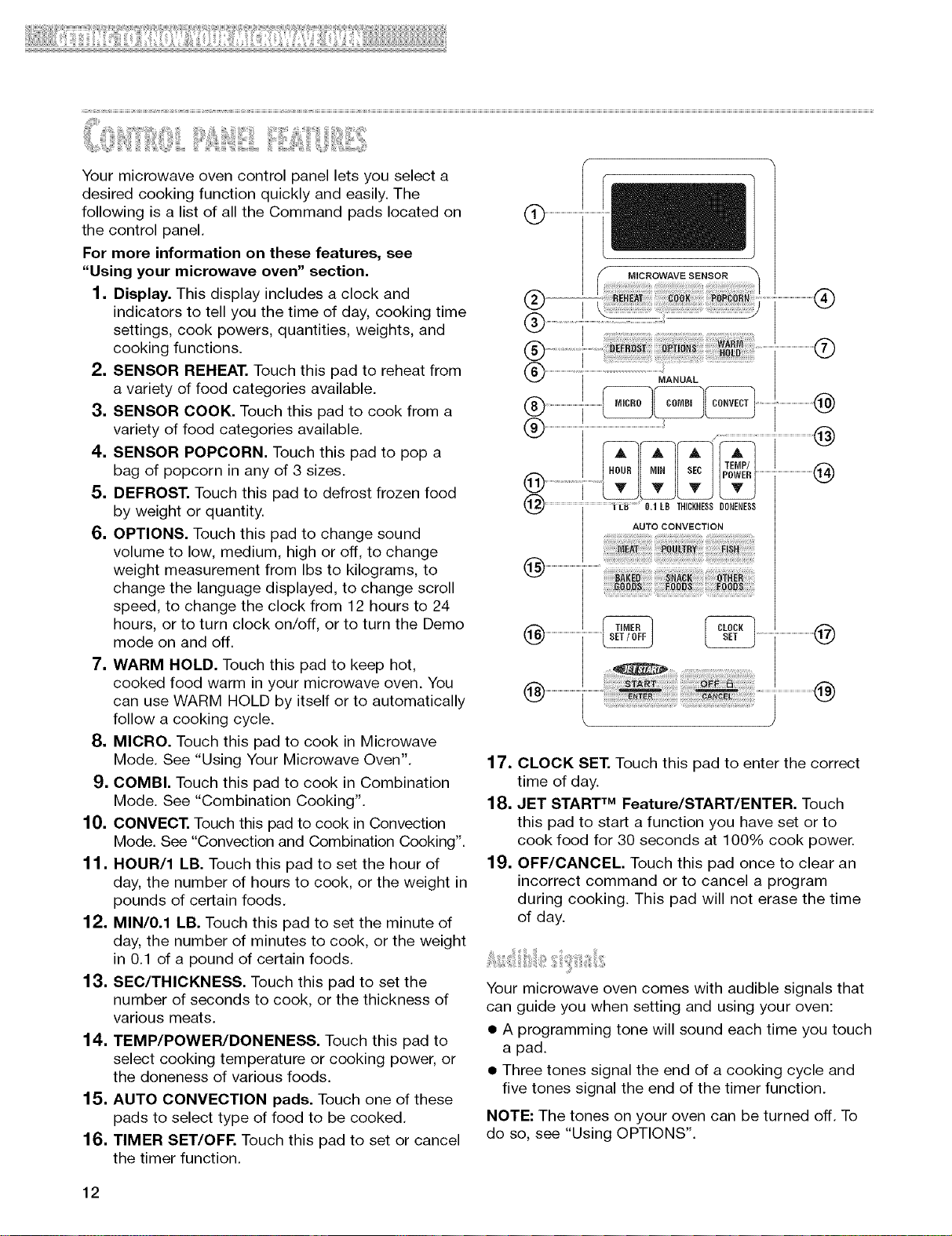
Your microwave oven control panel lets you select a
desired cooking function quickly and easily. The
following is a list of all the Command pads located on
the control panel.
For more information on these features, see
"Using your microwave oven" section.
1. Display. This display includes a clock and
indicators to tell you the time of day, cooking time
settings, cook powers, quantities, weights, and
cooking functions.
2. SENSOR REHEAT. Touch this pad to reheat from
a variety of food categories available.
3. SENSOR COOK. Touch this pad to cook from a
variety of food categories available.
4. SENSOR POPCORN. Touch this pad to pop a
bag of popcorn in any of 3 sizes.
5. DEFROST. Touch this pad to defrost frozen food
by weight or quantity.
6. OPTIONS. Touch this pad to change sound
volume to low, medium, high or off, to change
weight measurement from Ibs to kilograms, to
change the language displayed, to change scroll
speed, to change the clock from 12 hours to 24
hours, or to turn clock on/off, or to turn the Demo
mode on and off.
7. WARM HOLD. Touch this pad to keep hot,
cooked food warm in your microwave oven. You
can use WARM HOLD by itself or to automatically
follow a cooking cycle.
8. MICRO. Touch this pad to cook in Microwave
Mode. See "Using Your Microwave Oven".
9. COMBI. Touch this pad to cook in Combination
Mode. See "Combination Cooking".
10. CONVECT. Touch this pad to cook in Convection
Mode. See "Convection and Combination Cooking".
11. HOUR/1 LB. Touch this pad to set the hour of
day, the number of hours to cook, or the weight in
pounds of certain foods.
12. MIN/0.1 LB. Touch this pad to set the minute of
day, the number of minutes to cook, or the weight
in 0.1 of a pound of certain foods.
13. SEO/THIOKNESS. Touch this pad to set the
number of seconds to cook, or the thickness of
various meats.
14. TEMP/POWER/DONENESS. Touch this pad to
select cooking temperature or cooking power, or
the doneness of various foods.
15. AUTO CONVECTION pads. Touch one of these
pads to select type of food to be cooked.
16. TIMER SET/OFF. Touch this pad to set or cancel
the timer function.
(_
MANUAL
AUTO CONVECTION
17. CLOCK SET. Touch this pad to enter the correct
time of day.
18. JET START TM Feature/START/ENTER. Touch
this pad to start a function you have set or to
cook food for 30 seconds at 100% cook power.
19. OFF/CANCEL. Touch this pad once to clear an
incorrect command or to cancel a program
during cooking. This pad will not erase the time
of day.
Your microwave oven comes with audible signals that
can guide you when setting and using your oven:
• A programming tone will sound each time you touch
a pad.
• Three tones signal the end of a cooking cycle and
five tones signal the end of the timer function.
NOTE: The tones on your oven can be turned off. To
do so, see "Using OPTIONS".
12
Youcanstoptheovenduringacyclebyopeningthe
door.Theovenstopsheatingandthefanstops,butthe
lightstayson.Torestartcooking,closethedoorand
TouchSTART.
If you do not want to continue cooking:
• Close the door and the light goes off.
OR
• Touch OFF/CANCEL
NOTE: Before setting a function, touch OFF/CANCEL
to make sure no other function is on.
The Child Lock locks the control panel so children
cannot use the microwave when you do not want
them to.
To lock the control panel:
Touch and hold OFF/CANCEL until "LOCKED"
appears on display (approximately 4 seconds).
(One tone will sound.)
To unlock the control panel:
Touch and hold OFF/CANCEL until "UNLOCK"
appears on display. (Two tones will sound.)
iii ¸!ill¸iiiiiii!,,ii ii::i ii
You can select or change the following functions or
displays by touching OPTIONS:
metric (kgs).
Language Change to Engiishl French oi
Spanish.
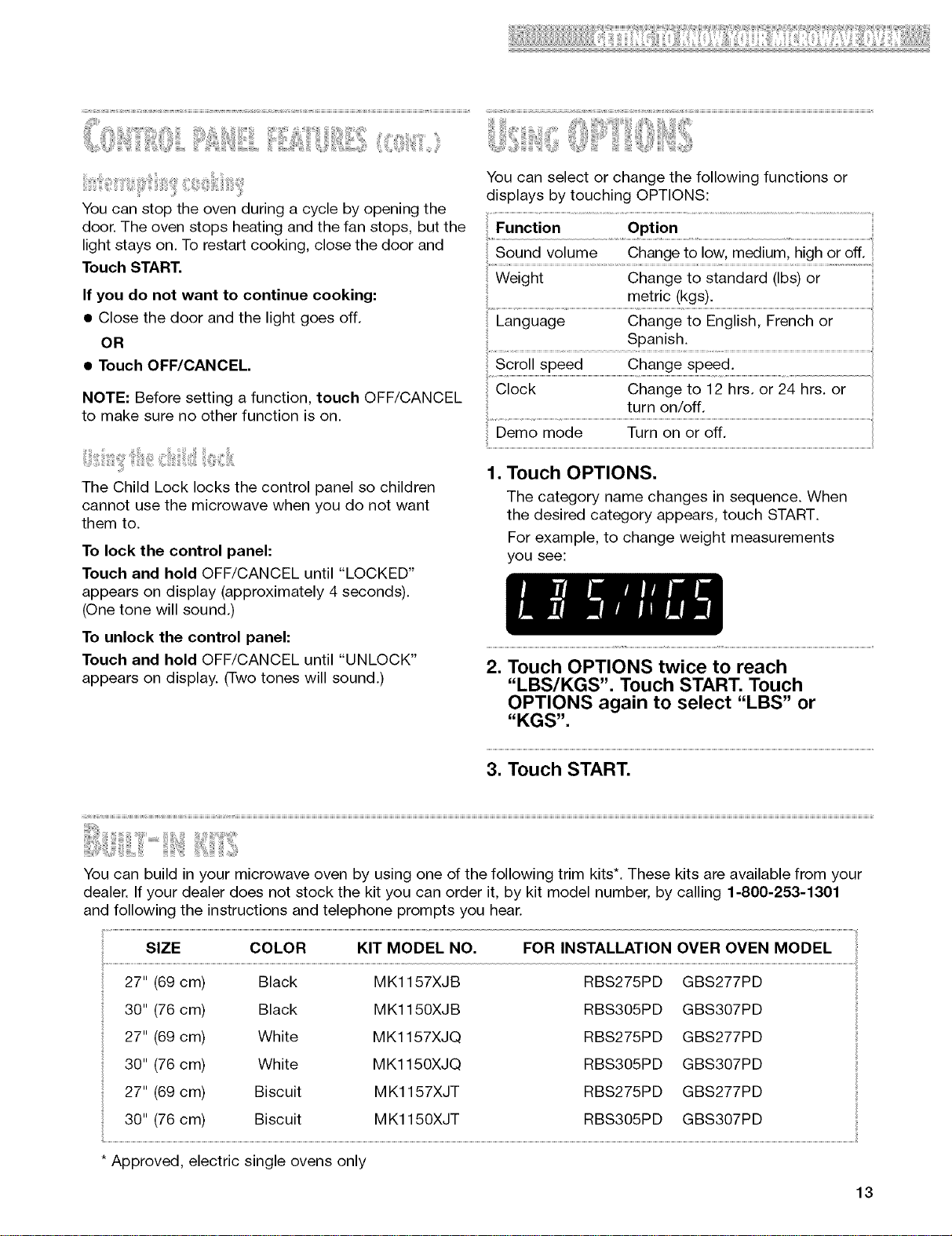
1. Touch OPTIONS.
The category name changes in sequence. When
the desired category appears, touch START.
For example, to change weight measurements
you see:
2. Touch OPTIONS twice to reach
"LBS/KGS". Touch START. Touch
OPTIONS again to select "LBS" or
"KGS".
3. Touch START.
You can build in your microwave oven by using one of the following trim kits*. These kits are available from your
dealer. If your dealer does not stock the kit you can order it, by kit model number, by calling 1-800-253-1301
and following the instructions and telephone prompts you hear.
SIZE COLOR KIT MODEL NO. FOR INSTALLATION OVER OVEN MODEL
27" (69 cm) Black MK1157XJB RBS275PD GBS277PD
30" (76 cm) Black MK1150XJB RBS305PD GBS307PD
27" (69 cm) White MK1157XJQ RBS275PD GBS277PD
30" (76 cm) White MK1150XJQ RBS305PD GBS307PD
27" (69 cm) Biscuit MK1157XJT RBS275PD GBS277PD
30" (76 cm) Biscuit MK1150XJT RBS305PD GBS307PD
* Approved, electric single ovens only
13
Whenyoufirstpluginyourmicrowaveoven,the
displayshows" : ".Iftheelectricpowerevergoes
off,thedisplaywillagainshow" : " whenthepower
comesbackon.
NOTE:Youcancookwithoutsettingtheclock,butthe
displaywillshow" :"againafterthecookingis
completed.
1. Touch CLOCK SET.
2. Touch HOUR and MIN Up and Down
pads to set the time of day.
The SEC pad is not available.
3. Touch CLOCK SET.
You can use your microwave oven as a kitchen timer. Use
the minute timer for timing up to 99 minutes.
1. Touch TIMER SET/OFF.
2. Touch HOUR and MIN Up and Down
pads to set the amount of time.
The SEC pad is not available.
3. Touch START, or allow the timer to start
automatically after a short delay.
4. At the end of the set time:
Timer will count down to zero, then will display
"TIMER END" and 5 tones will sound.
NOTE: To cancel timer at any time, touch TIMER
SET/OFR
14
UsINcYourMICROWAVEOVEN
This section gives you instructions for operating each function. Please read these instructions
carefully.
i!iii!ii¸¸¸¸¸¸'iiiiiiiiiiiiiiii x!il,0iiiiiii iiiiiiiiiiiill!t: ilili ii!ii l J!iiii!!!!il i@,,i!!i:il; i!iii!iiiiiiiiiiiiiiiii !iliii i iiiii'fii01iiiliiiilI i
1. Put the food in the oven and close the
door.
.............................................................................................................................................................................................................................................................................................................................................................................................................................................1. Put the food in the oven and close the
2. Touch MICRO pad. door.
3. Touch MIN and SEC Up and Down pads
to enter cooking time.
The HOUR pad is not available.
4. Touch START.
2. Touch MICRO pad.
3. Touch MIN and SEC Up and Down pads
to enter cooking time.
The HOUR pad is not available.
5. At the end of the cooking time:
Display will show "END" and 3 tones will sound.
4. Touch TEMP/POWER Up and Down
pads to set cooking power.
5. Touch START.
6. At the end of the cooking time:
Display will show "END" and 3 tones will sound.
For best results, some recipes call for different cook powers. The lower the cook power, the slower the
cooking. Each level stands for a different percentage of cook power. Many microwave cookbook recipes tell
you by number, percent, or name which cook power to use.
The following chart gives the percentage of cook power each level stands for, and the cook power name usually
used. It also tells you when to use each cook power. Follow recipe or food package instructions if available.
NOTE: Refer to a reliable cookbook for cooking times.
COOK POWER NAME WHEN TO USE IT
HI = 100% of full power High • Quick heating many convenience foods and foods
(automatic) with high water content, such as soups, beverages
and most vegetables
90 = 90% of full power • Cooking small tender pieces of meat, ground meat,
poultry pieces, and fish fillets
• Heating cream soups
80 = 80% of full power • Heating rice, pasta, or casseroles
• Cooking and heating foods that need a cook power
lower than high (for example, whole fish and meat Ioal
15
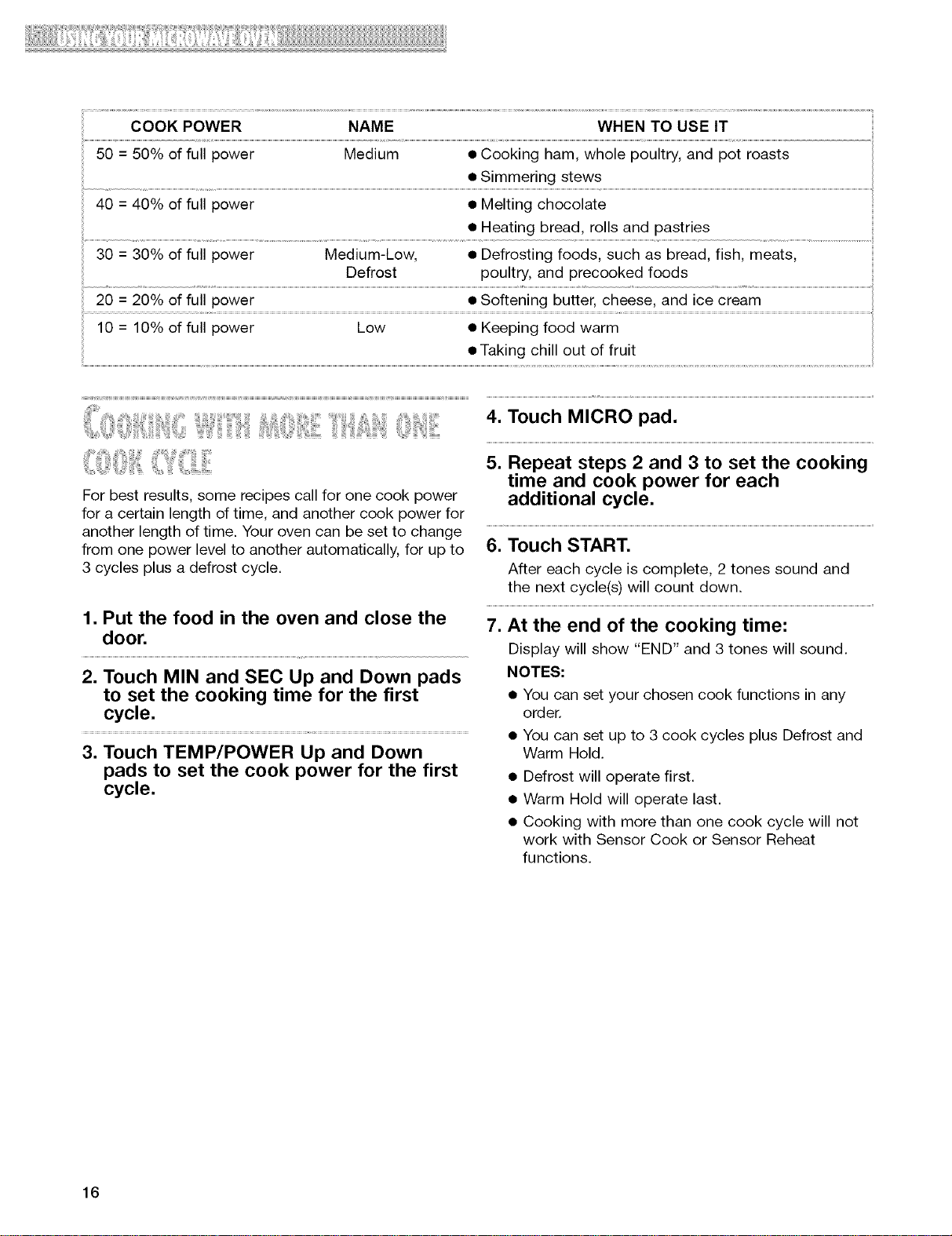
COOKPOWER NAME WHENTOUSE IT
50 = 50% of full power Medium • Cooking ham, whole poultry, and pot roasts
• Simmering stews
40 = 40% of full power • Melting chocolate
• Heating bread, rolls and pastries
30 = 30% of full power Medium-Low, • Defrosting foods, such as bread, fish, meats,
Defrost poultry, and precooked foods
20 = 20% of full power • Softening butter, cheese, and ice cream
10 = 10% of full power Low • Keeping food warm
• Taking chill out of fruit
4. Touch MICRO pad.
For best results, some recipes call for one cook power
for a certain length of time, and another cook power for
another length of time. Your oven can be set to change
from one power level to another automatically, for up to
3 cycles plus a defrost cycle.
1. Put the food in the oven and close the
door.
2. Touch MIN and SEC Up and Down pads
to set the cooking time for the first
cycle.
3. Touch TEMP/POWER Up and Down
pads to set the cook power for the first
cycle.
5. Repeat steps 2 and 3 to set the cooking
time and cook power for each
additional cycle.
6. Touch START.
After each cycle is complete, 2 tones sound and
the next cycle(s) will count down.
7. At the end of the cooking time:
Display will show "END" and 3 tones will sound.
NOTES:
• You can set your chosen cook functions in any
order.
• You can set up to 3 cook cycles plus Defrost and
Warm Hold.
• Defrost will operate first.
• Warm Hold will operate last.
• Cooking with more than one cook cycle will not
work with Sensor Cook or Sensor Reheat
functions.
16
ili!iii liiiilllii!!i:iiii!iil;;i!:!iii!iiiiiiii i!!i!iiiiiii:: ii!iiiiiiill
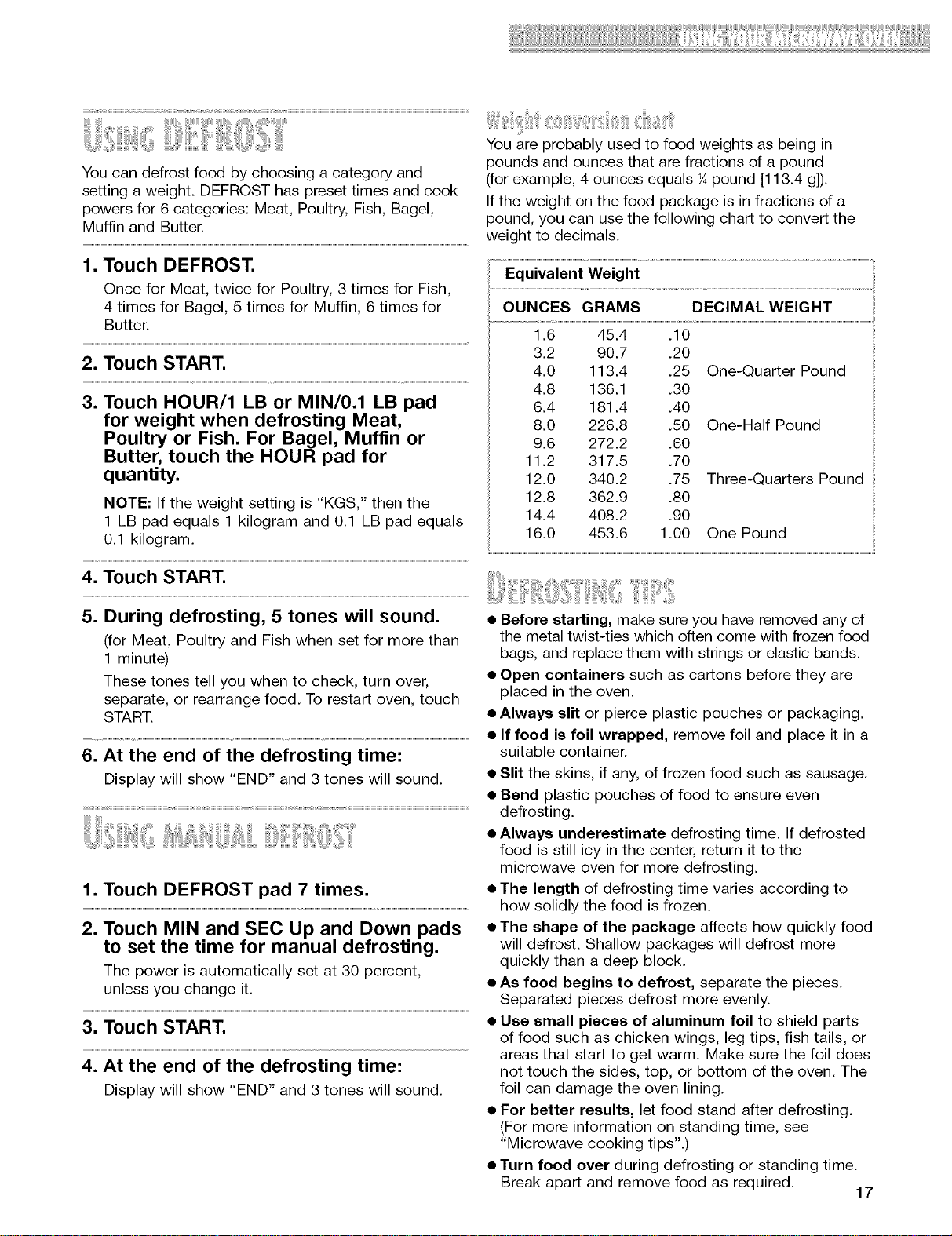
You can defrost food by choosing a category and
setting a weight. DEFROST has preset times and cook
powers for 6 categories: Meat, Poultry, Fish, Bagel,
Muffin and Butter.
1. Touch DEFROST.
Once for Meat, twice for Poultry, 3 times for Fish,
4 times for Bagel, 5 times for Muffin, 6 times for
Butter.
2. Touch START.
3. Touch HOUR/1 LB or MIN/0.1 LB pad
for weight when defrosting Meat,
Poultry or Fish. For Bagel, Muffin or
Butter, touch the HOUR pad for
quantity.
NOTE: If the weight setting is "KGS," then the
1 LB pad equals 1 kilogram and 0.1 LB pad equals
0.1 kilogram.
4. Touch START.
5. During defrosting, 5 tones will sound.
(for Meat, Poultry and Fish when set for more than
1 minute)
These tones tell you when to check, turn over,
separate, or rearrange food. To restart oven, touch
START.
6. At the end of the defrosting time:
Display will show "END" and 3 tones will sound.
1. Touch DEFROST pad 7 times.
2. Touch MIN and SEC Up and Down pads
to set the time for manual defrosting.
The power is automatically set at 30 percent,
unless you change it.
3. Touch START.
4. At the end of the defrosting time:
Display will show "END" and 3 tones will sound.
You are probably used to food weights as being in
pounds and ounces that are fractions of a pound
(for example, 4 ounces equals ¼pound [113.4 g]).
If the weight on the food package is in fractions of a
pound, you can use the following chart to convert the
weight to decimals.
1.6 45.4 .10
3.2 90.7 .20
4.0 113.4 .25
4.8 136.1 .30
6.4 181.4 .40
8.0 226.8 .50
9.6 272.2 .60
11.2 317.5 .70
12.0 340.2 .75
12.8 362.9 .80
14.4 408.2 .90
16.0 453.6 1.00
One-Quarter Pound
One-Half Pound
Three-Quarters Pound
One Pound
• Before starting, make sure you have removed any of
the metal twist-ties which often come with frozen food
bags, and replace them with strings or elastic bands.
Open containers such as cartons before they are
placed in the oven.
Always slit or pierce plastic pouches or packaging.
If food is foil wrapped, remove foil and place it in a
suitable container.
Slit the skins, if any, of frozen food such as sausage.
Bend plastic pouches of food to ensure even
defrosting.
Always underestimate defrosting time. If defrosted
food is still icy in the center, return it to the
microwave oven for more defrosting.
• The length of defrosting time varies according to
how solidly the food is frozen.
• The shape of the package affects how quickly food
will defrost. Shallow packages will defrost more
quickly than a deep block.
• As food begins to defrost, separate the pieces.
Separated pieces defrost more evenly.
• Use small pieces of aluminum foil to shield parts
of food such as chicken wings, leg tips, fish tails, or
areas that start to get warm. Make sure the foil does
not touch the sides, top, or bottom of the oven. The
foil can damage the oven lining.
• For better results, let food stand after defrosting.
(For more information on standing time, see
"Microwave cooking tips".)
• Turn food over during defrosting or standing time.
Break apart and remove food as required. 17
I !i!iii i iil
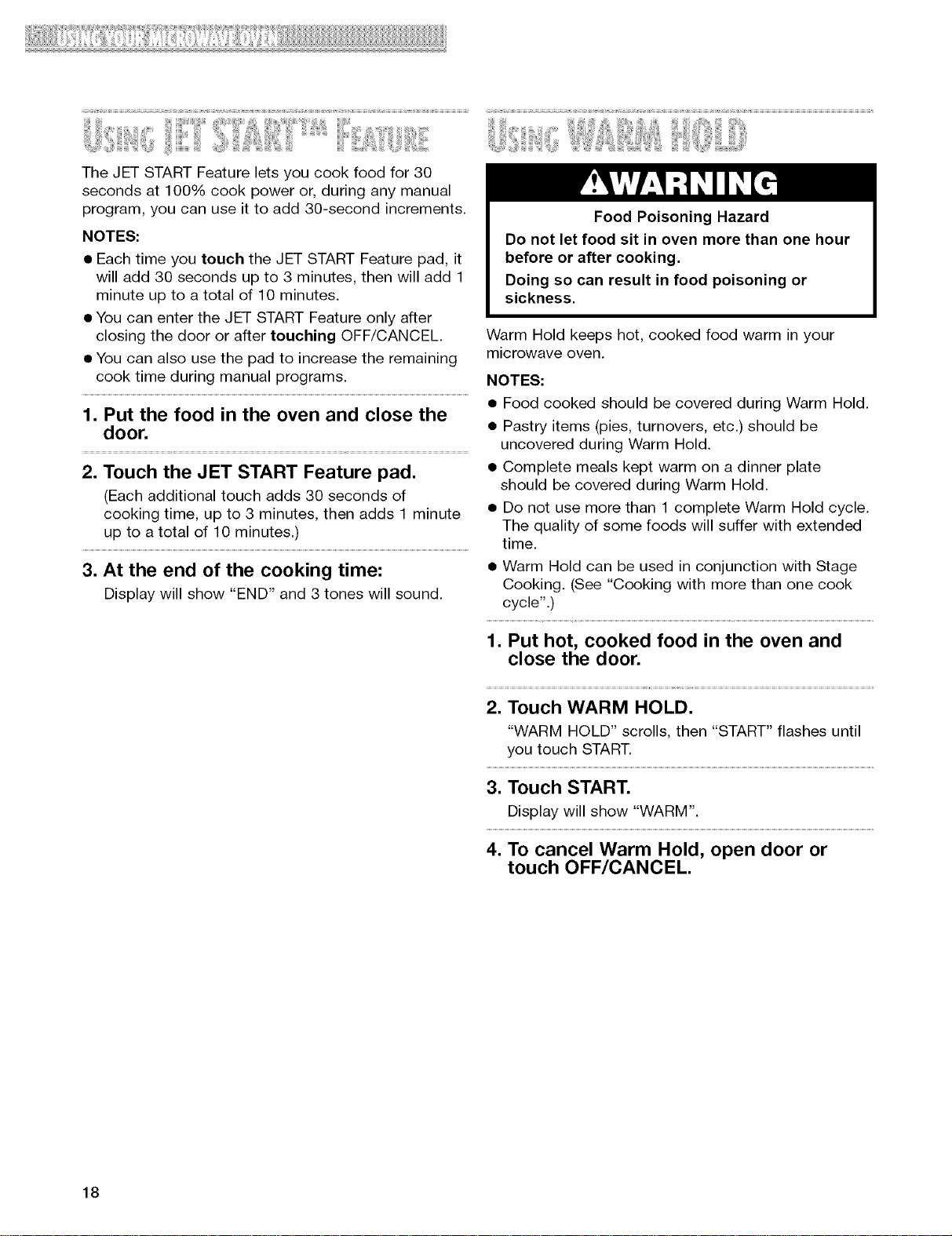
The JET START Feature lets you cook food for 30
seconds at 100% cook power or, during any manual
program, you can use it to add 30-second increments.
NOTES:
• Each time you touch the JET START Feature pad, it
will add 30 seconds up to 3 minutes, then will add 1
minute up to a total of 10 minutes.
• You can enter the JET START Feature only after
closing the door or after touching OFF/CANCEL.
• You can also use the pad to increase the remaining
cook time during manual programs.
1. Put the food in the oven and close the
door.
2. Touch the JET START Feature pad.
(Each additional touch adds 30 seconds of
cooking time, up to 3 minutes, then adds 1 minute
up to a total of 10 minutes.)
3. At the end of the cooking time:
Display will show "END" and 3 tones will sound.
Food Poisoning Hazard
Do not let food sit in oven more than one hour
before or after cooking.
Doing so can result in food poisoning or
sickness.
Warm Hold keeps hot, cooked food warm in your
microwave oven.
NOTES:
• Food cooked should be covered during Warm Hold.
• Pastry items (pies, turnovers, etc.) should be
uncovered during Warm Hold.
• Complete meals kept warm on a dinner plate
should be covered during Warm Hold.
• Do not use more than 1 complete Warm Hold cycle.
The quality of some foods will suffer with extended
time.
• Warm Hold can be used in conjunction with Stage
Cooking. (See "Cooking with more than one cook
cycle".)
1. Put hot, cooked food in the oven and
close the door.
2. Touch WARM HOLD.
"WARM HOLD" scrolls, then "START" flashes until
you touch START.
3. Touch START.
Display will show "WARM".
4. To cancel Warm Hold, open door or
touch OFF/CANCEL.
18

Yourmicrowaveovenhasasensorthat detects
the humidityreleasedby thefood. Theamount
of humiditydetected tells the ovenhow longto
cook or heatyour food. Thesensoris usedby
3special functions:SensorCook,Sensor
Reheat,and SensorPopcorn.Thesimple
instructionsfor thesefunctionsare on the
followingpages.
NOTES:
• Ifyouwanttocookbyentering a time and cook
power, see "Cooking at different cook powers".
• The oven should be plugged in at least 5 minutes
before sensor cooking.
• Room temperature should not exceed 95°F (35°C).
• Be sure the exterior of the cooking container and
the interior of the oven are dry. Wipe off each with a
paper towel.
• The oven will not generate microwave energy for
approximately 28 seconds at the beginning of the
sensor cooking cycle.
• When covering foods, be sure to leave an opening
big enough for moisture to escape so that the
sensor can determine cooking or reheating time.
To use SENSOR COOK:
1. Put the food in the oven and close the
door.
2. Touch SENSOR COOK until desired food
type is displayed.
SENSOR COOK will start automatically after a
short delay.
(See Sensor Cooking Chart.)
FOOD SERV,NGS,ZE D,REOT,ONS
Baked 1 to 4 medium, • Pierce each potato several times with a fork and place
Potatoes about 10 to 13 oz. on the turntable around the edge, at least 1 in. (2.5 cm)
...........................................................................................................................................................................................................................................................tocompletecooking.
Frozen 1 to 4 cups • Remove from package. Place vegetables in a
Vegetables (250 mL to 1 L) microwavable container. Cover with plastic wrap and vent.
• Most vegetables need stirring and 2-3 minutes standing
time after cooking.
Fresh 1 to 4 cups • Place moist vegetables in a microwavable
Vegetables (250 mL to 1 L) container. Cover with plastic wrap and vent.
• Most vegetables need stirring and 2-3 minutes standing
time after cooking.
Frozen Entree Works best if entree • Remove from outer package. Loosen cover on three sides.
is 10 to 20 oz. If entr6e is not in a microwave-safe container, place it on a
(284 to 567 g) plate, cover with plastic wrap and vent.
iiii
• Most entrees need 2-3 minutes standing time after
cooking.
Rice
to 2 cups (125 to
500 mL) of dry rice
(Use medium or long
grain rice. Cook
instant rice accord-
ing to directions on
the package.)
• Follow measurements on package for ingredient amounts.
Place rice and liquid (water or chicken or vegetable stock) in
a microwavable dish. Cover with plastic wrap and vent.
When cooking is complete, allow rice to stand 5 minutes or
until liquid is absorbed. Stir rice.
i!iiiii!iiii!i!iii!i l'ii'i!i!! !ii'i'i"!!i' ! iiii:;iiiiii i'ii!iiil;'? i'ii:i i!!? iii iiililii llllllllllllllllllllllllllllllllllllllllllllllll
1. Put the food in the oven and close the
door.
2. Touch SENSOR REHEAT until desired
food type is displayed.
SENSOR REHEAT will start automatically after a
short delay.
(See Sensor Reheating Chart.)
NOTE: When covering foods, be sure to leave an
opening big enough for moisture to escape so that the
sensor can determine cooking or reheating time.
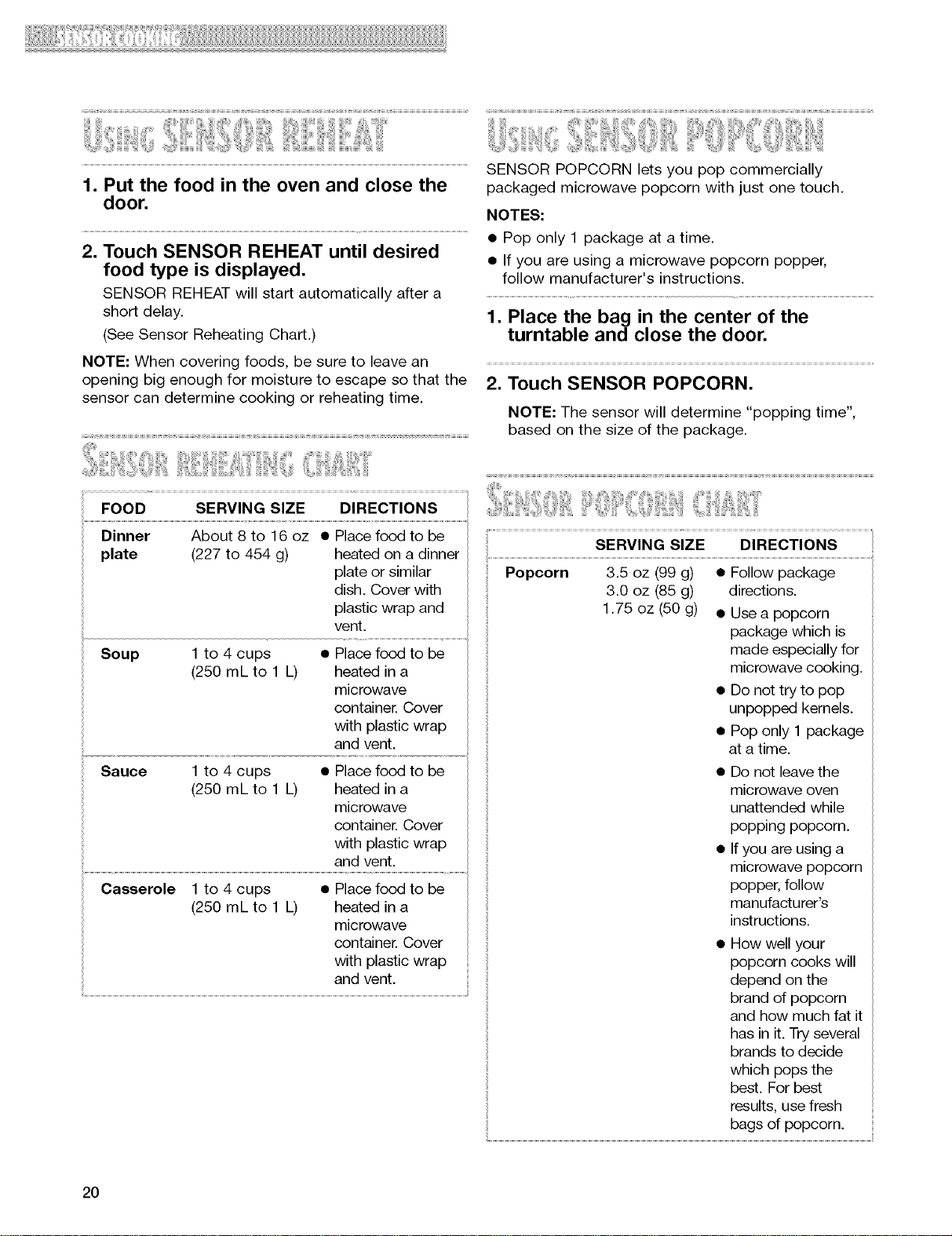
FOOD SERVING SIZE DIRECTIONS
Dinner About 8 to 16 oz • Place food to be
plate (227 to 454 g) heated on a dinner
plate or similar
dish. Cover with
plastic wrap and
vent.
Soup 1 to 4 cups • Place food to be
(250 mL to 1 L) heated in a
microwave
container. Cover
with plastic wrap
and vent.
Sauce 1 to 4 cups • Place food to be
(250 mL to 1 L) heated in a
microwave
container. Cover
with plastic wrap
and vent.
Casserole 1 to 4 cups • Place food to be
(250 mL to 1 L) heated in a
microwave
container. Cover
with plastic wrap
and vent.
SENSOR POPCORN lets you pop commercially
packaged microwave popcorn with just one touch.
NOTES:
• Pop only 1 package at a time.
• If you are using a microwave popcorn popper,
follow manufacturer's instructions.
1. Place the bag in the center of the
turntable and close the door.
2. Touch SENSOR POPCORN.
NOTE: The sensor will determine "popping time",
based on the size of the package.
i
Popcorn 3.5 oz (99 g) • Follow package
3.0 oz (85 g) directions.
1.75 oz (50 g) • Use a popcorn
package which is
made especially for
microwave cooking.
• Do not try to pop
unpopped kernels.
• Pop only 1 package
at a time.
• Do not leave the
microwave OVeR
unattended while
popping popcorn.
• If you are using a
microwave popcorn
popper, follow
manufacturer's
instructions.
• How well your
popcorn cooks will
depend on the
brand of popcorn
and how much fat it
has in it. Try several
brands to decide
which pops the
best. For best
results, use fresh
bags of popcorn.
20
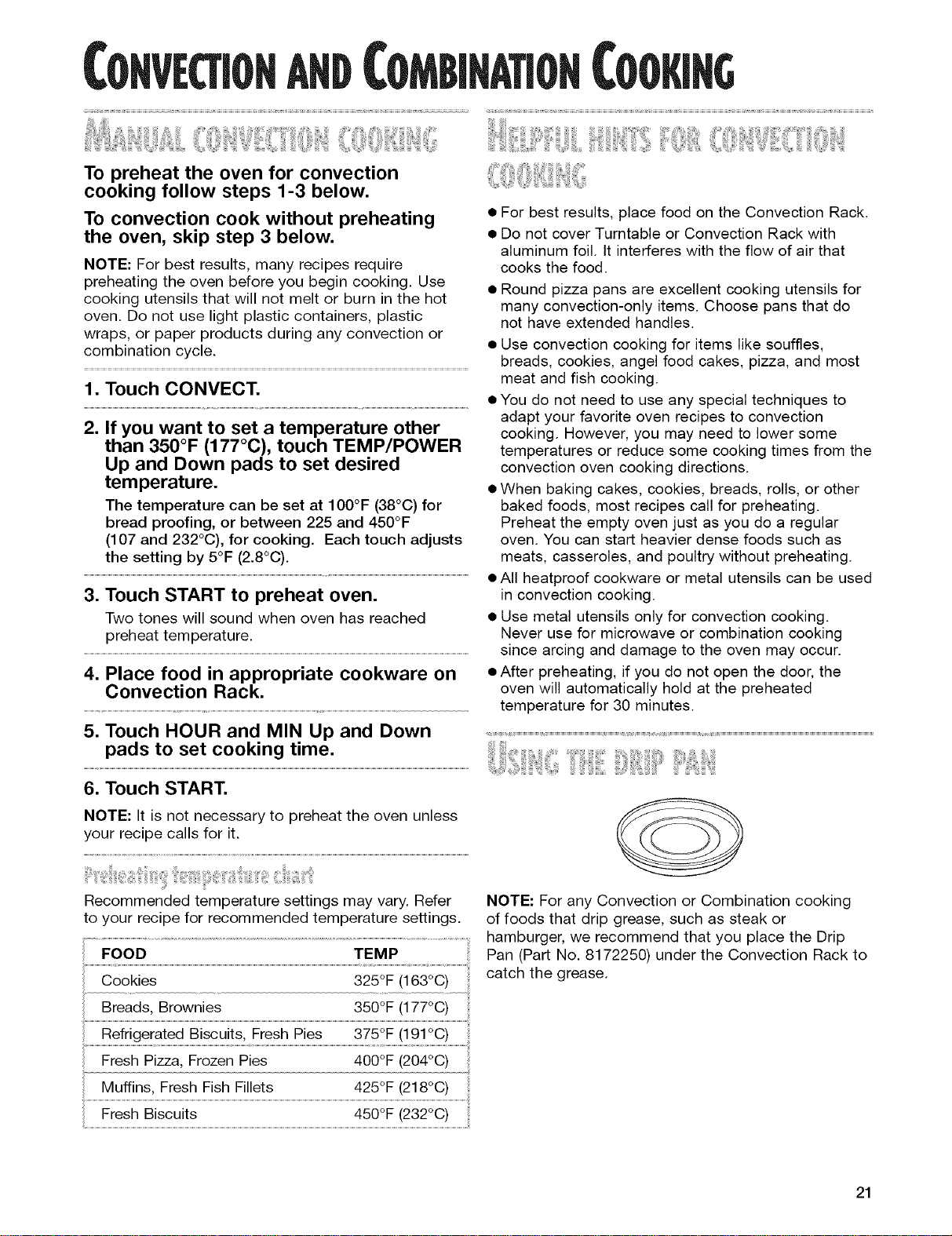
To preheat the oven for convection
cooking follow steps 1-3 below.
To convection cook without preheating
the oven, skip step 3 below.
NOTE: For best results, many recipes require
preheating the oven before you begin cooking. Use
cooking utensils that will not melt or burn in the hot
oven. Do not use light plastic containers, plastic
wraps, or paper products during any convection or
combination cycle.
1. Touch CONVECT.
2. If you want to set a temperature other
than 350°F (177°C), touch TEMP/POWER
Up and Down pads to set desired
temperature.
The temperature can be set at 100°F (38°C) for
bread proofing, or between 225 and 450°F
(107 and 232°C), for cooking. Each touch adjusts
the setting by 5°F (2.8°C).
3. Touch START to preheat oven.
Two tones will sound when oven has reached
preheat temperature.
4. Place food in appropriate cookware on
Convection Rack.
5. Touch HOUR and MIN Up and Down
pads to set cooking time.
6. Touch START.
NOTE: It is not necessary to preheat the oven unless
your recipe calls for it.
• For best results, place food on the Convection Rack.
• Do not cover Turntable or Convection Rack with
aluminum foil. tt interferes with the flow of air that
cooks the food.
• Round pizza pans are excellent cooking utensils for
many convection-only items. Choose pans that do
not have extended handles.
• Use convection cooking for items like souffles,
breads, cookies, angel food cakes, pizza, and most
meat and fish cooking.
• You do not need to use any special techniques to
adapt your favorite oven recipes to convection
cooking. However, you may need to lower some
temperatures or reduce some cooking times from the
convection oven cooking directions.
• When baking cakes, cookies, breads, rolls, or other
baked foods, most recipes call for preheating.
Preheat the empty oven just as you do a regular
oven. You can start heavier dense foods such as
meats, casseroles, and poultry without preheating.
• All heatproof cookware or metal utensils can be used
in convection cooking.
• Use metal utensils only for convection cooking.
Never use for microwave or combination cooking
since arcing and damage to the oven may occur.
• After preheating, if you do not open the door, the
oven will automatically hold at the preheated
temperature for 30 minutes.
Recommended temperature settings may vary. Refer
to your recipe for recommended temperature settings.
FOOD TEMP
Cookies 325°F (163°C)
Breads, Brownies 350°F (177°C)
Refrigerated Biscuits, Fresh Pies 375°F (191°C)
Muffins, Fresh Fish Fillets 425°F (218°C)
Fresh Biscuits 450°F (232°C)
NOTE: For any Convection or Combination cooking
of foods that drip grease, such as steak or
hamburger, we recommend that you place the Drip
Pan (Part No. 8172250) under the Convection Rack to
catch the grease.
21
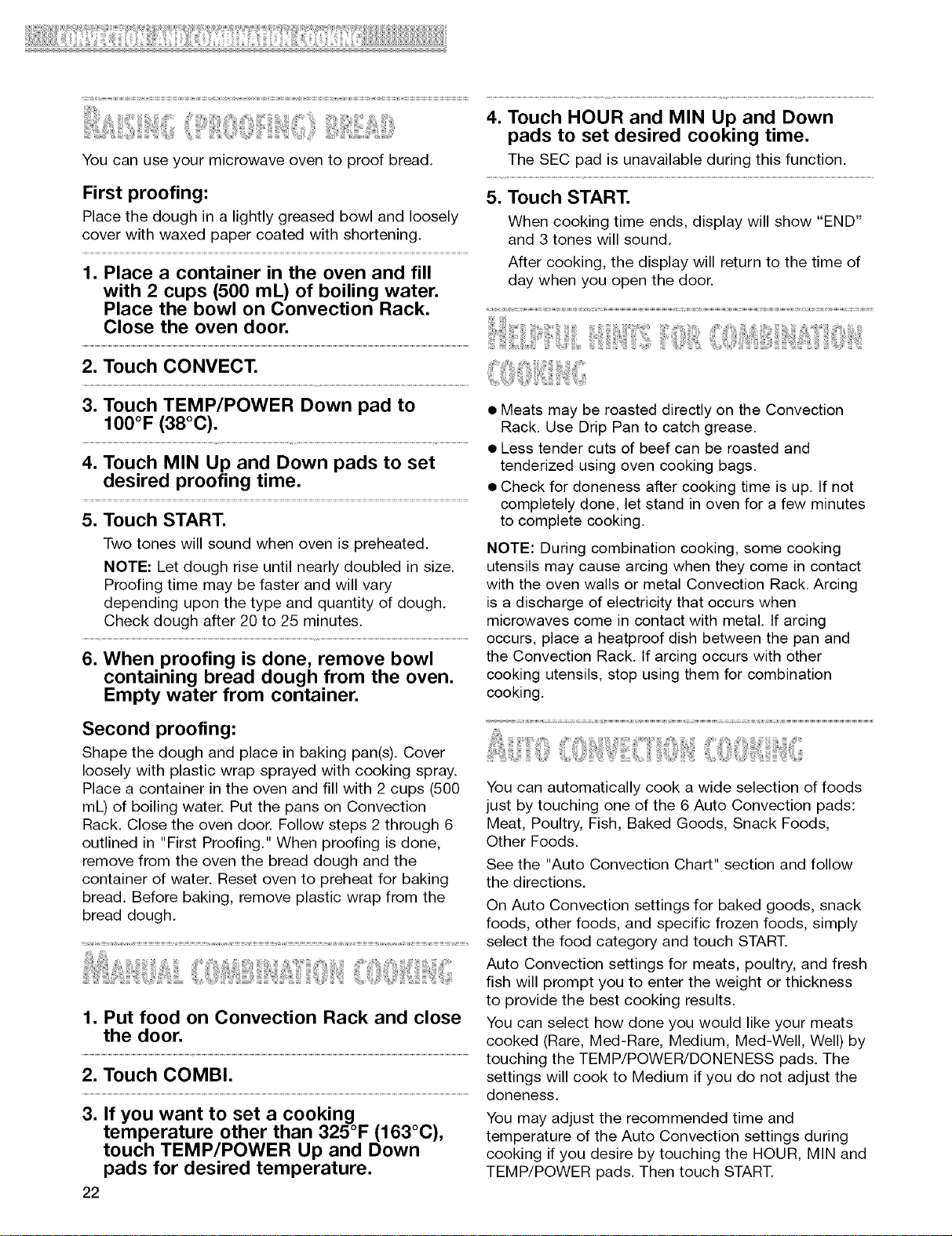
iiiii '!jl:;iiiil;iIiiii iiiiiiii!iI :!iiiii iiiiiiillii i!!!!ii! iiiiiiji ii:!:!:!i i!ii iiiiii!¸
You can use your microwave oven to proof bread.
First proofing:
Place the dough in a lightly greased bowl and loosely
cover with waxed paper coated with shortening.
1. Place a container in the oven and fill
with 2 cups (500 mL) of boiling water.
4. Touch HOUR and MIN Up and Down
pads to set desired cooking time.
The SEC pad is unavailable during this function.
5. Touch START.
When cooking time ends, display will show "END"
and 3 tones will sound.
After cooking, the display will return to the time of
day when you open the door.
Place the bowl on Convection Rack.
Close the oven door.
2. Touch CONVECT.
4. Touch MIN Up and Down pads to set
desired proofing time.
5. Touch START.
Two tones will sound when oven is preheated.
NOTE: Let dough rise until nearly doubled in size.
Proofing time may be faster and will vary
depending upon the type and quantity of dough.
Check dough after 20 to 25 minutes.
tenderized using oven cooking bags.
• Check for doneness after cooking time is up. If not
completely done, let stand in oven for a few minutes
to complete cooking.
NOTE: During combination cooking, some cooking
utensils may cause arcing when they come in contact
with the oven walls or metal Convection Rack. Arcing
is a discharge of electricity that occurs when
microwaves come in contact with metal. If arcing
Second proofing:
Shape the dough and place in baking pan(s). Cover
loosely with plastic wrap sprayed with cooking spray.
Place a container in the oven and fill with 2 cups (500
mL) of boiling water. Put the pans on Convection
Rack. Close the oven door. Follow steps 2 through 6
outlined in "First Proofing." When proofing is done,
remove from the oven the bread dough and the
container of water. Reset oven to preheat for baking
bread. Before baking, remove plastic wrap from the
bread dough.
1. Put food on Convection Rack and close
the door.
You can automatically cook a wide selection of foods
just by touching one of the 6 Auto Convection pads:
Meat, Poultry, Fish, Baked Goods, Snack Foods,
Other Foods.
See the "Auto Convection Chart" section and follow
the directions.
On Auto Convection settings for baked goods, snack
foods, other foods, and specific frozen foods, simply
select the food category and touch START.
Auto Convection settings for meats, poultry, and fresh
fish will prompt you to enter the weight or thickness
to provide the best cooking results.
You can select how done you would like your meats
cooked (Rare, Med-Rare, Medium, Med-Well, Well) by
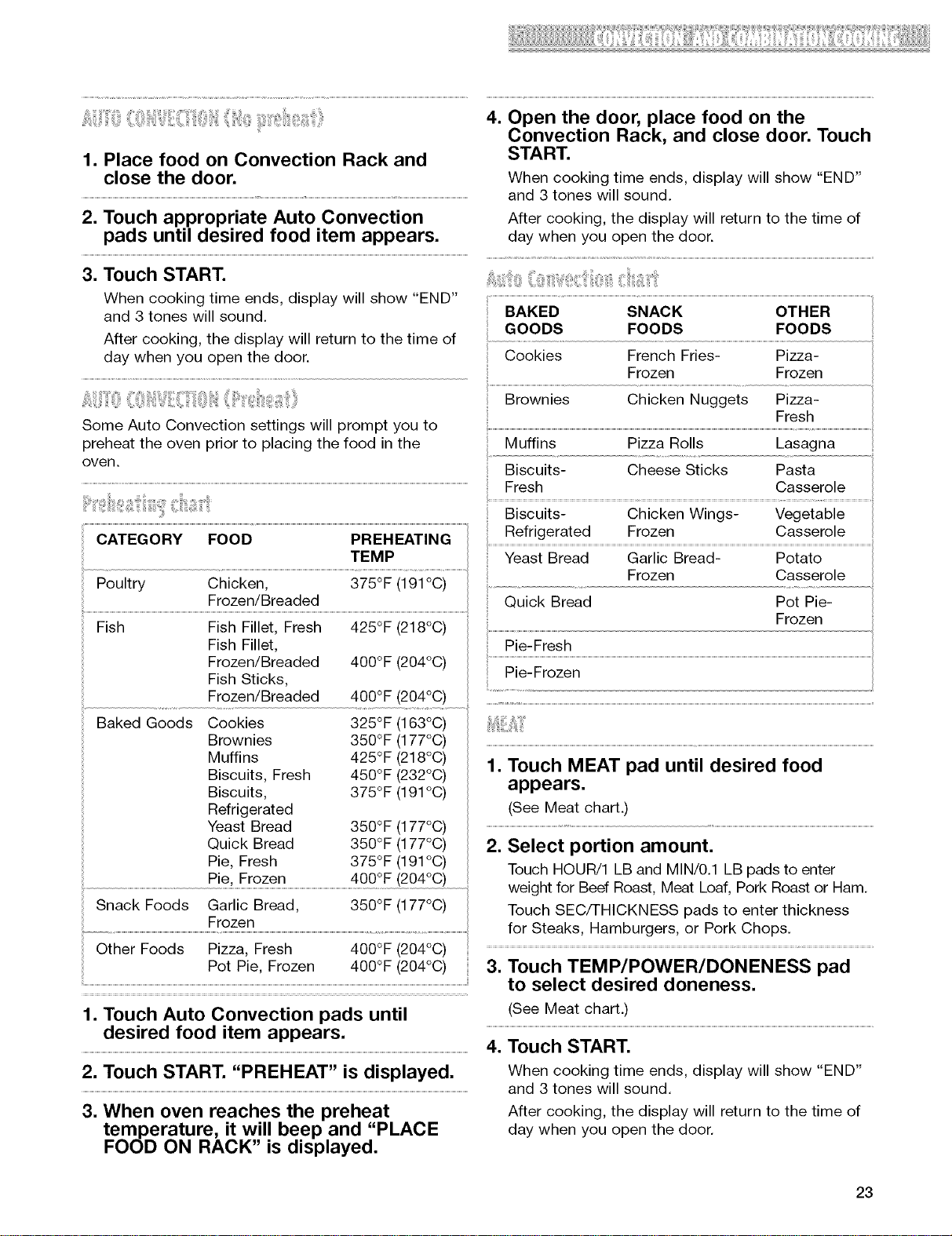
1. Place food on Convection Rack and
close the door.
2. Touch appropriate Auto Convection
pads until desired food item appears.
3. Touch START.
4. Open the door, place food on the
Convection Rack, and close door. Touch
START.
When cooking time ends, display will show "END"
and 3 tones will sound.
After cooking, the display will return to the time of
day when you open the door.
When cooking time ends, display will show "END"
and 3 tones will sound.
After cooking, the display will return to the time of
day when you open the door.
Some Auto Convection settings will prompt you to
preheat the oven prior to placing the food in the
oven.
PREHEATING
TEMP
Poultry Chicken, 375°F (191°C)
Frozen/Breaded
Cookies
Muffins Pizza Ro!!s Lasagna
Biscuits- Cheese Sticks Pasta
Fresh Casserole
Biscuits- Chicken Wings- Vegetable
...................Re!!!ge!ated ..........................................F!ozen..................................................................................................................Casse!o!e ..........................
Yeast Bread Garlic Bread- Potato
Frozen Casserole
Quick Bread Pot Pie-
Baked Goods Cookies
Brownies
Muffins
Biscuits, Fresh
Biscuits,
Refrigerated
Yeast Bread
Quick Bread
Pie, Fresh
325°F (163°C)
350°F (177°C)
425°F (218°C)
450°F (232°C)
375°F (191°C)
350°F (177°C)
350°F (177°C)
375°F (191°C)
..................................................Pie_ Frozen.........................................................................400°F (204°C}
Snack Foods Garlic Bread, 350°F (177°C)
Frozen
Other Foods Pizza, Fresh 400°F (204°C)
Pot Pie, Frozen 400°F (204°C)
1. Touch Auto Convection pads until
desired food item appears.
1. Touch MEAT pad until desired food
appears.
(See Meat chart.)
2. Select portion amount.
Touch HOUR!1 LB and MIN/0.1 LB pads to enter
weight for Beef Roast, Meat Loaf, Pork Roast or Ham.
Touch SEC/THICKNESS pads to enter thickness
for Steaks, Hamburgers, or Pork Chops.
3. Touch TEMP/POWER/DONENESS pad
to select desired doneness.
(See Meat chart.)
2. Touch START. "PREHEAT" is displayed.
3. When oven reaches the preheat
temperature, it will beep and "PLACE
FOOD ON RACK" is displayed.
When cooking time ends, display will show "END"
and 3 tones will sound.
After cooking, the display will return to the time of
day when you open the door.
23
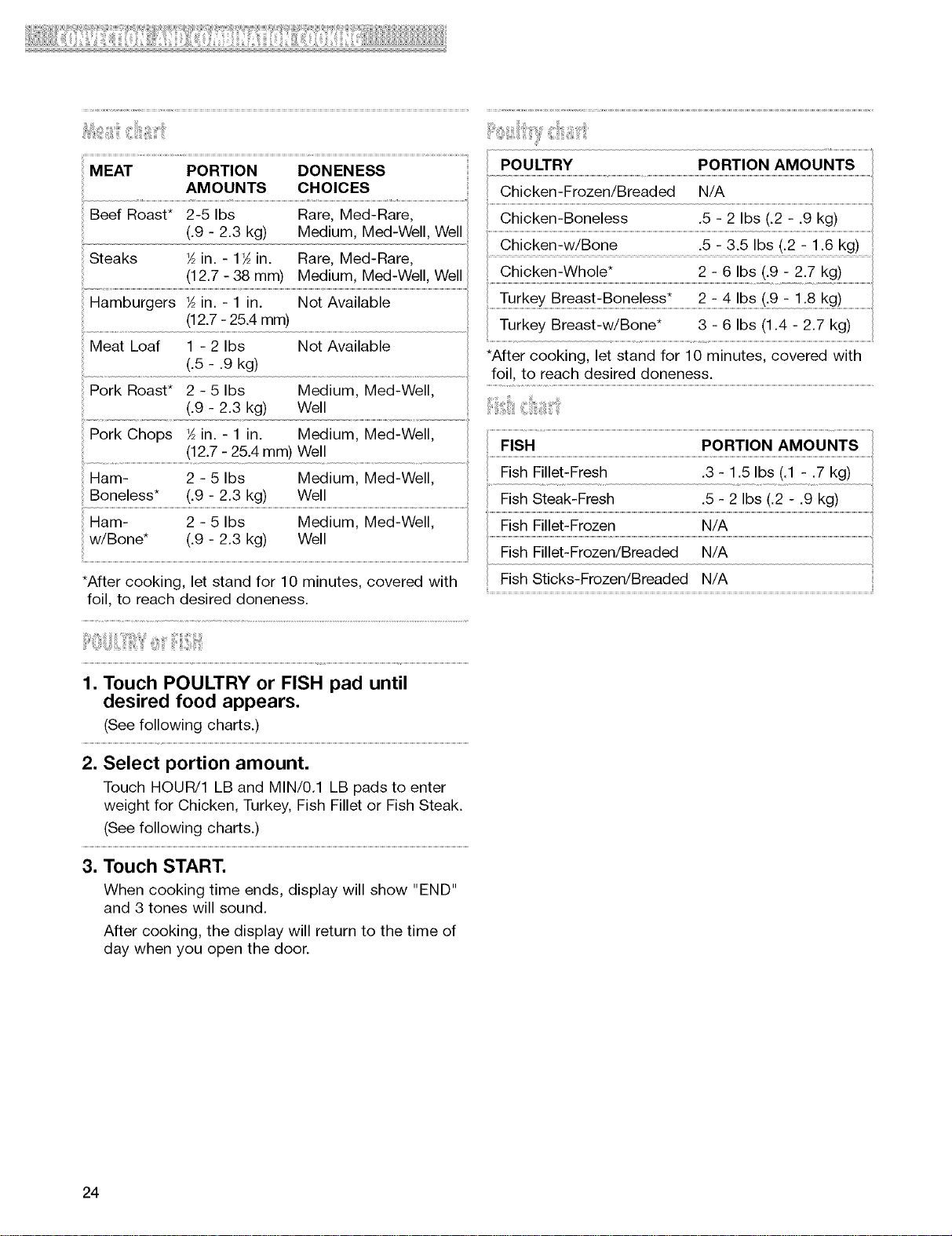
................................................................................................................................................................................................................................................................................................................................................................................................................................ii POULTRY
MEAT PORTION DONENESS
AMOUNTS CHOICES Chicken-Frozen/Breaded N/A
Steaks _ in. - 1_ in. Rare, Meal-Rare,
............................................................................................ ...... Chicken-Whole* 2- 6 Ibs (.9- 2.7 kg)
Hamburgers _ in.- 1 in. Not Available .........Turkey Breast:Bone!eSS* ..............................2 : 4 !bs (:9 - 1.8 kg)...............................
................................(!2.7:25.4 mm) .....................................................Turkey Breast-w/Bone* 3- 6 Ibs (1.4- 2.7 kg)
Meat Loaf 1 - 2 Ibs Not Available .....................................................................................................................................................................................................................................................................................................................
*After cooking, let stand for 10 minutes, covered with
....................... (:5-.9 kg) ..............................................................foil, to reach desired aloneness.
Pork Roast* 2 - 5 Ibs Medium, Med-Well, ......................................................................................................................................................................................................................................................................................................................................................................................................................................
(.9 - 2.3 kg) Well
Pork Chops _ in. - 1 in. Medium, Med-Well,
(12.7 - 25.4 mm) Well
Ham- 2 - 5 Ibs Medium, Med-Well,
Boneless* (.9 - 2.3 kg) Well
Ham- 2 - 5 Ibs Medium, Med-Well,
w/Bone* (.9 - 2.3 kg) Well
iiii
*After cooking, let stand for 10 minutes, covered with Fish Sticks-Frozen/Breaded N/A
foil, to reach desired doneness.
FISH PORTION AMOUNTS
Fish Fillet-Fresh .3 - 1.5 Ibs (.1 - .7 kg)
Fish Steak-Fresh .5 - 2 Ibs (.2 - .9 kg)
Fish Fillet-Frozen N/A
Fish Fillet-Frozen/Breaded N/A
1. Touch POULTRY or FISH pad until
desired food appears.
(See following charts.)
2. Select portion amount.
Touch HOUR/1 LB and MIN/0.1 LB pads to enter
weight for Chicken, Turkey, Fish Fillet or Fish Steak.
(See following charts.)
3. Touch START.
When cooking time ends, display will show "END"
and 3 tones will sound.
After cooking, the display will return to the time of
day when you open the door.
24
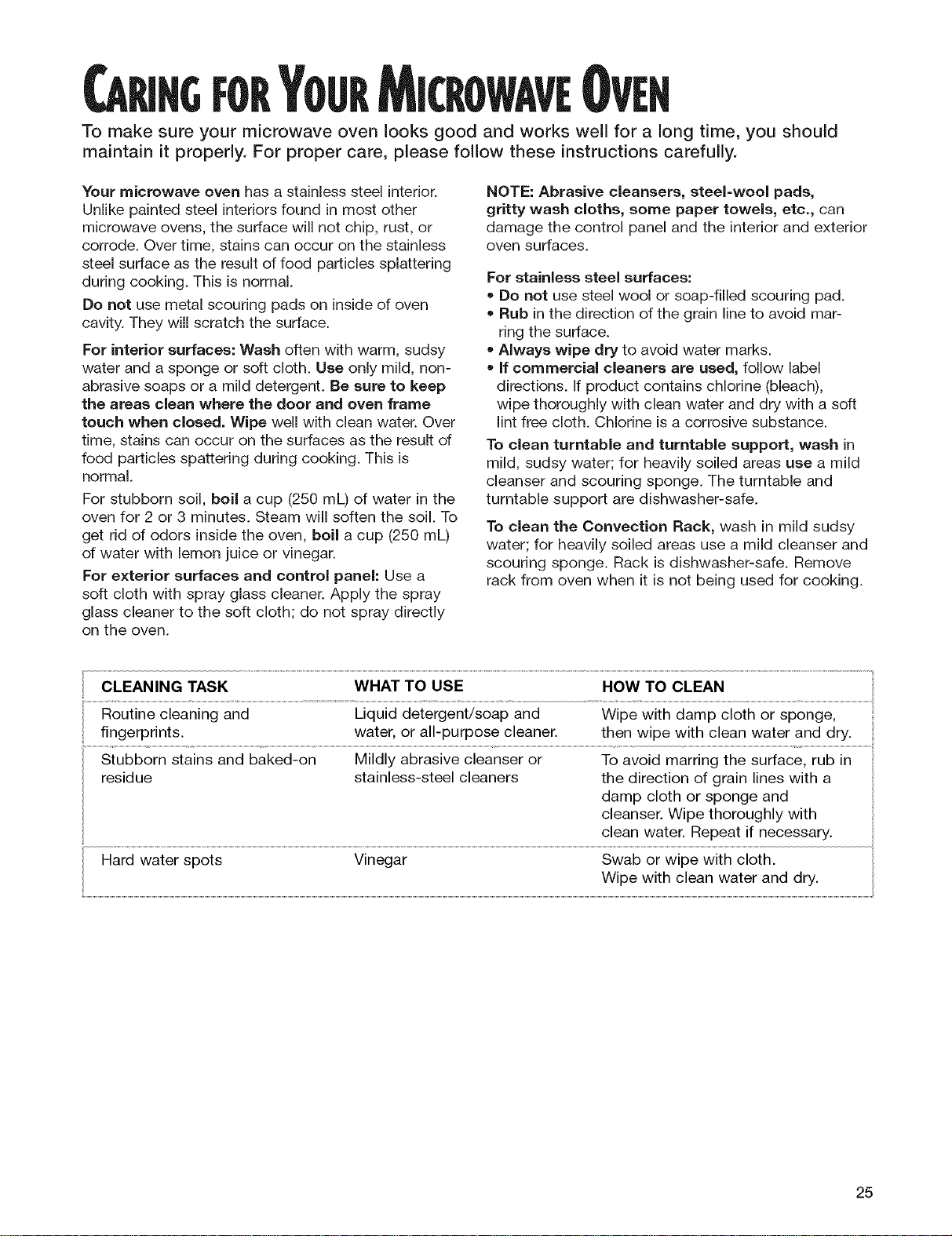
roeYoeeMICROWAVEOven
To make sure your microwave oven looks good and works well for a long time, you should
maintain it properly. For proper care, please follow these instructions carefully.
Your microwave oven has a stainless steel interior.
Unlike painted steel interiors found in most other
microwave ovens, the surface will not chip, rust, or
corrode. Over time, stains can occur on the stainless
steel surface as the result of food particles splattering
during cooking. This is normal.
Do not use metal scouring pads on inside of oven
cavity. They will scratch the surface.
For interior surfaces: Wash often with warm, sudsy
water and a sponge or soft cloth. Use only mild, non-
abrasive soaps or a mild detergent. Be sure to keep
the areas clean where the door and oven frame
touch when closed. Wipe well with clean water. Over
time, stains can occur on the surfaces as the result of
food particles spattering during cooking. This is
normal.
For stubborn soil, boil a cup (250 mL) of water in the
oven for 2 or 3 minutes. Steam will soften the soil. To
get rid of odors inside the oven, boil a cup (250 mL)
of water with lemon juice or vinegar.
For exterior surfaces and control paneh Use a
soft cloth with spray glass cleaner. Apply the spray
glass cleaner to the soft cloth; do not spray directly
on the oven.
NOTE: Abrasive cleansers, steel-wool pads,
gritty wash cloths, some paper towels, etc., can
damage the control panel and the interior and exterior
oven surfaces.
For stainless steel surfaces:
• Do not use steel wool or soap-filled scouring pad.
Rub in the direction of the grain line to avoid mar-
ring the surface.
Always wipe dry to avoid water marks.
• if commercial cleaners are used, follow label
directions. If product contains chlorine (bleach),
wipe thoroughly with clean water and dry with a soft
lint free cloth. Chlorine isa corrosive substance.
To clean turntable and turntable support, wash in
mild, sudsy water; for heavily soiled areas use a mild
cleanser and scouring sponge. The turntable and
turntable support are dishwasher-safe.
To clean the Convection Rack, wash in mild sudsy
water; for heavily soiled areas use a mild cleanser and
scouring sponge. Rack is dishwasher-safe. Remove
rack from oven when it is not being used for cooking.
CLEANING TASK WHAT TO USE HOW TO CLEAN
Routine cleaning and Liquid detergent/soap and Wipe with damp cloth or sponge,
fingerprints, water, or all-purpose cleaner, then wipe with clean water and dry.
Stubborn stains and baked-on Mildly abrasive cleanser or To avoid marring the surface, rub in
residue stainless-steel cleaners the direction of grain lines with a
damp cloth or sponge and
cleanser. Wipe thoroughly with
clean water. Repeat if necessary.
Hard water spots Vinegar Swab or wipe with cloth.
Wipe with clean water and dry.
25
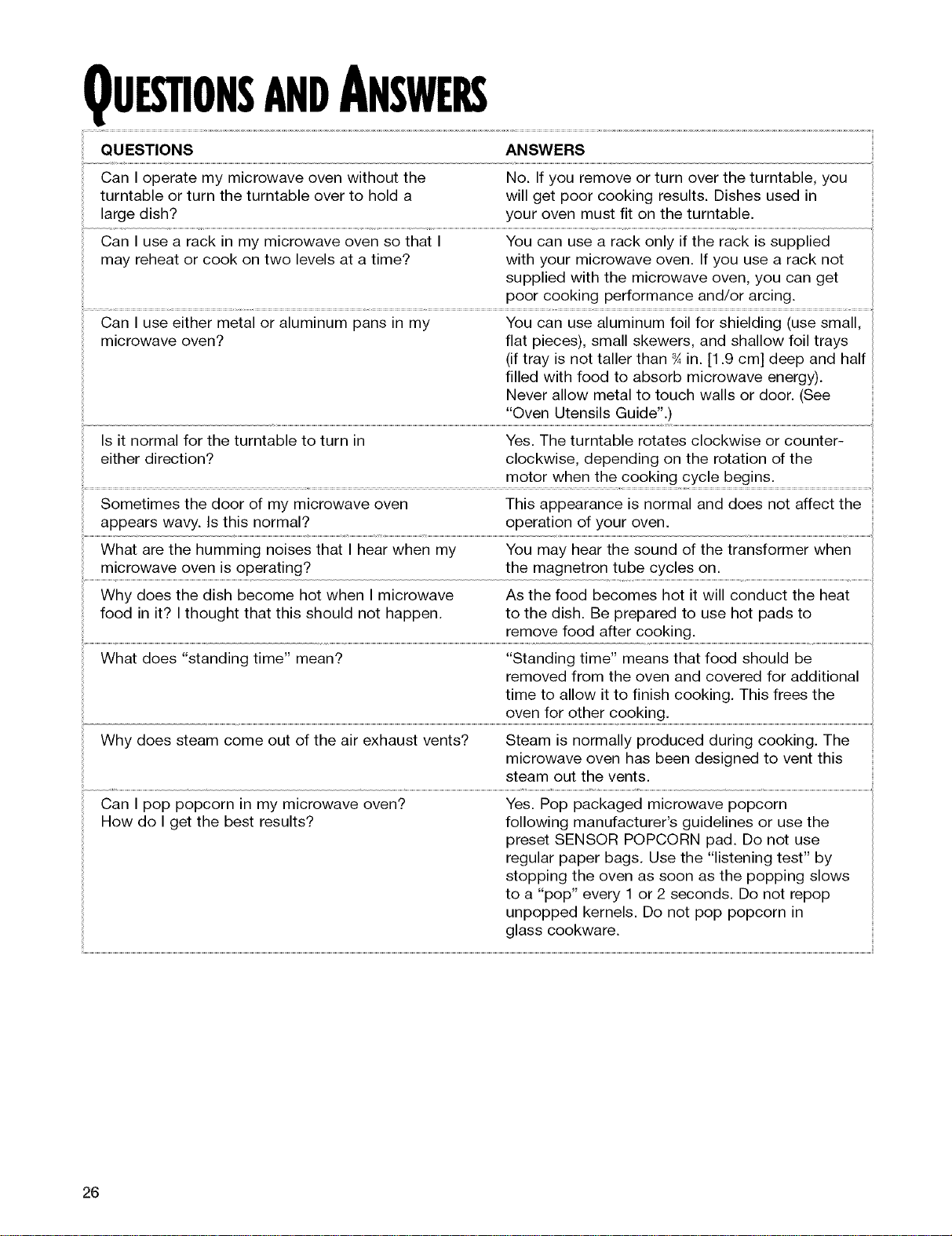
UESTIONSANDANSWERS
QUESTIONS ANSWERS
Can I operate my microwave oven without the No. If you remove or turn over the turntable, you
turntable or turn the turntable over to hold a will get poor cooking results. Dishes used in
large dish? your oven must fit on the turntable.
Can I use a rack in my microwave oven so that I You can use a rack only if the rack is supplied
may reheat or cook on two levels at a time? with your microwave oven. If you use a rack not
supplied with the microwave oven, you can get
poor cooking performance and/or arcing.
Can I use either metal or aluminum pans in my You can use aluminum foil for shielding (use small,
microwave oven? flat pieces), small skewers, and shallow foil trays
(if tray is not taller than _ in. [1.9 cm] deep and half
filled with food to absorb microwave energy).
Never allow metal to touch walls or door. (See
"Oven Utensils Guide".)
Is it normal for the turntable to turn in Yes. The turntable rotates clockwise or counter-
either direction? clockwise, depending on the rotation of the
motor when the cooking cycle begins.
Sometimes the door of my microwave oven This appearance is normal and does not affect the
appears wavy. Is this normal? operation of your oven.
What are the humming noises that I hear when my You may hear the sound of the transformer when
microwave oven is operating? the magnetron tube cycles on.
Why does the dish become hot when I microwave As the food becomes hot it will conduct the heat
food in it? Ithought that this should not happen, to the dish. Be prepared to use hot pads to
remove food after cooking.
What does "standing time" mean? "Standing time" means that food should be
removed from the oven and covered for additional
time to allow it to finish cooking. This frees the
oven for other cooking.
Why does steam come out of the air exhaust vents? Steam is normally produced during cooking. The
microwave oven has been designed to vent this
steam out the vents.
Can I pop popcorn in my microwave oven?
How do I get the best results?
Yes. Pop packaged microwave popcorn
following manufacturer's guidelines or use the
preset SENSOR POPCORN pad. Do not use
regular paper bags. Use the "listening test" by
stopping the oven as soon as the popping slows
to a "pop" every 1 or 2 seconds. Do not repop
unpopped kernels. Do not pop popcorn in
glass cookware.
26
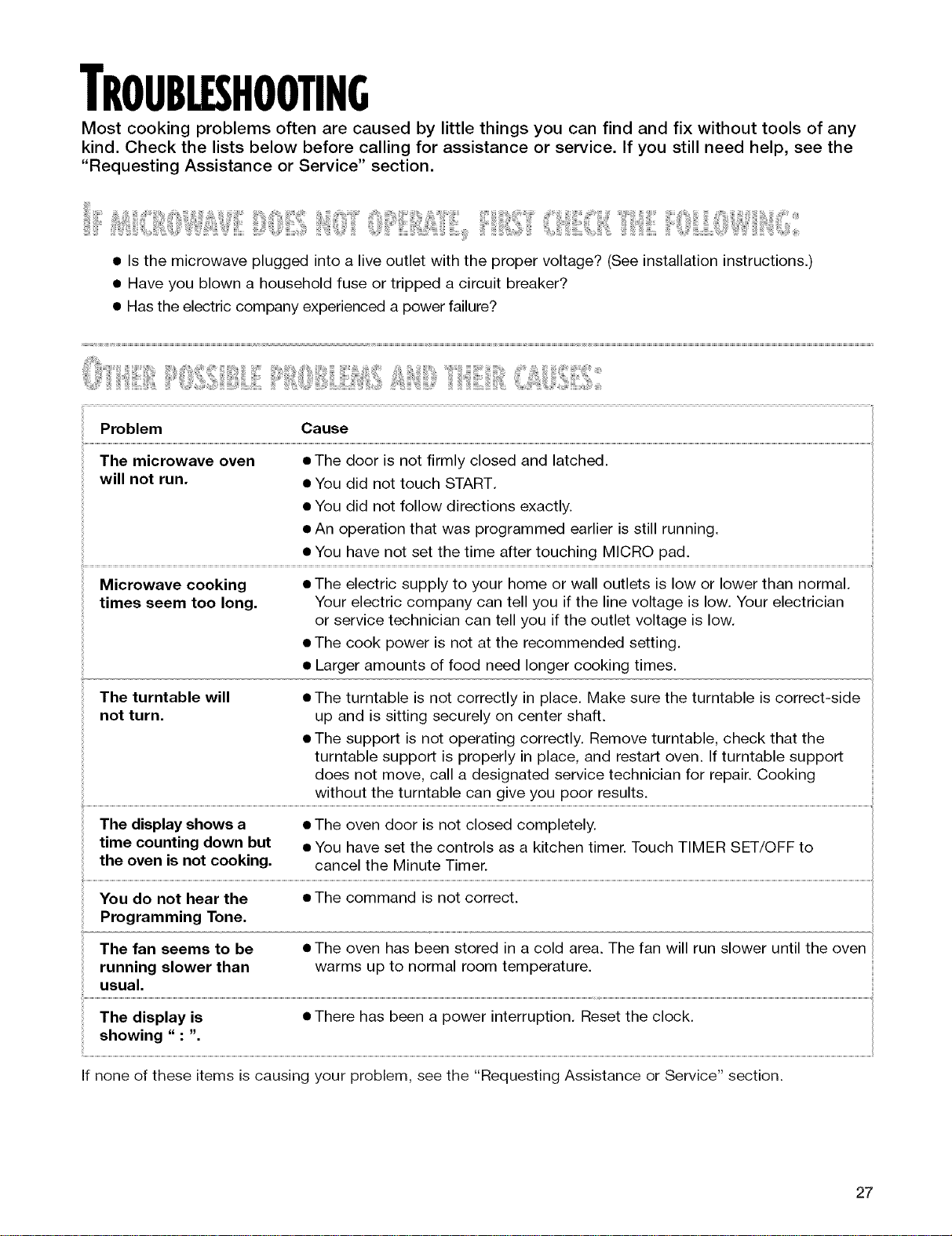
TROUBLESHOOTING
Most cooking problems often are caused by little things you can find and fix without tools of any
kind. Check the lists below before calling for assistance or service. If you still need help, see the
"Requesting Assistance or Service" section.
• Is the microwave plugged into a live outlet with the proper voltage? (See installation instructions.)
• Have you blown a household fuse or tripped a circuit breaker?
• Has the electric company experienced a power failure?
Problem Cause
The microwave oven • The door is not firmly closed and latched,
will not run. • You did not touch START,
• You did not follow directions exactly.
• An operation that was programmed earlier is still running.
• You have not set the time after touching MICRO pad.
Microwave cooking • The electric supply to your home or wall outlets is low or lower than normal,
times seem too long. Your electric company can tell you if the line voltage is low, Your electrician
or service technician can tell you if the outlet voltage is low,
• The cook power is not at the recommended setting.
• Larger amounts of food need longer cooking times.
The turntable will • The turntable is not correctly in place, Make sure the turntable is correct-side
not turn. up and is sitting securely on center shaft.
• The support is not operating correctly. Remove turntable, check that the
turntable support is properly in place, and restart oven. If turntable support
does not move, call a designated service technician for repair. Cooking
without the turntable can give you poor results.
The display shows a • The oven door is not closed completely.
time counting down but • You have set the controls as a kitchen timer, Touch TIMER SET/OFF to
the oven is not cooking, cancel the Minute Timer,
You do not hear the • The command is not correct.
Programming Tone.
The fan seems to be • The oven has been stored in a cold area. The fan will run slower until the oven
running slower than warms up to normal room temperature.
usual.
If none of these items is causing your problem, see the "Requesting Assistance or Service" section.
27
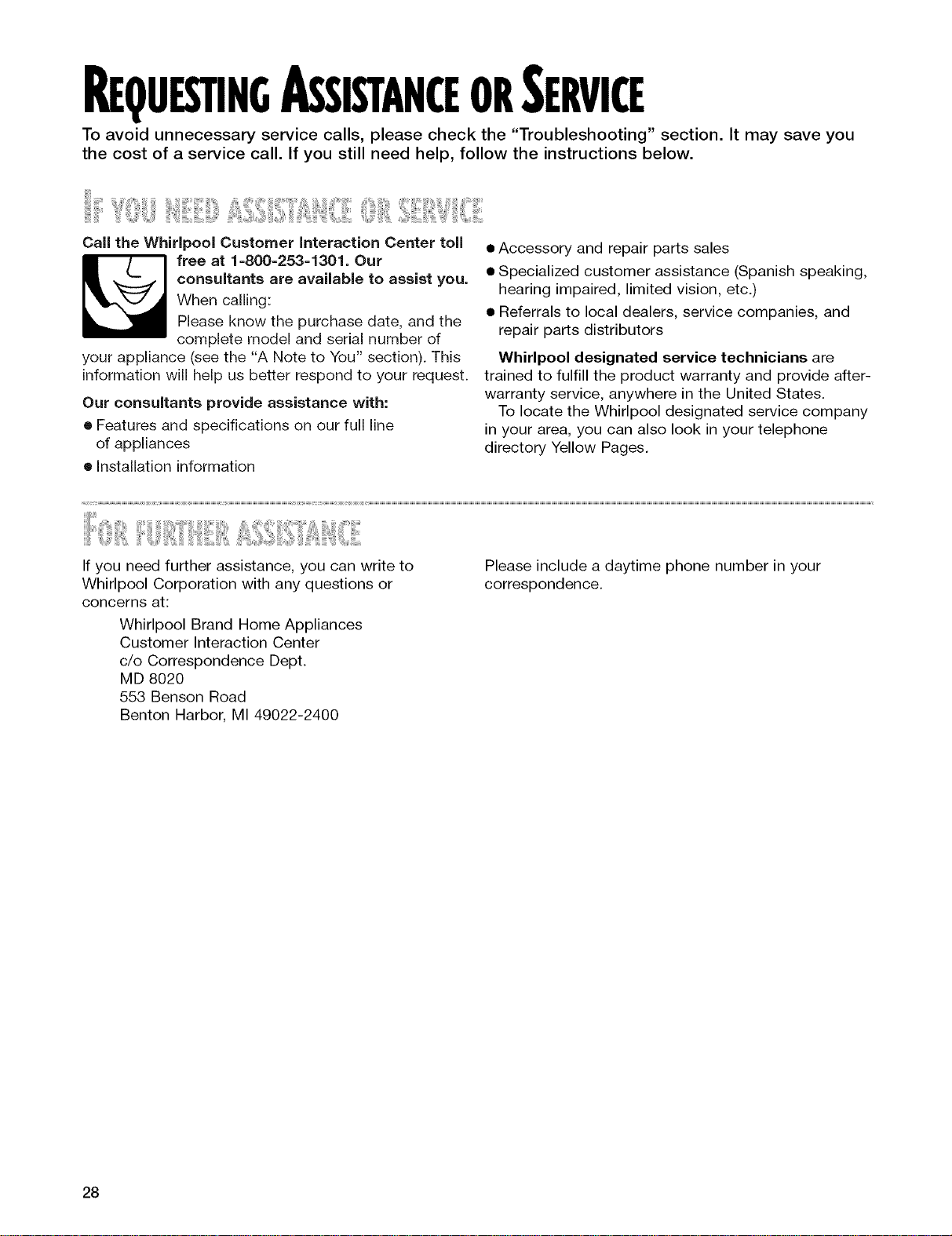
REQUESTINGASSISTANCEORSERVICE
To avoid unnecessary service calls, please check the "Troubleshooting" section. It may save you
the cost of a service call. If you still need help, follow the instructions below.
Call the Whirlpool Customer interaction Center toll
free at 1-800-2_3-1301. Our
consultants are available to assist you.
When calling:
Please know the purchase date, and the repair parts distributors
complete model and serial number of
your appliance (see the "A Note to You" section). This Whirlpool designated service technicians are
information will help us better respond to your request, trained to fulfill the product warranty and provide after-
warranty service, anywhere in the United States.
Our consultants provide assistance with: To locate the Whirlpool designated service company
• Features and specifications on our full line in your area, you can also look in your telephone
of appliances directory Yellow Pages.
• Installation information
• Accessory and repair parts sales
• Specialized customer assistance (Spanish speaking,
hearing impaired, limited vision, etc.)
• Referrals to local dealers, service companies, and
If you need further assistance, you can write to
Whirlpool Corporation with any questions or
concerns at:
Whirlpool Brand Home Appliances
Customer Interaction Center
c/o Correspondence Dept.
MD 8020
553 Benson Road
Benton Harbor, MI 49022-2400
Please include a daytime phone number in your
correspondence.
28
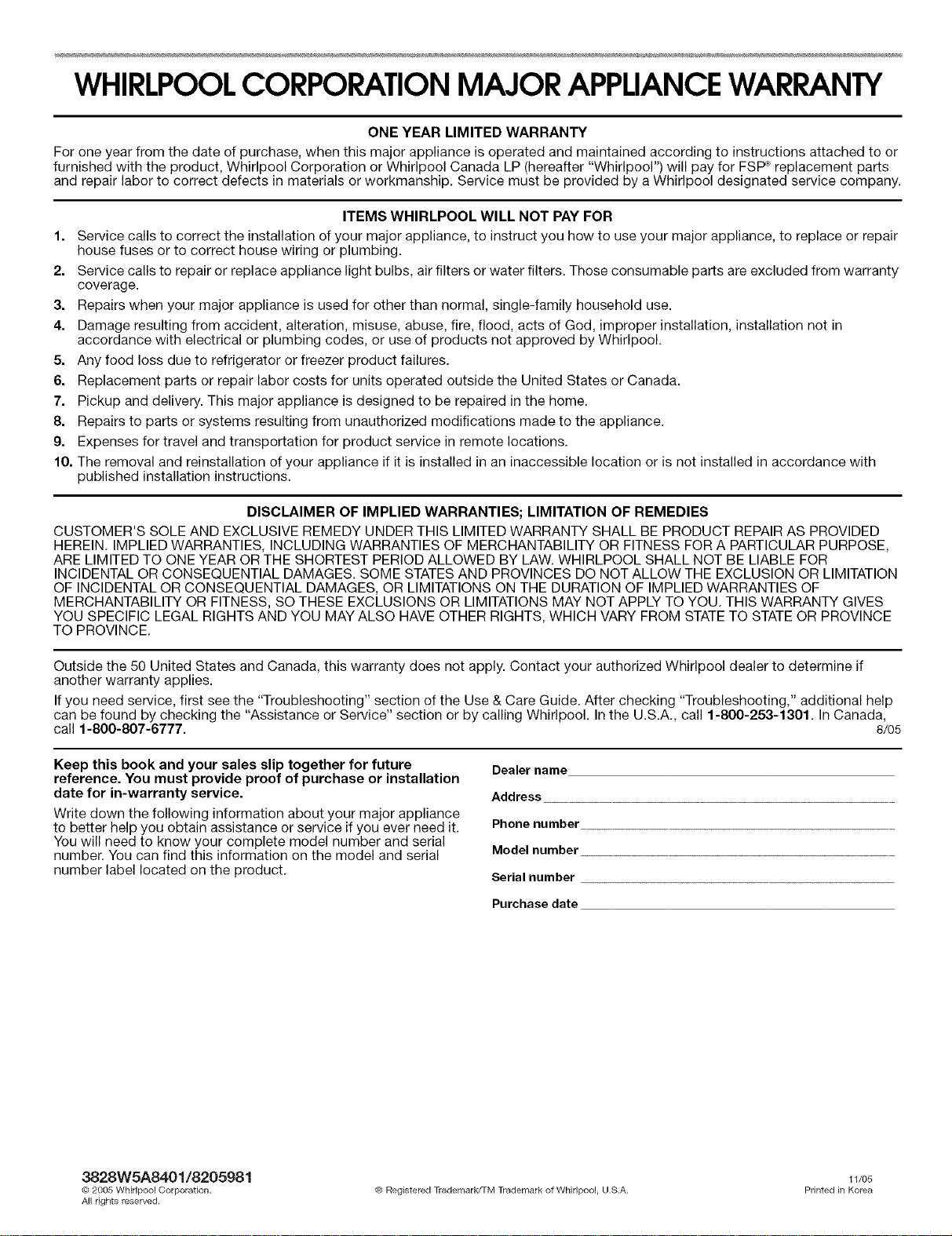
WHIRLPOOLCORPORATION MAJOR APPLIANCEWARRANTY
ONE YEAR LIMITED WARRANTY
For one year from the date of purchase, when this major appliance is operated and maintained according to instructions attached to or
furnished with the product, Whirlpool Corporation or Whirlpool Canada LP (hereafter "Whirlpool") will pay for FS_ replacement parts
and repair labor to correct defects in materials or workmanship. Service must be provided by a Whirlpool designated service company.
ITEMS WHIRLPOOL WILL NOT PAY FOR
1. Service calls to correct the installation of your major appliance, to instruct you how to use your major appliance, to replace or repair
house fuses or to correct house wiring or plumbing.
2. Service calls to repair or replace appliance light bulbs, air filters or water filters. Those consumable parts are excluded from warranty
coverage.
3. Repairs when your major appliance is used for other than normal, single-family household use.
4. Damage resulting from accident, alteration, misuse, abuse, fire, flood, acts of God, improper installation, installation not in
accordance with electrical or plumbing codes, or use of products not approved by Whirlpool.
5. Any food loss due to refrigerator or freezer product failures.
6. Replacement parts or repair labor costs for units operated outside the United States or Canada.
7. Pickup and delivery. This major appliance is designed to be repaired in the home.
8. Repairs to parts or systems resulting from unauthorized modifications made to the appliance.
9. Expenses for travel and transportation for product service in remote locations.
10. The removal and reinstallation of your appliance if it is installed in an inaccessible location or is not installed in accordance with
published installation instructions.
DISCLAIMER OF IMPLIED WARRANTIES; LIMITATION OF REMEDIES
CUSTOMER'S SOLE AND EXCLUSIVE REMEDY UNDER THIS LIMITED WARRANTY SHALL BE PRODUCT REPAIR AS PROVIDED
HEREIN. IMPLIED WARRANTIES, INCLUDING WARRANTIES OF MERCHANTABILITY OR FITNESS FOR A PARTICULAR PURPOSE,
ARE LIMITED TO ONE YEAR OR THE SHORTEST PERIOD ALLOWED BY LAW. WHIRLPOOL SHALL NOT BE LIABLE FOR
INCIDENTAL OR CONSEQUENTIAL DAMAGES. SOME STATES AND PROVINCES DO NOT ALLOW THE EXCLUSION OR LIMITATION
OF INCIDENTAL OR CONSEQUENTIAL DAMAGES, OR LIMITATIONS ON THE DURATION OF IMPLIED WARRANTIES OF
MERCHANTABILITY OR FITNESS, SO THESE EXCLUSIONS OR LIMITATIONS MAY NOT APPLY TO YOU. THIS WARRANTY GIVES
YOU SPECIFIC LEGAL RIGHTS AND YOU MAY ALSO HAVE OTHER RIGHTS, WHICH VARY FROM STATE TO STATE OR PROVINCE
TO PROVINCE.
Outside the 50 United States and Canada, this warranty does not apply. Contact your authorized Whirlpool dealer to determine if
another warranty applies.
If you need service, first see the "Troubleshooting" section of the Use & Care Guide. After checking "Troubleshooting," additional help
can be found by checking the "Assistance or Service" section or by calling Whirlpool. Inthe U.S.A., call 1-800-253-1301. In Canada,
call 1-800-807-6777. 8/05
Keep this book and your sales slip together for future
reference. You must provide proof of purchase or installation
date for in-warranty service.
Write down the following information about your major appliance
to better help you obtain assistance or service if you ever need it.
You will need to know your complete model number and serial
number. You can find this information on the model and serial
number label located on the product.
Dealer name
Address
Phone number
Model number
Serial number
Purchase date
3828W5A8401/8205981 11/05
© 2005 Whirlpool Corporatk)n. © Registered TrademarWTM Trademark of Whirlpool, U.S.A. Printed in Korea
All rights reserved.