CONTENTS
SAFETY
Anti-Tip Device ................................................. 2, 3, 31, 40
important Safety Instructions ......................................2-6
INSTALLATION ...........................................30.-.44
Air Adjustment ...................................................... 38, 39
Dimensions and Clearances .................................... 30
Electrical Connections ........................................... 35, 36
Gas Pipe and Electric Outlet Locations .................. 33
Installing the Anti-Tip Device ................................... 40
LP Conversion ..................................................................41-44
USE AND CARE
Baking ................................................................... 13, 14
Broiling/Broiling Guide ...................................... 19, 20
Care and Cleaning .............................................. 24-29
Cooktop Comparison ................................ ................ 10
Features of Your Oven Control ............................. 8, 9
Features of Your Range ............................................. 7
Operating the Self-Cleaning Oven .................... 21-23
Oven Control, Clock and Timer ............................. 8, 9
Roasting/Roasting Guide ................................... 17, 18
Surface Cooking ................................................. 1t, 12
Timed Baking ....................................................... 15, 16
Using Your Oven ................................................ 12, 13
SERVICE
Problem Solver ...................................................... 45, 46
Repair Services ............................................................. 47
Thermostat Adjustment ................................................ 16
WARRANTY ......................................................48
I
MODELS:
75865, 75866, 75869
Kenmore
MANUAL
I64D2764P072
SR4225
425 CG
Pdrlted in tho Un)ted Slales
WARNING: If the information in this
manual is not followed exactly, a fire or
explosion may result causing proper-
ty damage, personal injury or death.
-- Do not store or use gasoline or other
flammable vapors and liquids in the
vicinity of this or any other appliance.
WHAT TO DO IF YOU SMELL GAS
• Do not try to light any appliance.
• Do not touch any electrical switch; do
not use any phone in your building.
.immediately call your gas supplier
from a neighbor's phone, Follow the
gas supplier's instructions.
• If you cannot reach your gas suppli-
er, call the fire department.
-- Installation and service must be per-
formed by a qualified installer, service
agency or the gas supplier.
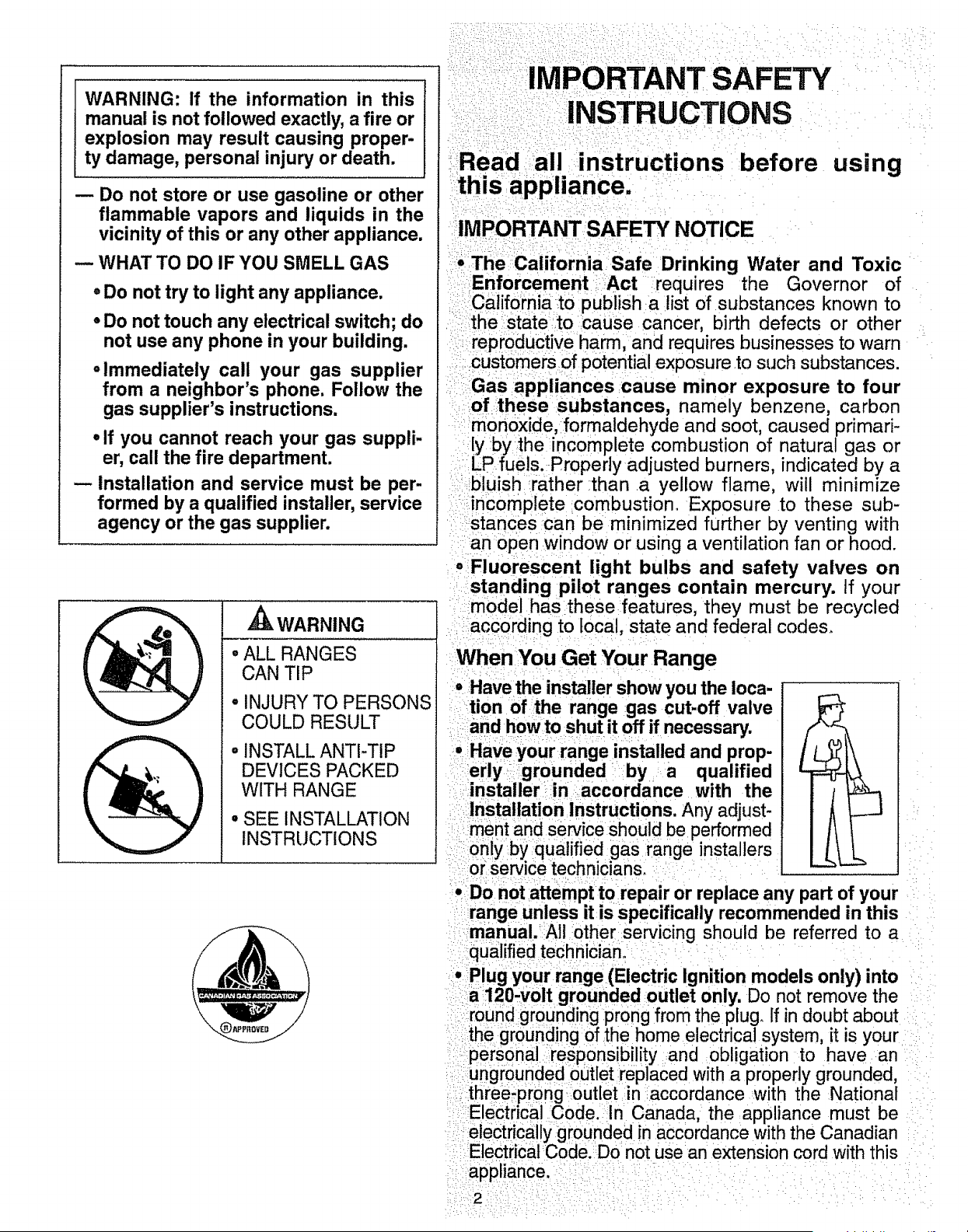
,_,WARNING
oALL RANGES
CAN TIP
• INJURY TO PERSONS
COULD RESULT
. INSTALL ANTI-TIP
DEVICES PACKED
WITH RANGE
• SEE INSTALLATION
INSTRUCTIONS
IMPORTANT SAFETY
INSTRUCTIONS
Read all instructions before using
this appliance,
IMPORTANT SAFETY NOTICE
* The California Safe =Drinking Water and Toxic
Enforcement Act requires the Governor of
:California to publish a list of substances known to
the state to cause cancer, birth defects or other
reproductive harm, and requires businesses to warn
ctJst0mersof potential exposure to such substances.
Gas appliances cause minor exposure to four
of these Substances, namely benzene, carbon
monoxide, formaldehyde and soot, caused primari-
ly bythe incomplete combustion of natural gas or
LP fuels. Properly adjusted burners, indicated by a
_:bluish :rather than a yellow flame, will minimize
incomplete combustion, Exposure to these sub-
stances can be minimized further by venting with
an open window or using a ventilation fan or hood.
= Fluorescent light bulbs and safety valves on
standing pilot ranges contain mercury. If your
model has these features, they must be recycled
according to local, state and federal codes_
When You Get Your Range
° :Have the installer show you the loca-
tion of the range :gas cut-off valve
and how to shut it off if necessary.
Have Your range installed and prop-
erly!grounded by a qualified
installer in accordance with the
Installation Instructions. Any adjust-
ment and service should be performed
only by qualified gas range installers
or service technicians.
[
• Do not attempt to repair or replace any part of your
range unless it is specifically recommended in this
qanual. All other servicing should be referred to a
ualified technician.
° Plug your range(Electric Ignition models only) into
a 120-volt grounded :outlet only. Do not remove the
round grour_ding prong from the plug. If in doubt about
the grounding of the home electrical system, it is your
personal responsibility and obligation to have an
ungrounded outletreplaced with a properly grounded,
!:ithree_prong outlet in accordance with the National
Electrical Code. tn Canada, the appliance must be
_lectrically grounded in accordance with the Canadian
lectricatCode. Do not use an extension cord with this
appliance.
2
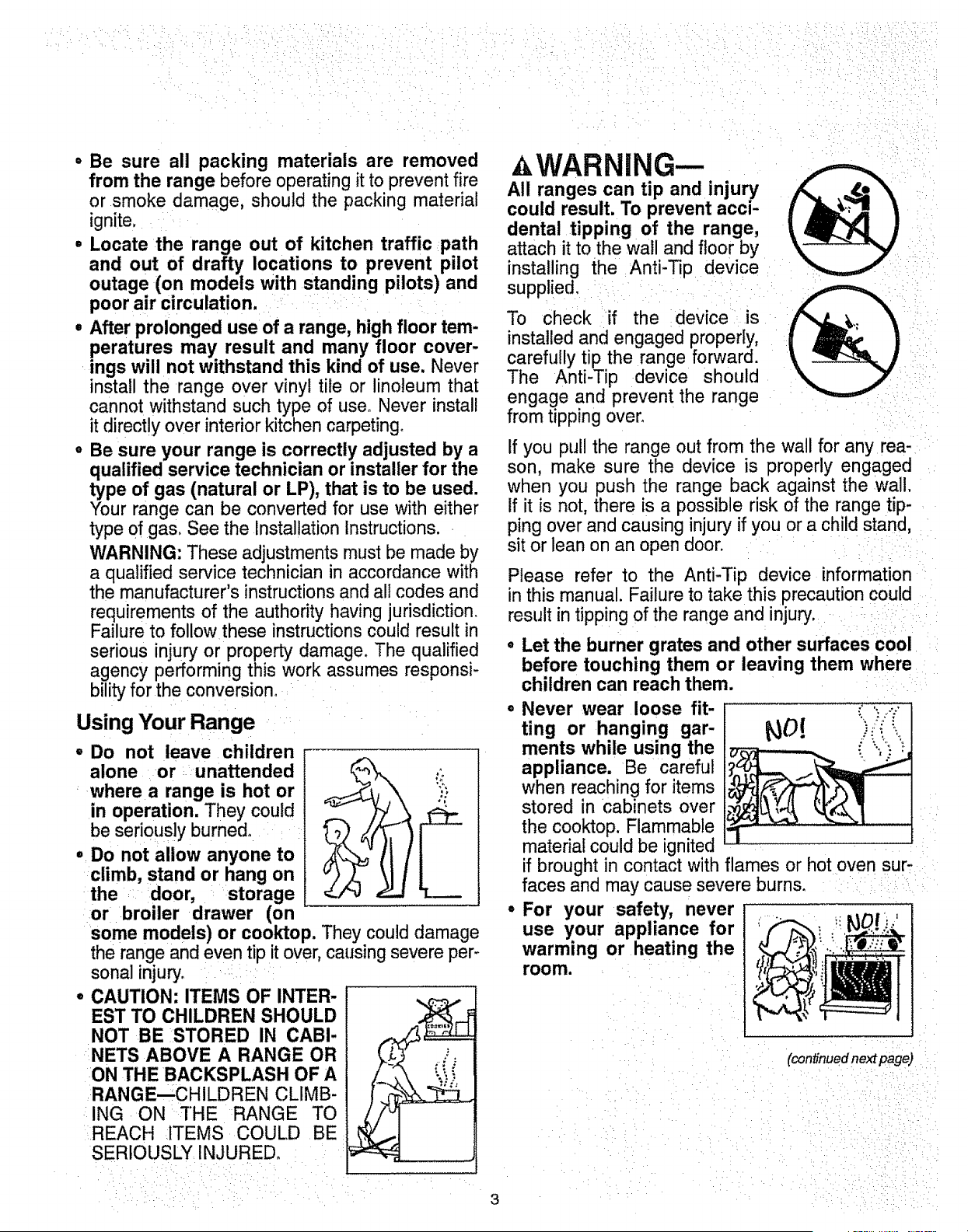
o Be sure all packing materials are removed
from the range before operatingit to prevent fire
or smoke damage, should the packing material
ignite.
, Locate the range out of kitchen traffic path
and out of drafty locations to prevent pilot
outage (on models with standing pilots) and
poor air circulation.
• After prolonged use of a range, high floor tem-
peratures may result and many floor cover-
ings will not withstand this kind of use. Never
install the range over vinyl tile or linoleum that
cannot withstand such type of use_ Never install
it directly over interior kitchen carpeting.
- Be sure your range is correctly adjusted by a
qualified service technician or installer for the
type of gas (natural or LP), that is to be used.
Your range can be converted for use with either
type of gas. See the Installation Instructions.
WARNING: These adjustments must be made by
a qualified service technician in accordance with
the manufacturer's instructions and all codes and
requirements of the authority having jurisdiction.
Failure to follow these instructions could result in
serious injury or property damage. The qualified
agency performing this work assumes responsi-
bility for the conversion.
Using Your Range
o Do not leave children
alone or unattended
_ where a range is hot or
in operation. They could
be seriously burned.
-Do not allow anyone to
climb, stand or hang on
the: door, storage
or broiler drawer (on
sonal injury.
, CAUTION: ITEMS OF INTER-
EST TO CHILDREN SHOULD
NOT BE STORED IN CABI-
:NETS ABOVE A RANGE OR
ON THE BACKSPLASH OF A
RANGE--CHILDREN CLIMB-
ING ON'THE RANGE TO
REACH ITEMS COULD BE
SERIOUSLY INJURED.
some models) or cooktop. They could damage
the range and even tip it over, causing severe per-
AWARNiNG--
All ranges can tip and injury
could result. To prevent acci-
dental tipping of the range,
attach it to the wall and floor by
installing the Anti-Tip device
supplied.
To check if the device is
installed and engaged properly,
carefully tip the range forward,
The Anti-Tip device should
engage and prevent the range
from tipping over.
If you pull the range out from the wall for any rea-
son, make sure the device is properly engaged
when you push the range back against the wall.
If it is not, there is a possible risk of the range tip-
ping over and causing injury if you or a child stand,
sit or lean on an open door. :
Please refer to the Anti-Tip device information
in this manual. Failure to take this precaution could
result in tipping of the range and injury, i
, Let the burner grates and other surfaces cool
before touching them or leaving them where
children can reach them.
Never wear I°°se fit" I i
ting or hanging gar- _0[
ments while using the _ _.
appliance. Be careful
when reaching for items
stored in cabinets over
the cooktop.Flammable
material could be ignited
if brought in contact withflames or hot oven sur-
faces and may cause severe burns ..........................
For your safety, never
use your appliance for
warming or heating the
room.
(continued next page)
i :
:i
IMPORTANT SAFETY INSTRUCTIONS (continued)
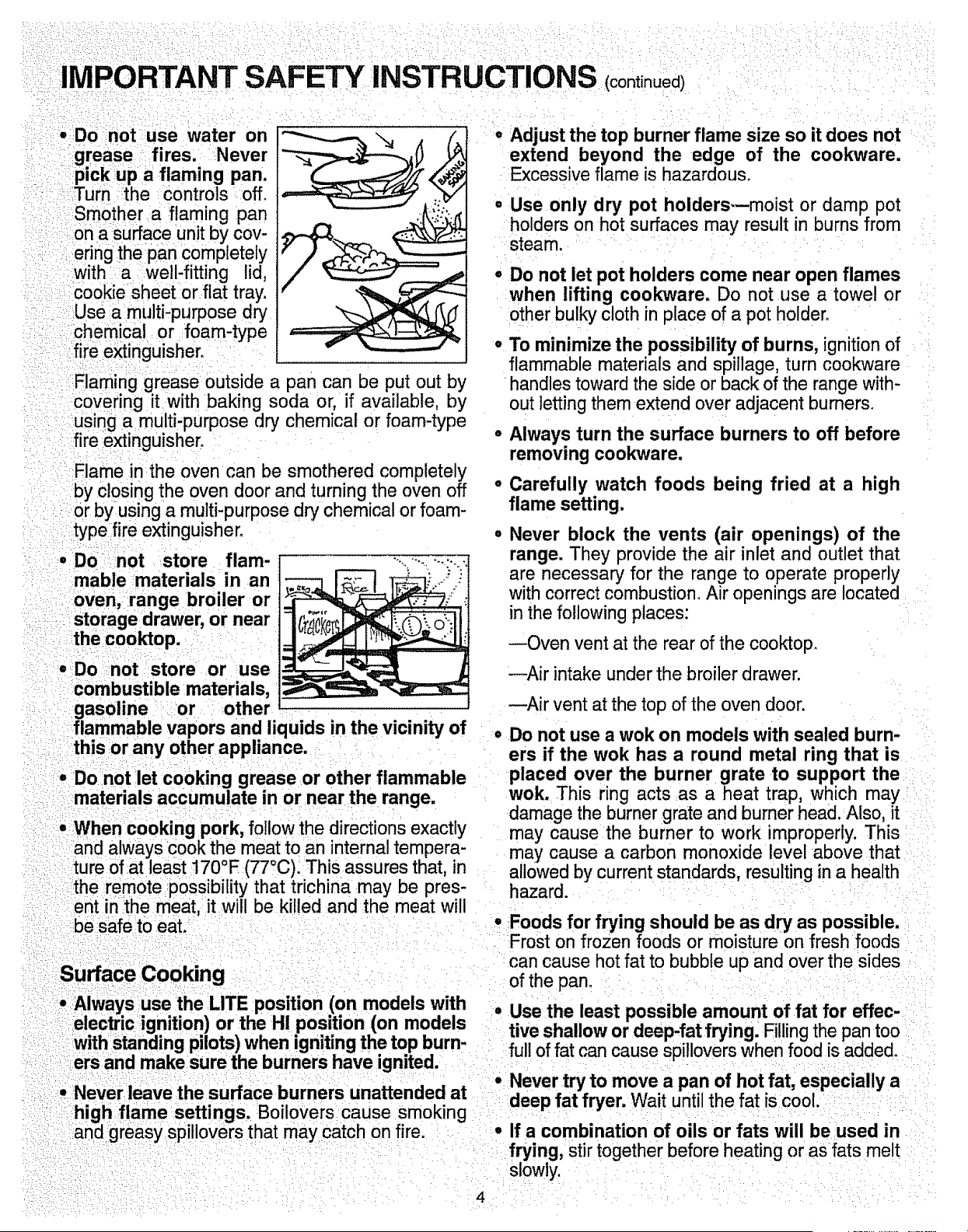
Do not use water on
grease fires. Never
pink upa flaming pan.
Turn the controls off.
Smother a flaming pan
on a surface unit by cov-
ering the pan completely
with a well-fitting lid,
cookie sheet orflat tray.
Use a multi-purpose dry
chemical or foam-type
fire extinguisher.
Flaming grease outside a pan can be put out by
covering it with baking soda or, if available, by
using a multi-purpose dry chemical or foam-type
fire extinguisher.
Flame inthe oven can be smothered completely
by closing the oven door and turning the oven off •
or by using a multi-purpose dry chemical or foam-
type fire extinguisher. •
• Do not store flam-
mable materials in an
oven, i range broiler or
storage drawer, or near
_ ; the cooktop.
Do not store or use
combustible materials,
gasoline : or other
flammable vapors and liquids in the vicinity of
this or any other appliance.
° Do not let cooking grease or other flammable
materials accumulate in or near the range.
When cooking pork, follow the directions exactly
and always cook the meat to an internal tempera-
ture of at least 170°E (77°C): This assures that, in
the remote possibility that trichina may be pres-
ent in the meat, it witl be killed and the meat will
be safe to eat.:
° Always use the LITE position (on models with •
electric ignition) or the Hi position (on models
with standing pilots) when igniting the top burn-
ers and make sure the burners have ignited.
° Never leave the surface burners unattended at
high flame settings. Boilovers cause Smoking
and greasy spillovers that may catch on fire. °
4
• Adjust the top burner flame size so it does not
extend beyond the edge of the cookware.
Excessive flame is hazardous_
= Use only dry pot holders--moist or damp pot
holders on hot surfaces may result in burns from
steam.
o Do not let pot holders come near open flames
when lifting cookware. Do not use a towel or
other bulky cloth in place of a pot holder_
* To minimize the possibility of burns, ignition of
flammable materials and spillage, turn cookware
handles toward the side or back of the range with-
out letting them extend over adjacent burners.
Always turn the surface burners to off before
removing cookware.
Carefully watch foods being fried at a high
flame setting.
Never block the vents (air openings) of the
range. They provide the air inlet and outlet that
are necessary for the range to operate properly
withcorrectcombustion.Air openings are located
in the following places:
--Oven vent at the rear of the cooktop.
--Air intake under the broiler drawer.
--Air vent at the top of the oven door.
Do not use a wok on models with sealed burn-
ers if the wok has a round metal ring that is
placed over the burner grate to support the
wok. This ring acts as a heat trap, which may
damage the burner grate and burner head. Also, it
may cause the burner to work improperly. This
may cause a carbon monoxide level above that
allowed by current standards, resulting in a health
hazard.
Foods for frying should be as dry as possible.
Frost on frozen foods or moisture on fresh foods
can cause hot fat to bubble up and over the sides
of the pan.
Use the least possible amount of fat for effec-
tive shallow or deep-fat frying. Filling the pan too
full of fat can cause spillovers when food is added.
Never try to move a pan of hot fat, especially a
deep fat fryer. Wait until the fat is cool.
If a combination of oils or fats will be used in
frying, stir together before heating or as fats melt
slowly.
o Always heat fat slowly and watch as it heats,
• Use a deep-fat thermometer whenever possi-
ble to prevent overheating fat beyond the smok-
ing point_
• Use proper pan size. Avoid pans that are unsta-
ble or easily tipped. Select coolo,_Jare having flat
bottoms large enough to properly contain food
and avoid boilovers and spitlovers and large
enough to cover burner grates. This will both save
cleaning time and prevent hazardous accumula-
tions of food, since heawj spattering or spillovers
left on the range can ignite. Use pans with han-
dles that can be easily grasped and will remain
cool.
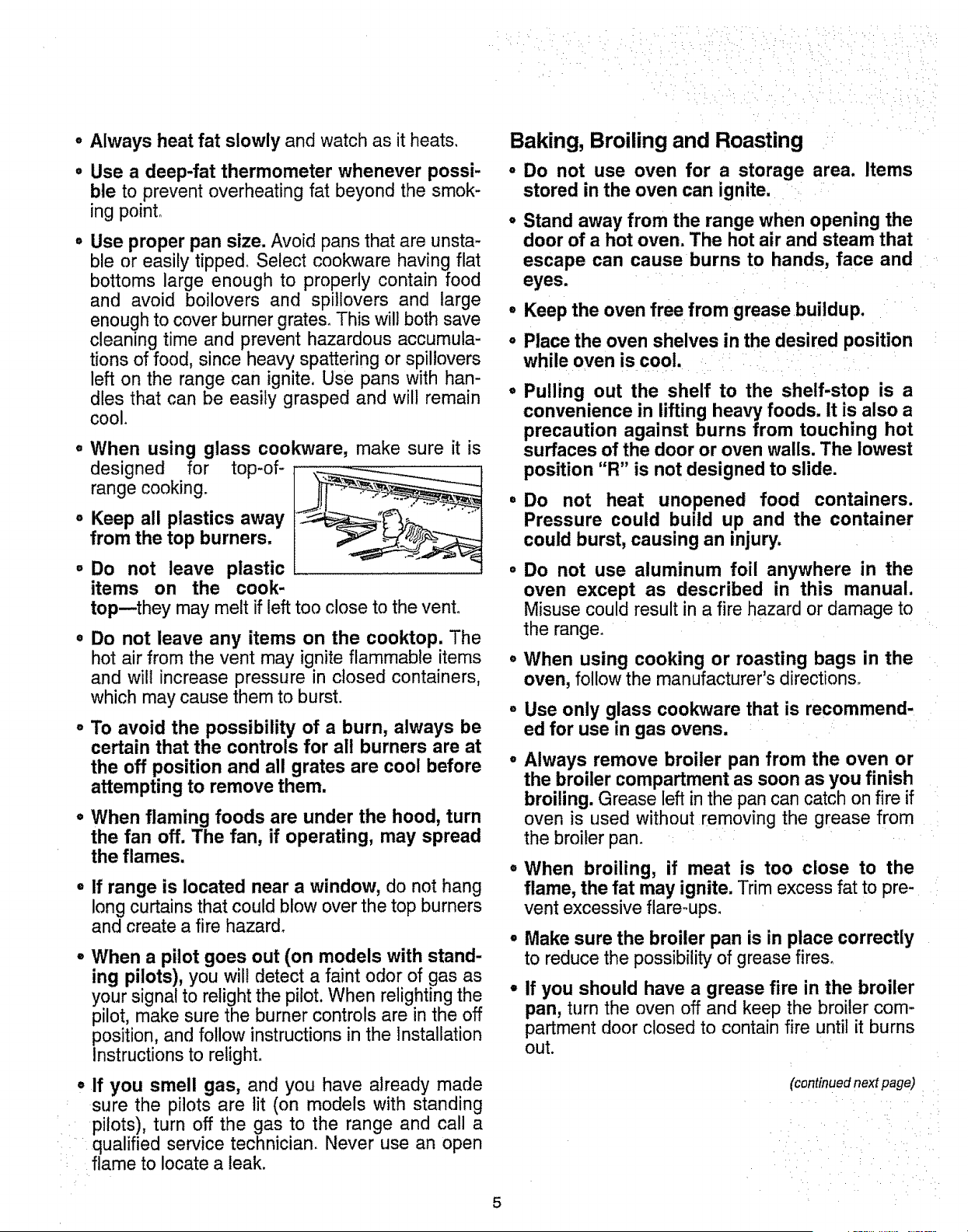
• When using glass cookware, make sure it is
designed for top-of-
range cooking.
° Keep all plastics away
from the top burners,
• Do not leave plastic
items on the cook-
top--they may melt if left too close to the vent°
• Do not leave any items on the cooktop. The
hot air from the vent may ignite flammable items
and will increase pressure in closed containers,
which may cause them to burst.
o To avoid the possibility of a burn, always be
certain that the controls for all burners are at
the off position and all grates are cool before
attempting to remove them.
° When flaming foods are under the hood, turn
the fan off. The fan, if operating, may spread
the flames.
o If range is located near a window, do not hang
long curtains that could blow over the top burners
and create a fire hazard.
° When a pilot goes out (on models with stand-
ing pilots), you will detect a faint odor of gas as
your signal to relight the pilot. When relighting the
pilot, make sure the burner controls are in the off
position, and follow instructions in the Installation
instructions to relight.
° if you smell gas, and you have already made
sure the pilots are tit (on models with standing
pilots), turn off the gas to the range and call a
qualified service technician. Never use an open
flame to locate a leak.
Baking, Broiling and Roasting
° Do not use oven for a storage area. Items
stored in the oven can ignite.
° Stand away from the range when opening the
door of a hot oven. The hot air and steam that
escape can cause burns to hands, face and
eyes.
° Keep the oven free from grease buildup.
o Place the oven shelves in the desired position
while oven is cool. ....
° Pulling out the shelf to the shelf-stop is a
convenience in lifting heavy foods, it is also a
precaution against burns from touching hot
surfaces of the door or oven walls. The lowest
position "R" is not designed to slide.
Do not heat unopened food containers.
Pressure could build up.and the container
could burst, causing an injury.
Do not use aluminum foil anywhere in the
oven except as described in this manual.
Misuse could result in a fire hazard or damage to
the ranger
When using cooking or roasting bags in the
oven, follow the manufacturer's directions°
° Use only g!ass cookware that is recommend,
ed for use =ngas ovens.
O
Always remove broiler pan from the oven or
the broiler compartment as soon as you finish
broiling. Grease left in the pan can catch on fire if
oven is used without removing the grease from
the broiler pan_
When broiling, if meat is too close to the
flame, the fat may ignite. Trim excess fat to pre-
vent excessive flare_ups.
Make sure the broiler pan is in place correctly
to reduce the possibility of grease fires.
If you should have a grease fire in the broiler
pan, turn the oven off and keep the broiler com-
partment door closed to contain fire until it burns
out.
(continued next page)
IMPORTANT SAFETY INSTRUCTIONS (continued)
Self-Cleaning Oven
• Do not clean the door gasket. The door gasket
for a seat. Care should be taken
is essential good
not to rub, damage or move the gasket.
• :Do not use oven cleaners. No commercial oven
cleaner or oven liner protective coating of any
kind should be used in or around any part of the
oven. ,Residue from oven cleaners will damage
_the inside of the oven when the self-clean cycle
is used,
!. Before self-cleaning the oven, remove the
shelves, the broiler pan, grid and other cookware,
• Clean only parts listed in this Use and Care
Guide.
, II
Keep the range clean and free of accumula-
tions of grease or spillovers, which may
ignite.
Be sure to wipe up excess spillage before
starting the self-clean cycle.
If the self-cleaning mode malfunctions, turn
the oven off and disconnect the power supply.
Have it serviced by a qualified technician.
SAVE THESE
INSTRUCTIONS
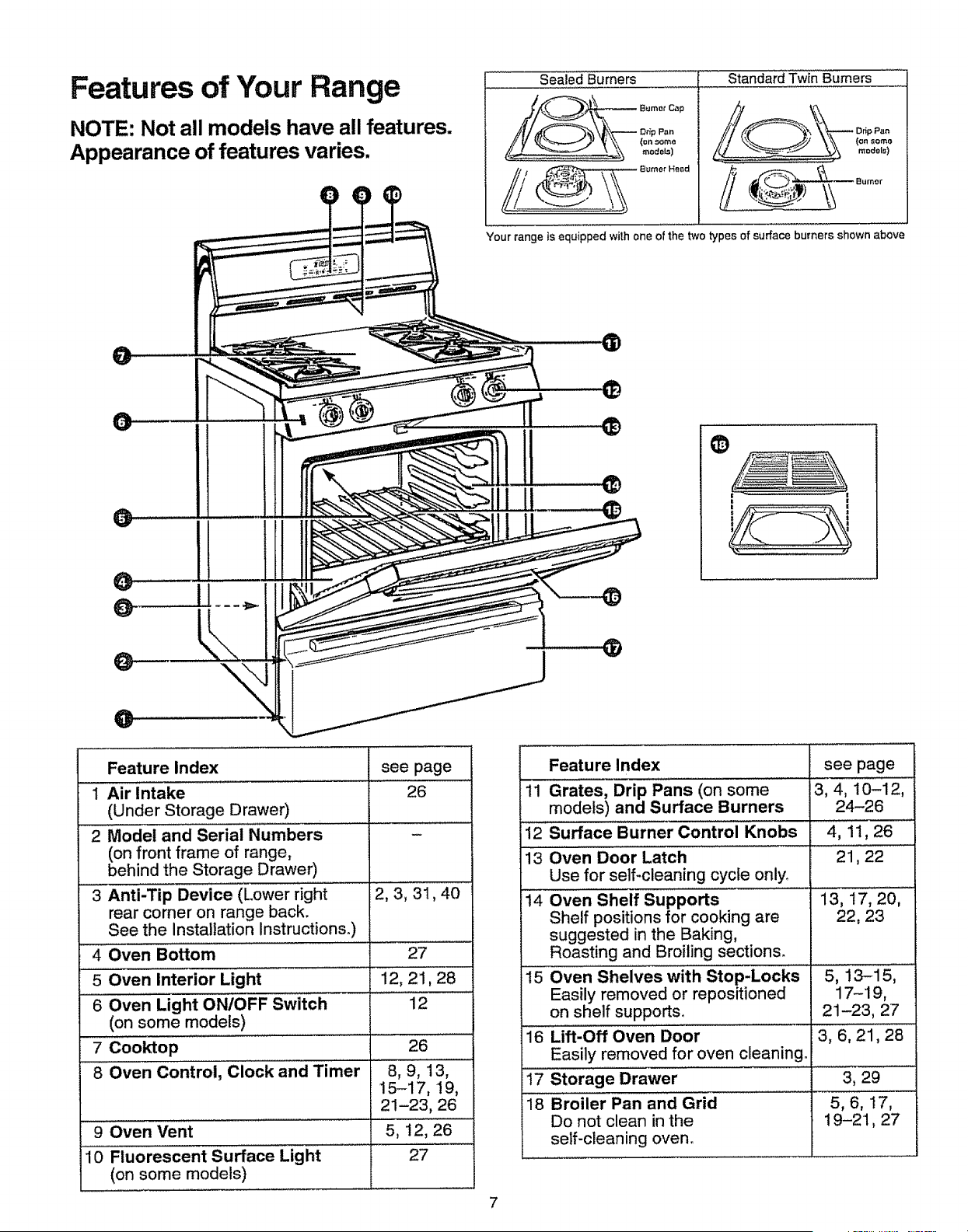
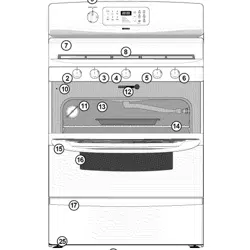
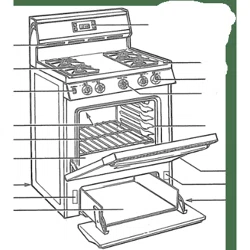
Features of Your Range
NOTE: Not all models have all features.
Appearance of features varies.
Standard Twin Burners
Your range is equipped with one of the two types of surface burners shown above
C
C
O
O
O
\
®
| i
Feature Index see page
1 Air Intake 26
(Under Storage Drawer)
2 Model and Serial Numbers
(on front frame of range,
behind the Storage Drawer)
.....3 Anti-Tip Device (Lower right 2, 3, 31,40
rear corner on range back.
See the Installation Instruction&)
4 Oven Bottom 27
5 Oven Interior Light 12, 2i, 28
6 Oven Light oN/OFF switch ..... 12
(on some models)
7 Cooktop 26
8 Oven Control, Clock and Timer 8, 9, 131
15-17, 19,
21-23, 26
9 Oven Vent 5, 12, 26
10 Fluorescent Surface Light 27"
(on some models)
Feature Index see page
11 Grates, Drip Pans(0n some ...... 3, 4, 10-12,
models) and Surface Burners 24-26
_12Surface Burner C0ntroi Knobs 41 11,26 .....
13 Oven Door Latch 21,22
Use for self-cleaning cycle only,
14 Oven Shelf Supp0rts 13, i7, 20,
Shelf positions for cooking are 22, 23
suggested in the Baking,
Roasting and Broiling sections.
i5 0ven Shelves with Stop-Locks 5, 13-15,
Easily removed or repositioned 17-19,
on shelf support& 21-23, 27
16 Lift-Off Oven Door 3, 6, 21,28
Easily removed for oven cleaning.
17 Storage Drawer 3, 29
18 Broiler Pan and Grid 5, 6, 17,
Do not clean in the 19-2'1,27
self-cleaning oven.
7
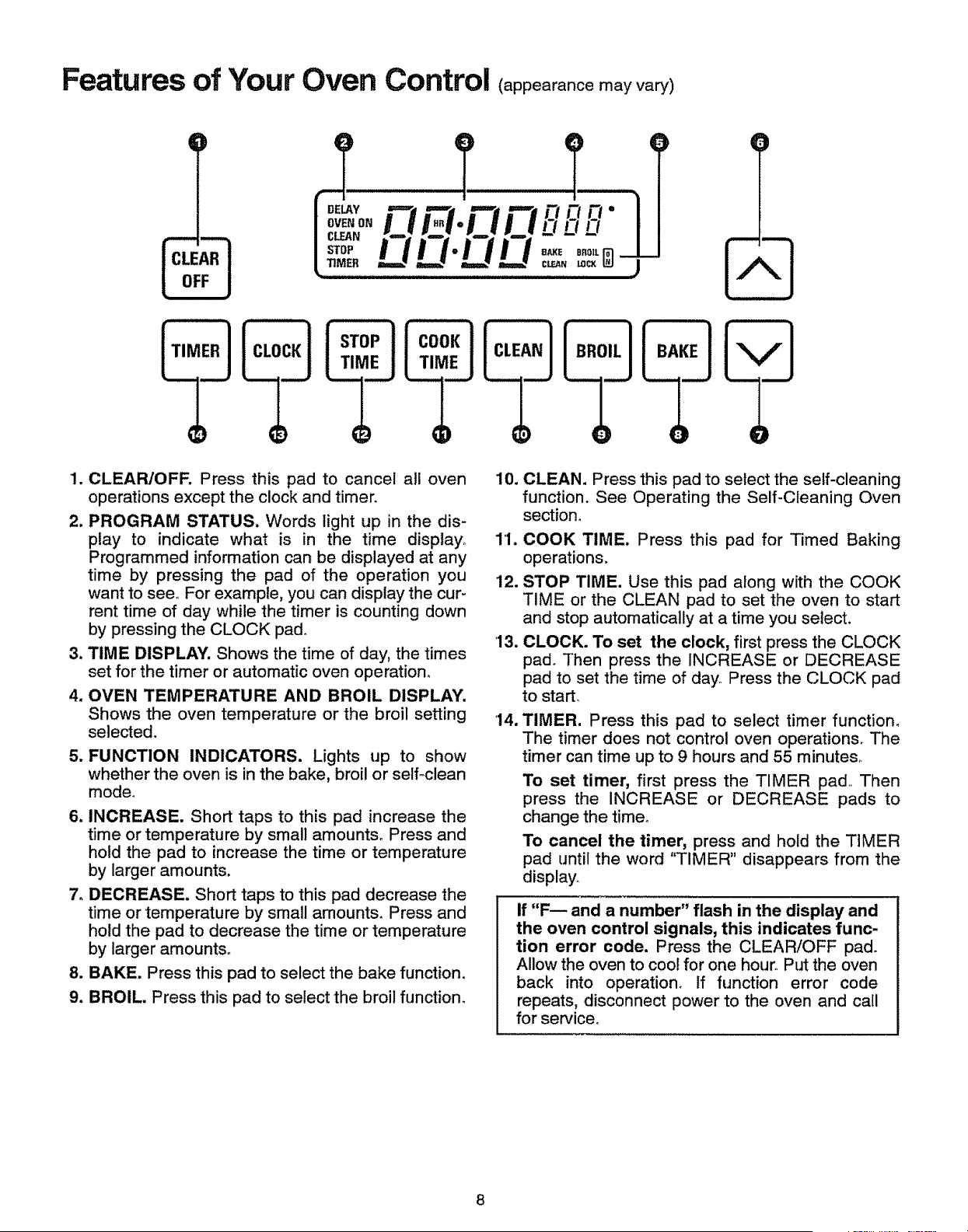
Features of Your Oven Control (appearancemay vary)
1. CLEAR/OFF. Press this pad to cancel all oven
operations except the clock and timer.
2, PROGRAM STATUS. Words light up in the dis-
play to indicate what is in the time display°
Programmed information can be displayed at any
time by pressing the pad of the operation you
want to see° For example, you can display the cur-
rent time of day while the timer is counting down
by pressing the CLOCK pad.
3, TIME DISPLAY. Shows the time of day, the times
set for the timer or automatic oven operation.
4. OVEN TEMPERATURE AND BROIL DISPLAY,
Shows the oven temperature or the broil setting
selected.
5. FUNCTION INDICATORS, Lights up to show
whether the oven is in the bake, broil or self°clean
mode,
6. INCREASE. Short taps to this pad increase the
time or temperature by small amounts° Press and
hold the pad to increase the time or temperature
by larger amounts.
7. DECREASE. Short taps to this pad decrease the
time or temperature by small amounts, Press and
hold the pad to decrease the time or temperature
by larger amounts°
8. BAKE. Press this pad to select the bake function.
9. BROIL. Press this pad to select the broil function.
10. CLEAN. Press this pad to select the self-cleaning
function. See Operating the Self-Cleaning Oven
section.
1'1. COOK TIME. Press this pad for Timed Baking
operations,
12. STOP TIME, Use this pad along with the COOK
TIME or the CLEAN pad to set the oven to start
and stop automatically at a time you select.
'13, CLOCK, To set the clock, first press the CLOCK
pad, Then press the INCREASE or DECREASE
pad to set the time of day. Press the CLOCK pad
to start,
'14. TIMER. Press this pad to select timer function,
The timer does not control oven operations, The
timer can time up to 9 hours and 55 minutes°
To set timer, first press the TIMER pad, Then
press the INCREASE or DECREASE pads to
change the time,
To cancel the timer, press and hold the TIMER
pad until the word "TIMER" disappears from the
display,
If "F-- and a number" flash in the display and
the oven control signals, this indicates func-
tion error code. Press the CLEAR/OFF pad.
Allow the oven to cool for one hour_ Put the oven
back into operation. If function error code
repeats, disconnect power to the oven and call
for service,
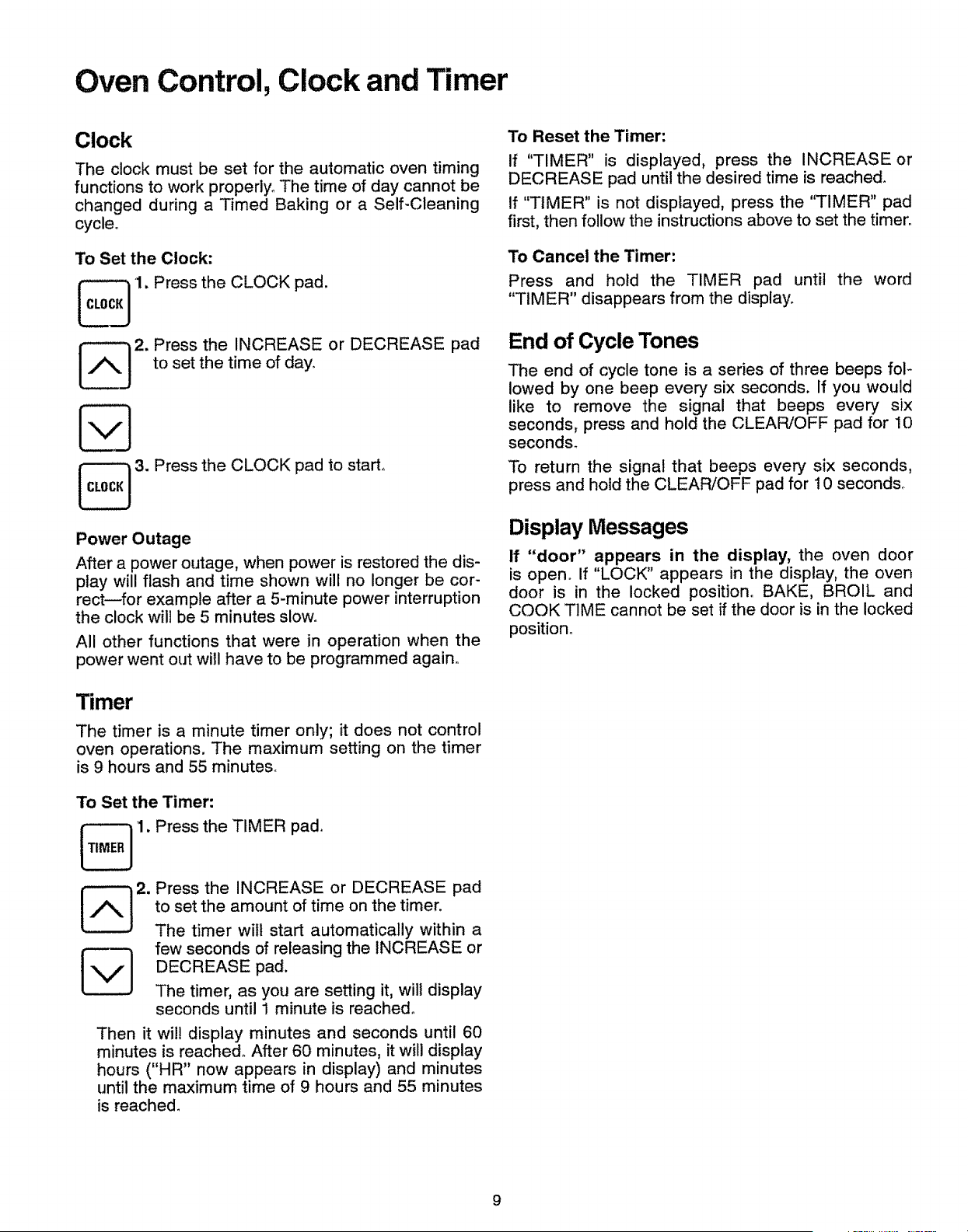
Oven Control, Clock and Timer
Clock
The clock must be set for the automatic oven timing
functions to work properly. The time of day cannot be
changed during a Timed Baking or a Self-Cleaning
cycle°
To Set the Clock:
1. Press the CLOCK pad.
2. ress the INCREASE or DECREASE pad
to set the time of day.
G
3. Press the CLOCK pad to start°
Power Outage
After a power outage, when power is restored the dis-
play will flash and time shown will no longer be cor-
rect-for example after a 5-minute power interruption
the clock will be 5 minutes slow.
All other functions that were in operation when the
power went out will have to be programmed again.
Timer
The timer is a minute timer only; it does not control
oven operations. The maximum setting on the timer
is 9 hours and 55 minutes°
To Set the Timer:
1. Press the TIMER pad.
2. ress the INCREASE or DECREASE pad
to set the amount of time on the timer.
The timer wilt start automatically within a
[_ few seconds of releasing the INCREASE or
DECREASE pad.
The timer, as you are setting it, will display
seconds until 1 minute is reached°
Then it will display minutes and seconds until 60
minutes is reached° After 60 minutes, it will display
hours ("HR" now appears in display) and minutes
until the maximum time of 9 hours and 55 minutes
is reached.
To Reset the Timer:
If "TIMER" is displayed, press the INCREASE or
DECREASE pad until the desired time is reached.
If "TIMER" is not displayed, press the "TIMER" pad
first, then follow the instructions above to set the timer.
To Cancel the Timer:
Press and hold the TIMER pad until the word
"TIMER" disappears from the display.
End of Cycle Tones
The end of cycle tone is a series of three beeps fol-
lowed by one beep every six seconds. If you would
like to remove the signal that beeps every six
seconds, press and hold the CLEAR/OFF pad for 10
seconds.
To return the signal that beeps every six seconds,
press and hold the CLEAR/OFF pad for t0 seconds°
Display Messages
If "door" appears in the display, the oven door
is open. If "LOCK" appears in the display, the oven
door is in the locked position. BAKE, BROIL and
COOK TIME cannot be set if the door is in the locked
position°
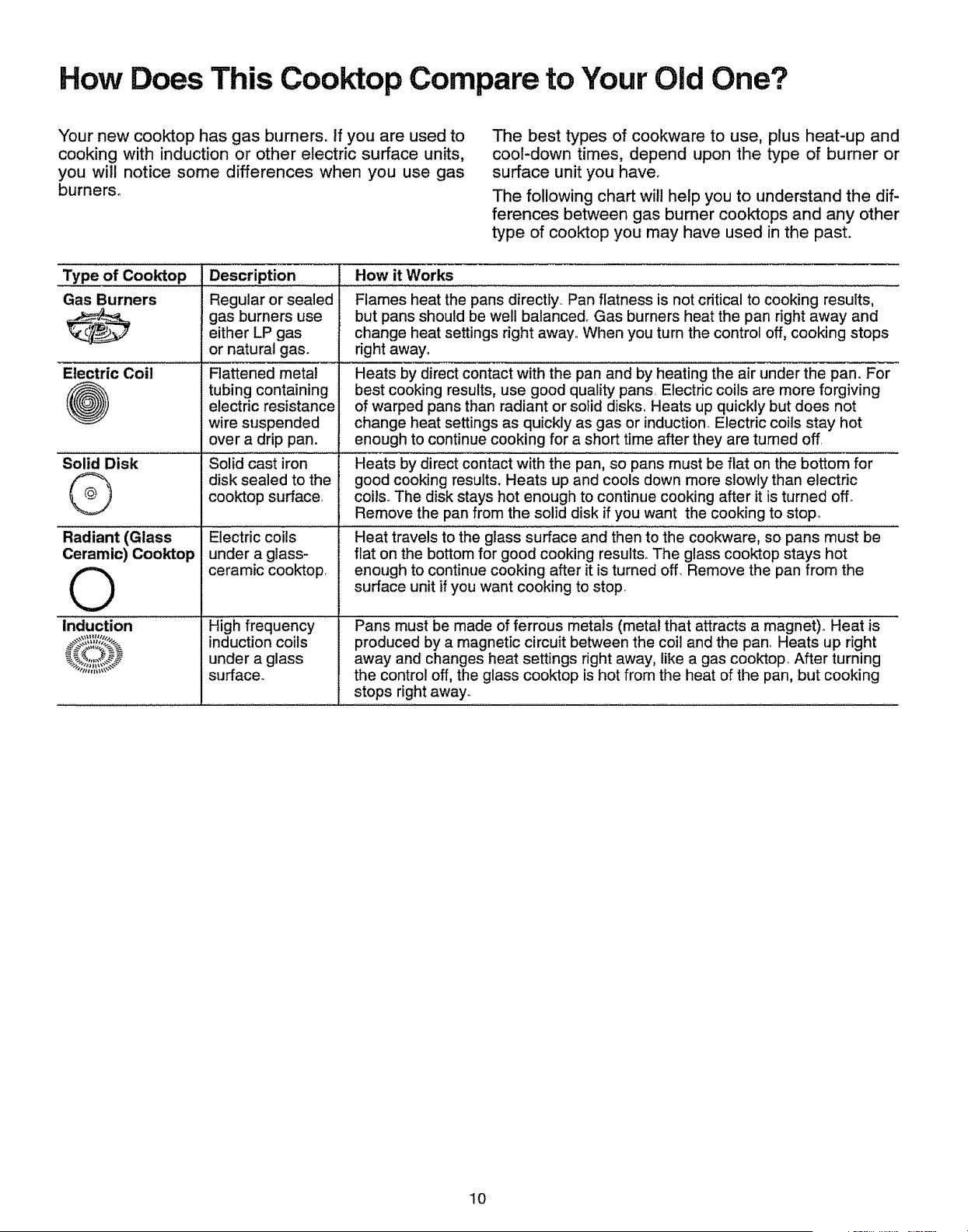
How Does This Cooktop Compare to Your Old One?
Your new cooktop has gas burners. If you are used to
cooking with induction or other electric surface units,
you will notice some differences when you use gas
burners°
The best types of cookware to use, plus heat-up and
cool-down times, depend upon the type of burner or
surface unit you have_
The following chart will help you to understand the dif-
ferences between gas burner cooktops and any other
type of cook'top you may have used in the past.
Type of Cooktop Description How it Works
Gas Burners Regular or sealed Flames heat the pans directly,, Pan flatness is not critical to cooking results,
gas burners use but pans should be well balanced. Gas burners heat the pan right away and
either LP gas change heat settings right away,, When you turn the control off, cooking stops
or natural gas. right away.
Electric Coil
@
Solid Disk
Q
Radiant (Glass
Ceramic) Cooktop
©
Induction
Flattened metal
tubing containing
electric resistance
wire suspended
over a drip pan.
Solid cast iron
disk sealed to the
cooktop surface,
Electric coils
under a glass-
ceramic cooktop,
High frequency
induction coils
under a glass
surface.
Heats by direct contact with the pan and by heating the air under the pan. For
best cooking results, use good quality pans Electric coils are more forgiving
of warped pans than radiant or solid disks, Heats up quickly but does not
change heat settings as quickly as gas or induction. Electric coils stay hot
enough to continue cooking for a short time after they are turned off,
Heats by direct contact with the pan, so pans must be flat on the bottom for
good cooking results. Heats up and cools down more slowly than electric
coils. The disk stays hot enough to continue cooking after it is turned off_
Remove the pan from the solid disk if you want the cooking to stop.
Heat travels to the glass surface and then to the cookware, so pans must be
flat on the bottom for good cooking results. The glass cooktop stays hot
enough to continue cooking after it is turned off_ Remove the pan from the
surface unit if you want cooking to stop,
Pans must be made of ferrous metals (metal that attracts a magnet)° Heat is
produced by a magnetic circuit between the col! and the pan, Heats up right
away and changes heat settings right away, like a gas cooktop, After turning
the control off, the glass cook*top is hot from the heat of the pan, but cooking
stops right away.
10
Surface Cooking
Lighting Instructions
Your surface burners are lighted by electric ignition,
eliminating the need for standing pilots with constantly
burning flames.
In case of a power failure, you can light the surface
burners on your range with a match. Hold a lighted
match to the burner, then turn the knob to the LITE
position° Use extreme caution when lighting burn-
ers in this manner.
Surface burners in use when an electrical power fail-
ure occurs will continue to operate normally.
The electrode of the spark igniter is exposed.
When one burner is turned to LITE, all the burn-
ers spark. Do not disassemble or clean around
any burner while another bumer is on. An electric
shock may result, which could cause you to knock
over hot cookware°
Surface Burner Controls
The knobs that turn the surface burners on and off are
located on the control panel in front of the bumerso
The two knobs on the left control the left front and left
rear burners. The two knobs on the right control the
right front and right rear burners.
On ranges with sealed burners:
o The smaller burner (right rear position) will give
the best simmer results.. It offers precise cooking
performance for delicate foods, such as sauces
or foods which need to cook over low heat for a
long time. It can be turned down to a very low
simmer setting.
=The right front burner is higher powered than the
others and will bring liquids to a boil quicker
(natural gas installations only).
Surface Light (on some models)
Use the switch on the control panel to turn the light
on and off.
Before Lighting a Burner
° If drip pans are supplied with your range, they should
be used at all times,
• Make sure all grates on the range are in place before
using any burner_
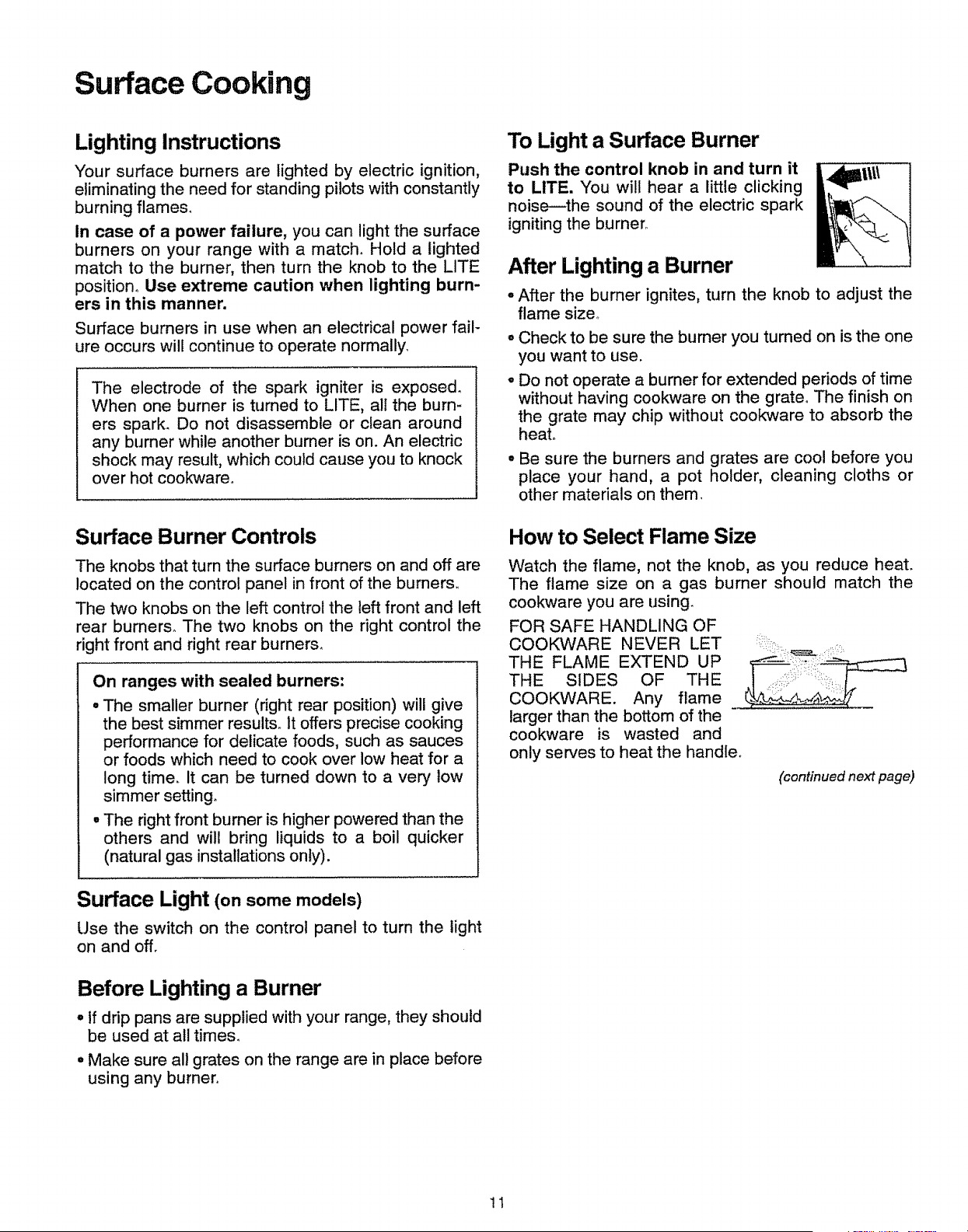
To Light a Surface Burner
Push the control knob in and turn it
to LITE. You will hear a little clicking
noise--the sound of the electric spark
igniting the burner_
After Lighting a Burner
-After the burner ignites, turn the knob to adjust the
flame size.
o Check to be sure the burner you turned on is the one
you want to use.
o Do not operate a burner for extended periods of time
without having cookware on the grate° The finish on
the grate may chip without cookware to absorb the
heat°
° Be sure the burners and grates are cool before you
place your hand, a pot holder, cleaning cloths or
other materials on them.
How to Select Flame Size
Watch the flame, not the knob, as you reduce heat.
The flame size on a gas burner should match the
cookware you are using.
FOR SAFE HANDLING OF
COOKWARE NEVER LET ...._
: :::::
THE FLAME EXTEND UP
THE SIDES OF THE
COOKWARE. Any flame _,
larger than the bottom of the
cookware is wasted and
only serves to heat the handle°
(continued next page)
11
Surface Cooking (continued)
Using "YourOven
Top-of-Range Cookware
Aluminum: Medium-weight cookware is recommend-
ed because it heats quickly and evenly. Most foods
brown evenly in an aluminum skillet. Use saucepans
with tight-fitting lids when cooking with minimum
amounts of water.
Cast iron: If heated slowly, most skillets will give sat-
isfactory results,
Enamelware: Under some conditions, the enamel of
some cookware may melt, Follow cookware manufac-
turer's recommendations for cooking methods.
Glass: There are two types of glass cookware--
those for oven use only and those for top-of-range
cooking (saucepans, coffee and teapots)° Glass con-
ducts heat very stowly.,
Heatproof Glass Ceramic: Can be used for either
surface or oven cooking. It conducts heat very slowly
and cools very slowly,, Check cookware manufactur-
er's directions to be sure it can be used on gas
ranges.
Stainless Steel: This metal alone has poor heating
properties and is usually combined with copper, alu-
minum or other metals for improved heat distribution.
Combination metal skillets generally work satisfactorily if
used at medium heat as the manufacturer recommends.
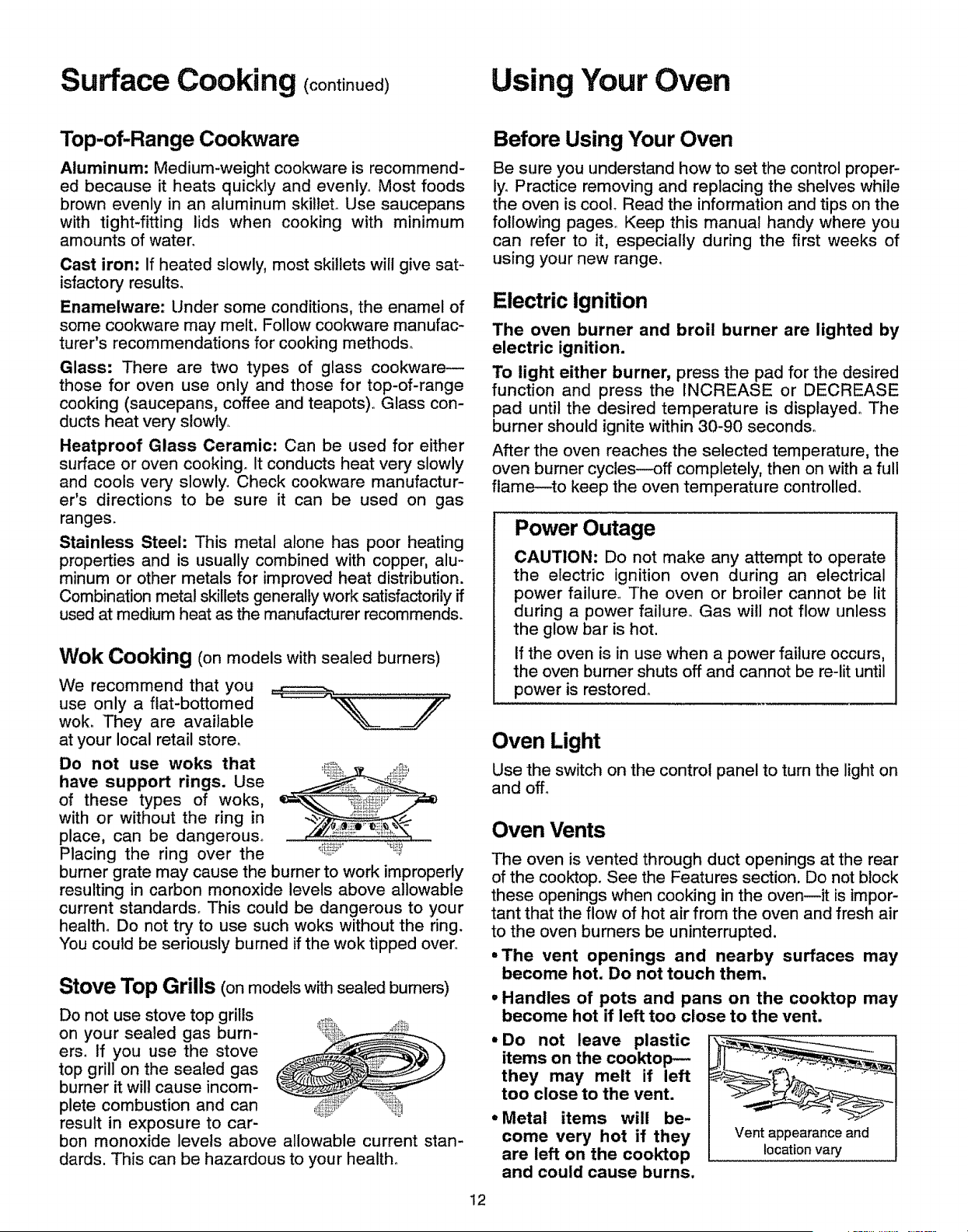
Wok Cooking (onmodels with sealed burners)
We recommend that you
use only a flat-bottomed
wok. They are available
at your local retail store,
Do not use woks that
have support rings. Use
of these types of woks,
with or without the ring in
place, can be dangerous°
Placing the ring over the _!_"_' _%_
burner grate may cause the burner to work improperly
resulting in carbon monoxide levels above allowable
current standards. This could be dangerous to your
health° Do not try to use such woks without the ring.
You could be seriously burned if the wok tipped over.
Stove Top Grills (onmodels with sealed burners)
Do not use stove top grills _,;L_,,,
on your sealed gas burn- ,,_ii;_}
ers. If you use the stove
top grill on the sealed gas
burner it wilt cause incom-
plete combustion and can ,,,_F!:I!E_I_i_.... '_i!iit
result in exposure to car-
bon monoxide levels above allowable current stan-
dards. This can be hazardous to your health_
Before Using "YourOven
Be sure you understand how to set the control proper-
lyo Practice removing and replacing the shelves while
the oven is cool Read the information and tips on the
following pages. Keep this manual handy where you
can refer to it, especially during the first weeks of
using your new range,
Electric ignition
The oven burner and broil burner are lighted by
electric ignition.
To light either burner, press the pad for the desired
function and press the INCREASE or DECREASE
pad until the desired temperature is displayed° The
burner should ignite within 30-90 seconds°
After the oven reaches the selected temperature, the
oven burner cycles--off completely, then on with a full
flame--to keep the oven temperature controlled°
Power Outage
CAUTION: Do not make any attempt to operate
the electric ignition oven during an electrical
power failure° The oven or broiler cannot be fit
during a power failure_ Gas will not flow unless
the glow bar is hot.
If the oven is in use when a power failure occurs,
the oven burner shuts off and cannot be re-lit until
power is restored,
Oven Light
Use the switch on the control panel to turn the light on
and off°
12
Oven Vents
The oven is vented through duct openings at the rear
of the cooktop. See the Features section. Do not block
these openings when cooking in the oven_it is impor-
tant that the flow of hot air from the oven and fresh air
to the oven burners be uninterrupted.
• The vent openings and nearby surfaces may
become hot. Do not touch them.
• Handles of pots and pans on the cooktop may
become hot if left too close to the vent.
°Do not leave plastic
items on the cooktop--
they may melt if left
too close to the vent.
=Metal items will be-
come very hot if they
are left on the cooktop
and could cause burns.
Vent appearance and
location vary
Baking
• Do not leave any items on the cooktop. The hot
air from the vent may ignite flammable items and will
increase pressure in closed containers, which may
cause them to burst.
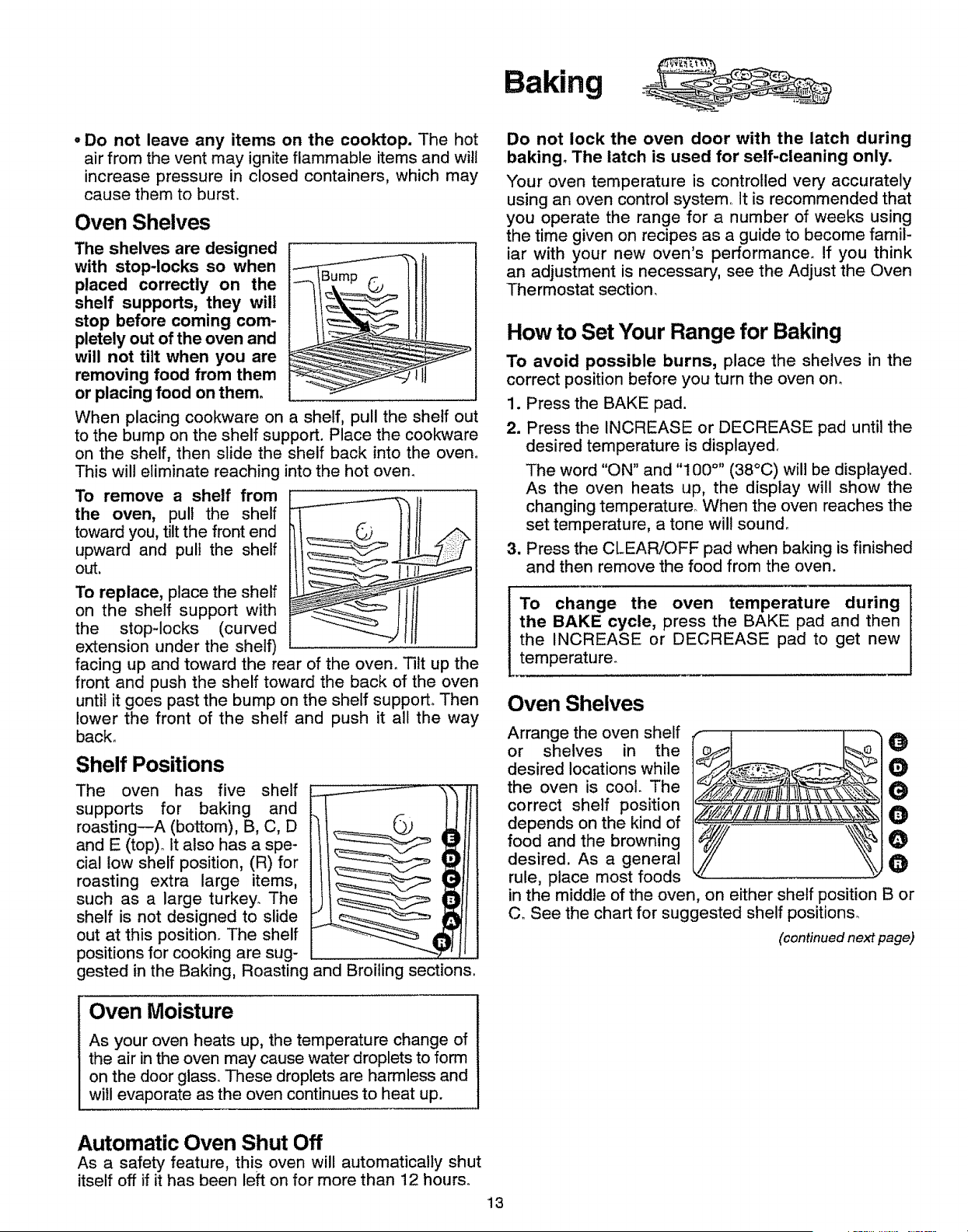
Oven Shelves
The shelves are designed
with stop-locks so when
placed correctly on the
shelf supports, they will
stop before coming com-
pletely out of the oven and
will not tilt when you are
removing food from them
or placing food on them.
When placing cookware on a shelf, pull the shelf out
to the bump on the shelf support. Place the cookware
on the shelf, then slide the shelf back into the oven.
This will eliminate reaching into the hot oven.
To remove a shelf from
the oven, pull the shelf
toward you, tilt the front end
upward and pull the shelf
o_.
To replace, place the shelf
on the shelf support with
the stop-locks (curved
extension under the shelf)
facing up and toward the rear of the oven. Tilt up the
front and push the shelf toward the back of the oven
until it goes past the bump on the shelf support. Then
lower the front of the shelf and push it all the way
back.
Shelf Positions
The oven has five shelf
supports for baking and
roasting--A (bottom), B, C, D
and E (top)° It also has a spe-
cial tow shelf position, (R) for
roasting extra large items,
such as a large turkey. The
shelf is not designed to slide
out at this position. The shelf
positions for cooking are sug-
gested in the Baking, Roasting and Broiling sections.
Oven Moisture
As your oven heats up, the temperature change of
the air in the oven may cause water droplets to form
on the door glass. These droplets are harmless and
will evaporate as the oven continues to heat up.
Do not lock the oven door with the latch during
baking. The latch is used for self-cleaning only.
Your oven temperature is controlled very accurately
using an oven control system° It is recommended that
you operate the range for a number of weeks using
the time given on recipes as a guide to become famil-
iar with your new oven's performance. If you think
an adjustment is necessary, see the Adjust the Oven
Thermostat section.
How to Set Your Range for Baking
To avoid possible burns, place the shelves in the
correct position before you turn the oven on_
1. Press the BAKE pad.
2. Press the INCREASE or DECREASE pad until the
desired temperature is displayed.
The word "ON" and "100 °'' (38°C) will be displayed.
As the oven heats up, the display will show the
changing temperature_ When the oven reaches the
set temperature, a tone will sound.
3. Press the CLEAR/OFF pad when baking is finished
and then remove the food from the oven.
To change the oven temperature during
the BAKE cycle, press the BAKE pad and then
the INCREASE or DECREASE pad to get new
temperature.
Oven Shelves
Arrange the oven shelf
or shelves in the
desired locations while
the oven is cool. The
correct shelf position
depends on the kind of
food and the browning
desired. As a general
rule, place most foods
0
O
0
0
0
0
in the middle of the oven, on either shelf position B or
C. See the chart for suggested shelf positions..
(continued next page)
Automatic Oven Shut Off
As a safety feature, this oven will automatically shut
itself off if it has been left on for more than 12 hours°
13
Baking (continued!
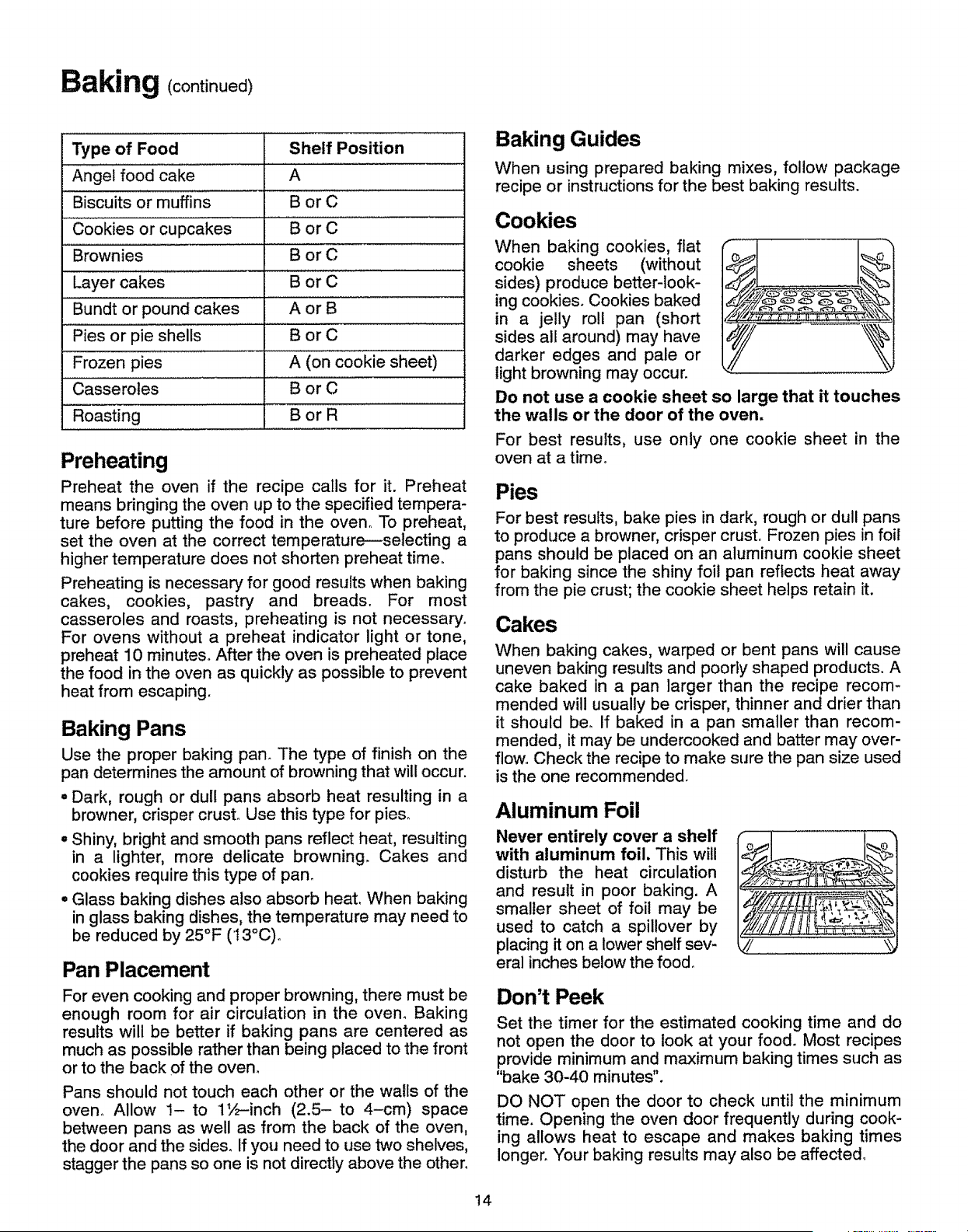
Type of Food Shelf Position
Angel food cake A
, , , , ,,, .....................
Biscuits or muffins B or C
Cookies or cupcakes B or C
Brownies B or C
Layer cakes B or C
Bundt or pound cakes A or B
Pies or pie shells B or C
,,, ,, ,,,,...........
Frozen pies A (on cookie sheet)
Casseroles B or C
Roasting B or R
Preheating
Preheat the oven if the recipe calls for it. Preheat
means bringing the oven up to the specified tempera-
ture before putting the food in the oven° To preheat,
set the oven at the correct temperature--selecting a
higher temperature does not shorten preheat time..
Preheating is necessary for good results when baking
cakes, cookies, pastry and breads° For most
casseroles and roasts, preheating is not necessary°
For ovens without a preheat indicator light or tone,
preheat 10 minutes. After the oven is preheated place
the food in the oven as quickly as possible to prevent
heat from escaping.
Baking Pans
Use the proper baking pan_ The type of finish on the
pan determines the amount of browning that will occur.
= Dark, rough or dull pans absorb heat resulting in a
browner, crisper crust° Use this type for pies_
° Shiny, bright and smooth pans reflect heat, resulting
in a lighter, more delicate browning. Cakes and
cookies require this type of pan_
• Glass baking dishes also absorb heat. When baking
in glass baking dishes, the temperature may need to
be reduced by 25°F (13°C)o
Pan Placement
For even cooking and proper browning, there must be
enough room for air circulation in the oven° Baking
results will be better if baking pans are centered as
much as possible rather than being placed to the front
or to the back of the oven.
Pans should not touch each other or the walls of the
oven° Allow 1-to 11/z-inch (2.5-to 4-cm) space
between pans as well as from the back of the oven,
the door and the sides. If you need to use two shelves,
stagger the pans so one is not directly above the other.
Baking Guides
When using prepared baking mixes, follow package
recipe or instructions for the best baking results.
Cookies
When baking cookies, fiat
cookie sheets (without
sides) produce better-look-
ing cookies. Cookies baked
in a jelly roll pan (short
sides all around) may have
darker edges and pale or
light browning may occur_
Do not use a cookie sheet so large that it touches
the walls or the door of the oven.
For best results, use only one cookie sheet in the
oven at a time.
Pies
For best results, bake pies in dark, rough or dull pans
to produce a browner, crisper crust° Frozen pies in foil
pans should be placed on an aluminum cookie sheet
for baking since the shiny foil pan reflects heat away
from the pie crust; the cookie sheet helps retain it.
Cakes
When baking cakes, warped or bent pans will cause
uneven baking results and poorly shaped products. A
cake baked in a pan larger than the recipe recom-
mended will usually be crisper, thinner and drier than
it should be_ If baked in a pan smaller than recom-
mended, it may be undercooked and batter may over-
flow,, Check the recipe to make sure the pan size used
is the one recommended.
Aluminum Foil
Never entirely cover a shelf
with aluminum foil. This will
disturb the heat circulation
and result in poor baking. A
smaller sheet of foil may be
used to catch a spiltover by
placing it on a lower shelf sev-
eral inches below the food°
Don't Peek
Set the timer for the estimated cooking time and do
not open the door to look at your food. Most recipes
provide minimum and maximum baking times such as
"bake 30-40 minutes".
DO NOT open the door to check until the minimum
time. Opening the oven door frequently during cook-
ing allows heat to escape and makes baking times
longer. Your baking results may also be affected_
14
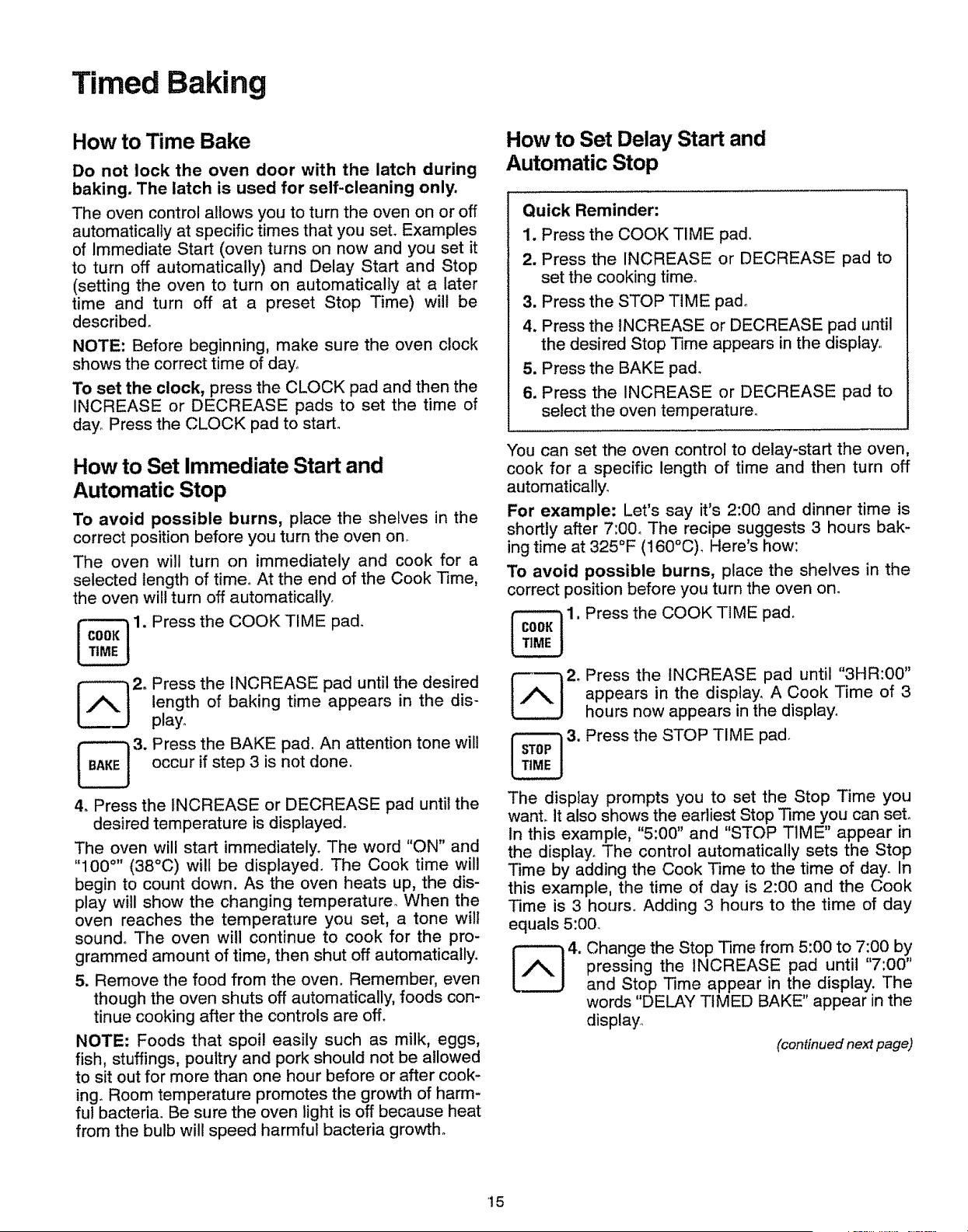
Timed Baking
How to Time Bake
Do not lock the oven door with the latch during
baking. The latch is used for self-cleaning only.
The oven control allows you to turn the oven on or off
automatically at specific times that you set. Examples
of Immediate Start (oven turns on now and you set it
to turn off automatically) and Delay Start and Stop
(setting the oven to turn on automatically at a later
time and turn off at a preset Stop Time) will be
described.
NOTE: Before beginning, make sure the oven clock
shows the correct time of day°
To set the clock, press the CLOCK pad and then the
INCREASE or DECREASE pads to set the time of
day° Press the CLOCK pad to start.
How to Set Immediate Start and
Automatic Stop
To avoid possible burns, place the shelves in the
correct position before you turn the oven ono
The oven will turn on immediately and cook for a
selected length of time° At the end of the Cook Time,
the oven will turn off automatically°
1. Press the COOK TIME pad,
Press the INCREASE pad until the desired
length of baking time appears in the dis-
playo
Press the BAKE pad. An attention tone will
occur if step 3 is not done.
4o Press the INCREASE or DECREASE pad untiI the
desired temperature is displayed.
The oven will start immediately. The word "ON" and
"100 °" (38°C) will be displayed. The Cook time will
begin to count down. As the oven heats up, the dis-
play will show the changing temperature_ When the
oven reaches the temperature you set, a tone wilt
sound° The oven will continue to cook for the pro-
grammed amount of time, then shut off automatically.
5. Remove the food from the oven. Remember, even
though the oven shuts off automatically, foods con-
tinue cooking after the controls are off.
NOTE: Foods that spoil easily such as milk, eggs,
fish, stuffings, poultry and pork should not be allowed
to sit out for more than one hour before or after cook-
ing. Room temperature promotes the growth of harm-
ful bacteria. Be sure the oven light is off because heat
from the bulb will speed harmful bacteria growth°
How to Set Delay Start and
Automatic Stop
Quick Reminder:
1. Press the COOK TIME pad.
2. Press the INCREASE or DECREASE pad to
set the cooking time.
3. Press the STOP TIME pad_
4, Press the INCREASE or DECREASE pad until
the desired Stop Time appears in the display,
5. Press the BAKE pad.
6. Press the INCREASE or DECREASE pad to
select the oven temperature.
You can set the oven control to delay-start the oven,
cook for a specific length of time and then turn off
automatically.
For example: Let's say it's 2:00 and dinner time is
shortly after 7:00, The recipe suggests 3 hours bak-
ing time at 325°F (160°C), Here's how:
To avoid possible burns, place the shelves in the
correct position before you turn the oven on.
1, Press the COOK TIME pad,
Press the INCREASE pad until "3HR:00"
appears in the display, A Cook Time of 3
hours now appears in the display.
Press the STOP TIME pad.
The display prompts you to set the Stop Time you
want. It also shows the earliest Stop Time you can set.
In this example, "5:00" and "STOP TIME" appear in
the display. The control automatically sets the Stop
Time by adding the Cook Time to the time of day. In
this example, the time of day is 2:00 and the Cook
Time is 3 hours° Adding 3 hours to the time of day
equals 5:00.
4. Change the Stop Time from 5:00 to 7:00 by
pressing the INCREASE pad until "7:00"
and Stop Time appear in the display. The
words "DELAY TIMED BAKE" appear in the
display,
(continued next page)
15
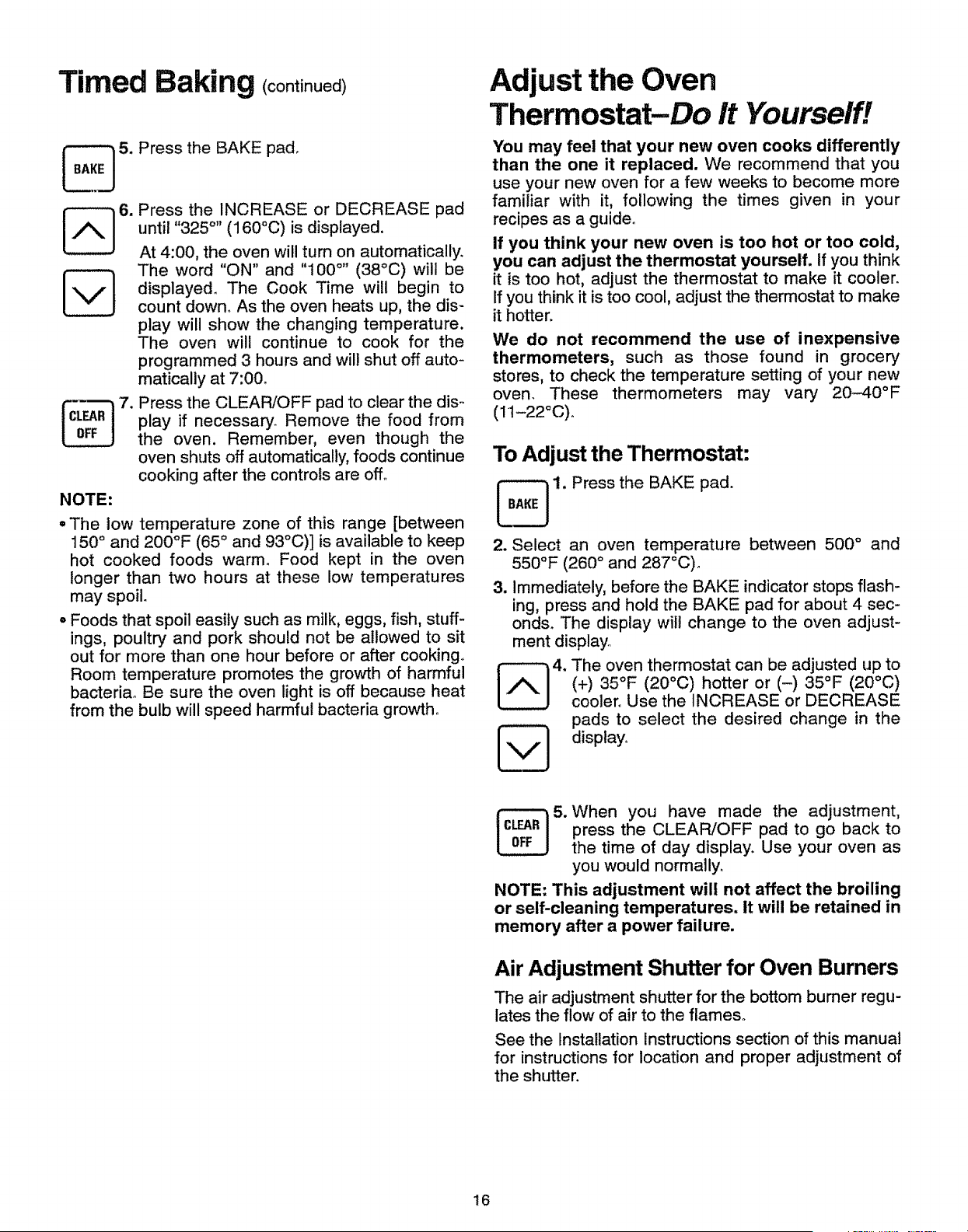
Timed Baking (continued)
5. Press the BAKE pad.
NOTE:
Press the INCREASE or DECREASE pad
until "325 °" (160°C) is displayed.
At 4:00, the oven will turn on automatically.
The word "ON" and "I00 °" (38°C) will be
displayed° The Cook Time will begin to
count down. As the oven heats up, the dis-
play will show the changing temperature.
The oven will continue to cook for the
programmed 3 hours and wil! shut off auto-
matically at 7:00_
Press the CLEAR!OFF pad to clear the dis-
play if necessary. Remove the food from
the oven. Remember, even though the
oven shuts off automatically, foods continue
cooking after the controls are off_
* The tow temperature zone of this range [between
150 ° and 200°F (65 ° and 93°C)] is available to keep
hot cooked foods warm° Food kept in the oven
longer than two hours at these low temperatures
may spoil
° Foods that spoil easily such as milk, eggs, fish, stuff-
ings, poultry and pork should not be allowed to sit
out for more than one hour before or after cooking°
Room temperature promotes the growth of harmful
bacteria° Be sure the oven light is off because heat
from the bulb will speed harmful bacteria growth°
Adjust the Oven
Thermostat-Do It Yourself!
You may feel that your new oven cooks differently
than the one it replaced. We recommend that you
use your new oven for a few weeks to become more
familiar with it, following the times given in your
recipes as a guide°
If you think your new oven is too hot or too cold,
you can adjust the thermostat yourself. If you think
it is too hot, adjust the thermostat to make it cooler.
If you think it is too cool, adjust the thermostat to make
it hotter.
We do not recommend the use of inexpensive
thermometers, such as those found in grocery
stores, to check the temperature setting of your new
oven, These thermometers may vary 20-40°F
(11-22°C)_
To Adjust the Thermostat:
1, Press the BAKE pad.
2. Select an oven temperature between 500 ° and
550°F (260 ° and 287°C)_
3. Immediately, before the BAKE indicator stops flash-
ing, press and hold the BAKE pad for about 4 sec-
onds. The display wilt change to the oven adjust-
ment display,
4. The oven thermostat can be adjusted up to
(+) 35°F (20°C) hotter or (-) 35°F (20°C)
cooler° Use the INCREASE or DECREASE
pads to select the desired change in the
display.
5. When you have made the adjustment,
press the CLEAR/OFF pad to go back to
the time of day display. Use your oven as
you would normally.
NOTE: This adjustment will not affect the broiling
or self-cleaning temperatures, It will be retained in
memory after a power failure.
Air Adjustment Shutter for Oven Burners
The air adjustment shutter for the bottom burner regu-
lates the flow of air to the flames°
See the Installation Instructions section of this manual
for instructions for location and proper adjustment of
the shutter,
16
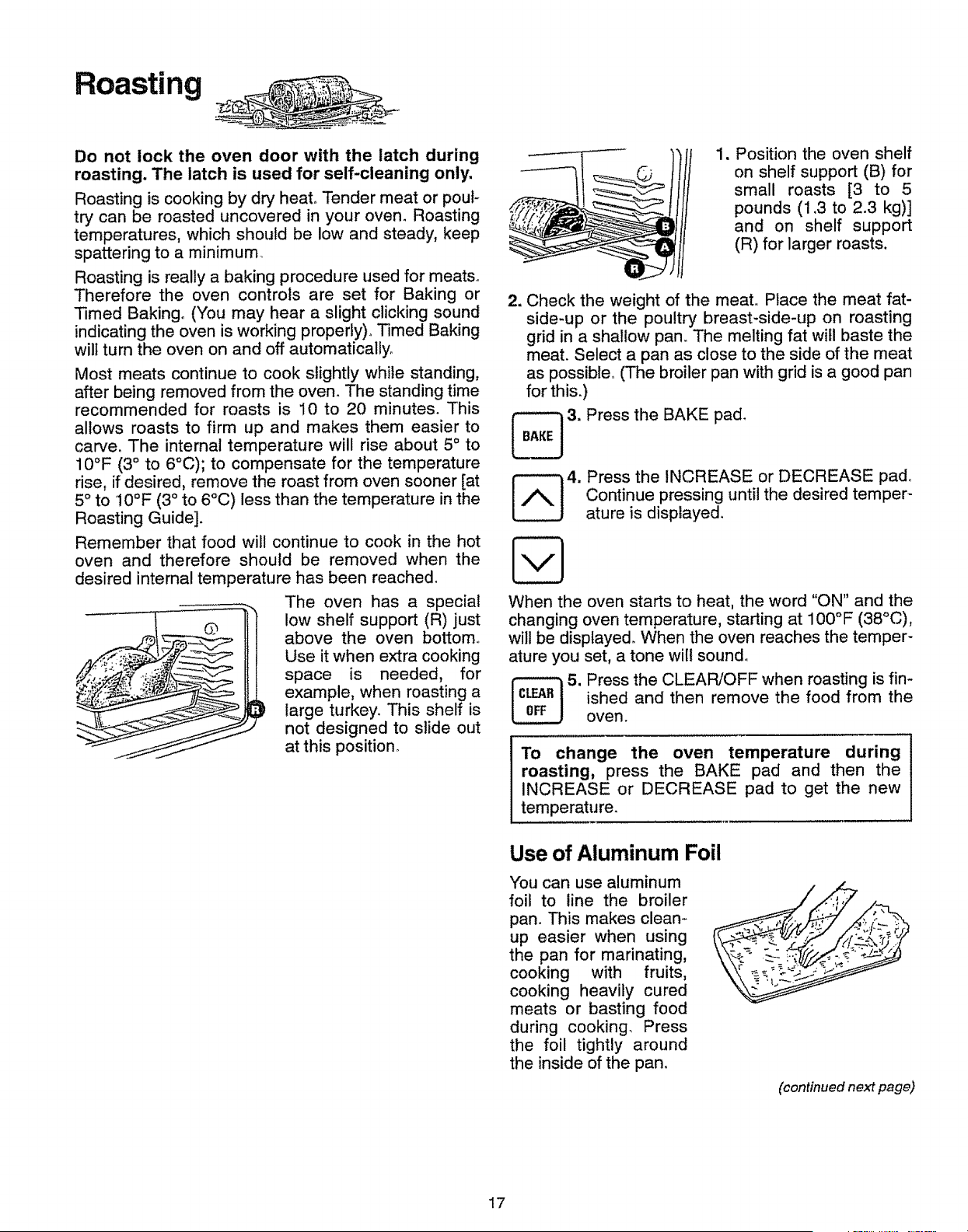
Roasting
Do not lock the oven door with the latch during
roasting. The latch is used for self-cleaning only.
Roasting is cooking by dry heal Tender meat or poul-
try can be roasted uncovered in your oven. Roasting
temperatures, which should be low and steady, keep
spattering to a minimum.
Roasting is really a baking procedure used for meats.
Therefore the oven controls are set for Baking or
Timed Baking° (You may hear a slight clicking sound
indicating the oven is working properly). Timed Baking
will turn the oven on and off automatically°
Most meats continue to cook slightly while standing,
after being removed from the oven. The standing time
recommended for roasts is 10 to 20 minutes. This
allows roasts to firm up and makes them easier to
carve. The internal temperature will rise about 5° to
10°F (3 ° to 6°C); to compensate for the temperature
rise, if desired, remove the roast from oven sooner [at
5° to 10°F (3 ° to 6°C) less than the temperature in the
Roasting Guide].
Remember that food will continue to cook in the hot
oven and therefore should be removed when the
desired internal temperature has been reached.
The oven has a special
low shelf support (R) just
above the oven bottom..
Use it when extra cooking
space is needed, for
example, when roasting a
large turkey. This shelf is
not designed to slide out
at this position.
1. Position the oven shelf
on shelf support (B) for
small roasts [3 to 5
pounds (1.3 to 2,3 kg)]
and on shelf support
(R) for larger roasts.
2. Check the weight of the meat. Place the meat fat-
side-up or the poultry breast-side-up on roasting
grid in a shallow pan. The melting fat will baste the
meat. Select a pan as close to the side of the meat
as possible_ (The broiler pan with grid is a good pan
for this.)
3. Press the BAKE pad.
4. Press the INCREASE or DECREASE pad°
Continue pressing until the desired temper-
ature is displayed.
When the oven starts to heat, the word "ON" and the
changing oven temperature, starting at 100°F (38°C),
will be displayed. When the oven reaches the temper-
ature you set, a tone will sound°
5. Press the CLEAR!OFF when roasting is fin-
ished and then remove the food from the
oven.
To change the oven temperature during
roasting, press the BAKE pad and then the
INCREASE or DECREASE pad to get the new
temperature.
Use of Aluminum Foil
You can use aluminum
foil to line the broiler
pan. This makes clean-
up easier when using
the pan for marinating,
cooking with fruits,
cooking heavily cured
meats or basting food
during cooking_ Press
the foil tightly around
the inside of the pan.
(continued next page)
17
Roasting (continued)
Frozen Roasts
Frozen roasts of beef, pork, lamb, etco, can be started
without thawing, but allow 15 to 25 minutes per pound
additional time [15 minutes per pound (450 grams) for
roasts under 5 pounds (2.3 kg), more time for larger
roasts].
Make sure poultry is thawed before roasting°
Unthawed poultry often does not cook evenly. Some
commercial frozen poultry can be cooked successfully
without thawing° Follow the directions given on the
package label.
Dual Shelf Cooking
This allows more than one food to be cooked at
the same time. For example: While roasting a 20-lb.
(10 kg) turkey on shelf (R), a second shelf (if so
equipped) may be added on position D so that scal-
loped potatoes can be cooked at the same timer
Calculate the total cooking time to enable both dishes
to complete cooking at the same time. Allow 15 to 20
minutes of additional cooking time for the potatoes.
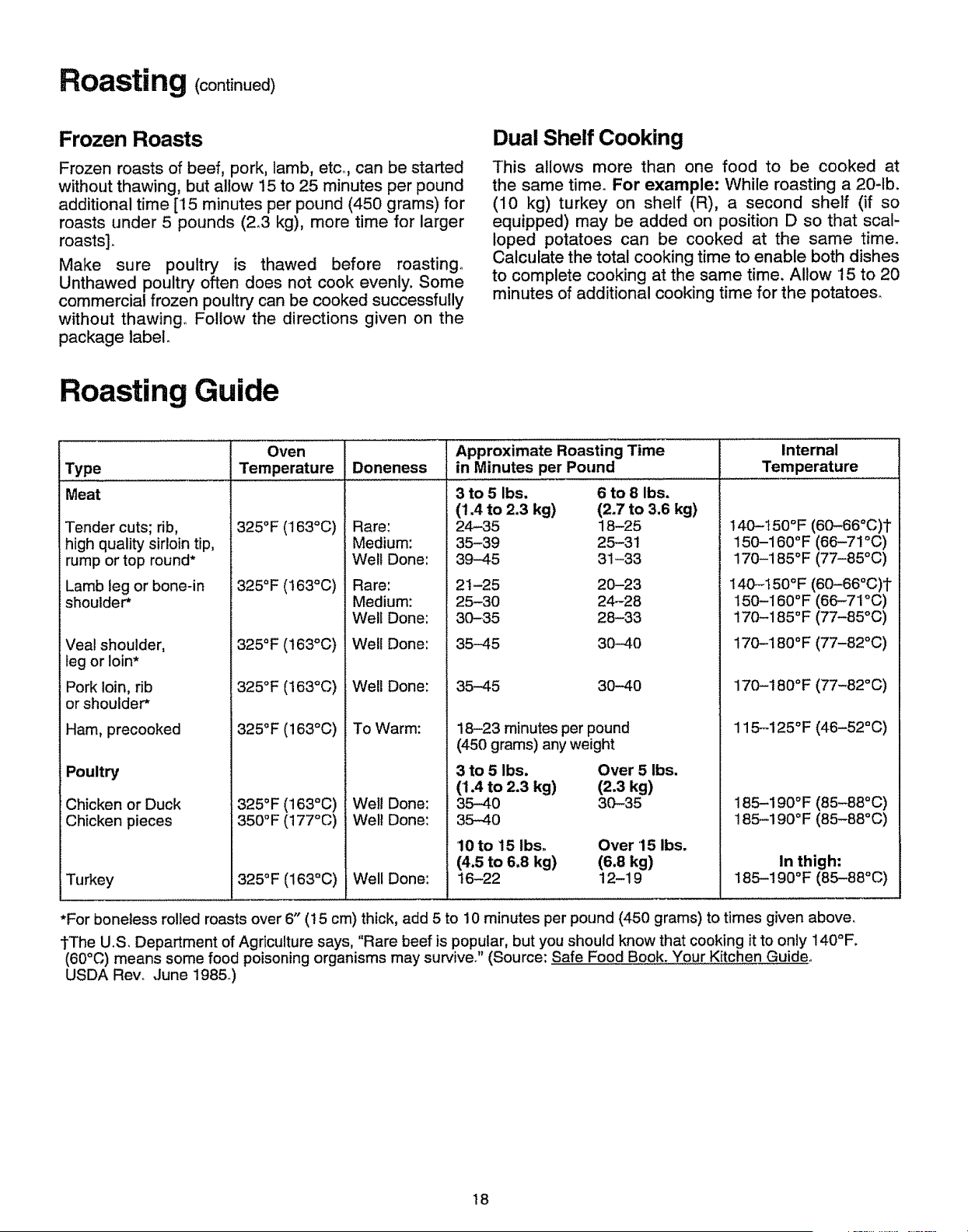
Roasting Guide
Oven Internal
Type Temperature Doneness Temperature
Meat
Tender cuts; rib,
high quality sirloin tip,
rump or top round*
Lamb leg or bone-in
shoulder*
Veal shoulder,
leg or loin*
Pork loin, rib
or shoulder*
Ham, precooked
Poultry
Chicken or Duck
Chicken pieces
Turkey
325°F (163°C)
325°F (163°C)
325°F (163°C)
325°F (163°C)
Rare:
Medium:
Well Done:
Rare:
Medium:
Well Done:
Well Done:
Well Done:
Approximate Roasting Time
in Minutes per Pound
3 to 5 Ibs. 6 to 8 Ibs,
(1,4 to 2.3 kg) (2.7 to 3.6 kg)
24-35 18-25
35-39 25-31
39-45 31-33
21-25 20-23
25-30 24-28
30-35 28-33
35-45 30-40
35-45 30-40
140-150°F (60-66°C)1 -
150-160°F (66-71 °C)
170-'185°F (77-85°C)
140-I50°F (60-66°C)I -
150-I60°F (66-71 °C)
170-185°F (77-85°C)
170-180°F (77-82°0)
170-180°F (77-82°C)
325°F (163°C)
325°F (163°C)
350°F (177°C)
325°F (163°C)
To Warm:
Well Done:
Well Done:
Well Done:
18-23 minutes per pound
(450 grams) any weight
3 to 5 lbs. Over 5 Ibs.
(1,4 to 2.3 kg) (2.3 kg)
35-40 3('}-35
35-40
10 to 15 Ibs. Over 15 Ibs.
(4.5 to 6,8 kg) (6.8 kg)
16-22 12-19
115-125°F (46-52°C)
185-190°F (85-88=C)
185-190°F (85-88°C)
In thigh:
185-190°F (85-88°C)
*For boneless rolled roasts over 6" (t5 cm) thick, add 5 to 10 minutes per pound (450 grams) to times given above,
-[rThe U.S. Department of Agriculture says, "Rare beef is popular, but you should know that cooking it to only 140°F.
(60°C) means some food poisoning organisms may survive." (Source: Safe Food Book. Your Kitchen Guide,.
USDA Revo June 1985o)
I8
Broiling
Do not lock the oven door with the latch during
broiling. The latch is used for self-cleaning only.
Broiling is cooking food by direct heat from above the
food. Most fish and tender cuts of meat can be
broiled_ Follow these directions to keep spattering and
smoking to a minimum.
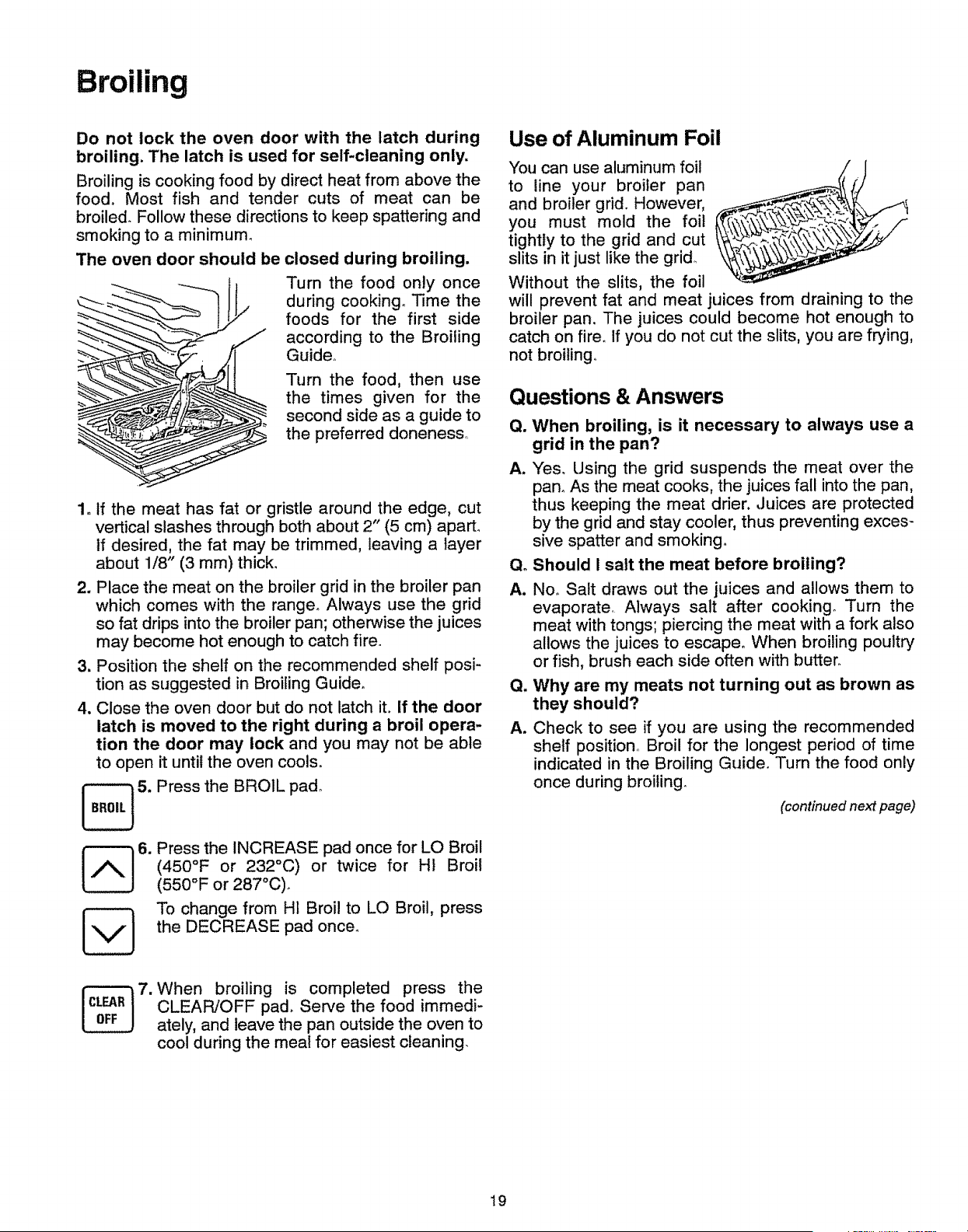
The oven door should be
closed during broiling.
Turn the food only once
during cooking° Time the
foods for the first side
according to the Broiling
Guide°
Turn the food, then use
the times given for the
second side as a guide to
the preferred doneness
1o If the meat has fat or gristle around the edge, cut
vertical slashes through both about 2" (5 cm) apart°
If desired, the fat may be trimmed, leaving a layer
about 1/8" (3 mm) thick.
2. Place the meat on the broiler grid in the broiler pan
which comes with the ranger Always use the grid
so fat drips into the broiler pan; otherwise the juices
may become hot enough to catch fire.
3. Position the shelf on the recommended shelf posi-
tion as suggested in Broiling Guide.
4. Close the oven door but do not latch it. If the door
latch is moved to the right during a broil opera-
tion the door may lock and you may not be able
to open it until the oven cools.
5, Press the BROIL pad°
6. Press the INCREASE pad once for LO Broil
(450°F or 232°C) or twice for H! Broil
(550°F or 287°C).
To change from HI Broil to LO Broil, press
the DECREASE pad once.
7.When broiling is completed press the
CLEAR/OFF pad. Serve the food immedi-
ately, and leave the pan outside the oven to
cool during the mea! for easiest cleaning
Use of Aluminum Foil
You can use aluminum foil
to line your broiler pan
and broiler grid. However,
you must mold the foil
tightly to the grid and cut
slits in it just like the grid°
Without the slits, the foil
will prevent fat and meat juices from draining to the
broiler pan. The juices could become hot enough to
catch on fire° If you do not cut the slits, you are frying,
not broiting_
Questions & Answers
Q. When broiling, is it necessary to always use a
grid in the pan?
A. Yes, Using the grid suspends the meat over the
pan_ As the meat cooks, the juices fall into the pan,
thus keeping the meat drier. ,Juices are protected
by the grid and stay cooler, thus preventing exces-
sive spatter and smoking°
Qo Should I salt the meat before broiling?
A. Noo Salt draws out the juices and allows them to
evaporate Always salt after cooking° Turn the
meat with tongs; piercing the meat with a fork also
allows the juices to escape° When broiling poultry
or fish, brush each side often with butter
Q. Why are my meats not turning out as brown as
they should?
A. Check to see if you are using the recommended
shelf position, Broil for the longest period of time
indicated in the Broiling Guide. Turn the food only
once during broiling.
(continued next page)
19
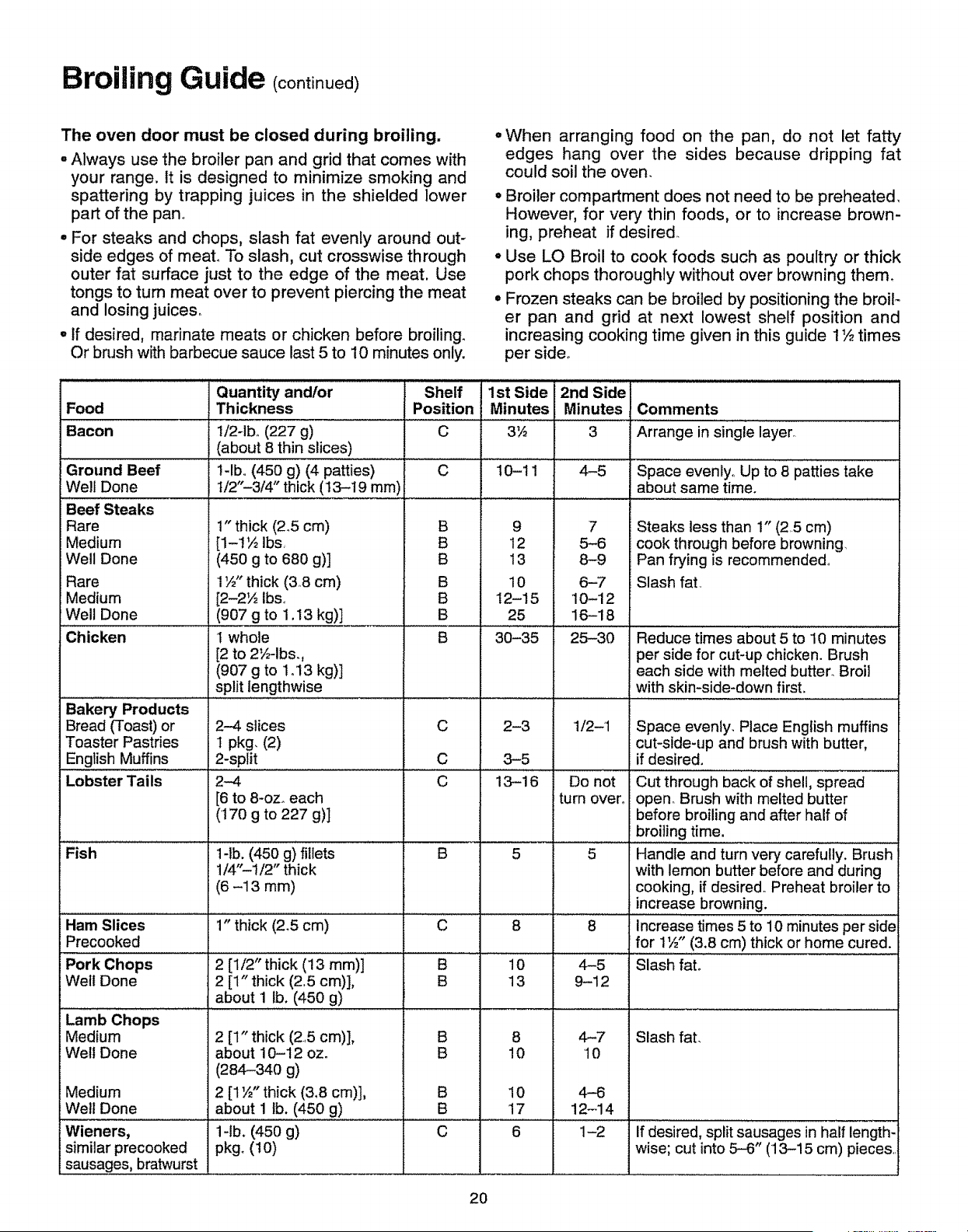
Broiling Guide (continued)
The oven door must be closed during broiling.
oAlways use the broiler pan and grid that comes with
your range. It is designed to minimize smoking and
spattering by trapping juices in the shielded lower
part of the pan°
• For steaks and chops, slash fat evenly around out-
side edges of meat. To slash, cut crosswise through
outer fat surface just to the edge of the meat. Use
tongs to turn meat over to prevent piercing the meat
and losing juices.
• If desired, marinate meats or chicken before broiling.
Or brush with barbecue sauce last 5 to 10 minutes only.
When arranging food on the pan, do not let fatty
edges hang over the sides because dripping fat
could soil the oven.
• Broiler compartment does not need to be preheated,
However, for very thin foods, or to increase brown-
ing, preheat if desired.
• Use LO Broil to cook foods such as poultry or thick
pork chops thoroughly without over browning them.
° Frozen steaks can be broiled by positioning the broil-
er pan and grid at next lowest shelf position and
increasing cooking time given in this guide 1½ times
per side_
Shelf 1st Side 2nd Side
Food Position Minutes Minutes
Bacon C 3½ 3
C 10-11
Ground Beef
Well Done
Beef Steaks
Rare
Medium
Well Done
Rare
Medium
Well Done
Chicken
Quantity andtor
Thickness
1/2-1b. (227 g)
(about 8 thin slices)
!-Ib, (450 g) (4 patties)
t/2"-3/4" thick (13-19 mm)
1" thick (2.5 cm)
[1-t½ Ibs
(450 g to 680 g)]
1½" thick (3..8 cm)
[2-2½ Ibso
(907 g to 1.13 kg)]
1 whole
[2 to 2½-1bs.,
(907 g to 1,13 kg)]
split lengthwise
Bakery Products
Bread (Toast) or 2-4 slices
Toaster Pastries t pkg. (2)
English Muffins 2-split
Lobster Tails 2-4
[6 to 8-oz. each
(170 g to 227 g)]
t,,,,,,,,,,,,,,, ............... , ...... , i , ,
Fish 1-lb. (450 g) fillets B
1/4"--1/2" thick
(6 -13 ram)
Ham Slices 1" thick (2.5 cm) C
Precooked
Pork Chops 2 [1/2" thick (13 mm)] B 10
Well Done 2 [1" thick (2.5 cm)], B 13
about 1 lb. (450 g)
!................, ..... ,, ,,,,.................... ,,i ..... ,, i ]
B 9
B 12
B 13
B 10
B 12-15
B 25
B 30-35
C 2-3
C 3-5
C 13-16
5
8
Comments
[ Aira'nge in singieiayer
4-5 space evenly° Up to 8 patties take
about same time.
7 Steaks less than 1" (2,5 cm)
5-6 cook through before browning,
8-9 Pan frying is recommended.
6-7 Slash fat,
10-12
16-18
25-30 Reduce times about 5 to 10 minutes
per side for cut-up chicken. Brush
each side with melted butter. Broil
with skin-side-down first.
1/2-1 Space evenly. Place English muffins
cut-side-up and brush with butter,
if desired.
Cut through back of shell, spread
open. Brush with melted butter
before broiling and after half of
broiling time.
5 Handle and turn very carefully. Brush
with lemon butter before and during
cooking, if desired,, Preheat broiler to
..........increase browning. ......
8 Increase times 5 to 10 minutes per side
for 11_,, (3.8 cm) thick or home cured.
4-5 Slash fat.
9-12
Do not
turn over.
Lamb Chops
Medium
i Welt Done
Medium
Well Done
Wieners,
similar precooked
i sausages, bratwurst
2 [1" thick (25 cm)], B 8
about 10-12 oz. B 10
(284-340 g)
2 [1½" thick (3.8 cm)], B 10
about 1 lb. (450 g) B 17
1-1b. (450 g) C 6
pkg_ (t0)
4-7
'10
4-6
12-14
1-2
Slash fat.
If desiredl split sausages in half length-
wise; cut into 5-6" (13-15 cm) pieces.,
2O
Operating the Self-Cleaning Oven .or S Ti e:4hour
Before a Clean Cycle
Quick Reminder:
1. Prepare the oven for cleaning.
2. Close and latch the oven door.
3. Press the CLEAN pad,
4. Press the INCREASE pad.
If you wish to change preset clean time of 4
hours, press the INCREASE or DECREASE pad
until the desired Stop Time appears in the displayo
We recommend venting with an open window
or using a ventilation fan or hood during the first
self-clean cycle.
1. Remove the broiler pan, broiler grid, all cookware
and any aluminum foi! from the oven--they cannot
withstand the high cleaning temperatures_
NOTE: Take the shelves out of the oven before you
begin the self-clean cycle.
2. Wipe up heavy soil on the oven bottom. If you use
soap, rinse thoroughly before self-cleaning to
prevent staining.
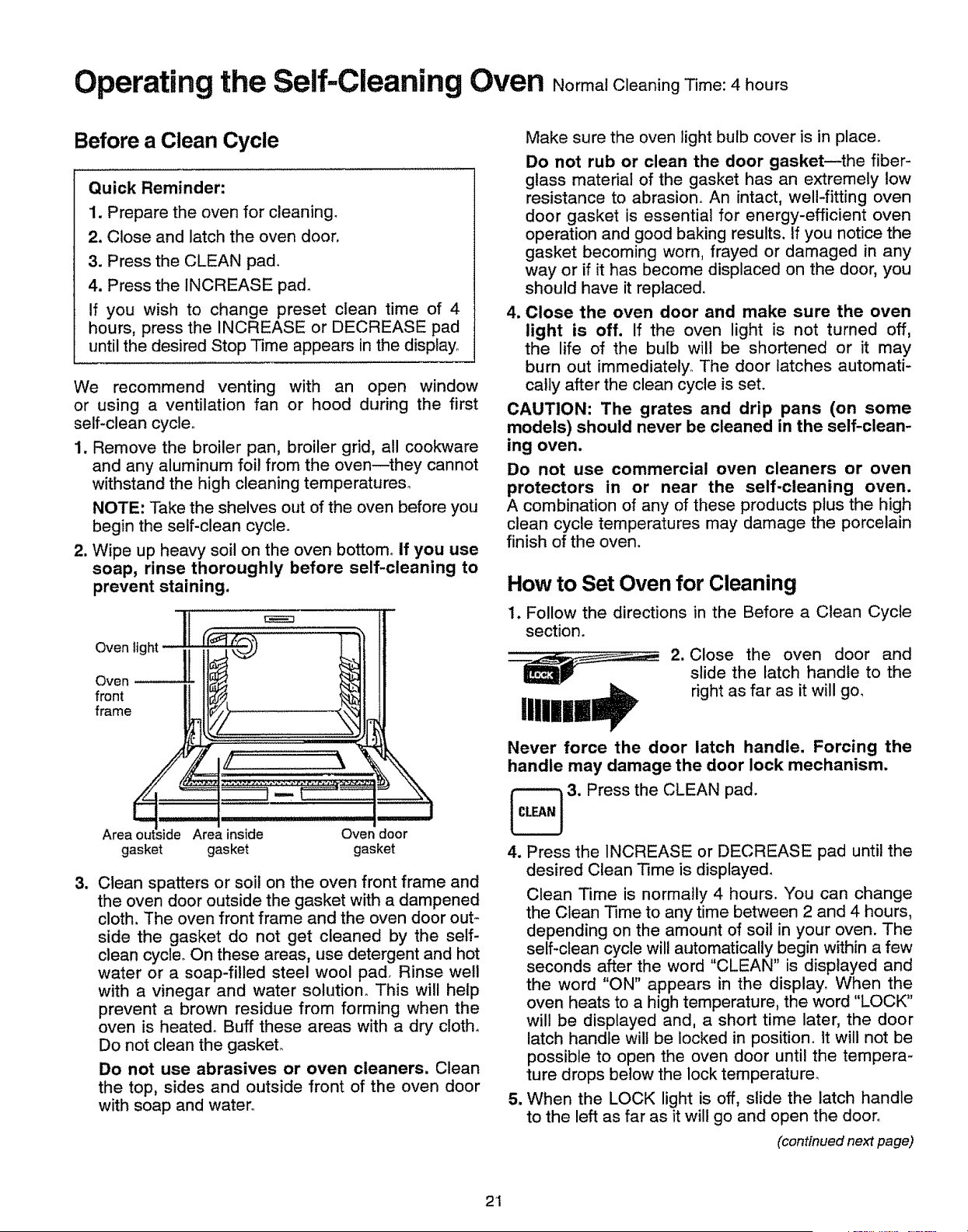
Area inside Oven door
gasket gasket gasket
3. Clean spatters or soi! on the oven front frame and
the oven door outside the gasket with a dampened
cloth. The oven front frame and the oven door out-
side the gasket do not get cleaned by the self-
clean cycle° On these areas, use detergent and hot
water or a soap-filled steel wool pad. Rinse well
with a vinegar and water solution° This will help
prevent a brown residue from forming when the
oven is heated_ Buff these areas with a dry cloth.
Do not clean the gaskeL
Do not use abrasives or oven cleaners. Clean
the top, sides and outside front of the oven door
with soap and water_
Make sure the oven light bulb cover is in place.
Do not rub or clean the door gasketmthe fiber-
glass material of the gasket has an extremely low
resistance to abrasion. An intact, well*fitting oven
door gasket is essential for energy-efficient oven
operation and good baking results. If you notice the
gasket becoming worn, frayed or damaged in any
way or if it has become displaced on the door, you
should have it replaced.
4. Close the oven door and make sure the oven
light is off. If the oven light is not turned off,
the life of the bulb will be shortened or it may
burn out immediately° The door latches automati-
cally after the clean cycle is set.
CAUTION: The grates and drip pans (on some
models) should never be cleaned in the self-clean-
ing oven.
Do not use commercial oven cleaners or oven
protectors in or near the self-cleaning oven.
A combination of any of these products plus the high
clean cycle temperatures may damage the porcelain
finish of the oven.
How to Set Oven for Cleaning
1_ Follow the directions in the Before a Clean Cycle
section.
2. Close the oven door and
slide the latch handle to the
IIIIi1|1 right as far as it will go_
-r
Never force the door latch handle. Forcing the
handle may damage the door lock mechanism.
3. Press the CLEAN pad.
4. Press the INCREASE or DECREASE pad until the
desired Clean Time is displayed.
Clean Time is normally 4 hours. You can change
the Clean Time to any time between 2 and 4 hours,
depending on the amount of soil in your oven. The
self-clean cycle will automatically begin within a few
seconds after the word "CLEAN" is displayed and
the word "ON" appears in the display. When the
oven heats to a high temperature, the word "LOCK"
will be displayed and, a short time later, the door
latch handle wilt be locked in position. It will not be
possible to open the oven door until the tempera-
ture drops below the lock temperature_
5. When the LOCK light is off, slide the latch handle
to the left as far as it will go and open the door°
(continued next page)
21
Operating the Self-Cleaning Oven tooot oo d
To Stop a Clean Cycle
1° Press the CLEAR!OFF pad°
2o When the lock light goes off, open the door.
After a Clean Cycle
When the clean cycle is finished, the word "CLEAN"
will go out in the display and the oven will begin to
cool. When the oven temperature has fallen below the
locking temperature the word "LOCK" goes out and
the door can be opened.
After a clean cycle, you may notice some white ash in
the oven. Just wipe it up with a damp cloth. If white
spots remain, remove them with a soap-filled steel
woo! pad. Be sure to rinse thoroughly with a vinegar
and water mixture° These deposits are usually a salt
residue that cannot be removed by the clean cycle.
If the oven is not clean after one clean cycle, the cycle
may be repeated°
How to Delay Start of Cleaning
Delay Start is setting the oven timer to start the clean
cycle automatically at a later time than the present
time of day.
NOTE: Before beginning, make sure the oven clock
shows the correct time of day.
Quick Reminder--Delay Start for
Self-Clean:
1, Prepare the oven for cleaning°
2. Close and latch the oven door.
3. Press the CLEAN pad.
4, Press the INCREASE pad° tf you wish to
change preset clean time of 4 hours, press the
INCREASE or DECREASE pad until the
desired time appears_
5. Press the STOP TIME pad.
Time that appears is 4 hours later than the time of
day. Press the INCREASE pad until the Stop
Time you desire appears in the display. The self-
clean cycle will automatically begin 4 hours
before the Stop Time you select.
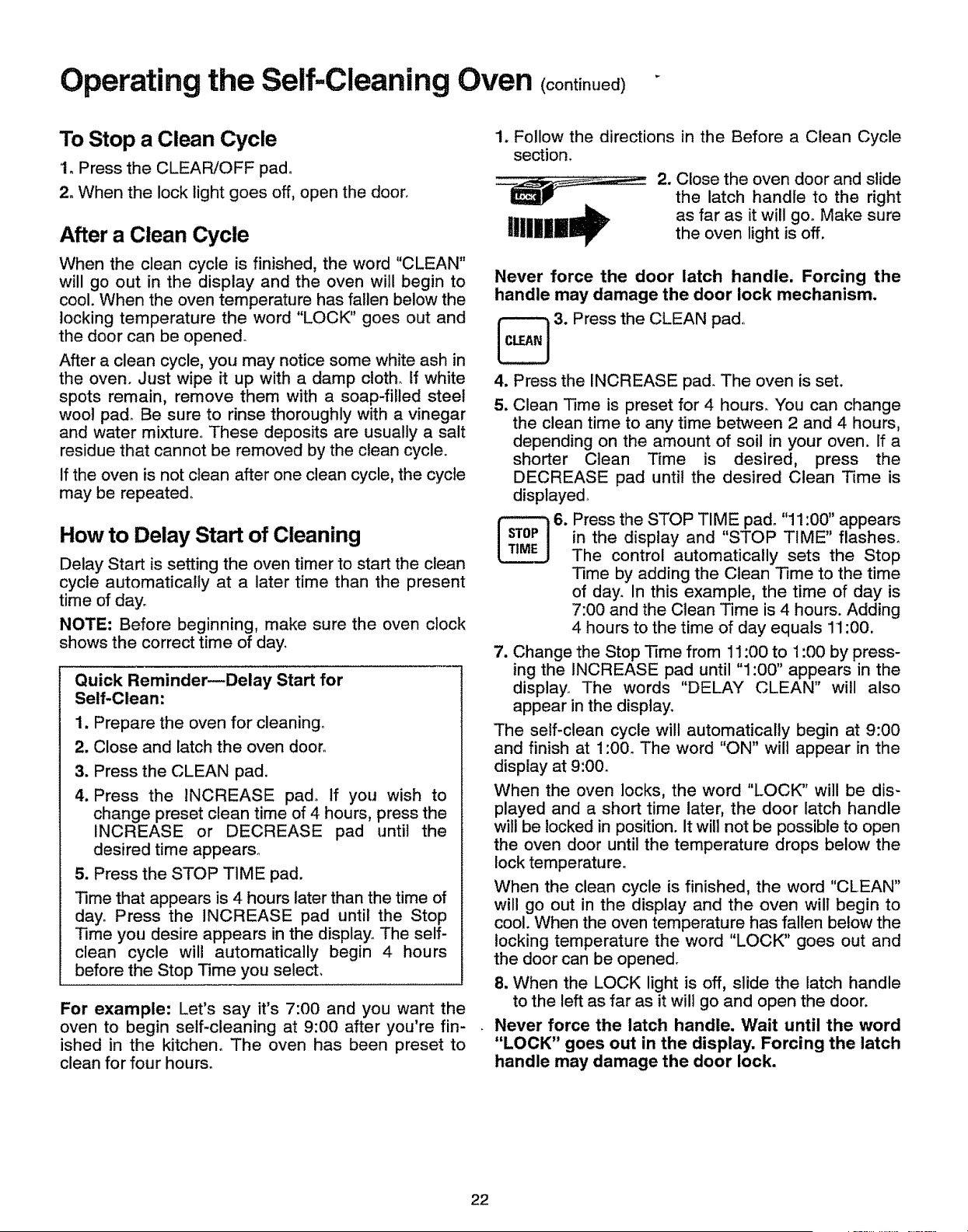
For example: Let's say it's 7:00 and you want the
oven to begin self-cleaning at 9:00 after you're fin-
ished in the kitchen° The oven has been preset to
clean for four hours.
1. Follow the directions in the Before a Clean Cycle
section.
illlllll
2. Close the oven door and slide
the latch handle to the right
as far as it will go. Make sure
the oven light is off.
Never force the door latch handle. Forcing the
handle may damage the door lock mechanism.
3. Press the CLEAN pad°
4. Press the INCREASE pad. The oven is set.
5. Clean Time is preset for 4 hours_ You can change
the clean time to any time between 2 and 4 hours,
depending on the amount of soil in your oven. If a
shorter Clean Time is desired, press the
DECREASE pad until the desired Clean Time is
displayed_
6. Press the STOP TIME pad° "11:00" appears
in the display and "STOP TIME" flashes.
The control automatically sets the Stop
Time by adding the Clean Time to the time
of day. In this example, the time of day is
7:00 and the Clean Time is 4 hours. Adding
4 hours to the time of day equals 11:00.
7. Change the Stop Time from 11:00 to 1:00 by press-
ing the INCREASE pad until "1:00" appears in the
display_ The words "DELAY CLEAN" will also
appear in the display.
The self-clean cycle will automatically begin at 9:00
and finish at 1:00. The word "ON" will appear in the
display at 9:00.
When the oven locks, the word "LOCK" will be dis-
played and a short time later, the door latch handle
will be locked in position. It will not be possible to open
the oven door until the temperature drops below the
lock temperatureo
When the clean cycle is finished, the word "CLEAN"
will go out in the display and the oven will begin to
cool. When the oven temperature has fallen below the
locking temperature the word "LOCK" goes out and
the door can be opened.
8. When the LOCK light is off, slide the latch handle
to the left as far as it will go and open the door.
Never force the latch handle. Wait until the word
"LOCK" goes out in the display. Forcing the latch
handle may damage the door lock.
22
Questions and Answers
Q. if my oven clock is not set to the correct time of
day, can I still self-clean my oven?
A. If the clock is not set to the correct time of day, you
will not be able to set a delay clean to end at a
specific time.
Q. Can I use commercial oven cleaners on any
part of my self-cleaning oven?
A. No cleaners or coatings should be used around
any part of this oven. If you do use them and do
not thoroughly rinse the oven with water, wiping it
absolutely clean afterward, the residue can scar
the oven surface and damage metal parts the next
time the oven is automatically cleaned.
Q. What should ! do if excessive smoking occurs
during cleaning?
A. This is caused by excessive soil_ Press the
CLEAR/OFF pad. Open the windows to rid the
room of smoker Wait until the oven has cooled and
the word "LOCK" is off in the display° Wipe up the
excess soil and reset the clean cycle.
Q. Is the "crackling" or "popping" sound I hear
during cleaning normal?
Ao Yes° This is the sound of the metal heating and
cooling during both the cooking and cleaning func-
tionso
Q. Should there be any odor during the cleaning?
A. Yes, there will be a slight odor during the first few
cleanings. Failure to wipe out excessive soil might
also cause a strong odor when cleaning°
Qo What causes the hair-like lines on the enam-
eled surface of my oven?
A. This is a normal condition, resulting from heating
and cooling during cleaning. These lines do not
affect how your oven performs,
Q. Why do I have ash left in my oven after cleaning?
A. Some types of soil will leave a deposit, which is
ash° It can be removed with a damp sponge or
cloth.
Q. The word "door" appeared on the display when
! selected the Clean Cycle. What's wrong?
A, The door latch handle must be moved all the way
to the right° Move the latch handle and cleaning will
start.
Q. Can ! cook food on the cooktop while the oven
is self-cleaning?
A. Yes. While the oven is self-cleaning, you can use
the cooktop just as you normally do,
23
Care and Cleaning
Proper care and cleaning are important so your range
will give you efficient and satisfactory service° Follow
these directions carefully in caring for it to help assure
safe and proper maintenance_
BE SURE ELECTRICAL POWER IS DISCONNECT-
ED BEFORE CLEANING ANY PART OF YOUR
RANGE,
Burner Heads (onsealed burners only)
CAUTION: DO NOT OPERATE THE BURNER
WITHOUT ALL BURNER PARTS AND DRIP PANS
(IF SO EQUIPPED) IN PLACE.
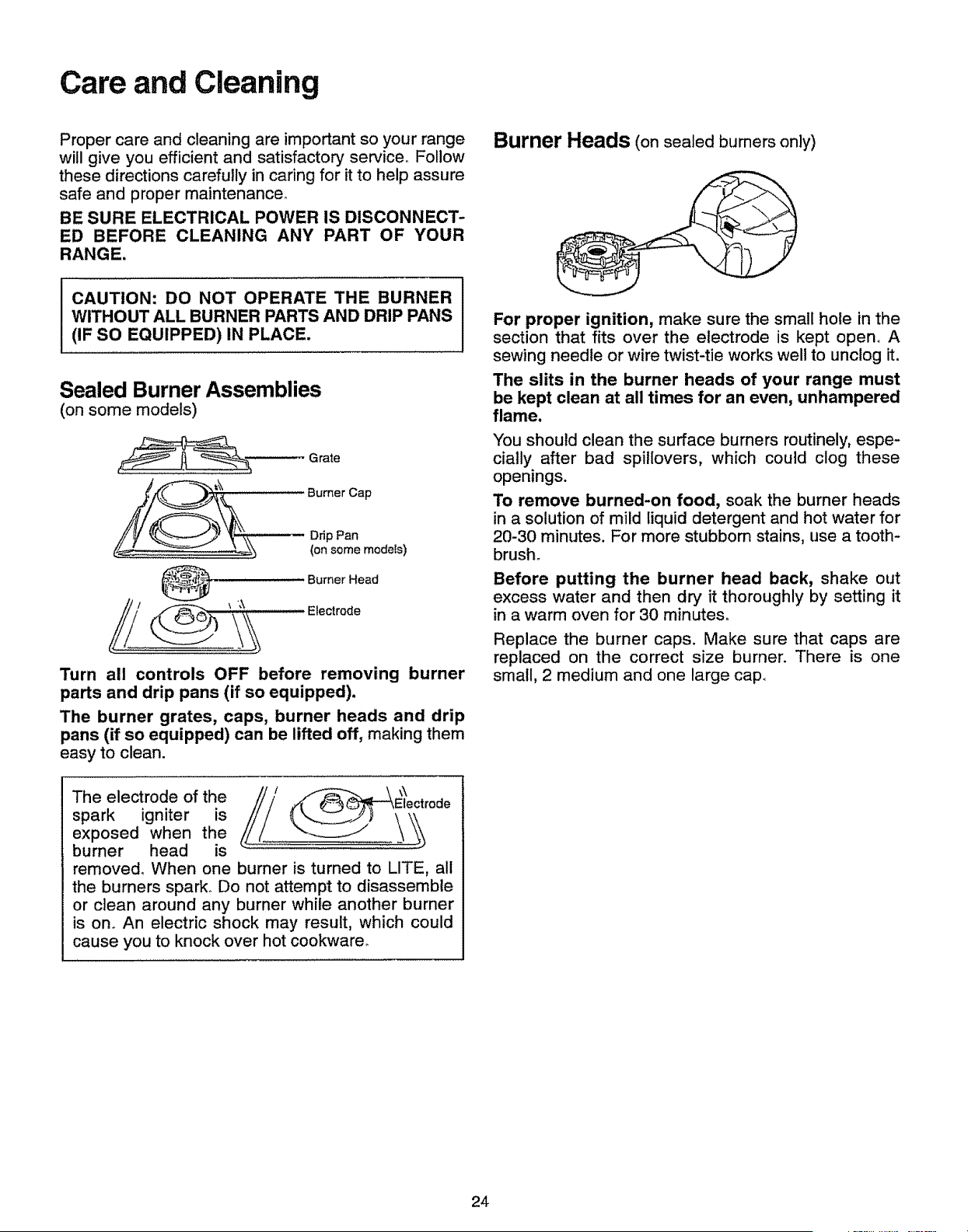
Sealed Burner Assemblies
(on some models)
_- Grate
Burner Cap
Drip Pan
(on some models)
Burner Head
....................Electrode
Turn all controls OFF before removing burner
parts and drip pans (if so equipped).
The burner grates, caps, burner heads and drip
pans (if so equipped) can be lifted off, making them
easy to clean.
The electrode of the //_ _\
_'__, _ _Electrode
spark igniter is
exposed when the
burner head is
removed. When one burner is turned to LITE, all
the burners spark_ Do not attempt to disassemble
or clean around any burner while another burner
is ono An electric shock may result, which could
cause you to knock over hot cookwareo
For proper ignition, make sure the small hole in the
section that fits over the electrode is kept open° A
sewing needle or wire twist-tie works well to unclog it.
The slits in the burner heads of your range must
be kept clean at all times for an even, unhampered
flame.
You should clean the surface burners routinely, espe-
cially after bad spillovers, which could clog these
openings.
To remove burned-on food, soak the burner heads
in a solution of mild liquid detergent and hot water for
20-30 minutes. For more stubborn stains, use a tooth-
brush.
Before putting the burner head back, shake out
excess water and then dry it thoroughly by setting it
in a warm oven for 30 minutes.
Replace the burner caps. Make sure that caps are
replaced on the correct size burner. There is one
small, 2 medium and one large cap°
24
Burner Caps (on sealed burners only)
Lift off when cool Wash burner caps in hot, soapy
water and rinse with clean water. You may scour with
a plastic scouring pad to remove burned-on food par-
ticles.
Dry them in a warm oven or with a cloth--don't
reassemble them wet° Replace the burner caps.
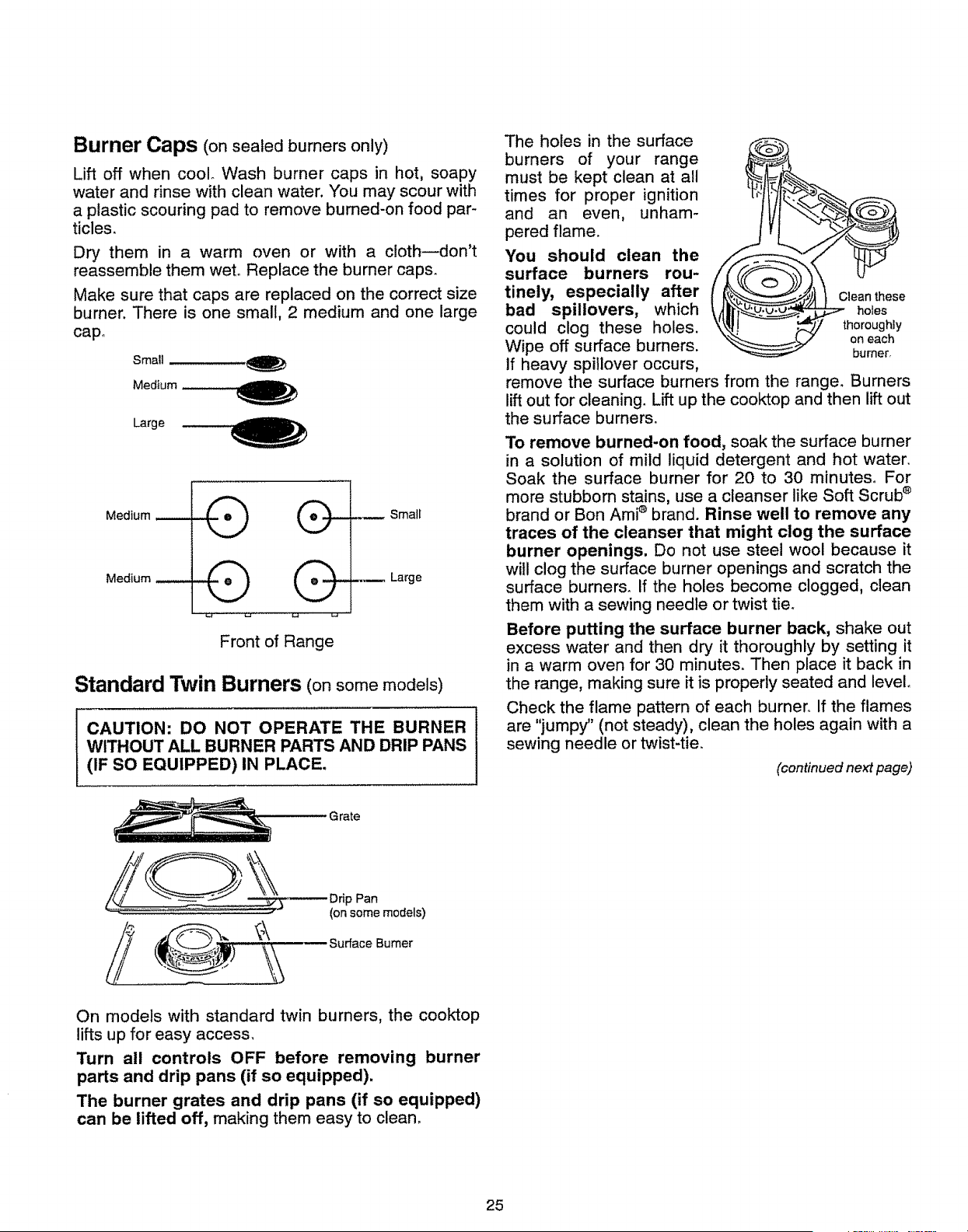
Make sure that caps are replaced on the correct size
burner. There is one small, 2 medium and one large
cap°
Small
Medium __
Large
Medium
Medium
n_ Small
m_ Large
Front of Range
Standard Twin Burners (on somemodels)
CAUTION: DO NOT OPERATE THE BURNER
WITHOUT ALL BURNER PARTS AND DRIP PANS
(IF SO EQUIPPED)IN PLACE.
The holes in the surface
burners of your range
must be kept clean at all
times for proper ignition
and an even, unham-
pered flame.
You should clean the
surface burners rou-
tinely, especially after Cleanthese
bad spiilovers, which 7 holes
could clog these holes, thoroughly
Wipe off surface burners, oneach
burner,
If heavy spitlover occurs,
remove the surface burners from the range. Burners
lift out for cleaning. Lift up the cooktop and then lift out
the surface burners.
To remove burned-on food, soak the surface burner
in a solution of mild liquid detergent and hot water,
Soak the surface burner for 20 to 30 minutes° For
more stubborn stains, use a cleanser like Soft Scrub ®
brand or Bon AmP brand. Rinse well to remove any
traces of the cleanser that might clog the surface
burner openings. Do not use steel wool because it
will clog the surface burner openings and scratch the
surface burners. If the holes become clogged, clean
them with a sewing needle or twist tie°
Before putting the surface burner back, shake out
excess water and then dry it thoroughly by setting it
in a warm oven for 30 minutes. Then place it back in
the range, making sure it is properly seated and level°
Check the flame pattern of each burner, If the flames
are "jumpy" (not steady), clean the holes again with a
sewing needle or twist-tie.
(continued next page)
Grate
_.10 __ Drip Pan
(on some models)
Burner
On models with standard twin burners, the cooktop
lifts up for easy access.
Turn all controls OFF before removing burner
parts and drip pans (if so equipped),
The burner grates and drip pans (if so equipped)
can be lifted off, making them easy to clean.
25
Care and Cleaning (continued)
Drip Pans (onsome models )
Remove the grates and " ........... "
lift out the drip pans.
The drip pans can be
cleaned in a dishwash-
er or by hand° To get
rid of burned-on food,
place the drip pans in a
covered container (or plastic bag) with 1/4 cup ammo-
nia to loosen the soil, Then scrub with a soap-filled
scouring pad if necessary_
CAUTION: Do not clean the drip pans in the self-
cleaning oven°
Burner Grates
Lift out when cool.
The grates should
be washed regularly
and, of course, after
spillovers, Wash them in hot, soapy water and rinse
with clean water. After cleaning, dry them thoroughly
by putting them in a warm oven for a few minutes° Do
not put the grates back on the range while they are
wet° When replacing the grates, be sure they're posi-
tioned securely over the burners°
To prevent rusting on cast iron grates, apply a light
coating of cooking oil on the bottom of the grates°
To get rid of burned-on food, place the grates in a
covered container (or plastic bag) with 1/4 cup
ammonia to loosen the soil. Then scrub with a soap-
filled scouring pad if necessary.
Although they're durable, the grates will gradually lose
their shine, regardless of the best care you can give
them. This is due to their continual exposure to high
temperatures.
Do not operate a burner for an extended period of
time without cookware on the grate. The finish on
the grate may chip without cookware to absorb the
heat.
CAUTION: Do not clean the grates in the self-clean-
ing oven.
Cooktop Surface
To avoid damaging the porcelain enamel surface
of the cooktop and to prevent it from becoming
dull, clean up spills right away. Foods with a lot of
acid (tomatoes, sauerkraut, fruit juices, etc.) or foods
with high sugar content could cause a dull spot if
allowed to sit. When the surface has cooled, wash
and rinse°
For other spills such as fat spatterings, etc,, wash with
soap and water once the surface has cooled. Then
rinse and polish with a dry cloth.
Do not store flammable materials in an oven or
near the cooktop. Do not store or use combustible
materials, gasoline or other flammable vapors and
liquids in the vicinity of this or any other appliance.
Control Panel and Knobs
It's a good idea to wipe the control panel after
each use of the oven. Clean with mild soap and
water, or vinegar and water, rinse with clean water
and polish dry with a soft cloth°
Do not use abrasive cleansers, strong liquid
cleaners, plastic scouring pads or oven cleaners
on the control panel--they witl damage the finish. A
50/50 solution of vinegar and hot water works wello
The control knobs may be removed for easier
cleaning. To remove the knob, pull it straight off the
stem_ If knob is difficult to remove, place a towel or
dishcloth between the knob and control panel and pull
gently. Wash the knobs in soap and water, or vinegar
solution, but do not soak°
Metal parts can be cleaned with soap and water_
Do not use steel wool, abrasives, ammonia, acids or
commercial oven cleaners, Dry, with a soft cloth.
Oven Air Vents
Never block the vents (air openings) of the
range. They provide the air inlet and outlet that are
necessary for the range to operate properly with
correct combustion. Air openings are located at the
rear of the cooktop, at the top and bottom of the
oven door, and at the bottom of the range, under
the kick panel, storage drawer or broiler drawer
(depending on the model)°
26
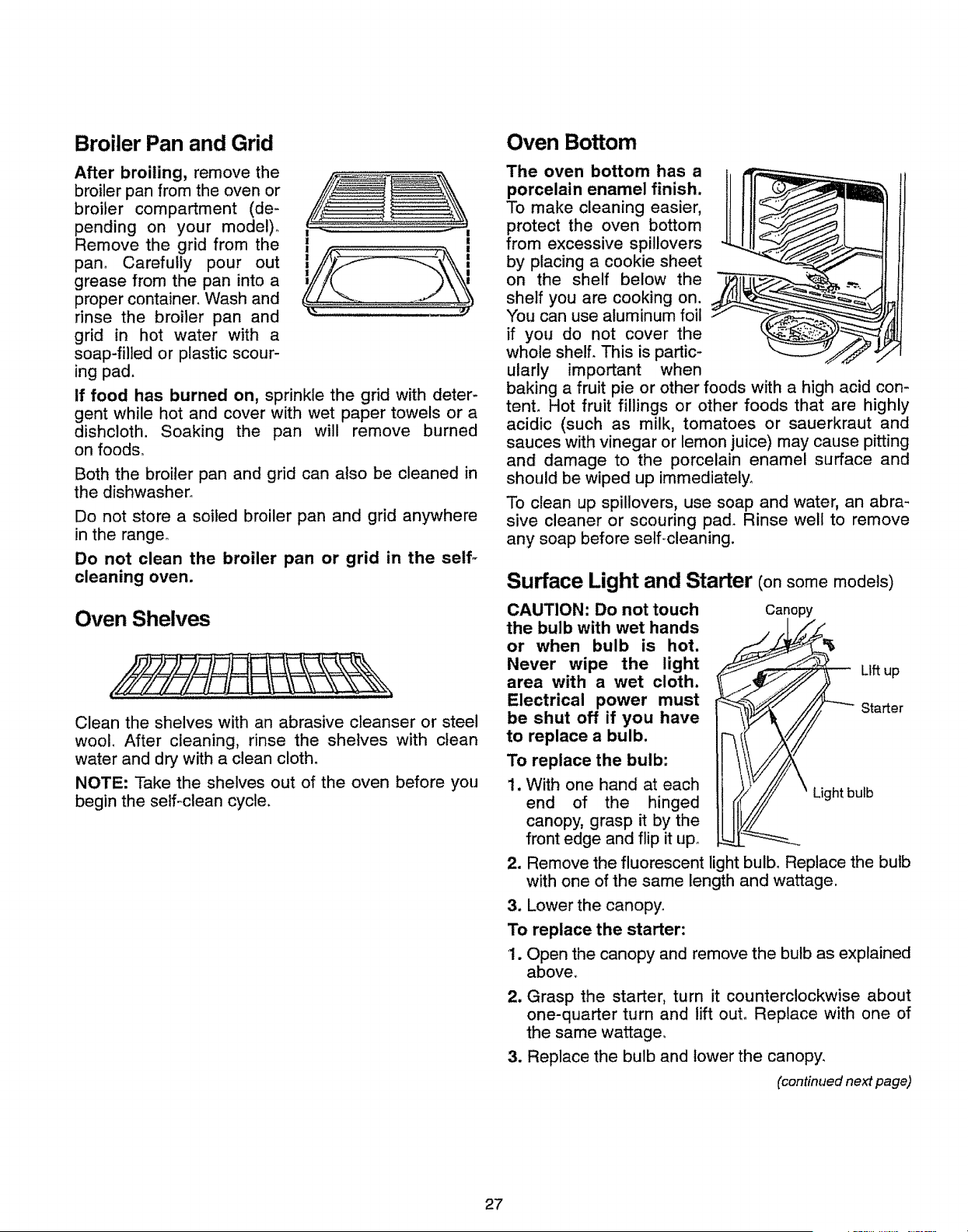
Broiler Pan and Grid
After broiling, remove the
broiler pan from the oven or
broiler compartment (de-
pending on your model)_
Remove the grid from the
pan, Carefully pour out
grease from the pan into a
proper container, Wash and
rinse the broiler pan and
grid in hot water with a
soap-filled or plastic scour-
ing pad.
If food has burned on, sprinkle the grid with deter-
gent while hot and cover with wet paper towels or a
dishcloth, Soaking the pan will remove burned
on foods_
1 !
i
I !
Both the broiler pan and grid can also be cleaned in
the dishwasher,
Do not store a soiled broiler pan and grid anywhere
in the range°
Do not clean the broiler pan or grid in the self-
cleaning oven.
Oven Shelves
Clean the shelves with an abrasive cleanser or steel
wool, After cleaning, rinse the shelves with clean
water and dry with a clean cloth.
NOTE: Take the shelves out of the oven before you
begin the self-clean cycle.
Oven Bottom
The oven bottom has a
porcelain enamel finish.
To make cleaning easier,
protect the oven bottom
from excessive spillovers
by placing a cookie sheet
on the shelf below the
shelf you are cooking on.
You can use aluminum foil
if you do not cover the
whole shelf, This is partic-
ularly important when
baking a fruit pie or other foods with a high acid con-
tenL Hot fruit fillings or other foods that are highly
acidic (such as milk, tomatoes or sauerkraut and
sauces with vinegar or lemon juice) may cause pitting
and damage to the porcelain enamel surface and
should be wiped up immediately,
To clean up spillovers, use soap and water, an abra-
sive cleaner or scouring pad, Rinse well to remove
any soap before self*cleaning.
Surface Light and Starter (onsomemodels)
CAUTION: Do not touch Canopy
the bulb with wet hands
or when bulb is hot.
Never wipe the light Llft up
area with a wet cloth.
Electrical power must Starter
be shut off if you have
to replace a bulb.
To replace the bulb:
1. With one hand at each
end of the hinged Light bulb
canopy, grasp it by the
front edge and flip it up,
2. Remove the fluorescent light bulbo Replace the bulb
with one of the same length and wattage.
3. Lower the canopy°
To replace the starter:
1. Open the canopy and remove the bulb as explained
above,
2. Grasp the starter, turn it counterclockwise about
one-quarter turn and lift out, Replace with one of
the same wattage,
3. Replace the bulb and lower the canopy,
(continued next page)
27
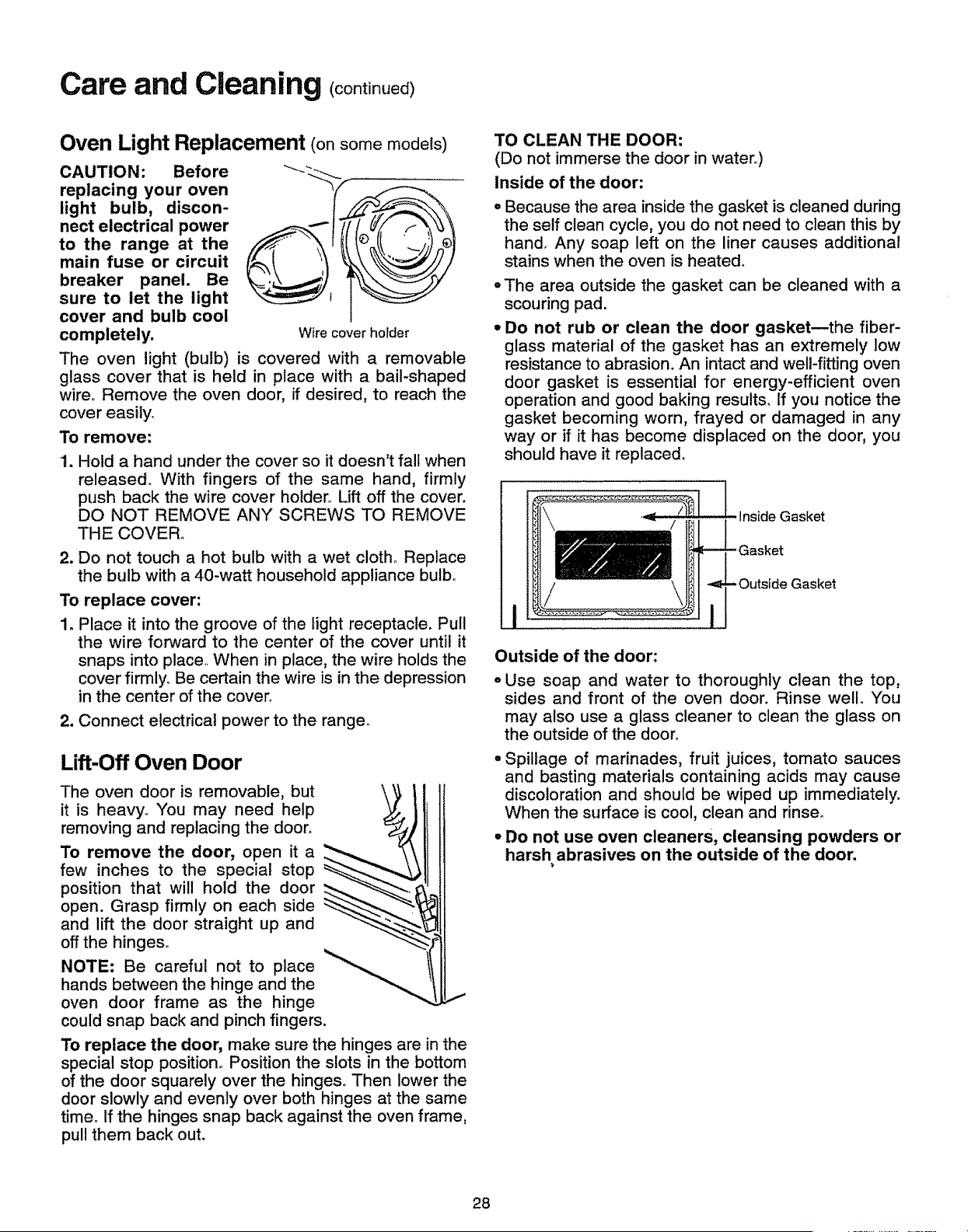
Care and Cleaning cont nued)
Oven Light Replacement (on some models)
CAUTION: Before
replacing your oven
light bulb, discon-
nect electrical power
to the range at the
main fuse or circuit
breaker panel. Be
sure to let the light
cover and bulb cool
completely.
Wire cover holder
The oven light (bulb) is covered with a removable
glass cover that is held in place with a bail-shaped
wire° Remove the oven door, if desired, to reach the
cover easity_
To remove:
1. Hold a hand under the cover so it doesn't fall when
released. With fingers of the same hand, firmly
push back the wire cover holder. Lift off the cover.
DO NOT REMOVE ANY SCREWS TO REMOVE
THE COVER.
2. Do not touch a hot bulb with a wet cloth° Replace
the bulb with a 40-watt household appliance bulbo
To replace cover:
1o Place it into the groove of the light receptacle. Pull
the wire forward to the center of the cover until it
snaps into place, When in place, the wire holds the
cover firmly, Be certain the wire is in the depression
in the center of the cover,
2. Connect electrical power to the range.
Lift-Off Oven Door
The oven door is removable, but \
it is heavy° You may need help
removing and replacing the door.
To remove the door, open it a
few inches to the special stop
position that will hold the door
open. Grasp firmly on each side
and lift the door straight up and
off the hinges°
NOTE: Be careful not to place
hands between the hinge and the
oven door frame as the hinge
could snap back and pinch fingers.
To replace the door, make sure the hinges are in the
special stop position. Position the slots in the bottom
of the door squarely over the hinges° Then lower the
door slowly and evenly over both hinges at the same
time. If the hinges snap back against the oven frame,
pull them back out.
TO CLEAN THE DOOR:
(Do not immerse the door in water°)
inside of the door:
• Because the area inside the gasket is cleaned during
the self clean cycle, you do not need to clean this by
hand_ Any soap left on the liner causes additional
stains when the oven is heated.
• The area outside the gasket can be cleaned with a
scouring pad.
• Do not rub or clean the door gasket--the fiber-
glass material of the gasket has an extremely low
resistance to abrasion. An intact and well-fitting oven
door gasket is essential for energy-efficient oven
operation and good baking results. If you notice the
gasket becoming worn, frayed or damaged in any
way or if it has become displaced on the door, you
should have it replaced.
Inside Gasket
I
_asket
Outside of the door:
o Use soap and water to thoroughly clean the top,
sides and front of the oven door. Rinse wello You
may also use a glass cleaner to clean the glass on
the outside of the door°
° Spillage of marinades, fruit juices, tomato sauces
and basting materials containing acids may cause
discoloration and should be wiped up immediately.
When the surface is cool, clean and rinse°
, Do not use oven cleaners, cleansing powders or
harsh abrasives on the outside of the door.
28
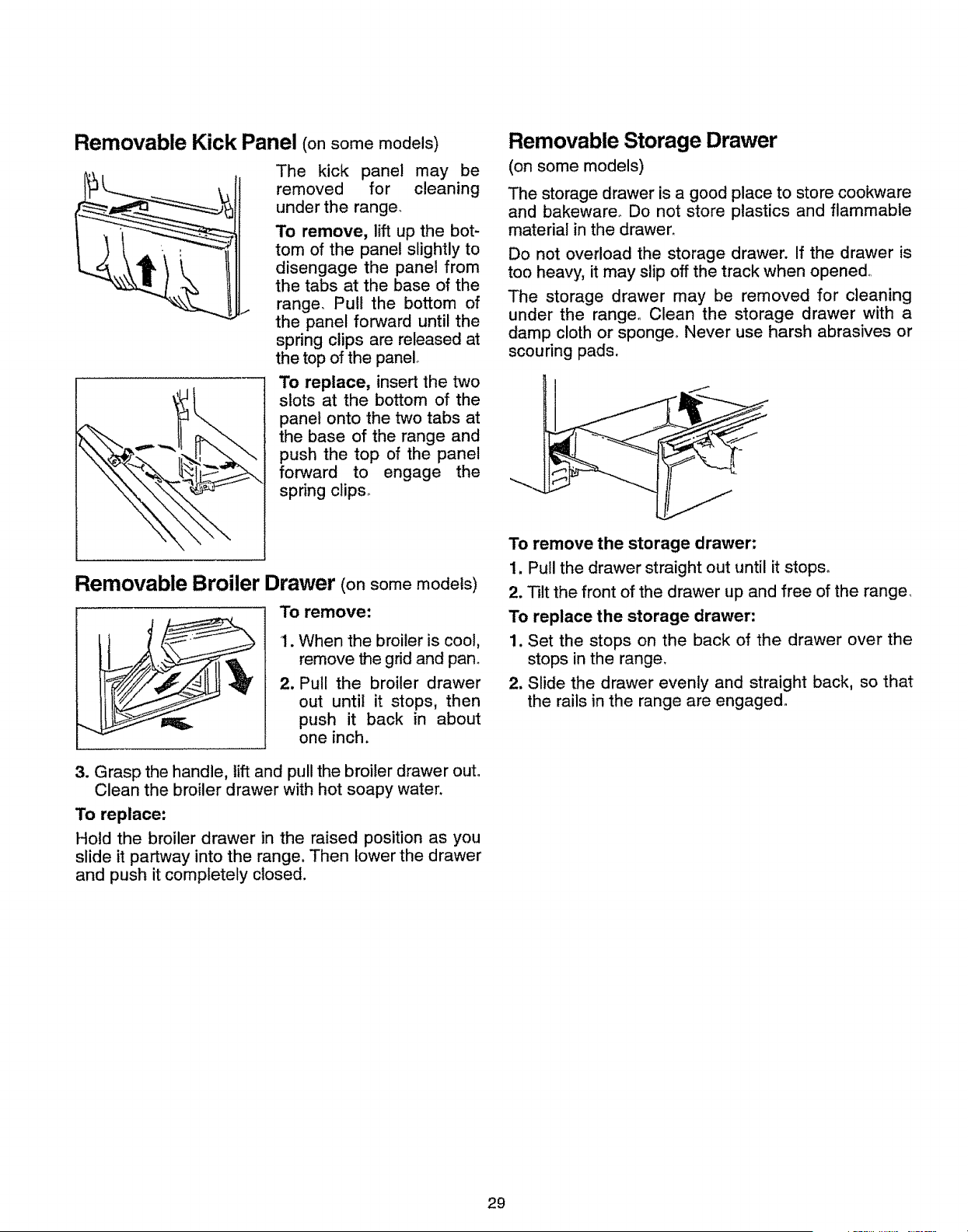
Removable Kick Panel (onsome models)
The kick panel may be
removed for cleaning
under the range.
To remove, lift up the bot-
tom of the panel slightly to
disengage the panel from
the tabs at the base of the
range. Pull the bottom of
the panel forward until the
spring clips are released at
the top of the panel°
To replace, insert the two
slots at the bottom of the
panel onto the two tabs at
the base of the range and
push the top of the panel
forward to engage the
spring clips°
Removable Storage Drawer
(on some models)
The storage drawer is a good place to store cookware
and bakewareo Do not store plastics and flammable
material in the drawer_
Do not overload the storage drawer. If the drawer is
too heavy, it may slip off the track when opened°
The storage drawer may be removed for cleaning
under the ranger Clean the storage drawer with a
damp cloth or sponge° Never use harsh abrasives or
scouring pads.
Removable Broiler Drawer (onsome models)
To remove:
1. When the broiler is cool,
remove the grid and pan°
2. Pull the broiler drawer
out until it stops, then
push it back in about
one inch.
3. Grasp the handle, lift and pull the broiler drawer out°
Clean the broiler drawer with hot soapy water.
To replace:
Hold the broiler drawer in the raised position as you
slide it partway into the range. Then lower the drawer
and push it completely closed.
To remove the storage drawer:
1. Pull the drawer straight out until it stops.
2. Tilt the front of the drawer up and free of the range,
To replace the storage drawer:
1. Set the stops on the back of the drawer over the
stops in the range_
2. Slide the drawer evenly and straight back, so that
the rails in the range are engaged.
29
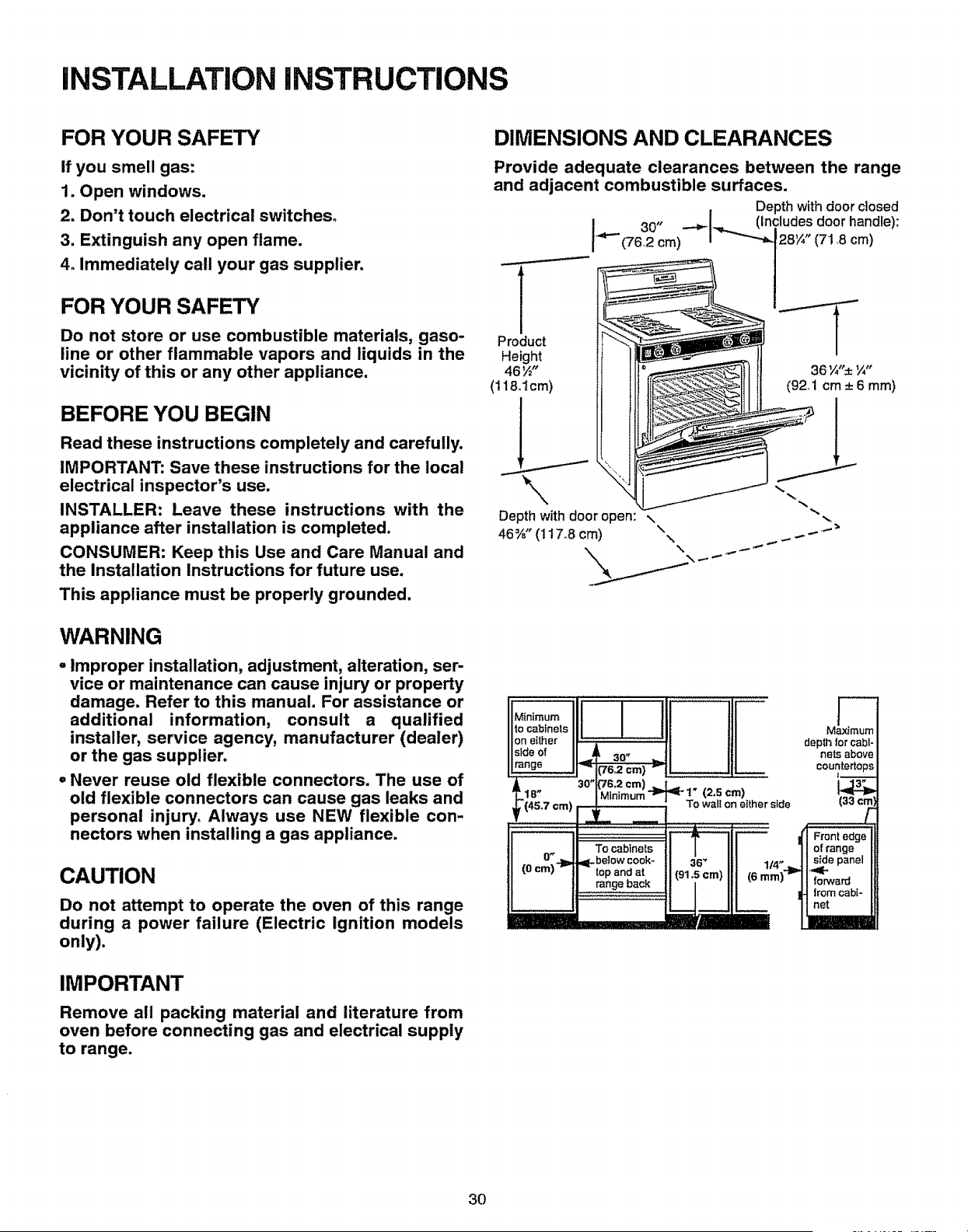
iNSTALLATION iNSTRUCTIONS
FOR YOUR SAFETY
if you smell gas:
1. Open windows.
2, Don't touch electrical switches°
3. Extinguish any open flame.
4, Immediately call your gas supplier,
FOR YOUR SAFETY
Do not store or use combustible materials, gaso-
line or other flammable vapors and liquids in the
vicinity of this or any other appliance.
BEFORE YOU BEGIN
Read these instructions completely and carefully.
iMPORTANT: Save these instructions for the local
electrical inspector's use,
INSTALLER: Leave these instructions with the
appliance after installation is completed.
CONSUMER: Keep this Use and Care Manual and
the installation Instructions for future use.
This appliance must be properly grounded.
WARNING
- Improper installation, adjustment, alteration, ser-
vice or maintenance can cause injury or property
damage. Refer to this manual. For assistance or
additional information, consult a qualified
installer, service agency, manufacturer (dealer)
or the gas supplier.
° Never reuse old flexible connectors. The use of
old flexible connectors can cause gas leaks and
personal injury° Always use NEW flexible con-
nectors when installing a gas appliance.
CAUTION
Do not attempt to operate the oven of this range
during a power failure (Electric Ignition models
only).
IMPORTANT
Remove all packing material and literature from
oven before connecting gas and electrical supply
to range.
DIMENSIONS AND CLEARANCES
Provide adequate clearances between the range
and adjacent combustible surfaces.
, Depth with door closed
30" --_
j"_'-'(76,2 I (includes door handle):
F_*""_ 28¼ (71,8 cm)
cm)
Product
Height
46 ½"
(118.1cm)
\
Depth with door open:
46¾"(1t7o8 cm)
\
\
36 ¼"± ¼"
(92,1 crn ± 6 mrn)
Minimum
to cabinets
on either
side of ' 30"
range _
_'18" 30" ('76.2 cm)
_ Minimum "_= _ 1" (2.5 cm)
,(45.7 cm) To wall on either side
To cabinets T
0n _l.below cook- 36" 1
(0 cm)-]l=' top and at (91,5 cm) (6 rr
range back J_ I
depth for cabi-
nets above
court=tertops
(33
30
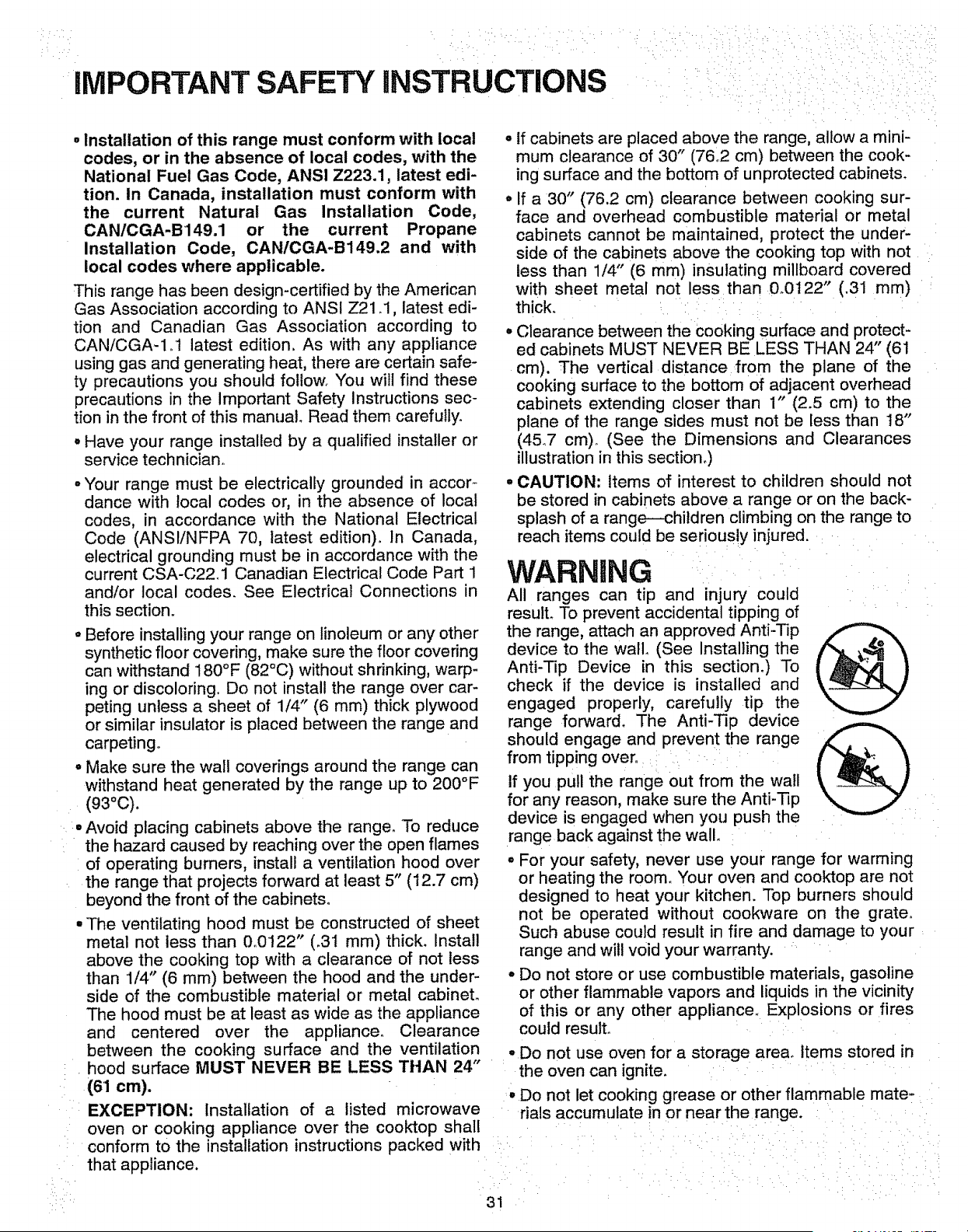
iMPORTANT SAFETY iNSTRUCTIONS ............ : :
° Installation of this range must conform with local
codes, or in the absence of local codes, with the
National Fuel Gas Code, ANSI Z223.1, latest edi-
tion. in Canada, installation must conform with
the current Natural Gas installation Code,
CANICGA-B149.1 or the current Propane
Installation Code, CAN/CGA-B149.2 and with
local codes where applicable.
This range has been design-certified by the American
Gas Association according to ANSI Z21.1, latest edi-
tion and Canadian Gas Association according to
CANiCGA-I.1 latest edition. As with any appliance
using gas and generating heat, there are certain safe-
ty precautions you should foltow. You will find these
precautions in the Important Safety Instructions sec-
tion in the front of this manual. Read them carefully°
° Have your range installed by a qualified installer or
service technician,
= Your range must be electrically grounded in accor-
dance with local codes or, in the absence of locat
codes, in accordance with the National Electrical
Code (ANSI!NFPA 70, latest edition). In Canada,
electrical grounding must be in accordance with the
current CSA-C22.1 Canadian Electrical Code Part 1
and/or local codes. See Electrical Connections in
this section.
° Before installing your range on linoleum or any other
synthetic floor covering, make sure the floor covering
can withstand 180°F (82°C) without shrinking, warp-
ing or discoloring. Do not install the range over car-
peting unless a sheet of 1/4" (6 mm) thick plywood
or similar insulator is placed between the range and
carpeting°
° Make sure the walt coverings around the range can
withstand heat generated by the range up to 200°F
(93°C).
Avoid placing cabinets above the range, To reduce
the hazard caused by reaching over the open flames
of operating burners, install a ventilation hood over
the range that projects forward at least 5" (12.7 cm)
beyond the front of the cabinets,
• The ventilating hood must be constructed of sheet
metal not less than 0,0122" (.31 mm) thick. Install
above the cooking top with a clearance of not less
than 1/4" (6 ram) between the hood and the under-
side of the combustible material or metal cabinet,
The hood must be at least as wide as the appliance
and centered over the appliance, Clearance
between the cooking surface and the ventilation
hood surface MUST NEVER BE LESS THAN 24"
(61 cm).
EXCEPTION: Installation of a listed microwave
oven or cooking appliance over the cooktop shall
conform to the installation instructions packed with
that appliance.
o If cabinets are placed above the range, allow a mini-
mum clearance of 30" (76.2 cm) between the cook-
ing surface and the bottom of unprotected cabinets.
o If a 30" (76.2 cm) clearance between cooking sur-
face and overhead combustible material or metal
cabinets cannot be maintained, protect the under-
side of the cabinets above the cooking top with not
tess than 1/4" (6 mm) insulating millboard covered
with sheet metal not less than 0°0122" (.31 mm)
thick.
° Clearance between the cooking surface and protect-
ed cabinets MUST NEVER BE LESS THAN 24" (61
cm). The vertical distance from the plane of the
cooking surface to the bottom of adjacent overhead
cabinets extending closer than 1" (2.5 cm) to the
plane of the range sides must not be less than t8"
(4&7 cm). (See the Dimensions and Clearances
illustration in this section_)
° CAUTION: items of interest to children should not
be stored in cabinets above a range or on the back-
splash of a range--children climbing on the range to
reach items could be seriouslY injured.
WARNING :
All ranges can tip and injury could
result. To prevent accidental tipping of
the range, attach an approved Anti-Tip
device to the wall_ (See Installing the
Anti-Tip Device in this section.) To
check if the device is installed and
engaged properly, carefully tip the
range forward. The Anti-Tip device
should engage and prevent the range
from tipping over.
If you pull the range out from the wall
for any reason, make sure the Anti-Tip
device is engaged when you push the
range back against the wall.
• For your safety, never use your range for warming
or heating the room. Your oven and cooktop are not
designed to heat your kitchen. Top burners should
not be operated without cookware on the grate.
Such abuse could result in fire and damage to your
range and will void your warranty.
• Do not store or use combustible materials, gasoline
or other flammable vapors and liquids in the vicinity
of this or any other appliance. Explosions or fires
could result.
°Do not use oven for a storage area. items stored in
the oven can ignite. :
= Do not let cooking grease or other flammable mate:
rials accumulate in or near the range.
i
: i i i
31
installation instructions
GENERAL
= See Dimensions and Clearances in this section for
all rough-in and spacing dimensions. These dimen-
sions must be met for safe use of your range° The
location of the electrical outlet and pipe opening (see
Gas Pipe and Electric Outlet Locations) may be
adjusted to meet specific requirements.
o The range may be placed with 0" (0 cm) clearance
(flush) at the back wall and side walls of the range°
LOCATION
Do not locate the range where it may be subject to
strong drafts. Any openings in the floor or wall behind
the range should be seale& Make sure the openings
around the base of the range that supply fresh air for
combustion and ventilation are not obstructed by car-
peting or woodwork.
PROTECT YOUR FLOOR
Your range, like many other household items, is heavy
and can settle into soft floor coverings such as cush-
ioned vinyl or carpeting. Use care when moving the
range on this type of flooring. It is recommended that
the following simple and inexpensive instructions be
followed to protect your floor,
The range should be installed on a sheet of plywood
(or similar material). When the floor covering ends at
the front of the range, the area that the range will rest
on should be built up with plywood to the same level
or higher than the floor covering. This will allow the
range to be moved for cleaning or servicing.
MODEL AND SERIAL NUMBER LOCATION
Depending on your range, you'll find the model and
serial numbers on a label on the front frame of the
range, behind the storage drawer, broiler drawer or
kick panel,
TOOLS YOU WILL NEED
• Phillips and flat-blade screwdrivers
• Pencil and ruler
, Two pipe wrenches (one for backup)
° 1¾" open-end or adjustable wrench
• Nut drivers or wrenches: 3/16" and 1/4"
ADDITIONAL MATERIALS YOU MAY NEED
° Gas line shut_off valve
° Pipe joint sealant or UL-approved pipe thread tape
with Teflon* that resists action of natural and LP
gases
° Flexible metal appliance connector (I/2" I.D,). A
5-foot (1o5 m) length is recommended for ease of
installation but other lengths are acceptable. Never
use an old connector when installing a new range.
° Flare union adapter for connection to gas supply line
(3/4"or 1/2" NPTx 1/2" lode)
• Flare union adapter for connection to pressure regu-
lator on range (1/2" NPT x 1/2" 1.D_)
*Teflon: Registered trademark of DuPont
PREPARATION
o Remove all tape and packaging° Lift up the cooktop
(on models with dual burners) and remove any pack-
ing material under it. Make sure the dual burners are
properly seated and level.
° Remove plastic film that covers some chrome parts
(around oven door, side trim)_
, Take the accessory pack out of the oven,
o Check to be sure that no range parts have come
loose during shipping°
32
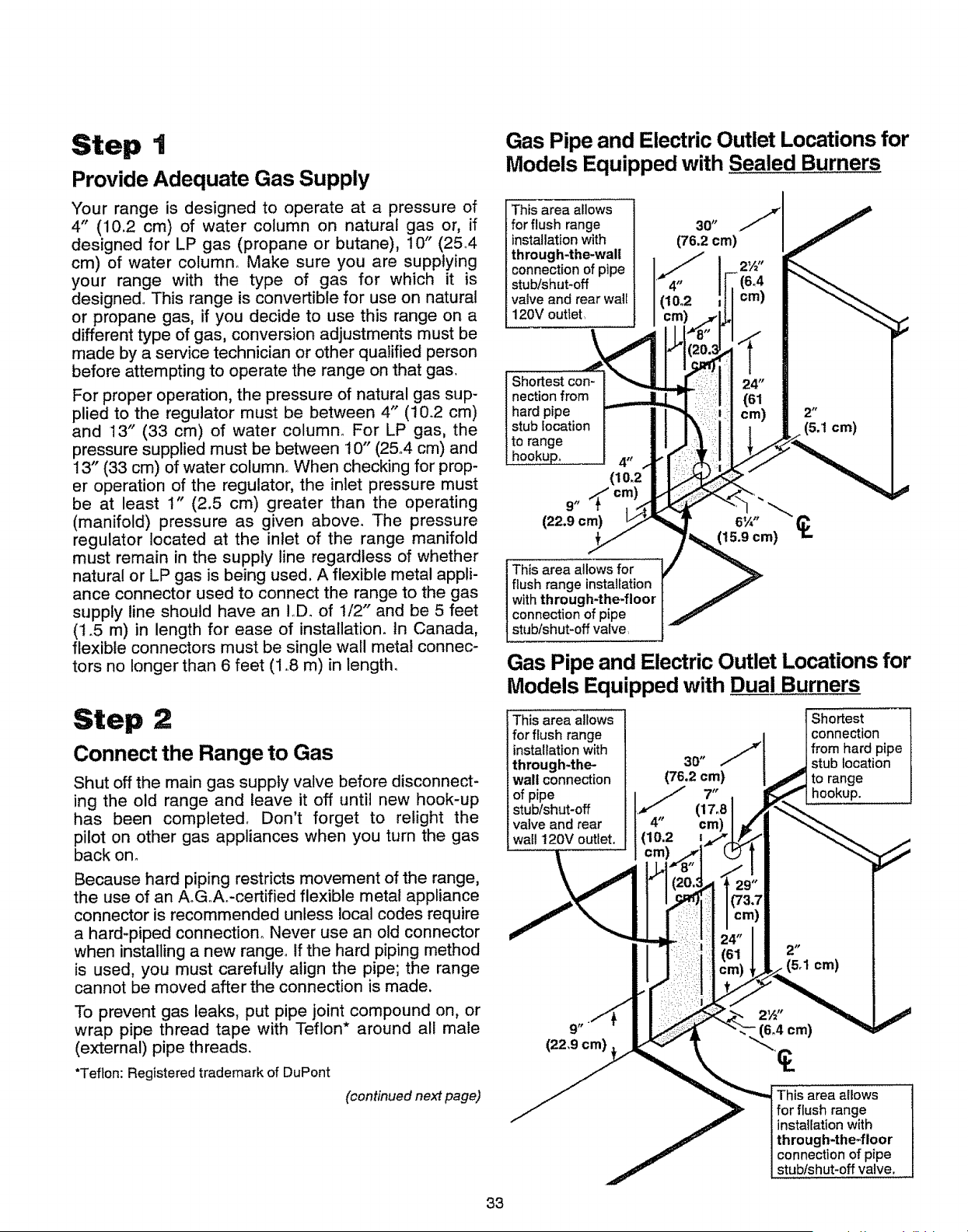
Step I
Provide Adequate Gas Supply
Your range is designed to operate at a pressure of
4" (10.2 cm) of water column on natural gas or, if
designed for LP gas (propane or butane), 10" (25_4
cm) of water column. Make sure you are supplying
your range with the type of gas for which it is
designed° This range is convertible for use on natural
or propane gas, if you decide to use this range on a
different type of gas, conversion adjustments must be
made by a service technician or other qualified person
before attempting to operate the range on that gas.
For proper operation, the pressure of natural gas sup-
plied to the regulator must be between 4" (10.2 cm)
and 13" (33 cm) of water column_ For LP gas, the
pressure supplied must be between 10" (25°4 cm) and
13" (33 cm) of water column° When checking for prop-
er operation of the regulator, the inlet pressure must
be at least 1" (2.5 cm) greater than the operating
(manifold) pressure as given above. The pressure
regulator located at the inlet of the range manifold
must remain in the supply line regardless of whether
natural or LP gas is being used. A flexible metal appli-
ance connector used to connect the range to the gas
supply line should have an I_D. of 1/2" and be 5 feet
(t .5 m) in length for ease of installation. In Canada,
flexible connectors must be single wall metal connec-
tors no longer than 6 feet (1.8 m) in length.
Step 2
Connect the Range to Gas
Shut off the main gas supply valve before disconnect-
ing the old range and leave it off until new hook-up
has been completed. Don't forget to retight the
pilot on other gas appliances when you turn the gas
back on.
Because hard piping restricts movement of the range,
the use of an A.G.A_-certified flexible metal appliance
connector is recommended unless local codes require
a hard-piped connection° Never use an old connector
when installing a new range. If the hard piping method
is used, you must carefully align the pipe; the range
cannot be moved after the connection is made.
To prevent gas leaks, put pipe joint compound on, or
wrap pipe thread tape with Teflon* around all male
(external) pipe threads.
*Teflon: Registered trademark of DuPont
(continued next page)
Gas Pipe and Electric Outlet Locations for
Models Equipped with Sealed Burners
This area allows
for flush range
installation with
30"
(76.2 cm)
through-the-wall , I/ ,
connection of pipe J./7" J_ 2_
stub/shut-off I" 4" JJ, (6.
valve and rear wail J (10.2 ; lJ cr[
120V outlet J crn) _,r J_J
. 1(2°'_ 1
N
nectionfrom I --JJ-3i / I (6
J hard pipe r"-- I ii'_ _: _i I cn 2"
] stub location I li ! I\ Ii I (5.1cm)
Jtorange I | I .,I;1_t/ I _ _L
!hookup. 1 4" .l"fb _'_ _:I...> ""
9"
(22.9 ore) _ 6¼" G
_, ]_.9 cm) z..
I flush range installation [ ._"
] with through-the-floor t _
J connection of pipe J f
1stubtshut-off valve J .-
Gas Pipe and Electric Outlet Locations for
Models Equipped with Dual Burners
This area allows 1Shortest
for flush range I connection
installation with 30" I from hard pipe
through-the- ! stub location
walt connection (76.2 cm) to range
of pipe I_ 7" hookup.
stub/shut-off . (17.8
valve and rear cm
,wall 120V outlet.
\
2 _t
(5.1 cm)
2W"
9" .. (6.4 cm)
(22,9 cm) _,...
This area allows
for flush range
installation with
through-the_floor
connection of pipe
stub/shut-off valve,
33
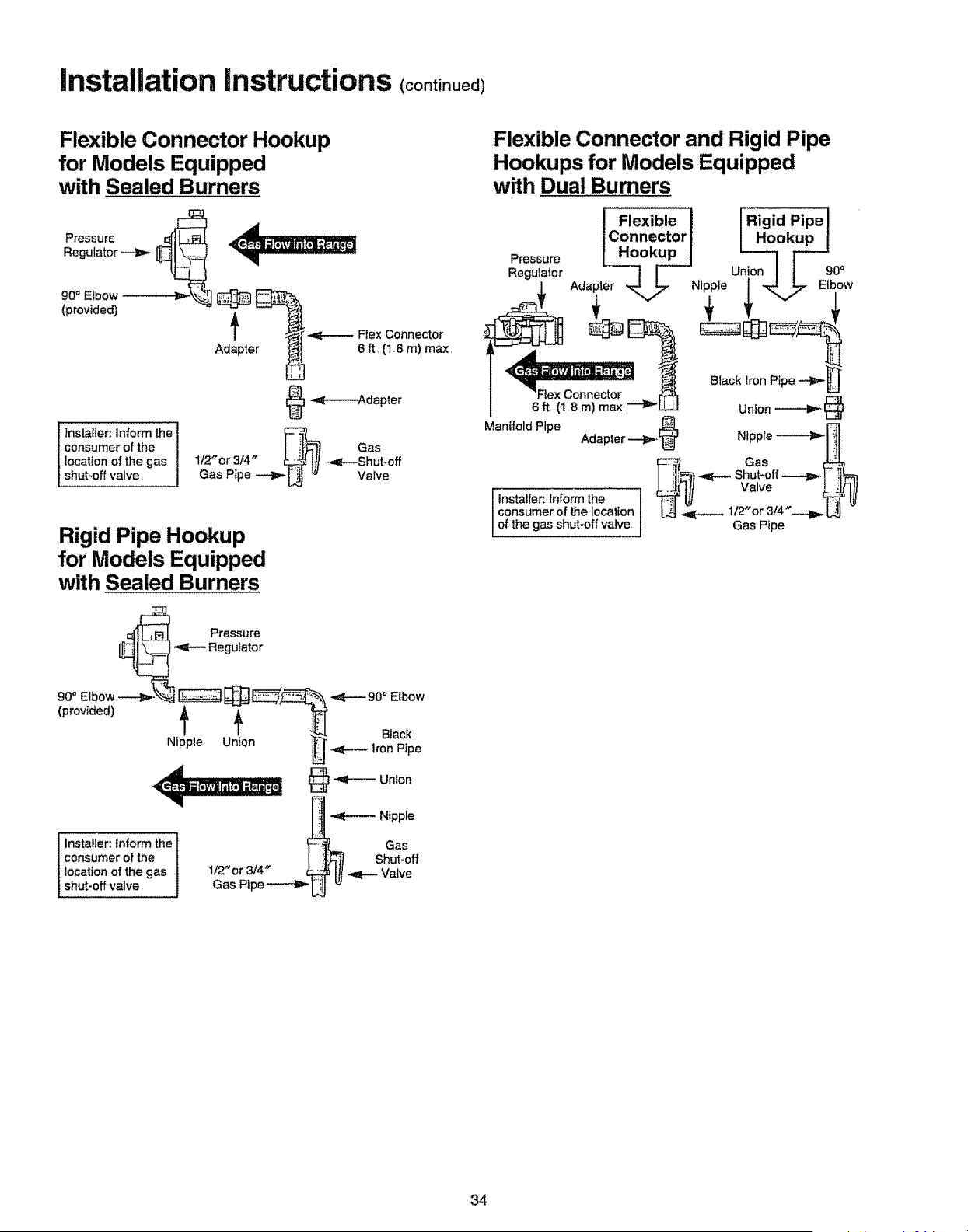
Installation instructions (continued)
Flexible Connector Hookup
for Models Equipped
with Sealed Burners
Pressure _
Regulator
gO°(provided)Elb°w_ _!p __
__ _ Flex Connector
Ad te 6 ft (1 .Sm) max
I Installer: Inform the
consumer of the
location of the gas
shut-off valve.
-,<-----Adapter
_ Gas
112"or 3/4" _<F--Shut-off
Gas Pipe _[._ _ Valve
Rigid Pipe Hookup
for Models Equipped
with Sealed Burners
c_ Pressure
[_]_ -.=1--- Regulator
90o Elbow --..1_._,_ _ _ -4_----90° Elbow
(provided) _ '_ _ Black
Nipple Union f!i] _----- Iron Pipe
-_ Nipple
I Installer: Inform the _ gL_ Gas
I consumer of the ,, ,, I ;t_,q_Jl Shut-off
] location of the gas t/'2 or 3/4 @ lit _ Vatve
[ shut-off valve. Gas Pipe _L_ e
Flexible Connector and Rigid Pipe
Hookups for Models Equipped
with Dual Burners
34
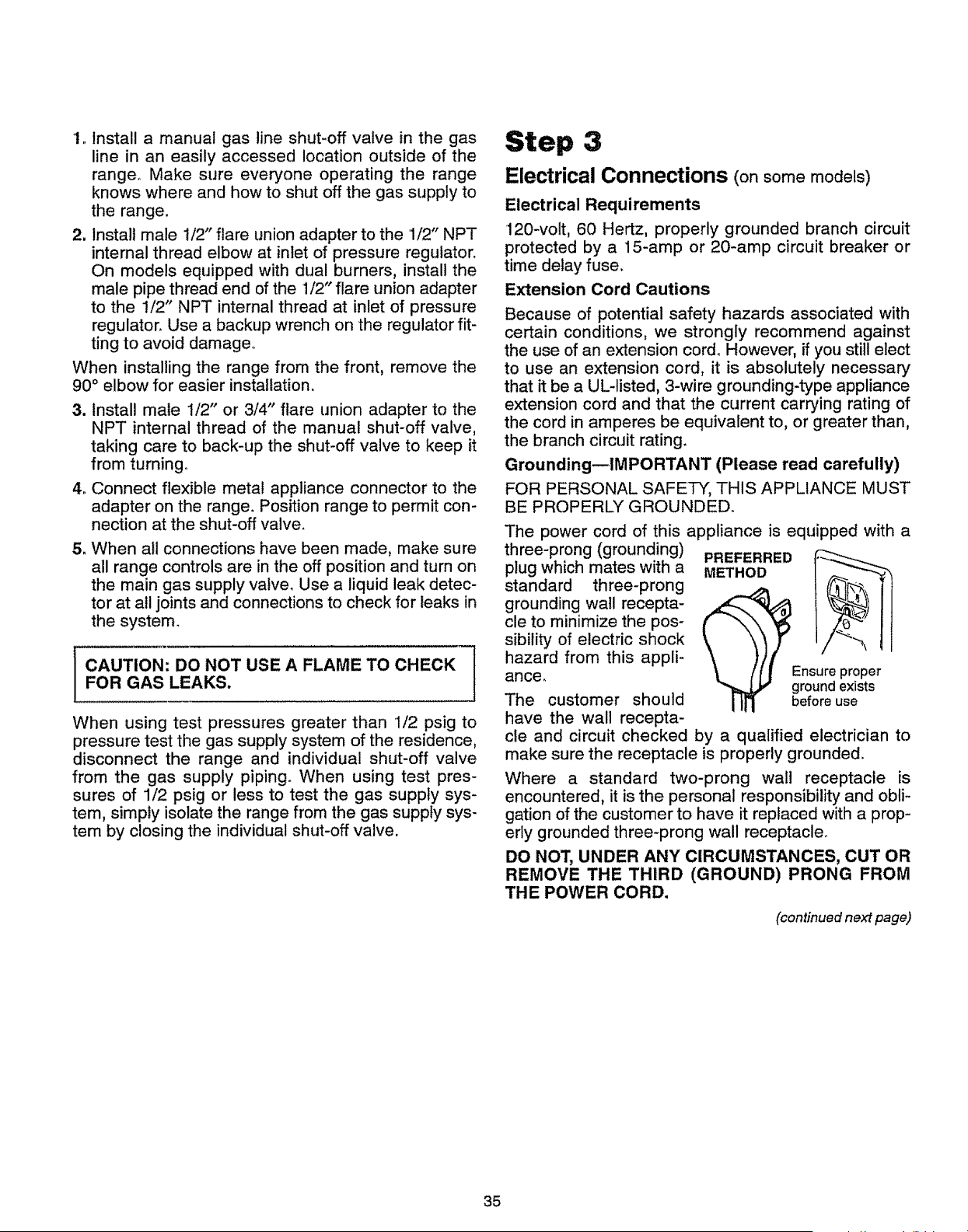
1. Install a manual gas line shut-off valve in the gas
line in an easily accessed location outside of the
range° Make sure everyone operating the range
knows where and how to shut off the gas supply to
the range.
2. Install male t/2" flare union adapter to the 1/2" NPT
internal thread elbow at inlet of pressure regulator.
On models equipped with dual burners, install the
male pipe thread end of the 1/2" flare union adapter
to the t/2" NPT internal thread at inlet of pressure
regulator. Use a backup wrench on the regulator fit-
ting to avoid damage,
When installing the range from the front, remove the
90 ° elbow for easier installation.
3. Install male 1/2" or 3/4" flare union adapter to the
NPT internal thread of the manual shut-off valve,
taking care to back-up the shut-off valve to keep it
from turning°
4. Connect flexible metal appliance connector to the
adapter on the range. Position range to permit con-
nection at the shut-off valve.
5o When all connections have been made, make sure
all range controls are in the off position and turn on
the main gas supply valve. Use a liquid leak detec-
tor at all joints and connections to check for leaks in
the system_
I CAUTION: DO NOT USE A FLAME TO CHECK I
1
FOR GAS LEAKS.
1
When using test pressures greater than 1/2 psig to
pressure test the gas supply system of the residence,
disconnect the range and individual shut-off valve
from the gas supply piping. When using test pres-
sures of 1/2 psig or less to test the gas supply sys-
tem, simply isolate the range from the gas supply sys-
tem by closing the individual shut-off valve.
Step 3
Electrical Connections (on some models)
Electrical Requirements
120-volt, 60 Hertz, properly grounded branch circuit
protected by a 15-amp or 20-amp circuit breaker or
time delay fuse.
Extension Cord Cautions
Because of potential safety hazards associated with
certain conditions, we strongly recommend against
the use of an extension cord. However, if you still elect
to use an extension cord, it is absolutely necessary
that it be a UL-listed, 3-wire grounding-type appliance
extension cord and that the current carrying rating of
the cord in amperes be equivalent to, or greater than,
the branch circuit rating.
GroundingmlMPORTANT (Please read carefully)
FOR PERSONAL SAFETY, THIS APPLIANCE MUST
BE PROPERLY GROUNDED.
The power cord of this appliance is equipped with a
three-prong (grounding)
plug which mates with a
standard three-prong
grounding wall recepta-
cle to minimize the pos-
sibility of electric shock
hazard from this appli-
ance.
The customer should
have the wall recepta-
PREFERRED
METHOD
Ensure proper
ground exists
before use
cle and circuit checked by a qualified electrician to
make sure the receptacle is properly grounded.
Where a standard two-prong wall receptacle is
encountered, it is the personal responsibility and obli-
gation of the customer to have it replaced with a prop-
erly grounded three-prong wall receptacle°
DO NOT, UNDER ANY CIRCUMSTANCES, CUT OR
REMOVE THE THIRD (GROUND) PRONG FROM
THE POWER CORD.
(continued next page)
35
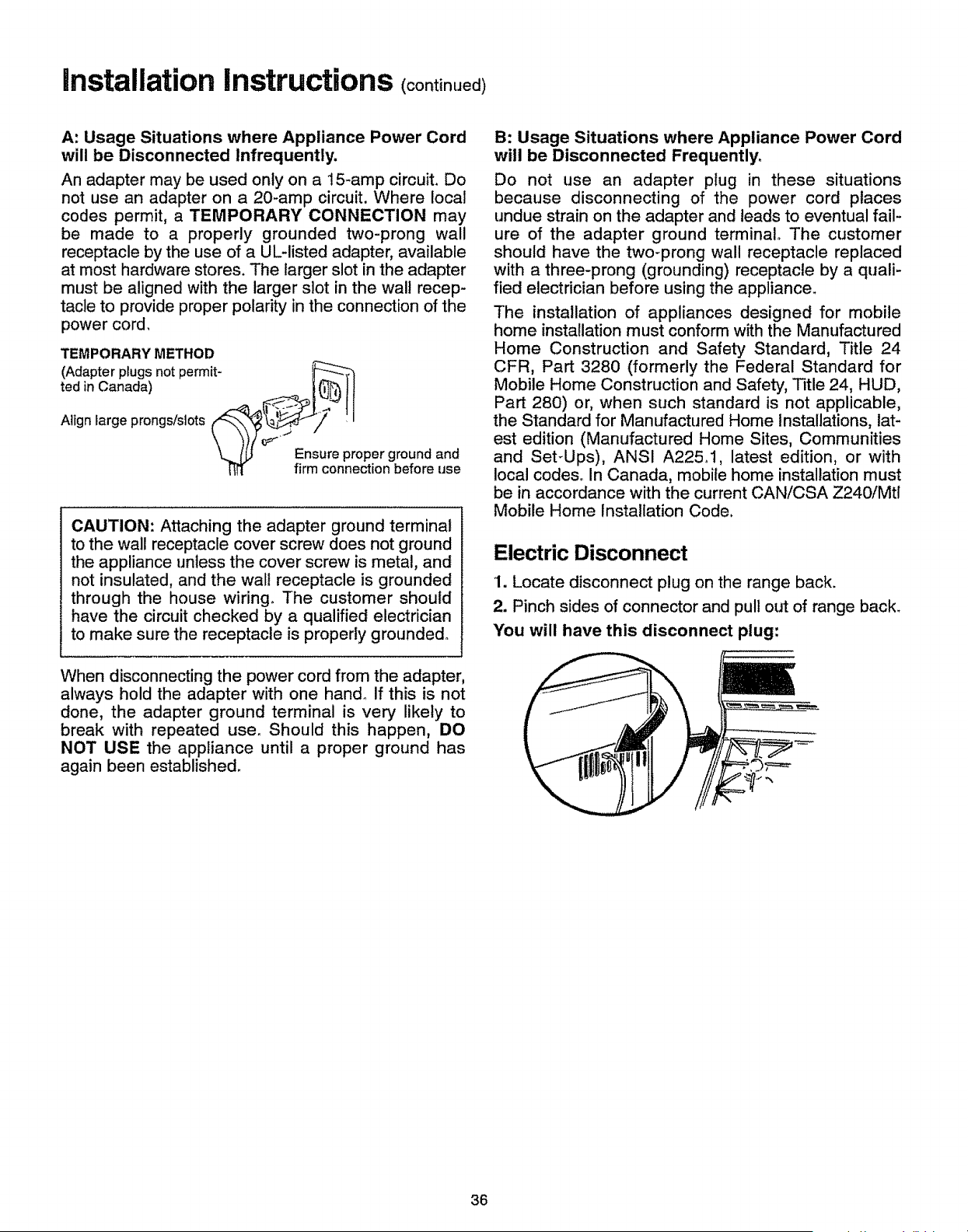
installation Instructions (continued)
A: Usage Situations where Appliance Power Cord
will be Disconnected Infrequently.
An adapter may be used only on a 15-amp circuit. Do
not use an adapter on a 20-amp circuit. Where local
codes permit, a TEMPORARY CONNECTION may
be made to a properly grounded two-prong wall
receptacle by the use of a UL-listed adapter, available
at most hardware stores. The larger slot in the adapter
must be aligned with the larger slot in the wall recep-
tacle to provide proper polarity in the connection of the
power cord,
TEMPORARY METHOD
(Adapter plugs not permit- _
Align large prongs/slots _ _/ _l
'\"-.L'I_j!' Ensure proper ground and
[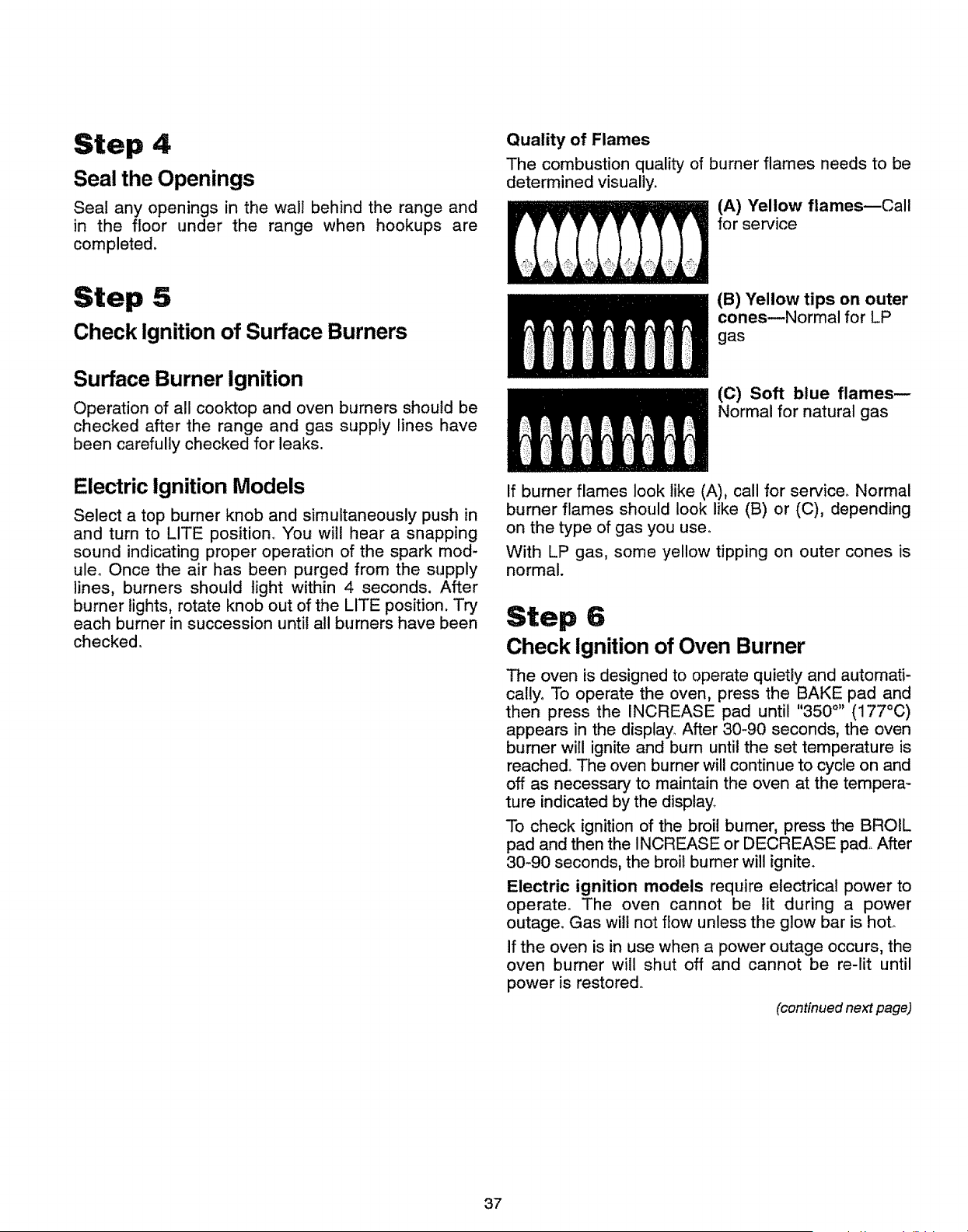
Step 4
Seal the Openings
Seal any openings in the wall behind the range and
in the floor under the range when hookups are
completed.
Quality of Flames
The combustion quality of burner flames needs to be
determined visually.
(A) Yellow flames--Call
for service
Step 5
Check Ignition of Surface Burners
Surface Burner Ignition
Operation of all cooktop and oven burners should be
checked after the range and gas supply lines have
been carefully checked for leaks.
Electric Ignition Models
Select a top burner knob and simultaneously push in
and turn to LITE position You will hear a snapping
sound indicating proper operation of the spark mod-
uleo Once the air has been purged from the supply
lines, burners should light within 4 seconds. After
burner lights, rotate knob out of the LITE position. Try
each burner in succession until all burners have been
checked.
(B) Yellow tips on outer
cones--Normal for LP
gas
(C) Soft blue flames w
Normal for natural gas
If burner flames look like (A), call for service. Normal
burner flames should look like (B) or (C), depending
on the type of gas you use.
With LP gas, some yellow tipping on outer cones is
normal.
Step 6
Check Ignition of Oven Burner
The oven is designed to operate quietly and automati-
callyo To operate the oven, press the BAKE pad and
then press the INCREASE pad until "350 °" (177°C)
appears in the display_ After 30-90 seconds, the oven
burner will ignite and bum until the set temperature is
reached° The oven burner will continue to cycle on and
off as necessary to maintain the oven at the tempera-
ture indicated by the disptay_
To check ignition of the broi! burner, press the BROIL
pad and then the INCREASE or DECREASE pad,. After
30-90 seconds, the broil bumer will ignite_
Electric ignition models require electrical power to
operate° The oven cannot be lit during a power
outage. Gas will not flow unless the glow bar is hot.
If the oven is in use when a power outage occurs, the
oven burner will shut off and cannot be re-lit until
power is restored°
(continued next page)
37
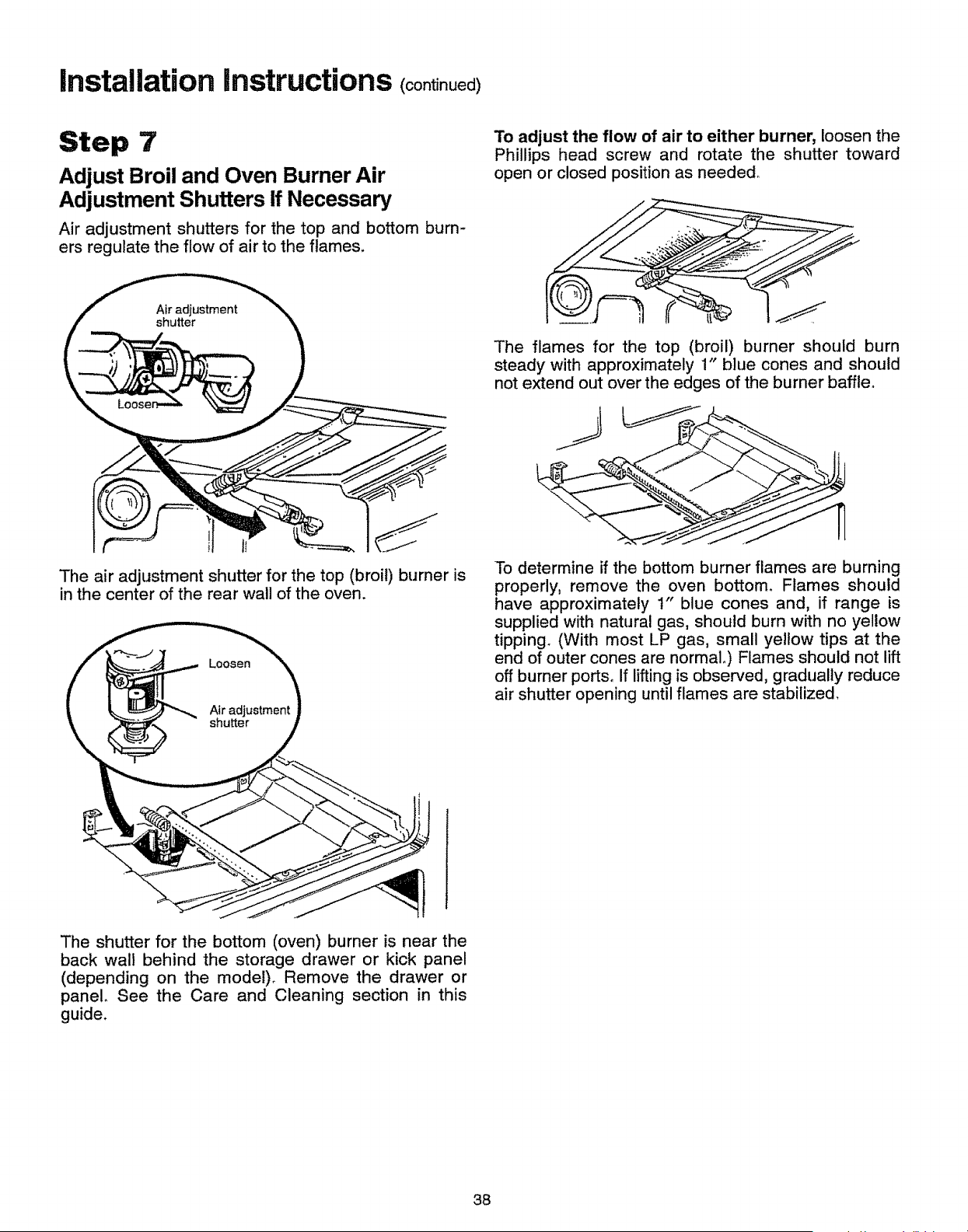
Installation Instructions <oont o ed>
Step 7
Adjust Broil and Oven Burner Air
Adjustment Shutters If Necessary
Air adjustment shutters for the top and bottom bum-
ers regulate the flow of air to the flames.
To adjust the flow of air to either burner, loosen the
Phillips head screw and rotate the shutter toward
open or closed position as needed_
The flames for the top (broil) burner should burn
steady with approximately 1" blue cones and should
not extend out over the edges of the burner baffle.
J_
The air adjustment shutter for the top (broil) burner is
in the center of the rear wall of the oven.
To determine if the bottom burner flames are burning
properly, remove the oven bottom. Flames should
have approximately 1" blue cones and, if range is
supplied with natural gas, should burn with no yellow
tipping. (With most LP gas, small yellow tips at the
end of outer cones are normal°) Flames should not lift
off burner ports. If lifting is observed, gradually reduce
air shutter opening until flames are stabilized.
The shutter for the bottom (oven) burner is near the
back wall behind the storage drawer or kick panel
(depending on the model). Remove the drawer or
panel° See the Care and Cleaning section in this
guide.
38
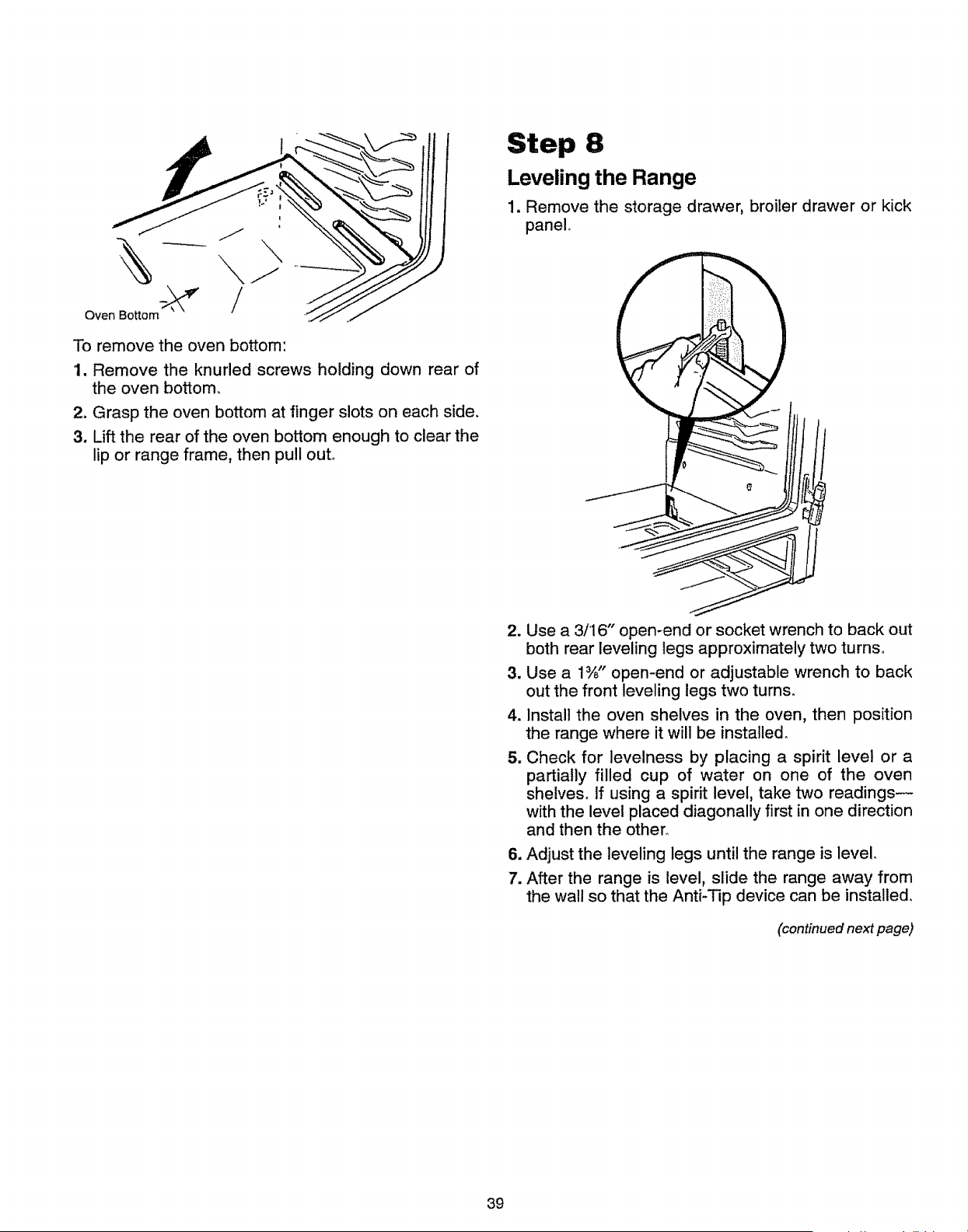
J
\J
Oven Bottom
To remove the oven bottom:
1. Remove the knurled screws holding down rear of
the oven bottom.
2. Grasp the oven bottom at finger slots on each side.
3. Lift the rear of the oven bottom enough to clear the
lip or range frame, then pull out°
Step 8
Leveling the Range
1. Remove the storage drawer, broiler drawer or kick
panel°
1
[
/
2. Use a 3/'16" open-end or socket wrench to back out
both rear leveling legs approximately two turns,
3. Use a 1¾" open-end or adjustable wrench to back
out the front leveling legs two turns°
4. Install the oven shelves in the oven, then position
the range where it will be installedo
5. Check for levelness by placing a spirit level or a
partially filled cup of water on one of the oven
shelves. If using a spirit level, take two readings--
with the level placed diagonally first in one direction
and then the other.
6. Adjust the leveling legs until the range is level_
7. After the range is level, slide the range away from
the walt so that the Anti-Tip device can be installed.
(continued next page)
39
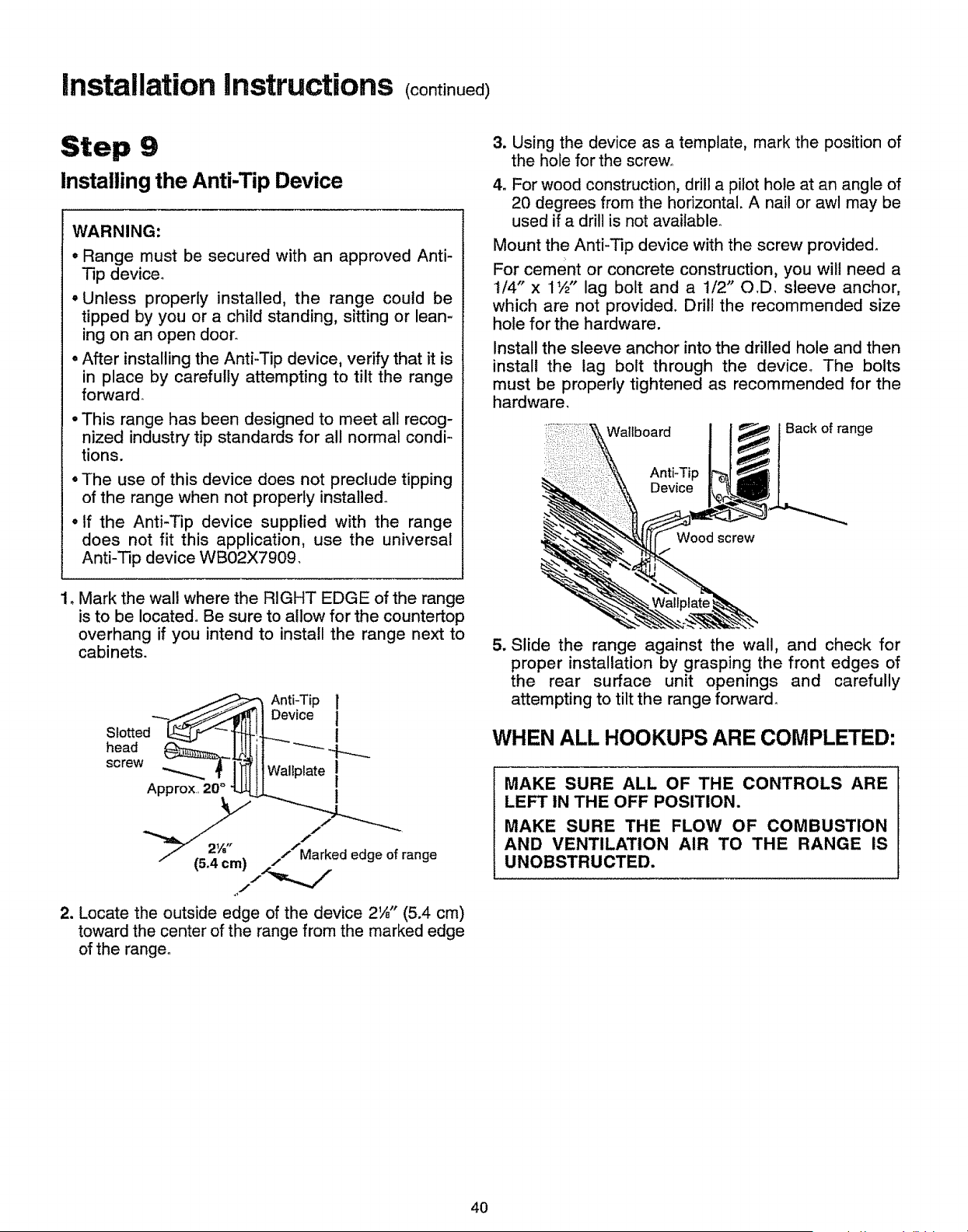
installation instructions (continued)
Step 9
Installing the Anti-Tip Device
WARNING:
• Range must be secured with an approved Anti-
Tip device.
°Unless properly installed, the range could be
tipped by you or a child standing, sitting or lean-
ing on an open door.
• After installing the Anti-Tip device, verify that it is
in place by carefully attempting to tilt the range
forward.
• This range has been designed to meet all recog-
nized industry tip standards for all normal condi-
tions.
° The use of this device does not preclude tipping
of the range when not properly installed.
° If the Anti-Tip device supplied with the range
does not fit this application, use the universal
Anti-Tip device WB02X7909.
1, Mark the wall where the RIGHT EDGE of the range
is to be located. Be sure to allow for the countertop
overhang if you intend to install the range next to
cabinets.
i"__.._ Anti-Tip I
---.._"-_.zT_lI DeviceI
Slotted L£:_F'-" "r_!4--__ I
head __IIl -----+---
screw"_-----_-_41 _lWaltplat e !
.......
(5_'/_rn) jMarked edge of range
2. Locate the outside edge of the device 2'#' (5.4 cm)
toward the center of the range from the marked edge
of the range°
3, Using the device as a template, mark the position of
the hole for the screw.
4. For wood construction, drill a pilot hole at an angle of
20 degrees from the horizontal. A nail or awl may be
used if a drill is not available.
Mount the Anti-Tip device with the screw provided.
For cement or concrete construction, you will need a
t/4" x 1½" lag bolt and a 1/2" O,D, sleeve anchor,
which are not provided. Drill the recommended size
hole for the hardware.
Install the sleeve anchor into the drilled hole and then
install the lag bolt through the deviceo The bolts
must be properly tightened as recommended for the
hardware.
Wallboard
Anti-Tip
Device
Wood screw
Back ofrange
5. Slide the range against the wall, and check for
proper installation by grasping the front edges of
the rear surface unit openings and carefully
attempting to tilt the range forward.
WHEN ALL HOOKUPS ARE COMPLETED:
MAKE SURE ALL OF THE CONTROLS ARE
LEFT tN THE OFF POSITION.
MAKE SURE THE FLOW OF COMBUSTION
AND VENTILATION AIR TO THE RANGE IS
UNOBSTRUCTED.
4O
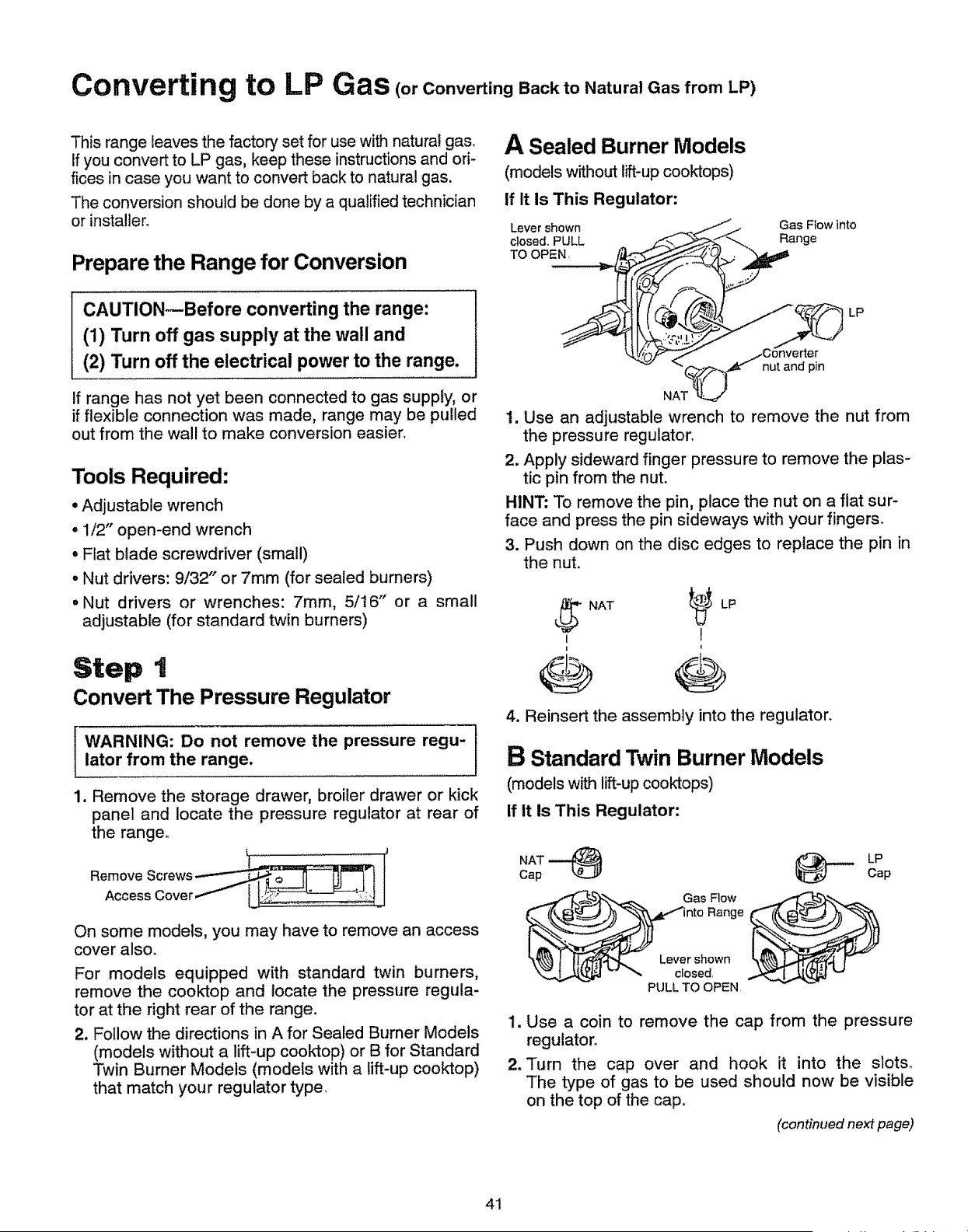
Converting to LP Gas (or Converting Back to Natural Gas from LP)
This range leaves the factory set for use with natural gas.
If you convert to LP gas, keep these instructions and ori-
fices in case you want to convert back to natural gas.
The conversion should be done by a qualified technician
or installer_
Prepare the Range for Conversion
CAUTIONo-Before converting the range:
(1) Turn off gas supply at the wall and
(2) Turn off the electrical power to the range.
If range has not yet been connected to gas supply, or
if flexible connection was made, range may be pulled
out from the wall to make conversion easier,
Tools Required:
• Adjustable wrench
• 1/2" open-end wrench
• Flat blade screwdriver (small)
o Nut drivers: 9/32" or 7mm (for sealed burners)
=Nut drivers or wrenches: 7ram, 5/t6" or a small
adjustable (for standard twin burners)
Step 1
Convert The Pressure Regulator
I WARNING: Do not remove the pressure regu-lator from the range.
1. Remove the storage drawer, broiler drawer or kick
panel and locate the pressure regulator at rear of
the range°
J
On some models, you may have to remove an access
cover also.
For models equipped with standard twin burners,
remove the cooktop and locate the pressure regula-
tor at the right rear of the range.
2, Follow the directions in A for Sealed Burner Models
(models without a lift-up cooktop) or B for Standard
Twin Burner Models (models with a lift-up cooktop)
that match your regulator type,
A Sealed Burner Models
(models without lift-up cooktops)
If it is This Regulator:
Lever shown
closed. PULL
TO OPEN
Gas Flow into
Range
LP
nut and pin
1. Use an adjustable wrench to remove the nut from
the pressure regulator_
2. Apply sideward finger pressure to remove the plas-
tic pin from the nut.
HINT: To remove the pin, place the nut on a flat sur-
face and press the pin sideways with your fingers.
3. Push down on the disc edges to replace the pin in
the nut.
___ NAT
I
i
Q
LP
!
J
4. Reinsert the assembly into the regulator,
B Standard Twin Burner Models
(models with lift-up cook-tops)
If it is This Regulator:
NAT_ _ LP
Cap _ Cap
Gas Flow
, into Range
_'_ I I!_i(_ Lever shown
_t'_,_,L,,_,_l _ "_. closed,
PULL TO OPEN
=
2.
Use a coin to remove the cap from the pressure
regulator°
Turn the cap over and hook it into the slots_
The type of gas to be used should now be visible
on the top of the cap,
(continued next page)
41
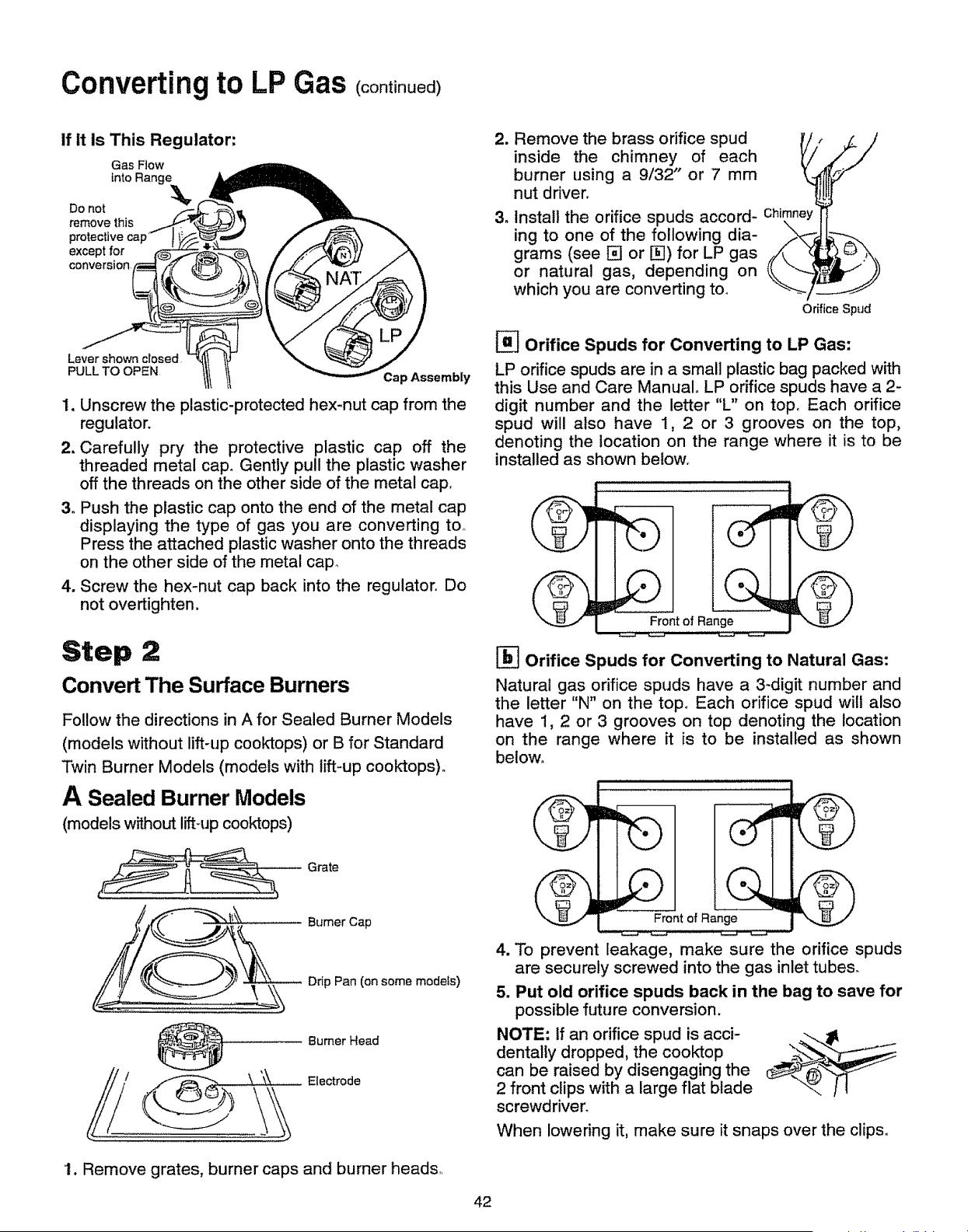
Converting to LP Gas (cont no d)
If It Is This Regulator:
Gas Flow
into Ran,
Do not
remove this
protectiveca
exceptfor
conversion
Lever shown closed
PULL TO OPEN
Cap AssembLy
1. Unscrew the plastic-protected hex-nut cap from the
regulator.
2. Carefully pry the protective plastic cap off the
threaded metal cap. Gently pull the plastic washer
off the threads on the other side of the metal cap.
3. Push the plastic cap onto the end of the metal cap
displaying the type of gas you are converting too
Press the attached plastic washer onto the threads
on the other side of the metal cap_
4. Screw the hex-nut cap back into the regulator,, Do
not overtighten.
Step 2
Convert The Surface Burners
Follow the directions in A for Sealed Burner Models
(models without lift-up cooktops) or B for Standard
Twin Burner Models (models with lift-up cooktops)o
A Sealed Burner Models
(models without I_-up cooktops)
Grate
Burner Cap
Drip Pan (on some modefs)
Burner Head
\ '_ Electrode
1. Remove grates, burner caps and burner heads,,
2,
Remove the brass orifice spud _/, 2_ /
inside the chimney of each _F. °
burner using a 9/32" or 7 mm eye'
nut driver.
3. Install the orifice spuds accord- Chiton
%
ing to one of the following dia- /._.._--_.
grams (see [] or []) for LP gas //'_.
or natural gas, depending on
which you are converting to.
Orifice Spud
[_ Orifice Spuds for Converting to LP Gas:
LP orifice spuds are in a small plastic bag packed with
this Use and Care Manual° LP orifice spuds have a 2-
digit number and the letter "L" on top, Each orifice
spud will also have 1, 2 or 3 grooves on the top,
denoting the location on the range where it is to be
installed as shown below.
Front of Range
[-_ Orifice Spuds for Converting to Natural Gas:
Natural gas orifice spuds have a 3-digit number and
the letter "N" on the top_ Each orifice spud will also
have 1, 2 or 3 grooves on top denoting the location
on the range where it is to be installed as shown
below°
Front of Range
4. To prevent leakage, make sure the orifice spuds
are securely screwed into the gas inlet tubes.
5. Put old orifice spuds back in the bag to save for
possible future conversion.
NOTE: If an orifice spud is acci-
dentally dropped, the cooktop
can be raised by disengaging the
2 front clips with a large flat blade
screwdriver.
When lowering it, make sure it snaps over the clips°
42
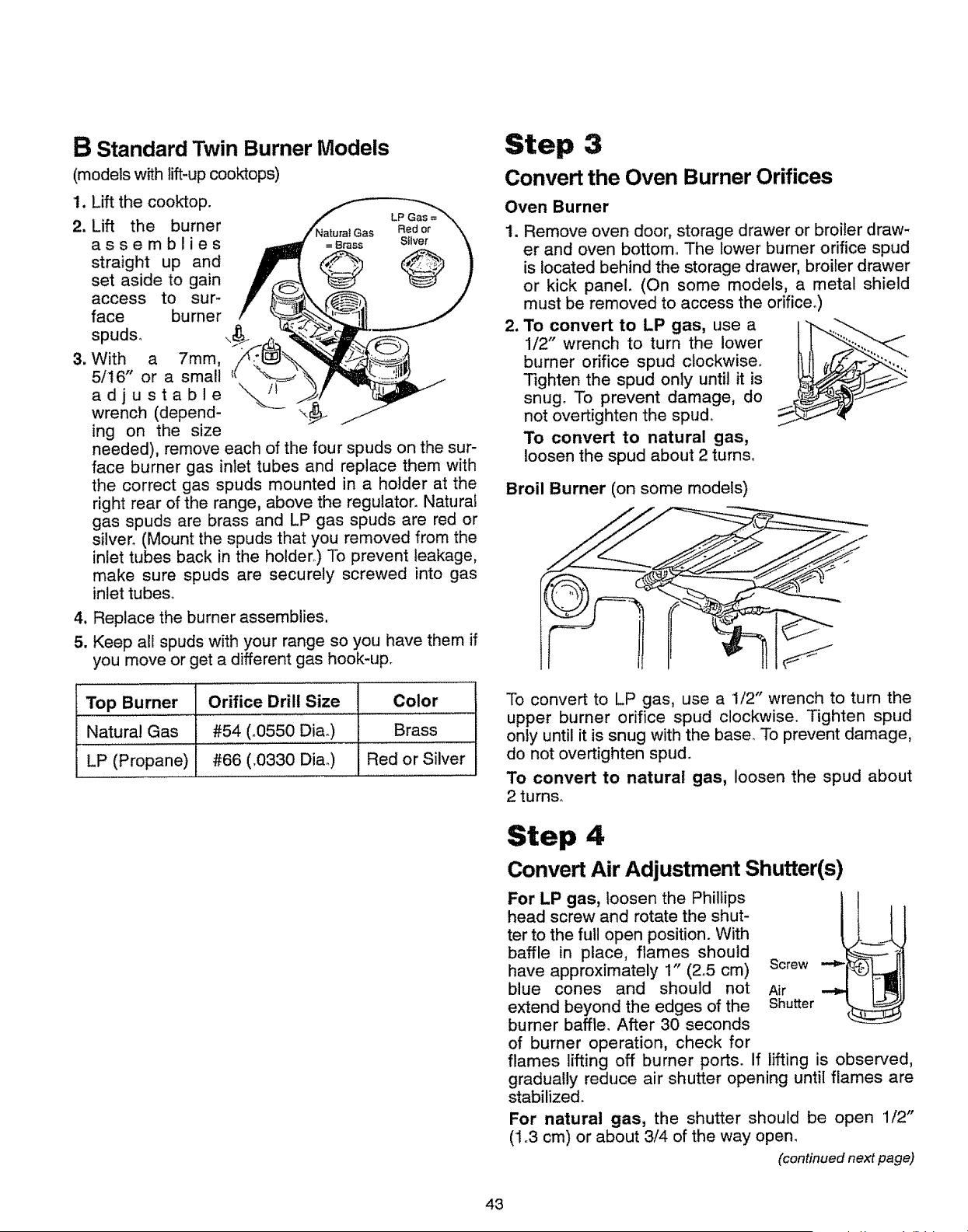
B Standard Twin Burner Models
(models with lift-up cooktops)
1, Lift the cooktop.
2. Lift the burner
assemblies
straight up and
set aside to gain
access to sur-
face burner
spuds°
3. With a 7mm,
5/t6" or a small
adjustable
wrench (depend-
ing on the size
needed), remove each of the four spuds on the sur-
face burner gas inlet tubes and replace them with
the correct gas spuds mounted in a holder at the
right rear of the range, above the regulator_ Natural
gas spuds are brass and LP gas spuds are red or
silver. (Mount the spuds that you removed from the
inlet tubes back in the holder°) To prevent leakage,
make sure spuds are securely screwed into gas
inlet tubes_
4. Replace the burner assemblies,
5. Keep all spuds with your range so you have them if
you move or get a different gas hook-up.
Top Burner Orifice Drill Size Color
Natural Gas #54 (_0550 Diao) Brass
LP (Propane) #66 (_0330 Dial) Red or Silver
Step 3
Convert the Oven Burner Orifices
Oven Burner
1. Remove oven door, storage drawer or broiler draw-
er and oven bottom. The lower burner orifice spud
is located behind the storage drawer, broiler drawer
or kick panel. (On some models, a metal shield
must be removed to access the orifice.)
2. To convert to LP gas, use a
1/2" wrench to turn the lower
burner orifice spud clockwise_
Tighten the spud only until it is
snug° To prevent damage, do
not overtighten the spud.
To convert to natural gas,
loosen the spud about 2 turns°
Broil Burner (on some models)
To convert to LP gas, use a 1/2" wrench to turn the
upper burner orifice spud clockwise° Tighten spud
only until it is snug with the base, To prevent damage,
do not overtighten spud.
To convert to natural gas, loosen the spud about
2 turns,
Step 4
Convert Air Adjustment Shutter(s)
head screw and rotate the shut-
ter to the full open position. With
baffle in place, flames should
have approximately 1" (2°5 cm) Screw
blue cones and should not Air
extend beyond the edges of the Shutter
burner baffle. After 30 seconds _-
of burner operation, check for
flames lifting off burner ports. If lifting is observed,
gradually reduce air shutter opening until flames are
stabilized.
For natural gas, the shutter should be open 1/2"
(1.3 cm) or about 3/4 of the way open.
(continued next page)
43
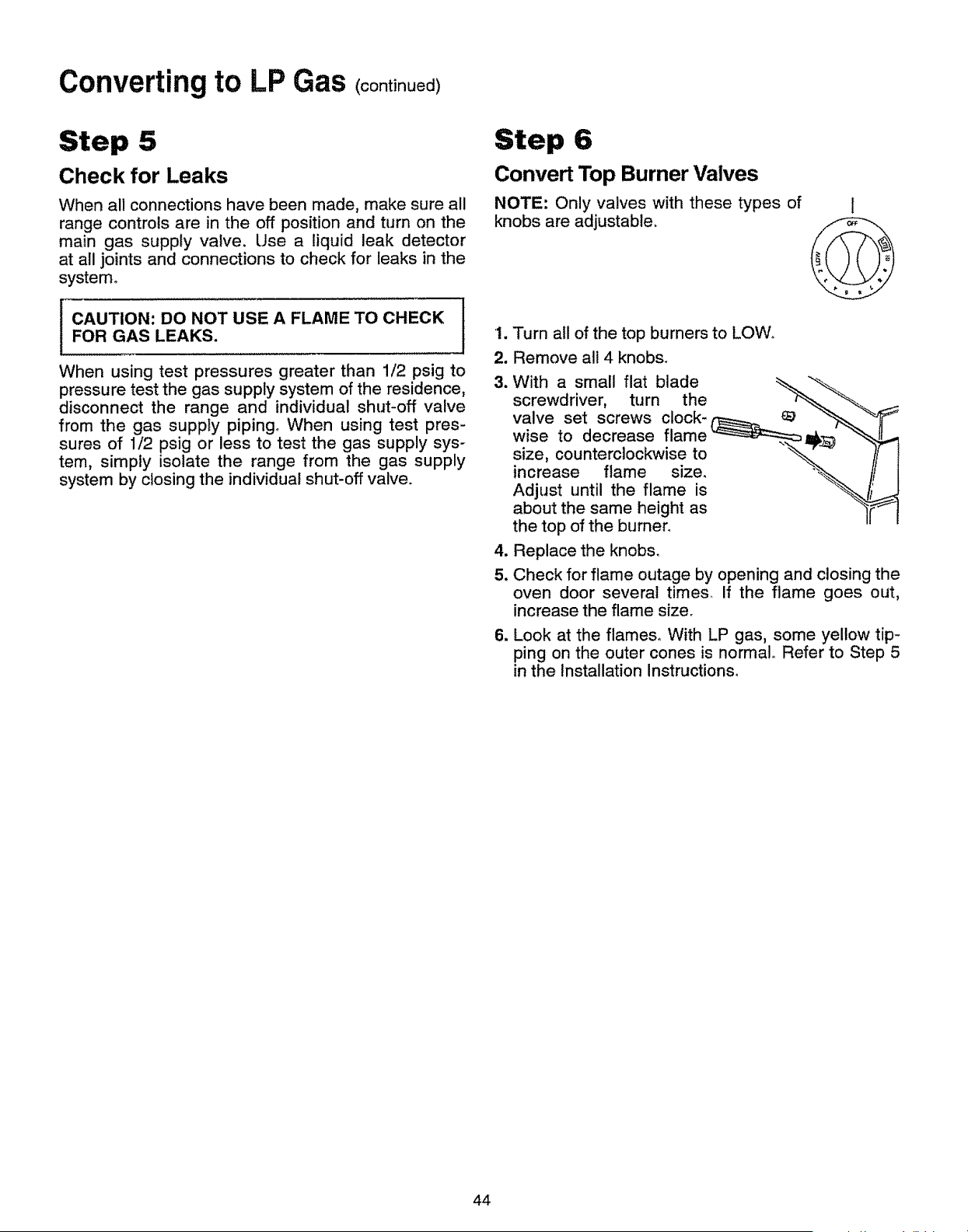
Converting to LP Gas (continued)
Step 5
Check for Leaks
When al! connections have been made, make sure all
range controls are in the off position and turn on the
main gas supply valve. Use a liquid leak detector
at all joints and connections to check for leaks in the
system°
1
CAUTION: DO NOT USE A FLAME TO CHECK |
FOR GAS LEAKS.
]
When using test pressures greater than 1/2 psig to
pressure test the gas supply system of the residence,
disconnect the range and individual shut-off valve
from the gas supply piping. When using test pres-
sures of 1/2 psig or less to test the gas supply sys-
tem, simply isolate the range from the gas supply
system by closing the individual shut-off valve.
Step 6
Convert Top Burner Valves
NOTE: Only valves with these types of
knobs are adjustable.
I
'I.
2.
3.
1
5,
J
Turn all of the top burners to LOW°
Remove all 4 knobs.
With a small flat blade _
screwdriver, turn the _
valve set screws clock-_ ee _--_"_
wise to decrease flame _llk_
size, counterclockwise to "_"_ _/'_1
increase flame size. % I!1
Adjust until the flame is
about the same height as "_-_f'--j
the top of the burner° " '
Replace the knobs.
Check for flame outage by opening and closing the
oven door several times_ If the flame goes out,
increase the flame size.
Look at the flame& With LP gas, some yellow tip-
ping on the outer cones is normal. Refer to Step 5
in the Installation Instructions°
44
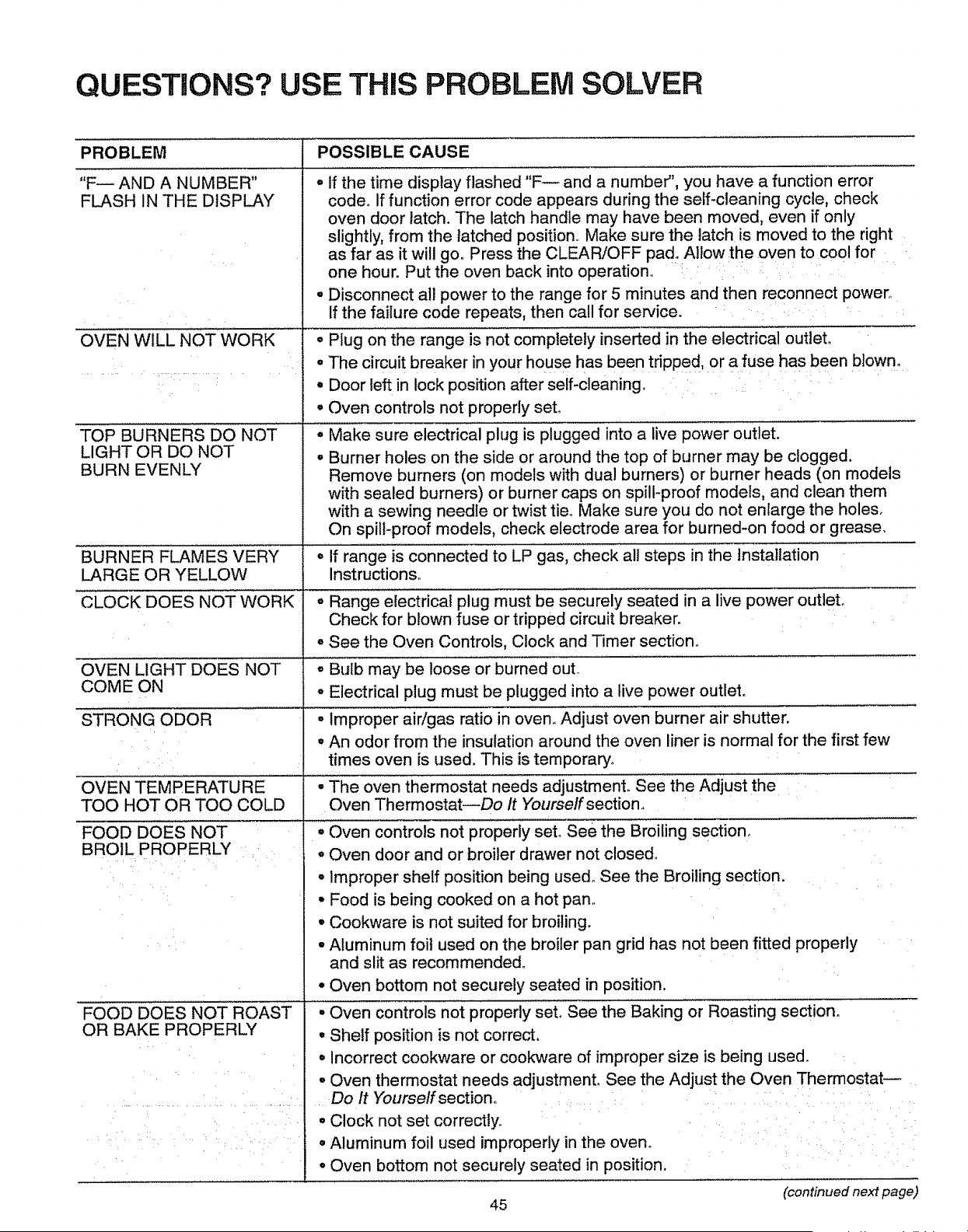
QUESTIONS? USE THIS PROBLEM SOLVER
PROBLEM
"F--AND A NUMBER"
FLASH IN THE DISPLAY
POSSIBLE CAUSE
o If the time display flashed "F-- and a number", you have a function error
code. If function error code appears during the self-cleaning cycle, check
oven door latch. The latch handle may have been moved, even if only
slightly, from the latched position,, Make sure the latch is moved to the right
as far as it will go. Press the CLEAR/OFF pad. Allow the oven to cool for
one hour. Put the oven back into operation° :
° Disconnect all power to the range for 5 minutes and then reconnect power°
If the failure code repeats, then call for service.
OVEN WILL NOT WORK
TOP BURNERS DO NOT
LIGHT OR DO NOT
BURN EVENLY
BURNER FLAMES VERY
LARGE OR YELLOW
CLOCK DOES NOTWORK o
O
OVEN LIGHT DOES NOT •
COME ON °
STRONG ODOR °
e
OVEN TEMPERATURE
TOO HOT OR TOO COLD
FOOD DOES NOT °
BROIL PROPERLY =
O
O
O
°
o
FOOD DOES NOT ROAST
OR BAKE PROPERLY
• Plug on the range is not completely inserted in the electrical outlet°
o The circuit breaker in your house has been tripped, or afuse has been blown_
° Door left in lock position after Self-cleaning.
• Oven controls not properly seL
° Make sure electrical plug is plugged into a live power outlet.
° Burner holes on the side or around the top of burner may be clogged.
Remove burners (on models with dual burners) or burner heads (on models
with sealed burners) or burner caps on spill-proof models, and clean them
with a sewing needle or twist tier Make sure you do not enlarge the holes,
On spill-proof models, check electrode area for burned-on food or grease,
• If range is connected to LP gas, check all steps in the Installation
Instructions.
Range electrical plug must be securely seated in a live power outlet°
Check for blown fuse or tripped circuit breaker.
See the Oven Controls, Clock and Timer section,,
Bulb may be loose or burned out.
Electrical plug must be plugged into a live power outlet.
Improper air/gas ratio in oven. Adjust oven burner air shutter.
An odor from the insulation around the oven liner is normal for the first few
times oven is used. This is temporary°
- The oven thermostat needs adjustment,, See the Adjust the
Oven Thermostat--Do It Yourself sectiono
Oven controls not properly seL see the Broiling section_
Oven door and or broiler drawer not closed°
Improper shelf position being used. See the Broiling section.
Food is being cooked on a hot pan,,
Cookware is not suited for broiling.
Aluminum foil used on the broiler pan grid has not been fitted properly
and slit as recommended.
Oven bottom not securely seated in position.
° Clock not set correctly,,
:_ i .... ° Aluminum foil used improperly in the oven.
° Oven bottom not securely seated in position.
° Oven controls not properly set° See the Baking or Roasting section.
° Shelf position is not correct.
• Incorrect cookware or cookware of improper size is being used.
° Oven thermostat needs adjustment. See the Adjust the Oven Thermostat--
Do It Yourself section,, .....
(continued next page)
45
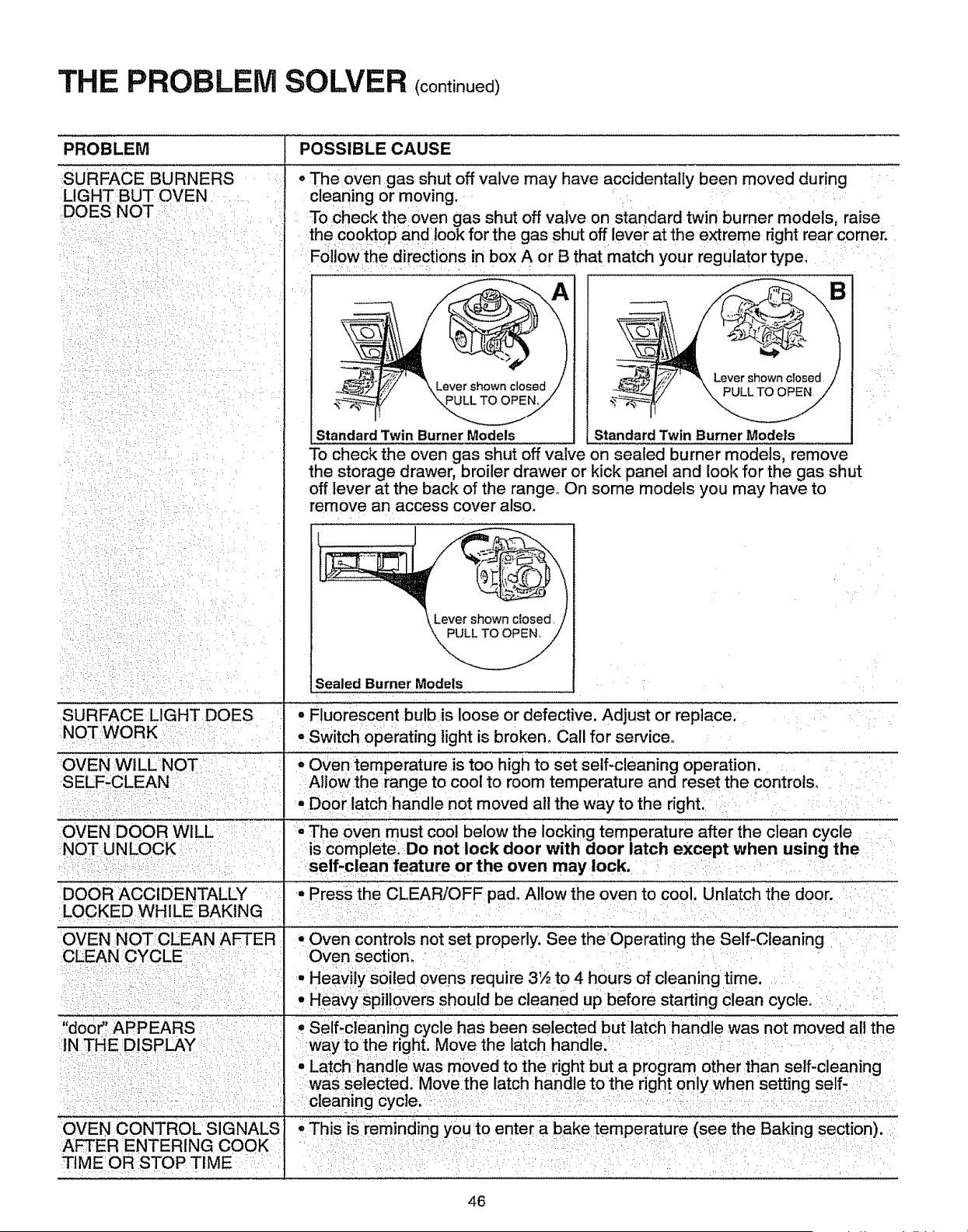
THE PROBLEM SOLVER (continued)
PROBLEM POSSIBLE CAUSE
SURFACE BURNERS
LIGHT BUTOVEN
DOES NOT
• The oven gas shut off valve may have accidentally been moved during
cleaning or moving.
To check the oven gas shut off valve on standard twin burner models, raise
the cooktop and look for the gas shut off lever at the extreme right rear corner.
Follow the directions in box A or B that match your regulator type.
Lever shown closed/
PULL TO OPEN./
StandardTwin Burner Models i
Lever shown closed//
PULL TO OPEN j
Standard Twin Burner Models
SURFACE L1GHT DOES
NOT WORK
OVEN WILLNOT
SELF-CLEAN
OVEN DOOR WILL
NOT UNLOCK
To check the oven gas shut off valve on sealed burner models, remove
the storage drawer, broiler drawer or kick panel and look for the gas shut
off lever at the back of the range° On some models you may have to
remove an access cover also.
Sealed Burner Models
• Fluorescent bulb is loose or defective. Adjust or replace.
= Switch operating light is broken. Call for service.
o Oven:temperature is too high to set self-cleaning operation.
Allow the range to cool to room temperature and reset the controls.
,, Door latch handle not moved all the way to the right.
= The oven must cool below the locking temperature after the clean cycle
is complete. Do not lock door with door latch except when using the
self-clean feature or the oven may lock.
DOOR ACCIDENTALLY • Press the CLEAR/OFF pad. Allow the oven to cool. Unlatch the door.
LOCKED WHtLE BAKING
OVEN NOT CLEAN AFTER
CLEAN CYCLE
,door" APPEARS
IN THE DISPLAY
OVEN CONTROL SIGNALS
AFTER ENTERING COOK
TIME OR STOP TIME
• Oven controls not set properly. See the Operating the Self-Cleaning
Oven section.
• Heavily soiled ovens require 3'½ to 4 hours of cleaning time.
• Heavy spillovers should be cleaned up before starting clean cycle.
,, Self-cleaning cycle has been selected butlatch :handle was not moved all the
way tothe right. Move the latch handle.': i
=Latch handle was moved tothe right buta program other than self-cleaning
was selected: Move the latch handle tothe right only when setting self-
cleaning cycle.
° This is reminding youto enter a bake temperature (see the Baking section).
46
Forthe repairor replacementpartsyouneed
Call7 am - 7 pm, 7 daysa week
t -8OO-366-PART
(1-800-366-7278)
For in-homemajorbrandrepairservice
Call24 hoursa day,7 daysa week
(1-800-473-7247)
Forthe locationof a
SearsRepairServiceCenterinyourarea
Call24 hours aday,7 daysa week
1
mmmmum
mmmmmm
Forinformationonpurchasinga Sears
MaintenanceAgreementorto inquire
aboutan existingAgreement
call9 am - 5 pm, Monday-Saturday
America's Repair Specialists
47
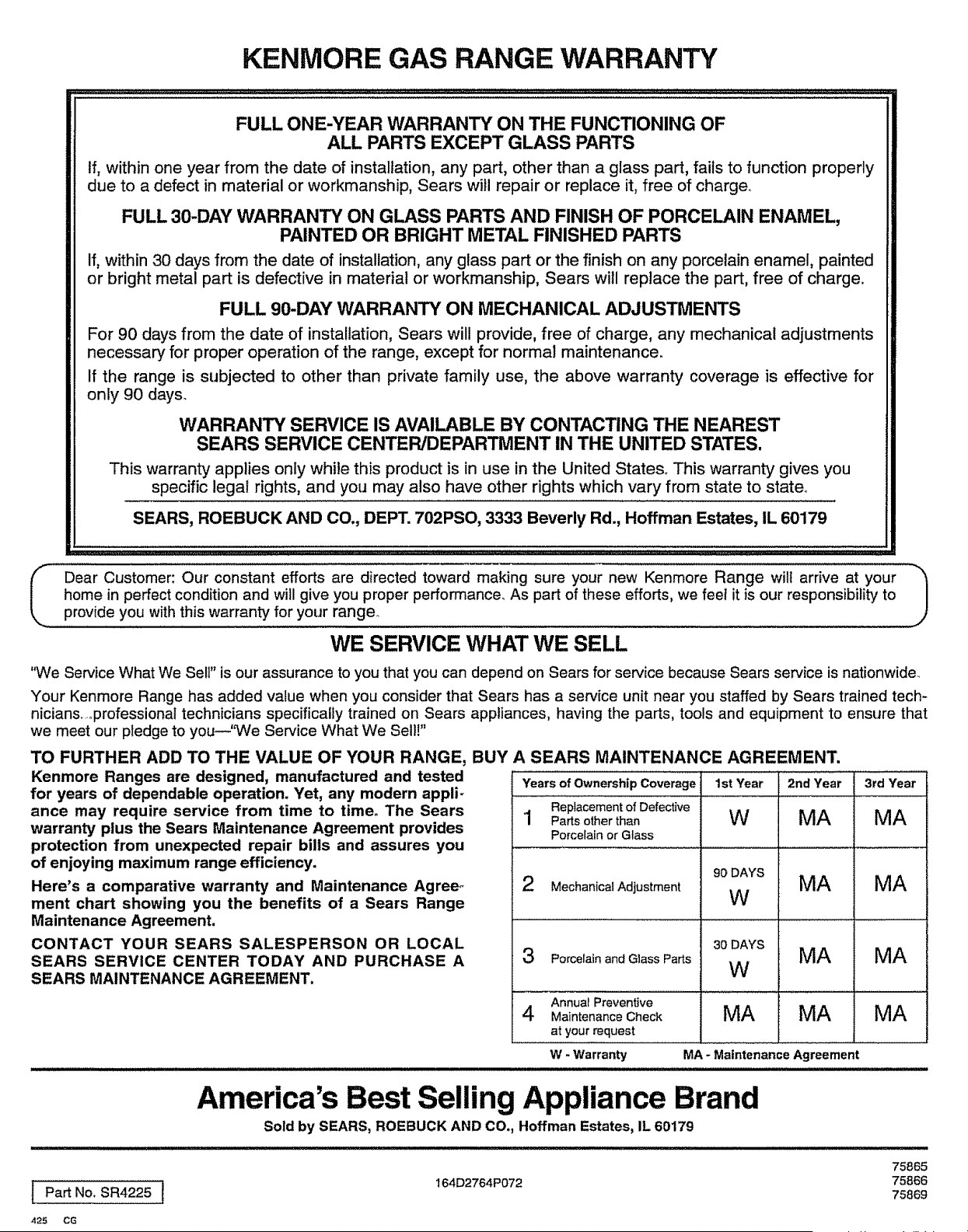
KENMORE GAS RANGE WARRANTY
FULL ONE-YEAR WARRANTY ON THE FUNCTIONING OF
ALL PARTS EXCEPT GLASS PARTS
if, within one year from the date of installation, any part, other than a glass part, fails to function properly
due to a defect in material or workmanship, Sears witl repair or replace it,free of charge°
FULL 30-DAY WARRANTY ON GLASS PARTS AND FINISH OF PORCELAIN ENAMEL,
PAINTED OR BRIGHT METAL FINISHED PARTS
If, within 30 days from the date of installation, any glass part or the finish on any porcelain enamel, painted
or bright metal part is defective in material or workmanship, Sears will replace the part, free of charge.
FULL 90-DAY WARRANTY ON MECHANICAL ADJUSTMENTS
For 90 days from the date of installation, Sears will provide, free of charge, any mechanical adjustments
necessary for proper operation of the range, except for normal maintenance.
If the range is subjected to other than private family use, the above warranty coverage is effective for
only 90 days.
WARRANTY SERVICE IS AVAILABLE BY CONTACTING THE NEAREST
SEARS SERVICE CENTER/DEPARTMENT IN THE UNITED STATES.
This warranty applies only while this product is in use in the United State& This warranty gives you
specific legal rights, and you may also have other rights which vary from state to state°
SEARS, ROEBUCK AND CO., DEPT. 702PSO, 3333 Beverly Rd., Hoffman Estates, IL 60179
Dear Customer: Our constant efforts are directed toward making sure your new Kenmore Range wilt arrive at your "_
home in perfect condition and will give you proper performance° As part of these efforts, we feel it is our responsibility to |
provide you with this warranty fo r you r range _ _)
WE SERVICE WHAT WE SELL
"We Service What We Sell" is our assurance to you that you can depend on Sears for service because Sears service is nationwide_
Your Kenmore Range has added value when you consider that Sears has a service unit near you staffed by Sears trained tech-
nicians,.professional technicians specifically trained on Sears appliances, having the parts, tools and equipment to ensure that
we meet our pledge to you_'_/e Service What We Sell!"
TO FURTHER ADD TO THE VALUE OF YOUR RANGE,
Kenmore Ranges are designed, manufactured and tested
for years of dependable operation. Yet, any modern appli-
ance may require service from time to time° The Sears
warranty plus the Sears Maintenance Agreement provides
protection from unexpected repair bills and assures you
of enjoying maximum range efficiency.
Here's a comparative warranty and Maintenance Agree_
ment chart showing you the benefits of a Sears Range
Maintenance Agreement.
CONTACT YOUR SEARS SALESPERSON OR LOCAL
SEARS SERVICE CENTER TODAY AND PURCHASE A
SEARS MAINTENANCE AGREEMENT.
BUY A SEARS MAINTENANCE AGREEMENT.
Years of Ownership Coverage 1st Year 2rid Year 3rd Year
Replacement of Defective
1 Parts other than
Porcelain or Glass
2 Mechanical Adjustment
W MA
9O DAYS
MA
W
3 Porcelain and Glass Parts
Annual Preventive
4 Maintenance Check
at your request
30 DAYS
W
MA
MA
MA
W - Warranty
MA
MA
MA
MA
MA- MaintenanceAgreement
America's Best Selling Appliance Brand
Sold by SEARS, ROEBUCK AND CO., Hoffman Estates, IL 60179
Part No. SR4225 J
164D2764P072
75865
75866
75869
425 CG
: _, ,: :::_!_:, ,_::i:/: :::;:ii:i;i!i ¸/
:i • ii
CONTENIDO
SEGURIDAD
Aparato antl-volcaduras ............................. 2, 3, 34, 42
Instrucciones importantes de seguridad ............. 2-6
liNSTALACION ............................................33-46
Ajuste del a|re ................................................................ 41
Conextones et_ctricas .......................................... 38, 39
Conversidn a gas LP (Propano) ..................................43-46
Dimensiones y espactos ........................................... 33
lnstalaci6n de! aparato anti-volcaduras .................. 42
Localizaci6n de la tuberfa de gas
y de la toma de corrJente ......................................36, 37
USO Y CUIDADO
Asado al fuego directolGuia ................................ 21, 22
Asar al horno/Gufa ................................................ 19, 20
Caracter_sticas de su control del homo ................ 8, 9
Caracteristicas de su estufa ...................................... o7
Cocinar en la parte superior .............................. 10-t2
Comparacidn de cubiertas ....................................... 10
Control del homo, reloj e indicador de tiempo..,8, 9
Cuidado y limpieza ............................................... 27-32
Horneado retardo .................................................. 16, t7
Hornear ................................................................... 14, 15
Instrucciones de auto-timpieza .......................... 23-26
Uso de su homo ....................................................... 12, 13
SERVICIO
Ajuste del termostato del homo ............................... 18
Gu[a para resolver problemas ............................ 47-49
Servicios de reparaci6n ............................................. 51
GARANTIA .........................................................52
MODELOS:
75865, 75866, 75869
Kenmore
J
J
J
J
J
MANUAL DE,
USO.CUIDADO.
164D2764P072
SR4225
425 CG
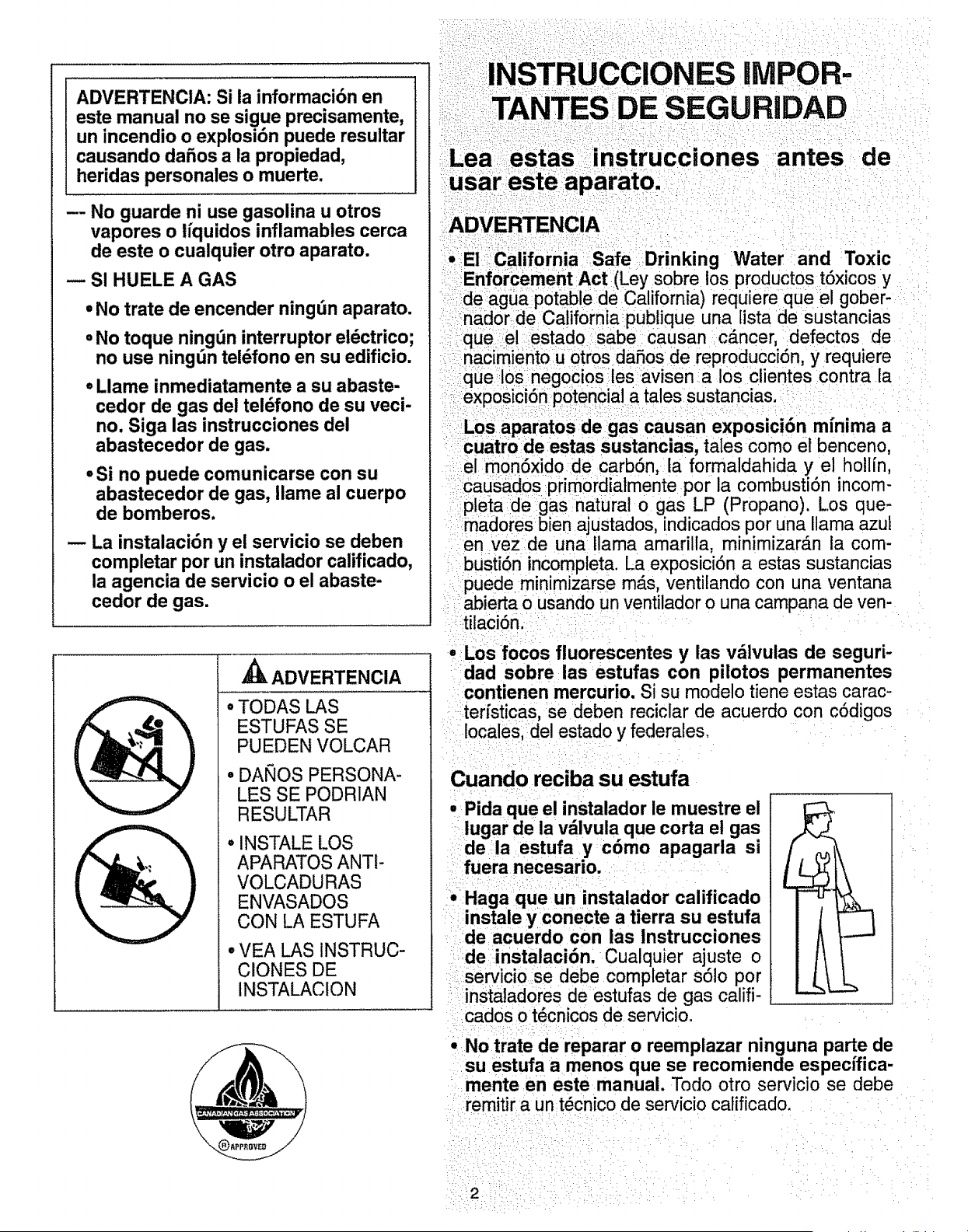
ADVERTENCIA: Si la informacibn en
este manual no se sigue precisamente,
un incendio o explosi6n puede resultar
causando daSos a la propiedad,
heridas personates o muerte.
-- No guarde ni use gasolina u otros
vapores o liquidos inflamables cerca
de este o cualquier otro aparato.
-- SI HUELE A GAS
• No trate de encender ningdn aparato.
• No toque ningdn interruptor eldctrico;
no use nmgun tel_fono en su edificio.
=Llame inmediatamente a su abaste-
cedor de gas dei teldfono de su veci-
no. Siga las instrucciones del
abastecedor de gas.
• Si no puede comunicarse con su
abastecedor de gas, Ilame al cuerpo
de bomberos.
-- La instalaci6n y el servicio se deben
completar por un instalador calificado,
la agencia de servicio o el abaste-
cedor de gas,
,_ ADVERTENCIA
° TODAS LAS
ESTUFAS SE
PUEDEN VOLCAR
° DAf, IOS PERSONA-
LES SE PODRIAN
RESULTAR
• INSTALE LOS
APARATOS ANTt-
VOLCADURAS
ENVASADOS
CON LA ESTUFA
° VEA LAS INSTRUC-
CLONES DE
INSTALACION
INSTRUCCIONES liVIPOR-
TANTES DE SEGURIDAD
i i
= .
:s antes
usare
de
ADVERTENCIA
oEl_;California: Safe Drinking Water and Toxic
:iEnforcement Act (Ley sobre los productost6xicosy
deagua potable de California)requiere que el gober-
nador de Californiapublique una tista de sustancias
que, el estado :sabe ;causan c,_ncer, defectos de
naclmiento u otros daSos de reproducci6n, y requiere
el mon6xido de carb6n, la formaldahida y el hotlin,
causados primordialmente por la combusti6n incom-
ptetade gas natural o gas LP (Propano). Los que-
madoresbien ajustados, indicados por una llama azul
en vezde una llama amarilla, minimizar#.n la com-
busti6n incompleta. La exposici6n a estas sustancias
puede minimizarse m4.s, ventilando con una ventana
Z::_bierta o usando un ventilador o una campana de ven-
tilaci6n.
° Los focos fluorescentes y las v_ivulas de seguri-
dad sobre ias estufas con pilotos permanentes
contienen mercurio. Si su rnodelo tiene estas carac-
ter[sticas, se deben reciclar de acuerdo con c6digos
: locales, del estado y federales,
Cuando reciba su estufa
• Pida que el instalador le muestre el
lugar tie la vdlvula que corta el gas
de la estufa y c6mo apagarla si
fuera necesario.
° Haga que un instalador calificado
instale y conecte a t_erra su estufa
de acuerdo con las Instrucciones
deinstalaci6n. Cualquier ajuste o
servicio se debe completar s61o por
instaladores de estufas de gas califi-
cados o tdcnicos de servicio.
No trate de reparar o reemplazar ninguna parte de
su estufa a menos que se recomiende especffica-
mente en este manual. Todo otro servicio se debe
remitir a un t_cnico de servicio cafificado.
2
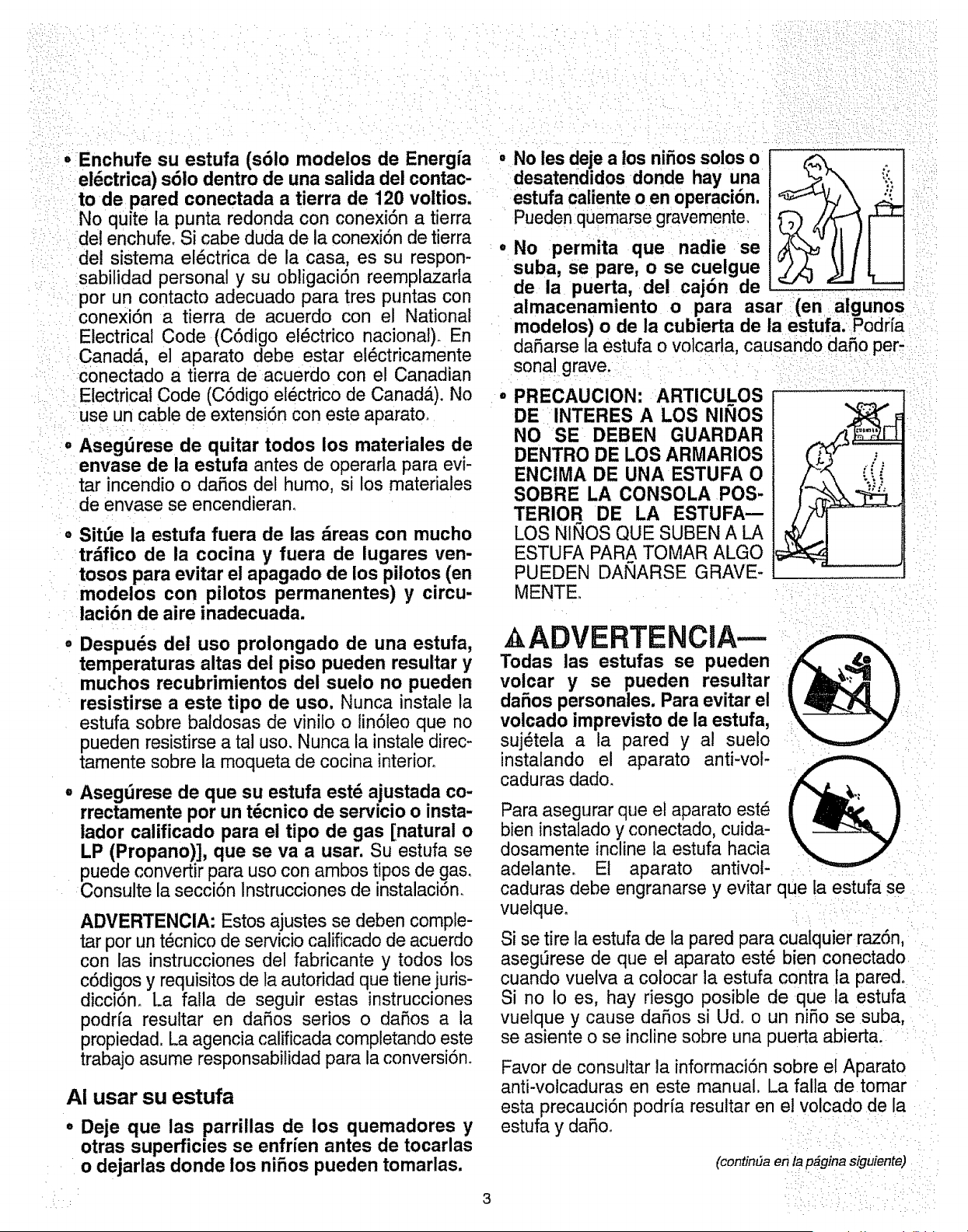
o Enchufe su estufa (s61o modelos de Energia
eldctrica) s61o dentro de una salida del contac-
to de pared conectada a tierra de 120 voltios.
No quite fa punta redonda con conexi6n a tierra
del enchufe. Si cabe duda de la conexi6n de tierra
del sistema el6ctrica de la casa, es su respon-
sabitidad personal y su obligaci6n reemplazarta
por un contacto adecuado para tres puntas con
conexi6n a tierra de acuerdo con el National
Electrical Code (CSdigo el_ctrico nacionaI)_ En
Canada., el aparato debe estar el6ctricamente
conectado a tierra de acuerdo con el Canadian
Electrical Code (C6digo el_ctrico de Canada.). No
use un cable de extensi6n con este aparato.
= Asegdrese de quitar todos los materiales de
envase de la estufa antes de operada para evi-
tar incendio o daSos del humo, si los materiales
de envase se encendieran.
o Sitde la estufa fuera de las _reas con mucho
trdfico de la cocina y fuera de lugares ven-
tosos para evitar el apagado de los pilotos (en
modelos con pilotos permanentes) y circu-
laci6n de aire inadecuada.
° Despuds del uso prolongado de una estufa,
temperaturas altas del piso pueden resultar y
muchos recubrimientos del suelo no pueden
resistirse a este tipo de uso. Nunca instale la
estufa sobre baldosas de vinifo o lin6teo que no
pueden resistirse a tal uso, Nunca la instale direc-
tamente sobre la moqueta de cocina interior°
• Asegdrese de que su estufa est6 ajustada co-
rrectamente por un tdcnico de servicio o insta-
iador calificado para el tipo de gas [natural o
LP (Propano)], que se va a usar. Su estufa se
puede convertir para uso con ambos tipos de ga&
Consulte la secci6n Instrucciones de instalaciSn_
ADVERTENCIA: Estos ajustes se deben comple-
tar por un t_cnico de servicio calificado de acuerdo
con las instrucciones del fabricante y todos los
c6digos y requisitos de la autoridad que tiene juris-
dicci6n. La falla de seguir estas instrucciones
podria resultar en daSos serios o daSos a la
propiedad. La agencia calificada completando este
trabajo asume responsabilidad para la conversi6n_
Ai usar su estufa
° Deje que las parrillas de los quemadores y
otras superficies se enfrien antes de tocarlas
o dejarlas donde los niSos pueden tomarlas.
Q
O
No ies deje a los nil_os solos o _ ,
desatendidos donde hay una
i
estufa caliente o en operaci6n.
Pueden quemarse gravemente,
No permita que nadie se
suba, se pare, o se cuelgue
de la puerta, del caj6n de
aimacenamiento o para asar (en algunos
modelos) o de la cubierta de la estufa. Podria
daSarse la estufa o volcarla, causando daSo per-
sona! grave.
PRECAUCION: ARTICULOS
DE INTERES A LOS NINOS
NO SE DEBEN GUARDAR
DENTRO DE LOS ARMARIOS
ENCIMA DE UNA ESTUFA O
SOBRE LA CONSOLA POS-
TERIOR DE LA ESTUFA--
LOS NINOS QUE SUBEN A LA
ESTUFA PARA TOMAR ALGO
PUEDEN DANARSE GRAVE-
MENTE
AADVERTENCIA---
Todas las estufas se pueden
volcar y se pueden resultar
daSos personales. Para evitar el
volcado imprevisto de la estufa,
suj6tela a la pared y al suelo
instalando el aparato anti-vol-
caduras dado.
Para asegurar que el aparato est_
bien instalado y conectado, cuida-
dosamente incline ta estufa hacia
adelante. El aparato antivol-
caduras debe engranarse y evitar
vuelque.
que ta estufa se
Si se tire la estufa de la pared para cualquier raz6n,
asegdrese de que el aparato est6 bien conectado
cuando vuelva a colocar la estufa contra ta pared°
Si no Io es, hay riesgo posible de que la estufa
vuelque y cause da_os si LJ& o un ni_o se suba,
se asiente o se incline sobre una puerta abierta.
Favor de consuitar la informaci6n sobre el Aparato
anti-volcaduras en este manual. La falla de tomar
esta precauci6n podrfa resultar en e! volcado de la
estufa y daSoo
(contin4a en la pa'gina siguiente)
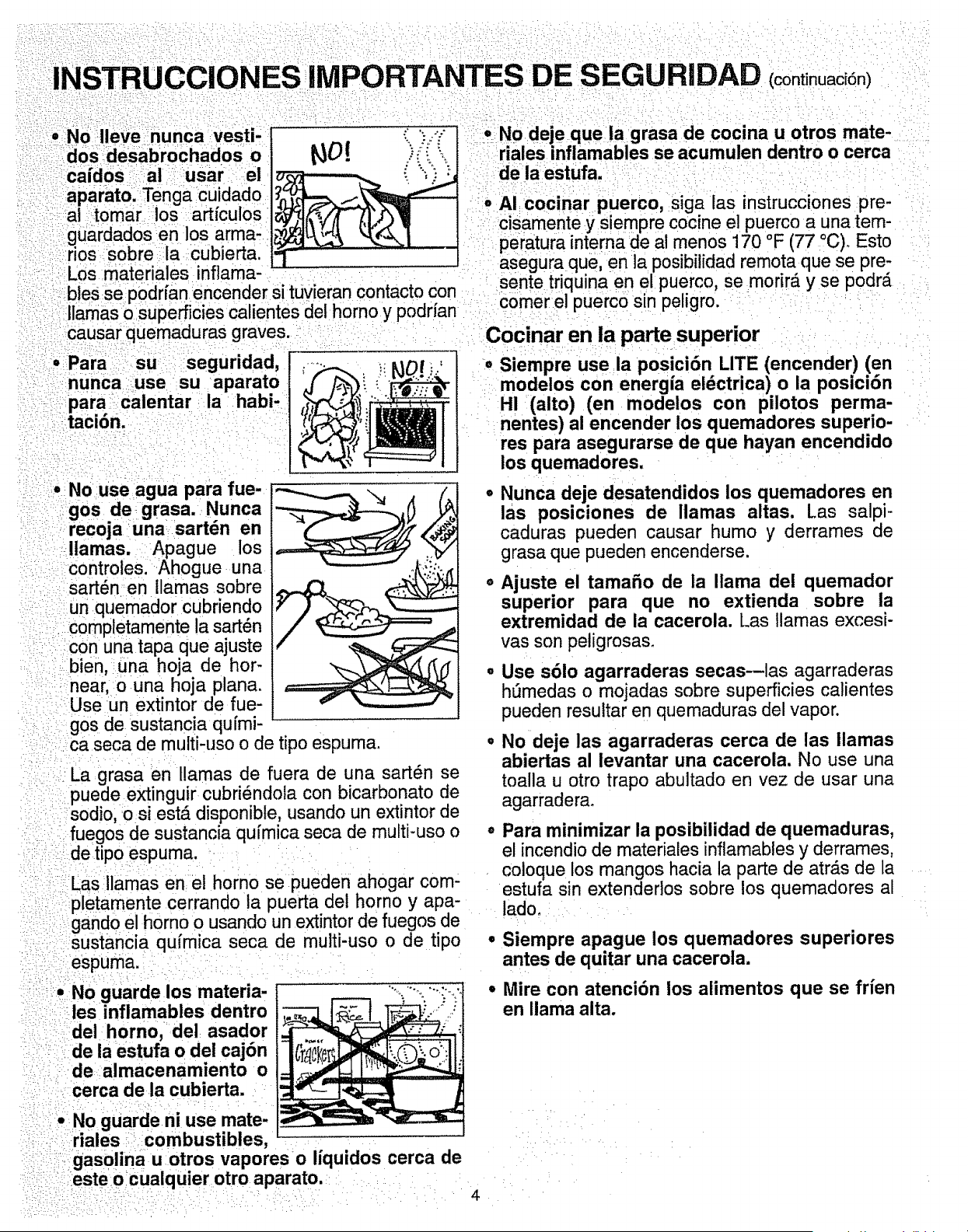
INSTRUCCIONES IMPORTANTES DE SEGURIDAD (continuaci6n)
!NoUeve nunca vesti'o _0! 'ii:iii:iii_I
el
aparato; Tenga cuidado
at tomar los artfculos
guardadosen los arma-
ios sobre la Cubierta.
Los materiales ii
blesse podrfanencender si tuvieran contactocon
llamaso superficies calientesdet homo y podrfan
causar quemaduras graves.
:opara su seguridad,
nunca :use su aparato
:_ara calentar la habi-
Laci6n.
• No use agua para fue-
gos de:grasa. Nunca
recoja una sart_n en
llamas. Apague los
controles. Ahogue una
sart_nen llamas sobre
un quemador cubriendo
....completamente la sart_n
con una tapa que ajuste
bien, una hoja de hor-
-near, o una hoja plan&
Use un extintor de fue-
gos de sustancia qufmi-
ca seca de multi-uso o de tipo espuma.
La grasa en llamas de fuera de una sart_n se
puede extinguir cubri_ndola con bicarbonato de
sodio, o si est_ disponibte, usando un extintor de
fuegos de sustancia qufmica seca de multi-uso o
de tipo espuma.
Las llamas en el horno se pueden ahogar com-
pletamente cerrando la puerta det horno y apa-
gando el homo o usando un extintor de fuegos de
sustancia qufmica seca de multi-uso o de tipo
espuma.
: °
No guarde los materia-
les inflamables dentro
del homo, del asador
de la estufa o dei caj6n
de almacenamiento o
cerca de la cubierta.
_, No guarde ni use mate-
dales combustibles,
gasolina u otros vapores o Ifquidos cerca de
este ocualquier otro aparato.
°: No deje que lagrasa de cocina u otros mate-
riales inflamables se acumulen dentro o cerca
de la estufa.
AI.cocinar puerco, siga las instrucciones pre-
cisamente y siempre cocine el puerco a una tem-
peratura intema de al menos 170 °F (77 _°C).Esto
asegura que, en la posibi!idad remota que se pre-
sente triqulna en el puerco, se morir_, y se podr,_
comer el puerco sin peligro.
Cocinar en la parte superior
= Siempre use la posici6n LITE (encender) (en
modelos con energia el_ctrica) o la posici6n
HI (alto) (en modeios con piiotos perma-
nentes) al encender los quemadores superio-
res para asegurarse de que hayan encendido
los quemadores.
Nunca dej.e desatendidos los quemadores en
las posiciones de llamas altas. Las salpi-
caduras pueden causar humo y derrames de
grasa que pueden encenderse.
Ajuste. el tamaSo de la llama del quemador
superior para que no extienda sobre la
extremidad de la cacerola. Las llamas excesi-
vas son peligrosas.
Use s61o agarraderas secasmlas agarraderas
hfimedas o mojadas sobre superficies calientes
pueden resultar en quemaduras del vapor.
No deje las agarraderas cerca de las llamas
abiertas al levantar una cacerola. No use una
toalla u otro trapo abultado en vez de usar una
agarrader&
Para minimizar la posibilidad de quemaduras,
el incendio de materiales inflamabtes y derrames,
coloque los mangos hacia la parte de atr_.s de la
estufa sin extenderlos sobre los quemadores al
lado.
Siempre apague los quemadores superiores
antes de quitar una cacerola.
Mire con atenci6n los alimentos que se frfen
en llama altao
4
• Nunca obstruya las rejillas (aberturas de aire)
de la estufa. Estas proporcionan la entrada y la
satida de aire necesarias para que la estufa fun-
clone adecuadamente con la combusti6n correc-
ta, Las aberturas de aire se localizan en los
lugares siguientes:
--Ventilador del homo en la parte posterior de ta
cubierta de Ia estufa,
--Entrada de aire debajo del caj6n del asador_
--Ventilador de aire en la parte superior de la puer-
ta del homo.
No use ollas met_licas con modelos con que-
madores seilados si ia olla met_lica tiene ari-
Iio metdlico que se Iocaliza sobre la parrilla
dei quemador para soportar ia olla met_lica.
Este aritlo actt_a como trarnpa de calor, Io cual
puede daSar la parri!la del quemador y la cabeza
del quemador. Tambi_n, puede causar que el
quemador trabaje de manera inadecuadao Esto
puede causar que el nivel de mon6xido de car-
bono sea superior a los est4.ndares actuales per-
mitidos, resultando en un peligro de satud.
Los alimentos pare frefr deben estar tan secos
como posible. La escarcha sobre los atimentos
congelados o la humedad sobre los alimentos
frescos pueden provocar que la grasa caliente
burbujee y escape por los lados del recipiente,
Use la cantidad minima de grasa para freir con
poco o bastante aceite de una manera m_s
eficaz. Llenar et recipiente de grasa demasiado
puede causar salpicaduras al a_adir alimentos,
Una combinaci6n de aceites o grasa se usar,_
al frefr, revuelva antes de calentar o mientras la
grasa derrite lentamente.
Nunca trate de mover una sartdn de grasa
caliente, especialmente un freidor con bastante
aceite, Espere hasta que se enffie el aceite_
Siempre caliente la grasa tentamente y
obs_rvela cuando se calienta.
Use un term6metro para freJr con bastante
aceite cuando posible para evitar sobrecalentar
la grasa sobre el punto de humor
A! usar recipientes de vidrio, aseg[3rese de que
sean diseSados para la cocci6n sobre la estufa,
Aleje todos articulos de
materiales de pi_stico
de los quemadores
superiores.
No deje articulos de pl_stico sobre ia cubier-
tamse pueden derretir si se dejan muy cerca de
la rejilla de ventilaci6n,
Use el tamafio correcto de recipiente.
Evite usar los recipientesque no son estables o
se vuetcanf_.cilmente. Seleccione los recipientes
con fondo piano bastante grandes para contener
el alimento y evitar fas salpicaduras y derrames y
bastante grandes para cubrir las parriflas de los
quemadores. Esto ahorrar4, el tiempo de cocci6n
e impedir_,la acumulaci6n peligrosa de alimen-
tos; las salpicaduras dejadas o los derrames
dejados sobre la estufa se pueden arder. Use
recipientes con mangos que se pueden agarrar
f4.cilmente y que se quedar&nffios.
No deje articulos sobre la cubierta de la estu-
fa. El aire caliente de la rejilla de ventilaci6n
puede hacer que los objetos inflamables ardan y
aumentar_, la presiBn de los recipientes cerrados,
Io que puede originar que estallen.
Para evitar la posibilidad de una quemadura,
siempre asegurese de que los controles para
todos los quemadores est_n apagados y que
todas las parrillas de los quemadores est_n
frJas antes de tratar de quitarlas.
Cuando los alimentos incendiados est_n
debajo de la campana, apague el ventilador. El
ventilador, si funcionando, puede propagar las
llamas.
Si la estufa est_ cerca de la ventana, no
cuelgue las cortinas largas que podrfan Ilevarse
por et viento sobre los quemadores superiores y
crear un peligro de incendio.
Cuando un piloto se apaga (en modelos con
pilotos permanentes), descubrir4 un olor ligero
de gas como una seSal para vofver a encender el
piloto. AI volver a encender el piloto, aseg_rese de
que los controles de los quemadores est_n apaga-
dos, y siga las instrucciones en las Instrucciones
de instalaci6n para volver a encender_
Si huele a gas, y se ha asegurado ya de que los
pilotos est_n encendidos (en modelos con pilotos
permanentes), apague el gas de la estufa y Ifame
a un t_cnico calificado. Nunca use una llama
abierta para encontrar una fugao
(contin4a en la p4gina siguiente)
INSTRUCCIONES llVIPORTANTES DE SEGURIDAD (continuaci6n)
Hornear,asar al fuego directo y asar
• No use el horno para guardar cosas. Los
articulos guardados: en el horno pueden
encenderse,
• Quddeselejos de la estufa al abrir la puerta de
un hornocaliente. El aire caliente y el vapor
que escapan pueden causar quemaduras en
!/asmanos, ia cara y los ojos.
, Mantenga el horno limpio contra la grasa.
,iCol0que las parrillas del horno en las posi-
ciones deseadas mientras que el horno estd
• Tirando la parrilla hasta la posici6n en que se
detiene esuna ventaja al levantar los alimen-
_;tos pesados. Es tambidn una precauci6n con-
tral quemaduras al tocar las superficies
alientes dela puerta o ias paredes del homo.
La posici6n m_s baja "R" no est_ dise_ada
para deslizarse.
= No Caliente los recipientes cerrados. La pre-
si6n podHa aumentar y el recipiente podda
estallar, causando da_os.
° No use papel aluminio en cualquier sitio del
homo excepto como descrito en este manual.
El mal manejo podrfa resultar en un peligro de
incendio o da5o a la estufa.
° Ai usar las boisas de cocci6n o de asar en el
horno, siga las instruccionesdel fabricante.
• Use s61o los recipientes de vidrio que se
recomiendan para uso en los hornos de gas.
• Siempre quite la charola para asar del horno
odel compartimiento para asar al fuego direc-
to tan pronto como termine de asar al fuego
directo. La grasa dejada en la charola se puede
encender si se usa el homo sin quitar la grasa de
la charola para asar.
° AI asar al fuego directo, si la came est_
demasiado cerca de la llama, ia grasa puede
encenderse. Corte la grasa excesiva para evitar
ique estalte excesivamente.
° Asegdrese de que la charola para asar est_
colocada correctamente para reducir la posibili-
dadde fuegosde grasa.
° Si tuviera fuego de grasa en la charola para
asar, apague el homo y mantenga cerrada la
puerta para contener el fuego hasta que se
apague,
Homo de auto-limpieza
° No limp!e ia junta dela puerta. La junta de la
puerta es esencia] para un sello herm_tico. Tenga
cuidado de no frotar, daSar o mover ia junta.
Nouse limpiadores para hornos. NingL_n
limpiador comercial para hornos ni ningSn reves-
timiento protectivo de los bordes del homo de
cualquier tipo se debeda usar dentro o atrededor
de cualquier parte del homo. El residuo de los
limpiadores para hornos da5ar_, el interior det
horno cuando se use el ciclo de auto-timpieza.
,, Antes de usar auto-limpieza, quite las parrillas,
la charola para asar, la reji!la para asar y otros
recipientes.
Limpie s61o las partes enumeradas en este
Manual de uso y de cuidado.
Mantenga la estufa limpia y libre de acumula-
clones de grasa o salpicaduras, las cuales se
pueden encender.
Asegdrese de limpiar las salpicaduras excesi-
vas antes de iniciar el ciclo de auto-limpieza.
o Si el ciclo de auto-limpieza tuviera un fallo,
apague el horno y desconecte la corriente
el_ctrica. Un t_cnico calificado debe revisarto_
GUARDE ESTAS
INSTRUCCIONES
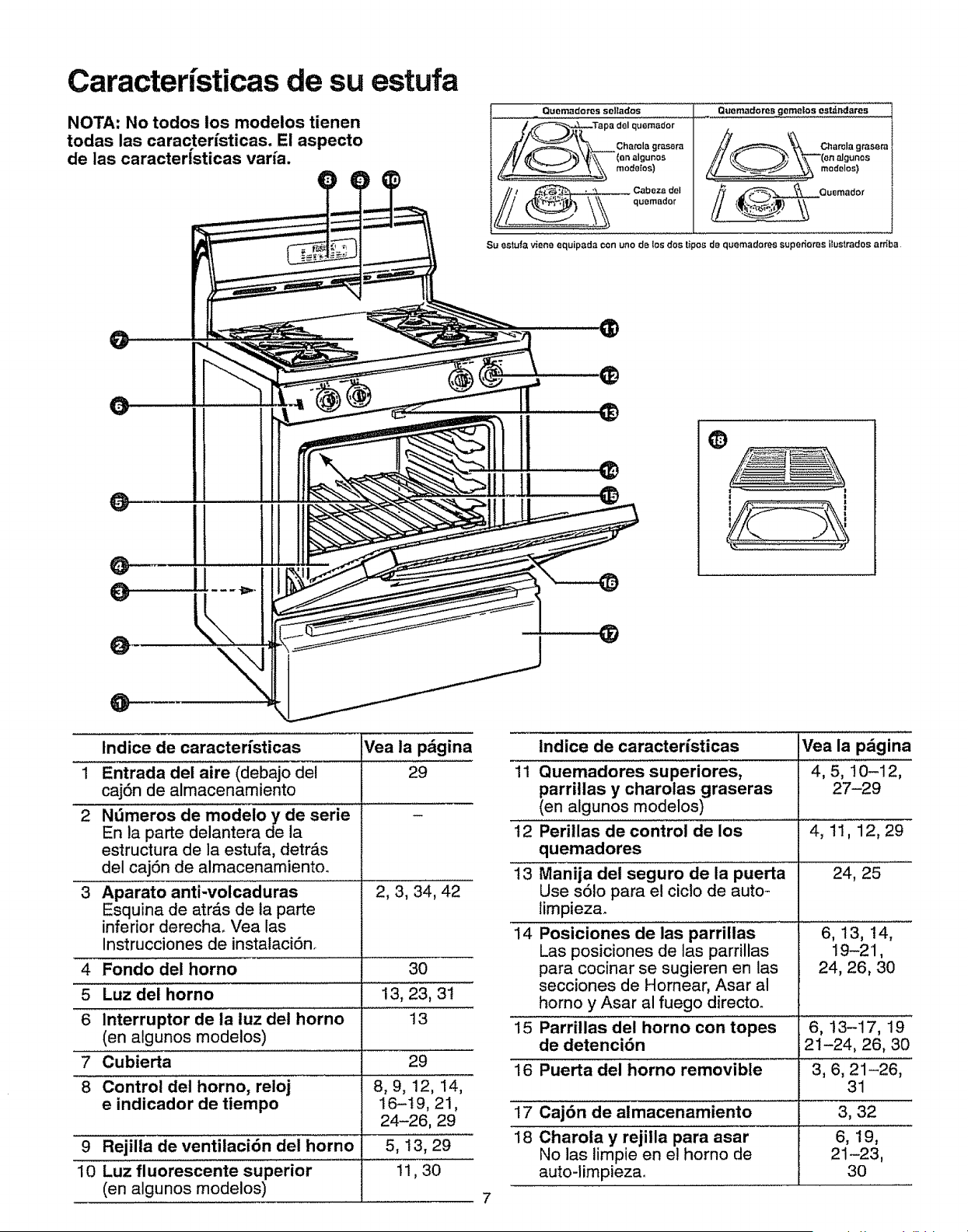
Caractefisticas de su estufa
NOTA: No todos los modelos tienen
todas las caracterfsticas. El aspecto
de las caracteristicas varfa.
..... Quomadoros solados ............. Quemadores gome[os estdt_dams
io_. hamla grasem
(onalgunos
modelos)
Su estufaviene equipada con uno de los dos tipos de quemadoms supedoresilustradosamba
O
tndice de caracterfsticas
1 Entrada del aire (debajo del
caj6n de almacenamiento
2 N_meros de modelo y de serie
En la parte delantera de la
estructura de la estufa, detr_s
del caj6n de almacenamiento.
3 Aparato anti-volcaduras
Esquina de atr&s de ta parte
inferior derecha. Vea las
Instrucciones de instalaci6n.
4
5
6
7
8
Fondo del homo
Luz del horno
Interruptor de la luz del horno
(en algunos modelos)
Cubierta
Control del homo, reioj
e indicador de tiempo
9 Rejiila de ventilaci6n del horno
10 Luz fluorescente superior
(en algunos modelos)
Vea la pdgina
29
2, 3, 34, 42
30
13, 23, 31
13
29
8, 9, 12, 14,
16-19, 21,
24-26, 29
5, 13, 29
11,30
7
®
Indice de caracteristicas Vea la p_gina
11 4, 5, 10-12,
27-29
12 4, 11, 12,29
t 3 24, 25
14
Quemadores superiores,
parriilas y charolas graseras
(en algunos modelos)
Perillas de control de los
quemadores
Manija del seguro de la puerta
Use s61o para el ciclo de auto-
limpieza.
Posiciones de las parrillas
Las posiciones de las parrillas
para cocinar se sugieren en las
secciones de Hornear, Asar al
horno y Asar al fuego directoo
Parri!las del horno con topes
de detenci6n
6, 13, 14,
19-2 '1,
24, 26, 30
15 6, 13-17, 19
21-24, 26, 30
16 Puerta del homo removible 3, 6, 21-26,
31
17 Caj6n de almacenamiento 3, 32
18 Charola y rejitla para asar 6, 19,
No las limpie en el horno de 21-23,
auto-timpieza. 30
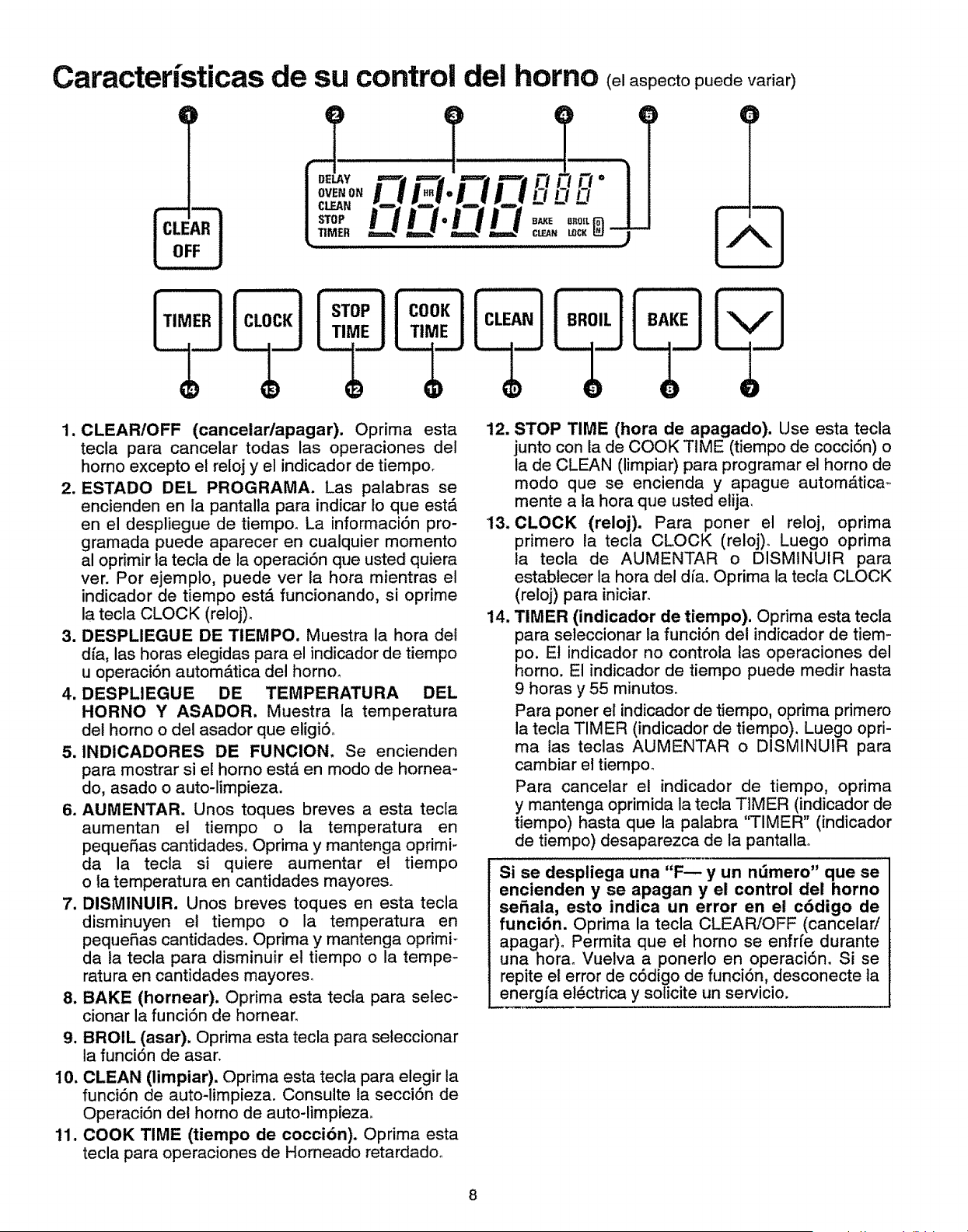
Caracterfsticas de su control del homo (elaspectopuedevariar)
t .......T .....;. '
i i , ii
!0o0 I
tT' J
1. CLEAR/OFF (cancelar/apagar). Oprima esta
tecla para cancelar todas las operaciones del
homo excepto el reloj y el indicador de tiempo.
2. ESTADO DEL PROGRAMA. Las palabras se
encienden en la pantalla para indicar !o que est,.
en el despliegue de tiempo. La informaciSn pro-
gramada puede aparecer en cualquier momento
al oprimir la tecla de la operaciSn que usted quiera
ver. Por ejemplo, puede ver la hora mientras el
indicador de tiempo est,_ funcionando, si oprime
la tecla CLOCK (reloj).
3. DESPLIEGUE DE TIEMPO. Muestra la hora del
dfa, las horas elegidas para el indicador de tiempo
u operaci6n automAtica del horno_
4. DESPLIEGUE DE TEMPERATURA DEL
HORNO Y ASADOR. Muestra la temperatura
det homo o del asador que eligiSo
5. INDICADORES DE FUNClON, Se encienden
para mostrar si el homo est,. en modo de hornea-
do, asado o auto-limpieza.
6. AUMENTAR. Unos toques breves a esta tecla
aumentan el tiempo o la temperatura en
pequeSas cantidades, Oprima y mantenga oprimi-
da la tecla si quiere aumentar el tiempo
o ta temperatura en cantidades mayores,
7. DISMtNUlR. Unos breves toques en esta tecla
disminuyen el tiempo o la temperatura en
pequeSas cantidades. Oprima y mantenga oprimi-
data tecla para disminuir et tiempo o la tempe-
ratura en cantidades mayores°
8. BAKE (hornear). Oprima esta tecta para selec-
cionar la funciSn de homear,
9, BROIL (asar). Oprima esta tecla para seteccionar
la funciSn de asar.
10. CLEAN (limpiar). Oprima esta tecla para elegir la
funciSn de auto-limpieza. Consulte la secci6n de
Operaci6n del homo de auto-limpieza,
11. COOK TIME (tiempo de cocci6n). Oprima esta
tecla para operaciones de Horneado retardado,
12. STOP TIME (hora de apagado). Use esta tecla
junto con la de COOK TIME (tiempo de cocci6n) o
la de CLEAN (limpiar) para programar el homo de
modo que se encienda y apague autom,_tica_
mente a la hora que usted elija
13. CLOCK (reloj). Para poner el reloj, oprima
primero ta tecla CLOCK (reloj)° Luego oprima
la tecla de AUMENTAR o DISMINUIR para
establecer la hora del dfa. Oprima la tecla CLOCK
(reloj) para iniciar,
14, TIMER (indicador de tiempo). Oprima esta tecla
para seleccionar la funci6n del indicador de tiem-
pc. Et indicador no controla las operaciones del
homo. El indicador de tiempo puede medir hasta
9 horas y 55 minutos,
Para poner el indicador de tiempo, oprima primero
la tecla TIMER (indicador de tiempo). Luego opri-
ma las teclas AUMENTAR o DISMINUIR para
cambiar el tiempoo
Para cancelar el indicador de tiempo, oprima
y mantenga oprimida la tecla TIMER (indicador de
tiempo) hasta que la palabra "TIMER" (indicador
de tiempo) desaparezca de la pantallao
Si se despliega una "F-- y un ndmero" que se
encienden y se apagan y el control del horno
se_ala, esto indica un error en el c6digo de
funci6n. Oprima la tecla CLEAR/OFF (cancelar/
apagar)o Permita que el homo se enfrfe durante
una hora° Vuelva a ponerlo en operaci6n, Si se
repite el error de cSdigo de funciSn, desconecte ta
energfa el_ctrica y solicite un servicio.
8
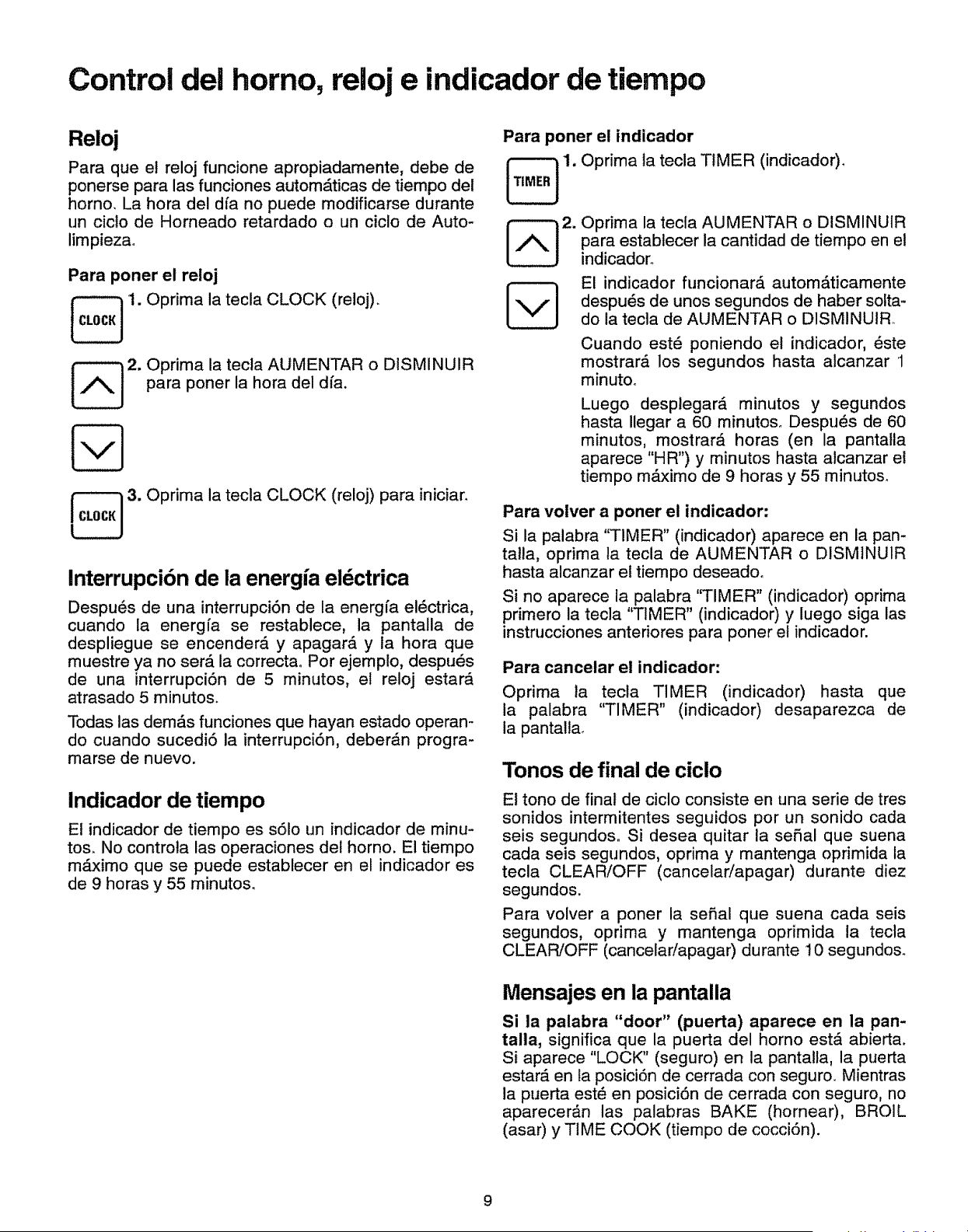
Control dei homo, reloj e indicador de tiempo
Reloj
Para que et reloj funcione apropiadamente, debe de
ponerse para las funciones autom,_ticas de tiempo del
homo, La hora del dfa no puede modificarse durante
un cicio de Horneado retardado o un ciclo de Auto-
limpiezao
Para poner et reloj
1. Optima la tecla CLOCK (reloj).
Oprima la tecta AUMENTAR o DISMINUIR
para poner la hora del dfa.
3. Oprima la tecla CLOCK (reloj) para iniciar.
lnterrupcibn de la energia eldctrica
Despu_s de una interrupci6n de la energfa el_ctrica,
cuando la energfa se restablece, la pantalla de
despliegue se encenderd y apagard y la hora que
muestre ya no serd la correctao Per ejemplo, despuds
de una interrupci6n de 5 minutos, el reloj estard
atrasado 5 minutos.
Todas las demds funciones que hayan estado operan-
do cuando sucedi6 la interrupci6n, deber&n progra-
marse de nuevo.
indicador de tiempo
El indicador de tiempo es s61o un indicador de minu-
tos. No controta las operaciones del homo. El tiempo
mdximo que se puede establecer en el indicador es
de 9 horas y 55 minutos.
Para poner el indicador
1. Oprima la tecla TIMER (indicador).
u
Oprima la tecla AUMENTAR o DISMINUIR
para establecer la cantidad de tiempo en el
indicadoro
El indicador funcionar_, automdticamente
despuds de unos segundos de haber solta-
do la tecta de AUMENTAR o D1SMINUIR
Cuando est6 poniendo el indicador, _ste
mostrard los segundos hasta aicanzar 1
minutoo
Luego desplegar_, minutos y segundos
hasta Ilegar a 60 minutos. Despuds de 60
minutos, mostrard horas (en la pantaila
aparece "HR") y minutos hasta alcanzar et
tiempo mdximo de 9 horas y 55 minutos.
Para volver a poner el indicador:
Si la palabra "TIMER" (indicador) aparece en la pan-
talla, oprima ta tecla de AUMENTAR o DISM1NU1R
hasta alcanzar el tiempo deseadoo
Si no aparece la palabra "TIMER" (indicador) oprima
primero la tecla "TIMER" (indicador) y luego siga las
instrucciones anteriores para poner et indicador.
Para cancelar el indicador:
Oprima la tecta TIMER (indicador) hasta que
la palabra "TIMER" (indicador) desaparezca de
la pantalla_
Tonos de final de ciclo
Et tono de final de ciclo consiste en una serie de tres
sonidos intermitentes seguidos por un sonido cada
seis segundos. Si desea quitar la serial que suena
cada seis segundos, oprima y mantenga oprimida la
tecla CLEAR/OFF (cancelar/apagar) durante diez
segundos.
Para volver a poner la serial que suena cada seis
segundos, oprima y mantenga oprimida la tecta
CLEAR/OFF (cancelar!apagar) durante t0 segundos.
Mensajes en la pantalla
Si la palabra "door" (puerta) aparece en la pan-
talla, significa que la puerta del horno estd abierta.
Si aparece "LOCK" (seguro) en la pantalla, la puerta
estar& en la posici6n de cerrada con seguro. Mientras
la puerta est_ en posici6n de cerrada con seguro, no
aparecer&n las palabras BAKE (hornear), BROIL
(asar) y TIME COOK (tiempo de cocci6n).
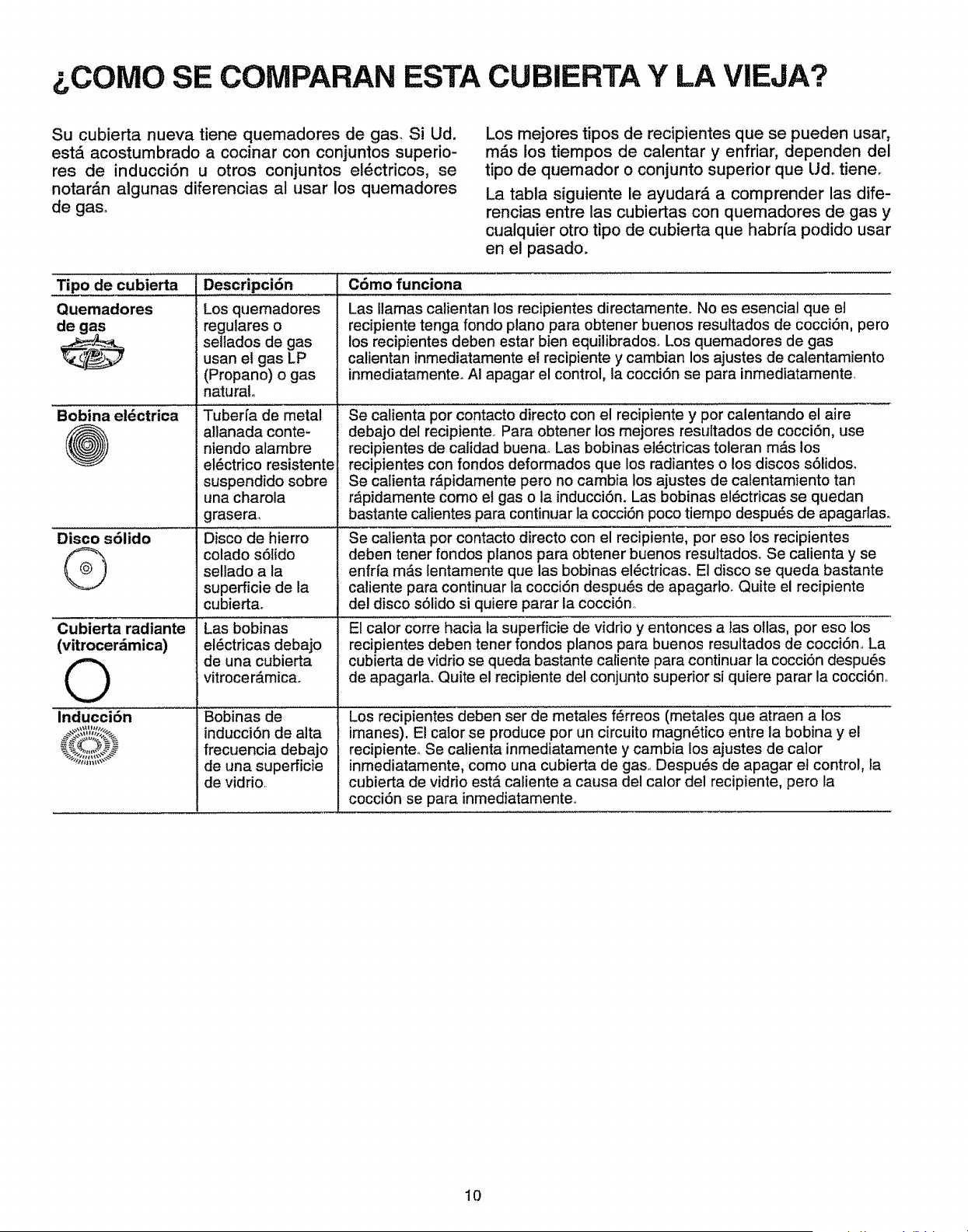
&COMO SE COMPARAN ESTA CUBIERTA Y LA VIEJA?
Su cubierta nueva tiene quemadores de gas. Si Ud.
est& acostumbrado a cocinar con conjuntos superio-
res de inducci6n u otros conjuntos et_ctricos, se
notar&n algunas diferencias al usar los quemadores
de gas.
Los mejores tipos de recipientes que se pueden usar,
m&s los tiempos de calentar y enfriar, dependen del
tipo de quemador o conjunto superior que Udo tiene.
La tabla siguiente le ayudarA a comprender las dife-
rencias entre las cubiertas con quemadores de gas y
cualquier otro tipo de cubierta que habrfa podido usar
en el pasado.
Tipo de cubierta
Quemadores
Bobina el_ctrica
@
Disco s6tido
@
Cubierta radiante
(vitrocer_mica)
©
Inducci6n
Descripci6n C6mo funciona
Los quemadores
regulares o
sellados de gas
usan el gas LP
(Propano) o gas
natural.
Tuberfa de metal
atlanada conte-
niendo alambre
el_ctrico resistente
suspendido sobre
una charola
grasera,
Disco de hierro
colado s6tido
sellado a la
superficie de la
cubiertao
Las bobinas
el_ctricas debajo
de una cubierta
vitrocer_micao
Bobinas de
inducci6n de alta
frecuencia debajo
de una superficie
de vidrio.
Las llamas calientan los recipientes directamente. No es esencial que et
recipiente tenga fondo piano para obtener buenos resultados de cocci6n, pero
los recipientes deben estar bien equilibradoso Los quemadores de gas
calientan inmediatamente el recipiente y cambian los ajustes de calentamiento
inmediatamente. AI apagar el control, la cocci6n se para inmediatamente,
Se calienta por contacto directo con el recipiente y por calentando el aire
debajo del recipiente. Para obtener los mejores resultados de cocci6n, use
recipientes de calidad buena. Las bobinas et_ctricas toleran m_s los
recipientes con fondos deformados que los radiantes o los discos s61idos.
Se calienta r_pidamente pero no cambia los ajustes de calentamiento tan
r_pidamente como el gas o la inducci6n. Las bobinas el_ctricas se quedan
bastante calientes para continuar la cocci6n poco tiempo despu_s de apagarlas.
Se calienta por contacto directo con el recipiente, por eso los recipientes
deben tener fondos pianos para obtener buenos resultados. Se calienta y se
enfrfa m_s ientamente que las bobinas e!_ctricas. El disco se queda bastante
caliente para continuar la cocci6n despu_s de apagarfo. Quite el recipiente
del disco s61ido si quiere parar la cocci6n,
El calor corre hacia la superficie de vidrio y entonces a tas ollas, por eso los
recipientes deben tener fondos pianos para buenos resultados de cocci6n., La
cubierta de vidrio se queda bastante caliente para continuar la cocci6n despu_s
de apagarla. Quite el recipiente del conjunto superior si quiere parar la cocci6n,
Los recipientes deben ser de metales f_rreos (metales que atraen a los
imanes). El caIor se produce por un circuito magn_tico entre la bobina y el
recipienteo Se calienta inmediatamente y cambia los ajustes de calor
inmediatamente, como una cubierta de gas,, Despu_s de apagar et control, fa
cubierta de viddo est,, caliente a causa del calor del recipiente, pero la
cocci6n se para inmediatamente,_
10
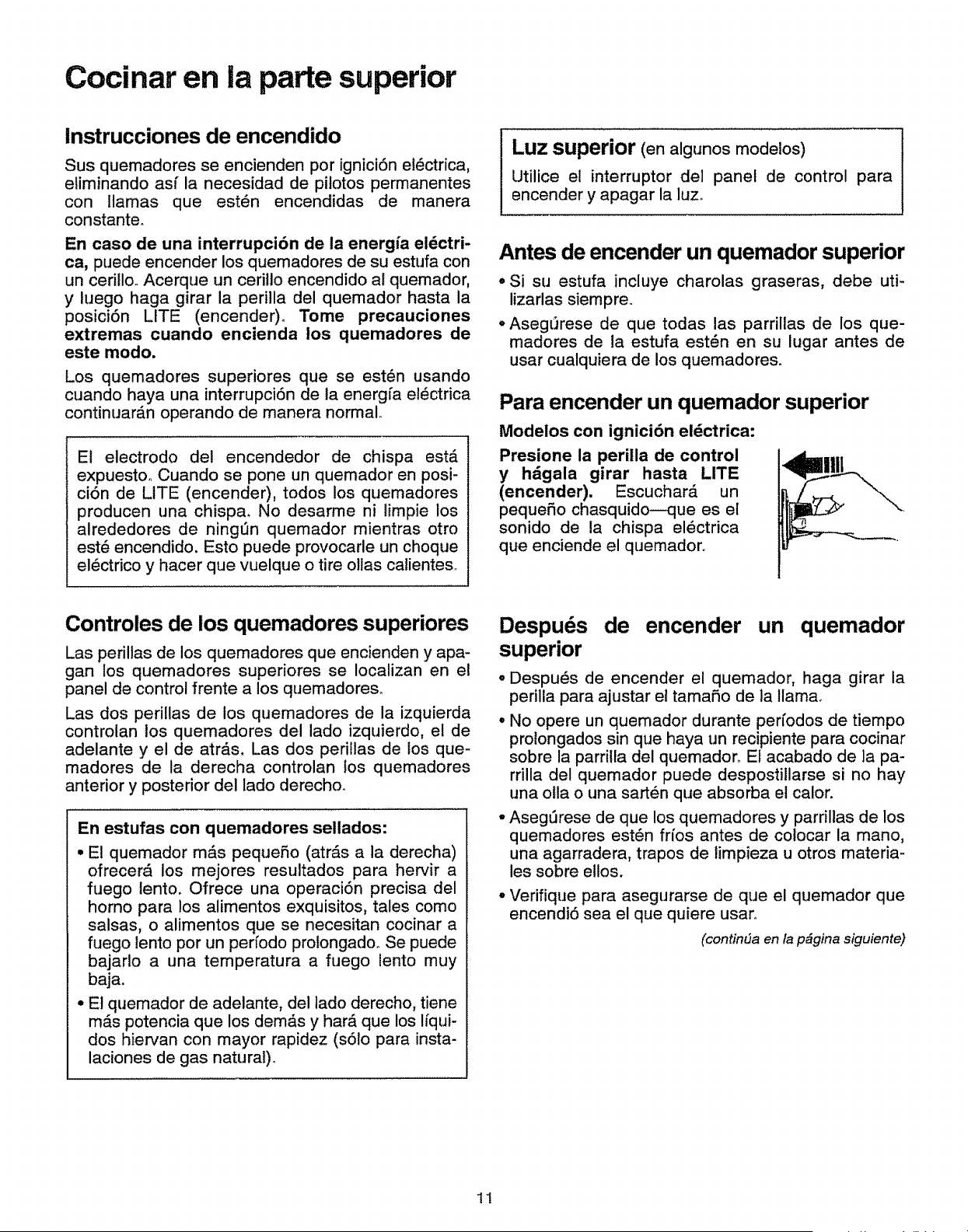
Cocinar en la parte superior
lnstrucciones de encendido
Sus quemadores se encienden por ignici6n et_ctrica,
eliminando asf la necesidad de pilotos permanentes
con llamas que est_n encendidas de manera
constante_
En caso de una interrupci6n de la energfa ei_ctri-
ca, puede encender los quemadores de su estufa con
un cerillo. Acerque un cerillo encendido al quemador,
y luego haga girar la perilla del quemador hasta la
posici6n LITE (encender)o Tome precauciones
extremas cuando encienda los quemadores de
este modo.
Los quemadores superiores que se est_n usando
cuando haya una interrupci6n de ta energfa et_ctrica
continuar_.n operando de manera normal°
El electrodo del encendedor de chispa est,.
expuestoo Cuando se pone un quemador en posi-
ci6n de LITE (encender), todos los quemadores
producen una chispa. No desarme ni limpie los
alrededores de ningL_n quemador mientras otro
est_ encendido. Esto puede provocarle un choque
el_ctrico y hacer que vuelque o tire ollas catienteso
Luz superior (en algunos modelos)
Utilice el interruptor del panel de control para
encender y apagar la luzo
Antes de encender un quemador superior
o Si su estufa incluye charolas graseras, debe uti-
lizarlas siempre.
oAsegQrese de que todas las parrillas de los que-
madores de la estufa est_n en su lugar antes de
usar cualquiera de los quemadores.
Para encender un quemador superior
Modelos con ignici6n el_ctrica:
Presione la perilla de control
y h_gala girar hasta LITE
(encender). Escuchar_ un
pequeSo chasquido--que es el
sonido de la chispa el_ctrica
que enciende el quemadoro
Controles de los quemadores superiores
Las perillas de los quemadores que encienden y apa-
gan los quemadores superiores se Iocalizan en el
panel de control frente a los quemadoreso
Las dos perillas de los quemadores de la izquierda
controlan los quemadores del lado izquierdo, el de
adelante y el de atr,_s. Las dos perillas de los que-
madores de la derecha controlan los quemadores
anterior y posterior del lado derecho.
En estufas con quemadores sellados:
• El quemador m_s peque_o (atr_.s a la derecha)
ofrecer& los mejores resultados para hervir a
fuego lento. Ofrece una operaciSn precisa del
horno para los alimentos exquisitos, tales como
salsas, o alimentos que se necesitan cocinar a
fuego lento por un perfodo prolongadoo Se puede
bajarlo a una temperatura a fuego lento muy
baja.
° E! quemador de adelante, del lado derecho, tiene
m_ts potencia que los demAs y har,_ que los Ifqui-
dos hiervan con mayor rapidez (s61o para insta-
laciones de gas natural)°
Despu s de encender un quemador
superior
o Despu_s de encender el quemador, haga girar la
perilla para ajustar el tamaSo de la llama.
o No opere un quemador durante perfodos de tiempo
prolongados sin que haya un recipiente para cocinar
sobre la parrilla del quemador. El acabado de la pa-
rrilla del quemador puede despostillarse si no hay
una otla o una sart_n que absorba el calor.
° Aseg_rese de que los quemadores y parrillas de los
quemadores est_n ffios antes de cotocar la mano,
una agarradera, trapos de limpieza u otros materia-
les sobre ellos.
° Verifique para asegurarse de que el quemador que
encendi6 sea el que quiere usar_
(continUa en la p#gina siguiente)
11
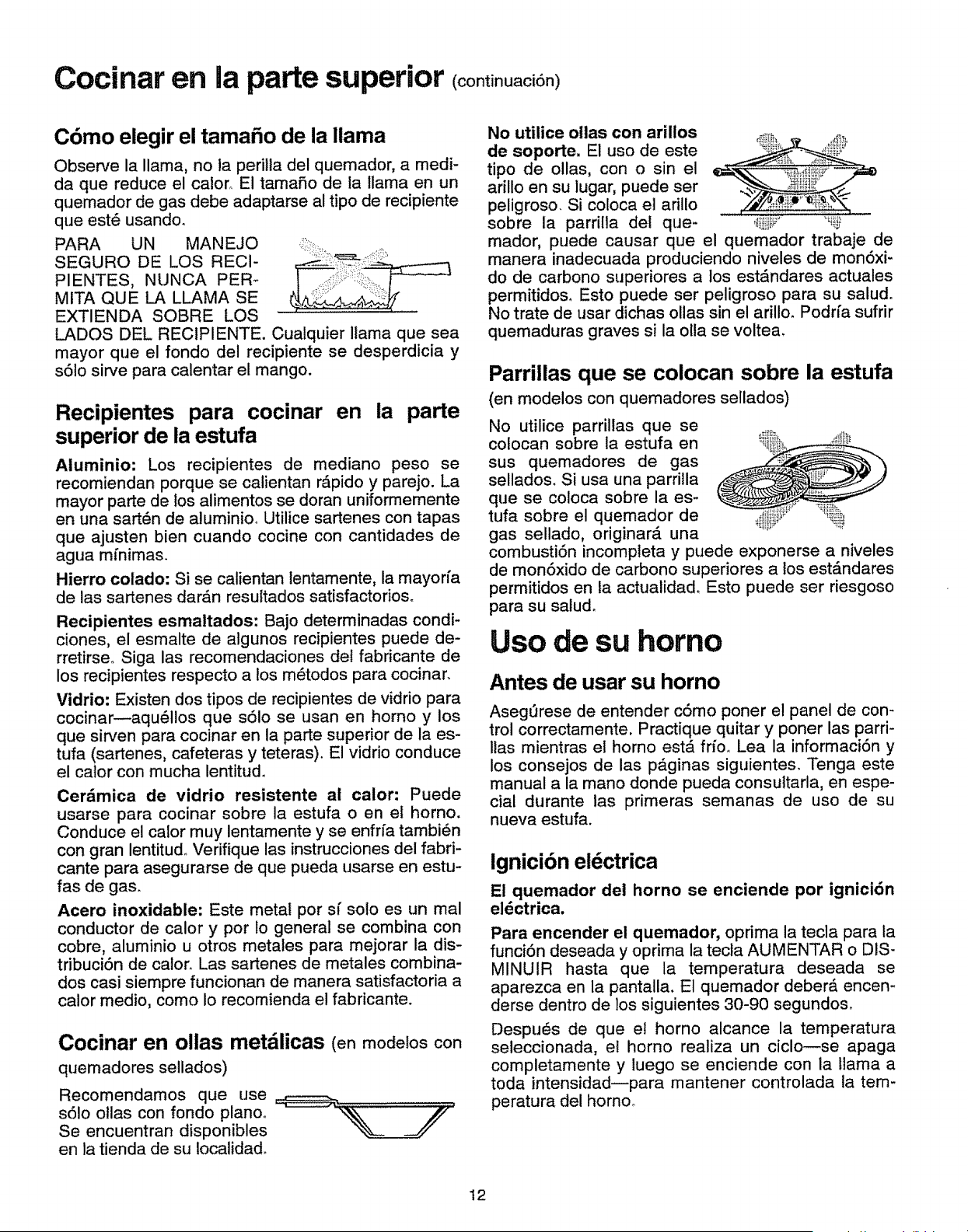
Cocinar en la parte superior (oont ou c n)
C6mo elegir el tamaRo de la llama
Observe la llama, no la perilla del quemador, a medi-
da que reduce el caloro El tamafio de la llama en un
quemador de gas debe adaptarse al tipo de recipiente
que est_ usando.
PARA UN MANEJO
SEGURO DE LOS RECI-
PIENTES, NUNCA PER_
MITA QUE LA LLAMA SE
EXTIENDA SOBRE LOS
LADOS DEL RECIPIENTE. Cualquier llama que sea
mayor que el fondo del recipiente se desperdicia y
s61o sirve para calentar el mango.
Recipientes para cocinar en la parte
superior de la estufa
Aluminio" Los recipientes de mediano peso se
recomiendan porque se calientan r_.pido y parejo. La
mayor parte de los alimentos se doran uniformemente
en una sart_n de aluminioo Utilice sartenes con tapas
que ajusten bien cuando cocine con cantidades de
agua mfnimas.
Hierro colado: Si se calientan lentamente, la mayofia
de las sartenes dar,_n resultados satisfactorioso
Recipientes esmaltados: Bajo determinadas condi-
clones, el esmalte de algunos recipientes puede de-
rretirseo Siga las recomendaciones det fabricante de
los recipientes respecto a los m_todos para cocinar.
Vidrio: Existen dos tipos de recipientes de vidrio para
cocinar--aqu_llos que s61o se usan en homo y los
que sirven para cocinar en la parte superior de la es-
tufa (sartenes, cafeteras y teteras). El vidrio conduce
el cator con mucha lentitud.
Cer_mica de vidrio resistente at calor: Puede
usarse para cocinar sobre la estufa o en el homo.
Conduce el calor muy lentamente y se enfffa tambi_n
con gran lentitud_ Verifique las instrucciones del fabri-
cante para asegurarse de que pueda usarse en estu-
fas de gas.
Acero inoxidable: Este metal por sf solo es un mal
conductor de calory por lo general se combina con
cobre, aluminio u otros metates para mejorar la dis-
tribuci6n de calor. Las sartenes de metales combina-
dos casi siempre funcionan de manera satisfactoria a
calor medio, como Io recomienda e! fabricante.
Cocinar en ollas metdlicas (en modelos con
quemadores sellados)
Recomendamos que use __j.,
s61o otlas con fondo planoo
Se encuentran disponibles
en la tienda de su localidad.
No utilice ollas con ariltos _N_ _ ,,_,
de soporte. El uso de este '_ ,,_i!i!i_i_
tipo de ollas, con o sin el
arillo en su lugar, puede ser
peligroso. Si coloca el arillo
sobre ia parrilla del que- ............_i_i_!iiii__..... :_:_J'i_ii......
mador, puede causar que el quemador trabaje de
manera inadecuada produciendo niveles de mon6xi-
do de carbono superiores a los est&ndares actuales
permitidos, Esto puede ser peligroso para su salud°
No trate de usar dichas ollas sin el arillo. Podr[a sufrir
quemaduras graves si la olla se voltea,
ParrUlas que se colocan sobre la estufa
(en modelos con quemadores sellados)
No utilice parrillas que se
colocan sobre la estufa en ,_ii!it_
sus quemadores de gas
sellados. Si usa una parrilla
que se coloca sobre la es-
tufa sobre el quemador de ':_qiiiiiii
gas sellado, originar4, una
combusti6n incompleta y puede exponerse a niveles
de mon6xido de carbono superiores a los estdndares
permitidos en la actualidad, Esto puede ser riesgoso
para su salud.
Uso de su homo
Antes de usar su homo
Aseg_rese de entender c6mo poner el panel de con-
trol correctamente. Practique quitar y poner las parri-
llas mientras el homo estd frfo. Lea la informaci6n y
los consejos de las pdginas siguientes. Tenga este
manual a la mano donde pueda consultarla, en espe-
cial durante las primeras semanas de uso de su
nueva estufa.
Ignicibn el_ctrica
El quemador del homo se enciende por ignici6n
el_ctrica.
Para encender el quemador, oprima la tecla para la
funci6n deseada y oprima la tecla AUMENTAR o DIS-
MINUIR hasta que la temperatura deseada se
aparezca en la pantalla. El quemador deber#, encen-
derse dentro de los siguientes 30-90 segundoso
Despu_s de que el homo alcance la temperatura
seleccionada, et homo realiza un ciclo_se apaga
completamente y luego se enciende con la llama a
toda intensidadJpara mantener controlada la tem-
peratura del homo°
12
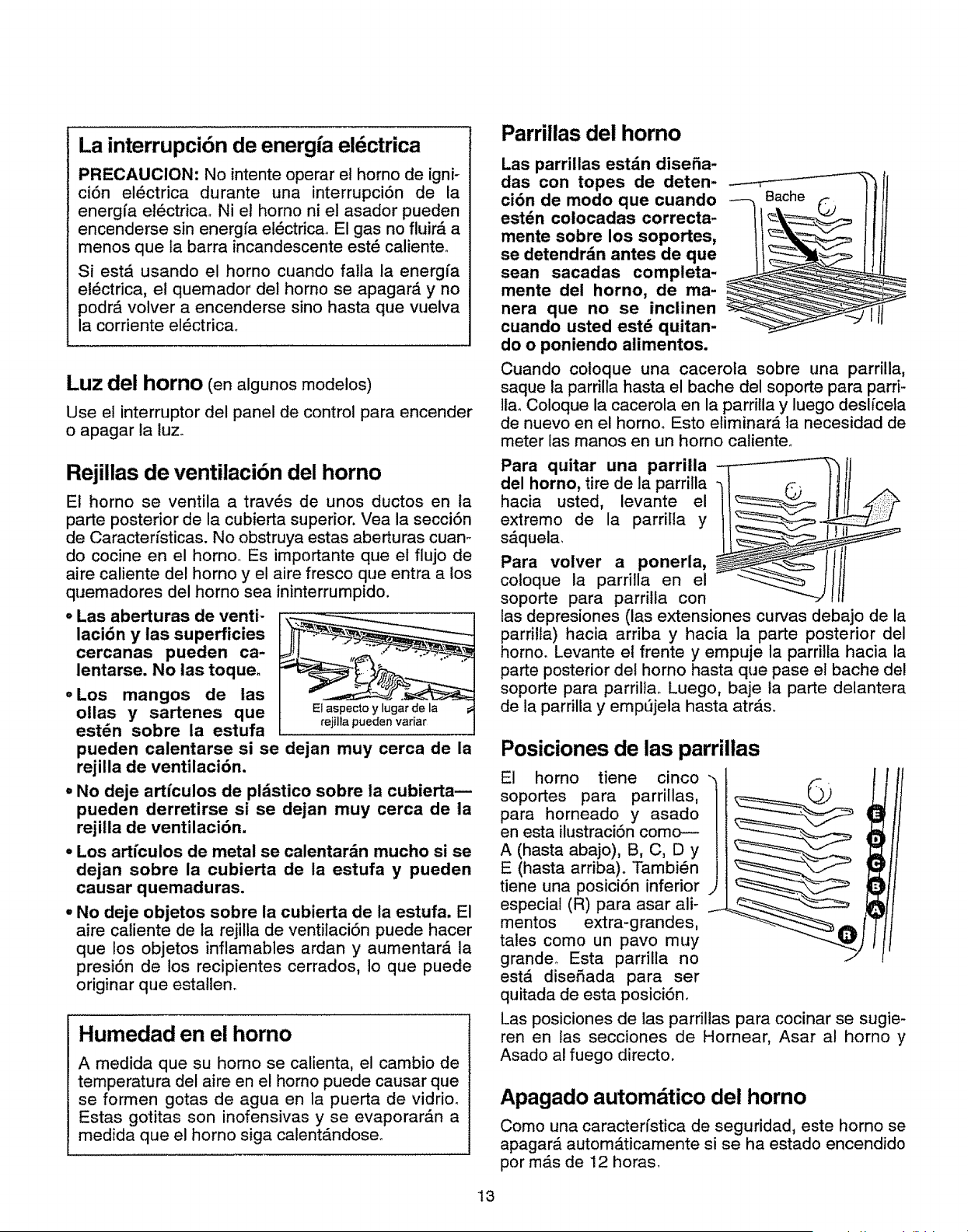
La interrupci6n de energfa el ctrica
PRECAUCION: No intente operar et homo de igni-
ci6n el6ctrica durante una interrupci6n de la
energfa el6ctricao Ni et homo ni el asador pueden
encenderse sin energfa el6ctricao El gas no fluir_, a
menos que ta barra incandescente est6 calienteo
Si est& usando el homo cuando faila la energfa
el_ctrica, el quemador del homo se apagar_ y no
podr& volver a encenderse sino hasta que vuelva
la corriente e!6ctricao
Luz del horno (en algunosmodelos)
Use el interruptor del panel de control para encender
o apagar la luz.
Rejillas de ventilaci6n del horno
El horno se ventila a trav6s de unos ductos en ta
parte posterior de la cubierta superior. Vea la secci6n
de Caracteffsticas. No obstruya estas aberturas cuan _
do cocine en el homo° Es importante que el flujo de
aire caliente del homo y el aire fresco que entra a los
quemadores del homo sea ininterrumpido.
o Las aberturas de venti-
laci6n y las superficies
cercanas pueden ca-
lentarse. No las toque.
.Los mangos de las
ollas y sartenes que Elaspectoylugardela
est6n sobre la estufa rejillapuedenvariar
pueden calentarse si se dejan muy cerca de la
rejilla de ventilaci6n.
= No deje artfculos de plfistico sobre la cubierta m
pueden derretirse si se dejan muy cerca de la
rejilla de ventilaci6n.
° Los artfculos de metal se calentarfin mucho si se
dejan sobre la cubierta de la estufa y pueden
causar quemaduras.
• No deje objetos sobre la cubierta de la estufa, El
aire caliente de la rejilla de ventilaci6n puede hacer
que los objetos inflamables ardan y aumentar_ la
presi6n de los recipientes cerrados, Io que puede
originar que esta!ien°
Humedad en el homo
A medida que su horno se calienta, el cambio de
temperatura del aire en el homo puede causar que
se formen gotas de agua en la puerta de vidrio_
Estas gotitas son inofensivas y se evaporar&n a
medida que el homo siga calent_.ndoseo
Parrillas del homo
Las parrillas estfin disefia-
das con topes de deten-
ci6n de modo que cuando
est6n coiocadas correcta-
mente sobre los soportes,
se detendr_n antes de que
sean sacadas completa-
mente del homo, de ma-
nera que no se inclinen I
cuando usted est_ quitan-
do o poniendo alimentos.
Cuando coloque una cacerofa sobre una parrilla,
saque la parrilla hasta el bache del soporte para parfi-
Ila. Coloque la cacerola en la parritla y luego deslfcela
de nuevo en el homo° Esto eliminar_ la necesidad de
meter las manos en un homo caliente.
Para quitar una parriila -T--'---------_ 1]
del horno, tire de la parrilla
hacia usted, levante el
extremo de la parrilla y
Para volver a ponerla,
coloque la parrilla en el
soporte para parrilla con
las depresiones (las extensiones curvas debajo de la
parrilta) hacia arriba y hacia la parte posterior del
homo° Levante el frente y empuje la parrilla hacia la
parte posterior del homo hasta que pase el bache del
soporte para parrillao Luego, baje la parte delantera
de la parrilla y emp6jela hasta atr_s.
Posiciones de las parrillas
El homo tiene cinco
soportes para parrillas,
para horneado y asado
en esta ilustraci6n como--
A (hasta abajo), B, C, D y
E (hasta arriba). Tambi6n
tiene una posici6n inferior
especial (R) para asar all o
mentos extra-grandes,
tales como un pavo muy
grandeo Esta parrilla no
est_ disefiada para ser
quitada de esta posici6n.
Las posiciones de las parrillas para cocinar se sugie-
ren en las secciones de Hornear, Asar al homo y
Asado al fuego directo.
Apagado automfitico del horno
Como una caracterfstica de seguridad, este homo se
apagar_ autom&ticamente si se ha estado encendido
por m_s de 12 horas,
13
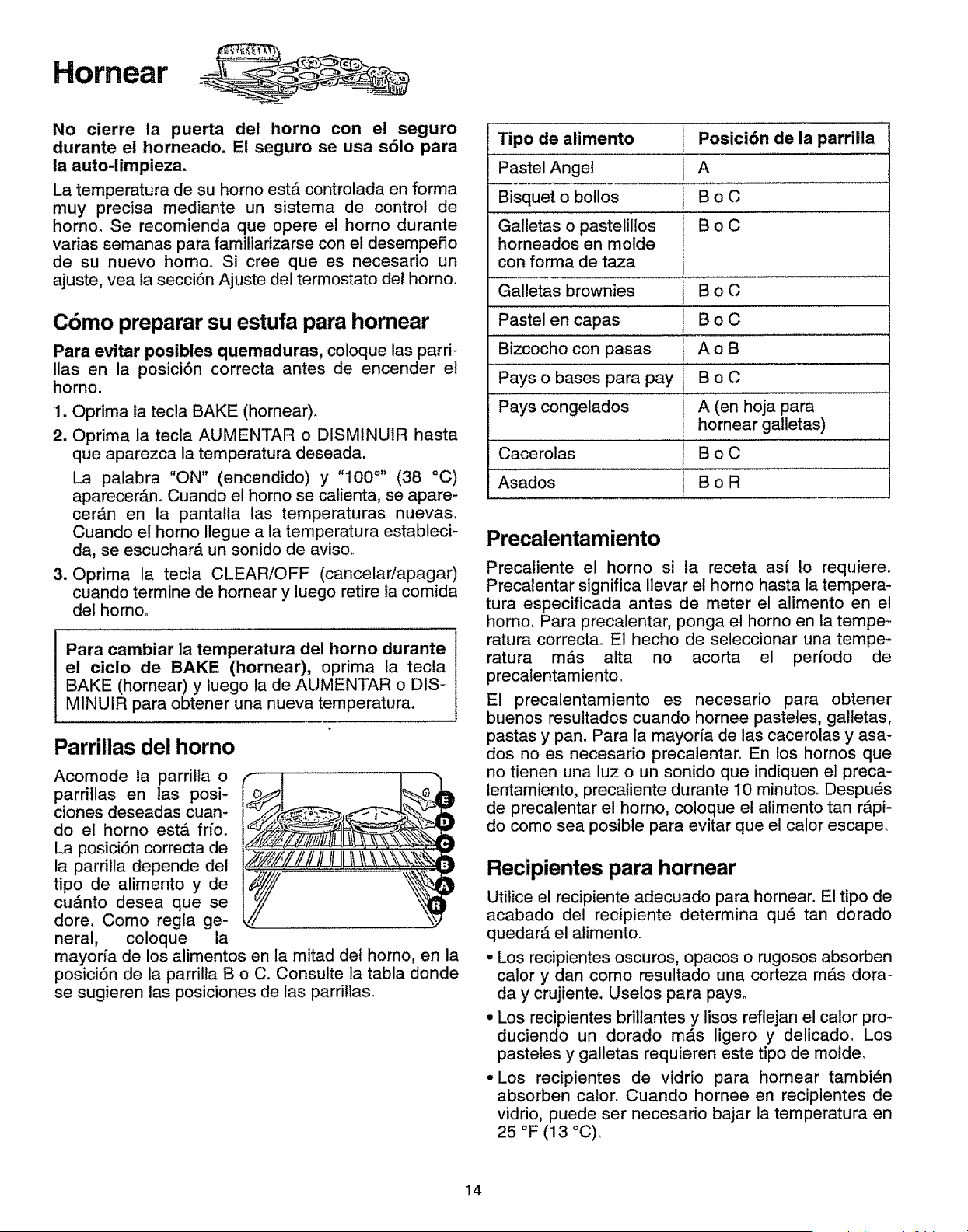
Hornear
No cierre la puerta del horno con el seguro
durante el horneado. El seguro se usa s61o para
la auto-limpieza.
La temperatura de su homo est_ controlada en forma
muy precisa mediante un sistema de control de
horno_ Se recomienda que opere el homo durante
varias semanas para familiarizarse con el desempe5o
de su nuevo homo. Si cree que es necesario un
ajuste, vea ta secciSn Ajuste del termostato det horno.
C6mo preparar su estufa para hornear
Para evitar posibles quemaduras, coloque las pard-
Ilas en la posici6n correcta antes de encender el
horno.
1, Oprima la tecla BAKE (hornear).
2, Oprima la tecla AUMENTAR o DISMINUIR hasta
que aparezca la temperatura deseada.
La palabra "ON" (encendido) y "100 °" (38 °C)
aparecer&n. Cuando el horno se calienta, se apare-
cer#.n en la pantalla las temperaturas nuevas.
Cuando el homo Ilegue a la temperatura estableci-
da, se escuchar_, un sonido de aviso°
3, Oprima la tecla CLEAR/OFF (cancelar/apagar)
cuando termine de hornear y luego retire la comida
del homo°
Para cambiar la temperatura del horno durante
el ciclo de BAKE (hornear), oprima la tecla
BAKE (homear) y luego la de AUMENTAR o DIS-
M1NUIR para obtener una nueva temperatura.
Parrillas del homo
Acomode la parrilla o
parrillas en las posi-
clones deseadas cuan-
do el homo est& fifo.
La posiciSn correcta de
la parrilla depende del
tipo de alimento y de
cu&nto desea que se
dore. Como regla ge-
neral, coloque la
mayorfa de los alimentos en la mitad det homo, en la
posiciSn de la parrilla B o C. Consutte la tabla donde
se sugieren las posiciones de las parritlaso
Tipo de alimento Posici6n de la parrilla
Pastel Angel A
Bisquet o botlos B o C
Galletas o pastelillos B o C
homeados en molde
con forma de taza
Gatletas brownies B' oC ......................
Pastel en capas B o C
Bizcocho con pasas A o B
Pays o bases para pay [] o C
Pays congelados A (en hoja para
hornear galletas)
Cacerolas B o C
Asados B o R
Precalentamiento
Precatiente el homo si la receta asf Io requiere.
Precalentar significa ilevar el homo hasta la tempera-
tura especificada antes de meter el alimento en el
horno. Para precalentar, ponga et horno en la tempe r
ratura correct& El hecho de seleccionar una tempe-
ratura m_s alta no acorta el perfodo de
precalentamientoo
El precalentamiento es necesario para obtener
buenos resuttados cuando hornee pastetes, galletas,
pastas y pan, Para la mayorfa de las cacerolas y asa-
dos no es necesario precalentar, En los hornos que
no tienen una luz o un sonido que indiquen el preca-
lentamiento, precaliente durante 10 minutoso Despu_s
de precalentar el homo, coloque et alimento tan r&pi-
do como sea posibte para evitar que el calor escape,
Recipientes para hornear
Utilice el recipiente adecuado para hornear. El tipo de
acabado del recipiente determina qu_ tan dorado
quedar_ el alimento.
• Los recipientes oscuros, opacos o rugosos absorben
calory dan como resultado una corteza mAs dora-
da y crujiente. Uselos para pays°
• Los recipientes brillantes y lisos reflejan el calor pro-
duciendo un dorado m_s ligero y delicadoo Los
pasteles y galletas requieren este tipo de molde.
• Los recipientes de vidrio para homear tambi_n
absorben calor. Cuando hornee en recipientes de
vidrio, puede ser necesario bajar la temperatura en
25 °F (13 °C),
14
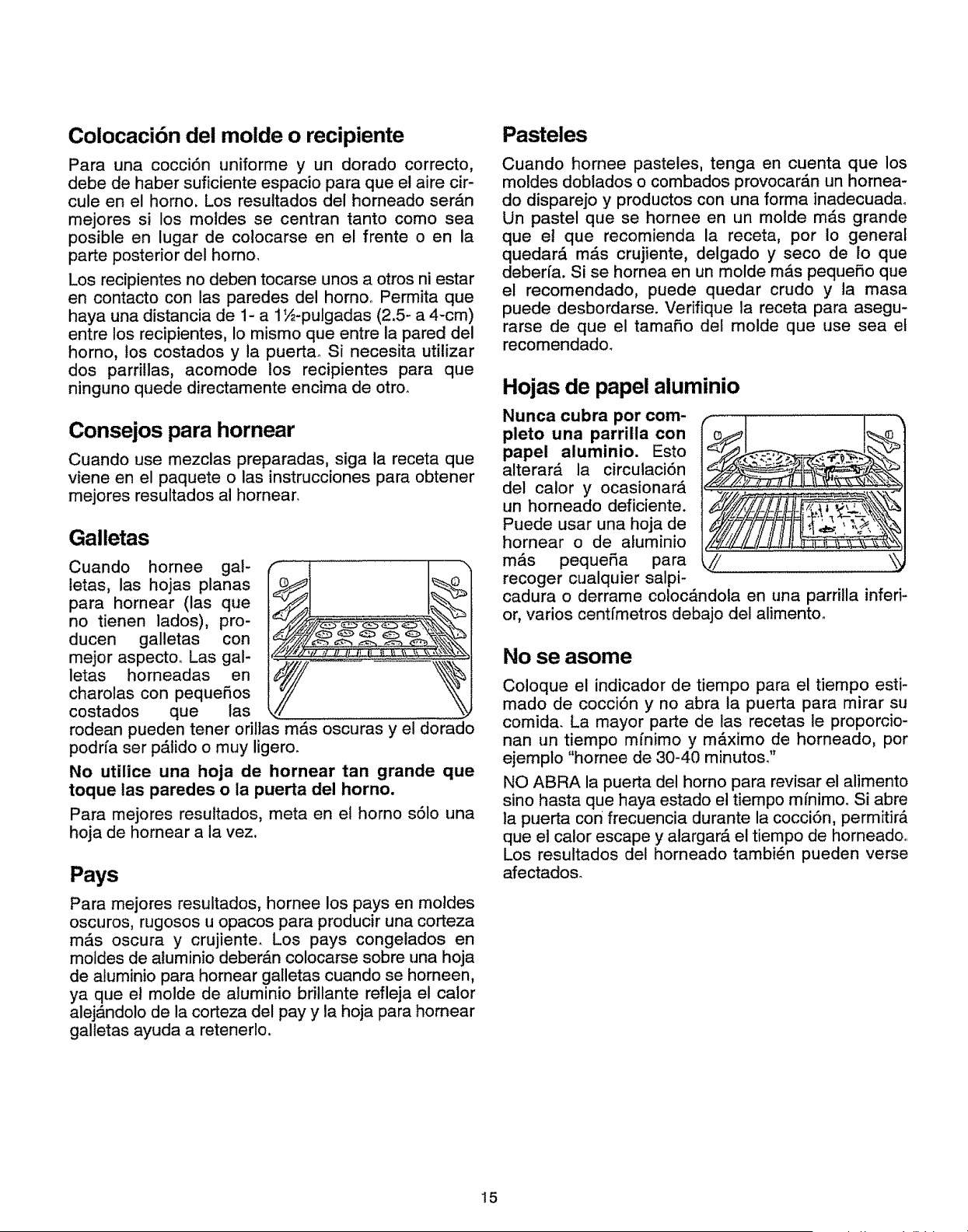
Colocaci6n del moide o recipiente
Para una cocci6n uniforme y un dorado correcto,
debe de haber suficiente espacio para que el aire cir-
cule en el homo. Los resuttados del horneado ser_,n
mejores si los moldes se centran tanto como sea
posible en lugar de colocarse en el frente o en la
parte posterior del horno_
Los recipientes no deben tocarse unos a otros ni estar
en contacto con las paredes del homo° Permita que
haya una distancia de 1- a i ½-pulgadas (2.5- a 4-cm)
entre los recipientes, Io mismo que entre la pared del
horno, los costados y la puerta_ Si necesita utilizar
dos parrillas, acomode los recipientes para que
ninguno quede directamente encima de otro_
Consejos para hornear
Cuando use mezclas preparadas, siga la receta que
viene en el paquete o las instrucciones para obtener
mejores resultados al hornear.
Galletas
Cuando hornee gal-
letas, las hojas planas
para hornear (las que
no tienen lados), pro-
ducen galletas con
mejor aspectoo Las gal-
letas horneadas en
charolas con pequefios
costados que las
rodean pueden tener orillas m_s oscuras y el dorado
podfia ser p_.lido o muy ligero.
No utilice una hoja de hornear tan grande que
toque las paredes o la puerta del homo.
Para mejores resultados, meta en el homo s61o una
hoja de hornear a la vez.
Pays
Para mejores resultados, hornee los pays en moldes
oscuros, rugosos u opacos para producir una corteza
m&s oscura y crujiente_ Los pays congelados en
moldes de aluminio deber_,n colocarse sobre una hoja
de aluminio para hornear galletas cuando se homeen,
ya que el molde de aluminio brillante refleja el calor
alej&ndolo de la corteza del pay y la hoja para homear
galletas ayuda a retenerlo.
Pasteles
Cuando hornee pasteles, tenga en cuenta que los
moldes doblados o combados provocar_.n un hornea-
do disparejo y productos con una forma inadecuadao
Un pastel que se hornee en un molde m_s grande
que et que recomienda la receta, por Io general
quedar& m_s crujiente, delgado y seco de lo que
deberfa. Si se hornea en un molde m_s peque5o que
el recomendado, puede quedar crudo y la masa
puede desbordarse. Verifique la receta para asegu-
rarse de que el tamafio del molde que use sea el
recomendado.
Hojas de papel aluminio
Nunca cubra por com-
pleto una parrilla con
papel aluminio. Esto
alterar_ la circulaci6n
del calory ocasionar_
un horneado deficiente.
Puede usar una hoja de
hornear o de aluminio
m_s peque5a para
recoger cualquier salpi-
cadura o derrame coloc&ndola en una parrilla inferi-
or, varios centfmetros debajo del alimento,
No se asome
Coloque el indicador de tiempo para el tiempo esti-
mado de cocci6n y no abra la puerta para mirar su
comida. La mayor parte de las recetas le proporcio-
nan un tiempo mfnimo y m&ximo de horneado, por
ejemplo "hornee de 30-40 minutos."
NO ABRA la puerta del homo para revisar el alimento
sino hasta que haya estado el tiempo mfnimo. Si abre
la puerta con frecuencia durante la cocci6n, permitir_
que el calor escape y alargar& el tiempo de horneado,_
Los resultados del horneado tambi_n pueden verse
afectados.
15
Horneado retardado
C6mo usar el tiempo de horneado
No cierre con seguro la puerta del horno durante
el horneado retardado. El seguro se usa s61o para
la auto-limpieza.
El control del horno le permite encender o apagar el
homo autom_.ticamente en horas especfficas que
usted estabtezca. M_s adelante se describir_.n los
ejemplos de Inicio inmediato (el homo se enciende en
ese momento y usted lo ajusta para que se apague
autom_,ticamente) y et de Inicio demorado y apagado
(se determina que el homo se encienda autom&tica-
mente en un tiempo posterior y se apague a una Hora
de apagado determinada).
NOTA: Antes de empezar, asegL_rese de que el reloj
del homo muestre la hora correcta.
Para poner el reloj, oprima la tecla CLOCK (reloj) y
luego la tecla AUMENTAR o DISMINUIR para fijar la
hora. Oprima la tecla CLOCK (reloj) para iniciaro
C6mo poner el Inicio inmediato y el
Apagado autom tico
Para evitar posibles quemaduras, coloque las pard-
tlas en la posici6n correcta antes de encender el
horno.
El homo se encender_ inmediatamente y cocinar& por
un tiempo seleccionadoo AI fin del Tiempo de cocci6n,
el homo se apagar& autom&ticamenteo
l.Oprima la tecla COOK TIME (tiempo de
cocci6n).
2. Oprima la tecla AUMENTAR hasta que el
tiempo de horneado que desee aparezca
en la pantalla.
3.Oprima la tecla BAKE (hornear). Se
escuchar& un sonido de atenci6n si no se
Ileva a cabo el paso 3.
4. Oprima la tecla de AUMENTAR o DISMtNUIR
hasta que aparezca la temperatura deseada_
El horno se encender_, autom&ticamente. La pala-
bra "ON" (encendido) y "100 °" (38 °C) aparecer&no
El Tiempo de cocci6n empezar& a funcionar_
Cuando el horno se calienta, se aparecer&n en la
pantalla las temperaturas nuevas_ Cuando et homo
llegue a la temperatura establecida, se escuchar&
un sonido de aviso. El homo seguir_ cocinando
durante la cantidad de tiempo programada y luego
se apagar_ autom_ticamente.
5. Oprima la tecla CLEAR/OFF (cancelar/apa-
gar) para cancelar la pantalla si necesario.
Retire la comida del horno. Recuerde,
aunque el homo se apaga de manera
autom&tica, los alimentos siguen cocin_n-
dose despu_s de que los controles se
hayan apagado.
NOTA: Los alimentos que se echan a perder con
facilidad, tales como leche, huevos, pescado, alimen-
tos rellenos, aves y puerco no deben permanecer
m_s de una hora antes o despu_s de cocinarseo La
temperatura ambiente promueve el desarrollo de bac-
terias daSinas. AsegL_rese de que ta luz del horno
est6 apagada porque el calor del foco acelerar& el
crecimiento de bacterias nocivaso
16
C6mo establecer el inicio demorado y el
apagado automdtico
Breve recordatorio:
1. Oprima la tecla COOK TIME (tiempo de coc-
ci6n),
2. Oprima la tecla AUMENTAR o DISMINUIR
para establecer el tiempo de cocci6no
3. Oprima la tecla STOP TIME (hora de apagado).
4. Oprima la tecla AUMENTAR o DISMINUIR
hasta que aparezca la hora de apagado
deseada en la pantalla.
5. Oprima la tecla BAKE (hornear)o
6. Oprima la tecta AUMENTAR o DISMINUIR
para sefeccionar la temperatura del homo°
Puede establecer et control del horno para usar el ini-
cio demorado, cocinar por un tiempo especffico y
entonces apagarse autom_.ticamente°
Por ejemplo: Digamos que son las 2:00 y que la hora
de la comida ser& poco despu@s de las 7:00, La rece-
ta sugiere 3 horas de horneado a 325 °F (160 °C)_
Aquf estA c6mo se hace:
Para evitar posibles quemaduras, coloque tas parri-
Ilas en ta posici6n correcta antes de encender el
homo.
Oprima la tecta COOK TIME (tiempo de
cocci6n)o
Oprima fa tecla AUMENTAR hasta que
"3HR:O0" aparezca ahora en la pantalla. Un
Tiempo de cocci6n de 3 horas aparece
ahora en la pantalla.
Oprima la tecla STOP TIME (hora de apa-
gado).
La pantalla le insta a establecer la Hora de apagado
que quiere. Tambi_n muestra la Hora de apag.ado
mAs temprano que puede establecer. En este ejem-
plo, "5:00" y "STOP TIME" (hora de apagado) apare-
cen en la pantalla_ El control de manera automAtica,
estabtece la Hora de apagado sumando el Tiempo de
cocci6n a la hora del dfao En este ejemplo, la hora del
dfa es las 2:00 y el Tiempo de cocci6n es de 3 horaso
Si se suman 3 horas a la hora es igual alas 5:00.
4. Cambie la Hora de apagado de las 5:00 a
las 7:00 oprimiendo la tecta AUMENTAR
hasta que las "7:00" y Hora de apagado
aparezcan en la pantallao Las palabras
"DELAY TIME BAKE" (horneado retardado)
aparecen en la pantalla_
5. Oprima la tecla BAKE (hornear).
Alas 4:00, el homo se encender_ autom_.ti-
camente. La palabra "ON" (encendido) y
"100 °" (38 °C) aparecer_n. El Tiempo de
cocci6n empezar_, a funcionar. Como el
homo se calienta, se aparecer_.n en la pan-
talla tas temperaturas nuevas. El horno
seguird cocinando durante la cantidad de
tiempo programada de 3 horas y luego se
apagar,_ autom,_ticamente.
6, Oprima la tecla AUMENTAR o DISMINUIR
hasta que aparezca "325" (160 °C).
NOTA:
Oprima la tecla CLEAR!OFF (cancelariapa-
gar) para cancelar la pantalla si necesario.
Retire los alimentos del homo° Recuerde,
aunque el homo se apague autom,_tica-
mente, los alimentos siguen cocin_ndose
una vez que los controles estAn apagadoso
La zona de baja temperatura de esta estufa [entre
150 y 200 °F (65 y 93 °C)] est#, disponible para man-
tener la temperatura de los alimentos cocinados que
se comen calienteso La comida que se conserva en
el homo durante m,_s de dos horas a estas tempera-
turas bajas se puede echar a perder,
Los alimentos que se descomponen con facilidad,
tales como leche, huevos, pescado, alimentos re-
Ilenos, aves y cerdo no deben permanecer afuera
m_.s de una hora antes o despu6s de cocinarse. La
temperatura ambiente promueve el desarrollo de
bacterias dafiinas. AsegL_rese de que la luz del
homo est_ apagada porque el calor del foco acelera-
r& el desarrollo de bacterias da5inas.
17
Ajuste del termostato del horno--iH galo Ud. mismo!
Puede creer que su horno nuevo cocina diferente-
mente del horno que reemplaz6. Recomendamos
que use su homo nuevo por algunas semanas para
familiarizarse con _1, siguiendo el tiempo que se indi-
ca en las recetas como gufa.
Si cree que su homo nuevo estd demasiado
caliente o demasiado frio, puede ajustar el ter-
mostato Ud. mismo. Si cree que estd demasiado
caliente, ajuste el termostato para enfriarlo. Si cree
que estd demasiado fifo, ajuste el termostato para
calentarlo.
No recomendamos el uso de termdmetros
baratos, como los que se encuentran en las tiendas
de abarrotes, para verificar ta temperatura de su
homo nuevoo Estos term6metros pueden tener varia-
clones de 20-40 °F (1 t-22 °C).
Para ajustar el termostato:
1. Oprima la tecla BAKE (hornear).
2. Seleccione una temperatura del horno entre
500 y 550 °F (260 y 287 °C).
3. De inmediato, antes de que deje de prenderse y
apagarse el indicador de BAKE (homear), oprima
y mantenga oprimida la tecla BAKE (hornear),
durante unos 4 segundos. La pantalla cambiar_ a
la pantalla de ajuste del homo.
4. El termostato del homo puede ajustarse a
(+) 35 °F (20 °C) m_s caliente o (-) 35 °F (20 °C)
m&s frio. Use tas teclas AUMENTAR o DISM1NUtR
para seleccionar el cambio deseado en la pantalla.
5. Cuando haya hecho el ajuste, oprima la
tecla CLEAR/OFF (cancelar/apagar) para
regresar a la hora del dfa en la panta!ta.
Use su horno como Io harfa normalmenteo
NOTA: El ajuste no afectar& la temperatura de asado
al fuego directo o de la auto-limpiezao Se conservar_.
en la memoria aun despu6s de una interrupci6n de la
energfa el6ctrica.
Ajuste del regulador de los quemadores
del horno
El regulador de ajuste de aire del quemador del fondo
regula el flujo de aire alas llamas.
Consulte la secciSn de Instrucciones para la insta -
laciSn de este manual para consultar las instrucciones
sobre cSmo Iocalizar y ajustar apropiadamente el re-
gulador.
18
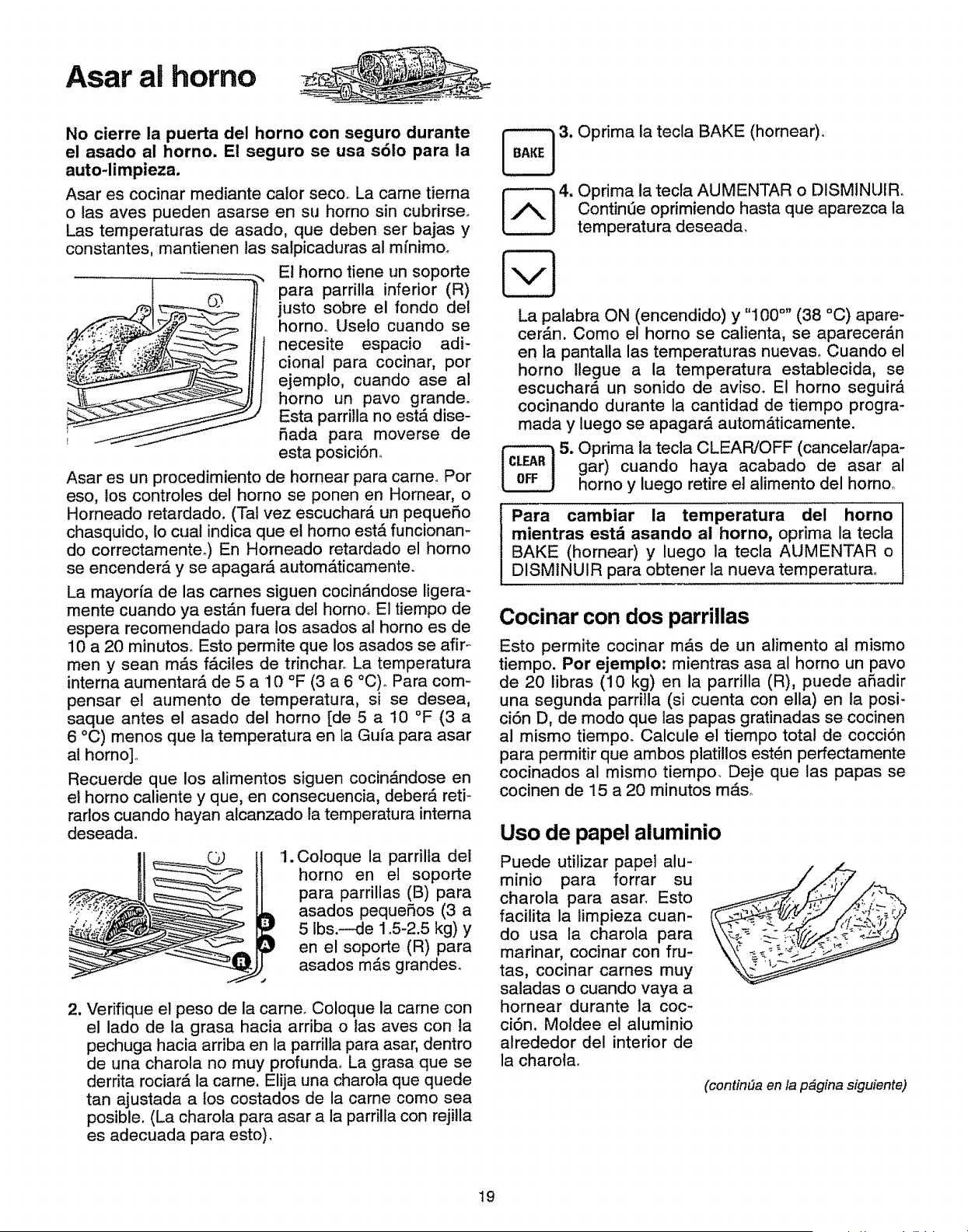
Asar al homo
No cierre la puerta del horno con seguro durante
el asado al horno. El seguro se usa s61o para la
auto-limpieza.
Asar es cocinar mediante calor seco. La came tierna
o las aves pueden asarse en su homo sin cubrirse_
Las temperaturas de asado, que deben ser bajas y
constantes, mantienen tas salpicaduras al mfnimoo
El homo tiene un soporte
para parrilla inferior (R)
justo sobre el fondo del
homo° Uselo cuando se
necesite espacio adi-
cional para cocinar, por
ejemplo, cuando ase al
horno un pavo grandeo
Esta parrilla no est,, dise-
, 5ada para moverse de
esta posiciSn_
Asar es un procedimiento de hornear para carne. Por
eso, los controles del homo se ponen en Hornear, o
Horneado retardado. (Tal vez escuchar_ un pequeSo
chasquido, Io cua! indica que et homo est,. funcionan-
do correctamente_) En Horneado retardado el homo
se encenderA y se apagar& autom_ticamente.
La mayorfa de las carnes siguen cocinAndose ligera-
mente cuando ya estAn fuera del homo° El tiempo de
espera recomendado para los asados al homo es de
10 a 20 minutos. Esto permite que los asados se afir*
men y sean mAs fAcites de trinchar. La temperatura
interna aumentarA de 5 a 10 °F (3 a 6 °C). Para com-
pensar el aumento de temperatura, si se desea,
saque antes el asado del horno [de 5 a i0 °F (3 a
6 °C) menos que la temperatura en la Gufa para asar
al homo]_
Recuerde que los alimentos siguen cocin_ndose en
el homo caliente y que, en consecuencia, deber& reti-
rarlos cuando hayan alcanzado la temperatura intema
deseada.
l.Cotoque la parrilta del
horno en el soporte
para parrillas (B) para
asados pequeSos (3 a
5 Ibs.--de 1.5-2.5 kg) y
en el soporte (R) para
asados mAs grandes.
2, Verifique el peso de la carne. Coloque la carne con
el lado de la grasa hacia arriba o las aves con la
pechuga hacia arriba en la parrilla para asar, dentro
de una charola no muy profunda. La grasa que se
derrita rociarA la came. Elija una charola que quede
tan ajustada a tos costados de la came como sea
posible. (La charola para asar a ta parrilla con rejilla
es adecuada para esto).
3. Oprima la tecla BAKE (hornear)o
4, Oprima la tecfa AUMENTAR o DISMINUtR.
ContinQe oprimiendo hasta que aparezca la
temperatura deseada.
La palabra ON (encendido) y "100 °" (38 °C) apare-
cerdn. Como el homo se calienta, se aparecerdn
en la pantalla las temperaturas nuevaso Cuando el
homo llegue a la temperatura estabtecida, se
escuchard un sonido de aviso, El homo seguird
cocinando durante la cantidad de tiempo progra-
mada y luego se apagard automdticamente.
5. Oprima la tecla CLEAR/OFF (cancelar/apa-
gar) cuando haya acabado de asar al
horno y luego retire et alimento del homo°
Para cambiar la temperatura del homo
mientras est_ asando al horno, oprima la tecla
BAKE (hornear) y luego la tecla AUMENTAR o
DISMINUIR para obtener la nueva temperaturao
Cocinar con dos parrillas
Esto permite cocinar mAs de un alimento al mismo
tiempo. Por ejemplo: mientras asa al horno un pavo
de 20 tibras (10 kg) en la parrilla (R), puede aRadir
una segunda parri]la (si cuenta con ella) en la posi-
ci6n D, de modo que las papas gratinadas se cocinen
al mismo tiempo. Calcule el tiempo total de cocci6n
para perrnitir que ambos platillos est_n perfectamente
cocinados al mismo tiempo. Deje que las papas se
cocinen de 15 a 20 minutos mAso
Uso de papel aluminio
Puede utilizar papel alu-
minio para forrar su
charola para asar. Esto
facilita la limpieza cuan-
do usa la charola para
marinar, cocinar con fru-
tas, cocinar carnes muy
saladas o cuando vaya a
hornear durante ta coc-
ci6n. Moldee el aluminio
alrededor del interior de
la charola_
(continUa en la p_gina siguiente)
19
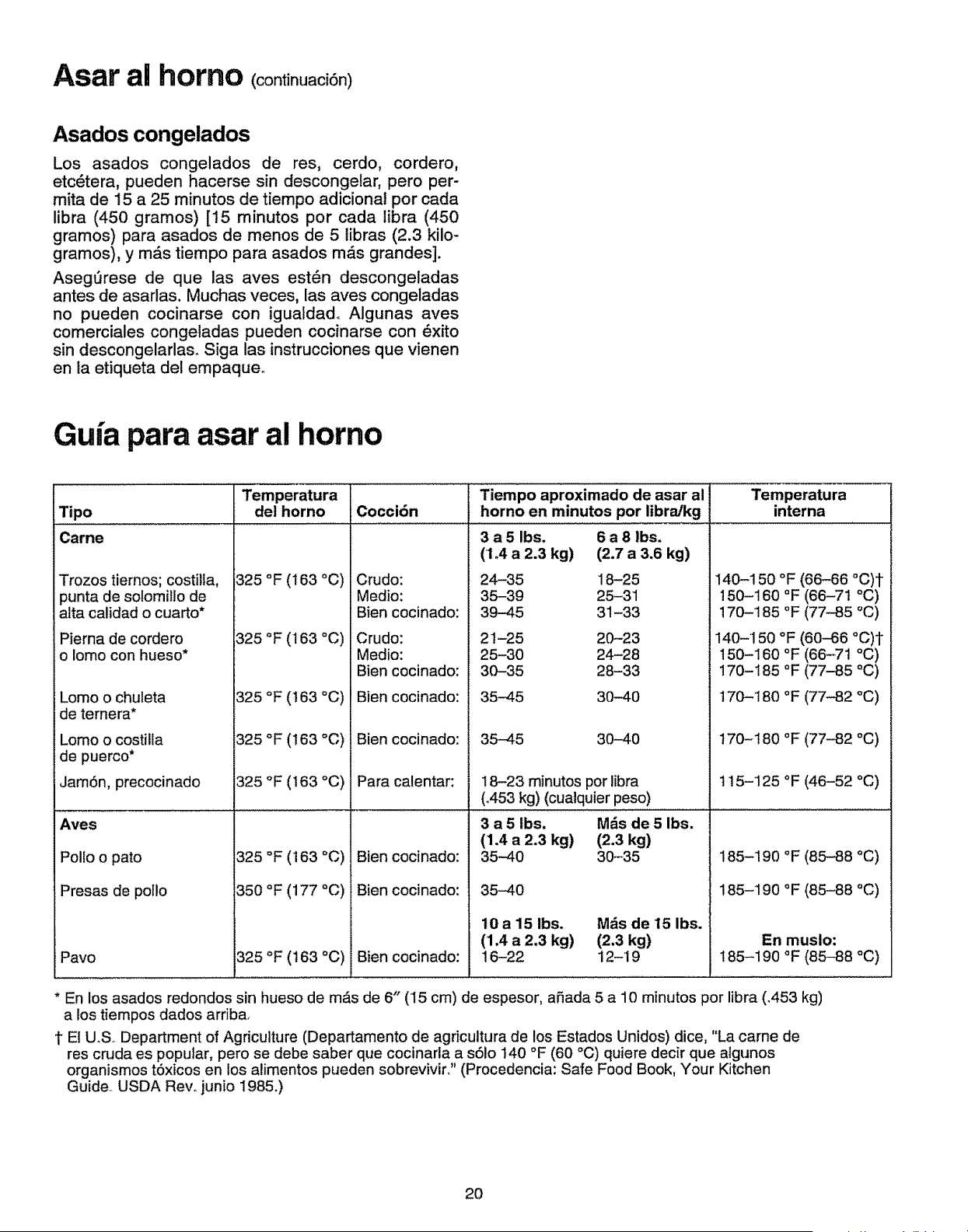
Asar ai homo (continuaci6n)
Asados congelados
Los asados congelados de res, cerdo, cordero,
etc6tera, pueden hacerse sin descongelar, pero per-
mita de 15 a 25 minutes de tiempo adicionat per cada
libra (450 gramos) [15 minutes per cada libra (450
gramos) para asados de menos de 5 tibras (2.3 kilo*
gramos), y m,_s tiempo para asados m_s grandes].
Aseg_rese de que las aves est6n descongeladas
antes de asarlas. Muchas veces, las ayes congeladas
no pueden cocinarse con igualdado Algunas aves
comerciales congeladas pueden cocinarse con _xito
sin descongelarlas. Siga las instrucciones que vienen
en la etiqueta del empaqueo
Gufa para asar al horno
Temperatura
Tipo del horno Cocci6n
Came
Trozos tiernos; costilla,
_unta de solomitlo de
alta calidad o cuarto*
Pierna de cordero
o Iomo con hueso*
Lomo o chuleta
de ternera*
Lomo o costilla
de puerco*
Jam6n, precocinado
Aves
Polio o pate
Presas de polio
Pave
325 °F (163 °C)
325 °F (163 °C)
325 °F (163 °C)
325 °F (163 °C)
Crude:
Medio:
Bien cocinado:
Crude:
Medio:
Bien cocinado:
Bien cocinado:
Bien cecinado:
3 a 5 Ibs.
(1.4 a 2.3 kg)
24-35
35-39
39-45
Tiempo aproximado de asar al Temperatura
horno en minutes per libra/kg interna
6a8 Ibs.
(2.7 a 3.6 kg)
18-25 140-150 °F (66-66 °C)1-
25-31 150-160 °F (66-7t °C)
31-33
2 t-25 20-23
25-30 24-28
30-35 28-33
35-45 3O-40
35-45 30-40
170-185 OF(77-85 °C)
140-'150 °F (60-66 °C)t
I50-160 °F (66-71 °C)
I70-I85 °F (77-85 °C)
t70-I80 °F (77-82 °C)
t70-180 OF(77-82 °C)
325 °F (163 °C)
325 °F (163 °C)
350 °F (177 °C)
325 °F (t63 °C)
Para calentar:
Bien cocinado:
Bien cocinado:
18-23 minutes per libra
(,453 kg) (cualquier peso)
Bien cocinado:
3 a 5 lbs. MRs de 5 Ibs.
(1.4 a 2.3 kg) (2.3 kg)
35-40 30-35
35-40
10a 15 Ibs. M_s de 15 Ibs,
(1.4 a 2.3 kg) (2.3 kg)
16-22 12-19
1! 5-125 °F (46-52 °C)
185-190 °F (85--88 °C)
185-190 °F (85-88 °C)
En muslo:
185-190 °F (85-88 °C)
* En los asados redondos sin hueso de m_.s de 6" (15 cm) de espesor, a_ada 5 a 10 minutos por libra (.453 kg)
a los tiempos dados arriba.
1"El U.S. Department of Agriculture (Departamento de agricultura de los Estados Unidos) dice, "La came de
res cruda es popular, pero se debe saber que cocinarla a e61o 140 °F (60 °C) quiere decir que algunos
organismos t6xicos en los alimentos pueden sobrevivir," (Procedencia: Safe Food Book, Your Kitchen
Guide.: USDA Revo junio I985.)
20
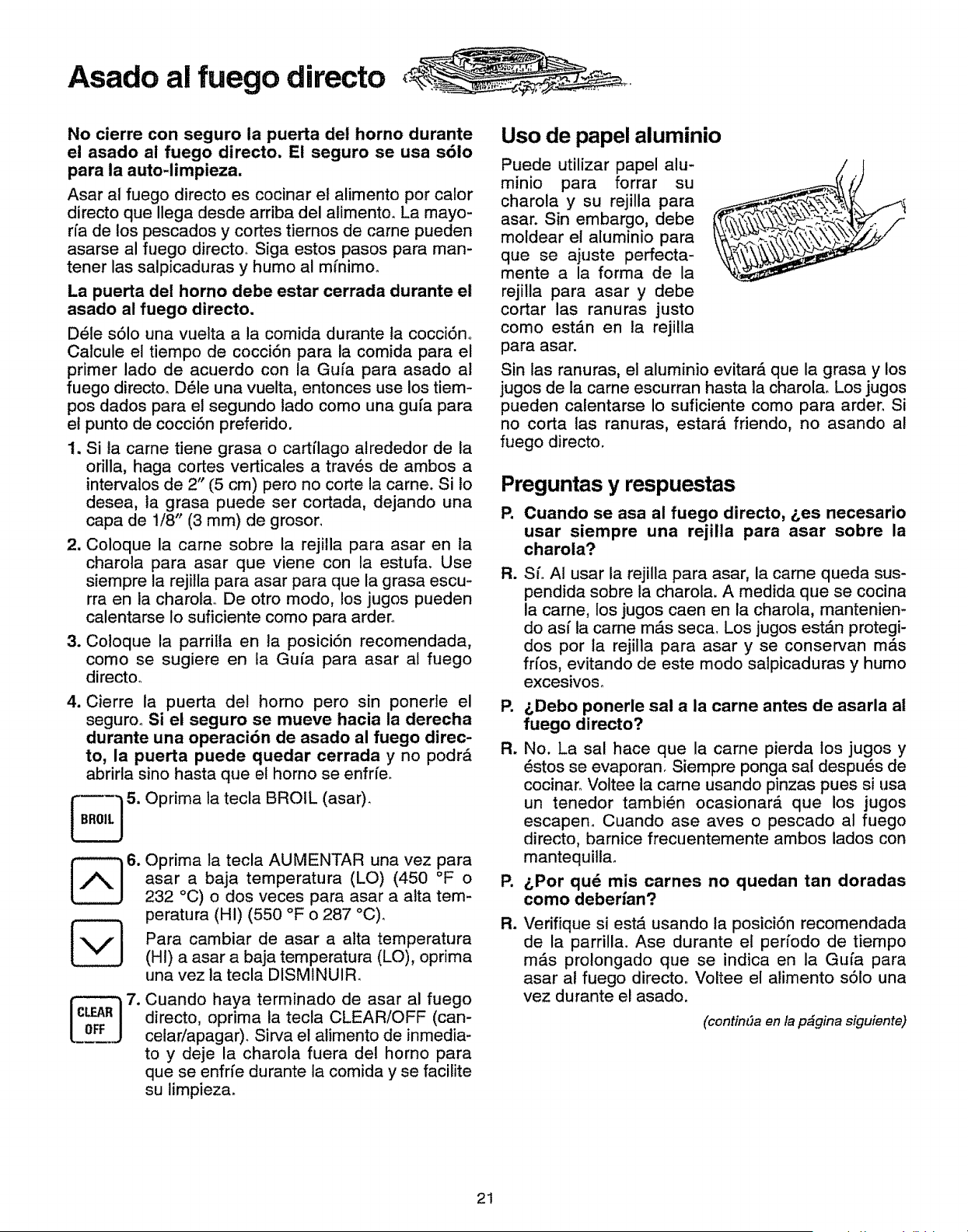
Asado al fuego directo
No cierre con seguro ia puerta del horno durante
el asado al fuego directo. El seguro se usa s61o
para la auto-limpieza.
Asar al fuego directo es cocinar et alimento por ca!or
directo que Ilega desde arriba del alimento_ La mayo-
rfa de los pescados y cortes tiernos de came pueden
asarse al fuego directoo Siga estos pasos para man-
tener las salpicaduras y humo al mfnimoo
La puerta del homo debe estar cerrada durante el
asado al fuego directo.
D_le s61o una vuelta a la comida durante ta cocci6no
Calcule el tiempo de cocci6n para la comida para el
primer lado de acuerdo con la Gufa para asado at
fuego directo, D_le una vuelta, entonces use los tiem*
pos dados para el segundo iado como una gufa para
et punto de cocci6n preferido.
1, Si ta came tiene grasa o cartflago alrededor de la
orilla, haga cortes verticales a trav_s de ambos a
intervalos de 2" (5 cm) pero no corte la came. Si Io
desea, la grasa puede ser cortada, dejando una
capa de 1/8" (3 ram) de grosor.
2. Coloque la came sobre la rejilla para asar en ia
charola para asar que viene con la estufa, Use
siempre la rejilla para asar para que la grasa escu-
rra en la charota,. De otro modo, los jugos pueden
calentarse Io suficiente como para arder.
3. Coloque la parrilta en la posici6n recomendada,
como se sugiere en la Gufa para asar al fuego
directoo
4. Cierre la puerta del horno pero sin ponede el
seguroo Si el seguro se mueve hacia la derecha
durante una operaci6n de asado al fuego direc-
to, la puerta puede quedar cerrada y no podr&
abrirla sino hasta que el homo se enfrfe.
5. Oprima la tecla BROIL (asar)_
Oprima la tecla AUMENTAR una vez para
asar a baja temperatura (LO) (450 °F o
232 °C) o dos veces para asar a atta tem-
peratura (HI) (550 °F o 287 °C),
Para cambiar de asar a alta temperatura
(HI) a asar a baja temperatura (LO), oprima
una vez la tecla DISMINUIR.
7_
Cuando haya terminado de asar al fuego
directo, oprima la tecla CLEAR/OFF (can-
cetar/apagar). Sirva el alimento de inmedia-
to y deje la charola fuera del horno para
que se enfrfe durante la comida y se facilite
su limpieza.
Uso de papel aluminio
Puede utilizar papel alu-
minio para forrar su
charola y su rejilla para
asar. Sin embargo, debe
moldear el aluminio para
que se ajuste perfecta-
mente a la forma de la
rejilla para asar y debe
cortar las ranuras justo
como est_n en la rejilla
para asar.
Sin las ranuras, el aluminio evitar_ que la grasa y los
jugos de la came escurran hasta la charola, Los jugos
pueden calentarse Io suficiente como para arder_ Si
no corta las ranuras, estar& friendo, no asando al
fuego directo.
Preguntas y respuestas
P. Cuando se asa al fuego directo, &es necesario
usar siempre una rejilla para asar sobre la
charola?
ai
P.
R.
P.
R.
SL AI usar la rejilla para asar, la carne queda sus-
pendida sobre la charola. A medida que se cocina
la came, los jugos caen en la charola, mantenien-
do asi la came m&s seca, Los jugos est&n protegi-
dos por la rejilla para asar y se conservan m_s
frfos, evitando de este modo salpicaduras y humo
excesivoso
&Debo ponerle sal a la carne antes de asarla al
fuego directo?
No. La sal hace que la came pierda los jugos y
_stos se evaporan. Siempre ponga sal despu_s de
cocinar_ Voltee la came usando pinzas pues si usa
un tenedor tambi_n ocasionar_ que los jugos
escapen. Cuando ase ayes o pescado al fuego
directo, barnice frecuentemente ambos lados con
mantequiilao
&Por qu_ mis carries no quedan tan doradas
como deberfan?
Verifique si est& usando la posici6n recomendada
de la parrilla. Ase durante el peffodo de tiempo
m&s prolongado que se indica en la Gufa para
asar al fuego directoo Voltee el alimento s61o una
vez durante el asado,
(continEta en la p#gina siguiente)
21
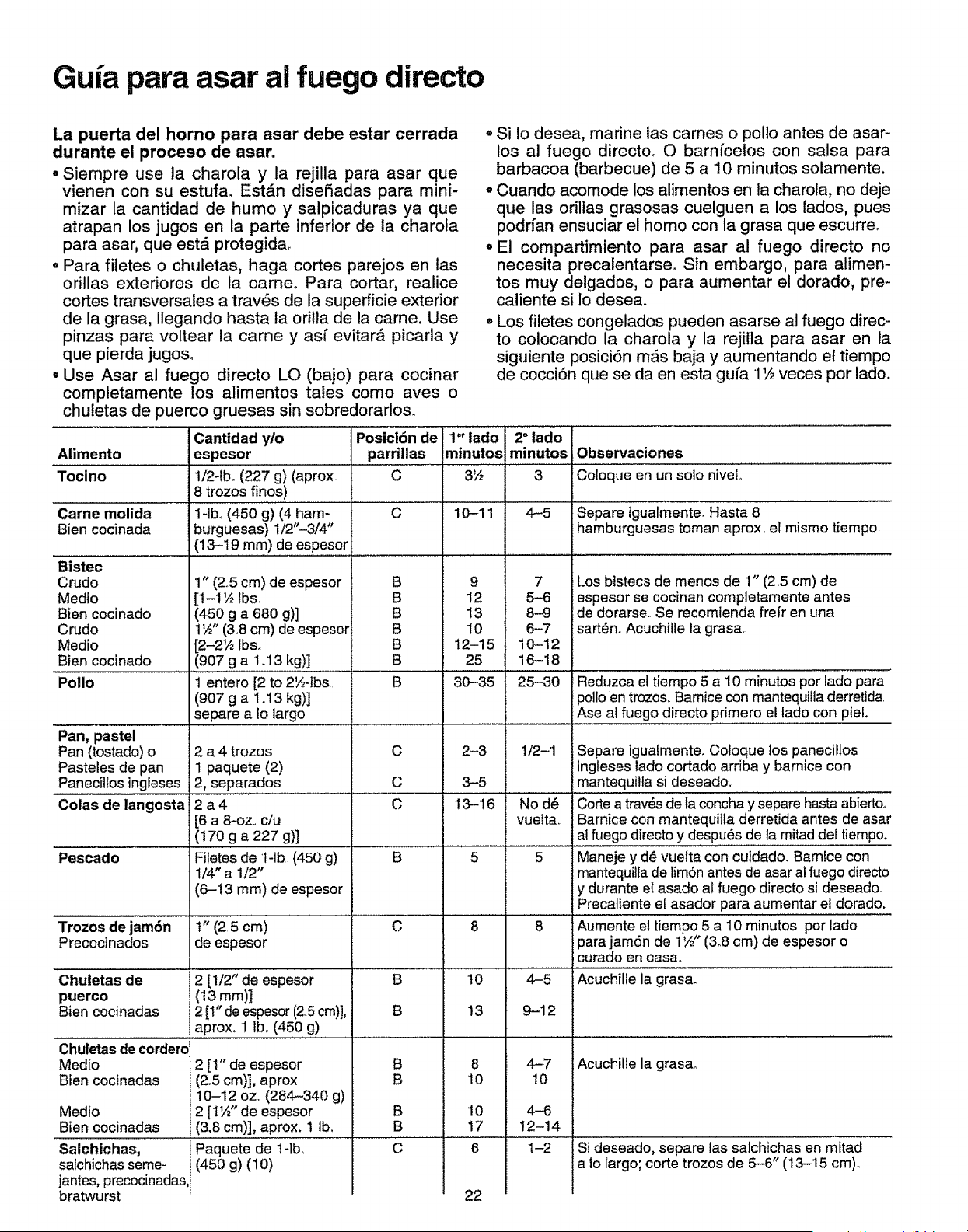
Gufa para asar ai fuego directo
La puerta del horno para asar debe estar cerrada
durante el proceso de asar.
• Siempre use la charola y la rejilla para asar que
vienen con su estufa. Est_n dise_adas para mini-
mizar la cantidad de humo y salpicaduras ya que
atrapan los jugos en la parte inferior de la charota
para asar, que estd protegidao
° Para filetes o chuletas, haga cortes parejos en tas
orillas exteriores de la came° Para cortar, realice
cortes transversales a tray, s de la supefficie exterior
de la grasa, Ilegando hasta la orilla de la carrie. Use
pinzas para voltear la came y asf evitarA picarla y
que pierda jugos.
° Use Asar al fuego directo LO (bajo) para cocinar
completamente los alimentos tales como aves o
chutetas de puerco gruesas sin sobredorarlos_
o Si Io desea, marine las carnes o polto antes de asar-
los al fuego directoo 0 barn[celos con salsa para
barbacoa (barbecue) de 5 a 10 minutos solamente.
o Cuando acomode los alimentos en la charola, no deje
que las oriltas grasosas cuelguen a los lados, pues
podrfan ensuciar el homo con la grasa que escurreo
• El compartimiento para asar al fuego directo no
necesita precalentarse. Sin embargo, para alimen-
tos muy delgados, o para aumentar el dorado, pre-
caliente si Io desea.
- Los filetes congelados pueden asarse al fuego direc-
to colocando la charola y la rejilla para asar en la
siguiente posiciSn m&s baja y aumentando et tiempo
de cocci6n que se da en esta gura 1 _Aveces por lado.
Alimento
Tocino
Came molida
Bien cocinada
Cantidad y/o
espesor
1/24bo (227 g) (aprox
8 trozos finos)
l-lb. (450 g) (4 ham-
burguesas) 1/2"-3/4"
(13-19 mm) de espesor
F_osicidn de 1" lado 2 ° lado
parrillas minutos minuto s Observaciones
C 3½ 3 Coloque en un solo nivel_
C 10-11 4--5 Separe igualmente. Hasta 8
hamburguesas toman aprox, et mismo tiempo
Bistec
Crudo
Medio
Bien cocinado
Crudo
Medio
Bien cocinado
1" (2,,5 cm) de espesor
[1-1½ Ibs,,
(450 g a 680 g)]
1½" (3,,8 cm) de espesor
[2-2½ Ibs.
(907 g a 1.13 kg)]
B 9 7
B I2 5-6
B I3 8-9
B 10 6-7
B I2-15 10-12
B 25 16-18
Los bistecs de menos de 1" (25 cm) de
espesor se cocinan completamente antes
de dorarseo Se recomienda frefr en una
sart6n. Acuchiile la grasa.
Polio 1 entero [2 to 2½-1bs.
(907 g a 1,,13 kg)]
separe a io largo
Pan, pastel
Pan (tostado) o 2 a 4 trozos
1 paquete (2)
Panecillos ingleses 2, separados
Colas de langosta 2 a 4
[6 a 8-oz., ciu
(170 g a 227 g)]
Pescado
Trozos de jam6n
Precocinados
Chutetas de
puerco
Bien cocinadas
Chuletas de cordero
Medio
Bien cocinadas
Medio
Bien cocinadas
Salchichas,
salchichas seme-
jantes, precocinadas
bratwurst
FiLetes de 1-1b, (450 g)
1/4" a 1/2"
(6-13 mm) de espesor
1"(25 cm)
de espesor
B
C
C
C
B
C
30-35 25-30 Reduzca el tiempo 5 a 10 minutos por lado para
polio en trozos. Bamice con mantequi!la derretidao
Ase al fuego directo primero el lado con piel.
2-3 1/2-1 Separe igualmente_ Coioque los panecillos
ingleses lado cortado arriba y barnice con
3-5 mantequilla si deseado.
13-16 No d_ Corte a trav_s de la concha y separe hasta abierto_
vuelta, Barnice con mantequitla derretida antes de asar
at fuego directo y despu_s de la mitad del tiempo.
5 5 Maneje y d_ vuelta con cuidado. Bamice con
mantequilla de limSn antes de asar al fuego directo
y durante el asado al fuego directo si deseado.
Precaliente el asador para aumentar el dorado.
8 8 Aumente el tiempo 5 a 10 minutos por lado
para jamSn de 1½" (3°8 cm) de espesor o
curado en casa.
2 [1/2" de espesor _ B ' i0 ...... 4-5 ...... Acuchiile la grasa.
(13 mm)]
2 [1" de espesor (25 cm)], B
aprox. 1 lb. (450 g) .......................
2 [1" de espesor B
(2.5 cm)], aprox, B
10-12 oz,, (284-340 g)
2 [1½" de espesor B
(3.8 cm)], aprox. 1 lb. B
Paquete de 1-1bo
(450 g) (10)
13 9-12
8 4-7
10 10
10 4-6
17 12-14
1-2
Acuchille la grasa,
Si deseado, separe las salchichas en mitad
a Io largo; corte trozos de 5-6" (13-15 cm),,
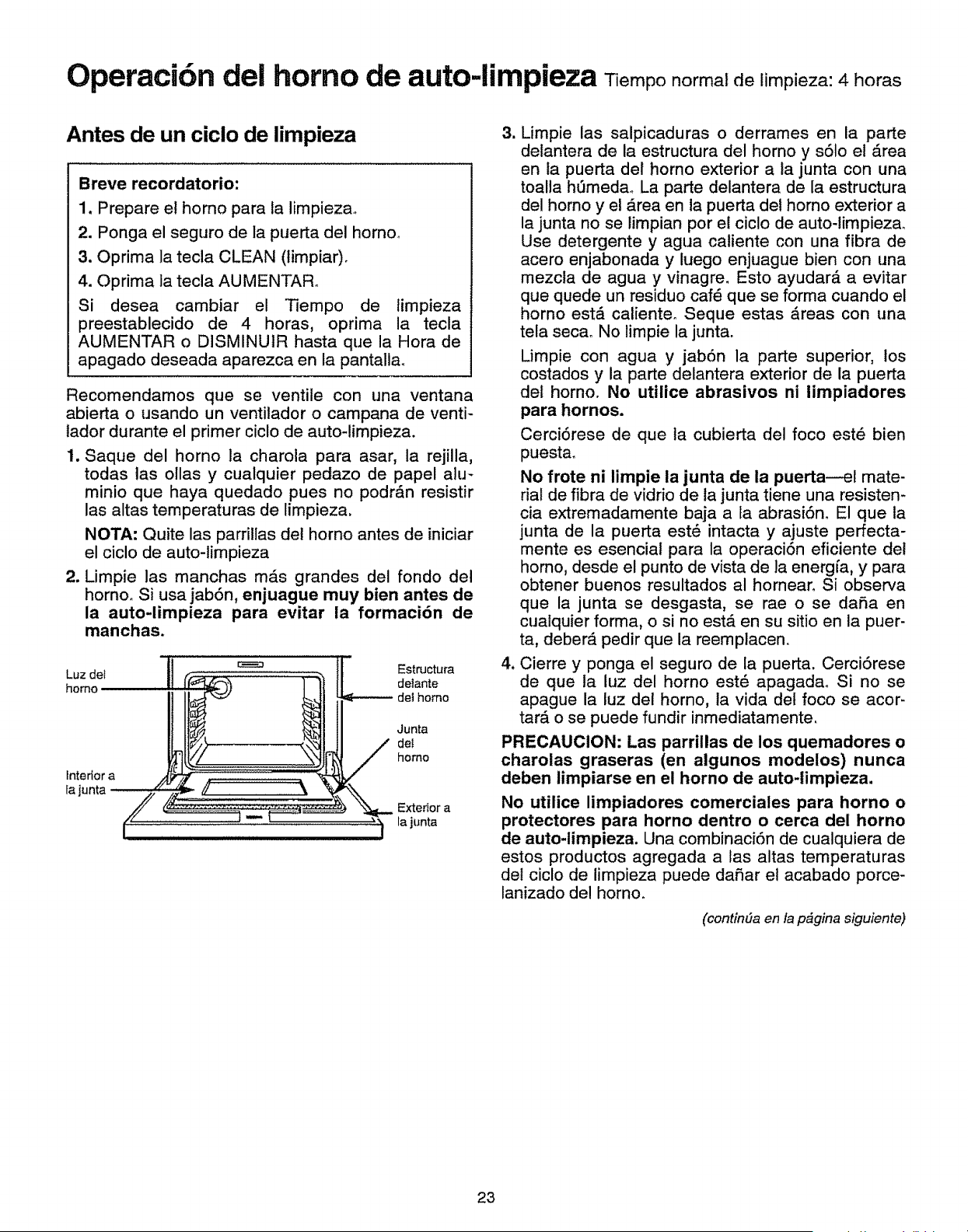
Operaci6n del homo de auto-limpieza "nemponormal de limpieza: 4 horas
Antes de un ciclo de limpieza
Breve recordatorio:
1. Prepare et homo para la limpieza.
2. Ponga el seguro de la puerta del homo°
3. Oprima la tecla CLEAN (timpiar)o
4. Optima la tecla AUMENTARo
Si desea cambiar el Tiempo de limpieza
preestablecido de 4 horas, optima la tecla
AUMENTAR o DISMINUIR hasta que la Hora de
apagado deseada aparezca en la pantalla.
Recomendamos que se ventile con una ventana
abierta o usando un ventilador o campana de venti-
tador durante el primer ciclo de auto-limpieza.
1. Saque del homo la charola para asar, la rejilla,
todas las ollas y cualquier pedazo de papel alu-
minio que haya quedado pues no podr_.n resistir
las altas temperaturas de limpieza.
NOTA: Quite las parrillas del homo antes de iniciar
el ciclo de auto-limpieza
2. Limpie las manchas m#,s grandes del fondo del
homo° Si usa jab6n, enjuague muy bien antes de
la auto-limpieza para evitar la formaci6n de
manchas.
Luz dei
homo
Interiora ._
la junta
i__ i
I i iii i
Estructura
delante
det homo
Junta
/ deI
_/ homo
) _'_ Exterior a
_- la junta
1
3. Limpie las salpicaduras o derrames en la parte
delantera de la estructura del horno y s61o el &rea
en la puerta del homo exterior a la junta con una
toalla hOmeda_ La parte delantera de la estructura
del homo y el ,_rea en la puerta del horno exterior a
la junta no se limpian por et ciclo de auto-limpieza.
Use detergente y agua caliente con una fibra de
acero enjabonada y luego enjuague bien con una
mezcla de agua y vinagre. Esto ayudar_ a evitar
que quede un residuo caf6 que se forma cuando el
homo est_ calienteo Seque estas &reas con una
tela secao No limpie la junta.
Limpie con agua y jab6n la parte superior, los
costados y la parte delantera exterior de la puerta
del homo. No utilice abrasivos ni limpiadores
para hornos.
Cerci6rese de que la cubierta del foco est_ bien
puesta.
No frote ni limpie la junta de la puerta--el mate-
rial de fibra de vidrio de la junta tiene una resisten-
cia extremadamente baja a la abrasi6n. El que la
junta de la puerta est_ intacta y ajuste perfecta-
mente es esencial para la operaci6n eficiente del
homo, desde el punto de vista de la energfa, y para
obtener buenos resultados al hornearo Si observa
que la junta se desgasta, se rae o se daSa en
cualquier forma, o si no est_ en su sitio en la puer-
ta, deber_, pedir que la reemplacen.
4, Cierre y ponga el seguro de la puerta. Cerci6rese
de que la luz del homo est6 apagada. Si no se
apague la luz del homo, la vida def foco se acor-
tar& o se puede fundir inmediatamente.
PRECAUOION: Las parrillas de los quemadores o
charolas graseras (en algunos modelos) nunca
deben limpiarse en el homo de auto-limpieza,
No utilice limpiadores comerciales para homo o
protectores para homo dentro o cerca del homo
de auto-limpieza. Una combinaci6n de cualquiera de
estos productos agregada alas altas temperaturas
del ciclo de limpieza puede daSar et acabado porce-
lanizado del homo.
(continSa en la p_gina siguiente)
23
Operacibn del horno de auto-limpieza (ooot ou o 6 )
C6mo preparar el horno para la limpieza
1, Siga los pasos en la secciSn Antes de un ciclo de
timpieza.
2, Cierre la puerta del horno y
deslice la manija del seguro
hacia la derecha, hasta el
tope. iiiiiiii
='F
Nunca fuerce ia manija del seguro de la puerta.
Forzar la manija puede causar dafios al mecanis-
mo del seguro de la puerta.
3. Oprima la tecla CLEAN (timpiar)o
4. Oprima la tecla AUMENTAR o DISM1NUIR hasta
que aparezca et Tiempo de limpieza deseado.
El Tiempo de limpieza normalmente es de 4 horaso
Puede modificar el tiempo entre 2 y 4 horas,
dependiendo de la cantidad de suciedad en el horno.
El ciclo de auto-limpieza comenzarA de manera
autom_.tica unos cuantos segundos despu_s de que
la palabra "CLEAN" (limpiar) aparece en ta pantalla y
la palabra "ON" (encendido) tambi_n. Cuando el
homo se calienta a una temperatura elevada, apare-
cerd la palabra "LOCK" (seguro) y, un poco despu_s,
la manija del seguro de la puerta estarA en posici6n,
No serd posible abrir la puerta sino hasta que la tem-
peratura baje de la temperatura indicada para el
seguro,
5. Cuando se apague la luz que dice LOCK (seguro),
deslice la manija det seguro hacia la izquierda,
hasta el tope y abra la puerta,
Para parar un ciclo de limpieza
Oprima la tecta CLEAR/OFF (cancetar/apagar). Esto
parard el ciclo de limpieza pero no se podrd abrir la
puerta hasta que el homo se enfrfe bajo la temperatu-
ra para cerraro
Despu_s de un ciclo de limpieza
Una vez que ha terminado el ciclo de limpieza, la
palabra "CLEAN" (limpiar) desaparecer_ de la pan-
talla y el horno comenzar_ a enfriarse. Cuando la
temperatura del homo es menor que la temperatura
del seguro, desaparece la palabra "LOCK" (seguro) y
la puerta puede abrirseo
Despu_s de un ciclo de limpieza, es posible que
observe un poco de ceniza btanca en el horno.
$51o Ifmpiela con una toalla ht_meda. Si fas manchas
blancas permanecen, quftelas con una fibra de acero
Ilena de jabSn. Cerci6rese de enjuagar perfectamente
con una mezcla de vinagre y agua_ Estos depSsitos
por Io general son residuos de sales que no pueden
quitarse en ciclo de limpieza_
Si el horno no queda limpio despu_s de un ciclo de
limpieza, el ciclo puede repetirse.
Si las parrillas no se deslizan con facilidad, frote los
costados de las parrillas con aceite de cocina.
24
C6mo demorar el inicio de la limpieza
El inicio demorado consiste en fijar el indicador de
tiempo det homo para iniciar el ciclo de limpieza en
un momento posterior a la hora actual del dfao
NOTA: Antes de comenzar, aseg_rese de que el reloj
muestre la hora correcta del dfa_
Breve recordatorioMinicio demorado para la
auto-limpieza
1. Prepare el homo para la limpieza.
2. Cierre y asegure la puerta del horno.
3. Oprima la tecla CLEAN (limpiar),
4. Oprima la tecla AUMENTAR o DISMtNUIR
hasta que aparezca el tiempo deseadoo
5. Oprima la tecla STOP TIME (hera de apagado),
6. E1 tiempo que aparece es 4 horas m&s tarde
que la hora del dfa. Oprima la tecla AUMENTAR
hasta que aparezca en la pantaIla Ia hora de
apagado que desea, El ciclo de auto-limpieza
se iniciar_, autom_ticamente 4 horas antes de la
hora de apagado que seleccion6,
Por ejemplo: Digamos que son las 7:00 y que usted
quiera que el horno comience la auto-limpieza alas
9:00, una vez que usted haya terminado de usar la
cocina.
1. Prepare el horno para la limpiezao
2. Cierre la puerta del horno y
deslice la manija det seguro
hacia la derecha hasta el i_
toper Cerci6rese de que la I||llllll
luz del horno est_ apagada,
Nunca fuerce la manija del seguro. Forzar la mani-
ja puede dafiar el mecanismo del seguro de la
puerta.
3. Oprima la tecla CLEAN (Iimpiar)o
4. Oprima Ia tecla AUMENTAR. El homo est,. listo.
5. El tiempo de limpieza est,_ preestablecido para 4
horaso Puede modificarlo para cualquier tiempo
entre 2 y 4 horas, dependiendo de la cantidad de
suciedad en el horno_ Si desea un tiempo de
limpieza m,_s corto, oprima la tecla DISMINUIR
hasta que aparezca e! tiempo de limpieza deseado.
J
Oprima la tecla STOP TIME (hora de apagado), En
la pantalta aparecer& "11:00" y se encender,_ y apa-
gar_. "STOP TIME" (hora de apagado)° El control
establece autom&ticamente la Hora de apagado
sumando el Tiempo de limpieza a la hora del dfa.
En este ejemplo, la hora del dfa es las 7:00 y el
Tiempo de limpieza es de 4 horas. Si se suman 4
horas a la hora del dfa, et resultado es que termi-
nard. a las 11:00,
7. Cambie el Tiempo de apagado de las 11:00 a la
•1:00 oprimiendo la tecia AUMENTAR hasta que la
"1:00" aparezca en la pantalla, Las palabras
"DELAY CLEAN" (demorar limpieza) tambi_n
aparecer&n en la pantalla.
El cic!o de auto-limpieza comenzar& autom&ticamente
a tas 9:00 y terminar_ a ]a 1:00o Alas 9:00 aparecer_
en la pantalla la palabra "ON" (encendido)_
Cuando el homo est,, cerrado con seguro, la palabra
"LOCK" (seguro) aparecer_ yen poco tiempo la mani-
ja de! seguro se cerrar& en su posiciSn, No ser_ posi-
ble abrir la puerta de! homo hasta que la temperatura
sea inferior a la temperatura del seguroo
Cuando termina el ciclo de limpieza, la palabra
"CLEAN" (limpiar) desaparecer_, de la pantalla y el
homo comenzar_ a enfriarse, Cuando la temperatura
sea inferior a la temperatura de seguridad, la palabra
"LOCK" (seguro) desaparece y la puerta puede
abrirse_
8. Cuando se apague la luz que dice LOCK (seguro),
deslice la manija hacia la izquierda, hasta el tope y
abra la puerta.
Nunca fuerce la manija del seguro. Espere hasta
que ia palabra "LOCK" (seguro) desaparezca de
ta pantalla. Forzar la manija puede dafiar el
mecanismo del seguro de la puerta.
25
Operaci6n del homo de auto=limpieza (continuaci6n)
Preguntas y respuestas
P. Si el reloj de mi horno no est_ puesto en la
hora correcta, &puedo aun asf Ilevar a cabo la
auto-limpieza de mi horno?
R, Si el reloj no est#. en la hora correcta, no podr_
programar la funci6n Demorar limpieza para que
termine a una hora determinada,
P. &Puedo utilizar iimpiadores comerciales para
horno en cualquier parte de mi homo de auto-
limpieza?
R. No deber_n usarse limpiadores ni recubrimientos
en ninguna parte de este homo. Si los usa y no los
enjuaga perfectamente con agua y limpia con una
teta hasta dejar la superficie perfectamente limpia
despu_s, el residuo puede despostillar la superficie
del homo y da5ar las partes met&licas la siguiente
vez que limpie autom&ticamente el horno.
P. &Qu_ debo hacer si durante la limpieza se pro-
duce humo en exceso?
R. Esto es causado por un exceso de suciedado
Optima la tecla CLEAR/OFF (cancelar/apagar),,
Abra las ventanas para que el humo salga de la
habitaci6n. Espere hasta que el homo se haya
enfriado y la palabra "LOCK" (seguro) desaparez_
ca de fa pantalla. Limpie con una tela el exceso de
cochambre y vuelva a programar el cicto de
limpieza.
P, &Es normal el "crujido" y el "estallido" que
escucho durante la limpieza?
R. Sf. Es el sonido del metal que se calienta y se
enffia tanto en tas funciones de cocinar como de
limpiar.
P. &Debe percibirse algt_n olor durante la limpieza?
R. Sf, puede haber un olor leve durante las primeras
limpiezas, Si no se limpi6 bien el exceso de
cochambre, _ste podrfa originar un fuerte olor
cuando se haga la limpieza.
P. &Qud origina las rayas parecidas a cabellos en
la superficie esmaltada de mi homo?
R. Esta es una condici6n normal que resulta de
calentar y enfriar durante la timpieza. Estas rayas
no afectan el desemper_o de su horno_
P. &Por qu_ quedan cenizas en mi horno despuds
de la limpieza?
R. Algunos tipos de suciedad o cochambre dejan un
dep6sito, que es ceniza. Puede quitarse con una
esponja o tela h_meda.
P. La palabra "door" (puerta) apareci6 en la pan-
talla cuando selecciond el Ciclo de limpieza.
&Qud sucede?
R. La manija del seguro de la puerta debe correrse
totalmente hasta la derech& Mueva la manija y la
timpieza empezar&
26
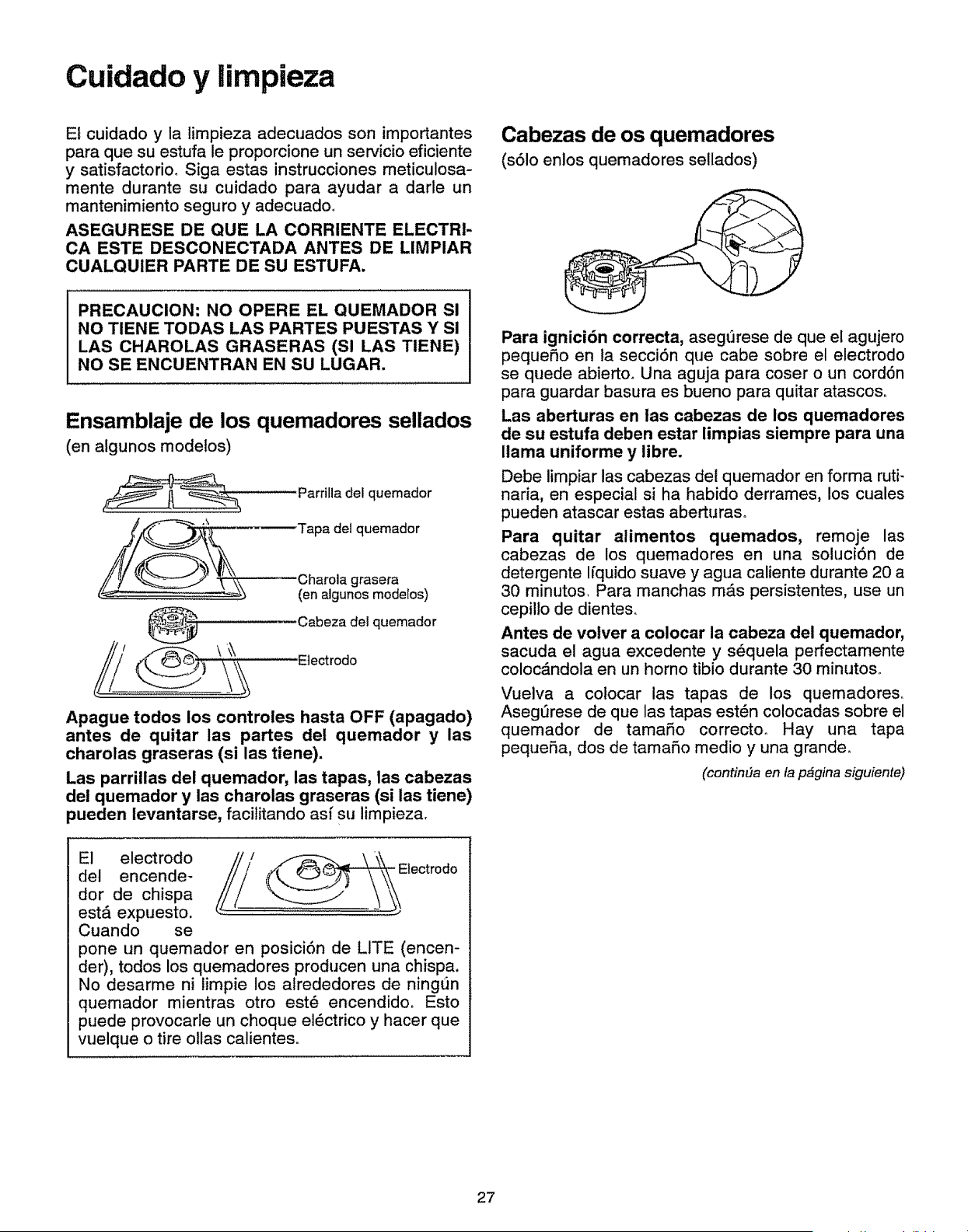
Cuidado y limpieza
El cuidado y la limpieza adecuados son importantes
para que su estufa le proporcione un servicio eficiente
y satisfactorio. Siga estas instrucciones meticulosa-
mente durante su cuidado para ayudar a darle un
mantenimiento seguro y adecuado_
ASEGURESE DE QUE LA CORRIENTE ELECTRI-
CA ESTE DESCONECTADA ANTES DE LIMPIAR
CUALQUIER PARTE DE SU ESTUFA.
Cabezas de os quemadores
(s61o enlos quemadores sellados)
PRECAUCION: NO OPERE EL QUEMADOR SI
NO TIENE TODAS LAS PARTES PUESTAS Y SI
LAS CHAROLAS GRASERAS (SI LAS TIENE)
NO SE ENCUENTRAN EN SU LUGAR.
Ensamblaje de los quemadores sellados
(en algunos modetos)
Parrilla del quemador
-_Tapa del quemador
_:_. Cabeza del quemador
//' _'} _''i_'_ E]ectrodo
Apague todos los controles hasta OFF (apagado)
antes de quitar las partes del quemador y las
charolas graseras (si las tiene).
Las parriilas del quemador, las tapas, las cabezas
del quemador y las charolas graseras (si las tiene)
pueden levantarse, facititando asf su limpiez&
Para ignici6n correcta, aseg(_rese de que el agujero
pequeSo en la secciSn que cabe sobre el electrodo
se quede abierto_ Una aguja para coser o un cord6n
para guardar basura es bueno para quitar atascos.
Las aberturas en tas cabezas de los quemadores
de su estufa deben estar limpias siempre para una
llama uniforme y libre.
Debe limpiar las cabezas del quemador en forma ruti-
naria, en especial si ha habido derrarnes, los cuales
pueden atascar estas aberturaso
Para quitar alimentos quemados, remoje las
cabezas de los quemadores en una solud6n de
detergente Ifquido suave y agua caliente durante 20 a
30 minutos. Para manchas mAs persistentes, use un
cepillo de dientes.
Antes de volver a colocar la cabeza del quemador,
sacuda el agua excedente y s_quela perfectamente
coloc_.ndola en un homo tibio durante 30 minuto&
Vuelva a colocar las tapas de los quemadore&
Asegt3rese de que las tapas est_n colocadas sobre el
quemador de tamaSo correctoo Hay una tapa
pequeSa, dos de tamafio medio y una grandeo
(continUa en la p_gina siguiente)
E,e,ectro0o
det encende- lectrodo
dor de chispa
estd expuesto.
Cuando se
pone un quemador en posiciSn de LITE (encen-
der), todos los quemadores producen una chispa.
No desarme ni limpie los atrededores de ningt3n
quemador mientras otro est_ encendido, Esto
puede provocarle un choque el_ctrico y hacer que
vuelque o tire ollas calienteso
27
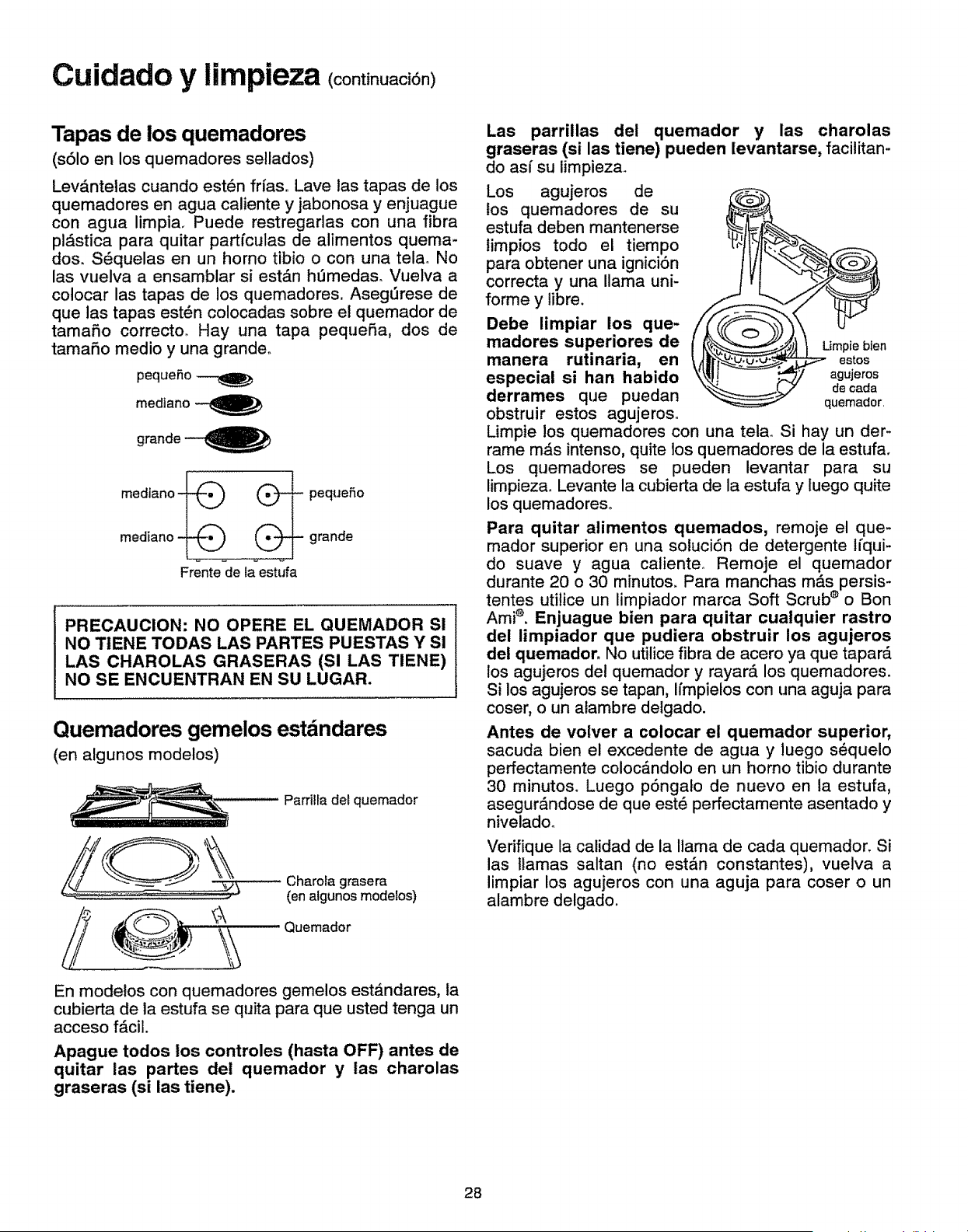
Cuidado y limpieza (continuaci6n)
Tapas de los quemadores
(s61o en los quemadores sellados)
Lev&ntelas cuando est_n frfas° Lave las tapas de los
quemadores en agua caliente y jabonosa y enjuague
con agua limpia. Puede restregarlas con una fibra
pldstica para quitar partfculas de alimentos quema-
dos. S6quelas en un horno tibio o con una telao No
las vuelva a ensamblar si estAn hemedas. Vuelva a
colocar las tapas de los quemadores. Aseg_rese de
que las tapas est_n colocadas sobre el quemador de
tamaSo correctoo Hay una tapa pequeSa, dos de
tamar3o medio y una grande.
pequeSo
mediano
od, oo-
mediano - --_
Frente de la estufa
pequefio
grande
PRECAUCION: NO OPERE EL QUEMADOR SI
NO TIENE TODAS LAS PARTES PUESTAS Y SI
LAS CHAROLAS GRASERAS (SI LAS TIENE)
NO SE ENCUENTRAN EN SU LUGAR.
Quemadores gemelos estdndares
(en algunes modelos)
Parrilfa del quemador
Charola grasera
(en algunos modelos)
' Quemador
En modelos con quemadores gemelos est_.ndares, la
cubierta de la estufa se quita para que usted tenga un
acceso f&cil.
Apague todos los controles (hasta OFF) antes de
quitar ias partes del quemador y las charolas
graseras (si las tiene).
Las parrillas del quemador y las charolas
graseras (si las tiene) pueden levantarse, facilitan-
do asf su limpieza.
Los agujeros de
los quemadores de su
estufa deben mantenerse
limpios todo el tiempo
para obtener una ignici6n
correcta y una llama uni-
forme y libre.
Debe limpiar los que-
madores superiores de Ltmpieblen
manera rutinaria, en estos
especial si han habido agujeros
de cada
derrames que puedan quemador.
obstruir estos agujeroso
Limpie los quemadores con una tela. Si hay un der-
rame mds intenso, quite los quemadores de la estufa.
Los quemadores se pueden levantar para su
limpiezao Levante la cubierta de la estufa y fuego quite
los quemadoreso
Para quitar alimentos quemados, remoje el que-
mador superior en una soluci6n de detergente ifqui-
do suave y agua calienteo Remoje el quemador
durante 20 o 30 minutos. Para manchas m_s persis-
tentes utilice un limpiador marca Soft Scrub ® o Bon
Ami _. Enjuague bien para quitar cualquier rastro
del limpiador que pudiera obstruir los agujeros
del quemador. No utilice fibra de acero ya que tapard
los agujeros del quemador y rayard los quemadores.
Si los agujeros se tapan, Ifmpielos con una aguja para
coser, o un alambre delgado.
Antes de volver a colocar el quemador superior,
sacuda bien el excedente de agua y luego s_quelo
perfectamente colocdndolo en un homo tibio durante
30 minutos. Luege p6ngafo de nuevo en la estufa,
asegurdndose de que est_ peffectamente asentado y
nivelado.
Verifique la calidad de la llama de cada quemador, Si
las llamas saltan (no estdn constantes), vuelva a
limpiar los agujeros con una aguja para coser o un
alambre delgado.
28
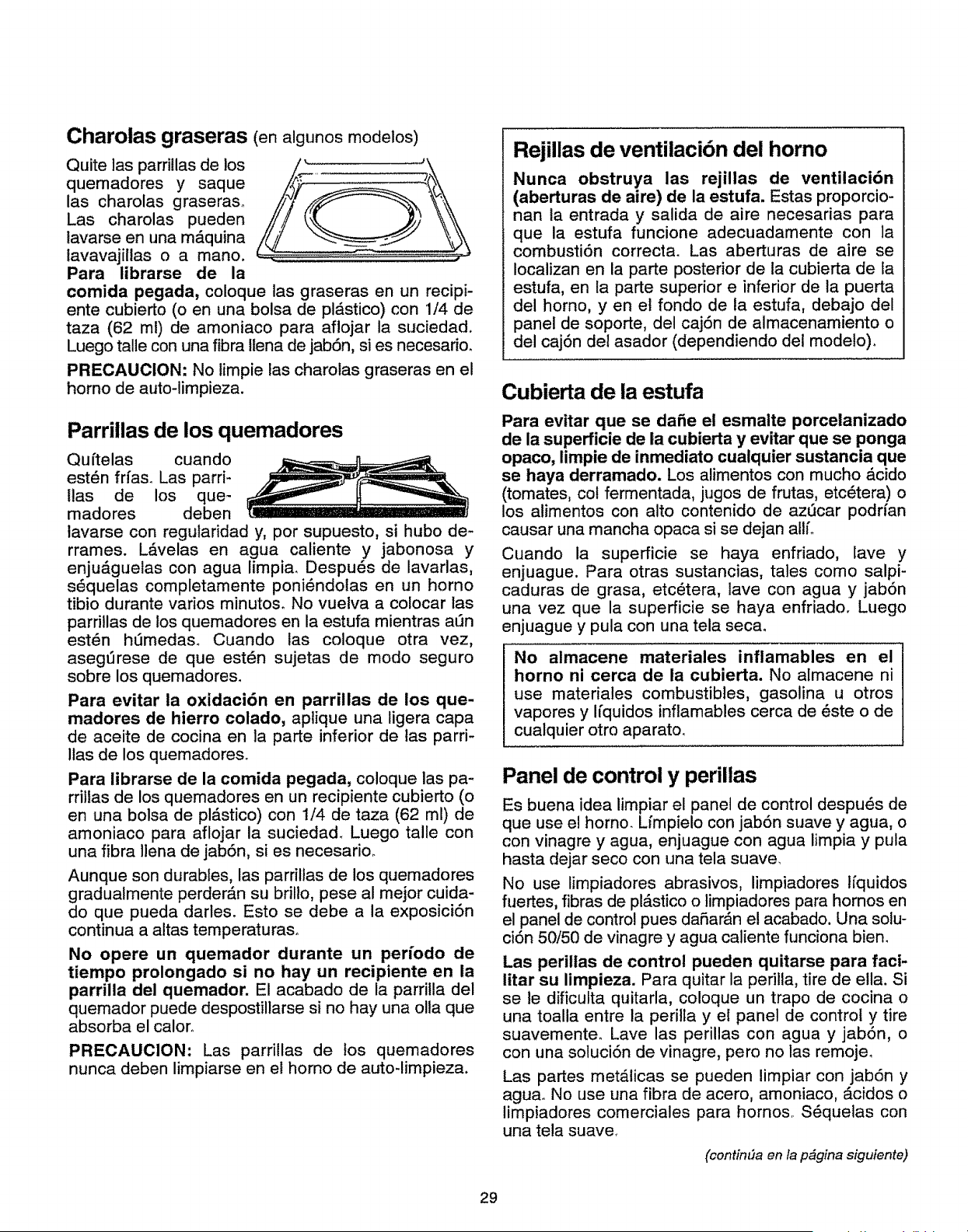
Charolas graseras (en algunos modelos)
Quite las parrillas de los '_
quemadores y saque
las charolas graseraso
Las charolas pueden
lavarse en una m_,quina
lavavajillas o a mano.
Para tibrarse de la
comida pegada, coloque las graseras en un recipi-
ente cubierto (o en una bolsa de pl&stico) con 1/4 de
taza (62 ml) de amoniaco para aflojar la suciedad.
Luego talle con una fibra Itena de jab6n, si es necesario.
PREOAUCION: No limpie tas charolas graseras en el
homo de auto-limpieza.
Parriilas de los quemadores
Quftelas cuando
est_n frfa& Las parri-
llas de los que_
madores deben
tavarse con regularidad y, por supuesto, si hubo de-
rrames. LAvelas en agua caliente y jabonosa y
enju_gueias con agua limpi& Despu_s de lavarlas,
s_quelas completamente poni_ndotas en un homo
tibio durante varios minutos. No vuelva a colocar tas
parrillas de los quemadores en la estufa mientras at3n
est_n ht_medas_ Cuando las coloque otra vez,
asegt_rese de que est_n sujetas de modo seguro
sobre los quemadores.
Para evitar la oxidaci6n en parrillas de los que-
madores de hierro colado, aplique una ligera capa
de aceite de cocina en la parte inferior de las parri-
Itas de los quemadores.
Para iibrarse de la comida pegada, coloque las pa-
rrillas de los quemadores en un recipiente cubierto (o
en una bolsa de pl&stico) con t/4 de taza (62 ml) de
amoniaco para aflojar la suciedad. Luego talle con
una fibra llena de jab6n, si es necesarioo
Aunque son durables, las parrillas de los quemadores
gradualmente perder_.n su brillo, pese al mejor cuida-
do que pueda darles. Esto se debe a la exposici6n
continua a altas temperaturaso
No opere un quemador durante un peri'odo de
tiempo prolongado si no hay un recipiente en la
parrilla del quemador. El acabado de la parrilla del
quemador puede despostillarse si no hay una olla que
absorba el calor..
PRECAUClON- Las parrillas de ios quemadores
nunca deben limpiarse en el homo de auto-limpieza.
Rejillas de ventilacibn del homo
Nunca obstruya las rejillas de ventilaci6n
(aberturas de aire) de la estufa. Estas proporcio-
nan la entrada y salida de aire necesarias para
que la estufa funcione adecuadamente con la
combusti6n correcta. Las aberturas de aire se
Iocalizan en la parte posterior de la cubierta de fa
estufa, en la parte superior e inferior de la puerta
del homo, yen el fondo de ta estufa, debajo del
panel de soporte, del caj6n de almacenamiento o
del caj6n del asador (dependiendo del modelo).
Cubierta de la estufa
Para evitar que se daSe el esmaite porcelanizado
de la superficie de la cubierta y evitar que se ponga
opaco, limpie de inmediato cualquier sustancia que
se haya derramado. Los alimentos con mucho _.cido
(tomates, cot fermentada, jugos de frutas, etc_tera) o
los alimentos con alto contenido de azL_car podrfan
causar una mancha opaca si se dejan atlL
Cuando la superficie se haya enfriado, lave y
enjuague. Para otras sustancias, tales como salpi-
caduras de grasa, etc_tera, lave con agua y jab6n
una vez que la superficie se haya enfriado. Luego
enjuague y pula con una tela seca.
No almacene materiales inflamables en el
horno ni cerca de la cubierta. No atmacene ni
use rnateriates combustibles, gasolina u otros
vapores y Ifquidos inflamables cerca de _ste o de
cualquier otro aparato.
Panel de control y perillas
Es buena idea limpiar el panel de control despu_s de
que use el homo. Lfmpielo con jab6n suave y agua, o
con vinagre y agua, enjuague con agua limpia y pula
hasta dejar seco con una tela suave,
No use limpiadores abrasivos, limpiadores Ifquidos
fuertes, fibras de pl&stico o timpiadores para homes en
el panel de control pues da5ar&n e! acabado. Una solu-
ci6n 50/50 de vinagre y agua caliente funciona bien.
Las perillas de control pueden quitarse para faci-
litar su limpieza. Para quitar la perilla, tire de ella. Si
se le dificulta quitarla, coloque un trapo de cocina o
una toalla entre la perilla y el panel de control y tire
suavemente. Lave las perillas con agua y jab6n, o
con una soluci6n de vinagre, pero no las remoje_
Las partes met_licas se pueden limpiar con jab6n y
aguao No use una fibra de acero, amoniaco, &cidos o
limpiadores comerciales para hornos.. S_quelas con
una tela suave_
(continE_a en fa p#gina siguiente)
29
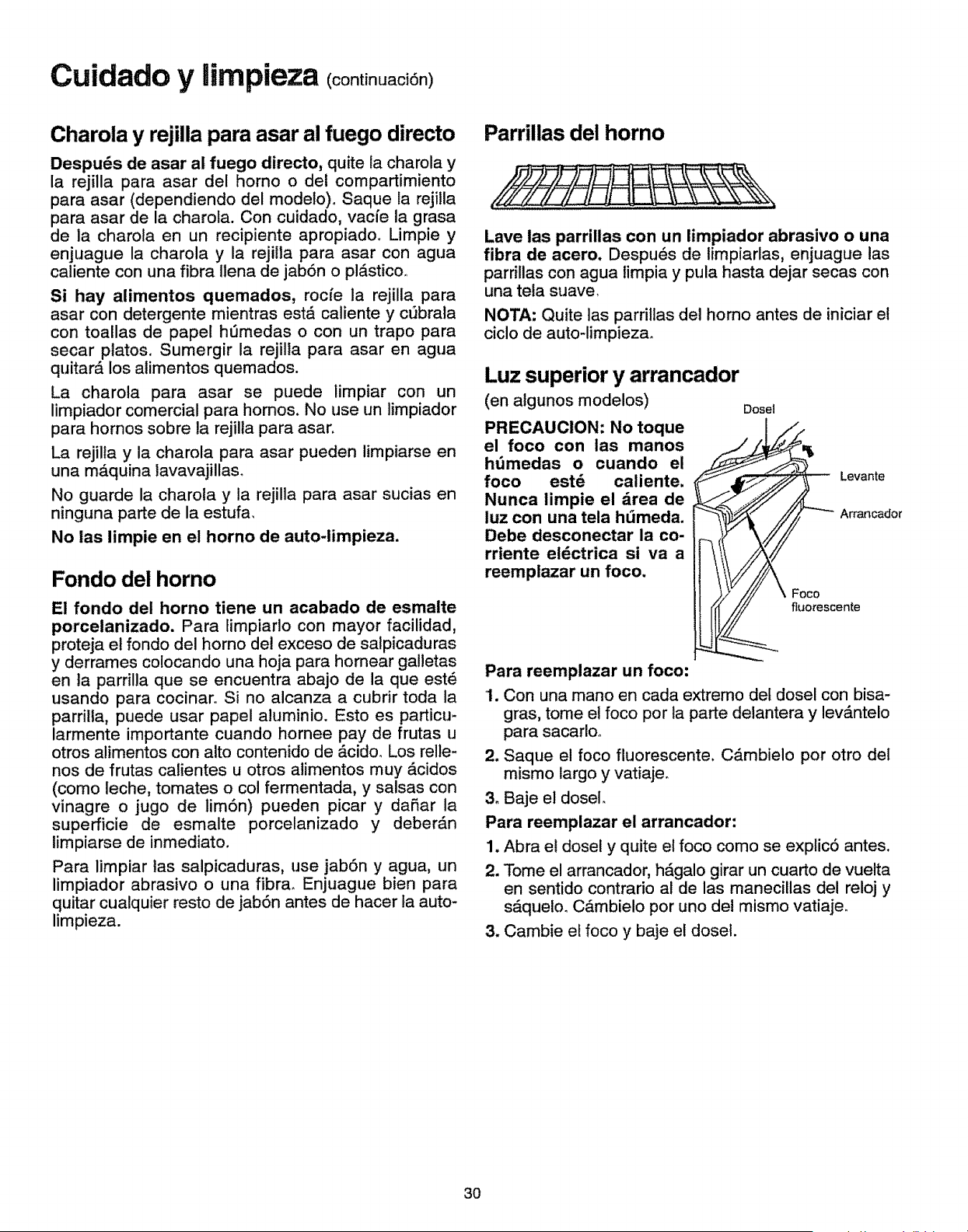
Cuidado y iimpieza (continuaci6n)
Charola y rejilla para asar al fuego directo
Despuds de asar al fuego directo, quite la charola y
la rejilla para asar del homo o del compartimiento
para asar (dependiendo del modelo). Saque la rejilla
para asar de la charola. Con cuidado, vacfe la grasa
de la charola en un recipiente apropiado_ Limpie y
enjuague la charola y la rejilla para asar con agua
caliente con una fibra Ilena de jab6n o pl#.stico,
Si hay alimentos quemados, rocfe la rejilla para
asar con detergente mientras est_ caliente y ct_brata
con toallas de papel ht_medas o con un trapo para
secar platos. Sumergir la rejilla para asar en agua
quitar_, los alimentos quemados.
La charola para asar se puede limpiar con un
limpiador comercial para homos. No use un limpiador
para hornos sobre la rejilla para asar.
La rejilta y la charola para asar pueden limpiarse en
una m,_quina lavavajillas_
No guarde la charola y la rejilla para asar sucias en
ninguna parte de la estufa,
No las limpie en el homo de auto-limpieza.
Fondo del horno
El fondo del homo tiene un acabado de esmalte
porcelanizado. Para limpiarlo con mayor facilidad,
proteja el fondo del homo del exceso de satpicaduras
y derrames colocando una hoja para hornear galletas
en la parrilla que se encuentra abajo de la que est6
usando para cocinaro Si no alcanza a cubrir toda la
parrilla, puede usar papel aluminio. Esto es particu-
larmente importante cuando hornee pay de frutas u
otros alimentos con alto contenido de _.cido. Los relle-
nos de frutas calientes u otros alimentos muy &cidos
(como lethe, tomates o col fermentada, y salsas con
vinagre o jugo de lim6n) pueden picar y daSar la
superficie de esmalte porcelanizado y deberdn
limpiarse de inmediato.
Para limpiar las salpicaduras, use jab6n y agua, un
limpiador abrasivo o una fibra. Enjuague bien para
quitar cualquier resto de jab6n antes de hacer la auto-
limpieza.
Parrillas del horno
Lave las parrillas con un limpiador abrasivo o una
fibra de acero. Despuds de limpiarlas, enjuague las
parrillas con agua lirnpia y pula hasta dejar secas con
una tela suave.
NOTA: Quite tas parritlas det homo antes de iniciar el
ciclo de auto-limpieza_
Luz superior y arrancador
(en atgunos modelos)
PREOAUOION: No toque
el foco con las manos
h_medas o cuando el
foco est_ caliente,
Nunca limpie el _rea de
luz con una tela hlJmeda.
Debe desconectar la co-
rriente el_ctrica si va a
reemptazar un foco.
Para reemplazar un foco:
Dosel
• -- _ _) Levante
fluorescente
1. Con una mano en cada extremo del dosel con bisa-
gras, tome el foco por la parte delantera y levAntelo
para sacarloo
2. Saque el foco fluorescente. CAmbielo por otro del
mismo largo y vatiaje.
3_ Baje el dosel.
Para reemplazar el arrancador:
1. Abra et dosel y quite el foco como se explic6 antes.
2, Tome el arrancador, h&galo girar un cuarto de vuelta
en sentido contrario al de las manecillas del reloj y
s&quelo. C_.mbielo por uno del mismo vatiaje.
3. Cambie el foco y baje et dosel.
3O
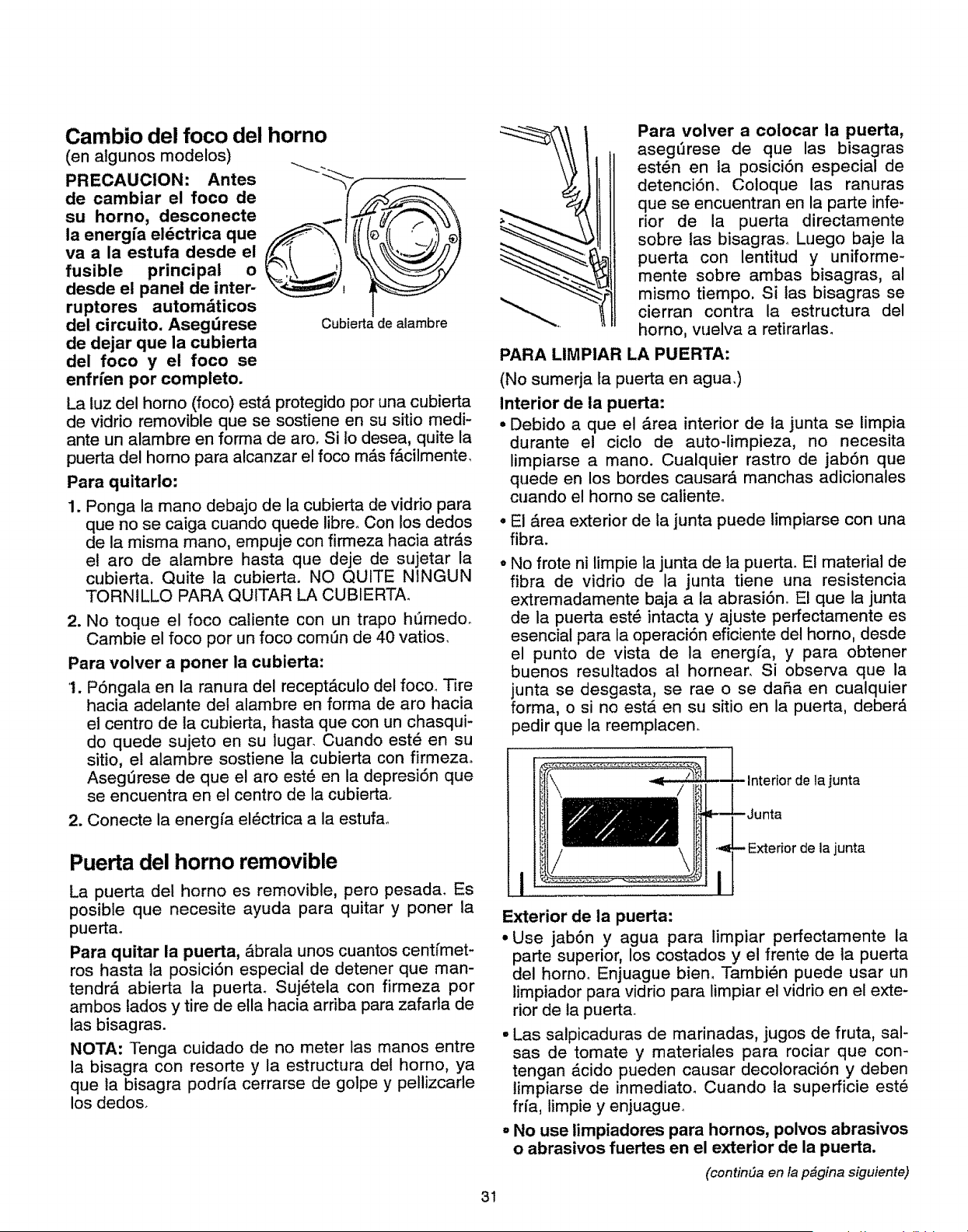
Cambio del foco del horno
(en algunos modelos)
PRECAUCION: Antes "_'_'-(f
de cambiar el foco de , ,
su horno, desconecte 1_
ia energfa eldctrica qu_ @
va a la estufa desde
fusible principal o
desde el panel de inter-
ruptores automfiticos
del circuito. Asegdrese Cubierta de alambre
de dejar que la cubierta
del foco y el foco se
enfrfen por completo.
La tuz del homo (foco) estd protegido por una cubierta
de vidrio removible que se sostiene en su sitio medi-
ante un alambre en forma de aro. Si 1odesea, quite la
puerta de! homo para alcanzar el foco m_.s f&cilmente.
Para quitarlo:
1, Ponga la mano debajo de la cubierta de vidrio para
que no se caiga cuando quede libreo Con los dedos
de la misma mano, empuje con firmeza hacia atr,_s
e! aro de alambre hasta que deje de sujetar la
cubierta. Quite la cubierta. NO QUITE NINGUN
TORNILLO PARA QUtTAR LA CUBIERTA.
2. No toque el foco caliente con un trapo h{3medoo
Cambie el foco por un foco comt_n de 40 vatios.
Para volver a porter la cubierta:
1. P6ngala en la ranura del recept,_culo del foco. Tire
hacia adelante del alambre en forma de aro hacia
et centro de ta cubierta, hasta que con un chasqui-
do quede sujeto en su lugar. Cuando estd en su
sitio, el alambre sostiene la cubierta con firmeza.
Aseg0rese de que el aro est_ en la depresi6n que
se encuentra en el centro de la cubierta.
2. Conecte la energfa el_ctrica a la estufa.
Puerta del horno removible
La puerta del homo es removibte, pero pesada. Es
posible que necesite ayuda para quitar y poner la
puerta.
Para quitar la puerta, _.brala unos cuantos centfmet-
ros hasta la posici6n especial de detener que man-
tendrd abierta la puerta. Suj_tela con firmeza por
ambos tados y tire de ella hacia arriba para zafarta de
tas bisagras.
NOTA" Tenga cuidado de no meter las manos entre
la bisagra con resorte y la estructura del homo, ya
que la bisagra podrfa cerrarse de golpe y pellizcarle
los dedos.
Para volver a colocar la puerta,
aseg0rese de que las bisagras
est_n en la posici6n especial de
detenciSn. Coloque las ranuras
que se encuentran en la parte infe-
rior de la puerta directamente
sobre las bisagraso Luego baje la
puerta con lentitud y uniforme-
mente sobre ambas bisagras, al
mismo tiempo. Si las bisagras se
cierran contra la estructura del
homo, vuelva a retirarlas.
PARA LIMPIAR LA PUERTA:
(No sumerja fa puerta en agua.)
Interior de ia puerta:
• Debido a que el drea interior de ta junta se limpia
durante el cicto de auto-limpieza, no necesita
limpiarse a mano. Cualquier rastro de jab6n que
quede en los bordes causard manchas adicionales
cuando el homo se caliente°
• El drea exterior de fa junta puede limpiarse con una
fibra.
° No frote ni limpie la junta de la puerta. El material de
fibra de vidrio de la junta tiene una resistencia
extremadamente baja a la abrasi6n. El que la junta
de la puerta est_ intacta y ajuste perfectamente es
esencial para la operaci6n eficiente del homo, desde
el punto de vista de la energfa, y para obtener
buenos resultados al hornear. Si observa que la
junta se desgasta, se rae o se dafia en cualquier
forma, o si no estd en su sitio en la puerta, deberd
pedir que la reemplacen,.
Interior de la junta
la junta
31
Exterior de ia puerta:
• Use jab6n y agua para limpiar perfectarnente la
parte superior, los costados y el frente de la puerta
del homo° Enjuague bien. Tambi_n puede usar un
limpiador para vidrio para limpiar el vidrio en el exte-
rior de la puerta.
° Las salpicaduras de marinadas, jugos de fruta, sal-
sas de tomate y materiales para rociar que con-
tengan dcido pueden causar decoloraci6n y deben
timpiarse de inmediato. Cuando la superficie est_
frfa, limpie y enjuagueo
• No use timpiadores para hornos, polvos abrasivos
o abrasivos fuertes en el exterior de la puerta.
(contin6a en la p_gina siguiente)
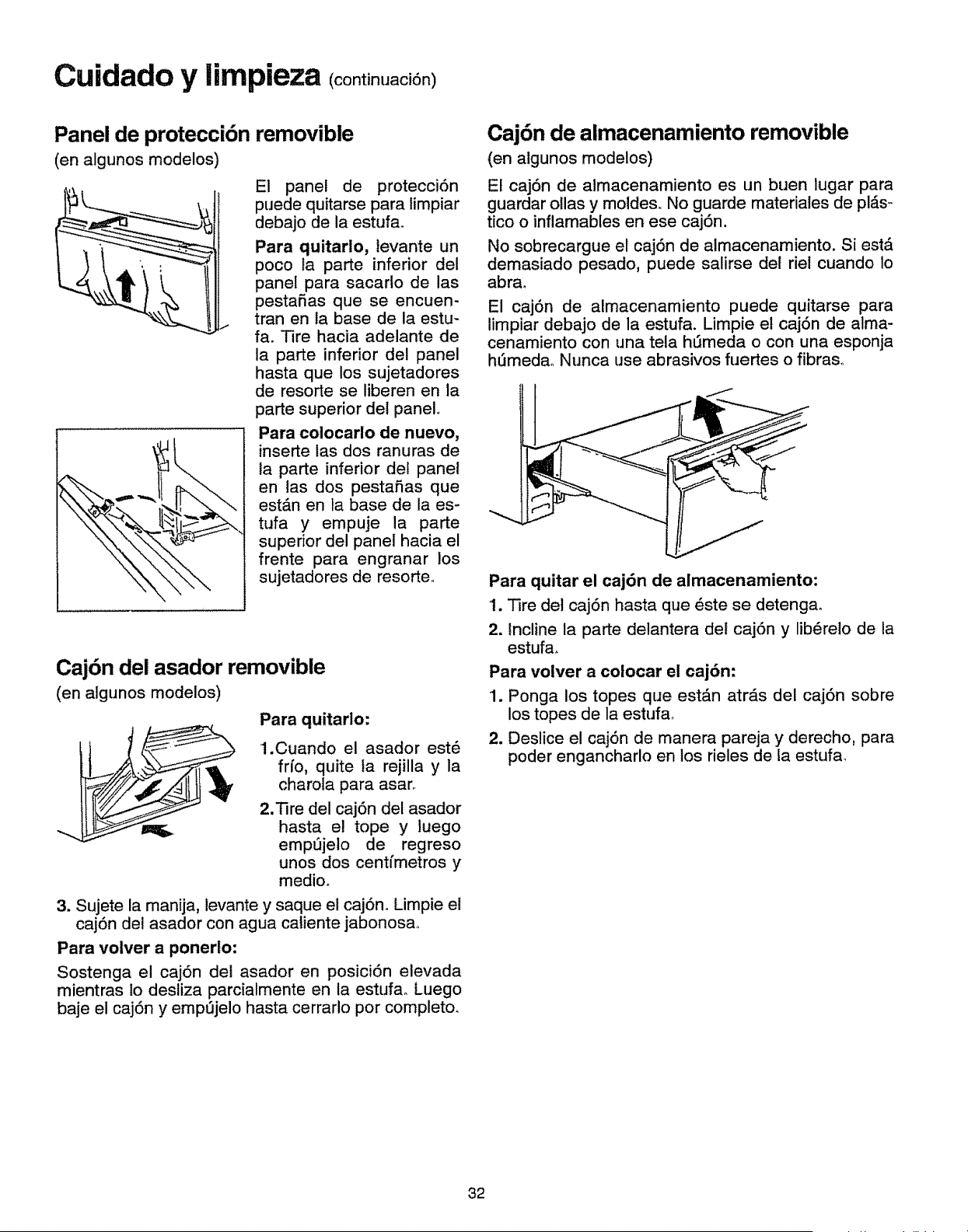
Cuidado y iimpieza (continuaci6n)
Panel de protecci6n removible
(en algunos modelos)
E1 panel de protecci6n
puede quitarse para limpiar
debajo de la estufa.
Para quitarlo, levante un
poco la parte inferior del
panel para sacarlo de las
pestafias que se encuen-
tran en Ia base de la estu-
fa. Tire hacia adelante de
la parte inferior de! panel
hasta que los sujetadores
de resorte se liberen en la
parte superior del panel°
Para colocarlo de nuevo,
inserte las dos ranuras de
la parte inferior del panel
en las dos pestafias que
est_.n en la base de la es-
tufa y empuje la parte
superior del panel hacia el
frente para engranar los
sujetadores de resorte
Caj6n del asador removible
(en algunos modelos)
Para quitarlo:
1.Cuando el asador est6
fifo, quite ta rejilla y la
charola para asar_
2,Tire del caj6n del asador
hasta e! tope y luego
empt)jelo de regreso
unos dos centfmetros y
medio°
3. Sujete la manila, levante y saque et caj6no Limpie e!
caj6n del asador con agua catiente jabonosa+.
Para volver a ponerlo:
Sostenga el caj6n del asador en posici6n elevada
mientras Io desliza parcialmente en la estufao Luego
baje el caj6n y empQjelo hasta cerrarlo por completo.
Caj6n de almacenamiento removible
(en algunos modelos)
El caj6n de almacenamiento es un buen lugar para
guardar ollas y moide& No guarde materiales de pl_s o
tico o inflamables en ese caj6n,
No sobrecargue el caj6n de almacenamiento. Si est&
demasiado pesado, puede salirse del riel cuando 1o
abr&
El cajSn de almacenamiento puede quitarse para
limpiar debajo de la estufa. Limpie el cajSn de alma-
cenamiento con una tela h_meda o con una esponja
homed& Nunca use abrasivos fuertes o fibras
Para quitar el caj6n de almacenamiento:
1. Tire del caj6n hasta que 6ste se detengao
2. Incline la parte delantera del caj6n y lib6relo de la
estufao
Para volver a colocar el caj6n:
1. Ponga los topes que estdn atr_fis del caj6n sobre
los topes de la estufao
2. Deslice el caj6n de manera pareja y derecho, para
poder engancharlo en los rieles de la estufa.
32
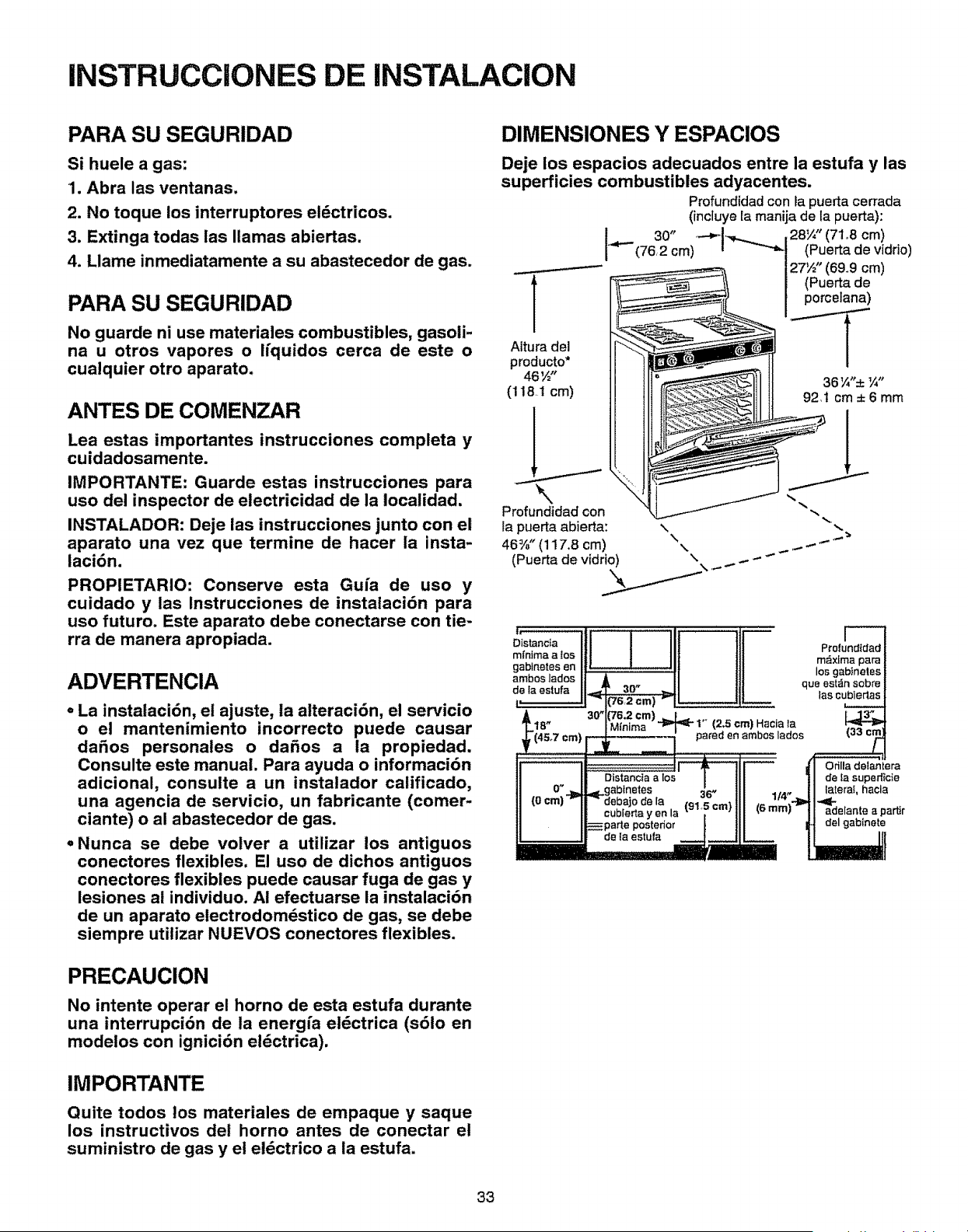
INSTRUCCIONES DE INSTALACION
PARA SU SEGURIDAD
Si huele a gas:
1. Abra las ventanas.
2. No toque los interruptores eldctricos.
3. Extinga todas las llamas abiertas.
4. Llame inmediatamente a su abastecedor de gas.
PARA SU SEGURIDAD
No guarde ni use materiales combustibles, gasoli-
na u otros vapores o Ifquidos cerca de este o
cualquier otro aparato.
ANTES DE COMENZAR
Lea estas importantes instrucciones completa y
cuidadosamente.
IMPORTANTE: Guarde estas instrucciones para
uso del inspector de electricidad de la Iocalidad.
INSTALADOR: Deje las instrucciones junto con el
aparato una vez que termine de hacer la insta-
laci6n.
Conserve esta Guia de uso y
cuidado y ias Instrucciones de instalaci6n para
uso futuro. Este aparato debe conectarse con tie-
rra de manera apropiada.
ADVERTENCIA
- La instalaci6n, el ajuste, la alteraci6n, el servicio
o el mantenimiento incorrecto puede causar
da_os personales o da_os ala propiedad.
Consulte este manual. Para ayuda o informaci6n
adicional, consulte a un instalador calificado,
una agencia de servicio, un fabricante (comer-
ciante) o al abastecedor de gas.
, Nunca se debe votver a utilizar los antiguos
conectores flexibles. El uso de dichos antiguos
conectores flexibles puede causar fuga de gas y
lesiones ai individuo. At efectuarse la instalaci6n
de un aparato etectrodomdstico de gas, se debe
siempre utilizar NUEVOS conectores flexibles.
PRECAUCION
No intente operar el homo de esta estufa durante
una interrupci6n de la energfa eldctrica (s61o en
modelos con ignici6n eldctrica).
IMPORTANTE
Quite todos los materiales de empaque y saque
los instructivos del horno antes de conectar el
suministro de gas y el el_ctrico a la estufa.
DIMENSIONES Y ESPACIOS
Deje los espacios adecuados entre la estufa y las
superficies combustibles adyacentes.
Profundidadconta puertacerrada
(incluye Eamanija de la puerta):
I 30"
"1" (76 2 cm)
]
Attura del
producto*
46 t/_"
(118,1 cm)
lJ
\
Profundidad con
la puerta abierta:
46¾"(117.8 cm)
(Puerta de viddo)
\
\
\
\
36 ¼"± ¼"
92,1 cm ± 6 mm
tstancta
l/ntma a tos
c abinetes en
mbos lados
o la estufa
I
30_ (76.2 cm) __.
=18" Minima 7" <F I _ (2.5 cm) Hac
, (45_7 cm) ......... pared en ambos
J, ,
I
Distancta a los |
_j_ .,g.gabtnetes 36"=
(Ocm) "_ _ debajodela f91 5cm; 16n
cubierta yen la " 'r "
_parte posterior |
de ta estula
Prolundtdad i
m_xima pare i
los gabtneies !
que est_n sobre _
las eubiertas i
(33 C=
Odlla delantera
de la supedicte
lateral, hacla
adelente a partJr
del gablnete
33
' IINSTRUCCIONES DE SEGURIDAD llViPORTANTES
_!::,,La instalaci6n de esta estufa debe estar en con-
formidad .con los c6digos locales o, en ausencia
de c6digos locales, conel C6digo Nacional de
GasCombustible, :IANSI Z223.1, edici6n mds
reciente. En Canadd, la instalaci6n se debe con-
format con el C6digo de Instalaci6n de Gas
Natural, CAN/CGA-B149.1 o el C6digo de
lnstalaci6n de Propano corriente, CAN/CGA-
B149;2 yc6digos locales donde aplicables.
:-EE! disefio de esta estufa est,. certificada por la
• _:Asaciaci6n Americana de Gas, de acuerda con el
ANS Z21,1, edici6n m#,s reciente y la Asociaci6n
Canadiense de Gas seg6n el CAN/CGA-1 _1la edici6n
m_.s:reciente, A/igual que con cualquier aparato que
utilice gas y genere calor, existen ciertas precau-
ciones:deseguridad que debe Seguir. Encontrar_.
estas precaucianes al principio de la secci6n Usa y
cuidado de este manual. L_atas con gran cuidado.
,Cansiga que su estufa sea instalada por un ins-
talador calificado o pot un t_cnico de servicia.
-Su estufa debe estar el_ctricamente canectada a
tietra de acuerdo con Io establecida en los c6digos
locales ol en ausencia de c6digos lacales, de acuer-
do con el C6digo El_ctrico Nacional (ANSI!NFPA 70,
edici6n m#,s reciente)_ En Canada., ta conexi6n a la
:: :tierraet_ctrica debe estar de acuerdo con el CSA
C22.1 C6digo El_ctrico Canadiense Parte 1 co-
rriente y/o los c6digas locales.
• Antes de instalar su estufa sobre lin61eo o sobre
cualquier otro recubrimiento sint_tico para suela,
r :cerci6rese de que el recubrimienta resista tem-
peraturas de 180 °F (82 °C) sin encogerse, carru-
garse o decotorarse, No instale la estufa sobre
atfombra a menos que utilice una hoja de madera
terciada de 1/4" (6 ram) de grosor o un aislante si-
milar colocado entre la estufa y la alfombra.
°Aseg13rese de que los recubrimientos de las pare-
des que rodean la estufa puedan resistir el calor que
genera la estufa, hasta 200 °F (93 °C),
• Evite colacar los gabinetes sobre la estufa. Para
reducir el desgo causado al tratar de alcanzarlas por
encima de las llamas abiertas de los quemadores en
operaci6n, instale una campana de ventilaci6n sobre
la estufa que se proyecte hacia adelante por Io menos
5" (12_7cm)m_s que el frente de tas gabinetes,
• La campana de ventilaci6n debe fabricarse de I&mi-
nade metal de un espesor no menas de 0o0122"
(.31ram). Inst_.lese sobre la cubierta dejando un
espacio por la menos de 1/4" (6 mm) entre la cam-
pana yla parte inferior del material combustible o del
gabinete :metAlicoo La campana debe de ser al
menos tan ancha como la estufa. El espacia entre
la superficie para cacinar y la campana de venti-
laci6r_ JAMAS DEBE SER MENOS DE 24" (61 cm),,
EXCEPClON: La instalaci6n sobre la cubierta de un
horna microondas o aparato de cocci6n en lista se
debe conformar alas instruccianes de instalaci6n
envasadas con ese aparata.
° Si se calacan gabinetes sabre la estufa, deje un
espacia mfnimo de 30" (76.2 cm) entre la superficie
para Cocinar y la parte inferior de las gabinetes sin
ioroteCci6n.
=Si no se puede mantener un espacio de 30"
(76.2 cm) entre la superficie para cocinar y el mate-
rial combustible que est_ arriba o los gabinetes
met_.licos, proteja la parte inferior de los gabinetes
que est_n sobre la superficie para cocinar con un
pedazo de cart6n piedra aislante de por la menos
1/4": (6 mm) cubierto con una hoja de metal de no
menos de 0.0122" (.31 mm) de espesor.
- El espacio entre la superficie para cocinar y los gabi-
netes protegidos JAMAS DEBE SER MENOS DE
24" (61 cm). La distancia vertical de la parte plana
de la superficie de cocinar:hasta el fondo det los
gabinetes superiares adyacentes que sobresalgan
menos de 1" (2.5 cm) con respecto al piano de los
costados de la estufa no debe ser menos de 18"
(45.7 cm). (Vea la ilustraci6n de Dimensiones y
espacios en esta secci6n.)
° PRECAUCION: Artfculos de interns a los nifios no
se deben guardar dentro de los armarios encima de
una estufa o sabre la consola posterior de la estu*
fa--los nifios que suben a la estufa para tomar algo
pueden dafiarse gravemente.
ADVERTENCIA--Todas tas
estufas se pueden volcar y los dafios pueden /t,,/_ ,_
resultar. Para evitar volcaduras accidentales
de la estufa, sujete un Aparata anti-vol-
caduras aprobado a la pared. (Vea Instalar el
aparato anti-valcaduras de esta secci6no)
Para verificar si el aparato est_ bien instalada
y enganchado, cuidadosamente incline la
estufa hacia adelante. El Aparato anti-valcaduras se
debe enganchar e impedir que la estufa se vuetqueo
Si tire ta estufa de ia pared par cualquier raz6n, aseg6rese
de que el Aparato anti-volcaduras se enganche cuando
vuelva a colocar la estufa contra la pared.
= Para su seguridad, nunca use su estufa para calen-
tar la habitaci6n. Su homo y cubierta de estufa no
son disefiados para calentar la cocin& Los que-
madores superiares no se deben operar sin tener
recipientes sobre las parrillas de los quemadores.
Tal abuso se puede resultar en fuego y dafio a la
estufa y anular& la garantfa.
• No guarde ni use materiales combustibles, gasolina
u otros vapores o Ifquidos cerca de este o cualquier
otro aparatoo Las explosiones o fuegas se podrfan
resultar.
° Na use el harno para guardar casas. Los artfculos
guardadas en el horna pueden encenderse.
-No deje que la grasa de cocina u otros materiales
inflamables se acumulen dentro o cerca de la estufa.
34
Instrucciones de instalacibn
GENERALIDADES
• Consulte los datos relativos alas dimensiones y
espacios en esta secci6n para conocer las dimen-
siones para empotrar y los espacios requeridos,
Estas dimensiones deben satisfacerse de modo que
usted tenga un uso seguro de su estufa, La Ioca-
lizaci6n de la toma de corriente el6ctrica y de la
abertura para el tubo de gas (vea Localizaci6n del
tubo de gas y de la toma de corriente) pueden ajus-
tarse para satisfacer los requerimientos especfficos.
°La estufa puede colocarse sin dejar espacio
[0" (0 cm)] atr_.s (empotrada) contra la parte poste-
rior y los costados de la estufa.
COLOCAClON
No coloque la estufa donde pueda estar sujeta a co-
rrientes de aire fuerte& Cualesquiera aberturas en el
suelo o en la pared detr&s de la estufa deber_n se-
Ilarseo Aseg_rese de que las aberturas alrededor de la
base que proporcionan aire fresco para la combusti6n
y la ventilaci6n no se encuentren obstruidas por
alfombra o madera.
PROTEJA SU SUELO
Su estufa, como muchos otros aparatos elec-
trodom_sticos, es pesada y puede colocarse en
recubrimientos suaves para sue!o, tales como vinilo
acolchonado o alfombra, Tenga cuidado cuando
mueva la estufa en este tipo de suelo. Se recomienda
seguir las instrucciones sencillas y econ6micas a con-
tinuaci6n para proteger su piso.
La estufa debe instalarse sobre una hoja de madera
terciada (o de un material similar). Cuando el
recubrimiento del suelo termine en la parte delantera
de la estufa, el Area sobre la que descansar_, la estufa
deber_, fabricarse con madera terciada al mismo nivel
o un poco mAs arriba que el recubrimiento del suelo.
Esto permitir_, que la estufa pueda moverse para
limpiarla o darle servicio,
LOCALIZACION DEL MODELO Y DEL
NUMERO DE SERIE
Dependiendo de su estufa, encontrar#, et modelo y los
n_meros de serie en una etiqueta en la parte
delantera de la estructura, detr&s del caj6n de alma-
cenamiento, del caj6n del asador o del panel de pro-
tecci6no
HERRAMIENTAS QUE NECESITARA
° Destornilladores pianos y Phillips
° Un IApiz y una regla
° Dos Ilaves para tubo (una de repuesto)
° Una Itave ajustable de 1¾"
° Llaves de tuercas o Ilave ajustable: 3/16"y 1/4"
MATERIALES ADICIONALES QUE NECE-
SITARA
° Una v&lvula o Itave de paso para cerrar el suministro
de gas°
° Seltador para tuberfa o una cinta adhesiva para tubo
aprobada por ta UL con Teflon*, que resista la acci6n
de los gases naturales y LP.
° Extensi6n de tubo flexible de metal [1/2" (diAm. int.)].
Se recomienda un tubo de 5' (1.5 m) de largo para
una instalaci6n mAs fAcil, aunque otras extensiones
tambi_n son aceptables. Nunca utilice un empalme
viejo cuando instale una estufa nuev&
=Adaptador de uni6n para conectar a la tubeffa de ali-
mentaci6n o suministro de gas [3/4" or 1/2" (tempo
y presi6n normal) x 1/2" (di&m_ int.)]_
° Adaptador de uni6n para conectar al regulador de
presi6n sobre la estufa [I/2" (temp. y presi6n nor-
mal) x 1/2" (di__m. inL)].
*Teflon: marca registrada de Du Pont
PREPARACION
° Quite toda la cinta adhesiva y el empaque, Levante
la cubierta (en los modelos con quemadores duales)
y retire cualquier material de empaque que se
encuentre debajo. Asegt_rese de que los que-
madores duales esten correctamente asentados y
niveladoso
• Quite la pelfcula plAstica que cubre algunas partes
cromadas (ia puerta del homo, el borde de los costa-
dos)_
° Saque la bolsa de accesorios que se encuentra en
el homo°
° Revfsela para asegurarse de que ninguna de las
partes de la estufa se hayan aflojado durante el
traslado.
(continUa en fa p#gina siguiente)
35
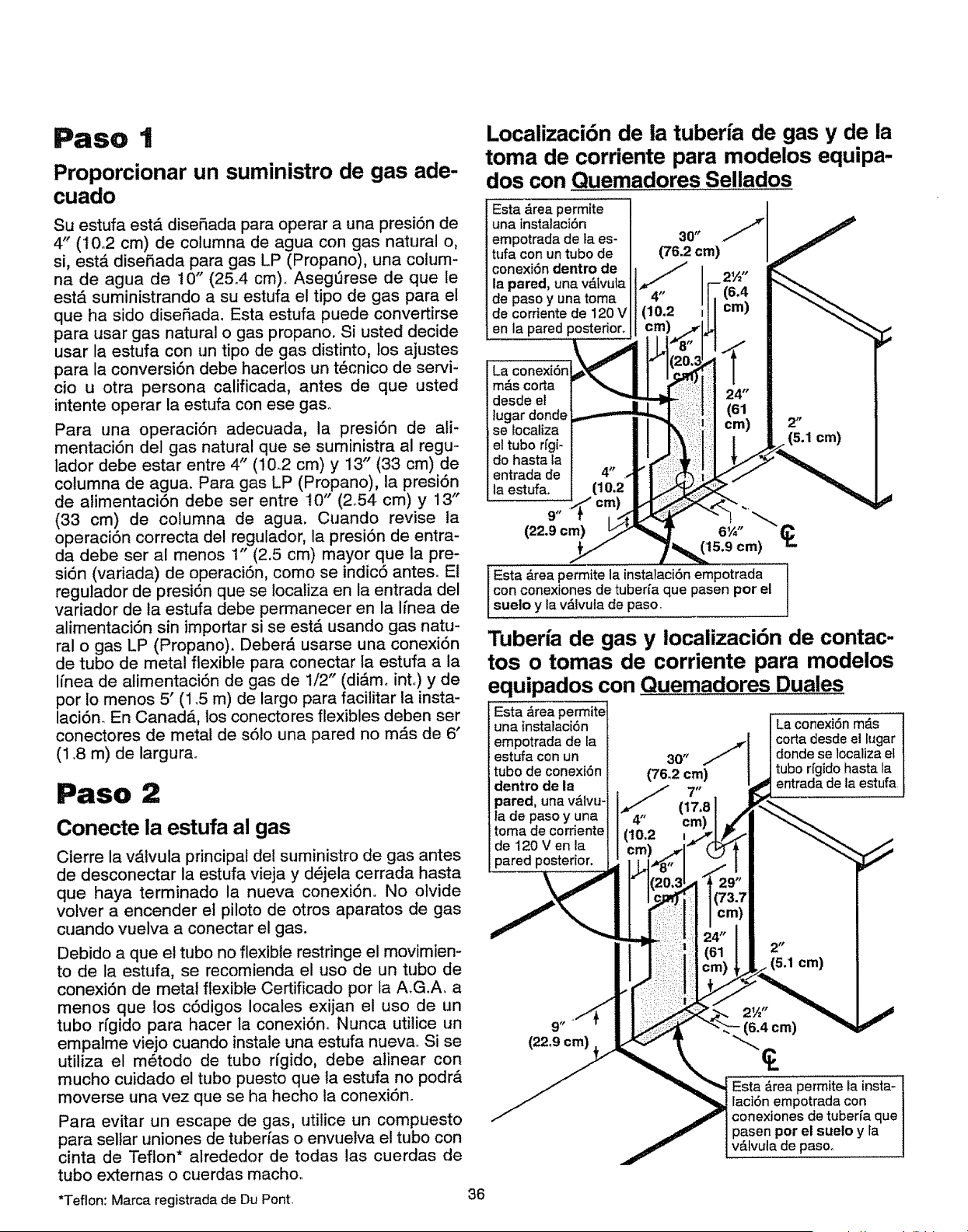
Paso 1
Proporcionar un suministro de gas ade-
cuado
Su estufa est& disefiada para operar a una presi6n de
4" (t0o2 cm) de columna de agua con gas natural o,
si, est& diseSada para gas LP (Propano), una cotum-
na de agua de 10" (25°4 cm). AsegSrese de que te
est& suministrando a su estufa el tipo de gas para el
que ha sido dise5ada. Esta estufa puede convertirse
para usar gas natural o gas propano. Si usted decide
usar la estufa con un tipo de gas distinto, los ajustes
para la conversi6n debe hacerlos un t_cnico de servi-
cio u otra persona calificada, antes de que usted
intente operar la estufa con ese gas°
Para una operaci6n adecuada, la presi6n de ati-
mentaci6n del gas natural que se suministra al regu o
lador debe estar entre 4" (102 cm) y 13" (33 cm) de
columna de agua. Para gas LP (Propano), la presi6n
de alimentaci6n debe ser entre 10" (2°54 cm) y 13"
(33 cm) de columna de agua. Cuando revise la
operaci6n correcta del regulador, la presi6n de entra-
da debe ser al menos 1" (2.5 cm) mayor que la pre-
si6n (variada) de operaci6n, como se indic6 antes. El
regulador de presi6n que se tocaliza en la entrada del
variador de ta estufa debe permanecer en la Ifnea de
alimentaciSn sin importar si se est& usando gas natu-
ral o gas LP (Propano). Deber& usarse una conexi6n
de tubo de metal flexible para conectar la estufa a la
Ifnea de atimentaci6n de gas de 1/2" (di&mo int) y de
por Io menos 5' (1.5 m) de largo para facilitar la insta-
laci6n_ En Canada., los conectores flexibles deben ser
conectores de metal de s61o una pared no m_.s de 6'
(1.8 rn) de largurao
Paso 2
Conecte la estufa al gas
Cierre la v_.tvula principal del suministro de gas antes
de desconectar la estufa vieja y d_jela cerrada hasta
que haya terminado la nueva conexi6n. No otvide
votver a encender el piloto de otros aparatos de gas
cuando vuelva a conectar el gas.
Debido a que el tubo no flexible restringe el movimien-
to de la estufa, se recomienda el uso de un tubo de
conexi6n de metal flexible Certificado por la A.GoA, a
menos que los c6digos locales exijan el uso de un
tubo rfgido para hacer la conexi6no Nunca utilice un
empalme viejo cuando instale una estufa nueva., Si se
utiliza el m_todo de tubo rfgido, debe alinear con
mucho cuidado el tubo puesto que la estufa no podr&
moverse una vez que se ha hecho la conexi6n.
Para evitar un escape de gas, utilice un compuesto
para sellar uniones de tuberfas o envuelva el tubo con
cinta de Teflon* alrededor de todas las cuerdas de
tubo externas o cuerdas macho°
*Teflon: Marca registrada de Du Pont
Localizacibn de la tuberfa de gas y de la
toma de corriente para modelos equipa-
dos con Quemadores Sellados
Esta Area permite
una instalaci6n
empotrada de la es- 30"
tufa con un tubo de (76.2 cm)
conexi6n dentro de
la pared, una vdtvuta
de paso y una toma
de corriente de 120 V (10,2
en la pared posterior.
La conexi6n
mAs corta
desde el
tugar donde
se localiza
el tubo rfgi-
do hasta la
entrada de
]a estufao
(15.9 cm) _
Esta Area permite la instalaci6n empotrada
con conexiones de tuberfa que pasen pot el
suelo y la vdlvula de paso,
Tuberfa de gas y localizaci6n de contac-
tos o tomas de corriente para modelos
equipados con Quemadores Duales
Esta drea permite;
una instalaci6n
empotrada de la
estufa con un
tubo de conexi6n
dentro de la
pared, una vAIvu-
la de paso y una
toma de corriente
de 120 V en la
pared posterior.
La conexi6n mds
corta desde el lugar
donde se localiza el
tubo r[gido hasta la
entrada de la estufa.
9 _
(22,9 cm)
Esta drea permite la insta-
laci6n empotrada con
conexiones de tubefia que
pasen por el suelo y fa
vdlvula de paso°
36
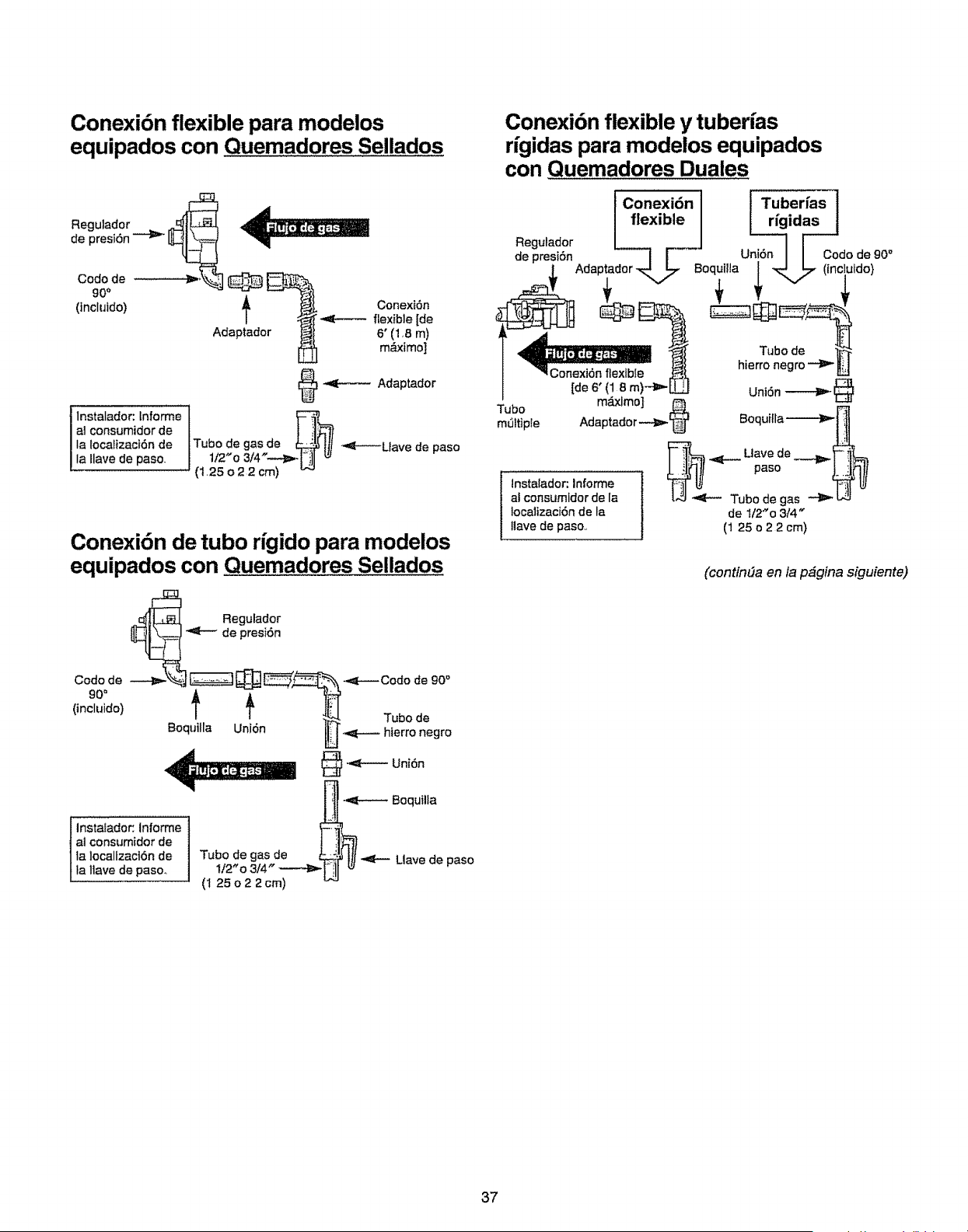
Conexi6n flexible para modelos
equipados con Quemadores Sellados
Regulador
de presi6n _"
Codo de
90"
(tncluido)
lnstalador: tnforme
al consumidor de
Ia localizaci6n de
la llave de paso.
conox,0n
-,_---_ flexible [de
Adaptador 6' (1,8 m)
m,_ximo]
@ -.,,qF_ Adaptador
Tubo de gas de _=_ ",f&_----Ltave de paso
I/2"o 314"--_-I-_11_
(125o22 cm)
Conexi6n de tubo r{gido para modelos
equipados con Quemadores Sellados
._ Regulador
_r--- de presiOn
Codo de _"_-_. _-__" _ __,-,4F---Codo de 90 °
(incg0uid°) { { _ Tubo de
Boqutlla Uni6n _ "=_r--- hlerro negro
Bequilia
Instalador: lnforme "_
al consumidor de
ta locallzactOn de Tubo de gas de ...€.__
la flare de paso., 1/2"o 3/4" _ _ e Uave de paso
(1 25o2 2cm)
Conexi6n flexible y tuber{as
r{gidas para modetos equipados
con Quemadores Duales
Regufador
de presi6n
i Tubenas]
flexible
Uni6n I I Codode90 °
Boquilla I _1 !_ (incluido)
Tubo de ]1_
hierro negro _
Conexi6n flexible
[de 6' (1 8 m)--]_
Unt6n _-I_
Tubo m&ximo] _ .
m_ttiple Adaptador _ Boqurlla-----_-_
_ Uave de _ _-' _._
_ _ J,_'I# paso J-,3.(q_I
lnstalador: Informe _ _ _ I_
al consumidor de la t,41 _ Tubo de gas
.b4J
localizaci6n de la de t/2"o 3/4 "
llave de paso.. (1 25 o 2 2 cm)
(continda en ta p_gina siguiente)
37
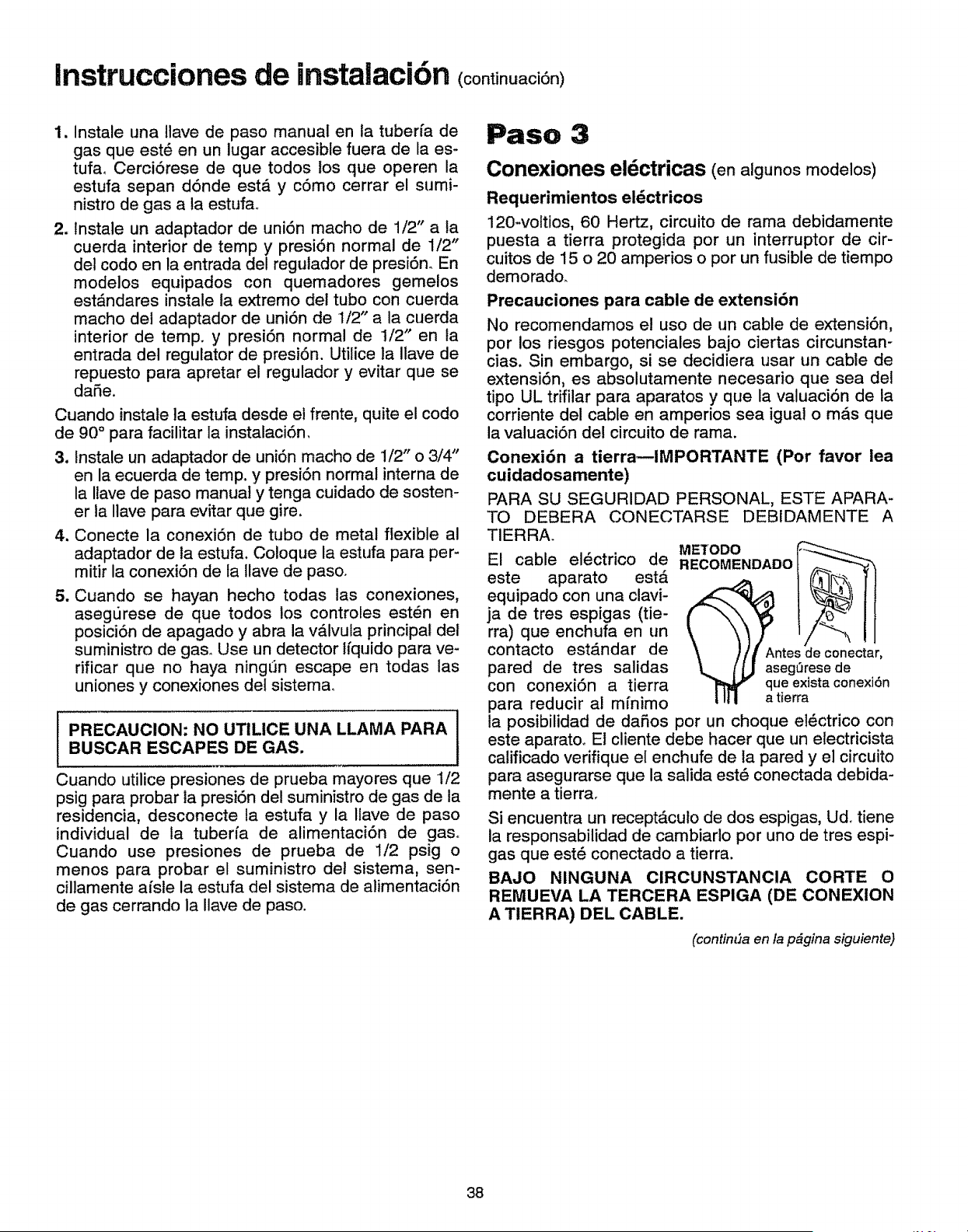
lnstrucciones de instalacibn (coot oo o o)
1. instale una ttave de paso manual en ta tuberi'a de
gas que est_ en un lugar accesible fuera de la es-
tufa. Cerci6rese de que todos los que operen la
estufa sepan d6nde est& y c6mo cerrar el sumi-
nistro de gas a la estufa_
2. Instale un adaptador de uni6n macho de 1/2" a la
cuerda interior de temp y presi6n normal de 1/2"
del codo en la entrada del regulador de presi6n_ En
modelos equipados con quemadores gemelos
est_ndares instale ta extremo del tubo con cuerda
macho del adaptador de uni6n de 1/2" a la cuerda
interior de temp. y presi6n normal de 1/2" en ta
entrada del regulator de presi6n. Utilice la Ilave de
repuesto para apretar el regulador y evitar que se
da_e.
Cuando instate la estufa desde el frente, quite el codo
de 90 ° para facilitar la instalaci6n,
3. Instale un adaptador de uni6n macho de 1/2" o 3/4"
en la ecuerda de temp. y presi6n normal interna de
la Ilave de paso manual y tenga cuidado de sosten-
er ta Itave para evitar que gire.
4. Conecte la conexi6n de tubo de metal flexible al
adaptador de la estufa. Coloque la estufa para per-
mitir la conexi6n de ta llave de paso.
5. Cuando se hayan hecho todas las conexiones,
asegL_rese de que todos los controles est_n en
posici6n de apagado y abra la v_,lvula principal del
suministro de gas. Use un detector tfquido para ve-
rificar que no haya ning(]n escape en todas las
uniones y conexiones del sistema.
I RECAUCION: NO UTILICE UNA LLAMA PARA 1
BUSCAR ESCAPES DE GAS.
Cuando utilice presiones de prueba mayores que t12
psig para probar la presi6n del suministro de gas de la
residencia, desconecte la estufa y la Ilave de paso
individual de la tuberfa de alimentaci6n de gas°
Cuando use presiones de prueba de 1/2 psig o
menos para probar el suministro det sistema, sen-
cillamente afsle la estufa del sistema de alimentaci6n
de gas cerrando la Ilave de paso.
Paso 3
Conexiones eldctricas (en algunos modelos)
Requerimientos el_ctricos
120-voltios, 60 Hertz, circuito de rama debidamente
puesta a tierra protegida por un interruptor de cir-
cuitos de 15 o 20 amperios o por un fusible de tiempo
demorado.
Precauciones para cable de extensi6n
No recomendamos el uso de un cable de extensi6n,
por los riesgos potenciales bajo ciertas circunstan-
cias. Sin embargo, si se decidiera usar un cable de
extensi6n, es absolutarnente necesario que sea del
tipo UL trifilar para aparatos y que la valuaci6n de la
corriente del cable en amperios sea igual o rods que
la valuaci6n del circuito de rama.
Conexi6n a tierra--IMPORTANTE (Por favor lea
cuidadosamente)
PARA SU SEGURIDAD PERSONAL, ESTE APARA-
TO DEBERA CONECTARSE DEBIDAMENTE A
TIERRA.
METODO
El cable el_ctrico de RECOMENDADO _"_.
equipado con una clavi-
jade tres espigas (tie-
que enchufa en un
contacto est_.ndar de
pared de tres salidas
con conexi6n a tierra n
para reducir al mfnimo
la posibilidad de daSos por un choque el_ctrico con
este aparatoo El cliente debe hacer que un electricista
calificado verifique el enchufe de la pared y el circuito
para asegurarse que la salida est_ conectada debida-
mente a tierra.
Si encuentra un recept_.culo de dos espigas, Ud. tiene
la responsabilidad de cambiarto por uno de tres espi-
gas que est_ conectado a tierra.
BAJO NINGUNA ClRCUNSTANClA CORTE O
REMUEVA LA TERCERA ESPIGA (DE CONEXlON
A TIERRA) DEL CABLE.
(continEta en la p#gina siguiente)
38
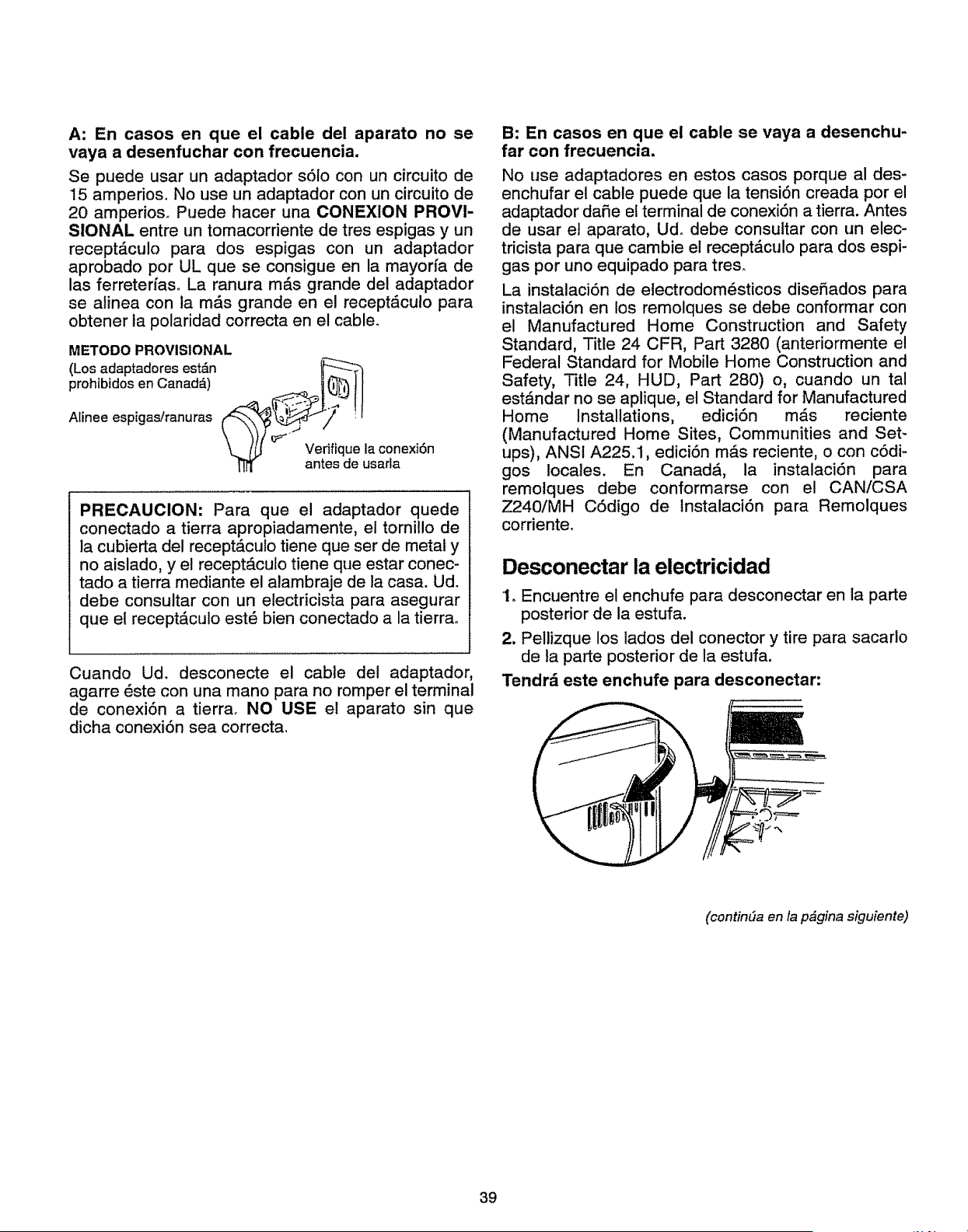
A: En casos en que el cable del aparato no se
vaya a desenfuchar con frecuencia.
Se puede usar un adaptador s61o con un circuito de
15 amperios. No use un adaptador con un circuito de
20 amperioso Puede hacer una CONEXlON PROVI-
SIONAL entre un tomacorriente de tres espigas y un
receptdculo para dos espigas con un adaptador
aprobado por UL que se consigue en la mayoffa de
las ferreter_aso La ranura mds grande del adaptador
se atinea con la rods grande en el recept_.culo para
obtener ta polaridad correcta en el cable.
METODO PROVISIONAL
(Los adaptadores est_n _
prohibidos en Canad&)
Alinee espigas!ranu ras (_ VetdJ_q_eeluaCr_nexi6n
PRECAUCION: Para que el adaptador quede
conectado a tierra apropiadamente, el tornillo de
la cubierta del receptdcuto tiene que ser de metal y
no aislado, y et receptdculo tiene que estar conec-
tado a tierra mediante el alambraje de la casa. Ud.
debe consultar con un electricista para asegurar
que el receptdculo est6 bien conectado a la tierrao
Cuando Ud. desconecte el cable del adaptador,
agarre 6ste con una mano para no romper el terminal
de conexi6n a tierra. NO USE el aparato sin que
dicha conexi6n sea correcta.
B: En casos en que el cable se vaya a desenchu-
far con frecuencia.
No use adaptadores en estos casos porque al des-
enchufar el cable puede que la tensi6n creada por el
adaptador daSe el terminal de conexi6n a tierra. Antes
de usar e! aparato, Ud. debe consuttar con un elec-
tricista para que cambie el recept&culo para dos espi-
gas por uno equipado para tres_
La instalaci6n de electrodom6sticos disefiados para
instalaci6n en los remolques se debe conformar con
el Manufactured Home Construction and Safety
Standard, Title 24 CFR, Part 3280 (anteriormente el
Federal Standard for Mobile Home Construction and
Safety, Title 24, HUD, Part 280) o, cuando un tal
est_ndar no se aplique, el Standard for Manufactured
Home Installations, edici6n m_s reciente
(Manufactured Home Sites, Communities and Set-
ups), ANSI A225.1, edici6n m_.s reciente, o con c6di-
gos locales. En Canad,_, la instalaci6n para
remolques debe conformarse con el CAN/CSA
Z240/MH C6digo de Instalaci6n para Remolques
corriente_
Desconectar la electricidad
1° Encuentre el enchufe para desconectar en la parte
posterior de la estufa.
2. Pellizque los lados del conector y tire para sacarlo
de ta parte posterior de la estufa.
Tendr_ este enchufe para desconectar:
(continE_a en la p_gina siguiente)
39
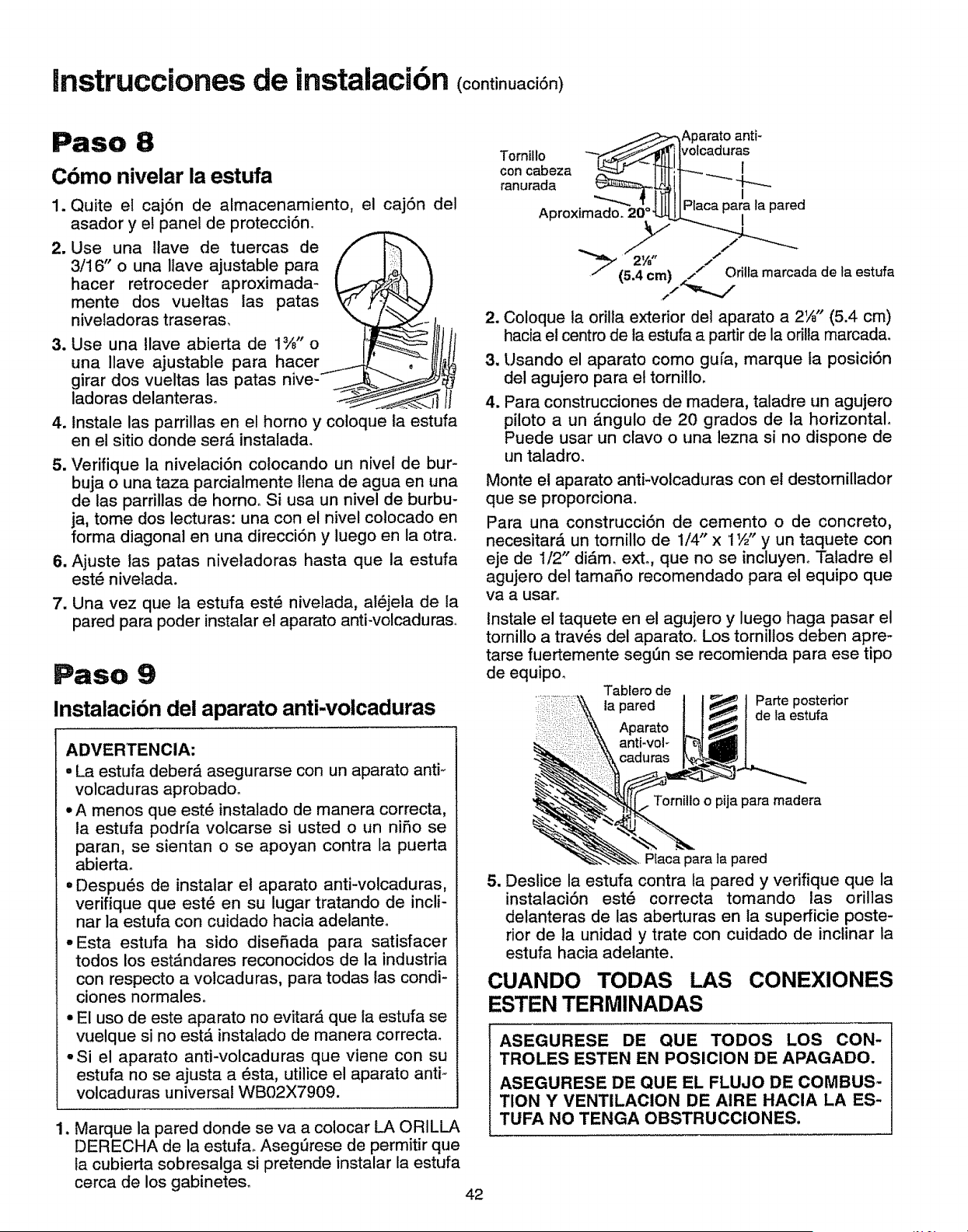
Instrucciones de instalaci6n <continuaci6n)
Paso 8
C6mo nivelar la estufa
1. Quite el caj6n de almacenamiento, el caj6n del
asador y el panel de protecci6n.
2. Use una Iiave de tuercas de ,/
3/16" o una Ilave ajustable para
hacer retroceder aproximada-
mente dos vueltas las patas
nivetadoras traseras,
3. Use una llave abierta de 1¾"o
una Ilave ajustable para hacer/
girar dos vueltas las patas nive-
ladoras delanteraso
4. tnstale las parrillas en el homo y coloque la estufa
en el sitio donde ser_, instalada.
5. Verifique la nivelaci6n colocando un nivel de bur-
buja o una taza parcialmente Ilena de agua en una
de las parrillas de homo° Si usa un nivel de burbu-
ja, tome dos lecturas: una con el nivel colocado en
forma diagonal en una direcci6n y luego en la otra.
6. Ajuste tas patas niveladoras hasta que la estufa
est_ nivelada.
7. Una vez que la estufa est_ nivelada, al@jela de la
pared para poder instalar el aparato anti-volcaduraso
Paso 9
lnstalaci6n dei aparato anti-volcaduras
oLa estufa deber_, asegurarse con un aparato anti-
volcaduras aprobadoo
• A menos que est6 instalado de manera correcta,
la estufa podrfa volcarse si usted o un niSo se
paran, se sientan o se apoyan contra la puerta
abierta.
° Despu@s de instalar et aparato anti-volcaduras,
verifique que est_ en su lugar tratando de incli-
nar la estufa con cuidado hacia adelanteo
°Esta estufa ha sido diseSada para satisfacer
todos los est_,ndares reconocidos de la industria
con respecto a volcaduras, para todas las condi-
clones normales,
° El uso de este aparato no evitarA que la estufa se
vuelque si no est,. instatado de manera correcta.
° Si el aparato anti-volcaduras que viene con su
estufa no se ajusta a @sta, utilice el aparato anti-
volcaduras universal WBO2X7909.
1. Marque la pared donde se va a colocar LA ORILLA
DERECHA de la estufao AsegQrese de permitir que
la cubierta sobresalga si pretende instalar la estufa
cerca de los gabinetes.
_Aparato anti-
Tomi,lo "-___ iv°lcaduras
con cabeza _ i Iir;l-,---._._.____ l
ranurada __11
^ .... ,,_,_j-_ H P'aca para 'a pared
"_/ 2W' / ¢
/ (5 4 cm) // Odlla marcada de la estufa
2. Coloque la orilla exterior det aparato a 21/8" (5.4 cm)
hacia el centro de la estufa a partir de la orilta marcada.
3. Usando el aparato como gufa, marque fa posici6n
del agujero para et tornillo,
4. Para construcciones de madera, taladre un agujero
piloto a un _.ngulo de 20 grados de la horizontal,
Puede usar un clavo o una lezna si no dispone de
un taladro.
Monte et aparato anti-volcaduras con el destomillador
que se proporciona.
Para una construcci6n de cemento o de concreto,
necesitard un tornillo de 1/4" x 1_/2"y un taquete con
eje de 1/2" di&m, exto, que no se incluyen_ Taladre el
agujero del tamaSo recomendado para el equipo que
va a usar.
Instale el taquete en el agujero y luego haga pasar el
tornillo a trav_s del aparato. Los tornittos deben apre-
tarse fuertemente segL_n se recomienda para ese tipo
de equipo,
Tablero de
la pared Parte posterior
de la estufa
Aparato
anti-vol_
caduras
Tomillo o pija para madera
Pfaca para la pared
5. Deslice la estufa contra la pared y verifique que la
instalaciOn est_ correcta tomando las orillas
delanteras de las aberturas en la superficie poste-
rior de la unidad y trate con cuidado de inclinar la
estufa hacia adelante.
CUANDO TODAS LAS CONEXIONES
ESTEN TERMINADAS
ASEGURESE DE QUE TODOS LOS CON-
TROLES ESTEN EN POSICION DE APAGADO.
ASEGURESE DE QUE EL FLUJO DE COMBUS-
TION Y VENTILACION DE AIRE HACIA LA ES-
TUFA NO TENGA OBSTRUCCIONES.
42
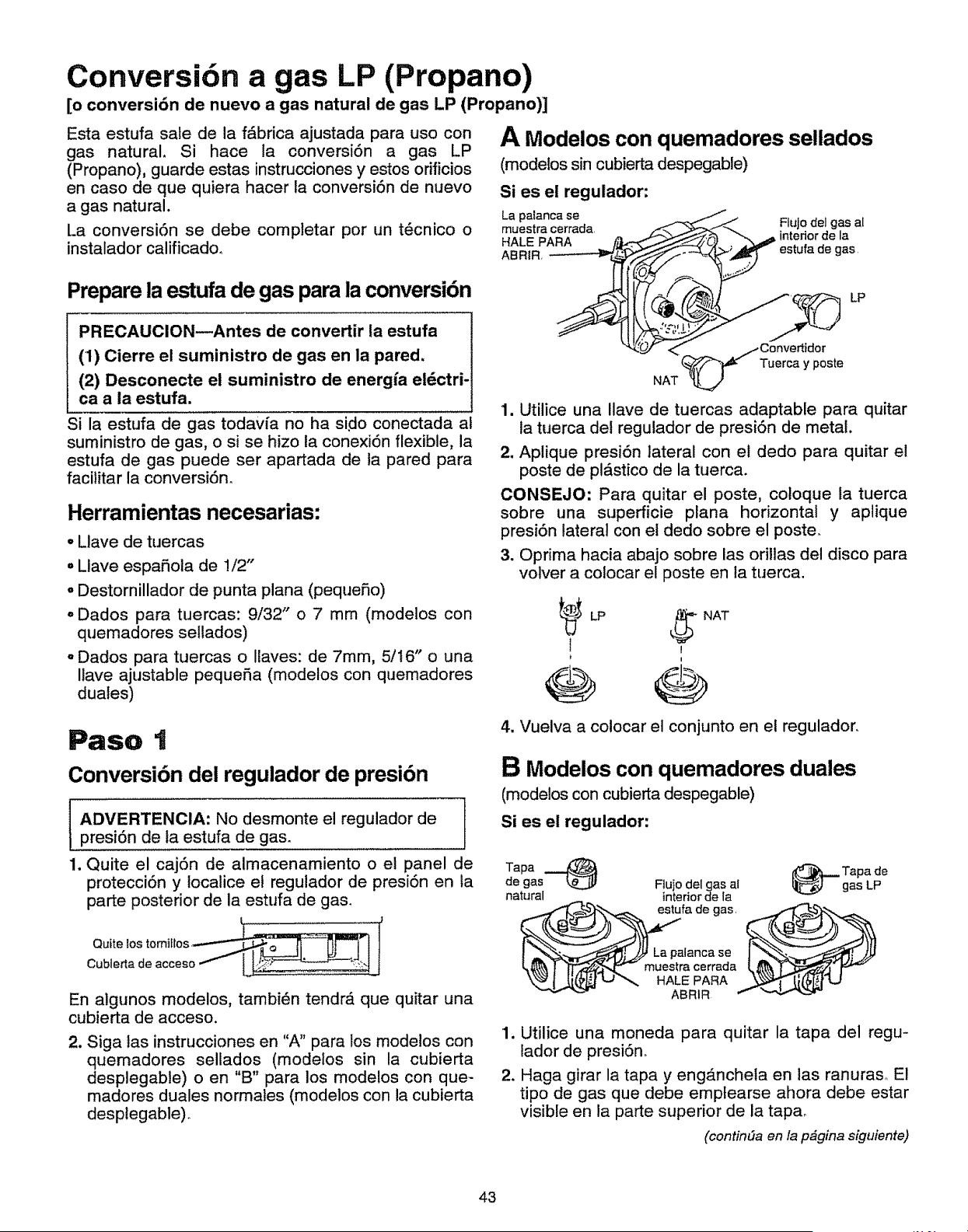
Conversibn a gas LP (Propano)
[o conversi6n de nuevo a gas natural de gas LP (Propano)]
Esta estufa sate de la f_brica ajustada para uso con
gas natural, Si hace la conversi6n a gas LP
(Propano), guarde estas instrucciones y estos orificios
en caso de que quiera hacer la conversi6n de nuevo
a gas natural.
La conversi6n se debe comptetar por un t_cnico o
instalador calificadoo
Prepare la estufa de gas para iaconversi6n
PRECAUCION--Antes de convertir la estufa
(1) Cierre el suministro de gas en la pared.
(2) Desconecte el suministro de energfa eldctri-
ca a la estufa.
Si la estufa de gas todavfa no ha sido conectada at
suministro de gas, o si se hizo la conexi6n flexible, la
estufa de gas puede ser apartada de la pared para
facilitar la conversi6n,
Herramientas necesarias:
• Llave de tuercas
• Llave espaSola de 1/2"
• Destornillador de punta plana (pequefio)
° Dados para tuercas: 9/32" o 7 mm (modelos con
quemadores sellados)
= Dados para tuercas o Ilaves: de 7mm, 5/I6" o una
Ilave ajustable pequefia (modelos con quemadores
duales)
A Modelos con quemadores sellados
(modelos sin cubierta despegable)
Si es el regulador:
La palanca se _ Flujo del gas al
muestra cerrada
PARA #..._J_-'1"_._ _ .._ interior de la
HALE
ABRIR --------___ estufa de gas
__ . _jConvertidor
NAT (._ Tuerca y poste
1. Utilice una Ilave de tuercas adaptable para quitar
ia tuerca del regulador de presi6n de metal.
2, Aplique presi6n lateral con el dedo para quitar el
poste de pl_,stico de la tuerca.
CONSEJO: Para quitar el poste, cotoque la tuerca
sobre una superficie plana horizontal y aplique
presi6n lateral con el dedo sobre el poste,
3. Oprima hacia abajo sobre las oritlas del disco para
volver a colocar el poste en ta tuerca.
LP k._ NAT
f _
f I
o @
Paso t
Conversi6n dei regulador de presi6n
ADVERTENCIA: No desmonte el regulador de
presi6n de la estufa de gas.
. Quite el caj6n de almacenamiento o el panel de
protecci6n y localice el regulador de presi6n en la
parte posterior de la estufa de gas,
Quitelostomillos i .,, . _ , ,
Cublerta de acceso _
En algunos modelos, tambi_n tendr,_ que quitar una
cubierta de acceso.
2. Siga las instrucciones en "A" para los modetos con
quemadores sellados (modelos sin la cubierta
desplegabte) o en "B" para los modelos con que- 2.
madores duales normates (modelos con la cubierta
desplegable)_
4. Vuelva a colocar el conjunto en el regulador,
B Modelos con quemadores duales
(modelos con cubierta despegable)
Si es el regulador:
Tapa _ _Tapa de
de gas_ Ftujo del gas al @ gas LP
natural interior de la
lanca se 1 >,__ J-_
cerrada lx_ T_J"
RIR .._ "---.4f_'-
Utilice una moneda para quitar la tapa del regu-
lador de presi6no
Haga girar la tapa y eng&nchela en las ranuraso El
tipo de gas que debe emptearse ahora debe estar
visible en la parte superior de la tapa_
(continUa en la p_gina siguiente)
43
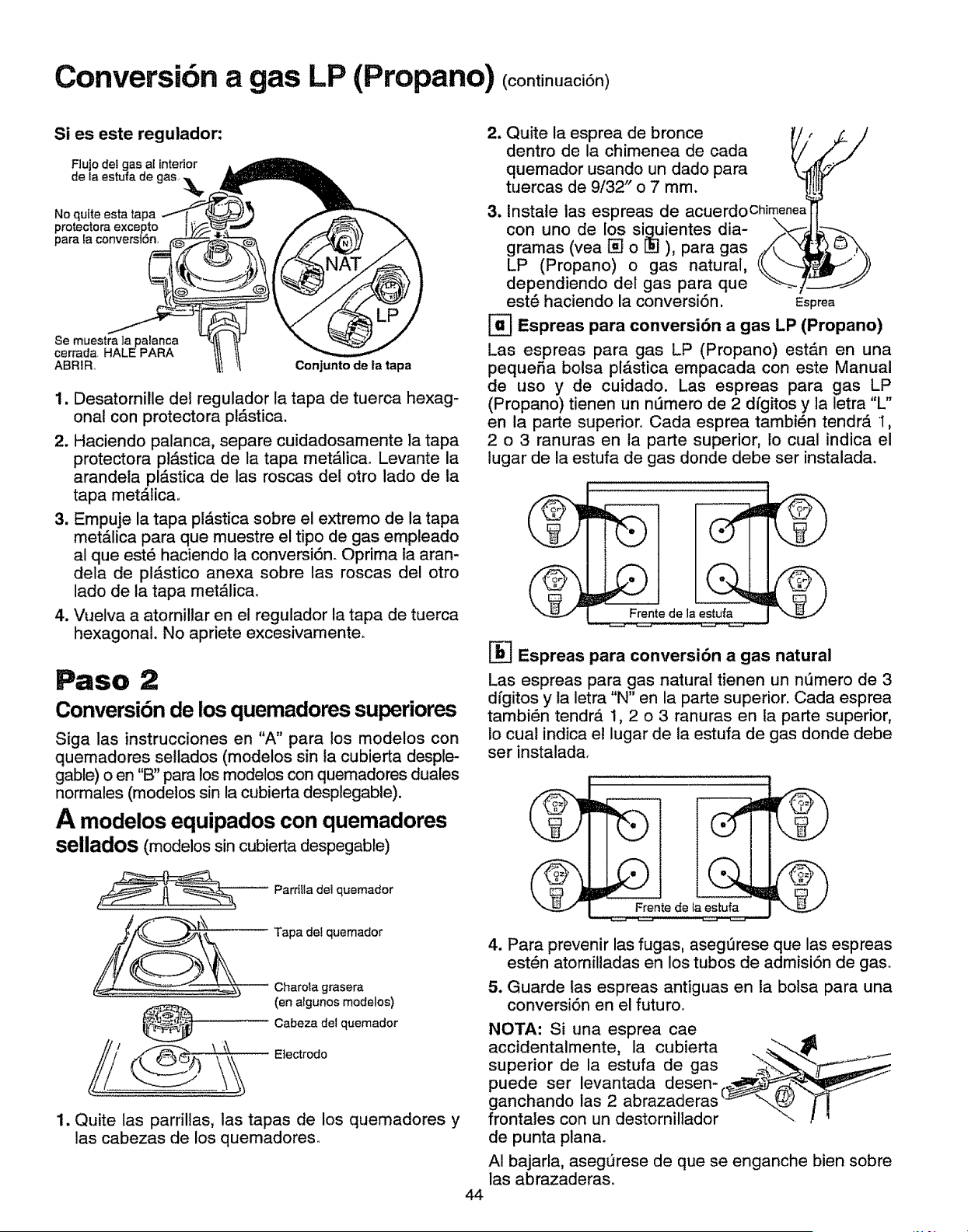
Conversi6n a gas LP (Propano)(continuaci6n)
Si es este regulador:
FIujo dei gas al interior
de la estufa de gas.
No quite esta tapa
protectora excepto
para Ia conversion,
Se muestra ]a palanca
cerrada. HALE PARA
ABRIR,,
Conjunto de la tapa
1. Desatornille del regulador la tapa de tuerca hexag-
onal con protectora p!&stica.
2. Haciendo palanca, separe cuidadosamente la tapa
protectora p!_,stica de la tapa met_.lica. Levante la
arandeta pl&stica de las roscas del otro lado de la
tapa met_lica..
3. Empuje la tapa pf&stica sobre el extremo de la tapa
met_.lica para que muestre el tipo de gas empleado
al que est6 haciendo la conversi6n. Oprima ta aran-
dela de pl_stico anexa sobre las roscas del otro
lado de la tapa met&lica.
4. Vuelva a atorniltar en el regulador la tapa de tuerca
hexagonal. No apriete excesivamente.
Paso 2
Conversibn de los quemadores superiores
Siga las instrucciones en "A" para los modelos con
quemadores sellados (modelos sin la cubierta desple-
gable) o en "B" para los modelos con quemadores duales
normales (modelos sin la cubierta desplegable).
A modelos equipados con quemadores
sellados (modelos sin cubierta despegable)
Parrilla del quemador
@
Tapa del quemador
Charola grasera
(en atgunos modelos)
Cabeza det quemador
' " Etectrodo
1. Quite las parrillas, las tapas de los quemadores y
las cabezas de los quemadores.
2. Quite la esprea de bronce
dentro de la chimenea de cada
quemador usando un dado para
tuercas de 9/32" o 7 mm.
I
3. Instate las espreas de acuerdo Chimenea
con uno de los siguientes dia-
gramas (vea [] o [] ), para gas
LP (Propano) o gas natural,
dependiendo del gas para que
est_ haciendo la conversiSn. Esprea
[] Espreas para conversi6n a gas LP (Propano)
Las espreas para gas LP (Propano) est&n en una
pequeSa bolsa pl&stica empacada con este Manual
de uso y de cuidado. Las espreas para gas LP
(Propano) tienen un nt_mero de 2 dfgitos y la letra "L"
en la parte superior,, Cada esprea tambi_n tendr_ I,
2 o 3 ranuras en la parte superior, Io cual indica el
lugar de la estufa de gas donde debe ser instalada.
Frente de la estufa
[_] Espreas para conversi6n a gas natural
Las espreas para gas natural tienen un n_mero de 3
dfgitos y la letra "N" en la parte superior. Cada esprea
tambi_n tendr_ 1, 2 o 3 ranuras en ta parte superior,
Io cual indica el lugar de la estufa de gas donde debe
ser instalada.
44
Frente de la estufa
4. Para prevenir las fugas, asegt3rese que las espreas
est_n atomilladas en los tubos de admisi6n de gas°
5. Guarde las espreas antiguas en la bolsa para una
conversi6n en el futuro.
NOTA: Si una esprea cae
accidentalmente, la cubierta
superior de la estufa de gas
puede ser levantada desen-
ganchando las 2
frontales con un destornillador
de punta plana.
AI bajarla, aseg_rese de que se enganche bien sobre
las abrazaderas.
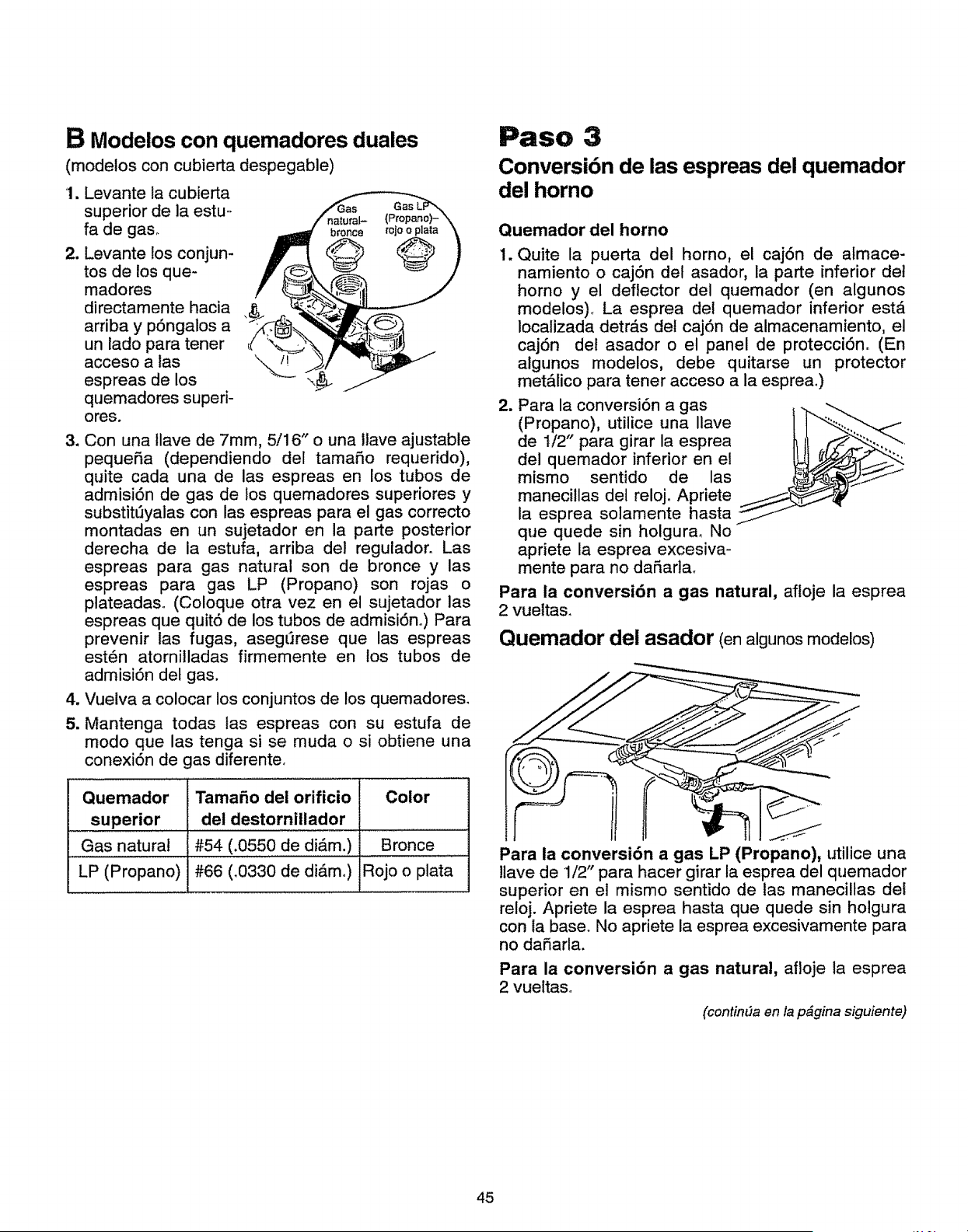
B Modelos con quemadores duales
(modeios con cubierta despegable)
1. Levante la cubierta
superior de la estu o
fa de gas°
2. Levante los con jun-
tos de los que-
madores
directamente hacia
arriba y p6ngalos a
un lado para tener
acceso a las
espreas de los
quemadores superi-
ores.
3. Con una llave de 7mm, 5/16" o una llave ajustable
pequeSa (dependiendo del tamaSo requerido),
quite cada una de las espreas en los tubos de
admisi6n de gas de los quemadores superiores y
substitQyalas con las espreas para el gas correcto
montadas en un sujetador en la parte posterior
derecha de la estufa, arriba del regulador_ Las
espreas para gas natural son de bronce y las
espreas para gas LP (Propano) son rojas o
ptateadaso (Coloque otra vez en el sujetador las
espreas que quit6 de los tubos de admisi6n.) Para
prevenir tas fugas, aseg(_rese que las espreas
est6n atornilladas firmemente en los tubos de
admisi6n del gas.
4. Vuelva a colocar los conjuntos de los quemadores_
5. Mantenga todas tas espreas con su estufa de
modo que las tenga si se muda o si obtiene una
conexi6n de gas diferente.
Quemador TamaSo dei orificio Color
.............superior ......... del destom.!.!..!.ador
Gas natural #54 (.0550 de didm.) Bronce
LP (Propano) #66 (.0330 de didmo) Rojo o plata
Paso 3
Conversi6n de las espreas del quemador
del homo
Quemador del homo
1. Quite la puerta del homo, el caj6n de atmace-
namiento o caj6n def asador, la parte inferior det
homo y el deflector del quemador (en algunos
modelos)o La esprea del quemador inferior est,.
localizada detr,Ss del caj6n de almacenamiento, el
caj6n del asador o el panel de protecci6no (En
algunos modelos, debe quitarse un protector
metAlico para tener acceso a la espre&)
2. Para la conversi6n a gas
(Propano), utilice una Ilave
de 1/2" para girar la esprea
del quemador inferior en el
mismo sentido de las
manecillas del reloj. Apriete
la esprea solamente hasta
que quede sin holgurao No
apriete la esprea excesiva-
mente para no da5arla_
Para la conversi6n a gas natural, afloje la esprea
2 vuettas.
Quemador del asador (enalgunosmodelos)
Para la conversi6n a gas LP (Propano), utilice una
liave de 1/2" para hacer girar la esprea del quemador
superior en el mismo sentido de las maneciltas del
reloj. Apriete la esprea hasta que quede sin hotgura
con la baser No apriete la esprea excesivamente para
no daSarla.
Para la conversi6n a gas natural, afloje la esprea
2 vueltaso
(contin(_a en la p_gina siguiente)
45
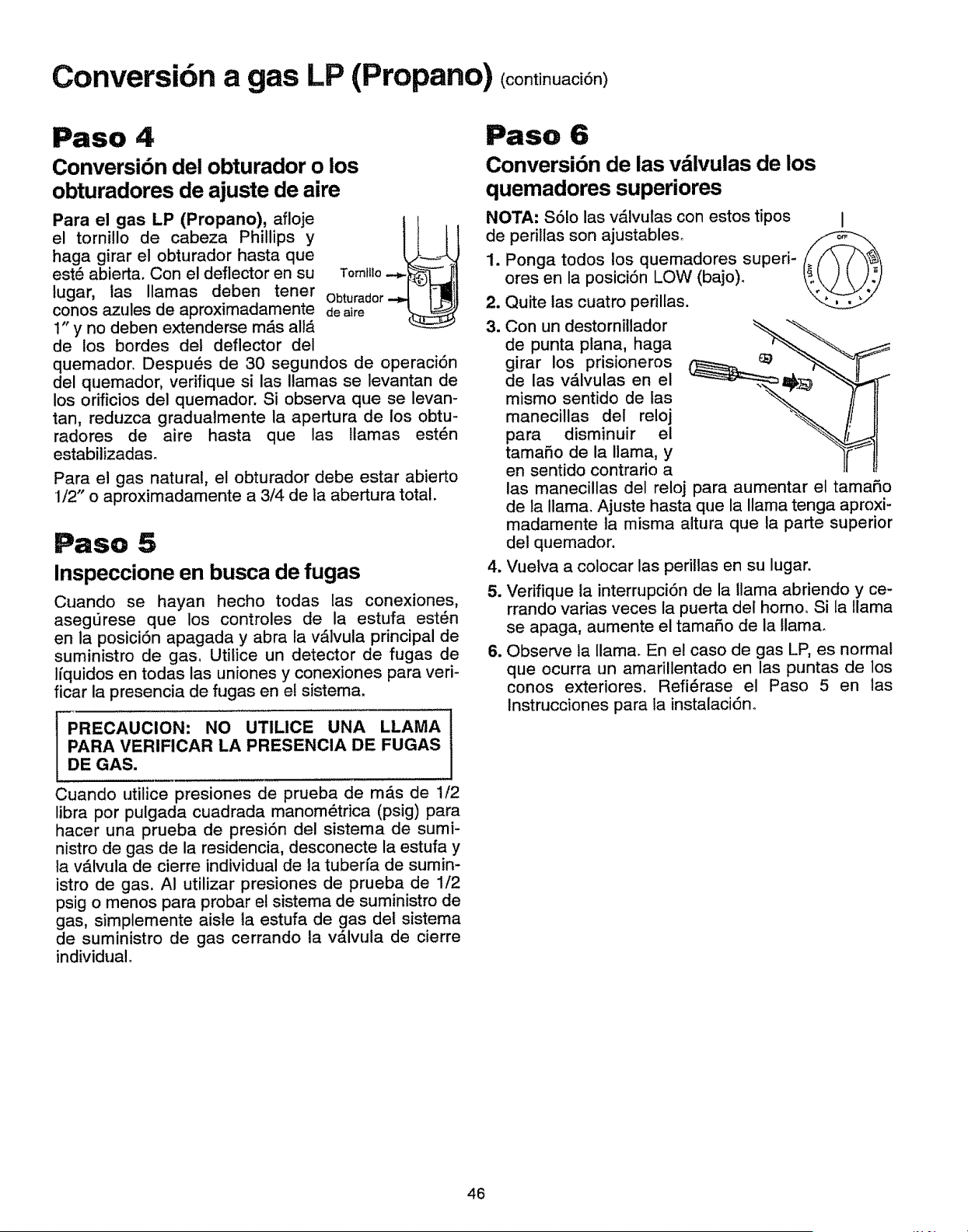
Conversibn a gas LP (Propano)(oo,-,t oo o , o)
Paso 4
Conversi6n del obturador o los
obturadores de ajuste de aire
Para el gas LP (Propano), afloje
el tornillo de cabeza Phillips y
haga girar el obturador hasta que
est_ abierta. Con el deflector en su
lugar, tas llamas deben tener
conos azules de aproximadamente
t" y no deben extenderse m_s all#,
de los bordes del deflector del
Tomtl!o .._
Obturador
de atre
quemador. Despu_s de 30 segundos de operaciSn
del quemador, verifique si las llamas se levantan de
los orificios del quemador. Si observa que se levan-
tan, reduzca gradualmente la apertura de los obtu-
radores de aire hasta que las llamas est_n
estabilizadas_
Para el gas natural, e! obturador debe estar abierto
1/2" o aproximadamente a 3/4 de la abertura total.
Paso 5
Inspeccione en busca de fugas
Cuando se hayan hecho todas las conexiones,
asegL_rese que los controles de la estufa est_n
en la posiciSn apagada y abra la v&lvula principal de
suministro de gas. Utilice un detector de fugas de
Ifquidos en todas las uniones y conexiones para veri-
ficar la presencia de fugas en el sistema.
PRECAUCION: NO UTILICE UNA LLAMA
PARA VERIFICAR LA PRESENCIA DE FUGAS
DE GAS.
Cuando utilice presiones de prueba de m_.s de i/2
libra por pulgada cuadrada manom_trica (psig) para
hacer una prueba de presiSn del sistema de sumi-
nistro de gas de la residencia, desconecte la estufa y
la v&lvula de cierre individual de la tuberfa de sumin-
istro de gas. A1 utilizar presiones de prueba de 1/2
psig o menos para probar et sistema de suministro de
gas, simplemente aisle la estufa de gas del sistema
de suministro de gas cerrando ta v_,lvuta de cierre
individual_
Paso 6
Conversi6n de las vdlvulas de los
quemadores superiores
NOTA: S61o las v_lvulas con estos tipos
de
1.
2_
3.
1
5.
6.
I
perillas son ajustable&
Ponga todos los quemadores superi-
ores en la posiciSn LOW (bajo).
Quite las cuatro perillas.
Con un destornitlador
de punta plana, haga
girar los prisioneros
de las v_.lvulas en el
mismo sentido de fas
manecillas del reloj
para disminuir el
tamafio de la llama, y
en sentido contrario a
las manecillas del reloj para aumentar el tamafio
de la llama. Ajuste hasta que la llama tenga aproxi-
madamente ta misma altura que la parte superior
del quemador.
Vuelva a colocar las peritlas en su lugar.
Verifique la interrupci6n de la llama abriendo y ce-
rrando vadas veces la puerta del homo. Si la llama
se apaga, aumente el tamafio de la llama.
Observe la llama. En el caso de gas LP, es normal
que ocurra un amadllentado en las puntas de los
conos exteriores. Refi6rase el Paso 5 en las
Instrucciones para fa instalaci6no
46
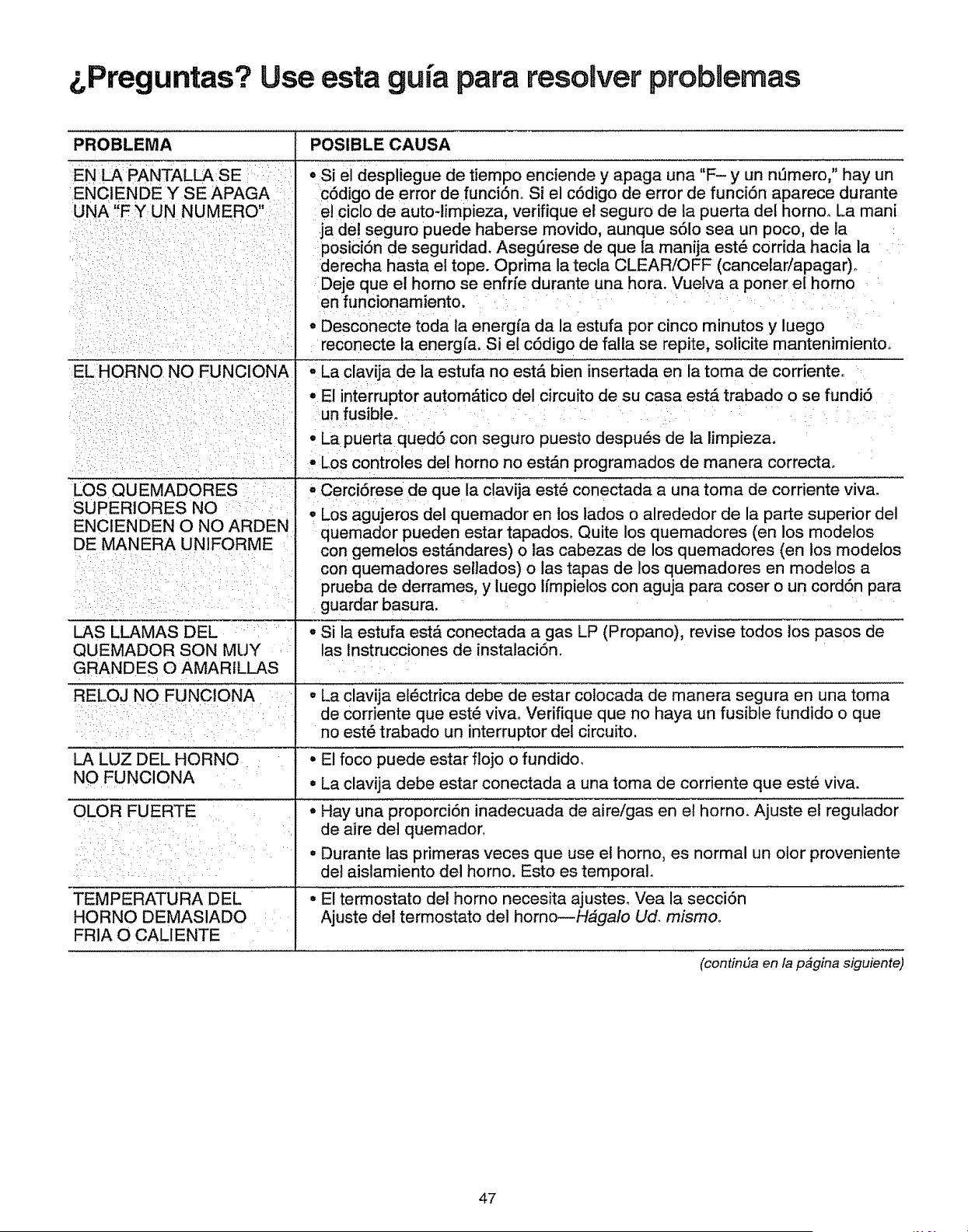
&Preguntas? Use esta gufa para resoIver probUemas
PROBLEMA
EN LA PANTALLA SE
ENCtENDE Y SE APAGA
UNA 'fF Y UN NUMERO"
EL HORNO NO FUNCIONA
LOS QUEMADORES
SUPERIORES NO
ENCIENDEN O NO ARDEN
DE MANERA UNIFORME
L.AS LLAMAS DEL
QUEMADOR SON MUY
GRANDES O AMARtLLAS
RELOJ NO FUNCIONA
LA LUZ DEL HORNO
NO FUNCIONA
OLOR FUERTE
:: i:
TEMPERATURA DEL
HORNO DEMASIADO :
FRIA O CALIENTE
POSIBLE CAUSA
jade! seguro puede haberse movido, aunque s61o sea un poco, de la
:posiciSn de seguridad. AsegSrese de que la manija est_ corrida hacia la
derecha hasta el tope. Oprima la tecla CLEAR/OFF (canceladapagar) o
Deje que el homo se enfrfe durante una hora. Vuetva a poner el horno
i
en funcionamiento. : _ ....
,, Desconecte toda la energfa da la estufa por cinco minutos y luego
reconecte la energfa. Si el cSdigo de falla se repite, solicite mantenimientoo
-La clavija de la estufa no est,, bien insertada en la toma de corriente.
. El interruptor autom&tico del circuito de su casa est,. trabado o se fundi5
i:un fusible. : .....
° La puerta qued5 con seguro puesto despu#s de la limpieza.
° Los controles del homo no est_n programados de manera correcta.
° Si el despliegue de tiempo enciende y apaga una "F- y un nt3mero," hay un
i c6digo de error de funciSn. Si el c6digo de error de funciSn aparece durante
i el ciclo de auto-timpieza, verifique et seguro de la puerta del homo° La mani
° CerciSrese de que la c!avija est_ conectada a una toma de corriente viva.
° Los agujeros del quemador en los lados o alrededor de la parte superior del
quemador pueden estar tapados. Quite los quemadores (en los modelos
con gemeios est&ndares) o las cabezas de los quemadores (en los modelos
con quemadores sellados) o las tapas de los quemadores en modelos a
prueba de derrames, y luego tfmpielos con aguja para coser o un cordSn para
guardar basura.
• Si la estufa est_ conectada a gas LP (Propano), revise todos los pasos de
las lnstrucciones de instalaciSn.
o La clavija el_ctrica debe de estar colocada de manera segura en una toma
de corriente que est_ viva° Verifique que no haya un fusible fundido o que
no est_ trabado un interruptor del circuito.
° El foco puede estar flojo o fundido,
° La clavija debe estar conectada a una toma de corriente que est# viva.
o Hay una proporciSn inadecuada de aire/gas en el homo. Ajuste el regulador
de aire del quemador,
• Durante las primeras veces que use el homo, es normal un olor proveniente
del aislamiento del horno. Esto es temporal.
° El termostato del homo necesita ajustes. Vea la secciSn
Ajuste del termostato del horno--Hggalo Ud. mismoo
(continSa en ta pggina siguiente)
47
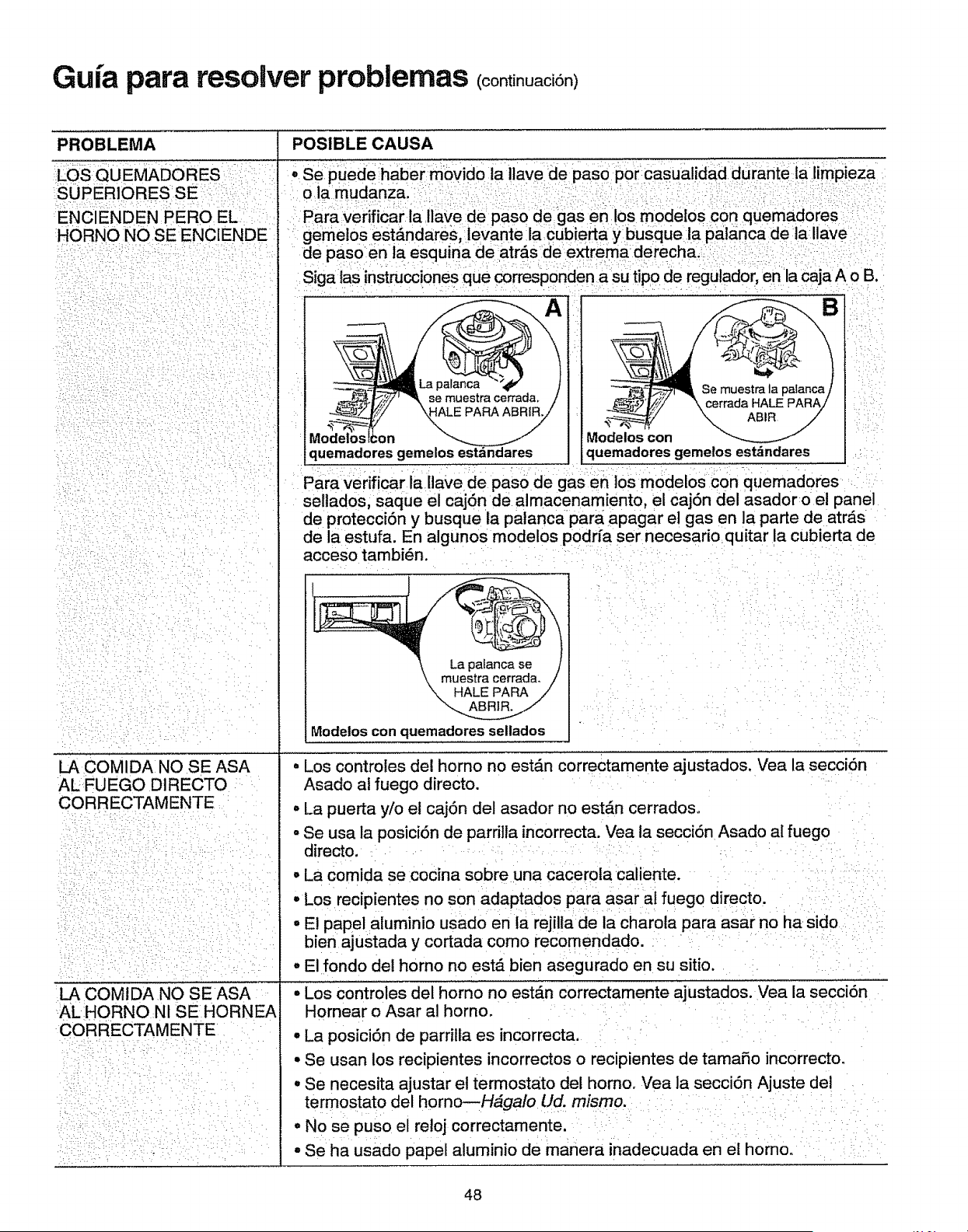
Gufa para resoIver problemas/oont ooac nt
PROBLEMA POSIBLE CAUSA
:ENCIENDEN PE]
HORNO
o Se puede haber m0vido la Ilave de paso por:casualidad durante la limpieza
= ola mudanza.
Para verificar la Ilave de paso de gas en los modelos con quemadores
; gemelos est_ndares, !evanteia cubierta y busque la palanca de la Ilave
de paso en ia esq uina de arras de extren_aderecha.
Siga las instrucc!one s que corresponden a su tipo de regulador, en la caja A o B,
cerrada HALE PARk
!ALE PARA ABRtR.
Modelos con
quemadores gemelos estandares quemadores gemetos estdndares
• Para verificar lallave de paso de gas en los modelos con quemadores
seltados, saque el caj6n de almacenamiento, el caj6n del asador o el panel
de protecci6n y busque la palanca para apagar el gas en la parte de atr_.s
de la estufa. En algunos modelos podrfa ser necesario quitar la cubierta de
acceso tambidn.
i ¸ i¸iiI ::i¸ii ¸¸¸¸=¸! i: i
LA COMIDA NO S,E ASA
AL-FU EGO DI RECTO ::
CORRECTAMENTE
COMtDANOSEASA:
ALHORNO NI SE HORNEA
CORRECTAMENTE
iii:
Modelos con quemadores sellados
• Los controles dei homo no est&n correctamente ajustados. Vea la secci6n
Asado al fuego directo.
o La puerta y/o el caj6n del asador no est_,n cerradoso
o Se usa la posici6n de parritla incorrecta. Vea la secci6n Asado al fuego
directo.
° La comida se cocina sobre una cacerola caliente.
° Los recipientes no son adaptados para asar al fuego directo.
o El papel aluminio usado en ta rejilla de la charola para asar no ha sido
bien a,justada y cortada como recomendado.
• El fondo del homo no est& bien asegurado en su sitio.
• Los controles del homo no est,_n correctamente ajustados, Vea la secci6n
Hornear o Asar al homo.
• La posici6n de parrilla es incorrecta,
• Se usan los recipientes incorrectos o recipientes de tamafio incorrectoo
° Se necesita ajustar et termostato del homo, Vea la secci6n Ajuste del
termostato del horno--H_galo Ud. mismo.
° No se puso el re!oj correctamente.
• Se ha usado papel aluminio de manera inadecuada en el homo.
48
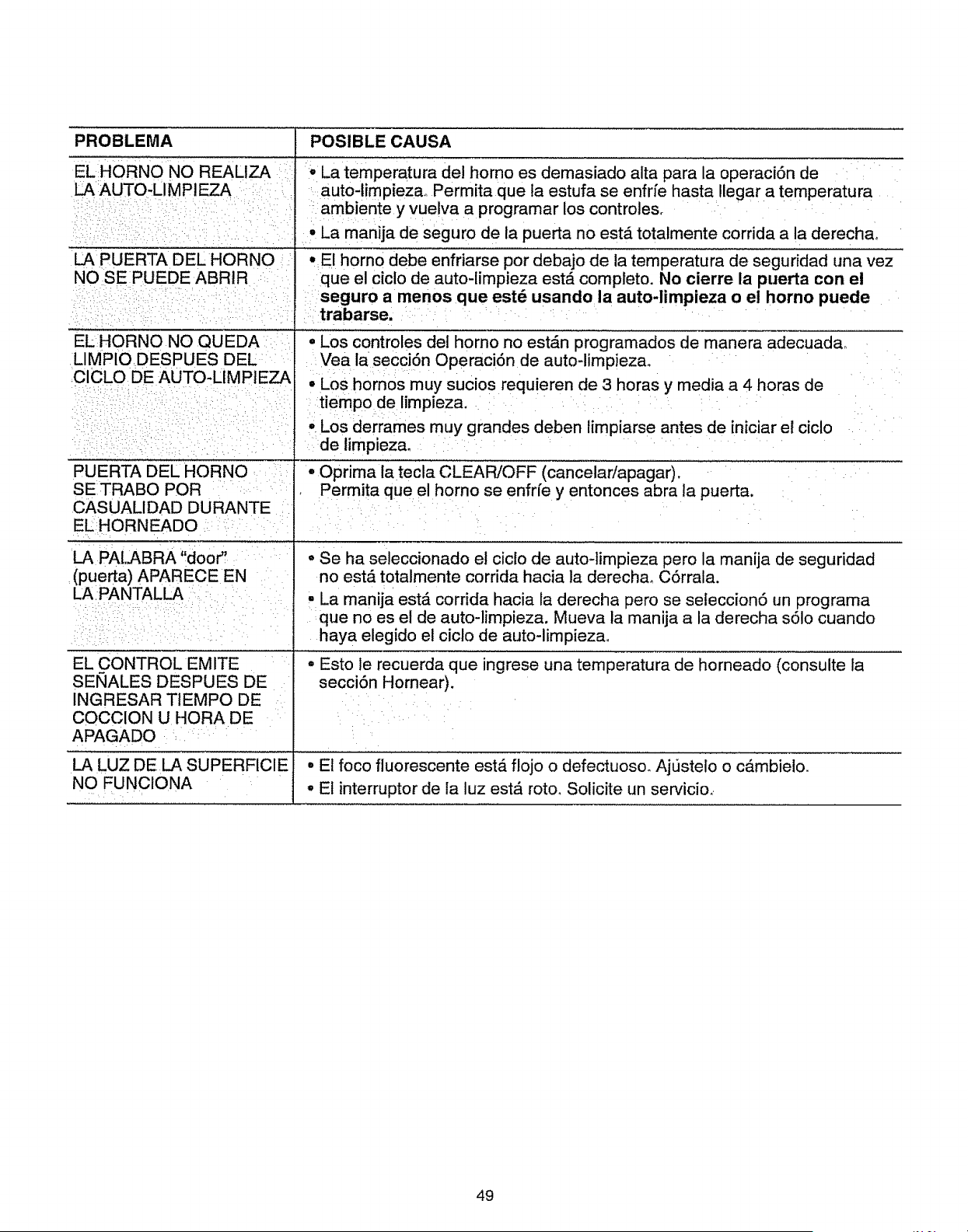
PROBLEMA
EL HORNO NO REALtZA
LA AUTO-LIMPIEZA
LA PUERTA DEL HORNO
NO SE PUEDE ABRIR
EL HORNO NO QUEDA
LIMPIO DESPUES DEL
CICLO DE AUTO-LIMPtEZA
PUERTA DEL HORNO
SE TRABO POR
CASUALIDAD DURANTE
EL HORNEADO
LA PALABRA ',door'!
(puerta) APARECE EN
LA PANTALLA
EL CONTROL EMITE
SEI_ALES DESPUES DE
INGRESAR TIEMPO DE
COCCION U HORA DE
APAGADO
LA LUZ DE LA SUPERFICIE
NO FUNCIONA
POSIBLE CAUSA
. La temperatura del homo es demasiado alta para la operaci6n de
auto-limpiezao Permita que la estufa se enfrfe hasta llegar a temperatura
ambiente y vuelva a programar los controles.
- La manija de seguro de la puerta no est4 totalmente corrida a la derecha.
• El homo debe enfriarse por debajo de la temperatura de seguridad una vez
que el ciclo de auto-limpieza est& completo. No ¢ierre la puerta con el
seguro a menos que est_ usando la auto-limpieza o e! homo puede
trabarse.
• Los controles del homo no est4n programados de manera adecuada.
Vea la secci6n Operaci6n de auto-limpiezao
° Los hornos muy sucios requieren de 3 horas y media a 4 horas de
tiempo de limpieza.
,, Los derrames muy grandes deben limpiarse antes de iniciar el ciclo
de limpieza.
° Oprima la tecla CLEAR/OFF (cancelar/apagar).
Permita que el homo se enfrfe y entonces abra la puerta.
o Se ha seleccionado et ciclo de auto-limpieza pero la manija de seguridad
no est,_ totalmente corrida hacia la derechao C6rrala.
- La manija est#, corrida hacia Ia derecha pero se seleccion6 un programa
que no es el de auto-limpieza. Mueva la manija a la derecha s61o cuando
haya elegido el ciclo de auto-lirnpieza.
° Esto le recuerda que ingrese una temperatura de horneado (consulte la
secci6n Homear).
° El foco fluorescente est& flojo o defectuoso. Ajustelo o c#,mbielo.
= Et interruptor de la luz est_ roto. Solicite un servicio.
49

NOTAS
50
Paraias reparacioneso piezasde repuesto
que ustednecesite
Llam6 de 7 AM a 7 PM, 7 di'asa la semanaal
(1-800-366-7278)
ParaservnciodereparacJ6nen casade
las marcasprincipales
Liam624 horasal dfa, 7 dfasa la semanaat
1-800-4-REPAIR
(1-800-473-7247)
Para iocaJizarel Centrode Serviciode
Reparaci6nesSearsen su_rea
Llam624 horasal dfa,7 dfasa la semanaal
t -800-488-1 222
m immmm mm mum,m
mmmmmmmmm
Pararecibir informaci6nsobrela compra
de unAcuerdode MantenimientoSearso para
indagarsobreunAcuerdoexistente
Liam6de 9 AM a5 PM, de lunes a s_.bado
America's Repair Specialists
51
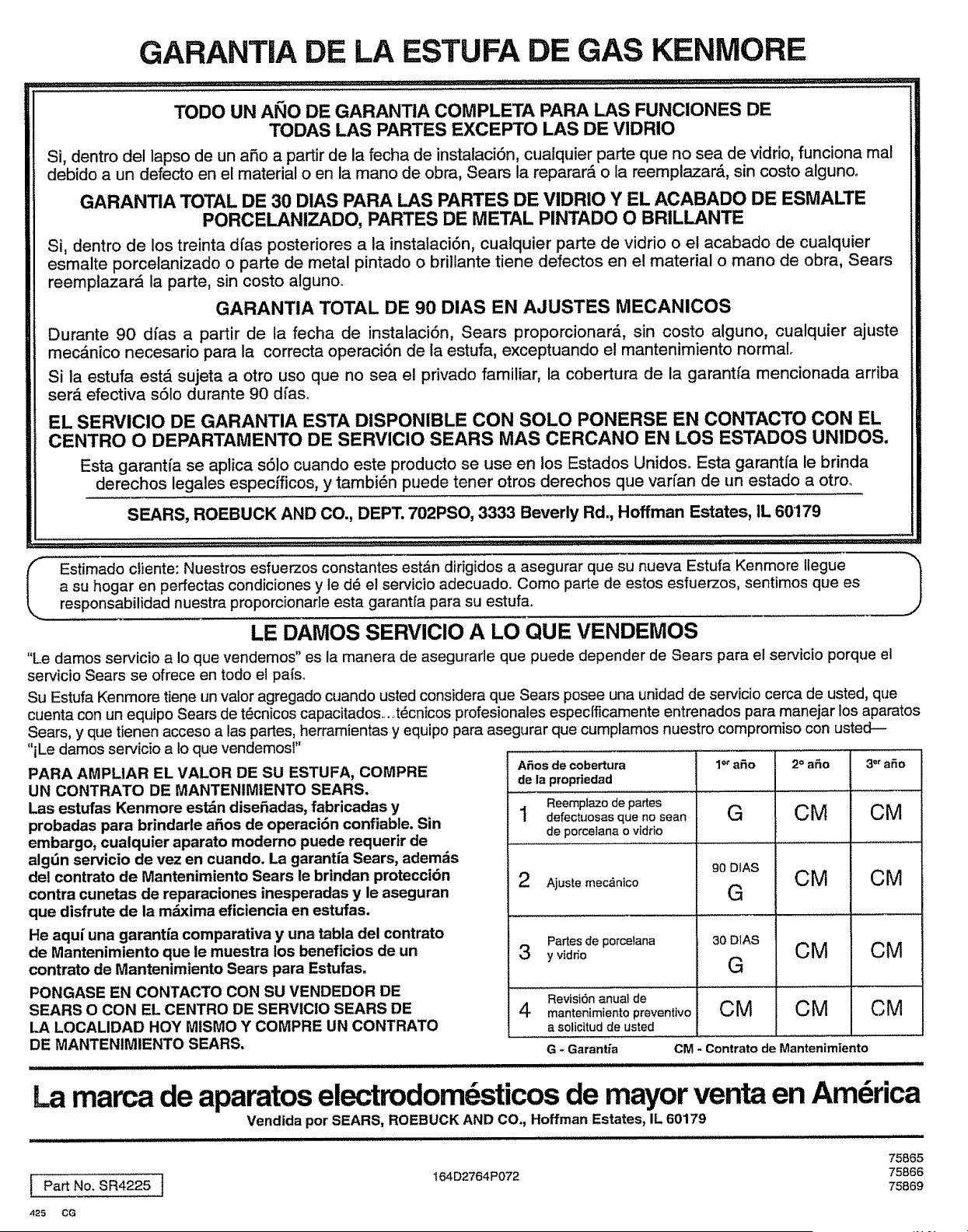
GARANTIA DE LA ESTUFA DE GAS KENMORE
TODO UN Ai_IO DE GARANTIA COMPLETA PARA LAS FUNCIONES DE
TODAS LAS PARTES EXCEPTO LAS DE VIDRIO
Si, dentrodel lapso de un a_,oa partir de la fecha de instalaci6n, cualquier parte que no sea de vidrio,funciona mal
debido a un defecto en el material o en la mano de obra, Sears la reparar_, o la reemplazar_, sin costo alguno°
GARANTIA TOTAL DE 30 DIAS PARA LAS PARTES DE VIDRIO Y EL ACABADO DE ESMALTE
PORCELANIZADO, PARTES DE METAL PINTADO O BRILLANTE
Si, dentro de los treinta dfas posteriores a la instataci6n, cualquier parte de vidrio o el acabado de cualquier
esmalte porcelanizado o parte de metal pintado o brillante tiene defectos en el material o mano de obra, Sears
reemptazar_ la parte, sin costo alguno.
GARANTIA TOTAL DE 90 DIAS EN AJUSTES MECANICOS
Durante 90 dfas a partir de fa fecha de instalaci6n, Sears proporcionar&, sin costo alguno, cualquier ajuste
mecAnico necesario para la correcta operaci6n de la estufa, exceptuando el mantenimiento normal.
Si la estufa est,. sujeta a otro uso que no sea el privado familiar, la cobertura de la garantfa mencionada arriba
ser_ efectiva s61o durante 90 dfas.
EL SERVIClO DE GARANTIA ESTA DISPONIBLE CON SOLO PONERSE EN CONTACTO CON EL
CENTRO O DEPARTAMENTO DE SERVIClO SEARS MAS CERCANO EN LOS ESTADOS UNIDOS.
Esta garantfa se aplica s61o cuando este producto se use en los Estados Unidos. Esta garantfa le brinda
derechos legales especfficos, y tambi_n puede tener otros derechos que var[an de un estado a otro.
SEARS, ROEBUCK AND CO., DEPT. 702PSO, 3333 Beverly Rd., Hoffman Estates, IL 60179
_,_rmr
Estimado cliente: Nuestros esfuerzos constantes est&n didgidos a asegurar que su nueva Estufa Kenmore Ilegue "_
a su hogar en perfectas condiciones y le d_ el servicio adecuadoo Como parte de estos esfuerzos, sentimos que es
J
responsabilidad nuestra proporcionarle esta garantla para su estufa.
LE DAMOS SERVlClO A LO QUE VENDEMOS
"Le damos servicio a Io que vendemos" es la manera de asegurade que puede depender de Sears para e! servicio porque el
servicio Sears se ofrece en todo el pats,.
Su Estufa Kenmore tiene un valor agregado cuando usted considera que Sears posee una unidad de servicio cerca de usted, que
cuenta con un equipo Sears de t_cnicos capacitados.....t_cnicos profesionales especfficamente entrenados para manejar los aparatos
Sears, y que tienen acceso a las partes, herramientas y equipo para asegurar que cumplamos nuestro compromiso con usted--
"iLe damos servicio a Ioque vendemosI"
PARA AMPLIAR EL VALOR DE SU ESTUFA, COMPRE
UN CONTRATO DE MANTENIMIENTO SEARS.
Las estufas Kenmore est_n diseSadas, fabricadas y
probadas para brindarle aSos de operaci6n confiable. Sin
embargo, cualquier aparato moderno puede requerir de
alg_n servicio de vez en cuando. La garantia Sears, adem,_s
del contrato de Mantenimiento Sears le brindan protecci6n
contra cunetas de reparaciones inesperadas y le aseguran
que disfrute de la m_xima eficiencia en estufas.
He aqu[ una garant[a comparativa y una tabla del contrato
de Mantenimiento que le muestra los beneficios de un
contrato de Mantenimiento Sears para Estufas.
PONGASE EN CONTACTO CON SU VENDEDOR DE
SEARS O CON EL CENTRO DE SERMlClO SEARS DE
LA LOOALIDAD HOY MISMO Y COMPRE UN CONTRATO
DE MANTENIMIENTO SEARS.
Afios de cobertura
de la propriedad
Reemplazo de partes
1 defectuosas que no sean
de porceiana o vtdrio
2 Ajuste mecdnico
Partes de porcelana
3 y vidr_o
1_r a_O
G
90 DIAS
G
30 DIAS
G
2° aSo
CM
CM
3 "r afio
CM
CM
CM CM
Revisi6n anual de
4 mantenimientopreventivo CM CM CM
a solicitud de usted
G _ Garantia CM - Contrato de Mantenirniento
La marca de aparatoselectrodomdsticosde mayorventa en Amdrica
Vendida por SEARS, ROEBUCK AND CO., Hoffman Estates, IL 60179
Part No. SR4225 ]
164D2764P072
75865
75866
75869
425 CG