- 1 -
06/2020
Copyright © 2020, Fast ČR, a.s.
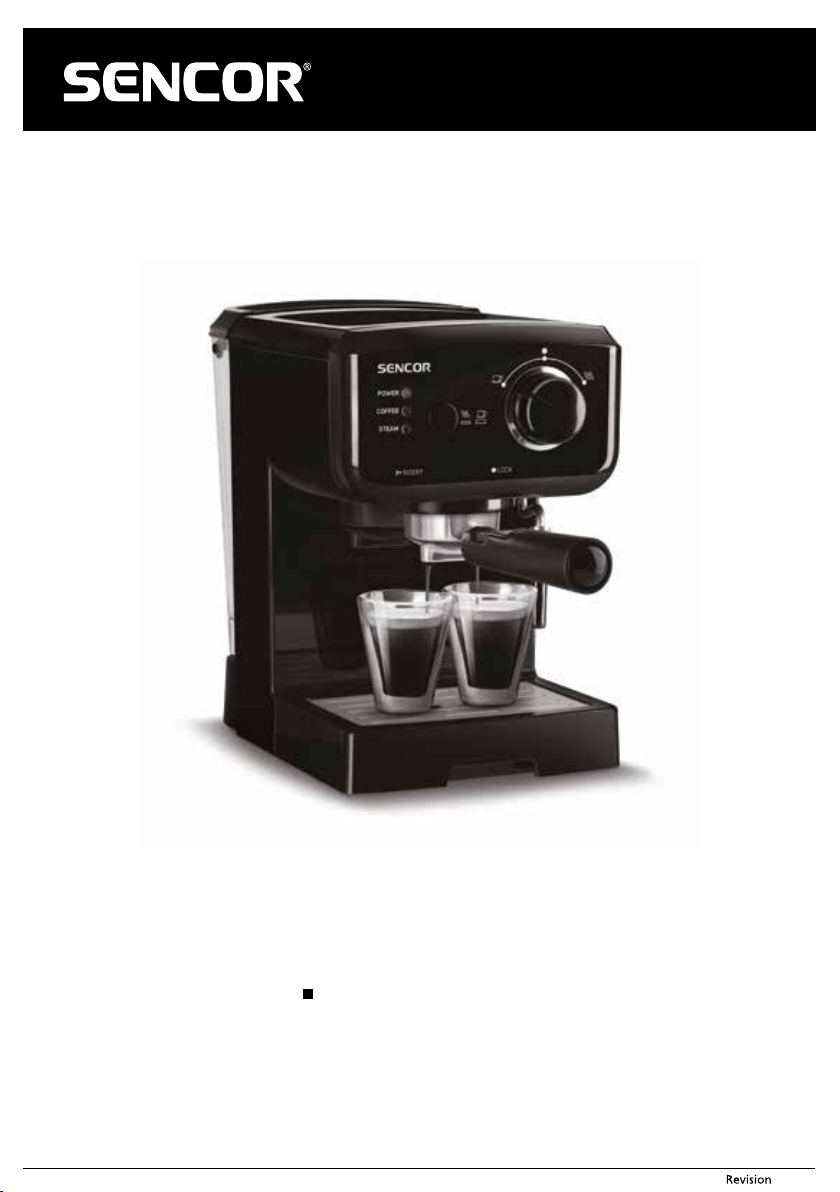
EN Espresso Machine
Translation of the original manual
SES 1710BK

- 2 -
06/2020
Copyright © 2020, Fast ČR, a.s.
EN
Espresso Machine
Important safety instructions
READ CAREFULLY AND STORE FOR FUTURE USE.
■
This appliance may be used by children 8 years of age and older and by persons with
physical or mental impairments or by inexperienced persons, if they are properly
supervised or have been informed about how to use the product in asafe manner
and understand the potential dangers.
■ Children must not play with the appliance. Cleaning and maintenance performed
by the user must not be performed by unsupervised children.
■
Before connecting the appliance to apower socket, check that the rated voltage on
its rating label matches the electrical voltage in the power socket.
■ Connect the appliance only to aproperly grounded socket. For safety reasons, we
do not recommend using multi-socket adapters or extension cords.
■
This appliance is designed for household use only. It is not intended for use in
locations such as:
– staff kitchens in stores, offices and other workplaces;
– hotel or motel rooms and other living areas;
– agricultural farms;
– bed and breakfast establishments.
■ Do not place the appliance on window sills, kitchen sink drainboards or unstable
surfaces. Always place it on astable, even and dry surface.
■ Do not place the appliance on or near an electrical or gas stove, or in the vicinity
of an open flame.
■ Never use the appliance in the near vicinity of abath, shower or swimming pool.
■ Use the appliance only for the purposes for which it was designed.
■ Only use the appliance with the original accessories that came with it.
■ To ensure sufficient air circulation, free space of at least 15 cm must be maintained
around and above the appliance when it is running.
■
Only use the top surface of the appliance for warming cups. Do not use it as aplace
for placing items.
■
Fill the water tank with clean cold water. Do not pour hot water or other liquids into
it or place any items inside it.
■ Before turning on the appliance, check that:
– the drip tray together with the grate is installed in position;
– the water tank is filled with asufficient amount of water and is properly installed
in position. The water level must not exceed the water level mark.
- 3 -
06/2020
Copyright © 2020, Fast ČR, a.s.
■
Before you begin brewing coffee, check that the portafilter is properly attached to the
brew head. Pressure is created in the portafilter during the coffee steaming process,
so do not move it while it is running. Otherwise, this could result in adangerous
situation.
Attention:
Incorrect use may lead to injuries.
■
When operating the appliance, be especially careful to avoid scalding by hot water
or steam.
■
Regularly inspect the water level in the water tank when using the appliance. When
the water level falls below the minimum water level mark, add water. Before adding
water, first turn the appliance off and disconnect it from the power socket.
■
To protect the pump from damage, the appliance is equipped with abuilt-in thermal
fuse that will disengage it when it runs empty. In the event that such asituation
occurs, disconnect the power cord from the power socket and allow the appliance
to cool down for at least 30 minutes. Then you may continue using it.
■
Accessible surfaces of the appliance are hot during its use and afterwards as a result
of residual heat. Do not touch hot surfaces.
■ Always turn off the appliance and disconnect it from the power socket when not
using it, when leaving it without supervision, before disassembling or assembling
it, before filling up the water tank, and before moving or cleaning it. Allow the
appliance to cool down before cleaning or moving it. Do not move the appliance
with acoffee cup located on the drip tray grate or with cups located on the cup
warming surface.
■
Keep the appliance and its accessories in clean condition. Clean and maintain it
according to the instructions in chapter Cleaning and maintenance. Never wash
the appliance under running water or submerge it in water or another liquid.
■ Make sure that the power cord does not come into contact with ahot surface and
prevent the power plug from coming into contact with water.
■
Disconnect the appliance from the power socket by pulling on the plug, never pulling
on the power cord. Otherwise, this could damage the power cord or the socket.
■
In the event that the power cord is damaged, have it repaired at aprofessional
service centre to prevent causing adangerous situation. It is forbidden to use the
appliance if it has adamaged power cord.
■
To avoid the danger of injury by electrical shock, do not repair the appliance yourself
or make any adjustments to it. Have all repairs performed at an authorised service
centre. By tampering with the appliance, you risk voiding your legal rights arising
from unsatisfactory performance or quality warranty.
- 4 -
06/2020
Copyright © 2020, Fast ČR, a.s.
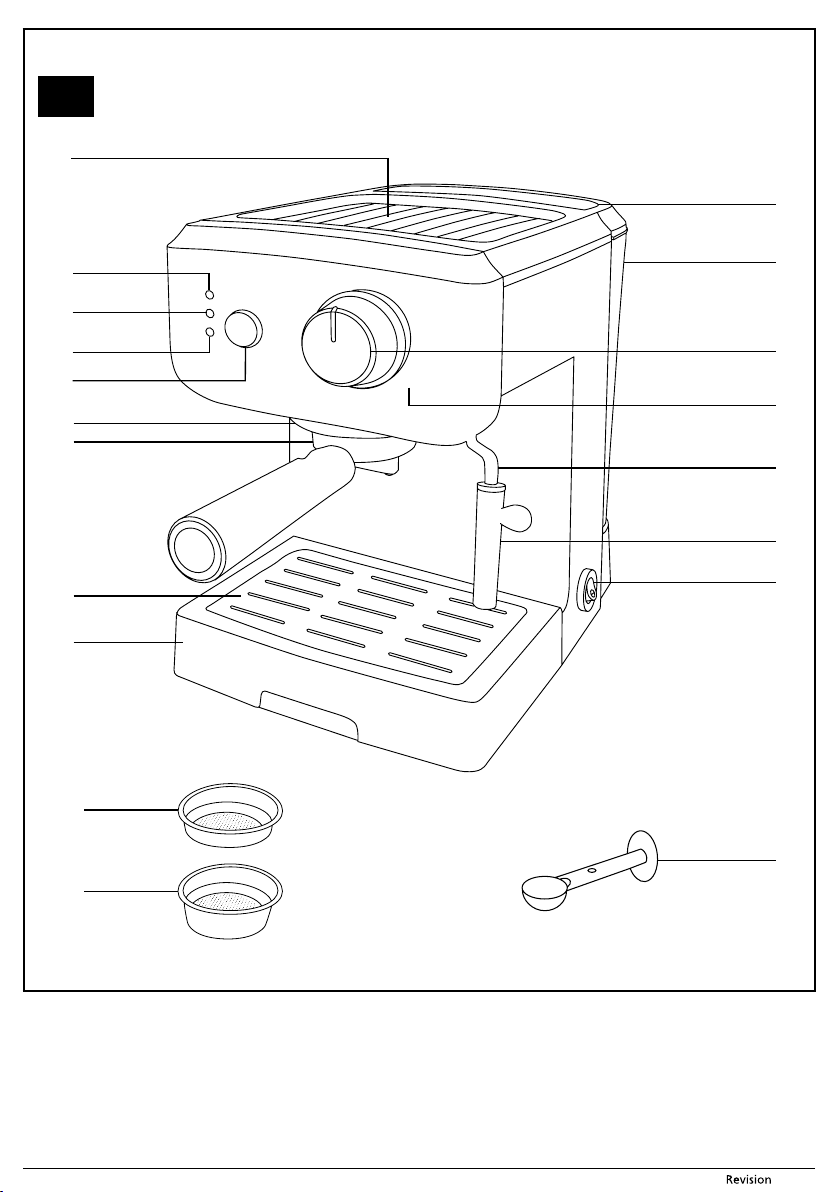
1
2
6
3
A
10
4
5
7
8
9
11
12
13
14
15
16
19
17
18
06/2020
- 5 -
Copyright © 2020, Fast ČR, a.s.
EN
Espresso Machine
User'smanual
■
Prior to using this appliance, please read the user’smanual thoroughly, even
in cases, when one has already familiarised themselves with previous use of
similar types of appliances. Only use the appliance in the manner described in
this user’smanual. Keep this user’smanual in asafe place where it can be easily
retrieved for future reference.
■
We recommend saving the original cardboard box, packaging material, purchase
receipt and responsibility statement of the vendor or warranty card for at least
the duration of the legal liability for unsatisfactory performance or quality. In
the event of transportation, we recommend that you pack the appliance in the
original box from the manufacturer.
DESCRIPTION OF THE APPLIANCE
A1 Cup warming plate
A2 Power indicator light
A3 Coffee brewing water temperature
indicator
A4 Steam release water temperature
indicator
A5 Coffee brewing and steam release
mode toggle button
A6 Brew head
A7 Portafilter with coffee spout
A8 Removable grate
A9 Removable drip tray
A10 Tilt-down lid with handle
A11 1.5-litre removable water tank
A12 Selection knob, 3 options
– brew coffee , stand-by mode
and steam release
A13 Boiler (not shown)
A14 Swivel steam nozzle
A15 Removable milk frothing
attachment
A16 ON/OFF switch
A17 Stainless steel filter for 1 cup
of coffee
A18 Stainless steel filter for 2 cups
of coffee
A19 Coffee measuring cup with tamper
BEFORE FIRST USE OF THE APPLIANCE
1. Remove all packaging materials, protective film, promotional tags or labels
from the appliance.
2. Install the appliance on an even, dry and clean surface. Take the water tank
A11 out of the appliance and rinse it out with clean water with the addition of
asmall amount of neutral dishwashing detergent. Then rinse it out thoroughly
using clean water, dry it and put it back in its place.
3. Take out the removable drip tray A9 with grate A8, wipe with adampened
textile, wipe dry and insert it back into the bottom part of the appliance.
4. Wash the portafilter A7, coffee measuring cup A19 and the stainless steel filters
A17 and A18 under clean running water with an addition of kitchen detergent.
Then rinse with clean water and wipe dry.
5. Wipe the outer surface of the appliance with alightly dampened cloth and then
wipe it thoroughly dry.
6. Prior to brewing the first cup of coffee, run the appliance empty for
approximately 60 seconds, i.e. with the water tank A11 filled with water but
without coffee tamped in the filter. This will clean out the inner components
and the brew head A6. A sufficiently large container must be placed
underneath the portafilter A7 for the hot water to flow into. Instructions for
starting the appliance are provided in chapter Operating the appliance.
OPERATING THE APPLIANCE
1. FILLING THE WATER TANK
1.1 Grasp the water tank A11 by the handle A10. Lift it up and remove it from the
rear part of the appliance.
1.2 Fill it up with cold water up to the maximum water mark, insert it back into the
appliance and tilt down the lid with handle A10. The water tank A11 must be
securely seated in place in order for water to be pumped out of it into the boiler
A13.
Note:
The water that you pour into the water tank A11 should ideally
be at room temperature (approximately 25 °C). Water that is too
cold, could negatively affect the final taste of the coffee beverage.
Attention:
The water tank A11 has amaximum capacity of 1.5 litres of
water. Do not overfill it.
Never fill the water tank A11 with warm water, hot water or
sparkling water, or other liquids such as, for example, milk.
Do not fill the water tank A11 when it is inserted in the
appliance. There is adanger of splashing the appliance or
overfilling the water tank A11.
1.3
Do not leave any remaining water in the water tank A11 for longer than one day.
For brewing quality fresh coffee, it is necessary to use fresh water. Otherwise, the
resulting flavour of the coffee beverage may be negatively affected.
2. TURNING ON THE APPLIANCE
2.1 Connect the power cord plug to apower socket. Make sure that the water tank
A11 is filled with fresh water, that the drip tray A9 and grate A8 are installed in
their place and that the knob A12 is set to the stand-by mode position.
2.2 To turn on the appliance, set the switch A16 to the ON position. Indicator A2
will be lit.
2.3 Underneath the brew head A6 place acup into which hot water will flow. Make
sure the button A5 is in the pressed out position that is intended for the coffee
brewing mode. Set the knob A12 to the coffee brewing position. As soon as
water starts flowing out of the brew head A6, set the knob A12 back to the
stand-by mode position. This step is performed after the appliance is turned on
to pump water from the water tank A11 into the boiler A13. In the boiler A13,
water is heated to the optimal coffee brewing temperature.
3. PRE-HEATING THE APPLIANCE AND CUPS
3.1 Preparing aquality cup of espresso requires that the appliance, portafilter A7,
filter A17 or A18, and cups are preheated. This is done in the following way.
3.2 Place empty coffee cups upside down on to surface A1 and allow them to
warm up.
3.3 Select filter A17 or A18 and insert it into the portafilter A7 so that it securely
slides in along the entire perimeter. Insert the portafilter A7 underneath the
brew head A6 so that the handle is pointing to the left. This position is marked
with “INSERT” on the front panel of the appliance. To fasten the portafilter A7 to
the brew head A6, turn the handle to the right to the “LOCK” position.
3.4 Wait until indicator A3 is lit, and set knob A12 again to the coffee brewing
mode position. Hot water will start flowing out of the spout on the portafilter
A7 into the cup located under the spout. When the indicator A3 turns off, set
the knob A12 back to the stand-by mode position. Remove the cup containing
the hot water. Now the pre-heating process is finished.
4. BREWING COFFEE
4.1 Take the portafilter A7 out of the appliance and dry the filter with apaper towel.
4.2 Place the portafilter A7 on to an even surface and pour the corresponding
amount of ground coffee into the filter. The one-cup coffee filter A17 is filled
with asingle level measuring cup A19 of coffee. The two-cup coffee filter A18
is filled with double the amount of coffee. One level measuring cup A19 is
equivalent to 7 g of ground coffee. Spread the coffee out evenly inside the filter
and gently tamp it down with the flat end of the measuring cup A19.
4.3 Thoroughly clean ground coffee remains from the edges of the filter A17 or
A18. Insert the portafilter A7 underneath the brew head A6 so that the handle
is pointing to the left. This position is marked with “INSERT” on the front panel of
the appliance. To fasten the portafilter A7 to the brew head A6, turn the handle
to the right to the “LOCK” position.
4.4 Place one or two preheated cups underneath the portafilter A7. Make sure that
the cups are located underneath the spout.
4.5 When the indicator A3 is lit, set knob A12 to the coffee brewing mode position.
Within afew moments, coffee will start flowing into the cups.
Note:
The indicator A3 may turn off while the coffee is being extracted.
This signals adecline in the water temperature in the boiler A13.
The indicator A3 will light up again as soon as the boiler A13
heats the water up to the ideal coffee brewing temperature.
Once the required amount of coffee is in the cup, set the knob A12 to the stand-
by mode position. This completes the coffee extraction process. The extraction
time for a cup of espresso should be between 20 and 30 seconds and the
volume should be approximately 20 to 30 ml.
Note:
Make sure that button A5 is in the brew coffee position. If button
A5 is set to the steam release position, the espresso machine will
not dispense coffee.
4.6 If you do not fill the filter with ground coffee, you may simply pour just hot
water, for example for tea, hot chocolate, etc.
4.7 Before you start brewing another cup of coffee, first remove used coffee
grounds, clean out the filter according to the instructions contained in chapter
Maintenance and cleaning and pour out the water from the drip tray A9. When
returning the drip tray A9 to its place, push it all the way against the back wall
of the appliance.
Attention:
The water contained in the drip tray A9 is hot. When
handling the drip tray A9, pay extra attention.
During operation, regularly check the water level in the
water tank A11 and make sure that it does not fall below
the minimum water level mark.
5. USING THE NOZZLE TO FROTH MILK AND HEAT WATER
5.1 Prepare some cooled semi-skimmed or full-fat milk and the container in which
you will froth the milk. During the milk frothing process, its volume expands,
therefore fill the container to no more than ⅓ of its capacity.
06/2020
- 6 -
Copyright © 2020, Fast ČR, a.s.
5.2 Set the nozzle A14 to such a position that the milk frothing process is
comfortable.
5.3 Make sure that the knob A12 is set to the stand-by mode position. Press
button A5 and wait until indicator A4 lights up. This signalises that the water
in the boiler A13 has reached the optimal steam generation temperature. This
temperature is higher than for brewing coffee.
5.4 Place the container with milk underneath the nozzle A14. Submerge the
nozzle A14 just beneath the surface of the milk and set the knob A12 to the
steam release position. The nozzle A14 will start releasing steam. Initially
asmall amount of hot water may be released. Hold the container slightly tilted
to ensure that the nozzle A14 remains constantly submerged just under the
surface of the milk. The milk will circulate in the container, it will heat up and
increase in volume. Milk froth will start to form on the surface of the milk. When
the bottom of the container heats up so that it is hot to touch, stop the milk
frothing by turning the knob A12 to the stand-by mode position. When steam
stops being created, remove the container. Using aswirling motion, whip the
froth into the heated milk.
Attention:
The nozzle A14 must remain submerged during the entire
frothing process. Otherwise hot milk may splash out.
5.5 Pour the frothed milk into freshly brewed coffee and use aspoon to add the
milk froth. The recommended milk and coffee ratio for preparing cappuccino
coffee is ⅓ espresso, ⅓ warm milk and⅓ milk froth. To prepare caffè latte, use
⅓ espresso, ⅔ warm milk and approximately 1 cm of milk froth.
5.6 After using the hot steam release function, it is necessary to drain the remaining
water from the boiler A13; this will prevent the subsequently brewed coffee
from being steamed with water that is too hot. Push out button A5 to the coffee
brewing position. Underneath the spout of the portafilter A7, place acup into
which the hot water will be drained from the boiler A13, and set the knob A12
to the coffee brewing position. Wait until the indicator A3 turns off. Then set the
knob A12 back to the stand-by mode position. The boiler A13 will heat the new
batch of water up to the optimal coffee brewing temperature. This is signalised
by the indicator A3 being lit.
5.7 When you have finished using it, clean out the nozzle A14 and the milk
frothing attachment A15 according to the instructions in chapter Cleaning and
maintenance.
5.8 After removing the attachment A15, the nozzle A14 may be used in the same
way to heat water for tea, hot chocolate, etc. When heating water, submerge
the nozzle A14 at least 5 cm under the water level.
6. TURNING OFF THE APPLIANCE
6.1 When you have finished using the appliance, turn it off by setting the switch
A16 to the OFF position.
Note:
The appliance will turn off automatically after 25 minutes of
inactivity or when the pump runs non-stop for 3 minutes in the
coffee brewing mode.
BASIC GUIDELINES AND RECOMMENDATIONS FOR BREWING
QUALITY COFFEE
■
Always brew coffee in aclean espresso machine. Adirty appliance can negatively
impact the taste of the coffee beverage. Instructions for cleaning and removing
limescale deposits are found in chapter Cleaning and maintenance.
■
For brewing quality coffee, it is necessary to use fresh drinking water. Do not
use warm, heated, distilled, mineral or sparkling water. Do not leave water in
the water tank A11 for longer than one day.
■
Brew coffee from pre-ground coffee that is intended for espresso machines
or using freshly ground coffee beans. When using ground coffee beans, it is
important to correctly set the grinding fineness. Coffee beans need to be ground
to afine texture but not too fine. If the ground coffee feels like fine flour when
sifted between the fingers then the coffee will be brewed for too long and the
resulting beverage will be too dark and bitter, or the filter may become clogged.
If the coffee beans are ground too coarsely, the brewing process will be too fast
and the resulting beverage will have awatery taste and bland aroma.
■
Select coffee beans, among others according to the roasting date marked on
the package. We recommend consuming freshly roasted coffee beans within 3
weeks of the roasting date. To shorten the storage time, purchase it in smaller
packages. Store it in acool, dark and dry location, ideally in an air-tight container.
■
When using pre-ground coffee, store it in an enclosed container, in dry and
cool conditions. Do not place it in arefrigerator or freezer. Consume within
aweek of opening it.
CLEANING AND MAINTENANCE
■ Prior to cleaning the appliance, turn it off by setting the switch A16 to the OFF
position, disconnect it from the power socket and allow it to cool down.
■
For cleaning, do not use cleaning products with an abrasive effect, solvents,
etc. that could damage the appliance. No part of this appliance is intended for
washing in adishwasher.
CLEANING THE FILTERS, PORTAFILTER AND BREW HEAD
■
Release the portafilter A7 by turning the handle to the left. Remove it from
the brew head A6 and move it above arubbish bin. Turn the portafilter A7 so
that the filter with used coffee grounds points downwards. Use ateaspoon to
remove the coffee grounds. Avoid coming into contact with the surface of the
filter or portafilter A7 as they may still be hot. Prior to removing the filter from
the portafilter A7, cool it down under cold running water. Then rinse the filter
and the portafilter A7 under clean running water and dry them thoroughly.
■ If you used coffee that was ground too finely, then the holes in the filter may
have become clogged. To clean them out, use athin needle.
■ Remove ground coffee remains from the brew head A6 using adamp wiping
cloth.
Attention:
The brew head A6 remains hot after use due to residual
heat. Allow it to cool down before cleaning it.
CLEANING THE DRIP TRAY
■
The drip tray A9 needs to be emptied and washed every time the appliance
is used.
■
First remove the grate A9 from the drip tray A8 and then remove the water. Wash
the drip tray A9 and the grate A8 in warm water with neutral kitchen detergent.
Then rinse both parts under running water, wipe dry and return to their place.
CLEANING THE NOZZLE AND THE MILK FROTHING ATTACHMENT
■
It is necessary to thoroughly clean the nozzle A14 and the attachment A15
after every use.
■ Take off the attachment A15, rinse under hot running water and wipe dry.
■
Thoroughly clean the nozzle A14 using adampened cloth. In the event that there
are dried milk residues on the nozzle A14, submerge it into acontainer with hot
water to allow them to soak away. In the event that the dried milk residues clog
the steam exhaust outlet, clean it out using aneedle. Finally, clean the nozzle
A14 using adampened cloth, wipe dry and install it on to the attachment A15.
CLEANING THE OUTER CASE
■
Wipe the outer surface of the appliance using alightly dampened cloth and
wipe dry.
REMOVING LIMESCALE DEPOSITS
■
It is necessary to regularly remove limescale deposits from the appliance.
Limescale deposits may negatively affect the quality of the brewed coffee and
the lifetime of the appliance.
■
In the case of daily use of the appliance, we recommended to remove the
limescale deposits:
– once per month in areas with hard and very hard water;
– once every 2 to 3 months in areas with soft and medium soft water.
■
To remove limescale deposits, use a solution of 8% white vinegar and water
(recommended dilution ratio of 1:2). Instead of the water and vinegar solution,
it is possible to use citric acid or alimescale remover intended for espresso type
machines. The recommended dosage for citric acid is 2teaspoons per 0.5l of
water. Dose the limescale remover according to the manufacturer’sinstructions.
■ Fill the water tank A11 with the solution all the way up to the maximum level
mark. Connect the appliance to apower socket. Attach the portafilter A7 to the
brew head A6. Place asufficiently large container under the brew head A6 and
the nozzle A14. Allow the majority of the solution to flow through the brew head
A6 and allow the remainder to flow through the nozzle A14.
■
After using the solution, rinse out the water tank A11 using clean water and allow
clean water to flow through the appliance once or twice.
Attention:
Do not forget to regularly check the water level in the
water tank A11 and in the drip tray A9.
TECHNICAL SPECIFICATIONS
Rated voltage range ........................................................................................................220−240 V
Rated frequency ..........................................................................................................................50 Hz
Rated power input ...................................................................................................... 960–1 140 W
Noise level .............................................................................................................................. 75 dB(A)
The declared noise emission level of the appliance is 75dB(A), which represents
alevel Aof acoustic power with respect to areference acoustic power of 1pW.
We reserve the right to change text and technical specifications.
06/2020
- 7 -
Copyright © 2020, Fast ČR, a.s.
INSTRUCTIONS AND INFORMATION REGARDING THE DISPOSAL
OF USED PACKAGING MATERIALS
Dispose of used packaging material at a site designated for waste in your
municipality.
DISPOSAL OF USED ELECTRICAL AND ELECTRONIC EQUIPMENT
This symbol on products or original documents means that used
electric or electronic products must not be added to ordinary
municipal waste. For proper disposal, renewal and recycling hand
over these appliances to determined collection points.
Alternatively, in some European Union states or other European
countries you may return your appliances to the local retailer when
buying an equivalent new appliance.
Correct disposal of this product helps save valuable natural
resources and prevents potential negative effects on the environment and human
health, which could result from improper waste disposal. Ask your local authorities
or collection facility for more details.
In accordance with national regulations penalties may be imposed for the incorrect
disposal of this type of waste.
For business entities in European Union states
If you want to dispose of electric or electronic appliances, ask your retailer or
supplier for the necessary information.
Disposal in other countries outside the European Union
This symbol is valid in the European Union. If you wish to dispose of this product,
request the necessary information about the correct disposal method from the
local council or from your retailer.
This product meets all the basic requirements of EU directives related
to it.