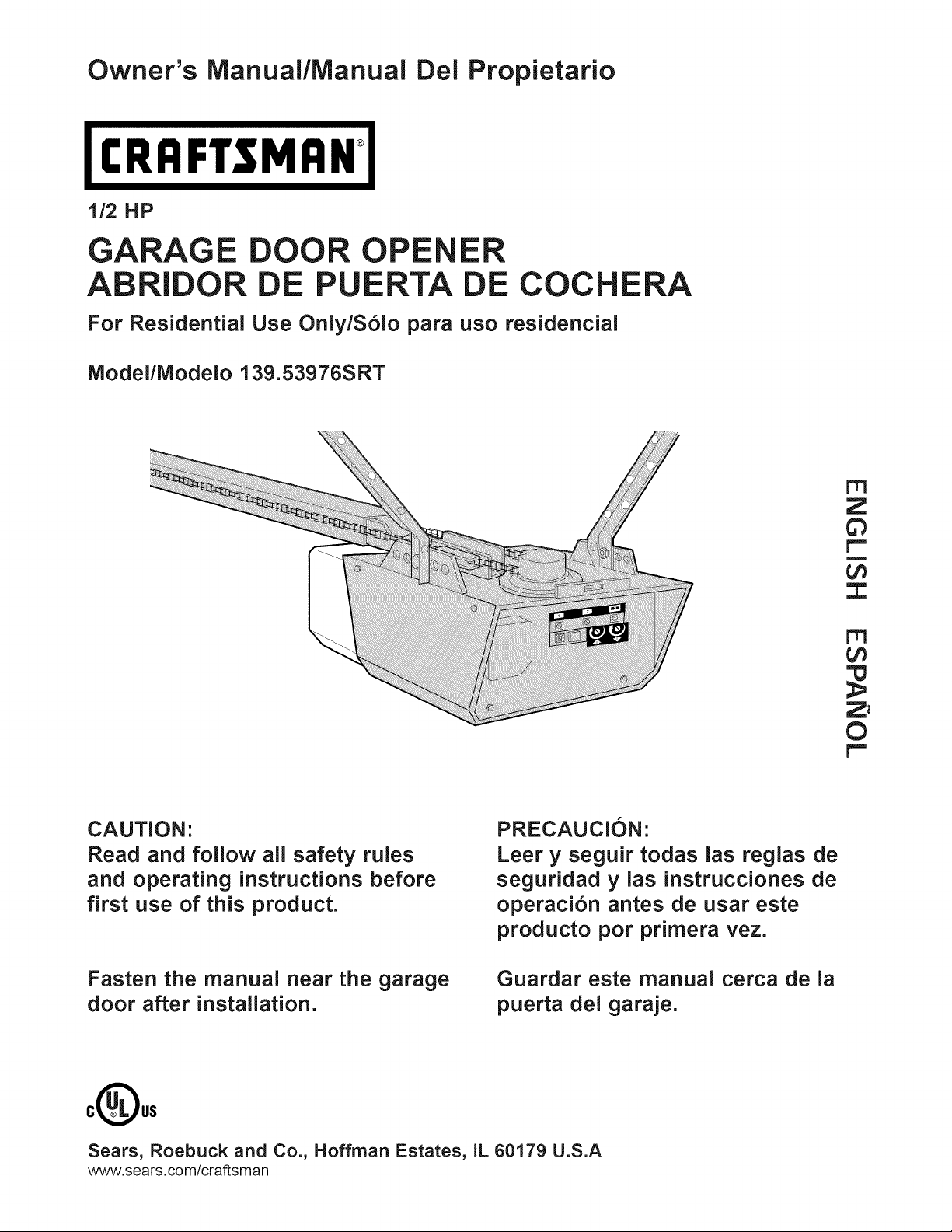
Owner's Manual/Manual Del Propietario
CRRFTSMRN°
1/2 HP
GARAGE DOOR OPENER
ABRIDOR DE PUERTA DE COCHERA
For Residential Use Only/S61o para uso residencial
ModellModelo 139.53976SRT
m
Z
!==,
m
m
"o
Z_
0
CAUTION"
Read and follow all safety rules
and operating instructions before
first use of this product.
Fasten the manual near the garage
door after installation.
PRECAUCION:
Leer y seguir todas las regias de
seguridad y las instrucciones de
operaci6n antes de usar este
producto por primera vez.
Guardar este manual cerca de la
puerta del garaje.
00°s
Sears, Roebuck and Co., Hoffman Estates, IL 60179 U.S.A
www.sears.com/craftsman
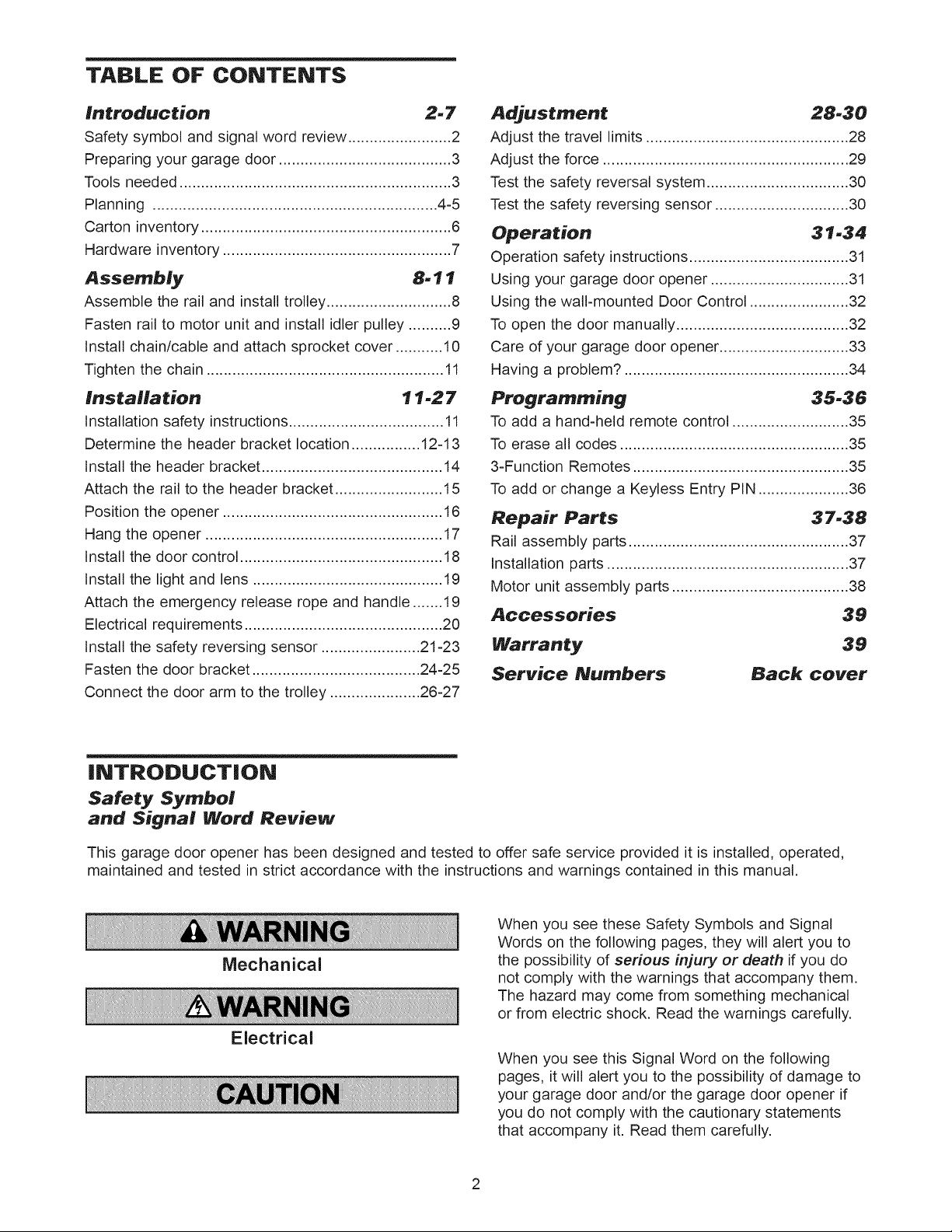
TABLE OF CONTENTS
In troduc tion 2= 7
Safety symbol and signal word review ........................ 2
Preparing your garage door ........................................ 3
Tools needed ............................................................... 3
Planning .................................................................. 4-5
Carton inventory .......................................................... 6
Hardware inventory ..................................................... 7
Assembly 8-11
Assemble the rail and install trolley ............................. 8
Fasten rail to motor unit and install idler pulley .......... 9
Install chain/cable and attach sprocket cover ........... 10
Tighten the chain ....................................................... 11
Installa tion 11 =2 7
Installation safety instructions .................................... 11
Determine the header bracket location ................ 12-13
Install the header bracket .......................................... 14
Attach the rail to the header bracket ......................... 15
Position the opener ................................................... 16
Hang the opener ....................................................... 17
Install the door control ............................................... 18
Install the light and lens ............................................ 19
Attach the emergency release rope and handle ....... 19
Electrical requirements .............................................. 20
Install the safety reversing sensor ....................... 21-23
Fasten the door bracket ....................................... 24-25
Connect the door arm to the trolley ..................... 26-27
Adjustment 28-30
Adjust the travel limits ............................................... 28
Adjust the force ......................................................... 29
Test the safety reversal system ................................. 30
Test the safety reversing sensor ............................... 30
Operation 31=34
Operation safety instructions ..................................... 31
Using your garage door opener ................................ 31
Using the wall-mounted Door Control ....................... 32
To open the door manually ........................................ 32
Care of your garage door opener .............................. 33
Having a problem? .................................................... 34
Programming 35=36
To add a hand-held remote control ........................... 35
To erase all codes ..................................................... 35
3-Function Remotes .................................................. 35
To add or change a Keyless Entry PIN ..................... 36
Repair Parts 37=38
Rail assembly parts ................................................... 37
Installation parts ........................................................ 37
Motor unit assembly parts ......................................... 38
Accessories 39
Warranty
Service Numbers
39
Back cover
iNTRODUCTiON
Safety Symbol
and Signal Word Review
This garage door opener has been designed and tested to offer safe service provided it is installed, operated,
maintained and tested in strict accordance with the instructions and warnings contained in this manual.
Mechanical
Electrical
When you see these Safety Symbols and Signal
Words on the following pages, they will alert you to
the possibility of serious injury or death if you do
not comply with the warnings that accompany them.
The hazard may come from something mechanical
or from electric shock. Read the warnings carefully.
When you see this Signal Word on the following
pages, it will alert you to the possibility of damage to
your garage door and/or the garage door opener if
you do not comply with the cautionary statements
that accompany it. Read them carefully.
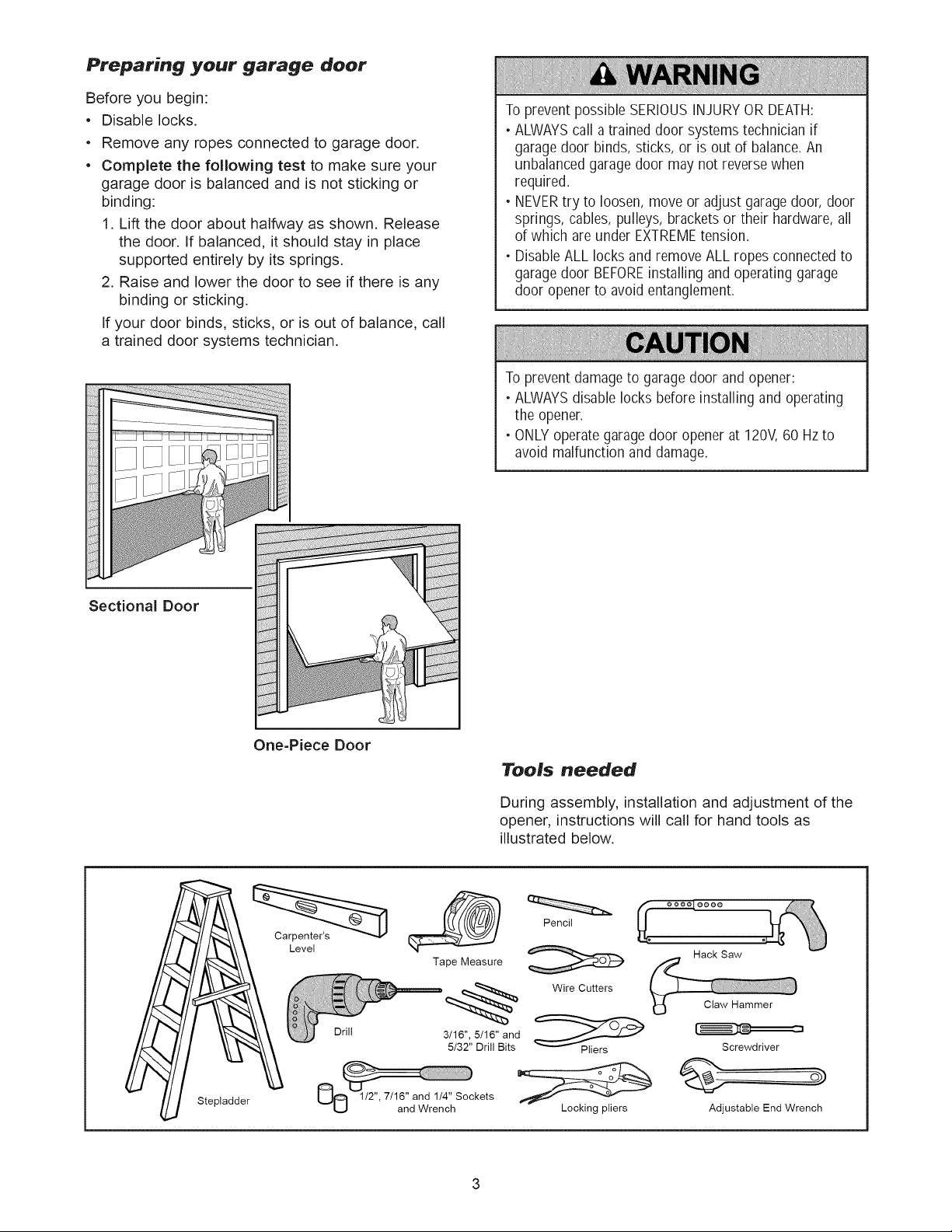
Preparing your garage door
Before you begin:
• Disable locks.
• Remove any ropes connected to garage door.
• Complete the following test to make sure your
garage door is balanced and is not sticking or
binding:
1. Lift the door about halfway as shown. Release
the door. If balanced, it should stay in place
supported entirely by its springs.
2. Raise and lower the door to see if there is any
binding or sticking.
If your door binds, sticks, or is out of balance, call
a trained door systems technician.
To prevent possible SERIOUSINJURYOR DEATH:
, ALWAYScall a trained door systems technician if
garagedoor binds, sticks, or is out of balance. An
unbalanced garagedoor may not reversewhen
required.
, NEVERtry to loosen, move or adjust garage door, door
springs, cables, pulleys, brackets or their hardware, all
of which are under EXTREMEtension.
, Disable ALL locks and remove ALL ropes connected to
garagedoor BEFOREinstalling and operating garage
door opener to avoid entanglement.
To prevent damage to garagedoor and opener:
, ALWAYSdisable locks before installing and operating
the opener.
, ONLYoperate garagedoor opener at 120V,60 Hzto
avoid malfunction and damage.
Sectional Door
One-Piece Door
Level
Tools needed
During assembly, installation and adjustment of the
opener, instructions will call for hand tools as
illustrated below.
Stepladder
Drill
Tape Measure
Pencil
Hack Saw
Wire Cutters
3/16", 5/16" and
5/32" Drill Bits Screwdriver
Locking pliers Adjustable End Wrench
Planning
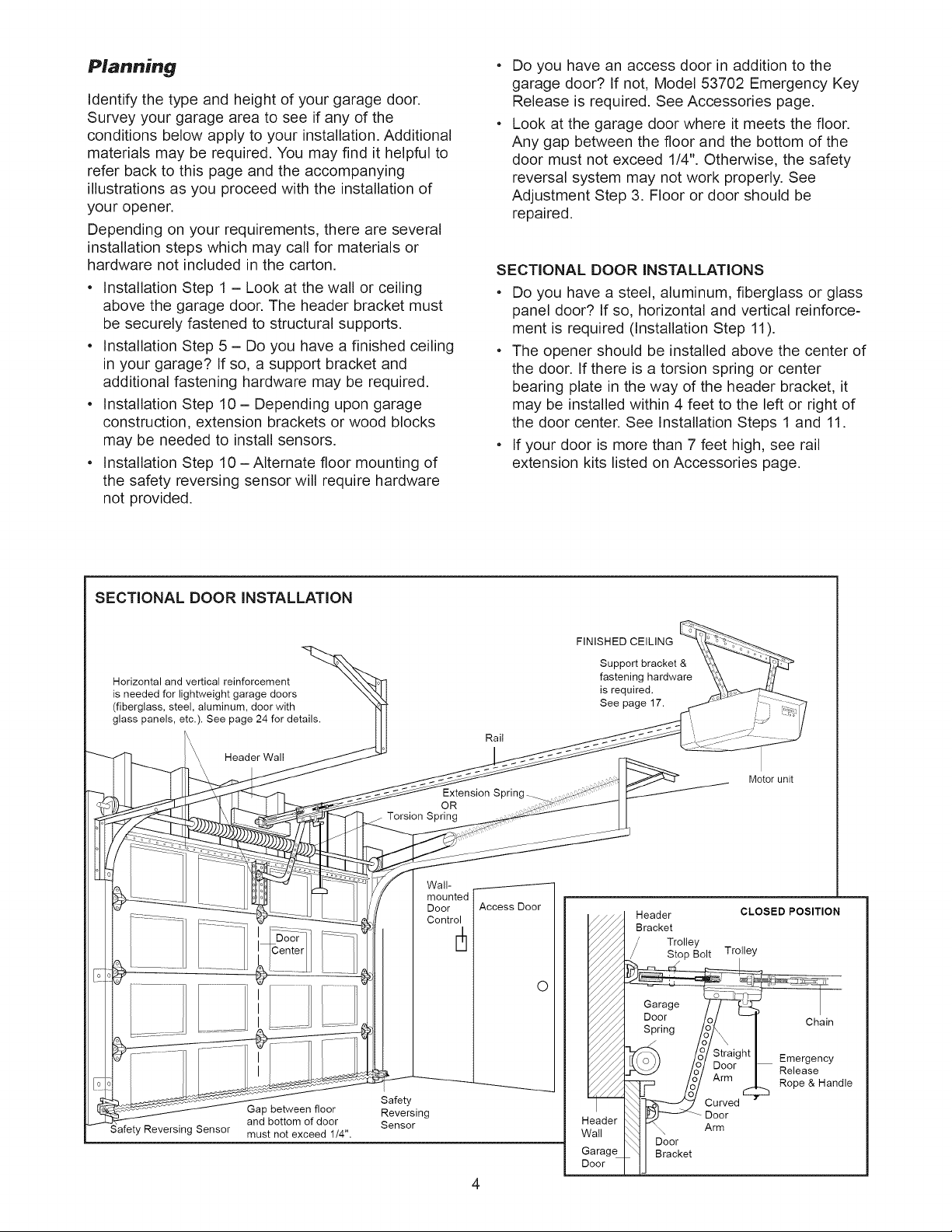
Identify the type and height of your garage door.
Survey your garage area to see if any of the
conditions below apply to your installation. Additional
materials may be required. You may find it helpful to
refer back to this page and the accompanying
illustrations as you proceed with the installation of
your opener.
Depending on your requirements, there are several
installation steps which may call for materials or
hardware not included in the carton.
• Installation Step 1 - Look at the wall or ceiling
above the garage door. The header bracket must
be securely fastened to structural supports.
• Installation Step 5 - Do you have a finished ceiling
in your garage? If so, a support bracket and
additional fastening hardware may be required.
• Installation Step 10- Depending upon garage
construction, extension brackets or wood blocks
may be needed to install sensors.
• Installation Step 10 -Alternate floor mounting of
the safety reversing sensor will require hardware
not provided.
Do you have an access door in addition to the
garage door? If not, Model 53702 Emergency Key
Release is required. See Accessories page.
Look at the garage door where it meets the floor.
Any gap between the floor and the bottom of the
door must not exceed 1/4". Otherwise, the safety
reversal system may not work properly. See
Adjustment Step 3. Floor or door should be
repaired.
SECTIONAL DOOR INSTALLATIONS
• Do you have a steel, aluminum, fiberglass or glass
panel door? If so, horizontal and vertical reinforce-
ment is required (Installation Step 11).
• The opener should be installed above the center of
the door. If there is a torsion spring or center
bearing plate in the way of the header bracket, it
may be installed within 4 feet to the left or right of
the door center. See Installation Steps 1 and 11.
• If your door is more than 7 feet high, see rail
extension kits listed on Accessories page.
SECTIONAL DOOR INSTALLATION
Horizontal and vertical reinforcement
is needed for lightweight garage doors
(fiberglass, steel, aluminum, door with
glass panels, etc.). See page 24 for details.
Header Wall
Rail
Extension Spring
OR
Torsion Spring
Wall-
mounted
Door
Control
Access Door
O
Safety Reversing Sensor
Gap between floor
and bottom of door
must not exceed 1/4".
Safety
Reversing
Sensor
FINISHED CEILING
Support bracket &
fastening hardware
is required.
See page 17.
Motor unit
m
-- Header CLOSED POSITION
Bracket
I_A / Trolley
__OltGarage Trolle
,-'_ __ _ _ ......
/
Door Chain
Spnng o I
__ j ___Straight Emergency
io pot I Release
_ /O_/ _rm _ Rop e&Handle
H:_lder /_ _DDoor Arm
Garage_J I Bracket
Door [iJ
Planning (continued)
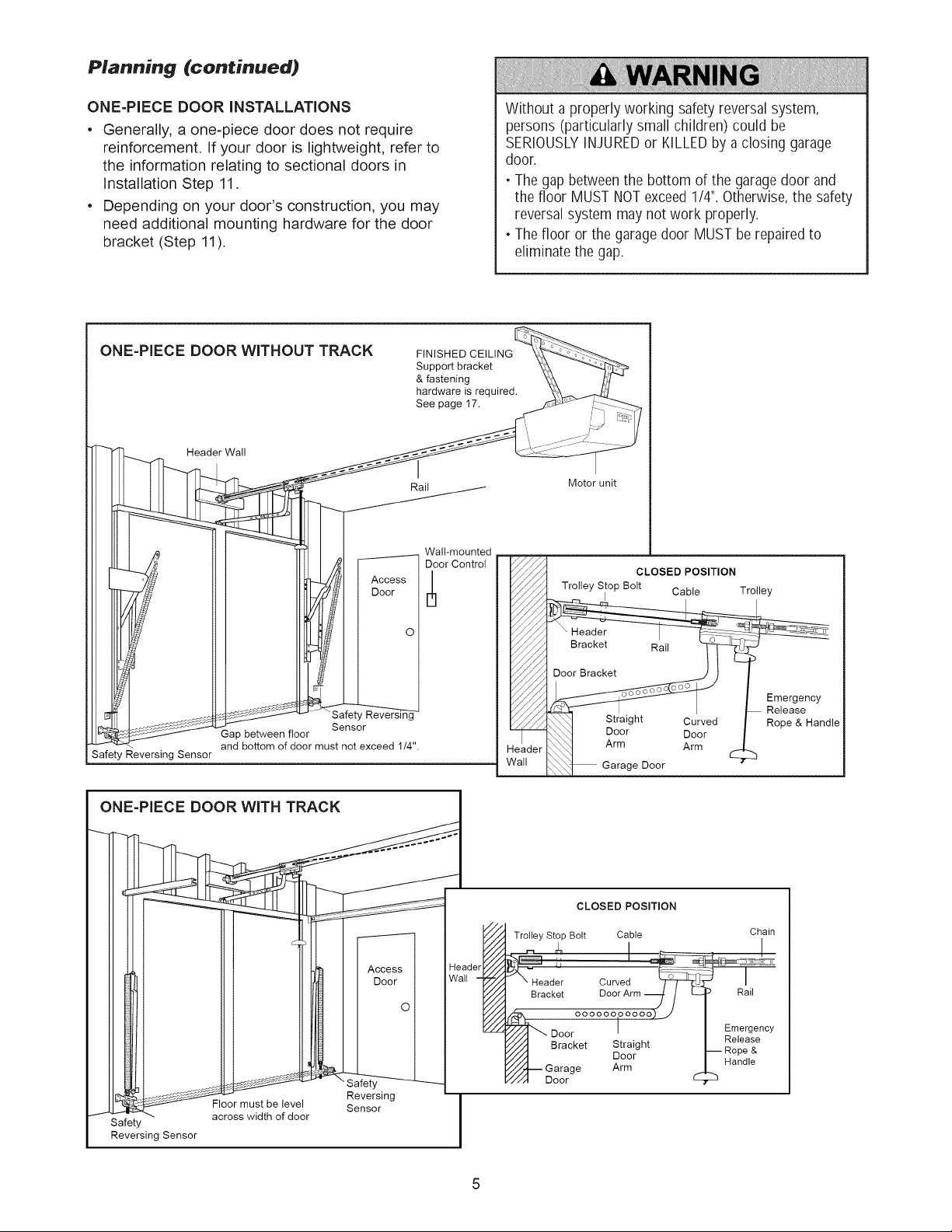
ONE-PIECE DOOR iNSTALLATiONS
• Generally, a one-piece door does not require
reinforcement. If your door is lightweight, refer to
the information relating to sectional doors in
Installation Step 11.
• Depending on your door's construction, you may
need additional mounting hardware for the door
bracket (Step 11).
Without a properly working safety reversal system,
persons (particularly small children) could be
SERIOUSLYINJUREDor KILLEDby a closing garage
door.
. The gap betweenthe bottom of the garagedoor and
the floor MUST NOTexceed 1/4". Otherwise,the safety
reversal system may not work properly.
. The floor or the garage door MUST be repaired to
eliminate the gap.
ONE-PIECE DOOR WITHOUT TRACK FINISHEDCEILING
Support bracket __L_
& fastening _',_::_ [!t -
h:rdware is required. __
T'_Y?q Header Wall __'_ L_ _:2 "
"Motor unit
I III t ,_ tt I TFr I I _ Wall-mounted
I c.os o os...o.
_o F_ I -_<:-_:__--__-- -:
...... Rope & Handle
and bottom of door must not exceed 1/4". I Header l_q Arm Arm f
Safety Reversing Sensor I ,_,_,_' I\_1 ...... _
I wall _ Garage Door
ONE-PIECE DOOR WiTH TRACK
i
¢
Safety
Reversing Sensor
Floor must be level
across width of door
Reversing
Sensor
CLOSED POSITION
Trolley Stop Bolt Cable
_ Head'elr Cu
Bracket rm
_...._ Door° ° ° ° ° °_°°°°°') j
racket t;o pt
Goaroage Arm ¢-
Chain
Rail
Emergency
Release
i Rope &
Handle
Carton Inventory
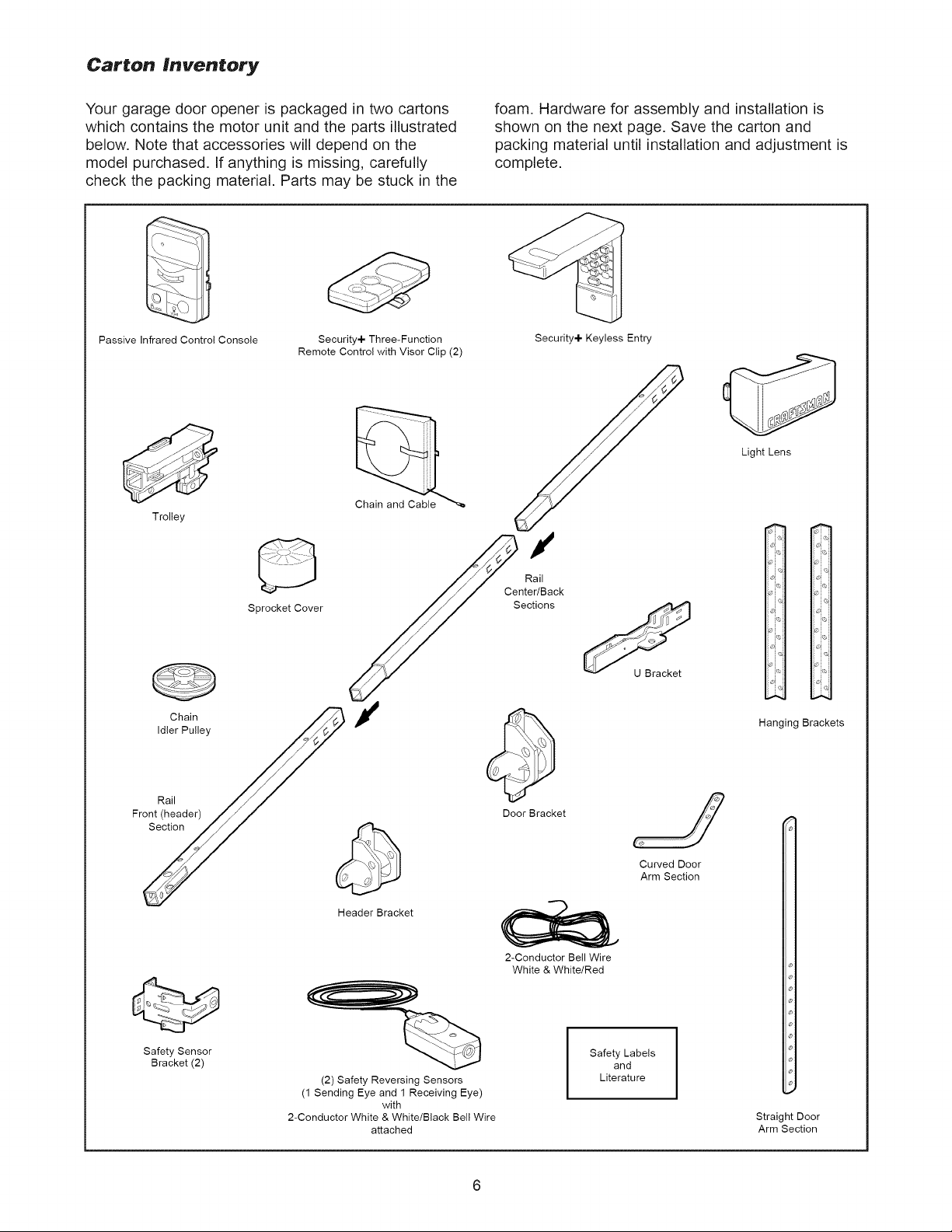
Your garage door opener is packaged in two cartons
which contains the motor unit and the parts illustrated
below. Note that accessories will depend on the
model purchased. If anything is missing, carefully
check the packing material. Parts may be stuck in the
foam. Hardware for assembly and installation is
shown on the next page. Save the carton and
packing material until installation and adjustment is
complete,
Passive Infrared Control Console
Security+ Three-Function
Remote Control with Visor Clip (2)
Chain andCabl_
Trolley
Sprocket Cover
'dICrhpiu_ley _ #
Rail ///
Front (header) ///
Header Bracket
Security+ Keyless Entry
#
Rail
Center/Back
Sections
Door Bracket
2-Conductor Bell Wire
White & White/Red
U Bracket
Curved Door
Arm Section
Light Lens
Hanging Brackets
Safety Sensor
Bracket (2)
(2) Safety Reversing Sensors
(1 Sending Eye and 1 Receiving Eye)
with
2-Conductor White & White/Black Bell Wire
attached
Safety Labels
and
Literature
Straight Door
Arm Section
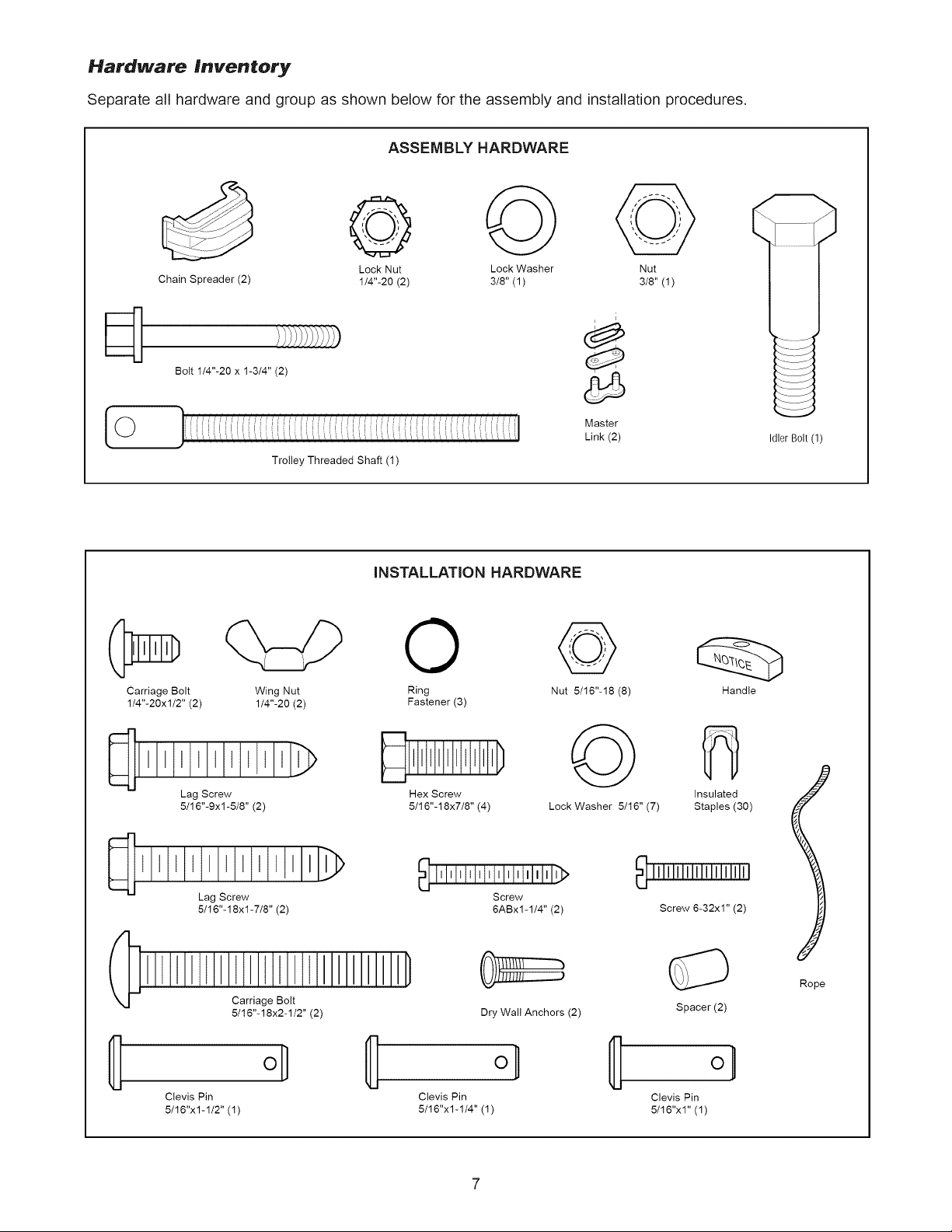
Hardware Inventory
Separate all hardware and group as shown below for the assembly and installation procedures.
ASSEMBLY HARDWARE
Lock Nut Lock Washer Nut
Chain Spreader (2) 1/4"-20 (2) 3/8" (1) 3/8" (1)
Bolt 1/4"-20 x 1-3/4" (2)
Trolley Threaded Shaft (1)
Master
Link (2)
Idler Bolt (1)
INSTALLATION HARDWARE
Carriage Bolt
1/4"-20xl/2" (2)
O
Wing Nut Ring
1/4"-20 (2) Fastener (3)
1111111111
Lag Screw
5/16"-9xl-5/8" (2)
1IIIIIIIIII1
Lag Screw
5/16"-18xl-7/8" (2)
Carriage Bolt
5/16"-18x2-1/2" (2)
ol
Clevis Pin
5/16"x1-1/2" (1)
Hex Screw
5/16"-18x7/8" (4)
Nut 5/16"-18 (8)
Lock Washer 5/16" (7)
Handle
Insulated
Staples (30)
Screw
6ABx1-1/4" (2) Screw 6-32x1" (2)
Dry Wall Anchors (2)
°1
Clevis Pin
5/16"x1-1/4" (1)
Spacer (2)
Clevis Pin
5/16"x1" (1)
Rope
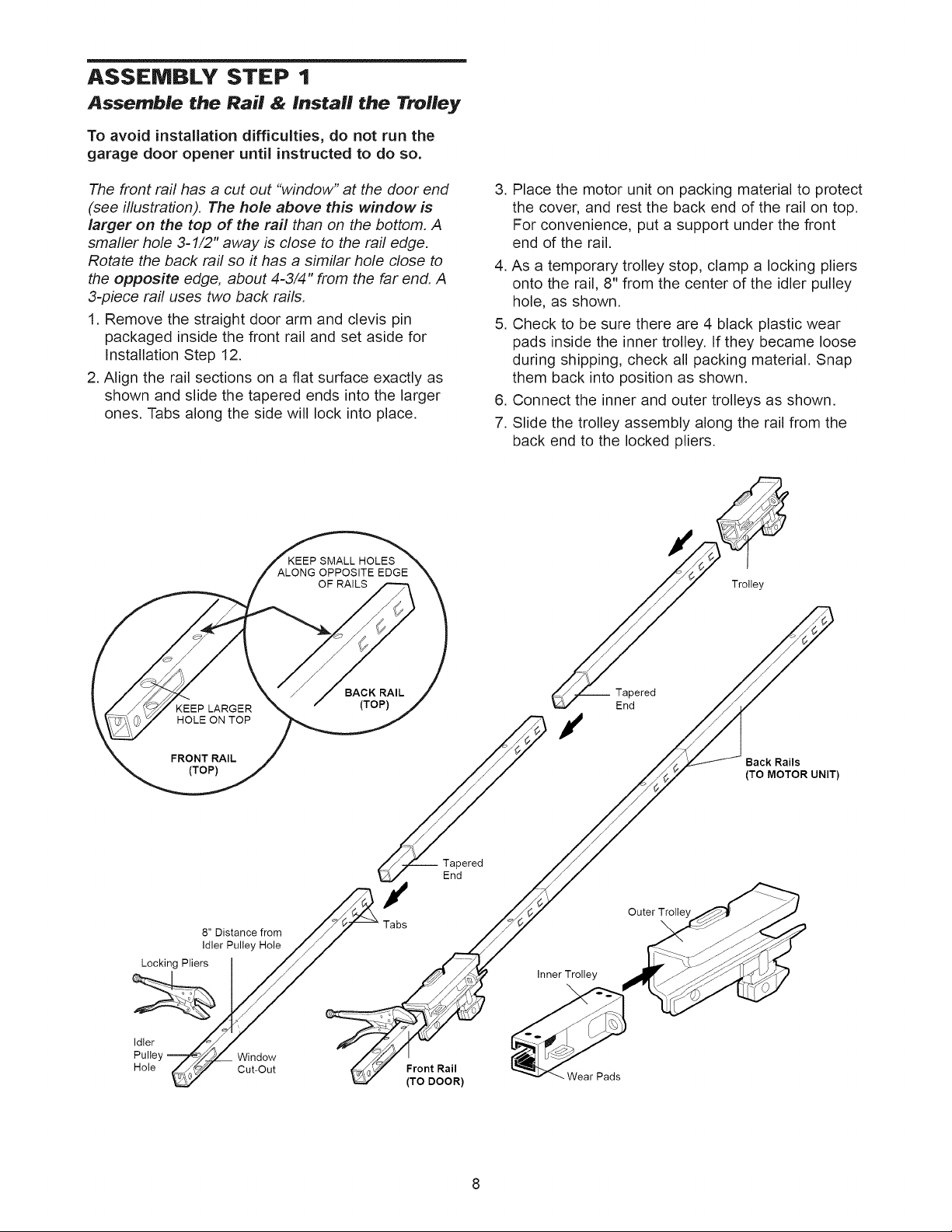
ASSEMBLY STEP 1
Assemble the Rail & Install the Trolley
To avoid installation difficulties, do not run the
garage door opener until instructed to do so,
The front rail has a cut out "window" at the door end
(see illustration). The hole above this window is
larger on the top of the rail than on the bottom. A
smaller hole 3-1/2" away is close to the rail edge.
Rotate the back rail so it has a similar hole close to
the opposite edge, about 4-3/4" from the far end. A
3-piece rail uses two back rails.
1. Remove the straight door arm and clevis pin
packaged inside the front rail and set aside for
Installation Step 12.
2. Align the rail sections on a flat surface exactly as
shown and slide the tapered ends into the larger
ones. Tabs along the side will lock into place.
.
Place the motor unit on packing material to protect
the cover, and rest the back end of the rail on top.
For convenience, put a support under the front
end of the rail.
4. As a temporary trolley stop, clamp a locking pliers
onto the rail, 8" from the center of the idler pulley
hole, as shown.
5. Check to be sure there are 4 black plastic wear
pads inside the inner trolley. If they became loose
during shipping, check all packing material. Snap
them back into position as shown.
6. Connect the inner and outer trolleys as shown.
7. Slide the trolley assembly along the rail from the
back end to the locked pliers.
SMALL HOLES
ALONG OPPOSITE EDGE
OF RAILS
KEEP LARGER
HOLE ON TOP
FRONT RAIL
(TOP)
BACK RAIL
(TOP)
I
End
Back Rails
(TO MOTOR UNIT)
8" Distance from _ Ta_bs
Idler Pulley Hole /_/
Idler /_/
Pulley ===7€_//_,/ Window
Hole _ Cut-Out _Tont Rao/ )
Inner Trolley
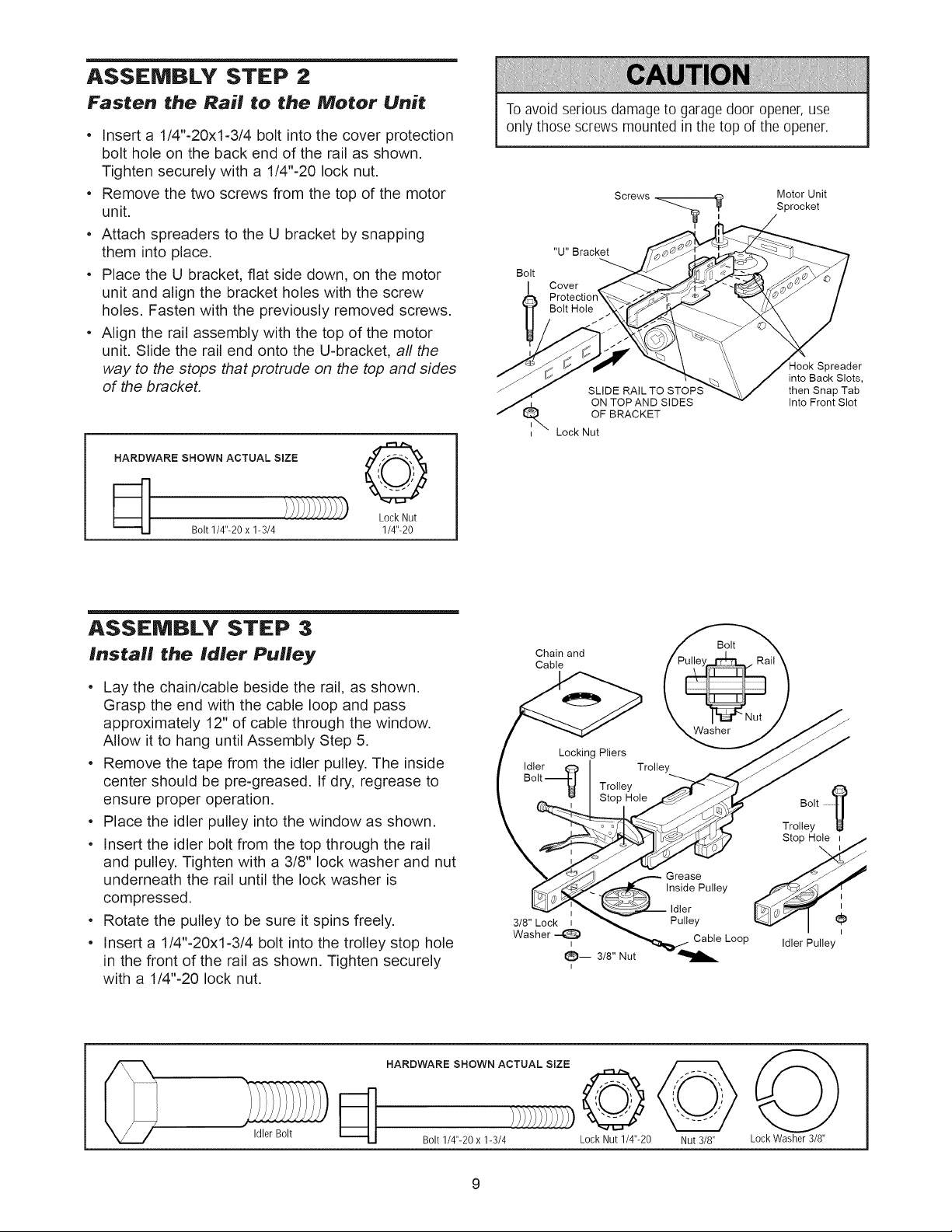
ASSEMBLY STEP 2
Fasten the Rail to the Motor Unit
• Insert a 1/4%20xl-3/4 bolt into the cover protection
bolt hole on the back end of the rail as shown.
Tighten securely with a 1/4%20 lock nut.
• Remove the two screws from the top of the motor
unit.
• Attach spreaders to the U bracket by snapping
them into place.
• Place the U bracket, flat side down, on the motor
unit and align the bracket holes with the screw
holes. Fasten with the previously removed screws.
• Align the rail assembly with the top of the motor
unit. Slide the rail end onto the U-bracket, all the
way to the stops that protrude on the top and sides
of the bracket.
HARDWARE SHOWN ACTUAL SIZE '_'_"_:'_','_'1
[_ Lock Nut
Bolt 1/4"-20 x 1-3/4 1/4"-20
To avoid serious damageto garage door opener, use
only those screws mounted in the top of the opener.
Bolt
"U" Bracket
Cover
Motor Unit
Screws _ _ Sprocket
SLIDE RAIL TO STOPS
ON TOP AND SIDES
OF BRACKET
Lock Nut
)reader
into Back Slots,
then Snap Tab
Into Front Slot
ASSEMBLY STEP 3
Install the Idler Pulley
• Lay the chain/cable beside the rail, as shown.
Grasp the end with the cable loop and pass
approximately 12" of cable through the window.
Allow it to hang until Assembly Step 5.
• Remove the tape from the idler pulley. The inside
center should be pre-greased. If dry, regrease to
ensure proper operation.
• Place the idler pulley into the window as shown.
• Insert the idler bolt from the top through the rail
and pulley. Tighten with a 3/8" lock washer and nut
underneath the rail until the lock washer is
compressed.
• Rotate the pulley to be sure it spins freely.
• Insert a 1/4%20xl-3/4 bolt into the trolley stop hole
in the front of the rail as shown. Tighten securely
with a 1/4%20 lock nut.
Chain and
Cable
Bolt
Washer
_ ___Locking Pliers
Idler_ Trolley
B°lt_ Trolley
_ _StopHole
_ Idler
3/8" Lock i _Pulley
Washer --_l _ Cable Loop
Q_-- 3/8' Nut -
I
Bolt
Trolley
Idler Pulley
HARDWARE SHOWN ACTUAL SIZE
1
Bolt 1/4"-20 x 1-3/4 Lock Nut 1/4"-20
Nut 3/8"
Lock Washer 3/8"
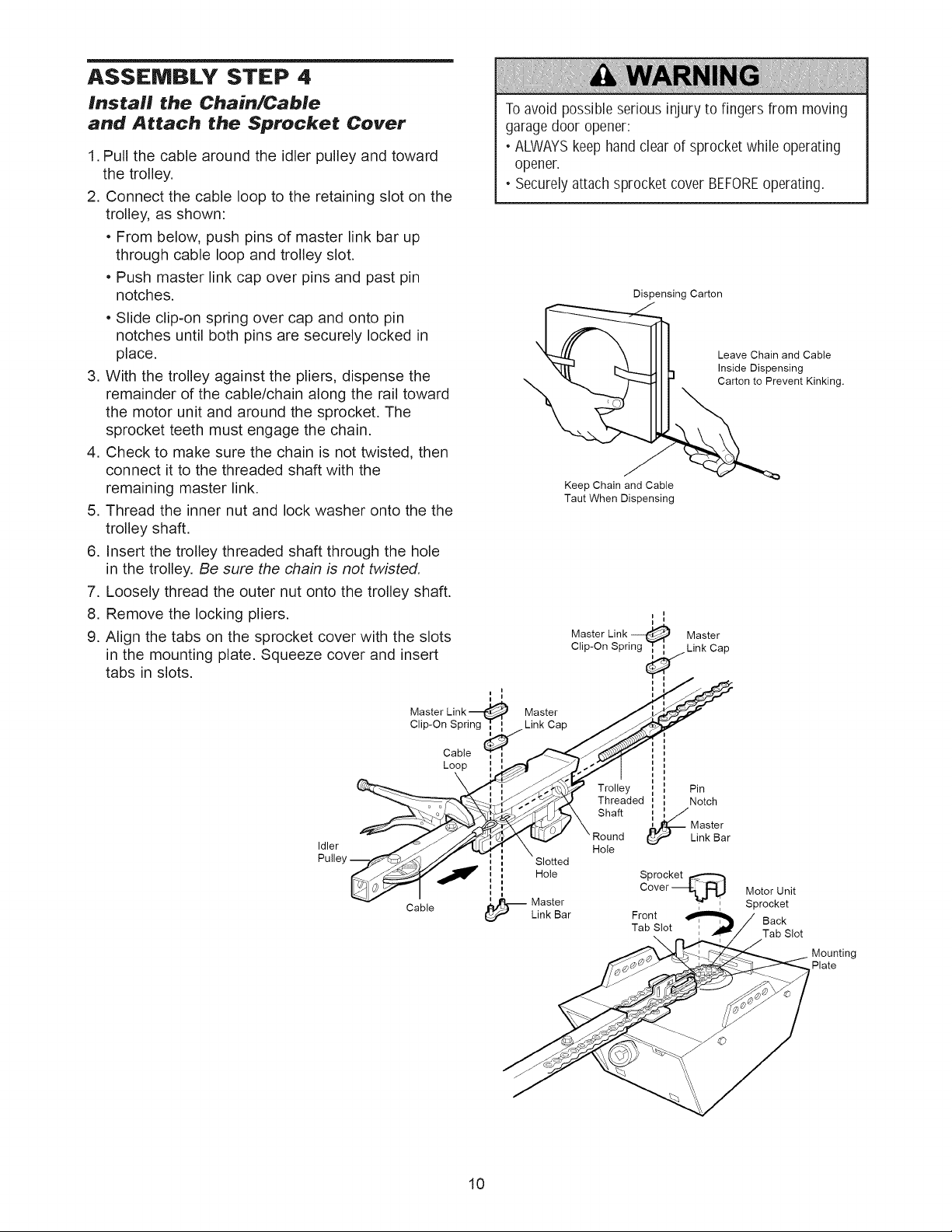
ASSEMBLY STEP 4
Install the Chain/Cable
and Attach the Sprocket Cover
1. Pull the cable around the idler pulley and toward
the trolley.
2. Connect the cable loop to the retaining slot on the
trolley, as shown:
To avoid possible serious injury to fingers from moving
garagedoor opener:
, ALWAYSkeep hand clear of sprocket while operating
opener•
, Securely attach sprocket cover BEFOREoperating•
• From below, push pins of master link bar up
through cable loop and trolley slot.
• Push master link cap over pins and past pin
notches.
• Slide clip-on spring over cap and onto pin
notches until both pins are securely locked in
place.
3. With the trolley against the pliers, dispense the
remainder of the cable/chain along the rail toward
the motor unit and around the sprocket. The
sprocket teeth must engage the chain.
4. Check to make sure the chain is not twisted, then
connect it to the threaded shaft with the
remaining master link.
5. Thread the inner nut and lock washer onto the the
trolley shaft.
Dispensing Carton
Leave Chain and Cable
IcaSir_:nDlosppenvSinrgt Ki nk in g"
Keep Chain and Cable
Taut When Dispensing
6. Insert the trolley threaded shaft through the hole
in the trolley. Be sure the chain is not twisted.
Motor Unit
Sprocket
Back
Tab Slot
Mounting
Plate
10
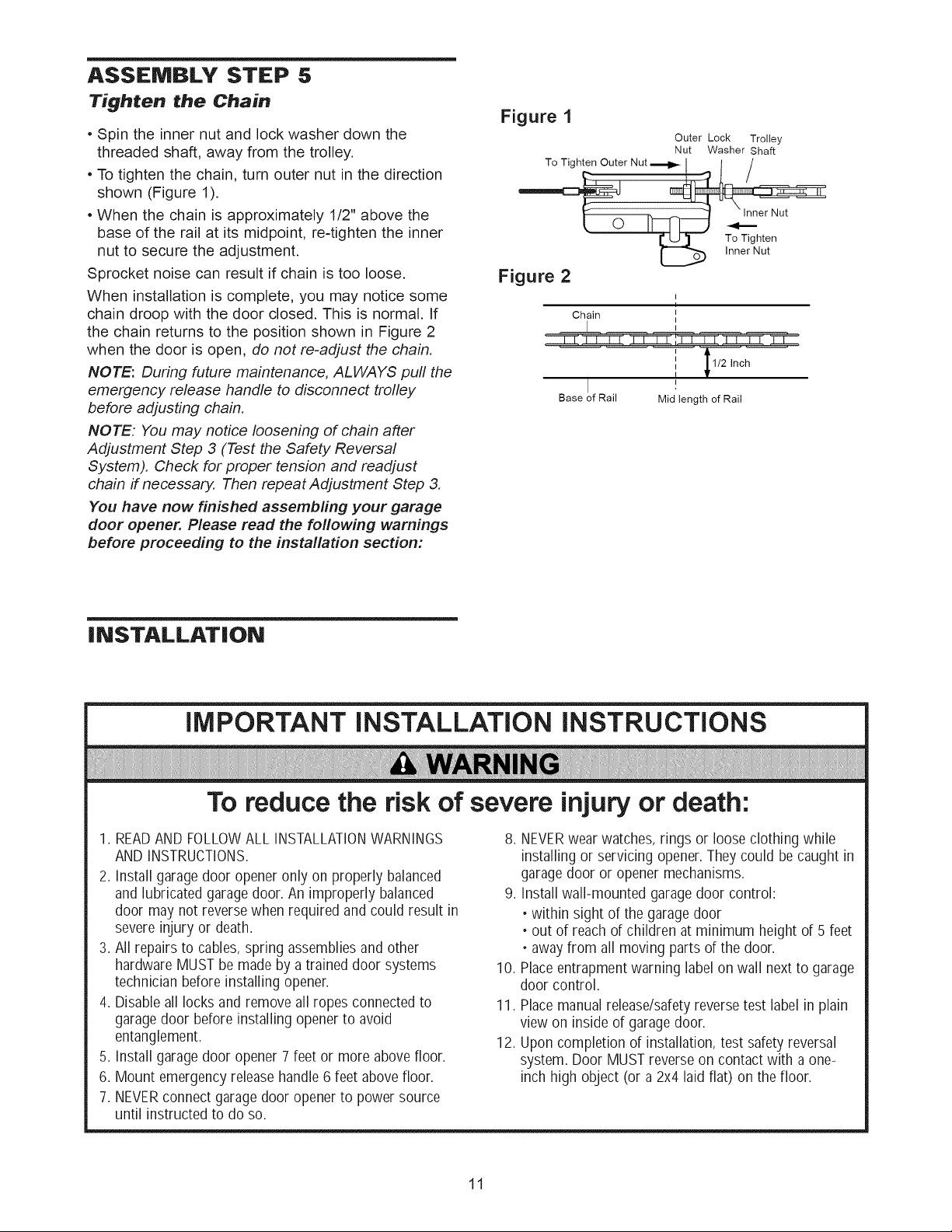
ASSEMBLY STEP 5
Tighten the Chain
• Spin the inner nut and lock washer down the
threaded shaft, away from the trolley.
• To tighten the chain, turn outer nut in the direction
shown (Figure 1).
• When the chain is approximately 1/2" above the
base of the rail at its midpoint, re-tighten the inner
nut to secure the adjustment.
Sprocket noise can result if chain is too loose.
When installation is complete, you may notice some
chain droop with the door closed. This is normal. If
the chain returns to the position shown in Figure 2
when the door is open, do not re-adjust the chain.
NOTE: During future maintenance, ALWAYS pull the
emergency release handle to disconnect trolley
before adjusting chain.
NOTE: You may notice loosening of chain after
Adjustment Step 3 (Test the Safety Reversal
System). Check for proper tension and readjust
chain if necessary. Then repeat Adjustment Step 3.
You have now finished assembling your garage
door opener. Please read the following warnings
before proceeding to the installation section:
Figure 1
Outer Lock Trolley
Nut Washer Shaft
Figure 2
,,
Chain i
1/2 Inch
I
I
Base of Rail Mid length of Rail
iNSTALLATiON
IMPORTANT INSTALLATION INSTRUCTIONS
To reduce the risk of severe injury or death:
1. READAND FOLLOWALL INSTALLATIONWARNINGS
AND INSTRUCTIONS.
,
2. Install garage door opener only on properly balanced
and lubricated garagedoor. An improperly balanced 9.
door may not reversewhen required and could result in
severeinjury or death.
3. All repairs to cables, spring assemblies and other
hardware MUST be made by a trained door systems 10.
technician before installing opener.
4. Disable all locks and remove all ropes connected to 11.
garagedoor before installing opener to avoid
entanglement. 12.
5. install garagedoor opener 7 feet or more above floor.
6. Mount emergency release handle 6 feet abovefloor.
7. NEVERconnect garage door opener to power source
until instructed to do so.
NEVERwear watches, rings or loose clothing while
installing or servicing opener.They could be caught in
garagedoor or opener mechanisms.
install wall-mounted garage door control:
, within sight of the garage door
, out of reach of children at minimum height of 5 feet
, away from all moving parts of the door.
Placeentrapment warning label on wall next to garage
door control.
Placemanual release/safetyreverse test label in plain
view on inside of garagedoor.
Upon completion of installation, test safety reversal
system. Door MUST reverse on contact with a one-
inch high object (or a 2x4 laid flat) on the floor.
11
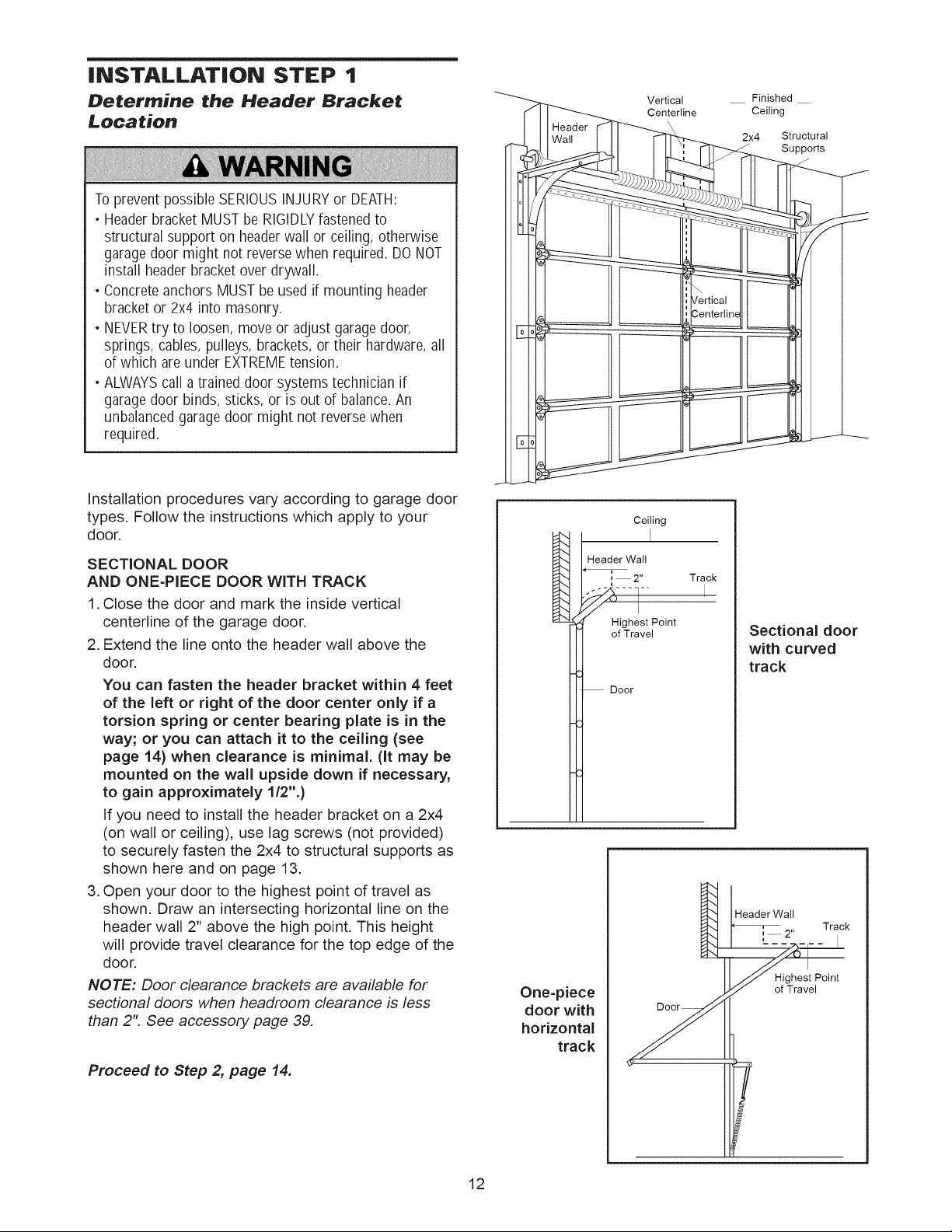
iNSTALLATiON STEP 1
Determine the Header Bracket
Location
To prevent possible SERIOUSINJURYor DEATH:
, Header bracket MUST be RIGIDLYfastened to
structural support on headerwall or ceiling, otherwise
garagedoor might not reversewhen required. DO NOT
install header bracket over drywall.
, Concrete anchors MUST be used if mounting header
bracket or 2x4 into masonry.
, NEVERtry to loosen, move or adjust garage door,
springs, cables, pulleys, brackets, or their hardware, all
of which are under EXTREMEtension.
. ALWAYScall a trained door systems technician if
garagedoor binds, sticks, or is out of balance. An
unbalanced garage door might not reversewhen
required.
Vertical
Centerline
Finished ......
Ceiling
2x4 Structural
Supports
Installation procedures vary according to garage door
types. Follow the instructions which apply to your
door.
SECTIONAL DOOR
AND ONE-PIECE DOOR WITH TRACK
1. Close the door and mark the inside vertical
centerline of the garage door.
2. Extend the line onto the header wall above the
door.
You can fasten the header bracket within 4 feet
of the left or right of the door center only if a
torsion spring or center bearing plate is in the
way; or you can attach it to the ceiling (see
page 14) when clearance is minimal. (It may be
mounted on the wall upside down if necessary,
to gain approximately 1/2".)
If you need to install the header bracket on a 2x4
(on wall or ceiling), use lag screws (not provided)
to securely fasten the 2x4 to structural supports as
shown here and on page 13.
3. Open your door to the highest point of travel as
shown. Draw an intersecting horizontal line on the
header wall 2" above the high point. This height
will provide travel clearance for the top edge of the
door.
NOTE: Door clearance brackets are available for
sectional doors when headroom clearance is less
than 2't See accessory page 39.
Proceed to Step 2, page 14.
Ceiling
Header Wall
i
' ............2" Track
_- ..... I
Highest Point
of Travel
Door
Sectional door
with curved
track
One-piece
door with
horizontal
track
Header Wal_
2 Track
Highest Point
of Travel
Door
12
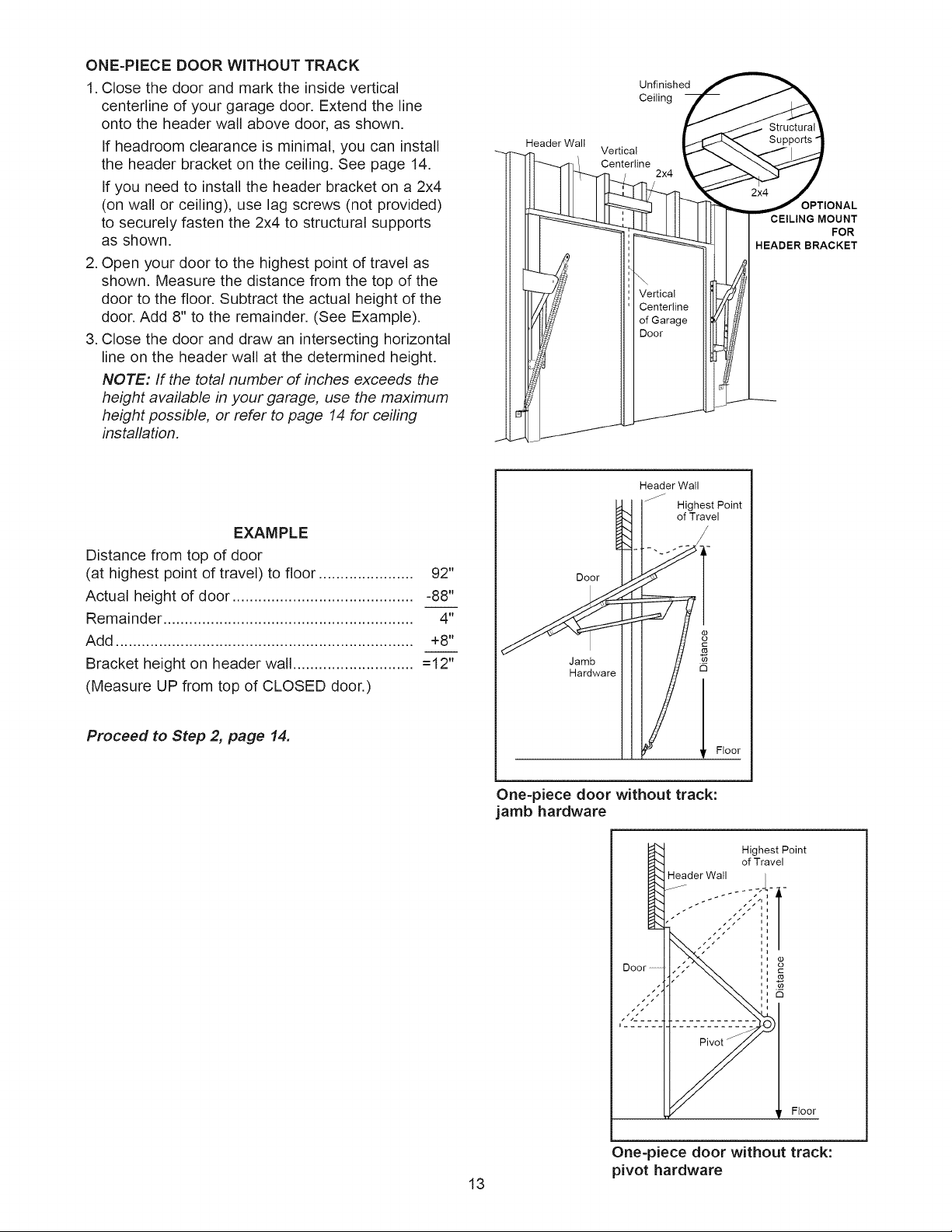
ONE-PIECEDOORWITHOUTTRACK
1.Closethedoorandmarktheinsidevertical
centerlineof yourgaragedoor.Extendtheline
ontotheheaderwallabovedoor,asshown.
Ifheadroomclearanceis minimal,youcaninstall
theheaderbracketontheceiling.Seepage14.
Ifyouneedto installtheheaderbracketona 2x4
(onwallor ceiling),uselagscrews(notprovided)
tosecurelyfastenthe2x4to structuralsupports
asshown.
2.Openyourdoortothehighestpointof travelas
shown.Measurethedistancefromthetopofthe
doortothefloor.Subtracttheactualheightof the
door.Add8"totheremainder.(SeeExample).
3.Closethedooranddrawanintersectinghorizontal
lineontheheaderwallatthedeterminedheight.
NOTE: If the total number of inches exceeds the
height available in your garage, use the maximum
height possible, or refer to page 14 for ceiling
installation.
Header Wall
Unfinished
Ceiling
Vertical
Centedine
2x4
OPTIONAL
CEILING MOUNT
FOR
HEADER BRACKET
EXAMPLE
Distance from top of door
(at highest point of travel) to floor ...................... 92"
Actual height of door .......................................... -88"
Remainder .......................................................... 4"
Add ..................................................................... +8"
Bracket height on header wall ............................ =12"
(Measure UP from top of CLOSED door.)
Proceed to Step 2, page 14.
Door 1
.Jamb
Hardware
Header Wall
Highest Point
of Travel
¢u
ii
C3
Floor
One-piece door without track:
jamb hardware
Door
t
/
s
• J__
J ....
Highest Point
of Travel
Header Wall
t t Jl
'J co
D
Floor
13
One-piece door without track:
pivot hardware
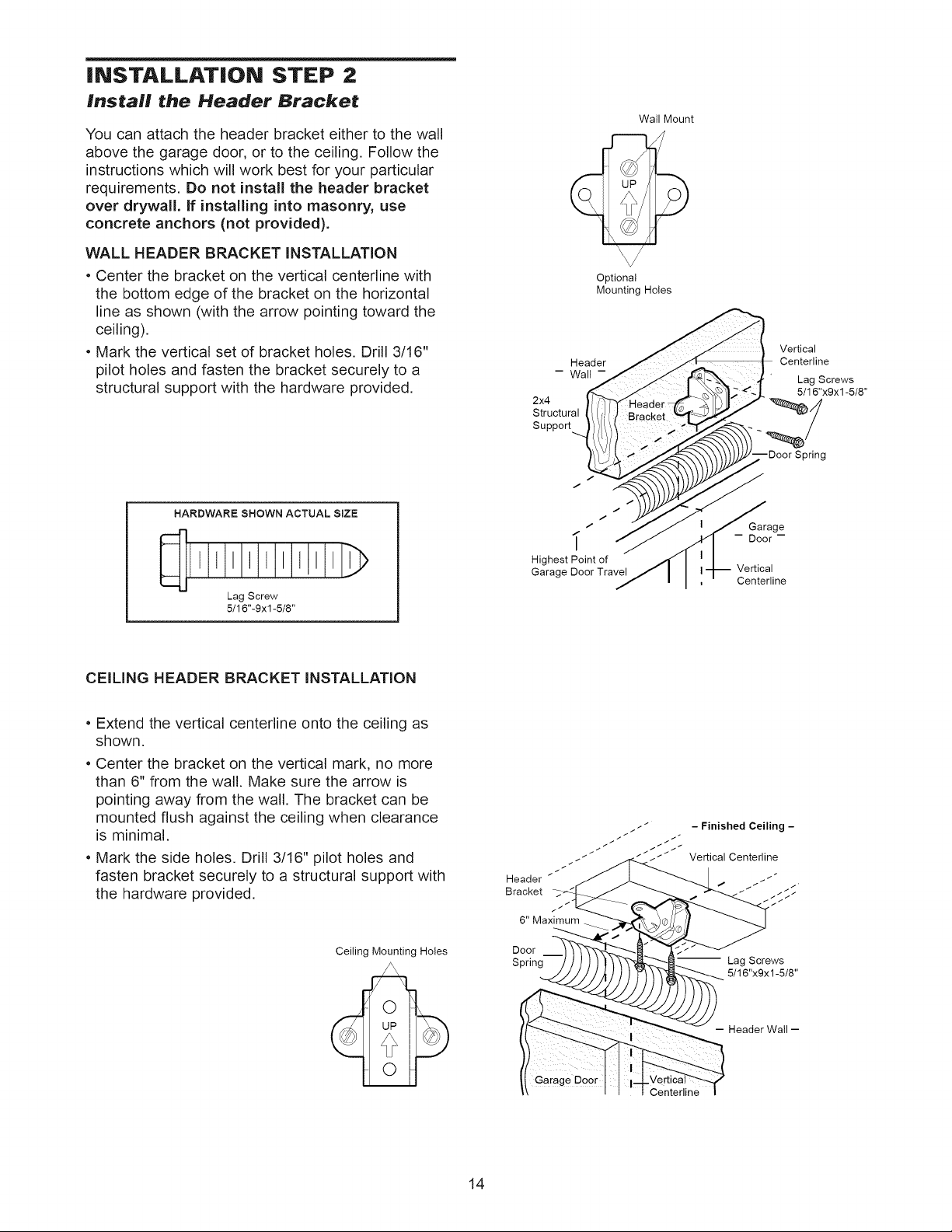
iNSTALLATiON STEP 2
Install the Header Bracket
You can attach the header bracket either to the wall
above the garage door, or to the ceiling. Follow the
instructions which will work best for your particular
requirements. Do not install the header bracket
over drywall. If installing into masonry, use
concrete anchors (not provided).
WALL HEADER BRACKET INSTALLATION
• Center the bracket on the vertical centerline with
the bottom edge of the bracket on the horizontal
line as shown (with the arrow pointing toward the
ceiling).
• Mark the vertical set of bracket holes. Drill 3/16"
pilot holes and fasten the bracket securely to a
structural support with the hardware provided,
Header
-- Wall -
2x4
Structural
Support
Wall Mount
Optional
Mounting Holes
Vertical
Centerline
Lag Screws
5/16"x9x1-5/8"
Spring
HARDWARE SHOWN ACTUAL SIZE
:]IIIIIIII1
Lag Screw
5/16"-9xl -5/8"
Garage
]" -- Door-
Highest Point of
Garage Door Travel Vertical
Centerline
CEILING HEADER BRACKET INSTALLATION
• Extend the vertical centerline onto the ceiling as
shown.
• Center the bracket on the vertical mark, no more
than 6" from the wall. Make sure the arrow is
pointing away from the wall. The bracket can be
mounted flush against the ceiling when clearance
is minimal.
• Mark the side holes. Drill 3/16" pilot holes and
fasten bracket securely to a structural support with
the hardware provided.
Ceiling Mounting Holes
/
/
Header t
Bracket
/
6" Maximum
Door
Spring
[_ //SS - Finished Ceiling -
Vertical Centerline
Lag Screws
5/16"x9x 1-5/8"
-- Header Wall --
senterline
14
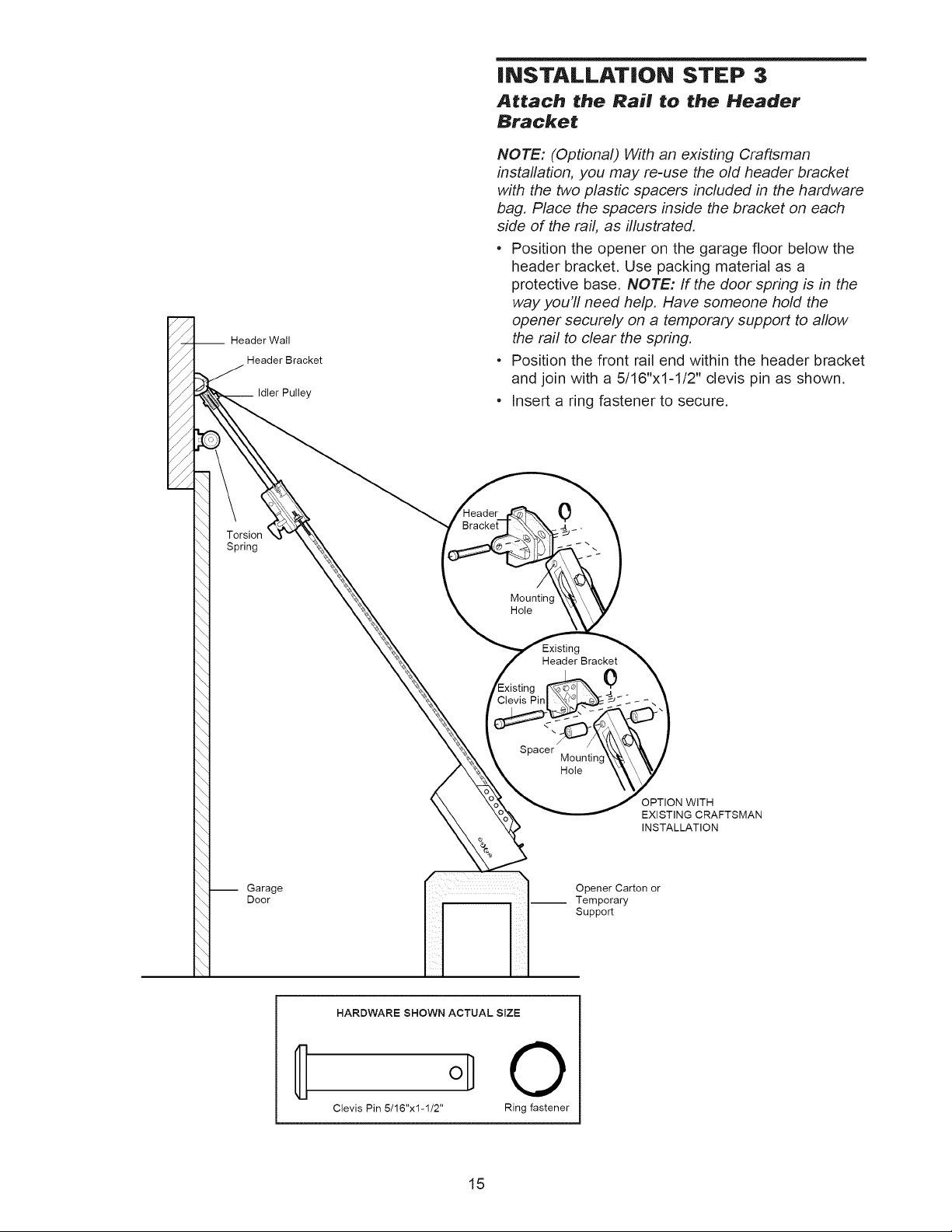
__ Header Wall
Header Bracket
__ Idler Pulley
iNSTALLATiON STEP 3
Attach the Rail to the Header
Bracket
NOTE: (Optional) With an existing Craftsman
installation, you may re-use the old header bracket
with the two plastic spacers included in the hardware
bag. Place the spacers inside the bracket on each
side of the rail, as illustrated.
• Position the opener on the garage floor below the
header bracket. Use packing material as a
protective base. NOTE: If the door spring is in the
way you'll need help. Have someone hold the
opener securely on a temporary support to allow
the rail to clear the spring.
• Position the front rail end within the header bracket
and join with a 5/16"x1-1/2" clevis pin as shown.
• Insert a ring fastener to secure.
Spring
0
Mounting
Hole
Existing
Header Bracket
0
Spacer
Mountin_
Hole
OPTION WITH
EXISTING CRAFTSMAN
INSTALLATION
-- Garage
Door
Opener Carton or
__ Temporary
Support
HARDWARE SHOWN ACTUAL SIZE
O
Clevis Pin 5/16"x1-1/2" Ring fastener
15
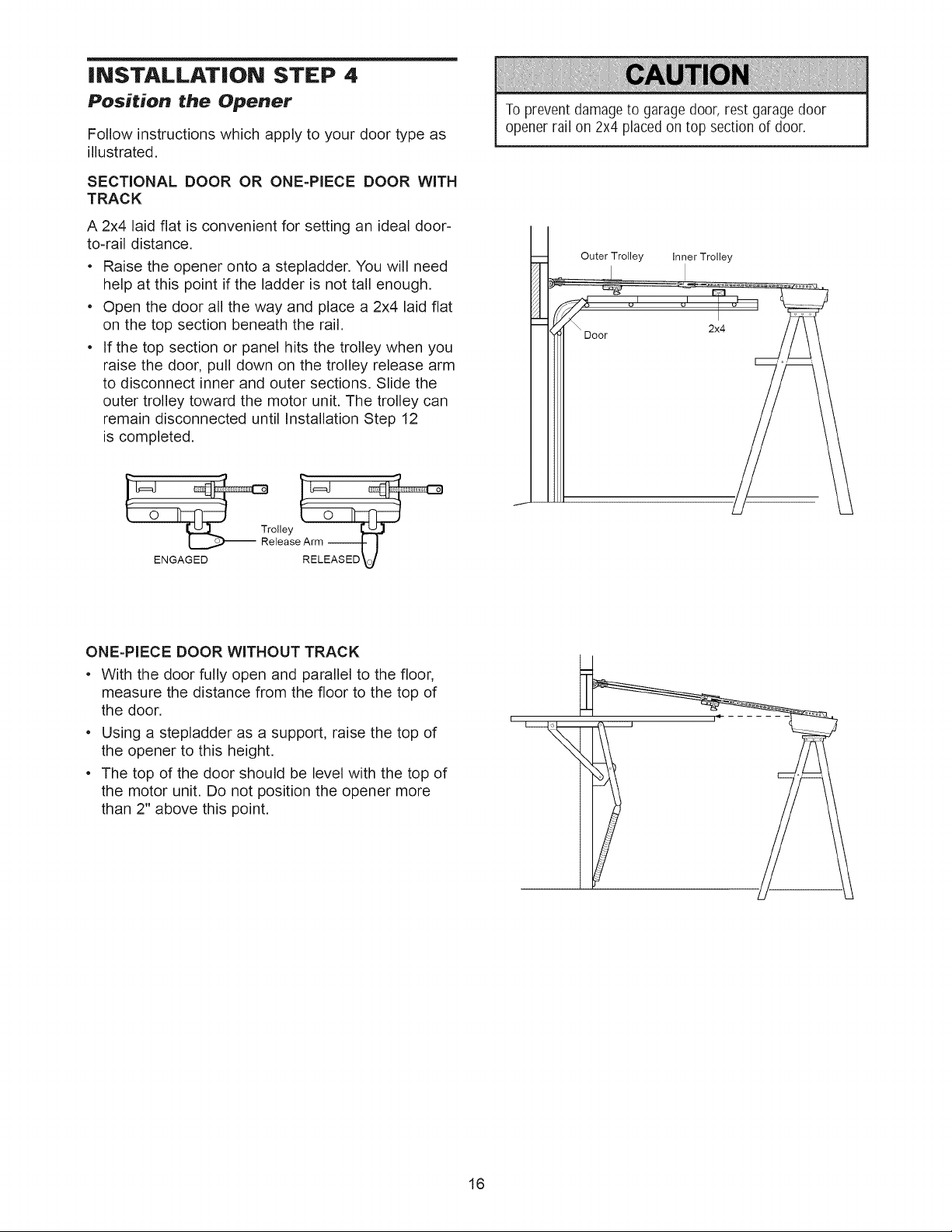
iNSTALLATiON STEP 4
Position the Opener
Follow instructions which apply to your door type as
illustrated.
SECTIONAL DOOR OR ONE-PIECE DOOR WITH
TRACK
A 2x4 laid flat is convenient for setting an ideal door-
to-rail distance.
• Raise the opener onto a stepladder. You will need
help at this point if the ladder is not tall enough.
• Open the door all the way and place a 2x4 laid flat
on the top section beneath the rail.
• If the top section or panel hits the trolley when you
raise the door, pull down on the trolley release arm
to disconnect inner and outer sections. Slide the
outer trolley toward the motor unit. The trolley can
remain disconnected until Installation Step 12
is completed.
olley
elease Arm ------_ J
ENGAGED RELEASED V
To prevent damage to garagedoor, rest garagedoor
opener rail on 2x4 placed on top section of door.
Outer Trolley Inner Trolley
2x4
Door
ONE-PIECE DOOR WITHOUT TRACK
• With the door fully open and parallel to the floor,
measure the distance from the floor to the top of
the door.
• Using a stepladder as a support, raise the top of
the opener to this height.
• The top of the door should be level with the top of
the motor unit. Do not position the opener more
than 2" above this point.
16
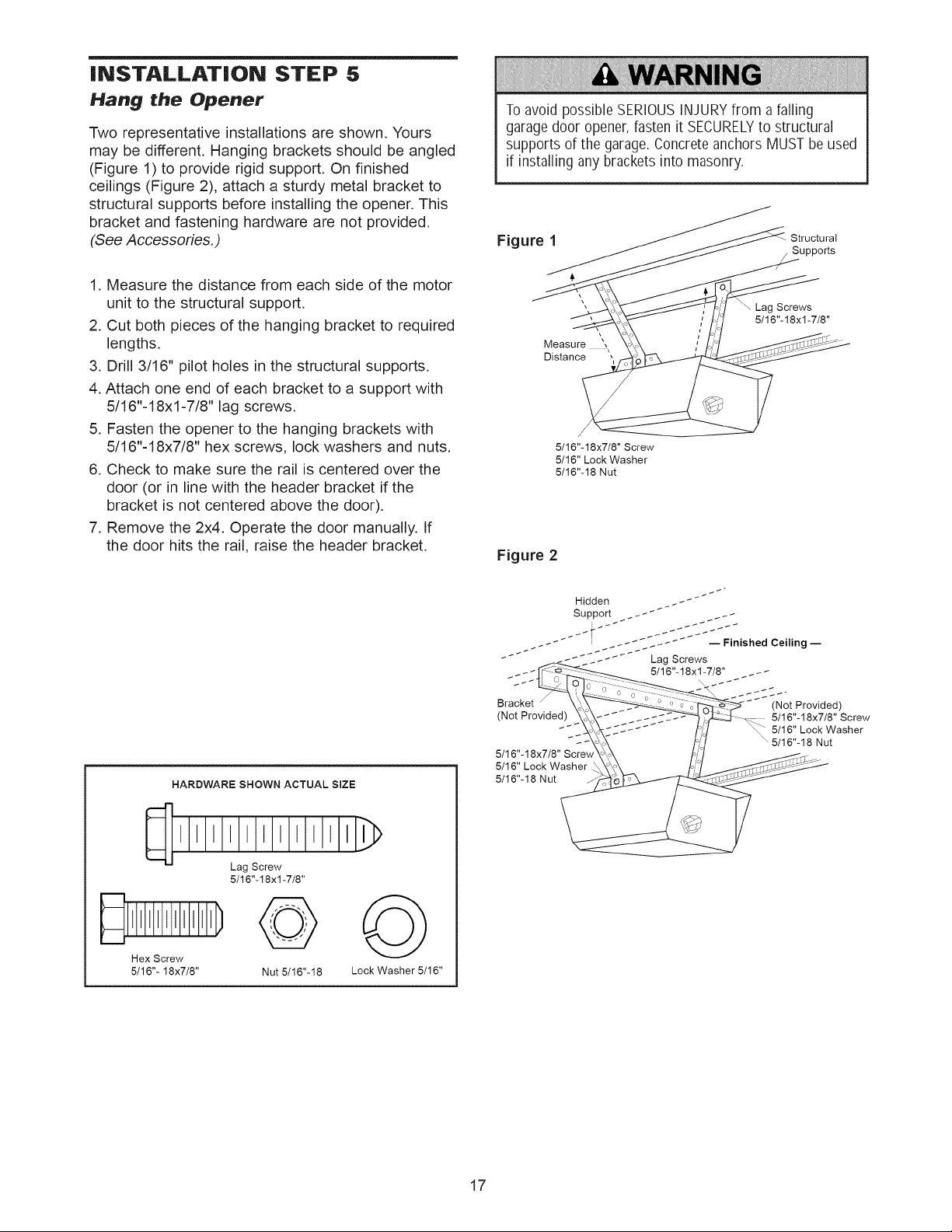
iNSTALLATiON STEP 5
Hang the Opener
Two representative installations are shown. Yours
may be different. Hanging brackets should be angled
(Figure 1) to provide rigid support. On finished
ceilings (Figure 2), attach a sturdy metal bracket to
structural supports before installing the opener. This
bracket and fastening hardware are not provided.
(See Accessories.)
1. Measure the distance from each side of the motor
unit to the structural support.
2. Cut both pieces of the hanging bracket to required
lengths.
3. Drill 3/16" pilot holes in the structural supports.
4. Attach one end of each bracket to a support with
5/16"-18xl-7/8" lag screws.
5. Fasten the opener to the hanging brackets with
5/16"-18x7/8" hex screws, lock washers and nuts.
6. Check to make sure the rail is centered over the
door (or in line with the header bracket if the
bracket is not centered above the door).
7. Remove the 2x4. Operate the door manually. If
the door hits the rail, raise the header bracket.
HARDWARE SHOWN ACTUAL SIZE
I I I I I I I I I IILILI
Lag Screw
5/16"-18xl -7/8"
@
Hex Screw
5/18"- 18x7/8" Nut 5/18"-18 Lock Washer 5/16"
To avoid possible SERIOUSINJURYfrom a falling
garage door opener,fasten it SECURELYto structural
supports of the garage.Concrete anchors MUST be used
if installing any brackets into masonry.
Figure 1 Structural
Supports
\\
Measure >
Distance ,
i
Lag Screws
5/16"-18xl -7/8"
5/16"-18x7/8" Screw
5/16" Lock Washer
5/16"-18 Nut
Figure 2
Bracket / (Not Provided)
(Not Provided) 5/16"-18x7/8" Screw
_ 5/16" Lock Washer
5/16"-18 Nut
5/16" Lock Washer
5/16"-18 Nut
17
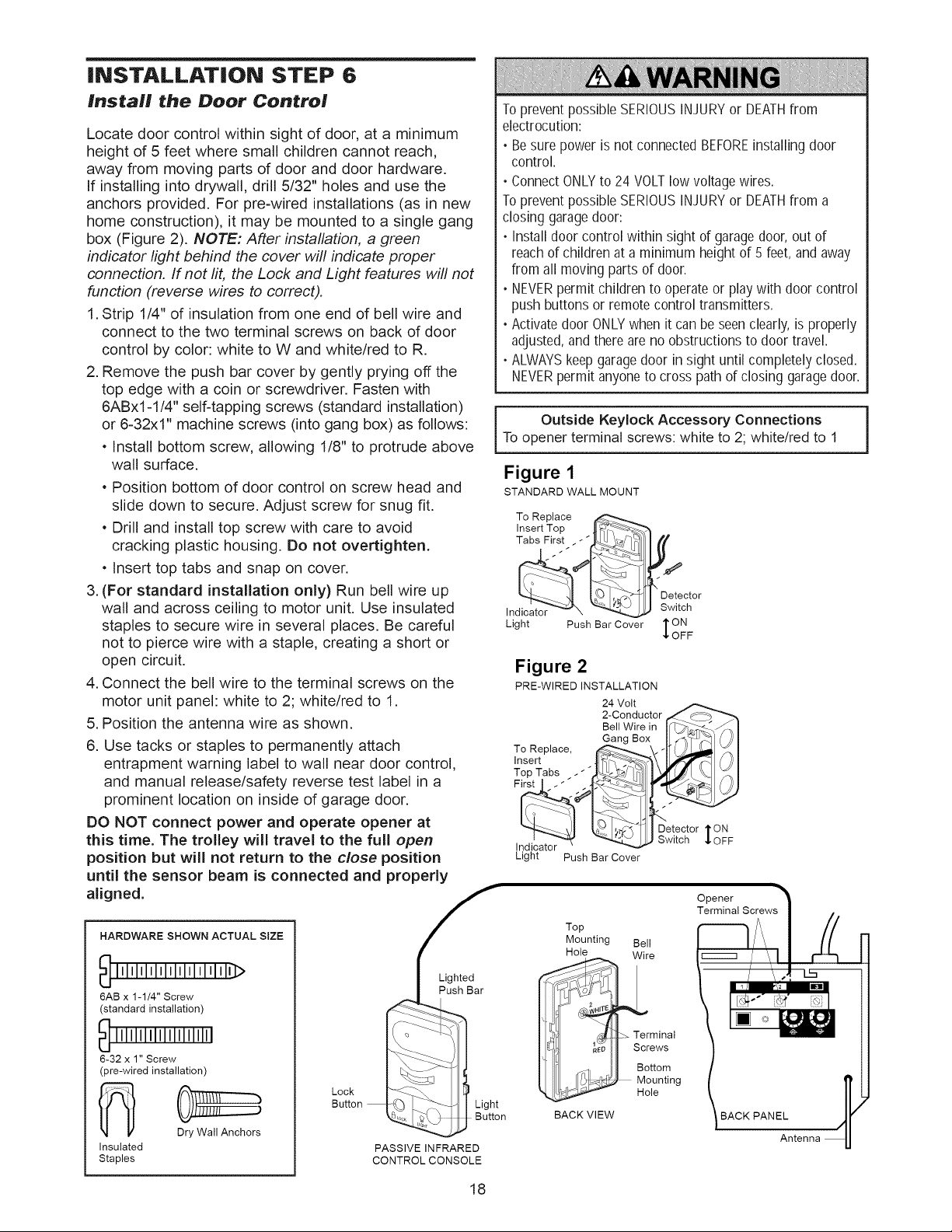
iNSTALLATiON STEP 6
install the Door Control
Locate door control within sight of door, at a minimum
height of 5 feet where small children cannot reach,
away from moving parts of door and door hardware.
If installing into drywall, drill 5/32" holes and use the
anchors provided. For pre-wired installations (as in new
home construction), it may be mounted to a single gang
box (Figure 2). NOTE: After installation, a green
indicator light behind the cover will indicate proper
connection. If not lit, the Lock and Light features will not
function (reverse wires to correct).
1. Strip 1/4" of insulation from one end of bell wire and
connect to the two terminal screws on back of door
control by color: white to W and white/red to R.
2. Remove the push bar cover by gently prying off the
top edge with a coin or screwdriver. Fasten with
6ABx1=1/4" self-tapping screws (standard installation)
or 6-32x1" machine screws (into gang box) as follows:
• Install bottom screw, allowing 1/8" to protrude above
wall surface.
• Position bottom of door control on screw head and
slide down to secure. Adjust screw for snug fit.
• Drill and install top screw with care to avoid
cracking plastic housing. Do not overtighten.
• Insert top tabs and snap on cover.
3. (For standard installation only) Run bell wire up
wall and across ceiling to motor unit. Use insulated
staples to secure wire in several places. Be careful
not to pierce wire with a staple, creating a short or
open circuit.
4. Connect the bell wire to the terminal screws on the
motor unit panel: white to 2; white/red to 1.
5. Position the antenna wire as shown.
6. Use tacks or staples to permanently attach
entrapment warning label to wall near door control,
and manual release/safety reverse test label in a
prominent location on inside of garage door.
DO NOT connect power and operate opener at
this time. The trolley will travel to the full open
position but will not return to the close position
until the sensor beam is connected and properly
aligned.
HARDWARE SHOWN ACTUAL SIZE
_ IIlllMIMlllllllllII IIIll]>
6AB x 1-1/4" Screw
(standard installation)
6-32 x 1" Screw
(pre-wired installation)
Dry Wall Anchors
Insulated
Staples
Lock
Lighted
Push Bar
Light
Sutton
PASSIVEINFRARED
CONTROLCONSOLE
TopreventpossibleSERIOUSINJURYor DEATHfrom
electrocution:
• Be sure power is not connectedBEFOREinstallingdoor
control.
• ConnectONLYto 24 VOLTlow voltage wires.
TopreventpossibleSERIOUSINJURYor DEATHfrom a
closing garagedoor:
• Install door control within sight of garagedoor, out of
reachof childrenat a minimum heightof 5 feet, and away
from all moving parts of door.
• NEVERpermitchildren to operateor play with door control
push buttons or remote control transmitters.
• Activatedoor ONLYwhen it can be seenclearly, is properly
adjusted,and thereare no obstructionsto door travel.
• ALWAYSkeepgaragedoor in sight until completelyclosed.
NEVERpermit anyoneto cross path of closing garagedoor.
i Outside Keylock Accessory ConnectionsTo opener terminal screws: white to 2; white/red to 1
Figure 1
STANDARD WALL MOUNT
To Replace
Insert Top
Tabs First .-
Indicator Switch
Light Push Bar Cover T °N
OFF
Figure 2
PRE-WIRED INSTALLATION
24 Volt
2-Conductor
Bell Wire in
Gang Box
To Replace,
Insert
TOsP qlabt s
Detector ION
I Switch OFF
Light Push Bar Cover
Top
Mounting
Hole
BACK VIEW
Bell
Wire
Terminal
Screws
Bottom
Mounting
Hole
Opener
Terminal Screws
Antenna
18
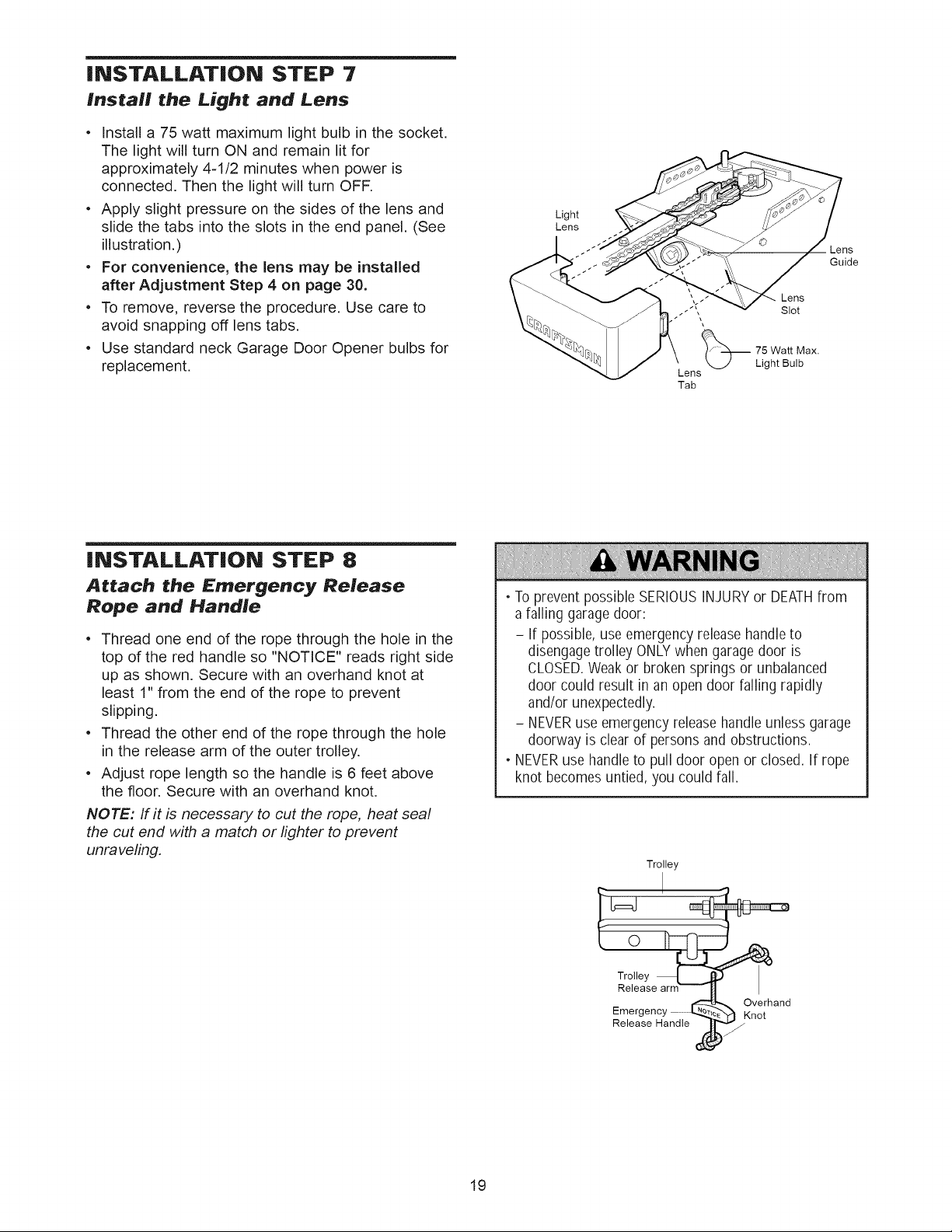
iNSTALLATiON STEP 7
Install the Light and Lens
• Install a 75 watt maximum light bulb in the socket.
The light will turn ON and remain lit for
approximately 4-1/2 minutes when power is
connected. Then the light will turn OFF.
• Apply slight pressure on the sides of the lens and
slide the tabs into the slots in the end panel. (See
illustration.)
• For convenience, the lens may be installed
after Adjustment Step 4 on page 30.
• To remove, reverse the procedure. Use care to
avoid snapping off lens tabs.
• Use standard neck Garage Door Opener bulbs for
replacement.
Light
Lens
' Lens
Slot
75 Watt Max.
Light Bulb
Lens
Tab
Lens
Guide
iNSTALLATiON STEP 8
Attach the Emergency Release
Rope and Handle
• Thread one end of the rope through the hole in the
top of the red handle so "NOTICE" reads right side
up as shown. Secure with an overhand knot at
least 1" from the end of the rope to prevent
slipping.
• Thread the other end of the rope through the hole
in the release arm of the outer trolley.
• Adjust rope length so the handle is 6 feet above
the floor. Secure with an overhand knot.
NOTE: If it is necessary to cut the rope, heat seal
the cut end with a match or lighter to prevent
unra veling.
. To prevent possible SERIOUSINJURYor DEATHfrom
a falling garagedoor:
- If possible, use emergency release handleto
disengage trolley ONLYwhen garagedoor is
CLOSED.Weakor broken springs or unbalanced
door could result in an open door falling rapidly
and/or unexpectedly.
- NEVERuse emergency releasehandle unless garage
doorway is clear of persons and obstructions.
. NEVERuse handle to pull door open or closed. If rope
knot becomes untied, you could fall.
Trolley
Emergency ..................l_ _ Overhand
E_ Knot
Release Handle )_
19
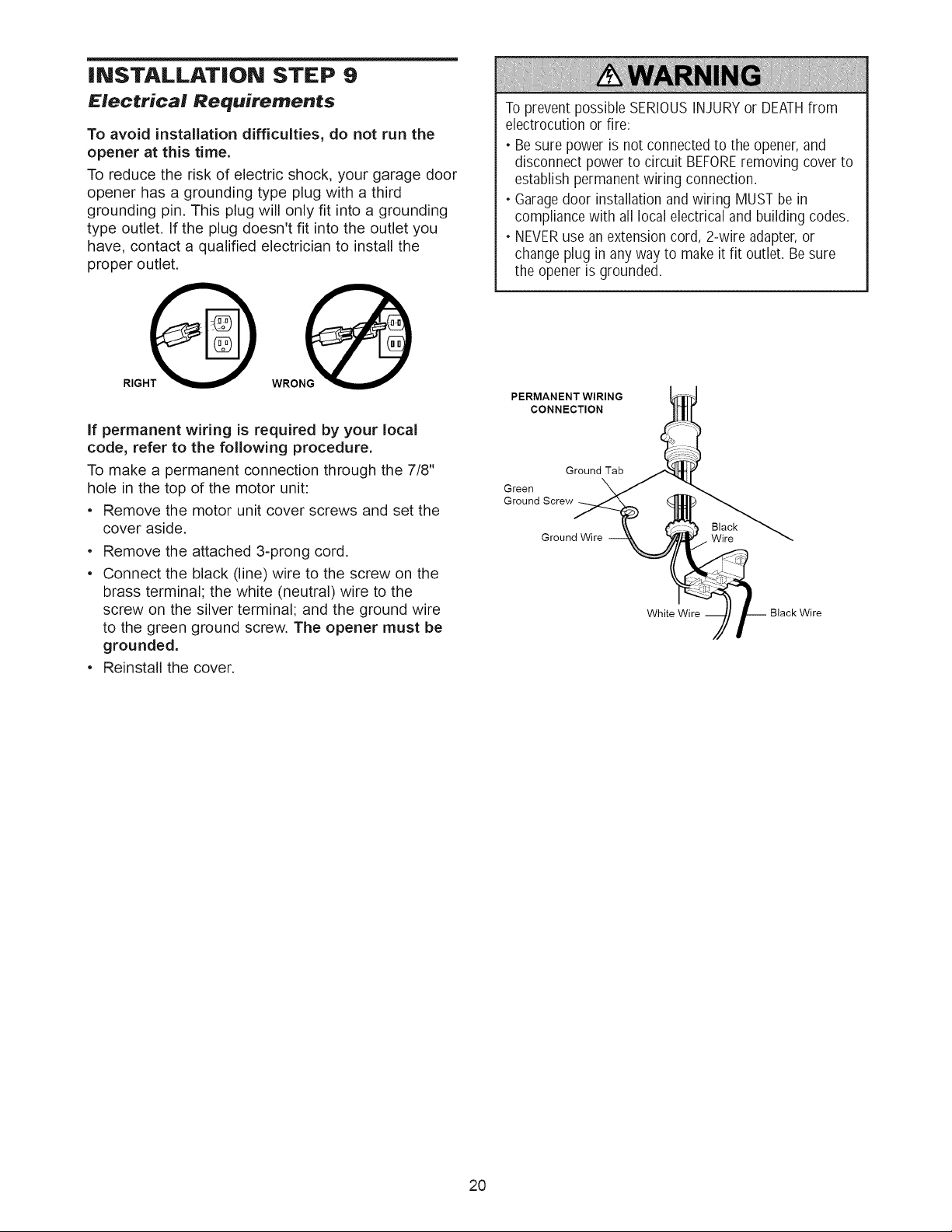
iNSTALLATiON STEP 9
Electrical Requirements
To avoid installation difficulties, do not run the
opener at this time.
To reduce the risk of electric shock, your garage door
opener has a grounding type plug with a third
grounding pin. This plug will only fit into a grounding
type outlet. If the plug doesn't fit into the outlet you
have, contact a qualified electrician to install the
proper outlet.
RIGHO WRONG
If permanent wiring is required by your local
code, refer to the following procedure.
To make a permanent connection through the 7/8"
hole in the top of the motor unit:
• Remove the motor unit cover screws and set the
cover aside.
• Remove the attached 3-prong cord.
• Connect the black (line) wire to the screw on the
brass terminal; the white (neutral) wire to the
screw on the silver terminal; and the ground wire
to the green ground screw. The opener must be
grounded.
• Reinstall the cover.
To prevent possible SERIOUSINJURYor DEATHfrom
electrocution or fire:
. Be sure power is not connected to the opener,and
disconnect power to circuit BEFOREremoving cover to
establish permanentwiring connection.
. Garagedoor installation and wiring MUST be in
compliance with all local electrical and building codes.
. NEVERuse an extension cord, 2-wire adapter,or
change plug in any way to make it fit outlet. Be sure
the opener is grounded.
PERMANENT WIRING
CONNECTION
Ground Tab
Green
Ground Screw
Black
Ground Wire Wire
White Wire Black Wire
2O
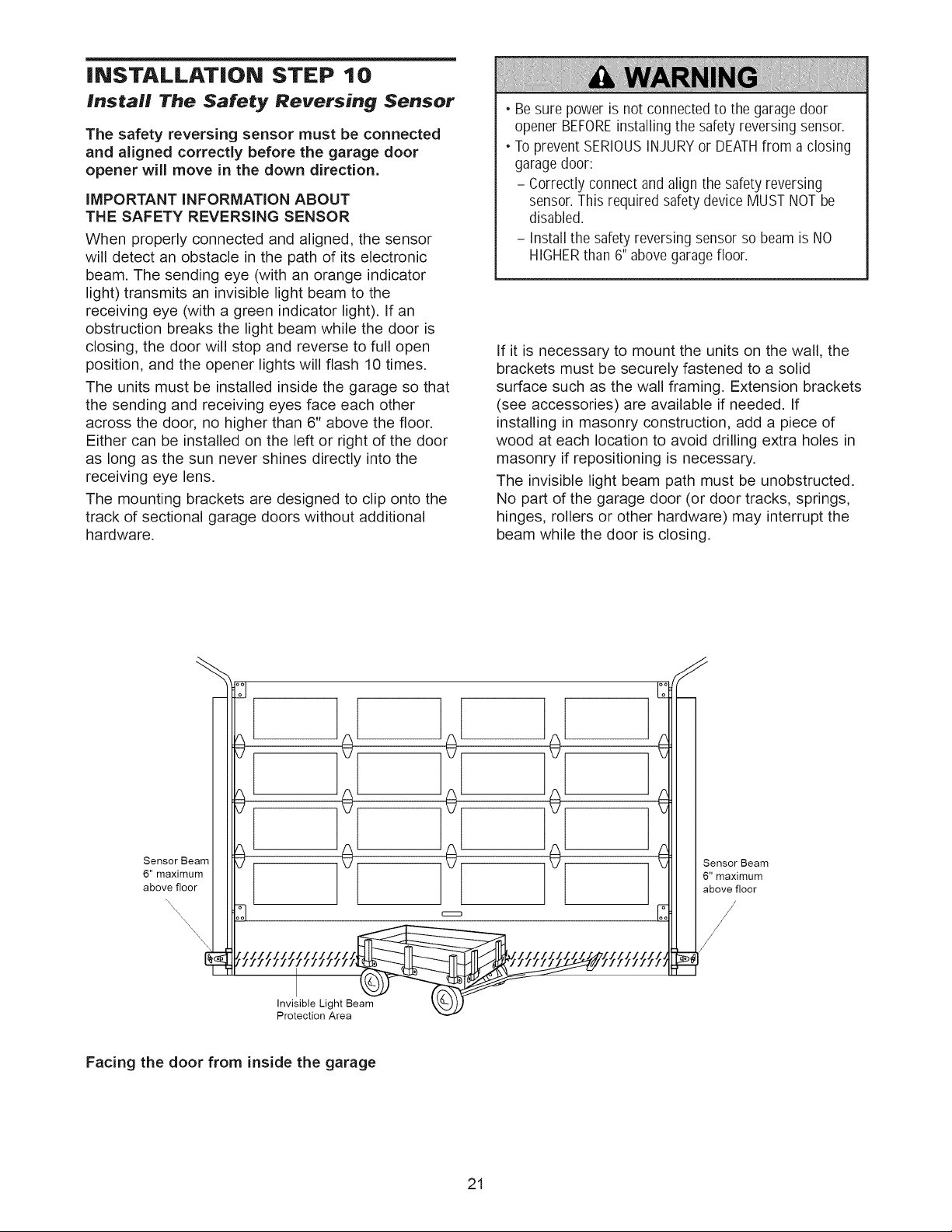
INSTALLATION STEP 10
Install The Safety Reversing Sensor
The safety reversing sensor must be connected
and aligned correctly before the garage door
opener will move in the down direction.
iMPORTANT iNFORMATiON ABOUT
THE SAFETY REVERSING SENSOR
When properly connected and aligned, the sensor
will detect an obstacle in the path of its electronic
beam. The sending eye (with an orange indicator
light) transmits an invisible light beam to the
receiving eye (with a green indicator light). If an
obstruction breaks the light beam while the door is
closing, the door will stop and reverse to full open
position, and the opener lights will flash 10 times.
The units must be installed inside the garage so that
the sending and receiving eyes face each other
across the door, no higher than 6" above the floor.
Either can be installed on the left or right of the door
as long as the sun never shines directly into the
receiving eye lens.
The mounting brackets are designed to clip onto the
track of sectional garage doors without additional
hardware.
. Be sure power is not connected to the garage door
opener BEFOREinstalling the safety reversing sensor.
, To prevent SERIOUSINJURYor DEATHfrom a closing
garagedoor:
- Correctly connect and align the safety reversing
sensor. This required safety device MUST NOT be
disabled.
- install the safety reversing sensor so beam is NO
HIGHERthan 6" above garage floor.
If it is necessary to mount the units on the wall, the
brackets must be securely fastened to a solid
surface such as the wall framing. Extension brackets
(see accessories) are available if needed. If
installing in masonry construction, add a piece of
wood at each location to avoid drilling extra holes in
masonry if repositioning is necessary.
The invisible light beam path must be unobstructed.
No part of the garage door (or door tracks, springs,
hinges, rollers or other hardware) may interrupt the
beam while the door is closing.
Sensor Beam
6" maximum
above floor
x\\\
Xx\\
\
1÷[ I÷
10[ 0
10[ ÷
Sensor Beam
6" maximum
above floor
/
/
Invisible Light Beam
Protection Area
Facing the door from inside the garage
21
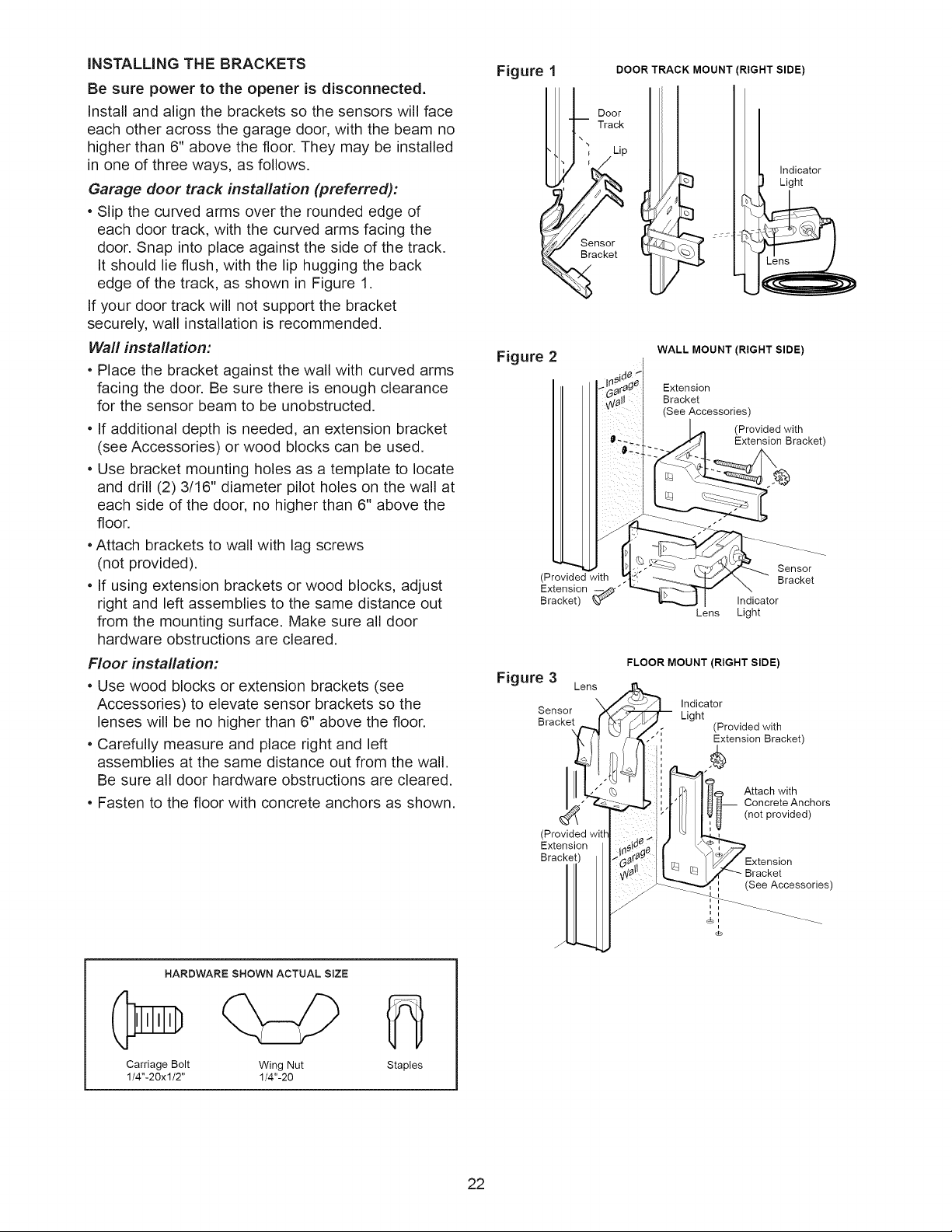
iNSTALLiNG THE BRACKETS
Be sure power to the opener is disconnected.
Install and align the brackets so the sensors will face
each other across the garage door, with the beam no
higher than 6" above the floor. They may be installed
in one of three ways, as follows.
Garage door track installation (preferred):
• Slip the curved arms over the rounded edge of
each door track, with the curved arms facing the
door. Snap into place against the side of the track.
It should lie flush, with the lip hugging the back
edge of the track, as shown in Figure 1.
if your door track will not support the bracket
securely, wall installation is recommended.
Wall installation:
• Place the bracket against the wall with curved arms
facing the door. Be sure there is enough clearance
for the sensor beam to be unobstructed.
• If additional depth is needed, an extension bracket
(see Accessories) or wood blocks can be used.
• Use bracket mounting holes as a template to locate
and drill (2) 3/16" diameter pilot holes on the wall at
each side of the door, no higher than 6" above the
floor.
• Attach brackets to wall with lag screws
(not provided).
• If using extension brackets or wood blocks, adjust
right and left assemblies to the same distance out
from the mounting surface. Make sure all door
hardware obstructions are cleared.
Floor installation:
• Use wood blocks or extension brackets (see
Accessories) to elevate sensor brackets so the
lenses will be no higher than 6" above the floor.
• Carefully measure and place right and left
assemblies at the same distance out from the wall.
Be sure all door hardware obstructions are cleared.
• Fasten to the floor with concrete anchors as shown.
HARDWARE SHOWN ACTUAL SIZE
Carriage Bolt
1/4"-20xl/2"
Wing Nut Staples
1/4"-20
Figure 1
Door
Track
jLip
racket
DOOR TRACK MOUNT (RIGHT SIDE)
I
Indicator
Light
Figure 2
WALL MOUNT (RIGHT SIDE)
Extension
Bracket
(See Accessories)
(Provided with
Extension Bracket)
(Provided with
Extension
Bracket) _"
Sensor
Bracket
Indicator
Lens Light
Figure 3
Lens
Sensor
Bracket
Extension
Bra_
FLOOR MOUNT (RIGHT SIDE)
Indicator
Light
(Provided with
Extension Bracket)
.¢
iii
sl
g
22
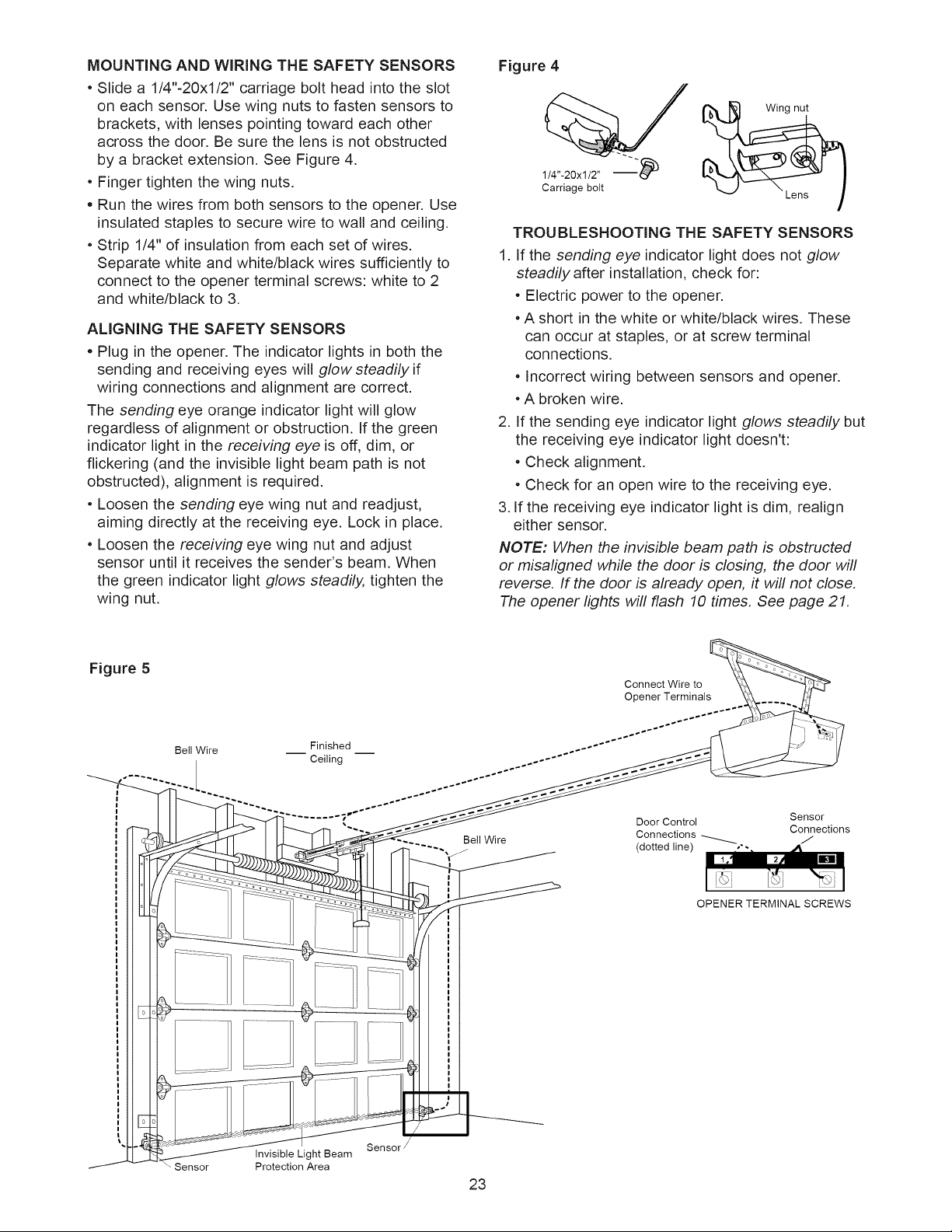
MOUNTING AND WiRiNG THE SAFETY SENSORS
, Slide a 1/4"-20xl/2" carriage bolt head into the slot
on each sensor. Use wing nuts to fasten sensors to
brackets, with lenses pointing toward each other
across the door. Be sure the lens is not obstructed
by a bracket extension. See Figure 4.
• Finger tighten the wing nuts.
• Run the wires from both sensors to the opener. Use
insulated staples to secure wire to wall and ceiling.
• Strip 1/4" of insulation from each set of wires.
Separate white and white/black wires sufficiently to
connect to the opener terminal screws: white to 2
and white/black to 3.
ALiGNiNG THE SAFETY SENSORS
• Plug in the opener. The indicator lights in both the
sending and receiving eyes will glow steadily if
wiring connections and alignment are correct.
The sending eye orange indicator light will glow
regardless of alignment or obstruction. If the green
indicator light in the receiving eye is off, dim, or
flickering (and the invisible light beam path is not
obstructed), alignment is required.
• Loosen the sending eye wing nut and readjust,
aiming directly at the receiving eye. Lock in place.
• Loosen the receiving eye wing nut and adjust
sensor until it receives the sender's beam. When
the green indicator light glows steadily, tighten the
wing nut.
Figure 4
1/4"-20x 1/2"
Carriage bolt
TROUBLESHOOTING THE SAFETY SENSORS
1. If the sending eye indicator light does not glow
steadily after installation, check for:
• Electric power to the opener.
• A short in the white or white/black wires. These
can occur at staples, or at screw terminal
connections.
• Incorrect wiring between sensors and opener.
• A broken wire.
2. If the sending eye indicator light glows steadily but
the receiving eye indicator light doesn't:
• Check alignment.
• Check for an open wire to the receiving eye.
3. If the receiving eye indicator light is dim, realign
either sensor.
NOTE: When the invisible beam path is obstructed
or misaligned while the door is closing, the door will
reverse. If the door is already open, it will not close.
The opener lights will flash 10 times. See page 21.
Figure 5
Bell Wire __ Finished __
Ceiling
Connect Wire to
Opener Terminals
Door Control
Bell Wire Connections _
/ (dotted line)
Sensor
Connections
/
OPENER TERMINAL SCREWS
Sensor
Invisible Light Beam
Protection Area
Sensor /
23
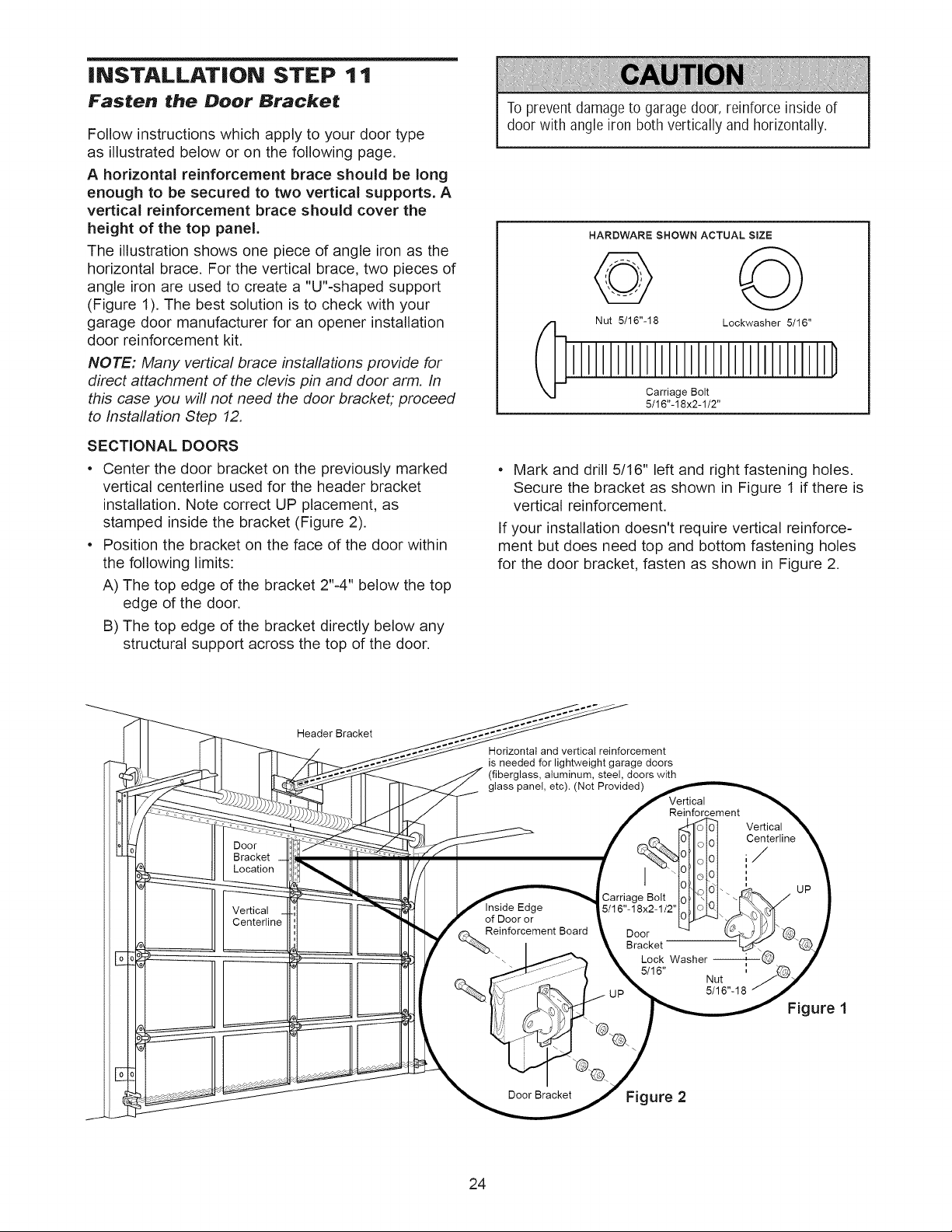
iNSTALLATiON STEP 11
Fasten the Door Bracket
Follow instructions which apply to your door type
as illustrated below or on the following page.
A horizontal reinforcement brace should be long
enough to be secured to two vertical supports. A
vertical reinforcement brace should cover the
height of the top pane[.
The illustration shows one piece of angle iron as the
horizontal brace. For the vertical brace, two pieces of
angle iron are used to create a "U"-shaped support
(Figure 1). The best solution is to check with your
garage door manufacturer for an opener installation
door reinforcement kit.
NOTE: Many vertical brace installations provide for
direct attachment of the clevis pin and door arm. In
this case you will not need the door bracket, proceed
to Installation Step 12.
SECTIONAL DOORS
Center the door bracket on the previously marked
vertical centerline used for the header bracket
installation. Note correct UP placement, as
stamped inside the bracket (Figure 2).
Position the bracket on the face of the door within
the following limits:
A) The top edge of the bracket 2"-4" below the top
edge of the door.
B) The top edge of the bracket directly below any
structural support across the top of the door.
To prevent damage to garage door, reinforce inside of
door with angle iron both vertically and horizontally.
HARDWARE SHOWN ACTUAL SIZE
Nut 5/16"-18 Lockwasher 5/16"
Carriage Bolt
5/16"-18x2-1/2"
• Mark and drill 5/16" left and right fastening holes.
Secure the bracket as shown in Figure 1 if there is
vertical reinforcement.
If your installation doesn't require vertical reinforce-
ment but does need top and bottom fastening holes
for the door bracket, fasten as shown in Figure 2.
Door
Bracket
Location
Vertical
Header Bracket
Edge
of Door or
(_einforcement Board
\
\
Horizontal and vertical reinforcement
is needed for lightweight garage doors
(fiberglass, aluminum, steel, doors with
glass panel, etc). (Not Provided)
Vertical
Reinforcement
?___, _ Vertical
Centerline
/
C% a
Door
Bracket
Lock Washer--,_--
5/16"
Nut
5/16"- 18
UP
"@@.
@'@.
Door Bracket Figure 2
Figure 1
24
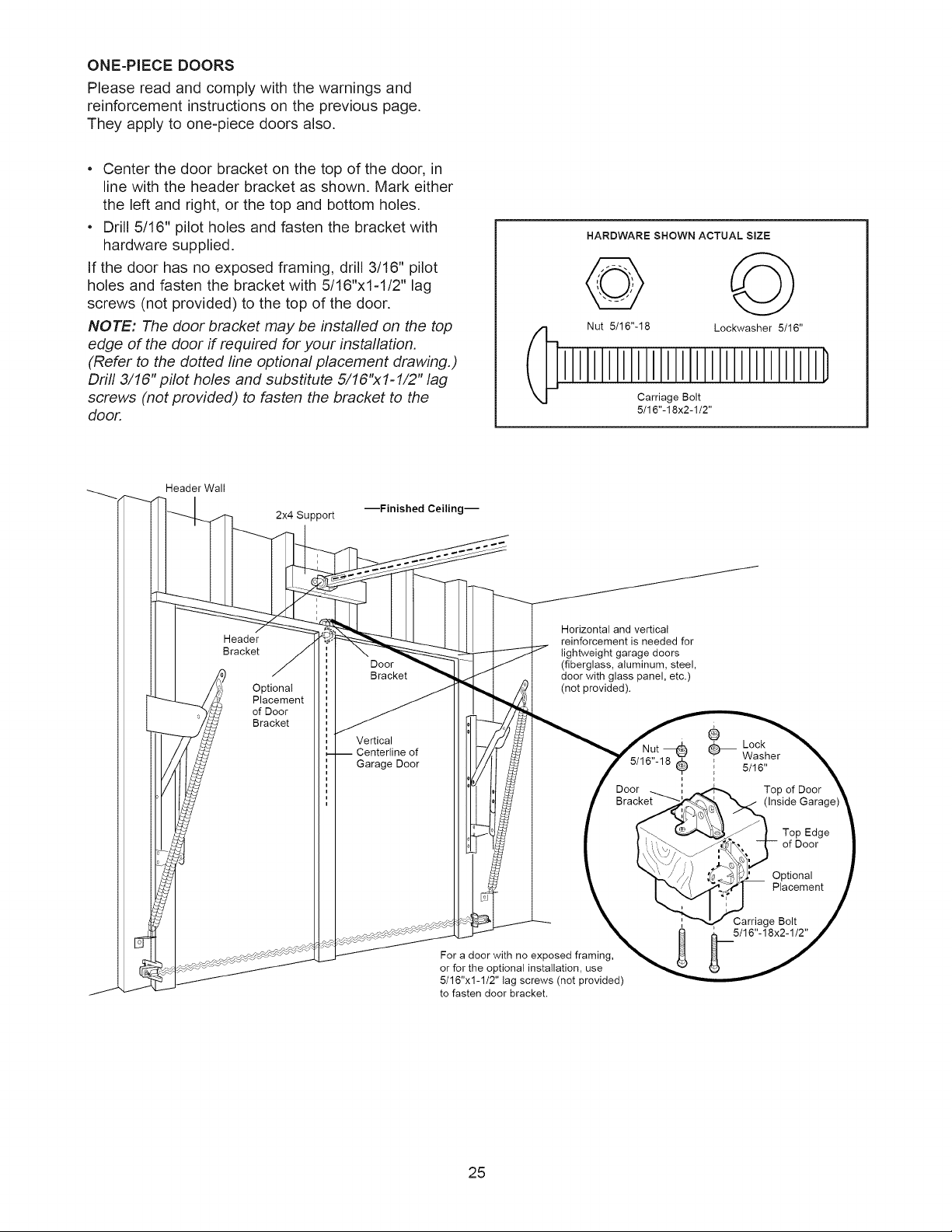
ONE-PIECEDOORS
Pleasereadandcomplywiththewarningsand
reinforcementinstructionsonthepreviouspage.
Theyapplyto one-piecedoorsalso.
• Centerthedoorbracketonthetopofthedoor,in
linewiththeheaderbracketasshown.Markeither
theleftandright,orthetopandbottomholes.
• Drill5/16"pilotholesandfastenthe bracketwith
hardwaresupplied.
Ifthedoorhasnoexposedframing,drill3/16"pilot
holesandfastenthebracketwith5/16"x1-1/2"lag
screws(notprovided)tothetopof thedoor.
NOTE: The door bracket may be instafled on the top
edge of the door if required for your installation.
(Refer to the dotted line optional placement drawing.)
Drill 3/16" pilot holes and substitute 5/16"x1-1/2" lag
screws (not provided) to fasten the bracket to the
door.
HARDWARE SHOWN ACTUAL SmZE
Nut 5/16"-18 Lockwasher 5/16"
Carriage Bolt
5/16"-18x2-1/2"
Header Wall
2x4 Support
--Finished Ceiling--
Header
Bracket
Optional
Placement
of Door
Bracket
Door
Bracket
Vertical
Centerline of
Garage Door
Horizontal and vertical
reinforcement is needed for
lightweight garage doors
(fiberglass, aluminum, steel,
door with glass panel, etc.)
(not provided).
÷
Door
For a door with no exposed framing,
or for the optional installation, use
5/16"x1-1/2" lag screws (not provided)
to fasten door bracket.
Lock
Washer
' 5/16"
Top of Door
(Inside Garage
Top Edge
of Door
Optional
Placement
Carriage Bolt
5/16"-18x2-1/2"
25
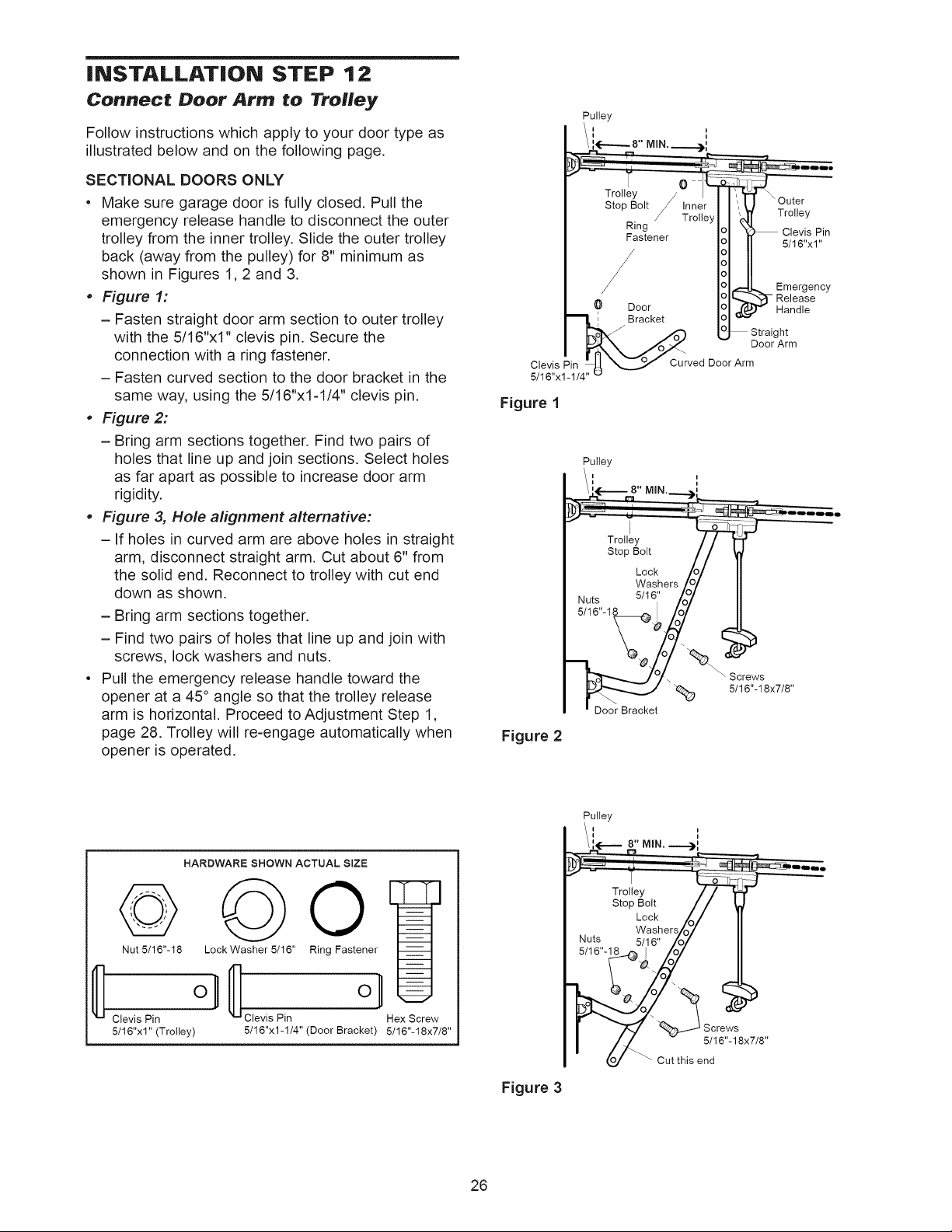
iNSTALLATiON STEP 12
Connect Door Arm to Trolley
Follow instructions which apply to your door type as
illustrated below and on the following page.
SECTIONAL DOORS ONLY
• Make sure garage door is fully closed. Pull the
emergency release handle to disconnect the outer
trolley from the inner trolley. Slide the outer trolley
back (away from the pulley) for 8" minimum as
shown in Figures 1, 2 and 3.
• Figure I:
= Fasten straight door arm section to outer trolley
with the 5/16"x1" clevis pin. Secure the
connection with a ring fastener.
= Fasten curved section to the door bracket in the
same way, using the 5/16"x1-1/4" clevis pin.
• Figure 2:
= Bring arm sections together. Find two pairs of
holes that line up and join sections. Select holes
as far apart as possible to increase door arm
rigidity.
• Figure 3, Hole alignment alternative:
= If holes in curved arm are above holes in straight
arm, disconnect straight arm. Cut about 6" from
the solid end. Reconnect to trolley with cut end
down as shown.
= Bring arm sections together.
= Find two pairs of holes that line up and join with
screws, lock washers and nuts.
• Pull the emergency release handle toward the
opener at a 45 ° angle so that the trolley release
arm is horizontal. Proceed to Adjustment Step 1,
page 28. Trolley will re-engage automatically when
opener is operated.
Figure 1
Figure 2
Door Bracket
Screws
5/16"-18x7/8"
Nut 5/16"-18
Clevis Pin
5/16"x1" (Trolley)
HARDWARE SHOWN ACTUAL SmZE
Lock Washer 5/16" Ring Fastener
°l
Clevis Pin Hex Screw
5/16"x1-1/4" (Door Bracket) 5/16"-18x7/8"
Figure 3
Pulley
i
i
Washers
Screws
5/16"- 18x7/8"
Cut this end
26
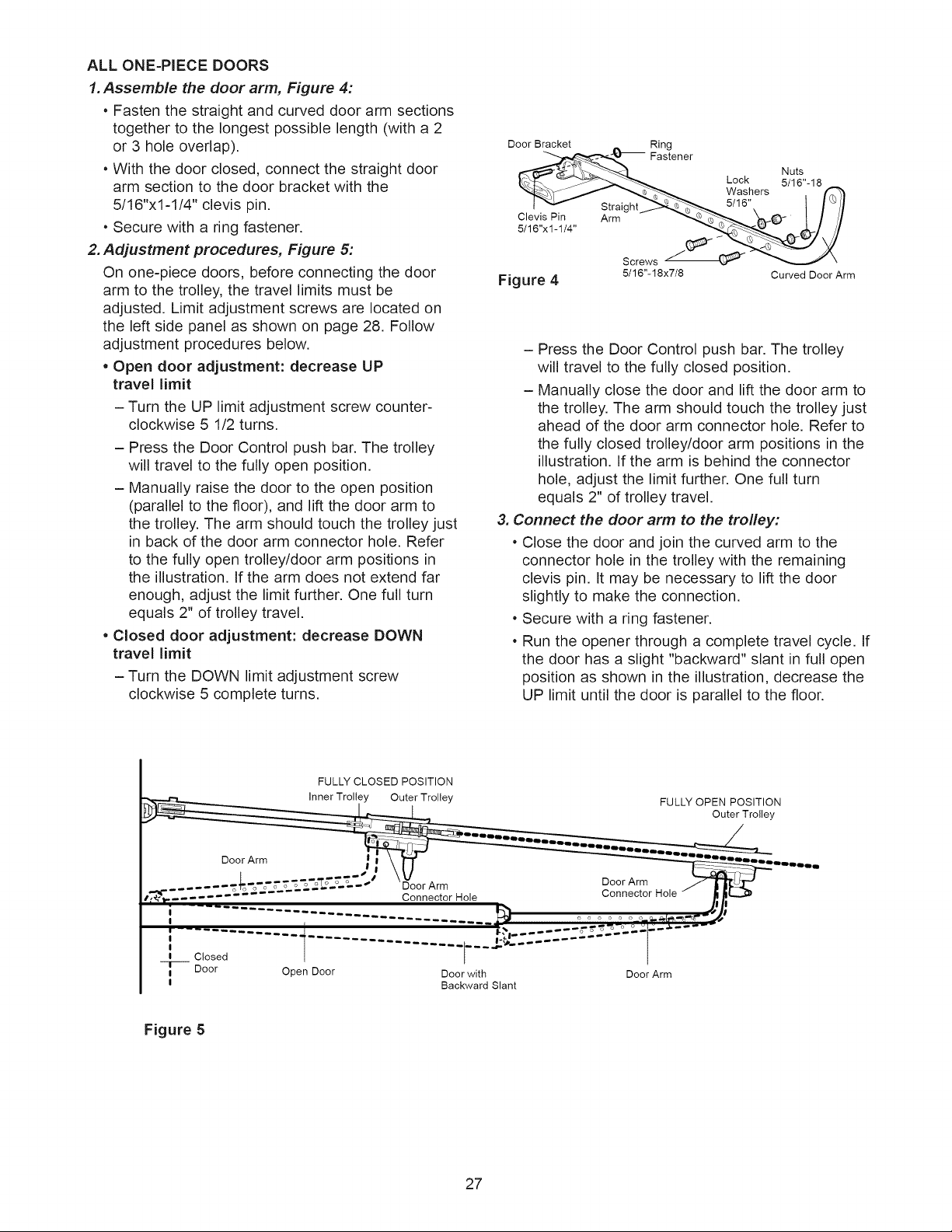
ALLONE=PIECEDOORS
1.Assemble the door arm, Figure 4:
• Fasten the straight and curved door arm sections
together to the longest possible length (with a 2
or 3 hole overlap).
• With the door closed, connect the straight door
arm section to the door bracket with the
5/16"x1-1/4" clevis pin.
• Secure with a ring fastener.
2. Adjustment procedures, Figure 5:
On one-piece doors, before connecting the door
arm to the trolley, the travel limits must be
adjusted. Limit adjustment screws are located on
the left side panel as shown on page 28. Follow
adjustment procedures below.
• Open door adjustment: decrease UP
travel limit
- Turn the UP limit adjustment screw counter-
clockwise 5 1/2 turns.
- Press the Door Control push bar. The trolley
will travel to the fully open position.
- Manually raise the door to the open position
(parallel to the floor), and lift the door arm to
the trolley. The arm should touch the trolley just
in back of the door arm connector hole. Refer
to the fully open trolley/door arm positions in
the illustration. If the arm does not extend far
enough, adjust the limit further. One full turn
equals 2" of trolley travel.
oClosed door adjustment: decrease DOWN
travel limit
- Turn the DOWN limit adjustment screw
clockwise 5 complete turns.
Door Bracket _ Ring
Fastener
.,-,,t""vt_ _ _ _ Nuts
}._ -"_"_"_'-'__ Lock 5/16"-18
"_._ / ___ Washers
.qt_i_ ht"'4_ 5/16" t1_/I
5/16")d-1/4 ' __
rly/e'-"-u"- 4 5/16"-18x7/8 Curved Door Arm
- Press the Door Control push bar. The trolley
will travel to the fully closed position.
- Manually close the door and lift the door arm to
the trolley. The arm should touch the trolley just
ahead of the door arm connector hole. Refer to
the fully closed trolley/door arm positions in the
illustration. If the arm is behind the connector
hole, adjust the limit further. One full turn
equals 2" of trolley travel.
3. Connect the door arm to the trolley:
• Close the door and join the curved arm to the
connector hole in the trolley with the remaining
clevis pin. It may be necessary to lift the door
slightly to make the connection.
• Secure with a ring fastener.
• Run the opener through a complete travel cycle. If
the door has a slight "backward" slant in full open
position as shown in the illustration, decrease the
UP limit until the door is parallel to the floor.
FULLY CLOSED POSITION
Inner Trolley Outer Trolley
I Closed
_ Door
!
Open Door
Door with
Backward Slant
Door Arm
Figure 5
27
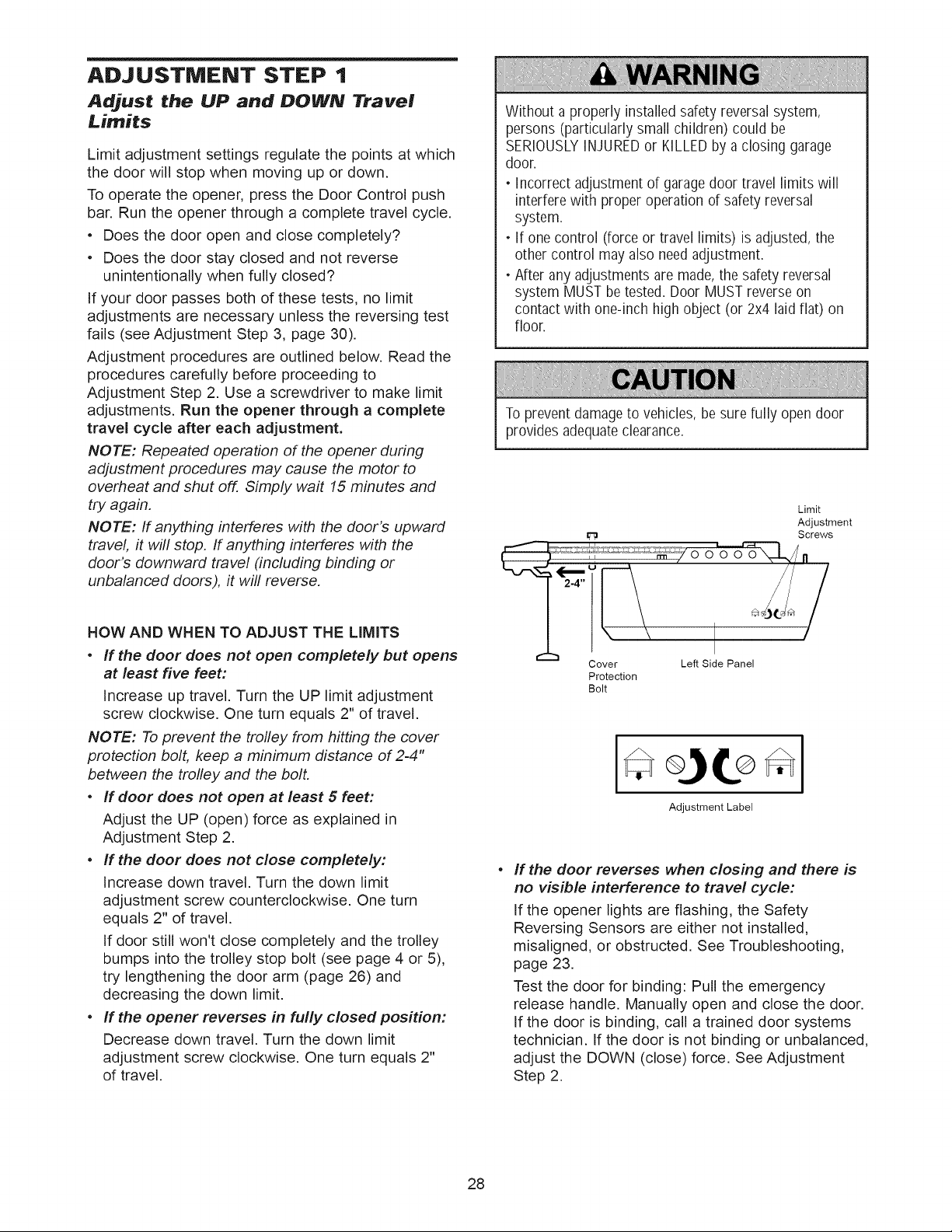
ADJUSTMENT STEP 1
Adjust the UP and DOWN Travel
Limits
Limit adjustment settings regulate the points at which
the door will stop when moving up or down.
To operate the opener, press the Door Control push
bar. Run the opener through a complete travel cycle.
• Does the door open and close completely?
• Does the door stay closed and not reverse
unintentionally when fully closed?
If your door passes both of these tests, no limit
adjustments are necessary unless the reversing test
fails (see Adjustment Step 3, page 30).
Adjustment procedures are outlined below. Read the
procedures carefully before proceeding to
Adjustment Step 2. Use a screwdriver to make limit
adjustments. Run the opener through a complete
travel cycle after each adjustment.
NOTE: Repeated operation of the opener during
adjustment procedures may cause the motor to
overheat and shut off. Simply wait 15 minutes and
try again.
NOTE: If anything interferes with the door's upward
travel, it will stop. If anything interferes with the
door's downward travel (including binding or
unbalanced doors), it will reverse.
HOW AND WHEN TO ADJUST THE LIMITS
• If the door does not open completely but opens
at least five feet:
Increase up travel. Turn the UP limit adjustment
screw clockwise. One turn equals 2" of travel.
NOTE: To prevent the trolley from hitting the cover
protection bolt, keep a minimum distance of 2-4"
between the trolley and the bolt.
• If door does not open at least 5 feet:
Adjust the UP (open) force as explained in
Adjustment Step 2.
• If the door does not close completely:
Increase down travel. Turn the down limit
adjustment screw counterclockwise. One turn
equals 2" of travel.
If door still won't close completely and the trolley
bumps into the trolley stop bolt (see page 4 or 5),
try lengthening the door arm (page 26) and
decreasing the down limit.
• If the opener reverses in fully closed position:
Decrease down travel. Turn the down limit
adjustment screw clockwise. One turn equals 2"
of travel.
Without a properly installed safety reversal system,
persons (particularly small children) could be
SERIOUSLYINJUREDor KILLEDby a closing garage
door.
. Incorrect adjustment of garage door travel limits will
interfere with proper operation of safety reversal
system.
. if one control (force or travel limits) is adjusted, the
other control may also need adjustment.
. After any adjustments are made,the safety reversal
system MUST betested. Door MUST reverse on
contact with one-inch high object (or 2x4 laid flat) on
floor.
To prevent damage to vehicles, be sure fully open door
provides adequateclearance.
Limit
Adjustment
Screws
7o o o o
2-4"
\
Cover Left Side Panel
Protection
Belt
Adjustment Label
If the door reverses when closing and there is
no visible interference to travel cycle:
If the opener lights are flashing, the Safety
Reversing Sensors are either not installed,
misaligned, or obstructed. See Troubleshooting,
page 23.
Test the door for binding: Pull the emergency
release handle. Manually open and close the door.
If the door is binding, call a trained door systems
technician. If the door is not binding or unbalanced,
adjust the DOWN (close) force. See Adjustment
Step 2.
28
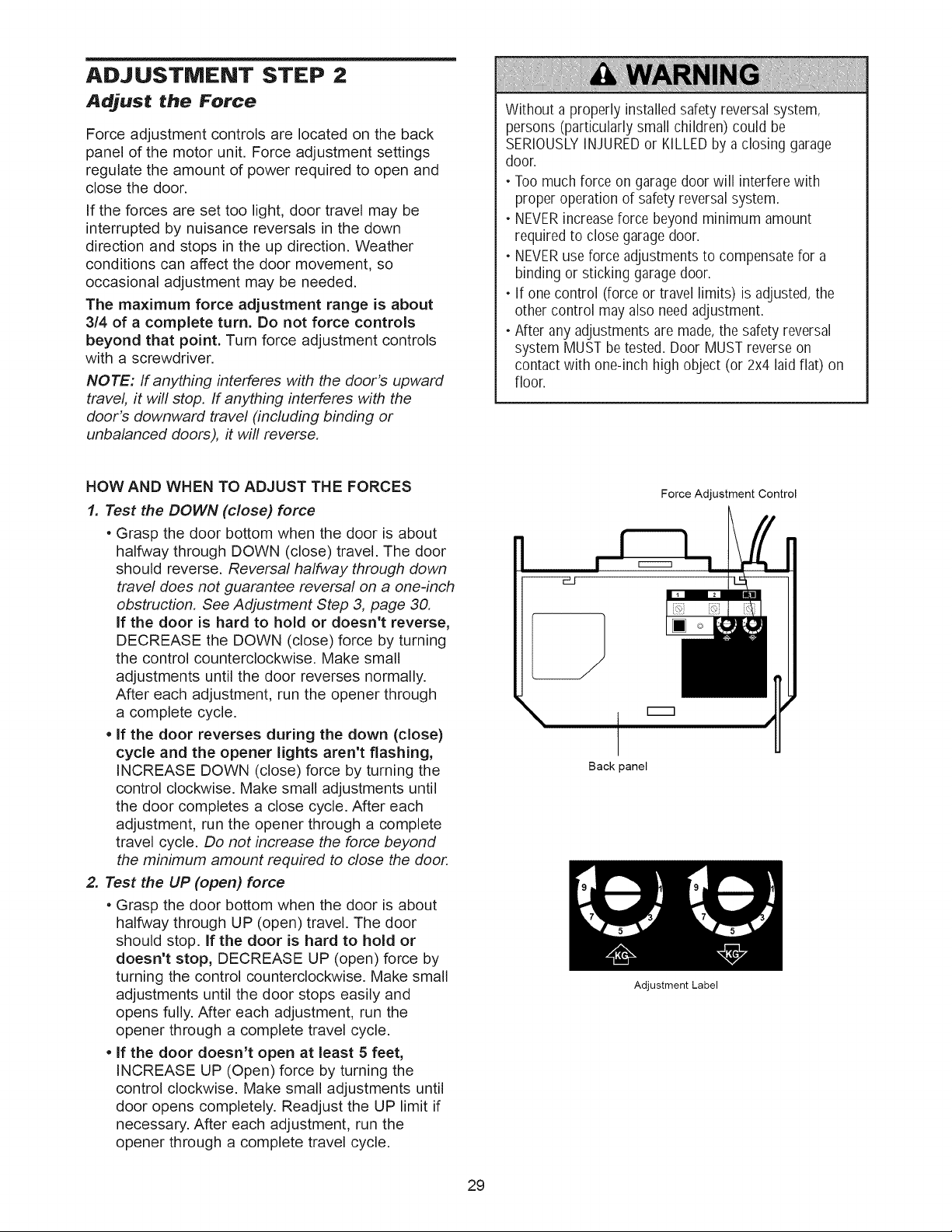
ADJUSTMENT STEP 2
Adjust the Force
Force adjustment controls are located on the back
panel of the motor unit. Force adjustment settings
regulate the amount of power required to open and
close the door.
If the forces are set too light, door travel may be
interrupted by nuisance reversals in the down
direction and stops in the up direction. Weather
conditions can affect the door movement, so
occasional adjustment may be needed.
The maximum force adjustment range is about
3/4 of a complete turn. Do not force controls
beyond that point. Turn force adjustment controls
with a screwdriver.
NOTE: If anything interferes with the door's upward
travel, it will stop. If anything interferes with the
door's downward travel (including binding or
unbalanced doors), it will reverse.
Without a properly installed safety reversal system,
persons (particularly small children) could be
SERIOUSLYINJUREDor KILLEDby a closing garage
door.
. Too much force on garage door will interfere with
proper operation of safety reversal system.
. NEVERincrease force beyond minimum amount
required to close garage door.
. NEVERuse force adjustments to compensate for a
binding or sticking garagedoor.
. if one control (force or travel limits) is adjusted, the
other control may also need adjustment.
. After any adjustments are made,the safety reversal
system MUST betested. Door MUST reverse on
contact with one-inch high object (or 2x4 laid flat) on
floor.
HOW AND WHEN TO ADJUST THE FORCES
1. Test the DOWN (close) force
• Grasp the door bottom when the door is about
halfway through DOWN (close) travel. The door
should reverse. Reversal halfway through down
travel does not guarantee reversal on a one-inch
obstruction. See Adjustment Step 3, page 30.
If the door is hard to hold or doesn't reverse,
DECREASE the DOWN (close) force by turning
the control counterclockwise. Make small
adjustments until the door reverses normally.
After each adjustment, run the opener through
a complete cycle.
• If the door reverses during the down (close)
cycle and the opener lights aren't flashing,
INCREASE DOWN (close) force by turning the
control clockwise. Make small adjustments until
the door completes a close cycle. After each
adjustment, run the opener through a complete
travel cycle. Do not increase the rome beyond
the minimum amount required to close the door.
2. Test the UP (open) force
• Grasp the door bottom when the door is about
halfway through UP (open) travel. The door
should stop. If the door is hard to hold or
doesn't stop, DECREASE UP (open) force by
turning the control counterclockwise. Make small
adjustments until the door stops easily and
opens fully. After each adjustment, run the
opener through a complete travel cycle.
• If the door doesn't open at least 5 feet,
INCREASE UP (Open) force by turning the
control clockwise. Make small adjustments until
door opens completely. Readjust the UP limit if
necessary. After each adjustment, run the
opener through a complete travel cycle.
Back panel
Force Adjustment Control
Adjustment Label
29
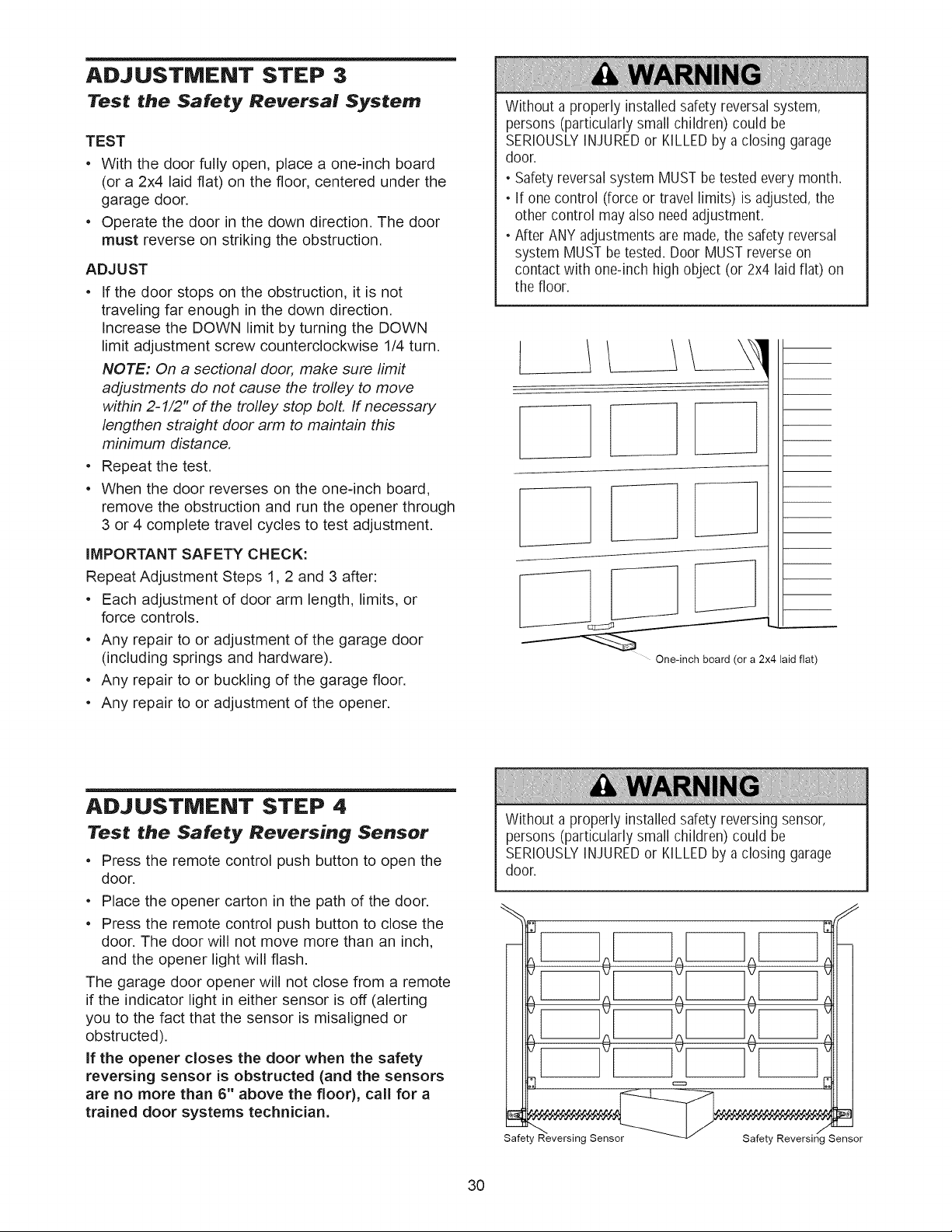
ADJUSTMENT STEP 3
Test the Safety Reversal System
TEST
• With the door fully open, place a one-inch board
(or a 2x4 laid flat) on the floor, centered under the
garage door.
• Operate the door in the down direction. The door
must reverse on striking the obstruction.
ADJUST
• If the door stops on the obstruction, it is not
traveling far enough in the down direction.
Increase the DOWN limit by turning the DOWN
limit adjustment screw counterclockwise 1/4 turn.
NOTE: On a sectional door, make sure limit
adjustments do not cause the trolley to move
within 2-1/2" of the trolley stop boll If necessary
lengthen straight door arm to maintain this
minimum distance.
• Repeat the test.
• When the door reverses on the one-inch board,
remove the obstruction and run the opener through
3 or 4 complete travel cycles to test adjustment.
iMPORTANT SAFETY CHECK:
Repeat Adjustment Steps 1,2 and 3 after:
• Each adjustment of door arm length, limits, or
force controls.
• Any repair to or adjustment of the garage door
(including springs and hardware).
• Any repair to or buckling of the garage floor.
• Any repair to or adjustment of the opener.
Without a properly installed safety reversal system,
persons (particularly small children) could be
SERIOUSLYINJUREDor KILLEDby a closing garage
door.
, Safety reversal system MUST be tested every month.
, if one control (force or travel limits) is adjusted, the
other control may also need adjustment.
, After ANY adjustments are made,the safety reversal
system MUST betested. Door MUST reverse on
contact with one-inch high object (or 2x4 laid flat) on
the floor.
_laid flat)
ADJUSTMENT STEP 4
"rest the Safety Reversing Sensor
• Press the remote control push button to open the
door.
• Place the opener carton in the path of the door.
• Press the remote control push button to close the
door. The door will not move more than an inch,
and the opener light will flash.
The garage door opener will not close from a remote
if the indicator light in either sensor is off (alerting
you to the fact that the sensor is misaligned or
obstructed).
If the opener closes the door when the safety
reversing sensor is obstructed (and the sensors
are no more than 6" above the floor), call for a
trained door systems technician.
Without a properly installed safety reversing sensor,
persons (particularly small children) could be
SERIOUSLYINJUREDor KILLEDby a closing garage
door.
Ill
::: Sensor
30
OPERATION
iMPORTANT SAFETY iNSTRUCTiONS
To reduce the risk of severe injury or death:
1. READAND FOLLOWALL WARNINGSAND
iNSTRUCTiONS.
2. ALWAYSkeep remote controls out of reach of children.
NEVERpermit children to operate or play with garage
door control push buttons or remote controls.
3. ONLYactivate garagedoor when it can beseen clearly, it
is properly adjusted, and there are no obstructions to
door travel.
4. ALWAYSkeep garage door in sight until completely
closed. NO ONESHOULDCROSSTHEPATHOFTHE
MOVING DOOR.
5. if possible, use emergency release handleto disengage
trolley ONLYwhen garagedoor is CLOSED.Weak or
broken springs or unbalanced door could result in an
open door falling rapidly and/or unexpectedly.
6. NEVERuse emergency releasehandle unless garage
doorway is clear of persons and obstructions.
7. NEVERuse handleto pull garage door open or closed. If
rope knot becomes untied, you could fall.
8. If one control (force or travel limits) is adjusted, the
other control may also need adjustment.
9. After any adjustments are made, the safety reversal
system MUST be tested.
10. Safety reversal system MUST betested every month.
Garagedoor MUST reverse on contact with one-inch
high object (or a 2x4 laid flat) on the floor.
11. ALWAYSKEEPGARAGEDOORPROPERLYBALANCED
(see page 3). An improperly balanceddoor may not
reversewhen required and could result in severeinjury
or death.
12. All repairs to cables, spring assemblies and other
hardware, all of which are under EXTREMEtension,
MUST be made by a trained door systems technician.
13. ALWAYSdisconnect electric power to garage door
opener before making any repairs or removing covers.
14.SAVE THESE INSTRUCTIONS.
Using Your Garage Door Opener
Your Security+ opener and hand-held remote control
have been factory-set to a matching code which
changes with each use, randomly accessing over
100 billion new codes. Your opener will operate with
up to eight Security+ remote controls and one
Security+ Keyless Entry System. If you purchase a
new remote, or if you wish to deactivate any remote,
follow the instructions in the Programming section.
Activate your opener with any of the following:
• The hand-held Remote Control: Hold the large
push button down until the door starts to move.
• The wall-mounted Door Control: Hold the push
button down until the door starts to move.
• The Keyless Entry (See Accessories): if supplied
with your garage door opener, it must be
programmed before use. See Programming.
When the opener is activated (with the safety
reversing sensor correctly installed and aligned)
1. If open, the door will close. If closed, it will open.
2. If closing, the door will reverse.
3. If opening, the door will stop.
4. If the door has been stopped in a partially open
position, it will close.
5. If obstructed while closing, the door will reverse. If
the obstruction interrupts the sensor beam, the
opener light will blink for five seconds.
6. If obstructed while opening, the door will stop.
7. If fully open, the door will not close when the beam
is broken. The sensor has no effect in the opening
cycle.
If the sensor is not installed, or is misaligned, the
door won't close from a hand-held remote. However,
you can close the door with the Door Control, the
Outdoor Key Switch, or Keyless Entry, if you activate
them until down travel is complete. If you release
them too soon, the door will reverse.
The opener light will turn on under the following
conditions: when the opener is initially plugged in;
when power is restored after interruption; when the
opener is activated.
It will turn off automatically after 4-1/2 minutes or
provide constant light when the Light feature is
activated. Bulb size is 75 watts maximum.
Security+ Light Feature: Light will also turn on
when someone walks through the open garage door.
With a Premium Control Console, this feature may be
turned off as follows: With the opener light off, press
and hold the light button for 10 seconds, until the
light goes on and off again. To restore this feature,
start with the opener light on, then press and hold the
light button for 10 seconds until the light goes off,
then on again.
31
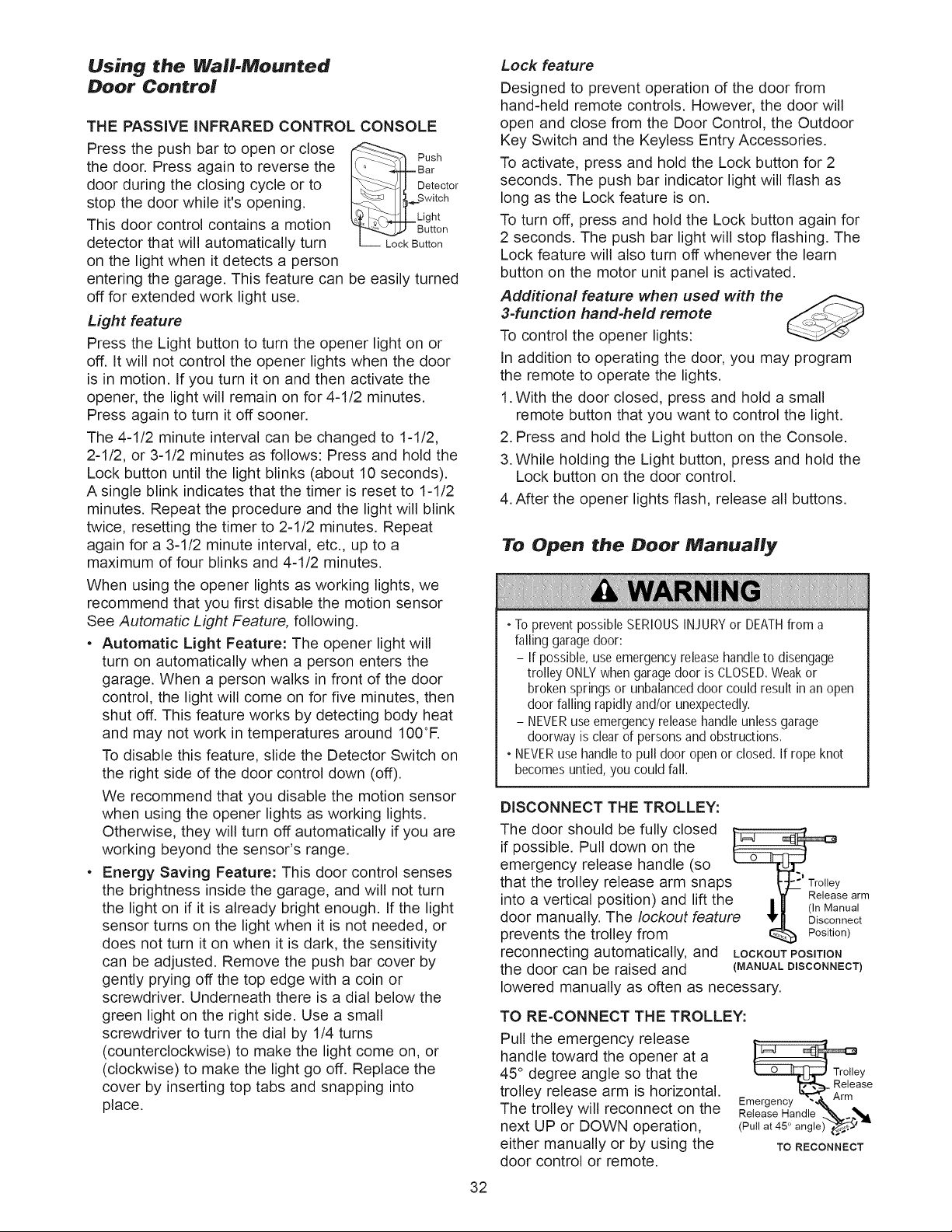
Using the Wall-Mounted
Door Control
THE PASSIVE INFRARED CONTROL CONSOLE
Press the push bar to open or close _'_,_ Push
the door. Press again to reverse the __'_,__---Bar
door during the closing cycle or to I _:_-_l Detector
stop the door while it's opening. _ _.,__Switch
_ _,_,._ Light
This door control contains a motion h___nn.kq__:'4""C_J_ FButt°n
detector that will automatically turn LockButton
on the light when it detects a person
entering the garage. This feature can be easily turned
off for extended work light use.
Light feature
Press the Light button to turn the opener light on or
off. It will not control the opener lights when the door
is in motion. If you turn it on and then activate the
opener, the light will remain on for 4-1/2 minutes.
Press again to turn it off sooner.
The 4-1/2 minute interval can be changed to 1-1/2,
2-1/2, or 3-1/2 minutes as follows: Press and hold the
Lock button until the light blinks (about 10 seconds).
A single blink indicates that the timer is reset to 1-1/2
minutes. Repeat the procedure and the light will blink
twice, resetting the timer to 2-1/2 minutes. Repeat
again for a 3-1/2 minute interval, etc., up to a
maximum of four blinks and 4-1/2 minutes.
When using the opener lights as working lights, we
recommend that you first disable the motion sensor
See Automatic Light Feature, following.
• Automatic Light Feature: The opener light will
turn on automatically when a person enters the
garage. When a person walks in front of the door
control, the light will come on for five minutes, then
shut off. This feature works by detecting body heat
and may not work in temperatures around 100°R
To disable this feature, slide the Detector Switch on
the right side of the door control down (off).
We recommend that you disable the motion sensor
when using the opener lights as working lights.
Otherwise, they will turn off automatically if you are
working beyond the sensor's range.
• Energy Saving Feature: This door control senses
the brightness inside the garage, and will not turn
the light on if it is already bright enough. If the light
sensor turns on the light when it is not needed, or
does not turn it on when it is dark, the sensitivity
can be adjusted. Remove the push bar cover by
gently prying off the top edge with a coin or
screwdriver. Underneath there is a dial below the
green light on the right side. Use a small
screwdriver to turn the dial by 1/4 turns
(counterclockwise) to make the light come on, or
(clockwise) to make the light go off. Replace the
cover by inserting top tabs and snapping into
place.
Lock feature
Designed to prevent operation of the door from
hand-held remote controls. However, the door will
open and close from the Door Control, the Outdoor
Key Switch and the Keyless Entry Accessories.
To activate, press and hold the Lock button for 2
seconds. The push bar indicator light will flash as
long as the Lock feature is on.
To turn off, press and hold the Lock button again for
2 seconds. The push bar light will stop flashing. The
Lock feature will also turn off whenever the learn
button on the motor unit panel is activated.
Additional feature when used with the
3-function hand-held remote
To control the opener lights:
In addition to operating the door, you may program
the remote to operate the lights.
1. With the door closed, press and hold a small
remote button that you want to control the light.
2. Press and hold the Light button on the Console.
3. While holding the Light button, press and hold the
Lock button on the door control.
4. After the opener lights flash, release all buttons.
To Open the Door Manually
32
• To prevent possible SERIOUSINJURY or DEATHfrom a
falling garage door:
- If possible, use emergency release handle to disengage
trolley ONLYwhen garagedoor is CLOSED.Weakor
broken springs or unbalanced door could result in an open
door falling rapidly and/or unexpectedly.
- NEVERuse emergency releasehandle unless garage
doorway is clear of persons and obstructions.
• NEVERuse handle to pull door open or closed. If rope knot
becomes untied, you could fall.
DISCONNECT THE TROLLEY:
The door should be fully closed }:_ _t_
if possible. Pull down on the
emergency release handle (so
that the trolley release arm snaps _-_" Trolley
into a vertical position) and lift the _ _ Release aim
feature
/u
(DlnscManlnect(InManuat
door manually. The lockout I!,_
Posttlon)
prevents the trolley from _ Positi,
reconnecting automatically, and LOCKOUTPOSmON
the door can be raised and (MANUALDISCONNECT)
lowered manually as often as necessary.
TO RE-CONNECT THE TROLLEY:
Pull the emergency release
handle toward the opener at a
45 ° degree angle so that the
trolley release arm is horizontal.
The trolley will reconnect on the
next UP or DOWN operation,
either manually or by using the
door control or remote.
Release
Emergency "_',q_. Arm
Release Handle "_% _.,
(Pull at 45 ° angle_ _ ;m,
TO RECONNECT
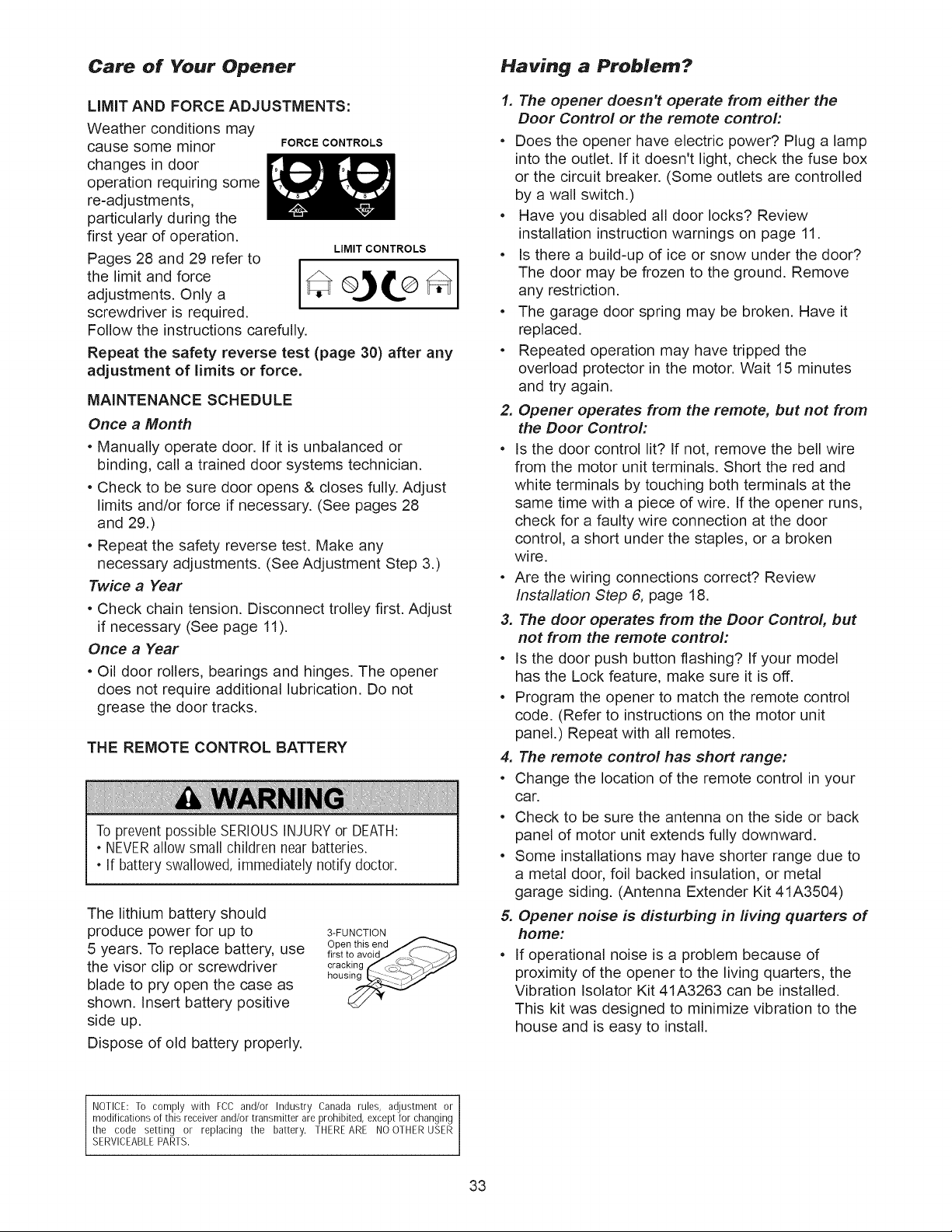
Care of Your Opener
LiMiT AND FORCE ADJUSTMENTS:
Weather conditions may
cause some minor
changes in door
operation requiring some
re-adjustments,
particularly during the
first year of operation.
Pages 28 and 29 refer to
the limit and force
adjustments. Only a
screwdriver is required.
FORCE CONTROLS
LIMIT CONTROLS
Follow the instructions carefully.
Repeat the safety reverse test (page 30) after any
adjustment of limits or force.
MAINTENANCE SCHEDULE
Once a Month
• Manually operate door. If it is unbalanced or
binding, call a trained door systems technician.
• Check to be sure door opens & closes fully. Adjust
limits and/or force if necessary. (See pages 28
and 29.)
• Repeat the safety reverse test. Make any
necessary adjustments. (See Adjustment Step 3.)
Twice a Year
• Check chain tension. Disconnect trolley first. Adjust
if necessary (See page 11).
Once a Year
• Oil door rollers, bearings and hinges. The opener
does not require additional lubrication. Do not
grease the door tracks.
THE REMOTE CONTROL BATTERY
To prevent possible SERIOUSINJURYor DEATH:
. NEVERallow small children near batteries.
. if battery swallowed, immediately notify doctor.
The lithium battery should
produce power for up to
5 years. To replace battery, use
the visor clip or screwdriver
blade to pry open the case as
shown. Insert battery positive
side up.
Dispose of old battery properly.
3-FUNCTION
Open this end
first to avoidJ_ __._ _
cracking __-_-_
hous_
Having a Problem?
1. The opener doesn't operate from either the
Door Control or the remote contro#
• Does the opener have electric power? Plug a lamp
into the outlet. If it doesn't light, check the fuse box
or the circuit breaker. (Some outlets are controlled
by a wall switch.)
• Have you disabled all door locks? Review
installation instruction warnings on page 11.
• Is there a build-up of ice or snow under the door?
The door may be frozen to the ground. Remove
any restriction.
• The garage door spring may be broken. Have it
replaced.
• Repeated operation may have tripped the
overload protector in the motor. Wait 15 minutes
and try again.
2. Opener operates from the remote, but not from
the Door Control:
• Is the door control lit? If not, remove the bell wire
from the motor unit terminals. Short the red and
white terminals by touching both terminals at the
same time with a piece of wire. If the opener runs,
check for a faulty wire connection at the door
control, a short under the staples, or a broken
wire.
• Are the wiring connections correct? Review
Installation Step 6, page 18.
3. The door operates from the Door Control, but
not from the remote control:
• Is the door push button flashing? If your model
has the Lock feature, make sure it is off.
• Program the opener to match the remote control
code. (Refer to instructions on the motor unit
panel.) Repeat with all remotes.
4. The remote control has short range:
• Change the location of the remote control in your
car.
• Check to be sure the antenna on the side or back
panel of motor unit extends fully downward.
• Some installations may have shorter range due to
a metal door, foil backed insulation, or metal
garage siding. (Antenna Extender Kit 41A3504)
5. Opener noise is disturbing in living quarters of
home:
• If operational noise is a problem because of
proximity of the opener to the living quarters, the
Vibration Isolator Kit 41A3263 can be installed.
This kit was designed to minimize vibration to the
house and is easy to install.
NOTICE: To comply with FCC and/or Industry Canada rules, adjustment or
modifications of this receiver and/or transmitter are prohibited, except for changing
the code setting or replacing the battery. THERE ARE NO OTHERUSER
SERVICEABLEPARTS.
33
Having a Problem? (Continued)
6. The garage door opens and closes by itself:
• Be sure that all remote control push buttons are
off.
• Remove the bell wire from the door control
terminals and operate from the remote only. If this
solves the problem, the door control is faulty
(replace), or there is an intermittent short on the wire
between the door control and the motor unit.
• Clear memory and re-program all remote controls.
7. The door doesn't open completely:
• Is something obstructing the door? Is it out of
balance, or are the springs broken? Remove the
obstruction or repair the door.
• If the door is in good working order but now
doesn't open all the way, increase the up force.
See Adjustment Step 2.
• If the door opens at least 5 feet, the travel limits
may need to be increased. One turn equals 2
inches of travel. See Adjustment Step 1.
Repeat the safety reverse test after the adjustment is
complete.
8. The door stops but doesn't close completely:
• Review the travel limits adjustment procedures on
page 28.
Repeat the safety reverse test after any adjustment
of door arm length, close force or down fimit.
9. The door opens but won't close:
• If the opener light blinks, check the safety
reversing sensor. See Installation Step 10.
• If the opener light doesn't blink and it is a new
installation, check the down force. See Adjustment
Step 2, page 29. For an existing installation, see
below.
Repeat the safety reverse test after the adjustment
is complete.
10. The door reverses for no apparent reason and
opener light doesn't blink:
• Is something obstructing the door? Pull the
emergency release handle. Operate the door
manually. If it is unbalanced or binding, call a
trained door systems technician.
• Clear any ice or snow from the garage floor area
where the door closes.
• Review Adjustment Step 2 on page 29.
• If door reverses in the fully closed position,
decrease the travel limits (Adjustment Step 1).
Repeat safety reverse test after adjustments to force
or travel fimits. The need for occasional adjustment
of the force and limit settings is normal. Weather
conditions in particular can affect door travel.
11. The door reverses for no apparent reason and
opener light blinks for 5 seconds after
reversing:
• Check the safety reversing sensor. Remove any
obstruction or align the receiving eye. See
Installation Step 10.
12. The opener light doesn't turn on:
• Replace the light bulb5
(75 watts maximum). Use a standard neck garage
door opener bulb if regular bulb burns out.
13. The opener lights don't turn off:
• Is the Light feature on? Turn it off.
14. The opener strains or maximum force is
needed to operate door:
• The door may be out of balance or the springs
may be broken. Close the door and use the
emergency release handle to disconnect the
trolley. Open and close the door manually. A
properly balanced door will stay in any point of
travel while being supported entirely by its springs.
If it does not, disconnect the opener and call a
trained door systems technician. Do not increase
the force to operate the opener.
15. The opener motor hums briefly, then won't
work:
• The garage door springs may be broken. See
above.
• If the problem occurs on the first operation of the
opener, door may be locked. Disable the door lock.
If the chain was removed and reinstalled, the
motor may be out of phase. Remove the chain;
cycle the motor to the down position. Observe the
drive sprocket. When it turns in a clockwise
direction and stops in the down position, reinstall
the chain.
Repeat the safety reverse test after the adjustment is
complete.
16. The opener won't operate due to power
failure:
• Use the emergency release handle to disconnect
the trolley. The door can be opened and closed
manually. When power is restored, press the Door
Control push bar and trolley will automatically
reconnect (unless trolley is in lockout position.)
See page 32.
• The Emergency Key Release accessory (for use
on garages with no service door) disconnects the
trolley from outside the garage in case of power
failure.
17. The chain droops or sags:
• It is normal for the chain to droop slightly in the
closed door position. Use the emergency release
to disconnect the trolley. If the chain returns to
normal height when the trolley is disengaged and
the door reverses on a one-inch board, no
adjustments are needed (see page 11).
34
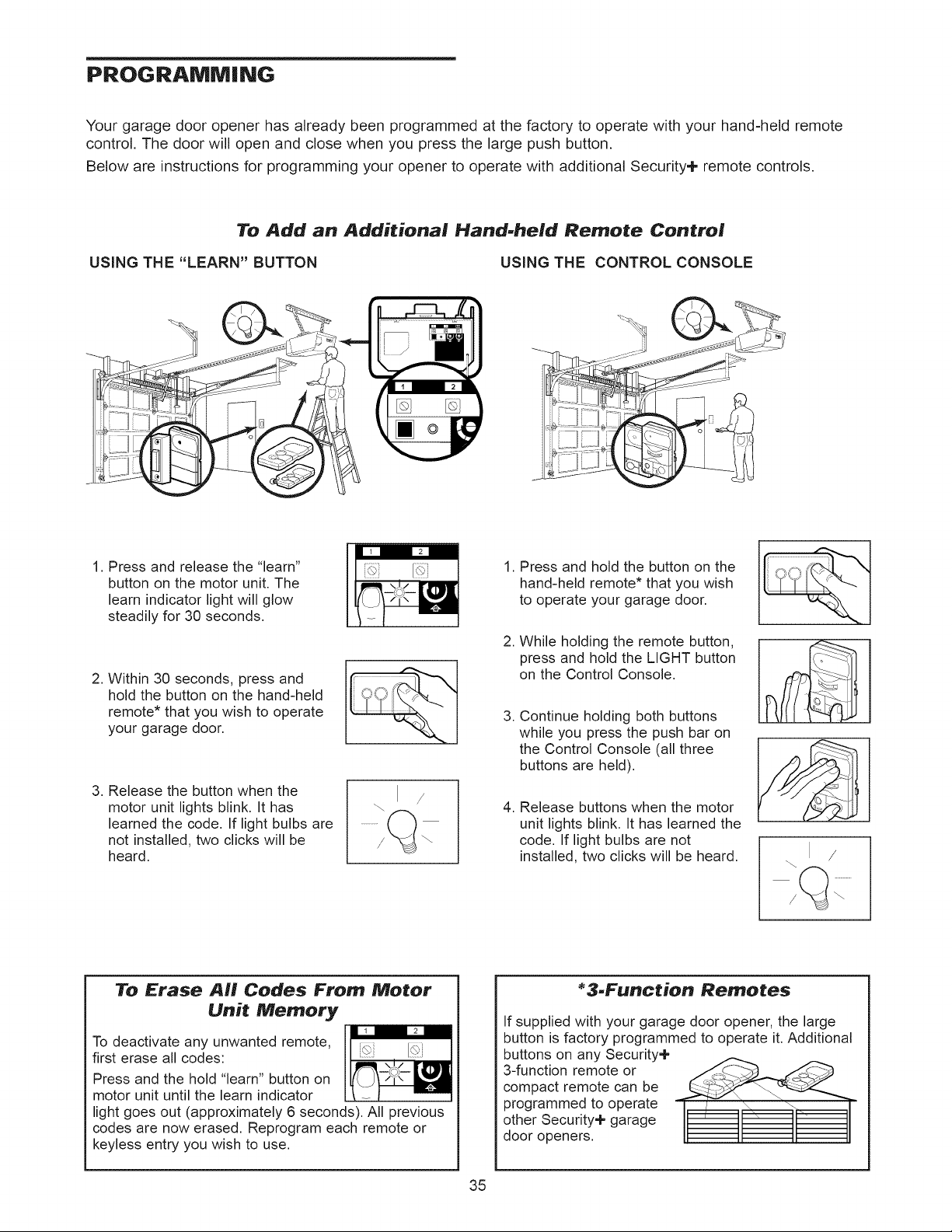
PROGRAMMING
Your garage door opener has already been programmed at the factory to operate with your hand-held remote
control, The door will open and close when you press the large push button.
Below are instructions for programming your opener to operate with additional Security+ remote controls,
To Add an Additional Hand-held Remote Control
USING THE "LEARN" BUTTON USING THE CONTROL CONSOLE
1. Press and release the "learn"
button on the motor unit. The
learn indicator light will glow
steadily for 30 seconds.
2. Within 30 seconds, press and
hold the button on the hand-held
remote* that you wish to operate
your garage door.
3. Release the button when the
motor unit lights blink. It has
learned the code. If light bulbs are
not installed, two clicks will be
heard.
1. Press and hold the button on the
hand-held remote* that you wish
to operate your garage door.
2. While holding the remote button,
press and hold the LIGHT button
on the Control Console.
,
Continue holding both buttons
while you press the push bar on
the Control Console (all three
buttons are held).
, Release buttons when the motor
unit lights blink. It has learned the
code. If light bulbs are not
installed, two clicks will be heard.
\1 /
To Erase All Codes From Motor
Unit Memory
To deactivate any unwanted remote,
first erase all codes:
Press and the hold "learn" button on
motor unit until the learn indicator
light goes out (approximately 6 seconds). All previous
codes are now erased. Reprogram each remote or
keyless entry you wish to use.
*3-Function Remotes
If supplied with your garage door opener, the large
button is factory programmed to operate it. Additional
buttons on any Security+
3-function remote or /__-_:_
compact remote can be
programmed to operate
other Security+ garage
door openers.
35
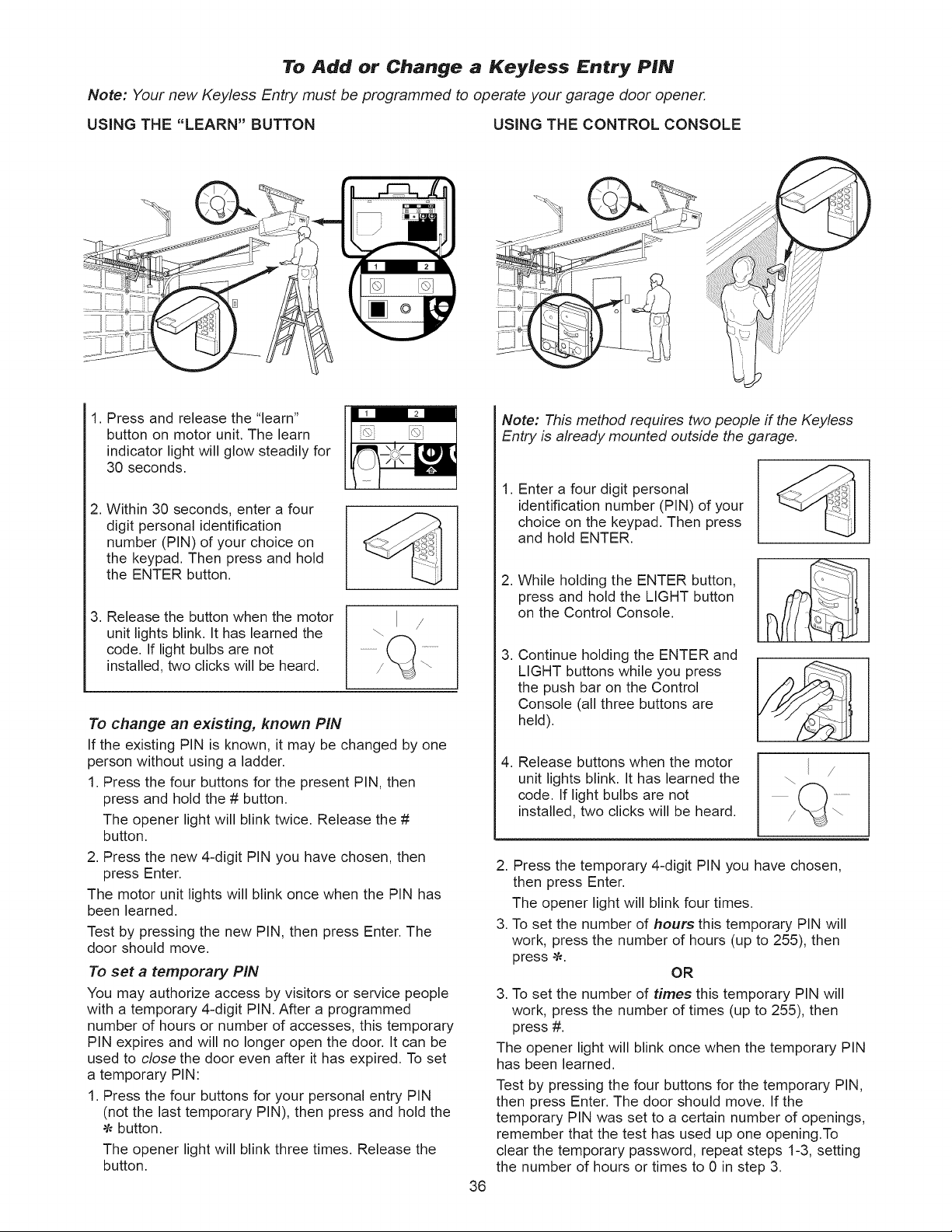
To Add or Change a Keyless Entry PIN
Note: Your new Keyless Entry must be programmed to operate your garage door opener.
USING THE "LEARN" BUTTON USING THE CONTROL CONSOLE
Press and release the "learn"
button on motor unit, The learn
indicator light will glow steadily for
30 seconds.
2. Within 30 seconds, enter a four
digit personal identification
number (PIN) of your choice on
the keypad. Then press and hold
the ENTER button.
3. Release the button when the motor
unit lights blink. It has learned the
code. If light bulbs are not
installed, two clicks will be heard.
To change an existing, known PIN
If the existing PIN is known, it may be changed by one
person without using a ladder.
1. Press the four buttons for the present PIN, then
press and hold the # button.
The opener light will blink twice. Release the #
button.
2. Press the new 4-digit PIN you have chosen, then
press Enter.
The motor unit lights will blink once when the PIN has
been learned.
Test by pressing the new PIN, then press Enter. The
door should move.
To set a temporary PIN
You may authorize access by visitors or service people
with a temporary 4-digit PIN. After a programmed
number of hours or number of accesses, this temporary
PIN expires and will no longer open the door. It can be
used to close the door even after it has expired. To set
a temporary PIN:
1. Press the four buttons for your personal entry PIN
(not the last temporary PIN), then press and hold the
•_ button.
The opener light will blink three times. Release the
button.
36
Note: This method requires two people if the Keyless
Entry is already mounted outside the garage.
,
,
,
,
Enter a four digit personal
identification number (PIN) of your
choice on the keypad. Then press
and hold ENTER.
While holding the ENTER button,
press and hold the LIGHT button
on the Control Console.
Continue holding the ENTER and
LIGHT buttons while you press
the push bar on the Control
Console (all three buttons are
held).
Release buttons when the motor
unit lights blink. It has learned the
code. If light bulbs are not
installed, two clicks will be heard.
/
2. Press the temporary 4-digit PIN you have chosen,
then press Enter.
The opener light will blink four times.
3. To set the number of hours this temporary PIN will
work, press the number of hours (up to 255), then
press ._.
OR
3. To set the number of times this temporary PIN will
work, press the number of times (up to 255), then
press #.
The opener light will blink once when the temporary PIN
has been learned.
Test by pressing the four buttons for the temporary PIN,
then press Enter. The door should move. If the
temporary PIN was set to a certain number of openings,
remember that the test has used up one opening.To
clear the temporary password, repeat steps 1-3, setting
the number of hours or times to 0 in step 3.
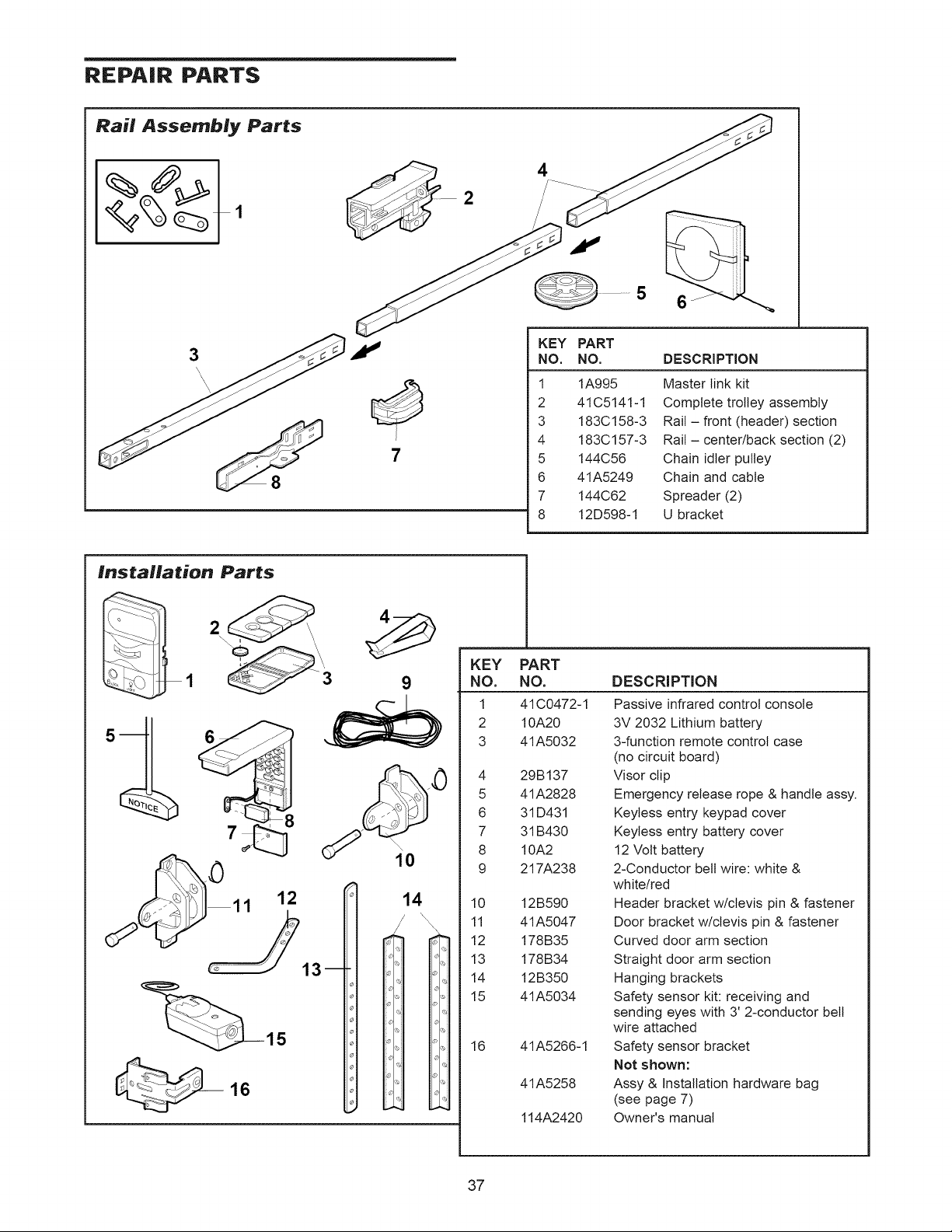
REPAIR PARTS
7
4
KEY PART
NO. NO. DESCRIPTION
1 1A995
2 41C5141-1
3 183C158-3
4 183C157-3
5 144C56
6 41A5249
7 144C62
8 12D598-1
Master link kit
Complete trolley assembly
Rail - front (header) section
Rail - center/back section (2)
Chain idler pulley
Chain and cable
Spreader (2)
U bracket
Installation Parts
9
0
10
14
KEY
NO.
1
2
3
4
5
6
7
8
9
10
11
12
13
14
15
16
PART
NO.
41 C0472-1
10A20
41A5032
29B137
41A2828
31D431
31B430
10A2
217A238
12B590
41A5047
178B35
178B34
12B350
41A5034
41A5266-1
41A5258
114A2420
DESCRiPTiON
Passive infrared control console
3V 2032 Lithium battery
3-function remote control case
(no circuit board)
Visor clip
Emergency release rope & handle assy.
Keyless entry keypad cover
Keytess entry battery cover
12 Volt battery
2-Conductor bell wire: white &
white/red
Header bracket w/clevis pin & fastener
Door bracket w/ctevis pin & fastener
Curved door arm section
Straight door arm section
Hanging brackets
Safety sensor kit: receiving and
sending eyes with 3' 2-conductor belt
wire attached
Safety sensor bracket
Not shown:
Assy & Installation hardware bag
(see page 7)
Owner's manual
37
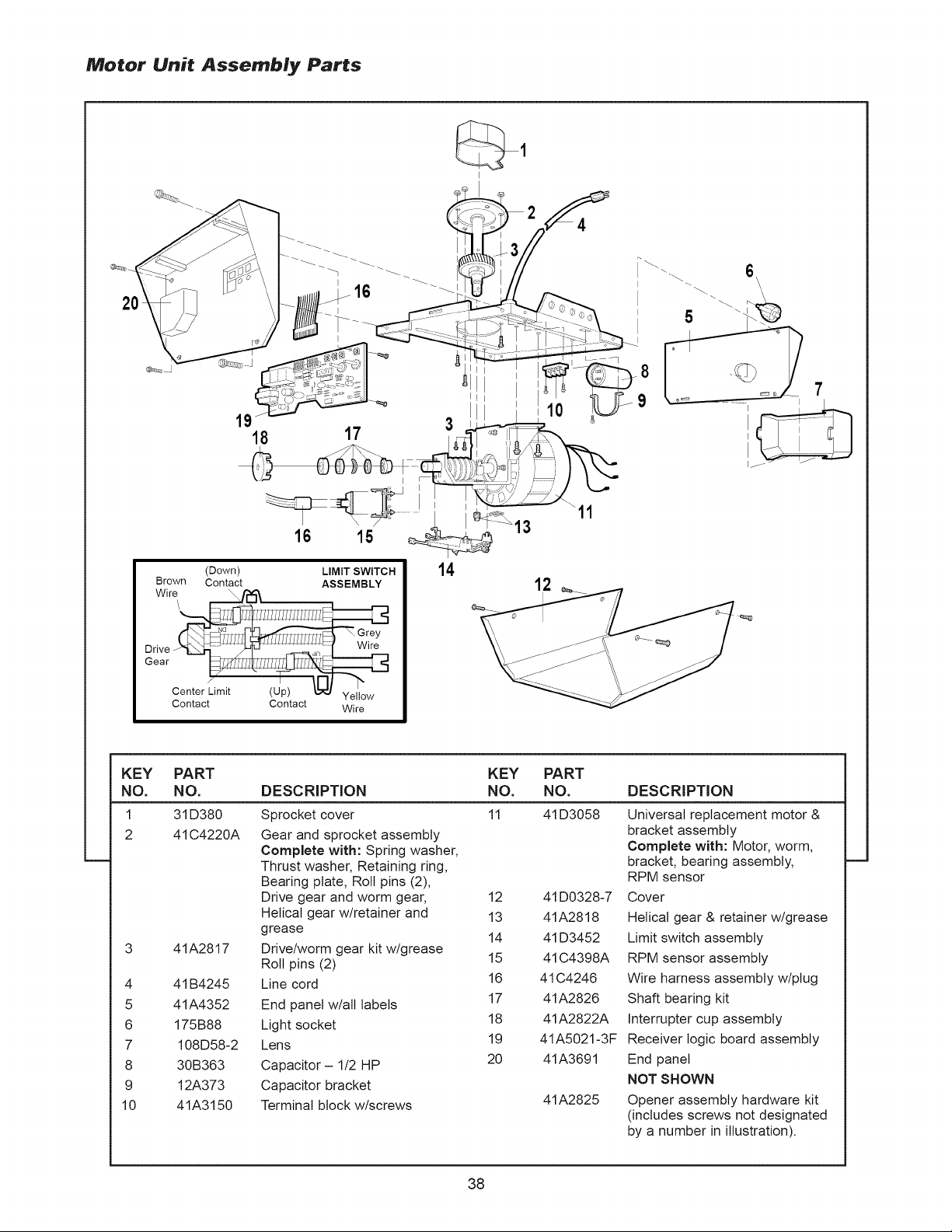
Motor Unit Assembly Parts
18
17
I
_11
13
7
Brown
Contact
(Down)
Contact
LIMIT SWITCH
ASSEMBLY
Contact Wire
14
12
KEY
NO.
1
2
3
4
5
6
7
8
9
lO
PART
NO.
31D380
41 C4220A
41A2817
41 B4245
41A4352
175B88
108D58-2
30B363
12A373
41A3150
KEY PART
DESCRiPTiON NO. NO. DESCRiPTiON
Sprocket cover 11 41D3058 Universal replacement motor &
Gear and sprocket assembly bracket assembly
Complete with: Spring washer, Complete with: Motor, worm,
Thrust washer, Retaining ring, bracket, bearing assembly,
Bearing plate, Roll pins (2), RPM sensor
Drive gear and worm gear, 12 41D0328-7 Cover
Helical gear w/retainer and 13 41A2818 Helical gear & retainer w/grease
grease 14 41D3452 Limit switch assembly
Drive/worm gear kit w/grease
Roll pins (2) 15 41C4398A RPM sensor assembly
Line cord 16 41C4246 Wire harness assembly w/plug
End panel w/all labels 17 41A2826 Shaft bearing kit
Light socket 18 41A2822A Interrupter cup assembly
Lens 19 41A5021-3F Receiver logic board assembly
Capacitor- 1/2 HP 20 41A3691 End panel
Capacitor bracket NOT SHOWN
Terminal block w/screws 41A2825 Opener assembly hardware kit
(includes screws not designated
by a number in illustration).
38
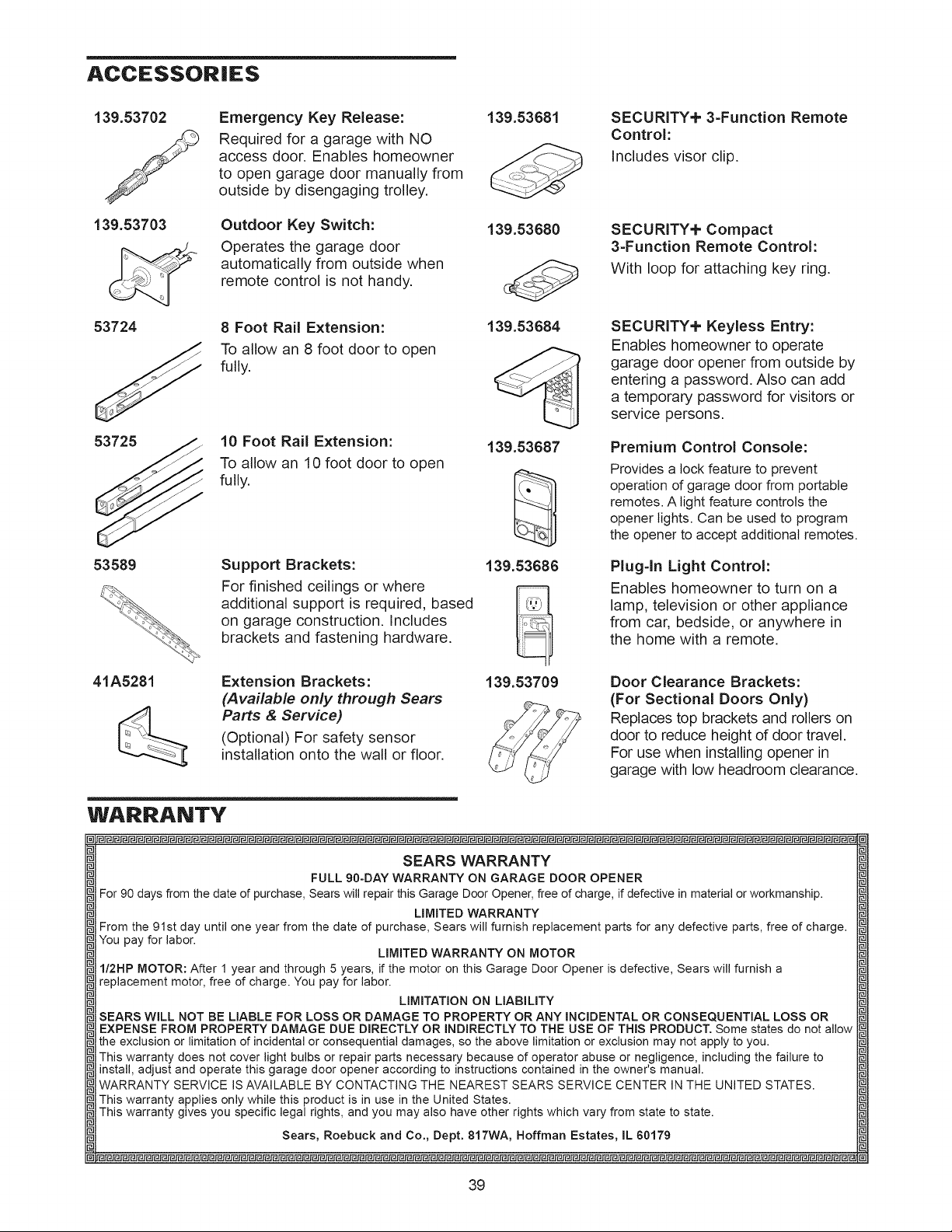
ACCESSORIES
139.53702
139.53703
53724
53725
53589
Emergency Key Release:
Required for a garage with NO
access door. Enables homeowner
to open garage door manually from
outside by disengaging trolley,
Outdoor Key Switch:
Operates the garage door
automatically from outside when
remote control is not handy.
8 Foot Rail Extension:
To allow an 8 foot door to open
fully.
10 Foot Rail Extension:
To allow an 10 foot door to open
fully.
Support Brackets:
For finished ceilings or where
additional support is required, based
on garage construction. Includes
brackets and fastening hardware.
139.53681
139.53680
139.53684
139.53687
139.53686
SECURITY+ 3-Function Remote
Control:
Includes visor clip.
SECURITY+ Compact
3-Function Remote Control:
With loop for attaching key ring,
SECURITY+ Keyless Entry:
Enables homeowner to operate
garage door opener from outside by
entering a password. Also can add
a temporary password for visitors or
service persons.
Premium Control Console:
Provides a lock feature to prevent
operation d garage door from portable
remotes. A light feature controls the
opener lights. Can be used to program
the opener to accept additional remotes.
Plug-In Light Control:
Enables homeowner to turn on a
lamp, television or other appliance
from car, bedside, or anywhere in
the home with a remote.
41A5281 Extension Brackets:
(Available only through Sears
Parts & Service)
(Optional) For safety sensor
installation onto the wall or floor.
139.53709
Door Clearance Brackets:
(For Sectional Doors Only)
Replaces top brackets and rollers on
door to reduce height of door travel.
For use when installing opener in
garage with low headroom clearance,
WARRANTY
SEARS WARRANTY
FULL 90-DAY WARRANTY ON GARAGE DOOR OPENER
For 90 days from the date of purchase, Sears will repair this Garage Door Opener, free of charge, if defective in material or workmanship.
LIMITED WARRANTY
From the 91st day until one year from the date of purchase, Sears will furnish replacement parts for any defective parts, free of charge.
You pay for labor.
LIMITED WARRANTY ON MOTOR
I/2HP MOTOR: After 1 year and through 5 years, if the motor on this Garage Door Opener is defective, Sears will furnish a
replacement motor, free of charge. You pay for labor.
LIMITATION ON LIABILITY
SEARS WILL NOT BE LIABLE FOR LOSS OR DAMAGE TO PROPERTY OR ANY INCIDENTAL OR CONSEQUENTIAL LOSS OR
EXPENSE FROM PROPERTY DAMAGE DUE DIRECTLY OR INDIRECTLY TO THE USE OF THIS PRODUCT. Some states do not allow
the exclusion or limitation of incidental or consequential damages, so the above limitation or exclusion may not apply to you.
This warranty does not cover light bulbs or repair parts necessary because of operator abuse or negligence, including the failure to
install, adjust and operate this garage door opener according to instructions contained in the owner's manual.
WARRANTY SERVICE IS AVAILABLE BY CONTACTING THE NEAREST SEARS SERVICE CENTER iN THE UNITED STATES.
This warranty applies only while this product is in use in the United States.
This warranty gives you specific legal rights, and you may also have other rights which vary from state to state.
Sears, Roebuck and Co., Dept. 817WA, Hoffman Estates, IL 60179
39
CONTENIDO
IntroduccJ6n 2.7
Revisi6n de los simbolos y terminos de seguridad ......... 2
Preparaci6n de la pue_a de su cochera ......................... 3
Herramientas necesarias ................................................. 3
Planificaci6n ................................................................. 4-5
Inventario de las cajas de cart6n ..................................... 6
Inventario de piezas ......................................................... 7
Montaje 8.'11
Montaje el riel y instale el trole ........................................ 8
Sujete el riel al motor e instale el trole Ioco ..................... 9
Instale la cadena o cable y coloque la cubierta
de la polea ................................................................... 10
Apriete la cadena ........................................................... 11
Instalaci6n 11-27
Instrucciones de seguridad para la instalaci6n .............. 11
Determine d6nde va a instalar
la mensula del cabezal ........................................... 12-13
Instale la mensula del cabezal ...................................... 14
Coloque el riel en la mensula del cabezal ..................... 15
Coloque el abridor ......................................................... 16
Cuelgue el abridor ......................................................... 17
Instale la unidad de control de la puerta ....................... 18
Instale la luz y la lente ................................................... 19
Instale la manija y la cuerda de emergencia ................. 19
Requisitos para la instalacidn electrica ......................... 20
Instale el sensor del sistema
reversa de seguridad .............................................. 21-23
Sujete la mensula de la puerta ................................. 24-25
Conecte el brazo de la puerta al trole ...................... 26-27
Ajustes 28.30
Ajuste el limite del recorrido .......................................... 28
Ajuste la fuerza .............................................................. 29
Pruebe el sistema de reversa de seguridad .................. 30
Pruebe el sensor del sistema de
reversa de seguridad ................................................... 30
Operaci6n 31-34
Instrucciones de seguridad para la operaci6n ............... 31
C6mo usar el abridor de la puerta de su cochera ........ 31
C6mo usar la unidad de control de pared ..................... 32
C6mo abrir la puerta manualmente ............................... 32
Mantenimiento de su abridor de puerta de cochera ...... 33
Si tiene algOn problema? ......................................... 33, 34
C6rno prograrnar el abridor 35.36
C6mo usar un control remoto de mano ......................... 35
C6mo borrar todos los c6digos ...................................... 35
Controles remotos de tres funciones ............................. 35
C6mo a_adir o modificar un c6digo
de entrada sin Ilave ..................................................... 36
Accesorios 37
Garan tia 3 7
Nurneros de Servicio
Contra tapa
|NTRODUCCION
Revisi6n de los sirnbolos y terrninos
de seguridad
Este abridor de puerta de cochera ha sido dise_ado para un funcionamiento seguro, siempre y cuando se instale, se
pruebe, se opere y se le de mantenimiento como se indica a Io largo de este manual, cumpliendo al pie de la letra
con todas las advertencias e instrucciones generales aqui contenidas.
Mec_nica
El_ctrica
Estas advertencias y/o simbolos de seguridad que
aparecen a Io largo de este manual le alertaran de que
existe el riesgo de una lesi6n seria o de muerte si no
se siguen las instrucciones correspondientes. El peligro
puede ser electrico (electrocuci6n) o mecanico. Lea las
instrucciones con mucho cuidado.
Cuando vea esta palabra y/o simbolo de seguridad a Io
largo de este manual le alertara de que existe el riesgo
de da_ar la puerta de la cochera y/o el abridor si no se
siguen las instrucciones correspondientes. Lea las
instrucciones con mucho cuidado.
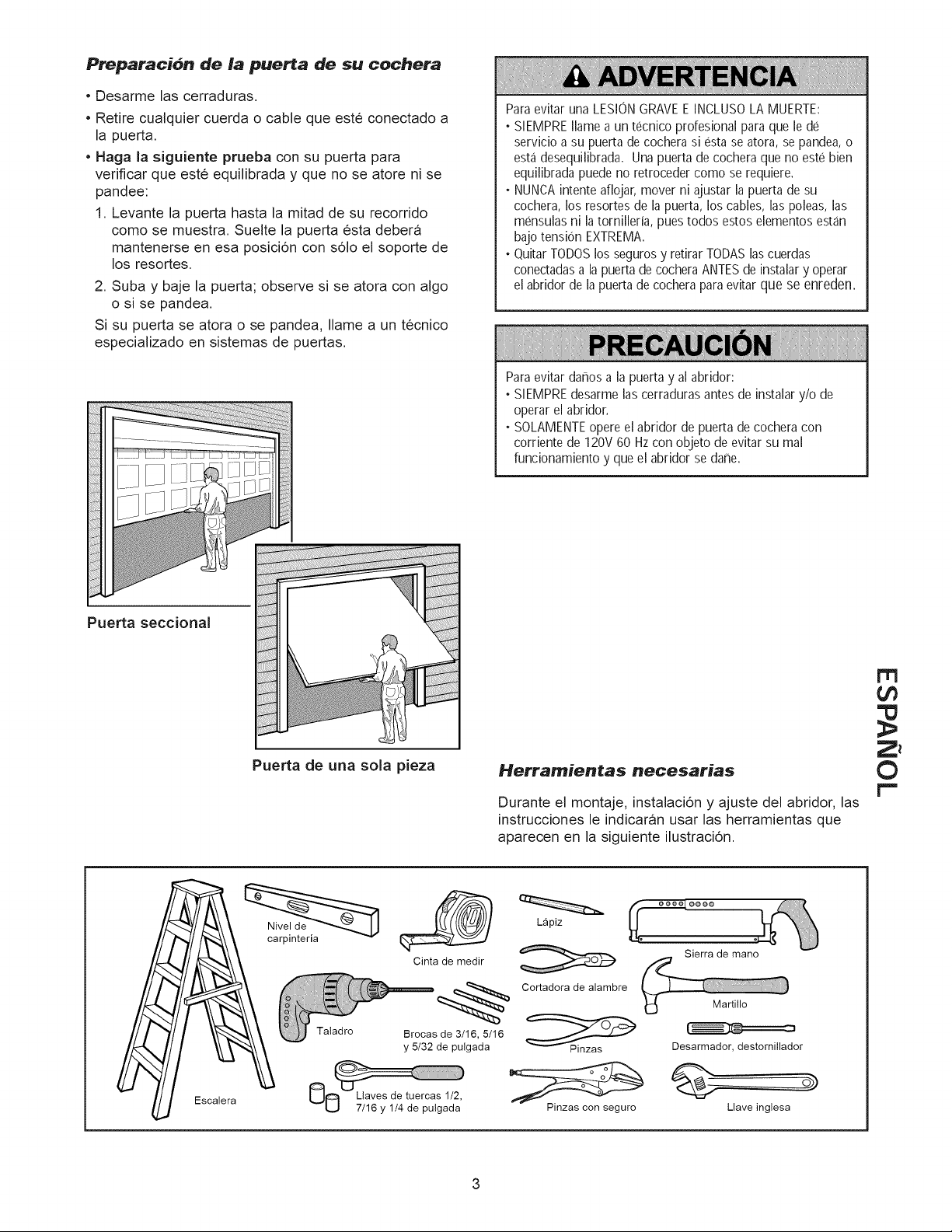
Preparaci6n de la puerta de su cochera
• Desarme las cerraduras.
• Retire cualquier cuerda o cable que este conectado a
la puerta.
• Haga la siguiente prueba con su puerta para
verificar que este equilibrada y que no se atore ni se
pandee:
1. Levante la puerta hasta la mitad de su recorrido
como se muestra. Suelte la puerta esta debera
mantenerse en esa posici6n con s61o el soporte de
los resortes.
2. Suba y baje la puerta; observe si se atora con algo
o si se pandea.
Si su puerta se atora o se pandea, Ilame a un tecnico
especializado en sistemas de puertas.
Para evitar una LESIONGRAVEE INCLUSOLA MUERTE:
• SIEMPREIlame a un tecnico profesional para que le de
servicio a su puerta de cochera si esta se atora, se pandea, o
est_idesequilibrada. Una puerta de cochera que no este bien
equilibrada puede no retroceder como se requiere.
• NUNCAintente aflojar, mover ni ajustar la puerta de su
cochera, los resortes de la puerta, los cables, las poleas, las
mensulas ni la tornilleria, pues todos estos elementos est_in
bajo tension EXTREMA.
• Quitar TODOSlos seguros y retirar TODASlascuerdas
conectadas a la puerta de cochera ANTESde instalar y operar
el abridor de la puerta de cochera para evitar quese enreden.
Para evitar daflos a la puerta y al abridor:
• SIEMPREdesarme [as cerraduras antes de instalar y/o de
operar el abridor.
• SOLAMENTEopere el abridor de puerta de cochera con
corriente de 120V 60 Hz con objeto de evitar su ma[
funcionamiento y que el abridor se dafle.
Puerta seccional
Puerta de una sola pieza
Herramientas necesarias
Durante el montaje, instalaci6n y ajuste del abridor, las
instrucciones le indicaran usar las herramientas que
aparecen en la siguiente ilustraci6n.
m
O0
0
Esoalera
Cinta de medir
Taladro Brocas de 3/16, 5/16
y 5/32 de pulgada
0 0 7/16yS 11/4tde r;u_ga da'
Lapiz
Cortadora de alambre
Sierra de mano
Desarmador, destomillador
Pinzas con seguro Llave inglesa
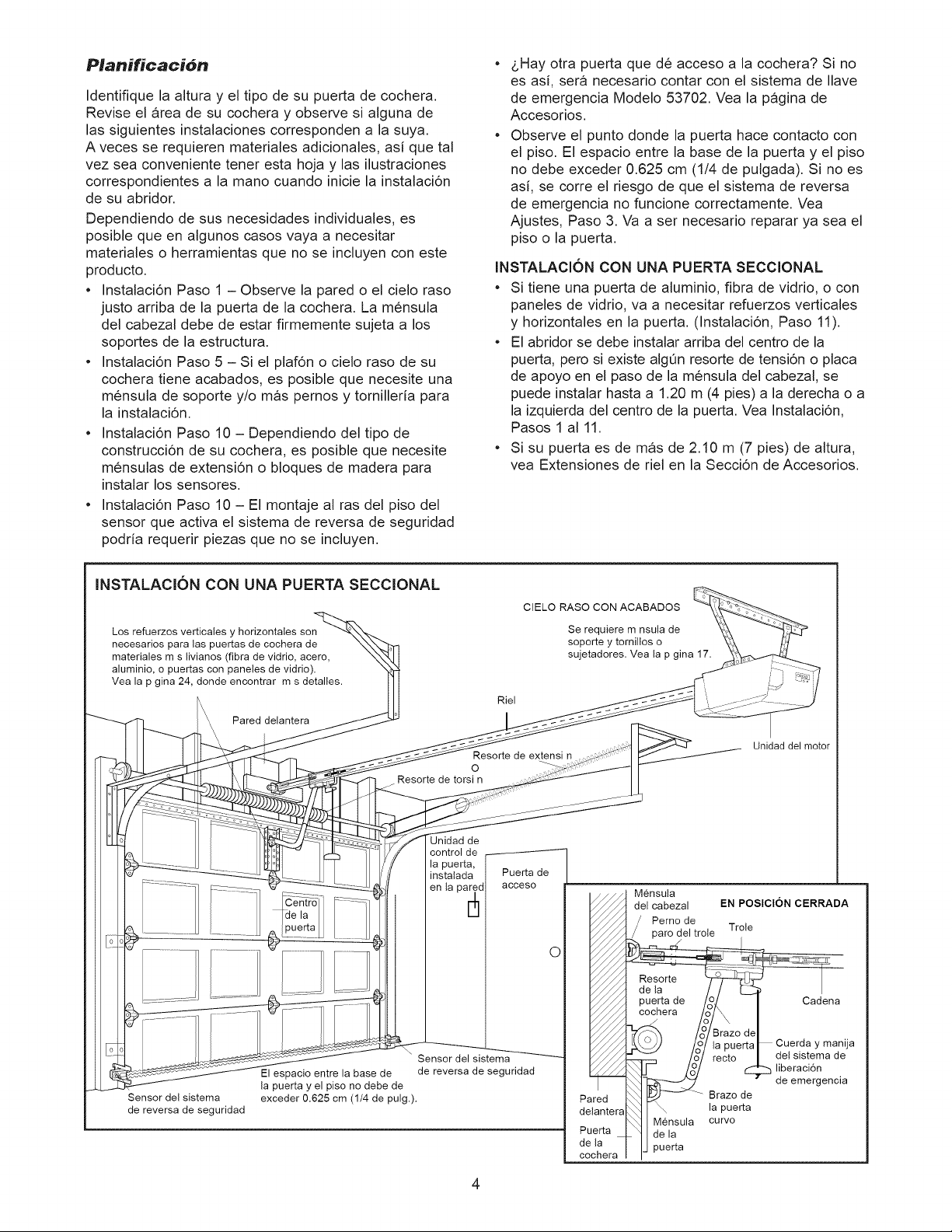
PlanificacJ6n
Identifique la altura y el tipo de su puerta de cochera.
Revise el area de su cochera y observe si alguna de
los siguientes instalaciones corresponden a la suya.
A veces se requieren materiales adicionales, asi que tal
vez sea conveniente tener esta hoja y los ilustraciones
correspondientes a la mano cuando inicie la instalaci6n
de su abridor.
Dependiendo de sus necesidades individuales, es
posible queen algunos casos vaya a necesitar
materiales o herramientas que no se incluyen con este
producto.
• Instalaci6n Paso 1 - Observe la pared o el cielo raso
justo arriba de la puerto de la cochera. La mensula
del cabezal debe de estar firmemente sujeta a los
soportes de la estructura.
• Instalaci6n Paso 5 - Si el plaf6n o cielo raso de su
cochera tiene acabados, es posible que necesite una
mensula de soporte y/o mas pernos y tornilleria para
la instalaci6n.
• Instalaci6n Paso 10 - Dependiendo del tipo de
construcci6n de su cochera, es posible que necesite
mensulas de extensi6n o bloques de madera para
instalar los sensores.
• Instalaci6n Paso 10 - El montaje al ras del piso del
sensor que activa el sistema de reversa de seguridad
podria requerir piezas que no se incluyen.
_,Hay otra puerta que de acceso a la cochera? Si no
es asi, sera necesario contar con el sistema de Ilave
de emergencia Modelo 53702. Vea la pagina de
Accesorios.
Observe el punto donde la puerto hace contacto con
el piso. El espacio entre la base de la puerta y el piso
no debe exceder 0.625 cm (1/4 de pulgada). Si no es
asi, se corre el riesgo de que el sistema de reversa
de emergencia no funcione correctamente. Vea
Ajustes, Paso 3. Va a ser necesario reparar ya sea el
piso o la puerto.
INSTALACION CON UNA PUERTA SECCIONAL
• Si tiene una puerta de aluminio, fibra de vidrio, o con
paneles de vidrio, va a necesitar refuerzos verticales
y horizontales en la puerta. (Instalaci6n, Paso 11).
• El abridor se debe instalar arriba del centro de la
puerta, pero si existe algQn resorte de tensi6n o placa
de apoyo en el paso de la mensula del cabezal, se
puede instalar hasta a 1.20 m (4 pies) a la derecha o a
la izquierda del centro de la puerta. Vea Instalaci6n,
Pasos 1 al 11.
• Si su puerta es de mas de 2.10 m (7 pies) de altura,
vea Extensiones de riel en la Secci6n de Accesorios.
INSTALAClON CON UNA PUERTA SECClONAL
Los refuerzos verticales y horizontales son
necesarios para las puertas de cochera de
materiales m s livianos (fibra de vidrio, acero,
aluminio, o puertas con paneles de vidrio).
Yea la p gina 24, donde encontrar m s detalles.
Pared delantera
CIELO RASO CON ACABADOS
Se requiere m nsula de
soporte y tornillos o
sujetadores. Yea lap gina 17.
Riel
Resorte de extensi n
O
Resorte de torsi n
Unidad del motor
Unidad de
control de
la puerta,
instalada Puerta de
en ta pared acceso
Sensor del sistema
de reversa de seguridad
Sensor del sistema
El espacio entre la base de de reversa de seguridad
la puerta y el piso no debe de
exceder 0.625 cm (1/4 de pulg.).
O
_ M6nsula
del cabezal EN POStClON CERRADA
/ Perno de
te Trole
Resorte
V_/J de la f / _ /
I/_/_ puerta de o/ I Cadena
__era _,_, .... I
I_/J [_/o )) /°'/a ;ue_ab Cuerda y manija
F__ /o°-/ 'reck7' _ I de! sistema de
_J_ lo°/ C:_ !,b_eraci6n
_ _-----U_ de emergencia
Pared L-_ _--K_ _ Brazo de
delanteral_XI I \ la puerta
I\_] I Mensula curvo
Puerto _xII de la
de la I IJpuerta
cocnera i I
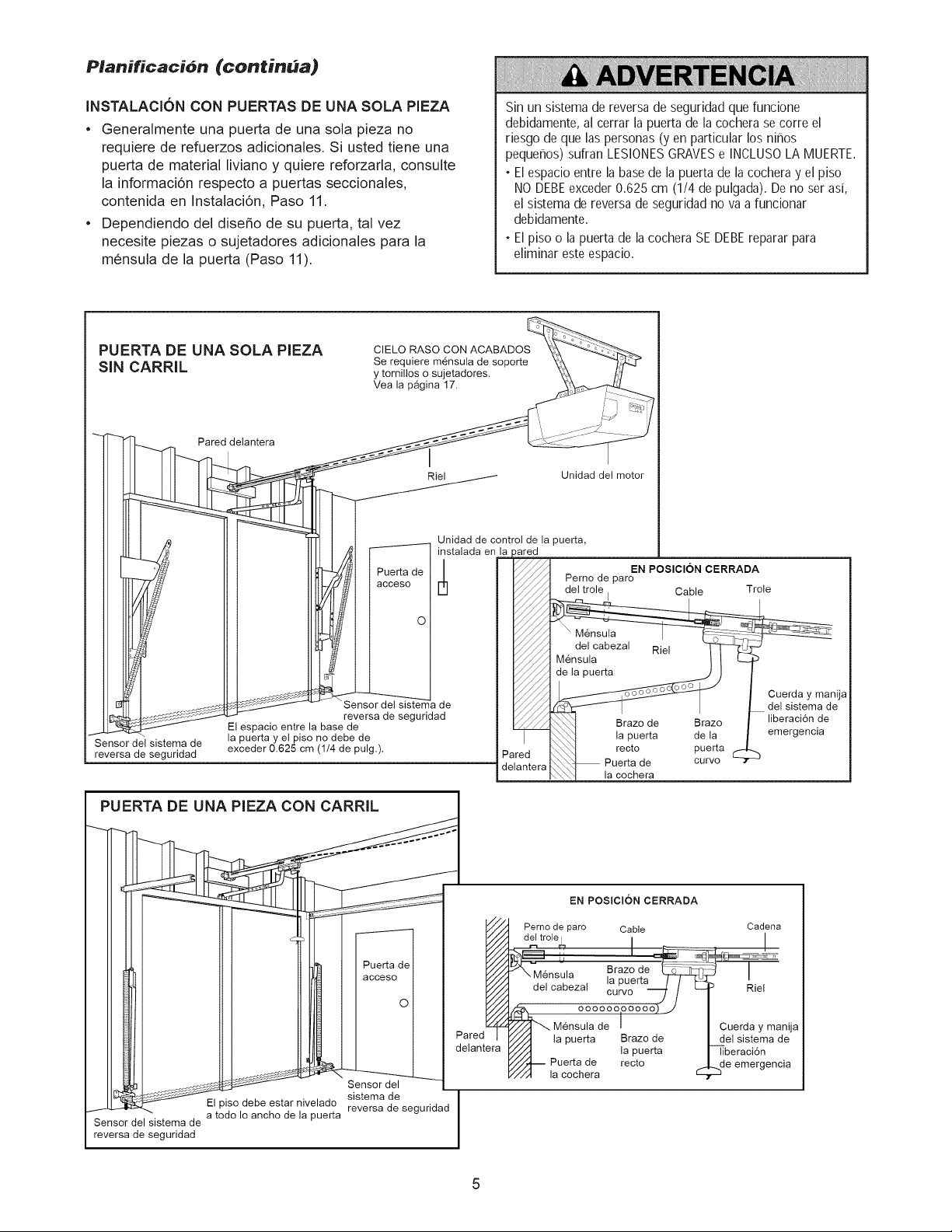
PlanificacJ6n (conlinua)
INSTALACION CON PUERTAS DE UNA SOLA PIEZA
• Generalmente una puerta de una sola pieza no
requiere de refuerzos adicionales. Si usted tiene una
puerta de material liviano y quiere reforzarla, consulte
la informaci6n respecto a puertas seccionales,
contenida en Instalaci6n, Paso 11.
• Dependiendo del dise_o de su puerta, tal vez
necesite piezas o sujetadores adicionales para la
mensula de la puerta (Paso 11).
Sin un sistema de reversa de seguridad que funcione
debidamente, al cerrar la puerta de la cochera se corre el
riesgo de que las personas (yen particular los nitros
pequenos) suffan LESIONESGRAVESe INCLUSOLA MUERTE.
• El espacio entre la basede la puerta de la cochera y el piso
NO DEBEexceder 0.625 cm (1/4 de pulgada). De no ser asi,
el sistema de reversa de seguridad no va a funcionar
debidamente.
• El piso o la puerta de la cochera SE DEBEreparar para
eliminar este espacio.
PUERTA DE UNA SOLA PIEZA
SiN CARRIL
Pared delantera
ClELO RASO CON ACABADO
Se requiere mensula de soporte '_ -_ffL_r_
y tornillos o sujetadores. _ fJ
Riel / Unidad del motor
I
Sensor del sistema de
reversa de seguridad
reversa de seguridad
E! espacio entre la base de
la puerta y el piso no debe de
exceder 0.625 cm (1/4 de pulg.).
PUERTA DE UNA PIEZA CON CARRIL
J
Sensor del sistema de
reversa de seguridad
Pue_a det
acceso
Sensor del
sistema de
El _iso debe estar nivelado reversa de seguridad
a todo Io ancho de la puerta
Unidad de control de la puerta,
instalada en I_
VYY_ ENPos,c,oNCERRADA
I/_A Perno de pare role
Cuerda y manija
V_'_ I .........de! sistema de
__ Braze de Brazo liberacidn .de
__ la puerta de la emergencla
.... [_ recto puerta ,__
Pareo .3
dealren_era_ Puerta de curvo L_
1_ la cochera
I
Pared
delantera
EN POSICiON CERRADA
Perno de paro Cable
del trole] I
_,.E_,, , Braze de _
",Mensu,a , lapuerta "_Y-_ _
clel cauezai curve o_/O)t..,,'j L_
OOOOOOO00
_ pMu!:_Id_e d e !it_o_ de
Y,/SI la cochera _
Cadena
Riel
Cuerda y manija
del sistema de
_beraci6n
.de emergencia
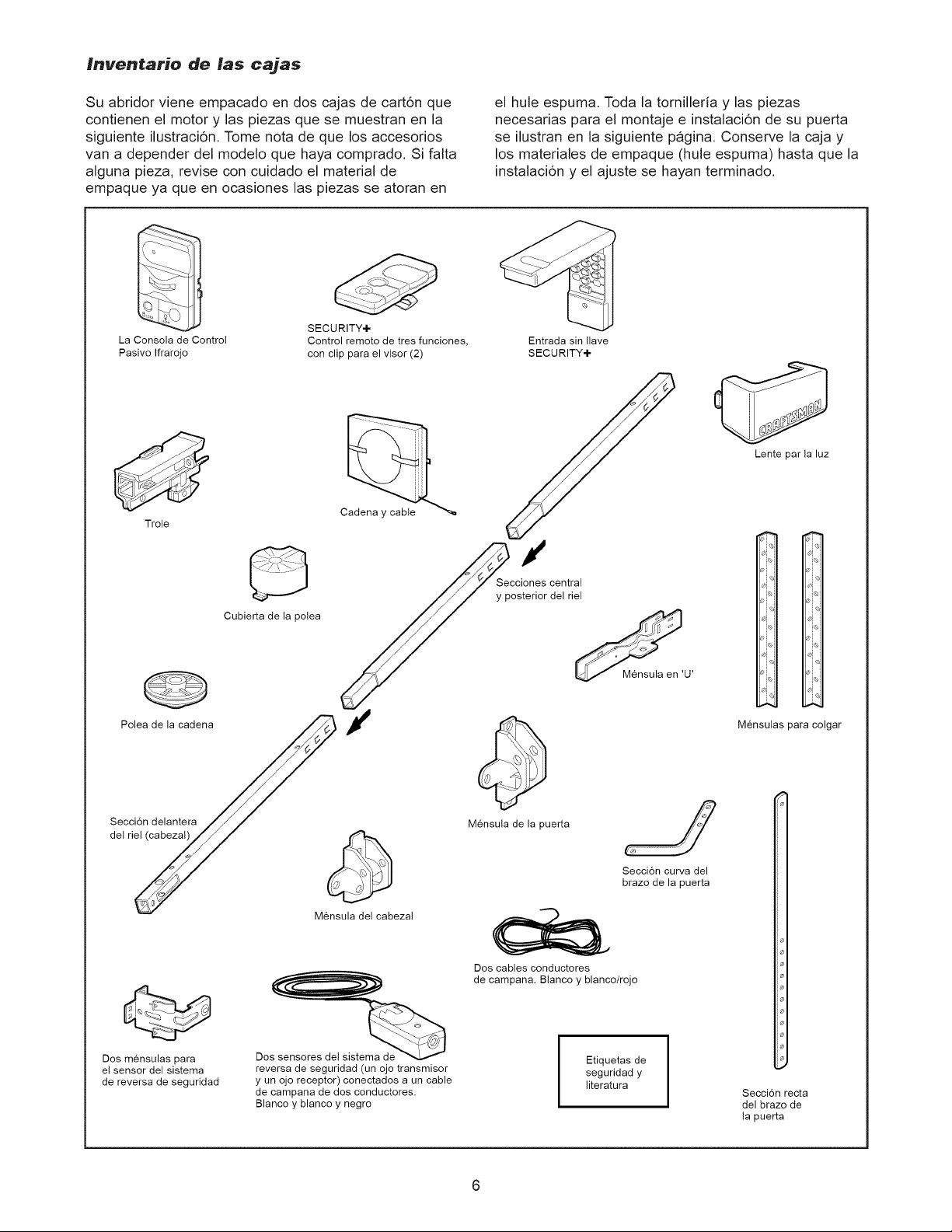
Inventario de las cajas
Su abridor viene empacado en dos cajas de cart6n que
contienen el motor y las piezas que se muestran en la
siguiente ilustraci6n. Tome nota de que los accesorios
van a depender del modelo que haya comprado. Si falta
alguna pieza, revise con cuidado el material de
empaque ya que en ocasiones las piezas se atoran en
el huJe espuma. Toda la tornilleria y las piezas
necesarias para el montaje e instalaci6n de su puerta
se ilustran en la siguiente pagina. Conserve la caja y
los materiales de empaque (hule espuma) hasta que la
instalaci6n y el ajuste se hayan terminado.
La Consola de Control
Pasivo Ifrarojo
SECURITY+
Control remoto de tres funciones,
con clip para el visor (2)
Entrada sin Ilave
SECURITY+
Cadena y cabl_
Trole
Cubierta de la polea
de tr;al
Mensula de la puerta
Mensula en 'U'
Secci6n curva del
brazo de la puerta
Lente par la luz
_d
o_
M i
d_
Mensulas para colgar
Dos rnensulas para
el sensor del sistema
de reversa de seguridad
Dos sensores del sistema de
reversa de seguridad (un ojo transmisor
y un ojo receptor) conectados a un cable
de campana de dos conductores.
Blanco y blanco y negro
Dos cables conductores
de campana. Blanco y blanco/rojo
Etiquetas de
seguridad y
literatura
Secci6n recta
del brazo de
la puerta
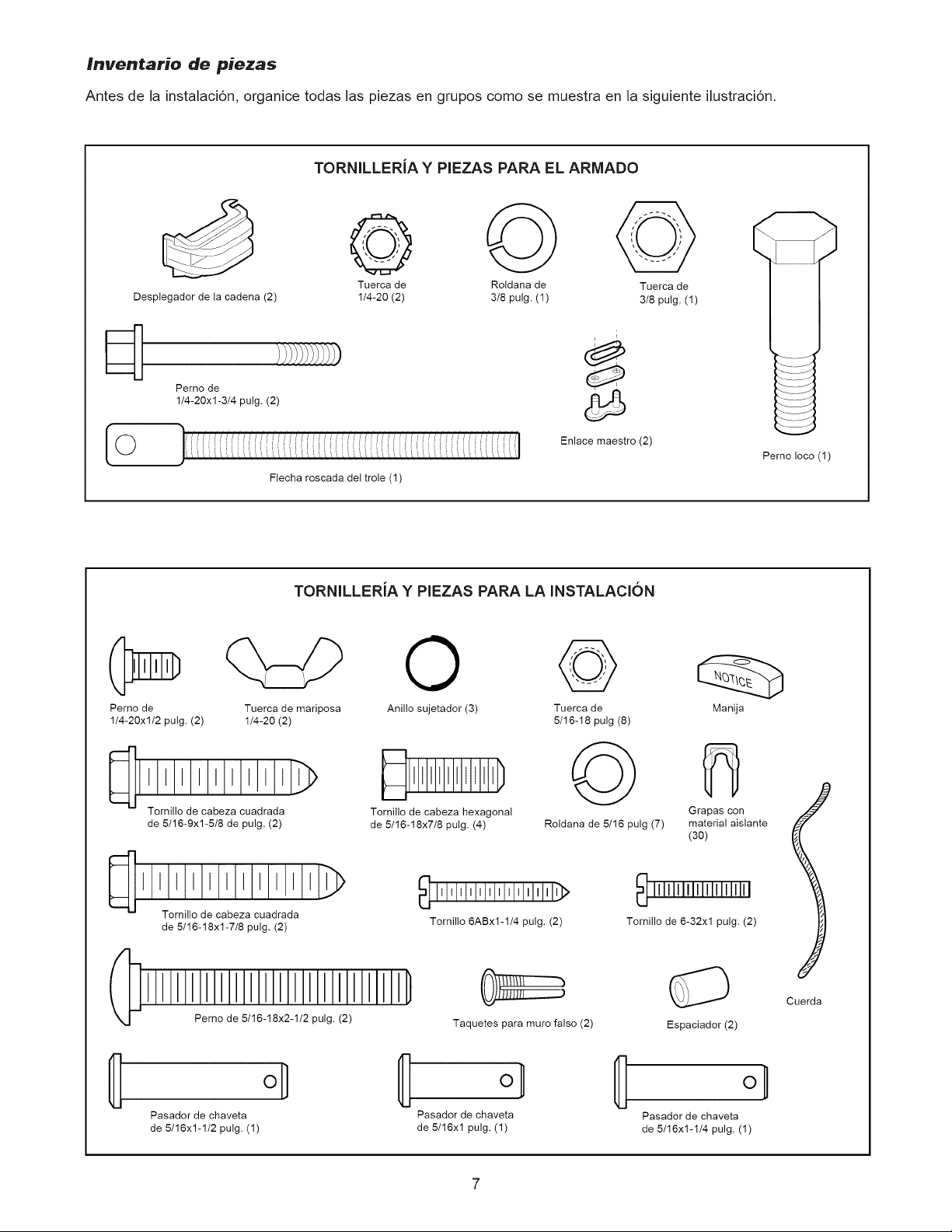
Inventario de piezas
Antes de la instalaci6n,organice todas las piezas en grupos como se muestra en la siguiente ilustraci6n.
TORNILLERiA Y PIEZAS PARA EL ARMADO
Tuerca de Roldana de Tuerca de
Desplegador de la ¢adena (2) 1/4-20 (2) 3/8 pulg. (1) 3/8 pulg. (1)
Perno de
1/4-20xl-3/4 pulg. (2)
Flecha roscada del trole (1)
Enlace maestro (2)
Perno Ioco (1)
TORNILLERiA Y PIEZAS PARA LA INSTALACION
Pemo de
1/4-20xl/2 pulg. (2)
Tuerca de mariposa
1/4-20 (2)
T "11 d b d d
i !rlnlI eloLl!z: !la /a I _
de 5/16-9xl-5/8 de pulg. (2)
IIIIIIIIIII1_
Tornillo de cabeza cuadrada '
de 5/16-18xl-7/8 pulg. (2)
Perno de 5/16-18x2-1/2 pulg. (2)
O @
Anillo sujetador (3) Tuerca de
5/16-18 pulg (8)
_1IIIIIIIII D
Tornillo de cabeza hexagonal
de 5/16-18x7/8 pulg. (4)
@
Roldana de 5/16 pulg (7)
Manija
Tomillo 6ABx1-1/4 pulg. (2)
l/ll!l J
Taquetes para muro falso (2)
Grapas con
material aislante
(3O)
Tornillo de 6-32xl pulg. (2)
Espaciador (2)
8 el { 8
Pasador de chaveta Pasador de chaveta Pasador de chaveta
de 5/16x1-1/2 pulg. (1) de 5/16xl pulg. (1) de 5/16x1-1/4 pulg. (1)
Cuerda
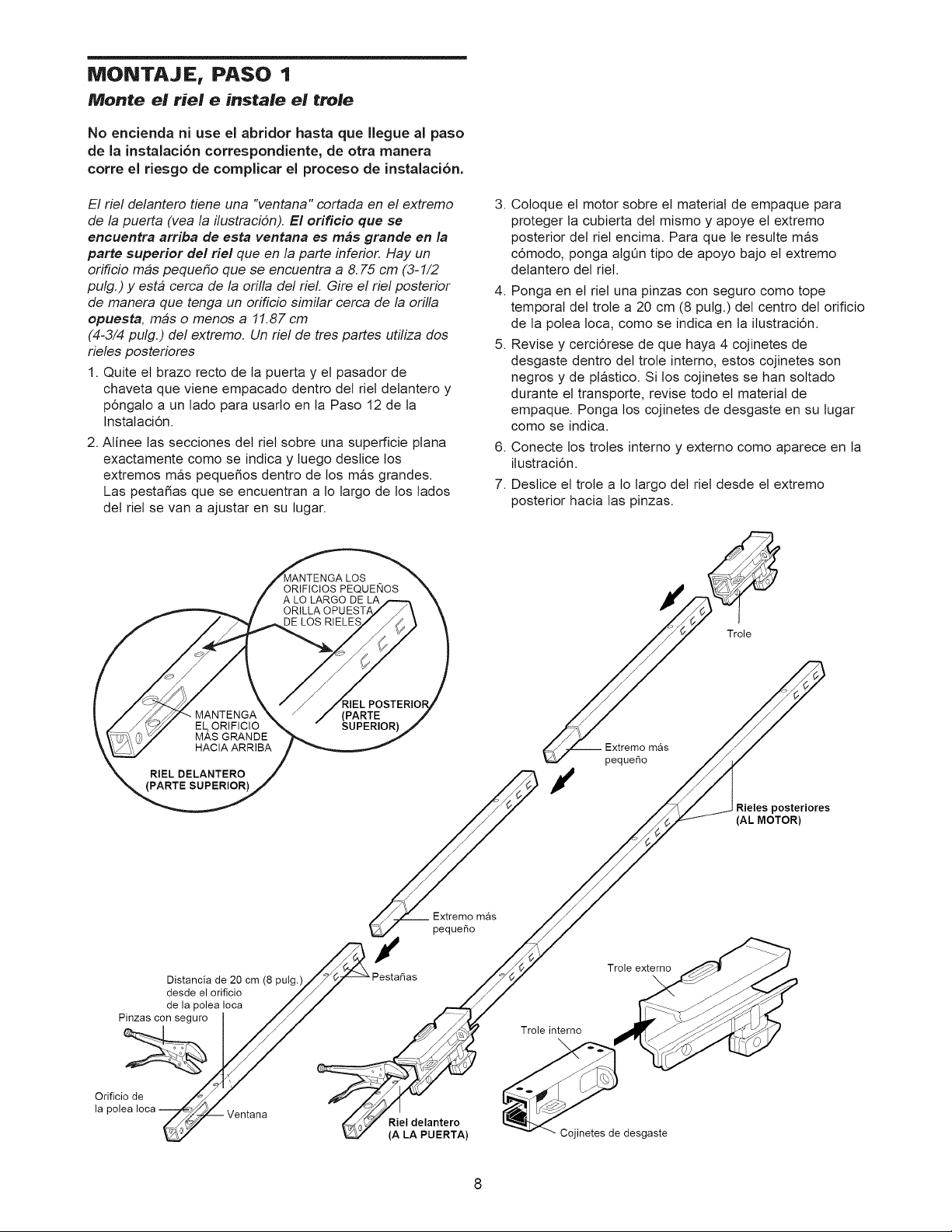
NIONTAJE, PASO 1
Monte el riel e instale el trole
No encienda ni use el abridor hasta que llegue al paso
de la instalaci6n correspondiente, de otra manera
corre el riesgo de complicar el proceso de instalaci6n.
El riel delantero tiene una "ventana" cortada en el extremo
de la puerta (yea la ilustraciOn). El orificio que se
encuentra arriba de esta ventana es m#s grande en la
parte superior del riel que en la parte inferior. Hay un
orificio mas pequedo que se encuentra a 8. 75 cm (3-1/2
pulg.) y esta cerca de la orilla del rieL Gire el riel posterior
de manera que tenga un orificio similar cerca de la orilla
opuesta, mas o menos a 11.87 cm
(4-3/4 pulg.) del extremo. Un riel de tres partes utiliza dos
deles posteriores
1. Quite et brazo recto de la puerta y et pasador de
chaveta que viene empacado dentro del riel detantero y
p6ngalo a un tado para usarto en la Paso 12 de la
Instalaci6n.
2. Alinee las secciones det riet sobre una superficie plana
exactamente como se indica y tuego destice los
extremos mas pequeSos dentro de los mas grandes.
Las pestaSas que se encuentran a to largo de los lados
det riel se van a ajustar en su lugar.
3. Coloque et motor sobre et material de empaque para
proteger la cubierta det mismo y apoye et extremo
posterior det riet encima. Para que le resulte mas
c6modo, ponga algQn tipo de apoyo bajo et extremo
detantero det riel.
4. Ponga en el riet una pinzas con seguro como tope
temporal del trote a 20 cm (8 pulg.) del centro det orificio
de la polea loca, como se indica en ta itustraci6n.
5. Revise y cerci6rese de que haya 4 cojinetes de
desgaste dentro det trole interno, estos cojinetes son
negros y de ptastico. Si los cojinetes se han soltado
durante et transporte, revise todo et material de
empaque. Ponga los cojinetes de desgaste en su lugar
como se indica.
6. Conecte los troles intemo y externo como aparece en la
itustraci6n.
7. Deslice et trole a lo largo det riel desde et extremo
posterior hacia las pinzas.
/
F_ieles posteriores
(AL MOTOR)
pequeno
Distancia de 20 cm (8 pulg.)_ PestaSas
_e_dep;ll°d[ioCic° ///
Pinzas con seguro _/
Ori_ _ Ven,sna [_AeLd"' Ae;aun;Rr& )
Trole externo
Trole intemo
_ desgaste
8
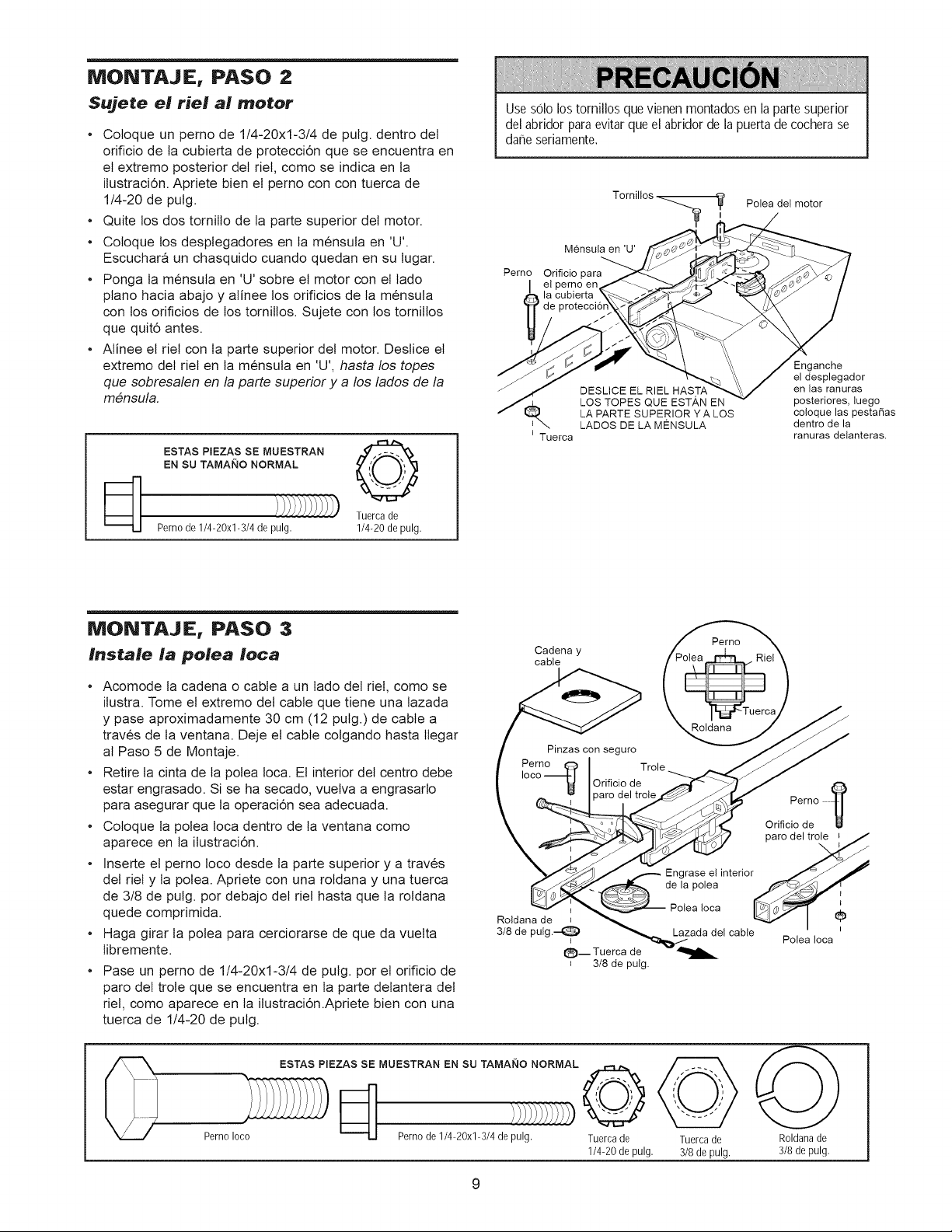
NIONTAJE, PASO 2
Sujete el riel al motor
• Coloque un perno de 1/4-20xl-3/4 de pulg. dentro det
orificio de ta cubierta de protecci6n que se encuentra en
et extremo posterior det riet, como se indica en la
itustraci6n. Apriete bien et pemo con con tuerca de
1/4-20 de pulg.
• Quite los dos tornitlo de la parte superior det motor.
• Coloque los despiegadores en ta mensula en 'U'.
Escuchara un chasquido cuando quedan en su lugar.
• Ponga la mensula en 'U' sobre et motor con et lado
piano hacia abajo y alinee los orificios de ta mensula
con los orificios de los tomitlos. Sujete con los tornittos
que quit6 antes.
• Alinee el riel con ta parte superior det motor. Deslice et
extremo det riet en la mensula en 'U', hasta los topes
que sobresalen en la parte superior y a los lados de la
mensula.
ESTAS PIEZAS SE MUESTRAN ._ .;.._. _'%
EN SU TAMANO NORMAL
I_ Tuerca de
Perno de 1/4-20xl-3/4 de pulg. 1/4-20 de pulg.
Use s01olos tornillos que vienen montados en la parte superior
del abfidor para evitar que el abfidor de la puerta de cochera se
dafle sefiamente.
Perno
I
Tornillos _._
Mensula en 'U'
Orificio para
el perno
I
Polea del motor
t Tuerca
DESLICE EL RIEL HASTA
LOS TOPES QUE EST/kN EN
LA PARTE SUPERIOR YA LOS
LADOS DE LA MENSULA
el desplegador
en las ranuras
posteriores, luego
coloque las pesta_as
dentro de la
ranuras delanteras.
NIONTAJE, PASO 3
Instale la polea Ioca
• Acomode la cadena o cable a un tado det riel, como se
itustra. Tome et extremo del cable que tiene una lazada
y pase aproximadamente 30 cm (12 pulg.) de cable a
traves de ta ventana. Deje et cable colgando hasta ttegar
al Paso 5 de Montaje.
• Retire la cinta de ta polea loca. El interior del centro debe
estar engrasado. Si se ha secado, vuetva a engrasario
para asegurar que la operaci6n sea adecuada.
• Coloque ta polea loca dentro de ta ventana como
aparece en ta itustraci6n.
• Inserte et pemo loco desde la parte superior y a traves
del riel y la polea. Apriete con una roldana y una tuerca
de 3/8 de pulg. por debajo det riet hasta que la roldana
quede comprimida.
• Haga girar la polea para cerciorarse de que da vuetta
libremente.
• Pase un perno de 1/4-20xl-3/4 de pulg. por et orificio de
paro det trole que se encuentra en la parte detantera det
riet, como aparece en la itustraci6n.Apriete bien con una
tuerca de 1/4-20 de pulg.
Cadena y
cable
Perno
Orificio de
_aro del trole
Roldana de t
3/8 de pulg._
I_-- Tuerca de
3/8 de pulg.
Perno
Orificio de
pare del trole i/
Engrase el interior __
de la polea
Polealoca _ +
Lazada del cable i
Polea Ioca
ESTAS PIEZAS SE MUESTRAN EN SU TAMANO NORMAL
Perno Ioco Perno de 1/4-20xl-3/4 de pulg. Tuerca de
1/4-20 de pulg.
Tuerca de Roldana de
3/8 de pulg. 3/8 de pulg.
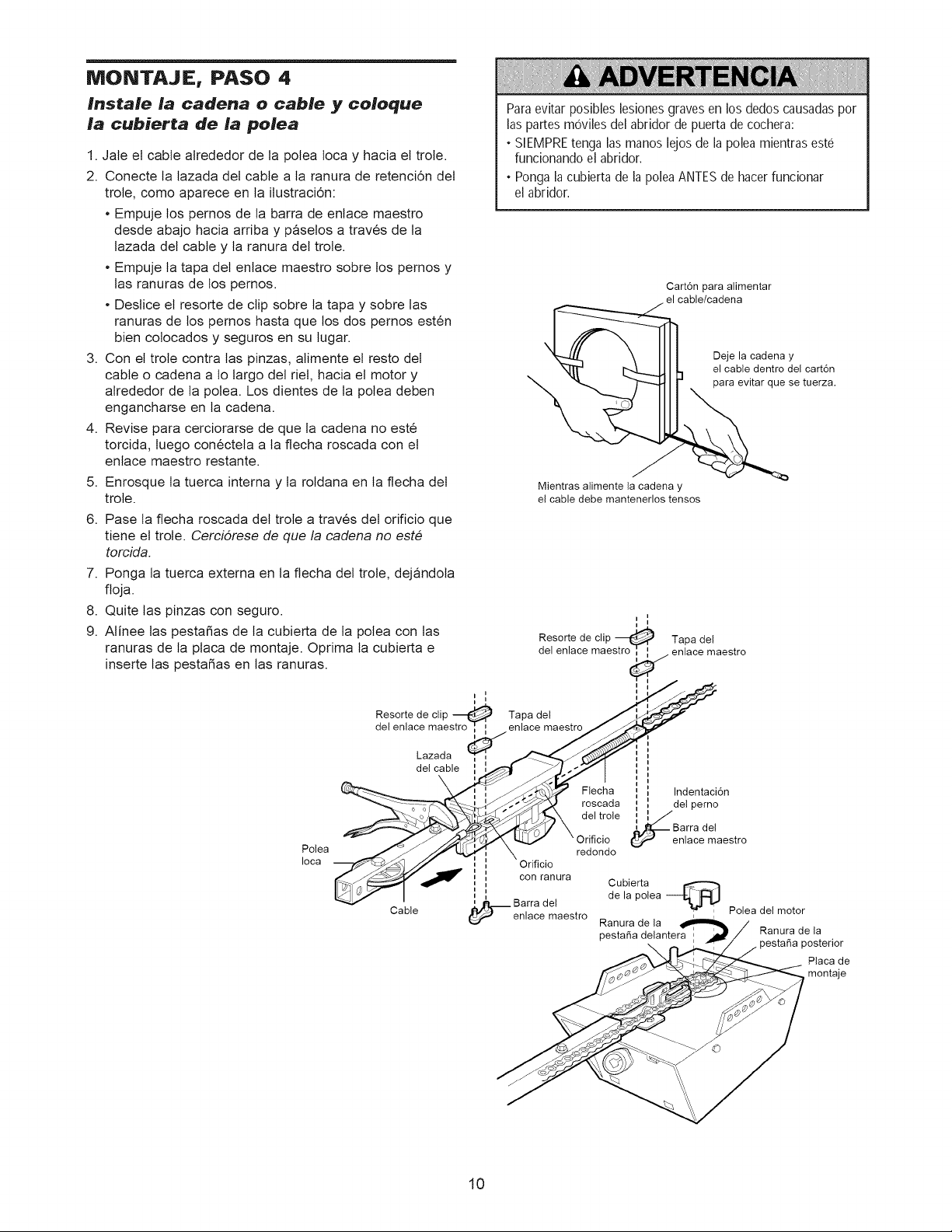
MONTAJIE, PASO 4
Instale la cadena o cable y coloque
la cubierta de la polea
1. Jale et cable alrededor de la polea loca y hacia et trole.
2. Conecte ta lazada det cable a ta ranura de retenci6n det
trole, como aparece en ta itustraci6n:
• Empuje los pemos de la barra de enlace maestro
desde abajo hacia arriba y pasetos a traves de ta
lazada del cable y ta ranura det trole.
• Empuje ta tapa det enlace maestro sobre los pernos y
las ranuras de los pernos.
Deslice et resorte de clip sobre ta tapa y sobre las
ranuras de los pernos hasta que los dos pernos esten
bien colocados y seguros en su lugar.
3. Con el trole contra tas pinzas, alimente el resto del
cable o cadena a to largo det riet, hacia et motor y
alrededor de ta polea. Los dientes de la polea deben
engancharse en la cadena.
4. Revise para cerciorarse de que la cadena no este
torcida, tuego conecteta a ta flecha roscada con et
enlace maestro restante.
5. Enrosque ta tuerca interna y ta roldana en ta flecha det
trole.
Para evitar posibles lesiones graves en los dedos causadas por
las pares moviles del abridor de puerta de cochera:
• SIEMPREtenga las manos lejos de la polea mientras este
funcionando el abridor.
• Ponga la cubierta de la polea ANTESde hacer funcionar
el abridor.
Cart6n para alimentar
el cable/cadena
__ Deje la cadena y
el cable dentro del cart6n
para evitar que se tuerza.
Mientras alimente la cadena y
el cable debe mantenerlos tensos
6. Pase ta flecha roscada det trole a traves det orificio que
tiene et trole. CerciOrese de que la cadena no este
torcida.
7. Ponga ta tuerca externa en la flecha det trole, dejandola
floja.
8. Quite las pinzas con seguro.
i i
9. Alinee tas pesta_as de ta cubierta de la polea con tas Resortede clip
Tapa
del
ranuras de ta placa de montaje. Oprima la cubierta e del enlace maestroT i enlace maestro
inserte las pesta_as en las ranuras.
Resorte de clip __ Tapa del
del enlace maestro : enlace maestro / f_
Lazada , .IP_t_ I l j
, l
i J II I
,odentac, n
__@i__sca_a J l delperno
__'_ _¢/_-_ X _z_'-- Barra del
vr / _ _ _ Orificio _ enlace maestro
Polea _ _/"[.4_,_' \ redondo
l_:.z __._---/_ dlllll_r i con ranara Cabierta
__dw"_ i de la polea --_
_ ,_lr___ Barra del
PoleaCabledel motor
_enlace maestro Ranura de la
pestaRa delantera , Ranura de la
-,, posterior
Placa de
montaje
10
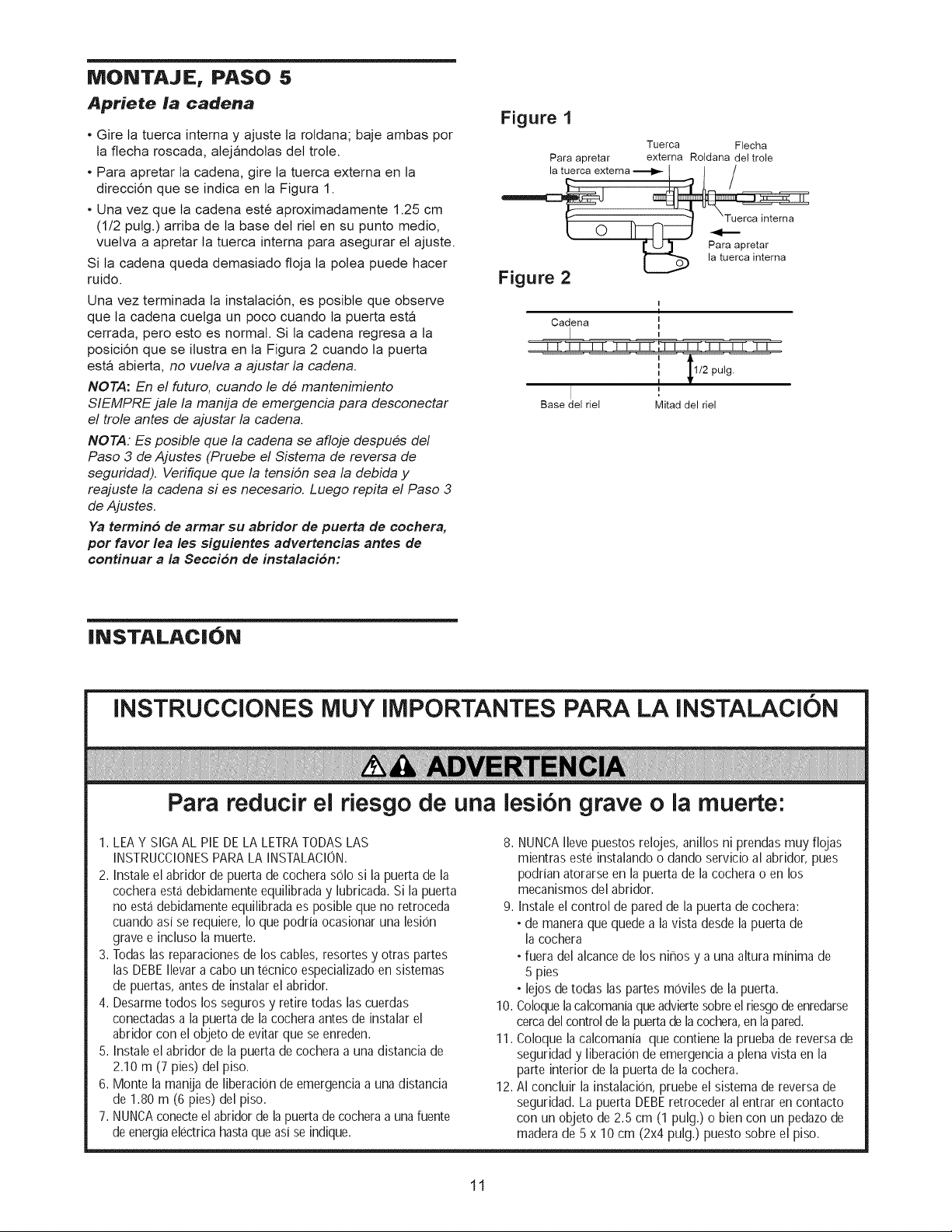
NIONTAJE, PASO 5
Apriete la cadena
• Gire la tuerca interna y ajuste ta roldana; baje ambas por
la flecha roscada, alejandolas det trole.
Para apretar ta cadena, gire la tuerca externa en la
direcci6n que se indica en la Figura 1.
Una vez que la cadena este aproximadamente 1.25 cm
(1/2 pulg.) arriba de ta base det riet en su punto medio,
vuetva a apretar ta tuerca interna para asegurar el ajuste.
Si ta cadena queda demasiado floja ta polea puede hacer
ruido.
Una vez terminada la instalaci6n, es posible que observe
que la cadena cuetga un poco cuando la puerta esta
cerrada, pero esto es normal. Si ta cadena regresa a la
posici6n que se itustra en ta Figura 2 cuando ta puerta
esta abierta, no vuelva a ajustar la cadena.
NOTA: En el futuro, cuando le de mantenimiento
SlEMPRE jale la manija de emergencia para desconectar
el trole antes de ajustar la cadena.
NOTA: Es posible que la cadena se afloje despues del
Paso 3 de Ajustes (Pruebe el Sistema de reversa de
seguridad). Veriflque que la tension sea la debida y
reajuste la cadena si es necesario. Luego repita el Paso 3
de Ajustes.
Ya termino de armar su abridor de puerta de cochera,
pot favor lea los siguientes advertencias antes de
continuar a la Seccion de instalacion:
Figure 1
Tuerca Flecha
Para apretar extema Roldana de! trole
I___JO i_la tuerca externa '_1_ /
Figure 2
Cadena i
g.
Base del riel Mitad del riel
|NSTALAC|6N
INSTRUCCIONES MUY IMPORTANTES PARA LA INSTALACION
Para reducir el riesgo de una
1. LEAY SIGA AL PIE DELA LETRATODASLAS
INSTRUCCIONESPARALA INSTALACION.
2. Instale el abridor de puerta de cochera s01osi la puerta de la
cochera esta debidamente equilibrada y lubricada. Si la puerta
no esta debidamente equilibrada es posible que no retroceda
cuando asi se requiere, Io que podria ocasionar una lesion
grave e incluso la muerte.
3. Todas las reparadones de los cables, resortes y otras partes
las DEBEIlevar a cabo un tecnico especializado en sistemas
de puertas, antes de instalar el abridor.
4. Desarmetodos los seguros y retire todas las cuerdas
conectadas a la puerta de la cochera antes de instalar el
abddor con el objeto de evitar que se enreden.
5. Instale el abridor de la puerta de cochera a una distancia de
2.10 m (7 pies) del piso.
6. Monte la manija de %eracion de emergencia a una distancia
de 1.80 m (6 pies) del piso.
7. NUNCAconecte el abddor de la puerta de cochera a una fuente
de energiael6ctrica hastaque asi se indique.
lesi6n grave o la muerte"
8. NUNCAIleve puestos relojes, anillos ni prendas muy flojas
mientras este instalando o dando servicio al abridor, pues
podrian atorarse en la puerta de la cochera o en los
mecanismos del abridor.
9. Instale el control de pared de la puerta de cochera:
• de manera que quede a la vista desde la puerta de
la cochera
• fuera del alcance de los ninos y a una altura minima de
5 pies
• lejos de todas las partes moviles de la puerta.
10. Coloquelacalcomaniaque adviertesobre el riesgodeenredarse
cercadel controlde lapuertade la cochera,en la pared.
11. Coloque la calcomania que contiene la prueba de reversa de
seguridad y liberacion de emergencia a plena vista en la
parte interior de la puerta de la cochera.
12. AI concluir la instalacion, pruebe el sistema de reversa de
seguridad. La puerta DEBEretroceder al entrar en contacto
con un objeto de 2.5 cm (1 pulg.) o bien con un pedazo de
madera de 5 x 10 cm (2x4 pulg.) puesto sobre el piso.
11
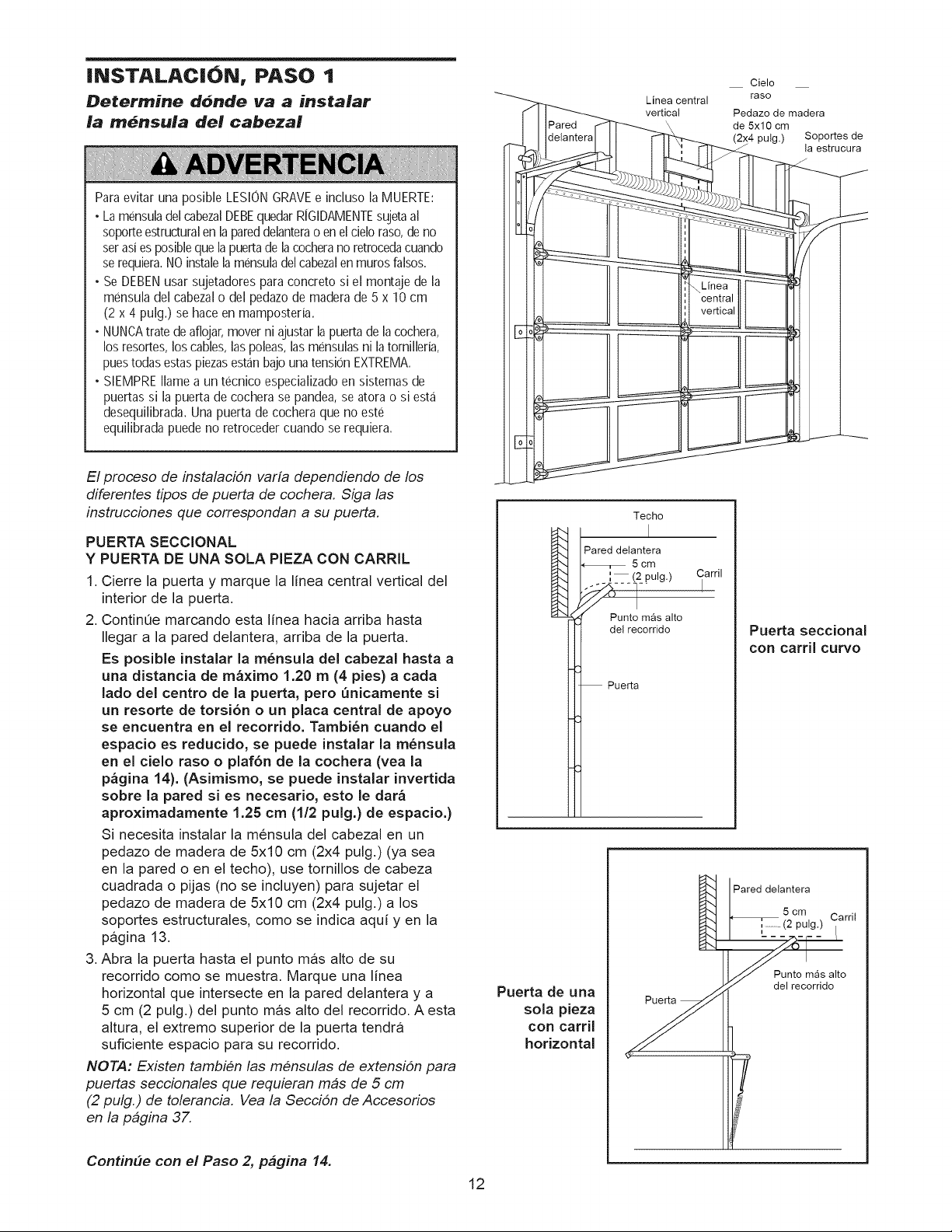
|NSTALAC|6N, PASO 1
Determine d6nde va a instalar
la rnensula del cabezal
Para evitar una posible LESIONGRAVEe incluso la MUERTE:
• La mensuladel cabezalDEBEquedar RiGIDAMENTEsujetaal
soporteestructuralen lapareddehnterao en elcielo raso,de no
serasi esposibleque lapuertade lacocherano retrocedacuando
se requiera.NO instalelamensuh del cabezalen murosfalsos.
• Se DEBENusar sujetadores para concreto si el montaje de la
mensula del cabezalo del pedazode maderade 5 x 10 cm
(2 x 4 pulg.) se hace en mamposteria.
• NUNCAtrate deaflojar,mover ni ajustar lapuerta de lacochera,
los resortes, los cables,las poleas,las mensulasni la tornilleria,
puestodas estaspiezasest_inbajo unatension EXTREMA.
• SIEMPREIlame a un tecnico especializadoen sistemas de
puertas si la puerta de cochera se pandea, se atora o si est_i
desequilibrada. Una puerta de cochera que no este
equilibrada puede no retroceder cuando se requiera.
El proceso de instalaci6n varia dependiendo de los
diferentes tipos de puerta de cochera. Siga /as
instrucciones que correspondan a su puerta.
PUERTA SECCIONAL
Y PUERTA DE UNA SOLA PIEZA CON CARRIL
1 Cierre la puerta y marque la linea central vertical del
interior de la puerta
2 ContinQe marcando esta linea hacia arriba hasta
Ilegar a la pared delantera, arriba de la puerta
Es posible instalar la m_nsula del cabezal hasta a
una distancia de m_×imo 1.20 m (4 pies) a cada
lado del centro de la puerta, pero _nicamente si
un resorte de torsi6n o un placa central de apoyo
se encuentra en el recorrido. Tambi_n cuando el
espacio es reducido, se puede instalar la m_nsula
en el cielo raso o plaf6n de la cochera (vea la
p_gina 14). (Asimismo, se puede instalar invertida
sobre la pared si es necesario, esto le dar_
aproximadamente 1.25 cm (1/2 pulg.) de espacio.)
Si necesita instalar la mensula del cabezal en un
pedazo de madera de 5x10 cm (2x4 pulg.) (ya sea
en la pared o en el techo), use tornillos de cabeza
cuadrada o pijas (no se incluyen) para sujetar el
pedazo de madera de 5x10 cm (2x4 pulg) a los
soportes estructurales, como se indica aqui yen la
p&gina 13
3 Abra la puerta hasta el punto m&s alto de su
recorrido como se muestra Marque una linea
horizontal que intersecte en la pared delantera y a
5 cm (2 pulg) del punto mas alto del recorrido A esta
altura, el extremo superior de la puerta tendra
suficiente espacio para su recorrido
NOTA: Existen tambien /as mensulas de extension para
puertas seccionales que requieran mas de 5 cm
(2 pulg.) de tolerancia. Vea la SecciOn de Accesorios
en la pbgina 37.
¢
Linea central
vertical
Cielo
raso
Pedazo de madera
de 5x10 cm
Soportes de
la estrucura
Techo
Pared delantera
5cm
', (2 pulg.)
Punto mas alto
del recorrido
Puerta
Carril
I
Puerta seccional
con carril curvo
Puerta de una
sola pieza
con carril
horizontal
Pared delantera
/ 5cm ^ .,
arr,,
, - - _
u n_°2_d alt°
7
Contin#e con el Paso 2, pbgina 14.
12
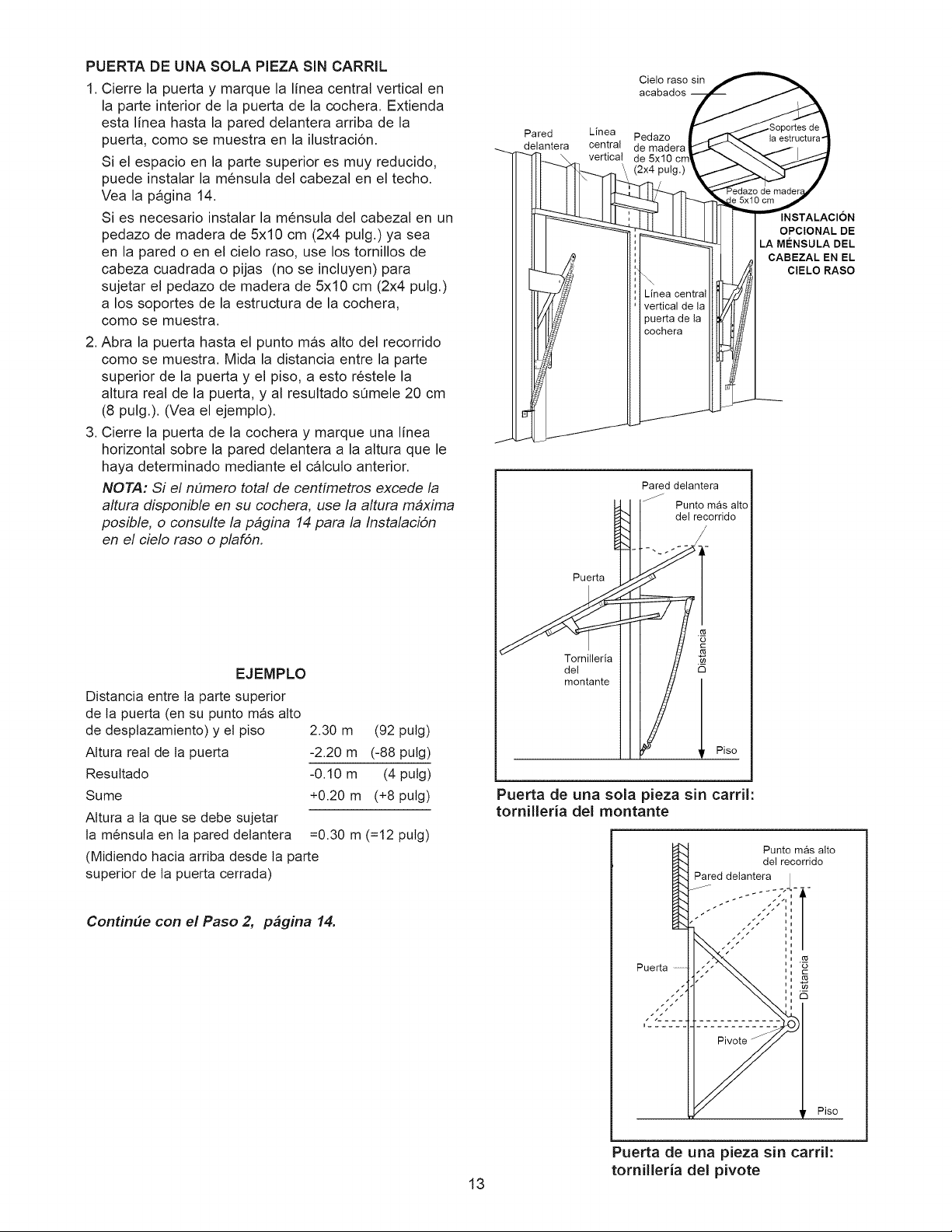
PUERTA DE UNA SOLA PIEZA SIN CARRIL
1. Cierre la puerta y marque la linea central vertical en
la parte interior de la puerta de la cochera. Extienda
esta linea hasta la pared delantera arriba de la
puerta, como se muestra en la ilustraciOn.
Si el espacio en la parte superior es muy reducido,
puede instalar la mensula del cabezal en el techo.
Vea la pagina 14.
Si es necesario instalar la mensula del cabezal en un
pedazo de madera de 5x10 cm (2x4 pulg.) ya sea
en la pared o en el cielo raso, use los tornillos de
cabeza cuadrada o pijas (no se incluyen) para
sujetar el pedazo de madera de 5x10 cm (2x4 pulg.)
a los soportes de la estructura de la cochera,
como se muestra.
2. Abra la puerta hasta el punto mas alto del recorrido
como se muestra. Mida la distancia entre la parte
superior de la puerta y el piso, a esto restele la
altura real de la puerta, y al resultado sOmele 20 cm
(8 pulg.). (Vea el ejemplo).
3. Cierre la puerta de la cochera y marque una linea
horizontal sobre la pared delantera a la altura que le
haya determinado mediante el calculo anterior.
NOTA: Si el ndmero total de centimetros excede la
altura disponible en su cochera, use la altura maxima
posible, o consulte la pagina 14 para la Instalaci6n
en el cielo raso o plaf6n.
EJEMPLO
Distancia entre ta parte superior
de ta puerta (en su punto mas alto
de desplazamiento) y et piso
Altura real de ta puerta
Resultado
Sume
2.30 m (92 pulg)
-2.20 m (-88 pulg)
-0.10 m (4 pulg)
+0.20 m (+8 pulg)
Altura a la que se debe sujetar
la mensula en la pared detantera =0.30 m (=12 pulg)
(Midiendo hacia arriba desde ta parte
superior de la puerta cerrada)
ContinQe con el Paso 2, p_gina 14.
Cielo raso sin
acabados
Pared Linea Pedazo
delantera central de madera
vertical de 5x10
INSTALACI(_N
OPCIONAL DE
LA M!eNSULA DEL
CABEZAL EN EL
CIELO RASO
Puerta l
Tornilleria
del
montante
Pared delantera
J
Punto mas alto
del recorrido
03
ii
d3
Piso
Puerta de una sola pieza sin carril:
tornilleria del montante
Puerta
. t
Punto mas alto
del recorrido
Pared delantera
ttS
_,._
a
13
Puerta de una pieza sin carril:
tornilleria del pivote
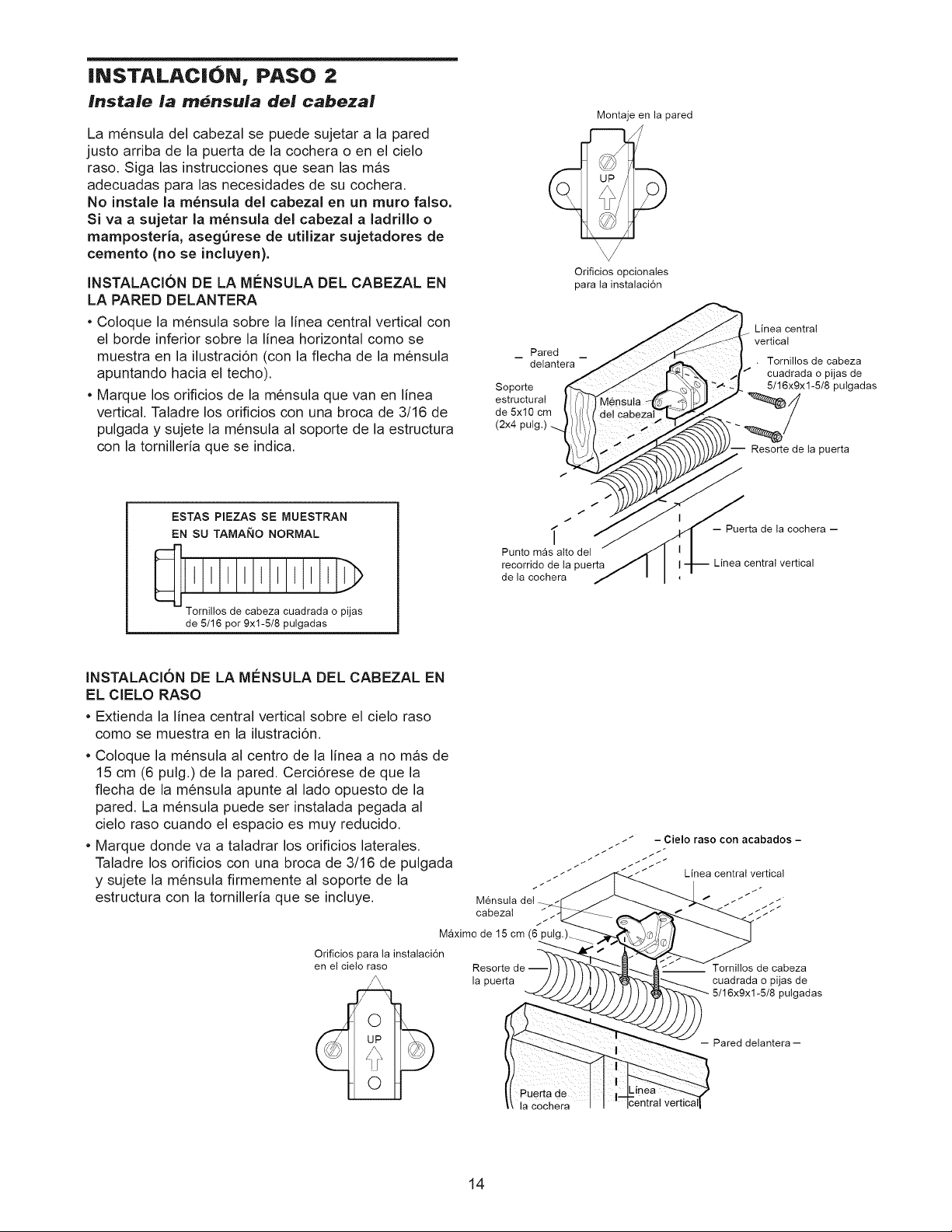
|NSTALAC|ON, PASO 2
Instale la rnensula del cabezal
La mensula del cabezal se puede sujetar a la pared
justo arriba de la puerta de la cochera o en el cielo
raso. Siga las instrucciones que sean las mas
adecuadas para las necesidades de su cochera.
No instale la m_nsula del cabezal en un muro falso.
Si va a sujetar la m_nsula del cabezal a ladrillo o
mamposteria, aseg_rese de utilizar sujetadores de
cemento (no se incluyen).
INSTALACION DE LA MleNSULA DEL CABEZAL EN
LA PARED DELANTERA
• Coloque la mensula sobre la linea central vertical con
el horde inferior sobre la linea horizontal como se
muestra en la ilustraci6n (con la flecha de la mensula
apuntando hacia el techo).
• Marque los orificios de la mensula que van en linea
vertical. Taladre los orificios con una broca de 3/16 de
pulgada y sujete la mensula al soporte de la estructura
con la tornilleria que se indica.
Montaje en la pared
Orificios opcionales
para la instalaci6n
Pared
delantera
Soporte
estructural
de 5x10 cm
(2x4 pulg.)
Linea central
vertical
• Tornillos de cabeza
cuadrada o pijas de
5/16x9x1-5/8 pulgadas
Resorte de la puerta
ESTAS PIEZAS SE MUESTRAN
EN SU TAMAI_IO NORMAL
Tornillos de cabeza cuadrada o pijas
de 5/16 por 9xl-5/8 pulgadas
/
/
/
/
f
Punto mas alto del
recorrido de la puerta
de la cochera
-- Puerta de la cochera --
Linea central vertical
INSTALACION DE LA M(=NSULA DEL CABEZAL EN
EL ClELO RASO
• Extienda la linea central vertical sobre el cielo raso
como se muestra en la ilustraci6n.
• Coloque la mensula al centro de la linea a no m&s de
15 cm (6 pulg.) de la pared. Cerci6rese de que la
flecha de la mensula apunte al lado opuesto de la
pared. La mensula puede ser instalada pegada al
cielo raso cuando el espacio es muy reducido.
• Marque donde va a taladrar los orificios laterales.
Taladre los orificios con una broca de 3/16 de pulgada
y sujete la mensula firmemente al soporte de la
estructura con la tornilleria que se incluye.
/
Maximo de 15 cm (6pulg.)_
Orificios para la instalaci6n
en el cielo raso Resorte de --
la puerta
de cabeza
cuadrada o pijas de
pulgadas
- Pared delantera -
Puerta de
la cochera
14
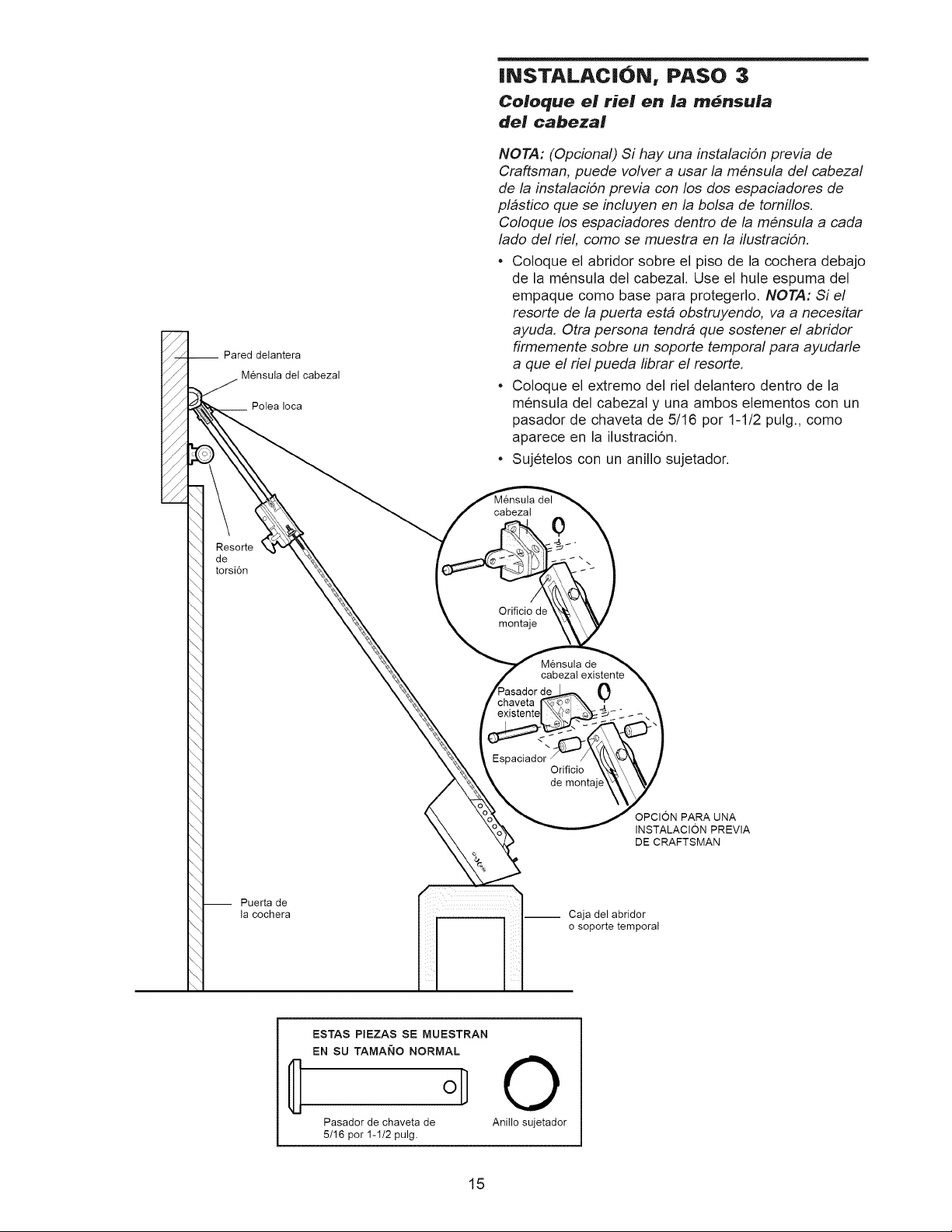
__ Pared delantera
Mensula del cabezal
Polea Ioca
de
torsi6n
|NSTALAC|6N, PASO 3
Coloque el riel en la rnensula
del cabezal
NOTA: (Opcional) Si hay una instalaci6n previa de
Craftsman, puede volver a usar la mensula del cabezal
de la instalaci6n previa con los dos espaciadores de
plastico que se incluyen en la bolsa de tornillos.
Coloque los espaciadores dentro de la mensula a cada
lado del riel, como se muestra en la ilustraci6n.
• Coloque el abridor sobre el piso de la cochera debajo
de la mensula del cabezal. Use el hule espuma del
empaque como base para protegerlo. NOTA: Si el
resorte de la puerta esta obstruyendo, va a necesitar
ayuda. Otra persona tendra que sostener el abridor
firmemente sobre un soporte temporal para ayudarle
a que el riel pueda librar el resorte.
• Coloque el extremo del riel delantero dentro de la
mensula del cabezal y una ambos elementos con un
pasador de chaveta de 5/16 por 1-1/2 pulg., como
aparece en la ilustraci6n.
• Sujetelos con un anillo sujetador.
del
cabeza!
0
Orificio de
montaje
Mensula de
cabezal existente
0
<-
Espaciador
Orificio
de monta
OPCION PARA UNA
INSTALACION PREVIA
DE CRAFTSMAN
-- Puerta de
la cochera
__ Caja del abridor
o soporte temporal
ESTAS PIEZAS SE MUESTRAN
EN SU TAMANO NORMAL
ol
Pasador de chaveta de
5/16 per 1-1/2 pulg.
O
Anillo sujetador
15
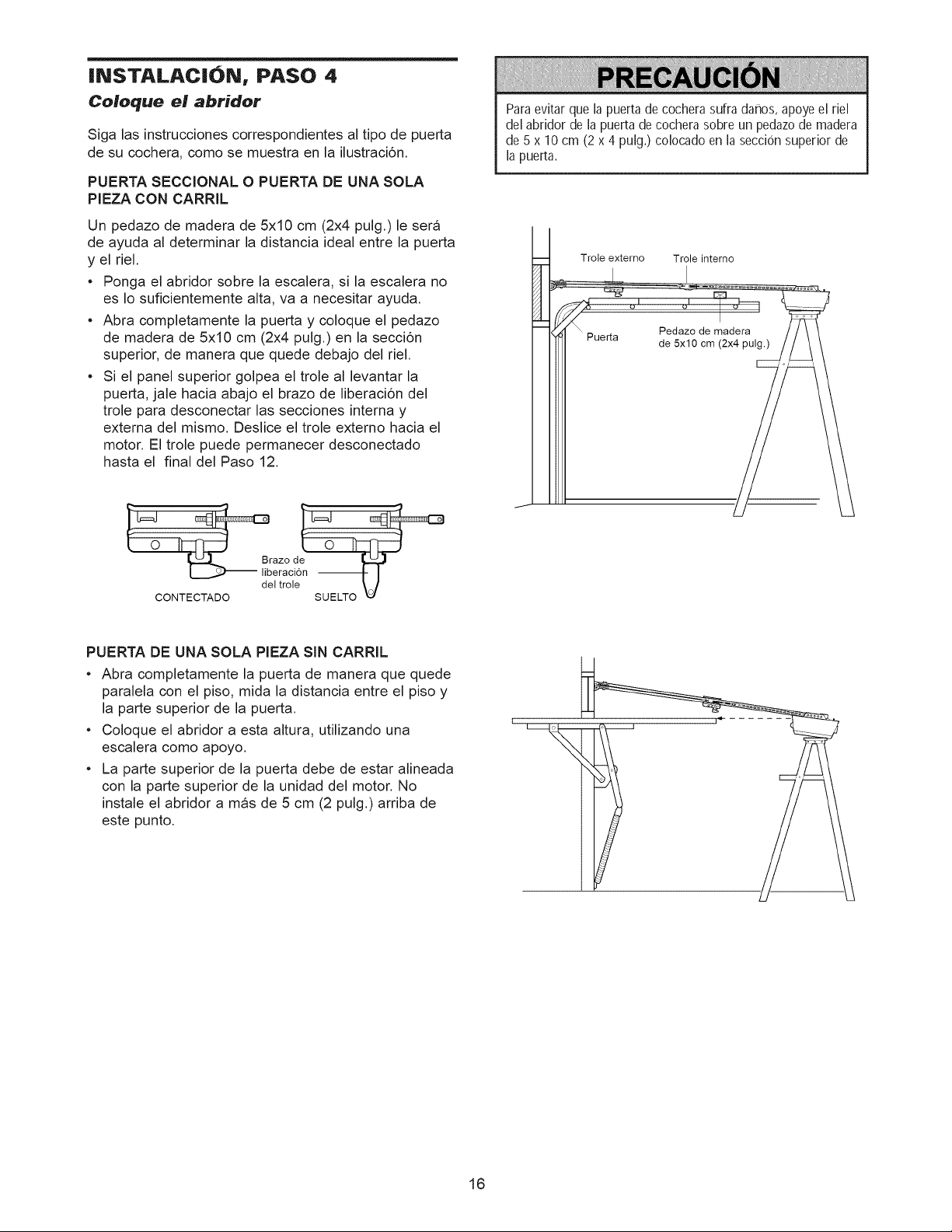
|NSTALAC|6N, PASO 4
Coloque el abridor
Siga las instrucciones correspondientes al tipo de puerta
de su cochera, como se muestra en la ilustraci6n.
PUERTA SECCIONAL O PUERTA DE UNA SOLA
PIEZA CON CARRIL
Un pedazo de madera de 5x10 cm (2x4 pulg.) le sera
de ayuda al determinar la distancia ideal entre la puerta
y el riel.
• Ponga el abridor sobre la escalera, si la escalera no
es Io suficientemente alta, va a necesitar ayuda.
• Abra completamente la puerta y coloque el pedazo
de madera de 5x10 cm (2x4 pulg.) en la secci6n
superior, de manera que quede debajo del riel.
• Si el panel superior golpea el trole al levantar la
puerta, jale hacia abajo el brazo de liberaci6n del
trole para desconectar las secciones interna y
externa del mismo. Deslice el trole externo hacia el
motor. El trole puede permanecer desconectado
hasta el final del Paso 12.
Para evitar que la puerta de cochera sufra danos, apoye el riel
del abridor de la puerta de cochera sobre un pedazode madera
de 5 x 10 cm (2 x 4 pulg.) colocado en la seccion superior de
la puerta.
Trole externo Trole interno
Puerta
azo de
eraci6n --I- I
del trole qt i#1 TP_ U
CONTECTADO SUELTO
PUERTA DE UNA SOLA PIEZA SIN CARRIL
• Abra completamente la puerta de manera que quede
paralela con el piso, mida la distancia entre el piso y
la parte superior de la puerta.
• Coloque el abridor a esta altura, utilizando una
escalera como apoyo.
• La parte superior de la puerta debe de estar alineada
con la parte superior de la unidad del motor. No
instale el abridor a m&s de 5 cm (2 pulg.) arriba de
este punto.
16
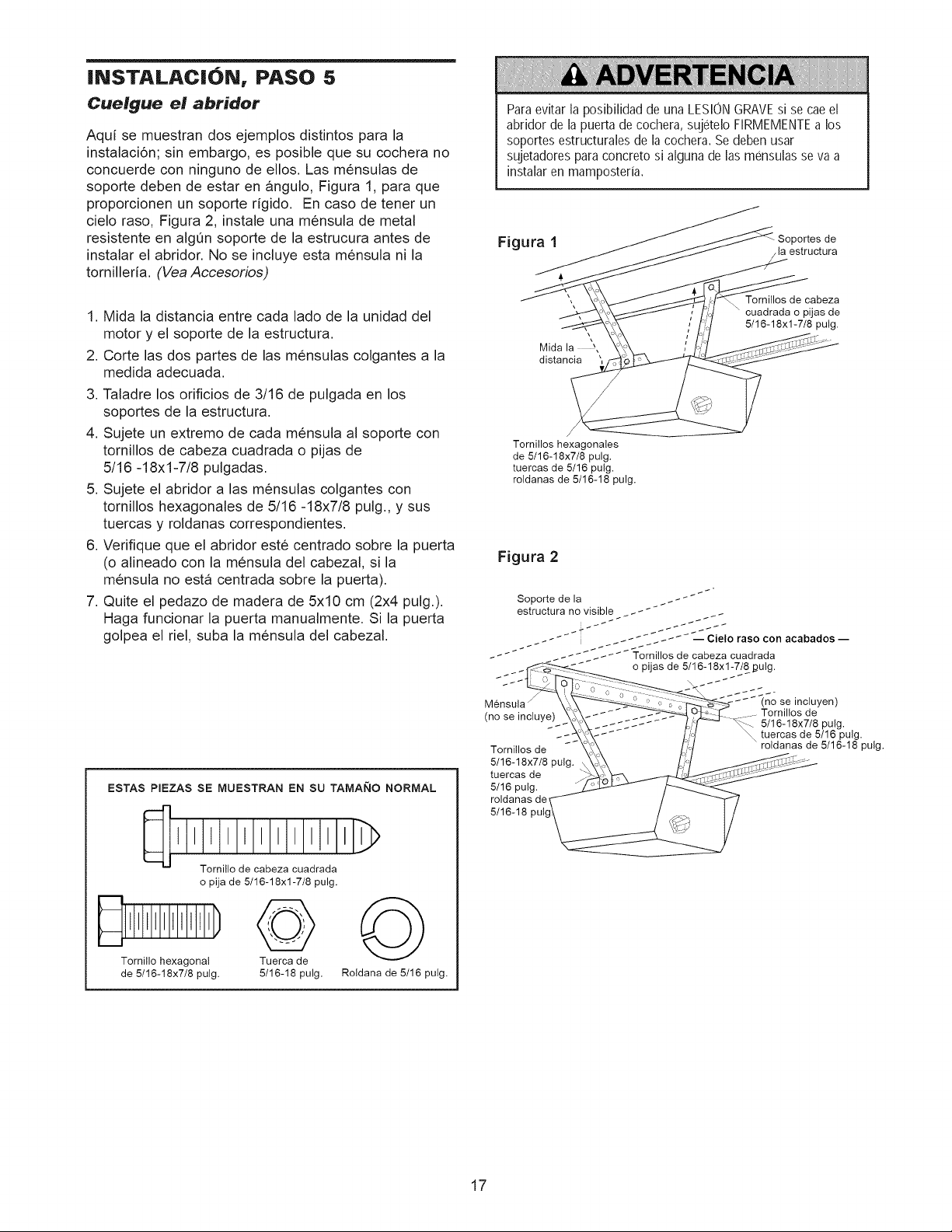
|NSTALAC|6N, PASO 5
Cuelgue el abridor
Aqui se muestran dos ejemplos distintos para la
instalaci6n; sin embargo, es posible que su cochera no
concuerde con ninguno de ellos. Las mensulas de
soporte deben de estar en angulo, Figura 1, para que
proporcionen un soporte rigido. En caso de tener un
cielo raso, Figura 2, instale una mensula de metal
resistente en algOn soporte de la estrucura antes de
instalar el abridor. No se incluye esta mensula ni la
tornilleria. (Vea Accesorios)
1. Mida la distancia entre cada lado de la unidad del
motor y el soporte de la estructura.
2. Corte las dos partes de las mensulas colgantes a la
medida adecuada.
3. Taladre los orificios de 3/16 de pulgada en los
soportes de la estructura.
4. Sujete un extremo de cada mensula al soporte con
tornillos de cabeza cuadrada o pijas de
5/16 -18xl-7/8 pulgadas.
5. Sujete el abridor a las mensulas colgantes con
tornillos hexagonales de 5/16 -18x7/8 pulg., y sus
tuercas y roldanas correspondientes.
6. Verifique que el abridor este centrado sobre la puerta
(o alineado con la mensula del cabezal, si la
mensula no esta centrada sobre la puerta).
7. Quite el pedazo de madera de 5x10 cm (2x4 pulg.).
Haga funcionar la puerta manualmente. Si la puerta
golpea el riel, suba la mensula del cabezal.
ESTAS PIEZAS SE MUESTRAN EN SU TAMANO NORMAL
IIIIIIIIII1 >
I_ Torni!lo de cabeza cuadrada
o pija de 5/16-18xl-7/8 pulg.
Torn!!Ie hexagonal Tuerca de
de 5/16-18x7/8 pulg. 5/16-18 pulg. Roidana de 5/16 puig.
Para evitar la posibilidad de una LESIONGRAVEsi se cae el
abridor de la puerta de cochera, sujetelo FIRMEMENTEa los
soportes estructurales de la cochera. Se deben usar
sujetadores para concreto si alguna de las mensulas se va a
instalar en mamposteria.
Figura 1 )ortes de
estructura
\
\
Mida la _,
distancia ',
Torn!lies de cabeza
cuadrada o pijas de
5/16-18xl-7/8 puig.
Torniilos hexagona!es
de 5/16-18x7/8 pulg.
tuercas de 5/16 puig.
roldanas de 5/16-18 pulg.
Figura 2
Soporte de la _ _ _- _
estructura no visible _-_-
- - - _ - _-- _-- Cielo raso con acabados --
o pijas de 5/16-18x1-7/8puig.
Mensu!a / ._ino se inoluyen)
(no se inciuye) _ Tornilios de
_. 5/16-18x7/8 puig,
_ _ tuercas de 5/16 puig.
Torn!lies de ro!danas de 5/16-18 puig.
5/16-18x7/8 puig.
tuercas de
5/16 puig.
roldanas de,
5/16-18
17
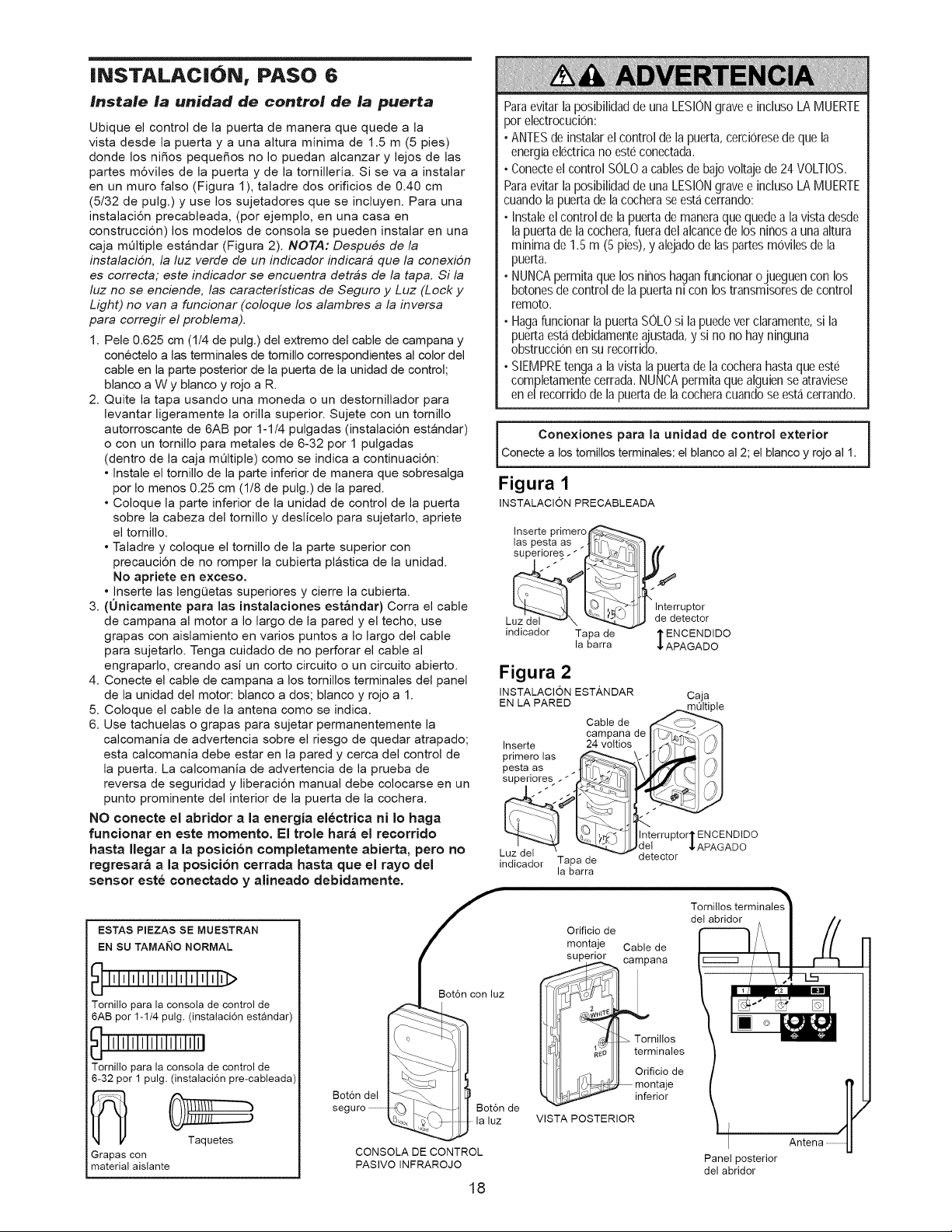
w
|NSTALAC|ON, PASO 6
lres_ale la ureidad de core_rol de la puer_a
Ubique el control de la puerta de manera que quede a la
vista desde la puerta y a una altura minima de 1.5 m (5 pies)
donde los ni_os peque_os no Io puedan alcanzar y lejos de las
partes m6viles de la puerta y de la tornilleria. Si se va a instalar
en un muro falso (Figura 1), taladre dos orificios de 0.40 cm
(5/32 de pulg.) y use los sujetadores que se incluyen. Para una
instalaci6n precableada, (por ejemplo, en una casa en
construcci6n) los modelos de consola se pueden instalar en una
caja mQItiple estandar (Figura 2). NOTA: Despues de la
instalaciOn, la luz verde de un indicador indicara que la conexiOn
es correcta; este indicador se encuentra detrbs de la tapa. Si la
luz no se enciende, las caracterfsticas de Seguro y Luz (Lock y
Light) no van a funcionar (coloque los alarnbres a la inversa
para corregir el problema).
1. Pele 0.625 cm (1/4 de pulg.) del extremo del cable de campana y
conectelo alas terminales de tomillo correspondientes al color del
cable en la parte posterior de la puerta de la unidad de control;
blanco a W y blanco y rojo a R.
2. Quite la tapa usando una moneda o un destornillador para
levantar ligeramente la orilla superior. Sujete con un tornillo
autorroscante de 6AB por 1-1/4 pulgadas (instalaci6n estandar)
o con un tornillo para metales de 6-32 por 1 pulgadas
(dentro de la caja mOltiple) como se indica a continuaci6n:
• Instale el tomillo de la parte inferior de manera que sobresalga
por Io menos 0.25 cm (1/8 de pulg.) de la pared.
• Coloque la parte inferior de la unidad de control de la puerta
sobre la cabeza del tornillo y deslicelo para sujetarlo, apriete
el tomillo.
• Taladre y coloque el tornillo de la parte superior con
precauci6n de no romper la cubierta plastica de la unidad.
No apriete en exceso.
• Inserte las lengOetas superiores y cierre la cubierta.
3. (0nicamente para las instalaciones estandar) Corra el cable
de campana al motor a Io largo de la pared y el techo, use
grapas con aislamiento en varios puntos a Io largo del cable
para sujetarlo. Tenga cuidado de no perforar el cable al
engraparlo, creando asi un corto circuito o un circuito abierto.
4. Conecte el cable de campana a los tornillos terminales del panel
de la unidad del motor: blanco a dos; blanco y rojo a 1.
5. Coloque el cable de la antena como se indica.
6. Use tachuelas o grapas para sujetar permanentemente la
calcomania de advertencia sobre el riesgo de quedar atrapado;
esta calcomania debe estar en la pared y cerca del control de
la puerta. La calcomania de advertencia de la prueba de
reversa de seguridad y liberaci6n manual debe colocarse en un
punto prominente del interior de la puerta de la cochera.
NO coneete el abridor a la energia electrica ni Io haga
funeionar en este momento. El trole hara el recorrido
hasta llegar a la position completamente abierta, pero no
regresara a la position terraria hasta que el rayo del
sensor este conectado y alineado debidamente.
Paraevitarla posibiiidadde una LESIONgravee incluso LA MUERTE
por electrocuciOn:
oANTESde instalarel controlde la puerta,cerciOresede que la
energiaelectricano esteconectada.
oConecteel control SOLOa cablesde bajovoltajede 24 VOLTIOS.
Paraevitarla posibilidadde una LESIONgravee incluso LA MUERTE
cuandolapuertade lacocherase est_icerrando:
oInstaleel control de la puertade maneraquequedea la vistadesde
lapuertade lacochera,fueradel alcancede los nirlos a unaaltura
minimade 1.5m (5 pies),y alejadode laspares mOvilesde la
puerta.
oNUNCApermitaque los ninos haganfuncionarojueguen conlos
botonesde control de la puertani con lostransmisoresde control
remoto.
oHagafuncionarla puertaSOLOsi lapuedever claramente,si la
puertaestadebidamenteajustada,y si no no hay ninguna
obstrucd0n en su recorrido.
oSIEMPREtengaa lavista la puertade lacocherahastaque este
completamentecerrada.NUNCApermitaque alguiense atraviese
en el recorridode la puertade lacocheracuandose estacerrando.
Conexiones para la unidad de control exterior
1
Conecte a los tornillos terminales: el blanco al 2; el blanco y rojo al 1.
Figura 1
INSTALACION PRECABLEADA
Inserte primero_
las pesta as . tl_Y___ ,,
supenores." ,4__W q_I lrl
_" __'l:erruptor
Luz'del-_.._J_ _ de detector
indicador Tapa de 1"ENCENDIDO
la barra 4,APAGADO
Figura 2
INSTALACION EST,A,NDAR Caja
EN LA PARED
_iple
Cable de t,_C_ _.
campana de I/_._//_ I
Inserte 24 voltios I _-P_ :_ / //I
primero las _\" tTL!.,a_ _1
pesta.as - "__"_.__'_;_\ _-]l_,_ _" W I
super'°[es_.1,b-"-_24--_'4/r-_,l,lJ_]_J/k _l _,1
Loz'del-"_ _de[. *APAGADO
detector
indicador Tapa de
la barra
ESTAS PIEZAS SE MUESTRAN
EN SU TAMANO NORMAL
_ IIlll'lllllllllllllll_l_]>
Tornillo para la consola de control de
6AB por 1-1/4 pulg. (instalaci6n estandar)
_ IIIIIIIIIIIIIIIIIIIII
Tornillo para la consola de control de
6-32 pot 1 pulg. (instalaci6n pre-cableada
Grapas con
material aislante
Bot6n con luz
Bot6n del _ Bot6n de
la luz
CONSOLA DE CONTROL
PASIVO INFRAROJO
18
Orificio de
montaje Cable de
superior campana
_ Tornillos
_ terminales
Orificio de
montaje
inferior
VISTA POSTERIOR
TorniIIos
del abridor
Panel posterior
del abridor
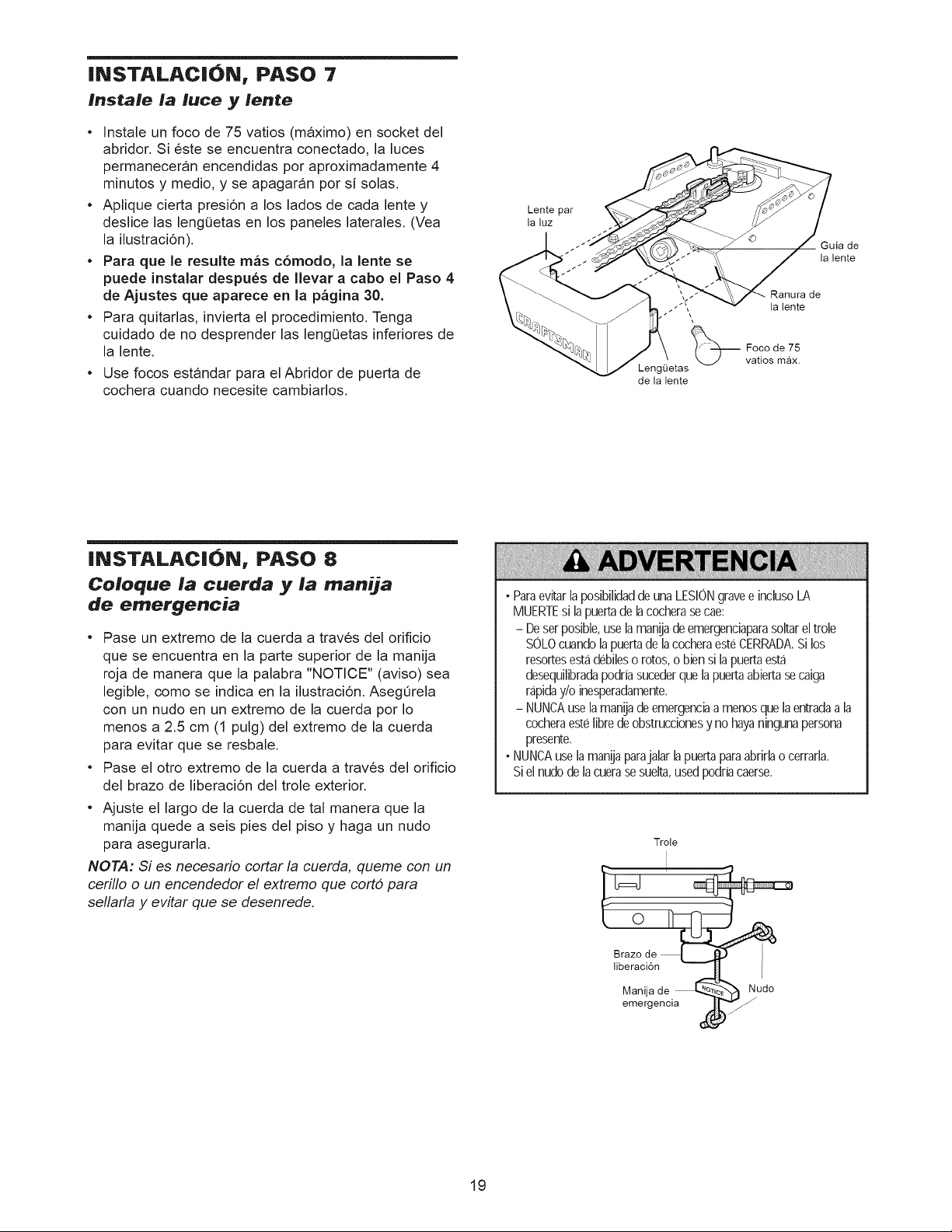
|NSTALAC|ON, PASO 7
Instale la lute y lente
• Instale un foco de 75 vatios (maximo) en socket del
abridor. Si este se encuentra conectado, la luces
permaneceran encendidas por aproximadamente 4
minutos y medio, y se apagar&n por si solas.
• Aplique cierta presi6n a los lados de cada lente y
deslice las leng0etas en los paneles laterales. (Vea
la ilustraci6n).
• Para que le resulte m_s c6modo, la lente se
puede instalar despu_s de llevar a cabo el Paso 4
de Ajustes que aparece en la p&gina 30.
• Para quitarlas, invierta el procedimiento. Tenga
cuidado de no desprender las lengQetas inferiores de
la lente.
• Use focos est&ndar para el Abridor de puerta de
cochera cuando necesite cambiarlos.
Lente par
la luz
', Ranura de
la lente
'_ Foco de 75
ratios max.
LengLietas
de la lente
Guia de
la lente
|NSTALACiON, PASO 8
Coloque la cuerda y la man_a
de emergencia
• Pase un extremo de la cuerda a traves del orificio
que se encuentra en la parte superior de la manija
roja de manera que la palabra "NOTICE" (aviso) sea
legible, como se indica en la ilustraci6n. AsegQrela
con un nudo en un extremo de la cuerda por Io
menos a 2.5 cm (1 pulg) del extremo de la cuerda
para evitar que se resbale.
• Pase el otro extremo de la cuerda a traves del orificio
del brazo de liberaci6n del trole exterior.
• Ajuste el largo de la cuerda de tal manera que la
manija quede a seis pies del piso y haga un nudo
para asegurarla.
NOTA: Si es necesario cortar la cuerda, queme con un
cerillo o un encendedor el extremo que cort6 para
sellarla y evitar que se desenrede.
• Paraevitarlaposibilidadde unaLESIONgravee inclusoLA
MUERTEsi lapuertade lacocherasecae:
- Deserposible,use la manijade emergenciaparasoltareltrole
SOLOcuandolapuertade lacocheraesteCERRADA.Si los
resortesestadebileso rotos,o biensi la puertaesta
desequilibradapodriasucederque lapuertaabiertasecaiga
rapiday/o inesperadamente.
- NUNCAusela manijade emergendaa menosque laentradaa la
cocheraestelibredeobstruccionesy no hayaningunapersona
presente.
• NUNCAusela manijaparajalar lapuertaparaabrirlao cerrarla.
Siel nudodelacuerase suelta,usedpodriacaerse.
Trole
[aOen÷
Man,jade..................Nudo
emergencia _(_ )_.//
19
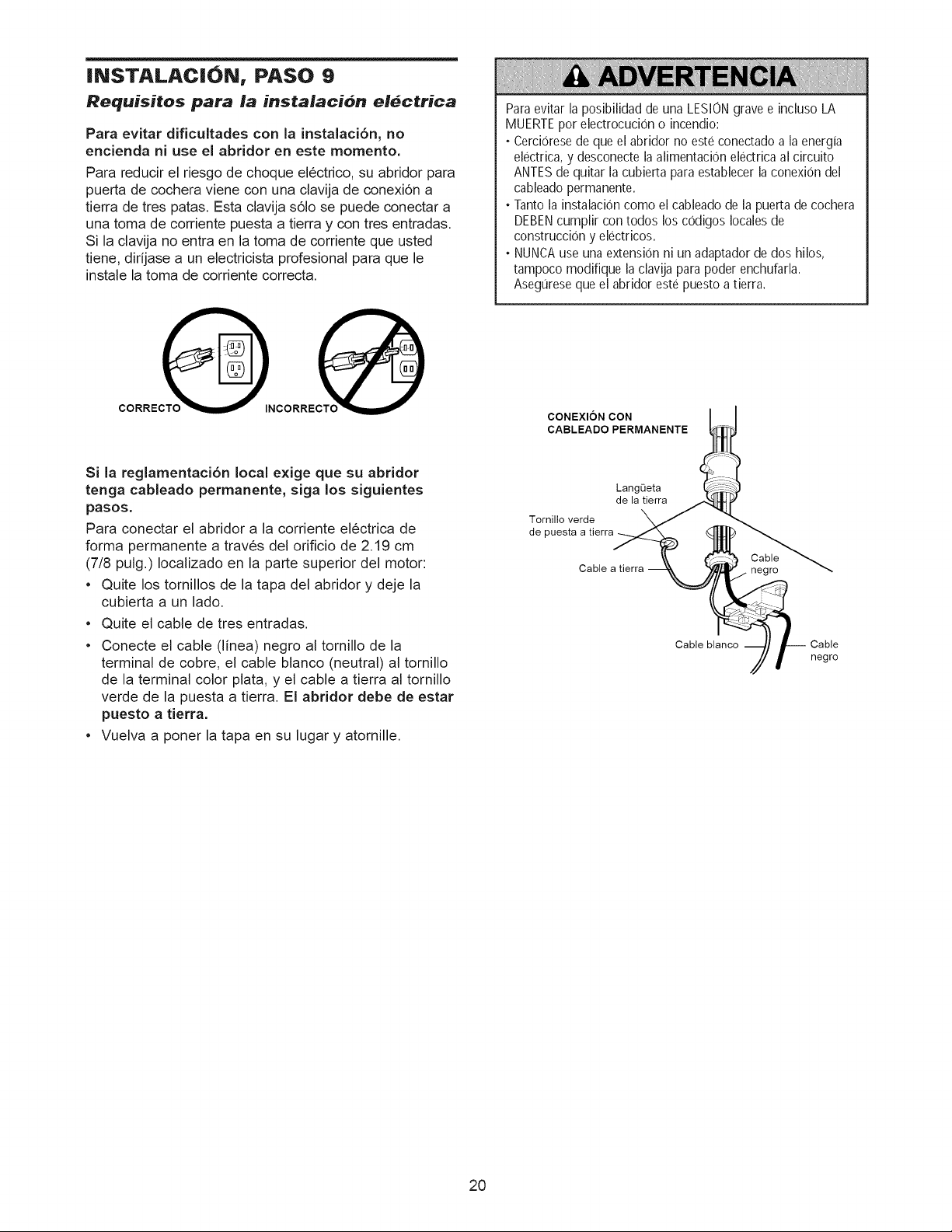
|NSTALAC|6N, PASO 9
RequJsitos para la instalacJ6n electrica
Para evitar dificultades con la instalaci6n, no
encienda ni use ei abridor en este momento.
Para reducir el riesgo de choque electrico, su abridor para
puerta de cochera viene con una clavija de conexi6n a
tierra de tres patas. Esta clavija s61o se puede conectar a
una toma de corriente puesta a tierra y con tres entradas.
Si la clavija no entra en la toma de corriente que usted
tiene, dirijase a un electricista profesional para que le
instale la toma de corriente correcta.
CORRECQNCORRECTC
Para evitar la posibilidad de una LESIONgrave e incluso LA
MUERTEpor electrocucion o incendio:
• Cerciorese de que el abridor no este conectado a la energia
electric& y desconecte la alimentacion electrica al circuito
ANTESde quitar la cubierta para estaNecer la conexion del
cableado permanente.
• Tanto la instalacion como el cableado de la puerta de cochera
DEBENcumplir con todos los codigos locales de
construccion y electricos.
• NUNCAuse una extension ni un adaptador de dos hilos,
tampoco modifique la clavija para poder enchufarla.
Asegurese que el abridor este puesto a tierra.
CONEXI(_N CON
CABLEADO PERMANENTE
Si la reglamentaci6n local exige que su abridor
tenga cableado permanente, siga los siguientes
pasos.
Para conectar el abridor a la corriente electrica de
forma permanente a traves del orificio de 2.19 cm
(7/8 pulg.) Iocalizado en la parte superior del motor:
• Quite los tornillos de la tapa del abridor y deje la
cubierta a un lado.
• Quite el cable de tres entradas.
• Conecte el cable (linea) negro al tornillo de la
terminal de cobre, el cable blanco (neutral) al tornillo
de la terminal color plata, y el cable a tierra al tornillo
verde de la puesta a tierra. El abridor debe de estar
puesto a tierra.
• Vuelva a poner la tapa en su lugar y atornille.
LangQeta
de la tierra
Tomillo verde
de puesta a
Cable a tierra
Cable blanco
Cable
negro
Cable
negro
20
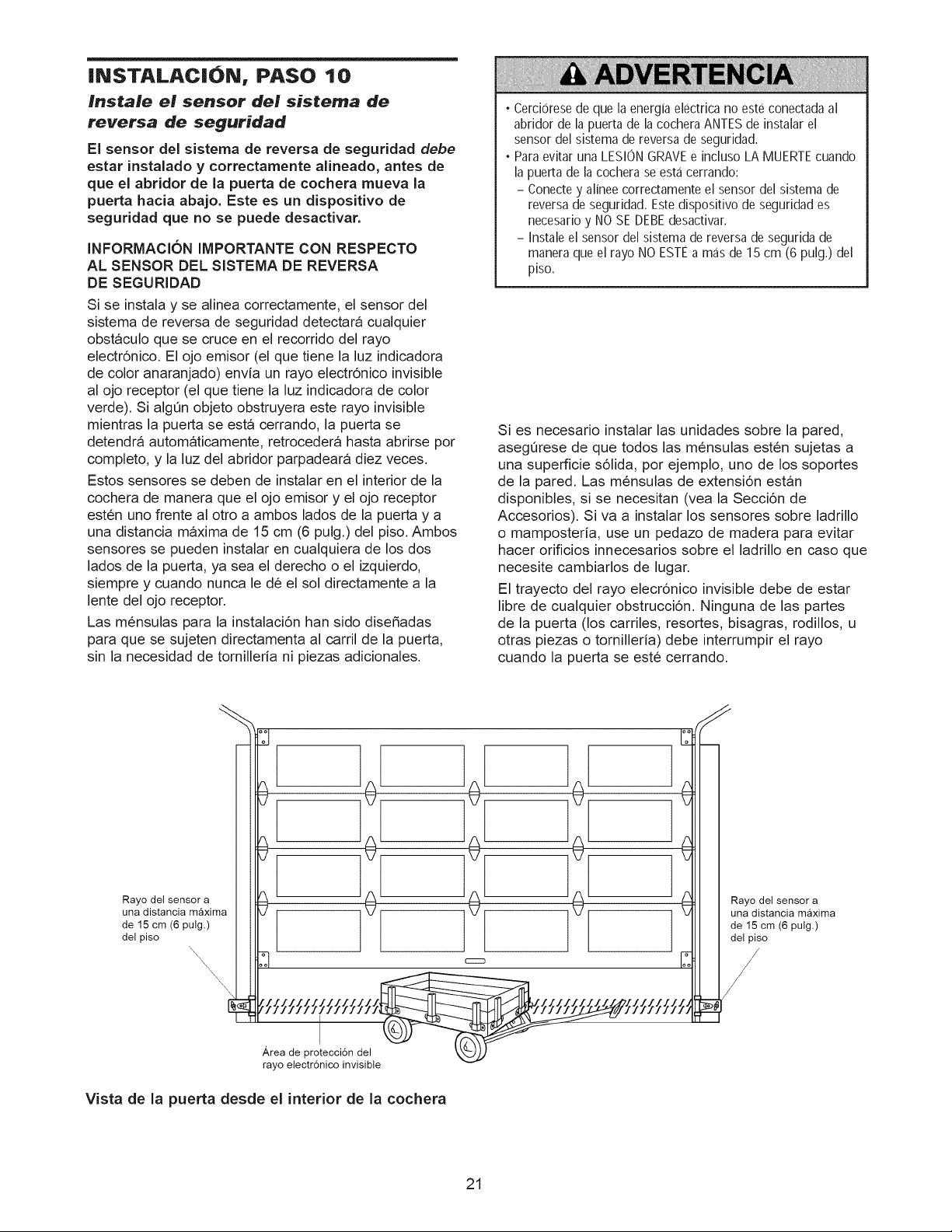
|NSTALAC|6N, PASO 10
Instale el sensor del sisterna de
reversa de seguridad
El sensor del sistema de reversa de seguridad debe
estar instalado y correctamente alineado, antes de
que el abridor de la puerta de cochera mueva la
puerta hacia abajo. Este es un dispositivo de
seguridad que no se puede desactivar.
INFORMACION IMPORTANTE CON RESPECTO
AL SENSOR DEL SISTEMA DE REVERSA
DE SEGURIDAD
Si se instala y se alinea correctamente, el sensor del
sistema de reversa de seguridad detectara cualquier
obstaculo que se cruce en el recorrido del rayo
electr6nico. El ojo emisor (el que tiene la luz indicadora
de color anaranjado) envia un rayo electr6nico invisible
al ojo receptor (el que tiene la luz indicadora de color
verde). Si algL_n objeto obstruyera este rayo invisible
mientras la puerta se esta cerrando, la puerta se
detendra automaticamente, retrocedera hasta abrirse por
completo, y la luz del abridor parpadeara diez veces.
Estos sensores se deben de instalar en el interior de la
cochera de manera que el ojo emisor y el ojo receptor
esten uno frente al otro a ambos lados de la puerta y a
una distancia maxima de 15 cm (6 pulg.) del piso. Ambos
sensores se pueden instalar en cualquiera de los dos
lados de la puerta, ya sea el derecho o el izquierdo,
siempre y cuando nunca le de el sol directamente a la
lente del ojo receptor.
Las mensulas para la instalaci6n han sido disefiadas
para que se sujeten directamenta al carril de la puerta,
sin la necesidad de tornilleria ni piezas adicionales.
• Cerciorese de que la energia electrica no este conectadaal
abridor de la puerta de la cochera ANTESde instalar el
sensor del sistema de reversa de seguridad.
• Para evitar una LESIONGRAVEe incluso LA MUERTEcuando
la puerta de la cochera se esta cerrando:
- Conecte y alinee correctamente el sensor del sistema de
reversa de seguridad. Estedispositivo de seguridad es
necesario y NO SE DEBEdesactivar.
- Instale el sensor del sistema de reversa de segurida de
manera que el rayo NO ESTEamas de 15 cm (6 pulg.) del
piso.
Si es necesario instalar las unidades sobre la pared,
asegOrese de que todos las mensulas esten sujetas a
una superficie s61ida, por ejemplo, uno de los soportes
de la pared. Las mensulas de extensi6n estan
disponibles, si se necesitan (vea la Secci6n de
Accesorios). Siva a instalar los sensores sobre ladrillo
o mamposteria, use un pedazo de madera para evitar
hacer orificios innecesarios sobre el ladrillo en caso que
necesite cambiarlos de lugar.
El trayecto del rayo elecr6nico invisible debe de estar
libre de cualquier obstrucci6n. Ninguna de las partes
de la puerta (los carriles, resortes, bisagras, rodillos, u
otras piezas o tornilleria) debe interrumpir el rayo
cuando la puerta se este cerrando.
10[ !0! ! Y
!0! !0! !! !JII
iiiiii_i_n__ ma I I i iOi i_cO[ i i il iiYoo _ _iin_ii m a
,_,rea de proteccidn del _k_))
rayo electr6nico invisible
Vista de la puerta desde el interior de la cochera
21
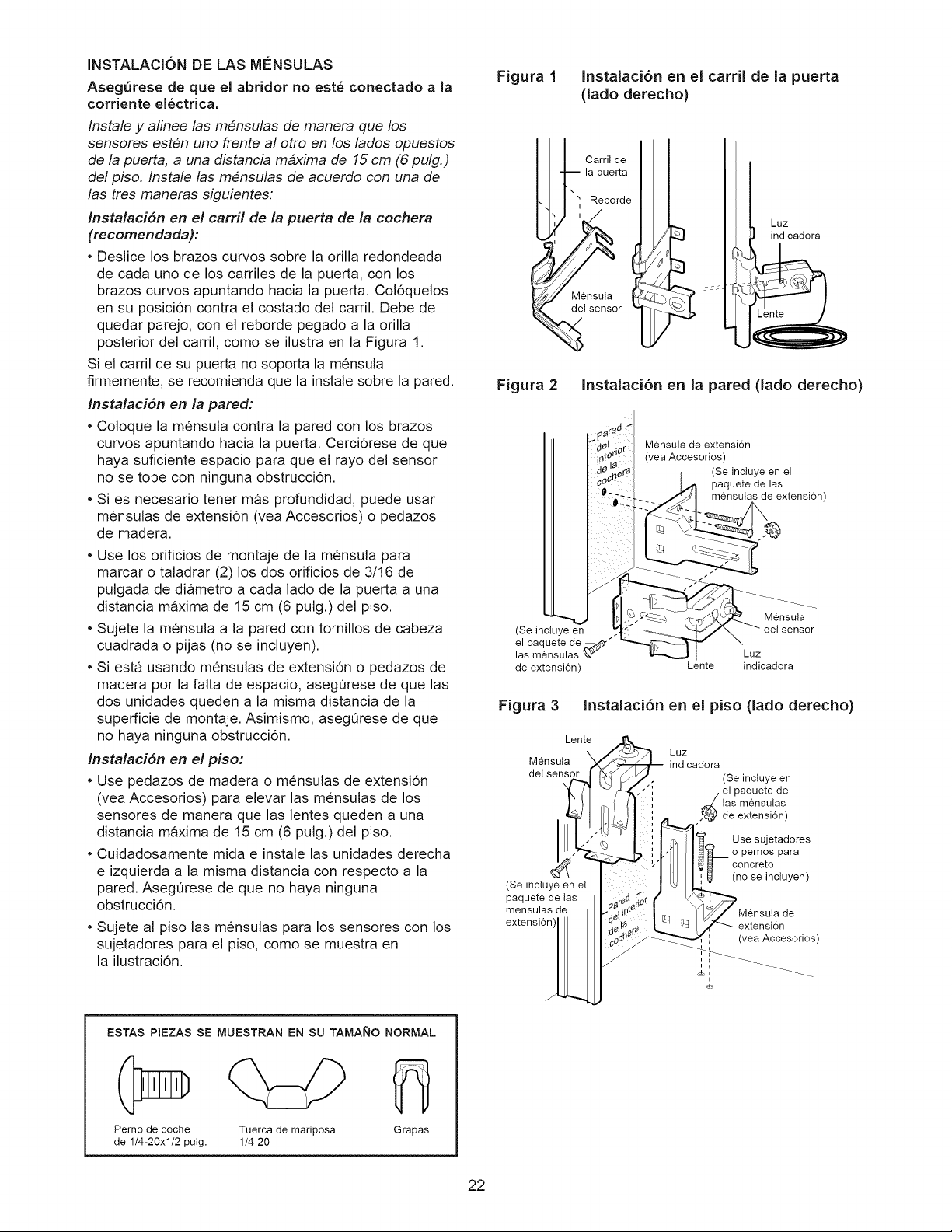
INSTALACION DE LAS M[=NSULAS
Aseg_rese de que el abridor no est_ conectado a la
corriente el_ctrica.
Instale y alinee !as mensulas de manera que los
sensores esten uno frente al otro en los lados opuestos
de la puerta, a una distancia maxima de 15 cm (6 pulg.)
del piso. Instale !as mensulas de acuerdo con una de
!as tres maneras siguientes:
Instalaci6n en el carril de la puerta de la cochera
(recomendada):
• Deslice los brazos curvos sobre la orilla redondeada
de cada uno de los carriles de la puerta, con los
brazos curvos apuntando hacia la puerta. Col6quelos
en su posici6n contra el costado del carril. Debe de
quedar parejo, con el reborde pegado a la orilla
posterior del carril, como se ilustra en la Figura 1.
Si el carril de su puerta no soporta la m6nsula
firmemente, se recomienda que la instale sobre la pared.
Instalacidn en la pared:
• Coloque la mensula contra la pared con los brazos
curvos apuntando hacia la puerta. Cerci6rese de que
haya suficiente espacio para que el rayo del sensor
no se tope con ninguna obstrucci6n.
• Si es necesario tener mas profundidad, puede usar
mensulas de extensi6n (vea Accesorios) o pedazos
de madera.
• Use los orificios de montaje de la mensula para
marcar o taladrar (2) los dos orificios de 3/16 de
pulgada de diametro a cada lado de la puerta a una
distancia maxima de 15 cm (6 pulg.) del piso.
• Sujete la mensula a la pared con tomillos de cabeza
cuadrada o pijas (no se incluyen).
• Siesta usando mensulas de extensi6n o pedazos de
madera por la falta de espacio, aseg0rese de que las
dos unidades queden a la misma distancia de la
superficie de montaje. Asimismo, aseg0rese de que
no haya ninguna obstrucci6n.
Instalaci6n en el piso:
• Use pedazos de madera o mensulas de extensi6n
(vea Accesorios) para elevar las m6nsulas de los
sensores de manera que las lentes queden a una
distancia maxima de 15 cm (6 pulg.) del piso.
• Cuidadosamente mida e instale las unidades derecha
e izquierda a la misma distancia con respecto a la
pared. Aseg0rese de que no haya ninguna
obstrucci6n.
• Sujete al piso las mensulas para los sensores con los
sujetadores para el piso, como se muestra en
la ilustraci6n.
ESTAS PIEZAS SE MUESTRAN EN SU TAMANO NORMAL
Perno de coche
de 1/4-20xl/2 pulg.
Tuerca de mariposa
1/4-20
Grapas
Figura 1 Instalaci6n en el carril de la puerta
(lado derecho)
_ Carril de I I
la puerta
bo'deII I
1sensor _
Luz
indicadora
Figura 2 Instalaci6n en la pared (lado derecho)
Mensula de extensi6n
(vea Accesorios)
(Se inctuye en el
paquete de las
mensulas de extensi6n)
Mensula
(Se incluye en
el paquete de _._"
las mensulas LXY Luz
de extensi6n) Lente indicadora
Figura 3 Instalaci6n en el piso (lado derecho)
Lente
Mensula
del sensor
(Se incluye en el
paquete de tas
22
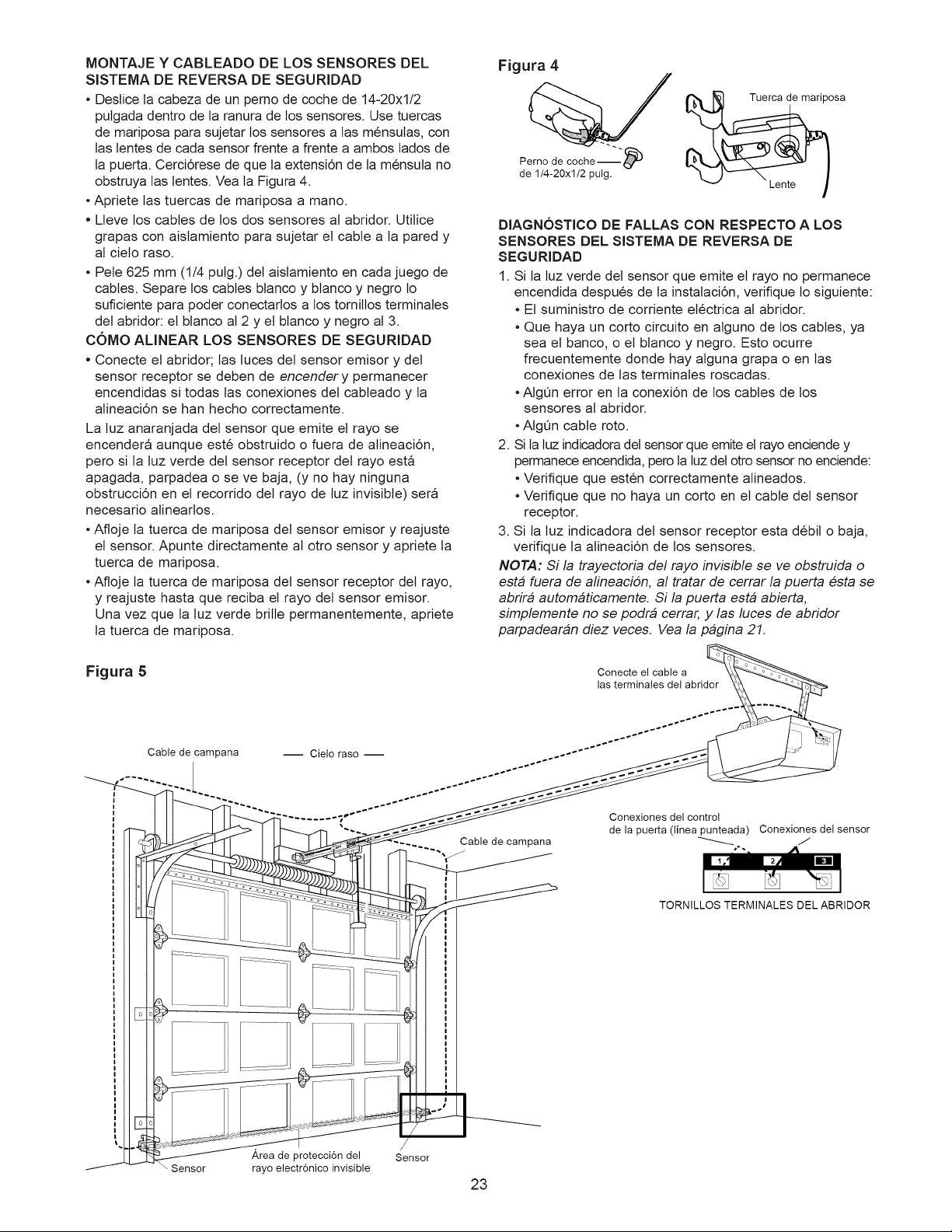
MONTAJE Y CABLEADO DE LOS SENSORES DEL
SISTEMA DE REVERSA DE SEGURIDAD
• Deslice ta cabeza de un pemo de coche de 14-20xl/2
pulgada dentro de la ranura de los sensores. Use tuercas
de madposa para sujetar los sensores a tas mensulas, con
las lentes de cada sensor frente a frente a ambos lados de
la puerta. Cerci6rese de que la extensi6n de la mensula no
obstruya tas lentes. Vea la Figura 4.
• Apdete tas tuercas de madposa a mano.
Lteve los cables de los dos sensores al abridor. Utitice
grapas con aislamiento para sujetar et cable a la pared y
al cieto raso.
• Pele 625 mm (1/4 pulg.) det aislamiento en cada juego de
cables. Separe los cables blanco y blanco y negro to
suficiente para poder conectados a los tomitlos terminales
det abridor: el blanco al 2 y et blanco y negro at 3.
COMO ALINEAR LOS SENSORES DE SEGURIDAD
Conecte et abridor; las luces det sensor emisor y det
sensor receptor se deben de encender y permanecer
encendidas si todas tas conexiones det cableado y la
alineaci6n se ban hecho correctamente.
La tuz anaranjada del sensor que emite el rayo se
encendera aunque este obstruido o fuera de alineacidn,
pero si ta tuz verde det sensor receptor del rayo esta
apagada, parpadea o se ve baja, (y no hay ninguna
obstrucci6n en el recorrido det rayo de tuz invisible) sera
necesario alineartos.
• Afloje ta tuerca de madposa det sensor emisor y reajuste
et sensor. Apunte directamente al otro sensor y apriete ta
tuerca de madposa.
• Afloje la tuerca de madposa det sensor receptor del rayo,
y reajuste hasta que reciba et rayo det sensor emison
Una vez que ta tuz verde britte permanentemente, apriete
la tuerca de mariposa.
Figura 4
Perno de coohe "_
de 1/4-20x1/2 pulg.
osa
ente
DIAGNOSTICO DE FALLAS CON RESPECTO A LOS
SENSORES DEL SISTEMA DE REVERSA DE
SEGURIDAD
1. Si ta tuz verde det sensor que emite et rayo no permanece
encendida despues de la instataci6n, verifique lo siguiente:
• Et suministro de corriente electrica al abridor.
• Que haya un corto circuito en alguno de los cables, ya
sea el banco, o et blanco y negro. Esto ocurre
frecuentemente donde hay atguna grapa o en las
conexiones de tas terminales roscadas.
• AlgQn error en ta conexi6n de los cables de los
sensores al abridor.
• AlgQn cable roto.
2. Si ta tuz indicadora del sensor que emite el rayo enciende y
permanece encendida, pero la tuz det otro sensor no enciende:
• Verifique que esten correctamente atineados.
• Verifique que no haya un corto en et cable det sensor
receptor.
3. Si la tuz indicadora det sensor receptor esta debit o baja,
verifique la alineacidn de los sensores.
NOTA: Si la trayectoria del rayo invisible se ve obstruida o
esta fuera de alineaci6n, al tratar de cerrar la puerta esta se
abrira automaticamente. Si la puerta esta abierta,
simplemente no se podra cerrar, y las luces de abridor
parpadearan diez veces. Yea la pagina 21.
Figura 5
Cable de campana -- Cielo raso --
Conecte el cable a
las terminales del abridor
Conexiones del control
de la puerta (linea punteada) Conexiones del sensor
Cable de campana _ /
/
TORNILLOS TERMINALES DEL ABRIDOR
Sensor
,_,rea de protecci6n del
rayo electr6nico invisible
/
Sensor
23
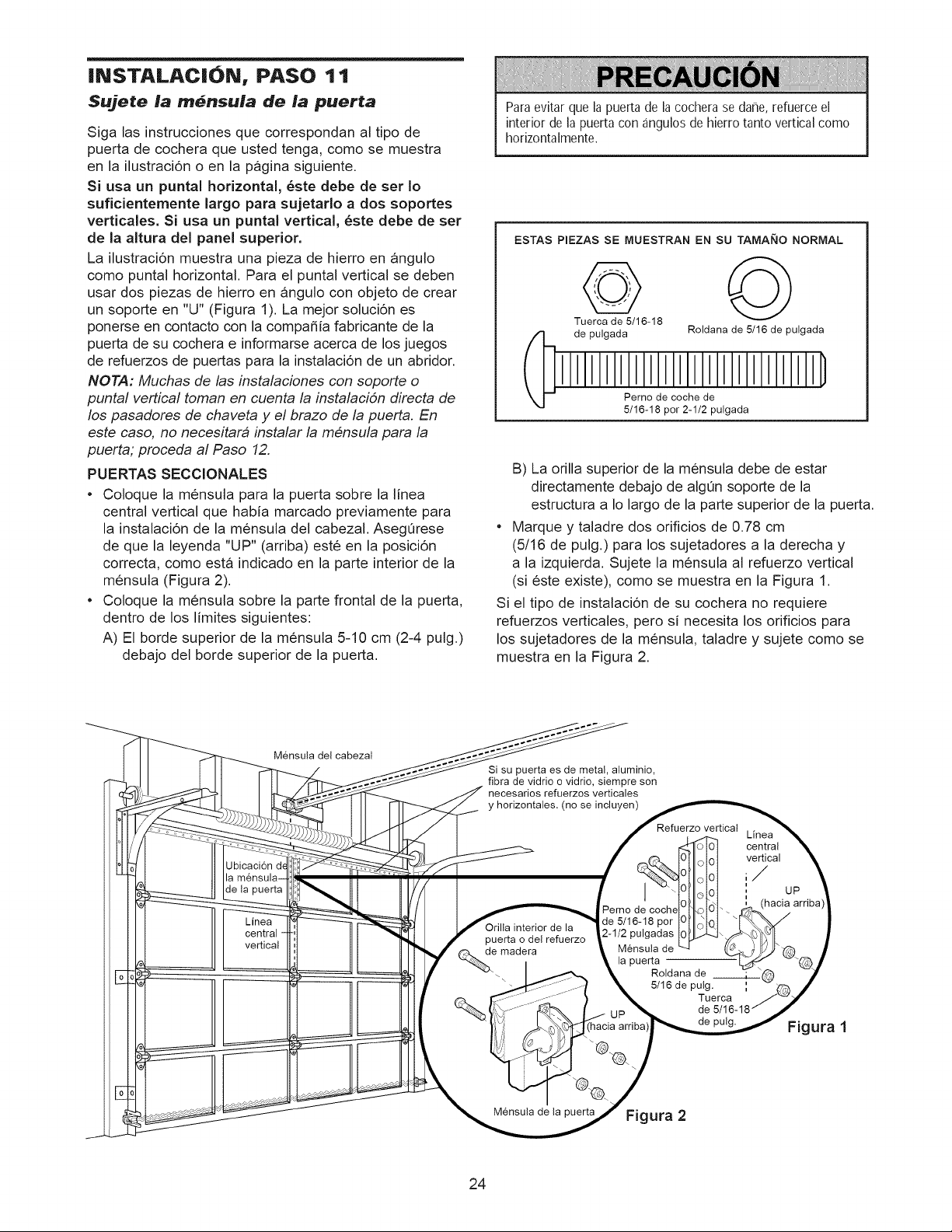
|NSTALAC|6N, PASO 11
Sujete la rnensula de la puerta
Siga las instrucciones que correspondan al tipo de
puerta de cochera que usted tenga, como se muestra
en la ilustraci6n o en la pagina siguiente.
Si usa un puntal horizontal, _ste debe de set Io
suficientemente largo para sujetarlo a dos soportes
verticales. Si usa un puntal vertical, _ste debe de set
de la altura del panel superior.
La ilustraci6n muestra una pieza de hierro en angulo
como puntal horizontal. Para el puntal vertical se deben
usar dos piezas de hierro en angulo con objeto de crear
un soporte en "U" (Figura 1). La mejor soluci6n es
ponerse en contacto con la compafiia fabricante de la
puerta de su cochera e informarse acerca de los juegos
de refuerzos de puertas para la instalaci6n de un abridor.
NOTA: Muchas de las instalaciones con soporte o
puntal vertical toman en cuenta la instalaci4n directa de
los pasadores de chaveta y el brazo de la puerta. En
este caso, no necesitara instalar la mensula para la
puerta; proceda al Paso 12.
PUERTAS SECCIONALES
• Coloque la mensula para la puerta sobre la linea
central vertical que habia marcado previamente para
la instalaci6n de la mensula del cabezal. Aseg0rese
de que la leyenda "UP" (arriba) este en la posici6n
correcta, como esta indicado en la parte interior de la
mensula (Figura 2).
• Coloque la mensula sobre la parte frontal de la puerta,
dentro de los limites siguientes:
A) El borde superior de la mensula 5-10 cm (2-4 pulg.)
debajo del borde superior de la puerta.
Para evitar que la puerta de lacochera se dafle, refuerce el
interiorde la puerta con angulos de hierro tanto vertical como
horizontalmente.
ESTAS PIEZAS SE MUESTRAN EN SU TAMANO NORMAL
T@6-18
de pulgada Roldana de 5/16 de pulgada
Perno de coche de
5/16-18 pot 2-1/2 pulgada
B) La orilla superior de la mensula debe de estar
directamente debajo de alg0n soporte de la
estructura a Io largo de la parte superior de la puerta.
• Marque y taladre dos orificios de 0.78 cm
(5/16 de pulg.) para los sujetadores a la derecha y
a la izquierda. Sujete la mensula al refuerzo vertical
(si este existe), como se muestra en la Figura 1.
Si el tipo de instalaci6n de su cochera no requiere
refuerzos verticales, pero si necesita los orificios para
los sujetadores de la mensula, taladre y sujete como se
muestra en la Figura 2.
Mensula del cabezal
Ubicaci6n de
la
de la puerta
Linea
central
Si su puerta es de metal, aluminio,
fibra de vidrio o vidrio, siempre son
necesarios refuerzos verticales
y horizontales. (no se incluyen)
Orilla interior de la
puerta o del refuerzo
e madera
\
\
Refuerzo vertical
central
vertical
,/
i
i
Perno
de 5/16-18 por
2-1/2 pulgadas
Mensula de
la puerta
Roldana de
5/16 de pulg.
Tuerca
(hacia arriba)
"@@.
@@.
Mensula de la puerta Figura 2
de pulg.
UP
(hacia arriba
Figura 1
24
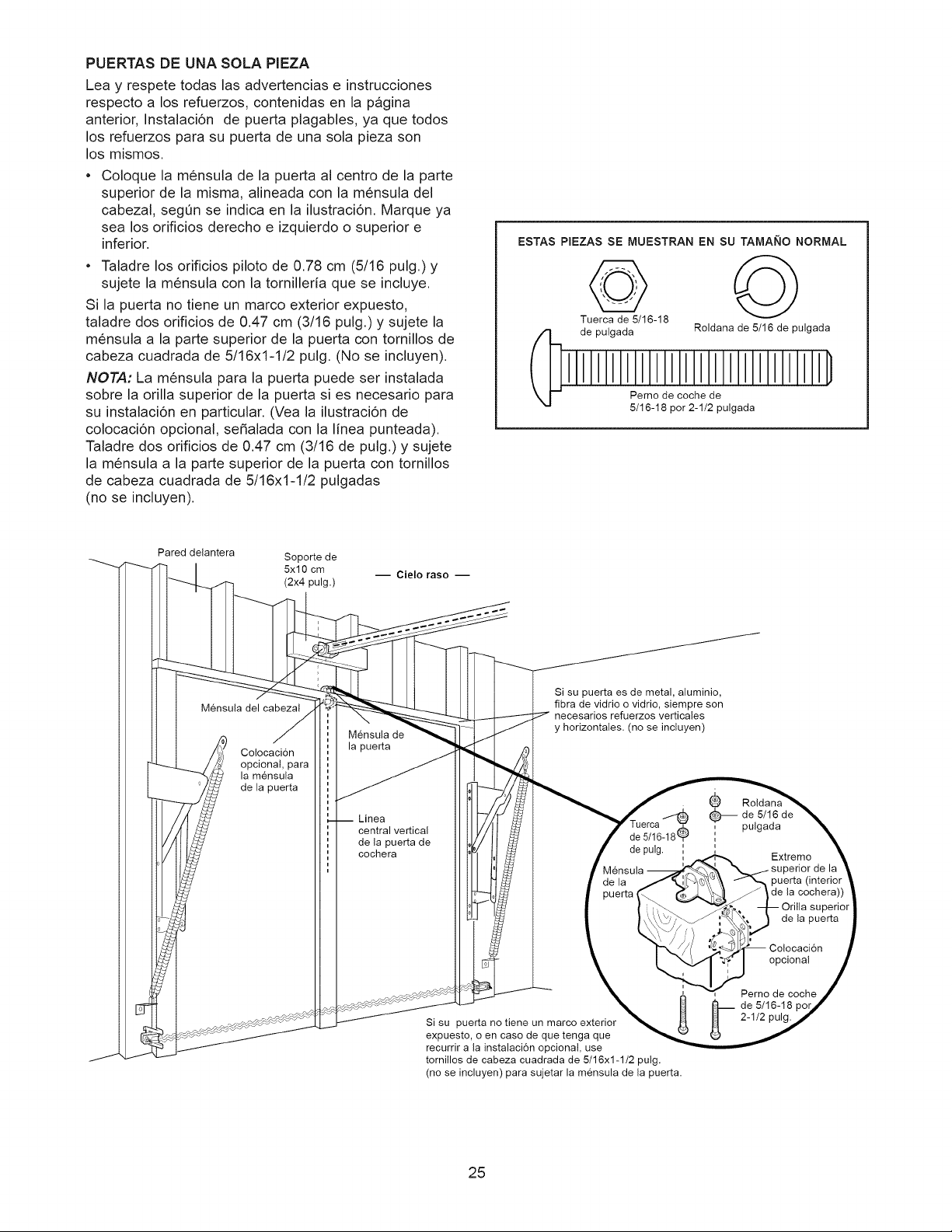
PUERTAS DE UNA SOLA PIEZA
Lea y respete todas las advertencias e instrucciones
respecto a los refuerzos, contenidas en ia p&gina
anterior, Instalaci6n de puerta plagables, ya que todos
los refuerzos para su puerta de una sola pieza son
los mismos.
• Coloque la mensula de la puerta al centro de la parte
superior de la misma, alineada con la mensula dei
cabezal, seg_n se indica en la ilustraci6n. Marque ya
sea los orificios derecho e izquierdo o superior e
inferior.
• Taladre los orificios piloto de 0.78 cm (5/16 pulg.) y
sujete la mensula con la tornilleria que se incluye.
Si la puerta no tiene un marco exterior expuesto,
taladre dos orificios de 0.47 cm (3/16 pulg.) y sujete la
mensula a la parte superior de la puerta con tornillos de
cabeza cuadrada de 5/16x1-1/2 pulg. (No se incluyen).
NOTA: La mensula para la puerta puede ser instalada
sobre la orilla superior de la puerta si es necesario para
su instalaci6n en particular. (Vea la ilustraci6n de
colocaci6n opcional, sefialada con la linea punteada).
Taladre dos orificios de 0.47 cm (3/16 de pulg.) y sujete
la mensula a la parte superior de la puerta con tornillos
de cabeza cuadrada de 5/16x1-1/2 pulgadas
(no se incluyen).
ESTAS PIEZAS SE MUESTRAN EN SU TAMANO NORMAL
T_6-18 _)
de pulgada Roldana de 5/16 de pulgada
Perno de coche de
5/16-18 por 2-1/2 pulgada
Pared delantera
Soporte de
5x10 cm
(2x4 pulg.)
-- Cielo raso --
Mensula del cabezal
Colocaci6n
opcional, para
la mensula
de la puerta
Mensula de
la puerta
Linea
central vertical
de la puerta de
cochera
Si su puerta es de metal, aluminio,
fibra de vidrio o vidrio, siempre son
necesarios refuerzos verticales
y horizontales. (no se incluyen)
de pulg.
de la
puerta
Si su puerta no tiene un marco exterior
expuesto, o en case de que tenga que
recurrir a la instalaci6n opcional, use
tornillos de cabeza cuadrada de 5/16x1-1/2 pulg.
(no se incluyen) para sujetar la mensula de la puerta.
_de 5/16 de
, pulgada
i
i
i
i
Extremo
puerta (interior
de la cochera))
superior
de la puerta
opcional
Pemo de coche
_ e 5/16-18 pot
2-1/2 pulg.
25
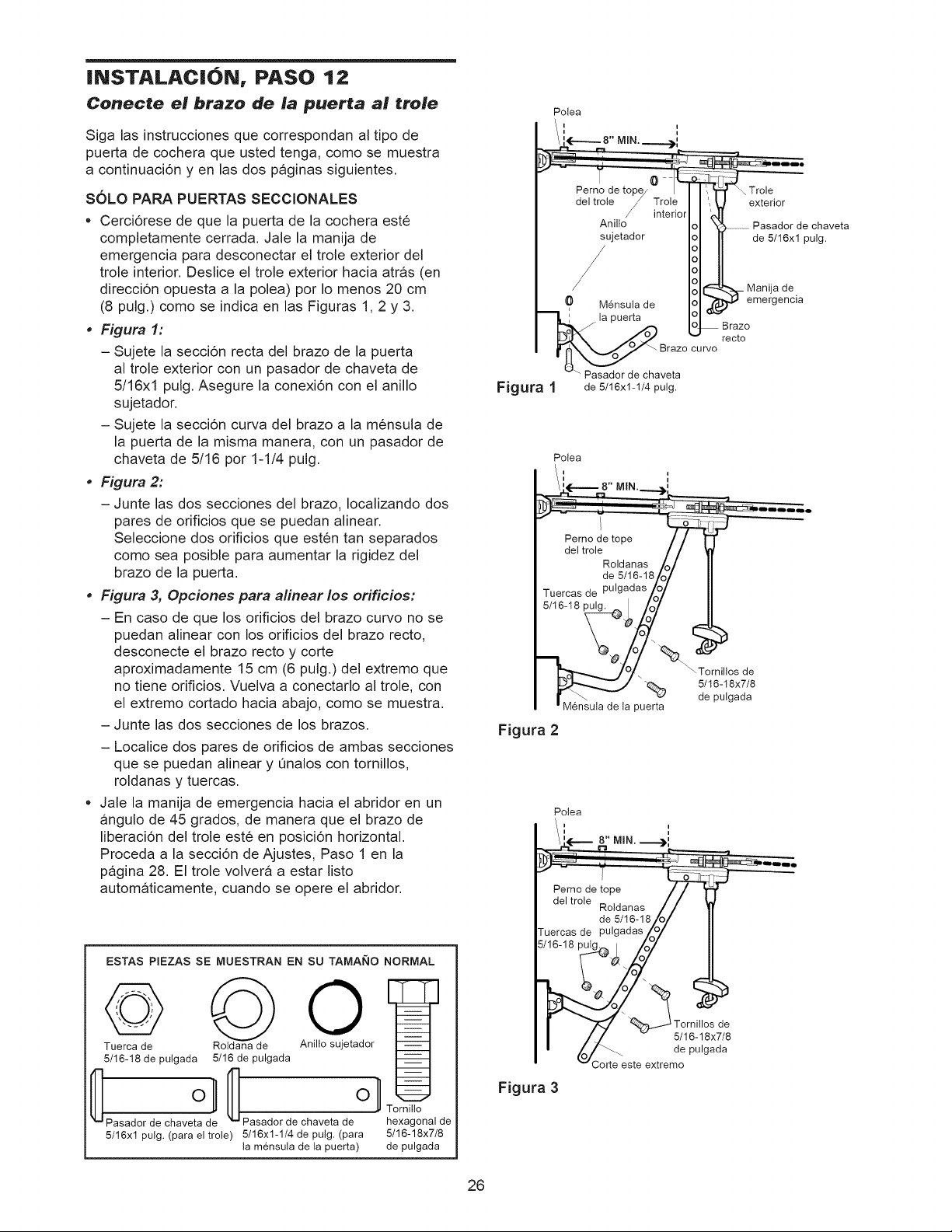
|NSTALAC|ON, PASO 12
Conecte el brazo de la puerta al trole
Siga las instrucciones que correspondan al tipo de
puerta de cochera que usted tenga, como se muestra
a continuaci6n y en las dos paginas siguientes.
SOLO PARA PUERTAS SECCIONALES
, Cerci6rese de que la puerta de la cochera este
completamente cerrada. Jale la manija de
emergencia para desconectar el trole exterior del
trole interior. Deslice el trole exterior hacia atras (en
direcci6n opuesta a la polea) por Io menos 20 cm
(8 pulg.) como se indica en las Figuras 1, 2 y 3.
* Figura 1:
- Sujete la secci6n recta del brazo de la puerta
al trole exterior con un pasador de chaveta de
5/16xl pulg. Asegure la conexi6n con el anillo
sujetador.
- Sujete la secci6n curva del brazo a la mensula de
la puerta de la misma manera, con un pasador de
chaveta de 5/16 por 1-1/4 pulg.
* Figura 2:
- Junte las dos secciones del brazo, Iocalizando dos
pares de orificios que se puedan alinear.
Seleccione dos orificios que esten tan separados
como sea posible para aumentar la rigidez del
brazo de la puerta.
* Figura 3, Opciones para alinear los orificios:
- En caso de que los orificios del brazo curvo no se
puedan alinear con los orificios del brazo recto,
desconecte el brazo recto y corte
aproximadamente 15 cm (6 pulg.) del extremo que
no tiene orificios. Vuelva a conectado al trole, con
el extremo cortado hacia abajo, como se muestra.
- Junte las dos secciones de los brazos.
- Localice dos pares de orificios de ambas secciones
que se puedan alinear y Qnalos con tornillos,
roldanas y tuercas.
, Jale la manija de emergencia hacia el abridor en un
angulo de 45 grados, de manera que el brazo de
liberaci6n del trole este en posici6n horizontal.
Proceda a la secci6n de Ajustes, Paso 1 en la
pagina 28. El trole volvera a estar listo
automaticamente, cuando se opere el abridor.
Polea
/', ',
_8" MIN.____,,,
/ O ...... _
Perno de tope/ I_ _Trole
del trole J Trole I I ',_, exterior
/ interiorl I
Anillo Io I X_ .................Pasador de chaveta
sujetador loll de 5/16xl pulg.
' Manija de
I 11
0 M6nsu,ade em°rgeoc'a
. la puerta IoJ --- Braze
U
recto
Braze curvo
Figura 1
Pasador de chaveta
de 5/16x1-1/4 pulg.
Polea
/' '
i i
](---- 8" I_IN.___._ 1
,, ......
Perno de tope / / _r
del trole /
't
Roldanas /o/
de 5/16-181o I
Tuercas de pulgadas/o/
5/16-18 pulg. Zo_
_Tornillos de
_ puer_ta 5/16-18x7/8
de pulgada
Figura 2
Polea
,,
8" MIN.
ESTAS PIEZAS SE MUESTRAN EN SU TAMANO NORMAL
Tuerca de
5/16-18 de pulgada
Pasador de chaveta de Pasador de chaveta de
8/16xl pulg. (para el trole) 8/16x1-1/4 de pulg, (para
la mensula de la puerta)
_ada A_or
Tornillo
hexagonal de
5/16-18x7/8
de pulgada
Figura 3
Tornillos de
5/16-18x7/8
de pulgada
Corte este extremo
26
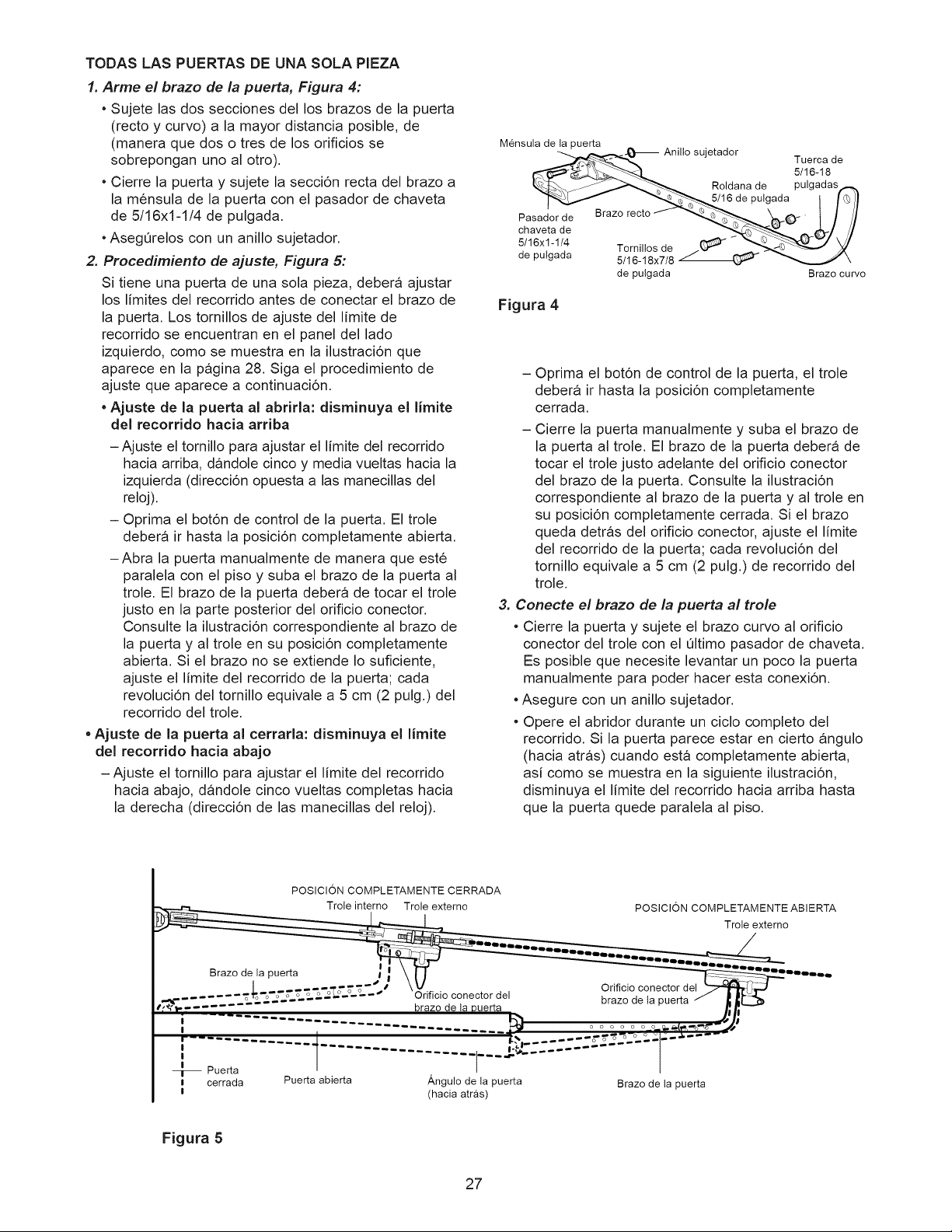
TODASLAS PUERTAS DE UNA SOLA PIEZA
1. Arme el brazo de la puerta, Figura 4:
• Sujete las dos secciones del los brazos de la puerta
(recto y curvo) a la mayor distancia posible, de
(manera que dos o tres de los orificios se
sobrepongan uno al otro)
• Cierre la puerta y sujete la secci6n recta del brazo a
la mensula de la puerta con el pasador de chaveta
de 5/16x1-1/4 de pulgada
• AsegQrelos con un anillo sujetador
2. Procedimiento de ajuste, Figura 5:
Si tiene una puerta de una sola pieza, debera ajustar
los limites del recorrido antes de conectar el brazo de
la puerta Los tornfllos de ajuste del limite de
recorrido se encuentran en el panel del lado
izquierdo, como se muestra en la ilustraci6n que
aparece en la pagina 28 Siga el procedimiento de
ajuste que aparece a continuaci6n
, Ajuste de la puerta al abrirla: disminuya el limite
del recorrido hacia arriba
-Ajuste el tornillo para ajustar el limite del recorrido
hacia arriba, dandole cinco y media vueltas hacia la
izquierda (direcci6n opuesta alas manecillas del
reloj)
- Oprima el bot6n de control de la puerta El trole
debera ir hasta la posici6n completamente abierta
-Abra la puerta manualmente de manera que este
paralela con el piso y suba el brazo de la puerta al
trole El brazo de la puerta debera de tocar el trole
justo en la parte posterior del orificio conector
Consulte la ilustraci6n correspondiente al brazo de
la puerta y al trole en su posici6n completamente
abierta Si el brazo no se extiende Io suficiente,
ajuste el limite del recorrido de la puerta; cada
revoluci6n del tornillo equivale a 5 cm (2 pulg) del
recorrido del trole
, Ajuste de la puerta al cerrarla: disminuya el limite
del recorrido hacia abajo
-Ajuste el tornillo para ajustar el limite del recorrido
hacia abajo, d&ndole cinco vueltas completas hacia
la derecha (direcci6n de las manecillas del reloj)
Mensula de la puerta
_ deAnillosujetador Tuerca de
5/16-18
Roldana de pulgadasf.._
pulgada I I _ il
pa_raz°rect°'-'f ""'_'_9_-------------------,_'_O" I / /I
chaveta de _"_ ,..__{_r'/, //
ae pulgada 5/16-18x7/8 _ _\
de pulgada Brazo curvo
Figura 4
- Oprima el bot6n de control de la puerta, el trole
debera ir hasta la posici6n completamente
cerrada.
- Cierre la puerta manualmente y suba el brazo de
la puerta al trole. El brazo de la puerta debera de
tocar el trole justo adelante del orificio conector
del brazo de la puerta. Consulte la ilustraci6n
correspondiente al brazo de la puerta y al trole en
su posici6n completamente cerrada. Si el brazo
queda detras del orificio conector, ajuste el limite
del recorrido de la puerta; cada revoluci6n del
tornillo equivale a 5 cm (2 pulg.) de recorrido del
trole.
3. Conecte el brazo de la puerta a! trole
• Cierre la puerta y sujete el brazo curvo al orificio
conector del trole con el Qltimo pasador de chaveta
Es posible que necesite levantar un poco la puerta
manualmente para poder hacer esta conexi6n
• Asegure con un anillo sujetador
• Opere el abridor durante un ciclo completo del
recorrido Si la puerta parece estar en cierto angulo
(hacia atr&s) cuando esta completamente abierta,
asi como se muestra en la siguiente ilustraci6n,
disminuya el limite del recorrido hacia arriba hasta
que la puerta quede paralela al piso
POSICION COMPLETAMENTE CERRADA
Trole interno Trole externo
POSICION COMPLETAMENTE ABIERTA
Trole externo
Brazo de la puerta
I
I
--_ Puerta
I cerrada
I
Orificio conector del
brazo de _uerta
Puerta abierta ,_,ngulo de la puerta
(hacia atras)
Orificio conector del
brazo de ta puerta
Brazo de la puerta
Figura 5
27
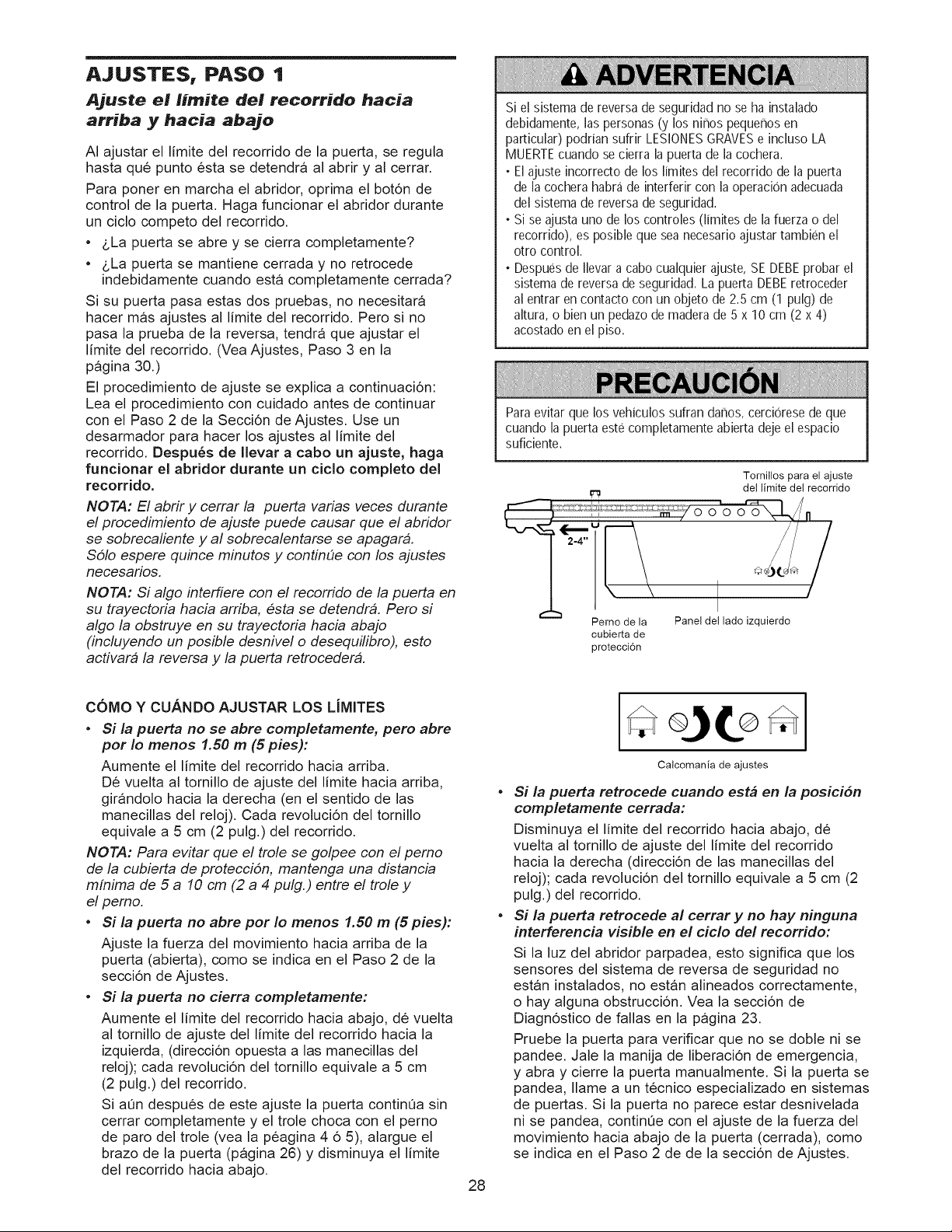
AJUSTE:S, PASO 1
Ajuste el lirnite del recorrido hacia
arriba y hacia abajo
AI ajustar el limite del recorrido de la puerta, se regula
hasta que punto esta se detendra al abrir y al cerrar.
Para poner en marcha el abridor, oprima el bot6n de
control de la puerta. Haga funcionar el abridor durante
un ciclo competo del recorrido.
• _,La puerta se abre y se cierra completamente?
• &La puerta se mantiene cerrada y no retrocede
indebidamente cuando esta completamente cerrada?
Si su puerta pasa estas dos pruebas, no necesitara
hacer mas ajustes al limite del recorrido. Pero si no
pasa la prueba de la reversa, tendra que ajustar el
limite del recorrido. (Vea Ajustes, Paso 3 en la
pagina 30.)
El procedimiento de ajuste se explica a continuaci6n:
Lea el procedimiento con cuidado antes de continuar
con el Paso 2 de la Secci6n de Ajustes. Use un
desarmador para hacer los ajustes al limite del
recorrido. Despu_s de Ilevar a cabo un ajuste, haga
funcionar el abridor durante un ciclo completo del
recorrido.
NOTA: El abrir y cerrar /a puerta varias veces durante
el procedimiento de ajuste puede causar que el abridor
se sobrecaliente y al sobrecalentarse se apagara.
$51o espere quince minutos y continde con los ajustes
necesarios.
NOTA: Si algo inteffiere con el recorrido de la puerta en
su trayectoria hacia arriba, esta se detendra. Pero si
algo la obstruye en su trayectoria hacia abajo
(incluyendo un posible desnivel o desequilibro), esto
activara la reversa y la puerta retrocedera.
Si el sistema de reversa de seguridad no se ha instalado
debidamente, las personas (y los niflos pequeflos en
particular) poddan suffir LESIONESGRAVESe incluso LA
MUERTEcuando se cierra la puerta de la cochera.
• El ajuste incorrecto de los limites del recorrido de la puerta
de la cochera habra de interfedr con la operacion adecuada
del sistema de reversa de seguddad.
• Si se ajusta uno de los controles (limites de la fuerza o del
recorrido), es posible que sea necesario ajustar tambien el
otro control.
• Despuesde Ilevar a cabo cualquier ajuste, SE DEBEprobar el
sistema de reversa de seguddad. La puerta DEBEretroceder
al entrar en contacto con un objeto de 2.5 cm (1 pulg) de
altura, o bien un pedazode madera de 5 x 10 cm (2 x 4)
acostado en el piso.
Para evitar que los vehiculos sufran daflos, cerciorese de que
cuando la puerta este completamente abierta deje el espacio
suficiente.
Tomillos para el ajuste
del limite del recorrido
°T:/
......... ,, N_Y o o o
Pemo de la Panel clel lado izquierdo
cubierta de
proteccidn
COMO Y CUANDO AJUSTAR LOS LIMITES
• Si la puerta no se abre completamente, pero abre
por Io menos 1.50 m (Spies):
Aumente el limite del recorrido hacia arriba.
De vuelta al tornillo de ajuste del limite hacia arriba,
gir&ndolo hacia la derecha (en el sentido de las
manecillas del reloj). Cada revoluci6n del tornillo
equivale a 5 cm (2 pulg.) del recorrido.
NOTA: Para evitar que el trole se golpee con el perno
de la cubierta de protecci6n, mantenga una distancia
minima de 5 a 10 cm (2 a 4 pulg.) entre el trole y
el perno.
• Si la puerta no abre por Io menos 1.50 m (Spies):
Ajuste la fuerza del movimiento hacia arriba de la
puerta (abierta), como se indica en el Paso 2 de la
secci6n de Ajustes.
• Si la puerta no cierra completamente:
Aumente el limite del recorrido hacia abajo, de vuelta
al tornillo de ajuste del limite del recorrido hacia la
izquierda, (direcci6n opuesta alas manecillas del
reloj); cada revoluci6n del tornillo equivale a 5 cm
(2 pulg.) del recorrido.
Si a0n despues de este ajuste la puerta contin0a sin
cerrar completamente y el trole choca con el perno
de paro del trole (vea la peagina 4 6 5), alargue el
brazo de la puerta (p&gina 26) y disminuya el limite
del recorrido hacia abajo.
28
Calcomania de ajustes
Si la puerta retrocede cuando estb en la posicidn
completamente cerrada:
Disminuya el limite del recorrido hacia abajo, de
vuelta al tornillo de ajuste del limite del recorrido
hacia la derecha (direcci6n de las manecillas del
reloj); cada revoluci6n del tornillo equivale a 5 cm (2
pulg.) del recorrido.
Si la puerta retrocede al cerrar y no hay ninguna
interferencia visible en el ciclo del recorrido:
Si la luz del abridor parpadea, esto significa que los
sensores del sistema de reversa de seguridad no
estan instalados, no est&n alineados correctamente,
o hay alguna obstrucci6n. Vea la secci6n de
Diagn6stico de fallas en la p&gina 23.
Pruebe la puerta para verificar que no se doble ni se
pandee. Jale la manija de liberaci6n de emergencia,
y abra y cierre la puerta manualmente. Si la puerta se
pandea, Ilame a un tecnico especializado en sistemas
de puertas. Si la puerta no parece estar desnivelada
ni se pandea, continOe con el ajuste de la fuerza del
movimiento hacia abajo de la puerta (cerrada), como
se indica en el Paso 2 de de la secci6n de Ajustes.
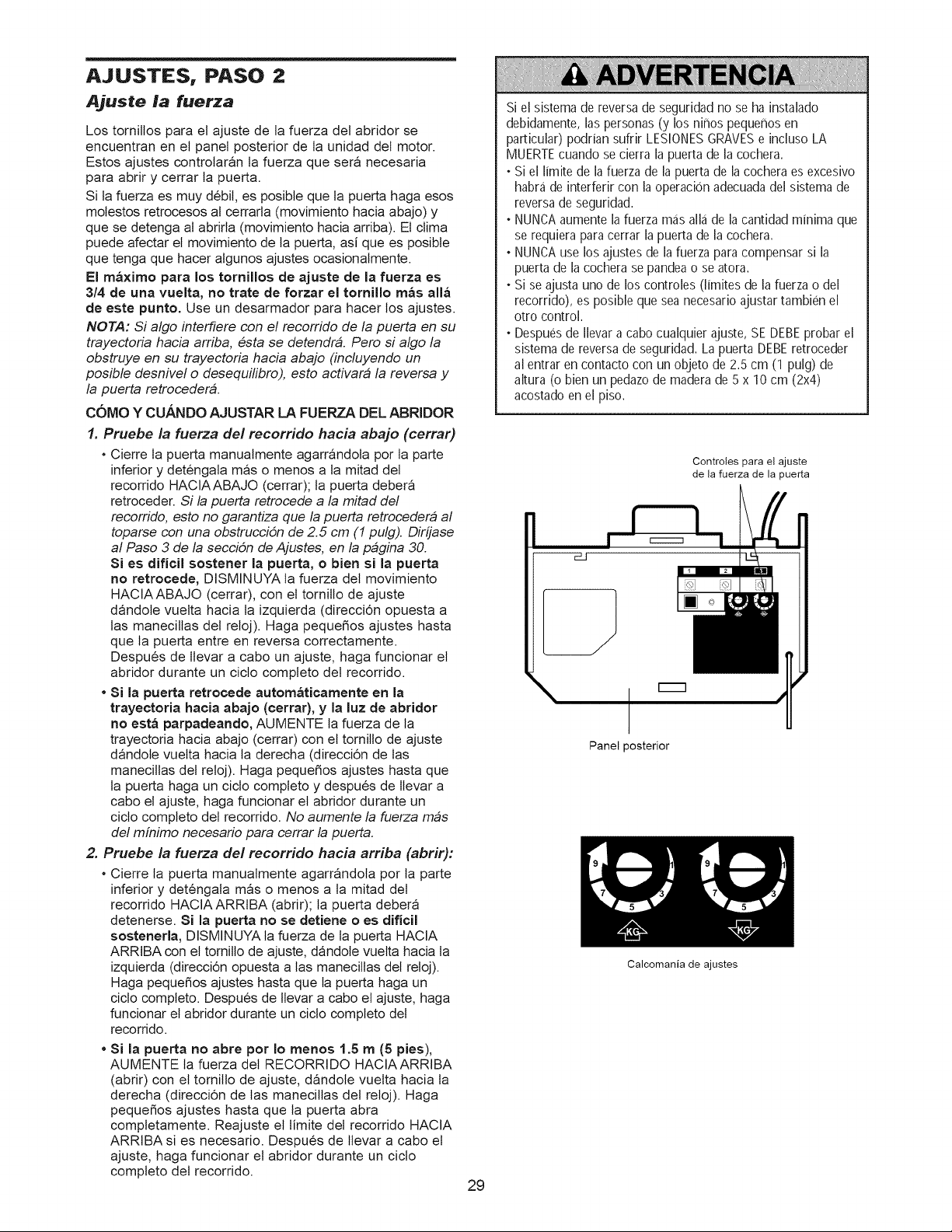
AJUSTE:S, PASO 2
Ajuste la fuerza
Los tornitlos para et ajuste de la fuerza det abridor se
encuentran en et panel posterior de la unidad det motor.
Estos ajustes controlaran la fuerza que sera necesaria
para abrir y cerrar ta puerta.
Si la fuerza es muy debit, es posible que la puerta haga esos
molestos retrocesos al cerrarla (movimiento hacia abajo) y
que se detenga al abrirla (movimiento hacia arriba). Et ctima
puede afectar et movimiento de la puerta, asi que es posible
que tenga que hacer algunos ajustes ocasionalmente.
El maximo para los tornillos de ajuste de la fuerza es
3/4 de una vuelta, no trate de forzar el tornillo mas alia
de este punto. Use un desarmador para hacer los ajustes.
NOTA: Si algo interfiere con el recorrido de la puerta en su
trayectoria hacia arriba, esta se detendra. Pero si algo la
obstruye en su trayectoria hacia abajo (incluyendo un
posible desnivel o desequilibro), esto activara la reversa y
la puerta retrocedera.
COMO Y CUANDO AJUSTAR LA FUERZA DEL ABRIDOR
1. Pruebe la fuerza del recorrido hacia abajo (cerrar)
• Cierre ta puerta manualmente agarrandola por ta parte
inferior y detengala mas o menos a ta mitad det
recomdo HACIAABAJO (cerrar); la puerta debera
retroceder. Si la puerta retrocede a la mitad del
recorrido, esto no garantiza que la puerta retrocedera al
toparse con una obstrucciOn de 2.5 cm (1 pulg). Dir[jase
al Paso 3 de la secciSn de Ajustes, en la pagina 30.
Si es dificil sostener la puerta, o bien si la puerta
no retrocede, DISMINUYA ta fuerza det movimiento
HACIAABAJO (cerrar), con et tomitlo de ajuste
dandole vuetta hacia la izquierda (direcci6n opuesta a
las manecillas det retoj). Haga pequefios ajustes hasta
que la puerta entre en reversa correctamente.
Despues de tlevar a cabo un ajuste, haga funcionar et
abridor durante un cicto completo det recorrido.
, Si la puerta retrocede automaticamente en la
trayectoria hacia abajo (cerrar), y la luz de abridor
no esta parpadeando, AUMENTE ta fuerza de la
trayectoria hacia abajo (cerrar) con el tornitlo de ajuste
dandole vuetta hacia ta derecha (direcci6n de tas
manecitlas del reloj). Haga pequeSos ajustes hasta que
la puerta haga un ciclo compteto y despues de tlevar a
cabo et ajuste, haga funcionar et abridor durante un
ciclo completo del recorrido. No aumente la fuerza mas
del m[nimo necesario para cerrar la puerta.
2. Pruebe la fuerza del recorrido hacia arriba (abrir):
• Cierre la puerta manualmente agarrandola por ta parte
inferior y detengala mas o menos a ta mitad det
recorrido HACIA ARRIBA (abrir); la puerta debera
detenerse. Si la puerta no se detiene o es dificil
sostenerla, DISMINUYA la fuerza de ta puerta HACIA
ARRIBA con el tornitlo de ajuste, dandole vuetta hacia ta
izquierda (direcci6n opuesta a tas manecitlas del retoj).
Haga pequeSos ajustes hasta que ta puerta haga un
cicto compteto. Despues de ttevar a cabo et ajuste, haga
funcionar et abridor durante un ciclo completo det
recorrido.
, Si la puerta no abre pot Io menos 1.5 m (5 pies),
AUMENTE ta fuerza det RECORRIDO HACIAARRIBA
(abrir) con et tornitlo de ajuste, d&ndole vuelta hacia la
derecha (direcci6n de las manecitlas det retoj). Haga
pequeSos ajustes hasta que la puerta abra
completamente. Reajuste et timite det recorrido HACIA
ARRIBA si es necesario. Despues de tlevar a cabo et
ajuste, haga funcionar et abridor durante un ciclo
completo det recorrido.
29
Si el sistema de reversa de seguridad no se ha instalado
debidamente, las personas (y los ninos pequenos en
particular) podrian suffir LESIONESGRAVESe incluso LA
MUERTEcuando se cierra la puerta de la cochera.
• Si el limite de la fuerza de la puerta de la cochera es excesivo
habr_ide interferir con la operad6n adecuada del sistema de
reversa de seguridad,
• NUNCAaumente la fuerza m_is alki de la cantidad minima que
se requiera paracerrar la puerta de la cochera,
• NUNCAuse los ajustes de la fuerza para compensar si la
puerta de la cochera se pandea o se atora,
• Si se ajusta uno de los controles (limites de la fuerza o del
recorrido), es posible que sea necesario ajustar tambien el
otto control,
• Despuesde Ilevar a cabo cualquier ajuste, SE DEBEprobar el
sistema de reversa de seguridad, La puerta DEBEretroceder
al entrar en contacto con un objeto de 2,5 cm (1 pulg) de
altura (o bien un pedazode maderade 5 x 10 cm (2x4)
acostado en el piso,
Controles para el ajuste
de la fuerza de la puerta
Panel posterior
Calcomania de ajustes
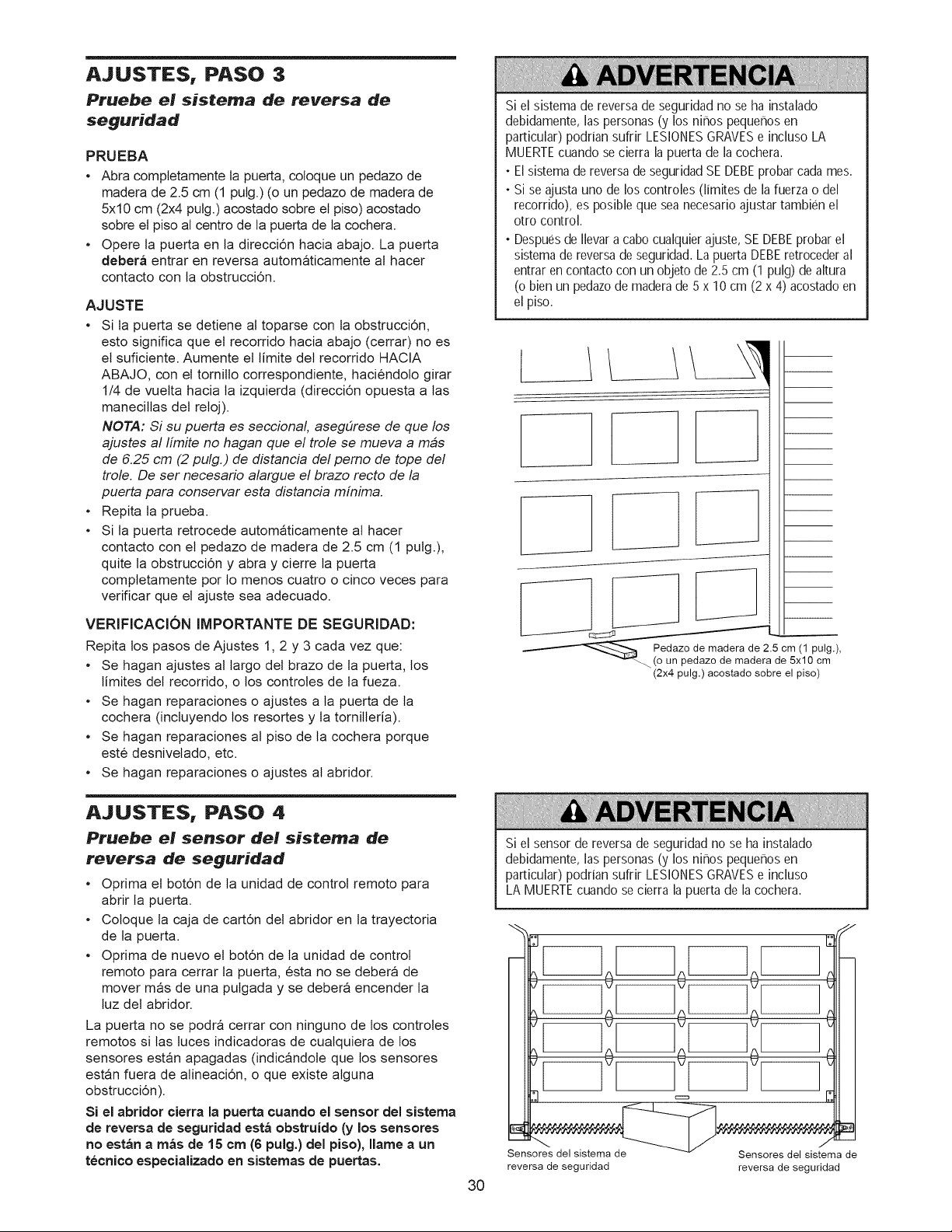
AJUSTES, PASO 3
Pruebe el sisterna de reversa de
seguridad
PRUEBA
• Abra completamente la puerta, coloque un pedazo de
madera de 2.5 cm (1 pulg.) (o un pedazo de madera de
5x10 cm (2x4 pulg.) acostado sobre et piso) acostado
sobre et piso al centro de la puerta de la cochera.
• Opere la puerta en la direcci6n hacia abajo. La puerta
debera entrar en reversa automaticamente al hacer
contacto con la obstrucci6n.
AJUSTE
• Si la puerta se detiene al toparse con ta obstrucci6n,
esto significa que et recorrido hacia abajo (cerrar) no es
el suficiente. Aumente et limite det recorrido HACIA
ABAJO, con et tornitlo correspondiente, haciendolo girar
1/4 de vuetta hacia la izquierda (direcci6n opuesta alas
manecitlas det retoj).
NOTA: Si su puerta es seccional, asegdrese de que los
ajustes al Ifmite no hagan que el trole se mueva a mas
de 6.25 cm (2 pulg.) de distancia del perno de tope del
trole. De ser necesario alargue el brazo recto de la
puerta para conservar esta distancia mfnima.
• Repita ta prueba.
• Si la puerta retrocede automaticamente al hacer
contacto con et pedazo de madera de 2.5 cm (1 pulg.),
quite la obstrucci6n y abra y cierre la puerta
completamente por 1o menos cuatro o cinco veces para
verificar que et ajuste sea adecuado.
VERIFICACJON IMPORTANTE DE SEGURIDAD:
Repita los pasos de Ajustes 1, 2 y 3 cada vez que:
• Se hagan ajustes al largo det brazo de la puerta, los
limites del recorrido, o los controles de la fueza.
• Se hagan reparaciones o ajustes a ta puerta de ta
cochera (inctuyendo los resortes y ta tornitleria).
• Se hagan reparaciones al piso de la cochera porque
este desnivetado, etc.
• Se hagan reparaciones o ajustes al abridor.
SJel sJstemade reversa de seguridad no se ha instalado
debidamente, las personas (y los niflos pequenos en
particular) poddan suffir LESIONESGRAVESe incluso LA
MUERTEcuando se cierra la puerta de la cochera.
• El sistema de reversa de seguridad SE DEBEprobar cada mes.
• Si se ajusta uno de los controles (limites de la fuerza o del
recorrido), es posible que sea necesafio ajustar tambien el
otro control.
• Despuesde Ilevar a cabo cualquier ajuste, SE DEBEprobar el
sistema de reversa de seguddad. La puerta DEBEretroceder al
entrar en contacto con un objeto de 2.5 cm (1 pulg) de altura
(o bien un pedazode maderade 5 x 10 cm (2 x 4) acostadoen
el piso.
__zo_25cm(1 ul
_de 5xl?cr_ ")'
(2x4 pulg.) acostado sobre el piso)
AJUSTES, PASO 4
Pruebe el sensor dei sJsterna de
reversa de seguridad
• ©prima et bot6n de ta unidad de control remoto para
abfir ta puerta.
• Coloque la caja de cart6n det abfidor en la trayectofia
de la puerta.
• ©prima de nuevo et bot6n de ta unidad de control
remoto para cerrar la puerta, esta no se debera de
mover mas de una pulgada y se debera encender la
luz det abridor.
La puerta no se podra cerrar con ninguno de los controles
remotos si las tuces indicadoras de cualquiera de los
sensores estan apagadas (indicandole que los sensores
estan fuera de alineaci6n, o que existe alguna
obstrucci6n).
Si el abridor eierra la puerta cuando el sensor del sistema
de reversa de seguridad esta obstruido (y los sensores
no estan a mas de 15 cm (6 pulg.) del piso), Ilame a un
tecnico especializado en sistemas de puertas.
Si el sensor de reversa de seguridad no se ha instalado
debidamente, las personas (y los ninos pequenos en
particular) podrian suffir LESIONESGRAVESe incluso
LA MUERTEcuando se cierra la puerta de la cochera.
30
l--q i--q i---q I
e
reversa de seguridad
Sensores del sistema de
reversa de seguridad
OPERAC|ON
Para reducir el riesgo de lesiones graves o la muerte:
1. LEAY RESPETETODAS LASADVERTENCIASY LAS 9. Despuesde Ilevar a cabo cualquier ajuste, SE DEBEprobar el
INSTRUCCIONESDEOPERACION
2. SIEMPREconserve los controles remotos lejos del alcance de
los ninos. NUNCApermita que los ninos operen ojueguen
con los botones del control de la puerta de la cochera ni con
los controles remotos.
4. SOLOactive la puerta de la cochera siempre y cuando la
puedan ver con claridad, este debidamente ajustaday no haya
ninguna obstruccion en el recorrido de la puerta al cerrarse.
5. SIEMPREtenga la puerta de la cochera a la vista hasta que
este completamente cerrada. NADIEDEBEATRAVESAREL
RECORRIDODELA PUERTACUANDOESTAENMOVIMIENTO.
6. De ser posible, use la liberaci6n de emergencia para soltar el
trole SOLOcuando la puerta de la cochera este CERRADA.Si
los resortes est_indebiles o rotos, o bien si la puerta est_i
desequilibrada podria suceder que la puerta se caiga r_ipida
y/o inesperadamente cuando este abierta.
7. NUNCAuse la manija parajalar la puerta para abrirla o cerrarh.
Si el nudo de la cuerda se suelta, usted podria caerse.
8. Si se ajusta uno de los controles (limites de la fuerza o del
recorrido), es posible que sea necesario ajustar tambien el
otto control.
sistema de reversa de seguridad.
10. El sistema de reversa de seguridad SE DEBEprobar cada
mes. La puerta DEBEretroceder al entrar en contacto con un
objeto de 2.5 cm (1 pulg) de altura o bien un pedazode
maderade 5 x 10 cm (2x4) acostado en el piso.
11. SIEMPREMANTENGALA PUERTADE LA COCHERA
DEBIDAMENTEEQUILIBRADA(yea la p_igina3). Si la puerta
no est_idebidamente equilibrada podria no retroceder
cuando asi se requiere, Io que podria ocasionar una lesion
grave e incluso la muerte.
12. Todas las reparaciones necesarias en los cables, resortes y
otras piezas las DEBEIlevar a cabo un tecnico especializado
en sistemas de puertas, pues todas estas piezasest_inbajo
una tension EXTREMA.
13. SIEMPREdesconecte el suministro de energia electrica al
abridor de la puerta de la cochera antes de Ilevar a cabo
cualquier reparacion o de quitar las cubiertas.
14.CONSERVE ESTAS INSTRUCCIONES.
usar su abridor de puerta de cochera
Su abridor Security+ y et control remoto manual han sido
programados en ta fabrica con un c6digo coincidente que
cambia cada vez que se usa, accesando al azar mas de
100,000 mitlones de c6digos nuevos. Su abridor funcionara
con varios controles remotos Security+, utitizando hasta 8
funciones y un Sistema de entrada sin tlave de Security+.
Si compra un control remoto nuevo, o si desea desactivar
algQn control remoto, siga las instrucciones que aparecen
en la secci6n sobre C6mo programar et abridor.
Active su abridor de alguna de las siguientes maneras:
• El Control remoto manual: Mantenga oprimido el bot6n
grande hasta que ta puerta se empiece a mover.
• El Control de pared de la puerta: Mantenga oprimido et
bot6n hasta que la puerta se empiece a mover.
• La Entrada sin Ilave (vea Accesorios): Si su abridor de
puerta de cochera viene con este accesorio, debera
estar programado antes de usarlo. Vea COmo programar
el abridor.
Una vez activado el abridor (con el sensor de seguridad
de reversa correctamente instalado y a/ineado)
1. Si ta puerta est& abierta se va a cerrar. Si la puerta esta
cerrada se va a abrir.
2. Si ta puerta se esta cerrando va a retroceder.
3. Si la puerta se esta abriendo se va a detener.
4. Si la puerta se ha detenido en un punto parcialmente
abierta, se va a cerrar.
5. Sial cerrarse la puerta se top6 con alguna obstrucci6n,
va a retroceder. Si la obstrucci6n interrumpe et rayo del
sensor, ta tuz det abridor va a parpadear durante cinco
segundos.
6. Sial abrirse ta puerta se top6 con alguna obstrucci6n,
se va a detener.
7. Si la puerta esta completamente abierta, no va a cerrar
si et rayo esta interrumpido. Et sensor no tiene ningQn
efecto en et ciclo de apertura.
Si et sensor no se ha instalado o esta desalineado, ta
puerta no va a cerrar con el control remoto manual. Sin
embargo, la puerta se puede cerrar con et Control de la
puerta, et Interruptor de ta tlave externa, o ta Entrada sin
ltave, siempre y cuando los active hasta que et recorrido
hacia abajo haya terminado. Si suetta demasiado pronto, la
puerta va a retroceder.
La luz del abridor se va a encender en los siguientes
casos: siempre que conecte el abridor iniciatmente; cuando
se restaura et suministro de energia despues de una
interrupci6n; cuando et abridor se activa.
La luz se apaga automaticamente despues de cuatro
minutos y medio, o se queda encendida cuando se activa
Luz en la Consola de control Premium. Los focos deben
set de 75 vatios maximo.
La caracteristica de la luz del Security+: La luz se va a
encender tambien si alguien camina por la puerta de la
cochera cuando esta abierta. Si tiene la Consola de control
Premium, esto puede desactivarse como sigue: Con ta luz
det abridor apagada, optima y mantenga oprimido et bot6n
de ta luz durante 10 segundos hasta que la luz se
encienda y se apague de nuevo. Para volver a activar
esto, empiece et procedimiento con la tuz encendida, luego
oprima y mantenga oprimido et bot6n de ta luz durante 10
segundos hasta que la luz se apague y luego se encienda
de nuevo.
31
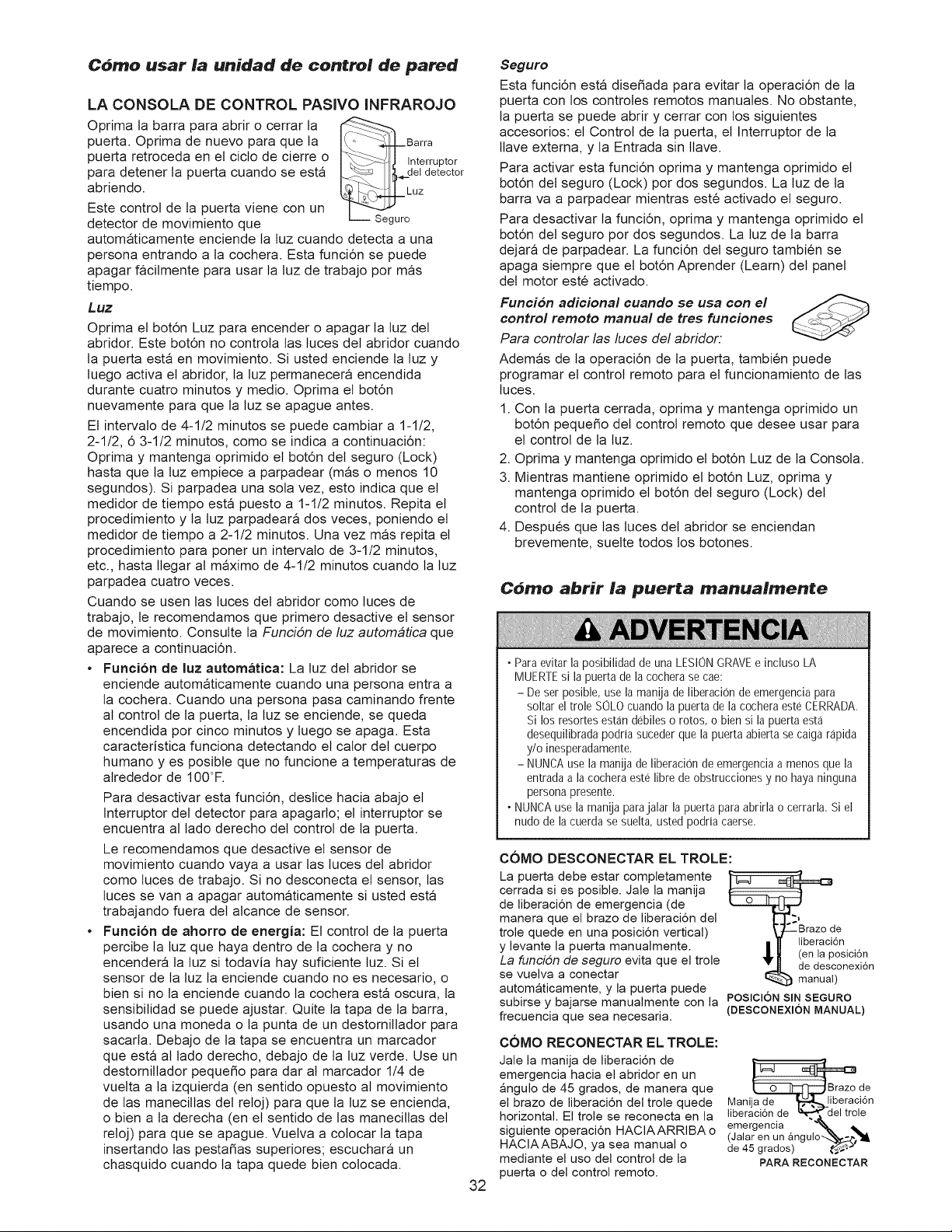
C6rno usar la unidad de control de pared
LA CONSOLA DE CONTROL PASIVO INFRAROJO
Oprima la barra para abrir o cerrar la
puerta. Oprima de nuevo para que la
puerta retroceda en el cicto de cierre o
para detener ta puerta cuando se esta
abriendo.
Este control de ta puerta viene con un
detector de movimiento que
Barra
Interrupter
et detector
uz
automaticamente enciende la tuz cuando detecta a una
persona entrando a ta cochera. Esta funci6n se puede
apagar facitmente para usar la luz de trabajo por mas
tiempo.
Luz
Oprima et bot6n Luz para encender o apagar ta tuz del
abridor. Este bot6n no controla las luces det abridor cuando
la puerta esta en movimiento. Si usted enciende la luz y
luego activa et abridor, la luz permanecera encendida
durante cuatro minutos y medio. Oprima et bot6n
nuevamente para que ta tuz se apague antes.
El intervalo de 4-1/2 minutos se puede cambiar a 1-1/2,
2-1/2, 6 3-1/2 minutos, como se indica a continuacidn:
Optima y mantenga oprimido et bot6n det seguro (Lock)
hasta que ta luz empiece a parpadear (mas o menos 10
segundos). Si parpadea una sota vez, esto indica que el
medidor de tiempo esta puesto a 1-1/2 minutos. Repita el
procedimiento y la tuz parpadeara dos veces, poniendo el
medidor de tiempo a 2-1/2 minutos. Una vez mas repita et
procedimiento para porter un intervalo de 3-1/2 minutos,
etc., hasta llegar al maximo de 4-1/2 minutos cuando la luz
parpadea cuatro veces.
Cuando se usen tas luces det abridor como luces de
trabajo, te recomendamos que primero desactive et sensor
de movimiento. Consulte la FunciOn de luz automatica que
aparece a continuaci6n.
• Funcion de luz automatica: La tuz det abridor se
enciende automaticamente cuando una persona entra a
la cochera. Cuando una persona pasa caminando frente
al control de la puerta, la tuz se enciende, se queda
encendida por cinco minutos y luego se apaga. Esta
caracteristica funciona detectando et cator det cuerpo
humano yes posible que no funcione a temperaturas de
alrededor de 100°F.
Para desactivar esta funci6n, destice hacia abajo et
Interruptor det detector para apagarto; el interruptor se
encuentra al tado derecho det control de ta puerta.
Le recomendamos que desactive el sensor de
movimiento cuando vaya a usar las tuces det abridor
como tuces de trabajo. Si no desconecta et sensor, las
luces se van a apagar automaticamente si usted esta
trabajando fuera det alcance de sensor.
• Funcion de ahorro de energia: El control de la puerta
percibe la luz que haya dentro de ta cochera y no
encendera la tuz si todavia hay suficiente tuz. Si et
sensor de la tuz ta enciende cuando no es necesario, o
bien si no la enciende cuando ta cochera esta oscura, la
sensibitidad se puede ajustar. Quite ta tapa de la barra,
usando una moneda o la punta de un destornitlador para
sacarla. Debajo de la tapa se encuentra un marcador
que esta al lado derecho, debajo de la tuz verde. Use un
destornittador pequefio para dar al marcador 1/4 de
vuetta a la izquierda (en sentido opuesto al movimiento
de tas manecitlas det retoj) para que ta luz se encienda,
o bien a ta derecha (en et sentido de tas manecitlas det
retoj) para que se apague. Vuetva a colocar la tapa
insertando las pestafias superiores; escuchara un
chasquido cuando la tapa quede bien colocada.
Seguro
Esta funci6n esta diseSada para evitar ta operaci6n de la
puerta con los controles remotos manuales. No obstante,
la puerta se puede abrir y cerrar con los siguientes
accesorios: et Control de la puerta, et Interruptor de ta
ltave externa, y ta Entrada sin llave.
Para activar esta funci6n optima y mantenga oprimido el
bot6n det seguro (Lock) por dos segundos. La luz de la
barra va a parpadear mientras este activado et seguro.
Para desactivar la funci6n, optima y mantenga oprimido et
bot6n del seguro por dos segundos. La luz de ta barra
dejara de parpadear. La funci6n det seguro tambien se
apaga siempre que et bot6n Aprender (Learn) det panel
det motor este activado.
Funci6n adicional cuando se usa con el
control remoto manual de tres funciones
Para controlar las luces del abridor:
Ademas de ta operaci6n de la puerta, tambien puede
programar et control remoto para et funcionamiento de las
luces.
1. Con ta puerta cerrada, optima y mantenga oprimido un
bot6n pequeSo det control remoto que desee usar para
et control de ta luz.
2. Optima y mantenga oprimido et bot6n Luz de la Consola.
3. Mientras mantiene oprimido et bot6n Luz, optima y
mantenga oprimido et bot6n det seguro (Lock) det
control de ta puerta.
4. Despues que tas luces det abridor se enciendan
brevemente, suette todos los botones.
C6rno abrir la puerta rnanualrnente
32
• Para evitar la posibilidad de una LESION GRAVEe incluso LA
MUERTEsi la puerta de la cochera se cae:
- De ser posible, use la manija de liberaciOnde emergencia para
soltar el trole SOLOcuando la puerta de la cochera este CERRADA.
Si los resortes estan debiles o rotos, o bien si la puerta esta
desequilibrada podria suceder que la puerta abierta se caiga rapida
y/o inesperadamente.
- NUNCA use la manija de liberacion de emergencia a menos que la
entrada a la cochera este libre de obstrucciones y no haya ninguna
persona presente.
• NUNCAuse la manija parajalar la puerta para abrirla o cerrarla. Si el
nudo de la cuerda se suelta, usted podria caerse.
COMO DESCONECTAR EL TROLE:
La puerta debe estar completamente
cerrada si es posible. Jale la manija
de liberaci6n de emergencia (de
manera que el brazo de liberaci6n del
trole quede en una posici6n vertical)
y levante la puerta manualmente.
La funci6n de seguro evita que el trole
se vuelva a conectar
_._. B razo de
I _ liberaci6n
II (en la posici6n
de desconexi6n
manual)
automaticamente, y la puerta puede
subirse y bajarse manualmente con la POSICION SIN SEGURO
frecuencia que sea necesaria. (DESCONEXION MANUAL)
COMO RECONECTAR EL TROLE:
Jale la manija de liberaci6n de | b=,J_l_tl=_===c_-b=,J_ -
emergencia hacia el abridor en un t: -_,_
angulo de 45 grados, de manera que _Brazo de
el brazo de liberaci6n del trole quede Manijade _-._.J_iberaci6n
horizontal. El trole se reconecta en la liberaci6n de _ deltrole
emergencia " ",1t_
siguiente operaci6n HACIAARRIBA o (Jalaren unangulo_'_l,t__,-,_
HACIAABAJO, ya sea manual o de 45 grades) _1
mediante el uso del control de la PARARECONECTAR
puerta odel control remoto.
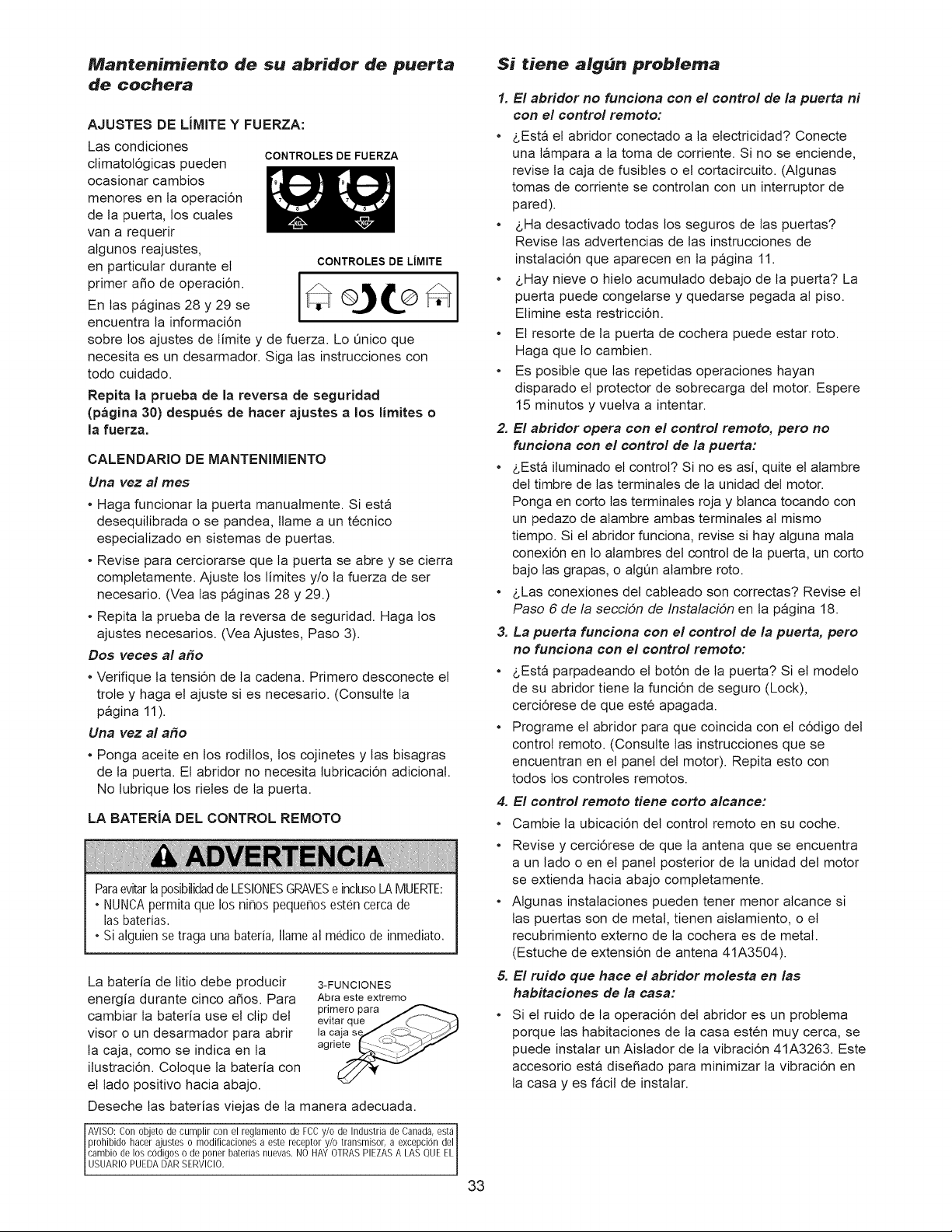
Mantenirniento de su abridor de puerta
de cochera
AJUSTES DE LiMITE Y FUERZA:
Las condiciones
CONTROLES DE FUERZA
climatol6gicas pueden
ocasionar cambios
menores en ta operaci6n
de la puerta, los cuales
van a requerir
algunos reajustes,
en particular durante et
primer aSo de operaci6n.
En tas paginas 28 y 29 se
encuentra la informaci6n
sobre los ajustes de timite y de fuerza. Lo _nico que
necesita es un desarmador. Siga las instrucciones con
todo cuidado.
CONTROLES DE LiMITE
Repita la prueba de la reversa de seguridad
(pagina 30) despues de hacer ajustes a los limites o
la fuerza.
CALENDARIO DE MANTENIMIENTO
Una vez al rues
• Haga funcionar la puerta manualmente. Siesta
desequilibrada o se pandea, llame a un tecnico
especializado en sistemas de puertas.
• Revise para cerciorarse que la puerta se abre y se cierra
completamente. Ajuste los limites y/o la fuerza de ser
necesario. (Vea las paginas 28 y 29.)
• Repita ta prueba de ta reversa de seguridad. Haga los
ajustes necesarios. (Vea Ajustes, Paso 3).
Dos veces al a#o
• Verifique la tensi6n de ta cadena. Primero desconecte et
trole y haga et ajuste si es necesario. (Consulte la
pagina 11).
Una vez al a#o
• Ponga aceite en los rodittos, los cojinetes y tas bisagras
de la puerta. Et abridor no necesita lubricaci6n adicional.
No tubrique los rieles de la puerta.
LA BATERiA DEL CONTROL REMOTO
Paraevitarla posibilidadde LESIONESGRAVESe inclusoLA MUERTE:
• NUNCApermita que los ninos pequenos esten cerca de
las baterias.
• Si alguien se traga una bated& Ilame al medico de inmediato.
La bateria de litio debe producir
energia durante cinco a_os. Para
cambiar la bateria use et clip det
visor o un desarmador para abrir
la caja, como se indica en la
itustraci6n. Coloque la bateria con
et lado positivo hacia abajo.
3-FUNCIONES
Abra este extremo
primero para
evitar que / _ -_-A_
la caja seF,t"_,; _
agne_
Deseche las baterias viejas de ta manera adecuada.
AVISO: Con objeto de cumplir con el reglarnento de FCCy/o de Industria de Canada,esta
prohibido hacer ajustes o rnodificaciones a este receptor y/o transrnisor, a excepcion del
cambio de los codigos o de poner bateriasnuevas.NO HAYOTRASPIEZASALAS QUEEL
USUAR0 PUEDADAR SERVC O.
Si tiene algun problerna
1. El abridor no funciona con el control de la puerta ni
con el control remoto:
• &Esta et abridor conectado a la etectricidad? Conecte
una lampara a la toma de corriente. Si no se enciende,
revise la caja de fusibles o et cortacircuito. (Algunas
tomas de corriente se controlan con un interruptor de
pared).
• &Ha desactivado todas los seguros de las puertas?
Revise las advertencias de las instrucciones de
instalaci6n que aparecen en la pagina 11.
• &Hay nieve o hieto acumulado debajo de la puerta? La
puerta puede congetarse y quedarse pegada al piso.
Etimine esta restricci6n.
• Et resorte de ta puerta de cochera puede estar roto.
Haga que to cambien.
• Es posible que las repetidas operaciones hayan
disparado et protector de sobrecarga det motor. Espere
15 minutos y vuetva a intentar.
2. El abridor opera con el control remoto, pero no
funciona con el control de la puerta:
• &Esta ituminado el control? Si no es asi, quite et alambre
det timbre de las terminates de la unidad det motor.
Ponga en corto las terminales roja y blanca tocando con
un pedazo de alambre ambas terminales al mismo
tiempo. Si et abridor funciona, revise si hay alguna mala
conexi6n en 1o alambres det control de ta puerta, un corto
bajo tas grapas, o algQn alambre roto.
• &Las conexiones det cableado son correctas? Revise et
Paso 6 de la secci6n de Insta/aci6n en la pagina 18.
3. La puerta funciona con el control de la puerta, pero
no funciona con el control remoto:
• $Esta parpadeando el bot6n de la puerta? Si et modeto
de su abridor tiene la funci6n de seguro (Lock),
cerci6rese de que este apagada.
• Programe et abridor para que coincida con et c6digo det
control remoto. (Consulte tas instrucciones que se
encuentran en et panel det motor). Repita esto con
todos los controles remotos.
4.
o
o
El control rernoto tiene corto alcance:
Cambie la ubicaci6n det control remoto en su coche.
Revise y cerci6rese de que la antena que se encuentra
a un lado o en et panel posterior de la unidad det motor
se extienda hacia abajo completamente.
• Algunas instalaciones pueden tener menor atcance si
las puertas son de metal, tienen aislamiento, o et
recubrimiento externo de ta cochera es de metal.
(Estuche de extensi6n de antena 41A3504).
5. El ruido que hate el abridor molesta en las
habitaciones de la casa:
Si et ruido de la operaci6n del abridor es un probtema
porque tas habitaciones de ta casa esten muy cerca, se
puede instalar un Aislador de ta vibraci6n 41A3263. Este
accesorio esta diseSado para minimizar la vibraci6n en
la casa y es facit de instalar.
33
Si tiene algun problerna (continua)
6. La puerta de la cochera se abre y se cierra por si
misma:
* AsegOrese que todos los botones det control remoto
esten apagados.
* Quite et alambre del timbre de tas terminales det control
de la puerta y haga funcionar la puerta solamente con et
control remoto. Si esto resuetve et problema, et control
de la puerta tiene alguna falta (cambieto), o hay atgOn
corto intermitente en et alambre entre et control de ta
puerta y la unidad det motor.
* Limpie la memoria y vuetva a programar todos los controles
remotos.
7. La puerta no hable completamente:
* &Hay algo que este obstruyendo la puerta? &Esta
desequitibrada, o los resortes estan rotos? Etimine ta
obstrucci6n o repare la puerta.
* Si la puerta esta en buenas condiciones pero no abre
completamente, aumente ta fuerza hacia arriba. Vea
Ajustes, Paso 2.
* Si la puerta abre por to menos cinco pies, es posible que
se tengan que aumentar los limites del recorrido. Una
vuetta equivale a 5 cm (2 pulg.) det recorrido. Vea
Ajustes, Paso 1.
Repita la prueba de seguridad de reversa despues de
terminar el ajuste.
8. La puerta se detiene pero no cierra completamente:
* Revise los procedimientos de ajuste de los limites det
recorrido que aparecen en la pagina 28.
Repita la prueba de seguridad de reversa despues de
realizar cualquier ajuste al largo del brazo de la puerta, a la
fuerza o al Ifmite hacia abajo.
9. La puerta se abre pero no se cierra:
* Si ta tuz del abridor parpadea, revise et sensor de
seguridad de reversa. Vea la secci6n de Instalaci6n,
Paso 10.
Si ta luz det abridor no parpadea y se trata de una
instalaci6n nueva, revise la fuerza hacia abajo. Vea la
secci4n de Ajustes, Paso 2 que aparece en ta pagina
29. Si se trata de una instalaci6n ya existente, vea a
continuaci6n.
Repita la prueba de seguridad de reversa despues de
terminar el ajuste.
10. La puerta retrocede sin raz6n aparente y la luz de/
abridor no parpadea:
* LHay algo que este obstruyendo la puerta? Jale la
manija de liberaci6n de emergencia. Opere ta puerta
manualmente. Siesta desequitibrada o se pandea, Ilame
a un tecnico especializado en sistemas de puertas.
* Limpie et piso de la cochera si tiene hielo o nieve en et
punto donde la puerta cierra.
* Revise Ajustes, Paso 2 en ta pagina 29.
* Si ta puerta retrocede a la posici6n completamente
cerrada, disminuya los limites de recorrido (Ajustes,
Paso 1).
Repita la prueba de seguridad de reversa despues de
hacer los ajustes a la fuerza o a los Ifmites del recorrido.
La necesidad de un ajuste ocasional de la fuerza y del
34
Ifmite es normal. Las condiciones climatolOgicas en
particular pueden afectar el recorrido de la puerta.
11. La puerta retrocede sin raz6n aparente y la luz del
abridor parpadea por cinco segundos despues de
que retrocede:
* Revise et sensor de reversa de seguridad. Quite
cualquier obstrucci6n o alinee et ojo receptor. Yea la
secci4n de Instalaci4n, Paso 10.
12. La luz del abridor no se enciende:
* Cambie los focos (de 75 vatios maximo). Use un foco
estandar para puerta de cochera, si et foco se funde.
13. La luz del abridor no se apaga:
* &Esta activada ta funci6n de tuz? Si es asi, apagueta.
14. El abridor necesita la m#xima fuerza para operar la
puerta:
* La puerta podria estar desequitibrada, o los resortes
podrian estar rotos. Cierre la puerta y use ta manija de
liberaci6n de emergencia para desconectar et trole. Abra
y cierre la puerta manualmente. Si la puerta esta bien
equitibrada se sostiene en cualquier punto det recorrido
con s61o el soporte de sus resortes. Si esto no ocurre,
desconecte et abridor y llama a un tecnico especializado
en sistemas de puertas. No aumenta la fuerza
para operar el abridor.
15. El motor hace un ruido brevemente pero luego no
funciona
Los resortes de ta puerta de cochera podrian estar
rotos. Yea los parrafos anteriores.
Si et problema se presenta la primera vez que opera et
abridor, puede set que la puerta este con seguro. Quite
et seguro de la puerta. Si ha quitado la cadena y ta ha
vuetto a instalar, et motor podria estas desfasado. Quite
la cadena; corra et cicto det motor hasta ta posici6n
hacia abajo. Observe la polea o rueda dentada, si gira a
la derecha, es decir en et sentido de las manecittas del
retoj, y se detiene en ta posici6n hacia abajo, vuetva a
instalar la cadena.
Repita la prueba de seguridad de reversa despues de
terminar el ajuste
16. El abridor no funciona debido a una falla en el
suministro de energia
* Use ta manija de liberaci6n de emergencia para
desconectar et trole. La puerta se puede abrir y cerrar
manualmente. Cuando se restaure et suministro de
energia, optima et bot6n de control de ta puerta y et trole
se vuetve a conectar automaticamente (a menos que
este con seguro). Vea la pagina 32.
* Et accesorio Llave de liberaci6n de emergencia (que se
usa solamente en las cocheras que no tienen una puerta
de servicio) desconecta el trole desde afuera de ta
cochera en caso de una falla en et suministro de
energia.
17. Si la cadena se cuelga o se afloja:
* Es normal que la cadena cuetgue un poco cuando ta
puerta esta cerrada. Use ta liberaci6n de emergencia
para desconectar et trole. Si ta cadena vuetve a su
attura normal cuando et trole esta desconectado y la
puerta retrocede al toparse con un pedazo de madera
de 2.5 cm (1 pulg.), no es necesario efectuar ningQn
ajuste. (Vea la pagina 11).
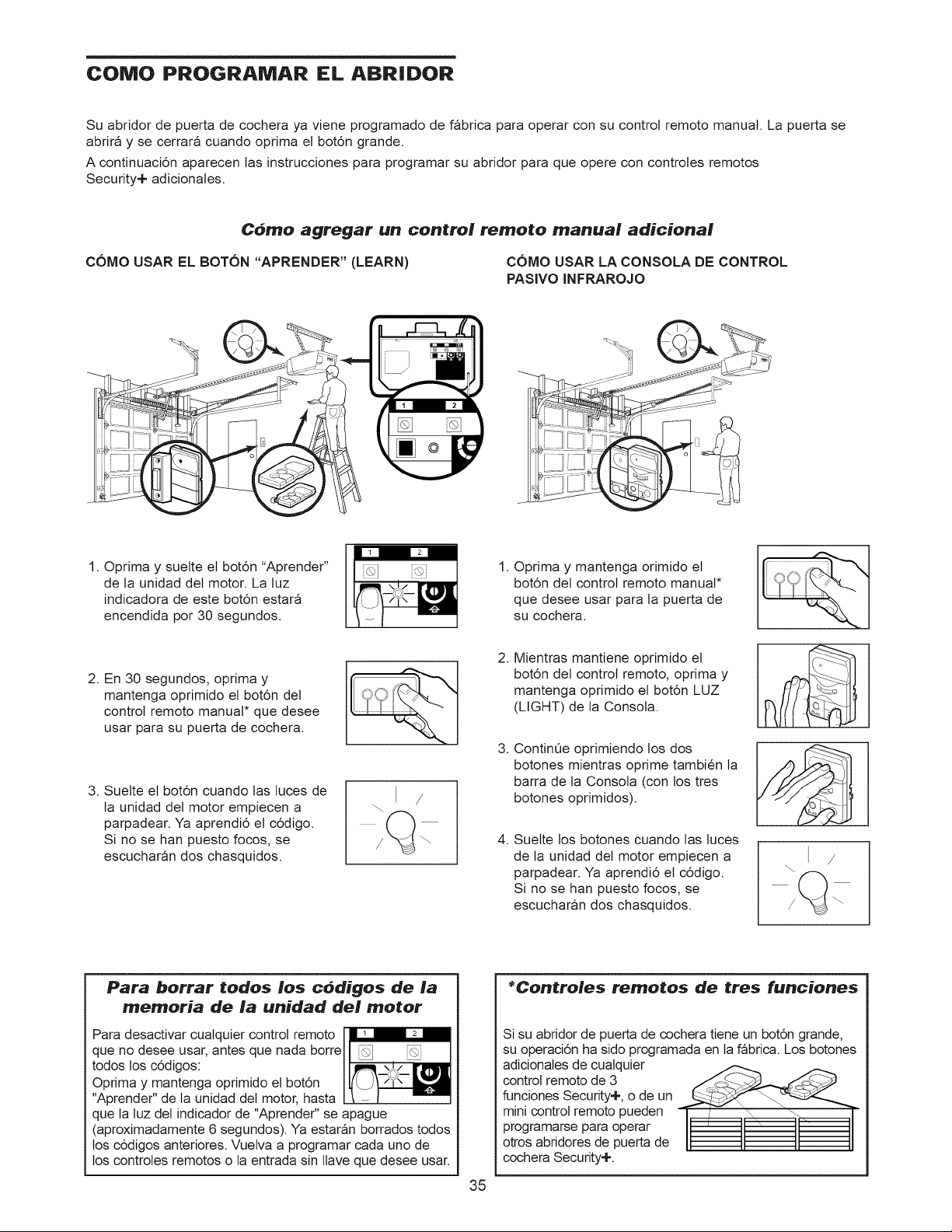
COMO PROGRAMAR EL ABRiDOR
Su abridor de puerta de cochera ya viene programado de fabrica para operar con su control remoto manual. La puerta se
abrira y se cerrara cuando oprima et bot6n grande.
A continuaci6n aparecen las instrucciones para programar su abridor para que opere con controles remotos
Security+ adicionales.
C6rno agregar un control rernoto manual adJcJonal
COMO USAR EL BOTON "APRENDER" (LEARN) COMO USAR LA CONSOLA DE CONTROL
PASWO INFRAROJO
1. Oprima y suette et bot6n "Aprender"
de ta unidad del motor. La luz
indicadora de este bot6n estara
encendida por 30 segundos.
2. En 30 segundos, oprima y
mantenga oprimido et bot6n det
control remoto manual* que desee
usar para su puerta de cochera.
3. Suette el bot6n cuando las luces de
la unidad det motor empiecen a
parpadear. Ya aprendi6 el c6digo.
Si no se hart puesto focos, se
escucharan dos chasquidos.
1,
2,
3,
4,
Oprima y mantenga orimido et
bot6n det control remoto manual*
que desee usar para la puerta de
su cochera.
Mientras mantiene oprimido et
bot6n det control remoto, optima y
mantenga oprimido et bot6n LUZ
(LIGHT) de la Consola.
Contint_e oprimiendo los dos
botones mientras oprime tambien la
barra de ta Consola (con los tres
botones oprimidos).
Suelte los botones cuando las luces
de la unidad del motor empiecen a
parpadear. Ya aprendi6 et c6digo.
Si no se han puesto focos, se
escucharan dos chasquidos.
LIH
Para borrar redes los c6dJgos de la
rnemoria de la .nidad del motor
Para desactivar cualquier control remoto
que no desee usar, antes que nada borre
todos los c6digos:
Optima y mantenga oprimido et bot6n
"Aprender" de la unidad del motor, hasta
que ta tuz del indicador de "Aprender" se apague
(aproximadamente 6 segundos). Ya estaran borrados todos
los c6digos anteriores. Vuetva a programar cada uno de
los controles remotos o la entrada sin ltave que desee usar.
35
*Controles rernotos de tres funciones
Si su abridor de puerta de cochera tiene un bot6n grande,
su operaci6n ha sido programada en la fabrica. Los botones
adicionales de cualquier
control remoto de 3
funciones Security+, o de un
mini control remoto pueden
programarse para operar
otros abridores de puerta de
cochera Security+.
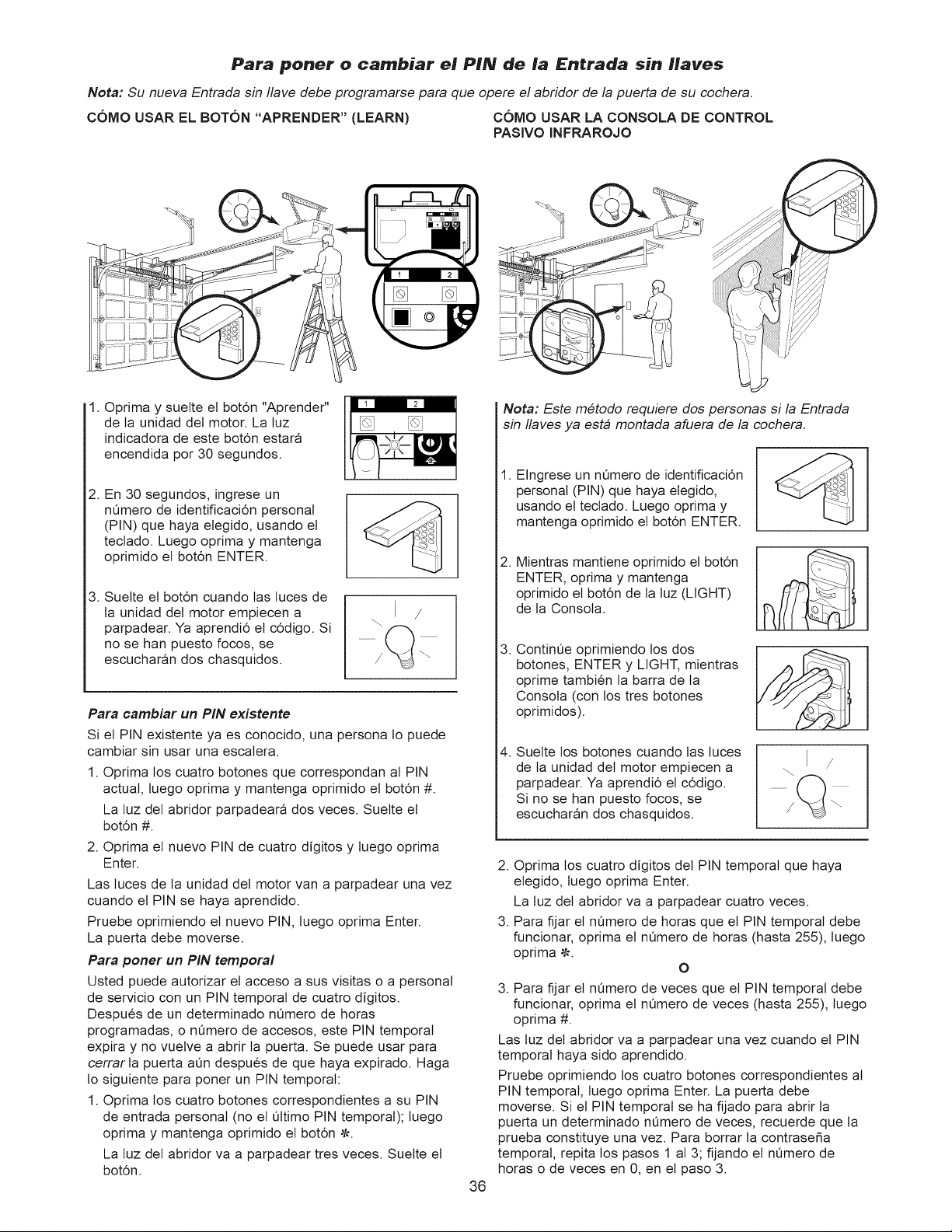
Para porter o cambiar el PIN de la Entrada sin Ilaves
Nota: Su nueva Entrada sin Ilave debe programarse para que opere el abridor de la puerta de su cochera.
COMO USAR EL BOTON "APRENDER" (LEARN) COMO USAR LA CONSOLA DE CONTROL
PASIVO INFRAROJO
1. Optima y suelte et bot6n "Aprender"
de la unidad det motor. La luz
indicadora de este bot6n estara
encendida por 30 segundos.
2. En 30 segundos, ingrese un
nemero de identificaci6n personal
(PIN) que haya elegido, usando el
tectado. Luego oprima y mantenga
oprimido et bot6n ENTER.
3. Suette et bot6n cuando tas tuces de
la unidad del motor empiecen a
parpadear. Ya aprendi6 et c6digo. Si
no se han puesto focos, se
escucharan dos chasquidos.
/
Para cambiar un PiN existente
Si et PIN existente ya es conocido, una persona to puede
cambiar sin usar una escalera.
1. Oprima los cuatro botones que correspondan al PIN
actual, luego optima y mantenga oprimido et bot6n #.
La luz det abridor parpadeara dos veces. Suette et
bot6n #.
2. Optima et nuevo PIN de cuatro digitos y luego optima
Enter.
Las luces de ta unidad del motor van a parpadear una vez
cuando et PIN se haya aprendido.
Pruebe oprimiendo et nuevo PIN, tuego optima Enter.
La puerta debe moverse.
Para poner un PIN temporal
Usted puede autorizar et acceso a sus visitas o a personal
de servicio con un PiN temporal de cuatro digitos.
Despues de un determinado nQmero de horas
programadas, o nQmero de accesos, este PIN temporal
expira y no vuelve a abrir ta puerta. Se puede usar para
cerrar ta puerta aQn despues de que haya expirado. Haga
1o siguiente para poner un PIN temporal:
1. Oprima los cuatro botones correspondientes a su PIN
de entrada personal (no et Gltimo PIN temporal); luego
optima y mantenga oprimido et bot6n -'_.
La luz det abridor va a parpadear tres veces. Suette et
bot6n.
36
!iii¸¸¸¸
Nora: Este metodo requiere dos personas si la Entrada
sin Ilaves ya esta montada afuera de la cochera.
1,
2,
Elngrese un nQmero de identificaci6n
personal (PIN) que haya etegido,
usando el teclado. Luego oprima y
mantenga oprimido et bot6n ENTER.
Mientras mantiene oprimido et bot6n
ENTER, optima y mantenga
oprimido et bot6n de la luz (LIGHT)
de la Consola.
3,
4,
ContinOe oprimiendo los dos
botones, ENTER y LIGHT, mientras
oprime tambien ta barra de la
Consola (con los tres botones
oprimidos).
Suette los botones cuando tas luces
de la unidad del motor empiecen a
parpadear. Ya aprendi6 el c6digo.
Si no se hart puesto focos, se
escucharan dos chasquidos.
/
!
2. Oprima los cuatro digitos det PIN temporal que haya
etegido, tuego optima Enter.
La luz det abridor va a parpadear cuatro veces.
3. Para fijar et nQmero de horas que et PIN temporal debe
funcionar, optima et nQmero de horas (hasta 255), luego
optima e.
O
3. Para fijar et nQmero de veces que et PIN temporal debe
funcionar, optima et nQmero de veces (hasta 255), luego
optima #.
Las luz det abridor va a parpadear una vez cuando et PIN
temporal haya sido aprendido.
Pruebe oprimiendo los cuatro botones correspondientes al
PIN temporal, luego oprima Enter. La puerta debe
moverse. Si et PIN temporal se ha fijado para abrir la
puerta un determinado nQmero de veces, recuerde que la
prueba constituye una vez. Para borrar la contrasefia
temporal, repita los pasos 1 al 3; fijando et nQmero de
horas o de veces en 0, en et paso 3.
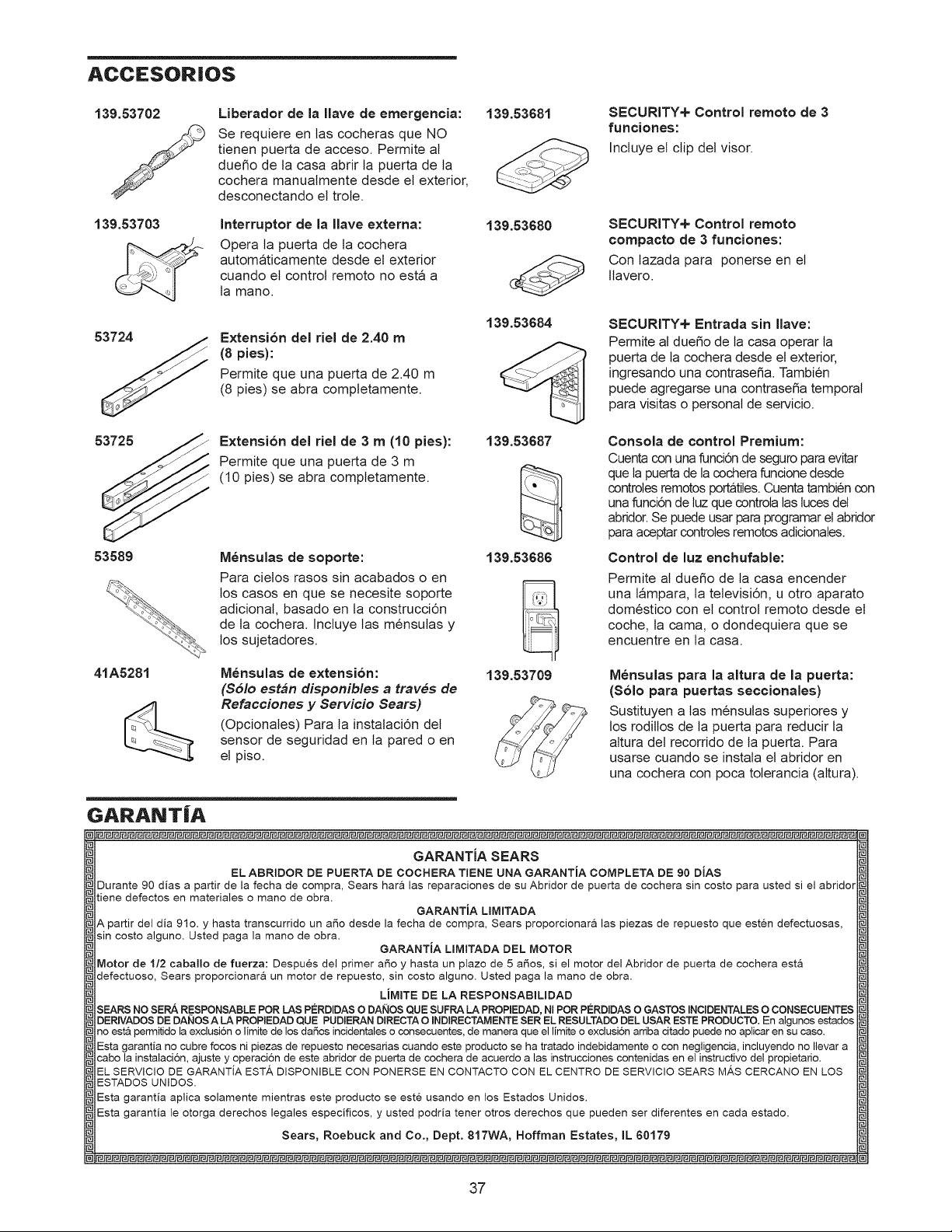
ACCESOR|OS
139.53702
139.53703
53724
Liberador de la Ilave de emergencia:
Se requiere en las cocheras que NO
tienen puerta de acceso. Permite al
dueSo de la casa abrir la puerta de ta
cochera manualmente desde et exterior,
desconectando et trole.
Interruptor de la Ilave externa:
Opera la puerta de ta cochera
automaticamente desde el exterior
cuando et control remoto no esta a
la mano.
Extension del riel de 2.40 m
(8 pies):
Permite que una puerta de 2.40 m
(8 pies) se abra completamente.
139.53581
139.53580
139.53584
SECURITY+ Control remoto de 3
funciones:
Incluye et clip det visor.
SECURITY+ Control remoto
compacto de 3 funciones:
Con tazada para ponerse en et
ltavero.
SECURITY+ Entrada sin Ilave:
Permite at dueSo de ta casa operar la
puerta de la cochera desde et exterior,
ingresando una contraseSa. Tambien
puede agregarse una contraseSa temporal
para visitas o personal de servicio.
53725
53589
Extension del riel de 3 m (10 pies):
Permite que una puerta de 3 m
(10 pies) se abra completamente.
Mensulas de soporte:
Para cietos rasos sin acabados o en
los casos en que se necesite soporte
adicional, basado en la construcci6n
de ta cochera. Incluye las mensulas y
los sujetadores.
139.53587
139.53585
Consola de control Premium:
Cuenta con una funci6n de seguro para evitar
que la puerta de la cochera funcione desde
controles remotos portatiles.Cuenta tambien con
una funci6n de luz que controlalas luces del
abridor. Se puede usar para programar el abridor
para aceptar controles remotos adicionales.
Control de luz enchufable:
Permite al dueSo de la casa encender
una lampara, la tetevisi6n, u otto aparato
domestico con et control remoto desde et
coche, ta cama, o dondequiera que se
encuentre en la casa.
41A5281 Mensulas de extension:
(S6/o est#n disponibles a traves de
Refacciones y Servicio Sears)
(Opcionales) Para la instalaci6n del
sensor de seguridad en la pared o en
et piso.
139.53709
Mensulas para la altura de la puerta:
(Solo para puertas seccionales)
Sustituyen a tas mensulas superiores y
los rodittos de la puerta para reducir la
altura det recorrido de la puerta. Para
usarse cuando se instala et abridor en
una cochera con poca tolerancia (altura).
GARANT|A
GARANTiA SEARS
EL ABRIDOR DE PUERTA DE COCHERA TIENE UNA GARANTiA COMPLETA DE 90 DiAS
Durante 90 dias a partir de la fecha de compra, Sears hara las reparaciones de su Abridor de puerta de cochera sin costo para usted si el abridot
tiene defectos en materiales o mano de obra.
GARANTiA LIMITADA
A partir del dia 91o. y hasta transcurrido un a_o desde la fecha de compra, Sears proporcionara las piezas de repuesto que esten defectuosas,
sin costo alguno. Usted paga la mano de obra.
GARANTiA LIMITADA DEL MOTOR
Motor de 1/2 caballo de fuerza: Despues del primer afio y hasta un plazo de 5 a_os, si el motor del Abridor de puerta de cochera esta
defectuoso, Sears proporcionara un motor de repuesto, sin costo alguno. Usted paga la mano de obra.
LiMITE DE LA RESPONSABILIDAD
SEARS NO SEP,A RESPONSABLE POR LAS PERDIDAS O DAI_OS QUE SUFRA LA PROPIEDAD, NI POR PERDIDAS O GASTOS INCIDENTALES O CONSECUENTES
DERIVADOS DE DA_IOS A LA PROPIEDAD QUE PUDIERAN DIRECTA O INDIRECTAMENTE SER EL RESULTADO DEL USAR ESTE PRODUCTO. En algunos estados
no esta permitido la exclusi6n o limite de los da_os incidentales o consecuentes, de manera que el limite o exclusi6n arriba citado puede no aplicar en su caso.
Esta garantia no cubre focos ni piezas de repuesto necesarias cuando este producto se ha tratado indebidamente o con negligencia, incluyendo no Ilevar a
cabo la instalacion, ajuste y operacion de este abridor de puerta de cochera de acuerdo alas instrucciones contenidas en el instructivo del propietario.
EL SERVIClO DE GARANTiA EST/k DISPONIBLE CON PONERSE EN CONTACTO CON EL CENTRO DE SERVIClO SEARS M/kS CERCANO EN LOS
ESTADOS UNIDOS.
Esta garantia aplica solamente mientras este producto se este usando en los Estados Unidos.
Esta garantia le otorga derechos legales especificos, y usted podria tener otros derechos que pueden ser diferentes en cada estado.
Sears, Roebuck and Co., Dept. 817WA, Hoffman Estates, IL 60179
37

iiiiiiiiiiiiiiiiiii_' !!!!!!!!!!!!!!!!!!!i
iiiiiiiiiiiiiiiiiii For repair of major brand appliances in your own home.., iiiiiiiiiiiiiiiiiiii
iiiiiiiiiiiiiiiiiii nomatterwhomade it, no matterwhosold it! iiiiiiiiiiiiiiiiiiii
iiiiiiiiiiiiiiiiiii 1-800-4-MY-HOME SMAnytime, dayornight iiiiiiiiiiiiiiiiiiii
................... iiiiiiiiiiiiiiiiiii:
iiiiiiiiiiiiiiiiiii iiiiiiiiiiiiiiiiiiii
iiiiiiiiiiiiiiiiiiiFor repair of carry-in products like vacuums, lawn equipment, and electronics, iiiiiiiiiiiiiiiiiiii
................... iiiiiiiiiiiiiiiiiii:
iiiiiiiiiiiiiiiiiii call for the location of your nearest Sears Parts & Repair Center. iiiiiiiiiiiiiiiiiiii
................... !!!!!!!!!!!!!!!!!!!
...................iiiiiiiiiiiiiiiiiii 1-800-488-1222 Anytime, dayor night iliiii!i!iiiiiiiiiiiiiiiiiiiiiiiiiiiiiiiiiiiiiiiiiiiili
.....................................................................................................................................iiiiiiiiiiiiiiiiiiiwww.sears.oom ..............._iii
iiiiiiiiiiiiiiiiiii For the replacement parts, accessories and owner's manuals
iiiiiiiiiiiiiiiiiii that you need to do-it-yourself, call Sears PartsDirectSM!
iiiiiiiiiiiiiiiiiii 1-800-366-PARTSM
6 a.m.- 11p.m. CST,
(1-8 0 0-3 6 6-7 2 7 8) 7 d ays a we e k iiiiiiiiiiiiiiiii
www.sears.com/partsdirect iiiiiiiiiiiiiiiii
iiiiiiiiiiiiiiiii
TopurchaseorinquireaboutaSearsServiceAgreement: iiiiiiiiiiiiiiiii
iiiiiiiiiiiiiiiii
7a.m.-5 p.m. CST, Mon.-Sat. iiiiiiiiiiiiiiiii
Para pedir servicio re reparacidn a domicilio,
y para ordenar piezas con entrega a domicilio: Au Canada pour service en fran_ais:
1-888-SU-HOGAN sM 1-877-LE-FOYER s_
(1-888-784-6427) (1-877-533-6937)
iiiiiiiiiiiiiiiiiiii!
S / RS
HomeCentral s_
TM
© 2001, Sears, Roebuck and Co, ® Registered Trademark / Trademark of Sears, Roebuck and Co.
114A2420C ® Marca Registrada /TM Marca de F_brica de Sears, Roebuck and Co Printed in Mexico