Life's Good
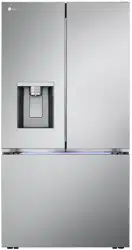
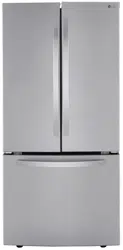
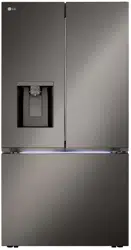
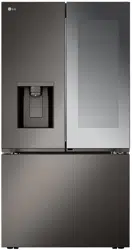
FRE CH DOOR
REFRIGERATOR
Please read this owner's manual thoroughly before
operating and keep it handy for reference at all times.
LFCS31626S
MFL62184495
2 TABLE OF CONTENTS
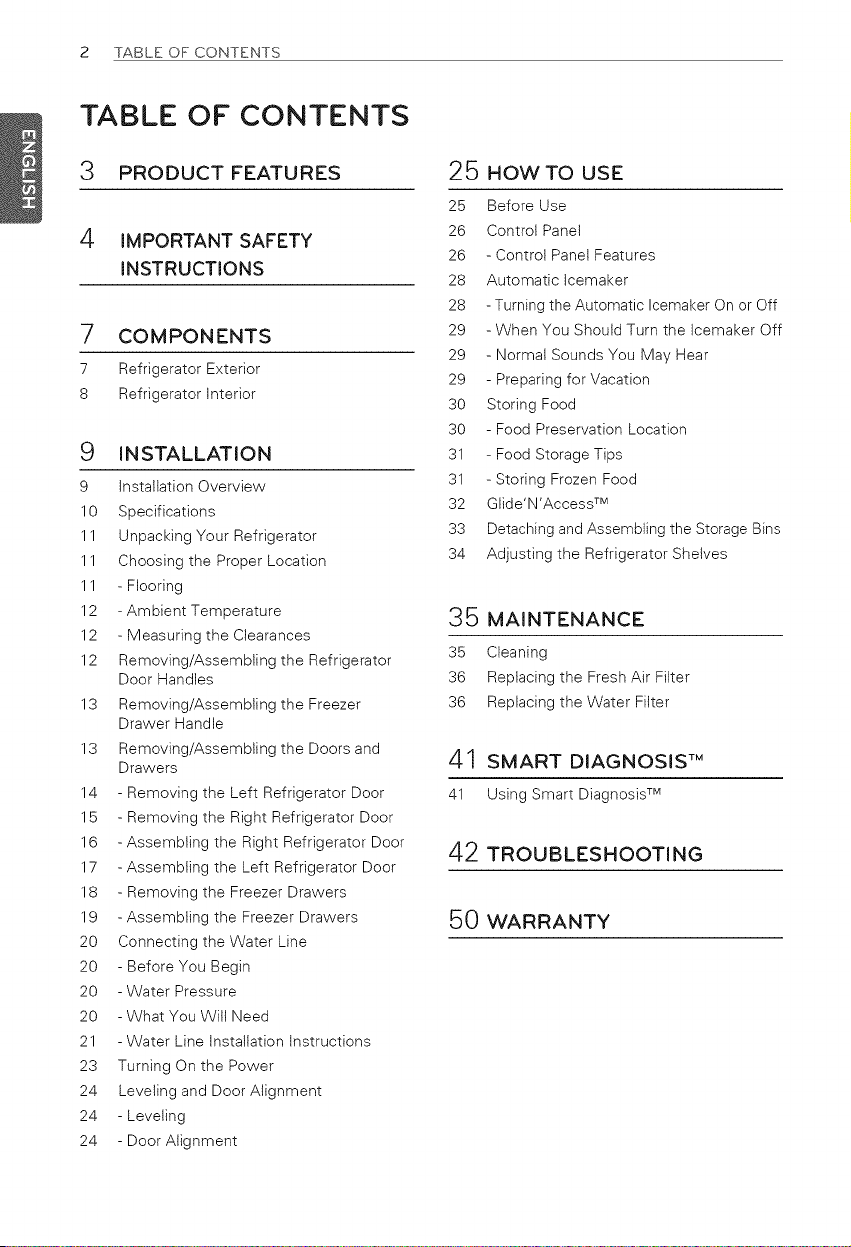
TABLE OF CONTENTS
3 PRODUCT FEATURES
4 IMPORTANT SAFETY
INSTRUCTIONS
7 COMPONENTS
7 Refrigerator Exterior
8 Refrigerator interior
9
9
0
1
1
1
2
2
2
4
5
6
7
8
9
20
20
20
20
21
23
24
24
24
INSTALLATION
Installation Overview
Specifications
Unpacking Your Refrigerator
Choosing the Proper Location
- Flooring
- Ambient Temperature
- Measuring the Clearances
Removing/Assembling the Refrigerator
Door Handles
Removing/Assembling the Freezer
Drawer Handle
Removing/Assembling the Doors and
Drawers
- Removing the Left Refrigerator Door
- Removing the Right Refrigerator Door
- Assembling the Right Refrigerator Door
- Assembling the Left Refrigerator Door
- Removing the Freezer Drawers
- Assembling the Freezer Drawers
Connecting the Water Line
- Before You Begin
- Water Pressure
- What You Will Need
- Water Line Installation Instructions
Turning On the Power
Leveling and Door Alignment
- Leveling
- Door Alignment
25 HOWTO USE
25
26
26
28
28
29
29
29
30
30
31
31
32
33
34
Before Use
Control Panel
- Control Panel Features
Automatic Icemaker
- Turning the Automatic Icemaker On or Off
- When You Should Turn the Icemaker Off
- Normal Sounds You May Hear
- Preparing for Vacation
Storing Food
- Food Preservation Location
- Food Storage Tips
-Storing Frozen Food
Glide'N'Access TM
Detaching and Assembling the Storage Bins
Adjusting the Refrigerator Shelves
35 MAINTENANCE
35 Cleaning
36 Replacing the Fresh Air Filter
36 Replacing the Water Filter
41 SMART DIAGNOSIS TM
41 UsingSmart Diagnosis TM
42 TROUBLESHOOTING
50 WARRANTY
PRODUCT FEATURES 3
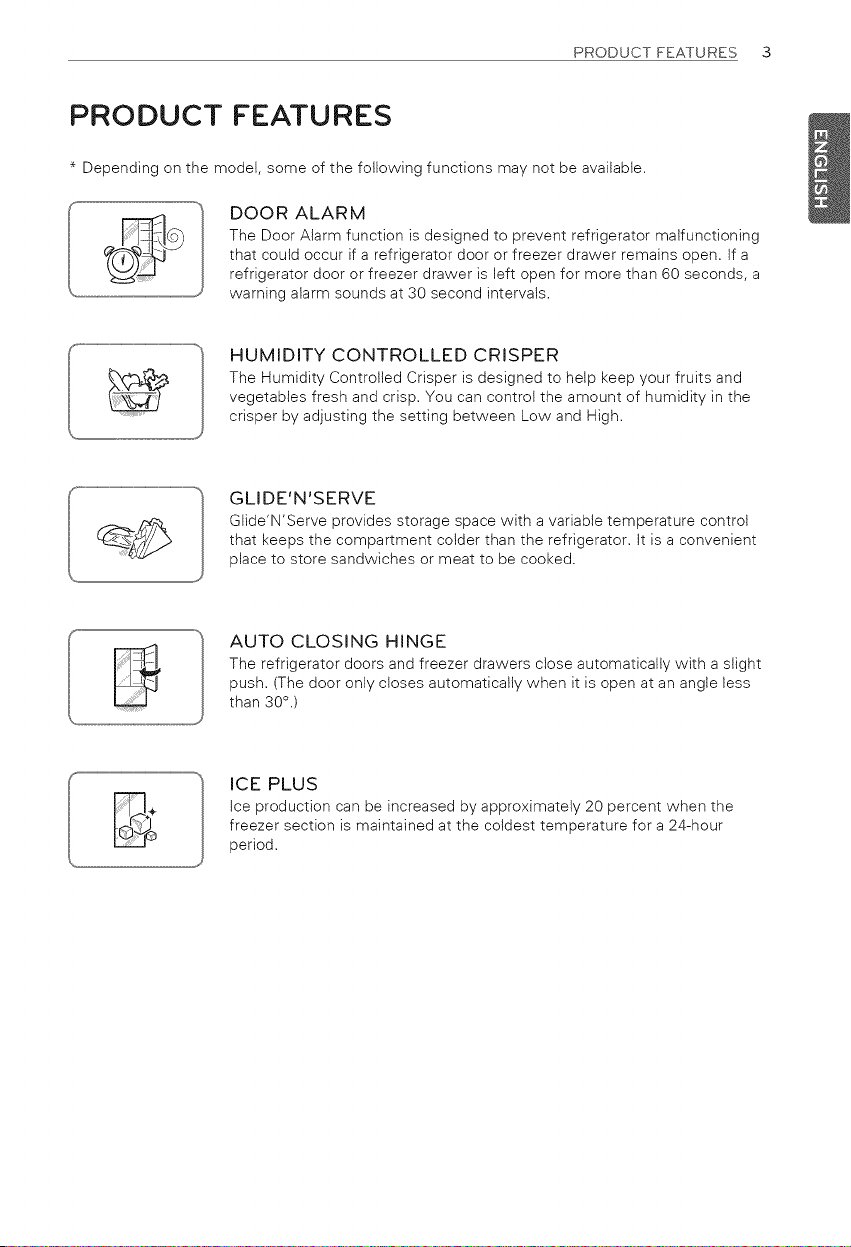
PRODUCT FEATURES
* Depending on the model, some of the following functions may not be available.
DOOR ALARM
The Door Alarm function is designed to prevent refrigerator malfunctioning
that could occur if a refrigerator door or freezer drawer remains open. If a
refrigerator door or freezer drawer is left open for more than 60 seconds, a
warning alarm sounds at 30 second intervals.
HUMIDITY CONTROLLED CRISPER
The Humidity Controlled Crisper is designed to help keep your fruits and
vegetables fresh and crisp. You can control the amount of humidity in the
crisper by adjusting the setting between Low and High.
GLIDE'N'SERVE
Glide'N'Serve provides storage space with a variable temperature control
that keeps the compartment colder than the refrigerator. It is a convenient
place to store sandwiches or meat to be cooked.
AUTO CLOSING HINGE
The refrigeratordoorsand freezerdrawers closeautomaticallywitha slight
push. (Thedoor onlyclosesautomaticallywhen itisopen atan angleless
than30°.)
ICE PLUS
ice production can be increased by approximately 20 percent when the
freezer section is maintained at the coldest temperature for a 24-hour
period.
4 IMPORTANT SAFETY INSTRUCTIONS
IMPORTANT SAFETY INSTRUCTIONS
READ ALL INSTRUCTIONS BEFORE USING THE APPLIANCE.
This guide contains many important safety messages. Always read and obey all safety messages.
This is the safety alert symbol. It alerts you to safety messages that inform you of
hazards that can kitl or hurt you or others, or cause damage to the product.
All safety messages will be preceded by the safety alert symbol and the hazard
signal word WARNING or CAUTION. These words mean:
_ WARNING You can be killed or seriously injured if you do not follow instructions.
_ CAUTION indicates an imminently hazardous situation which, if not avoided, may result
in minor or moderate injury, or product damage.
_ WARNING
To reduce the risk of fire, electric shock, or personal injury when using your product, basic safety
precautions should be followed, including the following:
Power
• NEVER unplug your refrigerator by pulling on the power cord. Always grip the plug firmly and pull it
straight out from the outlet.
• If the supply cord is damaged, it must be replaced by the manufacturer or its service agent or a
similarly qualified person in order to avoid a hazard. Do not use a cord that shows cracks or abrasion
damage along its length or at either the plug or connector end.
• Do not use an uncertified power outlet.
• Unplug the power plug immediately inthe event of a blackout or thunderstorm.
• Plug in the power plug with the power cord facing downward.
Installation
Contact an authorized service center before you install or relocate the refrigerator,
When moving your refrigerator away from the wall, be careful not to roll over or damage the power
cord.
Prior to use, ensure that you are connecting this product to adedicated, grounded electrical outlet
rated for use with this product (t 15V, 60Hz, AC only). It is the user's responsibility to replace a
standard 2-prong wall outlet with a standard 3-prong wall outlet.
Do not install the refrigerator where there may be a danger of the unit falling.
Use
DO NOT allow children to climb, stand, or hang on the refrigerator doors or on the shelves in the
refrigerator. They could damage the refrigerator and seriously injure themselves.
Do not hang on to or place heavy objects on the refrigerator's dispenser.
Do not place heavy or dangerous objects (bottles with liquid) on the refrigerator.
Do not put live animals inside the refrigerator.
Do not allow children to climb into the product when it is in use.
In the event of a gas leak (propane/LPG), ensure adequate ventilation and contact an authorized service
center before resuming use. Do not touch or disassemble the electric outlet of the refrigerator.
In the event of a refrigerant leak, move flammable objects away from the refrigerator. Ensure adequate
ventilation and contact an authorized service center.
Do not use or place flammable substances (chemicals, medicine, cosmetics, etc) near the refrigerator
or store them inside the refrigerator. Do not place the refrigerator in the vicinity of flammable gas.
Do not overfill or pack items tee tightly into door bins. Doing so may cause damage to the bin or
personal injury if items are removed with excessive force.
IMPORTANT SAFETY INSTRUCTIONS 5
READ ALL INSTRUCTIONS BEFORE USING THE APPLIANCE.
To reduce the risk of fire, electric shock, or personal injury when using your product, basic safety
precautions should be followed, including the following:
• This product is not to be used for special purposes such as the storage of medicine or test materials
or for use on ships, etc.
• Unplug the power plug before cleaning or repairing the refrigerator
• When you replace the light bulb in the refrigerator, unplug the refrigerator or turn off the power.
• Do not modify or extend the power cord.
• Do not use a dryer to dry the interior. Do not light a candle to remove interior odors.
• For your safety, this appliance must be properly grounded Have the wall outlet and the circuit
checked by a qualified electrician to make sure the outlet is properly grounded
• Do not use an outlet that can be turned off with a switch Do not use an extension cord It is the
user's responsibility to replace a standard 2-prong wall outlet with a standard 3-prong wall outlet.
• Do not, under any circumstances, cut or remove the third (ground) prong from the power cord.
• Do not use an adapter plug and plug the power plug into a multi-outlet extension cord.
• Disconnect the power cord immediately if you hear a noise, smell a strange odor or detect smoke
coming from the appliance.
• Turn the power off if water or dust penetrates into the refrigerator. Call a service agent
• Do not disassemble or modify the refrigerator
• Do not put hands, feet, or metal objects below or behind the refrigerator
• Do not operate the refrigerator or touch the power cord with wet hands
• In refrigerators with automatic icemakers, avoid contact with the moving parts of the ejector
mechanism or with the heating element that releases the cubes. Do not place fingers or hands on the
automatic ice-making mechanism while the refrigerator is plugged in
• When dispensing ice from the dispenser, do not use crystal ceramics
• Do not touch the cow surfaces inthe freezer compartment with wet or damp hands, when your
refrigerator is in operation
• Do not put glass containers, glass bottles or soda in the freezer.
• This appliance is not intended for use by persons (including children) with reduced physical, sensory
or mental capabilities, or lack of experience and knowledge, unless they have been given supervision
or instruction concerning the use of the appliance by a person responsible for their safety.
• Do not refreeze frozen food that has thawed completely Doing so may result in a serious health
issue.
• If you are throwing away your old refrigerator, make sure the CFC coolant is removed for proper
disposal by a qualified servicer. If you release CFC coolant, you may be fined or imprisoned in
accordance with the relevant environmental law.
• Junked or abandoned refrigerators are dangerous, even if they are sitting for only a few days When
disposing of the refrigerator, remove the packing materials from the door or take off the doors but
leave the shelves in place so that children may not easily climb inside
• If connected to a circuit protected by fuses, use time delay fuse
_ WARNING
This product contains chemicals known to the State of California to cause cancer and birth defects
or other reproductive harm, Wash hands after handling.
6 IMPORTANT SAFETY INSTRUCTIONS
READ ALL INSTRUCTIONS BEFORE USING THE APPLIANCE.
To reduce the risk of fire, electric shock, or personal injury when using your product, basic safety
precautions should be followed, including the following:
_ CAUTION
Installation
• The refrigerator must be properly installed in accordance with the Installer Instructions that were
taped to the front of the refrigerator.
• Be careful when you unpack and install the refrigerator. Immediately dispose of plastic and other
packing materials out of reach of children.
• The appliance must be positioned for easy access to a power source.
Use
Close the door carefully when children are around.
Keep fingers out of pinch point areas; clearances between the doors and cabinets are
necessarily small. Be careful closing doors when children are nearby.
If you store food improperly, be aware that it may fall and cause injury.
Do not use aerosols near the refrigerator.
Do not store articles on the top of the appliance.
Maintenance
Do not use strong detergents like wax or thinners for cleaning. Clean with a soft cloth.
Wipe foreign objects (such as dust and water) off the prongs of the power plug and contact
areas regularly.
Do not store, disassemble or repair the refrigerator by yourself.
Remove any dust or foreign matter from the power plug pins.
Do not use a wet or damp cloth when cleaning the plug.
If the refrigerator is disconnected from the power supply, you should wait for at least five
minutes before plugging it back in.
If you notice a chemical or burning plastic smell or see smoke, unplug the refrigerator
immediately and contact your LG Electronics Service Center.
SAVE THESE INSTRUCTIONS
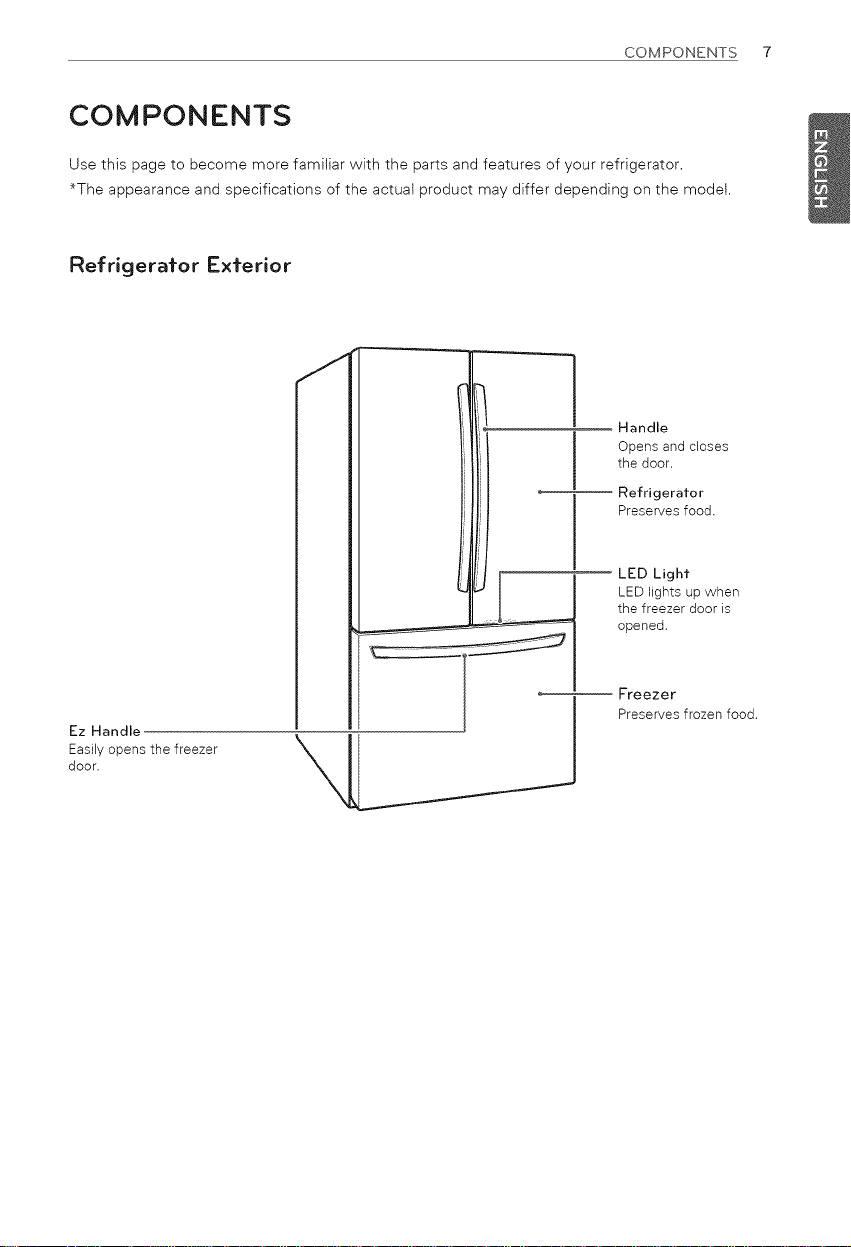
COMPONENTS 7
COMPONENTS
Use this page to become more familiar with the parts and features of your refrigerator.
*The appearance and specifications of the actual product may differ depending on the model.
Refrigerafor Exferior
Ez Handle
EasiJy opens the freezer
door.
Handle
Opens and doses
the door.
• Refrigerator
Preserves food.
LED Light
LED lights up when
the freezer door is
opened.
Freezer
Preserves frozen food.
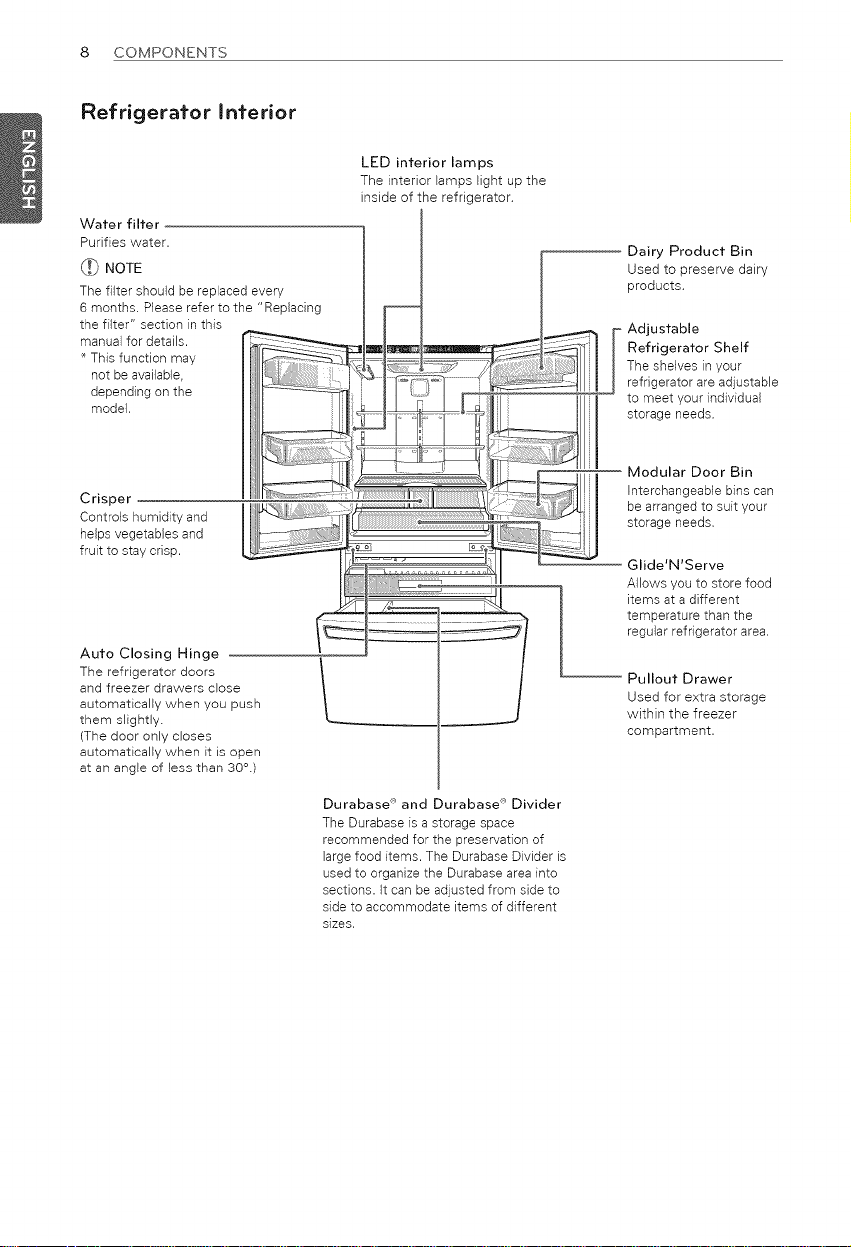
8 COMPONENTS
Refrigerafor Inferior
LED interior lamps
The interior lamps light up the
inside of the refrigerator.
Water filter --
Purifies water.
them slightly.
(The door only closes
automatically when it is open
at an angle of less than 30°.)
Durabase (_)and Durabase (_)Divider
The Durabase is a storage space
recommended for the preservation of
large food items. The Durabase Divider is
used to organize the Durabase area into
sections. It can be adjusted from side to
side to accommodate items of different
sizes,
Dairy Product Bin
Used to preserve dairy
products.
Adjustable
Refrigerator Shelf
The shelves in your
refrigerator are adjustable
to meet your individual
storage needs,
Modular Door Bin
Interchangeable bins can
be arranged to suit your
storage needs,
Glide'N'Serve
Allows you to store food
items at a different
temperature than the
regular refrigerator area,
-- Pullout Drawer
Used for extra storage
within the freezer
compartment.
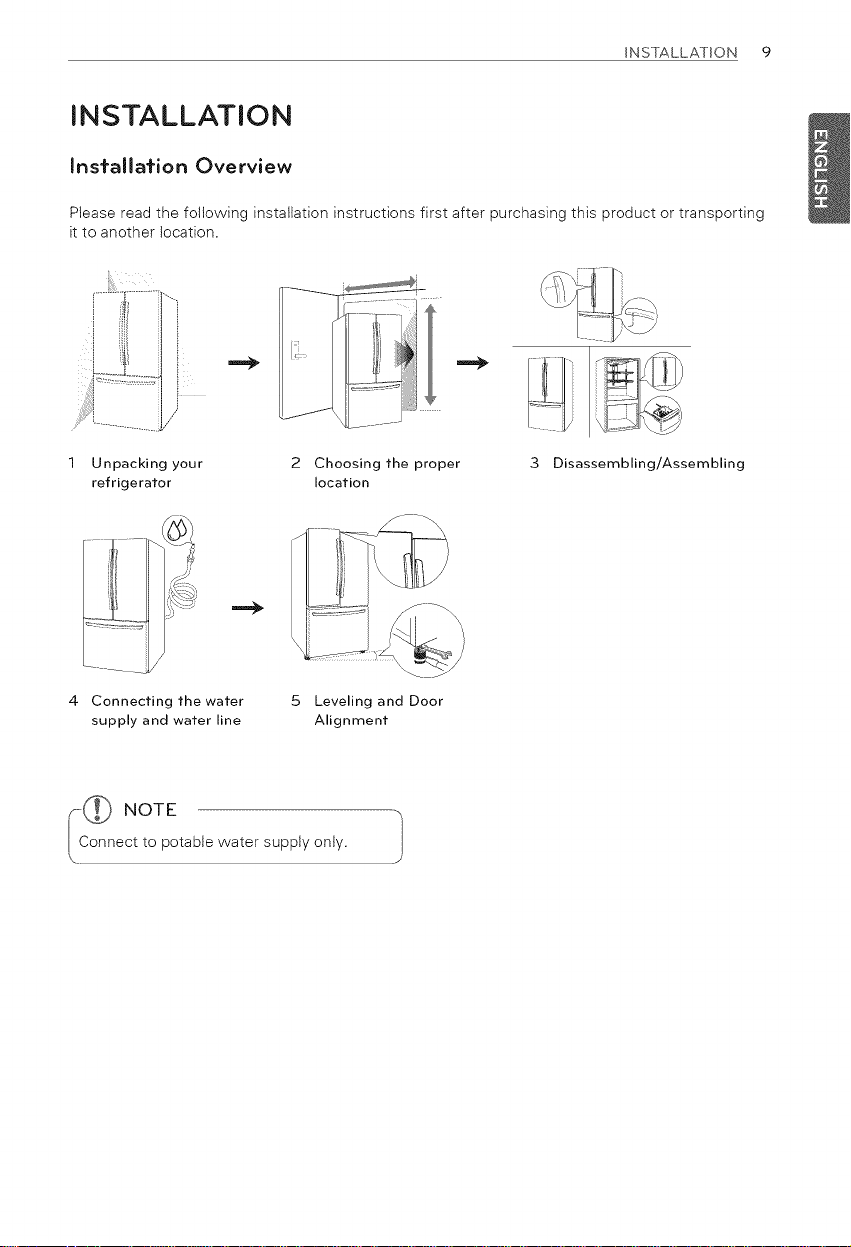
INSTALLATION9
INSTALLATION
Insfallafion Overview
Please read the following installation instructions first after purchasing this product or transporting
it to another location.
1 Unpacking your
refrigerator
2 Choosing the proper
location
3 Disassembling/Assembling
M
4 Connecting the water
supply and water line
5 Leveling and Door
Alignment
!-(£NOTE /
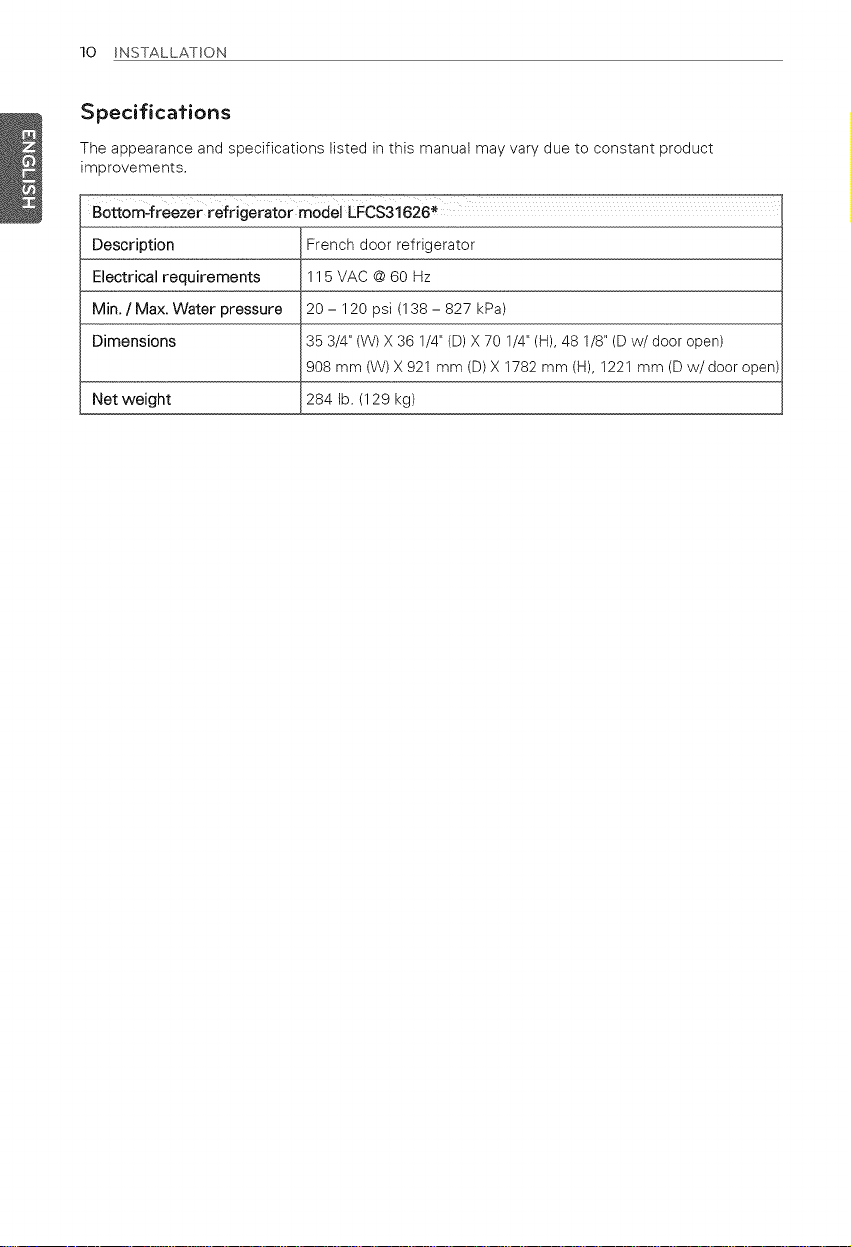
10 INSTALLATION
Specificafions
The appearance and specifications listed in this manual may vary due to constant product
improvements.
Bottom4reezer refrigerator model LFCS31626 _
Description French door refrigerator
Electrical requirements 115 VAC @ 60 Hz
Min. / Max. Water pressure 20 - 120 psi (138 - 827 kPa)
Dimensions 35 3/4" (W) X 36 1/4" (D) X 70 1/4" (H),48 1/8" (D w/door open)
908 mm (W) X 921 mm (D) X 1782 mm (H), 1221 mm (D w/door open)
Net weight 284 tb. (129 kg)
INSTALLATION 11
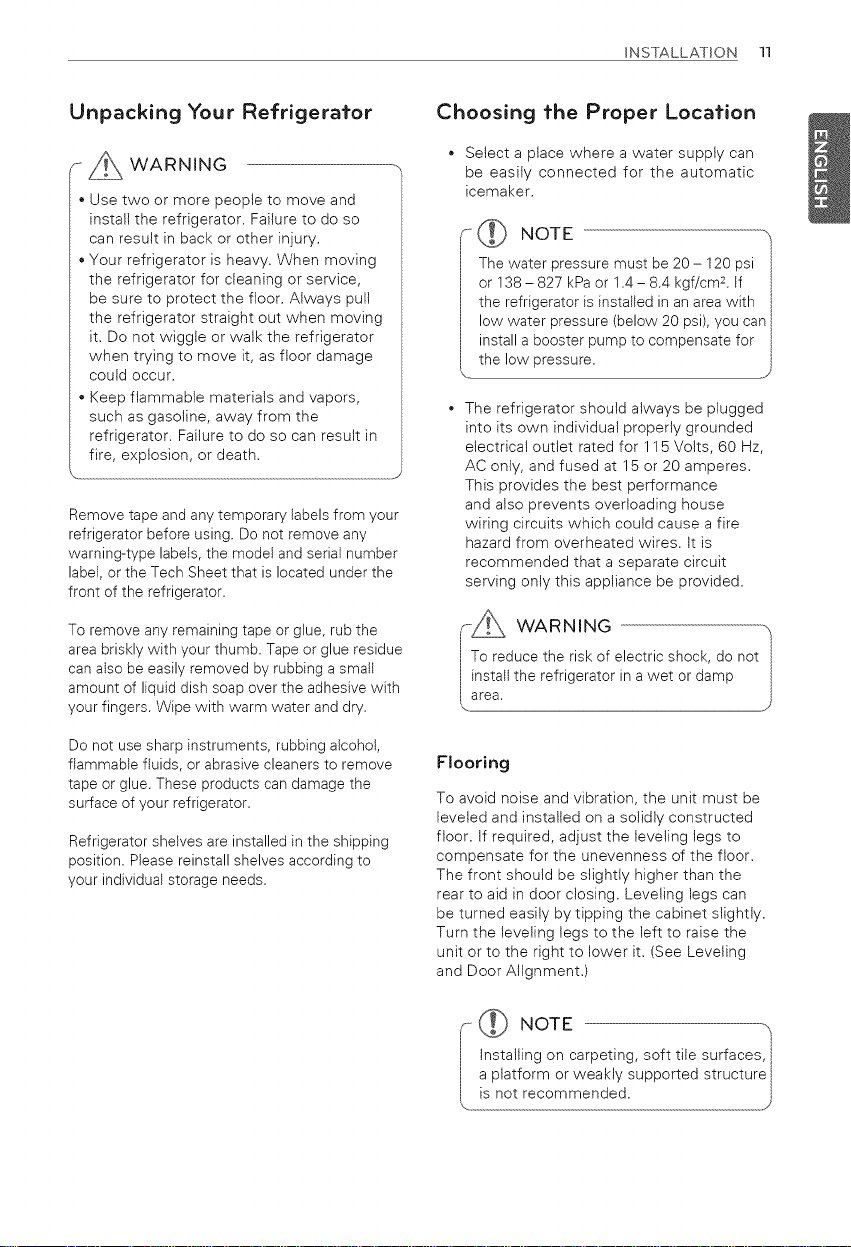
Unpacking Your Refrigerator
_ WARNING
Use two or more people to move and
install the refrigerator. Failure to do so
can result in back or other injury.
Your refrigerator is heavy. When moving
the refrigerator for cleaning or service,
be sure to protect the floor. Always pull
the refrigerator straight out when moving
it. Do not wiggle or walk the refrigerator
when trying to move it, as floor damage
could occur.
Keep flammable materials and vapors,
such as gasoline, away from the
refrigerator. Failure to do so can result in
fire, explosion, or death.
Remove tape and any temporary labels from your
refrigerator before using. Do not remove any
warning-type labels, the model and serial number
label, or the Tech Sheet that is located under the
front of the refrigerator.
To remove any remaining tape or glue, rub the
area briskly with your thumb. Tape or glue residue
can also be easily removed by rubbing a small
amount of liquid dish soap over the adhesive with
your fingers. Wipe with warm water and dry.
Do not use sharp instruments, rubbing alcohol,
flammable fluids, or abrasive cleaners to remove
tape or glue. These products can damage the
surface of your refrigerator.
Refrigerator shelves are installed in the shipping
position. Please reinstall shelves according to
your individual storage needs.
Choosing the Proper Location
Select a place where a water supply can
be easily connected for the automatic
icemaker.
-_) NOTE
The water pressure must be 20 - 120 psi
or 138 - 827 kPa or 1.4 - 8.4 kgf/cm _.If
the refrigerator is installed in an area with
low water pressure (below 20 psi), you ca_
install a booster pump to compensate for
the low pressure.
The refrigerator should always be plugged
into its own individual properly grounded
electrical outlet rated for 115 Volts, 60 Hz,
AC only, and fused at 15 or 20 amperes.
This provides the best performance
and also prevents overloading house
wiring circuits which could cause a fire
hazard from overheated wires. It is
recommended that a separate circuit
serving only this appliance be provided.
-T_ WARNING
o reduce the risk of electric shock, do not
nstall the refrigerator ina wet or damp
area.
Flooring
To avoid noise and vibration, the unit must be
leveled and installed on a solidly constructed
floor. If required, adjust the leveling legs to
compensate for the unevenness of the floor.
The front should be slightly higher than the
rear to aid in door closing. Leveling legs can
be turned easily by tipping the cabinet slightly.
Turn the leveling legs to the left to raise the
unit or to the right to lower it. (See Leveling
and Door Alignment.)
'_(2 NOTE
Installing on carpeting, soft tile surfaces
a platform or weakly supported structur_
is not recommended i
12 INSTALLATION
Ambient Temperature
Install this appliance in an area where the
temperature is between 55°F (13°C) and 110°F
(43°C). If the temperature around the appliance
is too low or high, cooling ability may be
adversely affected.
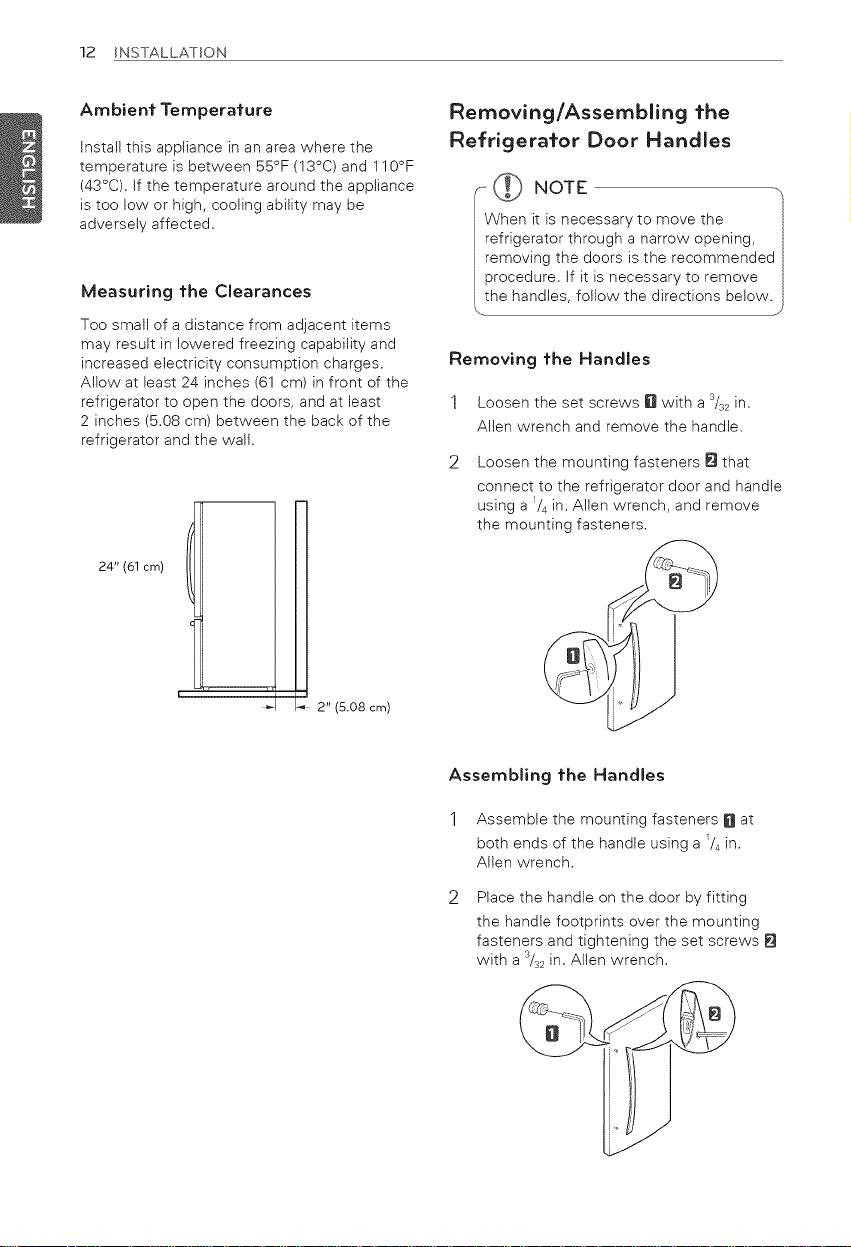
Measuring the Clearances
Too small of a distance from adjacent items
may result in lowered freezing capability and
increased electricity consumption charges.
Allow at least 24 inches (61 cm) in front of the
refrigerator to open the doors, and at least
2 inches (5.08 cm) between the back of the
refrigerator and the wall.
24" (61 cm)
i
i
I
i
i
i
_- 2" (5.08cm)
Removing/Assembling the
Refrigerator Door Handles
@ NoTE /
I When it is necessary to move the J
I refrigerator through a narrow opening,
I removing the doors is the recommended I
I procedure. If it is necessary to remove /
(,the handles, follow the directions below._
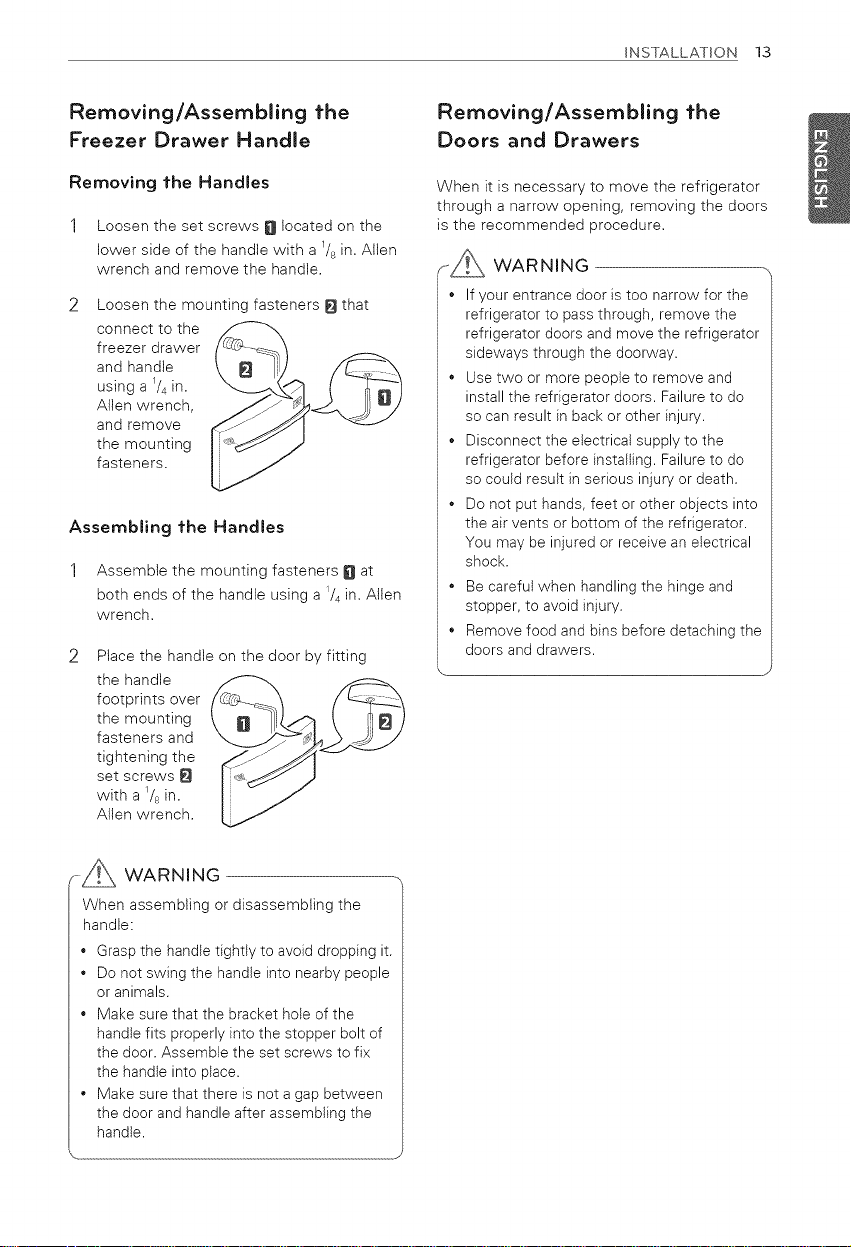
Removing the Handles
Loosen the set screws D with a s/s2 in.
Allen wrench and remove the handle.
Loosen the mounting fasteners D that
connect to the refrigerator door and handle
using a//4 in. Allen wrench, and remove
the mounting fasteners.
i
Assembling the Handles
1 Assemble the mounting fasteners _ at
both ends of the handle using a/4 in.
Alien wrench.
2
Place the handle on the door by fitting
the handle footprints over the mounting
fasteners and tightening the set screws
with a s/s2in. Allen wrench.
INSTALLATION 13
Removing/Assembling fhe
Freezer Drawer Handle
Removing "the Handles
1 Loosen the set screws D located on the
lower side of the handle with a 1/sin. Atlen
wrench and remove the handle.
Loosen the mounting fasteners _ that
connect to the
freezer drawer
and handle
using a//4 in.
Allen wrench,
and remove
the mounting
fasteners.
Assembling "the Handles
1 Assemble the mounting fasteners D at
both ends of the handle using a//4 in. Atlen
wrench.
Place the handle on the door by fitting
the handle
footprints over
the mounting
fasteners and
tightening the
set screws
with a//g in.
Allen wrench.
Removing/Assembling fhe
Doors and Drawers
When it is necessary to move the refrigerator
through a narrow opening, removing the doors
is the recommended procedure.
F_ WARNING
• If your entrance door is too narrow for the
refrigerator to pass through, remove the
refrigerator doors and move the refrigerator
sideways through the doorway.
• Use two or more people to remove and
install the refrigerator doors. Failure to do
so can result in back or other injury.
• Disconnect the electrical supply to the
refrigerator before installing. Failure to do
so could result in serious injury or death.
• Do net put hands, feet or other objects into
the air vents or bottom of the refrigerator.
You may be injured or receive an electrical
shock.
• Be careful when handling the hinge and
stopper, to avoid injury.
° Remove food and bins before detaching the
doors and drawers.
r_ WARNING
When assembling or disassembling the
handle:
• Grasp the handle tightly to avoid dropping it.
• Do not swing the handle into nearby people
or animals.
• Make sure that the bracket hole of the
handle fits properly into the stopper bolt of
the door. Assemble the set screws to fix
the handle into place.
• Make sure that there is not a gap between
the door and handle after assembling the
handle.
\__J
14 INSTALLATION
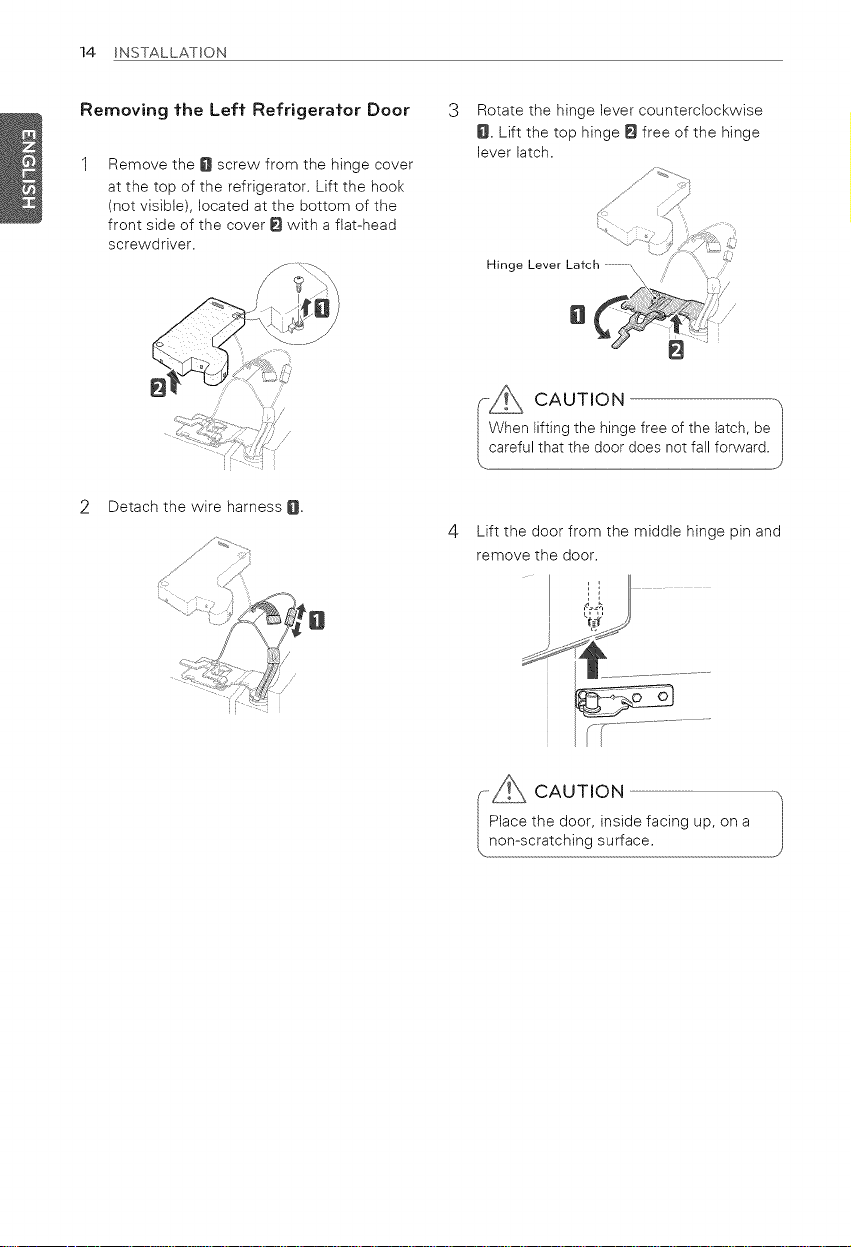
Removing the Left Refrigerator Door
Remove the D screw from the hinge cover
at the top of the refrigerator. Lift the hook
(not visible), located at the bottom of the
front side of the cover 0 with a flat-head
screwdriver.
2 Detach the wire harness O.
3
Rotate the hinge lever counterclockwise
D Lift the top hinge Q free of the hinge
lever latch.
__ CAUTION 1
en lifting the hinge free of the latch, be
careful that the door does not fall forward.
4 Lift the door from the middle hinge pin and
remove the door.
oAuTioN
Place the door, inside facing up, on a J
INSTALLATION 15
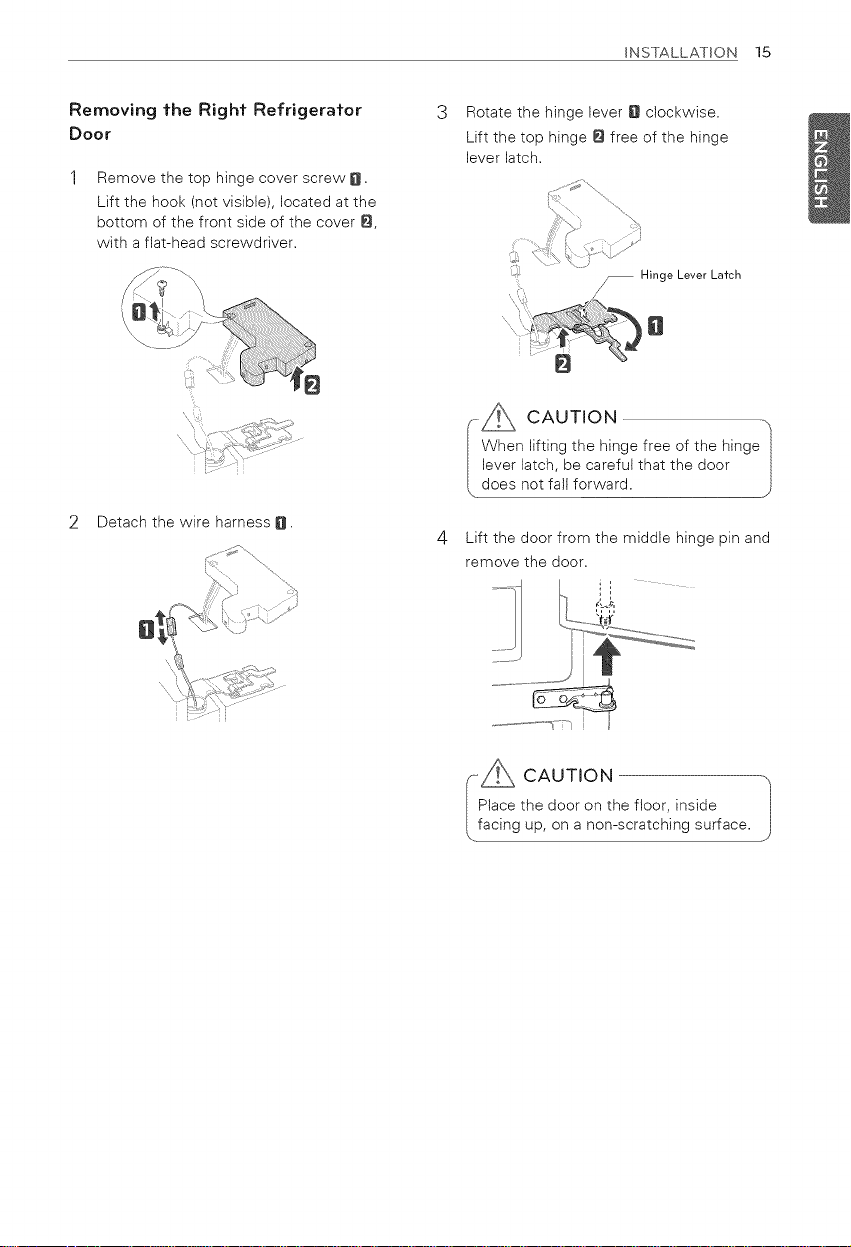
Removing the Right Refrigerator
Door
Remove the top hinge cover screw O.
Lift the hook (not visible), located at the
bottom of the front side of the cover _,
with a flat-head screwdriver.
3 Rotate the hinge lever D clockwise.
Lift the top hinge Q free of the hinge
lever latch.
-- Hinge Lever Latch
D
2 Detach the wire harness D.
4
.._ CAUTION ....
When lifting the hinge free of the hinge I
lever latch, be careful that the door /
does not fall forward. J
Lift the door from the middle hinge pin and
remove the door.
CAUTION -/
Place the door on the floor, inside
.facing up on a non-scratching surface
16 INSTALLATION
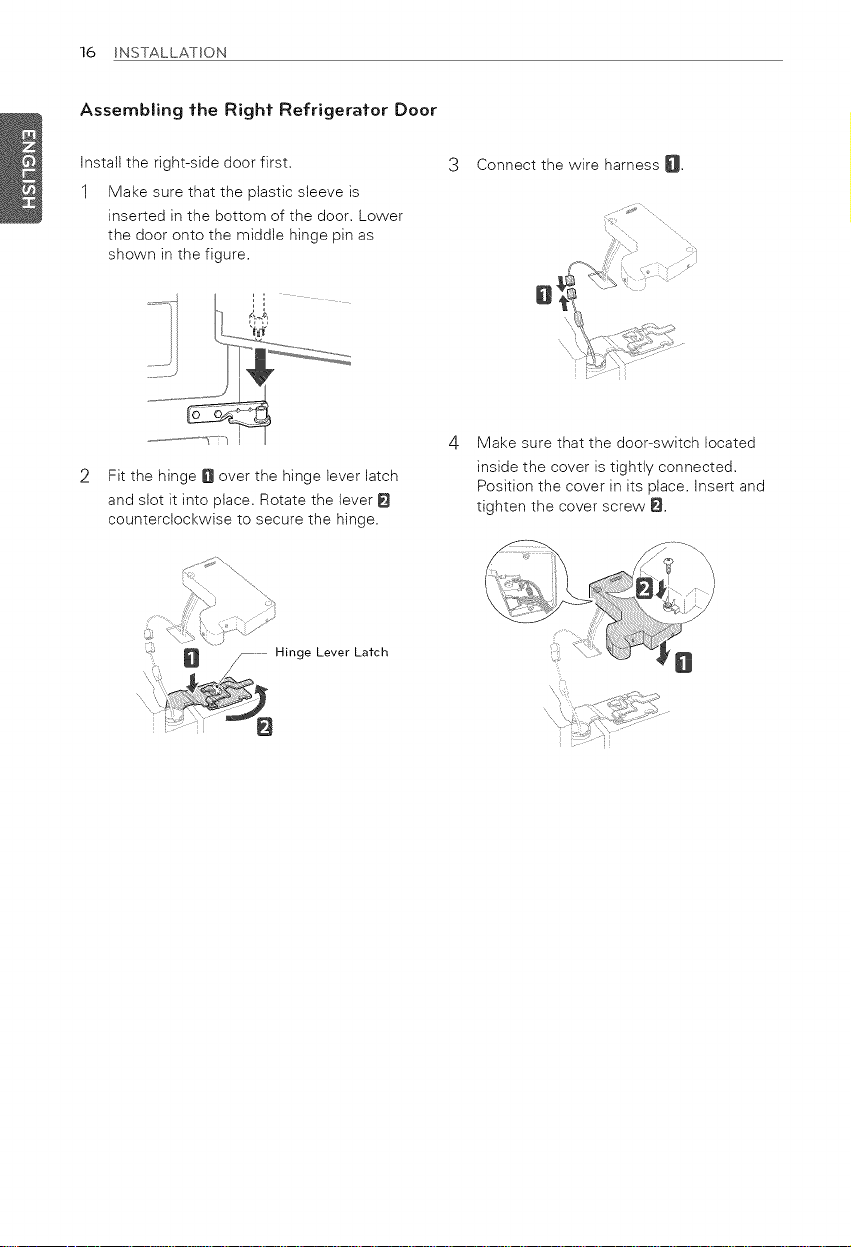
Assembling "the Right Refrigerator Door
Install the right-side door first.
1 Make sure that the plastic sleeve is
inserted in the bottom of the door. Lower
the door onto the middle hinge pin as
shown in the figure.
3 Connect the wire harness D.
2
Fit the hinge D over the hinge lever latch
and slot it into place. Rotate the lever
counterclockwise to secure the hinge.
4
Make sure that the door-switch located
inside the cover is tightly connected.
Position the cover in its place. Insert and
tighten the cover screw _.
, ............
j- \ _ ,
..... Hinge Lever Larch
INSTALLATION 17
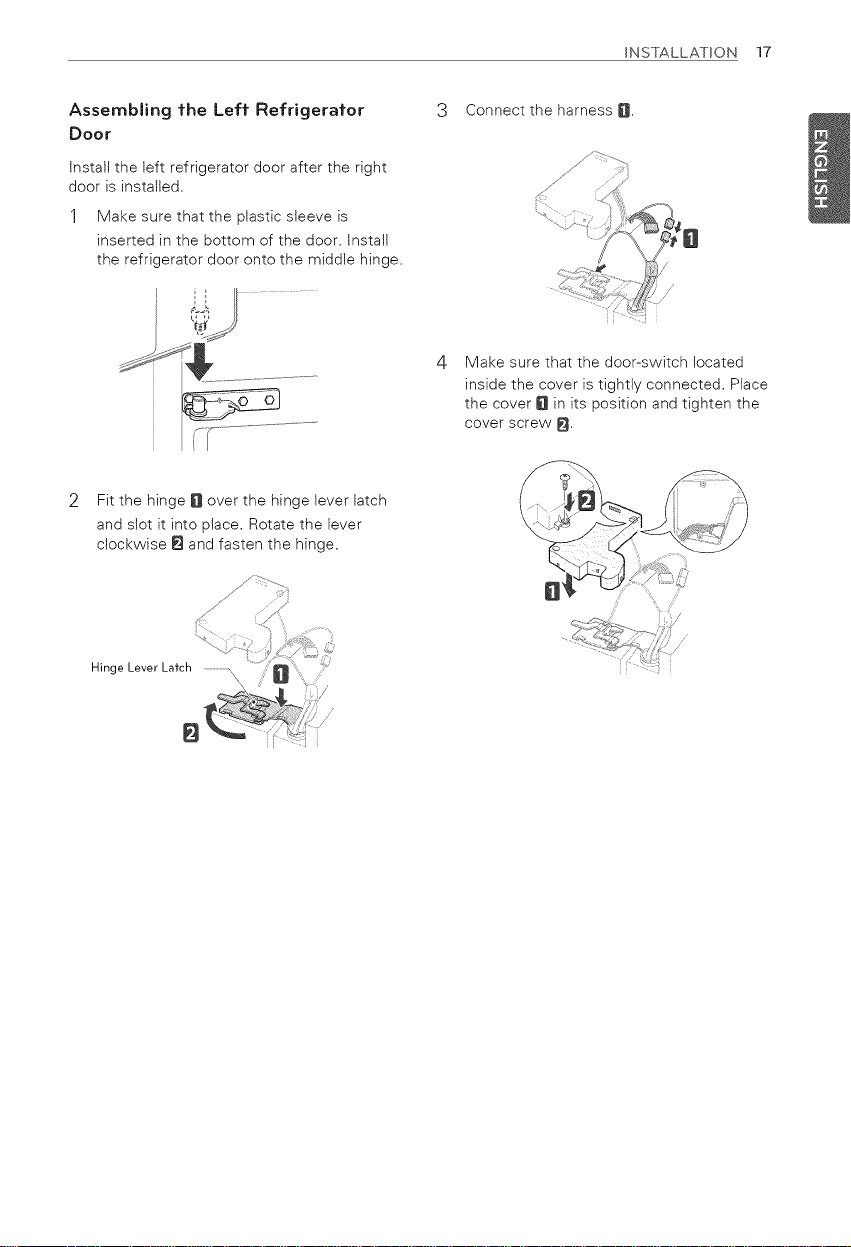
Assembling "the Left" Refrigerator
Door
Install the left refrigerator door after the right
door is installed.
1 Make sure that the plastic sleeve is
inserted in the bottom of the door. Install
the refrigerator door onto the middle hinge.
3 Connect the harness _.
4
Make sure that the door-switch located
inside the cover is tightly connected. Place
the cover _ in its position and tighten the
cover screw _.
Fit the hinge D over the hinge lever latch
and slot it into place. Rotate the lever
clockwise Q and fasten the hinge.
Hinge Lever Latch
18 INSTALLATION
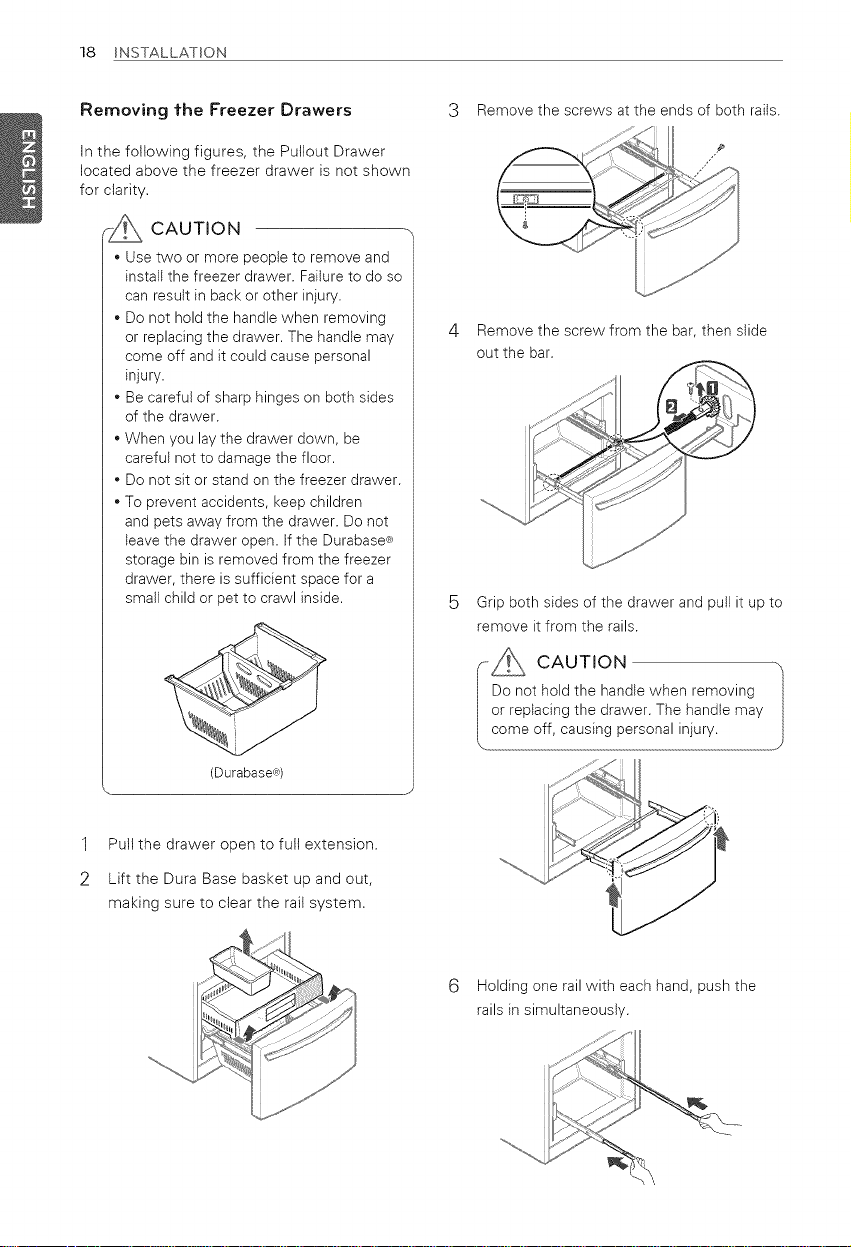
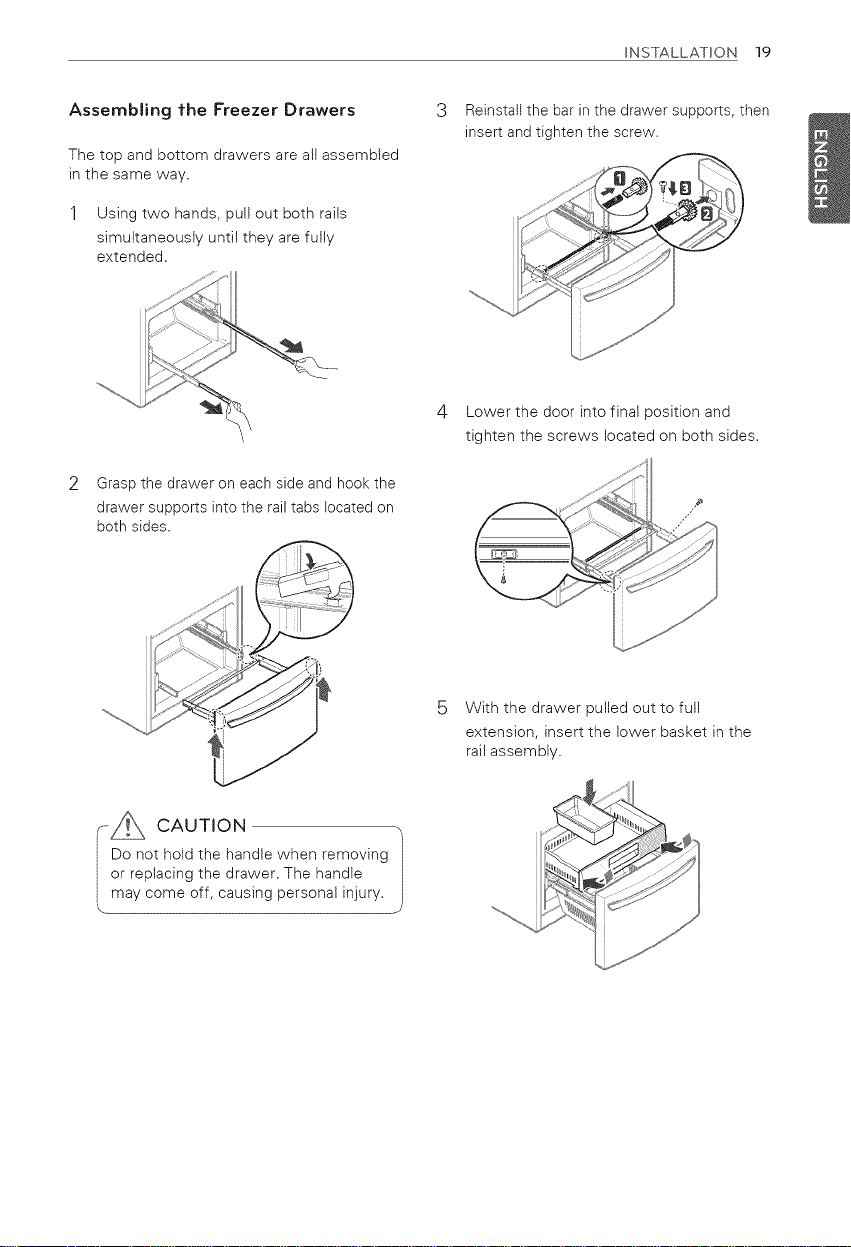
Removing fhe Freezer Drawers
In the following figures, the Pultout Drawer
located above the freezer drawer is not shown
for clarity.
r_ CAUTION --
• Use two or more people to remove and
install the freezer drawer. Failure to do so
can result in back or other injury.
• Do not hold the handle when removing
or replacing the drawer. The handle may
come off and it could cause personal
injury.
• Becareful of sharp hinges on both sides
of the drawer.
• When you lay the drawer down, be
careful not to damage the floor.
• Do not sit or stand on the freezer drawer.
• To prevent accidents, keep children
and pets away from the drawer. Do not
leave the drawer open. If the Durabase_
storage bin is removed from the freezer
drawer, there is sufficient space for a
small child or pet to crawl inside.
(Durabase%
3 Remove the screws at the ends of both rails.
/
4 Remove the screw from the bar, then slide
out the bar.
Grip both sides of the drawer and pull it up to
remove it from the rails.
Do not hold the handle when removing
or replacing the drawer. The handle may
come off, causing personal injury.
1 Pull the drawer open to full extension.
2 Lift the Dura Base basket up and out,
making sure to clear the rail system.
6 Holding one rail with each hand, push the
rails in simultaneously.
INSTALLATION 19
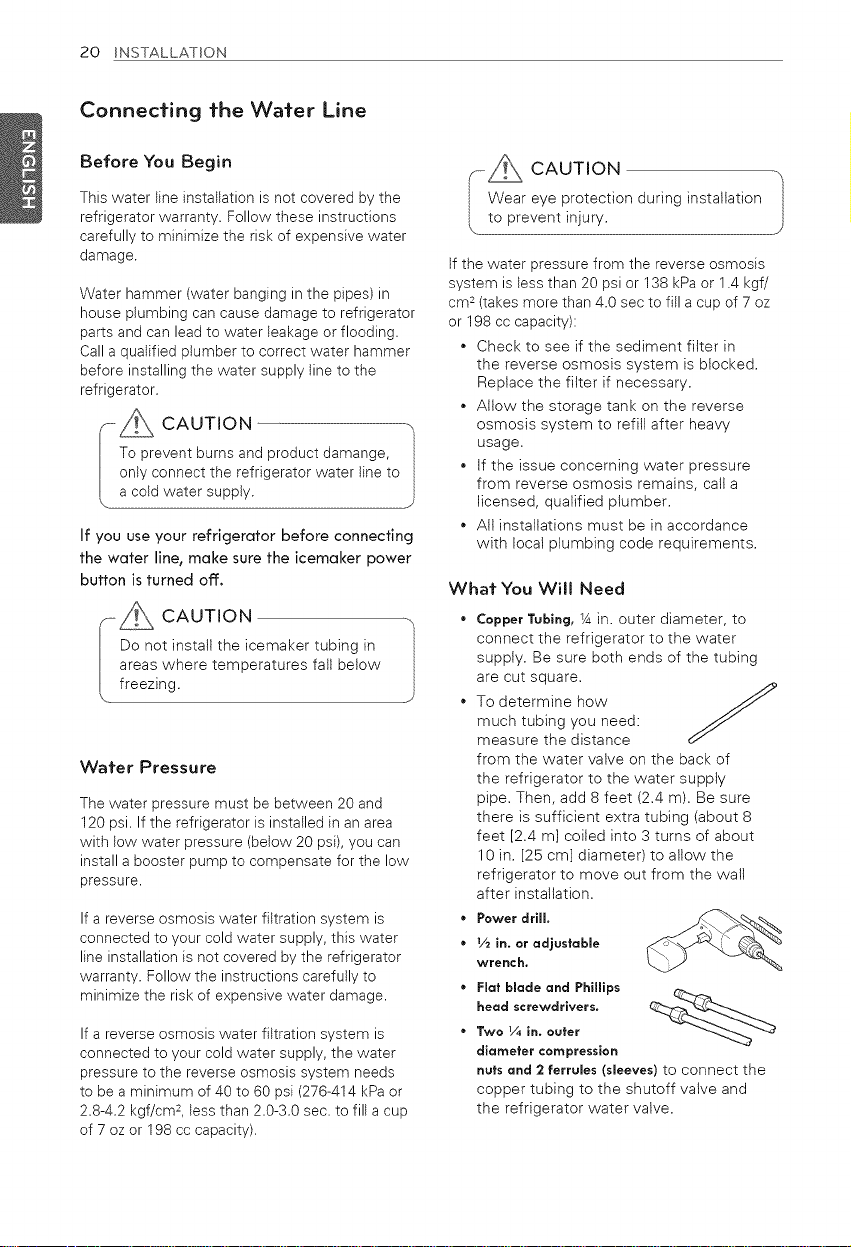
Assembling fhe Freezer Drawers
The top and bottom drawers are all assembled
in the same way.
1 Using two hands, pull out both rails
simultaneously until they are fully
extended.
3 Reinstall the bar in the drawer supports, then
insert and tighten the screw.
Grasp the drawer on each side and hook the
drawer supports into the rail tabs located on
both sides.
4 Lower the door into final position and
tighten the screws located on both sides.
5 With the drawer pulled out to full
extension, insert the lower basket in the
rail assembly.
CAUTION
Do not hold the handle when removing
or replacing the drawer. The handle
may come off, causing personal injury.
20 INSTALLATION
Connecting the Wafer Line
Before You Begin
This water line installation is not covered by the
refrigerator warranty. Follow these instructions
carefully to minimize the risk of expensive water
damage.
Water hammer (water banging in the pipes) in
house plumbing can cause damage to refrigerator
parts and can lead to water leakage or flooding.
Call a qualified plumber to correct water hammer
before installing the water supply line to the
refrigerator.
------_ CAUTION
To prevent burns and product damange,
only connect the refrigerator water line to
a cold water supply.
If you use your refrigerator before connecting
the water line_ make sure the icemaker power
button is turned off.
.-_ CAUTION
Do not install the icemaker tubing in
areas where temperatures fall below
freezing.
Water Pressure
The water pressure must be between 20 and
120 psi. If the refrigerator is installed in an area
with low water pressure (below 20 psi), you can
install a booster pump to compensate for the low
pressure.
If a reverse osmosis water filtration system is
connected to your cold water supply, this water
line installation is not covered by the refrigerator
warranty. Follow the instructions carefully to
minimize the risk of expensive water damage.
If a reverse osmosis water filtration system is
connected to your cold water supply, the water
pressure to the reverse osmosis system needs
to be a minimum of 40 to 60 psi (276-414 kPa or
2.8-4.2 kgf/cm =,less than 2.0-3.0 sec. to fill acup
of 7 oz or 198 cc capacity).
..._//_X CAUTION -,
Wear eye protection during installation /
to prevent injury.
J
If the water pressure from the reverse osmosis
system is less than 20 psi or 138 kPa or 1.4 kgf/
cm2(takes more than 4.0 sec to fill a cup of 7 oz
or 198 cc capacity):
• Check to see if the sediment filter in
the reverse osmosis system is blocked.
Replace the filter if necessary.
• Allow the storage tank on the reverse
osmosis system to refill after heavy
usage.
If the issue concerning water pressure
from reverse osmosis remains, call a
licensed, qualified plumber.
Ati installations must be in accordance
with local plumbing code requirements.
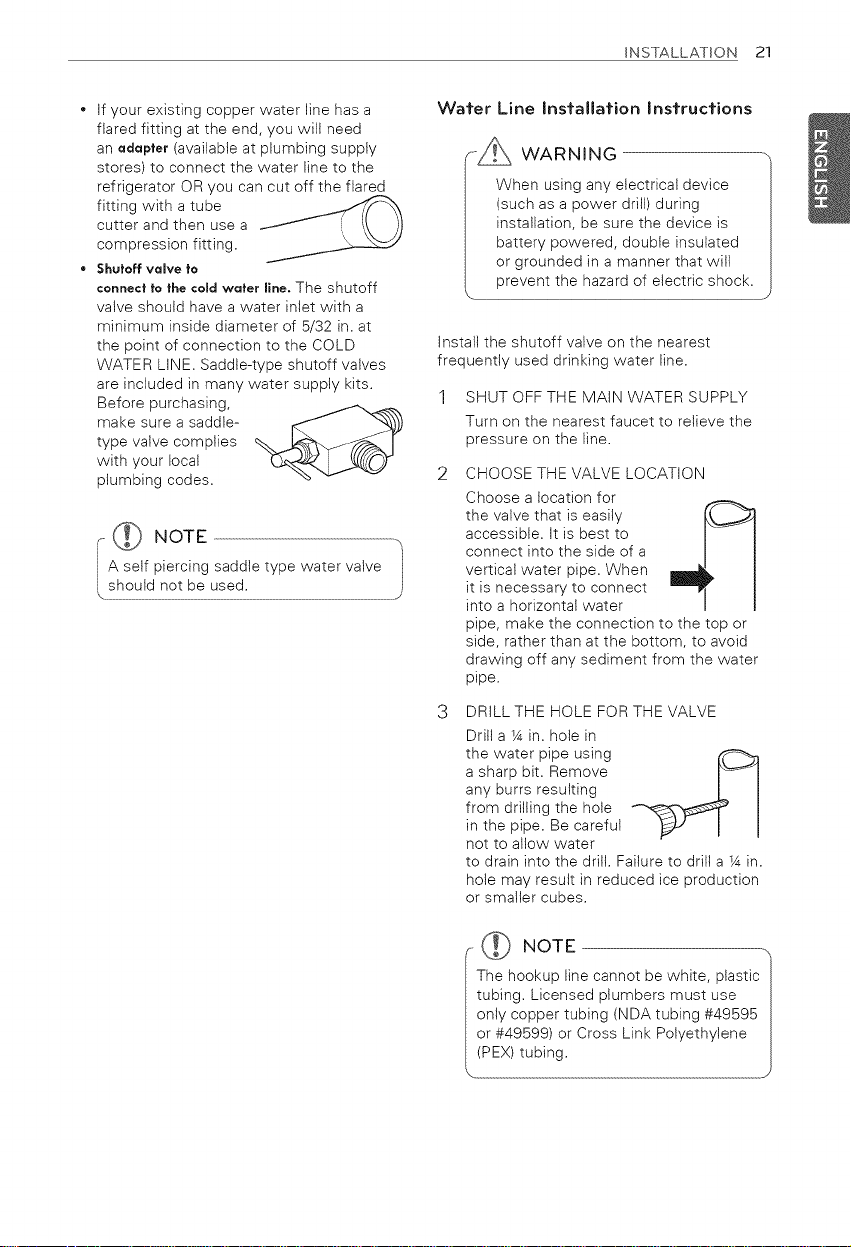
What You Will Need
Copper Tubing, 1A in. outer diameter, to
connect the refrigerator to the water
supply. Be sure both ends of the tubing
are cut square.
To determine how JJ
much tubing you need:
measure the distance
from the water valve on the back of
the refrigerator to the water supply
pipe. Then, add 8 feet (2.4 m). Be sure
there is sufficient extra tubing (about 8
feet [2.4 m] coiled into 3 turns of about
10 in. [25 cm] diameter) to allow the
refrigerator to move out from the wall
after installation.
Power drill.
* 1/2 in. or adjustable
wrench.
®
®
Flat blade and Phillips
head screwdrivers,
Two _¼in. oufer
diameter compression
r_ufsand 2 ferrules(sleeves) to connect the
copper tubing to the shutoff valve and
the refrigerator water valve.
INSTALLATION 21
• If your existing copper water line has a
flared fitting at the end, you will need
an adapter (available at plumbing suppty
stores) to connect the water line to the
refrigerator OR you can cut off the flared
fitting with a tube
cutter and then use a
compression fitting.
® Sha|off valve |o
connect to the cold wafer line, The shutoff
valve should have a water inlet with a
minimum inside diameter of 5/32 in. at
the point of connection to the COLD
WATER LINE. Saddle-type shutoff valves
are included in many water supply kits.
Before purchasing,
make sure a saddle-
type valve complies
with your local
plumbing codes.
,- _ NOTE
A self piercing saddle type water valve
should not be used.
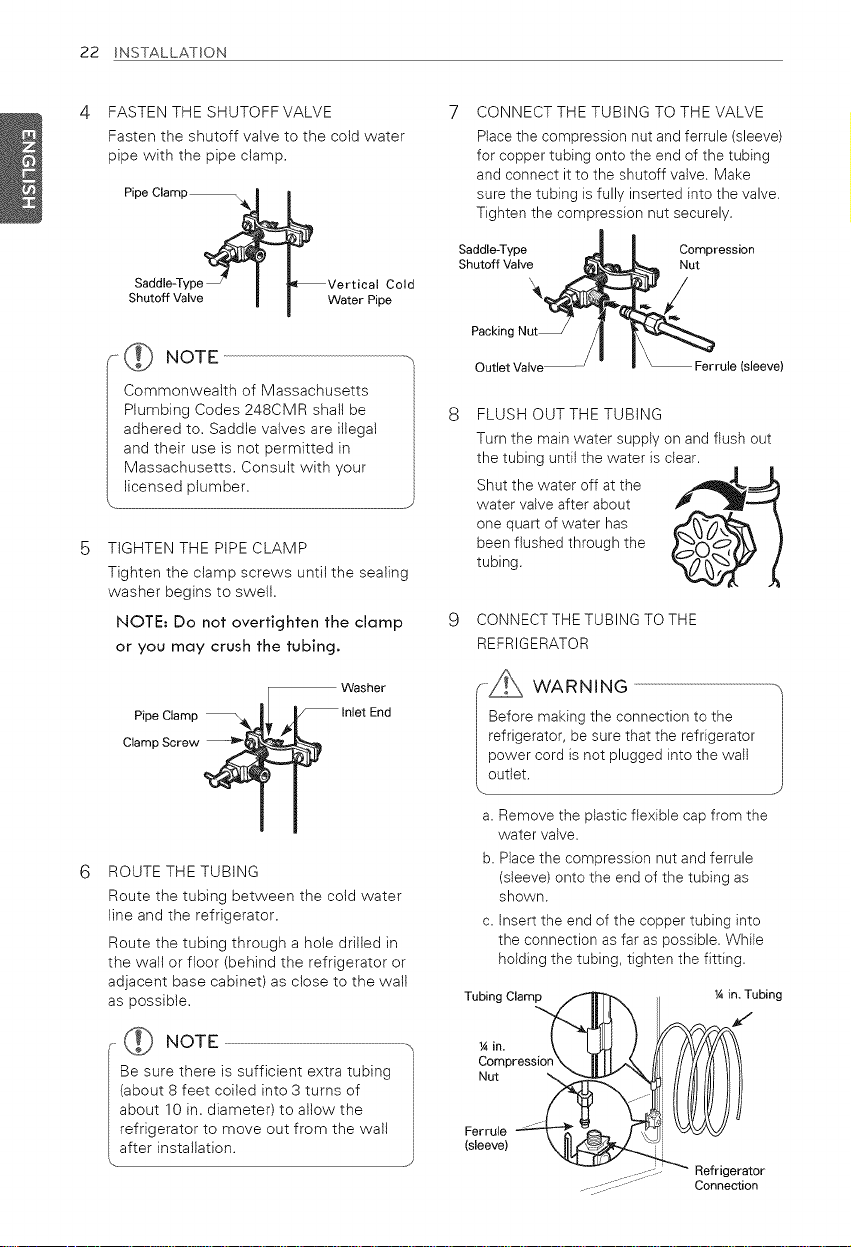
Water Line Insfallafion Insfrucfions
_ WARNING
When using any electrical device
(such as a power drill) during
installation, be sure the device is
battery powered, double insulated
or grounded in a manner that will
prevent the hazard of electric shock.
Install the shutoff valve on the nearest
frequently used drinking water line.
1 SHUT OFF THE MAIN WATER SUPPLY
Turn on the nearest faucet to relieve the
pressure on the line.
2 CHOOSE THE VALVE LOCATION
Choose a location for
the valve that is easily _(,_
accessible. It is best to
connect into the side of a
vertical water pipe. When
it is necessary to connect
into a horizontal water
pipe, make the connection to the top or
side, rather than at the bottom, to avoid
drawing off any sediment from the water
pipe.
3 DRILL THE HOLE FOR THE VALVE
Drill a _Ain. hole in
the water pipe using ¢_
a sharp bit. Remove
any burrs resulting
from drilling the hole
in the pipe. Be careful
not to allow water
to drain into the drill. Failure to drill a _Ain.
hole may result in reduced ice production
or smaller cubes.
_ NOTE ...................................
The hookup line cannot be white, plastic /
_tubing. Licensed plumbers must use I
[onty copper tubing (NDA tubing #49595 I
[or #49599) or Cross Link Polyethylene I
22 INSTALLATION
4
6
FASTEN THE SHUTOFF VALVE
Fasten the shutoff valve to the cold water
pipe with the pipe clamp.
Pipe Clamp_
Saddle-Type _ _ _Vertical Cold
Shutoff Valve _ _ Water Pipe
I
- d_ NOTE
Commonwealth of Massachusetts
Plumbing Codes 248CMR shall be
adhered to. Saddle valves are illegal
and their use is not permitted in
Massachusetts. Consult with your
licensed plumber.
TIGHTEN THE PIPE CLAMP
Tighten the clamp screws until the sealing
washer begins to swell.
NOTE= Do not overfighten the clamp
or you may crush the tubing.
Washer
t Inlet End
ROUTE THE TUBING
Route the tubing between the cold water
line and the refrigerator.
Route the tubing through a hole drilled in
the wall or floor (behind the refrigerator or
adjacent base cabinet) as close to the wan
as possible.
_ NOTE
Be sure there is sufficient extra tubing
(about 8 feet coiled into 3 turns of
about 10 in. diameter) to allow the
refrigerator to move out from the wall
after installation.
7 CONNECT THE TUBING TO THE VALVE
Place the compression nut and ferrule (sleeve)
for copper tubing onto the end of the tubing
and connect it to the shutoff valve. Make
sure the tubing is fully inserted into the valve.
Tighten the corr _ression nut securely.
Shdu_l(_iType e _ / Compression
_ Nut
PackingNut_
OutletValve........ / rule (sleeve)
S FLUSH OUT THE TUBING
Turn the main water supply on and flush out
the tubing until the water is dear.
Shut the water off at the _llL_
water valve after about
one quart of water has
been flushed through the
tubing.
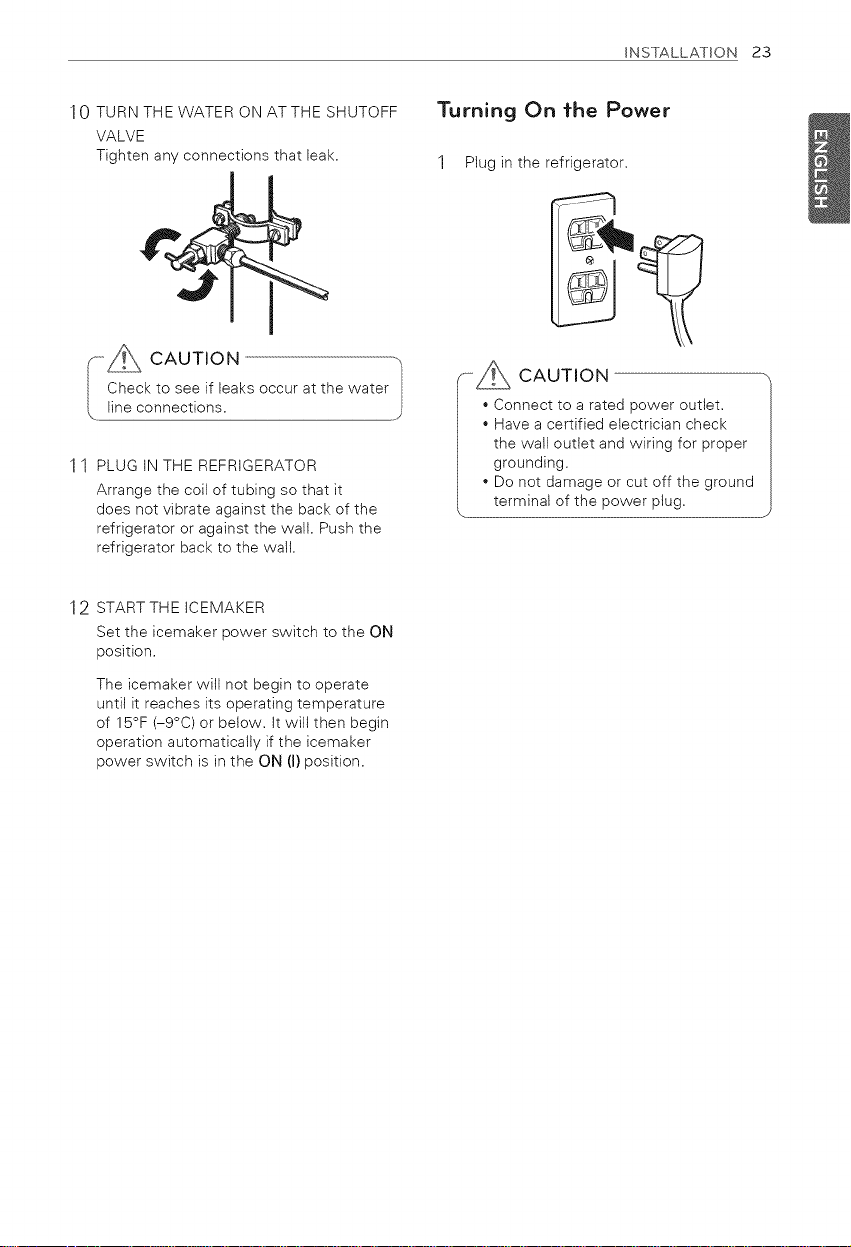
9 CONNECT THE TUBING TO THE
REFRIGERATOR
"_ WARNING
Before making the connection to the
refrigerator, be sure that the refrigerator
power cord is not plugged into the wall
outlet.
a. Remove the plastic flexible cap from the
water valve.
b. Place the compression nut and ferrule
(sleeve) onto the end of the tubing as
shown.
c. Insert the end of the copper tubing into
the connection as far as sossible. While
holding the tubing, tighten the fitting.
Tubing Clamp f..'l'[']_ ¼ in. Tubing
Compression _ IIIIAL J // Yl//11tI/
Nut ...... _.......
(sleeve, X,__C_._ .._
"_:J J.JM_ _._ Refnr_geera_or
..... ---:::;::--- " Co ecto
INSTALLATION 23
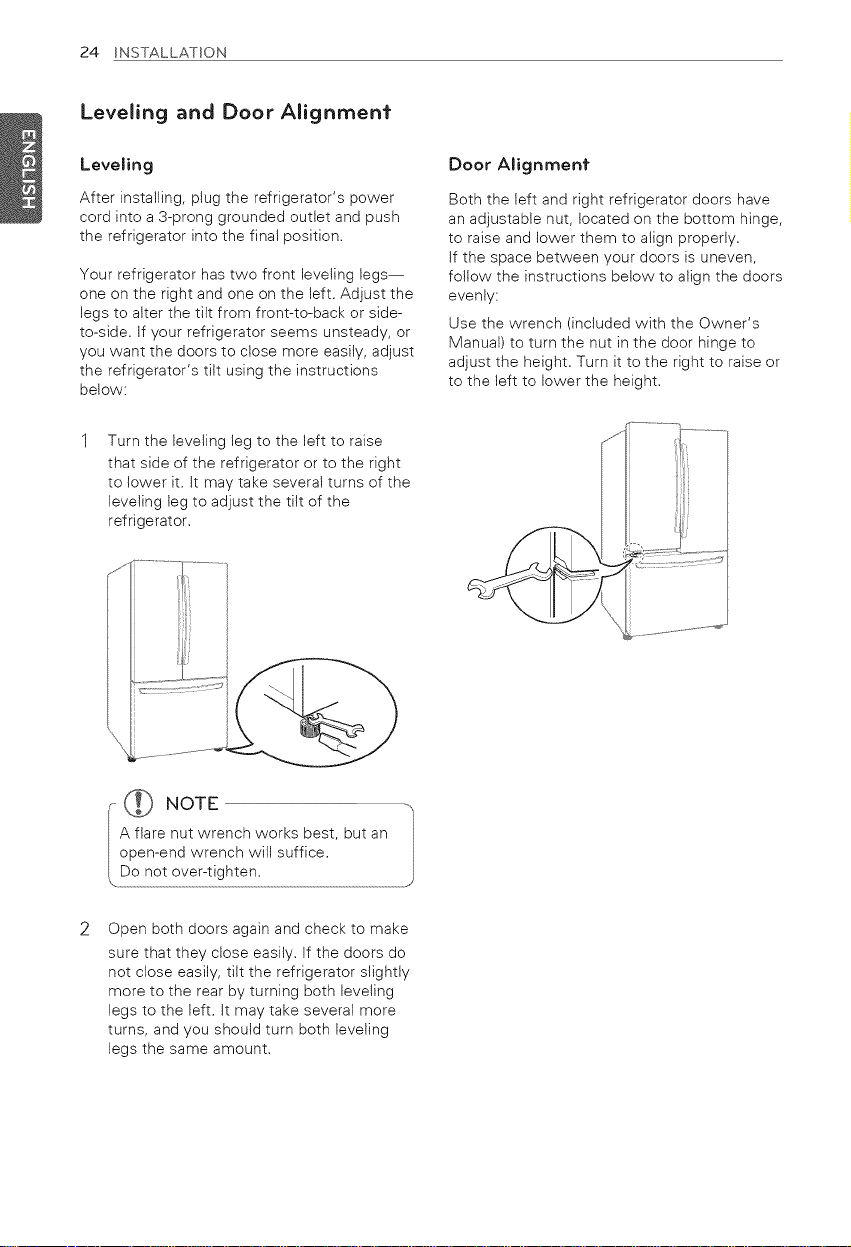
10 TURN THE WATER ON ATTHE SHUTOFF
VALVE
Tighten any connections that leak.
Turning On fhe Power
1 Plug in the refrigerator.
if _ CAUTION
Check tosee ifleaksoccuratthe water
lineconnections.
11 PLUG IN THE REFRIGERATOR
Arrange the coil of tubing so that it
does not vibrate against the back of the
refrigerator or against the wall. Push the
refrigerator back to the wall.
(_ CAUTION
Connect to a rated power outlet.
Have a certified electrician check
the wall outlet and wiring for proper
grounding.
Do not damage or cut off the ground
terminal of the power plug.
12 START THE ICEMAKER
Set the icemaker power switch to the ON
position.
The icemaker will not begin to operate
until it reaches its operating temperature
of 15°F (-9°C) or below. It will then begin
operation automatically if the icemaker
power switch is in the ON (I) position.
24 INSTALLATION
Leveling and Door Alignmenf
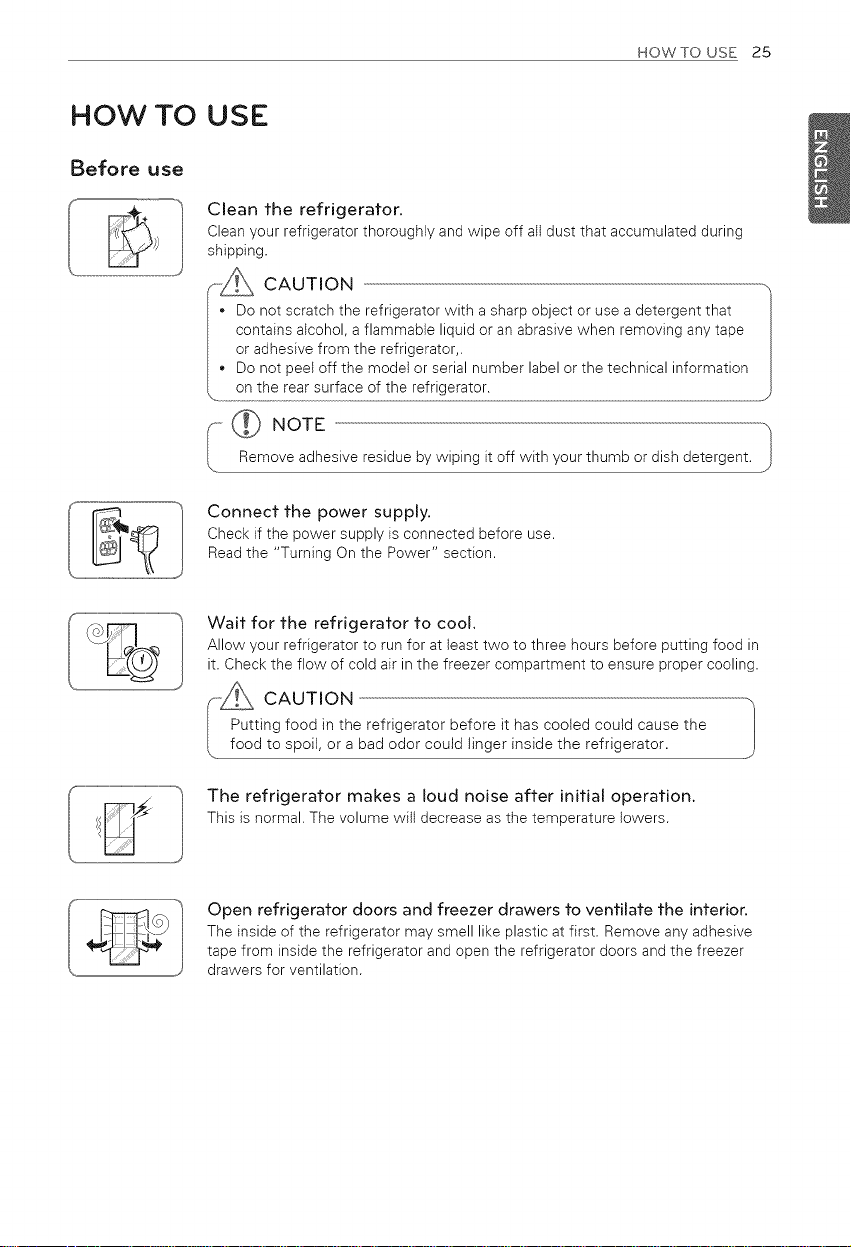
Leveling
After installing, plug the refrigerator's power
cord into a 3-prong grounded outlet and push
the refrigerator into the final position.
Your refrigerator has two front leveling legs--
one on the right and one on the left. Adjust the
legs to alter the tilt from front-to-back or side-
to-side. If your refrigerator seems unsteady, or
you want the doors to close more easily, adjust
the refrigerator's tilt using the instructions
below:
Door Alignment
Both the left and right refrigerator doors have
an adjustable nut, located on the bottom hinge,
to raise and lower them to align properly.
If the space between your doors is uneven,
foltow the instructions below to align the doors
evenly:
Use the wrench (included with the Owner's
Manual) to turn the nut in the door hinge to
adjust the height. Turn it to the right to raise or
to the left to lower the height.
Turn the leveling leg to the left to raise
that side of the refrigerator or to the right
to lower it. It may take several turns of the
leveling leg to adjust the tilt of the
refrigerator.
d} NoTE 1
A flare nut wrench works best, but an
open-end wrench will suffice.
Do not over-tighten.
2
Open both doors again and check to make
sure that they close easily. If the doors do
not close easily, tilt the refrigerator slightly
more to the rear by turning both leveling
legs to the left. It may take several more
turns, and you should turn both leveling
legs the same amount.
HOWTO USE 25
HOW TO
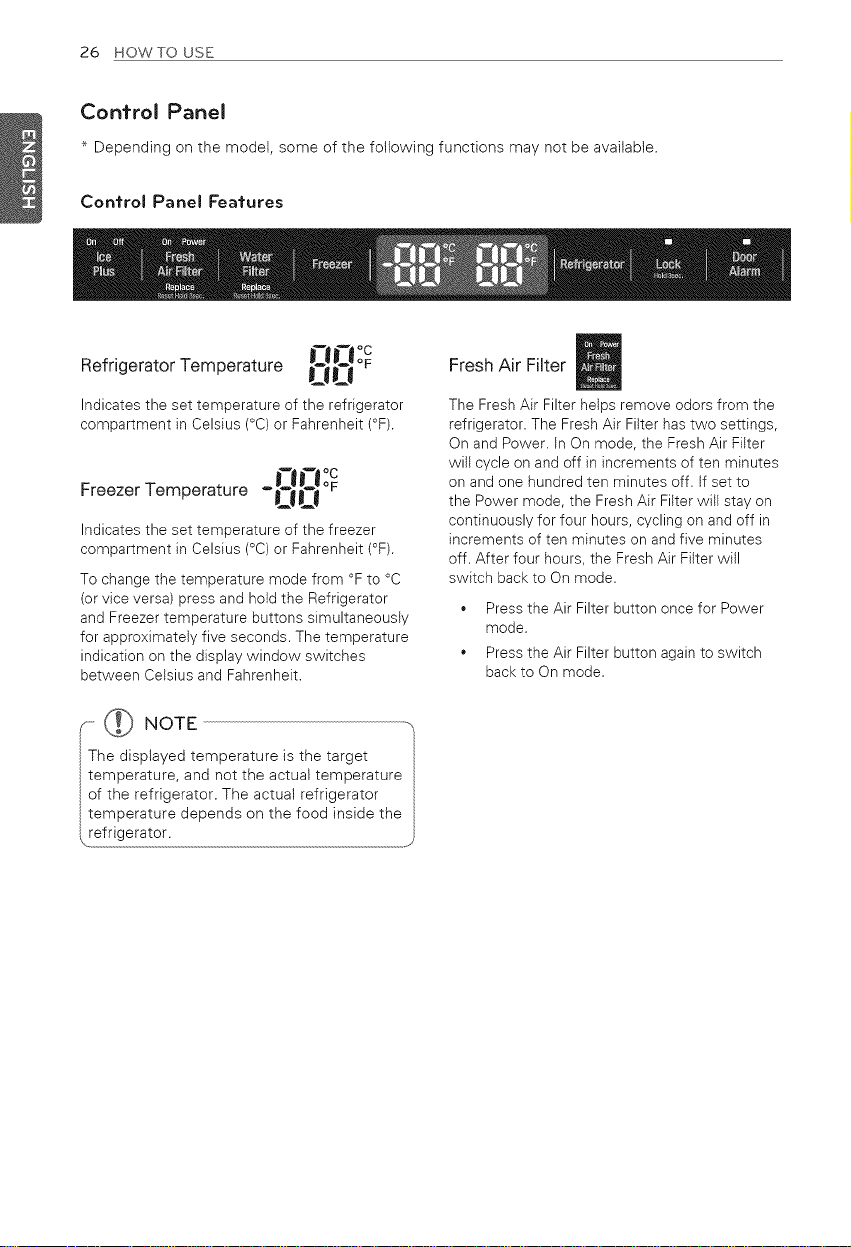
Before use
USE
Clean the refrigerator.
Clean your refrigerator thoroughly and wipe off all dust that accumulated during
shipping.
,_ CAUTION
Do not scratch the refrigerator with a sharp object or use a detergent that
contains alcohol, a flammable liquid or an abrasive when removing any tape
or adhesive from the refrigerator,.
• Do not peel off the model or serial number label or the technical information
on the rear surface of the refrigerator.
Remove adhesive residue by wiping it off with your thumb or dish detergent.
Connect the power supply.
Check if the power supply is connected before use.
Read the "Turning On the Power" section.
Wait for the refrigerator to cool.
Allow your refrigerator to run for at least two to three hours before putting food in
it. Check the flow of cold air in the freezer compartment to ensure proper cooling.
CAUTION 1
utting food in the refrigerator before it has cooled could cause the
food to spoil, or a bad odor could linger inside the refrigerator.
The refrigerator makes a loud noise after initial operation.
This is normal. The volume will decrease as the temperature lowers.
Open refrigerator doors and freezer drawers to ventilate the interior.
The inside of the refrigerator may smell like plastic at first. Remove any adhesive
tape from inside the refrigerator and open the refrigerator doors and the freezer
drawers for ventilation.
26 HOWTO USE
Confrol Panel
* Dependingon the model, some of the following functions may not be available.
Control Panel Features
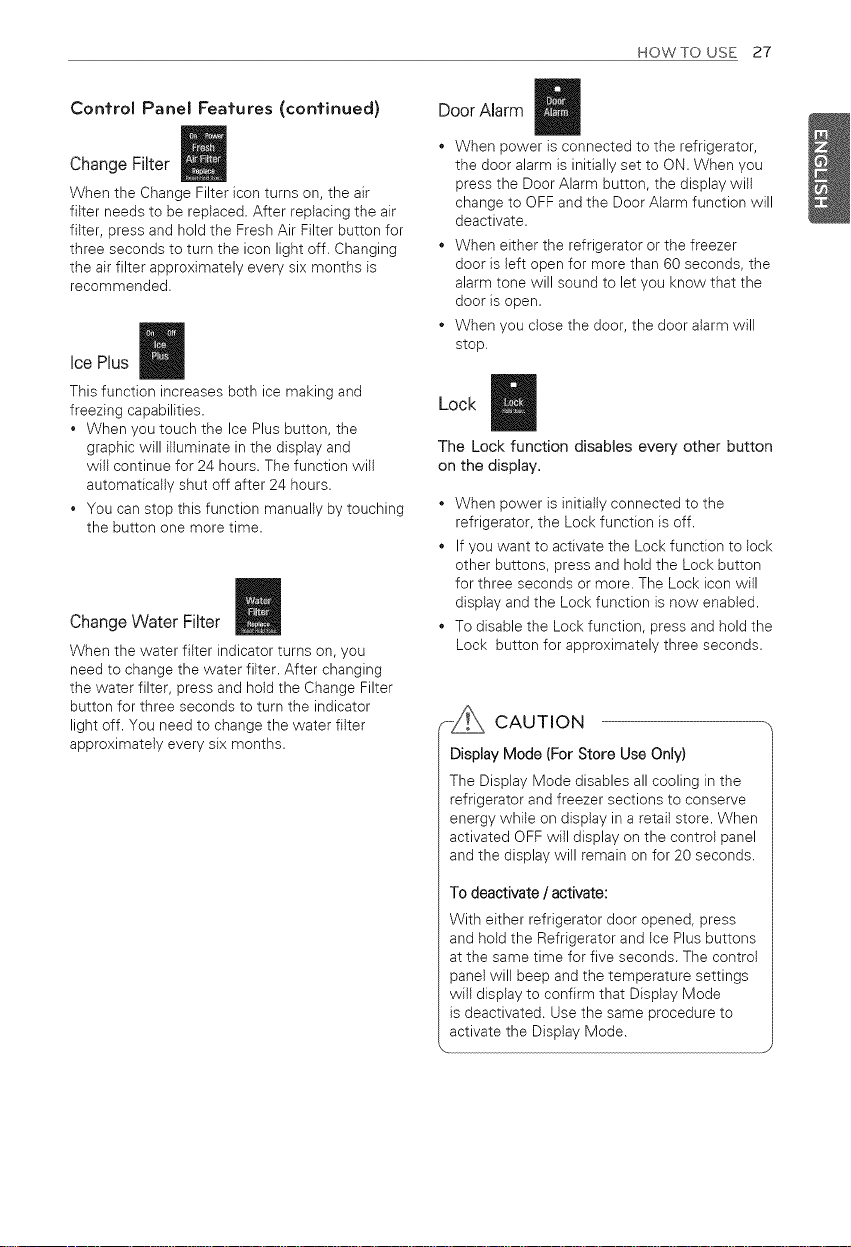
_- _o c
|| |oF
Refrigerator Temperature C|C_
Indicates the set temperature of the refrigerator
compartment in Celsius (°C) or Fahrenheit (°F).
_, _o c
tl toF
Freezer Temperature -L-|L-_
Indicates the set temperature of the freezer
compartment in Celsius (°C) or Fahrenheit (°F).
To change the temperature mode from °F to °C
(or vice versa) press and hold the Refrigerator
and Freezer temperature buttons simultaneously
for approximately five seconds. The temperature
indication on the display window switches
between Celsius and Fahrenheit.
Fresh Air Filter
The Fresh Air Filter helps remove odors from the
refrigerator. The Fresh Air Filter has two settings,
On and Power. In On mode, the Fresh Air Filter
will cycle on and off in increments of ten minutes
on and one hundred ten minutes off. If set to
the Power mode, the Fresh Air Filter will stay on
continuously for four hours, cycling on and off in
increments of ten minutes on and five minutes
off. After four hours, the Fresh Air Filter will
switch back to On mode.
• Press the Air Filter button once for Power
mode.
Press the Air Filter button again to switch
back to On mode.
NOTE
he displayed temperature is the target
emperature, and not the actual temperature
f the refrigerator. The actual refrigerator
emPerature depends on the food inside the
,I
HOWTO USE 27
Control Panel Features (continued)
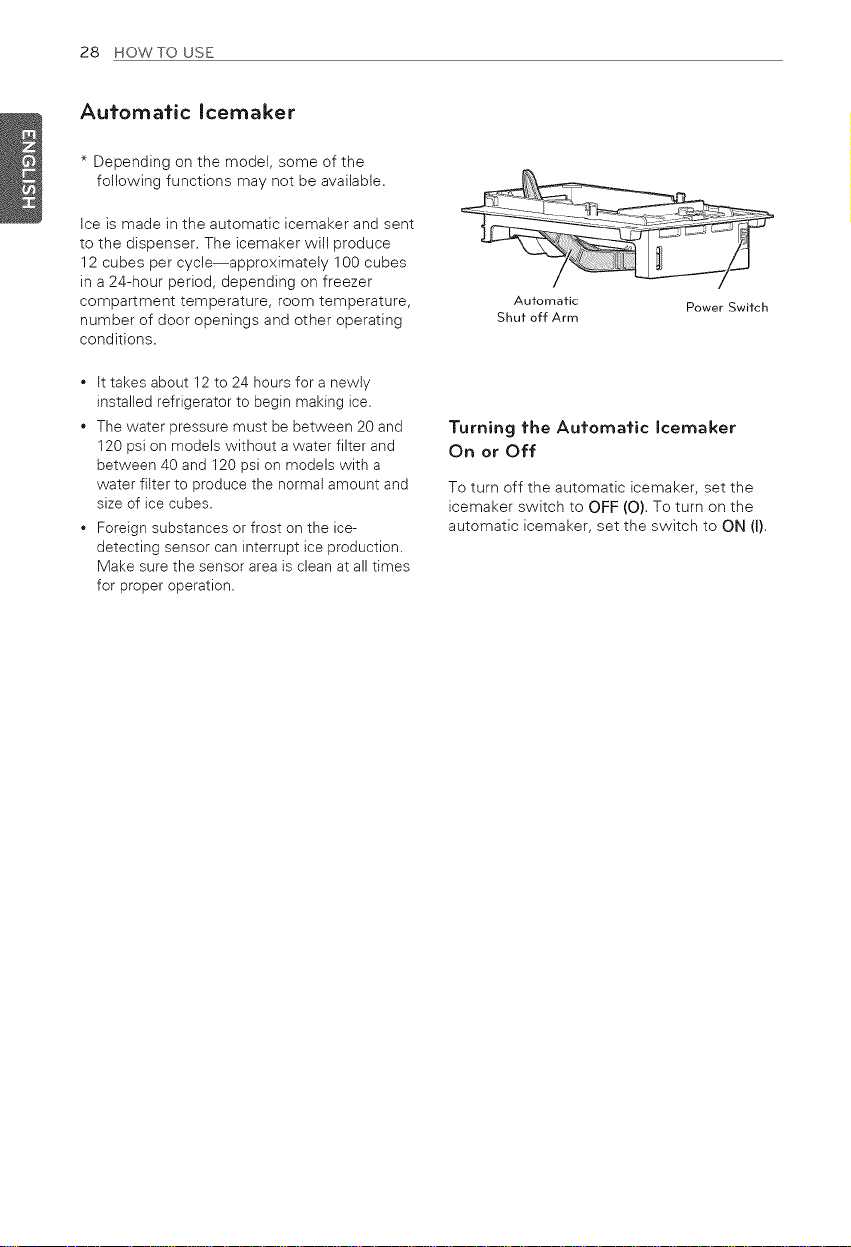
Change Filter
When the Change Filter icon turns on, the air
filter needs to be replaced. After replacing the air
filter, press and hold the Fresh Air Filter button for
three seconds to turn the icon light off. Changing
the airfilter approximately every six months is
recommended.
Ice Plus
This function increases both ice making and
freezing capabilities.
* When you touch the Ice Plus button, the
graphic will illuminate in the display and
will continue for 24 hours. The function will
automatically shut off after 24 hours.
* You can stop this function manually by touching
the button one more time.
Change Water Filter
When the water filter indicator turns on, you
need to change the water filter. After changing
the water filter, press and hold the Change Filter
button for three seconds to turn the indicator
light off. You need to change the water filter
approximately every six months.
Door Alarm
* When power is connected to the refrigerator,
the door alarm is initially set to ON. When you
press the Door Alarm button, the display will
change to OFF and the Door Alarm function will
deactivate.
* When either the refrigerator or the freezer
door is left open for more than 60 seconds, the
alarm tone will sound to let you know that the
door is open.
° When you close the door, the door alarm will
stop.
Lock
The Lock function disables every other button
on the display.
* When power is initially connected to the
refrigerator, the Lock function is off.
* If you want to activate the Lock function to lock
other buttons, press and hold the Lock button
for three seconds or more. The Lock icon will
display and the Lock function is now enabled.
* To disable the Lock function, press and hold the
Lock button for approximately three seconds.
----_ CAUTION
Display Mode (For Store Use Only)
The Display Mode disables all cooling in the
refrigerator and freezer sections to conserve
energy while on display in a retail store. When
activated OFF will display on the control panel
and the display will remain on for 20 seconds.
To deactivate / activate:
With either refrigerator door opened, press
and hold the Refrigerator and Ice Plus buttons
at the same time for five seconds. The control
panel will beep and the temperature settings
will display to confirm that Display Mode
is deactivated. Use the same procedure to
activate the Display Mode.
28 HOWTO USE
Aufomafi¢ Icemaker
* Depending on the model, some of the
following functions may not be available.
Ice is made in the automatic icemaker and sent
to the dispenser. The icemaker will produce
12 cubes per cycle--approximately 100 cubes
in a 24-hour period, depending on freezer
compartment temperature, room temperature,
number of door openings and other operating
conditions.
• It takes about 12 to 24 hours for a newly
installed refrigerator to begin making ice.
The water pressure must be between 20 and
120 psi on models without a water filter and
between 40 and 120 psi on models with a
water filter to produce the normal amount and
size of ice cubes.
Foreign substances or frost on the ice-
detecting sensor can interrupt ice production.
Make sure the sensor area is clean at all times
for proper operation.
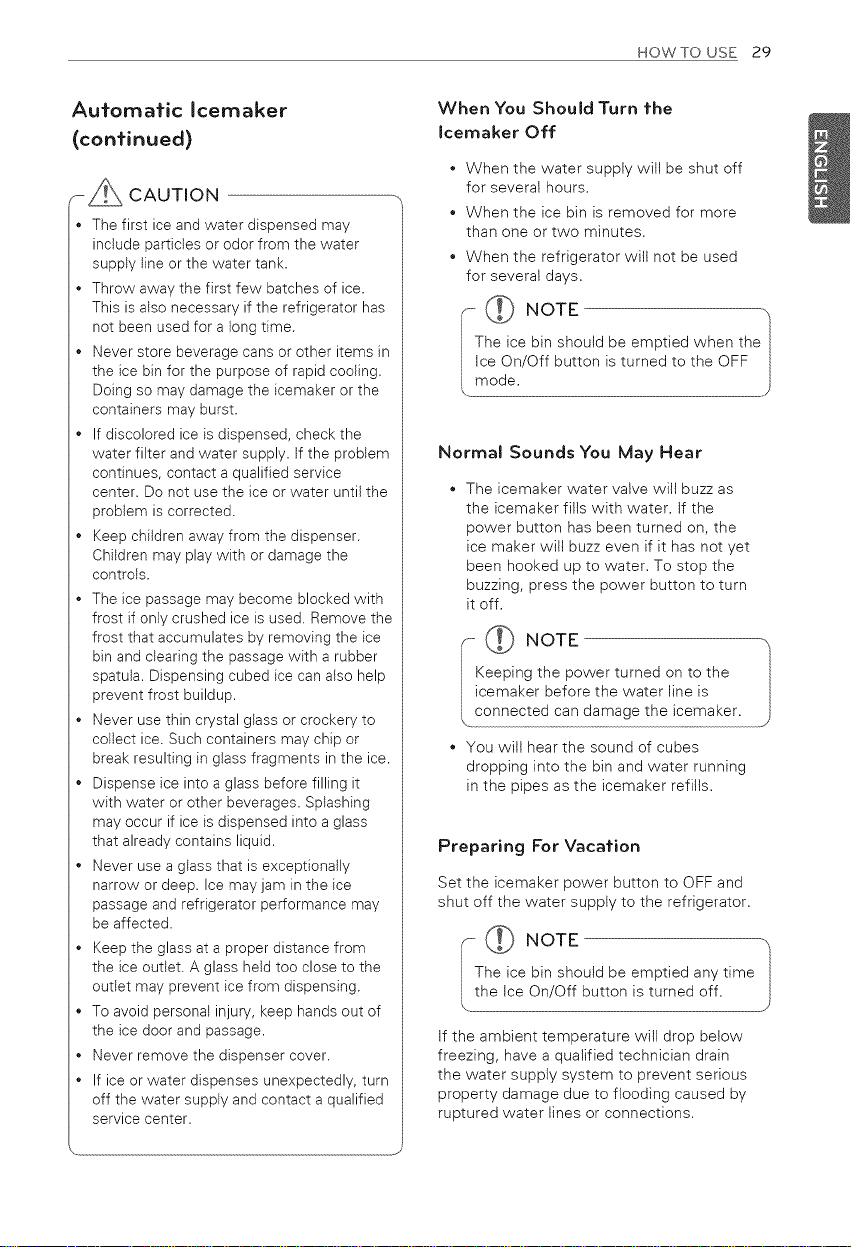
Automatic Power Switch
Shut off Arm
Turning the Automatic Icemaker
On or Off
To turn off the automatic icemaker, set the
icemaker switch to OFF (O). To turn on the
automatic icemaker, set the switch to ON (I).
HOWTOUSE29
Automatic Icemaker
(continued)
-_ CAUTION
• The first ice and water dispensed may
include particles or odor from the water
supply line or the water tank.
• Throw away the first few batches of ice.
This is also necessary if the refrigerator has
not been used for a long time.
• Never store beverage cans or other items in
the ice bin for the purpose of rapid cooling.
Doing so may damage the icemaker or the
containers may burst.
• If discolored ice is dispensed, check the
water filter and water supply. If the problem
continues, contact a qualified service
center. Do not use the ice or water until the
problem is corrected.
• Keep children away from the dispenser.
Children may play with or damage the
controls.
• The ice passage may become blocked with
frost if only crushed ice is used. Remove the
frost that accumulates by removing the ice
bin and clearing the passage with a rubber
spatula. Dispensing cubed ice can also help
prevent frost buildup.
° Never use thin crystal glass or crockery to
collect ice. Such containers may chip or
break resulting in glass fragments in the ice.
° Dispense ice into a glass before filling it
with water or other beverages. Splashing
may occur if ice is dispensed into a glass
that already contains liquid.
° Never use aglass that is exceptionally
narrow or deep. Ice may jam in the ice
passage and refrigerator performance may
be affected.
° Keep the glass at a proper distance from
the ice outlet. A glass held too close to the
outlet may prevent ice from dispensing.
° To avoid personal injury, keep hands out of
the ice door and passage.
° Never remove the dispenser cover.
° If ice or water dispenses unexpectedly, turn
off the water supply and contact a qualified
service center.
When You Should Turn the
Icemaker Off
* When the water supply will be shut off
for several hours.
* When the ice bin is removed for more
than one or two minutes.
* When the refrigerator will not be used
for several days.
NOTE -,
he ice bin should be emptied when the
ce On/Off button is turned to the OFF I
.)
Normal Sounds You May Hear
* The icemaker water valve wilt buzz as
the icemaker fills with water. If the
power button has been turned on, the
ice maker wilt buzz even if it has not yet
been hooked up to water. To stop the
buzzing, press the power button to turn
it off.
'"@ NOTE
Keeping the power turned on to the
icemaker before the water line is
connected can damage the icemaker.
° You will hear the sound of cubes
dropping into the bin and water running
in the pipes as the icemaker refills.
Preparing For Vacation
Set the icemaker power button to OFF and
shut off the water supply to the refrigerator.
@NOTE }
The ice bin should be emptied any time
the Ice On/Off button is turned off.
If the ambient temperature will drop below
freezing, have a qualified technician drain
the water supply system to prevent serious
property damage due to flooding caused by
ruptured water lines or connections.
\
30 HOWTO USE
Sforing Food
Food Preservation Location
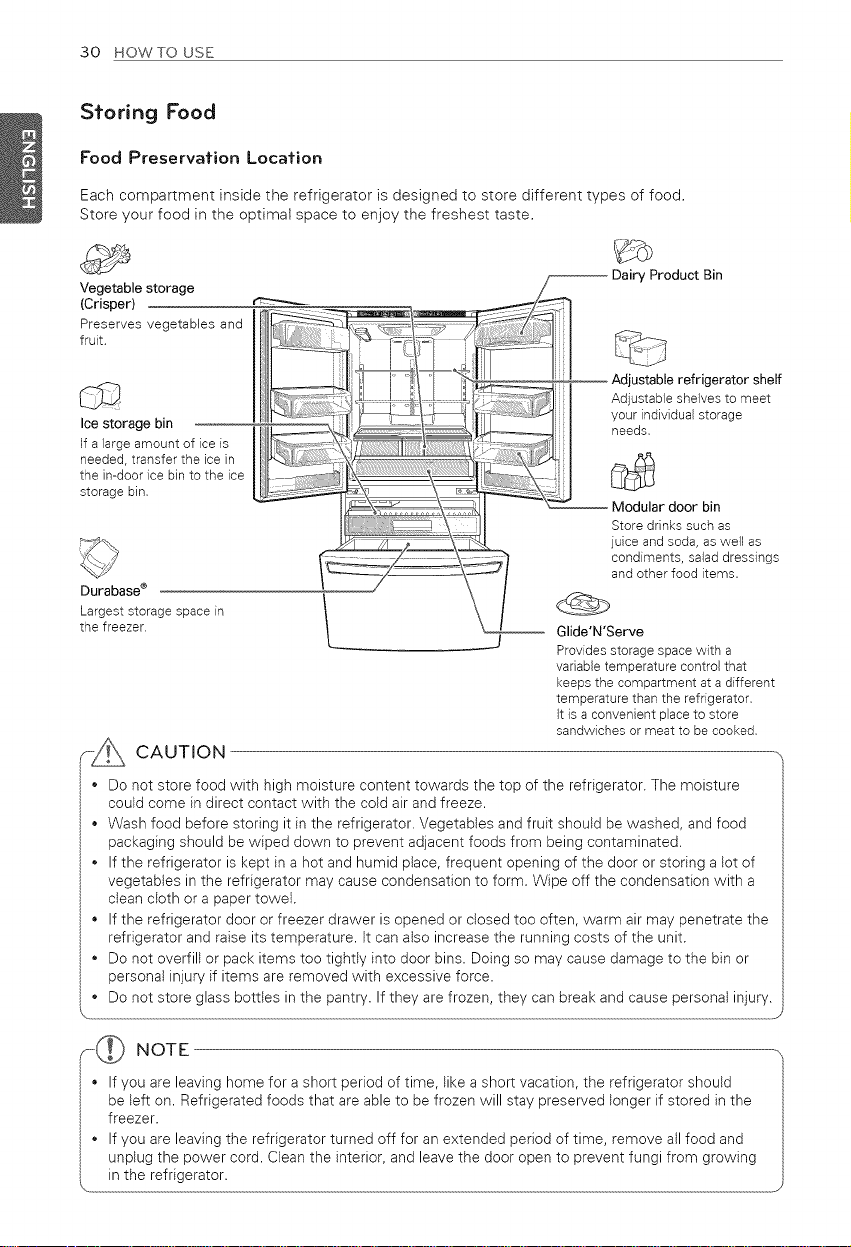
Each compartment inside the refrigerator is designed to store different types of food.
Store your food in the optimal space to enjoy the freshest taste.
Vegetable storage
(Crisper)
Preserves vegetables and
fruit.
Ice storage bin
If a large amount of ice is
needed, transfer the ice in
the in-door ice bin to the ice
storage bin,
Durabase ®
Largest storage space in
the freezer,
Dairy Product Bin
':1 A_lble refrigerator shelf
Adjustable shelves to meet
your individual storage
needs,
F2/%,' CAUTION
@
-- Modular door bin
Store drinks such as
juice andsoda,as wellas
condiments,saladdressings
andotherfood items.
Glide'N'Serve
Providesstoragespacewith a
variabletemperaturecontrolthat
keepsthecompartmentatadifferent
temperaturethanthe refrigerator.
Itis aconvenientplaceto store
sandwichesor meatto becooked.
• Do net store food with high moisture content towards the top of the refrigerator. The moisture
could come in direct contact with the cold air and freeze.
• Wash food before storing it in the refrigerator. Vegetables and fruit should be washed, and food
packaging should be wiped down to prevent adjacent foods from being contaminated.
• If the refrigerator is kept in a hot and humid place, frequent opening of the door or storing a let of
vegetables in the refrigerator may cause condensation to form. Wipe off the condensation with a
clean cloth or a paper towel.
If the refrigerator door or freezer drawer is opened or closed too often, warm air may penetrate the
refrigerator and raise its temperature. It can also increase the running costs of the unit.
• Do not overfill or pack items too tightly into door bins. Doing so may cause damage to the bin or
personal injury if items are removed with excessive force.
• Do not store glass bottles in the pantry. If they are frozen, they can break and cause personal injury.
-i{_ NOTE
I' If you are leaving home for a short period of time, like a short vacation, the refrigerator should
be left on. Refrigerated foods that are able to be frozen will stay preserved longer if stored in the
freezer.
I" If you are leaving the refrigerator turned off for an extended period of time, remove all food and
unplug the power cord. Clean the interior, and leave the door open to prevent fungi from growing
in the refrigerator.
HOWTO USE 31
Food Storage Tips
* The following tips may not be applicable
depending on the model.
Wrap or store food in the refrigerator inairtight
and moisture-proof material unless otherwise
noted. This prevents food odor and taste transfer
throughout the refrigerator. For dated products,
check date code to ensure freshness.
Food How to
Butter or Keep opened butter in a covered
Margarine dish or closed compartment.
When storing an extra supply,
wrap in freezer packaging and
freeze.
Cheese Store in the original wrapping
until you are ready to use it.
Once opened, rewrap tightly in
plastic wrap or aluminum foil.
Milk Wipe milk cartons. For coldest
milk, ptace containers on
interior shelf.
Eggs Store in original carton on
interior shelf, not on door shelf.
Fruit Do not wash or hull the fruit
until it is ready to be used. Sort
and keep fruit in its originat
container, in a crisper, or store
in a completely closed paper
bag on a refrigerator shelf.
Leafy
Vegetables
Vegetables
with skins
(carrots,
peppers)
Fish
Remove store wrapping and
trim or tear off bruised and
discolored areas. Wash in cold
water and drain. Place in plastic
bag or plastic container and
store in crisper.
Place in plastic bags or plastic
container and store in crisper.
Store fresh fish and shellfish
in the freezer section if they
are not being consumed the
same day of purchase. It is
recommended to consume
fresh fish and shellfish the
same day purchased.
Leftovers Cover leftovers with plastic wrap
or aluminum foil, or store in
plastic containers with tight lids.
Storing Frozen Food
l@ NOTE "/
/ Check a freezer guide or a reliable cookbook I
for further information about preparing food I
Freezing
Your freezer will not quick-freeze a large
quantity of food. Do not put more unfrozen
food into the freezer than will freeze within
24 hours (no more than 2 to 3 Ibs. of food per
cubic foot of freezer space). Leave enough
space in the freezer for air to circulate around
packages. Be careful to leave enough room at
the front so the door can close tightly.
Storage times will vary according to the quality
and type of food, the type of packaging or wrap
used (how airtight and moisture-proof) and
the storage temperature, ice crystals inside a
sealed package are normal. This simply means
that moisture in the food and air inside the
package have condensed, creating ice crystals.
} NOTE
Allow hot foods to cool at room temperature
for 30 minutes, then package and freeze.
Cooling hot foods before freezing saves
energy
32 HOWTO USE
Storing Frozen Food (continued)
Packaging
Successful freezing depends on correct
packaging. When you close and seal the
package, it must not allow air or moisture in or
out. If it does, you could have food odor and
taste transfer throughout the refrigerator and
could also dry out frozen food.
Packaging recommendations:
* Rigid plastic containers with tight-fitting
lids
* Straight-sided canning/freezing jars
Heavy-duty aluminum foil
Plastic-coated paper
Non-permeable plastic wraps
Specified freezer-grade self-sealing plastic
bags
Follow package or container instructions for
proper freezing methods.
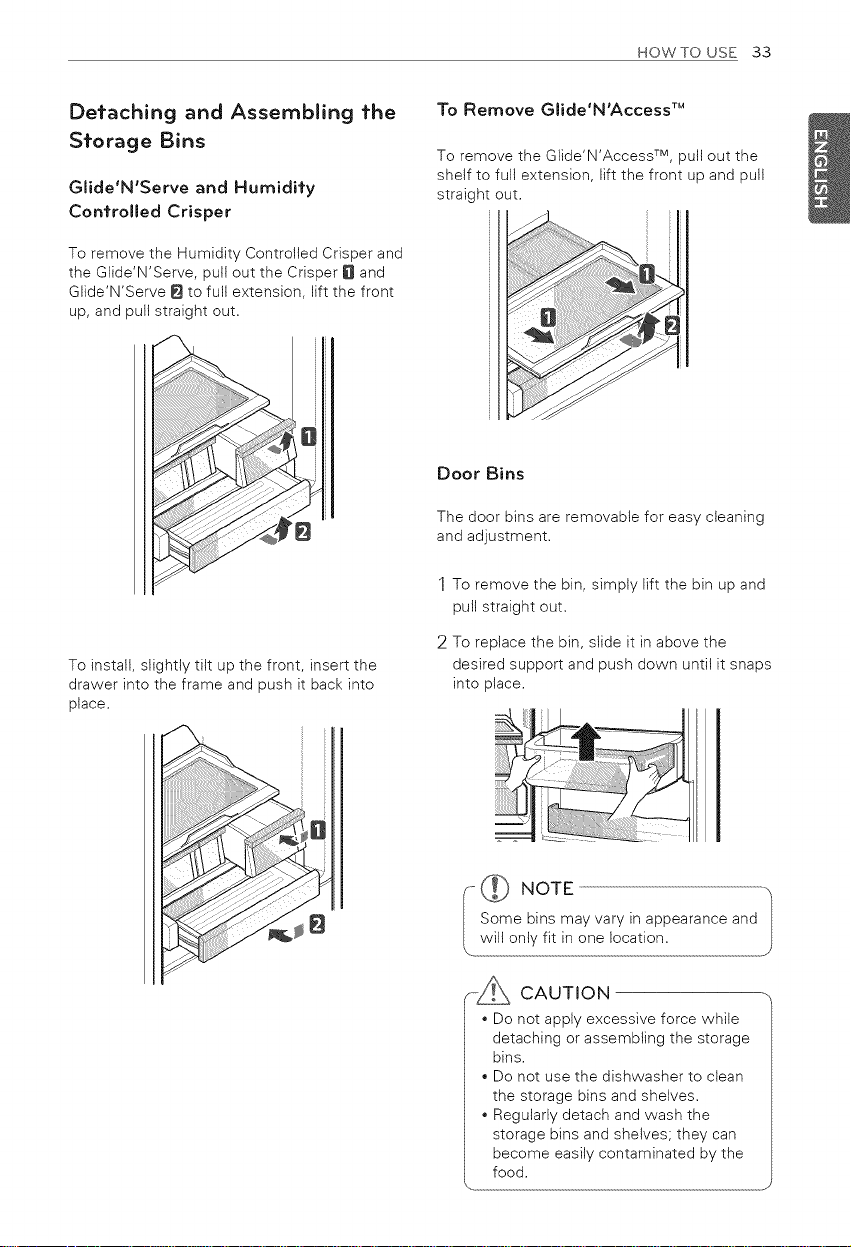
Glide'N°Access TM
The Glide'N'Access TMslides out for easy loading
of large items, like sheet cakes or deti trays, and
to give you easy access to items stored at the
back of the shelf.
To slide out, grasp the handle at the front of the
shelf and gently pull forward. Push back to slide
in.
'-_ CAUTION "]
Take care when sliding the /
Glide'N'Access TMin and out, as taller
Do not use
* Bread wrappers
* Non-polyethylene plastic containers
Containers without tight lids
Wax paper or wax-coated freezer wrap
Thin, semi-permeable wrap
Glide'N'Serve
The Glide'N'Serve provides storage space
with a variable temperature control that can
keep the compartment at a slightly different
temperature than the refrigerator section. This
drawer can be used for large party trays, deti
items and beverages. (This drawer should
not be used for vegetables that require high
humidity.)
Press the Select button to choose between
Produce (Cold), Deti (Colder) and Meat
(Coldest).
HOWTO USE 33
Defaching and Assembling fhe
Sforage Bins
Glide'N'Serve and Humidify
Controlled Crisper
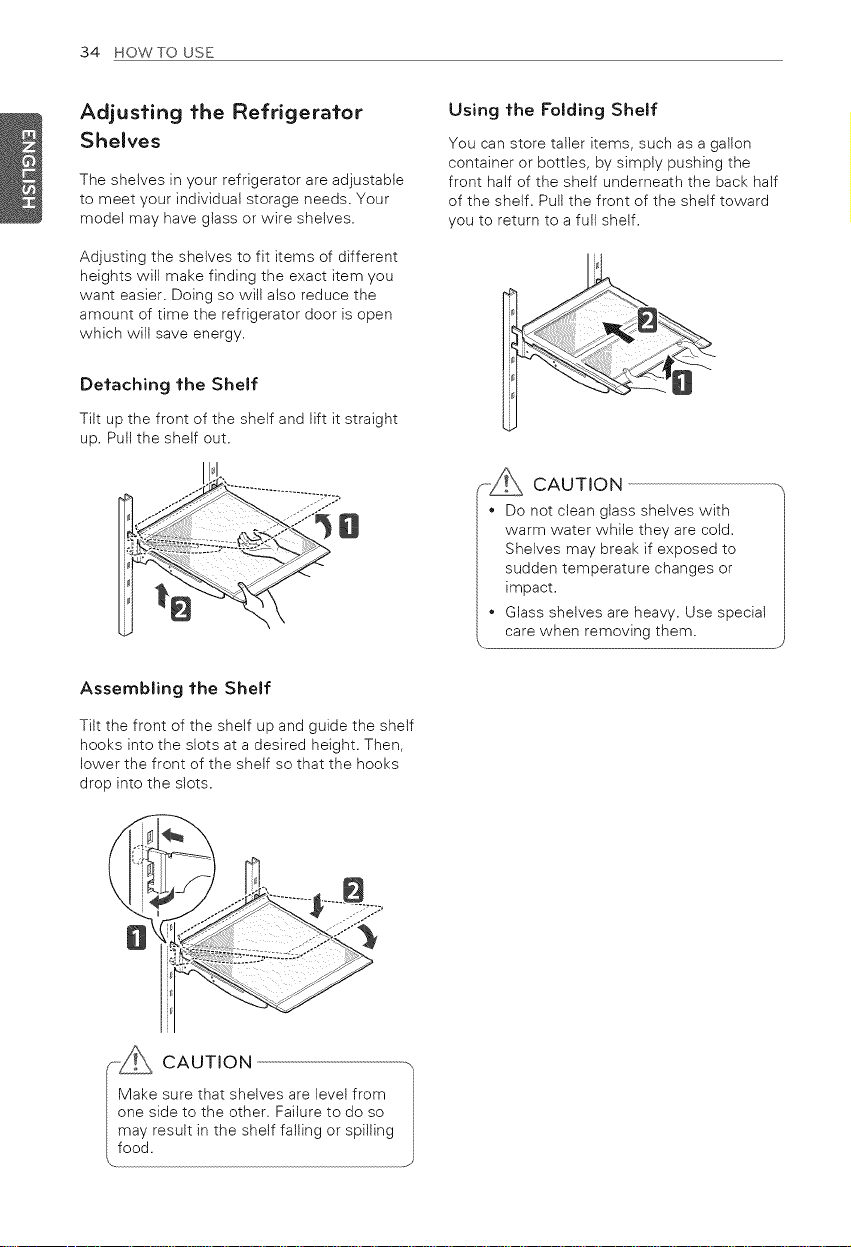
To remove the Humidity Controlled Crisper and
the Glide'N'Serve, putl out the Crisper O and
Glide'N'Serve 0 to fult extension, lift the front
up, and pull straight out.
To Remove Glide'N'Access TM
To remove the Glide'N'Access TM, pull out the
shelf to full extension, lift the front up and pull
straight out.
8
To install, slightly tilt up the front, insert the
drawer into the frame and push it back into
place.
Door Bins
The door bins are removable for easy cleaning
and adjustment.
1 To remove the bin, simply lift the bin up and
pull straight out.
2 To replace the bin, slide it in above the
desired support and push down until it snaps
into place.
I _'_ NOTE --,,
Some bins may vary in appearance and
will onty fit in one location
,hitX_ CAUTION
* Do not apply excessive force while
detaching or assembling the storage
bins.
* Do not use the dishwasher to clean
the storage bins and shelves.
* Regularly detach and wash the
storage bins and shelves; they can
become easily contaminated by the
food.
34 HOWTO USE
Adjusting the Refrigerator
Shelves
The shelves in your refrigerator are adjustable
to meet your individual storage needs. Your
model may have glass or wire shelves.
Adjusting the shelves to fit items of different
heights wilt make finding the exact item you
want easier. Doing so wilt also reduce the
amount of time the refrigerator door is open
which will save energy.
Detaching the Shelf
Tilt up the front of the shelf and lift it straight
up. Pull the shelf out.
Using the Folding Shelf
You can store taller items, such as a gallon
container or bottles, by simply pushing the
front half of the shelf underneath the back half
of the shelf. Pult the front of the shelf toward
you to return to a full shelf.
-----_ CAUTION
Do not clean glass shelves with
warm water while they are cold.
Shelves may break if exposed to
sudden temperature changes or
impact.
Glass shelves are heavy. Use special
care when removing them.
Assembling the Shelf
Tilt the front of the shelf up and guide the shelf
hooks into the slots at a desired height. Then,
lower the front of the shelf so that the hooks
drop into the slots.
r_ CAUTION
Make sure that shelves are level from
one side to the other. Failure to do so
may result in the shelf failing or spilling
food.
MAINTENANCE 35
MAINTENANCE
Cleaning
* Both the refrigerator and freezer sections defrost automatically; however, clean both
sections about once a month to prevent odors.
* Wipe up spills immediately.
* Always unplug the refrigerator before cleaning.
General Cleaning Tips
* Unplug refrigerator or disconnect power.
* Remove alt removable parts, such as
shelves, crispers, etc.
* Use a clean sponge or soft cloth and a
mild detergent in warm water. Do not
use abrasive or harsh cleaners.
* Hand wash, rinse and dry all surfaces
thoroughly.
Exterior
Waxing external painted metal surfaces helps
provide rust protection. Do not wax plastic
parts. Wax painted metal surfaces at least
twice a year using appliance wax (or auto paste
wax). Apply wax with a clean, soft cloth.
For products with a stainless steel exterior,
use a clean sponge or soft cloth and a mild
detergent in warm water. Do not use abrasive
or harsh cleaners. Dry thoroughly with a soft
cloth.
CAUTION
o not use a rough cloth or sponge
when cleaning the interior and exterior
of the refrigerator.
Do not place your hand on the bottom
surface of the refrigerator when
Inside Walls (allow freezer to warm
up so the cloth will not stick)
To help remove odors, you can wash the inside
of the refrigerator with a mixture of baking
soda and warm water. Mix 2 tablespoons of
baking soda to 1 quart of water (26 g soda
to 1 liter water). Be sure the baking soda is
completely dissolved so it does not scratch the
surfaces of the refrigerator.
Door Liners and Gaskets
Use a clean sponge or soft cloth and a mild
detergent in warm water. Do not use cleaning
waxes, concentrated detergents, bleaches,
or cleaners containing petroleum on plastic
refrigerator parts.
Plastic Parts (covers and panels)
Use a clean sponge or soft cloth and a mild
detergent in warm water. Do not use glass
cleaners, abrasive cleansers, or flammable
fluids. These can scratch or damage the
material.
Condenser Coils
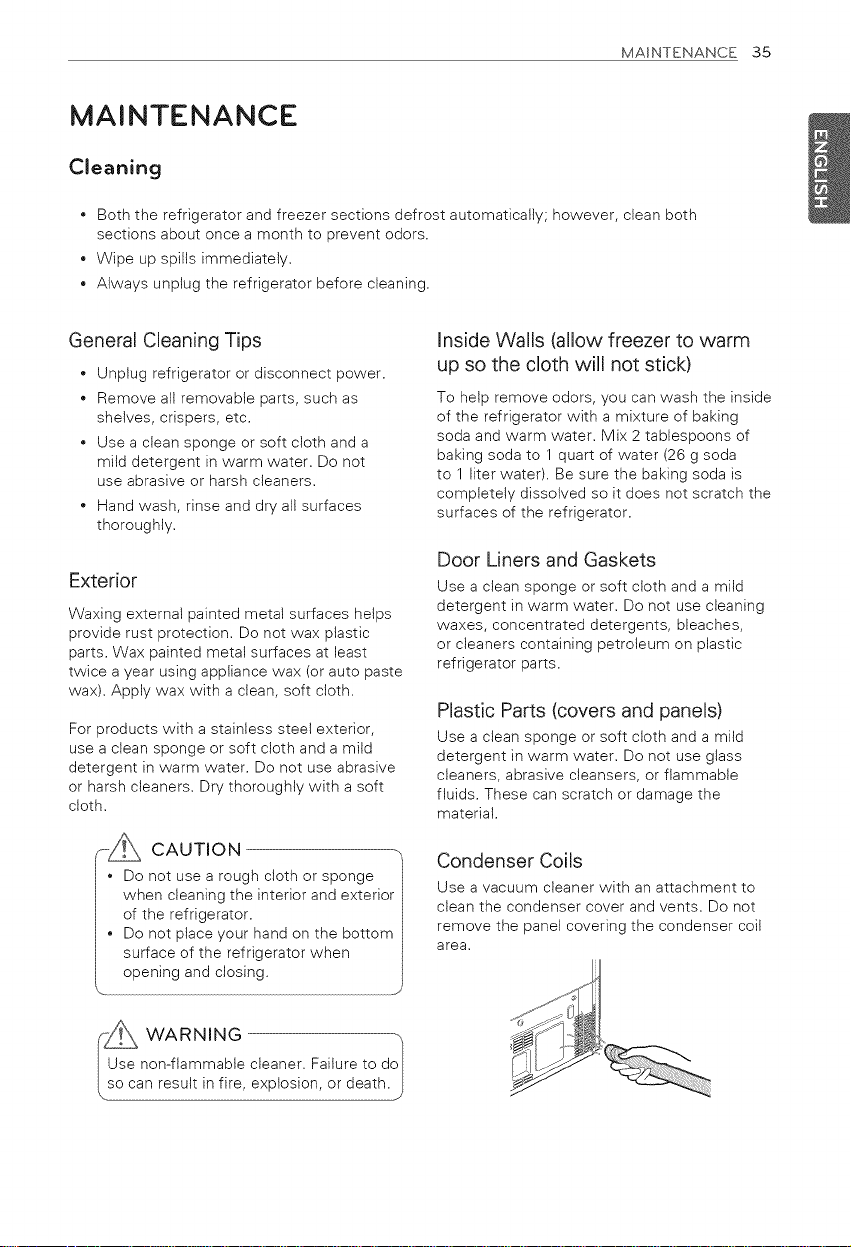
Use a vacuum cleaner with an attachment to
clean the condenser cover and vents. Do not
remove the panel covering the condenser coil
area.
_ WARNING -----_
se non-flammable cleaner. Failure to do I
so can result in fire explosion or death. /
36 MAINTENANCE
Replacing the Fresh Air Filter
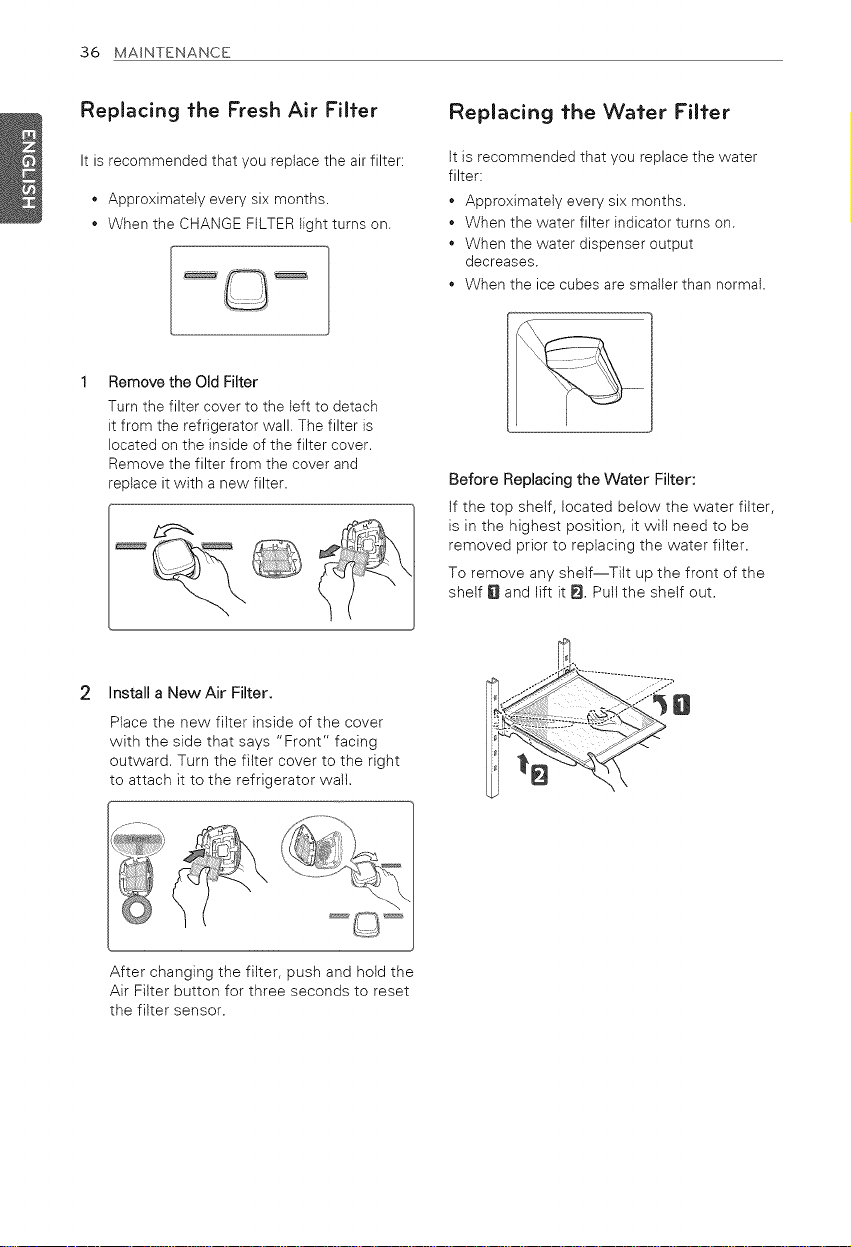
It is recommended that you replace the air filter:
• Approximately every six months.
• When the CHANGE FILTER light turns on.
©
Remove the Old Filter
Turn the filter cover to the left to detach
it from the refrigerator wall. The filter is
located on the inside of the filter cover.
Remove the filter from the cover and
replace it with a new filter.
Replacing the Water Filter
it is recommended that you replace the water
filter:
• Approximately every six months.
• When the water filter indicator turns on.
• When the water dispenser output
decreases.
• When the ice cubes are smaller than normal.
Before Replacing the Water Filter:
if the top shelf, located below the water filter,
is in the highest position, it will need to be
removed prior to replacing the water filter.
To remove any shetf--Tiit up the front of the
shetf D and lift it Q. Pull the shelf out.
2 Install a NewAir Filter,
Place the new filter inside of the cover
with the side that says "Front" facing
outward. Turn the filter cover to the right
to attach it to the refrigerator wall.
After changing the filter, push and hold the
Air Fitter button for three seconds to reset
the filter sensor.
MAINTENANCE 37
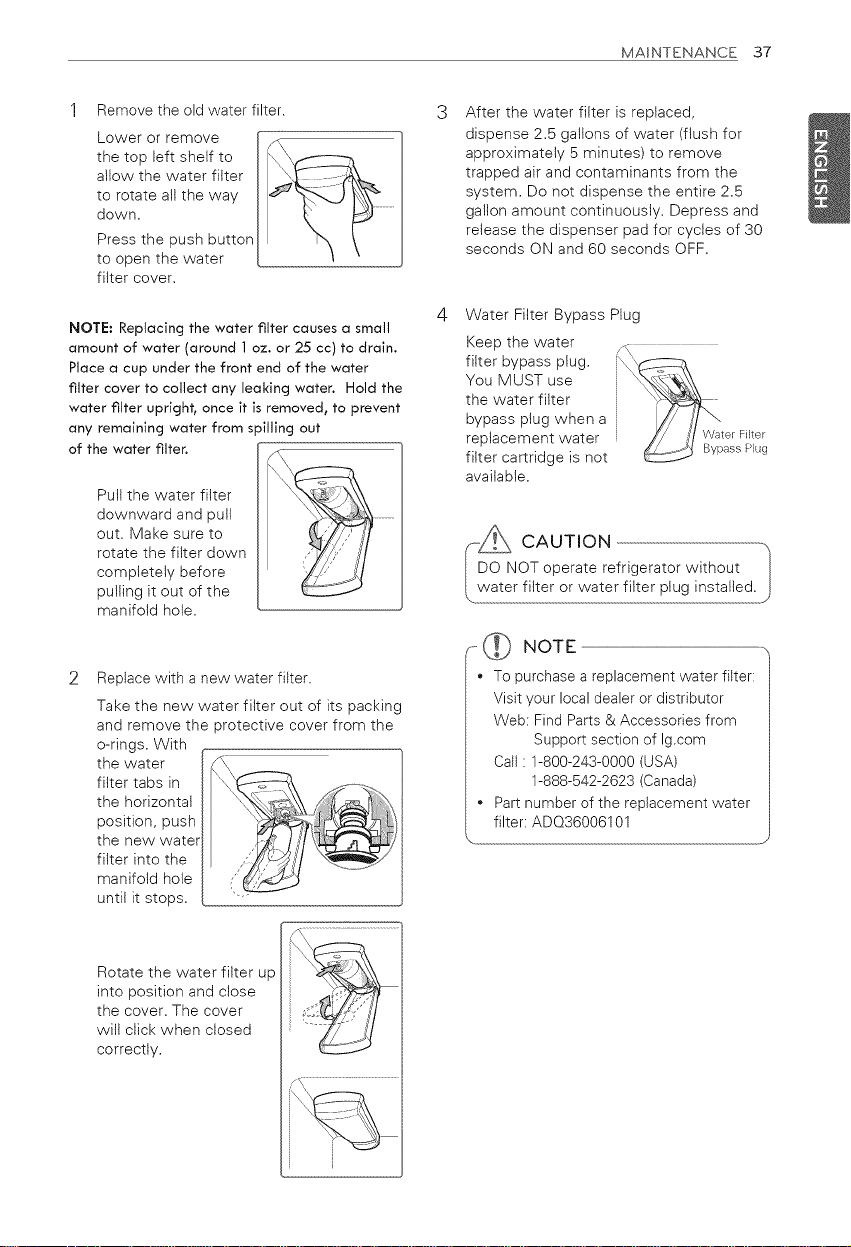
Remove the old water filter.
Lower or remove [
the top left shelf to /
allow the water filter
to rotate all the way _ .........
down. /
Press the push button
to open the water L
filter cover.
NOTE: Replacing the water filter causes a small
amount of water (around 1 oz. or 25 cc) to drain.
Place a cup under the front end of the water
filter cover to collect any leaking water. Hold the
water filter upright, once it is removed_ to prevent
any remaining water from spilling out
of the water filter.
Pull the water filter
downward and pull
out. Make sure to
rotate the filter down
completely before
pulling it out of the
manifold hole.
Replace with a new water filter.
Take the new water filter out of its packing
and remove the protective cover from the
o-rings. With
the water
filter tabs in
the horizontal
position, push
the new water
filter into the
manifold hole
until it stops.
3
4
After the water filter is replaced,
dispense 2.5 gallons of water (flush for
approximately 5 minutes) to remove
trapped air and contaminants from the
system. Do not dispense the entire 2.5
gallon amount continuously. Depress and
release the dispenser pad for cycles of 30
seconds ON and 60 seconds OFF.
Water Filter Bypass Plug
Keep the water
filter bypass plug.
You MUST use
the water filter
bypass plug when a
replacement water
filter cartridge is not
available.
Water Filter
Bypass Fqug
-_ CAUTION
DO NOT operaterefrigeratorwithout
water filterorwater filterpluginstalled,
J
,,-@ NOTE
o To purchase a replacement water filter:
Visit your local dealer or distributor
Web: Find Parts & Accessories from
Support section of Ig.com
Call: 1-800-243-0000 (USA)
1-888-542-2623 (Canada)
Part number of the replacement water
filter: ADQ36006101
Rotate the water filter up
into position and close
the cover. The cover
will click when closed
correctly.
38 MAINTENANCE
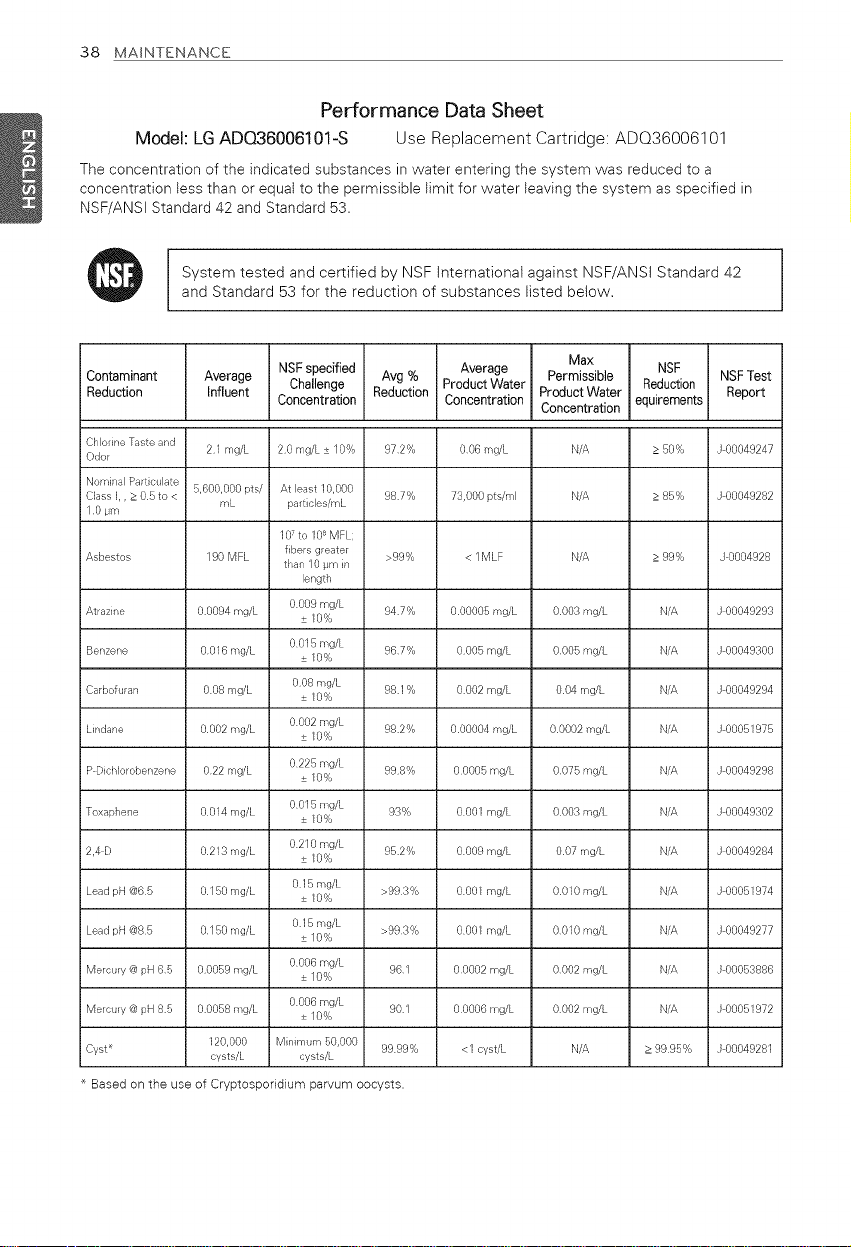
Performance Data Sheet
Model: LGADQ36006101-S Use ReplacementCartridge:ADQ36006101
The concentration of the indicated substances in water entering the system was reduced to a
concentration less than or equal to the permissible limit for water leaving the system as specified in
NSF/ANSI Standard 42 and Standard 53.
System tested and certified by NSF International against NSF/ANSt Standard 42
and Standard 53 for the reduction of substances listed below.
Average
NSFspecified Avg % Product Water
Contaminant Average Challenge Reduction
Reduction Influent Concentration Concentration
Max
Permissible NSF
Reduction
Product Water
Concentration equirements
Chlo0ne Taste alsd
Odor 21 mg/L 20 mg/L ± 10% 972% 006 mg/L
Nominal Particulate
Class I,, _>05 to < 5,600,000 pts/ At east 10,000 987% 73,000 pts/ml
mL particles/mL
10 #m
10' to I@ MFL;
Asbestos 190 MFL fibers greater >99% < 1MLF
than 10 _rn in
length
Atrazine 00094 mg/L 0009 mg/L 947% 000005 mg/L
± 10%
Benzene 0016 mg/L 0015 mg/L 967% 0005 mg/L
± 10%
Carbofuran 008 mg/L 008 mg/L 98 1% 0002 mg/L
± 10%
Lmdane 0002 mg/L 0002 mg/L 982% 000004 mg/L
± 10%
P DicNorobenzene 022 mg/L 0225 mg/L 998% 00005 mg/L
± 10%
Toxaphene 0014 mg/L 0015 mg/L 93% 0001 mg/L
± 10%
2,4 D 0213 mg/L 0210 mg/L 952% 0009 mg/L
± 10%
Lead pH @65 0150 mg/L 015 mg/L >993% 0001 mg/L
± 10%
Lead pH @85 0150 mg/L 015 mg/L >993% 0001 mg/L
± 10%
Mercury @pH 65 00059 mg/L 0006 mg/L 961 00002 mg/L
± 10%
Merctlry @ pH 85 00058 mg/L 0006 mg/L 901 00006 mg/L
± 10%
120,000 Minimum 50,000 9999% <I cyst/L
Cyst_ cysts/L cysts/L
N/A > 50%
N/A > 85%
NSFTest
Report
J 00049247
J 00049282
x Based on the use of Cryptosporidium parvum oocysts.
0003 mg/L N/A J 00049293
0005 mg/L N/A J 00049300
004 mg/L N/A J 00049294
00002mg/L N/A J 00051975
0075 mg/L N/A J 00049298
0003 mg/L N/A J 00049302
007 mg/L N/A J 00049284
0010 mg/L N/A J 00051974
0010 mg/L N/A J 00049277
0002 mg/L N/A J 00053886
0002 mg/L N/A J 00051972
N/A 2 9995% J 00049281
N/A _ 99% J 0004928
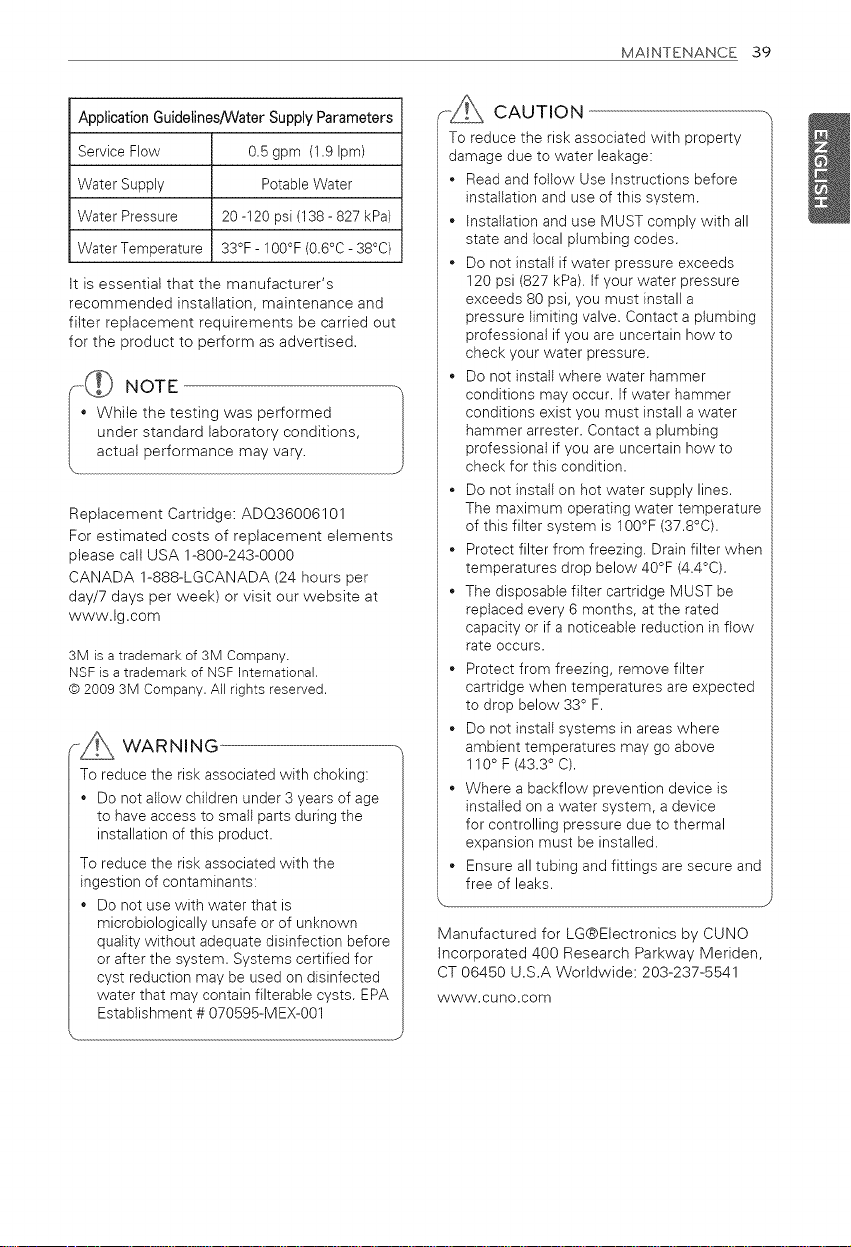
MAINTENANCE 39
Application Guidelines/Water Supply Parameters
Service Flow 0.5 gpm (1.9 Ipm)
Water Supply PotableWater
Water Pressure 20-120 psi (138- 827 kPa)
Water Temperature 33°F - 100°F(0.6°C - 38°C)
It is essential that the manufacturer's
recommended installation, maintenance and
filter replacement requirements be carried out
for the product to perform as advertised.
@ NOTE
While the testing was performed
under standard laboratory conditions,
actual performance may vary.
Replacement Cartridge: ADQ36006101
For estimated costs of replacement elements
ptease call USA 1-800-243-0000
CANADA 1-888-LGCANADA (24 hours per
day/7 days per week) or visit our website at
www.lg.com
3M is a trademark of 3M Company.
NSF is a trademark of NSF International
@ 2009 3M Company. All rights reserved.
s_ WARNING
To reduce the risk associated with choking:
• Do not allow children under 3 years of age
to have access to small parts during the
installation of this product.
To reduce the risk associated with the
ingestion of contaminants:
• Do not use with water that is
microbiologically unsafe or of unknown
quality without adequate disinfection before
or after the system. Systems certified for
cyst reduction may be used on disinfected
water that may contain filterable cysts. EPA
Establishment # 070595-M EX-001
\,J
F---_ CAUTION
To reduce the risk associated with property
damage due to water leakage:
• Read and follow Use Instructions before
installation and use of this system.
• Installation and use MUST comply with all
state and local plumbing codes.
• Do not install if water pressure exceeds
120 psi (827 kPa). If your water pressure
exceeds 80 psi, you must install a
pressure limiting valve. Contact a plumbing
professional if you are uncertain how to
check your water pressure.
• Do not install where water hammer
conditions may occur. If water hammer
conditions exist you must install awater
hammer attester. Contact a plumbing
professional if you are uncertain how to
check for this condition.
• Do not install on hot water supply lines.
The maximum operating water temperature
of this filter system is 100°F (37.8°C).
• Protect filter from freezing. Drain filter when
temperatures drop below 40°F (4.4°C).
• The disposable filter cartridge MUST be
replaced every 6 months, at the rated
capacity or if a noticeable reduction in flow
rate occurs.
• Protect from freezing, remove filter
cartridge when temperatures are expected
to drop below 33° F.
• Do not install systems in areas where
ambient temperatures may go above
110° F (43.3° C).
• Where a backflow prevention device is
installed on a water system, a device
for controlling pressure due to thermal
expansion must be installed.
° Ensure all tubing and fittings are secure and
free of leaks.
k
Manufactured for LG@Electronics by CUNO
Incorporated 400 Research Parkway Meriden,
CT 06450 U.S.A Worldwide: 203-237-5541
www, cuno,com
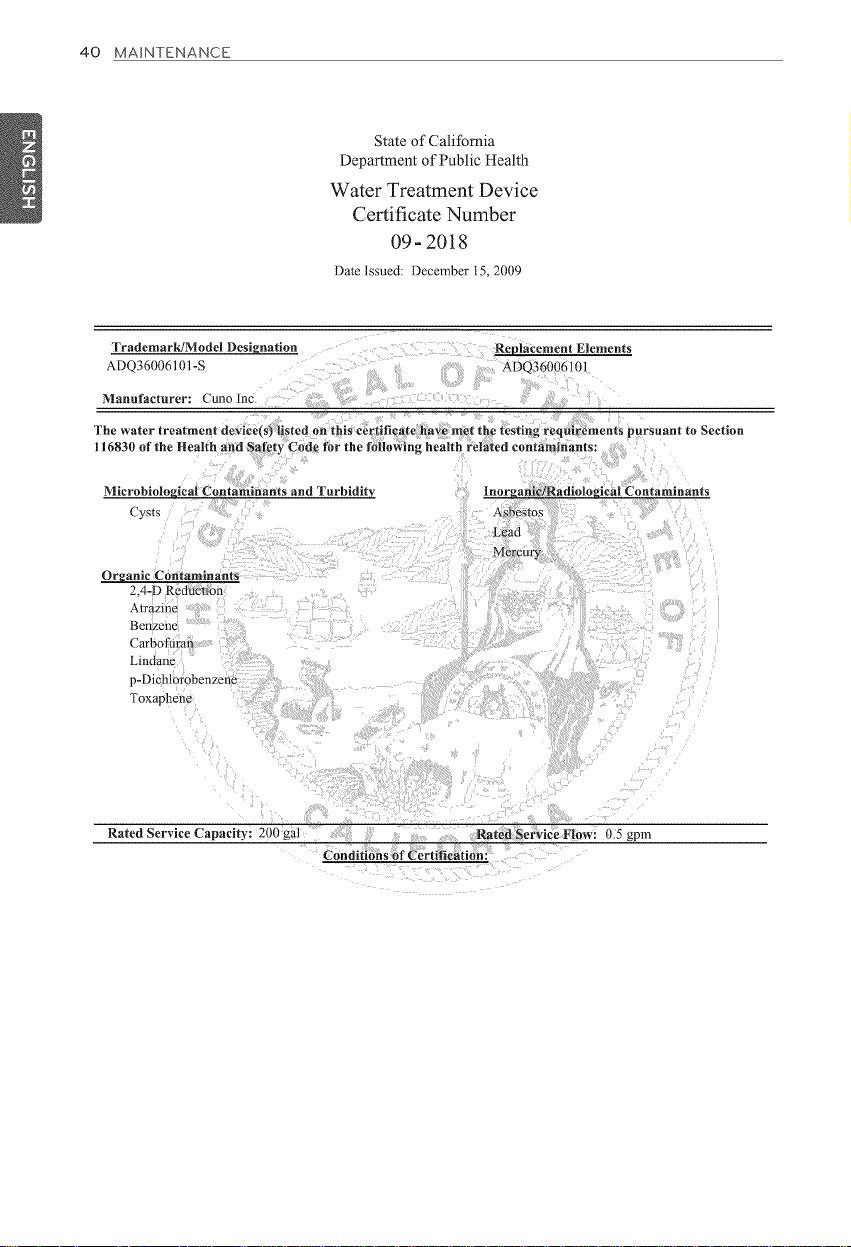
40 MAgNTENANCE
State of California
Department of Public Health
Water Treatment Device
Certificate Number
09- 2018
Date Issued: December 15, 2009
Trademark/Model Designation Replacement Elements
ADQ36006101-S ADQ36006101
Manufacturer: Cuno inc.
The water treatment device(s) Iis_ed on this certificate have met the testing requirements pursuant tu Sectiun
1168311of the Health and Safety Cude for the following health related contaminants:
Micrubiolugical Cuntaminants and Turbidity
Cysts
_ontaminants
2.4-D Reduction
Atrazine
Benzene
Carbofuran
Lindane
p-Dichlorobenzene
roxaphene
Rated Service Capacity: 200 gal Rated Service Flow: 0.5 gpm
Conditions of Certification:
SMART DIAGNOSIS 41
SMART DIAGNOSIS TM
Should you experience any problems with
your refrigerator, it has the capability of
transmitting data via your telephone to the LG
service center. This gives you the capability of
speaking directly to our trained specialists. The
specialist records the data transmitted from
your machine and uses it to analyze the issue,
providing a fast and effective diagnosis.
If you experience problems with your
refrigerator, catl 1-800-243-0000. Only use the
Smart Diagnosis TM feature when instructed
to do so by the LG can center agent. The
transmission sounds that you will hear are
normal and sound similar to a fax machine.
Smart Diagnosis TM cannot be activated unless
your refrigerator is connected to power. If
your refrigerator is unable to turn on, then
troubleshooting must be done without using
Smart Diagnosis TM.
Using Smarf Diagnosis TM
First, call 1-800-243-0000. Only use the Smart
Diagnosis TM feature when instructed to do so
by the LG can center agent.
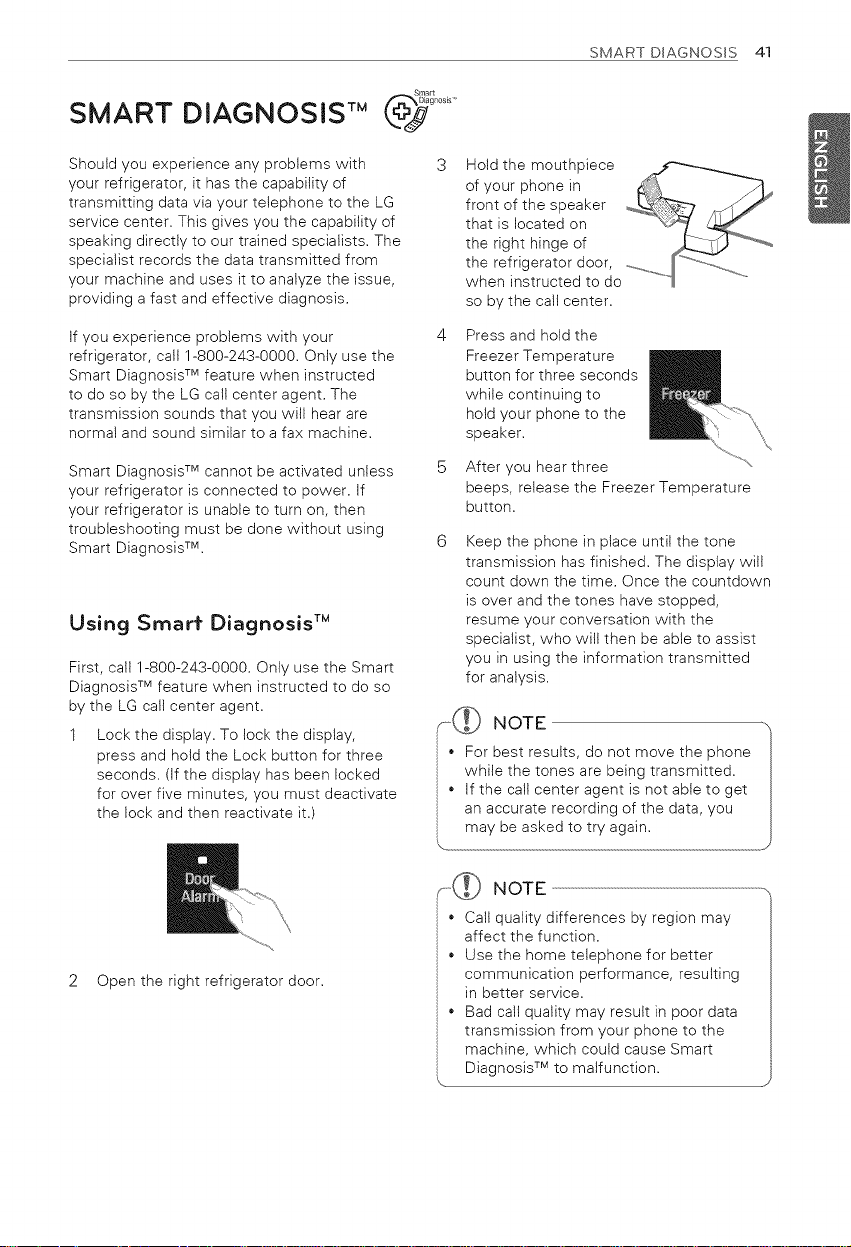
1 Lock the display. To lock the display,
press and hold the Lock button for three
seconds. (If the display has been locked
for over five minutes, you must deactivate
the lock and then reactivate it.)
2 Open the right refrigerator door.
Hold the mouthpiece
of your phone in
front of the speaker
that is located on
the right hinge of
the refrigerator door,
when instructed to do
so by the call center.
Press and hold the
Freezer Temperature
button for three seconds
while continuing to
hold your phone to the
speaker.
After you hear three
beeps, release the Freezer Temperature
button,
Keep the phone in place until the tone
transmission has finished. The display will
count down the time. Once the countdown
is over and the tones have stopped,
resume your conversation with the
specialist, who will then be abte to assist
you in using the information transmitted
for analysis.
_ NOTE
For best results, do not move the phone
while the tones are being transmitted.
If the call center agent is not able to get
an accurate recording of the data, you
may be asked to try again.
r---d_ NOTE
• Call quality differences by region may
affect the function.
• Use the home telephone for better
communication performance, resulting
in better service.
• Bad call quality may result in poor data
transmission from your phone to the
machine, which could cause Smart
Diagnosis TM to malfunction.
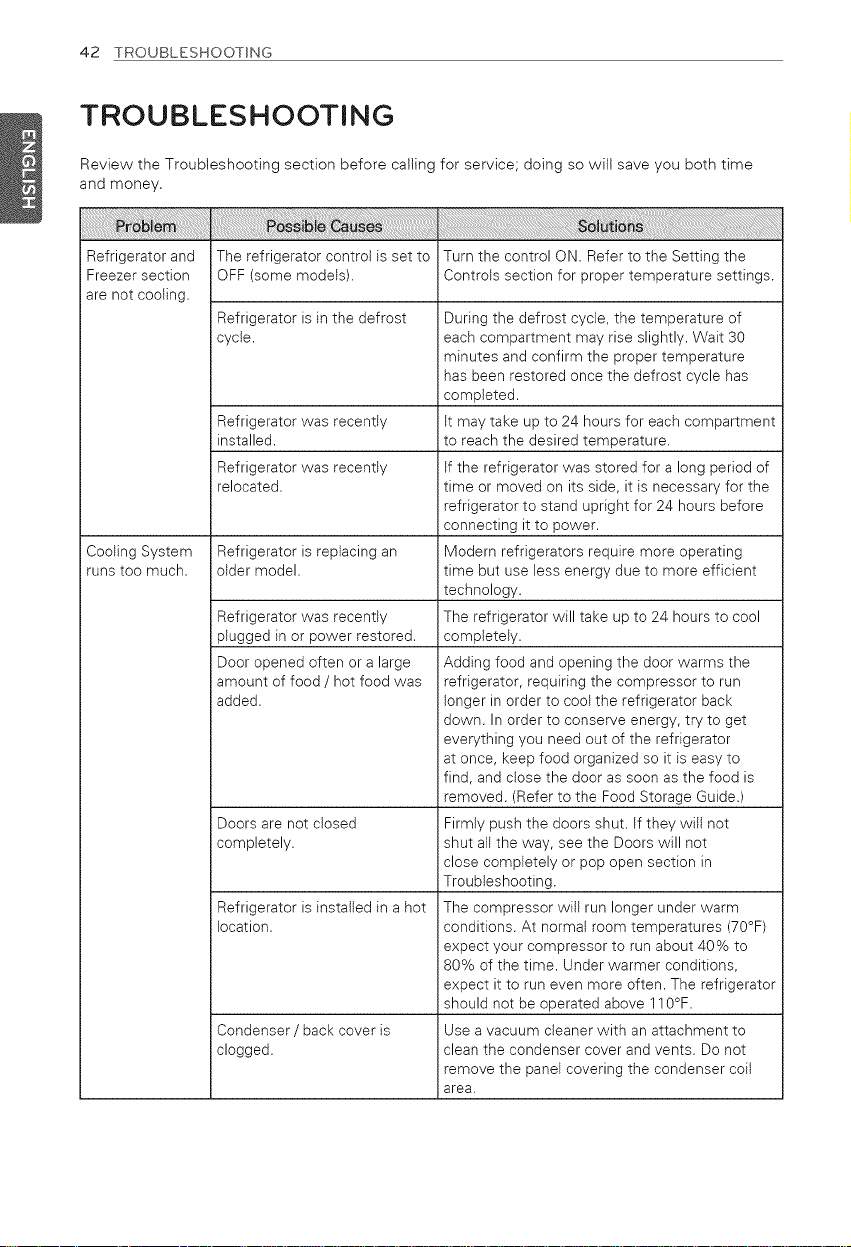
42 TROUBLESHOOTING
TROUBLESHOOTING
Review the Troubleshooting section before calling for service; doing so will save you both time
and money.
iTurn the control ON. Refer to the Setting the
Controls section for proper temperature settings.
Refrigerator and The refrigerator control is set to
Freezer section OFF (some models).
are not cooling.
Refrigerator is in the defrost
cycle.
Refrigerator was recently
installed.
Refrigerator was recently
relocated.
Cooling System Refrigerator is replacing an
runs too much. older model.
Refrigerator was recently
plugged in or power restored.
Door opened often or a large
amount of food / hot food was
added.
Doors are not closed
completely.
Refrigerator is installed in a hot
location.
Condenser / back cover is
clogged.
i During the defrost cycle, the temperature of
i each compartment may rise slightly. Wait 30
minutes and confirm the proper temperature
has been restored once the defrost cycle has
icompleted.
i It may take up to 24 hours for each compartment
ito reach the desired temperature.
i lf the refrigerator was stored for a long period of
itime or moved on its side, it is necessary for the
i refrigerator to stand upright for 24 hours before
iconnecting it to power.
Modern refrigerators require more operating
time but use less energy due to more efficient
technology.
iThe refrigerator will take up to 24 hours to cool
icompletely.
iAdding food and opening the door warms the
i refrigerator, requiring the compressor to run
i longer in order to cool the refrigerator back
idown. In order to conserve energy, try to get
i everything you need out of the refrigerator
iat once, keep food organized so it is easy to
find, and close the door as soon as the food is
i removed. (Refer to the Food Storage Guide.)
i Firmly push the doors shut. If they will not
shut all the way, see the Doors will not
iclose completely or pop open section in
Troubleshooting.
iThe compressor will run longer under warm
conditions. At normal room temperatures (70°F)
expect your compressor to run about 40% to
80% of the time. Under warmer conditions,
expect it to run even more often. The refrigerator
should not be operated above 1IO°F.
Use a vacuum cleaner with an attachment to
clean the condenser cover and vents. Do not
remove the panel covering the condenser coil
area.
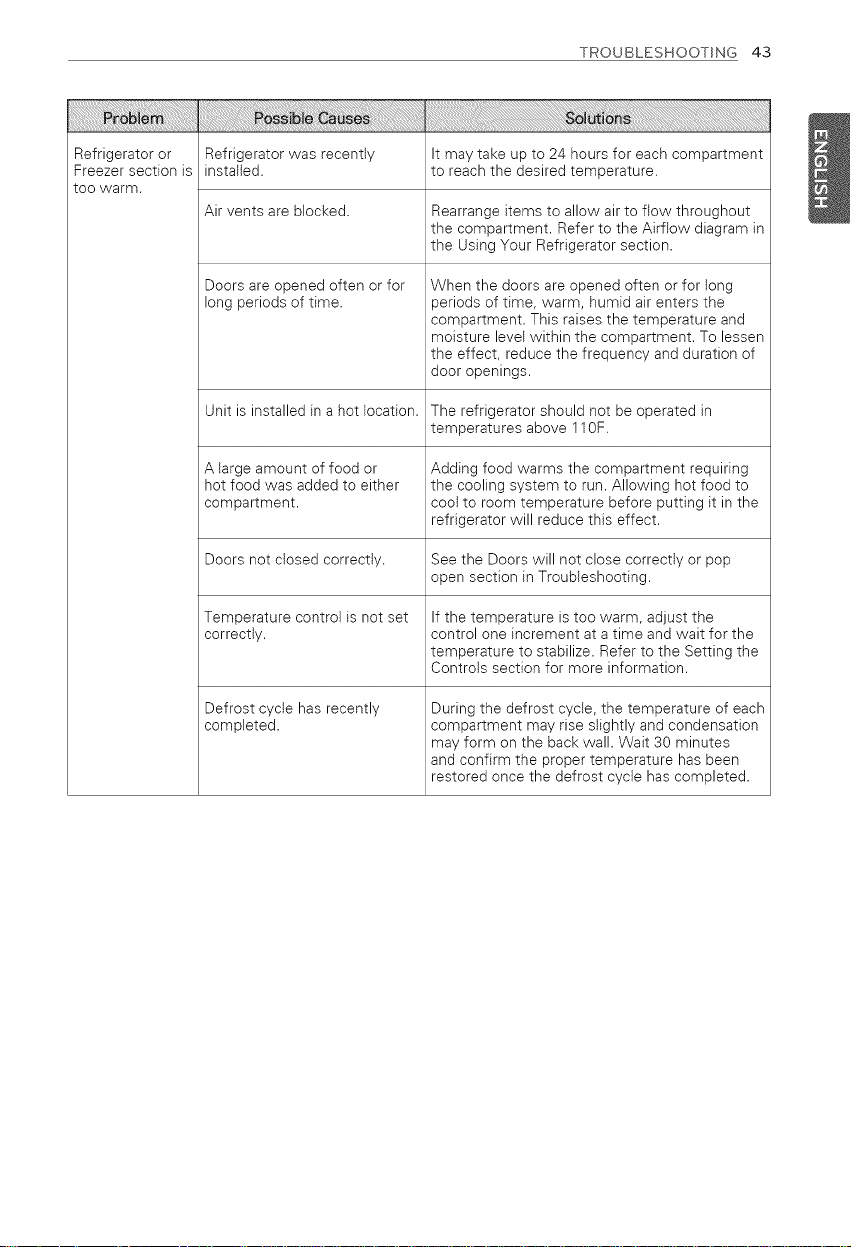
TROUBLESHOOTING43
Refrigeratoror Refrigeratorwasrecently Itmaytakeupto24hoursforeachcompartment
Freezersectionisinstalled, toreachthedesiredtemperature.
toowarm.
Airventsareblocked. Rearrangeitemstoallowairtoflowthroughout
thecompartment.RefertotheAirflowdiagramin
theUsingYourRefrigeratorsection.
Doorsareopenedoftenorfor
longperiodsoftime.
Unitisinstalledinahotlocation.
Alargeamountoffoodor
hotfoodwasaddedtoeither
compartment.
Doorsnotclosedcorrectly.
Temperaturecontrolisnotset
correctly.
Defrostcyclehasrecently
completed.
Whenthedoorsareopenedoftenorforlong
periodsoftime,warm,humidairentersthe
compartment.Thisraisesthetemperatureand
moisturelevelwithinthecompartment.Tolessen
theeffect,reducethefrequencyanddurationof
dooropenings.
Therefrigeratorshouldnotbeoperatedin
temperaturesabove11OF.
Addingfoodwarmsthecompartmentrequiring
thecoolingsystemtorun.Allowinghotfoodto
cooltoroomtemperaturebeforeputtingitinthe
refrigeratorwillreducethiseffect.
SeetheDoorswillnotclosecorrectlyorpop
opensectioninTroubleshooting.
Ifthetemperatureistoowarm,adjustthe
controloneincrementatatimeandwaitforthe
temperaturetostabilize.RefertotheSettingthe
Controlssectionformoreinformation.
Duringthedefrostcycle,thetemperatureofeach
compartmentmayriseslightlyandcondensation
mayformonthebackwall.Wait30minutes
andconfirmthepropertemperaturehasbeen
restoredoncethedefrostcyclehascompleted.
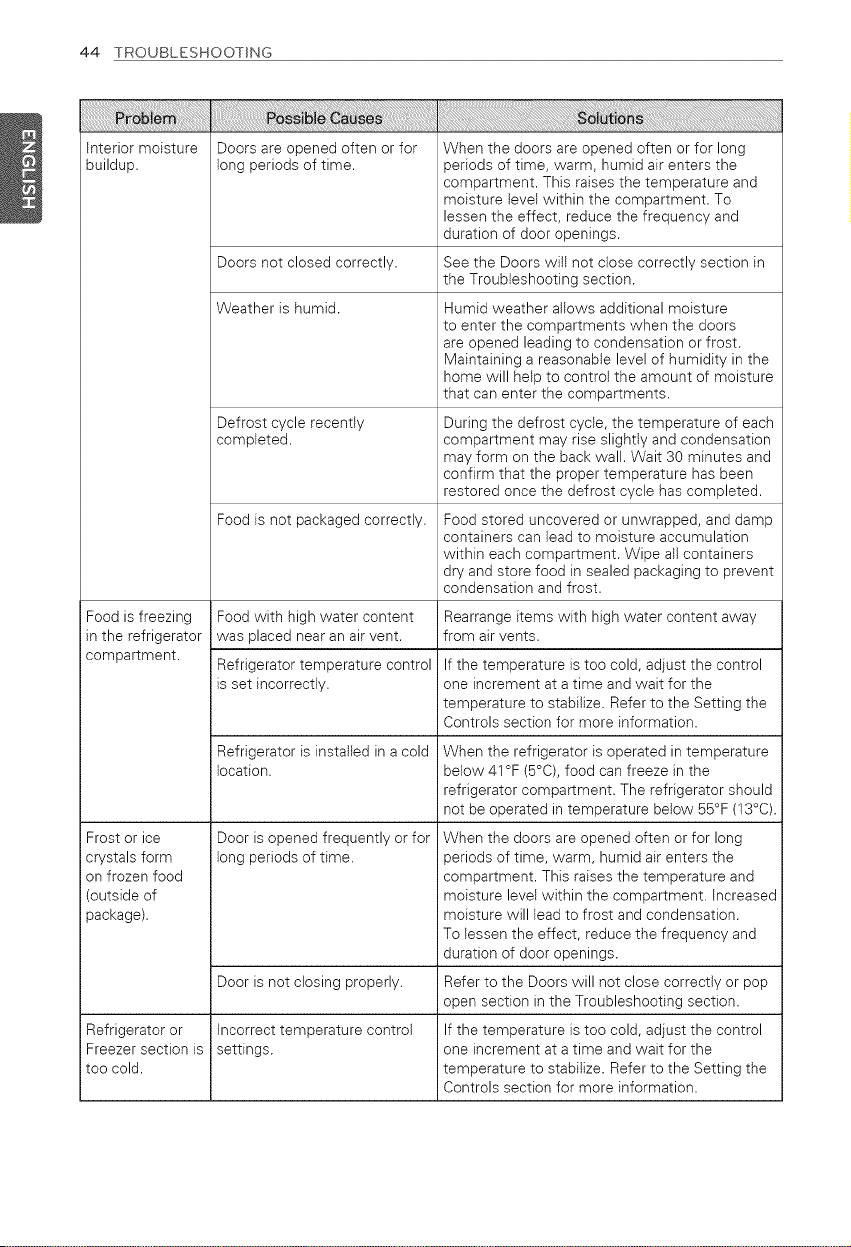
44 TROUBLESHOOTING
Interior moisture
buildup.
Food is freezing
in the refrigerator
compartment.
Frost or ice
crystals form
on frozen food
(outside of
package).
Doors are opened often or for
long periods of time.
When the doors are opened often or for long
periods of time, warm, humid air enters the
compartment. This raises the temperature and
moisture level within the compartment. To
lessen the effect, reduce the frequency and
duration of door openings.
Doors not closed correctly. See the Doors will not close correctly section in
the Troubleshooting section.
Weather is humid.
Defrost cycle recently
completed.
Food is not packaged correctly.
Food with high water content
was placed near an air vent.
Refrigerator temperature control
is set incorrectly.
Refrigerator is installed in acold
location.
Door is opened frequently or for
long periods of time.
Door is not closing properly.
Refrigerator or Incorrect temperature control
Freezer section is settings.
too cold.
Humid weather allows additional moisture
to enter the compartments when the doors
are opened leading to condensation or frost.
Maintaining a reasonable level of humidity in the
home will help to control the amount of moisture
that can enter the compartments.
During the defrost cycle, the temperature of each
compartment may rise slightly and condensation
may form on the back wall. Wait 30 minutes and
confirm that the proper temperature has been
restored once the defrost cycle has completed.
Food stored uncovered or unwrapped, and damp
containers can lead to moisture accumulation
within each compartment. Wipe all containers
dry and store food in sealed packaging to prevent
condensation and frost.
Rearrange items with high water content away
from air vents.
If the temperature is too cold, adjust the control
one increment at a time and wait for the
temperature to stabilize. Refer to the Setting the
Controls section for more information.
When the refrigerator is operated in temperature
below 41°F (5°C), food can freeze in the
refrigerator compartment. The refrigerator should
not be operated in temperature below 55°F (13°C).
When the doors are opened often or for long
periods of time, warm, humid air enters the
compartment. This raises the temperature and
moisture level within the compartment. Increased
moisture will lead to frost and condensation.
To lessen the effect, reduce the frequency and
duration of door openings.
Refer to the Doors will not close correctly or pop
open section in the Troubleshooting section.
If the temperature is too cold, adjust the control
one increment at a time and wait for the
temperature to stabilize. Refer to the Setting the
Controls section for more information.
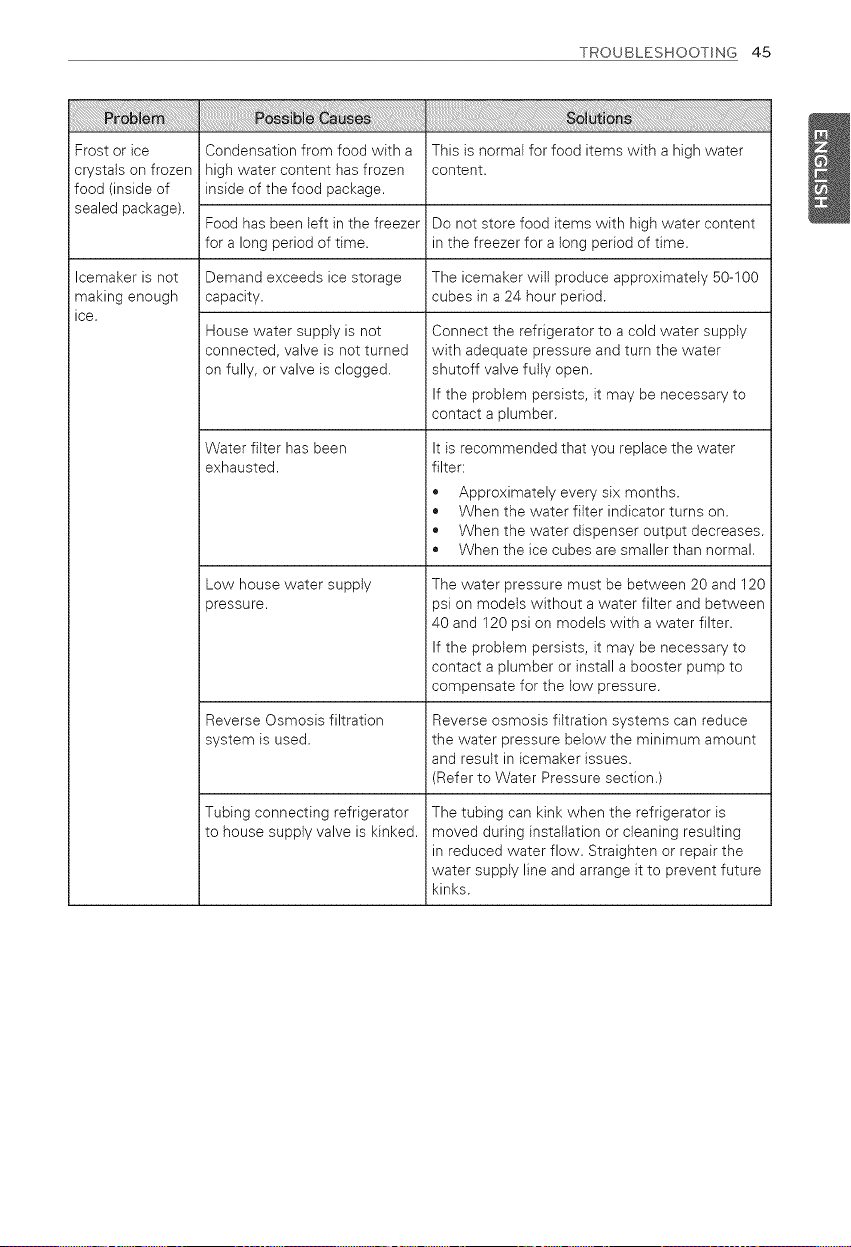
TROUBLESHOOTING45
Frostorice Condensationfromfoodwitha Thisisnormalforfooditemswithahighwater
crystalsonfrozenhighwatercontenthasfrozencontent.
food(insideof insideofthefoodpackage.
sealedpackage).
FoodhasbeenleftinthefreezerDonotstorefooditemswithhighwatercontent
foralongperiodoftime. inthefreezerforalongperiodoftime.
Icemakerisnot DemandexceedsicestorageTheicemakerwillproduceapproximately50-1O0
makingenoughcapacity, cubesina24hourperiod.
ice.
Housewatersupplyisnot
connected,valveisnotturned
onfully,orvalveisclogged.
Waterfilterhasbeen
exhausted.
Lowhousewatersupply
pressure.
ReverseOsmosisfiltration
systemisused.
Tubingconnectingrefrigerator
tohousesupplyvalveiskinked.
Connect the refrigerator to a cold water supply
with adequate pressure and turn the water
shutoff valve fully open.
If the problem persists, it may be necessary to
contact a plumber.
It is recommended that you replace the water
filter:
• Approximately every six months.
• When the water filter indicator turns on.
• When the water dispenser output decreases.
• When the ice cubes are smaller than normal.
The water pressure must be between 20 and 120
psi on models without a water filter and between
40 and 120 psi on models with awater filter.
If the problem persists, it may be necessary to
contact a plumber or install a booster pump to
compensate for the low pressure.
Reverse osmosis filtration systems can reduce
the water pressure below the minimum amount
and result in icemaker issues.
(Refer to Water Pressure section.)
The tubing can kink when the refrigerator is
moved during installation or cleaning resulting
in reduced water flow. Straighten or repair the
water supply line and arrange it to prevent future
kinks.
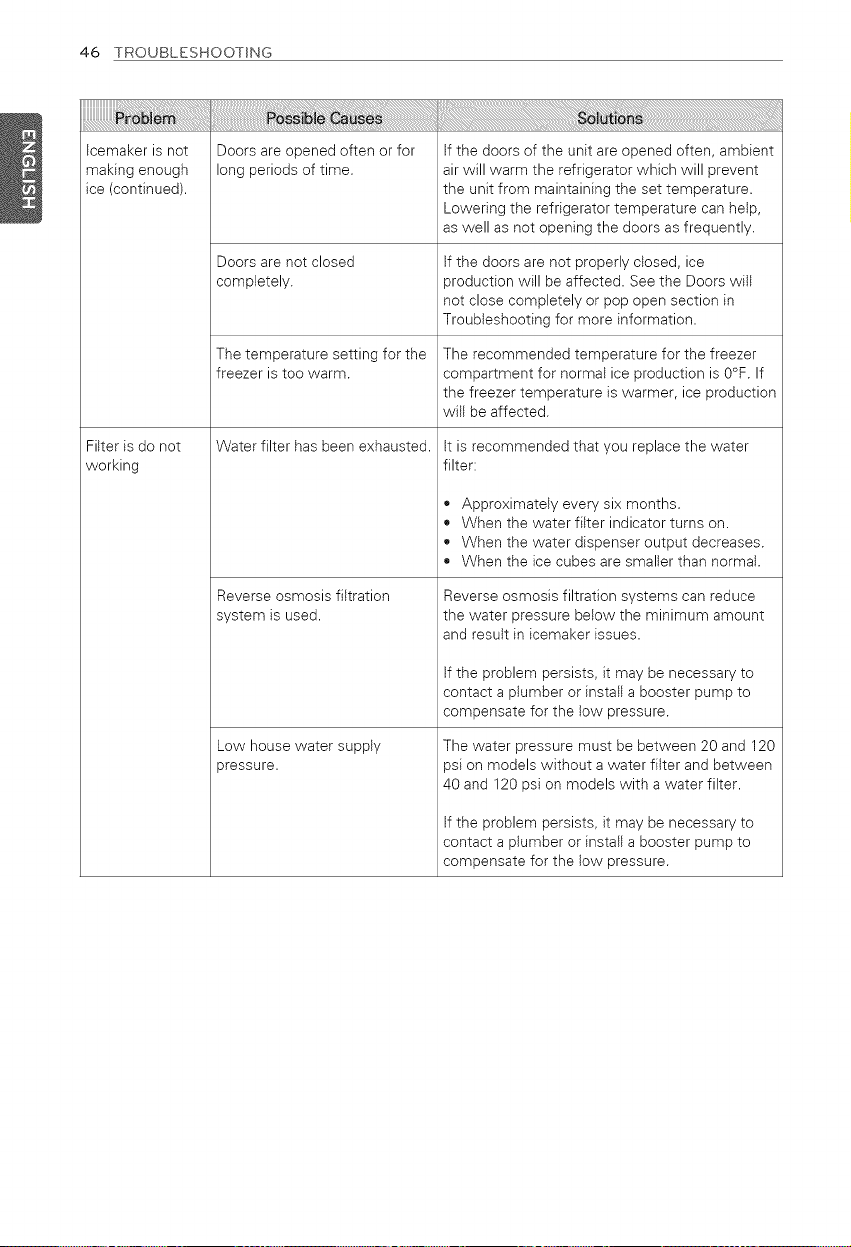
46 TROUBLESHOOTING
Icemaker is not
making enough
ice (continued).
Filter is do not
working
Doors are opened often or for
long periods of time.
Doors are not closed
completely.
The temperature setting for the
freezer is too warm.
Water filter has been exhausted.
Reverse osmosis filtration
system is used.
Low house water supply
sressure.
If the doors of the unit are opened often, ambient
air will warm the refrigerator which will prevent
the unit from maintaining the set temperature.
Lowering the refrigerator temperature can help,
as well as not opening the doors as frequently.
If the doors are not properly closed, ice
production will be affected. See the Doors will
not close completely or pop open section in
Troubleshooting for more information.
The recommended temperature for the freezer
compartment for normal ice production is O°F. If
the freezer temperature is warmer, ice production
will be affected.
It is recommended that you replace the water
filter:
• Approximately every six months.
• When the water filter indicator turns on.
• When the water dispenser output decreases.
• When the ice cubes are smaller than normal.
Reverse osmosis filtration systems can reduce
the water pressure below the minimum amount
and result in icemaker issues.
If the problem persists, it may be necessary to
contact a plumber or install a booster pump to
compensate for the low pressure.
The water pressure must be between 20 and 120
psi on models without awater filter and between
40 and 120 psi on models with a water filter.
If the problem persists, it may be necessary to
contact a plumber or install a booster pump to
compensate for the low pressure.
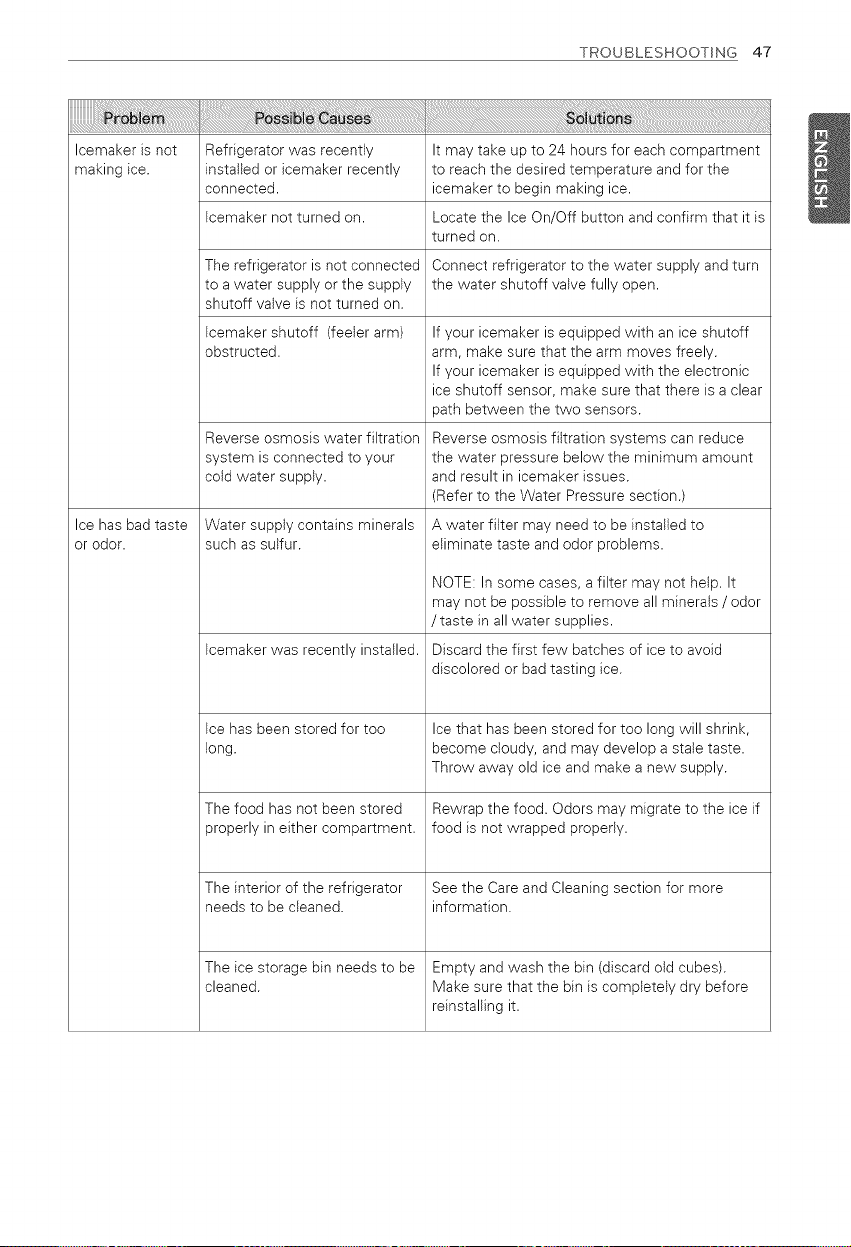
TROUBLESHOOTING47
Icemakerisnot
makingice.
Ice has bad taste
or odor.
Refrigerator was recently
installed or icemaker recently
connected.
Icemaker not turned on.
The refrigerator is not connected
to awater supply or the supply
shutoff valve is not turned on.
Icemaker shutoff (feeler arm)
obstructed.
Reverse osmosis water filtration
system is connected to your
cold water supply.
Water supply contains minerals
such as sulfur.
Icemaker was recently installed.
Ice has been stored for too
long.
The food has not been stored
properly in either compartment.
The interior of the refrigerator
needs to be cleaned.
The ice storage bin needs to be
cleaned.
It may take up to 24 hours for each compartment
to reach the desired temperature and for the
icemaker to begin making ice.
Locate the Ice On/Off button and confirm that it is
turned on.
Connect refrigerator to the water supply and turn
the water shutoff valve fully open.
If your icemaker is equipped with an ice shutoff
arm, make sure that the arm moves freely.
If your icemaker is equipped with the electronic
ice shutoff sensor, make sure that there is a clear
path between the two sensors.
Reverse osmosis filtration systems can reduce
the water pressure below the minimum amount
and result in icemaker issues.
(Refer to the Water Pressure section.)
A water filter may need to be installed to
eliminate taste and odor problems.
NOTE: In some cases, a filter may not help. It
may not be possible to remove all minerals / odor
/taste inall water supplies.
Discard the first few batches of ice to avoid
discolored or bad tasting ice.
Ice that has been stored for too long will shrink,
become cloudy, and may develop a stale taste.
Throw away old ice and make a new supply.
Rewrap the food. Odors may migrate to the ice if
food is not wrapped properly.
See the Care and Cleaning section for more
information.
Empty and wash the bin (discard old cubes).
Make sure that the bin is completely dry before
reinstalling it.
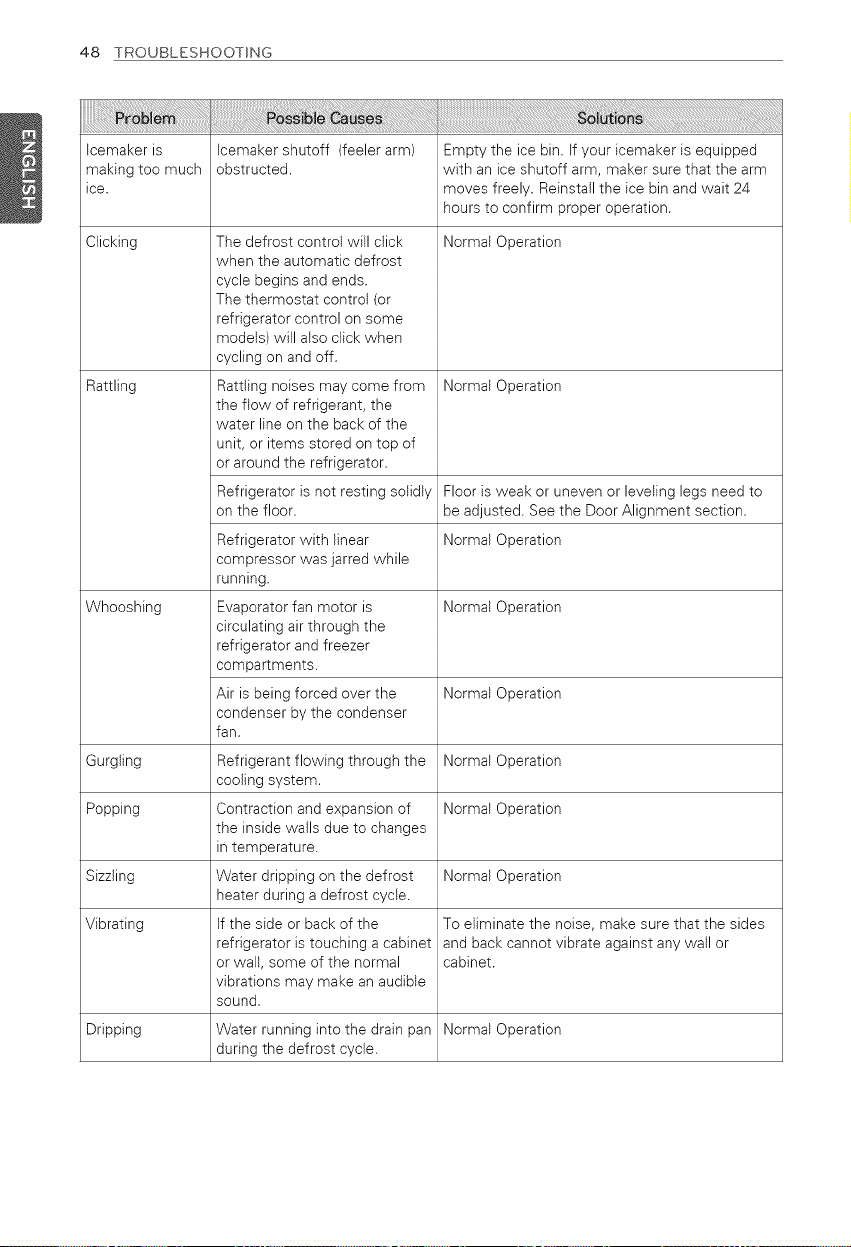
48 TROUBLESHOOTING
Icemaker is
making too much
ice.
Clicking
The defrost control will click
when the automatic defrost
cycle begins and ends.
The thermostat control (or
refrigerator control on some
models) will also click when
cycling on and off.
Rattling noises may come from
the flow of refrigerant, the
water line on the back of the
unit, or items stored on top of
or around the refrigerator.
Refrigerator is not resting solidly
on the floor.
Empty the ice bin. If your icemaker is equipped
with an ice shutoff arm, maker sure that the arm
moves freely. Reinstall the ice bin and wait 24
hours to confirm proper operation.
Normal Operation
Rattling Normal Operation
Floor is weak or uneven or leveling legs need to
be adjusted. See the Door Alignment section.
Refrigerator with linear Normal Operation
compressor was jarred while
running.
Whooshing Evaporator fan motor is Normal Operation
circulating airthrough the
refrigerator and freezer
compartments.
Air is being forced over the Normal Operation
condenser by the condenser
fan.
Gurgling Refrigerant flowing through the Normal Operation
cooling system.
Popping Contraction and expansion of Normal Operation
the inside walls due to changes
in temperature.
Sizzling Water dripping on the defrost Normal Operation
heater during a defrost cycle.
Vibrating If the side or back of the To eliminate the noise, make sure that the sides
refrigerator is touching a cabinet and back cannot vibrate against any wall or
or wall, some of the normal cabinet.
vibrations may make an audible
sound.
Dripping Water running into the drain pan Normal Operation
during the defrost cycle.
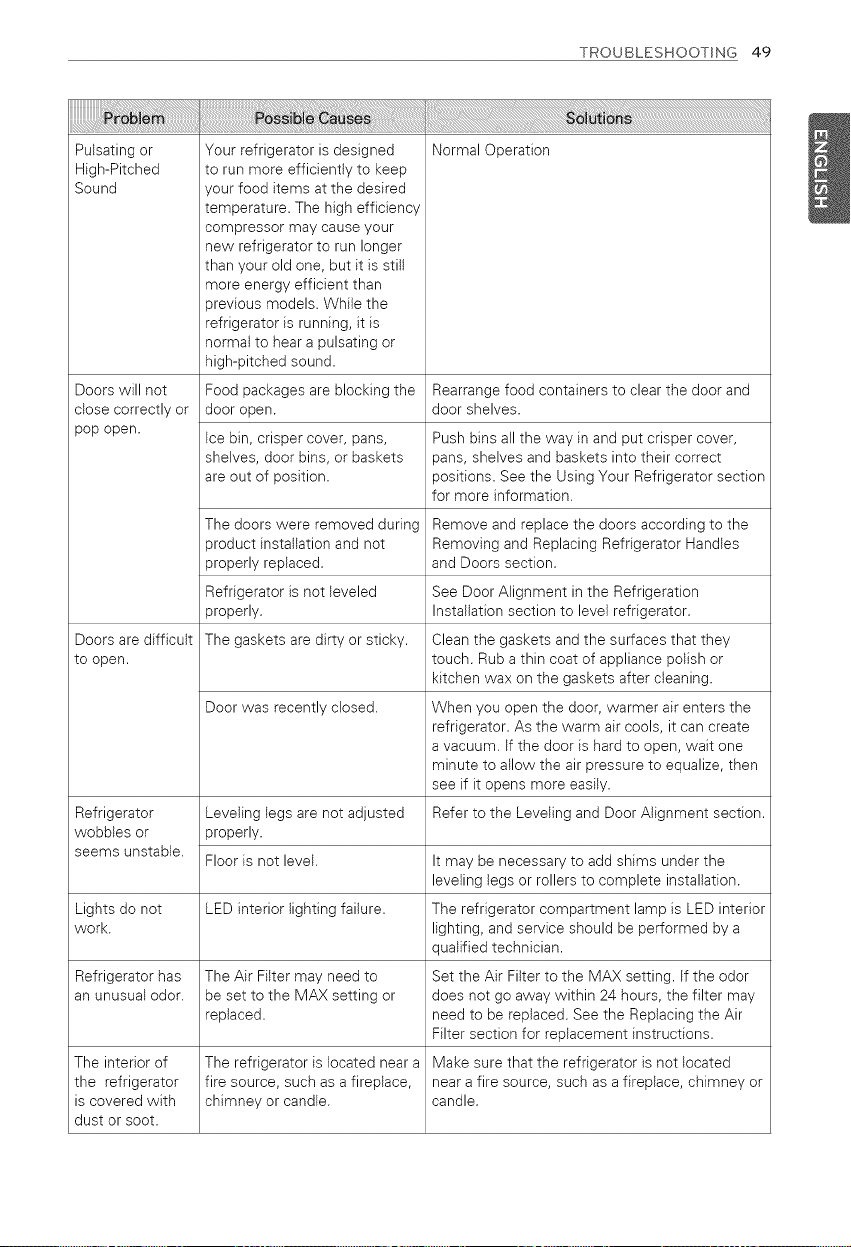
TROUBLESHOOTING 49
Pulsating or
High-Pitched
Sound
Your refrigerator is designed
to run more efficiently to keep
your food items at the desired
temperature. The high efficiency
compressor may cause your
new refrigerator to run longer
than your old one, but it is still
more energy efficient than
previous models. While the
refrigerator is running, it is
normal to hear a pulsating or
high-pitched sound.
Food packages are blocking the
door open.
Ice bin, crisper cover, pans,
shelves, door bins, or baskets
are out of position.
Normal Operation
Doors will not Rearrange food containers to clear the door and
close correctly or door shelves.
pop open. Push bins all the way in and put crisper cover,
pans, shelves and baskets into their correct
positions. See the Using Your Refrigerator section
for more information.
The doors were removed during Remove and replace the doors according to the
product installation and not Removing and Replacing Refrigerator Handles
properly replaced, and Doors section.
Refrigerator is not leveled See Door Alignment inthe Refrigeration
properly. Installation section to level refrigerator.
Doors are difficult The gaskets are dirty or sticky. Clean the gaskets and the surfaces that they
to open. touch. Rub a thin coat of appliance polish or
kitchen wax on the gaskets after cleaning.
Door was recently closed. When you open the door, warmer air enters the
refrigerator. As the warm air cools, it can create
avacuum. If the door is hard to open, wait one
minute to allow the air pressure to equalize, then
see if it opens more easily.
Refrigerator Leveling legs are not adjusted Refer to the Leveling and Door Alignment section.
wobbles or properly.
seems unstable.
Floor is not level. It may be necessary to add shims under the
leveling legs or rollers to complete installation.
Lights do not LED interior lighting failure. The refrigerator compartment lamp is LED interior
work. lighting, and service should be performed by a
qualified technician.
Refrigerator has The Air Filter may need to Set the Air Filter to the MAX setting. If the odor
an unusual odor. be set to the MAX setting or does not go away within 24 hours, the filter may
replaced, need to be replaced. See the Replacing the Air
Filter section for replacement instructions.
The interior of The refrigerator is located near a Make sure that the refrigerator is not located
the refrigerator fire source, such as a fireplace, near a fire source, such as a fireplace, chimney or
is covered with chimney or candle, candle.
dust or soot.
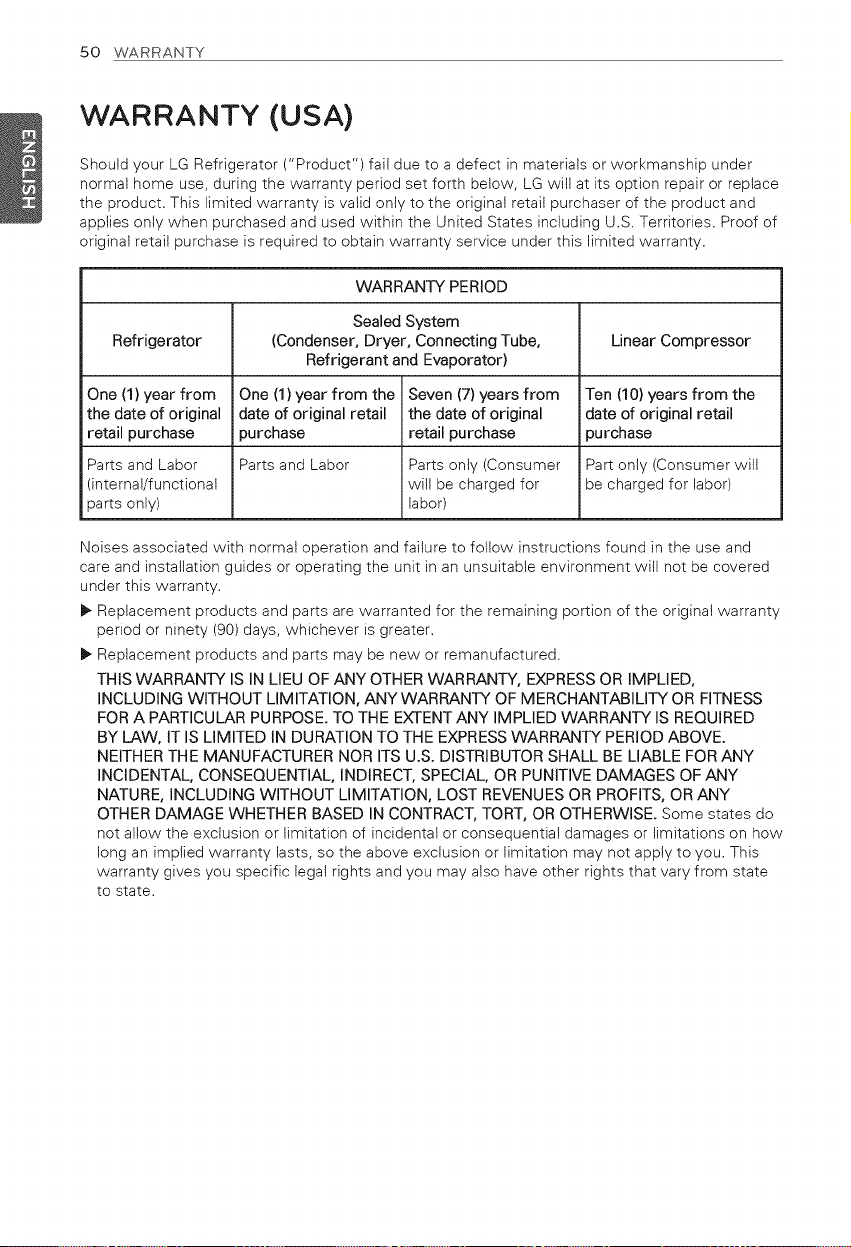
50 WARRANTY
WARRANTY (USA)
Should your LG Refrigerator ("Product") fail due to a defect in materials or workmanship under
normal home use, during the warranty period set forth below, LG will at its option repair or replace
the product. This limited warranty is valid only to the original retail purchaser of the product and
applies only when purchased and used within the United States including U.S. Territories. Proof of
original retail purchase is required to obtain warranty service under this limited warranty.
WARRANTY PERIOD
Sealed System
Refrigerator (Condenser, Dryer, Connecting Tube, Linear Compressor
Refrigerant and Evaporator)
One (1)year from One (1) year from the Seven (7) years from Ten (10) years from the
the date of original date of original retail the date of original date of original retail
retail purchase purchase retail purchase purchase
Parts and Labor Parts and Labor Parts only (Consumer Part only (Consumer will
(internal/functional will be charged for be charged for labor)
parts only) labor)
Noises associated with normal operation and failure to follow instructions found in the use and
care and installation guides or operating the unit in an unsuitable environment will not be covered
under this warranty.
1_Replacement products and parts are warranted for the remaining portion of the original warranty
period or ninety (90) days, whichever is greater.
1_Replacement products and parts may be new or remanufactured.
THIS WARRANTY IS IN LIEU OF ANY OTHER WARRANTY, EXPRESS OR IMPLIED,
INCLUDING WITHOUT LIMITATION, ANY WARRANTY OF MERCHANTABILITY OR FITNESS
FOR A PARTICULAR PURPOSE. TO THE EXTENT ANY IMPLIED WARRANTY IS REQUIRED
BY LAW, IT IS LIMITED IN DURATION TO THE EXPRESS WARRANTY PERIOD ABOVE.
NEITHER THE MANUFACTURER NOR ITS U.S. DISTRIBUTOR SHALL BE LIABLE FOR ANY
INCIDENTAL, CONSEQUENTIAL, INDIRECT, SPECIAL, OR PUNITIVE DAMAGES OF ANY
NATURE, INCLUDING WITHOUT LIMITATION, LOST REVENUES OR PROFITS, OR ANY
OTHER DAMAGE WHETHER BASED IN CONTRACT, TORT, OR OTHERWISE. Some states do
not allow the exclusion or limitation of incidental or consequential damages or limitations on how
long an implied warranty lasts, so the above exclusion or limitation may not apply to you. This
warranty gives you specific legal rights and you may also have other rights that vary from state
to state.
WARRANTY 51
THIS LIMITED WARRANTY DOES NOT COVER:
1. Service trips to deliver, pick up, install, or repair the product; instruct the customer on operation
of the product; repair or replace fuses or correct wiring or plumbing, or correction of unauthorized
repairs/installation.
2. Failure of product to perform during power failures and interruptions or inadequate electrical service.
3. Damage caused by leaky or broken water pipes, frozen water pipes, restricted drain lines, inadequate
or interrupted water supply or inadequate supply of air.
4. Damage resulting from operating the product in a corrosive atmosphere or contrary to the
instructions outlined in the product owner's manual.
5. Damage to the product caused by accidents, pests and vermin, lightning, wind, fire, floods, or acts of
God.
6. Damage resulting from misuse, abuse, improper installation, repair, or maintenance. Improper repair
includes use of parts not approved or specified by LG.
7. Damage or failure caused by unauthorized modification or alteration, or if it is used for other than the
intended purpose, or any water leakage where the unit was not properly installed.
8. Damage or failure caused by incorrect electrical current, voltage, or plumbing codes, commercial
or industrial use, or use of accessories, components, or consumable cleaning products that are not
approved by LG.
9. Damage caused by transportation and handling, including scratches, dents, chips, and/or other
damage to the finish of your product, unless such damage results from defects in materials or
workmanship and is reported within one (1) week of delivery (Call: 1-800-243-0000).
0. Damage or missing items to any display, open box, discounted, or refurbished product.
1. Products with original serial numbers that have been removed, altered, or can not be readily
determined. Model and Serial numbers, along with original retail sales receipt, are required for
warranty validation.
2. Increases in utility costs and additional utility expenses.
3. Replacement of light bulbs, filters, or any consumable parts.
4. Repairs when your product is used in other than normal and usual household use (e.g. commercial
use, offices, and recreational facilities) or contrary to the instructions outlined in the product owner's
manual.
5. Costs associated with removal of your product from your home for repairs.
6. The removal and reinsta%tion of the product if it is installed in an inaccessible location or is not
installed in accordance with published installation instructions, including LG's owner's and installation
manuals.
7. Shelves, door bins, drawers, handles, accessories, and other parts besides those that were originally
included with this particular model.
8. Service trips to your home to teach you how to use the product.
9. Replacement of the water filter cartridge due to water pressure that is outside the specified
operating range or due to excessive sediment in the water supply.
The cost of repair or replacement under these excluded circumstances shall be borne
by the consumer.
For complete warranty details and customer assistance, please call or visit our website:
Call 1-800-243-0000 (24 hours a day, 365 days a year) and select the appropriate option from the
menu, or visit our website at http://vcwwJg.com Or by mail: LG Customer Information Center:
P. O. Box 240007, 201 James Record Road Huntsville, Alabama 35813 ATTN: CIC
Write your warranty information betow:
Product Registration Information:
Model:
Serial Number:
Date of Purchase:
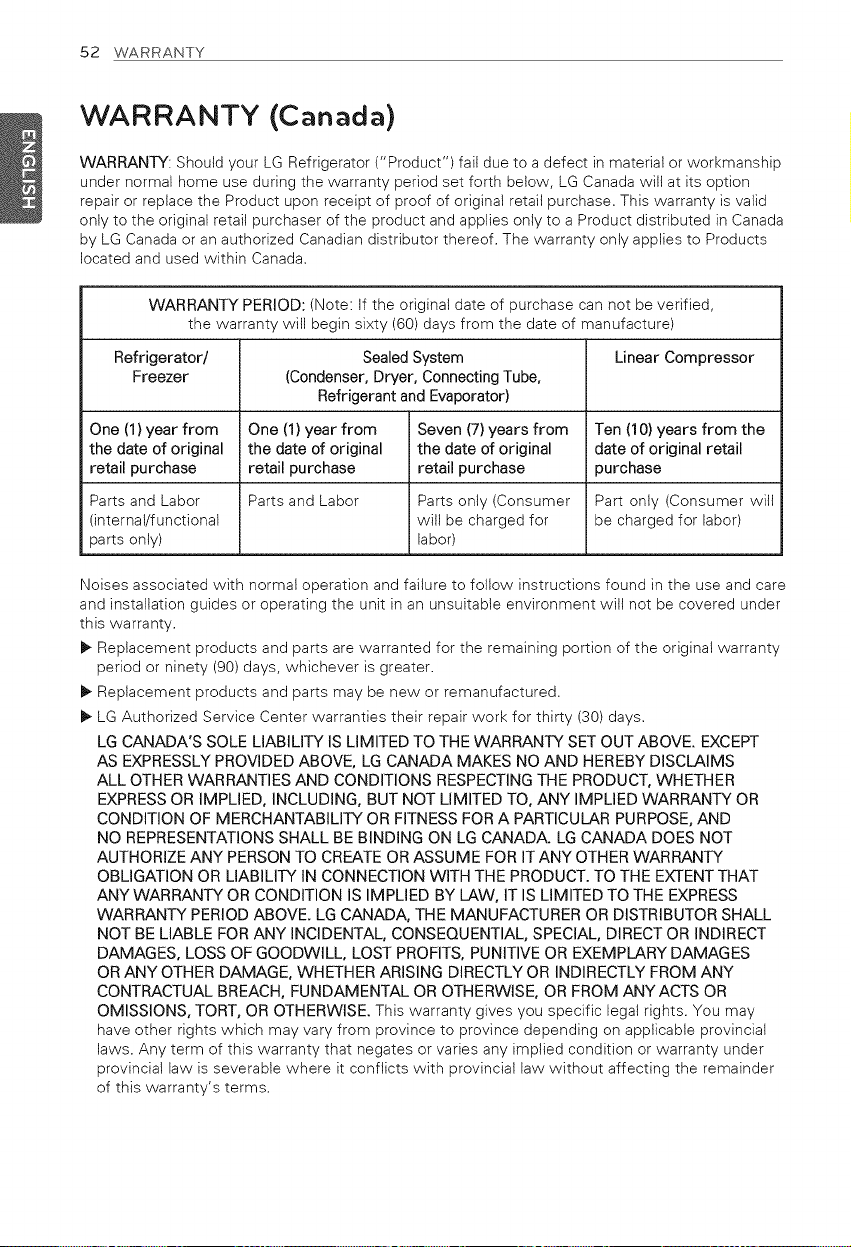
52 WARRANTY
WARRANTY (Canada)
WARRANTY: Should your LG Refrigerator ("Product") fail due to a defect in material or workmanship
under normal home use during the warranty period set forth below, LG Canada will at its option
repair or replace the Product upon receipt of proof of original retail purchase. This warranty is valid
only to the original retail purchaser of the product and applies only to a Product distributed in Canada
by LG Canada or an authorized Canadian distributor thereof. The warranty only applies to Products
located and used within Canada.
WARRANTY PERIOD: (Note: If the original date of purchase can not be verified,
the warranty wilt begin sixty (60) days from the date of manufacture)
Refrigerator/ Sealed System Linear Compressor
Freezer (Condenser, Dryer, Connecting Tube,
Refrigerant and Evaporator)
One (1)year from One (1) year from Seven (7) years from Ten (1O)years from the
the date of original the date of original the date of original date of original retail
retail purchase retail purchase retail purchase purchase
Parts and Labor Parts and Labor Parts only (Consumer Part only (Consumer will
(internal/functional will be charged for be charged for labor)
parts only) labor)
Noises associated with normal operation and failure to follow instructions found in the use and care
and installation guides or operating the unit in an unsuitable environment will not be covered under
this warranty.
Replacement products and parts are warranted for the remaining portion of the original warranty
period or ninety (90) days, whichever is greater.
Replacement products and parts may be new or remanufactured.
LG Authorized Service Center warranties their repair work for thirty (30) days.
LG CANADA'S SOLE LIABILITY IS LIMITED TO THE WARRANTY SET OUT ABOVE. EXCEPT
AS EXPRESSLY PROVIDED ABOVE, LG CANADA MAKES NO AND HEREBY DISCLAIMS
ALL OTHER WARRANTIES AND CONDITIONS RESPECTING THE PRODUCT, WHETHER
EXPRESS OR IMPLIED, INCLUDING, BUT NOT LIMITED TO, ANY IMPLIED WARRANTY OR
CONDITION OF MERCHANTABILITY OR FITNESS FOR A PARTICULAR PURPOSE, AND
NO REPRESENTATIONS SHALL BE BINDING ON LG CANADA. LG CANADA DOES NOT
AUTHORIZE ANY PERSON TO CREATE OR ASSUME FOR IT ANY OTHER WARRANTY
OBLIGATION OR LIABILITY IN CONNECTION WITH THE PRODUCT. TO THE EXTENT THAT
ANY WARRANTY OR CONDITION IS IMPLIED BY LAW, IT IS LIMITED TO THE EXPRESS
WARRANTY PERIOD ABOVE. LG CANADA, THE MANUFACTURER OR DISTRIBUTOR SHALL
NOT BE LIABLE FOR ANY INCIDENTAL, CONSEQUENTIAL, SPECIAL, DIRECT OR INDIRECT
DAMAGES, LOSS OF GOODWILL, LOST PROFITS, PUNITIVE OR EXEMPLARY DAMAGES
OR ANY OTHER DAMAGE, WHETHER ARISING DIRECTLY OR INDIRECTLY FROM ANY
CONTRACTUAL BREACH, FUNDAMENTAL OR OTHERWISE, OR FROM ANY ACTS OR
OMISSIONS, TORT, OR OTHERWISE. This warranty gives you specific legal rights. You may
have other rights which may vary from province to province depending on applicable provincial
laws. Any term of this warranty that negates or varies any implied condition or warranty under
provincial law is severable where it conflicts with provincial law without affecting the remainder
of this warranty's terms.
WARRANTY 53
THIS LIMITED WARRANTY DOES NOT COVER:
1. Service trips to deliver, pick up, or install the product; instructing a customer on operation of
the product; repair or replacement of fuses or correction of wiring or plumbing, or correction of
unauthorized repairs/installation.
2. Failure of the product to perform during power failures and interruptions or inadequate electrical
service.
3. Damage caused by leaky or broken water pipes, frozen water pipes, restricted drain lines, inadequate
or interrupted water supply or inadequate supply of air.
4. Damage resulting from operating the Product in a corrosive atmosphere or contrary to the
instructions outlined in the Product owner's manual.
5. Damage to the Product caused by accidents, pests and vermin, lightning, wind, fire, floods, or acts of
God.
6. Damage resulting from the misuse, abuse, improper installation, repair, or maintenance of the
Product. improper repair includes use of parts not approved or specified by LG Canada.
7. Damage or product failure caused by unauthorized modification or alteration, or use for other than its
intended purpose, or resulting from any water leakage due to improper installation.
8. Damage or Product failure caused by incorrect electrical current, voltage, or plumbing codes,
commercial or industrial use, or use of accessories, components, or cleaning products that are not
approved by LG Canada.
9. Damage caused by transportation and handling, including scratches, dents, chips, and/or other
damage to the finish of your product, unless such damage results from defects in materials or
workmanship and is reported within one (1) week of delivery.
0. Damage or missing items to any display, open box, discounted, or refurbished Product.
1. Products with original serial numbers that have been removed, altered, or cannot be readily
determined. Model and Serial numbers, along with original retail sales receipt, are required for
warranty validation.
2. increases in utility costs and additional utility expenses.
3. Replacement of light bulbs, filters, or any consumable parts.
4. Repairs when your Product is used in other than normal and usual household use (including, without
limitation, commercial use, in offices or recreational facilities) or contrary to the instructions outlined
in the Product owner's manual.
5. Costs associated with removal of the Product from your home for repairs.
6. The removal and reinstallation of the Product if it is installed in an inaccessible location or is not
installed in accordance with published installation instructions, including the Product owner's and
installation manuals.
7. Shelves, door bins, drawers, handles, and accessories to the Product. Also excluded are parts
besides those that were originally included with the Product.
8. Service trips to your home to teach you how to use the product.
9. Replacement of the water filter cartridge due to water pressure that is outside the specified
operating range or due to excessive sediment in the water supply.
All costs associated with the above excluded circumstances
shall be borne by the consumer.
For complete warranty details and customer assistance, please call or visit our website:
Call 1-888-542-2623 (24 hours a day, 365 days a year) and select the appropriate option from the
menu, or visit our website at http://wwwJg.com
Write your warranty information below:
Product Registration Information:
Model:
Serial Number:
Date of Purchase:
Life's Good
[Or [r'lqH[r[@s or COFF/rT/enTs_
visil www_[g_com or ca[[;
1-800-243-0000 ,s/,,,c.,._,,_,,e,;<_,
1-888-865-3026 ,s/,,,co,_............,,,÷
1-888-542-2623 CAN/,,_>/,,