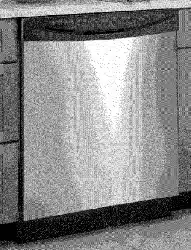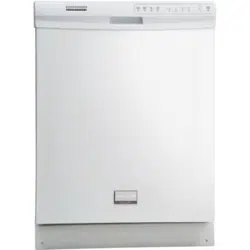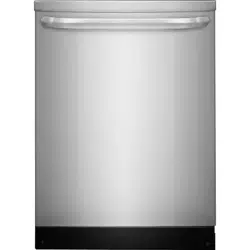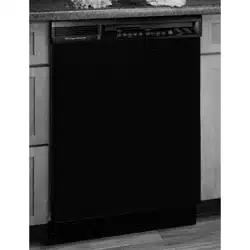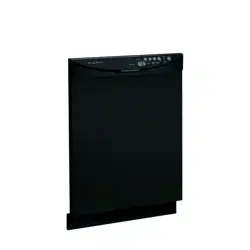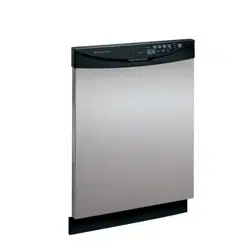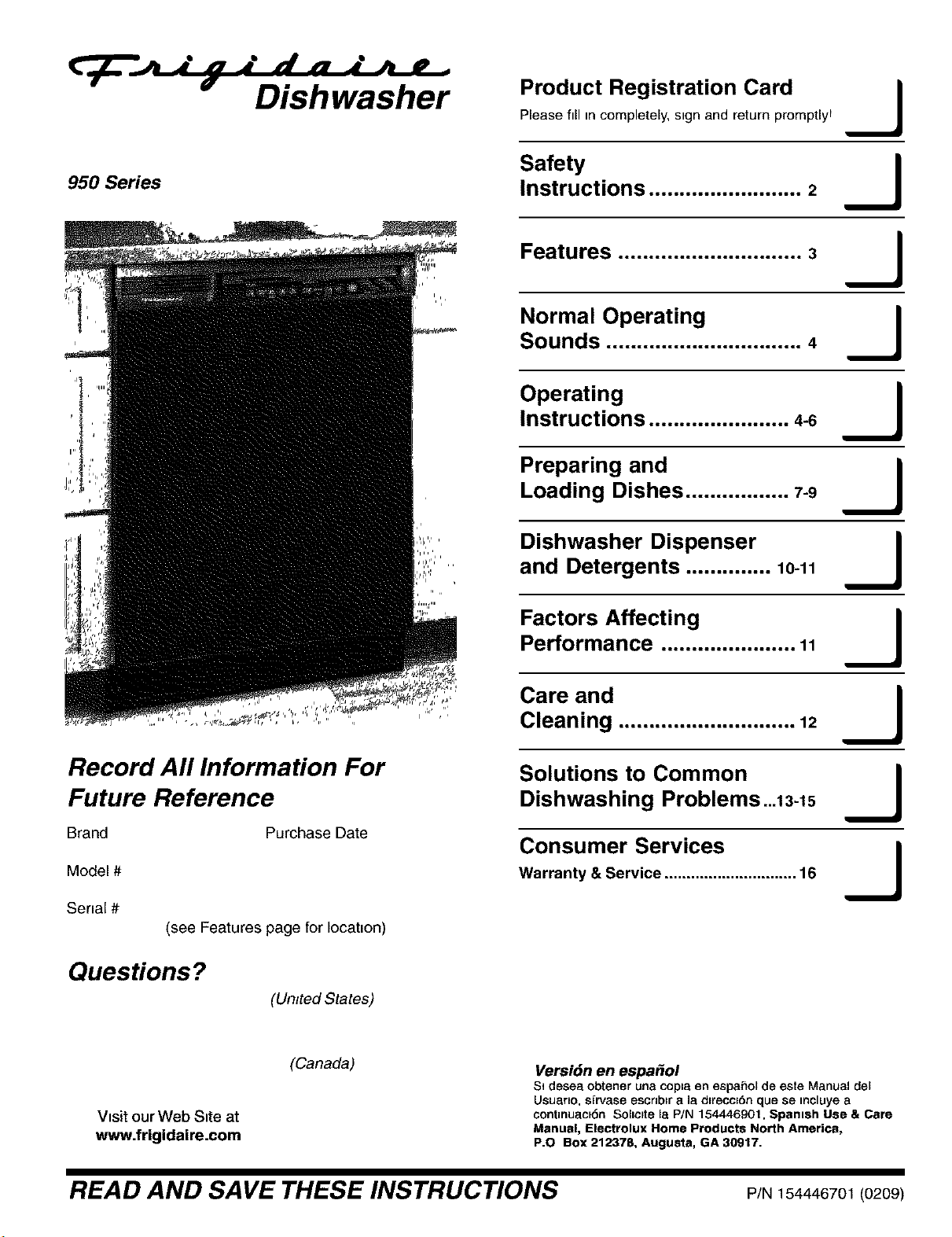
Dishwasher Product Registration Card
950 Series
Record All Information For
Future Reference
Brand
Model #
Senal #
Purchase Date
(see Features page for location)
Questions?
(United States)
I
Please fill in completely, sign and return promptly t J
Safety _J
Instructions ......................... 2
Features .............................. 3 1
i
Normal Operating _J
Sounds ................................ 4
Operating ,mR
Instructions ....................... 4-6
Preparing and _J
Loading Dishes ................. 7-9
Dishwasher Dispenser _Jand Detergents .............. 10-11
Factors Affecting _J
Performance ...................... 11
Care and /,D
Cleaning ............................. 12
Solutions to Common |
Dishwashing Problems d3-15
Consumer Services
Warranty & Service .............................. 16
Visit our Web Stte at
www.frigidaire.com
(Canada)
Versi6n en espa_ol
S_desea obtener urta copra en espahol de este Manual del
Usuano, s[rvase escnb=r a la dlreccl6n que se incluye a
contmuacl6n Sohctte la P/N 154446901, Spanmh Use & Care
Manual, Eleetrolux Home Products North America,
P.O Box 212378, Augusta, GA 30917.
READ AND SAVE THESE INSTRUCTIONS PINls444o7ol(0209)
Important Safety Instructions
This symbol will help alert you to such
dangers as personal injury, burns, fire, and
electrical shock.
To reduce the risk of fire, electrical shock,
or injury when using your dishwasher,
follow basic precautions including the
following:
Read all instructions before using your
dishwasher.
Use your dishwasher only as instructed in
this Use and Care Manual.
This Manual does not cover every possible
condition and situation that may occur. Use
common sense and caution when installing,
operating and maintaining any appliance.
NSF certified residential dishwashers are not
intended for licensed food establishments.
DISHWASHER MUST BE ELECTRICALLY
GROUNDED. Read the Installation
Instructions for details.
• This dishwasher is designed to operate on
regular house current (120 V, 60 Hz). Use a
circuit equipped with a 15 ampere fuse or
circuit breaker. Use a 20 ampere fuse if
dishwasher is connected with a food waste
disposer.
• Do not operate dishwasher unless all
enclosure panels are in their proper place.
• To avoid entrapment and/or suffocation,
remove door or door latch mechanism from
any dishwasher that is discarded or not in
use.
Keep young children and infants away from
dishwasher when it is operating.
Do not let children abuse, sit, stand or play
on door or racks of a dishwasher.
Use only detergents and rinse agents
recommended for use in a dishwasher.
Store dishwasher detergent and rinse
agents out of the reach of children.
Do not wash plastic items unless marked
"dishwasher safe" or the equivalent. Check
©2002 Electrolux Home Products, Inc.
All rights reserved.
with manufacturer for recommendations, if
not marked. Items that are not dishwasher
safe may melt and create a potential fire
hazard.
If the dishwasher drains into a food
disposer, make sure disposer is completely
empty before running dishwasher.
Disconnect electrical power to dishwasher
before servicing.
Repairs should be done by a qualified
technician.
Do not tamper with controls.
Do not touch the heating element during or
immediately after use.
Use care unloading the dishware when the
SANITIZE option has been selected.
Contents may be hot to the touch
immediately after the end of cycle.
Water vapor from the vent may be hot to
the touch when the SANITIZE option has
been selected. Use care and do not let
small children play around or touch the vent
area of the dishwasher.
When loading items to be washed:
- Locate sharp items and knives so that
they are not likely to damage the door
seal or tub.
- Load sharp items and knives with the
handles up to reduce the risk of cut-type
injuries.
Under certain conditions, hydrogen gas may
be produced in a hot water system that has
not been used for 2 weeks or more.
HYDROGEN GAS IS EXPLOSIVE. If hot
water system has not been used for such a
period, before using dishwasher, turn on all
hot water faucets and let water flow from
each for several minutes. This will release
any accumulated hydrogen gas.
HYDROGEN GAS IS FLAMMABLE. Do not
smoke or use an open flame during this
time.
Do not store or use combustible materials,
gasoline or other flammable vapors and
liquids in the vicinity of this or any other
appliance.
SAVE THESE
INSTRUCTIONS
Printed in U.S.A.
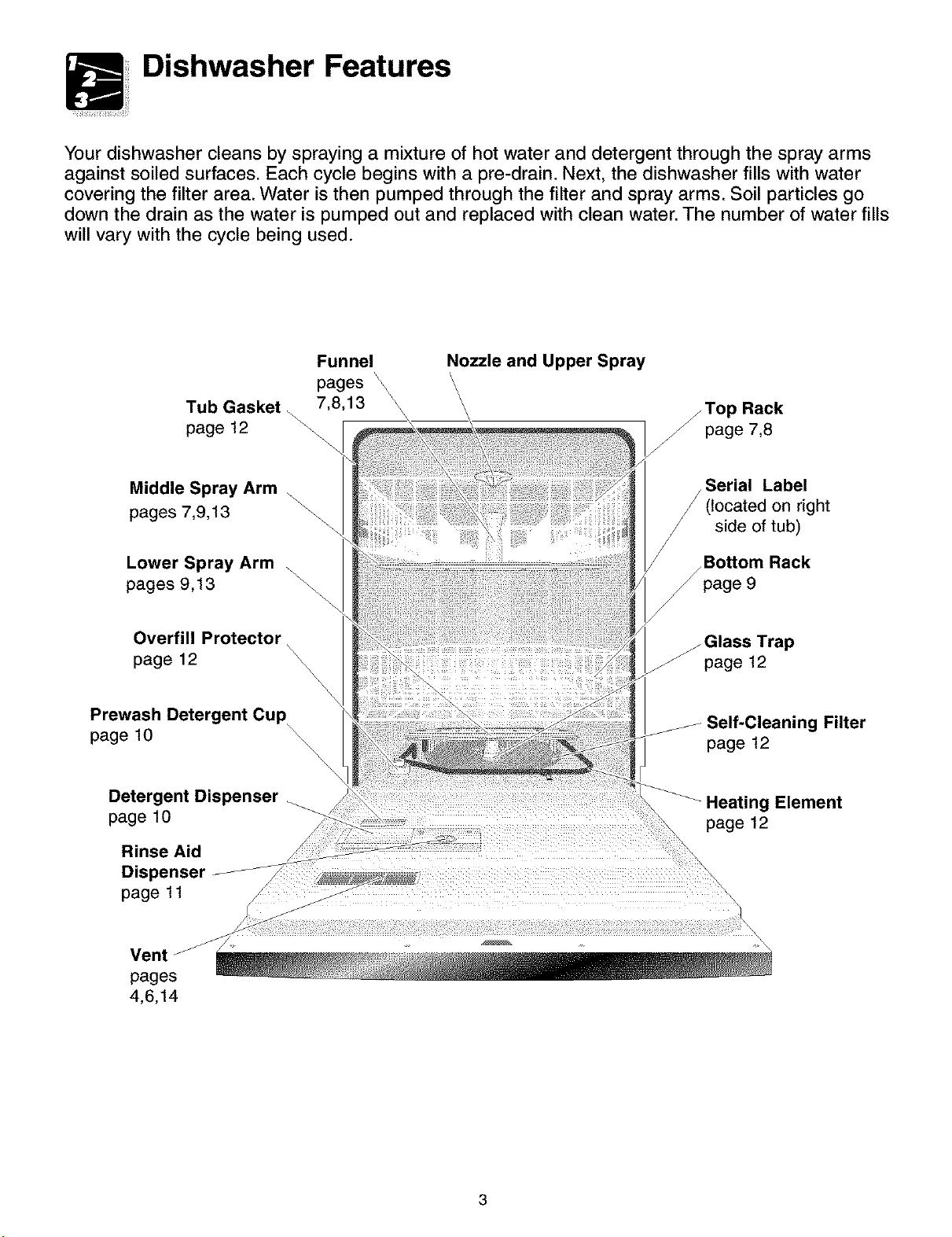
Dishwasher Features
Your dishwasher cleans by spraying a mixture of hot water and detergent through the spray arms
against soiled surfaces. Each cycle begins with a pre-drain. Next, the dishwasher fills with water
covering the filter area. Water is then pumped through the filter and spray arms. Soil particles go
down the drain as the water is pumped out and replaced with clean water. The number of water fills
will vary with the cycle being used.
Funnel Nozzle and Upper Spray
pages '\ \\
Tub Gasket .. 7,8,13 \ \ /Top Rack
page 12 _\ _ page 7,8
\
Middle Spray Arm \
pages 7,9,13 \_
\
Lower Spray Arm \
pages 9,13 -_\
Serial Label
(located on right
side of tub)
_Bottom Rack
page 9
Overfill Protector
page 12
_ Glass Trap
page 12
Prewash Detergent Cup
page 10
Self-Cleaning Filter
page 12
Detergent Dispenser
page 10
Rinse Aid
Heating Element
page 12
page 11
Vent F
pages
4,6,14
3
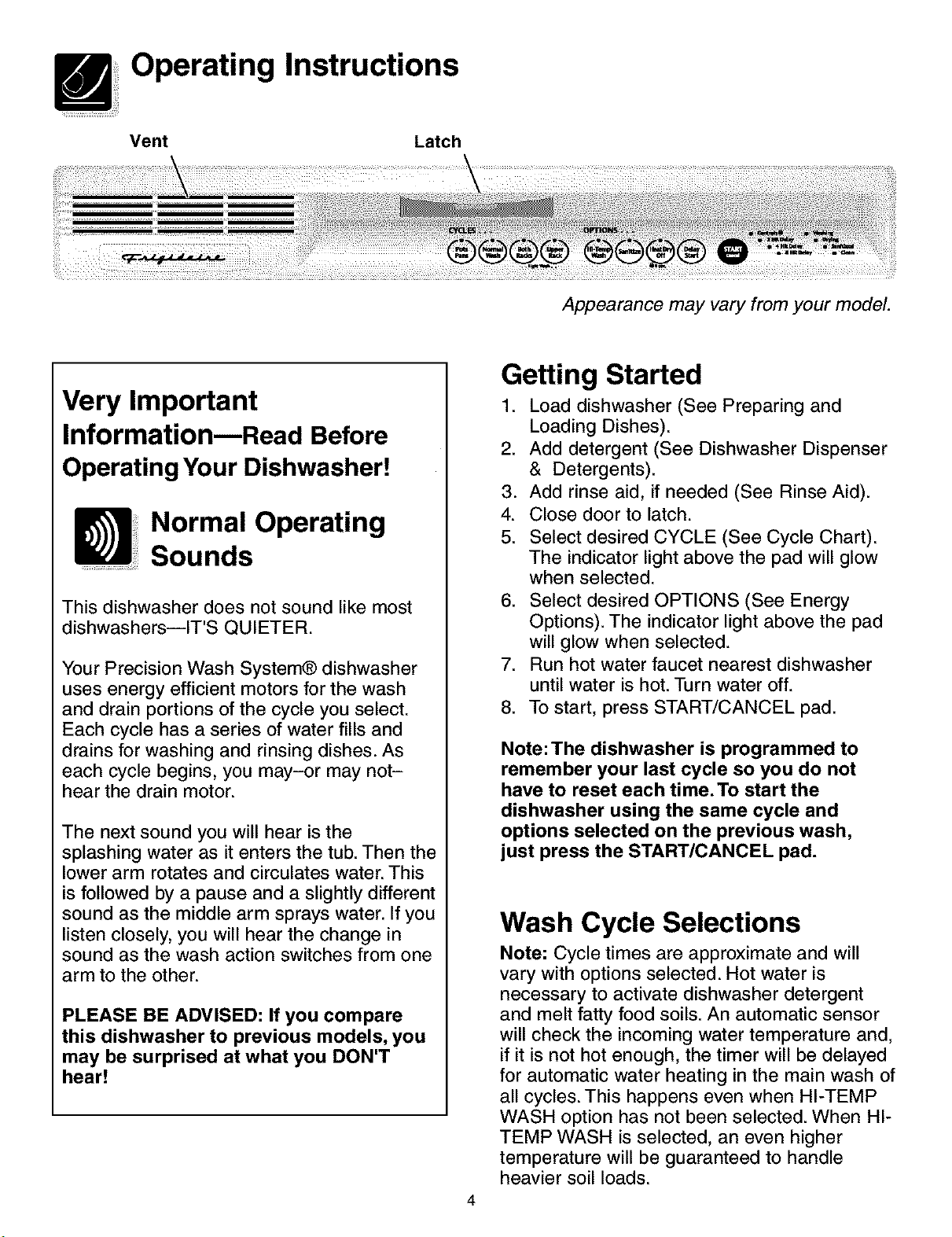
Operating Instructions
Vent Latch
Appearance may vary from your model.
Very Important
InformationmRead Before
Operating Your Dishwasher!
Normal Operating
Sounds
This dishwasher does not sound like most
dishwashers--IT'S QUIETER.
Your Precision Wash System® dishwasher
uses energy efficient motors for the wash
and drain portions of the cycle you select.
Each cycle has a series of water fills and
drains for washing and rinsing dishes. As
each cycle begins, you may-or may not-
hear the drain motor.
The next sound you will hear is the
splashing water as it enters the tub. Then the
lower arm rotates and circulates water. This
is followed by a pause and a slightly different
sound as the middle arm sprays water. If you
listen closely, you will hear the change in
sound as the wash action switches from one
arm to the other.
PLEASE BE ADVISED: If you compare
this dishwasher to previous models, you
may be surprised at what you DON'T
hear!
Getting Started
1. Load dishwasher (See Preparing and
Loading Dishes).
2. Add detergent (See Dishwasher Dispenser
& Detergents).
3. Add rinse aid, if needed (See Rinse Aid).
4. Close door to latch.
5. Select desired CYCLE (See Cycle Chart).
The indicator light above the pad will glow
when selected.
6. Select desired OPTIONS (See Energy
Options). The indicator light above the pad
will glow when selected.
7. Run hot water faucet nearest dishwasher
until water is hot. Turn water off.
8. To start, press START/CANCEL pad.
Note: The dishwasher is programmed to
remember your last cycle so you do not
have to reset each time.To start the
dishwasher using the same cycle and
options selected on the previous wash,
just press the START/CANCEL pad.
Wash Cycle Selections
Note: Cycle times are approximate and will
vary with options selected. Hot water is
necessary to activate dishwasher detergent
and melt fatty food soils. An automatic sensor
will check the incoming water temperature and,
if it is not hot enough, the timer will be delayed
for automatic water heating in the main wash of
all cycles. This happens even when HI-TEMP
WASH option has not been selected. When HI-
TEMP WASH is selected, an even higher
temperature will be guaranteed to handle
heavier soil loads.
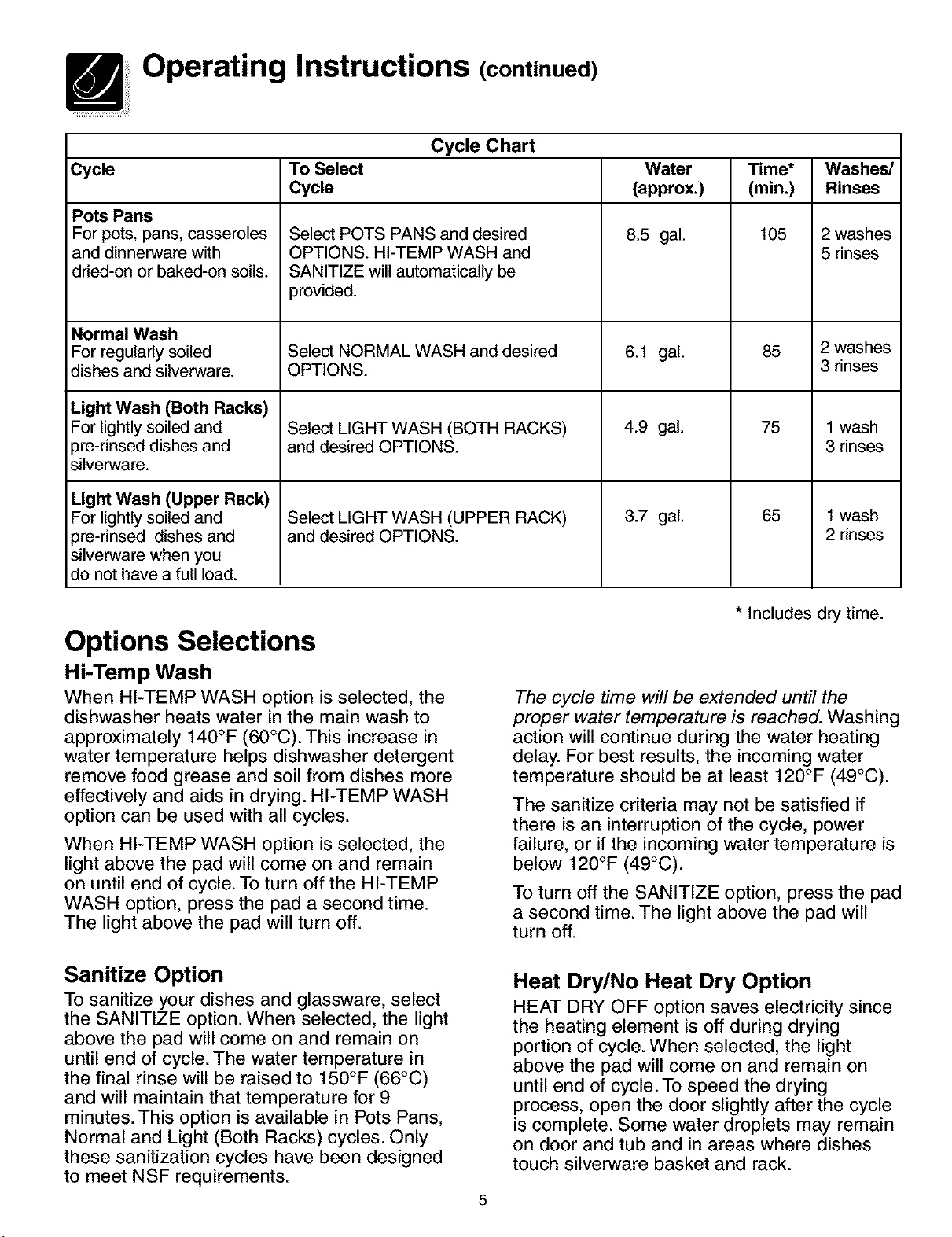
Operating Instructions (continued)
Cycle Chart
Cycle To Select Water Time* Washes/
Cycle (approx.) (min.) Rinses
Pots Pans
For pots, pans, casseroles Select POTS PANS and desired 8.5 gal. 105 2 washes
and dinnerware with OPTIONS. HI-TEMP WASH and 5 rinses
dried-on or baked-on soils. SANITIZE will automatically be
provided.
Normal Wash
For regularly soiled Select NORMAL WASH and desired 6.1 gal. 85 2 washes
dishes and silverware. OPTIONS. 3 rinses
Light Wash (Both Racks)
For lightly soiled and Select LIGHT WASH (BOTH RACKS) 4.9 gal. 75 1 wash
0re-rinsed dishes and and desired OPTIONS. 3 rinses
silverware.
Light Wash (Upper Rack)
For lightly soiled and Select LIGHT WASH (UPPER RACK) 3.7 gal. 65 1 wash
pre-rinsed dishes and and desired OPTIONS. 2 rinses
silverware when you
do not have a full load.
* Includes dry time.
Options Selections
Hi-Temp Wash
When HI-TEMP WASH option is selected, the
dishwasher heats water in the main wash to
approximately t40°F (60°C). This increase in
water temperature helps dishwasher detergent
remove food grease and soil from dishes more
effectively and aids in drying. HI-TEMP WASH
option can be used with all cycles.
When HI-TEMP WASH option is selected, the
light above the pad will come on and remain
on until end of cycle. To turn off the HI-TEMP
WASH option, press the pad a second time.
The light above the pad will turn off.
The cycle time will be extended until the
proper water temperature is reached. Washing
action will continue during the water heating
delay. For best results, the incoming water
temperature should be at least 120°F (49°C).
The sanitize criteria may not be satisfied if
there is an interruption of the cycle, power
failure, or if the incoming water temperature is
below 120°F (49°C).
To turn off the SANITIZE option, press the pad
a second time. The light above the pad will
turn off.
Sanitize Option
To sanitize your dishes and glassware, select
the SANITIZE option. When selected, the light
above the pad will come on and remain on
until end of cycle. The water temperature in
the final rinse will be raised to 150°F (66°C)
and will maintain that temperature for 9
minutes. This option is available in Pots Pans,
Normal and Light (Both Racks) cycles. Only
these sanitization cycles have been designed
to meet NSF requirements.
Heat Dry/No Heat Dry Option
HEAT DRY OFF option saves electricity since
the heating element is off during drying
portion of cycle. When selected, the light
above the pad will come on and remain on
until end of cycle. To speed the drying
process, open the door slightly after the cycle
is complete. Some water droplets may remain
on door and tub and in areas where dishes
touch silverware basket and rack.
5
Operating Instructions (continued)
To select heated dry, press the pad a second
time. The light above the pad will turn off.
Heated dry provides faster drying since the
heating element is on during the drying portion
of the cycle.
You may see water vapor coming from vent
during the drying portion of cycle. The vent is
closed during washing to hold moisture and
sound inside. The vent opens during the last
few minutes of the final rinse and remains
open for drying. The drying option may be
changed at any time during the cycle and
affects only the drying period.
Opening the door longer than one minute
during the dry cycle cancels the selected dry
program.
Delay Start
The DELAY START option allows you to delay
starting your dishwasher up to 6 hours. Press
the pad once for a 2-hour delay, twice for 4
hours or three times for 6 hours. A light will
come on indicating the delay start hours and
will remain on until cycle starts.To cancel the
DELAY START option and begin the cycle
before the delay period is over, press the
START/CANCEL pad.
To Cancel a Cycle
You can cancel a cycle anytime during the
cycle. Press START/CANCEL pad and the
dishwasher will start a 90 second drain. At the
end of the drain, select the desired cycle.
Status Indicator Lights
The WASHING light comes on at the
beginning of cycle and remains on until the
end of the main wash.
The DRYING light indicates the drying portion
of the cycle. The light will come on when either
drying option is selected.
When the SANITIZE option is selected, the
SANITIZED light will glow when the SANITIZE
cycle is finished. If the dishwasher did not
properly sanitize the dishes, the light will not
come on. This can happen if the cycle is
interrupted. The light will remain on until the
door is opened.
The CLEAN light will come on at end of cycle
and remain on until door is opened.
Child Lock Controls
To prevent children from accidently changing
the dishwasher cycle or starting the
dishwasher, lock the dishwasher controls by
pressing and releasing the HEAT DRY OFF
pad, then pressing and holding the HEAT DRY
OFF pad for 5 seconds. The CONTROLS light
will come on and no new selections can be
made until the lock is released. To unlock the
controls, press the HEAT DRY OFF pad for 5
seconds until the CONTROLS light goes out.
Electrical Power Interruption
When first installed or when power has been
interrupted, HI-TEMP WASH and HEAT DRY
OFF status lights will flash. To clear, press
START/CANCEL pad. If power failure occurs
during a cycle, it will be necessary to restart
the dishwasher by resetting the cycle you
want.
Preparing and Loading Dishes
Dish Preparation
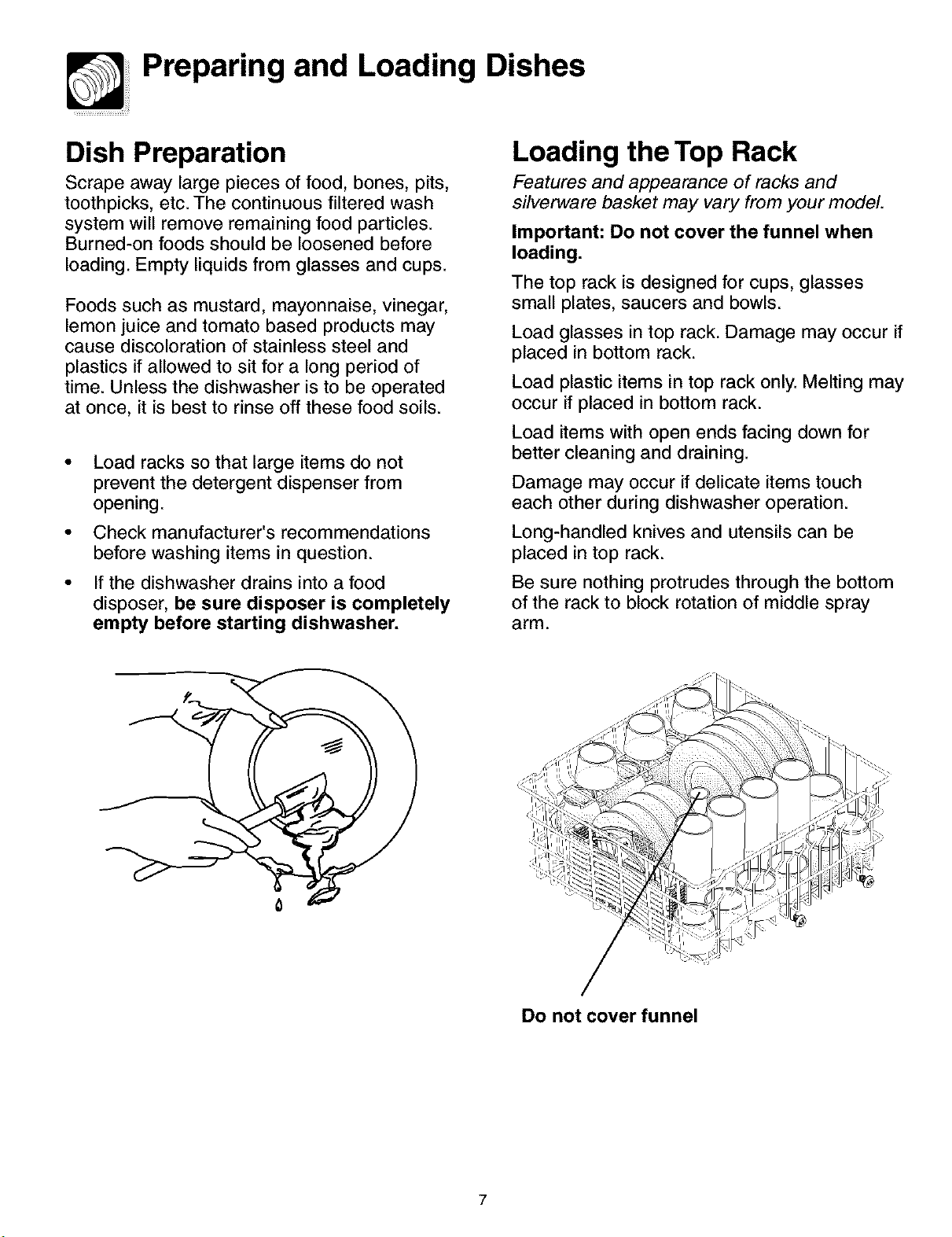
Scrape away large pieces of food, bones, pits,
toothpicks, etc. The continuous filtered wash
system will remove remaining food particles.
Burned-on foods should be loosened before
loading. Empty liquids from glasses and cups.
Foods such as mustard, mayonnaise, vinegar,
lemon juice and tomato based products may
cause discoloration of stainless steel and
plastics if allowed to sit for a long period of
time. Unless the dishwasher is to be operated
at once, it is best to rinse off these food soils.
Load racks so that large items do not
prevent the detergent dispenser from
opening.
Check manufacturer's recommendations
before washing items in question.
If the dishwasher drains into a food
disposer, be sure disposer is completely
empty before starting dishwasher.
Loading the Top Rack
Features and appearance of racks and
silverware basket may vary from your model.
Important: Do not cover the funnel when
loading.
The top rack is designed for cups, glasses
small plates, saucers and bowls.
Load glasses in top rack. Damage may occur if
placed in bottom rack.
Load plastic items in top rack only. Melting may
occur if placed in bottom rack.
Load items with open ends facing down for
better cleaning and draining.
Damage may occur if delicate items touch
each other during dishwasher operation.
Long-handled knives and utensils can be
placed in top rack.
Be sure nothing protrudes through the bottom
of the rack to block rotation of middle spray
arm.
f.
Do not cover funnel
7
Preparing and Loading Dishes (continued)
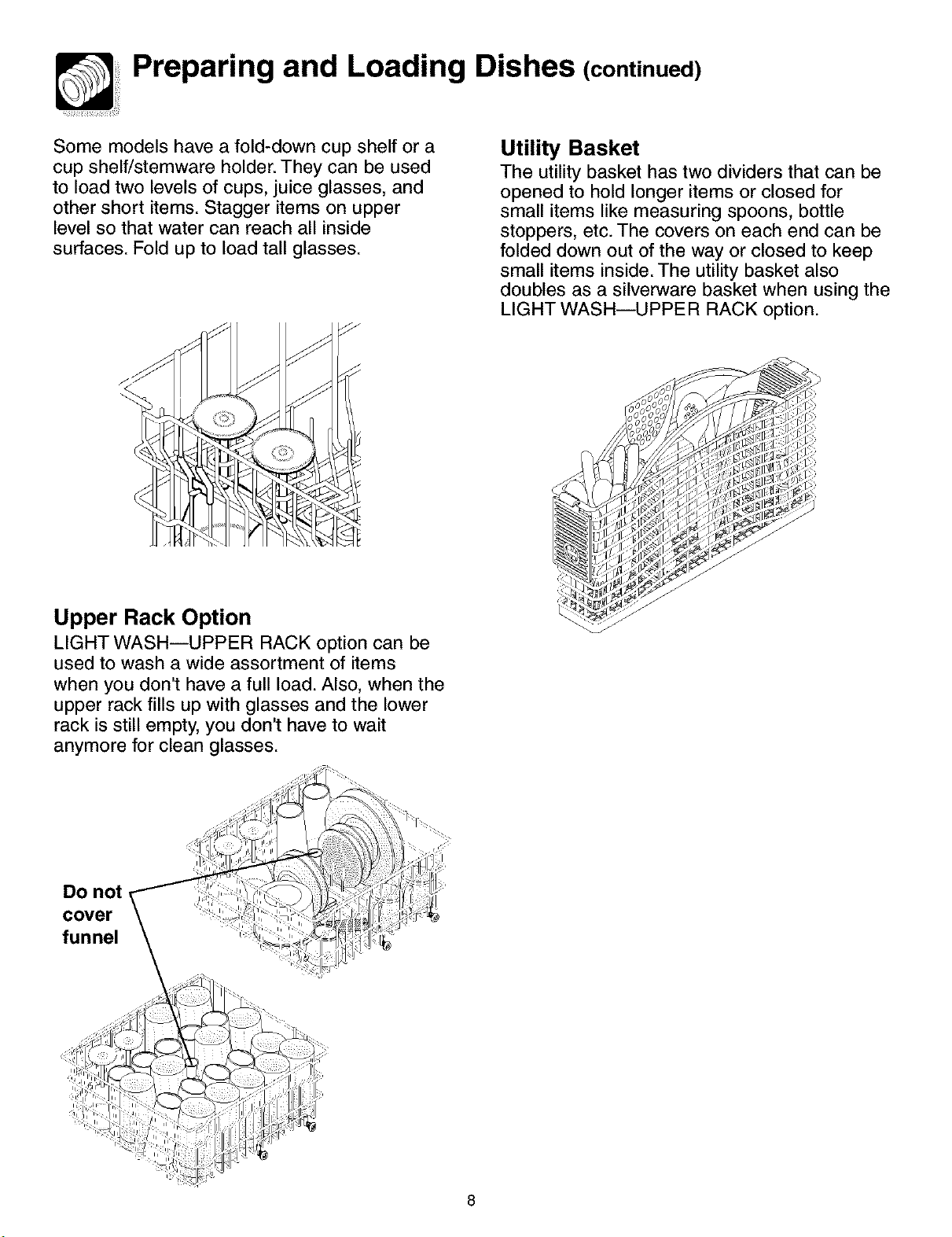
Some models have a fold-down cup shelf or a
cup shelf/stemware holder. They can be used
to load two levels of cups, juice glasses, and
other short items. Stagger items on upper
level so that water can reach all inside
surfaces. Fold up to load tall glasses.
Utility Basket
The utility basket has two dividers that can be
opened to hold longer items or closed for
small items like measuring spoons, bottle
stoppers, etc. The covers on each end can be
folded down out of the way or closed to keep
small items inside. The utility basket also
doubles as a silverware basket when using the
LIGHT WASH--UPPER RACK option.
Upper Rack Option
LIGHT WASH--UPPER RACK option can be
used to wash a wide assortment of items
when you don't have a full load. Also, when the
upper rack fills up with glasses and the lower
rack is still empty, you don't have to wait
anymore for clean glasses.
Do not
cover
funnel
Preparing and Loading Dishes (continued)
Loading the Bottom Rack
Features and appearance of racks and
silverware basket may vary from your model.
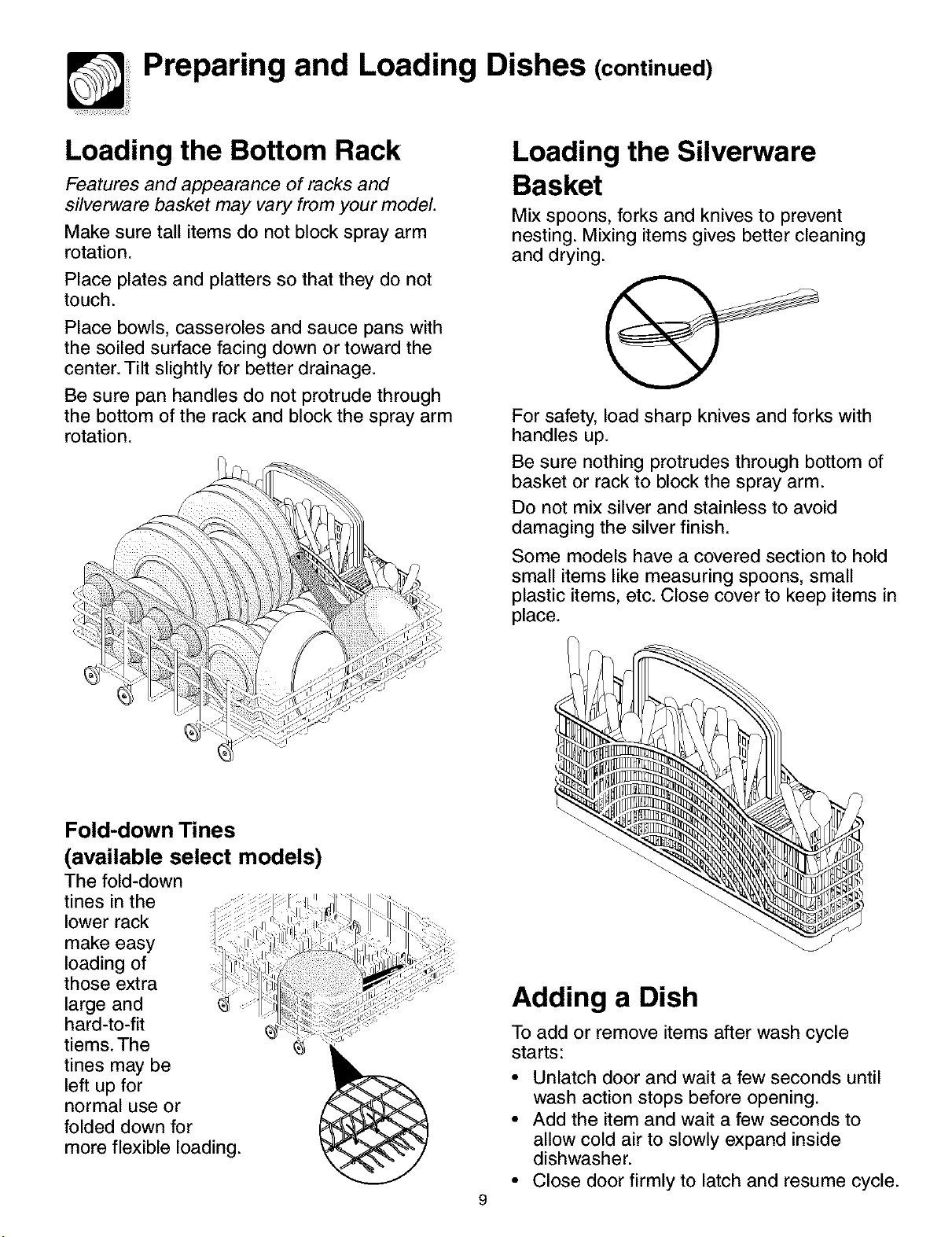
Make sure tall items do not block spray arm
rotation.
Place plates and platters so that they do not
touch.
Place bowls, casseroles and sauce pans with
the soiled surface facing down or toward the
center. Tilt slightly for better drainage.
Be sure pan handles do not protrude through
the bottom of the rack and block the spray arm
rotation.
Loading the Silverware
Basket
Mix spoons, forks and knives to prevent
nesting. Mixing items gives better cleaning
and drying.
For safety, load sharp knives and forks with
handles up.
Be sure nothing protrudes through bottom of
basket or rack to block the spray arm.
Do not mix silver and stainless to avoid
damaging the silver finish.
Some models have a covered section to hold
small items like measuring spoons, small
plastic items, etc. Close cover to keep items in
place.
Fold-down Tines
(available select models)
The fold-down
tines in the
lower rack
make easy
loading of
those extra
large and
hard-to-fit
tiems. The
tines may be
left up for
normal use or
folded down for
more flexible loading.
9
Adding a Dish
To add or remove items after wash cycle
starts:
• Unlatch door and wait a few seconds until
wash action stops before opening.
• Add the item and wait a few seconds to
allow cold air to slowly expand inside
dishwasher.
• Close door firmly to latch and resume cycle.
Dishwasher Dispenser & Detergents
Filling the Detergent Dispenser
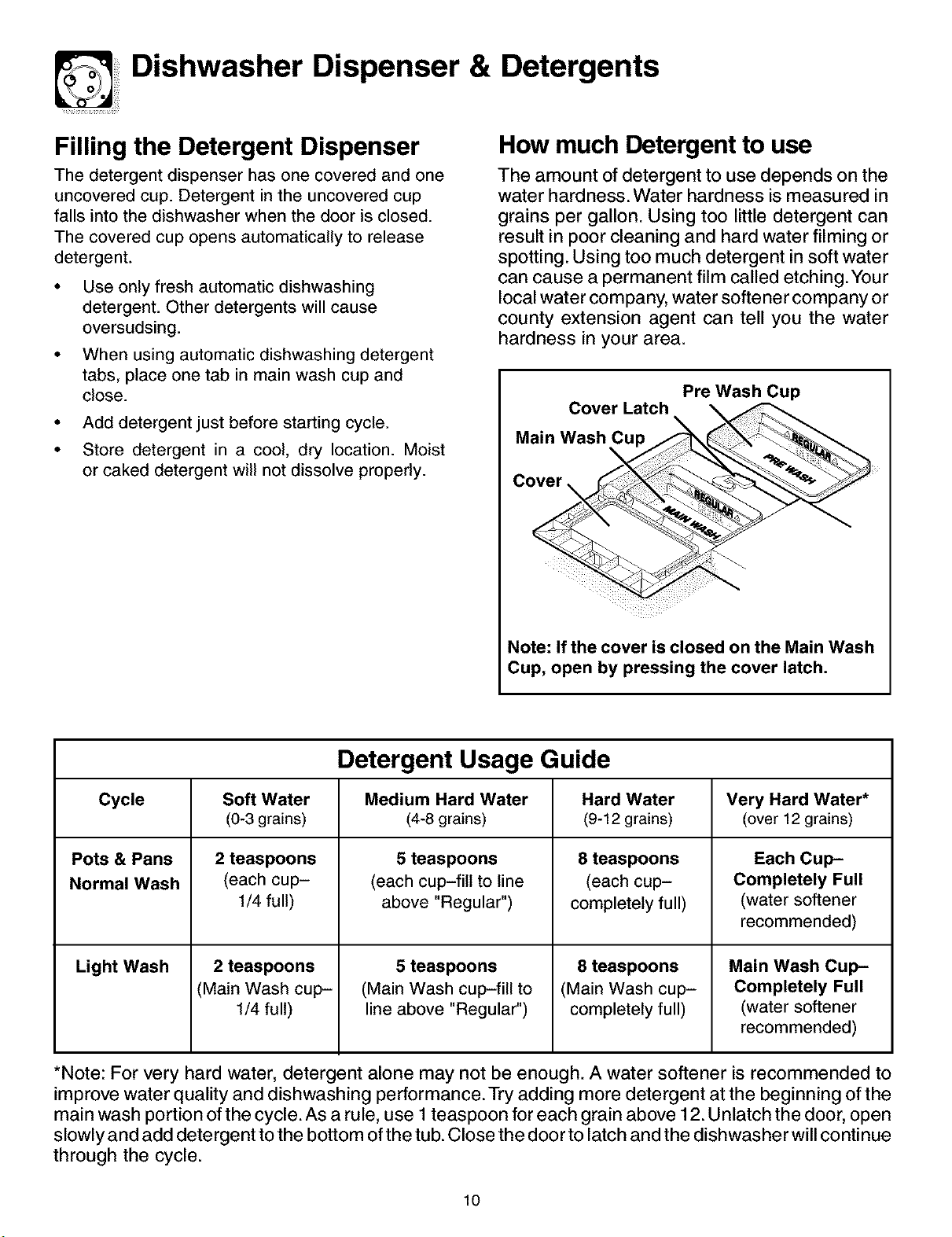
The detergent dispenser has one covered and one
uncovered cup. Detergent in the uncovered cup
falls into the dishwasher when the door is closed.
The covered cup opens automatically to release
detergent.
• Use only fresh automatic dishwashing
detergent. Other detergents will cause
oversudsing.
• When using automatic dishwashing detergent
tabs, place one tab in main wash cup and
close.
• Add detergent just before starting cycle.
• Store detergent in a cool, dry location. Moist
or caked detergent will not dissolve properly.
How much Detergent to use
The amount of detergent to use depends on the
water hardness. Water hardness is measured in
grains per gallon. Using too little detergent can
result in poor cleaning and hard water filming or
spotting. Using too much detergent in soft water
can cause a permanent film called etching. Your
local water company, water softener company or
county extension agent can tell you the water
hardness in your area.
Pre Wash Cup
Cover Latch
Main Wash
Cover
X
Note: If the cover is closed on the Main Wash
Cup, open by pressing the cover latch.
Detergent Usage Guide
Cycle Soft Water Medium Hard Water Hard Water Very Hard Water*
(0-3 grains) (4-8 grains) (9-12 grains) (over 12 grains)
Pots & Pans 2 teaspoons 5 teaspoons 8 teaspoons Each Cup-
Normal Wash (each cup- (each cup-fill to line (each cup- Completely Full
1/4 full) above "Regular") completely full) (water softener
recommended)
Light Wash 2 teaspoons 5 teaspoons 8 teaspoons Main Wash Cup-
(Main Wash cup- (Main Wash cup-fill to (Main Wash cup- Completely Full
1/4 full) line above "Regular") completely full) (water softener
recommended)
*Note: For very hard water, detergent alone may not be enough. A water softener is recommended to
improve water quality and dishwashing performance. Try adding more detergent at the beginning of the
main wash portion of the cycle. As a rule, use 1teaspoon for each grain above 12. Unlatch the door, open
slowly and add detergent to the bottom of the tub. Close the door to latch and the dishwasher will continue
through the cycle.
10
Dishwasher
Dispenser &
.... Detergents (continued)
Rinse Aid
Rinse aid greatly improves drying and
reduces water spots and filming. Water
"sheets" off dishes rather than forming water
droplets that cling and leave spots.
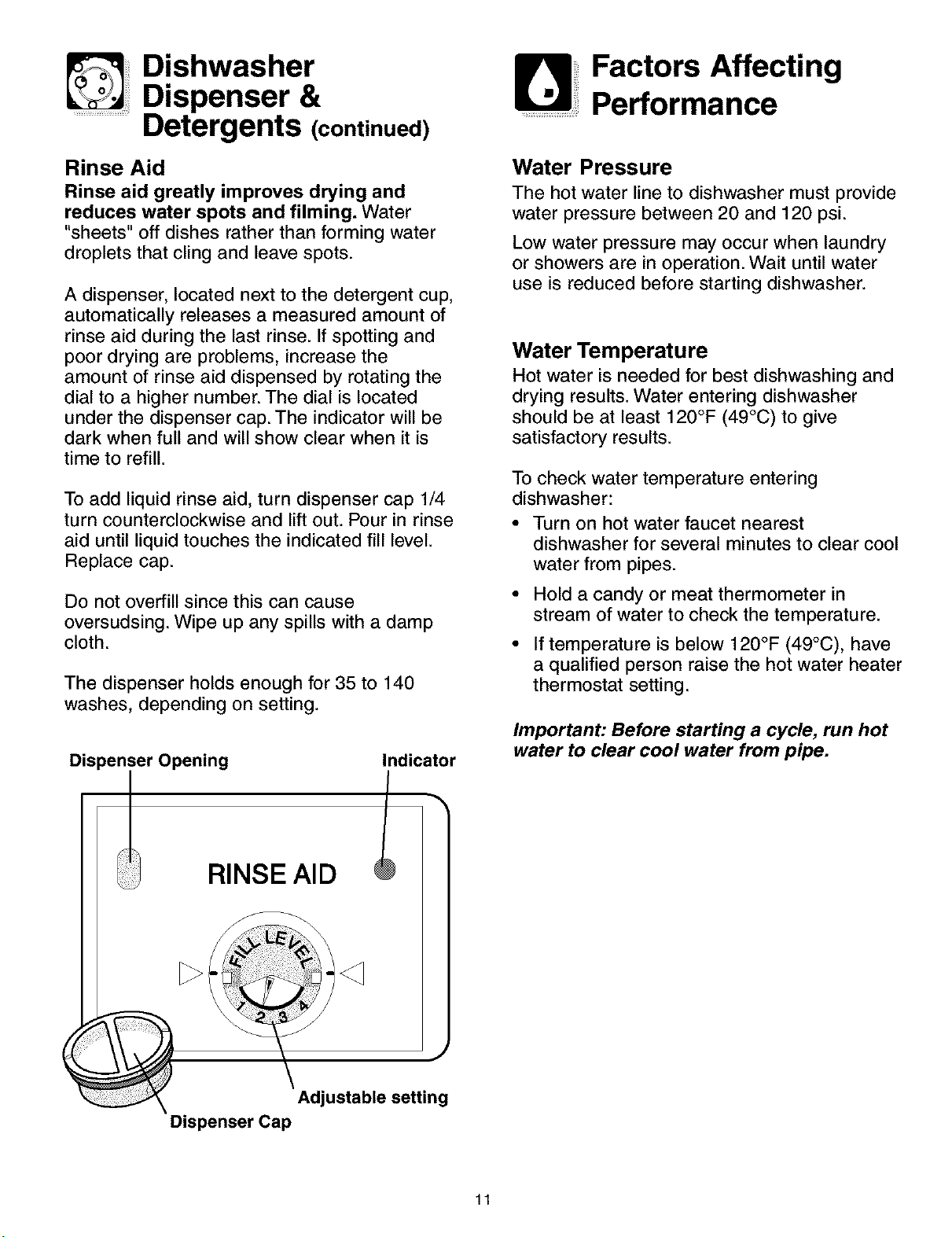
A dispenser, located next to the detergent cup,
automatically releases a measured amount of
rinse aid during the last rinse. If spotting and
poor drying are problems, increase the
amount of rinse aid dispensed by rotating the
dial to a higher number. The dial is located
under the dispenser cap. The indicator will be
dark when full and will show clear when it is
time to refill.
To add liquid rinse aid, turn dispenser cap 1/4
turn counterclockwise and lift out. Pour in rinse
aid until liquid touches the indicated fill level.
Replace cap.
Do not overfill since this can cause
oversudsing. Wipe up any spills with a damp
cloth.
The dispenser holds enough for 35 to 140
washes, depending on setting.
Dispenser Opening Indicator
RINSE AID
Adjustable setting
Dispenser Cap
Factors Affecting
Performance
Water Pressure
The hot water line to dishwasher must provide
water pressure between 20 and 120 psi.
Low water pressure may occur when laundry
or showers are in operation. Wait until water
use is reduced before starting dishwasher.
Water Temperature
Hot water is needed for best dishwashing and
drying results. Water entering dishwasher
should be at least 120°F (49°C) to give
satisfactory results.
To check water temperature entering
dishwasher:
• Turn on hot water faucet nearest
dishwasher for several minutes to clear cool
water from pipes.
• Hold a candy or meat thermometer in
stream of water to check the temperature.
• If temperature is below 120°F (49°C), have
a qualified person raise the hot water heater
thermostat setting.
Important: Before starting a cycle, run hot
water to clear cool water from pipe.
11
Care and Cleaning
Burn Hazard
Allow heating element to cool
before cleaning the interior.
Failure to do so can result in
burns.
Outside--Occasionally wipe with a mild
nonabrasive detergent and water. Rinse and
dry.
Models with Stainless Steel Door--
Clean stainless steel door with Stainless Steel
Magic, trademark of Magic American Corp., or
similar product using a clean, soft cloth. Avoid
harsh or gritty cleaners or scouring pads
which may scratch the finish.
InsideiThe inside of the dishwasher is self-
cleaning with normal use. If needed, clean
around the tub gasket area with a damp cloth.
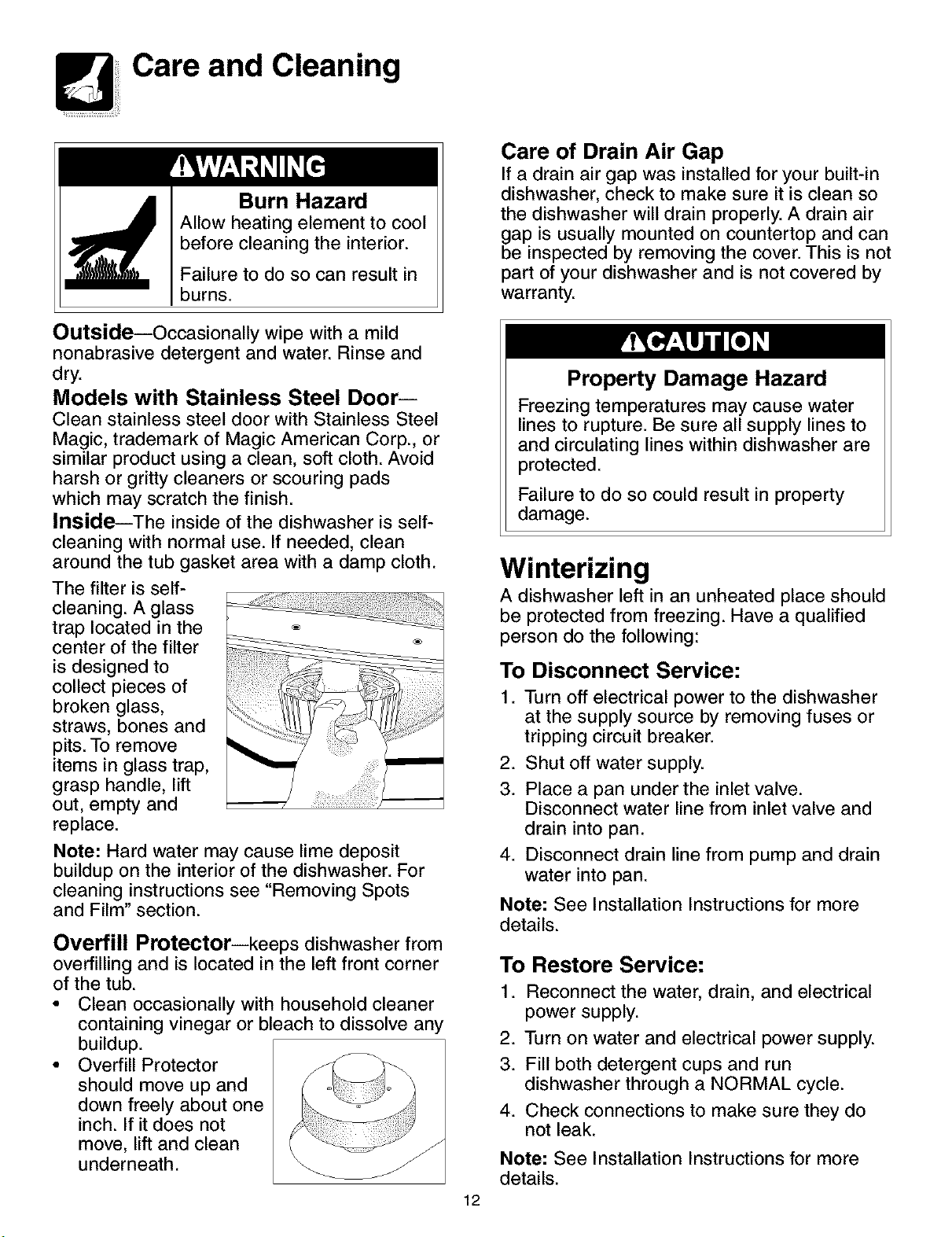
The filter is self-
cleaning. A glass
trap located in the
center of the filter
is designed to
collect pieces of
broken glass,
straws, bones and
pits. To remove
items in glass trap,
grasp handle, lift
out, empty and
replace.
Note: Hard water may cause lime deposit
buildup on the interior of the dishwasher. For
cleaning instructions see "Removing Spots
and Film" section.
Overfill Protector--keeps dishwasher from
overfilling and is located in the left front corner
of the tub.
• Clean occasionally with household cleaner
containing vinegar or bleach to dissolve any
buildup.
• Overfill Protector
should move up and
down freely about one
inch. If it does not
move, lift and clean
underneath.
12
Care of Drain Air Gap
If a drain air gap was installed for your built-in
dishwasher, check to make sure it is clean so
the dishwasher will drain properly. A drain air
gap is usually mounted on countertop and can
be inspected by removing the cover. This is not
part of your dishwasher and is not covered by
warranty.
Property Damage Hazard
Freezing temperatures may cause water
lines to rupture. Be sure all supply lines to
and circulating lines within dishwasher are
protected.
Failure to do so could result in property
damage.
Winterizing
A dishwasher left in an unheated place should
be protected from freezing. Have a qualified
person do the following:
To Disconnect Service:
1. Turn off electrical power to the dishwasher
at the supply source by removing fuses or
tripping circuit breaker.
2. Shut off water supply.
3. Place a pan under the inlet valve.
Disconnect water line from inlet valve and
drain into pan.
.
Disconnect drain line from pump and drain
water into pan.
Note: See Installation Instructions for more
details.
To Restore Service:
1. Reconnect the water, drain, and electrical
power supply.
2. Turn on water and electrical power supply.
3. Fill both detergent cups and run
dishwasher through a NORMAL cycle.
4. Check connections to make sure they do
not leak.
Note: See Installation Instructions for more
details.
Solutions to Common Dishwashing Problems
Before calling for service, review this list. It
may save you both time and expense.This
list includes common experiences that are
not the result of defective workmanship or
material in your dishwasher.
Food Soils Left on Dishes
• Choose another cycle for longer washing
time.
• Check rack loading section for proper
loading--avoid nesting items.
• Home water pressure may be too low--
should be 20 to 120 pounds per square inch
(psi).
• Check incoming water temperature. It
should be at least 120°F (49°C). (See
Factors Affecting Performance.)
• Check water hardness. For extremely hard
water, it may be necessary to install a water
softener. (See Detergent Chart.)
• Use fresh detergent.
• Check to make sure funnel in top rack is not
blocked.
• Make sure items are not blocking the spray
arms, preventing them from rotating.
• Avoid overloading and improper loading.
(See Preparing and Loading Dishes.)
• Use fresh detergent. Old detergent is
ineffective.
• Make sure rinse aid dispenser is filled.
• Check to see that proper amount of
detergent is being used for cycle selected.
Also, check phosphate level. (See
Detergent Dispenser.)
• Home water pressure may be too low--it
should be 20 to 120 pounds per square inch
(psi).
Dishware Chipped
• Load with care and do not overload. (See
Preparing and Loading Dishes.)
• Place delicate items in top rack.
• Place glasses securely against pins and not
over pins.
• Load items so they are secure and don't jar
loose when moving racks in and out. Move
racks in and out slowly.
• Make sure tall glasses and stemware will
clear top of tub when rack is pushed in.
• Fine antique china and crystal should be
hand-washed.
Dishes not Dry
• Select heat dry option.
• Make sure the rinse aid dispenser is filled.
• Increase the amount of rinse aid. (See
Rinse Aid.)
• Check the incoming water temperature. Be
sure it is at least 120°F (49°C).
• Check for proper loading--avoid nesting
items.
• Plastic items may need to be towel dried.
• Cups with a concave bottom will collect
water.
Glassware/Flatware Spotted or
Cloudy
• Check water hardness. For extremely hard
water, it may be necessary to install a water
softener. (See Detergent Chart.)
• Water temperature may be low. Avoid
extremely low or high temperatures. (See
Factors Affecting Performance.)
Dishware Stained or Discolored
• Tea and coffee can stain cups. Remove the
stains by hand washing in a solution of 1/2
cup (120 ml) bleach and one quart (1 L) of
warm water. Rinse thoroughly.
• Iron deposits in water can cause a yellow or
brown film. A special filter installed in the
water supply line will correct this problem.
(See Removing Spots and Film.)
• Aluminum utensils can leave gray/black
marks when they rub against other items.
Load properly.
• Certain high acid foods can cause
discoloration of stainless steel and plastics
if allowed to sit for a long period. Rinse by
hand if not operating dishwasher at once.
• Mixing stainless steel and silver utensils in
silverware basket can cause pitting of the
stainless steel blades. Avoid mixing
stainless steel and silver.
13
Solutions to Common Dishwashing Problems
(continued)
Etching
• Using too much detergent in soft or
softened water causes this film that cannot
be removed.
• Adjust the amount of detergent based on
the water hardness. (Check Detergent
Chart.)
• Lower the water temperature.
• Use the no heat dry option.
Detergent Left in Cups
• Detergent may be old. Discard and use
fresh detergent.
• Be sure water action can reach the
dispenser.
• Check to see if cycle has been completed.
• Make sure items do not prevent the
detergent dispenser from opening.
Dishwasher Leaks
• Use only fresh detergent designed for
automatic dishwashers. Measure detergent
carefully. Try a different brand.
• Spilled rinse aid can cause foam and lead
to overflowing. Wipe up any spills with a
damp cloth.
• Check to see that dishwasher is level. (See
Installation Instructions.)
Normal Sounds You Will Hear
• Normal sounds include water fill, water
circulation and motor sounds.
• There is a noticeable change in sound
when the wash action switches between the
lower and middle spray arm. This is normal
since each spray arm has its own sound.
• It is normal for dishwasher to pause (no
sound) when the wash action is switching
between the lower and middle spray arms.
Water in Bottom of Tub
Water left in bottom of tub after cycle is
complete is not normal. If water remains in
the bottom of the tub, dishwasher may not
be draining properly. (See Dishwasher Does
Not Drain Properly.)
Vapor at Vent
• Water vapor escapes from the vent during
the drying part of cycle.This is normal.
Dishwasher Won't Run
• Check to see if circuit breaker is tripped or if
a fuse is blown.
• Make sure water supply is turned on.
• Check to see if cycle is set correctly. (See
Operating Instructions.)
• Is dishwasher set for delay start option?
• Make sure door is closed and latched.
Dishwasher Does Not Drain Properly
• If unit is hooked up to a food waste
disposer, make sure the disposer is empty.
• Check to see if the knockout plug has been
removed from inside the food waste
disposer inlet.
• Check to see if drain hose is kinked.
• Make sure cycle is complete, not in a
pause.
Cycle Takes a Long Time
• Is cycle in a water heating delay?
• Has the delay start option been selected?
• Has the sanitize option been selected?
Dishwasher Won't Fill
• Is water supply turned on?
• Does overfill protector move up and down
freely? (See Overfill Protector section.)
Dishwasher Has an Odor
• Soiled dishes left in dishwasher too long
can create an odor. Rinse dishes if not
running dishwasher at once.
• There will be a "new" smell when first
installed. This is normal.
• Check to see if unit is draining properly.
(See Dishwasher Does Not Drain Properly.)
14
Solutions to Common Dishwashing Problems
(continued)
Status Lights Flashing
• When first installed or when power has
been interrupted, HI-TEMP WASH and
HEAT DRY OFF status lights will flash. To
clear, press START/CANCEL pad. If power
failure occurs during a cycle, it will be
necessary to restart the dishwasher by
resetting the cycle you want.
Stains on Tub Interior
Washing large amounts of dishware with
tomato based soil can cause a pink/orange
appearance. This will not affect performance
and will gradually fade over time. Pre-rinsing
will reduce the chance of staining. Using no
heat dry option will lessen staining.
Removing Spots and Film
Hard water can cause lime deposit buildup on
the interior of the dishwasher. Dishes and
glasses may also get spots and film for a
number of reasons. (See Glassware/Flatware
Spotted or Cloudy section.) To remove buildup,
spots and film, clean using the following
instructions:
1. Load clean dishes and glasses in normal
manner. Do not load any metal utensils or
silverware.
2. Do not add detergent.
3. Select the POTS PANS cycle. Close and
latch door. Press START/CANCEL pad.
4. Allow dishwasher to run for 25 minutes to
reach the main wash portion of cycle.
5. Unlatch and open door and pour 2 cups of
white vinegar into the bottom of
dishwasher.
6. Close and latch door and allow cycle to
finish.
Note: If these conditions persist, a home
water softener should be considered.
To customize your dishwasher to match your cabinets:
• You will need a trim kit.
• See Step 10 of Installation Instructions that came with your dishwasher for more
information.
15
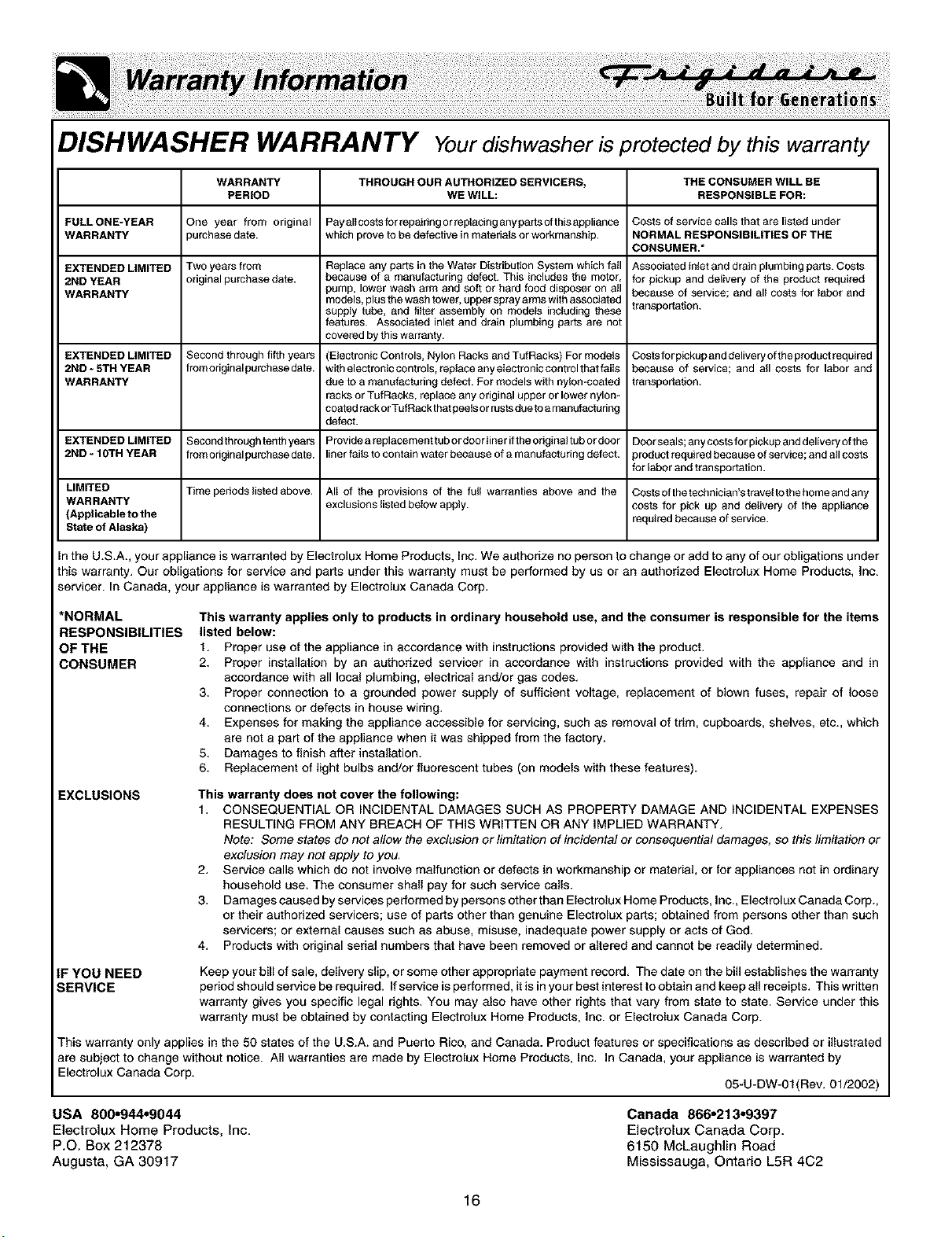
DISHWASHER WARRANTY Your dishwasher is protected by this warranty
WARRANTY THROUGH OURAUTHORIZED SERVICERS, THE CONSUMERWILL BE
PERIOD WE WILL: RESPONSIBLE FOR:
FULLONE-YEAR One year from original Payallcostsforrepairingorreplacinganypartsofthisappliance Costs of service calls that are listed under
WARRANTY _urchasedate. whichproveto bedefectivein materials or workmanship. NORMAL RESPONSIBILITIES OF THE
CONSUMER.*
EXTENDED LIMITED Two yearsfrom Replaceany parts in the Water DistributionSystemwhichfail Associated inlet and drainplumbing parts.Costs
2ND YEAR originalpurchasedate. becauseof a manufacturing defect. This includesthe motor, for pickupand delivery of the productrequired
WARRANTY pump, lower wash arm and soft or hardfood disposer on a_l because of service; and all costs for labor and
models,plusthewashtower,uppersprayarms with associated
supply tube, and filter assembly on modeIs including these transportation.
features. Associated inlet and drain plumbing partsare not
coveredbythis warranty.
EXTENDED LIMITED Second throughfifth years (ElectronicControls, Nylon Racks andTufRacks) For models Costsforpickupanddeliveryoftheprodectrequired
2ND-5THYEAR fromoriginalpurchasedate, withelectroniccontrols, replaceanyelectroniccontrolthatfails because of service; and all costs for labor and
WARRANTY dueto a manufacturing defect. Formodels with nylon-coated transportation.
racksor TufRacks, replaceany original upperor lower nylon-
coatedrackorTufRackthatpeelsor rustsdeetoamanufacturing
defect.
EXTENDEDMMITED Secondthroughtenthyears ProvideareplacementtubordeorIineriftheodginartubordeor Doorseals;anycostsforpickupanddeliveryofthe
2ND- 10TH YEAR fromoriginalpurchasedate. linerfails to containwater becauseofa manufacturingdefect, productrequiredbecause ofservice; andallcosts
for laborandtransportation.
LIMITED Timeperiodslisted above. All of the provisions of the full warranties above and the Costsofthetechnician'stravertothehomeandany
WARRANTY exclusionslisted below apply, costs for pick up and delivery of the appliance
(Applicable tothe requiredbecause ofservice.
Stateof Alaska)
In the U.S.A., your appliance is warranted by Electmlux Home Products, Inc. We authorize no person to change or add to any of our obligations under
this warranty. Our obligations for service and parts under this warranty must be performed by us or an authorized Electrolux Home Products, Inc.
servicer. In Canada, your appliance is warranted by Electrolux Canada Corp.
*NORMAL
RESPONSIBILITIES
OFTHE
CONSUMER
This warranty applies only to products in ordinary household use, and the consumer is responsible for the items
listed below:
1, Proper use of the appliance in accordance with instructions provided with the product.
2, Proper installation by an authorized servicer in accordance with instructions provided with the appliance and in
accordance with all local plumbing, electrical and/or gas codes,
3, Proper connection to a grounded power supply of sufficient voltage, replacement of blown fuses, repair of loose
connections or defects in house wiring.
4. Expenses for making the appliance accessible for servicing, such as removal of trim, cupboards, shelves, etc., which
are not a part of the appliance when it was shipped from the factory.
5. Damages to finish after installation.
6. Replacement of light bulbs and/or fluorescent tubes (on models with these features).
EXCLUSIONS This warranty does not cover the following:
1. CONSEQUENTIAL OR INCIDENTAL DAMAGES SUCH AS PROPERTY DAMAGE AND INCIDENTAL EXPENSES
RESULTING FROM ANY BREACH OF THIS WRITTEN OR ANY IMPLIED WARRANTY.
Note: Some states do not allow the exclusion or limitation of incidental or consequential damages, so this limitation or
exclusion may not apply to you,
2. Service calls which do not involve malfunction or defects in workmanship or material, or for appliances not in ordinary
household use. The consumer shall pay for such service calls.
3. Damages caused by services performed by persons other than Electrolux Home Products, Inc., Electrolux Canada Corp.,
or their authorized servicers; use of parts other than genuine Electrolux parts; obtained from persons other than such
servicers; or external causes such as abuse, misuse, inadequate power supply or acts of God.
4. Products with original serial numbers that have been removed or altered and cannot be readily determined.
IF YOU NEED
SERVICE
Keep your bill of sale, delivery slip, or some other appropriate payment record. The date on the bill establishes the warranty
period should service be required. Ifservice is performed, itis in your best interest to obtain and keep all receipts. This written
warranty gives you specific legal rights. You may also have other rights that vary from state to state. Service under thi=
warranty must be obtained by contacting Electrolux Home Products, Inc. or Electrolux Canada Corp.
This warranty only applies in the 50 states of the U.S.A. and Puerto Rico, and Canada. Product features or specifications as described or illustrated
are subject to change without notice. All warranties are made by Electrolux Home Products, Inc. In Canada, your appliance is warranted by
Electrolux Canada Corp.
05-U-DW-01(Rev. 01/2002
USA 800°944°9044
Electrolux Home Products, Inc.
P.O. Box 212378
Augusta, GA 30917
Canada 866.213o9397
Electrolux Canada Corp.
6150 McLaughlin Road
Mississauga, Ontario L5R 4C2
16