Part No. 7111550 Rev. 0 NOV2018
PRESSURE WASHER
INSTRUCTION
MANUAL
MANUEL
D’UTILISATION
MANUAL DE
INSTRUCCIONES
If your pressure washer is not working properly or if there are parts missing or broken,
please DO NOT RETURN IT TO THE PLACE OF PURCHASE. Contact our Customer
Service Department at 1-877-362-4271 or www.simpsoncleaning.com
Si votre rondelle de pression ne travaille pas convenablement ou s'il y a des
parties manquant ou cassé, s'il vous plaît le PAS LE RETOURNE AU LIEU
D'ACHAT. Contacter notre département de service clients à
1-877-362-4271 o
www.simpsoncleaning.com
Si su lavadora a presión no trabaja correctamente ó encuentra partes rotas
ófaltantes, por favor NO LA REGRECE AL LUGAR DONDE LA COMPRO.
Contáctese con nuestro Departamento de Servicio al Cliente llamando al
1-877-362-4271 ou www.simpsoncleaning.com
IMPORTANT: Please make certain that the person who is to use this equipment carefully
reads and understands these instructions before operating.
IMPORTANT : Assurez-vous que toute personne qui utilisera cet équipement lise
attentivement ces instructions avant de l’utiliser.
IMPORTANTE: Aségurese por favor de que la persona que vaya a utilizar este equipo lea
con cuidado y comprenda estas instrucciones antes de operar.
VEA EL ESPAÑOL EN LA CONTRAPORTADA. INSTRUCTIVO DE OPERACIÓN,
CENTROS DE SERVICIO Y PÓLIZA DE GARANTÍA. ADVERTENCIA:
LÉASE ESTE INSTRUCTIVO ANTES DE USAR EL PRODUCTO.
SAVE THIS MANUAL FOR FUTURE REFERENCE
LISEZ ET CONSERVEZ CES INSTRUCTIONS
CONSERVE ESTAS INSTRUCCIONES PARA FUTURAS CONSULTAS

2- ENG
SAFETY GUIDELINES - DEFINITIONS
This manual contains information that is important for you to know and understand.
This information relates to protecting YOUR SAFETY and PREVENTING
EQUIPMENT PROBLEMS. To help you recognize this information, we use the
symbols below. Please read the manual and pay attention to thesesymbols.
DANGER: Indicates an imminently hazardous situation which, if not avoided,
will result in death or seriousinjury.
WARNING: Indicates a potentially hazardous situation which, if not avoided,
could result in death or seriousinjury.
CAUTION: Indicates a potentially hazardous situation which, if not avoided, may
result in minor or moderateinjury.
NOTICE: Indicates a practice not related to personal injury which, if not avoided,
may result in propertydamage.
IMPORTANT SAFETY INSTRUCTIONS
DANGER: Carbon Monoxide. Using an engine indoors can kill you in
minutes. Engine exhaust contains high levels of carbon monoxide (CO), a
poisonous gas you cannot see or smell. You may be breathing CO even if you
do not smell engine exhaust.
• NEVER use an engine inside homes, garages, crawlspaces or other partly
enclosed areas. Deadly levels of carbon monoxide can build up in these areas.
Using a fan or opening windows and doors does NOT supply enough freshair.
• ONLY use outdoors and far away from open windows, doors and vents. These
openings can pull in engineexhaust.
• Even when the engine is used correctly, CO may leak into your home. ALWAYS
use a battery-powered or battery backup CO alarm in your house. Read and
follow all directions for CO alarm before using. If you feel sick, dizzy or weak
at anytime, move to fresh air immediately. See a doctor. You could have carbon
monoxidepoisoning.
WARNING: Do not operate this unit until you read this instruction manual and
the engine instruction manual for safety, operation and maintenance instructions. If
you have any questions regarding the product, please contact our customer
service department at www.simpsoncleaning.com.
DANGER: Risk of injection or severe injury. Keep clear of nozzle. Do not
direct discharge stream at persons or live animals. This product is to be used
only by trainedoperators.
WARNING: This product and its exhaust can expose you to chemicals including
lead and lead compounds, and carbon monoxide, which are known to the State of
California to cause cancer and birth defects or other reproductive harm. For more
information go to www.P65Warnings.ca.gov.
WARNING: Always wear appropriate personal hearing and other protection
during use. Under some conditions and duration of use, noise from this product
may contribute to hearing loss
3 - ENG
WARNING: This product may not be equipped with a spark-arresting muffler.
If the product is not equipped and will be used around flam ma ble ma teri als or
on land covered with materials such as agricultural crops, forest, brush, grass or
other similar items, then an ap proved spark arrester must be installed and is legally
required in the state of California. It is a violation of California statutes section
130050 and/or sec tions 4442 and 4443 of the California Public Re sourc es Code,
unless the engine is equipped with a spark arrester, as defined in section 4442, and
maintained in ef fec tive work ing order. Spark arresters are also required on some
U.S. For est Service land and may also be legally required under other statutes
andor di nanc es.
SAVE THESE INSTRUCTIONS
DANGER: RISK OF EXPLOSION OR FIRE
WHAT CAN HAPPEN HOW TO PREVENT IT
• Spilled gas o line and it’s vapors can
be come ignited from cigarette sparks,
electrical arcing, exhaust gas es and
hot engine components such as
themuffler.
• Shut off en gine and allow it to cool before
adding fuel to thetank.
• Use care in fill ing tank to avoid spill ing fuel.
Move pressure wash er away from fueling
area before start ingen gine.
• Heat will ex pand fuel in the tank which
could result in spillage and pos si ble
fireexplosion.
• Keep maximum fuel level 1/2" (12.7mm)
be low bottom of filler neck to allow
forexpansion.
• Operating the pressure washer in an
ex plo sive en viron ment could re sult in
afire.
• Operate and fuel equipment in well-
ventilat ed areas free from ob structions.
Equip areas with fire extinguisher suit able
for gas o linefires.
• Materials placed against or near the
pressure washer can in ter fere with
its proper ventilation fea tures caus ing
overheating and possible ig ni tion of
thematerials.
• Never op er ate pressure wash er in an area
containing dry brush orweeds.
• Muffler exhaust heat can damage
paint ed sur fac es, melt any material
sen si tive to heat (such as siding,
plastic, rub ber, vinyl or the pressure
hose, itself), and dam age liveplants.
• Always keep pressure washer a minimum
of 4' (1.2 m) away from surfac es (such
as houses, au to mo biles or live plants)
that could be damaged from muffler
exhaustheat.
• Improperly stored fuel could lead to
acciden tal ignition. Fuel im prop er ly
secured could get into the hands of
children or oth er un qual i fiedpersons.
• Store fuel in an OSHA approved contain er,
in a se cure location away from workarea.
• Use of acids, toxic or cor ro sive
chemicals, poisons, in sec ti cides, or
any kind of flam ma ble solvent with
this product could re sult in se ri ous
injury ordeath.
• Do not spray flammableliquids.
4- ENG
DANGER: RISK TO BREATHING (ASPHYXIATION)
WHAT CAN HAPPEN HOW TO PREVENT IT
• Breathing ex haust fumes will cause
se ri ous injury or death! En gine
exhaust contains carbon mon ox ide,
an odorless and deadlygas.
• Operate pressure washer in a well-
ventilated area. Avoid en closed areas
such as ga rages, base ments,etc.
• Never op er ate unit in or near a lo ca tion
occupied by humans oranimals.
• Some clean ing fluids con tain
substanc es which could cause injury
to skin, eyes orlungs.
• Use only clean ing fluids spe cif i cally rec-
om mend ed for high pressure washers.
Fol low manufacturers recommendations.
Do not use chlorine bleach or any other
corrosive compound.
DANGER: RISK OF FLUID INJECTION AND LACERATION
WHAT CAN HAPPEN HOW TO PREVENT IT
• Your pressure washer operates at fluid
pressures and velocities high enough
to penetrate human and animal flesh
which could result in amputation or
other serious injury. Leaks caused
by loose fittings or worn or damaged
hoses can result in injection injuries.
DO NOT TREAT FLUID INJECTION
AS A SIMPLE CUT! See a physician
immediately!
• Inspect the high pressure hose regularly.
Replace the hose immediately if it is
damaged, worn, has melted from
contacting the engine, or shows any signs
of cracks, bubbles, pinholes, or other
leakage. Never grasp a high pressure
hose that is leaking ordamaged.
• Never touch, grasp or attempt to cover
a pinhole or similar water leak on the
high pressure hose. The stream of
water IS under high pressure and WILL
penetrateskin.
• Never place hands in front ofnoz zle.
• Direct spray away from self andothers.
• Make sure hose and fit tings are tightened
and in good condition. Never hold onto
the hose or fittings duringop er a tion.
• Do not allow hose to contactmuf fler.
• Never attach or remove wand or hose
fittings while sys tem ispres sur ized.
• When using replacement lances or guns
with this pressure washer, DO NOT use
a lance and/or lance/gun combination
that is shorter in length than what was
provided with this pressure washer as
measured from the nozzle end of the
lance to the guntrigger.
• Injuries can result if system pressure
is not reduced before attempting
maintenance ordisassembly.
• To relieve sys tem pres sure, shut off
engine, turn off water sup ply and pull gun
trigger until water stopsflowing.
• Use only accessories rated equal
to or higher than the rating of the
pressurewasher.
5 - ENG
DANGER: RISK OF INJURY FROM SPRAY
WHAT CAN HAPPEN HOW TO PREVENT IT
• High-velocity fluid spray can cause
objects to break, projecting particles
at highspeed.
• Always wear ANSI-approved Z87.1
safety glasses. Wear protective clothing
to protect against accidentalspraying.
• Never point wand at or spray people
oranimals.
• Light or unsecured objects can
become hazardousprojectiles.
• Always secure trigger lock when
wand is not in service to prevent
accidentaloperation.
• Never permanently secure trigger in pull-
back (open)position.
DANGER: RISK OF UNSAFE OPERATION
WHAT CAN HAPPEN HOW TO PREVENT IT
• Unsafe op er a tion of your pressure
wash er could lead to se ri ous in ju ry or
death to you orothers.
• Do not use chlorine bleach or any other
corrosivecompound.
• Be come fa mil iar with the op er a tion and
con trols of the pressurewasher.
• Keep operating area clear of all persons,
pets andobstacles.
• Do not operate the product when fatigued
or under the influence of alcohol or drugs.
Stay alert at alltimes.
• Never compromise the safety fea tures of
thisprod uct.
• Do not op er ate machine with missing,
broken or un au tho rizedparts.
• Never leave wand unattended while unit
isrunning.
• If proper starting procedure is not
followed, engine can kickback causing
serious hand and arminjury.
• If engine does not start after two pulls,
squeeze trigger of gun to relieve pump
pressure. Pull starter cord slowly until
resistance is felt. Then pull cord rapidly
to avoid kickback and prevent hand or
arminjury.
• The spray gun/wand is a powerful
clean ing tool that could look like a toy
to achild.
• Keep chil dren away from the pressure
washer at alltimes.
• Reactive force of spray will cause
gun/wand to kickback, and could
cause the op er a tor to slip or fall or
misdirect the spray. Im prop er control
of gun/wand can re sult in in ju ries to
self and others.
• Do not over reach or stand on an unstable
support.
• Do not use pressure washer while
standing on a ladder.
• Grip gun/wand firmly with both
hands. Expect the gun to kickback
whentriggered.
6- ENG
DANGER: RISK OF INJURY OR PROP ER TY DAMAGE WHEN
TRANSPORTING OR STORING
WHAT CAN HAPPEN HOW TO PREVENT IT
• Fuel or oil can leak or spill and could
result in fire or breathing hazard.
Se rious in ju ry or death can re sult.
Fuel or oil leaks will dam age carpet,
paint or oth er surfaces in ve hi cles
ortrailers.
• Oil could fill the cylinder and damage
the engine if the unit is not stored or
transported in an upright position.
• If pressure washer is equipped with a fuel
shut-off valve, turn the valve to the OFF
position before transporting to avoid fuel
leaks. If pres sure wash er is not equipped
with a fuel shut-off valve, drain the fuel
from tank before trans port ing. Only trans-
port fuel in an OSHA-approved container.
Al ways place pressure washer on
a protective mat when transporting
to protect against dam age to vehicle
fromleaks.
Always transport and store unit in an
upright position. Re move pres sure
washer from vehicle immediately upon
arrival at yourdestination.
DANGER: RISK OF ELEC TRI CAL SHOCK
WHAT CAN HAPPEN HOW TO PREVENT IT
• Spray di rect ed at elec tri cal outlets or
switch es, or ob jects con nect ed to an
elec tri cal circuit, could re sult in a fatal
electricalshock.
• Unplug any elec tri cal ly op er at ed product
before attempting to clean it. Direct spray
away from electric out lets andswitches.
DANGER: RISK OF CHEMICAL BURN
WHAT CAN HAPPEN HOW TO PREVENT IT
• Use of acids, toxic or corrosive
chemicals, poisons, in sec ti cides, or
any kind of flam ma ble solvent with this
product could re sult in se ri ous injury
ordeath.
• Do not spray ac ids, gasoline, ker o sene,
or any other flammable materials with this
product. Use only household de ter gents,
cleaners and degreasers recommended
for use with pres surewashers.
• Wear pro tec tive clothing to protect
eyes and skin from con tact with
sprayedmaterials.
7 - ENG
WARNING: RISK OF BURSTING
WHAT CAN HAPPEN HOW TO PREVENT IT
• Over inflation of tires could result in
serious injury and property damage.
• Use a tire pressure gauge to check the
tires pressure before each use and while
inflating tires; see the tire sidewall for the
correct tire pressure.
NOTE:
Air tanks, compressors and similar
equipment used to inflate tires can fill small
tires similar to these very rapidly. Adjust
pressure regulator on air supply to no more
than the rating of the tire pressure. Add air
in small increments and frequently use the
tire gauge to prevent overinflation.
• High-velocity fluid spray directed at
pneumatic tire sidewalls (such as
found on automobiles, trailers and
the like) could damage the sidewall
resulting in serious injury.
• On pressure washers rated above
1600 psi (11032 kPa) use the widest
fan spray (40º nozzle) and keep the
spray a minimum of 8" (20 cm) from the
pneumatic tire sidewall. Do not aim spray
directly at the joint between the tire and
rim.
WARNING: RISK OF HOT SURFACES
WHAT CAN HAPPEN HOW TO PREVENT IT
• Con tact with hot sur fac es, such as
engine exhaust com po nents, could
result in se ri ousburn.
• During op er a tion, touch only the control
surfaces of the pres sure washer. Keep
children away from the pres sure washer
at all times. They may not be able to
recognize the haz ards of thisproduct.
WARNING: RISK OF INJURY FROM LIFTING
WHAT CAN HAPPEN HOW TO PREVENT IT
• Serious injury can result from
attempting to lift too heavy anobject.
• The pressure washer is too heavy to be
lifted by one person. Obtain assistance
from others beforelifting.
SAVE THESE INSTRUCTIONS
FOR FUTURE USE
8- ENG
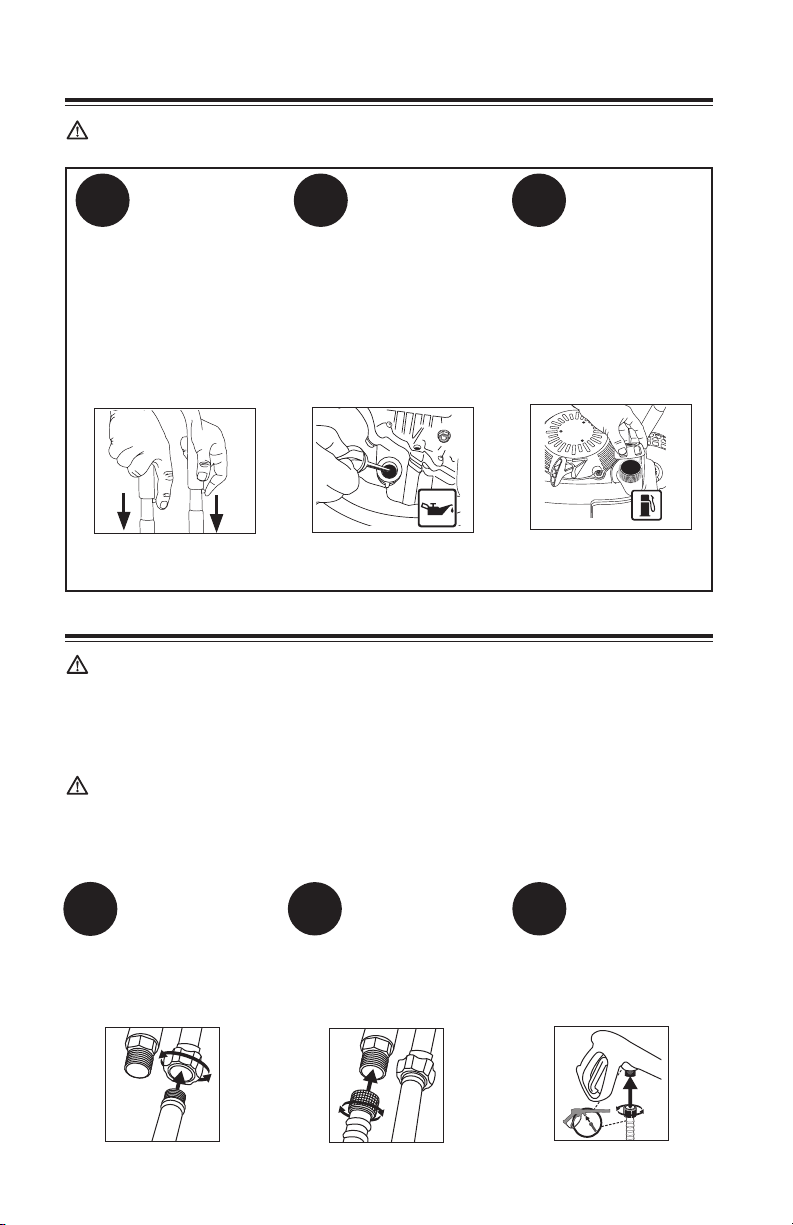
QUICK SETUP GUIDE
WARNING: To reduce the risk of injury, read the pressure washer instruction
manual and the engine instruction manual before operating pressure washer.
A
Install the
Handle
Place handle
onto frame, depress the
snap buttons, and slide
the handle assembly
onto the frame until snap
buttons snap into place.
B
Add/Check Oil
The engine is
shipped without
oil. Before starting engine,
add the oil. Check oil level
prior to each use. Refer to
Engine Owner’s Manual
for complete procedure.
C
Add Gasoline
In a well
ventilated outdoor
area add fresh, high
quality, unleaded gasoline
with a pump octane rating
of 86 or higher. Do not
overfill. Wipe up spilled
fuel before starting the
engine. Refer to Engine
Owner’s Manual for
complete procedure.
IMPORTANT: Ethanol Shield
TM
(sold separately) is a fuel stabilizer that helps eliminate
and prevent ethanol related problems in power equipment. Follow the instructions on
the container and add to the gasoline.
QUICK START GUIDE
DANGER:
• Never run engine indoors or in enclosed, poorly ventilated areas. Engine exhaust
contains carbon monoxide, an odorless and deadly gas.
• Risk of fluid injection and laceration. When using the high pressure setting, DO
NOT allow the high pressure spray to come in contact with unprotected skin, eyes
or with any pets or animals. Serious injury will occur.
WARNING: Do not allow the unit to run for more than two minutes without the
gun trigger being pulled. This could cause overheating and damage to the pump.
When the temperature inside the pump rises too high, the thermal relief valve will
open and release a spray of water from the pump to lower the internal tempera-
ture. The valve will then close.
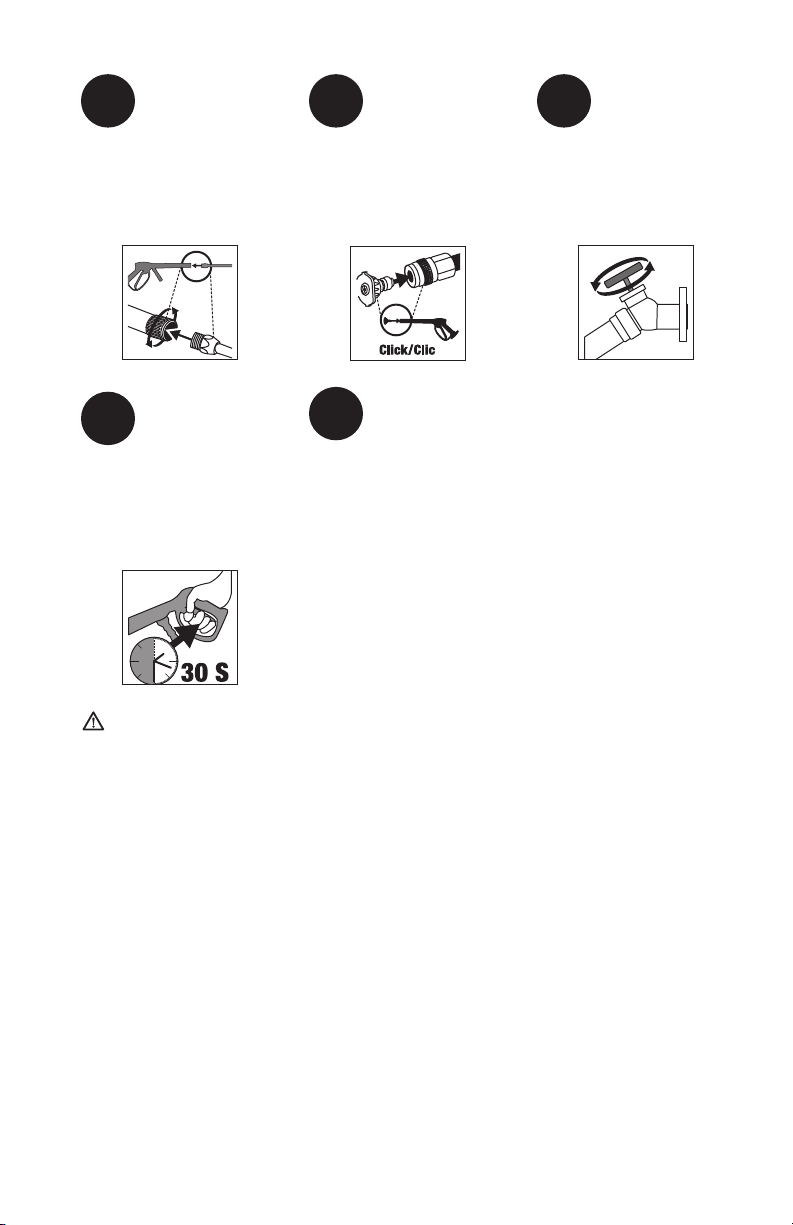
1
Connect Garden
Hose to Pump
Thread
the garden hose to
the pump inlet.
2
Connect High
Pressure Hose
to Pump
Thread the high pressure
hose to the pump outlet.
3
Connect High
Pressure Hose
to Spray Gun
Thread the other end
of the high pressure
hose to the spray gun.
9 - ENG
4
Connect Spray
Wand to Spray
Gun
Thread the spray
wand into the end
of the spray gun.
5
Connect QC
Nozzles to Spray
Wand
Pull quick connect cou-
pler back and insert
nozzle. Release quick
connect coupler and
twist nozzle to make sure
it is secure in coupler.
6
Turn Water
Faucet
Completely On
Do not run the unit
without water supply
connected and turned on.
Use Cold Water Only.
7
Release Air from
System
Release all
air from pump and
high pressure hose by
depressing trigger until a
steady stream of water is
present. Approximately
30 seconds.
8
Start engine.
See Engine
Owner's
Manual for
correct
procedure.
WARNING: This Guide is not a substitute for reading the operator's manual. User
must read and understand operator's manual before using this product.
10- ENG
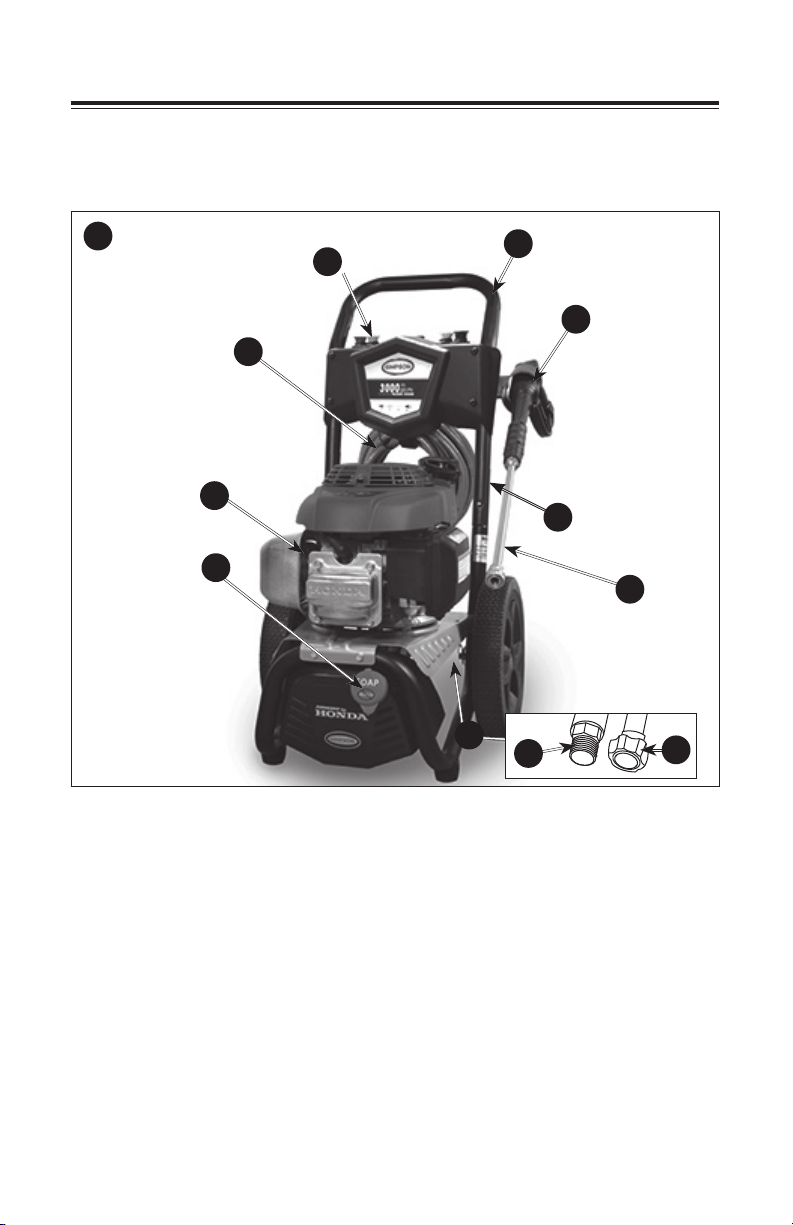
GET TO KNOW THE PRESSURE WASHER
NOTE: Photographs and line drawings used in this manual are for reference
only and do not represent a specificmodel.
Compare the illustrations with your unit to familiarize yourself with the location of
various controls and adjustments. Save this manual for future reference.
G
B
E
1
D
H
K
I
J
C
A
F
BASIC ELEMENTS OF A PRESSURE WASHER (FIG. 1)
A. High Pressure Pump: Increases the pressure of the watersupply.
B. Engine: Drives the high pressure pump. Refer to the Engine Owner’s Manual
for location and operation of enginecontrols.
C. High Pressure Hose: Carries the pressurized water from the pump to the gun
and spray wand.
D. Spray Gun: Connects with spray wand to control water flow rate, direction,
andpressure.
E. Quick-Connect Spray Wand: Allows the user to quickly change out
high pressure nozzles. See How To Use Spray Wand instructions in
Operationsection.
F. Detergent Siphon Hose OR
Detergent Tank
: Feeds cleaning agents into the
pump to mix with the water. See
How To Apply Chemicals/Cleaning Solvents
instructions in
Operation
section.
G. Handle
11 - ENG
H. Frame
I. Pump Outlet
J. Pump Inlet
K. Quick Connect Nozzles
L. Dial-N-Wash
®
Adjustable Pressure Regulator (if equipped,
not shown)
:
Use the Dial-N-Wash to increase and decrease the pressure. Refer to the Dial-
N-Wash Adjustmentparagraph.
BASIC ELEMENTS OF AN ENGINE
Refer to the Engine Owner’s Manual for location and operation of enginecontrols.
Choke Control: Opens and closes carburetor chokevalve.
Starter Grip: Pulling starter grip operates recoil starter to crankengine.
Engine Switch: Enables and disables ignitionsystem.
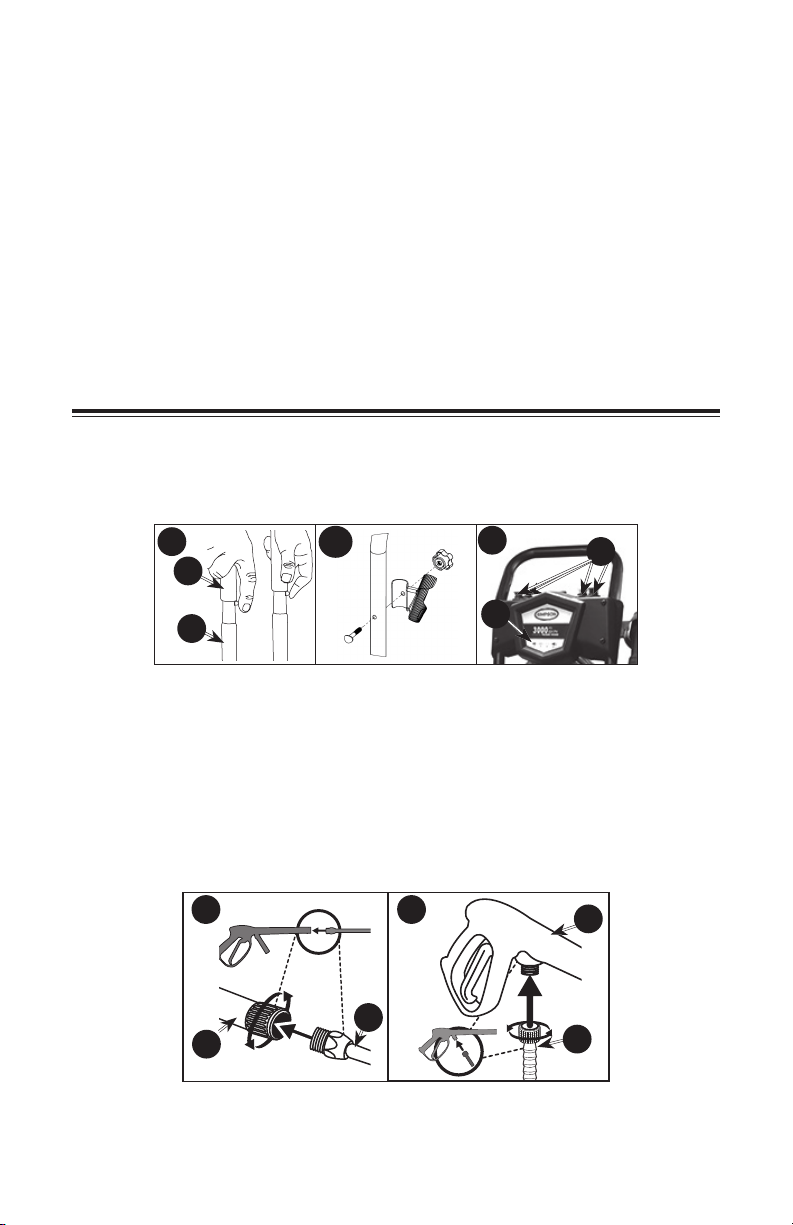
ASSEMBLY INSTRUCTIONS (FIG. 2 – 4)
1. Locate and remove all loose parts from thecarton.
2. Cut four corners of the carton from top to bottom and lay the panelsflat.
3.
Place handle (G) onto frame (H), depress the snap buttons, and slide the
handle assembly onto the frame until snap buttons snap intoplace.
G
H
2
Q
K
2B
2A
NOTICE: Risk of personal injury. Avoid placing hands between handle and frame
when assembling to preventpinching.
4. (If needed) Mount the gun holster to the upright frame tube using the saddle
bolt and knob provided, see Figure 2A.
5. Remove the colored quick-connect nozzles (K) from the plastic bag and insert
them into correct grommet on the nozzle holder. Nozzles are color coded to
match colored nozzles on label (Q).
6. Connect wand (E) to gun (D). Tightensecurely.
7. Attach high pressure hose (C) to gun (D). Tightense cure ly.
E
4
D
C
3
D
12- ENG
NOTE: The pump on this unit is maintenance free and requires no oil. If
there is a problem with the pump, contact our Customer Service Group on
www.simpsoncleaning.com as soon aspossible.
NOTICE: The engine is shipped without oil. Before starting engine, add the oil
provided. Damage to the engine will occur if the engine is run without oil, this
damage will not be covered underwarranty.
OPERATION
PRESSURE WASHER TERMINOLOGY
PSI: Pounds per Square Inch. The unit of measure for water pressure. Also used
for air pressure, hydraulic pressure, etc.
PSI*: Pounds per Square Inch. The unit of measure for water pressure. Also used
for air pressure, hydraulic pressure, etc.
GPM*: Gallons per Minute. The unit of measure for the flow rate of water.
* Complies with CETA Performance Standard CPC-100.
* Rated Pressure and Rated Water Flow is within manufacturing tolerance of
(+/- 10%).
Bypass Mode: Allows water to re-circulate within the pump when the gun trigger is
not pulled. This feature allows the operator to release the trigger gun and reposition
themselves without having to turn the engine off in between cleaningactions.
WARNING: Do not allow the unit to run for more than two minutes without
the gun trigger being pulled. This could cause overheating and damage to
the pump. When the temperature inside the pump rises too high, the thermal
relief valve will open and release a spray of water from the pump to lower the
internal temperature. The valve will thenclose.
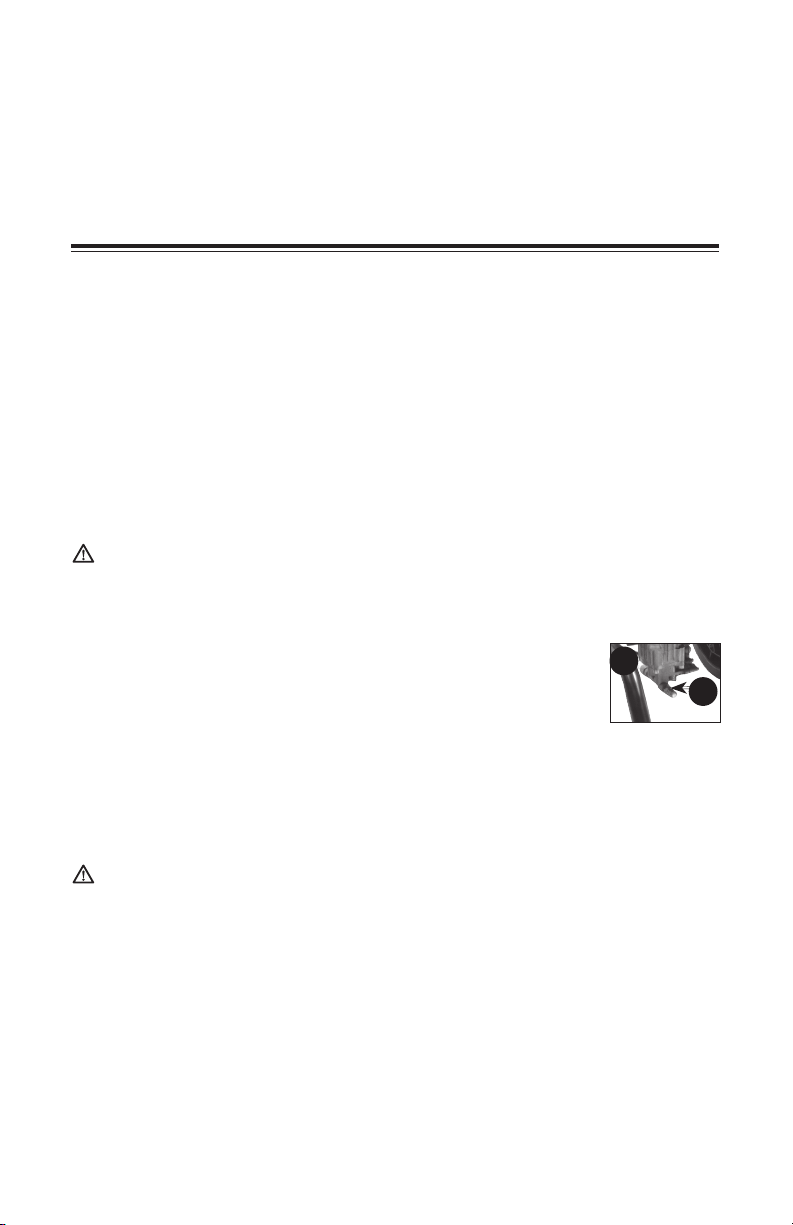
Thermal Relief Valve (P, Fig. 5): When the temperature inside the
5
P
pump rises too high, this valve will open and release a gush of water
in an effort to lower the temperature inside the pump. The valve will
thenclose. NOTE: Thermal relief valve location will vary depending
on the pump type.
Detergent Injection System: Mixes cleaners or cleaning solvents with the water
to improve cleaning effectiveness.
Water Supply: All pressure washers must have a source of water. The minimum
requirements for a water supply are 20 psi and 5 Gallons Per Minute. If your water
source is a well, the garden hose length can only be 30 ft. (9m) max.
WARNING: To reduce the possibility of contamination always protect
against backflow when connected to a potable watersystem.
PRESSURE WASHER OPERATING FEATURES
PRESSURE ADJUSTMENTS
The pressure setting is preset at the factory to achieve op ti mum pres sure and
cleaning. If you need to lower the pres sure, it can be accomplished by these meth-
ods.
1. Back away from the sur face to be cleaned. The further away you are, the
less the pressure will be on the surface to becleaned.
2. Change to the 40˚ nozzle (white). This nozzle delivers a less powerful stream
of water and a wider spray pattern. Refer to How To Use SprayWand.
(If equipped)) Use the Dial-N-Wash to increase and decrease the pressure.
Refer to the Dial-N-Wash Adjustmentparagraph.
13 - ENG
NOTICE: DO NOT attempt to increase pump pressure. A higher pressure setting
than the factory set pressure may damagepump.
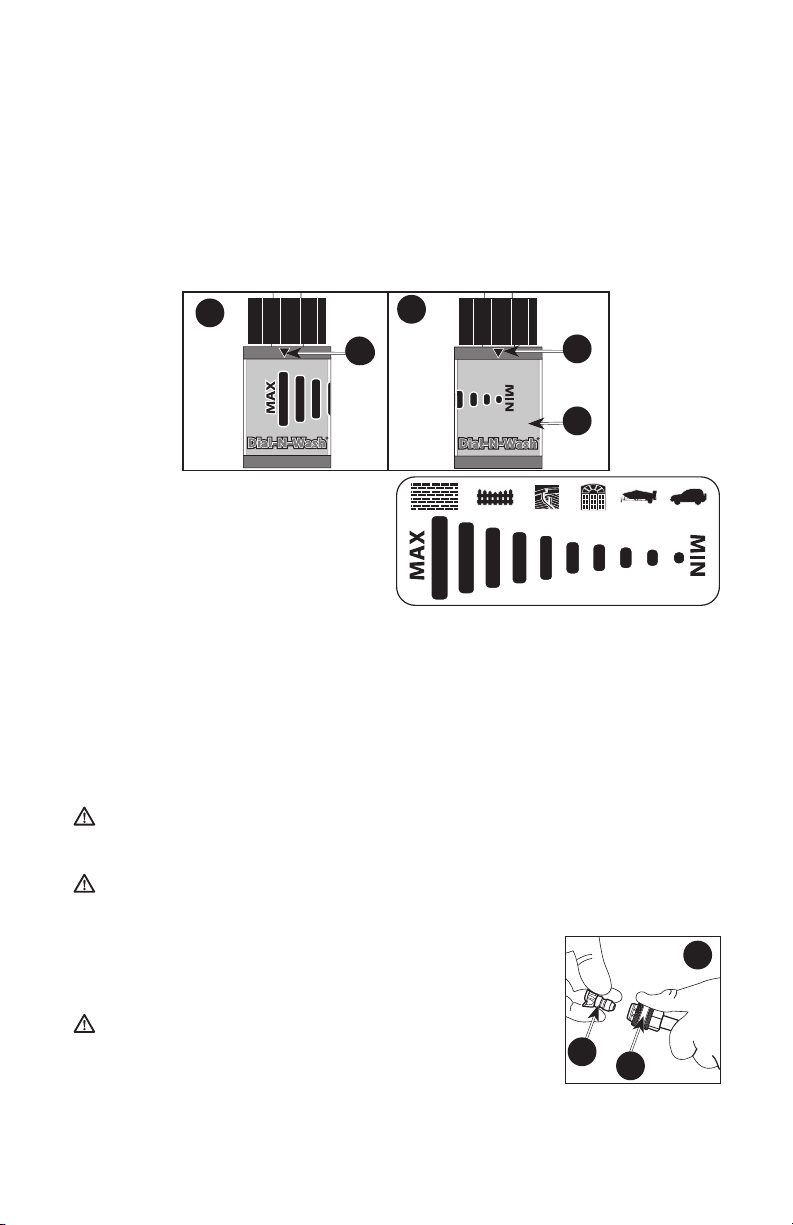
DIAL-N-WASH ADJUSTMENT (FIG. 6, 7) (IF EQUIPPED)
1. Choose the correct high pressure nozzle (0˚, 15˚ or 40˚) for the job to be
performed. Refer to How To Use SprayWand.
2. The Dial-N-Wash is shipped in the MAX pressure setting, the MAX pressure
bar is aligned with the arrow (R) on the collar as shown in Figure 6.
Rotating the Dial-N-Wash (L) counterclockwise until it stops places it in the
MIN pressure setting, the arrow (R) will align with the MIN pressure bar as
shown in Figure 7.
7
R
L
6
R
Adjust the pressure by rotating the
Dial-N-Wash (L) clockwise for
higher pressure or
counterclockwise for lower
pressure, aligning the arrow with
the desired pressure bar on the
Dial-N-Wash.
NOTE: To apply chemicals the black low pressure nozzle must be installed and
the Dial-N-Wash must be in the MAX pressuresetting.
HOW TO USE SPRAY WAND
The nozzles for the spray wand are stored in the nozzle holder on the panel assembly.
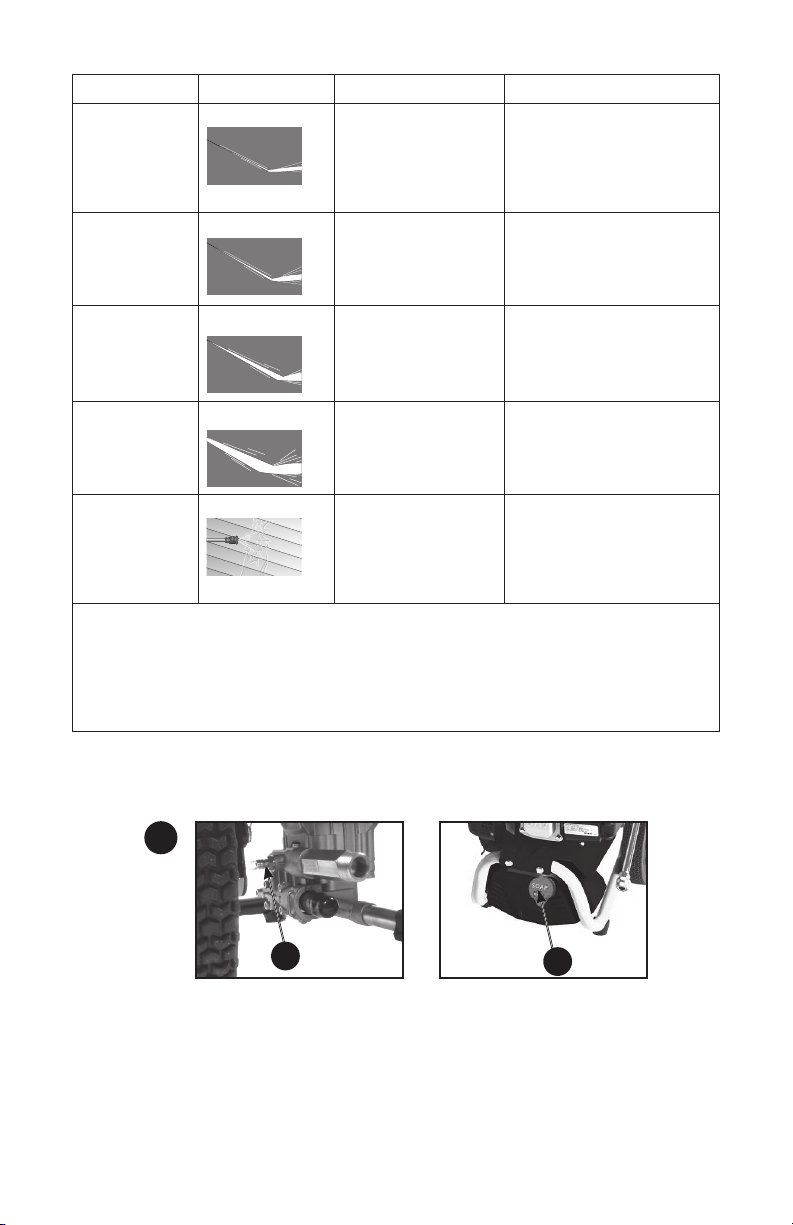
Colors on the panel identify nozzle location and spray pattern. Refer to the following
chart to choose the correct nozzle for the job to beperformed. NOTE: Some models
may not include all of the nozzles shown in the chart.
CHANGING NOZZLES ON SPRAY WAND (FIG. 8)
DANGER: Risk of fluid injection. Do not direct discharge stream toward
persons, unprotected skin, eyes or any pets or animals. Serious injury
willoccur.
WARNING: Flying objects could cause risk of serious injury. Do not
attempt to change nozzles while pressure washer is running. Turn engine off
before changingnozzles.
1. Pull quick-connect coupler (E) back and insert nozzle (K).
8
K
E
2. Release quick-connect coupler and twist nozzle to make
sure it is secure incoupler.
WARNING: Flying object could cause risk of serious
injury. Ensure nozzle is completely inserted in quick-
connect socket and quick-connect collar is fully engaged
(forward) before squeezing guntrigger.
14- ENG
NOZZLE COLOR SPRAY PATTERN USES SURFACES*
Red
(if equipped)
0˚
powerful pinpoint
for spot cleaning
of hard, unpainted
surfaces or for
high reach areas
unpainted metal
or concrete;
DO NOT use on wood
Yellow
(if equipped)
15˚
intense cleaning
of unpainted
hard surfaces
grills, driveways,
concrete or brick
walkways, unpainted
brick or stucco
Green
(if equipped)
25˚
intense cleaning of
larger areas
metal, concrete or wood
White
(if equipped)
40˚
cleaning of
painted or delicate
surfaces
auto/RV, marine,
wood, painted brick
and stucco, vinyl,
painted siding
Black
(if equipped)
low pressure
applies cleaning
solutions
Low pressure
spray is safe on all
surfaces. Always verify
compatibility of cleaning
solution prior touse.
*NOTICE: The high pressure spray from your pressure washer is capable of
causing damage to surfaces such as wood, glass, automobile paint, auto striping
and trim, and delicate objects such as flowers and shrubs. Before spraying,
check the item to be cleaned to assure yourself that it is strong enough to resist
damage from the force of the spray.
HOW TO APPLY CHEMICALS/CLEANING SOLVENTS (FIG. 9)
Applying chemicals or cleaning solvents is a low pressure operation. NOTE: Use
only soaps and chemicals designed for pressure washer use. Do not usebleach.
F
F
9
OR
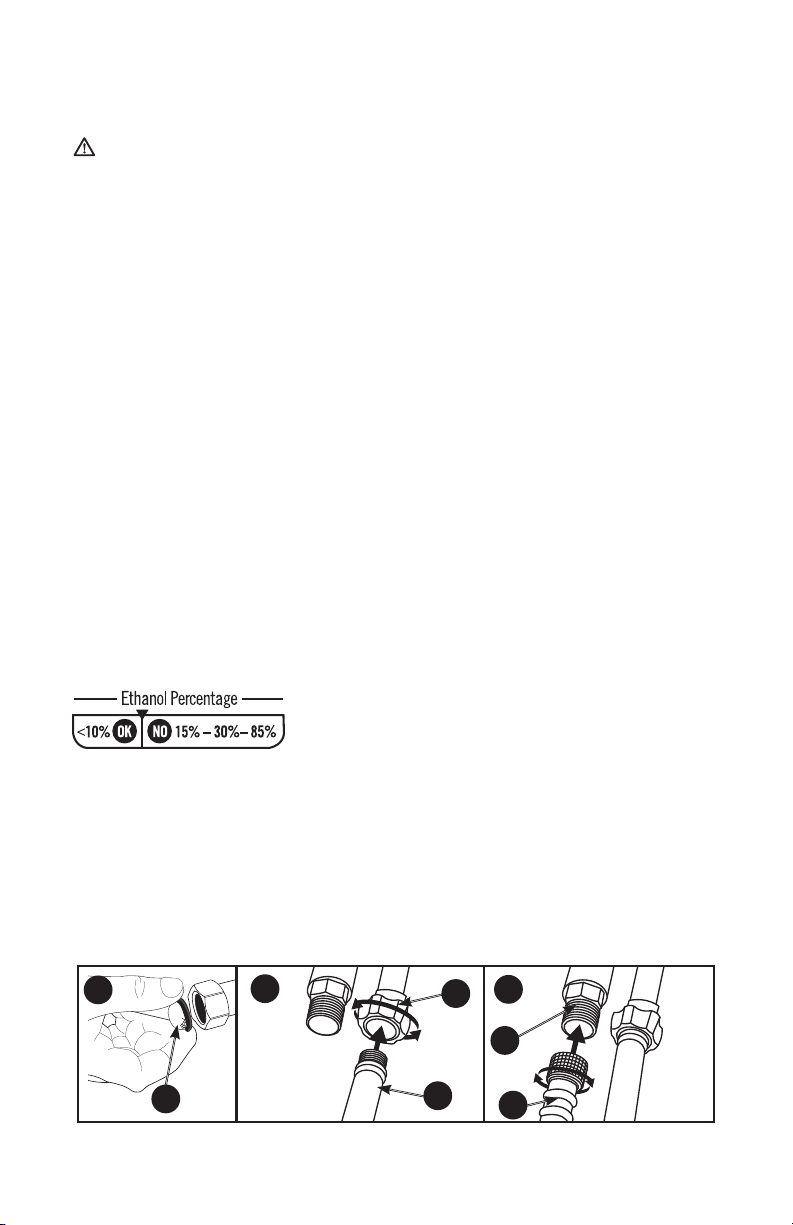
To Apply Chemicals (Siphon Hose, if equipped):
1. Ensure detergent siphon hose (F, Figure 9) is attached to barbed fitting location
near high pressure hose connection of pump asshown.
2. Place other end of detergent siphon hose with filter on it into container holding
chemical/cleaning solution. NOTE: For every 7 gallons of water pumped 1
gallon of chemical/cleaning solution will beused.

15 - ENG
3. Install the black low pressure nozzle into the quick connect fitting of the spray
wand. (if equipped) Rotate the Dial-N-Wash (L) to the MAX pressure setting as
shown in Figure 6. See How To Use Spray Wand paragraph in thissection.
NOTE: To apply chemicals the black low pressure nozzle must be installed and
the Dial-N-Wash must be in the MAX pressure setting as shown in Figure 6.
4. After use of chemicals, place detergent siphon hose into container of clean
water and draw clean water through chemical injection system to rinse sys-
tem thoroughly. If chemicals remain in the pump it could be damaged. Pumps
damaged due to chemical residue will not be covered underwarranty.
NOTE: Chemicals and soaps will not siphon if the black soap nozzle is not installed
on the spraywand.
To Apply Chemicals (Detergent Tank, if equipped):
1. Remove the cap from the detergent tank (F, Figure 9) and fill the detergent
tank with cleaning solvent. Replace cap on deteregent tank. NOTE: For every
7 gallons of water pumped 1 gallon of chemical/cleaning solution will beused.
2. Install the black low pressure nozzle into the quick connect fitting of the spray
wand and rotate the adjustable pressure regulator (F) to the MAX pressure
setting as shown in Figure 6. See How To Use Spray Wand paragraph in
thissection.
NOTE: To apply chemicals the black low pressure nozzle must be installed
and the adjustable pressure regulator must be in the MAX pressure setting as
shown in Figure 6.
NOTE: After squeezing the trigger it will take approximately 5 seconds for the
detergent toappear.
3. After use of chemicals, fill the detergent tank with clean water and draw
clean water through chemical injection system to rinse system thoroughly. If
chemicals remain in the pump it could be damaged. Pumps damaged due to
chemical residue will not be covered underwarranty.
NOTE: Chemicals and soaps will not siphon if the black soap nozzle is not installed
on the spraywand.
STARTING (FIG. 10–13)
WARNING: To reduce the risk of injury, read the pressure washer instruction
manual and the engine instruction manual before starting pressurewasher.
DANGER: Risk of fluid injection and laceration. When using the high
pressure setting, DO NOT allow the high pressure spray to come in contact
with unprotected skin, eyes, or with any pets or animals. Serious injury
willoccur.
• Your washer operates at fluid pressures and velocities high enough to penetrate
human and animal flesh, which could result in amputation or other serious injury.
Leaks caused by loose fittings or worn or damaged hoses can result in injection
injuries. DO NOT TREAT FLUID INJECTION AS A SIMPLE CUT! See a physician
immediately!
DANGER: Carbon Monoxide. Using an engine indoors can kill you in
minutes. Engine exhaust contains high levels of carbon monoxide (CO), a
poisonous gas you cannot see or smell. You may be breathing CO even if you
do not smell engine exhaust.
• Breathing ex haust fumes will cause se ri ous injury or death! En gine exhaust
contains carbon mon ox ide, an odorless and deadlygas.
16- ENG
• Operate pressure washer in a well-ventilated area. Avoid en closed areas
such as ga rages, base ments,etc.
• Never op er ate unit in or near a lo ca tion occupied by humans oranimals.
WARNING: Risk of Fire, Asphyxiation and Burn. Never fill fuel tank when
engine is running or hot. Do not smoke when filling fueltank.
• Never fill fuel tank completely. Fill tank to 1/2" (12.7 mm) below bottom of filler
neck to provide space for fuel expansion. Wipe any fuel spillage from engine and
equipment before startingengine.
• DO NOT let hoses come in contact with very hot engine muffler during or
immediately after use of your pressure washer. Damage to hoses from contact with
hot engine surfaces will NOT be covered bywarranty.
NOTICE: Risk of property damage. Never pull water supply hose to move pres sure
washer. This could damage hose and/or pumpinlet.
• DO NOT use hot water, use cold wateronly.
• Never turn water supply off while pressure washer engine is running or damage to
pump willresult.
• DO NOT stop spraying water for more than two minutes at a time. Pump operates in
bypass mode when spray gun trigger is not pressed. If pump is left in bypass mode
for more than two minutes internal components of the pump can bedamaged.
If you do not understand these precautions, please contact our customer service
department at www.simpsoncleaning.com
Prior to starting, refer to your engine manual for proper startingprocedure.
1. In a well ventilated outdoor area add fresh, high quality, unleaded gasoline with
a pump octane rating of 86 or higher. Do not overfill. Wipe up spilled fuel before
starting the engine. Refer to Engine Owner’s Manual for correctprocedure.
IMPORTANT: Ethanol Shield
TM
(sold separately) is a fuel stabilizer that helps
eliminate and prevent ethanol related problems in power equipment. Follow the
instructions on the container and add to the gasoline.
NOTICE: Use of fuels with greater than 10% ethanol are
not approved for use in this product per EPA regulations
and will damage the unit and void thewarranty.
2. Check engine oil level. See Engine Owner’s Manual for correct procedure.
3. Connect the water hose to the water source. Turn the water source on to
remove all air from the hose. When a steady stream of water is present, turn
the water source off.
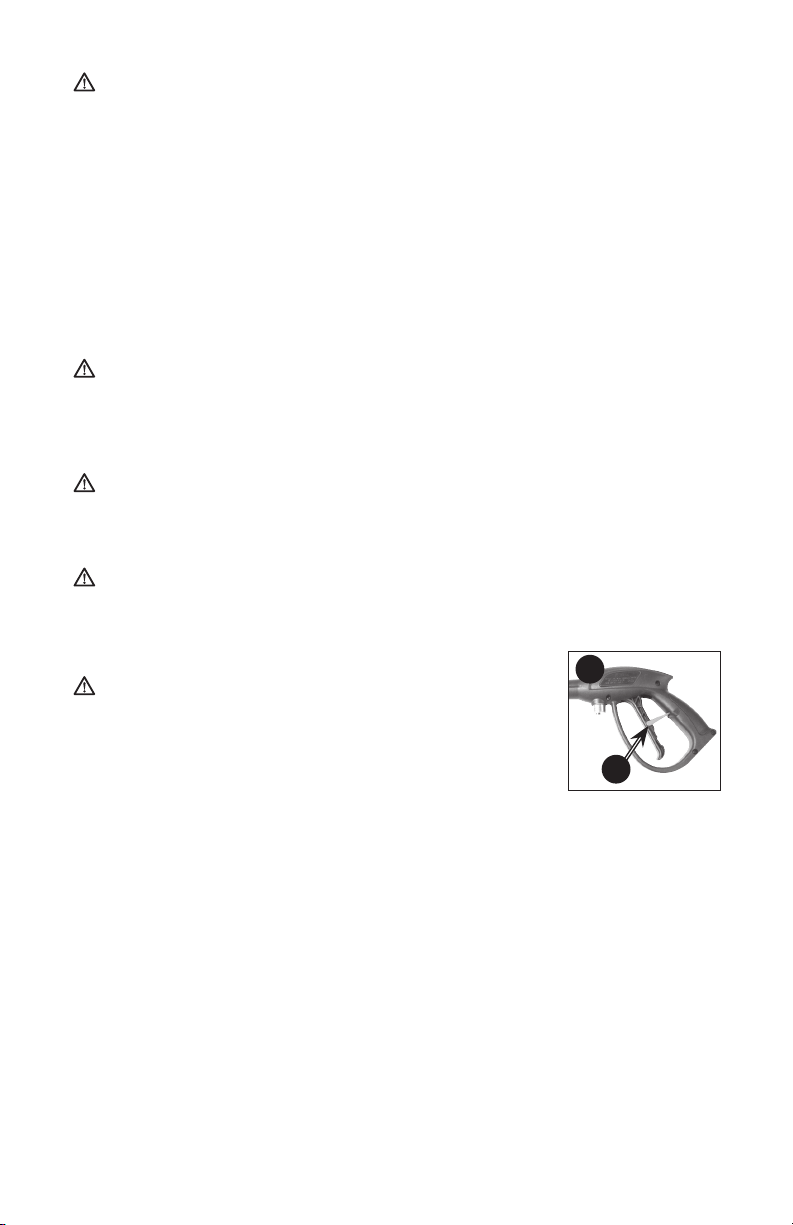
4. Verify the filter screen (M) is in water inlet of pump. NOTE: Convex side
facesout.
5. Connect water source (N) to pump inlet (J). NOTE: Water source must provide
a minimum of 5 gallons per minute at 20 psi.
6. Connect
high pressure hose (C) to pump outlet (I).
I
12
C
11
N
J
M
10
17 - ENG
WARNING: To reduce the possibility of contamination always protect
against backflow when connected to a potable watersystem.
7. Choose the correct nozzle for the job to be performed. See How To Use spray
Wand instructions in this section. NOTE: If applying a chemical or cleaning
solution, see How To Apply Chemicals/Cleaning Solvents instructions in
thissection.
8. Turn water source on.
NOTICE: Risk of property damage. Failure to do so could cause damage to
thepump.
9. Remove all air from the pump and high pressure hose by depressing trigger
until a steady stream of water is present.
10. Start engine. See Engine Owner’s Manual for correct procedure.
WARNING: Risk of unsafe operation. If engine does not start after two
pulls, squeeze trigger of gun to relieve pump pressure. Pull starter cord slowly
until resistance is felt. Then pull cord rapidly to avoid kickback and prevent
hand or arminjury.
11. Depress trigger on gun to start water flow.
WARNING: Risk of unsafe operation. Stand on a stable surface and
grip gun/spray wand firmly with both hands. Expect the gun to kick
whentriggered.
12. Release trigger to stop waterflow.
WARNING: Do not allow the unit to run for more than two minutes without
the gun trigger being pulled. This could cause overheating and damage to
the pump. When the temperature inside the pump rises too high, the thermal
relief valve will open and release a spray of water from the pump to lower the
internal temperature. The valve will thenclose.
WARNING: Risk of injury from spray. Always engage the
13
O
trigger lock (O) when gun is not in use. Failure to do so
could cause accidentalspraying.
SHUTTING DOWN
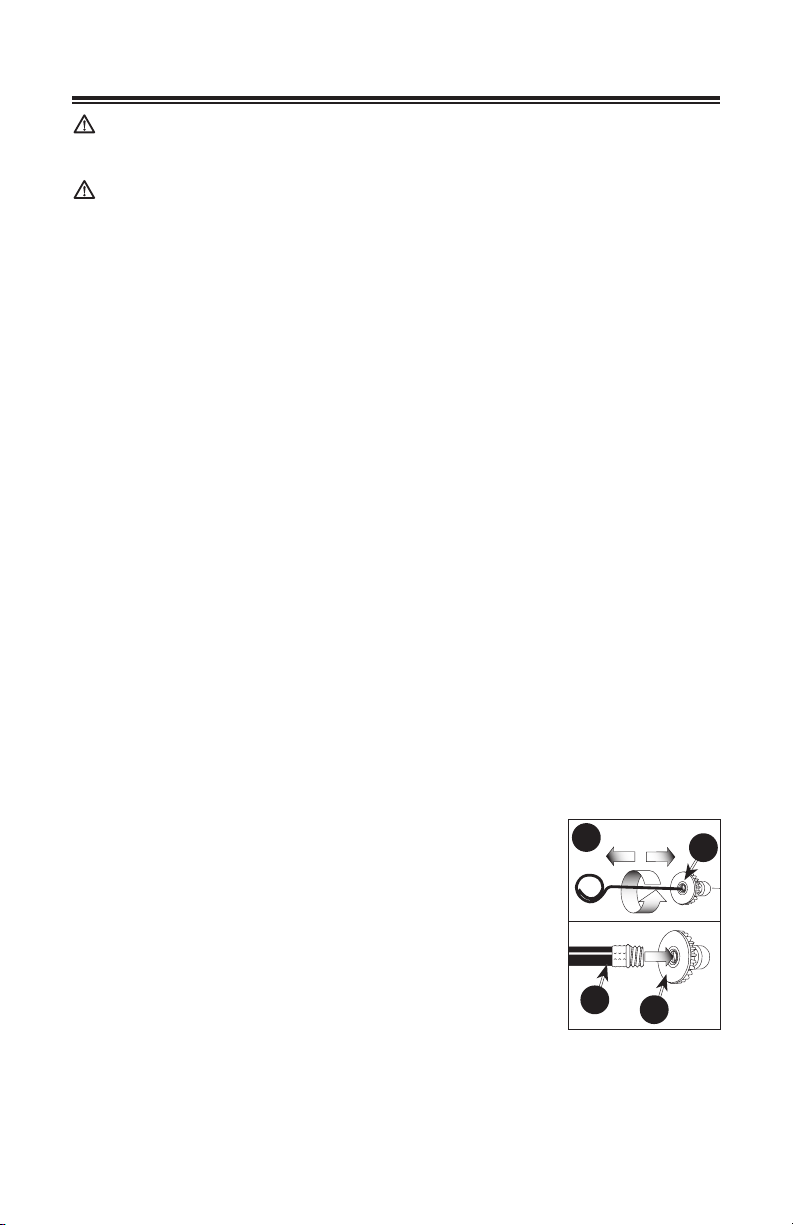
1. After each use, if you have applied chemicals, place
detergent siphon hose into container of clean water
and draw clean water through chemical injection system to rinse system
thoroughly.
NOTICE: Risk of property damage. Failure to do so could cause damage to
thepump.
2. Turn engine off. See Engine Owner’s Manual.
NOTICE: Risk of property damage. NEVER turn the water off with the enginerunning.
3. Turn water sourceoff.
4. Pull trigger on spray gun to relieve any water pressure in hose or spraygun.
NOTE: Failure to release system pressure will prevent removal of high pressure
hose from spray gun or pumpconnection.
5. See Storage section in this manual for proper storageprocedures.
18- ENG
MAINTENANCE
WARNING: Risk of burn hazard. When performing maintenance, you may
be exposed to hot surfaces, water pressure or moving parts that can cause
serious injury ordeath.
WARNING: Risk of fire hazard. Always disconnect, spark plug wire,
let the engine cool and release all water pressure before performing any
maintenance or repair. The engine contains flammable fuel. Do not smoke or
work near open flames while performingmaintenance.
To ensure efficient operation and longer life of your pressure washer, a routine
maintenance schedule should be prepared and followed. If the pressure washer is
used in unusual conditions, such as high-temperatures or dusty conditions, more
fre quent maintenance checks will berequired.
ENGINE
Consult the Engine Owner’s Manual for the man u fac tur er's recommendations
for any and all maintenance. NOTE: The engine drain plug is located at the rear of
theunit.
PUMP
The pump was filled with oil at the factory. The pump on this unit is maintenance
free and requires no oil to be added or changed. If there is a problem with the pump
contact us at www.simpsoncleaning.com
CONNECTIONS
Connections on pressure washer hoses, gun and spray wand should be cleaned
regularly and lubricated with light oil or lithium grease to prevent leakage and
damage to the o-rings.
NOZZLE CLEANING (FIG. 14)
If the nozzle becomes clogged with foreign materials, such as dirt, excessive
pressure may develop. If the nozzle becomes partially clogged or restricted, the
pump pressure will pulsate. Clean the nozzle immediately using the nozzle kit
supplied and the following instructions:
1. Shut off the pressure washer and turn off the watersupply.
2. Pull trigger on gun handle to relieve any waterpressure.
3. Disconnect the spray wand from thegun.
4. Remove the high pressure nozzle (K) from the spray wand.
14
K
K
N
Remove any obstructions with the nozzle cleaning tool
provided and backflush with cleanwater.
5. Direct water supply (N) into nozzle to backflush loosened
particles for 30seconds.
6. Reassemble the nozzle to the wand.
7. Reconnect spray wand to gun and turn on watersupply.
8. Start pressure washer and place spray wand into high
pressure setting totest.
CLEAN THE WATER INLET FILTER (FIG. 10)
This screen filter should be checked periodically and cleaned if necessary.
1. Remove filter by grasping end and removing it from water inlet of pump.

19 - ENG
2. Clean filter by flushing it with water on bothsides.
3. Re-insert filter into water inlet of pump. NOTE: Cone side facesout.
NOTE: Do not operate the pressure washer without filter properly installed.
STORAGE
ENGINE
Consult the Engine Owner’s Manual for manufacturer’s recommendations
forstorage.
TO PREVENT FUEL-RELATED PROBLEMS
1. Add Ethanol Shield
TM
fuel stabilizer following the manufacturer’s instructions.
When adding a gasoline stabilizer, fill the fuel tank with fresh gasoline. If only
partially filled, air in the tank will promote fuel deterioration during storage.
If you keep a container of gasoline for refueling, be sure that it contains only
freshgasoline.
2. After adding a gasoline stabilizer, run the engine outdoors for 10 minutes
to be sure that treated gasoline has replaced the untreated gasoline in
thecarburetor.
3. Turn the fuel valve to the OFFposition.
4. Continue to run the engine until it stops from the lack of fuel in the carburetor
fuel bowl. Running time should be less than 3minutes.
PUMP
The manufacturer recommends using SIMPSON
®
/ POWERWASHER
®
Pump
Guard or equivalent when storing the unit for more than 30 days and/or when
freezing temperatures are expected. SIMPSON
®
/ POWERWASHER
®
Pump Guard
is environmentallyfriendly.
NOTE: Using pump guard helps provide proper lubrication to the internal seals of
the pump regardless of temperature or environment.
NOTICE: Risk of property damage. Use only SIMPSON
®
/ POWERWASHER
®
Pump Guard or equivalent. Other products could be corrosive and/or contain alco-
hol which may cause pumpdamage.
1. Turn off pressure washer and disconnect hoses frompump.
2. Unscrew bottle valve from Pump Guard bottle and remove seal.
3. Screw bottle valve back ontobottle.
4. Attach bottle to water inlet ofpump.
5. Squeeze bottle to inject contents intopump.
6. With ignition switch off, simultaneously pull starter rope and squeeze bottle.
Repeat until protector fluid exits pump outlet. NOTE: This step may require
twopeople.
PRESSURE WASHER
1. Drain all water from high pressure hose and wrap it onto hosewrap.
2. Drain all water from the spray gun and wand by holding spray gun in a
vertical position with nozzle end pointing down and squeezing trigger. Store in
gunholder.
3. Wrap up and secure detergent siphon hose so it is protected fromdamage.
20- ENG
ACCESSORIES
DANGER: Risk of fluid injection. When using replacement spray wands
or guns with this pressure washer, DO NOT use a spray wand and/or spray
gun/wand combination that is shorter in length than what was provided with
this pressure washer as measured from the nozzle end of the wand to the
guntrigger.
NOTICE: The use of any other accessory not recommended for use with this tool
could be hazardous. Use only accessories rated equal to or greater than the rating
of the pressurewasher.
SERVICE INFORMATION
Do not return this product to your retailer. Please contact our customer service
department at www.simpsoncleaning.com
LIMITED WARRANTY
90 DAY LIMITED WARRANTY ON PRODUCT COMPONENTS
SIMPSON
®
warrants to the original purchaser that the wheels, gun, hose, wand, spray
nozzle(s) and other components of the
SIMPSON
®
pressure washer covered under this
warranty are free from defects in material and workmanship for 90 days from the date
ofpurchase.
ONE YEAR LIMITED WARRANTY ON PUMP
SIMPSON
®
warrants to the original purchaser that the pump of the SIMPSON
®
pressure washer covered under this warranty is free from manufacturer’s defects in
material and workmanship for one year from the date of purchase. The one year limited
warranty applies to the pumponly.
FIVE YEAR LIMITED WARRANTY ON FRAME
SIMPSON
®
warrants to the original purchaser that the frame of the SIMPSON
®
pressure washer covered under this warranty is free from manufacturer’s defects
in material and workmanship for five years from the date of purchase. The five year
limited warranty applies to the frameonly.
SIMPSON
®
will repair or replace, at SIMPSON
®
's option, products or components
which have failed within the above warranty periods. Service will be scheduled
according to the normal work flow and business hours at the service center
location, and the availability of replacement parts. All decisions of SIMPSON
®
with
regard to this limited warranty shall befinal.
This warranty gives you specific legal rights, and you may also have other rights
which vary from state tostate.
ENGINE WARRANTY
The engine, emission control system and related components are covered under the
terms and conditions outlined by the engine manufacturer’s warranty and are the sole
responsibility of the engine manufacturer. A copy of the engine manufacturer’s warranty
has been provided to you with your
SIMPSON
®
pressure washer. Please consult the
engine manufacturer’s warranty to process a claim or obtain service to the engine,
emission control system or relatedcomponents.
RESPONSIBILITY OF ORIGINAL PURCHASER (INITIAL USER):
• To process a warranty claim on your SIMPSON
®
pressure washer, report the
concern to 1-877-362-4271 or [email protected] for authorization and
direction to the nearest authorized service centre in yourarea.

21 - ENG
• Retain original cash register sales receipt as proof of purchase for warrantywork.
• Use reasonable care in the operation and maintenance of the product as described
in the Owners Manual(s).
THIS WARRANTY DOES NOT COVER:
• Merchandise sold as reconditioned, used as rental equipment, used for commercial
purposes or commercial applications, or floor or displaymodels.
• Merchandise that has become damaged or inoperative because of ordinary wear,
misuse, cold, heat, rain, excessive humidity, water quality, freeze damage, use
of improper chemicals, negligence, accident, failure to operate the product in
accordance with the instructions provided in the Owners Manual(s) supplied with
the product, improper maintenance, the use of accessories or attachments not
recommended by
SIMPSON
®
, or unauthorized repair oralterations.
• Repair and transportation costs of merchandise determined not to bedefective.
• Damage due to chemical deterioration, scale build up, rust, corrosion or
thermal expansion
• Costs associated with assembly, required oil, adjustments or other installation
and start-upcosts.
• Expendable parts or accessories supplied with the product which are
expected to become inoperative or unusable after a reasonable period of
use, including but not limited to springs, nozzles, o-rings, washers, and
similaraccessories.
• Merchandise sold by SIMPSON
®
which has been manufactured by and identified
as the product of another company, such as gasoline engines. The product
manufacturer’s warranty, if any, willapply.
• ANY INCIDENTAL, INDIRECT OR CONSEQUENTIAL LOSS, DAMAGE,
OR EXPENSE THAT MAY RESULT FROM ANY DEFECT, FAILURE OR
MALFUNCTION OF THE PRODUCT IS NOT COVERED BY THIS WARRANTY.
Some states do not allow the exclusion or limitation of incidental or consequential
damages, so the above limitation or exclusion may not apply toyou.
• IMPLIED WARRANTIES, INCLUDING THOSE OF MERCHANTABILITY OR
FITNESS FOR A PARTICULAR PURPOSE, ARE LIMITED TO ONE YEAR FROM
THE DATE OF ORIGINAL PURCHASE. Some states do not allow limitations on
how long an implied warranty lasts, so the above limitations may not apply toyou.
22- ENG
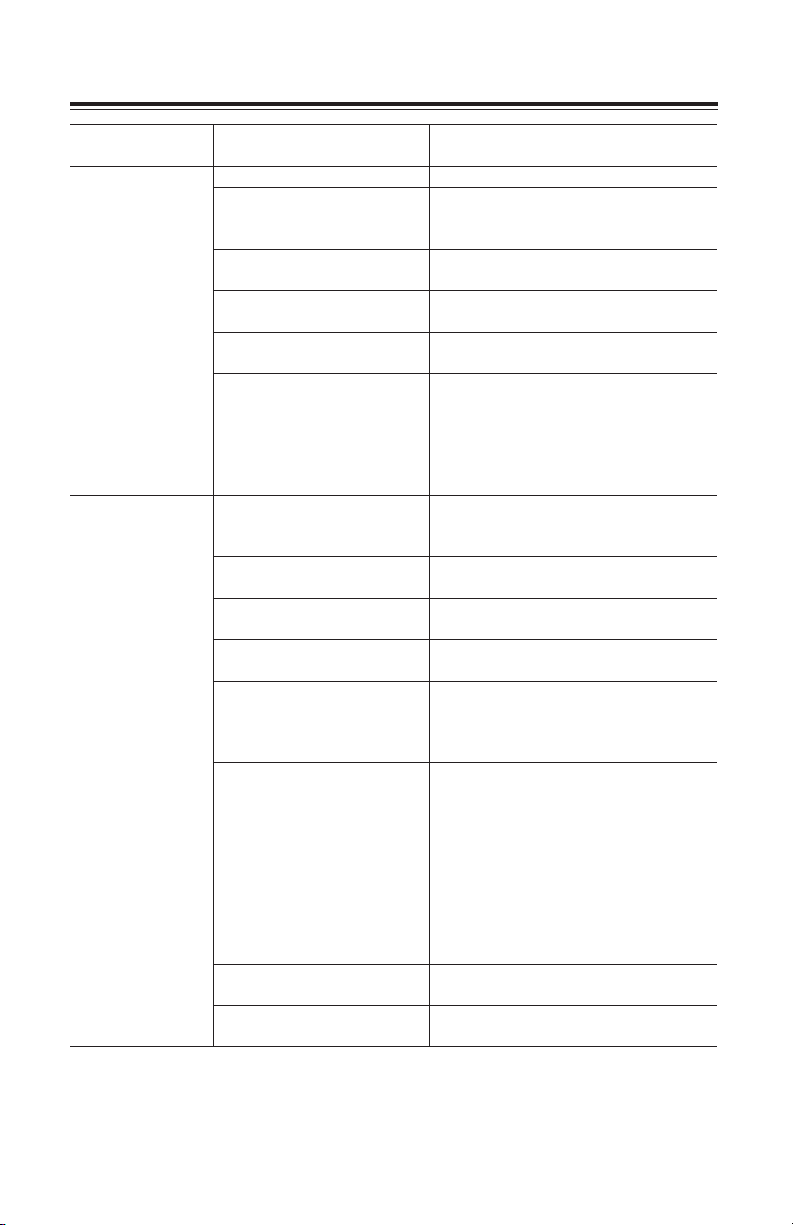
TROUBLE SHOOTING GUIDE
OPERATIONAL
ISSUE
POSSIBLE CAUSE SOLUTION
Engine will
not start (see
Engine Owner’s
Manuall for
further engine
troubleshooting)
Nofuel. Add freshfuel.
Pressure builds up after
two pulls on the recoil
starter or after initial use
Squeeze gun trigger to relieve
pres sure
Choke lever in the "No
Choke" position
Move choke to the "Choke"
po si tion
Spark plug wire
notattached.
Attach spark plugwire.
Engine switch in OFF
po si tion
Place engine switch in ON position
Choke lever in the
"Choke" position on a
"hot" engine or an engine
that has been exposed
to thermal heat for a
long period of time
Move choke to the "No Choke"
po si tion
No or low
pressure
(initial use)
Spray wand not in
high pressure
See How to Use Spray
Wand instructions in the
Operation Section
Low water supply Water supply must be at
least 5 gpm @ 20 psi
Leak at high pressure
hose fitting
Repair leak. Apply sealant tape
if necessary
Nozzle obstructed See Nozzle Cleaning instructions
in the Maintenance section
Water filter screen
clogged
Remove and clean filter. See
Cleaning Water Inlet Filter
paragraph in the Maintenance
section for the correct procedure
Air in hose Turn off the engine, then the water
source. Disconnect the water
source from the pump inlet and
turn the water source on to remove
all air from the hose. When there is
a steady stream of water present,
turn water source off. Re- con nect
water source to pump inlet and
turn on wa ter source. Squeeze
trigger to re move re main ing air
Choke in the
“Choke” position
Move choke to the “No Choke”
po si tion
High pressure hose
is too long
Use high pressure hose under
100 feet (30m)

23 - ENG
OPERATIONAL
ISSUE
POSSIBLE CAUSE SOLUTION
Will not draw
chemicals
Spray wand not in
low pressure
See How to Use Spray Wand
paragraph in the Operation Section
Chemical filter clogged Clean filter
Chemical screen not
in cleaning solution
Make sure end of detergent
siphon hose is fully submerged
into cleaning solution
Chemical too thick Dilute chemical. Chemical should
be the same consistency as water
Pressure hose is too long Lengthen water supply hose
instead of high pressure hose
Chemical build up in
chemical injector
Please contact our customer
service department at
www.simpsoncleaning.com
No or low
pressure
(after period of
normal use)
Worn seal or packing Please contact our customer
service department at
www.simpsoncleaning.com
Worn or obstructed valves Please contact our customer
service department at
www.simpsoncleaning.com
Worn unloader piston Please contact our customer
service department at
www.simpsoncleaning.com
Water leaking at
gun/spray wand
connection
Worn or broken o-ring Check and replace
Loose hose connection Tighten
Water leaking
at pump
Loose connections Tighten
Piston packings worn Please contact our customer
service department at
www.simpsoncleaning.com
Worn or broken o-rings Please contact our customer
service department at
www.simpsoncleaning.com
Pump head or tubes
damaged from freezing
Please contact our customer
service department at
www.simpsoncleaning.com
Pump pulsates Nozzle obstructed See Nozzle Cleaning paragraph
in the Maintenance section
for the correct procedure

75

Internet Address: www.simpsoncleaning.com
Warranty Registration via Internet
Adresse Internet:
www.simpsoncleaning.com
Enregistrement de la garantie par Internet
Sitio Address:
www.simpsoncleaning.com
Registro Garantía mediante Internet
Copyright. All Rights Reserved
Copyright. Todos los derechos reservados
Copyright. Tous droits réservés
FNA Group, Inc.
7152 99th Street
Pleasant Prairie, WI 53158
Made in U.S.A. of foreign and domestic components
Fabriqué aux États-Unis avec des composants nationaux et étrangers
Hecho en EE.UU utilizando componentes domésticos e importados