Operating and installation
instructions
Refrigerators
To avoid the risk of accidents or damage to the appliance it is essen-
tial to read these instructions before it is installed and used for the
first time.
en-GB M.-Nr. 11 548 190
Contents
2
Warning and Safety instructions...................................................................... 5
Caring for the environment .............................................................................. 14
Installation.......................................................................................................... 15
Location............................................................................................................... 15
Climate range ................................................................................................. 15
Installation notes ................................................................................................. 16
Adjoining cabinets/units ................................................................................. 16
Load-bearing capacity of the niche floor ....................................................... 17
Ventilation....................................................................................................... 17
Door hinging................................................................................................... 17
Side-by-side................................................................................................... 18
Building-in dimensions ....................................................................................... 20
Dimensions when the appliance door is opened (opening angle 90°/115°) .. 22
Dimensions of the furniture front......................................................................... 23
Installing the appliance........................................................................................ 24
Before starting............................................................................................... 24
Tools required................................................................................................. 24
Weight of the furniture front ........................................................................... 25
Aligning the building-in niche ......................................................................... 25
Checking the building-in niche....................................................................... 26
Before installation........................................................................................... 26
Preparing the building-in niche ...................................................................... 28
Pushing the refrigeration appliance into the building-in niche ....................... 30
Aligning the refrigeration appliance................................................................ 32
Securing the refrigeration appliance in the building-in niche ......................... 35
Preparing to install the furniture fronts ........................................................... 36
Securing and aligning the furniture front ........................................................ 39
Securing the covers ....................................................................................... 43
Securing the plinth ventilation grille and plinth panel..................................... 46
Limiting the opening angle of the appliance door.......................................... 46
Electrical connection ........................................................................................... 47
Saving energy .................................................................................................... 49
Guide to the appliance...................................................................................... 51
Main screen......................................................................................................... 53
Settings mode ................................................................................................ 54
Accessories ....................................................................................................... 56
Accessories supplied .......................................................................................... 56
Optional accessories........................................................................................... 56
Contents
3
Initial commissioning ........................................................................................ 58
Before using for the first time.............................................................................. 58
Choosing the right door assistant (Push2open/Pull2open)........................... 58
Inserting the Active AirClean filters ................................................................ 58
Miele@home ................................................................................................... 59
Operating the refrigeration appliance.................................................................. 60
Performing initial commissioning ................................................................... 61
Switching on and off ......................................................................................... 62
Switching off for longer periods of time .............................................................. 63
Selecting additional settings............................................................................ 64
Switching Keypad lock/on or off ............................................................... 64
Adjusting the temperature in the MasterFresh zone (dry compartment) ....... 65
Switching Eco mode on or off........................................................................ 65
Performing a Self test ..................................................................................... 66
Switching on the Door assistant...................................................................... 67
Switching off theDoor assistant ..................................................................... 69
Miele@home ........................................................................................................ 69
Switching off theDemo mode.......................................................................... 71
Resetting the settings to their default settings.............................................. 72
Switching Sabbath modeon or off.................................................................. 74
Switching on, switching off or resetting theDisplay Active AirClean filter..... 75
The correct temperature................................................................................... 77
...in the refrigerator section and in the MasterFresh zone .................................. 77
Automatic temperature distribution (DynaCool) ............................................. 77
Setting the temperature....................................................................................... 78
Adjusting the temperature in the dry compartment of the MasterFresh zone 78
Temperature range ......................................................................................... 78
Using Super cool ............................................................................................... 79
Door alarm ......................................................................................................... 80
Adjusting the interior fittings............................................................................ 81
Removing or moving the door shelves................................................................ 81
Removing or moving the shelves ........................................................................ 81
Removing the hanging drawer ............................................................................ 82
Removing compartments from the refrigerator section ...................................... 83
Storing food in the refrigerator section........................................................... 84
Different storage zones ....................................................................................... 84
Food which is not suitable for storage in the refrigerator section ....................... 85
Notes on buying food.......................................................................................... 86
Contents
4
Storing food correctly.......................................................................................... 86
Storing food in the MasterFresh zone ............................................................. 87
MasterFresh zone ................................................................................................ 87
Humidity-controlled compartment with moisture adjustment........................ 87
Dry compartment with adjustable temperature.............................................. 89
Automatic defrosting ........................................................................................ 91
Cleaning and care ............................................................................................. 92
Cleaning agents................................................................................................... 92
Before cleaning the refrigeration appliance......................................................... 93
Interior cabinet and accessories ......................................................................... 93
Cleaning the door seal ........................................................................................ 94
Cleaning the ventilation gaps .............................................................................. 94
Replacing the Active AirClean filters ................................................................... 94
After cleaning ...................................................................................................... 95
Problem solving guide ...................................................................................... 96
Noises................................................................................................................. 101
Service................................................................................................................ 102
Contact in the event of a fault ............................................................................. 102
EPREL database ................................................................................................. 102
Warranty .............................................................................................................. 102
EU Conformity declaration ............................................................................... 103
UK Conformity declaration............................................................................... 104
Copyrights and Licences .................................................................................. 105
Warning and Safety instructions
5
This refrigeration appliance complies with current safety require-
ments. Inappropriate use can, however, lead to personal injury and
material damage.
Please read the operating and installation instructions carefully be-
fore using the refrigeration appliance for the first time. They con-
tain important information on safety, installation, use and mainten-
ance. This is to protect yourself from injury, and from damaging
your refrigeration appliance.
In accordance with standard IEC60335-1, Miele expressly and
strongly advises that you read and follow all information provided
on installing the refrigeration appliance, as well as the safety notes
and warnings.
Miele cannot be held liable for injury or damage caused by non-
compliance with these instructions.
Keep these operating and installation instructions in a safe place
and pass them on to any future owner.
Risk of injury and damage due to the refrigeration appliance
tipping over.
This refrigeration appliance is very heavy and can tip forwards
when the appliance door is open.
Keep the appliance door shut until the refrigeration appliance has
been built in and secured in its installation niche in accordance
with the operating and installation instructions.
Warning and Safety instructions
6
Correct application
This refrigeration appliance is intended for use in the home and in
similar environments, for example
– in shops, offices and similar work settings
– by the guests in hotels, motels, bed & breakfasts and other typical
home settings.
This refrigeration appliance is not intended for outdoor use.
This appliance is intended for domestic use only for cooling and
storing food and drink.
It must not be used for any other purpose.
This refrigeration appliance is not suitable for storing and keeping
cool medicines, blood plasma, laboratory preparations or similar
substances or products that are subject to the Medical Device Dir-
ective. Incorrect use of the refrigeration appliance for such purposes
may cause deterioration of the items stored. The refrigeration appli-
ance is also not suitable for use in areas where there is a risk of ex-
plosion.
Miele cannot be held liable for damage caused by improper or incor-
rect use or operation of the appliance.
The appliance can only be used by people with reduced physical,
sensory or mental capabilities, or lack of experience and knowledge,
if they are supervised whilst using it, or have been shown how to use
it in a safe way and recognise and understand the consequences of
incorrect operation.
Warning and Safety instructions
7
Safety with children
Children under 8 years of age must be kept away from the refri-
geration appliance unless they are constantly supervised.
Children 8 years and older may only use the appliance unsuper-
vised if they have been shown how to use it in a safe way and recog-
nise and understand the consequences of incorrect operation.
Children must not be allowed to clean or maintain the appliance
unsupervised.
Please supervise children in the vicinity of the appliance and do
not let them play with it.
The appliance door hinges can cause injury. Keep children away
at all times.
Danger of suffocation! Whilst playing, children could become en-
tangled in packaging (such as plastic wrapping) or pull it over their
head and suffocate. Keep packaging material away from children.
Warning and Safety instructions
8
Technical safety
The coolant circuit has been checked for leaks. The refrigeration
appliance complies with statutory safety requirements and the ap-
propriate EU directives.
This refrigeration appliance contains the refrigerant isobutane
(R600a), a natural gas which is environmentally friendly but flam-
mable. The refrigerant does not damage the ozone layer and does
not contribute to the greenhouse effect.
The use of this refrigerant has, however, led to a slight increase in
the noise level of the appliance. In addition to the noise of the com-
pressor, you might be able to hear the refrigerant flowing around the
cooling circuit. Unfortunately, this cannot be avoided, but it does not
affect the performance of the refrigeration appliance.
When transporting and installing the refrigeration appliance, ensure
that no parts of the cooling circuit are damaged. Splashes of refri-
gerant can damage the eyes.
In the event of damage:
- Avoid naked flames or anything which creates a spark.
- Disconnect the refrigeration appliance from the mains electricity
supply.
- Ventilate the room where the refrigeration appliance is located for
several minutes.
- Contact the Miele Customer Service Department.
The more coolant there is in a refrigeration appliance, the larger
the room it should be installed in. In the event of a leakage, if the ap-
pliance is in a small room, there is the danger of a combustible gas/
air mixture building up. For every 11g of coolant at least 1m
3
of
room space is required. The amount of coolant in the refrigeration
appliance is stated on the data plate inside the appliance.
Warning and Safety instructions
9
To avoid the risk of damage to the appliance, make sure that the
connection data (fuse rating, frequency and voltage) on the data
plate corresponds to the household supply.
Check that this is the case before connecting the appliance. Consult
a qualified electrician if in any doubt.
The electrical safety of this appliance can only be guaranteed
when correctly earthed. It is essential that this standard safety re-
quirement is met. If in any doubt please have the electrical installa-
tion tested by a qualified electrician.
Temporary or permanent operation on an autonomous power sup-
ply system or a power supply system that is not synchronised with
the mains power supply (e.g. island networks, back-up systems) is
possible. A prerequisite for operation is that the power supply sys-
tem complies with the specifications of EN50160 or an equivalent
standard.
The function and operation of the protective measures provided in
the domestic electrical installation and in this Miele product must
also be maintained in isolated operation or in operation that is not
synchronised with the mains power supply, or these measures must
be replaced by equivalent measures in the installation. As described,
for example, in the current version of BS OHSAS 18001–2 ISO
45001.
The socket must not be concealed behind the refrigeration appli-
ance and must be easily accessible so that the appliance can be
quickly disconnected from the electrical supply in case of an emer-
gency.
If the electrical connection cable supplied is damaged, it must
only be replaced by an original spare part to prevent a hazard for the
user. Miele can only guarantee the safety of the appliance when ori-
ginal Miele spare parts are used.
Do not connect the appliance to the mains electrical supply by a
multi-socket adapter or extension lead. These are a fire hazard and
do not guarantee the required safety of the appliance.
Warning and Safety instructions
10
If moisture gets into electrical components or into the mains con-
nection cable, it could cause a short circuit. Therefore, do not oper-
ate this refrigeration appliance in areas which are exposed to mois-
ture (e.g in a garage or utility room).
This appliance must not be used in a non-stationary location (e.g.
on a ship).
Do not use a damaged appliance. It could be dangerous. Check
the appliance for visible signs of damage.
For safety reasons, this appliance may only be used after it has
been built in.
The appliance must be isolated from the electricity supply during
installation, maintenance and repair work.
Unauthorised installation, maintenance and repairs can cause
considerable danger for the user.
Installation, maintenance and repairs must only be carried out by a
Miele authorised technician.
While the appliance is under warranty, repairs should only be un-
dertaken by a Miele authorised service technician. Otherwise the
warranty is invalidated.
Faulty components must only be replaced with genuine Miele ori-
ginal spare parts. Miele can only guarantee the safety standards of
the appliance when Miele replacement parts are used.
This refrigeration appliance is supplied with a special lamp to
cope with particular conditions (e.g. temperature, moisture, chemical
resistance, abrasion resistance and vibration). This lamp must only
be used for the purpose for which it is intended. The lamp is not suit-
able for room lighting. Replacement lamps may only be fitted by a
Miele authorised technician or by the Miele Customer Service De-
partment. This refrigeration appliance contains several light sources
with at least energy efficiency classF.
Warning and Safety instructions
11
In areas which may be subject to infestation by cockroaches or
other vermin, pay particular attention to keeping the appliance and
its surroundings clean at all times. Any damage caused by cock-
roaches or other vermin will not be covered by the warranty.
Correct use
This refrigeration appliance is designed for use within specific am-
bient temperatures (climate range). Do not use in ambient temperat-
ures for which it is not designed. The climate range is stated on the
data plate in the interior cabinet of the refrigeration appliance. A
lower ambient temperature will cause the compressor to switch off
for longer periods, meaning that the refrigeration appliance is unable
to maintain the required temperature.
Do not cover or block the air vents as this could impair the effi-
ciency of the appliance, increase the electricity consumption and
could cause damage to the components.
If storing food which contains a lot of fat or oil in the appliance or
the door, make sure that it does not come into contact with plastic
components as this could cause stress cracks or break the plastic.
Risk of fire and explosion. Do not store explosive materials in the
refrigeration appliance or any products containing propellants (e.g.
spray cans). Electrical components can cause flammable mixes of
gases to ignite.
Danger of explosion. Do not operate any electrical equipment (e.g.
an electric ice-cream maker) inside the refrigeration appliance.
Danger of sparking and explosion.
Observe the manufacturer's “use-by” dates and storage instruc-
tions given on food to avoid the risk of food poisoning. Storage times
will depend on several factors, including the freshness and quality of
the food, as well as the temperature at which it is stored.
Warning and Safety instructions
12
Accessories and spare parts
Only use original Miele accessories. If other parts are used, war-
ranty, performance and product liability claims will be invalidated.
Miele will guarantee to supply functional spare parts for a min-
imum of 10years and up to 15years following the discontinuation of
your refrigeration appliance.
Cleaning and care
Do not use any oils or grease on the door seals, as these will
cause the seals to deteriorate and become porous with time.
Do not use a steam cleaning appliance to clean or defrost this ap-
pliance.
Steam could reach electrical components and cause a short circuit.
Sharp edged or pointed objects will damage the evaporator, caus-
ing irreversible damage to the appliance. Do not use sharp edged or
pointed objects to
- remove frost and ice,
- separate frozen food or remove ice trays.
Do not place electric heaters or candles in the appliance to de-
frost it. These can damage the plastic parts.
Do not use defrosting sprays or de-icers, as they could contain
substances which could damage the plastic parts or which might
cause the build-up of gases and pose a danger to health.
Warning and Safety instructions
13
Transport
Always transport the appliance in an upright position and in its ori-
ginal transport packaging to avoid damage in transit.
Danger of injury and damage to the appliance. The refrigeration
appliance is very heavy and must be transported by two people.
Disposal of your old appliance
If your old refrigeration appliance has a door lock, destroy it. This
will prevent the risk of children playing accidentally locking them-
selves in and endangering their lives.
Splashes of coolant can damage the eyes. Be careful not to dam-
age any part of the pipework whilst awaiting disposal, e.g. by
- puncturing the coolant channels in the condenser,
- bending any pipework, or
- scratching the surface coating.
Caring for the environment
14
Disposal of the packing mater-
ial
The packaging is designed to protect
the appliance from damage during
transportation. The packaging materials
used are selected from materials which
are environmentally friendly for disposal
and should be recycled.
Recycling the packaging reduces the
use of raw materials in the manufactur-
ing process and also reduces the
amount of waste in landfill sites.
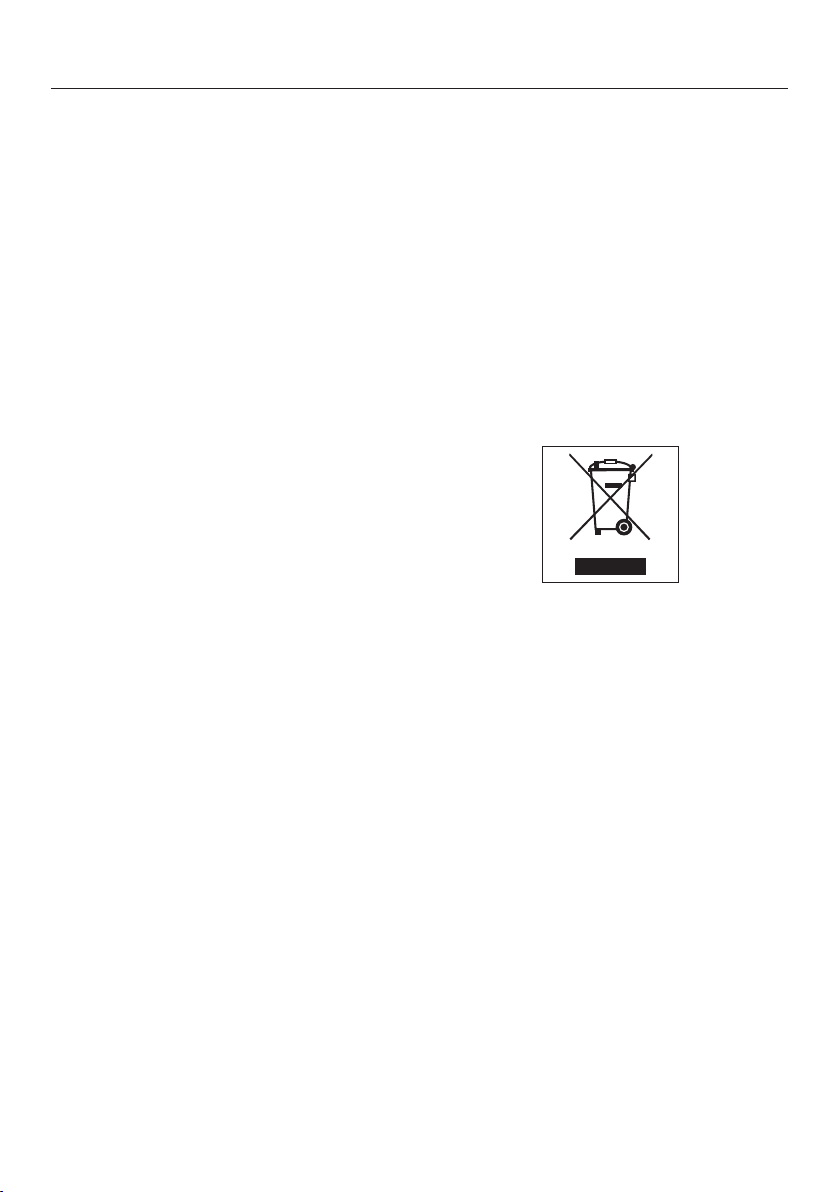
Disposing of your old appli-
ance
Electronic and electrical appliances
contain many valuable materials. They
also contain certain materials, com-
pounds and components which were
essential for their correct functioning
and safety. These could be hazardous
to your health and to the environment if
disposed of with general waste or if
handled incorrectly. Please do not,
therefore, dispose of your old appliance
with general waste.
Instead, please make use of officially
designated collection and disposal
points to dispose of and recycle elec-
trical and electronic appliances in your
local community, with your dealer or
with Miele. By law, you are solely re-
sponsible for deleting any personal data
from the appliance prior to disposal.
Take care not to damage your refrigera-
tion appliance’s pipework before or dur-
ing transportation to an authorised col-
lection depot.
This is to ensure that coolant in the
cooling circuit and oil in the compressor
is contained, and will not leak into the
environment.
Please ensure that your old appliance
poses no risk to children while being
stored prior to disposal. For further in-
formation, see “Warning and Safety in-
structions” in these operating and in-
stallation instructions.
Installation
*INSTALLATION*
15
Location
This appliance should be installed in a
dry, well-ventilated room.
When deciding where to install your re-
frigeration appliance, please bear in
mind that it will use more energy if in-
stalled near to a heater, a cooker or
other appliance that gives off heat. Dir-
ect sunlight should also be avoided.
The higher the room temperature, the
longer the compressor runs and the
higher the energy consumption of the
refrigeration appliance is.
When installing the refrigeration appli-
ance, please note the following:
- The socket must be easily accessible
in an emergency, not concealed be-
hind the appliance.
- The plug and power cable must not
touch the rear of the refrigeration ap-
pliance as they could be damaged by
vibrations from the appliance.
- Do not plug in other appliances be-
hind the refrigeration appliance.
If installation near a heat source is un-
avoidable, observe the following min-
imum distances between the appliance
and the heat source:
- At least 3cm
to electric or gas stoves
- At least 30cm
to oil or coal-based stoves
If it is not possible to observe these
minimum distances, an isolation plate
must be installed between the refrigera-
tion appliance and the heat source.
Climate range
This refrigeration appliance is designed
for use within specific ambient temper-
atures (climate range). Do not use in
ambient temperatures for which it is not
designed. The climate range is stated
on the data plate in the interior cabinet
of the refrigeration appliance.
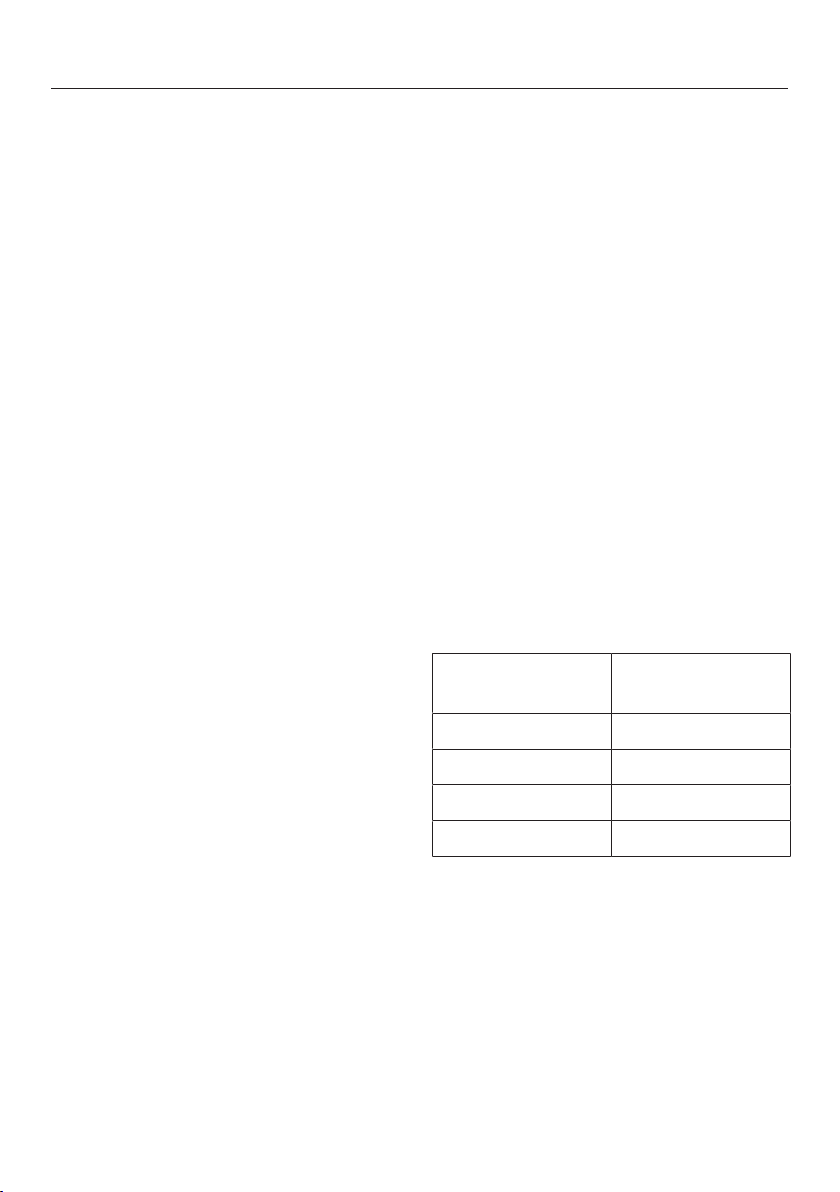
Climate range Ambient temper-
ature
SN +10to +32°C
N +16to +32°C
ST +16to +38°C
T +16to +43°C
A lower ambient temperature leads to
the compressor switching off for longer
periods. This can cause the internal
temperature in the refrigeration appli-
ance to rise with the risk of food deteri-
orating and going off.
Installation
*INSTALLATION*
16
Risk of damage due to high hu-
midity.
In environments with high humidity,
condensation can build up on ex-
ternal refrigeration appliance panels,
which can cause corrosion.
Install the refrigeration appliance in a
dry and/or air-conditioned room with
sufficient ventilation.
After installation, make sure that the
appliance door closes properly, the
ventilation gaps are not covered and
that the refrigeration appliance has
been installed in accordance with the
operating and installation instruc-
tions.
Installation notes
Risk of damage and injury due to
the refrigeration appliance tipping
over.
This refrigeration appliance is very
heavy and can tip forwards when the
appliance door(s) is (are) open.
Keep the appliance door(s) shut until
the refrigeration appliance has been
built in and secured in its housing in
accordance with these operating and
installation instructions.
Due to its weight and size, the refri-
geration appliance must be installed
by two people.
Adjoining cabinets/units
The appliance is screwed to the adjoin-
ing cabinets/units to the side and
above. For this reason, it is essential
that all cabinets/units are fixed to the
ground or wall.
Installation
*INSTALLATION*
17
Load-bearing capacity of the niche
floor
To ensure the safe installation of the re-
frigeration appliance and to guarantee
its correct functioning, the floor of the
niche where the appliance is to be in-
stalled must be smooth and even.
It must be made from strong, rigid ma-
terial.
Because the refrigeration appliance is
extremely heavy when fully loaded, it is
essential that the floor it stands on is
able to bear its weight. If necessary,
seek the advice of an architect or con-
struction expert.
When fully loaded, the weight of the re-
frigeration appliance is approx.:
K 2602 Vi, K 2612 Vi 325 kg
K 2802 Vi, K 2812 Vi 380 kg
K 2902 Vi, K 2912 Vi 448 kg
Ventilation
Risk of fire and damage due to
insufficient ventilation.
If the refrigeration appliance is not
ventilated sufficiently, the com-
pressor will run more frequently and
for longer periods.
This will result in increased energy
consumption and a higher operating
temperature for the compressor. This
may, in turn, cause damage to the
compressor.
Please ensure that there is adequate
ventilation around the refrigeration
appliance.
It is essential to observe the required
ventilation gaps. The ventilation gaps
must not be covered or blocked in
any way.
Door hinging
Risk of damage and injury when
changing the door hinges.
Changing the door hinges single-
handedly can cause damage to the
appliance and injury.
The refrigeration appliance is sup-
plied with fixed hinges. Under no cir-
cumstances should you attempt to
change the door hinges yourself.
If you need to change the door
hinges to the other side, please con-
tact the Miele Customer Service De-
partment.
Installation
*INSTALLATION*
18
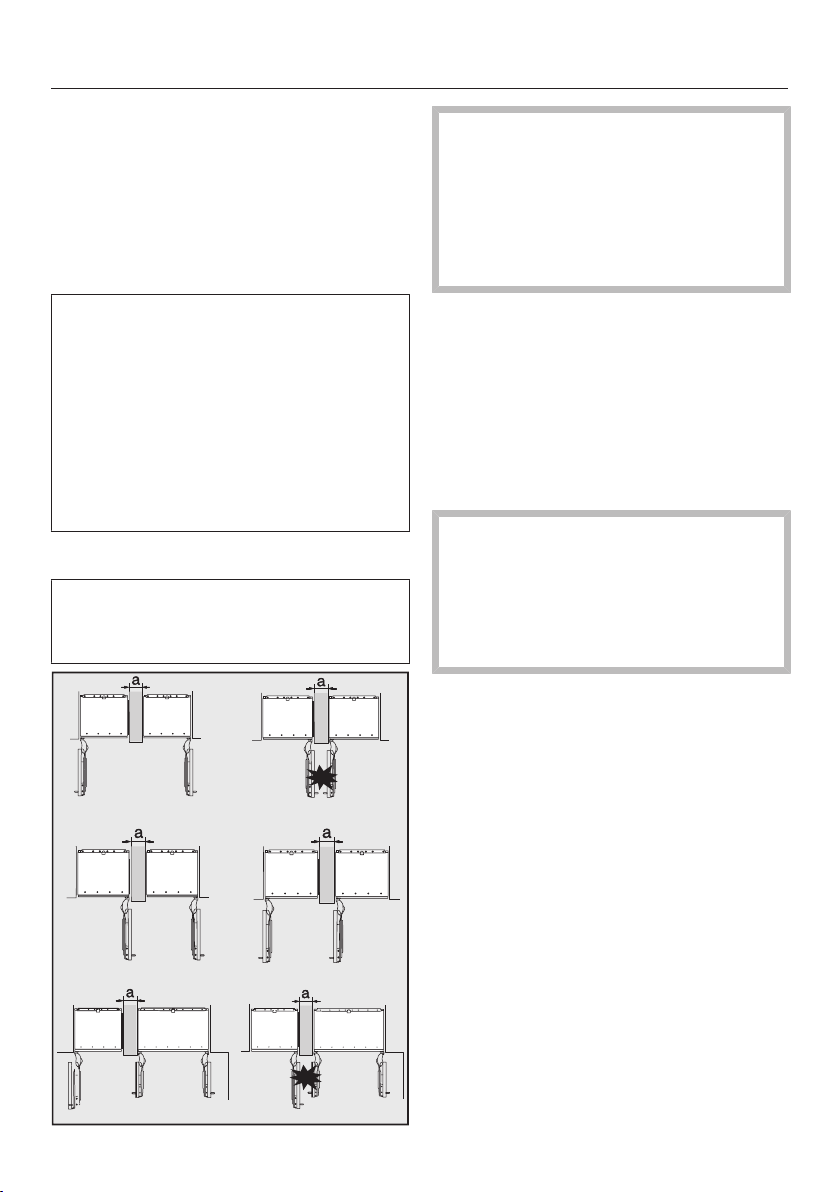
Side-by-side
This appliance can be installed side-by-
side with another refrigeration appli-
ance. The following overview will show
you which side-by-side installation op-
tions you have with your refrigeration
appliance.
Depending on the installation situ-
ation, you will need the side-by-side
installation kit for side-by-side installa-
tion (see “Accessories – Optional ac-
cessories”).
Instructions for installing refrigeration
appliances side-by-side can be found
in the side-by-side installation kit in-
stallation instructions.
. . .with partition wall
The wall a between the side-by-side
refrigeration appliances must be at
least 16mm thick.
If the door hinges of the refrigeration
appliances are next to each other,
you must take into account the thick-
ness of the furniture fronts and door
handles so that the appliance doors
do not collide and become damaged
if they are opened at the same time.
The refrigeration appliances are secured
individually in their installation niche us-
ing the supplied installation material.
If the partition wall a is narrower than
160mm, you will need the side panel
heater from the side-by-side installation
kit to prevent condensation from form-
ing and any resulting damage.
When planning installation niches,
please note that the niche into which
the refrigeration appliance with the
side panel heater is installed must be
4mm wider (see “Installation –
Building-in dimensions”).
If the partition wall a is thicker than
160mm, you do not need the side-by-
side installation kit, nor the side panel
heater.
Installation
*INSTALLATION*
19
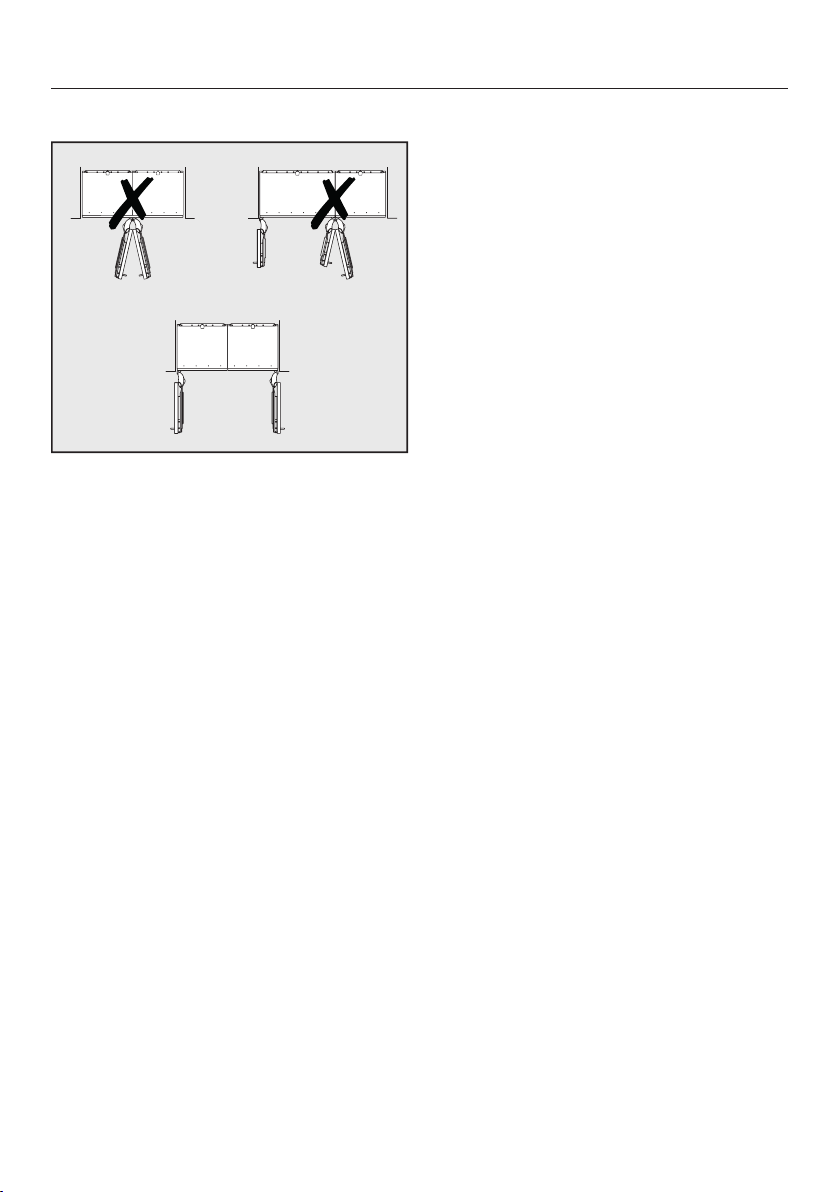
. . .without partition wall
If the refrigeration appliances are to be
installed next to each other without a
partition wall between them, they will
need to be joined together with the
side-by-side installation kit. In addition,
you must install the side panel heater to
prevent condensation from forming and
any resulting damage.
Installation
*INSTALLATION*
20
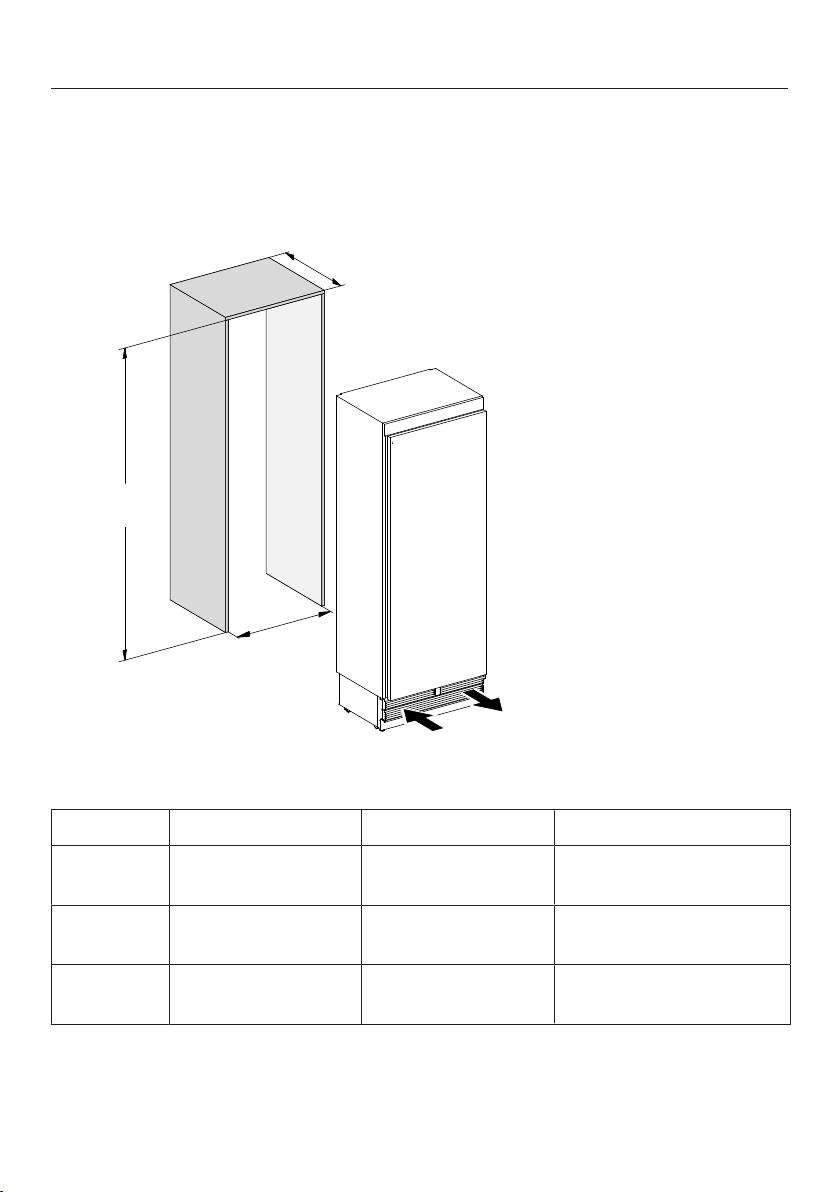
Building-in dimensions
A
B
C
A B C
K2602Vi,
K2612Vi
2134–2164mm 610mm 610mm + furniture front
(19–38mm)
K2802Vi,
K2812Vi
2134–2164mm 762mm 610mm + furniture front
(19–38mm)
K2902Vi,
K2912Vi
2134–2164mm 915mm 610mm + furniture front
(19–38mm)
Installation
*INSTALLATION*
21
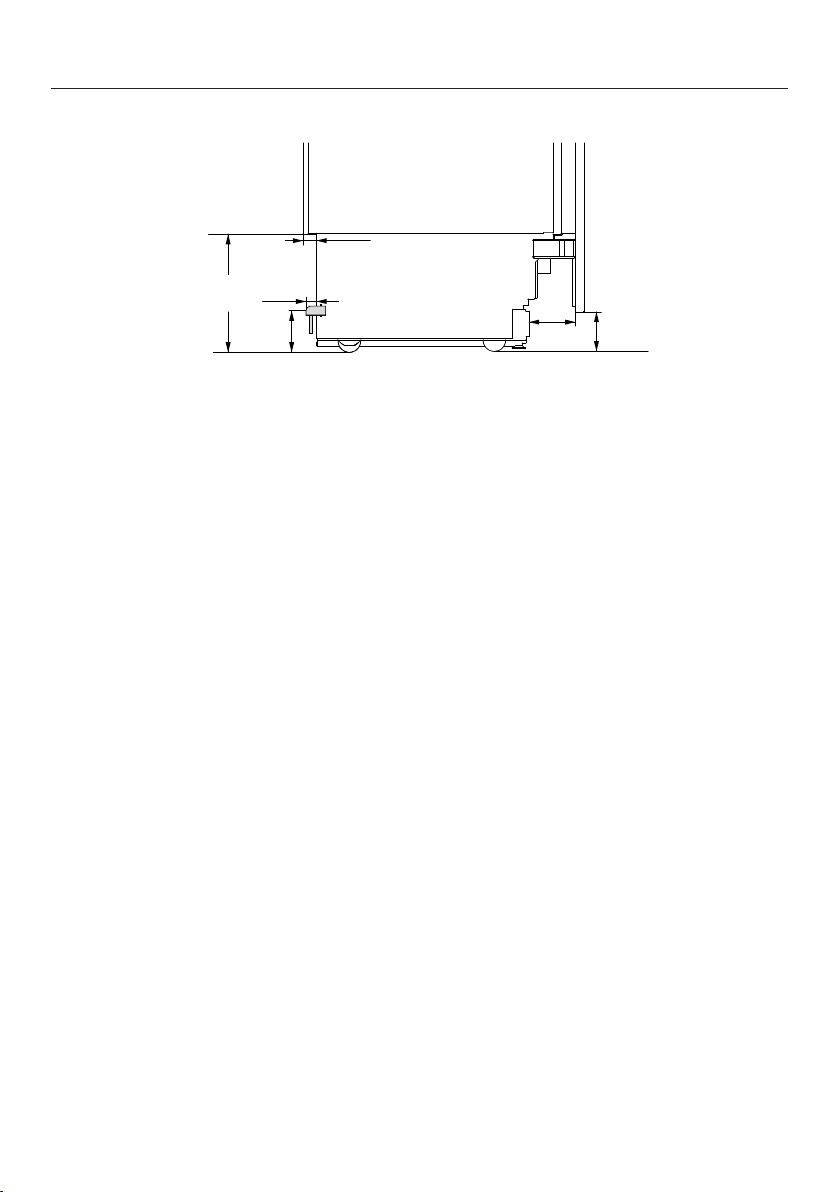
30 mm
22 mm
≥ 262 mm
102 mm
≥ 102 mm
≥ 85 mm
Side view
Installation
*INSTALLATION*
22
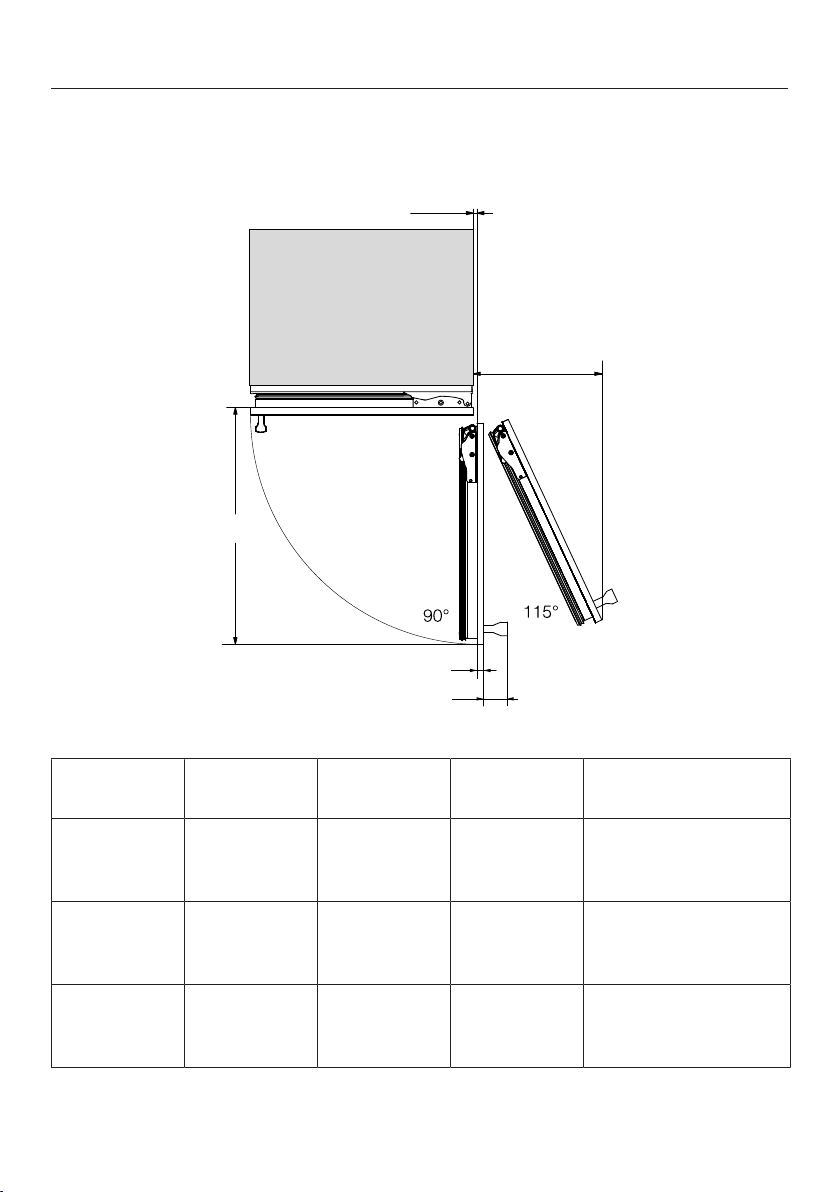
Dimensions when the appliance door is opened (opening angle 90°/115°)
10 mm
D
A
B
C
A B* C* D (with a furniture
front of 19mm)
K2602Vi,
K2612Vi
677mm Furniture
front
(19–38mm)
Door handle 296mm
K2802Vi,
K2812Vi
829mm Furniture
front
(19–38mm)
Door handle 363mm
K2902Vi,
K2912Vi
982mm Furniture
front
(19–38mm)
Door handle 428mm
* The dimensions of the furniture front and the door handle vary depending on the
design of the kitchen.
Installation
*INSTALLATION*
23
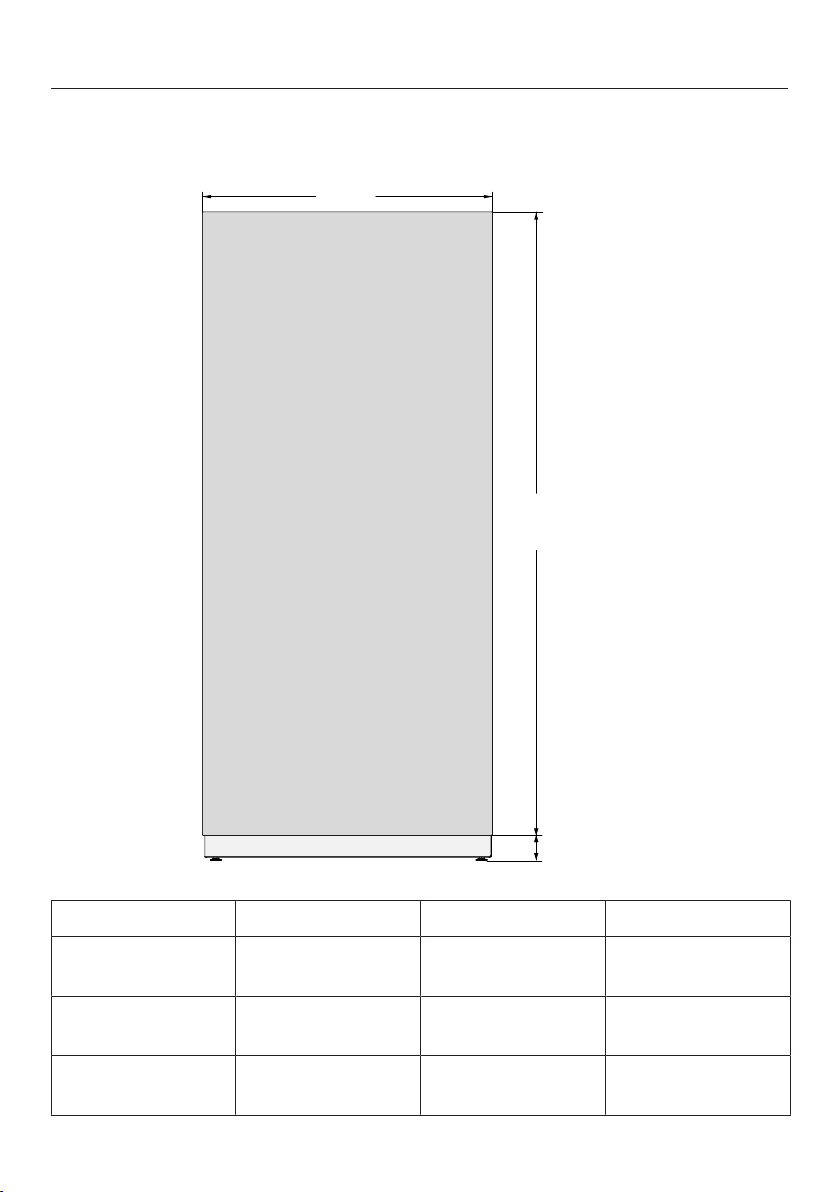
Dimensions of the furniture front
A
B
C
A B C
K2602Vi,
K2612Vi
604mm 2029mm ≥102–132mm
K2802Vi,
K2812Vi
756mm 2029mm ≥102–132mm
K2902Vi,
K2912Vi
908mm 2029mm ≥102–132mm
Installation
*INSTALLATION*
24
Installing the appliance
Before starting...
It is essential to read these operating
and installation instructions carefully
before starting to install the refrigera-
tion appliance.
The refrigeration appliance should be
installed by a suitably qualified in-
staller in accordance with these op-
erating and installation instructions.
Safe operation of the refrigeration
appliance is only assured if it has
been installed and connected in ac-
cordance with these operating and
installation instructions.
Risk of damage and injury due to
the refrigeration appliance tipping
over.
This refrigeration appliance is very
heavy and can tip forwards when the
appliance door is open.
Keep the appliance door shut until
the refrigeration appliance has been
built in and secured in its niche in ac-
cordance with these operating and
installation instructions.
Due to its weight and size, the refri-
geration appliance must be installed
by two people.
Tools required
- Cordless drill
- TX20 screwdriver
- Hammer drill
- Drill bits in various sizes,
depending on materials
- Hammer
- Open spanner
- Ratchet wrench, attachment: socket,
8mm
- Adhesive tape
- Utility knife
- Pipe wrench
- Spirit level
- Tape measure
- Pencil
Other
- Step ladder
- Sack truck
Installation
*INSTALLATION*
25
Weight of the furniture front
Before fitting a furniture front, ensure
that the weight of the furniture front
does not exceed the maximum permit-
ted weight:
Refrigeration appli-
ance
Max. weight
of the fur-
niture front
K2602Vi, K2612Vi 48kg
K2802Vi, K2812Vi 27kg
K2902Vi, K2912Vi 48kg
If the furniture front is too heavy,
this can cause damage.
Fitting a furniture front which is heav-
ier than the maximum permitted
weight could damage the hinges.
This damage can affect various
factors, such as operation of the ap-
pliance.
Before fitting a furniture front, ensure
that the weight of the furniture front
does not exceed the maximum per-
mitted weight.
Aligning the building-in niche
The building-in niche must be carefully
aligned using a spirit level before the re-
frigeration appliance is installed. The
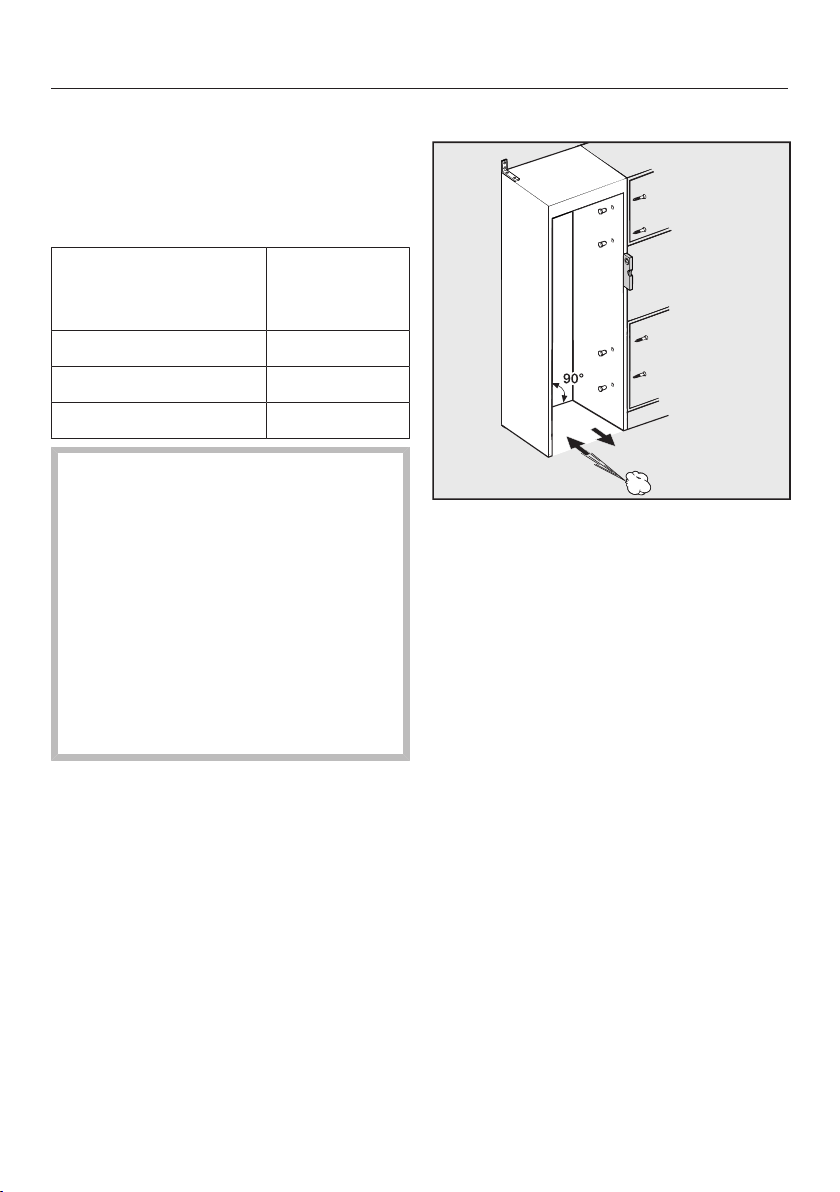
niche corners must be at 90° angles to
each other, otherwise the furniture front
will not sit straight on all 4corners of
the building-in niche.
Installation
*INSTALLATION*
26
Checking the building-in niche
Check the installation dimensions
(see “Installation – Building-in dimen-
sions”).
Check the position of the electrical
connection. The length of the elec-
trical connection cable is 3m.
The electrical socket must not be
concealed behind the appliance and
must be easily accessible in an
emergency.
Check the surroundings for possible
collisions (see “Installation – Dimen-
sions with appliance door open”).
Only install the refrigeration appliance
in stable, solid building-in niches, po-
sitioned on an even and level floor.
Also check the building-in niche for
the following criteria:
- The side walls of the building-in niche
must be even.
- The surrounding walls of the building-
in niche must be at least 16mm
thick.
- The surrounding walls must be se-
curely fixed to the floor or wall.
- Shortened side walls must be at least
100mm deep.
Before installation
Before installation, remove any ac-
cessories from the back of the appli-
ance.
Risk of damage due to insuffi-
cient ventilation.
If the refrigeration appliance is not
sufficiently ventilated, this may cause
mould to form and, in the long term,
lead to damage to the outside of the
refrigeration appliance and in the in-
stallation niche.
Do not remove the spacers from the
outside of the appliance under any
circumstances.
Do not compress the spacers under
any circumstances.
The spacers guarantee the neces-
sary distance between the refrigera-
tion appliance and the installation
niche.
Check the refrigeration appliance for
transport damage.
Do not install a damaged refrigera-
tion appliance.
Check that all parts at the back of the
appliance are unhindered.
Installation
*INSTALLATION*
27
To protect the floor during installation,
secure an off-cut of flooring or similar
material to the floor in front of the in-
stallation area.
Do not remove the installation aids
from the appliance door. These will
be required later for aligning the ap-
pliance in the building-in niche.
Risk of damage and danger of
injury due to the refrigeration appli-
ance tipping over.
As soon as you unscrew the brack-
ets that fix the refrigeration appliance
to the pallet, the appliance is no
longer secured.
Due to its weight and size, the refri-
geration appliance must be installed
by two people.
2
Unscrew the fixing brackets.
With the help of several people as re-
quired, carefully lift the refrigeration
appliance from the pallet, starting
with the back of the appliance.
Risk of damaging the floor from
the load.
Moving the refrigeration appliance
can cause damage to the floor.
Move the refrigeration appliance
carefully on floors that are sensitive
to scratching.
As soon as you have set the appliance
upright, you can move it using the
rollers on the bottom.
Installation
*INSTALLATION*
28
Preparing the building-in niche
Risk of damage and injury due to
the refrigeration appliance tipping
over.
This refrigeration appliance is very
heavy and can tip forwards when the
appliance doors are open.
The building-in niche must be se-
cured to the wall behind it and/or
above it with several screws. Only
this will prevent the refrigeration ap-
pliance from tipping over after being
installed.
In addition, use the provided anti-tip
brackets to secure the building-in
niche.
The parts required for installation are
supplied with the refrigeration appli-
ance. The plastic bags supplied are
marked with letters for easy identifica-
tion.
When performing the individual as-
sembly steps, observe the letters
specified and use the matching
plastic bag with the required installa-
tion equipment.
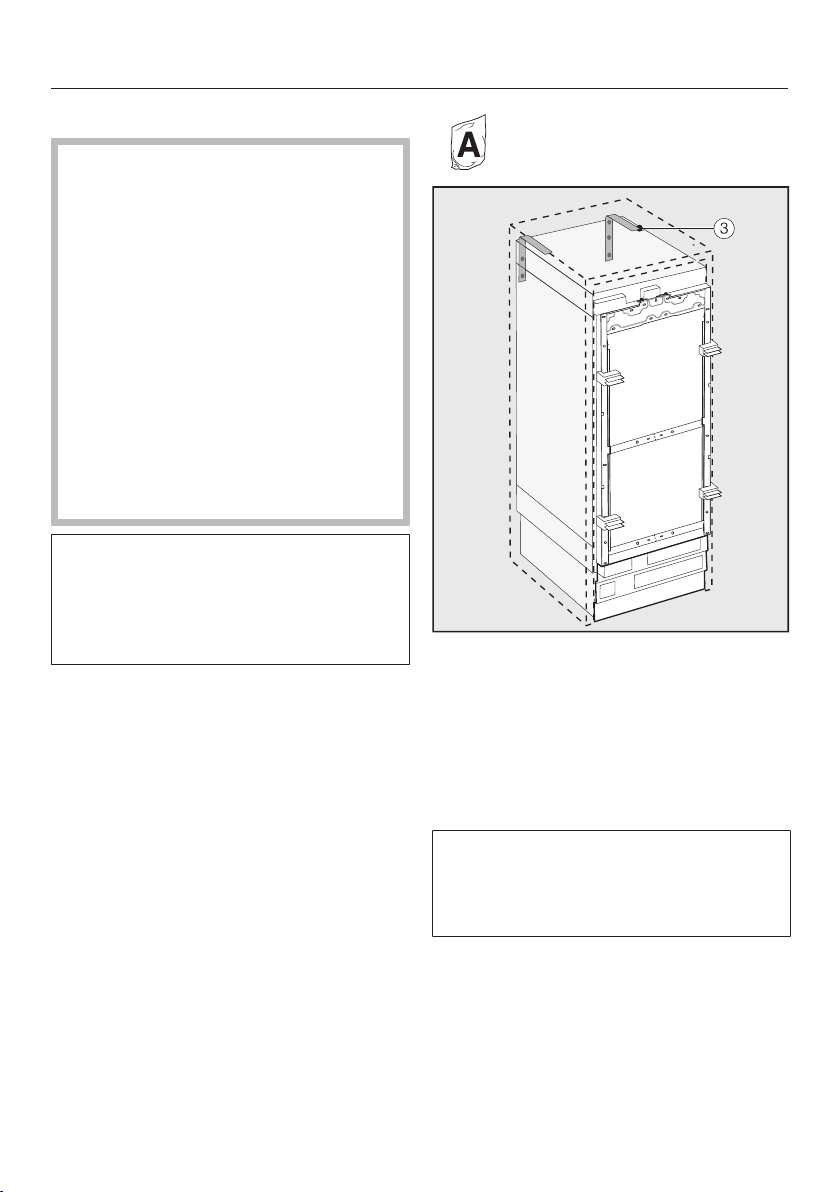
The anti-tip brackets prevent the refri-
geration appliance from tipping.
The anti-tip brackets are also used to fix
the building-in niche securely to the
surrounding walls.
Use 2 anti-tip brackets for each in-
dividual refrigeration appliance or 4
anti-tip brackets for each (side-by-
side) combination of 2 appliances.
Position the anti-tip brackets on
the left and right of the building-in
niche.
Depending on the subsequent adjust-
ment of the feet, the anti-tip brackets
are positioned 2134–2164mm from
the floor of the niche.
Installation
*INSTALLATION*
29
Risk of injury and damage due to
tipping refrigeration appliance.
If the anti-tip brackets are fixed too
high up, they cannot be used to se-
cure the refrigeration appliance.
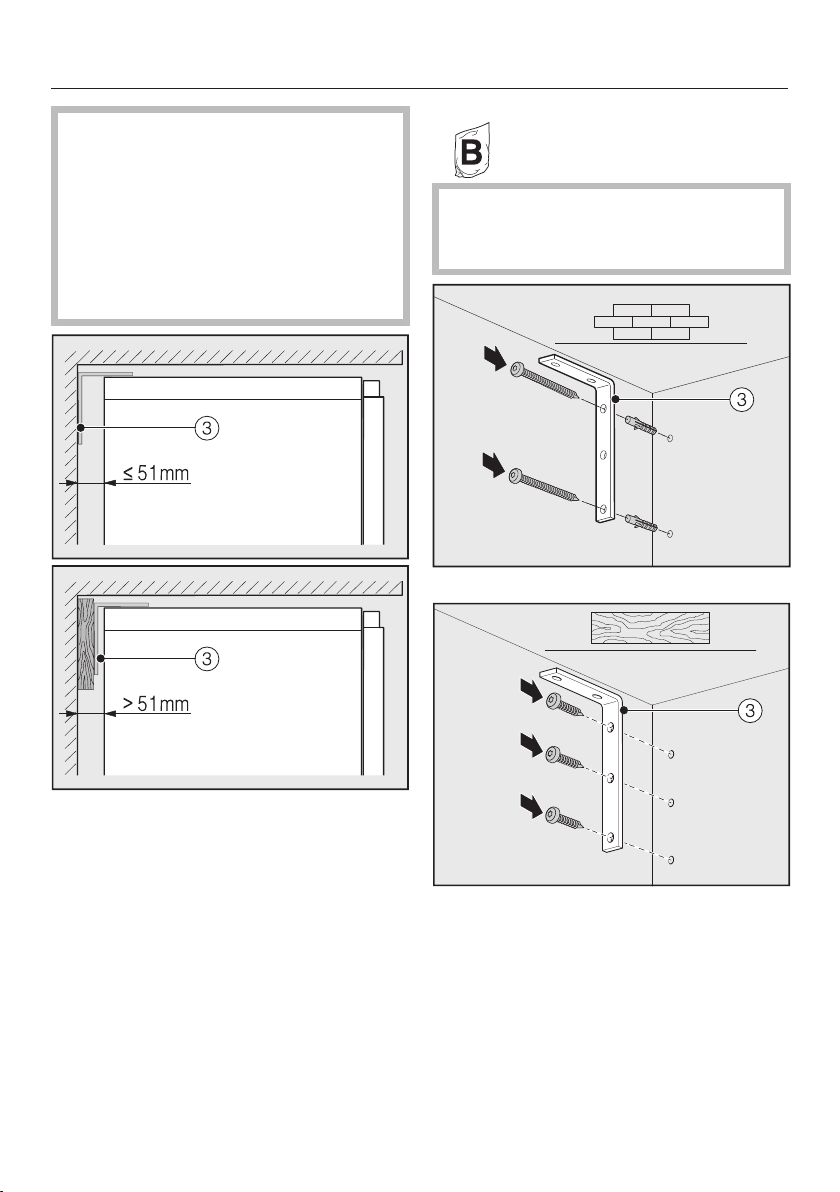
The distance between the
anti-tip brackets and the refrigeration
appliance must not exceed 8mm.
Make sure that the gap between the
refrigeration appliance‘s rear wall and
the building-in niche does not exceed
51mm.
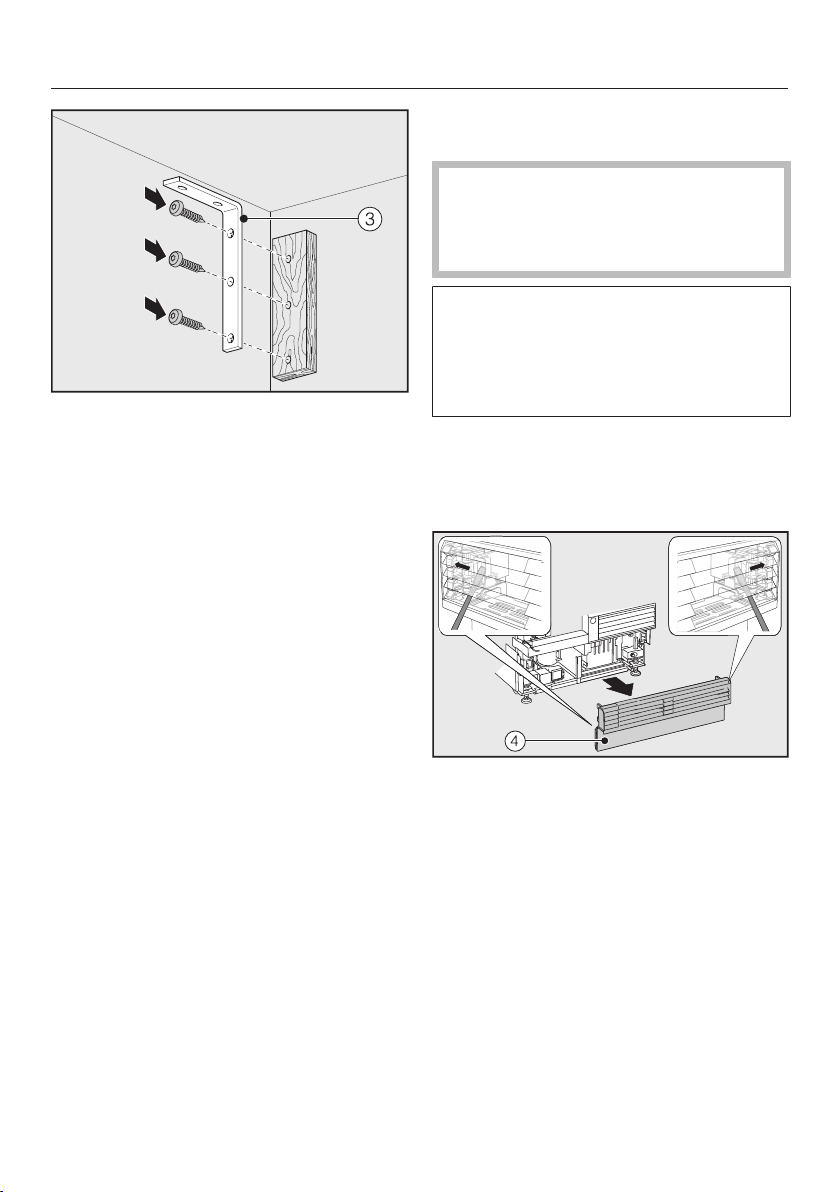
Place a wooden wedge behind the
anti-tip brackets if necessary.
While holding the anti-tip brackets in
place, mark the necessary drill holes
on the rear wall of the building-in
niche.
The accessory pack supplied con-
tains fixing screws for various applic-
ations/materials.
Securing to a concrete wall
Securing to a wooden wall
Installation
*INSTALLATION*
30
Securing with a wooden wedge
Secure the building-in niche to the
wall behind it and/or above it as re-
quired using the anti-tip brackets.
Pushing the refrigeration appliance
into the building-in niche
Take care not to damage the elec-
trical connection whilst pushing the
refrigeration appliance into the build-
ing-in niche.
If you are installing several refrigera-
tion appliances side by side, now se-
cure the appliances to one another
(see the installation instructions for the
side-by-side installation kit).
To ensure that the refrigeration appli-
ance can then be aligned correctly,
the plinth ventilation grille must be re-
moved from the appliance plinth:
Carefully guide a flat-head screw-
driver through the plinth ventilation
grille on both sides and use it to
push the internal plastic latches out-
wards to release the plinth ventilation
grille.
Place the plinth ventilation grille to
one side.
Installation
*INSTALLATION*
31
Affix edge protection to the adja-
cent furniture fronts.
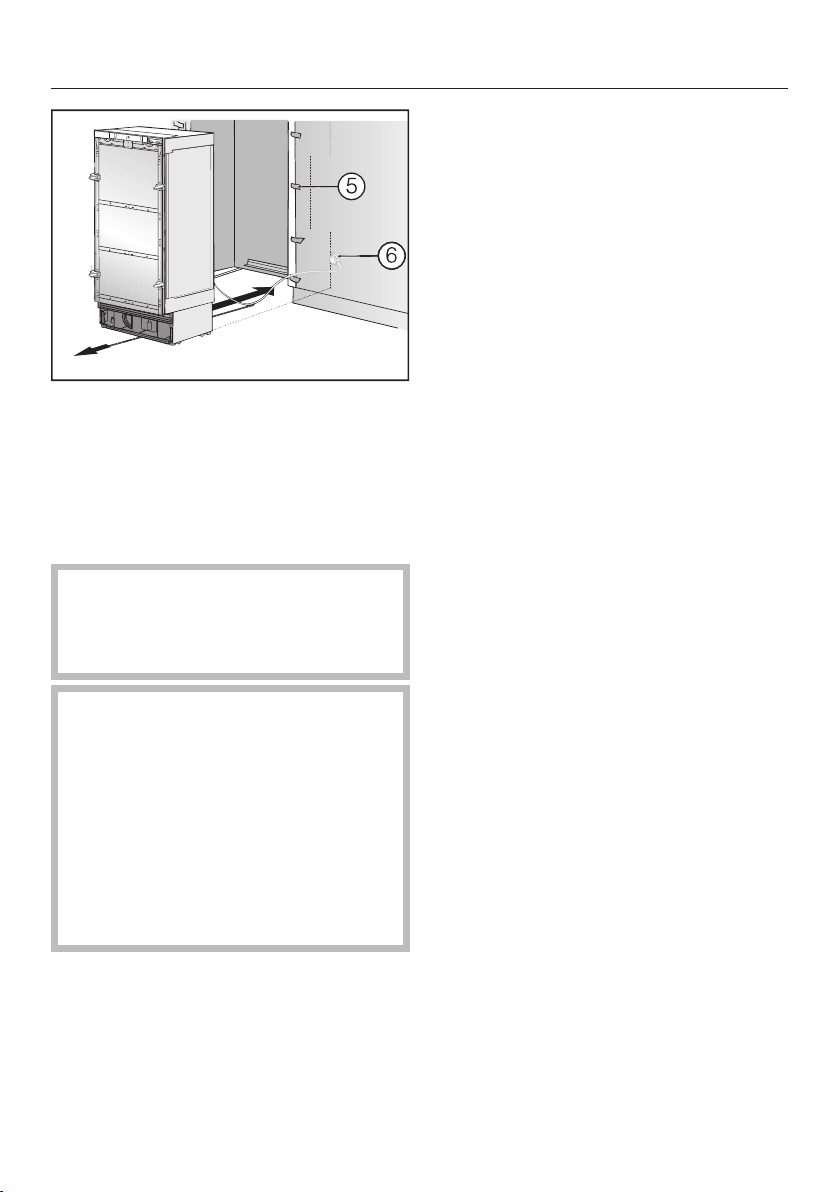
Insert the plug connector at the back
of the refrigeration appliance (see “In-
stallation – Electrical connection”).
Insert the plug into the socket.
The electrical socket must not be
concealed behind the appliance and
must be easily accessible in an
emergency.
Risk of damage due to electrical
overload.
If the refrigeration appliance is elec-
trically overloaded, this can cause a
short circuit and thus damage your
refrigeration appliance.
When you install appliances side by
side, each refrigeration appliance
must have its own separate electrical
socket.
Tip: Secure the power cable to prevent
it becoming caught: tie a piece of string
to the middle of the cable and as the re-
frigeration appliance is being pushed
into the niche, pull the cable forward
underneath the appliance.
Carefully push the refrigeration appli-
ance into the niche.
If the refrigeration appliance cannot
be pushed into the niche (because
the floor is uneven, for example), un-
screw the rear adjustable feet slightly
(see “Installation – Aligning the refri-
geration appliance”) and slide the re-
frigeration appliance into the niche.
Remove the edge protection from
the adjacent furniture fronts.
Installation
*INSTALLATION*
32
Aligning the refrigeration appliance
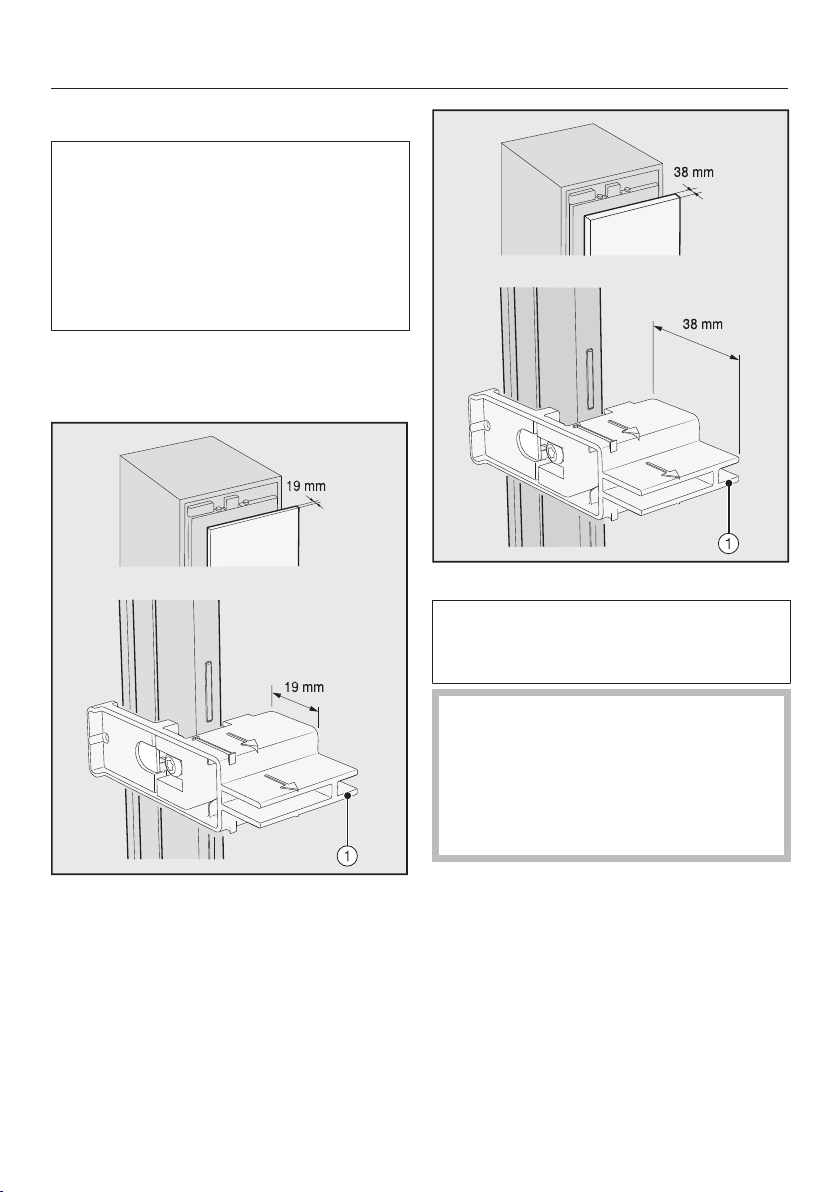
The installation aids on the appli-
ance door provide assistance with the
alignment of the refrigeration appli-
ance in the building-in niche.
The installation aids are suitable for a
furniture front thickness of 19mm or
38mm.
Align the refrigeration appliance with
adjacent furniture fronts as described
below.
Furniture front thickness of 19mm
Furniture front thickness of 38mm
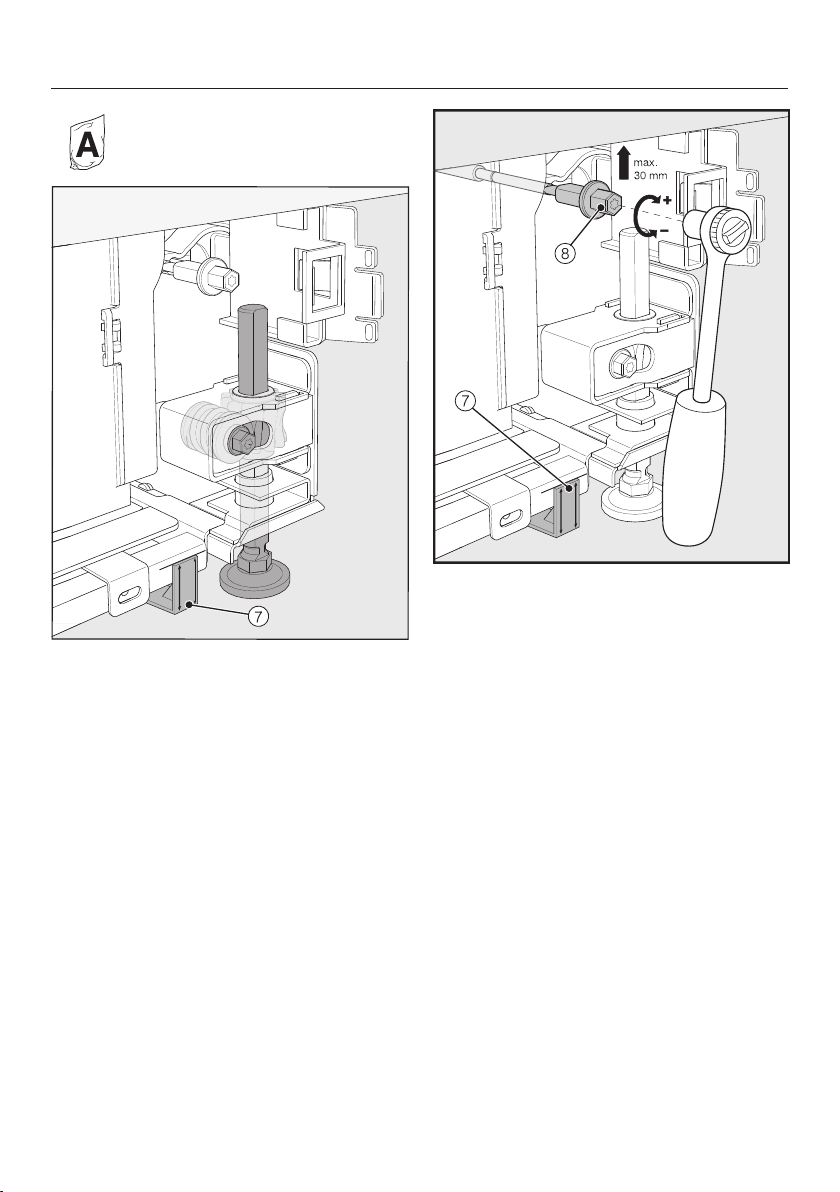
The adjustable feet at the front and
back of the appliance can all be adjus-
ted from the front of the appliance.
Risk of damage due to incorrect
feet adjustment.
You may damage the adjustable feet
if you use a cordless screwdriver.
Always adjust the front and rear feet
by hand.
Installation
*INSTALLATION*
33
Position the supplied spacers on
both sides on the markings next to
the adjustable feet at the front of the
refrigeration appliance.
Adjust the rear feet with a ratchet (at-
tachment: socket, 8mm) or a TX20
screwdriver.
Installation
*INSTALLATION*
34
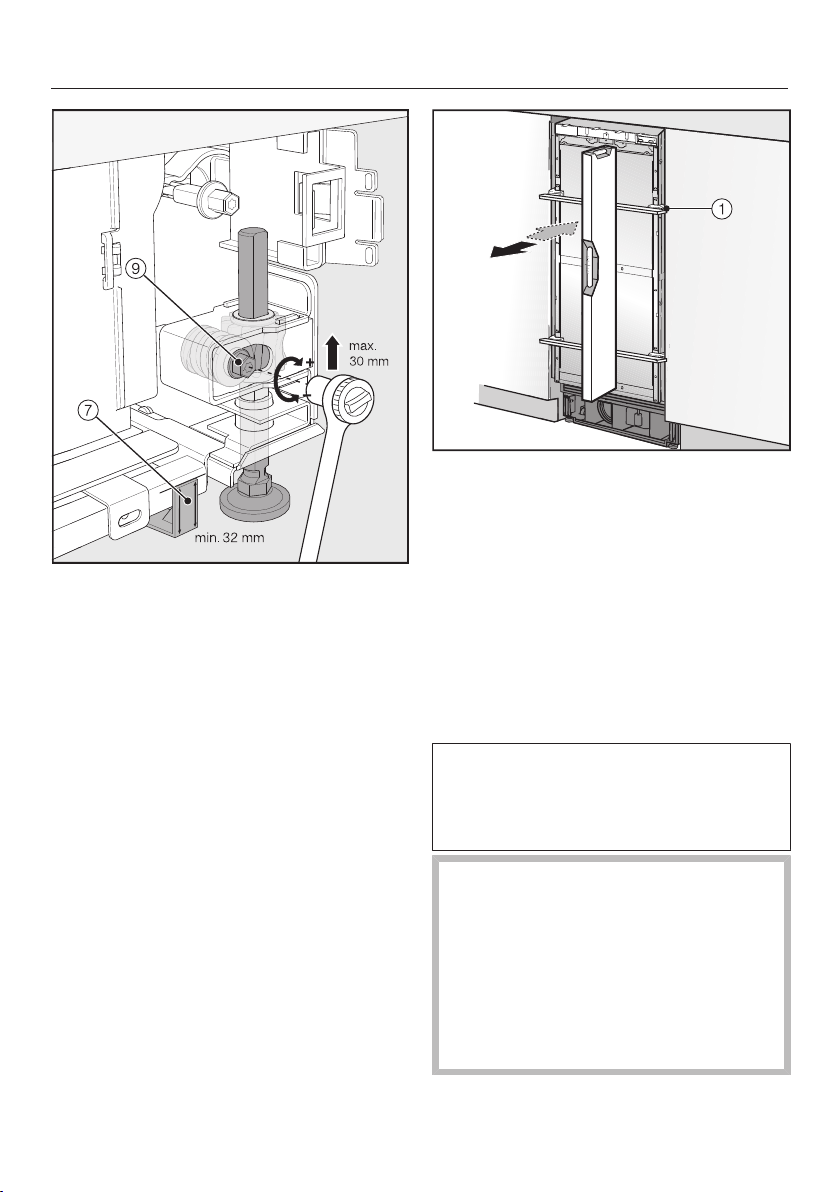
Adjust the front feet with a ratchet (at-
tachment: socket, 8mm) or a TX20
screwdriver.
Tip: Proceed carefully when adjusting
the feet, alternating between the left
and right feet.
Place a spirit level across the installa-
tion aids on the appliance door to
check the refrigeration appliance’s
alignment.
Unscrew the adjustable feet
and on both sides at least until the
marking on the plinth has reached the
specified distance of 32mm on the
spacer. The standard dimension of
32mm relates to a niche height of
2134mm.
It is important to adjust the feet to a
height of at least 32mm so that the
ventilation of the refrigeration appli-
ance via the plinth functions correctly.
Risk of damage if the feet are
adjusted too much.
The rear adjustable feet can be dam-
aged.
Unscrew the feet only until the
marking on the plinth is aligned to a
maximum of 62mm (max. niche
height of 2164mm).
Installation
*INSTALLATION*
35
Check the alignment of the refrigera-
tion appliance again using the install-
ation aids and the spirit level.
Securing the refrigeration appliance
in the building-in niche
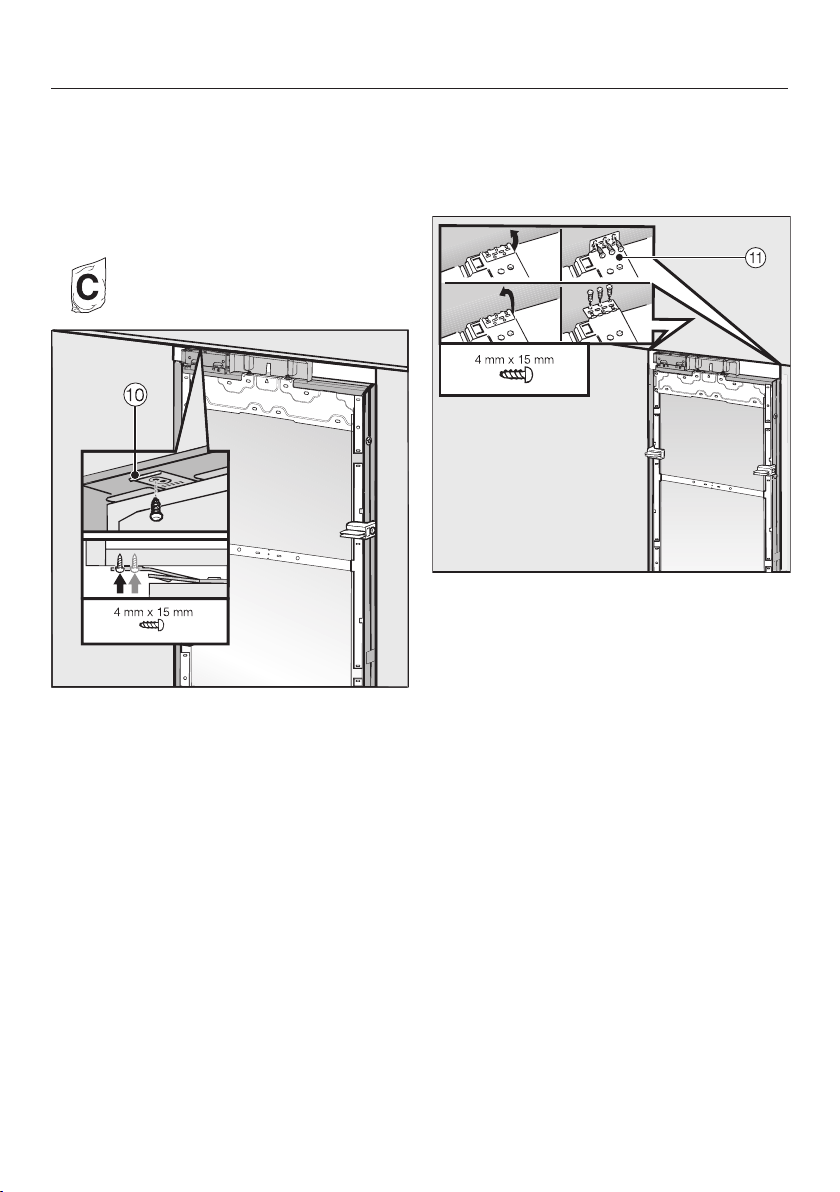
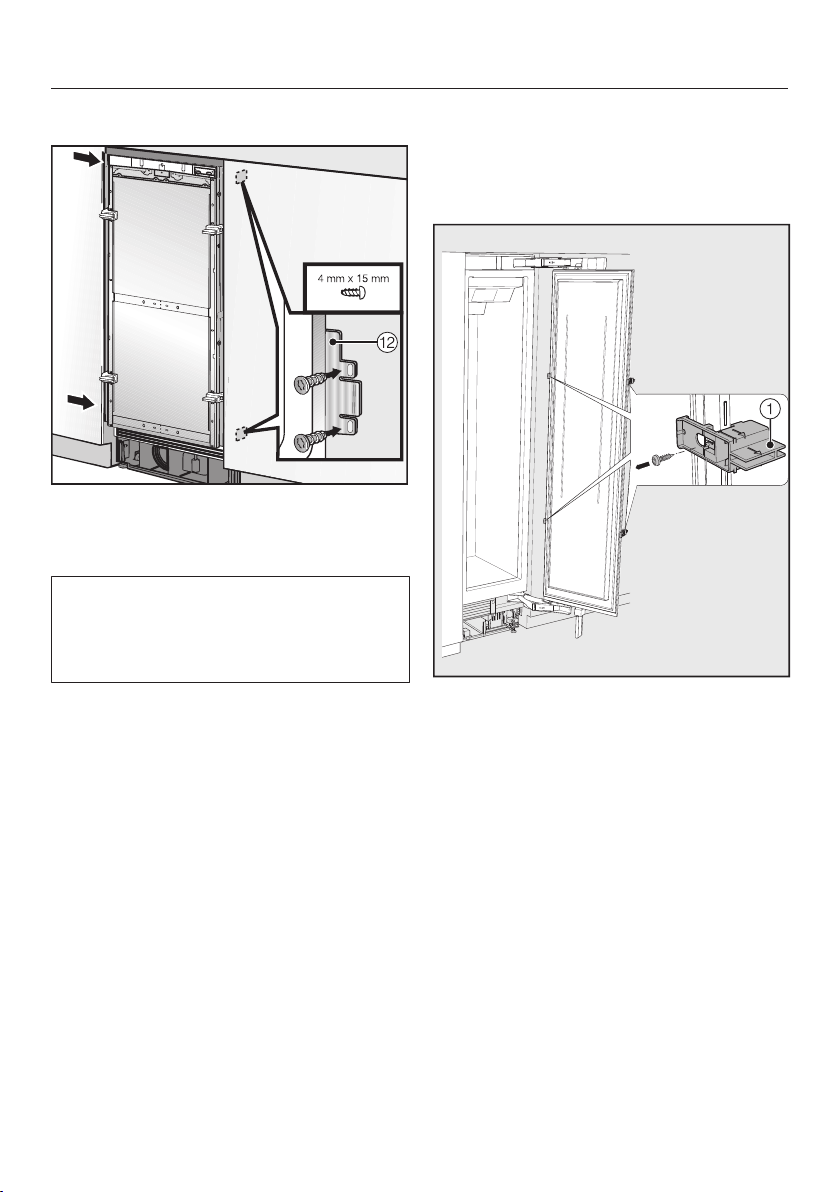
Screw the lugs for the fixing plate
into the cabinets/units above the ap-
pliance.
If it is not possible to secure the refri-
geration appliance at the top, it can be
attached to the building-in niche with
the side fixing plates:
Open out the side fixing lugs.
Screw the side fixing lugs to the
adjacent cabinets/units.
Installation
*INSTALLATION*
36
Open the appliance door.
Screw the fixing plate lugs at the
top and bottom to the cabinets/units
adjacent to the appliance.
In a side-by-side combination, only
the external panels of the two refriger-
ation appliances can be secured to the
furniture wall.
Preparing to install the furniture
fronts
Open the appliance door as far as it
will go.
Unscrew the installation aids from
the appliance door.
Installation
*INSTALLATION*
37
Unscrew the angle trims from both
sides of the appliance door and place
the trims and screws to one side –
they will be required later.
Close the appliance door.
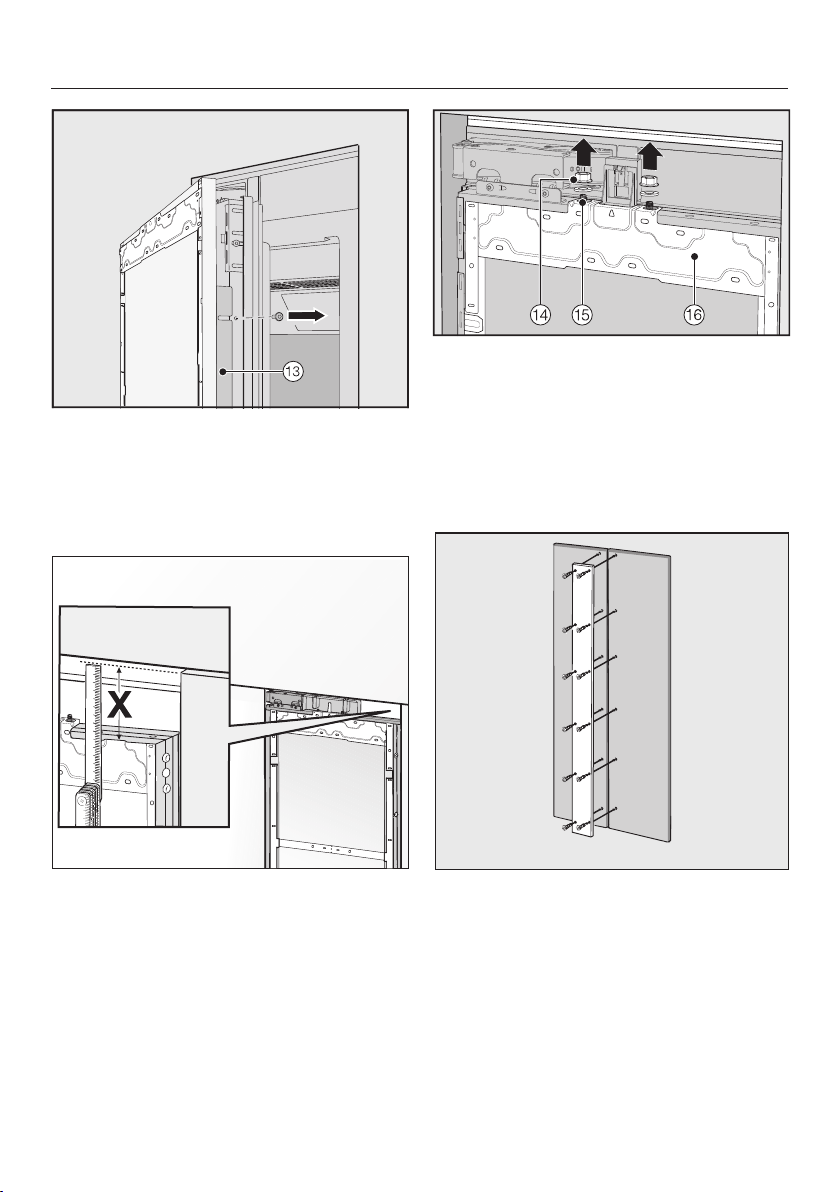
Measure the gap X between the
mounting frame and the upper edge
of the adjacent furniture front.
Remove the nuts and washers
from the threaded bolts and place
them to one side – they will be re-
quired later.
Take the mounting frame off the
appliance door by removing it up-
wards.
For cassette fronts: always pay atten-
tion to the length of the screws when
securing the metal strip to the fur-
niture front.

Installation
*INSTALLATION*
38
Place the furniture front on a firm sur-
face, with the external side facing
downwards (place on a blanket or
similar to prevent it from becoming
scratched).
Mark the distance X-3mm on the
inner side of the furniture front.
Also locate and mark the centre point
Y on the furniture front.
Position the mounting frame ac-
cording to the markings on the fur-
niture front.
Pre-drill the holes.
Screw the mounting frame to the
furniture front:
Use at least one screw for each re-
taining point on the mounting
frame.
Secure the mounting frame to the
top of the furniture front, using 6 to
10screws depending on the size.
The mounting frame has several differ-
ent types of holes to take account of a
variety of furniture fronts.
When securing the frame, always
screw into the strongest part of the
furniture front. To do this, select
screws which are slightly shorter than
the thickness of the furniture front.
For cassette fronts: only secure the
mounting frame to the outer frame
with the screws.
Installation
*INSTALLATION*
39
Screw the appliance handle to the
furniture front from the inside if ne-
cessary (not for handle-free kitchens).
Now insert the angle trims on both
sides as far as they will go into the
provided spaces in the mounting
frame.
Securing and aligning the furniture
front
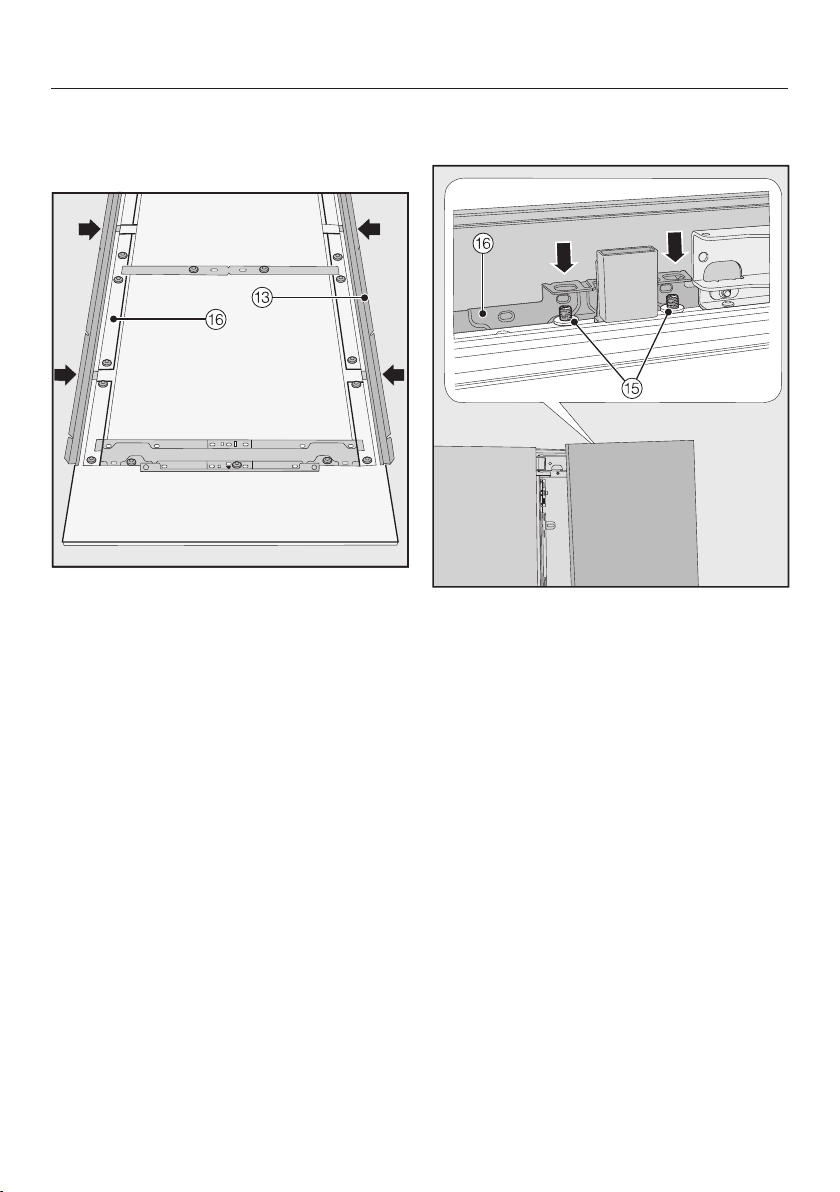
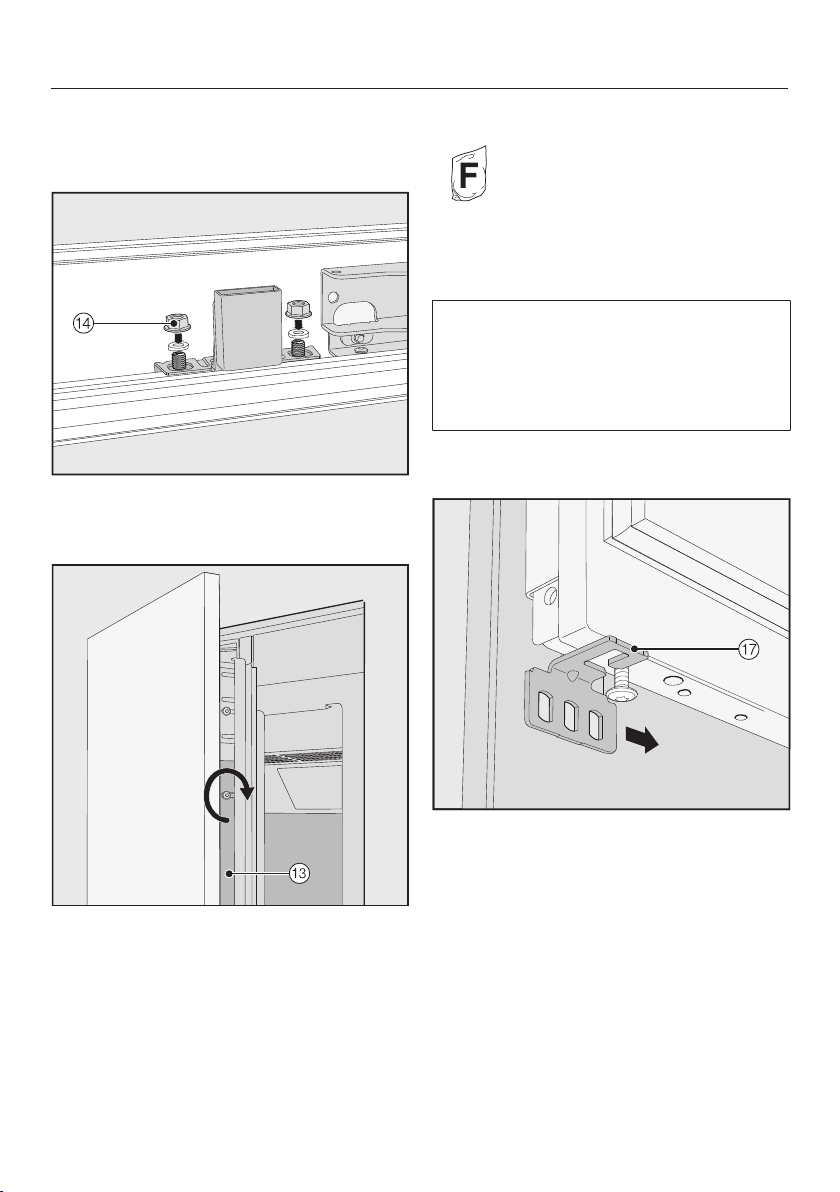
Open the appliance door and hang
the furniture front on its frame onto
the threaded bolts.
Installation
*INSTALLATION*
40
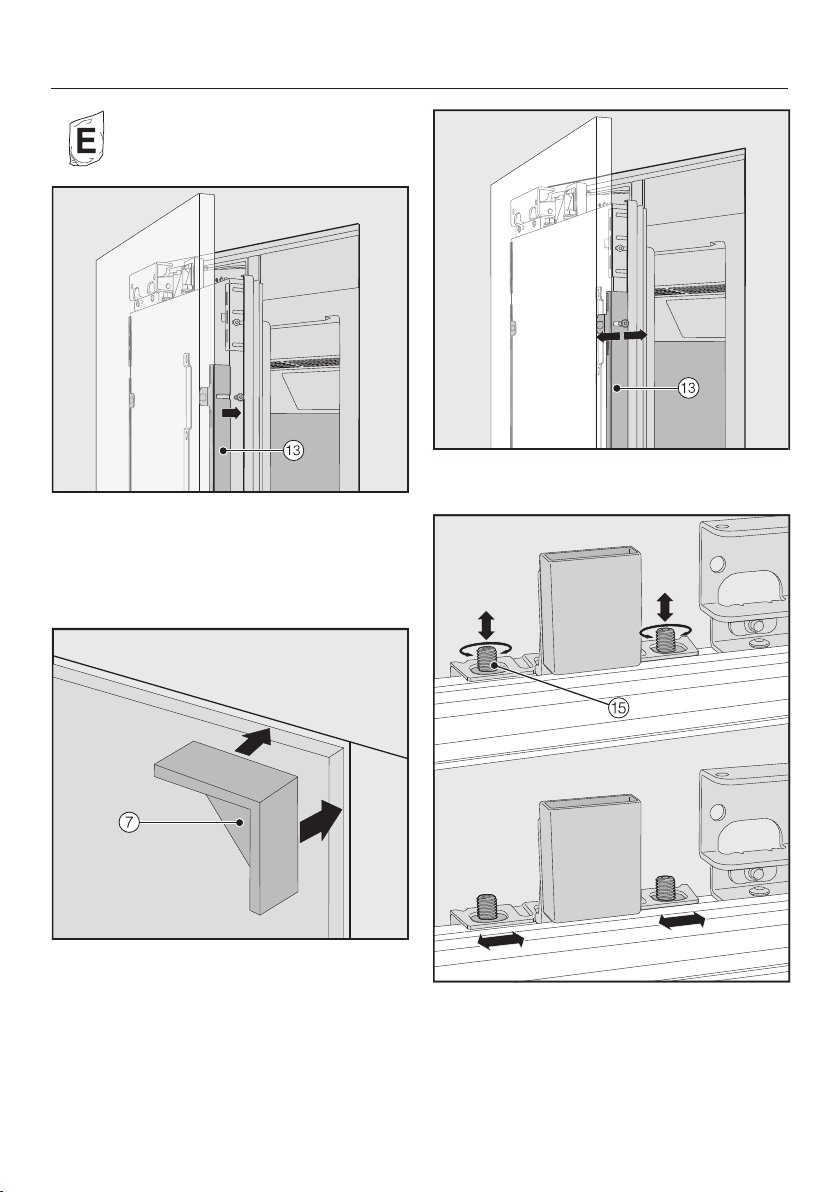
Press the angle trims into the white
plastic frame on both sides from the
outside and screw them on loosely at
first. Spare screws are provided in the
plastic bag marked with the letter E.
Place the spacers on top of the
corners of the furniture front on both
sides.
Close the appliance door and check
the distance between the door and
adjacent furniture fronts again.
Align the depth of the furniture front
via the gaps in the angle trims.
Align the height and sides of the fur-
niture front using the threaded
bolts.
Installation
*INSTALLATION*
41
Close the appliance door and check
the distance between the door and
adjacent furniture fronts again.
Place the washers and nuts back
in position and tighten the nuts.
The furniture front is now secured.
Now tighten the screws in the angle
trims.
Open the appliance door.
Remove the spacers from the fur-
niture front.
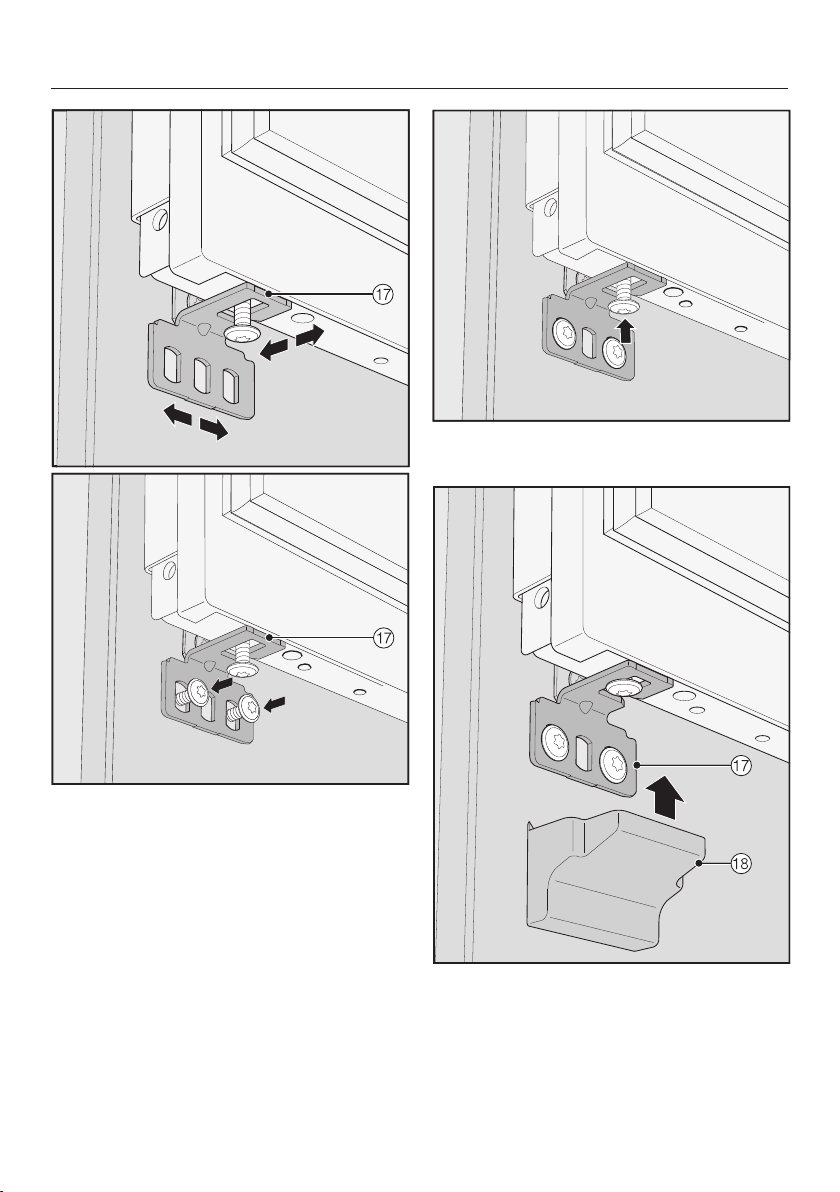
Mounting the fixing bracket
The fixing bracket is used to secure the
furniture front to the bottom of the ap-
pliance door.
Do not mount the fixing bracket until
the refrigeration appliance (or side-by-
side combination, if applicable) has
been installed and the furniture front
has been aligned.
Open the appliance door as far as it
will go.
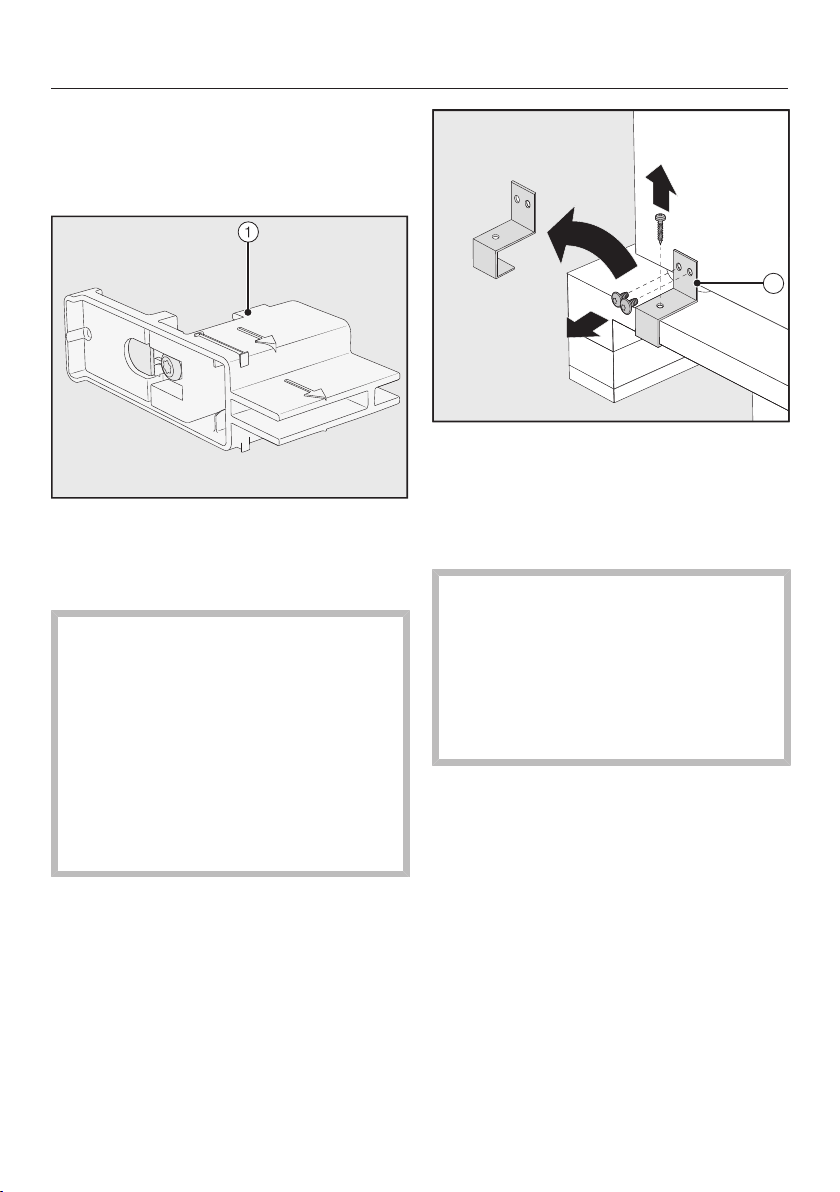
Slide the fixing bracket sideways
onto the screw at the bottom of the
appliance door.
Installation
*INSTALLATION*
42
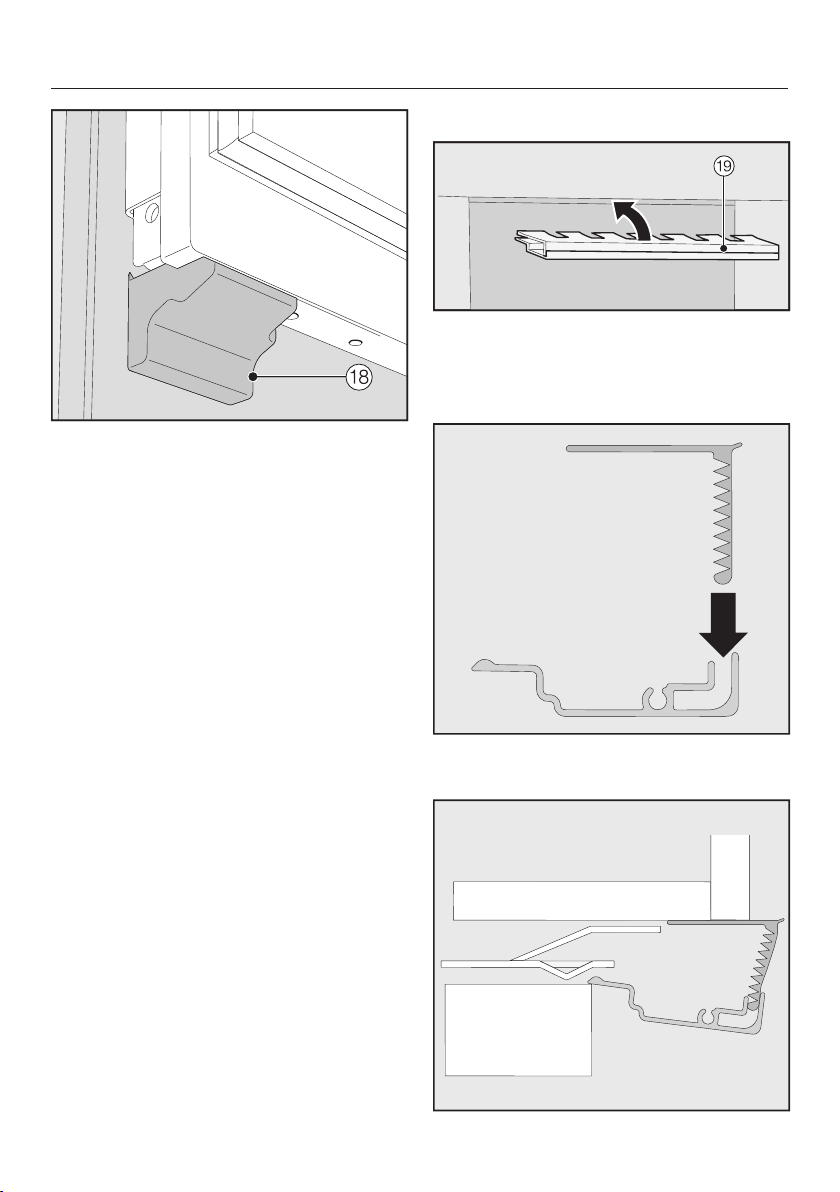
Screw the fixing bracket securely
to the furniture front.
Tighten the screw at the bottom of
the appliance door.
Fit the cover over the fixing
bracket.
Installation
*INSTALLATION*
43
Click the cover onto the fixing
bracket.
Securing the covers
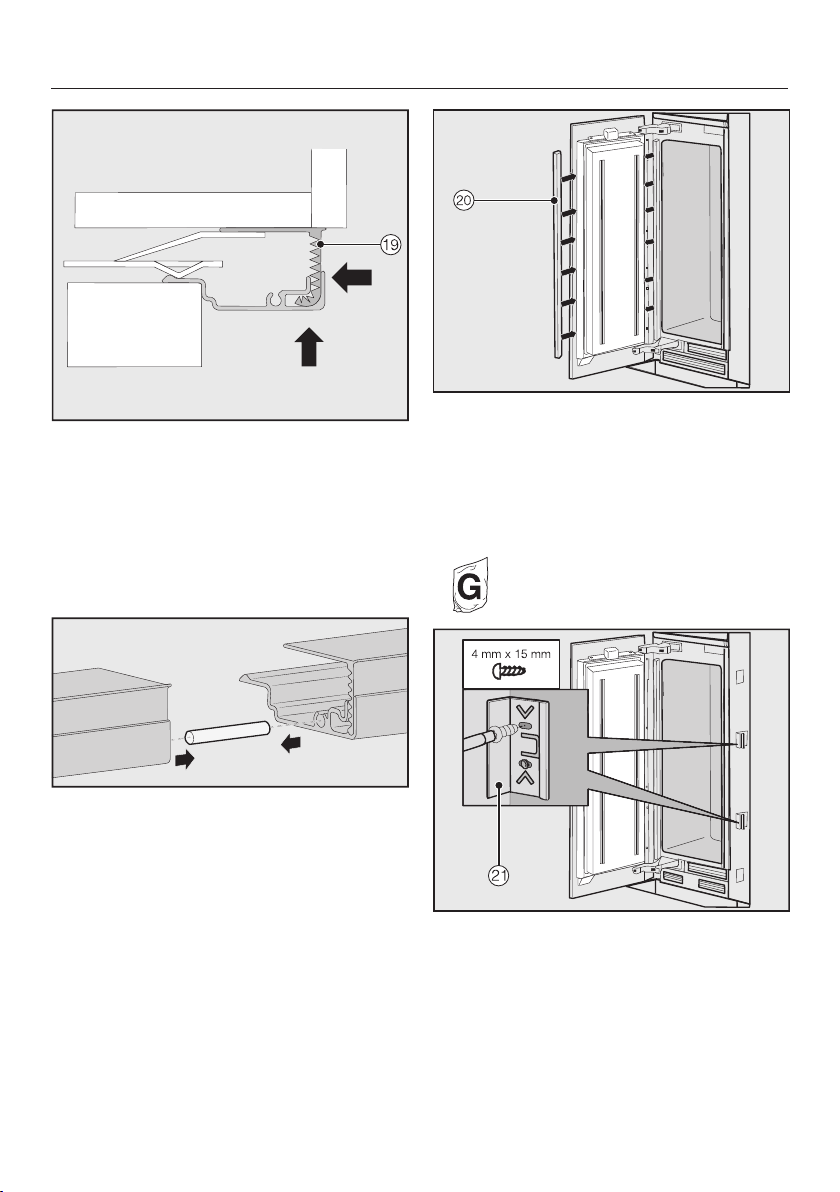
Before the cover can be installed
in the gap above the refrigeration ap-
pliance, it must be assembled as fol-
lows:
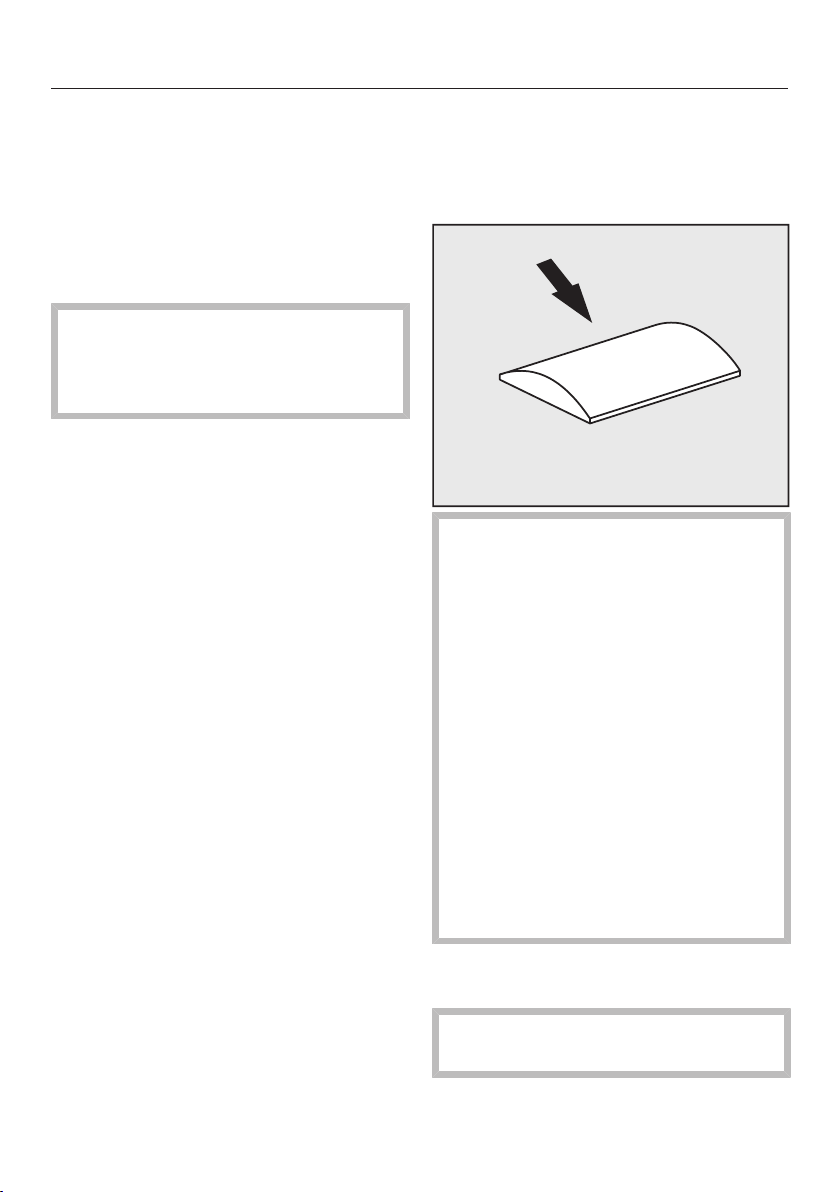
Insert the two parts of the cover into
one another.
Cover viewed from the side
Installation
*INSTALLATION*
44
Place the assembled cover into
the gap above the refrigeration appli-
ance so it clicks into place. While do-
ing so, slide both parts of the cover
together as required.
Installing the cover in a side-by-side
combination
Insert the pin (from the side-by-side
installation kit) halfway into the chan-
nel in the cover for the left-hand refri-
geration appliance.
Place the second cover onto the pin
and press the two covers together.
Click the two covers together into the
gap above the refrigeration appli-
ances.
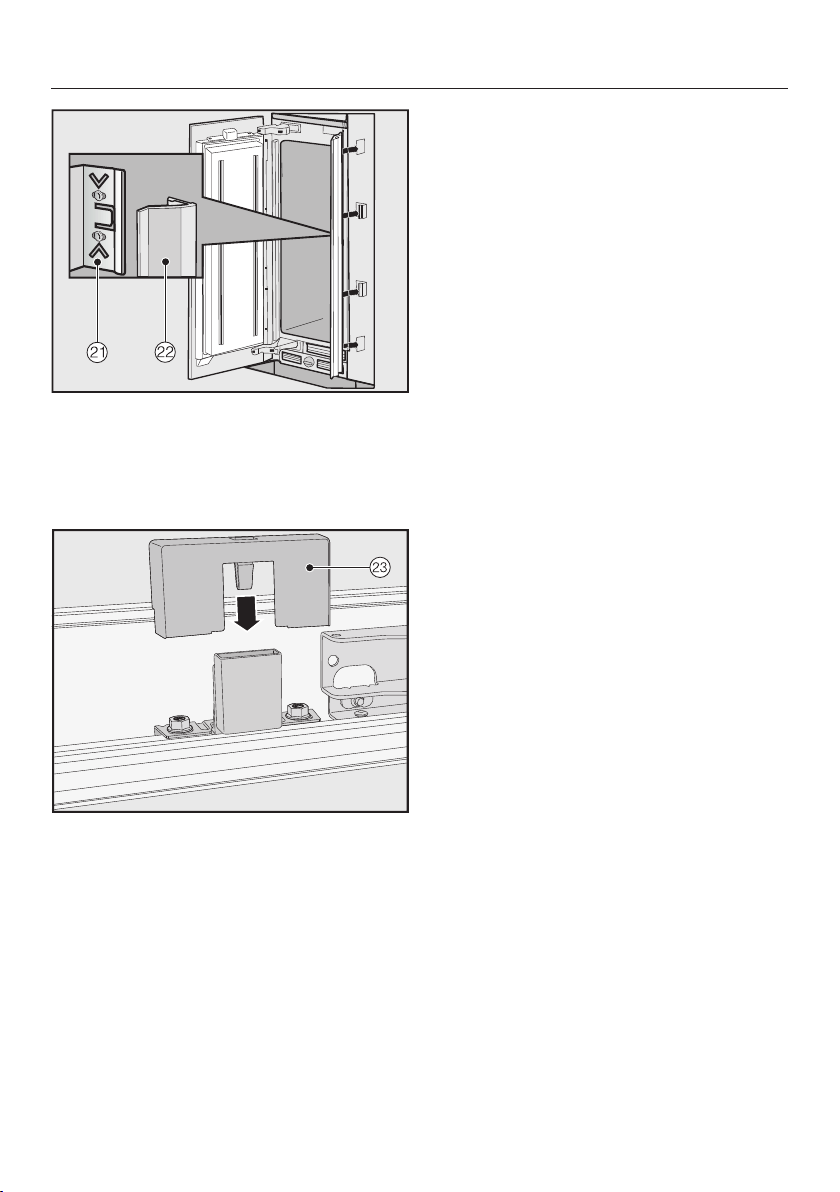
Fit the plastic covers on both sides
of the appliance door by clicking
them into the gap between the appli-
ance door and the furniture front,
starting at the bottom and working up
to the top.
Secure both sides of the refrigeration
appliance using at least 3 clips for
the covers.
Installation
*INSTALLATION*
45
Now attach the covers onto the re-
taining clips on each side.
In the case of side-by-side installa-
tion, the covers are only required on
the outer side.
Fit the cover onto the light contact
switch.
Installation
*INSTALLATION*
46
Securing the plinth ventilation grille
and plinth panel
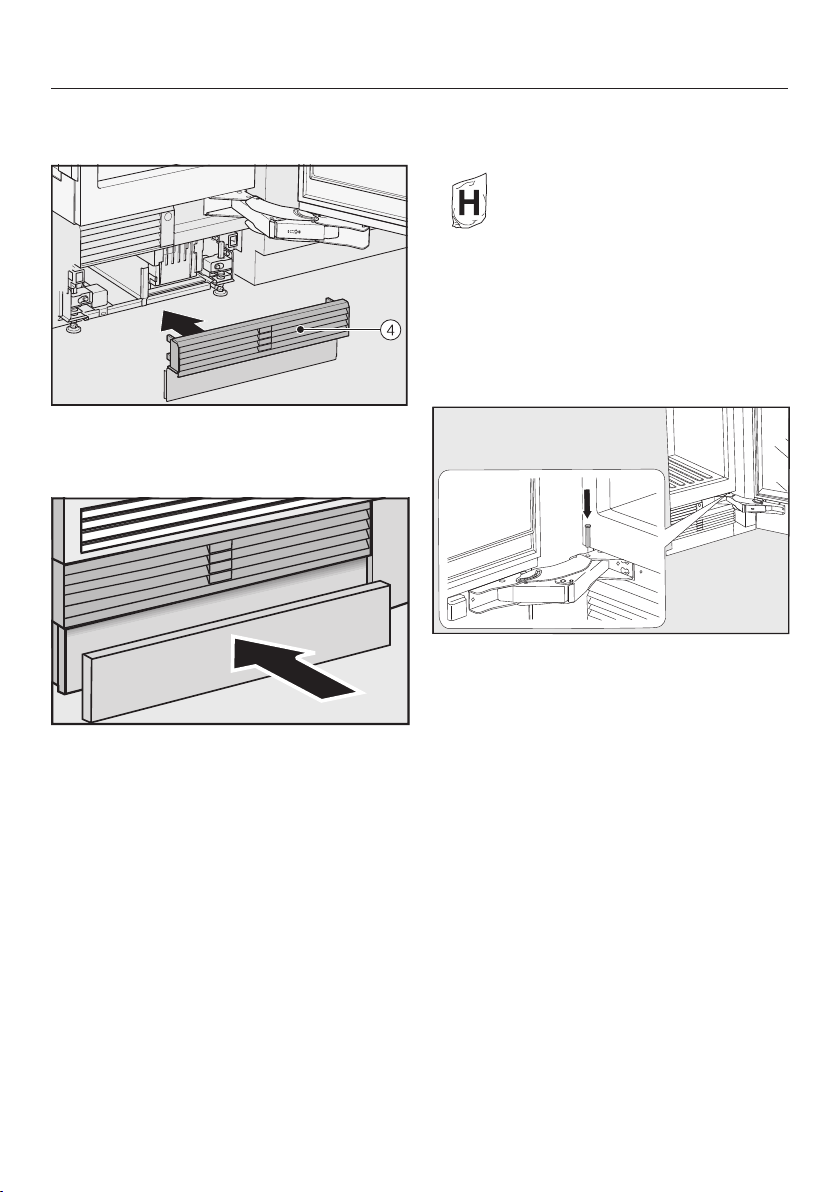
Click the plinth ventilation grille
onto the bottom of the appliance
plinth.
If necessary, cut the plinth panel to
the required length and height (cut
along the lower edge of the plinth
where it touches the floor).
Secure the plinth panel to the bottom
of the plinth ventilation grille.
Limiting the opening angle of the ap-
pliance door
The door hinges are set ex works to en-
able the appliance door to be opened
wide.
If the appliance door hits an adjacent
wall when opened, for example, the
opening angle can be limited to 90°.
Open the appliance door.
Insert the pin into the lower hinge
from above.
This will limit the opening angle of the
appliance door to 90°.
Installation
*INSTALLATION*
47
Electrical connection
The refrigeration appliance must only be
connected to an earthed socket using
the mains connection cable supplied.
The socket must be easily accessible
after the refrigeration appliance has
been installed. If the socket is not easily
accessible, ensure that a suitable
means of disconnection is provided on
the installation side for each pole.
Risk of fire from overheating.
Connecting the refrigeration appli-
ance to a multi-socket plug adapter
or to an extension lead can overload
the cable.
For safety reasons, do not use an ex-
tension lead or multi-socket adapter.
The electrical installation must comply
with VDE0100 requirements.
For safety reasons, we recommend us-
ing a type residual current device
(RCD) in the assigned electrical installa-
tion for connecting the refrigeration ap-
pliance.
If the mains connection cable is dam-
aged, it must only be replaced with a
specific mains connection cable of the
same type (available from the Miele
Customer Service Department). For
safety reasons, such replacement may
only be carried out by a qualified spe-
cialist or the Miele Customer Service
Department.
These operating instructions and the
data plate indicate the nominal power
consumption and the appropriate fuse
rating. Compare this information with
the data of the on-site electrical con-
nection. If in any doubt, consult a quali-
fied electrician.
Temporary or permanent operation on
an autonomous power supply system or
a power supply system that is not syn-
chronised with the mains power supply
(e.g. island networks, back-up systems)
is possible. A prerequisite for operation
is that the power supply system com-
plies with the specifications of
EN50160 or an equivalent standard.
The function and operation of the pro-
tective measures provided in the do-
mestic electrical installation and in this
Miele product must also be maintained
in isolated operation or in operation that
is not synchronised with the mains
power supply, or these measures must
be replaced by equivalent measures in
the installation. As described, for ex-
ample, in the current version of VDE-
AR-E2510-2.
Installation
*INSTALLATION*
48
Connecting the appliance
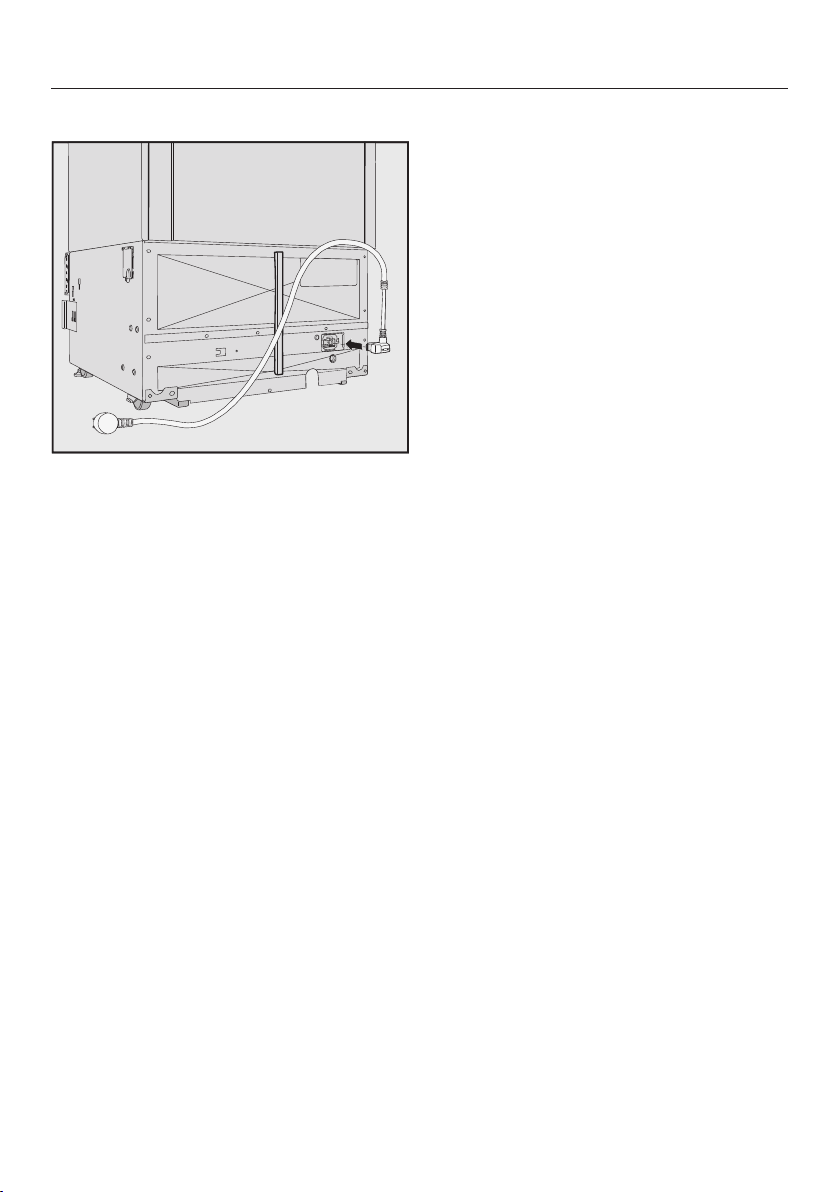
Insert the plug connector into the
socket at the back of the refrigeration
appliance.
Make sure that the plug connector has
clicked into position correctly.
Insert the plug of the refrigeration ap-
pliance into the socket.
The refrigeration appliance is now con-
nected to the electricity supply.
Saving energy
49
Normal energy consump-
tion
Increased energy con-
sumption
Installation /
Maintenance
In a ventilated room. In an enclosed, unventilated
room.
Protected from direct sun-
light.
In direct sunlight.
Not near to a heat source
(radiator, oven).
Near to a heat source (radi-
ator, oven).
Where the ideal ambient
room temperature is approx.
20°C.
Where the ambient room
temperature is above 25°C.
Ventilation gaps uncovered
and dusted regularly.
Ventilation gaps covered or
dusty.
Temperature
setting
Refrigerator section 4 to
5°C
The lower the temperature,
the higher the energy con-
sumption.
Dry compartment in the
MasterFresh zone approx.
0°C.
Saving energy
50
Normal energy consump-
tion
Increased energy con-
sumption
Use Drawers and shelves ar-
ranged as they were when
the appliance was delivered.
Only open the door when
necessary and for as short a
time as possible. Store food
in an organised way.
Frequent opening of doors
for long periods will cause a
loss of coldness. The appli-
ance will try to cool down
and the compressor will run
for longer periods.
Take an insulated cool bag
when shopping, and load
food in the appliance as
soon as possible.
Replace any food removed
as quickly as possible, be-
fore it warms up too much.
Allow hot food and drinks to
cool down before placing
them in the appliance.
Hot food or food at room
temperature raises the tem-
perature inside the appli-
ance. The appliance will try
to cool down and the com-
pressor will run for longer
periods.
Store food well packaged or
covered.
The evaporation or condens-
ation of liquids in the refri-
gerator section will cause a
loss of coldness.
Place frozen food in the refri-
gerator to defrost.
Do not over-fill the appliance
to allow air to circulate.
Poor air circulation will
cause a loss of coldness.
Guide to the appliance
51
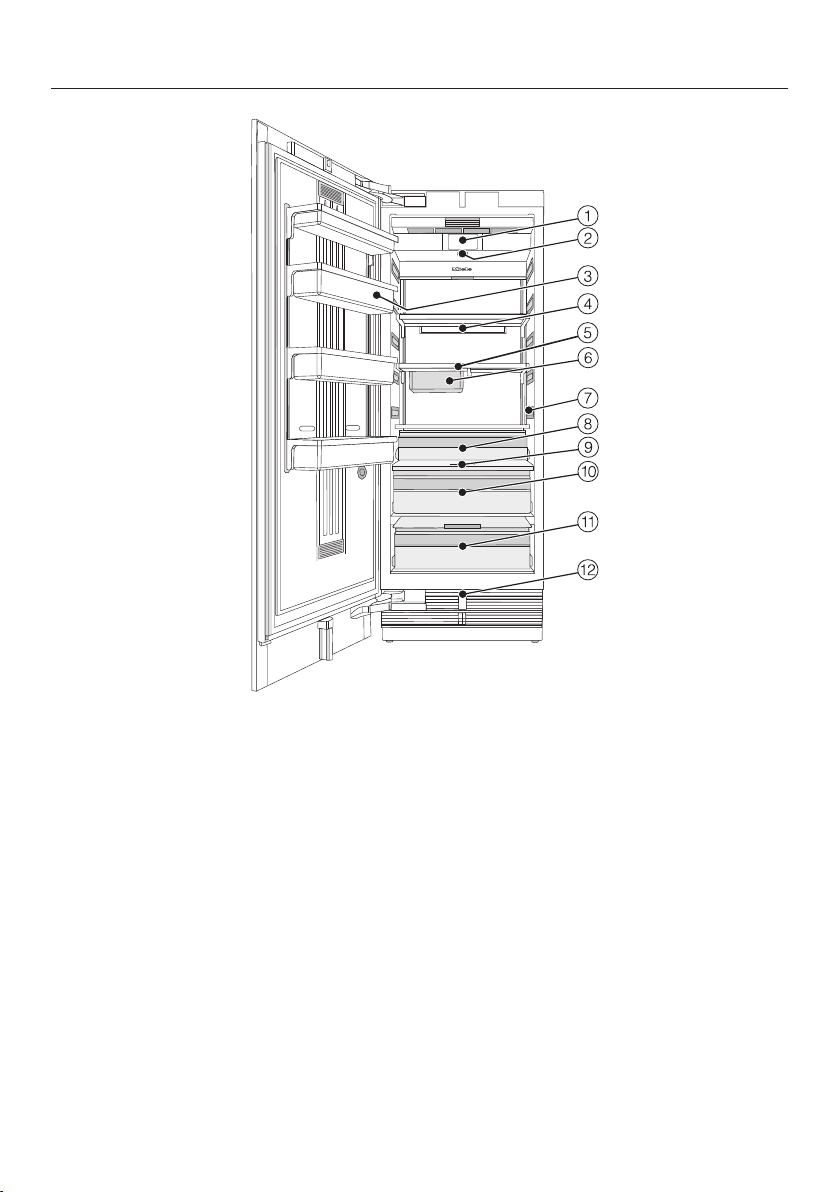
a
Display
b
On/Off switch
c
Shelves in the appliance door
d
Holder for the Active AirClean filter
e
Shelves
f
Hanging drawer for storing small food items
g
Interior lighting
h
Fruit and vegetable drawer
i
Moisture regulator
j
Humidity-controlled compartment with moisture adjustment for fruit and veget-
ables
k
Dry compartment with temperature adjustment for food which goes off quickly
l
Automatic door opening (Push2open/Pull2open)
Guide to the appliance
52
The dry compartment in the MasterFresh zone fulfills the requirements of a cold
storage compartment according to ENISO15502.
Guide to the appliance
53
Main screen
°C
4
1
2
3
4
5
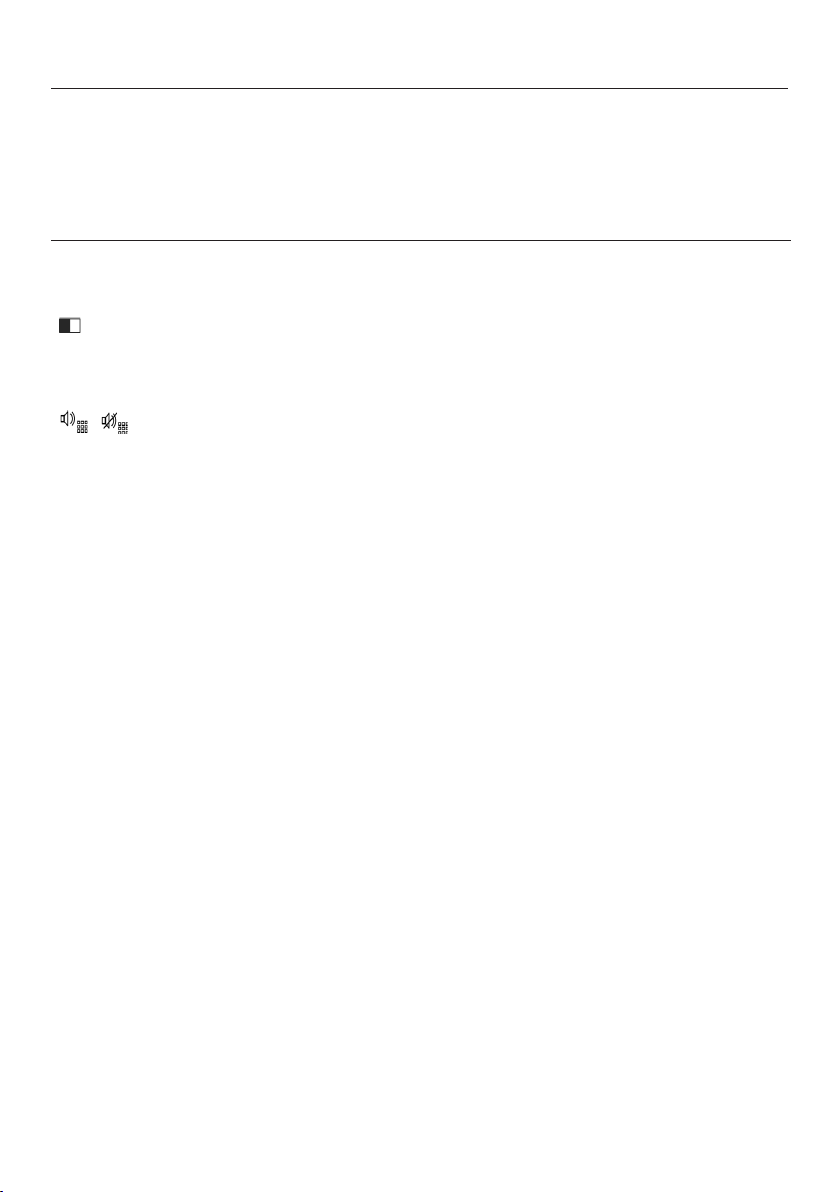
a
SuperCool display
(only visible when the SuperCool function has been switched on)
b
Temperature display (target temperature)
c
Sensor control
for setting the temperature
d
Display for Miele@home connection status
(only visible when the Miele@home function has been set up)
e
Settings mode
sensor control for adjusting various settings in Settings mode
Guide to the appliance
54
Settings mode
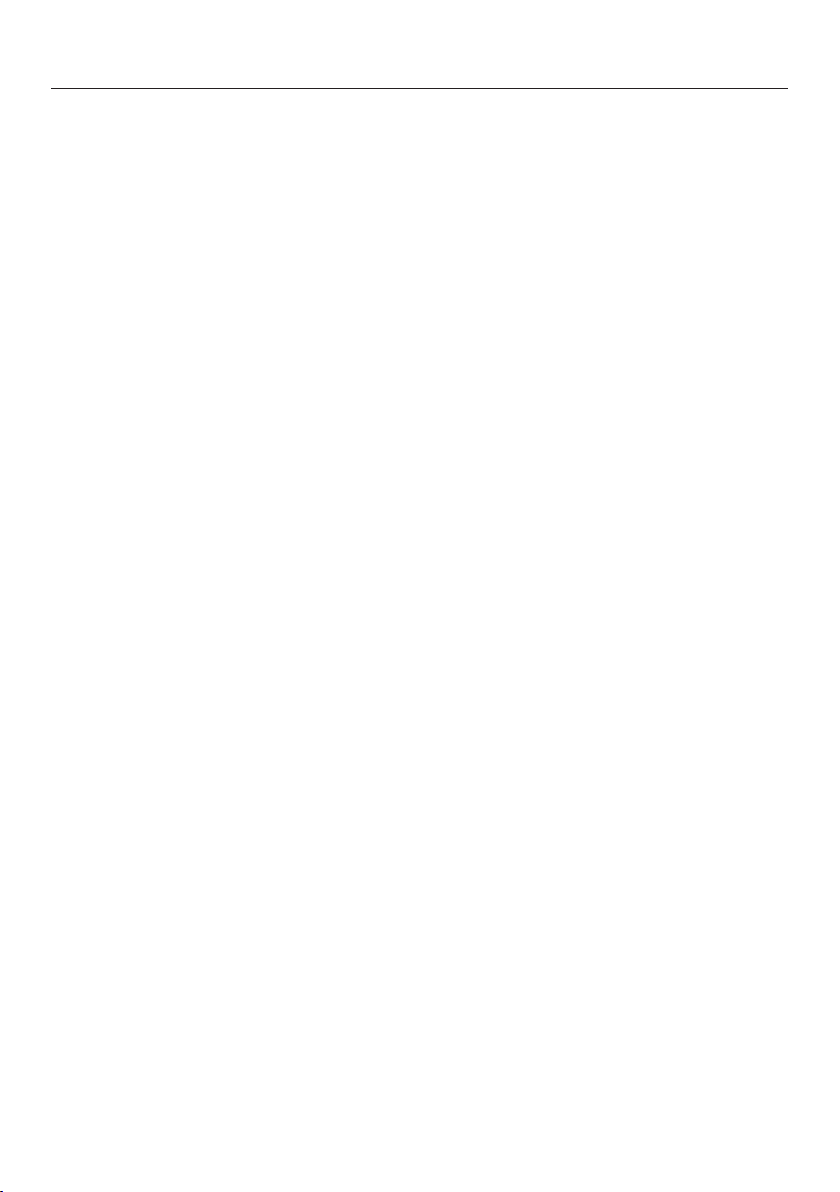
In Settings mode, you can select the following appliance functions and alter their
settings to some extent:
Symbol Function
Language Set
Display brightness Adjust (darker to brighter)
Colour scheme Set (dark or bright)
/ Buzzer tones Adjust the volume or switch off the Buzzer tones
completely (e.g. for the door alarm)
/
Keypad tone Adjust the volume or switch off the Keypad tone
completely
°F/°C Temperature unit Set (°Fahrenheit or °Celsius)
/ Keypad lock Switch on or off
(see “Selecting additional settings”)
MasterFresh Adjust the temperature in the dry compartment
(see “Selecting additional settings”)
Eco mode Switch on or off
(see “Selecting additional settings”)
Self test The system restarts and is checked for faults or
malfunctions
(see “Selecting additional settings”)
Guide to the appliance
55
Door assistant (Push2open or Pull2open) Switch on or off
(see “Selecting additional settings”)
Miele@home Set up, deactivate or query WiFi connection status
(see “Selecting additional settings”)
* Demo mode Switch off
* (only visible when Demo mode, is switched on
see “Selecting additional settings”)
Factory default set-
tings
Reset to default settings
(see “Selecting additional settings”)
Sabbath mode Switch on or off
(see “Selecting additional settings”)
Display Active
AirClean filter
Switch on or off or reset
(see “Selecting additional settings”)
Symbols in Settings mode
/ Scroll in Settings mode or select a setting
/ Change a setting (e.g. display brightness)
OK Confirm a setting
Exit the menu level
Accessories
56
Accessories supplied
Appliance plug
Active AirClean filters
The Active AirClean filters neutralise un-
pleasant odours in the refrigerator sec-
tion and stop odours from being trans-
ferred to the food.
Insert the supplied Active AirClean fil-
ters as described under “Cleaning and
care – Replacing the Active AirClean
filters”.
We recommend replacing the Active
AirClean filters every 6months.
Optional accessories
A range of useful Miele accessories and
care products are available for your ap-
pliance.
Multi-purpose microfibre cloth
The microfibre cloth is suitable for re-
moving fingerprints and light soiling
from surfaces such as stainless steel,
glass, plastic and chrome without the
use of chemicals.
Active AirClean filters
See “Accessories supplied” for a de-
scription.
Active AirClean filters with holder
The Active AirClean filters neutralise un-
pleasant odours in the refrigerator sec-
tion and stop odours from being trans-
ferred to the food.
The holder for the Active AirClean filters
can be fixed under any shelf in the refri-
gerator section.
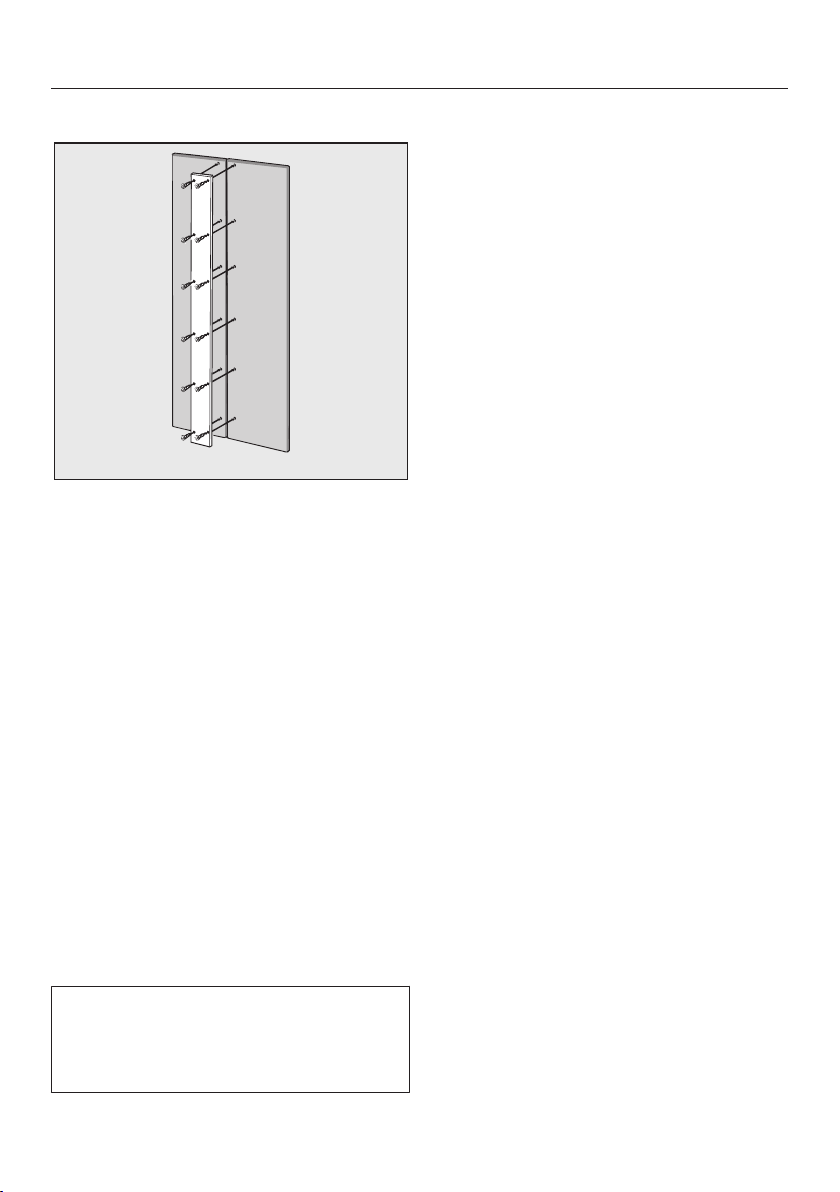
Stainless steel front panel
Stainless steel front panels give your re-
frigeration appliance a high-quality ap-
pearance.
Handles and plinth panels are also
available in stainless steel look.
Accessories
57
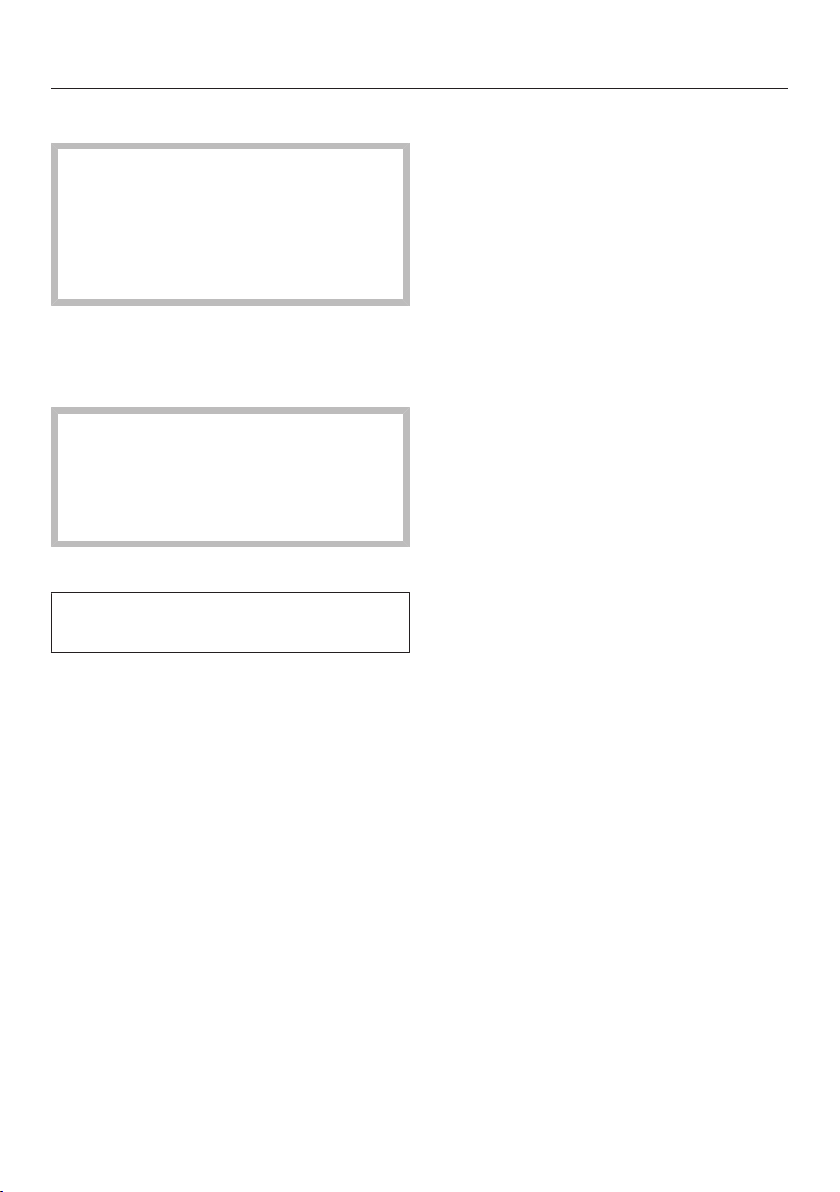
Metal filler panel for cassette fronts
If you wish to install two furniture fronts
next to each other instead of one fur-
niture front, they will have to be con-
nected with a metal filler panel.
Side-by-side installation kit
To install two or more refrigeration ap-
pliances next to one another, you will
need the side-by-side installation kit
(see “Installation – Side-by-side”).
Hinge pocket
If the door hinging needs to be changed
on your refrigeration appliance, the up-
per plinth ventilation grille must be con-
verted. A new hinge pocket is required
in order to do this.
The door hinging must only be changed
by the Miele Customer Service Depart-
ment.
Accessories are available to order via
the Miele Webshop, from Miele dir-
ectly (see back cover for contact de-
tails) or from your Miele dealer.
Initial commissioning
58
Before using for the first time
Allow the refrigeration appliance to
stand for approx. 1hour before con-
necting it to the power supply.
This will prevent potential functional
problems with the refrigeration appli-
ance.
Packaging material
Remove all packaging material from
the inside of the appliance.
Always remove all packaging mater-
ial, including adhesive tape, before
switching on the refrigeration appli-
ance. The adhesive tape is difficult to
remove from cold surfaces.
Cleaning
Please refer to the relevant instruc-
tions in “Cleaning and care”.
Clean the inside of the appliance and
the accessories.
Choosing the right door assistant
(Push2open/Pull2open)
The door assistant helps you to open
the appliance door.
You can choose between the two door
assistants Push2open and Pull2open (see
“Selecting additional settings – Switch-
ing on the Door assistant ”).
The default door assistant is Push2open.
Select the
Pull2open door assistant if your refri-
geration appliance has a furniture
front with a handle.
Select the
Push2open door assistant if your refri-
geration appliance has a handle-free
furniture front.
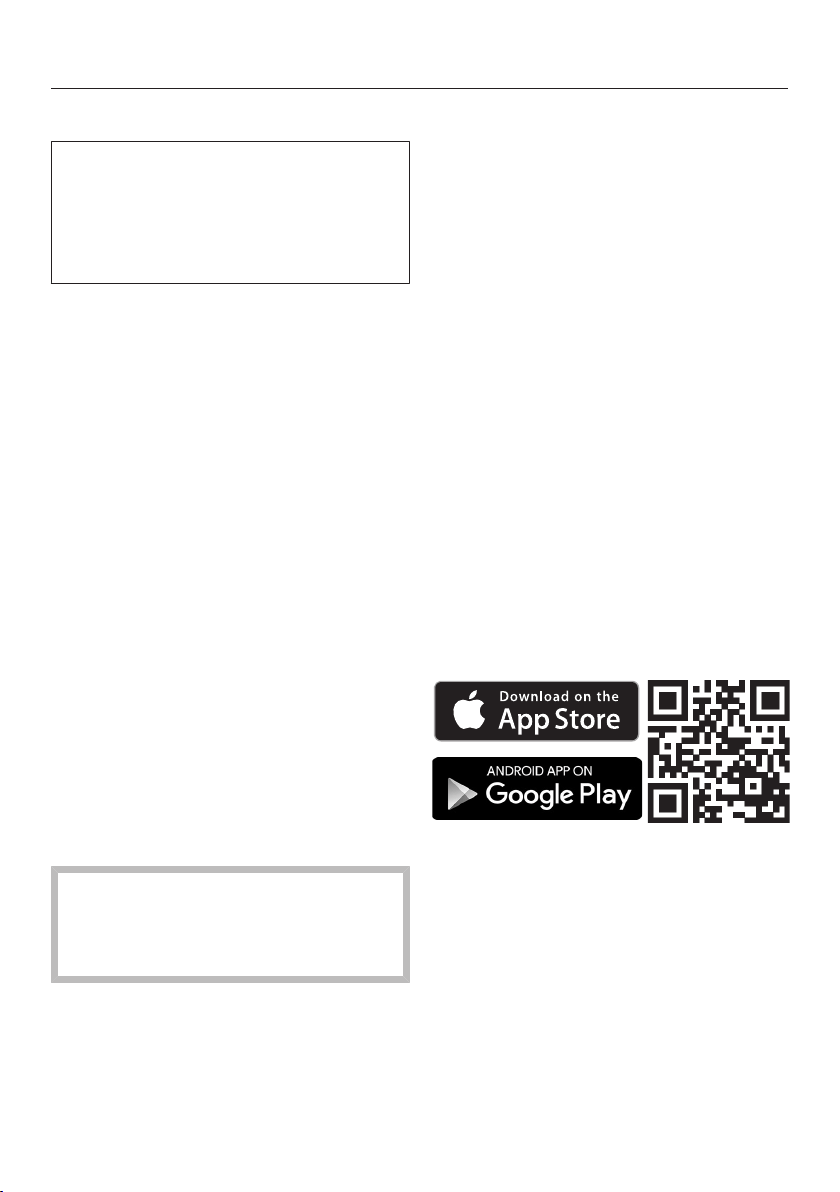
Inserting the Active AirClean filters
Your refrigeration appliance is equipped
with 2 Active AirClean filters which
neutralise unpleasant odours in the re-
frigerator section.
Insert the Active AirClean filters sup-
plied as described under “Cleaning
and care – Replacing the Active
AirClean filters”.
Initial commissioning
59
Miele@home
Your refrigeration appliance is
equipped with an integrated WiFi
module.
Networking is deactivated at the fact-
ory.
To use this feature, you will need:
- A WiFi network
- The Miele app
- A Miele user account You can create
a user account via the Miele app.
The Miele app will guide you as you
connect your refrigeration appliance to
your home WiFi network.
Once the refrigeration appliance is con-
nected to your WiFi network, you can
use the app to carry out the following
activities, for example:
- Call up information on the operating
status of your refrigeration appliance
- Change the settings on your refriger-
ation appliance
Connecting your refrigeration appliance
to your WiFi network will increase en-
ergy consumption, even when the ap-
pliance is switched off.
Make sure that the signal of your
WiFi network is sufficiently strong in
the place where you want to set up
your refrigeration appliance.
Availability of the WiFi connection
The WiFi connection shares a frequency
range with other appliances (including
microwave ovens and remote control
toys). This can give rise to sporadic or
even complete connection failures.
Therefore, the availability of featured
functions cannot be guaranteed.
Miele@home availability
The ability to use the Miele app de-
pends on the availability of the
Miele@home service in your country.
The Miele@home service is not avail-
able in every country.
For information about availability,
please visit www.miele.com.
Miele App
The Miele App is available to download
free of charge from the Apple App
Store
®
or from the Google Play Store™.
Initial commissioning
60
Operating the refrigeration ap-
pliance
The touch display can be scratched
by pointed or sharp objects, e.g.
pens.
Only touch the display with your fin-
gers.
If your fingers are cold, the touch
display may not react.
°C
4
The sensor controls underneath the
temperature display can be selected
directly by touch; the symbols and text
in or above the temperature display can
only be displayed.
Settings mode
In Settings mode, you can select
different refrigeration appliance func-
tions and alter their settings to some
extent (see “Selecting additional set-
tings”).
Touch the sensor control to open
Settings mode.
Use the and sensor controls to
select the function for which you wish
to adjust the settings.
Confirm your selection with OK.
Adjust the settings using either the
and sensor controls or the and
sensor controls.
Confirm your selection with OK.
The setting with the coloured back-
ground is always the selected setting;
it can be confirmed directly with OK.
Touch the sensor control if you
wish to switch to the previous menu
level or terminate the process.
Every touch of the display is con-
firmed with an audible keypad tone.
You can switch off this keypad tone in
Settings mode.
Initial commissioning
61
Performing initial commissioning
Open the appliance door.
Switch the refrigeration appliance on
by pressing the On/Off switch.
The On/Off switch is located below
the display.
The refrigeration appliance will start to
cool and the interior lighting will come
on when the appliance door is opened.
Miele will appear in the refrigeration ap-
pliance display.
When you switch the refrigeration ap-
pliance on for the first time, you will
be asked to make the following set-
tings:
- Set theLanguage
(if you accidentally select the
wrongLanguage, return to Settings
mode and use the symbol to
change the language)
- Set theTemperature unit:
°C (degrees Celsius) or °F (degrees
Fahrenheit)
- Set up Miele@home:
Select Continue if you would like to set
up Miele@home now. You will then be
guided by the display and the Miele
app.
As soon as your refrigeration appliance
has been integrated into your WiFi net-
work, the message Connection successful
will appear on your refrigeration appli-
ance‘s display.
Confirm the process with OK again.
If the WiFi connection is active, will
appear on the display.
Select Skip if you would prefer to set
up Miele@home later.
Touch the sensor control if you
want to return to the previous menu
level.
Set-up successful will appear in the display.
Confirm initial commissioning with
OK.
The main screen will appear on the dis-
play (see “Appliance description – Main
screen”).
You cannot terminate the initial com-
missioning process. The only way to
terminate the process is to switch off
the refrigeration appliance, though the
process will continue when the appli-
ance is switched back on.
Switching on and off
62
Switching the refrigeration ap-
pliance on
Open the appliance door.
Switch the refrigeration appliance on
by pressing the On/Off switch.
The refrigeration appliance will start to
cool and the interior lighting will come
on when the appliance door is opened.
Miele will appear, followed by the main
screen on the refrigeration appliance
display:
°C
4
To enable the temperature to get suf-
ficiently cold inside the refrigeration
appliance, allow it to run for a few
hours before placing food in it.
Risk of damage due to high hu-
midity.
In environments with high humidity,
condensation can build up on ex-
ternal refrigeration appliance panels.
This condensation can cause corro-
sion and lead to damage on external
appliance panels.
Install the refrigeration appliance in a
dry and/or air-conditioned room with
sufficient ventilation.
Do not switch the refrigeration appli-
ance on if you are going to be away
for a long period of time.
Do not leave the refrigeration appli-
ance unattended for a long period of
time while it is switched on.
Switching off the refrigeration appli-
ance
Switch the refrigeration appliance off
by pressing the On/Off switch.
The cooling and interior lighting are
switched off.
Please note: the refrigeration appli-
ance is not disconnected from the
power supply when it is switched off
with the On/Off switch.
Switching on and off
63
Switching off for longer peri-
ods of time
If the refrigeration appliance is not go-
ing to be used for a longer period of
time:
Switch the refrigeration appliance off.
Switch off at the wall socket and
withdraw the plug from the socket, or
disconnect the fuse.
Clean the refrigeration appliance.
Leave the door ajar to air the refriger-
ation appliance and prevent odours
from building up inside it.
If, during a long absence, the refri-
geration appliance is switched off
but not cleaned and the door(s) left
shut, there is a risk of mould forming
inside the appliance.
It is essential to clean the refrigera-
tion appliance.
Selecting additional settings
64
In Settings mode , you can select dif-
ferent refrigeration appliance settings
and alter their settings to some extent,
allowing you to adjust the appliance to
suit your requirements.
Only the functions in Settings mode
that require further explanation are de-
scribed below.
The door alarm and other warnings
are automatically disabled when the
appliance is in Settings mode.
Switching Keypad lock/
on or off
Switch Keypad lock on if you wish to
protect your refrigeration appliance
from unwanted temperature changes or
other unintentional adjustments in Set-
tings mode.
In Settings mode, use the and
sensor controls to select Keypad
lock and select OK to confirm your
selection.
Use the and sensor controls to
switch the sensor lock On or Off and
select OK to confirm your selection.
The sensor lock will not be activated
until you close the appliance door.
Nothing will appear on the display to in-
dicate that the sensor lock is switched
on.
The message Press OK for 6 seconds to
unlock will appear on the display if you
select a sensor control while the sensor
lock is switched on.
Follow the instructions on the display.
The display is unlocked briefly so you
can adjust the setting as required. Clos-
ing the appliance door will reactivate
the sensor lock.
Selecting additional settings
65
Adjusting the temperature in
the MasterFresh zone (dry
compartment)
In Settings mode, use the
and sensor controls to se-
lectMasterFresh and selectOK to
confirm your selection.
Use the and sensor controls to
select the desired temperature and
touch OK to confirm your selection.
Touch the sensor control if you
wish to terminate the process.
The segment bar displays 5 segments;
the temperature is adjusted in incre-
ments of approx. 1°C.
The factory default setting for the tem-
perature in the dry compartment is
0°C.
Switching Eco mode on or
off
Eco mode is useful when you go on holi-
day, for example, if you do not wish to
switch off the refrigeration appliance
completely or do not need a high de-
gree of cooling. Energy consumption in
Eco mode is lower than in normal opera-
tion.
The refrigerator section is thereby regu-
lated to a temperature of 6°C and the
dry compartment in the MasterFresh
zone to approx. 1°C.
If the SuperCool function is switched
on, this will be automatically switched
off when Eco mode is selected.
In Settings mode, use the and
sensor controls to select Eco mode
and select OK to confirm your selec-
tion.
Use the and sensor controls to
switch the Eco mode On or Off and se-
lect OK to confirm your selection.
Only the changed temperature on the
display indicates that Eco mode is
switched on.
Tip: You can also switch off the Eco
mode function by directly adjusting the
temperature (see “The correct tem-
perature – Setting the temperature”).
Storing food at a temperature of 6°C
for an extended period of time may
impair the shelf life and quality of the
food.
Selecting additional settings
66
Performing a Self test
Perform a Self test if you are concerned
that your refrigeration appliance is not
working properly and want to check if it
is suffering from any problems.
In Settings mode, use the
and sensor controls to selectSelf
test and selectOK to confirm your se-
lection.
Touch the sensor control if you
wish to terminate the process.
The Self test starts and the refrigeration
appliance is checked for any faults or
malfunctions.
- The message System restart will ap-
pear on the display if the self test
does not discover any faults or mal-
functions.
- If the self test does discover any
faults or malfunctions, they are indic-
ated as error messages on the dis-
play.
An alarm will also sound.
If you find the alarm disruptive, you
can switch it off in advance by touch-
ing the sensor control.
Make a note of the error message(s)
displayed.
Contact the Miele Customer Service
Department and inform them of the
error message(s) on the display.
Confirm the message with OK.
System restart will appear on the display.
The refrigeration appliance briefly
switches off and then back on automat-
ically.
Self test completed will appear on the dis-
play.
Confirm the message with OK.
The main screen will appear on the dis-
play again.
Selecting additional settings
67
Switching on the Door assist-
ant
You can choose between the two door
assistants: Push2open and Pull2open.
The default door assistant is Push2open.
The Push2open door assistant is suitable
for furniture fronts without handles. The
appliance door opens automatically
when you gently press against it.
The Pull2open door assistant is suitable
for furniture fronts with handles. The ap-
pliance door can be opened easily with
little force.
Risk of damage if the appliance
door is closed prematurely.
When the door assistant is switched
on, repeatedly closing the appliance
door early can lead to damage or
malfunctions.
Refrain from holding onto or closing
the appliance door while automatic
door opening is still extended. How-
ever, if you have closed the appli-
ance door, leave it closed for
5minutes. Automatic door opening
resets itself.
Switching on Push2open
In Settings mode, use the
and sensor controls to selectDoor
assistant and selectOK to confirm
your selection.
Use the and sensor controls to
select Mode and select OK to confirm
your selection.
Use the and sensor controls to
select Push2open and select OK to
confirm your selection.
Touch the sensor control to return
to the previous menu level.
– Adjusting the intensity
You can also adjust the intensity of the
Push2openfunction. The lower the set
intensity, the less force required when
you push against the appliance door.
In Settings mode, use the
and sensor controls to selectDoor
assistant and selectOK to confirm
your selection.
In Settings mode, use the
and sensor controls to selectIn-
tensity and selectOK to confirm your
selection.
Use the and sensor controls to
select the right intensity (Low, Medium,
High) and select OK to confirm your
selection.
Selecting additional settings
68
– Adjusting the duration of the Auto-
Close function
You can also adjust the duration for
how long the appliance door will remain
open until it closes automatically.
In Settings mode, use the
and sensor controls to selectDoor
assistant and selectOK to confirm
your selection.
In Settings mode, use the
and sensor controls to selectAuto-
Close and selectOK to confirm your
selection.
Use the and sensor controls to
select the duration (5 to 30seconds)
and touch OK to confirm your selec-
tion.
To protect against inadvertent open-
ing: if you do not pull the appliance
open, it will close again by itself after a
duration defined by you.
Switching on Pull2open
In Settings mode, use the
and sensor controls to selectDoor
assistant and selectOK to confirm
your selection.
Use the and sensor controls to
select Mode and select OK to confirm
your selection.
Use the and sensor controls to
select Pull2open and select OK to
confirm your selection.
Touch the sensor control to return
to the previous menu level.
– Adjusting the intensity
You can also adjust the intensity of the
Pull2openfunction. The lower the set in-
tensity, the less force required when
you pull the appliance door.
In Settings mode, use the
and sensor controls to selectDoor
assistant and selectOK to confirm
your selection.
In Settings mode, use the
and sensor controls to selectIn-
tensity and selectOK to confirm your
selection.
Use the and sensor controls to
select the right intensity (Low, Medium,
High) and select OK to confirm your
selection.
Selecting additional settings
69
Switching off theDoor assist-
ant
In Settings mode, use the
and sensor controls to selectDoor
assistant and selectOK to confirm
your selection.
Use the and sensor controls to
select Mode and select OK to confirm
your selection.
Use the and sensor controls to
select Off and select OK to confirm
your selection.
Touch the sensor control to return
to the previous menu level.
Miele@home
Setting up Miele@home
The message Set up Miele@home only
appears if the refrigeration appliance
has not yet been connected to a WiFi
network.
Connect your refrigeration appliance
as described in “Before using for the
first time”.
Deactivating Miele@home
In Settings mode, use the
and sensor controls to se-
lectMiele@home and selectOK to
confirm your selection.
Use the and sensor controls to
select Deactivate and select OK to
confirm your selection.
Deactivation successful will appear on the
display.
Confirm the message with OK.
Your refrigeration appliance is now dis-
connected from your WiFi network.
The symbol will go out on the dis-
play.
Selecting additional settings
70
Activating Miele@home
If you have already activated
Miele@home and then disconnected
the connection, you will need to react-
ivate the connection.
In Settings mode, use the
and sensor controls to se-
lectMiele@home and selectOK to
confirm your selection.
Use the and sensor controls to
select Activate and select OK to con-
firm your selection.
Activation successful will appear on the
display.
Confirm the message with OK.
If the WiFi connection is active, will
appear on the display.
Checking the WiFi connection status
In Settings mode, use the
and sensor controls to se-
lectMiele@home and selectOK to
confirm your selection.
Use the and sensor controls to
select Connection status and select OK
to confirm your selection.
Information about the WiFi connection
status will then appear on the display:
- connected: there is a strong con-
nection
- connected: there is an average
connection
- connected: there is a weak con-
nection
- : disconnected
Setting up Miele@home again
If you have changed your WiFi network,
you can set up Miele@home again for
your refrigeration appliance.
In Settings mode, use the
and sensor controls to se-
lectMiele@home and selectOK to
confirm your selection.
Use the and sensor controls to
select Set up again and select OK to
confirm your selection.
Reset configuration?will appear on the
display.
Use the and sensor controls to
select Yes or No and select OK to
confirm your selection.
Resetting the network configuration
Reset the refrigeration appliance’s set-
tings to the default settings when dis-
posing of your refrigeration appliance,
selling it or putting a used refrigeration
appliance into operation. This will re-
set the network configuration so that
all personal data is deleted from the
refrigeration appliance. This will also
ensure that a previous owner is no
longer able to access the refrigeration
appliance.
Reset the settings of the refrigeration
appliance as described in the chapter
“Resetting the settings to their default
settings”.
Selecting additional settings
71
Switching off theDemo
mode
Demo mode allows the refrigeration
appliance to be presented in the
showroom without the cooling sys-
tem being switched on. This setting
is not needed for domestic use.
If Demo mode has been switched on
as a default setting, will show on the
display.
In Settings mode, use the
and sensor controls to selectDemo
mode and selectOK to confirm your
selection.
Press OK for 4 seconds to deactivate will
appear on the display.
Follow the instructions on the display.
The countdown Demo mode will deactiv-
ate in seconds will appear on the display.
Demo mode deactivated. Appliance cooling
switched on will appear on the display.
Confirm the message with OK.
The main screen will appear on the dis-
play again.
Selecting additional settings
72
Resetting the settings to their default settings
You can reset the refrigeration appliance‘s settings to their default settings.
Reset the refrigeration appliance’s settings to the default settings when disposing
of your refrigeration appliance, selling it or putting a used refrigeration appliance
into operation. This will reset the network configuration so that all personal data
is deleted from the refrigeration appliance. This will also ensure that a previous
owner is no longer able to access the refrigeration appliance.
In Settings mode, use the and sensor controls to selectFactory default
settings and selectOK to confirm your selection.
Use the and sensor controls to select Reset and select OK to confirm your
selection.
After a brief delay, Settings reset will appear on the display.
Confirm the message with OK.
The initial commissioning process restarts (see “Initial commissioning – Starting up
for the first time”).
The refrigeration appliance‘s settings will be reset to the following values:
Selecting additional settings
73
Function Default setting
Language English
Display brightness Middle value
(4 of 7 segments)
Colour scheme Dark
/ Buzzer tones Middle value
(4 of 7 segments)
/
Keypad tone Middle value
(4 of 7 segments)
°C/°F Temperature unit °Celsius
/ Keypad lock Switched off
MasterFresh 0°C (2 of 5 segments)
Eco mode Switched off
Door assistant Push2open
Miele@home Switched off
Sabbath mode Switched off
Display Active AirClean filter Switched on
Temperature in the refriger-
ator section
4°C
Temperature in the dry com-
partment
0°C
Selecting additional settings
74
Switching Sabbath modeon
or off
The refrigeration appliance has a Sab-
bath mode to support the observance of
religious customs.
When Sabbath mode is switched on,
you cannot make any settings on your
refrigeration appliance.
Ensure that the appliance door is
properly closed, as visual and audible
alarms are switched off in Sabbath
mode.
In Settings mode, use the
and sensor controls to selectSab-
bath mode and selectOK to confirm
your selection.
Use the and sensor controls to
select On or Off and select OK to con-
firm your selection.
When Sabbath mode is switched on,
will appear on the display and the
display brightness will be reduced (the
display does not change when the ap-
pliance door is closed).
When Sabbath mode is switched on,
the following functions are switched off:
- Door assistant
(for furniture fronts without handles,
the appliance door will have to be
pulled from the bottom or side)
- Lighting
- All acoustic and visual signals
- Temperature display
- The SuperCool function
(if previously switched on)
You can still select:
- The sensor control for Settings
mode so that Sabbath mode can be
switched off.
The Sabbath mode function will switch it-
self off automatically after approx.
125hours.
Health risk caused by decom-
posing food.
As power failures are not indicated
while Sabbath mode is active, food
may be exposed to increased tem-
peratures for a certain period of time.
This will reduce the storage life of the
food.
If there is a power failure during Sab-
bath mode, check the quality of the
food.
Selecting additional settings
75
Switching on, switching off or
resetting theDisplay Active
AirClean filter
The Display Active AirClean filter will re-
mind you approx. every 6months that
the Active AirClean filters have to be re-
placed. Change Active AirClean filter will
appear on the display.
See “Cleaning and care – Replacing the
Active AirClean filters” for instructions
on how to replace the Active AirClean
filters.
The first time the Active AirClean filters
need to be replaced, the display will
remind you automatically; the re-
minder does not need to be switched
on separately.
Switching the Display Active AirClean
filter on
If theDisplay Active AirClean filter has
been switched off once, it must be
switched on again if required.
In Settings mode, use the
and sensor controls to selectDis-
play Active AirClean filter and selectOK
to confirm your selection.
Use the and sensor controls to
select On and select OK to confirm
your selection.
The Display Active AirClean filter has been
switched on.
Switching the Display Active AirClean
filter off
If you do not require the Display Active
AirClean filter, you can switch it off.
In Settings mode, use the
and sensor controls to selectDis-
play Active AirClean filter and selectOK
to confirm your selection.
Use the and sensor controls to
select Off and select OK to confirm
your selection.
TheDisplay Active AirClean filter has been
switched off.
Selecting additional settings
76
Resetting the Display Active AirClean
filter
After you have replaced the Active
AirClean filters, you must reset the Dis-
play Active AirClean filter so that it can be
displayed again after 6months.
If you do not reset the display, it ap-
pears again and again.
In Settings mode, use the
and sensor controls to selectDis-
play Active AirClean filter and selectOK
to confirm your selection.
Use the and sensor controls to
select Reset and select OK to confirm
your selection.
The message Change Active AirClean filter
will disappear from the display.
The Display Active AirClean filter to replace
the Active AirClean filters has been ac-
tivated.
The correct temperature
77
It is very important to set the correct
temperature for storing food in the ap-
pliance. Bacteria will cause food which
is not stored at the correct temperature
to deteriorate rapidly. Temperature influ-
ences the growth rate of these bacteria.
Reducing the temperature reduces their
growth rate.
The temperature in the refrigeration ap-
pliance will rise:
- The more often the appliance door is
opened and the longer it is kept open
- The more food that is stored in it
- The warmer the food is which is be-
ing put into it
- The higher the ambient temperature
surrounding the refrigeration appli-
ance. This refrigeration appliance is
designed for use within specific am-
bient temperatures (climate range).
Do not use in ambient temperatures
for which it is not designed.
...in the refrigerator section
and in the MasterFresh zone
We recommend a temperature of 4°C
in the refrigerator section.
We recommend a temperature of 0°C
in the dry compartment of the
MasterFresh zone.
Automatic temperature distribution
(DynaCool)
The fan switches on automatically when
the cooling system for the refrigerator
switches on. It distributes the temperat-
ure in the appliance to all areas more
evenly so that all the food will be chilled
to about the same degree.
The correct temperature
78
Setting the temperature
Touch the sensor control to set the
temperature.
The previously set temperature will ap-
pear.
Use the and sensor controls to
set the temperature. Keeping your fin-
gers on the sensor controls changes
the temperature continuously.
Confirm the temperature setting
withOK or wait approx. 8seconds
after the last touch of the sensor con-
trol. The temperature will then be
automatically adopted.
Tip: The newly set temperature can also
be confirmed and adopted by closing
the appliance door.
The temperature display always shows
the required temperature.
If you have adjusted the temperature,
wait for approx. 6hours if the refri-
geration appliance is not very full and
for approx. 24hours if the refrigera-
tion appliance is full before checking
the temperature display. It will take this
long for the appliance to give an accur-
ate reading.
If, after this time, the temperature is
still too high or too low, you will need
to adjust it again.
Adjusting the temperature in the dry
compartment of the MasterFresh
zone
The temperature in the dry compart-
ment of the MasterFresh zone is main-
tained at approx. 0°C.
However, if you would like it to be
warmer or colder, you can adjust the
temperature slightly (see “Selecting ad-
ditional settings – Adjusting the temper-
ature in the MasterFresh zone (dry com-
partment)”).
Tip: You can select a lower setting for
storing, for example, particularly delic-
ate fish. A slightly higher temperature is
preferable for storing ready-to-eat food,
for example.
Temperature range
The temperature in the refrigerator sec-
tion can be adjusted from 2°C to 8°C.
The temperature in the dry compart-
ment of the MasterFresh zone can be
adjusted from approx. -1°C to 3°C.
Using Super cool
79
SuperCool function
The Super cool function can be used to
rapidly reduce the temperature in the
refrigerator section to its lowest setting
(depending on the room temperature).
Super cool is particularly recommended
for the rapid chilling of large amounts of
fresh food or drink.
Switching on Super cool
Touch the sensor control to set the
temperature.
Touch the sensor control to switch
the SuperCool function on.
The symbol will be highlighted in col-
our and the newly set temperature value
of 2°C will appear on the display.
Confirm the setting with OK or wait
approx. 8seconds after the last press
of the button. The setting will be
automatically adopted.
The symbol will now be illuminated
on the display.
The refrigeration appliance will now run
at maximum power.
Switching off Super cool
Touch the sensor control to set the
temperature.
The symbol will be highlighted in col-
our and the temperature value of 2°C
will be shown on the display.
Touch the sensor control to switch
the SuperCool function off.
The symbol will no longer be high-
lighted in colour and the previous tem-
perature setting will appear again on the
display.
Confirm the setting with OK or wait
approx. 8seconds after the last press
of the button. The setting will be
automatically adopted.
The symbol will disappear from the
temperature display.
The refrigeration appliance will continue
running at normal power.
If you do not turn off the SuperCool
function, it will turn itself off automatic-
ally after approx. 6hours. The appliance
will then run at normal power again.
Tip: To save energy, the Super cool
function can be switched off once food
and drinks are sufficiently chilled.
Door alarm
80
The appliance is fitted with a warning
system to avoid increased energy con-
sumption if the door is left open.
Door alarm
An alarm will sound if the appliance
door has been left open for longer than
2minutes.
The message Close the door will also ap-
pear on the display.
As soon as the appliance door is
closed, the alarm tone will stop and the
message in the display will go out.
Switching the door alarm off early
If the alarm disturbs you, it can be
turned off early.
Touch the OKsensor control.
The alarm will stop and the message
will disappear from the display.
After a certain time, the alarm will
sound again and the message will re-
appear on the display until the appli-
ance door has been closed.
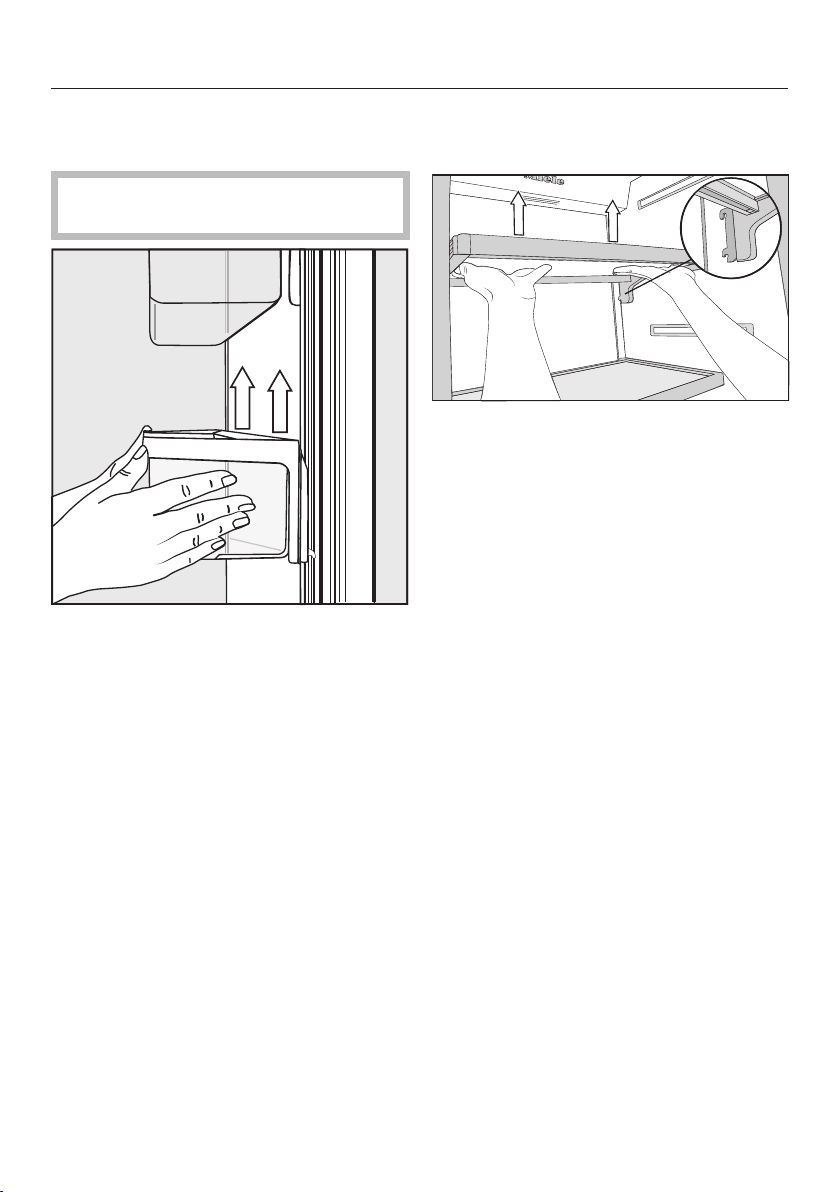
Adjusting the interior fittings
81
Removing or moving the door
shelves
Only move or remove the door
shelves when they are empty.
Hold the shelf on the frame with both
hands and lift it slightly so that it can
be lifted with the catches on both
sides over the guide.
Remove the shelf or place it in the re-
quired position with the catches in
the guides at the same height again.
Make sure that the shelf is straight.
Tip: For the purposes of loading and
unloading or cleaning, the clip-in con-
tainers in the shelves can be removed
from their holders completely.
Removing or moving the
shelves
Use both hands to grip the shelf from
below and raise it slightly so that it
can be lifted with the catches over
the guide at the back.
Pull the shelf forwards.
Remove the shelf or place it in the re-
quired position, with the catches in
the guide again.
Make sure that the shelf is straight.
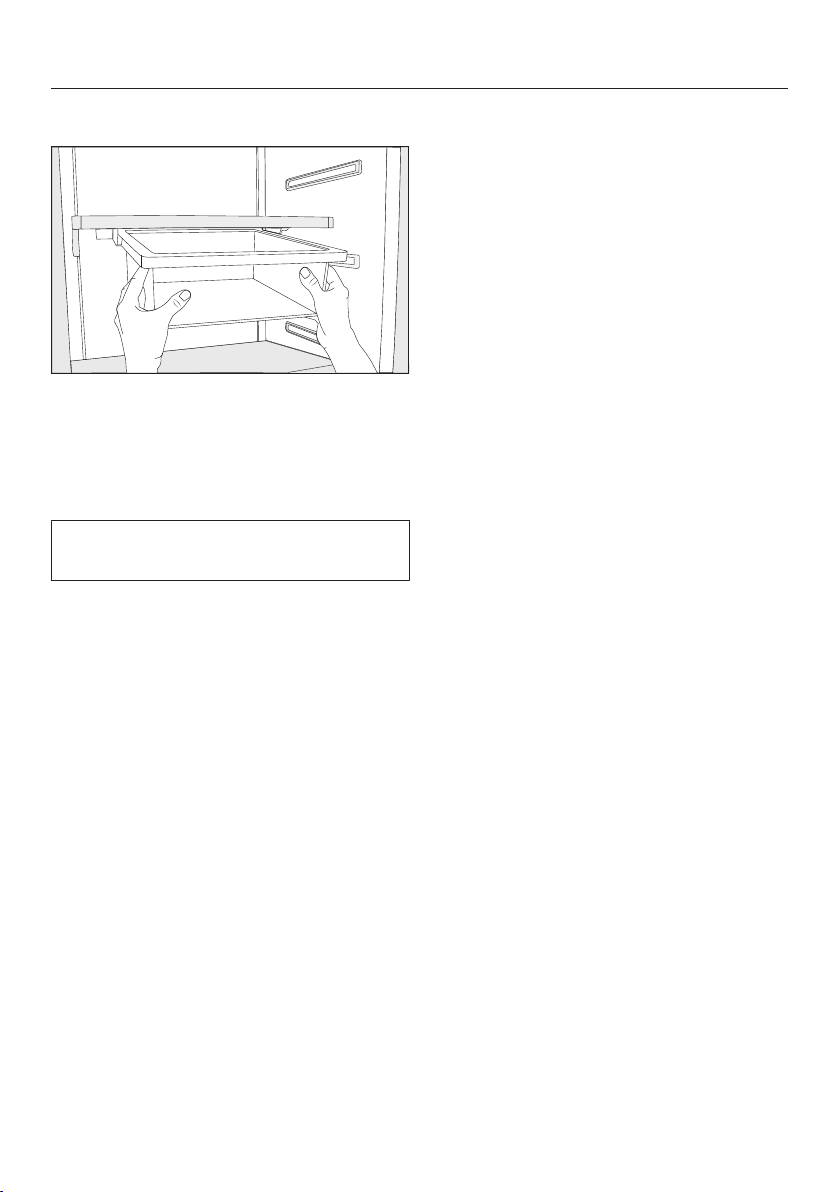
Adjusting the interior fittings
82
Removing the hanging drawer
Pull the hanging drawer straight out
to lift it over the pull-out stops on
both sides.
To reinsert the hanging drawer, push
it straight into the guide.
The hanging drawer can be moved to
the left or right if required.
Moving the hanging drawer
The hanging drawer can be fixed under
any shelf in the refrigerator section.
Pull the hanging drawer out.
To remove the holder for the hanging
drawer, press against the retainers on
both sides of the holder from the rear
and pull the holder downwards diag-
onally from the frame.
To replace the holder, press against
the retainers on both sides of the
holder from the rear and clamp it into
the gap on the frame from below.
Put the hanging drawer back in.
Tip: Alternatively, you can move the
shelf together with the hanging drawer.
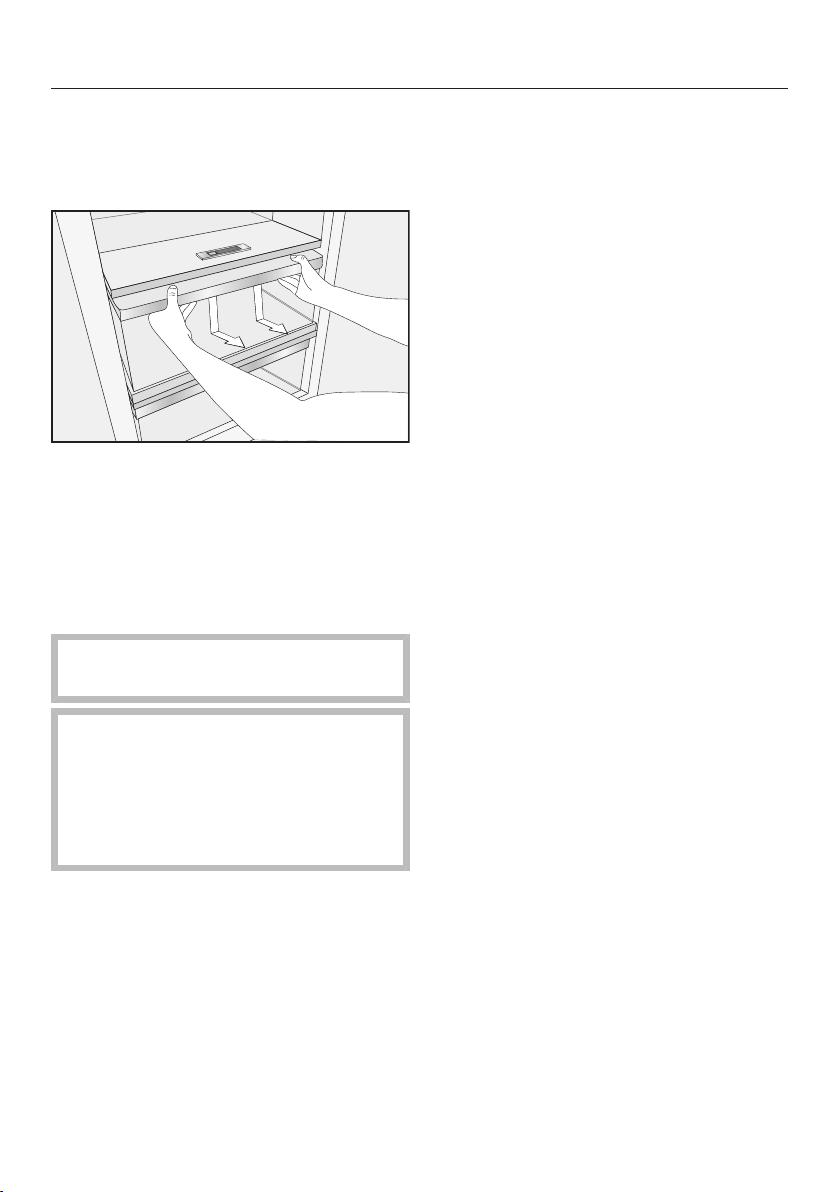
Adjusting the interior fittings
83
Removing compartments from
the refrigerator section
Pull the compartment out a little bit.
Using both hands, grasp the com-
partment frame from below and push
the compartment downwards so that
the rear end disengages and lifts up-
wards.
Pull the compartment forwards to re-
move it.
Then push the telescopic runners
back in to avoid damaging them.
Be careful not to wash out the spe-
cial lubricant in the telescopic run-
ners when cleaning the refrigeration
appliance.
Wipe the telescopic runners with a
damp cloth to clean them.
To reinsert the compartment, position
it on the telescopic runners so that it
clicks into place.
Storing food in the refrigerator section
84
Risk of explosion due to flam-
mable mixes of gases.
Electrical components can cause
flammable mixes of gases to ignite.
Do not store explosive materials in
the refrigeration appliance or any
products containing propellants (e.g.
spray cans).
Risk of damage due to greasy or
oily food.
If storing food which contains a lot of
fat or oil in the refrigeration appliance
or the appliance door, make sure
that it does not come into contact
with plastic components as this
could cause stress cracks or break
the plastic.
Make sure that no fat or oil leaks
onto the plastic parts of the refrigera-
tion appliance.
Different storage zones
Due to natural air circulation, there are
different temperature zones in the refri-
gerator section.
Cold, heavy air sinks to the lowest sec-
tion of the refrigeration section. Make
use of the different zones when placing
food in the appliance.
Tip: To allow air to circulate efficiently,
do not pack food too closely together in
the appliance.
If there is insufficient air circulation,
the cooling performance will de-
crease and energy consumption will
increase.
Do not cover the fan in the rear wall
of the appliance.
Tip: Do not store food in such a way
that it touches the rear wall of the refri-
gerator section as it may freeze to the
rear wall.
This refrigeration appliance has auto-
matic dynamic cooling, which helps to
keep an even temperature when the
fan is running. The difference between
the various temperature zones is
therefore less pronounced.
Storing food in the refrigerator section
85
Warmest area
The warmest area in the refrigerator
section is at the top in the front area
and in the door. Use this for storing but-
ter and cheese.
Coldest area
The coldest area in the refrigerator sec-
tion is directly above the fruit and ve-
getable drawer and at the back of the
appliance. The temperature in the dry
compartment of the MasterFresh zone
is even colder.
Use this area in the refrigerator section
and in the dry compartment of the
MasterFresh zone for all delicate and
highly perishable food, e.g.:
- Fish, meat, poultry
- Cold cuts, ready meals
- Dishes or baked goods containing
eggs or cream
- Fresh dough, cake mixtures, pizza or
quiche dough
- Soft cheese and other dairy products
- Pre-packed vegetables and other
fresh food with a label stating it
should be kept at a temperature of
approx. 4°C.
Tip: This compartment is ideal for all
homecooked meals as any microorgan-
isms that may still be present cannot
multiply.
Food which is not suitable for
storage in the refrigerator sec-
tion
Not all food is suitable for refrigeration
at temperatures below 5°C, because it
may be sensitive to cold. Depending on
the type of food, the appearance, con-
sistency, flavour and/or vitamin content
may be altered if stored at too cold a
temperature.
Food which is sensitive to cold in-
cludes:
- Pineapples, avocados, bananas,
pomegranates, mangoes, melons,
papayas, passionfruit, citrus fruit
such as lemons, oranges, mandarins,
grapefruit
- Fruit (which is not yet ripe)
- Aubergines, cucumbers, potatoes,
peppers, tomatoes, courgettes
- Hard cheeses (e.g. Parmesan, moun-
tain cheese)
Storing food in the refrigerator section
86
Notes on buying food
The freshness of the food when it is first
placed in the appliance is the most im-
portant factor for how long it stays
fresh.
Take into account the use-by date and
the correct storage temperature.
Time out of the refrigerator, e.g. trans-
porting food in a warm car, should be
kept to a minimum.
Storing food correctly
Ensure that food stored in the refriger-
ator section is in packaging or covered
properly (some exceptions apply in the
MasterFresh zone). This will prevent
food odours from affecting other food,
food from drying out and also any
cross-contamination of bacteria. This is
particularly important when storing
meat products. Make sure that food
such as raw meat and fish in particular
does not come into contact with other
food.
By ensuring that the temperature set-
tings are correct and by taking appro-
priate hygiene measures you can pro-
long the storage life of your food con-
siderably and avoid food waste.
Fruit and vegetables
Fruit and vegetables can be stored
loose in the fruit and vegetable drawer.
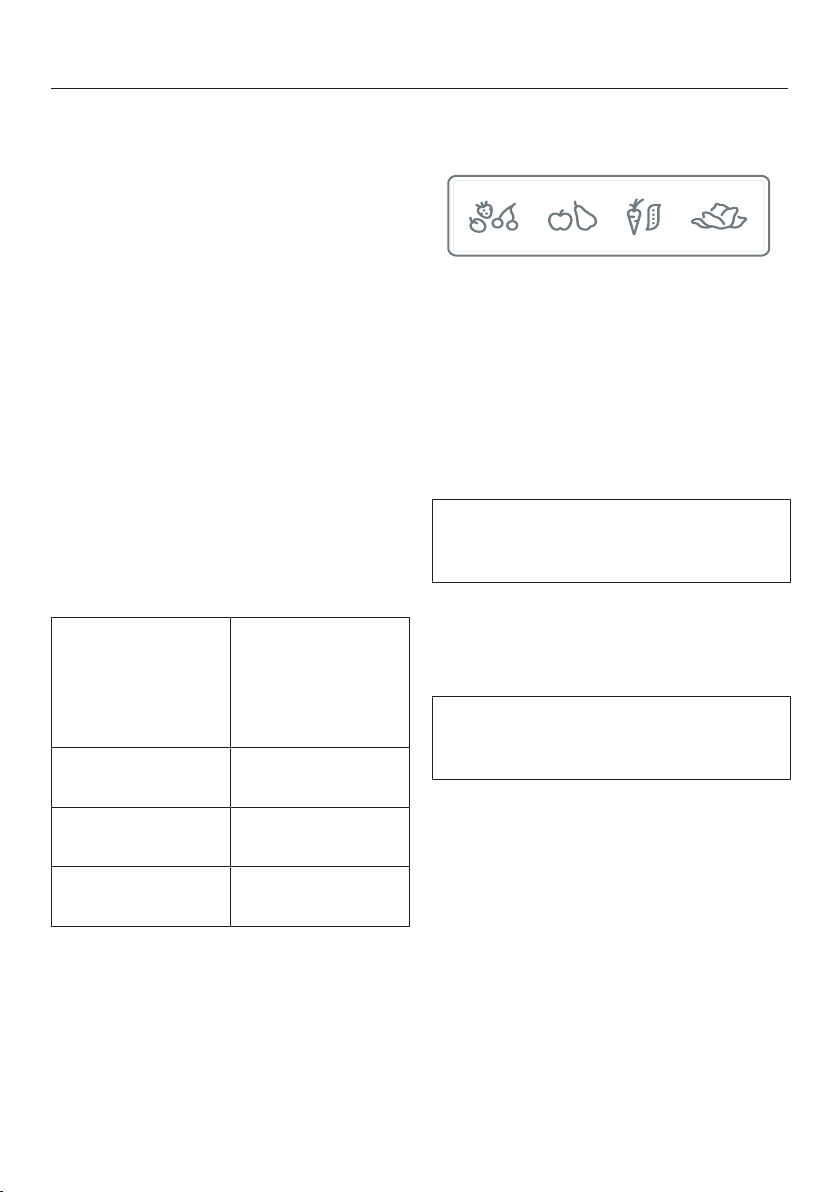
Storing food in the MasterFresh zone
87
MasterFresh zone
The MasterFresh zone provides ideal
storage conditions for fruit, vegetables,
fish, meat and dairy products. Food
stays fresh considerably longer while
retaining both flavour and vitamins.
The MasterFresh zone comprises a hu-
midity-controlled and a dry compart-
ment.
- Depending on the moisture-regulator
setting, the humidity-controlled
compartment is particularly suitable
for storing fruit and vegetables.
- The dry compartment is suitable for
storing perishable food such as
fish, meat and dairy products.
Any type of food can in fact be stored
in this compartment, as long as it is
packaged.
Max. load capa-
city of the com-
partments in the
MasterFresh
zone
K2602Vi,
K2612Vi
25kg
K2802Vi,
K2812Vi
35kg
K2902Vi,
K2912Vi
45kg
Humidity-controlled compartment
with moisture adjustment
The moisture released by food in stor-
age is kept within the humidity-con-
trolled compartment. The closer the air
humidity in the humidity-controlled
compartment is to the humidity content
of the food, the crisper and fresher the
food remains over a longer period, as
the water content of the food is largely
retained.
The moisture level greatly depends on
the type and quantity of food being
stored, if stored unwrapped.
The temperature in the humidity-con-
trolled compartment is approximately
equivalent to the temperature in the
conventional refrigerator section.
Remember that the fresher the food
when placed in the appliance, the
longer it will stay fresh.
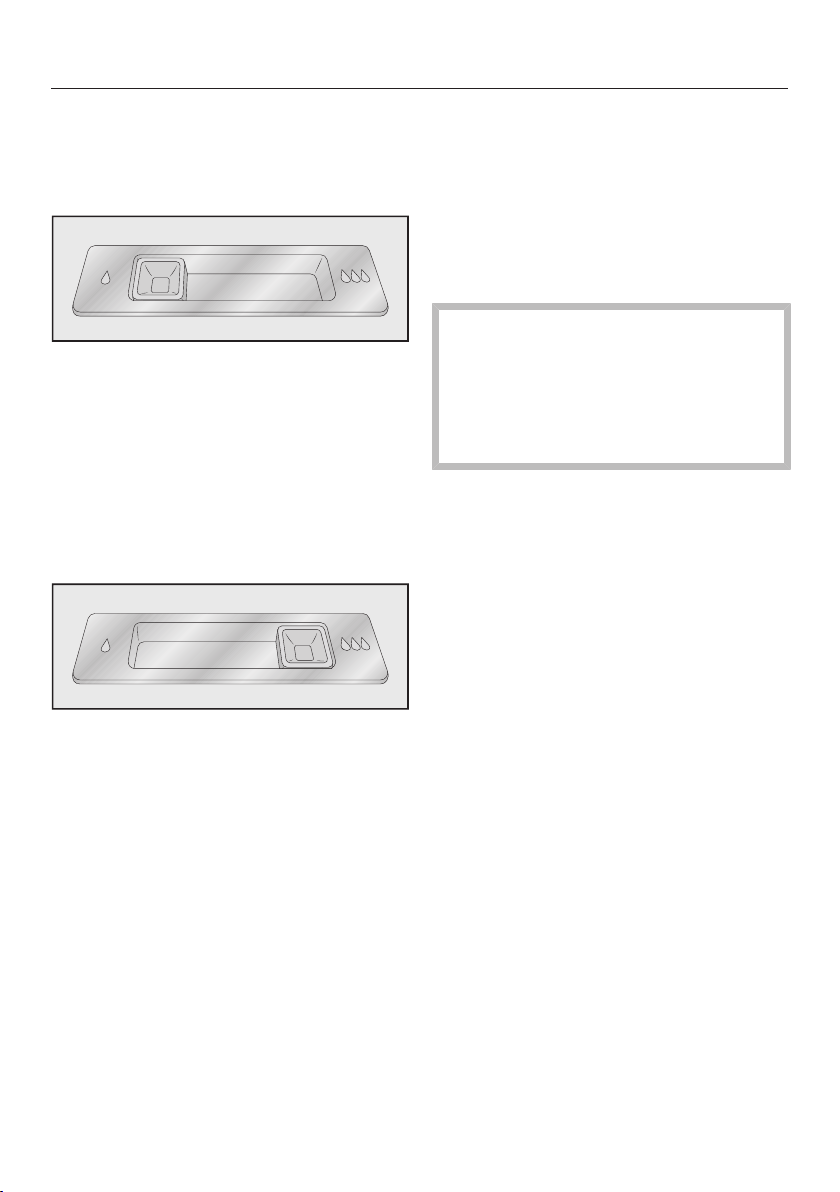
Storing food in the MasterFresh zone
88
The moisture regulator is used to regu-
late the amount of moisture in the hu-
midity-controlled compartment with
settings to.
Position of the moisture regulator
= slightly increased humidity
Select this setting if you store very
large quantities of fruit and vegetables
in the humidity-controlled compart-
ment. The moisture regulator partially
closes the vents in the compartment so
that some of the moisture present is re-
tained.
Position of the moisture regulator
= increased humidity
Select this setting if you store small
to large quantities of fruit and veget-
ables in the humidity-controlled com-
partment. The moisture regulator closes
the vents in the compartment com-
pletely so that all of the moisture
present is retained.
Tip: If the humidity level is too high and
a lot of moisture has collected in the
compartment, select the setting.
If the quantity of food being stored in
this compartment is small, the humidity
level may be too low. If you are only
storing a small amount of food, wrap it
in airtight packaging.
Increased humidity in the humidity-
controlled compartment can, in
some circumstances, cause a build-
up of condensate.
Wipe off any condensate with a
cloth.
Regulating the humidity level in the
humidity-controlled compartment
Slide the moisture regulator to the
left or right depending on the
setting required.
Storing food in the MasterFresh zone
89
Dry compartment with adjustable
temperature
The temperature in the dry compart-
ment is maintained at -1 to 3°C. While
lower than the temperature in a stand-
ard refrigerator section, this is the op-
timum temperature range for storing
fresh food which is not sensitive to
cold.
The deterioration process is deceler-
ated at this temperature range so food
can be stored without loss of fresh-
ness for considerably longer than in a
standard refrigerator and you do not
need to shop as often.
However, if you would like it to be
warmer or colder, e.g. when storing
fish, you can adjust the temperature
slightly (see “Selecting additional set-
tings – Adjusting the temperature in the
MasterFresh zone (dry compart-
ment)”).
The humidity level is similar to that in
the conventional refrigerator section.
Tip: This compartment is ideal for all
homecooked meals as any microorgan-
isms that may still be present cannot
multiply.
The dry compartment is ideal for storing
perishable food such as:
- Dairy products such as yogurt,
cheese, cream, etc.
- Deli salads
- Meat and poultry
- Fresh fish and shellfish
- Any type of food can in fact be stored
in this compartment, as long as it is
packaged.
Please note that food rich in protein de-
teriorates faster than other types of
food.
Shellfish, for example, deteriorates
faster than fish, and fish deteriorates
faster than meat.
For hygiene reasons, always keep this
type of food covered or wrapped in
this compartment.
Take food out of the dry compartment
approximately 30 to 60minutes before
using it. The aroma and taste do not
fully develop until the food has
reached room temperature.
At high room temperatures, delicate
food should preferably be kept in the
refrigerator section for a period of
time.
Storing food in the MasterFresh zone
90
The following tips may help if you find that food you have stored does not
keep well (for example, the food wilts or becomes withered after only a short
storage time):
Only place fresh food in the appliance. The initial condition of the food is crucial
to maintaining freshness.
Clean the MasterFresh zone before storing food in it.
Very wet food should be dried off before it is stored in the humidity-controlled
compartment.
Do not store food which is sensitive to cold in the dry compartment (see “Stor-
ing food in the refrigerator section – Food which is not suitable for storage in the
refrigerator section”).
Allocate the appropriate settings to food you wish to store (e.g. humid or dry
storage).
Store food loose in the humidity-controlled compartment.
A high humidity level in the humidity-controlled compartment is achieved by the
moisture present in the food being stored.
If the humidity level is not high enough (e.g. too little food is being stored), it can
be increased by placing a damp sponge in the drawer.
If you think that the temperature in the dry compartment is too high or too low,
adjust the temperature in the compartment (see “The correct temperature – Tem-
perature range”). If ice crystals start to form on the floor of the dry compartment,
increase the temperature as otherwise the cold temperature will damage the
food.
If too much water collects at the bottom of the humidity-controlled compart-
ment, dry it with a cloth. If necessary, dry food before placing it in the appliance
or place a rack at the bottom of the humidity-controlled compartment to allow
water to drain off.
Automatic defrosting
91
Refrigerator section and
MasterFresh zone
The refrigerator section and the
MasterFresh zone defrost automatically.
Condensate and ice can build up on the
back wall of the refrigerator section and
the MasterFresh zone while the com-
pressor is running. You do not need to
remove this, as it will defrost and evap-
orate automatically with the warmth
generated by the compressor.
Cleaning and care
92
Do not let water get into the elec-
tronic unit or the lighting.
Risk of damage due to moisture
ingress.
The steam from a steam cleaner can
damage plastic and and electrical
components.
Do not use a steam cleaner to clean
the refrigeration appliance.
The data plate located inside the in-
terior cabinet of the refrigeration appli-
ance must not be removed. It contains
information which is required in the
event of a service call.
Cleaning agents
To avoid damaging the surfaces of your
appliance, do not use:
- Cleaning agents containing soda,
ammonia, acids or chlorides
- Cleaning agents containing descaling
agents
- Abrasive cleaning agents (e.g. scour-
ing powder, scouring liquid or pumice
stones)
- Cleaning agents containing solvents
- Stainless steel cleaning agents
- Dishwasher cleaner
- Oven sprays
- Glass cleaning agents
- Hard, abrasive sponges and brushes
(e.g. pot scourers)
- Eraser stain remover blocks
- Sharp metal scrapers
Cleaning and conditioning agents
used in the interior cabinet of the re-
frigeration appliance must be food
safe.
We recommend using lukewarm water
with a little washing-up liquid for clean-
ing.
Cleaning and care
93
Before cleaning the refrigera-
tion appliance
Switch the refrigeration appliance off
by pressing the On/Off switch.
Take any food out of the appliance
and store it in a cool place.
Take out all other removable parts for
cleaning (see “Adjusting the interior
fittings”).
Interior cabinet and accessor-
ies
Clean the refrigeration appliance reg-
ularly, or at least once a month.
Remove soiling immediately to pre-
vent it from drying on.
Clean the interior cabinet of the refri-
geration appliance with a solution of
lukewarm water and a little washing-
up liquid. Wash all parts by hand. Do
not wash in a dishwasher.
After cleaning, wipe with clean water
and dry with a soft cloth.
Leave the door open to air the refri-
geration appliance sufficiently for a
short while and to prevent odour
buildup.
Aluminium frames
The frames for the shelves inside the
appliance and the door shelves are
partially made from aluminium.
Aluminium is a dynamic material. The
reflection and appearance of alu-
minium changes in different lights and
environments and depending on the
angle you observe it from. It is also
susceptible to scratching.
The aluminium frames may become
discoloured or damaged if soiling is
left on for too long.
Remove any soiling from the alu-
minium frame immediately.
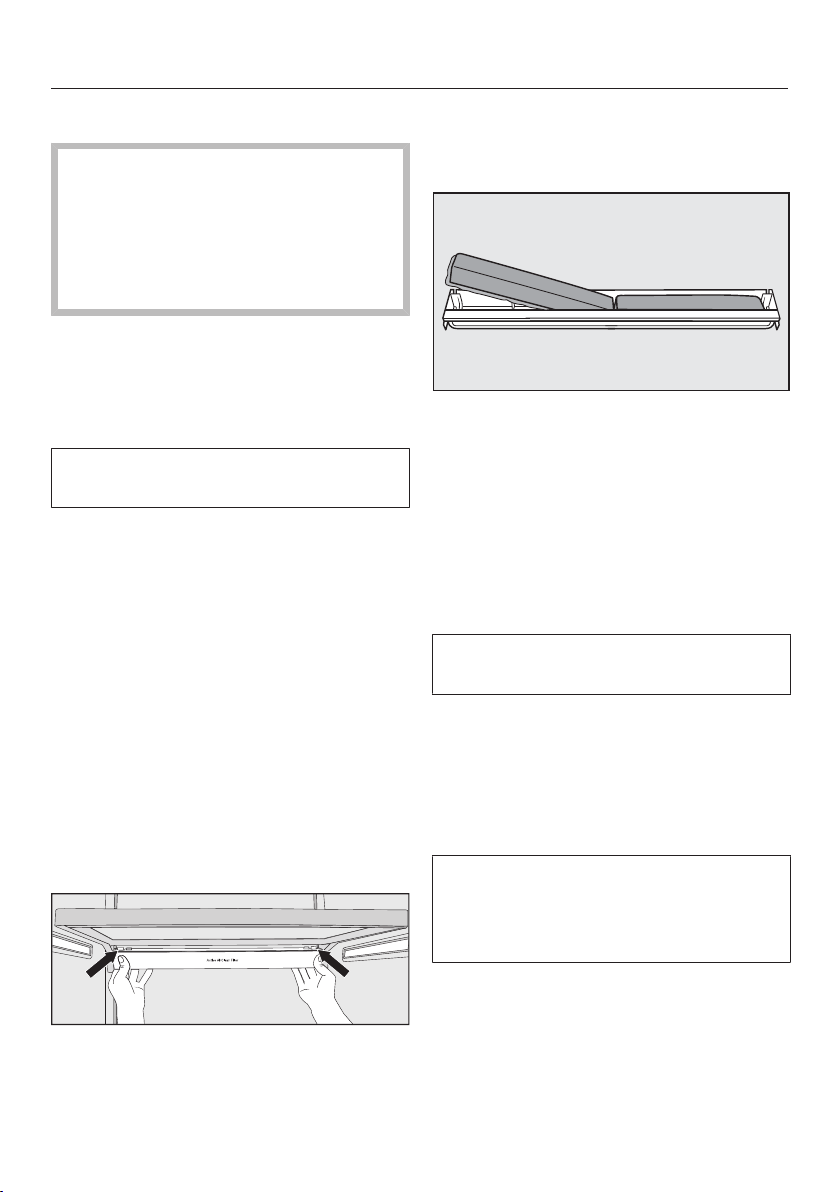
Cleaning and care
94
Cleaning the door seal
Risk of damage as a result of in-
correct cleaning.
If you treat the door seal with oils or
grease, it can become porous.
Do not use any oils or grease on the
door seal.
The door seal should be cleaned reg-
ularly with clean water, and then
wiped dry with a soft cloth.
Cleaning the ventilation gaps
A build-up of dust will increase the en-
ergy consumption of the appliance.
The ventilation gaps should be
cleaned on a regular basis with a
brush or vacuum cleaner (you could
use a Miele vacuum cleaner dusting
brush, for example).
Replacing the Active AirClean
filters
The Active AirClean filters in the refri-
gerator section need to be replaced ap-
prox. every 6 months.
Change Active AirClean filter will appear on
the display.
Confirm the message with OK.
To remove the holder for the Active
AirClean filters, press against the re-
tainers on both sides of the holder
from the rear and pull the holder
downwards diagonally from the
frame.
Remove the used Active AirClean fil-
ters and place the new Active
AirClean filters with the surrounding
edge pointing downwards in the
holder.
To replace the holder, press against
the retainers on both sides of the
holder from the rear and clamp it into
the gap on the frame from below.
The holder can be fixed under any
shelf in the refrigerator section.
Once the Active AirClean filters have
been replaced, the Active AirClean filter
display must be reset using Settings
mode on the display (see “Selecting
additional settings – Resetting the Dis-
play Active AirClean filter ”).
New Active AirClean filters can be ob-
tained from the Miele Customer Ser-
vice Department, your Miele dealer or
the Miele website.
Cleaning and care
95
After cleaning
Replace all shelves and accessories
in the refrigeration appliance.
Switch the refrigeration appliance
back on.
Switch on the SuperCool function
for a while so that the temperature in-
side the refrigeration appliance will
drop quickly.
Place food in the refrigeration appli-
ance as soon as it reaches the re-
quired coldness.
Close the appliance door(s).
Problem solving guide
96
Many malfunctions and faults that can occur in daily operation can be easily
remedied. Time and money will be saved because a service call will not be
needed.
The following guide may help you to find the reason for a malfunction or a fault,
and to correct it.
To prevent unnecessary loss of temperature it is advisable not to open the door
while waiting for the appliance to be serviced.
Problem Cause and remedy
If you are concerned
that your refrigeration
appliance is not work-
ing properly, you can
perform a Self test. Your
refrigeration appliance
will be checked for any
faults or malfunctions.
Any errors identified during the self test are shown on
the display.
Perform a self test (see “Selecting additional set-
tings – Performing a Self test”).
If necessary, contact the Miele Customer Service
Department and inform them of the error mes-
sage(s) on the display.
The refrigeration appli-
ance is not getting cold
and the interior lighting
does not come on when
the appliance door is
opened.
The refrigeration appliance has not been switched
on.
Switch the refrigeration appliance on. The temper-
ature appears on the display.
The plug is not inserted in the socket correctly.
Insert the plug into the socket.
The mains fuse has tripped. There could be a fault
with the refrigeration appliance, the household elec-
trical wiring or another electrical appliance.
Contact a qualified electrician or the Miele Cus-
tomer Service Department.
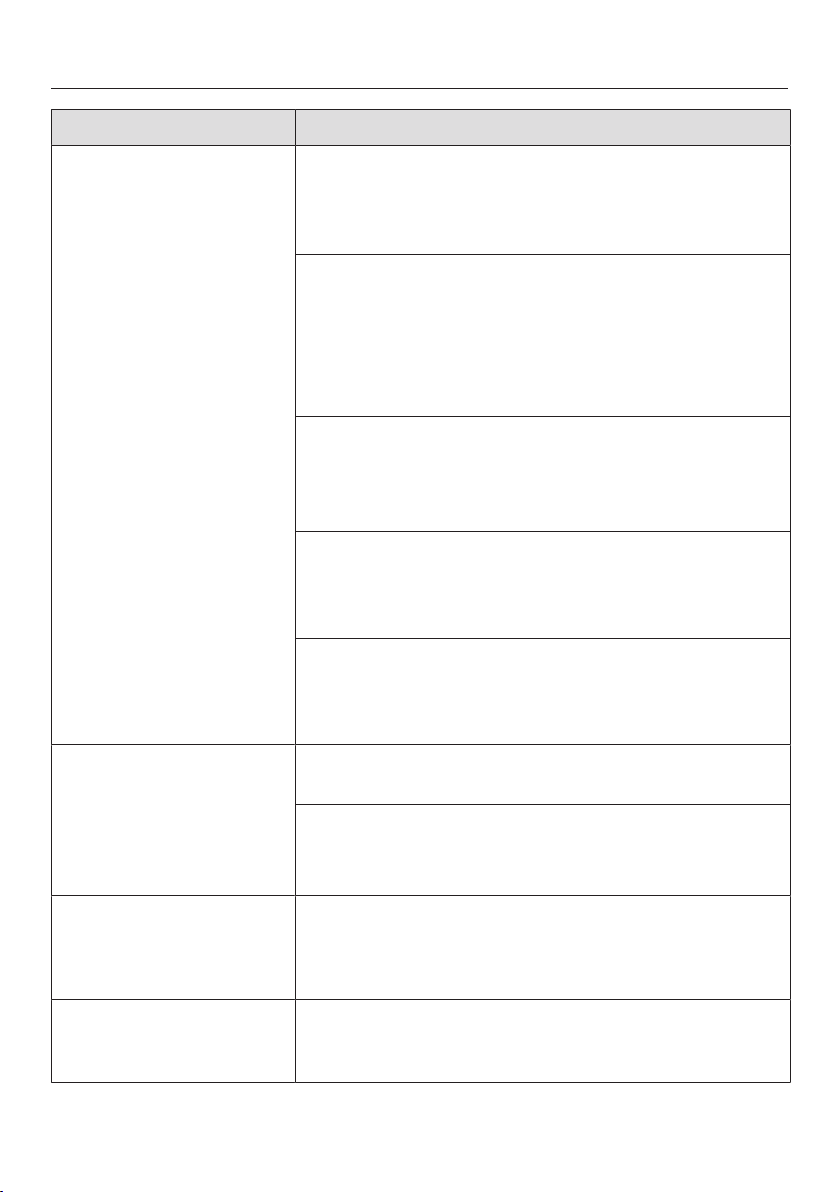
Problem solving guide
97
Problem Cause and remedy
The compressor is
switching on more fre-
quently and for longer
periods of time. The
temperature in the refri-
geration appliance is
too low.
The ventilation gaps in the housing unit have been
covered or become too dusty.
Do not block the ventilation gaps.
Dust the ventilation gaps regularly.
The appliance door has been opened too frequently
or a large amount of food has been put in at once.
Only open the door when necessary and for as
short a time as possible.
After a while, the temperature will return to normal by
itself.
The appliance door is not properly closed.
Close the door.
After a while, the temperature will return to normal by
itself.
The ambient room temperature is too high. The
higher the ambient temperature, the longer the com-
pressor has to run.
See the information in “Installation” – “Location”.
The refrigeration appliance was not properly installed
in the niche.
See the information in “Installation” – “Installing
the refrigeration appliance”.
The compressor is
switching on more fre-
quently and for longer
periods of time, so the
temperature in the ap-
pliance is dropping.
The temperature setting is too low.
Adjust the temperature.
The Super cool function is still switched on.
You can switch off the Super cool function earlier
to save energy.
The compressor comes
on less and less often
and for shorter periods
of time.
This is not a fault. The temperature is too high.
Adjust the temperature.
Check the temperature again after 24 hours.
The compressor runs
continuously.
This is not a fault. To save energy, the compressor
runs at a lower speed, but for longer, when less
cooling is required.
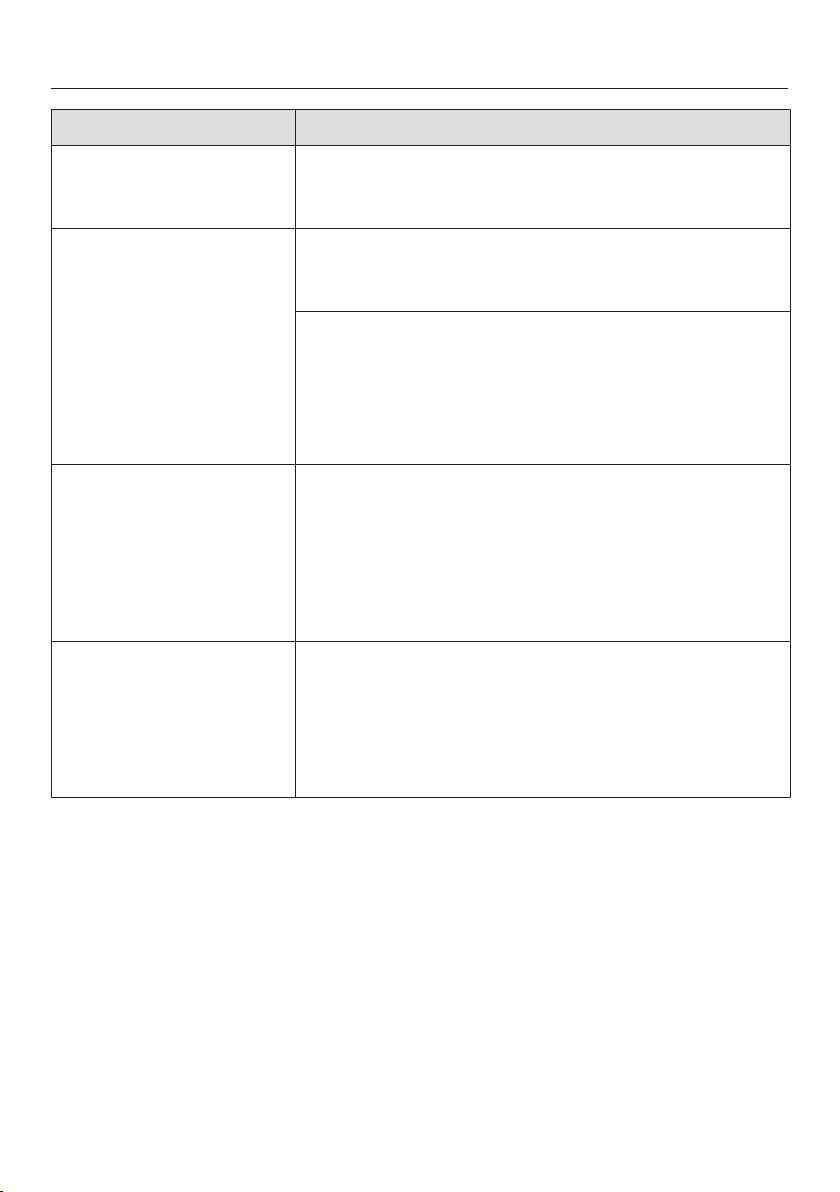
Problem solving guide
98
Problem Cause and remedy
An alarm sounds. The appliance door has been open for longer than
2minutes.
Close the appliance door.
No alarm sounds des-
pite the appliance door
being open.
You have switched off the buzzer.
Switch the buzzer back on using Settings
mode.
The Sabbath mode function is switched on: the tem-
perature display is dark and the symbol is shown in
the display.
You can switch off Sabbath mode at any time (see
“Selecting additional settings – Switching Sabbath
mode on or off”).
The appliance door
cannot be opened.
The Pull2opendoor assistant is switched on but the
refrigeration appliance has a handle-free furniture
front.
For handle-free furniture fronts, switch on the
Push2open door assistant (see “Selecting addi-
tional settings – Switching on the Door assist-
ant”).
The appliance door
cannot be opened when
Sabbath mode is
switched on.
The Push2opendoor assistant is switched on at the
same time as Sabbath mode.
When Sabbath mode is switched on, the door as-
sistant is deactivated.
Pull the appliance door open from below or from
the side.
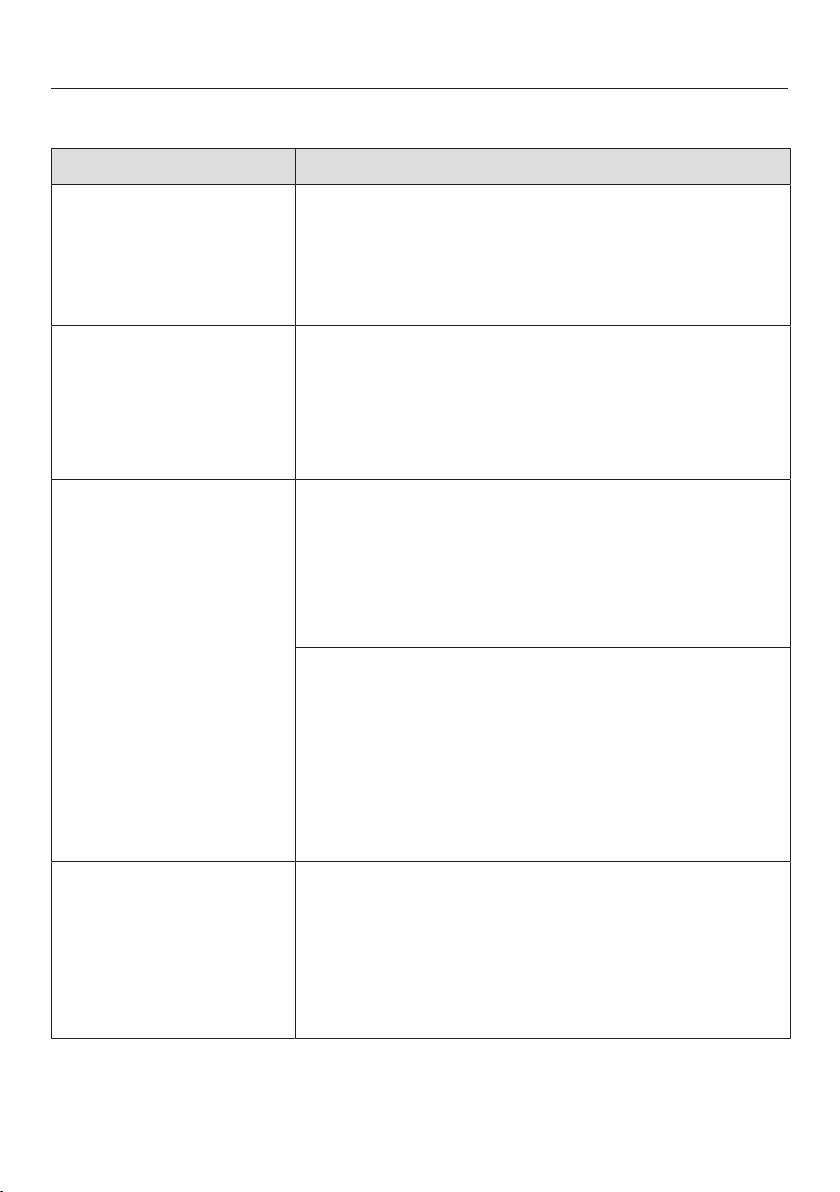
Problem solving guide
99
Display warnings
Message Cause and remedy
The warning sounds
and the message Close
the door will appear on
the display.
The appliance door is open.
Close the appliance door.
If you wish to turn the alarm off early, touch the OK
sensor on the display.
The alarm will stop.
The temperature display
is dark and the sym-
bol is shown in the dis-
play.
The Sabbath mode function is switched on. The in-
terior lighting is switched off and the refrigeration ap-
pliance is cooling down.
You can switch off Sabbath mode at any time (see
“Selecting additional settings – Switching Sabbath
mode on or off”).
F Please call Miele Service
appears on the display
and an alarm sounds.
There is a fault.
Make a note of the error message if necessary.
Call the Miele Customer Service Department.
To turn the alarm off, touch the symbol.
The error message will not disappear from the dis-
play until the error has been rectified.
The voltage level is too high/low.
Observe the connection data under “Installation –
Electrical connection”.
Contact the Miele Customer Service Department if
necessary.
To turn the alarm off, touch the symbol.
The error message will not disappear from the dis-
play until the error has been rectified.
The symbol lights up
in the display. The refri-
geration appliance does
not get cold, although
the appliance controls
are working.
The Demo mode is switched on. Demo mode allows
the refrigeration appliance to be presented in the
showroom without the cooling system being
switched on. This setting is not needed for domestic
use.
Switch off Demo mode (see “Selecting additional
settings – Switching Demo modeoff”).
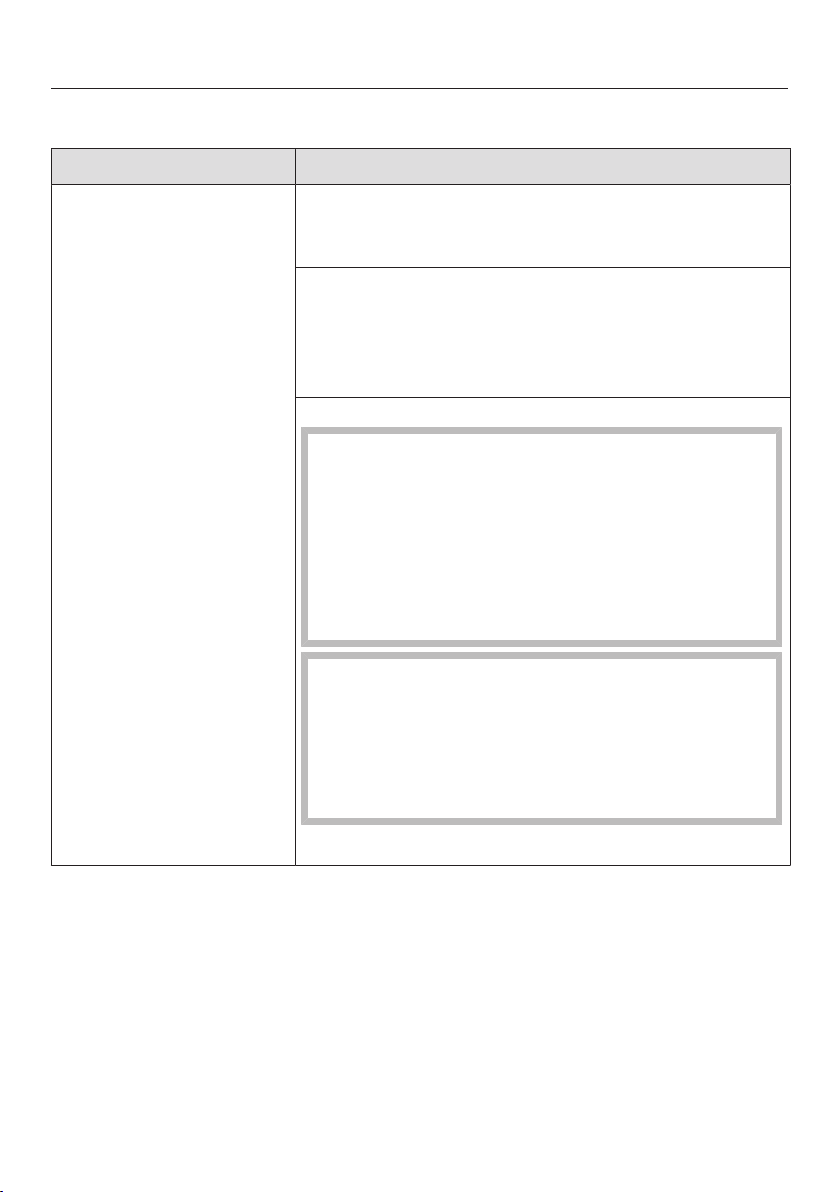
Problem solving guide
100
The interior lighting is not working.
Problem Cause and remedy
The interior lighting is
not working.
The refrigeration appliance has not been switched
on.
Switch the refrigeration appliance on.
The Sabbath modefunction is switched on: the tem-
perature display is dark and the symbol is shown in
the display.
You can switch off Sabbath mode at any time via the
Settings mode.
There is a fault.
Risk of electric shock due to exposed, live
electrical components.
When removing the lighting cover, there is a risk of
coming into contact with live electrical compon-
ents.
Do not remove the lighting cover. The LED lighting
may only be repaired or replaced by the Miele
Customer Service Department.
Risk of injury from LED lighting.
This lighting corresponds to risk group RG2. If the
cover is defective, there is a danger of eye injury.
If the lighting cover is defective, do not look from a
close range directly into the lighting with optical in-
struments (e.g. magnifying glass or similar).
Call the Miele Customer Service Department.
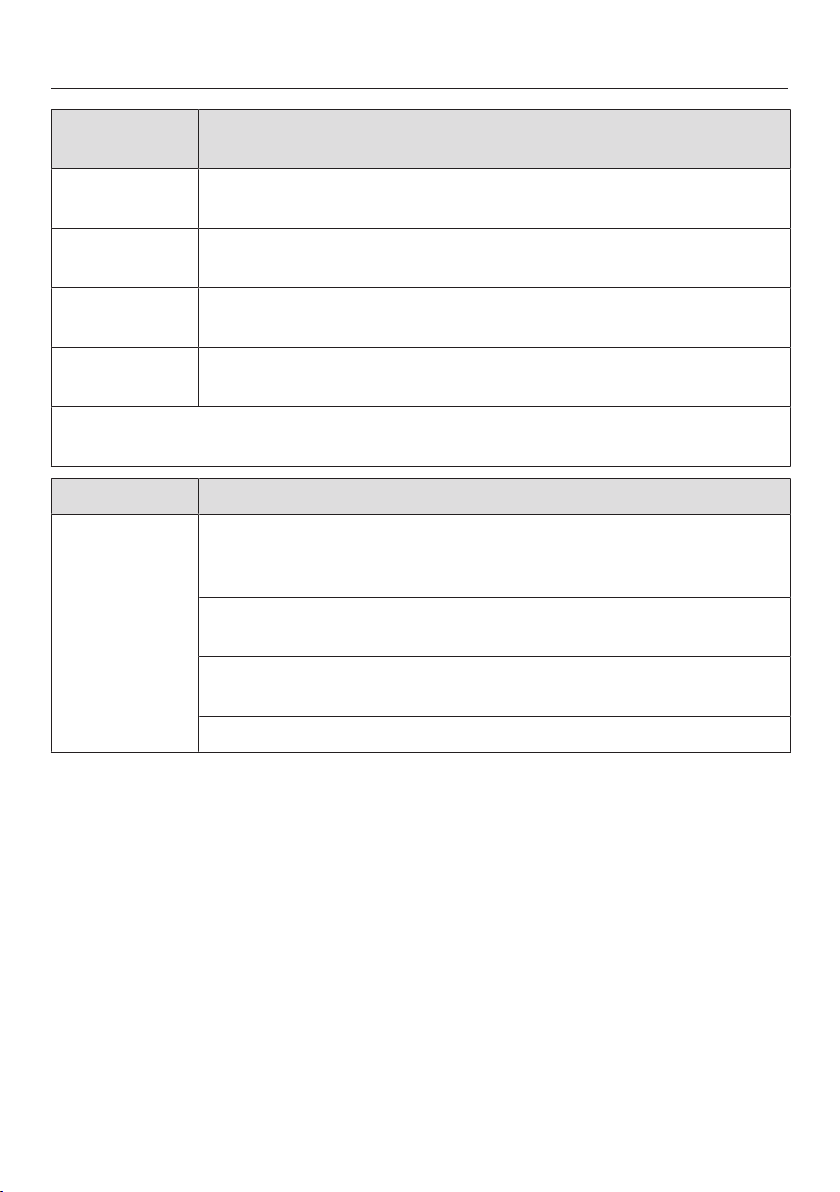
Noises
101
Normal
noises
What is causing them?
Brrrrr... A humming noise is made by the compressor. This noise can
get louder for brief periods when the compressor switches on.
Blubb,
blubb...
A gurgling noise can be heard when the refrigerant circulates
through the pipes.
Click... Clicking sounds occur whenever the thermostat switches the
compressor on or off.
Crack... A cracking sound can be heard when materials expand inside
the refrigeration appliance.
Please bear in mind that a certain amount of noise is unavoidable (from the com-
pressor and the refrigerant circulating through the cooling circuit).
Noises Cause and remedy
Rattling, vi-
brating
The refrigeration appliance is uneven. Realign the appliance us-
ing a spirit level by raising or lowering the adjustable feet under-
neath the refrigeration appliance.
The refrigeration appliance is touching another appliance or
piece of furniture. Move it away.
Drawers, baskets or shelves are jiggling or are stuck. Check all
removable items and refit them correctly.
Bottles or containers are touching. Separate them.
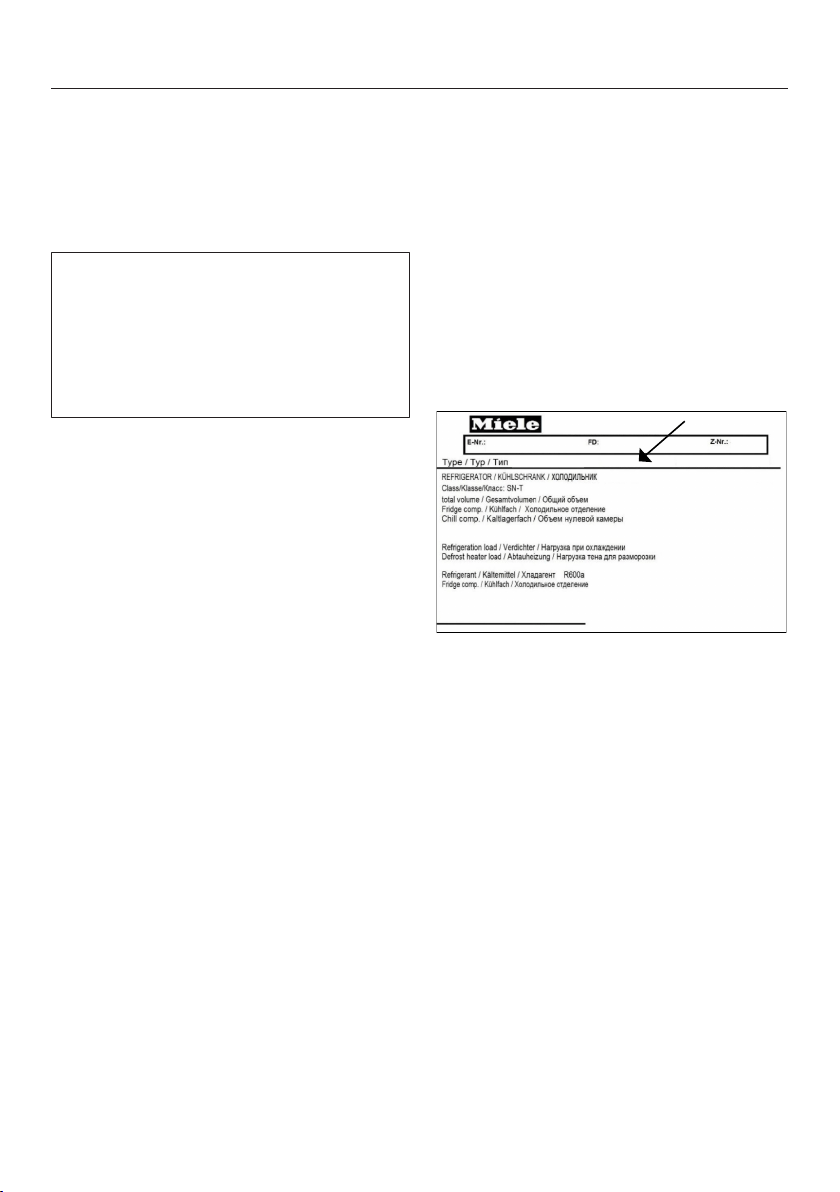
Service
102
Contact in the event of a fault
In the event of any faults which you
cannot remedy yourself, please contact
your Miele dealer or the Miele Customer
Service Department.
You can book a Miele Customer Ser-
vice Department call-out online at
www.miele.com/service.
Contact information for the Miele Cus-
tomer Service Department can be
found at the end of this document.
Please quote the model identifier and
serial number of your appliance (Fabr./
SN/Nr.) when contacting the Miele Cus-
tomer Service Department. This inform-
ation can be found on the data plate.
Please note that telephone calls may be
monitored and recorded for training
purposes and that a call-out charge will
be applied to service visits where the
problem could have been resolved as
described in this booklet.
The data plate can be found in the in-
terior cabinet of the refrigeration appli-
ance.
EPREL database
From 1 March 2021, information on en-
ergy labelling and ecodesign require-
ments will be available in the European
Product Database (EPREL). You can
find the product database at the follow-
ing link https://eprel.ec.europa.eu/. You
will be asked to enter the model identi-
fier.
The model identifier can be found on
the data plate.
Service après-vente
114
Contact en cas d'anomalies
Vous n'arrivez pas à résoudre l'anoma-
lie par vous-même? Contactez le ser-
vice après-vente Miele ou votre reven-
deur Miele.
Vous pouvez prendre rendez-vous en
ligne avec le service après-vente Miele
sous www.miele.com/service.
Les coordonnées du service après-
vente Miele figurent en fin de notice.
Veuillez indiquer le modèle et la réfé-
rence de votre appareil (N° de série, de
fabrication). Ces deux indications fi-
gurent sur la plaque signalétique.
La plaque signalétique est située à
l'intérieur de l'appareil.
Base de données EPREL
À partir du 1er mars 2021, des informa-
tions sur l'étiquetage énergétique et les
exigences en matière d'écoconception
seront disponibles dans la base de
données européenne sur les produits
(EPREL). Le lien suivant https://
eprel.ec.europa.eu/ permet d'accéder à
la base de données sur les produits. Il
vous est demandé de saisir ici la dési-
gnation du modèle.
Vous trouverez la désignation du mo-
dèle sur la plaque signalétique.
Garantie
La garantie est accordée pour cet ap-
pareil selon les modalités de vente par
le revendeur ou par Miele pour une pé-
riode de 24 mois.
Pour plus d'informations reportez-vous
aux conditions de garantie fournies au-
près du service après-vente Miele.
XXXXXX
XXXX XX / XXXXXXXXXXXXXXXXXXX / XX
XXXXXXXXXXXXXXXXXXXXXXXXXXXXX XXXXXXXXX
Warranty
The appliance warranty is valid for 2
years from date of purchase. In the UK,
you must activate your cover by calling
0330 160 6640 or registering online at
www.miele.co.uk.
For more information on country-spe-
cific warranty terms and conditions,
please contact Miele Customer Service.

EU Conformity declaration
103
Miele hereby declares that this refriger-
ator complies with Directive 2014/53/
EU.
The complete text of the EU declaration
of conformity is available from one of
the following internet addresses:
- Products, Download from
www.miele.ie
- For service, information, operating in-
structions etc: go to www.miele.ie/
domestic/customer-informa-
tion-385.htm and enter the name of
the product or the serial number
Frequency band
of the WiFi mod-
ule
2.4000GHz –
2.4835GHz
Maximum trans-
mitting power of
the WiFi module
<100mW
UK Conformity declaration
104
Miele hereby declares that this refriger-
ator complies with UK Radio Equipment
Regulations 2017, as amended.
The complete text of the UK declaration
of conformity is available from one of
the following internet addresses:
- Products, Download from
www.miele.co.uk
- For service, information, operating in-
structions etc: go to
www.miele.co.uk and enter the name
of the product or the serial number
Frequency band
of the WiFi mod-
ule
2.4000GHz –
2.4835GHz
Maximum trans-
mitting power of
the WiFi module
<100mW
Copyrights and Licences
105
Miele uses their own and third party software which is not subject to any so-called
Open Source Licence for the operation and control of the appliance. This software/
these software components are protected by copyright. The copyright powers of
Miele and third parties have to be respected.
Furthermore, this appliance contains software components which are distributed
under Open Source licence conditions. Please refer to the document “Open
Source Information and Licenses” for the Open Source components contained
therein, together with the corresponding copyright notices, copies of the licence
terms valid at the time, and any further information. The liability and warranty pro-
visions of the Open Source licence terms and conditions as stated therein apply
only in relation to the respective rights holders.
In particular, the appliance contains software components licenced by the copy-
right holders under the GNU General Public License, Version 2, or the GNU Lesser
General Public License, Version 2.1. For a period of at least 3 years from the date
of purchase or delivery of the appliance respectively, Miele offers to provide you or
third parties with a machine-readable copy of the source code of the Open Source
components contained in the appliance and licenced under the terms of the GNU
General Public License, Version 2, or the GNU Lesser General Public License, Ver-
sion 2.1, on a data carrier (CD-ROM, DVD or USB stick). Please contact us via e-
mail ([email protected]) or the below postal address and state the product name,
the serial number and the date of purchase to obtain this source code.
Miele & Cie. KG
Open Source
GTZ/TIM
Carl-Miele-Straße 29
33332 Gütersloh
Please note the limited warranty in favour of the rights holders under the terms of
the GNU General Public License, Version 2, and the GNU Lesser General Public Li-
cense, Version 2.1:
This program is distributed in the hope that it will be useful, but WITHOUT ANY
WARRANTY, without even the implied warranty of MERCHANTABILITY of FITNESS
FOR A PARTICULAR PURPOSE. See the GNU General Public License and GNU
Lesser General Public License for more details.


United Kingdom
Miele Co. Ltd., Fairacres, Marcham Road, Abingdon, Oxon, OX14 1TW
Tel: 0330 160 6600, Internet: www.miele.co.uk/service, E-mail: [email protected]
Australia
Miele Australia Pty. Ltd.
ACN 005 635 398
ABN 96 005 635 398
Level 4, 141 Camberwell Road
Hawthorn East, VIC 3123
Tel: 1300 464 353
Internet: www.miele.com.au
Miele Electrical Appliances Co., Ltd.
1-3 Floor, No. 82 Shi Men Yi Road
Jing' an District
200040 Shanghai, PRC
Tel: +86 21 6157 3500
Fax: +86 21 6157 3511
E-mail: [email protected],
Internet: www.miele.cn
China Mainland
Miele (Hong Kong) Ltd.
41/F - 4101, Manhattan Place
23 Wang Tai Road
Kowloon Bay, Hong Kong
Tel: (852) 2610 1025
Fax: (852) 3579 1404
Email:
Website: www.miele.hk
Hong Kong, China
Miele India Pvt. Ltd.
1st Floor, Copia Corporate Suites,
Commercial Plot 9,
Mathura Road, Jasola,
New Delhi - 110025
E-mail: customercare@miele.in
Website: www.miele.in
India
Miele Ireland Ltd.
2024 Bianconi Avenue
Citywest Business Campus
Dublin 24
Tel: (01) 461 07 10
Fax: (01) 461 07 97
E-Mail: [email protected]
Internet: www.miele.ie
Ireland
Malaysia
Miele Sdn Bhd
Suite 12-2, Level 12
Menara Sapura Kencana
Petroleum
Solaris Dutamas No. 1
Jalan Dutamas 1
50480 Kuala Lumpur, Malaysia
Phone: +603-6209-0288
Fax: +603-6205-3768
Miele New Zealand Limited
IRD 98 463 631
8 College Hill
Freemans Bay, Auckland 1011
New Zealand
Tel: 0800 464 353
Internet: www.miele.co.nz
New Zealand
Miele Pte. Ltd.
29 Media Circle
#11-04 ALICE@Mediapolis
Singapore 138565
sTel: +65 6735 1191
Fax: +65 6735 1161
E-Mail: [email protected]
Internet: www.miele.sg
Singapore
Miele (Pty) Ltd.
63 Peter Place
Bryanston 2194
P.O. Box 69434
Bryanston 2021
Tel: (011) 875 9000
Fax: (011) 875 9035
E-mail: [email protected]
Internet: www.miele.co.za
South Africa
Miele Appliances Ltd.
Showroom 1
Eiffel 1 Building
P.O. Box 114782 - Dubai
Tel. +971 4 3044 999
Fax. +971 4 3418 852
800-MIELE (64353)
E-Mail: [email protected]
Website: www.miele.ae
United Arab Emirates
Manufacturer:
Miele & Cie. KG, Carl-Miele-Straße 29, 33332 Gütersloh, Germany
Thailand
Miele Appliances Ltd.
BHIRAJ TOWER at EmQuartier
43rd Floor Unit 4301-4303
689 Sukhumvit Road
North Klongton Sub-District
Vadhana District
Bangkok 10110, Thailand
Sheikh Zayed Road, Umm Al Sheif

M.-Nr. 11 548 190 / 02en-GB
K 2602 Vi, K 2612 Vi, K 2802 Vi, K 2812 Vi, K 2902 Vi, K 2912
Vi





