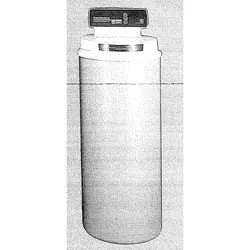

OWNER'S
MANUAL
MODEL NO.
625.348670
Caution:
Read and Follow
All Safety Rules and
Operating Instructions
Before First Use of
This Product.
If you have questions when
installing, operating or main-
taining your softener, and
when setting the timer, call
this toll-free number...
1-800-426-9345
SAVE THIS MANUAL
Genius II Water Softener
• Warranty
• Start Up / Setting Timer
• How ItWorks
• Care Of
• Specifications
• Repair Parts
Use plastic bag and tie provided, to hang manuals nearby
the softener for future reference.
Sears, Roebuck and Co., Hoffman Estates, IL 60179 USA
PRINTED IN U.S.A.
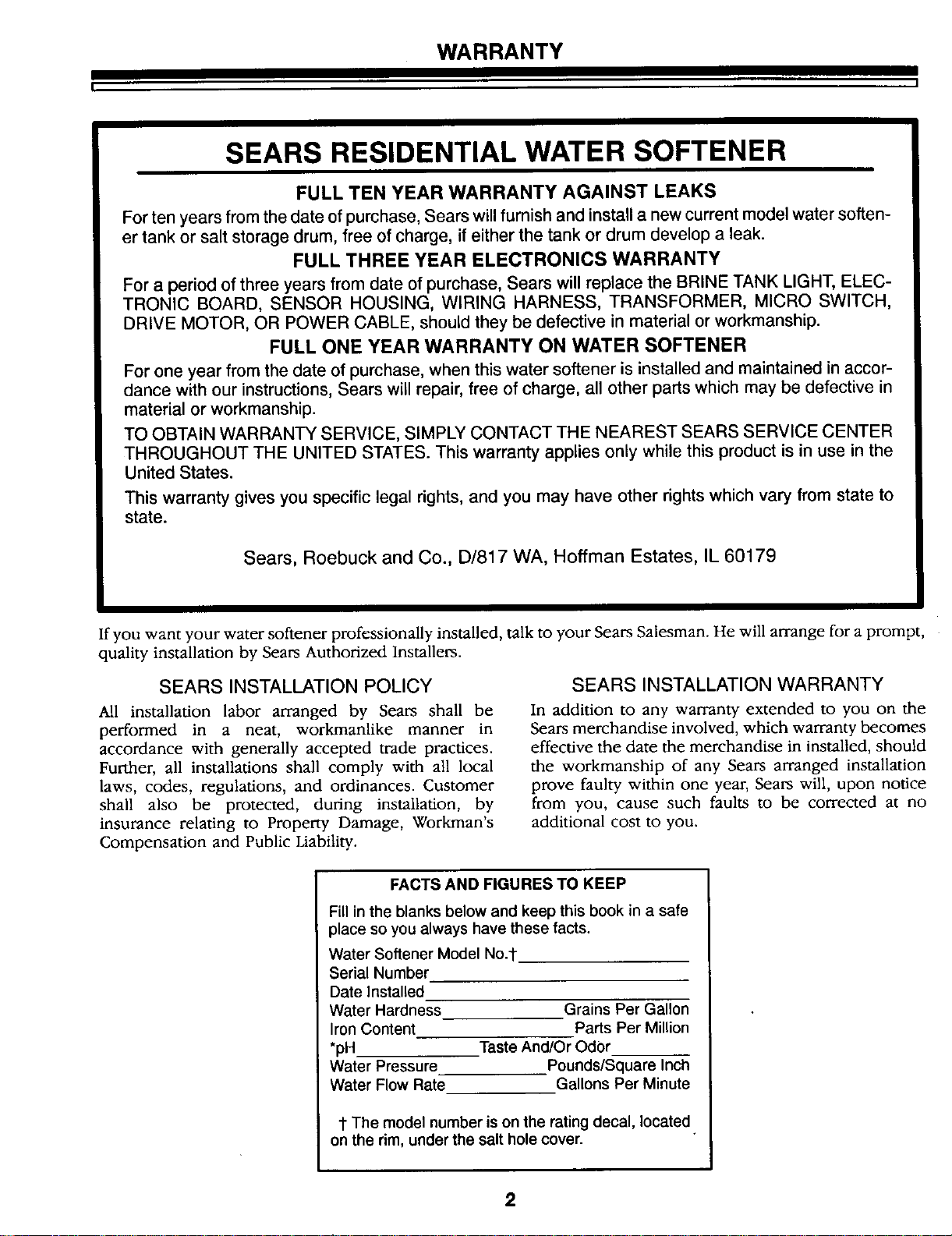
WARRANTY
I I
SEARS RESIDENTIAL WATER SOFTENER
FULL TEN YEAR WARRANTY AGAINST LEAKS
For ten years from the date of purchase, Sears willfurnish and install a new current model water soften-
er tank or salt storage drum, free of charge, if either the tank or drum develop a leak.
FULL THREE YEAR ELECTRONICS WARRANTY
For a period of three years from date of purchase, Sears will replace the BRINE TANK LIGHT, ELEC-
TRONIC BOARD, SENSOR HOUSING, WIRING HARNESS, TRANSFORMER, MICRO SWITCH,
DRIVE MOTOR, OR POWER CABLE, should they be defective in material or workmanship.
FULL ONE YEAR WARRANTY ON WATER SOFTENER
For one year from the date of purchase, when this water softener is installed and maintained in accor-
dance with our instructions, Sears will repair, free of charge, all other parts which may be defective in
material or workmanship.
TO OBTAIN WARRANTY SERVICE, SIMPLY CONTACT THE NEAREST SEARS SERVICE CENTER
THROUGHOUT THE UNITED STATES. This warranty applies only while this product is in use in the
United States.
This warranty gives you specific legal rights, and you may have other rights which vary from state to
state.
Sears, Roebuck and Co., D/817 WA, Hoffman Estates, IL 60179
If you want your water softener professionally installed, talk to your Sears Salesman. He will arrange for a prompt,
quality installation by Sears Authorized Installers.
SEARS INSTALLATION POLICY
All installation labor arranged by Sears shall be
performed in a neat, workmanlike manner in
accordance with generally accepted trade practices.
Further, all installations shall comply with all local
laws, codes, regulations, and ordinances. Customer
shall also be protected, during installation, by
insurance relating to Property Damage, Workman's
Compensation and Public Liability.
SEARS INSTALLATION WARRANTY
In addition to any warranty extended to you on the
Sears merchandise involved, which warranty becomes
effective the date the merchandise in installed, should
the workmanship of any Sears arranged installation
prove faulty within one year, Sears will, upon notice
from you, cause such faults to be corrected at no
additional cost to you.
FACTS AND FIGURES TO KEEP
Fill in the blanks below and keep this book in a safe
place so you always have these facts.
Water Softener Model No:i-
Serial Number
Date Installed
Water Hardness
Iron Content
*pH
Water Pressure
Water Flow Rate
Grains Per Gallon
Parts Per Million
Taste And/Or Odor
Pounds/Square Inch
Gallons Per Minute
? The model number is on the rating decal, located
on the rim, under the salt hole cover.
2
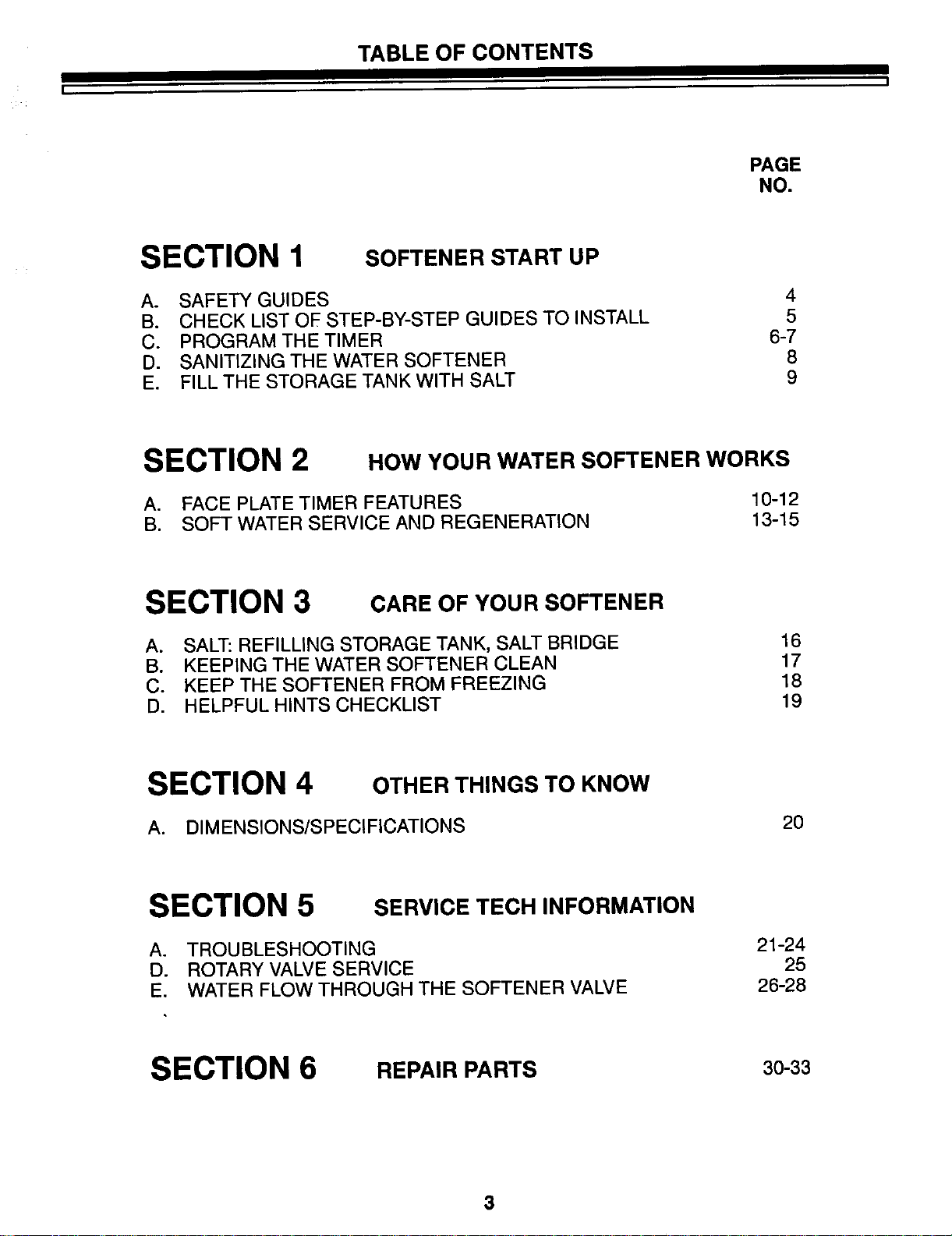
TABLE OF CONTENTS
| !
PAGE
NO.
SECTION 1
SOFTENER START UP
A. SAFETY GUIDES
B. CHECK LIST OF STEP-BY-STEP GUIDES TO INSTALL
C. PROGRAM THE TIMER
D. SANITIZING THE WATER SOFTENER
E. FILL THE STORAGE TANK WITH SALT
4
5
8-7
8
9
SECTION 2 HOW YOUR WATER SOFTENER WORKS
A. FACE PLATETIMER FEATURES 10-12
B. SOFT WATER SERVICE AND REGENERATION 13-15
SECTION 3
CARE OF YOUR SOFTENER
A. SALT: REFILLING STORAGE TANK, SALT BRIDGE
B. KEEPING THE WATER SOFTENER CLEAN
C. KEEP THE SOFTENER FROM FREEZING
D. HELPFUL HINTS CHECKLIST
16
17
18
19
SECTION 4 OTHER THINGS TO KNOW
A. DIMENSIONS/SPECIFICATIONS 20
SECTION 5
SERVICE TECH INFORMATION
A. TROUBLESHOOTING
D. ROTARY VALVE SERVICE
E. WATER FLOW THROUGH THE SOFTENER VALVE
21-24
25
26-28
SECTION 6
REPAIR PARTS 30-33
3
SECTION 1 WATERSOFTENERSTART-UP
I
I
1A. SAFETY GUIDES
• Read all steps, guides and rules carefully be-
fore installing and using your new water softener.
Follow all steps exactly to correctly install. Fail-
ure to follow them could cause personal injury or
property damage. Reading this book will also
help you to get all of the benefits from your water
softener.
• Your water softener will remove hardness min-
erals and "clear water" iron from water, up to the
limits shown on page 20. It will not remove other
types of iron, acids, tastes and odors, etc. It will
not purify polluted water or make it safe to drink.
• Protect the softener and piping from freezing.
Damage from freezing voids the softener warran-
ty. See page 18.
CAUTIONS
PLEASE READ AND COMPLY WITH THE FOL-
LOWING GUIDES TO PREVENT DAMAGE TO
THE SOFTENER OR OTHER PROPERTY,
PERSONAL INJURY, OR POSSIBLE FATAL
SHOCK.
• THIS SOFTENER WORKS ON 24 VOLTS
ONLY. BE SU RE TO USE THE TRANSFORMER
INCLUDED, AND PLUG IT INTO A 120V OUT-
LET.
• Unplug the transformer right away if the
power cable sould become damaged or
frayed. Make repairs before plugging back
into the power outlet.
• Always unplug the softener from electrical
power before removing outer valve covers.
4
SECTION 1 WATERSOFTENERSTART-UP
! !
lB. CHECK LIST OF ALL STEP-BY-STEP GUIDES TO INSTALL
To be sure you have done all the steps to install the
softener, read the following list. Refer to the
Installation Manual, part no. 7183613, for step-by-step
guides.
Page numbers referred to are in the Insta/Iation
Manua/unless otherwise noted.
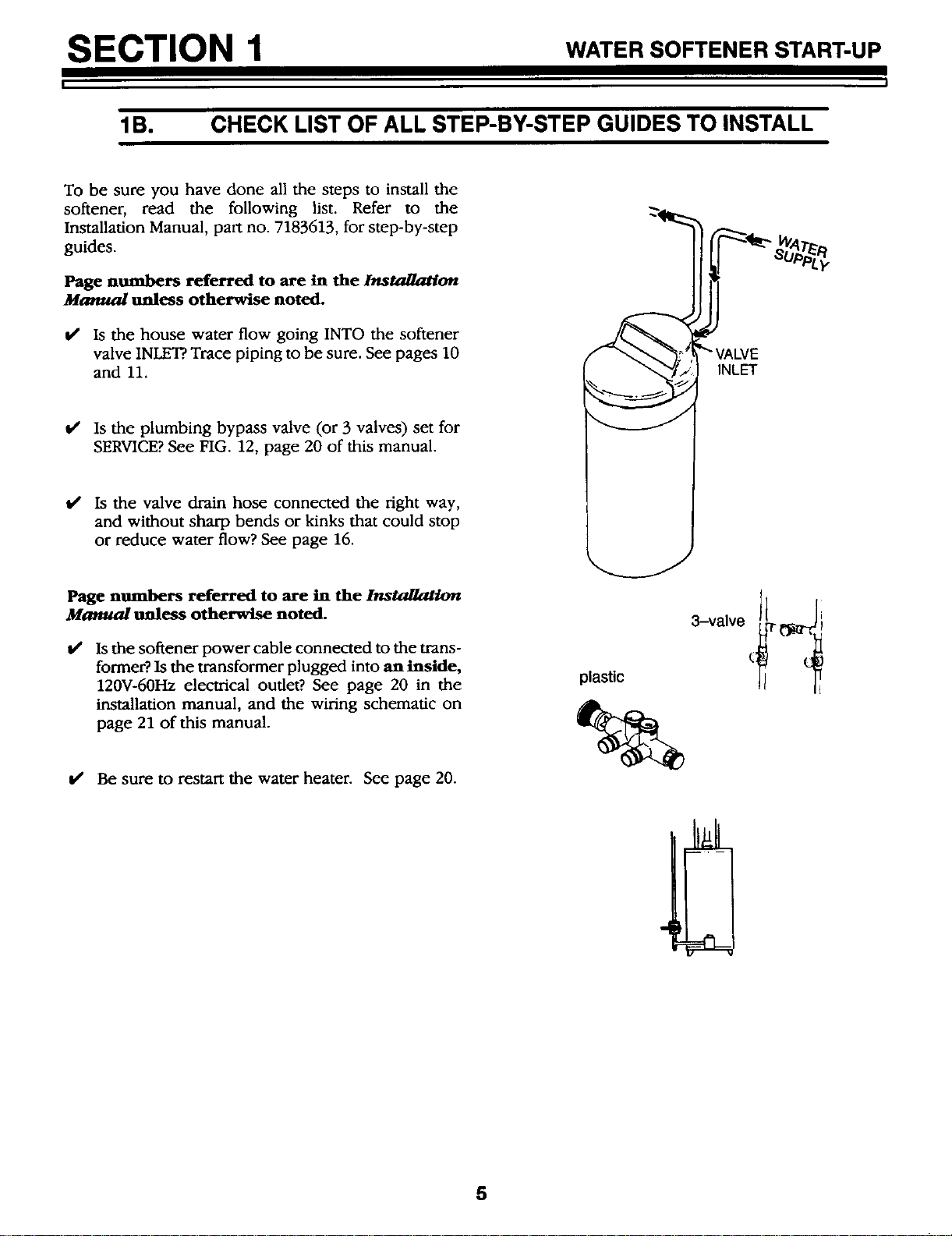
€' Is the house water flow going INTO the softener
valve INLET?.Trace piping to be sure. See pages 10
and 11.
I/ Is the plumbing bypass valve (or 3 valves) set for
SERVICE? See FIG. 12, page 20 of this manual.
v' Is the valve drain hose connected the right way,
and without sharp bends or kinks that could stop
or reduce water flow? See page 16.
Page numbers referred to are in the Insta//ation
Manua/unless otherwise noted.
v' Is the softener power cable connected to the trans-
former? Is the transformer plugged into an inside,
120V-60Hz electrical outlet? See page 20 in the
installation manual, and the wiring schematic on
page 21 of this manual.
v' Be sure to restart the water heater. See page 20.
-".t::
plastic
_ VALVE
INLET
Jt/;
3-valve _- _ !
5
SECTION 1 WATER SOFTENER START-UP
3
1C. PROGRAM THE TIMER
salt level
adjust button
f
low salt
indicator
\
\
KenmoreWaterLine
forCustornerAssistance #.u_J
'_ 1-800-426-_,/./ _
/ /
signal light tank light
adjust button on/off button
ON/OFF-HOLD button #1 SELECT
(Recharge Tonight-Now) button UP button
/
display #2 SELECT DOWN button
button
GeniusII WaterSo#ener
J
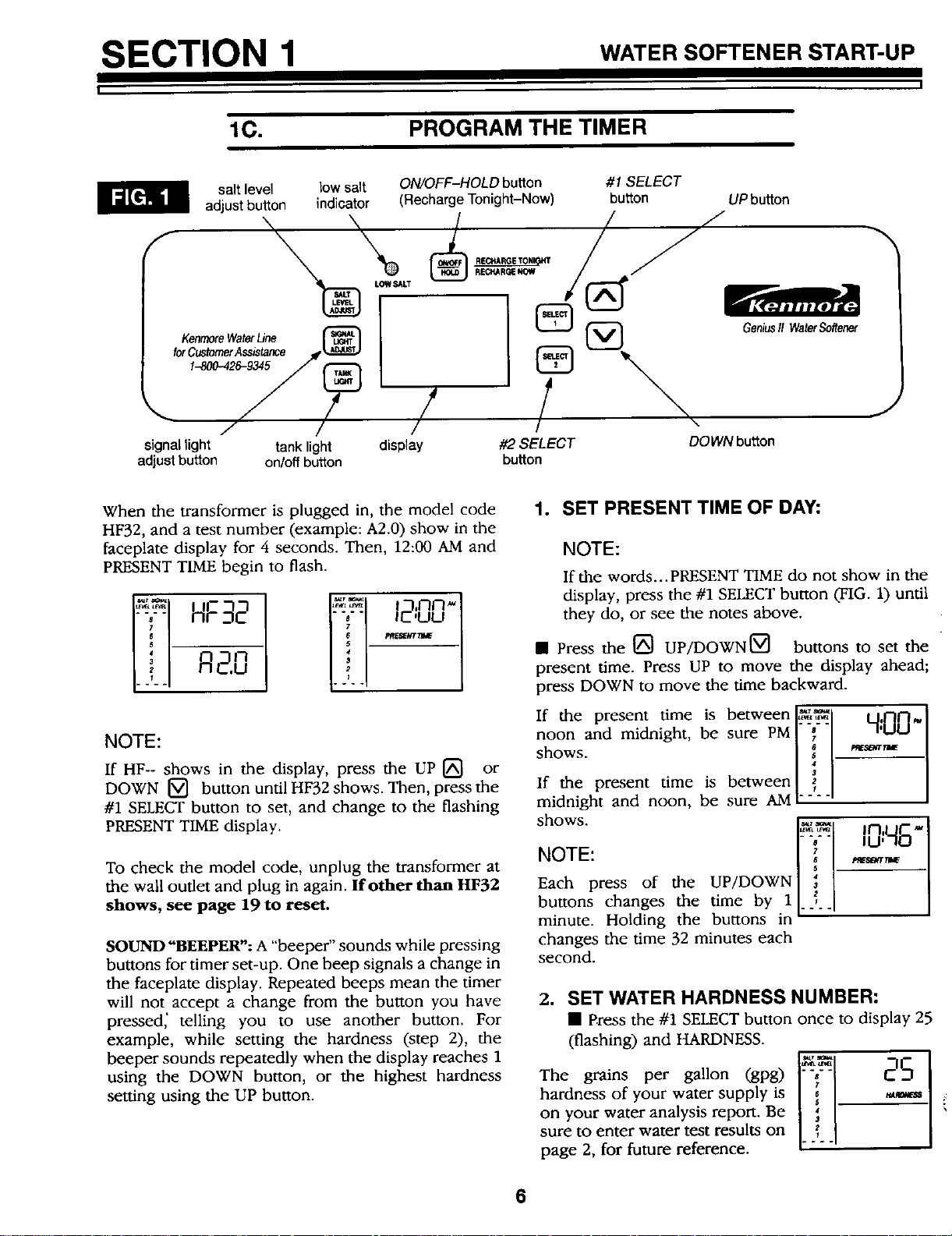
When the transformer is plugged in, the model code
HF32, and a test number (example: A2.0) show in the
faceplate display for 4 seconds. Then, 12:00 AM and
PRESENT TIME begin to flash.
R20
-Ti
..... I -i f-lr-i,_
.... C,ULI
NOTE:
If HF-- shows in the display, press the UP [_ or
DOWN [_ button until HF32 shows. Then, press the
#1 SELECT button to set, and change to the flashing
PRESENT TIME display.
To check the model code, unplug the transformer at
the wall outlet and plug in again. If other than HF32
shows, see page 19 to reset.
SOUND "BEEPER": A "beeper" sounds while pressing
buttons for timer set-up. One beep signals a change in
the faceplate display. Repeated beeps mean the timer
will not accept a change from the button you have
pressed_ telling you to use another button. For
example, while setting the hardness (step 2), the
beeper sounds repeatedly when the display reaches 1
using the DOWN button, or the highest hardness
setting using the UP button.
1. SET PRESENT TIME OF DAY:
NOTE:
If the words...PRESENT TIME do not show in the
display, press the #1 SELECT button (FIG. 1) until
they do, or see the notes above.
• Press the _ UP/DOWN{_ buttons to set the
present time. Press UP to move the display ahead;
press DOWN to move the time backward.
If the present time is between
noon and midnight, be sure PM
shows.
If the present time is between
midnight and noon, be sure AM
'i
%0-
_ltE
shows.NOTE: I"_",'_....
Each press of the UP/DOWN J
buttons changes the time by 1] { [
minute. Holding the buttons in"""
changes the time 32 minutes each
second.
2. SET WATER HARDNESS NUMBER:
• Bress the #1 SELECT button once to display 25
(flashing) and HARDNESS.
='-" 25
The grains per gallon (gpg) ",'"
7
hardness of your water supply is _
on your water analysis report. Be
sure to enter water test results on *,
page 2, for future reference. " "
6
SECTION 1 WATER SOFTENER START-UP
1C. PROGRAM THE TIMER
• Press the [_ UP/DOWN [] buttons to set your
water hardness number in the display. The DOWN
button moves the display to 1. The UP button moves
the display to the highest setOng (see maximum setting
for your model in the specifications).
NOTE:
If your water supply contains iron, compensate for it
by adding to the water hardness number. Forexarnple,
assume your water is 15 gpg hard and contains 2 ppm
iron. Add 5 to the hardness number for each I ppm of
iron. In this example, 3_9u would use 25 for your
hardness number
15 gpg hardness
2ppmironx5=10 +10
(times) 25 HARDNESS NUMBER
NOTE:
Each press of the UP/DOWN button changes the
display by 1 between 1 and 25. Between 25 and the
highest number, the display changes 5 at a time...25,
30, 35, etc. Holding the UP or DOWN button in
changes the display twice each second.
3. SET RECHARGE (REGENERATION) TIME:
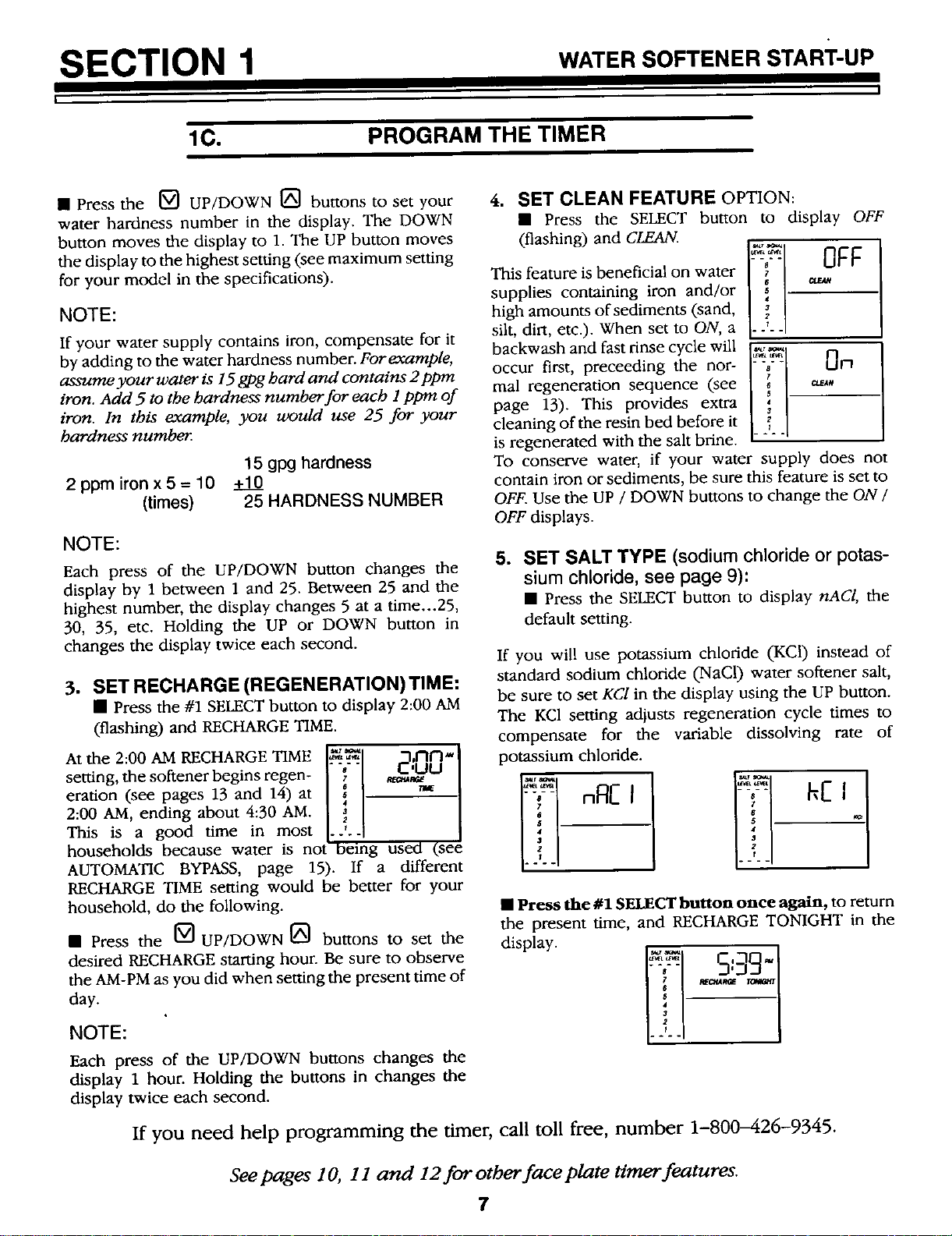
• Press the #1 SELECT button to display 2:00 AM
(flashing) and RECHARGE TIME.
At the 2:00 AM RECHARGE TIME _ _.'_., _,.N.0 _,[
setting, the softener begins regen-
I
eration (see pages 13 and 14) at I ,0 I
2:00 AM, ending about 4:30 AM. [ i
This is a good time in most I..'..I
households because water is not being used (see
AUTOMATIC BYPASS, page 15). If a different
RECHARGE TIME setting would be better for your
household, do the following.
• Press the [_ UP/DOWN [] buttons to set the
desired RECHARGE starting hour. Be sure to observe
the AM-PM as you did when setting the present time of
day.
NOTE:
Each press of the UP/DOWN buttons changes the
display 1 hour. Holding the buttons in changes the
display twice each second.
4. SET CLEAN FEATURE OPTION:
• Press the SELECT button
(flashing) and CLEAA_
This feature is beneficial on water
supplies containing iron and/or
high amounts of sediments (sand,
silt, dirt, etc.). When set to ON, a
backwash and fast rinse cycle will
occur first, preceeding the nor-
mal regeneration sequence (see
page 13). This provides extra
cleaning of the resin bed before it
to display OFF
mr
..... OFF
?
6 _
5
ii
3
2
. T_
..... ON
- -B- -
7
6 _.F.AH
5
4
3
2
I
is regenerated with the salt brine. "" "
To conserve water, if your water supply does not
contain iron or sediments, be sure this feature is set to
OFF. Use the UP / DOWN buttons to change the ON /
OFF displays.
5. SET SALT TYPE (sodium chloride or potas-
sium chloride, see page 9):
• Press the SELECT button to display nACl, the
default setting.
If you will use potassium chloride (KCI) instead of
standard sodium chloride (NaCl) water softener salt,
be sure to set KCI in the display using the UP button.
The KCl setting adjusts regeneration cycle times to
compensate for the variable dissolving rate of
potassium chloride.
Ii
.%___
.°.
nflE I
_zt
_t te_t
--#--
l
4
S
kEI
• Press the #1 SELECT button once again, to return
the present time, and RECHARGE TONIGHT in the
display.
vtr
9:39--"$'m
5
4
3
If you need help programming the timer, call toll flee, number 1-800-426-9345.
See pages 1O, 11 and 12for otberface plate timer features.
7
SECTION 1 WATERSOftENERSTART-UP
I
1D. SANITIZING THE WATER SOFTENER
Care is taken at the factory to keep your water softener
clean and sanitary. Materials used to make the softener
will not infect or contaminate your water supply, and
will not cause bacteria to form or grow. However,
during shipping, storage, installing and operating,
bacteria could get into the softener. For this reason,
sanitizing as follows is suggested ® when installing.
1. The first time you sanitize your softener, be sure to
do a!/steps in the installation manual, and on
pages 5, 6 and 7 of this manual first.
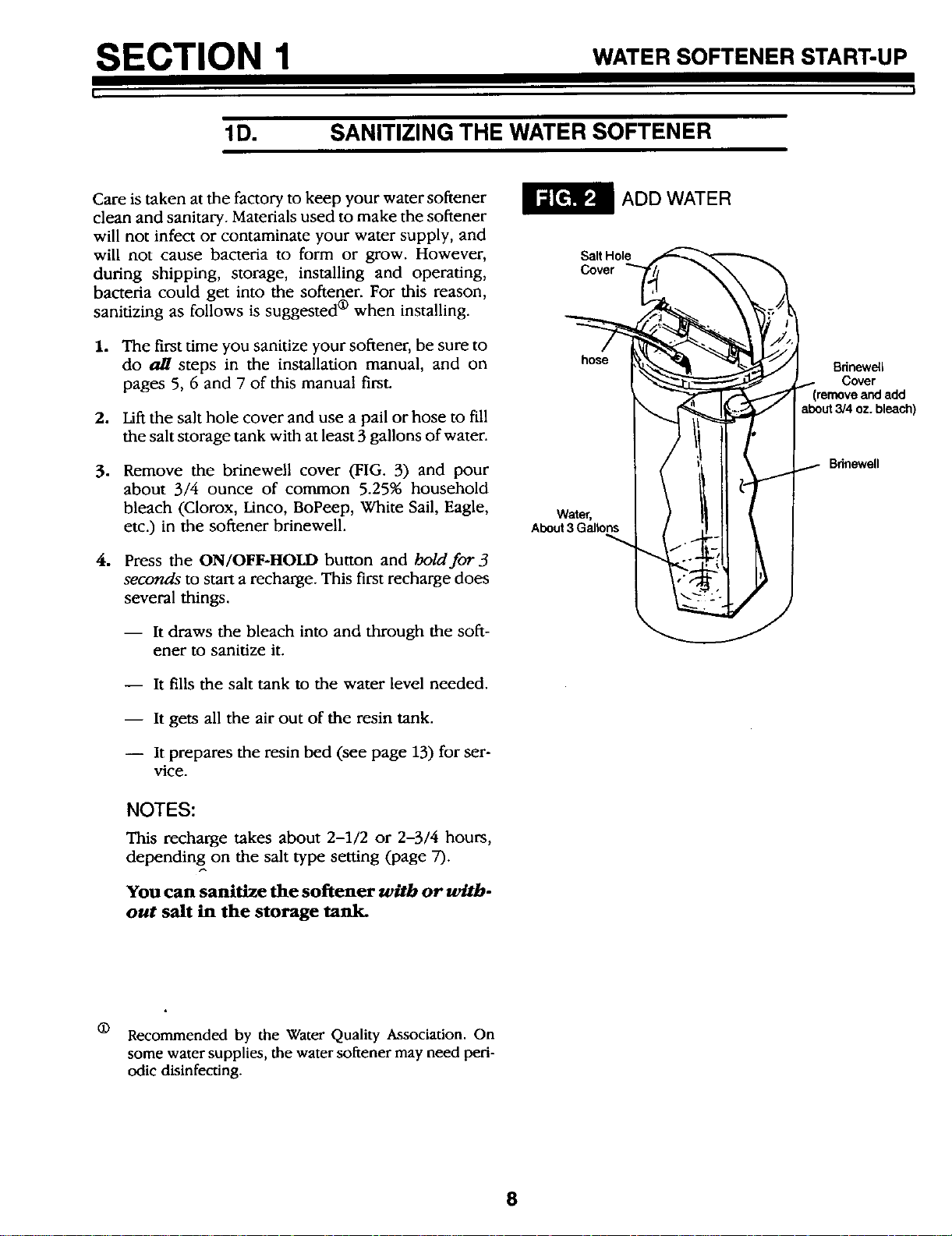
2. Lift the salt hole cover and use a pail or hose to fill
the salt storage tank with at least 3 gallons of water.
3. Remove the brinewell cover (FIG. 3) and pour
about 3/4 ounce of common 5.25% household
bleach (Clorox, Linco, BoPeep, White Sail, Eagle,
etc.) in the softener brinewell.
4. Press the ON/OFF-HOLD button and hold for3
seconds to start a recharge. This first recharge does
several things.
-- It draws the bleach into and through the soft-
ener to sanitize it.
-- It fills the salt tank to the water level needed.
-- It gets all the air out of the resin tank.
-- It prepares the resin bed (see page 13) for ser-
vice.
NOTES:
This recharge takes about 2-1/2 or 2-3/4 hours,
depending on the salt type setting (page 7).
You can sanitize the softener with or udth-
out salt in the storage tank.
ADD WATER
Salt Hole
Cover
hose
Water,
About3Galtons
Bdnewetl
Cover
about 3/4 oz. bleach)
Bdnewell
Recommended by the Water Quality Association. On
some water supplies, the water softener may need peri-
odic disinfecting.
8
SECTION 1 WATERSOFTENERSTART-UP
1E. FILL THE STORAGE TANK WITH SALT
Brine (salt dissolved in water) is needed for each and
every regeneration. The water for making brine is
metered into the salt storage tank by the softener.
However, you must keep the tank filled with salt.
Fill the tank with NUGGET or PELLET water softener
salt. DO NOT use rock salts, as they have dirt and
sediments that will stop the softener from working.
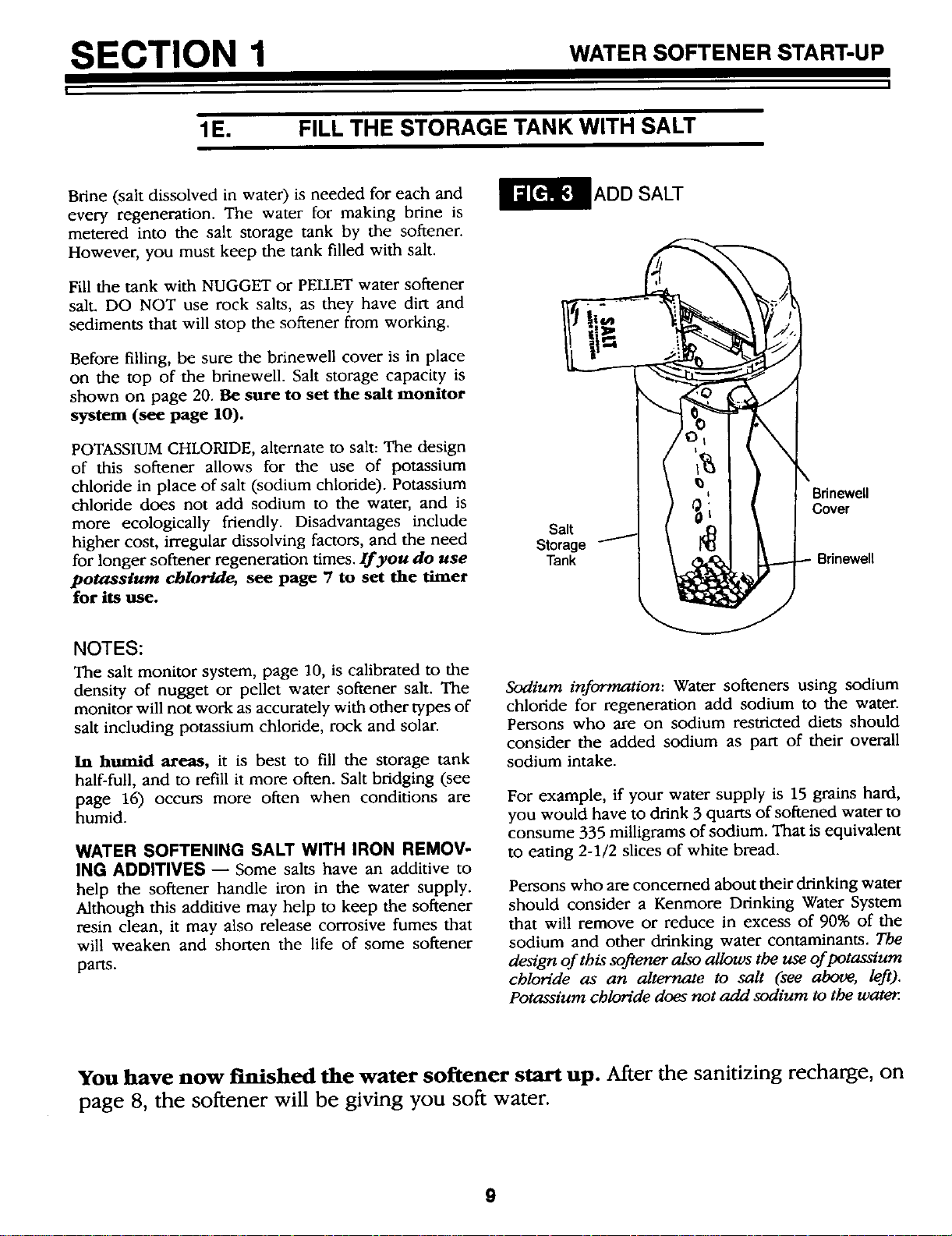
Before filling, be sure the brinewell cover is in place
on the top of the brinewell. Salt storage capacity is
shown on page 20. Be sure to set the salt monitor
system (see page 10).
POTASSIUM CHLORIDE, alternate to salt: The design
of this softener allows for the use of potassium
chloride in place of salt (sodium chloride). Potassium
chloride does not add sodium to the water, and is
more ecologically friendly. Disadvantages include
higher cost, irregular dissolving factors, and the need
for longer softener regeneration times. Ifyou do use
potassium chloride, see page 7 to set the timer
for its use.
ADD SALT
Salt
Storage
Tank
Brinewell
Cover
Bdnewell
NOTES:
The salt monitor system, page 10, is calibrated to the
density of nugget or pellet water softener salt. The
monitor will not work as accurately with other types of
salt including potassium chloride, rock and solar.
In humid areas, it is best to fill the storage tank
half-full, and to refill it more often. Salt bridging (see
page 16) occurs more often when conditions are
humid.
WATER SOFTENING SALT WITH IRON REMOV-
ING ADDITIVES -- Some salts have an additive to
help the softener handle iron in the water supply.
Although this additive may help to keep the softener
resin clean, it may also release corrosive fumes that
will weaken and shorten the life of some softener
parts.
Sodium information: Water softeners using sodium
chloride for regeneration add sodium to the water.
Persons who are on sodium restricted diets should
consider the added sodium as part of their overall
sodium intake.
For example, if your water supply is 15 grains hard,
you would have to drink 3 quarts of softened water to
consume 335 milligrams of sodium. That is equivalent
to eating 2-1/2 slices of white bread.
Persons who are concerned about their drinking water
should consider a Kenmore Drinking Water System
that will remove or reduce in excess of 90% of the
sodium and other drinking water contaminants. The
design of this softener also allows the use of potassium
chloride as an alternate to salt (see above, left).
Potassium chlon'de does not add sodium to the water
You have now finished the water softener start up. After the sanitizing recharge, on
page 8, the softener will be giving you soft water.
9
SECTION 2 HOW YOUR WATER SOFTENER WORKS
I
2A. FACEPLATE TIMER FEATURES
EXTRA RECHARGE
Sometimes, a manually started regeneration (re-
charge) may be desired, or needed• Two examples
are:
--You have used more water than usual (guests
visiting) and you may run out of soft water before the
next timer started regeneration.
--You did not refill the softener with salt before it was
gone.
You can start a regeneration right away, or you can set
the timer to regenerate at the next 2:00 AM (or other
preset recharge time). Do the following•
RECHARGE NOW
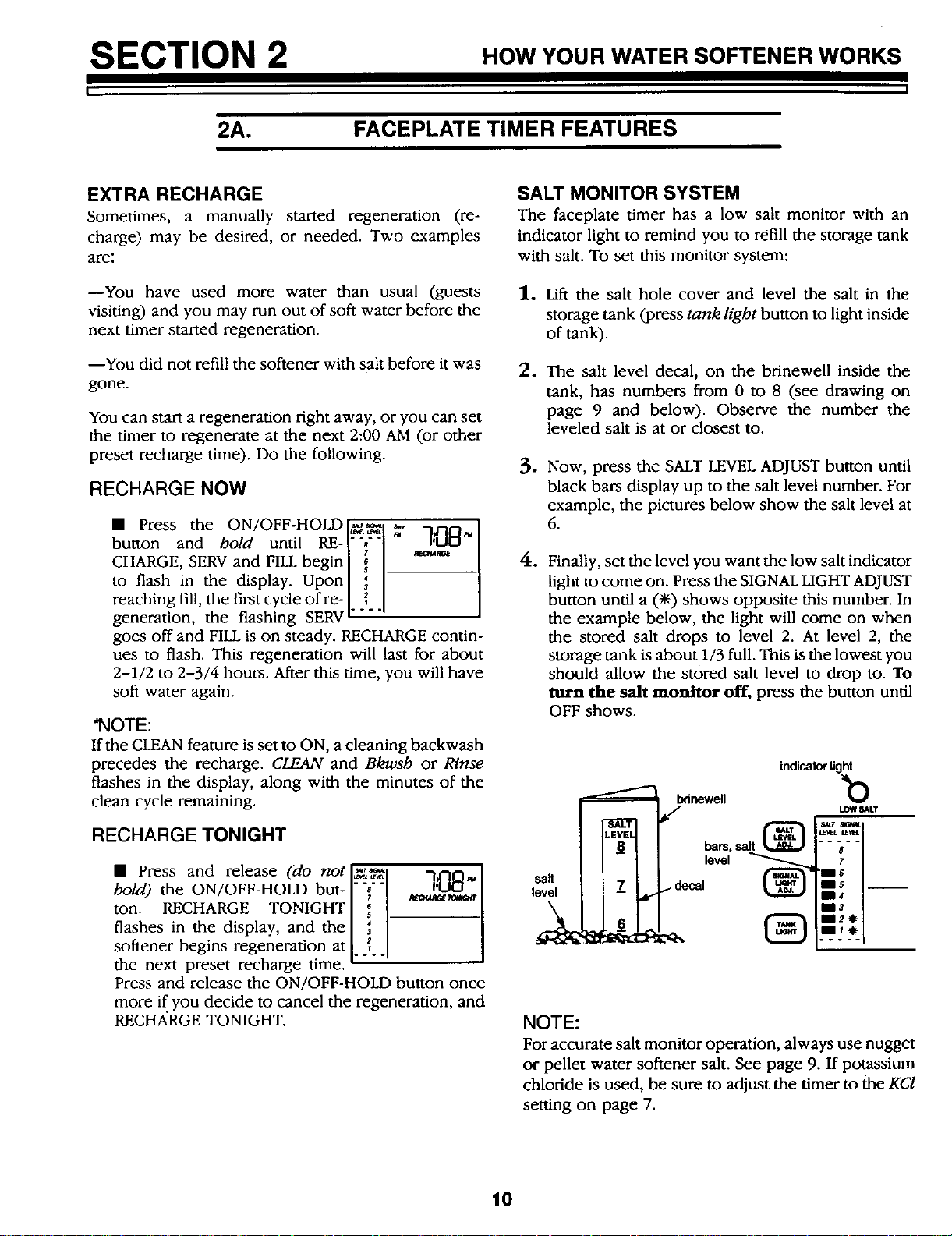
• Press the ON/OFF-HOLD]#,_=,,,_,,I _ 2QB'I 1
button and bold until RE-I'',"I
• ? _IE
CHARGE, SERV and FILL begin ] _ ]
to flash in the display. Upon] ' ]
reaching fill, the first cycle of re- _, ]
generation, the flash ng SERW....
goes off and FILLis on steady. RECHARGE contin-
ues to flash. This regeneration will last for about
2-112 to 2-3/4 hours. After this time, you will have
soft water again.
"NOTE:
If the CLEAN feature is set to ON, a cleaning backwash
precedes the recharge. CLEAN and Bkwsh or Rinse
flashes in the display, along with the minutes of the
clean cycle remaining.
RECHARGE TONIGHT
• Press and release (do not []I_'7''
hold) the ON/OFF-HOLD but- """ -]'_8_'
ton. RECHARGE TONIGHT
flashes in the display, and the
softener begins regeneration at .2'..
the next preset recharge time.
Press and release the ON/OFF-HOLD button once
more if you decide to cancel the regeneration, and
RECHARGE TONIGHT.
SALT MONITOR SYSTEM
The faceplate timer has a low salt monitor with an
indicator light to remind you to refill the storage tank
with salt. To set this monitor system:
1. Lift the salt hole cover and level the salt in the
storage tank (press tank light button to light inside
of tank).
o
The salt level decal, on the brinewell inside the
tank, has numbers from 0 to 8 (see drawing on
page 9 and below)• Observe the number the
leveled salt is at or closest to.
3.
Now, press the SALT LEVELADJUST button until
black bars display up to the salt level number. For
example, the pictures below show the salt level at
6.
4.
Hnally, set the level you want the low salt indicator
light to come on. Press the SIGNAL LIGHT ADJUST
button until a (÷) shows opposite this number. In
the example below, the light will come on when
the stored salt drops to level 2. At level 2, the
storage tank is about 1/3 full. This is the lowest you
should allow the stored salt level to drop to. To
turn the salt monitor off, press the button until
OFF shows.
salt
level
Z
bdnewell indicator ligb
/ LOWSAG
bats
level
NOTE:
For accurate salt monitor operation, always use nugget
or pellet water softener salt. See page 9. If potassium
chloride is used, be sure to adjust the timer to the KCl
setting on page 7.
10
SECTION 2 .ow YOURWATERSOFTE.ERWORKS
2A. FACEPLATE TIMER FEATURES
OPTIONAL ADJUSTABLE SETTINGS
Following is a list of other timer features that are
adjustable, and the default setting for each. The
defaults automatically set when electrical power is
applied to the timer. If you want to change from any of
the default values, scroll through steps 1 - 5 below,
and reset as desired.
1. Press and hold the #1 SELECT button for 3 seconds
until the faceplate display changes. Then, press and
release the #1 SELECT button to display 12 hr
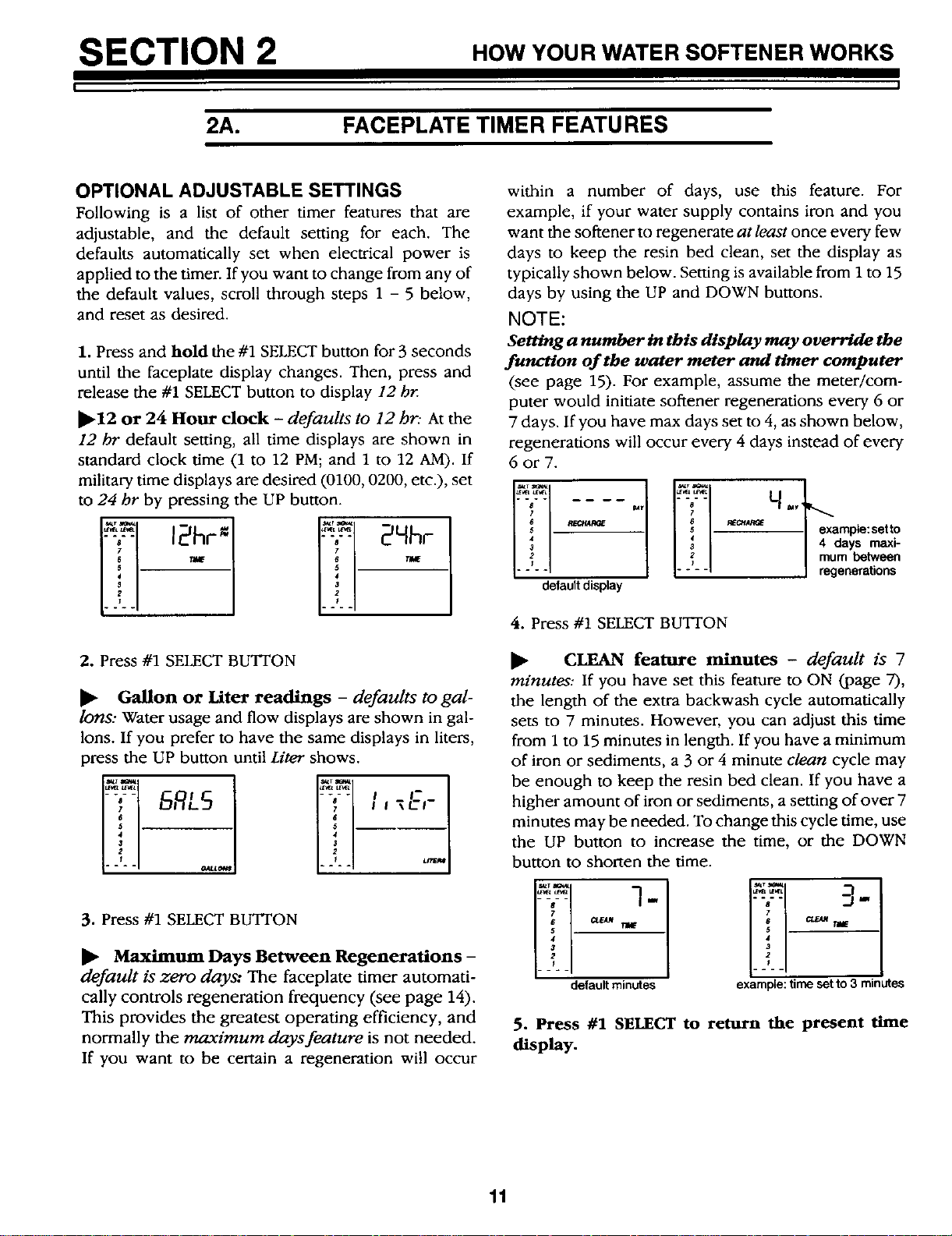
• 12 or 24 Hour clock - defaults to 12 hr: At the
12 hr default setting, all time displays are shown in
standard clock time (1 to 12 PM; and 1 to 12 AM). If
military time displays are desired (0100, 0200, etc.), set
to 24 hr by pressing the UP button.
[ii{i:-[i{:i
2. Press #1 SELECT BUTTON
• Gallon or Liter readings - defaults to gal-
Ions: Water usage and flow displays are shown in gal-
lons. If you prefer to have the same displays in liters,
press the UP button until Liter shows.
t_va _t _: teat
.... ItxE,-
3. Press #1 SELECT BUTTON
• Maximum Days Between Regenerations -
default is zero days: The faceplate timer automati-
cally controls regeneration frequency (see page 14).
This provides the greatest operating efficiency, and
normally the maximum days feature is not needed.
If you want to be certain a regeneration will occur
within a number of days, use this feature. For
example, if your water supply contains iron and you
want the softener to regenerate at least once every few
days to keep the resin bed clean, set the display as
typically shown below. Setting is available from 1 to 15
days by using the UP and DOWN buttons.
NOTE:
Setting a number in this display may override the
function of the water meter and timer computer
(see page 15). For example, assume the meter/com-
puter would initiate softener regenerations every 6 or
7 days. If you have max days set to 4, as shown below,
regenerations will occur every 4 days instead of every
6 or7.
I_"i I l_'i _ _exa
_==_nc._ _*P'_ mpte:set to
" _' _ 4 days maxi-
I mum between
..... J regenerations
default display
4. Press #1 SELECT BUTTON
• CLEAN feature minutes - default is 7
minutes: If you have set this feature to ON (page 7),
the length of the extra backwash cycle automatically
sets to 7 minutes. However, you can adjust this time
from 1 to 15 minutes in length. If you have a minimum
of iron or sediments, a 3 or 4 minute clean cycle may
be enough to keep the resin bed clean. If you have a
higher amount of iron or sediments, a setting of over 7
minutes may he needed. To change this cycle time, use
the UP button to increase the time, or the DOWN
button to shorten the time.
7
8 I m
7
6 CtBU¢
5
4
3
default minutes
CLF-At¢tl W
example: time set to 3 minutes
5. Press #1 SELECT to return the present time
display.
11
SECTION 2 HOW YOUR WATER SOFTENER WORKS
2A, FACEPLATE TIMER FEATURES
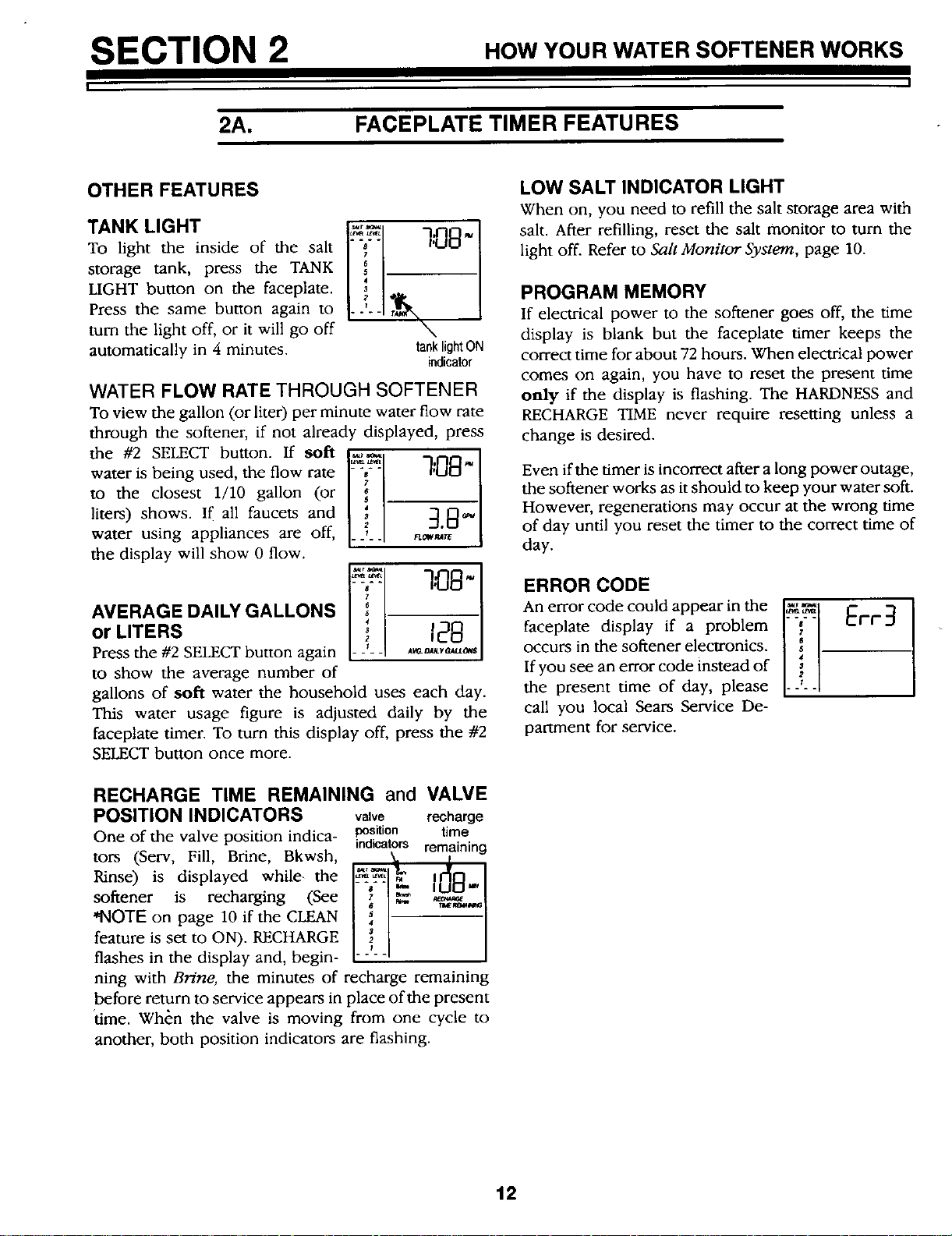
OTHER FEATURES
TANK LIGHT
To light the inside of the salt
storage tank, press the TANK
LIGHT button on the faceplate.
Press the same button again to
turn the light off, or it will go off
automatically in 4 minutes.
_r
.... 7, 8
-8--
7
6
5
4
3
tank lightON
indicator
WATER FLOW RATE THROUGH SOFTENER
To view the gallon (or liter) per minute water flow rate
through the softener, if not already displayed, press
the #2 SELECT button. If soft
water is being used, the flow rate
to the closest 1110 gallon (or
liters) shows. If all faucets and
water using appliances are off,
the display will show 0 flow.
AVERAGEDAILYGALLONS
orLITERS
Press the _ SELECT button again
to show the average number of
Li 001
ttm _l
I"i
tP_l t*_t
gallons of soft water the household uses each day.
This water usage figure is adjusted daily by the
faceplate timer. To turn this display off, press the #2
SELECT button once more.
LOW SALT INDICATOR LIGHT
When on, you need to refill the salt storage area with
salt. After refilling, reset the salt monitor to turn the
light off. Refer to Salt Monitor System, page 10.
PROGRAM MEMORY
If electrical power to the softener goes off, the time
display is blank but the faceplate timer keeps the
correct time for about 72 hours. When electrical power
comes on again, you have to reset the present time
only if the display is flashing. The HARDNESS and
RECHARGE TIME never require resetting unless a
change is desired.
Even if the timer is incorrect after a long power outage,
the softener works as it should to keep your water soft.
However, regenerations may occur at the wrong time
of day until you reset the timer to the correct time of
day.
ERROR CODE
An error code could appear in the
faceplate display if a problem
occurs in the softener electronics.
If you see an error code instead of
the present time of day, please
call you local Sears Service De-
partment for service.
l:q1
Err3
RECHARGE TIME REMAINING and VALVE
POSITION INDICATORS valve recharge
One of the valve position indica-
tors (Serv, Fill, Brine, Bkwsh,
Rinse) is displayed while-the
softener is recharging (See
*NOTE on page 10 if the CLEAN
feature is set to ON). RECHARGE
flashes in the display and, begin-
position time
indicators remaining
..2__
ning with Brine, the minutes of recharge remaining
before return to service appears in place oft.he present
'time. When the valve is moving from one cycle to
another, both position indicators are flashing.
12
SECTION 2 .owYOURWATERSOFTENERWORKS
I
2B. SOFT WATER SERVICE AND REGENERATION
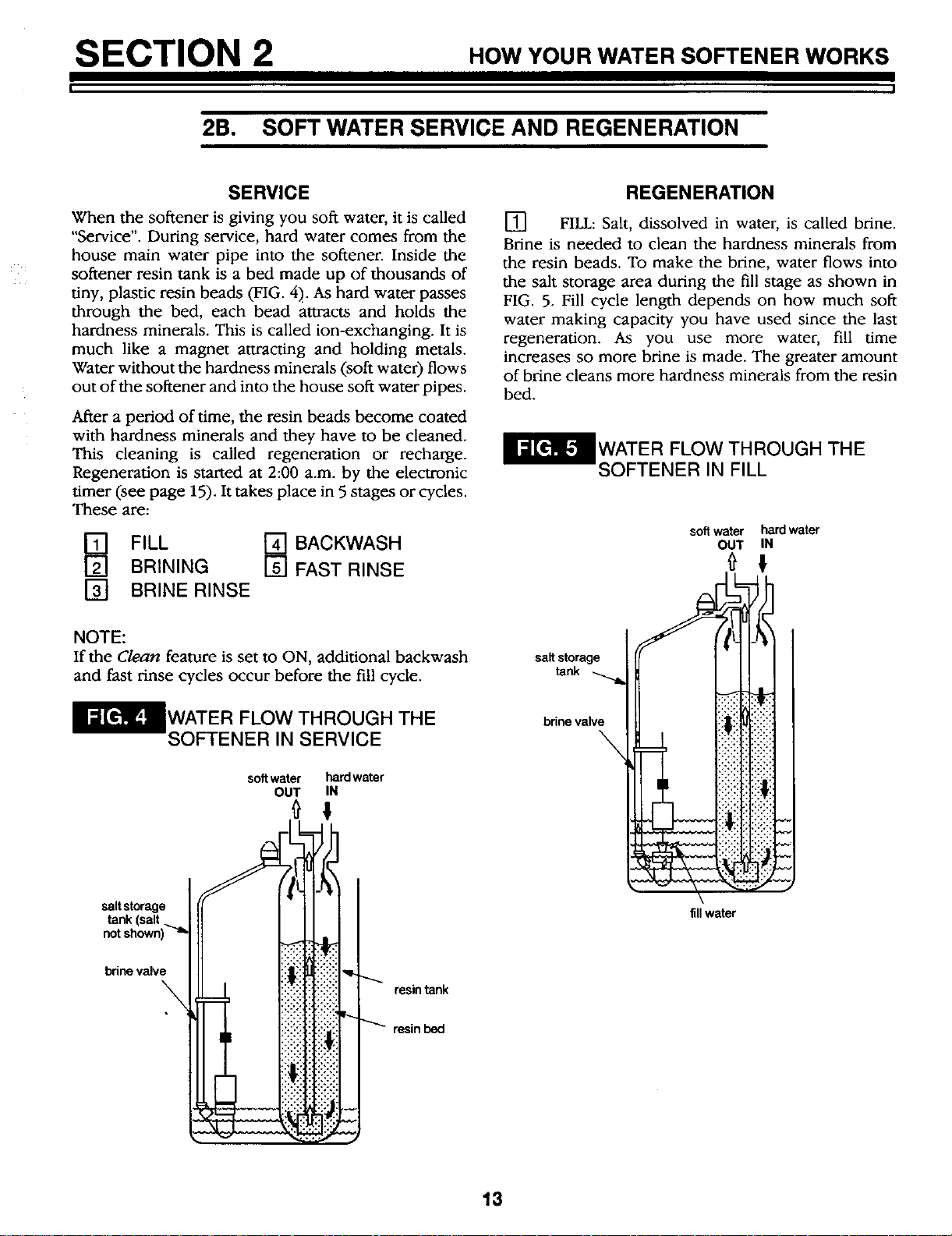
SERVICE
When the softener is giving you soft water, it is called
"Service". During service, hard water comes from the
house main water pipe into the softener. Inside the
softener resin tank is a bed made up of thousands of
tiny, plastic resin beads (FIG. 4). As hard water passes
through the bed, each bead attracts and holds the
hardness minerals. This is called ion-exchanging. It is
much like a magnet attracting and holding metals.
Water without the hardness minerals (soft water) flows
out of the softener and into the house soft water pipes.
After a period of time, the resin beads become coated
with hardness minerals and they have to be cleaned.
This cleaning is called regeneration or recharge.
Regeneration is started at 2:00 a.m. by the electronic
timer (see page 15). It takes place in 5 stages or cycles.
These are:
[] FILL [] BACKWASH
[] BRINING [] FAST RINSE
[] BRINE RINSE
NOTE:
If the Clean feature is set to ON, additional backwash
and fast rinse cycles occur before the fill cycle.
WATER FLOW THROUGH THE
SOFTENER IN SERVICE
salt storage
tank (salt
not shown) _'h
brine valve
\
soft water hard water
OUT IN
resin tank
resinbed
REGENERATION
[] FILL: Salt, dissolved in water, is called brine.
Brine is needed to clean the hardness minerals from
the resin beads. To make the brine, water flows into
the salt storage area during the fill stage as shown in
FIG. 5. Fill cycle length depends on how much soft
water making capacity you have used since the last
regeneration. As you use more water, fill time
increases so more brine is made. The greater amount
of brine cleans more hardness minerals from the resin
bed.
WATER FLOW THROUGH THE
SOFTENER IN FILL
saltstorage
tank
brinevalve
\
soft water hard water
OUT IN
\
fill water
13
SECTION 2 HOWYOURWATERSOFTENERWORKS
2B. SOFT WATER SERVICE AND REGENERATION
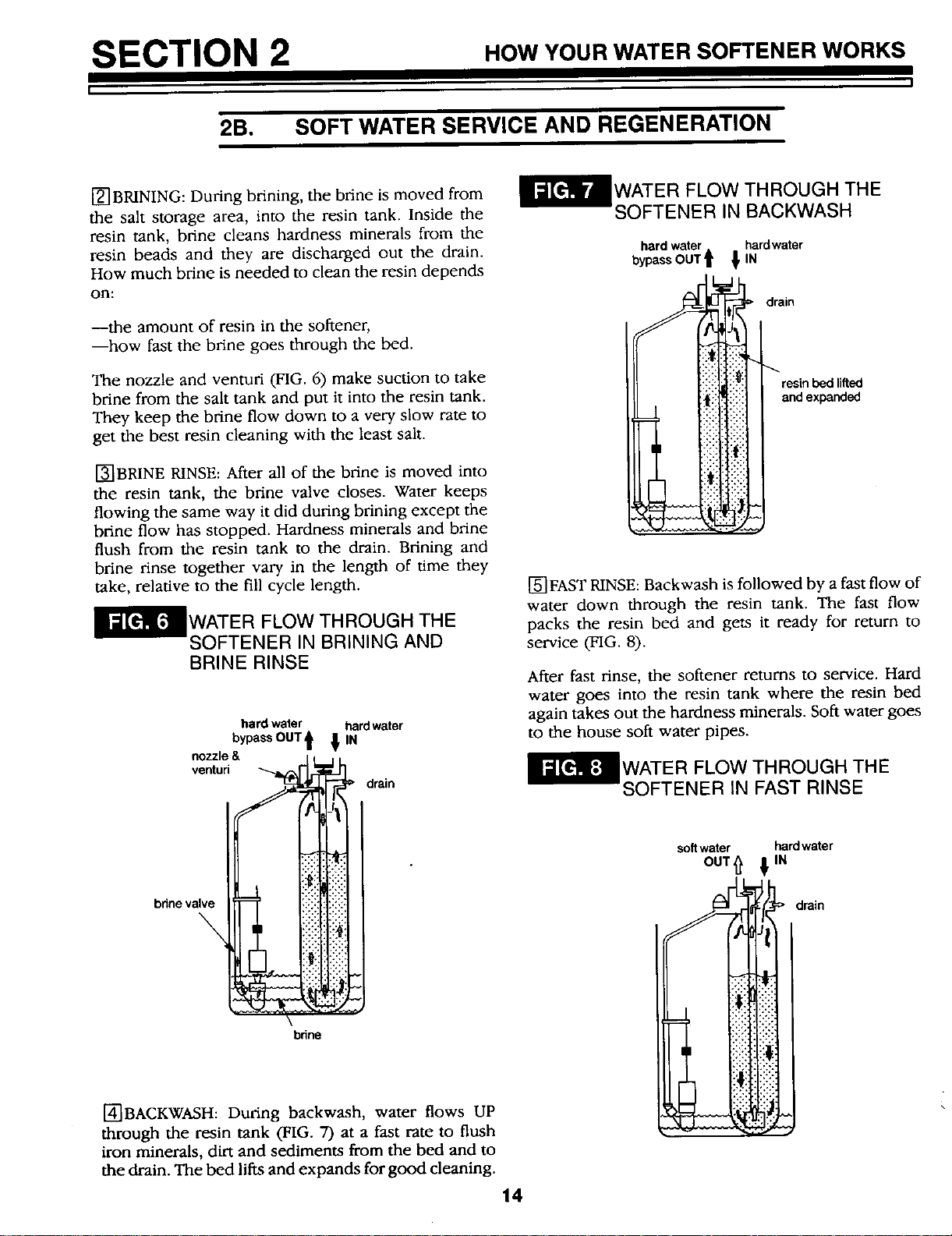
[-_BRINING: During brining, the brine is moved from
the salt storage area, into the resin tank. Inside the
resin tank, brine cleans hardness minerals from the
resin beads and they are discharged out the drain.
How much brine is needed to clean the resin depends
on:
--the amount of resin in the softener,
--how fast the brine goes through the bed.
The nozzle and venturi (FIG. 6) make suction to take
brine from the salt tank and put it into the resin tank.
They keep the brine flow down to a very slow rate to
get the best resin cleaning with the least salt.
[_BRINE RINSE: After all of the brine is moved into
the resin tank, the brine valve closes. Water keeps
flowing the same way it did during brining except the
brine flow has stopped. Hardness minerals and brine
flush from the resin tank to the drain. Brining and
brine rinse together vary in the length of time they
take, relative to the fill cycle length.
_WATER FLOW THROUGH THE
SOFTENER IN BRINING AND
BRINE RINSE
brine valve
\
hard water hard water
bYpass°uTt! '"
nozzle&
ventud
drain
bnne
[_BACKWASH: During backwash, water flows UP
through the resin tank (FIG. 7) at a fast rate to flush
iron minerals, dirt and sediments from the bed and to
the drain. The bed lifts and expands for good cleaning.
WATER FLOW THROUGH THE
SOFTENER IN BACKWASH
hard water
bypassouTti,.
::i?
hard water
drain
resin bed lifted
and expanded
[_]FAST RINSE: Backwash is followed by a fast flow of
water down through the resin tank. The fast flow
packs the resin bed and gets it ready for return to
service (FIG. 8).
After fast rinse, the softener returns to service. Hard
water goes into the resin tank where the resin bed
again takes out the hardness minerals. Soft water goes
to the house soft water pipes.
WATER FLOW THROUGH THE
SOFTENER IN FAST RINSE
softwater hard water
OUT,_ _, IN
I
I =
drain
14
SECTION 2 Mow YOUR WATER SOFTENER WORKS
2B. SOFT WATER SERVICE AND REGENERATION
AUTOMATIC BYPASS
During the brining, brine rinse and backwash cycles of
regeneration, HARD water goes through the softener
valve and to the house pipes. If a faucet is opened,
hard water is there for your needs. However, you
should not use hot water, if possible, because the
water heater will refill with hard water. The softener,
as factory programmed, regenerates from 2:00 AM to
about 4:30 or 4:45 AM (depending on the salt type
setting, page 7), a time when not much water is used.
If you get up early in the morning and you can hear the
softener regenerating, change the recharge starting
time. Set the recharge time to 12:00 AM or 1:00 AM
(page 7). Then regeneration will start and end that
much earlier and your water heater will not refill with
hard water if a hot faucet is opened.
ELECTRONICS
Two main parts of the softener's electronics are [] a
WATER METER, and [] a COMPUTER.
[] WATER METER -- The water meter is in the
softener valve outlet. As water flows through the
meter, it sends electric pulses to the computer. The
computer changes the pulses to a measure in gallons
of water.
[] COMPUTER -- The computer is part of the
faceplate timer circuit board. It is programmed to
know the softener's capacity (how many grains of
hardness minerals it will take out of the water before a
regeneration is needed). When starting the softener,
page 7, you set it for the grains per gallon (gpg)
hardness of the water.
To find a regeneration pattern best for your needs, the
computer uses: (1) water usage from the meter, (2)
hardness setting, (3) softener capacity, and (4) time
since the last regeneration. The computer always
adjusts this pattern to your water using habits. It works
toward providing you with soft water for the longest
time and at the most efficient salt usage.
Softening capacity is used as hard water goes through
the softener and hardness minerals are removed.
When the computer determines that only enough
capacity remains to provide soft water up to the next
regeneration starting time (2:00 AM, or as otherwise
set) it will schedule a regeneration. RECHARGE
TONIGHT displays until the regeneration begins.
When the regeneration begins, TONIGHT goes off
and *RECHARGE or RECHARGE TIME REMAINING
flashes during the 2-112 or 2-314 hour regeneration.
* NOTE:
If the CLEAN feature is set to ON, a cleaning backwash
(CLEAN and Bkwsh or Rinse flashes in the display,
along with the minutes of the clean cycle remaining),
precedes the recharge.
15
SECTION 3 CAREOFYOURSOFTENER
!
3A. SALT...REFILLING STORAGE TAN_BREAKING A SALT BRIDGE
WHEN TO REFILL WITH SALT (or potassium chlo-
ride): The Salt Monitor System (see page 10) will turn
the low salt light on to warn you when to refill with
salt. Check for a low salt light a few weeks after you
install the softener, and every week after that. Always
refill at about the #2 salt monitor level. At this level,
the tank is about 1/3 full. Never let the softener use all
the salt before refilling. Without salt, you will soon
have hard water. After filling, reset the Salt Monitor
System, page 10.
NOTE:
You will have a loss in softening capacity and may get
parry hard water if less than 10 inches (salt monitor
level 2) of salt is in the storage tank.
PLEASE SEE PAGE 9 FOR SALT FILLING DIRECTIONS.
BE SURE TO RESET THE SALT MONITOR, PAGE 10.
SALT BRIDGE
Sometimes, a hard crust or salt bridge forms in the salt
storage tank. It is usually caused by high humidity or
the wrong kind of salt. When the salt bridges, an
empty space forms between the water and salt. Then
salt will not dissolve (melt) in the water to make brine.
Without brine, the resin bed does not regenerate and
you will have hard water.
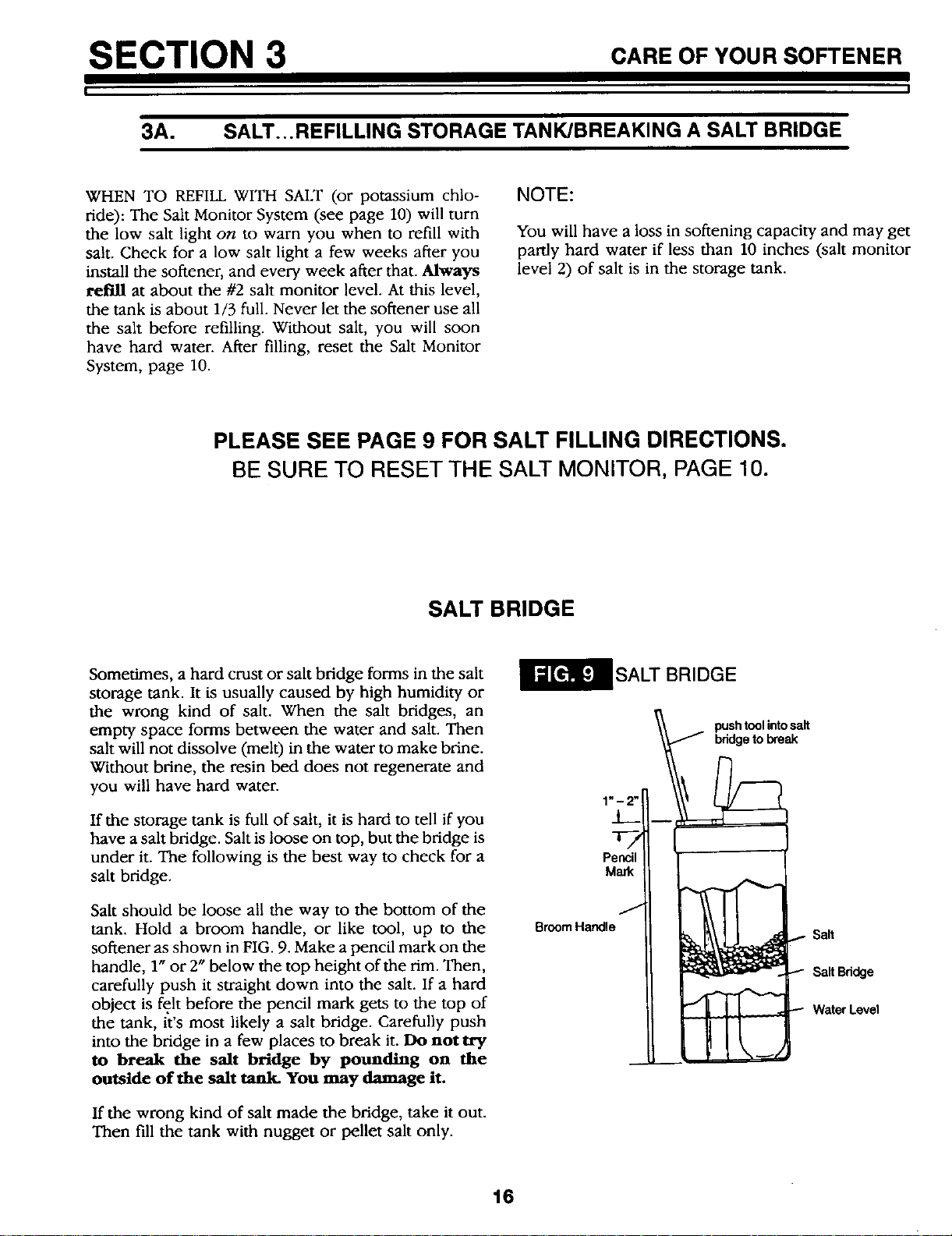
If the storage tank is full of salt, it is hard to tell if you
have a salt bridge. Salt is loose on top, but the bridge is
under it. The following is the best way to check for a
salt bridge.
Salt should be loose all the way to the bottom of the
tank. Hold a broom handle, or like tool, up to the
softener as shown in FIG. 9. Make a pencil mark on the
handle, 1" or 2" below the top height of the rim. Then,
carefully push it straight down into the salt. If a hard
object is felt before the pencil mark gets to the top of
the tank, it's most likely a salt bridge. Carefully push
into the bridge in a few places to break it. Do not try
to break the salt bridge by pounding on the
outside of the salt tank. You may damage it.
If the wrong kind of salt made the bridge, take it out.
Then fill the tank with nugget or pellet salt only.
SALT BRIDGE
1n--2"
_L_
Pencil
Mark
/
BroomHandle
push tool into salt
/ bridge to break
Salt
Salt Bddge
Water Level
16
SECTION 3 CAREOFYOURSOFTENER
t 1
3B. KEEPING THE WATER SOFTENER CLEAN
COVERS
To keep your new Kenmore water softener looking
nice, apply a coat of paste wax and repeat once a year.
When dusty, wipe it with a damp cloth to keep it
sparkling.
NOTE:
Never use cleaners having ammonia or abrasives.
They may scratch and dull the surface.
NOZZLE & VENTURI
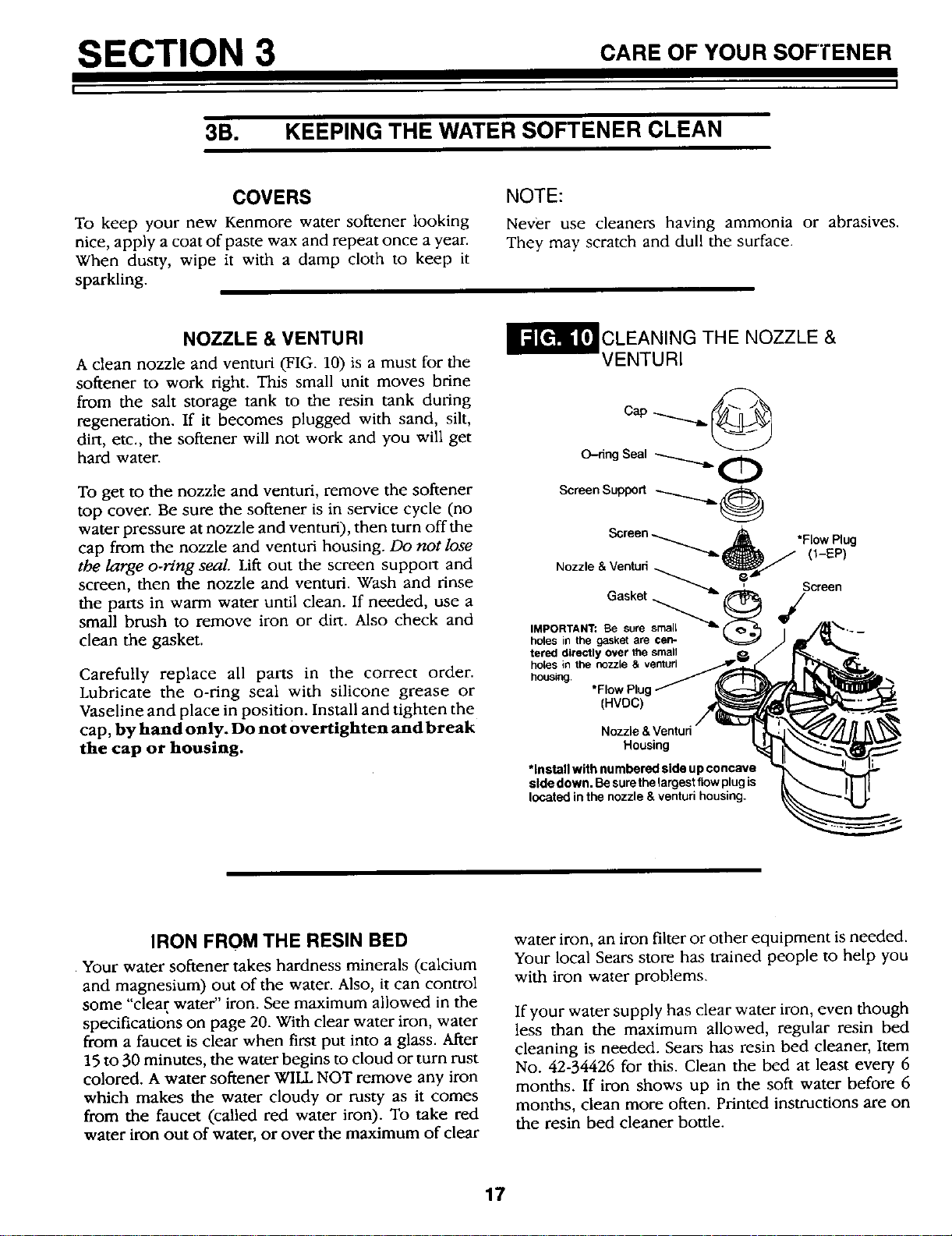
A clean nozzle and venturi (FIG. 10) is a must for the
softener to work fight. This small unit moves brine
from the salt storage tank to the resin tank during
regeneration. If it becomes plugged with sand, silt,
dirt, etc., the softener will not work and you will get
hard water.
To get to the nozzle and venturi, remove the softener
top cover. Be sure the softener is in service cycle (no
water pressure at nozzle and venturi), then turn off the
cap from the nozzle and venturi housing. Do not lose
the large o-ring seal. Lift out the screen support and
screen, then the nozzle and venturi. Wash and rinse
the parts in warm water until clean. If needed, use a
small brush to remove iron or dirt. Also check and
clean the gasket.
Carefully replace all parts in the correct order.
Lubricate the o-ring seal with silicone grease or
Vaseline and place in position. Install and tighten the
cap, by hand only. Do not overtighten and break
the cap or housing.
CLEANING THE NOZZLE &
VENTURI
O-dng Seal _
v
Screen Support ---........,_ @
/
Screen
._. "Flow Plug
_--_L_ / (1-EP)
Nozzle & Venturi _'_'_
_' Screen
Gasket
IMPORTANT: Be sure small _'_=
holes in the gasket are cen-
tered directly over the small
holes in the nozzle & venturi
housing,
*Flow Plug
(HVDC)
Nozzle&Venturi
Housing
*install with numbered side up concave
side down. Be sure the largest flow plug is
located in the nozzle & venturi housing.
IRON FROM THE RESIN BED
Your water softener takes hardness minerals (calcium
and magnesium) out of the water. Also, it can control
some "clear water" iron. See maximum allowed in the
specifications on page 20. With clear water iron, water
from a faucet is clear when first put into a glass. After
15 to 30 minutes, the water begins to cloud or turn rust
colored. A water softener WILL NOT remove any iron
which makes the water cloudy or rusty as it comes
from the faucet (called red water iron). To take red
water iron out of water, or over the maximum of clear
water iron, an iron filter or other equipment is needed.
Your local Sears store has trained people to help you
with iron water problems,
If your water supply has clear water iron, even though
less than the maximum allowed, regular resin bed
cleaning is needed. Sears has resin bed cleaner, ltem
No. 42-34426 for this. Clean the bed at least every 6
months. If iron shows up in the soft water before 6
months, clean more often. Printed instructions are on
the resin bed cleaner bottle.
17
SECTION 3 CARE OF YOUR SOFTENER
3C. KEEP THE SOFTENER FROM FREEZING
If the softener is installed where it could freeze
(summer cabin, lake home, etc.), you must drain all
water from it to stop possible freeze damage. To drain
the softener --
1. Close the shut-off valve on the house main water
pipe, near the water meter or pressure tank.
2. Open a faucet in the soft water pipes to vent
pressure in the softener.
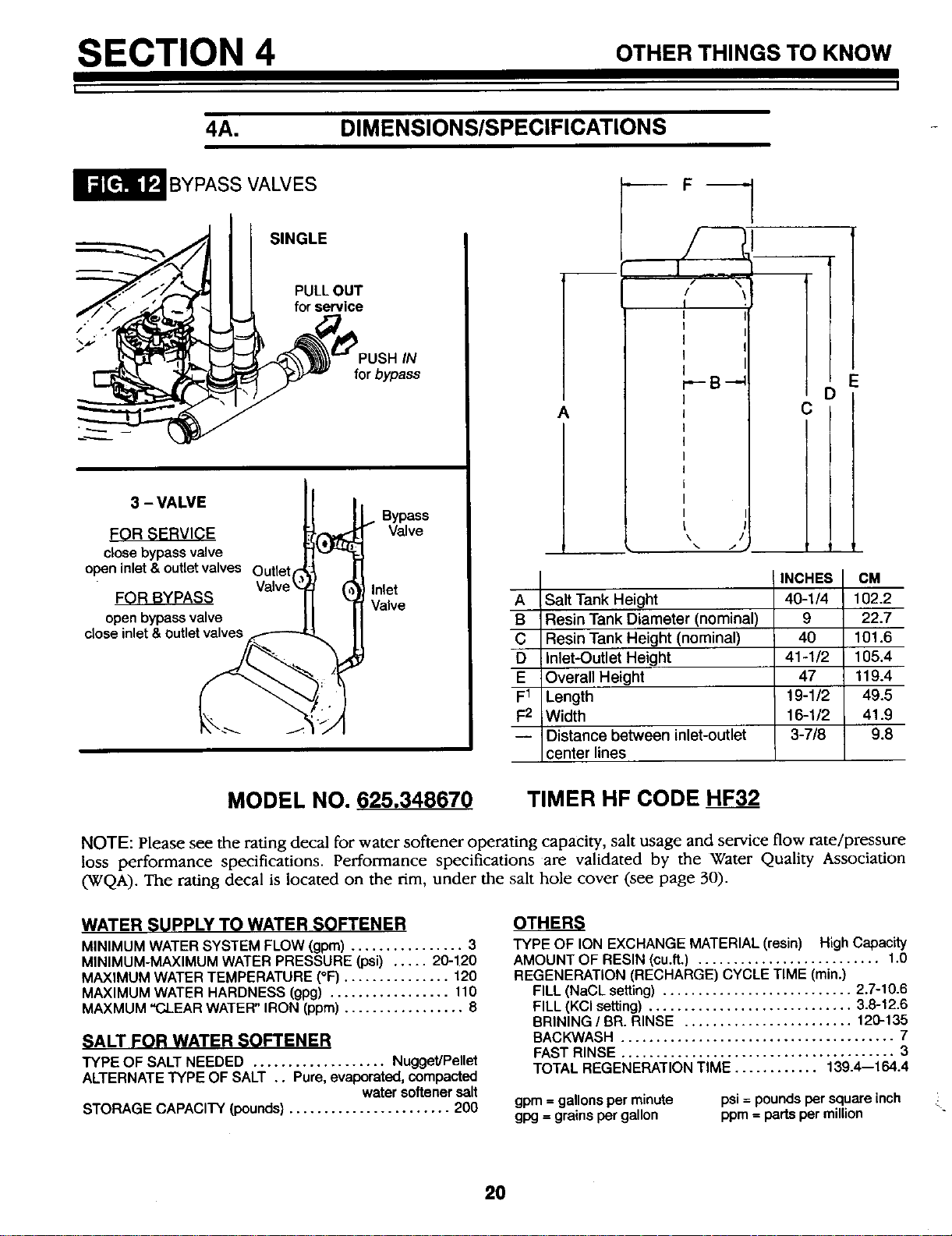
3. Refer to FIG. 12 on page 20. Move the stem in a
single bypass valve to bypass. Close the inlet and
outlet valve in a 3-valve bypass system, and open
the bypass valve. If you want water in the house
pipes again, reopen the shut-off valve on the main
water pipe.
4. Unplug the transformer at the wall outlet. Remove
the salt hole cover and the main cover. Take off
both drain hoses.
5. Carefully remove the large holding clips at the
softener inlet and outlet (see Key No. 69, on page
32). Separate the softener from the copper tubes,
or from the bypass valve.
6. Remove the brinewell cover and disconnect the
brine valve tubing at the nozzle and venturi
assembly (see page 32). Lift the brine valve out of
the brinewell. Tip the brine valve upside down to
drain water.
D_n
To
8.
)RAIN WATER FROM THE
)FTENER
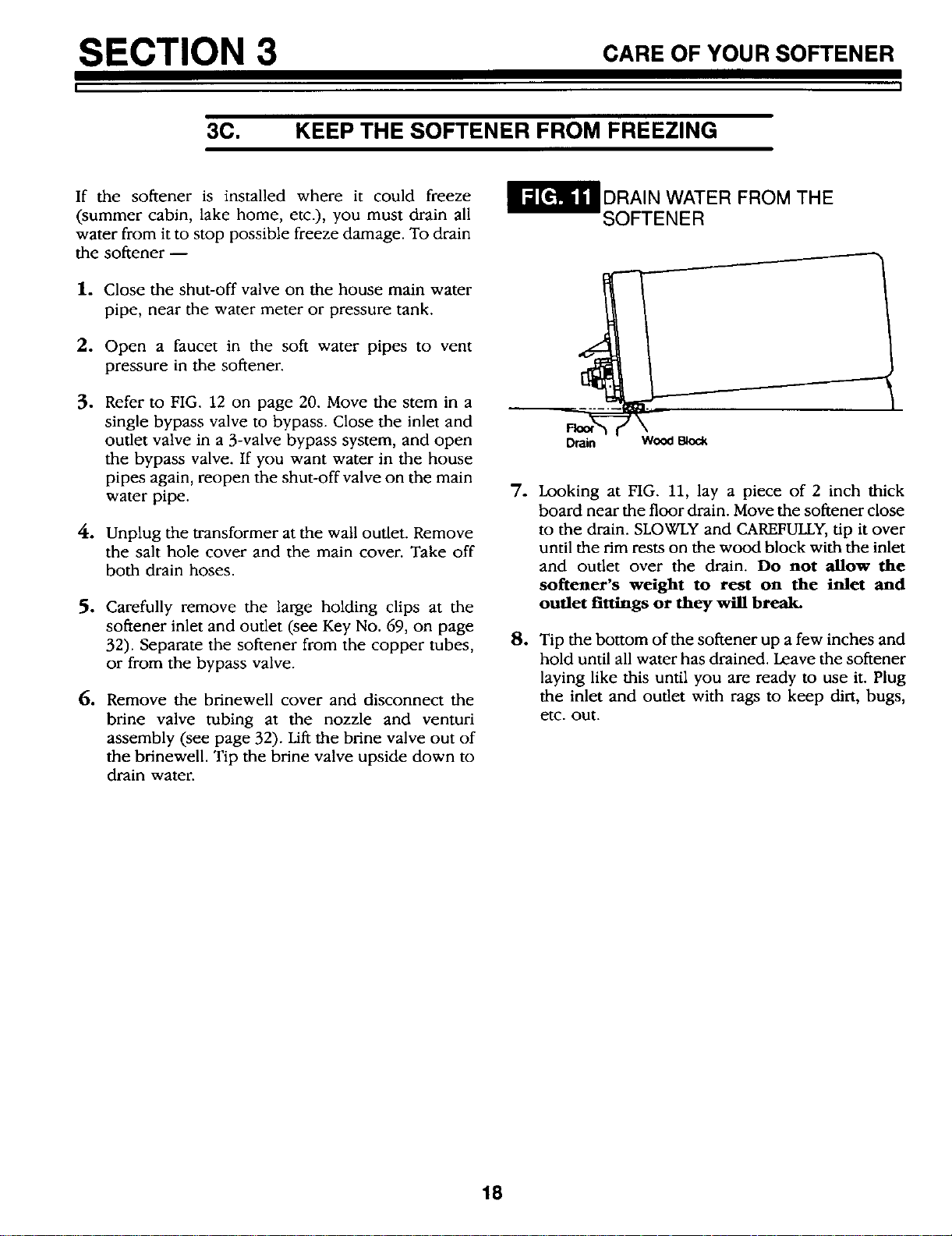
Looking at FIG. 11, lay a piece of 2 inch thick
board near the floor drain. Move the softener close
to the drain. SLOWLY and CAREFULLY,tip it over
until the rim rests on the wood block with the inlet
and outlet over the drain. Do not allow the
softener's weight to rest on the inlet and
outlet fittings or they will break.
Tip the bottom of the softener up a few inches and
hold until all water has drained. Leave the softener
laying like this until you are ready to use it. Plug
the inlet and outlet with rags to keep dirt, bugs,
etc. out.
18

SECTION 3 CAREOFYOURSOFTENER
3D. HELPFUL HINTS CHECKLIST
... TO HELP YOU SAVE MONEY
If your water softener fails to work, make the following easy checks. Often, you will find what's wrong yourself
and you won't have to call and wait for service. If you do not find anything wrong, while making the checks, and
your softener still does not work, call your Sears Service Department.
NOTES:
1. Also read ERROR CODE, page 12.
2. If an error code is not displayed, press and bold the #1 SELECT button until the display changes. Then, press the
#1 SELECT button again and bold until a flashing HF code appears. It must show I-IF32. If any other number shows,
the face plate computer is working on incorrect input and would probably be the cause of the problem. To set
ITF32, press either the UP I_ or DOWN _ button. When HF32 shows, press #1 SELECT button to return a
flashing 12:00 AM display. Reset the present time, hardness number, etc., pages 6 and 7.
PROBLEM CAUSE CORRECTION
No soft water No salt (or saltbridged) inthe storage tank Refill with salt, or break the salt bridge (page
16). Press ON/OFF-HOLD (RECHARGE
NOW) buttonand holdfor 3 seconds to start a
regeneration (see page 10).
Transfomer unplugged at the wall outlet, Check for loss of power due to any of these
or power cable leads loose, fuse blown, and correct. With the power back on, look at
circuit breaker popped, or circuitswitched the time display and read PROGRAM
off. MEMORY, page 12.
Manual bypass valve(s) in bypass position Look at FIG. t2 on page 20. Move the stem in
a single valve to service. In a 3-valve bypass,
open the inletand outlet valves, and be sureto
fully close the bypass valve.
Dirty, plugged or damaged nozzle & Take apart and clean or replace damaged
venturi parts (see page 17).
Valve drain hose plugged The drain hose must not have kinks, sharp
bends, or be raised too high above the
softener (see page 16 in your installation
manual.
Water hard sometimes Hardness number setting too low Press and release the #1 SELECT button untU
HARDNESS shows in the display. Read the
hardness number in the display and be sure
the same grains per gallon number is shown
on your water analysis report. See page 7 to
reset. Press and release the SELECT button
until the present time shows in the display.
Using hot water when softener is Avoid usinghotwaterduringthistimebecause
regenerating the water heater refills with hard water (see
Automatic Bypass, page 15).
Increase in the grains of hardness in your Ask your Sears retailor catalog store fora new
water supply water analysis. Then make a new hardness
number setting (page 7).
19
SECTION 4 OTHERTHINQSTOK.OW
4A. DIMENSIONS/SPECIFICATIONS
BYPASS VALVES
SINGLE
PULLOUT
forservice
-I IN
for bypass
3 - VALVE
close bypass valve
open inlet & outlet valves Outlet
FOR BYPASS
open bypass valve
close inlet & outlet valves
Bypass
Valve
bInlet
Valve
/ \
I
I
I
I
I
A
C
E
INCHES CM
A Salt Tank Height 40-1/4 102.2
B Resin Tank Diameter (nominal) 9 22.7
C Resin Tank Height (nominal) 40 101.6
D Inlet-Outlet Height 41-1/2 105.4
E Overall Height 47 119.4
F1 Length 19-1/2 49.5
F2 Width 16-1/2 41.9
-- Distance between inlet-outlet 3-7/8 9.8
center lines
MODEL NO. 625.348670 TIMER HF CODE HF32
NOTE: Please see the rating decal for water softener operating capacity, salt usage and service flow rate/pressure
loss performance specifications. Performance specifications are validated by the Water Quality Association
(WQA). The rating decal is located on the rim, under the salt hole cover (see page 30).
WATER SUPPLY TO WATER SOFTENER
MINIMUM WATERSYSTEM FLOW (gpm) ................ 3
MINIMUM-MAXIMUM WATERPRESSURE (psi) ..... 20-120
MAXIMUM WATERTEMPERATURE (°F) ............... 120
MAXIMUM WATERHARDNESS (gpg) ................. 110
MAXMUM "CLEARWATER"IRON (ppm) ................. 6
SALT FOR WATER SOFTENER
TYPE OF SALTNEEDED ................... Nugget/Pellet
ALTERNATETYPE OF SALT .. Pure,evaporated,compacted
watersoftenersalt
STORAGE CAPACITY(pounds)....................... 200
TYPE OF ION EXCHANGE MATERIAL (resin) High Capacity
AMOUNT OF RESIN (cu.ft.) .......................... 1.0
REGENERATION (RECHARGE) CYCLE TIME (min.)
FILL (NaCL setting) ........................... 2.7-10.6
FILL (KCI setting) ............................. 3.8-12.6
BRINING / BR. RINSE ........................ 120-135
BACKWASH ....................................... 7
FAST RINSE ....................................... 3
TOTAL REGENERATION TIME ............ 139.4--164.4
gpm = gallons per minute
gpg = grains per gallon
psi = pounds per square inch
ppm = parts per million
20
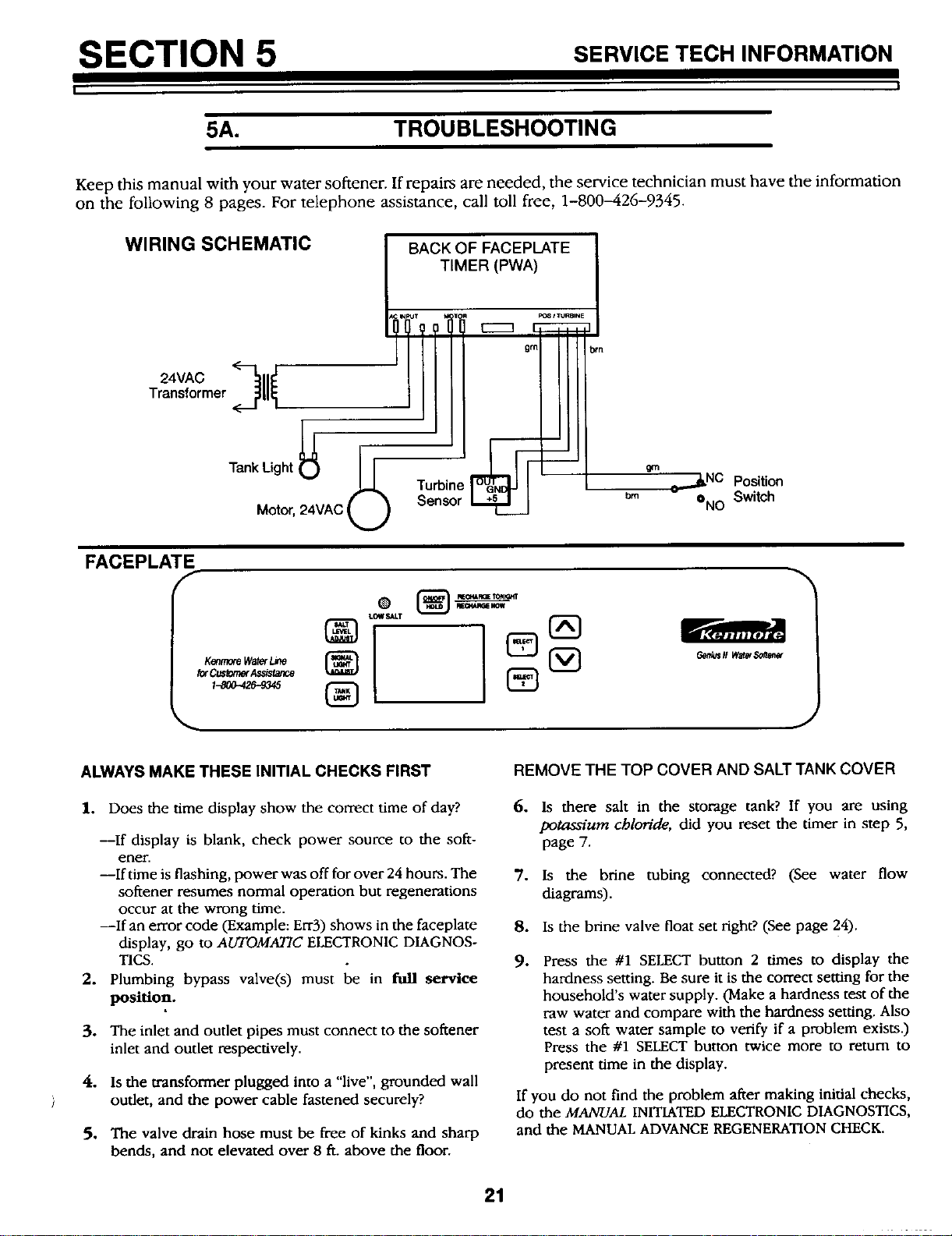
SECTION 5 SERVICE TECH INFORMATION
I
5A. TROUBLESHOOTING
Keep this manual with your water softener. Ifrepairs are needed, the service technician must have the information
on the following 8 pages. For telephone assistance, call toll free, 1-800_i26-9345.
WIRING SCHEMATIC
Transformer
Tank Light _) /_
Motor, 24VAC _._
BACK OF FACEPLATE I
77'7_1
Turbine
Sensor
o,...._ Nc Position
bm ONO Switch
FACEPLATE
F
Kenmore_
_C_Assistame
I_00-426-9345
[]
[]
LOW SALT
[]
[]
Gen_ IIWaterSo_en_
J
ALWAYS MAKE THESE INITIAL CHECKS FIRST
1. Does the time display show the correct time of day?
--If display is blank, check power source to the soft-
ener.
--If time is flashing, power was off for over 24 hours. The
softener resumes normal operation but regenerations
occur at the wrong time.
--If an error code (Example: Err3) shows in the faceplate
display, go to AUTOMATIC ELECTRONIC DIAGNOS-
TICS.
2. Plumbing bypass valve(s) must be in full service
position.
3. The inlet and outlet pipes must connect to the softener
inlet and outlet respectively.
4. Is the transformer plugged into a "live", grounded wall
outlet, and the power cable fastened securely?
5. The valve drain hose must be free of kinks and sharp
bends, and not elevated over 8 ft. above the floor.
REMOVE THE TOP COVER AND SALT TANK COVER
o
°
ls there salt in the storage tank? If you are using
potassium chloride, did you reset the timer in step 5,
page 7.
Is the brine tubing connected? (See water flow
diagrams).
8. Is the brine valve float set right? (See page 24).
. Press the #1 SELECT button 2 times to display the
hardness setting. Be sure it is the correct setting for the
household's water supply. (Make a hardness test of the
raw water and compare with the hardness setting. Also
test a soft water sample to verify if a problem exists.)
Press the #1 SELECT button twice more to return to
present time in the display.
If you do not find the problem after making initial checks,
do the MANUAL INITIATED ELECTRONIC DIAGNOSTICS,
and the MANUAL ADVANCE REGENERATION CHECK.
21
SECTION 5 SERVICE TECH. INFORMATION
5A. TROUBLESHOOTING
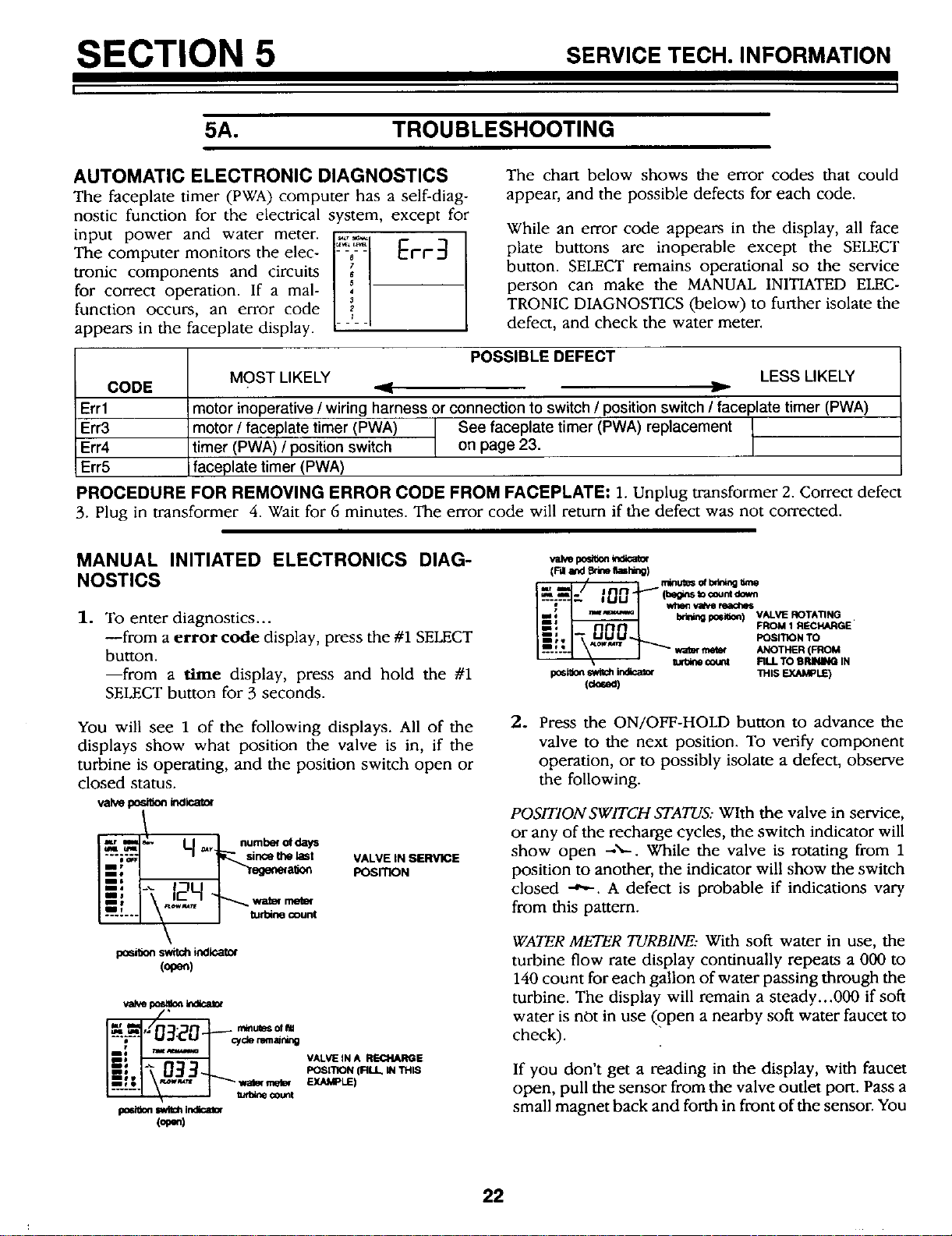
AUTOMATIC ELECTRONIC DIAGNOSTICS
The faceplate timer (PWA) computer has a self-diag-
nostic function for the electrical system, except for
input power and water meter. _,_
The computer monitors the elec- --,-- Err_
tronic components and circuits
for correct operation. If a mal- !
function occurs, an error code {
appears in the faceplate display. -- - -
The chart below shows the error codes that could
appear, and the possible defects for each code.
While an error code appears in the display, all face
plate buttons are inoperable except the SELECT
button. SELECT remains operational so the service
person can make the MANUAL INITIATED ELEC-
TRONIC DIAGNOSTICS (below) to further isolate the
defect, and check the water meter.
CODE
Err1
Err3
Err4
Err5
POSSIBLE DEFECT
MOST LIKELY LESS LIKELY
motor inoperative / wiring harness or connection to switch/ position switch/ faceplate timer (PWA)
motor / faceplate timer (PWA) See faceplate timer (PWA) replacement
timer (PWA) / position switch on page 23.
ifaceplate timer (PWA)
PROCEDURE FOR REMOVING ERROR CODE FROM FACEPLATE: 1. Unplug transformer 2. Correct defect
3. Plug in transformer 4. Wait for 6 minutes. The error code will return if the defect was not corrected.
MANUAL INITIATED ELECTRONICS DIAG-
NOSTICS
1. To enter diagnostics...
--from a error code display, press the #1 SELECT
button.
--from a time display, press and hold the #1
SELECT button for 3 seconds.
You will see 1 of the following displays. All of the
displays show what position the valve is in, if the
turbine is operating, and the position switch open or
closed status.
van _ _a_
---'--;:-.-I
posi_onswish ind_
VALVE iN SERVICE
POSITION
- 8 .28
lutt_c_ecount
FosittonImttchindicalor
(o_n)
VALVEINk RECHARGE
POSITION(FILL INTHIS
EXAMPLE)
(F¢araBrae_a_h_ng)
I _ minu_s of bd_ng _e
I_.----t_/ _lJS"t_ (_=_"-.
_--_, POSITIONTO
i_.. water meW¢ ANOTHER (FROM
uxtx_e counl RLL TO BPJNINQ IN
posi_nswitchindicator THISEXAMPLE)
(eked)
2. Press the ON/OFF-HOLD button to advance the
valve to the next position. To verify component
operation, or to possibly isolate a defect, observe
the following.
POSITION SWITCH STATUS: With the valve in service,
or any of the recharge cycles, the switch indicator will
show open ---_--. While the valve is rotating from 1
position to another, the indicator will show the switch
closed --"_. A defect is probable if indications vary
from this pattern.
WATER METER TURBINE: With soft water in use, the
turbine flow rate display continually repeats a 000 to
140 count for each gallon of water passing through the
turbine. The display will remain a steady...000 if soft
water is not in use (open a nearby soft water faucet to
check).
If you don't get a reading in the display, with faucet
open, pull the sensor from the valve outlet port. Pass a
small magnet back and forth in front of the sensor. You
22
SECTION 5 SERVICE TECH INFORMATION
5A. TROUBLESHOOTING
should get a reading in the display. If you get a
reading, unhook the in and out plumbing and check
the turbine for binding.
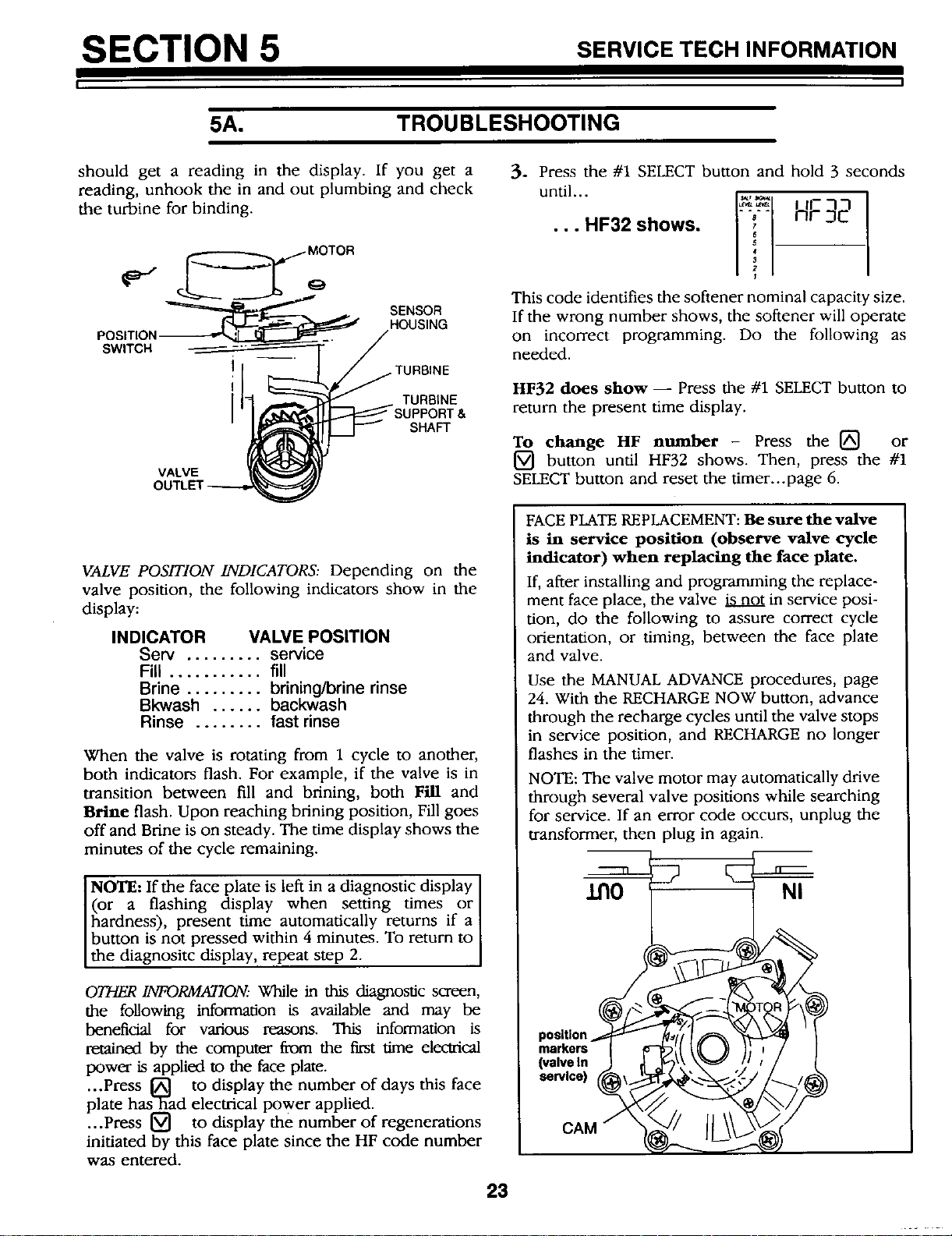
o-"
POSITION
SWITCH
MOTOR
SENSOR
HOUSING
TURBINE
TURBINE
SHAFT
VALVE
VALVE POSITION INDICATORS: Depending on the
valve position, the following indicators show in the
display:
INDICATOR VALVE POSITION
Serv ......... service
Fill ........... fill
Brine ......... brining/brine rinse
Bkwash ...... backwash
Rinse ........ fast rinse
When the valve is rotating from 1 cycle to another,
both indicators flash. For example, if the valve is in
transition between fill and brining, both Fill and
Brine flash. Upon reaching brining position, Fill goes
off and Brine is on steady. The time display shows the
minutes of the cycle remaining.
NOTE: If the face plate is left in a diagnostic display
(or a flashing display when setting times or]
hardness), present time automatically returns if a
button is not pressed within 4 minutes. To return to
the diagnositc display, repeat step 2.
OTHER INFORMATION. While in this diagnostic screen,
the following information is available and may be
beneficial for various masons. This information is
retained by the computer from the first time electrical
power is applied to the face plate.
...Press [] to display the number of days this face
plate has3_ad electrical Power applied.
...Press [_ to display the number of regenerations
initiated by this face plate since the HF code number
was entered.
23
3. Press the #1 SELECT button and hold 3 seconds
until...
...SFaashows. H; 2
This code identifies the softener nominal capacity size.
If the wrong number shows, the softener will operate
on incorrect programming. Do the following as
needed.
HF32 does show -- Press the #1 SELECT button to
return the present time display.
To change HF number - Press the [] or
[] button until HF32 shows. Then, press the #1
SELECT button and reset the timer...page 6.
FACE PLATE REPLACEMENT: Be sure the valve
is in service position (observe valve cycle
indicator) when replacing the face plate.
If, after installing and programming the replace-
ment face place, the valve _ in service posi-
tion, do the following to assure correct cycle
orientation, or timing, between the face plate
and valve.
Use the MANUAL ADVANCE procedures, page
24. With the RECHARGE NOW button, advance
through the recharge cycles until the valve stops
in service position, and RECHARGE no longer
flashes in the timer.
NOTE: The valve motor may automatically drive
through several valve positions while searching
for service. If an error code occurs, unplug the
transformer, then plug in again.
11"10 NI
markers
(valve in
service)
CAM
SECTION 5
I
SERVICE TECH. INFORMATION
I
5A. TROUBLESHOOTING
MANUAL ADVANCE REGENERATION CHECK 3.
This check verifies proper operation of the valve
motor, brine tank fill, brine draw, regeneration flow
rates, and other controller functions. Always make
the initial checks, and the manual initiated
diagnostics.
NOTES: The faceplate display must show a steady
time (not flashing). If an Error code shows, first press
the #1 SELECT button to enter the diagnostic display.
1. Press the ON/OFF-HOLD button and hold in for 3
seconds. RECHARGE NOW and FILLbegin to flash
(or clean backwash begins, if set) as the softener
enters the fill cycle of regeneration. When FILL is
on steady, remove the brinewell cover and, using
a flashlight, observe fill water entering the tank.
a. If water does not enter the tank, look for an ob-
structed nozzle, venturi, fill flow plug, brine tub-
ing, or brine valve riser pipe.
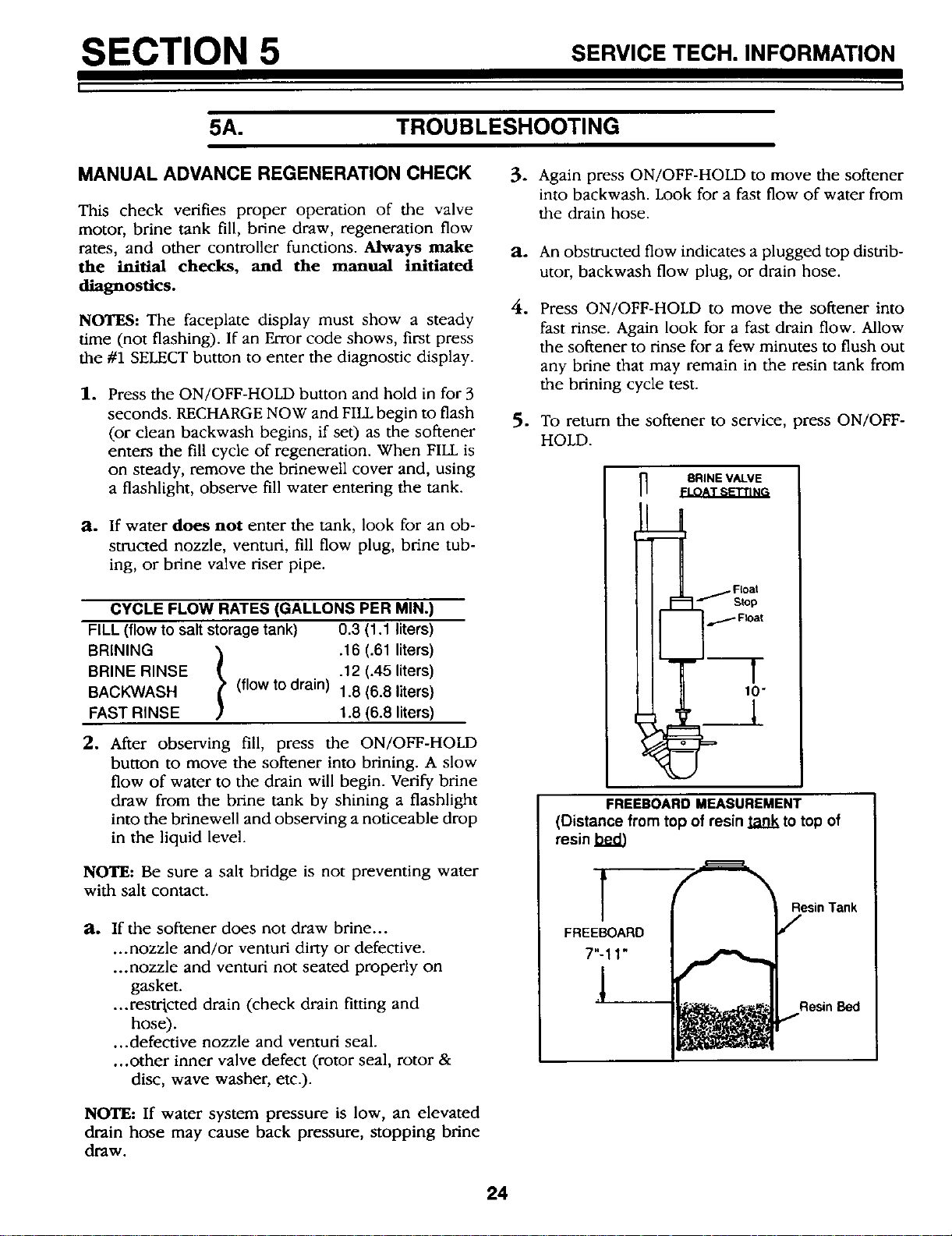
CYCLE FLOW RATES (GALLONS PER MIN.)
FILL (flow to salt storage tank) 0.3 (1.1 liters)
BRINING "_ .16 (.61 liters)
BRINE RINSE l .12 (.45 liters)
BACKWASH (flow to drain) 1.8 (6.8 liters)
FAST RINSE t.8 (6.8 liters)
2. After observing fill, press the ON/OFF-HOLD
button to move the softener into brining. A slow
flow of water to the drain will begin. Verify brine
draw from the brine tank by shining a flashlight
into the brinewell and observing a noticeable drop
in the liquid level.
NOTE: Be sure a salt bridge is not preventing water
with salt contact.
a. if the softener does not draw brine...
...nozzle and/or venturi dirty or defective.
...nozzle and venturi not seated properly on
gasket.
...restricted drain (check drain fitting and
hose).
...defective nozzle and venturi seal.
...other inner valve defect (rotor seal, rotor &
disc, wave washer, etc.).
NOTE: If water system pressure is low, an elevated
drain hose may cause back pressure, stopping brine
draw.
ao
4.
.
Again press ON/OFF-HOLD to move the softener
into backwash. Look for a fast flow of water from
the drain hose.
An obstructed flow indicates a plugged top distrib-
utor, backwash flow plug, or drain hose.
Press ON/OFF-HOLD to move the softener into
fast rinse. Again look for a fast drain flow. Allow
the softener to rinse for a few minutes to flush out
any brine that may remain in the resin tank from
the brining cycle test.
To return the softener to service, press ON/OFF-
HOLD.
BRINE VALVE
FLOAT SWlrlklG
...2'2,".,
FREEBOARDMEASUREMENT
(Distance from top of resin tank to top of
resin bed_
FREEBOARD
7"-11"
1
Resin Tank
Re_nBed
24
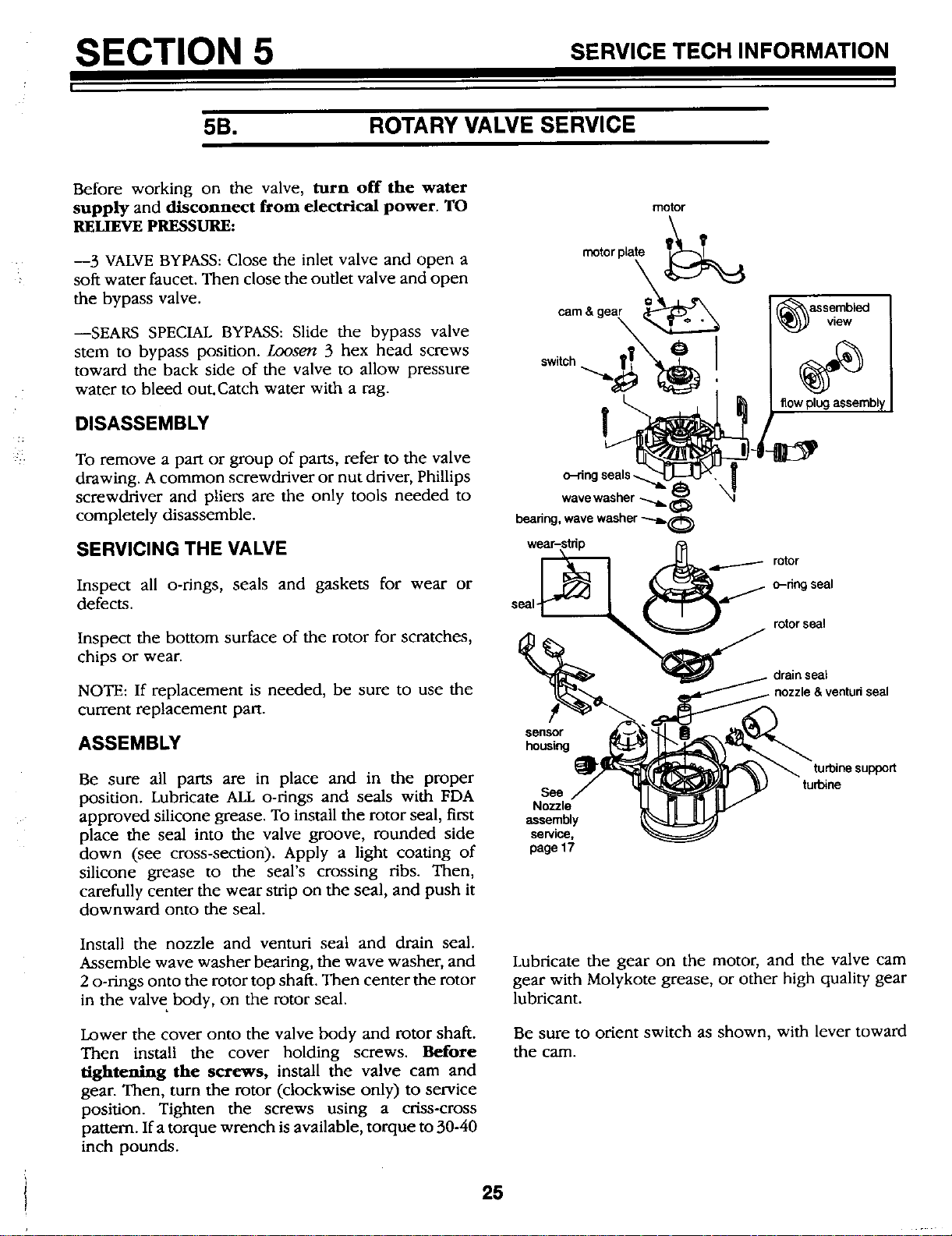
SECTION 5 SERVICE TECH INFORMATION
5B. ROTARY VALVE SERVICE
Before working on the valve, turn off the water
supply and disconnect from electrical power. TO
RELIEVE PRESSURE:
--3 VALVE BYPASS: Close the inlet valve and open a
soft water faucet. Then close the outlet valve and open
the bypass valve.
--SEARS SPECIAL BYPASS: Slide the bypass valve
stem to bypass position. Loosen 3 hex head screws
toward the back side of the valve to allow pressure
water to bleed out.Catch water with a rag.
DISASSEMBLY
To remove a part or group of parts, refer to the valve
drawing. A common screwdriver or nut driver, Phillips
screwdriver and pliers are the only tools needed to
completely disassemble.
SERVICING THE VALVE
Inspect all o-rings, seals and gaskets for wear or
defects.
Inspect the bottom surface of the rotor for scratches,
chips or wear.
NOTE: If replacement is needed, be sure to use the
current replacement part.
ASSEMBLY
Be sure all parts are in place and in the proper
position. Lubricate ALL o-rings and seals with FDA
approved silicone grease. To install the rotor seal, first
place the seal into the valve groove, rounded side
down (see cross-section). Apply a light coating of
silicone grease to the seal's crossing ribs. Then,
carefully center the wear strip on the seal, and push it
downward onto the seal.
Install the nozzle and venturi seal and drain seal.
Assemble wave washer bearing, the wave washer, and
2 o-rings onto the rotor top shaft. Then center the rotor
in the valve body, on the rotor seal.
Lower the cover onto the valve body and rotor shaft.
Then install the cover holding screws. Before
tightening the screws, install the valve cam and
gear. Then, turn the rotor (clockwise only) to service
position. Tighten the screws using a criss-cross
pattern. If a torque wrench is available, torque to 30-40
inch pounds.
assembled
view
flow plug assembly
o-ringseals-_.
wavewasher-..._(_
beanng,wavewasher---..-h._
wear-strip
seal-
rotor
o-nug seal
rotor seal
drainseal
, nozzle&ventunseal
sensor
housing
Sea
Nozzle
assembly
service,
page 17
turbine suppod
turbine
Lubricate the gear on the motor, and the valve cam
gear with Molykote grease, or other high quality gear
lubricant.
Be sure to orient switch as shown, with lever toward
the cam.
25
SECTION 5 SERVICE TECH. INFORMATION
I
I
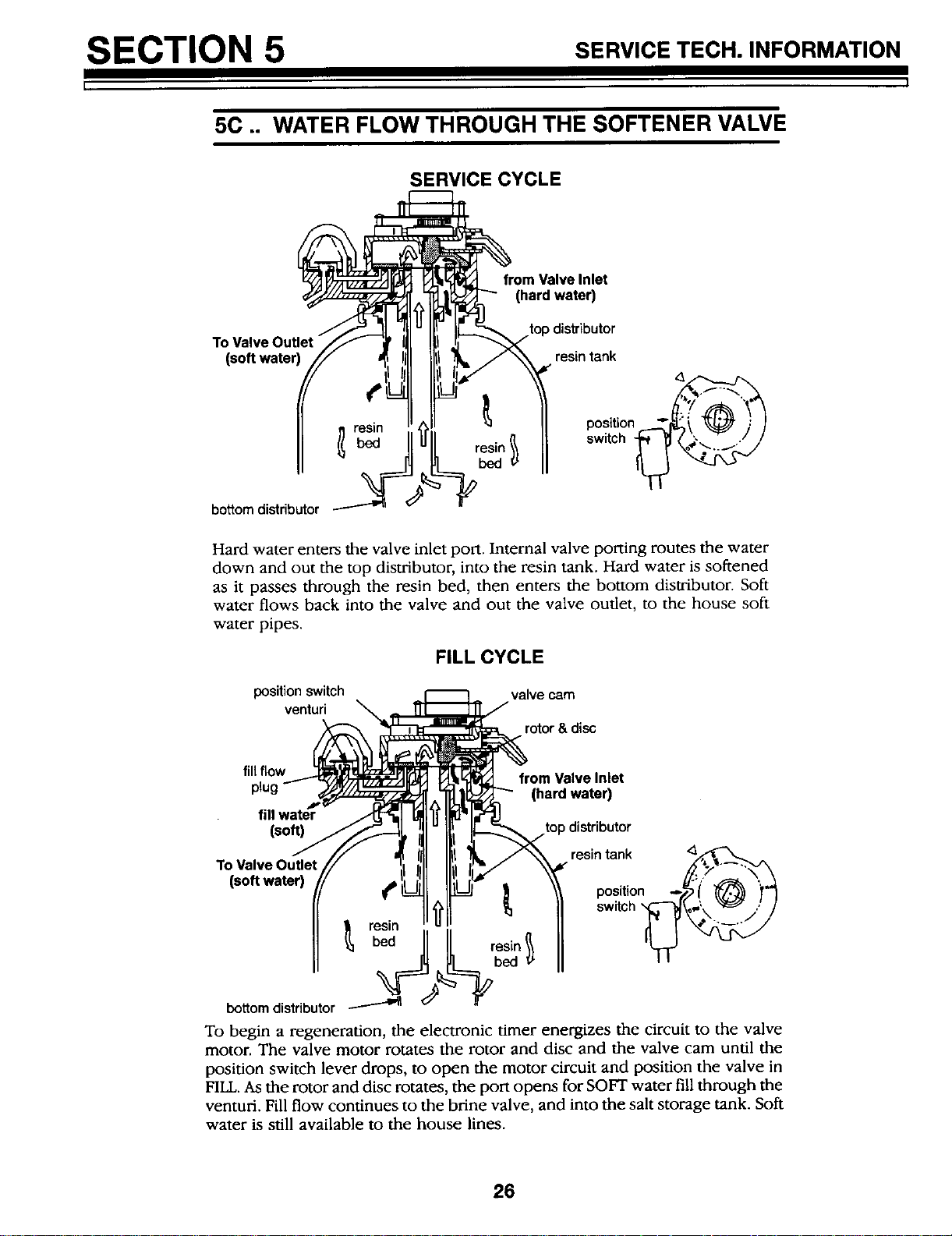
5C .. WATER FLOW THROUGH THE SOFTENER VALVE
SERVICE CYCLE
from Valve Inlet
(hard water)
To ValveOutlet"
(soft water)
bottom distributor
€
distributor
resin tank
position ._...__
ow,tch
Hard water enters the valve inlet port. Internal valve porting routes the water
down and out the top distributor, into the resin tank. Hard water is softened
as it passes through the resin bed, then enters the bottom distributor. Soft
water flows back into the valve and out the valve outlet, to the house soft
water pipes.
FILL CYCLE
positionswitch
venturi
valve cam
rotor & disc
fill flow
plug
fill water
(soft)
from Valve Inlet
water)
) distributor
switch __
To begin a regeneration, the electronic timer energizes the circuit to the valve
motor. The valve motor rotates the rotor and disc and the valve cam until the
position switch lever drops, to open the motor circuit and position the valve in
FILL.As the rotor and disc rotates, the port opens for SOFT water fill through the
venturi. Fill flow continues to the brine valve, and into the salt storage tank. Soft
water is still available to the house lines.
26
SECTION 5 SERVICE TECH INFORMATION
! I
5C. WATER FLOW THROUGH THE SOFTENER VALVE
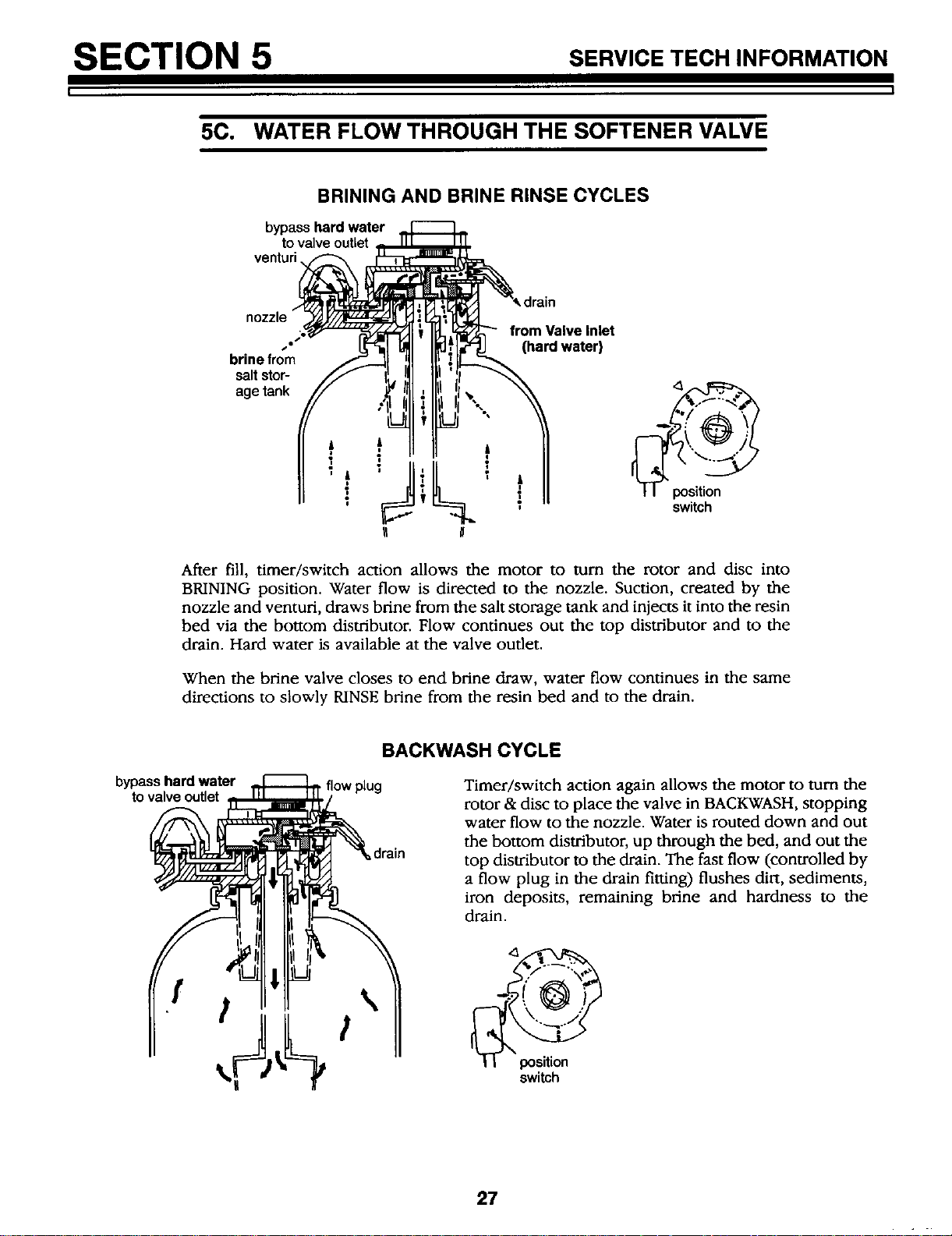
BRINING AND BRINE RINSE CYCLES
bypasshard water
to valve outlet
venturi
nozzle
-_ from Valve Inlet
•"" (hard water)
brine from
saltstor-
agetank ,_ _ -,,& ___
, _ , !
_ iin
switch
a
After flU, timer/switch action allows the motor to turn the rotor and disc into
BRINING position. Water flow is directed to the nozzle. Suction, created by the
nozzle and venturi, draws brine from the salt storage tank and injects it into the resin
bed via the bottom distributor. Flow continues out the top distributor and to the
drain. Hard water is available at the valve outlet.
When the brine valve closes to end brine draw, water flow continues in the same
directions to slowly RINSE brine from the resin bed and to the drain.
bypass hard water
to valve outlet
f
BACKWASH CYCLE
drain
Timer/switeh action again allows the motor to tom the
rotor & disc to place the valve in BACKWASH, stopping
water flow to the nozzle. Water is routed down and out
the bottom distributor, up through the bed, and out the
top distributor to the drain. The fast flow (controlled by
a flow plug in the drain fitting) flushes dirt, sediments,
iron deposits, remaining brine and hardness to the
drain.
iin
switch
27
SECTION 5 SERVICE TECH. INFORMATION
5C. WATER FLOW THROUGH THE SOFTENER VALVE
soft water
to valve outlet
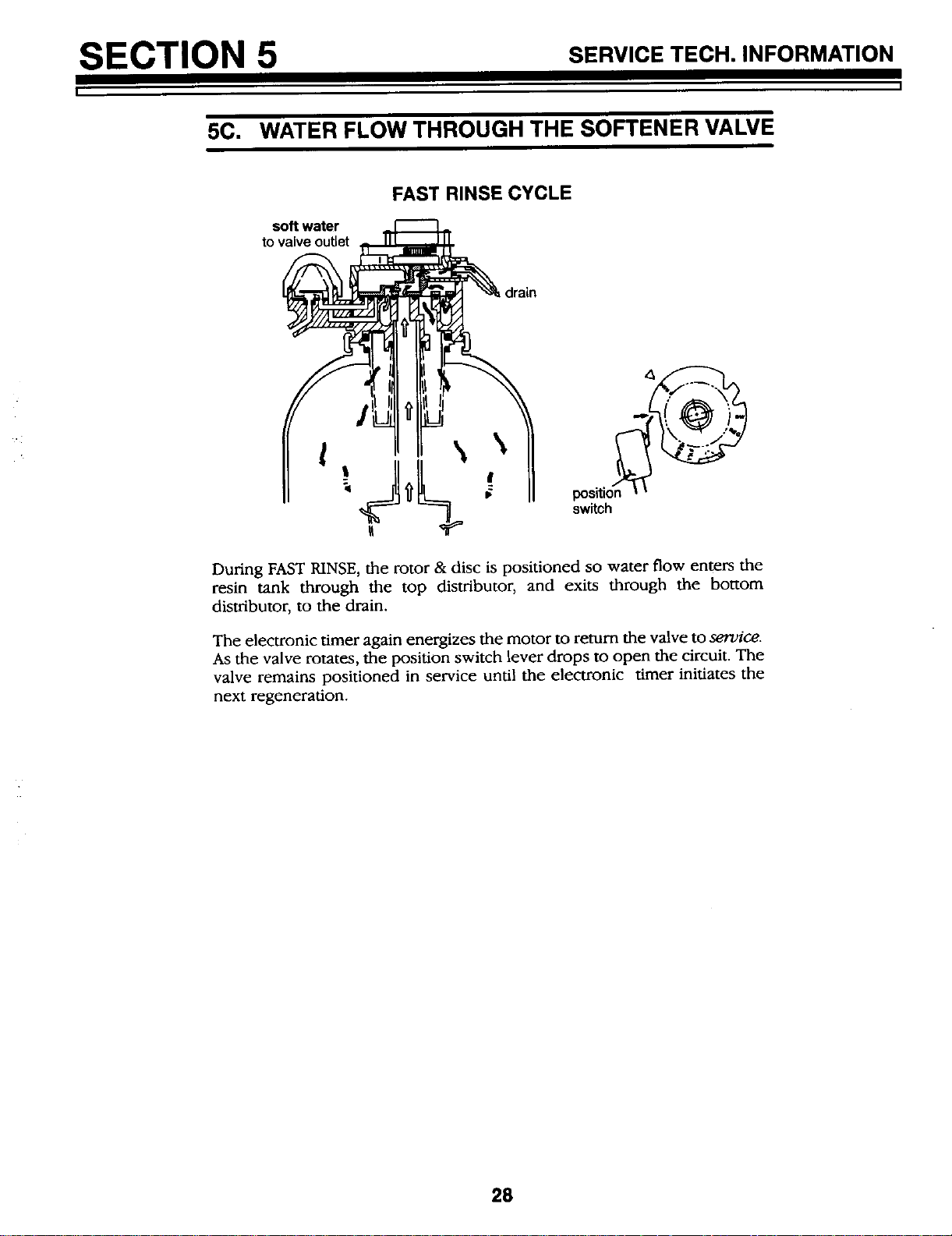
FAST RINSE CYCLE
!
1 \ \
positi_ _
switch
During FAST RINSE, the rotor & disc is positioned so water flow enters the
resin tank through the top distributor, and exits through the bottom
distributor, to the drain.
The electronic timer again energizes the motor to return the valve to service.
As the valve rotates, the position switch lever drops to open the circuit. The
valve remains positioned in service until the electronic timer initiates the
next regeneration.
28
SECTION 5 SERVICE TECH INFORMATION
NOTES
29
SECTION 6 REPAIRPARTS
I I
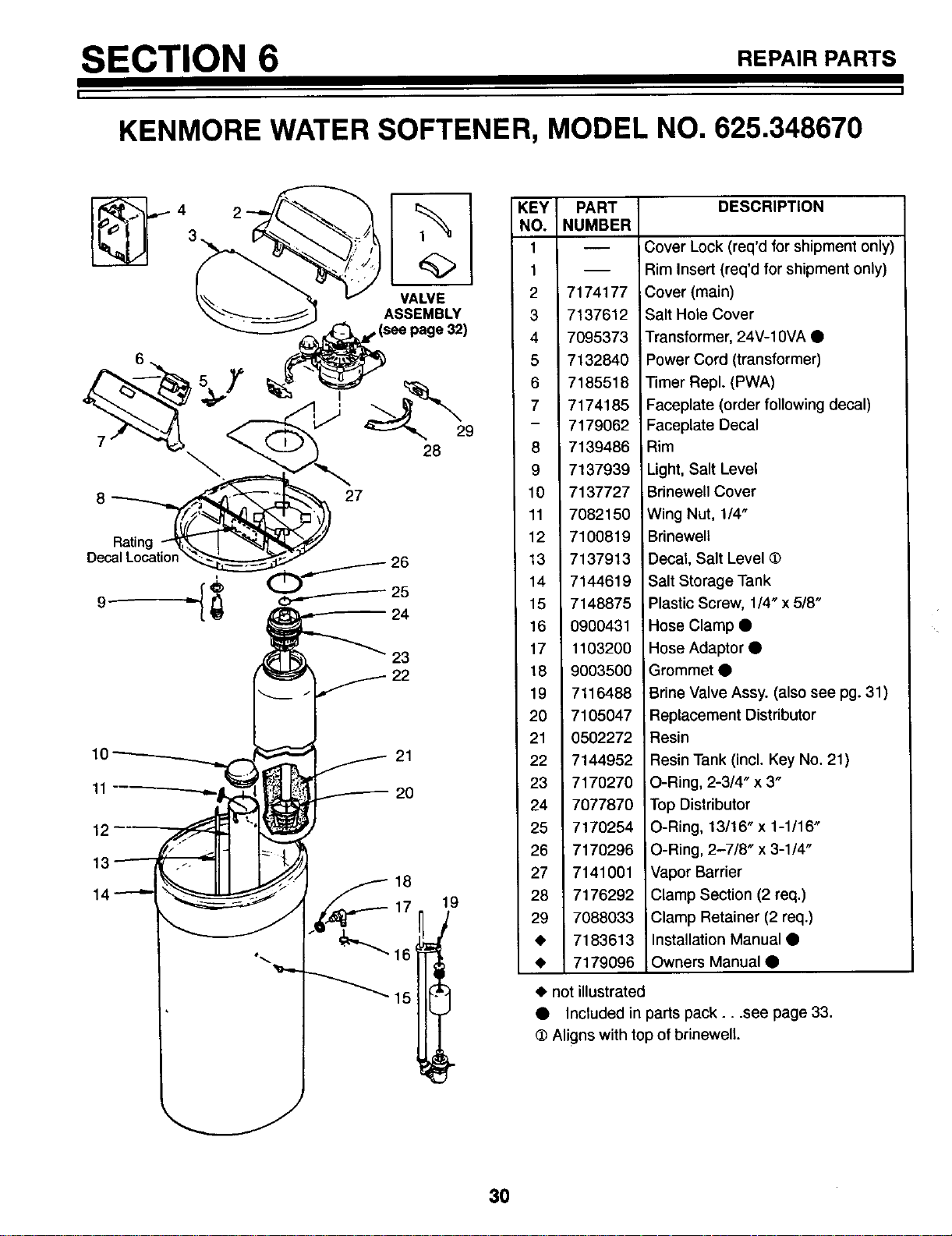
KENMORE WATER SOFTENER, MODEL NO. 625.348670
VALVE
ASSEMBLY
e 32)
I
29
28
27
g
Decal 26
9- 24
23
22
10 21
11 20
12
18
17 19
KEY
NO.
1
1
2
3
4
5
6
7
8
9
10
11
12
13
14
15
16
17
18
19
2O
21
22
23
24
25
26
27
28
29
PART DESCRIPTION
NUMBER
-- Cover Lock (req'd for shipment only)
Rim Insert (req'd for shipment only)
Cover (main)
Salt Hole Cover
Transformer, 24V-1 OVA•
Power Cord (transformer)
Timer Repl. (PWA)
Faceplate (order followingdecal)
Faceplate Decal
Rim
Light, Salt Level
Brinewell Cover
Wing Nut, 1/4"
Brinewell
Decal, Salt Level
Salt Storage Tank
Plastic Screw, 1/4" x 5/8"
Hose Clamp •
Hose Adaptor •
Grommet •
Brine Valve Assy. (also see pg. 31)
Replacement Distributor
Resin
Resin Tank (incl. Key No. 21)
O-Ring, 2-3/4" x 3"
Top Distributor
O-Ring, 13/16" x 1-1/16"
O-Ring, 2-7/8" x 3-1/4"
Vapor Barrier
Clamp Section (2 req.)
Clamp Retainer (2 req.)
Installation Manual •
Owners Manual •
E
7174177
7137612
7095373
7132840
7185518
7174185
7179062
7139486
7137939
7137727
7082150
7100819
7137913
7144619
7148875
0900431
1103200
9003500
7116488
7105047
0502272
7144952
7170270
7077870
7170254
7170296
7141001
7176292
7088033
7183613
7179096
• not illustrated
• Included in parts pack...see page 33.
(_ Aligns with top of brinewelL
30
SECTION 6 REPAIRPARTS
[ -1
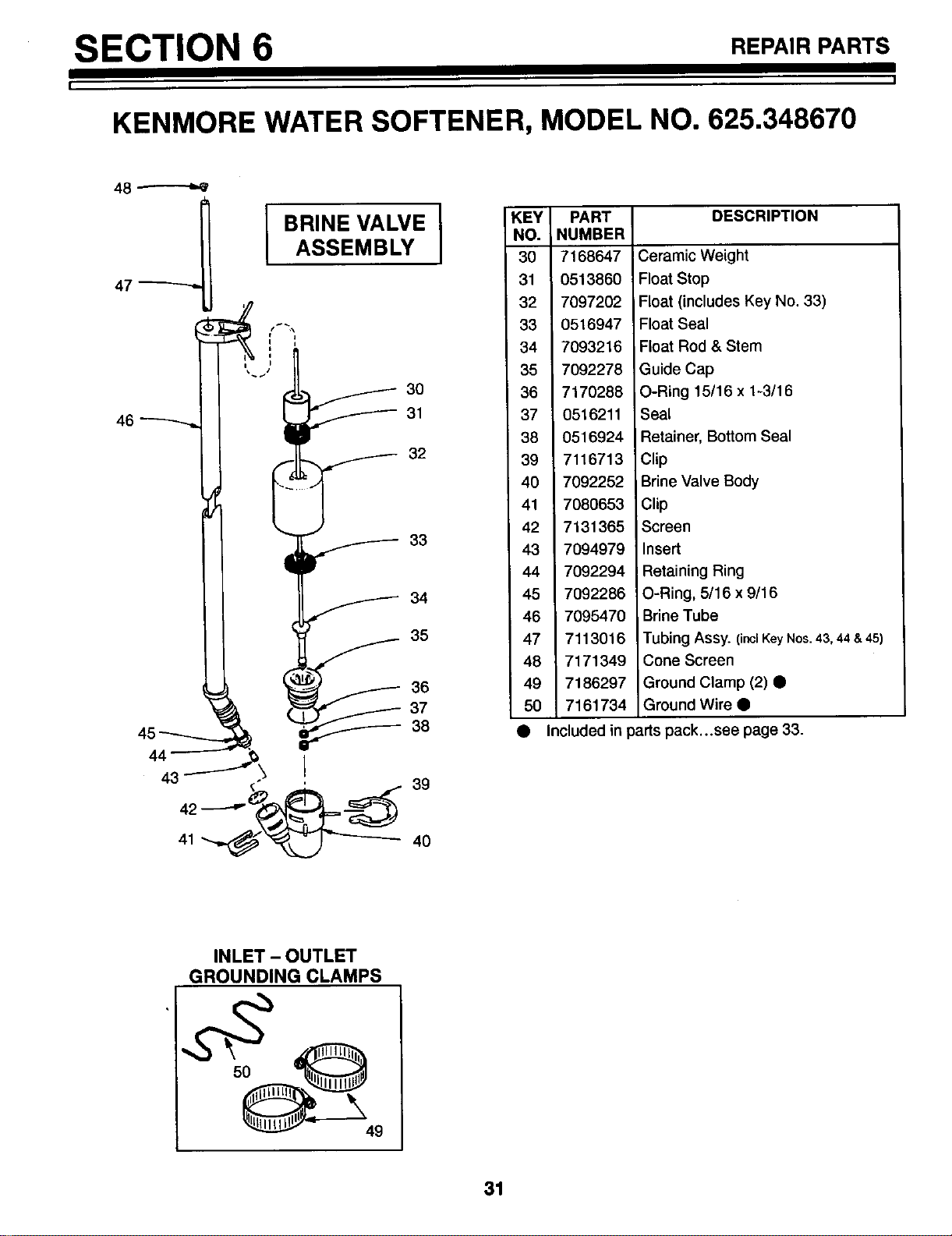
KENMORE WATER SOFTENER, MODEL NO. 625.348670
48
47
I BRINE VALVE I
ASSEMBLY
46
KEY
NO.
30
31
32
33
34
35
36
37
38
39
40
41
42
43
44
45
46
47
48
49
5O
PART
NUMBER
7168647
0513860
7097202
0516947
7O93216
7092278
7170288
0516211
0516924
7116713
7092252
7080653
7131365
7094979
7092294
7092286
7095470
7113016
7171349
7186297
7161734
DESCRIPTION
iCeramic Weight
Float Stop
Float (includes Key No. 33)
Float Seal
Float Rod & Stem
Guide Cap
O-Ring 15/16 x 1-3/16
Seal
Retainer, Bottom Seal
Clip
Brine Valve Body
Clip
Screen
Insert
Retaining Ring
O-Ring, 5/16 x 9/16
Brine Tube
Tubing Assyo (incl Key Nos. 43, 44 & 45)
Cone Screen
Ground Clamp (2) •
Ground Wire •
Included in parts pack...see page 33.
INLET - OUTLET
GROUNDING CLAMPS
49
31
SECTION 6 R,=P,,,IRPARTS
| I
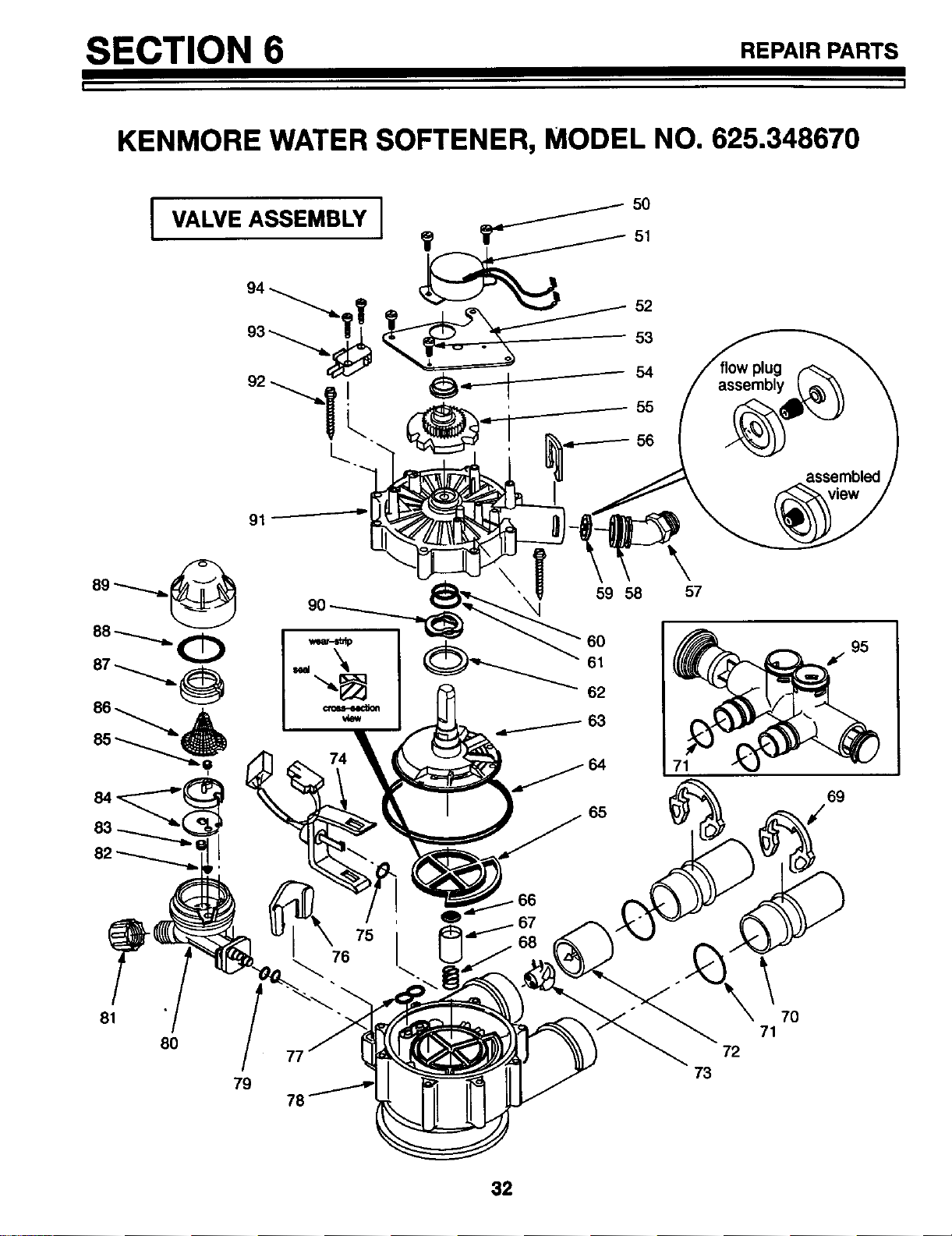
KENMORE WATER SOFTENER, MODEL NO. 625.348670
I
59 58
65
\
57
69
81
8O
79
78
\
71
72
73
7O
32
SECTION 6 REpAiRPARTS
I I
KEY
NO.
5O
51
52
53
54
55
56
57
58
59
60
61
62
63
64
65
66
67
68
69
70
71
72
73
74
75
76
77
78
79
PART
NUMBER
7131755
7133008
7171200
0900857
7171250
7171218
7169180
7172793
7170288
7178163
7173008
7173024
7174313
7185500
7173032
7185495
7172989
7171187
7129889
7089306
7077642
7170262
7094898
7101548
7173715
9000803
7081201
7171195
7171145
7170319
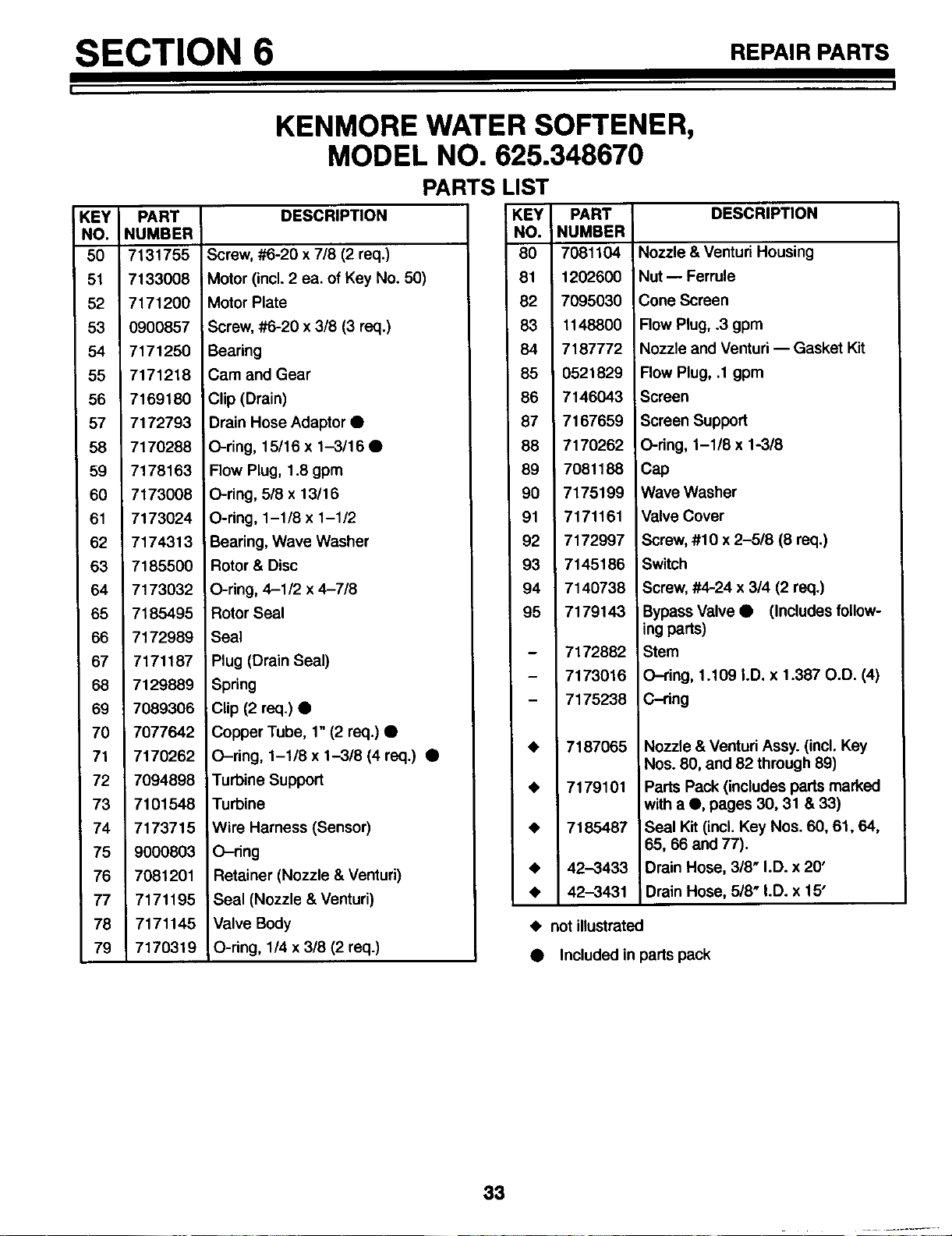
KENMORE WATER SOFTENER,
MODEL NO. 625.348670
PARTS LIST
DESCRIPTION
Screw, #6-20 x 7/8 (2 req.)
iMotor (incl. 2 ea. of Key No. 50)
Motor Plate
Screw, #6-20 x 3/8 (3 red.)
Bearing
Cam and Gear
Clip (Drain)
Drain Hose Adaptor •
O-ring, 15/16 x 1-3/16 •
Flow Plug, 1.8 gpm
O-ring, 5/8 x 13/16
O-ring, 1-1/8 x 1-112
Bearing, Wave Washer
Rotor & Disc
O-ring, 4-112 x 4-7/8
Rotor Seal
Seal
Plug (Drain Seal)
Spring
Clip (2 req.) •
Copper Tube, 1" (2 req.) •
O-ring, 1-118 x 1-3/8 (4 req.) •
Turbine Support
Turbine
Wire Harness (Sensor)
O-ring
Retainer (Nozzle & Venturi)
Seal (Nozzle & Venturi)
Valve Body
O-ring, 1/4 x 3/8 (2 req.)
KEY
NO.
80
81
82
83
64
85
86
87
88
89
90
91
92
93
94
95
PART
NUMBER
7081104
1202600
7095030
1148800
7187772
0521829
7146043
7167659
7170262
7081188
7175199
7171161
7172997
7145186
7140738
7179143
7172882
7173016
7175238
7187065
7179101
7185487
42-3433
42-3431
DESCRIPTION
Nozzle & Venturi Housing
Nut -- Ferrule
Cone Screen
Flow Plug, .3 gpm
Nozzle and Venturi -- Gasket Kit
Flow Plug, .1 gpm
Screen
Screen Support
O-ring, 1-1/8 x 1-318
Cap
Wave Washer
Valve Cover
Screw, #10 x 2-5/8 (8 req.)
Switch
Screw, #4-24 x 314 (2 req.)
Bypass Valve • (Includes follow-
ing parts)
Stem
O-ring, 1.109 I.D. x 1.387 O.D. (4)
C-ring
Nozzle & Venturi Assy. (incl. Key
Nos. 80, and 82 through 89)
Parts Pack (includes parts marked
with a e, pages 30, 31 & 33)
Seal Kit (incl. Key Nos. 60, 61, 64,
65, 66 and 77).
Drain Hose, 3/8" I.D. x 20'
Drain Hose, 5/8" I.D. x 15'
not illustrated
• Included in parts pack
33

NOTES
| I
34

NOTES
I I
35

OWNERS
MANUAL
MODEL NO.
625.348670
The model number of
your water softener is
found on the rating de-
cal. This decal is on the
rim, under the salt cover.
When requesting service
or ordering parts, always
provide the following in-
formation:
Product Type
Model Number
Part Number
Part Description
Genius II Water Softener
Forthe repairor replacementpartsyouneed
delivereddirectlyto yourhome
Call 7 am - 7 pro, 7 days a week
1 - 800 - 366 - PART
(1 - 800 - 366 - 7278)
Forin-home majorbrand repairservice
Call 24 hours a day, 7 days a week
1 - 800 - 4 - REPAIR
(1 - 800 - 473 - 7247)
Forthe locationofa
Sears Partsand RepairCenterin yourarea
Call 24 hours a day, 7 days a week
1 - 800 - 488 - 1222
Forinformationon purchasinga Sears
MaintenanceAgreement,or to inquire
aboutan existingAgreement
Call 9 am - 5 pm, Monday - Saturday
1 - 800 - 827 - 6655
SEARS
America'sRepairSpecialists
IIIIIIIIIIII
!
Sears, Roebuck and Co., Hoffman Estates, IL 60179 U.S.A.
7179096 (R.8_7)