GE Monogram
®
Use and Care Guide
27 & 30″Convection
Wall Oven
www.monogram.com

2
Consumer Information
Wall Oven
Introduction
Your new Monogram wall oven makes an eloquent statement of style, convenience and kitchen
planning flexibility. Whether you chose it for its purity of design, assiduous attention to detail—or
for both of these reasons—you’ll find that your Monogram wall oven’s superior blend of form
and function will delight you for years to come.
Your Monogram wall oven was designed to provide the flexibility to blend in with your kitchen
cabinetry. Its sleek design can be beautifully integrated into the kitchen.
The information on the following pages will help you operate and maintain your wall oven
properly.
Contents
Care and Cleaning
Broiler Pan and Grid . . . . . . . . . . . . . . . . . . . . . . . 36
Cookie Sheets . . . . . . . . . . . . . . . . . . . . . . . . . . . . . 36
Lift-Off Oven Door . . . . . . . . . . . . . . . . . . . . . . . . 35
Oven Light . . . . . . . . . . . . . . . . . . . . . . . . . . . . . . . 37
Probe . . . . . . . . . . . . . . . . . . . . . . . . . . . . . . . . . . . . 37
Shelves . . . . . . . . . . . . . . . . . . . . . . . . . . . . . . . . . . . 35
Using the Self-Cleaning Oven . . . . . . . . . . . 33, 34
Consumer Services
Important Phone Numbers . . . . . . . . . . . . . . . . 43
Model and Serial Numbers . . . . . . . . . . . . . . . . . . 3
Before You Call For Service . . . . . . . . . . . . . 38–40
Product Registration . . . . . . . . . . . . . . . . . . . . 3, 41
Safety Instructions . . . . . . . . . . . . . . . . . . . . . . . . 4, 5
Warranty . . . . . . . . . . . . . . . . . . . . . . . . . . . . . . . . . 44
Oven
Adjust the Oven Thermostat . . . . . . . . . . . . . . . . 32
Aluminum Foil . . . . . . . . . . . . . . . . . . . . . . 4, 17, 33
Baking or Roasting . . . . . . . . . . . . . . . . . . . . . 16, 17
Broiling/Broiling Guide . . . . . . . . . . . . . . . . 18–20
Features . . . . . . . . . . . . . . . . . . . . . . . . . . . . . . . . . . . 6
Oven Control, Clock and Timer . . . . . . . . . . 7–12
Proofing . . . . . . . . . . . . . . . . . . . . . . . . . . . . . . . . . . 31
Sabbath Feature . . . . . . . . . . . . . . . . . . . . . . . .13–15
Timed Baking . . . . . . . . . . . . . . . . . . . . . . . . . .21, 22
Using the Convection Oven . . . . . . . . . . . . . 25–30
Using the Probe . . . . . . . . . . . . . . . . . . . . . . . . 23, 24
Using the Self-Cleaning Oven . . . . . . . . . . . 33, 34
Remove
packaging
tape
To assure no damage is done to the finish of the
product, the safest way to remove adhesive left
from packaging tape on new appliances is an
application of a household liquid dishwashing
detergent, mineral oil or cooking oil. Apply
with a soft cloth and allow to soak. Wipe dry and
then apply an appliance polish to thoroughly
clean and protect the surface.
NOTE: The plastic tape must be removed from the
chrome trim on the oven parts. It cannot be removed
if it is baked on.

If you
need
service
To obtain service, see the Consumer Services
page in the back of this guide.
We’re proud of our service and want you to be
pleased. If for some reason you are not happy
with the service you receive, here are the steps
to follow for further help.
FIRST, contact the people who serviced your
appliance. Explain why you are not pleased. In
most cases, this will solve the problem.
NEXT, if you are still not pleased, write all the
details—including your phone number—to:
Manager, Customer Relations
GE Appliances
Appliance Park
Louisville, KY 40225
3
Before
using your
wall oven
Read this guide carefully. It is intended to help
you operate and maintain your new wall oven
properly.
Keep it handy for answers to your questions.
If you don’t understand something or need
more help, there is a list of toll-free consumer
service numbers included in the back section
of this manual.
OR
Visit our Website at: www.monogram.com
Write
down the
model &
serial
numbers
You’ll find them on a label on the front of the
oven behind the oven door (on single oven
models) or on the front of the lower oven
behind the oven door (on double oven
models).
Fill out and return the Consumer Product
Registration Card that is packed with this
product. If you cannot find it, please send
in the duplicate card printed in the back of
this guide.
Before sending in this card, please write these
numbers here:
Model Number
Serial Number
Use these numbers in any correspondence or
service calls concerning your wall oven.
If you
received a
damaged
wall oven
Immediately contact the dealer (or builder)
that sold you the wall oven.
Save time
& money
Before you request service, check the Problem
Solver in the back of this guide.
It lists causes of minor operating problems that
you can correct yourself.

4
IMPORTANT SAFETY INSTRUCTIONS
SAFETY PRECAUTIONS
When using your appliance, follow basic safety
precautions, including the following:
• Use this appliance only for its intended use as
described in this guide.
• Be sure your appliance is properly installed
and grounded by a qualified technician in
accordance with the provided installation
instructions.
• Be sure the oven is securely installed in a
cabinet that is firmly attached to the house
structure. Never allow anyone to climb, sit,
stand or hang on the oven door.
• Have the installer show you the location of the
circuit breaker or fuse. Mark it for easy
reference.
• Do not attempt to repair or replace any part
of your wall oven unless it is specifically
recommended in this guide. All other
servicing should be referred to a qualified
technician.
• Teach children not to play with the controls or
any other part of the oven.
• Never leave the oven door open when you are
not watching the oven.
• Always keep dish towels, dish cloths, pot
holders and other linens a safe distance from
your oven.
• For your safety, never use your appliance for
warming or heating the room.
• Always keep wooden and plastic utensils
and canned food a safe distance away from
your oven.
• Keep the oven free from grease buildup.
• Always keep combustible wall coverings, curtains
or drapes a safe distance from your oven.
• DO NOT STORE OR USE COMBUSTIBLE
MATERIALS, GASOLINE OR OTHER
FLAMMABLE VAPORS AND LIQUIDS IN
THE VICINITY OF THIS OR ANY OTHER
APPLIANCE.
• Do not let cooking grease or other flammable
materials accumulate in or near the wall oven.
• Do not use water on grease fires. Smother fire
or flame or use a multi-purpose dry chemical
or foam-type fire extinguisher.
Flame in the oven can be smothered
completely by closing the oven door and
turning the oven off or by using a multi-
purpose dry chemical or foam-type fire
extinguisher.
• Do not use aluminum foil to line oven
bottoms, except as suggested in this guide.
Improper installation of aluminum foil may
result in a risk of electric shock or fire.
• Cook meat and poultry thoroughly—meat to at
least an INTERNAL temperature of 160°F.
and poultry to at least an INTERNAL
temperature of 180°F. Cooking to these
temperatures usually protects against
foodborne illness.
• Before performing any service, DISCONNECT
THE OVEN POWER SUPPLY AT THE
HOUSEHOLD DISTRIBUTION PANEL BY
REMOVING THE FUSE OR SWITCHING
OFF THE CIRCUIT BREAKER.
• Do not store flammable materials in the oven.
IMPORTANT SAFETY NOTICE
• The California Safe Drinking Water and Toxic
Enforcement Act requires the Governor of
California to publish a list of substances
known to the state to cause cancer, birth
defects or other reproductive harm, and
requires businesses to warn customers of
potential exposure to such substances.
• The fiberglass insulation in self-cleaning ovens
gives off a very small amount of carbon
monoxide during the cleaning cycle. Exposure
can be minimized by venting with an open
window or using a ventilation fan or hood.
WARNING!
For your safety, the information in this manual must be followed to minimize the risk of fire or
explosion, electric shock, or to prevent property damage, personal injury, or loss of life.

5
SAFETY PRECAUTIONS
• Do not leave children alone—children should
not be left alone or unattended in an area
where an appliance is in use. They should
never be allowed to sit or stand on any part
of the appliance.
• Do not touch the heating elements or the
interior surface of the oven. These surfaces
may be hot enough to burn even though they
are dark in color. During and after use, do not
touch, or let clothing or other flammable
materials contact, any interior area of the
oven; allow sufficient time for cooling first.
Potentially hot surfaces include the oven vent
openings and surfaces near the openings,
crevices around the oven door, the edges of
the door window and metal trim parts above
the door.
Remember: The inside surface of the oven
may be hot when the door is opened.
• CAUTION: ITEMS OF INTEREST
TO CHILDREN SHOULD NOT BE STORED
IN CABINETS ABOVE A WALL OVEN—
CHILDREN CLIMBING ON THE OVEN TO
REACH ITEMS COULD BE SERIOUSLY
INJURED.
• Never wear loose-fitting or hanging garments
while using the appliance. Be careful when
reaching for items stored over the oven.
Flammable material could be ignited if
brought in contact with oven heating elements
and may cause severe burns.
• Do not heat unopened food containers.
Pressure could build up and the container could
burst, causing an injury.
• Keep the oven vent unobstructed.
• Place the oven shelf in the desired position
while the oven is cool. If shelves must be
handled when hot, do not let pot holder contact
the heating elements.
• Never leave jars or cans of fat drippings in or
near your oven.
• Pulling out the shelf to the shelf stop is a
convenience in lifting heavy foods. It is also a
precaution against burns from touching hot
surfaces of the door or oven walls.
• When using cooking or roasting bags in the
oven, follow the manufacturer’s directions.
• Do not use your oven to dry newspapers. If
overheated, they can catch on fire.
• Do not use oven for a storage area. Items stored
in an oven can ignite.
• Do not leave paper products, cooking utensils or
food in the oven when not in use.
• Do not allow anyone to climb, stand or hang
on the door. They could damage the oven or
cause severe personal injury.
• Use only dry pot holders—moist or damp pot
holders on hot surfaces may result in burns
from steam. Do not let pot holders touch oven
heating elements. Do not use a towel
or other bulky cloth.
• After broiling, always take the broiler pan out of
the oven and clean it. Leftover grease in the
broiler pan can catch fire the next time you use
the pan.
• Stand away from the oven when opening the
oven door. Hot air or steam which escapes can
cause burns to hands, face and/or eyes.
SELF-CLEANING OVEN
• Do not clean the door gasket. The door gasket is
essential for a good seal. Care should be taken
not to rub, damage or move the gasket.
• Do not use oven cleaners. No commercial oven
cleaner or oven liner protective coating of any
kind should be used in or around any part of the
oven. Residue from oven cleaners will damage
the inside of the oven when the self-clean cycle
is used.
• Clean only parts listed in this Use and
Care Guide.
• Before self-cleaning the oven, remove the
broiler pan, grid and other cookware.
• Be sure to wipe up excess spillage before
starting the self-cleaning operation.
• If the self-cleaning mode malfunctions, turn
the oven off and disconnect the power supply.
Have it serviced by a qualified technician.
SAVE THESE INSTRUCTIONS
6
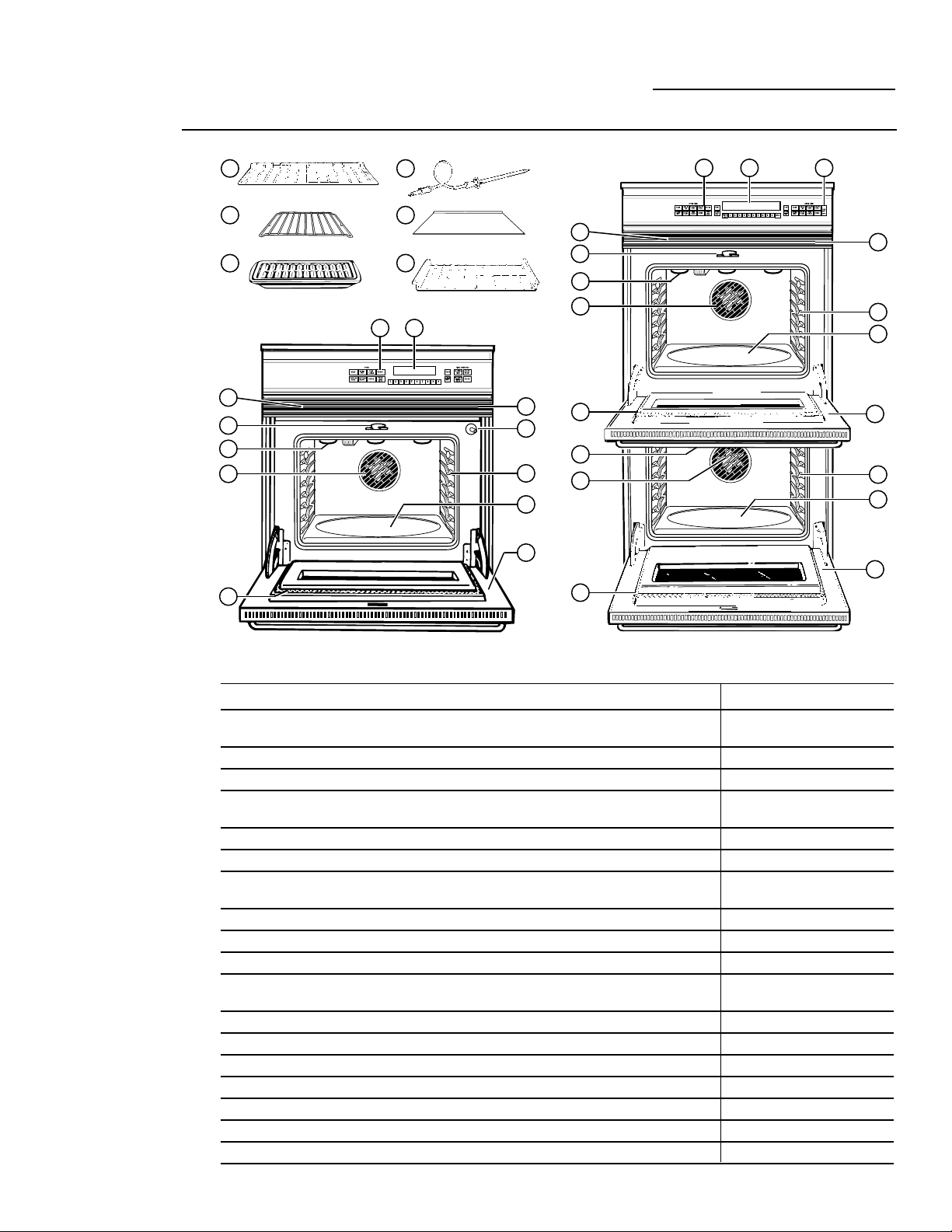
Features of Your Wall Oven
Wall Oven
Design
information
(Not all features
are on all models.
Appearance may vary.)
Feature Index Page
1 Oven Shelves with Stop-Locks 5, 16, 19, 20, 26, 33, 35
Two additional shelves may be ordered. Pub No. 3-A014
2 Roasting Rack 25, 33, 35
3 Broiler Pan and Grid 5, 17, 18, 23, 25, 33, 36
4 Probe Depending on your oven, the probe outlet will be located 23, 24, 28, 33, 37
in the oven wall or ceiling.
5 Cookie Sheets (on some models) (2 large, 1 small). 17, 36
6 Offset Shelf (on some models) 25, 26, 34, 35
7 Oven Light Pad(s) Lets you turn the oven light on and off. 33, 36
Depending on your oven, the oven light will be located in the oven wall or ceiling.
8 Oven Control, Clock and Timer 7–12
9 Oven Vent Grille 4, 5
10 Automatic Oven Light Switch (on some models) —
11 Oven Shelf Supports Shelf positions are suggested in the Convection Cooking, 16–20, 25,
Baking or Roasting and Broiling sections. 26, 28, 34, 35
12 Removable Oven Floor 36
13 Lift-Off Oven Door with Broil Stop Position 18, 35
14 Oven Door Gasket 5, 35
15 Convection Fan and Heating Element Operates during convection cooking. 25–30
16 Oven Broil Element 18, 36
17 Automatic Oven Door Latch 33, 34
18 Oven Vent 4, 5
30″ Single oven shown
15
11
12
13
9
10
30″ Double oven shown
1
16
17
14
15
16
17
9
11
12
7 78
14
15
16
14
11
12
13
13
2
3
4
5
6
87
18
18
Oven Control, Clock & Timer
Wall Oven
Features of
your oven
control,
clock and
timer
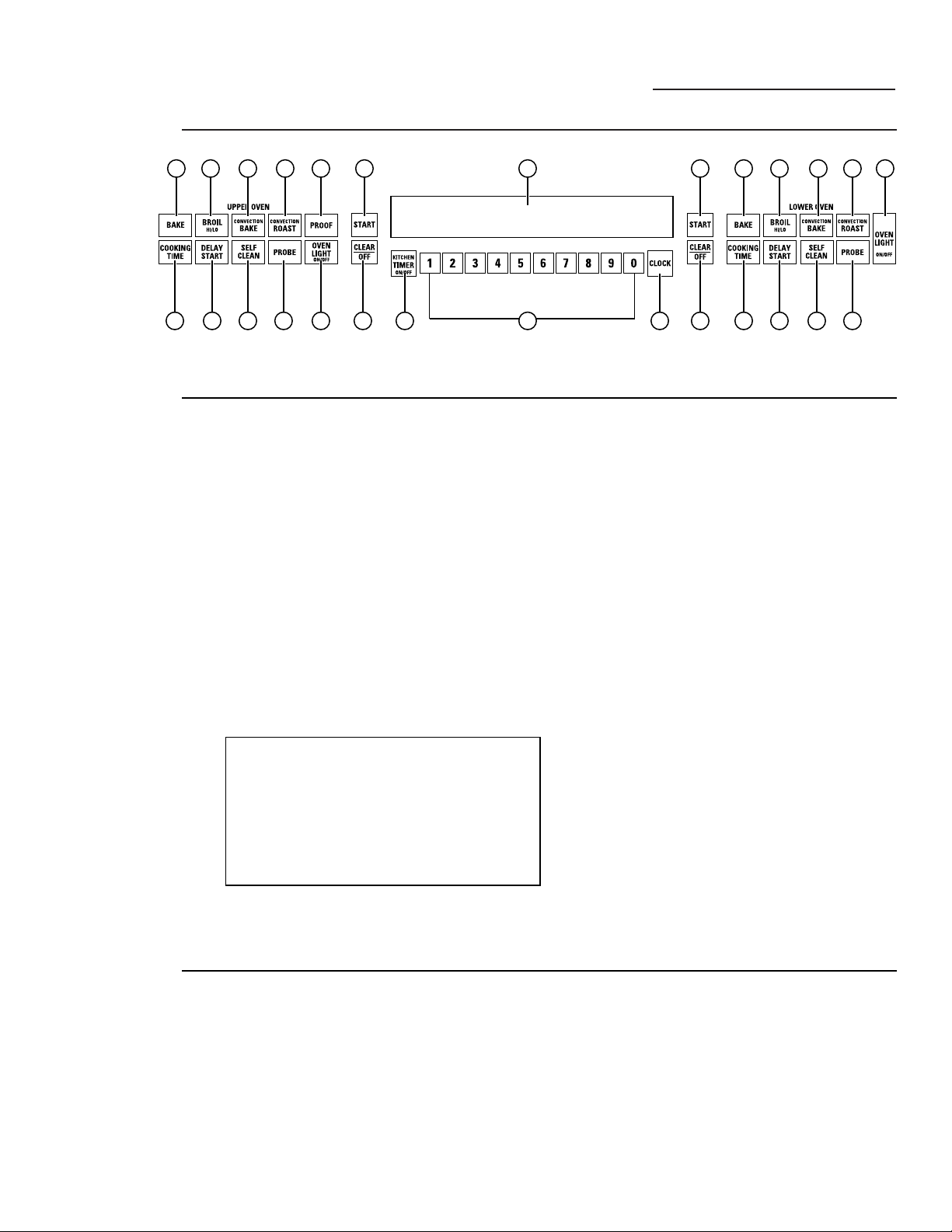
1 BAKE. Press to select the bake function.
2 BROIL HI/LO. Press to select the broil
function.
3 CONVECTION BAKE. Press to select
baking with convection.
4 CONVECTION ROAST. Press to select
roasting with convection.
5 PROOF. Press to select a warm environment
useful for rising yeast-leavened products.
6 START. Must be pressed to start any cooking
or cleaning function.
7 DISPLAY. Shows the operations you have
selected, the time of day and the cooking
or cleaning status.
8 OVEN LIGHT ON/OFF. Press to turn the
oven lights on or off.
09 PROBE. Press when using the probe to
cook food.
10 SELF CLEAN. Press to select the self-
cleaning function. See the Using the Self-
Cleaning Oven section.
11 DELAY START. Use along with the
COOKING TIME or SELF CLEAN pads to
set the oven to start and stop automatically
at a time you select.
12 COOKING TIME. Use for Timed Bake,
Timed Convection Bake and Timed
Convection Roast operations.
13 CLEAR/OFF. Press to cancel any oven
operation except the clock and timer.
14 CLOCK. Press to enter the time of day.
15 NUMBER PADS. Use to set any function
requiring numbers—for example, the time
of day on the clock, the timer, the oven
temperature, the internal food temperature,
the starting and length of cooking time for
Timed Bake and the starting and length of
cleaning time for Self-Clean.
16 KITCHEN TIMER ON/OFF. Press to
select the timer function. The timer does
not control oven operations. The timer
can time up to 9 hours and 59 minutes.
If “F— and a number or letter” flash in the
display and the oven control signals, this
indicates function error code. Press the
CLEAR/OFF pad. Allow oven to cool for
one hour. Put the oven back into operation.
If function error code repeats, disconnect
power to the oven and call for service.
76 6 1 2 3 4 8
9101112131416138911 1012
54321
15
Double oven control shown. (appearance may vary)
Tones
The control has a series of tones that will sound
at different times. These tones may sound while
you set the control for an oven function or at
the end of the oven function. They will also
alert you when an incorrect time or
temperature has been entered or if there is a
problem with the oven.
When you press a touch pad you will hear a
beep. This beep will let you know you have placed
enough pressure on the pad to activate it.
When you set an oven temperature the oven
automatically starts to heat. When the
temperature inside the oven reaches your set
temperature a tone will sound to let you know
to place the food in the oven.
An attention tone will sound if you set an
invalid function or try to set an additional
function. The tone can be quickly identified
by watching the display messages.
7
8
Oven Control, Clock & Timer
Wall Oven
To set the
clock
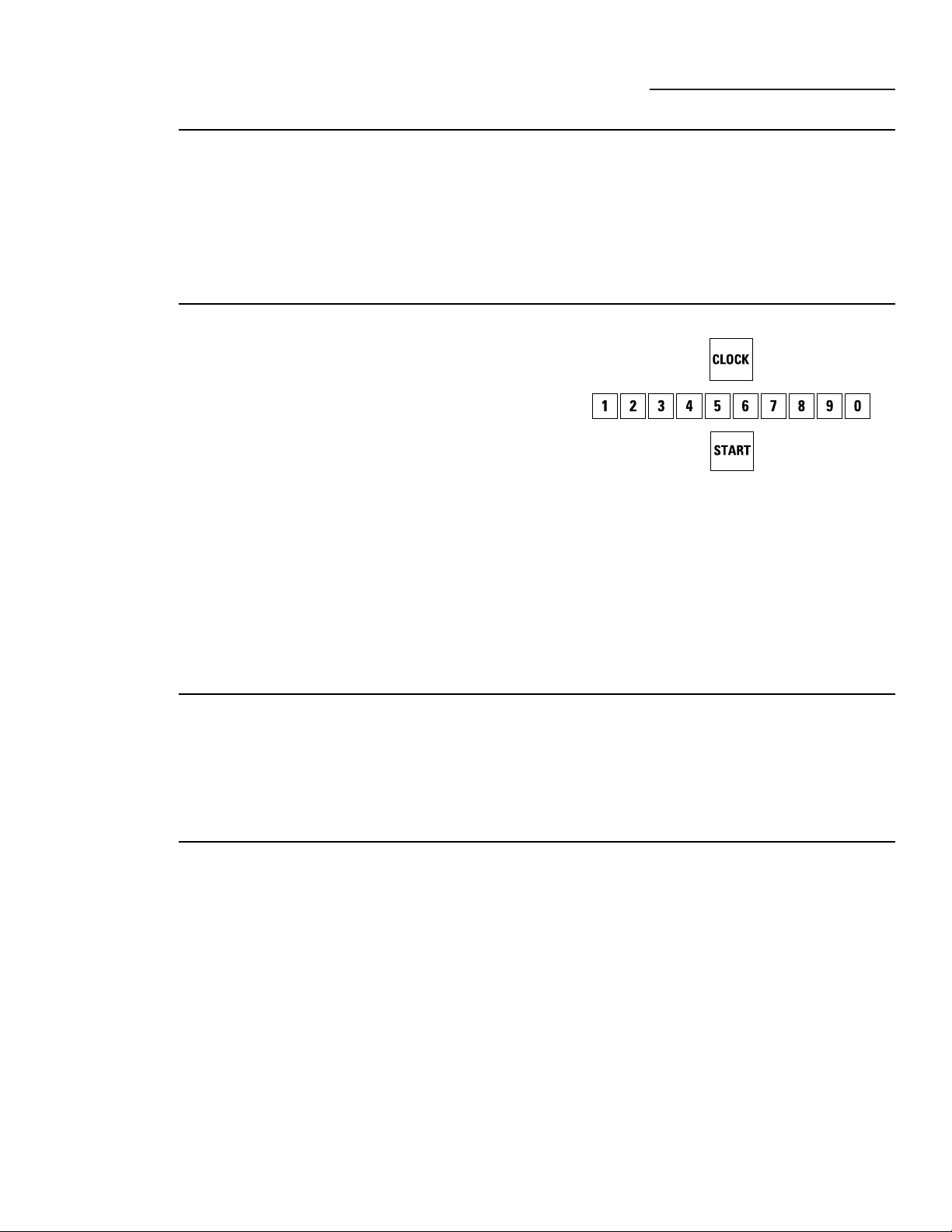
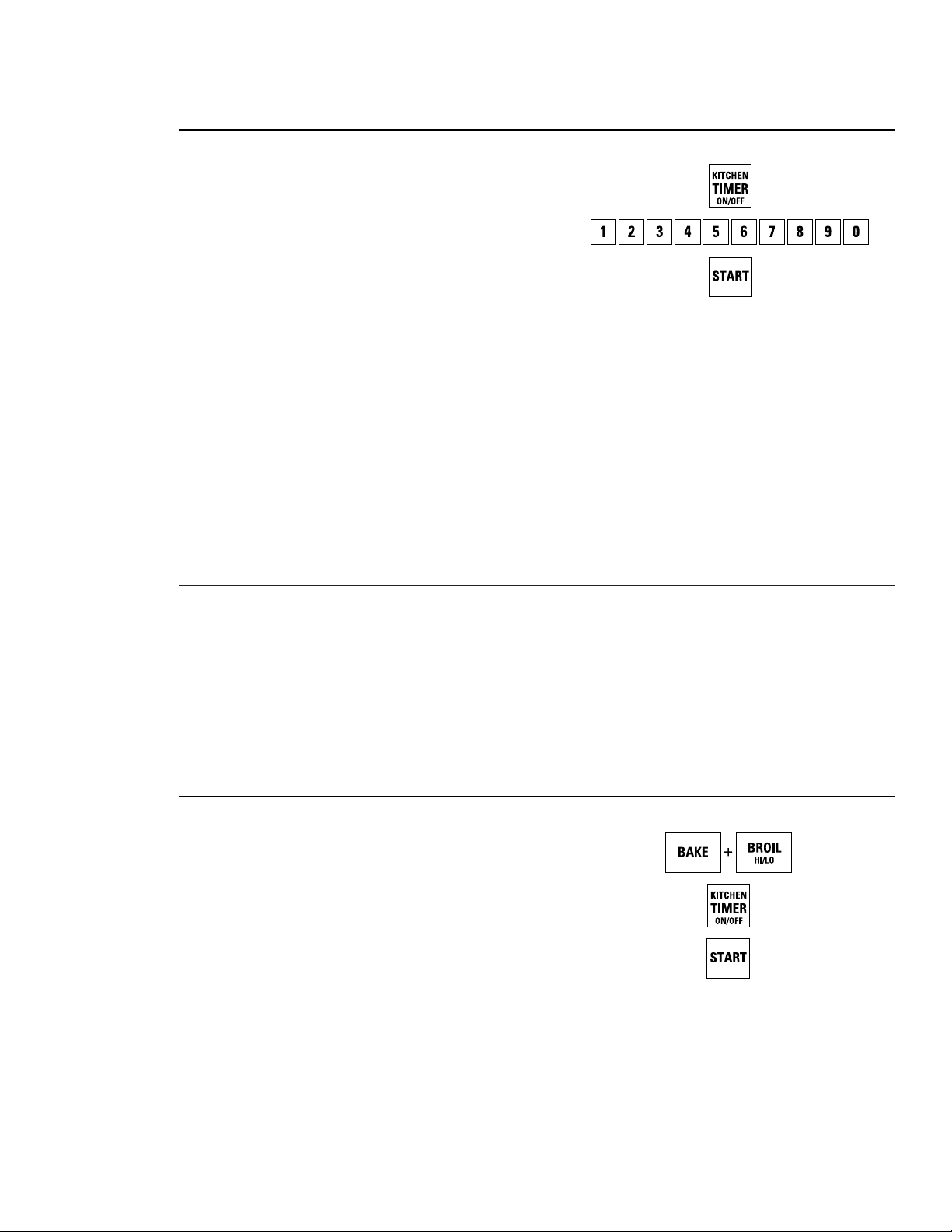
1 Press the CLOCK pad.
2 Press the number pads the same way you read
them. For example, to set 12:34, press the
number pads 1, 2, 3 and 4 in that order.
If number pads are not pressed within one
minute after you press the CLOCK pad, the
display reverts to the original setting. If this
happens, press the CLOCK pad and reenter
the time of day.
3 Press the START pad. This enters the time
and starts the clock.
To check the time of day when the display is
showing other information, simply press the
CLOCK pad. The time of day shows until
another pad is pressed.
Clock
The clock must be set for the automatic oven timing
functions to work properly.
The time of day clock cannot be changed
during Delay Start. (It can be changed during a
regular bake or broil operation.)
Timer
NOTE: The timer is independent of all the other
functions and it does not control the oven. The
CLEAR/OFF pad does not affect the timer.
You may program the timer to time cooking or
other household activities for up to 9 hours and
59 minutes.
The timer counts down in minutes, 1 minute
at a time, until the last 60 seconds are reached.
Then the control will beep one time. The
seconds will not be displayed until the last
minute is reached.
When the timer reaches “ :00,” the control will
beep 3 times followed by one beep every 6
seconds until the KITCHEN TIMER ON/OFF
pad is pressed.
The 6 second tone can be canceled by
following the steps in the Special Features of
Your Control under Tones at the End of a
Timed Cycle.
Power
failure
If a flashing time of day is in the display,
you have experienced a power failure. Reset
the clock.
To reset the clock, press the CLOCK pad.
Enter the correct time of day by pressing
the appropriate number pads. Press the
START pad.
9
Special
features of
your oven
control
Your new touch pad control has additional features
that you may choose to use.
They remain in the control’s memory until the
steps are repeated. When the display shows your
choice, press the START pad. The special
features will remain in memory after a power
failure, except for the Sabbath feature, which will
have to be reset.
The special feature modes can only be
activated while the display is showing
the time of day clock.
The following are the features and how you may
activate them.
Using the
timer
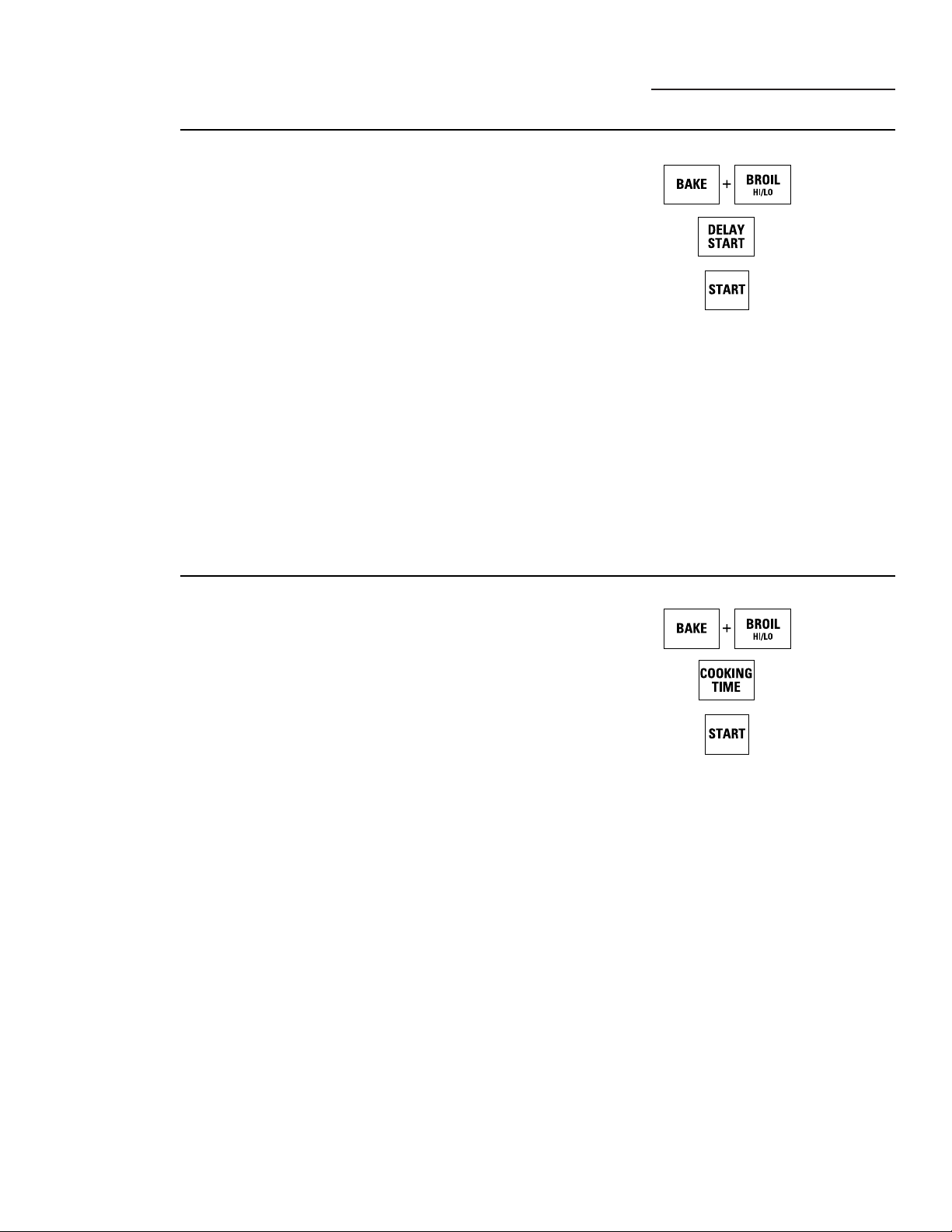
1 Press the KITCHEN TIMER ON/OFF pad.
2 Press the number pads to set the time. For
example, to enter 2 hours and 45 minutes,
touch 2, 4 and 5 in that order.
If you make a mistake, press the KITCHEN TIMER
ON/OFF pad and begin again.
3 Press the START pad.
After pressing the START pad, “SET”
disappears; this tells you the time is counting
down, although the display does not change
until one minute has passed.
4 When time is up, the oven control signals
until you press the KITCHEN TIMER ON/OFF
pad. Display then shows the time of day.
NOTE: The minute timer is independent of all the
other functions and it does not control the oven. The
CLEAR/OFF pad does not affect the timer.
Tones at the
end of a
timed cycle
At the end of a timed cycle, 3 short beeps will
sound followed by one beep every 6 seconds until
the CLEAR/OFF pad is pressed. This continuous
6 second beep may be canceled. To cancel the 6
second beep:
1 Press the BAKE and BROIL HI/LO pads
(on double oven models use the upper oven
controls) at the same time for 3 seconds until
the display shows “SF.”
2 Press the KITCHEN TIMER ON/OFF pad.
The display shows “CON BEEP” (continuous
beep). Press the KITCHEN TIMER ON/OFF
pad again. The display shows “BEEP.” (This
cancels the one beep every 6 seconds.)
3 Press the START pad.
NOTE: On double oven models this cancels the end of
cycle tone for both ovens.
10
Oven Control, Clock & Timer
Wall Oven
12 hour
shut off
With this feature, should you forget and leave the oven
on, the control will automatically turn off the oven
after 12 hours during baking functions or after 3
hours during a broil function. If you wish to turn off
this feature, follow the steps below.
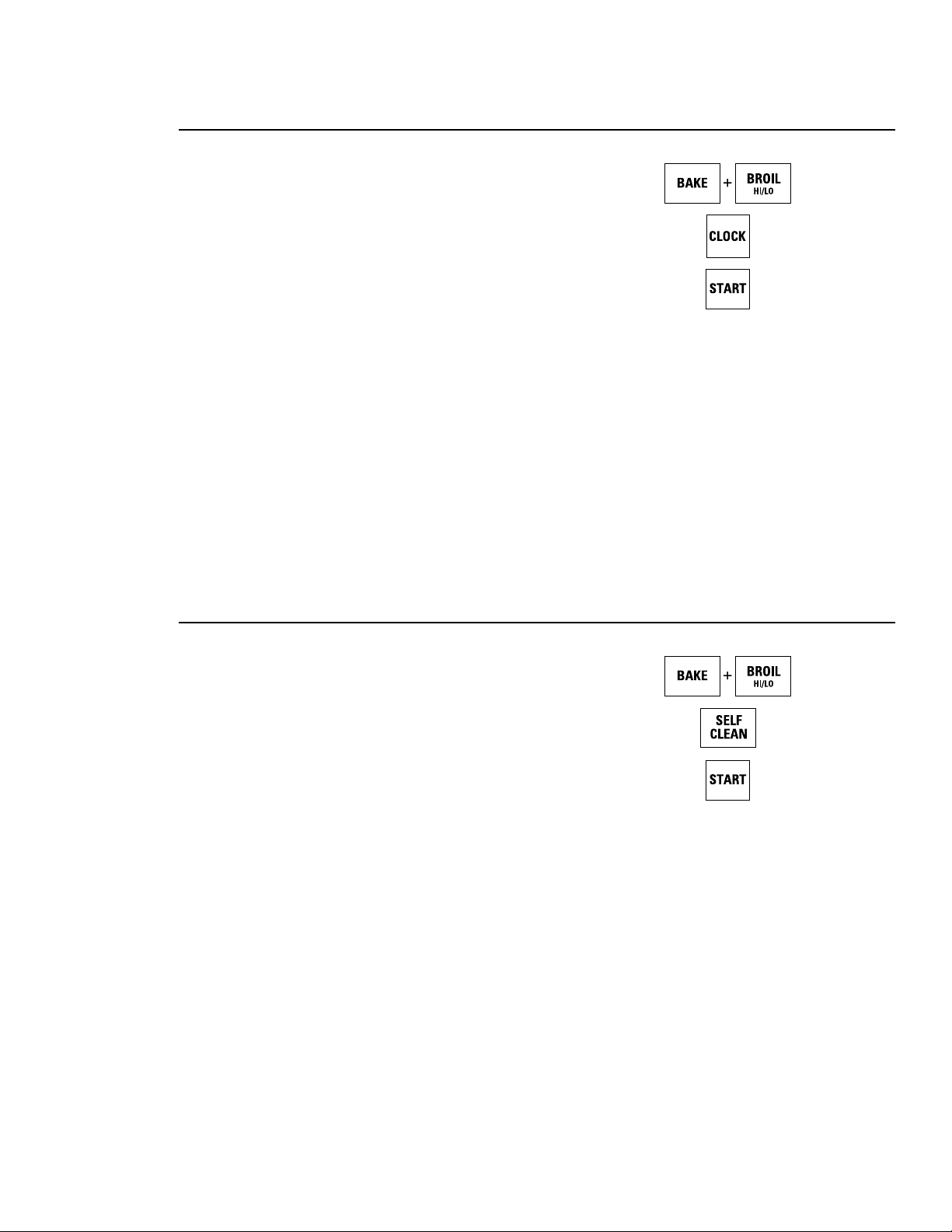
1 Press the BAKE and BROIL HI/LO pads
(on double oven models use the upper oven
controls) at the same time for 3 seconds until
the display shows “SF.”
2 Press the DELAY START pad. The display
will show “12 shdn” (12 hour shut-off). Press
the DELAY START pad again and the display
will show “no shdn” (no shut-off).
3 Press the START pad to activate the no shut-
off and leave the control set in this special
features mode.
NOTE: On double oven models this activates this
special feature in both ovens.
Cook and
hold
Your new control has a cook and hold feature that
keeps cooked foods warm for up to 3 hours after the
cooking function is finished. To activate this feature,
follow the steps below.
On double oven models both ovens follow the
same step 1. Then proceed with steps 2 through
3, using the pads for the upper or lower oven.
1 Press the BAKE and BROIL HI/LO pads
(on double oven models use the upper oven
controls) at the same time for 3 seconds until
the display shows “SF.”
2 Press the COOKING TIME pad. The display
will show “Hld OFF.”
Press the COOKING TIME pad again to
activate the feature. The display will show
“Hld ON.”
3 Press the START pad to activate the cook and
hold feature and leave the control set in this
special features mode.
11
12 hour,
24 hour
or clock
black-out
Your control is set to use a 12 hour clock. If you would
prefer to have a 24 hour military time clock or black-
out the clock display, follow the steps below.
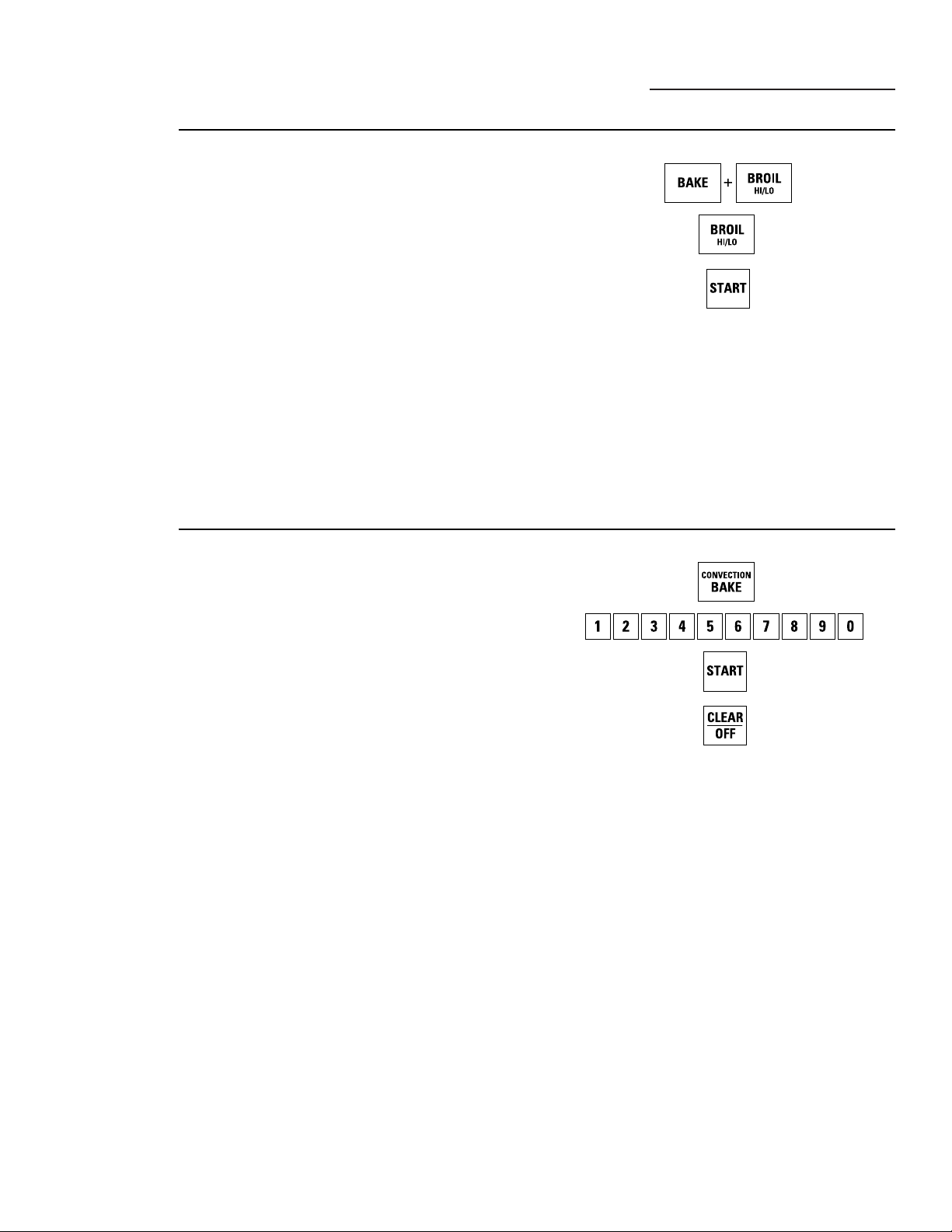
1 Press the BAKE and BROIL HI/LO pads
(on double oven models use the upper oven
controls) at the same time for 3 seconds until
the display shows “SF.”
2 Press the CLOCK pad once. The display will
show “12 hr.” If this is the choice you want,
press the START pad.
Press the CLOCK pad again to change to the
24 hour military time clock. The display will
show “24 hr.” If this is the choice you want,
press the START pad.
Press the CLOCK pad again to black-out
the clock display. The display will show
“OFF.” If this is the choice you want,
press the START pad.
NOTE: If the clock is in the black-out mode you will
not be able to use the Delay Start function.
Control
lockout
Your control will allow you to lock down the touch
pads so they cannot be activated when pressed.
1 Press the BAKE and BROIL HI/LO pads
(on double oven models use the upper oven
controls) at the same time for 3 seconds until
the display shows “SF.”
2 Press the SELF CLEAN pad. The display will
show “LOC OFF.”
Press the SELF CLEAN pad again. The
display will show “LOC.”
3 Press the START pad to activate the control
lockout feature and leave the control set in
this special features mode.
When this feature is on and the touch pads are
pressed the control will beep and the display
will show “LOC.”
NOTE:
• On double oven models this activates this special
feature for both ovens.
• The control lockout mode will not affect the CLOCK,
TIMER ON/OFF and OVEN LIGHT ON/OFF
touch pads.
12
Oven Control, Clock & Timer
Wall Oven
Fahrenheit
or Celsius
temperature
selection
Your oven control is set to use the Fahrenheit
temperature selections but you may change this
to use the Celsius selections.
1 Press the BAKE and BROIL HI/LO pads
(on double oven models use the upper oven
controls) at the same time for 3 seconds until
the display shows “SF.”
2 Press the BROIL HI/LO pad. The display
will show “F” (Fahrenheit).
Press the BROIL HI/LO pad again. This will
show “C” (Celsius).
3 Press the START pad. The new setting will be
displayed for both ovens.
NOTE: On double oven models the new setting will be
displayed for both ovens.
Using
convection
conversion
By using the Convection Conversion feature you can
automatically convert the oven temperature from
regular baking to Convection Bake temperatures.
To convert the oven temperature for convection
baking, follow the steps below.
1 Press and hold the CONVECTION BAKE
pad for 4 to 5 seconds.
”CON Conv Bake” will show in the display.
2 Using the number pads, enter the
temperature recommended in the recipe.
3 Press the START pad.
The display shows the converted (reduced)
temperature. For example, if you entered a
recipe temperature of 350°F., the display will
show 325°F. when it is converted.
4 Press the CLEAR/OFF pad when baking is
finished.
NOTE: Conversion must be set each time you want to
use it. It is not held in memory.
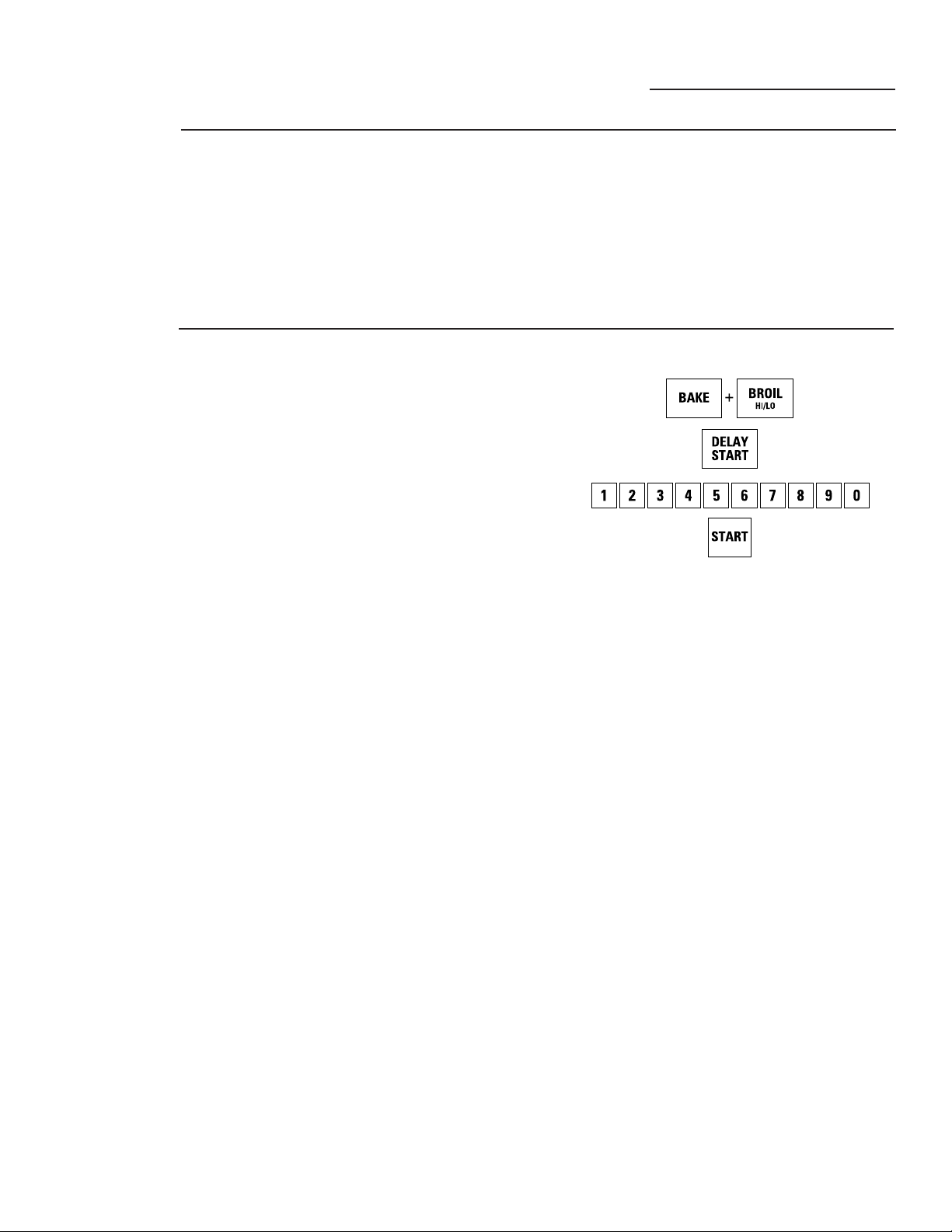
13
The Sabbath feature can be used for baking/roasting only.
It cannot be used for convection, broiling, self-cleaning, or
Delay Start cooking.
NOTE: The oven light comes on automatically (on
some models) when the door is opened and goes off when
the door is closed. The bulb may be removed. See the Oven
Light Replacement section. On models with a light switch
on the control panel, the oven light may be turned on and
left on.
Using the Sabbath Feature (on some models)
Wall Oven
Sabbath
Feature:
How to set
for regular
baking or
roasting
Make sure the clock shows the correct time of day.
1 Press and hold both the BAKE and BROIL
HI/LO pads, at the same time, until the
display shows “SF”.
NOTE: If bake or broil appears in the display, the
BAKE and BROIL HI/LO pads were not touched
at the same time. Touch the CLEAR/OFF pad and
begin again.
2 Tap the DELAY START pad until
“SAb bAtH”appears in the display.
3 Touch the START pad and ⊃ will appear in
the display.
4 Touch the BAKE pad. No signal will
be given.
5 Using the number pads, enter the desired
temperature between 170° and 550°.
No signal or temperature will be given.
6 Touch the START pad.
7 After a random delay period of
approximately 30 seconds to 1 minute,
⊃ will appear in the display indicating
that the oven is baking/roasting. If ⊃
doesn’t appear in the display, start again
at Step 4.
To adjust the oven temperature, touch the
BAKE pad, enter the new temperature using
the number pads, and touch the START pad.
NOTE: The CLEAR/OFF and COOKING TIME
pads are active during the Sabbath feature.
⊃
⊃
When the display shows ⊃ the oven is
set in Sabbath. When the display shows
⊃ the oven is baking/roasting.
⊃
Designed for use on the Jewish Sabbath and Holidays.
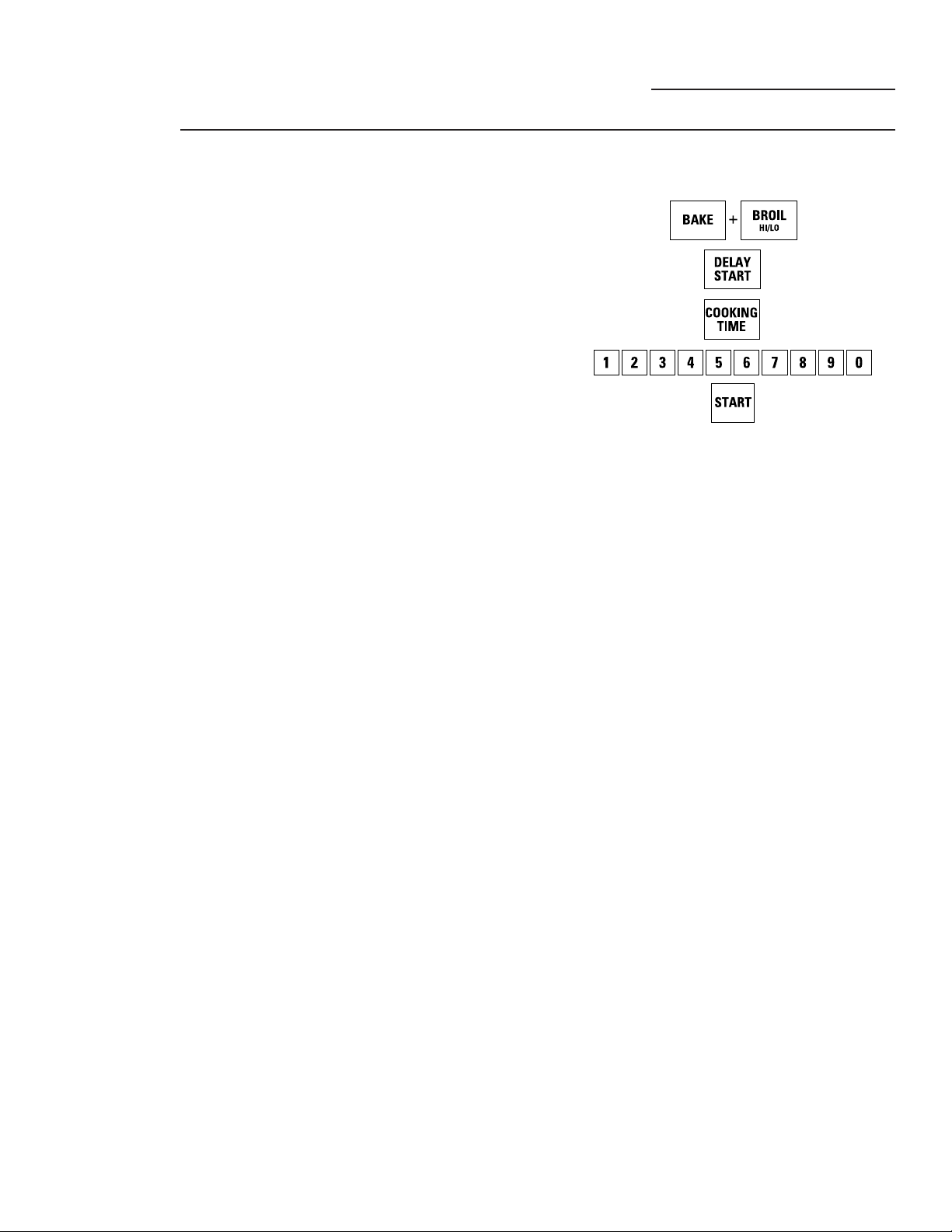
Using the Sabbath Feature (on some models)
Wall Oven
Sabbath
Feature:
How to set for
timed baking or
roasting—
immediate start
and automatic
stop
14
Make sure the clock shows the correct time of day.
1 Press and hold both the BAKE and BROIL
HI/LO pads, at the same time, until the
display shows “SF”.
NOTE: If bake or broil appears in the display, the
BAKE and BROIL HI/LO pads were not touched
at the same time. Touch the CLEAR/OFF pad and
begin again.
2 Tap the DELAY START pad until
“SAb bAtH” appears in the display.
3 Touch the START pad and ⊃ will appear in
the display.
4 Touch the COOKING TIME pad.
5 Touch the number pads to set the desired
length of cooking time between 1 minute
and 9 hours and 99 minutes. The cooking
time that you entered will be displayed.
6 Touch the START pad.
7 Touch the BAKE pad. No signal will
be given.
8 Using the number pads, enter the desired
temperature. No signal or temperature will
be given.
9 Touch the START pad.
10 After a random delay period of
approximately 30 seconds to 1 minute,
⊃ will appear in the display indicating that
the oven is baking/roasting. If ⊃ doesn’t
appear in the display, start again at Step 7.
To adjust the oven temperature, touch the
BAKE pad, enter the new temperature using
the number pads, and touch the START pad.
When cooking is finished, the display will
change from ⊃ to ⊃ and 0:00 will appear,
indicating that the oven has turned OFF but is
still set in Sabbath. Remove the cooked food.
⊃
⊃
⊃
When the display shows ⊃ the oven is
set in Sabbath. When the display shows
⊃ the oven is baking/roasting.
⊃
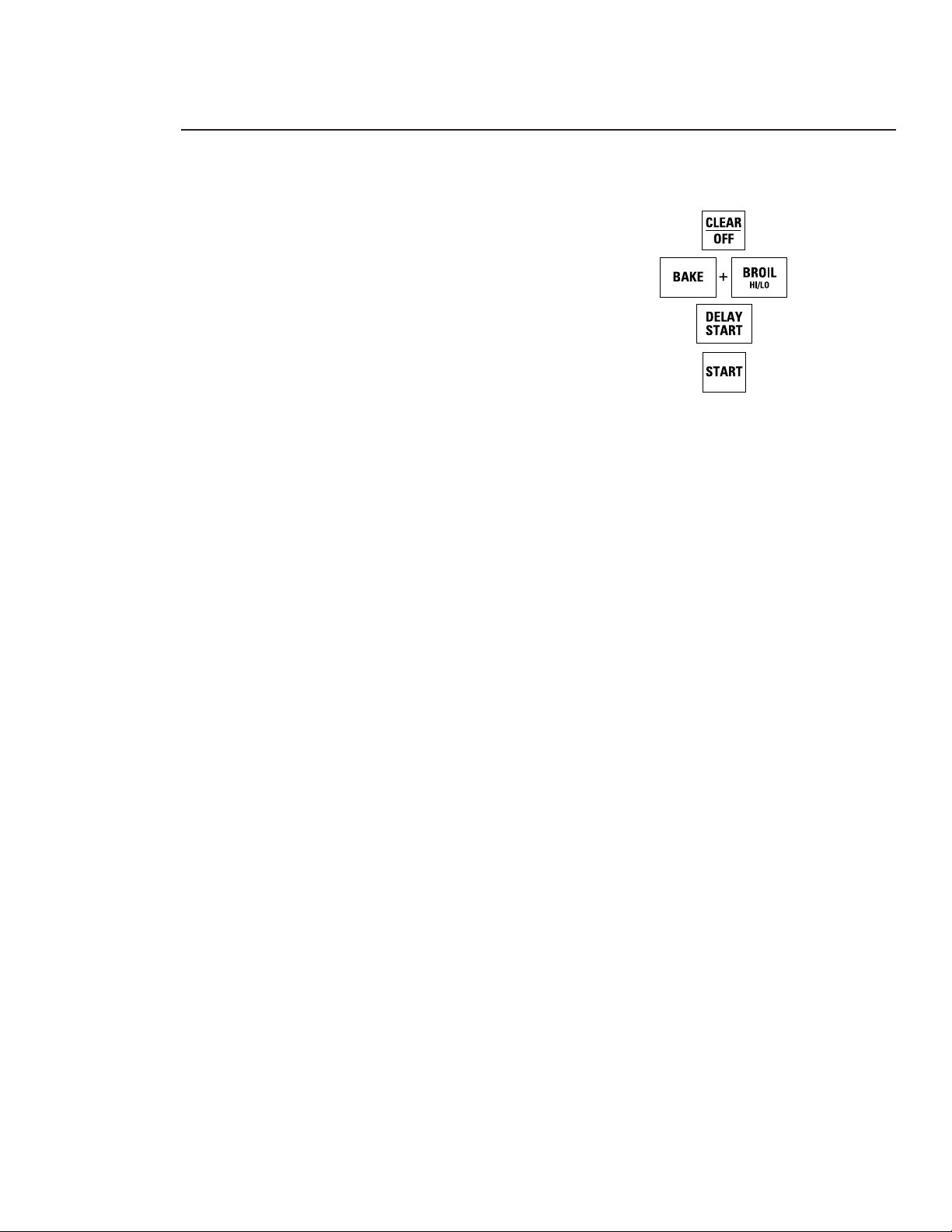
15
How to exit
the Sabbath
feature
1 Touch the CLEAR/OFF pad.
2 If the oven is cooking, wait for a random
delay period of approximately 30 seconds
to 1 minute, until only ⊃ is in the display.
3 Press and hold both the BAKE and BROIL
HI/LO pads, at the same time, until the
display shows “SF”.
4 Tap the DELAY START pad until
“12 shdn” or “no shdn” appears in the
display. “12 shdn” indicates that the oven
will automatically turn off after 12 hours.
“no shdn” indicates that the oven will not
automatically turn off.
5 Touch the START pad.
NOTE: If a power outage occurred while the oven was
in Sabbath, the oven will automatically turn off and
stay off even when the power returns. The oven control
must be reset.
16
Baking or Roasting
Wall Oven
Before you
begin…
To avoid possible burns, place the shelves in the desired
position before you turn the oven on.
The shelves have stop-locks, so that when placed
correctly on the supports, they will stop before
coming completely out, and will not tilt.
When placing and removing cookware,
pull the shelf out to the bump on the shelf
support.
To remove a shelf, pull it toward you, tilt the
front end up and pull it out.
To replace, place the end of the shelf (stop-
locks) on the support, tilt up the front and push
the shelf in.
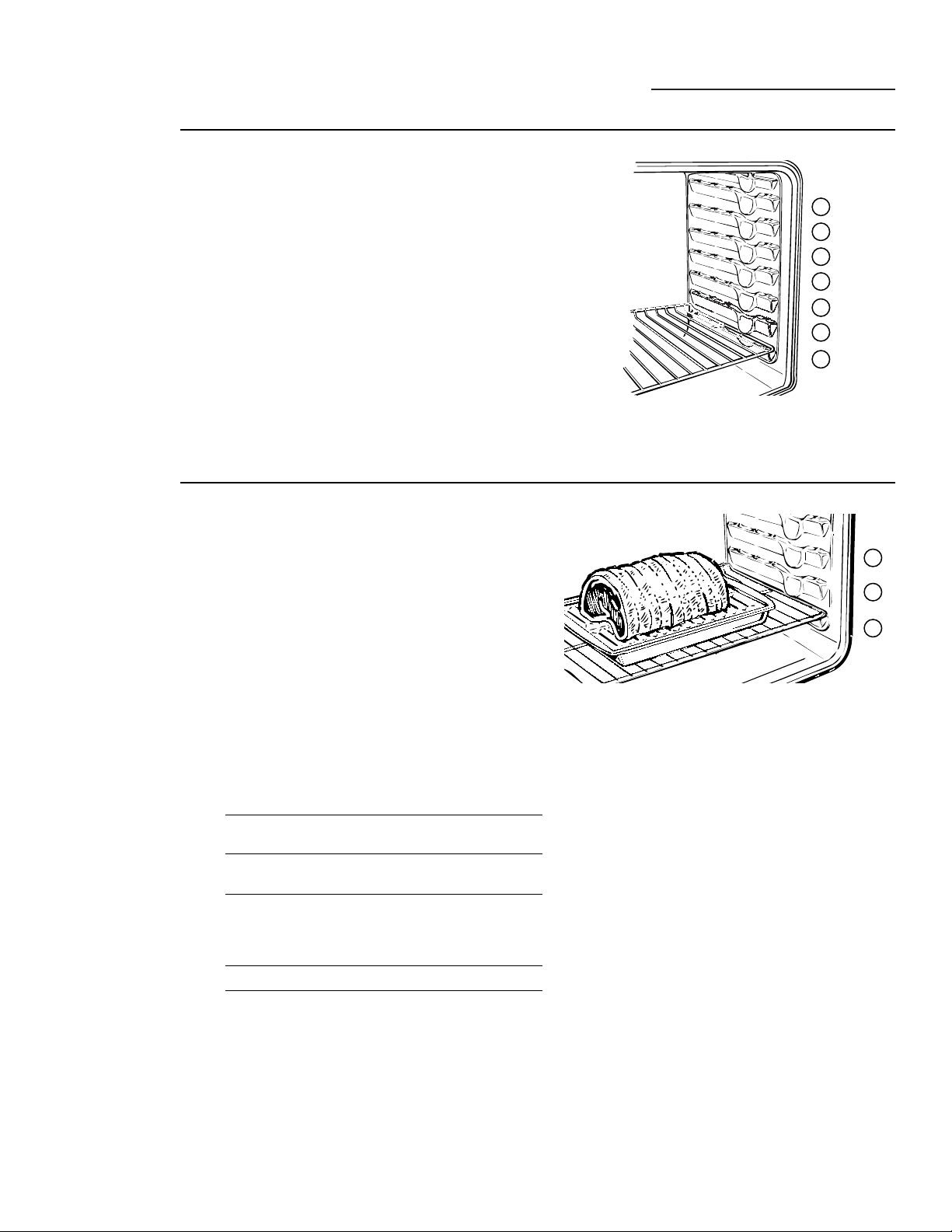
30″ ovens (shown) have 7 shelf positions.
27″ ovens have 4 shelf positions.
How to set
the oven for
baking or
roasting
1 Press the BAKE pad.
2 Press the number pads to set the desired
temperature.
3 Press the START pad.
4 Check food for doneness at minimum time
on recipe. Cook longer if necessary.
5 Press the CLEAR/OFF pad when cooking is
complete.
NOTE: A cooling fan may automatically turn on and
off to cool internal parts. This is normal, and the fan
may continue to run even after the oven is turned off.
Shelf Position
Type of Food 27″Oven 30″Oven
Frozen pies B or C C or D
(on cookie sheet)
Angel food cake, A B
bundt or pound cakes
Biscuits, muffins, B or C C or D
brownies, cookies,
cupcakes, layer
cakes, pies
Casseroles B or C C or D
C
D
E
F
G
B
A
C
B
A
Preheating
and pan
placement
Preheat the oven if the recipe calls for it. To
preheat, set the oven at the correct temperature.
Preheating is necessary for good results when
baking cakes, cookies, pastry and breads.
For ovens without a preheat indicator light or tone,
preheat 10 minutes.
Baking results will be better if baking pans are
centered in the oven as much as possible. Pans
should not touch each other or the walls of the
oven. If you need to use two shelves, stagger the
pans so one is not directly above the other, and
leave approximately 1
1
⁄2″ between pans, from
the front, back and sides of the wall.
Cookie
sheets
(on some models)
As an added convenience for you when using your
new convection oven, we have provided three cookie
sheets.
The cookie sheets provide uniform baking.
They are dishwasher safe, durable and will not
warp or rust.
Insulated cookie sheets, with an easy grip lip,
are made of two layers of aluminum with an
insulating layer of air for uniform baking.
Aluminum is an oven baking metal. It is not,
however, a non-stick surface. If your recipe
recommends greasing, spray lightly with a non-
stick vegetable coating; wipe off the excess. If
preferred, put a light film of shortening on the
cookie sheet. Cookies should cool at least 2
minutes before removing them from the sheet.
Your insulated cookie sheets can be used for
convection baking or regular baking. However,
if you choose not to use Convection Bake for
baking cookies and are baking on the insulated
cookie sheets, you may find that the
recommended baking time needs to be
increased 3 to 5 minutes.
Aluminum
foil
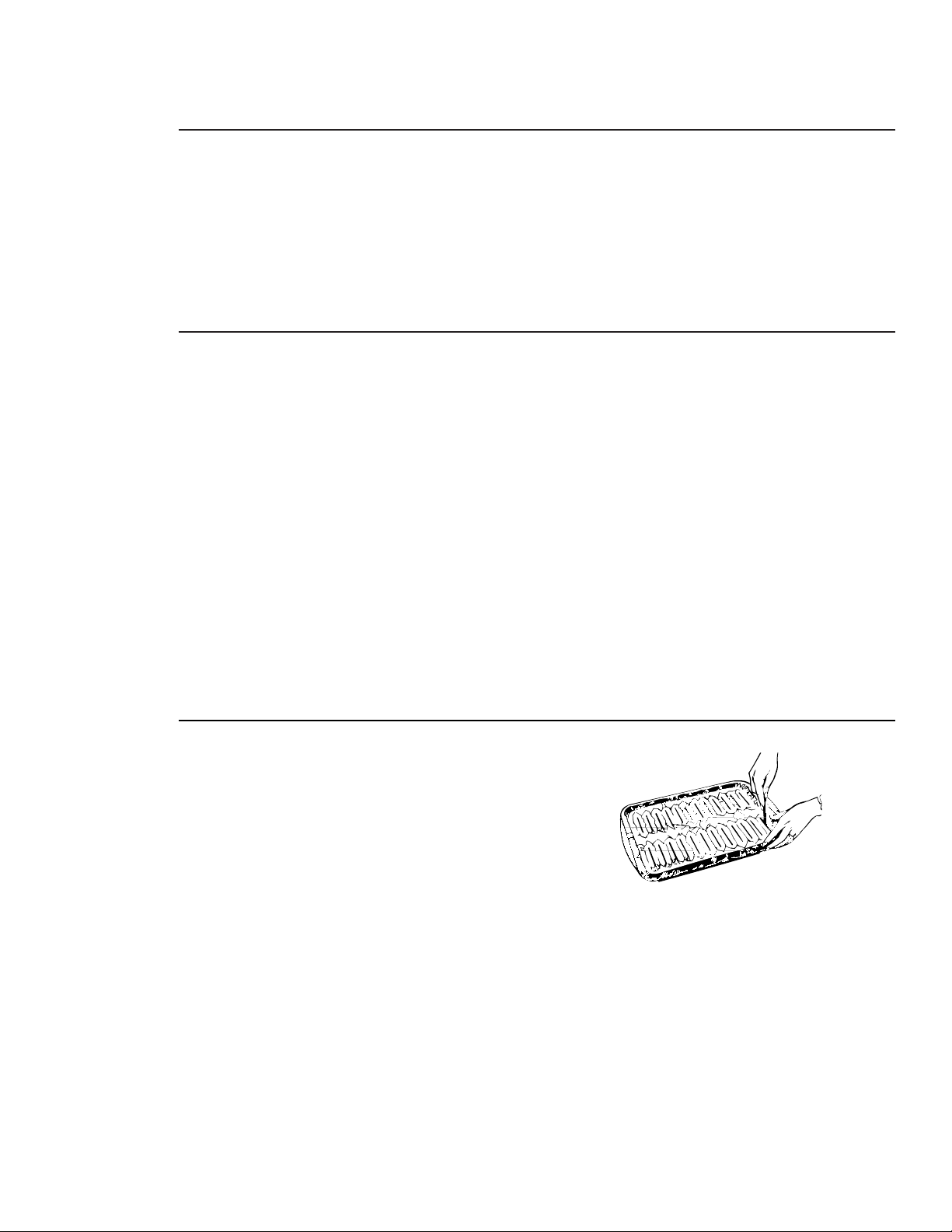
You can use aluminum foil to line the broiler
pan and broiler grid. However, you must mold
the foil tightly to the grid and cut slits in it just
like the grid.
Aluminum foil may also be used to catch a spillover.
Never entirely cover a shelf with aluminum foil.
This will disturb the heat circulation and result
in poor baking.
A smaller sheet of foil may be used to catch a
spillover by placing it on a lower shelf several
inches below the food.
Cut slits in the foil just like the grid.
17
18
Broiling
Wall Oven
How to set
the oven for
broiling
1 Place the meat or fish on the broiler grid in
the broiler pan.
2 Follow suggested shelf positions in the
Broiling Guide.
If your oven is connected to 208 volts, rare steaks may
be broiled by preheating the broiler and postioning the
oven shelf one position higher.
3 Press the BROIL HI/LO pad once for HI Broil.
To change to LO Broil, press the BROIL
HI/LO pad again.
4 Press the START pad.
5 When broiling is finished, press the
CLEAR/OFF pad.
NOTE: Broil will not work if the temperature probe is
plugged in.
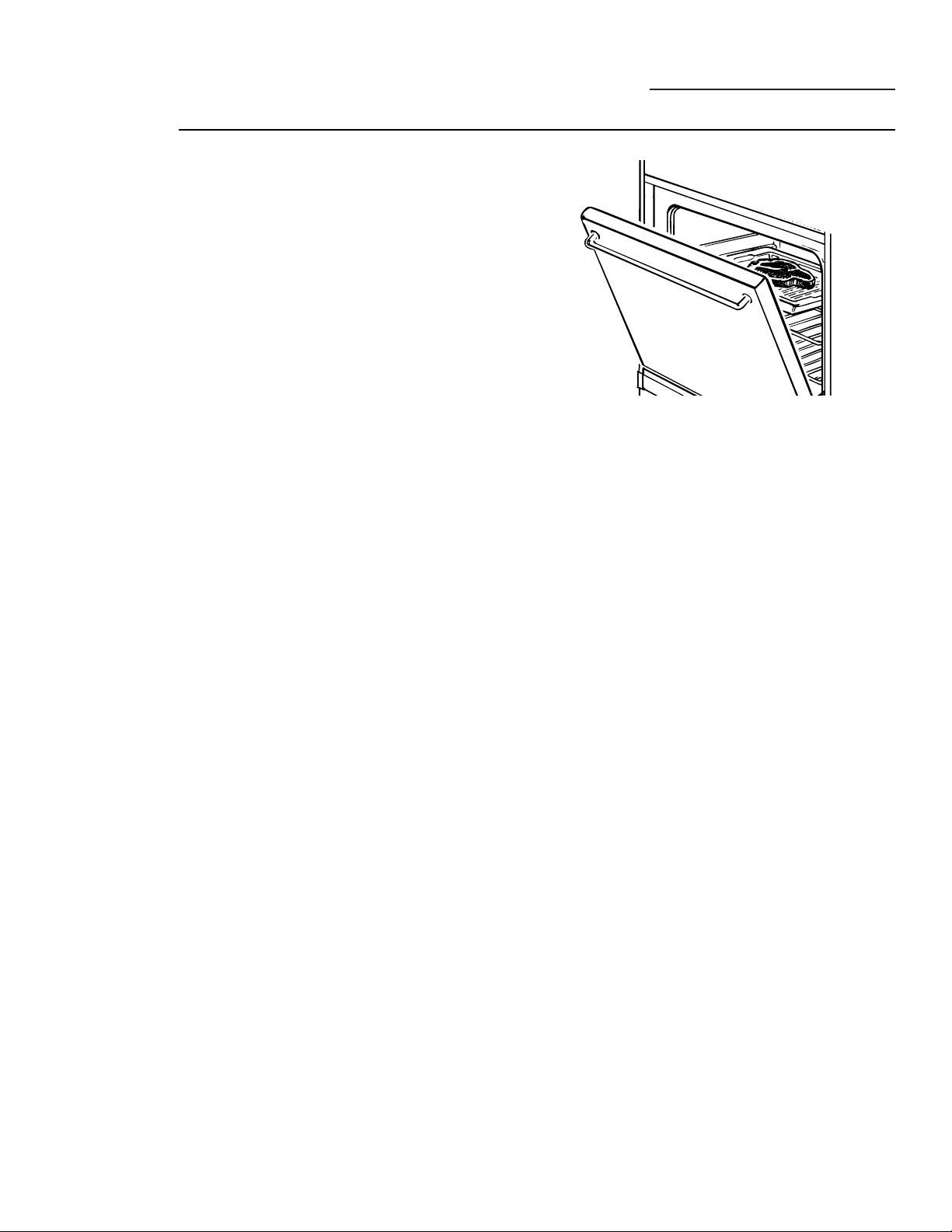
Leave the door open to the broil stop position.
The door stays open by itself, yet the proper temperature is
maintained in the oven.

19
Broiling
guide for
27 ″ovens
(on some models)
Quantity and/ Shelf First Side Second Side
Food or Thickness Position Time (min.) Time (min.) Comments
Ground Beef 1 lb. (4 patties) C 10 7 Space evenly. Up to 8 patties take
Well Done 1/2 to 3/4″thick about the same time.
Beef Steaks
Rare 1″thick C 6 5 Steaks less than 1″thick cook
Medium 1 to 1
1
⁄2 lbs. C 8 6 through before browning. Pan
Well Done C 12 11 frying is recommended.
Rare 1
1
⁄2″thick C 10 7–8 Slash fat.
Medium 2 to 2
1
⁄2 lbs. C 15 14–16
Well Done C 25 20–25
Chicken 1 whole A 35 10–15 Reduce time about 5 to 10 minutes
2 to 2
1
⁄2 lbs., per side for cut-up chicken.
split lengthwise Brush each side with melted butter.
Broil skin-side-down first.
Lobster Tails 2–4 B 13–16 Do not Cut through back of shell. Spread
6 to 8 oz. each turn over. open. Brush with melted butter
before broiling and after half of
broiling time.
Fish Fillets 1/4 to 1/2″thick C 5 5 Handle and turn very carefully.
Brush with lemon butter before
and during cooking, if desired.
Preheat broiler to increase browning.
Ham Slices 1″thick B 8 8 Increase time 5 to 10 minutes per side
(precooked) for 1
1
⁄2″thick or home-cured ham.
Pork Chops 2 (1/2″thick) C 10 10 Slash fat.
Well Done 2 (1″thick) about 1 lb. B 13 13
Lamb Chops
Medium 2 (1″thick) C 10 9 Slash fat.
Well Done about 10 to 12 oz. C 12 10
Medium 2 (1
1
⁄2″thick) C 14 12
Well Done about 1 lb. B 17 12–14

20
Broiling
Wall Oven
Broiling
guide for
30″ovens
(on some models)
Quantity and/ Shelf First Side Second Side
Food or Thickness Position Time (min.) Time (min.) Comments
Ground Beef 1 lb. (4 patties) E 10 7 Space evenly. Up to 8 patties take
Well Done 1/2 to 3/4″thick E 10 9 about the same time.
Beef Steaks
Rare 1″thick E 8 6 Steaks less than 1″thick cook
Medium 1 to 1
1
⁄2 lbs. E 10 8 through before browning. Pan
Well Done E 12 10 frying is recommended.
Rare 1
1
⁄2″thick E 10 8 Slash fat.
Medium 2 to 2
1
⁄2 lbs. E 15 14–16
Well Done E 25 20–25
Chicken 1 whole C 25 10 Reduce time about 5 to 10 minutes
2 to 2
1
⁄2 lbs., per side for cut-up chicken.
split lengthwise Brush each side with melted butter.
Broil skin-side-down first.
Lobster Tails 2–4 C 13–16 Do not Cut through back of shell. Spread
6 to 8 oz. each turn over. open. Brush with melted butter
before broiling and after half of
broiling time.
Fish Fillets 1/4 to 1/2″thick E 5 5 Handle and turn very carefully.
Brush with lemon butter before
and during cooking, if desired.
Preheat broiler to increase browning.
Ham Slices 1″thick D 8 8 Increase time 5 to 10 minutes per side
(precooked) for 1
1
⁄2″thick or home-cured ham.
Pork Chops 2 (1/2″thick) E 10 10 Slash fat.
Well Done 2 (1″thick) about 1 lb. D 15 15
Lamb Chops
Medium 2 (1″thick) E 10 9 Slash fat.
Well Done about 10 to 12 oz. E 12 10
Medium 2 (1
1
⁄2″thick) E 14 12
Well Done about 1 lb. E 17 12–14
21
Timed Baking
Wall Oven
Using the
timed baking
and roasting
features
NOTE: Foods that spoil easily, such as milk, eggs,
fish, stuffings, poultry and pork, should not be allowed
to sit for more than 1 hour before or after cooking.
Room temperature promotes the growth of harmful
bacteria. Be sure that the oven light is off because heat
from the bulb will speed harmful bacteria growth.
On double oven models, you can use timed
baking in one oven while using self-clean in the
other; you can also use timed baking in both
ovens at the same time.
How to set
an immediate
start and
automatic
stop
The oven will turn on immediately and cook for a
selected length of time. At the end of the cooking time
the oven will turn off automatically.
Make sure the oven clock shows the correct time
of day.
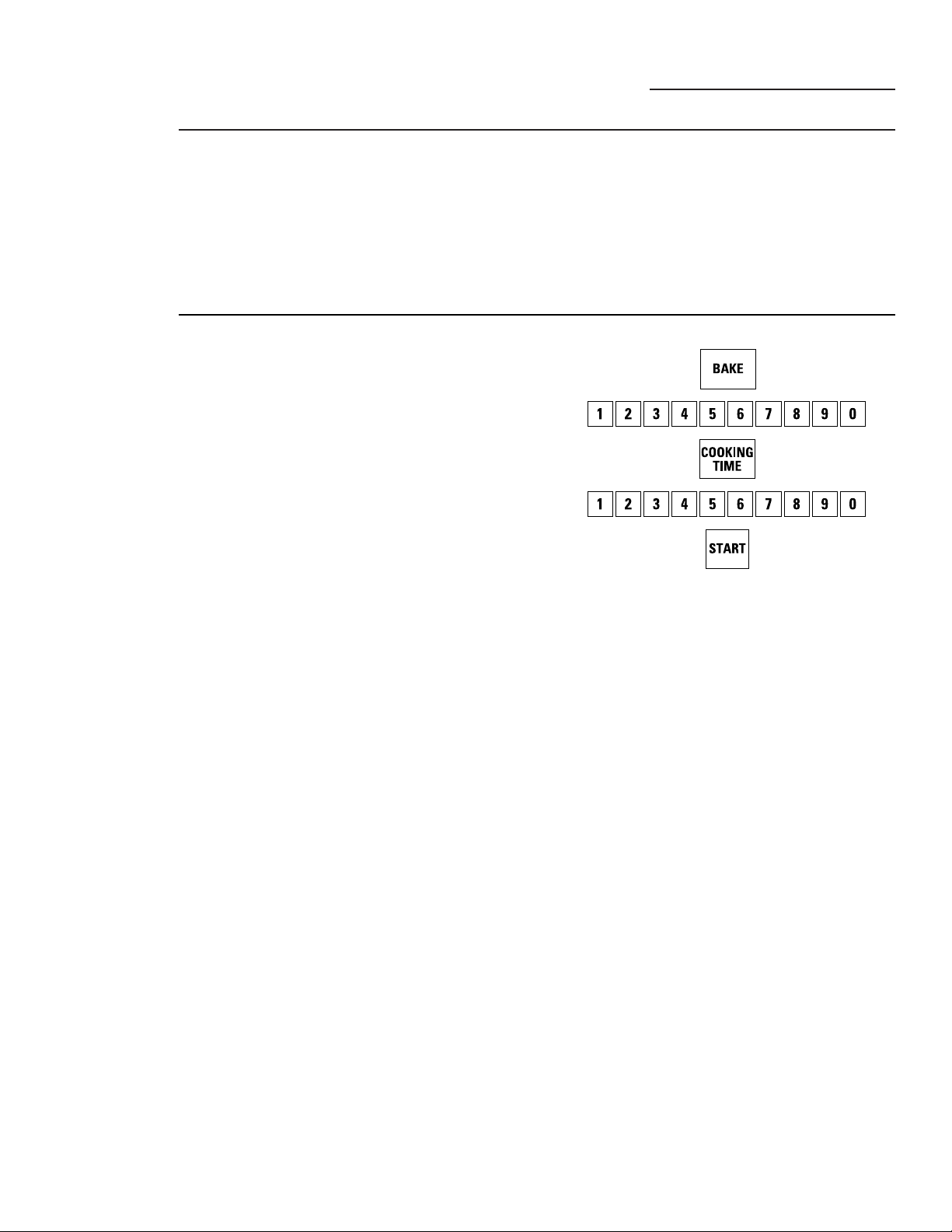
1 Press the BAKE pad.
2 Using the number pads, enter the desired
temperature.
3 Press the COOKING TIME pad.
NOTE: If your recipe requires preheating, you may
need to add additional time to the length of the
cooking time.
4 Using the number pads, enter the desired
baking time. The oven temperature and the
cooking time that you entered will be
displayed.
5 Press the START pad.
The display shows the oven temperature that
you set and the cooking time countdown. (The
display starts changing once the temperature
reaches 100°F.)
NOTE: On double oven models when using both
ovens at the same time, the times showing in the
display will be for the last oven set. To display the time
set for the first oven set, press the COOKING TIME
pad for that oven.
The oven will continue to cook for the
programmed amount of time, then shut off
automatically.
Press the CLEAR/OFF pad to clear the display.
22
Timed Baking
Wall Oven
How to set
a delayed
start and
automatic
stop
You can set the oven control to delay-start the oven,
cook for a specific length of time and then turn off
automatically.
Make sure the oven clock shows the correct time
of day.
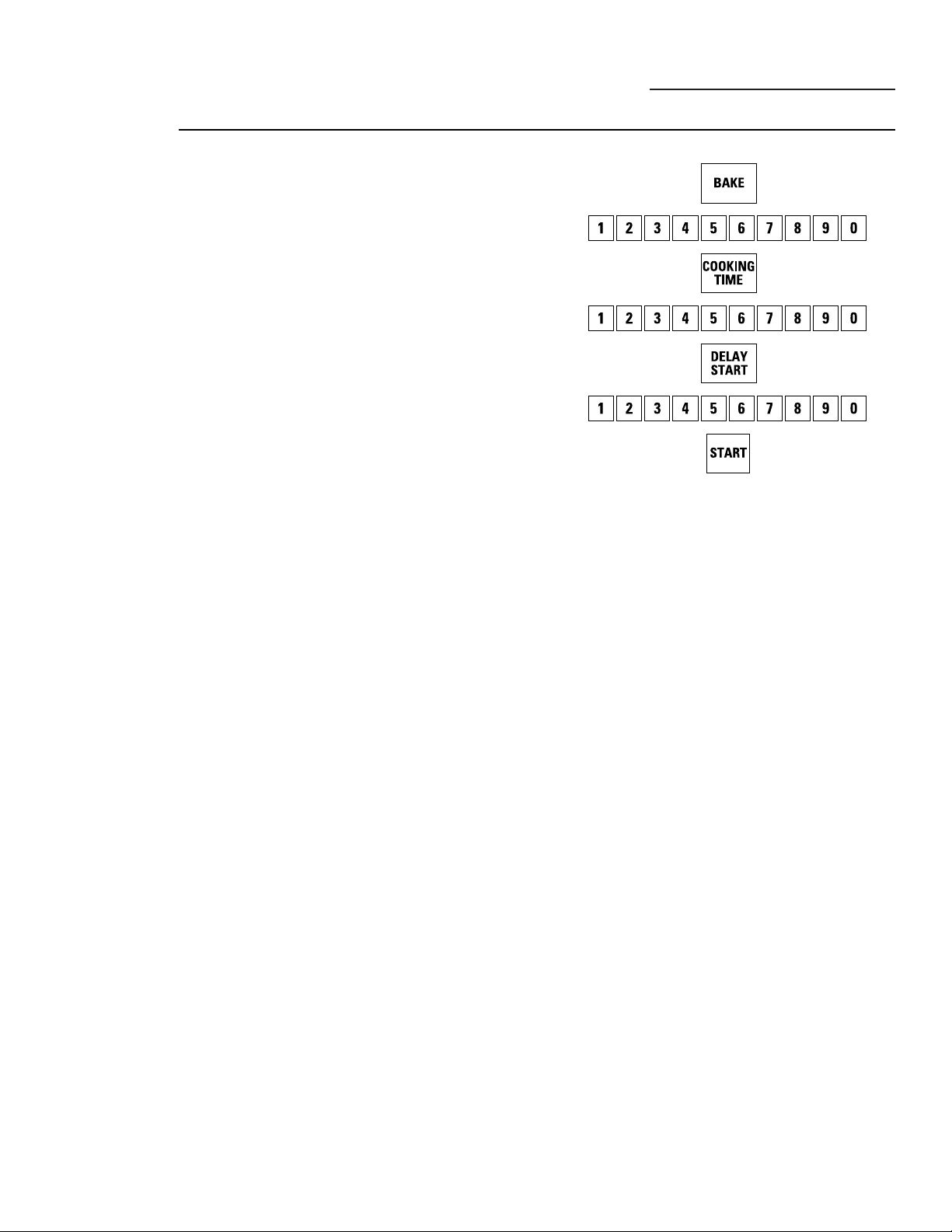
1 Press the BAKE pad.
2 Using the number pads, enter the desired
temperature.
3 Press the COOKING TIME pad.
NOTE: If your recipe requires preheating, you may
need to add additional time to the length of the
cooking time.
4 Using the number pads, enter the desired
baking time.
5 Press the DELAY START pad.
6 Using the number pads, enter the time of day
you want the oven to turn on and start
cooking.
7 Press the START pad.
NOTE: An attention tone will sound if you are using
timed baking and do not press the START pad after
entering the baking temperature.
If you would like to check the times you have
set, press the DELAY START pad to check the
start time you have set or press the COOKING
TIME pad to check the length of cooking time
you have set.
When the oven turns on at the time of day you
have set, the display will show the changing
temperature (starting at 100°F.) and the
cooking time countdown.
NOTE: On double oven models when using both
ovens at the same time, the times showing in the
display will be for the last oven set. To display the
time set for the first oven set, press the DELAY START
pad to check the start time you have set or press the
COOKING TIME pad to check the length of
cooking time you have set.
At the end of timed baking, the oven will turn
off. The end of cycle tone will sound.
Press the CLEAR/OFF pad to clear the display.
23
Using the Probe
Wall Oven
Temperature
probe
NOTE: Double oven models have a probe in the upper
oven only.
For many foods, especially roasts and poultry,
internal food temperature is the best test for
doneness. The temperature probe takes the
guesswork out of roasting by cooking foods to
the exact doneness you want.
Use of probes other than the one provided with
this product may result in damage to the probe.
Use the handles of the probe and plug when
inserting and removing them from the meat
and outlet.
• To avoid damaging your probe, do not use
tongs to pull on the cable when removing it.
• To avoid breaking the probe, make sure food
is completely defrosted before inserting.
• To prevent possible burns, do not unplug the
probe from the outlet until the oven has
cooled.
• Never leave your probe inside the oven during
a self-cleaning cycle.
• Do not store the probe in the oven.
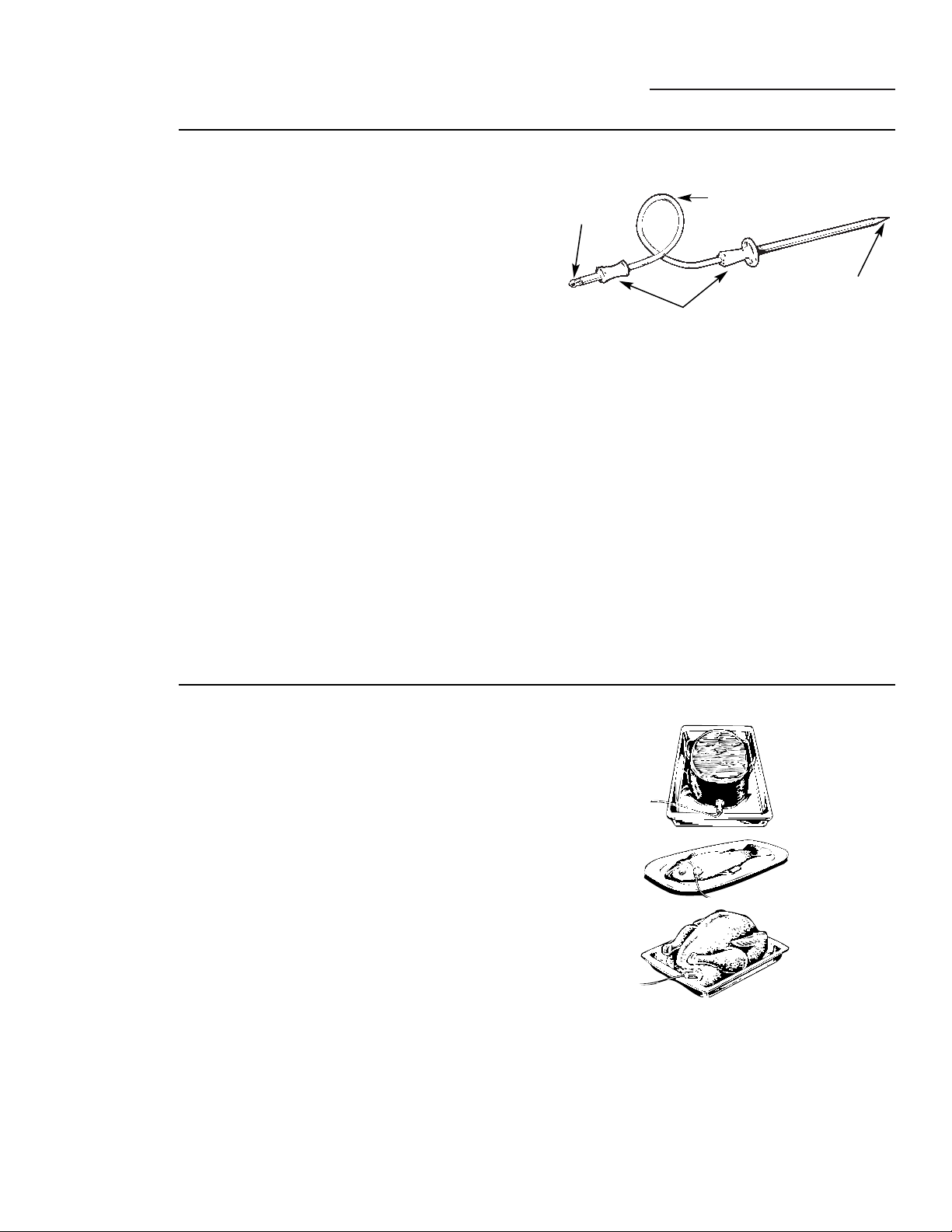
Cable
Probe
Handles
Plug
The temperature probe has a skewer-like probe at one end and a
plug at the other end that goes into the outlet in the oven.
Proper
placement
of the probe
After preparing the meat and placing it on a
trivet or on the broiler pan grid, follow these
directions for proper probe placement.
1 Lay the probe on the outside of the meat
along the top or side and mark with your
finger where the edge of the meat comes to
on the probe. The point should rest in the
center of the thickest meaty part of the roast.
2 Insert the probe completely into the meat. It
should not touch the bone, fat or gristle.
For roasts with no bone, insert the probe into
the meatiest part of the roast. For bone-in ham
or lamb, insert the probe into the center of the
lowest large muscle or joint.
Insert the probe into the center of dishes such
as meat loaf or casseroles. When cooking fish,
insert the probe from just above the gill into the
meatiest area, parallel to the backbone.
Insert the probe into the meatiest part of the
inner thigh from below and parallel to the leg
of a whole turkey.
24
Using the Probe
Wall Oven
How to set
the oven for
roasting
when using
the probe
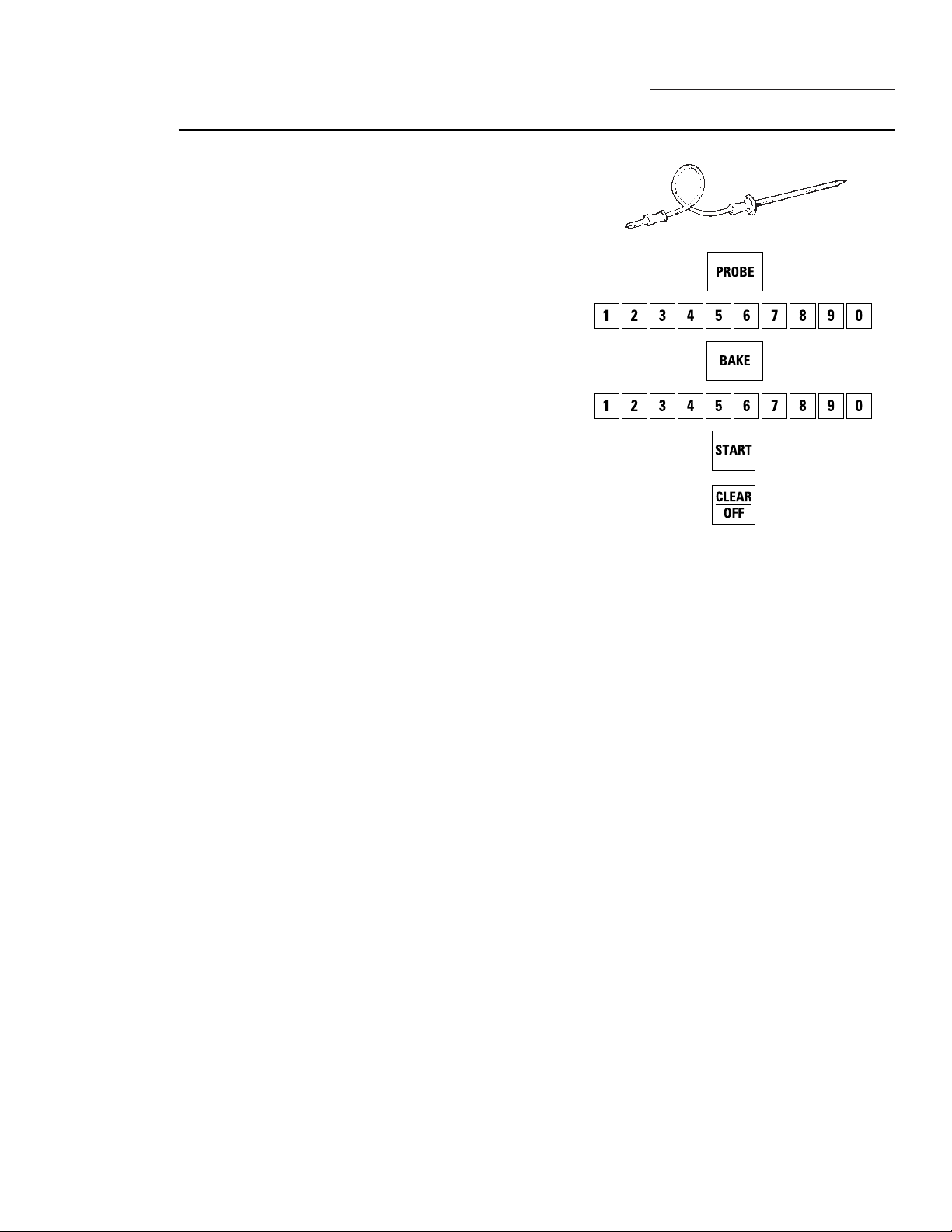
1 Insert the probe into the meat.
2 Plug the probe into the outlet in the oven.
Make sure it’s pushed all the way in. Close
the oven door.
3 Press the PROBE pad.
4 Press the number pads to set the desired
internal food or meat temperature.
5 Press the BAKE pad.
6 Press the number pads to set the desired oven
temperature.
7 Press the START pad.
The display will flash if the probe is inserted into the
outlet and you have not set a probe temperature and
pressed the START pad.
When the oven starts to heat, the word LO will
be in the display.
After the internal temperature of the meat
reaches 100°F., the changing internal
temperature will be shown in the display.
8 When the internal temperature of the meat
reaches the number you have set, the probe
and the oven turn off and the oven control
signals. To stop the signal, press the
CLEAR/OFF pad. Use hot pads to remove
the probe from the food. Do not use tongs to
pull on it—they might damage it.
To change the oven temperature during the
Roast cycle, press the BAKE pad and then the
number pads to set the new temperature.
• If the probe is removed from the food before
the final temperature is reached, a tone will
sound and the display will flash until the probe
is removed from the oven.
• You can use the timer even though you cannot
use timed oven operations.
25
Using the Convection Oven
Wall Oven
Convection
fan
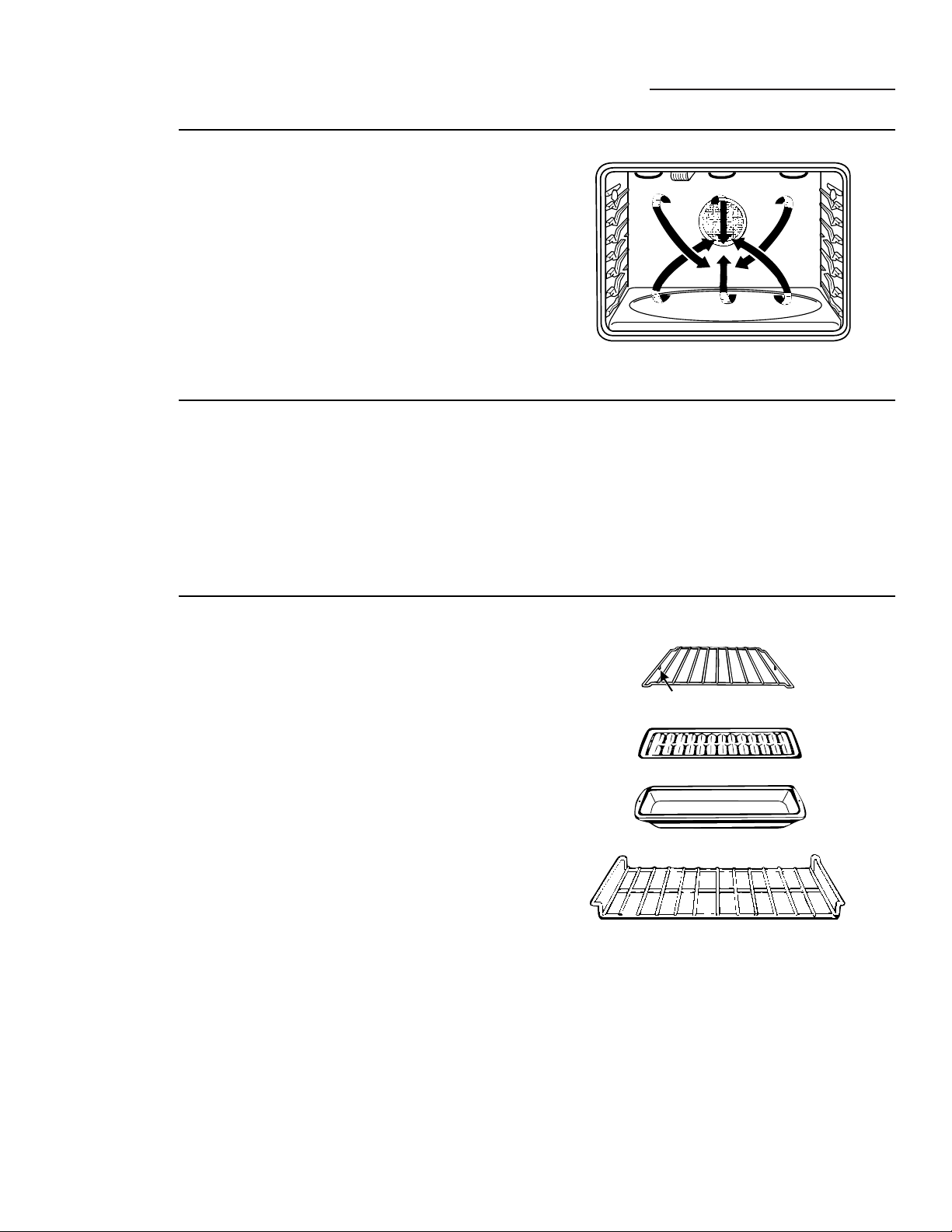
In a convection oven, a fan circulates hot air
over, under and around the food.
This circulating hot air is evenly distributed
throughout the oven cavity. As a result, foods
are evenly cooked and browned—often in less
time with convection heat.
The convection fan shuts off when the oven door is
opened. DO NOT leave the door open for long periods
of time while using convection cooking or you may
shorten the life of the convection heating element.
(appearance may vary)
CAUTION:
When you are using the offset shelf (on 27″ models) in the
lowest position (A), you will need to use caution when pulling
the shelf out. We recommend that you pull the shelf out several
inches and then, using two pot holders, pull the shelf out by
holding the sides of it. The offset shelf is low and you could be
burned if you place your hand in the middle of the shelf and pull
all the way out. Be very careful not to burn your hand on the
door when using a shelf in the lowest position (A).
Convection
baking
Heat comes from the heating element in the
rear of the oven. The convection fan circulates
the heated air evenly over and around the food.
Preheating is not necessary with foods having a
bake time of over 15 minutes.
• Ideal for evenly browned baked foods cooked
on multiple shelves.
• Good for large quantities of baked foods.
• Good results with cookies, biscuits, muffins,
brownies, cupcakes, cream puffs, sweet rolls,
angel food cake and bread.
Convection
roasting
• Good for large tender cuts of meat, uncovered.
Heat comes from the top heating element. The
convection fan circulates the heated air evenly
over and around the food. Meat and poultry are
browned on all sides as if they were cooked on a
rotisserie. Using the roasting rack provided,
heated air will be circulated over, under and
around the food being roasted. The heated air
seals in juices quickly for a moist and tender
product while, at the same time, creating a rich
golden brown exterior.
Roasts or poultry should be cooked on a shelf
(on 27″ models use the offset shelf) in the
lowest shelf position (A).
When you are convection roasting it is important
that you use the broiler pan and grid and the
special roasting rack for best convection roasting
results. The pan is used to catch grease spills
and the grid is used to prevent grease spatters.
Place the meat on the special roasting rack. The
rack holds the meat. The rack allows the heated
air to circulate under the meat and increase
browning on the underside of the meat or poultry.
• Place the shelf (on 27″models use the offset
shelf) in the lowest shelf position (A).
• Place the grid on the broiler pan and put the
roasting rack over them making sure the posts
on the roasting rack fit into the holes in the
broiler pan.
Roasting rack
Grid
Post
Broiler pan
Offset shelf (27″ models only)
26
Using the Convection Oven
Wall Oven
Adapting
recipes
You can use your favorite recipes in the
convection oven.
When baking, reduce baking temperature by 25°F.
No need to preheat when cooking longer than
15 minutes.
Use pan size recommended.
Some package instructions for frozen casseroles
or main dishes have been developed using
commercial convection ovens. For best results
in this oven, preheat the oven and use the
temperature on the package.
For more information on adapting recipes, see
the Convection Cookbook.
Multi-shelf
baking
When convection baking with only 1 shelf, follow
the shelf positions recommended in the Baking or
Roasting section.
Because heated air is circulated evenly
throughout the oven, foods can be baked with
excellent results using multiple shelves.
Multi-shelf baking may increase cook times
slightly for some foods but the overall result is
time saved. Cookies, muffins, biscuits, and
other quickbreads give very good results with
multi-shelf baking.
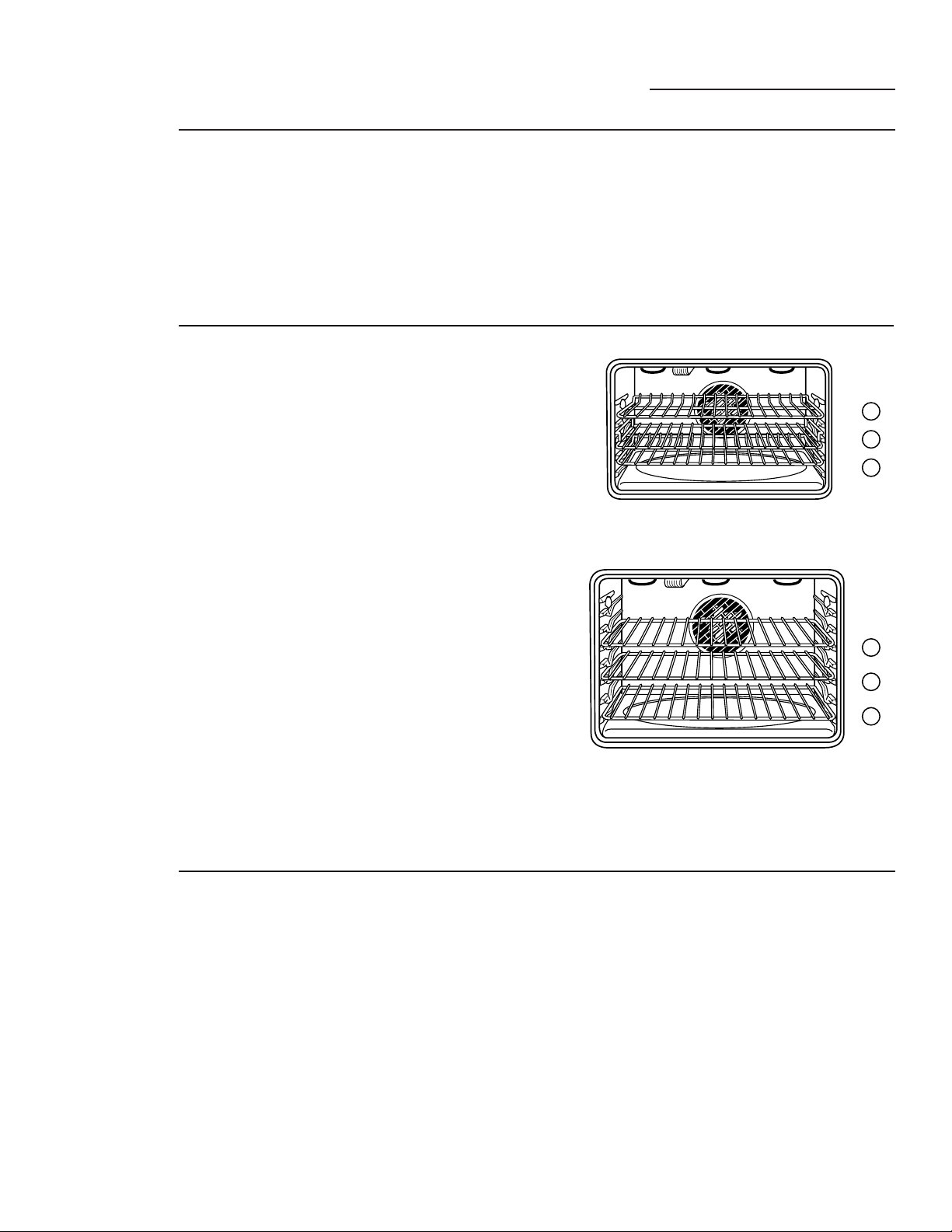
27″ Ovens
When baking on 3 shelves, divide the oven into
thirds by placing the offset shelf in the third (C)
shelf position and the straight shelves in first
(A) and fourth (D) shelf positions.
For two-shelf baking, place the offset shelf in
the bottom (A) shelf position. Place the straight
shelf in the third (C) shelf position.
30″ Ovens
When baking on 3 shelves, place one shelf in
the bottom (A) position, one on the third (C)
position and one in the 5th (E) position.
Multi-shelf position 27″ oven
Multi-shelf position 30″ oven
D
C
A
E
C
A
Cookware for
convection
cooking
Before using your convection oven, check to see
if your cookware leaves room for air circulation
in the oven. If you are baking with several pans,
leave space between them. Also, be sure the
pans do not touch each other or the walls of the
oven.
Paper and Plastic
Heat-resistant paper and plastic containers that
are recommended for use in regular ovens can
be used in convection ovens. Plastic cookware
that is heat-resistant to temperatures of 400°F.
can also be used.
Metal and Glass
Any type of cookware will work in your convection
oven. However, metal pans heat the fastest and
are recommended for convection baking.
Darkened or matte-finished pans will bake
faster than shiny pans.
Glass or ceramic pans cook more slowly.
When baking cookies, you will get the best
results if you use a flat cookie sheet instead of a
pan with low sides.
For recipes like oven-baked chicken, use a pan
with low sides. Hot air cannot circulate well
around food in a pan with high sides.
27
Convection
roasting
guide
Meats Minutes/Lb. Oven Temp. Internal Temp.
Beef Rib, Boneless Rib, Rare 20–24 325°F. 140°F.†
Top Sirloin Medium 24–28 325°F. 160°F.
(3 to 5 lbs.) Well 28–32 325°F. 170°F.
Beef Tenderloin Rare 10–14 325°F. 140°F.†
Medium 14–18 325°F. 160°F.
Pork Bone-in, Boneless (3 to 5 lbs.) 23–27 325°F. 170°F.
Chops (1/2 to 1″ thick) 2 chops 30–35 total 325°F. 170°F.
4 chops 35–40 total 325°F. 170°F.
6 chops 40–45 total 325°F. 170°F.
Ham Canned, Butt, Shank (3 to 5 lbs.) 14–18 325°F. 140°F.
(fully cooked)
Lamb Bone-in, Boneless (3 to 5 lbs.) Medium 17–20 325°F. 160°F.
Well 20–24 325°F. 170°F.
Seafood Fish, whole (3 to 5 lbs.) 30–40 total 400°F.
Lobster Tails (6 to 8 oz. each) 20–25 total 350°F.
Poultry Whole Chicken (2
1
⁄2 to 3
1
⁄2 lbs.) 24–26 350°F. 180°–185°F.
Cornish Hens Unstuffed (1 to 1
1
⁄2 lbs.) 50–55 total 350°F. 180°–185°F.
Stuffed (1 to 1
1
⁄2 lbs.) 55–60 total 350°F. 180°–185°F.
Duckling (4 to 5 lbs.) 24–26 325°F. 180°–185°F.
Turkey, whole*
Unstuffed (10 to 16 lbs.) 8–11 325°F. 180°–185°F.
Unstuffed (18 to 24 lbs.) 7–10 325°F. 180°–185°F.
Turkey Breast (4 to 6 lbs.) 16–19 325°F. 170°F.
* Stuffed birds generally require 30–45 minutes additional roasting time. Shield legs and breast with foil to prevent over-browning and
drying of skin.
† The U.S. Department of Agriculture says “Rare beef is popular, but you should know that cooking it to only 140°F. means some food
poisoning organisms may survive.” (Source: Safe Food Book. Your Kitchen Guide. USDA Rev. June 1985.)
How to set
the oven for
convection
baking or
roasting
To avoid possible burns, place the shelves in the correct
position before you turn on the oven.
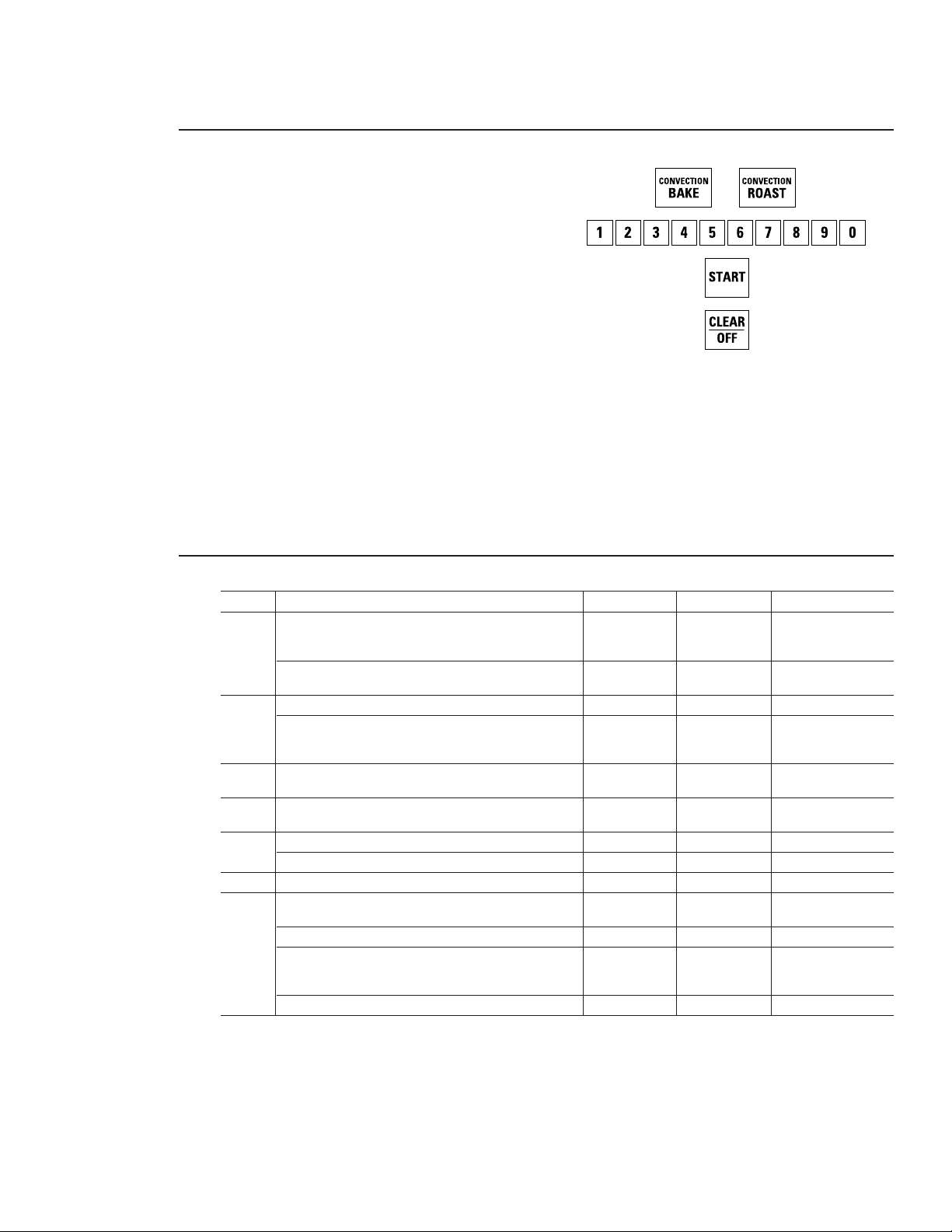
1 Press the CONVECTION BAKE or
CONVECTION ROAST pad.
2 Press the number pads to set the desired oven
temperature.
3 Press the START pad.
To change the oven temperature, press the
CONVECTION BAKE or CONVECTION
ROAST pad and then the number pads to set
the new temperature.
When the oven starts to heat the changing
temperature, starting at 100°F., will be
displayed. When the oven reaches the
temperature you set, 3 beeps will sound.
4 Press the CLEAR/OFF pad when finished.
NOTE:
• You will hear a fan while cooking with convection.
The fan will stop when the door is opened but the heat
will not turn off.
• You may hear the oven clicking during baking. This
is normal.
or
28
Using the Convection Oven
Wall Oven
How to set
the oven for
convection
roasting
when using
the probe
CAUTION:
To prevent possible burns, do
not unplug the probe from the oven outlet
until the oven has cooled. Do not store the
probe in the oven.
For best results when roasting large turkeys and roasts,
we recommend using the probe included in the
convection oven.
1 Place the shelf (on 27″ models use the offset
shelf) in the lowest position (A). Insert the
probe into the meat.
2 Plug the probe into the outlet in the oven.
Make sure it is pushed all the way in. Close
the oven door.
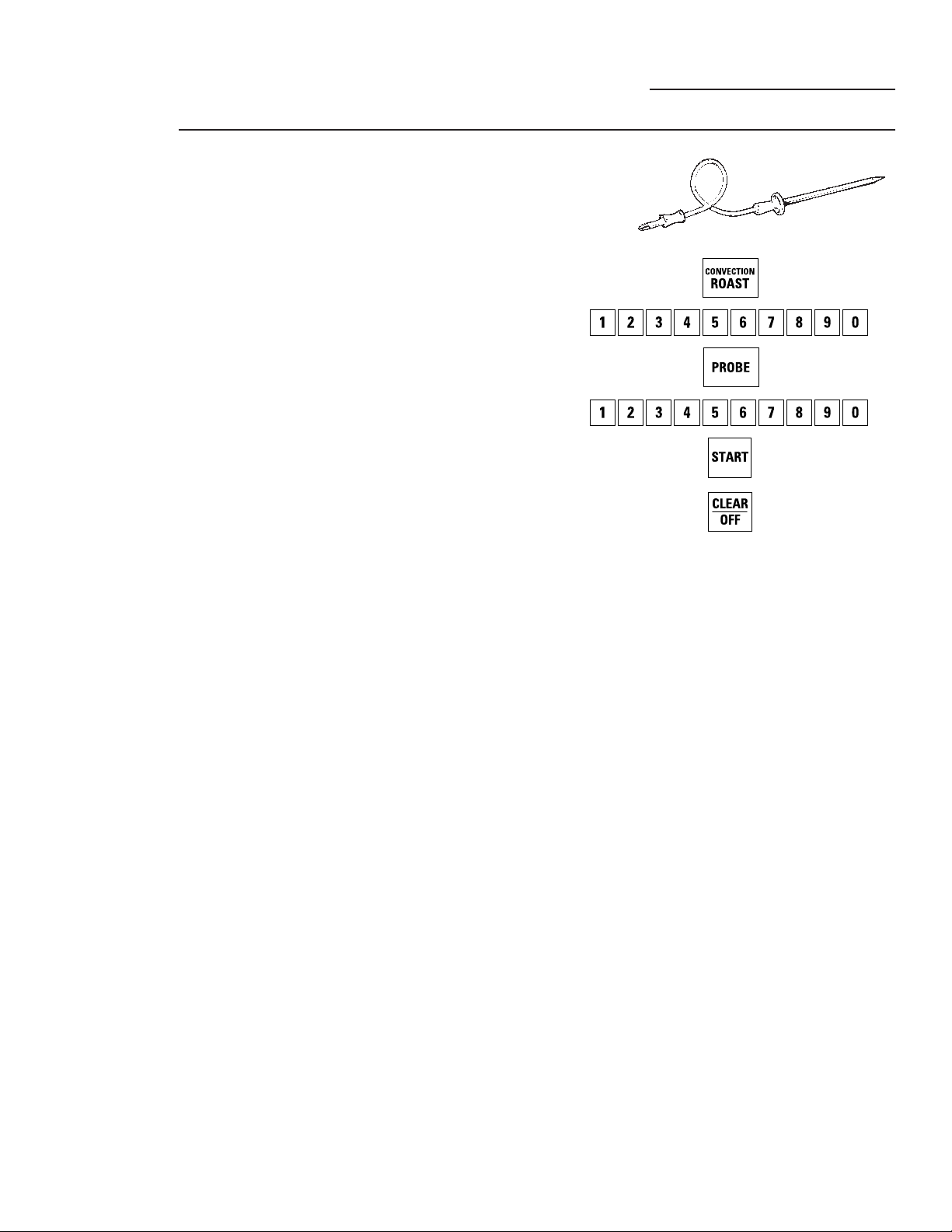
3 Press the CONVECTION ROAST pad.
4 Press the number pads to set the desired oven
temperature.
To change the oven temperature during the
Convection Roast cycle, press the CONVECTION
ROAST pad and then press the number pads to
set the new desired temperature.
5 Press the PROBE pad.
6 Press the number pads to set the desired
internal meat temperature.
7 Press the START pad.
The display will flash PROBE and the oven control
will signal if the probe is inserted into the outlet, and
you have not set a probe temperature and pressed the
START pad.
When the oven starts to heat, the word LO will
be in the display.
After the internal temperature of the meat
reaches 100°F., the changing internal
temperature will be shown in the display.
8 When the internal temperature of the meat
reaches the number you have set, the probe
and the oven turn off and the oven control
signals. To stop the signal, press the
CLEAR/OFF pad. Use hot pads to remove
the probe from the food. Do not use tongs to
pull on it—they might damage it.
If the probe is removed from the food before the final
temperature is reached, a tone will sound and the
display will flash until the probe is removed from
the oven.
NOTE:
• You will hear a fan while cooking with this feature.
The fan will stop when the door is opened but the heat
will not turn off.
• You can use the timer even though you cannot use
timed oven operations.
• On double oven models, you will not be able to use
the probe in the upper oven during timed oven
operations. This is because with the probe you are
cooking by temperature rather than time.
29
Timed Convection Baking
Wall Oven
Using the
features for
convection
baking
NOTE: Foods that spoil easily, such as milk, eggs,
fish, stuffings, poultry and pork, should not be allowed
to sit for more than 1 hour before or after cooking.
Room temperature promotes the growth of harmful
bacteria. Be sure that the oven light is off because heat
from the bulb will speed harmful bacteria growth.
On double oven models, you can use timed
baking in one oven while using self-clean in the
other; you can also use timed baking in both
ovens at the same time.
How to set
an immediate
start and
automatic
stop
The oven will turn on immediately and cook for a
selected length of time. At the end of the cooking time
the oven will turn off automatically.
Make sure the oven clock shows the correct time
of day.
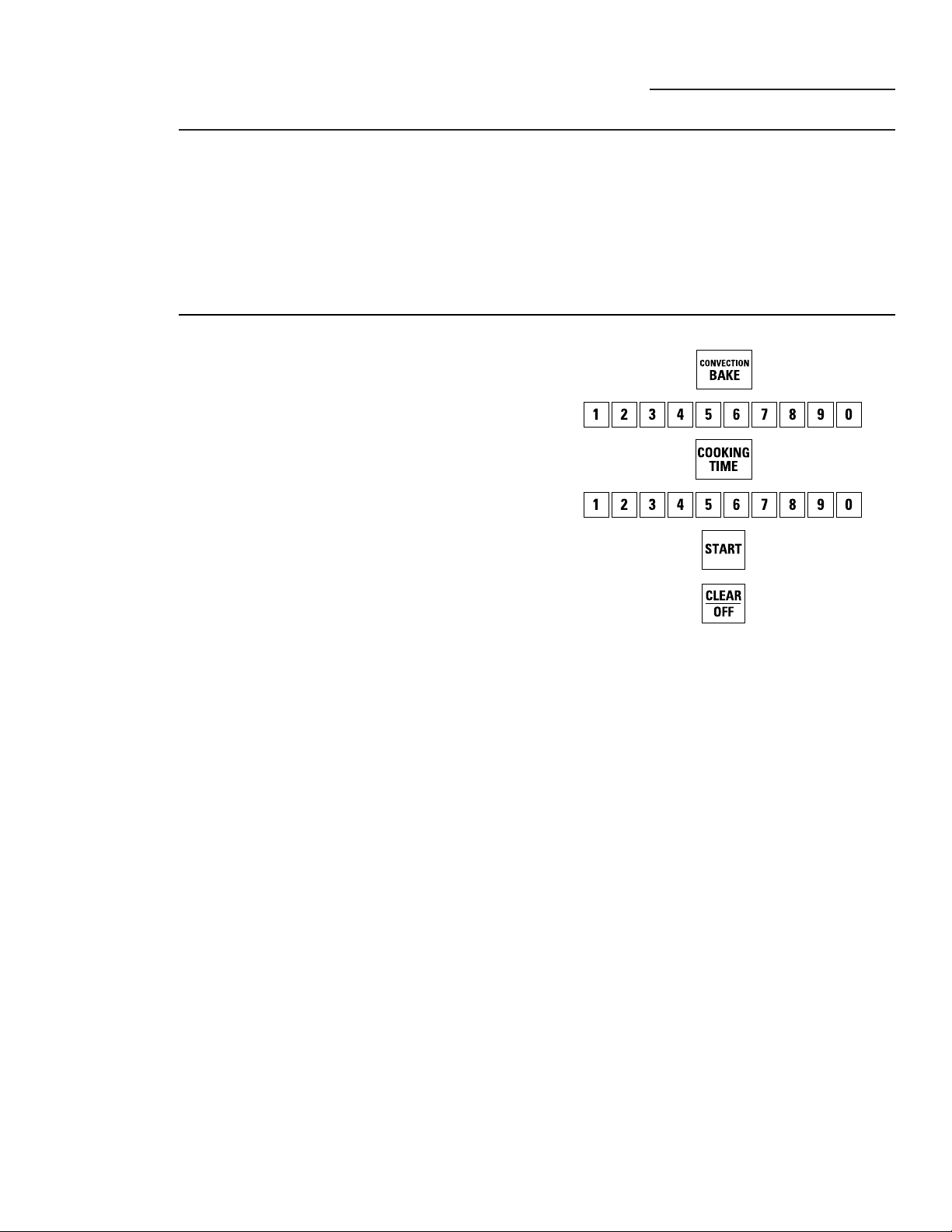
1 Press the CONVECTION BAKE pad.
2 Press the number pads to set the desired oven
temperature.
3 Press the COOKING TIME pad.
NOTE: If your recipe requires preheating, you may need
to add additional time to the length of the cooking time.
4 Press the number pads to set the desired
length of cooking time. The minimum
cooking time you can set is 1 minute.
The oven temperature that you set and the
cooking time that you entered will be in the display.
5 Press the START pad.
The display shows the oven temperature that
you set and the cooking time countdown. (The
display starts changing once the temperature
reaches 100°F.)
NOTE: On double oven models when using both
ovens at the same time, the times showing in the
display will be for the last oven set. To display the time
set for the first oven set, press the COOKING TIME
pad for that oven.
6 At the end of timed convection bake the oven
will turn off. The end of cycle tone will sound.
Press the CLEAR/OFF pad to clear the
display if necessary.
7 Remove the food from the oven. Remember,
foods that are left in the oven continue
cooking after the controls are off.
NOTE: You will hear a fan while cooking with this
feature. The fan will stop when the door is opened but
the heat will not turn off.
30
Timed Convection Baking
Wall Oven
How to set
a delayed
start and
automatic
stop
You can set the oven control to delay-start the oven,
cook for a specific length of time and then turn off
automatically.
Make sure the oven clock shows the correct time
of day.
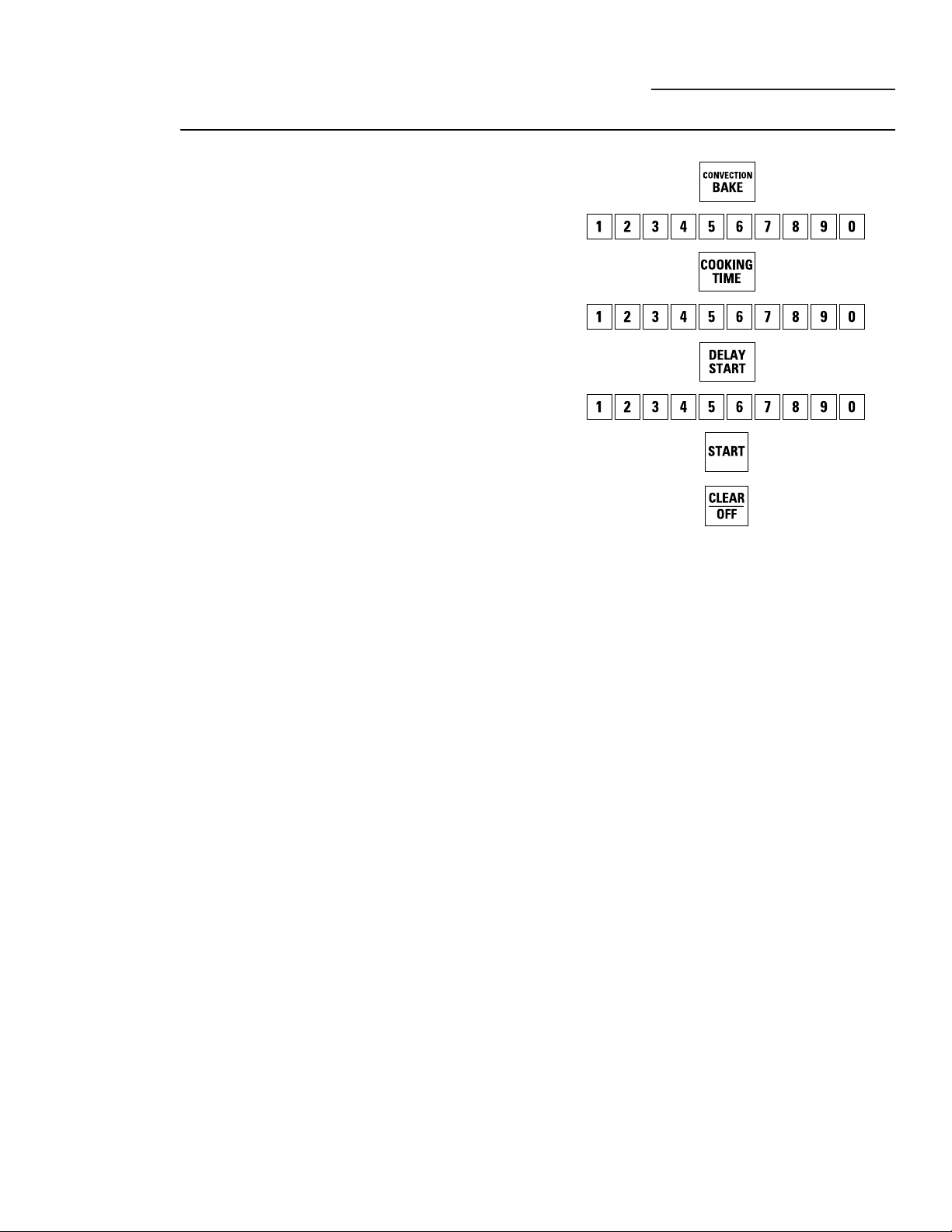
1 Press the CONVECTION BAKE pad.
2 Press the number pads to set the desired oven
temperature.
3 Press the COOKING TIME pad.
NOTE: If your recipe requires preheating, you may need
to add additional time to the length of the cooking time.
4 Press the number pads to set the desired
cooking time.
5 Press the DELAY START pad.
6 Press the number pads to set the time of day
you want the oven to turn on and start
cooking.
If you would like to check the times you have
set, press the DELAY START pad to check the
start time you have set or press the COOKING
TIME pad to check the length of cooking time
you have set.
7 Press the START pad.
NOTE: An attention tone will sound if you are using
timed baking and do not press the START pad after
entering the baking temperature.
When the oven turns on at the time of day you
have set, the display will show the changing
temperature (starting at 100°F.) and the
cooking time countdown.
NOTE: On double oven models when using both ovens
at the same time, the times showing in the display will
be for the last oven set. To display the time set for the first
oven set, press the DELAY START pad to check the
start time you have set or press the COOKING TIME
pad to check the length of cooking time you have set.
At the end of timed convection bake the oven
will turn off. The end of cycle tone will sound.
8 Press the CLEAR/OFF pad to clear the display
if necessary. When baking is finished, remove
the food from the oven. Remember, even
though the oven shuts off automatically, foods
continue cooking after the controls are off.
NOTE: You will hear a fan while cooking with this
feature. The fan will stop when the door is opened but
the heat will not turn off.
31
Proofing
Wall Oven
How to set the
oven for
proofing
(on some models)
The proofing feature maintains a warm
environment useful for rising yeast-leavened
products.
1 Place the covered dough in a dish in the oven
on shelf B or C.
NOTE: For best results, cover the dough
with a cloth or with greased plastic wrap
(the plastic may need to be anchored
underneath the container so the oven
fan will not blow it off).
2 Press the PROOF pad and then the
START pad.
The display will read “BRD” (bread).
The oven interior light turns on and remains
on during proofing.
The proofing feature automatically provides
the optimum temperature for the proofing
process and therefore does not have a
temperature adjustment.
3 Set the KITCHEN TIMER for the minimum
proof time.
4 When proofing is finished, press the
CLEAR/OFF pad.
• To avoid lowering the oven temperature and
lengthening proofing time, do not open the
oven door unnecessarily.
• Check bread products early to avoid over-
proofing.
NOTE:
• Do not use the proofing mode for warming
food or keeping food hot. The proofing
oven temperature is not hot enough to
hold foods at safe temperatures.
• Proofing feature on upper oven only.
• Proofing will not operate when oven is
above 150 degrees. “HOT” will show in
the display.
32
Adjust the Oven Thermostat
Wall Oven
Do it
yourself!
You may find that your new oven cooks
differently than the one it replaced. Use your
new oven for a few weeks to become more
familiar with it. If you still think your new oven
is too hot or too cold, you can adjust the
thermostat yourself.
Do not use thermometers, such as those found
in grocery stores, to check the temperature
setting of your oven. These thermometers may
vary 20–40 degrees.
NOTE: This adjustment will not affect the broiling or
the self-cleaning temperatures. The adjustment will be
retained in memory after a power failure.
The type of
margarine
will affect
baking
performance!
Most recipes for baking have been developed
using high fat products such as butter or
margarine (80% fat). If you decrease the fat,
the recipe may not give the same results as
with a higher fat product.
Recipe failure can result if cakes, pies,
pastries, cookies or candies are made with
low fat spreads. The lower the fat content
of a spread product, the more noticeable
these differences become.
Federal standards require products labeled
“margarine” to contain at least 80% fat by
weight. Low fat spreads, on the other hand,
contain less fat and more water. The high
moisture content of these spreads affect the
texture and flavor of baked goods. For best
results with your old favorite recipes, use
margarine, butter or stick spreads containing
at least 70% vegetable oil.
To adjust
the oven
thermostat
1 Press the BAKE and BROIL HI/LO pads
at the same time for 3 seconds until the
display shows “SF.”
2 Press the BAKE pad of the oven which you
want to adjust the oven thermostat. A two
digit number shows in the display.
Press BAKE once to decrease (-) the oven
temperature, or twice to increase (+).
3 The oven temperature can be adjusted up to
(+) 35°F. hotter or (-) 35°F. cooler. Press the
number pads the same way you read them.
For example, to change the oven temperature
15°F., press 1 and 5.
4 When you have made the adjustment, press
the START pad to go back to the time of day
display. Use your oven as you would normally.
33
Using the Self-Cleaning Oven
Wall Oven
Before a
clean cycle
The oven door must be closed and all controls must be
set correctly for the cycle to work properly.
The oven must be cool in order to set the self-
clean cycle.
We recommend venting your kitchen with an
open window or using a ventilation fan or hood
during the first self-clean cycle.
Remove the broiler pan, broiler grid, probe, all
cookware and any aluminum foil from the oven.
The oven shelves and convection roasting rack
can be self-cleaned, but they will darken, lose
their luster and become hard to slide.
Do not use abrasives or oven cleaners. Clean the
top, sides and outside of the oven door with
soap and water.
Make sure the oven light bulb cover (on some
models) is in place and the oven light is off.
IMPORTANT: The health of some birds is
extremely sensitive to the fumes given off
during the self-cleaning cycle of any oven.
Move birds to another well ventilated room.
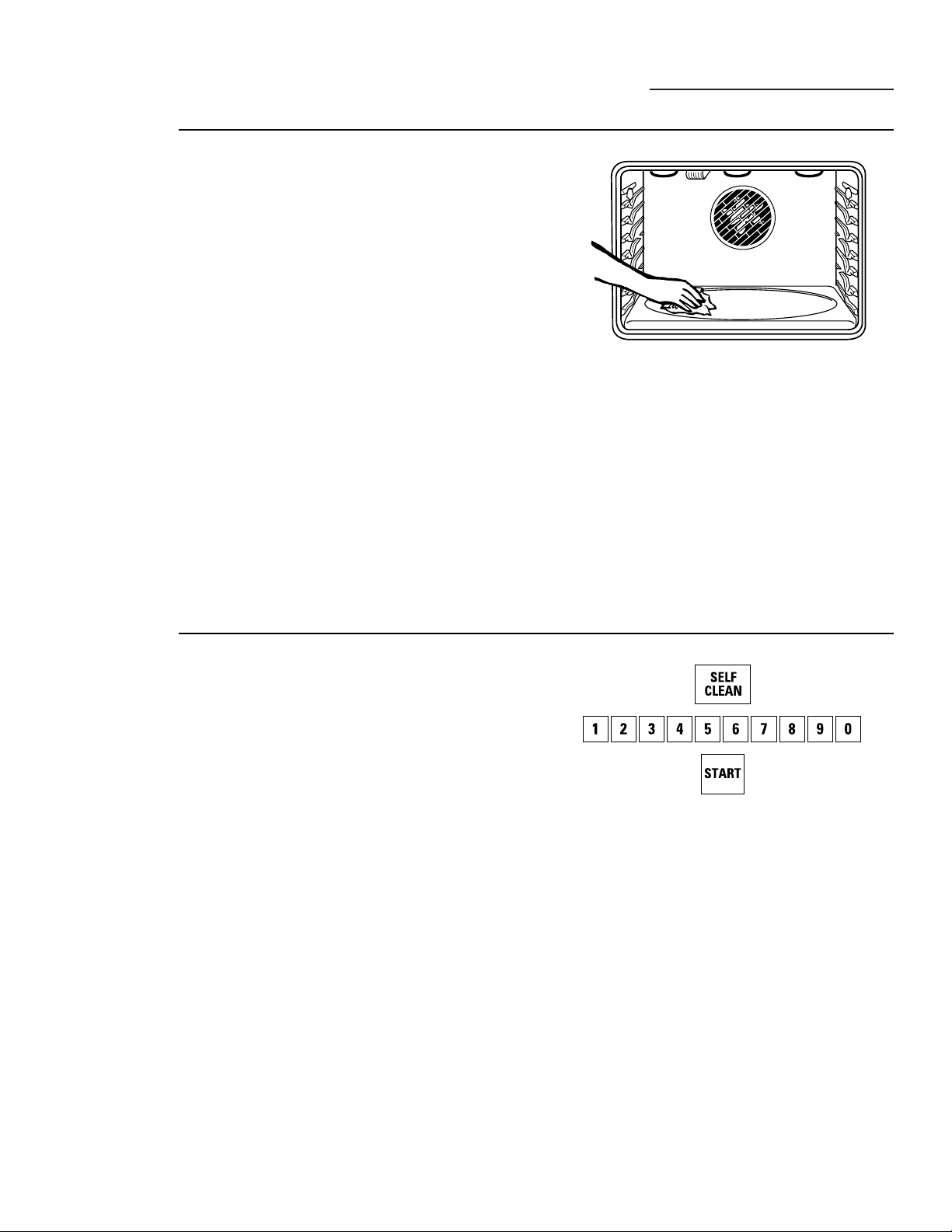
Wipe up heavy soil on the oven bottom.
(appearance may vary)
On double oven models, you can set a clean cycle in
both ovens at the same time. The last oven set will
automatically delay its start until the end of the first
oven’s clean cycle.
On double oven models, you can use timed baking in
one oven and self-clean the other at the same time.
How to set
the oven for
cleaning
1 Press the SELF CLEAN pad.
2 Using the number pads, enter the desired
clean time, if a time other than 4 hours is
needed.
Clean cycle time is normally 4 hours. You can change
the clean time to any time between 3 hours and 5
hours, depending on how dirty your oven is.
3 Press the START pad.
The door locks automatically. The display will
show the clean time remaining. It will not be
possible to open the oven door until the
temperature drops below the lock temperature
and the LOCKED DOOR light goes off.
When the LOCKED DOOR light is off, open
the door.
• The words LOCK DOOR will flash and the
oven control will signal if you set the clean
cycle and forget to close the oven door.
• To stop a clean cycle, press the CLEAR/OFF
pad. When the LOCKED DOOR light goes off
indicating the oven has cooled below the
locking temperature, open the door.
34
Using the Self-Cleaning Oven
Wall Oven
How to delay
the start of
cleaning
1 Press the SELF CLEAN pad.
2 Using the number pads, enter the desired
clean time.
3 Press the DELAY START pad.
4 Using the number pads, enter the time of day
you want the clean cycle to start.
5 Press the START pad.
The door locks automatically. The display will
show the start time. It will not be possible to
open the oven door until the temperature drops
below the lock temperature and the LOCKED
DOOR light goes off.
When the LOCKED DOOR light is off, open
the door.
NOTE: On double oven models, you can set a delay
clean in both ovens at the same time. The second oven
set will automatically delay the start of cleaning until
the end of the first oven’s clean cycle.
To recall the start time of the second oven set,
press the DELAY START pad on the controls for
the second oven.
After a
clean cycle
You may notice some white ash in the oven.
Wipe it up with a damp cloth after the oven
cools.
If white spots remain, remove them with a soap-
filled steel wool pad and rinse thoroughly with a
vinegar and water mixture.
These deposits are usually a salt residue that
cannot be removed by the clean cycle.
If the oven is not clean after one clean cycle,
repeat the cycle.
• You cannot set the oven for cooking until the
oven is cool enough for the door to unlock.
• While the oven is self-cleaning, you can press
the CLOCK pad to display the time of day.
To return to the clean countdown, press the
COOKING TIME pad.
• If the shelves become hard to slide, wipe the
shelf supports with cooking oil.
35
Care and Cleaning
Wall Oven
Oven
shelves and
convection
roasting
rack
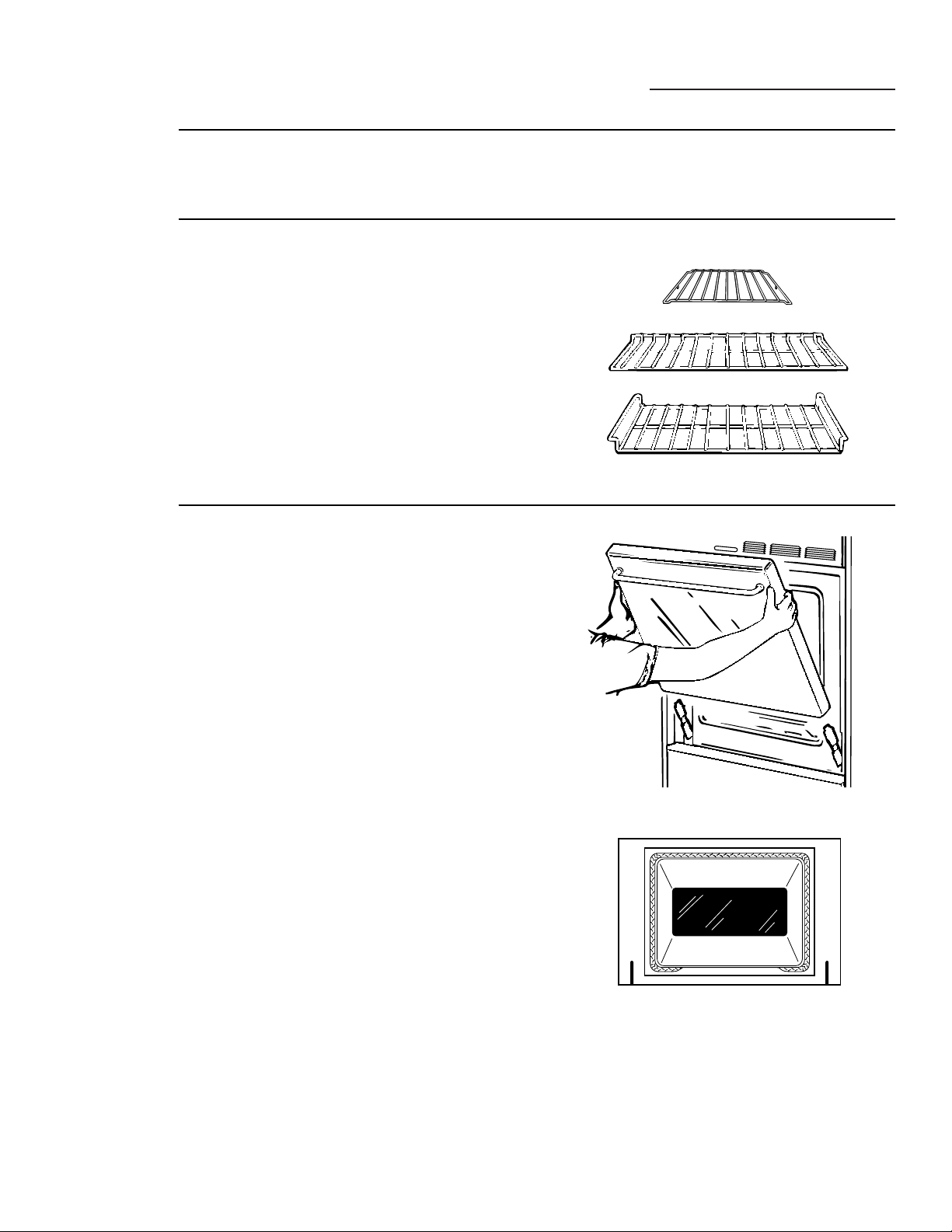
Clean the oven shelves (including the offset
shelf) and the convection roasting rack with an
abrasive cleanser or steel wool. After cleaning,
rinse the shelves and rack with clean water and
dry with a clean cloth.
NOTE: The oven shelves and convection roasting rack
may be cleaned in the self-cleaning oven. However, the
shelves will darken in color, lose their luster and
become hard to slide if cleaned during the self-cleaning
cycle. You can wipe the shelf supports with cooking oil
after self-cleaning to make the shelves slide more easily.
BE SURE ELECTRICAL POWER IS OFF AND ALL SURFACES ARE COOL BEFORE CLEANING ANY
PART OF THE OVEN.
Roasting rack
Oven shelf
Offset shelf (27″ models only)
Lift the door straight up and off the hinges.
The gasket is designed with a gap at the bottom to allow for
proper air circulation.
Do not rub or clean the door gasket—it has an extremely low
resistance to abrasion.
If you notice the gasket becoming worn, frayed or damaged in
any way or if it has become displaced on the door, you should
have it replaced.
Lift-off
oven door
The oven door is removable for easier access to
the light bulb.
Do not lift the door by the handle.
To remove the door, open it to the broil stop
position. Grasp firmly on each side and lift the
door straight up and off the hinges.
Do not place hands between the hinge and the
oven door frame.
To replace the door, make sure the hinges are
in the broil stop position. Position the slots in
the bottom of the door squarely over the hinges
and slowly lower it over both hinges.
To clean the inside of the door:
• Because the area inside the gasket is cleaned
during the self-clean cycle, you do not need to
clean this by hand.
• The area outside the gasket and the front
frame can be cleaned with a soap-filled steel
wool or plastic pad, hot water and detergent.
Rinse well with a vinegar and water solution.
To clean the outside of the door:
• Use soap and water to thoroughly clean the
top, sides and front of the oven door. Rinse
well. You may also use a glass cleaner to clean
the glass on the outside of the door. Do not let
water drip into the vent openings.
• Spillage of marinades, fruit juices, tomato
sauces and basting materials containing acids
may cause discoloration and should be wiped
up immediately. When surface is cool, clean
and rinse.
• Do not use oven cleaners, cleaning powders or
harsh abrasives on the outside of the door.
36
Care and Cleaning
Wall Oven
Cookie
sheets
(on some models)
Always allow the cookie sheets to cool before washing.
The cookie sheets are designed to breathe and
therefore are not water tight. If you wash them
by hand, they should not be allowed to soak. If
for some reason they do get soaked, stand them
on edge on a towel so the water will drain out.
You may also place the pan upside down in a
250°F. oven for 30 minutes to dry out the moisture.
They can also be washed in a dishwasher.
As with all aluminum cookware, the insulated
cookie sheets may darken with age.
Do not clean in a self-cleaning oven.
Stainless steel
(on some models)
and metal parts
Do not use a steel-wool pad; it will scratch the
surface.
To clean stainless steel surfaces, use a hot,
damp cloth with a mild detergent suitable for
stainless steel surfaces. Use a clean, hot, damp
cloth to remove soap. Dry with a dry, clean
cloth.
If food soil remains, try a general
kitchen cleaner, such as Fantastik®, Simple
Green®, or Formula 409®.
For hard-to-clean soil, use a
standard stainless-steel cleaner,
such as Bon-Ami® or Cameo®.
Apply cleaner with a damp sponge. Use a clean,
hot, damp cloth to remove cleaner. Dry with a
dry, clean cloth. Always scrub lightly in the
direction of the grain.
After cleaning, use a stainless-steel polish, such
as Stainless Steel Magic®, Revere Copper and
Stainless Steel Cleaner®, or Wenol All Purpose
Metal Polish®. Follow the product instructions
for cleaning the stainless-steel surface.
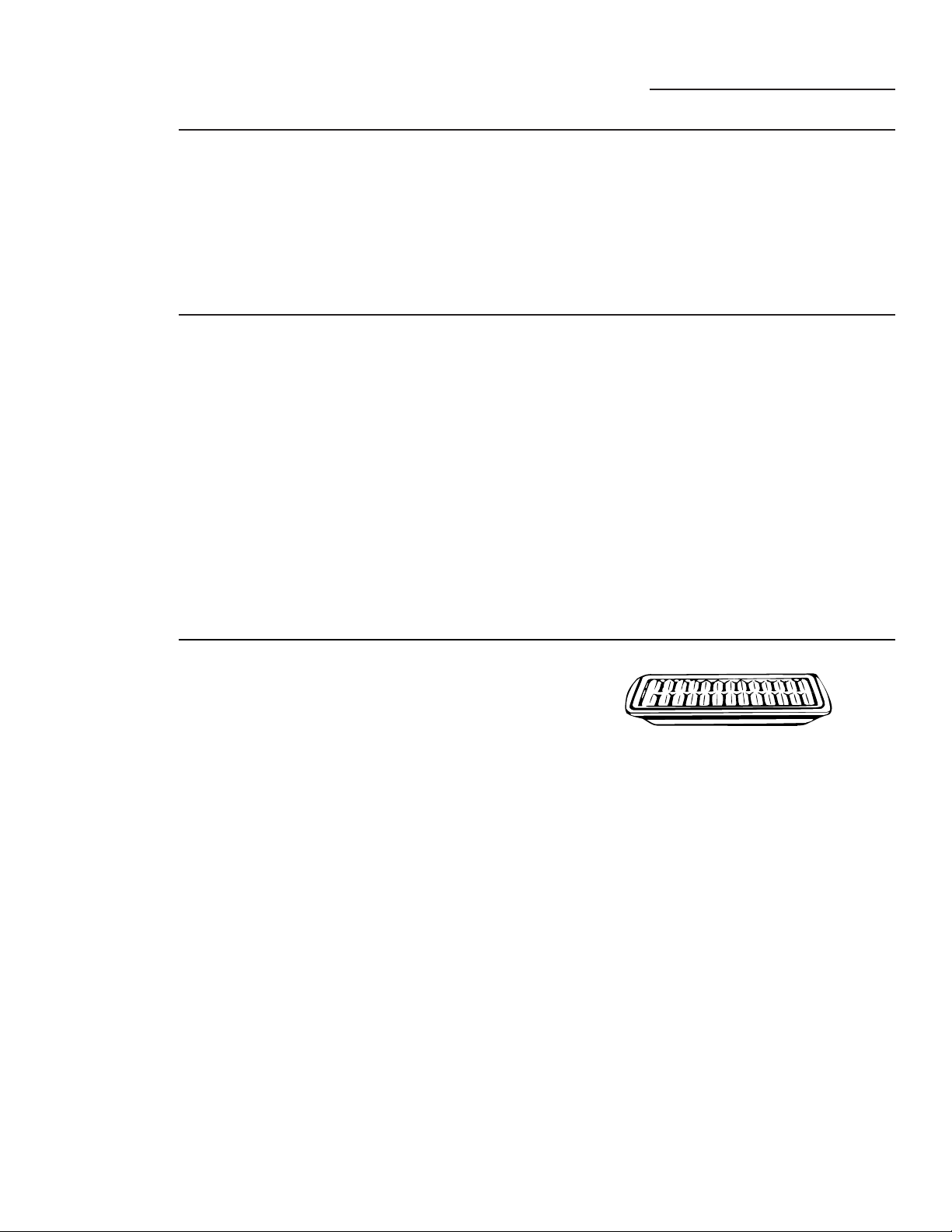
Broiler pan
and grid
After broiling, remove the broiler pan from the
oven. Remove the grid from the pan. Carefully
pour out the grease from the pan into a proper
container.
Wash and rinse the broiler pan and grid in hot
water with a soap-filled or plastic scouring pad.
If food has burned on, sprinkle the grid with
detergent while hot and cover with wet paper
towels or a dishcloth. Soaking the pan will
remove burned-on foods.
Both the broiler pan and grid may be cleaned
with a commercial oven cleaner.
Both the broiler pan and grid can also be
cleaned in a dishwasher.
Do not clean the broiler pan or grid in a self-
cleaning oven.
Do not store a soiled broiler pan and grid anywhere in
the oven.

37
Control
panel
It’s a good idea to wipe the control panel after
each use. Clean with mild soap and water or
vinegar and water, rinse with clean water and
polish dry with a soft cloth.
Do not use abrasive cleansers, strong liquid
cleansers, plastic scouring pads or oven
cleansers on the control panel—they will
damage the finish. A 50/50 solution of
vinegar and hot water works well.
Removable
oven floor
To remove the oven floor:
1 Remove the oven door using the instructions
in the Lift-Off Oven Door section of this manual.
2 Press down and pull out the removable oven
floor.
3 Clean the oven floor with warm soapy water.
4 When re-installing the oven floor be sure to
slide it all the way to the back of the oven.
CAUTION: Always replace the removable floor
before the next use.
Oven heating
elements
Do not clean the broil element. Any soil will
burn off when the element is heated.
The bake element is not exposed and is under
the removable oven floor. If spillovers, residue
or ash accumulate on the removable oven floor,
wipe up before self-cleaning.
To clean the oven floor, take out the removable
floor and gently lift the bake element. Clean
with warm soapy water. Always replace the
removable floor before next use.
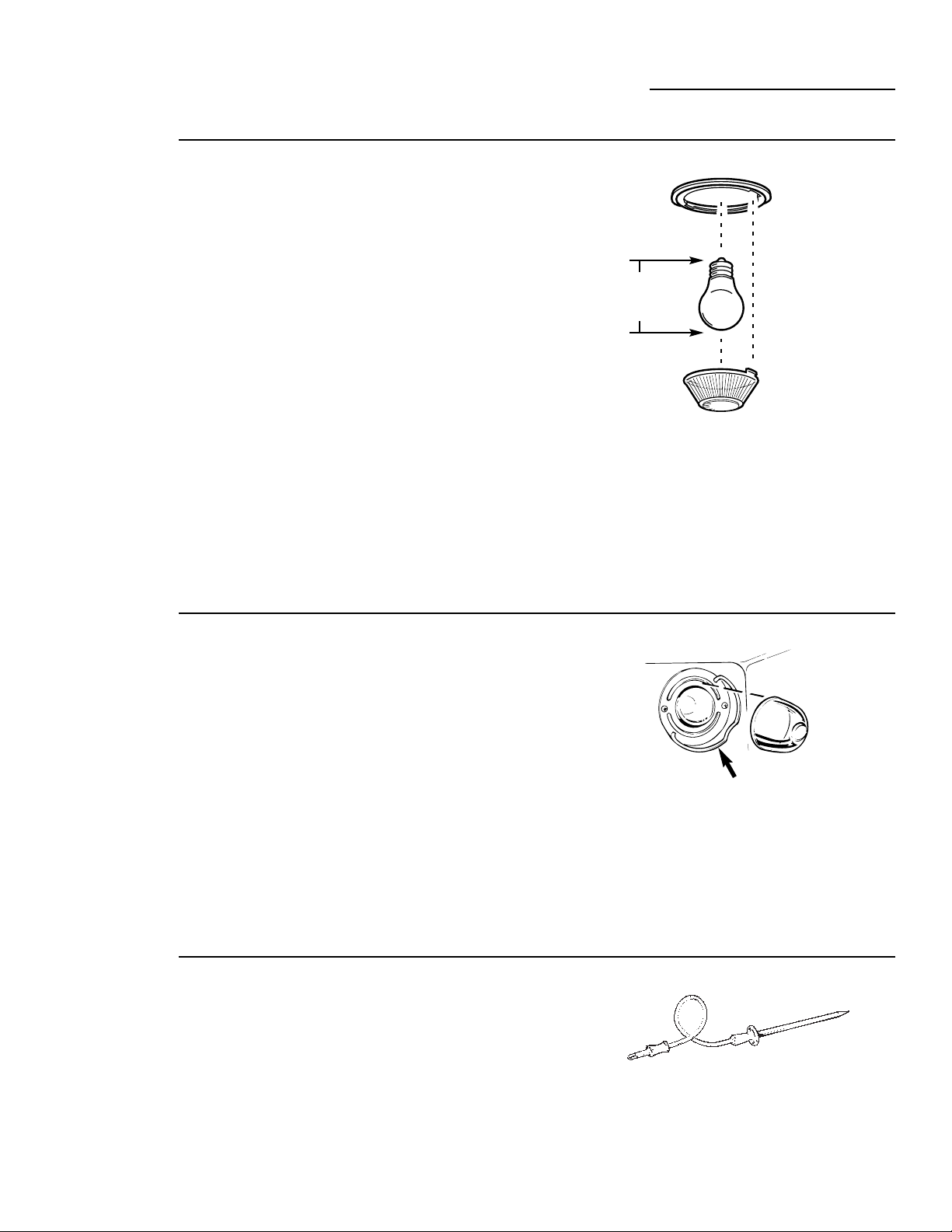
38
Oven light
bulb
(on some models)
NOTE: The glass cover (on some models) should be
removed only when cold. Wearing latex gloves may
offer a better grip.
Before replacing the bulb, disconnect electrical
power to the oven at the main fuse or circuit
breaker panel. Let the bulb cool completely
before removing it. For your safety, do not
touch a hot bulb with a damp cloth. If you do,
the bulb will break.
To remove:
Turn the glass cover counterclockwise 1/4 turn
until the tabs of the glass cover clear the grooves
of the socket. Remove the bulb.
To replace:
Put in a new 40-watt appliance bulb. Place the
tabs of the glass cover into the grooves of the
socket. Turn the glass cover clockwise 1/4 turn.
NOTE:
• A 40-watt appliance bulb is smaller than a
standard 40-watt bulb.
Bulb
Socket
Tab
Glass cover
Maximum
length
3
1
⁄2”
Probe
The temperature probe may be cleaned with
soap and water or a soap-filled scouring pad.
Cool the temperature probe before cleaning.
Scour stubborn spots with a soap-filled scouring
pad, rinse and dry.
Do not immerse the temperature probe in water.
Do not store the temperature probe in the oven.
Oven light
bulb
(on some models)
CAUTION: Before replacing your oven light bulb,
disconnect the electrical power to the oven at the main
fuse or circuit breaker panel.
Be sure to let the light cover and bulb cool
completely.
To remove the cover:
1 Hold a hand under the cover so it doesn’t fall
when released. With fingers of the same
hand, firmly push back the wire cover holder.
Lift off the cover.
Do not remove any screws to remove the cover.
2 Replace bulb with a 40-watt appliance bulb.
Wire cover holder
• Reconnect electrical power to the oven.
• For improved lighting inside the oven, clean
the glass cover frequently using a wet cloth.
This should be done when the oven is
completely cool.
To replace the cover:
1 Place it into groove of the light receptacle.
Pull wire forward to the center of the cover
until it snaps into place.
2 Connect electrical power to the oven.
Care and Cleaning
Wall Oven

39
Before You Call For Service…
Wall Oven
Save time
and money!
Review the
troubleshooting tips
on the following
pages first and you
may not need to
call for service.
PROBLEM POSSIBLE CAUSE
CLOCK AND TIMER • A fuse in your home may be blown or the circuit breaker tripped.
DO NOT WORK Replace the fuse or reset the circuit breaker.
• Oven controls improperly set. See the Oven Control, Clock and Timer
section.
OVEN LIGHT DOES • Light bulb is loose or defective. Tighten or replace the bulb.
NOT WORK
• Pad operating light is broken. Call for service.
OVEN • Oven thermostat needs adjustment. See the Adjust the Oven Thermostat
TEMPERATURE Do it yourself! section.
TOO HOT OR
TOO COLD
OVEN WILL • A fuse in your home may be blown or the circuit breaker tripped.
NOT WORK Replace the fuse or reset the circuit breaker.
• Oven controls improperly set.
FOOD DOES NOT • Oven controls improperly set. See the Baking or Roasting section.
BAKE OR ROAST
• Shelf position is incorrect or the shelf is not level.
PROPERLY
• Incorrect cookware or cookware of improper size being used.
• Oven thermostat needs adjustment. See the Adjust the OvenThermostat
Do it yourself! section.
FOOD DOES NOT • Door not open to the broil stop position as recommended.
BROIL PROPERLY
• Oven controls improperly set. Make sure you press the BROIL
HI/LO pad.
• Improper shelf position being used. See the Broiling guide.
• Food being cooked in a hot pan. Use the broiling pan and grid that
came with your oven. Make sure that it is cool.
• Cookware not suited for broiling. Use the broiling pan and grid that
came with your oven.
• The probe is plugged into the outlet in the oven. Remove the probe
from the oven.
• Aluminum foil used on the broiling pan and grid has nor been fitted
properly and slit as recommended.
• In some areas the power (voltage) may be low. Preheat the broil
element for 10 minutes. Broil for the longest period of time
recommended in the Broiling guide.
OVEN WILL NOT • The oven temperature is too high to set a self-clean operation.
SELF CLEAN Allow the oven to cool and reset the controls.
• Oven controls improperly set. See the Using the Self-Cleaning Oven
section.
• The probe is plugged into the outlet in the oven. Remove the probe
from the oven.
“CRACKING” OR • This is normal. It is the sound of the metal heating and cooling
“POPPING” SOUND during both cooking and cleaning functions.
EXCESSIVE SMOKING • Excessive soil. Press the CLEAR/OFF pad. Open the windows to rid
DURING CLEAN the room of smoke. Wait until the LOCKED DOOR light goes off.
CYCLE Wipe up the excess soil and reset the clean cycle.

40
Before You Call For Service…
Wall Oven
Trouble-
shooting tips
PROBLEM POSSIBLE CAUSE
OVEN DOOR WILL • The oven is too hot. Allow the oven to cool below locking
NOT OPEN AFTER temperature.
A CLEAN CYCLE
OVEN NOT • Oven controls improperly set. See the Using the Self-Cleaning Oven
CLEAN AFTER section.
A CLEAN CYCLE
• Oven was heavily soiled. Clean up heavy spillovers before starting the
clean cycle. Heavily soiled ovens may need to self-clean again or for a
longer period of time.
“LOCK DOOR” • The self-clean cycle has been selected but the door is not closed.
FLASHES IN Close the oven door.
THE DISPLAY
LOCKED DOOR • The oven door is locked because the temperature inside the oven has
LIGHT IS ON WHEN not dropped below the locking temperature. Press the CLEAR/OFF
YOU WANT TO COOK pad. Allow the oven to cool.
CONTROL SIGNALS • You forgot to enter a bake temperature or cleaning time. Press the
AFTER ENTERING BAKE pad and desired temperature or the SELF CLEAN pad and
COOKING TIME OR desired clean time.
DELAY START
“F—AND A NUMBER • You have a function error code. Press the CLEAR/OFF pad. Allow
OR LETTER” FLASH the oven to cool for one hour. Put the oven back into operation.
IN THE DISPLAY
• Disconnect all power to the oven for 30 seconds and then reconnect
power. If the function error code repeats, call for service.
DISPLAY GOES • A fuse in your home may be blown or the circuit breaker tripped.
BLANK Replace the fuse or reset the circuit breaker.
• The clock is in the black-out mode. See the Oven Control, Clock and
Timer section.
DISPLAY FLASHES •Power failure. Reset the clock.
UNABLE TO GET •Oven control pads were not pressed properly. The BAKE and the
THE DISPLAY TO BROIL HI/LO pads must be pressed at the same time and held
SHOW “SF” for 3 seconds.
“PROBE” APPEARS • This is reminding you to enter a probe temperature after plugging
IN THE DISPLAY in the probe. Enter a probe temperature.
POWER OUTAGE, • Power outage or surge. Reset the the clock. If the oven was in use,
CLOCK FLASHES you must reset it by pressing the CLEAR/OFF pad, setting the clock
and resetting any cooking function.
STEAM FROM • When using the convection feature, it is normal to see steam coming
THE VENT out of the oven vent. As the number of shelves or amount of food
being cooked increases, the amount of visible steam will increase.
“BURNING” OR • This is normal in a new oven and will disappear in time. To speed
“OILY” ODOR the process, set a self-clean cycle for a minimum of 3 hours. See the
EMITTING FROM Using the Self-Cleaning Oven section.
THE VENT
STRONG ODOR • This is temporary. An odor from the insulation around the inside of
the oven is normal for the first few times the oven is used.
FAN NOISE • A cooling fan or a convection fan (depending on the function
you are using) may automatically turn on and off. This is normal.
The cooling fan will turn off and on. The convection fan will run
until the function is over or the door is opened.
41
General Electric Company
Warranty Registration Department
P.O. Box 32150
Louisville, KY 40232-2150
Place
1st Class
Letter
Stamp
Here
GE Appliances
Consumer Product
Ownership Registration
Important Mail Today
42
Consumer Product Ownership Registration
Dear Customer:
Thank you for purchasing our product and thank you for placing your confidence in us. We are proud to
have you as a customer!
Follow these three steps to protect your new appliance investment:
1
Complete and mail
your Consumer
Product Ownership
Registration today.
Have the peace of mind
of knowing we can
contact you in the
unlikely event of a
safety modification.
2
After completing this
registration, write your
model and serial numbers
in this guide. You will need
this information should
you require service. The
service number in the
USA: 800.444.1845. In
Canada: 1.888.880.3030.
3
Read your “Use and Care
Guide” carefully. It will
help you operate your
new appliance properly.
Important: To ensure that your product is registered, mail the separate product registration card.
If the separate product registration card is missing, fold and mail the form below. No envelope is needed.
Consumer Product Ownership Registration
Product Model Serial
Wall Oven
Important
Mail
Today!
First
Name
Apt. #
Street
Address
City
Last
Name
Zip
CodeState
Date Placed
In Use
Month Day Year
Phone
Number
TAPE CLOSED
FOLD HERE
Mr. l Ms. l Mrs. l Miss l
General Electric Company
Louisville, KY 40225
www.monogram.com
Monogram®
✄ ✄
✄
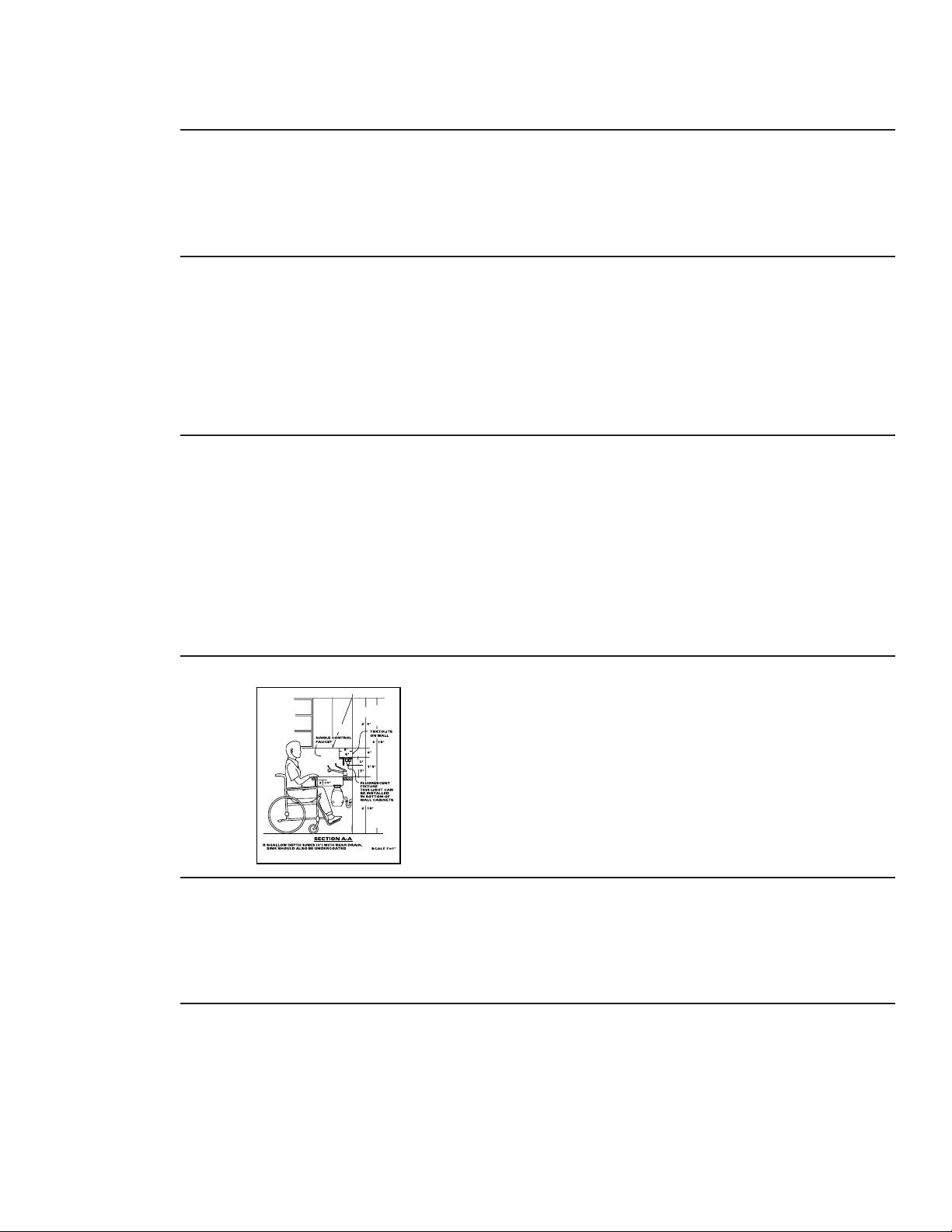
Consumer Services
With the purchase of your new Monogram appliance, receive the
assurance that if you ever need information or assistance from GE,
we’ll be there. All you have to do is call—toll- free!
GE Answer
Center®
800.626.2000
Whatever your question about any Monogram major appliance, GE Answer Center®
information service is available to help. Your call—and your question—will be answered
promptly and courteously. And you can call any time. GE Answer Center® service is open
24 hours a day, 7 days a week.
OR
Visit our Website at: www.monogram.com
In-Home Repair
Service
In the U.S.A.:
800.444.1845
In Canada:
888.880.3030
A GE consumer service professional will provide expert repair service, scheduled at a time
that’s convenient for you. Many GE Consumer Service company-operated locations offer
you service today or tomorrow, or at your convenience (7:00 a.m. to 7:00 p.m. weekdays,
9:00 a.m. to 2:00 p.m. Saturdays). Our factory-trained technicians know your appliance
inside and out—so most repairs can be handled in just one visit.
Service Contracts
800.626.2224
You can have the secure feeling that GE Consumer Service will still be there after your
warranty expires. Purchase a GE contract while your warranty is still in effect and you’ll
receive a substantial discount. With a multiple-year contract, you’re assured of future
service at today’s prices.
Parts and
Accessories
800.626.2002
Individuals qualified to service their own appliances can have parts or accessories sent directly
to their home. The GE parts system provides access to over 47,000 parts…and all GE Genuine
Renewal Parts are fully warranted. VISA, MasterCard and Discover cards are accepted.
User maintenance instructions contained in this guide cover procedures intended to be
performed by any user. Other servicing generally should be referred to qualified service
personnel. Caution must be exercised, since improper servicing may cause unsafe operation.
For Customers
With Special
Needs…
800.626.2000
GE offers, free of charge, a brochure to assist in planning a
barrier-free kitchen for persons with limited mobility.
Consumers with impaired hearing or speech who have access to
a TDD or a conventional teletypewriter may call 800.TDD.GEAC
(800.833.4322) to request information or service.
43

44
WARRANTY
YOUR MONOGRAM WALL OVEN WARRANTY
Staple sales slip or cancelled check here. Proof of original
purchase date is needed to obtain service under warranty.
WHAT IS
COVERED
FULL ONE-YEAR WARRANTY
For one year from date of original purchase, we will provide, free of charge, parts and
service labor in your home to repair or replace any part of the oven that fails because of
a manufacturing defect.
This warranty is extended to the original purchaser and any succeeding owner for products
purchased for ordinary home use in the 48 mainland states, Hawaii and Washington, D.C.
In Alaska the warranty is the same except that it is LIMITED because you must pay to ship
the product to the service shop or for the service technician’s travel costs to your home.
All warranty service will be provided by our Factory Service Centers or by our authorized
Customer Care® servicers during normal working hours.
Should your appliance need service, during warranty period or beyond, in the U.S.A.
call 800.444.1845. In Canada: 888.880.3030.
Some states do not allow the exclusion or limitation of incidental or consequential damages,
so the above limitation or exclusion may not apply to you. This warranty gives you specific
legal rights, and you may also have other rights which vary from state to state.
To know what your legal rights are in your state, consult your local or state consumer affairs
office or your state’s Attorney General.
Warrantor: General Electric Company. If further help is needed concerning this warranty,
write: Manager—Customer Relations, GE Appliances, Louisville, KY 40225
WHAT IS NOT
COVERED
• Service trips to your home to teach you
how to use the product.
• Replacement of house fuses or resetting
of circuit breakers.
• Incidental or consequential damage caused
by possible defects with this appliance.
• Damage to the product caused by accident,
fire, floods or acts of God.
• Failure of the product if it is used for
other than its intended purpose or used
commercially.
• Improper installation.
If you have an installation problem, contact
your dealer or installer. You are responsible
for providing adequate electrical, gas,
exhausting and other connecting facilities
as described in the Installation Instructions
provided with the product.
WARRANTOR IS NOT RESPONSIBLE
FOR CONSEQUENTIAL DAMAGES.
ZEK737
ZEK757
ZET737
ZET757
Part No. 164D4290P006
Pub No. 49-80035
7-00 JR