3 Series
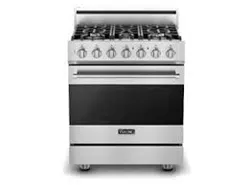
Freestanding 30” Dual Fuel
Self-Clean Sealed Burner Range
Use & Care

Congratulations
We hope you will enjoy and appreciate the care and attention we have put into every detail of your new, state-of-the-art
range.
Your appliance is designed to offer years of reliable service. This Use and Care Manual will provide you with the information
you need to become familiar with your range’s care and operation.
Your complete satisfaction is our ultimate goal. If you have any questions or comments about this product, please contact
the dealer from whom you purchased it, or contact our Consumer Support Center at 1-888-845-4641.
We appreciate your choice of a our product and hope that you will again select our products for your other major range
needs.
For more information about the complete and growing selection of products, contact your dealer or visit us online at
vikingrange.com
Getting Started
Warnings ____________________________________________________________________________________________3
Before Using Range __________________________________________________________________________________8
Range Features ______________________________________________________________________________________8
Oven Functions and Settings __________________________________________________________________________9
Operation
Surface Operation ____________________________________________________________________________________9
Lighting Burners____________________________________________________________________________________9
Surface Burners-Automatic Re-ignition ________________________________________________________________9
Surface Cooking Tips ______________________________________________________________________________9
Cooking Vessels __________________________________________________________________________________10
Oven Features ______________________________________________________________________________________11
Rack Positions ____________________________________________________________________________________11
Using the Oven ____________________________________________________________________________________11
Preheat __________________________________________________________________________________________11
Conventional and Convection Cooking ______________________________________________________________12
Baking ____________________________________________________________________________________________13
BAKE (Two-Element Bake) __________________________________________________________________________13
CONVECTION BAKE ______________________________________________________________________________13
TruConv BAKE ____________________________________________________________________________________13
Roasting____________________________________________________________________________________________17
CONV ROAST (Convection Roast____________________________________________________________________17
Broiling ____________________________________________________________________________________________20
CONV BROIL ____________________________________________________________________________________20
HI BROIL ________________________________________________________________________________________20
MED BROIL ______________________________________________________________________________________20
LOW BROIL ______________________________________________________________________________________20
Convection Dehydrate ______________________________________________________________________________21
Convection Defrost __________________________________________________________________________________21
Product Care
Cleaning and Maintenance __________________________________________________________________________24
Self-Clean Cycle ____________________________________________________________________________________25
Replacing Oven Lights ______________________________________________________________________________26
Door Removal ______________________________________________________________________________________27
Door Replacement __________________________________________________________________________________28
Troubleshooting ____________________________________________________________________________________29
Service Information __________________________________________________________________________________30
Warranty __________________________________________________________________________________________31
Table of Contents
2
3
Warnings
Warning and Important Safety Instructions appearing in this manualare not meant to cover all possible conditions and
situations that may occur. Common sense, caution, and care must be exercised when installing, maintaining, or operating
the appliance.
ALWAYS contact the manufacturer about problems or conditions you do not understand.
Recognize Safety Symbols, Words, Labels
Read and follow all instructions before using this appliance to prevent the potential risk of fire, electric shock, personal injury or
damage to the appliance as a result of improper usage of the appliance. Use appliance only for its intended purpose as described
in this manual.
To ensure proper and safe operation: Appliance must be properly installed and grounded by a qualified technician. DO NOT
attempt to adjust, repair, service, or replace any part of your appliance unless it is specifically recommended in this manual. All
other servicing should be referred to a qualified servicer. Have the installer show you the location of the gas shutoff valve and how
to shut it off in an emergency. A certified technician is required for any adjustments or conversions to Natural or LP gas.
KEEP THESE INSTRUCTIONS FOR FUTURE REFERENCE
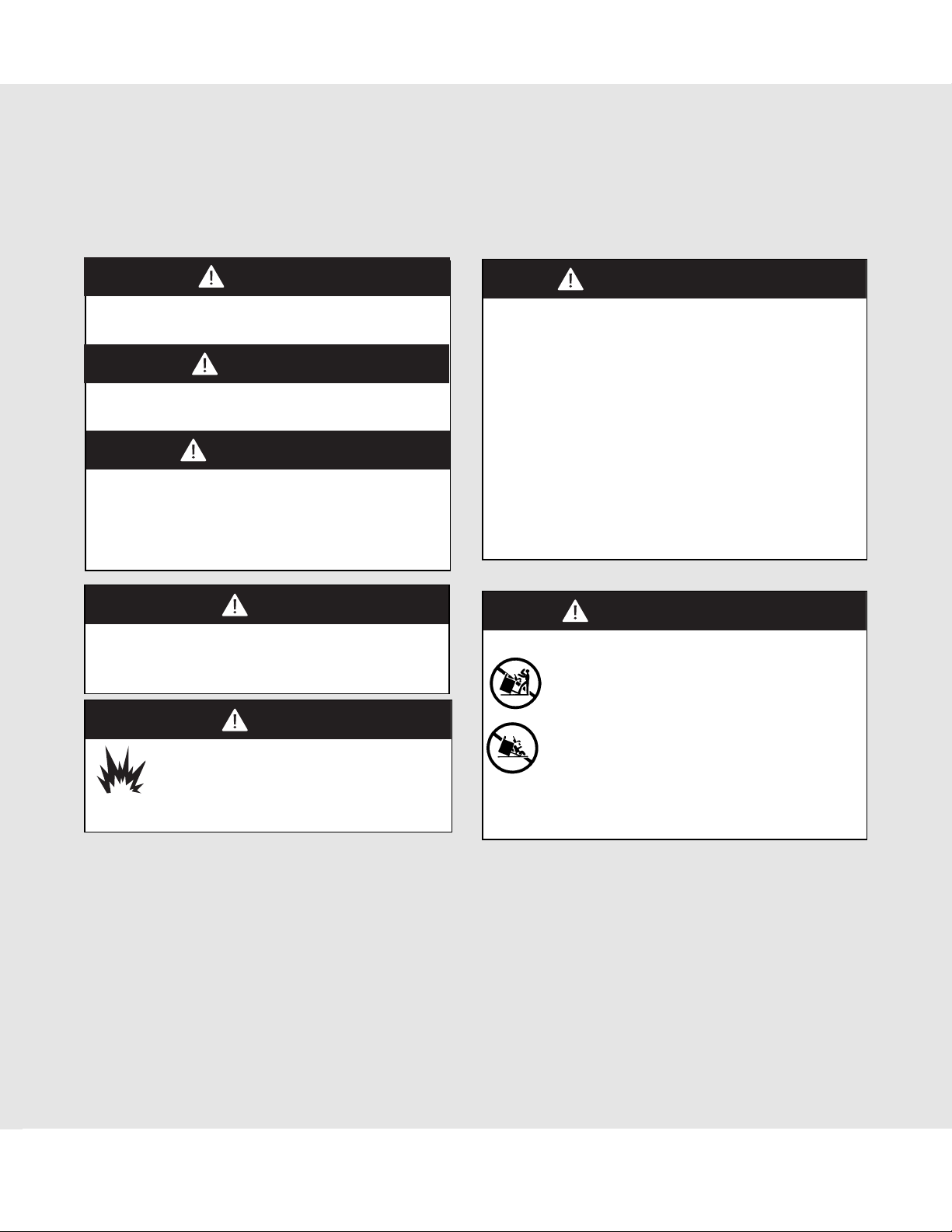
Hazards or unsafe practices which WILL
result in severe personal injury or death
Hazards or unsafe practices which COULD
result in death or severe personal injury
DANGER
Hazards or unsafe practices which COULD
result in minor personal injury.
All safety messages will identify the hazard, tell you how
to reduce the chance of injury, and tell you what can
happen if the instructions are not followed.
WARNING
CAUTION
WARNING
If the information in this manual is not followed
exactly, a fire or explosion may result causing
property damage, personal injury or death.
WHAT TO DO IF YOU SMELL GAS:
• DO NOT try to light any appliance.
• DO NOT touch any electrical switch.
• DO NOT use any phone in your building.
• Immediately call your gas supplier from a neighbor's
phone. Follow the gas supplier's instructions.
• If you cannot reach your gas supplier, call the fire
department.
Installation and service must be performed by a qualified
installer, service agency or the gas supplier.
WARNING
To avoid risk of property damage, personal injury
or death; follow information in this manual exactly
to prevent a fire or explosion. DO NOT store or
use gasoline or other flammable vapors and liquids in the
vicinity of this or any appliance.
WARNING
WARNING
DO NOT use commercial oven cleaners inside the oven. Use
of these cleaners can produce hazardous fumes or can
damage the porcelain finishes.
TIPPING HAZARD
To reduce the risk of the appliance tipping, it must
be secured by a properly installed anti-tip bracket(s).
To make sure the bracket has been installed
properly, look behind the range with a flashlight to
verify proper installation engaged in the rear top left
corner of the range.
• THIS RANGE CAN TIP
• INJURIES TO PERSONS CAN RESULT
• INSTALL ANTI-TIP DEVICE PACKED WITH
RANGE
• SEE INSTALLATION INSTRUCTIONS

4
Warnings
Getting Started
To Prevent Fire or Smoke Damage
• Be sure all packing materials are removed from the appliance before
operating it.
• Keep area around appliance clear and free from combustible materials, gasoline, and other flammable vapors and materials.
• If appliance is installed near a window, proper precautions should be taken
to prevent curtains from blowing over burners.
•
NEVER leave any items on the rangetop. The hot air from the vent may ignite flammable items and may increase pressure in closed
containers which may cause them to burst.
• Many aerosol-type spray cans are EXPLOSIVE when exposed to heat and
may be highly flammable. Avoid their use or storage near an appliance.
• Many plastics are vulnerable to heat. Keep plastics away from parts of the appliance that may become warm or hot. DO NOT leave plastic
items on
the rangetop as they may melt or soften if left too close to the vent or a lighted surface burner.
• Combustible items (paper, plastic, etc.) may ignite and metallic items
may become hot and cause burns.
DO NOT
pour spirits over hot foods.
DO NOT
leave oven unsupervised when drying herbs, breads, mushrooms, etc; fire hazard.
In Case of Fire
Turn off appliance and ventilating hood to avoid spreading the flame. Extinguish flame then turn on hood to remove smoke and odor.
• Cooktop: Smother fire or flame in a pan with a lid or cookie sheet.
• NEVER pick up or move a flaming pan.
• Oven: Smother fire or flame by closing the oven door. DO NOT use water
on grease fires. Use baking soda, a dry chemical or foam-type extinguisher to smother fire or flame.
• GREASE–Grease is flammable and should be handled carefully.
DO NOT
use water on grease fires. Flaming grease can be
extinguished with
baking soda or, if available, a multipurpose dry chemical or foam type extinguisher. Let fat cool before attempting to handle it.
DO
NOT
allow grease to collect around the oven or in vents. Wipe up spillovers immediately.
Child Safety
• NEVER leave children alone or unsupervised near the appliance when it is in use or is still hot.
• NEVER allow children to sit or stand on any part of the appliance as they could be injured or burned.
• DO NOT store items of interest to children over the unit. Children climbing to reach items could be seriously injured.
Child Safety (cont.)
• Children must be taught that the appliance and utensils in it can be hot.
Let hot utensils cool in a safe place, out of reach of small children.
Children should be taught that an appliance is not a toy. Children should not be allowed to play with controls or other parts of the
appliance.
Cooking Safety
• To eliminate the hazard of reaching over hot surface burners, cabinet storage should not be provided directly above a unit. If storage is
provided, it should be limited to items which are used infrequently and which are safely stored in an area subjected to heat from an
appliance. Temperatures may be unsafe for some items, such as volatile liquids, cleaners or
aerosol sprays.
•
ALWAYS
place a pan on a surface burner before turning it on. Be sure
you know which knob controls which surface burner. Make sure the correct burner is turned on and that the burner has ignited. When
cooking is completed, turn burner off before removing pan to prevent exposure to burner flame.
•
ALWAYS
adjust surface burner flame so that it does not extend beyond the bottom edge of the pan. An excessive flame is hazardous,
wastes energy and may damage the appliance, pan or cabinets above the appliance.
This is based on safety considerations.
• NEVER leave a surface cooking operation unattended especially when using a high heat setting or when deep fat frying. Boilovers cause
smoking and greasy spillovers may ignite. Clean up greasy spills as soon as possible.
DO NOT use high heat for extended cooking operations.
• DO NOT heat unopened food containers, build up of pressure may cause the container to explode and result in injury.
• Use dry, sturdy pot-holders. Damp pot-holders may cause burns from steam. Dishtowels or other substitutes should NEVER be used as
potholders
because they can trail across hot surface burners and ignite or get caught on appliance parts.
•
ALWAYS
let quantities of hot fat used for deep fat frying cool before attempting to move or handle.
• DO NOT let cooking grease or other flammable materials accumulate in or near the appliance, hood or vent fan. Clean hood frequently to
prevent grease from accumulating on hood or filter. When flaming foods under the hood, turn the fan off.

5
Getting Started
Cooking Safety
(cont.)
• NEVER wear garments made of flammable material or loose fitting or
long-sleeved apparel while cooking. Clothing may ignite or catch utensil handles. DO NOT
drape towels or materials on oven door
handles. These items could ignite and cause burns.
•
ALWAYS
place oven racks in the desired positions while oven is cool.
Slide oven rack out to add or remove food, using dry, sturdy pot-holders.
ALWAYS
avoid reaching into the oven to add or remove
food. If a rack must be moved while hot, use a dry pot-holder.
• ALWAYS turn the oven off at the end of cooking.
• Use care when opening the oven door. Let hot air or steam escape before moving or replacing food.
• NEVER use aluminum foil to cover oven racks or oven bottom. This could result in risk of electric shock, fire, or damage to the
appliance. Use foil only as directed in this guide.
• DO NOT cook directly on the oven bottom. This could result in damage to the appliance. Always use the oven racks when cooking in
the oven.
• PREPARED FOOD WARNING:
Follow food manufacturer's instructions. If a plastic frozen food container and/or its cover distorts, warps,
or is otherwise damaged during cooking, immediately discard the food and its container. The food could be contaminated
.
• If you are “flaming” liquor or other spirits under an exhaust, TURN THE FAN OFF. The draft could cause the flames to spread
out of control.
• Once the unit has been installed as outlined in the Installation Instructions, it is important that the fresh air supply is not
obstructed. The use of a gas cooking appliance results in the production of heat and moisture in the room in which it is installed.
Ensure that the kitchen is well-ventilated. Keep natural venting holes open or install a mechanical ventilation device. Prolonged or
intensive use of the appliance may call for additional (such as opening a window) or more effective ventilation (such as increasing
the level of a mechanical ventilation if present).
Utensil Safety
• Use pans with flat bottoms and handles that are easily grasped and stay cool. Avoid using unstable, warped, easily tipped or loose-
handled pans. Also avoid using pans, especially small pans, with heavy handles as they could be unstable and easily tip. Pans that are
heavy to move when filled with food may also be hazardous.
• Be sure utensil is large enough to properly contain food and avoid boilovers. Pan size is particularly important in deep fat frying. Be sure
pan will accommodate the volume of food that is to be added as well as the bubble action of fat.
• To minimize burns, ignition of flammable materials and spillage due to unintentional contact with the utensil, DO NOT extend handles
over adjacent surface burners. ALWAYS turn pan handles toward the side or back of the appliance, not out into the room where they
are easily hit or reached by small children.
• NEVER let a pan boil dry as this could damage the utensil and the appliance.
• Follow the manufacturer's directions when using oven cooking bags.
• Only certain types of glass, glass/ceramic, ceramic or glazed utensils are
suitable for rangetop surface or oven usage without breaking due to the sudden change in temperature. Follow manufacturer's
instructions when
using glass.
• This appliance has been tested for safe performance using conventional cookware. DO NOT use any devices or accessories that are not
specifically recommended in this guide. DO NOT use eyelid covers for the surface units, stovetop grills, or add-on oven convection
systems. The use of devices or accessories that are not expressly recommended in this manual can create serious safety hazards, result
in performance problems, and reduce the life of the components of the appliance.
• The flame of the burner should be adjusted to just cover the bottom of the pan or pot. Excessive burner setting may cause
scorching of adjacent counter-top surfaces, as well as the outside of the utensil. This is based on safety considerations.
Heating Elements
• NEVER touch oven bake and broil burner areas or interior surfaces of oven.
• Bake and broil burners may be hot even though they are dark in color. Areas near burners and interior surfaces of an oven may become
hot enough to cause burns.
•
During and after use, DO NOT touch or let clothing or other flammable materials contact heating elements, areas near elements, or
interior surfaces of oven until they have had sufficient time to cool.
Other surfaces of the oven may become hot enough to cause
Warnings

Warnings
6
burns, such as the oven vent opening, the surface near the vent opening, and the oven door window.
Cleaning Safety
• Turn off all controls and wait for appliance parts to cool before touching or cleaning them. DO NOT touch the burner grates or
surrounding areas until they have had sufficient time to cool.
• Clean appliance with caution. Use care to avoid steam burns if a wet sponge or cloth is used to wipe spills on a hot surface. Some
cleaners can produce noxious fumes if applied to a hot surface.
•
DO NOT
clean door gasket. It is essential for a good tight seal. Care should be taken not to rub, damage, or move the gasket.
• No commercial oven cleaner or oven liner protective coating such as aluminum foil should be used in or around any part of the
oven. Improper oven liners may result in a risk of electric shock or fire. Keep oven free from grease buildup.
Self-Clean Oven
• Clean only parts listed in this guide. DO NOT clean door gasket. The door gasket is essential for a good seal. Care should be
taken not to rub, damage, or move the gasket. DO NOT use oven cleaners of any kind in or around any part of the self-clean
oven.
• Before self-cleaning the oven, remove oven racks and other utensils and wipe up excessive spillovers to prevent excessive smoke,
flareups or flaming.
• This range features a cooling fan which operates automatically during a clean cycle. If the fan does not turn on, cancel the clean
operation and contact an authorized servicer.
• It is normal for the rangetop cooking surface of the range to become hot during a self-clean cycle. Therefore, touching the
rangetop cooking surface during a clean cycle should be avoided.
Important Safety Notice and Warning
The California Safe Drinking Water and Toxic Enforcement Act of 1986 (Proposition 65) requires the Governor of California to
publish a list of substances known to the State of California to cause cancer or reproductive harm, and requires businesses to warn
customers of potential exposures to such substances. Users of this appliance are hereby warned that when the oven is engaged in
the self-clean cycle, there may be some low-level exposure to some of the listed substances, including carbon monoxide. Exposure
to these substances can be minimized by properly venting the oven to the outdoors by opening the windows and/or door in the
room where the appliance is located during the self-clean cycle.
Important notice regarding pet birds:
NEVER keep pet birds in the kitchen or in rooms where the fumes from the kitchen could reach. Birds have a very sensitive
respiratory system. Fumes released during an oven self-cleaning cycle may be harmful or fatal to birds. Fumes released due to
overheated cooking oil, fat, margarine and overheated non-stick cookware may be equally harmful.
About Your Appliance
• For proper oven performance and operation, DO NOT block or obstruct the oven vent duct located on the right side of the air grille.
• Avoid touching oven vent area while oven is on and for several minutes after oven is turned off. When the oven is in use, the vent and
surrounding area become hot enough to cause burns. After oven is turned off, DO NOT touch the oven vent or surrounding areas until
they have had sufficient time to cool.
• Other potentially hot surfaces include rangetop, areas facing the rangetop, oven vent, surfaces near the vent opening, oven door, areas
around the oven door and oven window.
• The misuse of oven doors (e.g. stepping, sitting, or leaning on them) can result in potential hazards and/or injuries.
Power Failure
If power failure occurs, the electric igniters will not work. No attempt should be made to operate the appliance during a power failure.
Make sure the oven control is in the “OFF” position.
Momentary power failure can occur unnoticed. The range is affected only when the power is interrupted. When it comes back on, the
range will function properly without any adjustments. A “brown-out” may or may not affect range operation, depending on how severe the
power loss is.
Getting Started
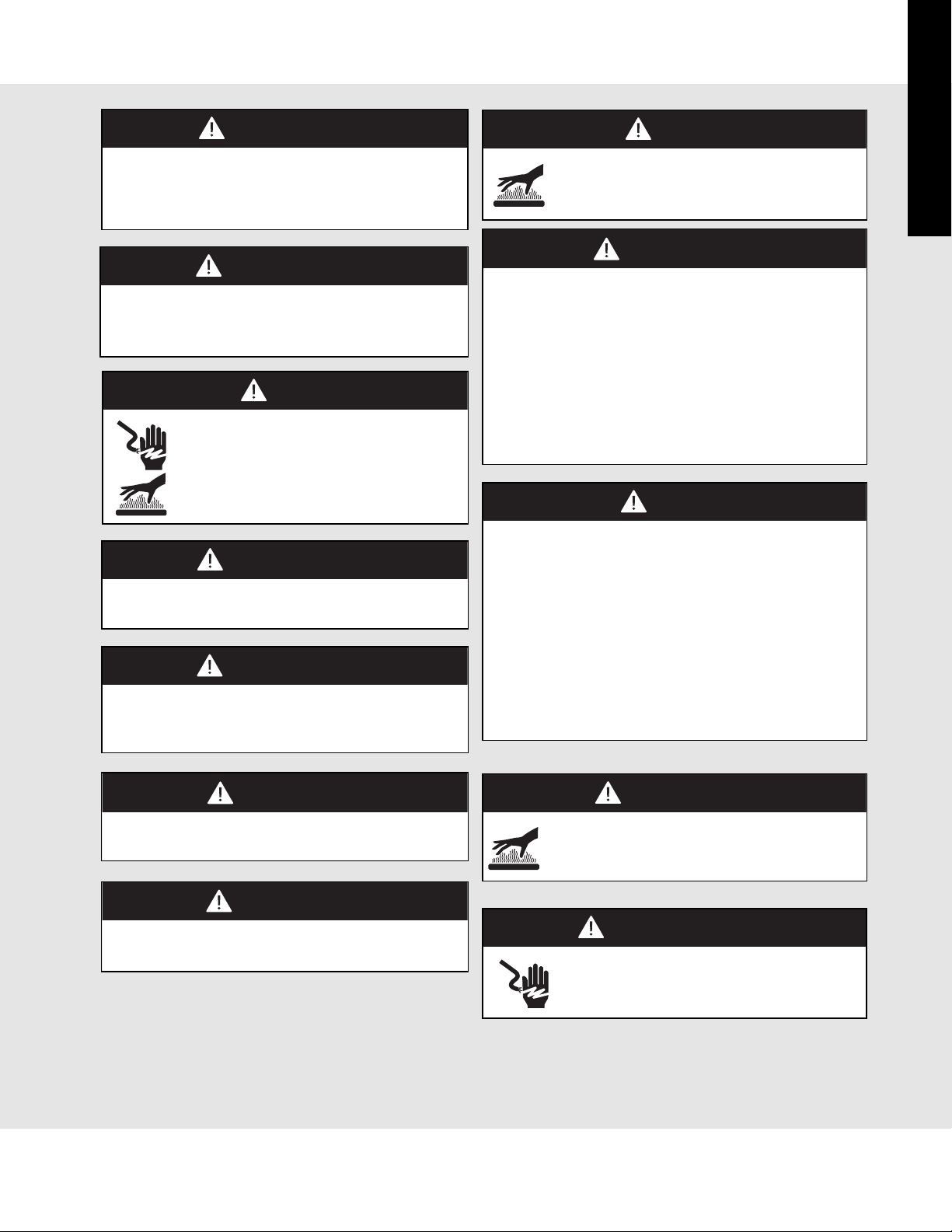
WARNING
NEVER use appliance as a space heater to heat or warm a
room to prevent potential hazard to the user and damage to
the appliance. Also, DO NOT use the rangetop or oven as a
storage area for food or cooking utensils.
WARNING
ELECTRICAL SHOCK HAZARD
DO NOT
touch a hot oven light bulb with a damp
cloth as the bulb could break. Should the bulb
break, disconnect power to the appliance before removing
bulb to avoid electrical shock.
7
Getting Started
WARNING
ELECTRICAL SHOCK HAZARD
Disconnect the electric power at the main fuse or
circuit breaker before replacing bulb.
WARNING
CAUTION
To avoid sickness and food waste, DO NOT allow defrosted
food to remain in the oven for more than two hours.
BURN OR ELECTRICAL SHOCK
HAZARD
Make sure all controls are OFF and oven is
COOL before cleaning. Failure to do so can
result in burns or electrical shock.
WARNING
NOTICE
DO NOT turn the Temperature Control on during
defrosting. Turning the convection fan on will accelerate
the natural defrosting of the food without the heat.
NEVER
cover any slots, holes or passages in the oven
bottom or cover an entire rack with materials such as
aluminum foil. Doing so blocks air flow through the oven
and may cause carbon monoxide poisoning. Aluminum foil
linings may also trap heat, causing a fire hazard.
Warnings
CAUTION
BURN HAZARD
The oven door, especially the glass, can get hot.
Danger of burning: DO NOT touch the glass!
CAUTION
DO NOT store items of interest to children over the unit.
Children climbing to reach items could be seriously injured.
CAUTION
You must carefully check the food during the dehydration
process to ensure that it does not catch fire.
WARNING
This range features a self-cleaning cycle. During this cycle,
the oven reaches elevated temperatures in order to burn off
soil and deposits.
A powder ash residue is left in the bottom of the oven after
completion of the self-clean cycle.
Note: DO NOT use commercial oven cleaners inside the
oven. Use of these cleaners can produce hazardous fumes
or can damage the porcelain finishes. DO NOT line the oven
with aluminum foil or other materials. These items can melt
or burn during a self-clean cycle, causing permanent
damage to the oven.
WARNING
DO NOT touch the exterior portions of the oven after self-
cleaning cycle has begun, since some parts become
extremely hot to the touch!
During the first few times the self-cleaning feature is used,
there may be some odor and smoking from the “curing” of
the binder in the high-density insulation used in the oven.
When the insulation is thoroughly cured, this odor will
disappear. During subsequent self-cleaning cycles, you may
sense an odor characteristic of high temperatures.
KEEP THE KITCHEN WELL-VENTED DURING THE
SELF-CLEAN CYCLE.
WARNING
BURN HAZARD
When self-cleaning, surfaces may get hotter than
usual. Therefore, children should be kept away.
WARNING
DO NOT cook directly on the oven bottom. This could result
in damage to the appliance. Always use the oven racks when
cooking in the oven
8
Getting Started
Before Using Range
All products are wiped clean with solvents at the factory to remove any visible signs of dirt, oil, and grease which may have
remained from the manufacturing process. Before starting to cook, clean the range thoroughly with hot, soapy water. There
may be some burn off and odors on first use of the appliance—this is normal.
Oven
Important! Before first use, wipe interior with soapy water and dry thoroughly. Then set the oven selector to bake,
the thermostat to 450°F, and operate for an hour.
All models include:
• A broad range of baking and broiling modes—up to eight cooking modes in all—to make even your most challenging
baking projects
a success.
• Exclusive one-piece tooled and porcelainized cooking surface contains spills for easy cleaning.
• Split baking and broiling elements—which reduces preheating time and provides greater control and more even heating.
• A reversing convection fan which is two times larger than most on the market—this allows you to cook foods more
thoroughly and evenly—even when baking large quantities.
• Four convection modes offering greater air circulation to shorten cooking times and cook foods more evenly.
• Three broiling modes including a low-broil mode for delicate broiling and top-browning.
• A profiled, concealed bake element for easier cleaning.
• This appliance is certified by Star-K to meet strict regulations in conjunction with specific instructions found on www.star-
k.org.
Range Features
11
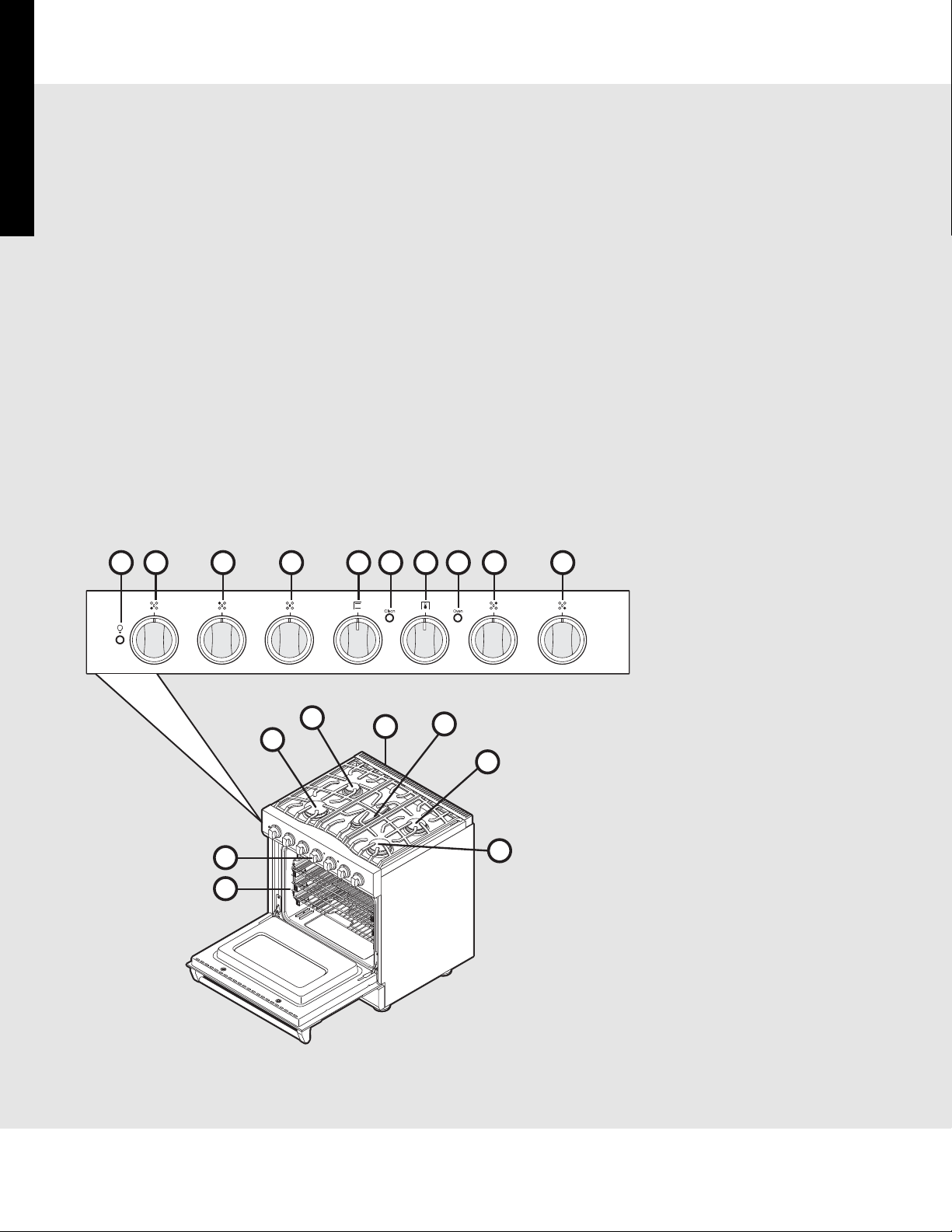
1 2 3 4 5 6 7 8 9 10
17
18
16
12
15
13
14
1. Interior oven light switch
2. Left front burner control knob
3. Left rear burner control knob
4. Center burner control knob
5. Oven function selector knob
6. Self-Clean indicator light
7. Oven temperature control knob
8. Oven temperature indicator light
9. Right rear burner control knob
10. Right front burner control knob
11. Island Trim
12. One 9,000 BTU burner
13. One 12,000 BTU burner
14. One 18,000 BTU burner
15. One 18,000 BTU burner
16. One 8,000 BTU burner
17. Identification plate
18. Three oven racks/Six rack positions
9
Oven Functions and Settings
BAKE (Two-Element Bake)
Use this setting for baking, roasting, and casseroles.
CONV BAKE (Convection Bake)
Use this setting to bake and roast foods at the same time with
minimal taste transfer.
TRU CONV (TruConvec™)
Use this bake setting for multi-rack baking for breads, cakes,
cookies
(up to 6 racks of cookies at once).
CONV ROAST (Convection Roast)
Use this setting for roasting whole turkeys, whole chickens,
hams, etc.
CONV BROIL (Convection Broil)
Use this setting to broil thick cuts of meat.
HI BROIL
Use this setting for broiling dark meats at 1” thickness or
less where rare or medium doneness is desired.
MED BROIL
Use this setting for broiling white meats such as chicken or
meats greater than 1” thick that would be over-browned in
high broil.
LOW BROIL
Use this setting for delicate broiling such as meringue.
SELF CLEAN
Use this function to clean oven.
Convection Dehydration (TRU CONV)
Use this function to dehydrate fruits and vegetables.
Convection Defrost (TRU CONV)
Use this function to defrost foods.
Note: For more information on oven functions see
“Operation” section.
Lighting Burners
All burners are ignited by electric ignition. There are no open-flame, “standing” pilots.
Surface Burners-Automatic Re-ignition
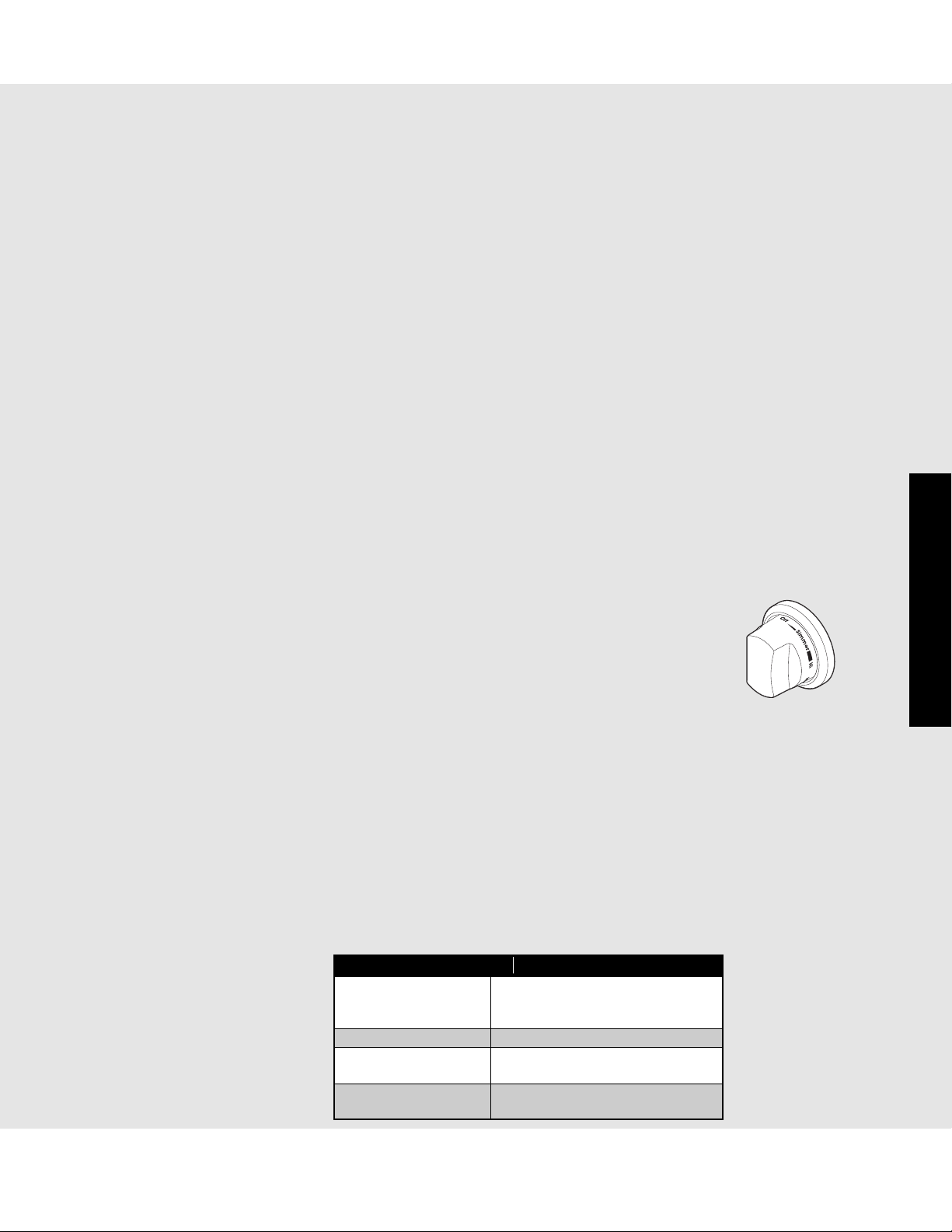
To light the surface burners, push and turn the appropriate control knob counter clockwise to any
position. This control is both a gas valve and an electric switch. Burners will ignite at any “ON” position
with the automatic re-ignition system. If the flame goes out for any reason, the burners will automatically
reignite if the gas is still flowing. When gas is permitted to flow to the burners, the electric igniters start sparking. On all
surface igniters you should hear a “clicking” sound. If you do not, turn off the control and check that the unit is plugged in
and that the fuse or circuit breaker is not blown or tripped.
Within a few moments, enough gas will have traveled to the burner to light. When the burner lights, turn the burner control
to any position to adjust the flame size. Setting the proper flame height for the desired cooking process and selecting the
correct cooking vessel will result in superior cooking performance, while also saving time and energy.
Surface Cooking Tips
Your range is equipped with a variety of different sized surface burners. Below is a guide for which burners work best for
certain cooking applications:
Burner
Use
Front left / Front right
18,000 BTU burner
Best for bringing large quantities of
liquid to temperature and when
preparing large quantities of food
Rear left 8,000 BTU burner
Best for simmering delicate sauces, etc.
Center 9,000 BTU burner
Best for use with the reversible
griddle/grill accessory
Rear Right 12,000 BTU
burner
Best used for most standard surface
cooking needs
Surface Operation
Operation

10
Surface Operation
Surface Cooking Tips (cont.)
• Use low or medium flame heights when cooking in vessels that are poor conductors of heat, such as glass, ceramic, and
cast-iron. Reduce the flame height until it covers approximately 1/3 of the cooking vessel diameter. This will ensure more
even heating within the cooking vessel and reduce the likelihood of burning or scorching the food.
• Reduce the flame if it is extending beyond the bottom of the cooking vessel. A flame that extends along the sides of the
vessel is potentially dangerous, heats the utensil handle and kitchen instead of the food, and wastes energy.
• Reduce the flame height to the minimum level necessary to perform the desired cooking process. Remember that food
cooks just as quickly at a gentle boil as it does at a rolling boil. Maintaining a higher boil than is necessary wastes energy,
cooks away moisture, and causes a loss in food flavor and nutrient level.
• The minimum pot or pan (vessel) diameter recommended is 6”
(15 cm) on the larger burners. Pots or pans as small as 4” (10 cm) should be used on the smaller burners.
Heat Setting Use
Simmer
Melting small quantities
Steaming rice
Simmering sauces
Low
Melting large quantities
Med Low
Low-temperature frying (eggs, etc.)
Simmering large quantities
Heating milk, cream sauces, gravies,
and puddings
Med
Sauteing and browning, braising, and
pan-frying
Maintaining slow boil on large quantities
Med High
High-temperature frying
Pan broiling
Maintaining fast boil on large quantities
High
Boiling water quickly
Deep-fat frying in large utensil
Operation
Cooking Vessels
Each cook has his or her own preference for the particular cooking vessels that are most appropriate for the type of cooking
being done. Any and all cooking vessels are suitable for use in the range and it is not necessary to replace your present
domestic vessels with commercial cookware. This is a matter of personal choice. As with any cookware, yours should be in
good condition and free from excessive dents on the bottom to provide maximum performance and convenience.
Note: When using big pots and/or high flames, it is recommended to use the front burners. There is more room in the front and
potential cleanup at rear of appliance due to staining or discoloration will be minimized.
*Note: The above information is given as a guide only. You may
need to vary the heat settings to suit your personal requirements.
Surface Heat Settings*
11
Operation
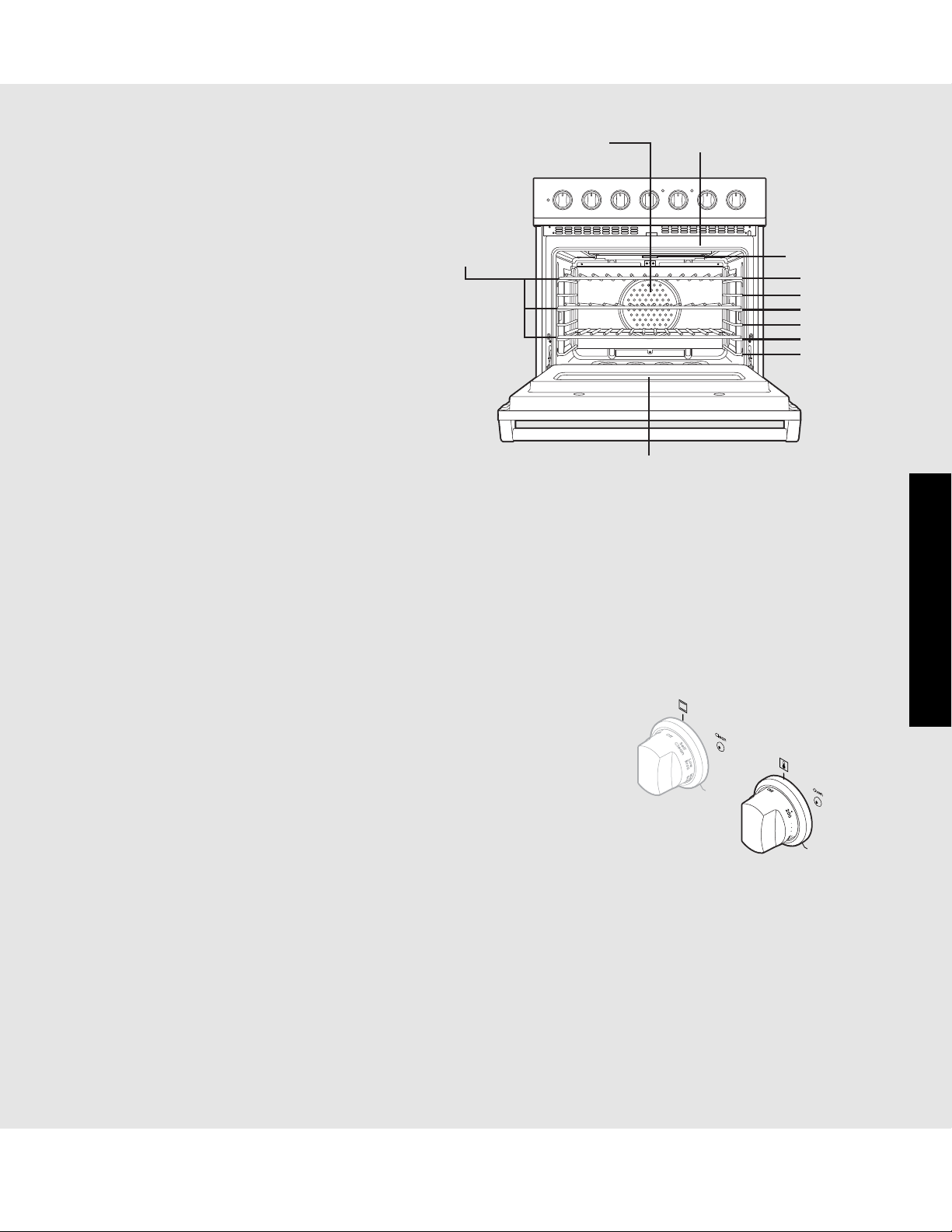
Broil element
Oven light
6
5
4
3
2
1
TruConvec™ element
(behind baffle)
(3) Oven racks
Concealed bake element
Rack Positions
Each oven is equipped with three oven racks (some
models include 1 or more TruGlide racks). All ovens
have six rack positions. Position 6 is the farthest
from the oven bottom. Position 1 is the closest to
the oven bottom. The racks can be easily removed
and arranged at various levels. For best results with
conventional baking, DO NOT use more than one
rack at a time. It is also recommended, when using
two racks, to bake with the racks in positions 2 and
4 or positions 3 and 5.
Using the Oven
Preheat
For best results, it is extremely important that you preheat your oven to the desired
cooking temperature before placing food items in the oven to begin cooking. In
many cooking modes, partial power from the broiler is used to bring the oven to the
preheat temperature. Therefore, placing food items in the oven during the preheat
mode is not recommended. The Viking Rapid Ready™ Preheat System is
engineered so that the oven is brought to the desired set temperature in a manner
which will provide the optimum cooking environment based on the selected
cooking mode in the shortest possible time.
For instance, the preheat mode for TruConvec™ is designed to be brought up to
the set point temperature in a different manner than the preheat mode for
conventional bake. This is because TruConvec is designed for multi-rack baking. So
it is extremely critical that all rack positions have reached the desired cooking
temperature. As a result, it is normal for oven to take slightly longer for the oven to
preheat to 350°F in TruConvec mode when compared to the amount of time it takes
to preheat the oven cavity to 350°F in conventional bake mode.
Also, preheat time can vary based on some external factors such as room
temperature and power supply. A significantly colder room temperature or a power
supply less than 240 VAC can lengthen the time it takes for the oven to reach the
desired set temperature.
O
V
EN
F
U
N
CTI
O
N
O
VEN
TEMPE
R
A
TUR
E
Oven Features

12
Operation
Using the Oven
Conventional and Convection Cooking
Because of variations in food density, surface texture and consistency, some foods may be prepared more successfully using the
conventional bake setting. For this reason, conventional baking is recommended when preparing baked goods such as custard. The
user may find other foods that are also prepared more consistently in conventional bake. This is perfectly normal. Convection cooking
is a cooking technique which utilizes fan forced air to circulate heat throughout the entire oven creating the optimum cooking
environment. Cooking with convection is intended when performing multi-rack baking and for baking heavier foods. Below are tips
which will allow you to get the best results out of your oven when cooking with convection.
• As a general rule, to convert conventional recipes to convection recipes, reduce the temperature by 25°F (-3.9°C) and the cooking
time by approximately 10 to 15%.
• Cooking times for standard baking and convection baking will be the same. However, if using convection to cook a single item or
smaller load, then it is possible to have 10-15% reduction in cooking time. (Remember convection cooking is designed for multi-
rack baking or cooking large loads.)
• If cooking items which require longer than 45 minutes, then it is possible to see a 10-15% reduction in cooking time. This is
especially true for large items cooked in the convection roast function.
• A major benefit of convection cooking is the ability to prepare foods in quantity. The uniform air circulation makes this possible.
Foods that can be prepared on two of three racks at the same time include: pizza, cakes, cookies, biscuits, muffins, rolls, and frozen
convenience foods.
• For three-rack baking, use any combination of rack positions 2, 3, 4, and 5. For two-rack baking, use rack positions 2 and 4 or
positions 3 and 5. Remember that the racks are numbered from bottom to top. See “
Oven Features
” illustration on page 18.
• Items cooked in a convection function can be easily over-baked. This being the case, it is usually a good idea to pull items out of
the oven just before they seem to be done. Items will continue to cook right after they are set out of the oven.
• Some recipes, especially those that are homemade, may require adjustment and testing when converting from standard to
convection modes. If unsure how to convert a recipe, begin by preparing the recipe in conventional bake. After achieving
acceptable results, follow the convection guidelines listed for the similar food type. If the food is not prepared to your satisfaction
during this first convection trial, adjust only one recipe variable at a time (cooking time, rack position, or temperature) and repeat
the convection test. Continue adjusting one recipe variable at a time until satisfactory results are achieved.
Pan Placement Tips
• When using large (15
"
x 13
"
) flat pans or trays that cover most of the rack, rack positions 2 or 3 produce the best results.
• When baking on more than one rack, it is recommended to use the 3rd and 5th position for more consistent even baking.
• Stagger pans in opposite directions when two racks and several pans are used in conventional bake. If possible, no pan should be
directly above another.
• Allow 1 to 2 inches of air space around all sides of each pan for even air circulation.
Single Rack Pan
Placement
Multiple Rack Pan
Placement
13
Operation
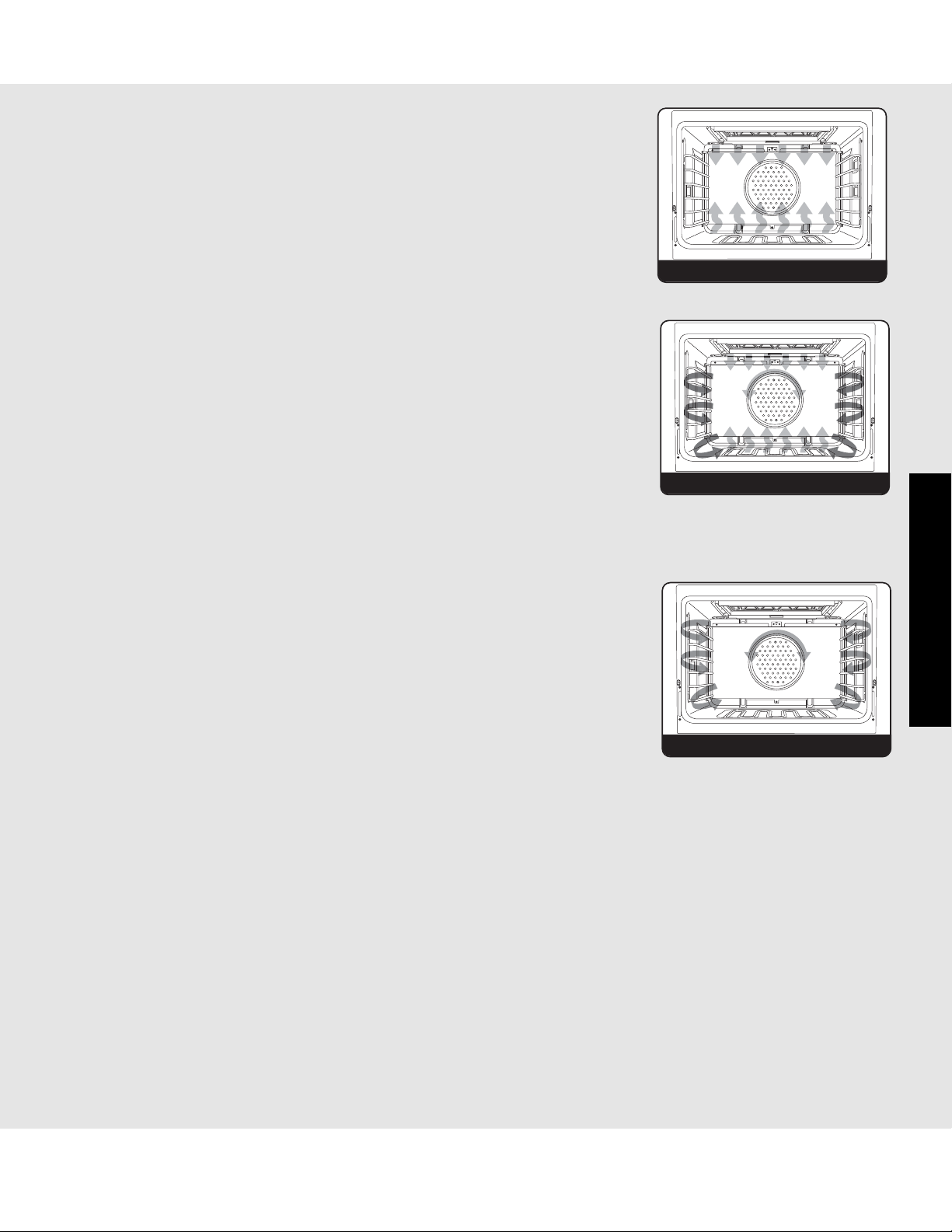
BAKE (Two-Element Bake)
Full power heat is radiated from the bake element in the bottom of the oven cavity and
supplemental heat is radiated from the broil element. This function is recommended for
single rack baking. Many cookbooks contain recipes to be cooked in the conventional
manner. Conventional baking/ roasting is particularly suitable for dishes that require a high
temperature. Use this setting for baking, roasting, and casseroles.
CONV BAKE (Convection Bake)
The bottom element operates at full power, and the top broil element operates at
supplemental power. The heated air is circulated by the motorized fan in the rear of the
oven providing a more even heat distribution. This even circulation of air equalizes the
temperature throughout the oven cavity and eliminates the hot and cold spots found in
conventional ovens. A major benefit of convection baking is the ability to prepare food in
quantity using multiple racks— a feature not possible in a standard oven.
When roasting using this setting, cool air is quickly replaced, searing meats on the outside
and retaining more juices and natural flavor on the inside with less shrinkage. With this
heating method, foods can be baked and roasted at the same time with minimal taste
transfer, even when different dishes are involved, such as cakes, fish or meat. The hot air
system is especially economical when thawing frozen food. Use this setting for baking and
roasting.
TRU CONV (TruConvec™)
The rear element only operates at full power. There is no direct heat from the bottom or top
elements. The motorized fan in the rear of the oven circulates air in the oven cavity for even
heating. Use this setting for foods that require gentle cooking such as pastries, souffles,
yeast breads, quick breads and cakes. Breads, cookies, and other baked goods come out
evenly textured with golden crusts. No special bakeware is required. Use this function for
single rack baking, multiple rack baking, roasting, and preparation of complete meals. This
setting is also recommended when baking large quantities of baked goods at one time.
Baking
Baking Tips
• Make sure the oven racks are in the desired positions before you turn the oven on.
• DO NOT open the oven door frequently during baking. If you must open the door, the best time is during the last quarter of the
baking time.
• Bake to shortest time suggested and check for doneness before adding more time. For baked goods, a stainless steel knife placed
in the center of the product should come clean when done.
• Use the pan size and type recommended by the recipe to ensure best results. Cakes, quick breads, muffins, and cookies should be
baked in shiny, reflective pans for light, golden crusts. Avoid the use of old, darkened pans. Warped, dented, stainless steel and
tin-coated pans heat unevenly and will not give uniform baking results.
two-element bake
convection bake
TruConvec™
14
Operation
Conventional Baking Chart
Single Rack Time
Food Pan Size Position Temp
(min)
BREADS
Biscuits Cookie sheet 3 or 4 400˚F (204˚C) 10 - 12
Yeast loaf Loaf pan
3 or 4
375
˚F (191˚C)
30 - 35
Yeast rolls Cookie sheet
3 or 4
400
˚F (204˚C)
12 - 15
Nut bread Loaf pan
3 or 4
375
˚F
(
191˚C)
30 - 35
Cornbread 8
"
x 8
"
3 or 4
400
˚F (204˚C)
25 - 30
Gingerbread 8
"
x 8
"
3 or 4
350
˚F (177˚C)
35 - 40
Muffins Muffin tin
3 or 4
375
˚F (191˚C)
15 - 20
Corn muffins Muffin tin
3 or 4
375
˚F (191˚C)
15 - 20
CAKE
Angel food Tube pan 3 or 4 375
˚F (191˚C)
35 - 45
Bundt Tube pan 3 or 4 350
˚F (177˚C)
45 - 55
Cupcakes Muffin pan 3 or 4 350
˚F (177˚C)
16 - 20
Layer, sheet 13
"
x 9
"
3 or 4 350
˚F (177˚C)
40 - 50
Layer, two 9
"
round 3 or 4 350
˚F (177˚C)
30 - 35
Pound Loaf pan 3 or 4 350
˚F (177˚C)
60 - 65
COOKIES
Brownies 13
"
x 9
"
3 or 4 350
˚F (177˚C)
25 - 30
Choc. chip Cookie sheet 3 or 4 375
˚F (191˚C)
12 - 15
Sugar Cookie sheet 3 or 4 375
˚F (191˚C)
10 - 12
PASTRY
Cream puffs Cookie sheet 3 or 4 400
˚F (204˚C)
30 - 35
PIES
Crust, unfilled 9
"
round 3 or 4 400
˚F (204 ˚C)
10 - 12
Crust, filled 9
"
round 3 or 4 350
˚F (191˚C)
55 - 60
Lemon meringue 9
"
round 3 or 4 350
˚F (177˚C)
12 - 15
Pumpkin 9
"
round 3 or 4 350
˚F (177˚C)
35 - 40
Custard 6 - 4 oz cups 3 or 4 350
˚F (177˚C)
35 - 40
ENTREES
Egg rolls Cookie sheet 3 or 4 400
˚F (204˚C)
25 - 30
Fish sticks Cookie sheet 3 or 4 425
˚F (218˚C)
10 - 15
Lasagna, frz Cookie sheet 3 or 4 375
˚F (191˚C)
55 - 60
Pot pie Cookie sheet 3 or 4 400
˚F (204˚C)
35 - 40
Gr. peppers stuffed
13
"
x 9
"
3 or 4 375
˚F (191˚C)
60 - 70
Quiche 9
"
round 3 or 4 400
˚F (204˚C)
25 - 30
Pizza, 12
"
Cookie sheet 3 or 4 400
˚F (204˚C)
15 - 20
Mac. & cheese, frz
Cookie sheet 3 or 4 375
˚F (191˚C)
35 - 40
VEGETABLES
Baked potatoes On rack 3 or 4 375
˚F (191˚C)
60 - 65
Spinach souffle 1 qt. casserole 3 or 4 350
˚F (177˚C)
45 - 50
Squash Cookie sheet 3 or 4 375
˚F (191˚C)
50 - 55
French fries Cookie sheet 3 or 4 425
˚F (218˚C)
20 - 25
*Note: The above information is given as a guide only.
Baking
15
Operation
*Note: The above information is given as a guide only.
Single Rack Time
Food Pan Size Position Temp
(min)
BREADS
Frozen Biscuits Cookie sheet 3 or 4
375
˚F (191˚C) 7 - 9
Yeast loaf Loaf pan 3 or 4
375
˚F (191˚C) 25 - 30
Yeast rolls Cookie sheet 3 or 4
375
˚F (191˚C) 11 - 13
Nut bread Loaf pan 3 or 4
350
˚F (177˚C) 25 - 30
Cornbread 8
"
x 8
"
3 or 4
375
˚F (191˚C) 20 - 25
Gingerbread 8
"
x 8
"
3 or 4
325
˚F (163˚C) 30 - 35
Muffins Muffin tin 3 or 4
350
˚F (177°C) 12 - 15
Corn muffins Muffin tin 3 or 4
350
˚F (177˚C) 10 - 12
CAKES
Angel food Tube pan
3 or 4
350
˚F (177˚C)
35 - 40
Bundt Tube pan 3 or 4 325
˚F (163˚C)
35 - 40
Cupcakes Muffin pan
3 or 4
325
˚F (163˚C)
15 - 17
Layer, sheet 13
"
x 9
"
3 or 4
325
˚F (163˚C)
30 - 35
Layer, two 9
"
round
3 or 4
325
˚F (163˚C)
25 - 30
Pound Loaf pan
3 or 4
325
˚F (163˚C)
45 - 50
COOKIES
Brownies 13
"
x 9
"
3 or 4
325
˚F (163˚C)
20 -25
Choc. chip Cookie sheet
3 or 4
350
˚F (177˚C)
7 -10
Sugar Cookie sheet
3 or 4
350
˚F (177˚C)
7-10
PIES
Crust, unfilled 9
"
round
3 or 4
375
˚F (191˚C)
7 - 9
Crust, filled 9
"
round
3 or 4
325
˚F (163˚C)
50 - 55
Lemon meringue 9
"
round
3 or 4
325
˚F (163˚C)
10 - 12
Pumpkin 9
"
round
3 or 4
325
˚F (163˚C)
45 - 55
Custard Not recommended
ENTREES
Egg rolls Cookie sheet
3 or 4
375
˚F (191˚C)
15 - 20
Fish sticks Cookie sheet
3 or 4
400
˚F (205˚C)
8 - 10
Lasagna, frz Cookie sheet
3 or 4
350
˚F (177˚C)
45 - 50
Pot pie Cookie sheet
3 or 4
375
˚F (191˚C)
35 - 40
Gr. peppers stuffed
13
"
x 9
"
3 or 4
350
˚F (177˚C)
45 - 50
Quiche
Not recommended
Pizza, 12
"
Cookie sheet
3 or 4
375
˚F (191˚C)
15 - 20
Mac. & cheese, frz
Cookie sheet 3 or 4 350
˚F (177˚C)
25 - 35
VEGETABLES
Baked potatoes On rack 3 or 4 350
˚F (177˚C)
50 - 55
Spinach souffle 1 qt. casserole 3 or 4 325
˚F (163˚C)
35 - 40
Squash Cookie sheet 3 or 4 350
˚F (177˚C)
40 - 45
French fries Cookie sheet 3 or 4 400
˚F (205˚C)
15 - 20
Convection Baking Chart
Baking
16
Operation
Problems Cause Remedy
Cakes burned on the 1. Oven was too hot 1. Reduce temperature
sides or not done
2. Wrong pan size 2. Use recom. pan size
in center
3. Too many pans 3. Reduce no. of pans
Cakes crack on top 1. Batter too thick 1. Follow recipe
2. Oven too hot Add liquid
3. Wrong pan size
2. Reduce temperature
3. Use recom. pan size
Cakes are not level 1. Batter uneven 1. Distribute batter even
2. Oven or rack not level 2. Level oven or rack
3. Pan was warped 3. Use proper pan
Food too brown on 1. Oven door opened 1. Use door window to
bottom too often check food
2. Dark pans being used 2. Use shiny pans
3.
Incorrect rack position
3.
Use recom. rack position
4. Wrong bake setting 4. Adjust to conventional
5. Pan too large
or convection setting
as needed
5. Use proper pan
Food too brown on 1. Rack position too high 1. Use recom. rack position
top
2. Oven not preheated 2. Allow oven to preheat
3. Sides of pan too high 3. Use proper pans
Cookies too flat 1. Hot cookie sheet 1. Allow sheet to cool
between batches
Pies burned around 1. Oven too hot 1. Reduce temperature
edges
2. Too many pans used 2. Reduce no. of pans
3. Oven not preheated 3. Allow oven to preheat
Pies too light on top 1. Oven not hot enough 1. Increase temperature
2. Too many pans used 2. Reduce no. of pans
3.
Oven not preheated
3.
Allow oven to preheat
Common Baking Problems/Remedies
Baking
Solving Baking Problems
Baking problems can occur for many reasons. Check the chart below for the causes and remedies for the most common
problems. It is important to remember that the temperature setting and cooking times you are accustomed to using with
your previous oven may vary slightly from those required with this oven. If you find this to be true,
it is necessary for you to adjust your recipes and cooking times accordingly.

17
Operation
Roasting
CONV ROAST* (Convection Roast)
The convection element runs in conjunction with the inner and outer broil elements.
The reversible convection fan runs at a higher speed in each direction. This transfer
of heat (mainly from the convection element) seals moisture inside of large roasts. A
time savings is gained over existing, single fan convection roast modes. Use this
setting for whole turkeys, whole chickens, hams, etc.
*Note: This function uses a high-speed convection fan for optimum cooking
performance. Some noise may be noticed from this high fan speed. This is normal.
Note: You can also roast foods using bake settings. See the “Baking” section for
additional information.
Roasting Tips
ALWAYS
use the broiler pan and grid. The hot air must be allowed to circulate around the item being roasted. DO NOT
cover what is being roasted. Convection roasting seals in juices quickly for a moist, tender product. Poultry will have a light,
crispy skin and meats will be browned, not dry or burned. Cook meats and poultry directly from the refrigerator. There is no
need for meat or poultry to stand at room temperature.
• As a general rule, to convert conventional recipes to convection recipes, reduce the temperature by 25°F (-3.9°C) and the
cooking time by approximately 10 to 15%.
•
ALWAYS
roast meats fat side up in a shallow pan using a roasting rack. No basting is required when the fat side is up. DO
NOT add water to the pan as this will cause a steamed effect. Roasting is a dry heat process.
• Poultry should be placed breast side up on a rack in a shallow pan. Brush poultry with melted butter, margarine, or oil
before and during roasting.
• For convection roasting, DO NOT use pans with tall sides as this will interfere with the circulation of heated air over the
food.
• If using a cooking bag, foil tent, or other cover, use the conventional bake setting rather than either convection setting.
• When using a meat thermometer, insert the probe halfway into the center of the thickest portion of the meat. (For poultry
insert the thermometer probe between the body and leg into the thickest part of the inner thigh.) The tip of the probe
should not touch bone,
fat, or gristle to ensure an accurate reading. Check the meat temperature halfway through the recommended roasting time.
After reading the thermometer once, insert it
1
⁄2 inch (1.3 cm) further into the meat, then take a second reading. If the
second temperature registers below the first, continue cooking the meat.
• Roasting times
ALWAYS
vary according to the size, shape and quality of meats and poultry. Less tender cuts of meat are
best prepared in the conventional bake setting and may require moist cooking techniques. Remove roasted meats from the
oven when the thermometer registers 5°F (-15°C) to 10˚ F (-12°C) lower than the desired doneness. The meat will continue
to cook after removal from the oven. Allow roasts to stand 15 to 20 minutes after roasting in order to make carving easier.
convection roast
18
Operation
Conventional Roasting Chart
(when using the Bake or Convection Bake setting)
Time
Internal
Food Weight Temp (min/lb) Temp
BEEF
Rib roast
Rare 4 - 6 lbs 325˚F (162.8˚C) 25 140˚F (60.0˚C)
Medium 4 - 6 lbs 325˚F (162.8˚C) 30 155˚F (68.3˚C)
Well done 4 - 6 lbs 325˚F (162.8˚C) 40 170˚F (76.7˚C)
Rump roast
Medium 4 - 6 lbs 325˚F (162.8˚C) 25 155˚F (68.3˚C)
Well done 4 - 6 lbs 325˚F (162.8˚C) 30 170˚F (76.7˚C)
Tip roast
Medium 3 - 4 lbs 325˚F (162.8˚C) 35 155˚F (68.3˚C)
Well done 3 - 4 lbs 325˚F (162.8˚C) 40 170˚F (76.7˚C)
LAMB
Lamb leg 3 - 5 lbs 325˚F (162.8˚C) 30 180˚F (82.2˚C)
PORK
Pork loin 3 - 5 lbs 325˚F (162.8˚C) 35 180˚F (82.2˚C)
Pork chops 1 -1 1/4 lbs 350˚F (176.7˚C) 55 - 60 N/A
1" thick
total time
Ham, fully cooked 5 lbs 325˚F (162.8˚C) 18 130˚F (54.4˚C)
POULTRY
Chicken, whole 3 - 4 lbs 375˚F (190.6˚C) 30 180˚F (82.2˚C)
Turkey, unstuffed 12 - 16 lbs 325˚F (162.8˚C) 16 - 20 180˚F (82.2˚C
Turkey 20 - 24 lbs 325˚F (162.8˚C) 16 - 20 180˚F (82.2˚C)
Turkey, stuffed 12 - 16 lbs 325˚F (162.8˚C) 17 - 21 180˚F (82.2˚C)
Turkey, stuffed 20 - 24 lbs 325˚F (162.8˚C) 17 - 21 180˚F (82.2˚C)
Turkey breast 4 - 6 lbs 325˚F (162.8˚C) 20 180˚F (82.2˚C)
Roasting
Note: The above information is given as a guide only.
Operation
19
Convection Roasting Chart
Time
Internal
Food Weight Temp (min/lb) Temp
BEEF
Rib roast
Rare 4 - 6 lbs 325˚F (162.8˚C) 25 140˚F (60.0˚C)
Medium 4 - 6 lbs 325˚F (162.8˚C) 24 155˚F (68.3˚C)
Well done 4 - 6 lbs 325˚F (162.8˚C) 30 170˚F (76.7˚C)
Rump roast
Medium 4 - 6 lbs 325˚F (162.8˚C) 20 155˚F (68.3˚C)
Well done 4 - 6 lbs 325˚F (162.8˚C) 24 170˚F (76.7˚C)
Tip roast
Medium 3 - 4 lbs 325˚F (162.8˚C) 30 155˚F (68.3˚C)
Well done 3 - 4 lbs 325˚F (162.8˚C) 35 170˚F (76.7˚C)
LAMB
Lamb leg 3 - 5 lbs 325˚F (162.8˚C) 30 180˚F (82.2˚C)
PORK
Pork loin 3 - 5 lbs 325˚F (162.8˚C) 30 180˚F (82.2˚C)
Pork chops 1 -1 1/4 lbs 325˚F (162.8˚C) 45 - 50 N/A
1" thick
total time
Ham, fully 5 lbs 325˚F (162.8˚C) 15 130˚F (54.4˚C)
cooked
POULTRY
Chicken, whole 3-4 lbs 350˚F (176.7˚C) 25 180˚F (82.2˚C)
Turkey, 12 - 16lbs 325˚F (162.8˚C) 11 180˚F (82.2˚C)
unstuffed
Turkey 20 - 24 lbs 325˚F (162.8˚C) 11 180˚F (82.2˚C)
Turkey, stuffed 12 - 16 lbs 325˚F (162.8˚C) 9 - 10 180˚F (82.2˚C)
Turkey, stuffed 20 - 24 lbs 325˚F (162.8˚C) 9 - 10 180˚F (82.2˚C)
Turkey breast 4 - 6 lbs 325˚F (162.8˚C) 20 180˚F (82.2˚C)
Note: The above information is given as a guide only.
Roasting
20
Operation
Broiling
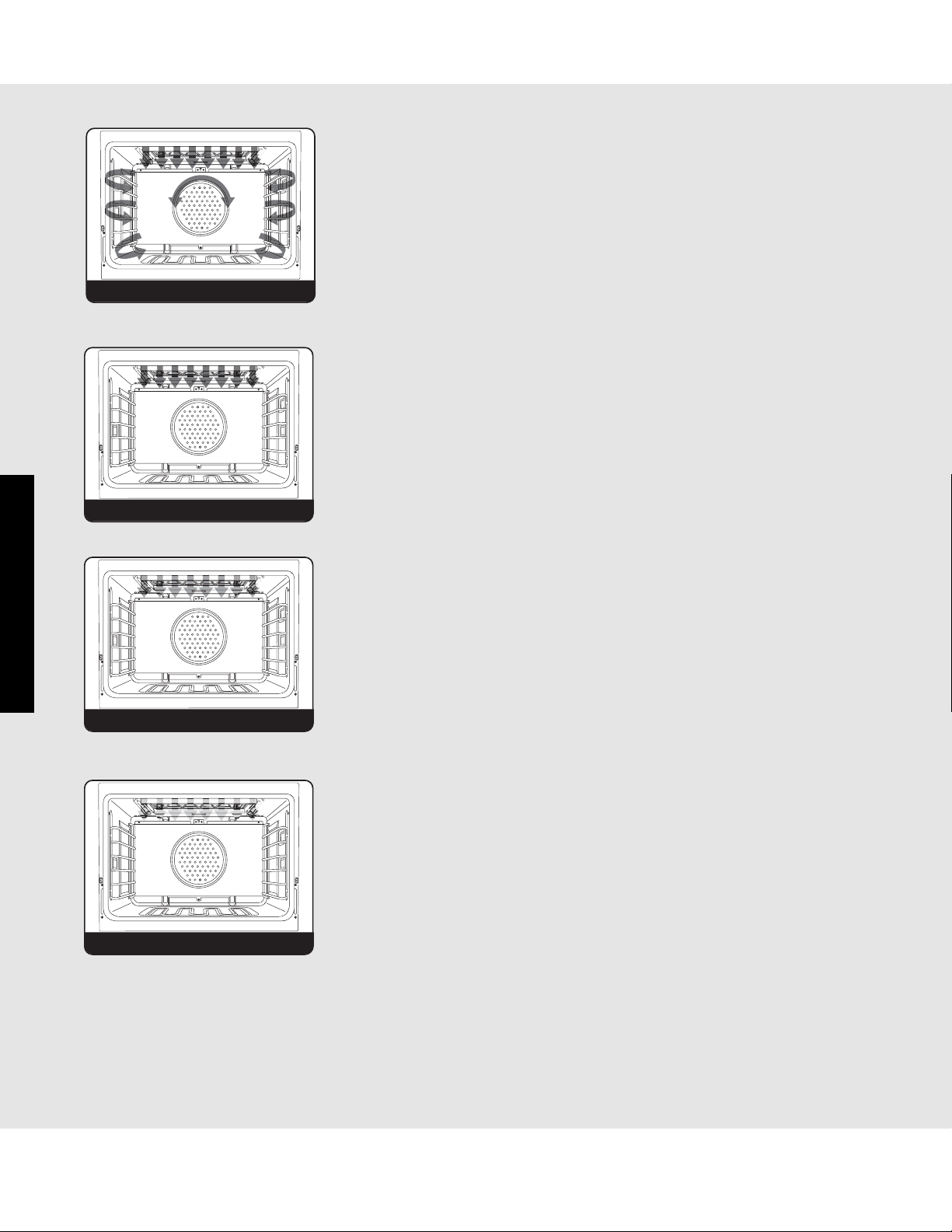
convection broil
high broil
medium broil
CONV BROIL*
(Convection Broil)
The top element operates at full power. This function is exactly the same as regular
broiling with the additional benefit of air circulation by the motorized fan in the rear of
the oven. Smoke is reduced since the airflow also reduces peak temperatures on the
food. Use this setting for broiling thick cuts of meats.
*Note: This function uses a high-speed convection fan for optimum cooking
performance. Some noise may be noticed from this high fan speed. This is normal.
HI BROIL
Heat radiates from both broil elements, located in the top of the oven cavity, at full
power. The distance between the foods and the broil elements determines broiling
speed. For fast broiling, food may be as close as 2 inches (5 cm) to the broil element.
Fast broiling is best for meats where rare to medium doneness is desired. Use this
setting for broiling small and average cuts of meat.
MED BROIL
Inner and outer broil elements pulse on and off to produce less heat for slow broiling.
Allow about 4 inches (10 cm) between the top surface of the food and the broil
element. Slow broiling is best for chicken and ham in order to broil food without over-
browning it. Use this setting for broiling small and average cuts of meat.
LOW BROIL
This mode uses only a fraction of the available power to the inner broil element for
delicate top-browning. The inner broil element is on for only part of the time. Use
this setting to gently brown meringue on racks 3 or 4 in 3-4 minutes.
low broil

21
Operation
Broiling Instructions
Broiling is a dry-heat cooking method using direct or radiant heat.
It is used for small, individualized cuts such as steaks, chops, and patties. Broiling speed is determined by the distance
between the food and the broil element. Choose the rack position based on
desired results.
Conventional broiling is most successful for cuts of meat 1-2 inches thick and is also more suitable for flat pieces of meat.
Convection broiling has the advantage of broiling food slightly quicker than conventional. Convection broiling of meats
produces better results, especially for thick cuts. The meat sears on the outside and retains more juices and natural flavor
inside with less shrinkage.
To Use Broil or Convection Broil
1. Arrange the oven rack in the desired position before turning broiler on.
2. Center the food on a cold broiler pan. Place broiler pan in oven.
3. Set the oven function selector to “Broil” or “Convection Broil” and the temperature knob to “Broil”.
4. Close the door. There is not a detent to hold the door in the open broil stop position as only closed door broiling is
recommended for this range. With closed door broiling the broil element might cycle on and off if an extended broiling
time is required.
Broiling
Broiling Tips
• ALWAYS use a broiler pan and grid for broiling. They are designed to provide drainage of excess liquid and fat away from
the cooking surface to help prevent splatter, smoke, and fire.
• To keep meat from curling, slit fatty edge.
• Brush chicken and fish with butter several times as they broil to prevent drying out. To prevent sticking, lightly grease
broiler tray.
• Broil on first side for slightly more than half the recommended time, season, and turn. Season second side just before
removing.
• ALWAYS pull rack out to stop position before turning or removing food.
• Use tongs or a spatula to turn meats. NEVER pierce meat with a fork, as this allows the juices to escape.
• Remove the broiler pan from the oven when you remove the food. Drippings will bake onto the pan if it is left in the
heated oven after broiling.
22
Operation
Broiling
Rack Positions for Broiling
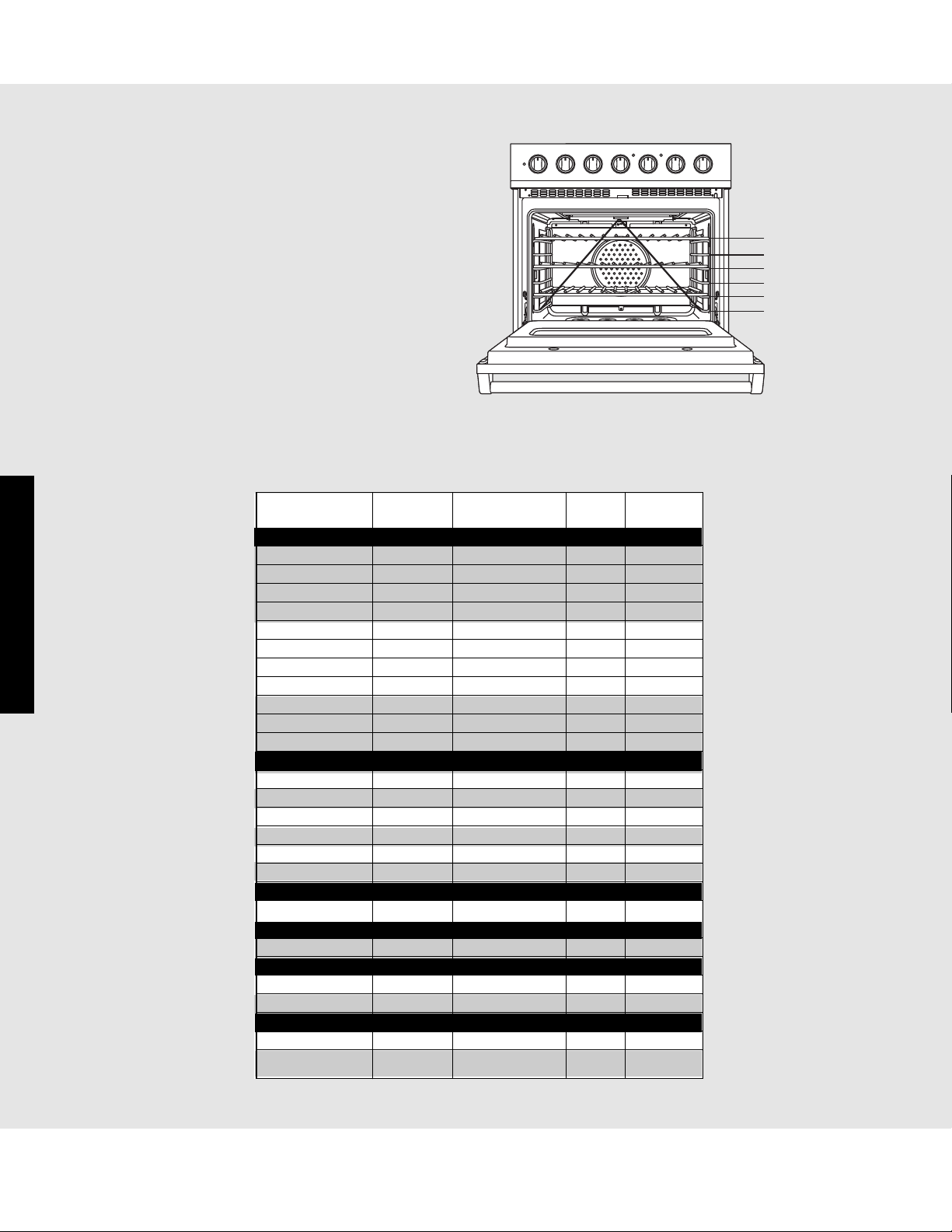
The broiler uses heat rays to help cook the food.
Because these rays travel only in straight lines, the
effective cooking area of the broiler is reduced
when using the higher rack positions. At high-rack
positions, the rays cannot reach all corners of the
broiler grid, so larger pieces of meat might not broil
sufficiently at the outer edges. The effective
cooking areas on the broiler grid for each rack
positions are shown.
Note: Position 6 is the closest to the broiler and
position 1 is the closest to the oven bottom.
25%
35%
50%
65%
80%
95%
Broiling Chart
Type and Time
Cut of Meat Weight Setting Rack (min)
BEEF
Sirloin, 1
"
Rare 12 oz Broil 3 4
Medium 12 oz Broil 3 5
Well done 12 oz Broil 3 6
T-Bone, 3/4
"
Rare 10 oz Broil 3 4
Medium 10 oz Broil 3 6
Well done 10 oz Broil 3 8
Hamburger, 1/2
"
Medium 1/4 lb. Broil 3 6
Well done 1/4 lb. Broil 3 8
CHICKEN
Bnls breast, 1
”
1/2 lb. Broil 3 15
Bnls breast, 1
”
1/2 lb. Convection Broil 3 15
Bone-in breast 2 - 3 lbs total Broil 1 22
Bone-in breast 2 - 3 lbs total Convection Broil 1 20
Chicken pieces 2 - 3 lbs total Broil 3 22
Chicken pieces 2 - 3 lbs total Convection Broil 3 20
HAM
Ham slice, 1
”
1 lb. Broil 3 10
LAMB
Rib chops, 1
”
12 oz. Convection Broil 2 8
PORK
Loin chops, 3/4
”
1 lb. Convection Broil 2 10
Bacon Broil 2 3
FISH
Salmon steak 1 lb. Broil 2 8
Fillets 1 lb. Broil 2 8
Note: The above information is given as a guide only.
Operation
23
Convection Dehydrate
CAUTION
You must carefully check the food during the dehydration process to
ensure that it does not catch fire.
Convection Defrost
WARNING
To avoid sickness and food waste, DO NOT allow defrosted food to
remain in the oven for more than two hours.
Convection Dehydrate
This oven is designed not only to cook, but also to dehydrate fruits and vegetables. Warm air is circulated by a motorized
fan in the rear of the oven and over a period of time, the water is removed from
the food by evaporation. Removal of water inhibits growth of microorganisms and retards the activity of enzymes. It is
important to remember that dehydration does not improve the quality, so only fresh, top-quality foods should be used.
1. Prepare the food as recommended.
2. Arrange the food on drying racks (not included with the oven; contact a local store handling speciality cooking utensils).
3. Set the temperature control to 200°F (93.3°C) and turn the selector to “Convection Bake”.
Convection Defrost
Air is circulated by a motorized fan in the rear of the oven. The fan accelerates natural defrosting of the food without heat.
To avoid sickness and food waste, DO NOT allow defrosted food to remain in the oven for more than two hours.
1. Place the frozen food on a baking sheet.
2. Turn the selector to “Convection Bake” and set the temperature
to “OFF”.
24
Cleaning and Maintenance
Any piece of equipment works better and lasts longer when maintained properly and kept clean. Cooking equipment is no
exception. Your range must be kept clean and maintained properly. Before cleaning, make sure all controls are in the “OFF”
position. Disconnect power if you are going to clean thoroughly with water.
Surface Burner
Wipe up spill-overs as soon as possible after they occur and before
they get a chance to burn in and cook solid. In the event of a spill-
over, follow these steps:
• Allow the burner and grate to cool to a safe temperature level.
• Lift off the burner grate. Wash in warm soapy water.
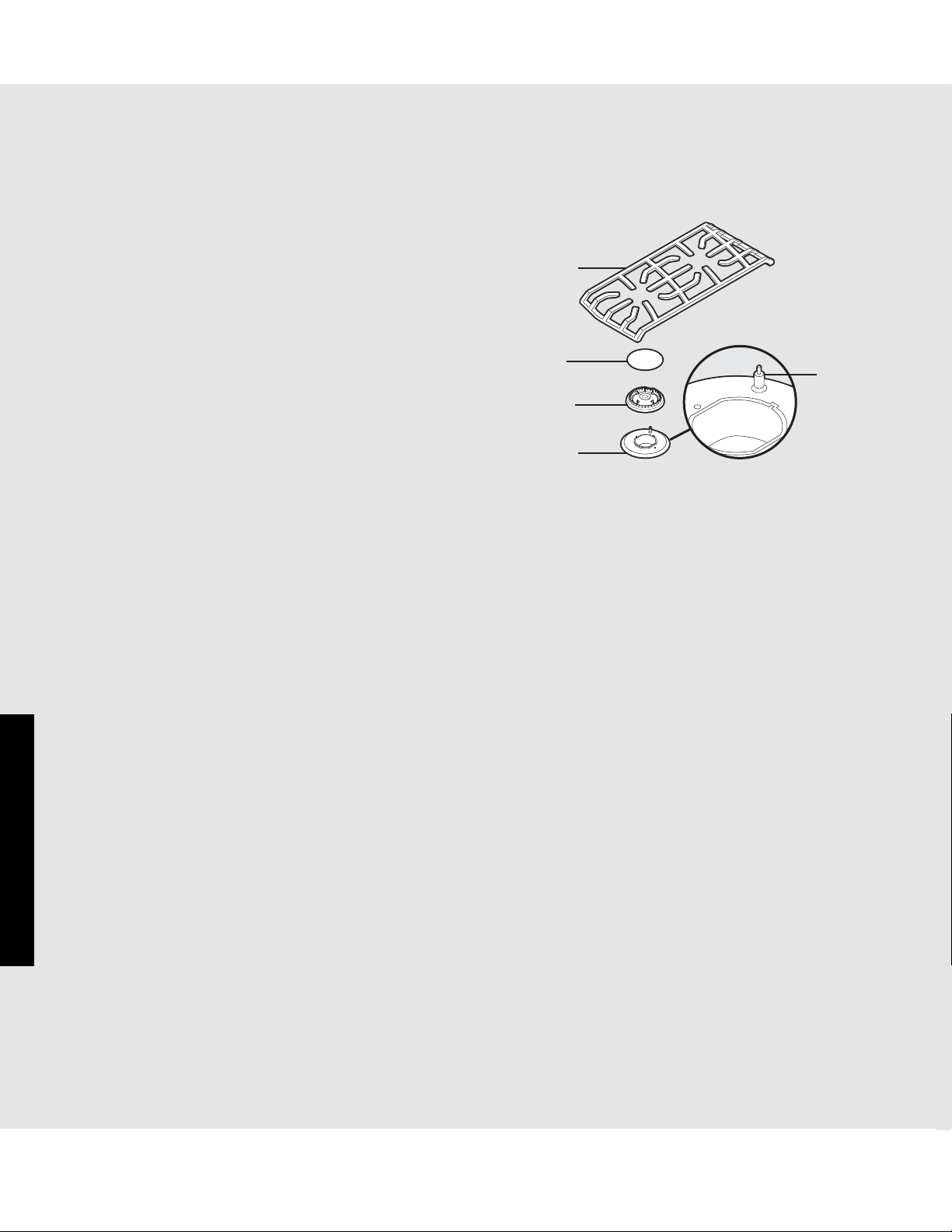
• Remove the burner cap and burner head and clean.
Burner Caps
The surface burner caps should be routinely removed and cleaned.
ALWAYS clean the burner caps after a spill-over. Keeping the
burner caps clean will prevent improper ignition and uneven
flames. To clean, pull burner cap straight up from the burner base.
Wipe off surface burner caps with warm, soapy water and a soft
cloth after each use. Use a non-abrasive cleanser such as Bon
Ami™ and a soft brush or soft Scotch Brite™ pad for cooked-on
foods. Dry thoroughly after cleaning. For best cleaning and to avoid possible rusting, DO NOT clean in dishwasher or self-
cleaning oven.
Igniter
Burner
cap
Burner
grate
Burner
head
Burner
base*
Burner Head
If ports on burner head are clogged, clean with a straight pin.
DO NOT enlarge or distort the ports. DO NOT use a toothpick to clean the ports. When replacing burner head, carefully
align the 2 tabs underneath the burner head with the outside edge of burner base. Make sure the tabs are not aligned with
the igniter and the burner
cap is level.
Note: For stubborn stains, use a non abrasive cleanser such as Bon Ami™ and a soft brush or soft Scotch Brite™ pad.
Cleaning Tip: For difficult to clean burner caps and heads, place parts in a zip seal bag with ammonia.
Burner Base
The base should be wiped regularly with hot soapy water at the end of each cooling period. DO NOT use steel wool,
abrasive cloths, cleanser, or powders. To remove encrusted materials, soak the area with a hot towel to loosen the material,
then use a wooden nylon spatula.
DO NOT use a metal knife, spatula, or any other metal tool to scrape the aluminum base.
• Wipe up any spills which remain on the sealed top surface.
• Replace burner cap, burner head, and grates after drying thoroughly.
Control Panel
DO NOT use any cleaners containing ammonia or abrasives. They could remove the graphics from the control panel. Use
hot, soapy water and a soft clean cloth.
Oven Surfaces
Several different finishes have been used in your oven.
NEVER USE AMMONIA, STEEL WOOL PADS OR ABRASIVE CLOTHS, CLEANSERS, OVEN CLEANERS, OR ABRASIVE
POWDERS. THEY CAN PERMANENTLY DAMAGE YOUR OVEN.
Self-Clean
Your oven features a self-clean cycle for the oven interior.
See the "Self-Clean Cycle" section for complete instructions.
Product Care
25
Product Care
Cleaning and Maintenance
Control Knobs
MAKE SURE ALL THE CONTROL KNOBS POINT TO THE OFF POSITION BEFORE REMOVING. Pull the knobs straight off.
Wash in detergent and warm water. Dry completely and replace by pushing firmly onto stem. DO NOT use any cleaners
containing ammonia or abrasives. They could remove the graphics from the knob.
Stainless Steel Parts
All stainless steel body parts should be wiped regularly with hot soapy water at the end of each cooling period and with a liquid
cleaner designed for that material when soapy water will not do the job. DO NOT use steel wool, abrasive cloths, cleansers, or
powders. If necessary, scrape stainless steel to remove encrusted materials, soak the area with hot towels to loosen the material,
then use a wooden or nylon spatula or scraper. DO NOT use a metal knife, spatula, or any other metal tool to scrape stainless
steel. DO NOT permit citrus or tomato juice to remain on stainless steel surface, as citric acid will permanently discolor stainless
steel. Wipe up any spills immediately.
Glass Surfaces
Clean with detergent and warm water. Glass cleaner can be used to remove fingerprints. If using glass cleaner ammonia,
make sure that it does not run down on exterior door surface.
Oven Racks
Clean with detergent and hot water. Stubborn spots can be scoured with a soap-filled steel wool pad.
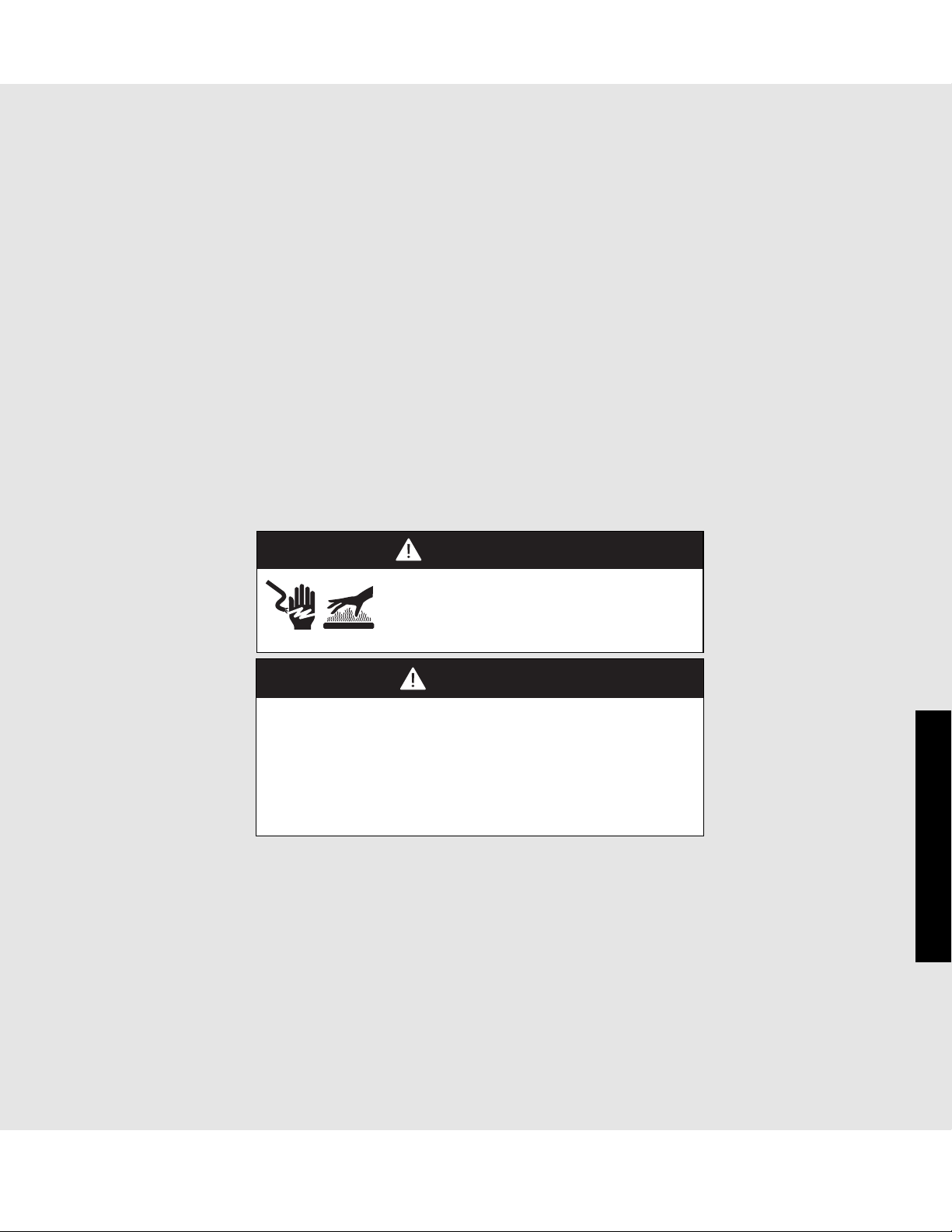
WARNING
BURN OR ELECTRICAL SHOCK HAZARD
Make sure all controls are OFF and oven is COOL
before cleaning. Failure to do so can result in burns
or electrical shock.
This oven features an automatic pyrolytic self-cleaning cycle. During this cycle, the oven reaches elevated temperatures in
order to burn-off soil and deposits. An integral smoke eliminator helps reduce odors associated with the soil burn-off. A
powder ash residue is left in the bottom of the oven after completion of the self-clean cycle. The door latch is automatically
activated after selecting the self-clean setting. The latch ensures that the door cannot be opened while the oven interior is
at clean temperatures.
Before starting the Self-Clean cycle:
1. Remove the oven racks, and any other items/utensils from the oven. The high heat generated during the cleaning cycle
can discolor, warp, and damage these items. DO NOT use foil or liners in the oven. During the self-clean cycle, foil can
burn or melt and damage the oven surface.
2. Wipe off any large spills from the oven bottom and sides. NEVER use oven cleaners inside a self-cleaning oven or on
raised portions of the door.
3. Some areas of the oven must be cleaned by hand before the cycle begins. Soils in these areas will be baked on and very
difficult to clean if not removed first. Clean the door up to the gasket, the door frame, and up to 2 inches inside the frame
with detergent and hot water. Rinse thoroughly and dry.
Self-Clean Cycle
CAUTION
DO NOT touch the exterior portions of the oven after self-cleaning cycle
has begun, since some parts become extremely hot to the touch! During
the first few times the self-cleaning feature is used, there may be some
odor and smoking from the curing of the binder in the high-density
insulation used in the oven. When the insulation is thoroughly cured, this
odor will disappear. During subsequent self-cleaning cycles, you may
sense an odor characteristic of high temperatures. Keep the kitchen well-
vented during the self-cleaning cycle.
26
Product Care
Self-Clean Cycle
To start the Self-Clean cycle:
1. Close the door completely.
2. Turn the oven selector knob clockwise to the “SELF CLEAN” mode.
3. Turn the temperature control knob to the clean setting. At this time, the clean indicator light will come on. Within 30
seconds the automatic door latch engages and the oven indicator light comes on. The oven indicator light will remain on
until the oven reaches the self-clean temperature and will then cycle on and off during the self-clean cycle.
4. The clean indicator light will remain on until the self-clean is completed or interrupted and the oven temperature drops to
a safe temperature. A complete cycle is approximately 2-1/2 hours with an additional 30 minutes needed for the oven to
cool down enough for the door latch to disengage.
Note:
A fan noise will be heard during the self-clean cycle and will continue to run for the 2-1/2 hour duration of the self-
clean cycle.
5. When the cycle is completed, turn both the oven selector and temperature control knob to the “OFF” position. When the
oven has completely cooled, open door and remove any ash from the oven surfaces with a damp cloth.
To stop the Self-Clean cycle:
To cancel or interrupt the self-cleaning cycle, turn both the temperature control knob and the oven function selector knob to
“OFF”. When the oven temperature drops to a safe temperature, the automatic door latch will release and the oven door
can be opened. When the oven has completely cooled, remove any ash from the oven surfaces with a damp sponge or
cloth.
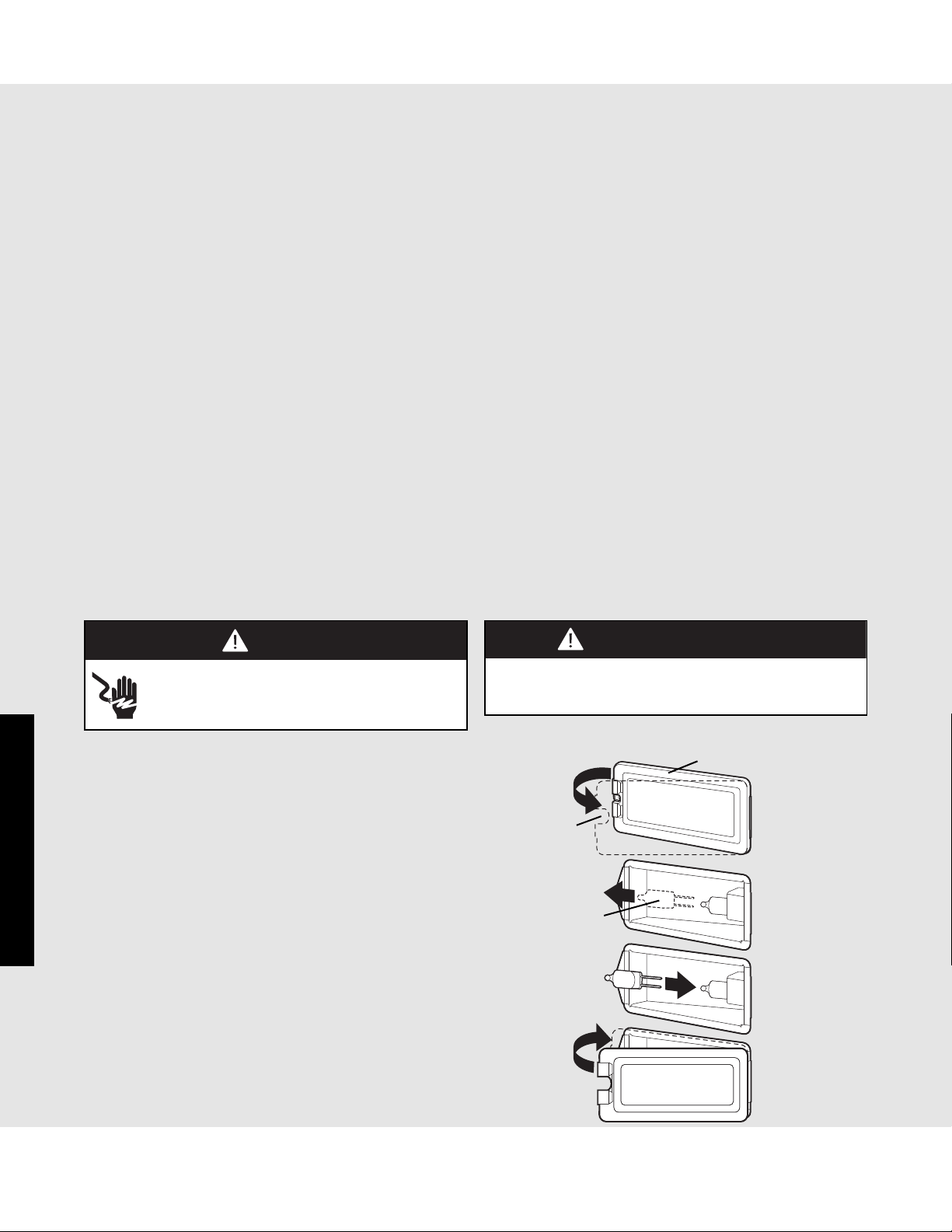
Replacing Oven Lights
1. Unsnap glass light cover using a screwdriver in the access
groove.
2. Firmly grasp light bulb and pull out.
3. Replace with halogen bulb using volt and wattage
requirements listed on glass cover.
4. Replace the light cover by snapping glass cover onto metal
box.
5. Reconnect power at the main fuse or circuit breaker.
WARNING
ELECTRICAL SHOCK HAZARD
Disconnect the electric power at the main
fuse or circuit breaker before replacing bulb.
WARNING
DO NOT touch bulb with bare hands. Clean off any signs
of oil from the bulb and handle with a soft cloth.
access
groove
light
bulb
glass light
cover
27
Product Care
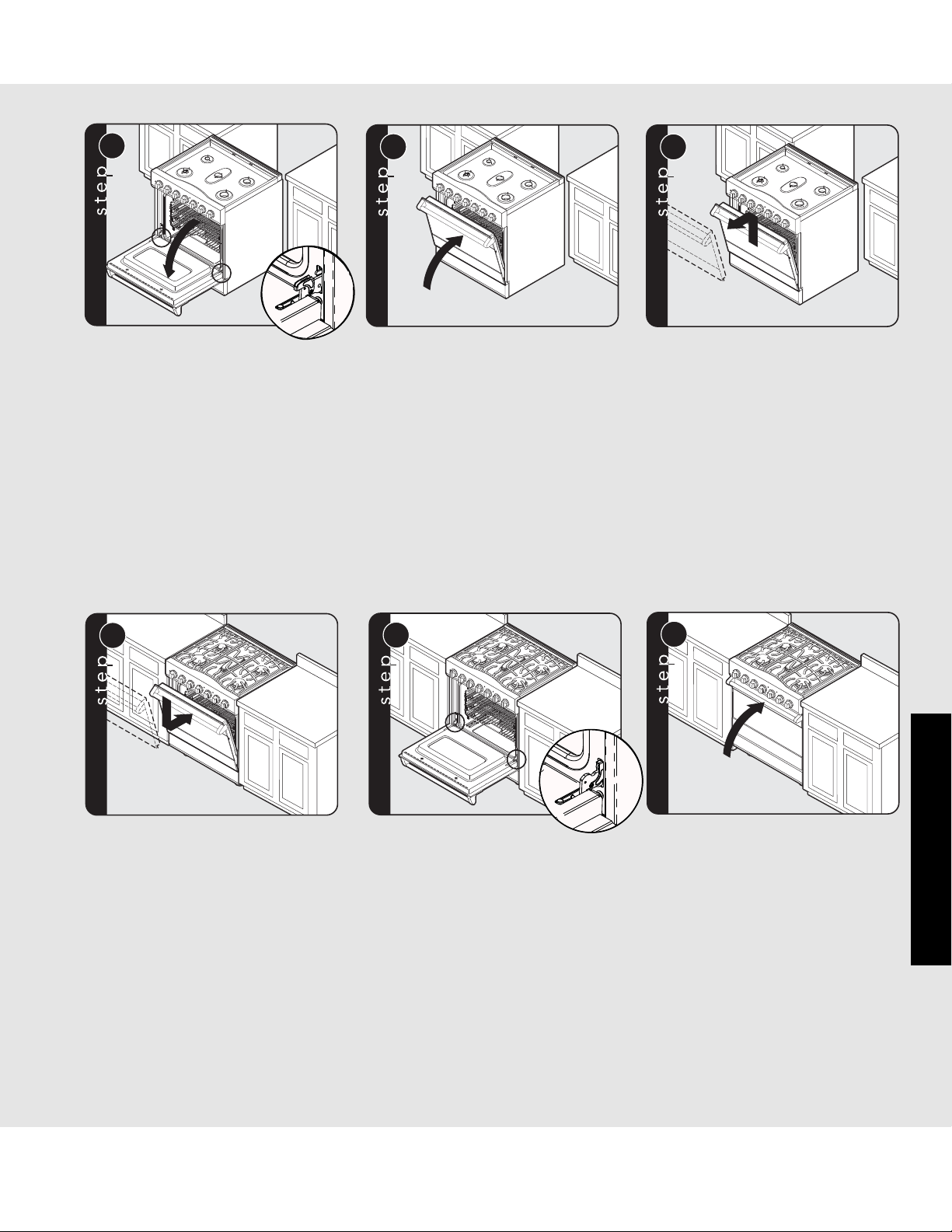
Door Removal
1
2
3
Open door completely. Fold latches back
until locked in place
Gently close until latches stop door.
Lift door up and out.
Door Replacement
1
Carefully realign door on hinges.
Slide in and down
Open door completely.
Fold latches forward until locked in place.
2
3
Close door.
28
Product Care
Troubleshooting
Problem
Possible Cause and/or Remedy
Range will not function.
Range is not connected to electrical power:
Have electrician check power circuit breaker,
wiring, and fuses.
Oven does not operate in
self-clean.
Door is not shut tight enough for automatic
door latch to lock.
Oven is not clean after self-
clean cycle.
Temperature control knob not rotated all the
way past clean until it stops.
Broil does not work.
Temperature control knob is rotated too far
past broil position.
Door will not open.
Oven is still in self-clean mode. If oven is
hot, door latch will release when safe
temperature is reached.
Oven light will not work.
Light bulb is burned out.
Range is not connected to power.
Igniters will not work.
Circuit is tripped.
Fuse is blown.
Range is not connected to power.
Igniters sparking but no
flame ignition.
Gas supply valve is in “OFF” position.
Gas supply is interrupted.
Igniters sparking
continuously after flame
ignition.
Power supply is not grounded.
Power supply polarity is reversed.
Igniters are wet or dirty.
Burner ignites but flame is
large, distorted, or yellow.
Burner ports are clogged.
Unit is being operated on wrong type of gas.
Air shutters not properly adjusted.

29
Product Care
Service Information
If service is required, call your dealer or authorized service agency.
The name of the authorized service agency can be obtained from the dealer or distributor in your area.
Have the following information readily available.
• Model number
• Serial number
• Date purchased
• Name of dealer from whom purchased
Clearly describe the problem that you are having. If you are unable to obtain the name of an authorized service agency, or if
you continue to have service problems, contact Viking Range, LLC at
1-888-VIKING1 (845-4641), or write to:
VIKING RANGE, LLC
PREFERRED SERVICE
111 Front Street
Greenwood, Mississippi 38930 USA
Record the information indicated below. You will need it if service is ever required.
The model and serial number can be found by looking underneath the front edge of the control panel.
Model no. ____________________________________________________ Serial no. ________________________________________________
Date of purchase____________________________________________ Date installed __________________________________________
Dealer’s name ____________________________________________________________________________________________________________
Address ____________________________________________________________________________________________________________________
______________________________________________________________________________________________________________________________
If service requires installation of parts, use only authorized parts to insure protection under the warranty.
Keep this manual for future reference.

30
Product Care
Warranty
FREESTANDING DUAL FUEL SELF-CLEAN RANGES WARRANTY
ONE YEAR FULL WARRANTY
Freestanding dual fuel ranges and all of their component parts, except as detailed below*†, are warranted to be free from defective materials or
workmanship in normal residential use for a period of one (1) year from the date of original retail purchase. Viking Range, LLC, warrantor, agrees to
repair or replace, at its option, any part which fails or is found to be defective during the warranty period.
*FULL NINETY (90) DAY COSMETIC WARRANTY: Product is warranted to be free from cosmetic defects in materials or workmanship (such
as scratches on stainless steel, paint/porcelain blemishes, etc.) for a period of ninety (90) days from the date of original retail purchase or closing
date for new construction, whichever period is longer. Any defects must be reported to the selling dealer within ninety (90) days from date of
original retail purchase. Viking Range, LLC uses high quality processes and materials available to produce all color finishes. However, slight
color variation may be noticed because of the inherent differences in painted parts and porcelain parts as well as differences in kitchen lighting,
product locations, and other factors. Therefore, this warranty does not apply to color variation attributable to such factors.
†FULL NINETY (90) DAY WARRANTY IN "RESIDENTIAL PLUS" APPLICATIONS: This full warranty applies to applications where use of the
product extends beyond normal residential use, but the warranty period for products used in such applications is ninety (90) days. Examples of
applications covered by this warranty are bed and breakfasts, fire stations, private clubs, churches, yachts, etc. Under this "Residential Plus"
warranty, the product, its components and accessories are warranted to be free from defective material or workmanship for a period of ninety
(90) days from the date of original retail purchase. This warranty excludes use of the product in all commercial locations such as restaurants,
food service locations and institutional food service locations.
FIVE YEAR LIMITED WARRANTY ON BURNERS
Any surface burner, broil element or oven burner which fails due to defective materials or workmanship (excluding cosmetic failures) in normal
household use during the fourth through fifth year from the date of original retail purchase will be repaired or replaced, free of charge for the part
itself, with the owner paying all other costs, including labor. This does not include ignition systems, burner bases, etc.
TERMS AND CONDITIONS
This warranty extends to the original purchaser of the product warranted hereunder and to each transferee owner of the product during the term of
the warranty and applies to products purchased and located in the United States, Mexico, and the Caribbean (excluding Cuba, Dominican
Republic, and Haiti). Products must be purchased in the country where service is requested. If the product or one of its component parts contains a
defect or malfunction during the full warranty period after a reasonable number of attempts by the warrantor to remedy the defect or malfunction,
the owner is entitled to either a refund or replacement of the product or its component part or parts. Replacement of a component part includes
its free installation, except as specified under the limited warranty. Under the terms of this warranty, service must be performed by a factory
authorized Viking Range, LLC service agent or representative. Service will be provided during normal business hours, and labor performed at
overtime or premium rates shall not be covered by this warranty.
Owner shall be responsible for proper installation, providing reasonable and necessary maintenance,providing proof of purchase upon request, and
making the appliance reasonably accessible for service. The return of the Owner Registration Card is not a condition of warranty coverage. You
should, however, return the Owner Registration Card so that Viking Range, LLC can contact you should any question of safety arise which could
affect you.
This warranty gives you specific legal rights, and you may also have other rights which may vary from jurisdiction to jurisdiction.
WHAT IS NOT COVERED BY THIS WARRANTY: This warranty shall not apply to damage resulting from abuse, failure to provide reasonable and
necessary maintenance, accident, delivery, negligence, natural disaster, loss of electrical power to the product for any reason, alteration, outdoor
use, improper installation, improper operation, or repair or service of the product by anyone other than an authorized Viking Range, LLC service
agency or representative. This warranty does not apply to commercial usage.
LIMITATION OF REMEDIES AND DURATION OF IMPLIED WARRANTYOWNER’S SOLE AND EXCLUSIVE REMEDY FOR A CLAIM OF ANY
KIND WITH RESPECT TO THISPRODUCT SHALL BE THE REMEDIES SET FORTH ABOVE. VIKING RANGE IS NOT RESPONSIBLE
FORCONSEQUENTIAL OR INCIDENTAL DAMAGE, INCLUDING BUT NOT LIMITED TO FOOD ORMEDICINE LOSS, DUE TO PRODUCT
FAILURE, WHETHER ARISING OUT OF BREACH OF WARRANTY, BREACH OF CONTRACT OR OTHERWISE. Some jurisdictions do not
allow the exclusion or limitation of incidental or consequential damages, so the above limitation or exclusions may not apply to you. ANY
IMPLIED WARRANTIES OF MERCHANTABILITY OR FITNESS FOR A PARTICULAR PURPOSE APPLICABLE TO THIS PRODUCT ARE
LIMITED IN DURATION TO THE PERIOD OF COVERAGE OF THE APPLICABLE EXPRESS WRITTEN LIMITED WARRANTIES SET FORTH
ABOVE. Some states do not allow limitations on how long an implied warranty lasts, so the above limitation may not apply to you.
WARRANTY SERVICE
To obtain warranty service, contact an authorized Viking Range, LLC service agent, or Viking Range Corporation, 111 Front Street, Greenwood,
Mississippi 38930, (888) 845-4641. Provide model and serial number and date of original purchase or closing date for a new construction. For the
name of your nearest authorized Viking Range, LLC service agency, call Viking Range, LLC.
IMPORTANT: Retain proof of original purchase to establish warranty period.
Specifications subject to change without notice.

31
Product Care

F21188B EN (070115)
Viking Range, LLC
111 Front Street
Greenwood, Mississippi 38930 USA
(662) 455-1200
For product information, call 1-888-845-4641
or visit the our web site at vikingrange.com in the US or
brigade.ca in Canada
