®
lectric Range
Drop-in models
/_"°:_ i 4 °:_
Estufa el_ctrica
Modelos empotrantes
(7(:7 LJ.:_O_i .,tJIC_]_,.!_CI(.
Models, Modelos 790. 4506_=, 4507_=
o,._-= Color number, nOmero de color
W_
FII
318200837(0402)Rev.B Sears Roebuck and Co., Hoffman Estates, IL 60179 U.S.A.
www.sears.com
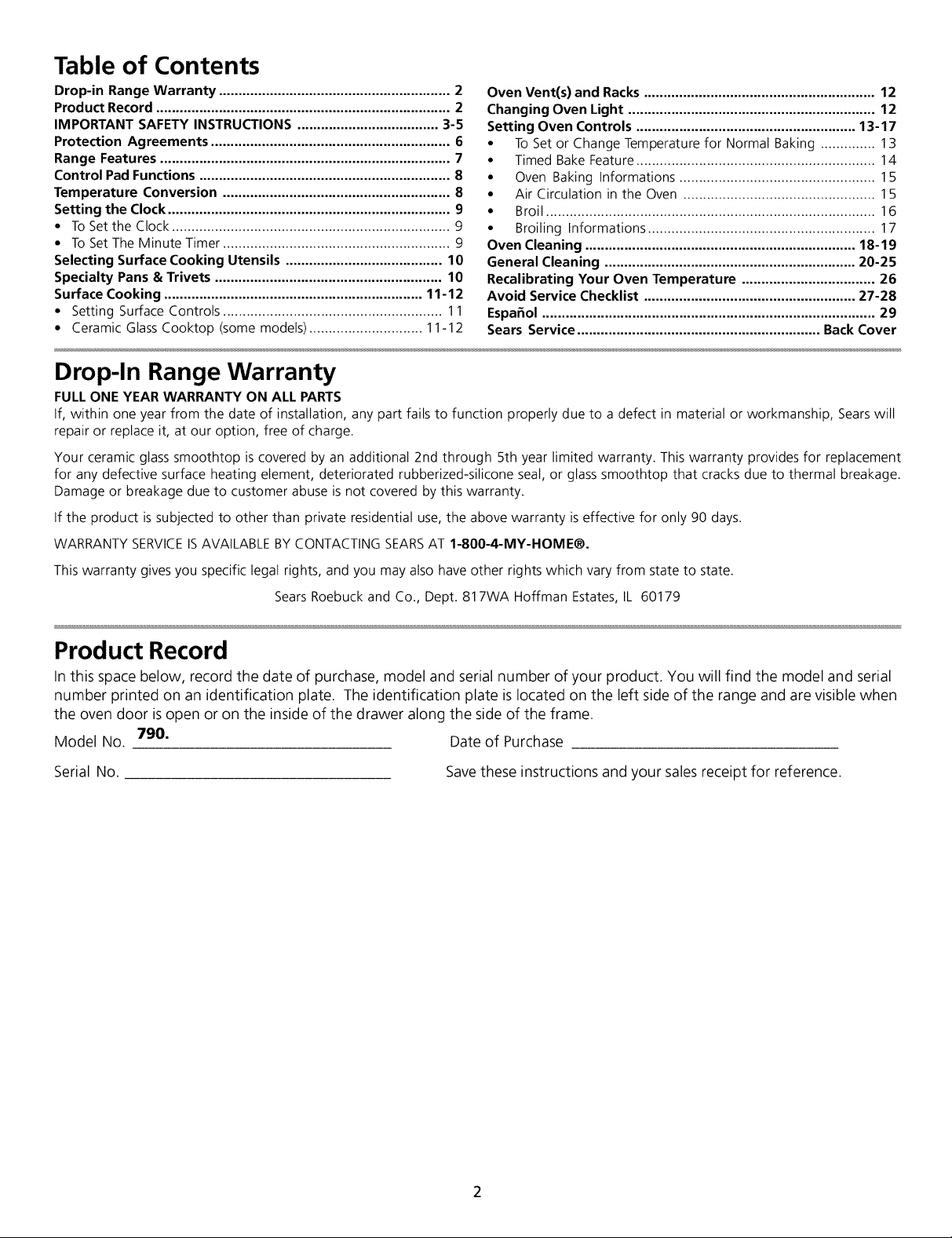
Table of Contents
Drop-in Range Warranty ........................................................... 2
Product Record ........................................................................... 2
IMPORTANT SAFETY INSTRUCTIONS .................................... 3-5
Protection Agreements ............................................................. 6
Range Features .......................................................................... 7
Control Pad Functions ................................................................ 8
Temperature Conversion .......................................................... 8
Setting the Clock ........................................................................ 9
• To Set the Clock ....................................................................... 9
• To Set The Minute Timer .......................................................... 9
Selecting Surface Cooking Utensils ........................................ 10
Specialty Pans & Trivets .......................................................... 10
Surface Cooking .................................................................. 11-12
• Setting Surface Controls ........................................................ 11
• Ceramic Glass Cooktop (some models) ............................. 11-12
Oven Vent(s) and Racks ........................................................... 12
Changing Oven Light ............................................................... 12
Setting Oven Controls ........................................................ 13-17
• To Set or Change Temperature for Normal Baking .............. 3
• Timed Bake Feature ............................................................. 4
• Oven Baking Informations .................................................. 5
• Air Circulation in the Oven ................................................. 5
• Broil .................................................................................... 6
• Broiling Informations .......................................................... 7
Oven Cleaning ..................................................................... 18-19
General Cleaning ................................................................ 20-25
Recalibrating Your Oven Temperature .................................. 26
Avoid Service Checklist ...................................................... 27-28
Espa_ol ..................................................................................... 29
Sears Service .............................................................. Back Cover
Drop-In Range Warranty
FULL ONE YEAR WARRANTY ON ALL PARTS
If, within one year from the date of installation, any part fails to function properly due to a defect in material or workmanship, Sears will
repair or replace it, at our option, free of charge.
Your ceramic glass smoothtop is covered by an additional 2nd through 5th year limited warranty. This warranty provides for replacement
for any defective surface heating element, deteriorated rubberized-silicone seal, or glass smoothtop that cracks due to thermal breakage.
Damage or breakage due to customer abuse is not covered by this warranty.
If the product is subjected to other than private residential use, the above warranty is effective for only 90 days.
WARRANTY SERVICE IS AVAILABLE BY CONTACTING SEARS AT 1-800-4-MY-HOME®.
This warranty gives you specific legal rights, and you may also have other rights which vary from state to state.
Sears Roebuck and Co., Dept. 817WA Hoffman Estates, IL 60179
Product Record
In this space below, record the date of purchase, model and serial number of your product. You will find the model and serial
number printed on an identification plate. The identification plate is located on the left side of the range and are visible when
the oven door is open or on the inside of the drawer along the side of the frame.
Model No. 790. Date of Purchase
Serial No.
Save these instructions and your sales receipt for reference.
IMPORTANT SAFETY INSTRUCTIONS
Read all instructions before using this appliance.
Save these instructions for future reference.
This manual contains many important safety messages. Always read and obey all safety messages.
The safety symbol _ calls your attention to safety messages that inform you of hazards that can kill or hurt you or others, or
cause damage to the product.
Indicates an imminently hazardous situation which, if not avoided may result in death or serious injury.
Indicates an imminently hazardous situation which, if not avoided may result in minor or moderate injury, or
product damage.
All safety messageswill identify the hazard, tell you how to reduce the chance of injury, and tell you what can happen if the
instructions are not followed.
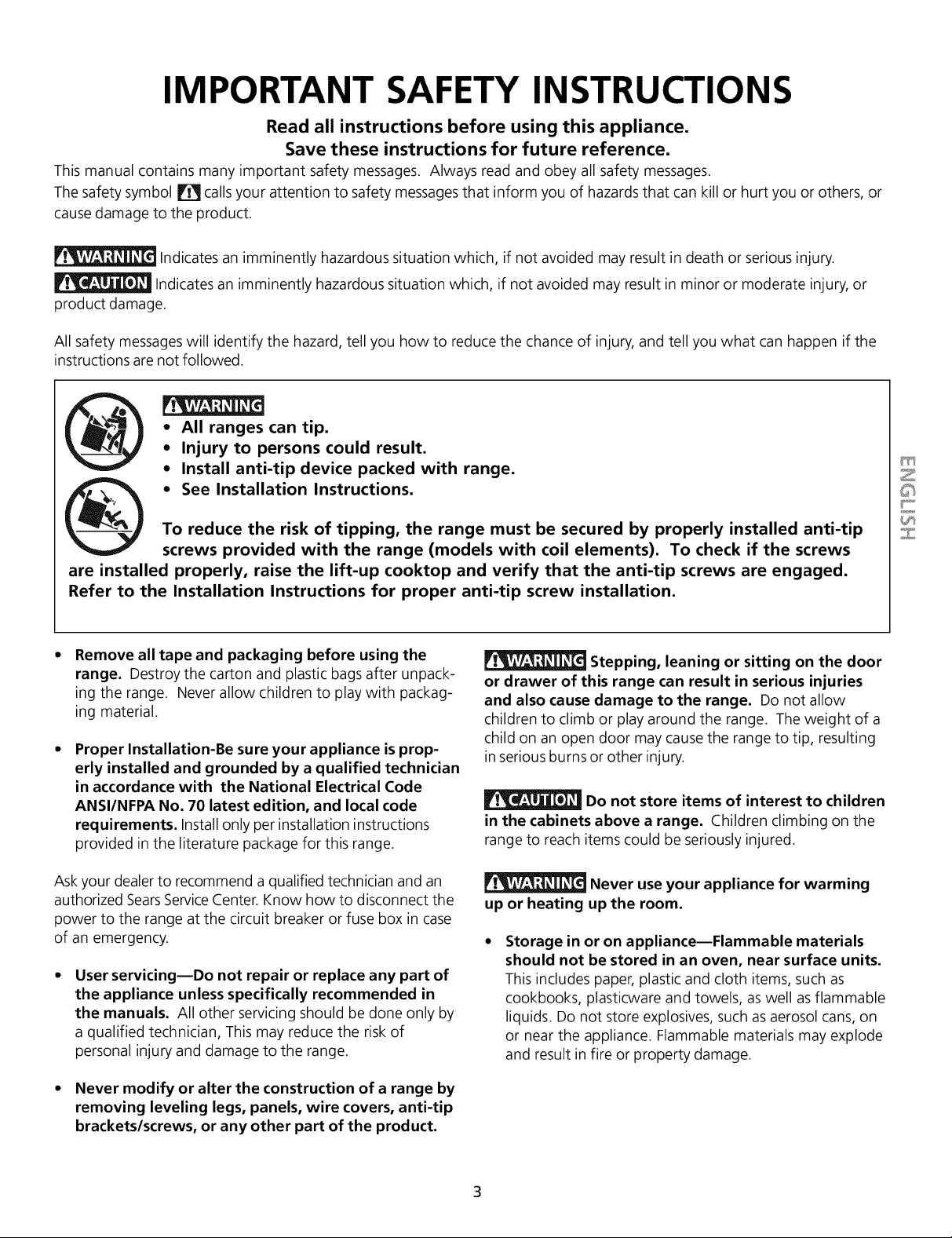
• All ranges can tip.
• Injury to persons could result.
• Install anti-tip device packed with range.
• See Installation Instructions.
To reduce the risk of tipping, the range must be secured by properly installed anti-tip
screws provided with the range (models with coil elements). To check if the screws
are installed properly, raise the lift-up cooktop and verify that the anti-tip screws are engaged.
Refer to the Installation Instructions for proper anti-tip screw installation.
Z
©
Z
Remove all tape and packaging before using the
range. Destroy the carton and plastic bags after unpack-
ing the range. Never allow children to play with packag-
ing material.
Proper Installation-Be sure your appliance is prop-
erly installed and grounded by a qualified technician
in accordance with the National Electrical Code
ANSI/NFPA No. 70 latest edition, and local code
requirements. Install only per installation instructions
provided in the literature package for this range.
Ask your dealer to recommend a qualified technician and an
authorized SearsServiceCenter. Know how to disconnect the
power to the range at the circuit breaker or fuse box in case
of an emergency.
User servicing--Do not repair or replace any part of
the appliance unless specifically recommended in
the manuals. All other servicing should be done only by
a qualified technician, This may reduce the risk of
personal injury and damage to the range.
• Never modify or alter the construction of a range by
removing leveling legs, panels, wire covers, anti-tip
brackets/screws, or any other part of the product.
Stepping, leaning or sitting on the door
or drawer of this range can result in serious injuries
and also cause damage to the range. Do not allow
children to climb or play around the range. The weight of a
child on an open door may cause the range to tip, resulting
in serious burns or other injury.
Do not store items of interest to children
in the cabinets above a range. Children climbing on the
range to reach items could be seriously injured.
Never use your appliance for warming
up or heating up the room.
Storage in or on appliance--Flammable materials
should not be stored in an oven, near surface units.
This includes paper, plastic and cloth items, such as
cookbooks, plasticware and towels, as well as flammable
liquids. Do not store explosives, such as aerosol cans, on
or near the appliance. Flammable materials may explode
and result in fire or property damage.
IMPORTANT SAFETY INSTRUCTIONS
Do not leave children alone--Children should not be
left alone or unattended in the area where appliance
is in use. They should never be allowed to sit or stand
on any part of the appliance.
DO NOT TOUCH SURFACE UNITS, AREAS NEAR THESE
UNITS, OVEN HEATING ELEMENTS OR INTERIOR
SURFACESOF THE OVEN. Both surface and oven
heating elements may be hot even though they are dark
in color. Areas near surface units may become hot
enough to cause burns. During and after use, do not
touch, or let clothing or other flammable materials touch
these areas until they have had sufficient time to cool.
Among these areas are the cooktop, surfaces facing the
cooktop, the oven vent openings and surfaces near these
openings, oven door and window.
Wear proper apparel--Loose-fitting or hanging
garments should never be worn while using the
appliance. Do not let clothing or other flammable
materials contact hot surfaces.
• Do not use water or flour on grease fires--Smother
the fire with a pan lid, or use baking soda, a dry
chemical or foam-type extinguisher.
• When heating fat or grease, watch it closely. Fat or
grease may catch fire if allowed to become too hot.
Use only dry potholders--Moist or damp potholders
on hot surfaces may result in burns from steam. Do
not let potholders touch hot heating elements. Do not
use a towel or other bulky cloth instead of a potholder.
• Do not heat unopened food containers--Buildup of
pressure may cause container to burst and result in
injury.
• Remove the oven door from any unused range if it
is to be stored or discarded.
IM PORTANT--Do not attempt to operate the oven
during a power failure. If the power fails, always turn
the oven off. If the oven is not turned off and the power
resumes, the oven may begin to operate again. (Food left
unattended could catch fire or spoil.)
Electronic controllers can be damaged by
cold temperatures. When you use your appliance for
the first time, or if it has not been used for a long
period of time, make sure that it has been exposed to a
temperature above 0°C/32°F for at least 3 hours before
connecting it to the power supply.
IMPORTANT INSTRUCTIONS FOR USING YOUR
COOKTOP
• Know which knob controls each surface heating unit.
Use proper pan size. This appliance is equipped with one
or more surface units of different sizes. Select utensils
having flat bottoms large enough to cover the surface unit.
The use of undersized utensils will expose a portion of the
surface heating unit to direct contact and may result in
ignition of clothing. Proper relationship of utensil to the
surface unit will also improve efficiency.
Utensil handles should be turned inward and not
extend over adjacent surface units. To reduce the risk
of burns, ignition of flammable materials, and spillage due
to unintentional contact with the utensil.
Never leave surface burners unattended at high heat
settingsiBoilovers cause smoking and greasy accumula-
tions that may ignite, or a pan that has boiled dry may
melt.
Protective linersiDo not use aluminum foil to line oven
bottom or any other part of the appliance. Only use
aluminum foil as recommended for baking if used as a
cover placed on the food. Any other use of protective liners
or aluminum foil may result in a risk of electric shock or
fire or short circuit.
Glazed cooking utensilsiOnly certain types of glass,
glass/ceramic, ceramic, earthenware, or other glazed
utensils are suitable for rangetop service without breaking
due to the sudden change in temperature. Check the
manufacturer's recommendations for cooktop use.
Do not use decorative surface element covers. If an
element is accidentally turned on, the decorative cover will
become hot and possibly melt. Burns will occur if the hot
covers are touched. Damage may also be done to the
cooktop.
FOR GLASS COOKTOPS ONLY
• Do not clean or operate a broken cooktopilf cooktop
should break, cleaning solutions and spillovers may
penetrate the broken cooktop and create a risk of electric
shock. Contact a qualified technician immediately.
Clean cooktop glass with cautionilf a wet sponge or
cloth is used to wipe spills on a hot cooking area, be
careful to avoid a steam burn. Some cleaners can produce
harmful fumes if applied to a hot surface.
• Avoid scratching the cooktop glass with sharp
objects.
IMPORTANT SAFETY INSTRUCTIONS
IMPORTANT INSTRUCTIONS FOR USING YOUR
OVEN
• Use care when opening oven door. --Stand to the side
of the range when opening the door of a hot oven. Let
hot air or steam escape before you remove or replace food
in the oven.
Keep oven vent ducts unobstructed. The oven vent is
located at the rear of the cooktop on the right side.
Touching the surfaces in this area when the oven is
operating may cause severe burns. Also, do not place
plastic or heat-sensitive items on or near the oven vent.
These items could melt or ignite.
Placement of oven Racks. Always place oven racks in
desired location while oven is cool. If rack must be moved
while oven is hot use extreme caution. Use potholders and
grasp the rack with both hands to reposition. Do not let
potholders contact the hot heating elements in the oven.
Remove all utensils from the rack before moving.
• Do not use the broiler pan without its insert. The
broiler pan and its insert allow dripping fat to drain and be
kept away from the high heat of the broiler.
• Do not cover the broiler insert with aluminum foil.
Exposed fat and grease could ignite.
Kitchen cleaners and aerosols--Always follow the
manufacturer's recommended directions for use. Be
aware that excess residue from cleaners and aerosols may
ignite causing damage and injury.
SELF-CLEANING OVENS
• In the self-cleaning cycle, only clean the parts listed
in this Use and Care Guide. Before self-cleaning the
oven, remove the broiler pan and any utensils or foods
from the oven.
• Do not use oven cleanersiNo commercial oven
cleaner or oven liner protective coating of any kind should
be used in or around any part of the oven.
• Do not clean door gasketiThe door gasket is essential
for a good seal. Care should be taken not to rub, damage
or move the gasket.
• Remove oven racks. Oven racks color will change if left
in the oven during a self-cleaning cycle.
The health of some birds is extremely
sensitive to the fumes given off during the self-clean-
ing cycle of any range. Move birds to another well
ventilated room.
Do not touch a hot light bulb with a damp cloth.
Doing so could cause the bulb to break. Disconnect the
appliance or turn off the power to the appliance before
removing and replacing light bulb.
IMPORTANT INSTRUCTIONS FOR CLEANING
YOUR RANGE
• Clean the range regularly to keep all parts free of
grease that could catch fire. Exhaust fan ventilation
hoods and grease filters should be kept clean. Do not
allow grease to accumulate on hood or filter. Greasy
deposits in the fan could catch fire. When you are flaming
food under the hood, turn the fan on. Refer to the hood
manufacturer's instructions for cleaning.
IMPORTANT SAFETY NOTICE
The California Safe Drinking Water and Toxic Enforcement Act
requires the Governor of California to publish a list of substances
known to the state to cause cancer, birth defects or other
reproductive harm, and requires businesses to warn customers of
potential exposure to such substances.
SAVE THESE SAFETY INSTRUCTIONS
Z
©
Z
PROTECTION AGREEMENTS
In the U.S.A.
Master Protection Agreements
Congratulations on making a smart purchase. Your new
Kenmore ®product is designed and manufactured for years of
dependable operation. But like all products, it may require
preventive maintenance or repair from time to time. That's
when having a Master Protection Agreement can save you
money and aggravation.
Purchase a Master Protection Agreement now and protect
yourself from unexpected hassle and expense.
The Master Protection Agreement also helps extend the life of
your new product. Here's what's included in the Agreement:
Expert service by our 12,000 professional repair
specialists
Unlimited service and no charge for parts and labor on
all covered repairs
"No-lemon" guarantee- replacement
of your covered product if four or more product failures
occur within twelve months
Product replacement if your covered product can't be
fixed
Annual Preventive Maintenance Check at your request
- no extra charge
Fast help by phone - phone support from a Sears
technician on products requiring in-home repair, plus
convenient repair scheduling
I_ Power surge protection against electrical damage due
to power fluctuations
Rental reimbursement if repair of your covered product
takes longer than promised
In Canada
Maintenance Agreements
Your purchase has added value because you can depend
on Sears HomeCentral®for service. With over 2400
Service Technicians and more than a million parts and
accessories, we have the tools, parts, knowledge and
skills to ensure our pledge: We Service What We Sell.
Your Kenmore®product isdesigned, manufactured
and tested to provide years of dependable operation. But
like all products, it may require service from time to time.
The Sears Maintenance Agreement offers you an
outstanding service program, affordably priced.
The Sears Maintenance Agreement:
Is your way to buy tomorrow's service at today's price
Eliminates repair bills resulting from normal wear and
tear
Provides phone support from a Sears technician on
products requiring in-home repair
Even if you don't need repairs, provides an annual
Preventive Maintenance Check, at your request, to
ensure that your product is in proper running condition.
Some limitations apply. For more information about
Sears Canada Maintenance Agreements,
call 1-800-361-6665
Once you purchase the Agreement, a simple phone call is all
that it takes for you to schedule service. You can call anytime
day or night, or schedule a service appointment online.
Sears has over 12,000 professional repair specialists, who have
accessto over 4.5 million quality parts and accessories. That's
the kind of professionalism you can count on to help prolong
the life of your new purchase for years to come. Purchase your
Master Protection Agreement today!
Some limitations and exclusions apply.
For prices and additional information call
1-800-827-6655.
Sears Installation Service
For Searsprofessional installation of home
appliances, garage door openers, water heaters,
and other major home items, in the U.S.A. call
1-800-4-MY-HOM E®
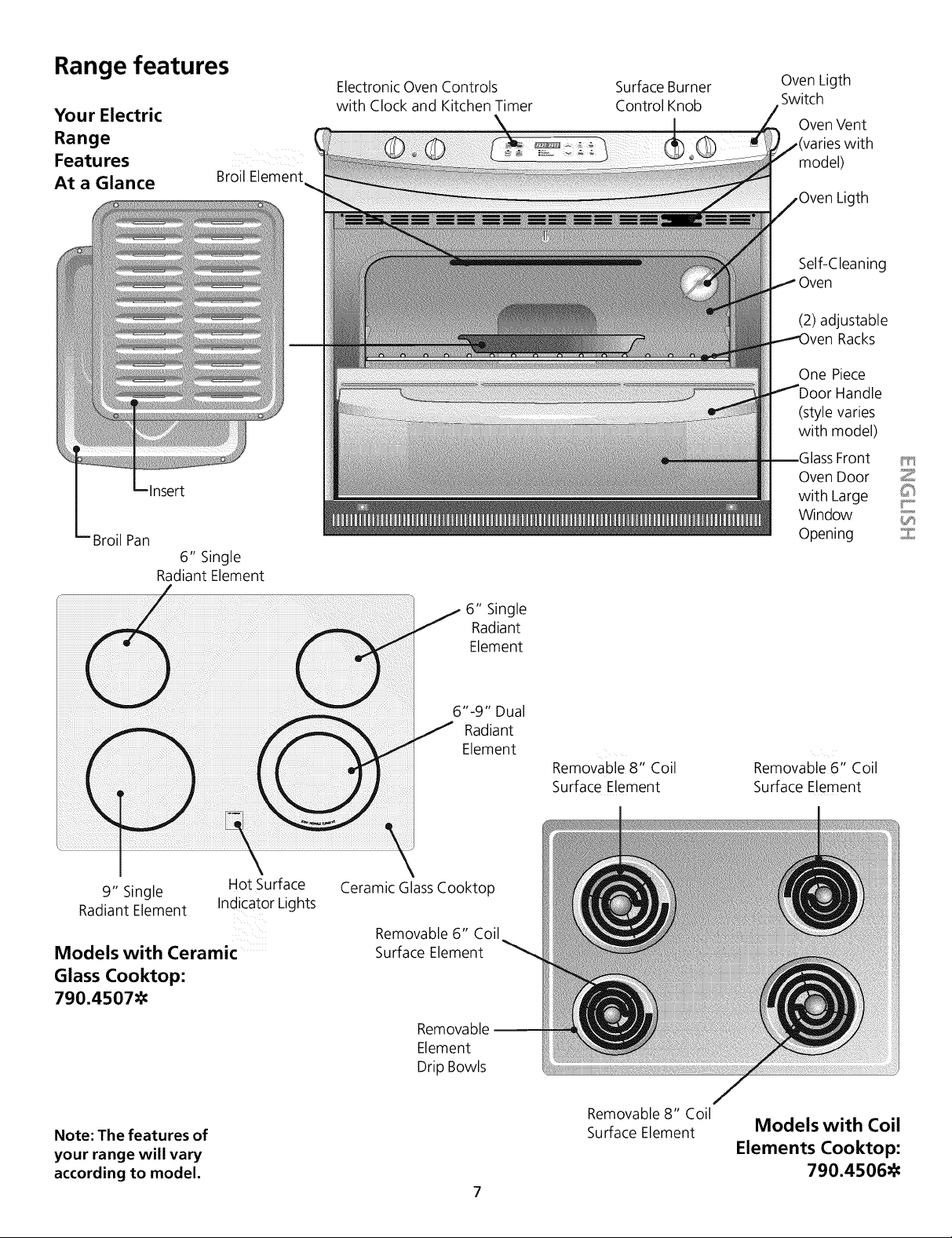
Range features
Your Electric
Range
Features
At a Glance
Broil Element
Electronic Oven Controls
with Clock and Kitchen Timer
Surface Burner
Control Knob
Oven Ligth
Switch
Oven Vent
with
model)
Ligth
Self-Cleaning
Broil Pan
_ert
6" Single
Radiant Element
6" Single
Radiant
Element
(2) adjustable
Racks
One Piece
Handle
(style varies
with model)
Oven Door
with Large
Window
Opening
Z
©
Z
6"-9" Dual
Radiant
Element
Removable 8" Coil
Surface Element
Removable 6" Coil
Surface Element
9" Single Hot Surface
Radiant Element Indicator Lights
Models with Ceramic
Glass Cooktop:
790.4507_
Ceramic GlassCooktop
Removable 6" Coil
Surface Element
Removable
Element
Drip Bowls
Note: The features of
your range will vary
according to model.
Removable 8" Coil
Surface Element
Models with Coil
Elements Cooktop:
790.4506@
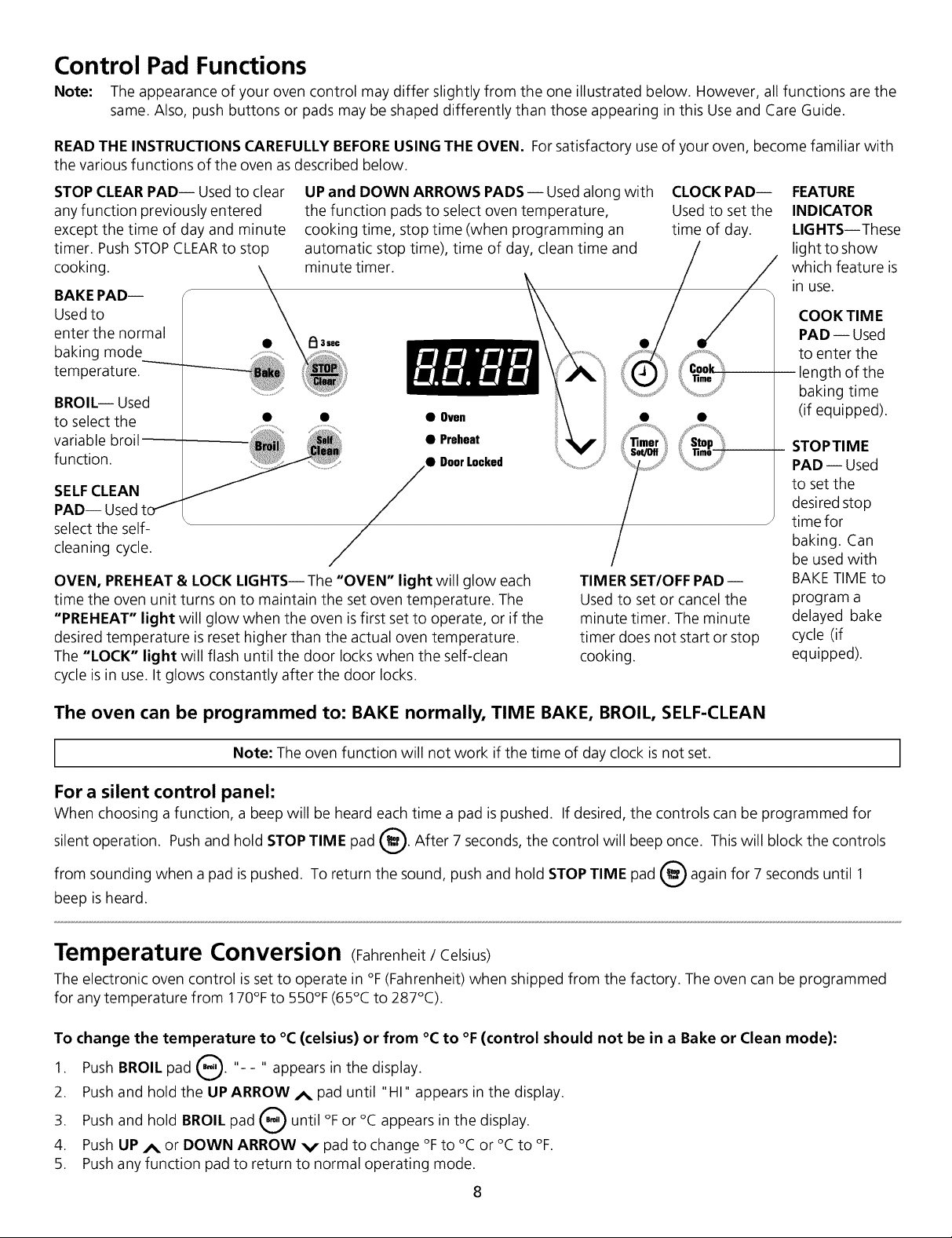
Control Pad Functions
Note: The appearance of your oven control may differ slightly from the one illustrated below. However, all functions are the
same. Also, push buttons or pads may be shaped differently than those appearing in this Use and Care Guide.
READ THE INSTRUCTIONS CAREFULLY BEFORE USING THE OVEN. For satisfactory use of your oven, become familiar with
the various functions of the oven as described below.
STOP CLEAR PADi Used to clear UPand DOWN ARROWS PADSiUsed along with CLOCK PADi FEATURE
any function previously entered the function pads to select oven temperature, Used to set the INDICATOR
except the time of day and minute cooking time, stop time (when programming an time of day. LIGHTSiThese
timer. Push STOPCLEAR to stop automatic stop time), time of day, clean time an light to show
cooking. \ minute timer, il which feature is
BAKE PADi _ \ in use.
Usedto \ COOK TIME
enter the normal ', PAD i Used
.... • \ PI3,oc
DaK,ngmoae__ ".... .... i:_ i_ _i:i!!!_!"ki_ toenterthe
temnerature _:
,, . length of the
.... : baking time
BROILi Used (if equipped).
to select the
variable broil
function.
SELFCLEAN
PADi Used to_
select the self-
cleaning cycle.
• • • Oven
• _ _t_::, • Preheat
_:_ • DoorLocked
OVEN, PREHEAT & LOCK LIGHTSi The "OVEN" light will glow each
time the oven unit turns on to maintain the set oven temperature. The
"PREHEAT" light will glow when the oven is first set to operate, or if the
desired temperature is reset higher than the actual oven temperature.
The "LOCK" light will flash until the door locks when the self-clean
cycle is in use. It glows constantly after the door locks.
_ Timer Stop '_
TIMER SET/OFF PAD
i
Used to set or cancel the
minute timer. The minute
timer does not start or stop
cooking.
STOPTIME
PAD i Used
to set the
desired stop
/ time for
baking. Can
be used with
BAKE TIME to
program a
delayed bake
cycle (if
equipped).
The oven can be programmed to: BAKE normally, TIME BAKE, BROIL, SELF-CLEAN
Note: The oven function will not work if the time of day clock is not set.
For a silent control panel:
When choosing a function, a beep will be heard each time a pad is pushed. If desired, the controls can be programmed for
silent operation. Push and hold STOP TIME pad (_. After 7 seconds, the control will beep once. This will block the controls
from sounding when a pad is pushed. To return the sound, push and hold STOP TIME pad _'_ again for 7 seconds until 1
v
beep is heard.
Temperature Conversion (Fahrenheit / Celsius)
The electronic oven control is set to operate in °F (Fahrenheit) when shipped from the factory. The oven can be programmed
for any temperature from 170°F to 550°F (65°C to 287°C).
To change the temperature to °C (celsius) or from °C to °F (control should not be in a Bake or Clean mode):
1. Push BROIL pad (_. "- - " appears in the
display.
2. Push and hold the UP ARROW _ pad until " Hl " appears in the display.
3. Push and hold BROIL pad _ until °F or °C appears in the
display.
4. Push UP _or DOWN ARROW v pad to change °Fto°C or °C to °F.
5. Pushany function pad to return to normal operating mode.
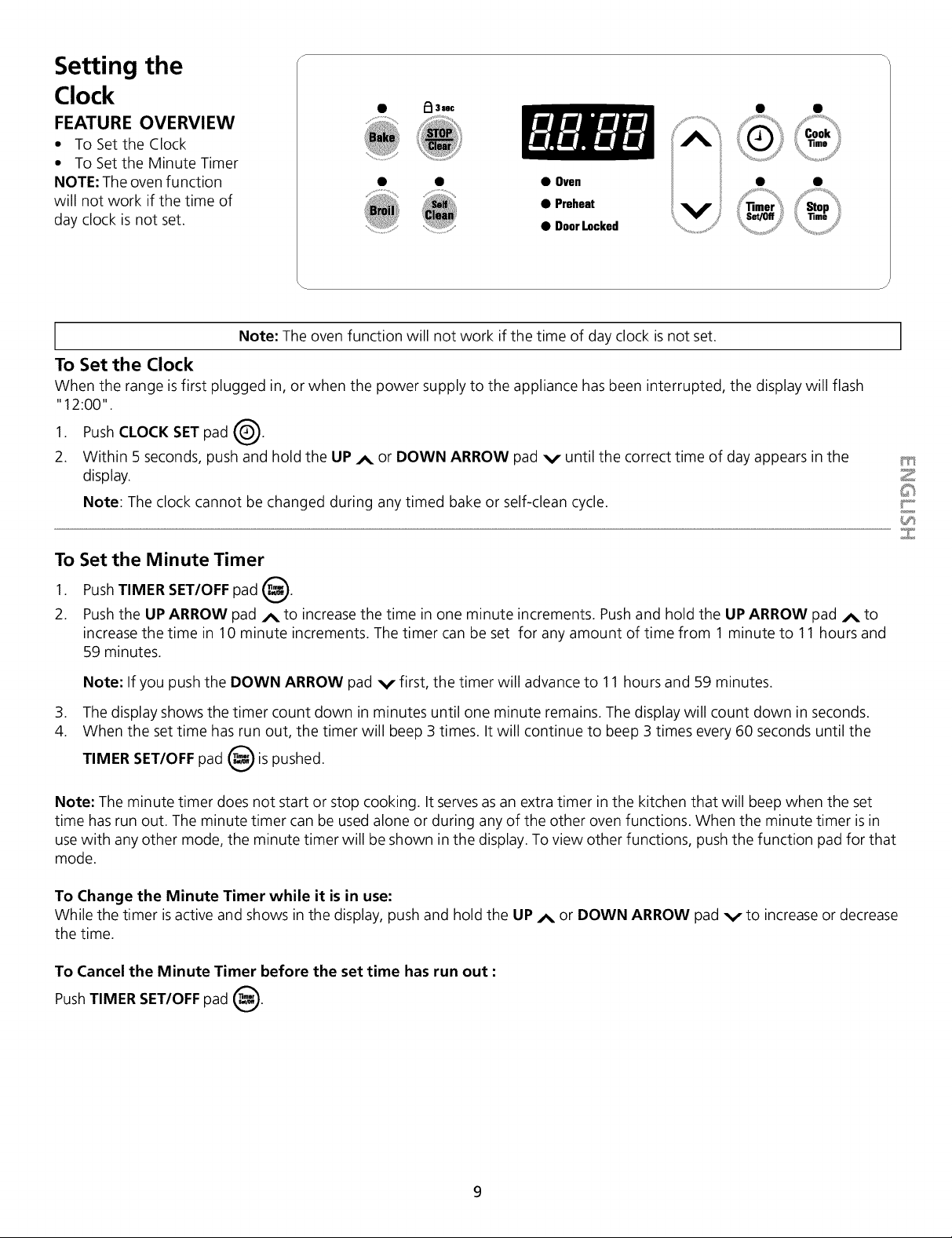
Setting the
Clock
FEATURE OVERVIEW
• To Set the Clock
• To Set the Minute Timer
NOTE: The oven function
will not work if the time of
day clock is not set.
3 sec
• Oven
• Preheat
• DoorLocked
lime
Note: The oven function will not work if the time of day clock is not set.
To Set the Clock
When the range is first plugged in, or when the power supply to the appliance has been interrupted, the display will flash
"12:00".
1. Push CLOCK SET pad _--_.
2. Within 5 seconds, push and hold the UP _, or DOWN ARROW pad v until the correct time of day appears in the
display.
Note: The clock cannot be changed during any timed bake or self-clean cycle.
To Set the Minute Timer
1. Push TIMER SET/OFF pad _'_.
2. Push the UP ARROW pad A to increase the time in one minute increments. Push and hold the UP ARROW pad _ to
increase the time in 10 minute increments. The timer can be set for any amount of time from 1 minute to 11 hours and
59 minutes.
.
4.
Note: If you push the DOWN ARROW pad v first, the timer will advance to 11 hours and 59 minutes.
The display shows the timer count down in minutes until one minute remains. The display will count down in seconds.
When the set time has run out, the timer will beep 3 times. It will continue to beep 3 times every 60 seconds until the
TIMER SET/OFF pad (_ is
pushed.
Note: The minute timer does not start or stop cooking. It serves as an extra timer in the kitchen that will beep when the set
time has run out. The minute timer can be used alone or during any of the other oven functions. When the minute timer is in
use with any other mode, the minute timer will be shown in the display. To view other functions, push the function pad for that
mode.
To Change the Minute Timer while it is in use:
While the timer is active and shows in the display, push and hold the UP _ or DOWN ARROW pad vto increase or decrease
the time.
To Cancel the Minute Timer before the set time has run out :
Push TIMER SET/OFF pad (_.
Z
©
Z
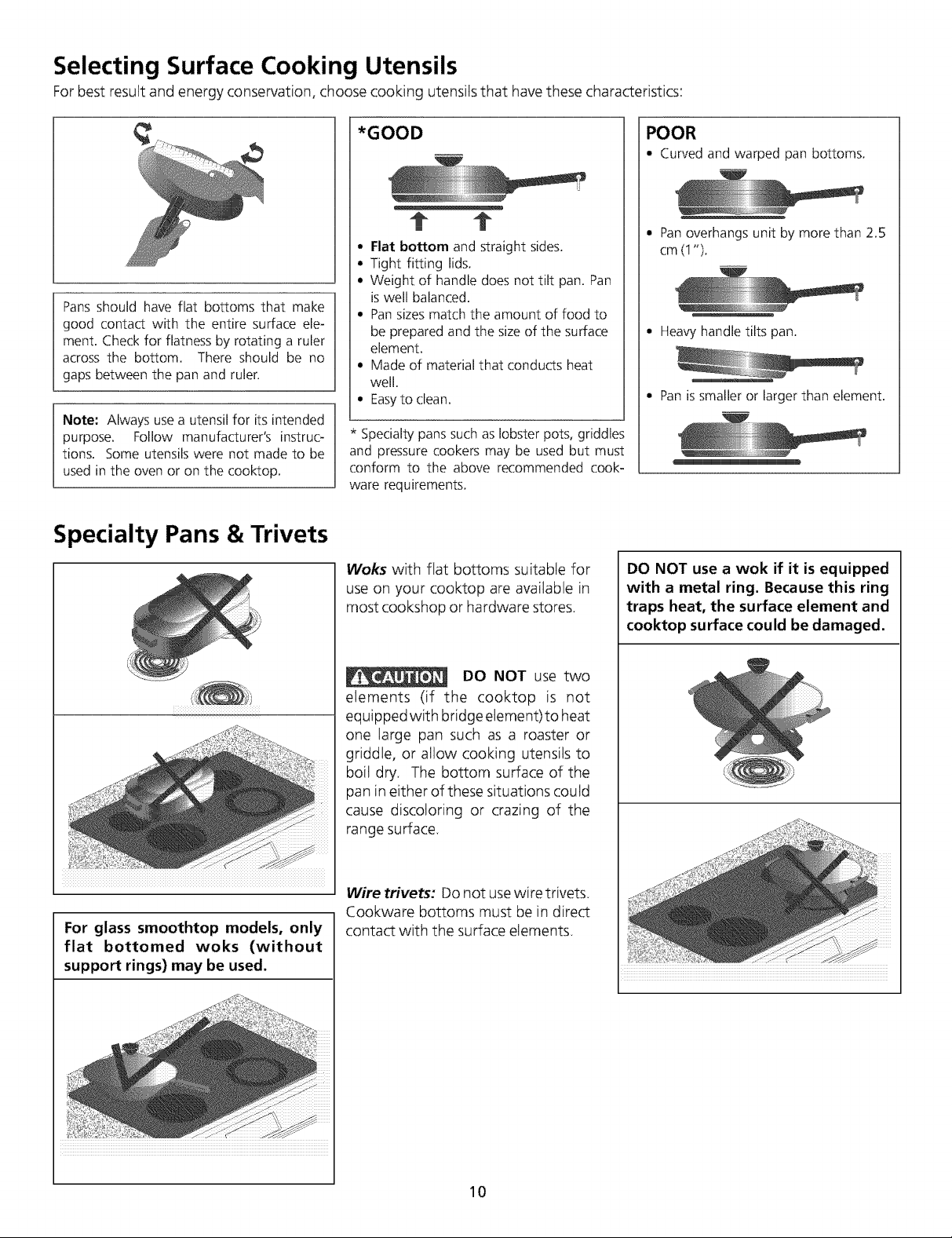
Selecting Surface Cooking Utensils
For best result and energy conservation, choose cooking utensils that have these characteristics:
Pans should have flat bottoms that make
good contact with the entire surface ele-
ment. Check for flatness by rotating a ruler
across the bottom. There should be no
gaps between the pan and ruler.
Note: Always use a utensil for its intended
purpose. Follow manufacturer's instruc-
tions. Some utensils were not made to be
used in the oven or on the cooktop.
*GOOD
t t
• Flat bottom and straight sides.
Tight fitting lids.
• Weight of handle does not tilt pan. Pan
is well balanced.
• Pan sizes match the amount of food to
be prepared and the size of the surface
element.
• Made of material that conducts heat
well.
• Easy to clean.
* Specialty pans such as lobster pots, griddles
and pressure cookers may be used but must
conform to the above recommended cook-
ware requirements.
POOR
• Curved and warped pan bottoms.
• Pan overhangs unit by more than 2.5
cm (I ").
• Heavy handle tilts pan.
• Pan is smaller or larger than element.
Specialty Pans & Trivets
For glass smoothtop models, only
flat bottomed woks (without
support rings) may be used.
Woks with fiat bottoms suitable for
use on your cooktop are available in
most cookshop or hardware stores.
DO NOT use two
elements (if the cooktop is not
equipped with bridge element) to heat
one large pan such as a roaster or
griddle, or allow cooking utensils to
boil dry. The bottom surface of the
pan in either of these situations could
cause discoloring or crazing of the
range surface.
Wire trivets: Do not usewire trivets.
Cookware bottoms must be in direct
contact with the surface elements.
DO NOT use a wok if it is equipped
with a metal ring. Because this ring
traps heat, the surface element and
cooktop surface could be damaged.
10
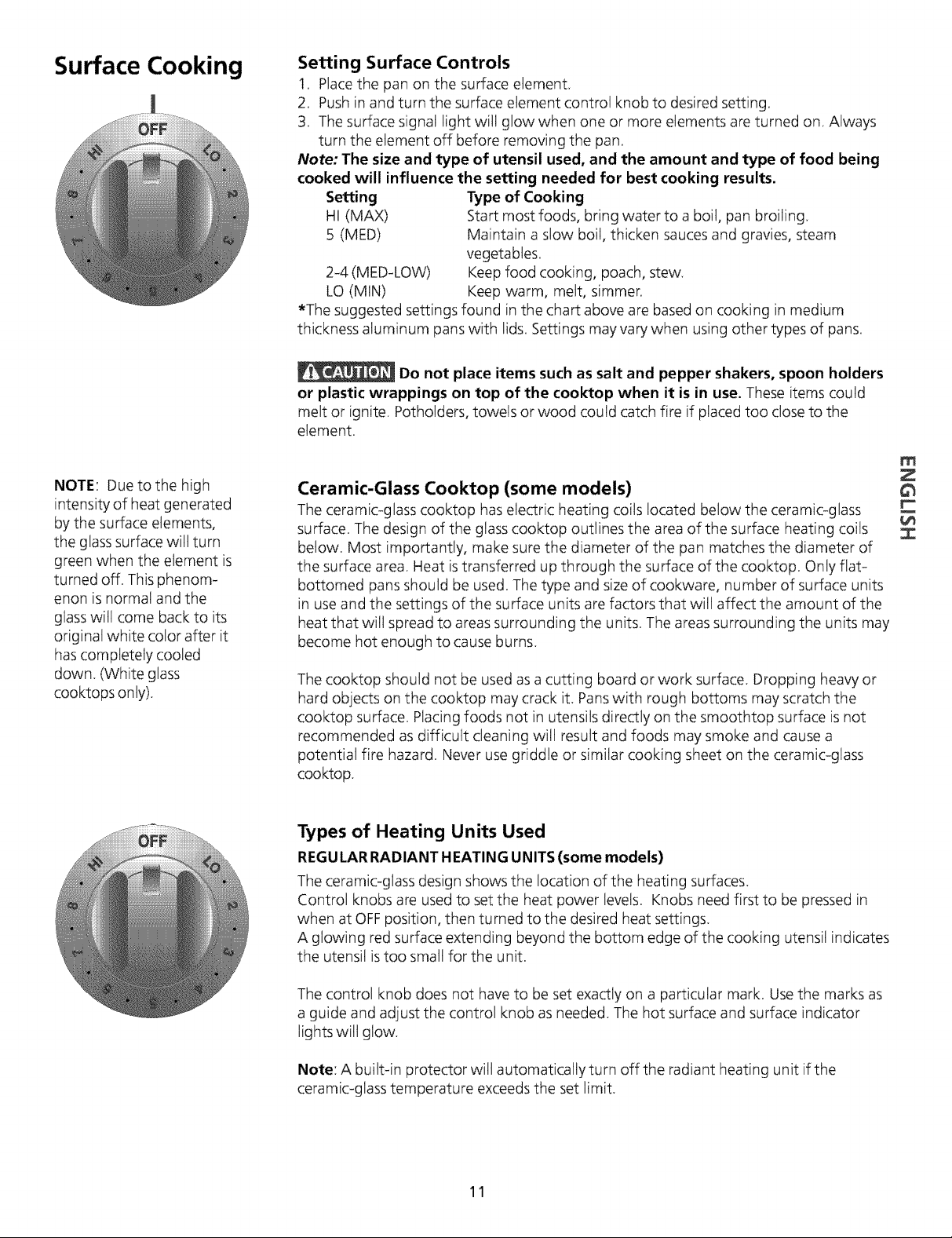
Surface Cooking
NOTE: Due to the high
intensity of heat generated
by the surface elements,
the glass surface will turn
green when the element is
turned off. This phenom-
enon is normal and the
glass will come back to its
original white color after it
has completely cooled
down. (White glass
cooktops only).
Setting Surface Controls
1. Place the pan on the surface element.
2. Push in and turn the surface element controi knob to desired setting.
3. The surface signal light will glow when one or more elements are turned on. Always
turn the element off before removing the pan.
Note: The size and type of utensil used, and the amount and type of food being
cooked will influence the setting needed for best cooking results.
Setting Type of Cooking
HI (MAX) Start most foods, bring water to a boil, pan broiling.
5 (MED) Maintain a stow boil, thicken sauces and gravies, steam
vegetables.
2-4 (MED-LOW) Keep food cooking, poach, stew.
LO (MIN) Keep warm, melt, simmer.
*The suggested settings found in the chart above are based on cooking in medium
thickness aluminum pans with lids. Settings may vary when using other types of pans.
Do not place items such as salt and pepper shakers, spoon holders
or plastic wrappings on top of the cooktop when it is in use. These items could
melt or ignite Potholders, towels or wood could catch fire if placed too close to the
eiement.
Ceramic-Glass Cooktop (some models)
The ceramic-glass cooktop has electric heating coils Iocated below the ceramic-glass
surface. The design of the glass cooktop outlines the area of the surface heating coils
betow. Most importantly, make sure the diameter of the pan matches the diameter of
the surface area. Heat is transferred up through the surface of the cooktop. Only flat-
bottomed pans should be used. The type and size of cookware, number of surface units
in use and the settings of the surface units are factors that will affect the amount of the
heat that will spread to areas surrounding the units. The areas surrounding the units may
become hot enough to cause burns.
The cooktop should not be used as a cutting board or work surface. Dropping heavy or
hard objects on the cooktop may crack it. Panswith rough bottoms may scratch the
cooktop surface. Piacing foods not in utensils directly on the smoothtop surface is not
recommended as difficult cleaning will result and foods may smoke and cause a
potential fire hazard. Never use griddle or similar cooking sheet on the ceramic-glass
cooktop.
m
!
Types of Heating Units Used
REGULAR RADIANT HEATING UNITS (some models)
The ceramic-glass design shows the location of the heating surfaces.
Control knobs are used to set the heat power levels. Knobs need first to be pressed in
when at OFFposition, then turned to the desired heat settings.
A glowing red surface extending beyond the bottom edge of the cooking utensil indicates
the utensil is too small for the unit.
The control knob does not have to be set exactly on a particular mark. Usethe marks as
a guide and adjust the control knob as needed. The hot surface and surface indicator
lights will glow.
Note: A built-in protector will automatically turn off the radiant heating unit if the
ceramic-glass temperature exceeds the set limit.
11
Surface Cooking
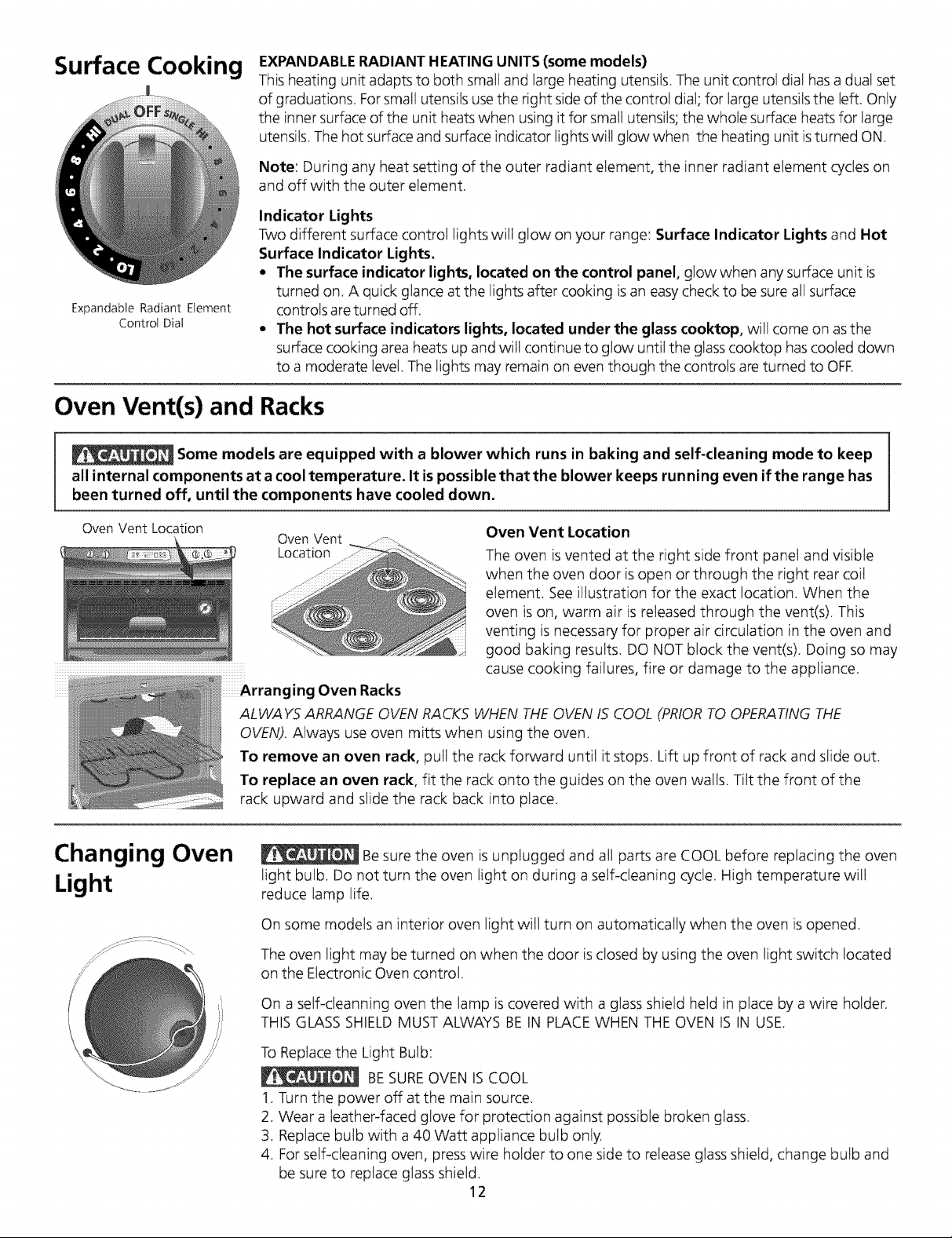
EXPANDABLE RADIANT HEATING UNITS (some models)
This heating unit adapts to both small and large heating utensils. The unit control dial has a dual set
of graduations Forsmall utensils usethe right side of the control dial; for large utensils the left. Only
the inner surface of the unit heats when using it for small utensils; the whole surface heats for large
utensils The hot surface and surface indicator lights will glow when the heating unit is turned ON
Note: During any heat setting of the outer radiant eiement, the inner radiant eiement cycles on
and off with the outer eiement.
Expandable Radiant Element
Control Dia!
Indicator Lights
Two different surface controi lights will glow on your range: Surface Indicator Lights and Hot
Surface Indicator Lights.
• The surface indicator lights, located on the control panel, glow when any surface unit is
turned on. A quick glance at the lights after cooking is an easy check to be sure all surface
controls are turned off.
• The hot surface indicators lights, located under the glass cooktop, will come on asthe
surface cooking area heats up and will continue to glow until the glasscooktop hascooled down
to a moderate ievei. The iights may remain on even though the controis are turned to OFR
Oven Vent(s) and Racks
Some models are equipped with a blower which runs in baking and self-cleaning mode to keep
all internal components at a cool temperature. It is possible that the blower keeps running even if the range has
been turned off, until the components have cooled down.
Oven Vent Location
OvenVent Oven Vent Location
Location The oven is vented at the right side front panel and visibte
........ when the oven door is open or through the right rear col
eiement. See illustration for the exact location. When the
oven is on, warm air is released through the vent(s). This
venting is necessary for proper air circulation in the oven and
good baking results. DO NOT block the vent(s). Doing so may
cause cooking failures, fire or damage to the appliance.
Arranging Oven Racks
ALWAYS ARRANGE OVEN RACKS WHEN THE OVEN IS COOL (PRIORTO OPERATING THE
OVEN). Always use oven mitts when using the oven.
To remove an oven rack, pull the rack forward until it stops. Lift up front of rack and slide out.
To replace an oven rack, fit the rack onto the guides on the oven walls. Tilt the front of the
rack upward and slide the rack back into place.
Changing Oven
Light
Be sure the oven is unplugged and all parts are COOL before replacing the oven
light bulb. Do not turn the oven light on during a self-cleaning cycle. High temperature witl
reduce Iamp life.
On some modeis an interior oven light will turn on automatically when the oven is opened.
The oven light may be turned on when the door is closed by using the oven light switch located
on the Electronic Oven controi.
On a self-cleanning oven the Iamp is covered with a glass shield held in place by a wire holder.
THIS GLASS SHIELD MUST ALWAYS BE IN PLACE WHEN THE OVEN IS IN USE.
To Replacethe Light Bulb:
BE SUREOVEN IS COOL
1. Turn the power off at the main source.
2. Wear a leather-faced glove for protection against possible broken glass.
3. Replace bulb with a 40 Watt appliance bulb only,
4. For self-cleaning oven, presswire holder to one side to release glass shield, change bulb and
be sure to replace glass shield.
12
Setting Oven
Controls
Feature
Overview
• To Set or Change
Temperature for Normal
Baking
NOTE: The oven function
will not work if the time of
day clock is not set.
_3mC
• • • Oven
_ • Preheat
._ • DoorLocked
@®
Note: The oven function will not work if the time of day clock is not set.
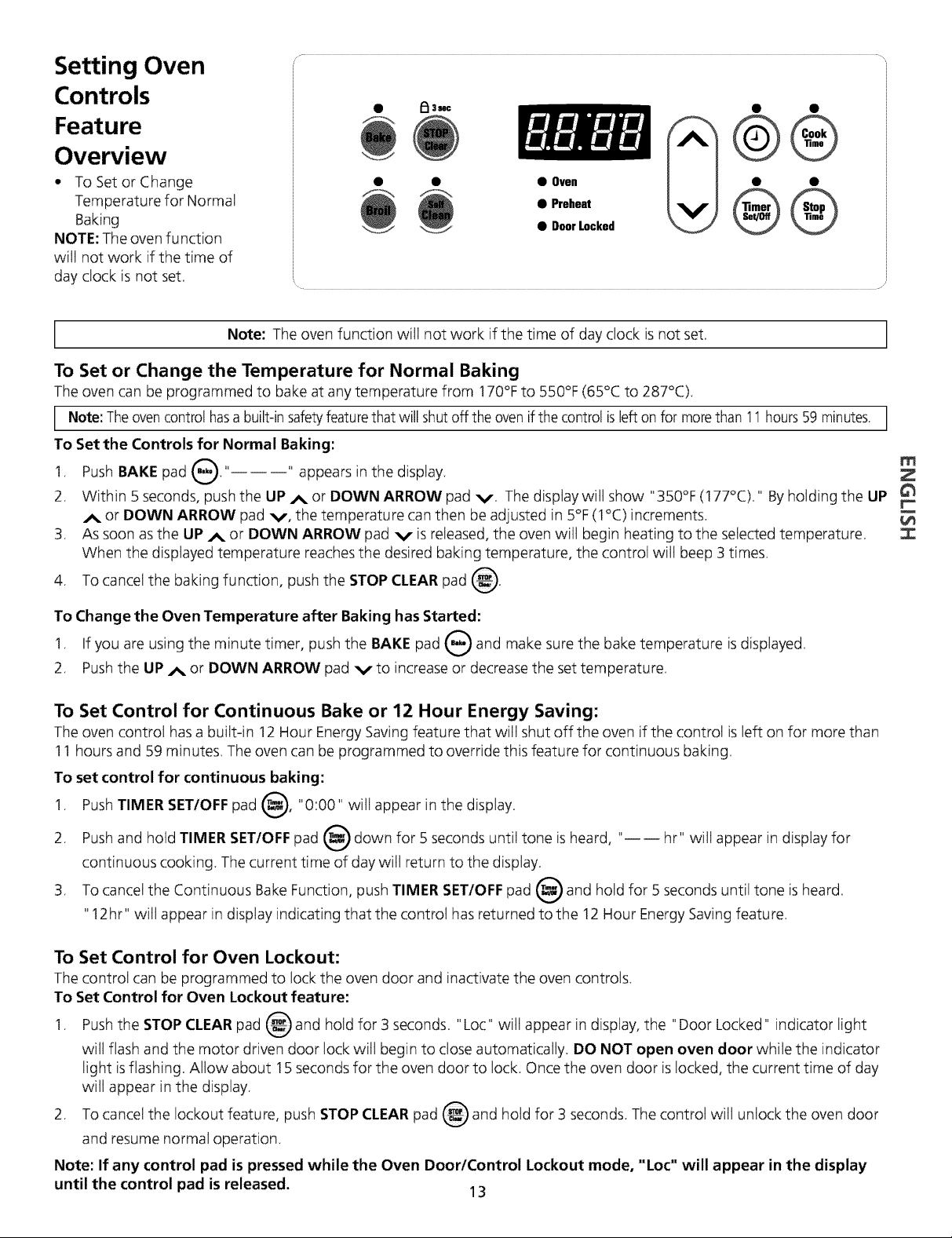
To Set or Change the Temperature for Normal Baking
The oven can be programmed to bake at any temperature from 170°F to 550°F (65°C to 287°C)
Note: The ovencontrol hasa built-in safetyfeaturethat will shut off the oven if the control is lefton for more than 11 hours59 minutes.
To Set the Controls for Normal Baking:
1 Push BAKE pad (_" " appears in the
display.
2. Within 5 seconds, push the UP/_ or DOWN ARROW pad v. The display witl show "350°F (177°C)." By holding the UP
/_ or DOWN ARROW pad v, the temperature can then be adjusted in 5°F (1°C)increments.
3. As soon as the UP _. or DOWN ARROW pad v is released, the oven will begin heating to the selected temperature.
When the displayed temperature reaches the desired baking temperature, the control will beep 3 times.
4. To cancel the baking function, push the STOP CLEAR pad 8.
To Change the Oven Temperature after Baking has Started:
1 If you are using the minute timer, push the BAKE pad (_ and make sure the bake temperature is displayed
2. Pushthe UP A or DOWN ARROW pad v to increase or decrease the set temperature.
To Set Control for Continuous Bake or 12 Hour Energy Saving:
The oven control has a built-in 12 Hour Energy Saving feature that will shut off the oven if the control is left on for more than
11 hours and 59 minutes. The oven can be programmed to override this feature for continuous baking.
To set control for continuous baking:
1 PushTIMER SETIOFF pad (_), "0:00" witl appear in the
display.
2. Pushand hoid TIMER SETIOFF pad _ down for 5 seconds untit tone is heard, "---- hr" will appear in display for
v
continuous cooking. The current time of day will return to the display.
3. To cancei the Continuous Bake Function, push TIMER SETIOFF pad _ and hold for 5 seconds untit tone is heard.
v
"12hr" will appear in display indicating that the controi has returned tothe 12 Hour Energy Saving feature.
To Set Control for Oven Lockout:
The control can be programmed to lock the oven door and inactivate the oven controls
To Set Control for Oven Lockout feature:
1 Pushthe STOP CLEAR pad _ and hold for 3 seconds "Loc" will appear in display, the "Door Locked" indicator light
will flash and the motor driven door Iock will begin to close automatically. DO NOT open oven door while the indicator
light is flashing. Allow about 15 seconds for the oven door to lock. Once the oven door is locked, the current time of day
witl appear in the display.
2. To cancei the lockout feature, push STOP CLEARpad _ and hold for 3 seconds. The control will unlock the oven door
and resume normal operation.
Note: If any control pad is pressed while the Oven DoorlControl Lockout mode, "Lot" will appear in the display
until the control pad is released. 13
m
!
Setting Oven
Controls
FEATURE OVERVIEW
• Timed Bake Feature
• _ 3sec
• 4) Oven
e Preheat
._ O DoorLocked
@®
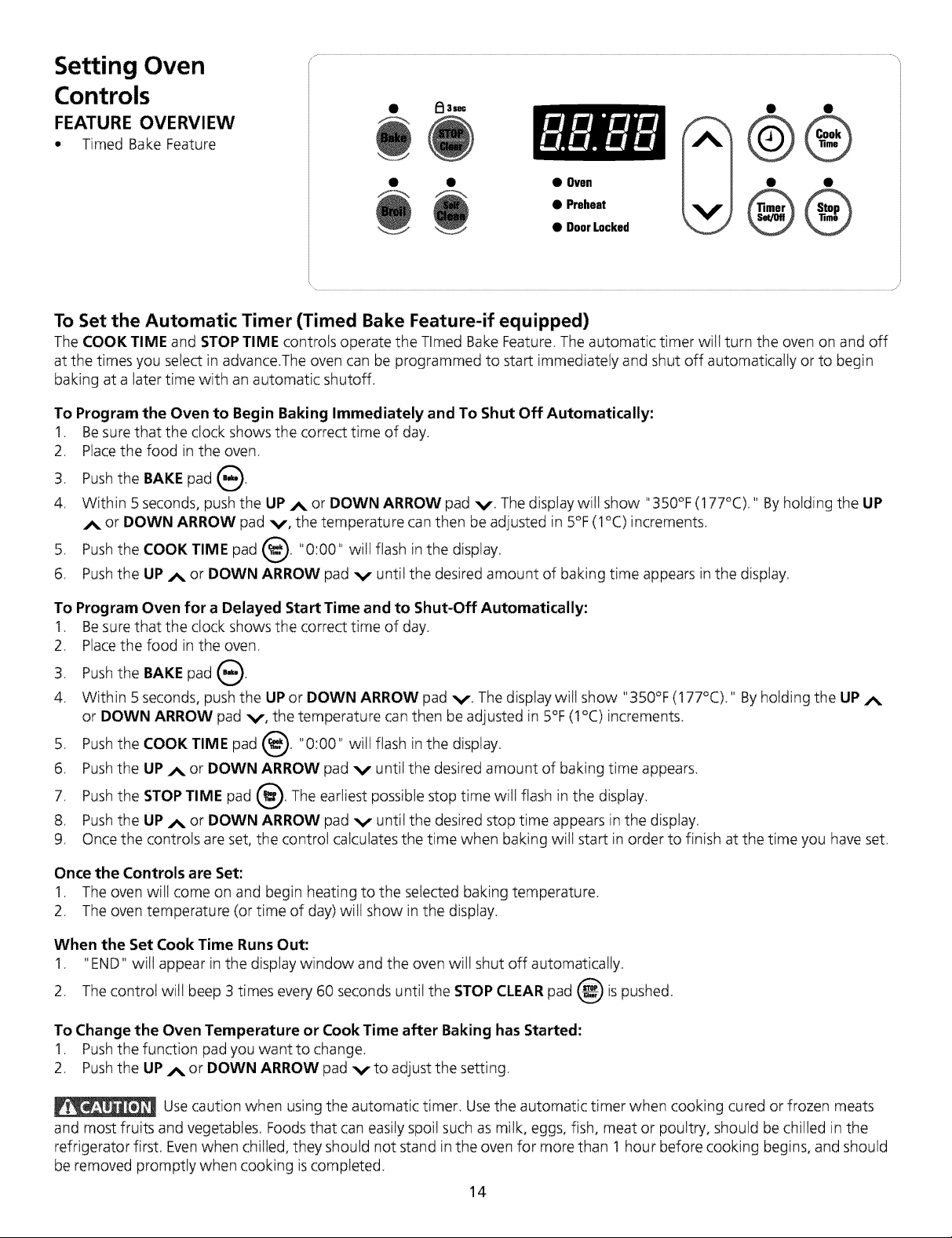
To Set the Automatic Timer (Timed Bake Feature-if equipped)
The COOK TIME and STOP TIME controls operate the Timed Bake Feature The automatic timer will turn the oven on and off
at the times you setect in advance.The oven can be programmed to start immediateiy and shut off automatically or to begin
baking at a later time with an automatic shutoff.
To Program the Oven to Begin Baking Immediately and To Shut Off Automatically:
1. Besure that the clock shows the correct time of day
2. Placethe food in the oven.
3. Pushthe BAKE pad (_.
4. Within 5 seconds, push the UP _. or DOWN ARROW pad v. The display will show "350°F (177°C)." By holding the UP
A or DOWN ARROW pad v, the temperature can then be adjusted in 5°F (1°C)increments.
5. Pushthe COOK TIME pad _'_. "0:00" will flash in the display.
6. Pushthe UP A or DOWN ARROW pad v until the desired amount of baking time appears in the display.
To Program Oven for a Delayed Start Time and to Shut-Off Automatically:
1. Besure that the clock shows the correct time of day.
2. Placethe food in the oven.
3. Pushthe BAKE pad (_.
4. Within 5 seconds, push the UP or DOWN ARROW pad v. The display will show "350°F (177°C)." By holding the UP
or DOWN ARROW pad v, the temperature can then be adjusted in 5°F (1°C) increments.
5. Pushthe COOK TIME pad _. "0:00" will flash in the display.
6. Pushthe UP _ or DOWN ARROW pad v untit the desired amount of baking time appears.
7. Pushthe STOP TIME pad _'_. The earliest possible stop time will flash in the display.
8. Pushthe UP _ or DOWN ARROW pad v until the desired stop time appears in the display.
9. Once the controls are set, the control calculates the time when baking will start in order to finish at the time you have set.
Once the Controls are Set:
1. The oven will come on and begin heating to the selected baking temperature.
2. The oven temperature (or time of day) witl show in the display.
When the Set Cook Time Runs Out:
1. "END" will appear in the disptay window and the oven will shut off automatically.
2. The controi wiil beep 3 times every 60 seconds untit the STOP CLEAR pad _ is
pushed.
To Change the Oven Temperature or Cook Time after Baking has Started:
1. Pushthe function pad you want to change
2. Pushthe UP _ or DOWN ARROW pad v to adjust the setting.
Use caution when using the automatic timer. Use the automatic timer when cooking cured or frozen meats
and most fruits and vegetables. Foods that can easily spoil such as milk, eggs, fish, meat or poultry, should be chilled in the
refrigerator first. Even when chilled, they should not stand in the oven for more than 1 hour before cooking begins, and should
be removed promptly when cooking is completed.
14
Setting Oven Controls
Oven Baking Informations
For best results, preheat the oven before baking cookies, breads, cakes, pies or pastries, etc There is no need to preheat the
oven for roasting meat or baking casseroles.
The cooking times and temperatures needed to bake a product may vary slightly from your previously owned appliance. Refer
to "Recalibrating Your Oven Temperature" section.
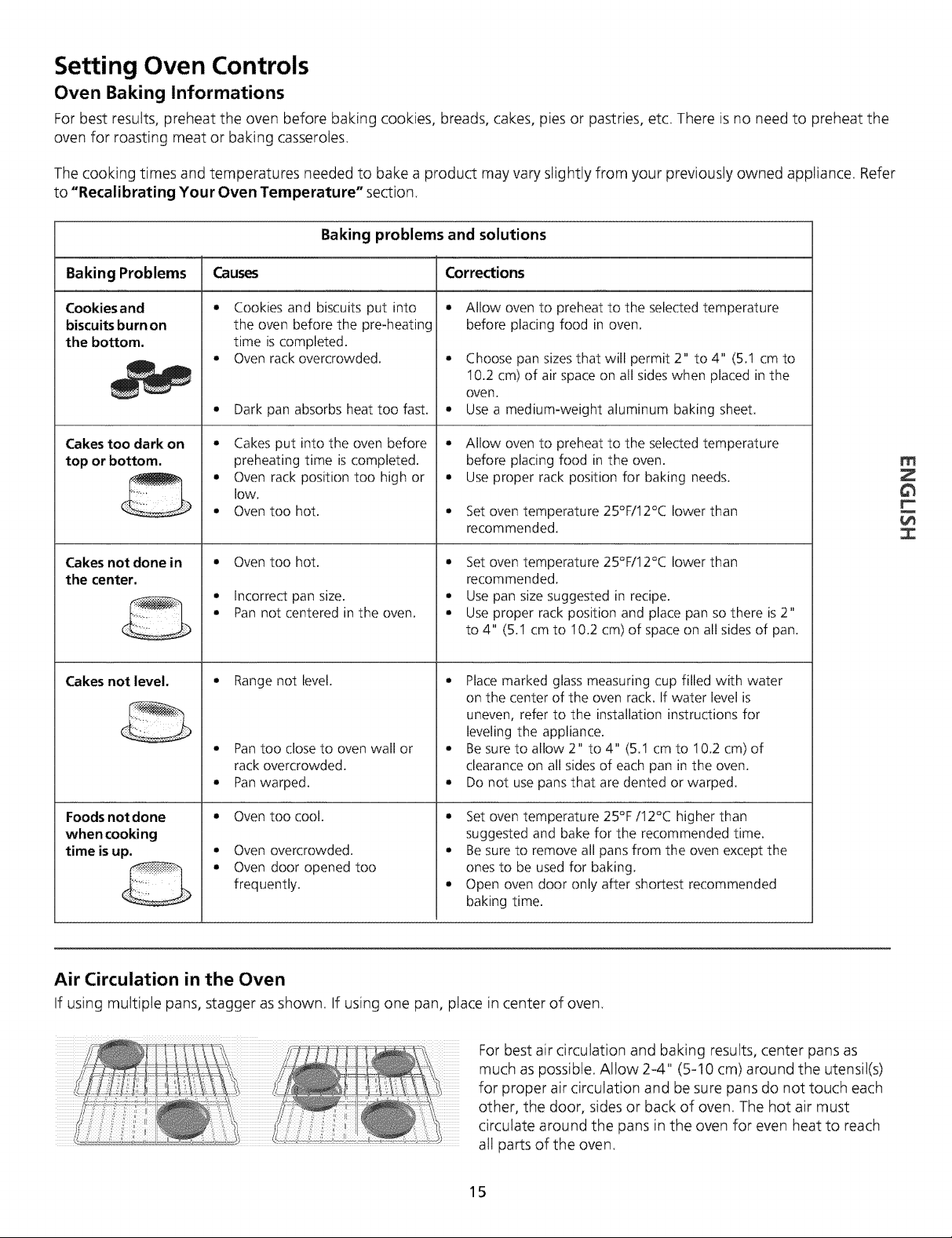
Baking problems and solutions
Baking Problems Causes Corrections
t
Cookiesand
biscuits burn on
the bottom.
Cakes too dark on
top or bottom.
Cakes not done in
the center.
Cakes not level.
Foods not done
when cooking
time is up.
Cookies and biscuits put into
the oven before the pre-heating
time is completed.
Oven rack overcrowded.
Dark pan absorbs heat too fast.
Cakes put into the oven before
preheating time is completed.
Oven rack position too high or
low.
Oven too hot.
Oven too hot.
Incorrect pan size.
Pan not centered in the oven.
• Range not level.
• Pan too close to oven wall or
rack overcrowded.
• Pan warped.
• Oven too cool.
• Oven overcrowded.
• Oven door opened too
frequently.
Allow oven to preheat to the selected temperature
before placing food in oven.
Choose pan sizes that will permit 2" to 4" (5.1 cm to
10.2 cm) of air space on all sides when placed in the
oven.
Use a medium-weight aluminum baking sheet.
• Allow oven to preheat to the selected temperature
before placing food in the oven.
• Use proper rack position for baking needs.
• Set oven temperature 25°F/12°C lower than
recommended.
• Set oven temperature 25°F/12°C lower than
recommended.
Use pan size suggested in recipe.
Use proper rack position and place pan so there is 2"
to 4" (5.1 cm to 10.2 cm) of space on all sides of pan.
Place marked glass measuring cup filled with water
on the center of the oven rack. If water level is
uneven, refer to the installation instructions for
leveling the appliance.
• Be sure to allow 2" to 4" (5.1 cm to 10.2 cm) of
clearance on all sides of each pan in the oven.
• Do not use pans that are dented or warped.
Set oven temperature 25°F/12°C higher than
suggested and bake for the recommended time.
Be sure to remove all pans from the oven except the
ones to be used for baking.
Open oven door only after shortest recommended
baking time.
m
Z
!
Air Circulation in the Oven
If using multiple pans, stagger as shown If using one pan, place in center of oven
3
For best air circulation and baking results, center pans as
much as possible. Allow 2-4" (5-10 cm) around the utensil(s)
..........., for proper air circulation and be sure pans do not touch each
other, the door, sides or back of oven. The hot air must
circulate around the pans in the oven for even heat to reach
all parts of the oven.
15
Setting Oven
Controls
FEATURE OVERVIEW
• Broil
• _ 3sec
• Oven
• Preheat
• DoorLocked
@®
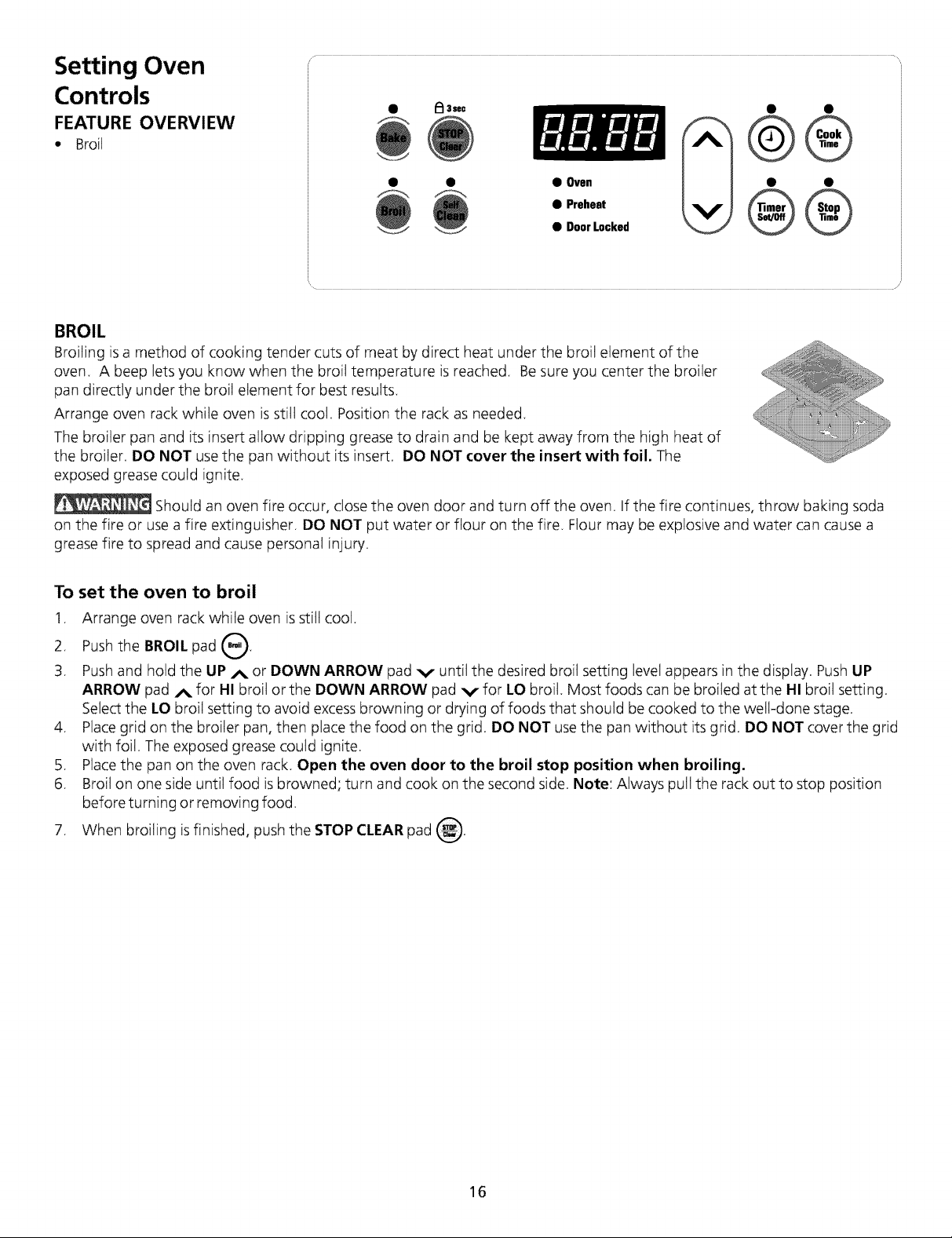
BROIL
Broiling is a method of cooking tender cuts of meat by direct heat under the broil etement of the
oven. A beep lets you know when the broil temperature is reached. Be sure you center the broiler
pan directly under the broil element for best results.
Arrange oven rack while oven is still cool. Position the rack as needed.
The broiler pan and its insert allow dripping grease to drain and be kept away from the high heat of
the broiler. DO NOT use the pan without its insert. DO NOT cover the insert with foil. The
exposed grease could ignite.
Should an oven fire occur, close the oven door and turn off the oven. If the fire continues, throw baking soda
on the fire or use a fire extinguisher. DO NOT put water or flour on the fire. Flour may be explosive and water can cause a
grease fire to spread and cause personal injury.
To set the oven to broil
1. Arrange oven rack while oven is still cool.
2. Push the BROIL pad _'_.
3. Pushand hold the UP A or DOWN ARROW pad v untit the desired broil setting Ievei appears in the display. Push UP
ARROW pad A for HI broil or the DOWN ARROW pad v for LO broil. Most foods can be broiled at the HI broil setting.
Select the LO broil setting to avoid excess browning or drying of foods that should be cooked to the well-done stage.
4. Placegrid on the broiler pan, then place the food on the grid. DO NOT use the pan without its grid. DO NOT cover the grid
with foil. The exposed grease could ignite.
5. Placethe pan on the oven rack. Open the oven door to the broil stop position when broiling.
6. Broil on one side until food is browned; turn and cook on the second side. Note: Aiways pull the rack out to stop position
before turning or removing food.
7. When broiling is finished, push the STOP CLEAR pad 8.
16
Setting Oven Controls
Broiling Information
Preheating
Preheating is suggested when searing rare steaks (remove the broiler pan before preheating. Foods will stick if placed on hot
metal.) To preheat, set the oven control(s) to BROILas instructed in the "ELECTRONICOVEN CONTROL SECTION". Wait for
the element to become red-hot, usually about 2 minutes. Preheating is not necessary when broiling meats to well-done.
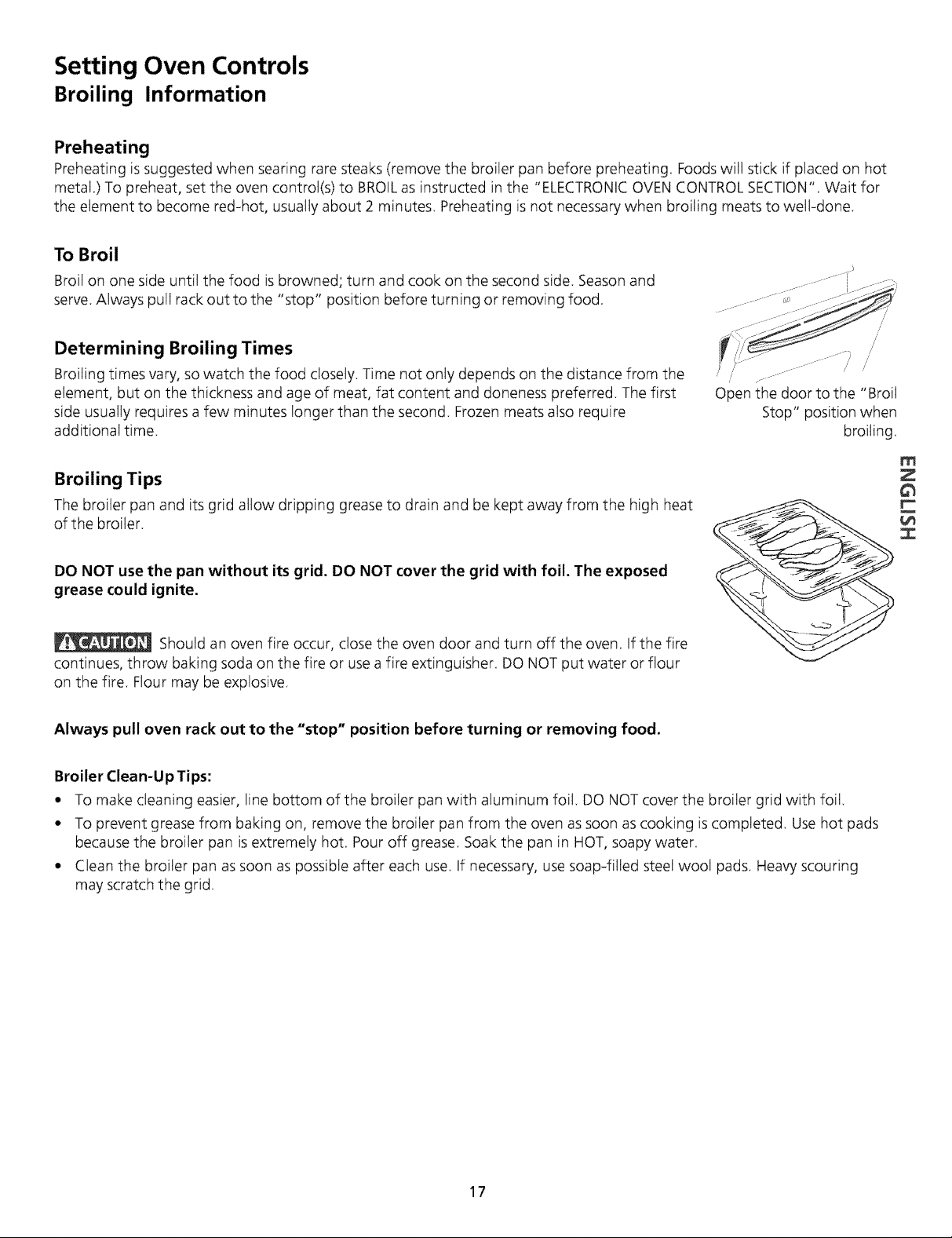
To Broil
Broil on one side until the food is browned; turn and cook on the second side Season and .......
.....J
serve. Always pull rack out to the "stop" position before turning or removing food. ......................_-_
Determining Broiling Times ...............................................i J
Broiling times vary, so watch the food closely. Time not only depends on the distance from the /" ._- - "
eiement, but on the thickness and age of meat, fat content and doneness preferred. The first Open the door to the "Broil
side usually requires a few minutes longer than the second. Frozen meats also require Stop" position when
additional time. broiling.
Broiling Tips
The broiler pan and its grid allow dripping grease to drain and be kept away from the high heat
of the broiler.
DO NOT use the pan without its grid. DO NOT cover the grid with foil. The exposed
grease could ignite.
Should an oven fire occur, close the oven door and turn off the oven. If the fire
continues, throw baking soda on the fire or use a fire extinguisher. DO NOT put water or flour
on the fire. Flour may be explosive.
m
Z
!
Always pull oven rack out to the "stop" position before turning or removing food.
Broiler Clean-Up Tips:
• To make cleaning easier, line bottom of the broiler pan with aluminum foil. DO NOT cover the broiler grid with foil.
• To prevent grease from baking on, remove the broiler pan from the oven as soon as cooking is completed. Use hot pads
because the broiler pan is extremely hot. Pour off grease. Soak the pan in HOT, soapy water.
• Clean the broiler pan as soon as possible after each use. If necessary, use soap4iIled steel wool pads. Heavy scouring
may scratch the grid.
17
Oven Cleaning
FEATURE OVERVIEW
• Adhere tothe Following
Precautions
• Preparing the Oven for
Self-Cleaning
• What to Expect during
Cleaning
DO NOT 14Z_F:ID
DO 14Z_F:ID CL_ SEAL
CLEAN DOOR
Self-Clean Oven Cycle
Adhere to the Following Precautions:
Allow the oven to cool before cleaning
Wear rubber gloves when cleaning any exterior part of the oven manually.
During the self-clean cycle, the outside of the oven wall can become very hot
to touch. DO NOT leave small children unattended near the appliance.
Before cleaning any part of the oven, be sure the eiectronic oven controi is
turned off or eise push CANCEL pad. Wait until the oven is cool.
DO NOT use commercial oven cleaners or oven protective coatings in or around any part of
the self-cleaning oven. DO NOT clean the oven door gasket. The gasket on the oven door is
essential for a good seal. Care should be taken not to rub, damage or move the gasket. DO
NOT use aluminum foil to line the oven bottom. This may affect cooking, or the foil could mett
and damage the oven surface.
A self-cleaning oven cleans itself with high temperatures (weil above cooking temperatures)
which eliminate soil completely or reduce it to a fine powdered ash you can wash away with
damp cloth.
Preparing the Oven for Self-Cleaning
1 Before starting the self-clean cycle, remove excessspillovers in the oven cavity by using hot
soapy water and a cloth. Large spitlovers can cause heavy smoke or fire when subjected to
high temperatures. DO NOT allow food spills with a high sugar or acid content (such as
tomatoes, sauerkraut, fruit juices or pie filling) to remain on the surface as they may cause
a dull spot even after cleaning.
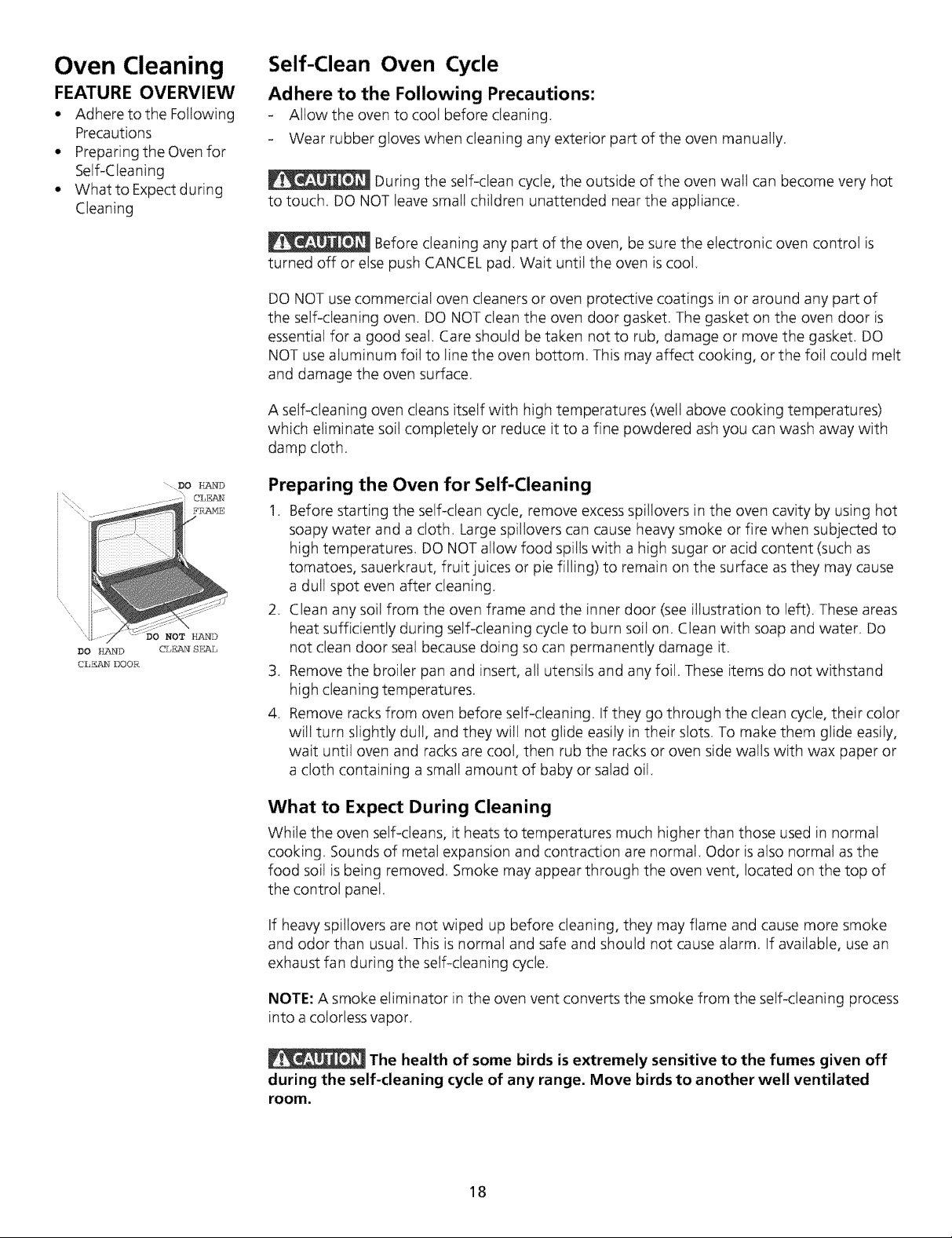
2. Clean any soil from the oven frame and the inner door (see illustration to left). These areas
heat sufficiently during self-cleaning cycle to burn soil on. Clean with soap and water. Do
not clean door seal because doing so can permanently damage it.
3. Remove the broiler pan and insert, all utensils and any foil. These items do not withstand
high cleaning temperatures.
4. Remove racks from oven before self-cleaning. If they go through the clean cycle, their color
will turn slightly dull, and they will not glide easily in their slots. To make them glide easily,
wait until oven and racks are cool, then rub the racks or oven side walls with wax paper or
a cloth containing a small amount of baby or salad oil.
What to Expect During Cleaning
While the oven self-cleans, it heats to temperatures much higher than those used in normal
cooking. Sounds of metal expansion and contraction are normal. Odor is also normal as the
food soil is being removed. Smoke may appear through the oven vent, located on the top of
the control panei.
If heavy spillovers are not wiped up before cleaning, they may flame and cause more smoke
and odor than usual. This is normal and safe and should not cause alarm. If available, use an
exhaust fan during the self-cleaning cycle.
NOTE: A smoke eliminator in the oven vent converts the smoke from the self-cleaning process
into a colorless vapor.
The health of some birds is extremely sensitive to the fumes given off
during the self-cleaning cycle of any range. Move birds to another well ventilated
room.
18
Oven Cleaning
FEATURE OVERVIEW
• To Start the Self-Clean
Cycle
• _ 3 sec
• DoorLocked _
Note: DO NOT attempt to use the surface elements while oven is self-cleaning. An automatic safeguard locks off the
surface elements during self-cleaning. You cannot use the surface elements until the oven door can be opened after the
cleaning cycle is complete.
To Start the Self-Clean Cycle
To assure satisfactory results, we recommend a 2 hour self-clean cycle for light soils, and a 3 hour cycle for average to
heavy soils.
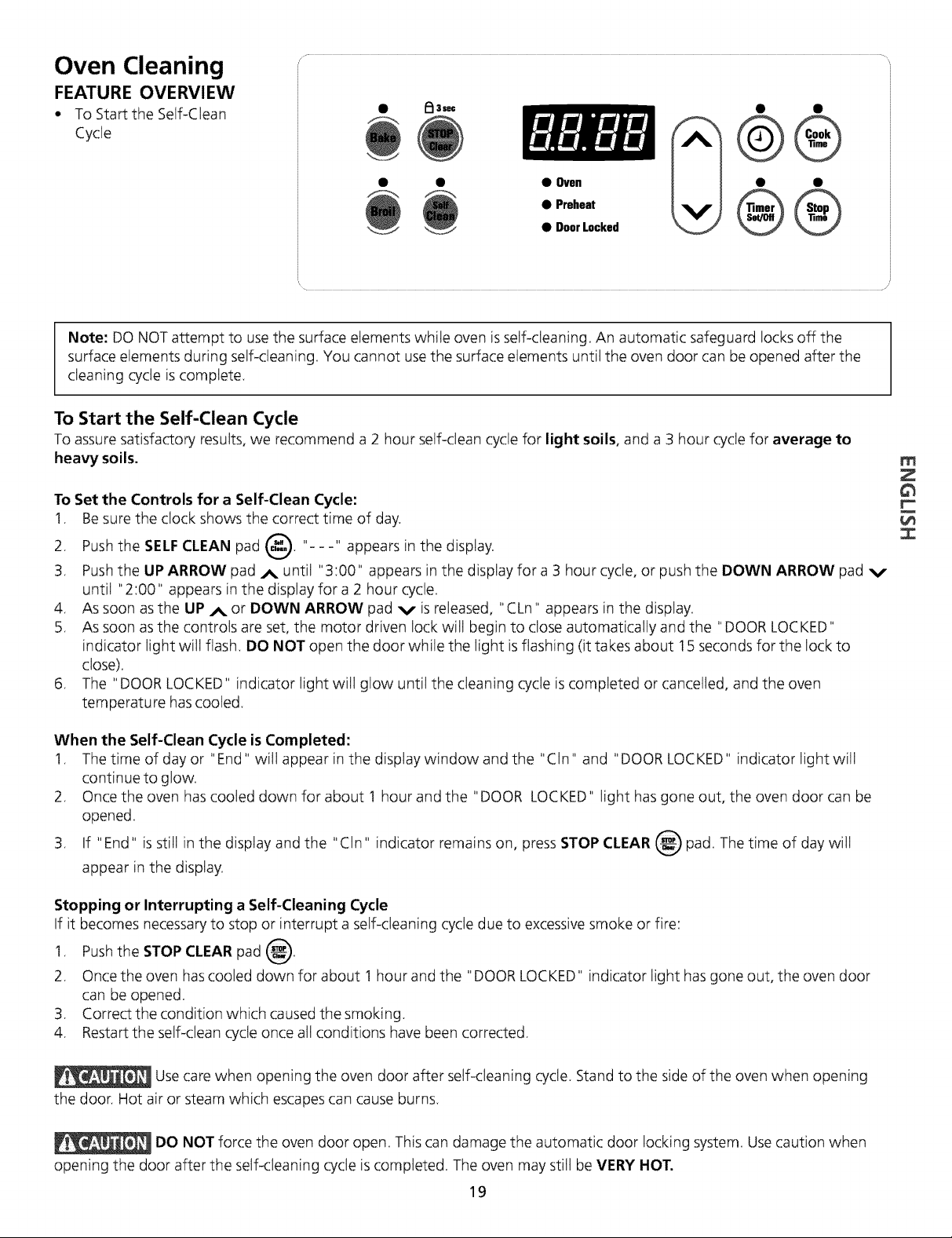
To Set the Controls for a Self-Clean Cycle:
1. Besure the clock shows the correct time of day.
2. Push the SELF CLEAN pad _. "---" appears in the display.
3. Pushthe UP ARROW pad A until "3:00" appears in the display for a 3 hour cycle, or push the DOWN ARROW pad v
until "2:00" appears in the display for a 2 hour cycle.
4. As soon as the UP A or DOWN ARROW pad v is released, "CLn" appears in the display.
5. As soon as the controls are set, the motor driven lock will begin to close automatically and the "DOOR LOCKED"
indicator light will flash. DO NOT open the door while the light is flashing (it takes about 15 seconds for the lock to
close).
6. The "DOOR LOCKED" indicator light will glow until the cleaning cycle is completed or canceiled, and the oven
temperature has cooled.
When the Self-Clean Cycle is Completed:
1. The time of day or "End" will appear in the display window and the "CIn" and "DOOR LOCKED" indicator light will
continue to glow.
2. Once the oven has cooled down for about 1 hour and the "DOOR LOCKED" light has gone out, the oven door can be
opened.
3. If "End" is still in the display and the "CIn" indicator remains on, press STOP CLEAR _ pad. The time of day will
appear in the display.
Stopping or Interrupting a Self-Cleaning Cycle
If it becomes necessary to stop or interrupt a self-cleaning cycle due to excessive smoke or fire:
1. Pushthe STOP CLEAR pad _.
2. Once the oven has cooled down for about 1 hour and the "DOOR LOCKED" indicator light has gone out, the oven door
can be opened.
3. Correct the condition which caused the smoking.
4. Restart the self-clean cycle once all conditions have been corrected.
Usecare when opening the oven door after self-cleaning cycle. Stand to the side of the oven when opening
the door. Hot air or steam which escapes can cause burns.
DO NOT force the oven door open. This can damage the automatic door locking system. Use caution when
opening the door after the self<leaning cycle is completed. The oven may still be VERY HOT.
19
m
Z
!
General Cleaning
Cleaning Various Parts of Your Range
Before cleaning any part of the range, be sure all controls are turned OFFand the range is cool. Remove spitlovers and heavy
soiling as soon as possible. Regular cleanings will reduce the effort required for major cleanings later.
Surfaces
Aluminum & Vinyl
Control Panel and Trim
Pieces
Glass, Painted and Plastic
Body Parts, Control Knobs
and Decorative Trim Pieces
Stain less Steel (some
models) Oven door & drawer
front panel
Oven Racks
Surface Elements and Drip
Bowls (Models: 790.4506@)
Porcelain Enamel
Broiler Panand Insert, Door
Liner, Body Partsand Warmer
Drawer and Drawer Cavity.
How to Clean
Use hot, soapy water and a cloth. Dry with a clean cloth.
Before cleaning the control panel, turn all controls to OFFand remove the control knobs.
To remove, pull each knob straight off the shaft. Clean using hot, soapy water and a
dishcloth. Rinse with a clean water and a dishcloth. Be sure to squeeze excess water from
the cloth before wiping the panel; especially when wiping around the controls. Excess
water in or around the controis may cause damage to the appliance. Be sure to rinse the
cleaners as bluish stains may occur during heating and cannot de removed. To replace
knobs after cleaning, Iine up the fiat sides of both the knob and the shaft; then push the
knob into place.
For general cleaning, use hot, soapy water and a cloth. For more difficult soils and built-up
grease, apply a liquid detergent directly onto the soil. Leave on soil for 30 to 60 minutes.
Rinse with a damp cloth and dry. DO NOT use abrasive cleaners on any of these materials;
they can scratch. To remove control knobs, turn to the OFF position; grasp firmly and pull
straight off the shaft. To replace knobs after cleaning, Iine up the flat sides of both the
knob and the shaft; then push the knob into place.
Cleaners made especially for stainless steel as Stainless Steel Magic, or other similar
cleaners are recommended. Always follow the manufacturer's instructions. Be sure to rinse
the cleaners as bluish stains may occur during heating and cannot be removed.
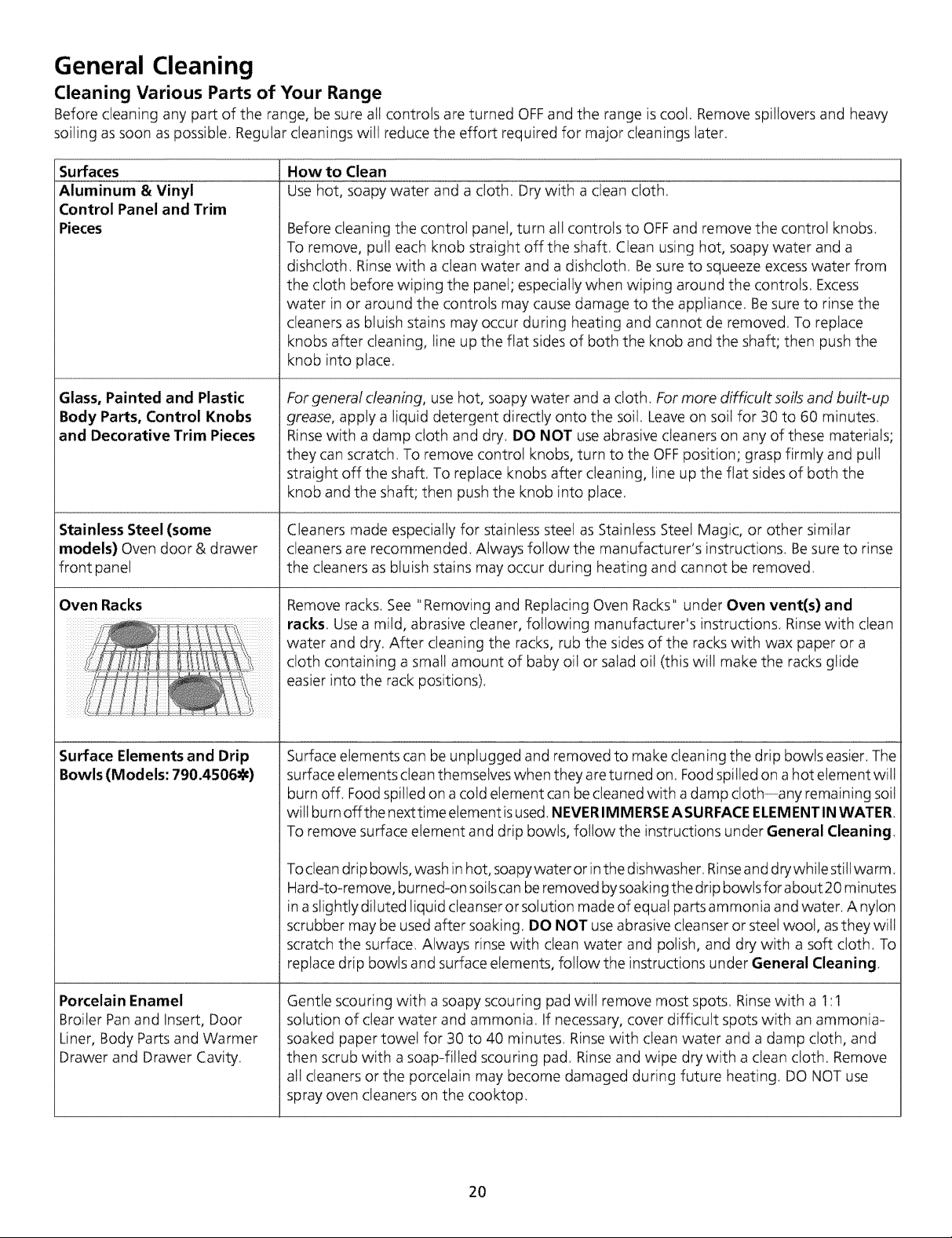
Remove racks. See "Removing and Replacing Oven Racks" under Oven vent(s) and
racks. Usea mild, abrasive cleaner, following manufacturer's instructions. Rinse with clean
water and dry. After cleaning the racks, rub the sides of the racks with wax paper or a
cloth containing a small amount of baby oil or salad oil (this will make the racks glide
easier into the rack positions).
Surface elements can be unplugged and removed to make cleaning the drip bowls easier. The
surface elements clean themselves when they are tu reed on. Food spitled on a hot element will
burn off. Food spilled on a cold element can be cleaned with a damp cloth--any remaining soil
will burn offthe next time element isused. NEVERIMMERSE A SURFACEELEMENTINWATER.
To remove surface element and drip bowls, follow the instructions under General Cleaning.
To clean drip bowls, wash in hot, soapywater or in the dishwasher. Rinseand drywhile still warm.
Hard-to-remove, burned-on soils can be removed bysoaking the drip bowls for about 20 minutes
in a slightly diluted liquid cleanser or solution made of equal parts ammonia and water. A nylon
scrubber may be used after soaking. DO NOT use abrasive cleanser or steel wool, as they will
scratch the surface. Always rinse with clean water and polish, and dry with a soft cloth. To
replace drip bowls and surface elements, follow the instructions under General Cleaning.
Gentle scouring with a soapy scouring pad will remove most spots. Rinse with a 1:1
solution of clear water and ammonia. If necessary, cover difficult spots with an ammonia-
soaked paper towet for 30 to 40 minutes. Rinse with clean water and a damp cloth, and
then scrub with a soap-filled scouring pad. Rinse and wipe dry with a clean cloth. Remove
all cleaners or the porcelain may become damaged during future heating. DO NOT use
spray oven cleaners on the cooktop.
2O
General Cleaning
Cooktop Cleaning and Maintenance
Prior to using your cooktop for the first time, apply the recommended CookTop® Cleaning Creme (P/N 22-40079) to the
ceramic surface. Clean and buff with a paper towel or a 3M Scotch-Brite® Blue Multi-Purpose No Scratch Scrub Sponge (see
instructions below). This will make cleaning easier when soiled from cooking. The special cooktop cleaning cream leavesa
protective finish on the glass to hetp prevent scratches and abrasions.
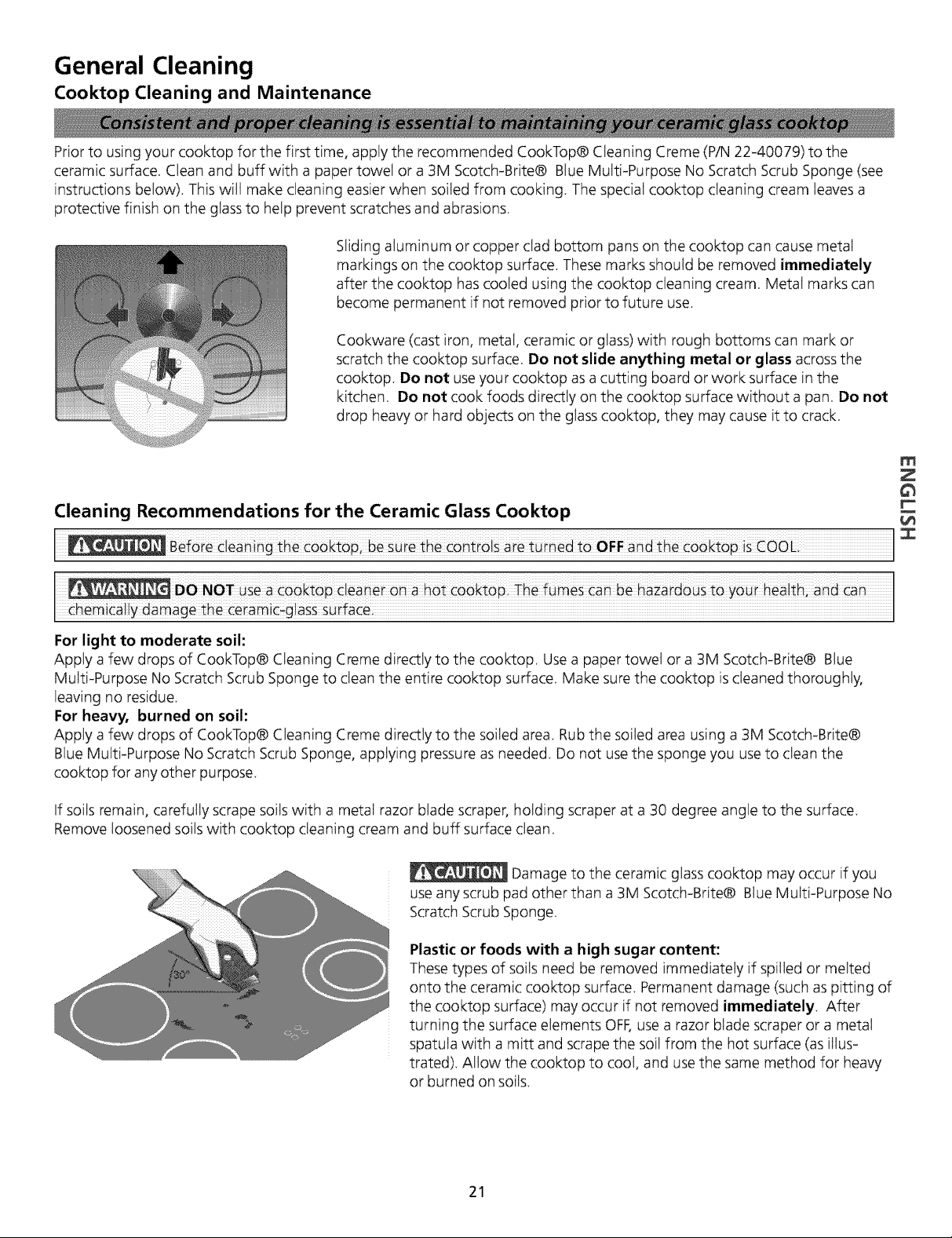
Sliding aluminum or copper clad bottom pans on the cooktop can cause metal
markings on the cooktop surface. These marks should be removed immediately
after the cooktop has cooled using the cooktop cleaning cream. Metal marks can
become permanent if not removed prior to future use.
Cookware (cast iron, metal, ceramic or glass) with rough bottoms can mark or
scratch the cooktop surface. Do not slide anything metal or glass across the
cooktop. Do not use your cooktop as a cutting board or work surface in the
kitchen. Do not cook foods directly on the cooktop surface without a pan. Do not
drop heavy or hard objects on the glass cooktop, they may cause it to crack.
Cleaning Recommendations for the Ceramic Glass Cooktop
m
Z
!
For light to moderate soil:
Apply a few drops of CookTop® Cleaning Creme directly to the cooktop. Use a paper towei or a 3M Scotch-Brite® Blue
Multi-Purpose No Scratch Scrub Sponge to clean the entire cooktop surface. Make sure the cooktop is cleaned thoroughly,
leaving no residue.
For heavy, burned on soil:
Apply a few drops of CookTop® Cleaning Creme directly to the soiled area Rub the soiled area using a 3M Scotch-Brite®
Blue Multi-Purpose No Scratch Scrub Sponge, applying pressure as needed. Do not use the sponge you use to clean the
cooktop for any other purpose.
If soils remain, carefully scrape soils with a metal razor blade scraper, holding scraper at a 30 degree angle to the surface.
Remove loosened soils with cooktop cleaning cream and buff surface clean.
Damage to the ceramic glass cooktop may occur if you
use any scrub pad other than a 3M Scotch-Brite® Blue Multi-Purpose No
Scratch Scrub Sponge.
Plastic or foods with a high sugar content:
These types of soils need be removed immediately if spilled or melted
onto the ceramic cooktop surface. Permanent damage (such as pitting of
the cooktop surface) may occur if not removed immediately. After
turning the surface elements OFF,use a razor blade scraper or a metal
spatula with a mitt and scrape the soil from the hot surface (as illus-
trated). Allow the cooktop to cool, and use the same method for heavy
or burned on soils.
21
General Cleaning
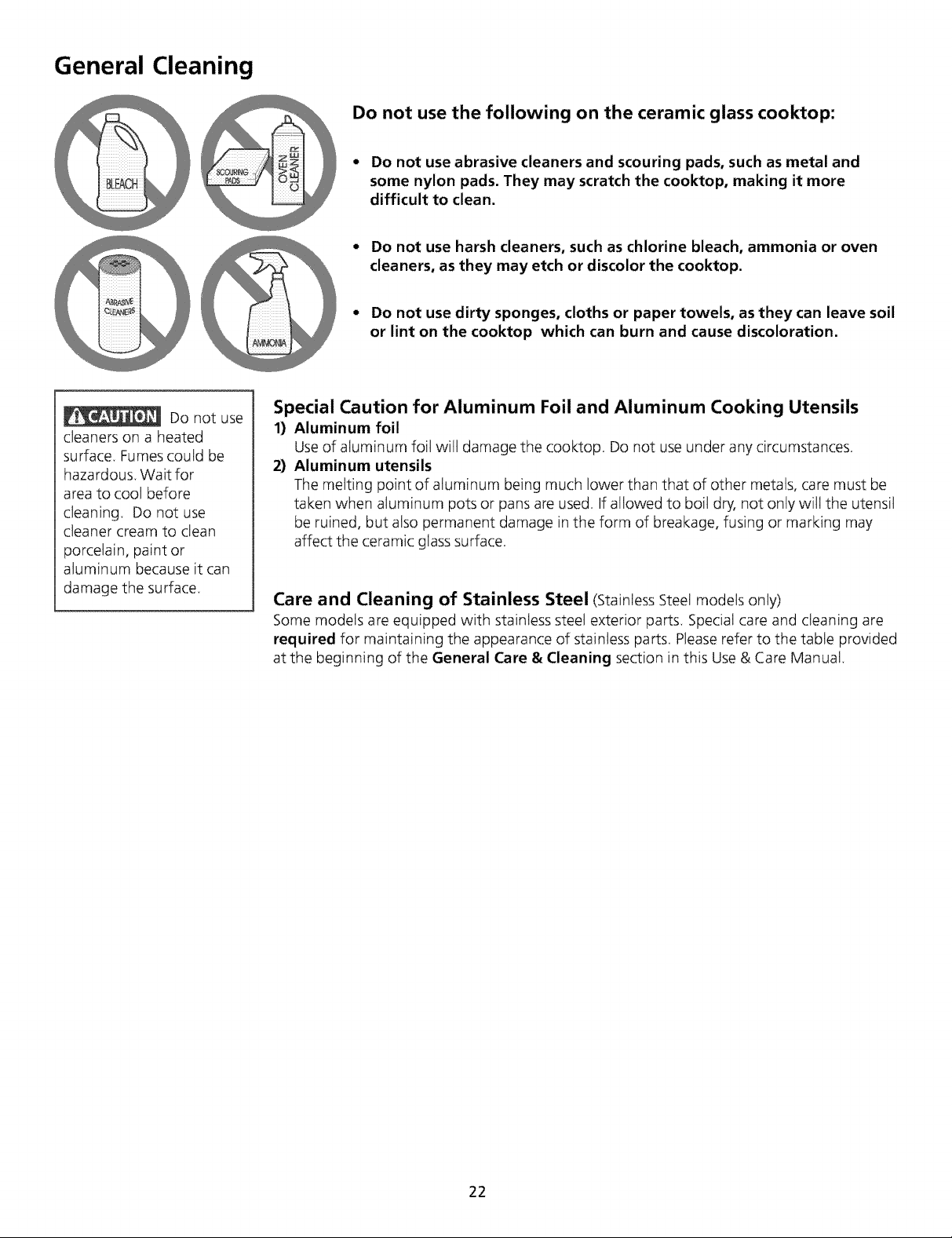
Do not use the following on the ceramic glass cooktop:
• Do not use abrasive cleaners and scouring pads, such as metal and
some nylon pads. They may scratch the cooktop, making it more
difficult to clean.
• Do not use harsh cleaners, such as chlorine bleach, ammonia or oven
cleaners, as they may etch or discolor the cooktop.
• Do not use dirty sponges, cloths or paper towels, as they can leave soil
or lint on the cooktop which can burn and cause discoloration.
Do not use
cleaners on a heated
surface. Fumes could be
hazardous. Wait for
area to cool before
cleaning. Do not use
cleaner cream to clean
porcelain, paint or
aluminum because it can
damage the surface.
Special Caution for Aluminum Foil and Aluminum Cooking Utensils
1) Aluminum foil
Useof aluminum foil will damage the cooktop Do not use under any circumstances
2) Aluminum utensils
The melting point of aluminum being much lower than that of other metals, care must be
taken when aluminum pots or pans are used. If allowed to boil dry, not only will the utensil
be ruined, but also permanent damage in the form of breakage, fusing or marking may
affect the ceramic glass surface.
Care and Cleaning of Stainless Steel (StainlessSteel modelsonly)
Some models are equipped with stainless steel exterior parts. Special care and cleaning are
required for maintaining the appearance of stainless parts. Please refer to the table provided
at the beginning of the General Care & Cleaning section in this Use & Care Manual.
22
General Cleaning
Porcelain enamel cooktop cleaning instructions (Models: 790.4506_)
Do not use a cooktop cleaner on a hot cooktop The fumes can be hazardous to your health, and can chemically
damage the cooking surface.
Before cleaning the surface cooktop, be sure the controls are turned to OFFand the cooktop is cool.
DO NOT use commercial oven cleaners on the exterior surfaces including rangetop and door frame.
Correct and consistent cleaning is essential to maintaining your porcelain enamel cooktop. If food spills and grease spatters are
not removed, they may burn onto the surface of the cooktop and cause permanent discoioration.
Daily Cleaning
For normal soil:
1. Allow cooktop surface to cool.
2. Wipe off spills and spatters using a clean paper towel or a clean cloth with warm, soapy water.
3. If needed, use a soapy steel wool pad or other mild household cleaners.
4. Besure to rinse off the cleaners or the porcelain may become damaged during future heating.
For heavy, burned-on soil:
1. Allow cooktop surface to cool.
2. Usea soap filled scouring pad with warm water or cover heavily soiled spots with a solution of clear water and ammonia. Scour m
gently. Rinse and wipe dry with a clean cloth. Z
3. If any soil remains, apply a few drops of a recommended cooktop cleaning cream on the spots and rub gently using a clean G1
damp cloth or scouring pad. Buff with a dry cloth until all soil and cream are removed. Frequent cleaning with the cooktop
cleaning cream leaves a protective coating which helps in preventing scratches and abrasions. ::_
For sugary spillovers:
Sugary spills can chemically damage your cooktop surface. Therefore, you must begin cleaning the spitlswhite the cooktop isstitl
hot. Usecaution when following the steps below.
1. Turn off all surface units and remove all pans immediately.
2. Put on an oven mitt, wipe up carefully or move hot spills away from the element area with a clean damp cloth.
3. Allow the cooktop to cool. Follow the instructions above for heavy, burned-on soil.
COOKTOP CLEANING / POLISHINGCREAM can be purchased through authorized Searsservice centers or Sears stores.
SURFACES
Porcelain enamel
(cooktop, surface under
cooktop)
Broillnse_
Control Panel
CLEANING AGENTS
Mild cleaners or soap-
filled steel wool pads.
Hot, soapy water or
cleaner cream.
INSTRUCTIONS
Usea damp sponge or dampened
soap pad, rinse and dry.
Use a clean soapy, dampened cloth
or paper towel, remove soil and
dry. Do not use abrasive products.
23
General Cleaning
Coil Surface Element (Models: 790.4506_)
To Remove and Replace Surface Elements and Drip Bowls
ATTENTION: Never leave lids on the coil elements as they could be permanently damaged if the coil is turned on by accident.
Prior to cleaning the coil elements make sure they are cold and that control knobs are turned to OFF
Coil elements clean themselves when they are turned on.
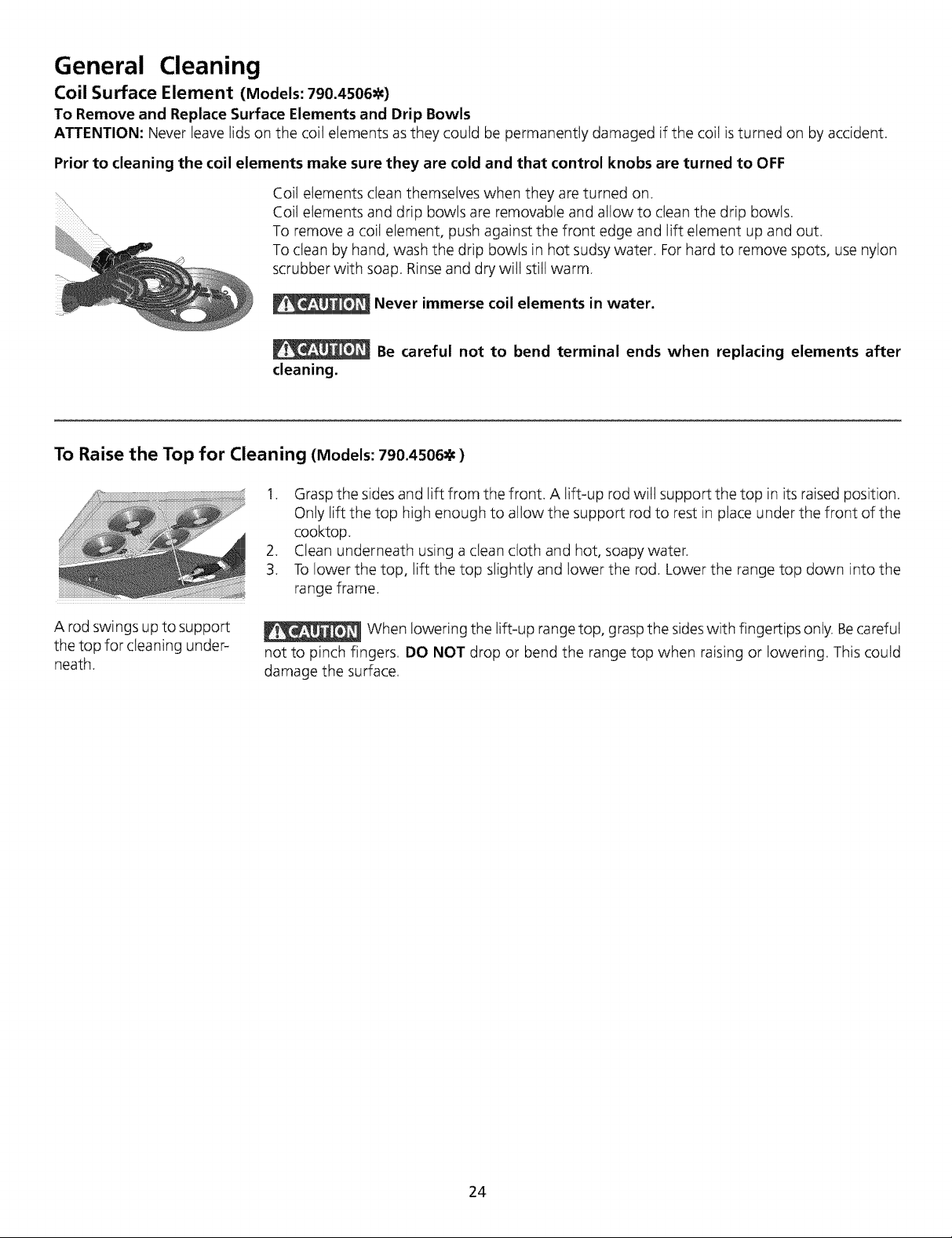
Coil elements and drip bowls are removable and allow to clean the drip bowls.
To remove a coil element, push against the front edge and lift element up and out.
To clean by hand, wash the drip bowls in hot sudsy water. For hard to remove spots, use nylon
scrubber with soap. Rinse and dry will still warm.
Never immerse coil elements in water.
Be careful not to bend terminal ends when replacing elements after
cleaning.
To Raise the Top for Cleaning (Models: 790.4506_ )
A rod swings up to support
the top for cleaning under-
neath.
1. Grasp the sides and lift from the front. A lift-up rod will support the top in its raised position.
Only lift the top high enough to allow the support rod to rest in place under the front of the
cooktop.
2. Clean underneath using a clean cloth and hot, soapy water.
3. To lower the top, lift the top stightly and lower the rod. Lower the range top down into the
range frame.
When lowering the lift-up range top, grasp the sideswith fingertips only. Becareful
not to pinch fingers. DO NOT drop or bend the range top when raising or lowering. This could
damage the surface.
24
General Cleaning
To Remove and Replace Oven Door
To Remove the Oven Door:
1. Open the door to the fully opened position
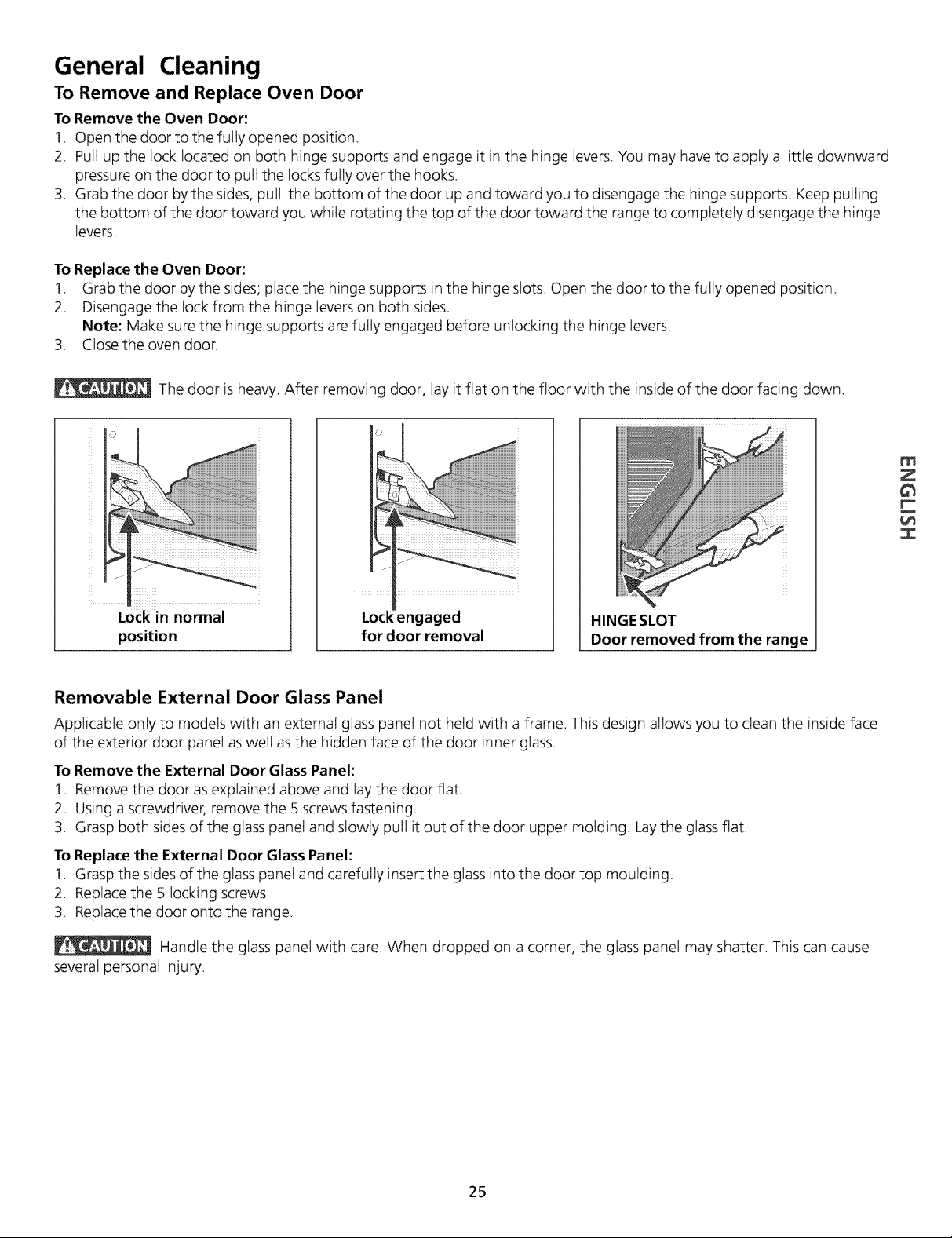
2. Pull up the Iock located on both hinge supports and engage it in the hinge levers. You may have to apply a little downward
pressure on the door to pull the locks fully over the hooks.
3. Grab the door bythe sides, pull the bottom of the door up and toward you to disengage the hinge supports. Keep pulling
the bottom of the door toward you while rotating the top of the door toward the range to complete@ disengage the hinge
levers.
To Replace the Oven Door:
1. Grab the door bythe sides; place the hinge supports inthe hinge stots. Open the door to the fully opened position.
2. Disengage the lock from the hinge levers on both sides.
Note: Make sure the hinge supports are fully engaged before unlocking the hinge levers.
3. Close the oven door.
The door is heavy. After removing door, lay it flat on the floor with the inside of the door facing down.
Lock in normal
position
Lockengaged
for door removal
HINGESLOT
Door removed from the range
m
!
Removable External Door Glass Panel
Applicable only to modeis with an external glass panet not hetd with a frame. This design allows you to clean the inside face
of the exterior door panel as well as the hidden face of the door inner glass.
To Remove the External Door Glass Panel:
1. Remove the door as explained above and lay the door flat.
2. Using a screwdriver, remove the 5 screws fastening.
3. Grasp both sides of the giass panel and slowly pull it out of the door upper moiding. Laythe giass flat.
To Replace the External Door Glass Panel:
1. Grasp the sides of the glass panel and carefully insert the glass into the door top moulding.
2. Replace the 5 locking screws.
3. Replacethe door onto the range.
Handle the glass panet with care. When dropped on a corner, the glass panet may shatter. This can cause
several personal injury.
25
Recalibrating Your Oven Temperature
Your oven thermostat has been precisely set at the factory. This setting may differ from your previous oven, however, so
your recipe times may not give you the results you expect. If you think that the oven is cooking too hot or cool for your
recipe times, you can adjust the thermostat so that the oven cooks hotter or cooler than the temperature displayed.
To Adjust Oven Temperature:
1 Pushthe BAKE pad (_
2. Set the temperature to 550°F (287°C) by pushing and holding the UP ARROW pad A.
3. Within 2 seconds, push and hold the BAKE pad (_ until the special 2 digit display appears. Releasethe BAKE pad
(_. The indicates the of offset between the and the
display
now amount
degrees original factory temperature setting
current temperature setting. If the oven control has the original factory calibration, the display will read "00."
4. The temperature can now be adjusted up or down 35°F (17°C), in 5°F (1°C) steps by pushing and holding the UP A or
DOWN ARROW pad v. Adjust until the desired amount of degrees offset appears in the display. When lowering the
oven temperature, a minus sign (-) will appear before the number to indicate that the oven witl be cooler by the
displayed amount of degrees.
5. When you have made the desired adjustment, push the STOP CLEAR pad @ to go back to the time of day display.
Note: The adjustment made witl not change the self-cleaning temperature.
26
Before you call
Solutions to Common Problems
Beforeyou call for service, review this list. It may save you time and expense. The list includes common occurences that are
not the result of defective workmanship or materials in this appliance.
OCCURRENCE
Range is not level.
POSSIBLE CAUSE/SOLUTION
Poor installation. Place oven rack in center of oven. Place a level on the oven rack. Adjust
leveling legs at base of range until the rack is level. When range is level, cooktop may
appear out of alignment if countertop is not level.
Weak, unstable floor. Be sure floor is level and can adequately support range. Contact a
carpenter to correct sagging or sloping floor.
Kitchen cabinet misalignment may make range appear to be unlevel. Be sure cabinets
are square and have sufficient room for range clearance.
Cannot move appliance easily. Appliance Cabinets not square or are built in too tight. Contact a cabinet maker to correct the
must be accessible for service, problem.
Contact builder or installer to make appliance accessible.
Entire range or oven does not operate.
Carpeting interferes with range. Provide sufficient space so range can be lifted over
carpet.
Make sure cord/plug is tightly into outlet.
Service wiring is not complete. Contact your Sears Service Center, installing agent or
authorized servicer.
m
Z
!
Power outage. Check house lights to be sure. Call your local electric company for
service.
* Oven control beeps and displays F1, F3 Electronic control has detected a fault condition. Push CLEAR to clear the display and
or F9 stop beeping. Program oven again. If fault recurs, record fault number. Push CLEAR and
contact your Sears Service Center or an authorized servicer.
Oven light does not work. Replace or tighten bulb. See Changing Oven Light in this owner's Guide for
instructions.
Surface unit does not heat. No power to the appliance. Check steps under "Entire Range or Oven Does Not
Operate" in this Avoid Service Checklist.
Incorrect control setting. Make sure the correct control is on for the surface unit to be
used.
Scratches or abrasions on cooktop surface. Coarse particles such as salt or sand between cooktop and utensils can cause scratches.
Be sure cooktop surface and bottoms of utensils are clean before usage. Small scratches
do not affect cooking and will become less visible with time.
Cleaning materials not recommended for ceramic-glass cooktop have been used. See
"To Clean the Cooktop Glass" section under General Cleaning.
Cookware with rough bottom has been used. Use smooth, flat-bottomed cookware.
27
Before you call
Solutions to Common Problems
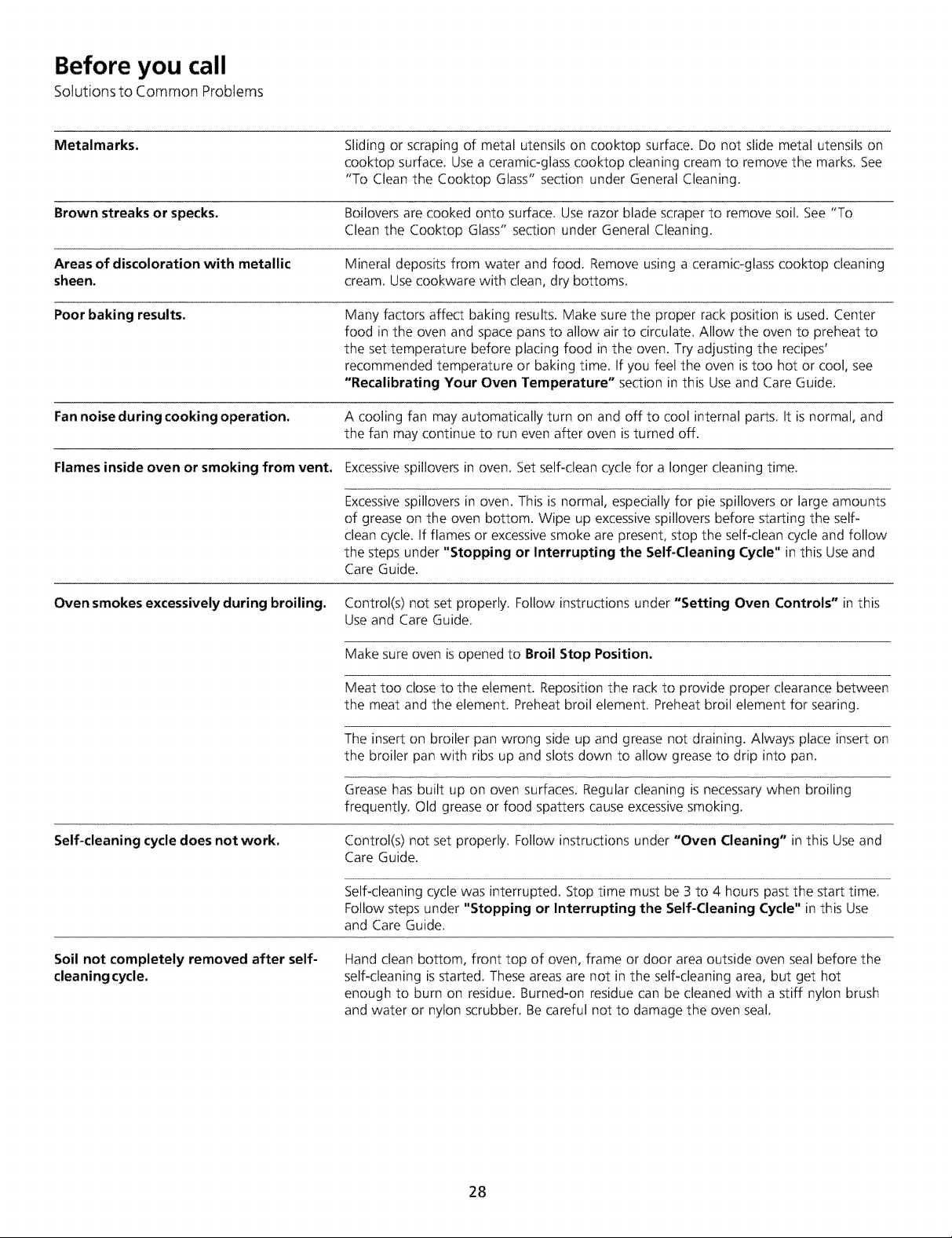
Metalmarks.
Sliding or scraping of metal utensils on cooktop surface. Do not slide metal utensils on
cooktop surface. Use a ceramic-glass cooktop cleaning cream to remove the marks. See
"To Clean the Cooktop Glass" section under General Cleaning.
Brown streaks or specks. Boilovers are cooked onto surface. Use razor blade scraper to remove soil. See "To
Clean the Cooktop Glass" section under General Cleaning.
Areas of discoloration with metallic Mineral deposits from water and food. Remove using a ceramic-glass cooktop cleaning
sheen, cream. Use cookware with clean, dry bottoms.
Poor baking results. Many factors affect baking results. Make sure the proper rack position is used. Center
food in the oven and space pans to allow air to circulate. Allow the oven to preheat to
the set temperature before placing food in the oven. Try adjusting the recipes'
recommended temperature or baking time. If you feel the oven is too hot or cool, see
"Recalibrating Your Oven Temperature" section in this Use and Care Guide.
Fan noise during cooking operation. A cooling fan may automatically turn on and off to cool internal parts. It is normal, and
the fan may continue to run even after oven is turned off.
Flames inside oven or smoking from vent. Excessivespillovers in oven. Set self-clean cycle for a longer cleaning time.
Excessive spillovers in oven. This is normal, especially for pie spillovers or large amounts
of grease on the oven bottom. Wipe up excessive spillovers before starting the self-
clean cycle. If flames or excessive smoke are present, stop the self-clean cycle and follow
the steps under "Stopping or Interrupting the Self-Cleaning Cycle" in this Use and
Care Guide.
Oven smokes excessively during broiling. Control(s) not set properly. Follow instructions under "Setting Oven Controls" in this
Use and Care Guide.
Make sure oven is opened to Broil Stop Position,
Meat too close to the element. Reposition the rack to provide proper clearance between
the meat and the element. Preheat broil element. Preheat broil element for searing.
The insert on broiler pan wrong side up and grease not draining. Always place insert on
the broiler pan with ribs up and slots down to allow grease to drip into pan.
Grease has built up on oven surfaces. Regular cleaning is necessary when broiling
frequently. Old grease or food spatters cause excessive smoking.
Self-cleaning cycle does not work. Control(s) not set properly. Follow instructions under "Oven Cleaning" in this Use and
Care Guide.
Self-cleaning cycle was interrupted. Stop time must be 3 to 4 hours past the start time.
Follow steps under "Stopping or Interrupting the Self-Cleaning Cycle" in this Use
and Care Guide.
Soil not completely removed after self-
cleaning cycle.
Hand clean bottom, front top of oven, frame or door area outside oven seal before the
self-cleaning is started. These areas are not in the self-cleaning area, but get hot
enough to burn on residue. Burned-on residue can be cleaned with a stiff nylon brush
and water or nylon scrubber. Be careful not to damage the oven seal.
28
Tabla de materias
Garantia de la estufa empotrante ......................................... 29
Registro del producto .............................................................. 29
IMPORTANTES INSTRUCCIONES DE SEGURIDAD ............. 30-32
Acuerdos de proteccibn ........................................................... 33
Caracteristicas de la estufa ..................................................... 34
Funciones del panel de control ................................................ 35
Conversibn de la temperatura ................................................ 35
Reglaj del reloj ......................................................................... 36
• Reglaj del reloj .................................................................... 36
• reglaj del minutero ............................................................. 36
Seleccibn de los utensilios de cocina ........................................ 37
Caseroles y soportes especiales .............................................. 37
Coccibn de superficie ........................................................... 38-39
• Programaci6n de los controles de superficie ....................... 38
• Vidrio cer_mico de la plancha de cocinar (algunos modelos) 38
Ventilacibn y rejillas de horno ................................................. 39
Cambiando la luz del homo ..................................................... 39
Ajuste de los controles del homo ....................................... 40-44
• Bake (Homear) ............................................................... 40-42
• Circulaci6n de aire en el homo ........................................... 42
• Broil (Asar a la parilla) .................................................... 43-44
Limpieza del homo ............................................................. 45-46
Limpieza general ................................................................ 47-52
Regulacibn de la temperatura del horno ............................... 53
Lista de verificacibn para evitar Ilamadas ........................ 54-55
Servicio Sears .................................................... Cubierta trasera
Garantia de la estufa empotrante
GARANTIA COMPLETA DE UN AI_iO PARA TODAS LAS PIEZAS
Si dentro de un a_o desde la fecha de instalaci6n, alguna de las piezas no funciona en forma adecuada debido a un defecto de material o
fabricaci6n, Sears la reemplazar_ o reparar& a nuestra opci6n, gratuitamente.
Su cubierta de vidrio cer_mico est_ protegida por una garantia limitada adicional desde el 2a° al 5_° a_o. Esta garantia le proporciona
reemplazo de cualquiera de los elementos calefactores superiores que resulte defectuoso, de la junta de silicona cauchotada deteriorada o
de la cubierta de vidrio que se agriete debido a rotura t_rmica. Esta garantia no cubre el da_o o rotura debido a mal uso del cliente.
Si este producto se usa para otros prop6sitos que no sean los normales del hogar, la garantia anterior es s61owqlida durante 90 dias.
ELSERVlCIO BAJO LA GARANTIA ESTADISPONIBLEPONIENDOSEEN CONTACTO CON SU CENTRO DESERVlCIO SEARSMAS CERCANO EN
LOS ESTADOSUNIDOS.
Esta garantia le otorga ciertos derechos legales especificos y usted tambi_n puede tener otros derechos que varian de un estado a otro.
Sears Roebuck and Co., Dept. 817WA Hoffman Estates, IL 60179
Registro del producto
En _ste espacio, inscriba Ia fecha de compra, modeto y n0mero de serie de su producto Ud encontrar_ eI modeto y el
n0mero de serie en una placa de identificaciOn. La placa esta Iocalisada al Iado izquierdo de Ia estufa yes visible cuando Ia
puerta deI homo esta abierta o en et interior de Ia gaveta en Ia parte lateral de Ia estufa.
Modei No 790. Fecha de compra
No de serie Guarde estas instrucciones y su boleta de pago para consultaciOn futura.
m
O
29
IMPORTANTES INSTRUCCIONES DE SEGURIDAD
Lea todas las instrucciones antes de utilizar el aparato
Guarcle estas instrucciones para futura consultacibn
Este manual contiene importantes mensajes de seguridad. Simpre lea y obedezca todo mensaje de seguridad.
Este es el simbolo _ de alerta de seguridad. Le advierte sobre mensajes de seguridad que le informan de los peligros que pueden
herir o matar a Ud y a otros, o ocasionar da_o al producto.
Indica una situaci6n muy peligrosa, la cual de no ser evitada puede ocasionar graves heridas y hasta la
muerte.
Indica una situaci6n de peligro inminente, la cual de no ser evitada puede ocasionar heridas leves o da_os al
producto
solamente.
Todos los mensajes de seguridad identificar_n el peligro, le dir_n como reducir el riesgo de heridad y adem_s le dir_n Io que puede
ocurrir si no sige las instrucciones.
• Todas las estufas pueden volcarse.
• Riesgo de lesiones corporales.
• Instaleel dispositivo antivuelco incluido.
• Lea las instrucciones de instalaci6n.
Para reducir el riesgo que se vuelque la estufa, hay queasegurarlaadecuadamente coloc_ndole
los tornillos antivuelco que se proporcionan (para modelos equippados y hornillas en metal).
Para comprobar si _stos _stan instalados como se debe, levante la parte superior de la estufa y
verifique que los mencionados tornillos est_n en su lugar y apretados como se debe. Siga las
instrucciones que se dan al respecto.
Retire toda cinta adhesiva y empaquetado antes de
usar la estufa, Destruya el cart6n y las bolsas de pl_stico
despues de haber desenvuelto la estufa. No permita que
los nifios juegen con el material de empaquetado.
Instalaci6n apropiada- Aseg_rese que su aparato
est_ bien instaladado y puesto a tierra por un
t_cnico calificado de acuerdo con el Natioal Electrical
Code ANSIINFPA No 70- _ltima edicici6n y los requisitos
locales. Instale solamente con las instrucciones provistas
con el empaquetado de Ia estufa.
Pregunte en su concesionario por un tecnico calificado y
un servicio autorizado. Aprenda como desconectar Ia
estufa deI cortacircuito o de Ia caja de fusibles en caso de
emergenda.
Servicio al usuario- No repare o remplace ninguna
pieza de su aparato a menos que se Io recomiende
los manuales especificamente Culaquier typo de
servicio debe ser hecho por un tecnico calificado. Esto
reducira el riesgo de heridas personales o de dafios al
aparato.
Nunca modifique o altere la constituci6n de una
estufa moviendo la patas niveladoras, ni el
alambrado, ni las fijaciones de anti-inclinaci6n u
otra parte del aparato.
El apoyarse, pisar o sentarse en la
puerta o en la gaveta de esta estufa puede ocasionar
graves heridas y tambi_n da_os al aparato, No permita
que los nifios juegen o se suban sobre la estufa. El peso de
un nifio sobre Ia puerta abierta puede hacer que esta se
incline, causando graves quemaduras u otto tipo de heridas.
Una gaveta abierta cuando esta caliente puede ocasionar
graves quemaduras.
No alamacene objetos de interns para los
ni_os en los armarios que est_n sobre la cocina El nifio
que trata de subir sobre Ia estufa para alcanzarIos podrfa
Iastimarse.
Nunca utilice su aparato para
calenrtar o entibiar la pieza.
Almacenamiento sobre o dentro del aparato- Los
materiales inflamables no deberian ser almacenados
ni en un homo, ni sobre la unidad. Esto induye el
papet, el pI_stico y la ropa como: Iibros de cocina,
recipientes de plastico o toallas, asf como Ifquidos
inflamables. No almacene exptosivos como latas de
aeros61sobre o dentro det aparato. Los materites
inftamables pueden explotar y ocasionar fuego o dafios a
Ia propiedad.
3O
IMPORTANTES INSTRUCCIONES DE SEGURIDAD
No deje a los ni_os solos- Los ni_os no deben ser
dejados solos o sin atencibn donde el aparato est_
funcionando No Ies permita sentarse o pararse sobre
niguna parte deI aparato
NO TOQUE NINGUNA PARRTE DE LA SUPERFICIE DEL
APARATO, AREAS CE RCA D E ESTAS U N IDAD ES,
ELEMENTOS CALIENTES O LAS PARTES INTERNAS DEL
HORNO O DE LA GAVETA DE ENTIBIAR (SI EQUIPADA).
Las superficies o los elementos deI homo pueden estar
calientes aOn que esten de color oscuro. Las areas cerca
de la superficie pueden estar Io suficientemente calientes
para causar quemaduras. Despues o antes del uso, no
permita que Ia ropa u otros materiales inflamables esten
en contacto con estas areas hasta que hallan enfriado.
Estas areas son: Ia plancha de cocinar, las areas frente a
Ia plancha de cocinar, las ranuras de ventilaci6n deI
homo y las areas cercanas a elias, Ia puerta deI homo y Ia
ventanitla.
Use una vestimenta apropiada- No use ropa que es
suelta u holgada cuando utilice el aparato. No ponga
Ia ropa u otros materiales inflamables en contacto con Ias
areas calientes.
No utilice agua o harina para apagar un fuego-
Apague el fuego con la tapa de una sart_n o use
soda c_ustica, un quimico seco o un extinguidor en
aerosbl.
• Cuando caliente substancias grasosas, tenga
cuidado Puede ocasionar un fuego si es calentado pot
mucho tiempo.
Utilice unicamente los soportes para recipientes que
est_n secos- Los soportes que est_n h_medos o
mojados puden ocasionar quemaduras a causa del
vapor. No permita que los soportes esten en contacto con
Iassuperficies calientes. No utiiice una toalla o un papet
para remplazar al soporte.
• No caliente recipientes de comida que est_n
cerrados- La presibn al interior de estos puede
hacerlos explotar y ocasionar heridas.
• Retire la puerta del homo de toda estufa inutilizada
siesta va ser almacenada o destruida.
IMPORTANTE- No trate de utilizar el horno durante un
torte de electricidad. Si no hay electricidad, apaga su
estufa. Si no apaga el homo y que Ia eIectricidad es
restablecida, el homo puede seguir funcionando. La comida
que deja sin cuidado puede quemarse o deteriorarse.
Los controles el_ctricos pueden
ser da_ados con frias temperaturas. Cuando utilice su
estufa por la primera vez, o si no ha sido utilizada por
mucho tiempo aseg_rese que no haya sido expuestas a
temperaturas m_s altas que 0°C/32°F por m_s de 3
horas antes de conectar su estufa al suministro
el_ctrico.
INSTRUCCIONES IMPORTANTES PARA
UTILIZAR SU PLANCHA DE COCINAR.
• Saber que perillas controlan cada una de los
quemadores.
Utilice una sart_n de tama_o apropiado. Este aparato
est_ equipado con quemadores de diferentes tama_os
Elija utensilios con Ias bases aplanadas y Io
suficientemente grandes para cubrir todo el area deI
quemador. Utiiizar utensilios mas peque_os puede
exponer parte del quemador y ocasionar quemaduras de
Iasprendas que Ileva puesta.
Losmangos de los utensilios deben ser colocados
hacia el interior y no sobre otras unidades de
superficie- Para reducir el riesgo de quemaduras, el
encendido de materiales inflamables y los derrames
ocasionados de casualidad. El mango deI utensilio debe
set colocado hacia el interior y no sobre otras unidades de
superficie.
Nunca deje los quemadoreas con alta temperatura m
sin cuidado- Los derrames ocasionan humo y derrames _,_
grasosos que pueden encenderse, o una sarten que ha
calentado por mucho tiempo puede derretirse. _
0
Delineadores protectores- No utilice pelfcula de
aluminium a ia base deI homo u otra parte del aparato.
SOio utilizela para cubrir la comida cuando este
cociendoia. Cualquier otra utilizaciOn puede ocasionar un
incendio, una eiectrocuciOn o un cortocircuito.
Utensilios de cocina envidriados- S6Io algunos tipos de
utensitios de vidrio, de vidrio/ceramica, de ceramica
pueden resistir Ia temperatura det quemador de su
plancha de cocinar. Verifique Ias recomendaciones deI
fabricante sobre el uso con Ias planchas de cocinar.
No utilice cubiertas decorativas- Si un quemador es
encendido accidentalmente, Ia cubierta decorativa se
calentara y podrfa derretirse. Las cubiertas calientes
podran ocasionar quemaduras si las toca. La plancha de
cocinar tambien podrfa set da_ada.
31
IMPORTANTES INSTRUCCIONES DE SEGURIDAD
PARA PLANCHAS DE COCINAR SOLAMENTE
• No limpie o utilice una plancha de cocinar que est_
rota- Si la plancha de cocinar se rompe, los productos de
Iimpieza o los derrames pueden penetrar en ella y
producir un riesgo de electrocud6n. Llame a un tecnico
calificado inmediatamente.
Limpie el vidrio de la plancha de cocinar con
cuidado- Si utiliza una esponja mojada para limpiar
derrames en una superficie caliente, tenga cuidado de no
quemarse con et vapor. AIgunos productos de limpieza
puden producir peligrosas emanaciones si se Ies usa sobre
areas muy calientes.
• Evite de raspar el vidrio de la plancha de cocinar con
objetos muy filados.
INSTRUCCIONES IMPORTANTES PARA
UTILIZAR SU HORNO.
• Tenga cuidado cuando abra la puerta del horno.
Parese al Iado de la estufa cuando abra Ia puerta de un
homo caliente. Permita que el humo y el vapor se
escapen antes de retirar o de colocar comida en el homo/
gaveta de entibiar.
Mantenga el conducto de ventilacibn del homo sin
obstruccibn La rejilla del homo est_ ubicada detr_s de
Ia plancha de cocinar a Ia derecha. Tocar estas areas
cuando el homo est_ encendido puede ocasionar graves
quemaduras. No coloque objetos de pl_stico o sensibles al
calor cerca deI conducto de ventitaci6n. Estos pueden
derretirse o encenderse.
Colocaci6n de las rejillas del homo. Siempre coIoque
Ias rejillas deI homo en Ia posici6n deseada cuando el
homo o la gaveta esten frfos. Si la rejilla debe ser
desplazada cuando el homo este funcionando tenga
bastante cuidado. Utilice unos soportes para recipientes y
coja Ia rejilla con ambas manos hasta recolocarla. No
permita que estos soportes esten en contacto con los
elementos calientes deI homo o de la gaveta de entibiar.
Retire todo utensitio de Ia rejilla antes de moverla.
• No utilice la cubeta parrillera sin su accesorio. La
cubeta parrillera y su accesorio permiten que Ia grasa
gotee y este Iejos deI calor de Ia parrilla.
No cubra el accesorio de la parrilla con pelicula de
aluminio. La grasa que queda fuera podrfa encenderse
No toque la bombilla de luz caliente con una tela
mojada. Esto puede romper Ia bombilla Antes de retirar
o remptazar la bombitla desconecte el aparato o corte el
suministro electrico.
IMPORTANTES INSTRUCCIONES PARA
LIMPIAR SU COCINA.
• Limpie la estufa regularmente para mantener todas
las partes sin grasa que puede encenderse y causar
un incendio La cubierta deI escape de ventitaci6n y los
filtros de grasa deben estar limpios. No permita que Ia
grasa se acumule en Ia cubierta o en et fittro. Los
depOsitos grasosos pueden encenderse y causar un
incendio. Cuando caliente comida bajo la cubierta,
encienda et ventilador. Consulte Iasinstrucciones deI
fabricante para Ia Iimpieza.
Limpiadores de estufa y aerosoles- Siempre siga las
instrucciones deI fabricante para su uso.Tenga en cuenta
que los residuos de los limpiadores y aerosoIes pueden
encenderse ocasionando da_os y heridas.
HORNO CON AUTO-LIMPIEZA
• Limpie en el ciclo de auto-limpieza unicamente las
partes que est_n en la lista del "Manual del
usuario". Antes de auto-limpiar el homo, retire la cubeta
parrillera y cualquier otto utensitio o comida deI horno.
• No utilice limpiadores de homo- Ning0n limpiador de
homo comercial o de capa protectora de ninguna clase
debe ser utilizada en en horno.
No limpie las empaquetaduras del horno- Las
empaquetaduras det homo son importantes para un buen
setlado. Tenga cuidado de no frotar, da_ar o desplazar Ias
empaquetaduras.
Retire las rejillas del homo- El color de las rejillas del
homo cambiara si se Ies deja en el homo durante el ciclo
de auto-Iimpieza.
La salud de algunos p_jaros est_ muy
sensitiva a los humos que proveen del ciclo de auto-
limpieza de cualquier cocina. Desplace los p_jaros
en otra habitacibn bien ventilada.
ADVERTENCIA DE SEGURIDAD IMPORTANTE
El California Safe Drinking Water y Toxic Enforcement Act
requiere al Gobiemo de California de publicar una lista de
sustancias conocidas por el estado como causa de c_incer,
defectos de nacimiento u otros danos reproductivos, y requiere
que se avisen los usuarios sobre la exposici6n eventual a
sustancias.
GUARDE ESTAS INSTRUCCIONES
32
ACUERDOS DE PROTECCION
En los EU.
Acuerdos Maestro de Proteccibn
Felicitaciones pot haber hecho una compra intetigente. Su
nuevo producto Kenmore ®es dise_ado y manufacturado para
muchos a_os de servicio confiabIe. Pero como todo producto,
podria requerir mantenimiento preventivo o reparaciOn entre
tiempo. Ahf es cuando el tener un Acuerdo Maestro de
ProtecciOn Ie podrfa ahorrar dinero y moIestias.
Compre ya un Acuerdo Maestro de Protecci6n y pret_jase de
gastos y frustraciones inesperadas.
ElAcuerdo Maestro de ProtecciOn tambien ayuda a extender
Ia vida de su nuevo producto. Esto es Io que se incluye en el
Acuerdo.
Servicio Profesional por nuestros 12,000 especialistas
profesionales en reparaciOn.
Servicio ilimitado sin cargo por piezas y servicio en
toda reparaciOn cubierta
Garantia de "No-lim6n"- reemplaza su producto
cubierto si ocurren cuatro o mas desperfectos dentro de
doce meses.
Reemplazo de Producto si el producto cubierto no
puede ser reparado.
Verificacibn de Mantenimiento Preventivo Anual a su
petici0n sin cargos adicionales.
Pronta ayuda por tel6fono- apoyo por telefono por un
tecnico de Sears en Ios productos que requieran
reparaciOn en casa, mas Ia conveniencia de hacer cita
para reparaciOn.
Proteccibn contra picos de energia o da_os eIectricos
causados por fluctuaciones en energia.
Reembolso de alquiler si Ia reparaciOn de su producto
cubierto toma mas tiempo de Io prometido.
Una vez compres el Acuerdo, una simple Ilamada telef0nica
es todo Io que necesitas para hacer cita para su servicio.
Puedes Ilamar a cualquier hora, dia o noche o concertar una
cita para servicio via computadora.
En Canada
Acuerdos de Mantenimiento
Su compra tiene valor mayor porque puedes depender de
Sears HomeCentral ® para servicio. Con sobre 2,400 Tecnicos
de Servicios y mas de un mitlOn de piezas y accesorios,
tenemos Ias herramientas, piezas, conocimiento y destrezas
para asegurar nuestro compromiso: Ledamos servicio a Io que
vendemos.
Su producto Kenmore®es dise_ado y puesto a prueba para
proveer muchos a_os de operaciOn confiable. Pero como todo
producto, podria requerir servicio entre tiempo. EIAcuerdo de
Mantenimiento Sears Ie ofrece un programa de servicio
incomparable a un precio mOdico.
El Acuerdo de Mantenimiento Sears:
Essu manera de comprar servicio para ei manana a precio
de boy
Elimina facturas por reparaciOn como resultado de uso y
desgaste normal
Provee apoyo via telefono de un tecnico de Searsen
productos que requieran reparaciOn en casa
Aunque no necesite reparaciOn, provee VerificaciOn de
Mantenimiento Preventivo anual, a su peticiOn, para
asegurar que su producto esta en condiciones apropiadas.
Algunas limitaciones podrian aplicar. Para m_s
informacibn sobre el Acuerdo de Mantenimiento de
Sears Canada,
Ilame al 1-800-361-6665.
m
Z_
O
1=-
Sears tiene sobre 12,000 especialistas profesionales de
reparaciOn, con acceso a sobre 4.5 mitlones de piezas y
accesorios de calidad. Esa es la clase de profesionalismo con
Ia que puedes contar para ayudar a prolongar Ia vida de su
nueva compra por muchos a_os. iCompre su Acuerdo
Maestro de ProtecciOn boy!
Algunas limitaciones y exclusiones podrian aplicar. Para
precios e informacibn adicional, Ilame al 1-800-827-6655.
Servicio de Instalaci6n Sears
Para instalaci6n profesional de Sears en enseres del hogar,
abridores de puertas de garaje, calentadores de agua y otros
articulos mayores del ho_ar, en EU. Ilame al
1-800-4-MY-HOME_
33
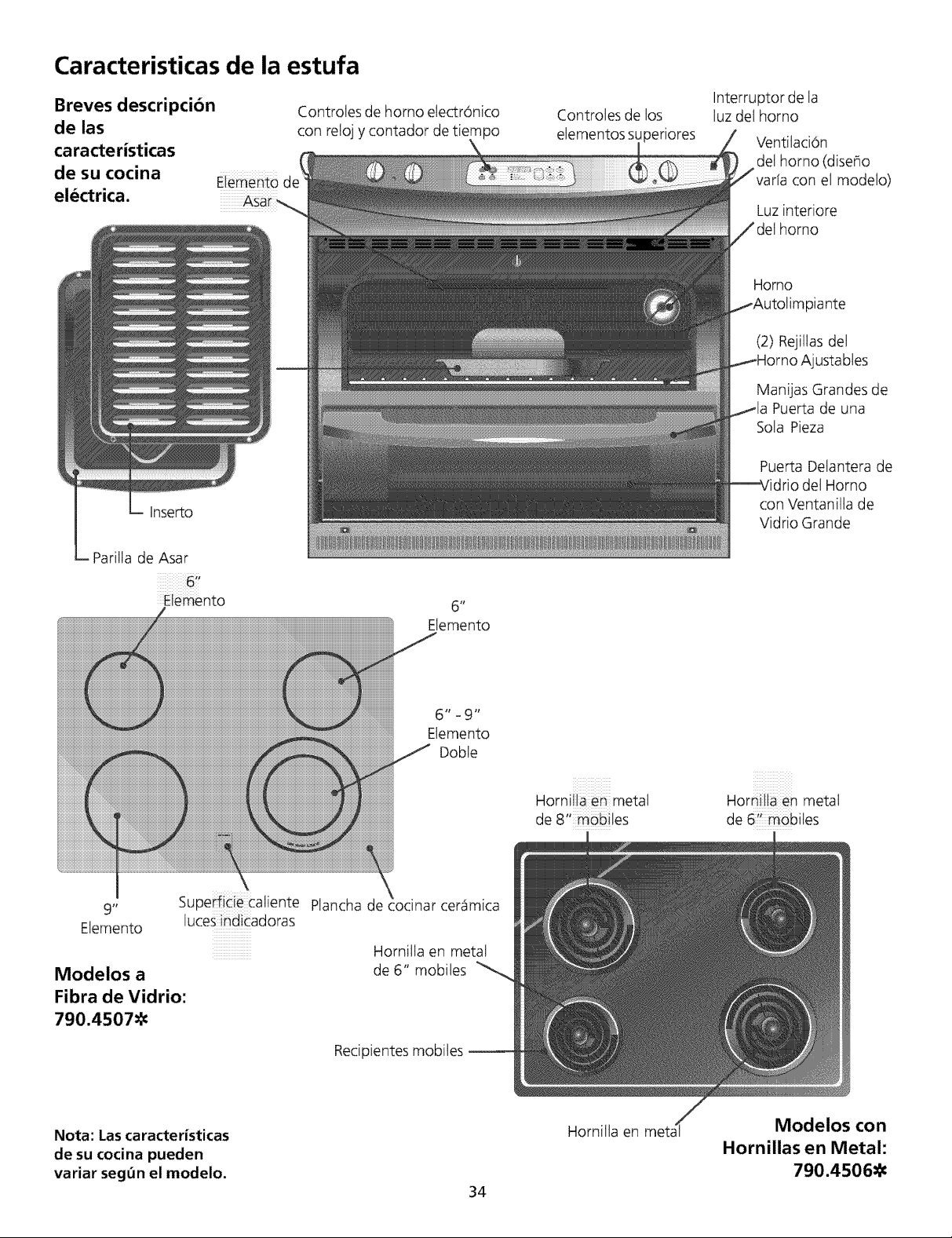
Caracteristicas de la estufa
Breves descripci6n Controles de homo electrOnico
de las con reloj y contador de tiempo
caracteristicas
de su cocina EIemento de
electrica.
Inserto
Parilla de Asar
6'
Elemento
6_
Elemento
Controles de ios
elementos su
Interruptor de Ia
Iuz dei homo
VentitaciOn
del homo (dise_o
con el modelo)
Luz interiore
homo
Homo
piante
(2) Rejillas del
justables
Manijas Grandes de
Puerta de una
Sola Pieza
Puerta Delantera de
Homo
con Ventanilla de
Vidrio Grande
6_ _ 9 s_
Elemento
Doble
Hornitla en metal
de 8" mObiles
Hornilia en metal
de 6'_ mObites
9" Supe!_iCiecaliente
Elemento IuceSindicadoras
Modelos a
Fibra de Vidrio:
790.4507@
Plancha de cocinar ceramica
Hornilla en metal
de 6" mobiles
Recipientes mobiles
Nora: Lascaracteristicas
de su cocina pueden
variar seg_n el modelo.
34
Hornilla en
Modelos con
Hornillas en Metal:
790.4506_
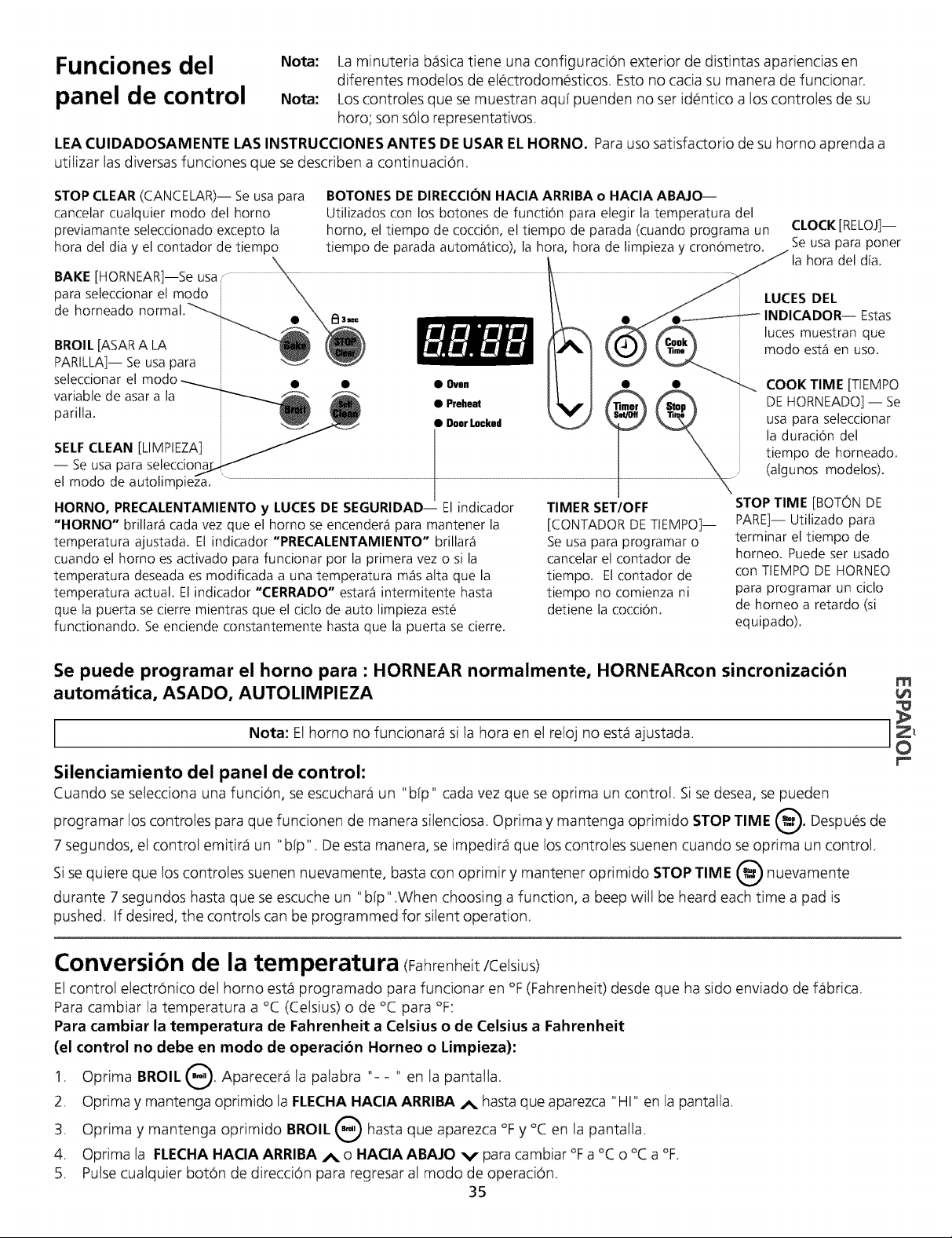
Funciones del Nota:
panel de control Nota:
La minuteria b_sica tiene una configuraci6n exterior de distintas apariencias en
diferentes modelos de electrodomesticos. Esto no cacia su manera de funcionar.
Los controles que se muestran aqui puenden no ser id_ntico a los controIes de su
horo; son s6Io representativos.
LEACUIDADOSAMENTE LAS INSTRUCCIONES ANTES DE USAR EL HORNO. Para uso satisfactorio de su homo aprenda a
utilizar Ias diversas funciones que se describen a continuaci6n
STOP CLEAR (CANCELAR)-- Se usa para
cancelar cualquier modo del homo
previamante seleccionado excepto la
hora del dia y el contador de tiempo
BAKE [HORNEAR]--Se usa
para seleccionar el modo
de horneado normal._'_.
BROIL [ASAR A LA
PARILLA]-- Se usa para
seleccionar el modo
variable de asar a la
parilla.
SELF CLEAN [LIMPIEZA]
-- Se usa para selecciona
el modo de autolimpieza.
BOTONES DE DIRECCION HACIA ARRIBA o HACIA ABAJO--
Utilizados con los botones de functi6n para elegir la temperatura del
homo, el tiempo de cocci6n, el tiempo de parada (cuando programa un
tiempo de parada autom_tico), la hora, hora de limpieza y cron6metro.
CLOCK [RELOJ]--
Se usa para porter
la hora del dia.
• Preheat _ _
roo.r--,
LUCES DEL
I_ _ • _Jo_ INDICADOR-- Estas
_ i luces muestran que
__._ i modo est,1 en uso.
• • Oven • • _ COOK TIME [TIEMPO
DE HORNEADO] -- Se
usa para seleccionar
la duraci6n del
tiempo de homeado.
(algunos modelos).
HORNO, PRECALENTAMIENTO y LUCES DE SEGURIDAD-- El indicador
"HORNO" brillar_ cada vez que el horno se encender_ para mantener la
temperatura ajustada. El indicador "PRECALENTAMIENTO" brillar_
cuando el homo es activado para funcionar por la primera vez o si la
temperatura deseada es modificada a una temperatura m_s alta que la
temperatura actual. El indicador "CERRADO" estar_ intermitente hasta
que la puerta se cierre mientras que el ciclo de auto limpieza est_
functionando. Se enciende constantemente hasta que la puerta se cierre.
TIMER SET/OFF
STOP TIME [BOTON DE
[CONTADOR DE TIEMPO]--
Se usa para programar o
cancelar el contador de
tiempo. El contador de
tiempo no comienza ni
detiene la cocci6n.
PARE]-- Utilizado para
terminar el tiempo de
horneo. Puede ser usado
con TIEMPO DE HORNEO
para programar un ciclo
de homeo a retardo (si
equipado).
Se puede programar el horno para • HORNEAR normalmente, HORNEARcon sincronizacibn
autorn&tica, ASADO, AUTOLIMPIEZA
Nora: EI homo no funcionara si Ia hora en el reloj no esta ajustada.
Silenciamiento del panel de control:
Cuando se setecciona una funci0n, se escuchar_ un "bip" cada vez que se optima un control Si se desea, se pueden
programar los controies para que funcionen de manera sitenciosa. Optima y mantenga oprimido STOP TIME (_). Despues
de
7 segundos, ei controi emitira un "bip". De esta manera, se impedira que Ios controles suenen cuando se optima un control.
se quiere que Ios controles suenen nuevamente, basta con oprimir y mantener oprimido STOP TIME 1_)
Si
nuevamente
durante 7 segundos hasta que se escuche un "bip" .When choosing a function, a beep will be heard each time a pad is
pushed. If desired, the controls can be programmed for silent operation.
m
O
Conversibn de la temperatura (Fahrenheit/Celsius)
El control etectr0nico del homo est_ programado para funcionar en °F (Fahrenheit) desde que ha sido enviado de f_brica
Para cambiar la temperatura a °C (Celsius) o de °C para °F:
Para cambiar la temperatura de Fahrenheit a Celsius o de Celsius a Fahrenheit
(el control no debe en modo de operacibn Horneo o Limpieza):
Optima BROIL (_ Aparecer_ Ia palabra "- - " en Ia pantalla
1.
2. Optima y mantenga oprimido Ia FLECHA HACIA ARRIBA A hasta que aparezca "HI" en Ia pantalla.
Optima y mantenga oprimido BROIL 1_ hasta que aparezca °F y °C en Ia pantalla.
3.
4 Optima la FLECHA HACIA ARRIBA A o HACIA ABAJO v para cambiar °F a °C o °C a °F
5 Pulse cualquier botOn de direcciOn para regresar al modo de operaciOn
35
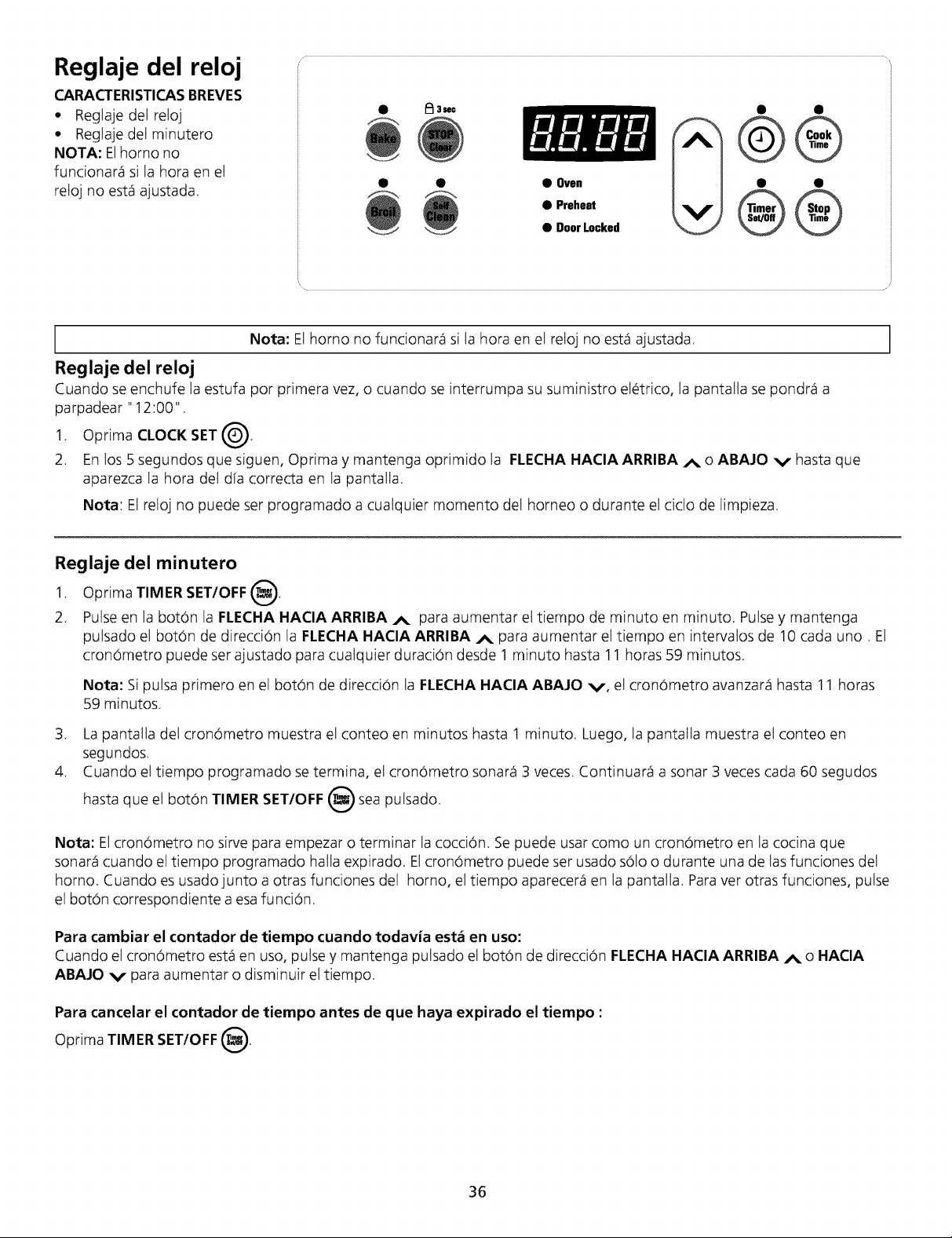
Reglaje del reloj
CARACTERISTICASBREVES
• Reglaje deI retoj
• Reglaje deI minutero
NOTA: Elhomo no
funcionar_ si la hora en el
reIoj no est_ ajustada
• PI 3sec
• Preheat
• Door Locked
Nora: EI homo no funcionara si Ia hora en el reloj no esta ajustada.
Reglaje del reloj
Cuando se enchufe Ia estufa pot primera vez, o cuando se interrumpa su suministro eletrico, Ia pantalla se pondr_ a
parpadear "12:00".
1. Optima CLOCK SET_--_.
2. En Ios 5 segundos que siguen, Optima y mantenga oprimido Ia FLECHA HACIA ARRIBA A o ABAJO v hasta que
aparezca Ia hora deI dfa correcta en Ia pantalla.
Nota: EI reloj no puede set programado a cualquier momento deI borneo o durante el ciclo de Iimpieza.
Reglaje del minutero
1 Opdma TIMER SET/OFF
2 Pulse en Ia bot0n Ia FLECHA HACIA ARRIBA A para aumentar el tiempo de minuto en minuto. Pulse y mantenga
pulsado el bot0n de direcci0n la FLECHA HACIA ARRIBA A para aumentar el tiempo en intervalos de 10 cada uno EI
cron0metro puede set ajustado para cualquier duraci0n desde 1 minuto hasta 11 horas 59 minutos
Nota: Si pulsa primero en el bot0n de direcci0n Ia FLECHA HACIA ABAJO v, el cron0metro avanzara hasta 11 horas
59 minutos.
3. La pantalla dei cron0metro muestra ei conteo en minutos hasta 1 minuto. Luego, Ia pantalla muestra ei conteo en
segundos.
4. Cuando el tiempo programado se termina, el cron0metro sonata 3 veces. Continuara a sonar 3 veces cada 60 segudos
hasta que el botOn TIMER SETIOFF (_ sea
pulsado.
Nota: Elcron0metro no sirve para empezar o terminar la cocci0n. Se puede usar como un cron0metro en Ia cocina que
sonata cuando el tiempo programado halla expirado. Elcron0metro puede set usado s0Io o durante una de las funciones deI
homo. Cuando es usadojunto a otras funciones deI homo, el tiempo aparecera en Ia pantalla. Paravet otras funciones, pulse
el bot0n correspondiente a esa funci0n.
Para cambiar el contador de tiempo cuando todavia est_ en uso:
Cuando el cron0metro est_ en uso, pulse y mantenga pulsado el bot0n de direcci0n FLECHA HACIA ARRIBA _ o HACIA
ABAJO v para aumentar o disminuir ei tiempo.
Para cancelar el contador de tiempo antes de que haya expirado el tiempo :
TIMER SET/OFF (_
Oprima
36
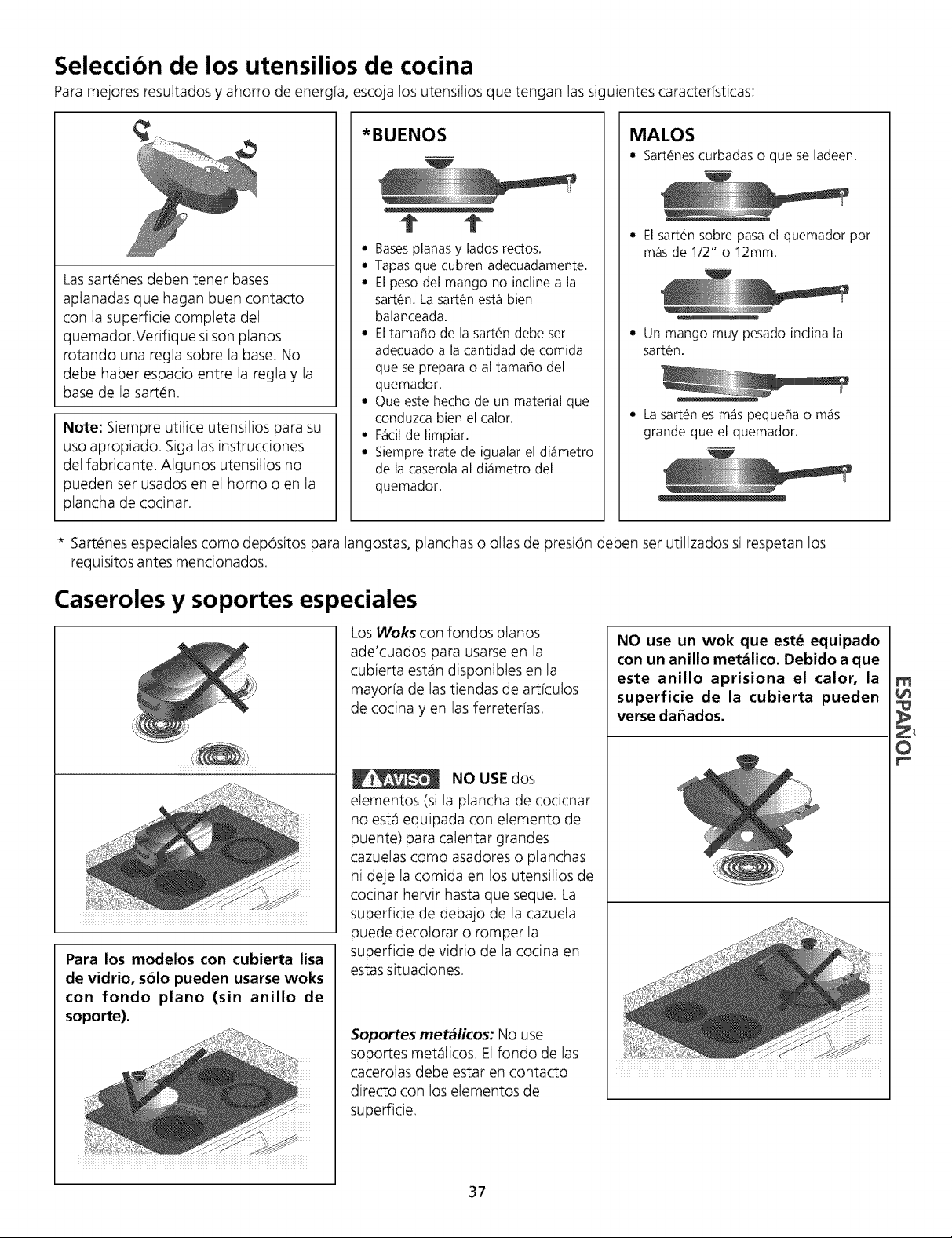
Selecci6n de los utensilios de cocina
Paramejores resultados y ahorro de energfa, escoja los utensitios que tengan Ias siguientes caracterfsticas:
Las sartenes deben tener bases
aplanadas que hagan buen contacto
con Ia superficie compteta del
quemador.Verifique si son pianos
rotando una regla sobre la base. No
debe haber espacio entre Ia regla y Ia
base de Ia sarten.
Note: Siempre utitice utensilios para su
uso apropiado. Siga las instrucciones
del fabricante. Algunos utensitios no
pueden ser usados en el homo o en Ia
plancha de cocinar.
*BUENOS
t t
Basesplanasy lados rectos.
• Tapasque cubren adecuadamente.
• Elpeso del mango no incline a la
sart_n. Lasart_nestabien
balanceada.
Eltamano de la sart_n debeser
adecuadoa la cantidad de comida
que se prepara o al tama_o del
quemador.
• Que estehecho de un material que
conduzcabien el calor.
• Facilde limpiar.
Siempretrate de igualar el diametro
de la caserolaal diametro del
quemador.
MALOS
Sart_nescurbadaso que se ladeen.
• Elsart_nsobre pasael quemador por
m_isde I/2" o 12mm.
Un mango muy pesado inclina la
sart6n.
• La sart_n es m_is peque_a o m_is
grande que el quemador.
* Sartenes especiales como depOsitos para Iangostas, planchas o ollas de presiOn deben ser utitizados si respetan los
requisitos antes mencionados.
Caseroles y soportes especiales
Para los modelos con cubierta lisa
de vidrio, s61o pueden usarse woks
con fondo piano (sin anillo de
soporte).
Los Woks con fondos pianos
ade'cuados para usarse en Ia
cubierta estan disponibles en la
mayoria de Ias tiendas de articulos
de cocina y en Ias ferreterias.
NO USE dos
elementos (si Ia plancha de cocicnar
no esta equipada con elemento de
puente) para calentar grandes
cazuetas como asadores o planchas
ni deje Ia comida en los utensilios de
cocinar hervir hasta que seque. La
superficie de debajo de Ia cazueta
puede decolorar o romper Ia
superficie de vidrio de Ia cocina en
estas situaciones.
Soportes met_licos: No use
soportes metalicos. El fondo de las
cacerolas debe estar en contacto
directo con los elementos de
superficie.
NO use un wok que est_ equipado
con un anillo met_lico. Debido a que
este anillo aprisiona el calor, la
superficie de la cubierta pueden
verse da_ados.
37
m
O
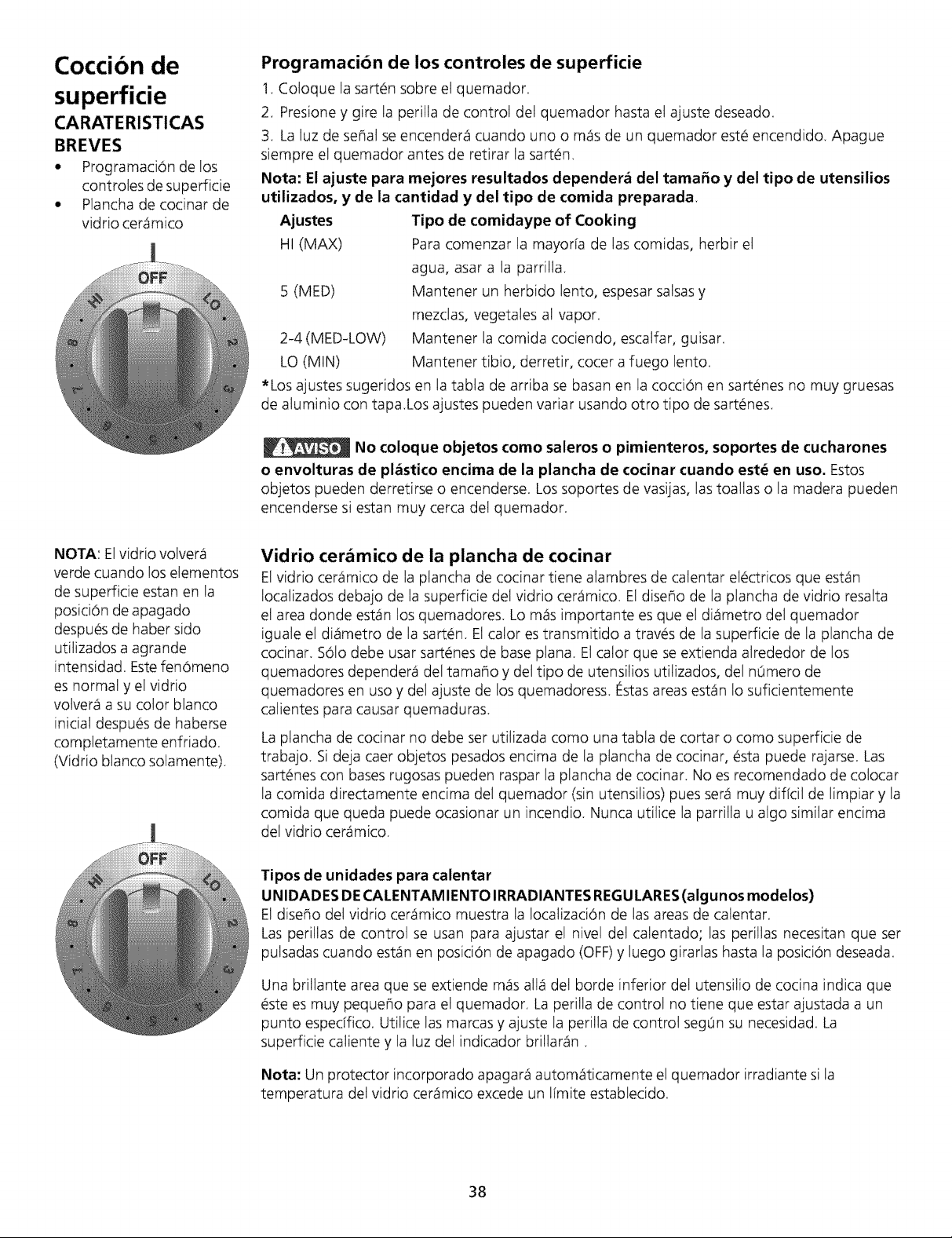
Cocci6n de
superficie
CARATERISTICAS
BREVES
• ProgramaciOn de los
controles de superficie
• Plancha de cocinar de
vidrio cer_mico
Programaci6n de los controles de superficie
1 Coloque Ia sarten sobre el quemador
2. Presione y gire Ia perilla de control deI quemador hasta el ajuste deseado.
3. La Iuz de se_al se encender_ cuando uno o m_s de un quemador este encendido. Apague
siempre el quemador antes de retirar Ia sarten.
Nota: El ajuste para mejores resultados depender_ del tama_o y del tipo de utensilios
utilizados, y de la cantidad y del tipo de comida preparada
Ajustes Tipo de comidaype of Cooking
HI (MAX) Para comenzar Ia mayorfa de Ias comidas, herbir el
agua, asar a Ia parritla.
5 (MED) Mantener un herbido lento, espesar salsas y
mezclas, vegetales al vapor.
2-4 (MED-LOW) Mantener Ia comida cociendo, escalfar, guisar.
LO (MIN) Mantener tibio, derretir, cocer a fuego lento.
*Los ajustes sugeridos en Ia tabla de arriba se basan en Ia cocciOn en sartenes no muy gruesas
de aluminio con tapa.Los ajustes pueden variar usando otto tipo de sartenes.
No coloque objetos como saleros o pimienteros, soportes de cucharones
o envolturas de pl_stico encima de la plancha de cocinar cuando est_ en uso. Estos
objetos pueden derretirse o encenderse Los soportes de vasijas, Iastoailas o Ia madera pueden
encenderse si estan muy cerca deI quemador.
NOTA: Elvidrio voIvera
verde cuando los etementos
de superficie estan en Ia
posiciOn de apagado
despues de haber sido
utilizados a agrande
intensidad. Este fenOmeno
es normal y el vidrio
volvera a su color blanco
inicial despues de haberse
completamente enfriado.
(Vidrio blanco solamente).
Vidrio cer_mico de la plancha de cocinar
Elvidrio cer_mico de Ia plancha de cocinar tiene alambres de calentar eIectricos que est_n
Iocalizados debajo de Ia superficie deI vidrio ceramico. El dise_o de la plancha de vidrio resalta
el area donde estan los quemadores. Lo mas importante es que el diametro deI quemador
iguale el diametro de Ia sarten. El calor es transmitido a traves de la superficie de Ia plancha de
cocinar. SOIodebe usar sartenes de base plana. El calor que se extienda alrededor de los
quemadores dependera det tama_o y del tipo de utensilios utilizados, det n0mero de
quemadores en uso y del ajuste de los quemadoress. Cstas areas estan Io suficientemente
calientes para causar quemaduras.
La plancha de cocinar no debe ser utitizada como una tabla de cortar o como superficie de
trabajo. Si deja caer objetos pesados encima de la plancha de cocinar, esta puede rajarse. Las
sartenes con bases rugosas pueden raspar la plancha de cocinar. No es recomendado de colocar
Ia comida directamente encima deI quemador (sin utensilios) pues sera muy diffcil de limpiar y Ia
comida que queda puede ocasionar un incendio. Nunca utitice Ia parrilla u algo similar encima
deI vidrio ceramico.
Tipos de unidades para calentar
UNIDADES DE CALENTAM lENTO IRRADIANTES REGULARES(algunos modelos)
Eldise_o deI vidrio cer_mico muestra Ia IocalizaciOn de Ias areas de calentar.
Las perillas de control se usan para ajustar el nivet del calentado; las perillas necesitan que ser
pulsadas cuando estan en posiciOn de apagado (OFF)y Iuego girarlas hasta Ia posiciOn deseada.
Una brillante area que se extiende mas alla deI borde inferior deI utensitio de cocina indica que
este es muy peque_o para et quemador. La perilla de control no tiene que estar ajustada a un
punto especifico. Utitice las marcas y ajuste la perilla de control seg0n su necesidad. La
superficie caliente y Ia Iuz deI indicador brillaran.
Nota: Un protector incorporado apagara automaticamente et quemador irradiante si Ia
temperatura deI vidrio ceramico excede un Iimite estabtecido.
38
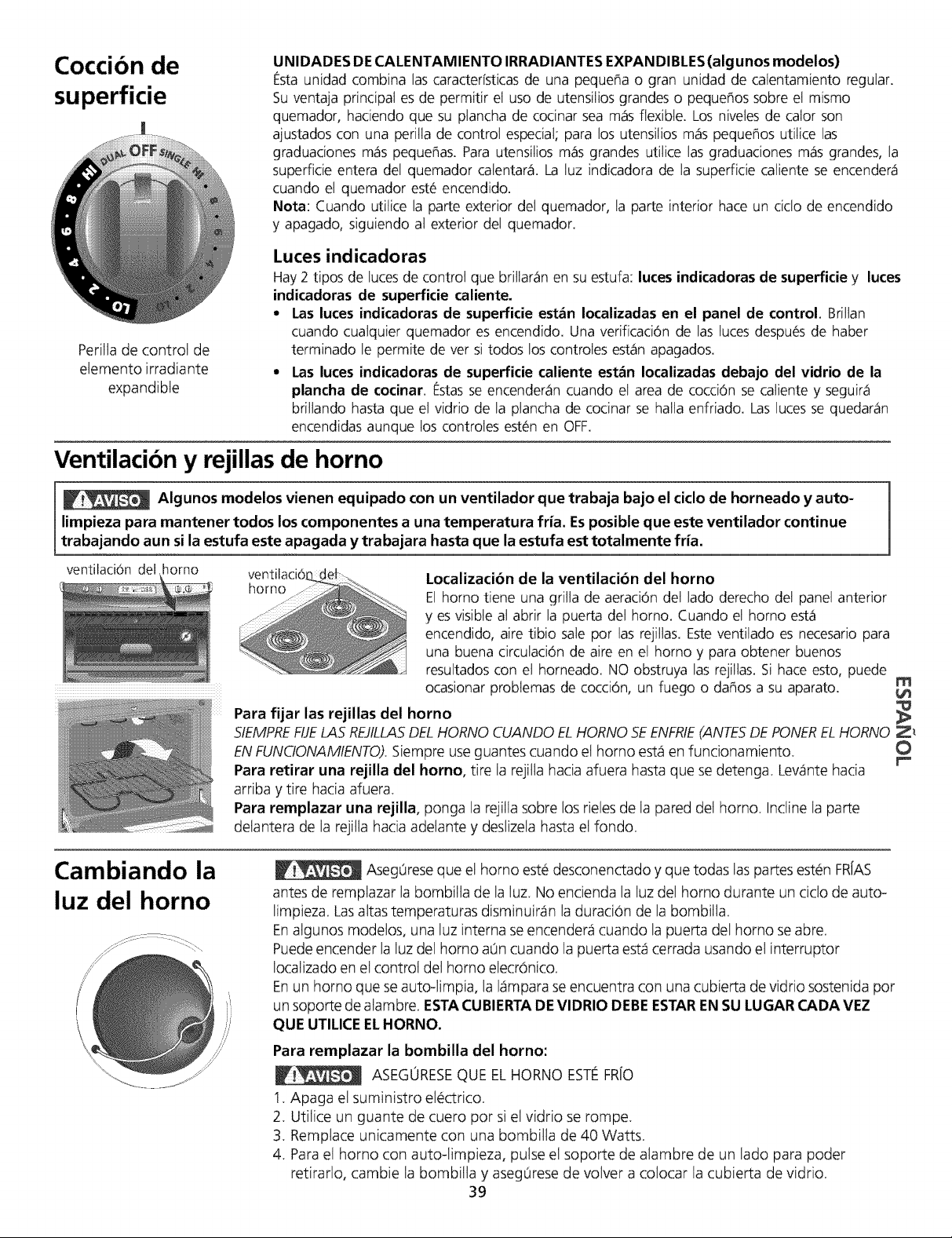
Cocci6n de
superficie
UNIDADES DE CALENTAMIENTO IRRADIANTES EXPANDIBLES (algunos modelos)
t_sta unidad combina las caracteristicas de una peque_a o gran unidad de calentamiento regular.
Su ventaja principal es de permitir el uso de utensilios grandes o peque_os sobre el mismo
quemador, haciendo que su plancha de cocinar sea m_s flexible. Los niveles de calor son
ajustados con una perilla de control especial; para los utensilios m_s peque_os utilice las
graduaciones m_s peque_as. Para utensilios m_s grandes utilice las graduaciones m_s grandes, la
superficie entera del quemador calentar_. La Iuz indicadora de Ia supefficie caliente se encendera
cuando et quemador est6 encendido.
Nota: Cuando utilice la parte exterior del quemador, Ia parte interior hace un ciclo de encendido
y apagado, siguiendo al exterior det quemador.
Perilla de control de
elemento [rradJante
expandible
Luces indicadoras
Hay 2 tipos de luces de control que brillar_n en su estufa: luces indicadoras de superficie y luces
indicadoras de superficie caliente.
• I.as luces indicadoras de superficie est_n Iocalizadas en el panel de control. Brillan
cuando cualquier quemador es encendido. Una verificad6n de las Iuces despu6s de haber
terminado le permite de vet si todos los controIes est_n apagados.
• I.as luces indicadoras de superficie caliente est_n Iocalizadas debajo del vidrio de la
plancha de cocinar, t2stas se encender_n cuando el area de cocci6n se caliente y seguir_
brillando hasta que el vidrio de la plancha de cocinar se halla enfriado. Las luces se quedar_n
encendidas aunque los controtes est6n en OFF.
Ventilaci6n y rejillas de homo
Algunos modelos vienen equipado con un ventilador que trabaja bajo el ciclo de horneado y auto-
limpieza para mantener todos los componentes a una temperatura fria. Es posible que este ventilador continue
trabajando aun si la estufa este apagada y trabajara hasta que la estufa est totalmente fria.
ventilaci6n del.horno
Localizaci6n de la ventilaci6n del horno
homo
El homo tiene una grilla de aeraci6n det lado derecho det panel anterior
yes visible al abrir la puerta del homo. Cuando el homo est_
encendido, aire tibio sale por Ias rejillas. Este ventilado es necesario para
una buena circulaci6n de aire en el homo y para obtener buenos
resultados con el horneado. NO obstruya las rejillas. Si hace esto, puede
ocasionar probIemas de cocci6n, un fuego o da_os a su aparato, m
Para fijar las rejillas del homo
SIEMPRE FIJELAS REJILLAS DEL HORNO CUANDO EL HORNO SE ENFRIE (ANTES DE PONER EL HORNO Z_
EN FUNCIONAMIENTQ}. Siempre use guantes cuando el homo est_ en funcionamiento. O
Para retirar una rejilla del homo, tire [a rejitla hacia afuera hasta que se detenga. Lev_nte hacia
arriba y tire hacia afuera.
Para remplazar una rejilla, ponga [a rejilla sobre los rietes de [a pared deI homo. Incline [a parte
delantera de [a rejilla hacia adelante y destizeta hasta el fondo.
Cambiando la
luz del homo
Aseg0rese que et homo este desconenctado y que todas Iaspartes esten FR[AS
antes de remplazar [a bombilla de [a [uz. No encienda la [uz del homo durante un cic[o de auto-
[impieza. Lasaltas temperaturas disminuir_n [a duraci6n de [a bombiila.
Enalgunos modelos, una [uz interna se encender_ cuando [a puerta de[ homo se abre.
Puedeencender [a [uz de[ homo a0n cuando [a puerta est_ cerrada usando el interruptor
[ocalizado en el control del homo elecr6nico.
Enun homo que se auto-limpia, [a [_mpara se encuentra con una cubierta de vidrio sostenida pot
un soporte de alambre, ESTACUBIERTADEVIDRIO DEBEESTAREN SU LUGAR CADA VEZ
QUE UTILICEELHORNO.
Para remplazar la bombilla del horno:
ASEGORESEQUE EL HORNO ESTI_FR[O
1. Apaga el suministro electrico.
2. Utilice un guante de cuero pot si el vidrio se rompe.
3. Remplace unicamente con una bombilla de 40 Watts.
4. Para el homo con auto-Iimpieza, pulse el soporte de alambre de un [ado para poder
retirar[o, cambie [a bombiila y aseg0rese de volver a colocar [a cubierta de vidrio.
39
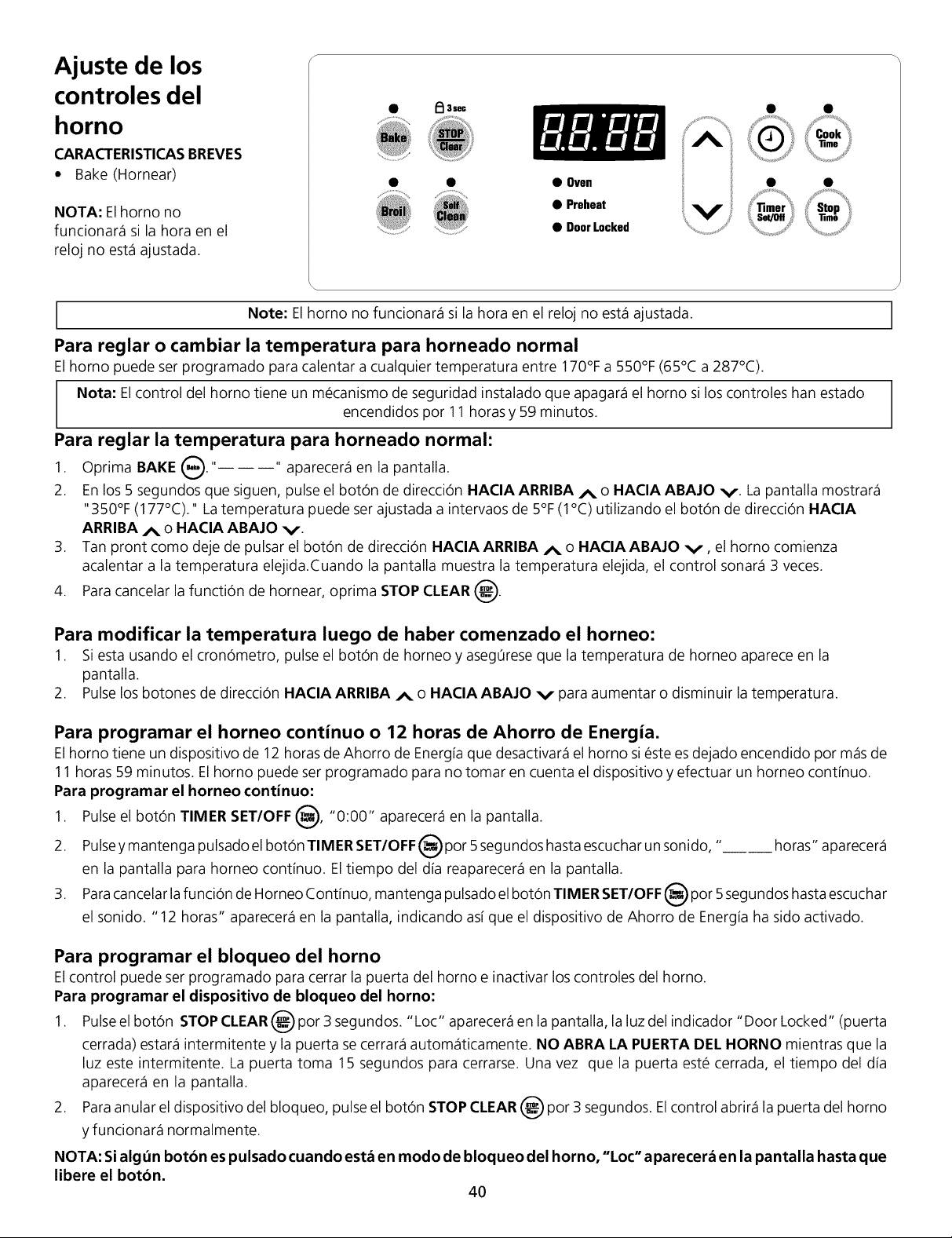
Ajuste de los
controles del
horno
CARACTERISTICAS BREVES
• Bake (Hornear)
NOTA: El horno no
funcionar_ si la hora en el
reloj no est_ ajustada.
J_ 3sec
O Oven
•Preheat
•DoorLocked
(®}
£ Cook
_i lime i!
_S_s_%_ i_/_#_%%_ _
1£
Timer i _! Stop "_
set/on_ i _mo:_
I Note: El horno no funcionar_ si la hora en el reloj no est_ ajustada.
Para reglar o cambiar la temperatura para horneado normal
Elhorno puede ser programado para calentar a cualquier temperatura entre 170°F a 550°F (65°C a 287°C).
Nota: Elcontrol del homo tiene un m_canismo de seguridad instalado que apagar_iel homo si los controles han estado
encendidos por 11 horas y 59 minutos.
Para reglar la temperatura para horneado normal:
1. Oprima BAKE (_)."ili" aparecer_ en la pantalla.
2. En los 5 segundos que siguen, pulse el bot6n de direcci6n HACIA ARRIBA _ o HACIA ABAJO V. La pantalla mostrar_
"350°F (177°C)." Latemperatura puede ser ajustada a intervaos de 5°F (1°C) utilizando el bot6n de direcci6n HACIA
ARRIBA _ o HACIA ABAJO v.
3. Tan pront como deje de pulsar el bot6n de direcci6n HACIA ARRIBA _ o HACIAABAJO v, el horno comienza
acalentar a la temperatura elejida.Cuando la pantalla muestra la temperatura elejida, el control sonara 3 veces.
4. Paracancelar la functi6n de hornear, oprima STOP CLEAR @.
Para modificar la temperatura luego de haber comenzado el horneo:
1. Si esta usando el cron6metro, pulse el bot6n de horneo y aseg0rese que la temperatura de horneo aparece en la
pantalla.
2. Pulse los botones de direcci6n NACIA ARRIBA _ o NACIA ABAJO v para aumentar o disminuir la temperatura.
Para programar el horneo continuo o 12 horas de Ahorro de Energia.
Elhorno tiene un dispositivo de 12 horas de Ahorro de Energia que desactivar_ el horno si _ste es dejado encendido por m_s de
11 horas 59 minutos. El horno puede ser programado para no tomar en cuenta el dispositivo y efectuar un horneo continuo.
Para programar el horneo continuo:
1. Pulseel bot6n TIMER SET/OFF _, "0:00" aparecer_ en la
pantalla.
2. Pulsey mantenga pulsado el bot6n TIMER SET/OFF (_) por 5 segundos hasta escuchar un sonido, "horas"
aparecera
en la pantalla para horneo cont[nuo. Eltiempo del d[a reaparecera en la pantalla.
3. Paracancelar la funci6n de Horneo Cont[nuo, mantenga pulsado el bot6n TIMER SET/OFF(_) por 5segundos hasta escuchar
el sonido. "12 horas" aparecera en la pantalla, indicando as[ que el dispositivo de Ahorro de Energ[a ha sido activado.
Para programar el bloqueo del horno
Elcontrol puede ser programado para cerrar la puerta del horno e inactivar los controles del horno.
Para programar el dispositivo de bloqueo del horno:
1. Pulseel bot6n STOP CLEAR_ por 3 segundos. "Loc" aparecer_ en la pantalla, la luz del indicador "Door Locked"
(puerta
cerrada) estara intermitente y la puerta se cerrara automaticamente. NO ABRA LA PUERTA DEL HORNO mientras que la
luz este intermitente. La puerta toma 15 segundos para cerrarse. Una vez que la puerta est_ cerrada, el tiempo del d[a
aparecera en la pantalla.
2. Paraanular el dispositivo del bloqueo, pulse el bot6n STOP CLEAR _ por 3 segundos. Elcontrol abrira la puerta del horno
y funcionara normalmente.
NOTA: Si algt_n botbn es pulsado cuando est& en modo de bloqueo del horno, "Loc" aparecer& en la pantalla hasta que
libere el botbn.
4O
J
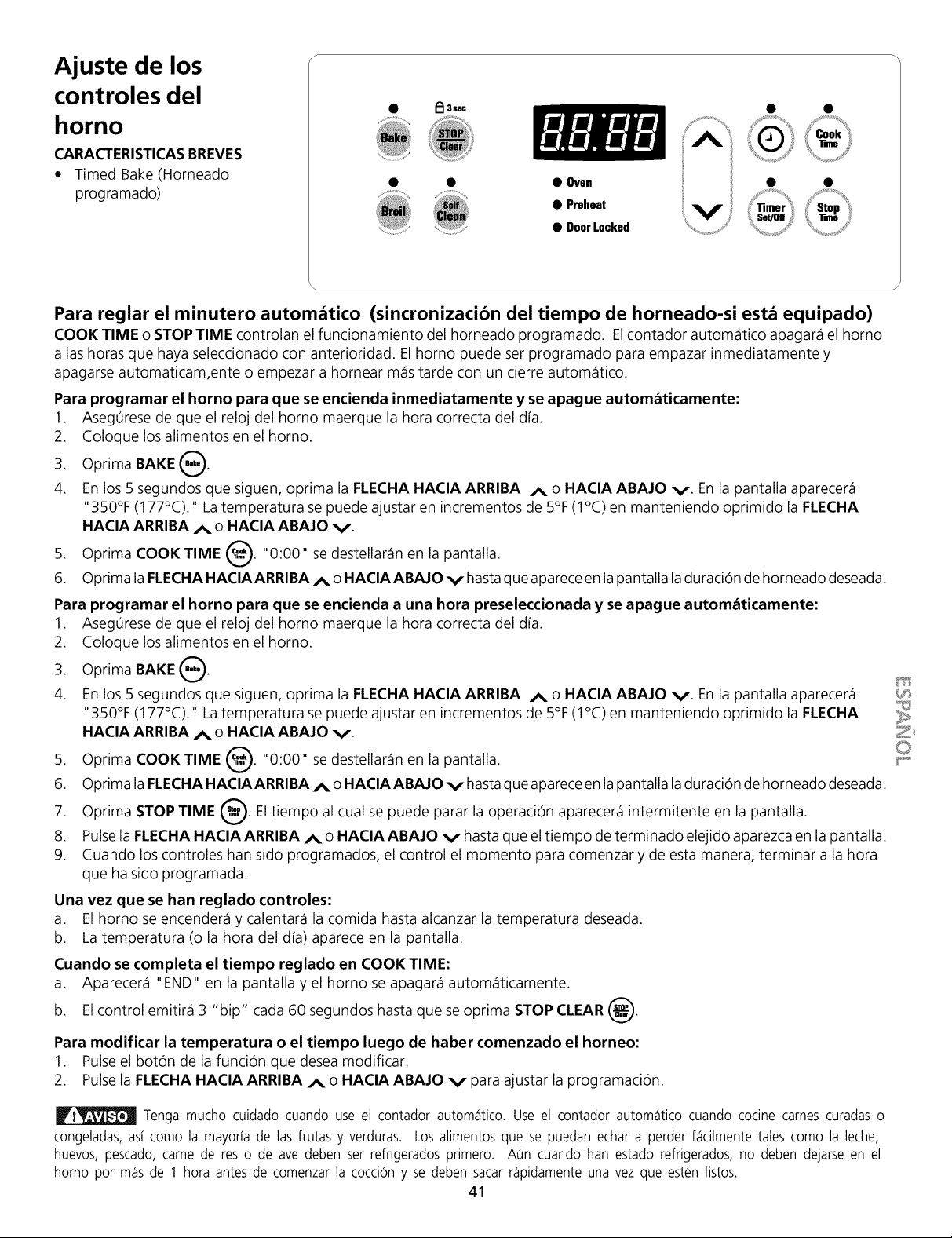
Ajuste de los
controles del
horno
CARACTERISTICASBREVES
• Timed Bake (Horneado
programado)
J_ 3sec
O Oven
•Preheat
•DoorLocked
Ss_%,, _S_¸¸ _
(®}
£ Cook
_i lime i!
_S_s_%_ i_/_#_%%_ _
£
Timer s _! Stop '_
Set/Off _ _i lime _
Para reglar el minutero autom_tico (sincronizaci6n del tiempo de horneado-si est_ equipado)
COOK TIME o STOP TIME controlan el funcionamiento del horneado programado. Elcontador autom_itico apagar_iel horno
alas horas que haya seleccionado con anterioridad. El horno puede ser programado para empazar inmediatamente y
apagarse automaticam,ente o empezar a hornear m_istarde con un cierre autom_itico.
Para programar el horno para que se encienda inmediatamente y se apague autom_ticamente:
1. Aseg0rese de que el reloj del horno maerque la hora correcta del dfa.
2. Coloque los alimentos en el horno.
3. Oprima BAKE _"_.
4. En los 5 segundos que siguen, oprima la FLECHA HACIA ARRIBA A o HACIA ABAJO v. En la pantalla aparecer_i
"350°F (177°O." Latemperatura se puede ajustar en incrementos de 5°F (1°O en manteniendo oprimido la FLECHA
HACIA ARRIBA _ o HACIA ABAJO v.
5. Oprima COOK TIME _. "0:00" se destellar_n en la pantalla.
6. Oprima la FLECHAHACIAARRIBA _o HACIAABAJO v hastaque aparece en la pantalla laduraci6n de horneado deseada.
Para programar el horno para que se encienda a una hora preseleccionada y se apague autom_ticamente:
1. Aseg0rese de que el reloj del horno maerque la hora correcta del dfa.
2. Coloque los alimentos en el horno.
3. Oprima BAKE (_.
4. En los 5 segundos que siguen, oprima la FLECHA HACIA ARRIBA A o HACIA ABAJO v. En la pantalla aparecer_i
"350°F (177°O." Latemperatura se puede ajustar en incrementos de 5°F (1°O en manteniendo oprimido la FLECHA
HACIA ARRIBA _ o HACIA ABAJO v.
5. Oprima COOK TIME _. "0:00" se destellar_n en la pantalla.
6. Oprima la FLECHAHACIAARRIBA _o HACIAABAJO v hastaque aparece en la pantalla laduraci6n de horneado deseada.
Oprima STOP TIME @. Eltiempo al cual se puede parar la operaci6n aparecer_ intermitente en la pantalla.
7.
8. Pulsela FLECHA HACIA ARRIBA _ o HACIA ABAJO v hastaque el tiempo de terminado elejido aparezca en la pantalla.
9. Cuando los controles han sido programados, el control el momento para comenzar y de esta manera, terminar a la hora
que ha sido programada.
Una vez que se han reglado controles:
a. El horno se encender_i y calentar_i la comida hasta alcanzar la temperatura deseada.
b. Latemperatura (o la hora del d[a) aparece en la pantalla.
Cuando se completa el tiempo reglado en COOK TIME:
a. Aparecer_i "END" en la pantalla y el horno se apagar_i autom_iticamente.
b. Elcontrol emitir_i 3 "bip" cada 60 segundos hasta que se oprima STOP CLEAR _.
Para modificar la temperatura o el tiempo luego de haber comenzado el horneo:
1. Pulseel bot6n de la funci6n que desea modificar.
2. Pulse la FLECHA HACIA ARRIBA A o HACIA ABAJO v para ajustar la programaci6n.
Tenga mucho cuidado cuando use el contador autom_itico. Use el contador autom_itico cuando cocine cames curadas o
congeladas, asi como la mayoria de las frutas y verduras. Los alimentos que se puedan echar a perder f_icilmente tales como la leche,
huevos, pescado, came de res o de ave deben ser refrigerados primero. A0n cuando han estado refrigerados, no deben dejarse en el
homo por m_is de 1 hora antes de comenzar la cocci6n y se @ben sacar r@idamente una vez que est_n listos.
41
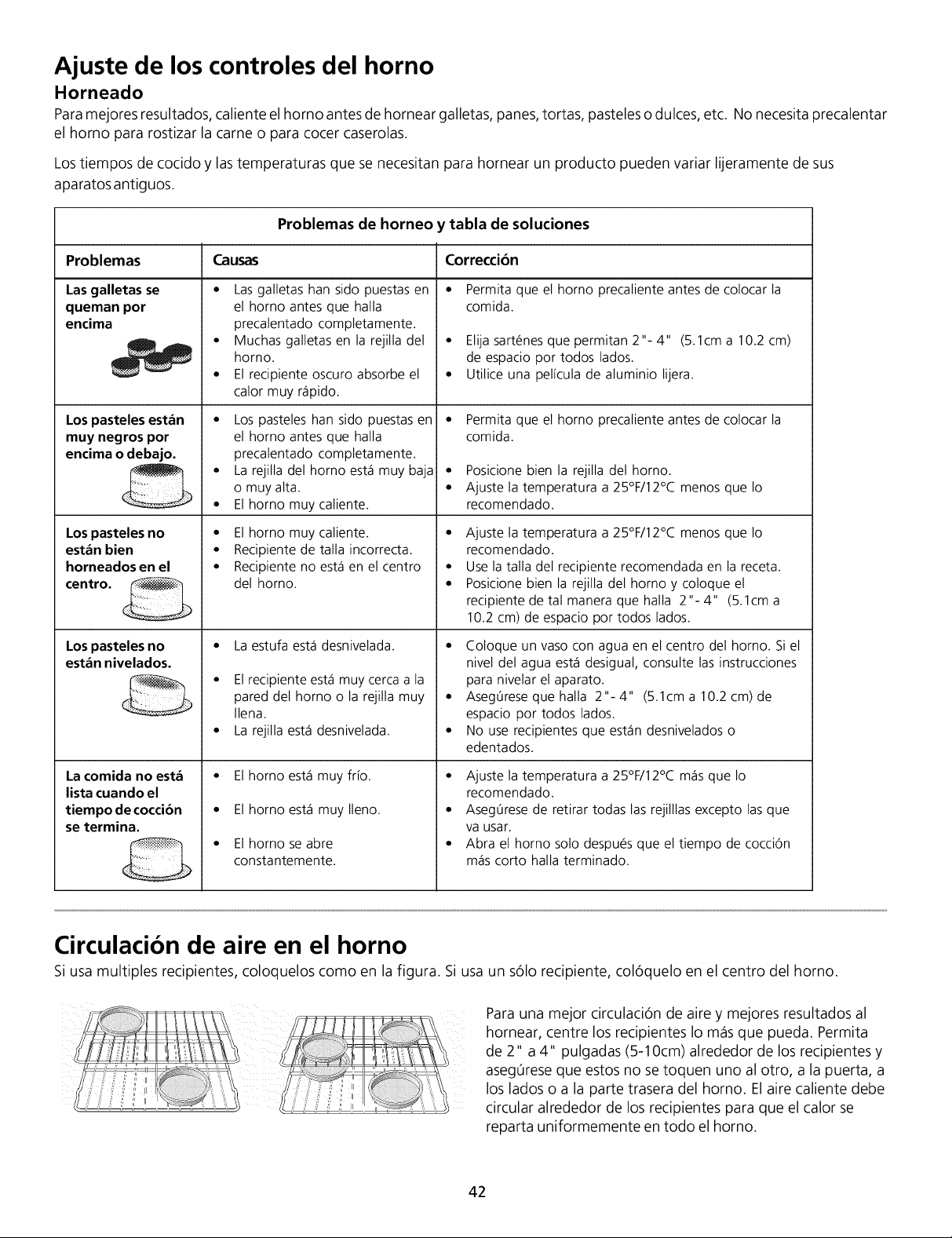
Ajuste de los controles del horno
Horneado
Para mejores resultados, caliente el horno antes de hornear galletas, panes, tortas, pasteles o dulces, etc. No necesita precalentar
el horno para rostizar la carne o para cocer caserolas.
Lostiempos de cocido y lastemperaturas que se necesitan para hornear un producto pueden variar lijeramente de sus
aparatos antiguos.
Problemas de horneo y tabla de soluciones
Causas Correccibn
Problemas
Las galletas se
queman por
encima
Los pasteles est&n
muy negros por
encima o debajo.
Los pasteles no
est&n bien
horneados en el
centro.
Los pasteles no
est_n nivelados.
La comida no est_
lista cuando el
tiempo de coccibn
se termina.
Las galletas han sido puestas en
el horno antes que halla
precalentado completamente.
Muchas galletas en la rejilla del
horno.
El recipiente oscuro absorbe el
calor muy r_pido.
• Los pasteles han sido puestas en
el horno antes que halla
precalentado completamente.
• La rejilla del homo est_ muy baja
o muy alta.
• El horno muy caliente.
• El horno muy caliente.
• Recipiente de talla incorrecta.
• Recipiente no est_ en el centro
del horno.
La estufa est_ desnivelada.
El recipiente est_ muy cerca a la
pared del homo o la rejilla muy
Ilena.
La rejilla est_ desnivelada.
• El horno est_ muy frio.
• El horno est_ muy Ileno.
• El homo se abre
constantemente.
• Permita que el horno precaliente antes de colocar la
comida.
• Elijasart_nesquepermitan2"-4" (5.1cma 10.2cm)
de espacio por todos lados.
• Utilice una pelicula de aluminio lijera.
Permita que el horno precaliente antes de colocar la
comida.
Posicione bien la rejilla del horno.
Ajuste la temperatura a 25°F/12°C menos que Io
recomendado.
• Ajuste la temperatura a 25°F/12°C menos que Io
recomendado.
• Use la talla del recipiente recomendada en la receta.
• Posicione bien la rejilla del homo y coloque el
recipiente de tal manera que halla 2"- 4" (5.1cm a
10.2 cm) de espacio por todos lados.
• Coloque un vaso con agua en el centro del horno. Si el
nivel del agua est_ desigual, consulte las instrucciones
para nivelar el aparato.
• Aseg0rese que halla 2"- 4" (5.1cm a 10.2 cm) de
espacio por todos lados.
• No use recipientes que est_n desnivelados o
edentados.
• Ajuste la temperatura a 25°F/12°C m_s que Io
recomendado.
• Aseg0rese de retirar todas las rejilllas excepto las que
va usar.
• Abra el horno solo despu_s que el tiempo de cocci6n
m_s corto halla terminado.
Circulacibn de aire en el horno
Si usa multiples recipientes, coloquelos como en la figura. Si usa un s61o recipiente, col6quelo en el centro del horno.
Para una mejor circulaci6n de aire y mejores resultados al
hornear, centre los recipientes Io m_s que pueda. Permita
de 2" a 4" pulgadas (5-10cm) alrededor de los recipientes y
aseg0rese que estos no se toquen uno al otro, a la puerta, a
los lados o a la parte trasera del horno. El aire caliente debe
circular alrededor de los recipientes para que el calor se
reparta uniformemente en todo el horno.
42
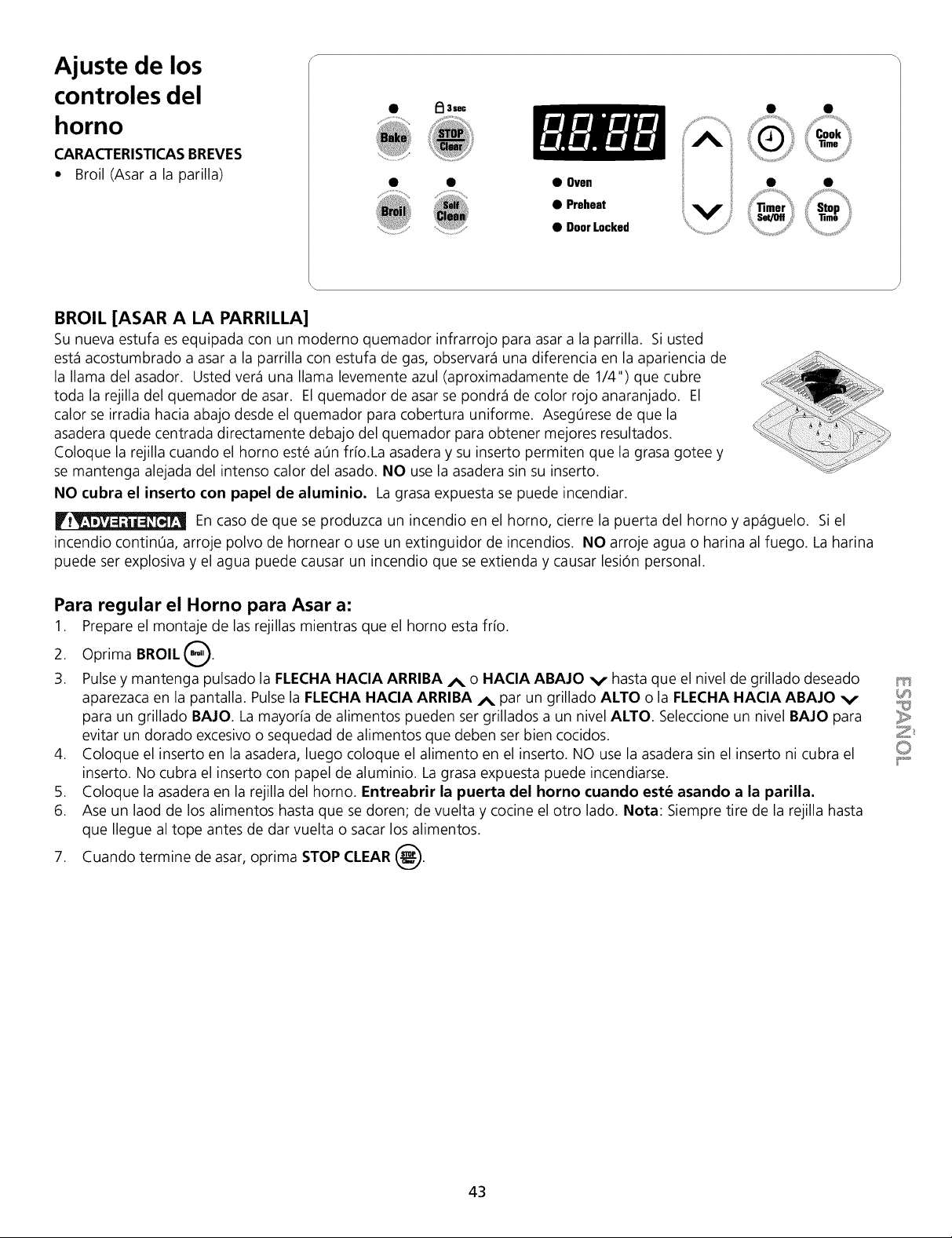
Ajuste de los
controles del
horno
CARACTERISTICAS BREVES
• Broil (Asar a la parilla)
3sec
•Oven
•Preheat
•DoorLocked
Ss_%,, _S_¸¸ _
(®}
£ Cook
_S_s_%_ i_/_#_ _<_ _
£
11mers _! Stop '_
Set/Off _ _i lime _
BROIL [ASAR A LA PARRILLA]
Su nueva estufa es equipada con un moderno quemador infrarrojo para asar a la parrilla. Si usted
est_ acostumbrado a asar a la parrilla con estufa de gas, observar_ una diferencia en la apariencia de
la llama del asador. Usted ver_ una llama levemente azul (aproximadamente de 1/4") que cubre
toda la rejilla del quemador de asar. El quemador de asar se pondr_ de color rojo anaranjado. El
calor se irradia hacia abajo desde el quemador para cobertura uniforme. Aseg0rese de que la
asadera quede centrada directamente debajo del quemador para obtener mejores resultados.
Coloque la rejilla cuando el horno est_ a0n frfo.La asadera y su inserto permiten que la grasa gotee y
se mantenga alejada del intenso calor del asado. NO use la asadera sin su inserto.
NO cubra el inserto con papel de aluminio. La grasa expuesta se puede incendiar.
En caso de que se produzca un incendio en el homo, cierre la puerta del homo y ap_guelo. Si el
incendio contin0a, arroje polvo de hornear o use un extinguidor de incendios. NO arroje agua o harina al fuego. La harina
puede ser explosiva y el agua puede causar un incendio que se extienda y causar lesi6n personal.
Para regular el Horno para Asar a:
1. Prepare el montaje de las rejillas mientras que el horno esta frfo.
Oprima BROIL (_.
2.
3. Pulsey mantenga pulsado la FLECHA HACIA ARRIBA A o HACIA ABAJO v hasta que el nivel de grillado deseado
aparezaca en la pantalla. Pulse la FLECHA HACIA ARRIBA A par un grillado ALTO o la FLECHA HACIA ABAJO v
para un grillado BAJO. La mayor[a de alimentos pueden ser grillados a un nivel ALTO. Seleccione un nivel BAJO para
evitar un dorado excesivo o sequedad de alimentos que deben ser bien cocidos.
4. Coloque el inserto en la asadera, luego coloque el alimento en el inserto. NO use la asadera sin el inserto ni cubra el
inserto. No cubra el inserto con papel de aluminio. La grasa expuesta puede incendiarse.
5. Coloque la asadera en la rejilla del horno. Entreabrir la puerta del horno cuando est_ asando a la parilla.
6. Ase un laod de los alimentos hasta que se doren; de vuelta y cocine el otro lado. Nora: Siempre tire de la rejilla hasta
que Ilegue al tope antes de dar vuelta o sacar los alimentos.
7. Cuando termine de asar, oprima STOP CLEAR (_.
43
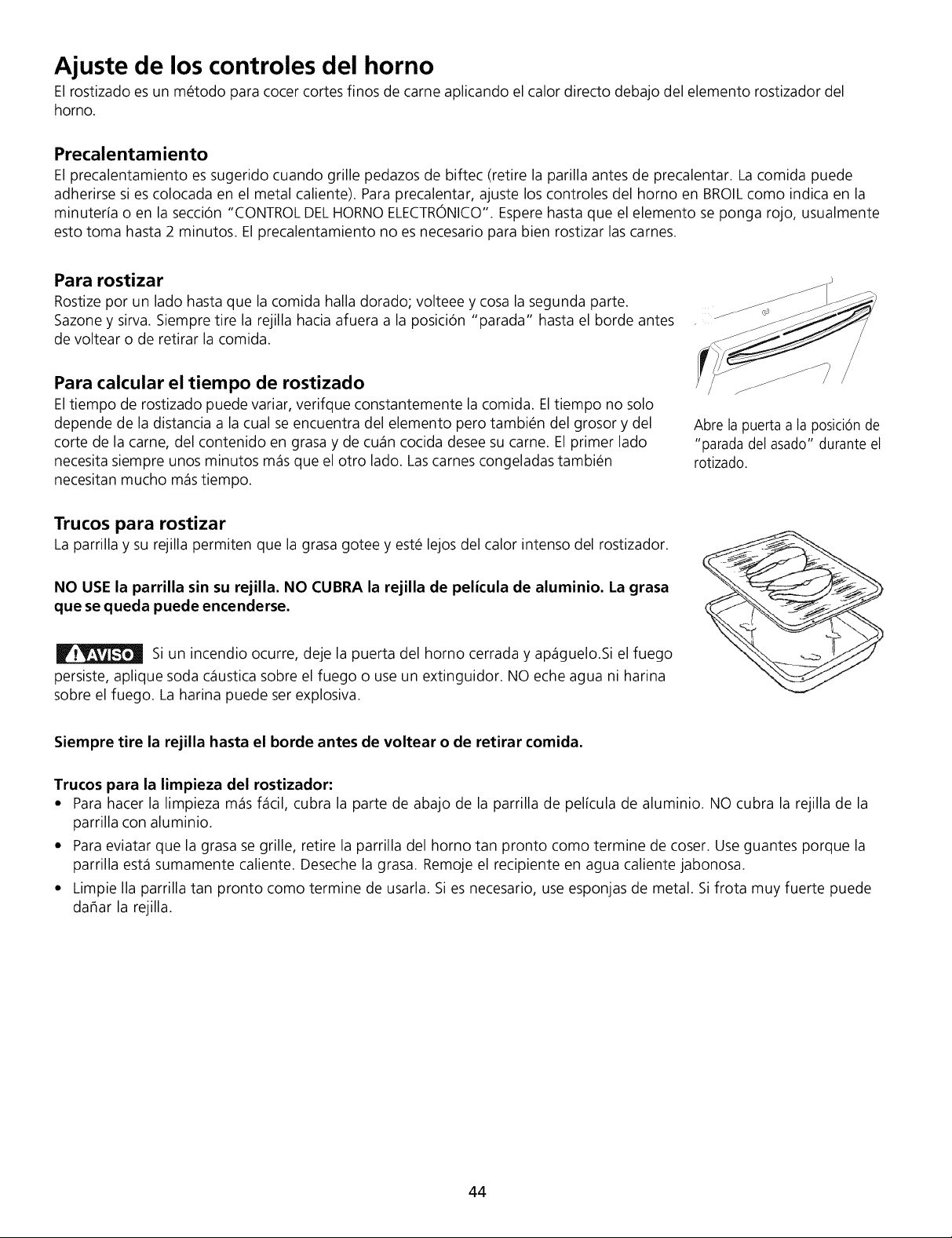
Ajuste de los controles del horno
Elrostizado es un m_todo para cocer cortes finos de carne aplicando el calor directo debajo del elemento rostizador del
horno.
Precalentamiento
El precalentamiento es sugerido cuando grille pedazos de biftec (retire la parilla antes de precalentar. Lacomida puede
adherirse si es colocada en el metal caliente). Para precalentar, ajuste los controles del horno en BROIL como indica en la
minuter[a o en la secci6n "CONTROL DELHORNO ELECTRONICO".Espere hasta que el elemento se ponga rojo, usualmente
esto toma hasta 2 minutos. El precalentamiento no es necesario para bien rostizar las carnes.
Para rostizar
Rostize por un lado hasta que la comida halla dorado; volteee y cosa la segunda parte.
Sazone y sirva. Siempre tire la rejilla hacia afuera a la posici6n "parada" hasta el borde antes
de voltear o de retirar la comida.
Para calcular el tiempo de rostizado
Eltiempo de rostizado puede variar, verifque constantemente la comida. El tiempo no solo
depende de la distancia a la cual se encuentra del elemento pero tambi_n del grosor y del
corte de la carne, del contenido en grasa y de cu_n cocida desee su carne. El primer lado
necesita siempre unos minutos m_s que el otro lado. Lascarnes congeladas tambi_n
necesitan mucho m_s tiempo.
Abre la puerta a la posicbn de
"parada del asado" durante el
rotizado.
Trucos para rostizar
La parrilla y su rejilla permiten que la grasa gotee y est_ lejos del calor intenso del rostizador.
NO USE la parrilla sin su rejilla. NO CUBRA la rejilla de pelicula de aluminio. La grasa
que se queda puede encenderse.
Si un incendio ocurre, deje la puerta del horno cerrada y ap_guelo.Si el fuego
persiste, aplique soda c_ustica sobre el fuego o use un extinguidor. NO eche agua ni harina
sobre el fuego. La harina puede ser explosiva.
Siempre tire la rejilla hasta el borde antes de voltear o de retirar comida.
Trucos para la limpieza del rostizador:
• Para hacer la limpieza m_s f_cil, cubra la parte de abajo de la parrilla de pel[cula de aluminio. NO cubra la rejilla de la
parrilla con aluminio.
• Paraeviatar que la grasa se grille, retire la parrilla del horno tan pronto como termine de coser. Use guantes porque la
parrilla est_ sumamente caliente. Deseche la grasa. Remoje el recipiente en agua caliente jabonosa.
• Limpie Ila parrilla tan pronto como termine de usarla. Si es necesario, use esponjas de metal. Si frota muy fuerte puede
dahar la rejilla.
44
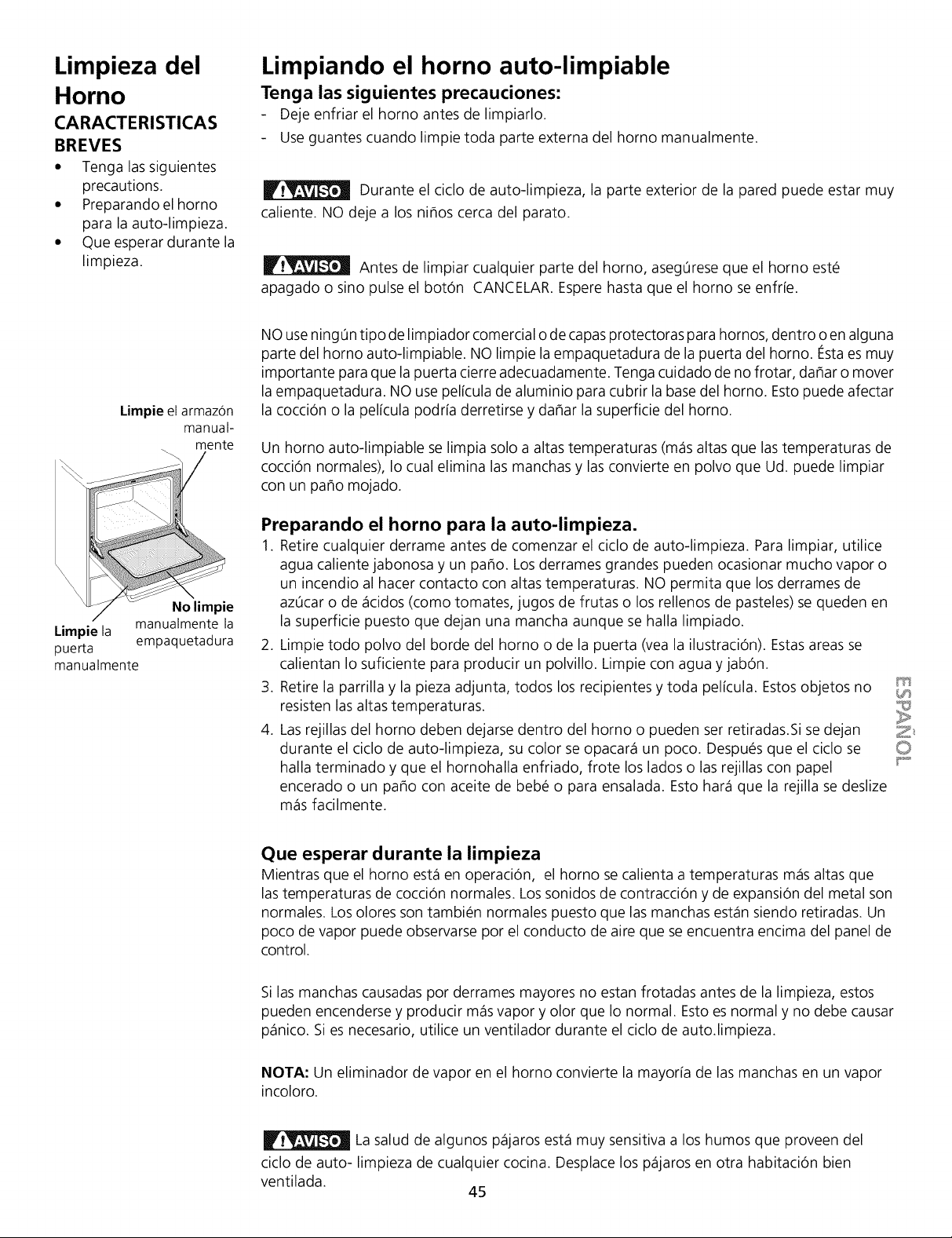
Limpieza del
Horno
CARACTERISTICAS
BREVES
• Tenga las siguientes
precautions.
• Preparando el horno
para la autoqimpieza.
• Que esperar durante la
limpieza.
Limpiando el horno auto-limpiable
Tenga las siguientes precauciones:
- Deje enfriar el horno antes de limpiarlo.
- Use guantes cuando limpie toda parte externa del horno manualmente.
Durante el ciclo de autoqimpieza, la parte exterior de la pared puede estar muy
caliente. NO deje a los nihos cerca del parato.
Antes de limpiar cualquier parte del horno, asegOrese que el horno est_
apagado o sino pulse el bot6n CANCELAR. Espere hasta que el horno se enfr[e.
Limpie el armaz6n
manual_
mente
Limpie la manualmente la
puerta empaquetadura
manualmente
NO use ningOn tipo de limpiador comercial o de capas protectoras para hornos, dentro o en alguna
parte del horno auto-limpiable. NO limpie la empaquetadura de la puerta del horno, t_staes muy
importante para que la puerta cierre adecuadamente. Tenga cuidado de no frotar, dahar o mover
laempaquetadura. NO use pel[cula de aluminio para cubrir la base del horno. Esto puede afectar
la cocci6n o la pel[cula podr[a derretirse y dahar la superficie del horno.
Un horno auto-limpiable se limpia solo a altas temperaturas (m_is altas que las temperaturas de
cocci6n normales), Io cual elimina las manchas y las convierte en polvo que Ud. puede limpiar
con un paho mojado.
Preparando el horno para la auto-limpieza.
1. Retire cualquier derrame antes de comenzar el ciclo de auto-limpieza. Para limpiar, utilice
agua caliente jabonosa y un paho. Los derrames grandes pueden ocasionar mucho vapor o
un incendio al hacer contacto con altas temperaturas. NO permita que los derrames de
azOcar o de _icidos (como tomates, jugos de frutas o los rellenos de pasteles) se queden en
la superficie puesto que dejan una mancha aunque se halla limpiado.
2. Limpie todo polvo del borde del horno o de la puerta (vea la ilustraci6n). Estasareas se
calientan Io suficiente para producir un polvillo. Limpie con agua y jab6n.
3. Retire la parrilla y la pieza adjunta, todos los recipientes y toda pel[cula. Estos objetos no
resisten las altas temperaturas.
4. Las rejillas del horno deben dejarse dentro del horno o pueden ser retiradas.Si se dejan
durante el ciclo de auto-limpieza, su color se opacar_i un poco. Despu_s que el ciclo se
halla terminado y que el hornohalla enfriado, frote los lados o las rejillas con papel
encerado o un paho con aceite de beb_ o para ensalada. Esto har_i que la rejilla se deslize
m_isfacilmente.
Que esperar durante la limpieza
Mientras que el horno est,1en operaci6n, el horno se calienta a temperaturas m_is altas que
las temperaturas de cocci6n normales. Los sonidos de contracci6n y de expansi6n del metal son
normales. Los olores son tambi_n normales puesto que las manchas est_in siendo retiradas. Un
poco de vapor puede observarse por el conducto de aire que se encuentra encima del panel de
control.
Si las manchas causadas por derrames mayores no estan frotadas antes de la limpieza, estos
pueden encenderse y producir m_isvapor y olor que Io normal. Esto es normal y no debe causar
p_inico. Si es necesario, utilice un ventilador durante el ciclo de auto.limpieza.
NOTA: Un eliminador de vapor en el horno convierte la mayorfa de las manchas en un vapor
incoloro.
Lasalud de algunos p_ijaros est,1muy sensitiva a los humos que proveen del
ciclo de auto- limpieza de cualquier cocina. Desplace los p_ijaros en otra habitaci6n bien
ventilada.
45
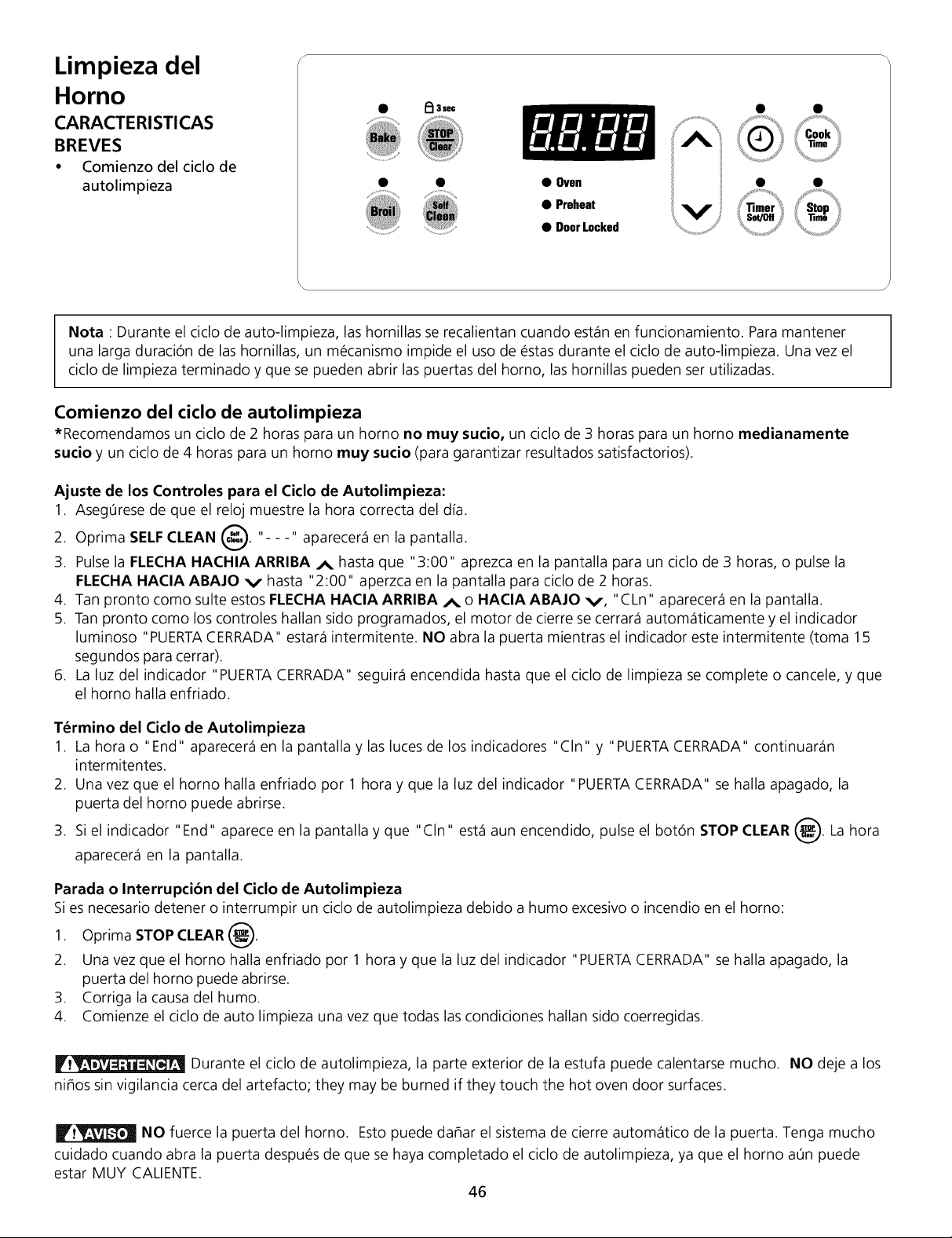
Limpieza del
Horno
CARACTERISTICAS
BREVES
• Comienzo del ciclo de
autolimpieza
3 sec
O Oven
•Preheat
•DoorLocked
_" _!_Cook
A !/, _ _me i__
!iV i_ _'limer"i_ /_ Stop _i,
Nota • Durante el ciclo de auto-limpieza, las hornillas se recalientan cuando est_n en funcionamiento. Para mantener
una larga duraci6n de las hornillas, un m_canismo impide el uso de _stas durante el ciclo de auto-limpieza. Una vez el
ciclo de limpieza terminado y que se pueden abrir las puertas del horno, las hornillas pueden ser utilizadas.
Comienzo del ciclo de autolimpieza
*Recomendamos un ciclo de 2 horas para un horno no muy sucio, un ciclo de 3 horas para un horno medianamente
sucio y un ciclo de 4 horas para un horno muy sucio (para garantizar resultados satisfactorios).
Ajuste de los Controles para el Ciclo de Autolimpieza:
1. Aseg0rese de que el reloj muestre la hora correcta del dia.
2. Oprima SELFCLEAN _'_. "- - -" aparecer_ en la
pantalla.
3. Pulse la FLECHA HACHIA ARRIBA _ hasta que "3:00" aprezca en la pantalla para un ciclo de 3 horas, o pulse la
FLECHA HAClA ABAJO M hasta "2:00" aperzca en la pantalla para ciclo de 2 horas.
4. Tan pronto como suite estos FLECHA HAClA ARRIBA A o HAClA ABAJO M, "CLn" aparecer_ en la pantalla.
5. Tan pronto como los controles hallan sido programados, el motor de cierre se cerrar_ autom_ticamente y el indicador
luminoso "PUERTACERRADA" estar_ intermitente. NO abra la puerta mientras el indicador este intermitente (toma 15
segundos para cerrar).
6. La luz del indicador "PUERTA CERRADA" seguir_ encendida hasta que el ciclo de limpieza se complete o cancele, y que
el horno halla enfriado.
T_rmino del Ciclo de Autolimpieza
1. La hora o "End" aparecer_ en la pantalla y las luces de los indicadores "CIn" y "PUERTA CERRADA" continuar_n
intermitentes.
2. Una vez que el horno halla enfriado por 1 hora y que la luz del indicador "PUERTACERRADA" se halla apagado, la
puerta del horno puede abrirse.
3. Si el indicador "End" aparece en la pantalla y que "CIn" est_ aun encendido, pulse el bot_n STOP CLEAR _. La hora
aparecer_ en la pantalla.
Parada o Interrupcibn del Ciclo de Autolimpieza
Si es necesario detener o interrumpir un ciclo de autolimpieza debido a humo excesivo o incendio en el homo:
1. Oprima STOP CLEAR_.
2. Una vez que el homo halla enfriado por 1 hora y que la luz del indicador "PUERTACERRADA" se halla apagado, la
puerta del homo puede abrirse.
3. Corriga la causa del humo.
4. Comienze el ciclo de auto limpieza una vez que todas las condiciones hallan sido coerregidas.
Durante el ciclo de autolimpieza, la parte exterior de la estufa puede calentarse mucho. NO deje a los
ni_os sin vigilancia cerca del artefacto; they may be burned if they touch the hot oven door surfaces.
NO fuerce la puerta del horno. Esto puede da_ar el sistema de cierre autom_tico de la puerta. Tenga mucho
cuidado cuando abra la puerta despu_s de que se haya completado el ciclo de autolimpieza, ya que el horno a0n puede
estar MUY CALIENTE.
46
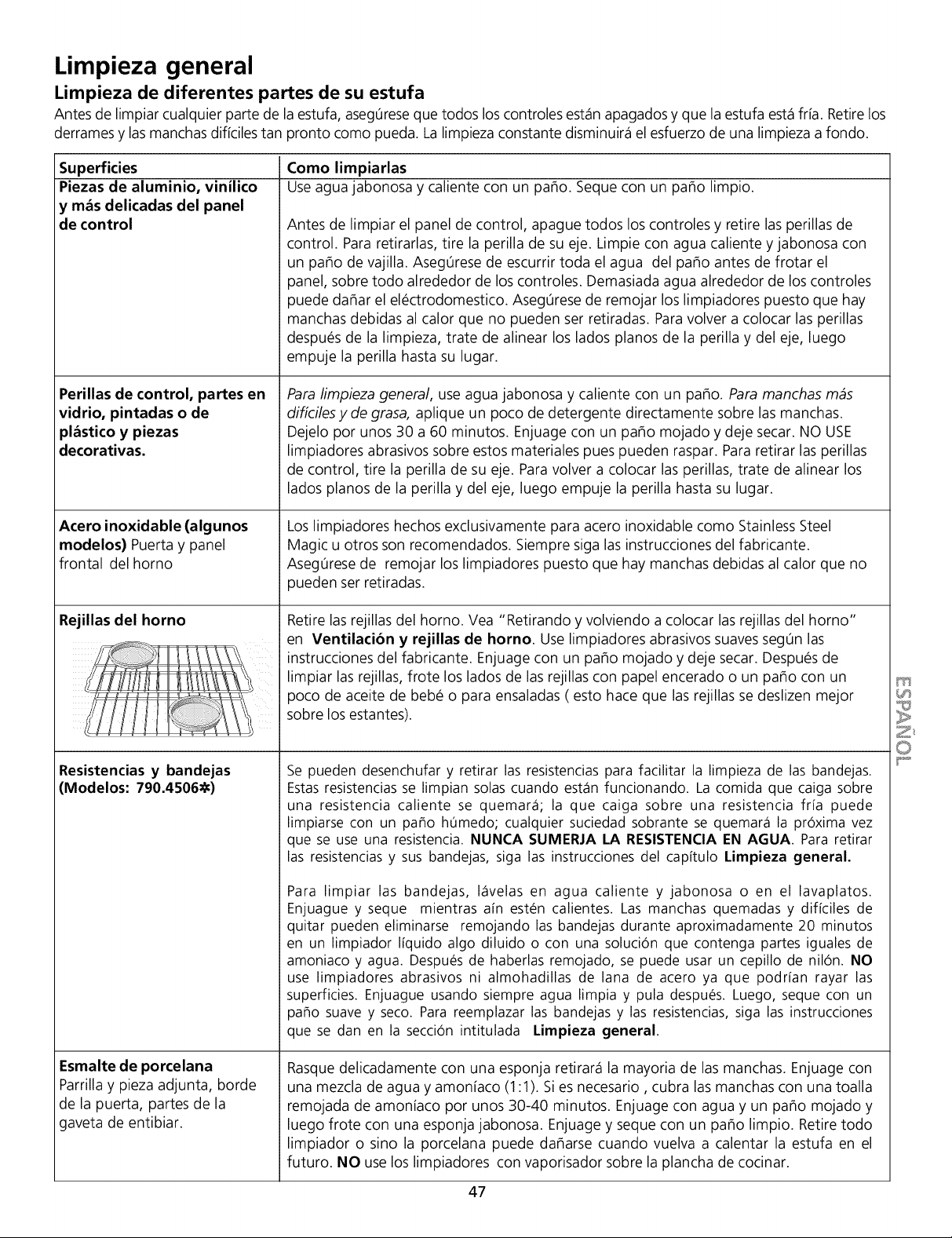
Limpieza general
Limpieza de diferentes partes de su estufa
Antes de limpiar cualquier parte de la estufa, aseg0reseque todos los controles est_n apagados y que la estufa est_ frfa. Retire los
derrames y las manchas dificiles tan pronto como pueda. La limpieza constante disminuir_ el esfuerzo de una limpieza a fondo.
Superficies
Piezas de aluminio, vinilico
y m&s delicadas del panel
de control
Perillas de control, partes en
vidrio, pintadas o de
pl&stico y piezas
decorativas.
Acero inoxidable (algunos
modelos) Puerta y panel
frontal del horno
Rejillas del horno
Resistencias y bandejas
(Modelos: 790.4506@)
Esmalte de porcelana
Parrilla y pieza adjunta, borde
de la puerta, partes de la
gaveta de entibiar.
Como limpiarlas
Use agua jabonosa y caliente con un paho. Seque con un paho limpio.
Antes de limpiar el panel de control, apague todos los controles y retire las perillas de
control. Para retirarlas, tire la perilla de su eje. Limpie con agua caliente y jabonosa con
un paho de vajilla. Aseg0rese de escurrir toda el agua del paho antes de frotar el
panel, sobre todo alrededor de los controles. Demasiada agua alrededor de los controles
puede dahar el el_ctrodomestico. Aseg0rese de remojar los limpiadores puesto que hay
manchas debidas al calor que no pueden ser retiradas. Para volver a colocar las perillas
despu_s de la limpieza, trate de alinear los lados pianos de la perilla y del eje, luego
empuje la perilla hasta su lugar.
Para limpieza general, use agua jabonosa y caliente con un paho. Para manchas mas
dificiles y de grasa, aplique un poco de detergente directamente sobre las manchas.
Dejelo por unos 30 a 60 minutos. Enjuage con un paho mojado y deje secar. NO USE
limpiadores abrasivos sobre estos materiales pues pueden raspar. Para retirar las perillas
de control, tire la perilla de su eje. Para volver a colocar las perillas, trate de alinear los
lados pianos de la perilla y del eje, luego empuje la perilla hasta su lugar.
Los limpiadores hechos exclusivamente para acero inoxidable como Stainless Steel
Magic u otros son recomendados. Siempre siga las instrucciones del fabricante.
Aseg0rese de remojar los limpiadores puesto que hay manchas debidas al calor que no
pueden ser retiradas.
Retire las rejillas del horno. Vea "Retirando y volviendo a colocar las rejillas del horno"
en Ventilacibn y rejillas de horno. Use limpiadores abrasivos suaves seg0n las
instrucciones del fabricante. Enjuage con un paho mojado y deje secar. Despu_s de
limpiar las rejillas, frote los lados de las rejillas con papel encerado o un paho con un
poco de aceite de beb_ o para ensaladas ( esto hace que las rejillas se deslizen mejor
sobre los estantes).
Se pueden desenchufar y retirar las resistencias para facilitar la limpieza de las bandejas.
Estas resistencias se limpian solas cuando est_n funcionando. La comida que caiga sobre
una resistencia caliente se quemar_; la que caiga sobre una resistencia fr[a puede
limpiarse con un patio h0medo; cualquier suciedad sobrante se quemar_ la pr6xima vez
que se use una resistencia. NUNCA SUMERJA LA RESlSTENCIA EN AGUA. Para retirar
las resistencias y sus bandejas, siga las instrucciones del cap[tulo Limpieza general.
Para limpiar las bandejas, Ic_velas en agua caliente y jabonosa o en el lavaplatos.
Enjuague y seque mientras a[n est_n calientes. Las manchas quemadas y dificiles de
quitar pueden eliminarse remojando las bandejas durante aproximadamente 20 minutos
en un limpiador I[quido algo diluido o con una soluci6n que contenga partes iguales de
amoniaco y agua. Despu6s de haberlas remojado, se puede usar un cepillo de nil6n. NO
use limpiadores abrasivos ni almohadillas de lana de acero ya que podr[an rayar las
superficies. Enjuague usando siempre agua limpia y pula despu6s. Luego, seque con un
patio suave y seco. Para reemplazar las bandejas y las resistencias, siga las instrucciones
que se dan en la secci6n intitulada Limpieza general.
Rasque delicadamente con una esponja retirara la mayoria de las manchas. Enjuage con
una mezcla de agua y amon[aco (1:1). Si es necesario, cubra las manchas con una toalla
remojada de amon[aco por unos 30-40 minutos. Enjuage con agua y un paho mojado y
luego frote con una esponja jabonosa. Enjuage y seque con un paho limpio. Retire todo
limpiador o sino la porcelana puede daharse cuando vuelva a calentar la estufa en el
futuro. NO use los limpiadores con vaporisador sobre la plancha de cocinar.
47
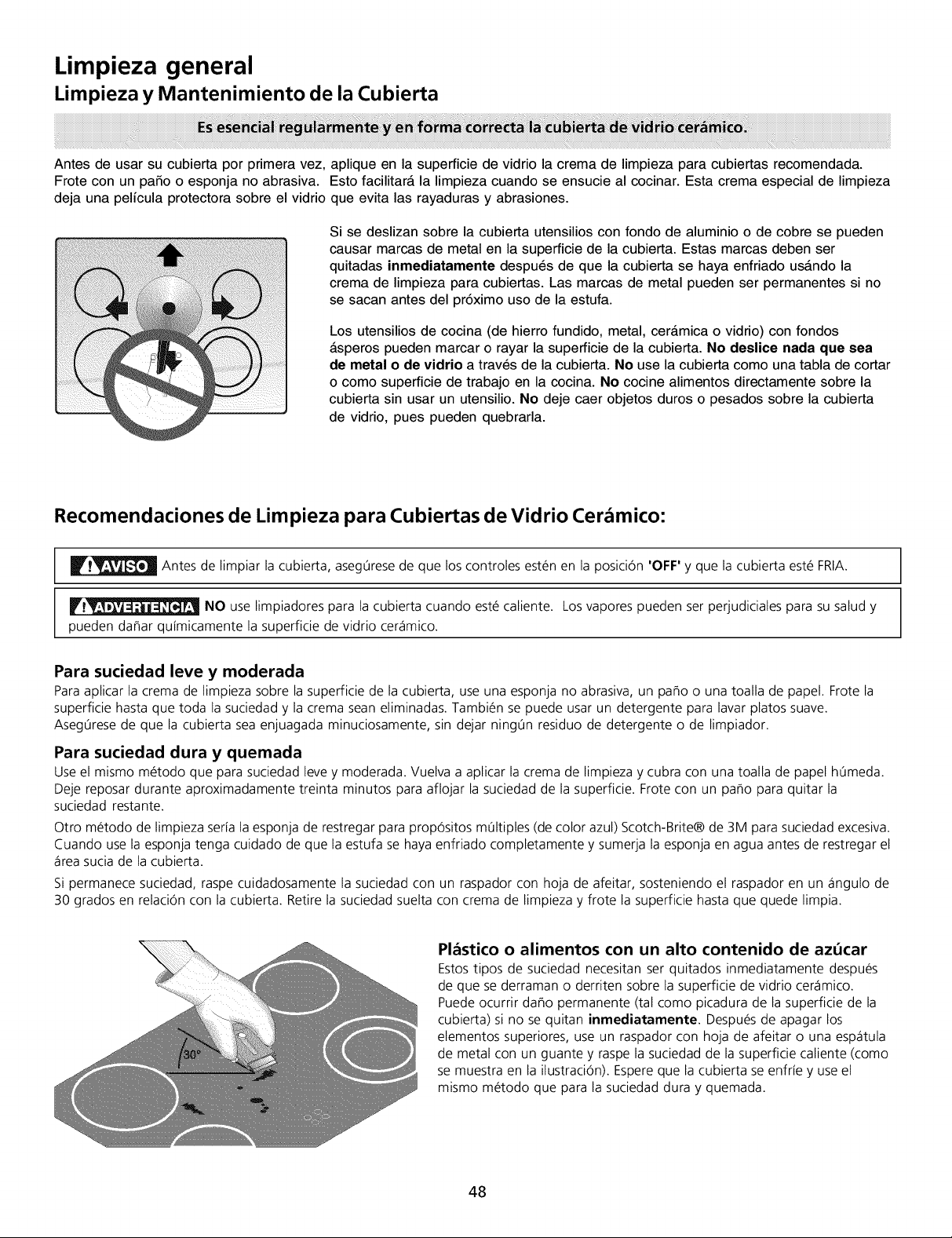
Limpieza general
Limpieza y Mantenimiento de la Cubierta
Antes de usar su cubierta por primera vez,
Frote con un paso o esponja no abrasiva.
deja una pelicula protectora sobre el vidrio
aplique en la superficie de vidrio la crema de limpieza para cubiertas recomendada.
Esto facilitarA la limpieza cuando se ensucie al cocinar. Esta crema especial de limpieza
que evita las rayaduras y abrasiones.
Si se deslizan sobre la cubierta utensilios con fondo de aluminio o de cobre se pueden
causar marcas de metal en la superficie de la cubierta. Estas marcas deben ser
quitadas inmediatamente despues de que la cubierta se haya enfriado us_ndo la
crema de limpieza para cubiertas. Las marcas de metal pueden ser permanentes si no
se sacan antes del pr6ximo uso de la estufa.
Los utensilios de cocina (de hierro fundido, metal, cerAmica o vidrio) con fondos
Asperos pueden marcar o rayar la superficie de la cubierta. No deslice nada que sea
de metal o de vidrio a traves de la cubierta. No use la cubierta como una tabla de cortar
o como superficie de trabajo en la cocina. No cocine alimentos directamente sobre la
cubierta sin usar un utensilio. No deje caer objetos duros o pesados sobre la cubierta
de vidrio, pues pueden quebrarla.
Recomendaciones de Limpieza para Cubiertas de Vidrio Cer&mico:
Antes de limpiar la cubierta, aseg0rese de que los controles est_n en la posici6n 'OFF' y que la cubierta est_ FRIA.
NO use limpiadores para la cubierta cuando est_ caliente. Los vapores oueden ser perjudiciales para su salud y
pueden danar quimicamente la superficie de vidrio cer_fimico.
Para suciedad leve y moderada
Para aplicar la crema de limpieza sobre la superficie de la cubierta, use una esponja no abrasiva un pano o una toalla de papel. Frote la
superficie hasta que toda la suciedad y la crema sean eliminadas. Tambi_n se puede usar un detergente para lavar platos suave.
Aseg0rese de que la cubierta sea enjuagada minuciosamente, sin dejar ning0n residuo de detergente o de limpiador.
Para suciedad dura y quemada
Use el mismo m_todo que para suciedad leve y moderada. Vuelva a aplicar la crema de limpieza y cubra con una toalla de papel h0meda.
Deje reposar durante aproximadamente treinta minutos para aflojar la suciedad de la superficie. Frote con un pano para quitar la
suciedad restante.
Otro m_todo de limpieza seria la esponja de restregar para prop6sitos mOItiples (de color azul) Scotch-Brite® de 3M para suciedad excesiva.
Cuando use la esponja tenga cuidado de que la estufa se haya enfriado completamente y sumerja la esponja en agua antes de restregar el
_irea sucia de la cubierta.
Si permanece suciedad, raspe cuidadosamente la suciedad con un raspador con hoja de afeitar, sosteniendo el raspador en un _ingulo de
30 grados en relaci6n con la cubierta. Retire la suciedad suelta con crema de limpieza y frote la superficie hasta que quede limpia.
Pl_stico o alimentos con un alto contenido de az_car
Estos tipos de suciedad necesitan ser quitados inmediatamente despu_s
de que se derraman o derriten sobre la superficie de vidrio cer_fimico.
Puede ocurrir dano permanente (tal como picadura de la superflcie de la
cubierta) si no se quitan inmediatamente. Despu_s de apagar los
elementos superiores, use un raspador con hoja de afeitar o una esp_tula
de metal con un guante y raspe la suciedad de la superficie caliente (como
se muestra en la ilustraci6n). Espere que la cubierta se enfrie y use el
mismo m_todo que para la suciedad dura y quemada.
48
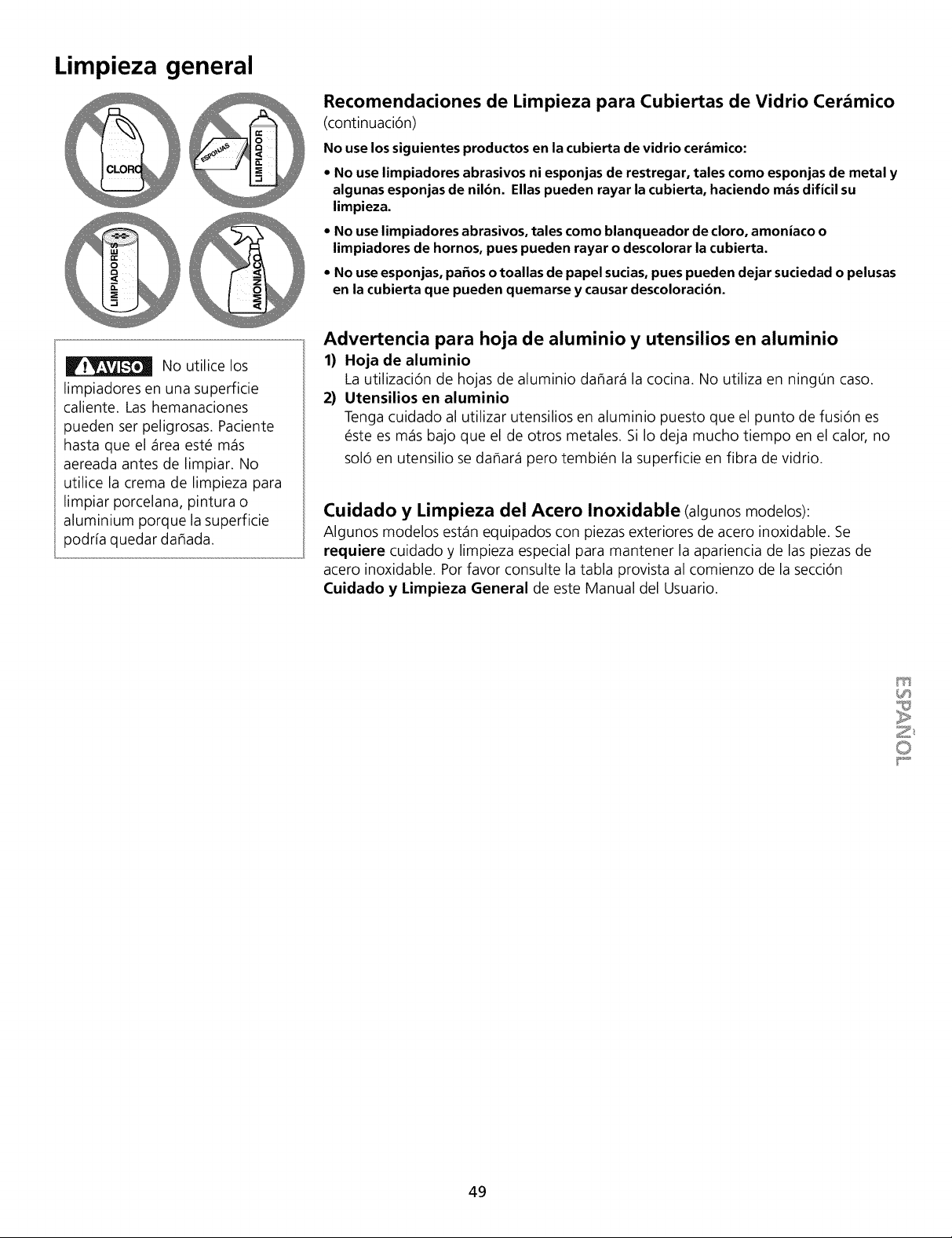
Limpieza general
No utilice los
limpiadores en una superficie
caliente. Las hemanaciones
pueden ser peligrosas. Paciente
hasta que el _rea est_ m_s
aereada antes de limpiar. No
utilice la crema de limpieza para
limpiar porcelana, pintura o
aluminium porque la superficie
podrfa quedar dahada.
Recomendaciones de Limpieza para Cubiertas de Vidrio Cer&mico
(continuaci6n)
No use los siguientes productos en la cubierta de vidrio cer&mico:
• No use limpiadores abrasivos ni esponjas de restregar, tales como esponjas de metal y
algunas esponjas de nilbn. Elias pueden rayar la cubierta, haciendo m&s dificil su
limpieza.
• No use limpiadores abrasivos, tales como blanqueador de cloro, amoniaco o
limpiadores de hornos, pues pueden rayar o descolorar la cubierta.
• No use esponjas, pa_os o toallas de papel sucias, pues pueden dejar suciedad o pelusas
en la cubierta que pueden quemarse y causar descoloracibn.
Advertencia para hoja de aluminio y utensilios en aluminio
1) Hoja de aluminio
La utilizaci6n de hojas de aluminio dahar_ la cocina. No utiliza en ning0n caso.
2) Utensilios en aluminio
Tenga cuidado al utilizar utensilios en aluminio puesto que el punto de fusi6n es
_ste es m_s bajo que el de otros metales. Si Io deja mucho tiempo en el calor, no
sol6 en utensilio se dahar_ pero tembi_n la superficie en fibra de vidrio.
Cuidado y Limpieza del Acero Inoxidable (algunos modelos):
Algunos modelos est_n equipados con piezas exteriores de acero inoxidable. Se
requiere cuidado y limpieza especial para mantener la apariencia de las piezas de
acero inoxidable. Por favor consulte la tabla provista al comienzo de la secci6n
Cuidado y Limpieza General de este Manual del Usuario.
49
Limpieza general
Instrucciones para limpiar la cocina en porcelana (Modelos: 790.4506@)
No utilize ning0n tipo de limpiador en una cocina caliente. Lasemanaciones pueden ser peligrosas para
la salud o pueden dahar la superficie de la cocina.
_Antes de limpiar la cocina, aseg0rese que todos los controles est_n apagados y que la cocina ha enfriado.
NO utilize limpiadores de horno comerciales en la parte exterior incluyendo la superficie o el marco de la
puerta.
Una limpieza adecuada y regular es importante para mantener la porcelana de su cocina. Sicomida o grasa no son rapidamente
retirados, estos pueden quemar la cocina y causar permanente descoloraci6n.
Limpieza Cotidiana
Para manchas normales:
1. Deje enfriar la superficie de la cocina.
2. Retire las manchas con un papel o con un pahojabonoso.
3. Sies necesario, use un paho jabonoso en metal u otro limpiador casero.
4. Aseg0rese de bien retirar los limpiadores o la porcelana podrfa daharse al momento del calentamiento.
Para manchas dificiles:
1. Deje enfriar la superficie de la cocina.
2. Use un paho enjuagado con agua tibia o cubra las manchas con una soluci6n de agua y amon[aco. Frote delicadamente.
Enjuague y seque con un paho limpio.
3. Si quedan algunas manchas, aplique unas gotas de crema limpiadora de cocina sobre las manchas y frote ligeramente con
un paho o papel. Frote con un paho seco hasta retirar todas las manchas y la crema. Una limpieza regular con crema deja
una capa protectora en la superficie que ayuda a prevenir otras marcas.
Para manchas de az_car:
Las manchas de az0car puede dahar la superfiie de su cocina. Por eso, debe limpiar estos res[duos cuando la cocina a0n est_
caliente. Tenga cuidado cuando prosiga con las etapas siguientes:
1. Apague todas las hornillas y retire todo utensilio inmediatamente.
2. P6ngase guantes, limpie cuidadosamente o retire los res[duos calientes lejos de las hornillas con un paho mojado.
3. Deje enfriar la cocina. Siga las instrucciones para manchas dificiles aqu[ arriba.
LIMPIEZADE LA COCINA/CREMA PARA POLIRpueden ser comprados a trav_s de los centros de servicio autorizado Searso en
la Searstiendas.
5O
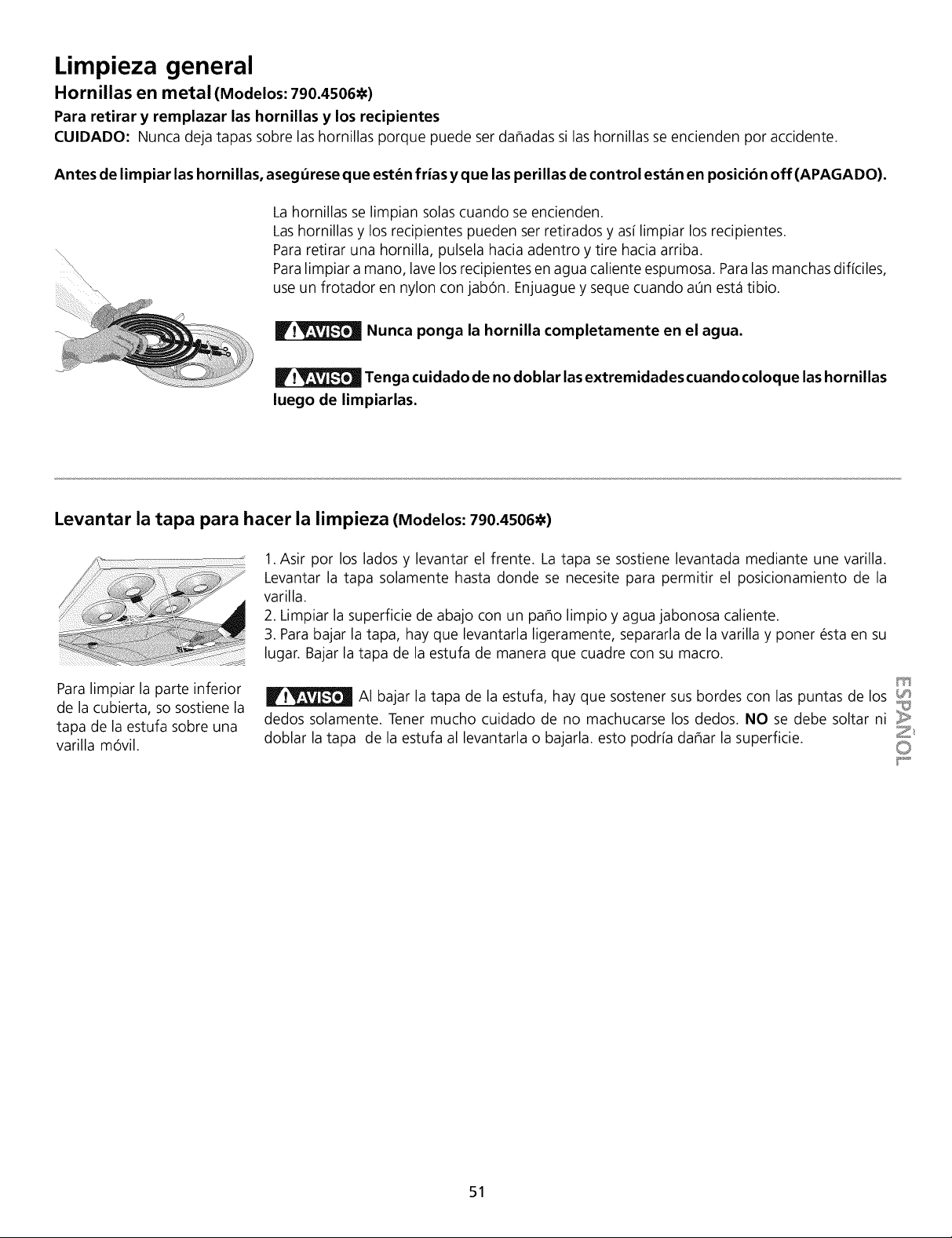
Limpieza general
Hornillas en metal (Modelos: 790.4506_)
Para retirar y remplazar las hornillas y los recipientes
CUIDADO: Nunca deja tapas sobre las hornillas porque puede ser dahadas si las hornillas se encienden por accidente.
Antes de limpiar las hornillas, aseg t_rese que est_n frias y que las perillas de control est&n en posicibn off (APAGADO).
\
\
!i!i!i ¸
La hornillas se limpian solas cuando se encienden.
Las hornillas y los recipientes pueden ser retirados y as[ limpiar los recipientes.
Para retirar una hornilla, pulsela hacia adentro y tire hacia arriba.
Paralimpiar a mano, lave los recipientes en agua caliente espumosa. Para las manchas dificiles,
use un frotador en nylon con jab6n. Enjuague y seque cuando a0n est_ tibio.
Nunca ponga la hornilla completamente en el agua.
Tenga cuidado de no doblar las extremidades cuando coloque las hornillas
luego de limpiarlas.
Levantar la tapa para hacer la limpieza (Modelos: 790.4506@)
Para limpiar la parte inferior
de la cubierta, so sostiene la
tapa de la estufa sobre una
varilla m6vil.
1. Asir por los lados y levantar el frente. La tapa se sostiene levantada mediante une varilla.
Levantar la tapa solamente hasta donde se necesite para permitir el posicionamiento de la
varilla.
2. Limpiar la superficie de abajo con un paho limpio y agua jabonosa caliente.
3. Para bajar la tapa, hay que levantarla ligeramente, separarla de la varilla y poner _sta en su
lugar. Bajar la tapa de la estufa de manera que cuadre con su macro.
AI bajar la tapa de la estufa, hay que sostener sus bordes con las puntas de los _J_
dedos solamente. Tener mucho cuidado de no machucarse los dedos. NO se debe soltar ni _>
doblar la tapa de la estufa al levantarla o bajarla, esto podr[a dahar la superficie. Z_:
51
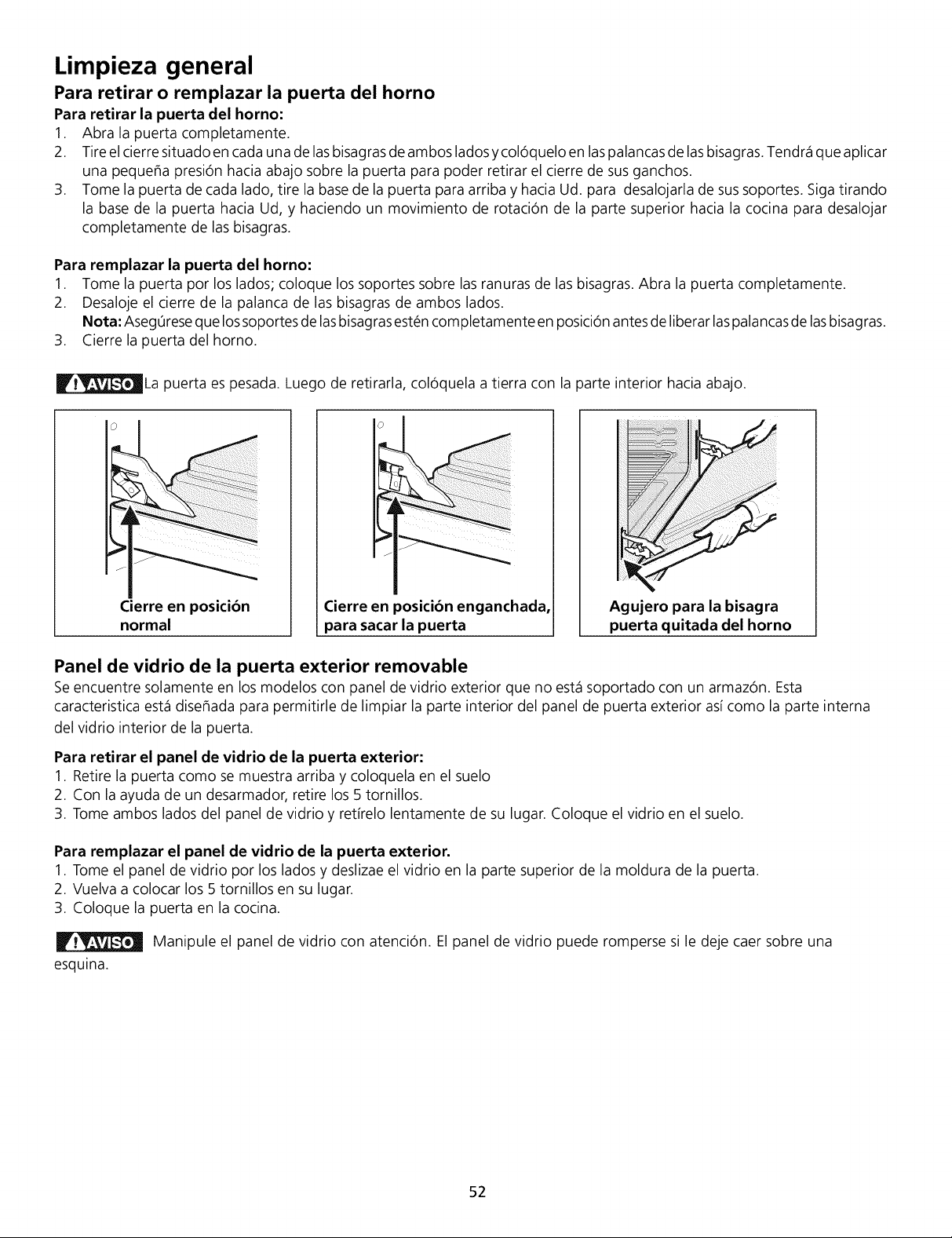
Limpieza general
Para retirar o remplazar la puerta del horno
Para retirar la puerta del horno:
1. Abra la puerta completamente.
2. Tire el cierre situado en cada una de las bisagras deambos lados ycol6quelo en laspalancas de lasbisagras. Tendr_ que aplicar
una pequeha presi6n hacia abajo sobre la puerta para poder retirar el cierre de sus ganchos.
3. Tome la puerta de cada lado, tire la base de la puerta para arriba y hacia Ud. para desalojarla de sus soportes. Sigatirando
la base de la puerta hacia Ud, y haciendo un movimiento de rotaci6n de la parte superior hacia la cocina para desalojar
completamente de las bisagras.
Para remplazar la puerta del horno:
1. Tome la puerta por los lados; coloque los soportes sobre las ranuras de las bisagras. Abra la puerta completamente.
2. Desaloje el cierre de la palanca de las bisagras de ambos lados.
Nora: Aseg0rese que lossoportes de lasbisagras est_n completamente en posici6n antes de liberar las palancasde lasbisagras.
3. Cierre la puerta del horno.
_La puerta es pesada. Luego de retirarla, col6quela a tierra con la parte interior hacia abajo.
Cierre en posicibn
normal
Cierre en
)osicibn enganchada,
para sacar la puerta
Agujero para la bisagra
puerta quitada del horno
Panel de vidrio de la puerta exterior removable
Se encuentre solamente en los modelos con panel de vidrio exterior que no est_ soportado con un armaz6n. Esta
caracteristica est_ disehada para permitirle de limpiar la parte interior del panel de puerta exterior asfcomo la parte interna
del vidrio interior de la puerta.
Para retirar el panel de vidrio de la puerta exterior:
1. Retire la puerta como se muestra arriba y coloquela en el suelo
2. Con la ayuda de un desarmador, retire los 5 tornillos.
3. Tome ambos lados del panel de vidrio y retfrelo lentamente de su lugar. Coloque el vidrio en el suelo.
Para remplazar el panel de vidrio de la puerta exterior.
1. Tome el panel de vidrio por los lados y deslizae el vidrio en la parte superior de la moldura de la puerta.
2. Vuelva a colocar los 5 tornillos en su lugar.
3. Coloque la puerta en la cocina.
Manipule el panel de vidrio con atenci6n. El panel de vidrio puede romperse si le deje caer sobre una
esquina.
52
Regulacibn de la temperatura del horno
Latemperatura en el horno ha sido regulada en la f_ibrica. La primera vez que use el horno siga las temperaturas y el tiempo
indicado en la receta. Siconsidera que el horno est,1demasiado caliente o demasiado frfo, se puede ajustar la temperatura.
Antes de regularla, ensaye una receta con una temperatura m_is elevada o m_is baja que la temperatura recomendada. Los
resultados del horneado le ayudar_in a decidir cual es la regulaci6n que necesita.
Ajuste de la temperatura del horno:
1. Oprima BAKE(_.
2. Ajuste la temperatura a 550°F (287°C) en oprima y mantenga pulsado la FLECHA HACIA ARRIBA A.
3. En 2 segundos, pulse y mantenga pulsado el bot6n BAKE (_ hasta que los 2 d[gitos especiales aparezcan en la pantalla.
BAKE (_. La pantalla muestra la cantidad de grados que separan el ajuste de temperatura original
Suelte el bot6n de
f_ibrica y el ajuste la temperatura actual. Si el control del horno tiene el ajuste original, la pantalla mostrar_i "00."
4. Latemperatura puede ser ajustada hacia arriba o hacia abajo de 35°F (17°O, en intervalos de 5°F (1°C) pulsado y
manteniendo la FLECHA HACIA ARRIBA A o HACIA ABAJO v. Ajuste hasta que la cantidad de grados de diferencia en
la pantalla. Cuando disminuya la temperatura del horno, el signo (-) aparecer_i en la pantalla delante del n0mero para
indicar que el horno se enfriar_i de la cantidad de grados indicada.
5. Cuando termine de hacer el ajuste deseado, pulse STOP CLEAR (_ para regresar la hora en la
pantalla.
Nora: Losajustes efectuados no cambiar_in la temperatura de autolimpieza.
53
Lista de verificacibn para evitar Ilamadas
Usted puede evitarse el incoveniente y los gastos de una Ilamada innecesaria al servicio revisando esta lista de verficaci6n.
t_stalista muestra los problemas m_s frecuentes que no son la causa de un fabricado defectuoso de las piezas.
Usted sera facturado por la Ilamada de servicio, durante el tiempo que cubre la garant[a, si el problema no es la causa del
fabricado defectuoso de una pieza.
Su nuevo aparato ha sido disehdo cuidadosamente. Muchas veces, Io que parece necesitar una Ilamada al Centro de
servicio se puede arreglar con algunos ajustes que Ud.mismo puede hacer en su domicilio o son caracter[sticas normales de
funcionamiento de su aparato en ciertas condiciones.
SITUACION POSIBLE CAUSA/SOLUCION
La estufa est& desnivelada.
Instalci6n inadecuada. Coloque la rejilla en el centro del horno. Coloque un nivel sobre la
rejilla. Ajuste las patas niveladoras en la base de la estufa hasta que la rejilla se nivele.
Cuando la estufa est_ nivelada, la plancha de cocinar puede aparecer desnivelada si la
plancha de cocinar no est_ nivelada.
Piso no solido, inestable. Aseg0rese que el piso est_ nivelado y que puede soportar la
cocina. Llame su carpintero para corregir un piso inclinado.
El desnivel del armario de la estufa puede hacer aparecer la estufa desnivelada. Aseg0rese
que los armarios est_n cuadrados y tienen suficiente espacio para la cocina.
No puede mover el aparato
facilmente.EI aparato no puede ser
accesible facilmente.
Los armarios no son cuadrados o son fabricados muy angostos. Consulte un carpintero
para corregir el problema.
Consulte un carpintero para hacer el aparato m_s accesible.
Las alfombras interfieren con la cocina. Deje suficentemente de espacio para que la estufa
pueda ser levantada sobre la alformbra.
La estufa completa o el homo no
funcionan.
Aseg0rese que el cable este bien ajustado en el enchufe.
El alambrado no ha sido terminado. Consulte con su agente de servicio, agente de
instalaci6n o servicio autorizado.
Corte de electricidad. Verifique las luces de la casa para asegurarse. Llame a su copania de
electricidad local para el servicio.
*El control del homo suena y en la
pantalla aparece F1,F3 o F9
El control electr6nico ha detectado una anomalia. PulseCLEAR para borrar la pantalla y
parar el sonido. Reprograme el horno. Si la anomalia se repite, tome nota del n0mero de
anomalia. Pulse CLEAR y consulte un servicio autorizado.
La luz del horno no funciona Coloque o ajuste la bombilla. Yea "Cambio de la luz del homo" en el Manual del
usuario para las instrucciones.
La unidad de superficie no calienta No hay suministro el_ctrico al aparato. Verifique las etapas en "La estufa completa o el
horno no funcionan" que se encuentra en esta lista.
Programado de los controles inadecuado. Aseg0rese que el control adecuado este
encendido para que pueda usar la unidad de superficie.
Raspaduras o rasgu_os sobre la
plancha de cocinar.
Particulas dificiles como la sal o la arena entre la plancha de cocinar y los utensilios
pueden causar raspaduras. Aseg0rese que la superficie de la plancha de cocinar y la base
de los utensilios est_n limpias antes de usarla. Pequenas raspaduras no afectan la cocci6n
y desaparecer_n con el tiempo.
54
Marcas de metal.
Deslizando o rosando los utensilios de metal sobre la superficie de la plancha de cocinar.
No deslize los utensilios de metal sobre la superficie de la plancha de cocinar. Use una
crema de limpieza para retirar las marcas de la plancha de estufa cer_mica. Vea "Para
limpiar el vidrio de la plancha de cocinar" en Limpieza General.
Rayas o manchas marrones. Los derrames han sido cocidos en la superficie. Use una lama de afeitar para retirar las
manchas. Yea "Para limpiar el vidrio de la plancha de cocinar" en Limpieza General.
Areas de descoloraci6n con brillo met_lico. Dep6sitos minerales del agua o de la comida. Retirelos con una crema de limpieza. Use
recipientes con las bases limpias y secas.
Malos resultados al hornear. Muchos factores afectan el horneo. Aseg0rese que la rejilla est_ en buen lugar. Centre la
comida y deje espacio para permitir al aire de circular. Precaliente el homo a la
temperatura deseada antes de colocar la comida. Trate de ajustar las temperaturas
recomendadas y el tiempo de horneo de sus recetas. Si cree que el horno est_ muy
caliente o muy frio, vea "Ajuste de la temperatura del horno" en el Manual del
usuario.
Ruido del ventilador durante la funcibn de El ventilador puede encenderse o apagarse autom_ticamente para enfriar algunos
cucinado, componentes del electrodom_stico. Es normal que el ventilador continue trabajando a0n
cuando el horno este apagado.
Llamas desde el interior del horno o vapor Derrames excesivos dentro del horno. Ajuste el ciclo de auto limpieza por un tiempo m_s
de la rejilla de ventilacibn, largo.
Derrames excesivos dentro del horno. Esto es normal, especialmente para los de pasteles
o grasas en la base del horno. Limpie los derrames excesivos antes de comenzar la auto-
limpieza. Si observa llamas o vapor, pare el ciclo de auto.limpieza y siga las etapas en
"Para parar o interrumpir el ciclo de auto-limpieza" en el Manual del usuario.
El horno produce demasiado vapor al asar. Los controles no estan programados adecuadamente. Siga las instrucciones en "Ajuste
de los controles del horno" en el Manual del usuario.
AsegOrese que el horno est.1abierto a la Posicibn de parar el asado.
Las carnes est_n muy cerca del elemento del asador.Vuelva a colocar la rejilla para obtener
un espacio suflciente entre las carnes y el elemento. Precaliente el elemento del asador.
Precaliente el elemento del asador para cocinar con la grilla incandecente. Y%
La rejilla en la parrilla tiene el lado incorrecto hacia arriba y la grasa no est_ goteando.
Siempre coloque la rejilla sobre la parrilla con las varillas hacia arriba y las ranuras hacia Z_:
abajo para que la grasa gotee en el recipiente. _....
Grasa se ha acumulado sobre la superficie del horno. La limpieza frecuente es necesaria
cuando asa constantemente. Grasa que se queda inpregnada o manchas de comida
pueden causar vapor excesivo.
El ciclo de auto-limpieza no funciona. Los controles no estan programados adecuadamente. Siga las instrucciones en
"Limpieza del homo" en el Manual del usuario.
Elciclo de limpieza fu_ interrumpido. El tiempo de termino debe ser de 3 a 4 horas
despues de haber comenzado. Siga las etapas en "Para parar o interrumpir el ciclo de
auto-limpieza" en el Manual del usuario.
Las manchas no han sido retiradas despues
del ciclo de auto-limpieza.
No ha limpiado la base, la parte superior, el cadre o la puerta al exterior de la
empaquetadura del horno. Estas areas no son limpiadas por el ciclo de autoqimpieza,
pero se calientan Io suficiente para crear residuos. Limpie estas partes antes de comenzar
un nuevo ciclo de auto-limpieza. Los residuos pueden ser limpiados con un pano de
nylon y agua o con una esponja de nylon. Tenga cuidado de no danar la empaquetadura
del horno.
55
Your Home
For repair-in your home-of all major brand appliances,
lawn and garden equipment, or heating and cooling systems,
no matter who made it, no matter who sold it!
For the replacement parts, accessories and
owner's manuals that you need to do-it-yourself.
For Sears professional installation of home appliances
and items like garage door openers and water heaters.
1-800-4-MY-HOME ® (1-800-469-4663)
Call anytime, day or night (U.S.A. and Canada)
WWW.SearS.COIT! WWW.SQars.ca
Our Home
For repair of carry-in items like vacuums, lawn equipment,
and electronics, call or go on-line for the location of your nearest
Sears Parts & Repair Center.
1-800=488=1222
Call anytime, day or night (U.S.A. only)
WWW.SeStS.COrn
To purchase a protection agreement (U.S.A.)
or maintenance agreement (Canada) on a product serviced by Sears:
1-800-827-6655 (U.S.A.) 1-800-361 =6665 (Canada)
Para pedir servicio de reparaci6n
a domicilio, y para ordenar piezas:
1-888-SU-HOGAR sM
(1-888-784-6427)
Au Canada pour service en fran_ais:
1-800-LE-FOYER Mc
(1-800-533-6937)
www.sears.ca
® Registered Trademark / TMTrademark / su Service Mark of Sears, Roebuck and Co.
® Marca Registrada / rM Marca de F_.brica/ SMMarca de Servicio de Sears, Roebuck and Co.
uc Marque de commerce / MDMarque d_pos6e de Sears, Roebuck and Co. © Sears, Roebuck and Co.