Safe Operation Practices • Set-Up • Operation • Maintenance • Troubleshooting • Warranty
OPER roR's
L
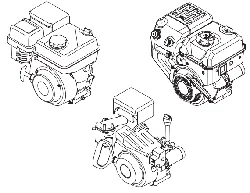
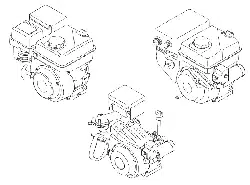
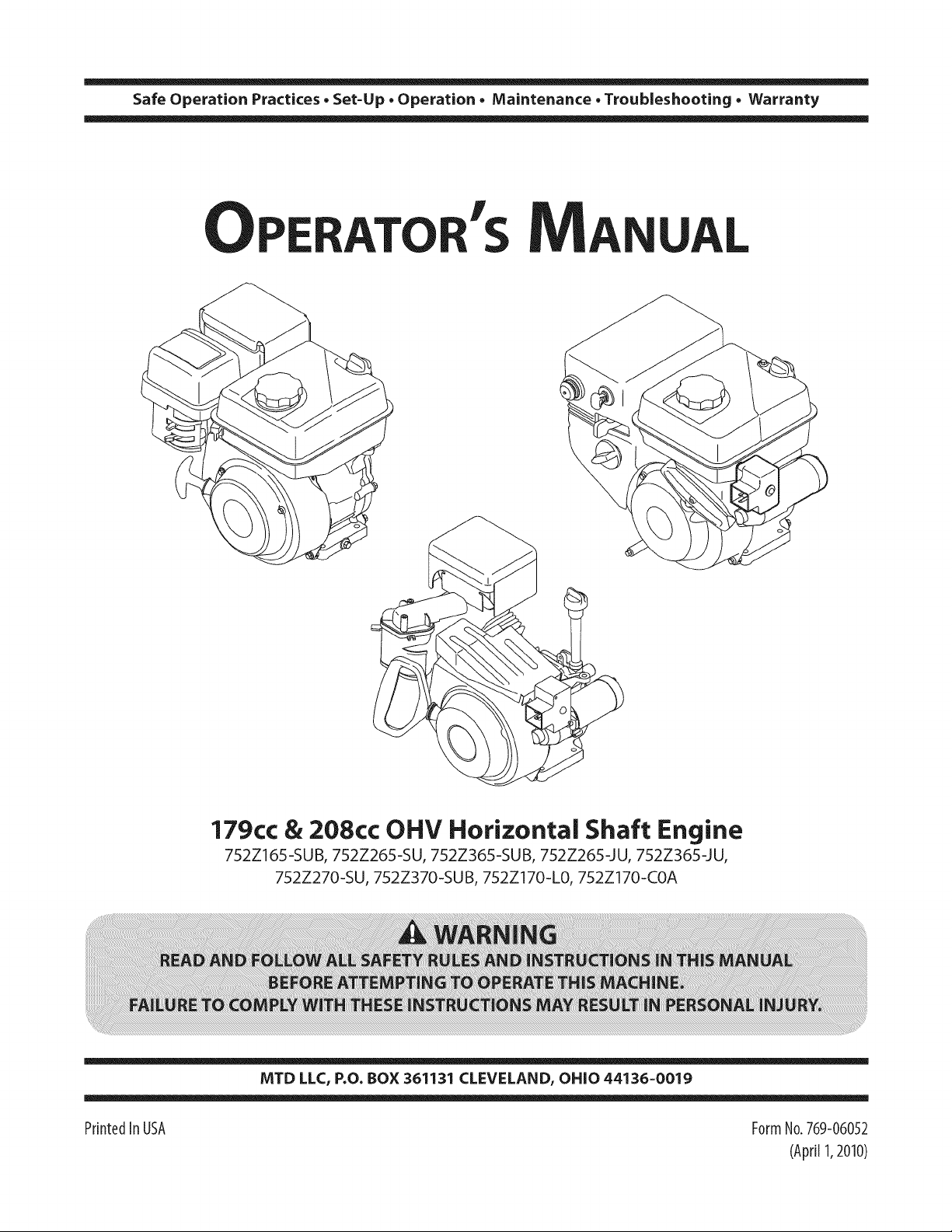
179cc & 208cc OHV Horizontal Shaft Engine
752Z165-SUB, 752Z265-SU, 752Z365-SUB, 752Z265-JU, 752Z365-JU,
752Z270-SU, 752Z370-SUB, 752Z170-LO, 752Z170-COA
MTD LLC, P.O. BOX 361131 CLEVELAND, OHIO 44136-0019
PrintedIn USA FormNo.769-06052
(April1,2010)
ToTheOwner
1
ThankYou
This Operator's Manual is an important part of your new engine. It will help you prepare and maintain the engine for the best
performance. Please read and understand the contents before operating the engine.
Tableof Contents
Safe Operation Practices ........................................ 3
Safety Labels ............................................................ 5
Set-Up ....................................................................... 6
Controls & Features ................................................. 9
Operation ................................................................ 10
Maintenance ........................................................... 13
Troubleshooting ..................................................... 19
Replacement Parts ................................................ 20
Warranty ................................................................. 21
Spanish ................................................................... 23
RecordProductInformation
Before operating your new engine, please locate the model plate
on the engine and record the information in the provided area
to the right. This information will be necessary, should you seek
technical support via our web site or with your local dealer.
MODEL NUMBER/SERIAL NUMBER
E[3E[3E[3E/EDEEEEEEEEEE
CustomerSupport
Please do NOT return the machine to the retailer or dealer without first contacting our Customer Support Department.
If you have difficulty with this product or have any questions regarding the controls, operation, or maintenance of this
engine, you can seek help from the experts. Choose from the options below:
Visit us on the web at www.mtdproducts.com
Call a Customer Support Representative at (800) 800-7310 or (330) 220-4683
Write us at MTD LLC • P.O.Box 361131 • Cleveland, OH • 44136-0019
ImportantSafeOperationPractices
2
WARNING! This symbol points out important safety instructions which, if not followed,
could endanger the personal safety and/or property of yourself and others. Read and follow
all instructions in this manual before attempting to operate the equipment. Failure to
comply with these instructions may result in personal injury. When you see this symbol.
HEED IT'S WARNING!
CALIFORNIA PROPOSITION 65
WARNING! Engine Exhaust, some of its constituents, and certain vehicle components
contain or emit chemicals known to State of California to cause cancer and birth defects
or other reproductive harm.
DANGER! This machine was built to be operated according to the safe operation practices
in this manual. As with any type of power equipment, carelessness or error on the part of the
operator can result in serious injury. This machine is capable of amputating fingers, hands,
toes and feet and throwing foreign objects. Failure to observe the following safety
instructions could result in serious injury or death.
Training 4.
5.
1. Read, understand and follow all instructions on the engine
and in the manual(s) before attempting to assemble and
operate. Keep this manual in a safe place for future and
regular reference and for ordering replacement parts.
2. Be familiar with all controls and their proper operation.
Know how to stop the engine and disengage them quickly.
3. Never allow children under 14 years of age to operate the
engine. Children 14 and over should read and understand
the instructions and safe operation practices in this manual
and on the engine and be trained and supervised by an
adult.
4.
5.
Never allow adults to operate the machine without proper
instruction.
Keep the area of operation clear of all persons, particularly
small children and pets. Stop machine if anyone enters the
area.
Preparation
1. Thoroughly inspect the area where the equipment is to
be used. Remove all stones, sticks, wire and other foreign
objects which could be tripped over and cause personal
injury.
2. Wear sturdy, rough-soled work shoes and close fitting
slacks and shirts. Loose fitting clothes or jewelry can be
caught in the moving parts. Never operate the machine in
bare feet or sandals.
3.
Disengage clutch levers and shift (if equipped) into nuetral
("N") before starting the engine.
Never leave the engine running while unattended.
Never attempt to make any adjustments while the engine
is running, except where specifically recommended in the
operator's manual.
SafeHandling0f Gas01ine:
6. To avoid personal injury or property damage, use extreme
care in handling gasoline. Gasoline is extremely flammable
and the vapors are explosive. Serious personal injury can
occur when gasoline is spilled on yourself and/or your
clothes which can ignite. Wash your skin and change
clothes immediately.
a. When adding fuel, turn engine OFF and let engine
cool at least 2 minutes before removing the gas cap.
b. Fill fuel tank outdoors or in well ventilated area.
c. Use only an approved gasoline container.
d. Never fill containers inside a vehicle or on a truck
or trailer bed with a plastic linen Always place
containers on the ground away from your vehicle
before filling.
e. If possible, remove gas-powered equipment from
the truck or trailer and refuel it on the ground. If this
is not possible, then refuel such equipment on a
trailer with a portable container, rather than from a
gasoline dispenser nozzle.
f. Keep the nozzle in contact with the rim of the fuel
tank or container opening at all times until fueling is
complete. Do not use a nozzle lock-open device.
g. Donotoverfillfueltank.Filltanktonomorethan
1/2inchbelowthebottomofthefillernecktoallow
spaceforfuelexpansion.
h. Replacegasolinecapandtightenitsecurely.
i. Ifgasolineisspilled,wipeitofftheengineandthe
equipment.Movethemachinetoanotherarea.Wait
fiveminutesbeforestartingtheengine.
j. Toreducefirehazards,keepthemachinefreeof
grass,leavesorotherdebrisbuildup.Cleanupoilor
fuelspillageandremoveanyfuel-soakeddebris.
k. Keepgasolineawayfromsparks,openflames,pilot
lights,heat,andotherignitionsources.
I. Neverfuelequipmentindoorsbecauseflammable
vaporswillaccumulateinthearea.
m. Extinguishallcigarettes,cigars,pipes,andother
sourcesofignition.
n. Checkfuelline,tank,cap,andfittingsfrequentlyfor
cracksorleaks.Replaceifnecessary.
Operation
1. When starting the engine, make sure spark plug, muffler,
and fuel cap are in place.
2. Do not crank engine with spark plug removed.
3. If fuel spills, wait until it evaporates before starting engine.
4. Allow muffler, engine cylinder, and fins to cool before
touching.
5. Keep children away from hot or running engines. They can
suffer burns from a hot muffler.
6. Remove accumulated combustibles from muffler and
cylinder area.
7. Operate equipment with all guards in place.
8. Keep hands and feet away from rotating parts.
9. Tie up long hair and remove jewelry.
10. Do not wear loose-fitting clothing, dangling drawstrings or
items that could become caught.
11. When starting the engine, pull cord slowly until resistance
is felt, then pull rapidly.
12. Remove all external equipment/engine loads before
starting engine.
13. Direct coupled equipment components such as, but not
limited to blades, impellers, pulleys, sprockets, etc., must
be securely attached.
Maintenance& Storage
1. Keep the engine in safe working order
2. Allow the engine to cool at least five minutes before
storing. Never tamper with safety devices. Check their
proper operation regularly.
3. Check bolts a nd screws for proper tightness at frequent
intervals to keep the engine in safe working condition.
Visually inspect the engine for any damage.
4. Before cleaning, repairing or inspecting; stop the
engine and make certain all moving parts have stopped.
Disconnect the spark plug wire and ground it against the
engine to prevent unintended starting.
5. Do not change the engine governor settings or over-speed
the engine. The governor controls the maximum safe
operating speed of the engine.
6. Maintain and replace safety and instruction labels as
necessary.
7. Always refer to the operator's manual for important details
if the machine is to be stored for an extended period of
time.
8.
9.
If the fuel tank has to be drained, do this outdoors.
Observe proper disposal laws and regulations for gas, oil,
etc. to protect the environment.
Donot modify engine
To avoid serious injury or death, do not modify engine in any
way. Tampering with the governor setting can lead to a runaway
engine and cause it to operate at unsafe speeds. Never tamper
with factory setting of engine governor.
Notice Regarding Emissions
Engines which are certified to comply with California and federal
EPA emission regulations for SORE (Small Off Road Equipment)
are certified to operate on regular unleaded gasoline, and
may include the following emission control systems: Engine
Modification (EM), Oxidizing Catalyst (OC), Secondary Air
Injection (SAI) and Three Way Catalyst (TWC) if so equipped.
SparkArrestor
_ ARNING! This machine is equipped with an
internal combustion engine and should not be used
on or near any unimproved forest-covered, brush
covered or grass-covered land unless the engine's
exhaust system is equipped with a spark arrestor
meeting applicable local or state laws (if any).
Ifa spark arrestor is used, it should be maintained in effective
working order by the operator. In the State of California the
above is required by law (Section 4442 of the California Public
Resources Code). Other states may have similar laws. Federal laws
apply on federal lands.
A spark arrestor for the muffler is available through your
nearest engine authorized service dealer or contact the service
department, P.O. Box 361131 Cleveland, Ohio 44136-0019.
4 I SECTION 2 -- IMPORTANT ENGINE SAFE OPERATION PRACTICES
Safety Symbols
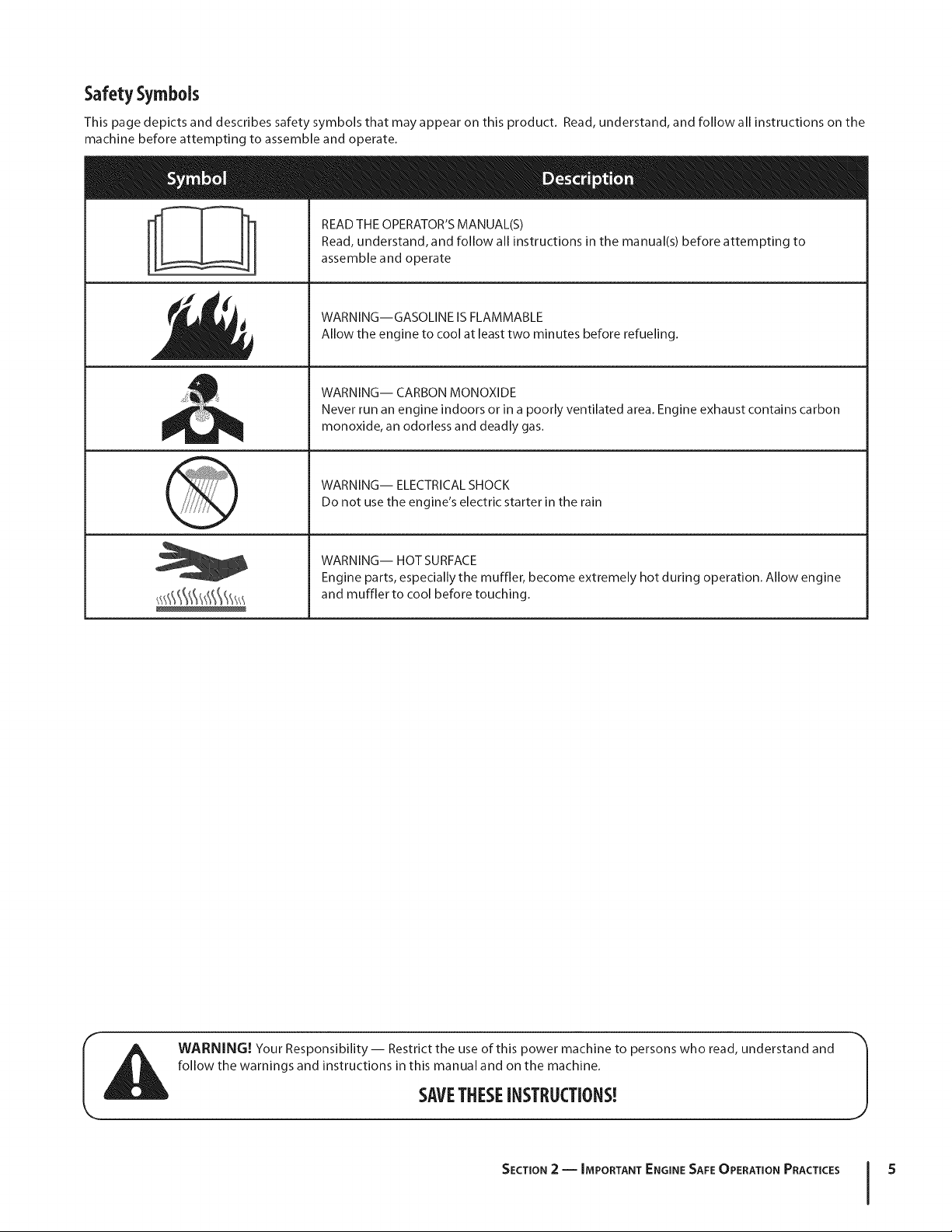
This page depicts and describes safety symbols that may appear on this product. Read, understand, and follow all instructions on the
machine before attempting to assemble and operate.
READ THE OPERATOR'S MANUAL(S)
Read, understand, and follow all instructions in the manual(s) before attempting to
assemble and operate
WARNING--GASOLINE IS FLAMMABLE
Allow the engine to cool at least two minutes before refueling.
WARNING-- CARBON MONOXIDE
Never run an engine indoors or in a poorly ventilated area. Engine exhaust contains carbon
monoxide, an odorless and deadly gas.
WARNING-- ELECTRICAL SHOCK
Do not use the engine's electric starter in the rain
WARNING-- HOT SURFACE
Engine parts, especially the muffler, become extremely hot during operation. Allow engine
and muffler to cool before touching.
WARNING! Your Responsibility- Restrict the use of this power machine to persons who read, understand and
follow the warnings and instructions in this manual and on the machine.
SAVETHESEINSTRUCTIONS!
SECTION 2 -- IMPORTANT ENGINE SAFE OPERATION PRACTICES S
Set-Up
3
Oil & Fuel Specifications
NOTE:The engine is shipped without gasoline in the engine.
Running the engine with insufficient oil can cause serious engine
damage and void the engine warranty.
IMPORTANT: Some engines are shipped with oil already in
the engine, others without oil already in the engine. It is very
important to check the oil level before operating the engine and
to add oil if necessary. Running the engine with insufficient oil
can cause serious engine damage and void the engine warranty
Oil Recommendations
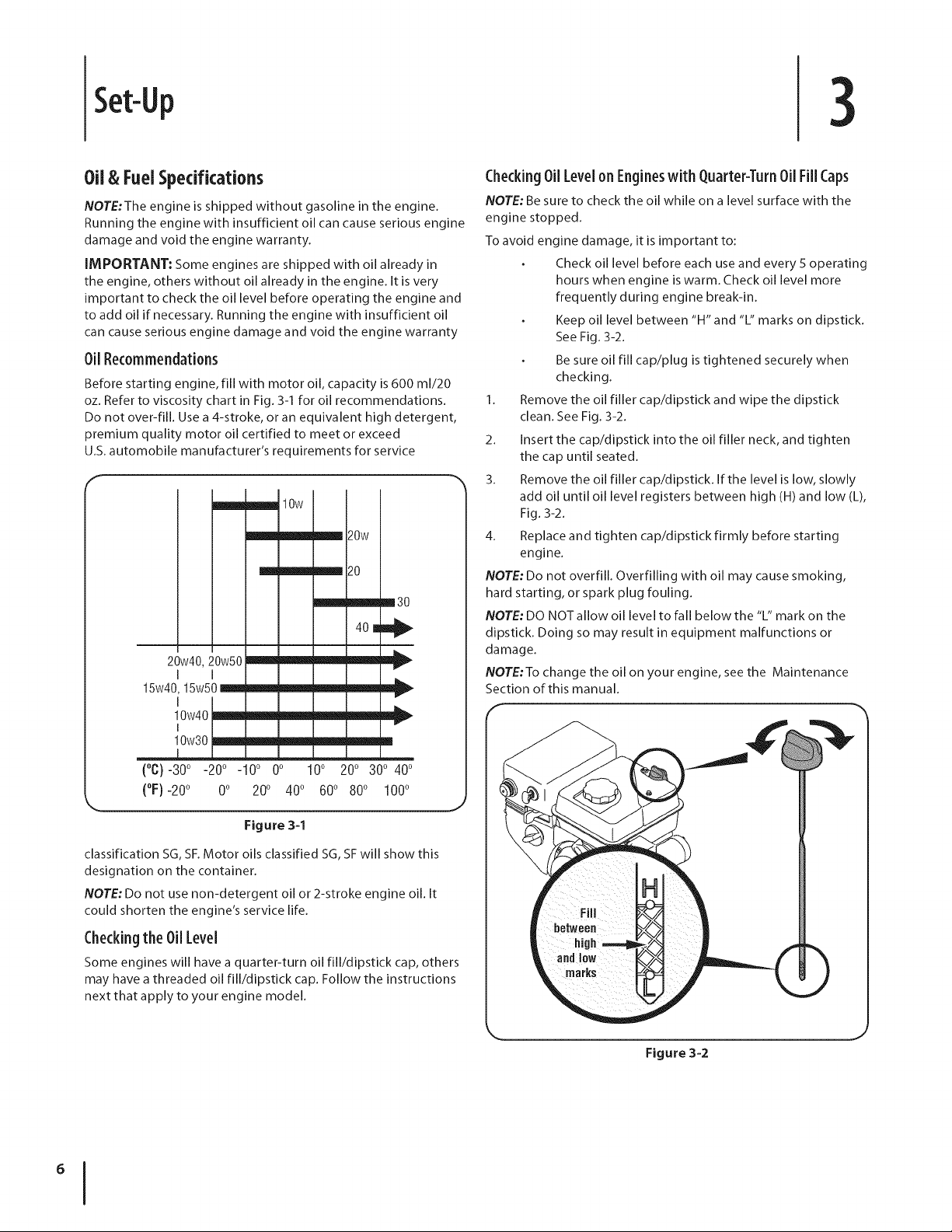
Before starting engine, fill with motor oil, capacity is 600 ml/20
oz. Refer to viscosity chart in Fig. 3-1 for oil recommendations.
Do not over-fill. Use a 4-stroke, or an equivalent high detergent,
premium quality motor oil certified to meet or exceed
U.S. automobile manufacturer's requirements for service
m
_30
40 m_
20w4020w50__i_m_lb
I I v
15w40, 10m'_ s_mH Imu _um _m'_ _
I _"
10w40 .....
I v
10w30 ___m
(°C)-30o -20o -10° 0° 10° 20° 30° 40°
(°F)-20o 0° 20° 40° 60° 80° 100°
Figure 3-1
classification SG, SF.Motor oils classified SG, SF will show this
designation on the container.
NOTE: Do not use non-detergent oil or 2-stroke engine oil. It
could shorten the engine's service life.
Checkingthe Oil Level
Some engines will have a quarter-turn oil fill/dipstick cap, others
may have a threaded oil fill/dipstick cap. Follow the instructions
next that apply to your engine model.
CheckingOil Levelon Engineswith Quarter-TurnOil FillCaps
NOTE: Be sure to check the oil while on a level surface with the
engine stopped.
To avoid engine damage, it is important to:
Check oil level before each use and every 5 operating
hours when engine is warm. Check oil level more
frequently during engine break-in.
Keep oil level between "H" and "L" marks on dipstick.
See Fig. 3-2.
Be sure oil fill cap/plug is tightened securely when
checking.
I. Remove the oil filler cap/dipstick and wipe the dipstick
clean. See Fig. 3-2.
2. Insert the cap/dipstick into the oil filler neck, and tighten
the cap until seated.
3. Remove the oil filler cap/dipstick. If the level is low, slowly
add oil until oil level registers between high (H) and low (L),
Fig. 3-2.
4. Replace and tighten cap/dipstick firmly before starting
engine.
NOTE: Do not overfill. Overfilling with oil may cause smoking,
hard starting, or spark plug fouling.
NOTE: DO NOT allow oil level to fall below the "L" mark on the
dipstick. Doing so may result in equipment malfunctions or
damage.
NOTE:To change the oil on your engine, see the Maintenance
Section of this manual.
f
Figure 3-2
CheckingOil Levelon Engineswith ThreadedOil Fill Caps
NOTE; Be sure to check the oil while on a level surface with the
engine stopped.
To avoid engine damage, it is important to:
Check oil level before each use and every S operating
hours when engine is warm. Check oil level more
frequently during engine break-in.
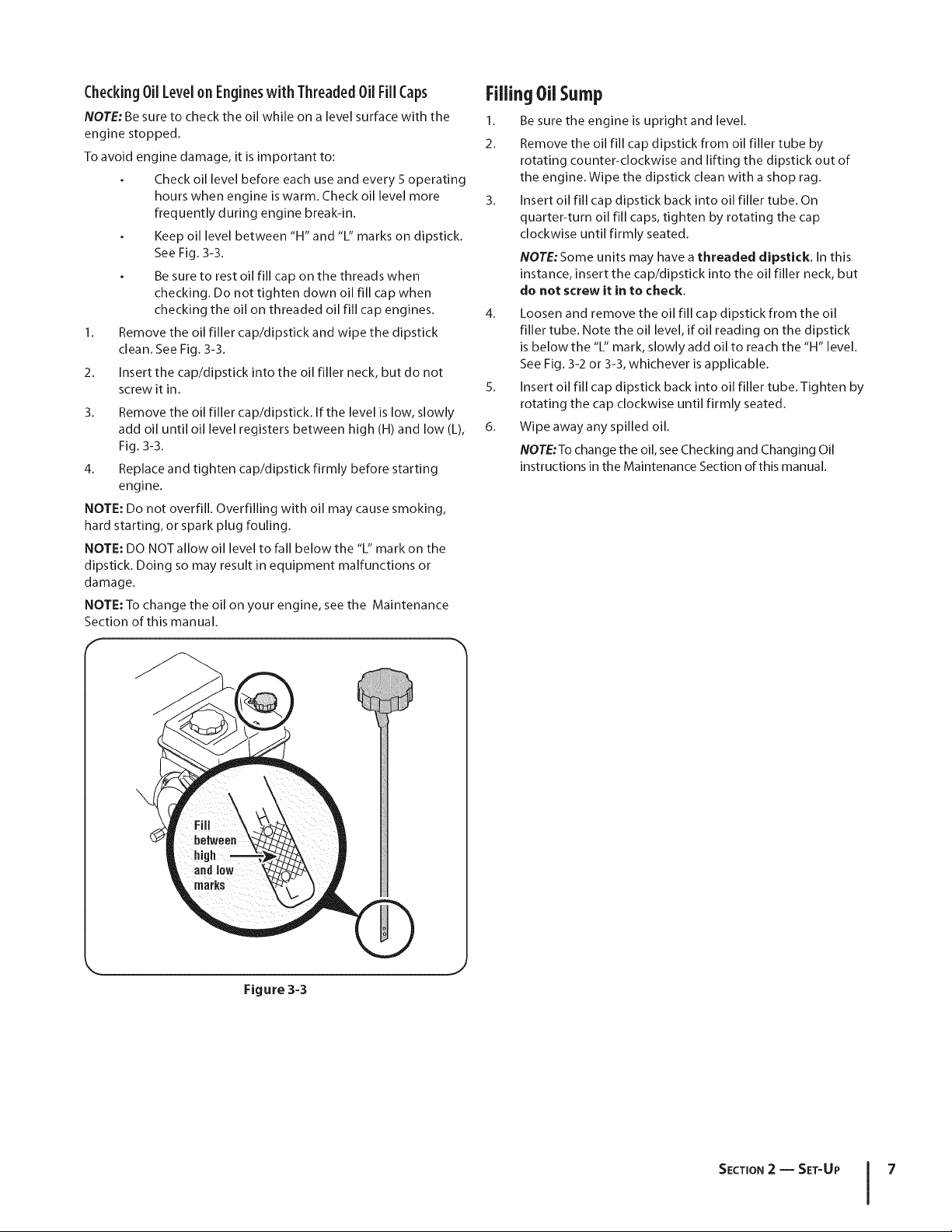
Keep oil level between "H" and "L" marks on dipstick.
See Fig. 3-3.
Be sure to rest oil fill cap on the threads when
checking. Do not tighten down oil fill cap when
checking the oil on threaded oil fill cap engines.
I. Remove the oil filler cap/dipstick and wipe the dipstick
clean. See Fig. 3-3.
2. Insert the cap/dipstick into the oil filler neck, but do not
screw it in.
3. Remove the oil filler cap/dipstick. If the level is low, slowly
add oil until oil level registers between high (H) and low (L),
Fig. 3-3.
4. Replace and tighten cap/dipstick firmly before starting
engine.
NOTE: Do not overfill. Overfilling with oil may cause smoking,
hard starting, or spark plug fouling.
NOTE: DO NOTallow oil level to fall below the "L" mark on the
dipstick. Doing so may result in equipment malfunctions or
damage.
NOTE: To change the oil on your engine, see the Maintenance
Section of this manual.
FillingOil Sump
I. Be sure the engine is upright and level.
2. Remove the oil fill cap dipstick from oil filler tube by
rotating counter-clockwise and lifting the dipstick out of
the engine. Wipe the dipstick clean with a shop rag.
3. Insert oil fill cap dipstick back into oil filler tube. On
quarter-turn oil fill caps, tighten by rotating the cap
clockwise until firmly seated.
NOTE:Some units may have a threaded dipstick. In this
instance, insert the cap/dipstick into the oil filler neck, but
do not screw it in to check.
4. Loosen and remove the oil fill cap dipstick from the oil
filler tube. Note the oil level, if oil reading on the dipstick
is below the "L" mark, slowly add oil to reach the "H" level.
See Fig. 3-2 or 3-3, whichever is applicable.
S. Insert oil fill cap dipstick back into oil filler tube. Tighten by
rotating the cap clockwise until firmly seated.
6. Wipe away any spilled oil.
/VOTE:To change the oil, see Checking and Changing Oil
instructions in the Maintenance Section of this manual.
Figure 3-3
SECTION2 -- SET-UP 7
Fuel Recommendations
CAUTION: Operating the engine with E85 fuel, an
oil/gasoline mixture, dirty gasoline, or gasoline over
30 days old that has not been stabilized using a fuel
additive, may result in damage to your engine's
carburetor. Subsequent damage would not be
covered under the manufacturer's warranty.
Use automotive gasoline (unleaded or low leaded to minimize
combustion chamber deposits) with a minimum of 87 octane.
Gasoline with up to 10% ethanol or 15% MTBE (Methyl Tertiary
Butyl Ether) can be used. Never use an oil/gasoline mixture or
dirty gasoline. Avoid getting dirt, dust, or water in the fuel tank.
DO NOT use E85 gasoline.
_ WARNING! Gasoline is extremely flammable and is
explosive under certain conditions.
Refuel in a well-ventilated area with the engine stopped.
Do not smoke or allow flames or sparks in the area where
the engine is refueled or where gasoline is stored.
Do not overfill the fuel tank. After refueling, make sure the
tank cap is closed properly and securely.
Be careful not to spill fuel when refueling. Spilled fuel or
fuel vapor may ignite. If any fuel is spilled, make sure the
area is dry before starting the engine.
Avoid repeated or prolonged contact with skin or
breathing of vapor.
Adding Fuel
WARNING!An adult should fuel this engine. NEVER
allow children to refuel this engine. Gasoline (fuel)
vapors are highly flammable and can explode. Fuel
vapors can spread and be ignited by a spark or flame
many feet away from engine. To prevent injury or
death from fuel fires, follow these instructions:
DO NOT use leaded fuel.
Fuel must be fresh and clean. NEVER use fuel left over
from last season or stored for long periods.
NEVER mix oil with fuel.
DO NOT usefuel containing Methanol (Wood
Alcohol)
7. Before refueling, allow the engine to cool for two minutes.
8. YBe sure engine is outdoors and in a well-ventilated area.
9. Clean area around the fuel fill cap and remove the fuel fill cap.
10. Using an approved red GASOLINE container, add fuel
slowly, being careful to avoid spilling.
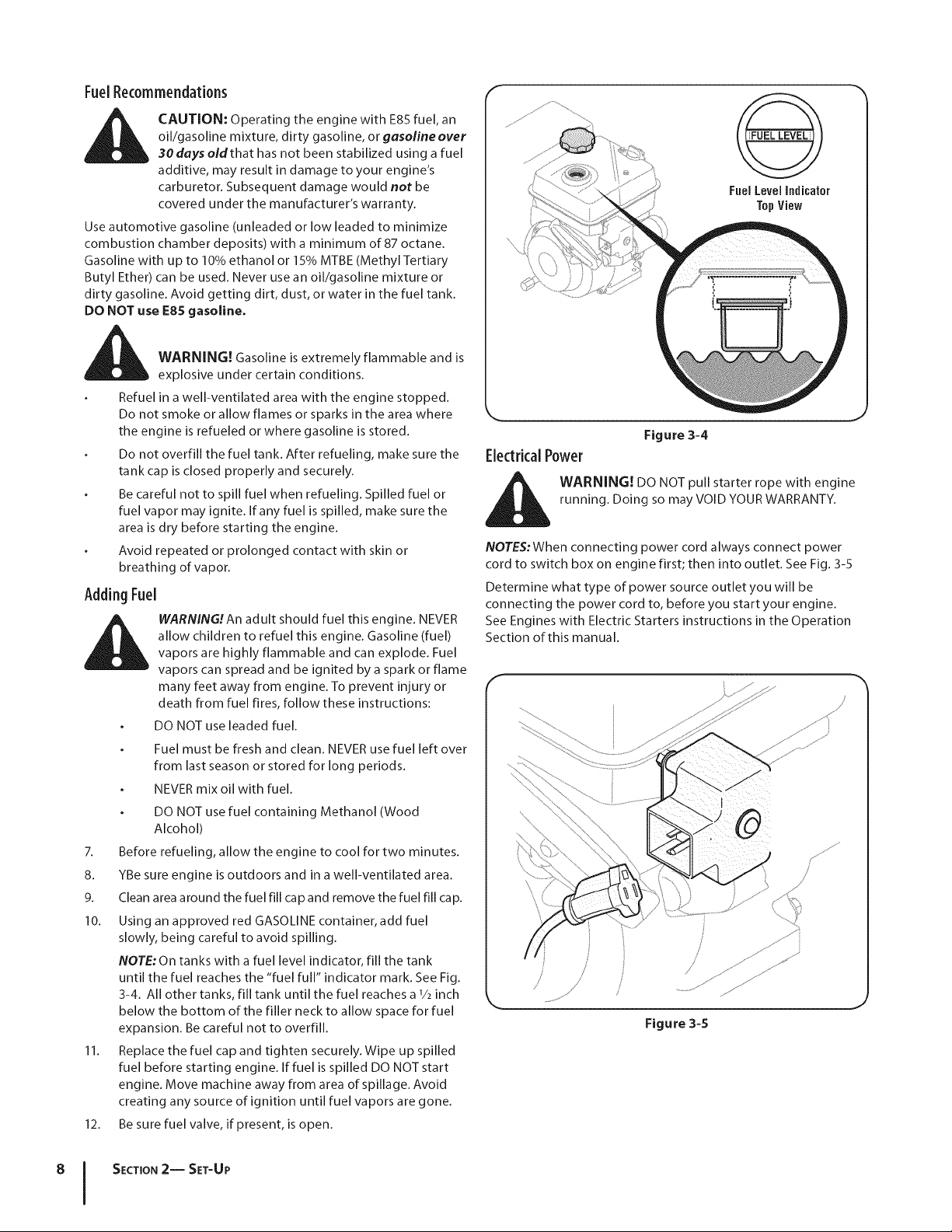
NOTE:On tanks with a fuel level indicator, fill the tank
until the fuel reaches the "fuel full" indicator mark. See Fig.
3-4. All other tanks, fill tank until the fuel reaches a 1/2inch
below the bottom of the filler neck to allow space for fuel
expansion. Be careful not to overfill.
11. Replace the fuel cap and tighten securely. Wipe up spilled
fuel before starting engine. If fuel is spilled DO NOT start
engine. Move machine away from area of spillage. Avoid
creating any source of ignition until fuel vapors are gone.
12. Be sure fuel valve, if present, is open.
¢
Fuel Level Indicator
TopView
Figure 3-4
Electrical Power
WARNING! DO NOT pull starter rope with engine
running. Doing so may VOID YOUR WARRANTY.
NOTES:When connecting power cord always connect power
cord to switch box on engine first; then into outlet. See Fig. 3-5
Determine what type of power source outlet you will be
connecting the power cord to, before you start your engine.
See Engines with Electric Starters instructions in the Operation
Section of this manual.
/
Figure 3-5
8 I SECTION 2-- SET-UP
Controlsand Features
4
Choke
Air Filter
Throttle
Primer....-----4_I
Key
Throttle
Choke
Fuel Shut-off
Valve
Choke_
Recoil Starter
Handle
Starter
Button
Electric Starter
Starter Button
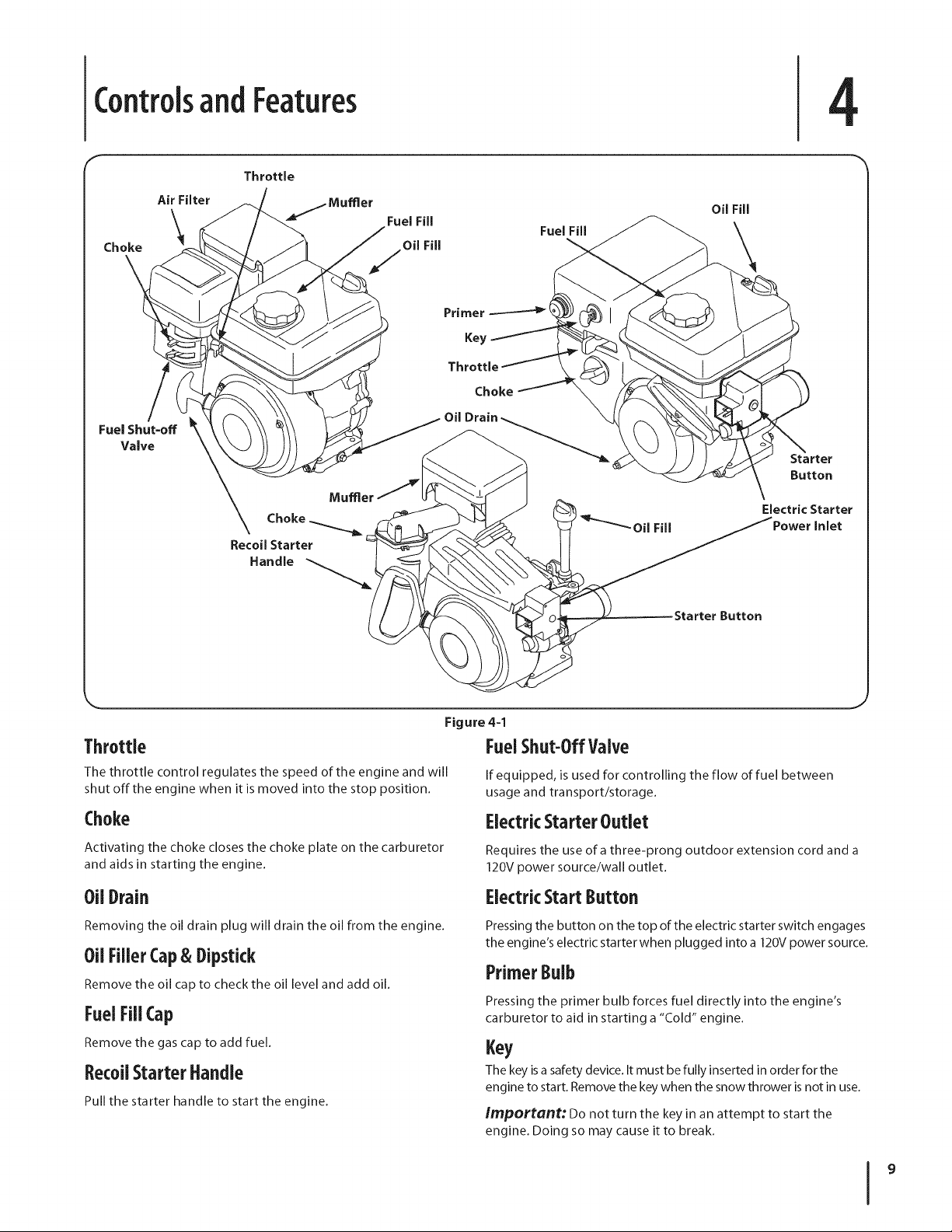
Figure 4-1
Throttle FuelShut-OffVaNe
The throttle control regulates the speed of the engine and will
shut off the engine when it is moved into the stop position.
Choke
Activating the choke closes the choke plate on the carburetor
and aids in starting the engine.
If equipped, is used for controlling the flow of fuel between
usage and transport/storage.
ElectricStarterOutlet
Requires the use of a three-prong outdoor extension cord and a
120V power source/wall outlet.
Oil Drain Electric StartButton
Removing the oil drain plug will drain the oil from the engine.
Oil FillerCap& Dipstick
Remove the oil cap to check the oil level and add oil.
FuelFillCap
Remove the gas cap to add fuel.
RecoilStarter Handle
Pull the starter handle to start the engine.
Pressing the button on the top of the electric starter switch engages
the engine's electric starter when plugged into a 120V power source.
PrimerBulb
Pressing the primer bulb forces fuel directly into the engine's
carburetor to aid in starting a "Cold" engine.
Key
The key is a safety device. It must be fully inserted in order for the
engine to start. Remove the key when the snow thrower is not in use.
important: Do not turn the key in an attempt to start the
engine. Doing so may cause itto break.

Operation
Pre-Operation Check
IMPORTANT: The engine is shipped without gasoline in the
engine. Seethe Set-Up Section of this manual for instructions on
adding gasoline.
IMPORTANT: Some engines are shipped with oil already in
the engine, others without oil already in the engine. It is very
important to check the oil before operating the engine and
to add if necessary. See the Set-Up Section of this manual for
instructions on checking and adding oil.
For your safety, and in order to maximize the service life of this
equipment, it is very important to check its condition before you
operate this engine. Make certain to service, correct or fix any
problem that might be identified before attempting to operate
this engine.
i_ WARNING! Improperly maintaining this engine, or
failure to correct any problem before operation can
cause a malfunction which could result in serious
injury or even death.
Always perform a pre-operation inspection before
each operation, and correct any problem.
Before you start the engine, always check the following items:
1. Fuel Recommendations (SeeSet UpSection)
2. Checking Oil Level (SeeSet Up Section)
3. Air filter (if equipped) (SeeMaintenance Section)
4. General Overall Inspection. Check for any fluid leaks or
discharges, and loose or damaged parts.
5. Check the owner's manual provided with the equipment
that is powered by this engine. Review the owner's manual
for any precautions and procedures that should be
followed before starting the engine.
Starting the Engine
WARNING! Always keep hands and feet clear of
moving parts. Do not use a pressurized starting
fluid. Vapors are flammable.
WARNING! An adult should start the engine. Only
allow children to start the engine if an adult has
determined they are experienced and capable of
such operation.
WARNING! If you are unable to start this engine
after following instructions in this manual, contact
you authorized MTD Service Dealer. To avoid serious
burn injuries or damage to your engine, DO NOT
attempt to start or troubleshoot this engine in any
other way. for example:
DO NOT use starting fluid.
DO NOT spray flammable vapors into the
carburetor.
DO NOT put flammable liquids into carburetor.
DO NOT operate engine or pull on starter rope
with spark plug removed. Fuel can spray from
spark plug hole and ignite.
NOTE: Allow the engine to warm up for a few minutes after
starting. The engine will not develop full power until it reaches
operating temperatures.
Familiarize yourself with the engine symbols shown in Fig. 5-1
before attempting to start this engine. If this engine is remotely
controlled by the equipment it is powering, be sure to familiarize
yourself with the equipment Operator's Manual as well.
Fast Slow/Idle Engine Off
I÷1 Ixl "--L)
Run Choke Primer
Figure 5-1
NOTE:The following starting instructions are for several different
types of engines. In order to locate the instructions that apply to
your engine, first determine what type of starter you have. If you
have an electric starter, see Engines With Electric Starters. If you
have a manual recoil starter, see Engines with Recoil Starters later
in this section.
EnginesWith ElectricStarters
Ifyou have a manual recoil starter, see Engines with Recoil
Starters later in this section.
a_
WARNING! DO NOT pull the starter handle while
the engine is running.
WARNING! Some electric starters are equipped
with a 120VA.C. Three-Wire Power Cord and Plug
designed to operated on a 120VA.C. household
current. It must be properly grounded at all times
to avoid the possibility of injury or death from
electrical shock.
Determine if your house wiring has a Ground Fault
Interrupted (G.F.I.) Three-Wire Grounded System; if
you are not sure, ask a Licensed Electrician.
b. IfyourhousewiringdoesnothaveaG.F.I.Three-
WireGroundedSystem,DONOTUSETHISELECTRIC
STARTERUNDERANYCONDITION.
IfyourhousewiringisgroundedandaG.F.I.
three-ProngWallReceptacleisnotavailableatthe
locationwhereyourstarterwillbeused,onemust
beinstalledbyaLicensedElectricianBEFOREUSING
THEELECTRICSTARTER!
1. Toavoidcarbonmonoxidepoisoning,besureengineis
outdoorsinawell-ventilatedarea.
2. Besurefuelvalve,ifpresent(seeequipmentOperator's
Manualinstructions)isopenandallswitchesareon.
NOTE:Ifyourengineisequippedwitha12Vbattery-
operatedelectricstarter,proceedStep5.
IMPORTANT:Whenconnectingthepowercord,always
connectthepowercordtotheswitchboxontheenginefirst;
thenintotheoutlet.
3. Connectthepowercordtotheswitchboxontheengine.
4. Plugendofthepowercordintotheoutlet.
5. Moveenginespeedcontrol,ifequipped,inthe"Fast"
position.
6. Setthechokecontrolto"FULLCHOKE"position.
7. Holdtheprimerbulbinforonefullsecondeachtimeyou
pressit.
Makesureyoucovertheventholewithyour
thumb.
Repeattwiceforatotalofthreeprimes.
IMPORTANT: DO NOT operate an electric starter for more than
5 seconds during each attempt.
NOTE: DO NOT use the primer bulb to restart a warm
engine after a short shutdown. Doing so will flood the
engine and may result in equipment malfunction.
NOTE: If restarting a warm engine after a short shutdown,
move the engine speed control (if equipped) the "FAST"
position and move the choke control to the "NO CHOKE"
position.
8. Push the starter button to start the engine.
NOTE: If the engine fails to start after 3 attempts, repeat
steps 1 through 8.
9. When the engine starts:
Release the starter button.
10.
Move the choke control to 1/2 "CHOKE" position
until the engine runs smoothly.
Next, move the choke control to the NO CHOKE
position.
Move the engine speed control (if equipped) to the desired
speed in the "RUN" range.
NOTE: If the engine starts but falters when the choke
control is moved to the "NO CHOKE" position:
Momentarily move choke control back to "FULL
CHOKE" position.
Next, move the choke control to "!/2 CHOKE"
position until engine runs smoothly.
Finally, move the choke control to the NO
CHOKE position.
If the engine dies after choke control is moved to "NO CHOKE"
position, repeat steps 5 through 10 to restart engine.
11. If the engine fails to start after 3 attempts in the "NO
CHOKE" position, move the choke control to "FULL CHOKE"
position and start engine.
NOTE:When disconnecting the power cord, always
disconnect the power cord from the outlet first; then
disconnect the power cord from the switch box on the
engine.
12. Disconnect the power cord form the outlet.
13. Disconnect the power cord form the switch box on the
engine.
14. If engine does not start after following steps 1 through
12, contact your Authorized MTD Service Dealer. DO NOT
attempt to troubleshoot this engine in any other way.
Engines with Recoil Starters
If you have an electric starter, see Engines with Electric Starters
earlier in this section.
WARNING° DO NOT pull starter rope with engine
running. Doing so may VOID YOUR WARRANTY.
2.
3.
4.
5.
6_
To avoid carbon monoxide poisoning, be sure engine is
outdoors in a well-ventilated area.
Be sure fuel valve, if present (see equipment Operator's
Manual instructions) is open and all switches are on.
Move the engine speed control, if equipped, to the "FAST"
position.
Set the choke control to "FULL CHOKE" position.
Hold the primer bulb in for one full second each time you
press it.
Make sure you cover the vent hole with your
thumb.
Repeat twice for a total of three primes.
NOTE: DO NOT use the primer bulb to restart a warm
engine after a short shutdown. Doing so will flood the
engine and may result in equipment malfunction.
NOTE: If restarting a warm engine after a short shutdown,
move the engine speed control (if equipped) the "FAST"
position and move the choke control to the "NO CHOKE"
position.
Operate equipment control to release engine brake or
clutch, if equipped (see equipment Operator's Manual).
SECTION S -- OPERATION 11
WARNING! When pulling the starter rope, the rope
can unexpectedly jerk back toward the engine
causing serious injury. To avoid this risk, carefully
follow these instructions:
Grasp the starter cord handle.
Pull rope out slowly until you feel drag.
Without allowing the rope to retract, continue
pulling the rope with one rapid full arm stroke.
Return the rope slowly to the original position.
NOTE: Following the instructions listed in the steps above
avoids potential damage to the recoil mechanism.
NOTE: If the recoil starter handle is frozen and will not
operate the engine, proceed as follows:
Pull as much rope out of the starter as possible.
Releasethe starer handle and let it snap back
against the starter to break up ice'; these two
steps should only be done when the starter is
frozen.
8. If the engine fails to start after 3 attempts repeat steps 1
through 7 and try again.
9. When the engine starts:
Move the choke control to 1/2 "CHOKE" position
until the engine runs smoothly.
Next, move the choke control to the NO CHOKE
position.
10. Move the engine speed control (if equipped) to the desired
speed in the "RUN" range.
NOTE: If the engine starts but falters when the choke
control is moved to the "NO CHOKE"position:
Momentarily move choke control back to "FULL
CHOKE"position.
Next, move the choke control to "!/2 CHOKE"
position until engine runs smoothly.
Finally, move the choke control to the NO
CHOKEposition.
If the engine dies after choke control is moved to "NO CHOKE"
position, repeat steps 3 through 10 to restart engine.
11. If the engine fails to start after 3 attempts in the "NO
CHOKE"position, move the choke control to "FULL CHOKE"
position and start engine.
12. If engine does not start after following steps 1 through
11,contact your Authorized MTD Service Dealer. DO NOT
attempt to troubleshoot this engine in any other way.
Stopping the Engine& ShortTermStorage
Stop engine
Manual.
A
equipped.
in accordance with the equipment Operator's
WARNING! To avoid unsupervised engine
operation, especially by children, NEVER leave the
engine unattended while running. Always turn off
the engine after use and remove the ignition key, if
WARNING! NEVERstore the engine with fuel in the
fuel tank inside a building with potential sources of
ignition such as hot water tank and space heaters,
clothes drivers, electric motors, etc.
Stopping TheEngine
1. If operating the engine in the snow or rain, run the engine
for a few minutes to help dry off any moisture.
2. Move the equipment control, if present (see Equipment
Owner's Manual), engine control lever or ignition switch to
"STOP" or "OFF" position.
3. Remove ignition key, if provided (see equipment Operator's
Manual).
NOTE: Removing the key will reduce the possibility of
unauthorized starting of the engine while equipment is not
in use.
WARNING! NEVERstore the engine with fuel in the
fuel tank inside a building with potential sources of
ignition such as hot water tank and space heaters,
clothes dryers, electric motors, etc.
After the
1.
EngineisStopped
WARNING! To prevent the possible freeze-up of
engine controls, follow instructions with engine
STOPPED, listed below:
Wipe all snow and moisture from the engine control lever
and choke areas.
2. Move the equipment control, if present, (see equipment
Operator's Manual), engine control lever or ignition switch
back and forth several times and leave the control in the
"STOP" or "OFF" position.
3. Move the engine choke back and forth several times and
leave in the "FULL CHOKE" position.
4. Be sure the Fuel Shut-Off Valve,, if present, is off.
12 J SECTION 5-- OPERATION

Maintenance
6
MaintenanceSchedule
Each Useor
Every S Hrs.
,/
EverySeason
or 25 Hours
Every Season
or SOHours
Every Season
or 100 Hours
First S Hours Service Dates
Check EngineOil Level
Change EngineOil _/ _/
Check Air Cleaner (If soequipped) V /
Service Air Cleaner (If so equipped) V /
Check Spark Plug V /
Replace Spark Plug V /
Clean Engine Shroud (If so equipped) V '/
Clean around muffler V /
Replace Fuel Filter (If equipped)
Periodic inspection and adjustment of the engine is essential if
high level performance is to be maintained. Regular maintenance
will also ensure a long service life. The required service intervals
and the kind of maintenance to be performed are described
in the table above. Follow the hourly or calendar intervals,
whichever occur first. More frequent service is required when 1.
operating in adverse conditions.
i_ WARNING! Shut off the engine before performing
any maintenance. To prevent accidental start-up,
disconnect the spark plug boot.
NOTE: If engine must be tipped to transport equipment or to
inspect or remove grass, keep spark plug side of engine up.
Transporting or tipping engine spark plug down may cause 2.
smoking, hard starting, spark plug fouling, or oil saturation of air
cleaner. 3.
_1 WARNING! If the engine has been running, themuffler will be very hot. Be careful not to touch the 4.
__ muffler.
5.
Checkingand Changingthe Oil
To avoid engine damage, it is important to:
Check oil level before each use and every 5 operating hours
when the engine is warm.
Change the oil after the first 5 operating hours and every
50 operating hours thereafter. Engine should still be warm
but NOT hot from recent use.
Oil Fill Capand Dipstick
WARNING! Before tipping engine or equipment to
drain oil, drain fuel from tank by running engine
until fuel tank is empty.
Carefully disconnect the spark plug wire and keep it away
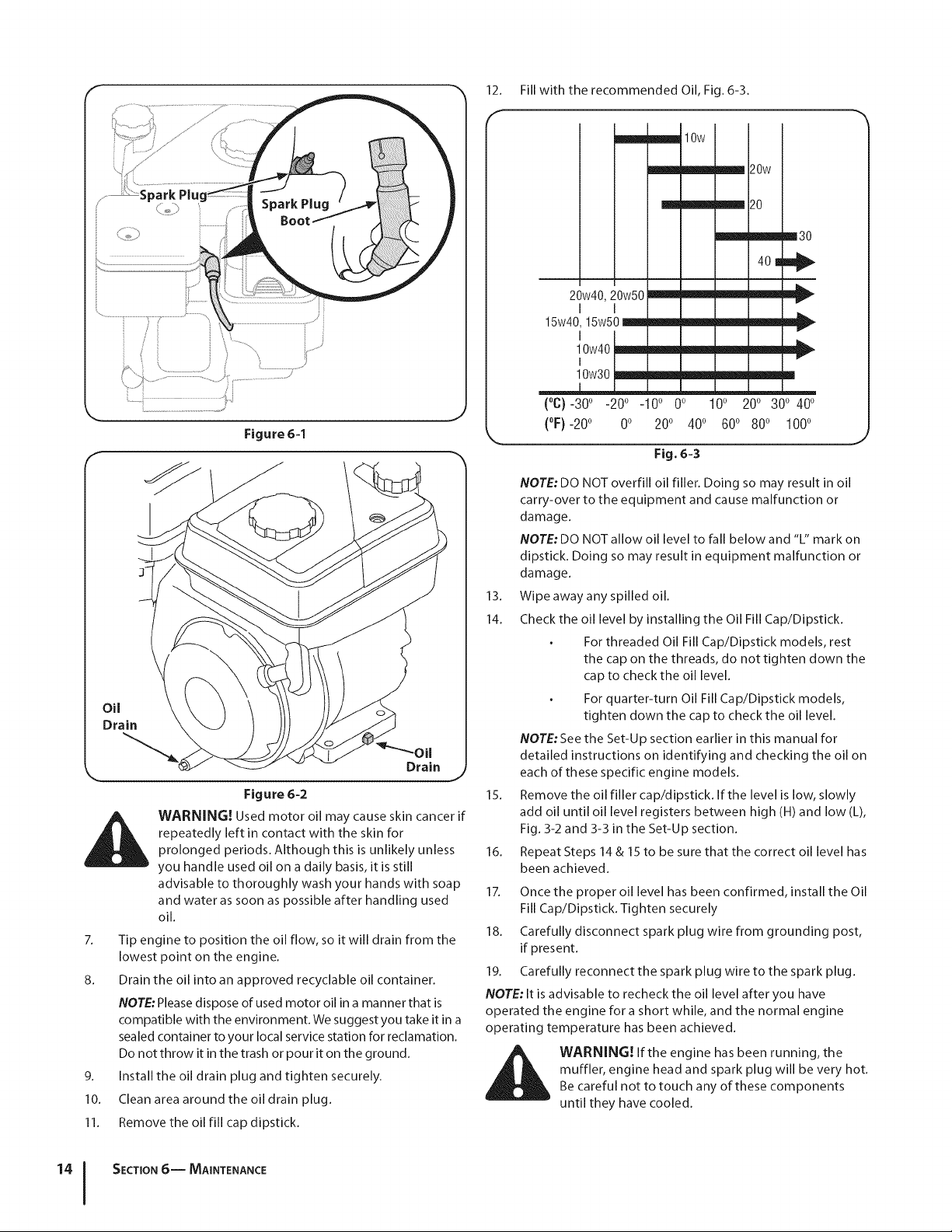
from the spark plug. Refer to Fig. 6-1 for spark plug location.
Keep the disconnected spark plug wire securely
away from the metal parts where arcing could
occur.
Carefully attach the spark plug wire to the
grounding post, if provided.
Be sure that the fuel fill cap is on and securely tightened.
Be sure to find correct oil drain plug location, if present
(see the equipment Operator's Manual instructions for
additional information).
6.
Clean area around the oil drain plug.
Place an approved recyclable oil container under the oil
drain plug.
Remove the Oil drain plug. See Fig. 6-2.
NOTE: Depending on which engine model you have, the oil
plug may be positioned differently. These positions include
on the front and/or rear side of the block, or as a n extended
tube. Examples are shown in Fig. 6-2.
13
i ii i_,i
k.
Figure 6-1
,J
12. Fill with the recommended Oil, Fig. 6-3.
(
7. Tip engine to position the oil flow, so it will drain from the
lowest point on the engine.
8. Drain the oil into an approved recyclable oil container.
NOTE: Please dispose of used motor oil in a ma nner that is
compatible with the environment. We suggest you take it in a
sealed container to your local service station for reclamation.
Do not throw it in the trash or pour it on the ground.
9. Install the oil drain plug and tighten securely.
10. Clean area around the oil drain plug.
11. Remove the oil fill cap dipstick.
Figure 6-2
WARNING! Used motor oil may cause skin cancer if
repeatedly left in contact with the skin for
prolonged periods. Although this is unlikely unless 16.
you handle used oil on a daily basis, it is still
advisable to thoroughly wash your hands with soap 17.
and water as soon as possible after handling used
oil.
18.
I
_30
40 mm_.
20w40,_Ow50 ____
15w40, 0_ _ _ _ m_lbl,,.
I
lOw40___lmJbb
I
10w30____
(°C)-30° -20° -10° 0° 10° 200 300 400
(°F)-20° 0° 200 400 600 800 100°
Fig. 6-3
NOTE: DO NOT overfill oil filler. Doing so may result in oil
carry-over to the equipment and cause malfunction or
damage.
NOTE: DO NOT allow oil level to fall below and "L" mark on
dipstick. Doing so may result in equipment malfunction or
damage.
13. Wipe away any spilled oil.
14. Check the oil level by installing the Oil Fill Cap/Dipstick.
For threaded Oil Fill Cap/Dipstick models, rest
the cap on the threads, do not tighten down the
cap to check the oil level.
For quarter-turn Oil Fill Cap/Dipstick models,
tighten down the cap to check the oil level.
NOTE:See the Set-Up section earlier in this manual for
detailed instructions on identifying and checking the oil on
each of these specific engine models.
15. Remove the oil filler cap/dipstick. If the level is low, slowly
add oil until oil level registers between high (H) and low (L),
Fig. 3-2 and 3-3 in the Set-Up section.
Repeat Steps 14 & 15 to be sure that the correct oil level has
been achieved.
Once the proper oil level has been confirmed, install the Oil
Fill Cap/Dipstick. Tighten securely
Carefully disconnect spark plug wire from grounding post,
if present.
19. Carefully reconnect the spark plug wire to the spark plug.
NOTE: It is advisable to recheck the oil level after you have
operated the engine for a short while, and the normal engine
operating temperature has been achieved.
_ ARNING! If the engine has been running, the
muffler, engine head and spark plug will be very hot.
Be careful not to touch any of these components
until they have cooled.
SECTION 6-- MAINTENANCE
SparkPlugService
_ WARNING! DO NOT check for spark with spark
plug removed. DO NOT crank engine with spark
plug removed.
Check the spark plug yearly or every 100 operating hours. To
ensure proper engine operation, the spark plug must be properly
gapped and free of deposits.
1. Remove the spark plug boot.
2. Clean the area around the spark plug.
3. Use a spark plug wrench to remove the plug.
i_i WARNING! If the engine has been running, the
muffler, engine head and spark plug will be very hot.
Be careful not to touch any of these components
until they have cooled.
4. Visually inspect the spark plug. Discard the spark plug
if there is apparent wear, or if the insulator is cracked or
chipped. Replace the plug if the electrodes are pitted,
burned or fouled with deposits.
5. Clean the spark plug with a wire brush if it is to be reused.
6. Measure the plug gap with a feeler gauge. Correct as
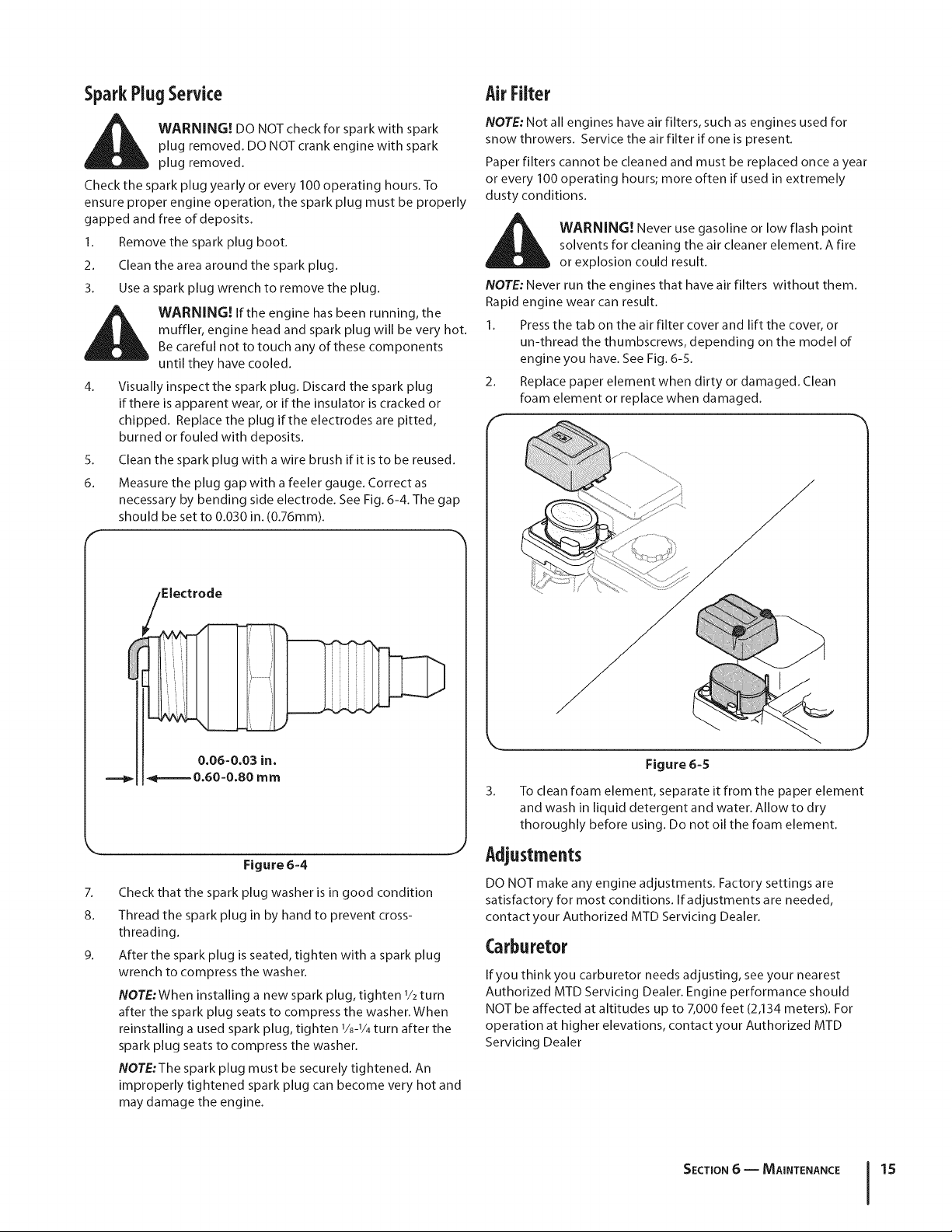
necessary by bending side electrode. See Fig. 6-4. The gap
should be set to 0.030 in. (0.76mm).
AirFilter
NOTE: Not all engines have air filters, such as engines used for
snow throwers. Service the air filter if one is present.
Paper filters cannot be cleaned and must be replaced once a year
or every 100 operating hours; more often if used in extremely
dusty conditions.
__i WARNING! Never use gasoline or low flash point
solvents for cleaning the air cleaner element. A fire
or explosion could result.
NOTE: Never run the engines that have air filters without them.
Rapid engine wear can result.
1. Press the tab on the air filter cover and lift the cover, or
un-thread the thumbscrews, depending on the model of
engine you have. See Fig. 6-5.
2. Replace paper element when dirty or damaged. Clean
foam element or replace when damaged.
7.
8.
9.
Electrode
0.06=0.03 in.
_t-======0.60=0.80 mm
Figure 6=4
Check that the spark plug washer is in good condition
Thread the spark plug in by hand to prevent cross-
threading.
After the spark plug is seated, tighten with a spark plug
wrench to compress the washer.
NOTE:When installing a new spark plug, tighten 1/2turn
after the spark plug seats to compress the washer. When
reinstalling a used spark plug, tighten 1/8-1/4turn after the
spark plug seatsto compress the washer.
NOTE:The spark plug must be securely tightened. An
improperly tightened spark plug can become very hot and
may damage the engine.
3.
Figure 6-5
To clean foam element, separate it from the paper element
and wash in liquid detergent and water. Allow to dry
thoroughly before using. Do not oil the foam element.
Adjustments
DO NOT make any engine adjustments. Factory settings are
satisfactory for most conditions. If adjustments are needed,
contact your Authorized MTD Servicing Dealer.
Carburetor
If you think you carburetor needs adjusting, see your nearest
Authorized MTD Servicing Dealer. Engine performance should
NOT be affected at altitudes up to 7,000 feet (2,134 meters). For
operation at higher elevations, contact your Authorized MTD
Servicing Dealer
SECTION 6 -- MAINTENANCE 15
AJternator equJpped)
Contact your Authorized MTD Servicing Dealer for alternator
related electrical problems such as:
inoperative Starter
Discharged Battery
Fuse Replacement
Alternator Maintenance/Repairs
EngineSpeed
i_l_lk WARNING! To avoid serious injury or death, DO
NOT modify engine in any way. Tampering with the
governor setting can lead to a runaway engine and
cause it to operate at unsafe speeds. NEVER tamper
with the factory setting of the engine governor.
WARNING! Running the engine faster than the
speed set at the factory can be dangerous and will
VOID THE ENGINE WARRANTY.
Removing Snowfrom the Engine
After each use, remove snow from the following areas:
Oil Fill Cap Dipstick
Fuel Fill Cap
Recoil Starter/Flywheel Screen
Linkage
Guards
Spark Plug Connection (if visible).
Electric Starter Switch Box, if present (see the
equipment Operator's Manual instructions).
NOTE:See the equipment Operator's Manual instructions
for proper location of fuel fill cap and control lever.
1. Removing snow will ease operation ofthe recoil starter
rope and reduce the risk of water contamination when
opening the fuel fill cap.
NOTE: For more information about recoil starters, see
Engine's with Recoil Starters in the Operation Section of
this manual.
TransportingYourEngine
WARNING! NEVERtransport this engine inside of
another vehicle or in any enclosed space if there is
any gasoline in the tank. Fuel vapor or spilled fuel
may ignite.
WARNING ! If there is fuel in the fuel tank, close the
fuel valve, if equipped, and transport the engine
upright in an open vehicle, such as an open trailer or
open bed of a pickup truck.
If you DO NOT have an open vehicle and have to transport
the engine upright in a closed vehicle, follow these steps for
emptying the fuel tank before transporting:
1. Empty fuel tank by using a commercially available suction
device designed for use with gasoline.
_ ARNING! DO NOT pour fuel from the engine or
siphon fuel by mouth.
2.
Drain fuel into an approved red gasoline container, being
careful to avoid spilling.
3. Run the engine until remaining fuel is consumed.
WARNING! NEVER leave the engine unattended
when it is running and NEVER run the engine in an
enclosed area.
StoringYourEngine
Short-Term/SeasonalStorage
CleanEngine
If the engine has been running, allow itto cool forat least half an
hour before cleaning.
Before servicing the engine, remove the carburetor cover and/or
blower housing. Discard the dirt and debris from the following
areas:
Cooling Fins
Air Intake Screen or Recoil Starter/Flywheel
Guard Areas
Spark Plug Connection
Levers
Linkage Area
Guards
Carburetor
Head
Removing debris will insure adequate cooling, correct engine
speed and reduce the risk of fire.
NOTE: Do not spray engine with water to clean because water
could contaminate fuel. Using a garden hose or pressure washing
equipment can also force water into the air cleaner or muffler
opening. Water in the air cleaner will soak the paper element,
and water that passes through the element or muffler can enter
the cylinder, causing damage.
_illb ARNING! Accumulation of debris around muffler
could cause a fire. Inspect and clean before every
use.
Fuel Storage
_ ARNING! NEVERstore engine with fuel in the
fuel tank inside a building with potential sources of
ignition such as hot water heater, space heater,
clothes dryer, electric motor, etc. Failure to do so
may result in an explosion and result in death or
serious injury.
NOTE: If engine fuel stored in the gas tank and/or an approved
gas container is to be unused without gasoline stabilizer for more
than 15-30 days, prepare it for short-term/seasonal storage. See
Fuel Treatment later in this section.
SECTION 6-- _V_AINTENANCE
NOTE: If engine fuel is to be stored for more than one season,
without gasoline stabilizer, it will gradually deteriorate. Also, if
it is stored in the engine's gas tank without gasoline stabilizer it
is likely that your carburetor will have gum deposits, a clogged
fuel system and will VOID YOURWARRANTY.Prepare the fuel for
extended storage.
Fuel System
To avoid stale fuel and carburetor problems, treat the fuel system
in the following manner:
NOTE:Always follow mix ratio found on the stabilizer container.
Failure to do so may result in equipment damage.
NOTE: It is NOT necessary to drain stabilized gas from carburetor.
FuelTreatment
1. Add fuel stabilizer according to Manufacturer's
instructions.
2. Run engine at least 10 minutes after adding the stabilizer to
allow it to reach the carburetor.
WARNING! NEVERstore the engine with the fuel in
the fuel tank inside a building with potential sources
of ignition such as a hot water heater, space heater,
clothes dryer, electric motor, etc.
NOTE: Instead of using a fuel preservative/stabilizer, you can
empty the fuel tank as described next in Extended Storage -
Draining the Fuel.
Extended Storage
Drainingthe Fuel
NOTE: Clean debris from the engine before draining fuel from
the carburetor.
NOTE: If you have prepared your fuel for short-term storage it
is NOT necessary to drain fuel that contains stabilizer from your
carburetor.
L& WARNING! To avoid severe injury or death, DO
NOT pour fuel from engine or siphon fuel by mouth.
1. To prevent serious injury from fuel fires, empty fuel tank
by running engine until it stops from lack of fuel. DO NOT
attempt to pour fuel from engine.
2. Run the engine while waiting until the remaining fuel is
consumed.
i_ WARNING! NEVERleave the engine unattended
when it is running and NEVERrun the engine in an
enclosed area.
3. Begin servicing the cylinder bore as per the following
instructions.
Oil Cylinder Bore
_hlL ARNING! When lubricating cylinder bore, fuel
may spray from the spark plug hole. To prevent
serious injury from fuel fires, follow these
instructions:
2_
3.
Carefully disconnect the spark plug wire and keep it away
from the spark plug.
Keep the disconnected spark plug wire securely
away from the metal parts where arcing could
occur.
Carefully attach the spark plug wire to the
grounding post, if provided.
Disconnect the battery at the negative terminal first, if the
engine is equipped with a D.C. electric starter.
Turn off all the engine switches.
Remove the ignition key, if provided.
Remove the spark plug.
Squirt 1oz. (30ml) of clean engine oil into the spark plug
hole.
4. Cover the spark plug hole with a rag to prevent fuel from
spraying from the spark plug hole when the starter rope is
pulled.
NOTE:for engines equipped with a recoil starter, proceed
to Step S.For engines equipped with electric starters,
proceed to Step 6.
S. Grasp the starter cord handle:
Pull the starter cord handle out slowly using a
full arm stroke.
Repeat once. This will distribute the oil
throughout the cylinder to prevent corrosion
during storage.
Proceed to Step 7.
6. Push starter button or turn ignition switch key to "START":
position. Immediately releases the starter button or turn
the ignition switch key to the "OFF" position. This will
distribute the oil throughout the cylinder to prevent
corrosion during storage.
7. Remove the rag from the spark plug hole.
8. Install the spark plug.
9. Carefully disconnect the spark plug wire from the
grounding post, if provided.
10. Connect the spark plug wire plug wire to the spark plug.
Oil
Change the oil if NOT changed within the last 3 months. See
Checking and Changing the Oil earlier in this section.
SECTION 6 -- MAINTENANCE 17
Off-SeasonStorage
CAUTION" Failure to use a fuel stabilizing additive
or completely run the engine until it's out of fuel
before off-season storage may result in damage to
your engine's carburetor. Subsequent damage
would not be covered under the manufacturer's
warranty.
Engines stored between 30 and 90 days need to be treated with
a gasoline stabilizer and engines stored over 90 days need to be
drained of fuel to prevent deterioration and gum from forming
in fuel system or on essential carburetor parts. If the gasoline in
your engine deteriorates during storage, you may need to have
the carburetor, and other fuel system components, serviced or
replaced.
1. Remove all fuel from tank by running engine until it stops
from lack of fuel.
WARNING! Never leave engine unattended while it
is running.
2. Change the oil. See Changing the Oil earlier in this section.
3. Remove the spark plug and pour approximately a 1/2-ounce
of engine oil into the cylinder. Replace spark plug and
crank it slowly to distribute oil.
4. Clean debris from around the engine and the muffler.
Touch up any damaged paint, and coat other areas that
may rust with a light film of oil.
5. Store in a clean, dry and well ventilated area away from any
appliance that operates with a flame or pilot light, such
as a furnace, water heater, or clothes dryer. Also avoid any
area with a spark producing electric motor, or where power
tools are operated.
6. If possible, also avoid storage areas with high humidity,
because that promotes rust and corrosion.
7. Keep the engine level in storage. Tilting can cause fuel or
oil leakage.
SECTION 6-- MAINTENANCE
Troubleshooting
7
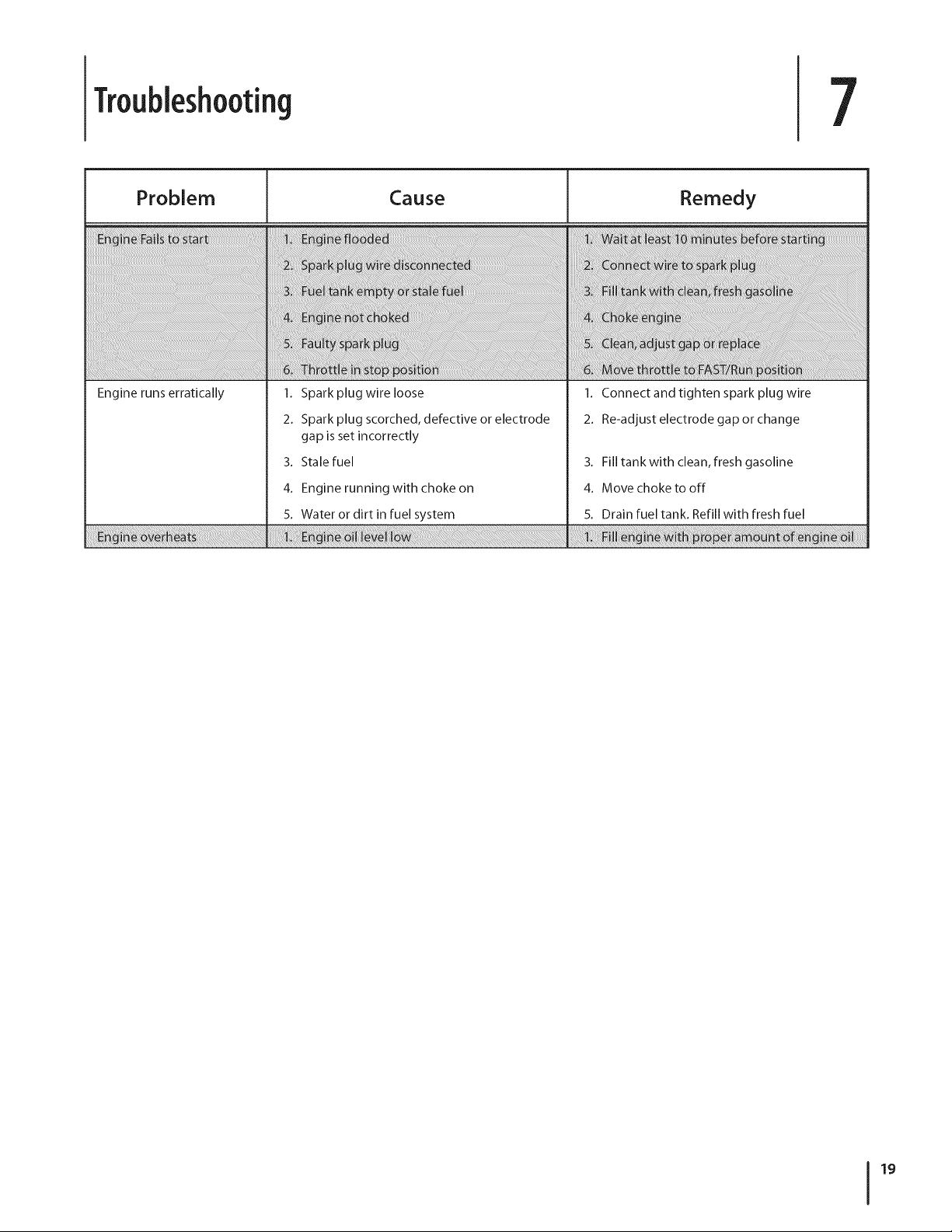
Problem Cause
Remedy
Engine runs erratically 1. Spark plug wire loose
2. Spark plug scorched, defective or electrode
gap is set incorrectly
3. Stale fuel
4. Engine running with choke on
5. Water or dirt in fuel system
1. Connect and tighten spark plug wire
2. Re-adjust electrode gap or change
3. Fill tank with clean, fresh gasoline
4. Move choke to off
5. Drain fuel tank. Refill with fresh fuel
19
ReplacementParts
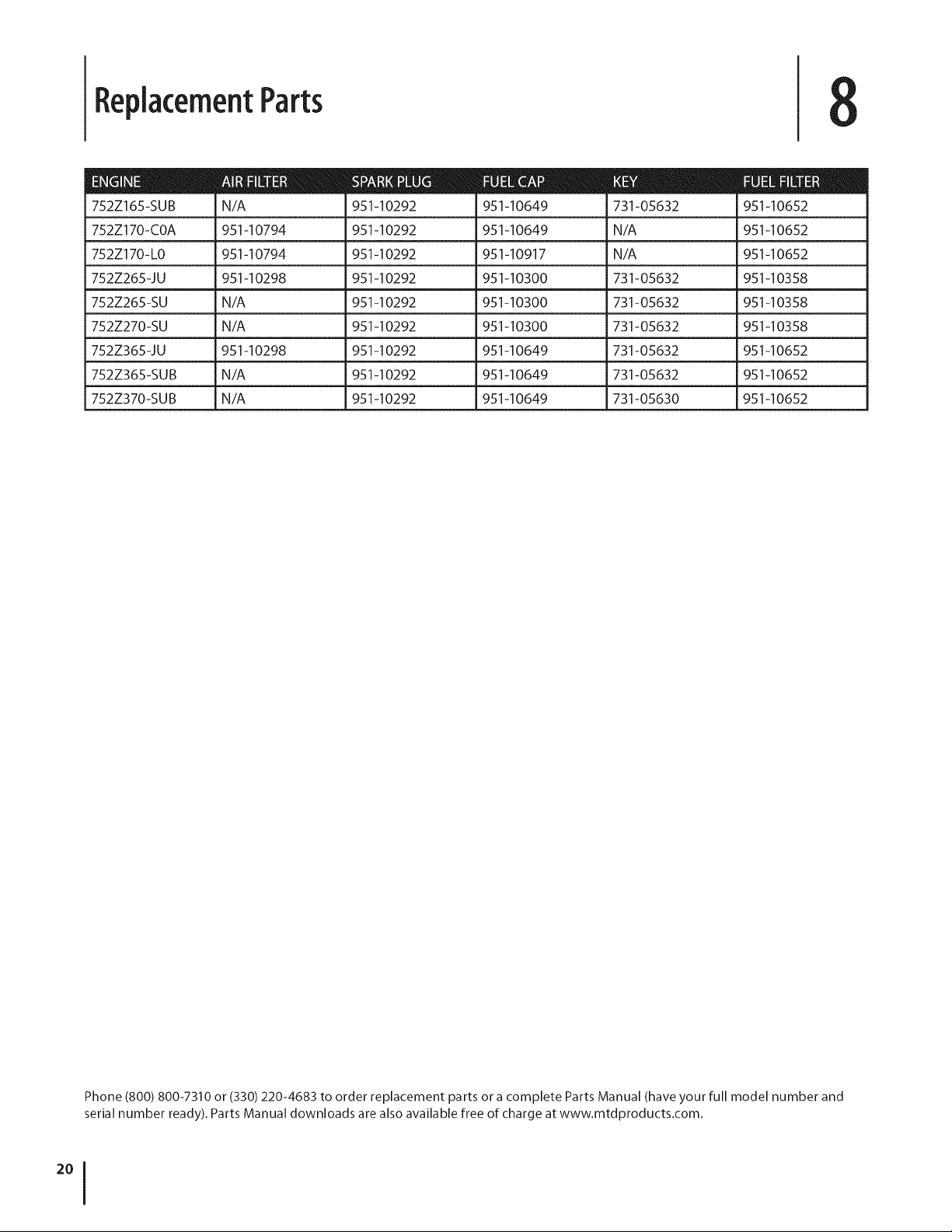
752Z165-SUB
752Z170-COA
752Z170-L0
752Z265-JU
752Z265-SU
752Z270-SU
752Z365-JU
752Z365-SUB
752Z370-SUB
N/A
951-10794
951-10794
951-10298
N/A
N/A
951-10298
N/A
N/A
951-10292
951-10292
951-10292
951-10292
951-10292
951-10292
951-10292
951-10292
951-10292
951-10649
951-10649
951-10917
951-10300
951-10300
951-10300
951-10649
951-10649
951-10649
731-05632
N/A
N/A
731-05632
731-05632
731-05632
731-05632
731-05632
731-05630
951-10652
951-10652
951-10652
951-10358
951-10358
951-10358
951-10652
951-10652
951-10652
Phone (800) 800-7310 or (330) 220-4683 to order replacement parts or a complete Parts Manual (have your full model number and
serial number ready). Parts Manual downloads are also available free of charge at www.mtdproducts.com.
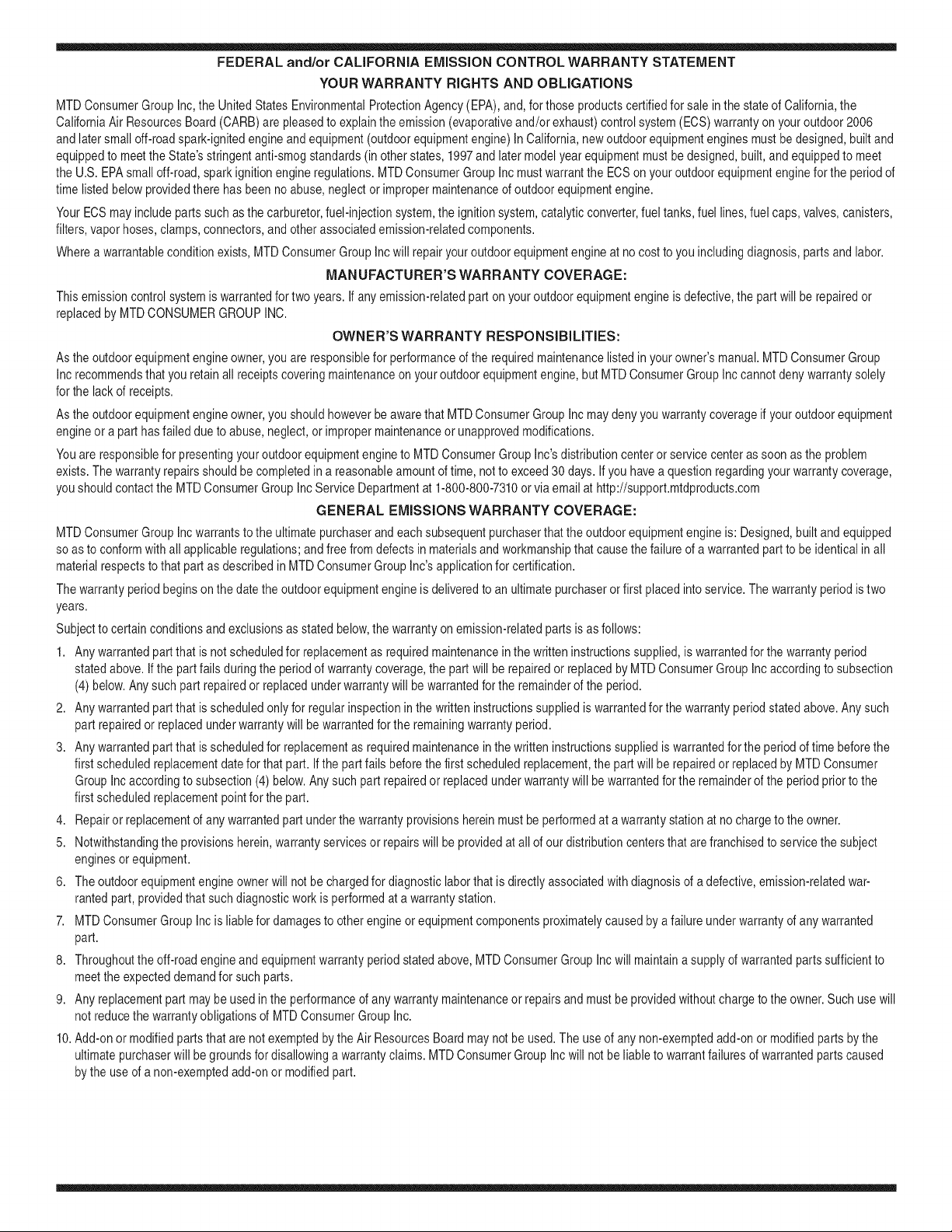
FEDERAL and/or CALIFORNIA EMISSION CONTROL WARRANTY STATEMENT
YOUR WARRANTY RIGHTS AND OBLIGATIONS
MTDConsumerGroupInc,the UnitedStatesEnvironmentalProtectionAgency (EPA),and, forthose productscertifiedfor sale in the stateof California,the
CaliforniaAir ResourcesBoard(CARB)are pleasedto explainthe emission(evaporativeand/or exhaust)controlsystem(ECS) warrantyonyouroutdoor 2006
andlater smalloff-roadspark-ignitedengineandequipment(outdoorequipmentengine)In California,new outdoorequipmentengines mustbe designed,built and
equippedto meetthe State'sstringentanti-smogstandards(inother states, 1997andlater modelyear equipmentmustbe designed,built, and equippedto meet
theU.S. EPAsmalloff-road, sparkignitionengine regulations.MTDConsumerGroupInc mustwarrantthe ECSon your outdoorequipmentenginefor the periodof
timelisted belowprovidedtherehas been no abuse, neglector impropermaintenanceof outdoorequipmentengine.
Your ECSmay includeparts suchas thecarburetor,fuel-injectionsystem,the ignitionsystem,catalyticconverter,fuel tanks,fuel lines,fuelcaps, valves,canisters,
filters,vapor hoses,clamps,connectors,andotherassociatedemission-relatedcomponents.
Wherea warrantableconditionexists, MTDConsumerGroupIncwill repairyouroutdoorequipmentengineat no cost to youincludingdiagnosis,parts and labor.
MAN UFACTURER'S WARRANTY COVERAGE:
Thisemissioncontrolsystemis warrantedfor two years. If any emission-relatedpart on your outdoorequipmentengine is defective,the partwill be repairedor
replacedby MTDCONSUMERGROUPINC.
OWNER'S WARRANTY RESPONSIBILITIES:
Asthe outdoorequipmentengineowner,you are responsiblefor performanceof the requiredmaintenancelisted inyour owner'smanual.MTDConsumerGroup
Inc recommendsthat you retain all receiptscovering maintenanceon youroutdoorequipmentengine,butMTDConsumerGroupInc cannotdeny warrantysolely
forthe lackof receipts.
Asthe outdoorequipmentengineowner,you shouldhoweverbe awarethat MTDConsumerGroupInc maydenyyou warrantycoverageif your outdoorequipment
engineor a part hasfailed due to abuse, neglect,or impropermaintenanceor unapprovedmodifications.
Youare responsiblefor presentingyouroutdoorequipmentengineto MTDConsumerGroupInc's distributioncenterorservicecenteras soon asthe problem
exists.The warrantyrepairsshouldbe completedin a reasonableamountof time, notto exceed30 days. If you havea questionregardingyour warrantycoverage,
you shouldcontactthe MTDConsumerGroupIncService Departmentat 1-800-800-7310or via emailat http://support.mtdproducts.com
GENERAL EMISSIONS WARRANTY COVERAGE:
MTDConsumerGroupIncwarrantsto the ultimatepurchaserand eachsubsequentpurchaserthat the outdoorequipmentengineis: Designed,built and equipped
so asto conformwithall applicableregulations;and freefromdefects in materialsand workmanshipthatcausethe failureof a warrantedpart to be identicalin all
materialrespectsto that part as describedin MTDConsumerGroupInc'sapplicationfor certification.
The warrantyperiodbeginson the date theoutdoorequipmentengineis deliveredto an ultimatepurchaseror first placedinto service.The warrantyperiodis two
years.
Subjectto certain conditionsand exclusionsasstated below,the warrantyon emission-relatedparts is asfollows:
1. Any warrantedpart that is not scheduledfor replacementas requiredmaintenancein thewritten instructionssupplied,is warrantedforthe warrantyperiod
statedabove. Ifthe part fails duringthe periodof warrantycoverage,thepart will be repairedor replacedbyMTDConsumerGroup Inc accordingto subsection
(4) below. Anysuchpart repairedor replacedunderwarrantywillbe warrantedfor the remainderof the period.
2. Any warrantedpart that is scheduledonly for regularinspectionin the writteninstructionssupplied is warrantedforthe warrantyperiodstatedabove.Any such
part repairedor replacedunderwarrantywill be warrantedforthe remainingwarrantyperiod.
3. Any warrantedpart that is scheduledfor replacementas requiredmaintenancein thewritten instructionssuppliedis warrantedfor the periodof timebeforethe
first scheduledreplacementdatefor that part. If the partfails beforethefirst scheduledreplacement,the part will be repairedorreplacedby MTDConsumer
GroupInc accordingto subsection(4) below.Any suchpart repairedor replacedunderwarrantywill bewarrantedfor the remainderof the periodprior to the
first scheduledreplacementpointfor the part.
4. Repairor replacementof any warrantedpart underthe warrantyprovisionshereinmustbe performedat a warrantystationat no chargeto the owner.
5. Notwithstandingthe provisionsherein,warrantyservicesor repairswill be providedat allof our distributioncentersthatare franchisedto servicethe subject
enginesor equipment.
6. The outdoorequipmentengineownerwill notbe chargedfor diagnosticlaborthat is directlyassociatedwithdiagnosisof a defective,emission-relatedwar-
rantedpart, providedthat suchdiagnosticworkis performedat a warrantystation.
7. MTDConsumerGroupInc is liablefor damagesto otherengine or equipmentcomponentsproximatelycausedby a failure underwarrantyof any warranted
part.
8. Throughoutthe off-roadengineand equipmentwarrantyperiodstatedabove,MTDConsumerGroupInc will maintaina supplyof warrantedparts sufficientto
meetthe expecteddemandfor such parts.
9. Any replacementpart may be usedinthe performanceof any warrantymaintenanceor repairsand mustbe providedwithoutchargeto the owner.Suchuse will
notreducethe warrantyobligationsof MTDConsumerGroupInc.
10.Add-onor modified partsthat are notexemptedbythe Air ResourcesBoardmay not be used.The useof any non-exemptedadd-on or modifiedparts by the
ultimatepurchaserwill begroundsfor disallowinga warrantyclaims. MTDConsumerGroup Incwill notbe liable to warrantfailuresof warrantedparts caused
bythe use of a non-exemptedadd-onor modifiedpart.
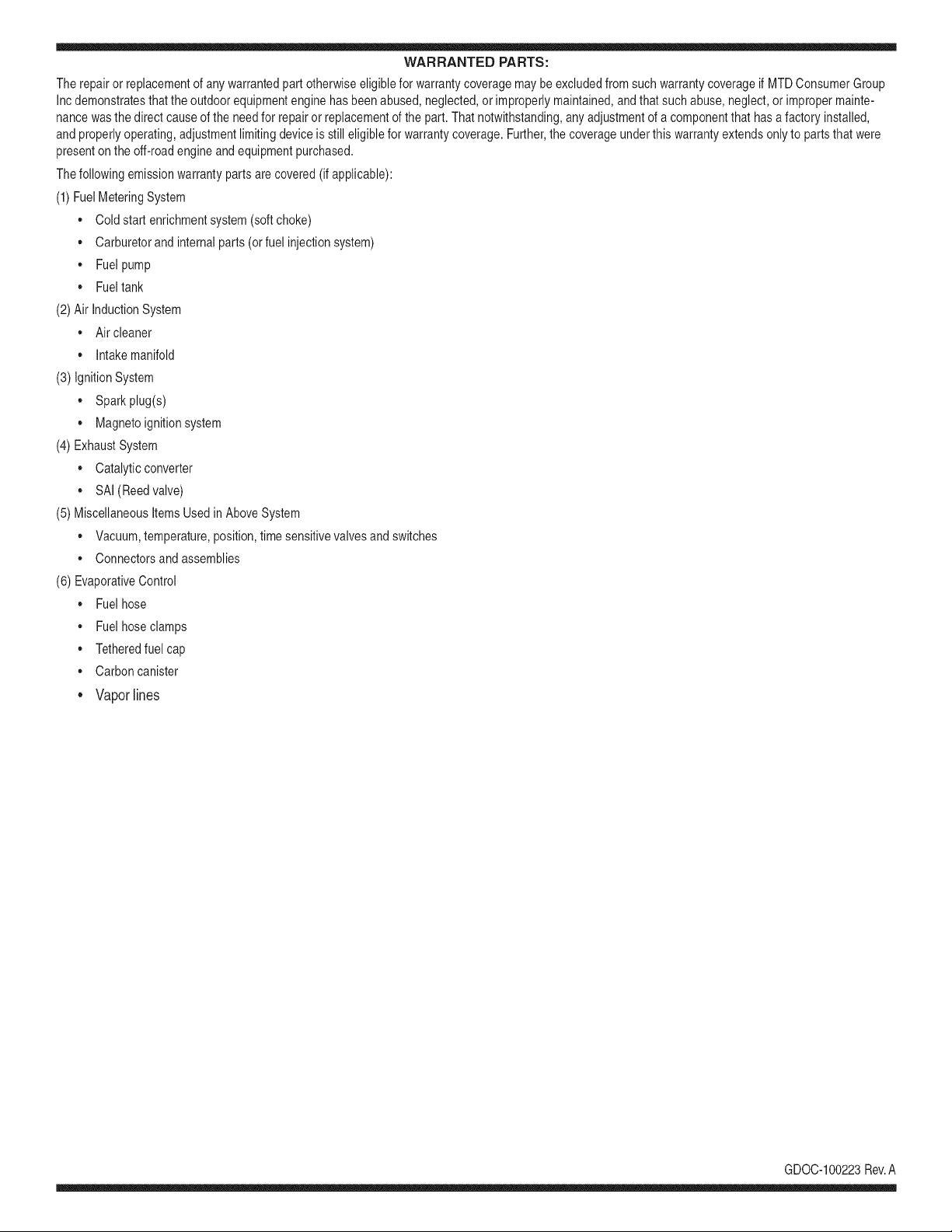
WARRANTED PARTS:
The repairor replacementof any warrantedpart otherwiseeligiblefor warrantycoveragemaybe excludedfrom such warrantycoverageif MTDConsumerGroup
Inc demonstratesthatthe outdoorequipmentenginehas beenabused,neglected,orimproperlymaintained,and thatsuch abuse,neglect,or impropermainte-
nancewasthe direct causeof the needfor repairor replacementof the part. That notwithstanding,any adjustmentof a componentthat hasa factory installed,
andproperlyoperating,adjustmentlimitingdevice is still eligible for warrantycoverage.Further,the coverageunderthis warrantyextendsonly to partsthat were
presentonthe off-roadengineand equipmentpurchased.
Thefollowing emissionwarrantypartsare covered(if applicable):
(1) FuelMeteringSystem
• Cold start enrichmentsystem(softchoke)
• Carburetorand internalparts (or fuel injectionsystem)
• Fuelpump
• Fueltank
(2) Air InductionSystem
• Air cleaner
• Intakemanifold
(3) IgnitionSystem
• Spark plug(s)
• Magnetoignitionsystem
(4) ExhaustSystem
• Catalyticconverter
• SAI (Reed valve)
(5) MiscellaneousItemsUsedin AboveSystem
• Vacuum,temperature,position,timesensitivevalvesand switches
• Connectorsandassemblies
(6) EvaporativeControl
• Fuelhose
• Fuelhoseclamps
• Tetheredfuel cap
• Carboncanister
• Vapor lines
GDOC-100223Rev.A
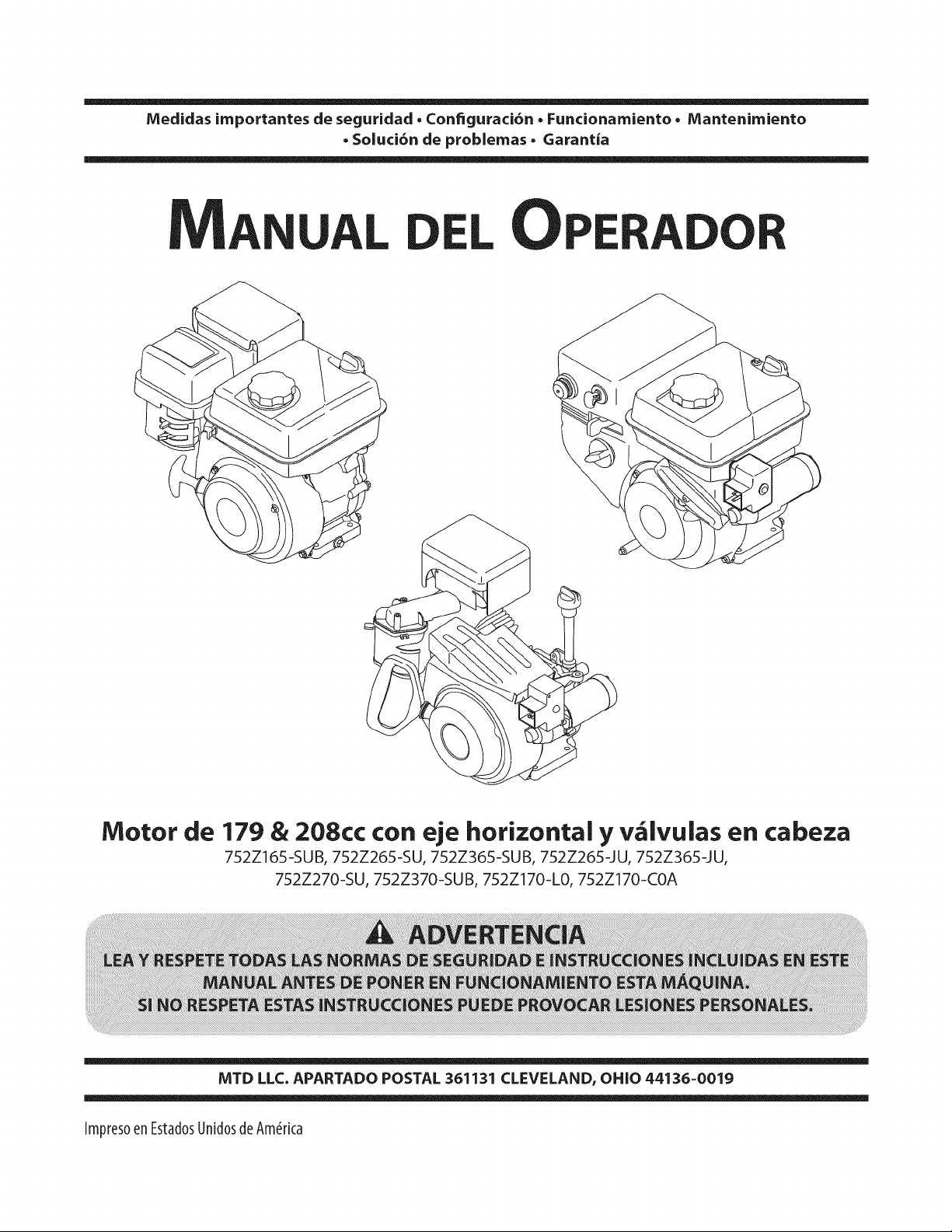
Medidas importantes de seguridad • Configuraci6n • Funcionamiento • Mantenimiento
• Soluci6n de problemas • Garantia
MANUAL DEL OPERADOR
Motor de 179 & 208cc con eje horizontal y v_lvulas en cabeza
752Z165-SUB, 752Z265-SU, 752Z365-SUB, 752Z265-JU, 752Z365-JU,
752Z270-SU, 752Z370-SUB, 752Z170-LO, 752Z170-COA
MTD LLC. APARTADO POSTAL 361131 CLEVELAND, OHIO 44136-0019
Impresoen EstadosUnidosdeAmerica
A!propietario
1
Gracias
Este Manual del Operador es una parte importante de su nuevo motor. Leayudar_ a preparar y mantener la unidad para obtener los
mejores resultados. Antes de operar el motor lea cuidadosamente y comprenda todo el manual.
indite
Medidas importantes de seguridad .................... 25
Etiquetas de seguridad ......................................... 27
Conf_guraci6n ........................................................ 28
Controles y Caractefisticas .................................... 31
Funcionamiento .................................................... 32
Mantenimiento ...................................................... 35
Soluci6n de problemas .......................................... 41
Piezas De Repuesto ............................................... 42
Garantia ................................................................. 43
Registro de informaci6ndeproducto
Antes de operar su motor nuevo, por favor Iocalice su placa de
modelo y registre la informaci6n en el _rea situada a la derecha.
Si tiene que solicitar soporte t_cnico a trav_s de nuestro sitio
web o de un distribuidor de servicio local, necesitar_ esta
informaci6n.
NOMERO DE MODELO / NOMERO DE SERIE
NE]NE]NE]N/ NE]FINNNNNNNDD
Asistendaal Cliente
Por favor, NO devuelva la mdquina al minorista o distribuidor sin ponerse en contacto primero con el Departamento de
Asistencia al Cliente.
En caso de tener problemas con este producto o de tener dudas con respecto a los controles, funcionamiento o
mantenimiento de este motor, puede solicitar la ayuda de expertos. Elija entre las opciones que se presentan a
continuaci6n:
0 Visite nuestro sitio web en www.mtdproducts.com
0 Llame a un representante de Asistencia al Cliente al (800) 800-7310 6 (330) 220-4683
0 Escrfbanos a MTD LLC • RO. Box 361131 • Cleveland, OH • 44136-0019
Medidasimportantes de seguridad
2
iADVERTENCIA! La presencia de este s[mbolo indica que se trata de instrucciones de
seguridad importantes que debe respetar para evitar poner en riesgo su seguridad personal
y/o material y la de los demos. Lea y siga todas las instrucciones de este manual antes de
poner en funcionamiento este equipo. Si no respeta estas instrucciones puede provocar
lesiones personales. Cuando vea este s[mbolo. TENGA EN CUENTA LA ADVERTENCIA.
PROPOSICION 65 DE CALIFORNIA
iADVERTENCIA! El escape del motor de este producto, algunos de sus componentes y
algunos componentes del veh[culo contienen o liberan sustancias qu[micas que el estado
de California considera que pueden producir c_ncer, defectos de nacimiento u otros
problemas reproductivos.
iPELIGRO! Esta m_quina est_ disefiada para set utilizada respetando las normas de seguridad
contenidas en este manual. AI igual que con cualquier tipo de equipo motorizado, un descuido o
error por parte del operador puede producir lesiones graves. Esta m_quina es capaz de amputar
dedos, manos y pies y de arrojar objetos extrafios con gran fuerza. De no respetar las
instrucciones de seguridad siguientes se pueden producir lesiones graves o la muerte.
Capacitaci6n
1. Lea, entienda y cumpla todas las instrucciones incluidas en
el motor yen los manuales antes de montarlo y utilizarlo.
Guarde este manual en un lugar seguro para consultas
futuras y peri6dicas, asi como para solicitar repuestos.
2. Familiaricese con todos los controles y con el uso adecuado
de los mismos. Sepa c6mo detener el motor y desactivar
los controles r_pidamente.
3. No permita nunca que los ni_os menores de 14 ahos
utilicen este motor. Los ni_os de 14 ahos en adelante
deben leery entender las instrucciones de operaci6n y
normas de seguridad contenidas en este manual yen
el motor y deben ser entrenados y supervisados por un
adulto.
4. Nunca permita que los adultos operen la m_quina sin
recibir antes la instrucci6n apropiada.
S. Mantenga el _rea de operaci6n despejada de personas,
particularmente de ni_os pequer_os y mascotas. Detenga la
m_quina si alguien se acerca.
Preparativos
1. Inspeccione minuciosamente el _rea donde utilizar_ el
equipo. Quite las piedras, palos, alambres y otros objetos
extrahos con los que se pueda tropezar y provocar lesiones
personales.
2. Utilice zapatos de trabajo resistentes, de suela fuerte, asi
como pantalones y camisas ajustados. Las prendas sueltas
y las alhajas se pueden enganchar en las piezas m6viles.
Nunca opere la m_quina descalzo o con sandalias.
3. Antes de arrancar el motor, desenganche las palancas del
embrague y despl_celas (en caso de haber) a la posici6n
neutral ("N").
4. Nunca deje el motor en marcha sin vigilancia.
5. Nunca intente realizar ajustes mientras el motor est_
en marcha, excepto en los casos especificamente
recomendados en el manual del operador.
Manej0 segur0 de la gas01ina:
6. Para evitar lesiones personales o dahos materiales sea
sumamente cuidadoso al manipular la gasolina. La gasolina
es sumamente inflamable y sus vapores pueden causar
explosiones. Si se derrama gasolina encima o sobre la ropa
se puede lesionar gravemente ya que se puede incendiar.
L_vese la piel y c_mbiese de ropa de inmediato.
a. Cuando agregue combustible, APAGUE el motor y
d_jelo enfriar por Io menos 2 minutos antes de sacar
la tapa del combustible.
b. Llene el tanque de combustible al aire libre o en un
_rea bien ventilada.
c. Utilice s61o los recipientes para gasolina autorizados.
d. Nunca Ilene los recipientes en el interior de
un vehiculo o cami6n o caja de remolque con
recubrimiento pl_stico. Coloque siempre los
recipientes en el piso y lejos del vehiculo antes de
Ilenarlos.
e. Si es posible, retire el equipo a gasolina del cami6n o
remolque y II_nelo en el suelo. Si esto no es posible,
Ilene el equipo en un remolque con un contenedor
port_til, en vez de con una boquilla dispensadora de
gasolina.
fi Mantenga la boquilla de Ilenado en contacto con el
borde del dep6sito de combustible o con la abertura
del recipiente en todo momento, hasta terminar la
carga. No utilice un dispositivo para abrir/cerrar la
boquilla.
25

g. No Ilene en exceso el tanque de combustible.
Cargue el dep6sito hasta que el combustible Ilegue
a 1/2pulgada pot debajo de la base del cuello de
Ilenado para dejar espacio para la expansi6n del
combustible.
h. Vuelva a colocar la tapa de la gasolina y ajustela bien.
i. Limpie el combustible que se haya derramado sobre
el motor y el equipo. Traslade la m_quina a otra zona.
Espere cinco minutos antes de encender el motor.
j. Para reducir el riesgo de incendio mantenga la
m_quina limpia de pasto, hojas y de la acumulaci6n
de otros desechos. Limpie los derrames de aceite o
combustible y saque todos los residuos embebidos
de combustible.
k. Mantenga la gasolina alejada de chispas, llamas
expuestas, llamas piloto, calor, y otras fuentes de
Ignlclon.
I. Nunca cargue combustible en el equipo en interiores
porque se acumulan vapores inflamables en el _rea.
m. Apague todos los cigarrillos, cigarros, pipas y otras
fuentes de ignici6n.
n. Verifique frecuentemente la Ifnea de combustible,
el dep6sito, el tap6n, y los accesorios buscando
rajaduras o p_rdidas. Reempl_celos de ser necesario.
Fundonamiento
1. AI arrancar el motor, asegOrese de que la bujia, el
silenciador y la tapa del combustible est_n en su lugar.
2. No d6 arranque al motor si no est_ la bujfa de encendido.
3. Si se derrama combustible, espere hasta que se evapore
antes de encender el motor.
4. Permita que el silenciador, el cilindro del motor, y las aletas
se enfrfen antes de tocarlos.
5. Mantenga a los niffos alejados de los motores en marcha o
calientes. Pueden sufrir quemaduras por el contacto con un
silenciador caliente.
6. Extraiga el combustible acumulado en el silenciador y el
cilindro.
7. Haga funcionar el equipo con todos los protectores
colocados.
8. Mantenga las manos y los pies alejados de las piezas
giratorias.
9. Atese el cabello si Io Ileva largo y no use alhajas.
10. No use ropa demasiado holgada, con cordones colgantes o
partes que se puedan enganchar.
11. Para encender el motor, jale de la cuerda lentamente hasta
que sienta resistencia, luegojale r_pidamente.
12. Antes de arrancar el motor, retire todos los equipos
externos/cargas del motor.
13. Los componentes del equipo acoplados directamente,
tales como por ejemplo, cuchillas, rotores, poleas, ruedas
dentadas, etc, deben estar firmemente conectados.
Mantenimiento y Almacenamiento
1. Mantenga el motor en condiciones seguras de
funcionamiento.
2. Deje que motor se enffie por io menos cinco minutos antes
de guardarla. Nunca altere los dispositivos de seguridad.
Controle peri6dicamente que funcionen correctamente.
3. Controle frecuentemente que todos los pernos y
tornillos est_n bien ajustados para mantener el motor
en condiciones seguras de funcionamiento, inspeccione
visualmente el motor para determinar si est_ daffado.
4. Antes de limpiar, reparar o revisar el motor, det_ngalo
y aseg0rese que todas las partes m6viles se hayan
detenido. Desconecte el cable de la bujia y p6ngalo
haciendo masa contra el motor para evitar que se encienda
accidentalmente.
5. No cambie la configuraci6n del regulador del motor ni Io
opere a sobrevelocidad. El regulador del motor controla la
velocidad m_xima segura de funcionamiento del motor.
6. Mantenga y reemplace las etiquetas de seguridad e
instrucciones segOn sea necesario.
7. Consulte siempre el manual del operador para conocer la
informaci6n importante relativa al almacenamiento de la
m_quina durante un plazo prolongado.
8. Si debe vaciar el tanque de combustible, h_galo al aire libre.
9. Respete las normas referentes a la disposici6n correcta y las
reglamentaciones sobre gasolina, aceite, etc. para proteger
el medio ambiente.
Avisoreferidoa emisiones
Los motores que est_n certificados y cumplen con ias regulaciones
de emisiones federales EPAy de California para SORE (Equipos
pequeffos todo terreno) est_n certificados para operar con
gasolina comun sin plomo y pueden incluir los siguientes sistemas
de control de emisiones: Modificaci6n de motor (EM) y catalizador
de tres vfas (TWC) si est_n equipados de esa manera.
Amortiguadordechispas
iADVERTENCIA! Esta m_quina est_ equipada con
un motor de combusti6n interna y no debe ser
utilizada en un terreno agreste cubierto por bosque,
malezas o hierba ni en las proximidades del mismo,
excepto si el sistema de escape clel motor est_
equipado con un amortiguador de chispas que
cumpla con las leyes locales o estatales
correspondientes, en caso de haberlas.
Si se utiliza un amortiguador de chispas el operador Io debe
mantener en condiciones de uso adecuadas. En el Estado de
California las medidas anteriormente mencionadas son exigidas
por ley (Articulo 4442 del C6digo de Recursos Publicos de
California). Es posible que existan leyes similares en otros estados.
Las leyes federales se aplican en territorios federales.
Puede conseguir el amortiguador de chispas para el silenciador a
trav_s de su clistribuidor de mantenimiento de motores autorizado
m_s cercano o poni_ndose en contacto con el departamento de
servicios, Apartado Postal 361131 Cleveland, Ohio 44136-0019.
SECCION 2 -- J_EDIDAS IMPORTANTES DE SEGURIDAD
SimbolosDeSeguridad
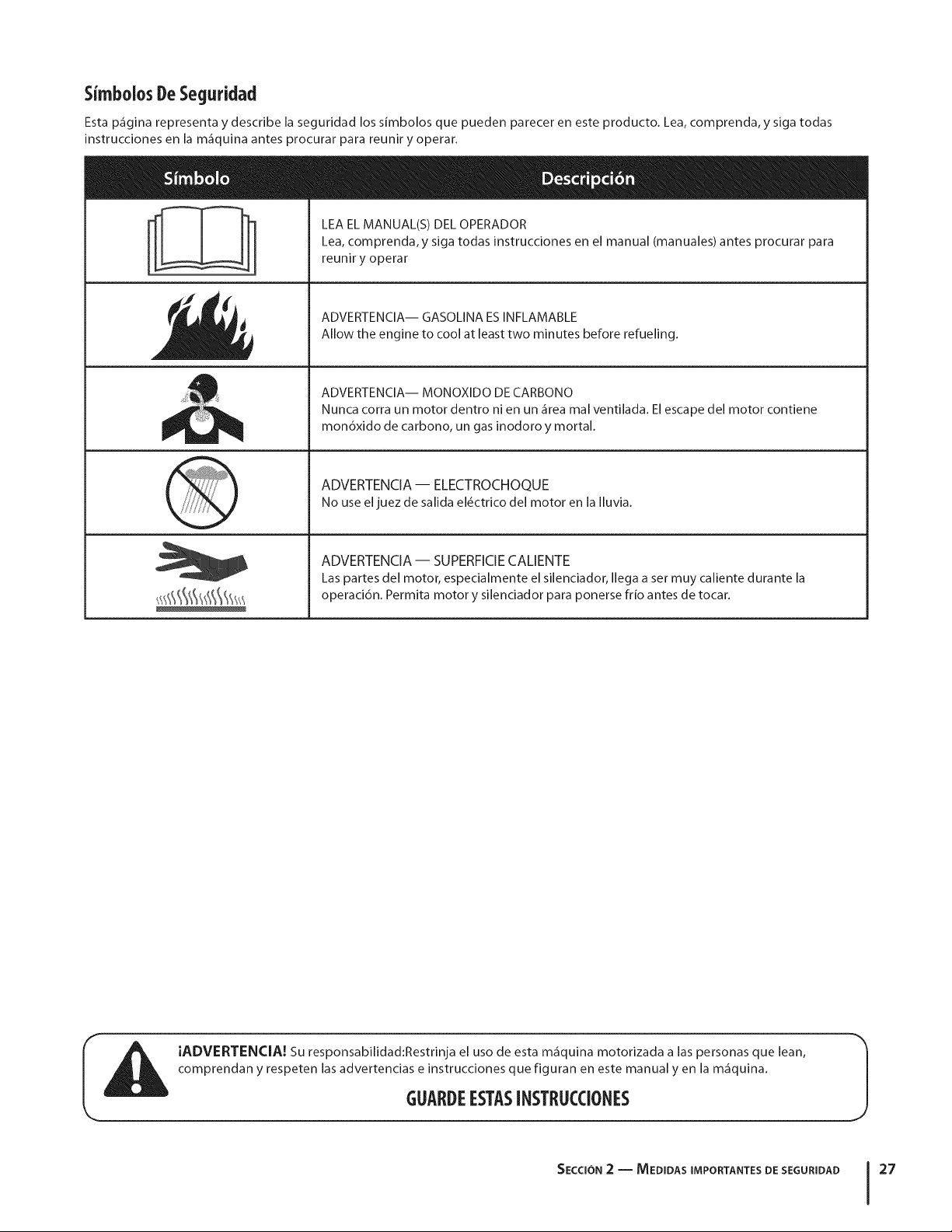
Esta p_gina representa y describe la seguridad los simbolos que pueden parecer en este producto. Lea, comprenda, y siga todas
instrucciones en la m_quina antes procurar para reuniry operar.
LEA EL MANUAL(S) DEL OPERADOR
Lea, comprenda,y siga todas instrucciones en el manual (manuales) antes procurar para
reuniry operar
ADVERTENCIA-- GASOLINA ES INFLAMABLE
Allow the engine to cool at least two minutes before refueling.
ADVERTENCIA-- MONOXlDO DE CARBONO
Nunca corra un motor dentro ni en un _rea mal ventilada. El escape del motor contiene
mon6xido de carbono, un gas inodoro y mortal.
ADVERTENCIA- ELECTROCHOQUE
No use eljuez de salida el_ctrico del motor en la Iluvia.
ADVERTENCIA-- SUPERFICIE CALIENTE
Las partes del motor, especialmente el silenciador, Ilega a set muy caliente durante la
operaci6n. Permita motor y silenciador para ponerse frio antes de tocar.
iADVERTENCIA! Su responsabilidad:Restrinja el uso de esta m_quina motorizada alas personas que lean,
comprendan y respeten las advertencias e instrucciones que figuran en este manual yen la m_quina.
GUARDEESTASINSTRUCCIONES
SECCION _ -- _,/_EDIDAS IMPORTANTES DE SEGURIDAD _
Configuraci6n
3
Especificacionespara el aceite y el combustible
NOTA: El motor se despacha sin gasolina ni aceite en su interior.
Si se hace funcionar el motor sin suficiente aceite puede daharse
gravemente y se anula la garantia.
iADVERTENCIA! Siempre mantenga Ins manos y
los pies alejados de Ins piezas m6viles del equipo.
No utilice fluidos comprimidos para arrancar. Los
vapores son inflamables.
Recomendacionessobre el aceite
Antes de poner en marcha el motor, c_irguelo con aceite para
motor, la capacidad es de 600 ml/20 onzas. Consulte el cuadro de
viscosidad de la Fig. 3-1 para Ins recomendaciones relacionadas
con el aceite. No Ilene excesivamente. Use un aceite para motor
de cuatro tiempos, o un aceite detergente de calidad premium
equivalente con certificado que cubra o exceda Ins exigencias
de los fabricantes de autom6viles americanos respecto de la
clasificaci6n de servicio SG y SF. Los aceites para motor con la
clasificaci6n SG, SF tienen est5 designaci6n en el envase.
11130
20w40.20w50___ll_
I I
15w40, ;O___ml_
I
10w40 _m,m_,m_Ru_lbk
I r-
10w30 ___n
(%) -30° -20° -10° 0° 10° 200 300 400
(%)-20° 0° 200 400 600 800 100°
Figura 3-1
NOTA: No utilice aceites sin detergente ni aceite para motor de
tres tiempos. Podria reducirse la vida util del motor.
Verifkaci6ndel nivel de aceite
Algunos motores tienen un tap6n de Ilenado de aceite/la varilla
de nivel de aceite de un cuarto de giro, otros pueden tener uno
a rosca. Siga las instrucciones que est_in a continuaci6n que
corresponden a su modelo de motor.
Control del nivel de aceiteen los motores que tiene tapones de
Ilenado de aceite deun cuartode giro
NOTA:AsegOrese de comprobar el aceite sobre una superficie
nivelada y con el motor apagado.
Para evitar que el motor resulte dahado, es importante que:
Controle el nivel de aceite antes de carla uso y carla
5 horas de funcionamiento cuando el motor est,1
tibio. Controle el nivel de aceite con mayor frecuencia
durante el periodo de funcionamiento inicial del motor.
Mantenga el nivel de aceite entre las marcas "F
(lleno)" y "L (agregar)" de la varilla de medici6n del
nivel. Vea la Fig. 3-2.
Cuando realice el control, compruebe que el tap6n
de Ilenado de aceite est_ bien ajustado.
1. Retire el tap6n de Ilenado/varilla de medici6n de aceite y
limpie bien la varilla. Vea la Fig. 3-2.
2. Inserte el tap6n/la varilla de medici6n en el cuello de
Ilenado del aceite y ajuste el tap6n hasta que se asiente.
3. Saque el tap6n /la varilla de medici6n de aceite. Si el nivel es
bajo, agregue lentamente aceite hasta que el nivel registrado
est_ en un punto intermedio entre alto (H) y bajo (L), Fig. 3-2.
4. Vuelva a colocar el tap6n / la varilla de medici6n de aceite
bien ajustados antes de poner en marcha el motor.
NOTA: No Io Ilene en exceso. Si se carga demasiado aceite se puede
generar humo, problemas de arranque o suciedad en la bujia.
NOTA: NO permita que el nivel de aceite se reduzca por debajo
de la marca "L (agregar)" de la varilla de medici6n. Si Io hace el
equipo puede funcionar mal o daharse.
NOTA: Para cambiar el aceite del motor, consulte la secci6n de
Mantenimiento de este manual.
Figura 3-2
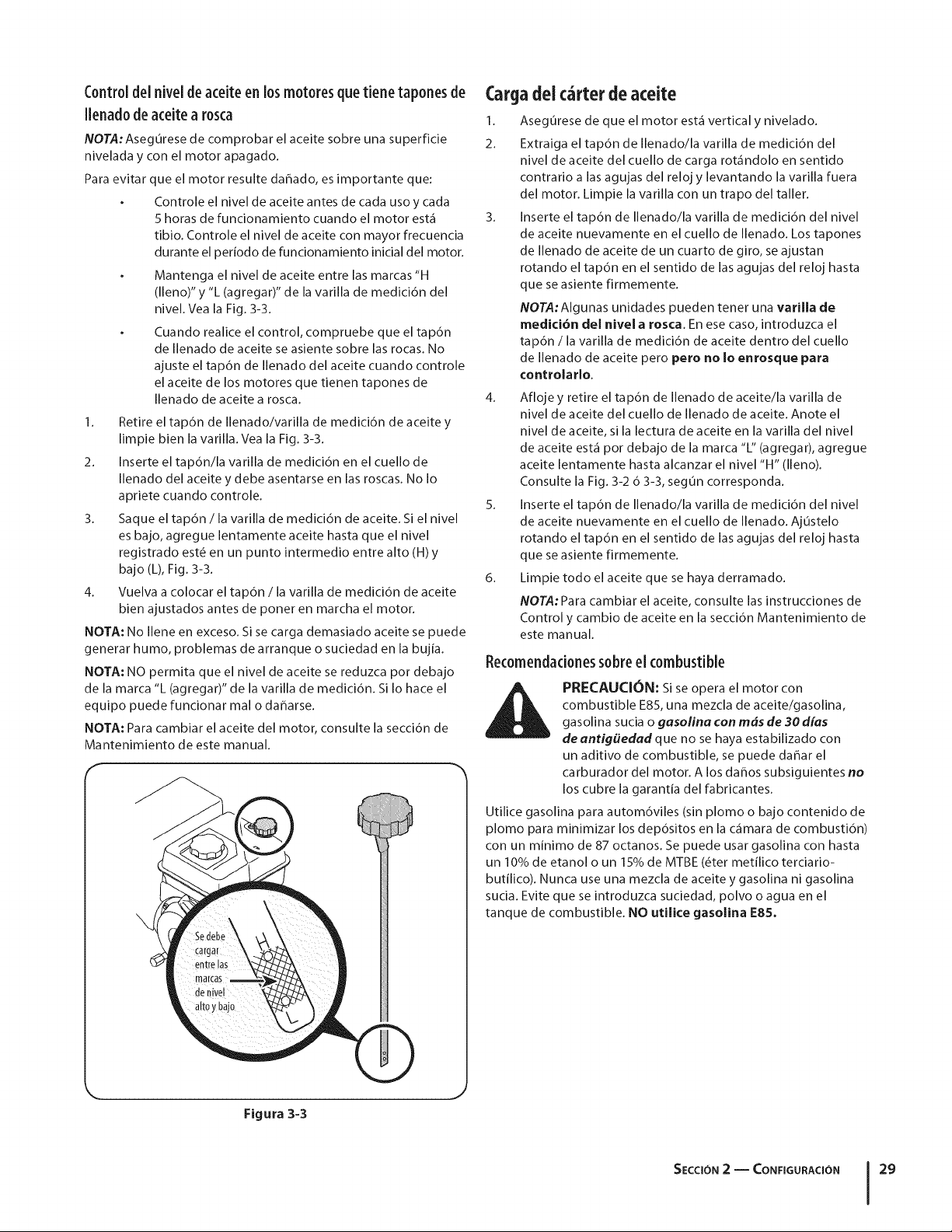
Controldel nivelde aceiteen losmotores quetiene tapones de
Ilenadode aceitea rosca
NOTA:AsegOrese de comprobar el aceite sobre una superficie
nivelada y con el motor apagado.
Para evitar que el motor resulte dahado, es importante que:
Controle el nivel de aceite antes de cada uso y cada
5 horas de funcionamiento cuando el motor est_
tibio. Controle el nivel de aceite con mayor frecuencia
durante el periodo de funcionamiento inicial del motor.
Mantenga el nivel de aceite entre las marcas "H
(lleno)" y "L (agregar)" de la varilla de medici6n del
nivel. Vea la Fig. 3-3.
Cuando realice el control, compruebe que el tap6n
de Ilenado de aceite se asiente sobre las rocas. No
ajuste el tap6n de Ilenado del aceite cuando controle
el aceite de los motores que tienen tapones de
Ilenado de aceite a rosca.
1. Retire el tap6n de Ilenado/varilla de medici6n de aceite y
limpie bien la varilla. Vea la Fig. 3-3.
2. Inserte el tap6n/la varilla de medici6n en el cuello de
Ilenado del aceite y debe asentarse en las roscas. No Io
apriete cuando controle.
3. Saque el tap6n / la varilla de medici6n de aceite. Si el nivel
es bajo, agregue lentamente aceite hasta que el nivel
registrado est6 en un punto intermedio entre alto (H) y
bajo (L), Fig. 3-3.
4. Vuelva a colocar el tap6n / la varilla de medici6n de aceite
bien ajustados antes de poner en marcha el motor.
NOTA: No Ilene en exceso. Si se carga demasiado aceite se puede
generar humo, problemas de arranque o suciedad en la bujia.
NOTA: NO permita que el nivel de aceite se reduzca pot debajo
de la marca "L (agregar)" de la varilla de medici6n. Si Io hace el
equipo puede funcionar mal o daharse.
NOTA: Para cambiar el aceite del motor, consulte la secci6n de
Mantenimiento de este manual.
Cargadelc rter deaceite
1. Aseg0rese de que el motor est_ vertical y nivelado.
2. Extraiga el tap6n de Ilenado/la varilla de medici6n del
nivel de aceite del cuello de carga rot&ndolo en sentido
contrario a las agujas del reloj y levantando la varilla fuera
del motor. Limpie la varilla con un trapo del taller.
3. Inserte el tap6n de Ilenado/la varilla de medici6n del nivel
de aceite nuevamente en el cuello de Ilenado. Los tapones
de Ilenado de aceite de un cuarto de giro, se ajustan
rotando el tap6n en el sentido de las agujas del reloj hasta
que se asiente firmemente.
NOTA:Algunas unidades pueden tenet una varilla de
medici6n del nivel a rosca. En ese caso, introduzca el
tap6n / la varilla de medici6n de aceite dentro del cuello
de Ilenado de aceite pero pero no Io enrosque para
controlarlo.
4. Afloje y retire el tap6n de Ilenado de aceite/la varilla de
nivel de aceite del cuello de Ilenado de aceite. Anote el
nivel de aceite, si la lectura de aceite en la varilla del nivel
de aceite est_ pot debajo de la marca "L" (agregar), agregue
aceite lentamente hasta alcanzar el nivel "H" (lleno).
Consulte la Fig. 3-2 6 3-3, segun corresponda.
5. Inserte el tap6n de Ilenado/la varilla de medici6n del nivel
de aceite nuevamente en el cuello de Ilenado. Ajustelo
rotando el tap6n en el sentido de las agujas del reloj hasta
que se asiente firmemente.
6. Limpie todo el aceite que se haya derramado.
NOTA: Para cambiar el aceite, consulte las instrucciones de
Control y cambio de aceite en la secci6n Mantenimiento de
este manual.
Rec0mendad0ness0bre el combustible
PRECAUCION: SJse opera el motor con
combustible E85, una mezcla de aceite/gasolina,
gasolina sucia o gasolina con rods de 30 dias
de antig_edad q ue no se haya esta bilizado con
un aditivo de combustible, se puede dahar el
carburador del motor. A los dahos subsiguientes no
los cubre la garantia del fabricantes.
Utilice gasolina para autom6viles (sin plomo o bajo contenido de
plomo para minimizar los dep6sitos en la c_mara de combusti6n)
con un minimo de 87 octanos. Se puede usar gasolina con hasta
un 10% de etanol o un 15% de MTBE (6ter metilico terciario-
butilico). Nunca use una mezcla de aceite y gasolina ni gasolina
sucia. Evite que se introduzca suciedad, polvo o agua en el
tanque de combustible. NO utilice gasolina E85.
_ nJ
Figura 3-3
SECCION 2 -- CONFIGURACION 29
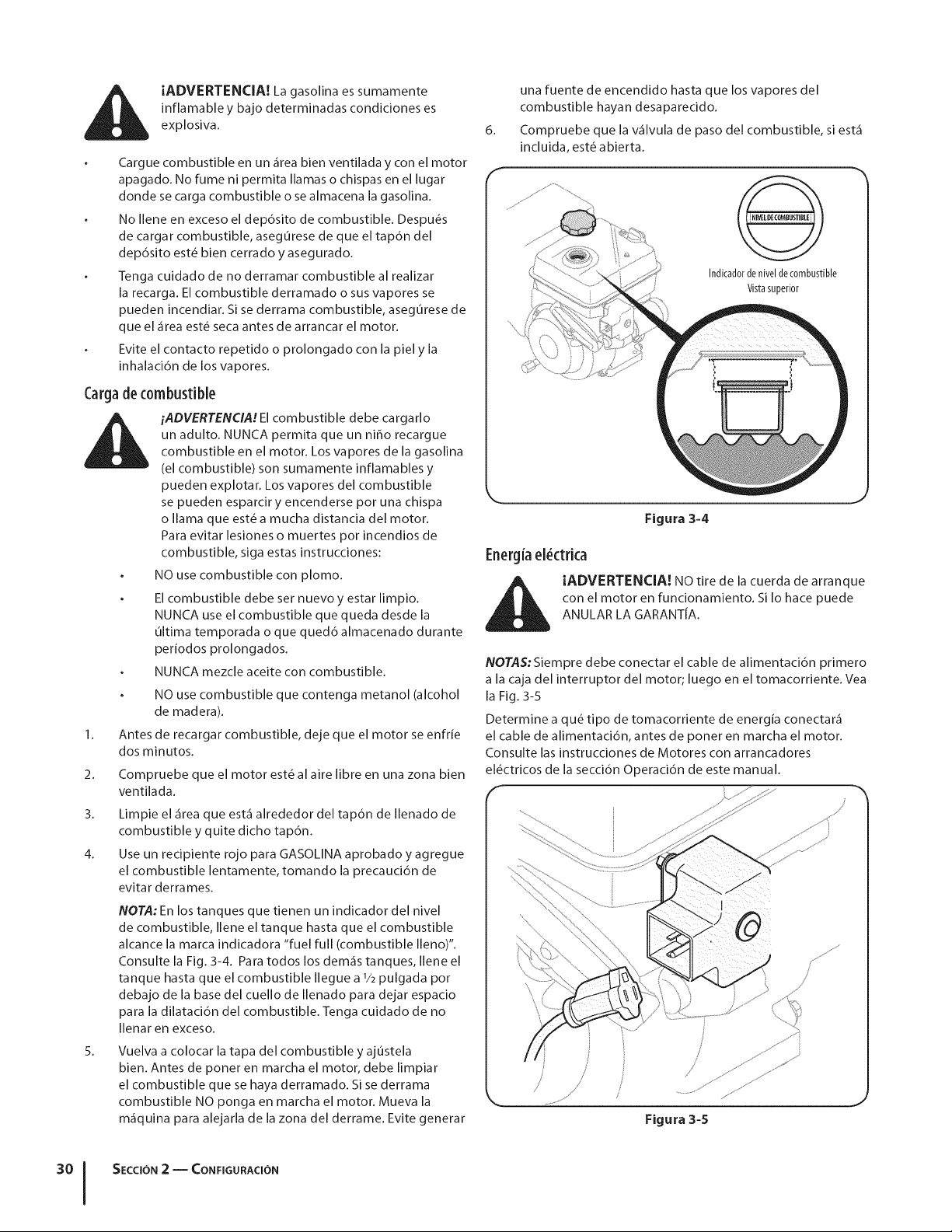
iADVERTENCIA! La gasolina es sumamente
inflamable y bajo determinadas condiciones es
explosiva.
Cargue combustible en un _rea bien ventilada y con el motor
apagado. No fume ni permita llamas o chispas en el lugar
donde se carga combustible o se almacena la gasolina.
No Ilene en exceso el dep6sito de combustible. Despu_s
de cargar combustible, asegurese de que el tap6n del
dep6sito est_ bien cerrado y asegurado.
Tenga cuidado de no derramar combustible al realizar
la recarga. El combustible derramado o sus vapores se
pueden incendiar. Si se derrama combustible, asegurese de
que el _rea est_ seca antes de arrancar el motor.
Evite el contacto repetido o prolongado con la piel y la
inhalaci6n de los vapores.
Cargade combustible
IADVERTENCIA! El combustible debe cargarlo
un adulto. NUNCA permita que un ni_o recargue
combustible en el motor. Los vapores de la gasolina
(el combustible) son sumamente inflamables y
pueden explotar. Los vapores del combustible
se pueden esparcir y encenderse pot una chispa
o llama que est_ a mucha distancia del motor.
Para evitar lesiones o muertes pot incendios de
combustible, siga estas instrucciones:
NO use combustible con plomo.
El combustible debe set nuevo y estar limpio.
NUNCA use el combustible que queda desde la
ultima temporada o que qued6 almacenado durante
perfodos prolongados.
NUNCA mezcle aceite con combustible.
1.
2.
3.
4.
5.
NO use combustible que contenga metanol (alcohol
de madera).
Antes de recargar combustible, deje que el motor se enfrfe
dos minutos.
Compruebe que el motor est_ al aire libre en una zona bien
ventilada.
Limpie el &rea que est_ alrededor del tap6n de Ilenado de
combustible y quite dicho tap6n.
Use un recipiente rojo para GASOLINA aprobado y agregue
el combustible lentamente, tomando la precauci6n de
evitar derrames.
NOTA: En los tanques que tienen un indicador del nivel
de combustible, llene el tanque hasta que el combustible
alcance la marca indicadora "fuel full (combustible lleno)".
Consulte la Fig. 3-4. Para todos los demos tanques, llene el
tanque hasta que el combustible llegue a I/2 pulgada por
debajo de la base del cuello de llenado para dejar espacio
para la dilataci6n del combustible. Tenga cuidado de no
llenar en exceso.
Vuelva a colocar la tapa del combustible y ajustela
bien. Antes de poner en marcha el motor, debe limpiar
el combustible que se haya derramado. Si se derrama
combustible NO ponga en marcha el motor. Mueva la
m_quina para alejarla de la zona del derrame. Evite generar
6.
una fuente de encendido hasta que los vapores del
combustible hayan desaparecido.
Compruebe que la v_Ivula de paso del combustible, si est_
incluida, est_ a bierta.
@
Indicad0rdeniveldecombustible
Vistasuperior
Figura 3-4
Energfael_ctrka
iADVERTENClA! NO tire de la cuerda de arranque
con el motor en funcionamiento. Si Io hace puede
ANULAR LA GARANTfA.
NOTAS: Siempre debe conectar el cable de alimentaci6n primero
a la caja del interruptor del motor; luego en el tomacorriente. Vea
la Fig. 3-5
Determine a qu_ tipo de tomacorriente de energia conectar_
el cable de alimentaci6n, antes de poner en marcha el motor.
Consulte las instrucciones de Motores con arrancadores
el_ctricos de la secci6n Operaci6n de este manual.
/
i
/
/
Figura 3-5
SECCI6N 2 -- CONFIGURACION
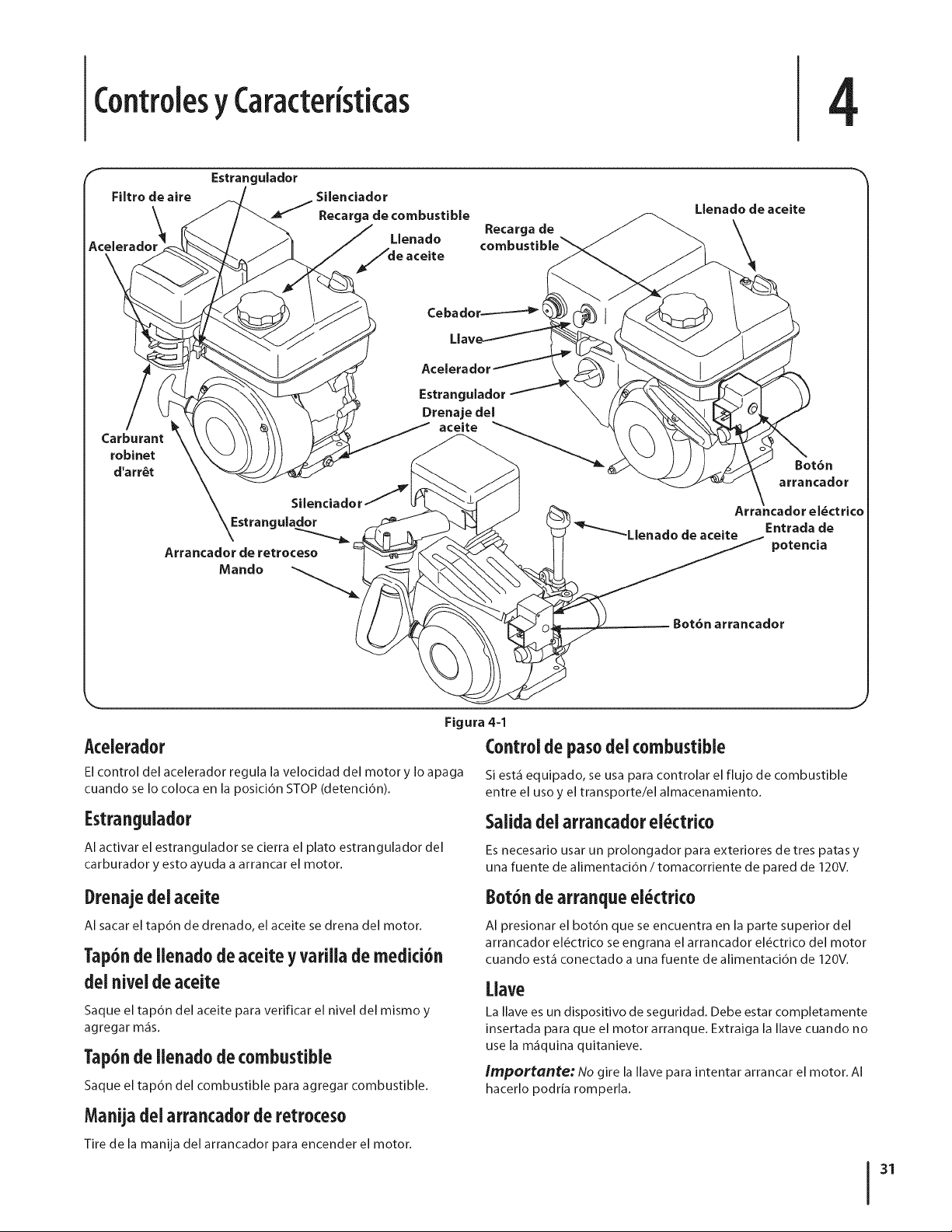
Controlesy Caracter sticas
4
f Estrangulador
Filtro de aire Silenciador
Recarga de combustible
Llenado
Acelerador Jde aceite
Recarga de
Llenado de aceite
Carburant
robinet
d'arr_t
SilenciadorJ
Estrangulador
Arrancador de retroceso
Mando
Acelerador
Estrangulador
Drenaje del
aceite
_--_'_Llenado de aceite
Entrada de
potencia
Acelerador
El control del acelerador regula la velocidad del motor y Io apaga
cuando se Io coloca en la posici6n STOP (detenci6n).
Estrangulador
AI activar el estrangulador se cierra el plato estrangulador del
carburador y esto ayuda a arrancar el motor.
J
Drenaje del aceite
AI sacar el tap6n de drenado, el aceite se drena del motor.
Tap6nde ilenado deaceite yvariila de medici6n
del nivei de aceite
Saque el tap6n del aceite para verificar el nivel del mismo y
agregar m_s.
Tap6nde ilenado decombustible
Saque el tap6n del combustible para agregar combustible.
Manijadel arrancador de retroceso
Figura 4=1
Control de pasodeicombustible
Si est_ equipado, se usa para controlar el flujo de combustible
entre el uso y el transporte/el almacenamiento.
Salidadelarrancador el_ctrico
Es necesario usar un prolongador para exteriores de tres patas y
una fuente de alimentaci6n / tomacorriente de pared de 120V.
Bot6nde arranque ei_ctrico
AI presionar el bot6n que se encuentra en la parte superior del
arrancador el_ctrico se engrana el arrancador el_ctrico del motor
cuando est_ conectado a una fuente de alimentaci6n de 120V.
Llave
La Ilave es un dispositivo de seguridad. Debe estar completamente
insertada para que el motor arranque. Extraiga la Ilave cuando no
use la m_quina quitanieve.
Tire de la manija del arrancador para encender el motor.
lmportante: No gire la Ilave para intentar arrancar el motor. AI
hacerlo podrfa romperla.
31
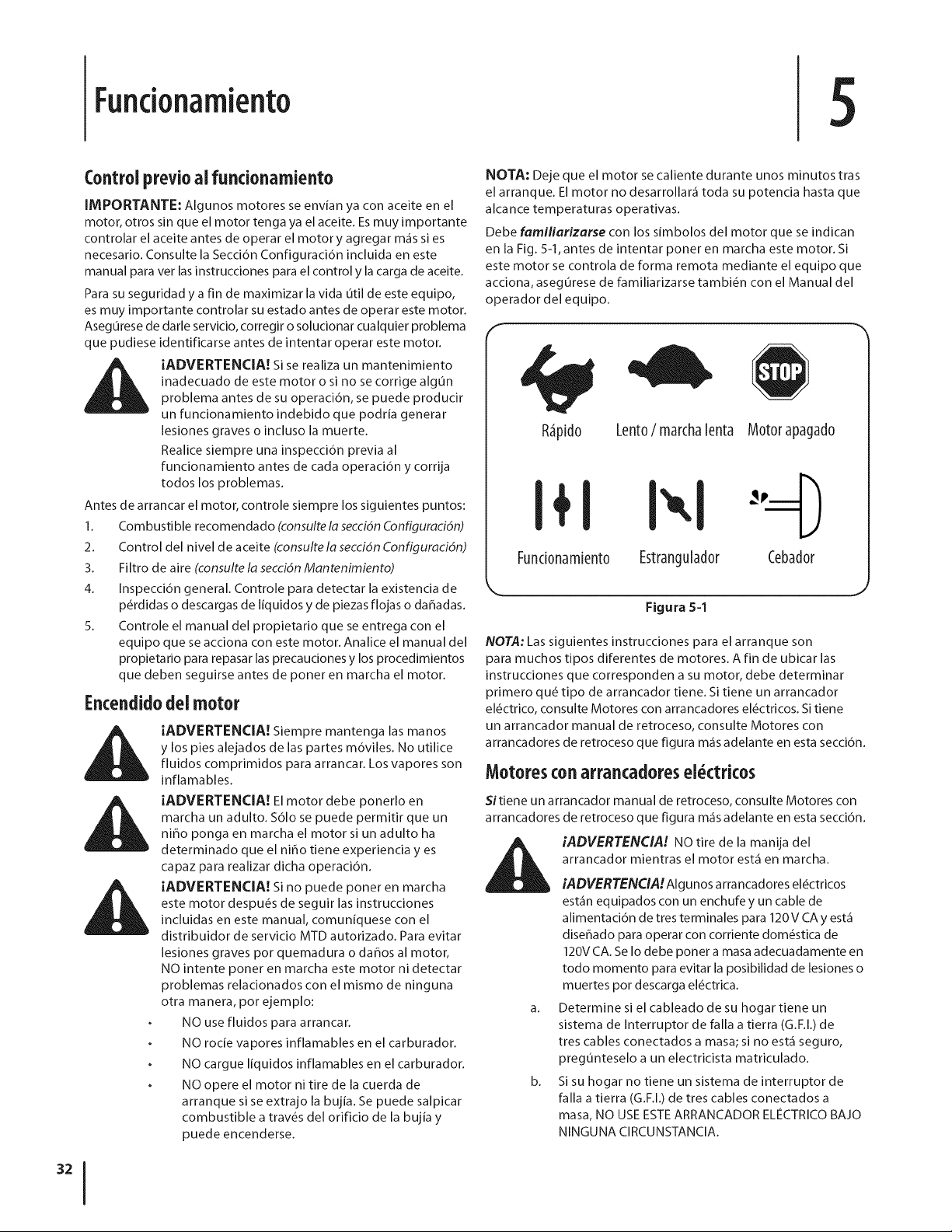
Funcionamiento
Control previoai fundonamiento
IMPORTANTE: Algunos motores se envian ya con aceite en el
motor, otros sin que el motor tenga ya el aceite. Es muy importante
controlar el aceite antes de operar el motor y agregar m_s si es
necesario. Consulte la Secci6n Configuraci6n incluida en este
manual para vet las instrucciones para el control y la carga de aceite.
Para su seguridad y a fin de maximizar la vida util de este equipo,
es muy importante controlar su estado antes de operar este motor.
Asegurese de darle servicio, corregir o solucionar cualquier problema
que pudiese identificarse antes de intentar operar este motor.
iADVERTENClA! Si se realiza un mantenimiento
inadecuado de este motor o si no se corrige algun
problema antes de su operaci6n, se puede producir
un funcionamiento indebido que podria generar
lesiones graves o incluso la muerte.
Realice siempre una inspecci6n previa al
funcionamiento antes de cada operaci6n y corrija
todos los problemas.
Antes de arrancar el motor, controle siempre los siguientes puntos:
1. Combustible recomendado (consulte la secci6n Configurad6n)
2. Control del nivel de aceite (consulte la secci6n Configuraci6n)
3. Filtro de aire (consulte la secci6n Mantenimiento)
4. Inspecci6n general. Controle para detectar la existencia de
p_rdidas o descargas de liquidos y de piezas flojas o dafladas.
5. Controle el manual del propietario que se entrega con el
equipo que se acciona con este motor. Analice el manual del
propietario para repasar las precauciones y los procedimientos
que deben seguirse antes de poner en marcha el motor.
Encendidodel motor
iADVERTENCIA! Siempre mantenga las manos
y los pies alejados de las partes m6viles. No utilice
fluidos comprimidos para arrancar. Los vapores son
inflamables.
iADMERTENClA! El motor debe ponerlo en
marcha un adulto. $61ose puede permitir que un
niflo ponga en marcha el motor si un adulto ha
determinado que el niflo tiene experiencia y es
capaz para realizar dicha operacidn.
iADVERTENClA! Si no puede poner en marcha
este motor despu_s de seguir las instrucciones
incluidas en este manual, comuniquese con el
distribuidor de servicio MTD autorizado. Para evitar
lesiones graves por quemadura o daflos al motor,
NO intente poner en marcha este motor ni detectar
problemas relacionados con el mismo de ninguna
otra manera, por ejemplo:
NO use fluidos para arrancar.
NO rocie vapores inflamables en el carburador.
NO cargue liquidos inflamables en el carburador.
NO opere el motor ni tire de la cuerda de
arranque si se extrajo la bujia. Se puede salpicar
combustible a trav_s del orificio de la bujia y
puede encenderse.
NOTA: Deje que el motor se caliente durante unos minutos tras
el arranque. El motor no desarrollar_ toda su potencia hasta que
alcance temperaturas operativas.
Debe familiafizarse con los simbolos del motor que se indican
en la Fig. 5-1, antes de intentar poner en marcha este motor. Si
este motor se controla de forma remota mediante el equipo que
acciona, asegurese de familiarizarse tambi_n con el Manual del
operador del equipo.
R_pid0 Lento/ marchalenta Motor apagad0
Funci0namient0 Estrangulad0r Cebad0r
Figura 54
NOTA: Las siguientes instrucciones para el arranque son
para muchos tipos diferentes de motores. A fin de ubicar las
instrucciones que corresponden a su motor, debe determinar
primero qu_ tipo de arrancador tiene. Si tiene un arrancador
el_ctrico, consulte Motores con arrancadores el_ctricos. Si tiene
un arrancador manual de retroceso, consulte Motores con
arrancadores de retroceso que figura m_s adelante en esta secci6n.
Motoresconarrancadoresei ctricos
Sitiene un arrancador manual de retroceso, consulte Motores con
arrancadores de retroceso que figura m_s adelante en esta secci6n.
a.
b.
iADVERTENCIA! NO tire de la manija del
arrancador mientras el motor est_ en marcha.
iADVERTENCIA!Algunos arrancadores el_ctricos
est_n equipados con un enchufe y un cable de
alimentaci6n de tres terminales para 120 V CA y est_
diseflado para operar con corriente dom_stica de
120V CA. Se Io clebe poner a masa adecuadamente en
todo momento para evitar la posibilidad de lesiones o
muertes por clescarga el_ctrica.
Determine si el cableado de su hogar tiene un
sistema de Interruptor de falla a tierra (G.F.I.) de
tres cables conectados a masa; si no est_ seguro,
pregunteselo a un electricista matriculado.
Si su hogar no tiene un sistema de interruptor de
falla a tierra (G.F.I.) de tres cables conectados a
masa, NO USE ESTE ARRANCADOR EL¢CTRICO BAJO
NINGUNA ClRCUNSTANClA.
Sielcableadodesuhogarest&conectadoatierra
ynohayunenchufedeconexi6natierradetres
espigasconinterruptordefallaatierraenellugar
dondeseusar_elarrancador,unelectricista
matriculadodebeinstalarunoiANTESDEQUESE
USEELARRANCADOREL¢CTRICO[
1. Paraevitarelenvenenamientopormon6xidodecarbono,
aseguresedequeelmotorest_alairelibreenunMea bien
ventilada.
2. Compruebe que la v_lvula de paso del combustible,
si est_ incluida (consulte las instrucciones del Manual
del operador del equipo), est_ abierta y que todos los
interruptores est_n en la posici6n de encendido.
NOTA: Si el motor est_ equipado con un arrancador el_ctrico
que funciona con una bateria de 12 V, prosiga con el paso 5.
IMPORTANTE: Siempre debe conectar el cable de alimentaci6n
primero a la caja del interruptor del motor; luego en el tomacorriente.
3. Conecte el cable de alimentaci6n a la caja del interruptor
del motor.
4. Enchufe el extremo del cable de alimentaci6n en el
tomacorriente.
5. Mueva el control de velocidad del motor, si est_ incluido,
hasta la posici6n "Fast (r_pido)".
6. Coloque el control del estrangulador en la posici6n
....FULL"CHOKE (estrangulador al m_ximo)".
7. Mantenga apretado el bulbo del cebador durante un
segundo completo cada vez que Io oprima.
Compruebe que cubra el orificio de ventilaci6n
con el pulgar.
Repita esto dos veces para un total de tres cebados.
IMPORTANTE: NO opere el arrancador el_ctrico por m_s de
5 segundos en cada intento.
NOTA: NO utilice el bulbo del cebador para reiniciar un
motor caliente tras una detenci6n breve. Si Io hace ahogar_
el motor y har_ que el equipo funcione mal.
@OTA: Si reinicia un motor caliente tras una detenci6n breve,
mueva el control de velocidad del motor (si est_ incluido)
hasta la posici6n "FAST (r_pido)" y mueva el control del
estrangulador a la posici6n NO CHOKE (sin estrangulador).
8. Presione el bot6n del arrancador para arrancar el motor.
@OTA:Si el motor no arranca despu_s de 3 intentos, repita
los pasos 1 a 8.
9. Cuando el motor arranca:
Suelte el bot6n del arrancador.
Mueva el control del estrangulador hasta la
posici6n 1/2 "CHOKE (1/2 estrangulador)" hasta
que el motor funcione suavemente.
A continuaci6n, mueva el control del estrangulador
hasta la posici6n NO CHOKE (sin estrangulador).
10. Mueva el control de velocidad del motor (siestd incluido) hasta
la velocidad deseada en el rango"RUN (funcionamiento)'.
@OTA: Si el motor arranca pero falla cuando se mueve el
control del estrangulador hasta la posici6n NO CHOKE
(sin estrangulador):
Coloque el control del estrangulador por un
momento nuevamente en la posici6n FULL
"CHOKE (estrangulador al m_ximo)".
A continuaci6n, mueva el control del estrangulador
hasta la posici6n 1/2 "CHOKE (1/2 estrangulador)"
hasta que el motor funcione suavemente.
Pot ultimo, mueva el control del estrangulador
hasta la posici6n NO CHOKE (sin estrangulador).
Si el motor se muere despu_s de que se mueve el control del
estrangulador hasta la posici6n NO CHOKE (sin estrangulador),
repita los pasos 5 a 10 para reiniciar el motor.
11. Si el motor no arranca despu_s de 3 intentos en la
posici6n "NO CHOKE (sin estrangulador)", mueva el
control del estrangulador hasta la posici6n "FULL CHOKE"
(estrangulador al m_ximo) y arranque el motor.
NOTA:Cuando desconecte el cable de alimentaci6n,
descon_ctelo siempre primero del tomacorriente; luego
descon_ctelo de la caja del interruptor del motor.
12. Desconecte el cable de alimentaci6n del tomacorriente.
13. Desconecte el cable de alimentaci6n de la caja del
interruptor del motor.
14. Si el motor no arranca despu_s de realizar los pasos
1 a 12, comuniquese con el distribuidor de servicio MTD
autorizado. NO intente detectar los problemas de este
motor de ninguna otra manera.
Motores conarrancadores de retroceso
Si tiene un arrancador el_ctrico, consulte Motores con
arrancadores el_ctricos que figura previamente en esta secci6n.
iADVERTENCIA! NO tire de la cuerda de arranque
con el motor en funcionamiento. Si Io hace puede
ANULAR LA GARANTiA.
1. Para evitar el envenenamiento por mon6xido de carbono,
asegurese de que el motor est_ al aire libre en un Mea bien
ventilada.
2. Compruebe que la v_lvula de paso del combustible,
si est_ incluida (consulte las instrucciones del Manual
del operador del equipo), est_ abierta y que todos los
interruptores est_n en la posici6n de encendido.
3. Mueva el control de velocidad del motor, si est_ incluido,
hasta la posici6n "FAST (r_pido)".
4. Coloque el control del estrangulador en la posici6n "FULL
CHOKE (estrangulador al m_ximo)".
5. Mantenga apretado el bulbo del cebador durante un
segundo completo cada vez que Io oprima.
Compruebe que cubra el orificio de ventilaci6n
con el pulgar.
Repita esto dos veces para un total de tres cebados.
NOTA: NO utilice el bulbo del cebador para reiniciar un
motor caliente tras una detenci6n breve. Si Io hace ahogar_
el motor y har_ que el equipo funcione mal.
NOTA: Si reinicia un motor caliente tras una detenci6n breve,
mueva el control de velocidad del motor (si est_ incluido)
hasta la posici6n "FAST (r_pido)"y mueva el control del
estrangulador a la posici6n NO CHOKE (sin estrangulador).
SECClON 5-- FUNCIONAMIENTO 33
6. Opere el control del equipo para soltar el freno o el
embrague del freno, si est_ incluido (consulte elManualdel
operador del equipo)).
iADVERTENClA! Cuando tire de la cuerda
de arranque, esta puede saltar hacia atr_s
inesperadamente hacia el motor causando
lesiones graves. Para evitar este riesgo, siga estas
instrucciones con cuidado:
7. Tome la manija de la cuerda de arranque.
Tire de la cuerda lentamente hacia afuera hasta
que sienta resistencia.
Si dejar que la cuerda se vuelva, continue
tirando de la cuerda con un golpe r&pido de
todo el brazo.
Vuelva la cuerda lentamente a su posici6n original.
NOTA: Si se siguen las instrucciones mencionadas en los pasos
precedentes se evitan los dahos potenciales al mecanismo de
retroceso.
Si la manija del arrancador de retroceso est_ congelada y no
enciende el motor, proceda de la siguiente manera:
Saque la mayor cantidad de cuerda posible del
arrancador.
Suelte la manija del arrancador y deje que
vuelva y golpee con fuerza contra el arrancador
para romper el hielo; estos dos pasos s61o deben
hacerse cuando el arrancador est& congelado.
8. Si el motor no arranca despu_s de 3 intentos, repita los
pasos 1 a 7, e int_ntelo nuevamente.
9. Cuando el motor arranca:
Mueva el control del estrangulador hasta la
posici6n 1/2 "CHOKE (1/2 estrangulador)" hasta
que el motor funcione suavemente.
A continuaci6n, mueva el control del estrangulador
hasta la posici6n NO CHOKE (sin estrangulador).
10. Mueva el control de velocidad del motor (siestd incluido) hasta
la velocidad deseada en el tango "RUN (funcionamiento)".
NOTA: Si el motor arranca pero falla cuando se mueve el
control del estrangulador hasta la posici6n NO CHOKE (sin
estrangulador).
Coloque el control del estrangulador pot un
momento nuevamente en la posici6n "FULL
CHOKE (estrangulador al m_ximo)".
A continuaci6n, mueva el control del estrangulador
hasta la posici6n 1/2 "CHOKE (1/2 estrangulador)"
hasta que el motor funcione suavemente.
Pot ultimo, mueva el control del estrangulador
hasta la posici6n NO CHOKE (sin estrangulador).
Si el motor se muere despu_s de que se mueve el control del
estrangulador hasta la posici6n "NO CHOKE (sin estrangulador)",
repita los pasos 3 a 10 para reiniciar el motor.
11. Si el motor no arranca despu_s de 3 intentos en la
posici6n "NO CHOKE (sin estrangulador)", mueva el
control del estrangulador hasta la posici6n "FULL CHOKE"
(estrangulador al m&ximo) y arranque el motor.
12.
Si el motor no arranca despu6s de realizar los pasos
1 a 11, comuniquese con el distribuidor de servicio MTD
autorizado. NO intente detectar los problemas de este
motor de ninguna otra manera.
Detenci6ndei motor y aimacenamiento
decortoplazo
Detenga el motor de acuerdo con el Manual del operador del
equipo.
iADVERTENCIA! Para evitar que alguien opere el
motor sin supervisi6n, especialmente un ni_o, NUNCA
Io deje sin vigilancia mientras est_ en marcha.
Apague siempre el motor despu_s de usarlo y saque
la Ilave de encendido, si est_ incluida.
iADVERTENCIA! NUNCA almacene el motor con
el combustible en el tanque de combustible dentro
de una construcci6n con probables fuentes de
encendido como calentadores de agua y calefactores,
secadores de ropa, motores el_ctricos, etc.
Detenci6ndel motor
2.
3.
Si opera el motor en la nieve o la Iluvia, haga que funcione
durante unos minutos para ayudar a que se seque toda la
humedad.
Mueva el control del equipo, si est_ incluido (consulte el
Manual del propietario del equipo), la palanca de control
del motor o el interruptor de encendido hasta la posici6n
"STOP (detenci6n)" u "OFF (apagado)".
Saque la Ilave de encendido, si est_ incluida (consulte el
Manual del operador del equipo).
NOTA:AI retirar la Ilave se reduce la posibilidad de que el
motor sea puesto en marcha sin autorizaci6n mientras el
equipo no est_ en uso.
iADVERTENCIA! NUNCA almacene el motor con
el combustible en el tanque de combustible dentro
de una construcci6n con probables fuentes de
encendido como calentadores de agua y calefactores,
secadores de ropa, motores el_ctricos, etc.
Despu sde quesedetiene el motor
iADVERTENCIA! Para evitar el congelamiento
posible de los controles del motor, siga las
instrucciones que se indican a continuaci6n con el
motor DETENIDO:
1. Limpie toda la nieve y humedad de la palanca de control
del motor y de las _reas del estrangulador.
2. Mueva el control del equipo, si est_ incluido (consulte el
Manual del operador del equipo), la palanca de control
del motor o el interruptor de encendido hacia adelante
y atr_s varias veces y deje el control en la posici6n "STOP
(detenci6n)" u "OFF (apagado)".
3. Mueva el estrangulador hacia adelante y atr_s varias veces y
d6jelo en la posici6n "FULL CHOKE (estrangulador al m_ximo)".
4. Compruebe que la v_lvula de paso del combustible, si est_
presente, est6 apagada.
SECCION 5-- FUNCIONAMIENTO
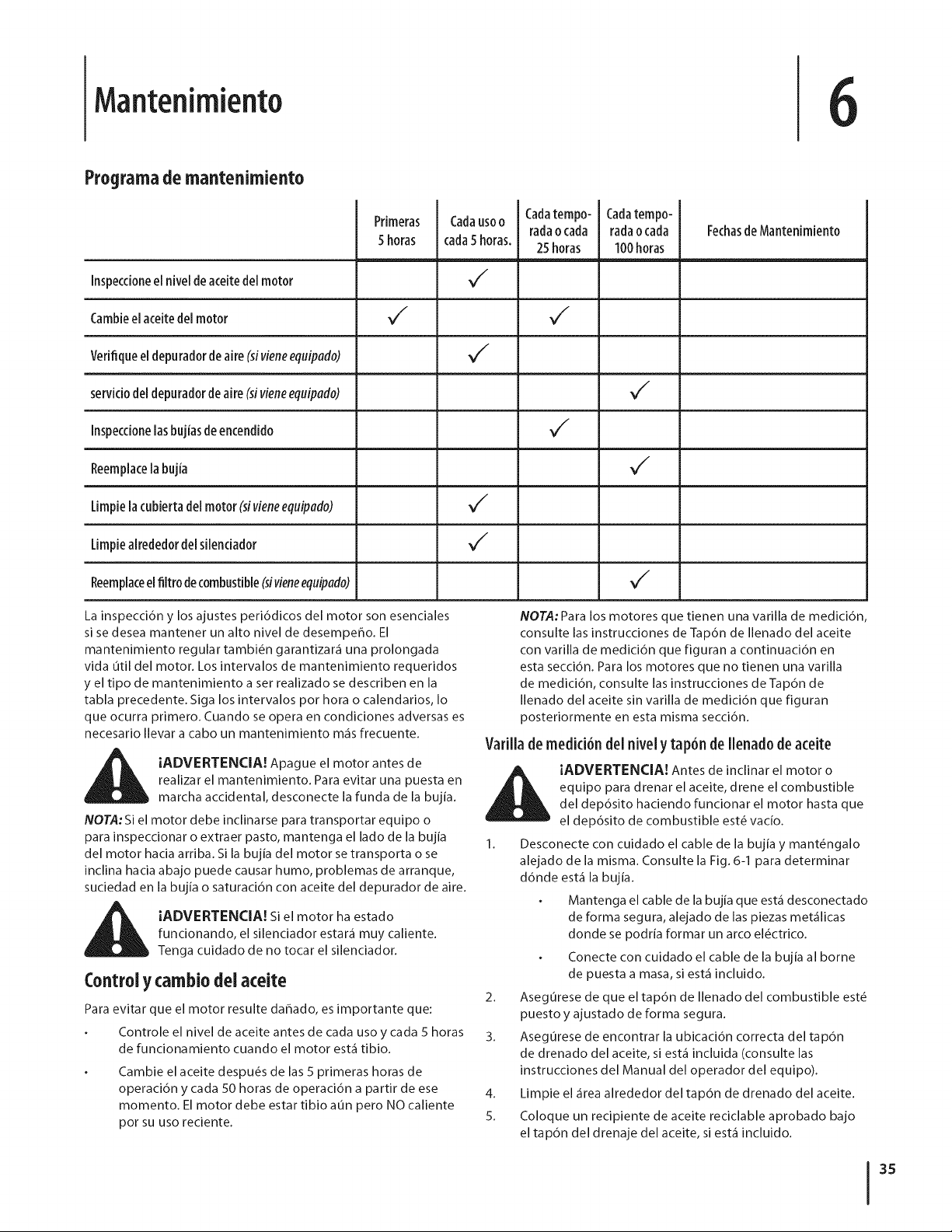
Mantenimiento
6
Programade mantenimiento
Primeras
5 horas
Cadausoo
cada5 horas.
Cadatempo-
radao cada
25 horas
Cadatempo-
radao cada
100horas
Fecbasde Mantenimiento
Inspeccioneel nivelde aceitedel motor v /
Cambieel aceitedel motor v/ v/
Verifiqueeldepuradorde aire(sivieneequipado) V "/
serviciodel depuradorde aire (sivieneequipado) v '/"
Inspeccionelasbujiasde encendido v/
Reemplacela bujia v /
Limpiela cubiertadel motor (sivieneequipado) v '/"
Limpiealrededordel silenciador v /
Reemplaceel flltro decombustible(sivieneequipado) v /
La inspecci6n y los ajustes peri6dicos del motor son esenciales
si se desea mantener un alto nivel de desempeffo. El
mantenimiento regular tambi6n garantizar_i una prolongada
vida Otil del motor. Los intervalos de mantenimiento requeridos
y el tipo de mantenimiento a ser realizado se describen en la
tabla precedente. Siga los intervalos por hora o calendarios, Io
que ocurra primero. Cuando se opera en condiciones adversas es
necesario Ilevar a cabo un mantenimiento m_is frecuente.
iADVERTENCIA. Apague el motor antes de
realizar el mantenimiento. Para evitar una puesta en
marcha accidental, desconecte la funda de la bujia.
NOTA: Si el motor debe inclinarse para transportar equipo o
para inspeccionar o extraer pasto, mantenga el lado de la bujia
del motor hacia arriba. Si la bujia del motor se transporta o se
inclina hacia abajo puede causar humo, problemas de arranque,
suciedad en la bujia o saturaci6n con aceite del depurador de aire.
_lb ADVERTENCIA! Si el motor ha estado
funcionando, el silenciador estar_i muy caliente.
Tenga cuidado de no tocar el silenciador.
Control y cambio dei aceite
Para evitar que el motor resulte daffado, es importante que:
Controle el nivel de aceite antes de cada uso y cada 5 horas
de funcionamiento cuando el motor est_ tibio.
Cambie el aceite despu_s de las 5 primeras horas de
operaci6n y cada 50 horas de operaci6n a partir de ese
momento. El motor debe estar tibio a0n pero NO caliente
por su uso reciente.
NOTA: Para los motores que tienen una varilla de medici6n,
consulte las instrucciones de Tap6n de Ilenado del aceite
con varilla de medici6n que figuran a continuaci6n en
esta secci6n. Para los motores que no tienen una varilla
de medici6n, consulte las instrucciones de Tap6n de
Ilenado del aceite sin varilla de medici6n que figuran
posteriormente en esta misma secci6n.
Varilla de medid6n del nivel y tap6n de llenado de aceite
_ ADVERTENCIA! Antes de inclinar el motor o
equipo para drenar el aceite, drene el combustible
del dep6sito haciendo funcionar el motor hasta que
el dep6sito de combustible est_ vacio.
I. Desconecte con cuidado el cable de la bujia y mant_ngalo
alejado de la misma. Consulte la Fig. 6-I para determinar
d6nde est,1 la bujia.
Mantenga el cable de la bujia que est,1 desconectado
de forma segura, alejado de las piezas met_ilicas
donde se podria formar un arco el_ctrico.
Conecte con cuidado el cable de la bujia al borne
de puesta a masa, si est,1 incluido.
2. Aseg0rese de que el tap6n de llenado del combustible est_
puesto y ajustado de forma segura.
3. Aseg0rese de encontrar la ubicaci6n correcta del tap6n
de drenado del aceite, si est,1 incluida (consulte las
instrucciones del Manual del operador del equipo).
4. Limpie el _irea alrededor del tap6n de drenado del aceite.
5. Coloque un recipiente de aceite reciclable aprobado bajo
el tap6n del drenaje del aceite, si est,1 incluido.
35
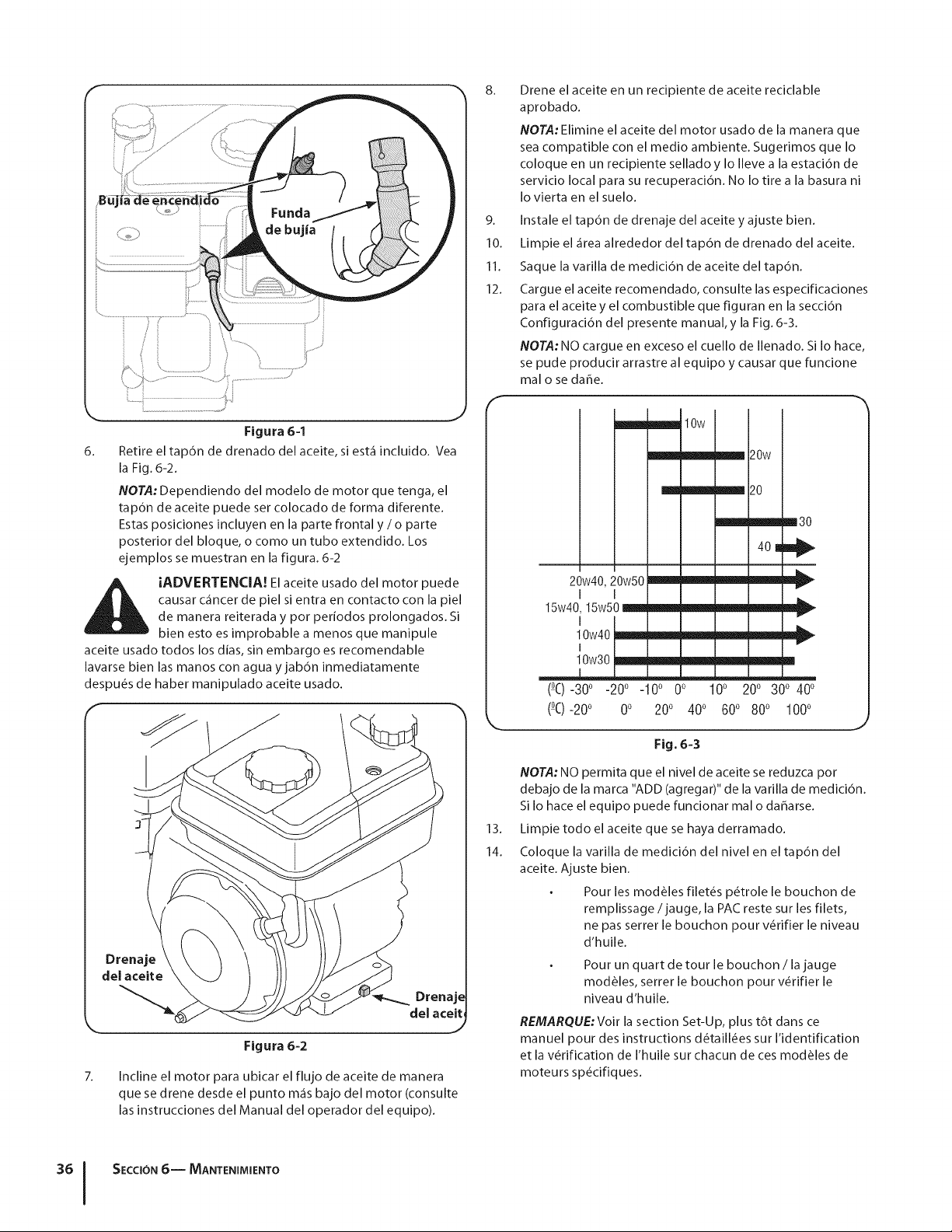
i ii i_,i
k,_ j
Figura 6=1
6. Retire el tap6n de drenado del aceite, si est& incluido. Yea
la Fig. 6-2.
NOT/t: Dependiendo del modelo de motor que tenga, el
tap6n de aceite puede set colocado de forma diferente.
Estas posiciones incluyen en la parte frontal y / o parte
posterior del bloque, o como un tubo extendido. Los
ejemplos se muestran en la figura. 6-2
_ iADVERTENCIA! El aceite usado del motor puede
causar c_incer de piel si entra en contacto con la piel
de manera reiterada y por periodos prolongados. Si
bien esto es improbable a menos que manipule
aceite usado todos los dias, sin embargo es recomendable
lavarse bien las manos con agua yjab6n inmediatamente
despu_s de haber manipulado aceite usado.
Figura 6=2
Incline el motor para ubicar el flujo de aceite de manera
que se drene desde el punto m&s bajo del motor (consulte
las instrucciones del Manual del operador del equipo).
8.
9.
10.
11.
12.
F
Drene el aceite en un recipiente de aceite reciclable
aprobado.
NOTA: Elimine el aceite del motor usado de la manera que
sea compatible con el medio ambiente. Sugerimos que Io
coloque en un recipiente sellado y Io Ileve a la estaci6n de
servicio local para su recuperaci6n. No Io tire a la basura ni
Io vierta en el suelo.
Instale el tap6n de drenaje del aceite y ajuste bien.
Limpie el &tea alrededor del tap6n de drenado del aceite.
Saque la varilla de medici6n de aceite del tap6n.
Cargue el aceite recomendado, consulte las especificaciones
para el aceite y el combustible que figuran en la secci6n
Configuraci6n del presente manual, y la Fig. 6-3.
NOTA:NO cargue en exceso el cuello de Ilenado. Si Io hace,
se pude producir arrastre al equipo y causar que funcione
mal o se dahe.
20w40,_0w50 __
I
15w40, 0 _m_
I
10w40__
I
10w30__
__30
40 mm_l_
mm
(_C)-30 ° -20 ° -10 ° 0 ° 10° 200 300 400
0 c 0 0 0 0 0 0 0
k,. ( )-20 0 20 40 60 80 100
Fig. 6=3
13.
14.
NOTA: NO permita que el nivel de aceite se reduzca por
debajo de la marca "ADD (agregar)" de la varilla de medici6n.
Si Io hace el equipo puede funcionar mal o daharse.
Limpie todo el aceite que se haya derramado.
Coloque la varilla de medici6n del nivel en el tap6n del
aceite. Ajuste bien.
Pour les modules filet_s p_trole le bouchon de
remplissage/jauge, la PAC reste sur les filets,
ne pas setter le bouchon pour v_rifier le niveau
d'huile.
Pour un quart de tour le bouchon/lajauge
modules, serrer le bouchon pour v_rifier le
niveau d'huile.
REMARQUE:Voir la section Set-Up, plus t6t dans ce
manuel pour des instructions d_taill_es sur I'identification
et la v_rification de I'huile sur chacun de ces modules de
moteurs sp_cifiques.
SECCION 6-- MANTENIMIENTO
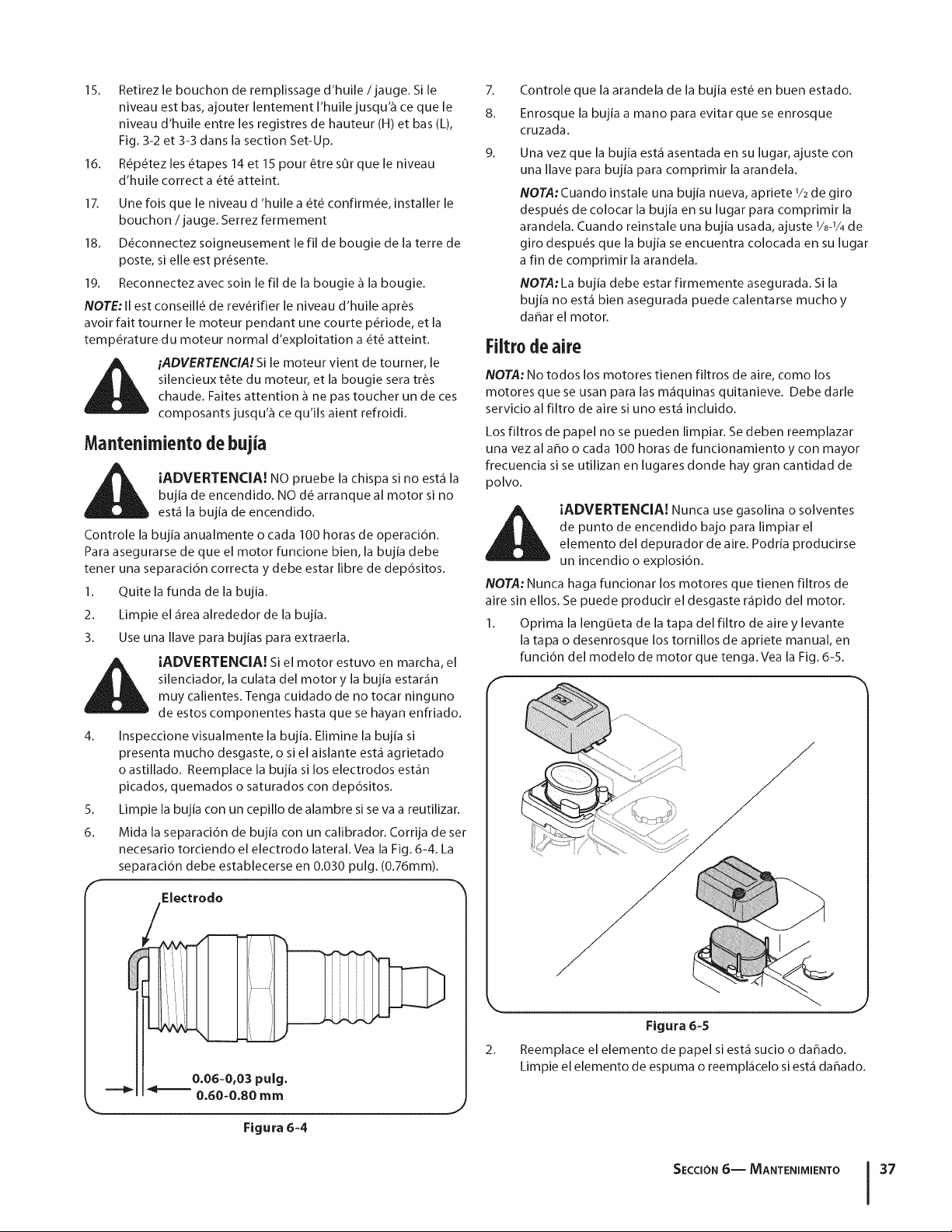
15.
16.
17.
18.
Retirez le bouchon de remplissage d'huile/jauge. Si le
niveau est bas, ajouter lentement I'huilejusqu'_ ce que le
niveau d'huile entre les registres de hauteur (H) et bas (L),
Fig. 3-2 et 3-3 dans la section Set-Up.
R@p@tezles @tapes 14 et 15 pour _tre sOr que le niveau
d'huile correct a @t@atteint.
Une fois que le niveau d 'huile a _t_ confirm_e, installer le
bouchon/jauge. Serrez fermement
D_connectez soigneusement le fil de bougie de la terre de
poste, si elle est pr_sente.
19. Reconnectez avec soin le fil de la bougie _ la bougie.
NOTE: II est conseill_ de rev_rifier le niveau d'huile apr_s
avoir fait tourner le moteur pendant une courte p_riode, et la
temperature du moteur normal d'exploitation a _t_ atteint.
_L ADVERTENCIA! Si le moteur vient de tourner, le
silencieux t_te du moteur, et la bougie sera tr_s
chaude. Faites attention _ ne pas toucher un de ces
composants jusqu'_ ce qu'ils aient refroidi.
Mantenimiento debujia
iADVERTENCIA! NO pruebe la chispa si no est_ la
bujia de encendido. NO d_ arranque al motor si no
est_ la bujia de encendido.
Controle la bujia anualmente o cada 100 horas de operacidn.
Para asegurarse de que el motor funcione bien, la bujia debe
tenet una separacidn correcta y debe estar libre de depdsitos.
1. Quite la funda de la bujia.
2. Limpie el _rea alrededor de la bujia.
3. Use una Ilave para bujias para extraerla.
iADVERTENCIA! Si el motor estuvo en marcha, el
silenciador, la culata del motor y la bujia estar_n
muy calientes. Tenga cuidado de no tocar ninguno
de estos componentes hasta que se hayan enfriado.
4. Inspeccione visualmente la bujia. Elimine la bujia si
presenta mucho desgaste, o si el aislante est_ agrietado
o astillado. Reemplace la bujia si los electrodos est_n
picados, quemados o saturados con dep6sitos.
5. Limpie la bujia con un cepillo de alambre si se va a reutilizar.
6. Mida la separaci6n de bujia con un calibrador. Corrija de set
necesario torciendo el electrodo lateral. Vea la Fig. 6-4. La
separaci6n debe establecerse en 0.030 pulg. (0.76mm).
Electrodo
°
===_11 _ 0.60-0.80 mm
Figura 6-4
7. Controle que la arandela de la bujia est@ en buen estado.
8. Enrosque la bujia a mano para evitar que se enrosque
cruzada.
9.
Una vez que la bujia est_ asentada en su lugar, ajuste con
una Ilave para bujia para comprimir la arandela.
NOTA: Cuando instale una bujia nueva, apriete 1/2de giro
despu@s de colocar la bujia en su lugar para comprimir la
arandela. Cuando reinstale una bujia usada, ajuste 1/8-1/4de
giro despu@s que la bujia se encuentra colocada en su lugar
a fin de comprimir la arandela.
NOTA: La bujia debe estar firmemente asegurada. Si la
bujia no est_ bien asegurada puede calentarse mucho y
dahar el motor.
Fiitrodeaire
NOTA: No todos los motores tienen filtros de aire, como los
motores que se usan para las m_quinas quitanieve. Debe darle
servicio al filtro de aire si uno est_ incluido.
Los filtros de papel no se pueden limpiar. Se deben reemplazar
una vez al a_o o cada 100 horas de funcionamiento y con mayor
frecuencia si se utilizan en lugares donde hay gran cantidad de
polvo.
iADVERTENCIA! Nunca use gasolina o solventes
de punto de encendido bajo para limpiar el
elemento del depurador de aire. Podria producirse
un incendio o explosi6n.
NOTA: Nunca haga funcionar los motores que tienen filtros de
aire sin ellos. Se puede producir el desgaste r_pido del motor.
Optima la lengOeta de la tapa del filtro de aire y levante
la tapa o desenrosque los tornillos de apriete manual, en
funci6n del modelo de motor que tenga. Vea la Fig. 6-5.
Figura 6=5
2. Reemplace el elemento de papel si est_ sucio o dahado.
Limpie el elemento de espuma o reempl_celo si est_ dahado.
SECCION 6-- MANTENIMIENTO 37
3.
Para limpiar el elemento de espuma, sep&relo del elemento
de papel y I&velo con detergente liquido y agua. Permita
que se seque bien antes de usarlo. No lubrique el elemento
de espuma.
Ajustes
NO realice ning0n ajuste del motor. Los ajustes de f&brica son
satisfactorios para la mayoria de las condiciones. Si los ajustes se
necesitan, comuniquese con el Distribuidor de servicio de MTD
autorizado.
Carburador
Si considera que el carburador necesita ajuste, consulte al
Distribuidor de servicio de MTD autorizado. El desempe_o
del motor NO debe verse afectado a altitudes de hasta
7,000 pies (2,134 m). Para el funcionamiento a mayores altitudes,
comuniquese con el Distribuidor de servicio de MTD autorizado.
ARemador (sivieneequipado)
Comuniquese con el Distribuidor de servicio de MTD autorizado
pot los problemas el_ctricos relacionados con el alternador como:
El arrancador no funciona
La bateria est_ descargada
Cambio de fusible
Mantenimiento/reparaclones del alternador
Veloddaddei motor
i_ iADVERTENCIA! Para evitar lesiones graves o la
muerte, NO modifique el motor de ninguna manera.
Si altera la configuraci6n del regulador, el motor se
puede desbocar y funcionar a velocidades que no
son seguras. NUNCA cambie la configuraci6n de f&brica del
regulador del motor.
iADVERTENCIA! Hacer funcionar el motor m&s
r&pidamente que la velocidad configurada de
f_brica puede set peligroso y ANULARA LA
GARANTIA.
Extracd6nde ia nievedeimotor
Despu_s de cada uso, extraiga la nieve de las siguientes &reas:
Varilla de medici6n del nivel del tap6n de
Ilenado de aceite
Tap6n de Ilenado de combustible
Arrancador de retroceso/Pantalla del volante
Enlaces
Protecciones
Conexi6n de la bujia (si se ve).
Caja del interruptor del arrancador el_ctrico,
si est_ incluida (consulte las instrucciones del
Manual del operador del equipo).
NOTA:Consulte las instrucciones del Manual del operador
del equipo para conocer la ubicaci6n adecuada del tap6n
de Ilenado del combustible y de la palanca de control.
4.
Si se extrae la nieve se facilita la operaci6n de la cuerda del
arrancador de retroceso y se reduce el riesgo de que se
produzca una contaminaci6n pot agua cuando se abre el
tap6n de Ilenado del combustible.
NOTA:Si desea obtener m_s informaci6n acerca de
los arrancadores de retroceso, consulte Motores con
arrancadores de retroceso en la Secci6n sobre operaci6n
del presente manual.
Transportedeimotor
iADVERTENCIA! NUNCA transporte este motor
dentro de otto vehiculo o en un espacio cerrado si
hay gasolina en el tanque. El vapor del combustible
o el combustible derramado pueden prenderse
fuego.
i_li iADVERTENCIA! Si hay combustible en el tanque,
cierre la vMvula de paso del combustible, si viene
equipada, y transporte el motor en posici6n vertical,
en un vehiculo abierto, como un remolque abierto o
la caja abierta de una camioneta.
Si NO dispone de un vehiculo abierto y tiene que transportar el
motor en posici6n vertical en un vehiculo cerrado, siga estos pasos
para vaciar el tanque de combustible antes de transportar el motor:
Vacie el tanque de combustible con un dispositivo de succi6n
disponible comercialmente que est_ diser_ado para usarse con
gasolina.
iADVERTENCIA! NO vierta el combustible del
motor ni haga sif6n con la boca para que salga.
Drene el combustible en un recipiente rojo para gasolina
aprobado, tomando precauciones para evitar derrames.
Haga funcionar el motor hasta que el combustible restante se
haya consumido.
_ ADVERTENCIA! NUNCA deje el motor sin
atenci6n cuando est_ en funcionamiento y NUNCA
haga funcionar el motor en un _rea cerrada.
Almacenamientodeimotor
Almacenamientoa corto plazo/estadonal
Limpieel motor
Si el motor ha estado funcionando, d_jelo enfriar durante por Io
menos media hora antes de limpiarlo.
Antes de dar servicio al motor, extraiga la cubierta del carburador
y/o el alojamiento del soplador. Elimine la suciedad y los residuos
de las siguientes _reas:
Aletas de refrigeraci6n
Filtro de admisi6n de aire o Areas de protecci6n
del volante/arrancador de retroceso
Conexi6n de la bujia
Palancas
Area de enlace
Protecciones
SECCION 6-- MANTENiMIENTO
Carburador
Culata
La extracci6n de los residuos asegura que el enfriamiento sea
adecuado, la velocidad del motor correcta y el riesgo de incendio
menor.
NOTA: No rocie el motor con agua para limpiarlo porque el agua
podHa contaminar el combustible. Con una manguera dejardin
o equipo de lavado a presi6n tambi_n puede forzar agua dentro
del depurador de aire o la abertura del silenciador. El agua en el
depurador de aire embeber_ el elemento de papel, y el agua que
pasa a trav_s del elemento o silenciador puede ingresar en el
cilind to, causando daffo.
iADVERTENCIA! La acumulaci6n de residuos
alrededor del silenciador podr/a producir un
incendio. Inspecci6nelo y limpielo antes de cada
USO,
Almacenamiento deicombustible
encendido como calentadores de agua, calefactores, secadores
de ropa, motores el6ctricos, etc.
NOTA: En lugar de utilizar un producto conservante/estabilizador
del combustible, puede vaciar el tanque de combustible como
se indica a continuaci6n en Almacenamiento prolongado - C6mo
drenar el combustible.
Almacenamiento prolongado
C6mo drenar el combustible
NOTA: Saque los residuos del motor antes de drenar el
combustible del carburador.
NOTA: Si ya prepar6 el combustible para el almacenamiento
a corto plazo NO es necesario drenar del carburador el
combustible que contiene un estabilizador.
iADVERTENCIA! Para evitar lesiones graves o
muertes, NO vierta combustible del motor ni haga
sif6n con la boca para que salga.
i_i iADVERTENCIA! NUNCA almacene el motor con 1.
combustible en el tanque dentro de una
construcci6n con fuentes potenciales de encendido
como calentadores de agua, calefactores, secadores
de ropa, motores el_ctricos, etc. Si Io hace se puede producir una 2.
explosi6n y causar muertes o lesiones graves.
NOTA: Si el combustible del motor almacenado en el tanque
de gasolina y/o en un recipiente para gasolina aprobado, sin
un producto estabilizador para gasolina, no se usar_ durante
m_s de 15 a 30 dias, debe prepararlo para el almacenamiento a
corto plazo/estacional. Consulte Tratamiento del combustible
posteriormente en esta secci6n. 3.
NOTA: Si se desea almacenar el combustible del motor durante
m_s de una temporada, sin un producto estabilizador para
gasolina, se deteriorar_ gradualmente. Adem_s, si se Io almacena
en el tanque de gasolina del motor sin un producto estabilizador
para gasolina, es probable queen el carburador queden
dep6sitos de goma, el sistema de combustible se obstruya y
se ANULARA LA GARANTIA. Prepare el combustible para un
almacenamiento prolongado.
Sistema de combustible
Para evitar que el combustible se eche a perder y que haya
problemas con el carburador, debe tratar el sistema de
combustible de la siguiente manera:
NOTA: Respete siempre la proporci6n de mezclado que figura en el
recipiente del estabilizador. Si no Io hate se puede dahar el equipo.
NOTA: NO es necesario drenar la gasolina estabilizada del
carburador.
Tratamientodei combustible
1. Agregue el estabilizador del combustible de acuerdo con
las instrucciones del Fabricante.
2. Haga funcionar el motor por Io menos 10 minutos despu6s de
agregar el estabilizador para permitirle Ilegar al carburador.
iADVERTENCIA! NUNCA almacene el motor con el
combustible en el tanque de combustible dentro de
una construcci6n con probables fuentes de
Para evitar lesiones graves por incendios de combustible,
vacie el tanque de combustible haciendo funcionar el
motor hasta que se pare pot falta de combustible. NO
intente verter combustible del motor.
Haga funcionar el motor mientras espera hasta que el
combustible restante se haya consumido.
_ ADVERTENCIA! NUNCA deje el motor sin
atenci6n cuando est_ en funcionamiento y NUNCA
haga funcionar el motor en un _rea cerrada.
Comience el servicio del di_metro interior del cilindro de
acuerdo con las siguientes instrucciones.
Di metro interior dei dliMro deaceite
iADVERTENCIA! Cuando lubrique el di_metro
interior del cilindro, es posible que salpique
combustible por el orificio de la bujia. Para evitar
lesiones graves por incendios de combustible, siga
estas instrucciones:
2_
3.
Desconecte con cuidado el cable de la bujia y mant6ngalo
alejado de la misma.
Mantenga el cable de la bujia que est_
desconectado de forma segura, alejado de
las piezas met_licas donde se podHa format
un arco el6ctrico.
Conecte con cuidado el cable de la bujia al
borne de puesta a masa, si est_ incluido.
Desconecte la bateHa en el terminal negativo primero, si el
motor cuenta con un arrancador el6ctrico CC.
Apague todos los interruptores del motor.
Retire la Ilave de encendido, si viene equipada.
Retire la bujia de encendido.
Rocie 1 onza (30ml) de aceite de motor limpio dentro del
orificio de la bujia de encendido.
SECCION 6-- MANTENIMIENTO 39
4. Cubra el orificio de la bujia con un trapo para evitar que se
salpique combustible desde dicho orificio cuando se tira de
la cuerda de arranque.
NOTA: para los motores que est_n equipados con un
arrancador de retroceso, prosiga con el Paso 5. Para los
motores que est_n equipados con arrancadores el_ctricos,
proceda prosiga con el Paso 6.
5. Tome la manija de la cuerda de arranque:
Tire de la manija de la cuerda de arranque hacia
afuera lentamente con un golpe de todo el brazo.
Repita una vez. Asi se distribuir_ aceite en todo
el cilindro para evitar la corrosi6n durante el
almacenamiento.
6.
Prosiga con el Paso 7.
Presione el bot6n de arranque o ponga la Ilave del
interruptor de encendido en la posici6n "START (arrancar)":
Suelte de inmediato el bot6n de arranque o ponga la
Ilave del interruptor de encendido en la posici6n "OFF
(apagado)". Asi se distribuir_i aceite en todo el cilindro para
evitar la corrosi6n durante el almacenamiento.
7. Saque el trapo del orificio de la bujia.
8. Instale la bujia.
g. Desconecte con cuidado el cable de la bujia del borne de
puesta a masa, si est& incluido.
10. Conecte el cable de la bujia a la bujia.
Aceite
Cambie el aceite si NO Io hizo durante los 01timos 3 meses.
Consulte el titulo Control y cambio de aceite ubicado unas
p&ginas atr&s en esta misma secci6n.
Almacenamientofuera de temporada
PRECAUCION: Si no se utiliza un aditivo
estabilizador del combustible o si no se hace
funcionar el motor hasta que se agote
completamente el combustible antes del
almacenamiento fuera de temporada, se puede daffar el
carburador del motor. A los daffos subsiguientes no los cubre la
garantia del fabricantes.
Para almacenar los motores entre 30y 90 dias es necesario
tratarlos con un estabilizador de gasolina y para almacenamientos
de m_s de 90 dias se necesita drenar el combustible para evitar
deterioros y la formaci6n de dep6sitos de goma en el sistema
de combustible o en piezas fundamentales del carburador. Si la
gasolina en su motor se deteriora durante el almacenamiento,
puede resultar necesario reparar o reemplazar el carburador y
otros componentes del sistema de combustible.
1. Extraiga todo el combustible del dep6sito haciendo funcionar
el motor hasta que se detenga por falta de combustible.
_k iADVERTENCIA! Nunca deje el motor sin
vigilancia mientras est& en funcionamiento.
2. Cambie el aceite. Consulte el titulo Cambio de aceite
ubicado unas p&ginas atr&s en esta misma secci6n.
3. Retire la bujia y vierta alrededor de 1/2onzas de aceite para
motor en el cilindro. Vuelva a colocar la bujia y d_ marcha al
motor lentamente para distribuir el aceite.
4. Limpie la suciedad de las _reas del motor y del silenciador.
Retoque la pintura dahada,y revista con una pelicula
delgada de aceite las dem_is _ireas que puedan oxidarse.
5. Almacene el motor en un sector limpio, seco y bien
ventilado, lejos de cualquier artefacto que funcione con
una llama o luz piloto como hornos, calentadores de agua
o secadores de ropa. Tambi6n evite cualquier sector con
motores el6ctricos que producen chispas o donde se
utilizan herramientas el6ctricas.
6. De set posible, tambi6n evita _reas de almacenamiento con
mucha humedad para evitar oxidaci6n y corrosi6n.
7. Mantenga el motor nivelado cuando Io almacene. La inclinaci6n
del motor puede resultar en fugas de combustible o aceite.
SECClON 6-- MANTENIMIENTO
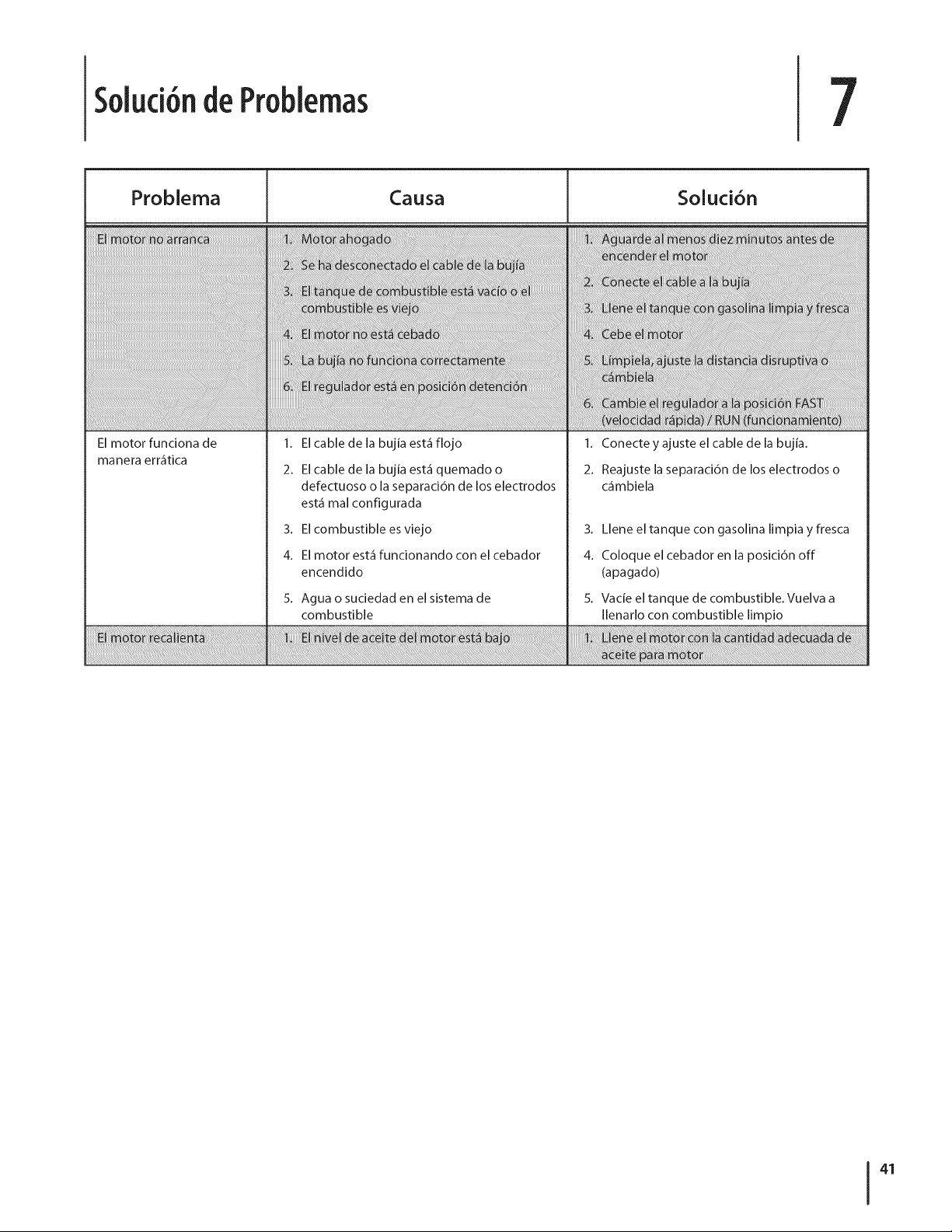
Solud6nde Problemas
7
Problerna Causa Soluci6n
El motor funciona de
manera err_tica
1. El cable de la bujia est_ flojo
2. El cable de la bujia est_ quemado o
defectuoso o la separaci6n de los electrodos
est_ mal configurada
3. El combustible es viejo
4. El motor est_ funcionando con el cebador
encendido
5. Agua o suciedad en el sistema de
combustible
1. Conecteyajuste el cable de la bujia.
2. Reajuste la separaci6n de los electrodos o
c_mbiela
3. Llene el tanque con gasolina limpia y fresca
4. Coloque el cebador en la posici6n off
(apagado)
5. Vacie el tanque de combustible. Vuelva a
Ilenarlo con combustible limpio
41
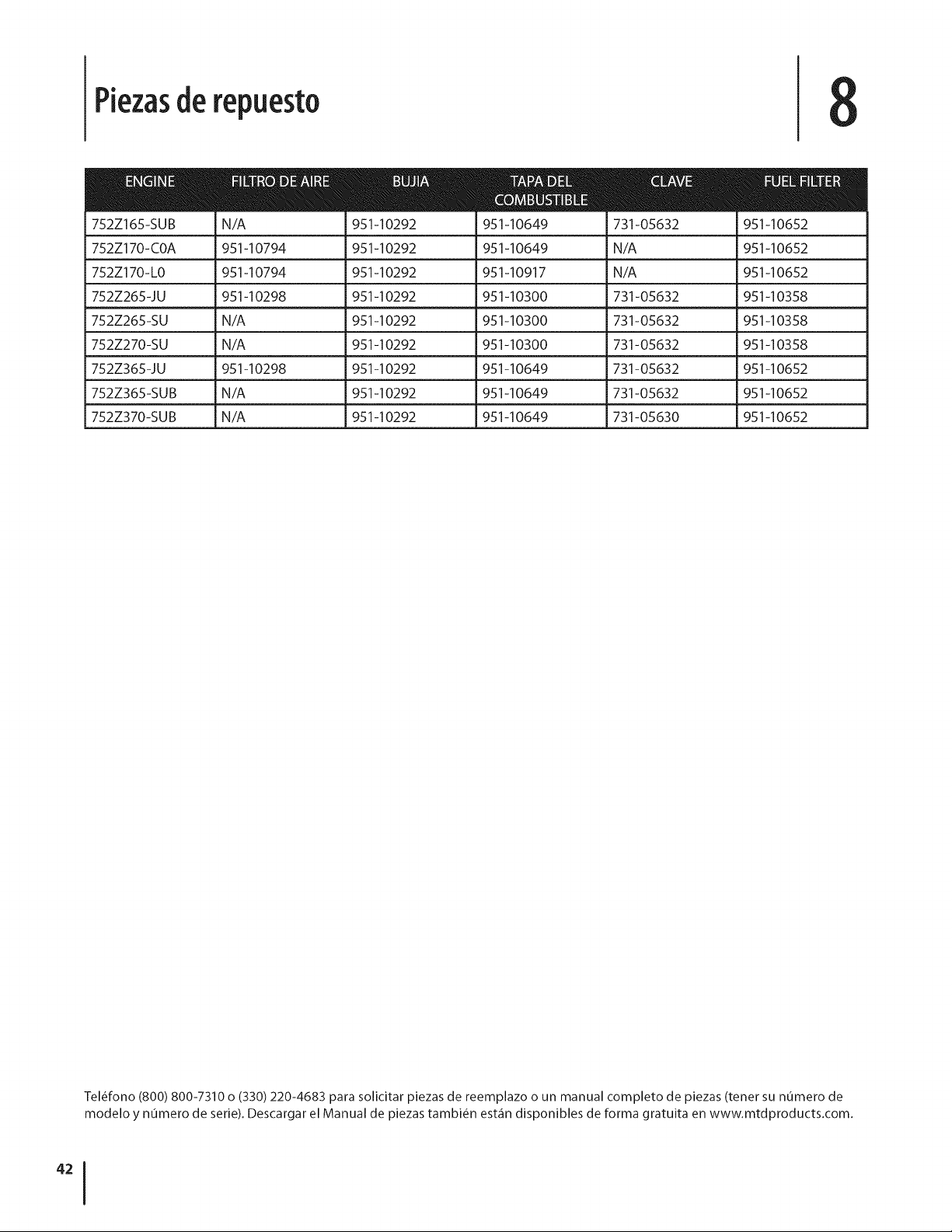
Piezasde repuesto
752Z165-SUB
752Z170-COA
752Z170- L0
752Z265-JU
752Z265-SU
752Z270-SU
752Z365-JU
752Z365-SUB
752Z370-SUB
951-10292
951-10292
951-10292
951-10292
951-10292
951-10292
951-10292
951-10292
951-10292
N/A 951-10649 731-05632
951-10794 951-10649 N/A
951-10794 951-10917 N/A
951-10298 951-10300 731-05632
N/A 951-10300 731-05632
N/A 951-10300 731-05632
951-10298 951-10649 731-05632
N/A 951-10649 731-05632
N/A 951-10649 731-05630
951-10652
951-10652
951-10652
951-10358
951-10358
951-10358
951-10652
951-10652
951-10652
Tel6fono (800) 800-7310 o (330) 220-4683 para solicitar piezas de reemplazo o un manual completo de piezas (tenet su numero de
modelo y numero de serie). Descargar el Manual de piezas tambi_n est_n disponibles de forma gratuita en www.mtdproducts.com.
DECLARACION FEDERAL y/o DE CALIFORNIA SOBRE GARANTJAS EN EL CONTROL DE EIVIISIONES
SUS DERECHOS Y OBLIGACIONES EN CUANTO A LA GARANTJA
MTDConsumerGroupInc, laAgencia deProtecci6nMedioambientalde los EstadosUnidos(EPA),y para aquellosproductoscertificadosparasu ventaen el es-
tadode California,el Departamentode los Recursosdel Aire de California(CARB)secomplacenen explicarla garanfiaque cubreal sistemade control(ECS)de
emisiones(evaporativasy/o de escape)de su equipoy motor(motorde equipos de exteriores)de encendidopot chispaparatodo terreno,peque_o,de exteriores
del a_o2006 y a_osposterioresEn California,losnuevosmotoresde equipos de exterioresdebenestar dise_ados,construidosy equipadospara cumplircon las
estrictasnormasantipoluci6ndel Estado(en otrosestados,los equipos del a_o 1997y modelosposterioresdebenser estar dise_ados,construidosy equipados
para cumplircon las regulacionesde motoresdeencendidopor chispa para todoterrenopeque_osde laAgencia de Protecci6nMedioambientalde los Estados
Unidos,(EPA).MTDConsumerGroupInc. debe garantizarel sistemade control de emisiones(ECS) desu motorde equipos de exteriorespot el periodode
tiempo indicadom_sabajo,siempreycuando no existausoincorrecto,negligenciao mantenimientoinadecuadodedicho motor.
Su ECSpuedeincluir piezastales como el carburador,el sistemade inyecci6nde combustible,el sistemade encendido,el convertidorcatalitico,losdep6sitos
de combustible,laslineas decombustible,lostaponesde combustible,lasv_lvulas, contenedores,filtros, manguerasde vapor,abrazaderas,conectoresy otros
componentesafinesrelacionadoscon lasemisiones.
Dondeexista unacondici6ncubiertapor la garantia, MTDConsumerGroupInc. reparar_su motorde equiposde exterioressincostoalguno incluyendoel
diagn6stico,las piezasy la manode obra.
COBERTURA DE LA GARANTJA DEL FABRICANTE:
Este sistemade controlde emisionesse garantizaporel t@minode dos aSos.Si alguna pieza relacionadacon lasemisionesde su motorde equiposde
exterioreses defectuosa,MTDCONSUMERGROUPINC. reparar_o sustituir_dichapieza.
RESPONSABILIDADES DEL PROPIETARIO SEGUN LA GARANTJA:
En su car_cterde propietariodel motorde equiposde exteriores,usted es responsabledel mantenimientorequeridoquese especificaen el manualdel propieta-
rio.MTDConsumerGroupInc le recomiendaque conservetodos losrecibos quecubrenel mantenimientode su motor,no obstanteIo cual MTDConsumerGroup
Inc nopodr_denegarel cumplimientode lagarantia Qnicamentepor lafalta de los recibos.
Comopropietariodel motorde equiposde exteriores,usteddebe saber queMTDConsumerGroupInc. puededenegarla coberturade lagarantia si su motoro
unapieza del mismofallandebido a uso incorrecto,negligencia,mantenimientoindebidoo a modificacionesnoaprobadas.
Ustedes responsablede presentarsu motoral centrode distribuci6no serviciotecnico de MTDConsumerGroupInc. tan prontocomo aparezcael problema.Las
reparacionescubiertaspor la garantiase debenIlevara caboen un lapsorazonableque no excedade 30 dias. Si tiene alguna preguntarespectode lacobertura
de la garantia,p6ngaseen contactoconel Departamentodel ServicioT@nicode MTDConsumerGroupInc. al telefono1-800-800-7310o pot correoelectr6nico
en http://support.mtdproducts.com
COBERTURA DE LA GARANTJA DE EMISIONES GENERALES:
MTDConsumerGroupIncgarantizaal compradorfinal y a cadacompradorsubsiguienteque el motorde equiposde exteriores:est_ dise_ado,construidoy
equipadode modo de cumplir contodas las regulacionesaplicablesy quese encuentralibre de defectosde materialesyde fabricaci6nque pudierencausar la
falla deuna piezagarantizadaidentica,entodos losaspectos materialesa la piezadescriptaen la solicitudde certificaci6nde MTDConsumerGroupInc.
El periododegarantiacomienzaen la fechade entregadel motoral compradorfinal o en lafecha en que la m_quinase pone enfuncionamientopot primeravez.
El periododegarantiaes de dosaSos.
Sujetoa ciertas condicionesy exclusionesquese indicana continuaci6n,lagarantia de las piezasrelacionadascon lasemisioneses la siguiente:
1. Cualquierpiezagarantizadaque no esteprogramadaparaser reemplazadacomo partedel mantenimientorequeridoen lasinstruccionesescritassuminis-
tradasse garantizaporel periodo degarantiaarriba mencionado.Sila piezafalla duranteel periodo de coberturade lagarantia,la mismaser_reparada
o reemplazadapor MTDConsumerGroup Inc. deacuerdo conel parrafo(4) a continuaci6n.Cualquierpiezareparadao reemplazadasegQnlagaranfia se
garantizar_potel resto del periodode garantia.
2. Cualquierpiezagarantizadaqueeste programadasolamentepara inspecci6nregularen las instruccionesescritassuministradassegarantiza potel periodo
de garantia arribamencionado.Cualquierpieza reparadao reemplazadasegQnla garantiase garantizar_pot el restodel periodo.
3. Cualquierpiezagarantizadaqueeste programadapara reemplazosegQnel mantenimientorequeridode conformidadcon lasinstruccionesescritassuminis-
tradas,se garantizaporel periodode tiempo anteriora la primerafecha de reemplazoprogramadapara esa pieza.Si la piezafalla antes del primerreemplazo
programado,la mismaser_ reparadao reemplazadapot MTDConsumerGroupInc. deacuerdo conel parrafo(4) a continuaci6n.Cualquierpiezareparadao
reemplazadabajogarantia se garantizar_pot el resto del periodoanterioral primerreemplazoprogramaticpuntualpara esa pieza.
4. La reparaci6no el reemplazode cualquierpiezagarantizadade conformidadcon lasdisposicionesde lagarantia queaquise estipulase deben realizarenun
centrode garantiasin costoalguno para el propietario.
5. Noobstantelas disposicionesque aquise estipulan,losservicios o reparacionesbajo garantiase suministrar_nen todos nuestroscentrosde distribuci6nbajo
franquiciademantenimientopara los motoreso equiposen cuesti6n.
6. El propietariodel motorde equiposdeexterioresno deber_pagarel trabajode diagn6sticodirectamenteasociadocon unapieza garantizadadefectuosaen
relaci6ncon las emisiones,siempreycuandodicho trabajode diagn6sticose realiceen un centrocubiertopot lagarantia.
7. MTDConsumerGroupInces responsablepot da6os causadosa otros componentesde motoreso equipos derivadosde lafalla bajo garantiade cualquier
piezagarantizada.
8. Durantelatotalidaddelperiododegarantiadelmotoryequipoparatodoterrenoarribamencionado,MTDConsumerGroupIncmantendr_unsuministro
depiezasbajogarantiasuficienteparasatisfacerlademandaesperadadetalespiezas.
9. Cualquierpiezadereemplazosepodr_usarparaelcumplimientodelmantenimientoolasreparacionesbajogarantiaysesuministrar_nsincargopara
elpropietario.Dichousonoreducir_lasobligacionesdegarantiadeMTDConsumerGroupInc.
10.Nosepodr_nusarpiezasadicionalesnimodificadasquenoestenexentasdeacuerdoconelDepartamentodelosRecursosdelAire(AirResourcesBoard).
Elusodecualquierpiezaadicionalomodificadanoexentaporelcompradorfinalser_causaldeinvalidezdelosreclamosbajogaranfia.MTDConsumer
GroupIncnotendr_responsabilidadpotlagarantiadefallasdepiezasgarantizadasquefuerencausadaspotelusodeunapiezaadicionalnoexenta
omodificada.
PIEZAS GARANTIZADAS:
La reparaci6no el reemplazodecualquierpieza garantizadaquede otto modo pudieseestar cubiertapot lagarantia podr_set excluidade tal coberturade
garantiasi MTDConsumerGroupIncdemuestraqueel motores objeto deuso incorrecto,negligenciao mantenimientoinadecuado,y que tal uso incorrecto,
negligenciao mantenimientoinadecuadofue causadirectade la necesidadde reparaci6no reemplazode dichapieza.NoobstanteIo antedicho,cualquierajuste
de un componentecon undispositivode limitaci6nde ajusteinstaladoen f_bricay quefuncioneadecuadamente,podr_set cubiertopot la garantia.Adem_s,
la coberturabajo estagarantiase extiendesolo a piezasqueestuvieronpresentesen el motory equipotodo terrenoadquiridos.
Est_ncubiertaslas siguientespiezascon garanfia para emisiones(decorresponder):
(1) Sistemademedici6nde combustible
• Sistemade mejorapara inicioen frio (cebadosuave)
• Carburadory piezasinternas(osistemade inyecci6npotcombustible)
• Bombade combustible
• Dep6sitode combustible
(2) Sistemade inducci6ndeaire
• Purificadordeaire
• Colectordeadmisi6n
(3) Sistemade encendido
• Bujia(s) deencendido
• Sistemade encendidopot magneto
(4) Sistemade encendido
• Convertidorcatalitico
• SAl(v_lvula Reed)
(5) Componentesvariosutilizadosen el sistemaanterior
• Wlvulas e interruptoresde vacio,temperatura,posici6nsensiblesal tiempo
• Conectoresy montajes
(6) Controlevaporativo
• Manguerade combustible
• Abrazaderasde la manguerade combustible
• Tap6ndel combustibleatado pot correa
• Cajadecarbono
• Lineas de vapor
GDOC-100223