
Frigidaire.com USA 1-800-374-4432 Frigidaire.ca Canada 1-800-265-8352
use
&
care
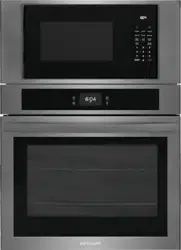
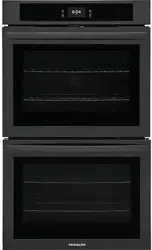
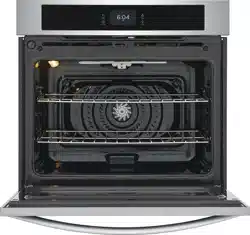
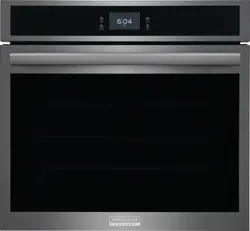
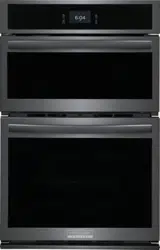
WALL OVEN
MICROWAVE
COMBO
Introduction. . . . . . . . . . . . . . . . . .2
Important Safety Instructions. . . . . . . .3
Cooking Recommendations. . . . . . . . .11
Before Setting Oven Controls. . . . . . . 15
Setting Oven Controls . . . . . . . . . . . 21
Before Using Microwave . . . . . . . . . . 48
Setting Microwave Controls . . . . . . . . 53
Care and Cleaning . . . . . . . . . . . . . 59
Before You Call . . . . . . . . . . . . . . . 65
Warranty . . . . . . . . . . . . . . . . . . 68
807574505 Rev A (February 2022)
2
IntroductIon
IntroductIon
Welcome to our
family
Thank you for bringing Frigidaire into your home!
We see your purchase as the beginning of a long
relationship together.
This manual is your resource for the use and care
of your product. Please read it before using your
appliance. Keep it handy for quick reference. If
something doesn’t seem right, the troubleshooting
section will help you with common issues.
FAQs, helpful tips and videos, cleaning products, and
kitchen and home accessories are available at www.
Frigidaire.com.
We are here for you! Visit our website, chat with an
agent, or call us if you need help. We may be able
to help you avoid a service visit. If you do need
service, we can get that started for you.
Let’s make it ocial! Be sure to register your prod-
uct.
Keep your product info here so it’s easy to find.
Model Number:
Serial Number:
Purchase Date:
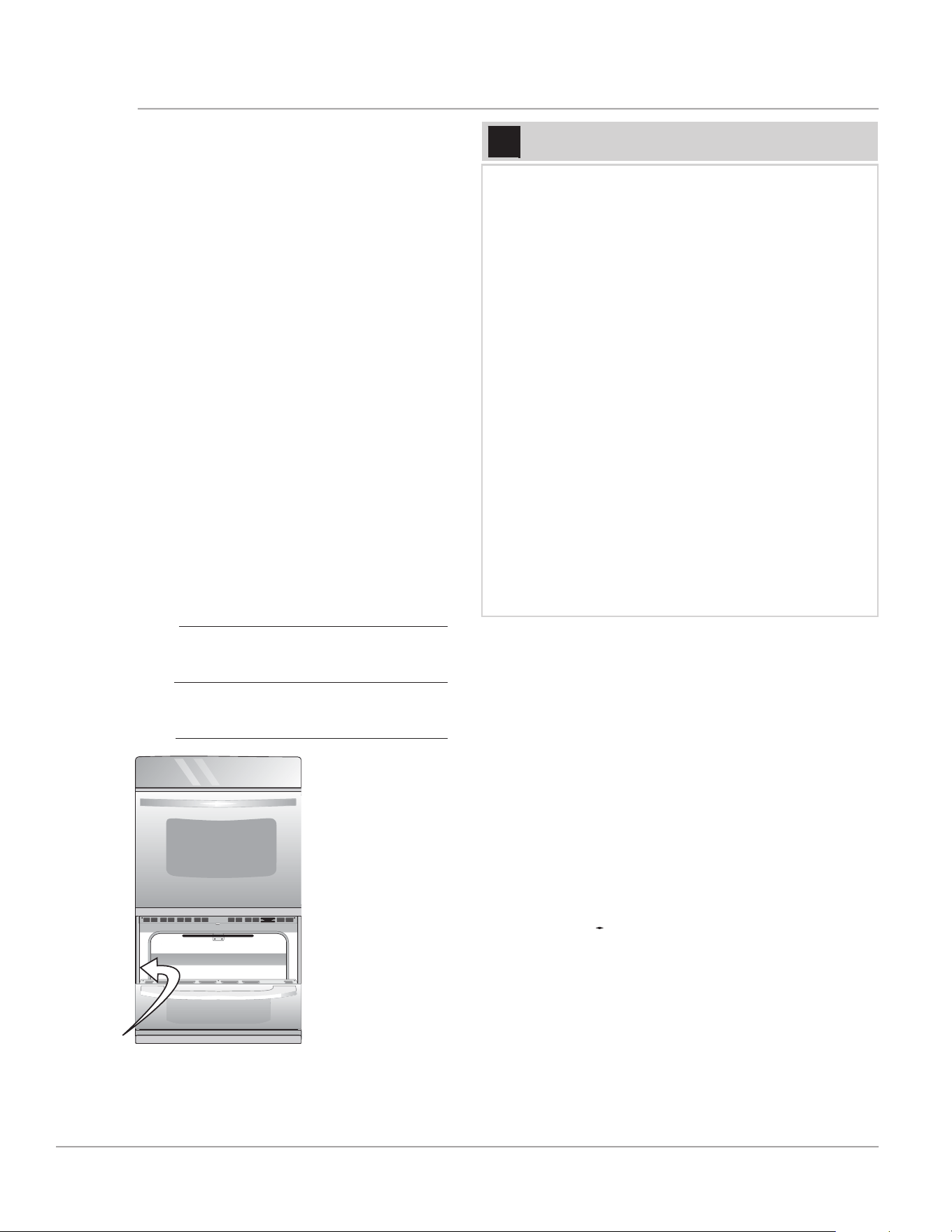
Serial Number Location
Read all the safety instructions in the front of
your Use & Care Manual.
Remove all packaging materials from your ap-
pliance before cooking.
Confirm that the electrical power to the appli-
ance is turned on.
Wipe out the inside of the oven cavity with a
damp cloth.
Apply a thin layer of cooking oil to the sides of
the oven racks to keep them gliding smoothly.
Set the clock. See (page 17) for instructions.
Before cooking, set the oven to bake at 350°F
(177ºC) for 30 minutes (page 18). Some noise
and odors are normal on the first cooking cycle.
Remember to complete your product registra-
tion!
Installation checklist
3
Important Safety InStructIonS
defInItIonS
This is the safety alert symbol. It is
used to alert of potential personal injury
hazards. Obey all safety messages that
follow this symbol to avoid possible injury
or death.
WarnInG
Indicates a potentially hazardous
situation which, if not avoided, may
result in death or serious injury.
cautIon
Indicates a potentially hazardous
situation which, if not avoided, may
result in minor or moderate injury.
Important
Indicates installation, operation or
maintenance information which is
important but not hazard-related.
Read all instructions before using this
appliance.
This manual contains important safety
symbols and instructions. Please pay
attention to these symbols and follow all
instructions given.
Do not attempt to install or operate your
appliance until you have read the safety
precautions in this manual. Safety items
throughout this manual are labeled with a
WARNING or CAUTION statement based
on the risk type.
Warnings and important instructions
appearing in this guide are not meant to
cover all possible conditions and situations
that may occur. Common sense, caution,
and care must be exercised with installing,
maintaining, or operating your appliance.
note
Indicates a short, informal reference –
something written down to assist the
memory or for future reference.
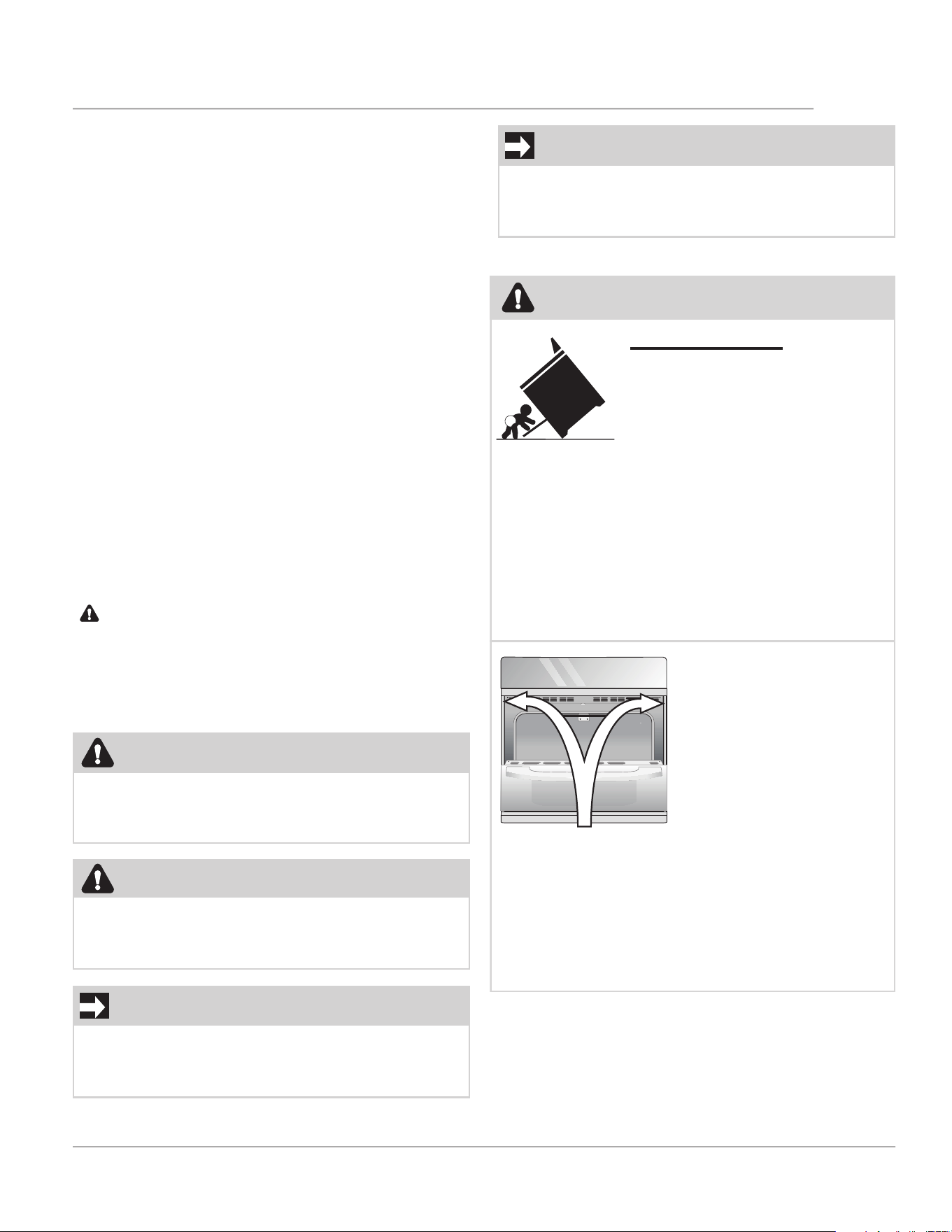
WARNING
Tip Over Hazard
• A child or adult can tip the
oven and be killed.
• Install the anti-tip device
to oven and/or structure
per installation instructions.
• Ensure the anti-tip device is
re-engaged when the oven is moved.
• Do not operate the oven without the
anti-tip device in place and engaged.
• Failure to follow these instructions can
result in death or serious burns to
children and adults.
Refer to the installation
instructions supplied with
your appliance for proper
installation.
Anti-tip mounting holes
Check for proper installation with a visual
check that the anti-tip screws are present. Test
the installation with light downward pressure
on the open oven door. The oven should not
tip forward.
4
Important Safety InStructIonS
Important InStructIonS for
unpacKInG and InStaLLatIon
Important
Read and follow the below instructions
and precautions for unpacking, installing,
and servicing your appliance.
Remove all tape and packaging before
using the appliance. Destroy the carton
and plastic bags after unpacking the
appliance. Never allow children to play
with packaging material. Do not remove
the wiring label and other literature
attached to the appliance. Do not remove
model/serial number plate.
Cold temperatures can damage the
electronic control. When using this
appliance for the first time, or when
the appliance has not been used for an
extended period of time, be sure the
appliance has been in temperatures above
32ºF (0ºC) for at least 3 hours before
turning on the power to the appliance.
All materials used in construction of
cabinets, enclosures, and supports
surrounding the product must have a
temperature rating above 200°F (94°C).
Never modify or alter the construction of
the appliance by removing the leveling
legs, panels, wire covers, anti-tip brackets/
screws, or any other part of the appliance.
Be sure to have an appropriate foam-
type fire extinguisher available, visible,
and easily accessible located near the
appliance.
precautIonS to aVoId poSSIBLe
eXpoSure to eXceSSIVe mIcroWaVe
enerGy
For your safety, the information in this
manual must be followed to minimize the
risk of fire or explosion or to prevent prop-
erty damage, personal injury or loss of life.
Adhere to the following precautions:
• DO NOT attempt to operate the micro-
wave oven with the door open since
open-door operation can result in
harmful exposure to microwave energy.
It is important not to defeat or tamper
with the safety interlocks.
• DO NOT place any object between
the microwave oven front face and the
door or allow soil or cleaner residue to
accumulate on sealing surfaces.
• DO NOT operate the microwave oven if
it is damaged. It is particularly import-
ant that the oven door close properly
and that there is no damage to the:
(1) door (bent), (2) hinges and latches
(broken or loosened), (3) door seals
and sealing surfaces.
• The microwave oven should not be
adjusted or repaired by anyone except
properly qualified service personnel.
5
Important Safety InStructIonS
GroundInG InStructIonS
WarnInG
• Avoid fire hazard or electrical shock.
Failure to follow this warning may
cause serious injury, fire, or death.
• Avoid fire hazard or electrical shock.
Do not use an adapter plug, use an
extension cord, or remove grounding
prong from the power cord. Failure to
follow this warning may cause serious
injury, fire, or death.
Proper Installation—Be sure your appliance
is properly installed and grounded by a
qualified technician. In the United States,
install in accordance with the National
Fuel Gas Code ANSI Z223.1/NPFA No.
54, latest edition and National Electrical
Code NFPA No. 70 latest edition, and local
electrical code requirements. In Canada,
install in accordance with CAN/CGA B149.1
and CAN/CGA B149.2 and CSA Standard
C22.1, Canadian Electrical code, Part
1-latest editions and local electrical code
requirements. Install only per installation
instructions provided in the literature
package for this appliance.
For personal safety, this appliance must
be properly grounded. For maximum
safety, the power cord must be securely
connected to an electrical outlet or
junction box that is the correct voltage,
is correctly polarized and properly
grounded, and protected by a circuit
breaker in accordance with local codes.
It is the personal responsibility of the
consumer to have the appropriate outlet
or junction box with the correct, properly
grounded wall receptacle installed by a
qualified electrician. It is the responsibility
and obligation of the consumer to contact
a qualified installer to assure that the
electrical installation is adequate and is
in conformance with all local codes and
ordinances.
See the installation instructions packaged
with this appliance for complete
installation and grounding instructions.
Important InStructIonS for uSInG
tHe appLIance
WarnInG
• Storage In or On Appliance—
Flammable materials should not
be stored in an oven or microwave,
near surface burners or elements,
or in the storage or warmer drawer
(if equipped). This includes paper,
plastic, and cloth items, such as
cookbooks, plastic ware, and towels,
as well as flammable liquids. Do not
store explosives, such as aerosol cans,
on or near the appliance.
• Do not leave children alone -
Children should not be left alone
or unattended in the area where
appliance is in use. They should never
be allowed to sit or stand on any part
of the appliance, including the storage
drawer, lower broiler drawer, warmer
drawer, or lower double oven.
• Do not store items of interest to
children in the cabinets above the
appliance or on the backguards of
ranges. Children climbing on or near
the appliance to reach items could be
seriously injured.
• Do not allow children to climb or play
around the appliance. The weight of
a child on an open oven door may
cause the appliance to tip, resulting in
serious burns or other injury. An open
drawer when hot may cause burns.
6
Important Safety InStructIonS
WarnInG
• Stepping, leaning, or sitting on the
door or drawers of this appliance
can result in serious injuries and also
cause damage to the appliance.
• Never cover any slots, holes or
passages in the oven bottom or cover
and entire rack with materials such as
aluminum foil. Aluminum foil linings
may also trap heat, causing a fire
hazard.
• Do not use oven or warmer drawer (if
equipped) for storage.
• Never use your appliance as a space
heater to heat or warm the room.
Doing so may result in carbon
monoxide poisoning and overheating
of the appliance.
cautIon
• When heating fat or grease, watch
it closely. Grease may catch fire if it
becomes too hot.
• Do not use water or flour on grease
fires. Smother fire or flame or use dry
chemical or foam-type extinguisher.
Cover the fire with a pan lid or use
baking soda.
• Use dry potholders. Moist or damp
potholders on hot surfaces may
result in burns from steam. Do not let
potholders touch hot cooking areas.
Do not use towels or other bulky
cloths.
• Do not heat unopened food
containers - Build-up of pressure may
cause container to burst and result in
injury.
cautIon
• Wear proper apparel - Loose-fitting
or hanging garments should never be
worn while using the appliance. Do
not let clothing or other flammable
materials contact hot surfaces.
• Do not touch surface burners or
elements, areas near these burners
or elements, interior surfaces of
the oven, or the warmer drawer (if
equipped). Surface burners and
elements may be hot even though
they appear cool. Areas near surface
burners and elements may become
hot enough to cause burns. During
and after use, do not touch, or let
clothing or other flammable materials
touch these areas until they are cool.
These areas may include the cooktop,
surfaces facing the cooktop, oven
vent areas, oven door, and oven
window.
• Do not attempt to operate the
appliance during a power failure. If
the power fails, always turn o the
appliance. If the appliance is not
turned o and the power resumes,
electric surface elements may resume
operation when power is restored.
Once the power resumes, reset the
clock and the oven function.
7
Important Safety InStructIonS
Important InStructIonS for uSInG
your oVen
Protective liners—Do not use aluminum
foil, aftermarket oven liners, or any
other materials or devices to line oven
bottom, oven racks, or any other part
of the appliance. Only use aluminum
as recommended for baking, such as
lining cookware or as a cover placed on
food. Any other use of protective liners
or aluminum foil may result in a risk of
electric shock or fire or a short circuit.
Use care when opening oven door, lower
oven door, or warmer drawer (some
models). Stand to the side of the appliance
when opening the door of a hot oven. Let
hot air or steam escape before you remove
or replace food in the oven.
Keep oven vent ducts unobstructed.
Touching surfaces in this area when the
oven is on may cause severe burns. Do not
place plastic or heat-sensitive items on or
near the oven vent. These items can melt
or ignite.
Placement of oven racks - Always place
oven racks in desired location while oven
is cool. If rack must be moved while oven
is hot, do not let potholder contact hot
burner or element in oven. Use potholders
and grasp the rack with both hands to
reposition. Remove all cookware and
utensils before moving the rack.
Do not use a broiler pan without its insert.
Broiler pans and inserts allow dripping fat
to drain away from the high heat of the
broiler. Do not cover the broiler insert with
aluminum foil; exposed fat and grease
could ignite.
Do not cook food on the oven bottom.
Always cook in proper cookware and
always use the oven racks.
Important InStructIonS for uSInG
your mIcroWaVe oVen
WarnInG
When using electrical appliances, basic
safety precautions should be followed to
reduce the risk of burns, electric shock,
fire, injury to persons, or exposure to ex-
cessive microwave energy.
Read all instructions before using the
appliance.
Read and follow the specific
PRECAUTIONS TO AVOID POSSIBLE
EXPOSURE TO EXCESSIVE MICROWAVE
ENERGY.
Install or locate this appliance only in
accordance with the provided installation
instructions.
Some products such as whole eggs and
sealed containers - for example, closed
jars - are able to explode and should not
be heated in this microwave oven.
Use this appliance only for its intended
use as described in this manual. Do not
use corrosive chemicals or vapors in this
appliance. This type of microwave oven is
specifically designed to heat, cook, or dry
food. It is not designed for industrial or
laboratory use.
As with any appliance, close supervision is
necessary when used by children or infirm
persons.
This appliance, including power cord,
must be serviced only by qualified service
personnel. Contact nearest authorized
servicer for examination, repair, or
adjustment.
Do not cover or block any vents or
openings on the microwave oven.
Do not store or use this appliance
outdoors.
8
Important Safety InStructIonS
Do not use this product near water - for
example: near a kitchen sink, in a wet
basement, near a swimming pool, or simi-
lar locations.
Oversized foods or oversized metal uten-
sils should not be inserted in a microwave
oven as they may create a fire or risk of
electric shock.
Do not clean with metal scouring pads.
Pieces can burn o the pad and touch
electrical parts, involving a risk of electric
shock.
Do not use paper products when appli-
ance is operated in the convection or mix
mode (some models).
Do not cover racks (if equipped) or any
other part of the microwave oven with
metal foil. This will cause overheating of
the microwave oven.
Review the door cleaning instructions in
the operating instructions.
cautIon
To reduce the risk of fire in the micro-
wave oven cavity, take the following
precautions:
Do not overcook food. Carefully attend to
the appliance when paper, plastic or other
combustible materials are placed inside
the microwave oven to facilitate cooking.
Remove wire twist-ties from paper or plas-
tic bags before placing bags in the micro-
wave oven.
If materials inside the microwave oven ig-
nite, keep oven door closed, turn oven o,
and disconnect the power cord or shut o
power at the fuse or circuit breaker panel.
Do not use microwave oven cavity for stor-
age purposes.
Do not leave paper products, cooking
utensils, or food in the cavity when not in
use.
Liquids such as water, coee, or tea are
able to be overheated beyond the boiling
point without appearing to be boiling. Visi-
ble bubbling or boiling when the container
is removed from the microwave oven is not
always present. This could result in very
hot liquids suddenly boiling over when a
spoon or other utensil is inserted into the
liquid.
To reduce the risk of injury to persons
from boiling liquids:
Do not overheat the liquid.
Stir the liquid both before and halfway
through heating it.
Do not use straight-sided containers with
narrow necks. Use wide-mouthed contain-
ers.
After heating, allow the container to stand
in the microwave oven at least 20 seconds
before removing.
Use extreme care when inserting spoons
or other utensils into the container.
If the microwave oven light fails, consult an
authorized servicer.
9
Important Safety InStructIonS
Important InStructIonS for
cLeanInG your appLIance
cautIon
Before manually cleaning any part of the
appliance, be sure all controls are turned
o and the appliance is cool. Cleaning a
hot appliance can cause burns.
Clean the appliance regularly to keep all
parts free of grease that could catch fire.
Do not allow grease to accumulate. Greasy
deposits in the fan could catch fire.
Always follow the manufacturer’s
recommended directions for use of
kitchen cleaners and aerosols. Be aware
that excess residue from cleaners and
aerosols may ignite causing damage and
injury.
Clean ventilating hoods frequently. Grease
should not be allowed to accumulate on
hood or filter. Follow the manufacturer’s
instructions for cleaning vent hoods.
Important InStructIonS for SeLf
cLeanInG oVenS
cautIon
Before using self clean, remove the
broiler pan, any food, utensils, and
cookware from the oven, storage drawer
or warming drawer (if equipped).
Remove oven racks unless otherwise
instructed.
Do not clean the oven door gasket. The
door gasket is essential for a good seal.
Care should be taken not to rub, damage,
or move the gasket.
Do not use oven cleaners. No commercial
oven cleaner or oven liner protective
coating of any kind should be used in or
around any part of the appliance.
Use the self clean cycle to clean only the
parts listed in this manual.
Some birds are extremely sensitive to the
fumes given o during the self clean cycle
of any oven. Move birds to another well-
ventilated room.

10
Important Safety InStructIonS
WarnInG
California Residents: for cancer and re-
productive harm information, visit
www.P65Warnings.ca.gov
Important InStructIonS for
SerVIce and maIntenance
Do not repair or replace any part
of the appliance unless specifically
recommended in the manuals. All other
servicing should be done only by a
qualified technician. This reduces the risk
of personal injury and damage to the
appliance.
Always contact your dealer, distributor,
service agent, or manufacturer about
problems or conditions you do not
understand.
Ask your dealer to recommend a
qualified technician and an authorized
repair service. Know how to disconnect
the power to the appliance at the
circuit breaker or fuse box in case of an
emergency.
Remove the oven door from any unused
oven if it is to be stored or discarded.
Do not touch a hot oven light bulb with
a damp cloth. Doing so could cause the
bulb to break. Handle halogen lights
(if equipped) with paper towels or soft
gloves. Disconnect the appliance or shut
o the power to the appliance before
removing and replacing the bulb.
Federal Communications Commission
Radio Frequency Interference Statement
(USA only)
This equipment generates and used ISM
frequency energy and if not installed and
used properly, that is in strict accordance
with the manufacturer’s instructions,
may cause interference to radio and
television reception. It has been type
tested and found to comply with limits
for ISM Equipment pursuant to part 18 of
FCC Rules, which are designed to provide
reasonable protection against such
interference in a residential installation.
However, there is no guarantee that
interference will not occur in a particular
installation. If this equipment does
cause interference to radio or television
reception, which can be determined
by turning the equipment on and o,
the user is encouraged to try to correct
the interference by one or more of the
following:
• Reorient the receiving antenna of the
radio or television.
• Relocate the microwave oven with
respect to the receiver.
• Move the microwave oven away from
the receiver.
• Plug the microwave oven into a
dierent outlet so that the microwave
oven and the receiver are on dierent
branch circuits.
The manufacturer is not responsible
for any radio or television interference
cause by unauthorized modification
to this microwave oven. It is the
responsibility of the user to correct
such interference.
11
cooKInG recommendatIonS
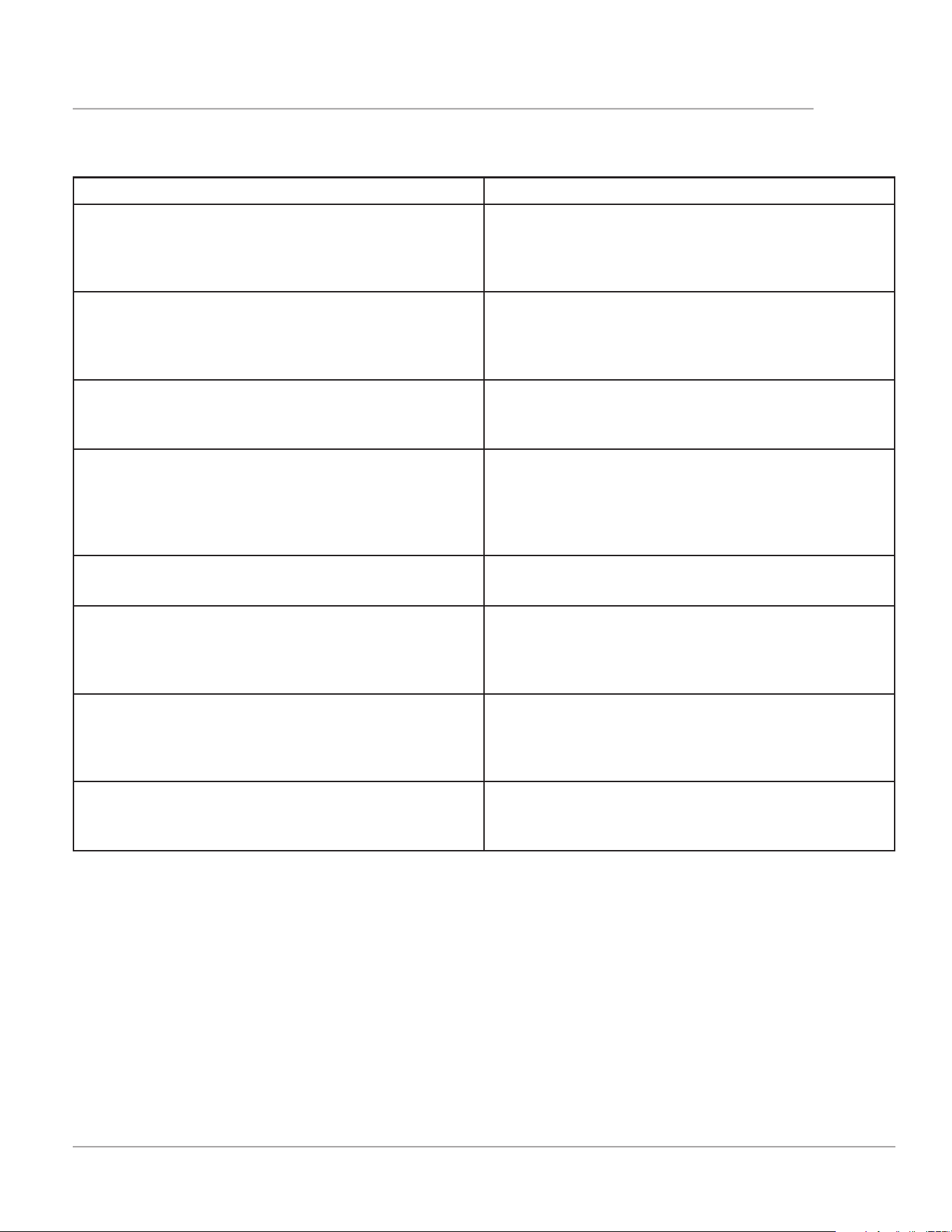
Special features
Use the special features of your Electrolux oven to get the best baking and roasting results.
Goal feature
• Steaks perfectly cooked to your preference
• Juicy pork and poultry
• Eggs just as hard or soft as you like them
• Vegetables that remain firm and crisp
Air Sous Vide
The precisely-controlled heat and airflow give
you sous vide results without the water bath,
preserving natural flavors and locking in moisture.
• Breads and pastries that rise higher with
a crispy, golden crust and a light and flaky
interior
Steam Bake
Steam baking slows the formation of the crust,
allowing your dough to grow longer before the
crust forms.
• Moist and tender meats with a golden, crispy
skin on the outside.
Steam Roast
The humidity of steam roasting prevents meats
from drying out during the cooking process.
• Golden, crispy chicken wings
• Crunchy vegetable chips
• Juicy chicken parmesan
• Perfectly crisp tempura shrimp, samosas, and
more
Air Fry
The hot air convection makes crisp, golden fried
foods without the splatter. For even heating on
all sides and large capacity, use the Air Fry Tray
(included).
• Prepare convenience foods without delay No Preheat
Get your culinary delights on the table faster
• Healthy, flavorful fruit snacks
• Lean meat jerky
• Dried herbs
Dehydrate
The dehydrate feature keeps the oven on low
humidity and low heat to dry foods without
cooking them.
• Perfectly browned baked goods
• Evenly cooked roasts and braises
Advanced Convection
Even your most challenging recipes turn out
delicious with the precisely-controlled heat and air
circulation of Advanced Convection
• Roast turkey that’s crispy on the outside and
juicy on the inside.
Turkey Option
Precisely times your convection roast for turkey
that is perfectly done.
12
cooKInG recommendatIonS
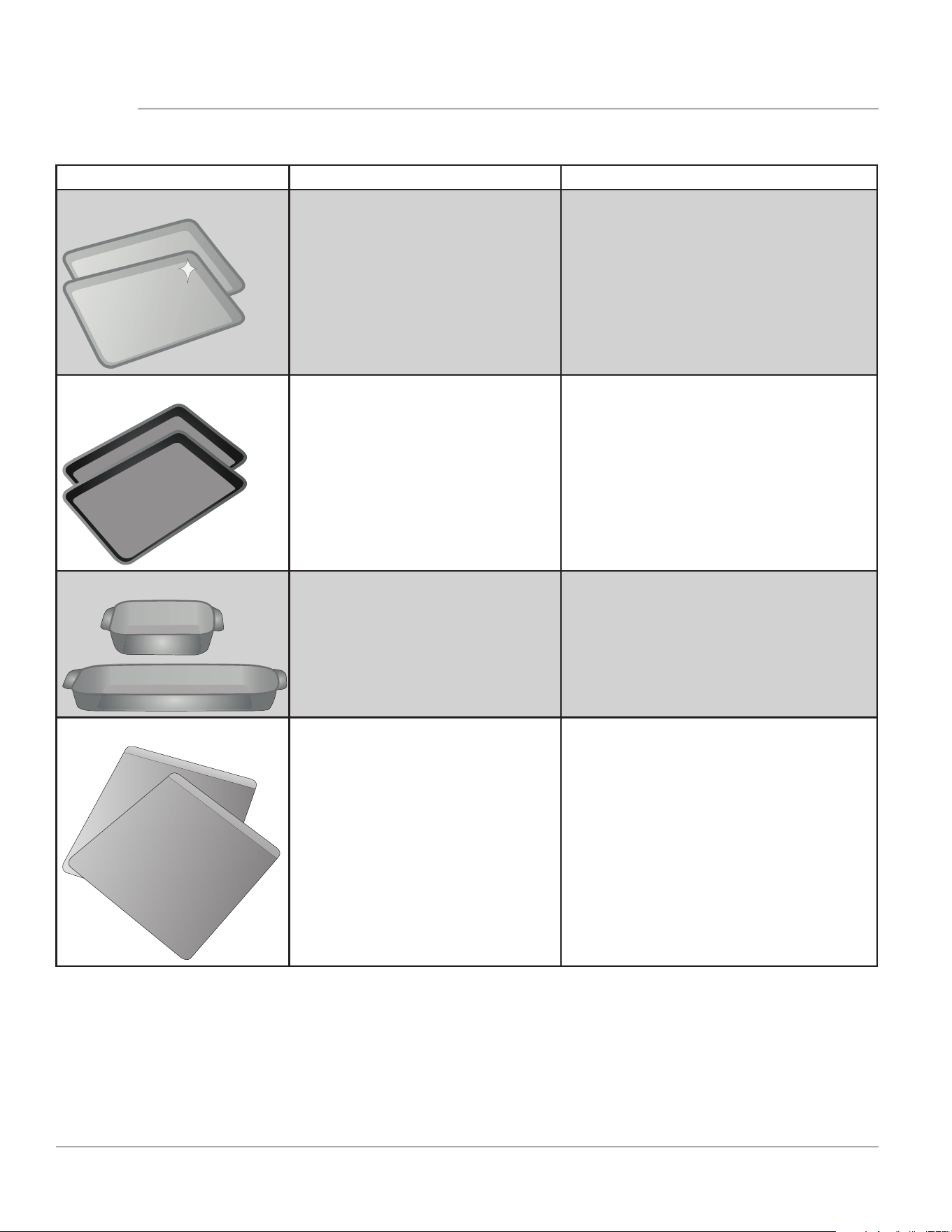
Bakeware
The material of bakeware aects how evenly and quickly it transfers heat from the pan to the food.
material attributes recommendation
Shiny metal bakeware Shiny, aluminum, and non-coated
bakeware is the best for even
heating. It is suitable for all baked
goods.
Recommended cooking temperatures
and times are based on shiny metal
bakeware.
Dark metal bakeware
Dark bakeware cooks hotter than
shiny bakeware.
Reduce the cooking temperature by
25°F
(13-14°C) when using dark bakeware.
Glass bakeware
Glass bakeware cooks hotter
than shiny bakeware.
Glass is convenient, as the same
piece of bakeware can be used
for cooking, serving, and storing
food.
Reduce the cooking temperature by
25°F
(13-14°C) when using glass bakeware.
Insulated bakeware
Insulated bakeware cooks cooler
than shiny bakeware.
Insulated bakeware is designed
for baking in gas ovens.
When using insulated bakeware the
recipe baking time may be longer than
usual.
13
cooKInG recommendatIonS
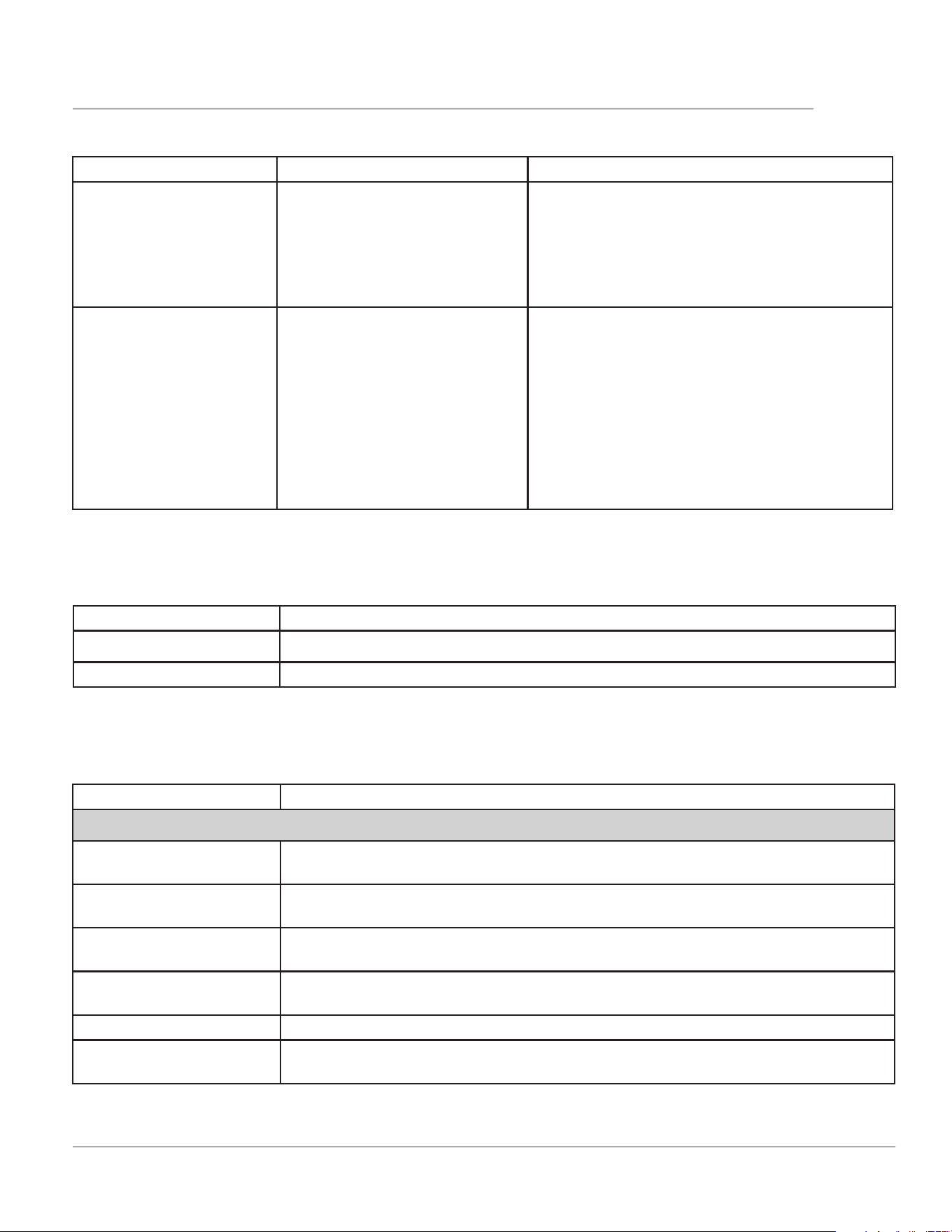
cooking conditions
Conditions in your kitchen can aect the performance of your appliance when cooking food.
condition attributes recommendation
Aging cookware As pans age and become
discolored, cooking times may
need to be reduced slightly.
If food is too dark or overcooked, use
the minimum cook time in the recipe or
packaging.
If food is too light or undercooked, use the
middle to maximum cook time in the recipe
or packaging.
High altitude Air is drier and air pressure is
lower.
Water boils at a lower
temperature, and liquids
evaporate faster.
Foods may take longer to
bake.
Doughs may rise faster.
Adjust cooking temperature, cooking time, or
recipes as needed.
Increase amount of liquid in baking recipes.
Increase cook time on cooktop. Cover dishes
to reduce evaporation.
Increase bake time or oven temperature.
Reduce amount of baking soda or baking
powder in recipe. Reduce rising time or
punch down dough and allow it to rise twice.
cooking results
Small adjustments may help you achieve the best results.
result recommendation
Food too light Use the middle to maximum cook time recommended on packaging or recipe.
Food too dark Use the minimum cook time recommended on packaging or recipe.
cooking tips
Use these additional tips to get the best results from your appliance.
Situation recommendation
Baking
Rack placement Follow the instructions in particular oven mode starting in “Setting Oven
Controls” on page 21.
Preheat Fully preheat the oven before baking items like cookies, cakes, biscuits and
breads. Insert food immediately after the beep.
Checking food Use the window and oven light when checking food. Opening the door may
reduce baking performance.
Bake or Convection Bake Convection bake is the best function to use for baking on multiple racks. For
best performance, see.”Convection Bake” on page 25.
Steam Bake For directions, tips, and benefits of Steam Bake see “Steam Bake” on page 37.
Food placement Allow at least 2 inches (5 cm) of space between bakeware for proper air
circulation.
14
cooKInG recommendatIonS
material recommendation
Broiling / roasting
Broiling pan For best results when broiling, use a broil pan with an insert designed to drain
the fat from the food, help avoid spatter, and reduce smoking. The broiler pan will
catch grease spills, and the insert helps prevent grease splatters. To purchase the
broiling pan go to Fridgidaire.com.
convection cooking
Convection
attributes
Convection cooking uses a fan to circulate hot air around the oven and food. It
browns food more evenly and reduces hot spots in the oven.
Convection saves time when using multiple racks or cooking several food items at
once.
Convection bake Reduce cooking temperature by 25° F (13-14° C) from the recipe unless the recipe
is written for convection baking.
Preheat the oven for best results.
Convection roast Convection roast is best for meats and does not require preheating for most
meats and poultry.
Reducing the cooking temperature for convection roast is not recommended.
Carefully follow your recipe’s temperature and time recommendations, adjusting
the cooking time if the recipe does not specify convection roasting time.
Since convection roast cooks faster, cook time may be reduced by 25% to 40%
depending on food type. You can reduce cook times by 25% from the recom-
mended time of your recipe, and check the food at this time. If needed, continue
cooking until the desired doneness is obtained.
Use the meat probe included with your appliance. Meat probes are also available
from most grocery and home goods stores.
Arrange oven racks so large cuts of meat and poultry are on the lowest rack of
the oven.
Do not cover foods when dry roasting - covering will prevent the meat from
browning properly.
When cooking meats, use the broiler pan and insert or a roasting rack. The broiler
pan will catch grease spills and the insert helps prevent grease splatters.

15
Before SettInG oVen controLS
figure 1: oven vent
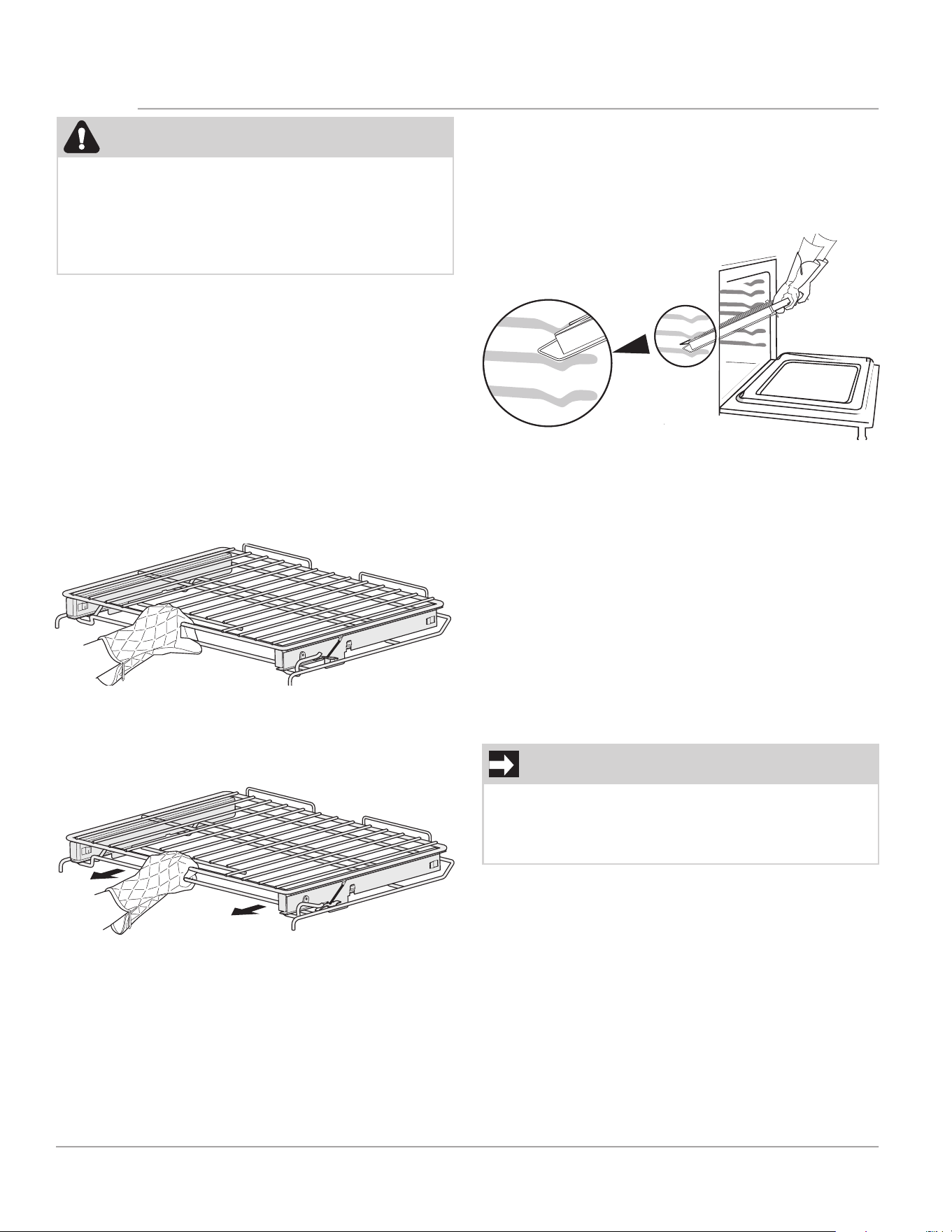
• flat oven racks may be used for most cooking
needs and may be placed in most oven rack
positions.
• The fully extendable glide rack makes food
preparation easier. This oven rack has glide
tracks that allow the rack to be pulled away
from the oven without rubbing the sides of the
oven wall. See glide rack instructions on next
page.
flat
oven rack
figure 2: oven rack types
oven vent
location
cautIon
Always use pot holders or oven mitts when using
the oven. When cooking, the oven interior, oven
exterior, oven racks, and cooktop will become
very hot which can cause burns.
Remove all oven racks before starting a self clean
cycle. If oven racks are left inside the oven during
a cleaning cycle, the slide ability of the oven
racks may be damaged and all of the oven racks
will lose their shiny finish.
To prevent possible damage to the oven, do not
attempt to close the oven door until all the oven
racks are fully positioned back inside the oven
cavity.
WarnInG
Protective Liners — Do not use aluminum foil
or any other material or liners to line the oven
bottom, walls, racks or any other part of the
range. Doing so will alter the heat distribution,
produce poor baking results, and possibly cause
permanent damage to the oven interior. Improp-
er installation of these liners may result in risk of
electric shock or fire. During self clean, tempera-
tures in the oven will be hot enough to melt foil.
oven Vent Location
The oven is vented as shown below. When the oven
is on, warm air is released through the vent. This
venting is necessary for proper air circulation in the
oven and good baking results. Do not block oven
vent. Never close o the openings with aluminum
foil or any other material. Steam or moisture may
appear near the oven vent. This is normal.
types of oven rack
glide
rack
Important
Your Frigidaire wall oven has many features that
allow you to customize the way your oven works.
Take time to read this section for important
safety information and to become familiar with
the many menu option settings starting on page
17.
16
Before SettInG oVen controLS
WarnInG
Do not line the oven walls, racks, bottom or any
other parts of the range with aluminum foil. Do-
ing so will alter heat distribution, produce poor
baking results and may cause permanent damage
to the oven interior. During self-clean tempera-
tures the oven will be hot enough to melt foil.
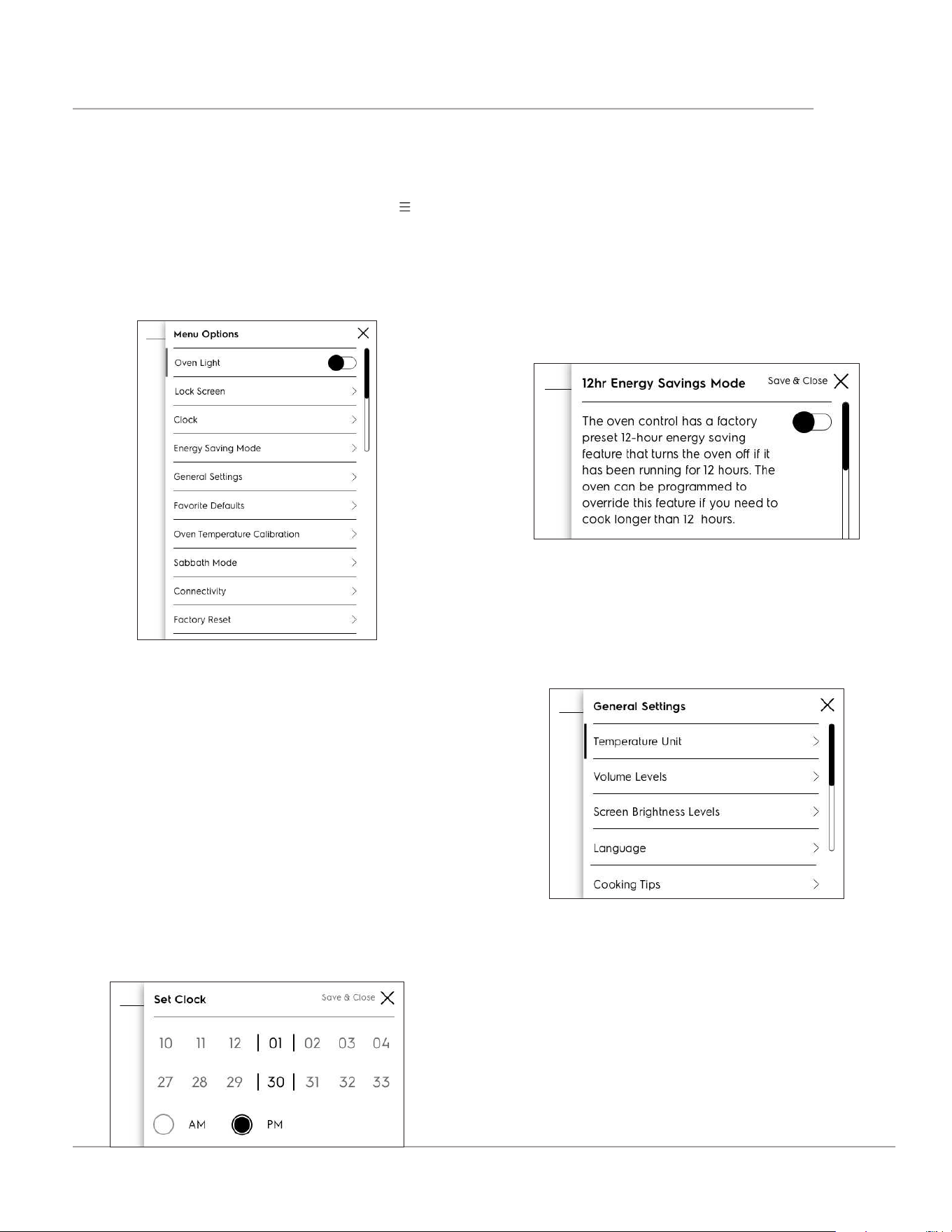
removing and replacing the Glide racks
The fully extendable Glide rack makes food prepa-
ration easier. This oven rack has glide tracks that
allow the rack to be pulled away from the oven
without rubbing the sides of the oven wall.
to remove - Make sure the baking rack is in the
closed position. Using one hand, reach through
handle opening and grasp both the upper and low-
er bars of the glide rack.
While holding both sections, pull the glide rack out
of the oven until the stop position is reached.
Using both hands, lift up the front of the rack
slightly and continue to pull the rack away from the
oven. Be sure to grasp both upper and lower rack
portions together when removing or handling the
glide rack.
The rack portions move independently and are
dicult to handle unless held together.
to replace - Make sure the baking rack is in the
closed position. Grasp both upper and lower
portions of glide rack. Lift and hold the rack level
between the oven cavity walls. Tilt the front of the
rack upward slightly and slide the rack completely
into position.
To prevent possible damage to the oven, do not
attempt to close the oven door until all the oven
racks are fully positioned back inside the oven
cavity.
Important
Remove all oven racks and clean according to
instructions provided in the Care & Cleaning
section of this manual. Never pick up hot oven
racks or parts.
17
Before SettInG oVen controLS
using menu options to customize your
cooking experience
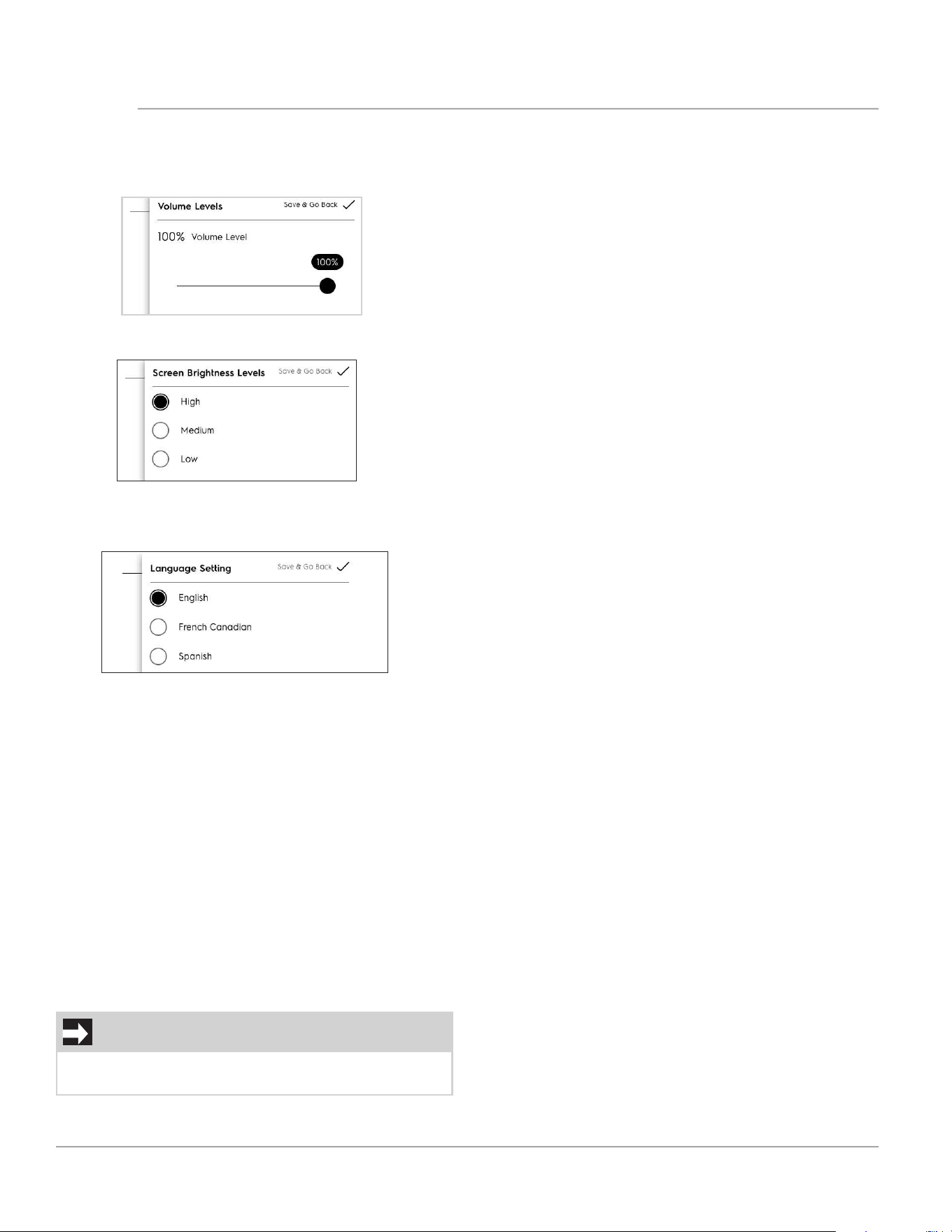
When you first install your appliance, the screen
will prompt you to set your preferences. You can
always change them later using the menu .
1. Touch the Menu Options bars and scroll to find
the desired option.
2. Select option and set your preference.
3. Save and go back or Save & close.
clock
When the appliance is first plugged in or when the
power supply to the appliance has been interrupt-
ed, the display will show 12:00. It is recommended
to always set the clock for the correct time of day
before using the appliance.
1. Touch menu options bars and scroll to clock.
You will see options to turn o the clock dis-
play when the oven is o, to change from 12-
hour to 24-hour time, and to set the clock.
2. Touch Set clock and set time using graph.
3. Set AM or PM
4. Save & close
energy Saving mode
The oven control has a factory preset built-in 12-
Hour Energy Saving feature that will turn o the
oven if the oven is left on for more than 12 hours.
The control may be programmed to override this
feature to bake
continuously.
1. Scroll to energy Saving mode and touch.
2. Follow the information to override the Energy
Saving feature if necessary.
3. Save & Close.
General Settings
1. Scroll to General Settings and touch.
2. Dierent options will appear.
3. Select an option to see how it is set and change
if desired.
temperature display
The electronic oven control is set to display °F
when shipped from the factory. The display may
be changed to show either °F or ºC oven tempera-
tures.
Temperature Display > O Fahrenheit
O Celcius
4. Select fahrenheit or celcius.
5. Save & close
You can press the X to close without saving chang-
es.
18
Before SettInG oVen controLS
Screen Brightness
Volume
Volume allows the oven control to operate with
strong tones, quiet tones, or no tones. Use the slid-
er to set the volume.
oven temperature calibration
Your appliance has been factory calibrated and
tested to ensure an accurate baking temperature.
For the first few uses, follow your recipe times and
temperature recommendations carefully. If you
think the oven is cooking too hot or too cool for
your recipe times, you can adjust the control so the
oven cooks hotter or cooler than the temperature
displayed.
Important: Do not use oven thermometers such as
those found in grocery stores to check the tem-
perature settings inside your oven. These oven
thermometers may vary as much as 20 to 40 de-
grees from actual temperatures.
1. Scroll to oven temperature calibration and
touch.
2. Option to adjust is shown.
3. Use slide to increase or decrease default oven
temperature.
4. Save and go back or Save & close.
The oven temperature may be increased as much
as +35°F (+19°C) or decreased -35°F (-19°C) from
the factory calibrated settings.
note
These temperature options are also available in
Custom Preheat menu on the main screen
1. Choose brightness and Save & Close.
Language
1. Select desired language
2. Save
favorites
Scroll to Favorites and touch.
• Quick Start options > Oven 350°F (can
change the default when Quick Start is
selected)
1. Change temperature if desired.
2. Save.
• temperature options > Adjust Custom Preheat
default.
1. 325°F / 163°C
2. 375°F / 191°C
3. 400°F / 204°C
cooking tips
You can switch whether cooking tips are displayed
or not by choosing On or O.
• microwave options > Adjust Microwave Time
and Power defaults.
Set change microwave time and power defaults
by typing the new numbers. There are three
power default buttons that can be changed.
1. 100%
2. 80%
3. 50%
19
Before SettInG oVen controLS
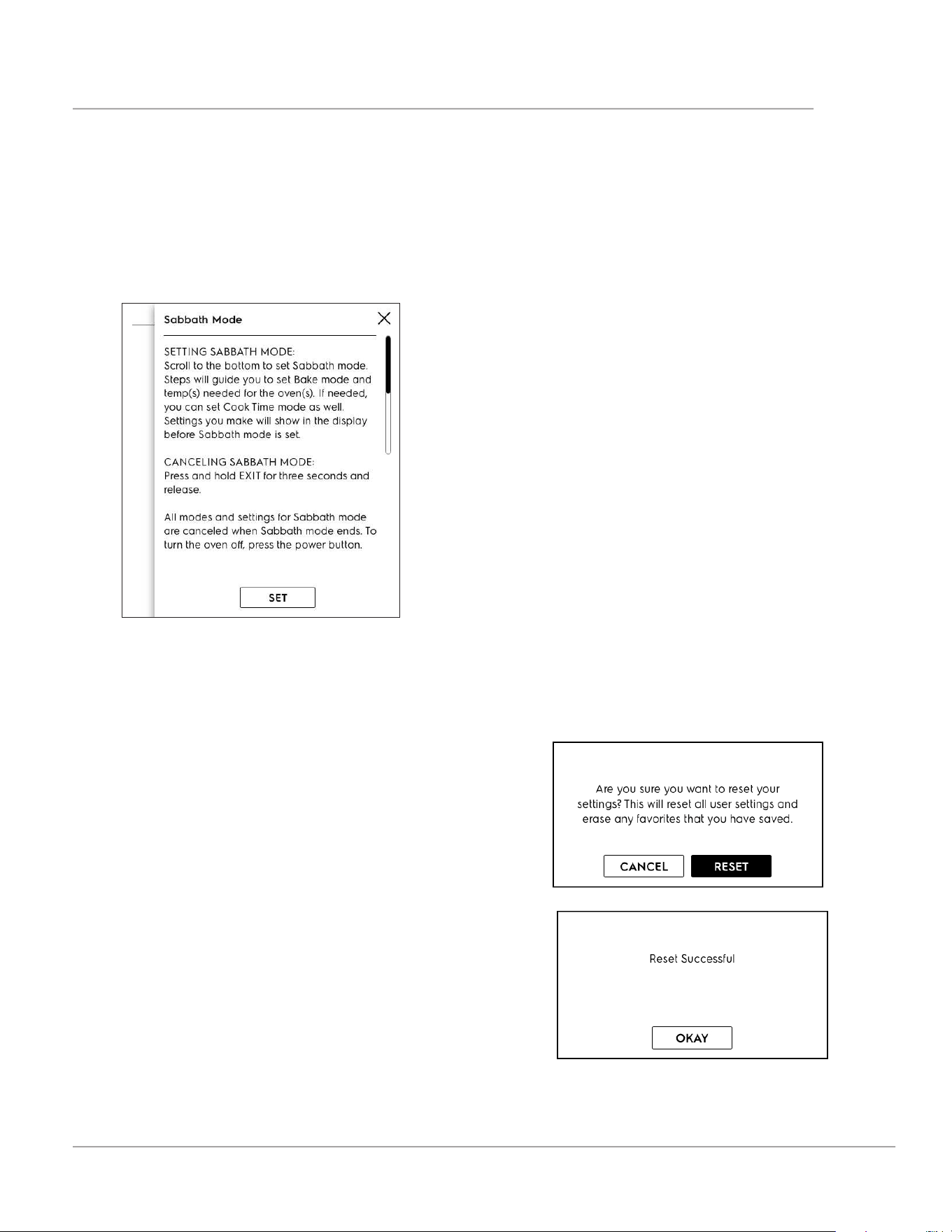
Sabbath mode
1. Scroll to Sabbath mode.
2. Read and follow all instructions to set and
when finished cancel. See “Setting the Sabbath
Feature for the
Jewish Sabbath and Holidays
(some models)” on page 46 for complete
details on how Sabbath mode works with your
oven controls.
factory reset
1. Scroll to factory reset and touch
2. follow screen prompts
Note: Your appliance was set with predetermined
(default) oven control settings. Over time, users
may have made changes to these settings. The fol-
lowing options may have been modified since the
appliance was new:
• 12 or 24 hr display mode
• Screen Brightness
• Language
• Favorites
• Show Clock
• All Food Probe settings
• Continuous bake or 12 hour energy savings
mode
• Silent or audible control
• Oven temperature display (Fahrenheit or Cel-
sius)
• Oven temperature adjustments (UPO)
If Reset is touched all the settings will return to
default.
3. are you sure?
4. reset.
5. oKay
20
Before SettInG oVen controLS
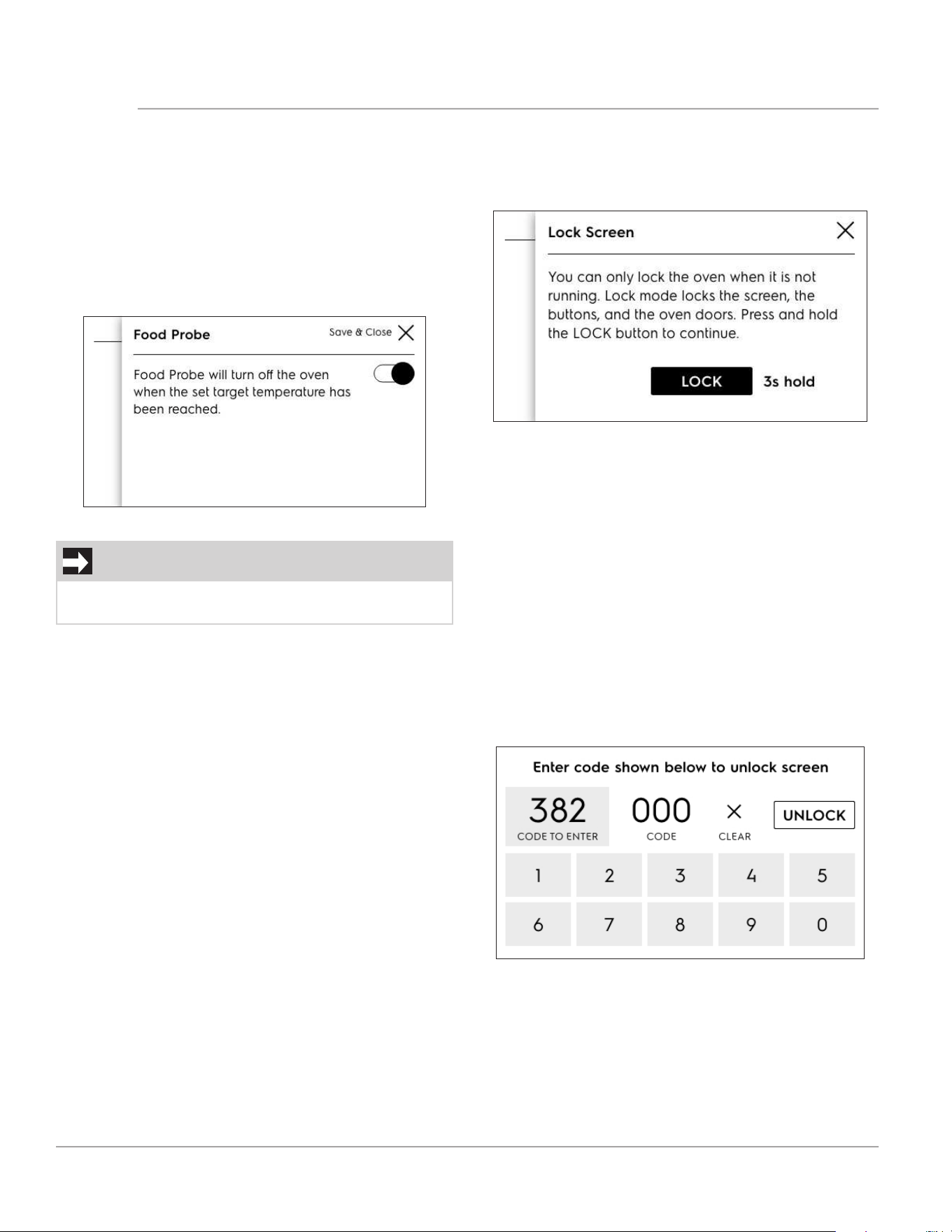
food probe
Food probe options can be found in the Settings
menu and the Oven Modes menu. Select Food
Probe from the Settings menu to select whether
the oven turns o or stays on when the specified
temperature is reached during cooking.
1. Scroll to food probe and touch.
2. Follow instructions on the display.
Lock Screen
As a safety measure the oven doors and controls
can be locked. Follow screen directions to lock and
unlock.
From the Settings Menu, Select Lock Screen, then
touch and hold LocK for 3 seconds.
When the doors and controls are locked the screen
will show the time of day, a note that the oven is
locked, and an unLocK key. Once the controls and
door are locked, there is no access to any cooking
functions. This ensures that the oven will remain
locked and safe.
To unlock the oven door, press the unLocK key,
Once the controls and door are locked, there is no
access to any cooking functions.
To unlock the oven door and control, press un-
LocK and follow directions on the screen. You will
be shown a code to use for unlocking the doors
and controls.
note
For setting the oven to use the food probe, see
“Cooking with Food Probe” on page 44.
about the appliance
1. Scroll to about the appliance and touch.
2. Touch headings to see information.
Important information about the appliance such
as the the software version number and contact
information for support is listed here.
21
SettInG oVen controLS
table 1: minimum and maximum control settings
feature mode min temp/
time
max temp/
time
No
Preheat
170°F (77°C) 550°F (288°C)
Bake 170°F (77°C) 550°F (288°C)
Broil 400°F (205°C) 550°F (288°C)
Air Fry 170°F (77°C) 550°F (288°C)
Sous Vide 100°F (38°C) 205°F (94°C)
Steam
Bake
170°F (77°C) 550°F (288°C)
Steam
Roast
170°F (77°C) 550°F (288°C)
Conv Bake 170°F (77°C) 550°F (288°C)
Conv
Roast
170°F (77°C) 550°F (288°C)
Food
Probe
140°F (60°C) 210°F (99°C)
Keep
Warm
140°F (60°C) 200°F (93°C)
Bread
Proof
100°F (38°C) 11:59 Hr./Min
Dehydrate 95°F (35°C) 170°F (77°C)
Timer 0:01 Min 11:59 Hr./Min.
Clock Time 12 Hr.
24 Hr
1:00 Hr./Min.
0:00 Min
11:59 Hr./Min.
23:59 Hr./Min.
Delay Start 0:01 Min. 1:00 Hr./Min.
Cook Time 12 Hr.
24 Hr
0:01 Min
0:01 Min
11:59 Hr./Min.
11:59 Hr./Min.
Self clean 2 hours 4 hours
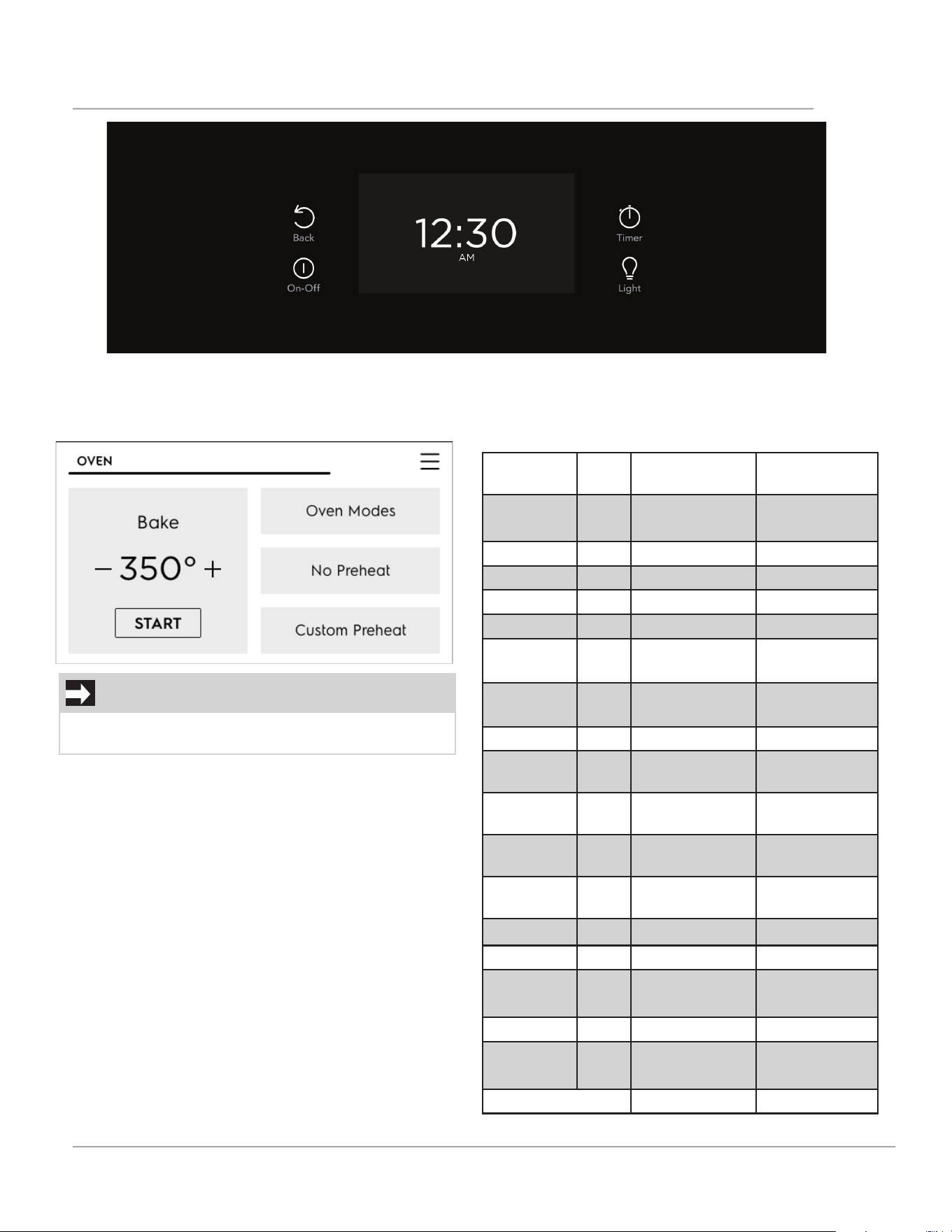
on / off
When on/off is pressed, the display opens to the
Quick Start screen.
note
In addition to ON/OFF, touching the screen will
also activate the display.
BacK
Pressing the Back key will return to the previous
screen without implementing any changes you may
have selected.
tImer
Pressing Timer will access the timer function. The
timer will count down the amount of time you
specify, and a tone will sound when the timer
reaches zero. You can set a timer from 1 minute to
11 hours and 59 minutes.
Enter the desired time and press Start. While
the timer is running, you can pause or cancel the
countdown. You can also add or subtract time by
pressing + or -.
If the oven is on when on/off is pressed, it will
turn o completely, canceling any functions that
are running at the time.
LIGHt
Press the Light key to turn the oven light on or o.
22
SettInG oVen controLS
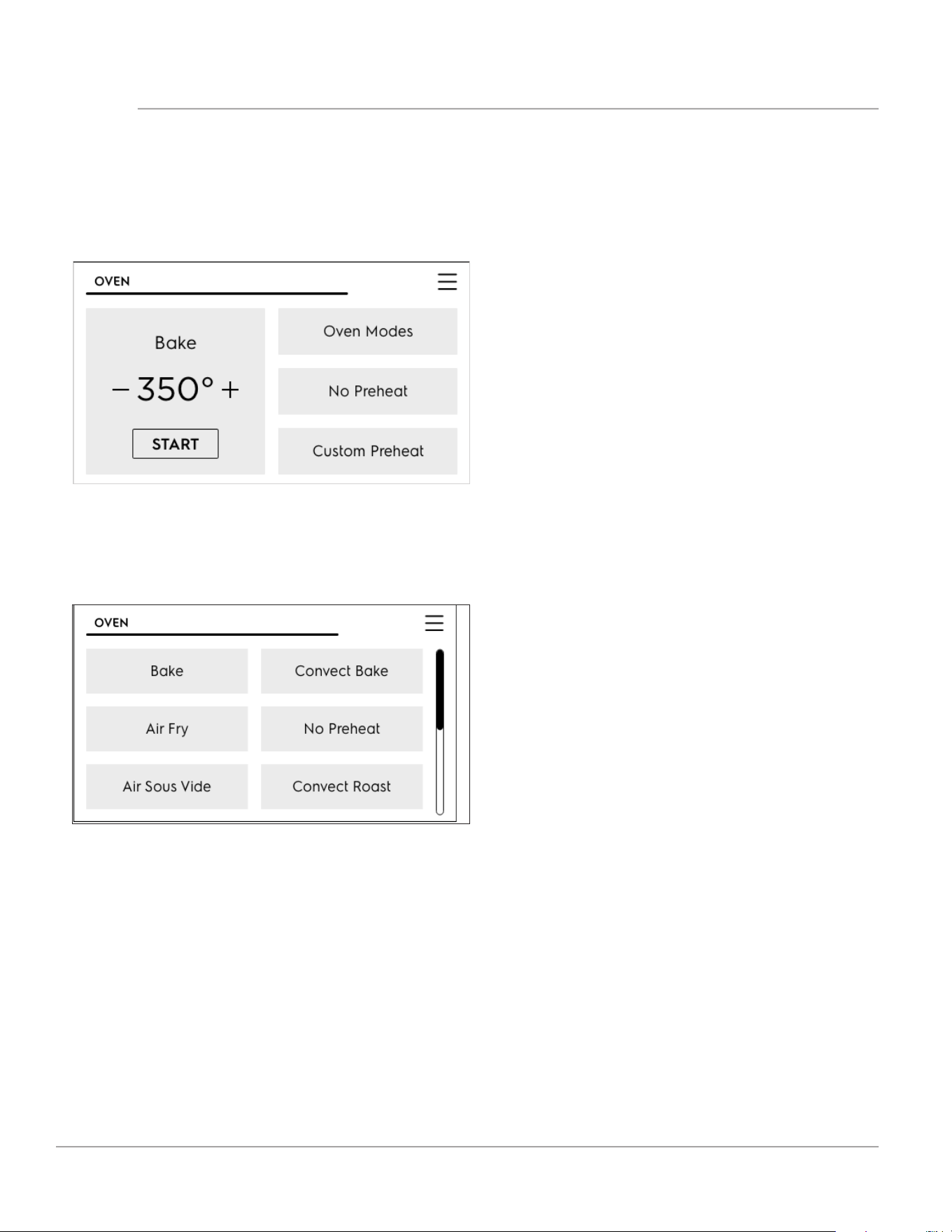
Use the scroll bar to find your oven mode as shown
in the oven mode table on the right. When you
select a cooking mode simply follow the tips for
setting the particular mode.
Important: Valuable tips to help you get the best
results are included in the display and also can be
found in this Use & Care Manual.
To select other cooking options, touch
oven modes and scroll to the desired fea-
ture:
Quick Start
When on/off is pressed the display opens to the
Quick Start screen.
From the Quick Start screen, you can immediately
start the Bake function by pressing Start. You can
adjust the temperature by pressing + or -.
modes
• Bake (page 23)
• Convection Bake (page 25)
• Air Fry (page 26)
• No Preheat (page 27)
• Slow Cook
• Air Sous Vide (page 28)
• Dehydrate (page 31)
• Bread Proof (page 31)
• Slow Cook (page 32)
• Convection Roast (page 32)
• Broil (page 34)
• Multi-Rack (page 36)
• Steam Bake (page 37)
• Steam Roast (page 38)
• Keep Warm (page 38)
• Delay Start (page 39)
• Self Clean (page 40)
• Steam Clean (page 43)
• Food Probe (page 44)
23
SettInG oVen controLS
Setting Bake
Bake uses heat that rises from the oven bottom for
best baking results.
A reminder tone will sound indicating when the set
bake temperature is reached and to place the food
in the oven.
Bake may be set for any oven temperature be-
tween 170°F (77°C) to 550°F (288°C).
cautIon
Always use pot holders or oven mitts when using
the oven. When cooking the oven interior, oven
racks, and cooktop will become very hot which
can cause burns.
to set Bake
1. Press on/off key.
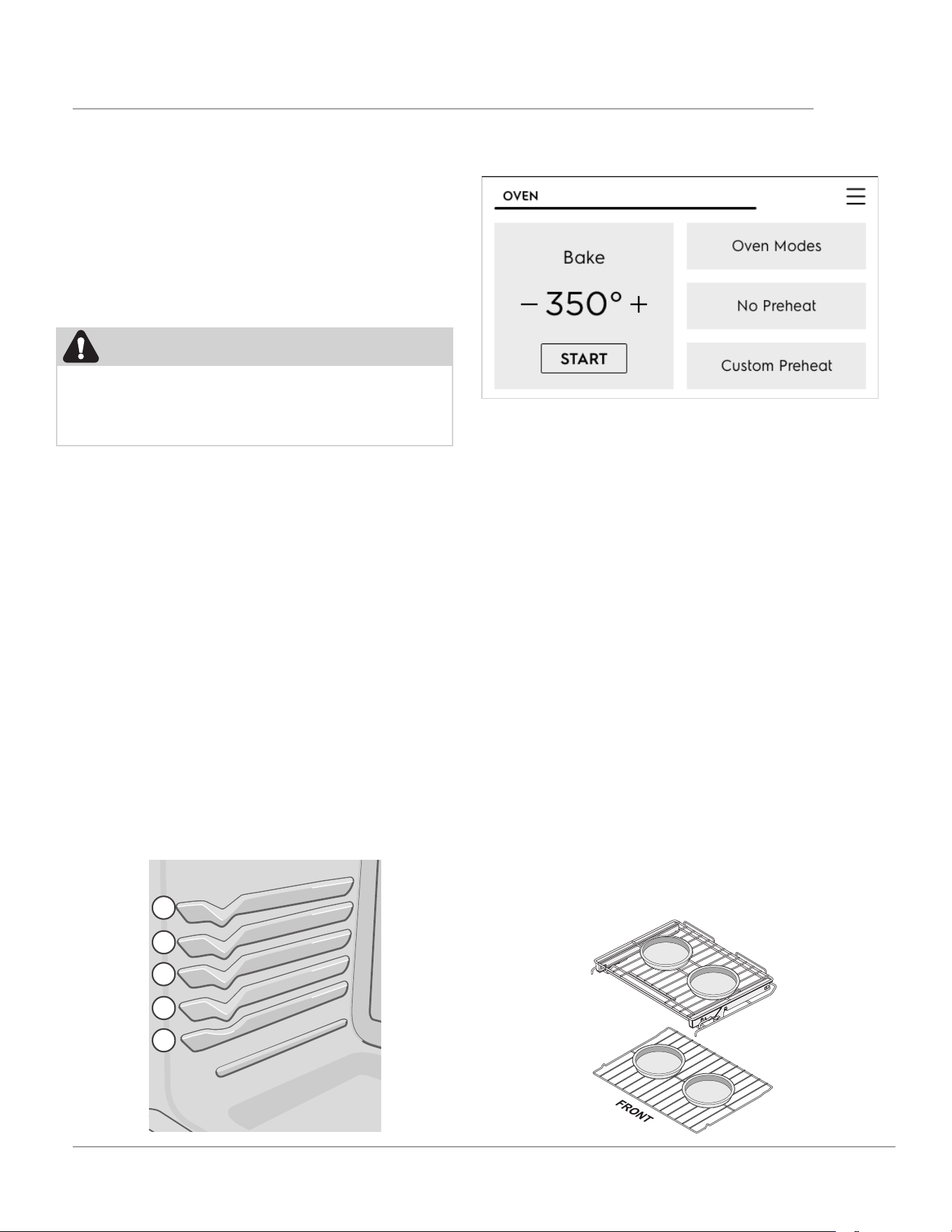
2. Touch oven modes and touch Bake. The de-
fault temperature 350°F will show in the dis-
play. You can also use the controls on the Quick
Start screen.
3. To set the temperature to 375, use the num-
bered keys to program the new temperature of
375 and touch Start.
4. The screen shows the current temperature and
a cook time button.
5. Touch cook time to set a cooking time if need-
ed.
note: If a cook time is set the oven will turn o
automatically when the time expires.
6. Touch Start.
7. When cooking has ended, o will be in display.
8. Press on/off to return display to show the
time of day.
To cancel cooking anytime touch canceL.
Press on/off to turn o the oven and show time
of day in the display.
To cancel cooking anytime touch canceL.
1
2
3
5
4
Baking tips
• Fully preheat the oven before baking items like
cookies, cakes, biscuits and breads.
• For all baking except layer cakes, pans should
be pulled to the front of the rack. Place layer
cake pans as shown.
• Use the convection bake function for best re-
sults when baking cookies or cakes on multiple
racks.
• For best results when baking layer cakes using
two oven racks, place racks in positions 1 (flat)
and 4 (glide) and place pans centered on each
rack.
• When using any single rack for baking cookies,
cakes, biscuits, or muns use rack position 2.
• Allow at least 2 inches (5 cm) of space between
bakeware for proper air circulation.
• Leave oven lights o while baking.
24
SettInG oVen controLS
Setting cook time
Use Cook Time to set the amount of time need-
ed for most oven functions. The oven will turn on
immediately (or after a specified delay) and stop
automatically after the set cook time ends.
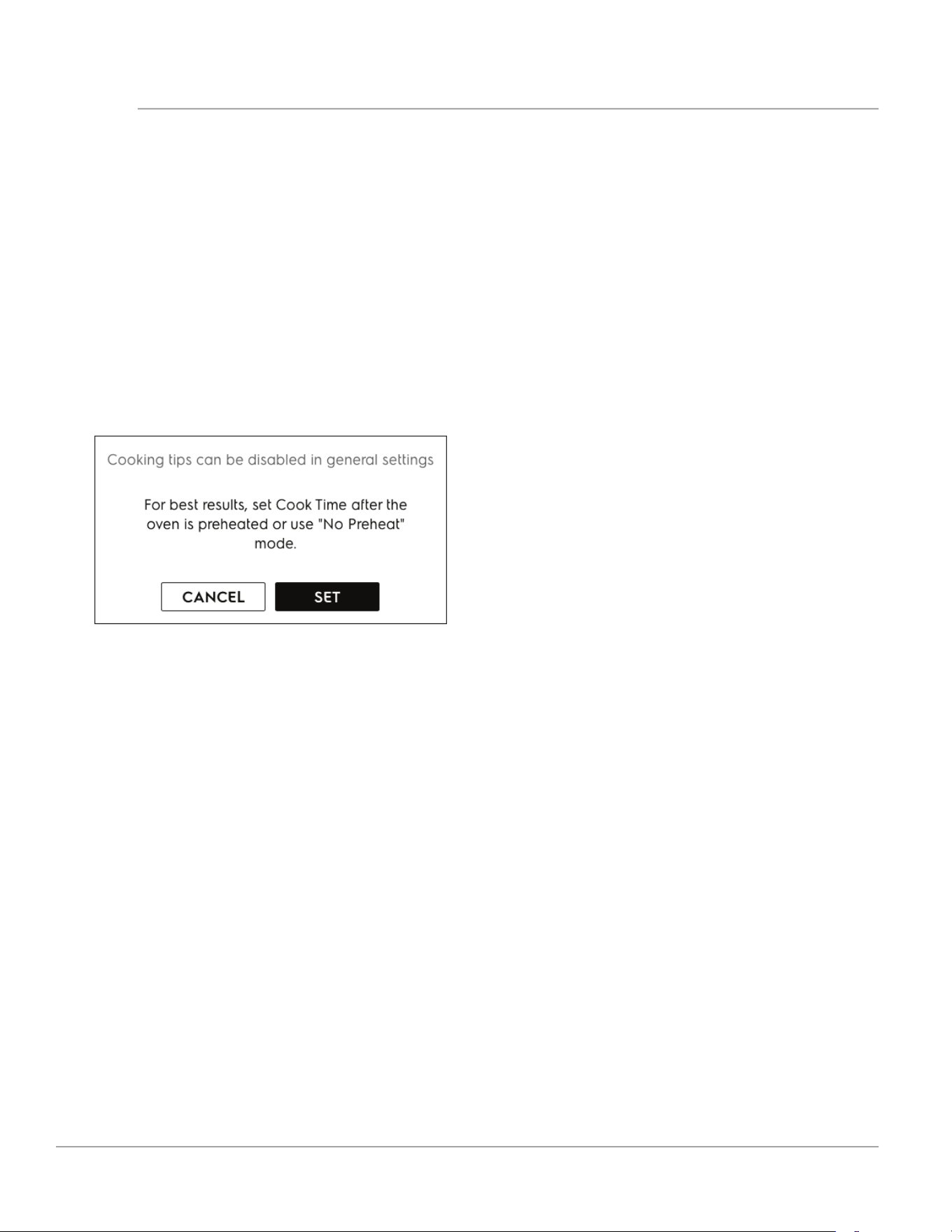
In most cases you will see a cooking tip suggesting
to set Cook Time after the oven is preheated.
When the programmed cook time ends:
• o will appear in the display window
• an alert tone will sound
• the oven will turn o automatically
The o message and an oKay button will display
until oKay is touched.
note: The maximum cook time setting is 11 hours
and 59 minutes unless the oven is set for continu-
ous cooking.
to change the oven temperature or cook time
after baking has started:
• Touch + or - on either side of the set tempera-
ture.
• Touch temp to access the keypad.

25
SettInG oVen controLS
convection Bake
Convection Bake uses a fan to circulate the oven’s
heat uniformly around the oven. This improved
heat distribution allows for even cooking and
browning results. Heated air flows around the food
from all sides.
Convection bake may be set for any oven tempera-
ture between 170°F (77°C) and 550°F (288°C).
Benefits of convection cooking include:
• Multiple rack baking.
convection baking tips:
• Use Convection Bake for best results when
baking cookies and cakes on 2 racks.
• For best results it is recommended to preheat
the oven before baking items like cookies, bis-
cuits and breads and move pans to front of the
racks.
• If your recipe is not written for convection bak-
ing, reduce the oven temperature by 25° or use
Convection Convert option.
• No special pans or bakeware required.
• For cookies use the following racks:
• Single rack baking use 2 (flat rack).
• Two rack baking use 1 (flat) and 4 (glide).
• For baking cakes use the following rack posi-
tions and place bakeware as shown in Figure 4.
In upper rack use position 4 (glide) or 5 (flat).
• Cookies and biscuits should be baked on pans
with no sides or very low side to allow heated
air to circulate around the food. Food items
baked on pans with a dark finish will cook fast-
er.
• Leave oven lights o while baking.
convection convert
Convection Convert automatically reduces the
oven temperature from what is specified in most
baking recipes to compensate for the increased
cooking eciency of convection baking.
to set convection bake with a default oven set
temperature of 325°f (163°c):
1. Select oven mode and scroll to convection
Bake.
2. Touch convection Bake: Default oven temp of
325° appears.
3. An option for convection convert is visible
on the screen. Using it will lower the oven
temperature 25° to account for the increased
eciency of convection. If used, Convection
Convert must be selected before pressing Start.
4. Touch Start:
5. Option to set cook time.
6. Touch Start.
7. Oven will turn o when cook time is complete.
8. Cooking has ended and o will be in display.
9. Press on/off to return display to show the
time of day.
figure 3: pan positions for best results when bak-
ing cakes on two racks.
26
SettInG oVen controLS
air fry
The Air Fry feature works best for single rack bak-
ing with packaged and convenience foods. It works
well with most recipes and can be programmed for
temperatures between 170°F and 550°F. Follow the
recipe or package directions for food preparation
quantity, time, and temperature.
Important:
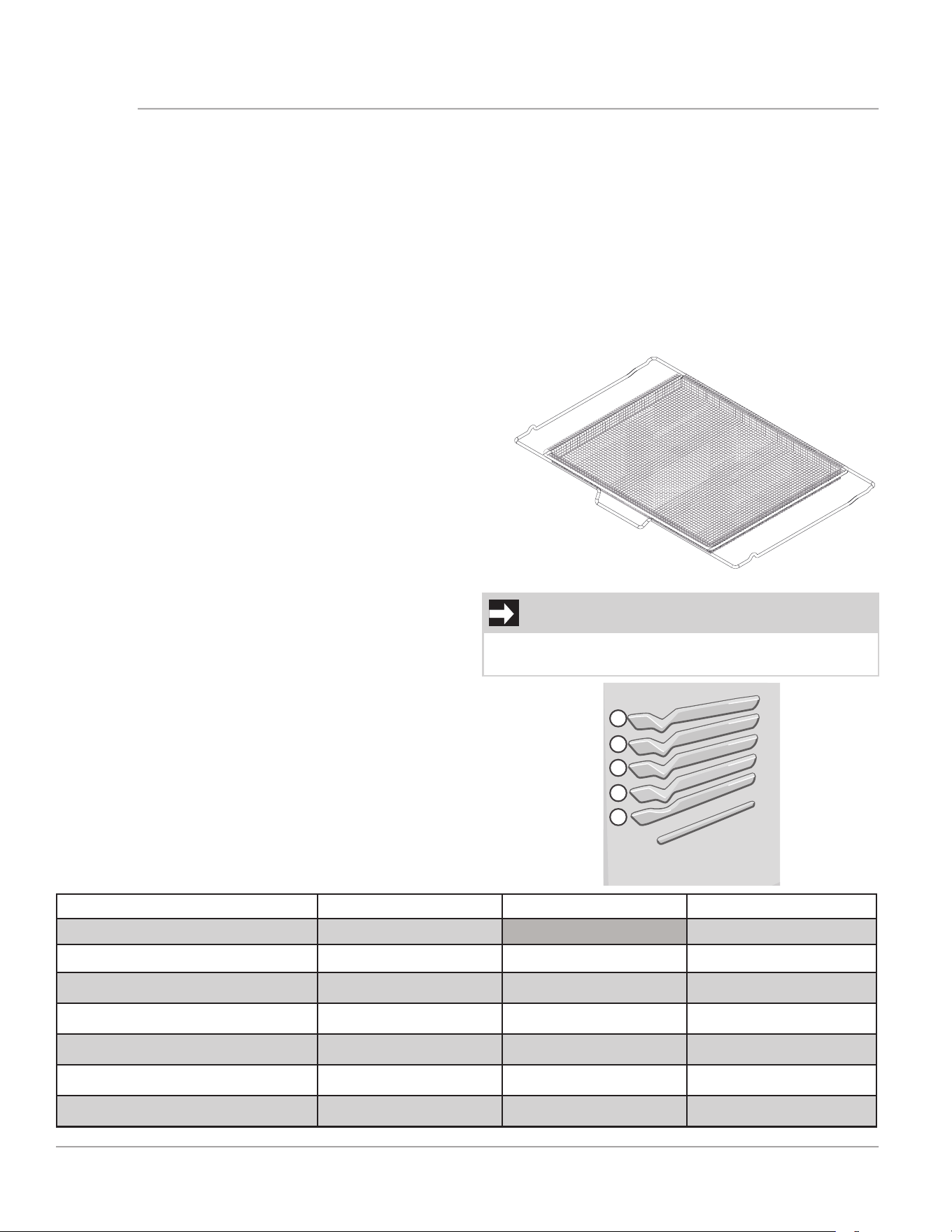
• Food should be arranged in single layers on the
air fry tray and placed on rack position 3 for
best results.
• When using the Air Fry tray, place a large cook-
ie sheet on rack position 1 to catch any crumbs
or drippings.
• Leave oven light o when baking.
• Food may need to be removed early and
should be checked at minimum recommended
bake time. However, frozen dense foods and
items with cook times less than 15 minutes may
require additional time.
to set the air fry function:
1. Arrange food on rack as suggested.
2. Select air fry from Oven Modes.
3. Enter the suggested temperature for particular
food. Touch Start.
4. Press Start. When preheat tone sounds place
the tray on rack position 3 and to prevent
smoke, place a baking sheet on rack position 1
below the Air Fry Tray.
5. If setting a Cook Time, set after the oven is
preheated. Cook time turns o Air Fry when
time is
finished. note: Setting the timer for the min-
imum suggested time after preheat is a good
option and checking food for doneness.
6. When cook time ends o will be in display.
The Air Fry Tray is specifically designed to deliver
superior performance.
Some Benefits of the air fry tray:
• Tray optimized for oven space and large capac-
ity air frying.
• Fits in the dishwasher for easy clean up.
• Higher yield than countertop models.
• Frees up countertop space.
food type Quantity (oz.) temperature cook time (mins)
Frozen Tater Tots 48 450°F - 232°C 29-33
Frozen Golden Fries 48 425°F - 218°C 25-35
Frozen Chicken Nuggets 48 400°F - 205°C 13-15
Frozen Crispy Chicken Strips 48 400°F - 205°C 20-22
Frozen Hot Wings Bone-In 48 450°F - 232°C 25-28
Frozen Chicken Wings 48 375°F - 190°C 60-65
Fresh Chicken Wings 48 450°F - 232°C 30-40
figure 4: air fry tray
table 2: air fry table
7. Press on/off to return display to show the
time of day.
note
If you don’t have an air fry tray, you can purchase
one from frigidaire.com.
1
2
3
5
4
27
SettInG oVen controLS
no preheat
No Preheat is available for single rack baking with
packaged and convenience foods and can be used
with regular recipes also. No Preheat may be used
with temperatures between 170°F and 550°F.
Follow the recipe or package directions for food
preparation time and temperature.
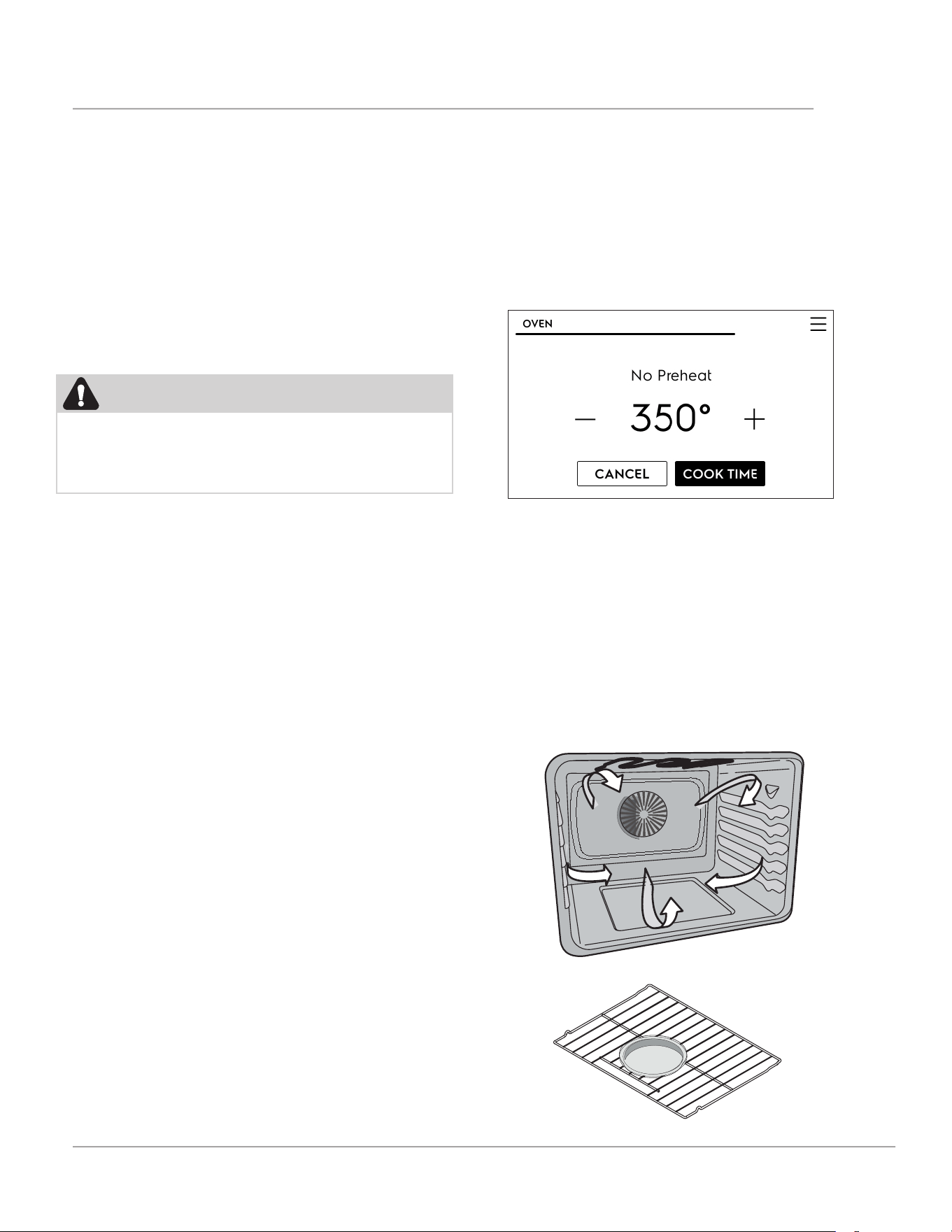
During No Preheat function, the oven elements will
cycle on and o. The convection fan will turn on
and stay on until No Preheat is canceled. Depend-
ing on your preference for doneness cooking times
may vary. Watch food closely.
Important:
• Always place food on rack position 3.
• Place the food with the pan or bakeware to the
front of the oven rack.
• When using No Preheat, use bakeware with
low or no sides. This allows the air to circulate
around the food evenly.
• Leave oven light o when baking.
• Food that comes in strips, such as fish sticks
and chicken tenders, should be placed on the
pan with the ends pointing to the sides of the
oven. Follow the package directions for food
preparation time and temperature.
• Food may need to be removed early and
should be checked at minimum recommended
cook time.
• No Preheat works best when cooking foods
longer than 10 minutes. If directions call for a
shorter cooking time, a few extra minutes may
be required for optimal cooking results.
• Do not open the oven door often. Opening the
door will reduce the temperature in the oven
and may increase cook time.
• Leave oven lights o while cooking.
to set the no preheat temperature for 350°f:
1. Arrange the interior oven racks.
2. Press on/off key.
3. Touch oven modes and scroll to no preheat.
4. Follow No Preheat tips and set temperature or
use 350°F (default).
5. Touch Start.
cautIon
Always use pot holders or oven mitts when using
the oven. When cooking the oven interior, oven
racks, and cooktop will become very hot which
can cause burns.
6. Set cook time if needed.
7. Touch Start.
note: If a cook time is set the oven will turn o
automatically when the time expires. Foods with a
cook time under 10 minutes may need extra time.
8. When cooking has ended, o will be in display.
9. Press on/off to return display to show the
time of day.
To cancel cooking anytime touch canceL.

28
SettInG oVen controLS
air Sous Vide
Air Sous Vide is ideal for cooking meats to achieve
tenderness without overcooking.
How Sous Vide Works
Sous vide is a French phrase meaning “under vacu-
um”. In sous vide cooking, food is vacuum-sealed in
plastic pouches, which are then placed in a cooking
medium of hot water or air.
Your appliance uses hot air circulating around
sealed pouches to cook food slowly at relatively
low temperatures: 100°F to 205°F (38°C to 94°C).
Sous vide cooking is not fast, but with a little plan-
ning, it can be very easy.
advantages of Sous Vide
• Food does not lose flavor or aroma due to
evaporation.
• Vitamins and minerals do not escape during
cooking.
• The low cooking temperature leaves meat and
fish more tender.
• Less spice is needed, as food keeps more of its
natural flavor.
• The low cooking temperature greatly reduces
the risk of overcooking. The food never gets
hotter than the intended serving temperature.
• Timing is less critical. If dierent dishes are fin-
ishing at dierent times, food that has reached
serving temperature can wait, since it stays at
serving temperature in the cooking medium.
food Safety
Because sous vide cooks at relatively low tempera-
tures, safe food handling is especially important.:
• Always keep raw food in safe conditions before
you start cooking.
• Clean the raw food before you start cooking.
• Use Table 1, “Recommended Sous Vide Cook
Settings,” to find the recommended cooking
time and temperature for the food.
• Only use temperatures below 140°F (60°C) to
cook foods that can be safely eaten raw.
• Food should be between 34°F and 37°F (nor-
mal refrigerator temperatures) when preparing
to place food in sous vide vacuum pouch.
• Sous vide dishes are best served immediately
after cooking. If food is not served immediately,
use an ice bath to chill it quickly and then keep
it refrigerated for up to 3 days.
• Do not use sous vide to reheat leftovers.
• Do not allow raw food to contact cooked food
during preparation. Do not use the same tools
on dierent food items without washing them.
• If the recipe includes raw eggs, keep the whites
and yolks from touching the outsides of the
shells.
• Blanching in boiling water or searing in a pan
before sous vide cooking can destroy surface
bacteria to improve food safety.
• Do not use Delay Start with the Sous Vide func-
tion.
• Do not use a meat probe with the Sous Vide
function. Food needs to be sealed air-tight in a
pouch for sous vide cooking.
29
SettInG oVen controLS
Vacuum Sealing
Sous vide cooking in your oven requires a vacuum
sealer and vacuum pouches. The pouch needs to
be sealed so no air or liquid can leak out. A pouch
that leaks will produce poor cooking results and
may produce smoke and residue that can burn
during future cooking or when using self-clean.
Follow the instructions that come with your sealer
and pouches.
• Use pouches that are specified for your sealer
and for sous vide cooking.
• Do not reuse vacuum pouches.
• Put food in one layer in the pouch for even
cooking.
• It is recommended to use one food portion per
vacuum pouch.
• For most sous vide cooking, use the highest
vacuum setting for best cooking results.
• Make sure that the closure of the pouch is clean
to get a good seal. If cooking at higher tem-
peratures (above 160º F / 71º C), double-seal
the pouch.
• Vacuum pouches are solely for sous vide cook-
ing and should not be used for regular baking
or broiling.
Sous Vide cooking
1. Prepare
• Start with the freshest, highest quality food
possible.
• Clean and cut the ingredients.
2. Package
• Place the ingredients in the plastic pouch for
your vacuum sealer. Add seasonings for cook-
ing.
• Note: If cooking multiple items at once, you
may want to write the contents on the outside
of the pouches before filling and sealing them.
• Vacuum seal the pouch, removing as much air
as possible. Verify that you have achieved an
air-tight seal.
• If not cooking immediately, store the pouch in a
refrigerator until ready to cook.
to cook air Sous Vide:
1. Touch oven modes and scroll to Slow cook,
then choose air Sous Vide from the sub-menu.
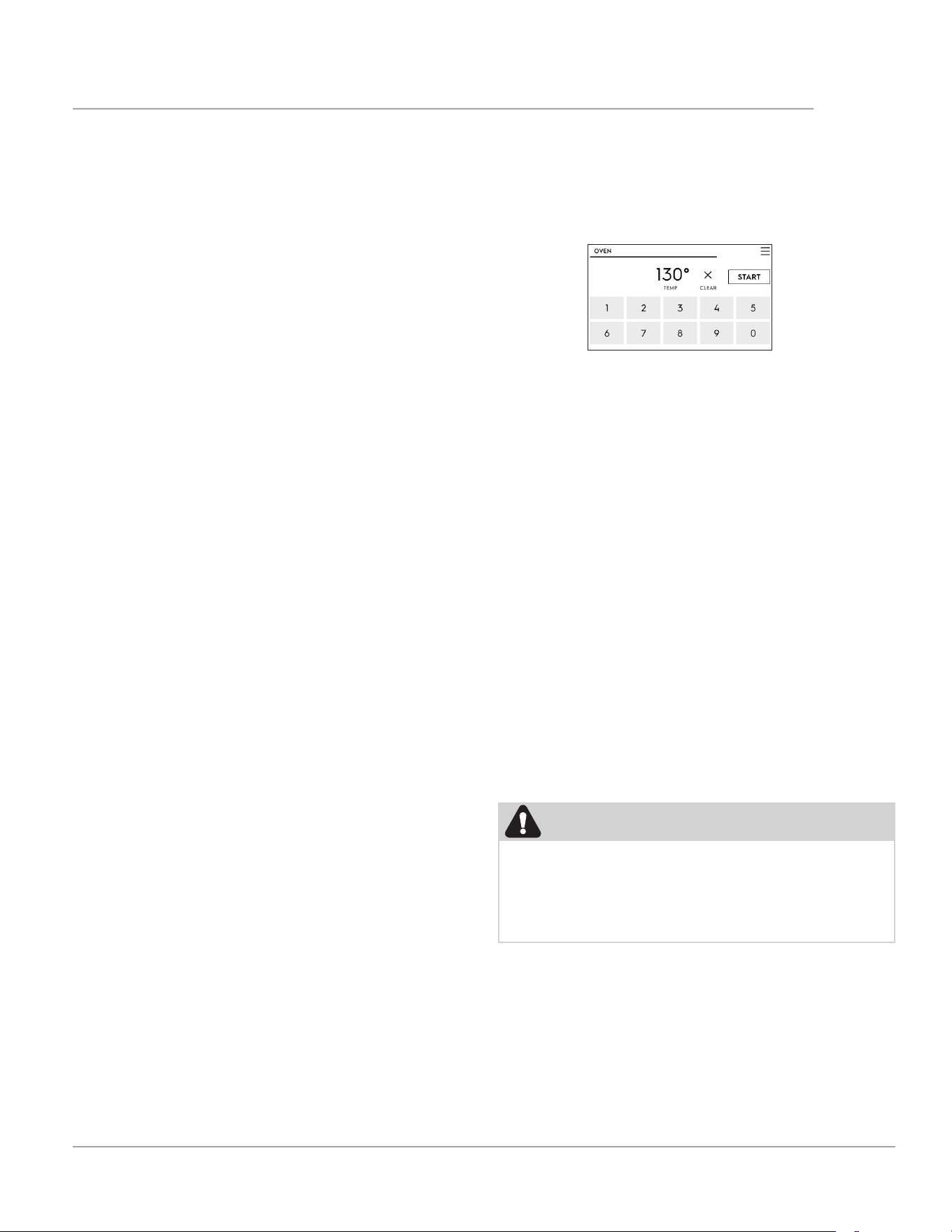
2. Touch air Sous Vide: display shows 130°F
(54°C) setting as default.
Important
The U.S. Department of Agriculture states, “Rare
fresh beef is popular, but you should know that
cooking it to only 140°F (60°C) means some food
poisoning organisms may survive.” (Source: Safe
Food Book, Your Kitchen Guide, USDA) The lowest
temperature recommended by the USDA is 145°F
(63°C) for medium rare fresh beef. For beef medi-
um 160°F, well done 170°F (77°C). Visit the USDA
Food Safety and Inspection website at www.fsis.
usda.gov.
cautIon
Even though sous vide cooks at relatively low
temperatures, use care when handling the pouch
and its contents, which will be hot to the touch.
Only use temperatures below 140°F (60°C) for
cooking foods that can be safely eaten raw.
3. Set desired temperature.
4. Touch Start.
Important: Since sous vide cooking allows
for a suggested minimum cooking time and a
target time, it is recommended to set the timer
to at least the minimum time or to any time up
to the target suggested time. With sous vide
cooking, there is a maximum cooking time
which allows the user more flexibility when
cooking with no specific end time.
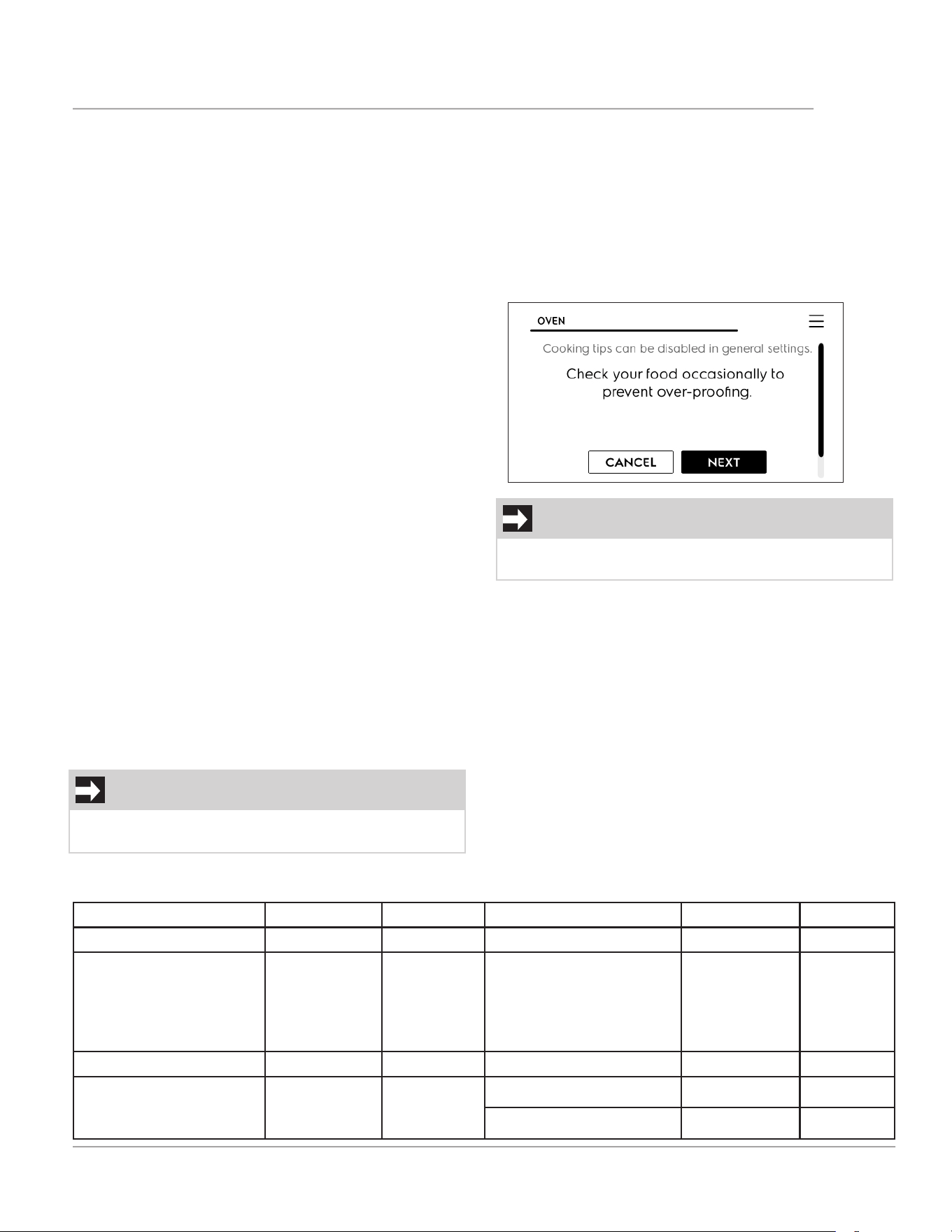
note: Use the settings recommended for the
type of food in Table 3 on page 30.
5. Finish
• Open the plastic pouch and remove the food.
• You may finish the food with a final searing or
grilling to achieve a nice crust and roast flavor.
• Add final seasonings or sauces if needed.
• Serve.
30
SettInG oVen controLS
food doneness temperature cooking time
minimum target maximum
Beef
Steak Rare 130º F / 54º-55º C 2 hours 3 hours 4 hours
Steak Medium Rare 135º F / 57º-58º C 2 hours 3 hours 4 hours
Steak Medium 145º F / 62º-63º C 2 hours 3 hours 4 hours
Steak Medium Well 150º F / 65º-66º C 2 hours 3 hours 4 hours
Steak Well 160º F / 71º-72º C 2 hours 3 hours 4 hours
Roast Rare 135º F / 57º-58º C 6 hours 7 hours 16 hours
Roast Medium Rare 140º F / 60º C 6 hours 7 hours 16 hours
Roast Medium 150º F / 65º-66º C 6 hours 7 hours 16 hours
Roast Medium Well 155º F / 68º-69º C 6 hours 7 hours 16 hours
Roast Well 160º F / 71º-72º C 6 hours 7 hours 16 hours
Chuck/Brisket
Rare 140º F / 60º C 20 hours 24 hours 48 hours
Chuck/Brisket
Medium Rare 150º F / 65º-66º C 20 hours 24 hours 48 hours
Chuck/Brisket
Well 180º F / 82º-83º C 20 hours 24 hours 48 hours
pork
Chop Medium 150º F / 65º-66º C 2 hours 3 hours 4 hours
Chop Well 160º F / 71º-72º C 2 hours 3 hours 4 hours
Roast Medium 150º F / 65º-66º C 2 hours 3 hours 4 hours
Roast Well 180º F / 82º-83º C 2 hours 3 hours 4 hours
Shoulder/Belly Medium 150º F / 65º-66º C 10 hours 24 hours 48 hours
Shoulder/Belly Well 180º F / 82º-83º C 10 hours 24 hours 48 hours
chicken
Parts Tender 170º F / 76º-77º C 2 hours 2-1/2 hours 4 hours
fish
Steak Tender 105º F / 40º-41º C 1 hour 1-11/2 hours 2 hours
Steak Flaky 125º F / 51º-52º C 1 hour 1-11/2 hours 2 hours
Steak Well 145º F / 62º-63º C 1 hour 2 hours 2 hours
Fillet Tender 105º F / 40º-41º C 45 mins 1 hour 1 1/2 hours
Fillet Flaky 125º F / 51º-52º C 45 mins 1 hour 1 1/2 hours
Fillet Well 145º F / 62º-63º C 45 mins 1 hour 1 1/2 hours
Vegetables
Squash Cubes 180º F / 82º-83º C 1 hour
1 1/2 hours
4 hours
Roots Sliced/Cubes 180º F / 82º-83º C 1 hour 1 1/2 hours 4 hours
Potatoes Sliced/Cubes 200º F / 93º-94º C 1 hour 1 1/2 hours 4 hours
fruits
Warm/Ripe Sliced/Cubes 155º F / 68º-69º C 45mins 105 mins 2 1/2 hours
Soft Purees 180º F / 82º-83º C 15 mins 30 mins 90 minutes
Steak thickness based on 1.5”. Thicker cuts may require longer times.
table 3: Sous Vide table
31
SettInG oVen controLS
dehydrate
For best results when dehydrating food use the Air
Fry tray which allows air to circulate all around the
food for faster preservation.
tips
• Always use clean equipment and utensils.
• Keep meat and poultry refrigerated -- 40°F
(4°C) or slightly below -- before dehydrating.
• Cut food in evenly sized pieces. Slices should
be even and ¼ to ½ inch thick. This will ensure
all pieces are dehydrated at same time.
• Use good quality fruits, vegetables, and meats.
Overripe or bruised fruits and vegetables may
turn black while dehydrating.
• Use lean cuts of meat or trim o excess fat.
• Use a paper towel to dry meat before dehydrat-
ing.
• Store dehydrated foods in airtight containers.
If moisture appears in containers, the food was
not dehydrated properly.
• Follow USDA recommendation when dehydrat-
ing.
to set dehydrate:
1. Arrange food in a single layer on the Air Fry
tray.
2. Touch oven modes and scroll to Slow cook,
then choose dehydrate from the sub-menu.
3. Set dehydrate temperature (between 95°F
-170°F).
4. Touch Start.
5. Press on/off to end cooking and return dis-
play to show the time of day.
note
Check food for doneness. If any moisture is pres-
ent, allow food to dehydrate longer.
Bread proof
Bread proofing creates the best conditions for
yeast to multiply and cause your dough to rise.
1. Touch oven modes and scroll to Slow cook,
then choose Bread proof from the sub-menu.
2. Touch Bread proof: Shows Bread proof 100°f
(38°C).
3. Touch Start.
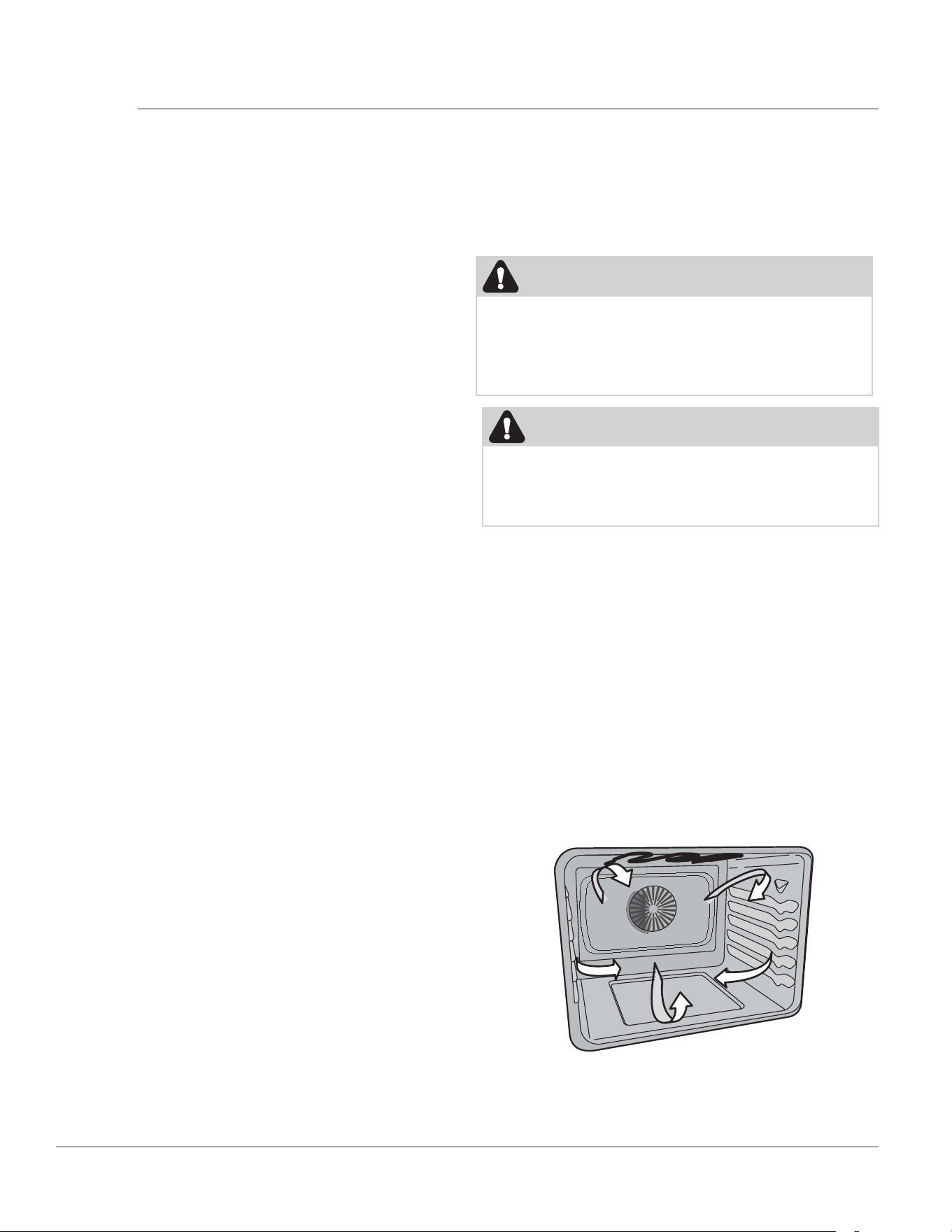
note
Check often to prevent over-proofing.
table 4: dehydration temp and time Suggestions
food temperature Hours food temperature Hours
Herbs, flowers 95°F - 35°C 6-10 Citrus Peel 8 – 15 hours 135°F - 57°C 8-15
Vegetables
Tomatoes
Peppers
Mushrooms
125°F - 52°C
8–20
6-12
6-12
Fruit
Apples
Bananas
Strawberries
Peaches
145°F - 63°C
5-7
8-20
8-20
12-18
Meat 165°F - 74°C 6-18 Fish 145°F - 63°C 8-12
Root Vegetables
Carrots
Potatoes
165°F - 74°C
6-10
10-15
Fruit Rolls/Leather 165°F - 74°C 8-18
Nuts and Seeds 150°F - 66°C 8-20
32
SettInG oVen controLS
convection roast
Convection roast combines a cook cycle with the
convection fan and elements to rapidly roast meats
and poultry. Heated air circulates around the meat
from all sides, sealing in juices and flavors. Meats
cooked with this feature are crispy and brown on
the outside while staying moist inside.
to use convection roast at a temperature of
350°f (177°c):
1. Touch oven mode and scroll to convection
roast.
2. Touch convection roast.
3. Set desired temperature or use default of 350°.
4. Touch Start.
5. Option to set cook time.
6. Touch Start. Preheating the oven is not nec-
essary.
7. When cooking is completed or to cancel
Convection Roast press on/off.
WarnInG
Should an oven fire occur, close the oven door
and turn the oven o. If the fire continues, use a
fire extinguisher. Do not put water or flour on the
fire. Flour may be explosive and water can cause
a grease fire to spread and cause personal injury.
cautIon
Always use pot holders or oven mitts when using
the oven. When cooking, the oven interior, oven
racks, and cooktop will become very hot which
can cause burns.
figure 6: convection roasting on lower oven racks
Slow cook
Use Slow Cook for foods that will cook or braise at
low temperature for a long period of time.
for best results when using Slow cook:
• Completely thaw all frozen foods before cook-
ing.
• When using a single oven rack, place in oven
rack position 1 or 2. Position racks to accommo-
date the size of various bakeware when cook-
ing multiple food items.
• Do not open the oven door often or leave the
door open when checking foods. If the oven
heat escapes often, the Slow Cook time may
need to be extended.
• Cover to keep foods moist or use a loose or
vented type cover to allow foods to turn crisp
or brown.
• Roasts may be left uncovered so browning can
occur. Cook times will vary depending on the
weight, fat content, bone, and the shape of the
roast. Preheating the oven will not be necessary
when using the Slow Cook feature.
• Add any cream or cheese sauces during the last
hour.
Slow cooking meats may result in the outside of
the meat turning dark; this is normal.
to set Slow cook:
1. Touch oven modes and scroll to Slow cook,
then choose Slow cook from the sub-menu.
2. The display shows 175°F (79°C) setting as
default. Use the numbered keys to program a
dierent temperature if desired. Touch Start.
3. The screen shows the current temperature and
a cook time button.
4. Touch cook time to set a cooking time if need-
ed.
note: If a cook time is set, the oven will turn
o automatically when the time expires.
5. Touch Start.
6. When cooking has ended, o will be in display.
Press oK to return to the start screen.
Press on/off to turn o the oven and show time
of day in the display.
To cancel cooking at any time, touch canceL.
33
SettInG oVen controLS
table 5: convection roasting recommendations
meat Weight oven temp Internal temp mins per
lb
Beef Standing rib roast* 4 to 6 lb. 350°F (177ºC) *160ºF (71ºC) 25-30
Rib eye roast* 4 to 6 lb. 350°F (177ºC) *160ºF (71ºC) 25-30
Tenderloin roast 2 to 3 lb. 400°F (204ºC) *160ºF (71ºC) 15-25
Poul-
try
Turkey whole** 12 to 16 lb. 325°F (163ºC) 180°F (82ºC) 8-10
Turkey whole** 16 to 20 lb 325°F (163ºC) 180°F (82ºC) 10-15
Turkey whole** 20 to 24
lb.
325°F (163ºC) 180°F (82ºC) 12-16
Chicken 3 to 4 lb. 350°F-375°F (177ºC-
191ºC)*
180°F (82ºC) 12-16
Pork Ham roast, fresh 4 to 6 lb. 325°F (163ºC) 160°F (71ºC) 30-40
Shoulder blade
roast
4 to 6 lb. 325°F (163ºC) 160°F (71ºC) 20-30
Loin 3 to 4 lb. 325°F (163ºC) 160°F (71ºC) 20-25
Pre-cooked ham 5 to 7 lb. 325°F (163ºC) 160°F (71ºC) 30-40
* The U.S. Department of Agriculture states, “Rare fresh beef is popular, but you should know that cook-
ing it to only 140°F (60°C) means some food poisoning organisms may survive.” (Source: Safe Food
Book, Your Kitchen Guide) The lowest temperature recommended by the USDA is 145°F (63°C) for medi-
um rare fresh beef. For well done 170°F (77ºC)** Stued turkey requires additional roasting time. Shield
legs and breast with foil to prevent over browning and drying of the skin.
convection roasting tips:
• Preheating for convection roast is not necessary for most meats and poultry.
• Arrange oven racks so meat and poultry are on the lowest rack of the oven.
• Since convection roast cooks faster, may be able to reduce cook times as much as 25% from the rec-
ommended time of your recipe (check the food at this time). Then if needed, increase cook time until
the desired doneness is obtained.
• Do not cover foods when dry roasting - covering will prevent the meat from browning properly.
• When cooking meats use the broiler pan and insert. The broiler pan will catch grease spills and the
insert helps prevent grease splatters.
34
SettInG oVen controLS
Setting Broil
Use the broil function to cook foods that require
direct exposure to radiant heat for optimum
browning results. Broiling may produce smoke. If
smoke is excessive, place food further away from
the heating element.
The broil feature preset to 550°F. Broil may be set
at any temperature between 400°F (205°C) and
550°F (288°C).
cautIon
Always use pot holders or oven mitts when using
the oven. When cooking, the oven interior, oven
racks, and cooktop will become very hot which
can cause burns.
WarnInG
Should an oven fire occur, close the oven door
and turn the oven o. If the fire continues, use a
fire extinguisher. Do not put water or flour on the
fire. Flour may be explosive and water can cause
a grease fire to spread and cause personal injury.
Important
Broiler pans and inserts allow the grease to drain
away from the high heat of the broiler. Do not
use the pan without the insert. Do not cover the
insert with foil – the exposed grease could ignite.
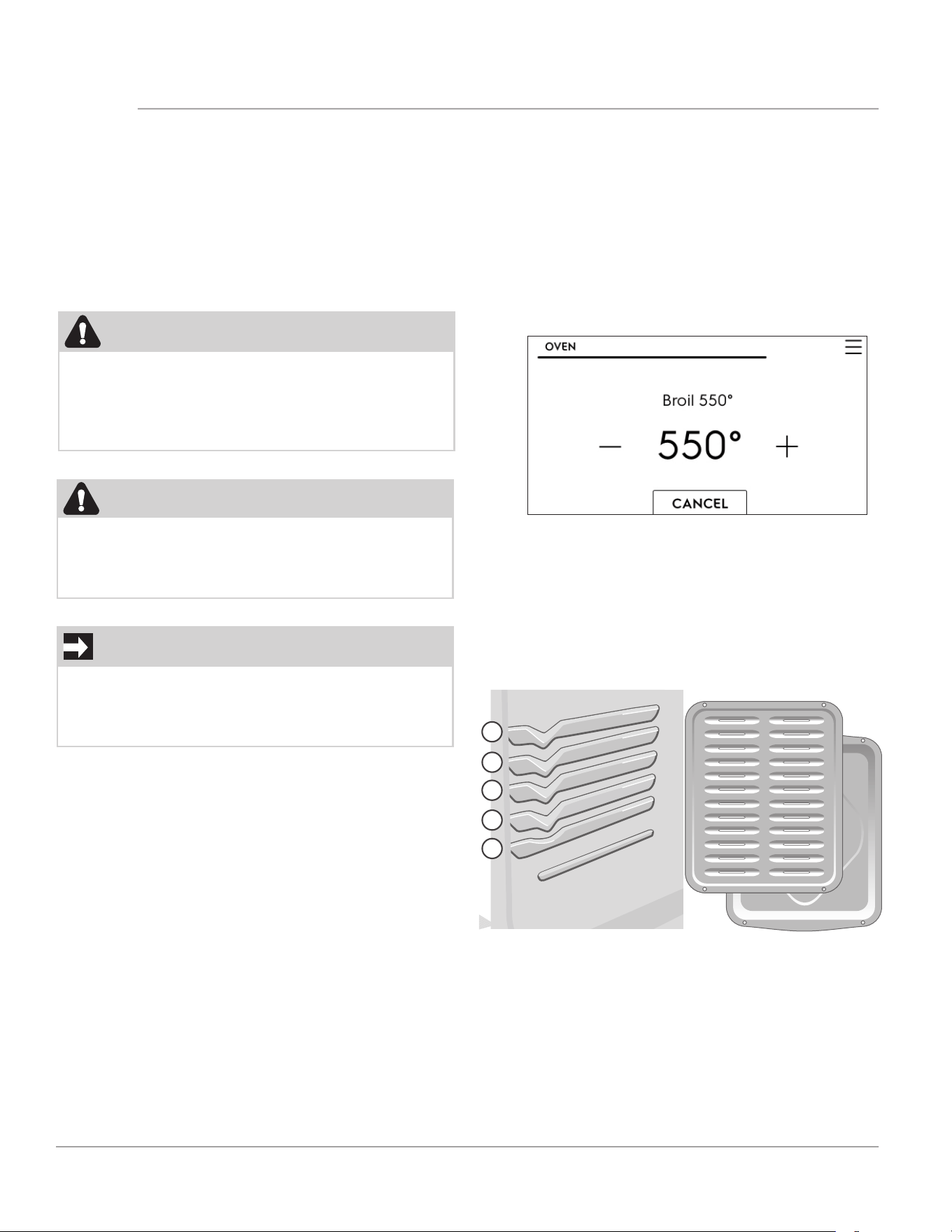
to set broil with the default broil oven tempera-
ture of 550°f (288°c):
1. Arrange the oven racks when cool. For opti-
mum browning results, preheat oven for 2 min-
utes before adding food.
2. Select oven mode and scroll to Broil.
3. Default 550° appears.
4. If lower broil temperature is needed use keypad
to select between 400° and 550°.
5. Press Start. Broil with oven door closed.
6. Broil on one side until food is browned; turn
and broil other side until done to your satisfac-
tion.
7. When finished broiling, press on/off.
1
2
3
5
4
35
SettInG oVen controLS
table 6: Broil recommendations
food item rack
posi-
tion
temp cook time in
minutes
Internal
tempera-
ture
doneness
1st side 2nd side
Steak 1” thick 5 550°F
(288°C)
4:00 4:00 140ºF (60ºC) Rare**
Steak 1” thick 5 550°F
(288°C)
6:00 4:00 145°F (63°C) Medium
Steak 1” thick 5 550°F
(288°C)
7:00 5:00 160ºF (71ºC) Medi-
um-well
Steak 1” thick 5 550°F
(288°C)
8:00 6:00 170°F (77ºC) Well
Pork Chops 3/4
“thick
5 550°F
(288°C)
12:00 10:00 170°F (77ºC) Well
Chicken - Bone In 5 450°F
(232°C)
20:00 10:00 170°F (77ºC) Well
Chicken Boneless 5 450°F
(232°C)
8:00 6:00 170°F (77ºC) Well
Fish 5 550°F
(288°C)
as directed 170°F (77ºC) Well
Shrimp 5 550°F
(288°C)
as directed 170°F (77ºC) Well
Hamburger 1” thick 5 550°F
(288°C)
9:00 7:00 145ºF (63ºC) Medium
Hamburger 1” thick 5 550°F
(288°C)
10:00 8:00 170°F (77ºC) Well
The U.S. Department of Agriculture states, **Rare fresh beef is popular, but you should know that cook-
ing it to only 140°F (60°C) means some food poisoning organisms may survive.” (Source: Safe Food
Book, Your Kitchen Guide, USDA Rev. June 1985.) The lowest temperature recommended by the USDA
is 145°F (63°C) for medium rare fresh beef. For well done 170°F (77ºC). All cook times shown are after 2
minutes of preheating.
Important notes:
• Always arrange oven racks when the oven is cool.
• For best results when broiling, use a broil pan with broil pan insert designed to drain the fat from the
food and help avoid spatter and reduce smoking.
• When broiling, always pull the oven rack out to the stop position before turning or removing food.

36
SettInG oVen controLS
multi-racks
Multi-Rack is for baking on up to two racks while
following recommended time and temperature. The
oven will make adjustments for best results.
Important: Be sure to use suggested rack posi-
tions before setting oven.
to use multi-rack:
1. Arrange the oven racks when cool.
2. Select oven mode and scroll to multi racks.
3. Touch multi racks.
4. Default 350° appears. Set another temperature
if desired.
5. Touch Start.
6. Set cook time if needed.
7. Press Start.
8. When Cook Time ends the oven turns o auto-
matically.
9. Cooking has ended and O will be in display.
10. Press on/off to return display to show the
time of day.
• Follow recipe for time and temp and the oven
will make needed adjustments for best perfor-
mance.
• Fully preheat the oven for best results.
• Pans and pizzas should be pulled to the front of
the rack.
• Allow at least 2 inches (5 cm) of space between
bakeware for proper air circulation.
• Leave oven lights o while baking.
• Use flat rack in position 1 and glide rack in posi-
tion 4.
37
SettInG oVen controLS
Steam Bake
Steam creates the best conditions for baking bread
on a single rack. Baked goods will have improved
browning and texture and is recommended for
baking moist and flavorful breads and pastries such
as baguettes and croissants.
Use flat rack in position 2 for best results for Steam
Bake. Pans should be pulled to the front of the
rack.
to set Steam Bake:
1. Select oven modes and scroll to Steam Bake.
2. Add 3 cups of water to Steam Tray as directed.
3. Touch neXt and follow Steam Bake instruction
for setting temperature.
4. Touch Start.
5. Set cook time. (Suggests waiting to set Cook
Time until oven preheats.)
6. When cook time ends oven turns o
automatically.
7. cooking has ended and o will be in display.
8. Press on/off to return to show the time of
day.
cooking with Steam
note: More moisture will be present than during
conventional baking or roasting. Moisture could
condense on the handle or in the door, and de-
pending on the conditions in your kitchen possibly
drip onto the floor.
Steam cooking tips:
oven positioning
• Use flat rack in the position in the oven for
most foods for Steam Roast.
• Lowest position for poultry.
preparing
• Use 3 cups of water for steam bake and steam
roast. If steam functions are frequently used,
use distilled water.
• Using water container, pour water slowly into
the Steam Tray while still cool.
• Never add water if the oven is warm.
• Never add water during a Steam Bake or Steam
Roast cycle.
While in use
• When using Steam, follow the recipe for pre-
heating, cook time, and cook temperature. If
the original recipe did not use steam, reduce
the temperature by 25°F (14°C), but not below
325°F (163°C).
• Always start with a cold oven.
• Preheating is not necessary when using steam
roast.
cleaning
• With a paper towel lightly soaked in distilled
white vinegar, wipe out bottom of oven cavity
after the oven is cooled or before each use.
• Use the self clean function to clean heavily
soiled areas.
• If residue remains after self clean, pour a thin
layer of distilled white vinegar onto the bottom
of the oven cavity. Allow to sit for 30 minutes.
Wipe out vinegar.
Important
Stand to the side of the oven when opening to
allow any steam to escape.
note
The cooling fan will run on high during steam
cooking.
cautIon
Do not use Steam Bake for cooking at tempera-
tures below 325°F (163°C).
figure 7: Steam tray
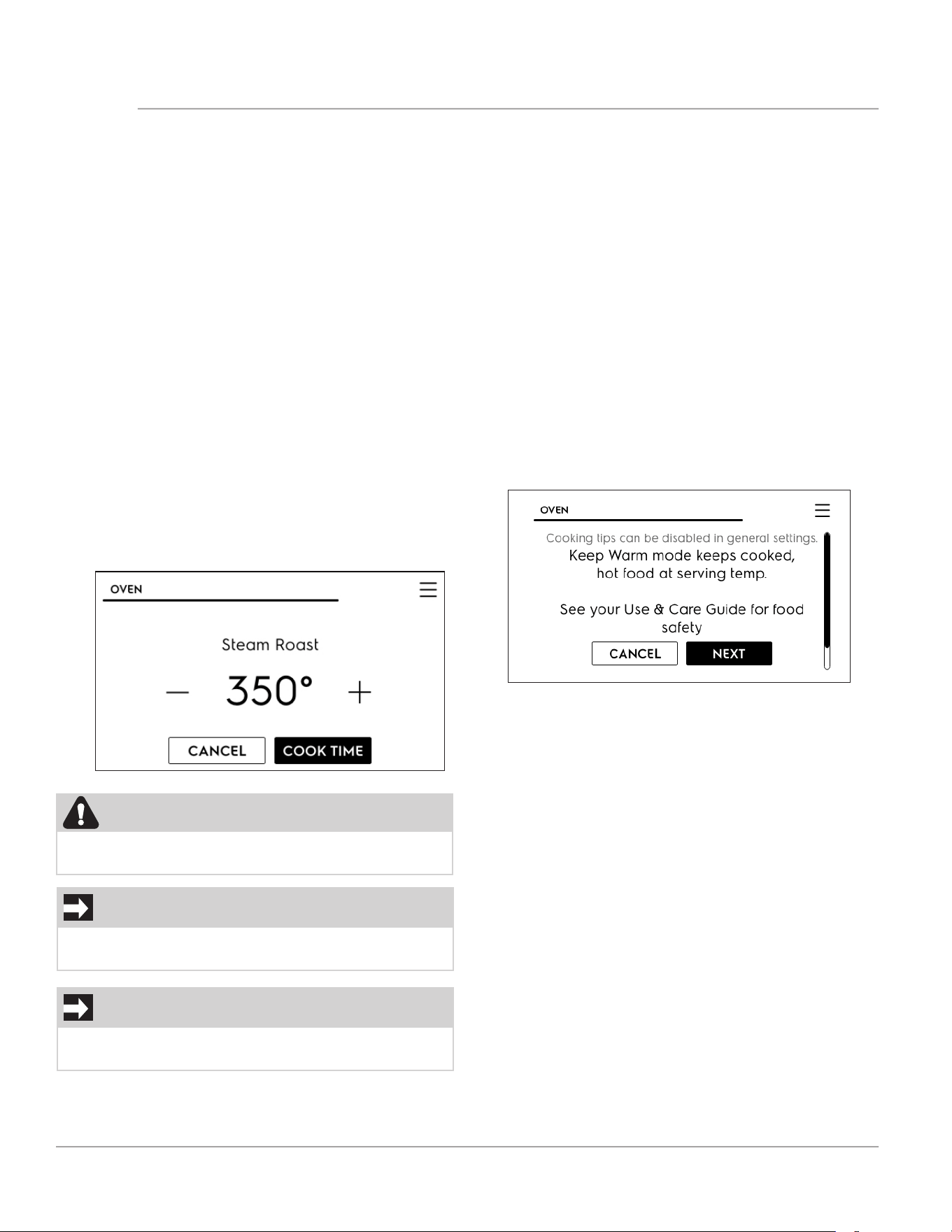
38
SettInG oVen controLS
Steam roast
Steam creates the best conditions for roasting pro-
teins. Meats will be crisp outside and juicy inside.
Steam Roast is recommended for meat or poultry.
Use flat rack in position 1 for best results for Steam
Bake.
to set Steam roast:
1. Select oven modes and scroll to Steam roast.
2. Add 3 cups of water to the Steam Tray as di-
rected.
3. Touch neXt and follow Steam Roast instruction
for setting temperature.
4. Touch Start.
5. When cook time ends oven turns o
automatically.
6. cooking has ended and o will be in display.
7. Press on/off to return display to show the
time of day.
Important
Stand to the side of the oven when opening to
allow any steam to escape.
Keep Warm
Keep Warm should only be used with foods that
are already at serving temperatures. Keep warm
will keep cooked foods warm and ready for serving
after cooking has finished.
Keep warm will keep the oven temperature at 140°
F - 200° F (60°C - 93°C).
to set Keep Warm:
1. If needed, arrange oven racks and place cooked
food in oven.
2. Press oven modes and scroll to Keep Warm.
3. Touch Keep Warm.
4. Set desired temperature.
5. Press Start.
6. Keep Warm will turn o when canceled.
cautIon
Do not use Steam Roast for cooking at tempera-
tures below 325°F (163°C).
note
The cooling fan will run on high during steam
cooking.
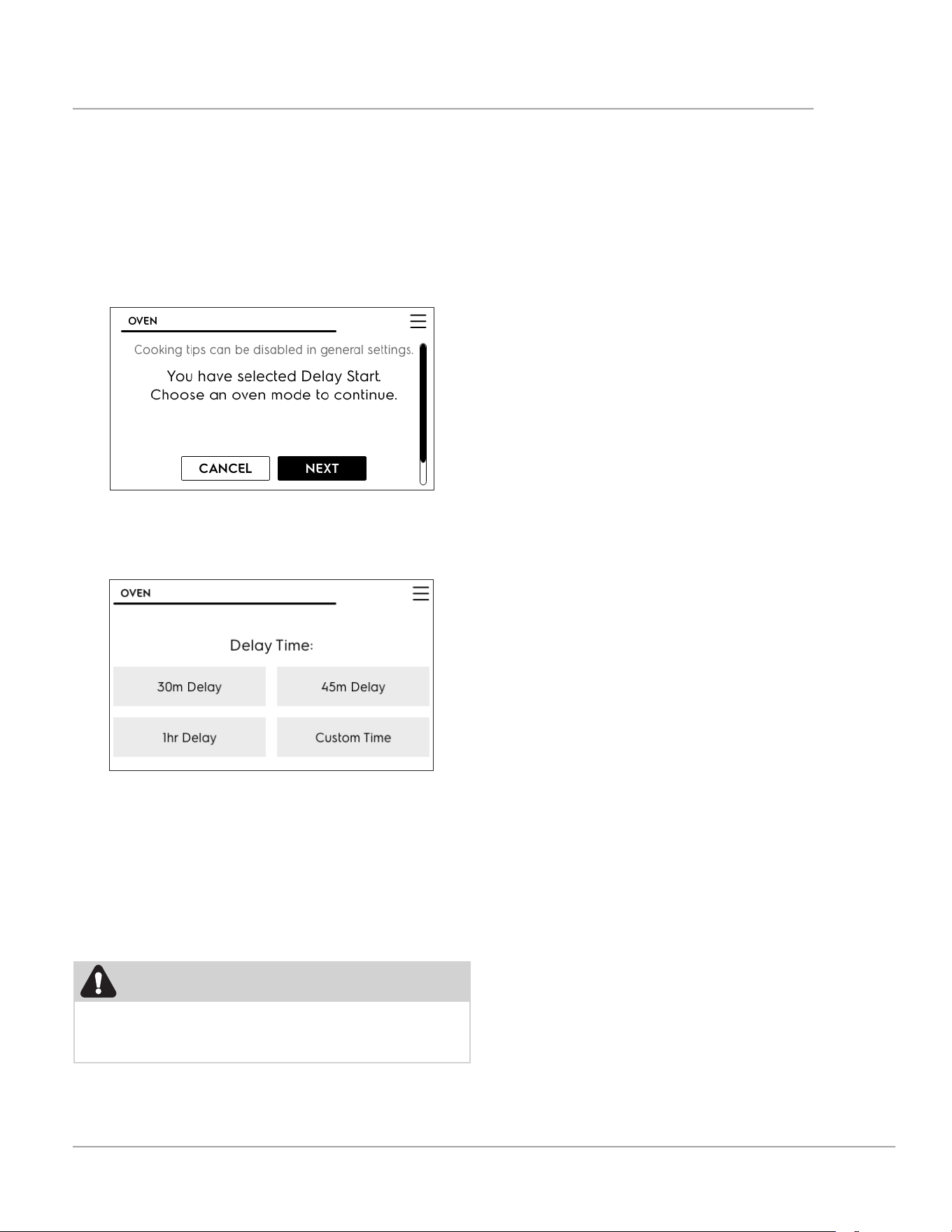
39
SettInG oVen controLS
Setting delay Start
Delay Start allows a delayed starting time only for
Bake, Convection Bake, No Preheat, Convection
Roast, Steam Roast, Steam Clean, and Self Clean.
Prior to setting a delay start, be sure the time of
day is set correctly. The maximum delay for a Delay
Start is one hour (12 hours for Self Clean or Steam
Clean).
1. Press on/off key and touch oven modes.
WarnInG
food poisoning Hazard. Do not let food sit for
more than one hour before or after cooking. Do-
ing so can result in food poisoning or sickness.
When the Delay Start time is reached, the oven will
turn on and begin cooking. The screen will show
the oven temperature.
When Cook Time (if used) ends, cooking is over
and o and oKay will appear in the display win-
dow, and the oven will shut o automatically.
The oven control will sound tones as a reminder
until the oKay is pressed.
2. Scroll to delay Start and touch.
3. Follow the information on the screen to set de-
lay time, temperature, and cook time.
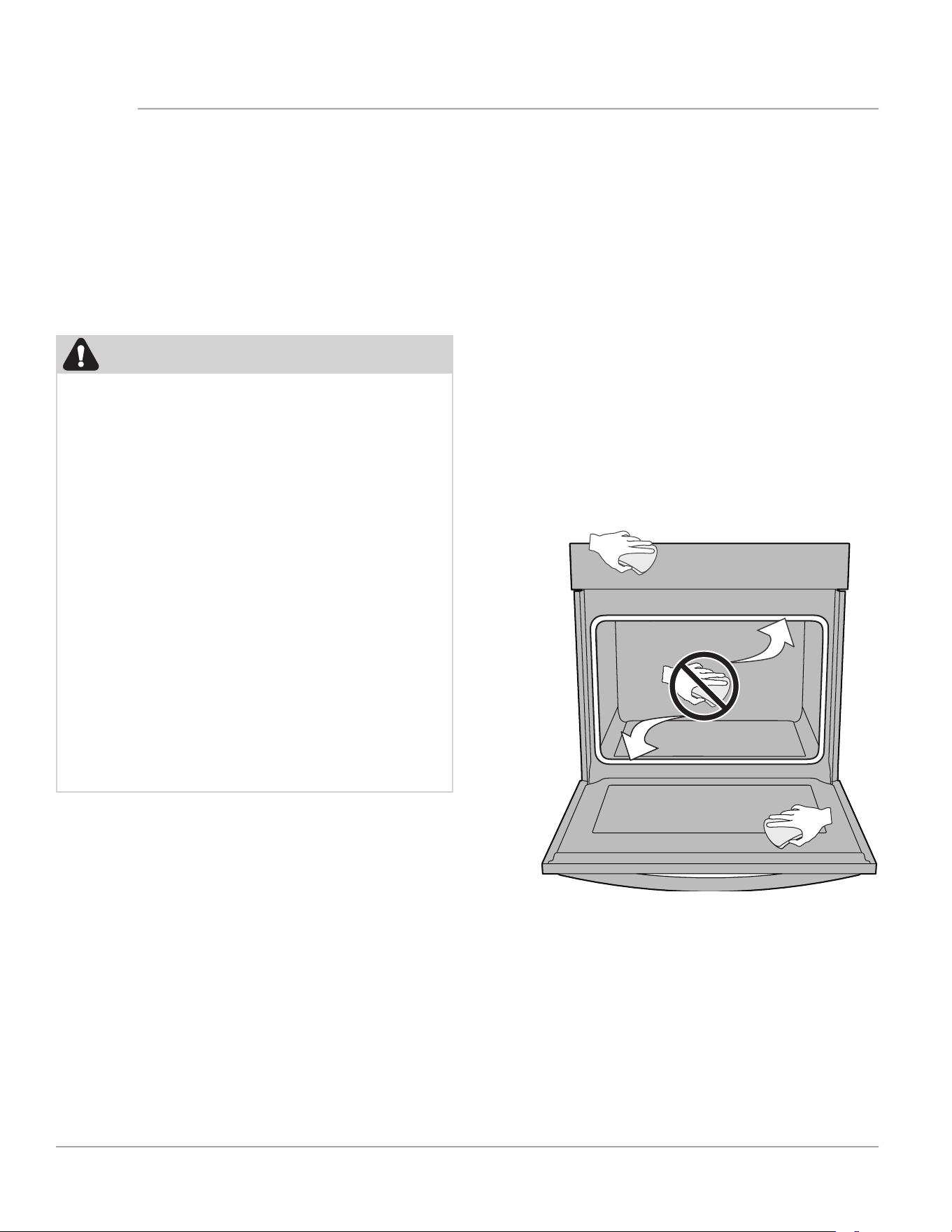
40
SettInG oVen controLS
Self clean
A self cleaning oven cleans itself with high tem-
peratures (well above normal cooking tempera-
tures), which vaporizes soils or reduces them to a
fine powdered ash you can wipe away afterwards
with a damp cloth. This function can be pro-
grammed for clean times between 2 and 4 hours.
Important: Before starting self clean read all fol-
lowing caution and important statements before
starting a self clean cycle.
figure 8: clean around the oven door gasket
Important notes:
• Completely remove all oven racks and any ac-
cessories from oven cavity to avoid damage to
oven racks. If the oven racks are not removed
they may discolor.
• Remove all items from the oven and cooktop
including cookware, utensils, and any aluminum
foil. Aluminum foil will not withstand high tem-
peratures from a self clean cycle and will melt.
• Do not spray oven cleaners or oven protec-
tive coatings in or around any part of the oven
interior. Clean any soil from the oven frame, the
door liner outside the oven door gasket, and
the small area at the front center of the oven
bottom (page 40). These areas heat su-
ciently to burn soil on. Clean using soap and
water prior to starting Self Clean.
• Remove any excessive spills. Any spills on the
oven bottom should be wiped up and removed
before starting a self clean cycle. To clean use
hot, soapy water and a cloth. Large spills can
cause heavy smoke or fire when subjected to
high temperatures.
• Do not allow food spills with high sugar or acid
content (such as milk, tomatoes, sauerkraut,
fruit juices, or pie fillings) to remain on the
surface as they may leave a dull spot even after
cleaning.
• Do not clean the oven door gasket. The woven
material in the gasket is essential for a good
seal. Care should be taken not to rub, dam-
age, or remove the oven door gasket. Doing so
could cause damage to the door gasket and
compromise the performance of the oven.
• The kitchen area should be well ventilated using
an open window, ventilation fan, or exhaust
hood during the first self clean cycle. This will
help eliminate the normal odors.
• Do not attempt to open the oven door when
the OVEN LOCK indicator light is flashing.
Allow about 15 seconds for the motorized door
latch mechanism to completely lock or unlock
the oven door.
• When the clean time finishes, the oven door will
remain locked until the range has cooled suf-
ficiently. In addition to the clean time that was
programmed, you must allow about 1 additional
hour for the oven to cool before you will be
able to open the oven door.
cautIon
• Do not leave small children unattended near
appliance. During self clean cycle, the outside
of the oven can become very hot and cause
burns if touched.
• Do not line the oven walls, racks, oven bot-
tom, or any part of the range with aluminum
foil. This will cause permanent damage to the
oven interior and destroy heat distribution,
and will melt to the oven interior.
• Do not force the oven door open. This will
damage the automatic door locking system.
Use caution when opening the oven door
after the self clean cycle ends. The oven may
still be very hot and cause burns. To avoid
possible burns, stand to side of oven when
opening door to allow steam or hot air to
escape.
• The health of some birds is extremely sensi-
tive to fumes given o during the self clean
cycle of any range. Move birds to a well venti-
lated room.
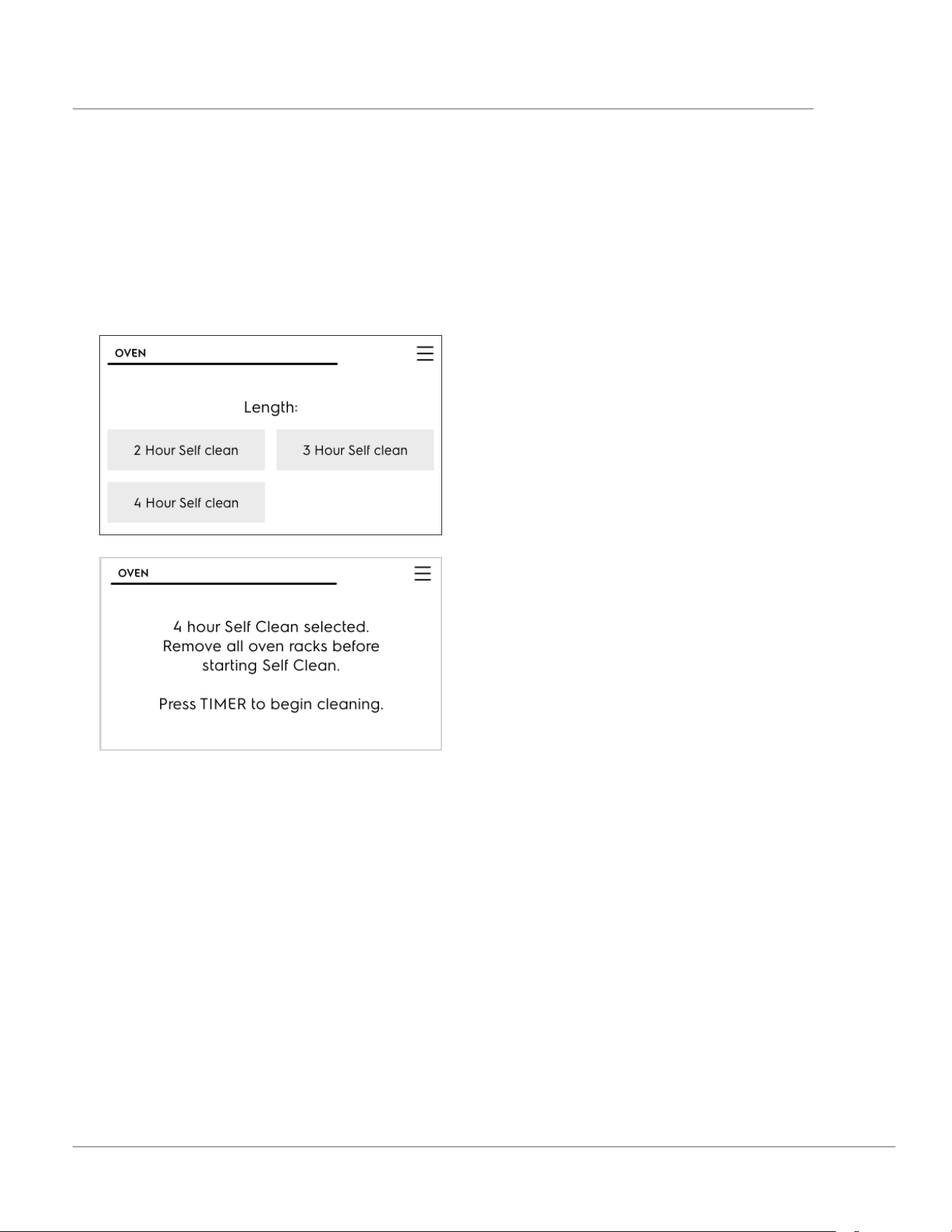
41
SettInG oVen controLS
to set a self clean cycle:
1. Be sure the oven is empty and all oven racks
are removed. Remove all items from the oven.
Be sure oven door is completely closed.
2. Touch oven modes and scroll to Self clean.
3. Touch Self clean and select 2 hour, 3 hour, or
4 hour clean time.
4. Press tImer to start the self clean cycle.
When the oven is set to run a self-clean cycle,
the motor door lock will begin locking the oven
door. Do not open the oven door while the lock
motor is running or when any locking indicators
or displays are showing. The oven door is com-
pletely locked in about 15 seconds. Once the
oven door has locked, CLEAN will appear in the
display indicating self clean has started.
Do not force the oven door open when self-
clean is active. This can damage the automatic
door-locking system. Use caution when open-
ing the door after self-clean cycle is complete;
the oven may still be very hot.
When the self clean cycle has completed:
1. cLean message will turn o, and Hot will
appear in display window. The oven door will
remain locked while the oven cools.
2. Once the oven has cooled down (about 1 hour)
and Hot is no longer displayed, the oven door
may be opened.
3. When the oven interior has completely cooled,
wipe away any residue or powdered ash with a
damp cloth or paper towel.
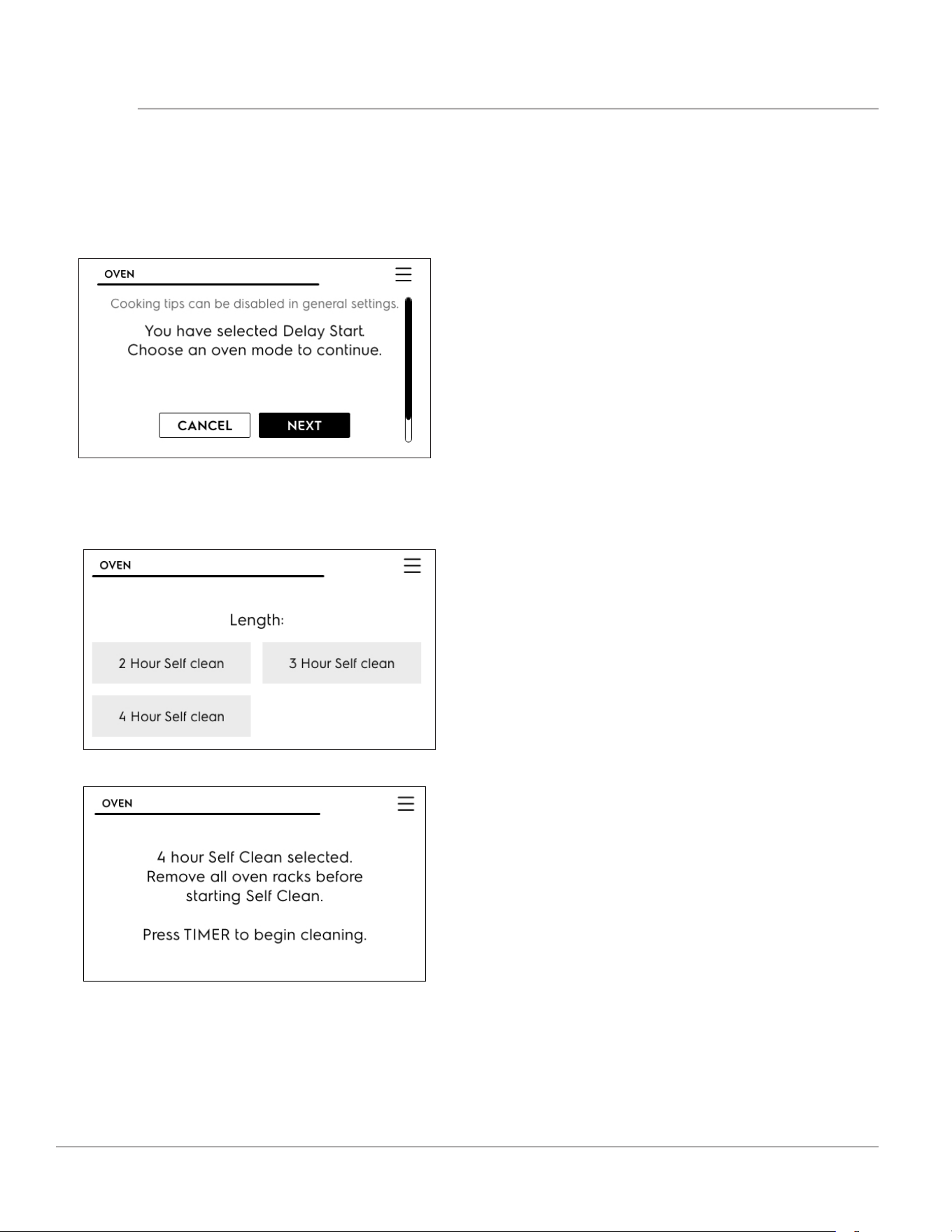
42
SettInG oVen controLS
Setting delay Start Self clean
to start a delay self clean with default clean time
of 3 hours.
1. Press on/off key and touch oven modes.
2. Scroll and touch delay Start.
If it becomes necessary to stop self clean when
active:
• Press off.
• If self clean has heated the oven to a high
temperature, allow enough time for the oven to
cool.
• Before restarting self clean, be sure to read
important notes below.
3. Touch neXt and scroll Oven Modes to Self
clean. Follow the information on the screen to
set delay time, self clean time.
Important notes
• If self clean was active and then interrupted by
a power failure or canceled before the oven was
thoroughly cleaned, it may be necessary to run
another self clean cycle.
• If the oven temperature was high enough when
self clean was interrupted the oven control may
not allow another self clean cycle to be set for
up to 4 hours.
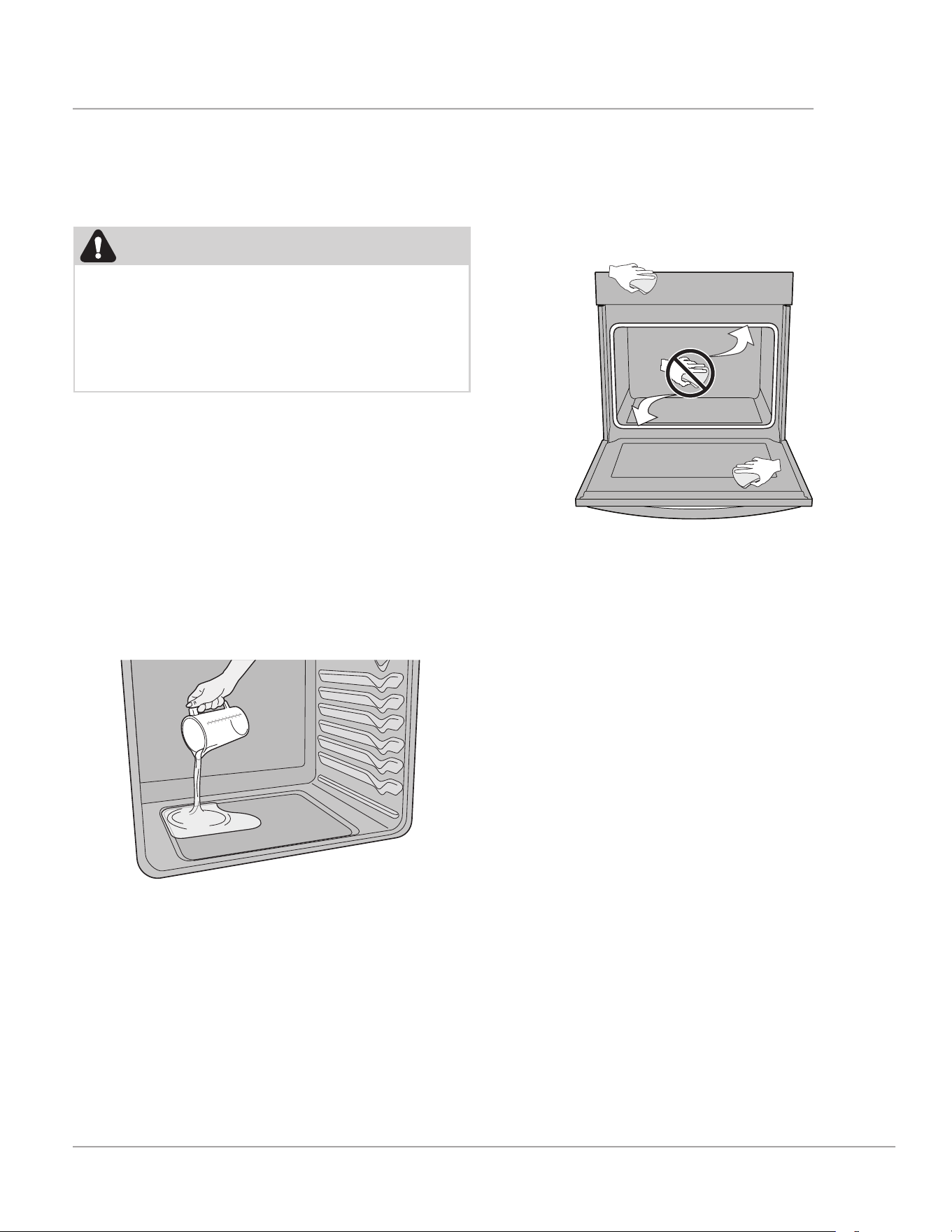
43
SettInG oVen controLS
Steam clean
The Steam Clean feature oers a chemical free and
time saving method to assist in the routine clean-
ing of small and light soils. For heavier baked on
soils use the Self Clean feature.
figure 9: add 1 cups of tap water
Be sure the oven is level and cool before starting
Steam Clean. If the oven temperature is above
room temperature a triple beep will be heard and
the function will not start. Steam Clean produces
best results when started with a cool oven.
to set a Steam clean cycle:
1. Remove all racks and oven accessories.
2. Scrape or wipe loose debris and grease from
the oven bottom.
3. Pour 1 cup of tap water onto the oven bottom.
Close oven door.
notes:
• Opening the oven door during the steam clean
cycle prevents the water from reaching the
temperature needed to clean.
• For best results, clean oven immediately after
the cycle is complete. Steam clean works best
for soils on the oven bottom.
• A non-abrasive scouring pad, stainless steel
sponge, plastic scraper, or eraser style cleaning
pad (without cleaner) can be used for dicult
soils. Moisten pads with water before use.
• Place a paper towel or cloth in front of the
oven to capture any water that may spill while
wiping out.
• Do not leave the residual water in the oven for
any length of time.
• Some condensation or water vapor may appear
close to the oven vent and the oven door glass.
This is normal. The oven gasket may become
damp; do not wipe dry.
• Local water sources often contain minerals
(hard water). If hard water deposits occur, wipe
cavity with a 50/50 solution of water and vine-
gar or 50/50 solution of lemon juice and water.
• Steam clean cannot be programmed with a
delayed start time.
• If Steam Clean results are not satisfactory, run a
Self Clean. See “Self Clean” on page 40.
4. Touch oven modes, scroll to and touch Steam
clean.
5. Touch Start.
6. The time the Steam Clean cycle will end is
shown in the display. Do not open the door
during this time. If door is open while in Steam
Clean (d-O) will appear in the display.
7. When the steam clean cycle is complete an
alert will sound and the O message will show
in the display. Press o to return to the clock.
8. Take care opening the door when the steam
clean is finished. Stand to the side of the oven
out of the way of escaping vapor.
9. Wipe oven cavity and bottom. Do not clean
oven door gasket. Avoid leaning or resting on
the oven door glass while cleaning cavity.
cautIon
Do not add bleach, ammonia, oven cleaner, or
any other abrasive household cleaners to the wa-
ter used for Steam Clean.
Before cleaning any part of the oven, be sure all
controls are turned o and the oven is cool. The
oven may be hot and can cause burns.
figure 10: clean around the oven door gasket
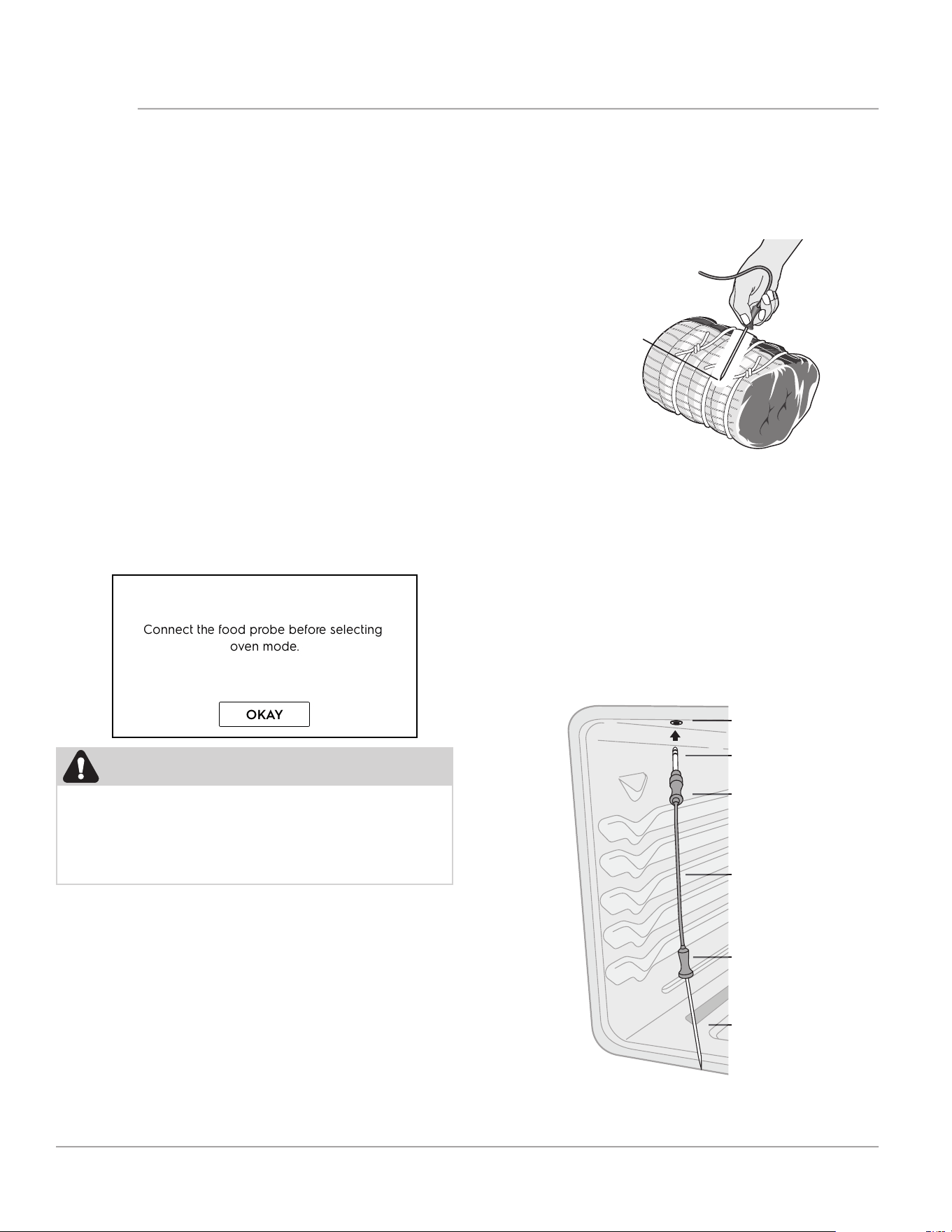
44
SettInG oVen controLS
cooking with food probe
Use the probe feature for best results when cook-
ing foods such as roasts, hams, or poultry.
The Food Probe works with the following oven
modes: Bake, Convection Bake, Air Fry, Convection
Roast, Steam Roast, and Turkey.
The probe feature, when set correctly, will signal an
alert when the internal food temperature reaches
the desired set target temperature. The probe set-
tings for how the oven behaves should be set first
in the oven menu.
When active, the probe displays the internal food
temperature which is visible in the display during
the cooking process. This eliminates any guesswork
or the need to open the oven door to check the
thermometer.
For meats like poultry and roasts, using a probe to
check internal temperature is the safest method to
ensure properly cooked food.
to set food probe: Touch oven modes, scroll to
food probe and follow directions on the display.
proper placement of probe in food.
Insert the probe so that the probe tip rests inside
the center of the thickest part of meat or food. For
best results, do not allow the probe temperature
sensor to contact bone, fat, gristle, or the cook-
ware.
• For bone-in ham or lamb, insert the probe into
the center of lowest large muscle or joint.
• For meat loaf or casseroles, insert the probe
into center of food.
• When cooking fish, insert meat probe just
above the gill.
• For whole poultry or turkey, fully insert the
probe sensor into the thickest part of the
breast.
cautIon
Do not use kitchen utensils to pull on the probe
cable or handles. Always insert and remove the
probe using the provided handles, as shown in
and always use a pot holder to protect hands
from possible burns.
Insert
probe tip
to center of
food
handle
probe
cable
probe
sensor
handle
receptacle
probe
connector
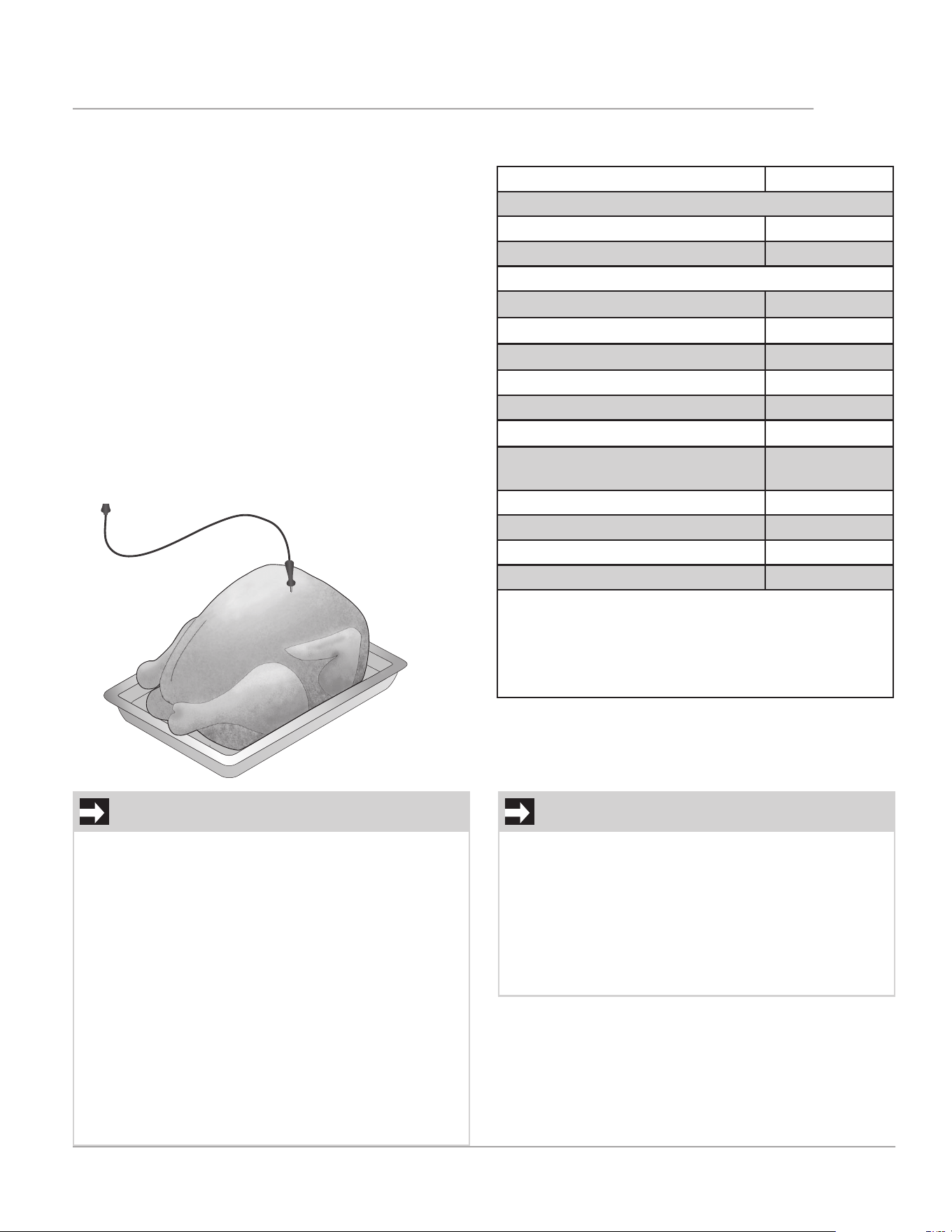
45
SettInG oVen controLS
table 7: uSda recommended minimum internal
cooking temperatures
food type Internal temp.
Ground meat and meat mixtures
Beef, Pork, Veal, Lamb 160°F (71°C)
Turkey, Chicken 165°F (74°C)
Fresh beef, veal, lamb
Medium rare +
145°F (63°C)
Medium
160°F (71°C)
Well Done
170°F (77°C)
Chicken and Turkey, whole 165°F (74°C)
Poultry Breasts, Roasts 165°F (74°C)
Poultry Thighs, Wings 165°F (74°C)
Stung (cooked alone or in
bird)
165°F (74°C)
Ham Fresh (raw) 160°F (71°C)
Ham Pre-cooked (to reheat) 140°F (60°C
Eggs dishes 160°F (71°C)
Leftovers and Casseroles 165°F (74°C)
The U.S. Department of Agriculture states, “Rare fresh
beef is popular, but you should know that cooking it to
only 140°F (60°C) means some food poisoning or-
ganisms may survive.” (Source: Safe Food Book, Your
Kitchen Guide, USDA) Visit the USDA Food Safety and
Inspection website at www.fsis.usda.gov
using the food probe for turkey
1. Select oven modes and scroll to food probe.
2. The display will remind you to insert the probe
into the turkey and place in oven on rack posi-
tion 1.
3. Display reminds you to connect the food probe
to the receptacle before setting oven mode:
4. Touch neXt.
5. Touch turkey in Oven Modes.
6. Set target food temperature after pressing
neXt.
7. Set oven temperature and press Start.
8. When the target temperature of the turkey
(internal temperature) is reached, the oven will
turn o if set for cooking to stop in the Oven
Menu settings.
Important
Do not store the probe inside the oven. Use only
the original probe provided. Connecting any oth-
er probe or device could result in damage to the
oven control, electronics, and the receptacle.
Before starting self clean, double check that the
probe is removed from the oven interior. Defrost
frozen foods completely before inserting the
probe.
note
During cooking, the internal food temperature
will display in the center of the screen. The oven
temperature will be displayed at the bottom of
the screen beside the cancel key. To assure accu-
racy, do not remove the probe from the food or
receptacle until the desired internal temperature
is reached.
If the probe is removed from the receptacle only,
the probe feature will cancel and the oven will
turn o. If the probe is removed from the food
only, the probe feature will remain active and
may eventually generate a probe too hot mes-
sage.
To change the target (internal food) temperature
or the set oven temperature touch the one you
want to change and use the + or - to adjust the
temperature.
46
SettInG oVen controLS
Setting the Sabbath feature for the
Jewish Sabbath and Holidays
(some models)
For further assistance, guidelines
for proper usage, and a complete
list of models with the Sabbath fea-
ture, please visit the web at www.
star-k.org.
This appliance provides special set-
tings for use when observing the Jewish
Sabbath/Holidays. Sabbath mode disables all au-
dible tones or visual display changes on the oven
control. Bake is the only cooking feature available
while in the Sabbath mode. Most oven controls are
locked during Sabbath mode.
To start Sabbath Mode, first select Sabbath from
the settings menu. Next, select Delay (if desired),
Bake temperature, and cook time (if desired) and
set. Cooking will begin after any specified delay.
If cook time was set, once the time has elapsed, the
cooking will end and the display will show Idle to
indicate that the cook time has ended.
Important: The Sabbath mode will override the
factory preset 12 hour energy saving mode, and the
appliance will stay on until the cooking features are
canceled. If cooking is canceled when the appli-
ance is in the Sabbath mode, no audible or visual
indicators will be available to verify the cancella-
tion.
If the oven interior lights are needed, be sure to
activate them prior to setting the Sabbath mode.
Once the oven light is turned on and the Sabbath
mode is active, the oven light will remain on until
the Sabbath mode is turned o and the oven lights
are turned o. The oven door will not activate the
interior oven lights when the oven door is opened
or closed.
It is recommended that any oven temperature
modification made within an active Sabbath mode
press the + or - key.
The temperature will increase or decrease with
each press by 5°F or 1°C and the change will be
accepted automatically.
Important:
• Do not attempt to activate any other oven
function except Bake while the Sabbath feature
is active. When the Sabbath feature is active,
only the + and - keys and OFF will function.
ALL OTHER KEYS should not be used once the
Sabbath feature is active.
• You may change the oven temperature once
baking has started. Use the + and - keys to raise
or lower the oven temperature. Each press of
an arrow key will raise or lower the temperature
by 5°F (1°C).
• Remember that the oven control will no longer
provide audible tones or display any further
changes when the Sabbath feature is active.
• The oven will shut-o automatically after
completing a bake time and therefore may
only be used once during the Sabbath/Jewish
Holidays.
WarnInG
Food poisoning hazard. Do not let food sit for
more than one hour before or after cooking.
Doing so can result in food poisoning or sickness.
Foods that can easily spoil such as milk, eggs,
fish, meat or poultry, should be chilled in the
refrigerator first. Even when chilled, they should
not stand in the oven for more than 1 hour before
cooking begins, and should be removed promptly
when finished cooking.
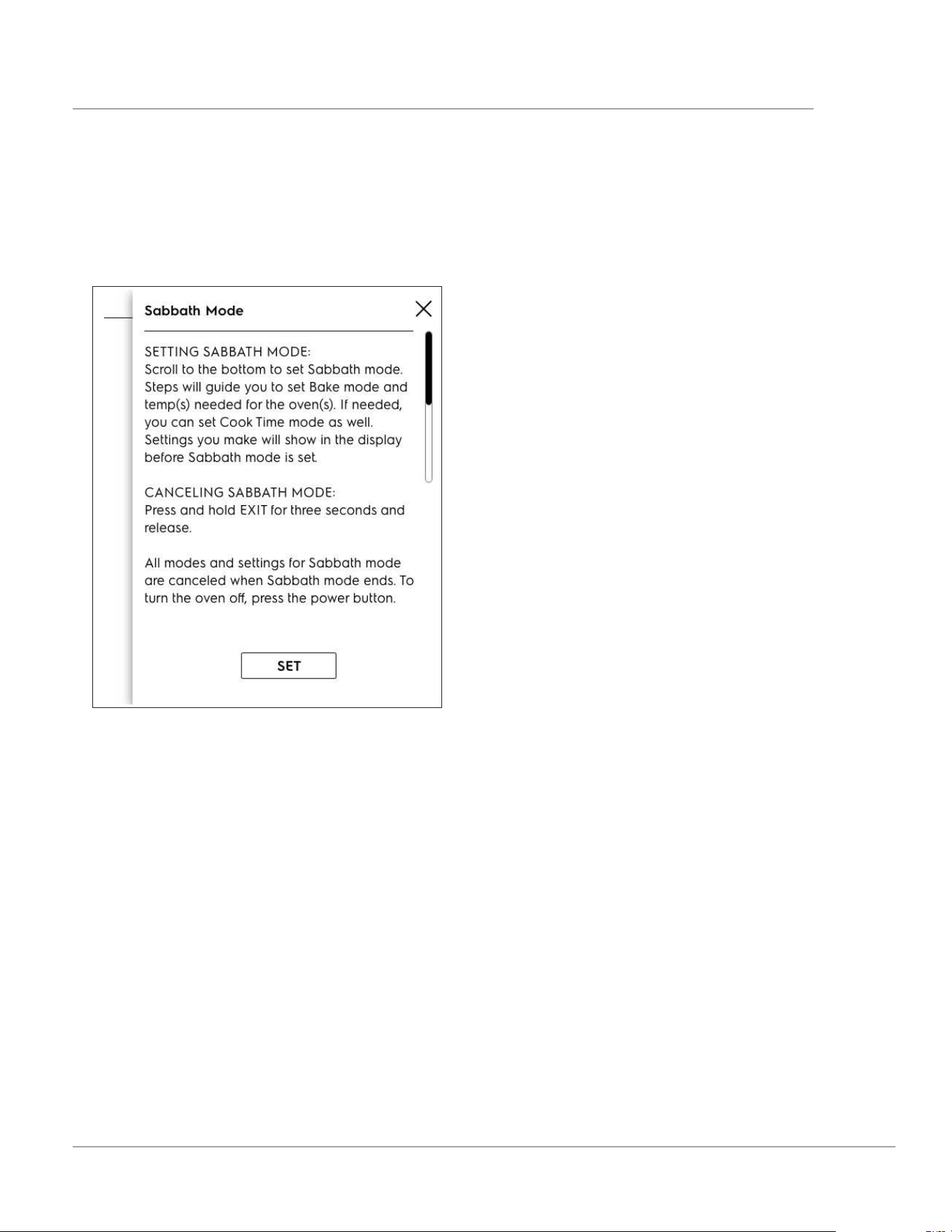
47
SettInG oVen controLS
SettInG SaBBatH mode:
Sabbath Mode is set using the menu options.
1. Touch the menu options bars.
2. Scroll to Sabbath mode.
3. Touch Sabbath mode and follow all instructions
on screen.
To exit Sabbath Mode, press and hold eXIt for
three seconds.

48
Before uSInG mIcroWaVe
about your microwave oven
This Use and Care Manual is valuable: read it care-
fully and always save it for reference.
A good microwave cookbook is a valuable asset.
Check it for microwave cooking principles, tech-
niques, hints, and recipes.
neVer use the microwave oven without the turn-
table and support or turn the turntable over so that
a large dish could be placed in the microwave oven.
The turntable will turn both clockwise and counter-
clockwise.
aLWayS have food in the microwave oven when it
is on to absorb the microwave energy.
When using the microwave oven at power levels
below 100%, you may hear the magnetron cy-
cling on and o. It is normal for the exterior of the
microwave oven to be warm to the touch when
cooking or reheating.
Condensation is a normal part of microwave cook-
ing. Room humidity and the moisture in food will
influence the amount of moisture that condenses
in the microwave oven. Generally, covered foods
will not cause as much condensation as uncovered
ones. Ventilation openings must not be blocked.
The microwave oven is for food preparation only. It
should not be used to dry clothes or newspapers.
All microwave ovens are rated by using the IEC
Test Procedure at 1200 watts. If using recipes or
package directions, check food a minute or two
before the minimum time setting elapses and add
time accordingly.
radio or tV Interference
Should there be any interference caused by the
microwave oven to your radio or TV, check that the
microwave oven is on a dierent electrical cir-
cuit, relocate the radio or TV as far away from the
microwave oven as feasible or check position and
signal of receiving antenna.
about microwave cooking
• Arrange food carefully. Place thickest areas
towards outside of dish.
• Watch cooking time. Cook for the shortest
amount of time indicated and add more as
needed. Food severely overcooked can smoke
or ignite.
• Cover foods while cooking. Check recipe or
cookbook for suggestions: paper towels, wax
paper, microwave plastic wrap or a lid. Cov-
ers prevent spattering and help foods to cook
evenly.
• Stir foods from outside to center of dish once
or twice during cooking, if possible.
• Turn foods over once during microwaving to
speed cooking of such foods as chicken and
hamburgers. Large items like roasts must be
turned over at least once.
• Rearrange foods such as meatballs halfway
through cooking both from top to bottom and
from the center of the dish to the outside.
• Allowing food to stand in or out of the oven
after cooking power stops can improve results.
Standing time after defrosting or cooking al-
lows the temperature to evenly spread through-
out the food.
• Check for doneness. Look for signs indicating
that cooking temperatures have been reached.
Doneness signs include:
• Food steams throughout, not just at edge.
• Center bottom of dish is very hot to the
touch.
• Poultry thigh joints move easily.
• Meat and poultry show no pinkness.
• Fish is opaque and flakes easily with a fork.
49
Before uSInG mIcroWaVe
about utensils and coverings
It is not necessary to buy all new cookware. Many
pieces already in your kitchen can be used suc-
cessfully in your new microwave oven. Make sure
the utensil does not touch the interior walls during
cooking.
Use these utensils for safe microwave cooking and
reheating:
• glass ceramic (Pyroceram®), such as Corning-
ware®
• heat-resistant glass (Pyrex®)
• microwave-safe plastics
• paper plates
• microwave-safe pottery, stoneware and porce-
lain
• browning dish (Do not exceed recommended
preheating time. Follow manufacturer’s direc-
tions.)
These items can be used for short-time reheating
about foods
cautIon
• Some products such as whole eggs and
sealed containers—for example, closed jars—
will explode and should not be heated in this
microwave oven. Such use of the microwave
oven could result in injury.
• Do not boil eggs in a microwave oven. Pres-
sure will build up inside egg yolk and will
cause it to burst, possibly resulting in injury.
• Spontaneous boiling—Under certain special
circumstances, liquids may start to boil during
or shortly after removal from the microwave
oven. To prevent burns from splashing liquid,
we recommend the following: before remov-
ing the container from the microwave oven,
allow the container to stand in the microwave
oven for 30 to 40 seconds after the micro-
wave oven has shut o. Do not boil liquids
in narrow-necked containers such as soft
drink bottles, wine flasks, or especially nar-
row-necked coee cups. Even if the container
is opened, excessive steam can build up and
cause it to burst or overflow.
• Do not defrost frozen beverages in nar-
row-necked bottles (especially carbonated
beverages). Even if the container is opened,
pressure can build up. This can cause the con-
tainer to burst, possibly resulting in injury.
• Hot foods and steam can cause burns. Be
careful when opening any containers of
hot food, including popcorn bags, cooking
pouches and boxes. To prevent possible inju-
ry, direct steam away from hands and face.
Important
• Operating the microwave with no food inside
for more than a minute or two may cause
damage to the microwave oven and could
start a fire. It increases the heat around the
magnetron and can shorten the life of the
microwave oven.
• Do not overcook potatoes. They could dehy-
drate and catch fire, causing damage to your
microwave oven.
• Do not pop popcorn in your microwave oven
unless in a special microwave popcorn accesso-
ry or unless you use popcorn labeled for use in
microwave ovens.
• Foods with unbroken outer “skin” -- such as
potatoes, hot dogs, sausages, tomatoes, apples,
chicken livers and other giblets, and egg yolks
-- should be pierced to allow steam to escape
during cooking.
• Avoid heating baby food in glass jars, even with
the lid o. Make sure all infant food is thorough-
ly cooked. Stir food to distribute the heat even-
ly. Be careful to prevent scalding when warming
formula or breast milk. The container may feel
cooler than the milk really is. Always test the
milk before feeding the baby.
• Cook meat and poultry thoroughly—meat to at
least an INTERNAL temperature of 160°F and
poultry to at least an INTERNAL temperature
of 165°F Cooking to these temperatures usually
protects against food-borne illness.
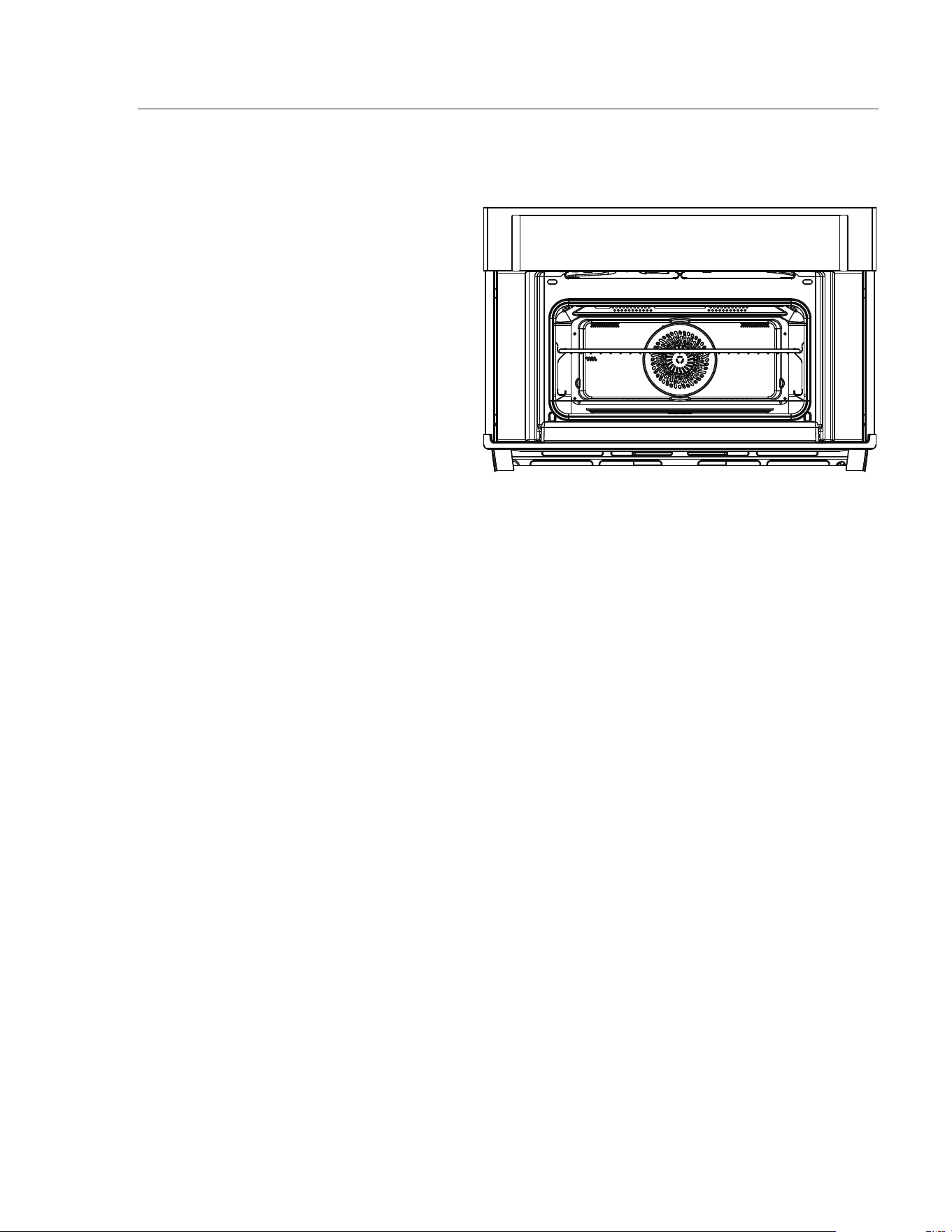
50
Before uSInG mIcroWaVe
• Oven cooking bags are good for large meats or
foods that need tenderizing. DO NOT use metal
twist ties. Remember to slit bag so steam can
escape.
of foods that have little fat or sugar in them:
• wood, straw, wicker
do not uSe
• metal pans and bakeware
• dishes with metallic trim
• non-heat-resistant glass
• non-microwave-safe plastics (margarine tubs)
• recycled paper products
• brown paper bags
• food storage bags
• metal twist-ties
• styrofoam
Should you wish to check if a dish is safe for mi-
crowaving, place the empty dish in the microwave
oven and microwave on HIGH for 30 seconds. A
dish which becomes very hot should not be used.
The following coverings are suitable for microwave
use:
• Paper towels are good for covering foods for
reheating and absorbing fat while cooking ba-
con.
• Wax paper can be used for cooking and reheat-
ing.
• Plastic wrap that is specially marked for micro-
wave use can be used for cooking and reheat-
ing. DO NOT allow plastic wrap to touch food.
Vent so steam can escape.
• Lids that are microwave-safe are a good choice
because heat is kept near the food to hasten
cooking.
Included
The microwave comes with one rack and one rotat-
ing tray.
additional accessories
There are many microwave accessories available
for purchase. Evaluate carefully before you pur-
chase so that they meet your needs. A micro-
wave-safe thermometer will assist you in determin-
ing correct doneness and assure you that foods
have been cooked to safe temperatures.
The manufacturer is not responsible for any dam-
age to the microwave oven when accessories are
used.

51
Before uSInG mIcroWaVe
about children and the microwave
Children below the age of 7 should use the micro-
wave oven with a supervising person very near to
them. Between the ages of 7 and 12, the supervis-
ing person should be in the same room.
At no time should anyone be allowed to lean or
swing on the microwave oven door.
Children should be taught all safety precautions:
use pot holders, remove coverings carefully, pay
special attention to packages that crisp food be-
cause they may be extra hot.
Don’t assume that because a child has mastered
one cooking skill he/she can cook everything.
Children need to learn that the microwave oven is
not a toy.
about food Safety
Check foods to see that they are cooked to the
United States Department of Agriculture’s recom-
mended temperatures.
To test for doneness, insert a meat thermometer in
a thick or dense area away from fat or bone. Never
leave the thermometer in the food during cooking,
unless it is approved for microwave oven use.
cautIon
• ALWAYS use pot holders to prevent burns
when handling utensils that are in contact
with hot food. Enough heat from the food can
transfer through utensils to cause skin burns.
• Avoid steam burns by directing steam away
from the face and hands. Slowly lift the far-
thest edge of a dish’s covering and carefully
open popcorn and oven cooking bags away
from the face.
note:
• Stay near the microwave oven while it’s in use
and check cooking progress frequently so that
there is no chance of overcooking food.
• NEVER use the cavity for storing cookbooks or
other items.
• Select, store, and handle food carefully to pre-
serve its high quality and minimize the spread
of food-borne bacteria.
• Keep the waveguide cover clean. Food residue
can cause arcing and/or fires.
• Use care when removing items from the micro-
wave oven so the utensil, your clothes, or ac-
cessories do not touch the safety door latches.
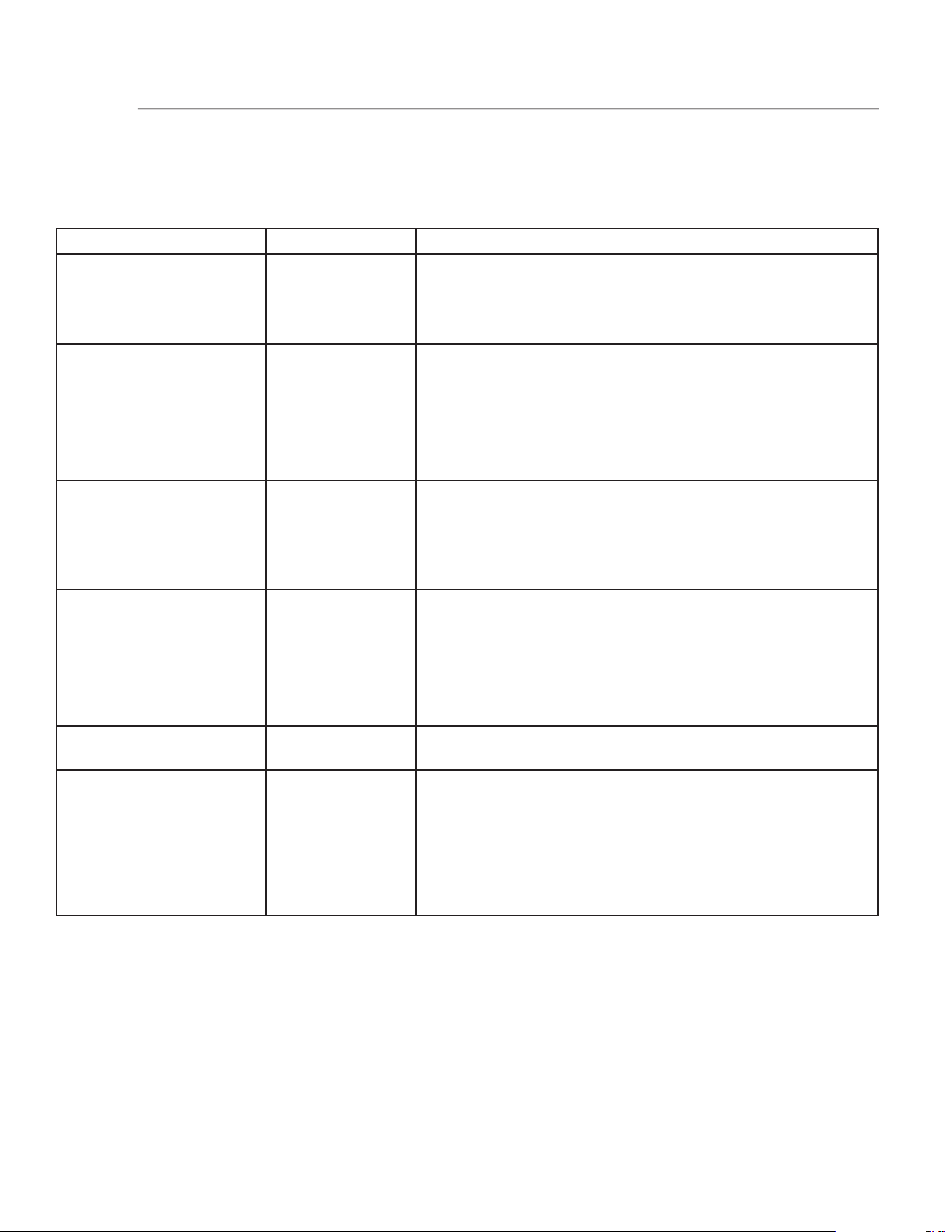
52
Before uSInG mIcroWaVe
preparing food for microwave cooking
To avoid injury or damage to your appliance and to minimize cleaning, prepare food for microwave cook-
ing as shown in Table 8.
table 8: preparing food for microwave
food amount procedure
Popcorn 1 package
1.5 - 3.5 oz bag
Use only popcorn packaged for microwave oven use. Try
several brands to decide which you like. Do not try to pop
unpopped kernels.
Use Popcorn feature.
Reheat
Casserole
Entree
8-10 oz
2-3 servings
Place food in casserole dish slightly larger than amount to
be reheated. Cover with vented microwave-safe lid, plastic
wrap, or wax paper. Use covers such as plastic wrap or
lids with larger quantities of more dense foods such as
stews. After reheating, stir well, if possible. Foods should
be hot. If not, continue to heat using +30 to add more
cook time.
Baked Potato 2 or 4
(8 oz - 12 oz)
Wash and dry. Pierce at both ends and in center. Place on
turntable.
Foods with unbroken outer “skin” -- such as potatoes --
should be pierced to allow steam to escape during cook-
ing
Fresh Veggie:
Asparagus
Broccoli
Cauliflower (florets)
Carrots, baby
Carrots, sliced
Corn
1 lb
2 cups
2 cups
2 cups
2 cups
2 cups
Wash and place in casserole dish. Add 2 tbsp of water.
Cover with vented microwave-safe lid or plastic wrap. Stir
after cooking.
Frozen Veggie 2 cups Add no water. Cover with vented lid or plastic wrap. Use
Veggies feature. After cooking, stir.
Rice 1-2 cups Place rice into a deep casserole dish and add double
quantity of water (see below). Cover with lid or plastic
wrap; do not vent. After cooking, let stand 5 minutes or
until all liquid has been absorbed.
rice Water Size of casserole
1 cup 2 cups 2 quart
2 cups 4 cups 3 quart or larger
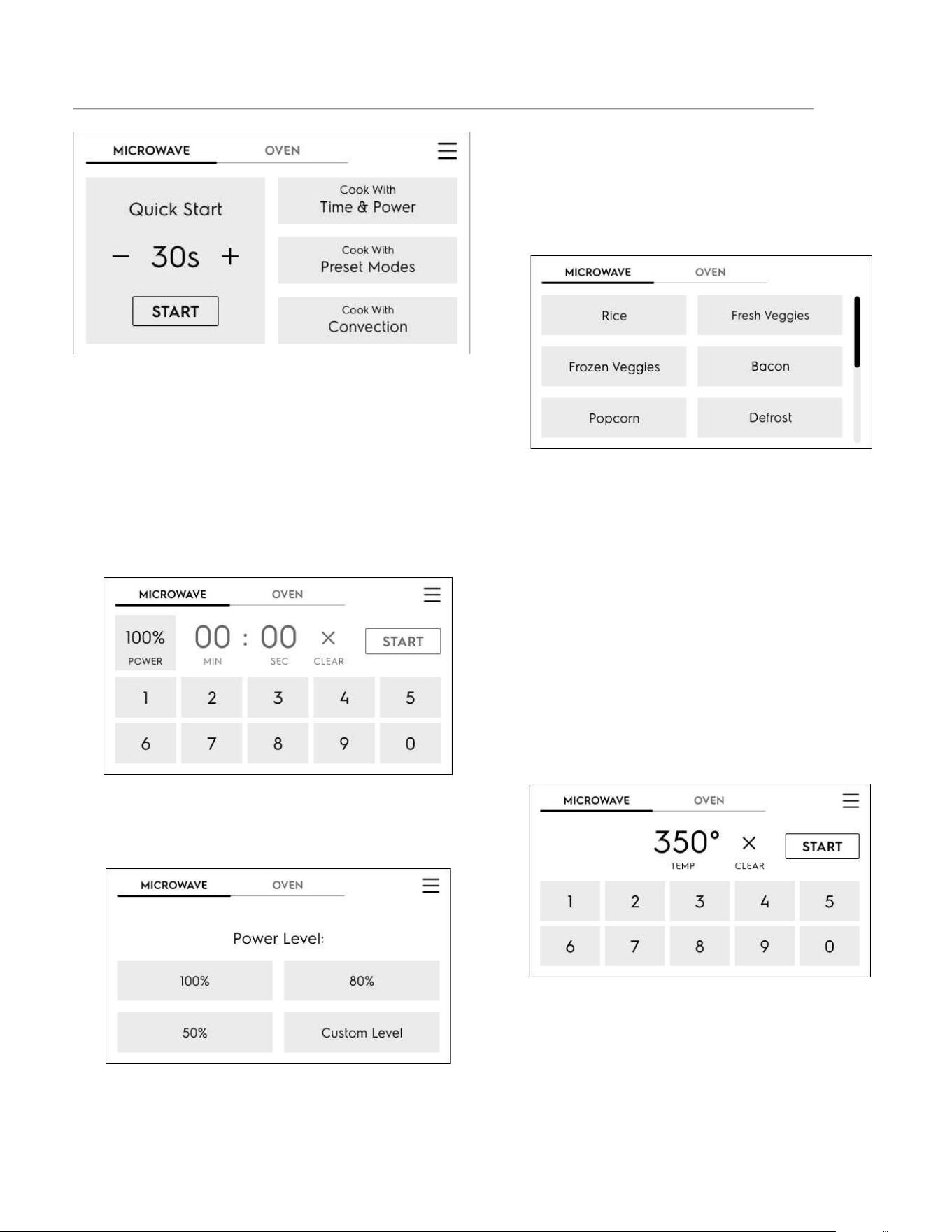
53
SettInG mIcroWaVe controLS
Quick Start
When on/off is pressed the display opens to the
Quick Start screen. Select the Micowave tab to use
the microwave functions.
From the Quick Start screen, you can immediate-
ly start the micowave on High for 30 seconds by
pressing Start. You can adjust the time by press-
ing + or -.
time & power
1. Press cook with time & power.
preset modes
The microwave has ten preset modes to make
cooking easier.
1. Press cook with preset modes.
2. Press the key for the Preset Mode you want to
use.
convection
For best results, allow the microwave to fully pre-
heat before cooking.
1. Press cook with convection.
2. To change the power setting press power.
3. Specify the desired power level in the Power
Level screen.
4. Enter the desired cook time using the number
keys.
5. Press Start
3. Some Preset Modes (such as Fresh Veggies) re-
quire you to specify the type of food. Press the
corresponding key to select the type of food.
4. Most Preset Modes require you to specify the
amount of food. Press the key that best match-
es the amount you are cooking.
5. The final screen will show the mode, amount,
and cook time. You can adjust the cook time
with the + and - keys.
6. Press Start.
2. Specify the desired temperature using the num-
ber keys.
3. Press Start.
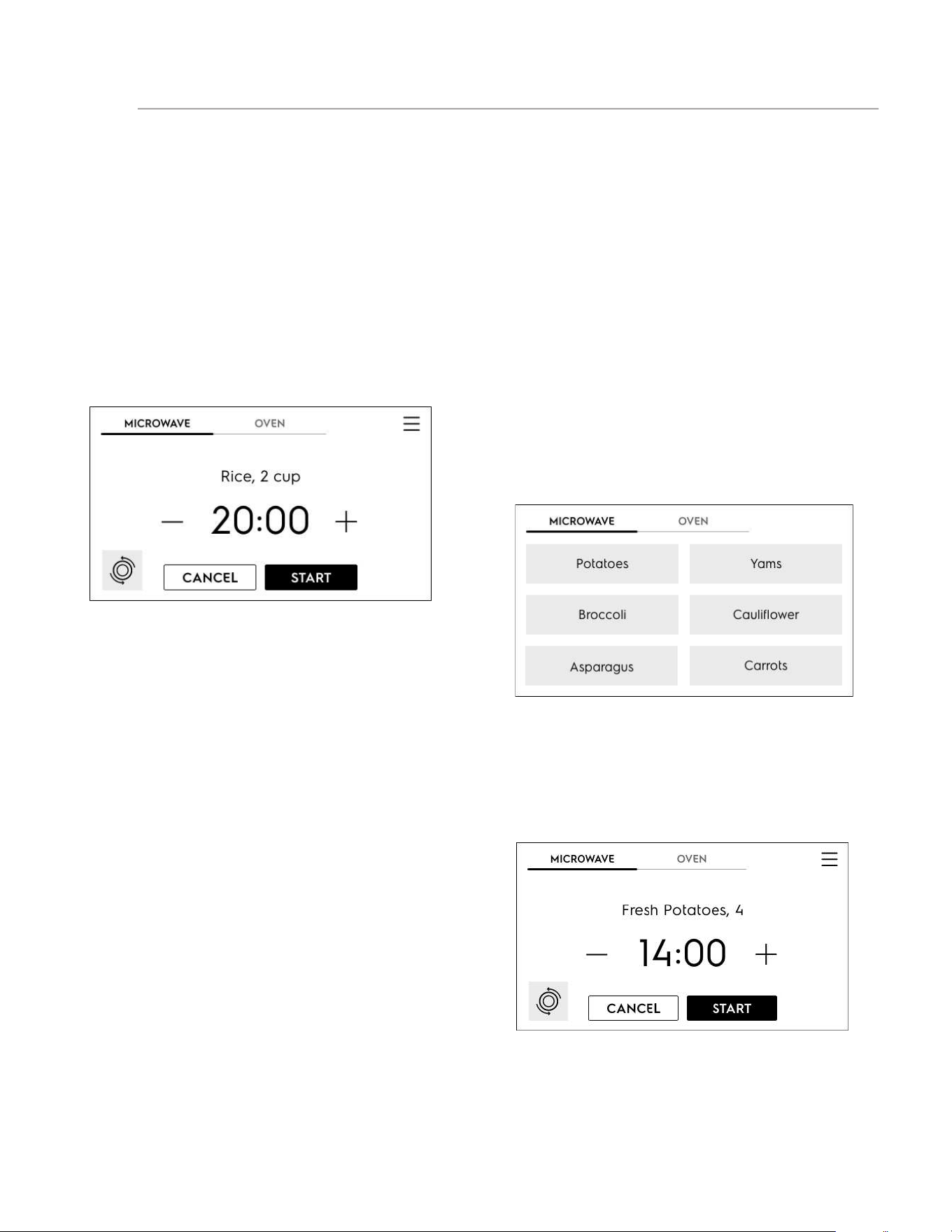
54
SettInG mIcroWaVe controLS
rice mode
Rice Mode cooks 2 cups of dry white rice with the
appropriate amount of water.
Use a large (4 quarts) covered microwave-safe dish
to prevent spillover.
1. Press cook with preset modes.
2. Press the rice key.
3. Press the key that best matches the amount of
rice you are cooking.
4. The final screen will show the mode, amount,
and cook time. You can adjust the cook time
with the + and - keys.
fresh Veggies mode
Fresh Veggies Mode works best for potatoes, yams,
and other fresh vegetables.
Baked Potato: Cook 8 to 12 ounces of fresh pota-
toes. Pierce each potato with fork once in center
and at each end.
Baked Yam: Cook 8 to 12 ounces of fresh yams.
Pierce each yam with fork once in center and at
each end.
Fresh Veggies (other than potatoes or yams): Add
2 tablespoons water to veggies and use a 1.5 quarts
5. Press Start.
vented or loosly-covered microwave-safe dish.
1. Press cook with preset modes.
2. Press the fresh Veggies key.
3. Press the key that matches the type of food
you are cooking.
4. Press the key that best matches the amount
you are cooking.
5. The final screen will show the mode, amount,
and cook time. You can adjust the cook time
with the + and - keys.
6. Press Start.
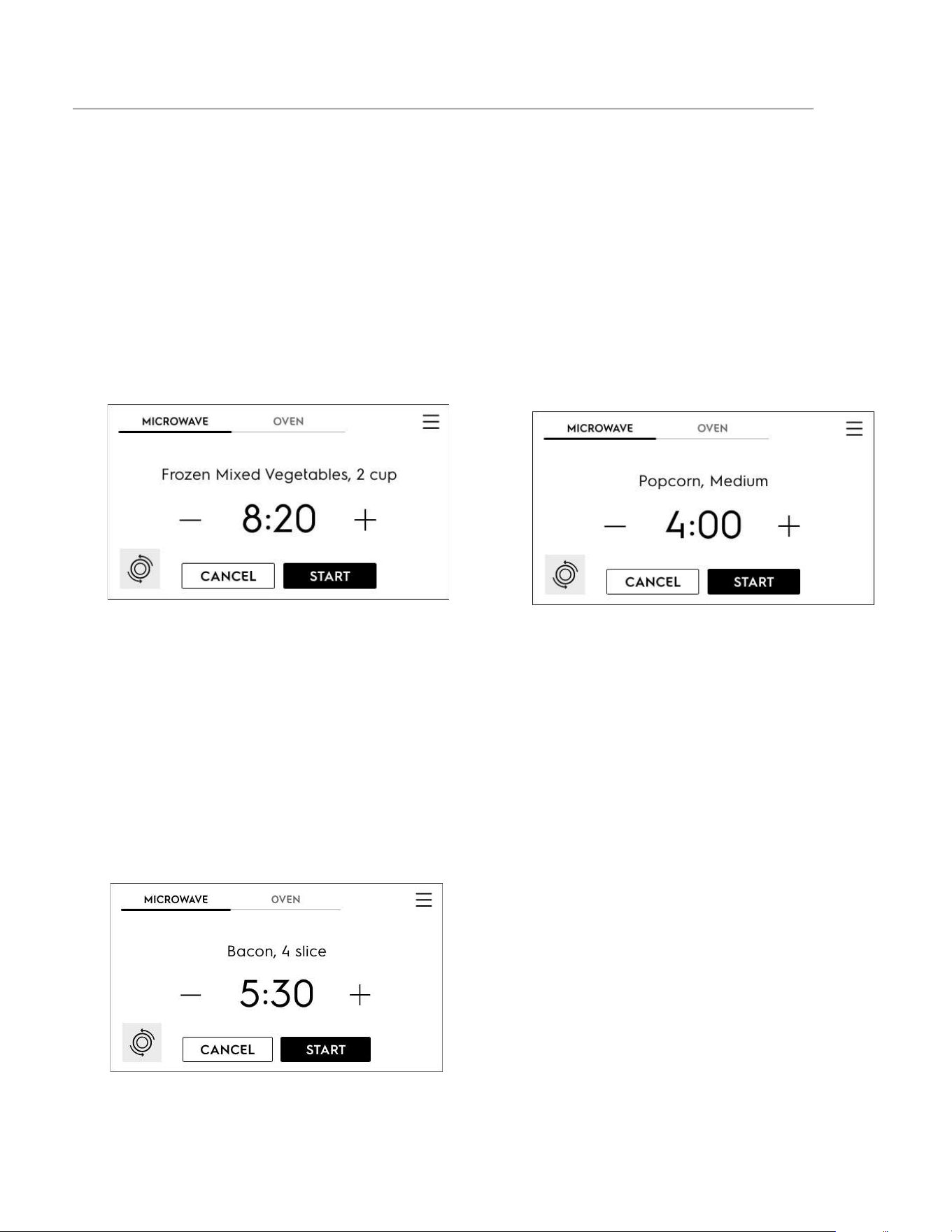
55
SettInG mIcroWaVe controLS
frozen Veggies mode
For best results, use a 1.5 quarts vented or loos-
ly-covered microwave-safe dish.
1. Press cook with preset modes.
2. Press the frozen Veggies key.
3. Press the key that matches the type of food
you are cooking.
4. Press the key that best matches the amount
you are cooking.
5. The final screen will show the mode, amount,
and cook time. You can adjust the cook time
with the + and - keys.
Bacon mode
For best results, cook thick slices of bacon in a mi-
crowave-safe tray.
1. Press cook with preset modes.
2. Press the Bacon key.
3. Press the key that best matches the amount
you are cooking.
4. The final screen will show the mode, amount,
and cook time. You can adjust the cook time
with the + and - keys.
6. Press Start.
5. Press Start.
popcorn mode
Use microwave popcorn. Refer to popcorn packag-
ing for size.
1. Press cook with preset modes.
2. Press the popcorn key.
3. Press the key that best matches the amount
you are cooking.
• Small - under 2 ounces
• Medium - 2-3 ounces
• Large - 3 ounces or more
4. The final screen will show the mode, amount,
and cook time.
5. Press Start.
6. Listen for pops to slow and stop or extend
cooking if needed. You can adjust the cook
time with the + and - keys.
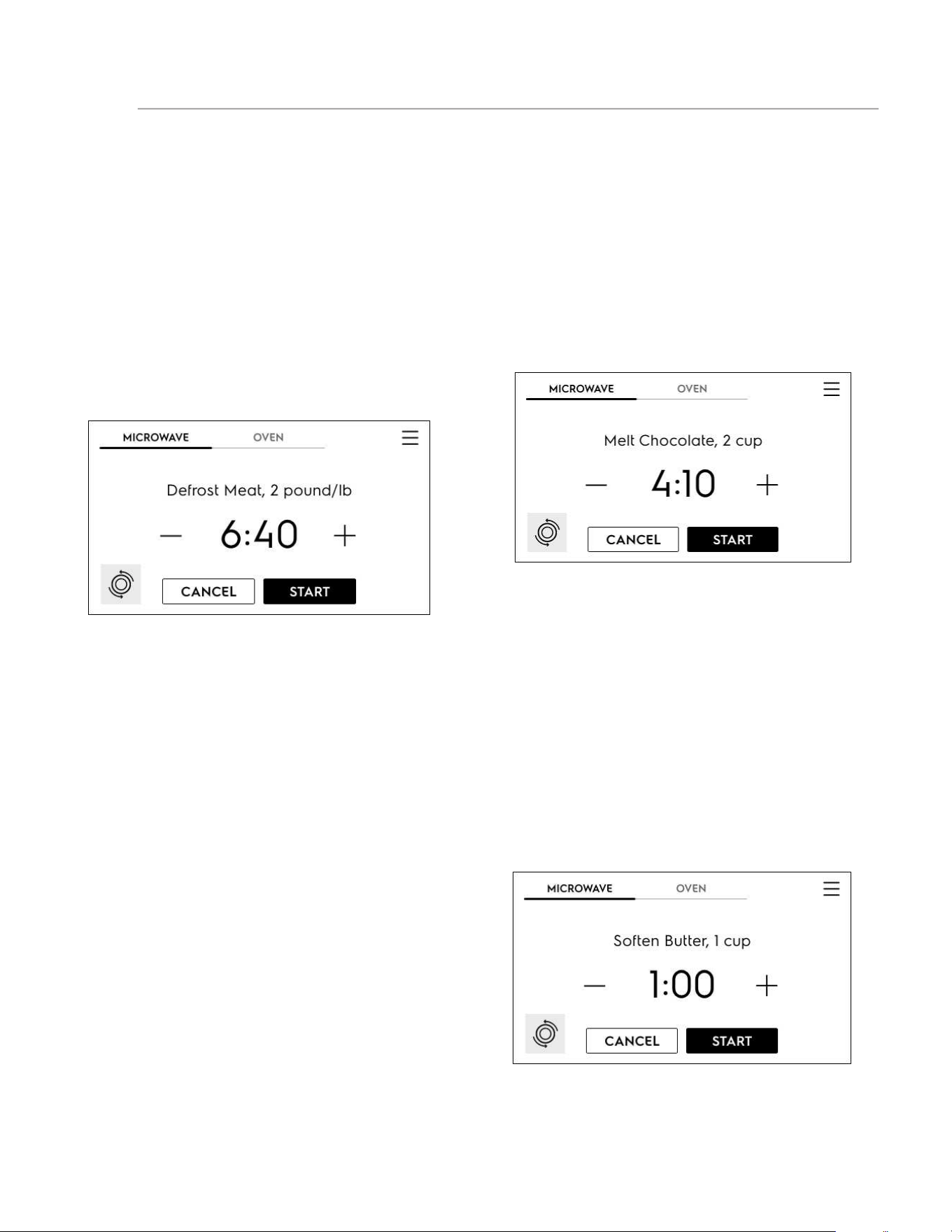
56
SettInG mIcroWaVe controLS
defrost mode
Defrost meat or poultry on a microwave-safe
defrosting tray. Halfway through Defrost time, the
microwave will beep to prompt turning the food.
1. Press cook with preset modes.
2. Press the defrost key.
3. Press the key that matches the type of food
you are cooking.
4. Press the key that best matches the amount
you are cooking.
5. The final screen will show the mode, amount,
and cook time. You can adjust the cook time
with the + and - keys.
melt mode
Use Melt Mode to melt foods like chocolate.
1. Press cook with preset modes.
2. Press the melt key.
3. Press the key that matches the type of food
you are cooking.
4. Press the key that best matches the amount
you are cooking.
5. The final screen will show the mode, amount,
and cook time.
Soften mode
Use Soften Mode to soften foods like butter.
1. Press cook with preset modes.
2. Press the Soften key.
3. Press the key that best matches the amount
you are cooking.
4. The final screen will show the mode, amount,
and cook time. You can adjust the cook time
with the + and - keys.
6. Press Start.
6. Press Start.
7. Stir chocolate when removed from microwave.
5. Press Start.
6. Stir butter when removed from microwave.
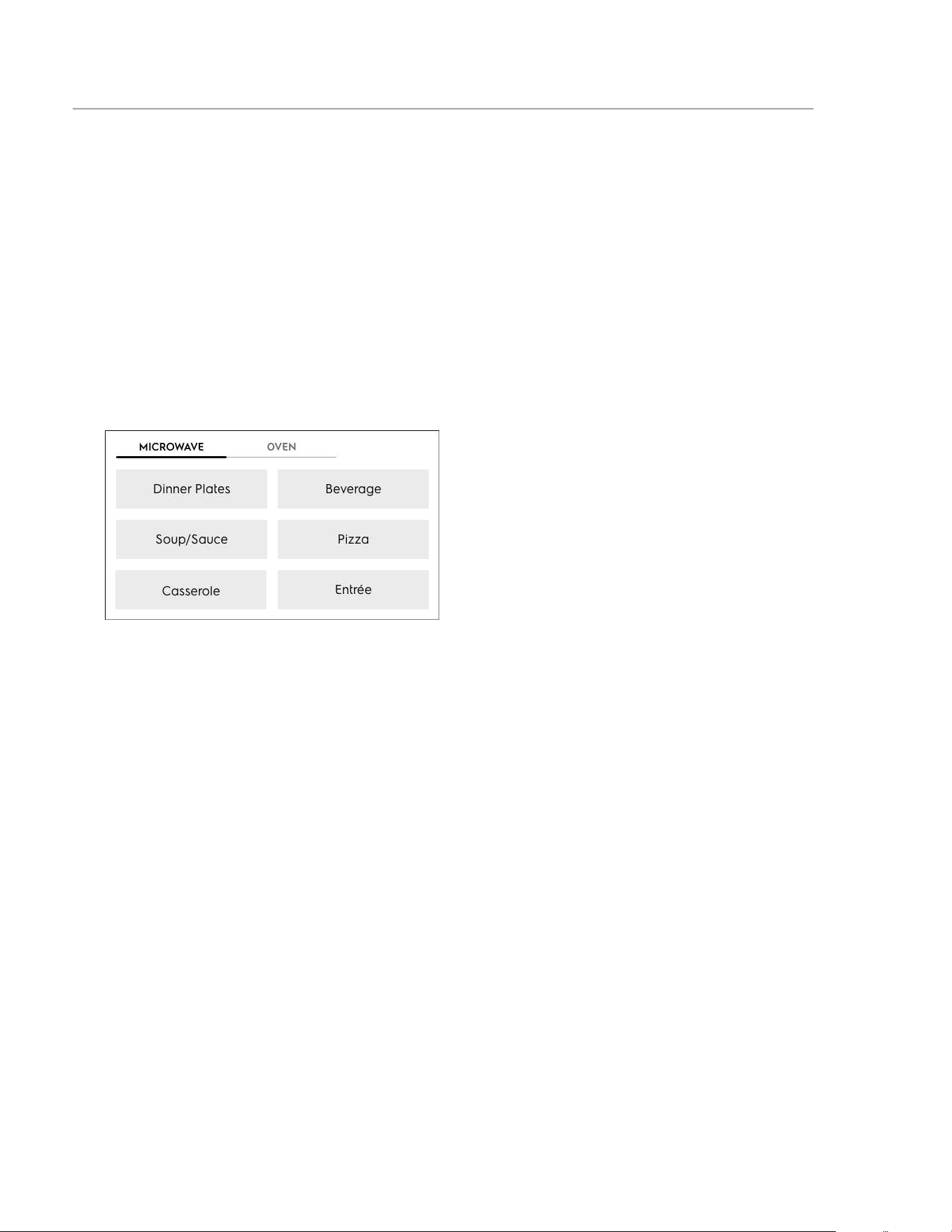
57
SettInG mIcroWaVe controLS
reheat mode
Use Reheat Mode to reheat foods that were previ-
ously cooked.
Reheat Casserole: Reheat Casserole amounts be-
tween 8 and 10 ounces.
Reheat Entrée: Reheat Entrée amounts between 2
and 3 servings; larger sizes or more dense foods
may need additional time. Loosely cover the entrée
before cooking.
1. Press cook with preset modes.
2. Press the reheat key.
3. Press the key that matches the type of food
you are cooking.
4. The final screen will show the mode, amount,
and cook time. You can change the time and
power with the keypad.
5. Press Start.
top Grill mode
Use Top Grill mode for toasting bread, melting
cheese, and other light broiling.
1. For meat, use Rack 2. For bread, use upper
rack.
2. Press cook with preset modes.
3. Press the top Grill key.
4. For meat, allow 8 minutes to preheat. Preheat-
ing is not necessary for toasting bread.
5. The final screen will show the mode and can-
cel.
6. Press Start.
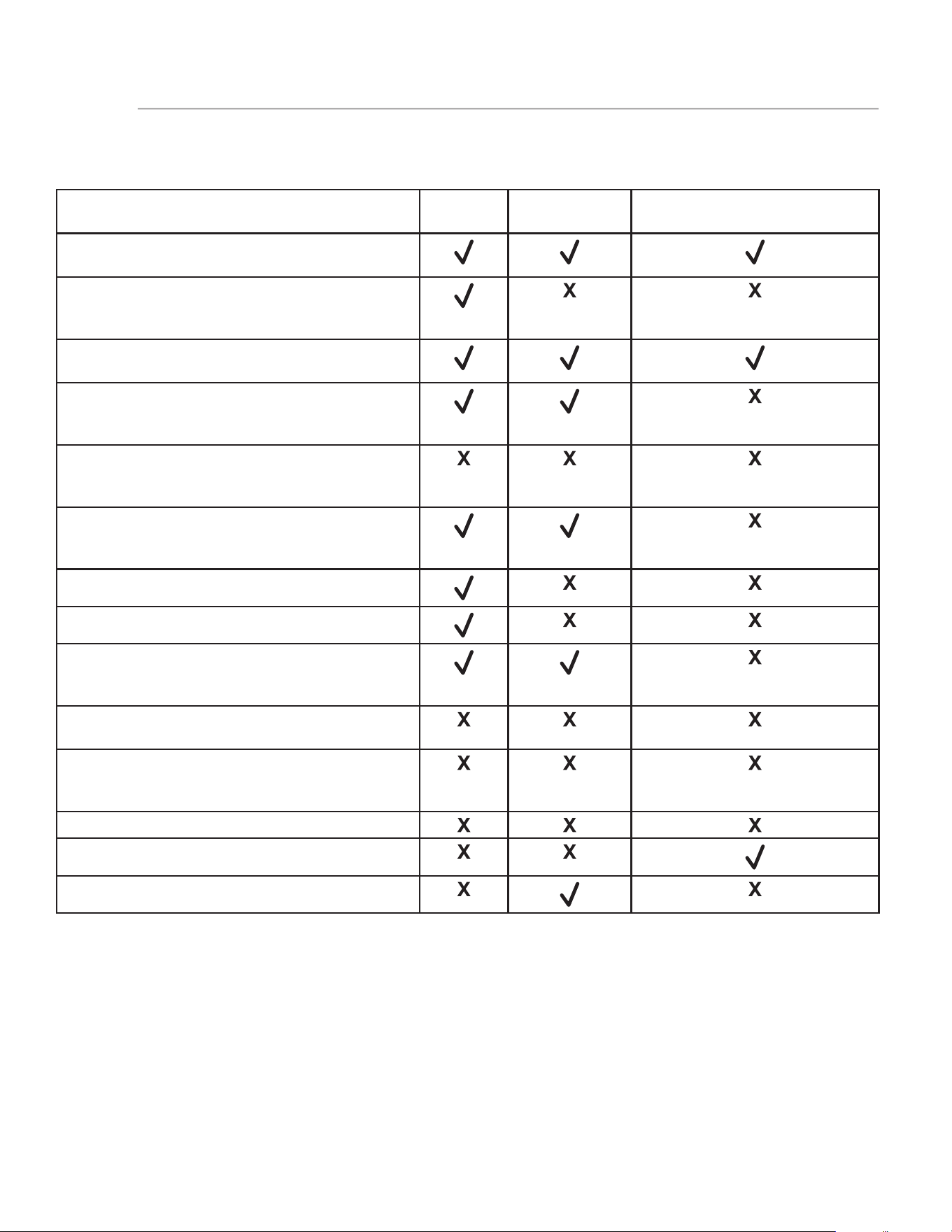
58
SettInG mIcroWaVe controLS
microwave suitable cookware and materials
For the microwave, use only suitable cookware and materials. Use the table below as a reference.
cookware / material defrost reheat, Liq-
uid
convection, top Grill
Ovenproof glass and porcelain with no metal
components, e.g. heat-proof glass
Non-ovenproof glass and porcelain without
any silver, gold, platinum or other metal dec-
orations
Glass and glass ceramic made of ovenproof /
frost-proof material
Ceramic and earthenware without any quartz
or metal components and glazes which con-
tain metal
Ceramic, porcelain and earthenware with
unglazed bottom or with small holes, e.g. on
handles
Heat-resistant plastic up to 392 °F (200 °C)
Always check the plastic container specifica-
tion before use.
Cardboard, paper
Clingfilm
Roasting film with microwave safe closure
(please always check the film specification
before use)
Roasting dishes made of metal, e.g. enamel,
cast iron
Baking tins, black lacquer or silicon- coated
(please always check the baking tins specifi-
cation before use)
Baking tray
Wire shelf
Cookware for microwave use, e.g. crisp pan
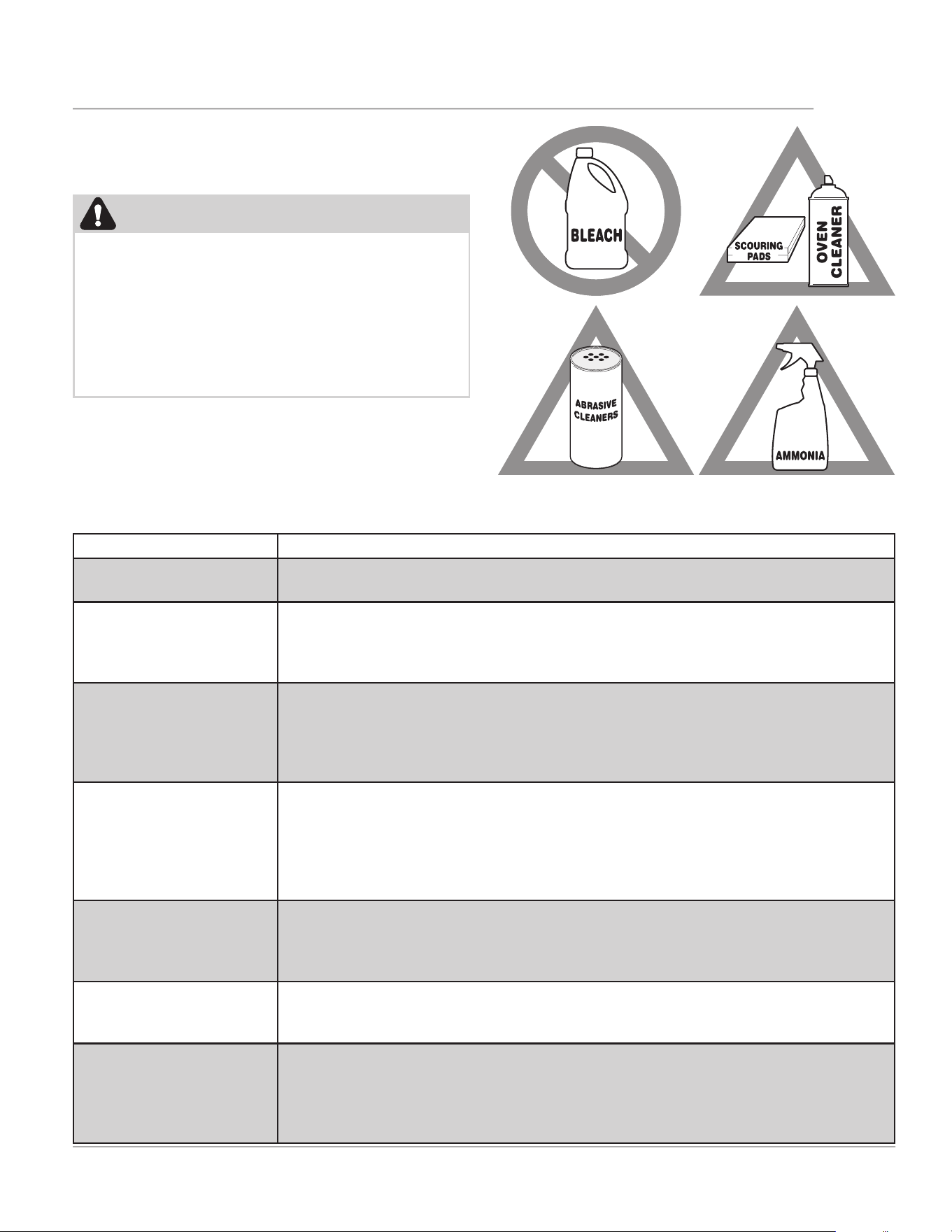
59
care and cLeanInG
Remove spills and any heavy soiling as soon as
possible. Regular cleaning will reduce the diculty
of major cleaning later.
figure 11: use cleaners with caution
Surface or area cleaning recommendation
Aluminum and vinyl Using a soft cloth, clean with mild dish detergent and water. Rinse with clean
water, dry and polish with a soft, clean cloth.
Painted body parts
Painted decorative trims
Using a soft cloth, clean with mild dish detergent and water or a 50/50 solu-
tion of vinegar and water. Rinse with clean water, dry and polish with a soft,
clean cloth. Glass cleaners may be used, but do not apply directly to surface;
spray onto cloth and wipe.
Touch display Using a soft cloth, clean with mild dish detergent and water or a 50/50 solu-
tion of vinegar and water. Do not spray liquids directly on the display area.
Do not use large amounts of water on the display - excess water may cause
damage to the appliance. Do not use other liquid cleaners, abrasive cleaners,
scouring pads, or paper towels - they may damage the finish.
Control panel Using a soft cloth, clean with mild dish detergent and water or a 50/50 solu-
tion of vinegar and water. Do not spray liquids directly on the oven control
and display area. Do not use large amounts of water on the control panel -
excess water on the control area may cause damage to the appliance. Do not
use other liquid cleaners, abrasive cleaners, scouring pads, or paper towels -
they will damage the finish.
Control knobs Using a soft cloth, clean with mild dish detergent and water or a 50/50 solu-
tion of vinegar and water. To remove control knobs: turn to the OFF position,
grasp firmly, and pull o the shaft. To replace knobs after cleaning, line up the
OFF markings and push the knobs into place.
Stainless Steel Using a soft cloth, clean with mild dish detergent and water or a 50/50 solu-
tion of vinegar and water. Rinse with clean water, dry with a soft clean cloth.
Do not use cleaners containing abrasives, chlorides, chlorine, or ammonia.
Coated Stainless Steel Using a soft cloth, clean with mild dish detergent and water or a 50/50
solution of vinegar and water. Rinse with clean water, dry with a soft clean
cloth. Do not use appliance cleaner, stainless steel cleaner, or cleaner
containing abrasives, chlorides, chlorine, or ammonia. These cleaners may
damage the finish.
cautIon
Before cleaning any part of the appliance, be sure
all controls are turned o and the appliance is
cool.
If ammonia or appliance cleaners are used,
they must be removed and the appliance must
be thoroughly rinsed before operating. Follow
manufacturer’s instructions and provide adequate
ventilation.
60
care and cLeanInG
Surface or area cleaning recommendation
Porcelain-enameled broiler pan
and insert
Porcelain door liner
Porcelain body parts
Rinse with clean water and a damp cloth. Scrub gently with a soapy,
non-abrasive scouring pad to remove most spots. Rinse with a 50/50
solution of clean water and ammonia. If necessary, cover dicult
spots with an ammonia-soaked paper towel for 30 to 40 minutes.
Rinse and wipe dry with a clean cloth. Remove all cleaners or future
heating could damage the porcelain. Do not allow food spills with a
high sugar or acid content (milk, tomatoes, sauerkraut, fruit juices or
pie filling) to remain on porcelain surfaces. These spills may cause a
dull spot even after cleaning.
Self-cleaning oven interior Before setting a self-clean cycle, clean soils from the oven frame,
areas outside the oven door gasket, and the small area at the front
center of the oven bottom. See “Self Clean” on page 40.
Oven door Use mild dish detergent and water or a 50/50 solution of vinegar
and water to clean the top, sides, and front of the oven door. Rinse
well. Glass cleaner may be used on the outside glass of the door.
Ceramic smoothtop cleaner or polish may be used on the interior
door glass. Do not immerse the door in water. Do not spray or allow
water or cleaners to enter the door vents. Do not use oven cleaners,
cleaning powders, or any harsh abrasive cleaning materials on the
outside of the oven door.
Do not clean the oven door gasket. The oven door gasket is made
of a woven material which is essential for a good seal. Do not rub,
damage, or remove this gasket.
61
care and cLeanInG
General cleaning
Refer to the table at the beginning of this chapter
for more information about cleaning specific parts
of the oven.
cleaning porcelain enamel oven
The oven interior is porcelain on steel, it is safe to
clean using oven cleaners.
to remove heavy soil:
1. Allow a dish of ammonia to sit in the oven
overnight or for several hours with the oven
door closed. Clean softened dirt spots using
hot, soapy water. Rinse well with water and a
clean cloth.
2. If soil remains, use a nonabrasive scouring
pad or a nonabrasive cleaner. If necessary,
use an oven cleaner following manufacturer’s
instructions. Do not mix ammonia with other
cleaners.
3. Clean any soil from the oven frame, the door
liner outside the oven door gasket and the
small area at the front center of the oven
bottom. Clean with hot, soapy water. Rinse well
using clean water and a cloth.
follow these cleaning precautions:
• Allow the oven to cool before cleaning.
• Wear rubber gloves when cleaning the appli-
ance manually.
Remove soils using hot, soapy water. Do not allow
food spills with a high sugar or acid content (such
as milk, tomatoes, sauerkraut, fruit juices or pie
filling) to remain on the surface as they may cause
a dull spot even after cleaning. Remove spillovers
and heavy soiling as soon as possible. Regular
cleaning will reduce the eort required for major
cleaning later.
cautIon
Before manually cleaning any part of the oven,
be sure all controls are turned o and the oven is
cool. The oven may be hot and can cause burns.
Remove all racks and accessories from the oven
before cleaning.
Ammonia must be rinsed before operating the
oven. Provide adequate ventilation.
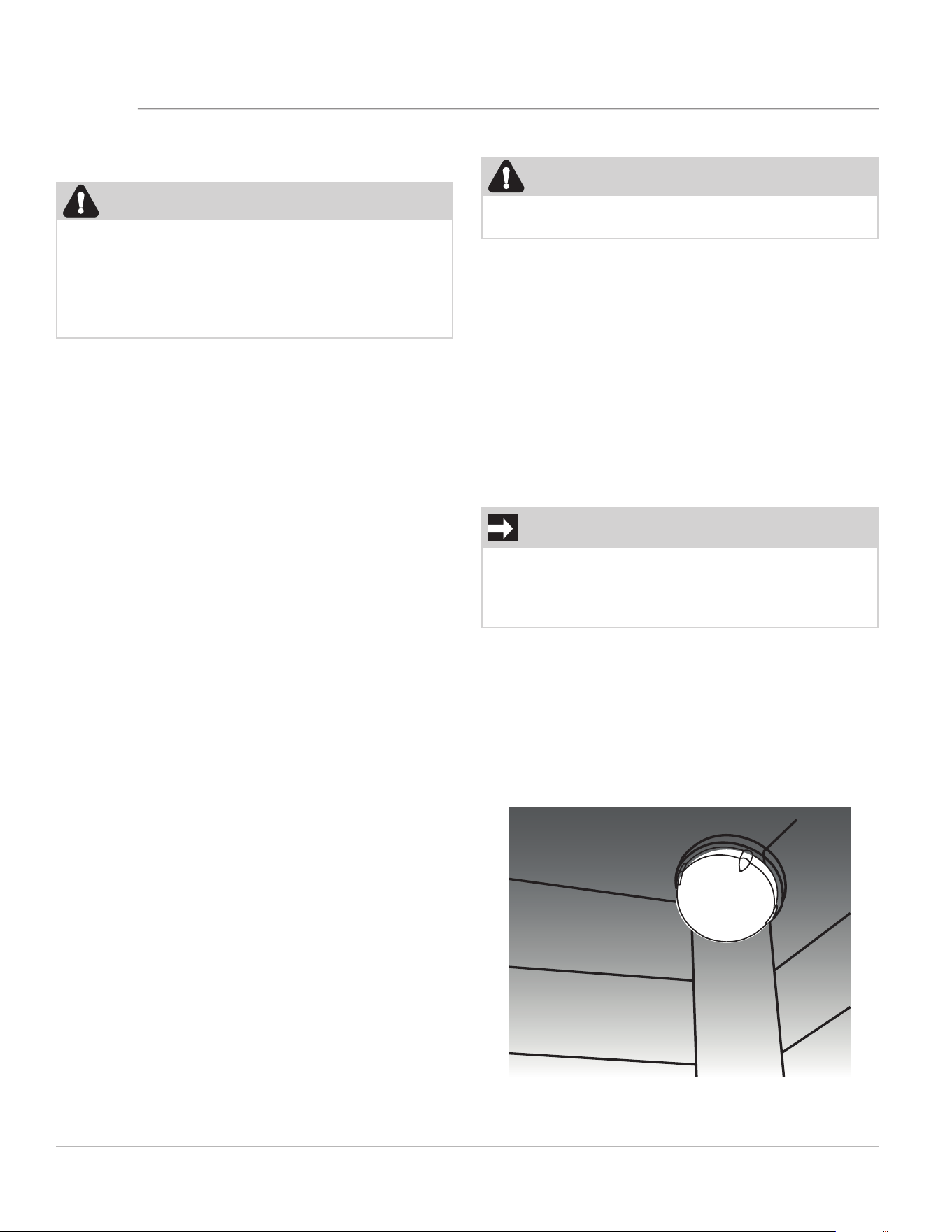
62
care and cLeanInG
aluminum foil, aluminum utensils, and
oven Liners
WarnInG
Never cover any slots, holes, or passages in the
oven bottom or cover an entire oven rack with
materials such as aluminum foil. Doing so blocks
air flow through the oven and may cause carbon
monoxide poisoning. Aluminum foil linings may
trap heat, causing a fire hazard.
• Protective liners—Do not use aluminum foil to
line the oven bottom. The high heat of the oven
can melt these materials to the oven cavity and
ruin the oven. These types of materials can also
reduce the eectiveness of the air circulation
in the oven and produce poor baking results.
Only use aluminum foil as recommended in this
manual. Improper installation of these liners
may result in risk of electric shock or fire.
• Aluminum utensils - The melting point of
aluminum is much lower than that of other
metals. Care must be taken when aluminum
pots or pans are used.
• Oven racks - Do not use aluminum foil to
cover the oven racks. Using a liner in the oven
restricts the heat and air flow needed to obtain
the best possible cooking results for any oven.
replacing the oven Light
cautIon
Be sure the oven is unplugged and all parts are
cool before replacing the oven light.
The interior oven light is located at the rear of the
oven cavity and is covered by a glass shield. The
glass shield must be in place whenever the oven is
in use.
to replace the oven interior light bulb:
1. Turn electrical power o at the main source or
unplug the appliance.
2. Remove interior oven light shield by turning a
quarter turn counter-clockwise.
3. Replace bulb with a new T-4 type Halogen 25
watt appliance bulb.
note
Wear a cotton glove or use a paper towel when
installing a new bulb. Do not touch the new bulb
with your fingers when replacing. This will short-
en the life of the bulb.
4. Replace glass oven light shield by rotating
clockwise.
5. Turn power back on again at the main source
(or plug the appliance back in).
6. Be sure to reset the time of day on the clock.
figure 13: Wall oven Halogen light
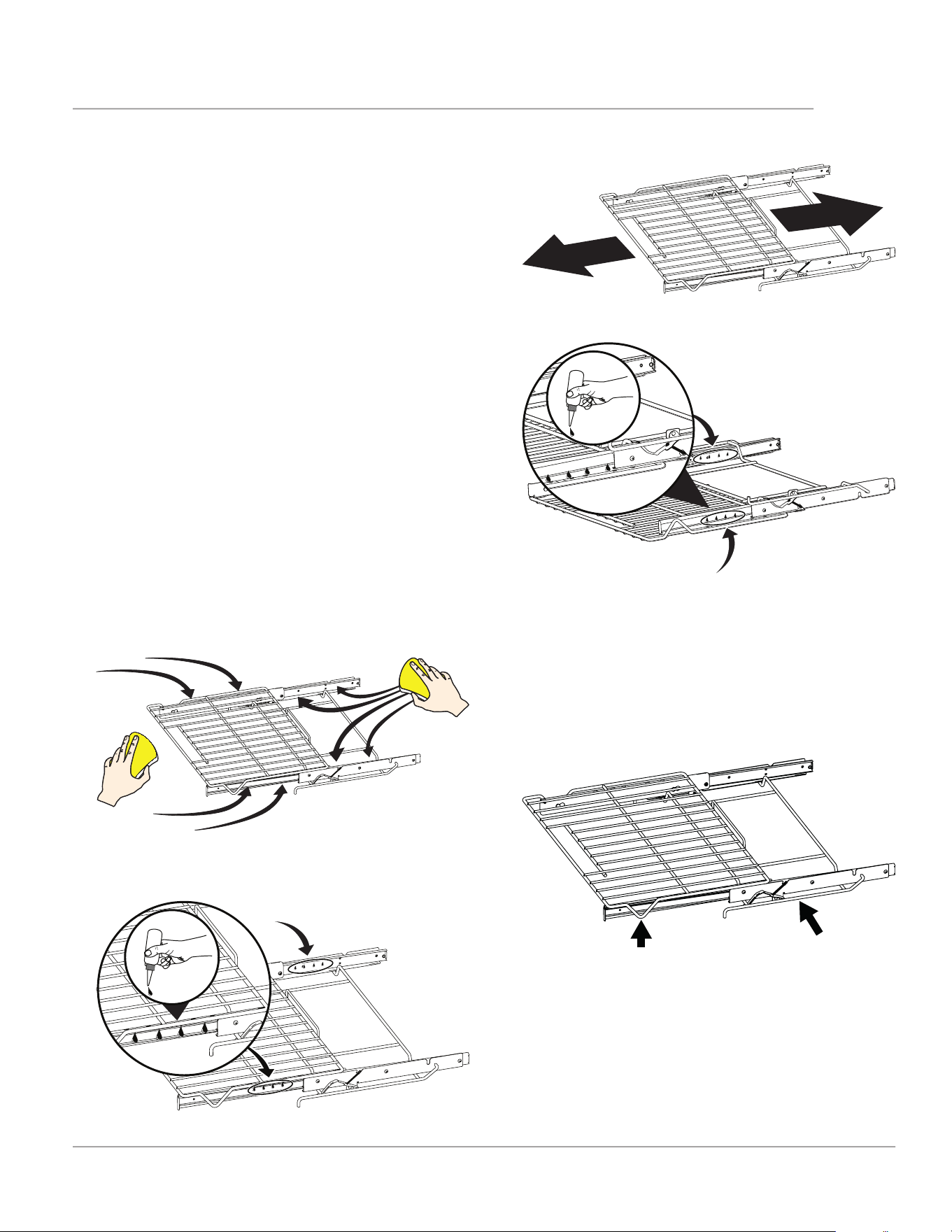
63
care and cLeanInG
caring for your Glide racks
caution: Handle oven racks only when they are
cool. After cooking or after the fresh-clean cycle,
racks will be very hot and can cause burns.
Important notes:
• Remove all oven racks, including ladder racks,
before starting a clean cycle.
• Do not use cooking oil, cooking spray, or other
oil-based lubrication products on the glide
rack extension tracks. Use only the graphite
lubrication in this area. To order graphite
lubrication, contact your installer, servicer or
dealer.
• It is important that the parts of the rack that
contact the oven sides always have a light
coating of vegetable oil. Apply a thin layer of
vegetable oil to the sides of the rack after every
fresh-clean cycle and when the rack becomes
dicult to reposition in the oven.
to lubricate the glide rack:
1. Remove the rack from the oven and place the
rack on a large flat surface covered with news-
paper or scrap cloth. Fully extend the rack.
2. Wipe away debris and crumbs from the glide
track using a cloth or sponge.
3. Shake graphite lubrication very well before
applying. Apply to loading guides, and rotation
pin. Repeat on both sides of the glide rack.
4. Extend and return the glide rack several times
along the tracks to distribute the lubrication.
5. Turn the rack upside down and apply graphite
lubrication to the insides of the loading guides.
6. Extend and return the glide rack several times
along the tracks to distribute the lubrication.
7. Apply a thin layer of cooking oil to the bottom
of the “V” and the glide channels. Keeping the
frame sides lightly lubricated allows the entire
rack to slide easily when changing rack posi-
tions.
8. Replace rack in oven right-side up.
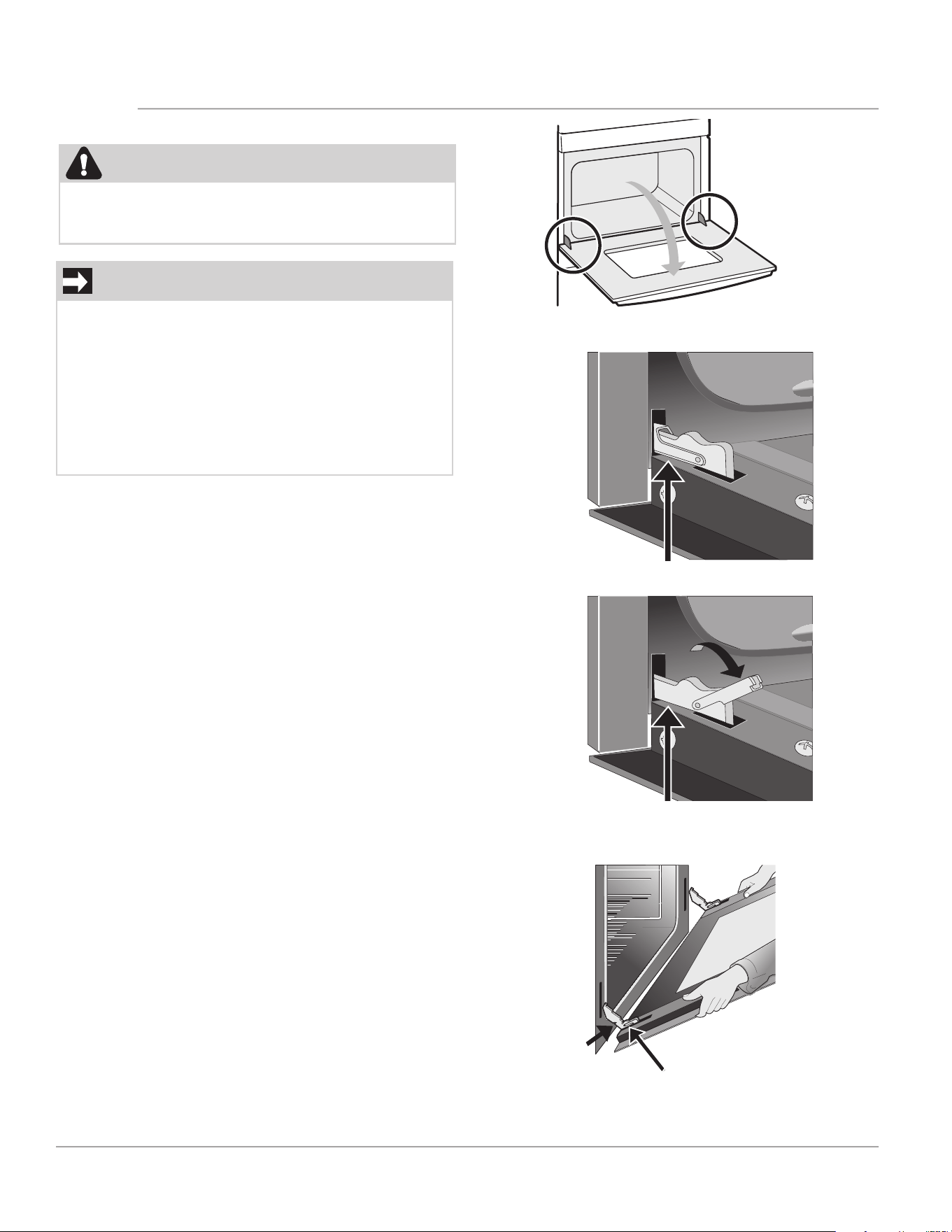
64
care and cLeanInG
removing and replacing the oven door
figure 14: door hinge location
to remove the oven door:
1. Open oven door completely, horizontal with
floor (Figure 13).
2. Pull up the lock located on each hinge support
toward front of the oven until the lock stops.
You may have to apply a little upward pressure
on the lock to pull it up (Figure 13 and Figure
14).
3. Grasp the door by the sides, and close the door
until the door frame makes contact with the
unlocked hinges.
4. Pull the bottom of the door toward you
while rotating the top of the door toward the
appliance to completely disengage the hinge
levers (Figure 16).
Oven door
hinge
locations
figure 15: door hinge locked
figure 16: unlocking door hinge
figure 17: remove door position
Door frame flush
with hinge lock
Hinge
notch
to replace the oven door:
1. Firmly grasp both sides of oven door along the
door sides. Do not use the oven door handle
(Figure 16).
2. Hold the oven door at the same angle as the
removal position. Carefully insert the hinge
levers into the oven frame until you feel the
hinge levers are seated into the hinge notches.
The hinge arms must be fully seated into the
hinge notches before the oven door can be
fully opened. (Figure 16).
3. Fully open the oven door, horizontal with floor
(Figure 13).
4. Push the door hinge locks up toward and into
the oven frame on both left and right oven door
hinges to the locked position (Figure 14).
5. Close the oven door.
Important
Special door care instructions - For safe,
temporary storage, lay the door flat with the
inside of the door facing down.
Most oven doors contain glass that can break.
Do not hit the glass with pots, pans, or any other
object. Scratching, hitting, jarring, or stressing
the glass may weaken its structure, causing an
increased risk of breakage at a later time. Do not
close the oven door until all of the oven racks are
fully in place.
cautIon
The door is heavy. For safe, temporary storage,
lay the door flat with the inside of the door facing
down.
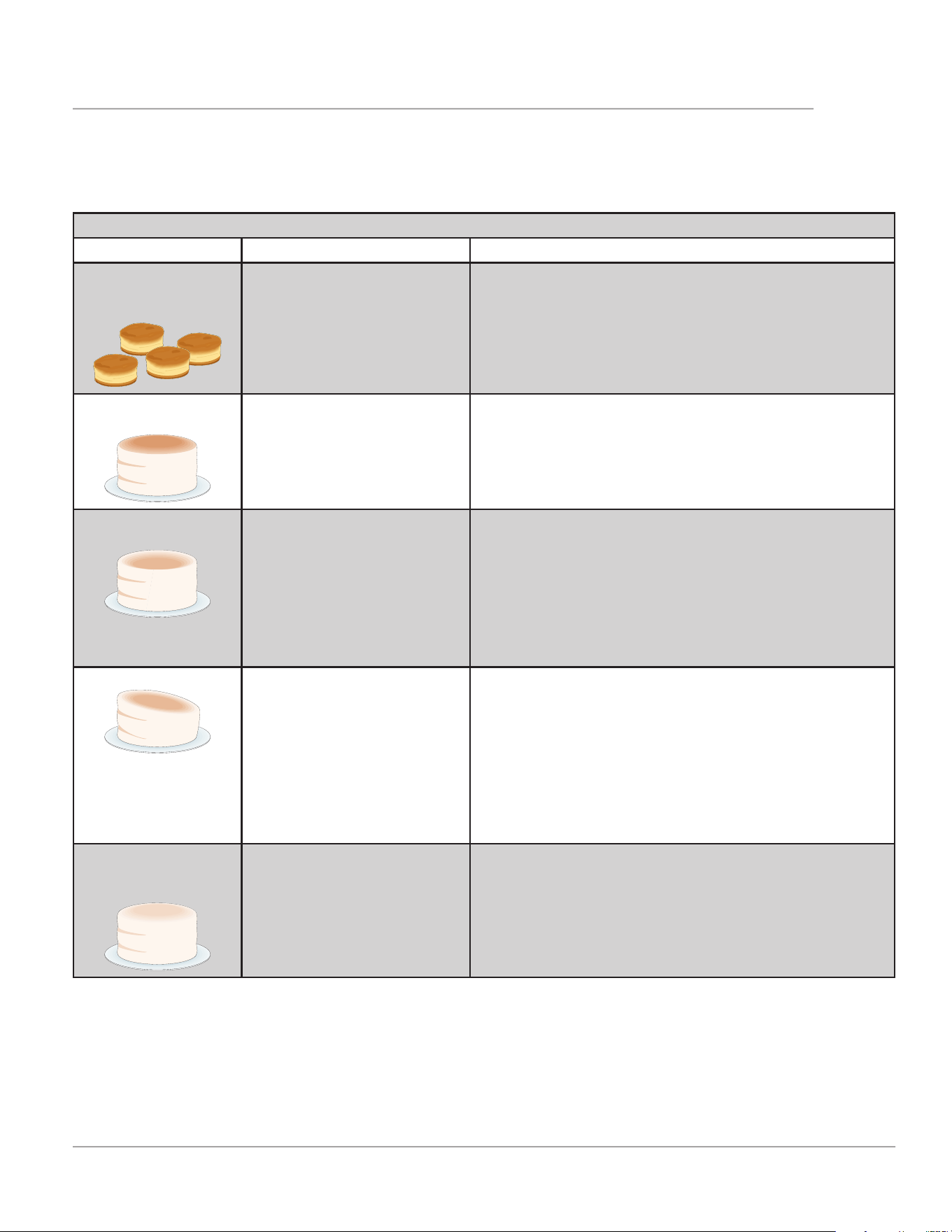
65
Before you caLL
oven Baking
For best cooking results, preheat the oven before baking cookies, breads, cakes, pies, pastries, etc. There
is no need to preheat the oven for roasting meat or baking casseroles. The cooking times and tempera-
tures needed to bake a product may vary slightly from your previously owned appliance.
Baking problems and Solutions Baking problems
Baking problems causes corrections
Cookies and bis-
cuits burn on the
bottom.
Cookies and biscuits put
into oven before oven is
preheated.
Allow oven to preheat to desired temperature before
placing food in oven.
Choose pan sizes that will permit at least 2” of air
space.
Cakes too dark on
top or bottom
Cakes put in oven before
oven is preheated.
Rack position too high or
too low.
Oven too hot.
Allow oven to preheat to the selected temperature
before placing food in the oven.
Use proper rack position for baking needs.
Set oven temperature 25°F (13°C) lower than recom-
mended.
Cakes not done in
center
Oven too hot.
Incorrect pan size.
Pan not centered in oven.
Glass cookware slow heat
conductor.
Set oven temperature 25°F (13°C) lower than recom-
mended.
Use pan size suggested in recipe.
Use proper rack position and place pan so there are
at least 2” (5.1 cm) of space on all sides of pan.
Reduce temperature and increase cook time or use
shiny bakeware.
Cakes not level. Oven not level.
Pan too close to oven wall
or rack overcrowded.
Pan warped.
Oven light left on while
baking.
Place a marked glass measuring cup filled with water
on the center of the oven rack. If the water level is
uneven, refer to the installation instructions for level-
ing the oven.
Use proper rack position and place pan so there are
at least 2” (5.1 cm) of space on all sides of pan.
Do not use pans that are dented or warped.
Do not leave the oven light on while baking.
Foods not done
when cooking time
is over.
Oven too cool.
Oven overcrowded.
Oven door opened too
frequently.
Set oven temperature 25°F (13°C) higher than sug-
gested and bake for the recommended time.
Be sure to remove all pans from the oven except the
ones to be used for baking.
Open oven door only after the shortest recommend-
ed baking time.
66
Before you caLL
Let us help you troubleshoot your concern! This section will help you with common issues. If you need us,
visit our website, chat with an agent, or call us. We may be able to help you avoid a service visit. If you do
need service, we can get that started for you!
problem cause / Solution
Entire appliance does not
operate
Appliance not connected. Make sure power cord is plugged properly into
outlet. Check your fuse box or breaker box to make sure the circuit is active.
Electrical power outage. Check house lights to be sure. Call your local elec-
tric company for service outage information.
Oven problems
problem cause / Solution
Poor baking results. Many factors aect baking results. Use proper oven rack position. Center
food in the oven and space pans to allow air to circulate. Preheat the oven
to the set temperature before placing food in the oven. Try adjusting the
recipe's recommended temperature or baking time. See “Oven Temperature
Calibration” on page 18 if you feel the oven is too hot or too cool.
Flames inside oven or
smoking from oven vent.
Excessive spills in oven. Grease or food spilled onto the oven bottom or
oven cavity. Wipe up excessive spills before starting the oven. If flames or
excessive smoke are present when using broil, see “Setting Broil” on page
34.
Oven smokes excessively
when broiling.
Incorrect setting. Follow the “Setting Broil” on page 34.
Meat too close to the broil element or burner. Reposition the broil pan to
provide proper clearance between the meat and broil element or burner.
Remove excess fat from meat. Cut remaining fatty edges to prevent curling,
but do not cut into lean.
Grease build up on oven surfaces. Regular cleaning is necessary when broil-
ing frequently. Grease or food splatters will cause excessive smoking.
Convection fan does not
rotate.
Oven door is open. The convection fan will turn o if the oven door is
opened when convection is active. Close the oven door.
1-800-265-8352 (Canada)
frigidaire.ca
1-800-374-4432 (United States)
frigidaire.com

67
Before you caLL
Self-clean problems
problem cause / Solution
Self clean does not work. Oven control not set properly. See “Self Clean” on page 40.
Oven racks discolored or
do not slide easily.
Oven racks left in oven cavity during self clean. Remove oven racks from
oven cavity before starting a self-clean cycle. Clean by using a mild abrasive
cleaner following manufacturer's instructions. Rinse with clean water, dry,
and replace in oven.
Soil not completely re-
moved after self clean.
Self clean was interrupted. Review instructions on “Self Clean” on page
40.
Excessive spills on oven bottom. Remove excessive spills before starting self
clean.
Failure to clean soil from the oven frame, the door liner outside the oven
door gasket, and the small area at the front center of the oven bottom.
These areas are not in the self-cleaning area, but get hot enough to burn on
residue. Clean these areas before starting the self-cleaning cycle. Burned-on
residue can be cleaned with a sti nylon brush and water or a nylon scrub-
ber. Be careful not to damage the oven gasket.
other problems
problem cause / Solution
Appliance is not level. Poor installation. Place the oven rack in the center of the oven. Place a level
on the oven rack. Adjust the leveling legs at the base of the appliance until
the rack is level.
Kitchen cabinet alignment may make range appear not level. Be sure cabi-
nets are square and have sucient room for appliance clearance.
Cannot move appliance
easily. Appliance must be
accessible for service.
Cabinets not square or are built in too tightly. Contact the builder or install-
er to make the appliance accessible.
Oven light does not work. Be sure the oven light is secure in the socket. See “Replacing the Oven
Light” on page 64.

68
Warranty
Your appliance is covered by a one year limited warranty. For one year from your original date of purchase, Electrolux
will pay all costs for repairing or replacing any parts of this appliance that prove to be defective in materials or work-
manship when such appliance is installed, used and maintained in accordance with the provided instructions.
exclusions
This warranty does not cover the following:
Products with original serial numbers that have been removed, altered or cannot be readily determined.
Product that has been transferred from its original owner to another party or removed outside the USA or Canada.
Rust on the interior or exterior of the unit.
Products purchased “as-is” are not covered by this warranty.
Food loss due to any refrigerator or freezer failures.
Products used in a commercial setting.
Service calls which do not involve malfunction or defects in materials or workmanship, or for appliances not in ordinary
household use or used other than in accordance with the provided instructions.
Service calls to correct the installation of your appliance or to instruct you how to use your appliance.
Expenses for making the appliance accessible for servicing, such as removal of trim, cupboards, shelves, etc., which are not a
part of the appliance when it is shipped from the factory.
Service calls to repair or replace appliance light bulbs, air filters, water filters, other consumables, or knobs, handles, or
other cosmetic parts.
Surcharges including, but not limited to, any after hour, weekend, or holiday service calls, tolls, ferry trip charges, or
mileage expense for service calls to remote areas, including the state of Alaska.
Damages to the finish of appliance or home incurred during installation, including but not limited to floors, cabinets,
walls, etc.
Damages caused by: services performed by unauthorized service companies; use of parts other than genuine Elec-
trolux parts or parts obtained from persons other than authorized service companies; or external causes such as
abuse, misuse, inadequate power supply, accidents, fires, or acts of God.
dIScLaImer of ImpLIed WarrantIeS; LImItatIon of remedIeS
CUSTOMER’S SOLE AND EXCLUSIVE REMEDY UNDER THIS LIMITED WARRANTY SHALL BE PRODUCT REPAIR OR RE-
PLACEMENT AS PROVIDED HEREIN. CLAIMS BASED ON IMPLIED WARRANTIES, INCLUDING WARRANTIES OF MERCHANT-
ABILITY OR FITNESS FOR A PARTICULAR PURPOSE, ARE LIMITED TO ONE YEAR OR THE SHORTEST PERIOD ALLOWED
BY LAW, BUT NOT LESS THAN ONE YEAR. ELECTROLUX SHALL NOT BE LIABLE FOR CONSEQUENTIAL OR INCIDENTAL
DAMAGES SUCH AS PROPERTY DAMAGE AND INCIDENTAL EXPENSES RESULTING FROM ANY BREACH OF THIS WRITTEN
LIMITED WARRANTY OR ANY IMPLIED WARRANTY. SOME STATES AND PROVINCES DO NOT ALLOW THE EXCLUSION OR
LIMITATION OF INCIDENTAL OR CONSEQUENTIAL DAMAGES, OR LIMITATIONS ON THE DURATION OF IMPLIED WARRAN-
TIES, SO THESE LIMITATIONS OR EXCLUSIONS MAY NOT APPLY TO YOU. THIS WRITTEN WARRANTY GIVES YOU SPECIFIC
LEGAL RIGHTS. YOU MAY ALSO HAVE OTHER RIGHTS THAT VARY FROM STATE TO STATE.
If you need Service
Keep your receipt, delivery slip, or some other appropriate payment record to establish the warranty period should
service be required. If service is performed, it is in your best interest to obtain and keep all receipts. Service under this
warranty must be obtained by contacting Electrolux at the addresses or phone numbers below.
This warranty only applies in the USA and Canada. In the USA, your appliance is warranted by Electrolux Major Appliances
North America, a division of Electrolux Home Products, Inc. In Canada, your appliance is warranted by Electrolux Canada Corp.
Electrolux authorizes no person to change or add to any obligations under this warranty. Obligations for service and parts
under this warranty must be performed by Electrolux or an authorized service company. Product features or specifications as
described or illustrated are subject to change without notice.
uSa
1-877-435-3827
Electrolux Major Appliances NA
10200 David Taylor Drive
Charlotte, NC 28262
ElectroluxAppliances.com
canada
1.800.265.8352
Electrolux Canada Corp.
5855 Terry Fox Way
Mississauga, Ontario, Canada
L5V 3E4
ElectroluxAppliances.ca
welcome
home
Frigidaire.com
1-800-374-4432
Frigidaire.ca
1-800-265-8352
owner support
accessories
service
Our home is your home. Visit us if you
need help with any of these things:
registration
(See your regristration card
for more information.)
807574505 (November 2021)