
15 Amp
7 /4=Jn,Circular
with Laser Trac T"
Model No.
320.27311
irk, CAUTION Read, understand and fellow
all Safety Rules and Operating instructions
in this Manual before using this producL
Sears, Roebuck and Co.,
Hoffman Estates, IL 60179 U°S.A.
Visit our Craftsman website: www.craftsman.com
• WARRANTY
• SAFETY
• UNPACKING
• DESCRIPTION
° OPERATION
- ADJUSTMENTS
• MAINTENANCE
I
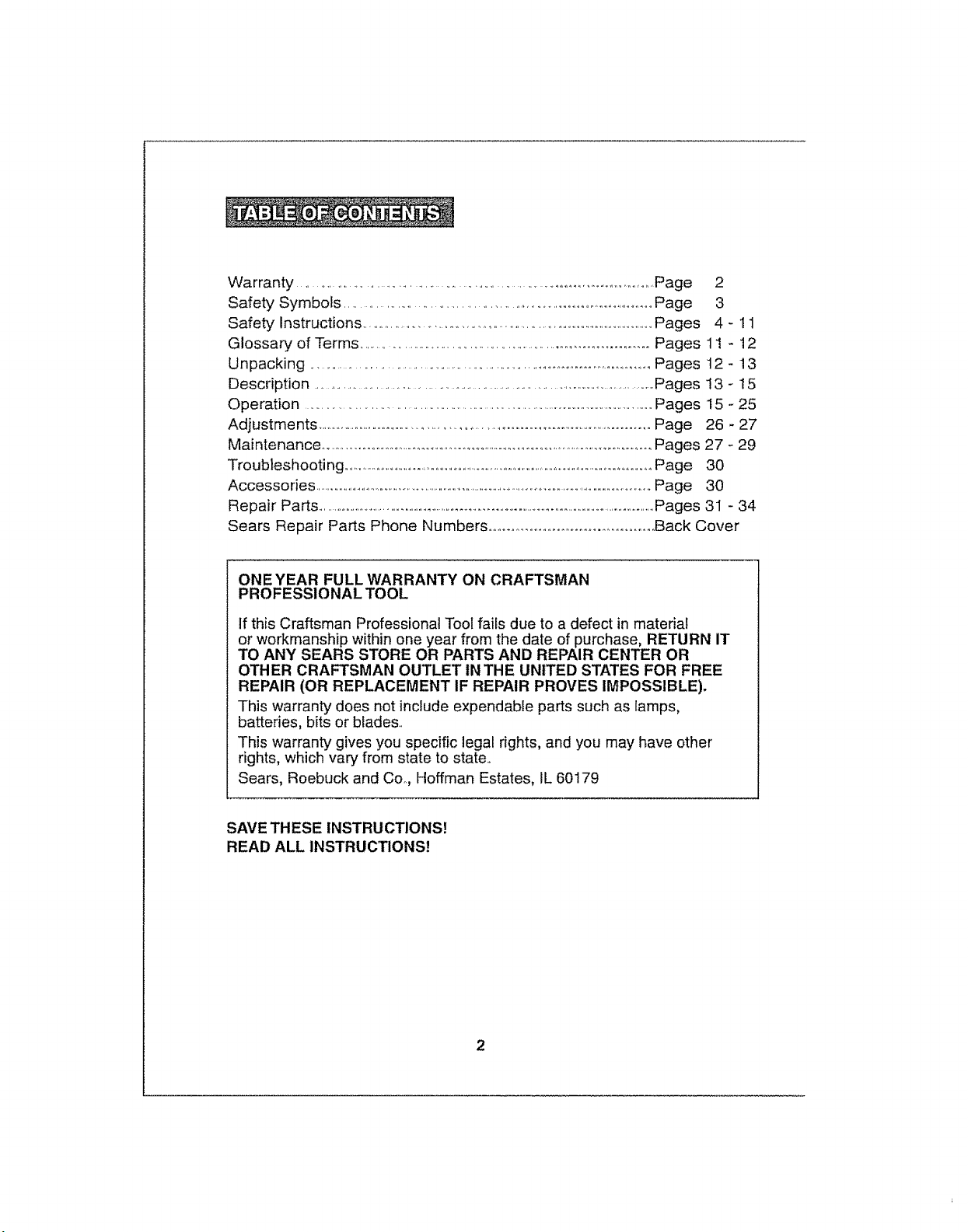
Warranty ....................................................................................... Page 2
Safety Symbols .....................................................................................Page 3
Safety Instructions ................................................................................................Pages 4 - 11
Glossary of Terms ..................................................................................Pages 11 - 12
Unpacking ..............................................................................................Pages 12 - 13
Description ............................................................................................................Pages 13 - 15
Operation .........................................................................................................Pages 15 - 25
Adjustments .................................................................................................Page 26 - 27
Maintenance ...............................................................................................................Pages 27 - 29
Troubleshooting .........................................................................................................................Page 30
Accessories ............................................................................................................................................Page 30
Repair Parts .......................................................................................................................Pages 3I - 34
Sears Repair Parts Phone Numbers ..................................... Back Cover
ONE YEAR FULL WARRANTY ON CRAFTSMAN
PROFESSIONAL TOOL
If this Craftsman Professional Toot fails due to a defect in material
or workmanship within one year from the date of purchase, RETURN IT
TO ANY SEARS STORE OR PARTS AND REPAIR CENTER OR
OTHER CRAFTSMAN OUTLET IN THE UNITED STATES FOR FREE
REPAIR (OR REPLACEMENT IF REPAIR PROVES IMPOSSIBLE).
This warranty does not include expendable parts such as lamps,
batteries, bits or blades..
This warranty gives you specific legal rights, and you may have other
rights, which vary from state to state..
Sears, Roebuck and Co_, Hoffman Estates, IL 60179
SAVE THESE INSTRUCTIONS!
READ ALL INSTRUCTIONS!
2
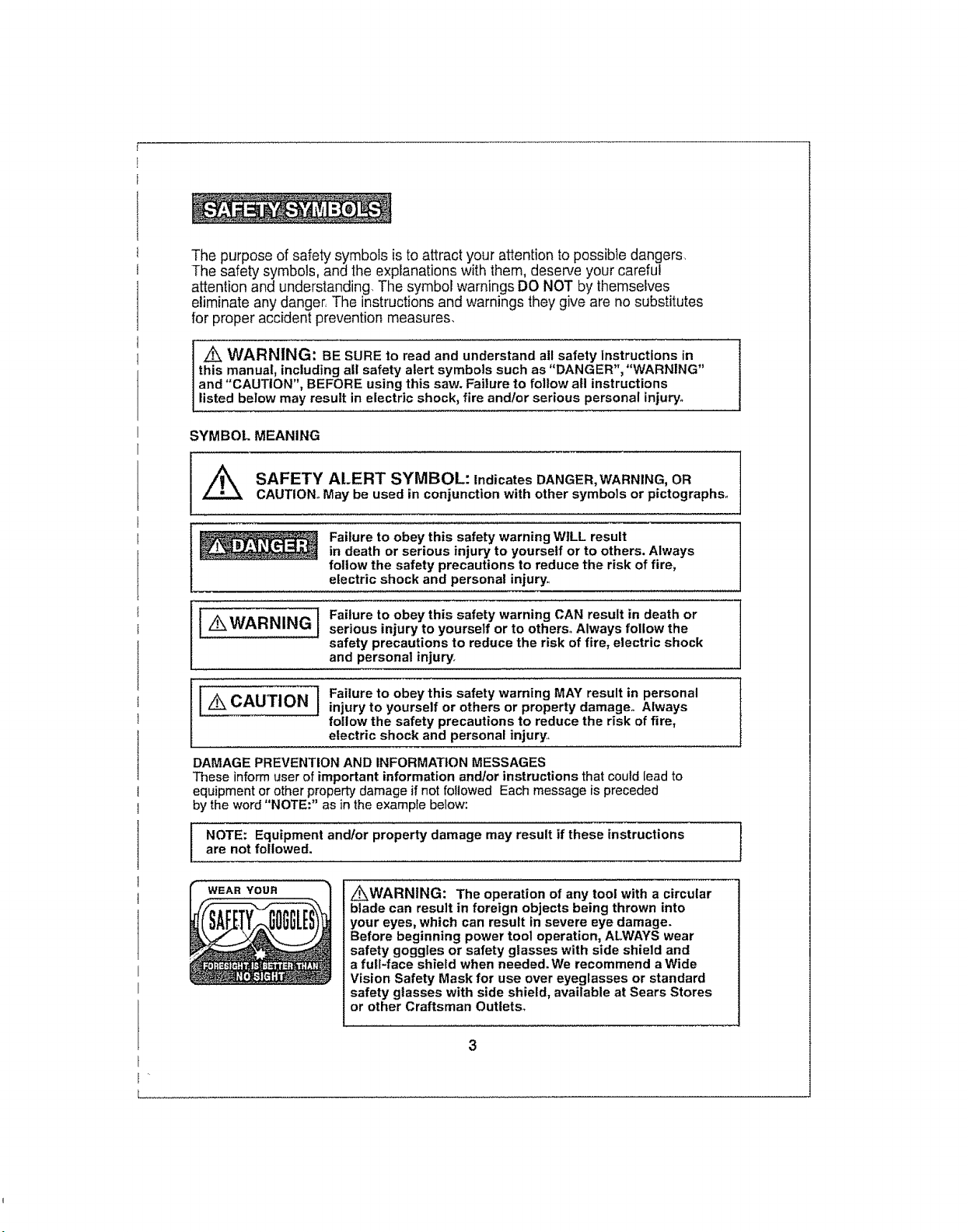
Thepurposeofsafetysymbolsistoattractyourattentiontopossibledangers,
Thesafetysymbols,andtheexplanationswiththem,deserveyourcareful
attentionandunderstanding,ThesymbolwarningsDONOTbythemselves
eliminateanydanger,Theinstructionsandwarningstheygivearenosubstitutes
forproperaccidentpreventionmeasures,
/_k WARNING: BE SURE to read and understand all safety instructions in
this manual, including all safety alert symbols such as "DANGER", "WARNING"
and "CAUTION", BEFORE using this saw. Failure to follow all instructions
listed below may result in electric shock, fire and/or serious personal injury.
SYMBOL MEANING
//_ SAFETY ALERT SYMBOL: Indicates DANGER,WARNING,OR
CAUTION.. May be used in conjunction with other symbols or pictographs.
Failure to obey this safety warning WILL result
in death or serious injury to yourself or to others. Always
follow the safety precautions to reduce the risk of fire,
electric shock and personal injury..
[ AWARNING 1
Failure to obey this safety warning CAN result in death or
serious injury to yourself or to others.. Always follow the
safety precautions to reduce the risk of fire, electric shock
and personal injury.
l!ix CAUTION I Failure to obey this safety warning MAY result in personal
injury to yourself or others or property damage,, Always
follow the safety precautions to reduce the risk of fire,
electric shock and personal injury,,
DAMAGE PREVENTION AND INFORMATION MESSAGES
These inform user of important information and/or instructions that could lead to
equipment or other property damage if not followed Each message is preceded
by the word "NOTE:" as in the exampie below:
NOTE: Equipment and/or property damage may result if these instructionsare not followed.
WEAR YOUR
z_WARNtNG: The operation of any tool with a circular
blade can result in foreign objects being thrown into
your eyes, which can result in severe eye damage.
Before beginning power tool operation, ALWAYS wear
safety goggles or safety glasses with side shield and
a full-face shield when needed. We recommend a Wide
Vision Safety Mask for use over eyeglasses or standard
safety glasses with side shield, available at Sears Stores
or other Craftsman OuUets_
I
3
z_WARNING: BE SURE to read and understand all instructions in this
manual before using this circular saw° Failure to follow all instructions may
result in hazardous radiation exposure, electric shock, fire and!or serious
personal injury.
SAFETY PRECAUTIONS FOR LASERS
This circular saw has a buitt-in laser light. The iaser is a Class ilia and emits output power
of a maximum 2.,5mW and 635-665nm wavelengths. These lasers do not normally present
an optical hazard,. However, DO NOT stare at the beam as this can cause flash blindness.
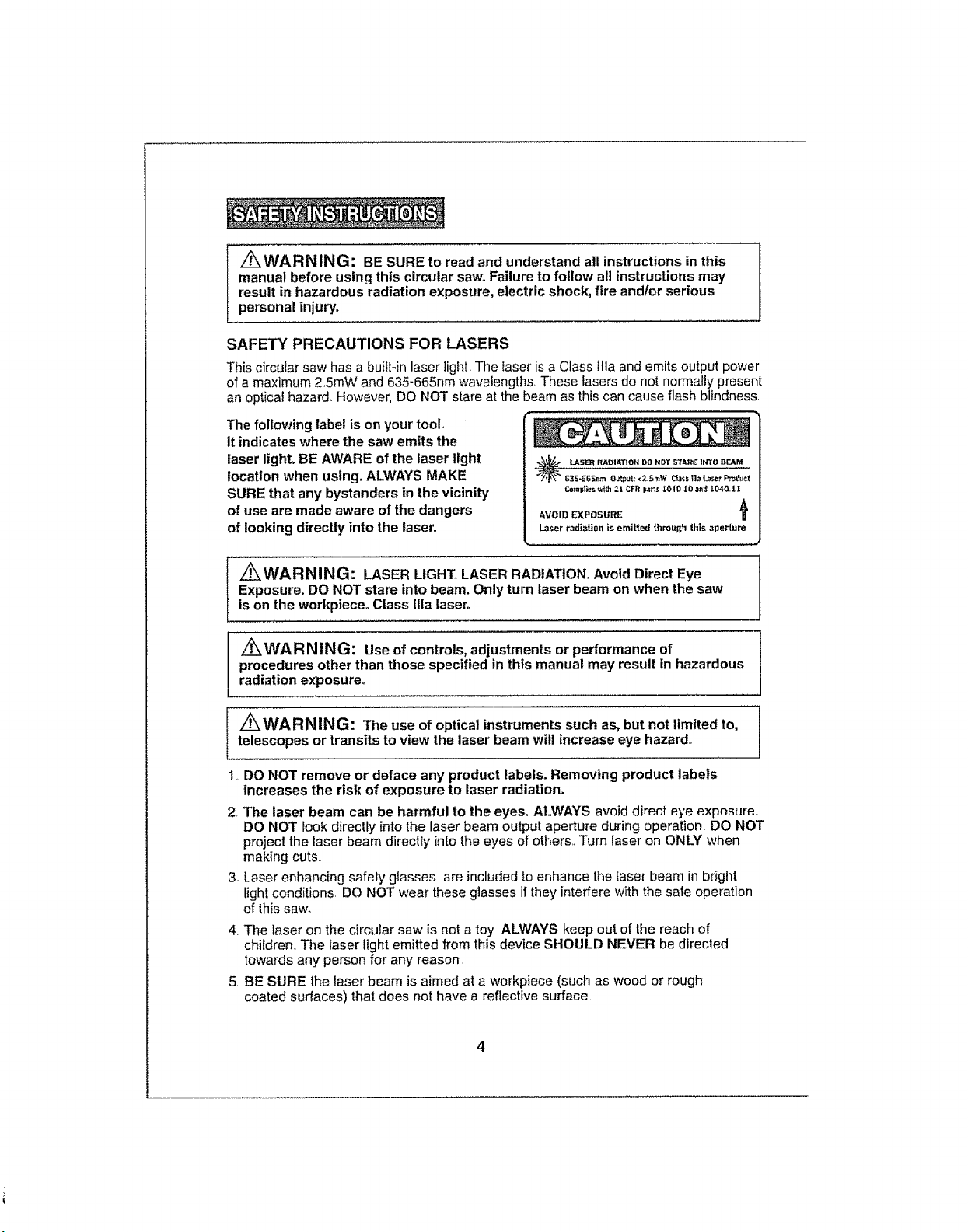
The following label is on your tool,,
It indicates where the saw emits the
laser light, BE AWARE of the laser light
location when using. ALWAYS MAKE
SURE that any bystanders in the vicinity
of use are made aware of the dangers
of looking directly into the laser.
LASI_I RADIATION DO _OT _A_'C IN3tO BEAM
_ 635,665nm OUtpUt,"<2.Stow P...L,I*_S|ha [._et P_duct
Compl_s wf61 Z! CFR paff_, Z_,40 lO a_ ;I.040,,1£
AVOID EY_POSURE
Laser radiation is emiHed through this _perlure
Z_WARNING: LASER LIGHT,,LASER RADIATION. Avoid Direct Eye
Exposure. DO NOT stare into beam. Only turn laser beam on when the saw
is on the workpiece. Class Iila laser,
Z_WARNING: Use of controls, adjustments or performance of
procedures other than those specified in this manual may result in hazardous
radiation exposure,,
i_WARNING: The use of optical instruments such as, but not limited to,
telescopes or transits to view the laser beam will increase eye hazard,,
, DO NOT remove or deface any product labels. Removing product labels
increases the risk of exposure to laser radiation,
2. The laser beam can be harmful to the eyes. ALWAYS avoid direct eye exposure.
DO NOT look directty into the laser beam output aperture during operation DO NOT
project the laser beam directly into the eyes of others,, Turn laser on ONLY when
making cuts,
3.,Laser enhancing safety glasses are included to enhance the taser beam in bright
light conditions, DO NOT wear these glasses if they interfere with the safe operation
of this saw.
4.,The laser on the circular saw is not a toy, ALWAYS keep out of the reach of
children, The laser light emitted from this device SHOULD NEVER be directed
towards any person for any reason,
5, BE SURE the laser beam is aimed at a workpiece (such as wood or rough
coated surfaces) that does not have a reflective surface
4
SAFETYPRECAUTIONS FOR LASERS cont.
6 DO NOT use on surfaces such as sheet steel that have a shiny, reflective surface
The shiny surface could reflect the beam back at the operator_. Be aware that laser
light reflected off of a mirror or any other reflective surfaces can also be dangerous
7 ALWAYS turn the laser beam off when not in use. Leaving the tool on increases
the risk of someone inadvertently staring into the laser's beam..
Z_ CAUTION : ALWAYS follow only the instructions contained in this manual
when using this laser. Use of this feature in any manner other than what appears
in this manual may result in a hazardous radiation exposure.
8..DO NOT attempt to modify the performance of this laser device in any way.
This may result in a dangerous exposure to laser radiation..
9. ALWAYS use only the accessories that are recommended by Sears for use
with this product Use of accessories that have been designed for use with
other laser tools could result in serious injury_
t 0..For further information rega[ding lasers, refer to ANSI-Z136.1 The STANDARD
FOR THE SAFE USE OF LASERS, available from the Laser Institute of America
(407) 380-t 553
WORK AREA SAFETY
2
Keep your work area clean and well lit,, Cluttered workbenches and dark areas
invite accidents.
DO NOT operate power tools in explosive atmospheres, such as in the presence
of flammable liquids, gases, or dust° Power tools create sparks which may ignite
the dust or fumes.
3. Keep bystanders, children and visitors away while operating a power tool,
Distractions can cause you to lose control
4. Make your workshop childproof with padlocks and master switches Lock
tools away when not in use.
5. MAKE SURE the work area has ample lighting so you can see the work and that
there are no obstructions that wilt interfere with safe operation BEFORE using your saw_
PERSONAL SAFETY
1..KNOW your power tooto Read the operator's manual carefully Learn the saw's
applications and limitations, as well as the specific potential hazards related to this tool
2. STAY ALERT, watch what you are doing and use common sense when operating
a power tool..
3. DO NOT use tool while tired or under the influence of drugs, alcohol or medication..
A moment of inattentionwhite operating power tools may result in serious personal injury
4. DRESS properly,, DO NOT wear loose clothing or jewelry.. Pull back long hair Keep
your hair, clothing, and gloves away from moving parts..Air vents often cover moving
parts and should also be avoided_ Loose clothing, jewelry or long hair can be caught
in moving parts
PERSONAL SAFETY cont.
5 AVOID accidental starting Be sure switch is in "OFF" position before
plugging in, DO NOT carry tools with your finger on the switch Carrying tools
with your finger on the switch or plugging in tools that have the switch in the
"ON" position invites accidents,
6 REMOVE adjusting keys or wrenches before turning the tool "ON". A wrench
that is left attached to a rotating part of the tool may result in personal injury,
7oDo not overreach. Keep proper footing and balance at all times. Proper
footing and balance enables better control of the tool in unexpected situations
8, ALWAYS SECURE YOUR WORK, Use clamps or a vise to hold work when
practical., It is safer than using your hand and frees both hands to operate tool
9 USE SAFETY EQUIPMENT° Always wear eye protection,, Dust mask, non-skid
safety shoes, hard hat, or hearing protection must be used for appropriate
conditions.,
I0_,
DO NOT USE ON A LADDER or unstable support. Stable footing on a solid
surface enables better control of the tool in unexpected situations,
TOOL USE AND CARE SAFETY
f _WARNING: BE SURE to read and understand all instructions before
operating this saw° Failure to follow all instructions listed below may result in
electric shock, fire and/or serious personal injury,,
1._ALWAYS use clamps or other practical ways to secure and support the
workpiece to a stable platform. Holding the work by hand or against your body
is unstable and may lead to loss of control,
2, DO NOT force the tool. Use the correct tool and blade for your application.
The correct tool and blade will do the job better and safer at the rate for which it is
designed
3 DO NOT use the toot if switch does not turn it "On" or "Off". Any tool that
cannot be controlled with the switch is dangerous and must be repaired,,
4 DISCONNECT the plug from the power source before making any adjustments,
changing accessories or storing the tool. Such preventive safety measures
reduce the risk of starting the tool accidentally,
5 NEVER leave the tool running. ALWAYS turn it off. DO NOT leave the tool until
it comes to a comp]ete stop
6 STORE idle tools out of the reach of children and other untrained persons.
Tools are dangerous inthe hands of untrained users_,
7, MAINTAIN tools with care. Keep cutting tools sharp and clean. Properly
maintained tools with sharp cutting edges are less likely to bind and are easier to
control,
8. CHECK for misalignment or binding of moving parts, breakage of parts, and
any other condition that may affect the tool's operation If damaged, have the tool
serviced before using Many accidents are caused by poorly maintained tools,
9. USE ONLY accessories that are recommended for this tool. Accessories that
may be suitable for one tool may become hazardous when used on another tool.,
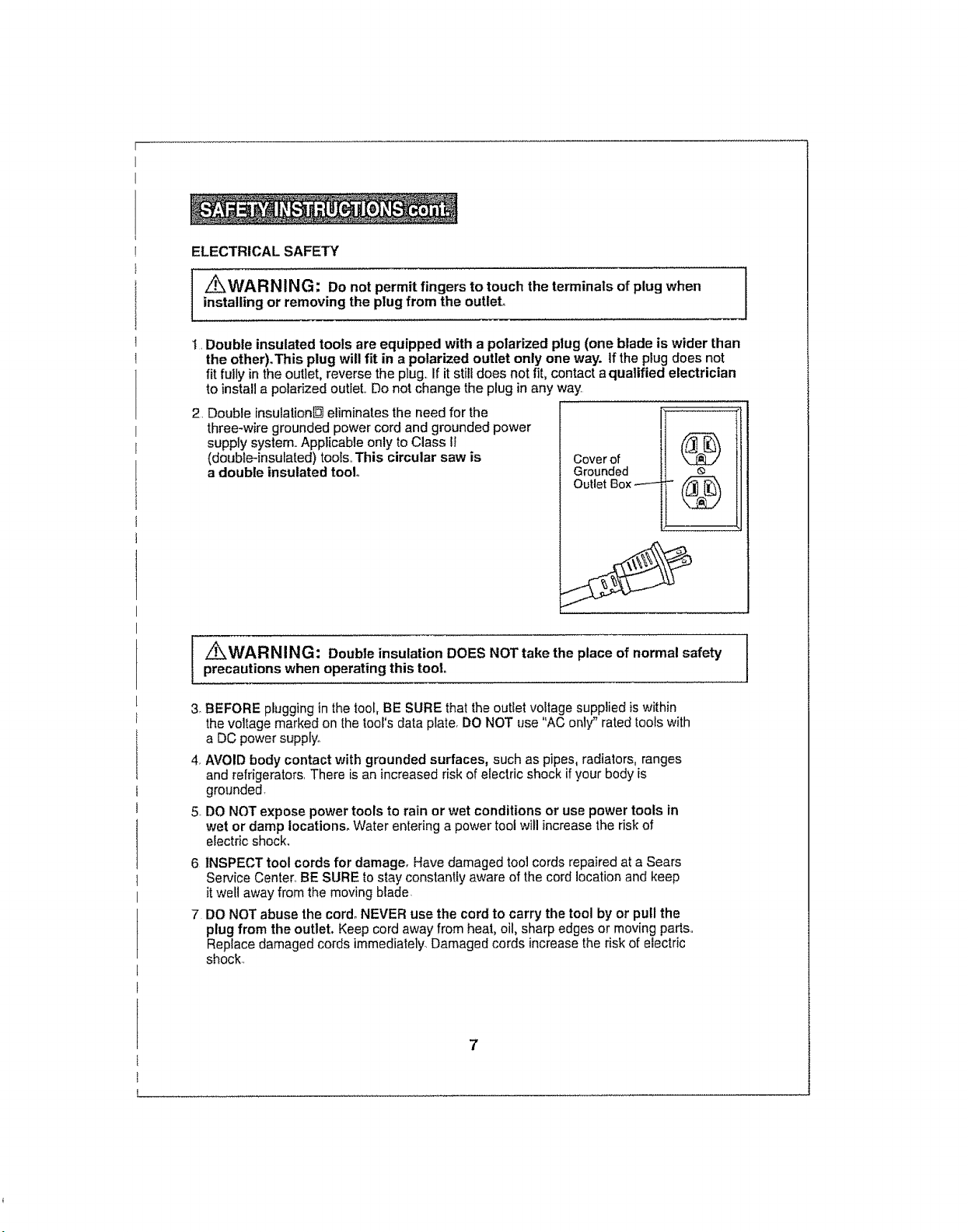
ELECTRICAL SAFETY
[ _WARNING: Do not permit fingers to touch the terminals of plug when
installing or removing the plug from the outlet.
i, Double insulated tools are equipped with a polarized plug (one blade is wider than
the other),This plug will fit in a polarized outlet only one way. if the plug does not
fit fully in the outlet, reverse the plug_.If itstill does not fit, contact aqualified electrician
to install a polarized outieL Do not change the plug in any way
2. Double insulation[_ eliminates the need for the
three-wire grounded power cord and grounded power
supply system° Applicable only to Class !I
(double-insulated) tools..This circular saw is
a double insulated tool.,
Cover of
Grounded
OiJllet Box ------
©
z_WARNING: Double insulation DOES NOT take the place of normal safety 1
precautions when operating this tool,
1
3_BEFORE plugging in the 1ool,BE SURE that the outlet voltage supplied is within
the voltage marked on the tool's data plate, DO NOT use "AC only" rated tools with
a DC power supply.
4, AVOID body contact with grounded surfaces, such as pipes, radiators, ranges
and refrigerators. There is an increased risk of electric shock if your body is
grounded
5. DO NOT expose power tools to rain or wet conditions or use power tools in
wet or damp locations. Water entering a power tool will increase the risk of
electric shock.
6 iNSPECT tool cords for damage, Have damaged tool cords repaired at a Sears
Service Center. BE SURE to stay constantly aware of the cord location and keep
it well away from the moving blade.
7 DO NOT abuse the cord° NEVER use the cord to carry the tool by or pull the
plug from the outlet. Keep cord away from heat, oil, sharp edges or moving parts..
Replace damaged cords immediately. Damaged cords increase the risk of electric
shock..
EXTENSION CORDS
Use a proper extension cord. ONLY use cords listed by Underwrilers Laboratories
(UL). Other extension cords can cause a drop in line voltage, resulting ina loss of
power and overheating of tool.. For this tool an AWG (American Wire Gauge) size of
at least 14-gauge is recommended for an extension cord of 254£ or less in length
Use 12-gauge for an extension cord of 50-ft. Extension cords 100-ft, or longer are not
recommended. Remember, a smaller wire gauge size has greater capacity than
a larger number (14-gauge wire has more capacity than 16-gauge wire; 12-gauge
wire has more capacity than 14-gauge).. When in doubt use the smaller number
When operating a power tooloutdoors, use an outdoor extension cord marked
"W-A" or "W". These cords are rated for outdoor use and reduce the risk of electric
shock.
Z_ CAUTION: Keep the extension cord clear of the working area. Position
the cord so that it wilt not get caught on lumber, tools or other obstructions
while you are working with a power tool.
z_WARNING: Check extension cords before each use. If damaged
replace immediately. Never use tool with a damaged cord since touching the
damaged area could cause electrical shock, resulting in serious injury.
SAFETY SYMBOLS FOR YOUR TOOL
The label on your tool may include the following symbols.
V...............................................................................................Volts
A....................................................................................................Amps
Hz..........................................................................................................Hertz
W......................................................................................................Watts
min ..............................................................................................Minutes
,-......................................................................................................Alternating current
...................................................................................Direct current
no ............................................................................................No-load speed
[] ............................................................................................Class IIconstruction, Double Insulated
Jmin ..........................................................................Revolutions or Strokes perminute
Z_...........................................................................................Indicates danger, warning or caution.
It means attention! Your safety is involved..
SERVICE SAFETY
I.. If any part of this saw is missing or should break, bend, or fail in any way;
or should any electrical component fail to perform properly: SHUT OFF
the power switch and remove the saw plug from the power source and have
the missing, damaged or failed parts replaced BEFORE resuming operation.
2_.Tool service must be performed only at a Sears Parts and Repair Center.
Service or maintenance performed by unqualified personnel could result in
a risk of injury,
3,.When servicing a tool, use only identical replacement parts. Follow
instructions in the maintenance section of this manual. Use of unauthorized
pads or failure to follow maintenance instructions may create a risk of electric
shock or injury.
SAFETY RULES FOR CIRCULAR SAWS
_Keep hands away from cutting area and blade,, Keep your
second hand On the auxiliary handle or motor housing. If both hands are holding
the saw, the blade cannot cut them°
Z_ CAUTION: Blades coast after saw is switched off.
I,KEEP your body positioned to either side of the saw blade and not in direct
line with the saw blade. Kickback could cause the saw to jump backwards. (See
"Kickback What Causes It and Ways to Help Prevent It" on pages 16 and I7)..
2 DO NOT reach underneath the work. The guard cannot protect you from the blade
beneath the workpiece.
_When sawing through a workpiece, the lower blade guard
DOES NOT cover the blade on the underside of the workpiece (Pg. 14 Fig. 2).
ALWAYS keep your hands and fingers away from the cutting area.
3 CHECK lower guard for proper closing BEFORE each use. DO NOT operate the saw
if the lower guard does not move freely and close instantly. Never clamp or tie the
lower guard in the open position.. If the saw is accidentalfy dropped, the lower guard may
be benL Raise the lowerguard with tile retracting lever The guard isoperating properly
when it moves freely, does not touchthe blade or any other part in all angles and depths
of cut, and readily returns to the closed position.
4.CHECK the operation and condition of the lower guard spring. If the guard and the
spring are not operating properly, they MUST BE serviced before use. The lower
guard may operate sluggishly, due to damaged parts, gummy deposits, or a buildup of
debris DO NOT operate your saw until the damage has been repaired or replaced_
5.The lower guard should be retracted manually ONLY for making special cuts, such
as pocket or compound cuts, ALWAYS raise the lower guard by retracting its lever,
As soon as the blade enters the material, the lower guard MUST be released. For all
other sawing, the lower guard should operate automatically..
6 ALWAYS make sure that the lower guard is covering the blade BEFORE placing the
saw down on a work bench or floor. An unprotected moving blade will cause the saw to
walk backwards, cutting whatever is in itspath. Make note of the time it takes for the blade
to stop spinning after the switch is released
7 NEVER hold the piece being cut in your hands or across your legs. It is importantto
support the workpiece property in order to minimize body exposure, blade binding, or loss
of control.
8 HOLD TOOL by insulated gripping surfaces (handles) when performing an operation
where the cutting tool may contact hidden wiring or its own cord. Contact with a "live"
wire will make the exposed metal partsof the tool"live" and shock the operator..
9..ALWAYS clamp the workpiece securely so it will not move when making the cut.
I0. When ripping, ALWAYS USE a rip fence or straight edge guide. This improves the
accuracy ofthe cut and reduces the chance of the blade binding.
tl ALWAYS USE blades that have the correct size and shape (diamond vs, round) arbor
holes. Blades that do not match the mounting hardware of the saw will run erratically and
cause loss of control.
9
SAFETYRULESFORCIRCULARSAWSconL
12, NEVER use damaged or incorrect blade washers or bolts. The blade washers and
bolts were specially designed for your saw, for optimum performance and safely ofoperation.
13 NEVER cut more than one piece at a time. DO NOT STACK more than one
workpiece on the worktable at a time.
I4. AVOID awkward operations and hand positions where a sudden slip could
cause your hand to move into the blade.
15, NEVER reach into the cutting path of the blade.
Z_ WARNING: Use of this product can generate dust containing chemicals
known to cause cancer, birth defects or other reproductive harm, Some examples of
these chemicals are:
• Lead from lead-based paints
• Crystatline silica from bricks and cement and other masonry products,
• Arsenic and chromium, from chemically treated lumber.
Your risk from these exposures varies, depending upon how often you do this
type of work.To reduce your exposure to these chemicals;
• Work in a well-ventilated area
• Work with approved safety equipment, such as those dust masks that are specially
designed to filter out microscopic particles.,
Avoid prolonged contact with dust from power sanding, sawing, grinding, drilling
and other construction activities, Wear protective clothing and wash exposed areas
with soap and water.
Allowing dust to get into your mouth, eyes, or lay on the skin may promote absorption
of harmfut chemicals,
z_ WARNING: Use of this tool can generate andlor disburse dust, which may
cause serious and permanent respiratory or other injury° Always use NIOSH/OSHA
approved respiratory protection appropriate for the dust exposure. Direct particles
away from face and body.
ADDITIONAL RULES FOR SAFE OPERATION
i _ WARNING: BE SURE to read and understand all instructfons_ Failure
to follow all instructions listed below may result in electric shock, fire and/or
serious personal injury.
1. Know your power tool. Read operator's manual carefully. Learn the applications
and limitations, as well as the specific potential hazards related to this tool, Following
this rule will reduce the risk of e]ectric shock, fireor serious injury
2,,ALWAYS wear safety glasses or eye shields when using this saw° Everyday
eyeglasses have only impact-resistant lenses; they are NOT safety glasses_
3,,PROTECT your lungs. Wear a face mask or dust mask ifthe operation is dusty1
4 PROTECT your hearing. Wear appropriate personal hearing protection during use, Under
some conditions and duration of use, noise from thisproduct may contribute to hearing lasso
5, ALL VISTORS AND BYSTANDERS MUST wear the same safety equipment that the
operator of the saw wears
10
ADDITIONAL RULES FOR SAFE OPERATION cont.
6 INSPECT the tool cords periodically and if damaged have them repaired at your
nearest Sears Service Center or other Authorized Service Facility. BE AWARE
of the cord location°
7 ALWAYS check the tool for damaged parts. Before further use of the tool, aguard or
other part that isdamaged should be carefully checked !o determine if it will operate properly
and perform its intended function Check for misalignment or binding of moving parts,
breakage of parts, and any other condition that may affect the tool's operation. A guard or
other part that is damaged should be properly repaired or replaced at a Sears Service center
8 INSPECT and remove all nails from lumber before sawing,
9oSAVETHESE INSTRUCTIONS, Refer to them frequently and use them to instruct others
who may use this tool. tf someone borrows this tool, make sure they have these
instructions also_
Spindle
The shaft on which a blade or cutting toolis mounted_Also called the Arbor
Revolutions Per Minute (RPM)
The number of turns completed by a spinning object inone minute
Saw Blade Path
The area over, under, behind or in frontof the blade, as it applies to the workpiece
That area which wiUbe or has been cut by the blade
Set
The distance that the saw blade tooth is bent (or set) outward from the face of the blade
Miter Cut
Acutting operation made with the blade at any angle other than 900 to the fence
Compound Miter Cut
Acompound miter cut is a cut made using a miter angle and a beve! angle at thesame time.
Cross cut
Acutting or shaping operation made against the grain of the workpiece.
Bevel Cut
Acutting operation made with the blade at any angle other than 900 to the miter table
Dado Cut
A non-through cut which produces a square-sided notch or trough inthe workpiece
(requires special blade)
Chamfer Cut
Acut removing a wedge from a b!ock of wood so the end (or part of the end) is
angled at other than 90&
Ripping or Rip Cut
Acutting operation along the length of the workpiece
Freehand Cut
Performing a cut without using a fence, miter gauge, fixture, work clamp, or other
proper device to keep the workpiece from twisting or moving during the cut°
Through Sawing
Any cutting operation where the blade extends completely through the thicknessof the workpiece
11
Non-ThroughCuts
Anycuttingoperationwherethebladedoesnotextendcompletelythroughthe
thicknessoftheworkpiece,likeadadocut,
LeadingEnd
Theendoftheworkpiecepushedintotoolfirst.
Kerr
Thematerialremovedbythebladeinathroughcutortheslotproducedbytheblade
inanon-throughorpartialcut
Kickback
Ahazardthatcanoccurwhenthebladebindsorstalls,throwingtheworkpieceback
towardoperaton
WorkpieceorMaterial
TheitemonwhichthecuttingoperationisbeingdoneThesurfacesofaworkpiece
arecommonlyreferredtoasfaces,endsandedges,
Gum
Asticky,sap-basedresiduefromwoodproducts,
Resin
Asticky,sap-basedsubstancethathashardened+,
Z_ WARNING: Your saw should NEVER be connected to the power source
when you are assembling parts, making adjustments, installing or removing
blades, cleaning or when it is not in use. Disconnecting the saw will prevent
accidental starting, which could cause serious personal injury.
1,, The saw's cutting blade is installed at the factory.
2, The edge guide is force4itted into the top of the lid of the storage/carrying case.
3 The blade wrench isalso force-fitted into the top of the lid of the case. The wrench
isused when changing or installinga new blade.
4 A1soincluded and attached to the top of the bidof the case with a hook and loop strap
is a pair of Laser enhancing safety glasses which are used to enhance the laser
beam in bright light condition&,
5 There is a blade storage area in the bottom of the case where an extra bJade can
be stored,
6 inspect the saw carefully to make sure that no breakage or damage has occurred
during shipping, if any of the items mentioned are missing (refer to PARTS LiST
on page 13), return the saw to your nearest Sears store or Craftsman outlet
to have the saw replaced+
z_ WARNING: If any parts are broken or missing, DO NOT attempt to plug
in the power cord or operate saw until the broken or missing parts are replaced.
Failure to do so could result in possible serious injury°
12
PARTS LIST
Fig.
1. Saw
2. Blade
(InstaLledat factory)
3oEdge Guide 1[/
(stored in case) /11
4_Blade Wrench I_ I
(stored in case) _lU
5. Laser enhancing
safety glasses O,' "_tf
(for enhancing laser)
6oOperator's Manual
KNOWYOUR CIRCULAR SAW (Fig. 2)
NOTE: Before attempting to use your saw, familiarize yourself with all of the
operating features and safety requirements°
Your circular saw has a precision-built electric motor and it should only be connected toa
120-volt, 60-Hz AC ONLY power supply (normal household current)_.DO NOT operate on
direct current (DC)_This large voltage drop will cause a loss of power and the motor will
overheat, If the saw does not operate when plugged into correct 120-volt, 60-Hz AC ONLY
outlet, check the power supply. The saw has an 8-if., 2-wire power cord (no adapter needed},
This Circular Saw has the following features:
t 15 Amp, 5200 RPM (no-load speed) motor° Provides power and torque for fast, sure
cuts inwood, plywood, hardboard and wood-base materials_
2 LaserTracTMThe unique, innovative feature for accurate, efficient cutting!
3 Built-in LED WORKLtGHT illuminates curling area for easy visibility This light stays
"On" when saw is plugged into power source
4 Quick depth-of-cut adjustments with a maximum depth of cut:
2 318-in,thick at 90; 113hs-in, thick at 45°
5, Easy to read bevel cut scale adjusts from 0° to 56° bevel capacity, with a positive
stop at 45°
6. Heavy duty, lightweight Magnesium blade guards for extra strength and durability
7_ Extended length trigger switch with soft-start for maximum control and comfort
for either left or right hand.
8_ Oversized machined magnesium base provides stability for maximum control
during sawing applications.
9 Soft-grip ergonomicaily designed contoured rear handle and front assist handle
for positive gripping, control, balance and comforL
10 Includes Craftsman e24 tooth carbide-tipped steel general purpose blade
for fast, smooth cuts
13
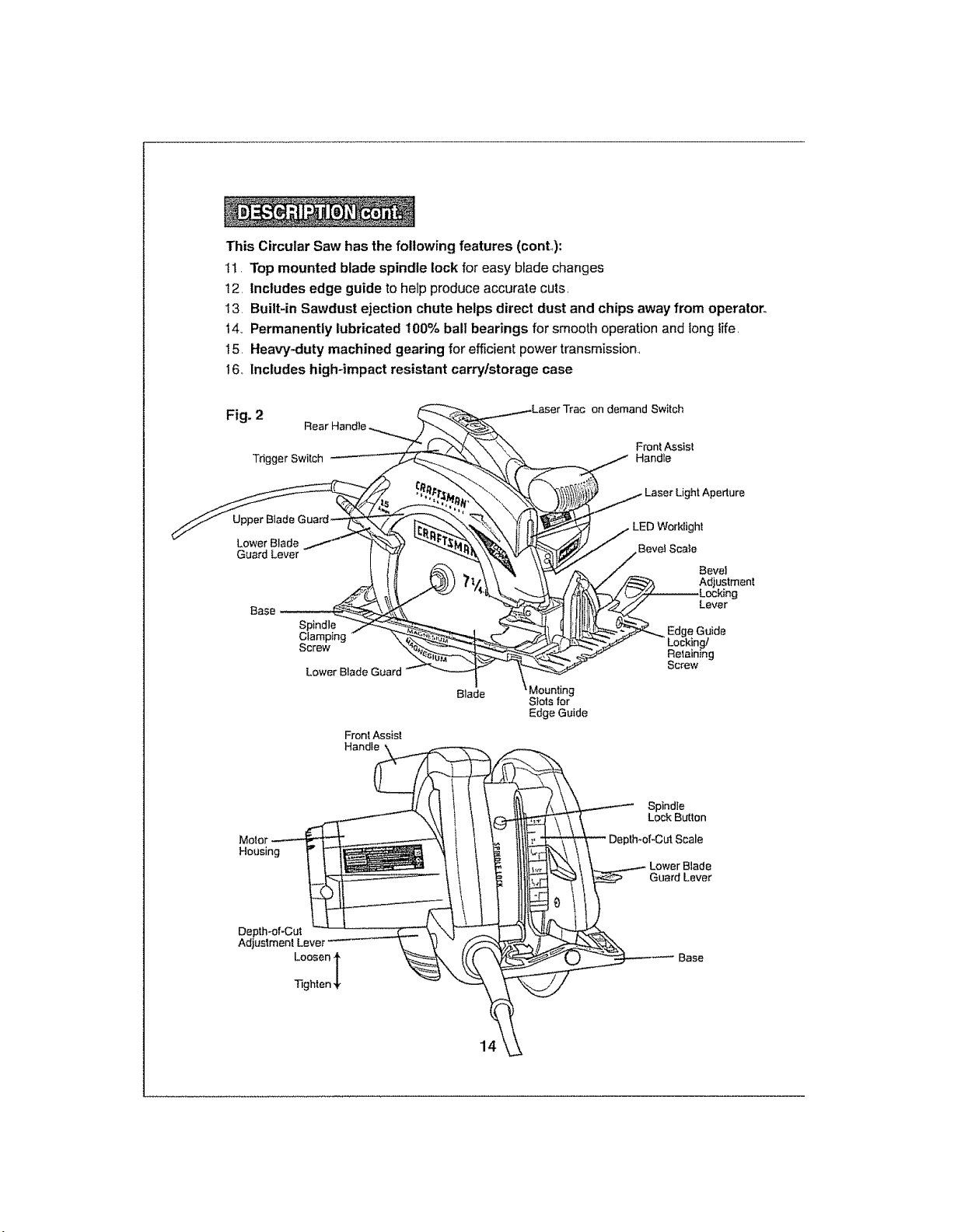
This Circular Saw has the following features (conL):
tl. Top mounted blade spindle lock for easy blade changes
12, Includes edge guide to help produce accurate cuts.
13, Built-in Sawdust ejection chute helps direct dust and chips away from operator.
14, Permanently lubricated t00% ball bearings for smooth operation and long life.
t5, Heavy-duty machined gearing for efficient power transmission,
16,,Includes high-impact resistant carry/storage case
Fig. 2
Rear
Tdgger Switch
Lower Blade
Guard Lever i
Base
Clamping
Screw
Lower Blade Guard
Front Assist
Handle
Blade
Slots for
Edge Guide
on demand Switch
Front Assist
Handle
Laser Light Aperture
Work|ight
Bevel Scale
Bevel
Adjl
Lever
Guide
g/
Retaining
Screw
Housing
Spindle
Lock Button
Scale
Guard Lever
Depth-of-Cut
Adjustment Lever
Loosen f
_ghten 4,
Base
14
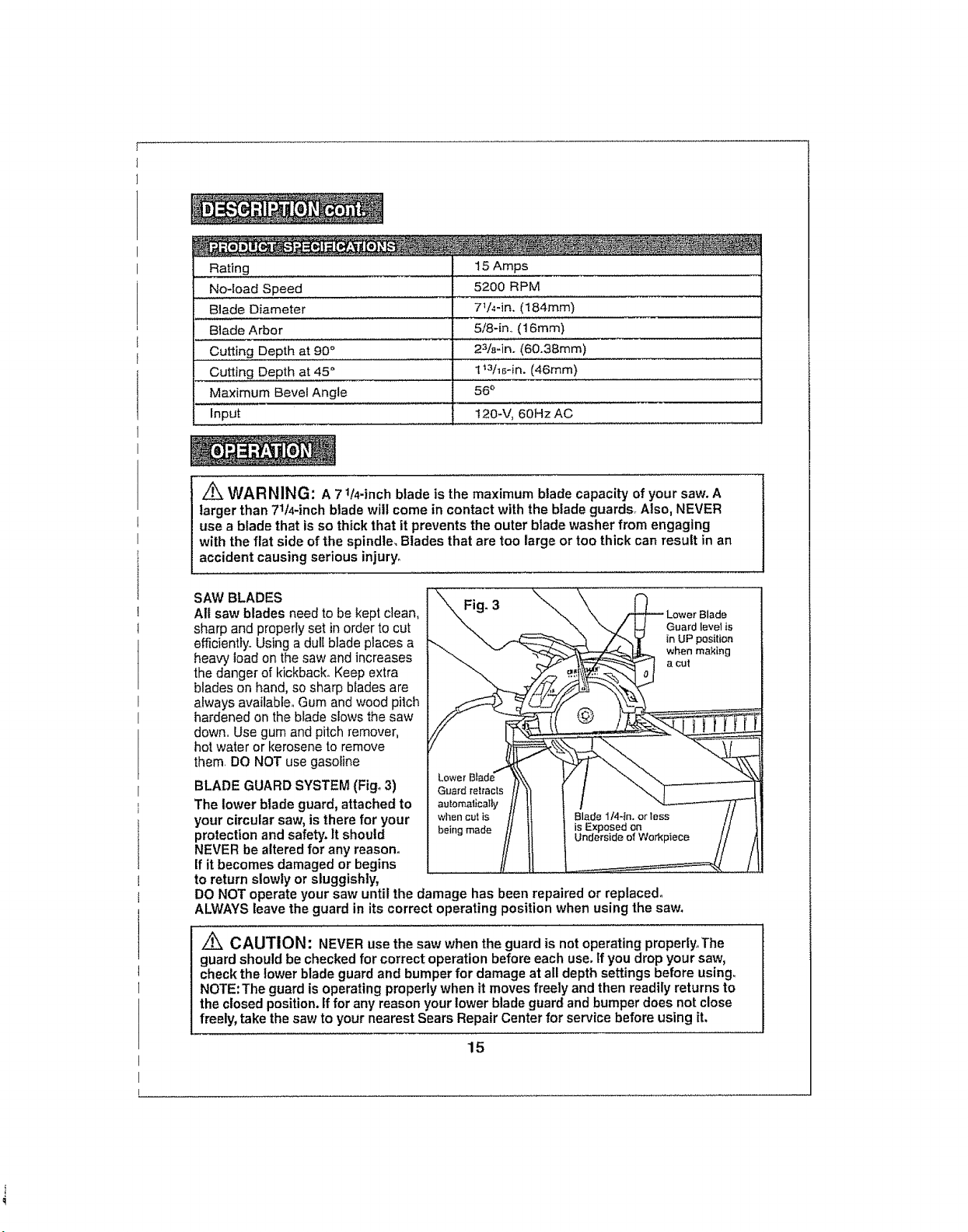
Rating
No-load Speed
Blade Diameter
Blade Arbor
23/s-in. (60.38mm)
Cutting Depth at 90°
Cutting Depth at 45 ° t Wl_-in. (46ram)
Maximum Bevel Angle 56o
Input t20-V, 60Hz AC
15 Amps
5200 RPM
.... , , , ., ,,,
71/4-in. (184ram)
5/8-in,, (t 6mm)
Z_ WARNING: A 71/4-inch blade is the maximum blade capacity of your saw. A
larger than 71t4-inch blade will come in contact with the blade guards_ Also, NEVER
use a blade that is so thick that it prevents the outer blade washer from engaging
with the flat side of the spindle, Blades that are too large or too thick can result in an
accident causing serious injury,
SAW BLADES
All saw blades need to be kept clean,
sharp and properly set in order to cut
efficiently Using a dull blade places a
heaw load on the saw and increases
the danger of kickback° Keep extra
blades on hand, so sharp blades are
always available. Gum and wood pitch
hardened on the blade slows the saw
down Use gum and pitch remover,
hot water or kerosene to remove
them DO NOT use gasoline
Fig. 3
BLADE GUARD SYSTEM (Fig_ 3)
The lower blade guard, attached to
your circular saw, is there for your
protection and safety. It should
NEVER be altered for any reason.
If it becomes damaged or begins
to return slowly or sluggishly,
DO NOT operate your saw until the damage has been repaired or replaced.
ALWAYS leave the guard in its correct operating position when using the saw,
Lower Blade
Guard level is
in UP position
when making
a cut
Z_ CAUTIO N: NEVER use the saw when the guard is not operating properly° The
guard should be checked for correct operation before each use. If you drop your saw,
check the lower blade guard and bumper for damage at all depth settings before using.
NOTE:The guard is operating properly when it moves freely and then readily returns to
the closed position. If for any reason your lower blade guard and bumper does not close
freely, take the saw to your nearest Sears Repair Center for service before using it.
15
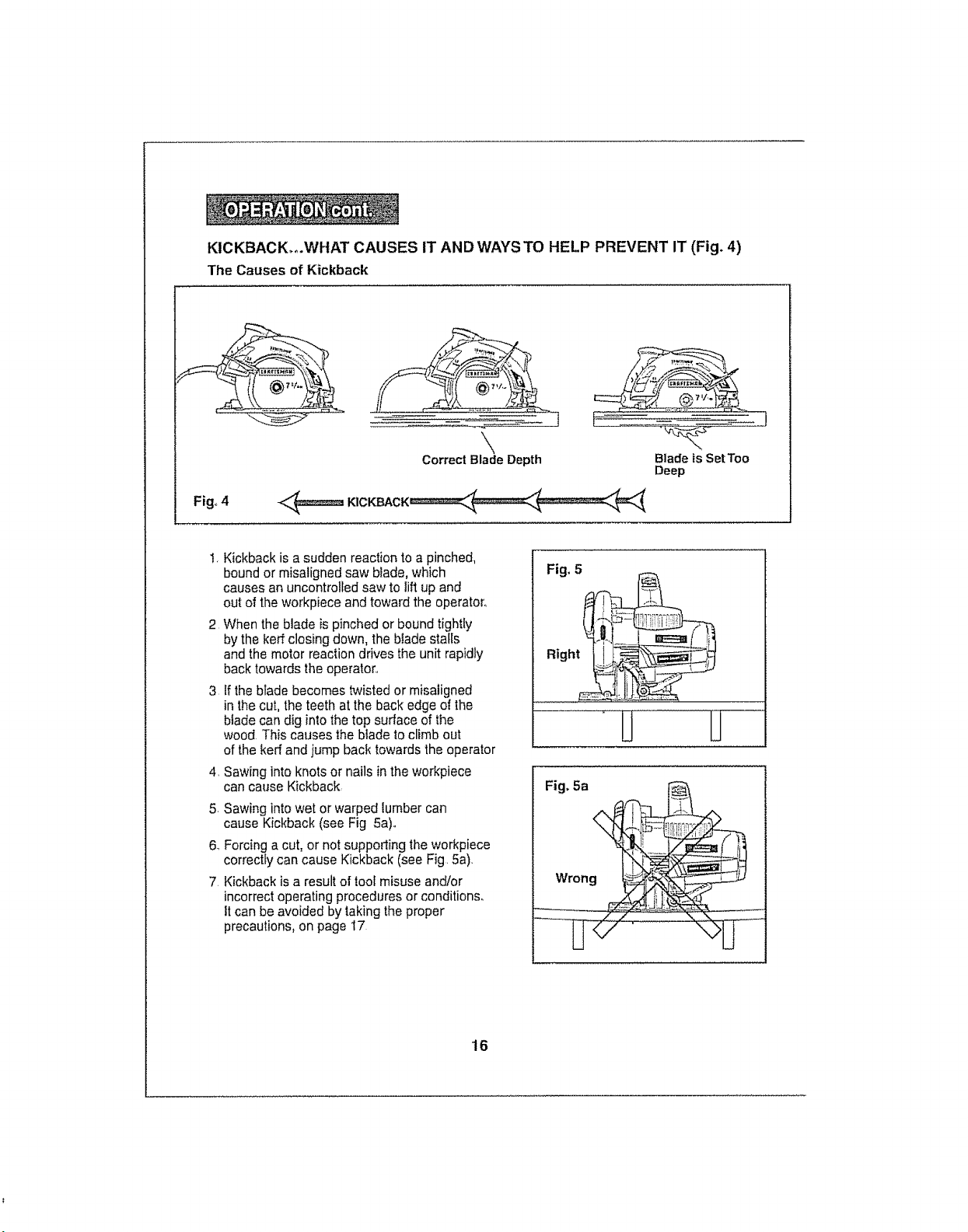
KICKBACK,,.WHAT CAUSES IT AND WAYS TO HELP PREVENT IT (Fig. 4)
The Causes of Kickback
\
Correct Blade Depth
Bladeis SetToo
Deep
Fig,,4 _ KICKBACK
1, Kickback isa sudden reaction to a pinched,
bound or misaligned saw blade, which
causes an uncontrolled saw tolift up and
outof theworkpiece and toward the operator,,
2 When the blade is pinched or bound tightly
by the keff closing down, the blade stalls
and the motor reactiondrives the unit rapidly
back towardsthe operator,,
3 Ifthe blade becomes twisted or misatigned
inthe cut, the teeth at the back edge of the
blade can dig into the topsudace of ttTe
wood, This causes the blade to climb out
of the ken and jump back towardsthe operator
4, Sawing into knots or nails inthe workpiece
can cause Kickback,
5. Sawing into wet or warped lumber can
cause Kickback (see Fig 5a),,
6, Forcing a cut, or not supporting the workpiece
correctly can cause Kickback (see Fig. 5a).
7. Kickback is a result of tool misuse and/or
incorrect operating procedures or conditions,
itcan be avoided by taking the proper
precautions, on page I7
Fig, 5
Righ_
Wrong
i
16
Ways to Help Prevent Kickback
_ ALWAYS release trigger switch immediately if the blade binds
or the saw stalls. Kickback could cause you to lose control of the saw. Loss of control
can lead to serious lnjury_
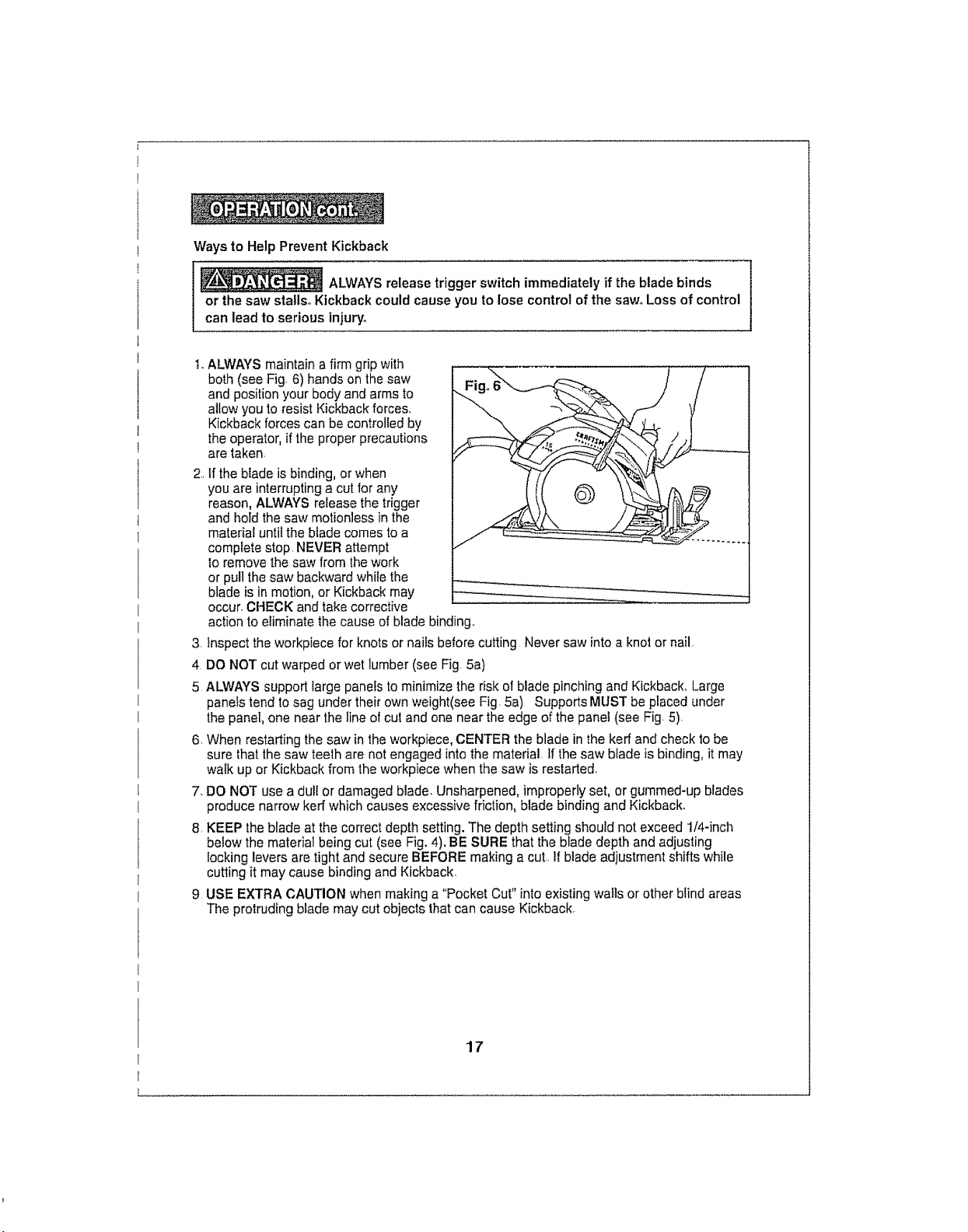
1.ALWAYS maintain afirm grip with
both (see Fig, 6) hands on the saw
and position your body and arms to
allow you to resist Kickback forces,
Kickback forces can be controlled by
the operator, if the proper precautions
are taken,
2, If the blade is binding, or when
you are interrupting a cut for any
reason, ALWAYS release the trigger
and hold the saw motionless in the
material until the blade comes to a
complete stop, NEVER atlempt
1oremove the saw from the work
or pull the saw backward while the
blade is in motion, or Kickback may
occur. CHECK and take corrective
action to eliminate the cause of blade binding,,
3 Inspect the workpiece for knots or nails before cutting Never saw into a knot or nail.
4 DO NOT cut warped or wet lumber (see Fig 5a)
5 ALWAYS support large panels to minimize the risk of blade pinching and Kickback, Large
panels tend to sag under their own weight(see Fig, 5a) Supports MUST be placed under
the panel, one near the line of cut and one near the edge of the panel (see Fig. 5)_
6. When restarting the saw in the workpiece, CENTER the blade in the kerr and check to be
sure that the saw teeth are not engaged into the material if the saw blade is binding, it may
walk up or Kickback from the workpiece when the saw is restarted,
7. DO NOT use a dul! or damaged blade, Unsharpened, improperly set, or gummed-up blades
produce narrow kerr which causes excessive friction, blade binding and Kickback°
8, KEEP the blade at the correct depth setting. The depth setting should not exceed 1/4-inch
below the material being cut (see Fig. 4).BE SURE that the blade depth and adjusting
locking levers are tight and secure BEFORE making a cut:,If blade adjustment shifts while
cutting it may cause binding and Kickback,
9 USE EXTRA CAUTION when making a "Pocket Cut" into existing walls or other blind areas
The protruding blade may cut objects that can cause Kickback,
17
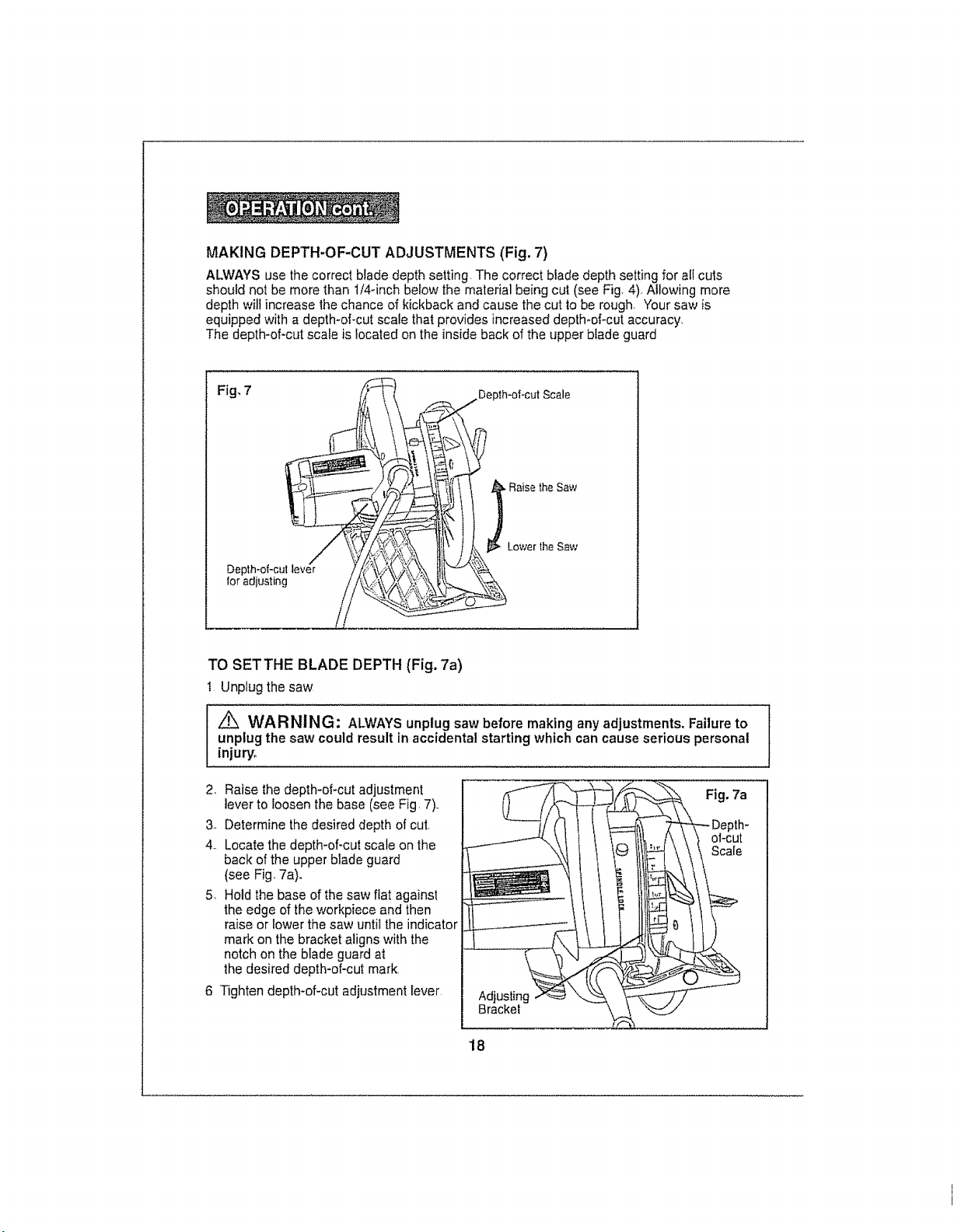
MAKING DEPTH-OF-CUT ADJUSTMENTS (Fig. 7)
ALWAYS use the correct blade depth setting The correct blade depth setting for al!cuts
should not be more than 1/4-inch below the material being cui (see Fig, 4), Allowing more
depth will increase the chance of kickback and cause the cut to be rough, Your saw is
equipped with a depth-of-cut scale that provides increased depth-of-cut accuracy,
The depth-of-cut scale is located on the inside back of the upper blade guard
Fig. 7 _th-of-cutScale
for adjusting
b.RaisetheSaw
LowertheSaw
TO SETTHE BLADE DEPTH (Fig. 7a)
t Unplugthesaw
Z_ WARNING: ALWAYS unplug saw before making any adjustments. Failure to
unplug the saw could result in accidental starting which can cause serious personal
injury°
2, Raise the depth-of-cut adjustment
lever to loosen the base (see Fig, 7),.
3,, Determine the desired depth of cut.
4. Locate the depth-of-cut scale on the
back of the upper blade guard
(see Fig, 7a)o
5_ Hold the base of the saw flat against
the edge of the workpiece and then
raise or lower the saw until the indicator
mark on the bracket aligns with the
notch on the blade guard at
the desired depth-of-cut mark,
6 Tighten depth-of-cut adiustment lever
Adjusting
Bracket
Fig. 7a
18
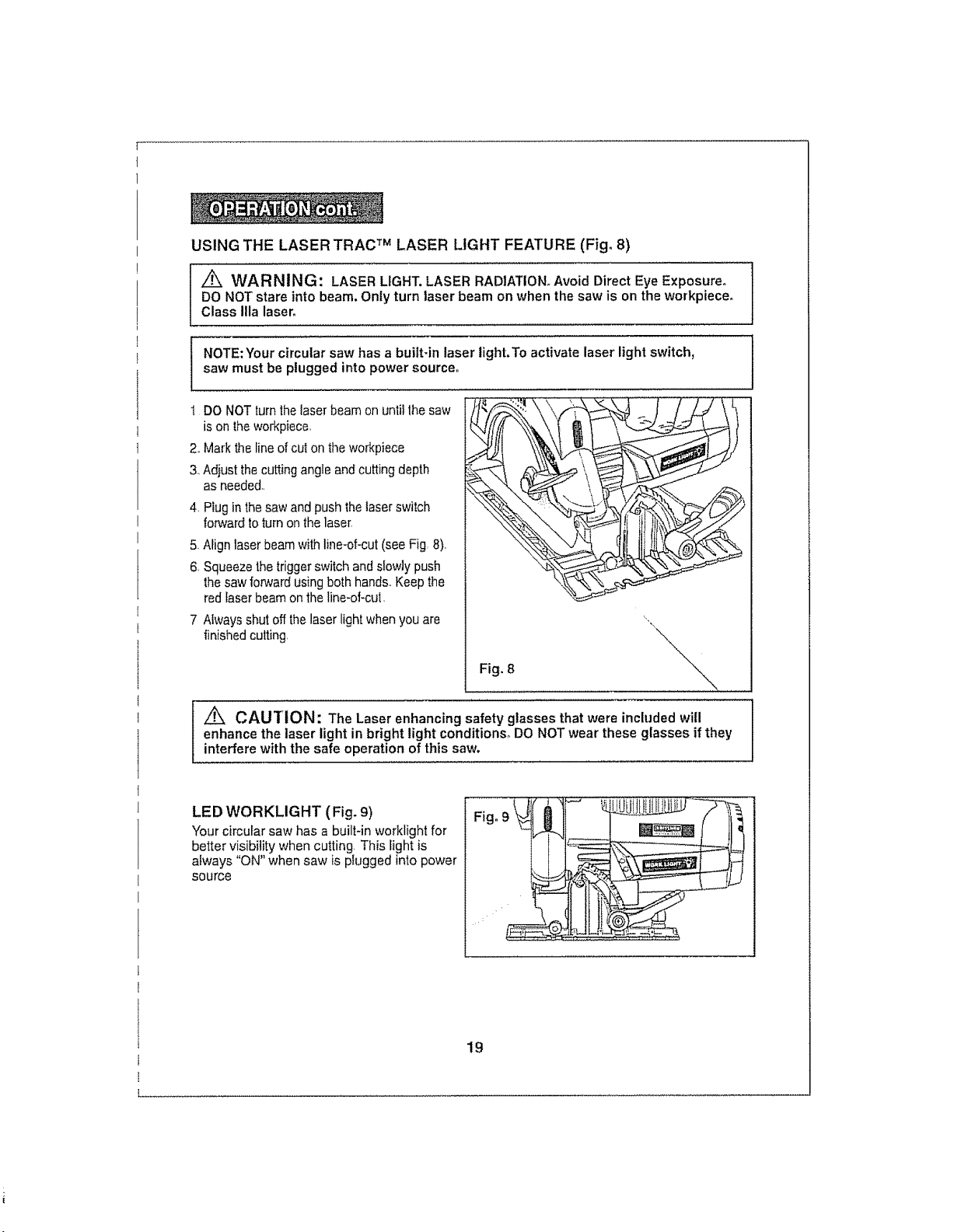
USING THE LASER TRAC TM LASER LIGHT FEATURE (Fig° 8)
/_ WARNING: LASER LIGHT. LASER RADIATIONo Avoid Direct Eye Exposure.
DO NOT stare into beam. Only turn laser beam on when the saw is on the workpieceo
Class itla laser°
NOTE:Your circular saw has a built-in laser light.To activate laser light switch,
saw must be plugged into power source.
2,,
3,,
4.
5.
6.
DO NOT turn thelaser beam on until the saw
ison theworkpiece.
Markthe lineof cuton the workpiece
Adiust the cuttingangle and cutting depth
asneeded..
Plug inthe sawand push the laserswitch
forwardto turn on the laser.
Align laserbeam with line-of-cut (see Fig 8).
Squeezethe trigger switch and slowly push
the saw forward using both hands..Keep the
redlaser beam onthe line-of-cul.
Alwaysshut off thelaserlight when you are
finishedcutting.
Fig. 8
(
/_ CAUTION: The Laser enhancing safety glasses that were included will
enhance the laser light in bright light conditions_.DO NOT wear these glasses if they
interfere with the safe operation of this saw.
LED WORKLIGHT (Fig. 9)
Your circular saw has a builtqn worklight for
better visibility when cutting. This light is
always "ON" when saw is plugged into power
source
19
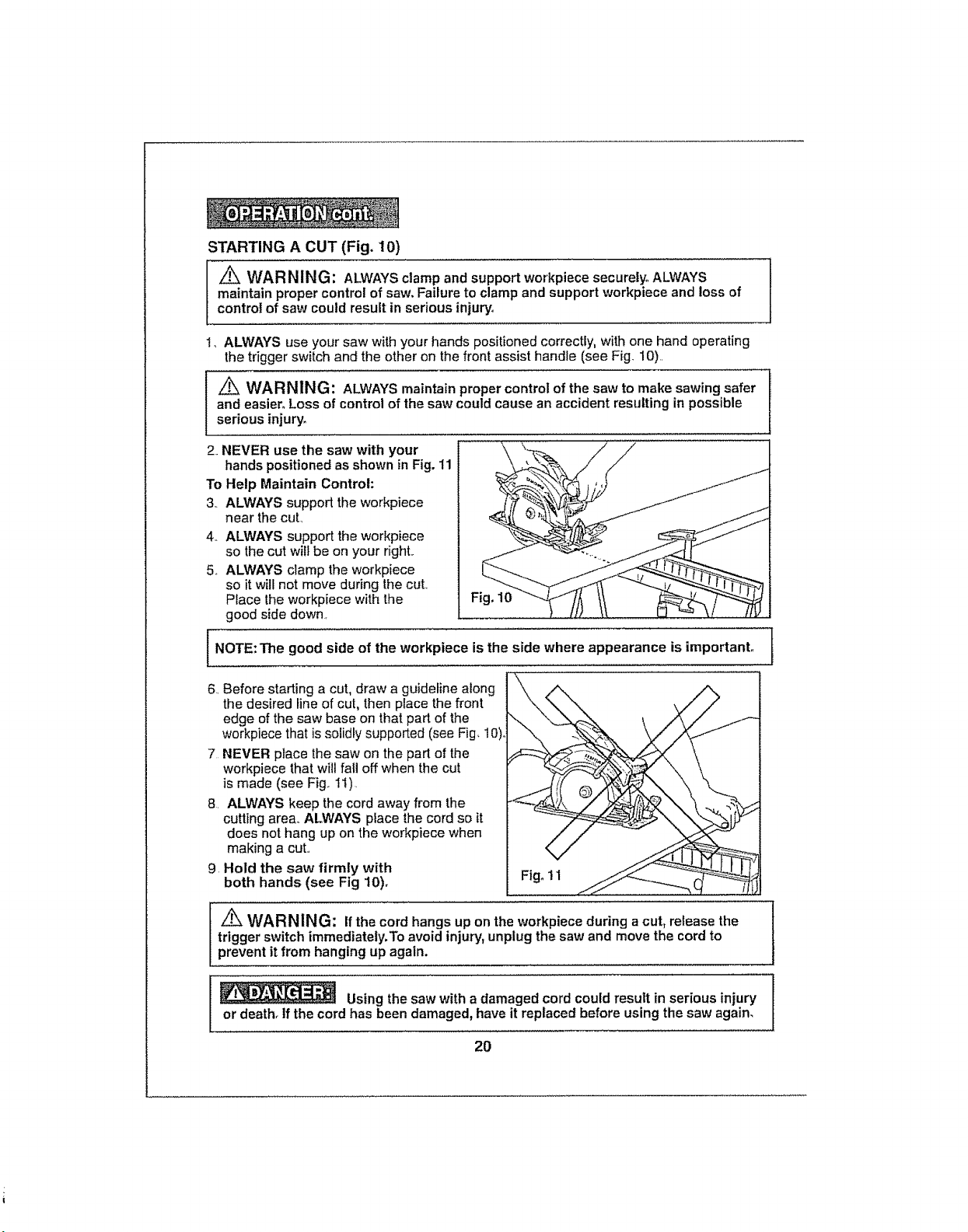
STARTING A CUT (Fig. 10)
Z_ WARNING: ALWAYS clamp and support workpiece securely° ALWAYS
maintain proper control of saw, Failure to clamp and support workpiece and loss of
control of saw could result in serious injury°
1, ALWAYS use your saw with your hands positioned correctly, with one hand operating
the trigger switch and the other on the front assist handle (see Fig. 10),
Z_ WARNING: ALWAYS maintain proper control of the saw to make sawing safer
and easier_ Loss of control of the saw could cause an accident resulting in possible
serious injury_
2 NEVER use the saw with your
hands positioned as shown in Fig. 11
To Help Maintain Control:
3. ALWAYS support the workpiece
near the cuL
4. ALWAYS support the workpiece
so the cut wilt be on your right,
5, ALWAYS clamp the workpiece
so it will not move during the cuL
Place the workpiece with the Fi
good side down,
I NOTE:The side of the is the side where is
good workpiece appearance
important.
6, Before starting a cut, draw a guideline along
the desired line of cut, then place the front
edge of the saw base on that part of the
workpiece that is solidly supported (see Fig, 10)_
7 NEVER place the saw on the part of the
workpiece that will fall off when the cut
is made (see Fig_II)
8, ALWAYS keep the cord away from the
cutting area,, ALWAYS place the cord so it
does not hang up on the workpiece when
making a cuL
9 Hold the saw firmly with
both hands (see Fig 10),
Fig. 11
Z_ WARNING: tf the cord hangs up on the workpiece during a cut, release the
trigger switch immediately.To avoid injury, unplug the saw and move the cord to
prevent it from hanging up again.
Using the saw with a damaged cord could result in serious injury I
or death_ if the cord has been damaged, have it replaced before using the saw again.
I
2O
TO HELP MAINTAIN CONTROL cont.:
10. Squeeze the trigger switch to start the saw. ALWAYS let the blade reach full speed
before you begin the cut into the workpiece.
11 When making a cut, ALWAYS use steady, even pressure. Forcing the saw causes
rough cuts and could shorten the life of the saw or cause Kickback.
I2. After completing your cut, release the trigger switch and allow the blade to come to
a complete stop DO NOT remove the saw from the workpiece while the blade
ismoving.
_When sawing through a workpiece, the lower blade guard DOES
NOT cover the blade on the underside of the workpiece (see Fig. 3, page 15)=ALWAYS
keep your hands and fingers away from the cutting area, Any part of your body
coming in contact with the moving blade will result in serious injury,
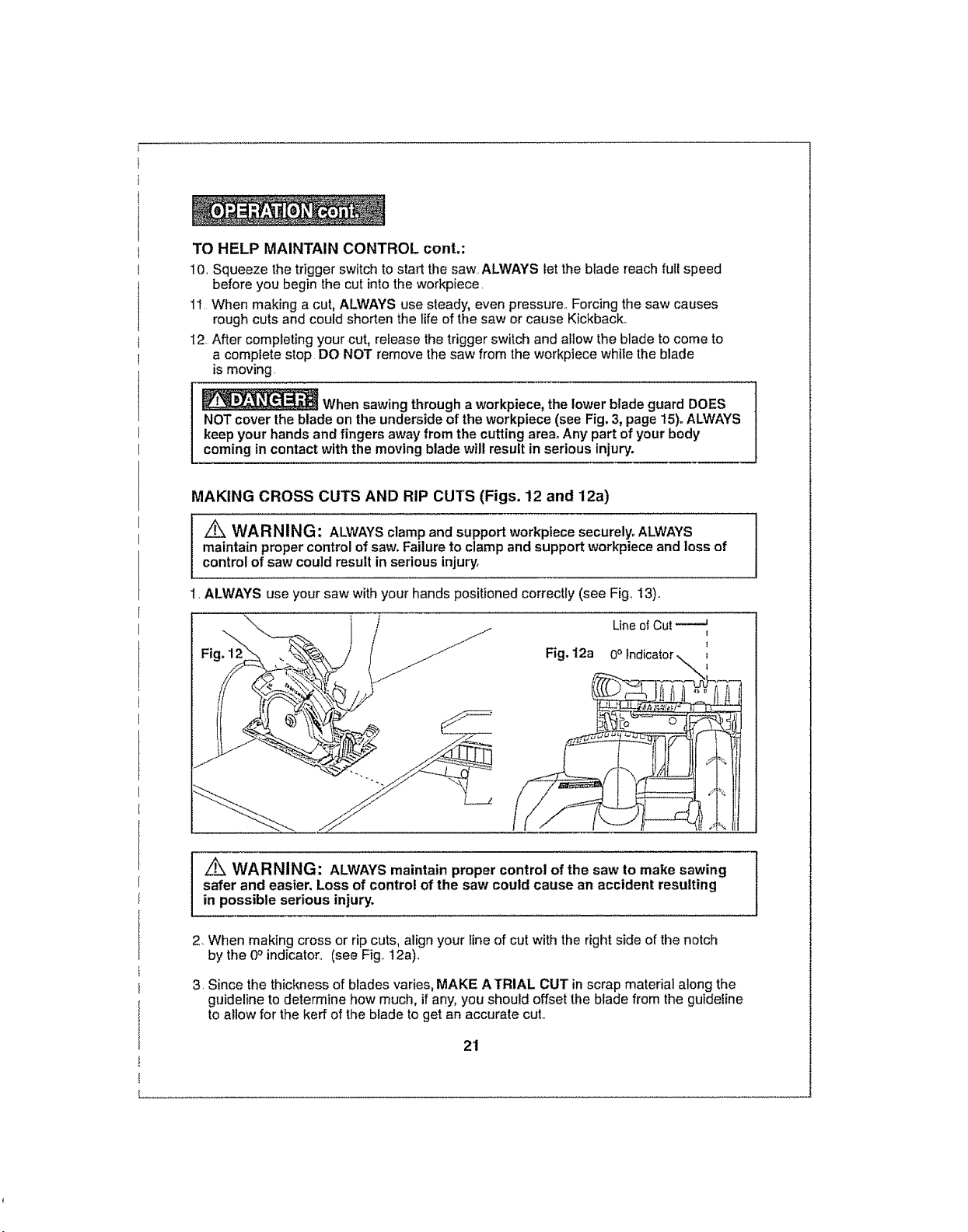
MAKING CROSS CUTS AND RIP CUTS (Figs, 12 and 12a)
Z_ WARNING: ALWAYS clamp and support workpiece securely, ALWAYS
maintain proper control of saw, Failure to clamp and support workpiece and loss of
control of saw could result in serious injury,
I. ALWAYS use your saw with your hands positioned correctly (see Fig,.13)..
Line o! Cut
Fig. 12a 0° fndicator_
Z_ WARNING: ALWAYS maintain proper control of the saw to make sawing
safer and easier, Loss of control of the saw could cause an accident resulting
in possible serious injury.
2 When making cross or rip cuts, align your line of cut with the right side of the notch
by the 0° indicator.. (see Fig. t 2a)..
3. Since the thickness of blades varies, MAKE ATRIAL CUT in scrap material along the
guideline to determine how much, if any, you should offset the blade from the guideline
to allow for the kerr of the blade to get an accurate cut..
21
INTEGRATED CROSSCUT RULER
Marked on the base across the front (see Fig, 12a) is a handy ruler for measuring
repetitive cuts., It is marked 1-inch to the right of 0_and 5-inches to the left of 0°,
MAKING RIP CUTS
ALWAYS use a guide when making long or wide rip cuts with your saw You can use
either a straight edge or use the edge guide that was included with your saw
USING A STRAIGHT EDGE (Fig, 13)
Z_ WARNING: ALWAYS clamp and support workpiece securely° ALWAYS ]
maintain proper control of saw. Failure to clamp and support workpiece combined
1
with loss of control of saw could result in serious injury.
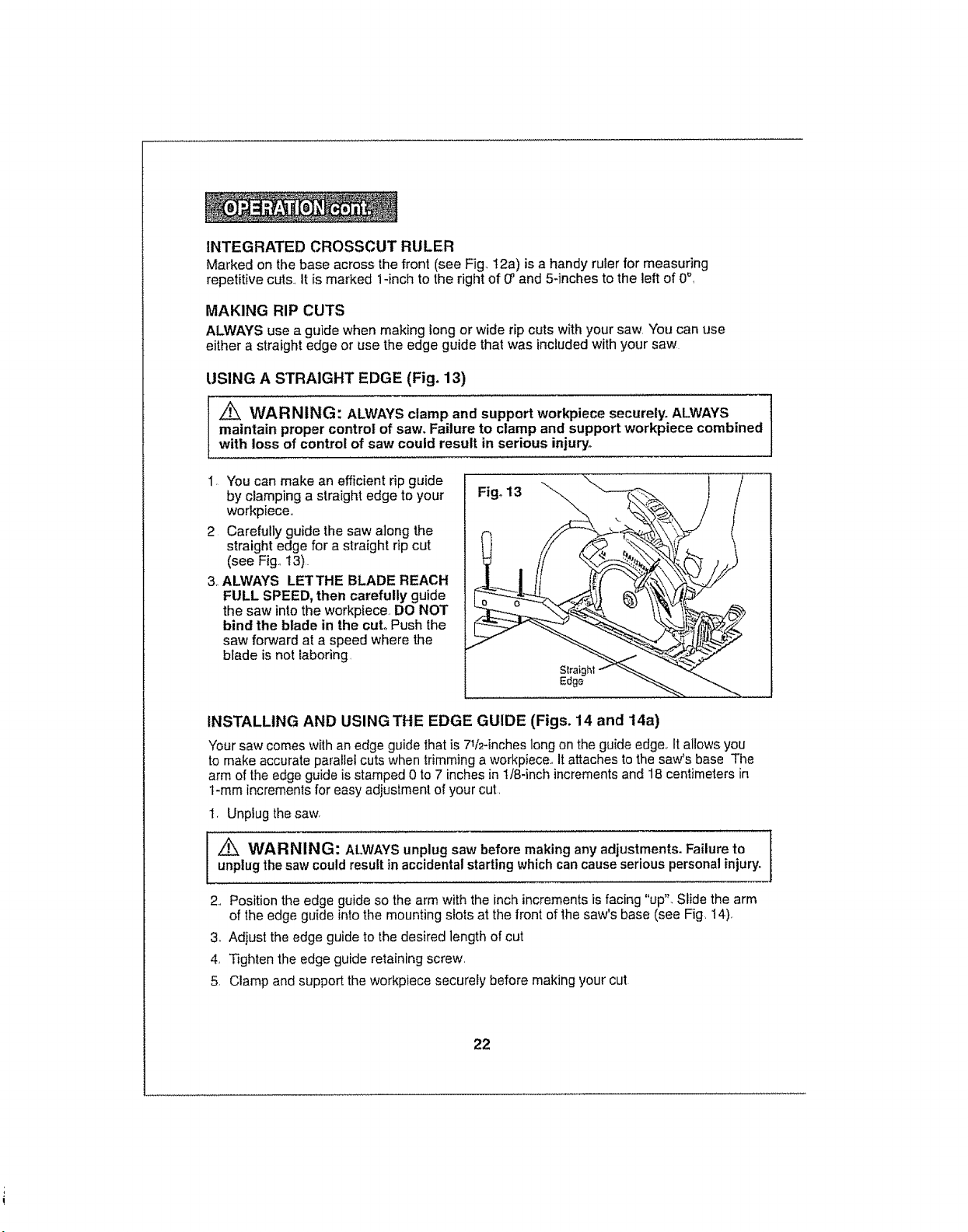
I• You can make an efficient rip guide
by clamping a straight edge to your
workpiece,,
2 Carefully guide the saw along the
straight edge for a straight rip cut
(see Fig.,13).
3,,ALWAYS LETTHE BLADE REACH
FULL SPEED, then carefully guide
the saw intothe workpiece, DO NOT
bind the blade in the cut° Push the
saw forward at a speed where the
blade is not laboring,
Fig° 13
Slraight
Edge
INSTALLING AND USING THE EDGE GUIDE (Figs, 14 and 14a)
Your saw comes with an edge guide that is 71/2-incheslong on the guide edge, It allows you
to make accurate parallel cuts when trimming a workpiece,, It attaches tothe saw's base The
arm of the edge guide is stamped 0 to 7 inches in 118-inchincrements and 18 centimeters in
t-mm increments for easy adjustment of your cut,
I, Unplug the saw,
Z_ WARNING: ALWAYS unplug saw before making any adjustments, Failure to I
unplug the saw could result in accidental starting which can cause serious personal injury.
1
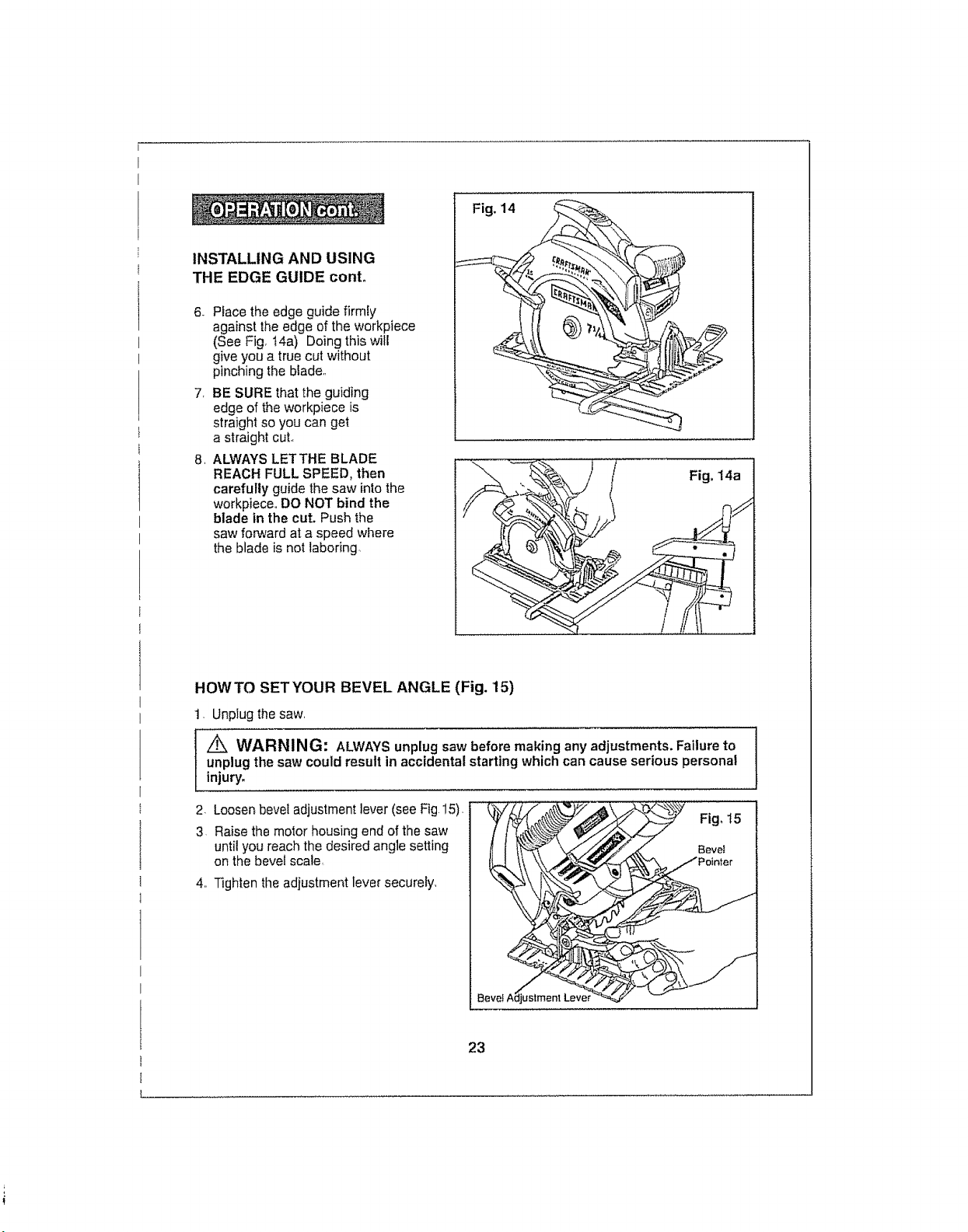
2,, Position the edge guide so the arm with the inch increments is facing "up", Slide the arm
of the edge guide into the mounting slots at the front of the saw's base (see Fig, 14),
3,_Adjust the edge guide to the desired length of cut
4, Tighten the edge guide retaining screw,
5, Clamp and support the workpiece securely before making your cut
22
INSTALLINGAND USING
THE EDGE GUIDE conto
6 Ptace the edge guide firmly
against the edge of the workpiece
(See Fig, t4a) Doing this will
give you a true cut without
pinching the blade.,
7, BE SURE that the guiding
edge of the workpiece is
straight so you can get
a straight cut.,
8, ALWAYS LETTHE BLADE
REACH FULL SPEED, then
carefully guide the saw into the
workpiece,, DO NOT bind the
blade in the cut. Push the
saw forward at a speed where
the blade is not laboring.
Fig, 14
Fig, 14a
HOWTO SETYOUR BEVEL ANGLE (Fig. 15)
. Unplug the saw,
Z_ WARNING: ALWAYS unplug saw before making any adjustments. Failure to
unplug the saw could result in accidental starting which can cause serious personal
inju_,
2. Loosen bevel adjustment lever (see Fig 15),
3 Raise the motor housing end of the saw
until you reach the desired angle setting
on the bevel scale.
4. Tighten the adjustment lever securely,
Fig, 15
Bevel
23
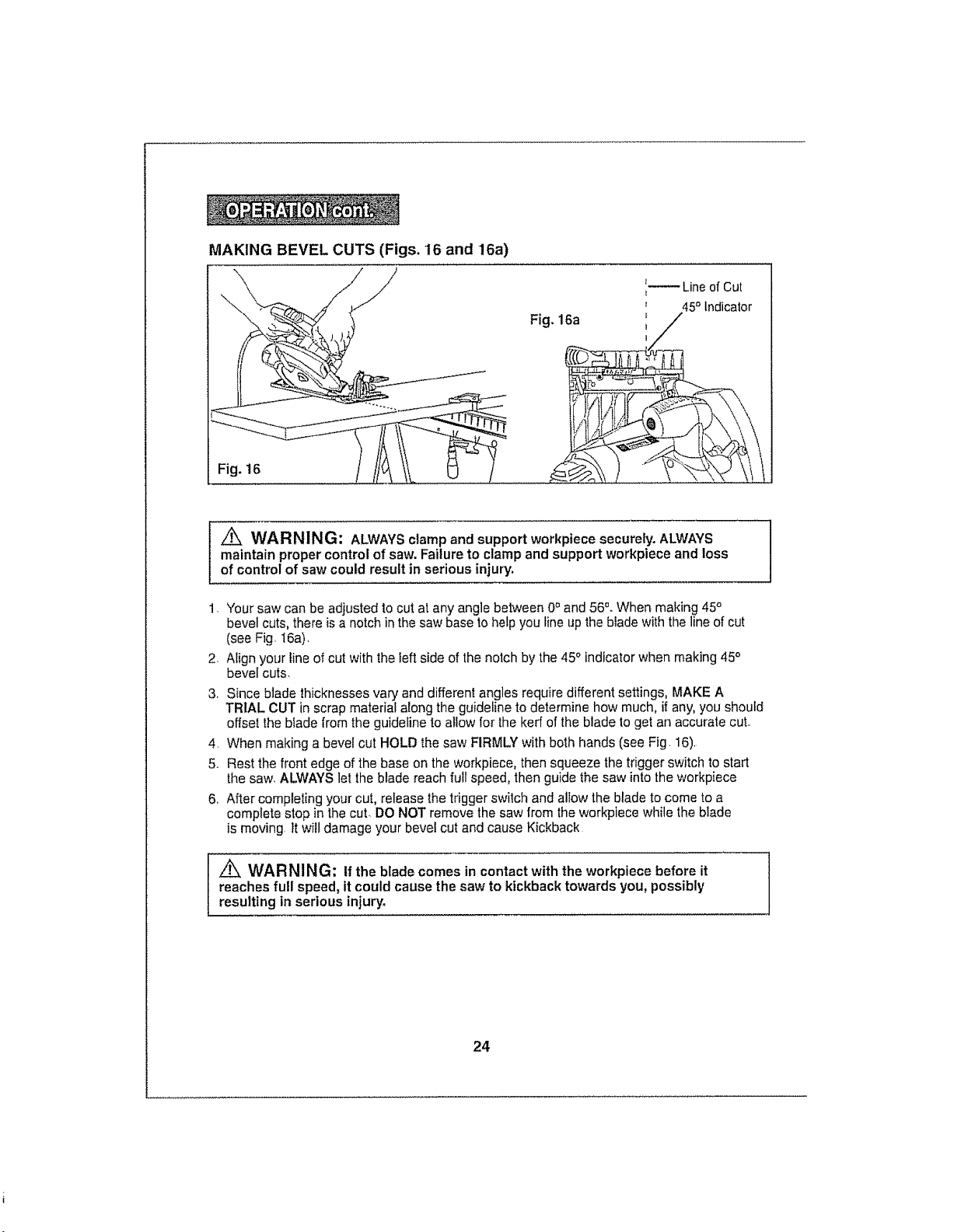
MAKING BEVEL CUTS (Figs. 16 and 16a)
Fig. 16a
_Line of Cut
45° Indicator
Fig. 16
/_ WARNING: ALWAYS clamp and support workpiece securely. ALWAYS
maintain proper control of saw. Failure to clamp and support workpiece and loss
of control of saw could result in serious injury°
2.
3,
4,
5,,
6,.
"four saw can be adjusted to cut at any angle between 0_ and 56_.When making 45°
bevel cuts, there is a notch in the saw base to help you line up the blade with the line of cut
(see Fig, t6a),
Align your line of cut with the feft side of the notch by the 45oindicator when making 45°
bevel cuts,
Since blade thicknessesvary and different angles require different settings, MAKE A
TRIAL CUT in scrap material along the guideline to determine how much, if any, you should
offset the blade from the guideline to alIow for the kerr of the blade to get an accurate cut
When making a bevel cut HOLD the saw FIRMLY with both hands (see Fig 16)
Rest the front edge of the base on the workpiece, then squeeze the trigger switch to start
the saw. ALWAYS let the blade reach full speed, then guide the saw into the workpiece
After completing your cut, release thetrigger switch and allow the blade to come to a
complete stop in the cuL DO NOT remove the saw from the workpiece while the blade
is moving It will damage your bevel cut and cause Kickback
Z_ WARNING: If the blade comes in contact with the workpiece before it
reaches full speed, it could cause the saw to kickback towards you, possibly
resulting in serious injury.
24
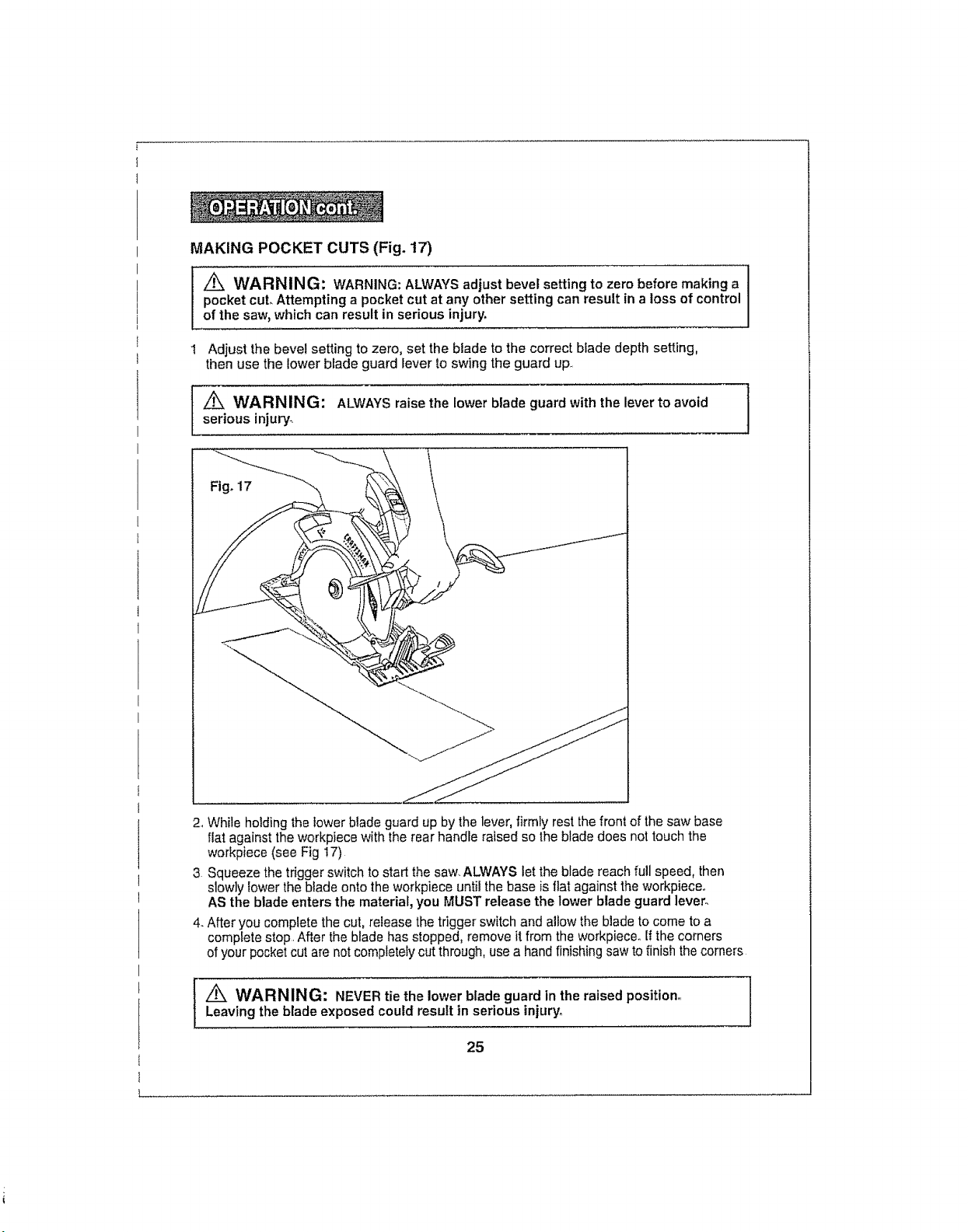
MAKING POCKET CUTS (Fig. 17)
,_ WARNING: WARNING: ALWAYS adjust bevel setting to zero before making a
pocket cut, Attempting a pocket cut at any other setting can result in a loss of control
of the saw, which can result in serious injury,
! Adjust the bevel setting to zero, set the blade to the correct blade depth setting,
then use the lower blade guard lever to swing the guard up..
3
Z_ WARNING: ALWAYS raise the lower blade guard with the lever to avoid /
serious injury-.
J
Fig. 17
2, While holding the lower blade guard up by the lever, firmly rest the front of the saw base
flat against the workpiece with the rear handle raised so the blade does not touch the
workpiece (see Fig t7)
3 Squeeze the trigger switch to start the saw. ALWAYS let the blade reach full speed, then
slowly lower the blade onto the workpiece until the base is flat against the workpieceo
AS the blade enters the material, you MUST release the lower blade guard lever.
4. After you complete the cut, release the trigger switch and allow the blade to come to a
complete stop. After the blade has stopped, remove it from the workpiece_ If the corners
of your pocket cut are not completely cut through, use a hand finishing saw to finish the corners
f }'k WARNING: NEVER tie the lower blade guard in the raised position,,
Leaving the blade exposed could result in serious injury,
I
25
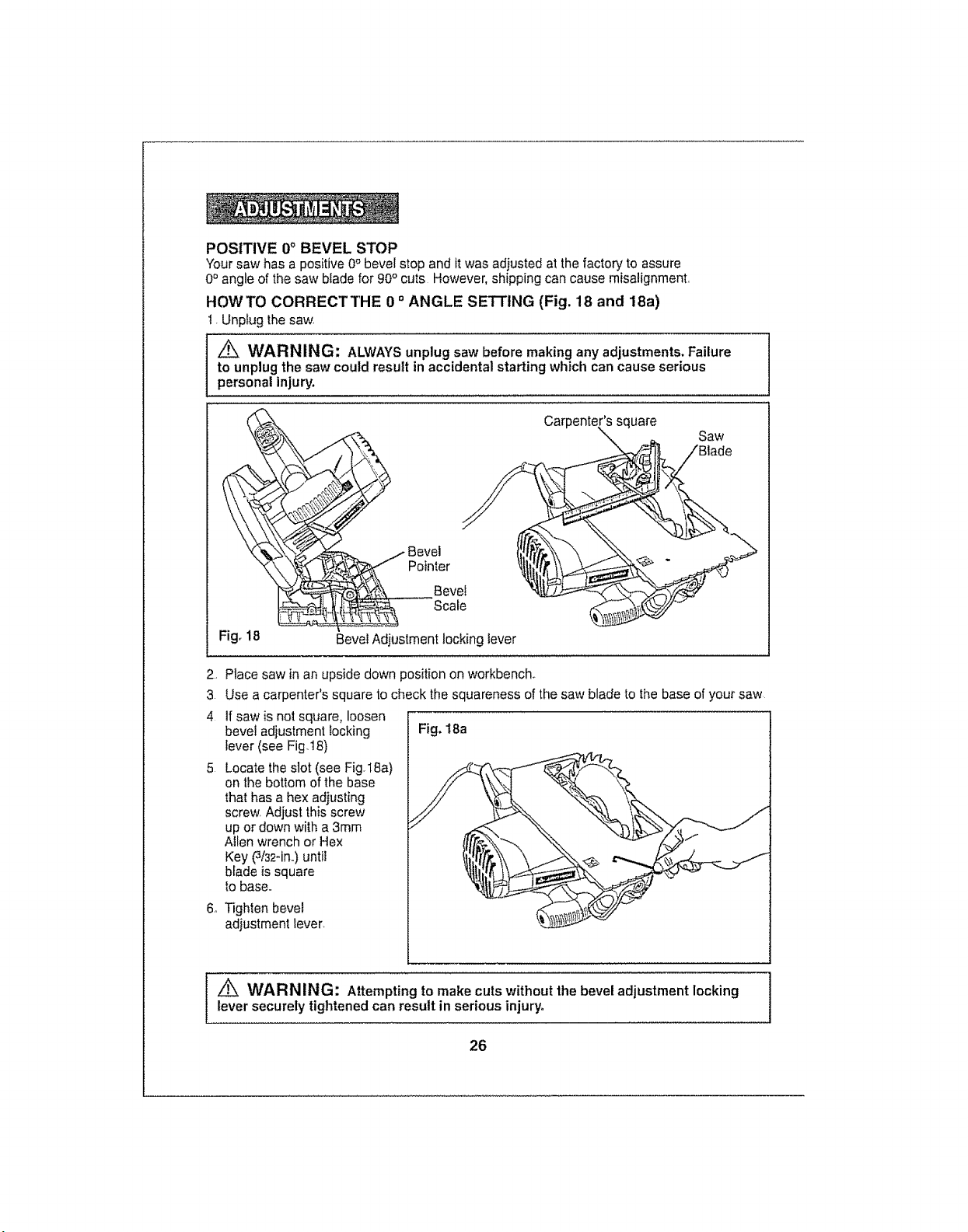
POSITIVE i)_'BEVEL STOP
'four saw has a positive 0° bevel stop and it was adjusted at the factory to assure
0° angle of the saw blade for 90° cuts However, shipping can cause rnisalignment,
HOWTO CORRECTTHE 0 ° ANGLE SETTING (Fig. 18 and 18a)
. Unplug the saw,
z_ WARNING: ALWAYS unplug saw before making any adjustments. Failure
to unplug the saw could result in accidental starting which can cause serious
personal injury.
Fig, 18
_,_. //Bevel
_,._ Pointer
Bevel
Bevel Adjustment locking lever
Carpente_,_square Saw
2. Place saw in an upside down position on workbench..
3 Use a carpenter's square to check the squareness of the saw blade to the base of your saw
4 If saw is not square, loosen
bevel adjustment locking Fig. 18a
lever (see Fig.tS}
5 Locate the slot (see Fig.18a}
on the bottom of the base
that has a hex adjusting
screw. Adjust this screw
up or down with a 3mm
Allen wrench or Hex
Key (3/32_in.,)until
blade is square
to base.,
6o Tighten bevel
adjustment lever,
if'k WARNING: Attempting to make cuts without the bevel adjustment lockinglever securely tightened can result in serious injury,
26
WARNING: To ensure safety and reliability, all repairs - with the exception
of the externally accessible brushes _should be performed by a qualified service
technician at a Sears Service Center,
z_ WARNING: For your safety, ALWAYS turn off switch and unplug circular ]
saw from the power source before performing any maintenance or cleaning.
l
It has been found that electric tools are subject to accelerated wear and possible
premature faiiure when they are used to work on fiber glass boats and sports cars,
wallboard, spackling compounds or plaster. The chips and grindings from these
materials are highly abrasive to electrical toot parts, such as bearings, brushes,
commutators, etc. Consequently, it is not recommended that this tool be used for
extended work on any fiberglass material, wallboard, spackling compound or
plaster..During any use on these materials, it is extremely important that the
toot is cleaned frequently by blowing with an air jet..
I i_ WARNING: Always wear safety goggles or safety glasses with side shields
during power tool operations, or when blowing dust. If operation is dusty, also wear
a dust mask,
ROUTINE MAINTENANCE
j _ WARNING: DO NOT at any time let brake fluids, gasoline, petroleum-based
products, penetrating oils, etc. come in contact with plastic parts. Chemicals can
damage, weaken or destroy plastic, which may result in serious personal injury.
Periodic maintenance allows for long life and trouble-free operation. A cleaning,
lubrication and maintenance schedule should be maintained. As a common
preventive maintenance practice, follow these recommended steps:
t. When work has been completed, clean the tool to allow smooth functioning
of the toot over time.
2. Use clean damp cloths to wipe the tool_
3 Check the state of all electrical cables..
4. Keep the motor air openings free from oil, grease and sawdust or woodchips,
and store tool in a dry place..
5. Be certain that all moving parts that are exposed are well lubricated, particularly
after lengthy exposure to damp and/or dirty conditions.
27
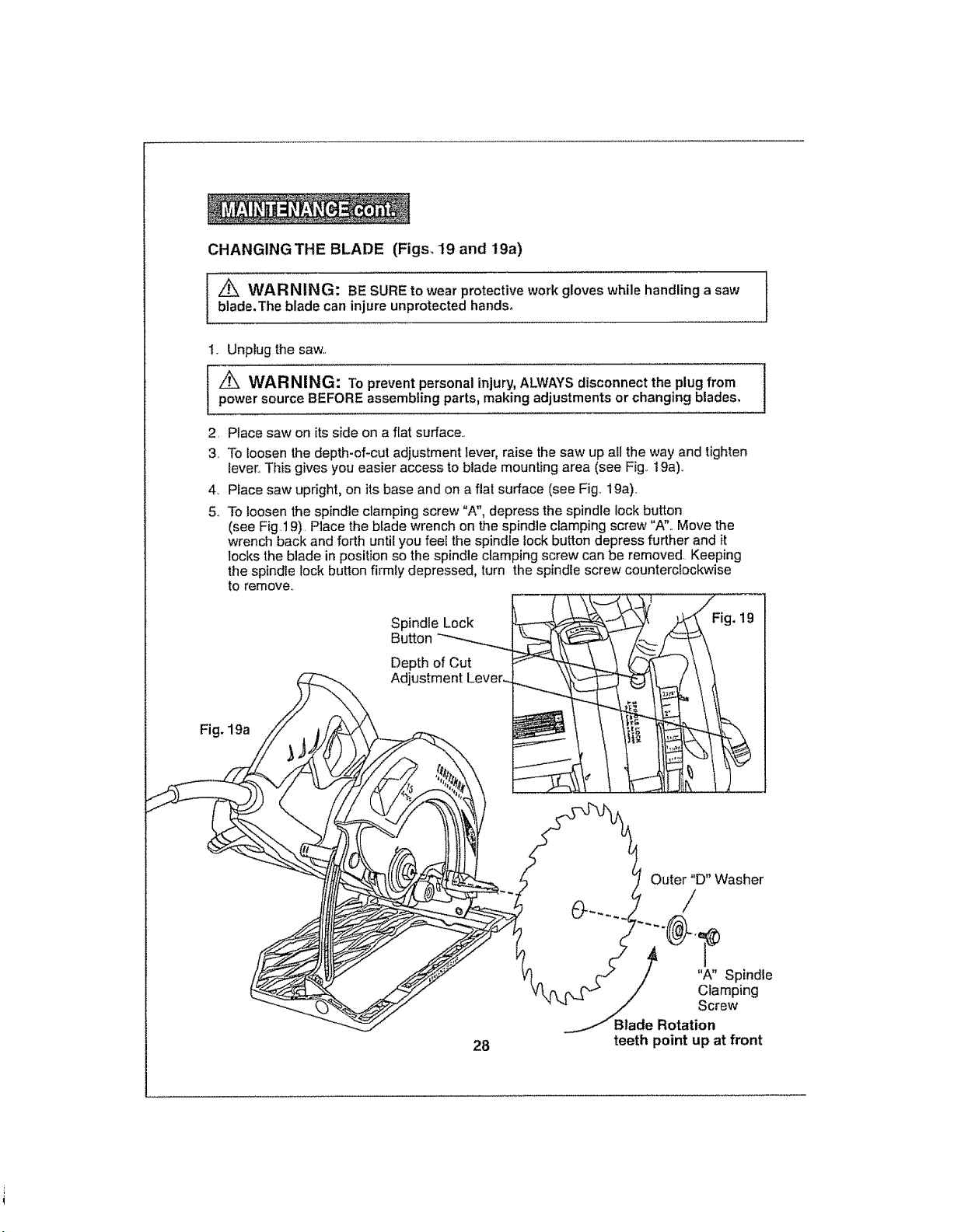
CHANGING THE BLADE (Figs. 19 and 19a)
z_ WARNING: BE SURE to wear protective work gloves while handling a saw
blade.The blade can injure unprotected hands,
1. Unplug the saw_.
/_ WARNING: To prevent personal injury, ALWAYS disconnect the plug from l
power source BEFORE assembling parts, making adjustments or changing blades.
I
2,
3.
4,,
5.,
Fig. 19a
Place saw on its side on a fiat surface..
To loosen the depth-of-cut adjustment lever, raise the saw up all the way and tighten
teven This gives you easier access to blade mounting area (see Fig,. 19a),.
Place saw upright, on its base and on a flat surface (see Fig. 19a)..
To loosen the spindle clamping screw "A", depress the spindle lock button
(see Fig.l 9). Place the blade wrench on the spindle clamping screw "A"..Move the
wrench back and forth until you feel the spindle lock button depress further and it
locks the blade in position so the spindle clamping screw can be removed. Keeping
the spindle lock button firmly depressed, turn the spindle screw counterclockwise
to remove..
Spindle Lock ig. 19
Button_"_......
Depth ofCut
Adjustment Lever.
Outer "D" Washer
/
28
"A" Spindle
Clamping
Screw
ide Rotation
teeth point up at front
CHANGING THE BLADE cont. (Figs. 19 and 19a)
6.. Raise lower blade guard using the blade guard lever and hold it in the raised
position for the next steps_.
7. Completely remove the spindle clamping screw "A" and the outer "D" washer
and the blade (see Fig..19a)..
8..The remaining washer is the inner bushing washer that fits around the spindle
shaft and it does not need to be removed._
9. Put a drop of oil onto the inner bushing washer and outer "D" washer where
they will touch the blade..
10 Place the new saw blade inside the lower blade guard, onto the spindle shaft
and against the inner bushing.
I
NOTE:The teeth of the blade should point upward at the front of the saw as 1
shown in (Fig. 19a).
I
1t ..Replace the "D" washer
I2. Firmly hold down spindle lock button as you replace the spindle screw and hand
tighten it in a clockwise direction.. Then use blade wrench to tighten the spindle
clamping screw thoroughly.,
13. Place blade wrench back in case..
NOTE: NEVER use a blade that is too thick to allow the "D" washer to engage
with the flat side of the spindle,,
1
LUBRICATION
All of the bearings in this tool are lubricated with a sufficient amount of high-grade
lubricant for the life of the tool under normal operating conditions. Therefore,
no further lubrication is required.
29
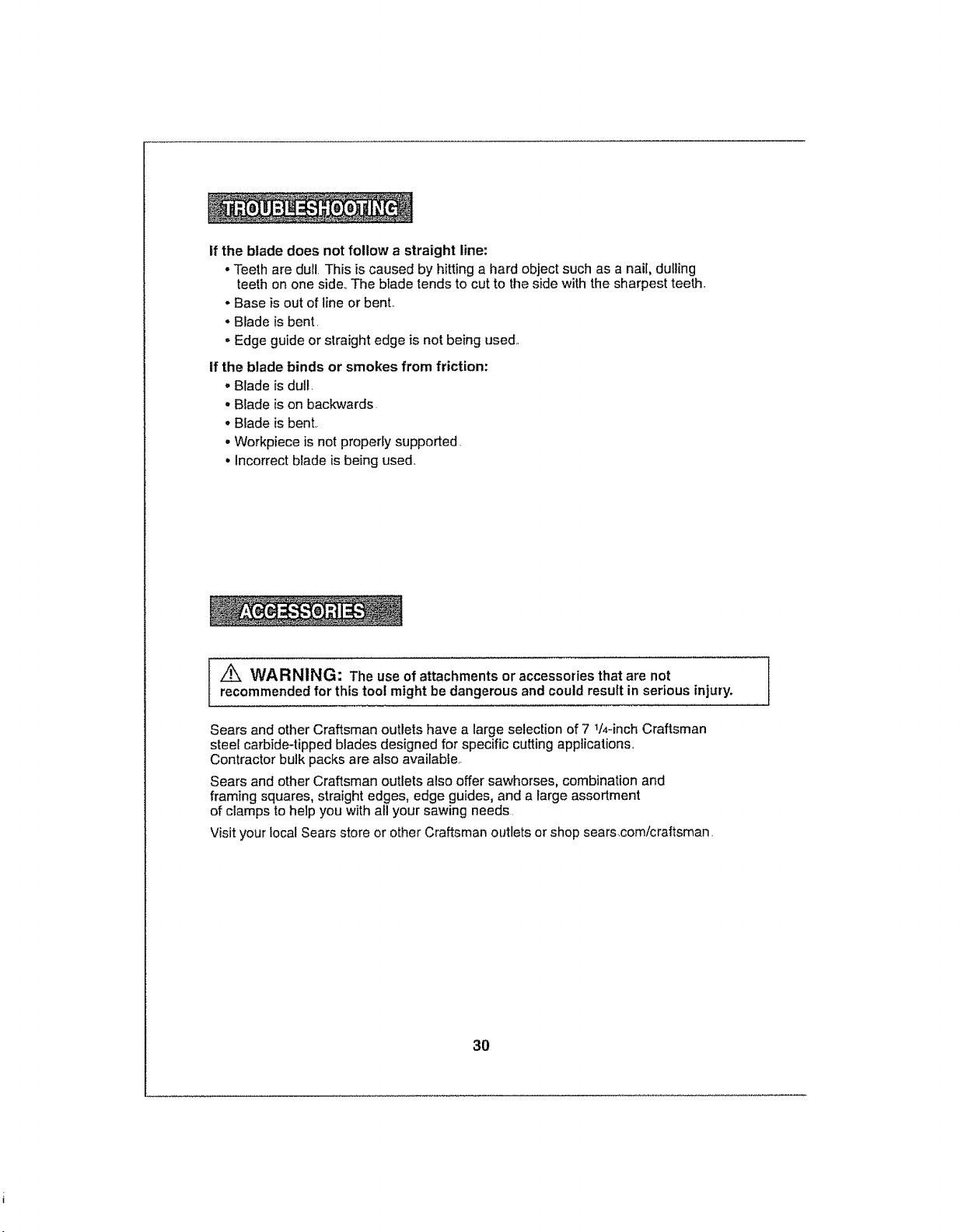
tf the blade does not follow a straight line:
• Teeth are dull. This is caused by hitting a hard object such as a nail, dulling
teeth on one side.. The blade tends to cut to the side with the sharpest teeth..
• Base is out of line or bent.
• Blade is bent.
=Edge guide or straight edge is not being used..
if the blade binds or smokes from friction:
• Blade is dull.
- Blade is on baclmJards.
, Blade is bent..
- Workpiece is not properly supported.
° Incorrect blade is being used..
" Z_ WARNING: The use of attachments or accessories that are notrecommended for this tool might be dangerous and could result in serious injury.
Sears and other Craftsman outlets have a large selection of 7 1/4-inchCraftsman
steel carbide-tipped blades designed for specific cutting applications.
Contractor butk packs are also available.
Sears and other Craftsman outlets also offer sawhorses, combination and
framing squares, straight edges, edge guides, and a large assortment
of clamps to help you with all your sawing needs.
Visit your local Sears store or other Craftsman outlets or shop sears.corn/craftsman.
3O
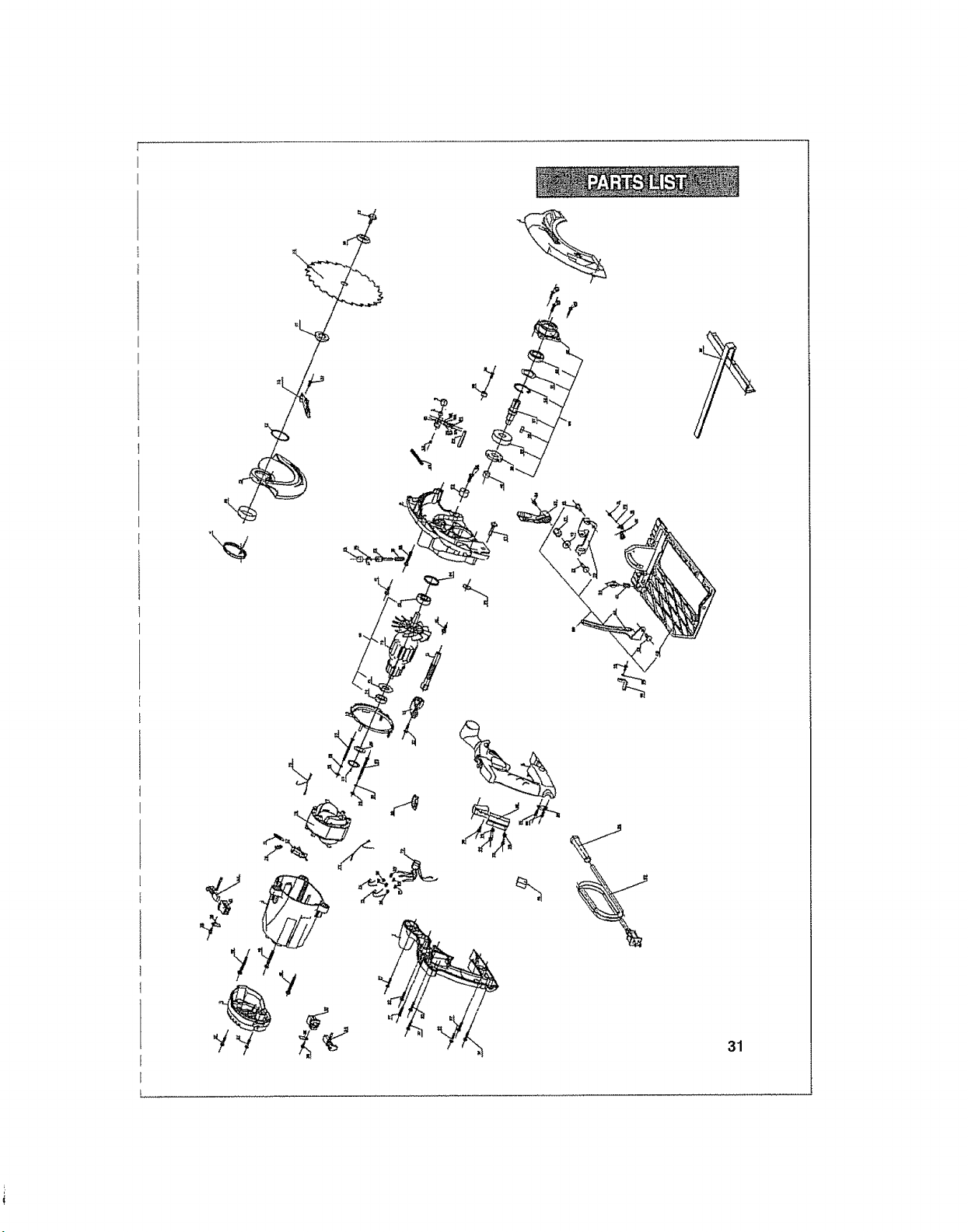
i
%
31
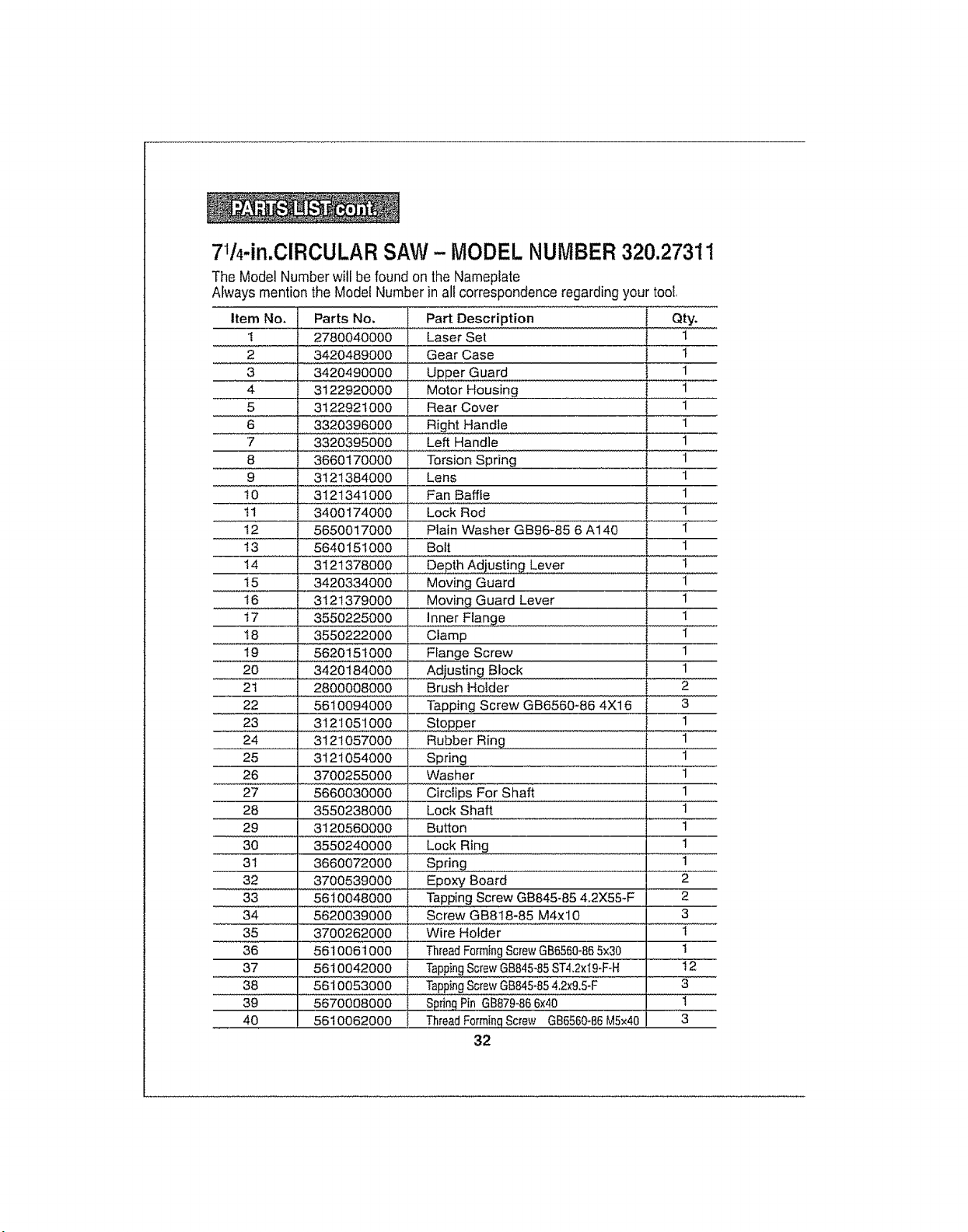
71/4-in.CIRCULARSAW- MODEL NUMBER320.27311
The ModelNumberwill be found on the Nameplate
Always mentionthe ModelNumber inair correspondenceregarding your tool,
Item No. Parts Nor .... Part Description QtY-
1 2780040000 Laser Set 1
2 3420489000 Gear Case 1
3 3420490000 : Upper Guard .................................. !..............
4 3122920000 Motor Housing 1
5 3122921000 Rear Cover 1
6 ......... 3320396000 .........Right Handl e....... 1 _-
7
8
9
!0
tl
................t2
t3
14
I5
t6
3320395000
3660170000
3121384000
3121341000
3400174000
5650017000
5640151000
Left Handle 1
Torsion Spring 1
1
Lens
Fan Baffle 1
Lock Rod 1
PiainWasher GB96-85 6 A140 .......... I '
Boil 1
3121378000 Depth Ad}us!ing L,eve[ 1
3420334000 Moving Guard 1
3121379000 Moving Guard Lever 1
17 3550225000 Inner Flange ............ !........
t 8 3550222000 Clamp 1
19 562015 t000 Flange Screw 1
20 3420184000 .... AdjustingBbck ......................... !.............
21 2800008000 Brush Holder 2
22 5610094000 Tapping Screw GB6560-86 4X16 3
23 ......... 3121051000 .... Sto#pe r ................................................ ]........
24 3121057000 Rubber Ring !
25 3121054000 Spring 1
26 3700255000 Washer 1
27 5660030000 circ!ips Fo[, Shaft ....................... ! .......
28 3550238000 Lock Shaft 1
29 3120560000 Button 1
30 3550240000 Lock Ring 1
31 3660072000 Spring 1
32 3700539000 Epoxy Board 2
33 56t0048000 Tapping Screw GB845-85 4.2X55-F 2
34 5620039000 Screw GB818-85 U4xl0 3
35 3700262000 Wire Holder 1
36 5610061000 Thread FormingScrew GB6560-865x30 1
37 5610042000 Tapping ScrewGB845-85ST42×I 9-F-H 12
38 5610053000 Tapping ScrewGB845-854.2xg.5-F 3
39 5670008000 Spring Pin GB879-86 6x40 1
40 56t0062000 Thread FormingScrew GB6560-86MSx40 3
32
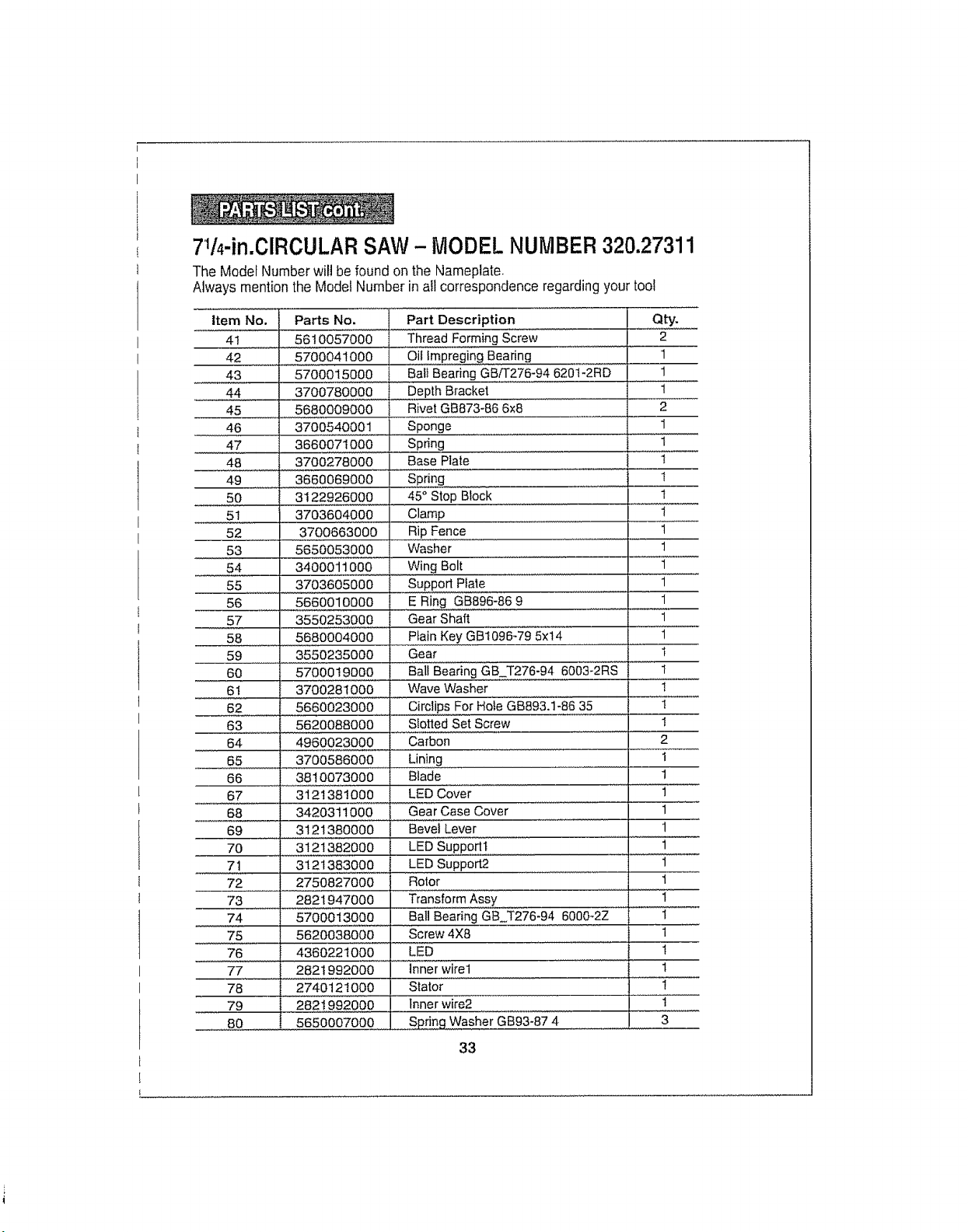
71/4-in.CIRCULARSAW- MODEL NUMBER 320.27311
The Model Numberwill be foundon the Nameplater
Alwaysmentionthe ModelNumberin atlcorrespondence regardingyour toot
Item No. PaNs No.
4t 5610057000
42 5700041000
43
44
45
46
47
48
Part Description ....... !
Thread Forming Screw
Oil fmpreging Bearing ..............................I'
5700015000 Bail' Bearing GB_276-94 62()'!:2RD I
3700780000 , Depth Bracket
5680009000 Rivet GB873-86 6×8...........................
3700540001 Sponge
3660071000 Spring
3700278000 Base Plate
49 3660069000 Spring
50 3122926000 45° Stop Block
5I 3703604Q0 q................Clamp
52 .............. 3,500663000 Ri,E.Fence
53 5650053000 Washer
54 3400011000 ...... Wing Bolt
55 3703605000
56 5660010000
57 3550253000
58 5680004000
59 3550235000
60 5700019000
61 3700281000
QtY- ...........
2
1
1
1
2
1
1
1
1
1
1
1 ......
1
Support Piate
E Ring GB896-86 9
Gear Shaft
....P,!a.!.nKey GBI096-79 5xi4
1
1
1
1
1
Gear I
B'all'Bearing"_B T2.76-94 6003:2P, S ' 1
Wave Washer t
62
63 5620088000
64
65
66
67
68
69
Slotted Set Screw
4960023000 Carbon
3700586000 ..... Lining ........
3810073000 Blade
3121381000 LED Cover
342031t 000 Gear Case Cover
3121380000 Bevel Lever
5660023000 : Circ!ipsFor Hole G'B8931i"_.86 35 i ..........
t
=
2
t
1
1
1
1
70 ...............3"i'2i"382000 LED Suppo_! ............................... 1
.... 71 3121383000 ........... LED Support2 ....................... 1
72 2750827000 Rotor 1
73 .............................2'821947000 Tran.s!o.r.rnA.ssy .......... ' ........................1
74 5700013000 Ball Bearing GB T276-94 6000-2Z 1
75 5620038000 Screw 4X8 1
76 436022 t000 LED !
77 282I 992000 Inner wire1 1
78 2740121000 Stator 1
79 282t,992000 Inner wire2 . 1 ............
80 5650007000 .....Sjqdng Washer GB93-87 4 3
33
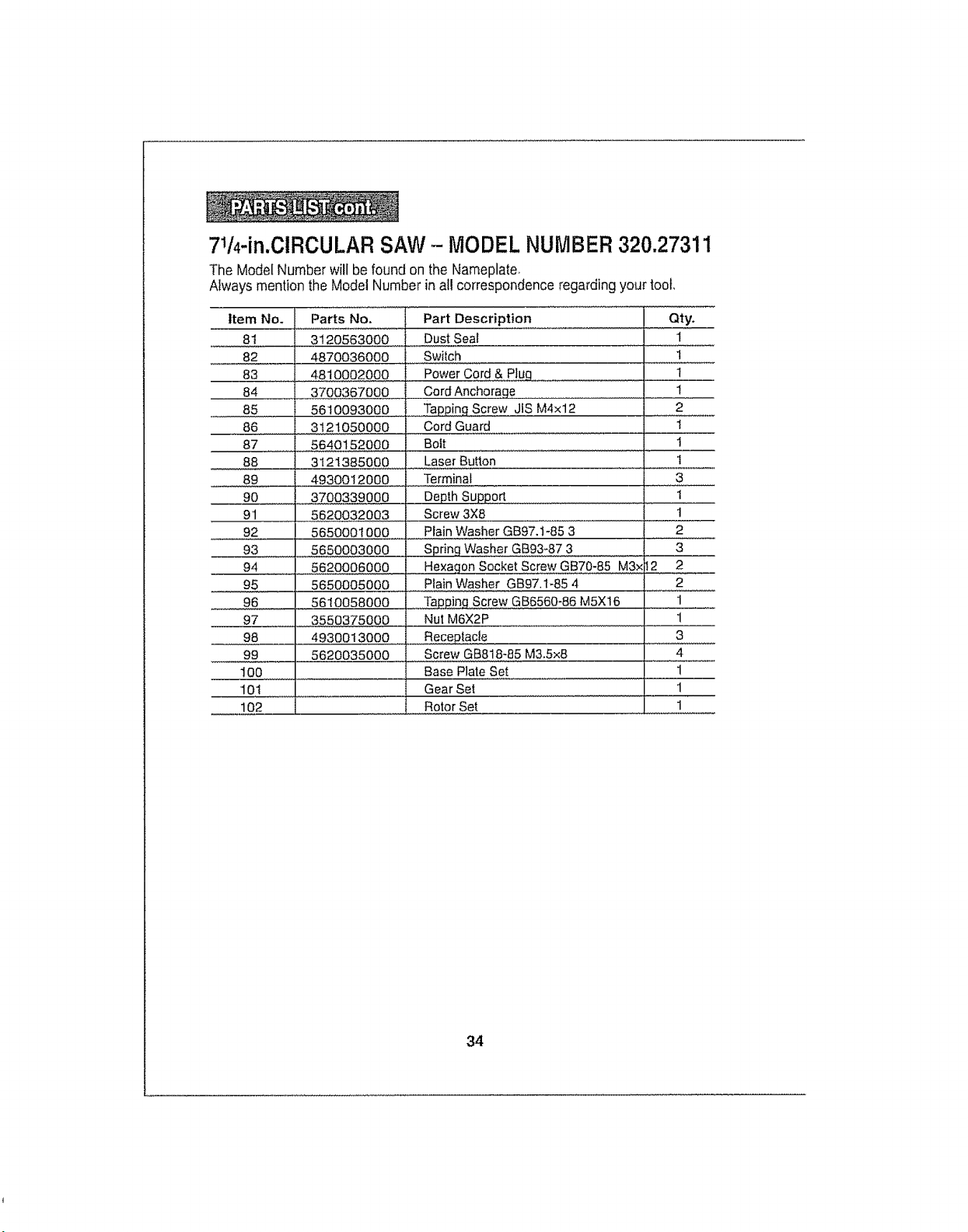
7114-in.CIRCULARSAW- MODEL NUMBER320.27311
The ModelNumberwill be foundon the Nameplate_
AIways mentionthe ModelNumber in all correspondenceregardingyourtool
Item No,
81
...........82
83
84
...... 85
Parts No, Part Description Qty.
3120563000 ..... Dust Seal ............ 1.............
4870036000 Switch 1
4810002000 Power Cord & Plug ................. 1
3700367000 Cord Anchorage 1
5610093000 ....... TaP,#!nq Screw JiS M4x12 2
86 3121050000
87
88
90
91
92
93
94
95
96
Cord Guard 1
.... 5640152000 Bolt 1
3121385000 ....................L_a,serButton .... 1.....
4930012000 .... Terminal 3
3700339000 Depth Support 1
5620032003,,, Screw 3X8 .................. !.....
56500010.00 ................P...!ainWasher GB97.1-85 3 ..... 2 ...........
5650003000 Spring Washer GB93-87 3 3
5620006000 Hexagon Socket Screw GB70-85 M3x t 2 2
5650005000 ...............P.!.a.!nWasher GB97. t-85 4 .... 2 .............
5610058000 Tapping Screw GB6560_86 M5X16 1
1
3
4
1
1
1
97 ................3,55o375o0o Nut M6X2P
.... 98 4930013000 .............F_.e_f_ptacle
99 5620035000 Screw GB818-85 M3.5x8
100 Base Plate Set
10.t ..................................... Gear Set
102 Rotor Set
34
35

Get it fixed, at your home or ours!
Your Home
For repair - in your l_ome - of all major brand appliances,
lawn and garden equipment, or heating and cooling systems,
no matter wl_o made it, no matter who sold it!
For the replacement parts, accessories and
owner's manuals that you need to do-it-yourseff.
For Sears professional installation of home appliances
and items Eikegarage door openers and water heaters
I_8004-MY*HOME:_;' A_nytime. day _" ntght
(1_800-469-4663) (U S.A and Canada)
w_,ev, sears_com \,¢,_v, sears, ca
Our Home
For repair of carry-in products ike vacuums lawn equipment,
and electronics, call or go on-line for the nearest
Sears Parts and Repair Center.
1-800-488_1222 Anytime.. day o; night (US A on_y)
\_.sears COrn
To purchase a protection agreement (USA)
or maintenance agreemen, (Canada) on a product sewiced by Sears.
t-800-827-6655 _u.sA) 14300-361-6665 (Canal)
Para _dir se_sb de reparacbn
a domicilio,y _era ordenar piezas
1-888-SU.,HOGAR"-'
(i-8&5-784-6427)
Au Canada pour seFclceen ffanqa_:
1.800.,LE.FOYER'._-
(1-&.qO,532.6937)
V,'WW Se,3r_J C;3
,_-Sea..s_'_z._ LLC
_ Registe.'ed_ Tr_dem_ik I:_" Tr_de:_,ark t r:,. _ervice Mark of $e_-s B__d'_ LLC
'q Marco RegisLtada 1_z Marc_ dR F_bdca f-_; Ma;c,'_de Servi¢:io de Seat _. Btand_. LLC
_"1Marque de _ommer_e f _'_:_Matq,ue 6.._pe_..dede Sears Brand_ LLC

