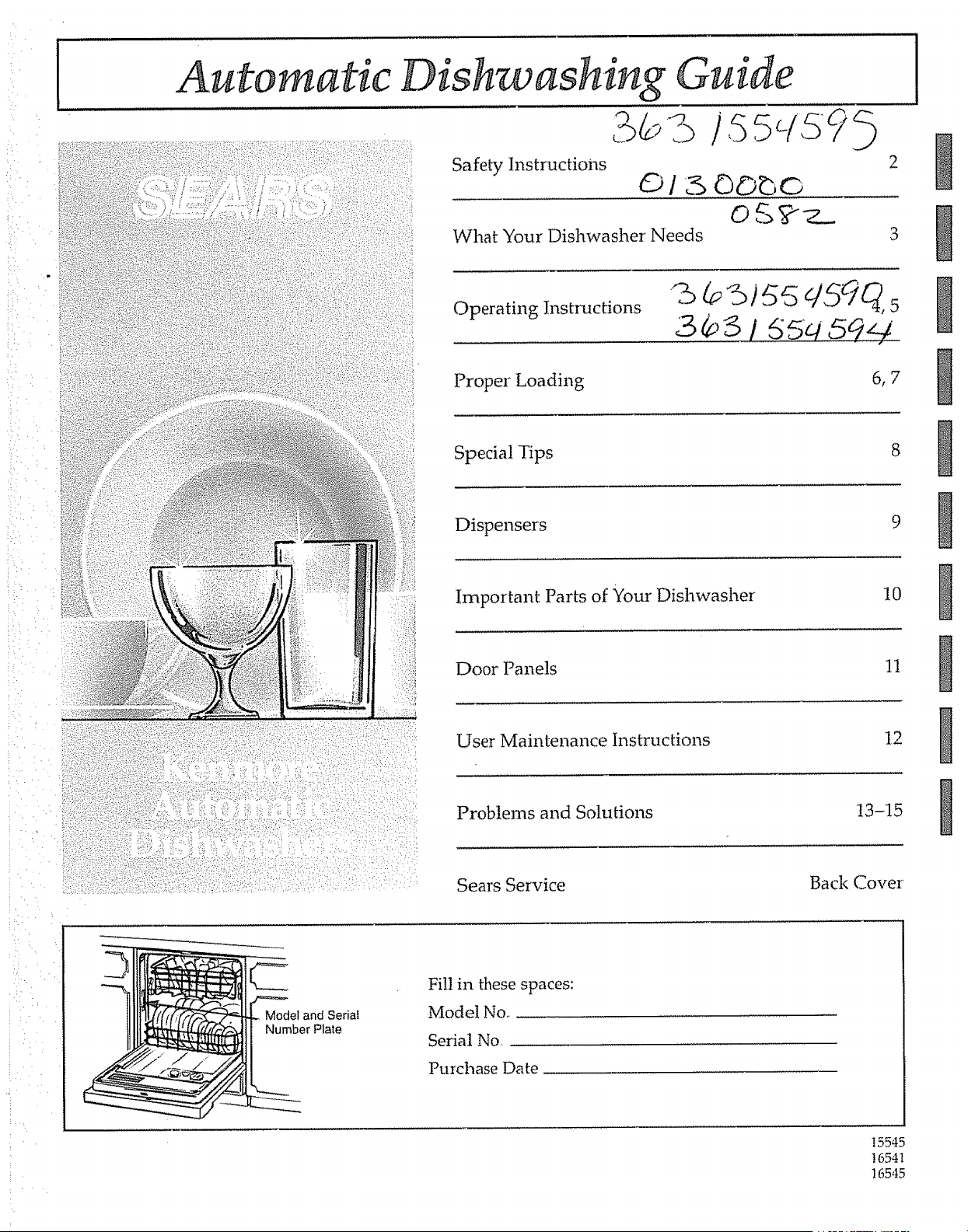
Automadc
Dishwashing
Guide
3_-, is
Safety Instructions
O/3 OC;_o
o 'S_---__.
What Your Dishwasher Needs
Operating Instructions
Proper Loading
Special Tips
Dispensers
Important Parts of Your Dishwasher
Door Panels
User Maintenance Instructions
Problems and Solutions
Sears Service
2
3
"be'_ JS_SdggQs
3_S I S"Sq,59d
6,7
8
9
10
11
12
13-15
Back Cover
Model and Serial
Number Plate
Fill in these spaces:
Model No..
Serial No.
Purchase Date
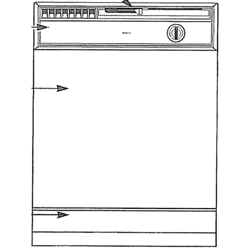
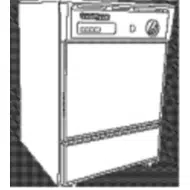
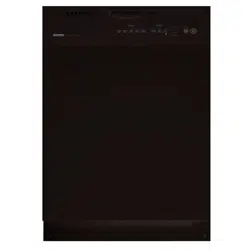
15545
16541
16545
Important Safety Instructions
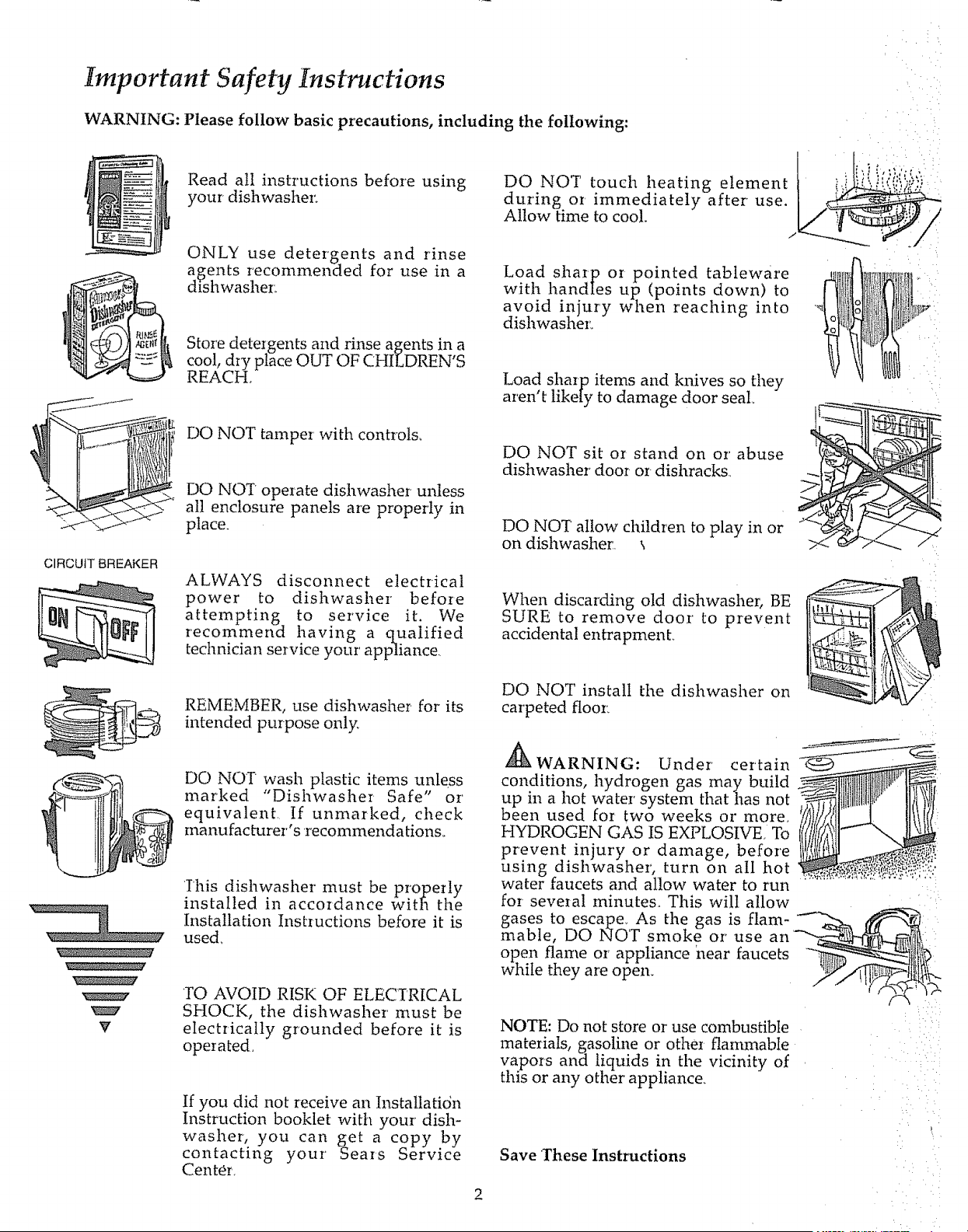
WARNING: Please follow basic precautions, including the following:
CIRCUIT BREAKER
V
Read all instructions before using
your-dishwasher:
ONLY use detergents and rinse
a_ents recommended for use in a
dishwasher_
Store deter'gents and rinse agents in a
cool, dry place OUT OF CHILDREN'S
REACH_
DO NOT tamper with controls°
DO NOT operate dishwasher unless
all enclosure panels are properly in
place_
ALWAYS disconnect electrical
power to dishwasher before
attempting to service it. We
recommend having a qualified
technician service your' appliance,
REMEMBER, use dishwasher, for its
intended purpose only
DO NOT wash plastic items unless
marked "Dishwasher Safe" Or
equivalent. If unmarked, check
manufacturer's recommendations°
This dishwasher must be properly
installed in accordance with the
Installation Instructions before it is
used,
TO AVOID RISK OF ELECTRICAL
SHOCK, the dishwasher must be
electrically grounded before it is
operated.
If you did not receive an Installati6n
Instruction booklet with your dish-
washer, you can get a copy by
contacting your Sea_s Service
Centen
DO NOT touch heating element I iiii_(iiiii_i';i i':'
during oi. immediately after' use. I
Allow time to cool.
Load sharp or pointed tableware
with handIes u15 (points down) to
avoid injury when reaching into
dishwashen
Load sharp items and knives so they
aren't likely to damage door seal.
DO NOT sit or stand on or abuse
dishwasher door or-dishrack&
DO NOT allow children to play in or
on dishwasher:,
When discarding old dishwashei; BE
SURE to remove door to prevent
accidental entrapmenL
DO NOT install the dishwasher on
carpeted floon
A
WARNING: Under' certain
conditions, hydrogen gas may build
up in a hot water system that has not
been used for two weeks or more°
HYDROGEN GAS IS EXPLOSIV-E To
p .r'event. in'urj yor damage, before
using dishwasher, turn on all hot
water faucets and allow water to run
for several minutes. This will allow •
gases to escape. As the gas is flam-_ _
mable, DO NO']? smoke or use an
open flame or appliance near faucets
while they are open.
NOTE: Do not store or use combustible
materials, gasoline or other flammable
vapor-s and liquids in the vicinity of
this or any other' appliance_
::
Save These Instructions
2
What Your Dishwasher Needs To Do Its Job
Hot Water
To get dishes clean and dry you need hot waten To help you get water of the
proper temperature, your _dishwasher automatically t_eats the water in the
wash cycle. Higher water temperature is needed to dissolve grease and
activate powder detergents. For good washing and drying, tl_e entering
water must be at least 120°E To prevent dish damage, inlet water should not
exceed 150°E
o Check your water temperature with a candy or meat thermometen
Turn on the hot water faucet nearest the dishwasher, Put the thermometer
in a glass and let the water run continuously into the glass until the
temperature stops rising. If the water temperature is below 120 ° E, adjust
your water heater
o Do not operate the dishwasher during or right after other heavy use of hot
water, su-ch as for laundry or bathing,
Water Pressure
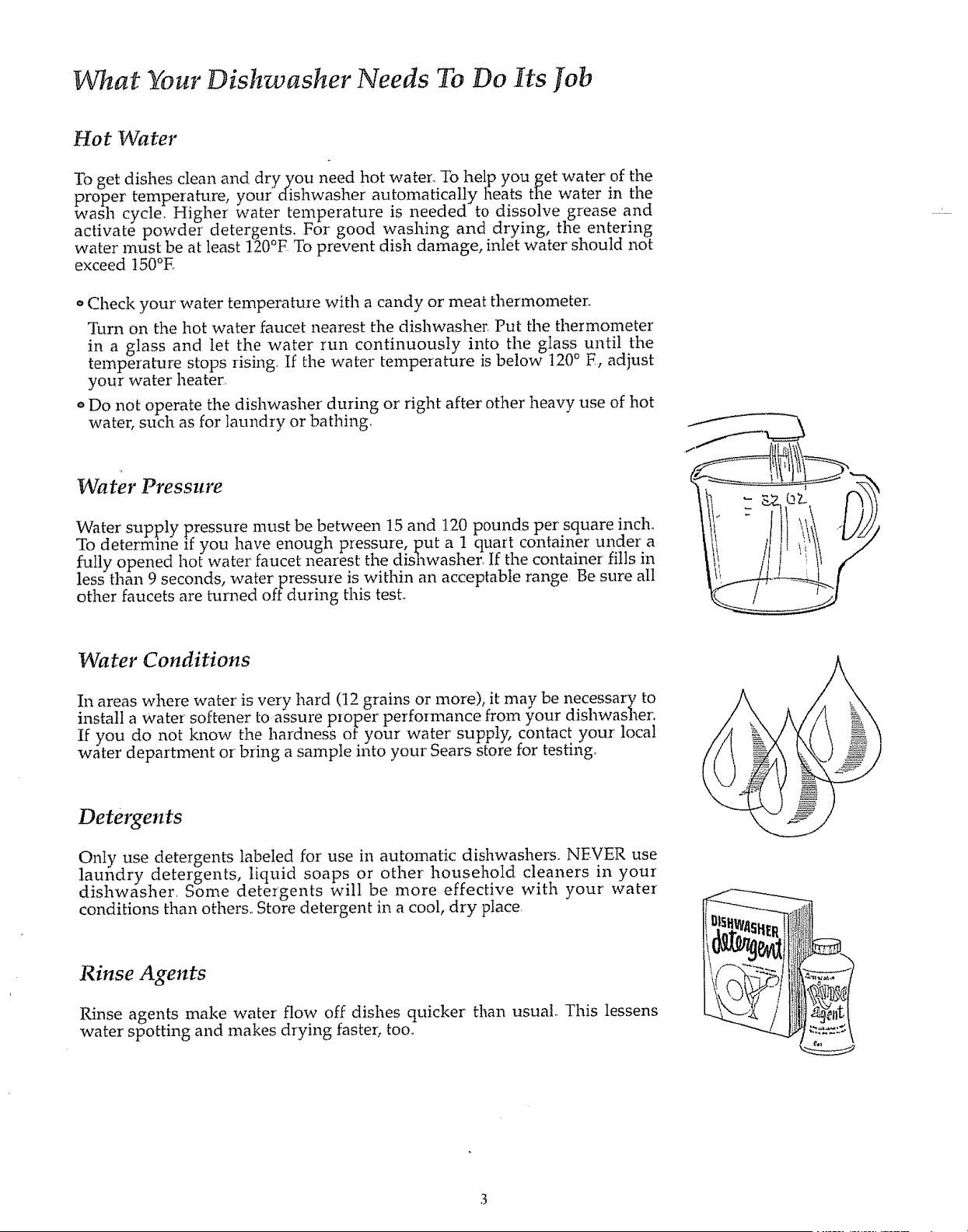
Water supply pressure must be between 15 and 120 pounds per square inch..
To determine if you have enough pressure, put a 1 quart container under a
fully opened hot water faucet nearest the dishwasher, If the container fills in
less than 9 seconds, -water pressure is within an acceptable range Be sure all
other faucets are turned off during this tesL
Water Conditions
In areas where water is very hard (12 grains or more), it may be necessary to
install a water softener to assure proper performance from your dishwasher,
If you do not know the hardness of your water supply, contact your local
water department or bring a sample into your Sears store for testing_
Detergents
Only use detergents labeled for use in automatic dishwashers_. NEVER use
laundry detergents, liquid soaps or other household cleaners in your
dishwasher. Some detergents will be more effective with your water
conditions than others,. Store detergent in a cool, dry place,
Rinse Agents
Rinse agents make water flow off dishes quicker than usual This lessens
water spotting and makes drying faster, too..
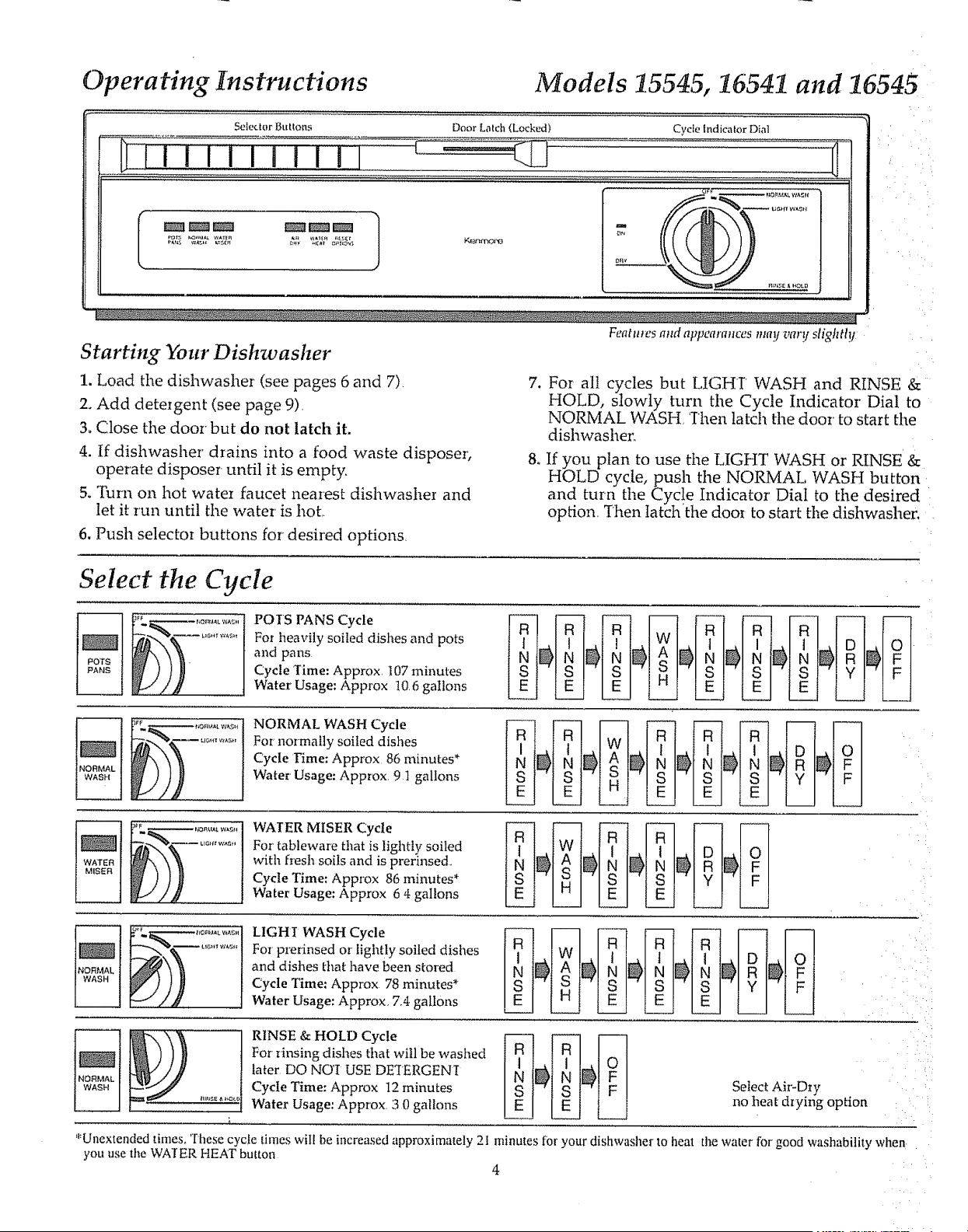
Operating Instructions Models 15545, 16541 and 16545
Selector guttor_s Door Latch (Locked)
ITT -Tu ul lm
Cycle Indicator Dial
m
L •
Starting Your Dishwasher
1. Load the dishwasher (see pages 6 and 7)
2° Add detergent (see page 9).
3. Close the door but do not latch it.
4. if dishwasher drains into a food waste dispose_,
operate disposer until it is empty_
5. Turn on hot wate_ faucet nearest dishwasher and
let it run until the water is hoL
6. Push selectm buttons for desired options.
Featmes and appearances may vary stightl!f
7. For all cycles but LIGHT WASH and RINSE &
HOLD, slowly turn the Cycle Indicator Dial to
NORMAL WASH Then latch the door to start the
dishwasher.
8. If you plan to use the LIGHT WASH or RINSE&
HOLD cycle, push the NORMAL WASH button
and turn the Cycle Indicator Dial to the desired
option, Then larchthe doo_ to start the dislv_vasher.
Select the Cycle
POIS PANS Cycle
For heavily soiled dishes and pots
and pans
Cycle Time: Approx, 107 minutes
Water Usage; Approx t0.6 gallons
NORMAL WASH Cycle
For normally soiled dishes
Cycle Time: Approx 86 minutes*
Water Usage: Approx 9 t gallons
WATER MISER Cycle
For tableware that is lightly soiled
with fresh soils and is prerinsed,
Cycle Time: Approx 86 minutes*
Water Usage: Approx 6 4 gallons
LIGHI WASH Cycle
For p_erinsed or lightly soiled dishes
and dishes that have been sto_ed
Cycle Time: Appmx 78 minutes*
Water Usage: Approx, 7,4 gallons
RINSE & HOLD Cycle
For rinsing dishes that will be washed
later DO NO'I USE DE'rERGENI
Cycle Time: Approx 12 minutes
............. Water Usage: Approx. 30 gallons
Select Air-Dry
no heat d_ying option
*Unextended times, 'Ihese cycle times wilt be increased approximately 2f minutes for your dishwasher to heat the water for good washability when
you use the WAIER HEAr button
4
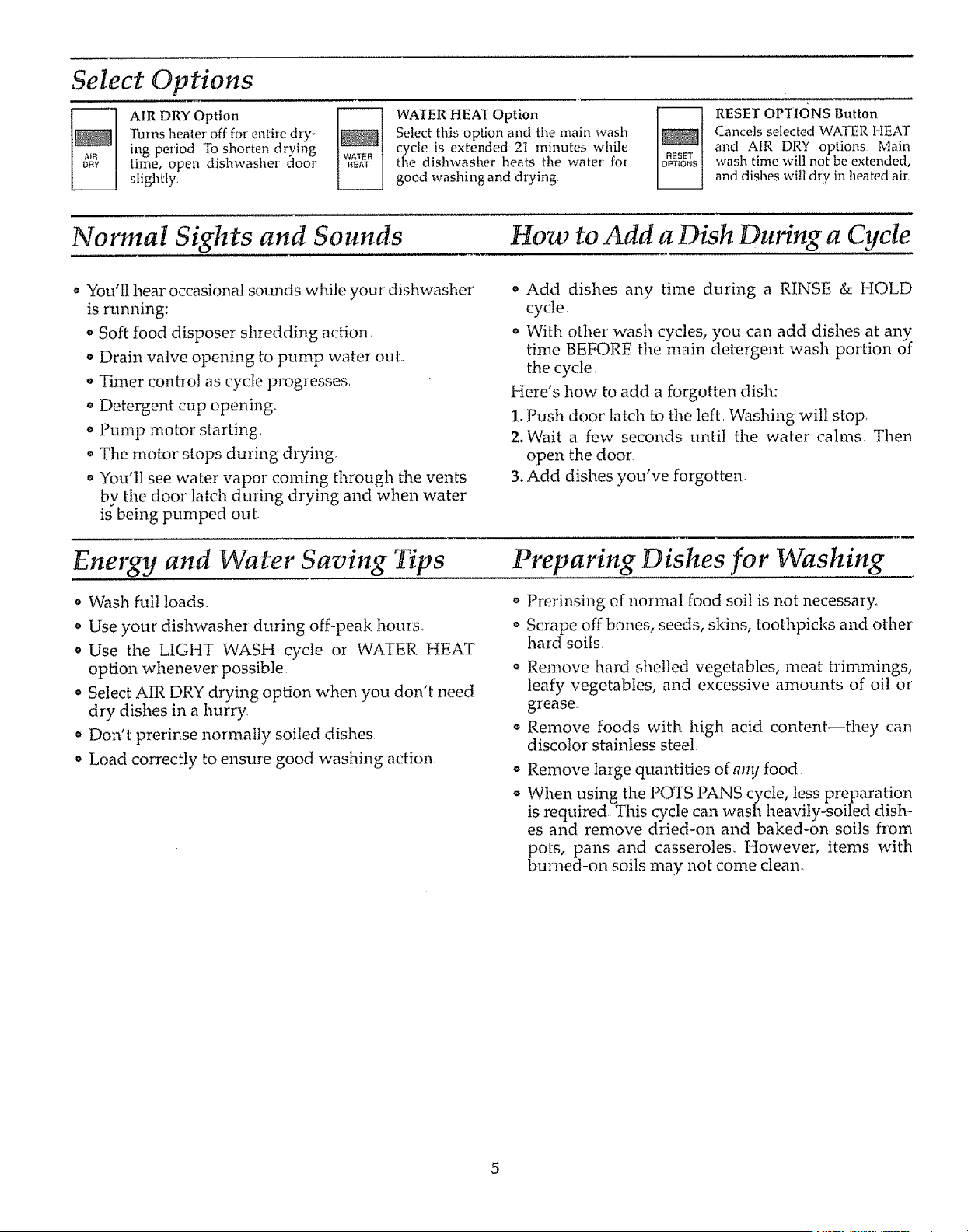
Select Options
AIR DRY Option
Tmns healer off for entire dry-
ing period To shorten drying
time, open dishwasher door
slightly
WATER HEAl Option
Select this option and the main wash
cycle is extended 2I minutes while
the dishwasher heats the water for
good washing and drying
RESET OPTIC)NS Button
Cancels selected WATER HEAT
and AIR DRY options Ivlain
wash time wilt not be extended,
and dishes will dry in heated air
Normal Sights and Sounds How to Add a Dish During a Cycle
,' You'll hear occasional sounds wkile your dishwasher
is running:
_,Soft food disposer shredding action
o Drain valve opening to pump water out
o Timer control as cycle progresses
Detergent cup opening.
o Pump motor starting,
o The motor stops during drying
o You'll see water vapor coming through the vents
by the door latch during drying and when water
is being pumped out.
o Add dishes any time during a RINSE & HOLD
cycle
o With other wash cycles, you can add dishes at any
time BEFORE the main detergent wash portion of
the cycle
Here's how to add a forgotten dish:
1. Push door latch to the left Washing will stop
2.Wait a few seconds until the water calms Then
open the door
3. Add dishes you've forgotten_
Energy and Water Saving Tips Preparing Dishes for Washing
o Wash full loads,,
o Use your dishwasher: during off-peak hours.,
o Use the LIGHT WASH cycle or WATER HEAT
option whenever possible,
o Select AIR DRY drying option when you don't need
dry dishes in a hurry°
o Don't prerinse normally soiled dishes,
o Load correctly to ensure good washing action,
o Prerinsing of normal food soil is not necessary.
o Scrape off bones, seeds, skins, toothpicks and other
hard soils
o Remove hard shelled vegetables, meat trimmings,
leafy vegetables, and excessive amounts of oil or
grease°
o Remove foods with high acid content_they can
discolor stainless steel.
Remove Imge quantities of an V food
When using the POTS PANS cycle, less preparation
is required_ This cycle can wash heavily-soiled dish-
es and remove dried-on and baked-on soils florn
pots, pans and casseroles_ However, items with
burned-on soils may not come clean_
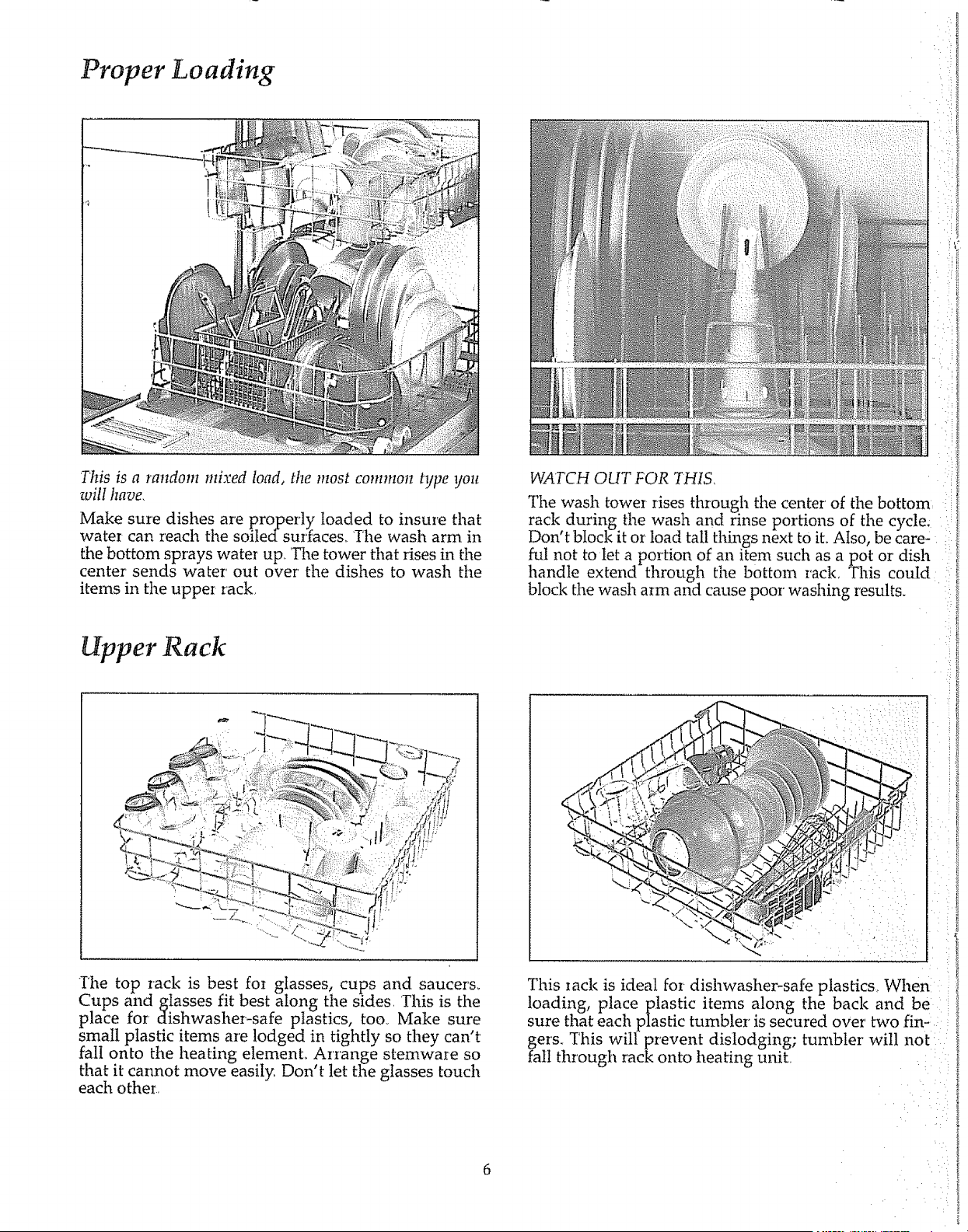
Proper Loading
Yhis is a random mixed load, the most common type you
zoilI have.
Make sure dishes are pro_p_erly loaded to insure that
water can reach the soiled surfaces_ The wash arm in
the bottom sprays water up The tower that rises in the
center sends -,,cater' out over' the dishes to wash the
items in the upper rack
Upper Rack
WATCH OUT FOR 7HIS_
The wash tower rises through the center of the bottom:
rack during the wash and rinse portions of the cycle; :
Don't block it or load tall things next to it_Also, be care' :i
ful not to let a portion of an item such as a pot or dish ::i
handle extend through the bottom rack. This could : il
block the wash arm and cause poor washing results.
i:
The top rack is best for glasses, cups and saucers.
Cups and glasses fit best along the sides This is the
place for dishwasher-safe plastics, too._ Make sure
small plastic items are lodged in tightly so they can't
fail onto the heating elemenL Arrange stemware so
that it cannot move easily. Don t let the glasses touch
each othen
This iack is ideal for dishwasher-safe plastics When
loading, place plastic items along the back and be
sure that each plastic tumbler is secured over two fin-
gers. This will prevent dislodging; tumbler will not
fall through rack onto heating unit
6
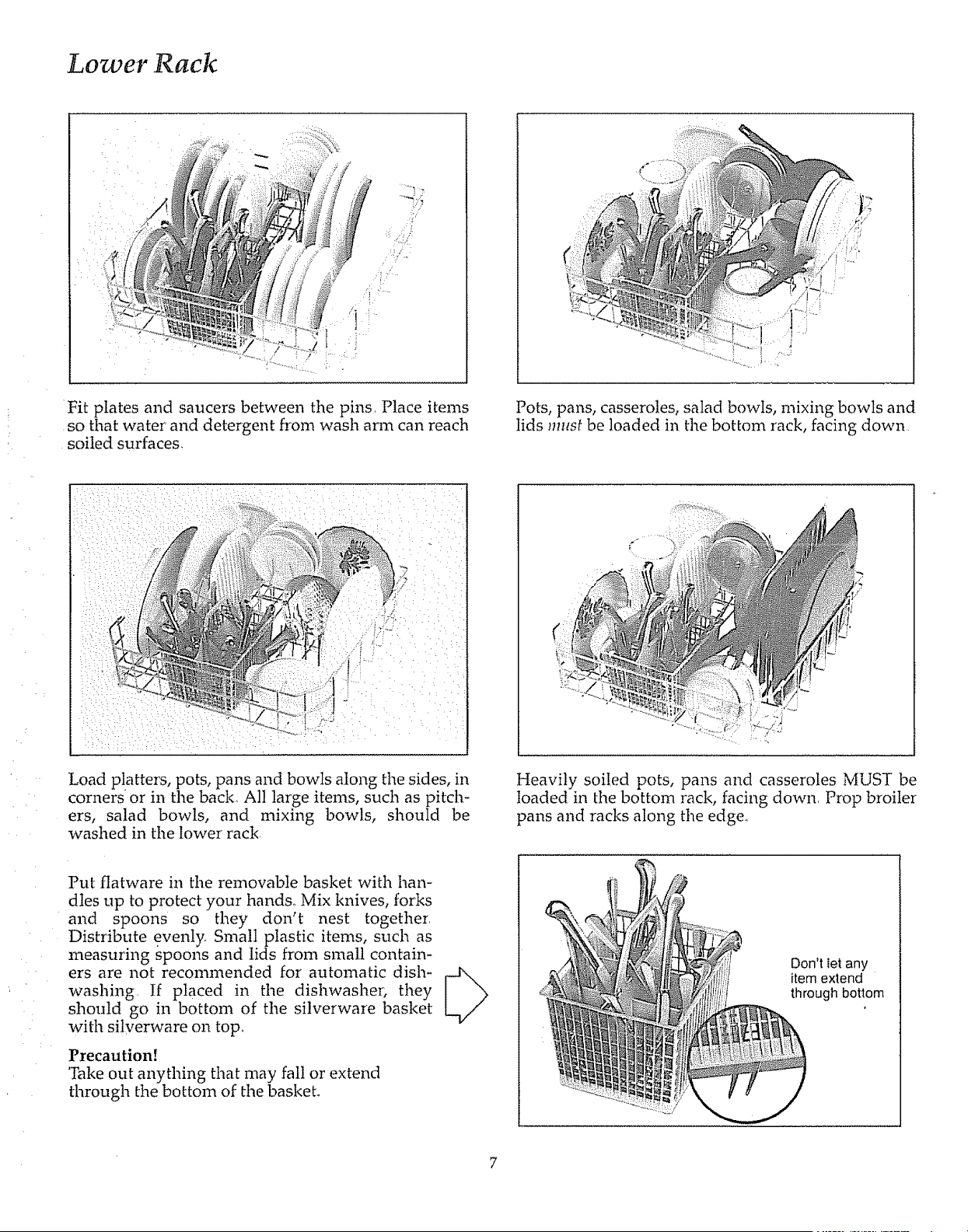
Lower Rack
Fit plates and saucers between the pins, Place items
so that water and detergent from wash ann can reach
soiled surfaces,
Pots, pans, casseroles, salad bowls, mixing bowls and
lids must be loaded in the bottom rack, facing down
Load platters, pots, pans and bowls along the sides, in
corners or in the back, All large items, such as pitch-
ers, salad bowls, and mixing bowls, should be
washed in the lower rack
Heavily soiled pots, pans and casseroles MUST be
loaded in the bottom rack, facing down, Prop broiler
pans and racks along the edge,,
Put flatware in the removable basket with han-
dles up to protect your hands, Mix knives, forks
and spoons so they don't nest together,
Distribute eventy_ Small plastic items, such as
measuring spoons and lids from small contain-
ers are not recommended for automatic dish-
washing, If placed in the dishwasher, they
should go in bottom of the silverware basket
with silverware on top,,
Precaution!
Take out anything that may fall or extend
through the bottom of the basket°
Don't let any
item extend
through bottom
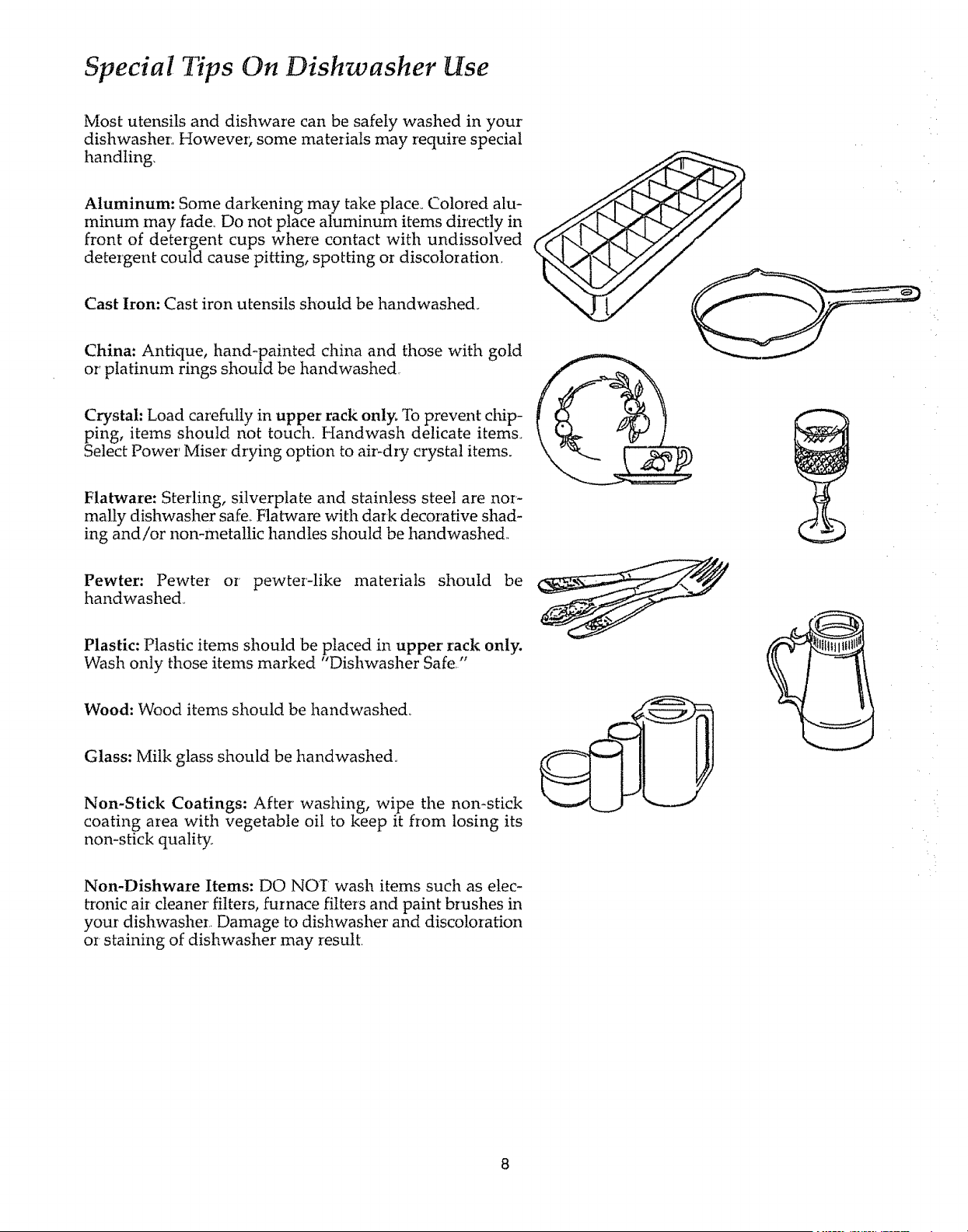
Special Tips On Dishwasher Use
Most utensils and dishware can be safely washed in your
dishwasher_ HoweveI; some rnaterials may require special
handling_
Aluminum: Some darkening may take place° Colored alu-
minum may fade, Do not place aluminum items directly in
front of detergent cups where contact with undissolved
detergent could cause pitting, spotting or discoloration,
Cast Iron: Cast iron utensils should be handwashed_
China: Antique, hand-painted china and those with gold
or' platinum rings should be handwashed
Crystal: Load carefully in upper rack only, To prevent clldp-
ping, items should not touch. Handwash delicate items_
Select Power Miser drying option to air-dry crystal items.
Flatware: Sterling, silverplate and stainless steel are nor-
mally dishwasher safe. l_latware with dark deco_'ative shad-
ing and/or non-metallic handles should be handwashed,
Pewter: Pewter or pewter-like materials should be
handwashed_
Plastic: Plastic items should be placed in upper rack only.
Wash only those items marked "Dishwasher Safe"
Wood: Wood items should be handwashe&
Glass: Milk glass should be handwashed_
Non-Stick Coatings-. After washing, wipe the non-stick
coating area with vegetable oil to keep it from losing its
non-stick quality°
Non-Dishware Items: DO NOT wash items such as elec-
tronic air cleaner filters, furnace filters and paint brushes in
your dishwasher Damage to dishwasher and discoloration
or staining of dishwasher may resuh
8
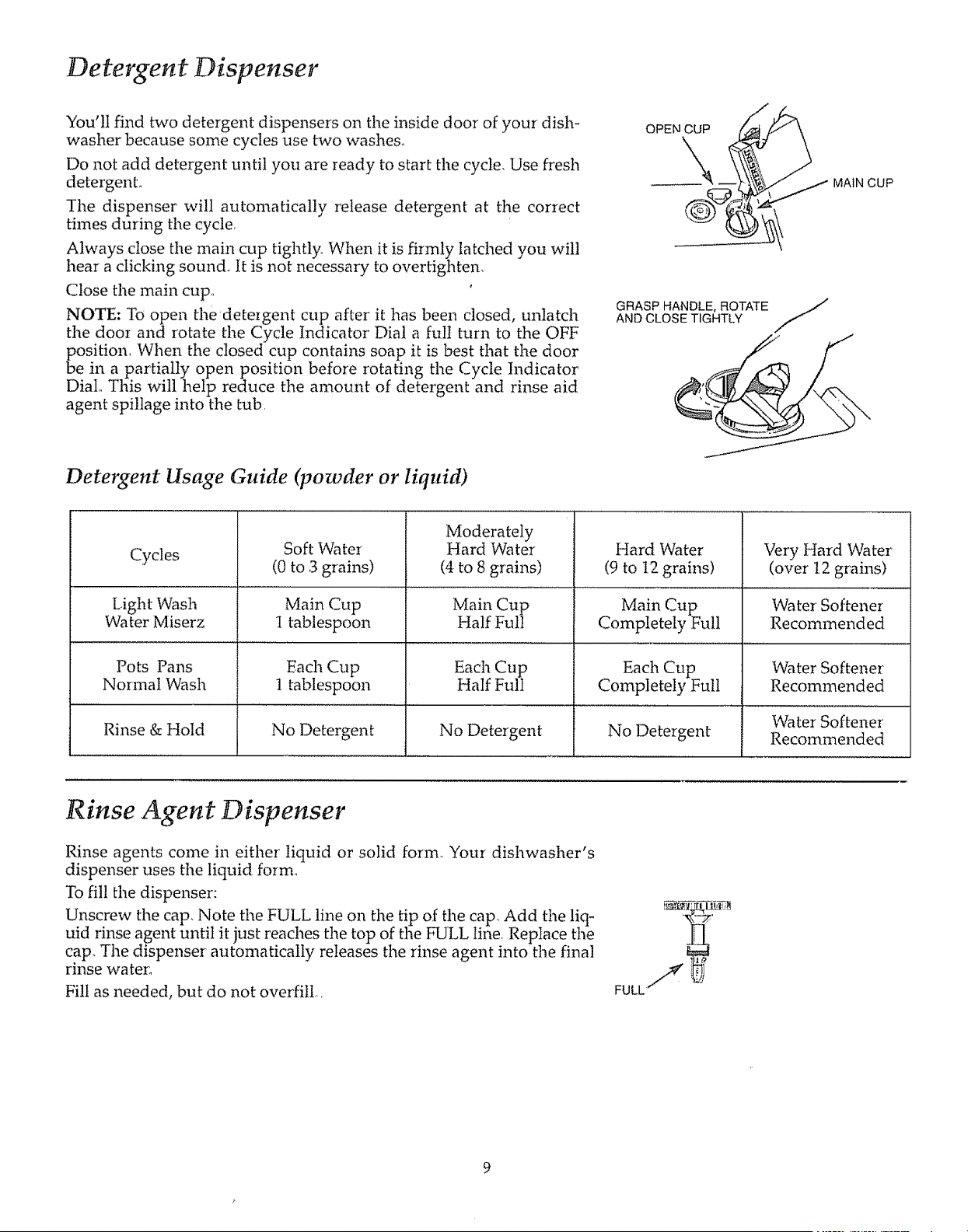
Detergent Dispenser
"You'll find two detergent dispensers on the inside door of your dish-
washer because some cycles use two washes.,
Do not add detergent until you are ready to start the cycle. Use fresh
detergenL
The dispenser will automatically release detergent at the correct
times during the cycle,
Always close the main cup tightly., When it is firmly latched you will
hear a clicking soun& It is not necessary to overtighten.
Close the main cup,,
NOTE: To open the deteIgent cup after it has been closed, unlatch
the door and rotate the Cycle Indicator Dial a full turn to the OFF
position. When the closed cup contains soap it is best that the door
be in a partially open position before rotating the Cycle Indicator
Dial This will help reduce the amount of detergent and rinse aid
agent spillage into the Dab
OPEN CUP
\
GRASP HANDLE, ROTATE
AND CLOSE TIGHTLY
MAIN CUP
Detergent Usage Guide (powder or liquid)
Moderately
Soft Water Hard Water Hard Water Very Hard Water
Cycles (0 to 3 grains) (4 to 8 grains) (9 to 12 grains) (over 12 grains)
Light Wash Main Cup Main Cup Main Cup Water Softener
Water Miserz t tablespoon Half Full Completely Full Recommended
Pots Pans Each Cup Each Cup Each Cup Water Softener
Normal Wash 1 tablespoon Half Full Completely Full Recommended
Water Softener
Rinse & Hold No Detergent No Detergent No Detergent Recommended
Rinse Agent Dispenser
Rinse agents come in either liquid or solid form. Your dishwasher's
dispenser uses the liquid form.,
To fill the dispenser:
Unscrew the cap, Note the FULL line on the tip of the cap. Add the liq-
uid rinse agent until it just reaches the top of the FULL line, Replace the
cap. The dispenser automatically releases the rinse agent into the final
rinse water°
Fill as needed, but do not overfilL,
9
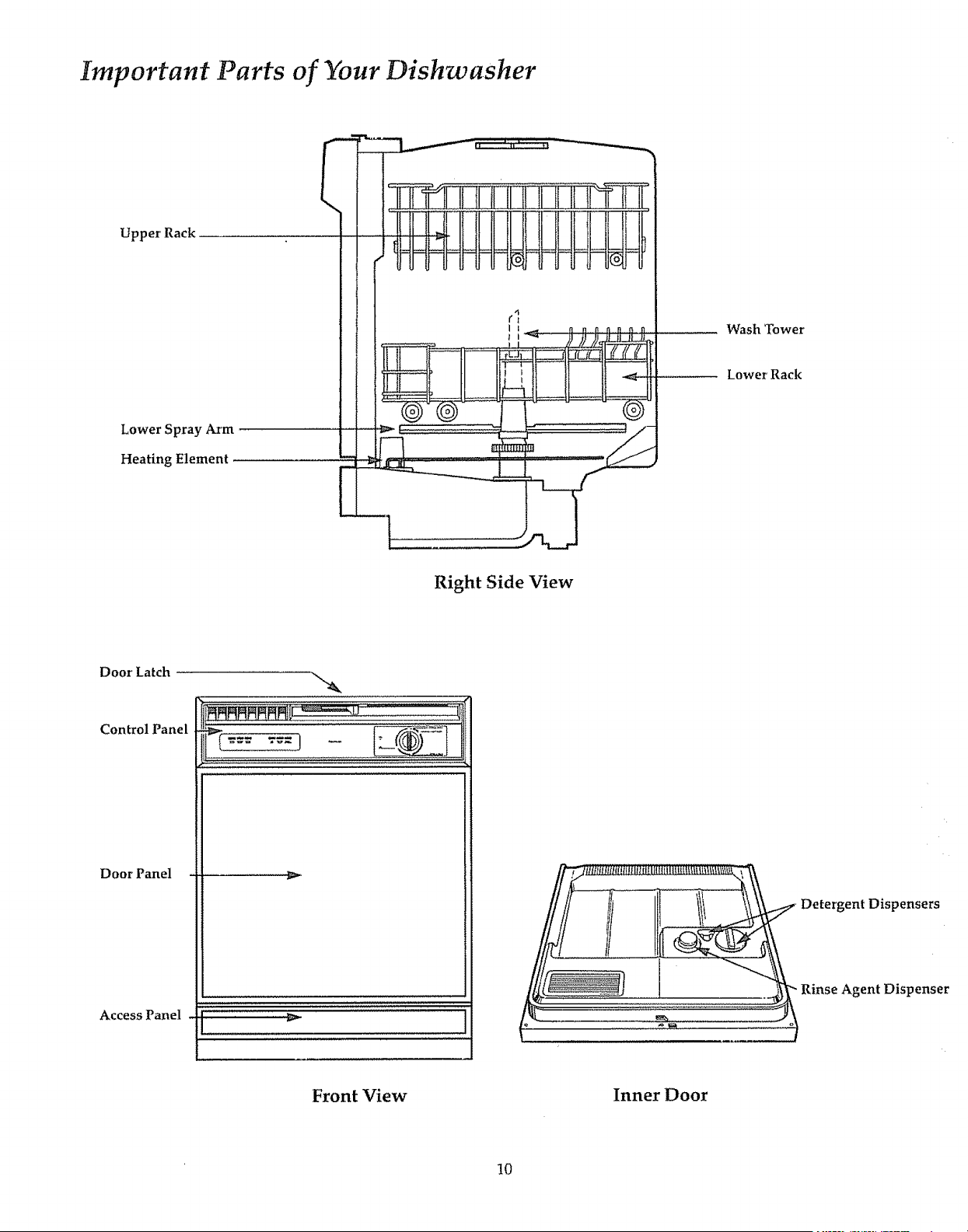
Important Parts of Your Dishwasher
Upper Rack
Lower Spray Arm
Wash Tower
Lower Rack
Right Side View
Door Latch
Control Panel
Door Panel
Access Panel
__!__i_i ¸ii iiiiiiiiiiiiiiiiiiiiiii_
Detergent Dispensers
Rinse Agent Dispenser
Front View
Inner Door
10
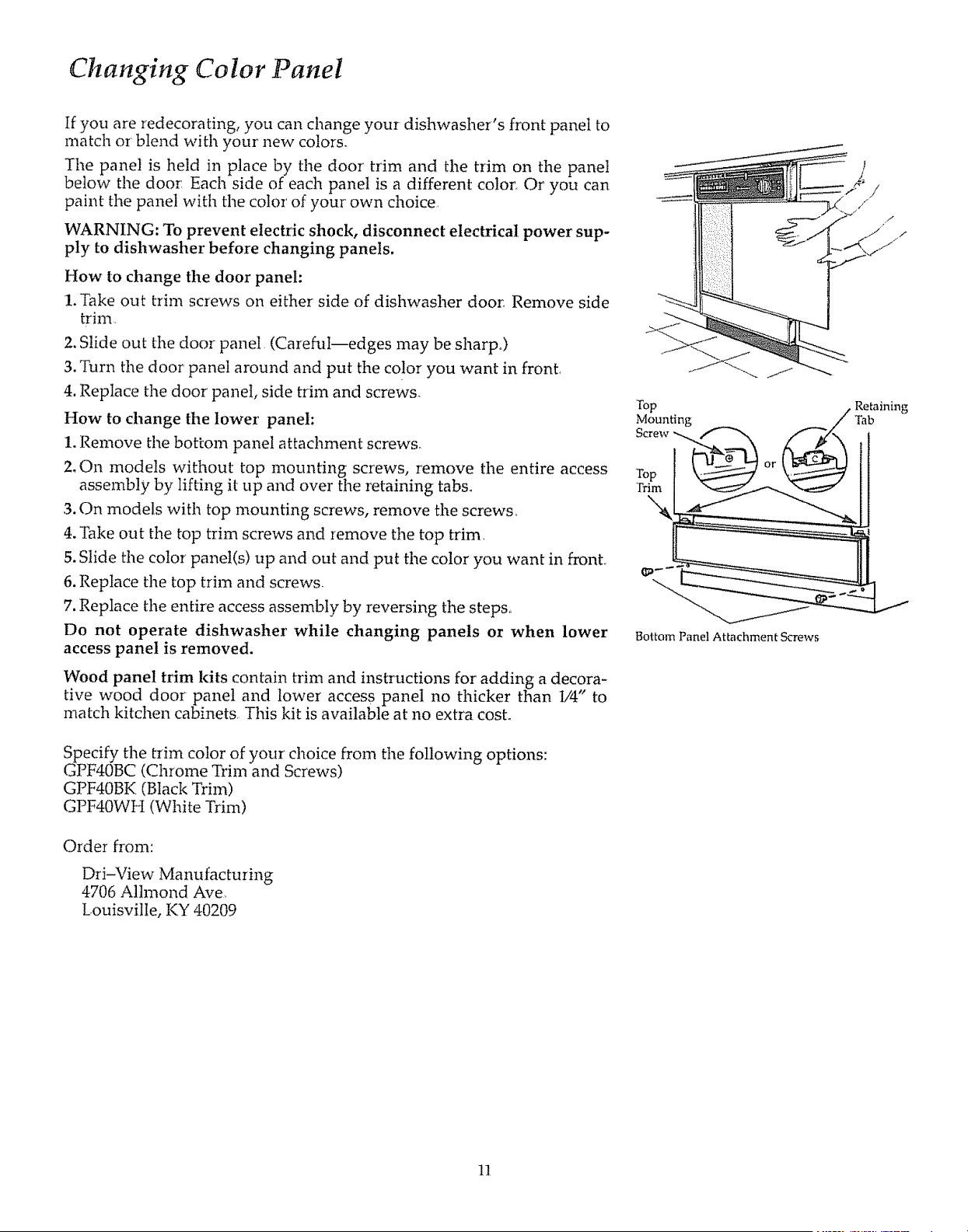
Changing Color Panel
tf you are redecorating, you can change your dishwasher's front panel to
match or blend with your new colors_
The panel is held in place by the door trim and the trim on the panel
below the door Each side of each panel is a different color Or you can
paint the panel with the color of your own choice
WARNING: To prevent electric shock, disconnect electrical power sup-
ply to dishwasher before changing panels,
How to change the door panel:
1. Take out trim screws on either side of dishwasher door Remove side
trim,
2. Slide out the door panel (Careful--edges may be sharp°)
3. Turn the door panel around and put the color you want in front<
4. Replace the door panel, side trim and screws_
How to change the lower panel:
1. Remove the bottom panel attachment screws_
2_On models without top mounting screws, remove the entire access
assembly by lifting it up and over the retaining tabs°
3. On models with top mounting screws, remove the screws
4. Take out the top trim screws and remove the top trim
5. Slide the color panel(s) up and out and put the color you want in front
6. Replace the top trim and screws
7. Replace the entire access assembly by reversing the steps
Do not operate dishwasher while changing panels or when lower
access panel is removed.
Wood panel trim kits contain trim and instructions for adding a decora-
tive wood door panel and lower access panel no thicker than 1/4" to
match kitchen cabinets This kit is available at no extra cost.
Specify the trim color of your choice from the following options:
GPF40BC (Chrome Trim and Screws)
GPF40BK (Black Trim)
GPF40WH (White Trim)
Order from:
Dri-View Manufacturing
4706 Altmond Ave
Louisville, KY 40209
Top
Bottom Panel Attachment Screws
,f
1/'
11
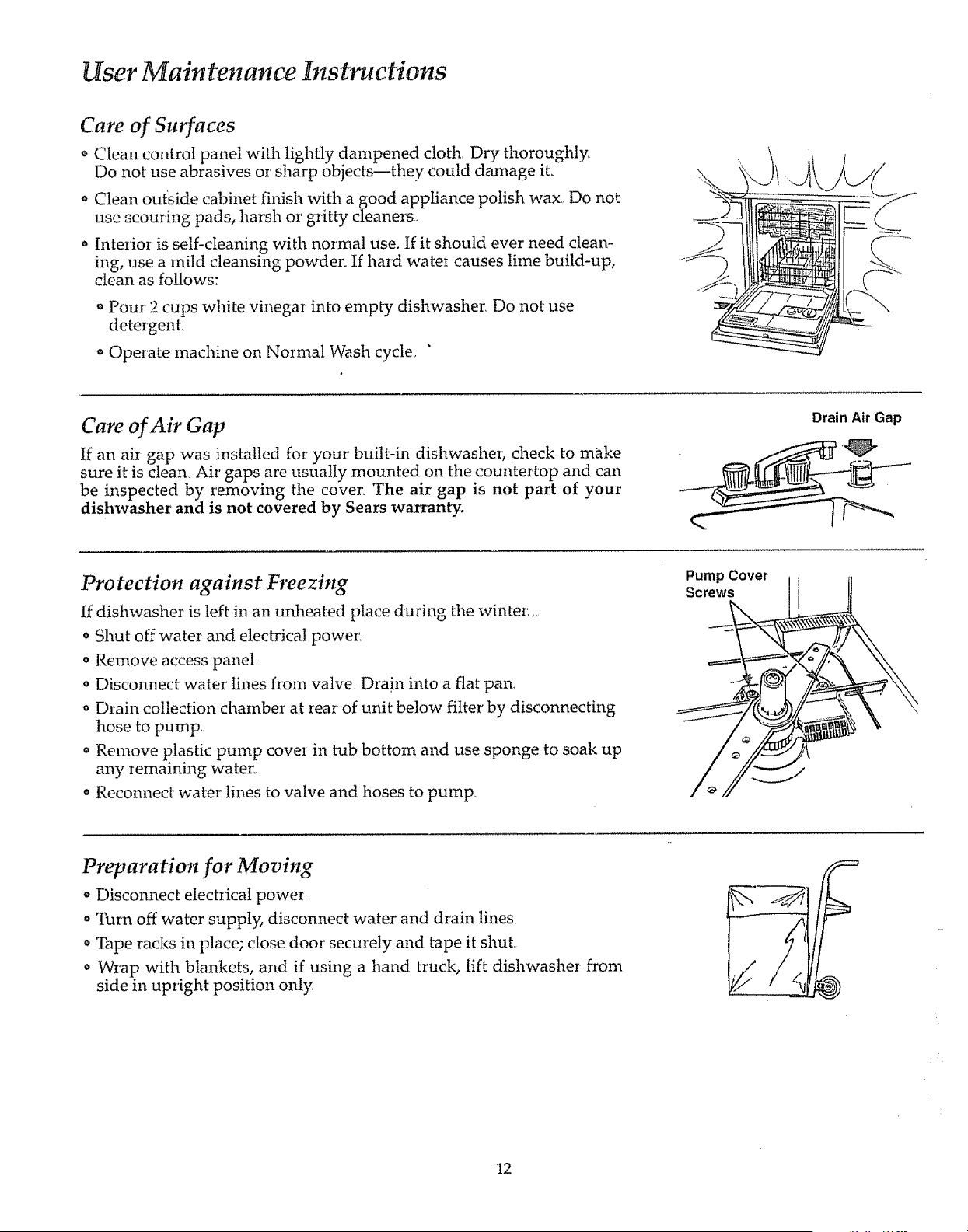
User Maintenance Instructions
Care of Surfaces
o Clean control panel with lightly dampened cloth. Dry thoroughly_
Do not use abrasives or sharp objects--they could dalnage it.
o Clean outside cabinet finish "with a good apphance polish wax Do not
use scouring pads, harsh or gritty cleaners.
G Interior is self-cleaning with normal use. If it should ever need clean-
ing, use a mild cleansing powden If hard water causes lime build-up,
clean as follows:
o Pour' 2 cups white vinegar' into empty dishwasher Do not use
detergent_
- Operate machine on Normal Wash cycle° '
Care of Air Gap
If an aiI gap was installed for' your' built-in dishwasher, check to make
sure it is clean Air' gaps are usually mounted on the countertop and can
be inspected by removing the cover The air gap is not part of your
dishwasher and is not covered by Sears -warranty.
Drain Air Gap
Protection against Freezing
If dishwasher is left in an unheated place during the winter. ....
• Shut off water, and electrical power:
o Remove access panel.
• Disconnect water lines from valve. Drain into a flat pan_
• Drain collection chambei at rear of unit below filter by disconnecting
hose to pump.
o Remove plastic pump cover in tub bottom and use sponge to soak up
any remaining waten
o Reconnect water lines to valve and hoses to pump,
Pump Cover
Screws i
Preparation for Moving
= Disconnect electrical powen
Turn off water supply, disconnect water and drain lines,
Tape racks in place; close door securely and tape it shut_
• Wrap with blankets, and if using a hand truck, lift dishwasher from
side in upright position only.
12
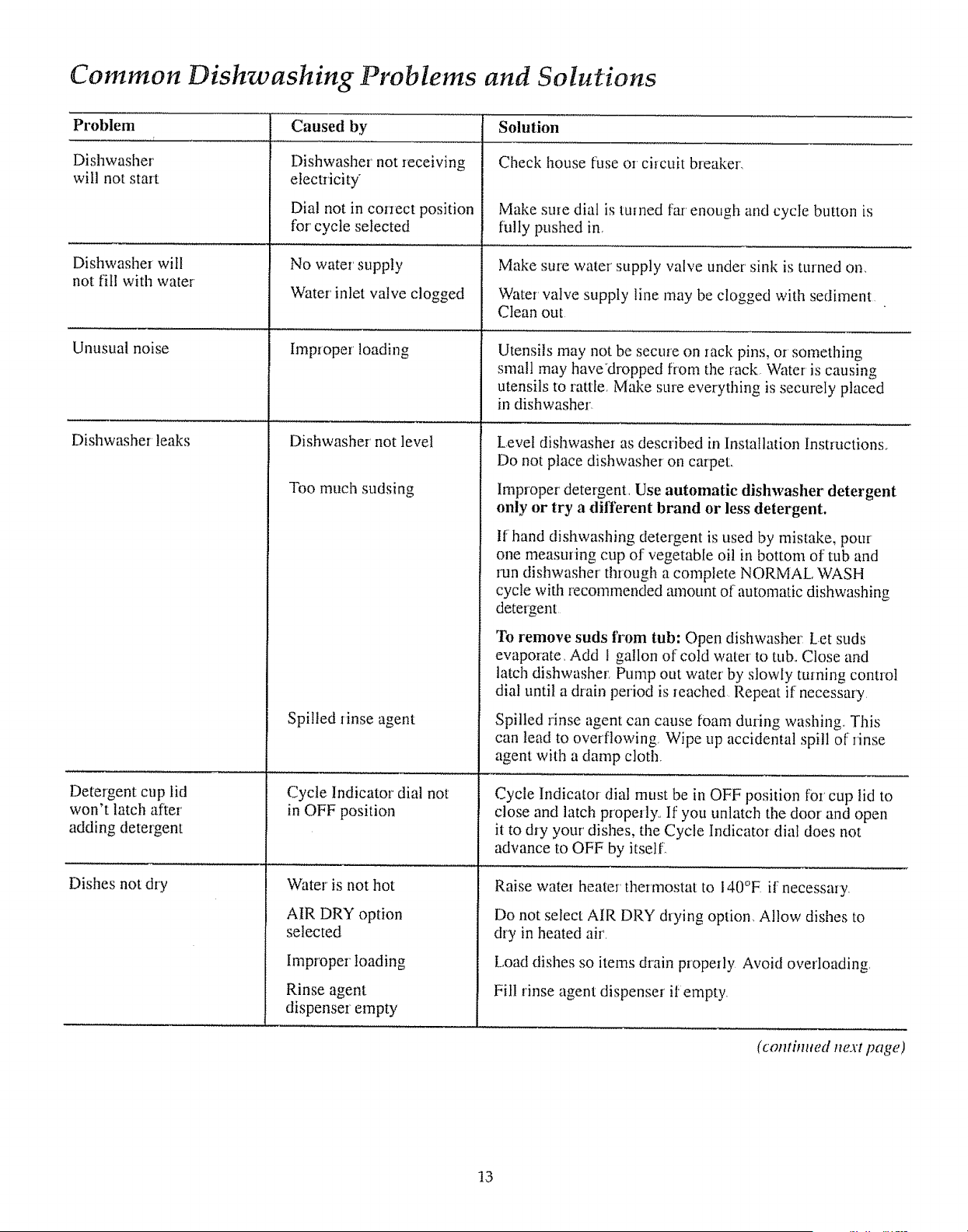
Common Dishwashing Problems and Solutions
Problem
Dishwasher
will not start
Dishwasher will
not fill with water
Unusual noise
Dishwasher leaks
Detergent cup lid
won't latch after'
adding detergent
Dishes not dry
Caused by
Dishwasher not receiving
electricity
Dial not in conect position
for' cycle selected
No water supply
Water' inlet valve clogged
hnproper loading
Dishwasher not level
Too much sudsing
Spilled rinse agent
Cycle indicator dial not
in OFF position
Water is not hot
AIR DRY option
selected
Improper loading
Rinse agent
dispenser empty
Solution
Check house fuse oi ciicuit breaker,
Make sure dial is tinned far' enough and cycle button is
MIy pushed in
Make sure water supply valve under' sink is turned on.
Water valve supply line may be clogged with sediment
Clean out
Utensils may not be secure on rack pins, or something
small may havedropped fiom the rack Water is causing
utensils to rattle, Make sure everything is securely placed
in dishwasher.
Level dishwasher as described in Installation instructions..
Do not place dishwasher on carpet_
hnproper detergent, Use automatic dishwasher detergent
only or try a different brand or less detergent.
if hand dishwashing detergent is used by mistake, pour
one measuring cup of vegetable oil in bottom of tub and
run dishwasher' through a complete NORMAL, WASH
cycle with recommended amount of automatic dishwashing
detergent
To remove suds from tub: Open dishwasher: Let suds
evaporate. Add I gallon of cold water to tub. Close and
latch dishwasher: Pump out water' by slowly turning control
dial until a drain period is reached Repeat if necessary
Spilled rinse agent can cause foam during washing. This
can lead to overflowing Wipe up accidental spill of rinse
agent with a damp cloth.
Cycle Indicator dial must be in OFF position for cup lid to
close and latch properly, If you unlatch the door and open
it to dU your dishes, the Cycle Indicator dial does not
advance to OFF by itself,
Raise water heater thermostat to 140°E ifnecessary
Do not select AIR DRY drying option. Allow dishes to
dry in heated air'.
Load dishes so items dr'ain properly Avoid over'loading
Fill rinse agent dispenser' it empty
(contimted next page)
13
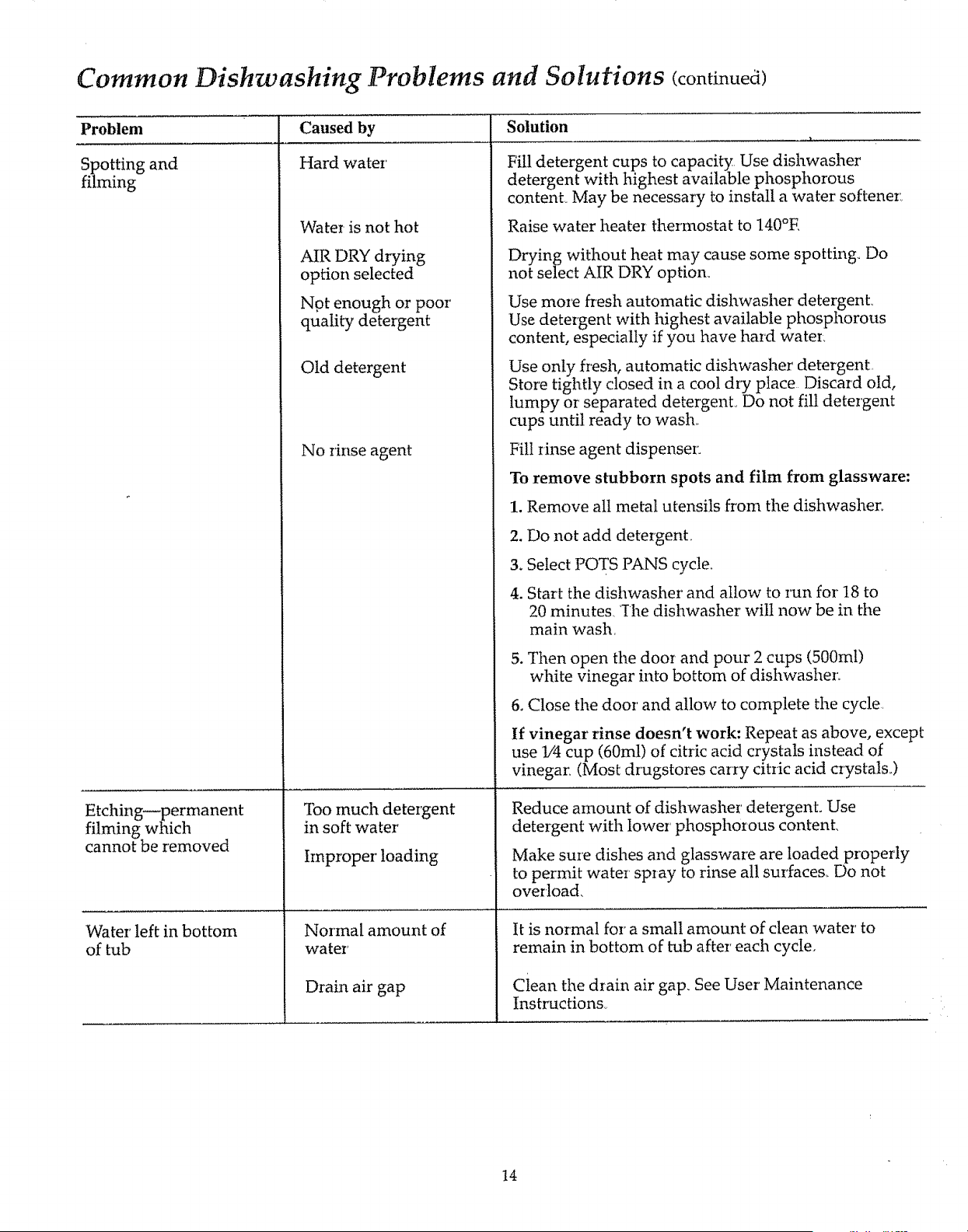
Common Dishwashing Problems and Solutians (contmue )
Problem
Spotting and
filming
Etching--permanent
filming which
cannot be removed
Water left in bottom
of tub
Caused by
Hard water
Water is not hot
AIR DRY drying
option selected
Not enough or poor
' detergent
quality
Old detergent
No rinse agent
Too much detergent
in soft water
hnproper loading
Normal amount of
water
Drain air gap
Solution
Fill detergent cups to capacity Use dishwasher
detergent with highest available phosphorous
content_ May be necessary to install a water softener
Raise water heater thermostat to 140°E
Drying without heat may cause some spotting° Do
not select AIR DRY option.
Use more flesh automatic dishwasher detergent_
Use detergent with highest available phosphorous
content, especially if you have hard waten
Use only fresh, automatic dishwasher detergent
Store tightly closed in a cool dry place Discard old,
lumpy or separated detergent° Do not fill detergent
cups until ready to wasK
Fill rinse agent dispenseL
To remove stubborn spots and film from glassware:
1. Remove all metal utensils from the dishwasher.
2. Do not add detergent.
3o Select POTS PANS cycle.
4. Start the dishwasher and altow to run for' 18 to
20 minutes. 'The dishwasher' will now be in the
main wash
5. Then open the door and pour 2 cups (500ml)
white vinegar into bottom of dishwasher.
6_ Close the door' and allow to complete the cycle
If vinegar rinse doesn't work: Repeat as above, except
use 1/4 cup (60ml) of citric acid crystals instead of
vinegar. (Most drugstores carry citric acid crystals_)
Reduce amount of dishwasher detergent. Use
detergent with lower phosphorous content,
Make sure dishes and glassware are loaded properly
to permit water spray to rinse all surfaces_ Do not
overload,
It is normal for a small amount of clean water to
remain in bottom, of tub after each cycle.
Clean the drain air gap_ See User Maintenance
instructions_
14
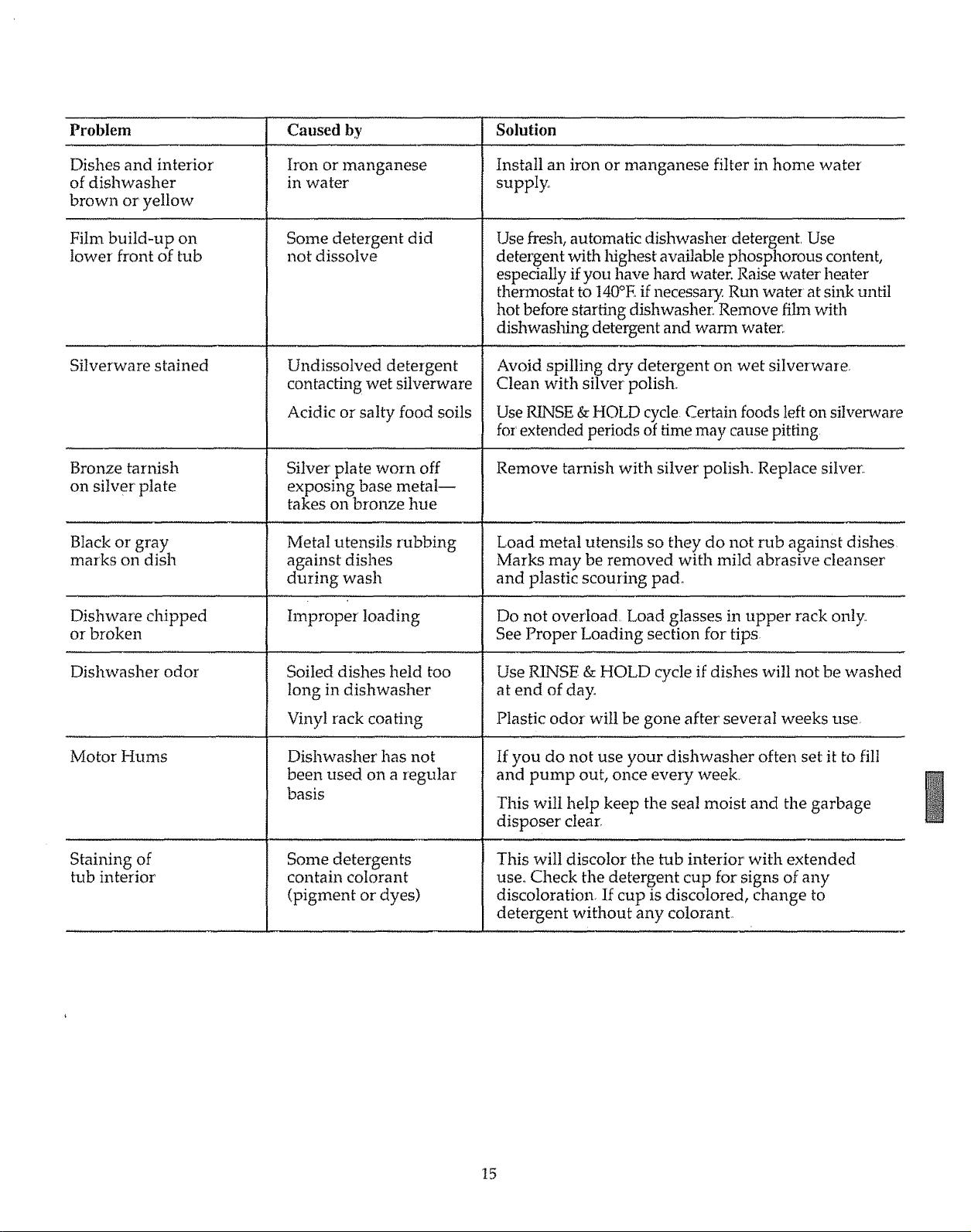
Problem Caused by Solution
Dishes and interior Iron or manganese Install an iron or manganese filter in home water
of dishwasher in water supply.
brown or yellow
Film build-up on
lower front of tub
Silverware stained
Bronze tarnish
on silver plate
Black or gray
marks on dish
Dishware chipped
or broken
Dishwasher odor
Motor Hums
Staining of
tub interior
Some detergent did
not dissolve
Undissolved detergent
contacting wet silverware
Acidic or salty food soils
Silver plate worn off
exposing base metal--
takes on bronze hue
Metal utensils rubbing
against dishes
during wash
Improper loading
Soiled dishes held too
long in dishwasher
Vinyl rack coating
Dishwasher has not
been used on a regular
basis
Some detergents
contain colorant
(pigment or dyes)
Use fresh, automatic dishwasher detergent. Use
detergent with highest available phosphorous content,
especially if you have hard water. Raise water heater
thermostat to 140°E if necessary Run water at sip& until
hot before start4mg dishwasher. Remove film with
dishwasl-fing detergent and warm water
Avoid spilling dry detergent on wet silverware.
Clean with silver polish.
Use RINSE & HOLD cycle. Certain foods left on silverware
for' extended periods of time may cause pitting
Remove tarnish with silver polish. Replace silver.
Load metal utensils so they do not rub against dishes.
Marks may be removed with mild abrasive cleanser
and plastic scouring pa&
Do not overload, Load glasses in upper rack only,
See Proper Loading section for tips,
Use RINSE & HOLD cycle if dishes will not be washed
at end of day.
Plastic odor will be gone after several weeks use.
If you do not use your dishwasher often set it to fill
and pump out, once every week.
This will help keep the seal moist and the garbage
disposer' clear.
This will discolor the tub interior with extended
use° Check the detergent cup for signs of any
discoloration. If cup is discolored, change to
detergent without any colorant.
15
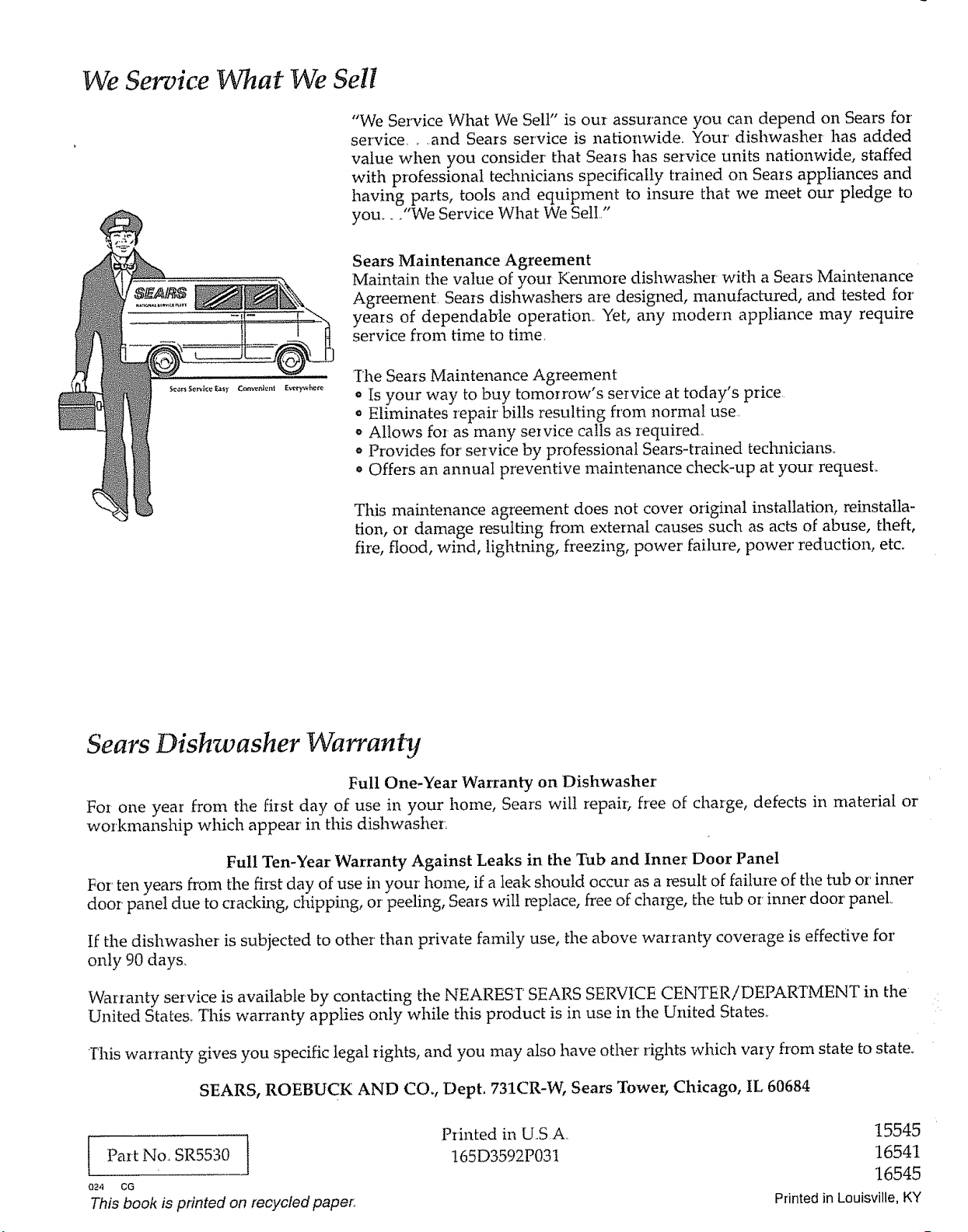
We Service laghat We Sell
"We Service What We Sell" is our assurance you can depend on Sears for
service ...... and Sears service is nationwide° Your' dishwasher has added
value when you consider that Seais has service units nationwide, staffed
with professional technicians specifically trained on Seats appliances and
having parts, tools and equipment to insure that we meet our pledge to
you°.."We Service What We Sell.."
Sears Maintenance Agreement
Maintain the value of your Kemnore dishwasher with a Sears Maintenance
Agreement Seats dishwasher's are designed, manufactured, and tested for.
years of dependable operation. Yet, any modern appliance may require
service from time to time.
The Sears Maintenance Agreement
o Is your way to buy tomorrow's service at today's price
" Eliminates repair bills resulting from normal use.
o Allows for as many service calls as required.
o Provides for service by professional Sears-trained technicians.
o Offers an annual preventive maintenance check-up at your requesK
This maintenance agreement does not cover original installation, reinstalla-
tion, or damage resulting from external causes such as acts of abuse, theft,
fire, flood, wind, lightning, freezing, power failure, power" reduction, etc.
Sears Dishwasher Warranty
Full One-Year Warranty on Dishwasher
For one year from the first day of use in your home, Sears will repair; free of charge, defects in material or
workmanship which appear in this dishwashen
Full Ten-Year Warranty Against Leaks in the Tub and Inner' Door Panel
For ten years from the first day of use in your home, if a leak should occur as a result of failure of the tub or' inner
door. panel due to cracking, chipping, or peeling, Sears will replace, free of charge, the tub or inner door panel
If the dishwasher is subjected to other than private family use, the above warranty coverage is effective for
only 90 days.
Warranty service is available by contacting the NEAREST SEARS SERVICE CENTER/DEPARTMENT in the
United States.. This warrant), applies only while this product is in use in the United States_
This warranty gives you specific legal rights, and you may also have other' rights which vary from state to state.
SEARS, ROEBUCK AND CO., Dept. 731CR-W, Sears Tower, Chicago, IL 60684
Printed in U.SA. 15545
Part No_ SR5530 165D3592P031 16541
02_ co 16545
This book is printed on recycfed paper,. Printedin Louisville, KY