
1
IMPORTANT: Keep these instructions and the engine booklet in a safe place for future reference.
They contain important information about your mower.
Rotary Mowers
OWNER’S
MANUAL
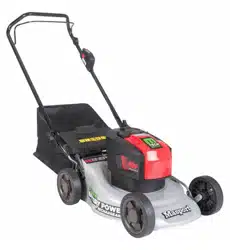
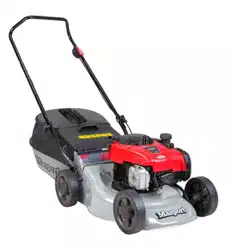
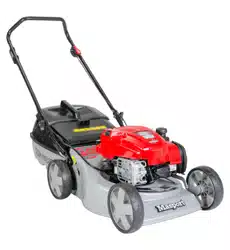
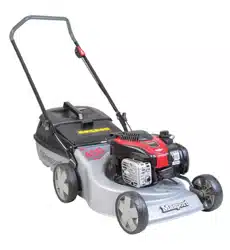
This manual covers a range of different Masport mowers.
Some features mentioned may not apply to your mower.
Part N
o
: 583152.H.0

2
CONTENTS
EXPLANATION OF SYMBOLS 3
SAFETY 4
INSTRUCTIONS 4
TRAINING ............................................................................................................................................................................................................................. 4
PREPARATION ..................................................................................................................................................................................................................... 4
OPERATION ......................................................................................................................................................................................................................... 4
MAINTENANCE ................................................................................................................................................................................................................... 4
STORING THE MOWER ...................................................................................................................................................................................................... 4
FOLDING THE HANDLE ...................................................................................................................................................................................................... 4
ASSEMBLING THE MOWER 5
FITTING THE HANDLE ........................................................................................................................................................................................................ 5
ASSEMBLING THE ‘SCREW LOCK’ HANDLE. ................................................................................................................................................................... 5
ASSEMBLING THE LOWER HANDLE ............................................................................................................................................................................... 5
ASSEMBLING THE ‘CAM LOCK’ HANDLE......................................................................................................................................................................... 5
FITTING THE THROTTLE CONTROL .................................................................................................................................................................................. 5
PREPARING THE ENGINE 6
TWO STROKE ENGINES .................................................................................................................................................................................................... 6
FOUR STROKE ENGINES ................................................................................................................................................................................................... 6
RUNNING THE ENGINE 6
ENGINE CONTROL .............................................................................................................................................................................................................. 6
STARTING 7
MANUAL START MODELS. ................................................................................................................................................................................................ 7
ELECTRIC START MODELS. ............................................................................................................................................................................................... 7
STOPPING 7
DRIVE CONTROLS 7
THE GRASS CATCHER 8
CATCHER ASSEMBLY ......................................................................................................................................................................................................... 8
FITTING THE CATCHER ..................................................................................................................................................................................................... 8
FITTING THE FABRIC CATCHER ........................................................................................................................................................................................ 9
REMOVING THE GRASS CATCHER ................................................................................................................................................................................... 9
EMPTYING ........................................................................................................................................................................................................................... 9
CATCHER LEVEL INDICATOR ............................................................................................................................................................................................ 9
GRASS CATCHER MAINTENANCE .................................................................................................................................................................................... 9
CUT HEIGHT CONTROL 9
MOWING ACCESSORIES 10

3
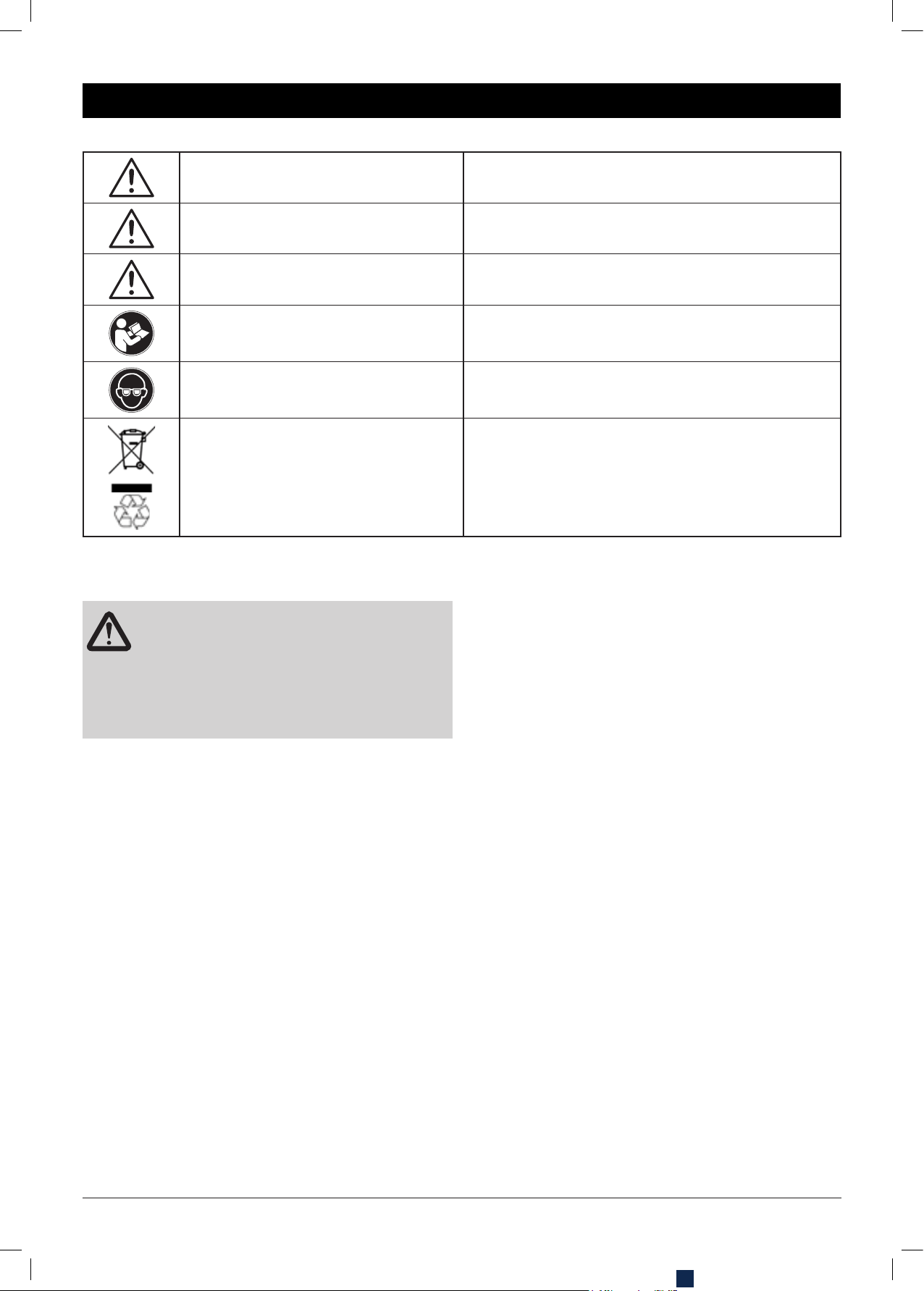
EXPLANATION OF SYMBOLS
1. Read Owner’s Manual
2. Keep bystander away.
3. Drive Clutch
4. Caution rotating blade— keep hands and
feet clear.
5. Remove Spark Plug.
6. Variable Speed Drive Control
7. Noise Limit
8. Wear ear protection
9. Wear eye protection
10. Wear protective gloves
11. Keep bystanders away
1. 2. 3. 4. 5. 6. 7. 8. 9.
75
10. 11.
MOWING ADVICE 10
MOWING ADVICE—‘SMART CHUTE’............................................................................................................................................................................... 10
FITTING THE MULCHING BLOCK TO THE MOWER 10
FITTING THE SIDE DISCHARGE CHUTE 11
CHIPPER MOWERS 11
AFTER MOWING 11
CLEANING ������������������������������������������������������������������������������������������������������������������������������������������������������������������������������������������������������������������������ 11
BLADES 11
BLADE SERVICING INSTRUCTIONS ................................................................................................................................................................................ 11
BLADE REPLACEMENT TORQUE SETTINGS: ................................................................................................................................................................ 12
CONTRACTOR COMMERCIAL MODELS ......................................................................................................................................................................... 12
WHEEL TORQUE SETTING: .............................................................................................................................................................................................. 12
ENGINE MAINTENANCE 12
DRIVE MAINTENANCE 12
ROTAROLA. ....................................................................................................................................................................................................................... 12
OTHER SELF PROPELLED MODELS. .............................................................................................................................................................................. 12
GEARBOX. ......................................................................................................................................................................................................................... 12
CLEANING MAINTENANCE 12
BELT ADJUSTMENT 13
SINGLE SPEED MODELS.................................................................................................................................................................................................. 13
SELF PROPELLED CHIPPER MODELS AND ROTAROLA ............................................................................................................................................... 13
VARIABLE SPEED MODELS. ............................................................................................................................................................................................ 13
CONTRACTOR COMMERCIAL MODELS ......................................................................................................................................................................... 13
TROUBLE SHOOTING 14
4
THIS MANUAL COVERS A RANGE OF
DIFFERENT MASPORT MOWERS. SOME
FEATURES MENTIONED MAY NOT APPLY TO
YOUR MOWER.
IMPORTANT: Keep these instructions and the
engine booklet in a safe place for future reference.
They contain important information about your
mower.
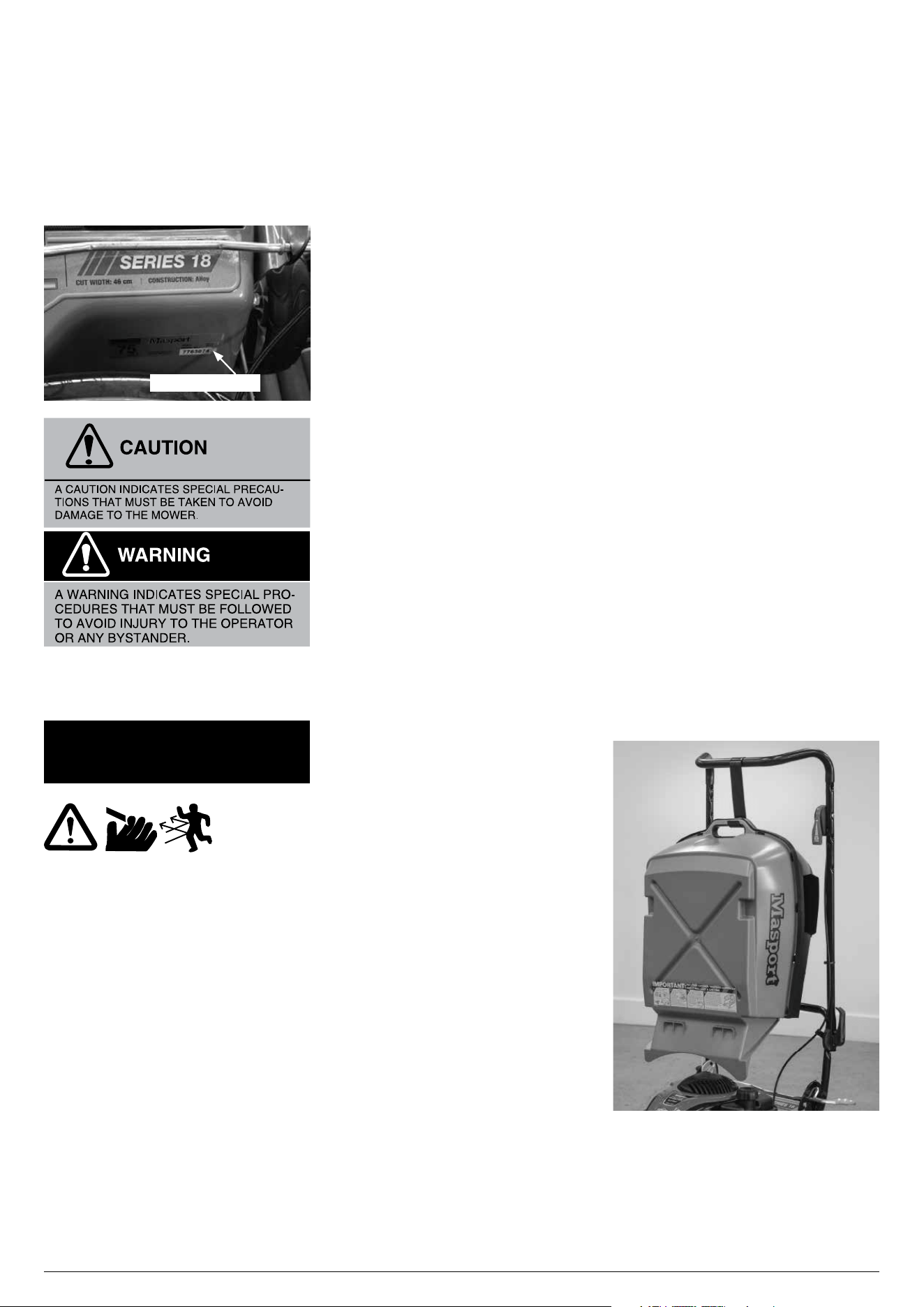
Record the serial number, you may need this
when ordering ordering spare parts.
Serial Number
SAFETY
INSTRUCTIONS
PLEASE READ ALL INSTRUCTIONS
BEFORE ATTEMPTING TO USE YOUR
MOWER.
TRAINING
1. Read the operating and maintenance manuals
carefully. Be thoroughly familiar with the controls
and the proper use of the equipment.
Know how to stop the mower and disengage the
controls quickly in an emergency.
2. Never allow children or people unfamiliar with
these instructions to operate the mower.
3. Keep the area of operation clear of all persons,
particularly small children and pets.
4. Never mow while people, especially children,
or pets are nearby;
5. Keep in mind that the operator or user is
responsible for accidents or hazards occuring to
other people or property.
PREPARATION
1. Thoroughly inspect the area where the
equipment is to be used and remove all stones,
sticks, wires, bones and other foreign objects
before mowing, they could be thrown by the
blade.
2. Do not operate the equipment when barefoot
or wearing open sandals. Always wear substantial
footwear and long trousers. It is advisable to wear
suitable eye protection.
3. Check the fuel before starting the engine. Do
not smoke while fuelling the engine. Do not fill
the fuel tank indoors, never remove the fuel cap
off the fuel tank or add fuel when the engine is
running or until it has been allowed to cool for
several minutes after running. Clean off any spilled
fuel before starting the engine.
4. Never attempt to make a wheel height
adjustment while the engine is running.
5. Mow only in daylight, and always keep children
away from the mowing area.
6. Never operate the equipment in wet grass.
Always be sure of your footing; keep a firm hold
on the handle and walk; never run. Never walk
backwards while cutting grass.
7. Replace faulty silencers
8. Before using, always visually inspect to see
that the blades, blade bolts, and cutter assembly
are not worn or damaged. Replace worn or
damaged blades and bolts in sets to preserve
balance.
OPERATION
1. Disengage all blade and drive controls before
starting the engine.
2. Do not tilt the mower when starting the engine.
3. Start the engine carefully with feet well away
from the blades.
4. Do not put hands or feet near or under rotating
parts. Always keep clear of the blade and
discharge opening.
5. Do not change the engine governor settings
or over-speed the engine. Excessive speed is
dangerous and shortens mower life.
6 Stop the engine when crossing gravel drives,
walks or roads.
7. Don’t mow over heavy or solid objects as
striking them with the blade can cause serious
damage to the engine and will void your warranty.
8. After striking a foreign object, stop the engine,
remove the wire from the spark plug, thoroughly
inspect the mower for any damage, and repair
the damage before restarting and operating the
mower.
9. If the mower should start to vibrate abnormally,
stop the engine, disconnect the spark plug wire,
and check immediately for the cause. Vibration is
generally a warning of trouble.
10. Stop the engine whenever you leave the
mower, even for a moment, before cleaning the
mower housing, and when making any repairs or
inspections.
11. When cleaning, repairing or inspecting, make
certain the blade and all moving parts have
stopped and that the engine has had time to
cool. Disconnect the spark plug wire, and keep
the wire away from the plug to prevent accidental
starting.
12. Do not run the engine indoors. Lethal exhaust
gases can be produced.
13. Shut the engine off and wait until the blade
comes to a complete stop before removing the
grass catcher or unclogging the chute.
14. Mow across the face of slopes; never up and
down. Exercise extreme caution when changing
direction on slopes. Do not mow excessively
steep slopes.
15. Never operate the mower without proper
guards, deflectors provided by the manufacturer,
or other safety devices in place.
16. Never pick up or carry a mower when it is
operating.
17. Where a fuel tap is fitted, turn it off at the
conclusion of mowing and reduce the throttle
setting during runout.
18. Do not operate the engine in a confined
space where dangerous carbon monoxide fumes
can collect.
19. Walk, never run
20. Use extreme caution when reversing or pulling
the mower toward you.
21. Stop the baldes if the lawmower has to be
tilted for transportation when crossing surfaces
other than grass, and when transporting the
lawnmower to and from the area to be mowed.
22. Do not start the engine when standing in front
of the dischardge chute.
MAINTENANCE
1. Before using, check the blade(s) and blade
bolt(s) for wear and damage. Replace worn or
damaged blades and bolts in sets to preserve
the balance. DAMAGED BLADES AND WORN
BOLTS ARE MAJOR HAZARDS.
2. Keep all nuts, bolts and screws tight to be sure
the mower is in safe working condition.
3. Never store the mower with fuel in the tank
inside a building where fumes may reach an open
flame or spark. Allow the engine to cool before
storing in any enclosure.
4. Store fuel in an approved container safely out
of the reach of children in a cool, well ventilated
place.
5. To reduce fire hazard, keep the engine free of
grass, leaves, or excessive grease.
6. Check the catcher bag frequently for
deterioration and wear, and replace worn bags.
Check that replacement bags comply with the
original manufacturer’s recommendations or
specifications.
STORING THE MOWER
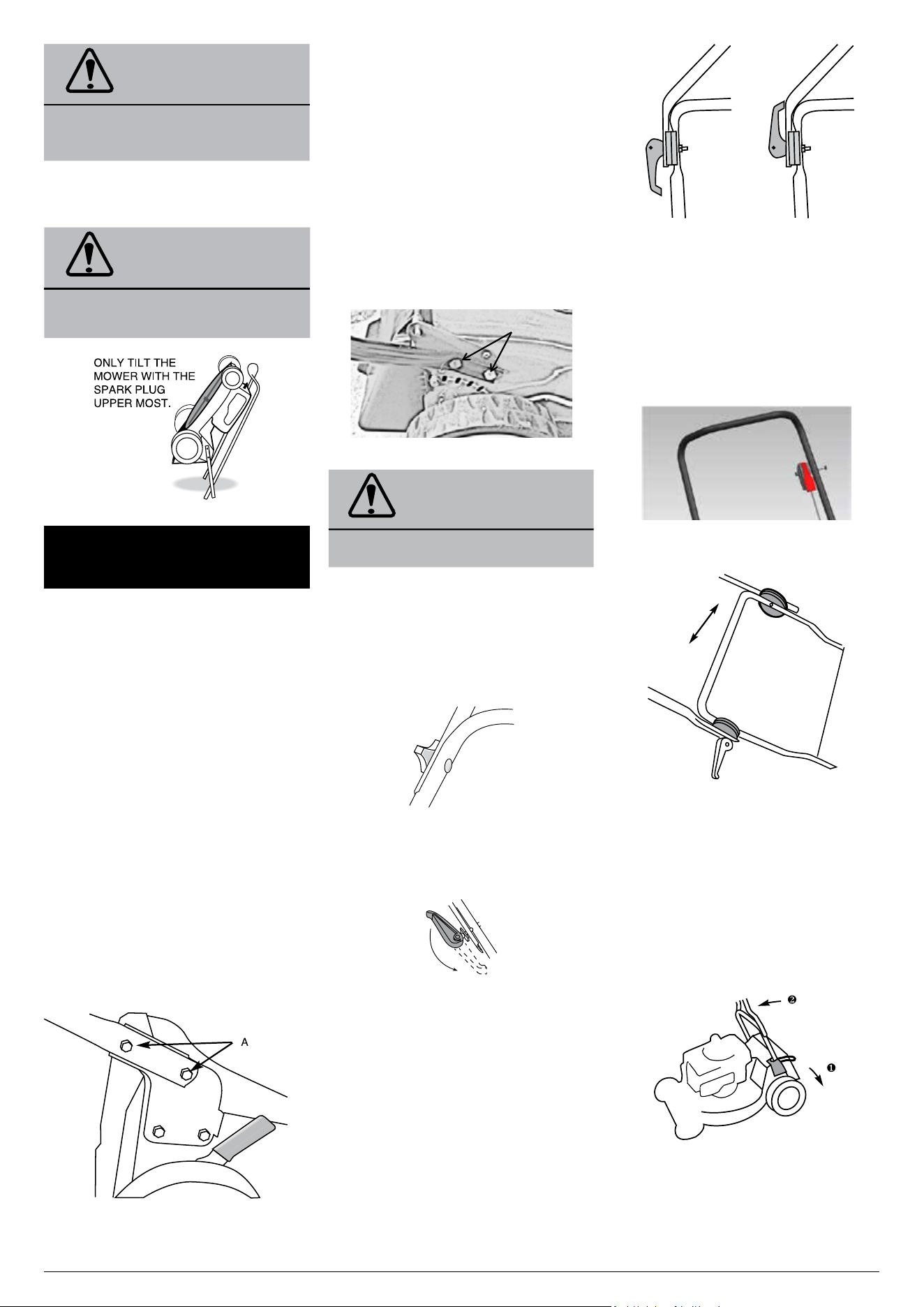
The handle can be folded to minimise space
requirements.
FOLDING THE HANDLE
Loosen the clamp knobs or unlock the handle
lever(s) in the middle of the handle and fold the
top section over the engine.
Ergoshift models can also be stored by moving
the handle to the upright position.
5
CAUTION
Check that the control cables are not being
strained while folding and unfolding the
handle� Permanent kinks will make the
controls difficult to operate�
TIPPING THE MOWER SAFELY FOR STORAGE
OR INSPECTION.
Tilting the mower—Drain fuel, then tilt the
mower with the spark plug uppermost�
Remove the spark plug lead�
CAUTION
ASSEMBLING THE
MOWER
Please refer to the following sections when
preparing the mower for its first use.
• Fitting the handle
• Preparing the Engine
• Assembling the catcher
NOTE - The left and right sides of the mower are
referred to as viewed from the operating position
behind the handle.
FITTING THE HANDLE
In some cases the handle may be completely
detached from the mower body although the
upper handle may be connected by the throttle
control cable. Carefully remove the mower and
handles from the box together to avoid damaging
the throttle control.
ASSEMBLING THE ‘SCREW LOCK’ HANDLE.
The lower handle is fitted to the mower using the
four bolts located in the handle brackets, two on
each side, ‘A’ in the drawing below. To bolt the
lower handle to the mower fit the bolts through
the lower handle then fit the handle to the mower
body and tighten the nuts on the outside of the
mounting brackets using a 13mm A/F socket or
spanner.
Now attach the upper handle to the lower handle.
420MM MODELS
The 420mm model is shipped with the handle
completely detached from the mower body
although the upper handle may be connected by
the throttle control cable to the engine. Carefully
remove the mower and handles from the box
together to avoid damaging the throttle control
and cable.
ASSEMBLING THE LOWER HANDLE
The lower handle stubs are fitted to the mower
using the four bolts located in the handle
brackets, two on each side, ‘B’ in the drawing
below. To bolt the lower handle to the mower fit
the bolts through the lower handle then fit the
handle to the mower body and tighten the nuts
on the inside of the housing using a 13mm A/F
socket or spanner.
B
Now attach the upper handle to the lower handle
stubs.
Take care not to rotate the handle before fitting
it, as this will tangle the control cable(s)�
CAUTION
Fit the two long bolts through the holes in the
lower handle from the inside with the round heads
snug against the tube. Fit the holes in the upper
handle over the two long bolts. Make sure that
the throttle control is located on the right hand
side. Attach the plastic knob to the outside of the
lower handle bolt as shown below and tighten by
hand until the upper handle is locked in position.
ASSEMBLING THE ‘CAM LOCK’ HANDLE.
Most of these models are fully assembled when
packed, so all that is needed is to remove
them from the carton, swing the handle to the
operating position and lock the handle lever(s).
THE CAMLOCK HANDLES ON SOME
MOWERS ARE REVERSED FOR SHIPPING.
To turn them around unwind the nut to the end of
the thread with a 13mmA/F spanner/socket, pull
the camlock handle outwards and rotate it 180
o
.
Retighten the nut until the handle locks firmly in
place and it does not change position when in
use.
The correct locked
position after refitting�
Locked position
when Shipped�
FITTING THE THROTTLE CONTROL
In some cases the throttle control may be
completely detached from the upper handle.
Using the bolt and nut attached to the throttle
control, attach the throttle on LH side of the
upper handle (inside the handle).
THE ‘ERGO’ HANDLE
CAM LOCK
LEVER
ADJUST
HEIGHT
The ‘Ergo’ handle can be adjusted to your
preferred height. Simply release both cam lock
levers, move the upper handle to the height
required and re-clamp the cam locks. Where the
mower has screw type locks, wind the knobs
firmly clockwise to lock the handle.
ERGO SHIFT
Some handles can be rotated forward to
give easy access to the rear flap. Depress the
foot lever u and push the handle until you feel
resistance— in a near vertical position v. The
handle can be moved back to the mowing
position without using the foot lever.
CONTRACTOR COMMERCIAL MODELS
ADJUSTING THE HANDLE HEIGHT
6
Stub Handle nut
Plastic knob
Stub Handle
To adjust the handle to suit your height on the 3
position handle setting, loosen and remove the
inner stub handle nuts. Loosen the plastic knobs
enough to pull out and swivel the stub handles
to the required hole setting. Tighten the plastic
knobs then refit and tighten the nuts.
PREPARING THE ENGINE
PLEASE READ AND UNDERSTAND THE
ENGINE MANUFACTURERS ENGINE
OWNERS MANUAL PRIOR TO OPERATING THE
LAWNMOWER.
DO NOT START your four stroke engine
before making sure that it has been filled
with the right amount of the correct grade
of oil� See engine instruction book for
details�
CAUTION
TWO STROKE ENGINES
require no special attention to lubrication provided
that the fuel/oil mixture is correct at all times.
FOUR STROKE ENGINES
Four stroke (cycle) engines are shipped without
oil. Place the mower on a level position, unscrew
the ‘OIL FILL’ cap and slowly pour oil into the
sump. Fill to the full mark on the dipstick. Use
SAE 30 engine oil. When checking the oil level,
and before running the engine, screw the dipstick
firmly in place.
Checking the oil level if the engine is not fitted
with a dip stick.
FUEL
PETROL VAPOUR IS HIGHLY FLAMMABLE
AND EXPLOSIVE� HANDLE WITH EXTREME
CARE� STORE IN AN APPROVED CONTAIN-
ER� DO NOT FILL TANK WHEN ENGINE IS
RUNNING OR IS STILL HOT� DO NOT ALLOW
OPEN FLAME, MATCHES OR SMOKING
NEARBY� FILL TANK OUTDOORS IN A WELL
VENTILATED AREA� WIPE AWAY ANY SPILLS
AND MOVE THE MOWER AWAY FROM ANY
PETROL FUMES BEFORE STARTING
ENGINE�
WARNING
If a blue plug is fitted beneath the petrol filler cap
it must be discarded� It is for transportation pur-
poses only�
If a blue plug is fitted beneath the petrol filler cap
it must be discarded� It is for transportation pur-
poses only�
CAUTION
• For two stroke engines fuel ratio, refer
to engine instruction book.
When filling the fuel tank, always leave an air
space of about 5mm to allow for expansion of
the fuel.
ENGINE
Regular attention to a few simple items will ensure
long and trouble-free service from your mower.
Carry out the regular maintenance described
in the engine manual, and check the engine
mounting bolts regularly to be sure they are tight.
NOTE: THE ENGINE IS WARRANTED BY THE
ENGINE MANUFACTURER AND NOT
MASPORT. YOUR SPECIALIST MASPORT
SERVICE DEALER CAN ASSIST WITH
ENGINE RELATED WARRANTY MATTERS.
Before making any adjustments to your mower
make sure that the engine is turned off and that
the blade has STOPPED ROTATING� Always
disconnect the spark plug wire and make sure it
cannot accidentally contact the spark plug before
touching anything under the mower housing�
WARNING
RUNNING THE ENGINE
ENGINE CONTROL
This is mounted at the top of the handle. It
operates the choke, if fitted (for cold starting)
and allows you to set the governed speed of the
engine.
On all models push control
forward for full throttle.
You will not need to change the control setting
constantly while mowing because the governor
holds the selected speed, even under varying
cutting loads. The positions for CHOKE (cold
start), FAST, SLOW and STOP are usually
marked. If STOP is not marked, move the lever
beyond SLOW to stop the engine.
Some controls have symbols instead of words.
On these,
means CHOKE,
means FAST,
means SLOW,
means STOP.
If your engine control does not have the word
CHOKE or the choke symbol you have a
Pulsa Prime engine. (See RUNNING THE
ENGINE, MANUAL START MODELS
ENGINE CONTROL.
This MUST be correctly adjusted for easy
starting and safe stopping. If you have cold
starting problems, adjust the outer sleeve
of the control cable under the clamp on the
engine at the lower end of the cable. See
engine instruction booklet for details. Make any
adjustments only with the handle in its normal
operating position. After adjusting, check that
the choke butterfly fully closes at one end of the
control lever travel, and that the ignition stop
switch is activated at the other.
STARTING
Ensure that the engine has been prepared
correctly (see above) and that the fuel tap (if fitted)
is turned ON. We recommend that you check the
oil level before every mowing session.
MANUAL START MODELS.
If the engine has not been running recently, set
the engine control to the CHOKE position. For
7
Pulsa Prime engines (which have no CHOKE
marking or symbol on the control), push the
primer bulb on the side of the engine by the
carburettor, refer engine owner’s manual. (Do this
also if you have just refilled the tank after running
out of fuel). Grasp the starter grip, pull slowly
until a resistance is felt and then pull forcefully to
prevent kick-back. Repeat until the engine starts.
Do not pull the cord with a jerk or release it until
fully rewound.—When the engine starts and has
warmed up for a short time, move the control to
the desired speed. Should the engine not start
due to ‘flooding’, move the control to SLOW and
pull the starter six times to clear the flooding.
ELECTRIC START MODELS.
Please refer to the Electric Start instructions
supplied with your mower.
HINTS FOR EASY STARTING
1. Stand the mower on a paved drive or path
where the blade is clear of the grass. If
you must start on the lawn, move to an
already cut area and/or raise the cutting
height. Do not start the mower on a gravel
surface.
2. Start a warm engine with the control in the
SLOW position.
3. Keep the mower clean underneath.
HARD STARTING CHECK LIST
Look for these faults:-
FUEL 1. Insufficient fuel in tank.
2. Fuel tap shut off.
3. Stale fuel.
4. Water or dirt in fuel.
5. Blocked air vent in fuel tank cap.
IGNITION 1. Loose spark plug wire.
2. Dirty spark plug electrodes.
3. Incorrect spark plug gap.
4.Incorrect spark plug type.
OTHER 1. Choked air filter (Dirt or oil).
2. Engine control cable
mis-adjusted.
3. Cutting blade obstructed.
STOPPING
Move the engine control to stop
DRIVE CONTROLS
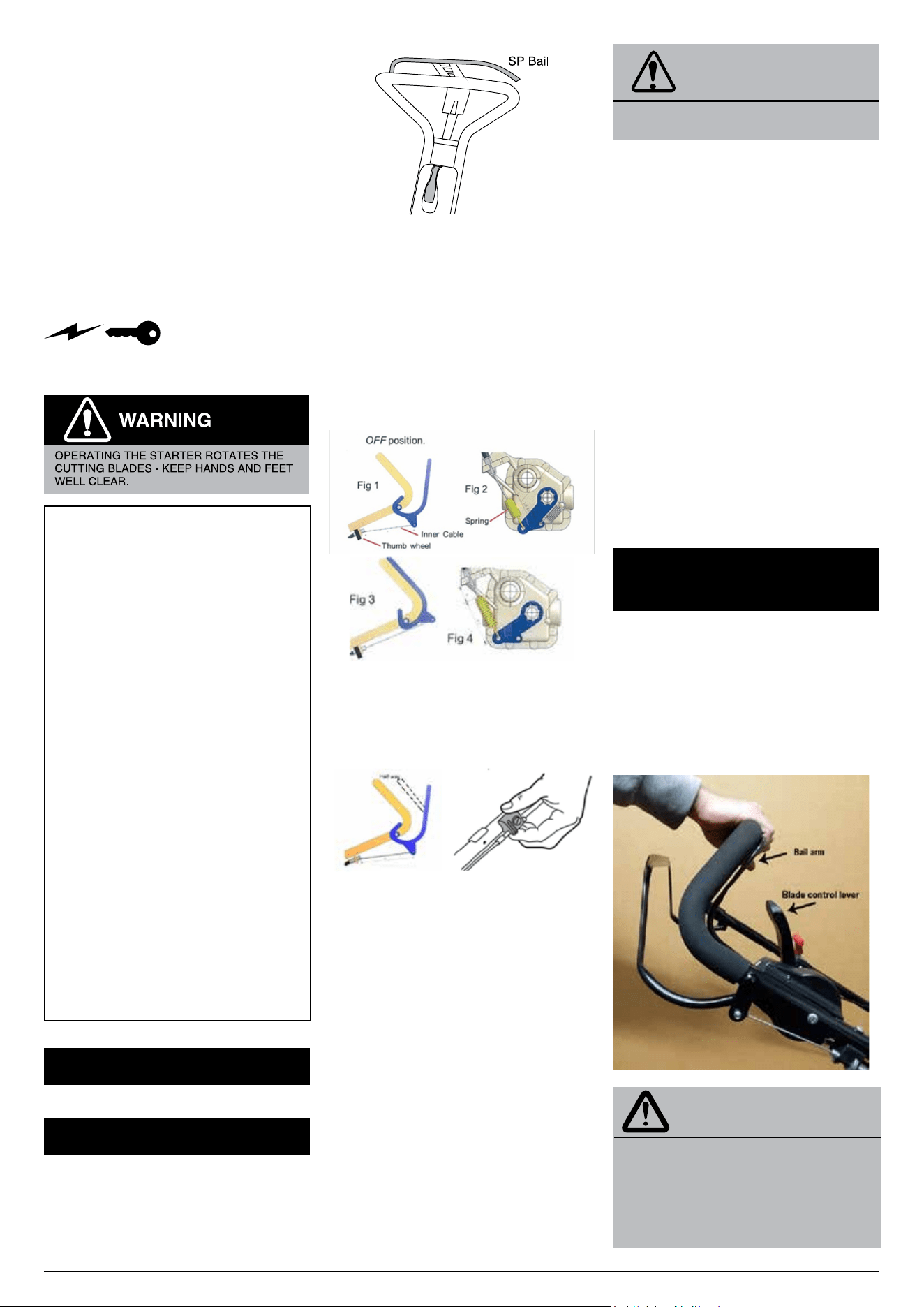
To engage the mower drive, simply push forward
on the SP bail arm until it meets the handle grip.
Releasing the pressure on the bail will de-clutch
the drive mechanism. Naturally you may use the
mower as a push model by gripping the handle in
the normal way.
SP DRIVE CLUTCH CABLE ADJUSTMENT
1. Confirm that the cable inner wire will move
at least 26 mm when the SP bail is moved
from the clutch disengaged (open- Fig1and
2) position to the engaged (closed-Fig3)
position against the handle. The first 13mm
moves the lever of the gearbox(Fig4) to the
engaged position and the final 13mm gives
the spring the desired 140N for the required
tension on the gearbox cones to work
properly without slipping under load. Adjust
the contour of the bail slightly if necessary to
achieve this wire stroke.
2. Wheel the mower backwards toward you
while gradually closing the SP bail, and note
the position of the bail when extra resistance
to backward movement indicates that the
drive clutch is just engaging. This extra
resistance should occur when the SP bail is
half way between open and closed (Fig 5).
Fig 5 Fig 6
3. If the engagement point is incorrect, adjust it
by rotating the thumb-wheel on the anchor
block at the top of the cable outer sleeve.
Rotating the wheel clockwise will move
the clutch engagement point nearer to the
bail closed position, and anti-clockwise will
move it toward the bail open position (Fig 6).
4. Confirm that the adjustment is correct by
re-testing the engagement point.
5. Repeat this adjustment after 150 hours use
of the mower or at any time if the mower
drive seems to be slipping.
IMPORTANT: An incorrectly adjusted clutch
cable, or using the mower with the SP bail not
fully against the handle will cause clutch slippage,
gearbox overheating and serious gearbox
damage.
CAUTION
Adjust only to provide positive drive� Excess
pressure will cause cable and belt stretch�
VARIABLE SPEED MODELS
Some models have an extra control mounted at
the side of the handle to allow the travel speed
of the mower to be varied without changing the
engine speed. This control moves into an one
of eight positions. Move the lever forward to
increase travel speed and backward to lower it.
THIS LEVER SHOULD BE MOVED ONLY WHILE
THE ENGINE IS RUNNING.
[If it is inadvertently moved back when the engine
is stationary the drive belt will slacken and slip. To
regain traction, move the lever forward with the
drive disengaged and the engine running.]
Speed changes can be made whether the mower
is moving or not.
CONTRACTOR COMMERCIAL MODELS
Self-propelled 3 Speed models.
The three speed gearbox can be changed to 1st
2nd or 3rd while the engine is running or not with
three distinct positions in the gearbox.
BLADE CONTROL LEVER
FOR BBC MODELS
To start the blade rotation, hold the inner bail arm
against the handle with your left hand. With the
engine running at full speed, push the control
lever quickly all the way forward and then return
it back to the start position. Keep holding the
bail arm against the handle. To stop the blade
rotation, simply release the bail arm. The blade
will stop quickly and the engine will continue to
run.
CAUTION
The blade has been designed to stop and start
while the engine is running.
NEVER PUT YOUR HANDS OR FEET
NEAR THE BLADES WHILE THE ENGINE
IS RUNNING EVEN IF THE BLADES HAVE
STOPPED
8
THE GRASS CATCHER
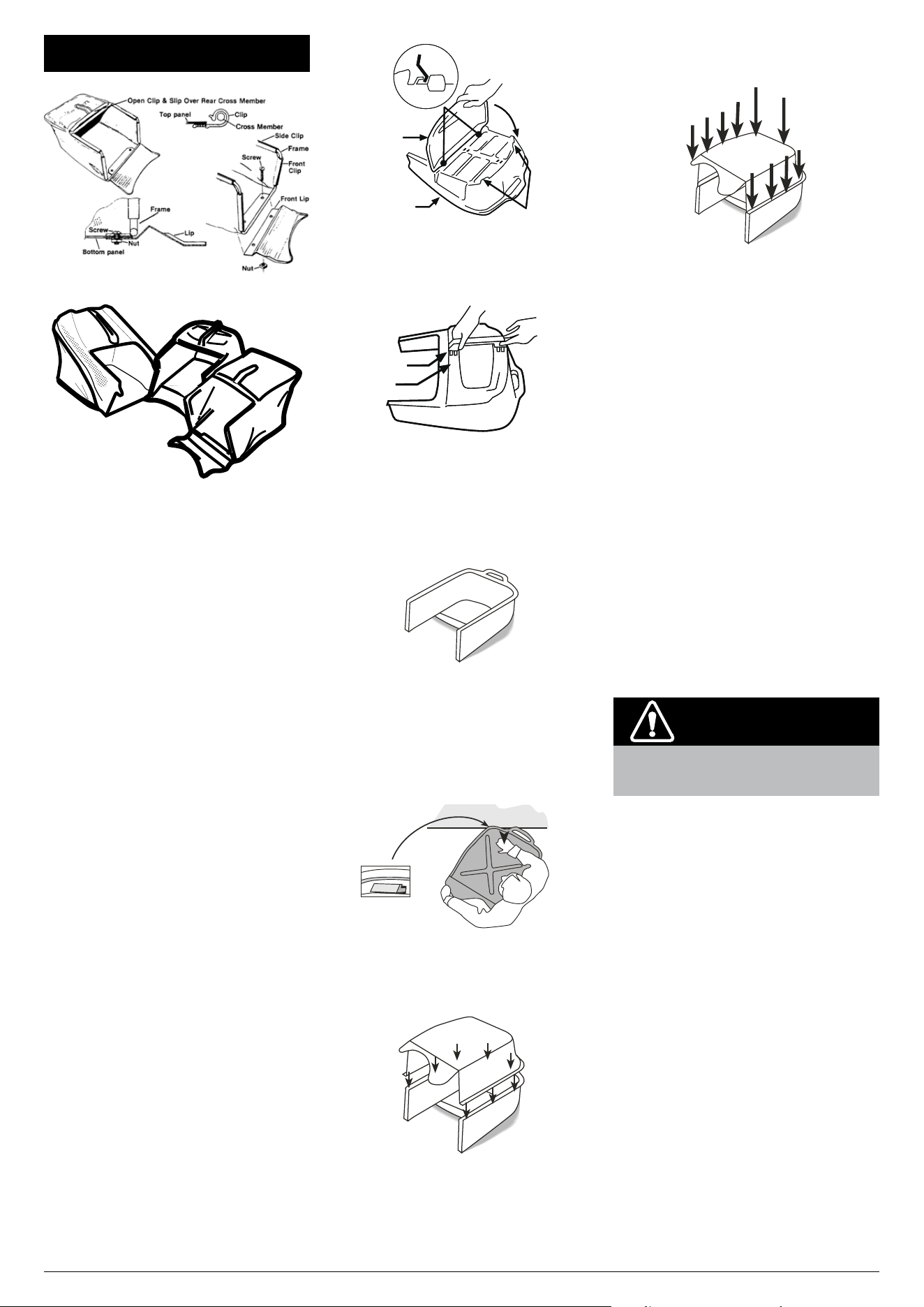
CATCHER ASSEMBLY
There are three catcher types:
A. Bag Catcher
B. Moulded Plastic Catcher
C. Aero Catcher (moulded plastic top sections
with fabric side panels.)
A. BAG CATCHER
1. Slide the bag over the wire frame. Fit the
plastic clip up under the frame crossmember
(the one which is formed into a handle) and
hook the clip onto the wire crossmember.
You may need a lever such as a screwdriver
to open one end of the clip to get it started
over the wire.
Pass the side and front clips inside the
frame and hook them onto the wire in a
similar way.
2. Fasten the metal front lip to the catcher
assembly by bolting it to the plate on the
bottom of the frame. The bottom panel of
the catcher should be fitted between the
plate and the lip as shown. Fit the screws
from the top with the nuts under the lip, and
tighten them securely.
B. MOULDED PLASTIC CATCHER
There are two types. One has the top cover
and handle already fitted to the top shell of the
catcher, while the other requires these parts to be
assembled.
IF YOUR CATCHER HAS THESE PARTS
ALREADY ASSEMBLED, START AT STEP 4.
1. Place the top of the catcher shell (A) on a
firm level surface with its mesh upwards.
2. Holding the top cover (B) with its concave
side facing the mesh, lift its rear end and
engage the front clips with the hooks on the
catcher top shell. Keeping them engaged,
swing the rear of the cover downwards and
press it down until the barbs on the cover
engage with the slots in the shell.
‘A’
‘B’
‘A’
‘B’
3. Look for the “F” on the handle and ensure
that it will be adjacent to the “F” on the
catcher shell. Fit the handle by pressing it
firmly into the square recesses in the catcher
top.
‘F’
‘F’
‘F’
‘F’
Turn the assembly over to confirm that the
barbs on the handle are fully home, and
push the tabs on the shell back into position
to retain the handle.
4. Place the top shell on a solid work bench,
open side up. Don’t use a table which may
be damaged by scratching.
5. Position the bottom shell, upside down,
over the top shell, carefully aligning the two
parts and ensuring the barbed clips are
aligned with their corresponding slots and
squeeze the rear handles together.
6. Keeping the catcher upside down, move
the assembly so the lip and rear handle is
supported by the edge of the bench (see
diagram) and catcher is trapped between
your body and the bench.
7. Strike the top of the assembly with an open
hand above the part supported by the
bench. You should hear the barb click into
place in its slot - if not, check the alignment
and strike again with a little more force.
8. Working from left to right, and starting by
the rear handle, move around the catcher,
supporting each fastener in turn on the
edge of the bench, as it is pushed into
engagement.
1
2
3
6
10
4
5
9
8
7
9. Finally inspect carefully to ensure that all
clips are fully engaged.
C. AERO CATCHER
The bag and moulded plastic catchers have lips
at the front which fit the top of the crossbar on
the base of the discharge tunnel, while the Series
18 Rotarola catcher has two lugs that fit into the
hooks of the handle brackets.
Aero catchers have two plates under the front
crossbar which hook into the support channel
at the rear of the mower near the ground. Keep
the rear of the Aero catcher near the ground
until the plates are engages with teh support
channel, then pivot the catcher up into position.
The chute or flap can be release as it swings up
since the hooks on the front of the catcher will
automatically engage on the mower, allowing the
chute or flap to drop into the lockedposition on
the catcher.
For all types of catcher, make sure that rear edge
of the chute of flap is fully engaged with the
catcher to hold it in place securely.
FITTING THE CATCHER
THE CATCHER SHOULD BE FITTED TO AND
REMOVED FROM THE MOWER ONLY WHEN
THE ENGINE HAS STOPPED�
WARNING
Standing to the right of the mower, reach down
with your right hand and pull back and up on
the handle of the safety flap or Smart Chute and
lift it until it is parallel with the handle. Pick up
the catcher with your left hand and swing it into
position at the rear of the mower.
The catcher lip of the fabric and plastic catchers
fits on top of the crossbar or the base of the
tunnel, while the two hooks at the top of the Aero
catcher mouth sit on top of the brackets inside
the discharge outlet of the mower. The Series 18
Rotarola catcher has two lugs which fit on the
hooks near the handle brackets of the mower.
Once the catcher is positioned correctly, lower
the flap or Smart Chute to hold it in place. Make
sure that the rear edge of the flap or Smart Chute
is fully engaged on the lip or bar at the rear of the
catcher mouth.
420MM MODELS
FITTING THE PLASTIC CATCHER
Standing to the right of the mower, reach down
with your right hand and pull back and up on the
handle of the rear flap and lift it until it is parallel
with the handle. Pick up the catcher with your left
hand and swing it into position at the rear of the
mower.

9
The catcher lip has two pins that need to be lined
up with the slots of the housing.
Pin
Slot
Once the catcher is positioned correctly, lower
the flap to hold it in place. Make sure that the rear
edge of the flap is fully engaged on the lip at the
rear of catcher mouth.
FITTING THE FABRIC CATCHER
Standing to the right of the mower, reach down
with your right hand and pull back and up on the
handle of the rear flap and lift it until it is parallel
with the handle. Pick up the catcher with your left
hand and swing it into position at the rear of the
mower.
The fabric catcher has two lugs which fit on the
hooks near the handle brackets of the mower.
Once the catcher is positioned correctly, lower
the flap.
REMOVING THE GRASS CATCHER
WARNING
ALWAYS WAIT UNTIL THE ENGINE AND
BLADE HAVE STOPPED COMPLETELY
BEFORE REMOVING THE CATCHER OR
ADJUSTING THE MOWER� REMEMBER, THE
MUFFLER AND NEARBY AREAS MAY BE
VERY HOT�
ALL MODELS
Stop the engine and stand to the right of the
mower. Grasp the catcher handle with the left
hand and lift slightly while raising the safety flap or
smart chute with the right hand. Lift the catcher
clear and lower the flap or Smart Chute to cover
the grass discharge outlet.
Before clearing away any grass which may have
lodged in the grass chute, ALWAYS STOP THE
ENGINE, make sure the blade has stopped
rotating, AND REMOVE THE SPARK PLUG
WIRE�
WARNING
EMPTYING
Dump the grass from the catcher by holding it
vertical, using the rear handle of the moulded
catcher or holding the rear end of the steel
frame of the fabric catcher. Shake if necessary to
dislodge a full load.
CATCHER LEVEL INDICATOR
Some grass catcher models have a Catcher Level
Indicator to show how much grass has been
collected. The indicator functions only when the
engine is running at grass cutting speed. When
the catcher is empty, the indicator will show
all green, nut as the grass progressively builds
in height, a red indicator zone will appear and
increase in size. Attempting to over-fill the catcher
will result in discharge chute blockage or a
“dribble” of grass from the front of the catcher.
Experience in your particular grass and cutting
conditions will soon show the size of the red
indicator area corresponding to the ideal catcher
emptying point, Hose the catcher thoroughly after
each use to keep the indicator movement free.
GRASS CATCHER MAINTENANCE
FABRIC TYPES.
These depend on a free flow of air thought the
fabric for effective grass collection. Wash as
needed to restore and open mesh in the fabric.
Do not leave a fabric bag in direct sunlight when
not in use. While the bag will not rot if stored
wet, prolonged sunlight exposure can cause
premature breakdown of the material. Do not
leave clippings in the catcher for extended
periods.
WARNING
CHECK THE CATCHER BAG FREQUENTLY
FOR DETERIORATION AND WEAR, AND
REPLACE IF WORN� Use only genuine original
equipment replacement catcher bags as others
could be dangerous�
MOULDED PLASTIC TYPE.
These also need a free passage of air for efficient
catching. Keep the air outlet mesh clear by
hosing it frequently. Do not leave clippings in the
catcher.
CUT HEIGHT CONTROL
The single point cut height control adjusts all four
wheels simultaneously. To operate, steady the
mower by grasping the handle with one hand,
pull the lever outwards from the mower with the
other hand, and move it to the desired setting.
MOWING ACCESSORIES
A grass deflector chute for mowing without a
catcher is available for some models from your
dealer. Not required for ‘Smart Chute’ models.
MOWING ADVICE
The best time time to mow your lawn is the
early afternoon. By this time the grass has had
a chance to dry out. Also the sensitive newly cut
grass area isn’t exposed to the direct sun.
For healthy growth, grass should not be cut too
short. Using the lowest settings can result in
destruction of the crown of grass, allowing flat
lying weeds to develop.
Vary your cutting pattern from week to week.
One week mow your lawn from north to south,
the next week, mow your lawn from east to west.
This will help prevent matting and graining of the
grass.
For best performance, always keep the mowers
blade sharp. A dull blade tends to tear, not
cut, the blades of grass. When cutting very
long grass, a preliminary cut on a high setting,

10
followed by a lower cut (preferably a day or so
later), will minimise the overall time required for
the job.
Do not try to cut too much off the grass at one
time. This can cause excessive loads to be
put on the engine and also effect the mulching
performance.
Avoid using the lowest two or three height
settings when mulching. For best results when
mulching; cut off only the top third (or less) of
the grass. Cutting lower than this will have a
detrimental effect on the mulching performance.
AVOID USING THE LOWEST
TWO OR THREE CUT SET-
TINGS IN WET OR VERY
LONG GRASS �
As you turn the mower at the end of a strip you
may notice unmulched grass. The mower deck
is naturally tilted upward when turning so that
the air flow which holds the grass in position for
recutting is momentarily decreased. After mowing
the lawn, you can go back and mow only the
turns so that the clippings are no longer visible.
Clean the mowing chamber frequently to
remove grass build-up. This will keep mowing
performance at its best, especially when
mulching. Avoid cutting your lawn when it is wet.
Wet grass tends to form clumps and interferes
with the mulching action of the mower.
If you are not collecting the cut grass, mow
in a pattern that deposits the clippings on
the previously cut swathe. So, if your mower
discharges clippings on the left, the next cut
should be to the right of the previous one, and
vice-versa.
If you use the mower often without collecting the
clippings, you will find that the accessory grass
delivery chute (available from your Dealer for most
models) will assist by spreading the clippings
more effectively.
WARNING
DISCHARGE OPENINGS MUST BE GUARDED
AT ALL TIMES� DO NOT REMOVE THE
GRASS DEFLECTOR OR HOLD THE SAFETY
FLAP UP WHILE MOWING�
When cutting close to obstructions such as tree
trunks, and when mowing to the edge of a lawn
where there is no wheel support, use the left side
of the mower, giving a useful blade ‘overhang’ for
ready access to awkward areas.
MOWING ADVICE—‘SMART CHUTE’
The ‘Smart Chute’ allows you to mow without
catching the grass or mulching. By simply
opening the ‘door’ located on the bottom left
hand corner of the ‘Smart Chute’, the lawn can
safely be mown while smoothly spreading the
clippings to the left. For wet, heavy or very long
grass we advise not using the lowest two of three
cutting heights as this may cause clogging. If is
still persists, try walking slower, cutting a narrower
strip or raising the cut height more.
SMART CHUTE
OPEN
SMART CHUTE CLOSED
ON CATCHER
WARNING
Never use the ‘Smart Chute’ on the catcher with
its door open� This could cause damage or injury
to property or bystanders�
FITTING THE MULCHING
BLOCK TO THE MOWER
1. Stop the engine
2. Make sure the discharge chute and the
underside of the mower are clean.See
AFTER MOWING.
3. Raise the flap, and using the hand hold on
the mulching block, insert the mulching
block, the angled section to the mowers
right, into the discharge chute.
In the case of “open-back” mowers, make sure
that the back of the block is sitting on the rear
axle before lowering the flap. When fitting the
block into a mower with a grass discharge chute,
ensure that the lug at the left side of its base
is slipped into the notch at the bottom rear of
the chute sidewall before lowering the flap. See
‘Mowing Advice’ for mulching tips.
420MM MODELS
Raise the flap, and using the hand hold on the
mulching block, insert the mulching block, the
angled section to the mowers right, into the
discharge chute.
When fitting the block into a mower, ensure that
the pin at the left side of its base is into the notch
of the housing before lowering the flap.
FITTING THE SIDE
DISCHARGE CHUTE
For mowers equipped with a side discharge, the
discharge openings must be guarded at all times.

11
THE MOWER MUST NEVER BE OPERATED
WITHOUT EITHER THE GRASS CHUTE OR THE
CHUTE FLAP INSTALLED.
FROM INSIDE
FROM ABOVE
FROM ABOVE
GRASS CHUTE TO BE ATTACHED AS SHOWN.
2 x screws from above with nuts underneath and
1 x screw from inside the housing with nut inside
grass chute.
DO NOT REMOVE THE GRASS CHUTE OR
HOLD THE CHUTE FLAP OPEN.
PERSONAL INJURY, INJURY TO BYSTANDERS
OR DAMAGE TO PROPERTY COULD RESULT
FROM OPERATING A MACHINE WITHOUT
THESE ITEMS FITTED CORECTLY.
CHIPPER MOWERS
When using the chipper tube place the mower
on a level area where markings by he rotating
chippings won’t matter. Before starting the
mower fit the catcher and set the cut height to its
lowest setting. Check that the chipper feed tube
is clear and the feed intake flap is in good order.
WARNING
Check frequently that the blade is sharp and the
retaining screws are tight�
Branches up to 35mm can be chipped using
the chipper tube. Only green timber should be
chipped. DO NOT chip hard or dry wood. Hard
and/or dry woods can be place unreasonable
loading on the machine causing damage. Check
that there are no nails or foreign objects in the
material being chipped.
WARNING
Always stop the engine before attempting to
clear any obstruction from under the mower or in
the chipper tube�
Slowly feed material into the intake tube. Sturdy
gloves, footwear, ear and eye protection should
be worn. Empty the catcher frequently to avoid
building up chippings inside the mower housing.
Clear debris away from around the engine
frequently to prevent any restriction with cooling
air flow and prevent the risk of fire. Stop the
engine before removing the catcher.
AFTER MOWING
CLEANING
MODELS WITH A CYCLOWASH FITTING.
Stop the engine and remove the catcher. Attach
a garden hose fitting to the cylcowash fitting and
start the engine. Allow a good flow of water to run
for 2-3 minutes. Stop the engine and remove the
hose. Hose the Catcher.
Cyclowash Fitting
MODELS WITHOUT A CYCLOWASH FITTING.
Stop the engine and remove the catcher. Start the
engine. Keeping well clear of mowing parts, apply
a garden hose to the Wash port with a good flow
of water for 2-3 minutes. Hose the catcher.
MODELS WITHOUT A CYCLOWASH PORT.
Stop the engine, when the blade has stopped,
disconnect the spark plug wire. Remove the
catcher and tip the mower in accordance with
the engine instruction book maintenance section
(spark plug uppermost). Hose the underside of
the mower clean. Hose the catcher.
DO NOT HOSE THE ENGINE, as water can
damage the air cleaner and the ignition system�
REFER TO ENGINE INSTRUCTION BOOK
MAINTENANCE SECTION BEFORE TILTING
MOWER� STORE YOUR MOWER ON ITS
WHEELS, not its side�
CAUTION
BLADES
DAMAGED BLADES AND WORN BOLTS ARE
MAJOR HAZARDS.
Check the blade mounting bolts at frequent
intervals for proper tightness.
Check the blade condition frequently, particularly
if the mower has hit a foreign object or is
vibrating. Sub-standard cutting and catching will
result from a neglected blade. Your Authorised
Dealer will be happy to sharpen or replace blades
as necessary.
CAUTION
ALWAYS USE GENUINE ORIGINAL EQUIP-
MENT PARTS TO ENSURE SAFETY AND
PROPER PERFORMANCE� Substitute parts can
be disappointing and dangerous�
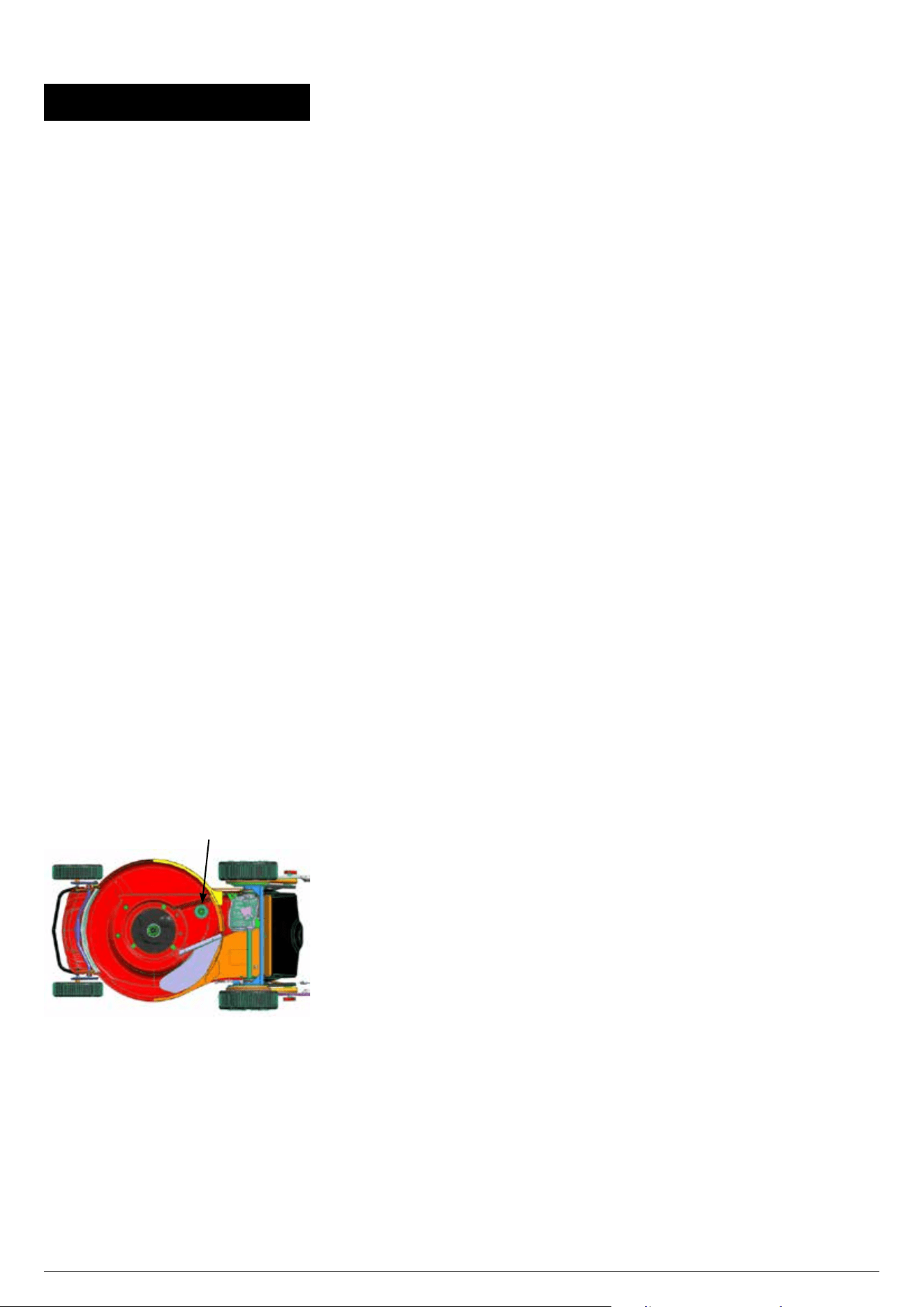
BLADE SERVICING INSTRUCTIONS
BAR AND DISC BLADES.
1. Remove the spark plug lead and position it
to prevent accidental contact with the spark
plug.
2. Tilt the mower upright - refer to maintenance
section of the engine instruction book before
tilting the mower.
3. BAR BLADES. Remove the central bolt and
spring washer.
4. Remove the blade. Either sharpen and
balance the old blade, or fit a new one.
Assemble in the reverse order.
QUICK CUT BLADE/QUADCUT
®
BLADE.
Follow steps 1 and 2 above. The cutting tips can
be removed and replaced by removing the blade
carrier from the mower. Note the component
positions when dismantling. When refitting the
blade carrier ensure the slots fit properly over
the lugs and the drive plate, and replace the
mounting bolts if they show signs of wear.
Quick Cut Blade
QUADCUT
®
BLADE
CHIPPER BLADE.

12
1. Follow the servicing instructions for
removing the “Bar and Disc Blades’ on this
page.
2. When the blade carrier is removed from the
crankshaft it can be place in a vice and the
chipper blade removed.
3. Either sharpen and balance out the old
blade, or fit a new one. The mower blade
should also be inspected at the same time.
4. Assemble in the reverse order, taking care
to align the keyway slot in the blade and the
blade driver.
BLADE REPLACEMENT TORQUE
SETTINGS:
Blade center bolt 45-50 Nm (33-37 ft.lb)
Four 6mm chipper
blade bolts
9-11 Nm (6.6-8 ft.lb)
Four 8mm chipper
blade bolts
20-22 Nm (15-16 ft.lb)
Tip mounting bolt 20-25 Nm (15-18 ft.lb)
CONTRACTOR COMMERCIAL MODELS
WHEEL TORQUE SETTING:
Four wheel M8 nyloc
nuts
8 – 9 Nm
(5.9 – 6.6 ft.lb)
ENGINE MAINTENANCE
Consult the engine booklet for the makers
instructions.
DRAINING THE OIL.
While most engines have a drain plug underneath
them, it will be found more convenient to remove
the oil dipstick and tip the mower on its side.
Collect the old oil in a suitable tray such as a two
litre ice cream container.
IGNITION.
Your engine has a breaker-less solid state ignition
system which requires no maintenance other
than occasional attention to the spark plug. We
recommend cleaning and re-gapping
every 50 hours with replacement every 100 hours
(see engine instruction booklet).
CAUTION
DO NOT SANDBLAST PLUGS as abra-
sive grains can enter the engine and
cause serious damage� USE ONLY THE
EXACT TYPE OF REPLACEMENT PLUG
specified in the engine instruction booklet�
AIR CLEANER.
A clean filter cartridge, correctly fitted, is
ESSENTIAL for long engine life. Service the filter
every 25 hours running (more often under adverse
conditions) according to the instructions in the
engine booklet.
MUFFLER.
A rusted or damaged muffler can permit
increased exhaust noise. Check the muffler
condition periodically and replace it only with a
genuine original equipment part.
DRIVE MAINTENANCE
ROTAROLA.
Every 25 hours -
Remove the outer chain cover and apply grease
to the chain.
Every 100 hours -
Remove the outer chain cover, disconnect the
outer chain at its connecting link, withdraw the
sprocket at the top end of the inner chain cover.
Remove the inner chain cover and apply grease
to the chain.
OTHER SELF PROPELLED MODELS.
Every 100 hours -
Remove each rear wheel by removing the hub
cap, and undoing the 8mm nyloc nut and washer
retaining the wheel to the axle. Remove the
circlip retaining the pinion, taking care not to over
stretch it, and remove the washer and
pinion. Apply grease to pawl y, pinion bore z,
and wheel gear {. Take care to replace the pawls
exactly as they were removed, and do not move
pinions to the opposite side of the mower.
GEARBOX.
The gearbox on these models is a sealed unit that
requires no maintenance. Just keep the outside
clean.
CLEANING
MAINTENANCE
THE FOLLOWING MAINTENANCE IS
REQUIRED EVERY 100 HOURS OR WEEKLY
IF USED COMMERCIALLY (REFERS ONLY TO
SELF-PROPELLED MOWERS)
Remove both the gearbox and drive belt covers.
Belt Cover
Gearbox
Cover
Clean out any debris within the drive belt cavity
and around the gearbox. Ensure that there is no
grass build up between the gearbox clutch arm
and travel stop.
WARNING!
Do not use a pressure washer
around the gearbox.
1. Check that the drive belt is tight and has the
correct tension. Adjust if necessary.
2. Check that the clutch arm reaches the travel
stop when the bail arm is released and
adjust if necessary. There should be a small
amount of inner wire slack in this position.
3. Replace the covers.
4. Remove both rear wheels and clean out any
debris. Grease the teeth on the gears and
reassemble.
IMPORTANT
Tighten the M8 nyloc nuts to 8 - 9 Nm.
13
BELT ADJUSTMENT
SINGLE SPEED MODELS.
(Except self propelled Chipper models &
Rotarola)
Keeping the spark plug uppermost, tilt the
mower to gain access to the gearbox. Using two
10mm AF spanners, slacken the screw which
clamps the gearbox anchor bracket to the mower
housing just enough to allow the gearbox to be
rotated about its output shaft. Rotate the gearbox
to take any slack out of the V belt drive and re-
clamp the anchor bracket in its new
position by tightening the clamp and screw firmly.
SELF PROPELLED CHIPPER MODELS AND
ROTAROLA
These have a belt tensioning idler pulley. To adjust
this, slacken off the clamp screw or nut which
holds the V shaped idler pulley post and slide the
post along the slot in the body. Re-tighten the
screw or nut when the slack in the belt has been
eliminated.
VARIABLE SPEED MODELS.
DO NOT tip the mower up as described above
for single speed models. Variable speed models
have an adjuster on the cable running down from
the speed control to the drive mechanism. Alter
this adjuster only if the travel of the speed control
lever does not match the full range of available
travel speeds.
The adjuster has three parts, two end fittings
each attached to upper and lower outer cables,
and a central barrel connected to the end fittings
by right and left hand threads. Keeping the end
fittings stationary, rotate the barrel to push the
ends apart to increase travel speed, and to bring
the end fittings together to reduce travel speed.
Using this adjuster will compensate for belt
stretch or wear which may occur.
CONTRACTOR COMMERCIAL MODELS
BELT ADJUSTMENT
Idler Pulley
If the belt is to be replaced or worn and slipping
and requires adjustment. Follow the servicing
instructions for removing the “Bar and Disc
blades” as explained in the Owner’s manual.
Remove the blade driver and belt covers.
Using two spanners loosen the nut and bolt
holding the idler pulley, while pressing it to tension
the belt tighten the nut and bolt.

14
TROUBLE SHOOTING
TROUBLE PROBABLE CAUSE SOLUTION
Uneven or poor cut Blunt blade Sharpen blade
Heavy mulch left on cut strip Cutting height is too low for the height of the
grass being cut.
Adjust the cutting height to approximately on
third of the length of the grass. Then work
down to the desired height.
Engine not running at full speed Move the throttle to fast.
Underside of the mower’s deck is clogged with
wet grass clippings
Hose off the underside of the mower using
they cyclowash hole in the mower body

15

Head Office - New Zealand
1-37 Mt Wellington Highway. Panmure,
PO Box 14 349
Auckland 1741
Head Office - Australia
1/40 Abbots Road
Dandenong South
Melbourne
Victoria 3175