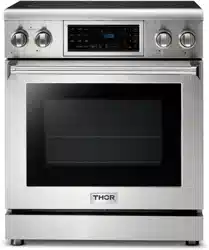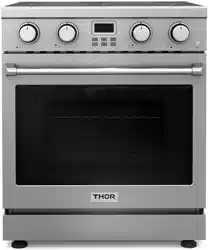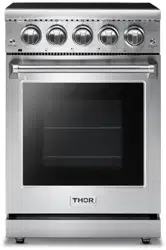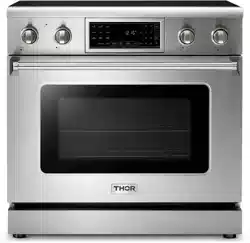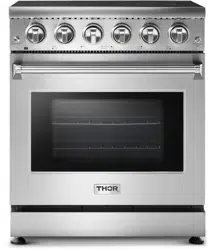

USE AND CARE MANUAL
COOK
LIKE
A
GOD
HRE MODELS
HRE3601 | HRE3001 | HRE2401

PROFESSIONAL
ELECTRIC RANGES
USE AND CARE MANUAL
HRE MODELS
HRE3601 | HRE3001 | HRE2401

Contents
BEFORE YOU BEGIN
2
POSITIONING THE OVEN RACKS
14
ANTI-TIP DEVICE
2
OPERATING THE OVEN
Oven burmer use
Broil bumer use
Oven cooking safety guidelines
Oven function
Broiler operation
15
15
15
15
15
16
IMPORTANT SAFETU INSTRUCTIONS
Important safety instructions
What you need to know about safety instructions
For your safety
Important safetyinstructions
Surfacecooking units
Electrical safety
Child safety
Oven
Ventilating hood
Glass/ceramic cooking surfaces
Critical installation warnings
Usage cautions
3
3
3
3
3
4
4
4
5
5
5
5
6
Cleaning and maintenance
Cleaning stainless steel surfaces
Cleaning the oven racks
Cleaning the oven door
Cleaning the surface burner control knobs
17
17
17
17
17
Removing the Oven Door
Removing the oven door
Replacing the oven door
19
19
19
PRODUCTDIMENSION
Checking the installation site
7
7
Trouble shooting
Installtion
Cooktop
Oven
20
20
20
21
PREPARING TO INSTALL THE RANGE
Minimum dimensions
8
8
CONNECTING THE POWER
8
Warranty and Service
Warranty and service
Warranties and duration
Thor group will pay for
Thor group will not pay for
21
21
21
21
21
KD INSTALLATION PROCEDURES
10
RUBBER PAD INSTALLATION ON BACK PANEL
11
Warranty and Service
Warranty and product registration
22
22
INTRODUCING YOUR NEW RANGE
Before you begin
Energy saving tips
11
12
12
Warranty and Service
Warranty notification
Warranty and product registration
22
22
22
COOKTOP COOKING
12
1

Before you begin
Anti-tip device
READ THESE INSTRUCTIONS COMPLETELY AND
CAREFULLY.
Important note to the installer
•
Read all instructions contained in these installation instructions before installing the
range.
•
Remove all packing materials from the oven compartments before connecting the
electric supply to the range.
•
Observe all governing codes and ordinances.
•
Be sure to leave these instructions with the consumer.
•
Installation of this appliance requires basic mechanical skills.
•
Proper installation is the responsibility of the installer.
•
Product failure due to improper installation is not covered under the Warranty.
WARNING
To reduce the risk of tipping the range,the range must be secured by a properly installed
Anti-Tip device.AFTER THERANGEHAS BEEN INSTALLED,CONFIRM THATTHE
ANTI-TIP DEVICE HAS BEEN PROPERLY INSTALLED AND VERIFY THAT THE
ANTITIP DEVICE IS PROPERLY ENGAGED.
a)
If the anti-tip device is not installed, a child or adult can tip the range and be killed.
b)
Verify that the anti-tip device has been properly installed and engaged at therearright
(or rearleft) of the range bottom.
c)
If you move the range and then move it back into place, ensure the anti tip device is
re-engaged at the right or left rear of the range bottom.
d)
Do not operate the range without the anti-tip device in place and engaged.
e)
Failure to do so can result in death or serious burns to children or adults.
WARNING
Do not step, lean, or sit on the doors of the range. You can cause the range to tip,
resulting in burns or serious injuries.
Confirm that the Anti-Tip device is installed properly. Then, to verify that the Anti-Tip
device is engaged, grasp the top rear edge of the range and carefully attempt to tilt
it forward. The Anti-Tip device should prevent the range from tilting forward more
than a few inches.
If you pull the range out from the wall for any reason, make sure the anti tip device
is properly engaged when you push the range back against the wall. If it is not,
there is a risk of the range tipping over and causing injury if you or a child stand, sit,
or lean on the open door.
Never completely removethe leveling legs. If you remove the leveling legs, the
range will not be secured to the anti-tip device properly.
Important note to the consumer
•
Keep these instructions with your user manual for future reference.
•
As when using any appliance generating heat, there are certain safety precautions you
should follow.
•
Be sure your range is installed and grounded properly by a qualified installer or service
technician.
•
Make sure the wall coverings around the range withstand the heat generated by the
range.
•
Cabinet storage space above the surface burners should be a minimum of 30 in.
(76.2 cm).
Important note to the servicer
•
The electrical diagram is attached to the back of the range.
2
Important safety instructions
Important safety instructions
CALIFORNIA PROPOSITION 65 WARNING
CAUTION
Cancer and Reproductive Harm-www.P65Warnings.ca.gov.
Important safety instructions
Read and follow all instructions before using your oven to prevent the risk of fire, electric
shock, personal injury, or damage when using the range.This guide does not cover all
possible conditions that may occur. Always contact your service agent or manufacturer
about problems that you do not understand.
WHAT YOU NEED TO KNOW ABOUT SAFETY INSTRUCTIONS
Warnings and Important Safety Instructions in this manual do not cover all possible
conditions and situations that may occur.
It is your responsibility to use common sense, caution, and care when installing,
maintaining, and operating your oven.
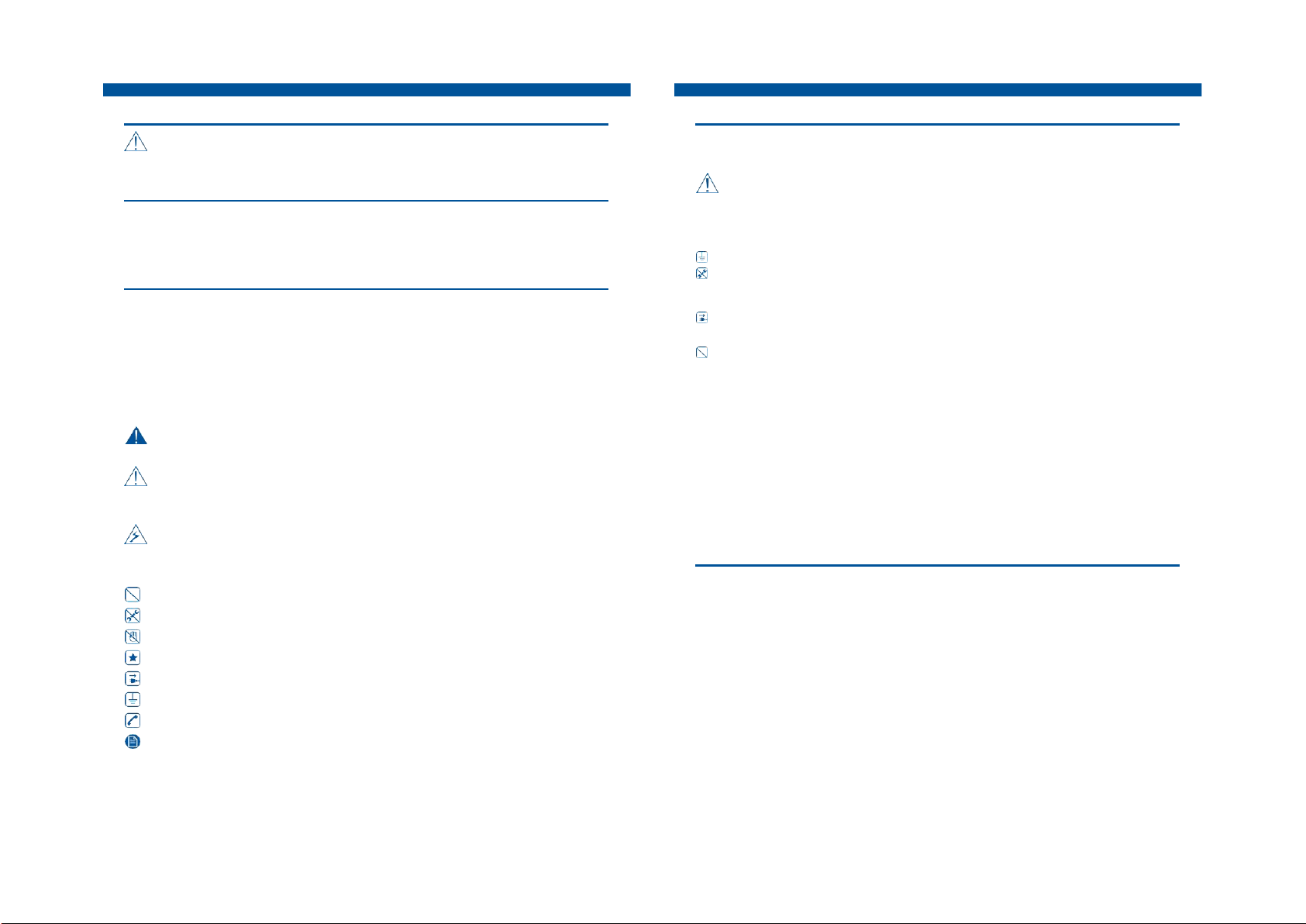
Important safety symbols and precautions
What the icons and signs in this user manual mean:
WARNING
Hazards or unsafe practices that may result in severe personal injury or death.
CAUTION
Hazards or unsafe practices that may result in minor personal injury or property
damage.
CAUTION
To reduce the risk of fire, explosion, electric shock, or personal injury when using you
oven, follow these basic safety precautions.
Do NOT attempt.
Do NOT disassemble.
Do NOT touch.
Follow directions explicitly.
Unplug the power plug from the wall socket.
Make sure the machine is grounded to prevent electric shock.
Call the service center for help.
Note
These warning signs are here to prevent injury to you and others. Please follow them
explicitly.
After reading this section, keep it in a safe place for future reference.
FOR YOUR SAFETY
When using electrical appliances, you should follow basic safety precautions,
including the following:
CAUTION
•
Use this appliance only for its intended purpose as described in this Owner’s Manual.
•
Potentially hot surfaces include the cooktop, areas facing the cooktop, oven vent opening,
surfaces near the opening, crevices around the oven door.
Be sure your appliance is properly installed and grounded by a qualified technician.
User servicing - Do not repair or replace any part of the appliance unless specifically
recommended in this manual. All other servicing should be referred to a qualified
technician.
Always disconnect the power to the appliance before servicing by removing the fuse or
switching off the circuit breaker.
•
Do not enter the oven.
•
Do not store items of interest to children in cabinets above a range or on the back guard
of a range. Children climbing on the range to reach items could be seriously injured
•
Do not leave children alone. Never leave children alone or unattended in an area where
this appliance is in use. They should never be allowed to sit or stand on any part of the
appliance.
•
Never use your appliance for warming or heating the room.
•
Do not use water on grease fires. Turn off the oven to avoid spreading the flames.
Smother the fire or flames by closing the door or use a dry chemical, baking soda, or
foam-type extinguisher.
•
Avoid scratching or impacting glass doors, cooktops or control panels. Doing so may
lead to glass breakage. Do not cook on a product with broken glass. Shock, fire, or cuts
may occur.
•
Do not lean on the range as you may turn the control knobs inattentively.
Important safety instructions
•
Storage in or on the appliance. Do not store flammable materials in the oven or near the
surface units. Be sure all packing materials are removed from the appliance before
operating it.
•
Keep plastics, clothes, and paper away from parts of the appliance that may become hot.
•
Wear proper apparel. Never wear loose-fitting or hanging garments while using the
appliance.
•
Use only dry potholders. Placing moist or damp potholders on hot surfaces may result in
burns from steam. Do not let the potholder touch hot heating elements. Do not use a towel
or other bulky cloth.
•
Teach children not to play with the controls or any other part of the range.
•
For your safety, do not use high-pressure water cleaners or steam jet cleaners.
•
The appliance is not intended for use by persons (including children) with reduced physical,
sensory or mental capabilities, or lack of experience and knowledge, unless they have been
given supervision or instruction concerning use of the appliance by a person responsible for
their safety.
3

Important safety instructions
Important safety instructions
SURFACE COOKING UNITS
•
Never leave surface units unattended at high heat settings. Boilovers cause
smoking and greasy spillovers that may ignite.
•
Protective Liners – Do not use aluminum foil to line surface unit drip bowls or oven
bottoms, except as suggested in the manual. Improper installation of these liners
may result in a risk of electric shock or fire.
•
To avoid oil spillover and fire, use a minimum amount of oil when shallow pan-frying
and avoid cooking frozen foods with excessive amounts of ice.
•
Do not operate the cooktop without cookware. If the cooktop operates without
cookware, the control knobs will become hot.
•
Never use the glass cooktop surface as a cutting board.
•
Use care when touching the cooktop. The glass surface of the cooktop will retain
heat after the controls have been turned off.
•
Be careful when placing spoons or other stirring utensils on the glass cooktop
surface when it is in use. They may become hot and could cause burns.
•
Use proper pan sizes. This appliance is equipped with surface units of different size.
Select pots and pans that have flat bottoms large enough to cover the surface area
of the heating element. Using undersized cookware will expose a portion of the
heating element to direct contact and may result in the ignition of clothing. Matching
the size of the pot or pan to the burner will also improve efficiency.
ELECTRICAL SAFETY
•
Proper Installation - Be sure your appliance is properly installed and grounded by a
qualified technician.
•
Flush - mounted appliances may be operated only after they have been installed in
cabinets and workplaces that conform to the relevant standards. This ensures that
the appliances are installed in compliance with the appropriate safety standards.
•
If your appliance malfunctions or if fractures, cracks, or splits appear:
-
switch off all cooking zones
-
unplug the range from the AC wall outlet
-
contact your local service center.
WARNING
If the surface is cracked, switch off and unplug the appliance to avoid the possibility of
electrical shock. Do not use your cooktop until the glass surface has been replaced.
WARNING
•
Ensure that the appliance is switched off before replacing the lamp to avoid the
possibility of electric shock.
•
The range should not be placed on a base.
CHILD SAFETY
WARNING
•
This appliance is not intended for use by young children or infirm persons without the
adequate supervision of a responsible adult.
•
Young children should be supervised to ensure that they do not play with the
appliance.
•
Keep children away from the door when opening or closing it as they may bump
themselves on the door or catch their fingers in the door.
•
The cooking zones will become hot when you cook. To keep small children from being
burned, always keep them away from the appliance while you are cooking.
WARNING
Accessible parts may become hot during use. To avoid burns, young children should be
kept away.
•
Utensil Handles Should Be Turned Inward and Not Extend Over Adjacent Surface
Units.
•
To reduce the risk of burns, ignition of flammable materials, or spillage due to
unintentional contact with utensils, position utensil handles so that they are turned
inward and do not extend over adjacent surface units.
•
Glazed cooking utensils. Only certain types of glass, glass/ ceramic, ceramic,
earthenware, or other glazed cookware can be used for rangetop service without
breaking due to sudden changes in temperature.
•
Be sure you know which control knob operates each surface unit. Make sure you
turned on the correct surface unit.
•
Always turn the surface units off before removing cookware.
•
When preparing flaming foods under the hood, turn the fan on.
•
Keep an eye on foods being fried at high or medium high heat settings.
•
Do not store heavy items above the cooktop surface that mcould fall and damage it.
•
Do not Use Decorative Surface Element Covers – If an element is accidentally
turned on, the decorative cover will become hot and possibly melt. Burns will occur if
the hot covers are touched. Damage may also be done to the cooktop.
4

Important safety instructions
Important safety instructions
OVEN
•
DO NOT TOUCH THE HEATING ELEMENTS OR INTERIOR SURFACES OF THE
OVEN. Heating elements may be hot even though they are dark in color. Interior
surfaces of an oven become hot enough to cause burns. During and after use, do
not touch or let clothing or other flammable materials contact the heating elements
or interior surfaces of the oven until they have had sufficient time to cool. Other
surfaces of the appliance may become hot enough to cause burns. Among these
surfaces are oven vent openings and surfaces near these openings, the oven door,
and the window of the oven door.
•
Do not heat unopened food containers. The build-up of pressure may cause the
container to burst and result in injury.
•
Do not use the oven to dry newspapers. If overheated, newspapers can catch
on fire.
•
Do not use the oven for a storage area. Items stored in an oven can ignite.
•
Use care when opening the door. Let hot air or steam escape before you remove
food from or put food into the oven.
•
Protective liners. Do not use aluminum foil to line the oven bottoms, except as
suggested in the manual. Improper installation of these liners may result in a risk of
electric shock or fire.
•
Keep oven vent ducts unobstructed. The oven vent is located above the right
rear surface unit. This area could become hot during oven use. Never block this
vent or place plastic or heat-sensitive items on it.
•
Placement of oven racks. Always place oven racks in the desired location while
the oven is cool. If the rack must be moved while the oven is hot, use potholders.
Do not let the potholders come in contact with the hot heating element in the oven.
•
Do not allow aluminum foil or a meat probe to contact the heating elements.
•
During use, the appliance becomes hot. Care should be taken to avoid touching
heating elements inside the oven.
•
Do not use harsh abrasive cleaners or sharp metal scrapers to clean the oven door
glass. They can scratch the surface which may result in the glass shattering.
CAUTION
Do not attempt to operate the oven during a power failure. If the power fails, alwaysturn
the oven off. If the oven is not turned off and the power returns, the oven may begin to
operate again. Food left unattended could catch fire or spoil.
VENTILATING HOOD
•
Clean ventilating hoods frequently. Do not let grease accumulate on the hood or
filter.
•
When flaming foods under the hood, turn the fan on.
GLASS/CERAMIC COOKING SURFACES
•
DO NOT TOUCH SURFACE UNITS OR AREAS NEAR UNITS. Surface unitsmay
be hot even though they are dark in color.Areas near surface units may become
hot enough to cause burns. During and after use, do not touch, or let clothing or
other flammable materials contact the surface units or areas near the units until
they have had sufficient time to cool.Among these areas are the cook-top and the
facing of the cook-top.
•
Do not cook on a broken cooktop. If the cooktop should break, cleaning solutions
and spillovers may penetrate the broken cook-top and create a risk of electric
shock. Contact a qualified technician immediately.
Clean the cooktop with caution. If a wet sponge or cloth is used to wipe spills on a
hot cooking area, be careful to avoid steam burns. Some cleaners can produce
noxious fumes if applied to a hot surface.
CRITICAL INSTALLATION WARNINGS
WARNING
•
This appliance must be installed by a qualified technician or service company.
-
Failing to have a qualified technician install the range may result in electric shock,
fire, an explosion, problems with the product, or injury.
•
Unpack the oven, remove all packaging material and examine the oven for any
damage such as dents on the interior or exterior of the oven, broken door latches,
cracks in the door, or a door that is not lined up correctly. If there is any damage,
do not operate the oven and notify your dealer immediately.
•
Plug the power cord into a properly grounded outlet with the proper configuration.
Your oven should be the only item connected to this circuit.
•
Keep all packaging materials out of the reach of children. Children may use them
for play and injure themselves.
•
Install your appliance on a level and hard floor that can support its weight.
-
Failing to do so may result in abnormal vibrations, noise, or problems with the
product.
5

Important safety instructions
Important safety instructions
•
This appliance must be properly grounded.
•
Do not ground the appliance to a gas pipe, plastic water pipe, or telephone line.
-
This may result in electric shock, fire, an explosion, or problems with the product
•
Do not cut or remove the ground prong from the power cord under any
circumstances.
•
Connect the oven to a circuit that provides the correct amperage.
•
Do not install this appliance in a humid, oily or dusty location, or in a location
exposed to direct sunlight or water (rain drops).
-
This may result in electric shock or fire.
•
Do not use a damaged power cord or loose wall socket.
- This may result in electric shock or fire.
•
Do not pull or excessively bend the power cord.
•
Do not twist or tie the power cord.
•
Do not hook the power cord over a metal object, place a heavy object on the power
cord, or insert the power cord between objects.
- This may result in electric shock or fire.
If the power cord is damaged, contact your nearest service center.
• Do not stand on top of the appliance or place objects (such as laundry, oven cover,
lighted candles, lighted cigarettes, dishes, chemicals, metal objects, etc.) on the
appliance.
-
Items, such as a cloth, may get caught in the door.
-
This may result in electric shock, fire, problems with the product, or injury.
• Do not operate the appliance with wet hands.
-
This may result in electric shock.
• Do not spray volatile substances such as insecticide onto the surface of the
appliance.
-
As well as being harmful to humans, it may also result in electric shock, fire, or
problems with the product.
• Do not put your face or body close to the appliance while cooking or when opening
the door just after cooking.
-
Take care that children do not come too close to the appliance.
-
Failing to do so may result in children burning themselves.
• Do not place food or heavy objects over the edge of the oven door.
-
If you open the door, the food or object may fall and this may result in burns or
injury.
• Do not abruptly cool the door, the inside of the appliance, or a dish by pouring
water over it during or just after cooking.
-
This may result in damage to the appliance. The steam or water spray may result
in burns or injury.
• Do not operate while empty except for self-cleaning.
• Do not defrost frozen beverages in narrow-necked bottles. The bottles can break.
• Do not scratch the glass of the oven door with a sharp object.
-
This may result in the glass being damaged or broken.
• Do not store anything directly on top of the appliance when it is in operation.
• Do not use sealed containers. Remove seals and lids before cooking. Sealed
containers can explode due to the build up of pressure even after the oven has
been turned off.
• Take care that food you are cooking in the oven does not come into contact with
the heating element.
-
This may result in fire.
• Do not over-heat food.
-
Overheating food may result in fire.
USAGE CAUTIONS
CAUTION
• If the surface is cracked, turn the appliance off.
-
Failing to do so may result in electric shock.
• Dishes and containers can become hot. Handle with care.
• Hot foods and steam can cause burns. Carefully remove container coverings,
directing the steam away your hands and face.
• Remove lids from baby food jars before heating. After heating baby food, stir well
to distribute the heat evenly. Always test the temperature by tasting before feeding
the baby. The glass jar or the surface of the food may appear to be cooler than the
interior, which can be hot enough to burn an infant’s mouth.
• Take care as beverages or food may be very hot after heating.
-
Especially when feeding a child. Check that it has cooled sufficiently.
• Take care when heating liquids such as water or other beverages.
-
Make sure to stir during or after cooking.
-
Avoid using a slippery container with a narrow neck.
-
Wait at least 30 seconds after heating before removing the heated liquid.
-
Failing to do so may result in an abrupt overflow of the contents and cause burns.
6
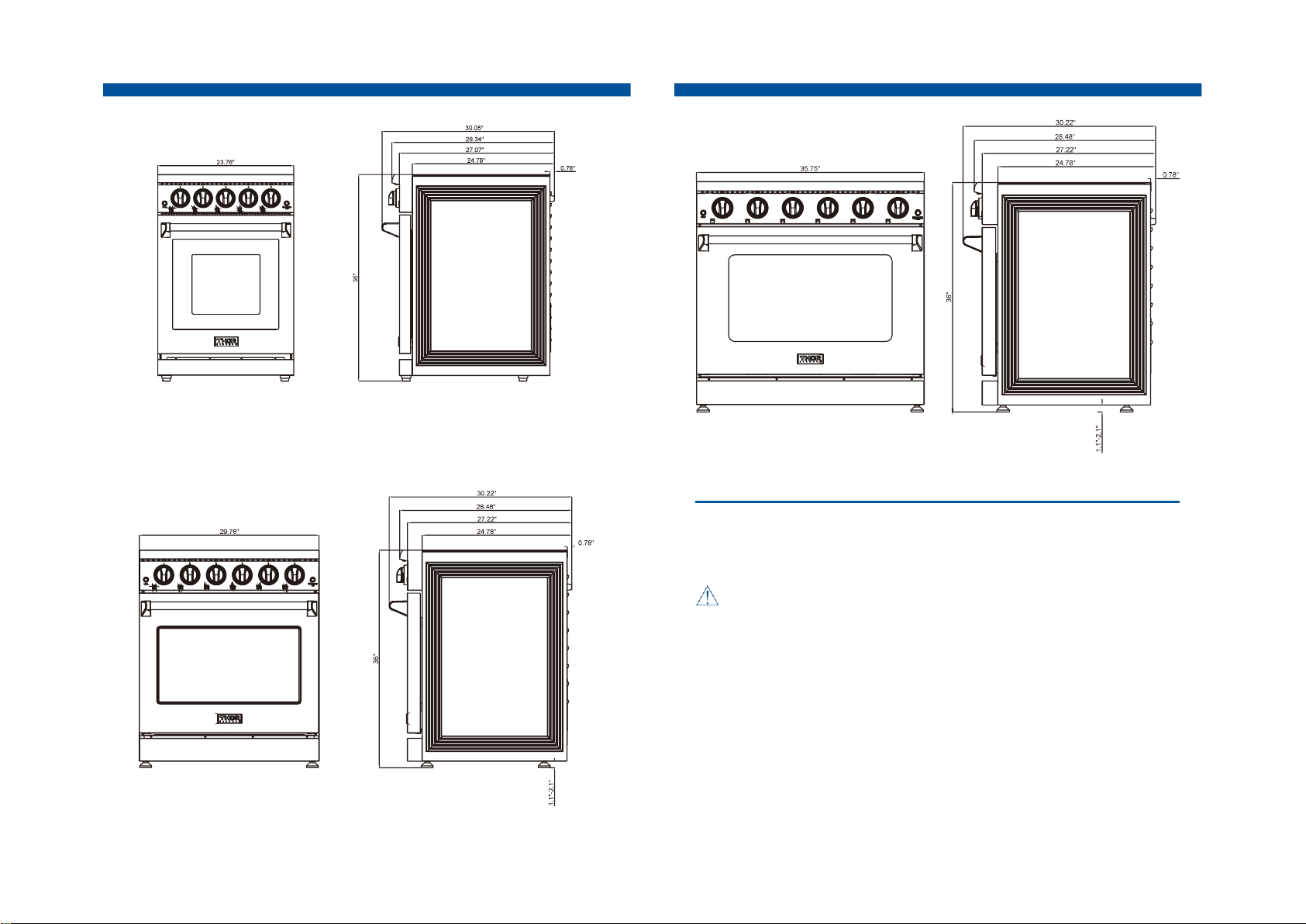
Product Dimension
Product Dimension
24'' Electric Range
36'' Electric Range
30'' Electric Range
CHECKING THE INSTALLATION SITE
Clearances and dimensions
To install the range, refer to the following figure.
For installation in CANADA, a Free-standing range is not to be installed closer than
12mm from any adjacent surface.
CAUTION
This range has been designed to comply with the maximum allowable wood cabinet
temperatures of 194°F. Makesurethewall covering,countertops and cabinetsaround the
range can withstand the heat (up to 194 °F) generated by the range. If not,
discoloration, delamination or melting may occur.
7
Preparing to install the range
Connecting the power
Minimum dimensions
IMPORTANT
To eliminate the risk of burns or fire caused by reaching over heated surface units,
cabinet storage space located above the surface units should be avoided. If cabinet
storage is to be provided, the risk can be reduced by installing a range hood that
projects horizontally a minimum of 5" beyond the bottom of the cabinets.
STEP 1. MEETING ELECTRICAL CONNECTION REQUIREMENTS
CAUTION
For personal safety, do not use an extension cord with this appliance.
Remove house fuse or open circuit breaker before beginning installation.
This appliance must be supplied with the proper voltage and frequency, and connected to an
individual properly grounded branch circuit, protected by a circuit breaker or fuse having amperage
as specified on the rating plate. The rating plate is located on the right of oven door.
We recommend you have the electrical wiring and hookup of your range connected by a qualified
electrician. After installation, have the electrician show you where your main range disconnect is
located.
Check with your local utilities for electrical codes which apply in your area.
Failure to wire your oven according to governing codes could result in a hazardous condition. If there
are no local codes, your range must be wired and fused to meet the requirements of the National
Electrical Code, ANSI/NFPA No.70–Latest Edition.
Effective January 1,1996, the National Electrical Codere quires that new construction (not existing)
utilize a 4-conductor connection to an electric range.
When installing an electric range in new construction, follow Steps for 4-wire connection.
You must use a 3-wire or 4-wire, single-phase A.C. 208Y/120 Volt or 240/120 Volt, 60 hertz electrical
system.
If the electrical service provided does not meet the above specifications, have a licensed electrician
install an approved outlet.
Use only a 3-conductor or a 4-conductor UL-listed range cord. These cords maybe provided with
ring terminals on wire and a strain relief device.
A range cord rated at 40 amps with 125/250 minimum volt range is required. A 50 amp range cord is
not recommended but if used, it should be marked for use with no minal 13⁄8" diameter connection
openings. Care should be taken to center the cable and strain relief within the knock out hole to keep
the edge from damaging the cable.
NOTE
This appliance is manufactured ready to be installed with a 4-wire cord set.
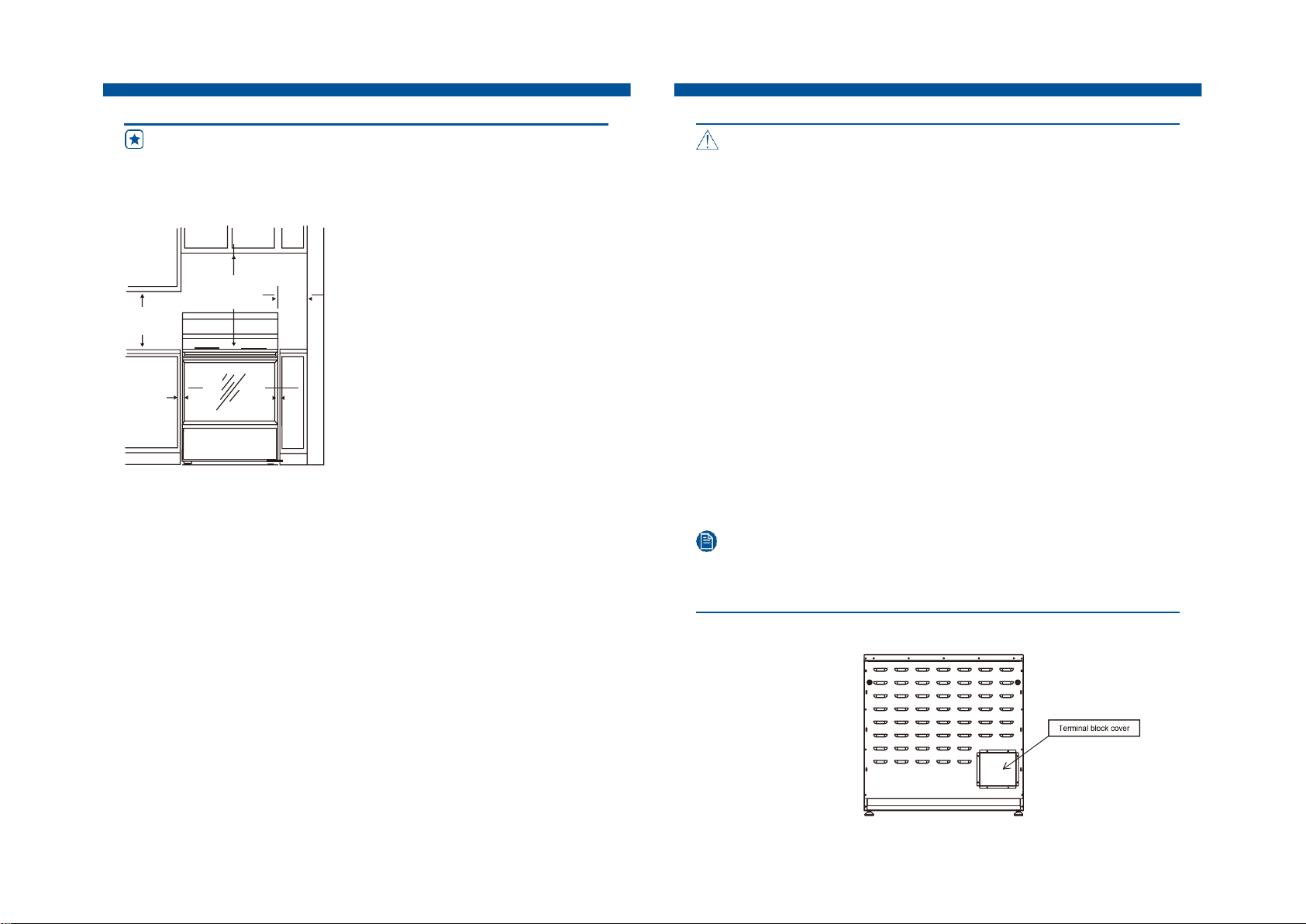
MINIMUM DIMENSIONS BETWEEN COOKTOP,
WALLS AND ABOVE THE COOKTOP:
A:Make sure the wall covering, countertop,
flooring and cabinets around the range can
withstand the heat (up to 200°F) generated by
the range.
B:Allow 30” minimum clearance between
surface units and bottom of unprotected wood
or metal cabinet, or allow a 24" minimum when
bottom of wood or metal cabinet is protected
by no less than 1/4" thick flame retardant
millboard covered with not less than No 28
MSG sheet metal, (.015"), .015” thick stainless
steel, .024" aluminum or .020" copper.
B
C
Both
Sides
NOTE C
A
A
C:This appliance has been approved for 0" spacing to adjacent surfaces above the
cooktop. However, a 6" minimum spacing to surfaces less than 15" above the
cooktop and adjacent cabinet is recommended to reduce exposure to steam, grease
splatter and heat.
To reduce the risk of burns or fire when reaching over hot surface elements, cabinet
storage space above the cooktop should be avoided. If cabinet storage space is to be
provided above the cooktop, the risk can be reduced by installing a range hood that
projects at least 5" beyond the front of the cabinets. Cabinets installed above the
cooktop must be no deeper than 16".
D:Allow 24"/30"/36" (depensing on your range width) minimun clearance between right
and left cabinets.
STEP 2. POWER CORD
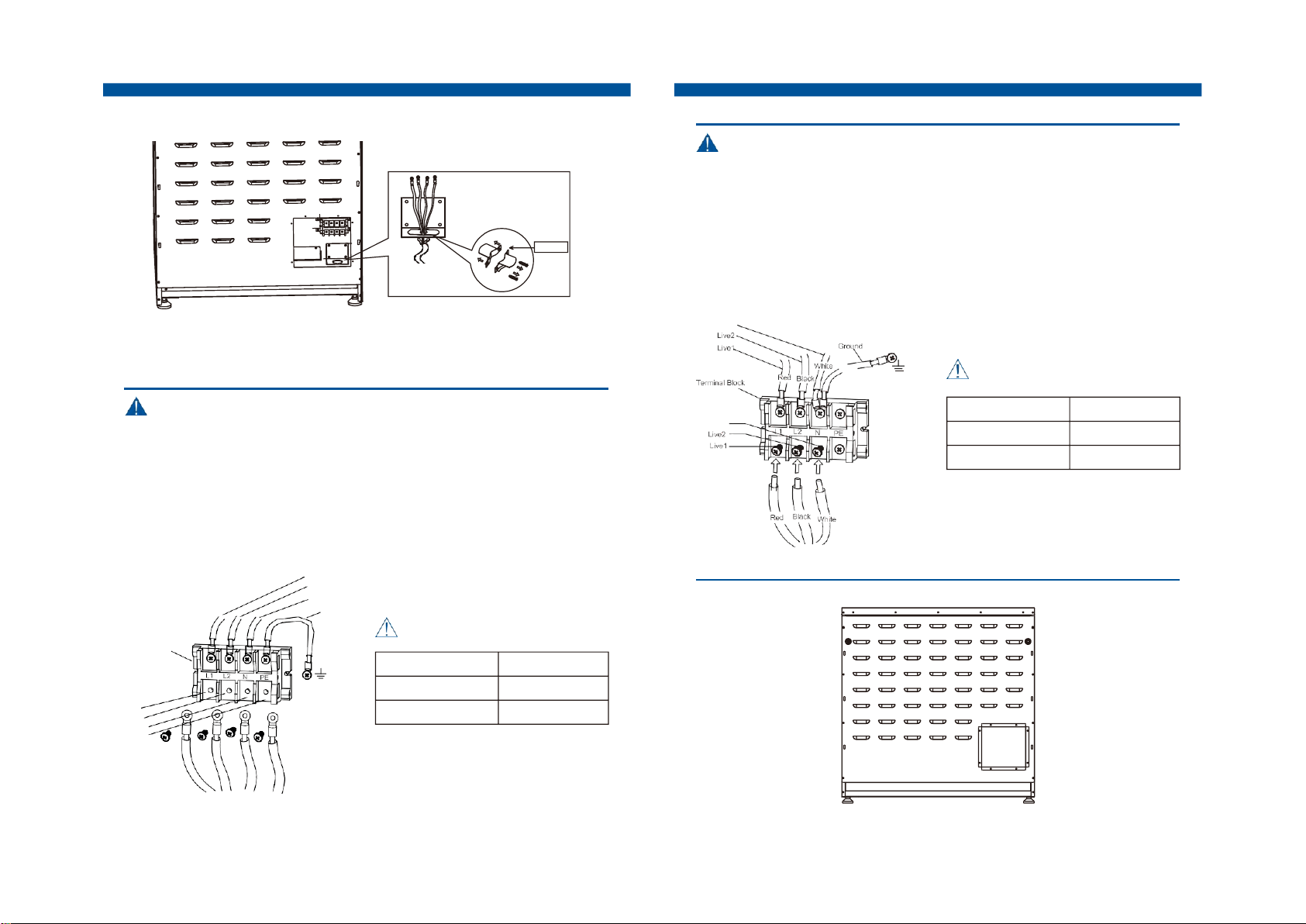
1.Remove the rear terminal block cover and loosen the 6 screws with a screwdriver. The terminal
block will then be accessible. Do not discard these screws.
8
Connecting the power
Connecting the power
STEP 4 3-wire power cord
WARNING
Electrical Shock Hazard
Electrical ground is required on this appliance.
Do not connect to the electrical supply until appliance is permanently grounded.
Disconnect power to the circuit breaker or fuse box before making the electrical connection.
This appliance must be connected to a grounded, metallic, permanent wiring system, or a grounding connector
should be connected to the grounding terminal or wire lead on the appliance. Failure to do any of the above could
result in a fire, personal injury or electrical shock. See below for more information on electrical grounding.
A. Remove the 4 lower terminal screws from the terminal block.
B. Insert the Green ground terminals together with white one.
C. Insert the 3 terminal screws through each power cord terminal and into the lower terminals of the terminal block. Be
certain that match the wire and terminals by color.
D. Tighten screws securely into the terminal block.
Neutral
2.For power cord installations only, hook the strain relief over the power cord hole located below the rear of the
drawer body. Insert the power cord through the strain relief and tighten the device.
Strain relief
•
You must install the power cord with a strain relief.
•
Attach the strain relief to the opening in conduit connection plate.
CAUTION
You must check voltage after connecting power cord.
Green
STEP 3. 4-WIRE POWER CORD INSTALLATION
WARNING
Electrical Shock Hazard
Electrical ground is required on this appliance.
Do not connect to the electrical supply until appliance is permanently grounded.
Disconnect power to the circuit breaker or fuse box before making the electricalconnection.
This appliance must be connected to a grounded, metallic, permanent wiring system, or a grounding connector
should be connected to the grounding terminal or wire lead on the appliance. Failure to do any of the above could
result in a fire, personal injury or electrical shock. See below for more information on electrical grounding.
A. Remove the 4 lower terminal screws from the terminal block.
B. Insert the 4 terminal screws through each power cord terminal and into the lower terminals of the terminal block. Be
certain that match the wire and terminals by color.
C. Tighten screws securely into the terminal block.
Red(Live 1)
Black(Live 2)
White(Neutral)
Green(Ground)
CAUTION
Neutral
STEP 5. REPLACING THE TERMINAL BLOCK COVER
Replace the terminal block cover on the range back and tighten the screw.
You must check voltage after connecting power cord.
Terminal Block
Live 1
Live 2
Neutral
Ground
Red
Black W hite
Green
9
Live 1 - Neutral
120 V
Live 2 - Neutral
120 V
Live 2 - Live 2
208 V / 240 V
Live 1 - Neutral
120 V
Live 2 - Neutral
120 V
Live 2 - Live 2
208 V / 240 V
KD Installation Procedures
KD Installation Procedures
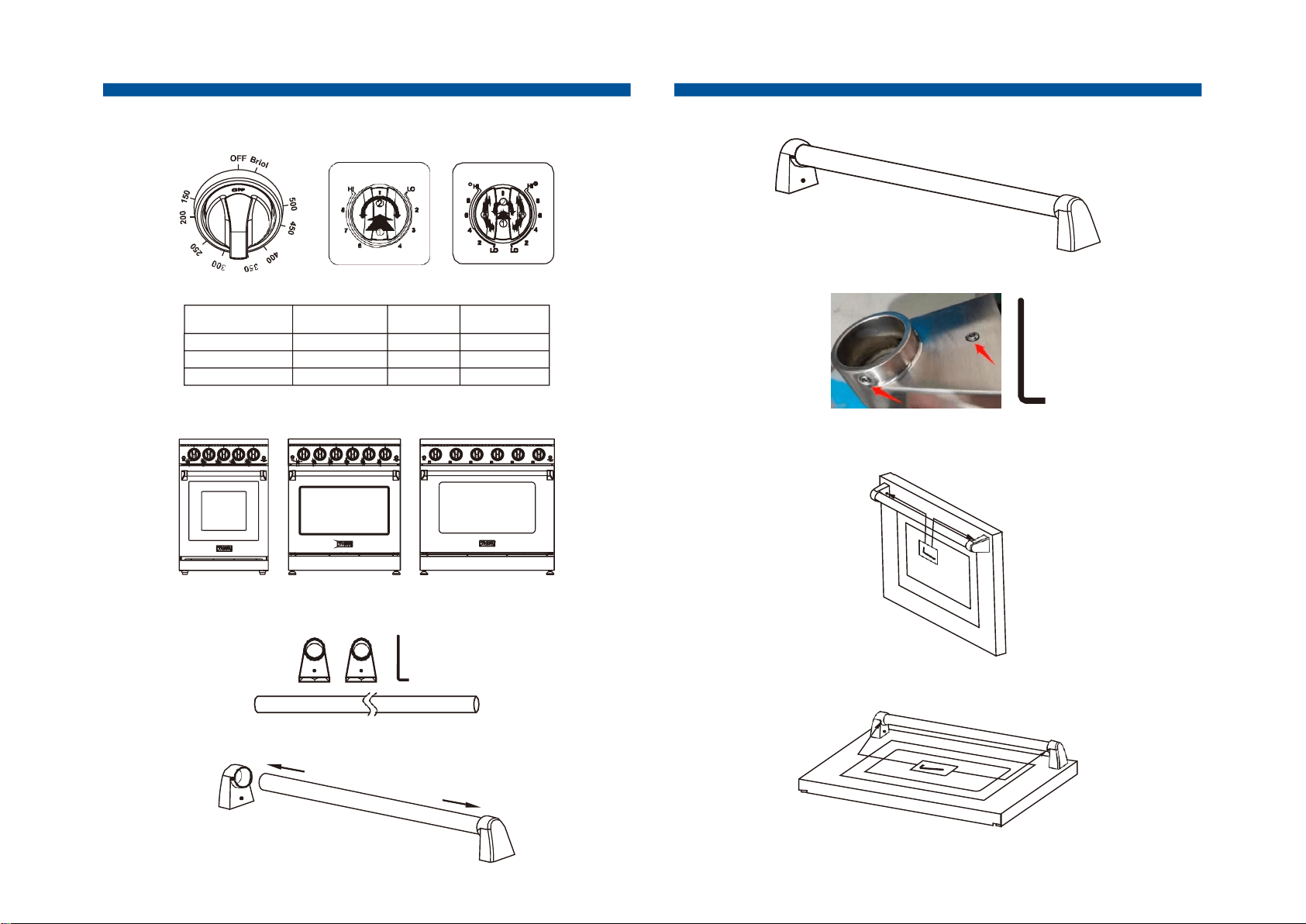
Your Thor Kitchen range might have a KD Knob + handle design that need to be installed. Please Follow up
the following procedures for Knob + Oven door handle installation.
1. Check the knobs
3. Secure the oven handle with two screws on each door handle holder (if not, handle might be loose)
OFF
OFF
MED
4. Secure the oven handle with two screws on each door handle holder (if not, handle might be loose)
2. See the sheet for the number of each knobs
*For any parts damage or missing, please contact 877-288-809, or send email to inf[email protected]
3. Find the right knobs for each shaft on the range. Push the knob in to fully attach the shaftand make sure there’s
no friction between knobs and bezels.
5. Lay the door handle against to the oven door and fit it on the connection part, and use the wrench to get the door
handle holder tight;
Your Thor range might have a KD handle that needs to be installed. Please Follow up the following
procedures for the oven door handle installation
1. Check your Installation Kits for Door Handles
6. Use the wrench to tighten the door handle holders.
2 * Handle Holders, 1 * Installation Wrench,
1 * Handle (For 24'', 30'' or 36'' Oven)
2. Connect door handle holders to each side of the handle
10
Model #
Oven Knob
Dual Burner
Knob
Single Burner
Knob
24''
1
1
3
30''
1
2
3
36''
1
2
3
Introducing your new range
Rubber Pad Installation on Back Panel
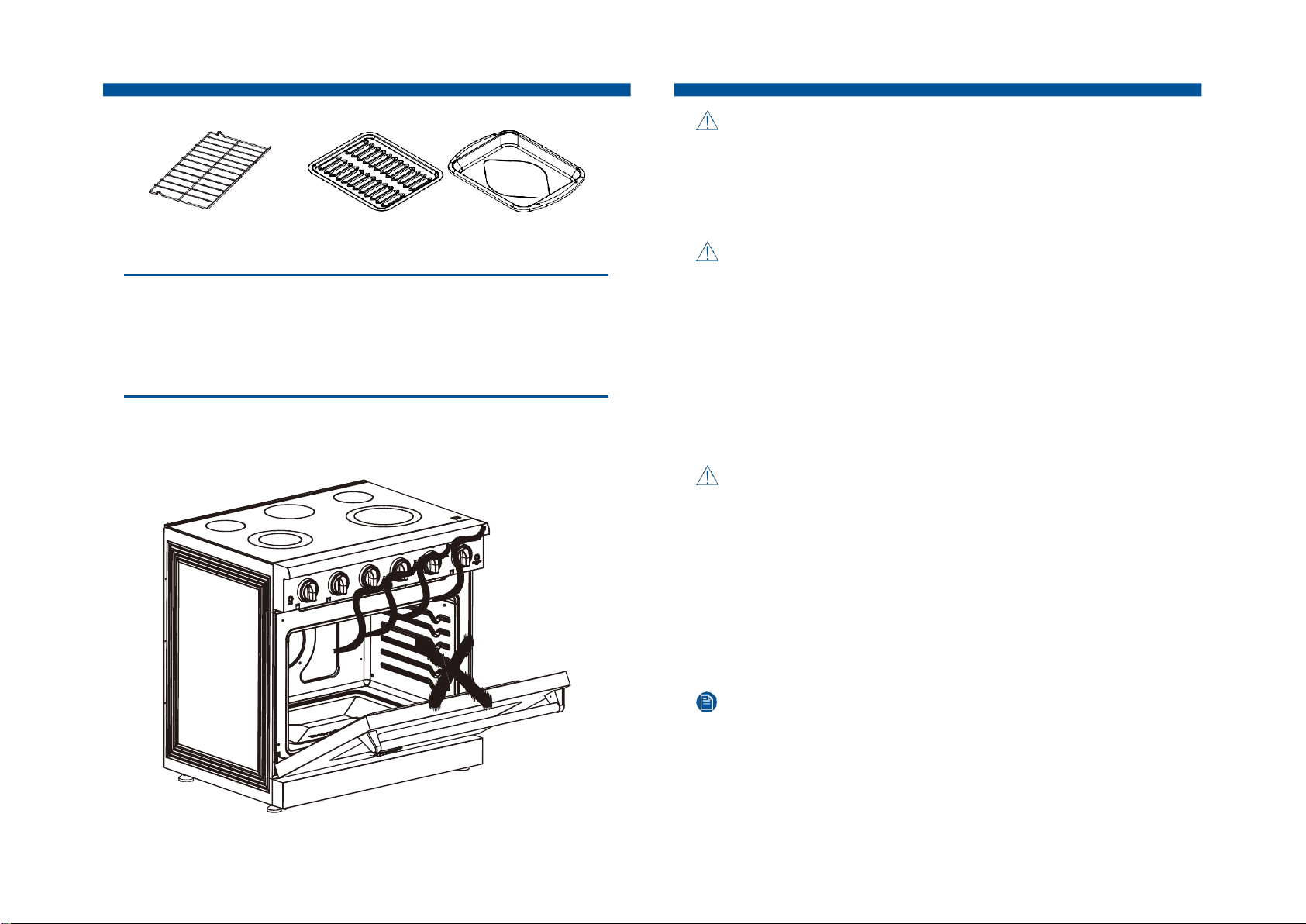
24 inch Overview
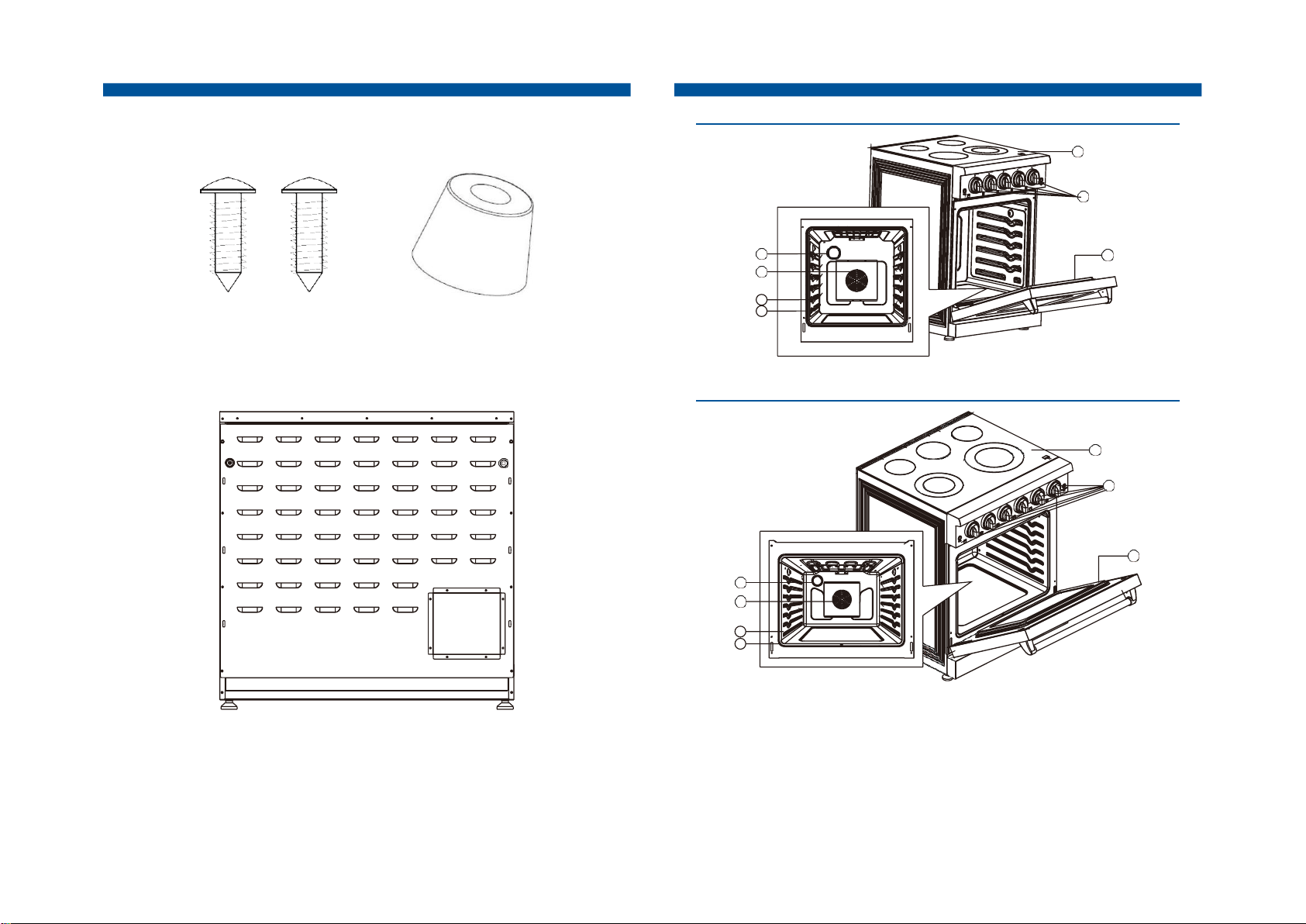
To Prevent the range too close to the wall, there are 2 plastic pads offered with the
user's manual, please find the accessories and follow the below steps:
1. check the installation kit packed with manual.
1
2
4
5
3
6
7
2 pcs screws
2 pcs rubber pad
2. Install 2 pcs rubber pad as showed above.
30/36 inch Overview
1
2
3
4
5
6
7
01.Glass surface
04.Oven light
07.Gasket
02.Control knob
05.Oven fan
03.Oven door
06.shelf position
11
Introducing your new range
Cooktop cooking
What’s included with your range
CAUTION
BEFORE COOKING
•
Do not use the glass cooktop surface as a cutting board.
•
Do not place or store items that can melt or catch fire on the glass cooktop, even when
it is not being used.
•
Turn the surface units on only after placing cookware on them.
•
Do not store heavy items above the cooktop surface. They could fall and damage it.
CAUTION
DURING COOKING
•
Do not place aluminum foil or plastic items such as salt and pepper shakers,spoon
holders, or plastic wrappings on the range when it is in use. The hot air from the vent
could melt plastics or ignite flammable items.
•
Make sure the correct surface unit is turned on.
•
Never cook directly on the glass. Always use cookware.
•
Always place the pan in the center of the surface unit you are cooking on.
•
Never leave surface units unattended while using a high heat setting.Boilovers cause
smoking and greasy spillovers that may catch on fire.
•
Turn the surface units off before removing cookware.
•
Do not use plastic wrap to cover food. Plastic may melt onto the surface and be very
difficult to remove.
CAUTION
AFTER COOKING
•
Do not touch the surface units until they have cooled down.
•
The surfacemay be still be hotandburnsmay occurif youtouchtheglass surface before it
has cooled down sufficiently.
•
Immediately clean spills on the cooking area to prevent a tough cleaners, chorelater.
About the radiant surface elements
The temperature rises gradually and evenly. As the temperature rises, the radiant
element will glow red.
To maintain the selected setting, the element will cycle on and off. The heating element
retains enough heat to provide a uniform and consistent heat during the off cycle. For
efficient cooking, turn off the element several minutes before cooking is complete. This
will allow residual heat to complete the cooking process.
NOTE
Radiant elements have a limiter that allows the element to cycle ON and OFF, even at
the HI setting.This helps to prevent damage to the ceramic cooktop. Cycling at the HI
settingis norma land can occur if the cookware is too small for the radiant element or if
the cookware bottom is not flat.
* Wire racks (2)
* Broiler pan (1 set)
Before you begin
Clean the oven thoroughly before using it for the first time. Then, remove the
accessories, set the oven to bake, and then run the oven at 350 °F for 30 minutes.
There will be a distinctive odor. This is normal.
Ensure your kitchen is well ventilated during this conditioning period.
Energy saving tips
•
During cooking, the oven door should remain closed except when you turn food over.
Do not open the door frequently during cooking to maintain the oven temperature
and to save energy.
•
Whenever possible, cook more than one item at a time.
12
Cooktop cooking
Cooktop cooking
Cooking areas
The cooking areas on your range are identified by permanent circles on the glass
cooking surface. For the most efficient cooking, fit the pan size to the element size.
Pans should not extend more than .5 to 1 in. (1.3 to 2.5 cm) beyond the cooking area.
When a control is turned on, you can see a glow through the glass cooking surface.The
element cycles on and off to maintain the preset heat setting, even at high settings.
For more information about the correct types of cookware, see Using the correct
cookware on page 25.
Using a surface burner control knob
Location of the radiant surface elements and controls
The radiant control knobs operate the radiant surface elements on the cooktop as
shown below.
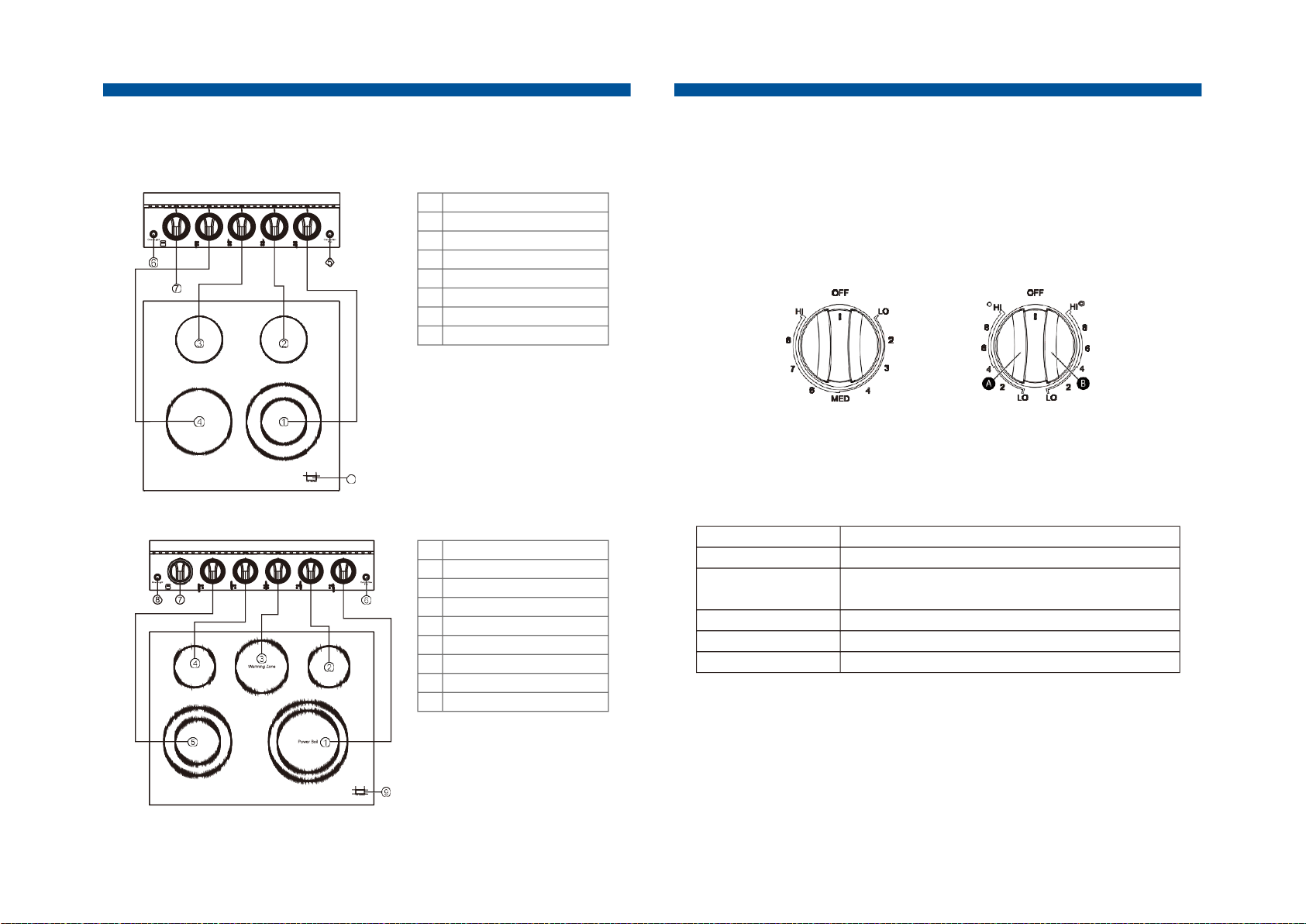
24 inch
Single
(left rear, right rear)
1 Push the knob in.
Dual
(Left front, right front)
2
For the left and right rear burners, turn knob in either direction to the setting you want.
3
For the left and right front dual burners,turn in either direction to the setting you
want.Po
8
Position A : Single burnerP
Position B : Dual burner
30 inch and 36 inch
SETTING
TYPE OF COOKING
Right Front: 9''/12'', 3000 W
01
HIGH
Starting most foods, bringing water to a boil, or pan broiling
Right Rear:6'', 1200 W
Warming center: 100 W
02
MEDIUM HIGH
Continuing a rapid boil, frying, deep fat frying, or steaming
vegetables
03
04
Left Rear:6'', 1200 W
Maintaining a slow boil or thickening sauces and gravies
MEDIUM
05
Left Front:6''/9'', 3000 W
Keeping foods cooking, poaching, or stewing
MEDIUM LOW
06
Convection Fan Switch
Oven knob
Keeping food warm, melting, or simmering
LOW
07
08
Oven Light Switch
Using the correct cookware can prevent many problems, such as uneven cooking or
extended cooking times. Look for the following pan characteristics:
•
Flat bottom and straight sides
•
Tight-fitting lid
•
Weight of handle does not tilt pan
•
Pan is well-balanced
•
Pan size matches the amount of food being prepared and the size of the surface
burner.
•
Made of material that conducts heat well.
09
Hot Surface Indicator
13
01
Right Front: 9''/6'', 2200 W
02
Right Rear:6'', 1200 W
03
Left Rear:6'', 1200W
04
Left Front:8'', 2000 W
05
Convection Fan Switch
06
Oven Light Switch
07
Oven Knob
08
Hot Surface Indicator
Cooktop cooking
Positioning the oven racks
What your cookware is made of determines how evenly and quickly heat is transferred
from the surface burner to the pan bottom.
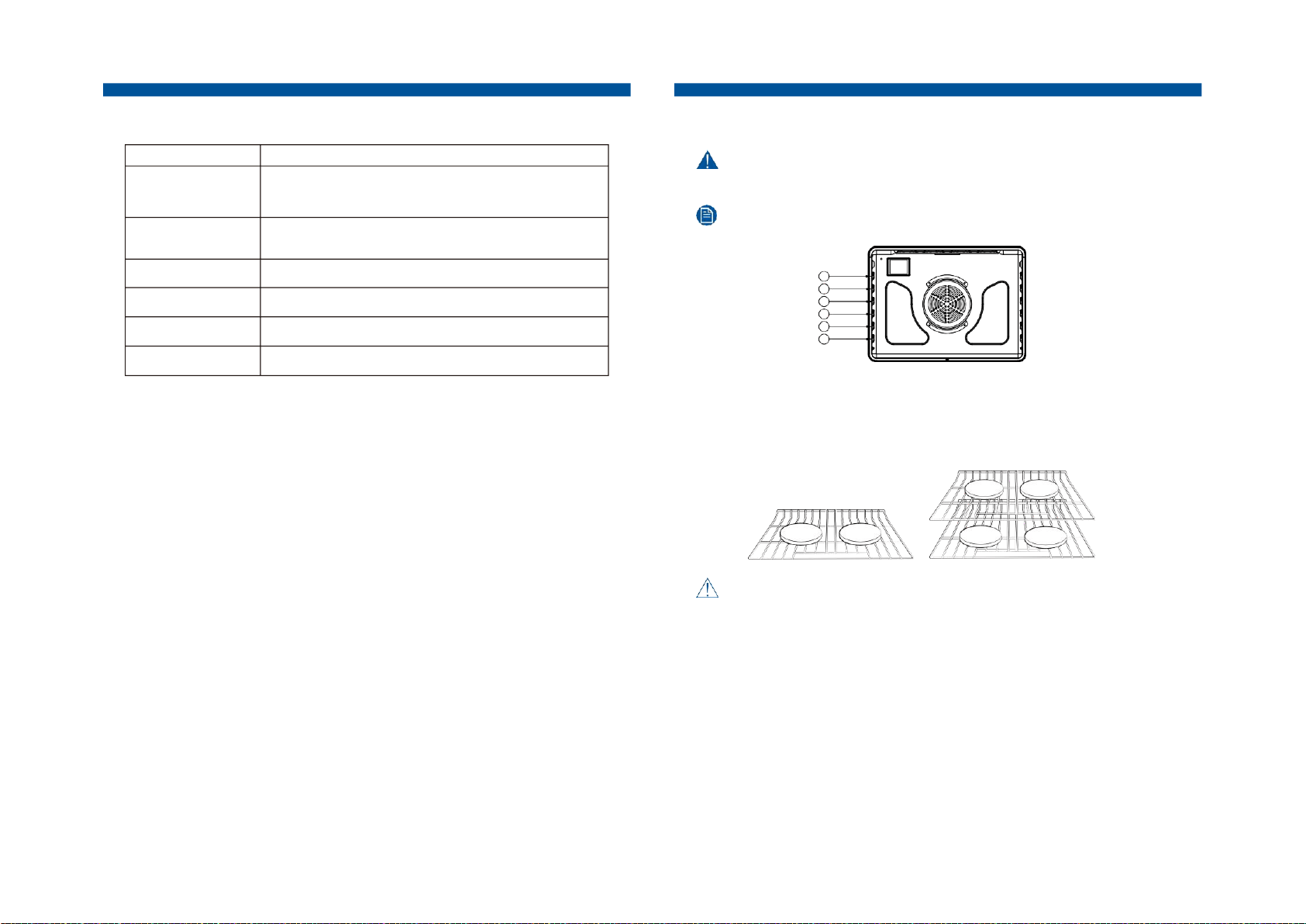
You can remove and reposition the oven racks in any of the six rack positions. Each oven rack has a
built-in stop to prevent it from accidentally being pulled completely out. Correct positioning of the
oven racks provides the best cooking results.
WARNING
Stand away from the oven when opening the oven door. Escaping hot air or steam can burn your
hands, face, or eyes. Let hot air or steam escape before removing or replacing food.
NOTE
The rack position above 6 is not usable.
6
5
4
3
2
1
•
Centering the baking pans in the oven produces better cooking results.
•
When baking multiple items, make sure that you leave a 1 to 1.5 in. (2.5 to 3.8 cm) space around
each item.
•
When baking or fan baking on a single rack, place the oven rack in positions 3 or 4.
•
When baking or fan baking on multiple racks, place the oven racks in positions 3 and 5. Place two
pans in the rear of the top rack and the other two pans in the front of the bottom rack.
Protecting the ceramic cooktop
Cleaning
•
Clean the cooktop before using it for the first time.
•
Clean your cooktop daily or after each use. This helps keep your cooktop looking good and can
prevent damage.
•
If a spillover occurs while you are cooking, immediately clean the spill from the cooking area while
it is hot to prevent a tough cleaning chore later. Using extreme care, wipe the spill with a clean dry
towel.
•
Do not let spills remain on the cooking area or the cooktop trim for a long period of time.
•
Do not use abrasive cleansing powders or scouring pads because they can scratch the cooktop.
•
Do not use chlorine bleach, ammonia, or other cleansers not specifically recommended for use on
a glass ceramic surface.
Preventing marks and scratches
•
Do not use glass cookware. It may scratch the cooktop.
•
Do not place a trivet or wok ring between the cooktop and the pan. These items can mark or
scratch the cooktop.
•
Make sure that the cooktop and the pan bottoms are clean.
•
Do not slide metal pans across the cooktop.
Preventing stains
•
Do not use a soiled dish cloth or sponge to clean the cooktop surface. They may leave a film,
which may cause stains on the cooking surface after the area is heated.
•
Continuously cooking on a soiled surface can result in a permanent stain.
Preventing other damage
•
Do not let plastic, sugar, or foods with high sugar content melt onto the hot cooktop. Should this
happen, clean immediately.
•
Do not let a pan boil dry. This may damage the cooktop and the pan.
•
Do not use the cooktop as a work surface or cutting board.
CAUTION
•
Do not cover an oven rack with aluminum foil. This disturbs the heat circulation and results in poor
baking.
•
Do not place aluminum foil on the oven bottom because it could cause damage.
•
Arrange the oven racks only when the oven is cool.
•
When placing an oven rack in the top most rack position, make sure that the rack is stably situated
on the embossed stop.
Removing an oven rack
1
Pull the rack straight out until it stops.
2
Lift the front of the oven rack and pull to remove it from the oven.
Replacing an oven rack
1 Place the back edge of the rack on the a rack support.
2 Lift the front of the rack and slide it into the oven.
14
MATERIAL
DESCRIPTION
Aluminum
Excellent heat conductor. Some types of food cause aluminum to darken.
(Anodized aluminum cookware resists staining and pitting.) If you slide aluminum
pans across the ceramic cooktop, they may leave metal marks that resemble
scratches. Remove these marks as soon as the cooktop cools down.
Copper
Excellent heat conductor, but discolors easily. If you slide copper pans across the
ceramic cooktop, they may leave metal marks that resemble scratches.
Remove these marks as soon as the cooktop cools down.
Stainless Steel
Slow heat conductor with uneven cooking results. It is durable, easy to clean, and
resists staining.
Cast-iron
A poor conductor, but retains heat well. Cooks evenly once cooking temperature
is reached. Not recommended for use on ceramic cooktops.
Enamelware
Heating characteristics vary depending on base material. Porcelain enamel
coating must be smooth to avoid scratching ceramic cooktops.
Glass
Slow heat conductor. Not recommended for ceramic cooktops because it may
scratch the glass.
Operating the oven
Operating the oven
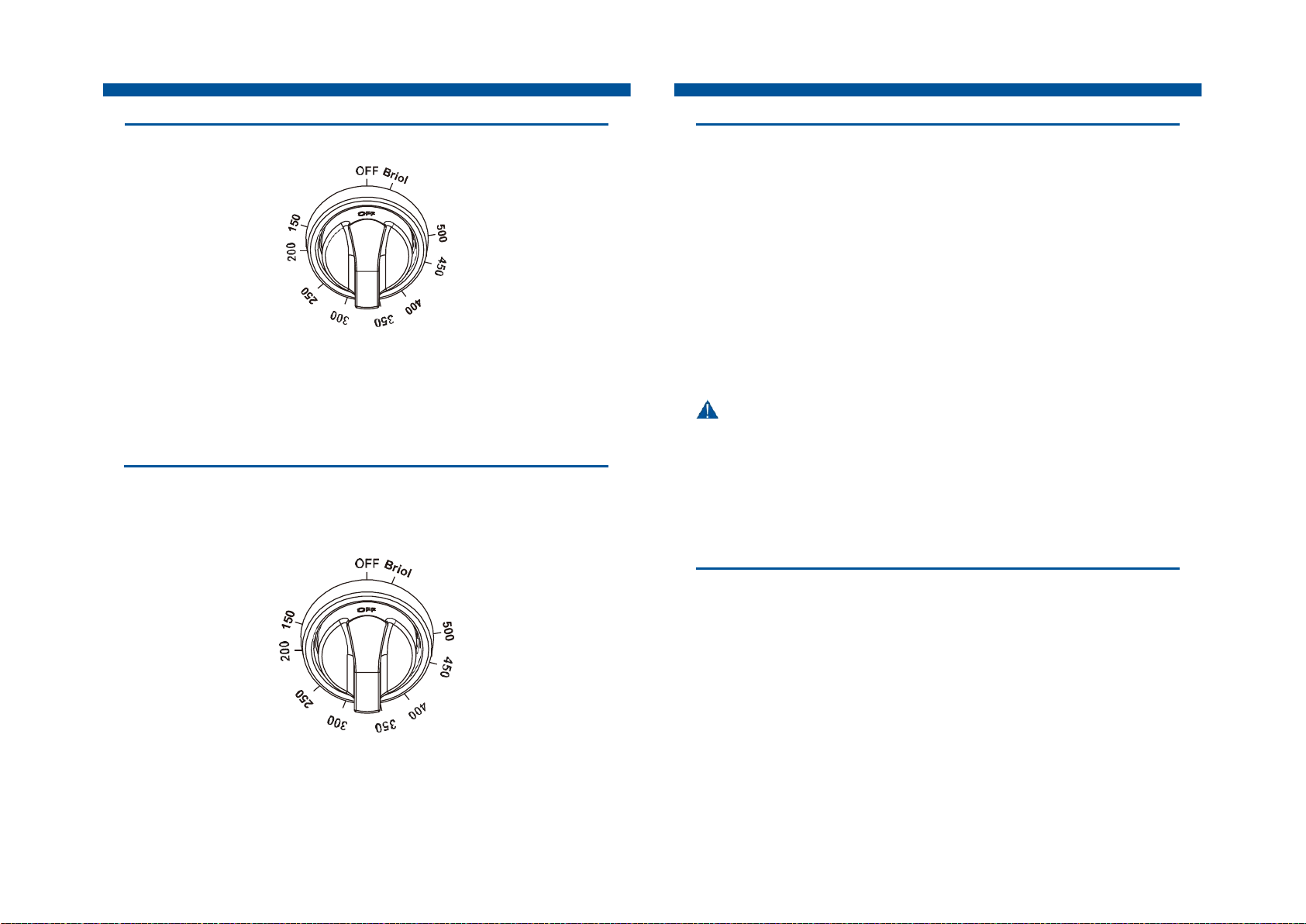
Oven Burmer Use
Oven Temperature Knob
Oven Cooking Safety Guidelines
√ Do not block the ducts on the rear of the range when cooking in the oven. It is
important that the flow of moist warm air from the oven and fresh air into the oven
burner never be interrupted.
Avoid touching the vent opening or nearby surfaces during oven or broiler operation
because they are hot. Do not pace plastics, paper or other items that could melt or
burn near the oven vent.
√ Use all the oven modes with the oven door closed.
√ Never use aluminum foil to cover the oven shelves or to line the floor of the oven.
The trapped heat can irreversibly damage the enamel and may even cause afire.
√ Do not place water, ice, or any dish or tray directly on the oven floor, as this will
irreversibly damage the enamel.
√ Do not cover the slotted grid of the broil/roast pan with aluminum foil. This will catch
the grease and could cause fire.
√ Do not use plastic wrap or wax paper in the oven.
√ For food safety reasons, do not leave food in the oven for longer than two hours
before and after cooking or defrosting. This is to avoid contamination by organisms
which may cause food poisoning. Take care during warmer weather.
WARNING
√ According to the United Sates Department of Agriculture: DO NOT hold foods at
temperatures between 40°F to 140°F more than 2 hours. Cooking raw foods below
275°F is not recommended.
√ Never cover any slots, holes or passages in the oven bottom or cover an entire rack
with materials such as aluminum foil. Doing so blocks air flow through the oven and
may cause carbon monoxide poisoning. Aluminum foil lining may also trap heat,
causing a fire hazard.
To light the oven burner, push and turn the appropriate control knob counterclockwise to
the (150°F~500°F) position. Once burner ignition has been achieved, turn the burner
control knob to adjust the desired temperature setting.
Do not push and turn the control knob clockwise from the “OFF” position.
Do not turn the control knob without pushing it.
Broil Bumer Use
To light the broiler burner, push and turn the appropriate control knob counterclockwise
to the broil position.
Do not push and turn the control knob clockwise from the “OFF” position.
Do not turn the control knob without pushing it.
Oven Function
Natural Airflow Bake
Natural airflow bake occurs when heat is transferred into the oven from the bake
burners in the bottom of the oven cavity. Heat is then circulated by natural airflow. This
is a traditional bake setting.
Convection Bake
The oven convection fan circulates and distributes the heat in the oven for faster even
cooking.
Convection cooking allows you to bake more items on multipleracks.
To bake using the convection fan:
1.Position the oven bottom cover and the oven shelves before using oven.
2.Remove any unused shelves and baking utensils from the oven.
15

Operating the oven
Operating the oven
Broiler Operation
CAUTION
Door must be closed during broiler operation.
Broiling is a method of cooking tender cuts of meat directly under the infrared broiler in the oven.
Broiling in the oven is accomplished with the oven door closed. It is normal and necessary for some
smoke to be present to give the food a broiled flavor.
If you open the oven door to check the food, have it open for as short a time as possible. This is to
prevent the control panel from overheating and prevents meltedknobs.
Use both the broil/roast pan and slotted grid supplied. The grid helps to reduce smoking and splatter
by letting grease drip into the bottom of the pan, away from intense heat. To prevent food sticking,
spray the grid with a light coating of non-stick cookingspray.
Preheating
Preheating is suggested when searing rare steaks (Remove the broiler pan before preheating with
the infrared broiler. Foods will stick to hot metal). To preheat, turn the “Oven” selector knob to the
“Broil” position. Wait for the burner to become hot, approximately 2 minutes. Preheating is not
necessary when broiling meat well-done.
3.Preheat the oven to the temperature stated in the recipe. Depending on the temperatureand
the size of the oven, preheating will vary. For better cooking performance and exact oven
cavity temperature, preheating time will be 10 mins per 100 Degrees.
4.Arrange pans and food items evenly on the shelves. Make sure pans do not touch each
other or the sides of the oven. When baking a single item, always center the item on the
oven shelf. If baking on multiple shelves, make sure you stagger items on the shelves so
that one is never directly above another.
5.When baking using convection, either reduce the temperature stated in the recipe and leave
the baking time unchanged or reduce the baking time by several minutes and leave the
temperature unchanged. For foods with a baking time of over an hour, reducing both the
temperature and time slightly may give the best results.
6.Dark metal baking pans or those with a dull finish absorb heat faster than shiny pans, and
are excellent for pies and breads, or anything that needs browning or a crisper crust.
7.A shiny finish may work best for foods that require lighter, delicate browning (e.g. cakes and
cookies), as it reflects some heat and gives a less intense bakingsurface.
8. Avoid opening the oven door frequently during baking.
*
For best results use the broiler pan. The pan is used to catch grease spills and has a cover
to prevent grease splatter.
*
The convection fan circulates heated air over and the around the food being roasted,
sealingjuices quickly for a moist and tender product while, at the same time, creating a rich
golden-brown exterior.
*
Use the broil/roast pan and slotted grid supplied with the range when roasting to elevate the
meat on a metal roasting rack. This allows hot air to circulate around the meat, browning it
more evenly like a rotisserie. A suitable roasting rack can be purchased through your HRG
distributer or by calling Customer Care.
*
When roasting larger items like a whole turkey, use only the pan and grid for greater stability.
To Broil
Broil one side until the food is browned; turn and cook on the second side. Season and serve.
Always pull the rack out to the “stop” position before turning or removing food.
Setting Broil
The “Oven” selector knob controls the Broil feature. When broiling, heat radiates downward from the
oven broiler for even coverage. The Broil feature temperature is 500°F (260°C).
The broil pan and insert used together allow dripping grease to drain and be kept away from the high
heat of the oven broiler. DO NOT use the broil pan without theinsert.
DO NOT cover the broil pan insert with foil. The exposed grease could catch fire.
To set the oven to Broil:
1. Place the broiler pan insert on the broiler pan. Then place the food on the broiler pan insert.
2.
Arrange the interior oven rack and place the broiler pan on the rack. Be sure to center the broiler
pan and position directly under the broil burner. If preheating the broil burner first, position the
broiler pan after the broil burner is preheated.
3. Turn selector knob to Broil.
The oven indicator light will remain on until the selector knob is turned to the off position or
the temperature control cycles off.
To Broil
Broil one side until the food is browned; turn and cook on the second side. Season and serve.
Always pull the rack out to the “stop” position before turning or removing food.
Broiling guidelines
Choose a suitable shelf position. To ensure that meat is cooked through rather than just browned on
the outside, broil thick pieces of meat and poultry on shelf positions 2 or 3. Use shelf position 4 for
thinner items that need less cooking time like steaks, chops, or hamburger patties.
When finishing off meals by browning the top under the broiler, use metal or glass-ceramic
bakeware. Do not use heatproof glass or earthenware, as these cannot withstand the intense heat of
the broiler.
Center the item in the oven, so that it is directly under the broiler.
Convection Defrost
With temperature control off, a motorized fan in the rear of the oven circulates air. The fan
accelerates natural defrosting of the food without heat. To avoid illness and food waste, do not
allow defrost food to remain in the oven for more than two hours without being cooked.
Defrosting
To thaw uncooked frozen food, set the oven temperature to 100-150°F. Once thawed, cook
the food immediately and do not refreeze.
Toprevent liquid from thawing food dripping on the oven floor, be sure any uncooked food is
tightly wrapped in foil and/or placed in a heat proof container.
Convection Dehydration
With the temperature control on 175°F, warm air is radiated from the bake burners on the
bottom of the oven cavity and is circulated by a motorized fan in the rear of the oven.
The food dries by evaporation. Drying foods inhibits microbial growth and retains certain
enzymes.
16
Cleaning and maintenance
Cleaning and maintenance
Cleaning the oven door
CAUTION
•
DO NOT clean the oven door gasket. The oven door gasket is made of a woven
material which is essential for a good seal. Care should be taken not to rub, damage,
or remove this gasket.
•
DO NOT immerse the door in water.
•
DO NOT spray or let water or the glass cleaner to enter the door vents.
•
DO NOT use oven cleaners, cleaning powders, or any harsh abrasive cleaning
materials on the outside of the oven door.
The oven door has multiple surfaces that require different cleaning techniques.
The gasket on the oven door frame should never be cleaned or moved to clean other
surfaces. The gasket is made of woven material which is essential for a good heat seal.
WARNING
•
Always make sure that the controls are off and all surfaces are cool before removing
or cleaning any of the range parts. This will prevent you from getting burned.
•
If your range is pulled out from the wall for any reason, make sure that the anti-tip
device is reengaged after your range has been pushed back into place. Failure to
take this precaution could result in your range tipping and personal injury.
Cleaning stainless steel surfaces
CAUTION
Do not use a steel-wool pad or abrasive cleaners on stainless steel surfaces. Abrasive
pads and cleaners will scratch the surface and damage the finish.
NOTE
To prevent any discolorations or grease stains, we recommend that you clean and
remove any spills, spots, and grease from your range after each use.
1. Place a small amount of a stainless steel appliance cleaner or polish on a damp cloth
or damp paper towel.
2. Clean a small area, rubbing with the grain of the stainless steel, if applicable.
3.Dry and buff with a clean, dry paper towel or soft cloth.
4.Repeat as necessary.
CAUTION
•
Do not use a steel-wool pad or abrasive cleaners on stainless steel surfaces.
Abrasive pads and cleaners will scratch the surface and damage the finish.
•
If you previously used a mineral oil-based stainless steel appliance cleaner, wash the
surface with dish washing liquid and water before using the stainless steel cleaner or
polish.
Cleaning the oven racks
Clean by hand in hot, soapy water with a plastic or soap-filled scouring pad, then dry
with a soft cloth.
If a rack becomes difficult to slide, rub the side rails with wax paper or a cloth containing
a small amount of cooking oil. This helps the rack slide more easily in the tracks.
1.Clean the inside door surface by hand with hot, soapy water and a soapy plastic scouring pad. Do not let moisture
get inside the door assembly.
Door gasket–Do not
clean.
Oven door
2. Rinse and dry thoroughly with a clean, soft cloth.
3. Clean the outside door stainless steel surfaces by following the instructions in Cleaning stainless steel surfaces on
page 35.
4. Clean the glass window with glass cleaner or warm, soapy water with a thorough rinse. Do not let moisture get
inside the door assembly.
17

Cleaning and maintenance
Cleaning and maintenance
Cleaning the surface burner control knobs
WARNING
Do not use spray cleaners on the surface burner control panel. Spray entering the valve
holes could contact electrical components resulting in death, personal injury, or product
damage.
1. Make sure that all surface burner knobs are in the OFF position.
2. Pull the control knobs straight off the surface burner control valve stems. Do not
clean the control knobs in a dishwasher. They are not dishwasher-safe.
3. Clean the knobs in warm, soapy water. Rinse and completely dry all surfaces
(including back and stem hole).
4. Clean stainless steel surfaces with a stainless steel cleaner on a damp, soft cloth.
5.Replace the control knobs in the OFF position by pushing them straight onto the
control valve stems.
Cleaning the cooktop
The cooktop surface is a porcelain-enamel surface. To prevent this surface from
becoming dull, wipe up and clean spills as they happen. Foods with a lot of acid (for
example, tomatoes, sauerkraut, and fruit juices) or foods with high sugar content can
cause dull spots if allowed to set.
CAUTION
•
Do not use a steel-wool pad or abrasive cleaners on stainless steel surfaces. Abrasive
pads and cleaners will scratch the surface and damage the finish.
•
Carefully check the bottoms of pans for roughness that may scratch the cooktop.
Cleaning sugary spills and melted plastics
NOTE
If pitting or indentations in the glass surface have already occurred, they can’t be
repaired.The cooktop glass will have to be replaced.
Sugary spillovers (such jellies, fudge, candy, and syrups) or melted plastics can cause
pitting of the cooktop surface. This is not covered under the warranty.
You should clean the spill while it is still hot. Take special care when removing hot
substances.
When using a scraper, make sure that it is new and the razor blade is still sharp. Do not
use a dull or nicked blade.
1. Turn off all surface burners. Remove hot pans.
2. Wearing an oven mitt, use a single-edge, razor-blade scraper to move the spill to a
cool area of the cooktop. Remove the spill with paper towels.
3. Wait until the cooktop has cooled, then remove any remaining spillover.
Don’t use the surface burners again until all of the residue has been completely
removed.
Removing burned-on residue
1.Make sure that all surface burners are turned off, then let the cooktop cool.
2.Spread a few drops of ceramic cooktop cleaner on the entire burned residue area.
3. Using a cleaning pad for ceramic cooktops, rub the residue area. Apply pressure as
needed.
4. If any residue remains, repeat the steps listed above as needed.
5. For additional protection, after all residue has been removed, polish the entire surface
with a ceramic cooktop cleaner and a paper towel.
Removing heavy, burned-on residue
1. Make sure that all surface burners are turned off, then let the cooktop cool.
2. Use a single-edge, razor-blade scraper at approximately a 45° angle against the glass
surface and scrape the residue.
You need to apply remove the residue. Do not scrape the seal.
3. After scraping with the scraper, spread a few drops of ceramic cooktop cleaner on the
entire burned residue area. Use the cleaning pad to remove any remaining residue.
4. For additional protection, after all residue has been removed, polish the entire surface
with a ceramic cooktop cleaner and a paper towel.
Normal daily use cleaning
NOTE
Daily use of a ceramic cooktop cleaner helps keep the cooktop looking new.
Use only a ceramic cooktop cleaner. Other creams may not be as effective. Byfollowing
these steps, you can maintain and protect the surface of the glass cooktop.
Before using the cooktop for the first time, clean it with a ceramic cooktop cleaner. This
helps protect the top and makes cleanup easier.
1. Shake the cleaning cream well, then apply a few drops of cleaner directly on the
cooktop.
2. Use a paper towel or a cleaning pad for ceramic cooktops to clean the entire cooktop
surface.
3. Use a dry cloth or paper towel to remove all cleaning residue. You do not need to
rinse.
Cleaning the cooktop seal
•
Lay a wet cloth on the seal for a few minutes, then wipe clean with a nonabrasive
cleaner.
18
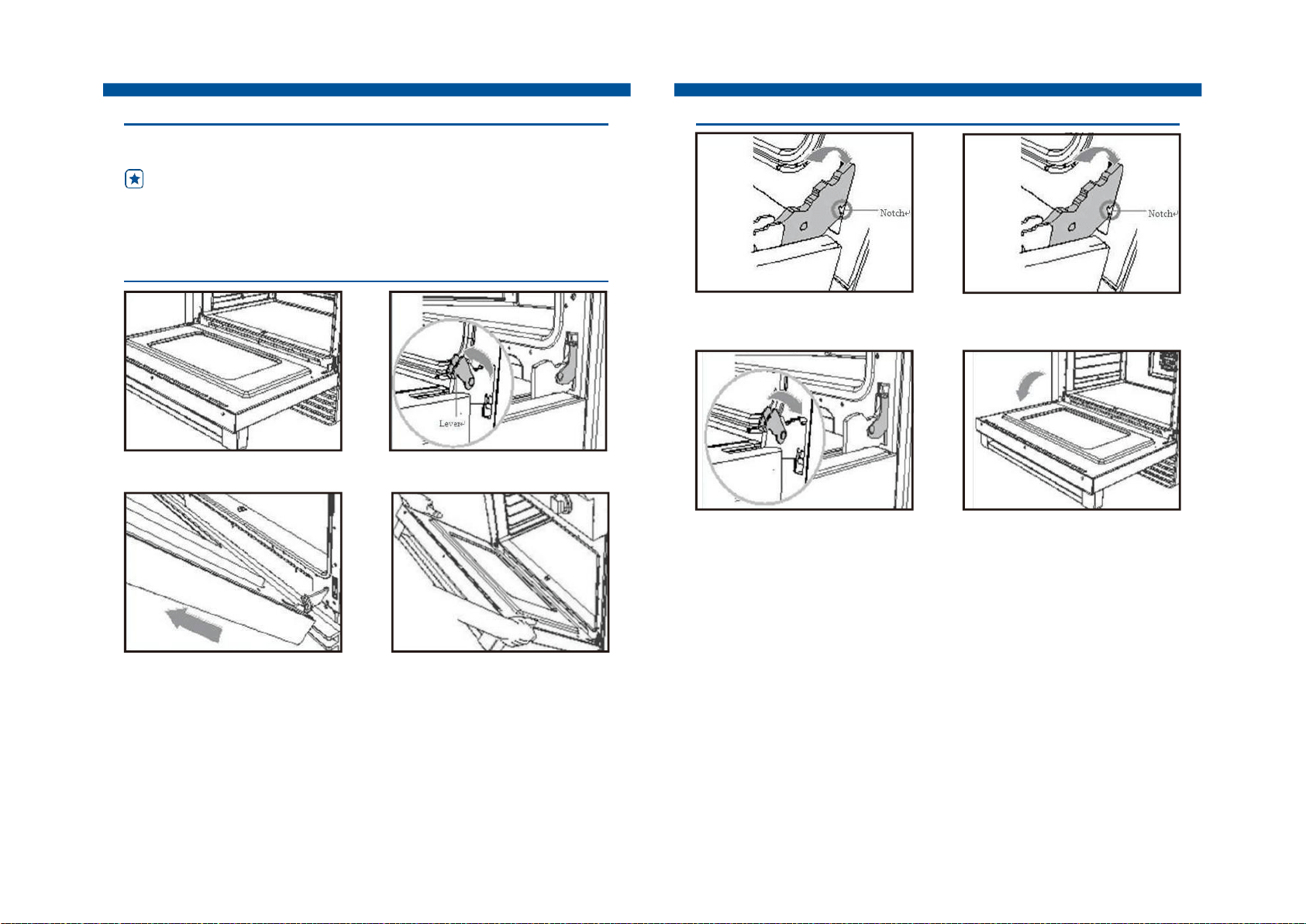
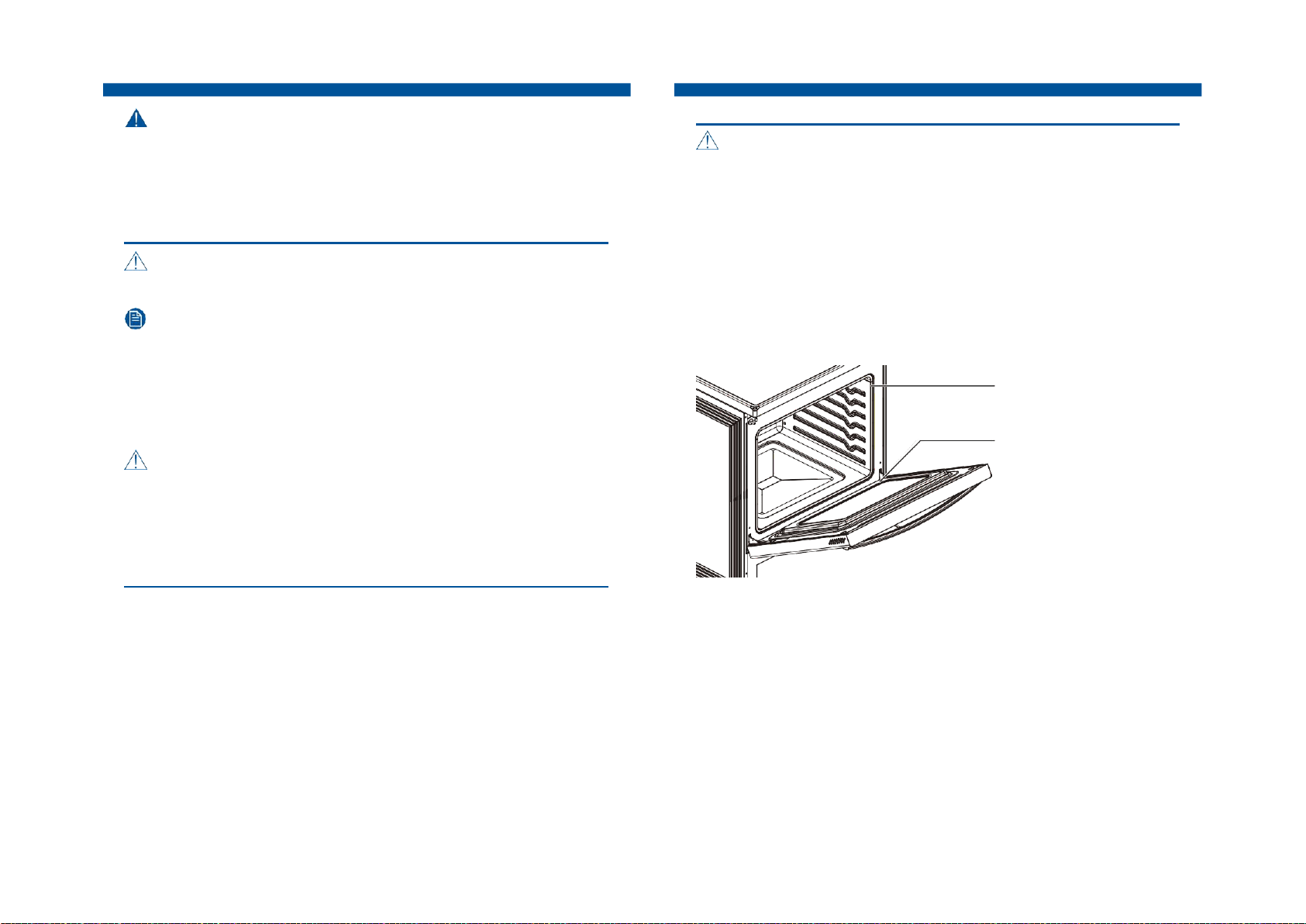
Removing the Oven Door
Removing the Oven Door
Removing and replacing the oven door
Do not lift the oven door by its handle.Doing so may damage the door.
Make sure the oven and the door are cool before you begin to remove the door.
IMPORTANT
Before removing the door,make sure there is a large enough clear,protected surface in
the kitchen to rest the door on.
The oven door is heavy!
Replacing the oven door
Removing the oven door
1.Hold the door firmly in an
approximately open
position.
2.Insert the hinge tongues into the
slots making sure that the notches
on both sides drop into place as
shown.
1.Open the door very care fully.
2.Open the levers fully on both sides.
3.Open the door fully as shown.
4. Fully close the levers on the left
and right hinges, as shown, then
close the door.
3.Holding the door firmly on both sides
4.Disengage the hinges and remove the
gently close it about halfway, door, place
on a protected surface.
19
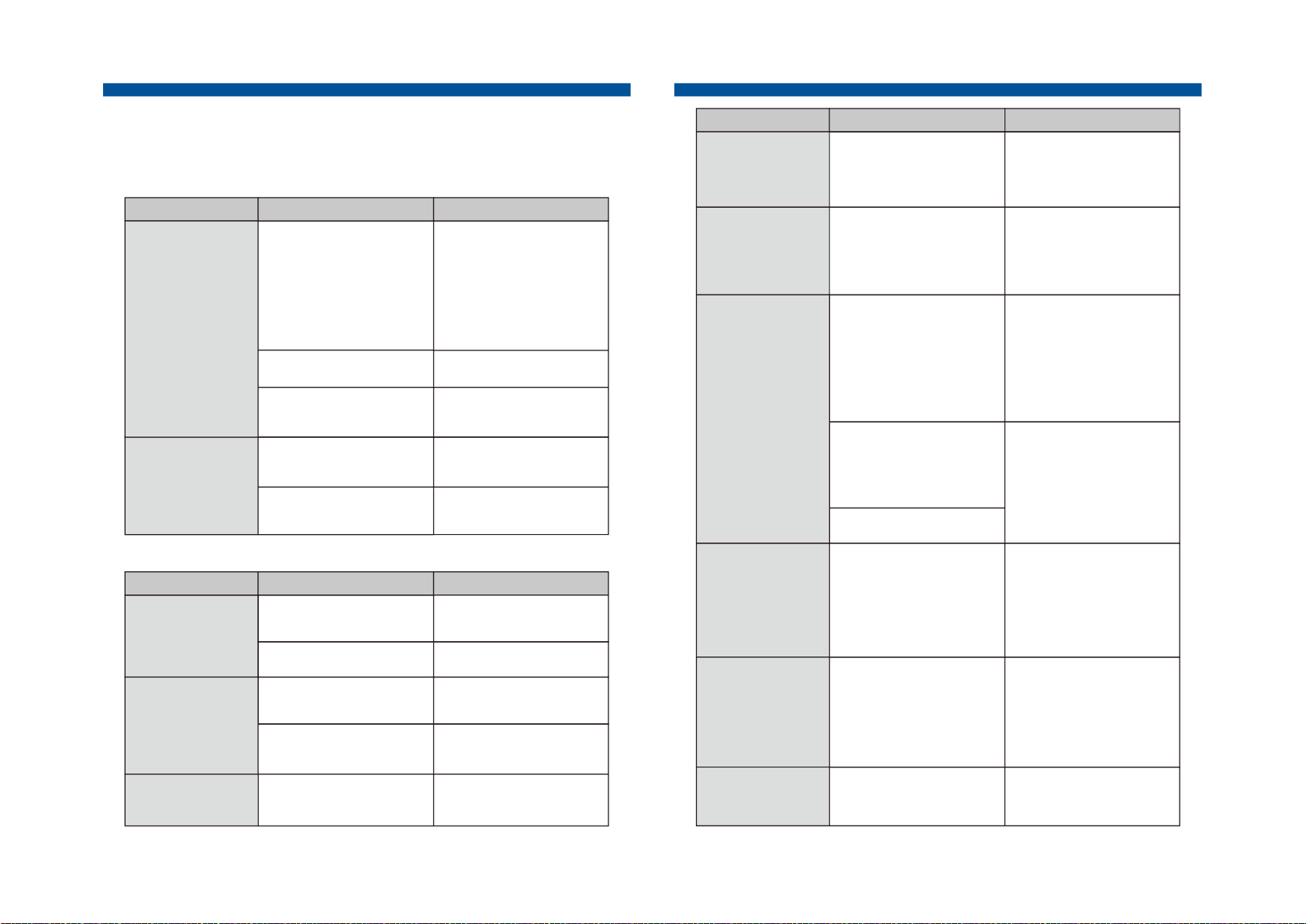
Trouble shooting
Trouble shooting
Thorkitchen works hard to ensure that you don’t have problems with your new gas
range. If you experience a problem, look first for a solution in the table below. If, after
trying the suggested solution, you’re still having trouble, call Thorkitchen
at 877-288-8099.
Installtion
COOKTOP
20
Problem
Possible cause
Solution
The surface units will
not maintain a rolling
boil or will not cook fast
enough.
You may be using inappropriate
cookware.
Use pans which are flat and
match the diameter of the
surface unitselected.
In some areas, the power
(voltage) may be low.
Cover the pan with a lid until
the desired heat is obtained.
The surface units will
not turn on.
A fuse in your homemay be
blown or the circuitbreaker
tripped.
Replace the fuseor reset the
circuit breaker.
The cooktop controls are set
improperly.
Check if the correct control is
set for the surface unit you are
using.
Are as of discoloration
on the cooktop.
Food spillover was not cleaned.
Refer to the section on the care
and cleaning of the glass
cooktop
Problem
Possible cause
Solution
The range is not level.
The appliance has been
installed improperly.
•
Place the oven rack in the
center of the oven. Place a
levelon theoven rack. Adjust
the leveling legs atthe base of
the range until the oven rack
is level.
•
Insure the floor is level and
strong and stable enough to
adequately support the range.
The floor is sagging or sloping.
Contact a carpenter to correct
the situation.
The kitchen cabinets are not
properly aligned and make the
range appear to be not level.
Insure the cabinets are square
and provide sufficient room for
installation.
The appliance must be
accessed for servicing
and cannot be moved
easily.
The kitchen cabinets are not
square and too close to the
appliance.
Contact a builderor installer to
make the appliance accessible.
Carpet is interfering with
movement of the range.
Provide sufficient space so the
range can be lifted over the
carpet.
Problem
Possible cause
Solution
Are as of discoloration
on the cooktop.
The surface is hot and the
model features a light-colored
cooktop.
This is normal. The surface
may appear discoloredwhen it
is hot. This is temporary and
will disappear as the glass
cools.
The surface unit
frequently cycles on
and off.
The surface unit stops
glowing when changed
to a lower setting.
The element will cycle on and
off to maintain the power
setting.
This is normal operation, and
not a system failure. Use the
oven as usual.
Scratches or abrasions
on the cooktop surface.
The cooktop is being cleaned
improperly.
Scratches are not removable.
Tiny scratches will become less
visible in time as a result of
cleaning. Use ceramic glass top
cleaning cream. Do
notusechemicalorcorrosive
agents. These agents may
damage the surface of the
product.
Cookware with rough bottoms
was used on the cooktop or
there were coarse particles (eg.
salt or sand) present between
the cookware and the surface of
the cooktop.
To avoid scratches, use the
recommended cleaning
procedures. Make sure
cookware bottoms are clean
before use, and use cookware
with smooth bottoms.
Cookware has been slid across
the cooktop surface.
Brown streaks or
specks.
Boilovers have been cooked on
to the surface.
•
Wait until the surface
coolsdown. Then, use a
scraper to remove those
impurities. Use the blade
scraper to remove soil.
•
See the section onthe care
and cleaning of the glass
cooktop
Areas of discolo ration
with metallic sheen.
Mineral deposits from water and
food have been left on the
surface of the cooktop.
•
Remove using a ceramic-
glass cooktop cleaning
cream.
•
Use cookware with clean, dry
bottoms. Clean the
cooktopwith a ceramic
cleaning agent regularly
every week.
“Cracking” or
“popping” sound.
This is the sound of the metal
heating and cooling during both
the cooking and self-cleaning
functions.
This is normal operation, and
not a system failure. Use the
oven as usual.
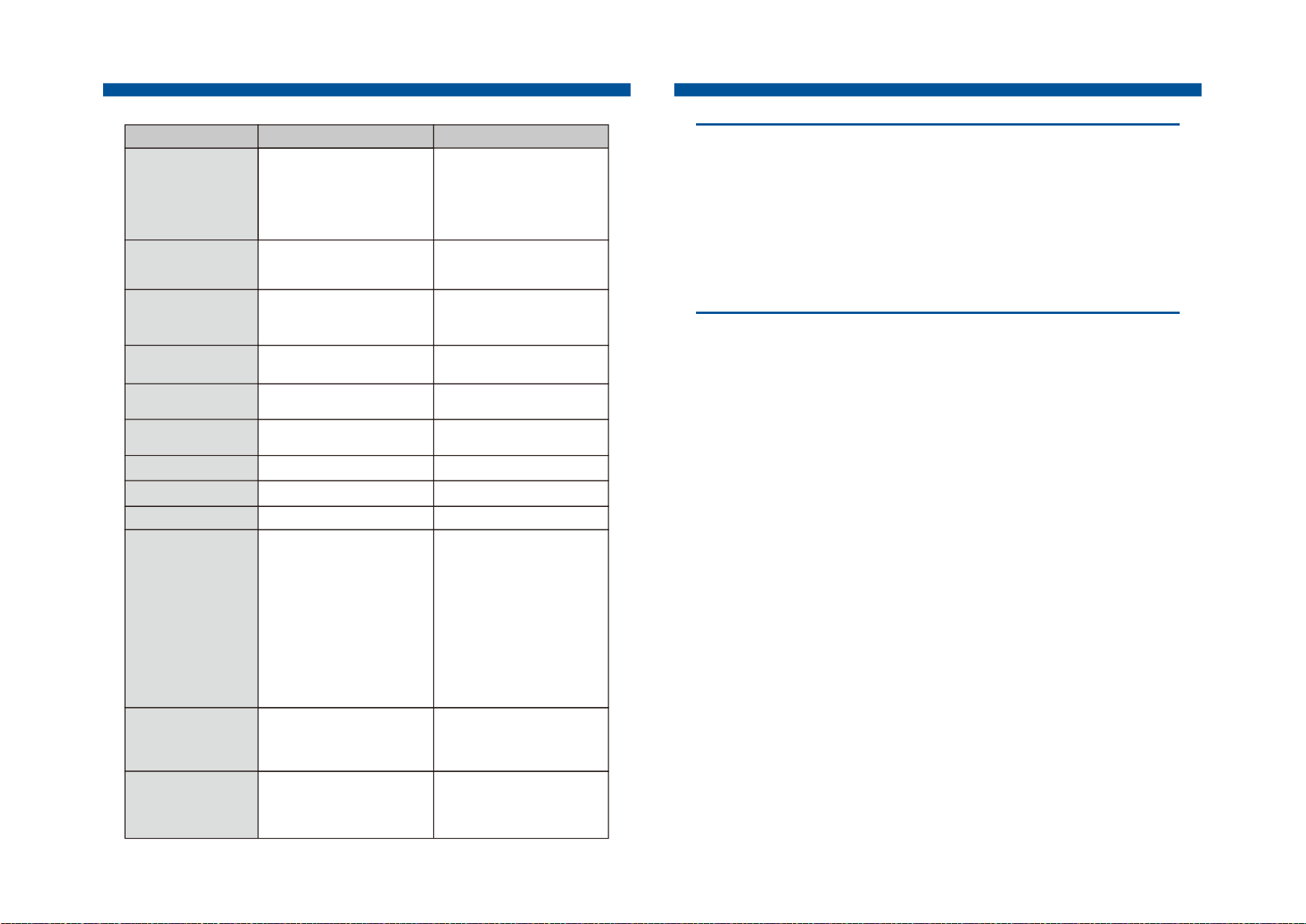
Trouble shooting
Warranty and Service
Warranty and Service
Oven
This product has been manufactured by Thor Group, 4651 E Airport Drive.
California 91761.
For the most up to date warranty and service policy, please refer to our website
WWW.THORKITCHEN.COM/WARRANTY-REGISTRATION
For in-warranty service requests, please visit our website at
WWW.THORKITCHEN.COM/SERVICE
Please Note: You must provide proof of purchase or installation date for any in-
warranty service requests
21
Problem
Possible causes
What to do
The oven doesn’t work (no
heating).
No power supply (oven light and halos
do not come on either).
No gas supply (gas ovens).
Check that the circuit breaker hasn’t
tripped and there is no power outage in
your area. If there is a power outage,
you cannot use the oven until power
has been restored.
The supply to the house may not be
working or there may be an outage.
Contact your local gas supplier.
One of the oven lights does
not come on, but the oven
works.
The light bulb is loose.
The light bulb has blown.
If the bulb is loose, tighten it
If the bulb has blown, replace it
according to the instructions in section
“Replace Oven Light Bulb”
Condensation around oven
(e.g. on control panel or top
of oven door.)
Food has high moisture content or local
climate (temperature, humidity) is
contributing to condensation.
Condensation is normal. You can wipe
the drops off the control panel. If there
is frequent or excessive condensation,
make sure that cabinetry around the
range is moisture-proofed.
Steam coming from oven
vents at the back of the
range.
Moisture from food evaporating during
cooking.
This is normal, especially if you are
cooking large quantities of food in the
oven using a CONVECTION mode.
The convection fan does not
come on in a CONVECTION
mode.
Technical fault.
Contact your Authorized Service Center
or Customer Care.
Oven will not heat
Oven settings are not corrected
Follow mode selection and clock
settings as specified in Oven Operation
section of the manual.
Foods over-cooked or under-
cooked
Incorrect cooking time or temperature.
Adjust time, temperature, or rack
position.
“Cracking” or “Popping”
sound.
This is the sound of metal heating and
cooling.
This is normal.
There is a power failure - can
I still use the oven?
Power outage in your home or
neighborhood.
The oven cannot be used until power is
restored.
The oven is not cooking
evenly
Large item like a turkey being cooked.
If you are cooking a large item, be
prepared to turn it round during cooking.
If two shelves are used, check that
space has been left for the heat to
circulate. When a baking tray is put into
the oven, make sure that it is placed
centrally on the shelf.
Check that the door seal is not
damaged.
A dish of water when placed on the
shelf should be the same depth all over.
(For example, if it is deeper at the back,
then the back of the range should be
raised up or the front lowered.) If the
range is not level, arrange for your
supplier to level it for you.
Oven not coming on
Power supply interrupted
Is the power on?
If not, there may be something wrong
with the power supply.
Is the range supply on at the circuit
breaker?
Oven temperature getting
hotter as the range gets older
Thermostat
If turning the temperature down using
the oven control knob has not worked,
or has only worked for a short time, then
you may need a new thermostat. This
should be fitted by a qualified service
person
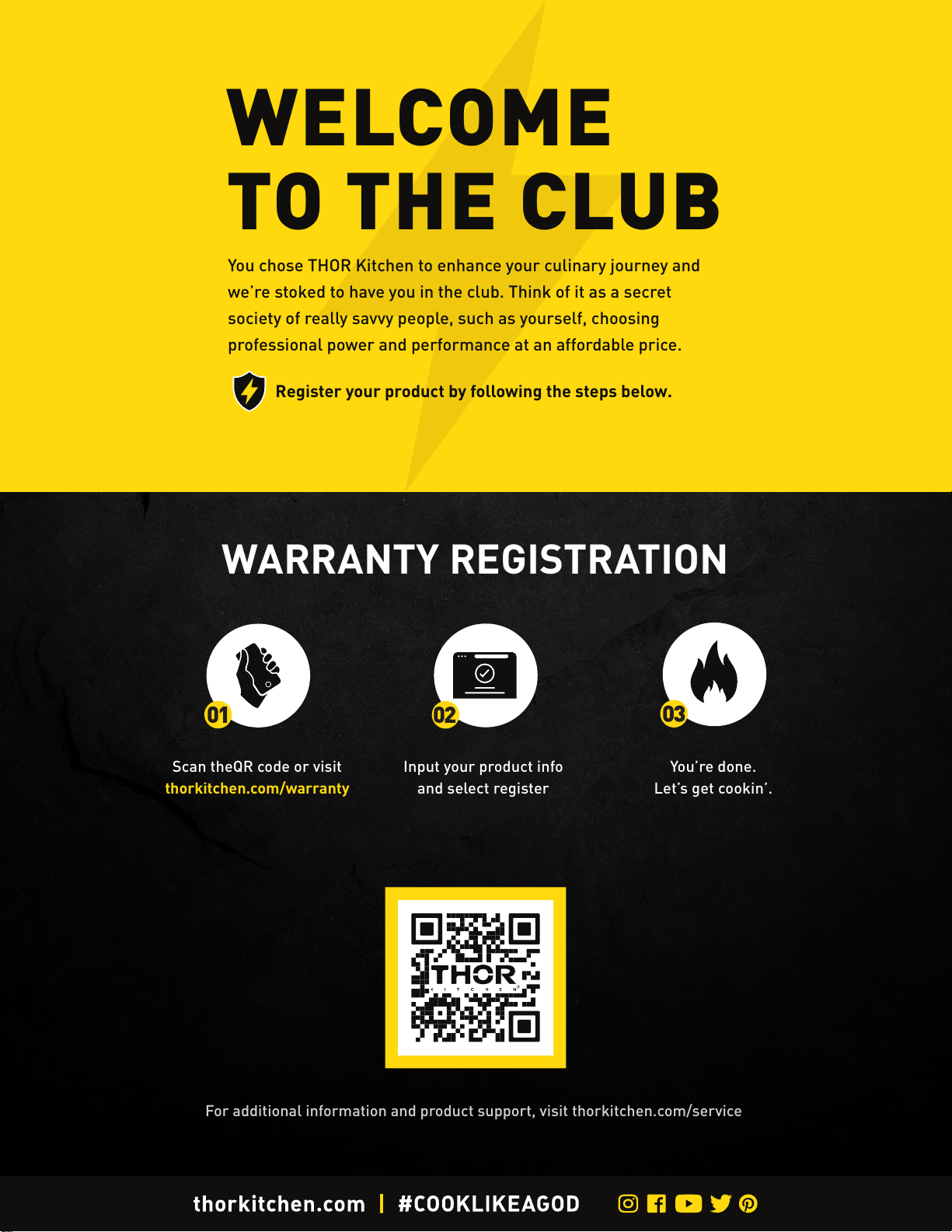
WARRANTY REGISTRATION
Scan theQR code or visit
thorkitchen.com/warranty
Input your product info
and select register
You’re done.
Let’s get cookin’.
You chose THOR Kitchen to enhance your culinary journey and
we’re stoked to have you in the club. Think of it as a secret
society of really savvy people, such as yourself, choosing
professional power and performance at an affordable price.
Register your product by following the steps below.
WELCOME
TO THE CLUB
For additional information and product support, visit thorkitchen.com/service