Owner's Manual
THE ECONOM ERTM 6
GAS WATER HEATER
POWER VENTED GAS MODELS
WITH HOT SURFACE IGNITION
FOR POTABLE WATER HEATING ONLY.
NOT SUITABLE FOR SPACE HEATING.
NOT FOR USE IN MOBILE HOMES.
MODEL NO.
153.332040 40 Gallon Nat
153.332050 50 Gallon Nat
153.332060 40 Gallon LP
153.332070 50 Gallon LP
, Safety hstructions
mnstaHation
Operation
, Care and Maintenance
* Troubleshooting
, Parts List
GA$-FmHEg
For Your Safety
AN ODORANT IS ADDED TO THE GAS USED BY THIS WATER HEATER.
C3 Technology _*Gas Water Heaters meet
the newANSI Z21.10.1 standard that deals
with the accidental or unintended ignition
of flammable vapors, such as those
emitted by gasoline,
Read and understand instruction
manual and safety messages
before installing, operating or
servicing thiswater heater
Failure to follow instructions and
safety messages could result in
death or serious injury.
instruction manual must remain with
water beater.
Si no puede leer o entender el ingles y necesita el manual instructivo
y/o etiquetas en espa5oJ puede obtenerlos Ilamando al
1o800o821o2017. NO TRATE DE INSTALAR O OPERAR ESTE
CALENTADOR DEAGUAsi no entiende la infom_aci6n en las etiquetas
o en el manual instructivo. No hacer caso de esta advertencia podria
resultar en la MU ERTE O GRAVES LESIONES CORPORALES.
WARNING: If the information in these
instructions is not followed exactly, a fire
or explosion may result causing property
damage, personal injury or death.
--Do not store or use gasoline or other
flammable vapors and liquids in the
vicinity of this or any other appliance.
-- WHAT TO DO IF YOU SMELL GAS:
• Do not try to Hght any appliance.
o Do not touch any emectricam switch; do
not use any phone in your buimding.
• mmmediatemy caml your gas suppmier
from a neighbor's phone. Fommow the
gas eupplier'e instructions,
o mfyou cannot reach your gas suppmier,
cammthe fire department.
--Installation and service must be
performed by a qualified installer,
service agency orthe gas supplier.
Sears, Roebuck and Co., Hoffman Estates, _L 60179 U.S.A
PRINTED INTHE U.S.A. 0905 www.sears.com PART NO. 185249-000
Yoursafetyandthesafetyofothersisextremely important in the installation, use and servicLng of tMs water heater.
Many safetyore[ated messages and instructLons have been provided in this manual and on your own water heater to warn you and
others of a potential injury hazard. Read and obey all safety messages and instructions throughout tMs manuaL, mt is very
important that the meaning of each safety message is understood by you and others who instam[, use or service this water heater.
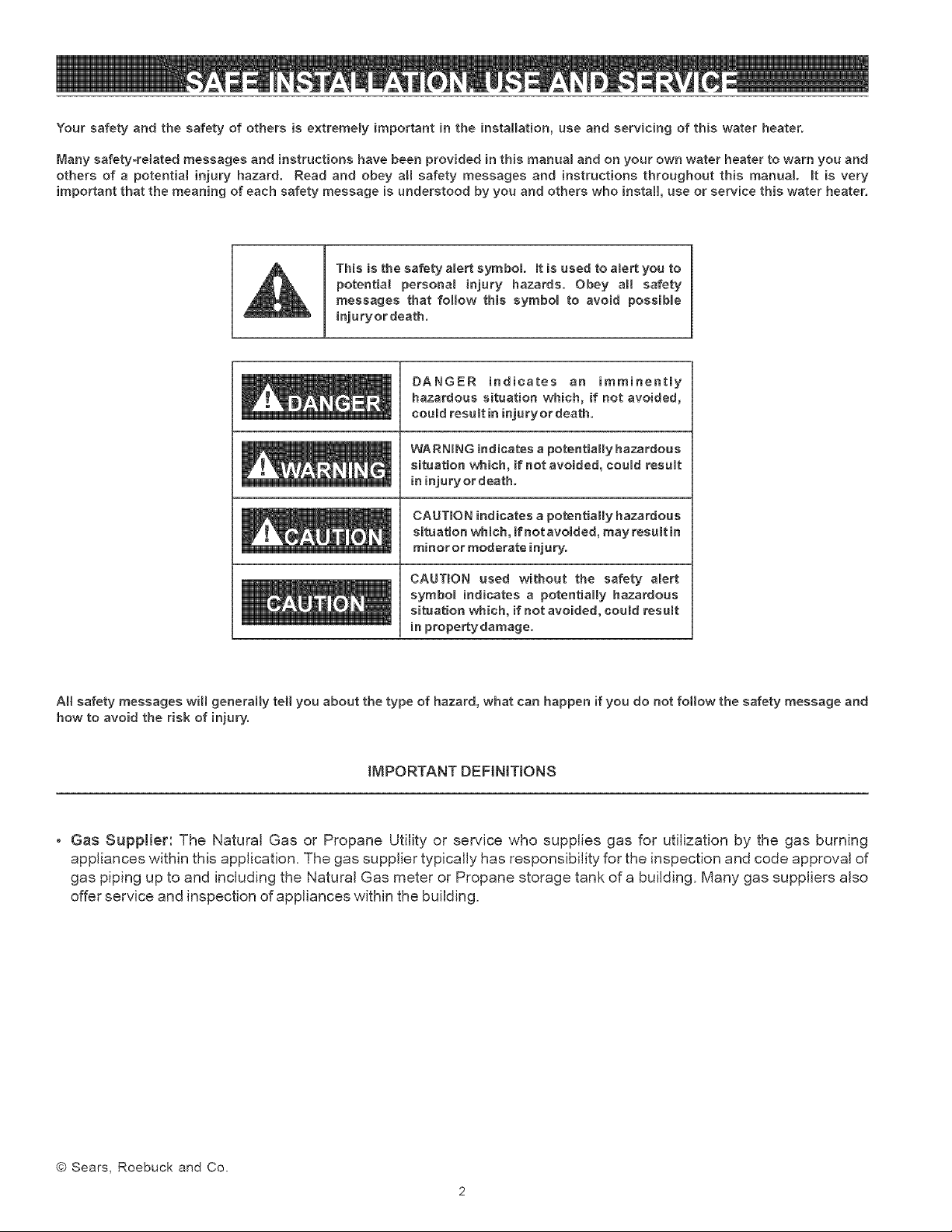
This is the safety amert symbol [t is used to alert you to
potential persona[ injury hazards. Obey a[[ safety
messages that fommow this symbom to avoid possibme
injuryor death.
m!!l[[I
_m!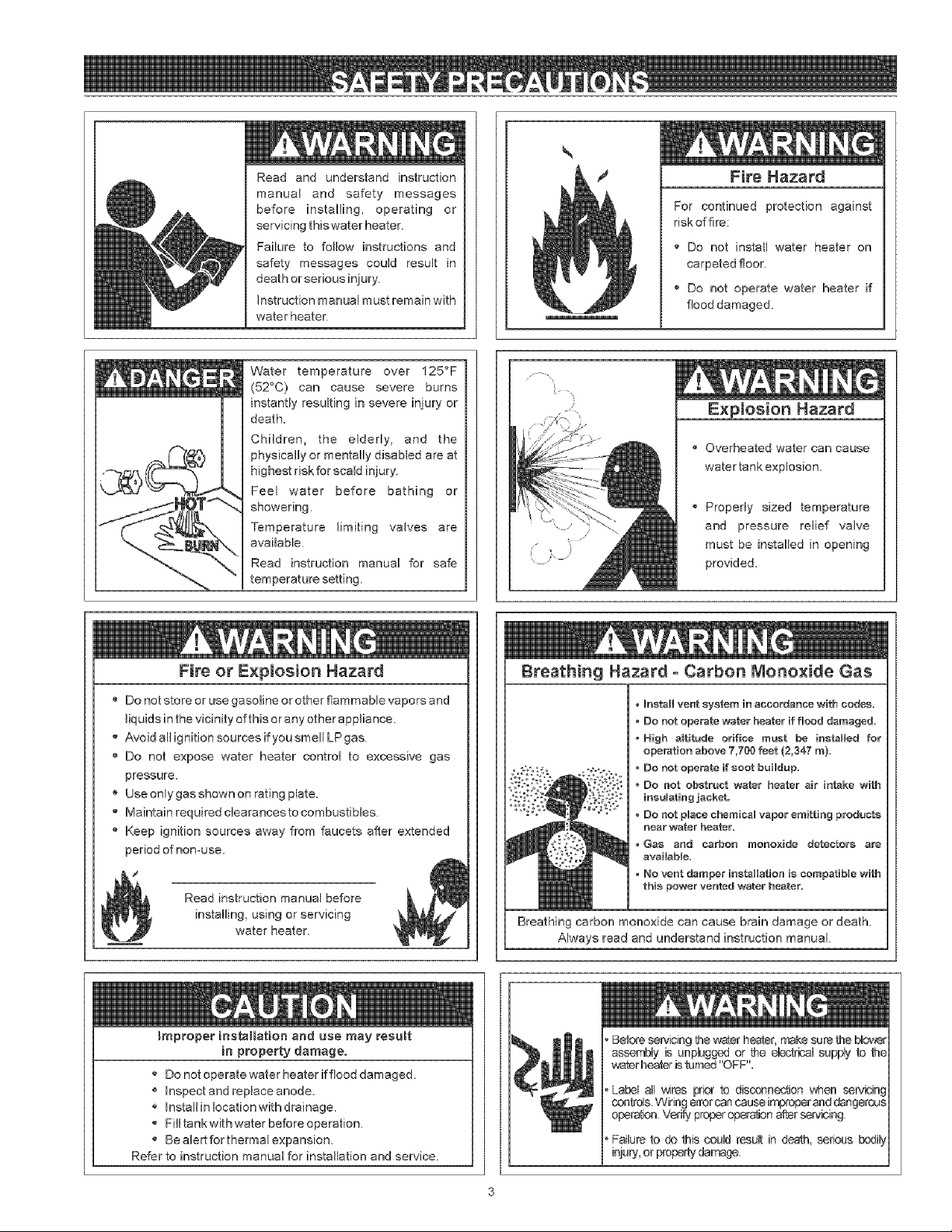
Readandunderstandinstruction
manualandsafetymessages
beforeinstalling,operatingor
servicingthiswaterheater.
Failureto followinstructionsand
safetymessagescouldresultin
deathorseriousinjury,
Instructionmanualmustremainwith
waterheater.
Fire Hazard
For continued protection against
riskoffire:
" Do not install water heater on
carpeted floor.
_' Do not operate water heater if
flood damaged.
Water temperature over 125°F
(52°0) can cause severe burns
instantly resulting in severe injury or
death.
Children, the elderly, and the
physically or mentally disabled are at
highest risk for scald injury.
Feel water before bathing or
showering.
Temperature limiting valves are
available.
Read instruction manual for safe
temperature setting.
Fire or Explosion Hazard
/,- -,,
)Iosion Hazard
Overheated water can cause
watertank explosion.
,, Propedy sized temperature
and pressure relief valve
must be inatalled in opening
provided.
Do not store or use gasoline or other flammable vapors and
liquids in the vicinity of this or any other appliance.
,, Avoid all ignition sources if you smell LP gas
'_ Do not expose water heater control to excessive gas
pressure,
Use onlygasshown on rating plate.
" Maintain required clearances to combustibbs.
Keep ignition sources away from faucets after extended
period of nomuse.
/
Read instruction manual before
installing, using or servicing
water heater.
Breathing Hazard - Carbon iVionoxide Gas
. _S,.,=% *
• Install vent system in accordance with codes.
• Do not operate wafer heater if flood damaged,
• High altitude orifice must be installed for
operation above 7,700 feet (2,347 rn).
- Do not operate if soot buildup.
, Do not obstruct water heater air intake with
insulating jacket,
, Do not place chemical vapor emitting products
near wafer heater.
• Gas and carbon monoxide detectors are
available.
• No vent damper insfellation is csmpagble with
this power vented water heater.
Breathing carbon monoxide can cause brain damage or death
Always read and understand instruction manual.
improper ies_llation and use may result
in property damage.
Do not operate water heater ftftood damaged.
Inspect and replace anode.
Install in location with drainage,
Fill tank with water before operation,
Be alert for thermal expansion.
Refer to instruction manual for installation and seance.
, Betore servicing the water heater, make sure the bio_e_
assembly is unplugged or the electrical supply to the
wafer heater is turned "OFF".
operation Ver_y properopera,on after servicing
' Failure to do this could resu_ in death, serious bodi_]
injury, or property damage.
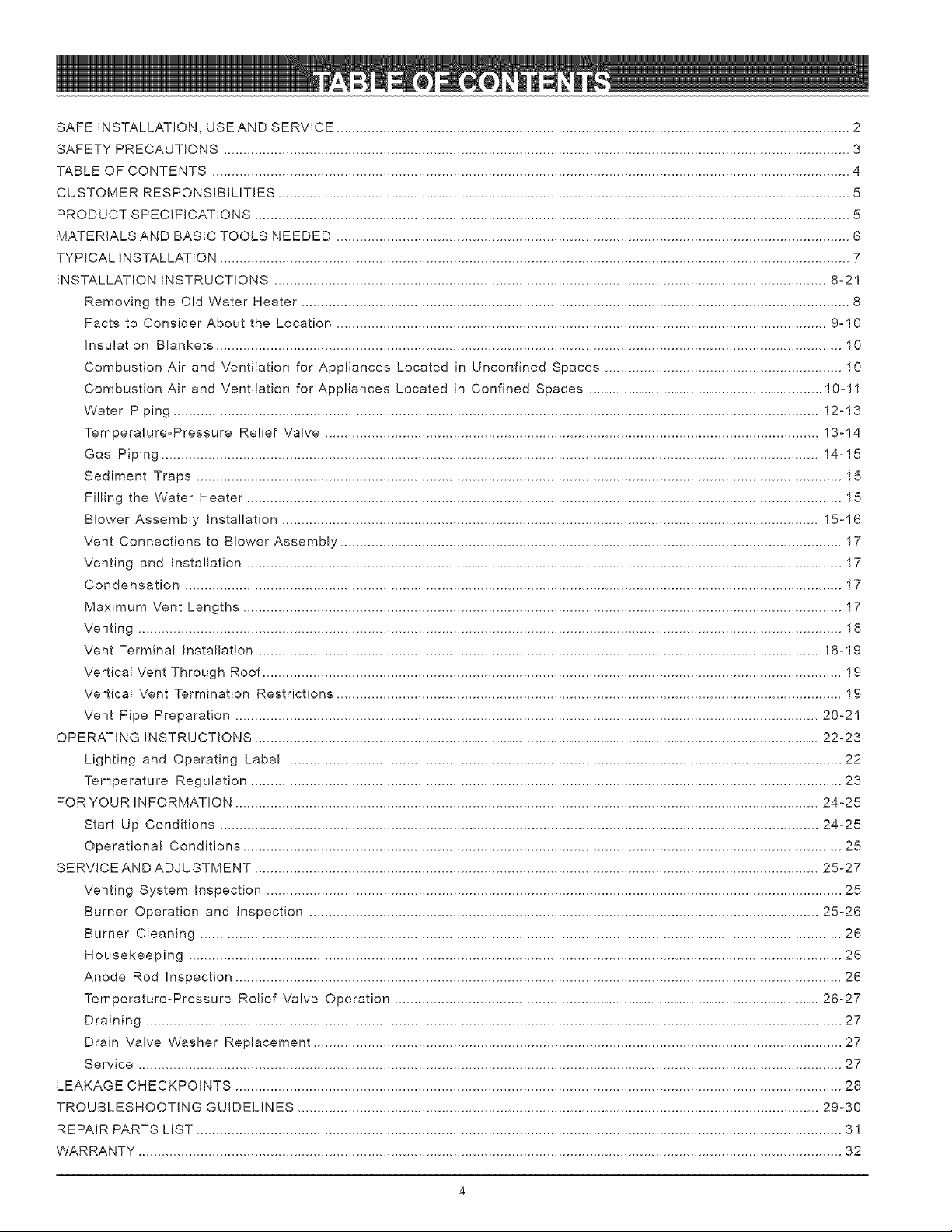
SAFEINSTALLATION,USEANDSERVICE....................................................................................................................................2
SAFETYPRECAUTIONS.................................................................................................................................................................3
TABLEOFCONTENTS....................................................................................................................................................................4
CUSTOMERRESPONSIBILITIES...................................................................................................................................................5
PRODUCTSPECIFICATIONS.........................................................................................................................................................5
MATERIALSANDBASICTOOLSNEEDED....................................................................................................................................6
TYPICALINSTALLATION..................................................................................................................................................................7
INSTALLATIONINSTRUCTIONS..............................................................................................................................................8=21
RemovingtheOldWaterHeater.............................................................................................................................................8
Factsto ConsiderAbouttheLocation..............................................................................................................................9=10
InsulationBlankets.................................................................................................................................................................10
CombustionAirandVentilationforAppliancesLocatedin UnconfinedSpaces.............................................................10
CombustionAirandVentilationforAppliancesLocatedinConfinedSpaces............................................................10=11
WaterPiping......................................................................................................................................................................12-13
Temperature=PressureReliefValve...............................................................................................................................13-14
GasPiping.........................................................................................................................................................................14-15
SedimentTraps......................................................................................................................................................................15
FillingtheWaterHeater.........................................................................................................................................................15
BlowerAssemblyInstallation..........................................................................................................................................15-16
VentConnectionsto BlowerAssembly.................................................................................................................................17
VentingandInstallation.........................................................................................................................................................17
Condensation.........................................................................................................................................................................17
MaximumVentLengths..........................................................................................................................................................17
Venting.....................................................................................................................................................................................18
VentTerminalInstallation................................................................................................................................................18-19
VerticalVentThroughRoof.....................................................................................................................................................19
VerticalVentTerminationRestrictions..................................................................................................................................19
VentPipePreparation......................................................................................................................................................20-21
OPERATINGINSTRUCTIONS.................................................................................................................................................22-23
LightingandOperatingLabel.................................................................................................................................................
TemperatureRegulation........................................................................................................................................................23
FORYOURINFORMATION......................................................................................................................................................24-25
StartUpConditions..........................................................................................................................................................24-25
OperationalConditions..........................................................................................................................................................25
SERVICEANDADJUSTMENT.................................................................................................................................................25-27
VentingSystemInspection....................................................................................................................................................25
BurnerOperationandInspection...................................................................................................................................25-26
BurnerCleaning.....................................................................................................................................................................26
Housekeeping........................................................................................................................................................................26
AnodeRodInspection............................................................................................................................................................26
Temperature-PressureReliefValveOperation.............................................................................................................26-27
Draining...................................................................................................................................................................................27
DrainValveWasherReplacement........................................................................................................................................27
Service.....................................................................................................................................................................................27
LEAKAGECHECKPOINTS............................................................................................................................................................28
TROUBLESHOOTINGGUIDELINES......................................................................................................................................29-30
REPAIRPARTSLIST......................................................................................................................................................................31
WARRANTY.....................................................................................................................................................................................32
ThankYouforpurchasingaKenmorewaterheater.Properlyinstalled
andmaintained,itshouldgiveyouyearsoftroublefreeservice,ifyou
shoulddecidethatyouwantthenewwaterheaterprofessionally
installedbySearscall1-8004-M%HOME®.They\,viiiarrangeforprompt,
qualityinstallationbySearsauthorizedcontractors.
AbbreviationsFoundInThisInstructionManual:
CSA-CanadianStandardsAssociation
ANSI-American National Standards institute
NFPA- National Fire Protection Association
ASME - American Society of Mechanical Engineers
GAMA - Gas Appliance Manufacturer's Association
UL - Underwriters Laboratories Inc.
This gas-fired water heater is listed by Underwriters Laboratories Inc.
underAmerican National Standard/CSA Standard for Gas Water Heaters
ANSI Z21.10.1 • CSA4.! (current edition).
PREPARING FOR THE INSTALLATION
Read the "Safety Precautions" section, page 3 of this manual first
and then the entire manual carefully. If you don't follow the safety
rules, the water heater will not operate properly. It could cause
DEATH, SERIOUS BODILY INJURYAND/OR PROPERTY DAMAGE.
This manual contains instructions for the installation, operation, and
maintenance of the gas4ired water heater. It also contains warnings
throughout the manual that you must read and be aware of. All
warnings and all instructions are essential to the proper operation
of the water heater and your safety. Since we cannot put eveQ/thing
on the first few pages, READ THE ENTIRE MANUAL BEFORE
ATTEMPTING TO INSTALL OR OPERATE THE WATER HEATER.
The installation must conform with these instructions and the Ioca!
code authority having iurisdiction. In the absence of local codes,
installations shall comply with the National Fuel Gas COdeANSI Z223.1/
NFPA54 and the National Electrical Code, NFPA70. These publications
are available from The National Fire Protection Association, 1
Battery, march Park, Quincy, MA 02269.
3. The water heater when installed must be grounded in accordance
with the local codes, or in the absence of local codes, the National
Electrical Code NFPA 70.
4. If after reading this manual you have any questions or do not
understand any portion of the instructions, call the local gas utility or
the Sears Service Center.
Carefully plan the place where you are going to put the water heater.
Correct combustion, vent action, and vent pipe installation are very
important in preventing death from possible carbon monoxide
poisoning and fires.
Examine the location to ensure the water heater complies with the
"Facts to ConsiderAbout the Location" section in this manual.
For California installation this water heater must be braced, anchored,
or strapped to avoid falling or moving during an earthquake. See
instructions for correct installation procedures. Instructions may be
obtained from California Office of the State Architect, 400 P Street,
Sacramento, CA 95814.
7. Massachusetts Code requires this water heater to be installed in
accordance with Massachusetts 248-CMR 2.00: State Plumbing Code
and 248-CMR 5.00.
8. CompiieswithSCAQMDrule#1121 and distdcts having equivalent
NOx requirements.
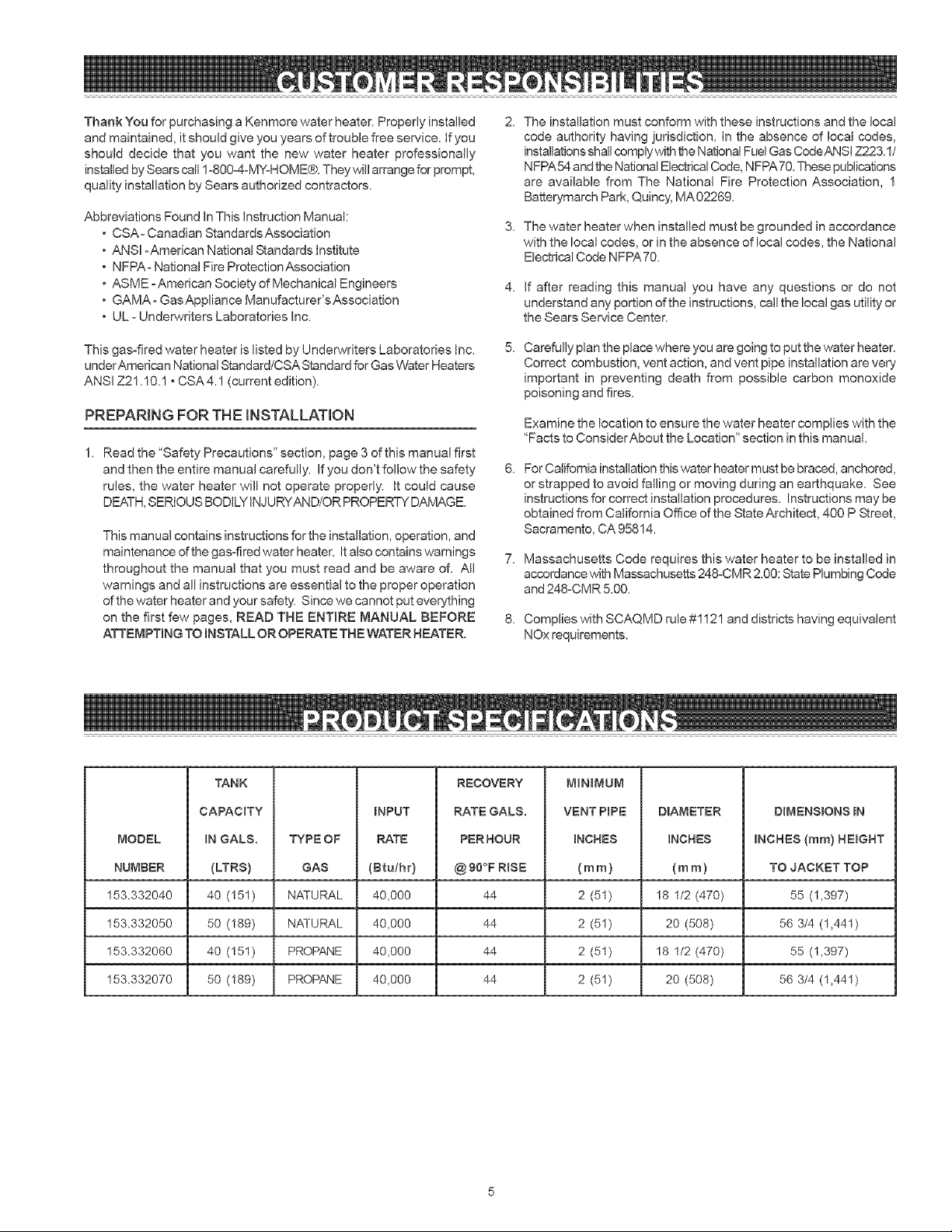
MODEL
NUMBER
153.332040
153.332050
153.332060
153.332070
TANK
CAPACITY
IN GALS.
(LTRS)
40 (151)
50 (169)
40 (151)
50 (16e)
TYPE OF
GAS
NATURAL
NATURAL
PROPANE
PROPANE
INPUT
RATE
(Btuthr)
40,000
40,000
40,000
40,000
RECOVERY
RATE GALS.
PERHOUR
@90°F R_SE
44
44
44
44
MINIMUM
VENT PRPE
INCHES
(ram)
2 (51)
2 (51)
2 (51)
2 (51)
DBA_,_ETER
iNCHES
(ram)
18 1/2 (470)
20 (508)
18 1/2 (470)
20 (508)
DIMENSBONS IN
iNCHES (ram} NERGHT
TO JACKET TOP
55 (1,397)
56 3/4 (1,441)
55 (1,397)
56 3/4 (1,441)
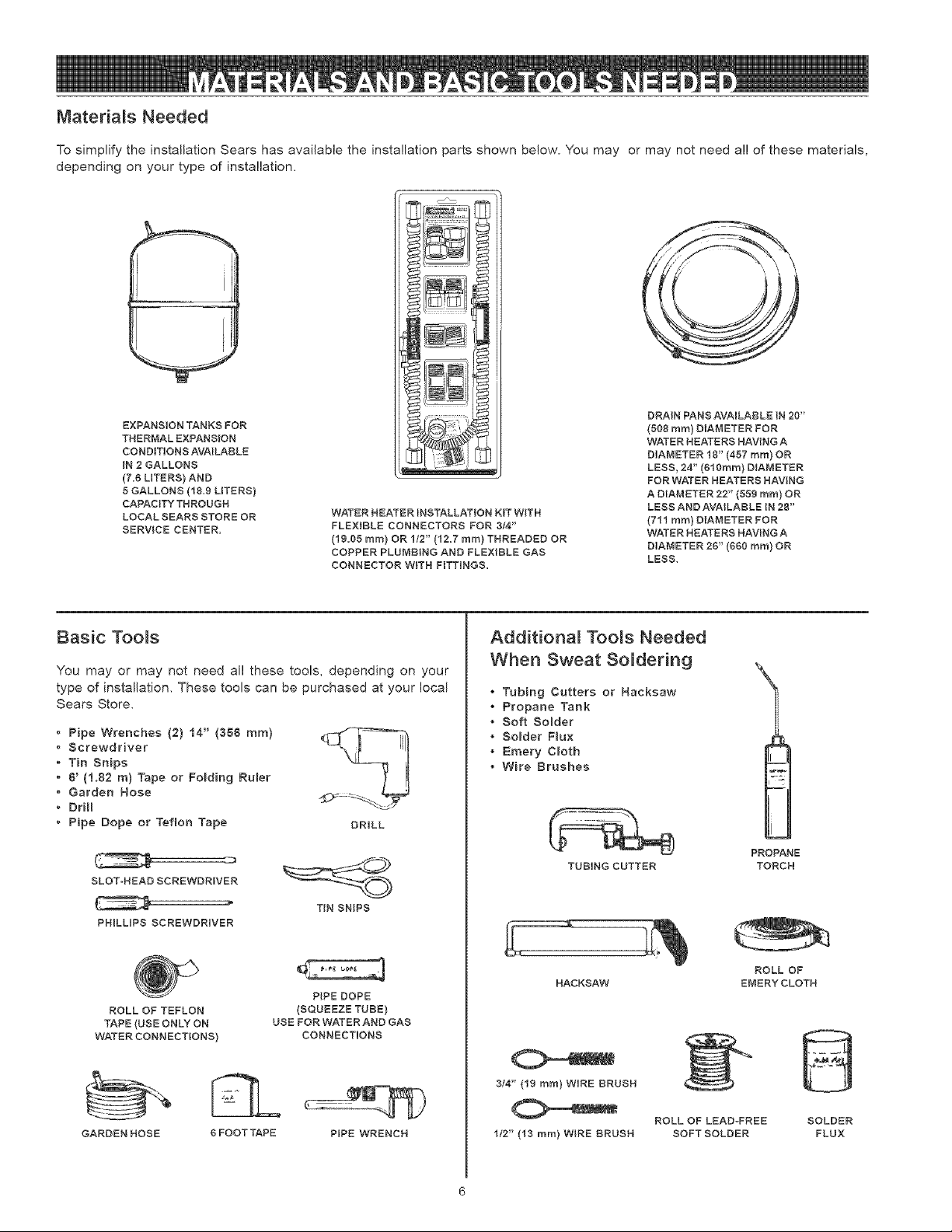
Materials Needed
To simplify the installation Sears has available the installation parts shown below. You may or may not need al! of these materials,
depending on your type of installation.
EXPANSION TANKS FOR
THERMAL EXPANSION
CONDITIONS AVAILABLE
iN 2 GALLONS
(7.8 LITERS} AND
5 GALLONS (18.9 LITERS)
CAPACITY THROUGH
LOCAL SEARS STORE OR
SERVICE CENTER.
_'_"'111'I
_,_1
_'_11_
WATER HEATER INSTALLATION KIT WITH
FLEXIBLE CONNECTORS FOR 8/4"
(19.05 ram} OR 1/2" (12.7 ram) THREADED OR
COPPER PLUMBING AND FLEXIBLE GAS
CONNECTOR WITH FITTINGS.
DRA_N PANS AVAILABLE iN 20"
(508 ram} DIAMETER FOR
WATER HEATERS HAVING A
DIAMETER 18" (457 ram) OR
LESS, 24" (810ram) DIAMETER
FOR WATER HEATERS HAVING
A DIAMETER 22" (559 ram) OR
LESS AND AVAILABLE IN 28"
(711 rnm} DIAMETER FOR
WATER HEATERS HAVING A
DIAMETER 28" (650 ram) OR
LESS.
Basic Too_s
You may or may not need all these tools, depending on your
type of installation. These tools can be purchased at your local
Sears Store.
Pipe Wrenches (2) 14" (356 ram)
Screwdriver
Tin Snips
8' (1.82 m) Tape or Fo_ding Ruler
Garden Hose
DriH
Pipe Dope or Teflon Tape DRILL
SLOT-HEAD SCREWDRIVER
PHILLIPS SCREWDRIVER
TiN SNIPS
ROLL OF TEFLON
TAPE (USE ONLY ON
WATER CONNECTIONS)
P{PE DOPE
(SQUEEZE TUBE)
USE FOR WATER AND GAS
CONNECTIONS
GARDEN HOSE
8 FOOT TAPE
PIPE WRENCH
Additional Tools Needed
When Sweat Soldering
Tubing Cutters or Hacksaw
Propane Tank
Soft Solder
Solder F_ux
Emery C_oth
Wire Brushes
TUBING CUTTER
PROPANE
TORCH
HACKSAW
ROLL OF
EMERYCLOTH
8/4" (19 ram) WiRE BRUSH
1/2" (13 ram) WiRE BRUSH
ROLL OF LEAD-FREE
SOFTSOLDER
SOLDER
FLUX
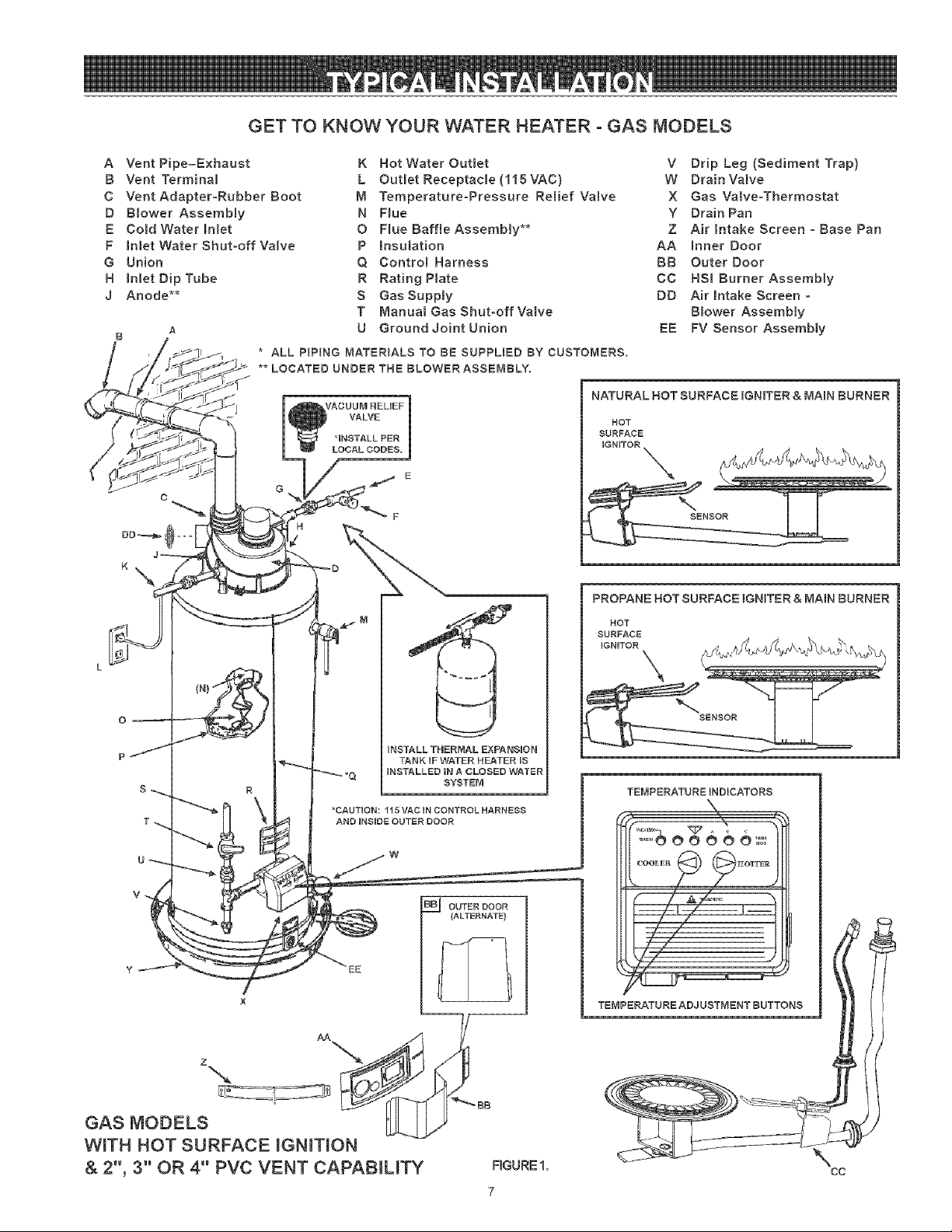
GET TO KNOW YOUR WATER HEATER - GAS MODELS
A Vent Pipe=Exhaust
B Vent Terminal
C Vent Adapter-Rubber Boot
D Blower Assembly
E CoJd Water Inlet
F runlet Water Shut-off Valve
G Union
H runlet Dip Tube
J Anode**
K Hot Water Outlet
L Outlet Receptacle (115 VAC)
M Temperature-Pressure Relief Valve
N Flue
O Hue Baffte Assembly**
P mnsulation
Q Control Harness
R Rating Plate
S Gas Suppmy
T Manua{ Gas Shut-off Valve
U Ground Joint Union
* ALL P}P}NG MATERIALS TO BE SUPPLIED BY CUSTOMERS.
** LOCATED UNDER THE BLOWER ASSEMBLY.
*INSTALL PER
LOCAL CODES.
INSTALL THERMAL EXPANSUON
TANK UFWATER HEATER iS
UNSTALLED IN A CLOSED WATER
SYSTEM
*CAUTION: 115 VAC IN CONTROL HARNESS
AND INSIDE OUTL=R DOOR
EE
GAS MODELS
WiTH HOT SURFACE _GN_T_ON
& 2", 3 °' OR 4" PVC VENT CAPAB_UTY
J
OUTER DOOR
(ALTERNATE)
FIGURE1,
7
V Drip Leg (Sediment Trap)
W DrainValve
X Gas Valve-Thermostat
Y Drain Pan
Z Air mntake Screen o Base Pan
AA runner Door
BB Outer Door
CC HSl Burner Assembly
DD Air intake Screen o
Blower Assembly
EE FV Sensor Assembly
NATURAL HOT SURFACE IGNITER & MABNBURNER
NOT
SURFACE
PROPANE HOT SURFACE IGNITER & MAIN BURNER
NOT
EURFACE
TEMPERATURE INDICATORS
i
CC
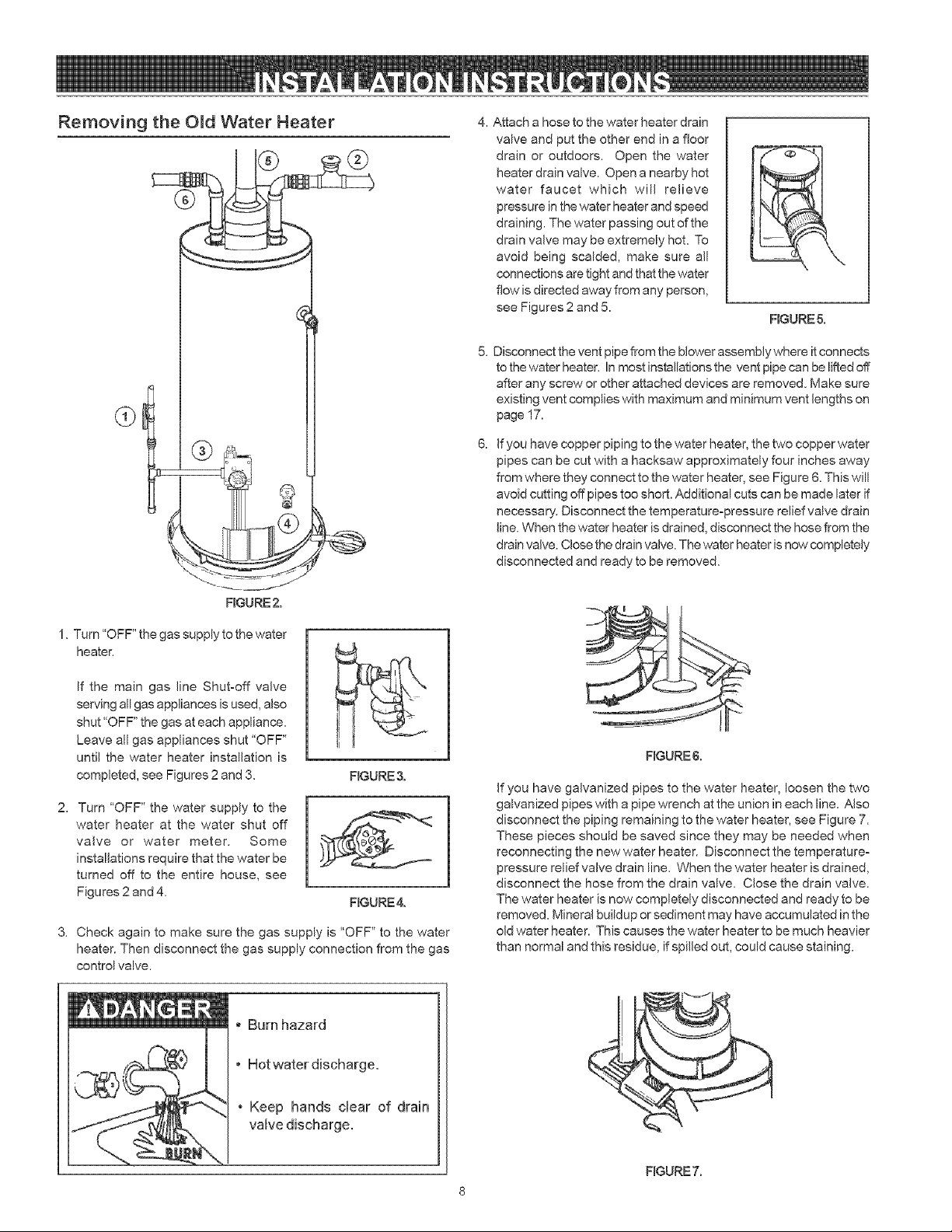
Removing the Old Water Heater
®
4. Attach a hose to the water heater drain
valve and put the other end in a floor
drain or outdoors. Open the water
heater drain valve. Open a nearby hot
water faucet which will relieve
pressure in the water heater and speed
draining. The water passing out of the
drain valve may be extremely hot. To
avoid being scalded, make sure all
connections are tight and that the water
flow is directed away from any person,
see Figures 2 and 5.
FmGURE5.
Disconnect the vent pipe from the blower assembly where it connects
to the water heater. In most installations the vent pipe can be lifted off
after any screw or other attached devices are removed. Make sure
existing vent complies with maximum and minimum vent lengths on
page 17.
If you have copper piping to the water heater, the two copper water
pipes can be cut with a hacksaw approximately four inches away
from where they connect to the water heater, see Figure 6. This will
avoid cutting off pipes too short. Additional cuts can be made later if
necessary. Disconnect the temperature-pressure relief valve drain
line. When the water heater is drained, disconnect the hose from the
drain valve. Close the drain valve. The water heater is now completely
disconnected and ready to be removed.
FIGURE2.
1. Turn "OFF" the gas supply to the water
heater.
If the main gas line Shut-off valve
serving all gas appliances is used, also
shut "OFF" the gas at each appliance.
Leave all gas appliances shut "OFF"
until the water heater installation is
completed, see Figures 2 and 3.
I
F_GURE3.
2. Turn "OFF" the water supply to the
water heater at the water shut off
valve or water meter. Some
installations require that the water be
turned off to the entire house, see
Figures 2 and 4.
RGURE4.
3. Check again to make sure the gas supply is "OFF" to the water
heater. Then disconnect the gas supply connection from the gas
control valve.
Burn hazard
, Hot water discharge.
• Keep hands clear of drain
RGURE 6.
If you have galvanized pipes to the water heater, loosen the two
galvanized pipes with a pipe wrench at the union in each line. Also
disconnect the piping remaining to the water heater, see Figure 7.
These pieces should be saved since they may be needed when
reconnecting the new water heater. Disconnect the temperature°
pressure relief valve drain line. When the water heater is drained,
disconnect the hose from the drain valve. Close the drain valve.
The water heater is now completely disconnected and ready to be
removed. Mineral buildup or sediment may have accumulated in the
old water heater. This causes the water heater to be much heavier
than normal and this residue, if spilled out, could cause staining.
RGURE 7.
FACTS TO CONSIDER ABOUT THE LOCATION
Carefully choose an indoor location for the new water heater, because
the placement is a very important consideration for the safety of the
occupants in the building and for the most economical use of the appliance.
This water heater is not for use in manufactured (mobile) homes
or outdoor installation.
Whether replacing an old water heater or putting the water heater in a
new location, the following critical points must be observed:
1. Select a location indoors as close as practical to the vent terminal or
location to which the water heater vent piping is going to be connected,
and as centralized with the water piping system as possible.
2. Selected location must provide adequate clearances for servicing
and proper operation of the water heater.
Property Damage Hazard
All water heaters eventually lea k.
, Do not install without adequate drainage.
Installation of the water heater must be accomplished in such a manner
that if the tank or any connections should leak, the flow will not cause
damage to the structure. For this reason, it is not advisable to install the
water heater in an attic or upper floor. When such locations cannot be
avoided, a suitable drain pan should be installed under the water heater.
Drain pans are available at your local hardware store. Such a drain pan
must have a minimum length and width of at least 2" (5.1 cm) greater than
the water heater dimensions and must be piped to an adequate drain.
The pan must not restrict combustion air flow.
Water heater life depends upon water quality, water pressure and the
environment in which the water heater is installed. Water heaters are
sometimes installed in locations where leakage may resuJt in property
damage, even with the use of a drain pan piped to a drain. However,
unanticipated damage can be reduced or prevented by a leak detector or
water shut-off device used in conjunction with a piped drain pan. These
devices are available from some plumbing supply wholesalers and
retailers, and detect and react to leakage in various ways:
• Sensors mounted in the drain pan that trigger an alarm or turn offthe
incoming water to the water heater when leakage is detected.
• Sensors mounted in the drain pan that turn off the water supply to the
entire home when water is detected in the drain pan.
* Water supply shut-off devices that activate based on the water
pressure differential between the cold water and hot water pipes
connected to the water heater.
• Devices that will turn off the gas supply to a gas water heater while at
the same time shutting off its water supply.
INSTALLATIONS IN AREAS WHERE FLAMMABLE LIQUIDS (VAPORS)
ARE LIKELYTO BE PRESENT OR STORED (GARAGES, STORAGEAND
UTtLITYAREAS, ETC.): Flammable liquids (such as gasoline, solvents,
propane (LP or butane, etc.) and other substances (such as adhesives,
etc.) emit flammable vapors which can be ignited by a gas water heater's
hot surface igniter or main burner. The resulting flashback and fire can
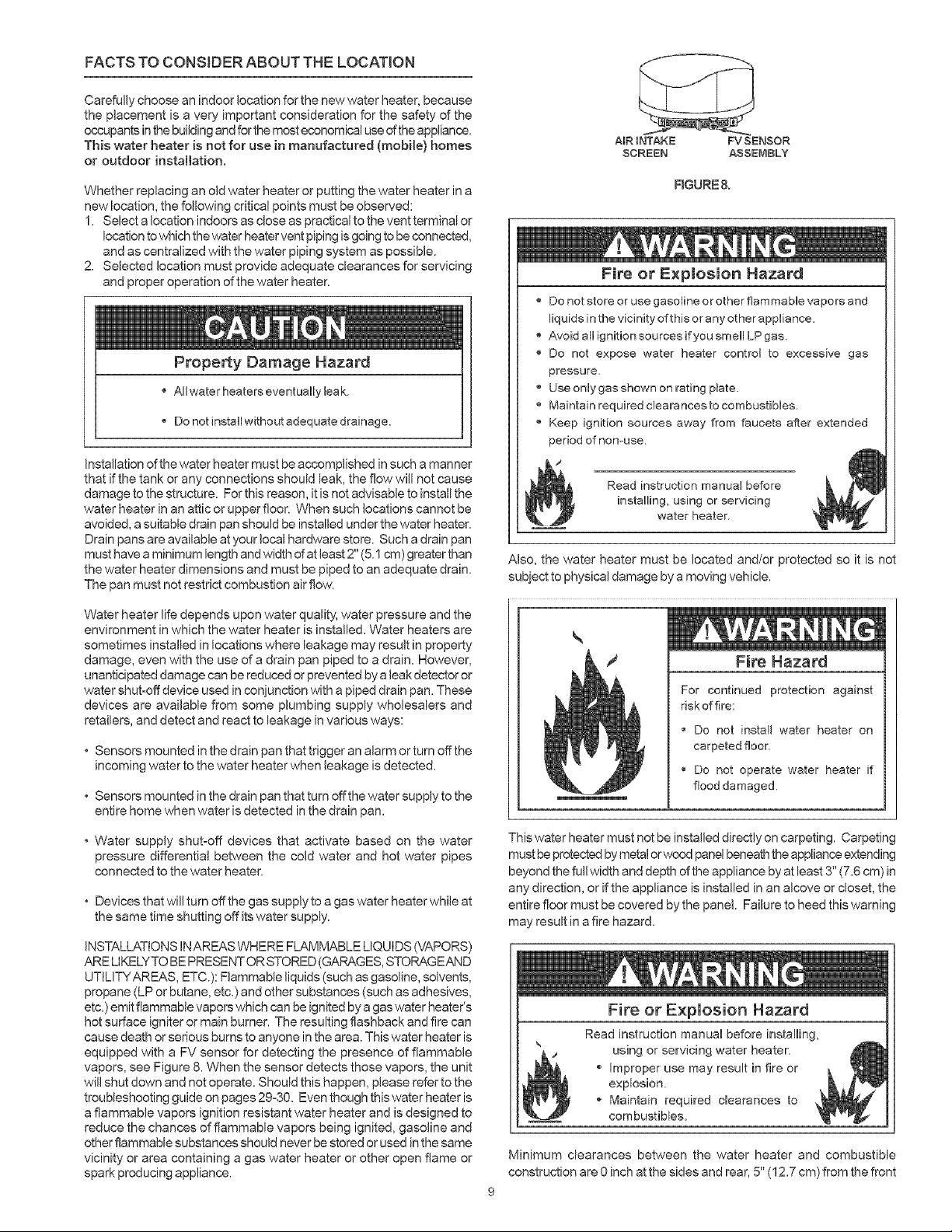
cause death or serious burns to anyone in the area. This water heater is
equipped with a FV sensor for detecting the presence of flammable
vapors, see Figure 8. When the sensor detects those vapors, the unit
will shut down and not operate. Should this happen, please refer to the
troubleshooting guide on pages 29°30. Even though this water heater is
a flammable vapors ignition resistant water heater and is designed to
reduce the chances of flammable vapors being ignited, gasoline and
other flammable substances should never be stored or used in the same
vicinity or area containing a gas water heater or other open flame or
spark producing appliance.
AIR BNTAKE
SCREEN
FVSENSOR
ASSEIVnIBLY
FIGURE&
Fire or Explosion Hazard
Do not store or use gasoline or other flammable vapors and
liquids in the vicinity of this or any other appliance.
Avoid all ignition sources if you smell LP gas.
Do not expose water heater control to excessive gas
pressure.
_' Use only gas shown on rating plate
Maintain required cleara nces to combustibles
'_ Keep ignition sources away from faucets after extended
period of nomuse.
/
Read instruction manual before
installing, using or servicing
water heater.
Also, the water heater must be located and/or protected so it is not
subiect to physical damage by a moving vehicle.
Fire Hazard
For continued protection against
riskoffire:
Do not install water heater on
carpeted floor.
Do not operate water heater if
flood damaged.
This water heater must not be installed directly on carpeting. Carpeting
must be protected by metal or wood panel beneath the appliance extending
beyond the full width and depth of the appliance by at least 3" (7.6 cm) in
any direction, or if the appliance is installed in an alcove or closet, the
entire floor must be covered by the panel. Failure to heed this warning
may result in a fire hazard.
Fire or Explosion Hazard
Read instruction manual before [nstaNing,
using or servicing water heater
Improper use may result in fire or
explosion.
Maintain required clearances to
combustibles.
Minimum clearances between the water heater and combustible
construction are 0 inch at the sides and rear, 5" (12.7 cm) from the front
9
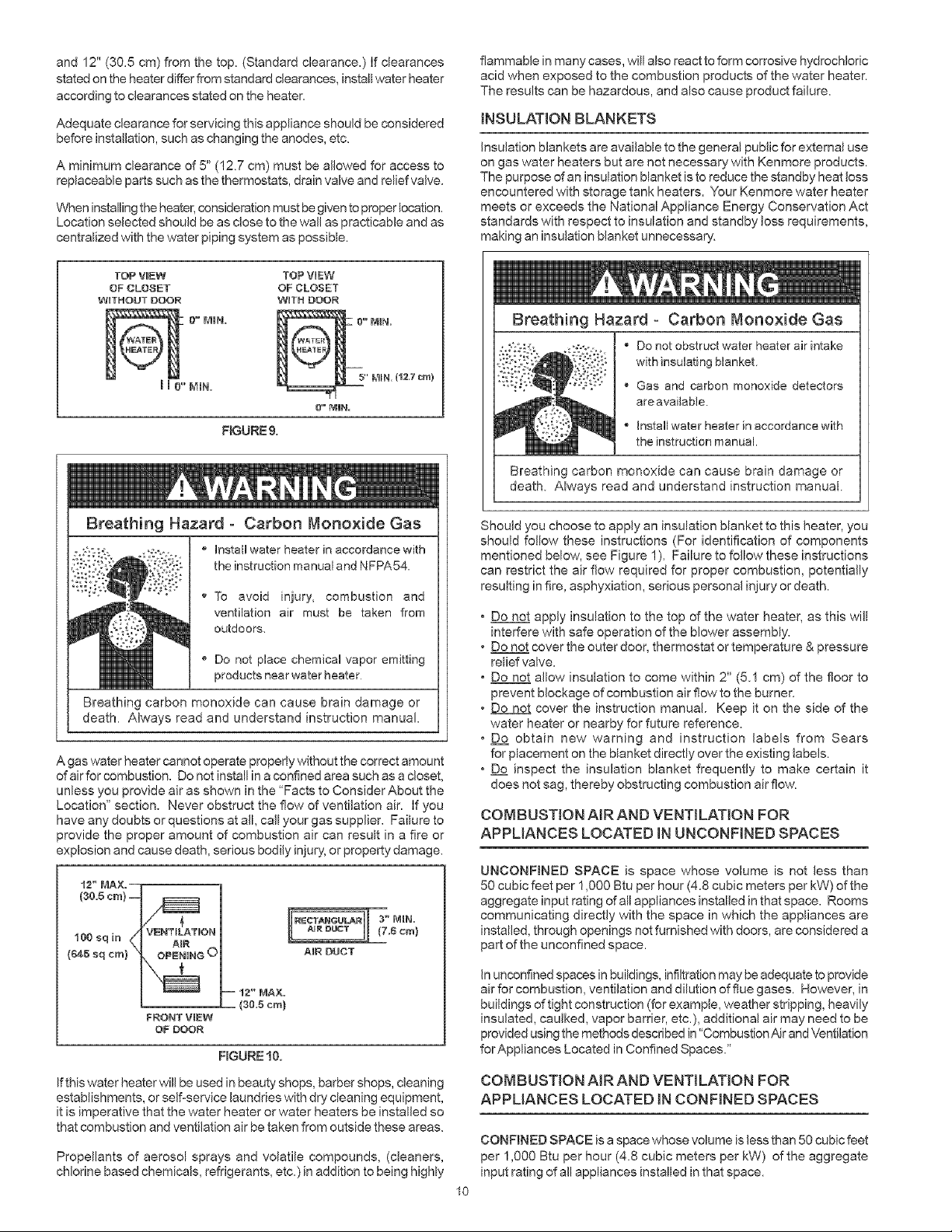
and12"(30.5cm)fromthetop.(Standardclearance.)Ifclearances
statedontheheaterdifferfromstandardclearances,instalwaterheater
accordingtoclearancesstatedontheheater.
Adequateclearanceforservicingthisapplianceshouldbeconsidered
beforeinstallation,suchaschangingtheanodes,etc.
Aminimumclearanceof5"(!2.7cm)mustbea/owedforaccessto
replaceablepartssuchasthethermostats,drainvalveandreliefvalve.
Wheninstallingtheheater,considerationmustbegiventoproperlocation.
Locationselectedshouldbeasclosetothewa/aspracticableandas
centralizedwiththewaterpipingsystemaspossible.
flammableinmanycases,will also react to form corrosive hydrochloric
acid when exposed to the combustion products of the water heater.
The results can be hazardous, and also cause product failure.
INSULATION BLANKETS
Insulation blankets are available to the general public for external use
on gas water heaters but are not necessary with Kenmore products.
The purpose of an insulation blanket is to reduce the standby heat loss
encountered with storage tank heaters. Your Kenmore water heater
meets or exceeds the National Appliance Energy Conservation Act
standards with respect to insulation and standby loss requirements,
making an insulation blanket unnecessary.
I I 0" IIIN.
FIGURE!.
Breathing Hazard - Carbon Monoxide Gas
Install water heater in accordance with
the instruction manual and NFPA54.
To avoid injury, combustion and
_.,,_ _ ventilation air must be taken from
outdoor°
• Do not place chemical vapor emitting
products near water heater
Breathing carbon monoxide can cause brain damage or
death. Always read and understand instruction manual.
A gas water heater cannot operate properly without the correct amount
of air for combustion. Do not install in a confined area such as a closet,
unless you provide air as shown in the "Facts to Consider About the
Location" section. Never obstruct the flow of ventilation air. If you
have any doubts or questions at all, call your gas supplier. Failure to
provide the proper amount of combustion air can result in a fire or
explosion and cause death, serious bodily injury, or property damage.
t2" MAX.--
(80,5cm} --
VI_NTILATION
F RONT VIEW
OF DOOR
-- 12" MAX.
(30.5 era)
AIR DUCT
FIGURE 10.
If this water heater will be used in beauty shops, barber shops, cleaning
establishments, or self-service laundries with dry cleaning equipment,
it is imperative that the water heater or water heaters be installed so
that combustion and ventilation air be taken from outside these areas.
Prope/ants of aerosol sprays and volatile compounds, (cleaners,
chlorine based chemicals, refrigerants, etc.) in addition to being highly
Breathing Hazard - Carbon Monoxide Gas
Do not obstruct water heater air intake
with insulating blanket.
Gas and carbon monoxide detectors
are avalable.
Instal water heater in accordance with
the instruction manual.
Breathing carbon monoxide can cause brain damage or
death. Always read and understand instruction manual.
Should you choose to apply an insulation blanket to this heater, you
should follow these instructions (For identification of components
mentioned below, see Figure 1). Fa/ure to fo/ow these instructions
can restrict the air flow required for proper combustion, potentially
resulting in fire, asphyxiation, serious personal injury or death.
Do not apply insulation to the top of the water heater, as this will
interfere with safe operation of the blower assembly.
Do not cover the outer door, thermostat or temperature & pressure
relief valve.
Do not a/ow insulation to come within 2" (5.1 cm) of the floor to
prevent blockage of combustion air flow to the burner.
Do not cover the instruction manual. Keep it on the side of the
water heater or nearby for future reference.
D__.£obtain new warning and instruction labels from Sears
for placement on the blanket directly over the existing labels.
D__£inspect the insulation blanket frequently to make certain it
does not sag, thereby obstructing combustion air flow.
COMBUSTION AIR AND VENTILAT_ON FOR
APPLIANCES LOCATED IN UNCONFINED SPACES
UNCONFINED SPACE is space whose volume is not less than
50 cubic feet per 1,000 Btu per hour (4.8 cubic meters per kW) of the
aggregate input rating of a/appliances installed in that space. Rooms
communicating directly with the space in which the appliances are
insta/ed, through openings not furnished with doors, are considered a
part of the unconfined space.
In unconfined spaces in buildings, infiltration may be adequate to provide
air for combustion, ventilation and dilution of flue gases. However, in
buildings of tight construction (for example, weather stripping, heavily
insulated, caulked, vapor barrier, etc.), additional air may need to be
provided using the methods described in "Combustion Air and Ventlation
forAppliances Located in Confined Spaces."
COMBUSTION AIR AND VENTILATION FOR
APPLIANCES LOCATED IN CONFINED SPACES
10
CONFINED SPACE is a space whose volume is less than 50 cubic feet
per 1,000 Btu per hour (4.8 cubic meters per kW) of the aggregate
input rating of all appliances installed in that space.
Chemicalvaporcorrosionoftheflue,blowerassemblyandventsystem
mayoccurifairforcombustioncontainscertainchemicalvapors.
Spraycanpropellants,cleaningsoJvents,refrigeratorandairconditioner
refrigerants,swimmingpoolchemicals,calciumandsodiumchloride,
waxes,bleachandprocesschemicalsaretypicalcompoundswhich
arepotentiallycorrosive.
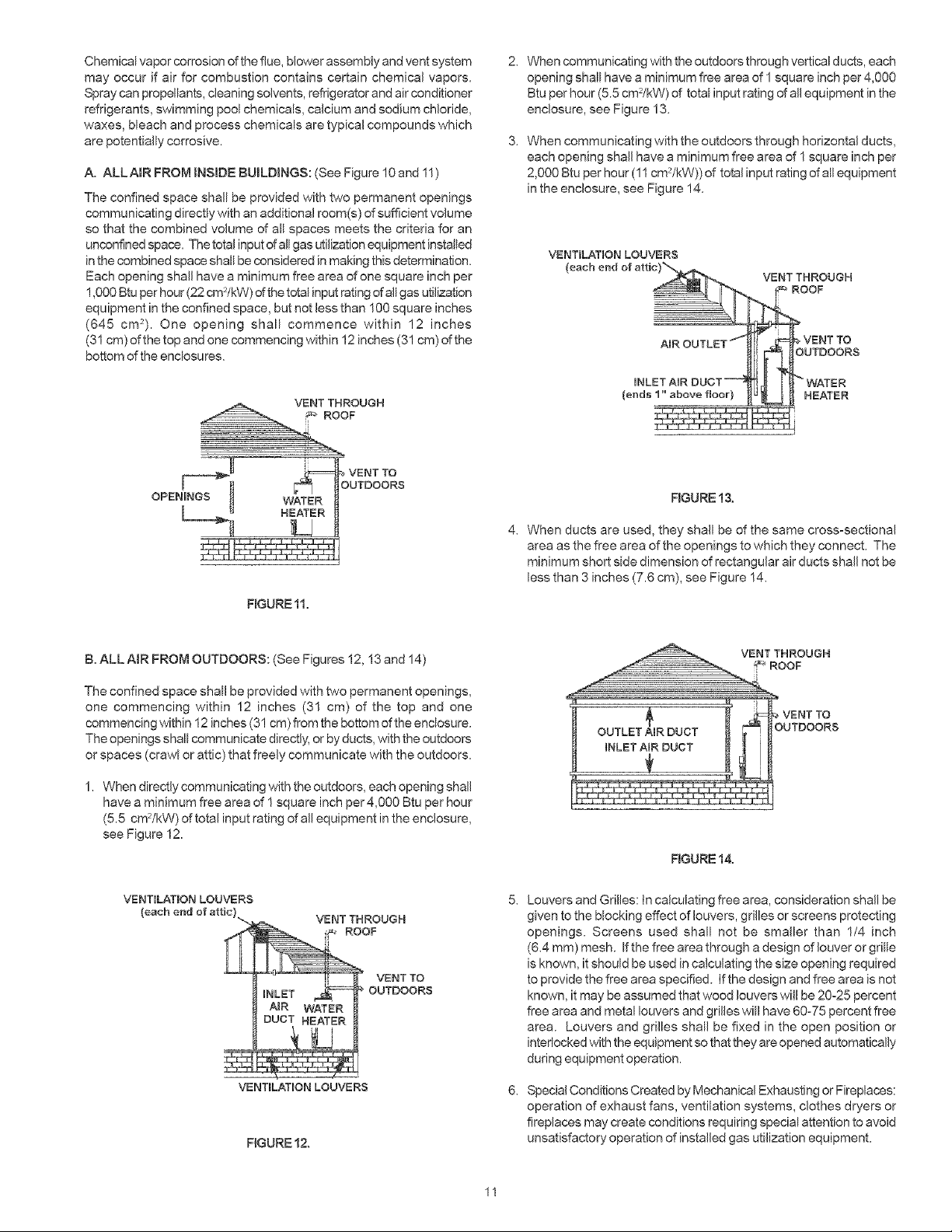
A.ALLAmRFROMINSBDEBUILDINGS:(SeeFigure10and11)
TheconfinedspaceshaJlbeprovidedwithtwopermanentopenings
communicatingdirectlywithanadditionalroom(s)ofsufficientvolume
sothatthecombinedvoJumeofallspacesmeetsthecriteriaforan
unconfinedspace.ThetotalinputofallgasutiJizationequipmentinstalled
inthecombinedspaceshallbeconsideredinmakingthisdetermination.
Eachopeningshallhaveaminimumfreeareaofonesquareinchper
1,000Btuperhour(22cm2/kW)ofthetotalinputratingofallgasutilization
equipmentintheconfinedspace,butnotlessthan100squareinches
(645cm2).Oneopeningshallcommencewithin!2 inches
(31cm)ofthetopandonecommencingwithin12inches(31cm)ofthe
bottomoftheenclosures.
OPE_'JING_i WATER
HEATER
kJ
VENT THROUGH
_ ROOF
J
OUTDOORS
FIGURE 11.
2.
When communicating with the outdoors through vertical ducts, each
opening shall have a minimum free area of 1 square inch per 4,000
Btu per hour (5.5 cm2/kW) of total input rating of all equipment in the
enclosure, see Figure 13.
When communicating with the outdoors through horizontal ducts,
each opening shall have a minimum free area of 1 square inch per
2,000 Btu per hour (11 cm2/kW)) of total input rating of all equipment
in the enclosure, see Figure 14.
VENTILATION LOUVERS
(each end of attic)'_ VENT THROUGH
i
AIR OUTLET f_tt _ _ VE_,JTTO
lllp 4T
INLETAIRDUDT_"_JII J l WATER
(ends 1" above floor} _ HEATER
FIGURE 13.
4. When ducts are used, they shall be of the same cross-sectional
area as the free area of the openings to which they connect. The
minimum short side dimension of rectangular air ducts shall not be
less than 3 inches (7.6 cm), see Figure 14.
B. ALL AiR FROM OUTDOORS: (See Figures 12, 13 and 14)
The confined space shall be provided with two permanent openings,
one commencing within !2 inches (31 cm) of the top and one
commencing within !2 inches (3! cm) from the bottom of the enclosure.
The openings shall communicate directly, or by ducts, with the outdoors
or spaces (crawl or attic) that freely communicate with the outdoors.
1. When directly communicating with the outdoors, each opening shall
have a minimum free area of 1 square inch per 4,000 Btu per hour
(5.5 cm2/kW) of total input rating of all equipment in the enclosure,
see Figure 12.
VENTILATION LOUVERS
(each end of attic
VENT THROUGH
_. ROOF
VENTTO
OUTDOORS
VENTILATION LOUVERS
HGURE12.
6.
FIGURE 14.
Louvers and Grilles: in calculating free area, consideration shalJ be
given to the blocking effect of louvers, griJles or screens protecting
openings. Screens used shall not be smaller than 1/4 inch
(6.4 mm) mesh. if the free area through a design of louver or grille
is known, it should be used in calculating the size opening required
to provide the free area specified, if the design and free area is not
known, it may be assumed that wood louvers will be 20_25 percent
free area and metal louvers and grilles will have 60-75 percent free
area. Louvers and grilles shall be fixed in the open position or
interlocked with the equipment so that they are opened automatically
during equipment operation.
Special Conditions Created by Mechanical Exhausting or Fireplaces:
operation of exhaust fans, ventilation systems, clothes dryers or
fireplaces may create conditions requiring special attention to avoid
unsatisfactory operation of installed gas utilization equipment.
11
WATER PIPING
Water temperature over 125°F
(52°C) can cause severe burns
instantly resulting in severe iniury or
death.
Children, the elderly, and the
physically or mentally disabled are at
highest risk for scald injury.
Feel water before bathing or
showering.
Temperature limiting valves are
available.
Read instruction manual for safe
temperature setting.
HOTTER WATER CAN SCALD:
Water heaters are intended to produce hot water. Water heated to a
temperature which will satisfy space heating, clothes washing, dish
washing, cleaning and other sanitizing needs can scald and permanently
injure you upon contact. Some people are more likely to be permanently
injured by hot water than others. These include the elderly, children, the
infirm, or physically/mentally handicapped. If anyone using hot water in
your home fits into one of these groups or if there is a local code or state
law requiring a certain temperature water at the hot water tap, then you
must take special precautions. In addition to using the lowest possible
temperature setting that satisfies your hot water needs, a means such
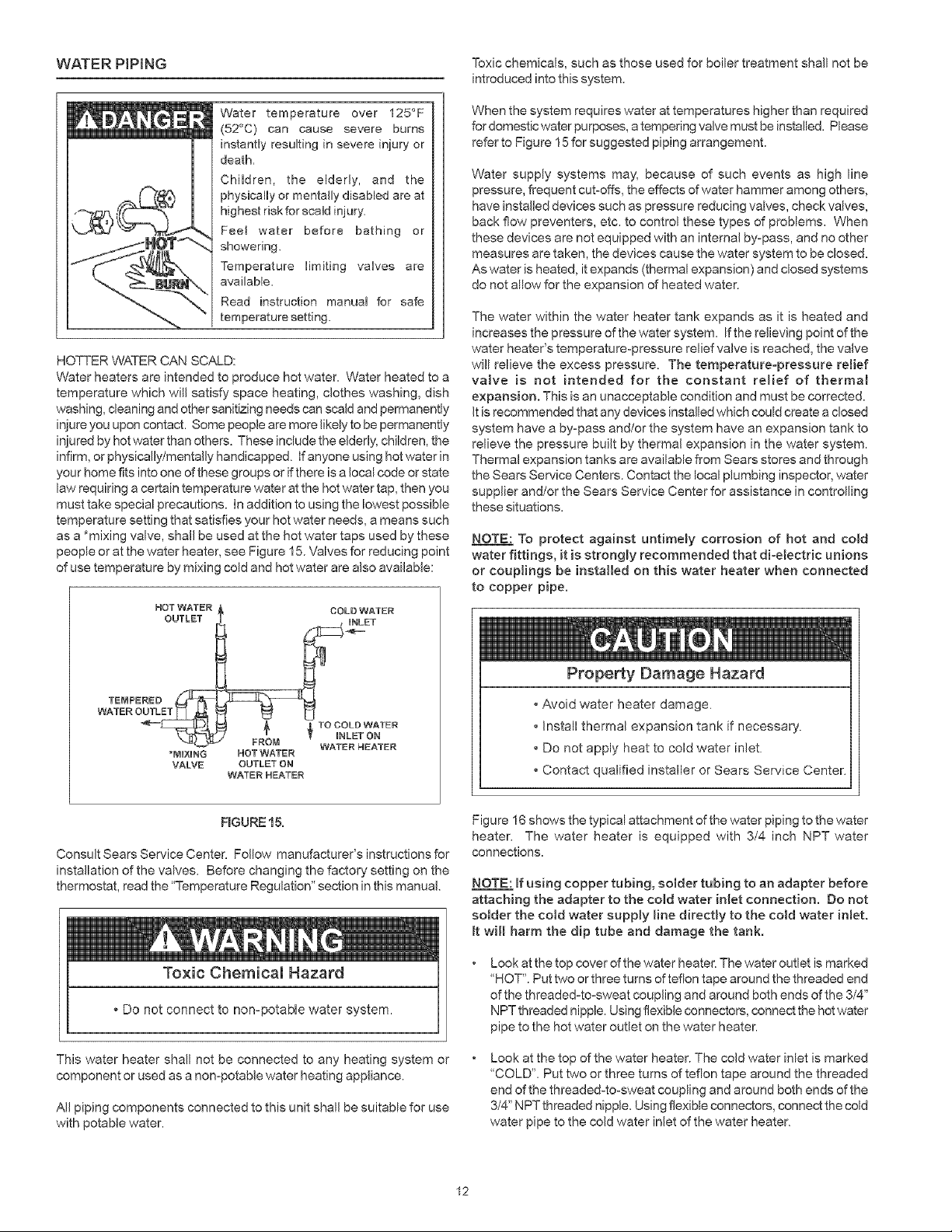
as a *mixing valve, shall be used at the hot water taps used by these
people or at the water heater, see Figure 15. Valves for reducing point
of use temperature by mixing cold and hot water are also available:
HOT WATER
OUTLET
*MIXIN_
VALVE
÷
FROM
HOT WATER
OUTLET ON
WATER HEATER
COLD WATER
WATERHEATER
Toxic chemicals, such as those used for boiler treatment shall not be
introduced into this system.
When the system requires water at temperatures higher than required
for domestic water purposes, a tempering valve must be installed. Please
refer to Figure 15 for suggested piping arrangement.
Water supply systems may, because of such events as high line
pressure, frequent cut-offs, the effects of water hammer among others,
have installed devices such as pressure reducing valves, check valves,
back flow preventers, etc. to control these types of problems. When
these devices are not equipped with an internal by-pass, and no other
measures are taken, the devices cause the water system to be closed.
As water is heated, it expands (thermal expansion) and closed systems
do not allow for the expansion of heated water.
The water within the water heater tank expands as it is heated and
increases the pressure of the water system. If the relieving point of the
water heater's temperature-pressure relief valve is reached, the valve
will relieve the excess pressure. The temperature-pressure relief
valve is not intended for the constant relief of thermal
expansion. This is an unacceptable condition and must be corrected.
It is recommended that any devices installed which could create a closed
system have a by-pass and/or the system have an expansion tank to
relieve the pressure built by thermal expansion in the water system.
Thermal expansion tanks are available from Sears stores and through
the Sears Service Centers. Contact the local plumbing inspector, water
supplier and/or the Sears Service Center for assistance in controlling
these situations.
NOTE: To protect against untimely corrosion of hot and cold
water fittings, it is strongly recommended that di-electric unions
or couplings be installed on this water heater when connected
to copper pipe.
Property Damage Hazard
. Avoid water heater damage.
, Install thermal expansion tank if necessary
. Do not apply heat to cold water inlet.
Contact qualified installer or Sears Service Center.
FIGURE 15.
Consult Sears Service Center. Follow manufacturer's instructions for
installation of the valves. Before changing the factory setting on the
thermostat, read the "Temperature Regulation" section in this manual.
Toxic Chemical Hazard
- Do not connect to non=potable ,dater system.
This water heater shall not be connected to any heating system or
component or used as a nompotable water heating appliance.
All piping components connected to this unit shall be suitable for use
with potable water.
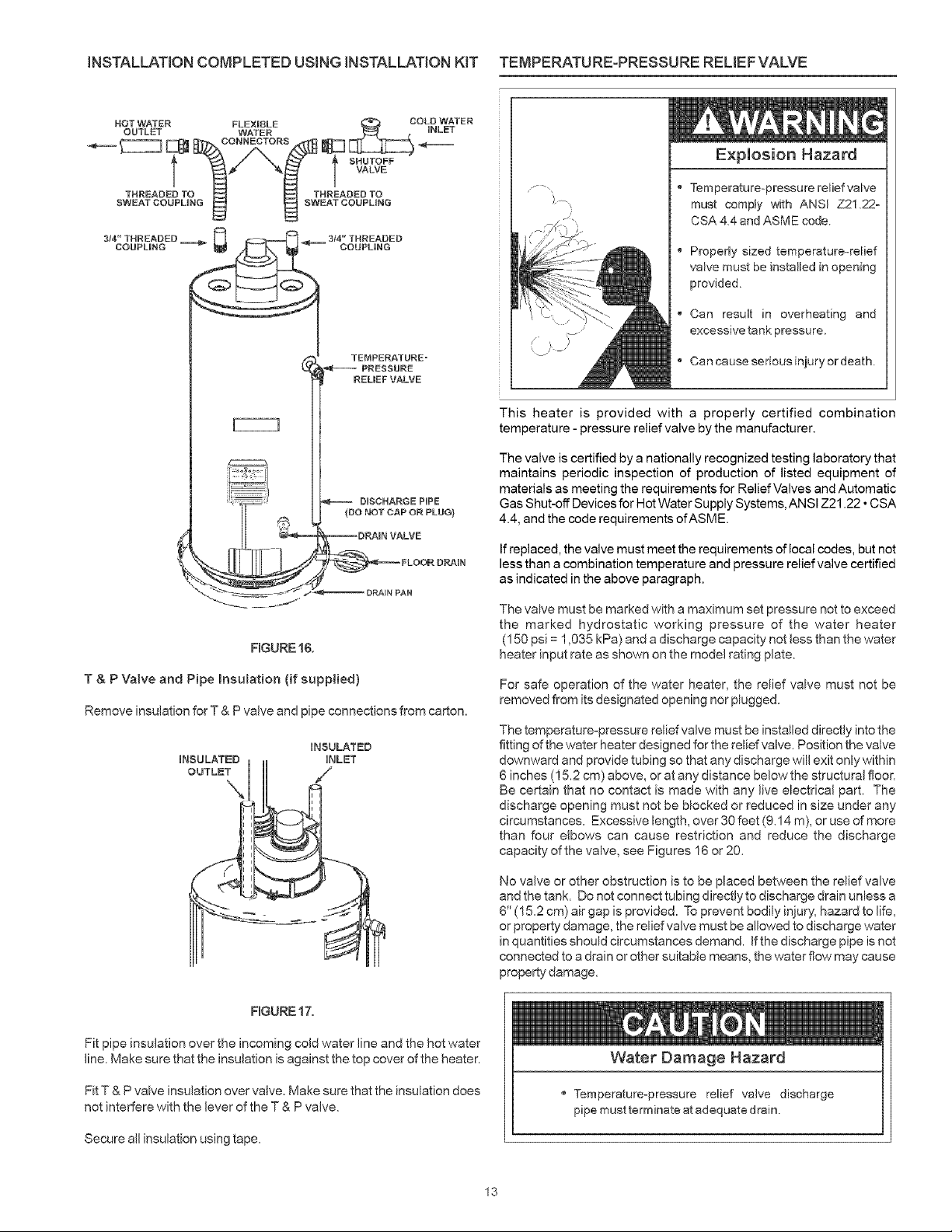
Figure !6 shows the typical attachment of the water piping to the water
heater. The water heater is equipped with 3/4 inch NPT water
connections.
NOTE: ff using copper tubing, solder tubing to an adapter before
attaching the adapter to the cold water inlet connection. Do not
solder the cold water supply line directly to the cold water inlet.
It will harm the dip tube and damage the tank.
Look at the top cover of the water heater. The water outlet is marked
"HOT". Put two or three turns of teflon tape around the threaded end
of the threaded-to-sweat coupling and around both ends of the 3/4"
NPT threaded nipple. Using flexible connectors, connect the hot water
pipe to the hot water outlet on the water heater.
Look at the top of the water heater. The cold water inlet is marked
"COLD". Put two or three turns of teflon tape around the threaded
end of the threaded-to-sweat coupling and around both ends of the
3/4" NPT threaded nipple. Using flexible connectors, connect the cold
water pipe to the cold water inlet of the water heater.
12
INSTALLATION COMPLETED USING INSTALLATION KiT TEMPERATURE-PRESSURE RELIEF VALVE
HOT WATER FLEXIBLE COLOWATER
OUTLET WATER INLET
CONNECTORS
l SHUTOFF
VALVE
THREADED TO
SWEATCOUPLING
TEMPERATURE°
_--_PRESSURE
RELIEF VALVE
DISCNARGEPPE
(DO NOT CAP OR PLUG]
DRAIN PAN
FIGURE1&
T & P Valve and Pipe Insulation (if supplied)
Remove insulation for T & P valve and pipe connections from carton.
INSULATED
INSULATED INLET
FIGURE17.
Fit pipe insulation over the incoming cold water line and the hot water
line. Make sure that the insulation is against the top cover of the heater.
Fit T & P valve insulation over valve. Make sure that the insulation does
not interfere with the lever of the T & P valve.
Secure all insulation using tape.
E×piosion Hazard
Temperature@ressure relief valve
must comply with ANSI Z21<22-
CSA 4.4 and ASME code.
Propedy sized ternperature-relief
valve must be installed in opening
provided
Can result in overheating and
excessive tank pressure.
Can cause serious injury or death
This heater is provided with a properly certified combination
temperature - pressure relief valve by the manufacturer.
The valve is certified by a nationally recognized testing laboratory that
maintains periodic inspection of production of listed equipment of
materials as meeting the requirements for Relief Valves and Automatic
Gas Shut-off Devices for Hot Water Supply Systems,ANSI Z21.22 • CSA
4.4, and the code requirements of ASME.
If replaced, the valve must meet the requirements of local codes, but not
less than a combination temperature and pressure relief valve certified
as indicated in the above paragraph.
The valve must be marked with a maximum set pressure not to exceed
the marked hydrostatic working pressure of the water heater
(150 psi = 1,035 kPa) and a discharge capacity not less than the water
heater input rate as shown on the model rating plate.
For safe operation of the water heater, the relief valve must not be
removed from its designated opening nor plugged.
The temperature@ressure relief valve must be installed directly into the
fitting of the water heater designed for the relief valve. Position the valve
downward and provide tubing so that any discharge will exit only within
6 inches (! 5.2 cm) above, or at any distance below the structural floor.
Be certain that no contact is made with any live electrical part. The
discharge opening must not be blocked or reduced in size under any
circumstances. Excessive length, over 30 feet (9.14 m), or use of more
than four elbows can cause restriction and reduce the discharge
capacity of the valve, see Figures 16 or 20.
No valve or other obstruction is to be placed between the relief valve
and the tank. Do not connect tubing directly to discharge drain unless a
6"(15.2 cm) air gap is provided. To prevent bodily injury, hazard to life,
or property damage, the relief valve must be allowed to discharge water
in quantities should circumstances demand. If the discharge pipe is not
connected to a drain or other suitable means, the water flow may cause
property damage.
Water Damage Hazard
Temperature-pressure relief valve discharge
pipe must terminate at adequate drain
13
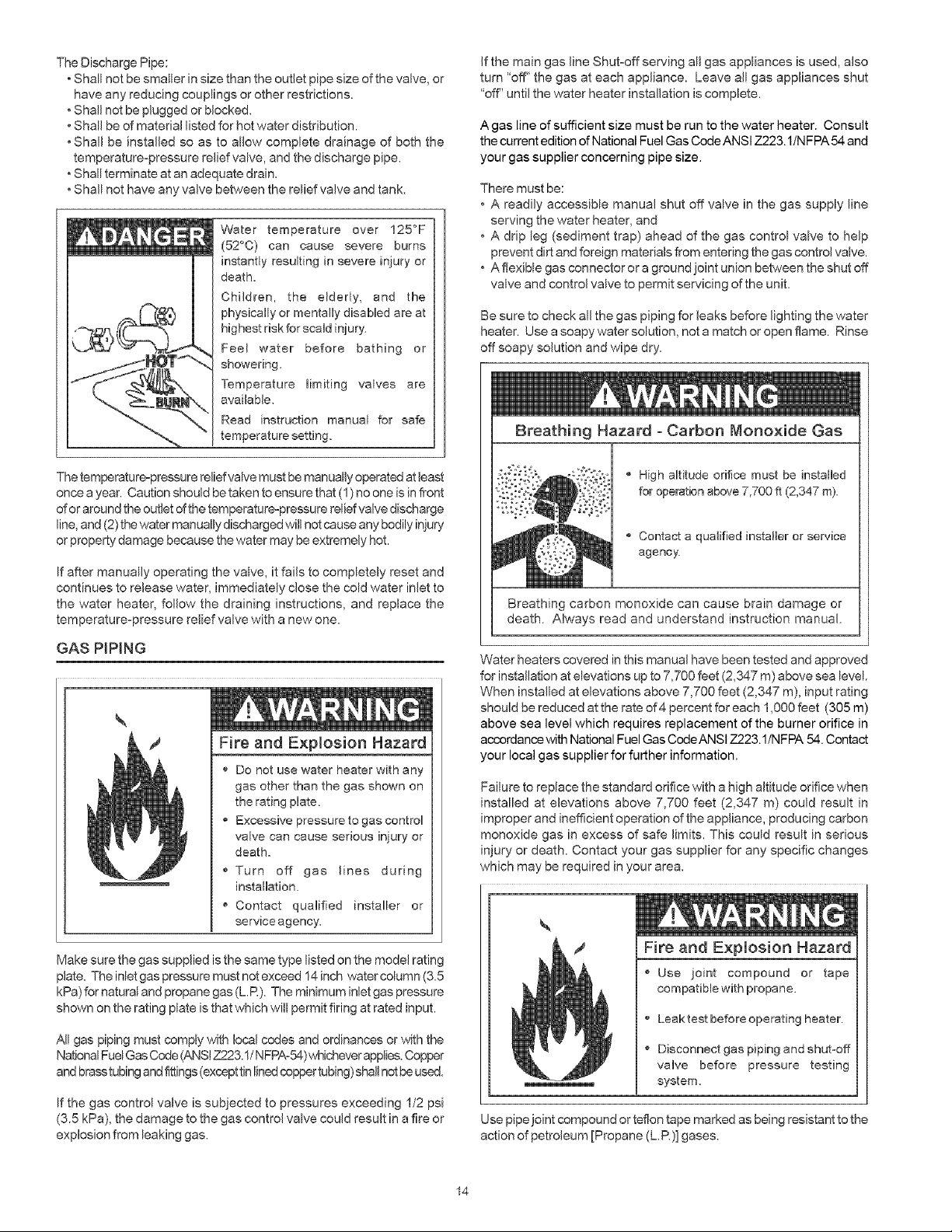
TheDischargePipe:
•Shallnotbesmallerinsizethantheoutletpipesizeofthevalve,or
haveanyreducingcouplingsorotherrestrictions.
•Shallnotbepluggedorblocked.
•Shallbeofmateriallistedforhotwaterdistribution.
•Shallbeinstalledsoastoallowcompletedrainageofboththe
temperature-pressurereliefvalve,andthedischargepipe.
•Shallterminateatanadequatedrain.
•Shallnothaveanyvalvebetweenthereliefvalveandtank.
Watertemperatureover 125°F
(52°C)cancausesevereburns
instantlyresultinginsevereinjuryor
death_
Children,the elderly,and the
physicallyormentallydisabledareat
highestriskforscaldiniury.
Feelwaterbeforebathingor
showering,
Temperaturelimitingvalvesare
available.
Readinstructionmanualfor safe
temperaturesetting.
Thetemperature-pressurereliefvalvemustbemanuallyoperatedatleast
onceayear.Cautionshouldbetakentoensurethat(1)nooneisinfront
oforaroundtheoutletofthetemperature-pressurereliefvalvedischarge
line,and(2)thewatermanuallydischargedwillnotcauseanybodilyinjury
orpropertydamagebecausethewatermaybeextremelyhot.
Ifaftermanuallyoperatingthevalve,itfailstocompletelyresetand
continuestoreleasewater,immediatelyclosethecoldwaterinletto
thewaterheater,followthedraininginstructions,andreplacethe
temperature-pressurereliefvalvewithanewone.
GAS PIPING
Fire and Explosion Hazard
- Do not use water heater with any
gas other than the gas shown on
the rating plate
" Excessive pressure to gas control
valve Can Cause serious injury or
death.
-Turn off gas lines during
[nstaNation.
" Contact qualified installer or
service agency.
Make sure the gas supplied is the same type listed on the model rating
plate. The inlet gas pressure must not exceed 14 inch water column (3.5
kPa) for natural and propane gas (L. R). The minimum inlet gas pressure
shown on the rating plate is that which will permit firing at rated input.
All gas piping must comply with local codes and ordinances or with the
National Fuel Gas Code (ANSI Z223.t / NFPA-54)whichever applies. Copper
and brass tubing and fittings (except tin lined copper tubing) shall not be used.
If the gas control valve is subjected to pressures exceeding 1/2 psi
(3.5 kPa), the damage to the gas control valve could result in a fire or
explosion from leaking gas.
If the main gas line Shut-off serving all gas appliances is used, also
turn "off" the gas at each appliance. Leave all gas appliances shut
"off" until the water heater installation is complete.
A gas line of sufficient size must be run to the water heater. Consult
the current edition of National Fuel Gas Code ANSI Z223.1/NFPA54 and
your gas supplier concerning pipe size.
There must be:
• A readily accessible manual shut off valve in the gas supply line
serving the water heater, and
• A drip leg (sediment trap) ahead of the gas control valve to help
prevent dirt and foreign materials from entering the gas control valve.
• A flexible gas connector or a ground joint union between the shut off
valve and control valve to permit servicing of the unit.
Be sure to check all the gas piping for leaks before lighting the water
heater. Use a soapy water solution, not a match or open flame. Rinse
off soapy solution and wipe dry.
Breathing Hazard - Carbon Monoxide Gas
High altitude orifice must be installed
for operation above 7,700 ft (2,347 m)
'_ Contact a qualified installer or service
agency
Breathing carbon monoxide can cause brain damage or
death. Always read and understand instruction manual.
Water heaters covered in this manual have been tested and approved
for installation at elevations up to 7,700 feet (2,347 m) above sea level.
When installed at elevations above 7,700 feet (2,347 m), input rating
should be reduced at the rate of 4 percent for each 1,000 feet (305 m)
above sea level which requires replacement of the burner orifice in
accordance with National Fuel Gas Code ANSI Z223.1/NFPA 54. Contact
your local gas supplier for further information.
Failure to replace the standard orifice with a high altitude orifice when
installed at elevations above 7,700 feet (2,347 m) could result in
improper and inefficient operation of the appliance, producing carbon
monoxide gas in excess of safe limits. This could result in serious
injury or death. Contact your gas supplier for any specific changes
which may be required in your area.
Fire and Explosion Hazard
_' Use joint compound or tape
compatible with propane.
- Leak test before operating heater.
_' Disconnect gas piping and shut-off
valve before pressure testing
system.
Use pipe joint compound or teflon tape marked as being resistant to the
action of petroleum [Propane (L.R)] gases.
14
Theapplianceanditsgasconnectionmustbeleaktestedbeforeplacing
theapplianceinoperation.
TheapplianceanditsindividualShut-offvalveshallbedisconnected
fromthegassupplypipingsystemduringanypressuretestingofthat
systemattestpressuresinexcessof1/2poundpersquareinch
(3.5kPa).Itshallbeisolatedfromthegassupplypipingsystemby
closingitsindividualmanualShut-offvalveduringanypressuretesting
ofthegassupplypipingsystemattestpressuresequaltoorlessthan
1/2poundpersquareinch(3.5kPa).
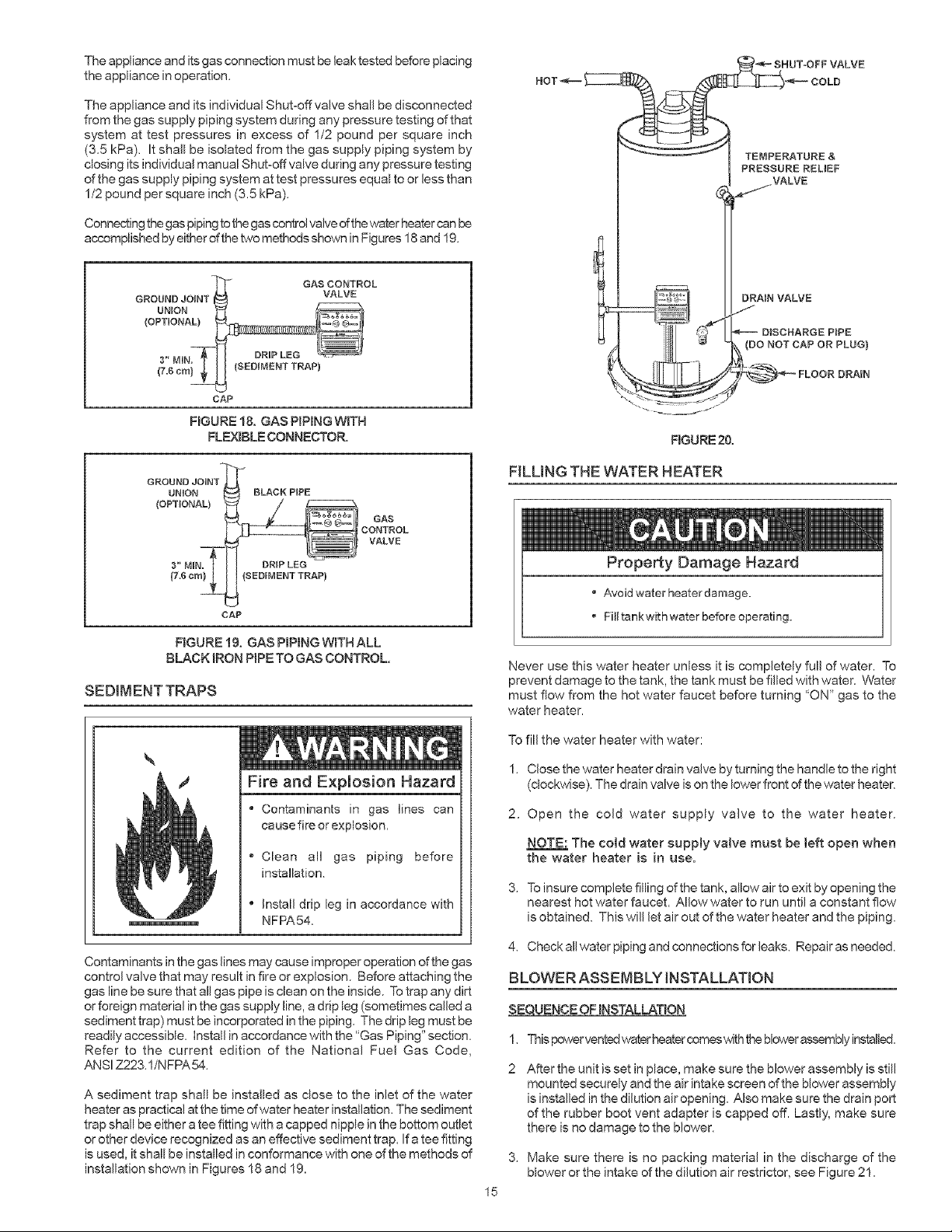
Connectingthegaspipingtothegascontrolvalveofthewaterheatercanbe
accomplishedbyeitherofthetwomethodsshowninFigures18and19.
CAP
FIGURE18.GAS PIPING WroTH
FLEXmBLE CONNECTOR.
GROUND JOINT
UNION_ BLACK PiPE
(OPTIONAL)
3" MIN DRIP LEG
(7,6c {SEDIMENT TRAP I
CAP
FmGURE19, GAS PIPING WroTHALL
BLACK IRON PIPETO GAS CONTROL.
SEDIMENT TRAPS
Fire and E×pmosionHazard
Contaminants in gas lines can
cause fire or explosion.
* Clean all gas piping before
installation.
Install drip leg in accordance with
NFPA54.
Contaminants in the gas lines may cause improper operation of the gas
control valve that may result in fire or explosion. Before attaching the
gas line be sure that all gas pipe is clean on the inside. To trap any dirt
or foreign material in the gas supply line, a drip leg (sometimes called a
sediment trap) must be incorporated in the piping. The drip leg must be
readily accessible. Install in accordance with the "Gas Piping" section.
Refer to the current edition of the National Fuel Gas Code,
ANSI Z223.1/NFPA 54.
A sediment trap shall be installed as close to the inlet of the water
heater as practical at the time of water heater installation. The sediment
trap shall be either a tee fitting with a capped nipple in the bottom outlet
or other device recognized as an effective sediment trap. If a tee fitting
is used, it shall be installed in conformance with one of the methods of
installation shown in Figures 18 and 19.
RGURE 20.
TEMPERATURE &
PRESSURE REUEF
DRAIN VALVE
/
_==DISCHARGE PBPE
(DO NOT CAP OR PLUG)
FILLING THE WATER HEATER
Property Damage Hazard
Avoid water heater damage.
, Fill tank with water before operating.
15
Never use this water heater unless it is completely full of water. To
prevent damage to the tank, the tank must be filled with water. VVater
must flow from the hot water faucet before turning "ON" gas to the
water heater.
To fill the water heater with water:
1. Close the water heater drain valve by turning the handle to the right
(clockwise). The drain valve is on the lower front of the water heater.
2. Open the cold water supply valve to the water heater.
NOTE: The cold water suppmy vamve must be teft open when
the water heater is in use.
To insure complete filling of the tank, allow air to exit by opening the
nearest hot water faucet. Allow water to run until a constant flow
is obtained. This will let air out of the water heater and the piping.
4. Check all water piping and connections for leaks. Repair as needed.
BLOWER ASSEMBLY INSTALLATION
_UENCE OF INSTALLAT!ON
1.
2
This pc_wervented water heater comes w_ththe blower assembly installed.
After the unit is set in place, make sure the blower assembly is still
mounted securely and the air intake screen of the blower assembly
is installed in the dilution air opening. Also make sure the drain port
of the rubber boot vent adapter is capped off. Lastly, make sure
there is no damage to the blower.
3. Make sure there is no packing material in the discharge of the
blower or the intake of the dilution air restrictor, see Figure 21.
4. Makesurethattheplastictubingisstillattachedfromtheairpressure
switchtotheportontheblowerhousing.MakesurethepJastic
tubingisnotfoldedanywherebetweenthepressureswitchand
theblowerhousing.
5. MakesuretheON/OFFswitchisintheOFFpositionandthatthe
outerharnessisconnectedfromtheblowercontrolboxtothe
connectoronthebottomsideofthegasvalve.
6. Iftheouterharnessisnotfactoryinstalled,makesuretheON/OFFswitch
isintheOFFpositionandthenconnecttheharnessfromtheblower
controlboxtotheconnectoronthebottomsideofthegasvalve.
waterhea_eristurned"OFF".
operation Ver_ proper operation after servicing
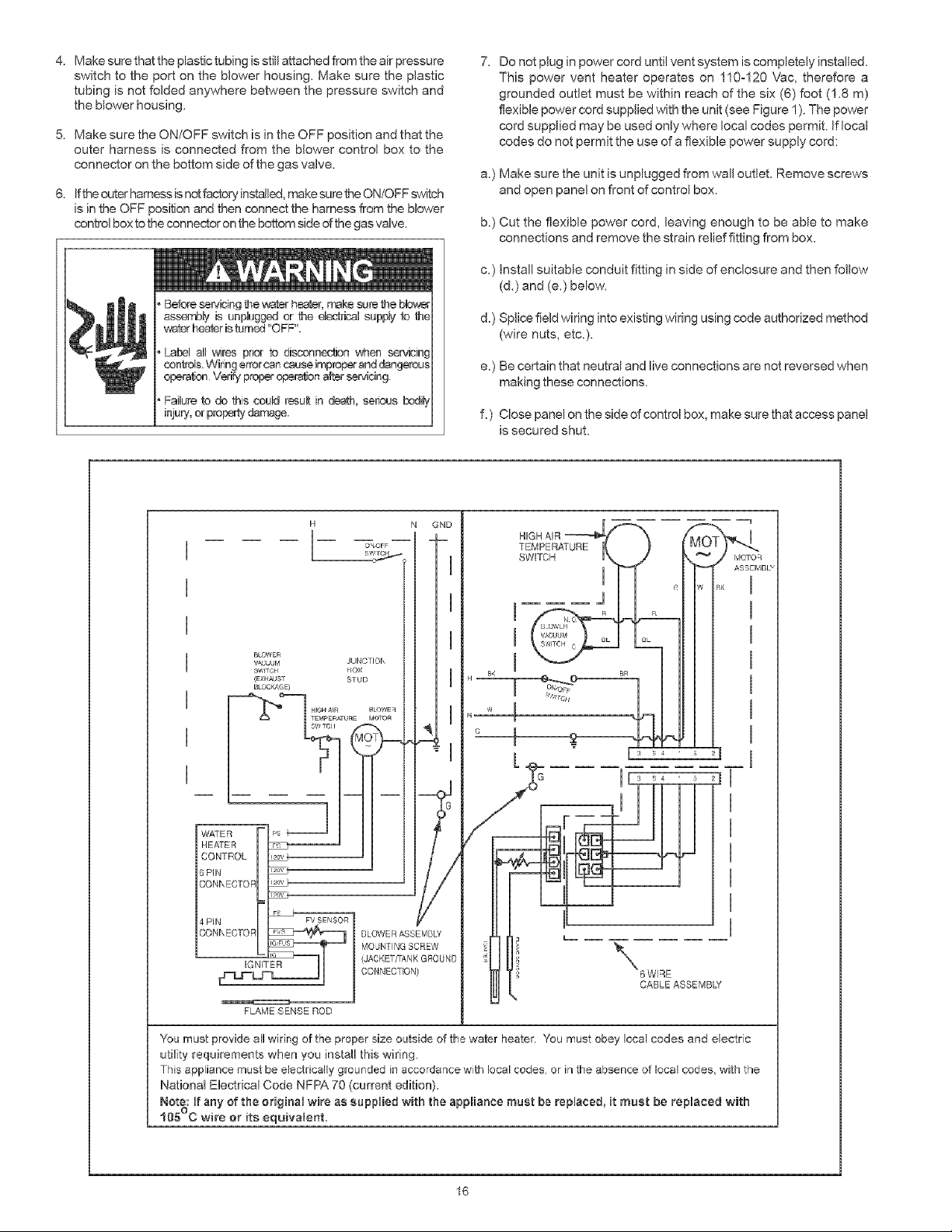
7. Do not plug in power cord until vent system is completely installed.
This power vent heater operates on 110o120 Vac, therefore a
grounded outlet must be within reach of the six (6) foot (! .8 m)
flexible power cord supplied with the unit (see Figure 1). The power
cord supplied may be used only where local codes permit, if local
codes do not permit the use of a flexible power supply cord:
a.) Make sure the unit is unplugged from wail outlet. Remove screws
and open panel on front of control box.
b.) Cut the flexible power cord, leaving enough to be able to make
connections and remove the strain relief fitting from box.
c.) Install suitable conduit fitting in side of enclosure and then follow
(d.) and (e.) below.
d.) Splice field wiring into existing wiring using code authorized method
(wire nuts, etc.).
e.) Be certain that neutral and live connections are not reversed when
making these connections.
f.) Close panel on the side of control box, make sure that access panel
is secured shut.
H
ON,OFF
BLOWER
vAcuur_ JUNCTIOK
Sg,'ITGH HOX
(EXNAJST STUD
Bb:_CKP,GE}
HIGHAIR BLOWE_
__ !TEMPERATURE MOTOR_ z
HEATER
CONTROL
PIN /
3ONK ECTOR L
FLAME SENSE ROD
N GND
BLOWER ASSEMB_
MOUNFING SCREW
(JACKETFANK GROUND
CONNECTION)
6WIRE
CABLEASSEMBLY
You must provide all wiring of the proper size outside of the water heater, You must obey local codes and electric
utility requirements when you install this wiring
This appliance must be electrically grounded in accordance with local codes, or in the absence of local codes, with the
National Electrical Code NFPA 70 (current edition).
Note: if any of the origieal wire as supplied with the appliance mast be replaced, it must be replaced with
105°0 wire or its equivalent.
16
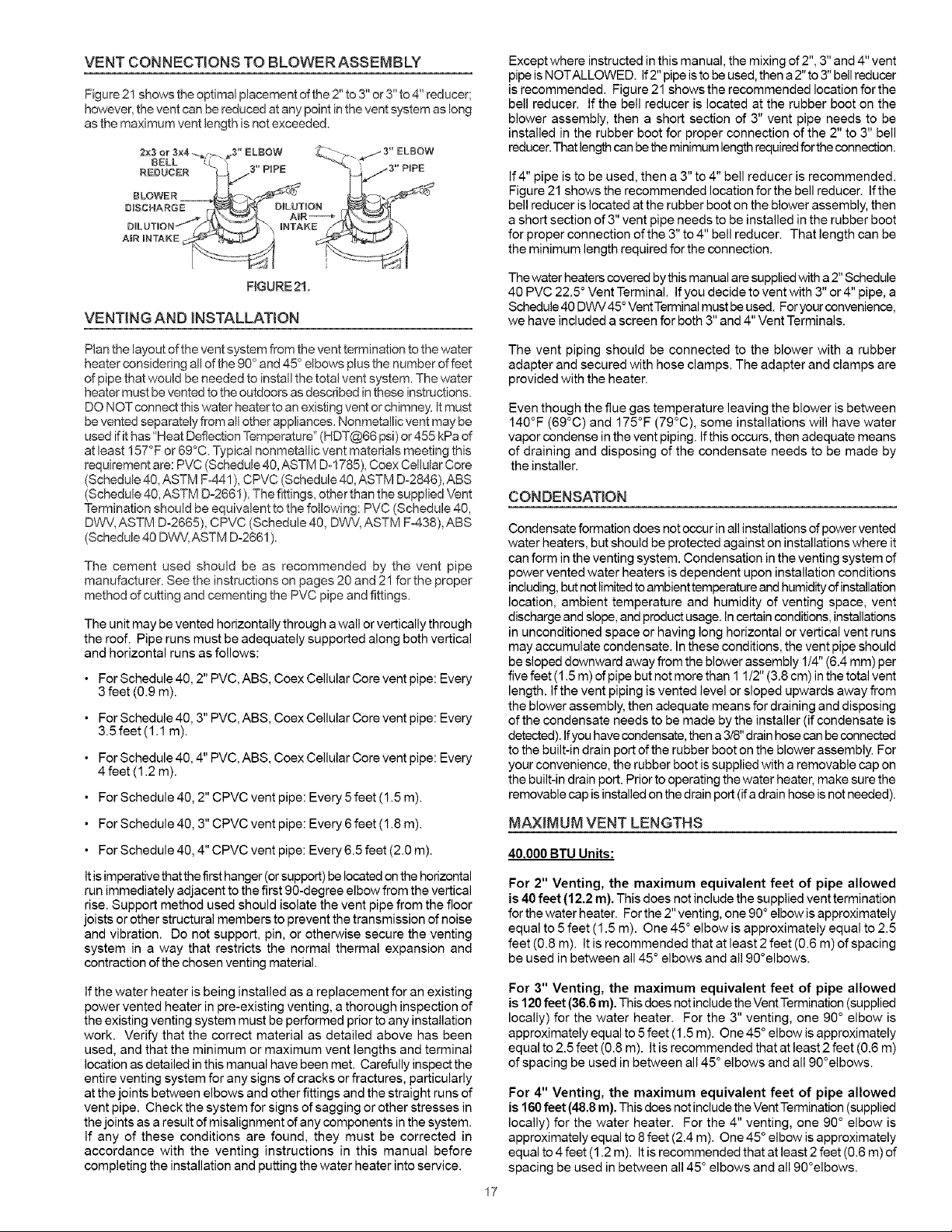
VENT CONNECTIONS TO BLOWER ASSEMBLY
Figure 21 shows the optimal placement of the 2" to 3" or 3" to 4" reducer;
however, the vent can be reduced at any point in the vent system as long
as the maximum vent length is not exceeded.
Except where instructed in this manual, the mixing of 2", 3" and 4" vent
pipe is NOTALLOWED. If2" pipe is to be used, then a 2"to 3" bell reducer
is recommended. Figure 21 shows the recommended location for the
bell reducer. If the bell reducer is located at the rubber boot on the
blower assembly, then a short section of 3" vent pipe needs to be
installed in the rubber boot for proper connection of the 2" to 3" bell
reducer. That length can be the minimum length required for the connection.
If4" pipe is to be used, then a 3" to4" bell reducer is recommended.
Figure 21 showsthe recommended location for the bell reducer. Ifthe
bell reducer is located at the rubber boot on the blower assembly, then
a short section of 3" vent pipe needs to be installed in the rubber boot
for proper connection of the 3" to 4" bell reducer. That length can be
the minimum length required for the connection.
HGURE21.
VENTING AND INSTALLATION
The water heaters covered by this manual are supplied with a 2" Schedule
40 PVC 22.5 ° Vent Terminal. If you decide to vent with 3" or 4" pipe, a
Schedule 40 DWV 45° Vent Terminal must be used. For your convenience,
we have included a screen for both 3" and 4" Vent Terminals.
Plan the layout of the vent system from the vent termination to the water
heater considering all of the 90 ° and 45 ° elbows plus the number of feet
of pipe that would be needed to install the total vent system. The water
heater must be vented to the outdoors as described in these instructions.
DO NOT connect this water heater to an existing vent or chimney. It must
be vented separately from all other appliances. Nonmetallic vent may be
used if it has "Heat Deflection Temperature" (HDT@66 psi) or 455 kPa of
at least 157°F or 69°C. Typical nonmetallic vent materials meeting this
requirement are: PVC (Schedule 40, ASTM D-1785), Coex Cellular Core
(Schedule 40, ASTM F-44! ), CPVC (Schedule 40, ASTM Do2846), ABS
(Schedule 40, ASTM Do2661 ). The fittings, other than the supplied Vent
Termination should be equivalent to the following: PVC (Schedule 40,
DWV, ASTM D-2665), CPVC (Schedule 40, DWV, ASTM F-438), ABS
(Schedule 40 DWV, ASTM Do2661 ).
The cement used should be as recommended by the vent pipe
manufacturer. See the instructions on pages 20 and 21 for the proper
method of cutting and cementing the PVC pipe and fittings.
The unit may be vented horizontally through a wall or vertically through
the roof. Pipe runs must be adequately supported along both vertical
and horizontal runs as follows:
• For Schedule 40, 2" PVC, ABS, Coex Cellular Core vent pipe: Every
3 feet (0.9 m).
• For Schedule 40, 3" PVC, ABS, Coex Cellular Core vent pipe: Every
3.5 feet (1.1 m).
• For Schedule 40, 4" PVC, ABS, Coex Cellular Core vent pipe: Every
4 feet (1.2 m).
• For Schedule 40, 2" CPVC vent pipe: Every 5 feet (1.5 m).
• For Schedule 40, 3" CPVC vent pipe: Every 6 feet (1.8 m).
The vent piping should be connected to the blower with a rubber
adapter and secured with hose clamps. The adapter and clamps are
provided with the heater.
Even though the flue gas temperature leaving the blower is between
140°F (69°C) and 175°F (79°C), some installations will have water
vapor condense in the vent piping. If this occurs, then adequate means
of draining and disposing of the condensate needs to be made by
the installer.
CONDENSATION
Condensate formation does not occur in all installations of power vented
water heaters, but should be protected against on installations where it
can form in the venting system. Condensation in the venting system of
power vented water heaters is dependent upon installation conditions
including, but not limited to ambient temperature and humidity of installation
location, ambient temperature and humidity of venting space, vent
discharge and slope, and product usage. In certain conditions, installations
in unconditioned space or having long horizontal or vertical vent runs
may accumulate condensate. In these conditions, the vent pipe should
be sloped downward away from the blower assembly 1/4" (6.4 mm) per
five feet (1.5 m) of pipe but not more than 1 1/2" (3.8 cm) in the total vent
length. If the vent piping is vented level or sloped upwards away from
the blower assembly, then adequate means for draining and disposing
of the condensate needs to be made by the installer (if condensate is
detected). If you have condensate, then a 3/8" drain hose can be connected
to the built-in drain port of the rubber boot on the blower assembly. For
your convenience, the rubber boot is supplied with a removable cap on
the built-in drain port. Prior to operating the water heater, make sure the
removable cap is installed on the drain port (ifa drain hose is not needed).
MAXIMUI_I VENT LENGTHS
• For Schedule 40, 4" CPVC vent pipe: Every 6.5 feet (2.0 m).
It is imperative that the first hanger (or support) be located on the horizontal
run immediately adjacent to the first 90-degree elbow from the vertical
rise. Support method used should isolate the vent pipe from the floor
joists or other structural members to prevent the transmission of noise
and vibration. Do not support, pin, or otherwise secure the venting
system in a way that restricts the normal thermal expansion and
contraction of the chosen venting material.
If the water heater is being installed as a replacement for an existing
power vented heater in pre-existing venting, a thorough inspection of
the existing venting system must be performed prior to any installation
work. Verify that the correct material as detailed above has been
used, and that the minimum or maximum vent lengths and terminal
location as detailed in this manual have been met. Carefully inspect the
entire venting system for any signs of cracks or fractures, particularly
at the joints between elbows and other fittings and the straight runs of
vent pipe. Check the system for signs of sagging or other stresses in
the joints as a result of misalignment of any components in the system.
If any of these conditions are found, they must be corrected in
accordance with the venting instructions in this manual before
completing the installation and putting the water heater into service.
40.000 BTU Units:
For 2" Venting, the maximum equivalent feet of pipe allowed
is 40 feet (12.2 m). This does not include the supplied vent termination
for the water heater. For the 2" venting, one 90 ° elbow is approximately
equal to 5 feet (1.5 m). One 45 ° elbow is approximately equal to 2.5
feet (0.8 m). It is recommended that at least 2 feet (0.6 m) of spacing
be used in between all 45 ° elbows and all 90°elbows.
For 3" Venting, the maximum equivalent feet of pipe allowed
is 120 feet (36.6 m). This does not include the Vent Termination (supplied
locally) for the water heater. For the 3" venting, one 90 ° elbow is
approximately equal to 5 feet (1.5 m). One 45 ° elbow is approximately
equal to 2.5 feet (0.8 m). It is recommended that at least 2 feet (0.6 m)
of spacing be used in between all 45 ° elbows and all 90°elbows.
For 4" Venting, the maximum equivalent feet of pipe allowed
is 160 feet (48.8 m). This does not include the Vent Termination (supplied
locally) for the water heater. For the 4" venting, one 90 ° elbow is
approximately equal to 8 feet (2.4 m). One 45 ° elbow is approximately
equal to 4 feet (1.2 m). It is recommended that at least 2 feet (0.6 m) of
spacing be used in between all 45 ° elbows and all 90°elbows.
17
VENTING
Breathing Hazard ° Catben Monoxide Gas
Install vent system in accordance with
codes.
" Do not operate water heater if hood
damaged.
- High altitude odhce must be installed for
operation above7,700 feet (2,347 m)
o Do not operate if soot buildup
" Do not obstruct water heater air intake
with insulating jacket.
- Do not place cheraicd vapor emitting
products near water heater
" Gas and carbon monoxide detectors
are available.
,, Never operate the heater unless it _s
vented to the outdoors and has adequate
air supply to avoid risks of improper
operation, fire, explosion, or asphyxiation
o Make sure the flue baffle and flue restrtctor
ring are properly aligned and inserted on
top of the flue. This can be checked
through the dilution air inlet of the blower
assemb_j. For _ewing, the Air Intake screen
d the blower assembly will have to be
removed Replace after the check is made
Breathing carbon monoxide can cause brain damage or death
Always read and understand instruction manual
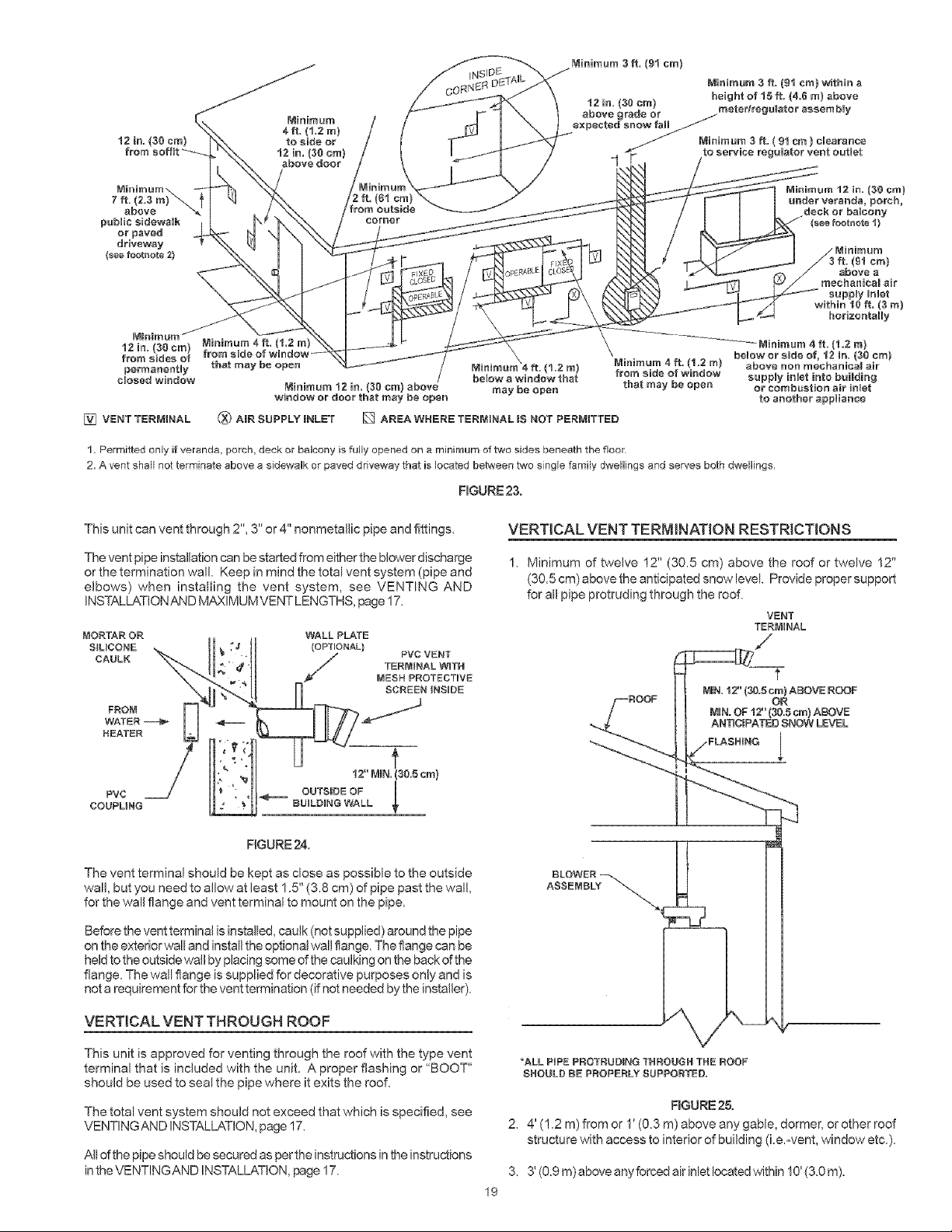
The vent system must terminate so that proper clearances are
maintained as cited in local codes or the current edition of the National
Fuel Gas Code, ANSi Z223.1/NFPA54, 7.3.4e and 7.8a,b, as follows:
1. The exit terminals of a mechanical vent system shall be not less
than 7 feet (2. ! 3 m) above grade when located adiacent to public
walkways, see Figure 23.
2. A venting system shall terminate at least 3 feet (91 cm) above any
forced air inlet located within 10 feet (3.1 m), see Figure 23.
3. The venting system shall terminate at least 4 feet (1.2 m) below, 4
feet (! .2 m) horizontally from or, 12 in. (30 cm) above any door,
window or gravity air inlet into any building.
The manufacturer also recommends that the vent termination should
not be installed closer than 3 feet (91 cm) from an inside corner of an
L shaped structure and not be less than 12 in. (30 cm) above grade.
The vent shall terminate a minimum of 12" (30.5 cm) above expected
snow, all level to prevent blockage of vent termination, see Figure 23.
4. In cold climates, it is recommended that vent termination not be mounted
directly above orwithin 3 feet (91 cm) horizontally from an oil tank vent or
gas meter to avoid potential freeze-up from condensation, see Figure 23.
Plan the vent system layout so that proper clearances are maintained
from plumbing and wiring.
Vent pipes serving power vented appliances are classified by building
codes as "vent connectors". Required clearances from combustible
materials must be provided in accordance with information in this manual
under FACTS TO CONSIDER ABOUT THE LOCATION and VENT
TERMINAL INSTALLATIONS, and with the National Fuel Gas Code and
local codes.
VENT TERMINAL INSTALLATION
After the point of termination has been determined, use the cover
plate as a template to mark the hole for the vent pipe to insert
through the wall. BEWARE OF CONCEALED WIRING AND PIPING
INSIDE OFWALL
If the Vent Terminal is being installed on the outside of a finished
wall, it may be easier to mark both the inside and outside walk
Align the holes by drilling a hole through the center of the template
from the inside through to the outside. The template can now be
positioned on the outside wall using the drilled hole as a centering
point for the template.
A) MASONRY SIDE WALLS
Chisel an opening approximately one half inch larger than the
marked circle.
B) WOODEN SIDE WALLS
Drill a pilot hole approximately one quarter inch outside of the
marked circle. This pilot hole is used as a starting point for a
saws=all or sabre saw blade. Cut around the marked circle staying
approximately one quarter inch outside of the line. (This will allow
the vent pipe to easily slide through the opening. The resulting
gap will be covered up by the vent terminal cover plates.) Repeat
this step on inside wall if necessary.
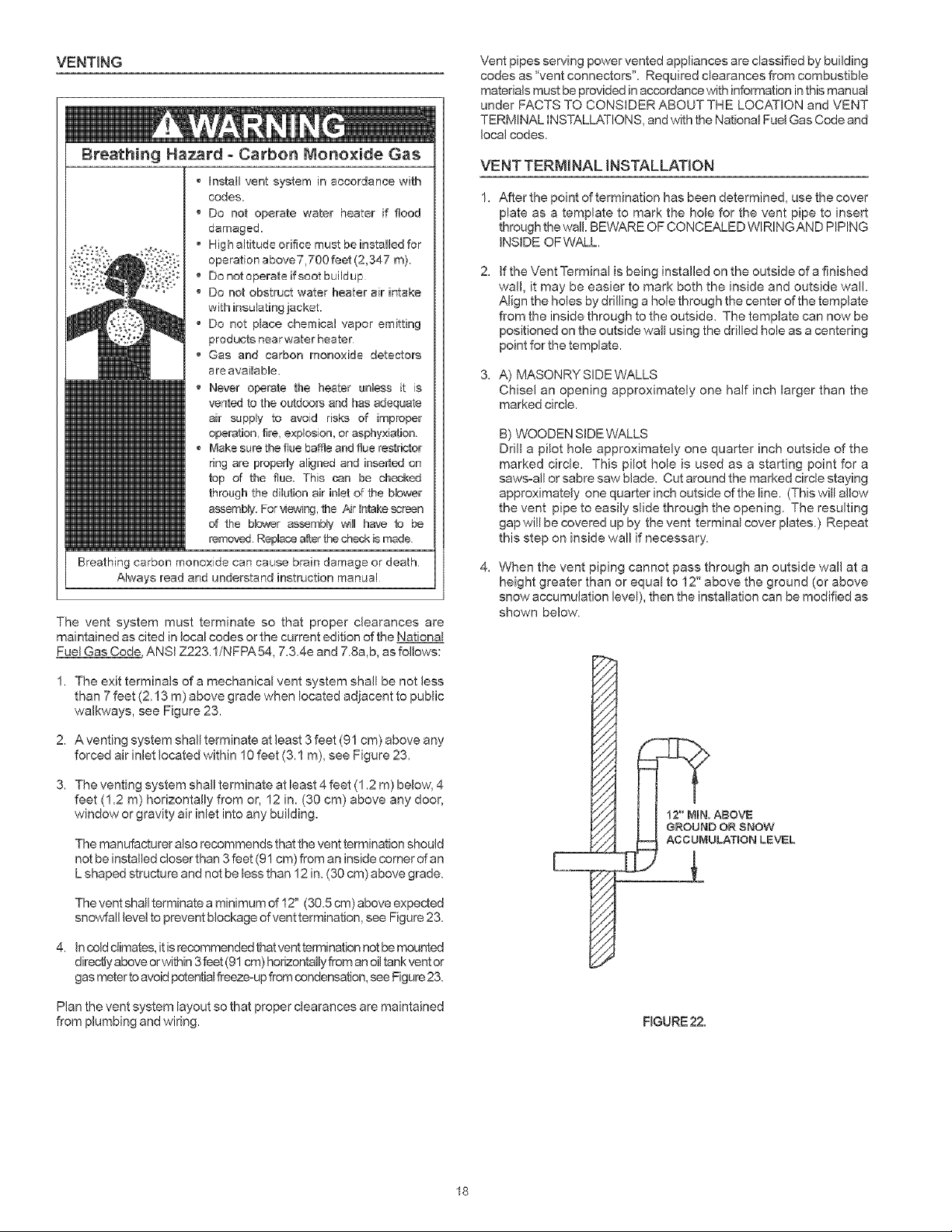
When the vent piping cannot pass through an outside wall at a
height greater than or equal to 12" above the ground (or above
snow accumulation level), then the installation can be modified as
shown below.
12"MIN. ABOVE
GROUNDORSNOW
ACCUMULATIONLEVEL
FIGURE22.
18
Minimum 3ft. (91 cm}
Minimum 3 ft. (91 era) within a
hMght of 15_. (4.6 m) above
meter/regulator assam bly
Minim,
12 in= (30 am)
from sides of
permanently
cUosed window
[] VENT TERMINAL
thatreay be open
below a window that from side of window
Minimum 12 in. (30 era) above may be open that may be open
window or door thatmay be open
(_ AIR SUPPLY INLET [] AREA WHERE TERMINAL IS NOT PERMITTED
suppUy inUatintobuilding
or combustion air iMet
to another appUianee
1. Permitted only if veranda, porch, deck or balcony is fully opened on a minimum of two sides beneath the floor
2. A vent shall not terminate above a sidawaUk or paved driveway that is located between two single family dwelUings and sePces bMh dwelhgs,
FIGURE 23.
This unit can vent through 2", 3" or 4" nonmetallic pipe and fittings.
The vent pipe installation can be started from either the blower discharge
or the termination wall. Keep in mind the total vent system (pipe and
elbows) when installing the vent system, see VENTING AND
INSTALLATION AND MAXIMUM VENT LENGTHS, page 17.
MORTAR OR WALL PLATE
SILICONE {OPTIONAL}
CAULK / PVC VENT
/
TERMINAL WITH
MESH PROTECTUVE
SCREEN INSI[:)E
FROM
WATER
HEATER
PVC
COUPLING
FIGURE24.
The vent terminal should be kept as dose as possible to the outside
wall, but you need to allow at least 1.5" (3.8 cm) of pipe past the wall,
for the wall flange and vent terminal to mount on the pipe.
Before the vent terminal is installed, caulk (not supplied) around the pipe
on the exterior wall and install the optional wal! flange. The flange can be
held to the outside wall by placing some of the caulking on the back of the
flange. The wall flange is supplied for decorative purposes only and is
not a requirement for the vent termination (if not needed by the installer).
VERTICAL VENT THROUGH ROOF
This unit is approved for venting through the roof with the type vent
terminal that is included with the unit. A proper flashing or "BOOT"
should be used to seal the pipe where it exits the roof.
The total vent system should not exceed that which is specified, see
VENTINGAND INSTALLATION, page 17.
All of the pipe should be secured as per the instructions in the instructions
in the VENTING AND INSTALLATION, page 17.
VERTICAL VENT TERMINATION RESTRICTIONS
1. Minimum of twelve !2" (30.5 cm) above the roof or twelve 12"
(30.5 cm) above the anticipated snow level Provide proper support
for all pipe protruding through the roof.
'VENT
TERMINAL
*ALL PUPE PROTRUDRNG THROUGH THE ROOF
SHOULD BE PROPERLY SUPPORTED.
RGURE 25.
2. 4' (! .2 m) from or 1' (0.3 m) above any gable, dormer, or other roof
structure with access to interior of building (i.e.=vent, window etc.).
3. 3' (0.9 m) above any forced air inlet located within 10' (3.0 m).
19
VENT PIPE PREPARATION
1. INITIAL PREPARATION
A. Make sure the solvent cement you are planning to use is
designed for the specific application you are attempting.
B. Knowthe physical and chemical characteristics and limitations
of the PVC and CPVC piping materials that you are about to use.
C. Know the reputation of your manufacturer and their products.
D. Know your own qualifications or those of your contractor.
The solvent welding technique of joining PVC and CPVC pipe
is a specialized skill just as any other pipe fitting technique.
E Closely supervise the installation and inspect the finished
job before start-up.
R Contact the manufacturer, supplier, or competent consulting
agency if you have any questions about the application or
installation of PVC and CPVC pipe.
G
Take the time and effort to do a professional job. Shortcuts
will only cause you problems and delays in start-up. By far,
the majority of failures in PVC and CPVC systems are the
result of shortcuts and/or improper ioining techniques.
2. SELECTmON OF MATERIALS
Cutting Device - Saw or Pipe Cutter
Deburring Tool, Knife, File, or Beveling Machine (2" and above)
Brush - Pure Bristle
Rag - Cotton (Not Synthetic)
Primer and Cleaner
SoNent Cement - PVC for PVC Components and CPVC for CPVC
Components
Containers - Metal or Glass to hold Primer and Cement. Select the
type of PVC or CPVC materials to be used on the basis of their
application with respect to chemical resistance, pressure rating,
temperature characteristics, etc.
Insertion Tool - Helpful for larger diameter pipe and fittings 6 inches
(15.2 cm) and above.
PRIMER
It is recommended that Tetrahydrofuran (THF) be used to prepare the
surfaces of pipe and fittings for solvent welding. Do not use water,
rags, gasoline or any other substitutes for cleaning PVC or CPVC
surfaces. Achemical cleaner such as MEK may be used.
CEMENT
The cement should be a bodied cement of approximately 500 to 1600
centipoise viscosity containing 10-20% (by weight) virgin PVC material
solvated with tetrahydrofuran (THF). Small quantities of dimethyl
formamide (DMF) may be included to act as a retarding agent to extend
curing time. Select the proper cement; Schedule 40 cement should be
used for Schedule 40 pipe. Never use all-purpose cements, commercial
glues and adhesives orABS cement to join PVC or CPVC pipe and fittings.
Fire Hazard
P_imereand earr_nts are extremelyflammable, and
must not be stored or used near heat or open flame.
, Also, use only in a well ventilated area.
APPUCATORS
Select a suitable pure bristle type paint brush. Use a proper width
brush or roller to apply the primer and cement (see chart below).
Speedy application of cement is important due to its fast drying
characteristics. IMPORTANT NOTE: A dauber type applicator should
only be used on pipe sizes 2" and below. For larger diameter pipe, a
brush or roller must be used.
RECOMMENDED BRUSH* SIZE FOR PRIMER
AND CEMENT APPUCATIONS
Nominam Pipe Size Brush Width
(_PS) (INS.)
2 1o1!2
3 1o1!2 o2o1!2
*USE ONLY NATURAL BRmSTLE
3. MAKING THE JOINT
A, Cutting
Pipe must be squarely cut to allow for the proper interfacing of the
pipe end and the fitting socket bottom. This can be accomplished
with a miter box saw or wheel type cutter. Wheel type cutters are
not generally recommended for larger diameters since they tend to
flare the corner of the pipe end. If this type of cutter is used, the
flare on the end must be completely removed.
NOTE: Power saws should be specifically designed to cut plastic pipe.
STEPA
2O
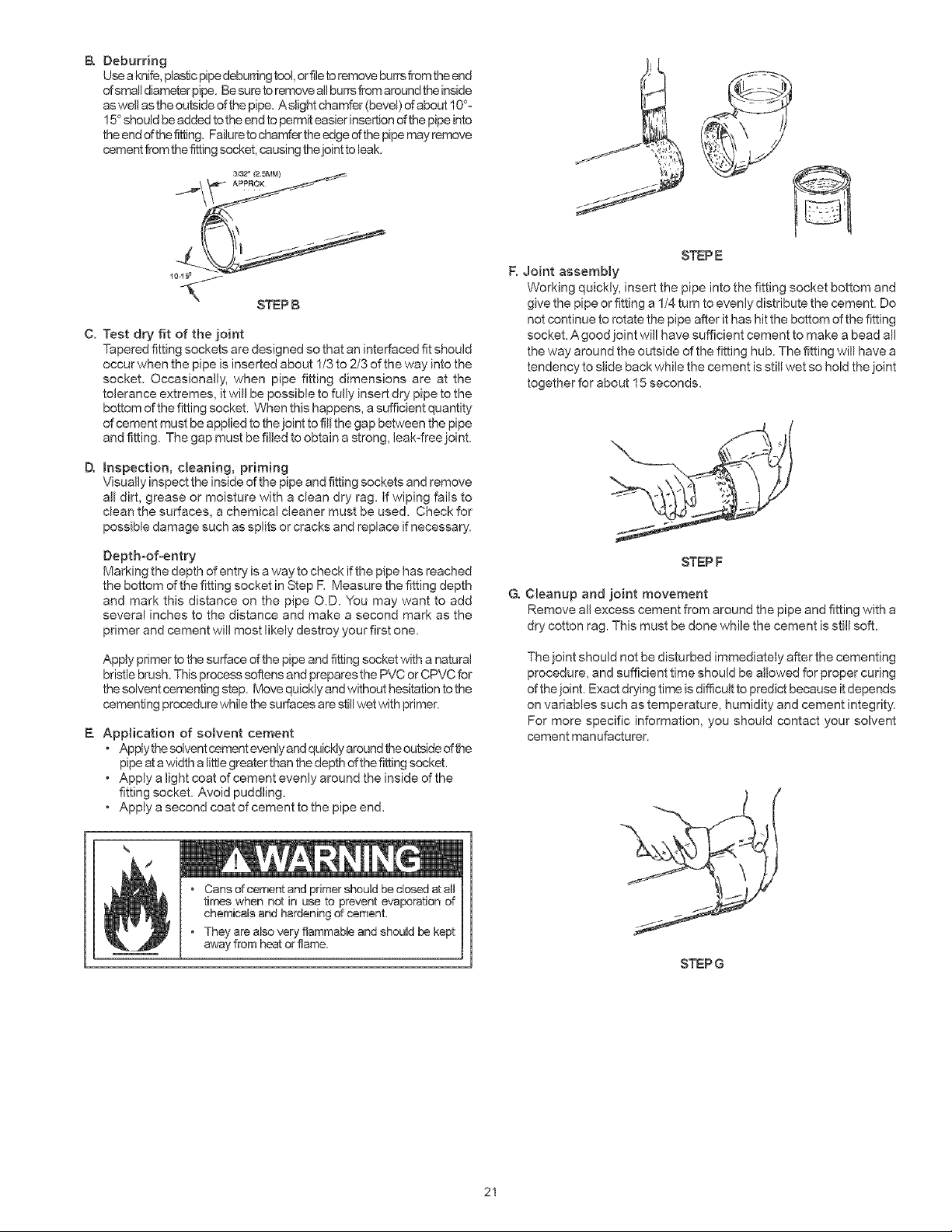
B.Deburring
Useaknife,plasticpipedeburnngtool,orfiletoremoveburrsfromtheend
ofsmalldiameterpipe.Besuretoremoveallburrsfromaroundtheinside
aswellastheoutsideofthepipe.Aslightchamfer(bevel)ofaboutIO°-
15°shouldbeaddedtotheendtopermiteasierinsertionofthepipeinto
theendofthefitting.Failuretochamfertheedgeofthepipemayremove
cementfromthefittingsocket,causingthejointtoleak.
1(
STEP B
C. Test dry fit of the joint
Tapered fitting sockets are designed so that an interfaced fit should
occur when the pipe is inserted about 1/3 to 2/3 of the way into the
socket. Occasionally, when pipe fitting dimensions are at the
tolerance extremes, it will be poseible to fully insert dry pipe to the
bottom of the fitting socket. When this happens, a sufficient quantity
of cement must be applied to the joint to fill the gap between the pipe
and fitting. The gap must be filled to obtain a strong, leakofreeioint.
D. Inspection, cleaning, priming
Visually inspect the inside of the pipe and fitting sockets and remove
all dirt, grease or moisture with a clean dry rag. If wiping fails to
clean the surfaces, a chemical cleaner must be used. Check for
possible damage such as splits or cracks and replace if necessary.
Depthoofoentry
Marking the depth of entry is a way to check if the pipehas reached
the bottom of the fitting socket in Step R Measure the fitting depth
and mark this distance on the pipe O.D. You may want to add
several inches to the distance and make a second mark as the
primer and cement will most likely destroy your first one.
Apply primer to the surface of the pipe and fitting socket with a natural
bristle brush. This process softens and prepares the PVC or CPMC for
the solvent cementing step. Move quickly and without hesitation to the
cementing procedure while the surfaces are still wet with primer.
E, Application of solvent cement
. Apply the selvent cement evenly and quickly around the outside of the
pipe at a width a little greater than the depth of the fitting socket.
. Apply a light coat of cement evenly around the inside of the
fitting socket. Avoid puddling.
• Apply a second coat of cement to the pipe end.
Cons of cement and primer should be closed at all
times when not in use to prevent evaporation of
chemicals and hardening of cement.
They are also very flammable and should be kept
away from heat or flame.
R Joint assembmy
STEPE
Working quickly, insert the pipe into the fitting socket bottom and
give the pipe or fitting a 1/4 turn to evenly distribute the cement. Do
not continue to rotate the pipe after it has hit the bottom of the fitting
socket. A good joint will have sufficient cement to make a bead all
the way around the outside of the fitting hub. The fitting will have a
tendency to slide back while the cement is still wet so hold the ioint
together for about 15 seconds.
G,
f,
STEPF
Cleanup and joint movement
Remove all excess cement from around the pipe and fitting with a
dry cotton rag. This must be done while the cement is still soft.
The ioint should not be disturbed immediately after the cementing
procedure, and sufficient time should be allowed for proper curing
of the joint. Exact drying time is difficult to predict because itdepends
on variables such as temperature, humidity and cement integrity.
For more specific information, you should contact your solvent
cement manufacturer.
STEPG
21
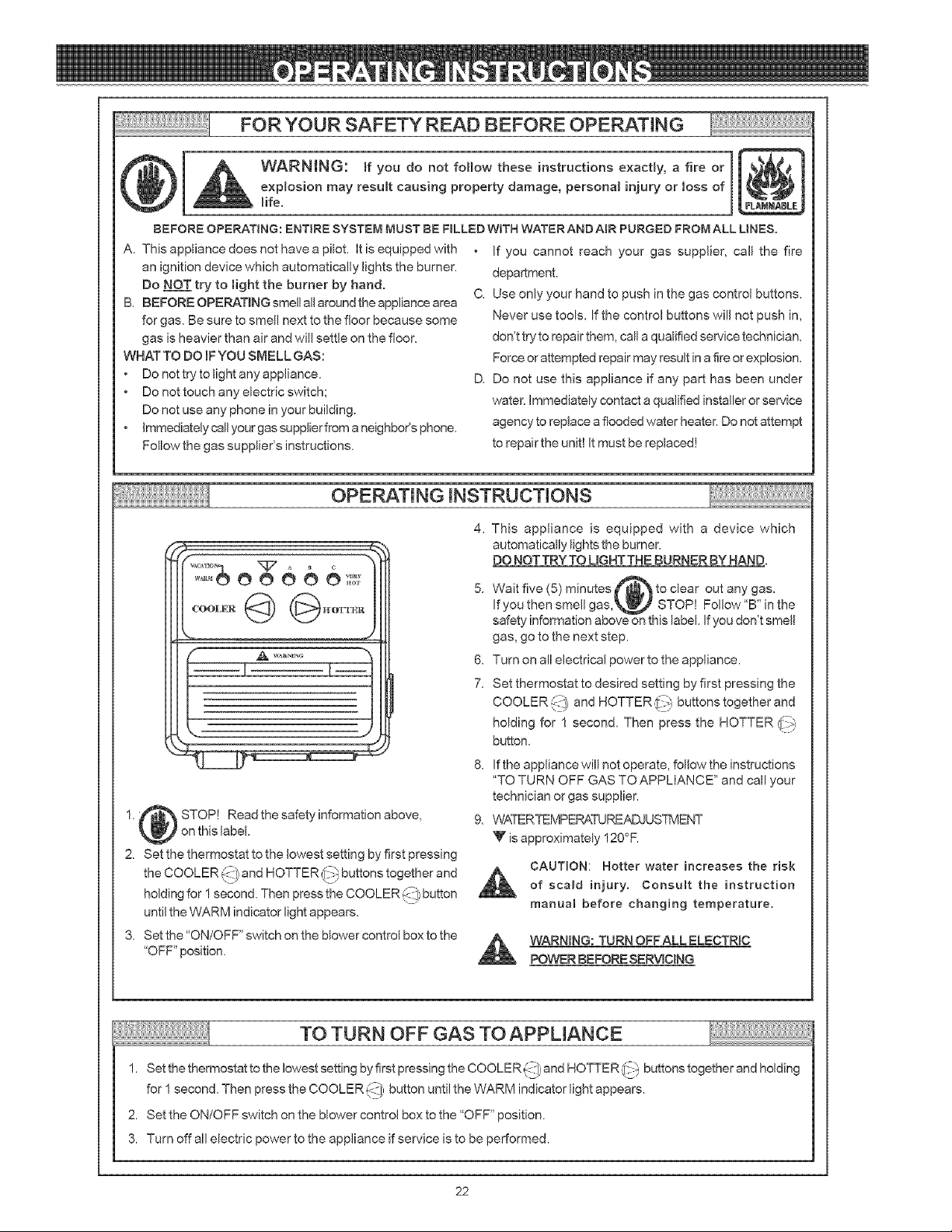
FOR YOUR SAFETY READ BEFORE OPERATING
WARNING: mfyou do not follow these instructions exactly, a fire or
explosion may result causing property damage, personal injury or ross of
life.
BEFORE OPERATING: ENTIRE SYSTEM MUST BE FILLED WiTH WATER AND AiR PURGED FROM ALL LINES.
A. This appliance does not have a pilot. It is equipped with
an ignition device which automatically lights the burner.
Do NOT try to light the burner by hand,
B. BEFORE OPERATmNG smell all around the appliance area
for gas. Be sure to smell next to the floor because some
gas is heavier than air and will settle on the floor.
WHAT TO DO iF YOU SMELL GAS:
• Do not try to light any appliance.
• Do not touch any electric switch;
Do not use any phone in your building.
• Immediately cell your gas supplierfrom a neighbor's phone.
Follow the gas supplier's instructions.
• If you cannot reach your gas supplier, call the fire
department.
C. Use only your hand to push in the gas control buttons.
Never use tools. If the control buttons will not push in,
don't try to repair them, call a qualified service technician.
Force or attempted repair may result in a fire or explosion.
D. Do not use this appliance if any part has been under
water, immediately contact a qualified installer or service
agency to replace a flooded water heater. Do not attempt
to repair the unit! It must be replaced!
OPERATING iNSTRUCTiONS
4. This appliance is equipped with a device which
automatically lights the burner.
DO NOT TRY TO UGHT THE BURNER BY HAND.
1. f_ STOP! Read the safety information above,
on this label.
2. Set the thermostat to the lowest setting by first pressing
the COOLER _ and HOTTER,{__ buttons together and
holding for ! second. Then press the COOLER {_::)button
until the WARM indicator light appears.
3. Set the "ON/OFF" switch on the blower control box to the
"OFF" position.
5. Wait five (5) minutes to clear out any gas.
If you then smell _ STOP! Follow "B" in the
safety his label. If you don't smell
gas, go to the next step.
6. Turn on all electrical power to the appliance.
7. Set thermostat to desired setting by first pressing the
COOLER {-\-}')and HOTTER j_}-_ buttons together and
holding for 1 second. Then press the HOTTER ([:3
button.
8. If the appliance will not operate, follow the instructions
"TO TURN OFF GAS TO APPLIANCE" and call your
technician or gas supplier.
9. WATERTEMPERATUREADJUSTMENT
V is approximately 120°F.
CAUTION: Hotter water increases the risk
of scald injury. Consult the instruction
manual before changing temperature.
WARNmNG:TURN OFF ALL ELECTRIC
POWERBEFORESERVICING
TO TURN OFF GAS TO APPLIANCE
1. Set the thermostat to the lowest setting by first pressing the COOLER _:_!,and HOTTER _ buttons together and holding
for 1 second. Then press the COOLER {_ button until the WARM indicator light appears.
2. Set the ON/OFF switch on the blower control box to the "OFF" position.
3. Turn off all electric power to the appliance if service is to be performed.
22
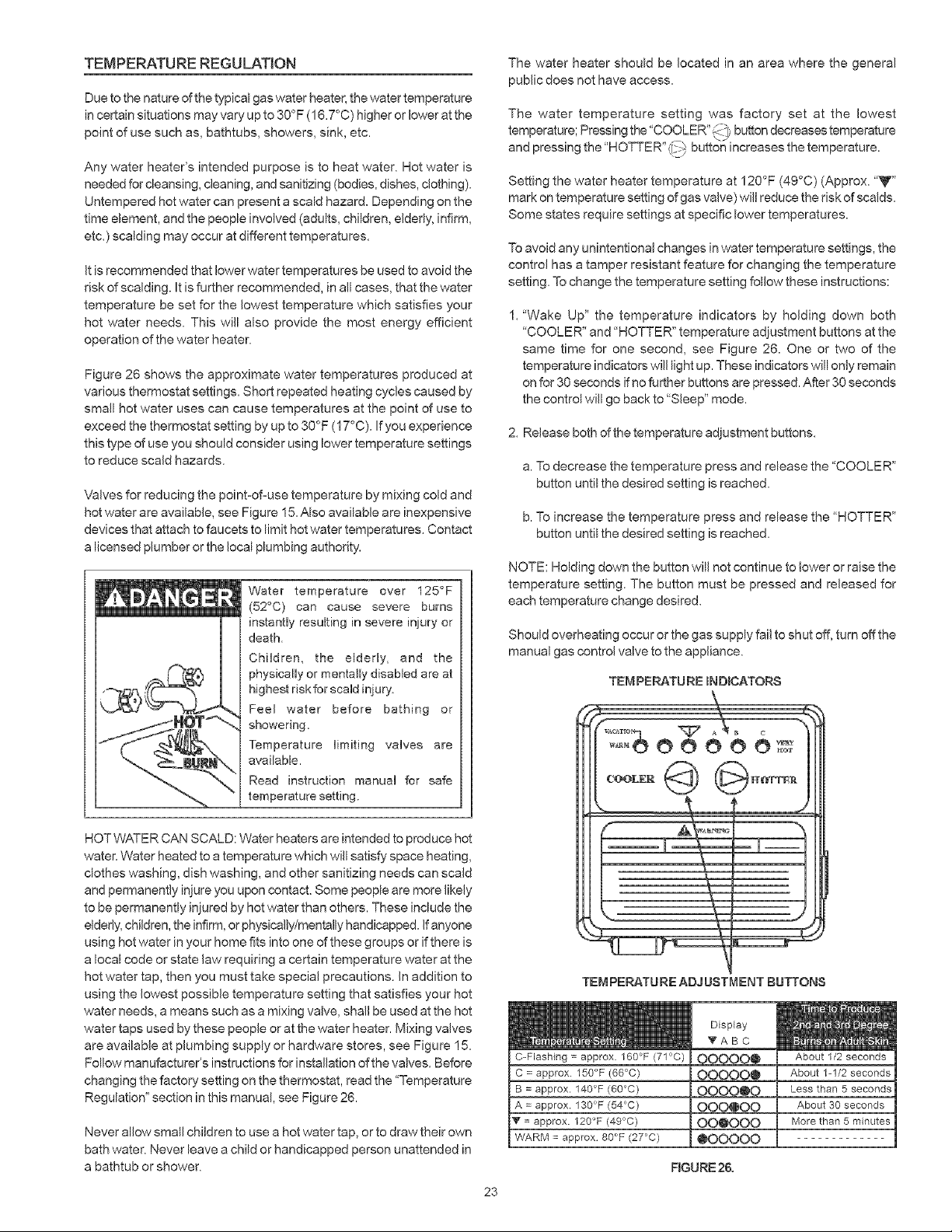
TEMPERATURE REGULATION
Due to the nature of the typical gas water heater, the water temperature
in certain situations may vary up to 30°F (16.7°C) higher or lower at the
point of use such as, bathtubs, showers, sink, etc.
Any water heater's intended purpose is to heat water. Hot water is
needed for cleansing, cleaning, and sanitizing (bodies, dishes, clothing).
Untempered hot water can present a scald hazard. Depending on the
time element, and the people involved (adults, children, elderly, infirm,
etc.) scalding may occur at different temperatures.
It is recommended that lower water temperatures be used to avoid the
risk of scalding. It is further recommended, in all cases, that the water
temperature be set for the lowest temperature which satisfies your
hot water needs. This will also provide the most energy efficient
operation of the water heater.
Figure 26 shows the approximate water temperatures produced at
various thermostat settings. Short repeated heating cycles caused by
small hot water uses can cause temperatures at the point of use to
exceed the thermostat setting by up to 30°F (17°C). If you experience
this type of use you should consider using lower temperature settings
to reduce scald hazards.
Valves for reducing the point-of-use temperature by mixing cold and
hot water are available, see Figure 15. Also available are inexpensive
devices that attach to faucets to limit hot water temperatures. Contact
a licensed plumber or the local plumbing authority.
Water temperature over 125°F
(52°0) can cause severe burns
instantly resulting in severe iniury or
death.
Children, the elderly, and the
physically or mentally disabled are at
highest risk for scald injury_
Feel water before bathing or
showering.
Temperature limiting valves are
available.
Read instruction manual for safe
temperature setting.
HOT WATER CAN SCALD: Water heaters are intended to produce hot
water. Water heated to a temperature which will satisfy space heating,
clothes washing, dish washing, and other sanitizing needs can scald
and permanently injure you upon contact. Some people are more likely
to be permanently injured by hot water than others. These include the
elderly, children, the infirm, or physically/mentally handicapped. If anyone
using hot water in your home fits into one of these groups or if there is
a local code or state law requiring a certain temperature water at the
hot water tap, then you must take special precautions. In addition to
using the lowest possible temperature setting that satisfies your hot
water needs, a means such as a mixing valve, shall be used at the hot
water taps used by these people or at the water heater. Mixing valves
are available at plumbing supply or hardware stores, see Figure !5.
Follow manufacturer's instructions for installation of the valves. Before
changing the factory setting on the thermostat, read the "Temperature
Regulation" section in this manual, see Figure 26.
Never allow small children to use a hot water tap, or to draw their own
bath water. Never leave a child or handicapped person unattended in
a bathtub or shower.
The water heater should be located in an area where the general
public does not have access.
The water temperature setting was factory set at the lowest
temperature; Press ng the "COOLER":-_... button decreases temperature
and pressing the "HOTTER",:_::_} button increases the temperature.
Setting the water heater temperature at 120°F (4g°c) (Approx. "V"
mark on temperature setting of gas valve) will reduce the risk of scalds.
Some states require settings at specific lower temperatures.
To avoid any unintentional changes in water temperature settings, the
control has a tamper resistant feature for changing the temperature
setting. To change the temperature setting follow these instructions:
1. "Wake Up" the temperature indicators by holding down both
"COOLER" and "HOTTER" temperature adjustment buttons at the
same time for one second, see Figure 26. One or two of the
temperature indicators will light up. These indicators will only remain
on for 30 seconds if no further buttons are pressed. After 30 seconds
the control will go back to "Sleep" mode.
2. Release both of the temperature adjustment buttons.
a. To decrease the temperature press and release the "COOLER"
button until the desired setting is reached.
b. To increase the temperature press and release the "HOTTER"
button until the desired setting is reached.
NOTE: Holding down the button will not continue to lower or raise the
temperature setting. The button must be pressed and released for
each temperature change desired.
Should overheating occur or the gas supply fail to shut off, turn off the
manual gas control valve to the appliance.
TE M PE RATU RE INDICATORS
TEMPERATURE ADJUSTMENT BUTTONS
I C-Flashing = approx 160°F (71°C)
C = approx. 150°F (66°C)
B = approx. 140F (60C)
A = approx. 130°F (54°C)
V = approx. 120°F (49°C)
WARM = approx 80°F 27°C
Display
VABC
ooo00o
0000@0
000@00
00@000
@00000
About 1/2 seconds !
About 1-1/2 seconds !
Less than 5 seconds 1
About 30 seconds
More hart 5 m nutes
FIGURE 26,
23
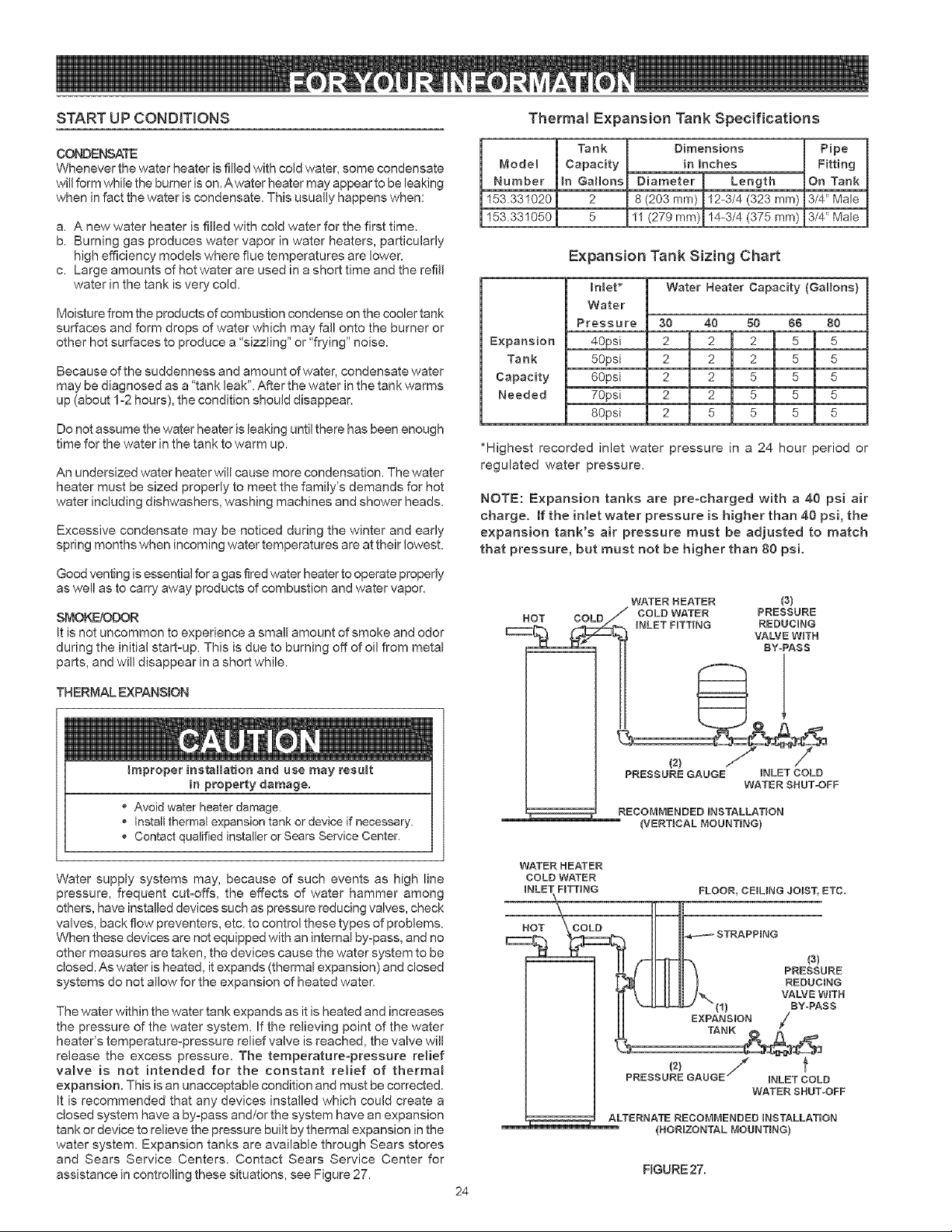
START U P CONDmONS
CONDENSATE
Whenever the water heater is filled with cold water, some condensate
will form while the burner is on. Awater heater may appear to be leaking
when in fact the water is condensate. This usually happens when:
a. A new water heater is filled with cold water for the first time.
b. Burning gas produces water vapor in water heaters, particularly
high efficiency models where flue temperatures are lower.
c. Large amounts of hot water are used in a short time and the refill
water in the tank is very cold.
Moisture from the products of combustion condense on the cooler tank
surfaces and form drops of water which may fall onto the burner or
other hot surfaces to produce a "sizzling" or "frying" noise.
Because of the suddenness and amount of water, condensate water
may be diagnosed as a "tank leak". After the water in the tank warms
up (about 1=2 hours), the condition should disappear.
Do not assume the water heater is leaking until there has been enough
time for the water in the tank to warm up.
An undersized water heater will cause more condensation. The water
heater must be sized properly to meet the family's demands for hot
water including dishwashers, washing machines and shower heads.
Excessive condensate may be noticed during the winter and eady
spring months when incoming water temperatures are at their lowest.
Good venting is essential for a gas fired water heater to operate properly
as well as to carry away products of combustion and water vapor.
SMOKE/ODOR
It is not uncommon to experience a small amount of smoke and odor
during the initial start-up. This is due to burning off of oil from metal
parts, and will disappear in a short while.
THERMAL EXPANSmON
improper installation and use may resamt
in property damage,
Avoid water heater damage.
. Install thermal expansion tank or device if necessary.
. Contact qualified installer or Sears Service Center,
Water supply systems may, because of such events as high line
pressure, frequent cut-offs, the effects of water hammer among
others, have installed devices such as pressure reducing valves, check
valves, back flow preventers, etc. to control these types of problems.
When these devices are not equipped with an internal by-pass, and no
other measures are taken, the devices cause the water system to be
closed. As water is heated, it expands (thermal expansion) and closed
systems do not allow for the expansion of heated water.
The water within the water tank expands as it is heated and increases
the pressure of the water system. If the relieving point of the water
heater's temperature=pressure relief valve is reached, the valve will
release the excess pressure. The temperature-pressure relief
valve is not intended for the constant relief of thermal
expansion. This is an unacceptable condition and must be corrected.
It is recommended that any devices installed which could create a
closed system have a by-pass and/or the system have an expansion
tank or device to relieve the pressure built by thermal expansion in the
water system. Expansion tanks are available through Sears stores
and Sears Service Centers. Contact Sears Service Center for
assistance in controlling these situations, see Figure 27.
Thermal Expansion Tank Specifications
Mode_
Number
153.331020
153.331050
Tank
Capacity
In Gallons
2
5
Dimensions Pipe
in inches Fitting
Diameter Length On Tank
8 (203 ram) 12=3/4 (323 ram) 3/4" Male
11 (279 ram) 14=3/4 (375 mm) 3/4" Male
Expansion Tank Sizing Chart
Water Heater Capacity (Gallons)
Expansion
Tank
Capacity
Needed
Inmet*
Water
Preseure
40psi
50psi
60psi
70psi
80psi
30 40 80 66 80
2 2 2 5 5
2 2 2 5 5
2 2 5 5 5
2 2 5 5 5
2 5 5 5 5
*Highest recorded inlet water pressure in a 24 hour period or
regulated water pressure.
NOTE: Expansion tanks are pre=charged with a 40 psi air
charge, If the inlet water pressure is higher than 40 psi, the
expansion tank's air pressure must be adjusted to match
that pressure, but must not be higher than 80 psi.
WATER HEATER (3)
COLD WATER PRESSURE
INLET FITTING REDUCING
VALVE WITH
BY-PASS
(2)
PRESSUREGAUGE
INLET COLD
WATER SHUT=OFF
RECOMMENDED mNSTALLATION
(VERTICAL MOUNTING}
24
WATER HEATER
COLD WATER
INLET FITTING
FLOOR, CEILING JOIST, ETC,
_ STRAPPING (3)
PRESSURE
REDUCING
(1) VALVE WITH
BY=PASS
EXPANSION J
TANK
(21 / f
PRESSUREGAUGE INLET COLD
WATER SHUT*OFF
ALTERNATE RECOMMENDED INSTALLATION
(HORIZONTAL MOUNTING)
FIGURE27.
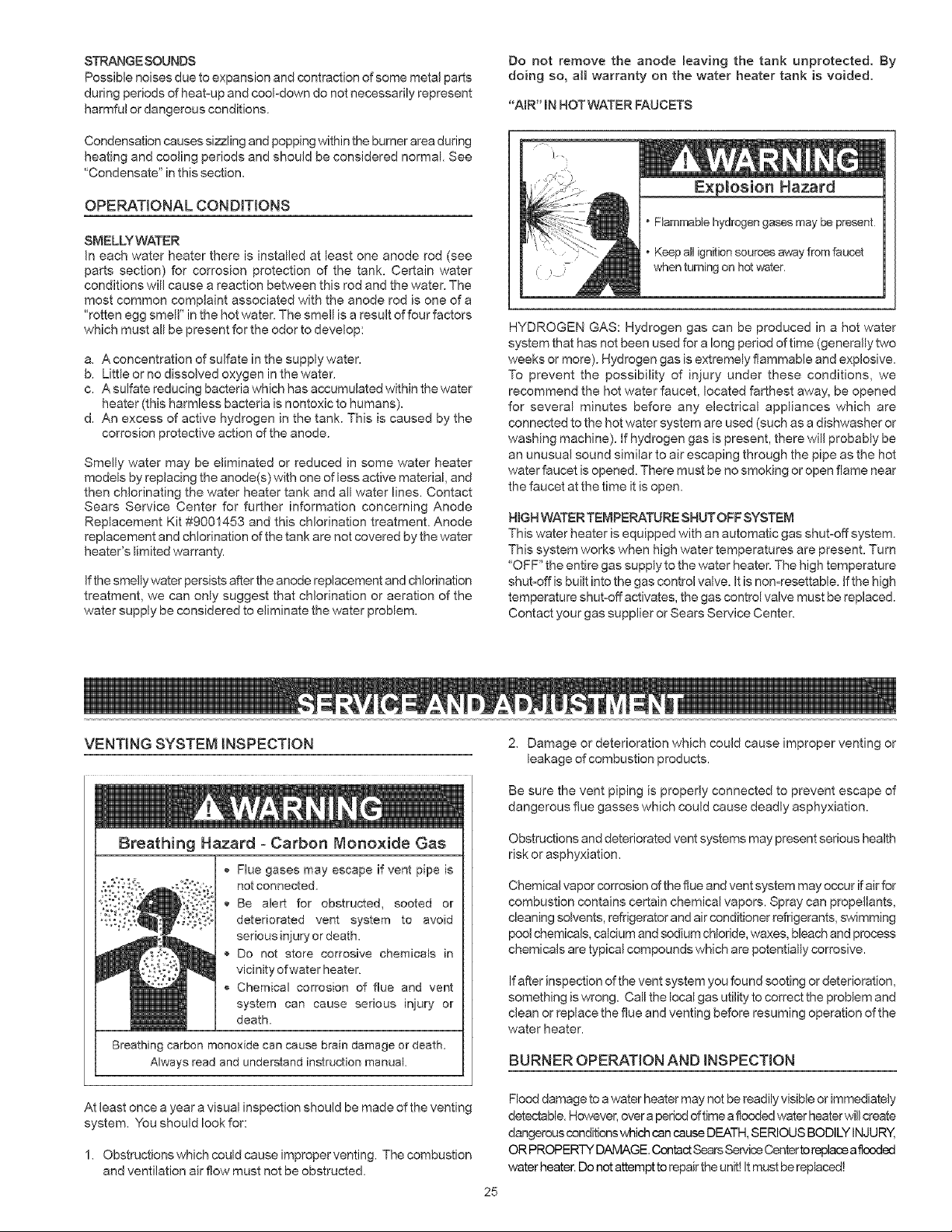
STRANGESOUNDS
Possiblenoisesduetoexpansion and contraction of some metal parts
during periods of heat-up and cool-down do not necessarily represent
harmful or dangerous conditions.
Condensation causes sizzling and popping within the burner area during
heating and cooling periods and should be considered normal. See
"Condensate" in this section.
OPERATIONAL CONDITIONS
SMELLYWATER
In each water heater there is installed at least one anode rod (see
parts section) for corrosion protection of the tank. Certain water
conditions will cause a reaction between this rod and the water. The
most common complaint associated with the anode rod is one of a
"rotten egg smell" in the hot water. The smell is a result of four factors
which must all be present for the odor to develop:
a. A concentration of sulfate in the supply water.
b. Little or no dissolved oxygen in the water.
c. A sulfate reducing bacteria which has accumulated within the water
heater (this harmless bacteria is nontoxic to humans).
d. An excess of active hydrogen in the tank. This is caused by the
corrosion protective action of the anode.
Smelly water may be eliminated or reduced in some water heater
models by replacing the anode(s) with one of less active material, and
then chlorinating the water heater tank and all water lines. Contact
Sears Service Center for further information concerning Anode
Replacement Kit #9001453 and this chlorination treatment. Anode
replacement and chlorination of the tank are not covered by the water
heater's limited warranty.
If the smelly water persists after the anode replacement and chlorination
treatment, we can only suggest that chlorination or aeration of the
water supply be considered to eliminate the water problem.
Do not remove the anode leaving the tank unprotected, By
doing so, aH warranty on the water heater tank is voided.
"AmR"mNNOT WATER FAUCETS
E×plosion Hazard
" Flammable hydrogen gases may be present
• Keep all ignition sources away from faucet
when turning on hot water,
HYDROGEN GAS: Hydrogen gas can be produced in a hot water
system that has not been used for a long period of time (generally two
weeks or more). Hydrogen gas is extremely flammable and explosive.
To prevent the possibility of injury under these conditions, we
recommend the hot water faucet, located farthest away, be opened
for several minutes before any electrical appliances which are
connected to the hot water system are used (such as a dishwasher or
washing machine). If hydrogen gas is present, there will probably be
an unusual sound similar to air escaping through the pipe as the hot
water faucet is opened. There must be no smoking or open flame near
the faucet at the time it is open.
HIGH WATER TEMPERATURE SHUT OFF SYSTEM
This water heater is equipped with an automatic gas shut-off system.
This system works when high water temperatures are present. Turn
"OFF" the entire gas supply to the water heater. The high temperature
shut-off is built into the gas control valve. It is non-resettable. If the high
temperature shut-off activates, the gas control valve must be replaced.
Contact your gas supplier or Sears Service Center.
VENTING SYSTEM INSPECTION
Breathing Hazard o Carbon Monoxide Gas
_, Flue gases may escape if vent pipe is
°_"-* not connected.
_, Be alert for obstructed, sooted or
deteriorated vent system to avoid
serious injury or death.
,, Do not store corrosive chemicals in
vicinity of water heater.
Chemical corrosion of flue and vent
system can cause serious iniury or
death.
Breathing carbon monoxide can cause brain damage or death.
Always read and understand instruction manual.
At least once a year a visual inspection should be made of the venting
system. You should look for:
1. Obstructions which could cause improper venting. The combustion
and ventilation air flow must not be obstructed.
2. Damage or deterioration which could cause improper venting or
leakage of combustion products.
Be sure the vent piping is properly connected to prevent escape of
dangerous flue gasses which could cause deadly asphyxiation.
Obstructions and deteriorated vent systems may present serious health
risk or asphyxiation.
Chemical vapor corrosion of the flue and vent system may occur if air for
combustion contains certain chemical vapors. Spray can propellants,
cleaning solvents, refrigerator and air conditioner refrigerants, swimming
pool chemicals, calcium and sodium chloride, waxes, bleach and process
chemicals are typical compounds which are potentially corrosive.
If after inspection of the vent system you found sooting or deterioration,
something is wrong. Call the local gas utility to correct the problem and
clean or replace the flue and venting before resuming operation of the
water heater.
BURNER OPERATIONANDINSPECTION
25
Flood damage to a water heater may not be readily visible or immediately
detectable. However, over a period of time a flooded,water heater w411create
dangerous conditions which can cause DEATH, SERIOUS BODILY INJURY,
OR PROPERTY DAMAGE. Contact Sears Service Centerto replace a flooded
water heater. Do not attempt to repair the unit! It must be replaced!
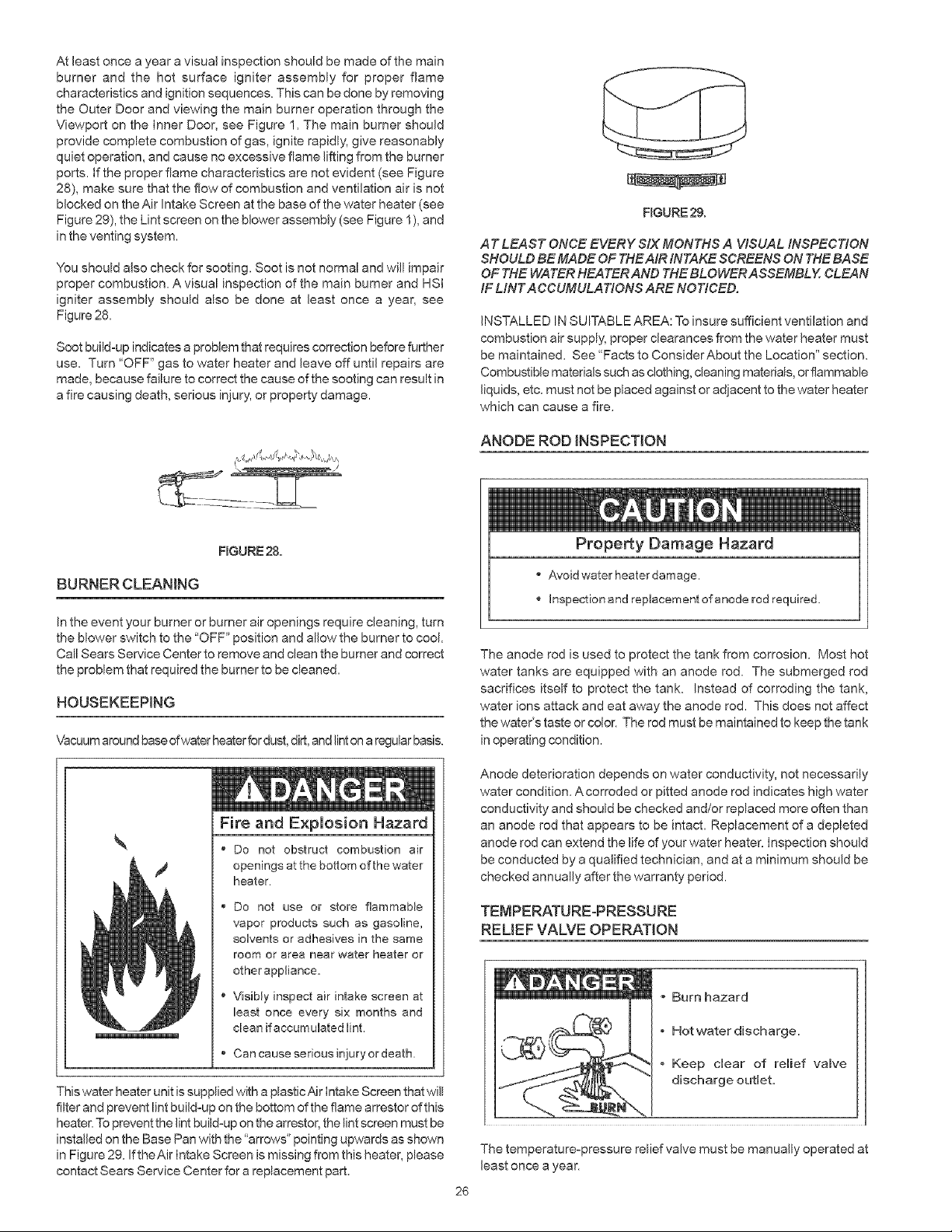
Atleastonceayearavisualinspectionshouldbemadeofthemain
burnerandthehotsurfaceigniterassemblyforproperflame
characteristicsandignitionsequences.Thiscanbedonebyremoving
theOuterDoorandviewingthemainburneroperationthroughthe
ViewportontheInnerDoor,seeFigure1.Themainburnershould
providecompletecombustionofgas,igniterapidly,givereasonably
quietoperation,andcausenoexcessiveflameliftingfromtheburner
ports,iftheproperflamecharacteristicsarenotevident(seeFigure
28),makesurethattheflowofcombustionandventilationairisnot
blockedontheAirIntakeScreenatthebaseofthewaterheater(see
Figure29),theLintscreenontheblowerassembly(seeFigure1),and
intheventingsystem.
Youshouldalsocheckforsooting.Sootisnotnormalandwillimpair
propercombustion.AvisualinspectionofthemainburnerandHSI
igniterassemblyshouldalsobedoneatleastonceayear,see
Figure28.
Sootbuild-upindicatesaproblemthatrequirescorrectionbeforefurther
use.Turn"OFF"gastowaterheaterandleaveoffuntilrepairsare
made,becausefailuretocorrectthecauseofthesootingcanresultin
afirecausingdeath,seriousinjury,orpropertydamage.
FIGURE29.
A T LEAST ONCE EVERY SIX MONTHS A VISUAL iNSPECTION
SHOULD BE MADE OF THEA/R INTAKE SCREENS ON THE BASE
OF THE WATER HEATERAND THE BLOWERASSEMBLY. CLEAN
iF LINTA CCUMULAT/ONS ARE NOTICED.
INSTALLED IN SUITABLE AREA: To insure sufficient ventilation and
combustion air supply, proper clearances from the water heater must
be maintained. See "Facts to ConsiderAbout the Location" section.
Combustible materials such as clothing, cleaning materials, or flammable
liquids, etc. must not be placed against or adiacent to the water heater
which can cause a fire.
ANODE ROD INSPECTION
Property Damage Hazard
Avoid water heater damage.
Inspection and replacement of anode rod required.
FIGURE 28.
BURNER CLEANING
In the event your burner or burner air openings require cleaning, turn
the blower switch to the "OFF" position and allow the burner to cool.
Call Sears Service Center to remove and clean the burner and correct
the problem that required the burner to be cleaned.
HOUSEKEEPING
Vacuumaround baseof waterheaterfordust,dirt,andlinton a regularbasis.
Fire and Expmosion Hazard
Do not obstruct combustion air
openings at the bottom of the water
heater
, Do not use or store flammable
vapor products such as gasoline,
solvents or adhesives in the same
room or area near water heater or
other appliance.
* Visibly inspect air intake screen at
least once every six months and
clean if accumulated lint.
, Can cause serious injury or death.
This water heater unit is supplied with a plasticAir intake Screen that will
filter and prevent lint build°up on the bottom of the flame arrestor of this
heater. To prevent the lint build-up on the arrestor, the lint screen must be
installed on the Base Pan with the "arrows" pointing upwards as shown
in Figure 29. If theAir intake Screen is missing from this heater, please
contact Sears Service Center for a replacement part.
The anode rod is used to protect the tank from corrosion. Most hot
water tanks are equipped with an anode rod. The submerged rod
sacrifices itself to protect the tank. instead of corroding the tank,
water ions attack and eat away the anode rod. This does not affect
the water's taste or color. The rod must be maintained to keep the tank
in operating condition.
Anode deterioration depends on water conductivity, not necessarily
water condition. A corroded or pitted anode rod indicates high water
conductivity and should be checked and/or replaced more often than
an anode rod that appears to be intact. Replacement of a depleted
anode rod can extend the life of your water heater. Inspection should
be conducted by a qualified technician, and at a minimum should be
checked annually after the warranty period.
TEMPERATURE-PRESSURE
REUEF VALVE OPERATION
Burn hazard
• Hot water discharge.
Keep clear of relief valve
discharge outlet.
26
The temperature-pressure relief valve must be manually operated at
least once a year.
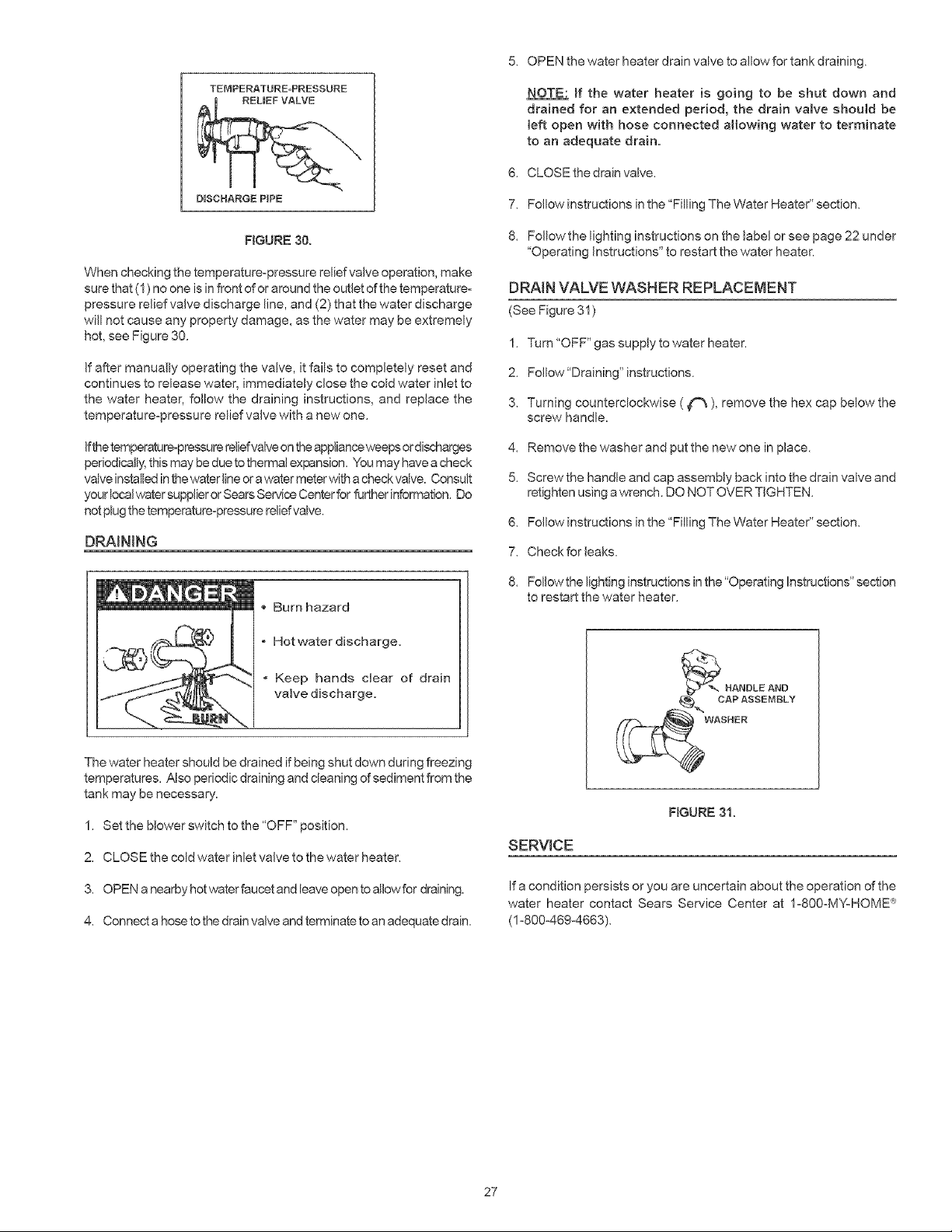
TEMPERATURE=PRESSURE
DISCHARGEPiPE
FIGURE 30.
When checking the temperature=pressure relief valve operation, make
sure that (1) no one is in front of or around the outlet of the temperature-
pressure relief valve discharge line, and (2) that the water discharge
will not cause any property damage, as the water may be extremely
hot, see Figure 30.
if after manually operating the valve, it fails to completely reset and
continues to release water, immediately close the cold water inlet to
the water heater, follow the draining instructions, and replace the
temperature-pressure relief valve with a new one.
ifthe temperature=pre_ure relief valve on the appliance weeps or discharges
periodically, this may be due to then_al expansion. You may have a check
valve installed in the water line or a water meter with a check valve. Consult
yourlocalwatersupplierorSearsServiceCenterfor furtherinformation. Do
not plug the temperature=pressure relief valve.
DRAINING
,, Burn hazard
- Hot water discharge.
• Keep hands clear of drain
valve discharge.
The water heater should be drained if being shut down during freezing
temperatures. Also periodic draining and cleaning of sediment from the
tank may be necessary.
1. Set the blower switch to the "OFF" position.
2. CLOSE the cold water inlet valve to the water heater.
3. OPEN a nearbyhotwaterfaucetand leaveopentoallowfor draining.
4. Connect a hose to the drain valve and terminate to an adequate drain.
5. OPEN the water heater drain valve to allow for tank draining.
NOTE: mfthe water heater is going to be shut down and
drained for an extended period, the drain valve should be
left open with hose connected amlowing water to terminate
to an adequate drain.
6. CLOSE the drain valve.
7. Follow instructions in the "Filling The Water Heater" section.
8. Follow the lighting instructions on the label or see page 22 under
"Operating instructions" to restart the water heater.
DRAIN VALVE WASHER REPLACEMENT
(See Figure 31 )
1. Turn "OFF" gas supply to water heater.
2. Follow"Draining"instructions.
3. Turning counterclockwise ( _ ), remove the hex cap below the
screw handle.
4. Remove the washer and put the new one in place.
5. Screw the handle and cap assembly back into the drain valve and
retighten using a wrench. DQ NOT OVER TIGHTEN.
6. Follow instructions in the "Filling The Water Heater" section.
7. Check for leaks.
8. Follow the lighting instructions in the "Operating Instructions" section
to restart the water heater.
CAP ASSEMBLY
WASHER
HGURE 31.
SERVICE
If a condition persists or you are uncertain about the operation of the
water heater contact Sears Service Center at 1-800-MY-HOME R'
(1=800-46%4663).
27
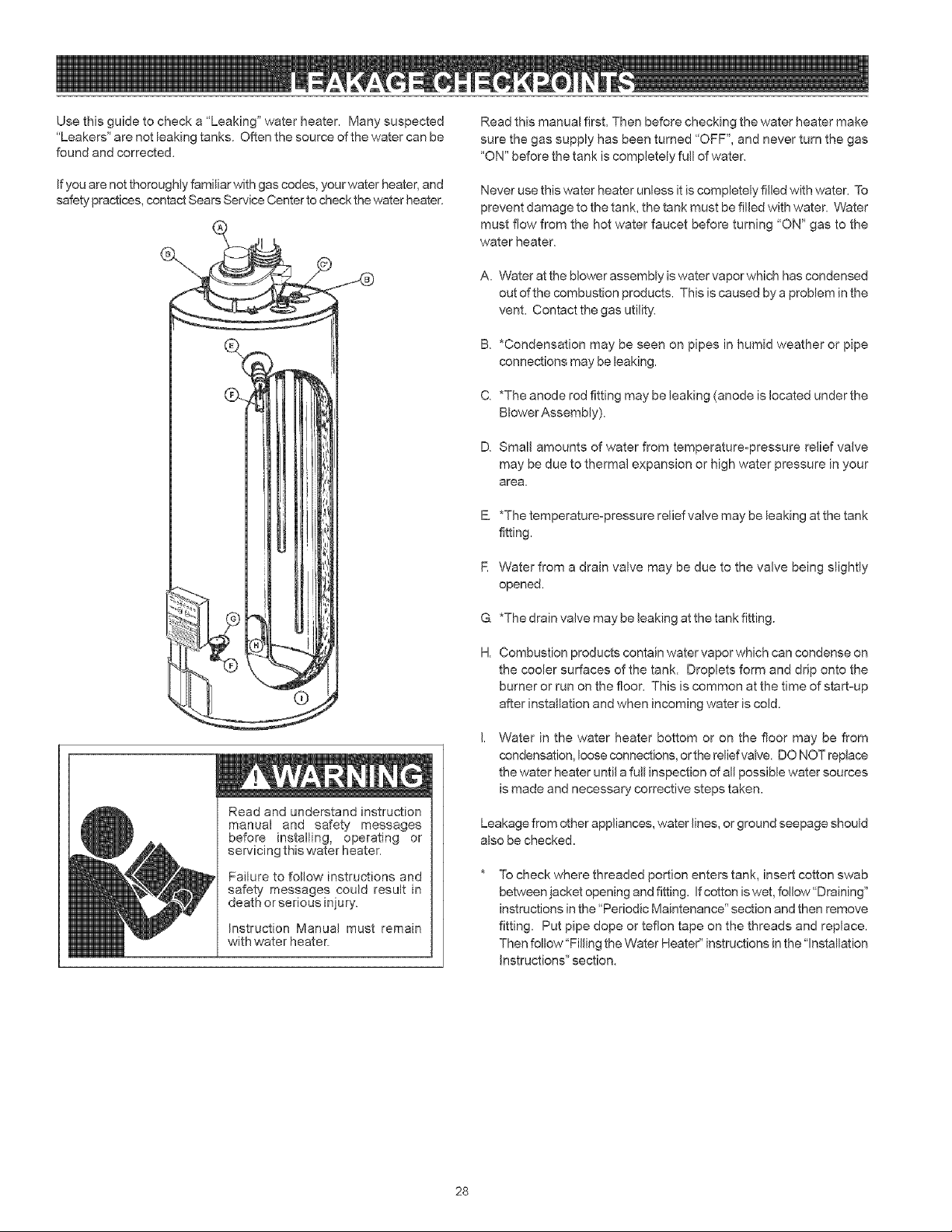
Usethisguidetochecka"Leaking"waterheater.Manysuspected
"Leakers" are not leaking tanks. Often the source of the water can be
found and corrected.
If you are not thoroughly familiar with gas codes, your water heater, and
safety practices, contact Sears Service Center to check the 'water heater.
Read and understand instruction
manual and safety' messages
before installing, operating or
servicing this water heater,
Failure to follow instructions and
safety messages could result in
death or serious inju ry_
Instruction Manual must remain
with water heater
Read this manual first. Then before checking the water heater make
sure the gas supply has been turned "OFF", and never turn the gas
"ON" before the tank is completely full of water.
Never use this water heater unless it is completely filled with water. To
prevent damage to the tank, the tank must be filled with water. Water
must flow from the hot water faucet before turning "ON" gas to the
water heater.
A. Water at the blower assembly is water vapor which has condensed
out of the combustion products. This is caused by a problem in the
vent. Contact the gas utility.
B. *Condensation may be seen on pipes in humid weather or pipe
connections may be leaking.
C. *The anode rod fitting may be leaking (anode is located under the
Blower Assembly).
D. Small amounts of water from temperature-pressure relief valve
may be due to thermal expansion or high water pressure in your
area.
E *The temperature-pressure relief valve may be leaking at the tank
fitting.
R Water from a drain valve may be due to the valve being slightly
opened.
G *The drain valve may be leaking at the tank fitting.
Combustion products contain water vapor which can condense on
the cooler surfaces of the tank. Droplets form and drip onto the
burner or run on the floor. This is common at the time of startoup
after installation and when incoming water is cold.
Water in the water heater bottom or on the floor may be from
condensation, loose connections, orthe relief valve. DO NOT replace
the water heater until a full inspection of all possible water sources
is made and necessary corrective steps taken.
Leakage from other appliances, water lines, or ground seepage should
also be checked.
To check where threaded portion enters tank, insert cotton swab
between jacket opening and fitting. If cotton is wet, follow "Draining"
instructions in the "Periodic Maintenance" section and then remove
fitting. Put pipe dope or teflon tape on the threads and replace.
Then follow"Filling the Water Heater" instructions in the "Installation
Instructions" section.
28
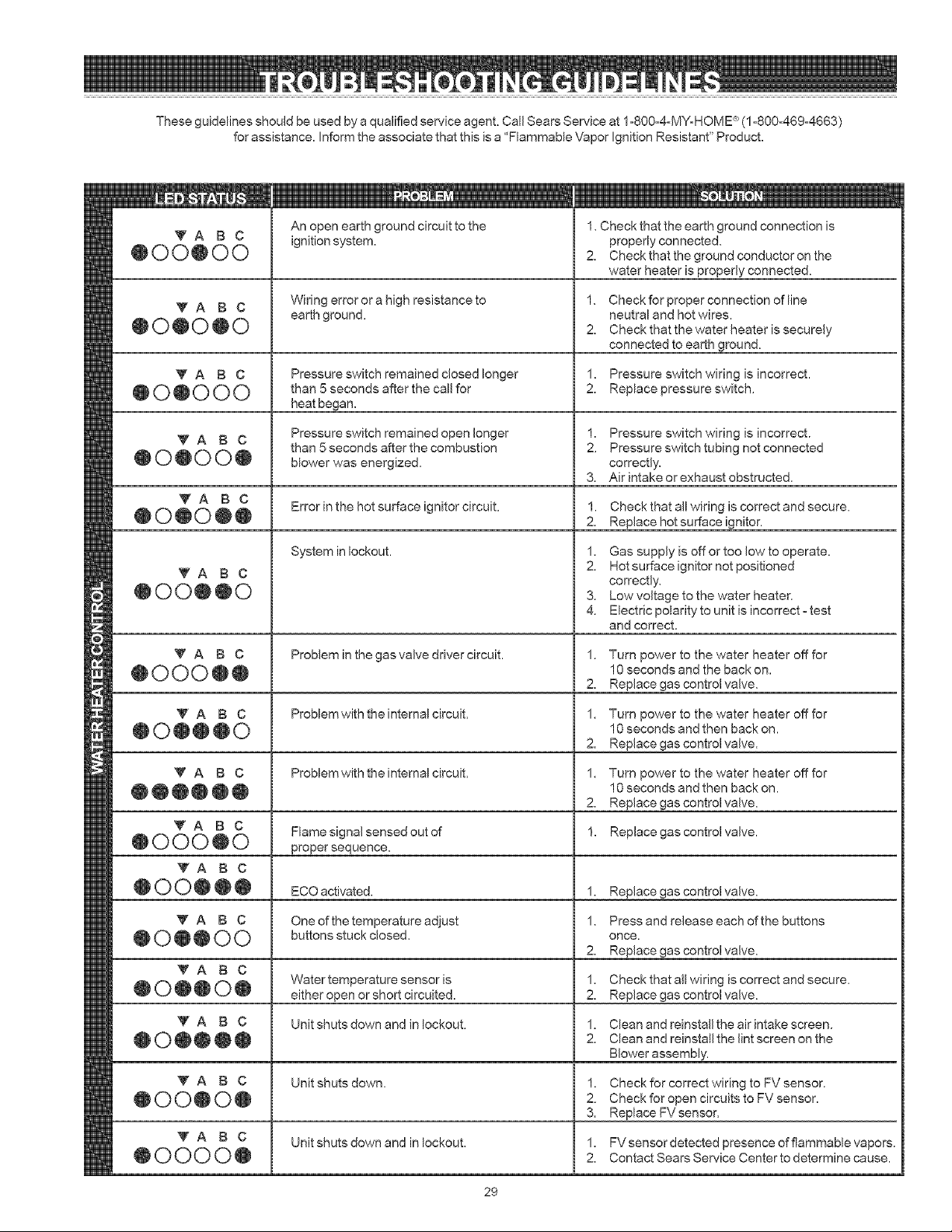
Theseguidelinesshouldbeusedbyaqualifiedserviceagent.CalJSearsServiceat1-800-4-MY_HOME<'_(1-800-469-4663)
forassistance.Informtheassociatethatthisisa"FlammableVaporIgnitionResistant"Product.
YA BC
@OO@OO
An open earth ground circuit to the
ignition system.
1. Check that the earth ground connection is
properly connected.
2. Check that the ground conductor on the
water heater is properly connected.
V A B C Wiring error or a high resistance to 1. Checkforproperconnectionofline
qj_ OOOl_ O earth ground, neutral and hot wires.
2. Check that the water heater is securely
connected to earth ground.
T A B C Pressure switch remained closed longer 1. Pressure switch wiring is incorrect.
than 5 seconds after the calJ for 2. Replace pressure switch.
heat began.
A B C Pressure switch remained open longer 1. Pressure switch wiring is incorrect.
than 5 seconds after the combustion 2. Pressure switch tubing not connected
@ O @O O @ blower was energized, correctly.
3. Air intake or exhaust obstructed.
YA BC
@O@O@@ Error in the hot surface ignitor circuit. 1. Check that all wiring is correct and secure.
2. Replace hot surface ignitor.
System in lockout. 1.
2.
YA BC
@00@@0
3.
4.
Gas supply is off or too low to operate.
Hot surface ignitor not positioned
correctly.
Low voltage to the water heater.
Electric polarity to unit is incorrect =test
and correct.
V A B C Problem in the gas valve driver circuit. 1. Turn power to the water heater off for
10 seconds and the back on.
@ O O O @ @ 2. Replace gas control valve.
Y A B C Problem with the internal circuit. 1. Turn power to the water heater off for
10 seconds and then back on.
@ O @ @ @ O 2. Replace gas control valve.
_' A B C Problem with the internal circuit. 1. Turn power to the water heater off for
10 seconds and then back on.
@ @ @ @ @ @ 2. Replace gas control valve.
T A B C Flame signal sensed out of 1. Replace gas control valve.
@ 0 0 0 @ 0 propersequence.
YA B C
@OO@@@ ECO activated. 1. Replace gas control valve.
V A B C One of the temperature adjust 1. Press and release each of the buttons
@ O @ @ O O buttons stuck closed, once.
2. Replace gas control vaJve.
VA B C
Water temperature sensor is 1. Check that all wiring is correct and secure.
@O@@O@ either open or short circuited. 2. Replace gas control valve.
V A B C Unitshutsdownandinlockout. 1. Clean and reinstalJ the air intake screen
@ O @@ @ @ 2, Clean and reinstall the lint screen on the
Blower assembly.
• " A B C Unit shuts down. 1. Check for correct wiring to FV sensor,
O O O@ O O 2. Check for open circuits to FV sensor.
-- -- 3, Replace FVsensor,
T A B C Unitshutsdownandinlockout, 1, FVsensordetectedpresenceofflammablevapors,
@ O O O O @ 2. Contact Sears Service Center to determine cause.
29
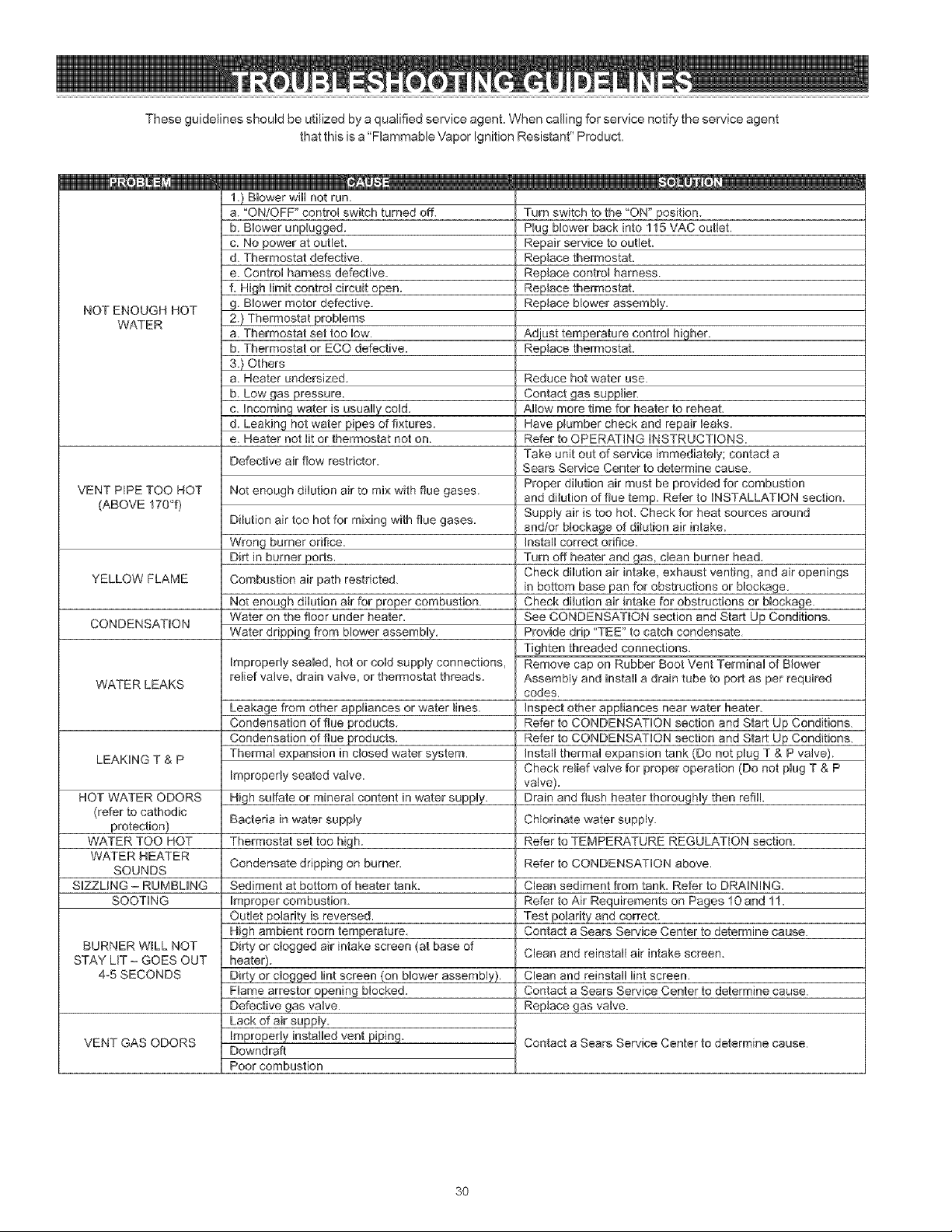
Theseguidelinesshouldbeutilizedbyaqualifiedserviceagent.Whencallingforservicenotifytheserviceagent
thatthisisa"FlammableVaporIgnitionResistant"Product.
NOTENOUGHHOT
WATER
VENTPIPETOOHOT
(ABOVE170°0
YELLOWFLAME
CONDENSATION
WATERLEAKS
LEAKINGT&P
HOTWATERODORS
(refertocathodic
protection)
WATERTOOHOT
WATERHEATER
SOUNDS
SIZZLING- RUMBUNG
1.) Blower will not run.
a. "ON/OFF ° control switch turned off.
b. Blower unplugged.
c. No power at outlet,
d. Thermostat defective.
e. Control harness defective.
f. High 0imitcontrol circuit open.
g. Blower motor defective.
2.) Thermostat problems
a. Thermostat set too 0ow.
b. Thermostat or ECO defective.
3.) Others
a. Heater undersized
b. Low gas pressure.
c. Oncomingwater is usua00¥co0d.
d. Leaking hot water pipes of fixtures.
e. Heater not lit or thermostat not on.
Defective air flow restrictor.
Not enough dilution airto mix with flue gases.
Dilution air too hot for mixing with flue gases.
Wrong burner orifice.
Dirt in burner ports.
Combustion air path restricted.
Not enough dilution air for proper combustion
Water on the floor under heater,
Water dripping from blower assembly.
improperly sealed, hot or coBd supply connections,
relief valve, drain valve, or thermostat threads.
Leakage from other appliances or water lines
Condensation of flue products.
Condensation of flue products.
Thermal expansion in closed water system.
Improperly seated valve.
High sulfate or mineral content in water supply.
Bacteria in water supply
Thermostat set too high.
Condensate dripping on burner.
Sediment at bottom of heater tank.
Turn switch to the *'ON" position.
Plug blower back into 1 15 VAC outlet.
Repair service to outlet.
Replace thermostat.
Replace control harness
Replace thermostat.
Replace blower assembly.
Adjust temperature control higher.
Replace thermostat.
Reduce hot water use.
Contact gas supplier
ABIowmore time for heater to reheat.
Have pBumber check and repair leaks.
Refer to OPERATING INSTRUCTIONS.
Take unit out of service immediately; contact a
Sears Service Center to determine cause.
Proper dilution air must be provided for combustion
and dilution of flue temp. Refer to INSTALLATION section.
Supply air is too hot. Check for heat sources around
andlor blockage of di0ution air intake.
Install correct orifice.
clean burner head.
Check dilution air intake, exhaust venting, and air openings
in bottom base pan for obstructions or blockage.
Check dilution air intake for obstructions or blockage
See CONDENSATION section and Start Up Conditions.
Provide drip "TEE" to catch condensate.
Tighten threaded connections.
Remove cap on Rubber Boot Vent Terminal of Blower
Assembly and install a drain tube to port as per required
codes.
Inspect other app0iances near water heater.
Refer to CONDENSATION section and Start Up Conditions
Refer to CONDENSATION section and Start Up Conditions.
Install thermal expansion tank (Do not plug T & P valve).
Check relief valve for proper operation (Do not plug T & P
valve).
Drain and flush heater thoroughly then refill.
Chlorinate water supply.
Refer to TEMPERATURE REGULATION section.
Refer to CONDENSATION above,
Clean sediment from tank. Refer to DRAINING.
SOOTING
BURNER WILL NOT
STAYLIT-GOES OUT
4-5SECONDS
VENT GAS ODORS
Improper combustiom
Outlet polarity is reversed.
High ambient room temperature.
Dirty or c0ogged air intake screen (at base of
heater).
Dirty or c0ogged lint screen (on blower assembly).
F0ame arrestor opening Mocked.
Defective gas valve
Lack of air supply_
!m_roper!] !nsta!!ed vent p!p!ng_
Downdraft
Poor combustion
Refer to Air Requirements on Pages 10 and 11.
Test polarity and correct.
Contact a Sears Service Center to determine cause
Clean and reinsta01 air intake screen.
Clean and reinstall lint screen.
Contact a Sears Service Center to determine cause.
Replace gas vaJve.
Contact a Sears Service Center to determine cause
3O
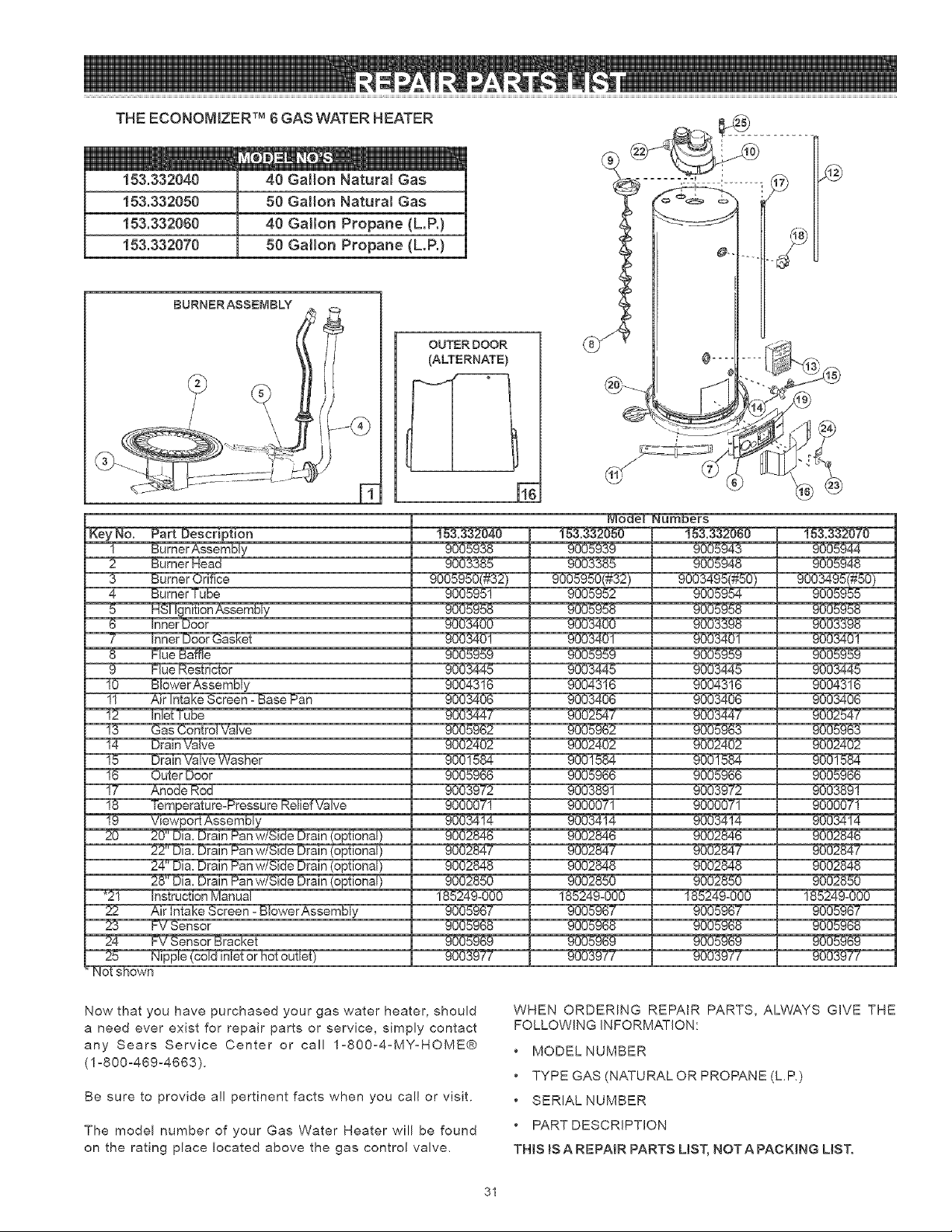
THE ECONOMIZER TM 6 GAS WATER HEATER
153.332040 40 Gallon Naturam Gas
153.332050 50 Gallon Natutat Gas
153.332060 40 Gallon Propane (L.P.)
153.332070 50 Gallon Propane (L.P.)
OUTER DOOR
(ALTERNATE)
KeyNo. Part Description
1 Burner Assembly
2 Burner Head
ice
4 Burner Tube
, Ignition ssem y
6 Inner Door
7 Inner Door Gasket
8 uF_'_Baffle
9 F'[u-&q%strictor
10 BlowerAssembly
11 Air Intake Screen =Base Pan
12 Inlet Tube
13 Gas Control Valve
14 Drain 'dalve
153,33=2040
905_938
900_385
9005951
9005958
9003400
9003401
9005959
9003445
9004316
9003406
9003447
9005§62
9002402
16 Outer Door
17 Anode Rod
2
24" _D_[a_.Drain Pan w/Side Drain (optional)
28" _D"_m.Drain Pan w/Side Drain (optional!
"21 Instruction Manual
22 Air Intake Screen = BlowerAssembly
23 FV Sensor
24 FV Sensor Bracket
25 Nipple (cold inlet or hot outlet)
Not shown
9001584
90G5966
§003972
9000071
9003414
9002846
9002847
9002848
9002850
18524%000
9005967
_0-d5968
900397"/
I£to_e| Numbers
153.332050
9005939
9003S_5
9005952
9005958
9003400
9003401
9005_9
9003445
9004316
9003406
9002547
9005962
9002402
9001584
9005966
9003891
9000071
9003414
9002846
9002847
9002848
9002850
165249=000
900596"7
90059_8
9005969
9003977
9005943
9005948
9005954
9005956
9003396
9003401
9005959
9003445
9004316
9003406
9003447
9005963
9002402
9001584
9005966
9003972
9000071
9003414
9002846
9002847
9002848
9002850
9005967
9005968
9005_69
9003977
Now that you have purchased your gas water heater, should
a need ever exist for repair parts or service, simply contact
any Sears Service Center or call l o800o4oMYoHOME®
(1o800o469o4663).
Be sure to provide all pertinent facts when you call or visit.
The model number of your Gas Water Heater will be found
on the rating place located above the gas control valve.
WHEN ORDERING REPAIR PARTS, ALWAYS GIVE THE
FOLLOWING INFORMATION:
• MODEL NUMBER
• TYPE GAS (NATURAL OR PROPANE (UP.)
• SERIAL NUMBER
• PART DESCRIPTION
THIS IS A REPAIR PARTS UST, NOT A PACKING UST.
31
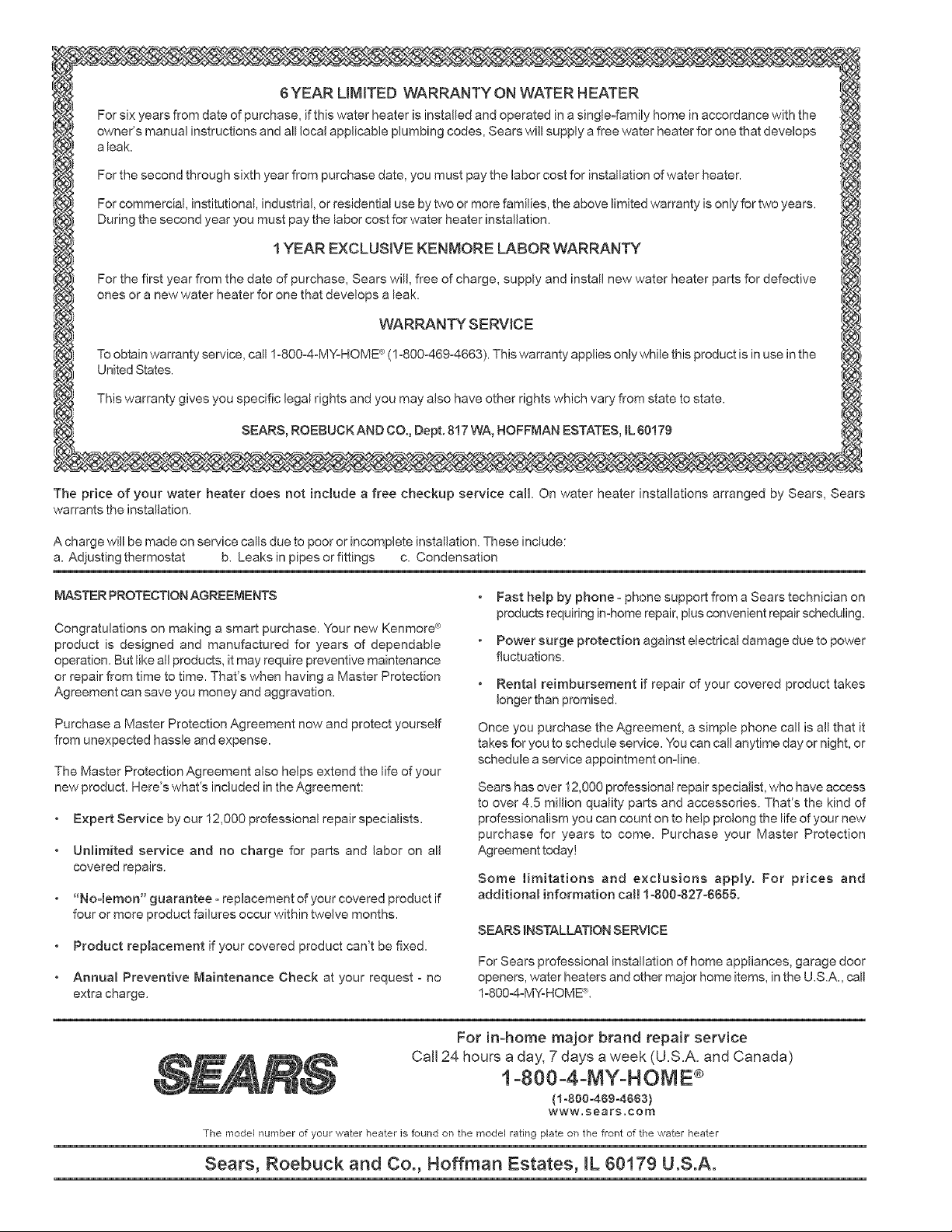
6 YEAR LIMITED WARRANTY ON WATER HEATER
For six years from date of purchase, if this water heater is installed and operated in a singleofamily home in accordance with the
owner's manual instructions and all local applicable plumbing codes, Sears will supply a free water heater for one that develops
a leak.
For the second through sixth year from purchase date, you must pay the labor cost for installation of water heater.
For commercial, institutional, industrial, or residential use by two or more families, the above limited warranty is only for two years.
During the second year you must pay the labor cost for water heater installation.
1 YEAR EXCLUSIVE KENMORE LABOR WARRANTY
For the first year from the date of purchase, Sears will, free of charge, supply and install new water heater parts for defective
ones or a new water heater for one that develops a leak.
WARRANTY SERWCE
To obtain warranty service, call I=800o4-MyoHOME "_(1=800-469-4663). This warranty applies only while this product is in use in the
United States.
This warranty gives you specific legal rights and you may also have other rights which vary from state to state.
SEARS, ROEBUCK AND CO., Dept. 817 WA, HOFFMAN ESTATES,BL60179
The price of your water heater does not include a free checkup service call. On water heater installations arranged by Sears, Sears
warrants the installation.
A charge will be made on service calls due to poor or incomplete installation. These include:
a. Adjusting thermostat b. Leaks in pipes or fittings c. Condensation
MASTERPROTECTIONAGREEMENTS
Congratulations on making a smart purchase. "four new Kenmord "_
product is designed and manufactured for years of dependable
operation. But like all products, it may require preventive maintenance
or repair from time to time. That's when having a Master Protection
Agreement can save you money and aggravation.
Purchase a Master Protection Agreement now and protect yourself
from unexpected hassle and expense.
The Master Protection Agreement also helps extend the life of your
new product. Here's what's included in the Agreement:
• Expert Service by our 12,000 professional repair specialists.
o Unlimited service and no charge for parts and labor on all
covered repairs.
• "No4emon" guarantee = replacement of your covered product if
four or more product failures occur within twelve months.
• Product replacement if your covered product can't be fixed.
• Annual Preventive Maintenance Check at your request = no
extra charge.
Fast he_p by phone ° phone support from a Sears technician on
products requiring in=home repair, plus convenient repair scheduling.
Power surge protection against electrical damage due to power
fluctuations.
o Renta_ reimbursement if repair of your covered product takes
longer than promised.
Once you purchase the Agreement, a simple phone call is all that it
takes for you to schedule service. You can call anytime day or night, or
schedule a service appointment onoline.
Sears has over 12,000 professional repair specialist, who have access
to over 4.5 million quality parts and accessories. That's the kind of
professionalism you can count on to help prolong the life of your new
purchase for years to come. Purchase your Master Protection
Agreement today!
Some [imitations and exclusions apply. For prices and
additional information call 1 °800°827°6655.
SEARS INSTALLATION SERVICE
For Sears professional installation of home appliances, garage door
openers, water heaters and other major home items, in the U.S.A., call
lo8004oM%HOME'L
For in-home major brand repair service
Call 24 hours a day, 7 days a week (U.S.A. and Canada)
1-800-4-MY-HOME ®
(1=800=469=4863)
www.se3rs.com
The model number of your water heater is found on the model rating plate on the front of the water heater
Sears, Roebuck and Co., Hoffman Estates, IL 60t79 U.S.A.