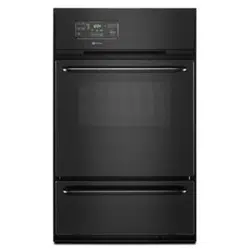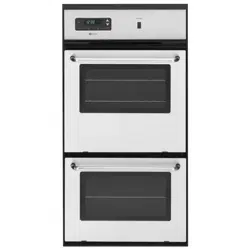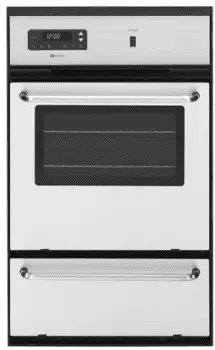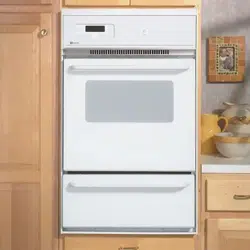
GAS WALL OVEN MODELS CWG4100, CWG4600. CWG3100, CWG3600
KEEPTHESEINSTRUCTIONSFORFUTUREREFERENCE
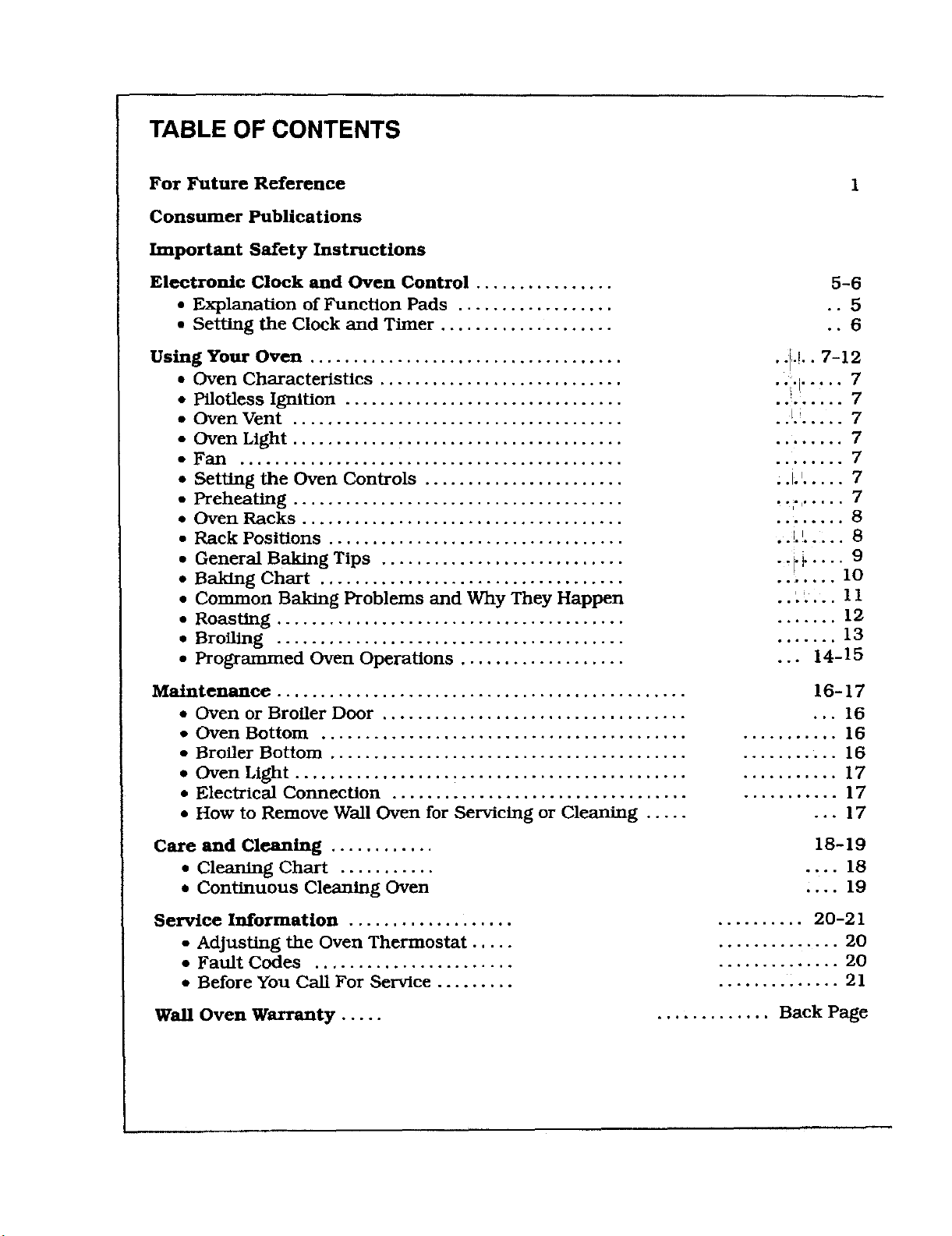
TABLE OF CONTENTS
For Future Reference
Consumer Publications
Important Safety Instructions
Electronic Clock and Oven Control ................
• Explanation of Function Pads ..................
• Setting the Clock and Timer ....................
Using Your Oven ....................................
• Oven Characteristics ............................
* Pilotless Ignition ................................
• Oven Vent ......................................
• Oven Light ......................................
• Fan .... .... .......... ................... .......
. Setting the Oven Controls .......................
• Preheating ......................................
• Oven Racks .....................................
• Rack Positions ..................................
• General Baking Tips ............................
• Baking Chart ...................................
• Common Baking Problems and Why They Happen
• Roasting ........................................
• Broiling ........................................
• Programmed Oven Operations ...................
Maintenance ...............................................
• Oven or Broiler Door ...................................
• Oven Bottom ..........................................
• Broiler Bottom .........................................
• Oven Light .............................................
• Electrical Connection ..................................
• How to Remove Wall Oven for Servicing or Cleaning .....
Care and Cleaning ............
• Cleaning Chart ...........
• Continuous Cleaning Oven
Service Information ...................
• Adjusting the Oven Thermostat .....
• Fault Codes .......................
• Before You Call For Service .........
1
5-6
.. 5
• . 6
• .Ii.!.. 7-12
• 7
"°il " '°
7
.°°o°,.*
• .1._..... 7
o.°*°,*, 7
• 7
..I, i..... 7
''i" ..... 7
o,°1 • o,° 8
• I. t . . 8
i 9
... .... I0
11
o*°,,*,
....... 12
....... 13
... 14-15
16-17
... 16
........... 16
........... 16
........... 17
........... 17
... 17
18-19
.... 18
.... 19
.......... 20-21
.............. 20
.............. 20
........ . ..... 21
Wall Oven Warranty .................. Back Page
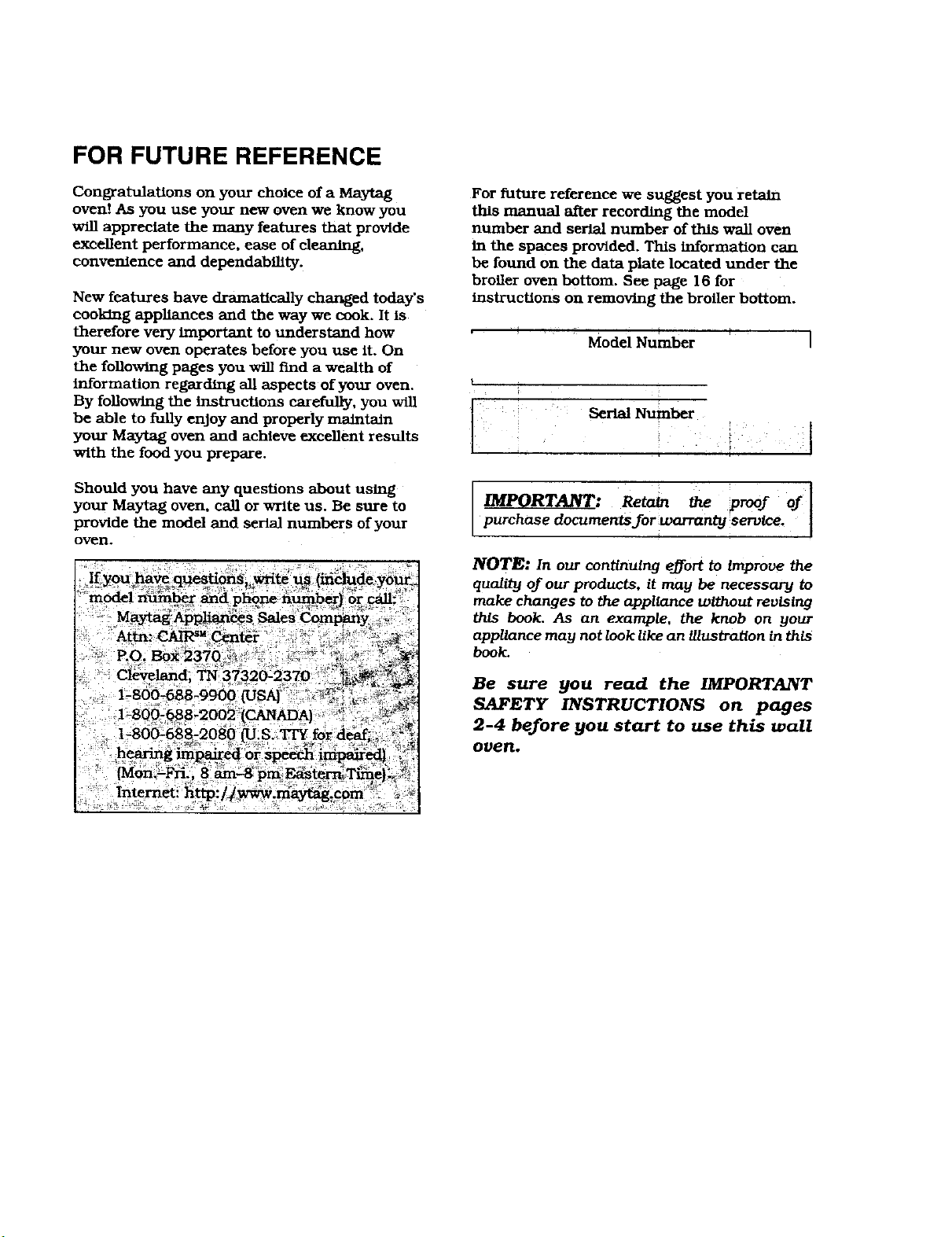
FOR FUTURE REFERENCE
Congratulations on your choice of a Maytag
oven! As you use your new oven we know you
will appreciate the many features that provide
excellent performance, ease of cleaning,
convenience and dependability.
New features have dramatically changed today's
cooking appliances and the way we cook. It Is
therefore very important to understand how
your new oven operates before you use it. On
the following pages you will find a wealth of
information regarding all aspects of your oven.
By following the instructions carefully, you will
be able to fully enjoy and properly maintain
your Maytag oven and achieve excellent results
with the food you prepare.
Should you have any questions about using
your Maytag oven, call or write us. Be sure to
provide the model and serial numbers of your
oven.
For future reference we suggest you retain
this manual after recording the model
number and serial number of this wall oven
in the spaces provided. This information can
be found on the data plate located under the
broiler oven bottom. See page 16 for
instructions on removing the broiler bottom.
Model Number
Serial Number
IMPORTANT: Retain the proof of
purchase documents for warranty service.
NOTE: In our continuing effort to improve the
quality of our products, it may be necessary to
make changes to the appliance without revising
this book. As an example, the knob on your
appllance may not look like an illustration in this
book,
Be sure you read the IMPORTANT
SAFETY INSTRUCTIONS on pages
2-4 before you start to use this wall
oven.
IMPORTANT SAFETY INSTRUCTIONS
Read all instructions before using this appliance. The foIlowlng instructionsare based on safety
considerations and must be strictly followed to eliminate the potential risks of fire, electric shock or
_ersonal injury.
WARNING: If the information in this [
manual is not followed exactly, a fireor [
explosion may result causing property
damage, personal injury or death.
- Do not store or use gasoline or other
flammable vapors and liquids in the
vicinity of this or any other appliance.
- WHAT TO DO IF YOU MLL GAS
• Do not try to light any appliance
• Do not touch any electrlca] switch; do
not use any phone in your building.
• Immedlately call your gas supplier
from a neighbor's phone. Follow the
gas supplier's instructions.
• If you cannot reach your gas supplier,
call the fire department.
InstallaUon and service must be
performed by a qualified installer, service
agency or the gas supplier.
with the other type until adjustments are
made by a qualified service technician.
Gas Odor
If gas odor is detected, cut off the gas supply
to the appliance. Then, call your installer or
local gas company to have the leak checked.
Never use a match or other flame to locate
a gas leak.
Servicing
Electrical supply must be disconnected before
servicing appliance.
Do not repair or replace any part of your
appliance u_ess specifically recommended in
this manual. All other servicing should be
referred to a qualified technician.
Installation
Installation of the appliance must conform
with local codes or, ffno codes exist, with the
current National Fuel Gas Code. Installation
and adjustment of the appliance must be
performed ONLY by a qualified installer or
service technician in accordance with the
Installation Instructions. See accompanying
InstallationInstructions.
General
Misuse of appliance doors, such as stepping,
leaning or sitting on the door, may result in
possible tipping of the appliance, breakage of
door and serious injuries.
Have the installer show you the location of the
gas shut off valve and how to shut it off in an
emergency.
Be certain all packing materials are removed
from the oven before operating, to prevent fire
or smoke damage should the packing material
ignite.
Observe all instructions for minimum
clearances to any combustible surfaces. These
should be in accordance with Information on
the rating plate and wlth national fire laws.
If the appliance is installed near a window.
proper precautions should be taken to prevent
the curtains from blowing over the burners
creating a FIRE HAZARD.
Gas l_pe
All models are adjustable for use with
NATURAL or LP (bottled} gas. An appliance
adjusted for one type of gas cannot be used
CAUTION: Do not use an appliance as a step
stool to cabinets above.
Keep area around appliance clear and free
from combustible materials, gasoline, and
other flammable vapors and materials.
In the event of a prolonged power failure, the
oven CANNOT be operated during a power
failure.
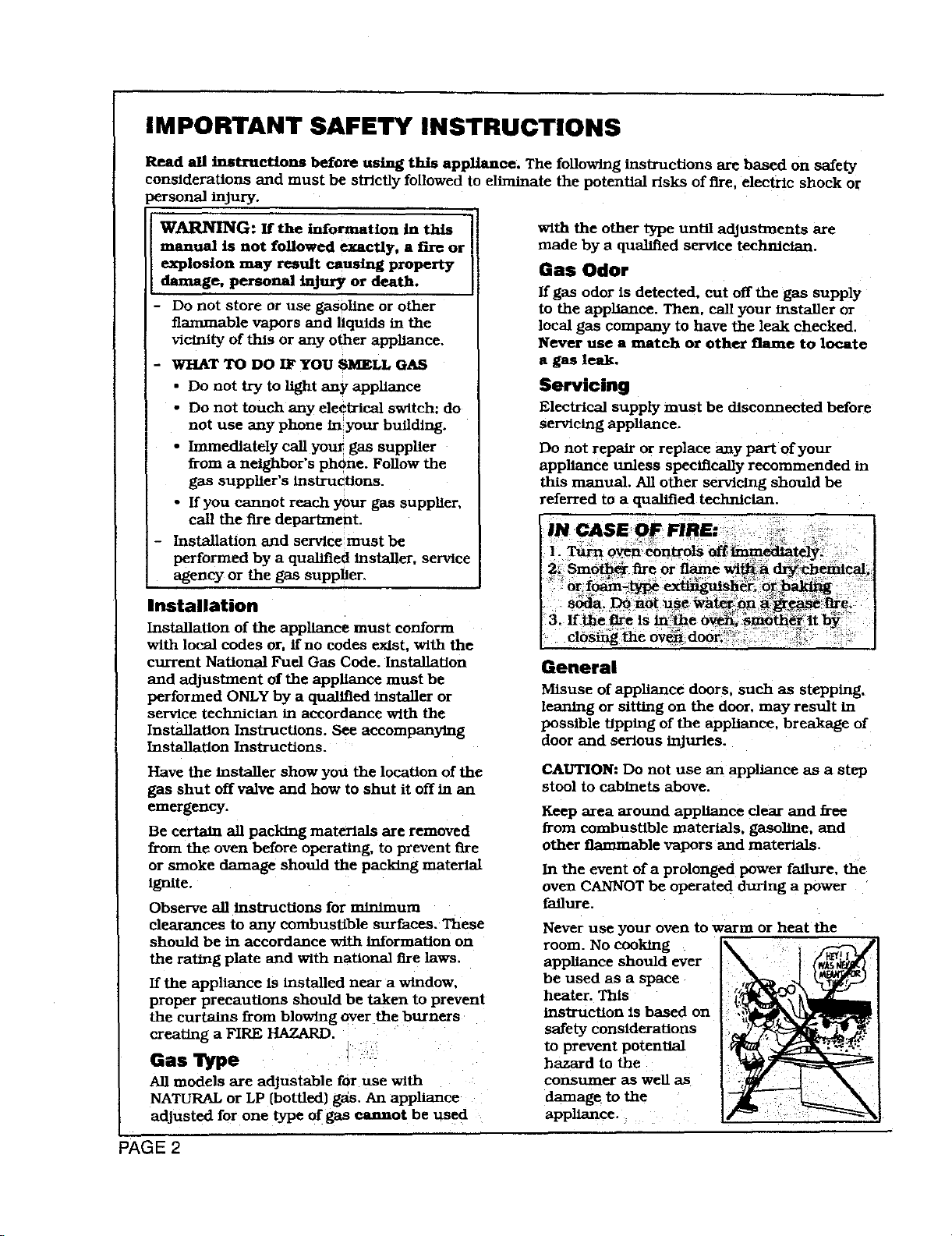
Never use your oven to warm or heat the
room. No cooking
appliance should ever
be used as a space
heater. This
instruction is based on
safety considerations
to prevent potential
hazard to the
consumer as well as
damage to the
appliance..
PAGE 2
Cooking Safety
If flame should go out during cooking, turn
burner off. If gas has collected and a strong
gas odor is detected, wait 5 minutes for gas
odor to disappear before relighting burner.
Slide oven rack out to add or remove food,
using dry, sturdy pot holders. Always avoid
reaching into oven to place or remoVe food.
Do not use oven as a storage area for food or
cooking utensils. This instruction is based on
safety considerations to prevent potential
hazard to user and to the appliance.
Use caution when wearing garments made of
flammable material to avoid clothlng fires.
Loose fitting or long-hanging-sleeved apparel
should not be worn while cooking. Clothing
may ignite or catch utensil handles.
Use dry, sturdy pot holders. Damp pot holders
may cause burns from steam. Dish towels or
other substitutes should never be used as pot
holders because they can trail across hot
burners and ignite or get caught on appliance
parts.
Never heat an unopened container in the
oven. Pressure build-up may cause _ontainer
to burst resulting in serious personal injury or
damage to the oven.
Use care when opening oven door. Let hot air
or steam escape before removing or replacing
food.
Always place oven racks in the desired
positions whlle oven is cool. Ifa rack must be
moved while hot, be careful to avold:contact of
pot holders with oven burner flame,
Use aluminum foil only as instructed.
Improper use of aluminum foil may cause
damage to the appliance, affect cooking
results adversely and can also result in shock
and/or fire hazards.
Do not cover broiler inset with foil. Use a
broiler pan that allows grease to drip below
the insert, away from the broiler flame to
minimize chance of grease fires.
Prepared Food Warning [_
Follow the food manufacturer's instructions. If
a plastic frozen food container and/gr Its film
cover distorts, warps or is otherwis_ damaged
during cooking, immediately disear_ the food
and its container. The food could be_
contaminated, i
Child Safety
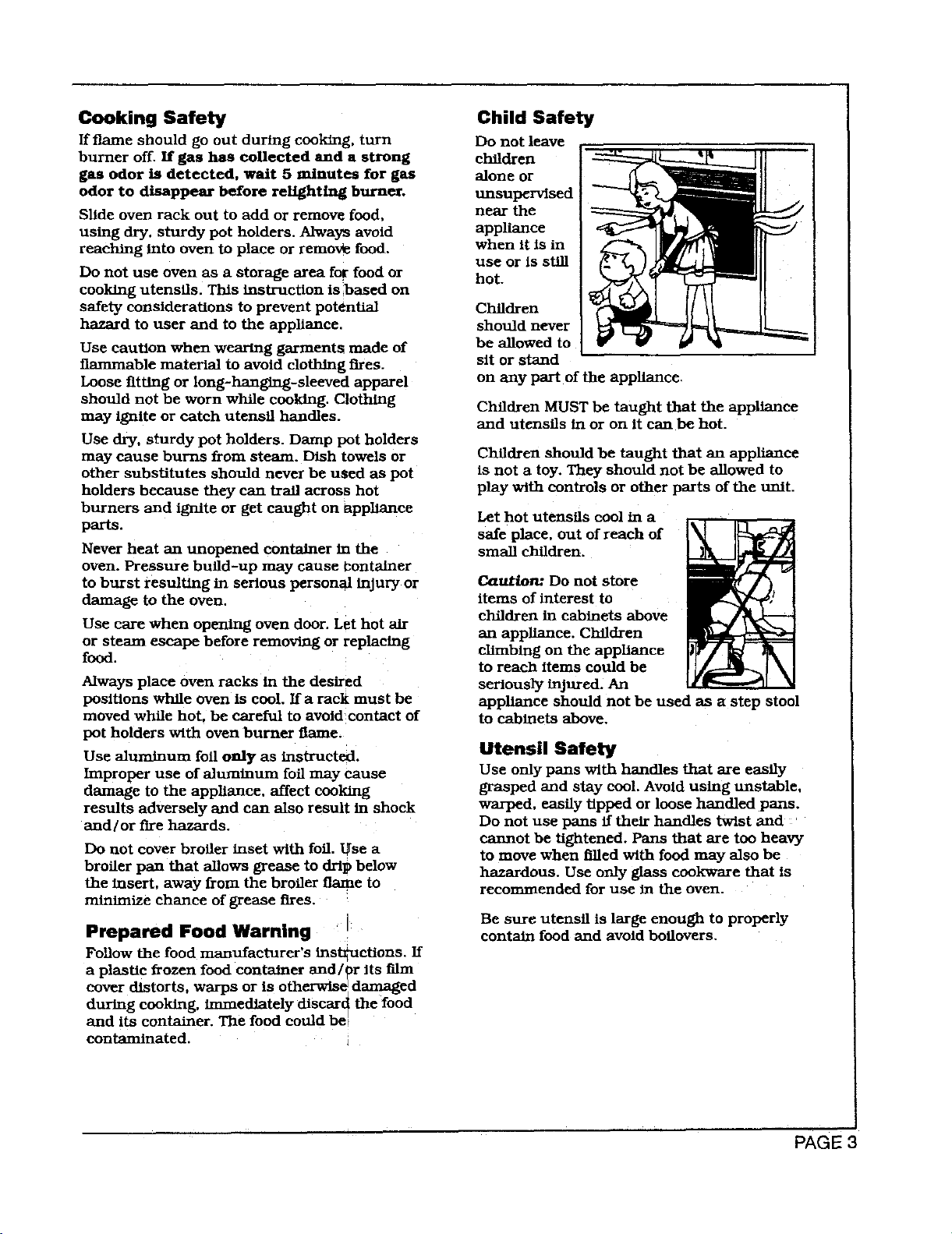
Do not leave
children
alone or
unsupervised
near the
appliance
when it is in
use or is still
hot.
Children
should never
be allowed to
sit or stand
on any part of the appliance.
Children MUST be taught that the appliance
and utensils in or on it can be hot.
Children should be taught that an appliance
is not a toy. They should not be allowed to
play with controls or other parts of the unit.
Let hot utensils cool in a
safe place, out of reach of
small children.
Caution: Do not store
items of interest to
children in cabinets above
an appliance. Children
climbing on the appliance
to reach items could be
seriously injured. An
appliance should not be used as a step stool
to cabinets above.
Utensil Safety
Use only pans with handles that axe easily
grasped and stay cool. Avoid using unstable,
warped, easily tipped or loose handled pans.
Do not use pans ff their handles twist and
cannot be tightened. Pans that are too heavy
to move when filled with food may also be
hazardous. Use only glass cook-ware that is
recommended for use in the oven.
Be sure utensil is large enough to properly
contain food and avoid boilovers.
PAGE 3
Grease
Use extreme caution when moving the grease
kettle or disposing of hot grease. Hot grease is
flammable. Avoid letting grease deposits
collect around appliance, range hood, or vent
fan. Do not leave container of grease around a
cooking appliance. Always let quantities of hot
fat used for deep fat frying cool before
attempting to move or handie. In the event of a
grease fire, do not attempt to move pan. Cover
pan with a lid in extinguish flame and turn
burner off. Do not douse flame with water. Use
a dry chemical or foam-type extinguisher, ff
available, or sprinkle heavily with baking
soda.
Spills or boflovers which contain grease
should be cleaned up as soon as possible. If
they are allowed to accumulate, they could
create a fire hazard.
is provided, it should be limited to items
which are used infrequently and which are
safely stored in an area subjected to heat from
an appliance. Temperatures in storage areas
above the unit may be unsafe for some items,
such as volatile liquids, cleaners or aerosol
sprays.
Plastics
Many plastics are vulnerable to heat, Keep
plastics away from parts of the appliance that
may become warm or hot.
Aerosol Sprays
Many aerosol-type spray cans are
EXPLOSIVE when exposed to heat and may
be highly flammable. Avoid their use or
storage near a hot appliance.
Venting
Never block oven vent or air intakes. Do not
obstruct the flow of combustion and
ventilation air. Restriction of air flow to the
burner prevents proper performance.
Avoid touching oven vent area while oven is
on and for several minutes after oven is
turned off. Some parts of the vent and
surrounding area become hot enough to cause
burns.
Cleaning
Turn off all controls and wait for appliance
parts to cool before touching or cleaning them
Touching a hot oven light bulb with a damp
cloth could cause the bulb to break. Should
the bulb break, disconnect power to the oven
before trying to remove the bulb to avoid
electrical shock.
Clean oven with caution. If a wet sponge or
cloth is used to wipe spills on a hot cooking
area, be careful to avoid steam burns. Some
cleaners can produce noxious fumes ff applied
to a hot surface.
Storage Above Oven
To eliminate the hazard of reaching over hot
surfaces, cabinet storage should not be
provided directly above a unit. If such storage
Important Safety Notice and
Warning
The California Safe Drinking Water and Toxic
Enforcement Act of 1986 (Proposition 65)
requires the Governor of California to publish
a list of substances known to the State of
California to cause cancer or reproductive
harm, and requires businesses to warn
customers of the potential exposures to such
substances.
Users of this appliance are hereby warned that
the burning of gas can result in low-level
exposure to some of the listed substances,
including benzene, formaldehyde and soot,
due primarily to the incomplete combustion of
natural gas or liquid petroleum (LP) fuels.
Properly adjusted burners will minimize
incomplete combustion. Exposure in these
substances can also be minimized by properly
venting the burners to the outdoors.
Baking Accessories
This appliance has been tested for safe
performance using conventional cook-ware. Do
not use any devices or accessories that are not
specifically recommended in this manual. Do
not use add-on oven convection systems. The
use of devices or accessories that are not
expressly recommended in this manual can
create serious safety hazards, result in
performance problems, and reduce the life of
the components of the appliance.
SAVE THESE INSTRUCTIONS
PAGE 4
ELECTRONIC CLOCK AND OVEN CONTROL
The electronic clock and oven control on your
Maytag wall oven is used for the time-of-day
dock, timer, bake, broil, and programmed
operation functions. A beep will sound each
time a function pad is pressed.
The display on the con_-ol will flash when
power is first supplied to the wall oven or if
there is a power failure. Once the time-of-day
clock has been set (see Setting the Clock. page
6). the display will stop flashing.
The oven will automatically turn off if it is
left on for 12 hours.
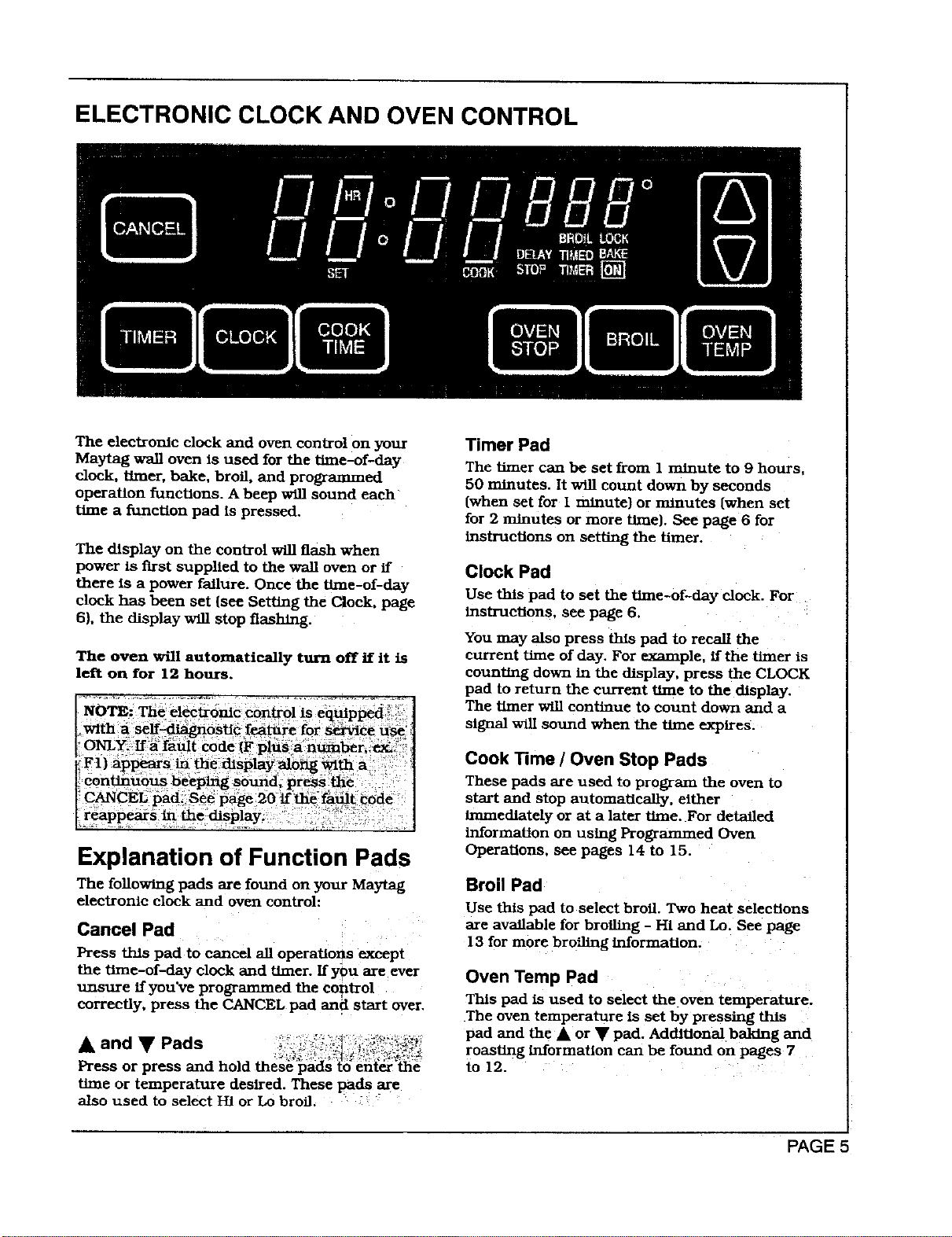
Explanation of Function Pads
The following pads are found on your Maytag
electronic clock and oven control:
Cancel Pad
Press this pad to cancel all operations except
the tlme-of-day clock and timer. If ypu are ever
unsure ff you've programmed the colntrol
correctly, press the CANCEL pad an_ start over.
and Pads .... _ _ "_ r
Press or press and hold these pads to enter the
time or temperature desired. These pads arc
also used to se1_ctHI or Lo broil.
Timer Pad
The timer can be set from 1 minute to 9 hours,
50 minutes. It will count down by seconds
(when set for I minute) or minutes (when set
for 2 minutes or more time). See page 6 for
instructions on setting the timer.
Clock Pad
Use this pad to set the tlme-of-day dock. For
instructions, see page 6.
You may also press this pad to recall the
current time of day. For example, if the timer is
counting down in the dlsplay, press the CLOCK
pad to return the current time to the display.
The timer will continue to count down and a
signal will sound when the time expires.
Cook Time / Oven Stop Pads
These pads are used to program the oven to
start and stop automatically, either
immediately or at a later time. For detailed
information on using Programmed Oven
Operations. see pages 14 to 15.
Broil Pad
Use this pad to select broil. Two heat selections
are available for broiling - Hi and Lo. See page
13 for more broiling information.
Oven Temp Pad
This pad is used to select the oven temperature.
The oven temperature is set by pressing this
pad and the • or • pad. Additional baklng and
roasting information can be found on pages 7
to 12.
PAGE 5
SETTING THE CLOCK AND TIMER
Clock
To set the time-of-day dock:
1. Press the CLOCK pad once. The words "Set
Time" wlll flash in the display.
2. Set the correct time of day using the • and
• pads.
• To change the time by one minute,
press either pad once.
• To change the time in increments of I0
minutes, press and hold either pad.
When the power is first supplied to the oven or
ff there has been a power failure, the display
will flash. Follow above instructions to set the
clock. The clock time cannot be changed when
the oven is set for a cook or timing operation.
Cancel the operation to set the clock.
Press the CLOCK pad to recall the time of day
when another function is displayed.
Timer
To set the timer.
1. Press the TIMER pad once. The words "Set
Timer" will flash in the display.
2. Set the desired time using the • and •
pads.
• Press either pad once to change the
tlme by I minute (if the Timer is set for
up to I hour), 5 minutes (ff the Timer is
set for over I hour), or 10 minutes (ff
the Timer is set for over 2 hours).
• Press mid hold either pad to change
the time in 5 minute or 10 minute in-
crements, depending upon the time set
in the display.
The TIMER can be set from I minute (0HR:01)
up to 9 hours and 50 minutes [9 HR:50).
The timing operation will start automatically.
Colons will flash in the display to indicate a
timing operation. One long continuous beep
will signal the end of the timing operation and
"End" will briefly appear in the display. The
time of day will automatically reappear in the
display. The TIMER pad does not control the
oven.
To cancel: Press and hold the TIMER pad for
3 seconds. The time of day will reappear after
a slight delay.
PAGE 6
USING YOUR OVEN
Oven Characteristics
Every oven has its own characteristics. You
may find that the cooking times and
temperatures you were accustomed to with
your previous oven may need to be altered
slightly with the new oven. Please expect some
differences with the new appliance. Compare
your recipes with the baking chart on page I0
or refer to a reliable cookbook for proper
recommendations. It is normal to notice some
differences between this appliance and your old
one.
Pilotless Ignition .......'o
Your Ma_ag wall oven is equipped with
pflotiess ignition. Heat from the Glow Bar
ignitor lights the oven burner. With this type of
Igrdtion system, the oven will not operate
during a power failure or if the wall oven is
disconnected from the wall outlet. No
attempt should be made to operate the oven
during a power failure.
Oven Vent
The oven vent is located between the control
panel and oven door. Do not block this opening.
It is important that the flow of hot air from the
oven and fresh air to the burner be
unrestricted. Do not touch the vent opening or
nearby surfaces during oven operation as they
may become hot.
Oven Light
The oven light is turned on by pushing the
rocker switch marked OVEN LIGHT on the
control panel
Setting The Oven Controls
To set your oven for baking or roasting:
I. When cool, position the racks in the oven
according to what you are baking.
2. Press the OVEN TEMP pad. "Bake" and 000 °
will appear in the display.
3.
Press either the • or • pad once and 350 =
will appear in the display. Press the • or •
pad anti] the desired oven temperature is
displayed.
The word ON will light in the display, the
oven and cooling fan will turn on. The
temperature display wln rise in 5°
increments while the oven is preheating. A
beep win sound to indicate that the oven has
preheated, Allow 10 to 15 minutes for
preheating.
4. Place the food in the center of the oven,
allowing a minimum of one to two inches
between the utensil(s) and the oven wails.
5. Check the food for doneness at the minimum
tlme glven in the recipe. Cook longer ff
necessary. Turn the oven offby pressing the
CANCEL pad. Remove the food from the
oven.
Preheating
Always preheat the oven if called for in the
recipe or on the package directions, Preheating
is necessary for proper baking results. It is not
necessary to preheat for roasting.
Aliow the oven to heat until the desired _ven
temperature is reached (approximately i0 to 15
minutes). A beep will sound when the oven is
preheated.
Selecting a temperature higher than the desired
temperature will not preheat the oven any
faster. Preheating at a higher temperature, may
have a negative effect on baking results.
PAGE 7
Oven Racks
The two oven racks are designed with a
lock-stop position to keep the racks from
accidently coming completely out of the oven
when there is food placed on them.
To remove: Be sure the rack is cool. Pull the
rack straight out until it stops. Tilt the front
end of the rack up and continue pulling the
rack out of the oven.
To replace: Tilt the front end of the rack up
and place the rack between the rack supports.
Slide it back until it clears the lock-stop
position. Lower the front and slide the rack
straight in. Pull the rack out to the lock-stop
position to be sure it Is positioned correctly and
then return it to its normal position,
Do not cover the oven bottom or an entire
oven rack with aluminum foil or place foil
directly under a utensil. To catch spiilovers.
cut a piece of foil a little larger than the pan
and place it on the rack below the utensil.
Rack Positions
It is important that air can Circulate freely
within the oven and around the food. To help
ensure this, place food in the center of the oven
rack. Allow one to two inches between the edge
of the utensil(s) and the oven wafts. If cooking
on two racks, stagger the food to ensure proper
airflow.
Do not attempt to change the rack positions
when the oven is hot. Use the following
guidelines when selecting the proper rack
position.
Never place pans directly on the oven bottom
Rack I _" Used for roasting large cuts of meat
{_o\vest and Large polfltry, frozea ples,
pos_t_vn] souffles, angel food cake. or for some
two-rack baking,
R_ck 2: _OSt one-rack baking and
for roasting small cuts of meat. large
casseroles, baking loaves of bread.
cakes (in either tube. bundt, or layer
pans} or for some two-rack baking.
Rack 3: Used for some two-rack baking.
Ralck 4: Used for some two-rack baking.
": {highe_s_,
•'_p0sltioft_
Place food inoven on center of rack. Allow I
or 2 inches between edge of utensil and oven
sides or adjacent utensils. If cooldng on two
racks, stagger foods on racks. Use rack
positions 2 and 4 or 1 and 3 when cooking on
two racks.
PAGE 8
General Baking Tips
• Use a reliable recipe and accurately measure
ingredients. Carefully follow directions
especially for oven temperature and cooking
time.
• Use the correct rack position. Baking
results may be affected if the wrong rack is
used.
* Top browning may be darker if food is
located toward the top of the oven.
Bottom browning may be darker ff food is
located toward the bottom of the oven.
* When using two racks for baking, allow
enough space between the racks for proper
air circulation. Browning and cooking
results will be affected if air flow is blocked,
• Utensil material and size play an important
part in baking results, especially the amount of
browning. Always use the type and size of
utensil called for in the recipe. Many pans have
the measurements marked on them. If there are
no measurements, measure the inside width
and length of the pan. Cooking times or
cooking results may be affected if the wrong
size utensil is used.
* Shiny metal pan reflects heat away from
the food, produces lighter browning and a
softer crust. Use shiny pans for baking
cakes or cookies.
* Dark metal pan or a pan with an
anodized (dull) bottom absorbs heat.
produces darker browning and a crisper
crust. Use this type of pan for pies, pie
crusts or bread.
If using oven-proof glassware, or dark
pans such as Ekco's Baker's Secret
bakeware reduce the oven temperature by
25°F except when baking pies or bread in
glassware. Use the same baking time as
calied for in the recipe. Use this type of pan
for pies or breads.
For optimum baking results, bake cookies
and biscuits on a fiat cookie sheet. If the
pan has sides, such as a Jeliy roll pan,
browning may not be even.
• Allow hot air to flow freely through the
oven for optimum baking results. Improper
placement of pans in the oven will block alr
flow and may result in uneven browning. For
optimum browning and even cooking results:
* Do not crowd a rack with pans. Never place
more than one cookie sheet, one
13xgx2-inch cake pan or two round cake
pans on one rack.
= Stagger pans when baking on two racks so
one pan is not directly over another pan.
* Allow one to two inches between the pan
and the oven wails,
• Check the cooking progress at the
minimum time recommended in the recipe. If
necessary, continue checking at intervals until
the food is done. If the oven door is opened too
frequently, heat will escape the oven; this can
affect baking results and wastes energy.
• If you add additional ingredients or alter the
recipe, expect cooking times to increase or
decrease slightly.
PAGE
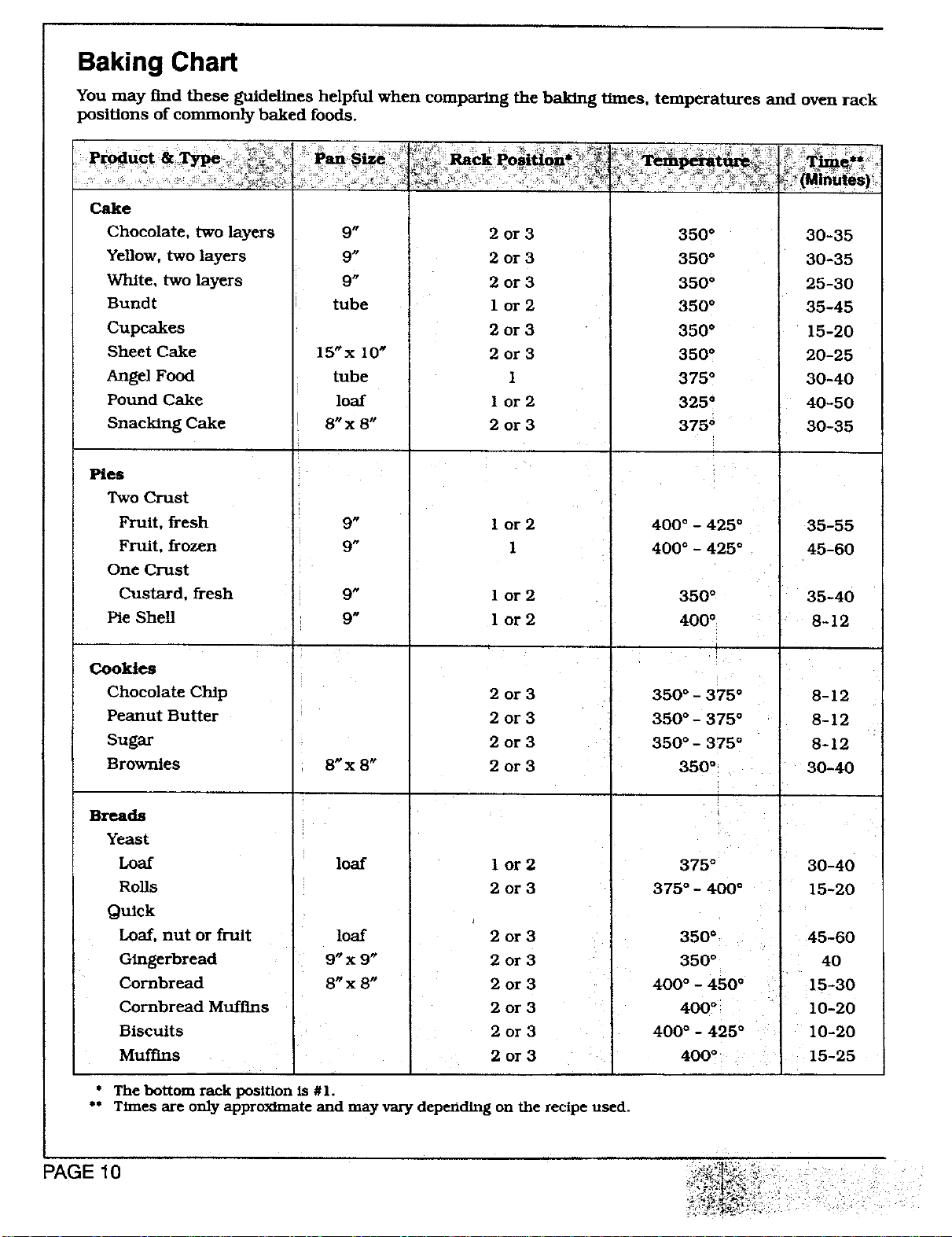
Baking Chart
You may find these guidelines helpful when comparing the baking times, temperatures and oven rack
poslflons of commonly baked foods.
Cake
Chocolate, two layers
Yellow, two layers
White, two layers
Bundt
Cupcakes
Sheet Cake
Angel Food
Pound Cake
Snacking Cake
Pie_
Two Crust
Fruit, fresh
Fruit, frozen
One Crust
Custard, fresh
Pie Shell
Cookies
Chocolate Chip
Peanut Butter
Sugar
Brownies
Breads
Yeast
Loaf
Rolls
Quick
Loaf, nut or fruit
Gingerbread
Combread
Cornbread Muffins
Biscuits
Muffins
9 u
9"
9"
tube
15"x 10"
tube
loaf
8" x 8"
u
9"
9 es
9"
8" X 8"
loaf
2 or 3
2 or3
2 or3
1 or 2
2or3
2or3
I
I or2
2 or 3
1 or2
1
1 or2
1 or2
2 or3
2 or3
2 or3
2 or3
1 or2
2or3
350 °
350 °
350 °
3500
350 °
350 °
375 °
325 °
375 °
400 ° - 425 °
400 ° - 425 °
350 °
4000
350 ° - 375 °
350 ° - 375 °
350 ° - 375 °
350 °
375 °
375 ° - 400 °
350 °
350 °
400 ° - 450 o
400°i
400 ° - 425 °
30-35
30-35
25-30
35-45
15-20
20-25
30-40
40-50
30-35
35-55
45-60
35-40
8-12
8-12
8-12
8-12
30-40
loaf
9" x 9"
8" x 8"
2 or3
2or 3
2or3
2 or 3
2or3
2 or3
400 °
30-40
15-20
45-60
40
15-30
10-20
10-20
15-25
* The bottom rack position is # I.
** Times are only approximate and may vary depending on the recipe used.
PAGE 10
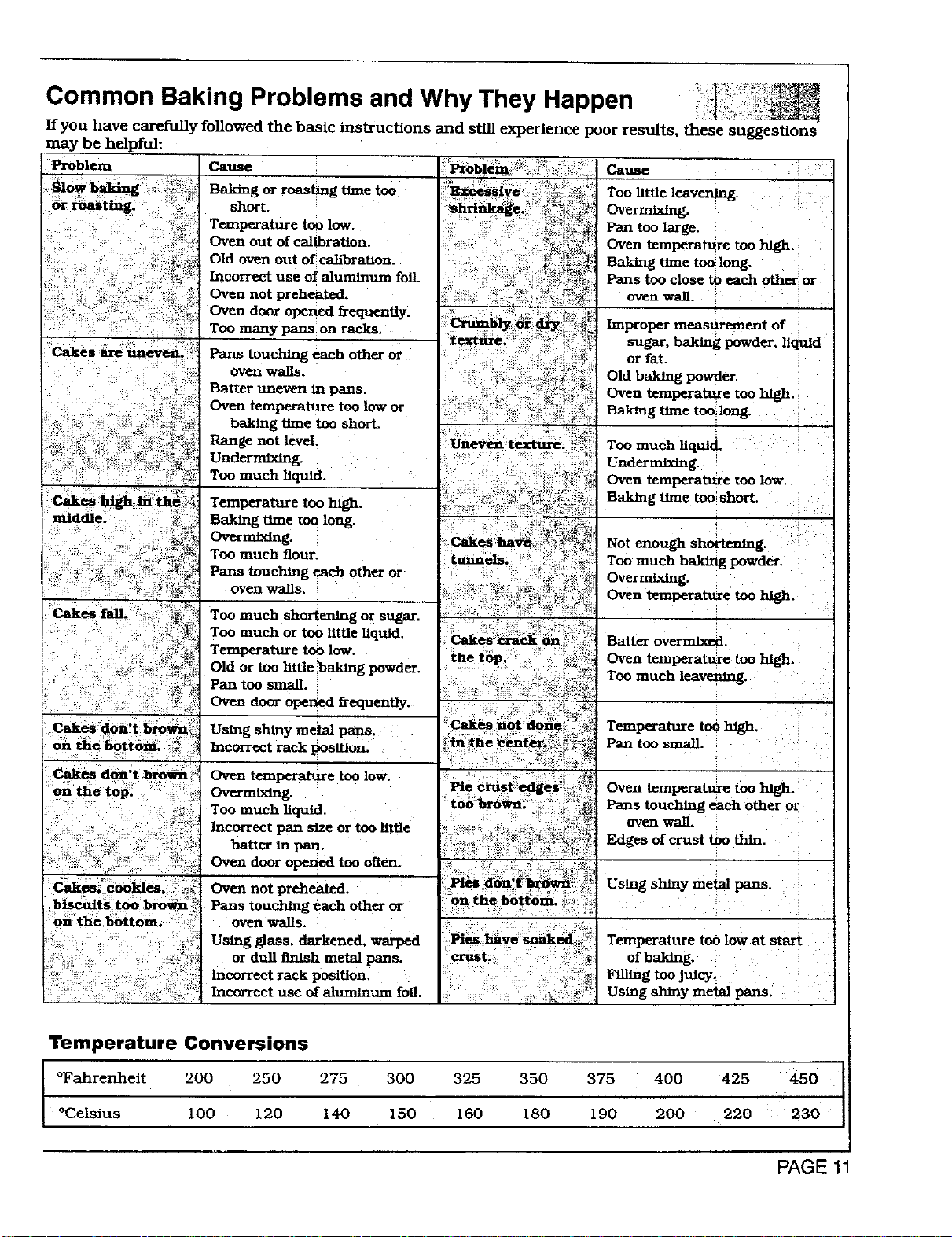
Common Baking Problems and Why They Happen
If you have carefully followed the basic instructions and still experience poor results, these suggestions
may be helpful:
_blem Cause
Baking or roasting time too
short.
Temperature too low.
Oven out of calibration.
Old oven out of calibratton.
Incorrect use of aluminum foil.
Oven not preheated.
Oven door opened frequently
Too many parson racks.
Pans touching each otheror
oven walls.
Batteruneven in pans.
oven temperature too low or
baking time too short.
Range not levd.
Undermlxing.
Too much llquid.
Temperature too high.
Baking time too long.
Overmixlng.
Too much flour.
Panstouchingeachotheror
oven wails.
Too much shorteningor sugar.
Too much or too little liquid.
Temperature too low.
Old or too little baking powder.
Pan too small.
oven door opened frequently.
Using shiny metal pans.
Incorrect rack positron.
Oven temperature too low.
overmixlng.
Too much liquid.
Incorrect pan size or too little
battor in pan.
Oven door opened too often.
Oven not preheated.
Pans touching each other or
oven wails.
Using glass, darkened, warped
or dull finish metal pans.
Incorrect rack position.
Incorrect use of aluminum foil.
Too lltfle leavening.
Overmlxing.
Pan too large.
Oven temperature too IngIL
Baking time too long.
Pans too close to each other or
oven wall.
_:_
:_: Improper measurement of
: _ sugar, baking powder, liquid
"_, or fat.
Old pewter
Oven temperature too high.
_i_ Baking time too long.
TOOmuch liquid.
Undermlxing.
Oven temperature too low.
Baking tlme too short.
rtenlng ' 'Not enough sho
Too much baking powder.
Over mixing.
Oven temperature too high.
Batter overmixed.
Oven temperature too high.
TOO much leavening.
Temperature too high.
Pan too small.
Oven temperature too high.
Pans touching each other or
oven wail
Edges of crust too thin.
Using shiny metal pans.
Temperature too low at start
of baking.
Filling too Juicy.
Using shiny metal palls.
Temperature Conversions
°Fahrenheit 200 250 275 300 325 350 375 400 425 450
°Celsius 100 120 140 150 160 180 190 200 220 230
PAGE 11
Roasting
Roasting is the method for cooking large,
tender Cuts of meat uncovered, without adding
moisture,
General Tips
Most meats are roasted at 325°F. It is not
necessary to preheat the oven. Place the
ro_ting pare on a rack which has been placed
in either of the two lowest rack positions.
Use tender cuts of meat weighing three
pounds or more. Some good choices arc: beef
rlb. rib eye_ top round, high quality tip trod
rump roast, pork loin roast, veal _d lamb leg,
shoulder roast and cured or smoked hams.
Season meat. ff desired, either before or after
roasting, Rub hlto the sttrface of the roast if
added before cooking.
Place the meat fat-side-up on a rack in a
shallow roastin_ pml. Placing the meat on a
rack holds it out of the drippings, thus
allowing better heat eirculatlon for even
cooking, A_ tile fat on top of the roast melts.
the meat is hasted naturally, elhninatlng file
need for additional basting.
The cooking time is determined by the weight
of the meat and the desired doneness. For
more accurate resuks, use a meat
thermometer. Insert it so tile tip is in the
center of the thickest part of ihe meat. It
should not touch fat or bone.
Remove the roast from Ihe oven when the
thermometer registers approximately 5_F
below the doneness wanted. As the meat
stmlds, the iemperature _lll rtseo
NOTE: For marc iifformation on choking ]
meal and poulfry, contact the USDA
l
Meat and Poultry Hotline at
1-800-535-4555,
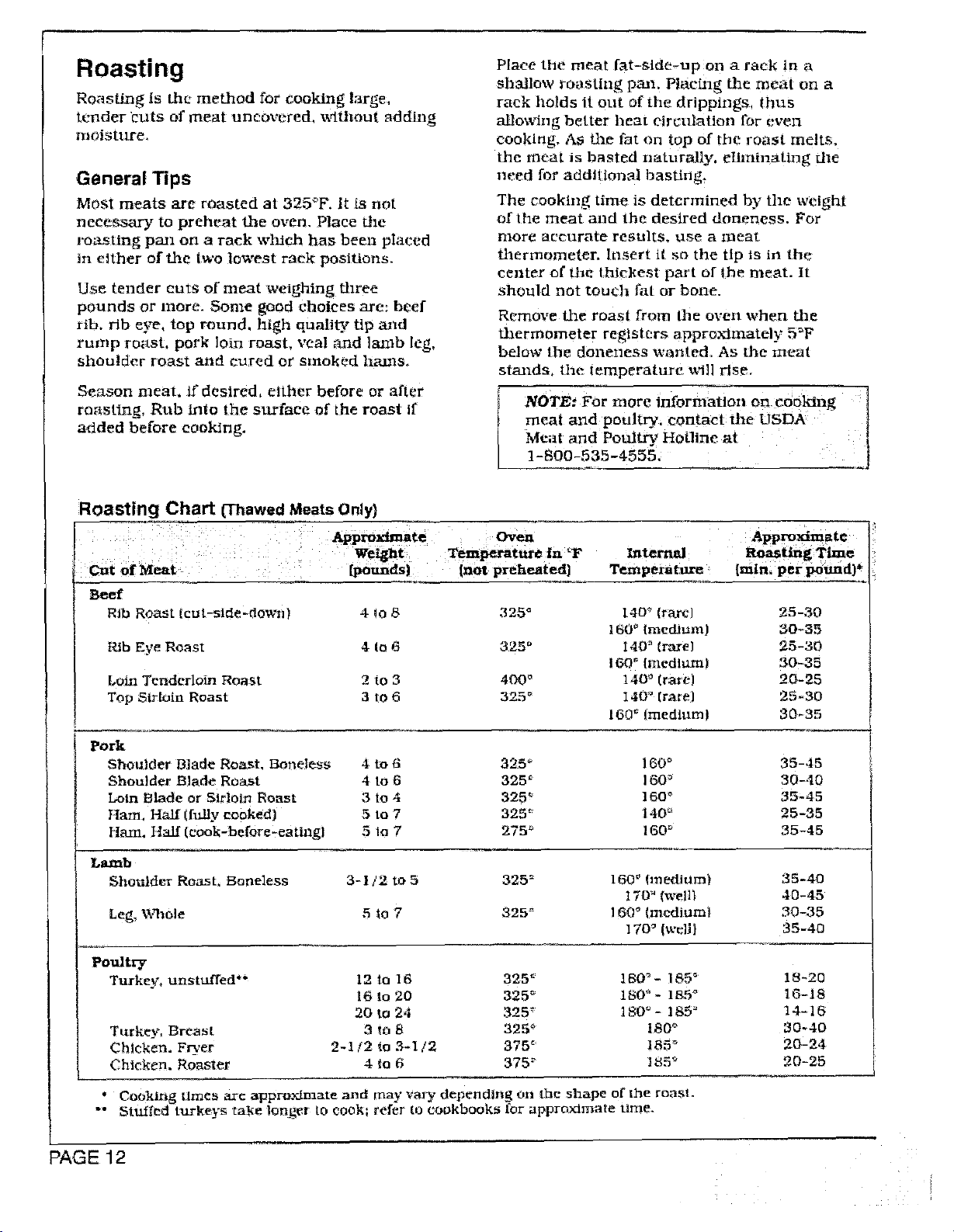
Roasting Chart (Thawed Meats Only)
App xt=ate ave= App o=Ua tc
We_t _mperature In "1_ lfl_ Ro_ Thne
_ds| {not preheated} Temperattu_ (_=; per _d)'
Beef
RILlRoast Icut-slde-doven} 4 _o 8 325 a 140 _ (rarel 25-30
160° imedtum) 30-35
Rib Eye Roast 4 In 6 3250 140_ _rare] 25-30
! G0 _ Iinedlllm) 30-35
Loin Tenderloin Roast 2 to 3 400 _ 140 _ (tart-} 20-25
Top Sirloin Roast 3 In 6 325 _ 140 _ Irate] 25-30
160_ fmedluml 30-35
Pork
Shoulder Blade Roast, Boneless 4 to 6
Shoulder Blade Roast 4 to 6
Lore Blade or Slrlolf] Roast 3 to 4
Harm Half(fuLly cooked} 5 to 7
Ham. Half (cook-before-eatingl 5 to 7
Lamb
Shoulder Roast, Boneless 3-1/2 to5
325 _ 160 ° 35-45
325 _ 160 _ 30-40
325 _ 160 ° 35-45
325 _ 140 _ 26-35
275 _ 160 _ 35-45
325 = 160 * _medJum} 35-40
170 '_(well} 40-45
325 = 160 _ (medinml 30-35
170 ° (well} 35-40
Leg, x,Vhole 5 tO 7
Poultry
Tnrkey, unstuffed *° 12 tO 16 325 _ 180 °- 185 _ 18-20
16 In 20 325 _ 180 _ * 185 _ 16-18
20 tO 24 325 _ 180 _- 185 _ 14-16
Turk_*, Breast 3 In 8 325 _ 180 _ 30-40
Chicken. Fryer 2-i/2 In 3-I/2 375 _ 185 _ 20-24
Chicken. Roaster 4 io6 375 _" 185 _ 20-25
" Cooking times &re approximate mad may val2¢ depend|rig on lhe shape of the roasl.
*" Stuffed turkeys take longer 1o cook; refer to cookbooks for approximate time.
PAGE 12
Breillng , !:
Broiling is a method of cooking used for tender
steaks, chops, hamburgers, chicken, fish, and
some fruits and vegetables. The food is placed
directly under the burner. The degree of
aloneness is determined by the distance
between the meat and the burner, and the
length of broiling time,
General Tips
Broiling requires the use of the broiler pan and
insert supplied with your range. It is designed
to drain excess liquid and fat away from the
cooking surface to prevent spatters, smoke and
fee.
For easier dean-up, line the broiler pan
(bottom piece) with aluminum foil and spray
the insert with a non-stick vegetable coating.
Do not cover the broiler insert with aluminum
foil as this prevents fat from draining into the
pan below.
To prevent excessive spattering and smoking,
trlm excess fat from the meat. Increasing the
distance between the meat and the oven burner
will also help.
The rack position you select for broiling
depends on the thickness of the meat and the
desired doneness. Thin cuts (3/4 to 1 inch}
should be placed 2-3 inches from the heat;
thicker cuts should be placed 3-6 inches from
the heat. Broil until the top of the meat is
Untilyou become more familiar with
browned. It should be approximately half
cooked by the time the top is browned.
Generafiy for a brown exterior and rare interior,
the meat should be close to the bummer. Place
the pan fizrther down ff you want the meat well
done.
If you plan to season the meat. it is better to do
so after the surface has browned. Salt tends to
delay browning which can result in
overcooking. Salting before cooking also draws
the juices out of the meat. causing dryness.
Never leave a soiled broiler pan in the oven after
broiling. Drippings might become hot enough to
ignite if exposed directly tc the oven burner.
Setting the Controls
1. Press the BROIL pad and press the _ or •
pad to select either Hi or Lo temperature as
indicated in the display, Hi is used for most
broiling operations. Lo should be selected
when broiling thicker meats to the well--done
stage (to prevent excessive browning) and
when cooking foods for very short periods of
time. Brofllng times may increase ff Lo is
selected.
2. Place the broiler pan on the recommended
rack position shown in the broiling chart and
follow the suggested times,
3. Check the doneness by cutting a slit in the
meat near the center to check the color.
4. To cancel or end the brofllng operation, press
the CANCEL pad.
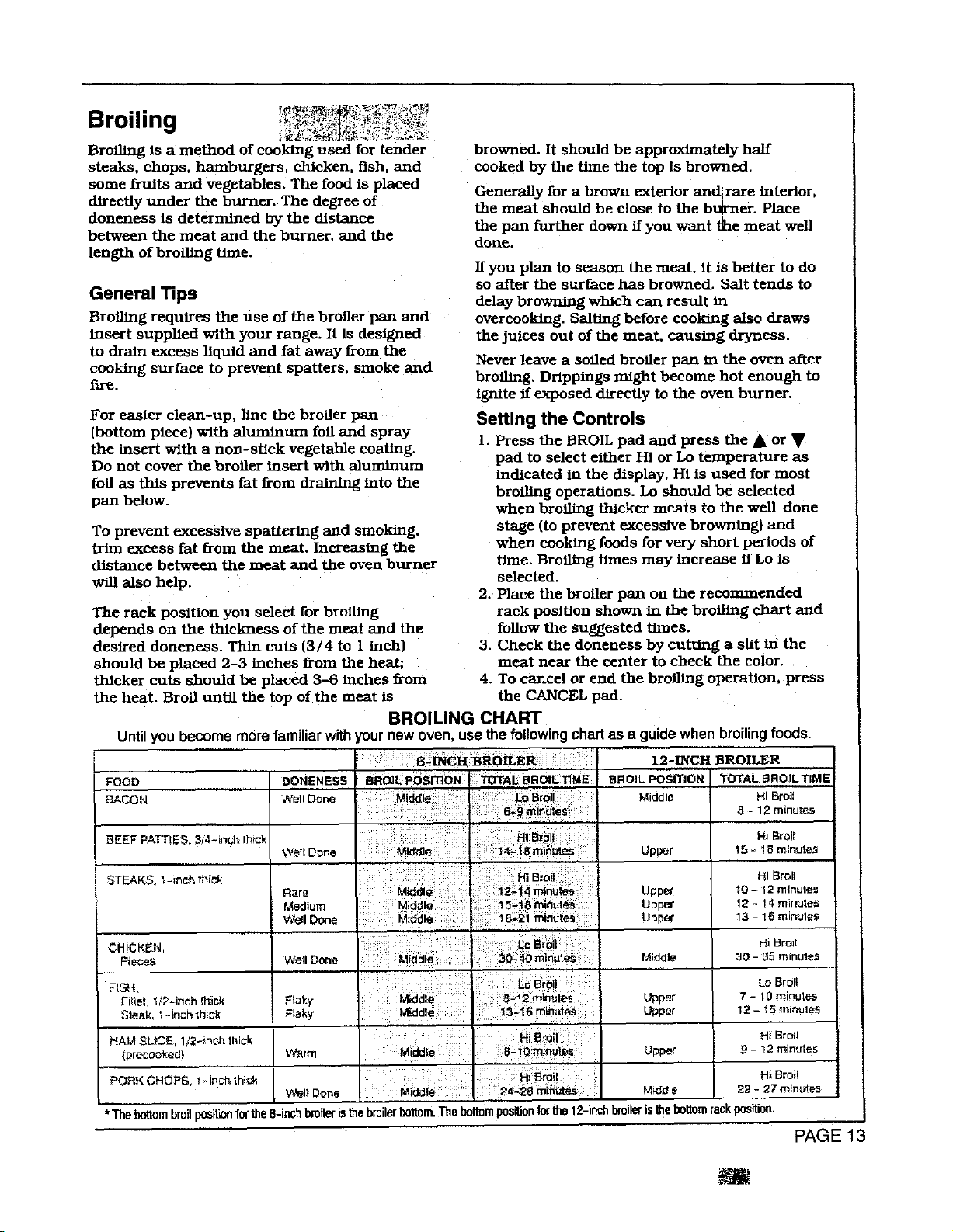
BROILING CHART
ournew oven, usethe followingchartas a guidewhen broilingfoods.
12-INCH BROILER
FOOD
B.ACON
BEEF p_TT!ES, 3_4-inch {hick
OONENESS
Wel! Done
Wet_Done
SRo]t:PO_ON
Ii_TALBROILTtMB
BROIL POSITION
Middl0
Upper
STEAKS_ _-inch thick
Rare Upper
Medium Upper
Well Done Upper
CHiCKeN,
Pieces Wetl Done
TOTAL BROIL TIME
P_iBroil
8 - 12 minule_
FISH
Fillei, _/2-inch thick Flaky
Steak, 1-inch _hc_ Flaky
NAMSL_C_, 1/2-_n_thlck
{precooked}
FORKCHOPS_I,iech thick
Ni Broil
t5 - 1B rninules
Hi Broil
10- 12 minutes
1_ - 14 rn_nule_
13 - 15 minules
Hi BroilMiddl_ 30 - 35 r_inules
Upper
Upper
Warm Upper
WeB Done M]_e 24_6 mi_i_es : M_le
LO Broil
7 - I 0 minutes
12 - i 5 minui_s
Hi Brc.l
9 - "_2minutes
Hi Bro;I
22 - _7 minudes
* Thebottombroilposit;onfortheB-inchbroileristhebroilerbottom.Theboltomposi_onlo__e 12-inchbroi_ isthebottomrackposition.
PAGE 13
I
Programmed Oven Operations
The Programmed Oven Operation feature can
be used to turn off the oven at a specific time or
delay the start and then turn off the oven.
This feature will not operate unless the clock is
functioning and is set to the correct time of day.
IMPORTANT: Highly perishable foods suet,
as dairy products, pork; poultry, seafood, or
stuffing are not recommended for delayed
cooking. If cooking more than one food,
select foods that cook for the same ler2glh of
tkne and at the same oven temperature,
Additional Information
If you delay more than 30 seconds between
touching a pad and pressing the & or • pad
the display will either return to the previous
setting or the time of day will reappear and the
program will cancel.
To recall the preset stop time or cook time, Just
press the corresponding pad.
To reset or cancel the program, press the
CANCEL pad.
To Bake By Time i
{with immediate start): !
1. Place the food in the oven:
2.
3.
.
,
6.
7.
Press the COOK TIME pad. The words "Set
Cook Time" will flash in the display.
Enter the cooking time (how long you wish
the food to cook) by pressing the & or •
pad. The time will appear in hours and
minutes. The maximum time that can be set
is 11 hours and 55 minutes.
Press the OVEN TEMP pad. The word "Bake"
and 000 ° will light in the display. If this step
is not done within 7 seconds after entering
the cook time, the control will beep until
another pad is pressed.
Enter the oven temperature with the • or •
pad.
The oven will automatically turn on and the
words "Timed Bake On" will light in the
display. Press the COOK TIME pad to recall
the remaining cooking time.
At the end of the preset cooking time, the
oven will automatically turn off, and
continuous beeps will sound. Remove the
food from the oven and press the CANCEL
pad to stop the beeps. The current time of
day will reappear in the display.
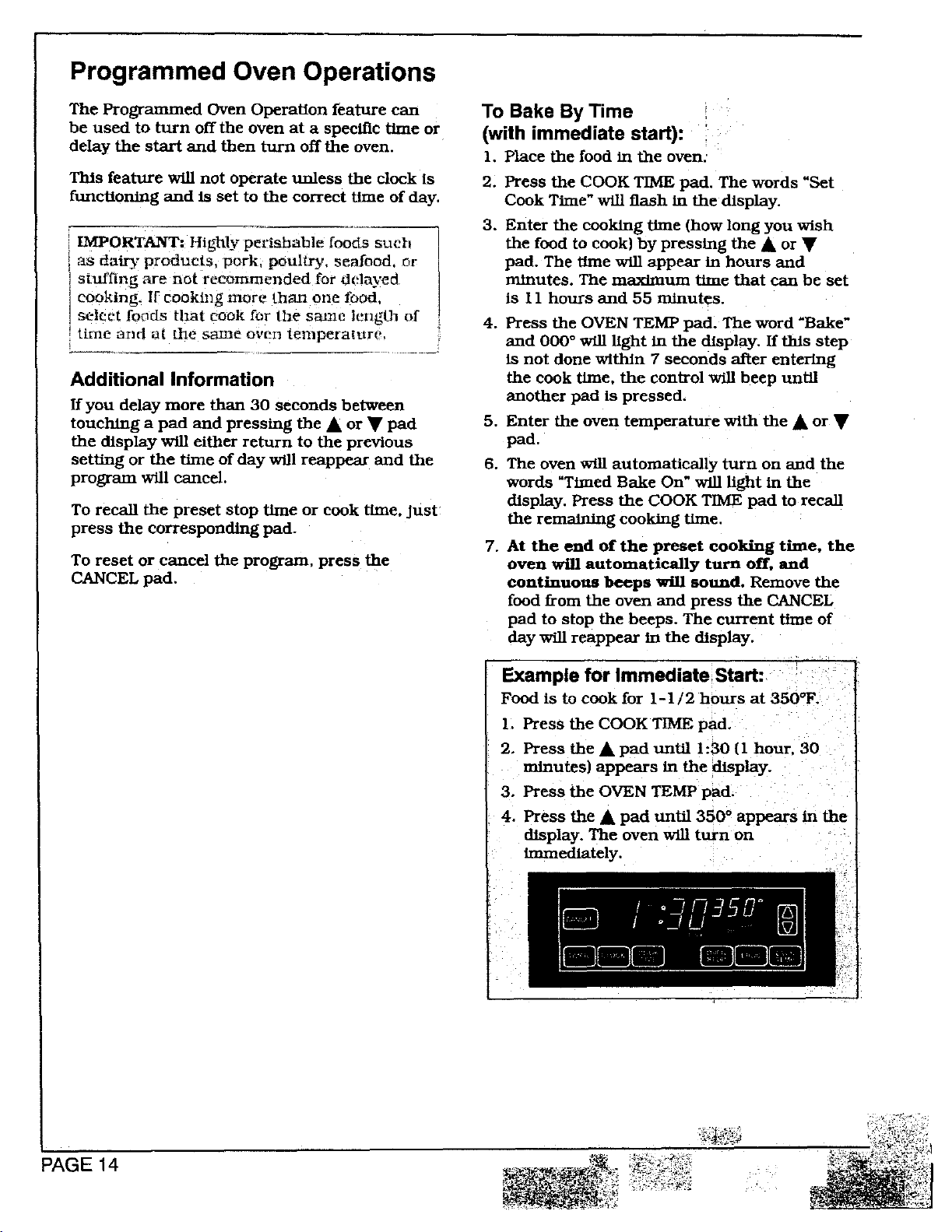
Example for Immediate Start:
Food is to cook for 1-I/2 hours at 350°F.
I. Press the COOK TIME pad.
2. Press the • pad until 1:30 [I hour. 30
minutes) appears in the display.
3. Press the OVEN TEMP pad.
4. Press the • pad until 350 ° appears in the
display. The oven will turn on
immediately.
PAGE 14
To Bake By Time
(with delayed start):
1. Place the food in the oven.
2. Press the COOK TIME pad. The words "Set
Cook Time" will flash in the display.
3. Enter the cooking time (how long you wish
the food to cook) by pressing the • or •
pad. The time will appear in hours and
minutes. The maximum time that can be set
is 11 hours and 55 minutes.
4. Press the OVEN STOP pad. The words "Set
Stop Time" will flash in the display.
5. Enter the time you wish the oven to turn off
by pressing the • or • pad. The words
"Delay Stop Time" will light in the display.
6. Press the OVEN TEMP pad. The word "Bake"
and 000 ° will light in the display.
7. Enter the oven temperature by pressing the
• or • pad. Press the CLOCK pad and the
time of day will reappear in the display.
"Delay Bake" win light in the display to show
that the oven has been set for a delay start
coolOng operation,
8. When the oven automatically turns on,
"Timed Bake _wlll appear in the display. "
9. At the end of the preset cooking time, the
oven will automatically turn off, and
continuous beeps will sound. Remove the
food from the oven and press the CANCEL
pad to stop the beeps. The current time of
day wiU reappear in the display.
[
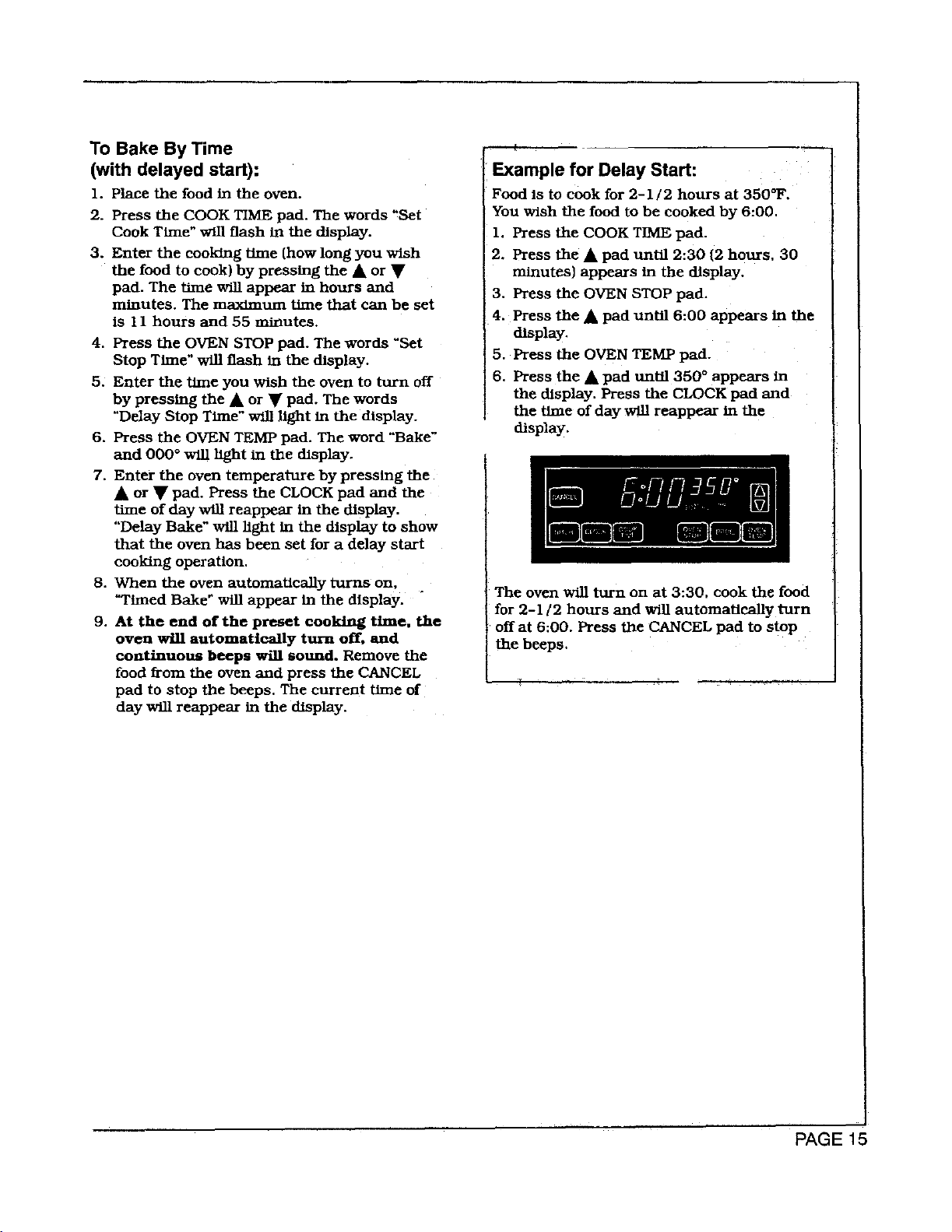
Example for Delay Start:
Food is to cook for 2-1/2 hours at 350°F.
You wish the food to be cooked by 6:00,
I Press the COOK TIME pad.
2. Press the • pad until 2:30 12 hours, 30
minutes) appears in the display.
3. Press the OVEN STOP pad.
4. Press the • pad until 6:00 appears in the
display.
5. Press the OVEN TEMP pad.
6. Press the • pad until 350 ° appears in
the display. Press the CLOCK pad and
the time of day win reappear in the
display,
The oven will turn on at 3:30, cook the food
for 2-1/2 hours and will automatically turn
offal 6:00. Press the CANCEL pad to stop
the beeps,
PAGE 15
MAINTENANCE
Oven or Broiler Door
Do not place excessive weight on an open oven
door or stand on an open oven door as, in some
cases, it could damage the door, cause the
appliance to tip over and possibly cause injury.
When opening the oven door, allow steam and
hot air to escape before reaching into the oven
to check, add or remove food.
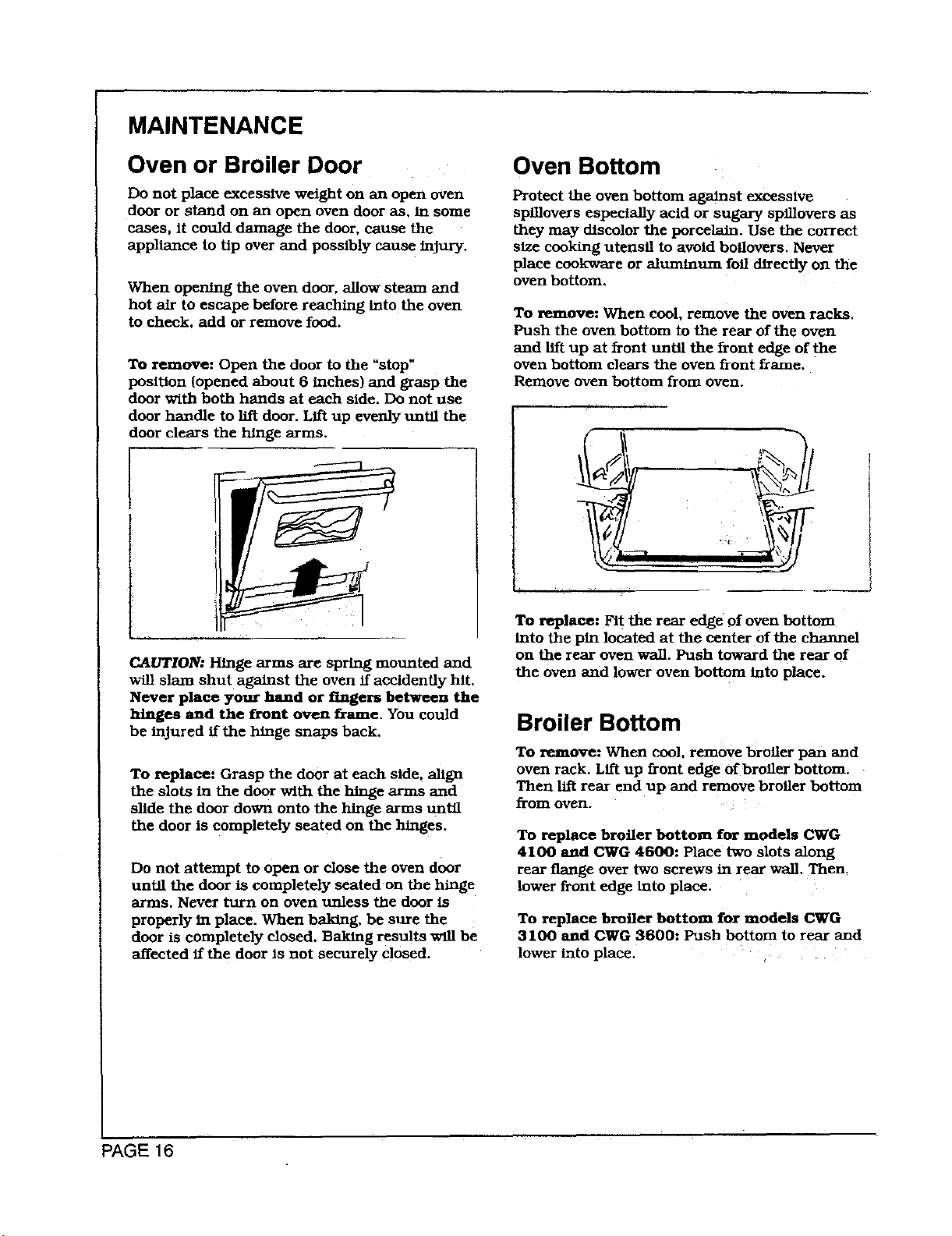
To remove: Open the door to the "stop"
position (opened about 6 inches) and grasp the
door with both hands at each side. Do not use
door handie to lift door. Lift up evenly until the
door clears the hinge arms,
CAUTION: Hinge arms are spring mounted and
wiU slam shut against the oven if accidently hit.
Never place your hand or fingers between the
hinges and the front oven frame. You could
be injured ff the hinge snaps back,
To replace: Grasp the door at each side, align
the slots in the door with the hinge arms and
slide the door down onto the hinge arms until
the door is completely seated on the hinges.
Do not attempt to open or dose the oven door
until the door is completely seated on the hinge
arms. Never turn on oven unless the door is
properly in place. When baking, be sure the
door is completely closed, Baking results will be
affected ff the door is not securely closed.
Oven Bottom
Protect the oven bottom against excessive
spillovers especiany acid or sugary spillovers as
they may discolor the porcelain. Use the correct
size cooking utensil to avoid boflovers; Never
place cook-ware or aluminum foil directly on the
oven bottom.
To remove: When cool, remove the oven racks.
Push the oven bottom to the rear of the oven
and lift up at front until the front edge of the
oven bottom clears the oven front frame.
Remove oven bottom from oven.
_J
To replace: Fit the rear edge of oven bottom
into the pin located at the center of the channel
on the rear oven wail. Push toward the rear of
the oven and lower oven bottom into place.
Broiler Bottom
To remove: When coo], remove broiler pan and
oven rack. Lift up front edge of broiler bottom.
Then llft rear end up and remove broiler bottom
from oven.
To replace broiler bottom for models CWG
4100 and CWG 4600: Place two slots along
rear flange over two screws in rear wall. Then,
lower front edge into place.
To replace broiler bottom for models CWG
3100 and CWG 3600: Push bottom to real and
lower into place.
PAGE 16
Oven Light
Oven light bulb is located on the back oven
wall. Before replacing light bulb, disconnect
power to oven. Be sure bulb is cool. Do not
touch a hot bulb with a damp cloth as the bulb
may break, Use a dry pot holder to prevent
possible harm to hands. If bulb should break.
use a pot holder to protect hands and very
carefully remove bulb. If bulb breaks at base,
have a service technician remove bulb.
Replace with a 40 watt appliance bulb. Restore
power to oven. Reset dock,
Electrical Connection
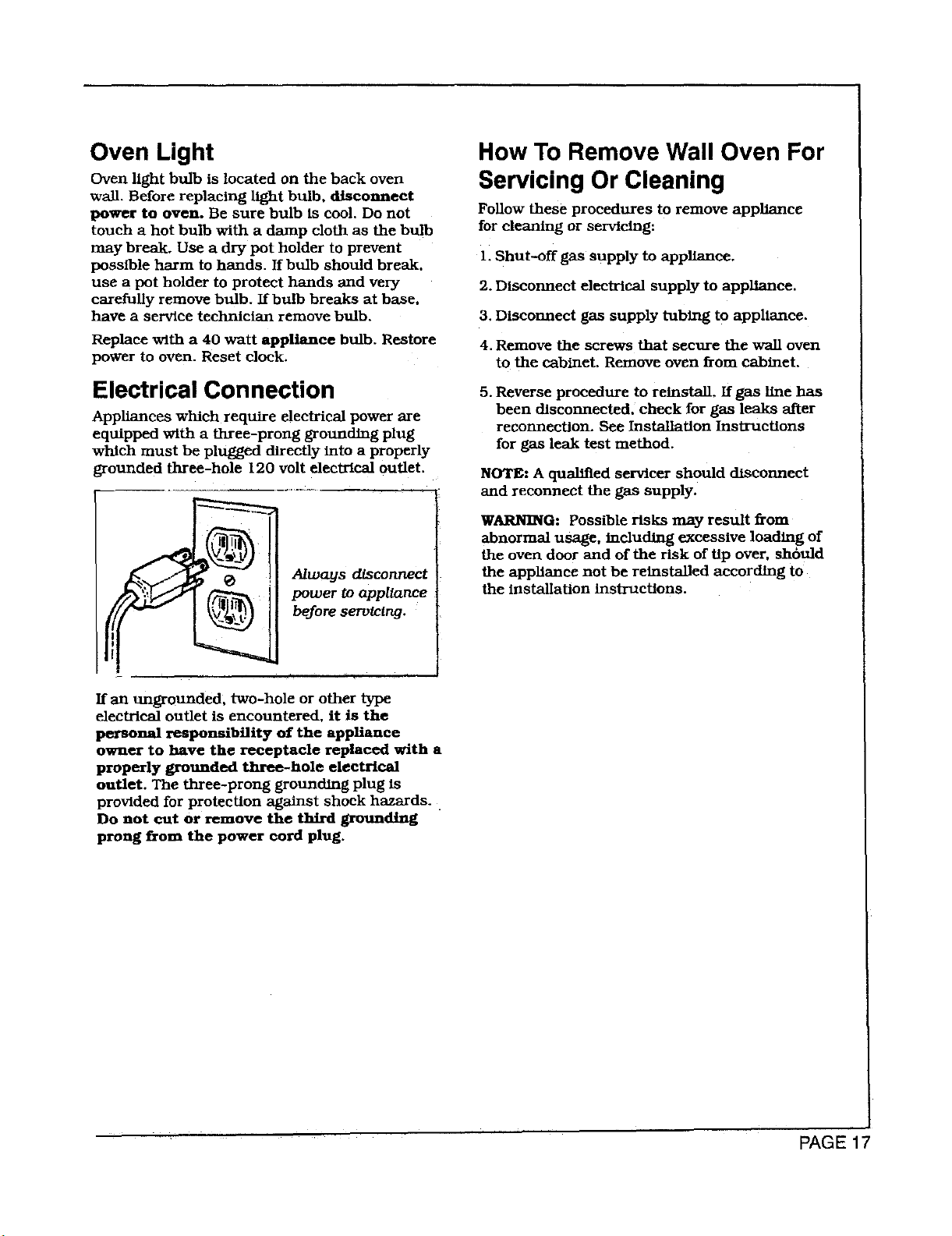
Appliances which require electrical power are
equipped with a three-prong grounding plug
which must be plugged directly into a properly
grounded three-hole 120 volt electrical outlet,
Always disconnect
power to appliance
before servlcing,
If an ungrounded; two-hole or other type
electrical outlet is encountered, it is the
personal responsibility of the appliance
owner to have the receptacle replaced with a
properly grounded three-hole electrical
outlet. The three-prong grounding plug is
provided for protection against shock hazards.
Do not cut or remove the third grounding
prong from the power cord plug.
How To Remove Wall Oven For
Servicing Or Cleaning
Follow these procedures to remove appliance
for cleaning or servicing:
1. Shut-off gas supply to appliance.
2. Disconnect electrical supply to appliance.
3. Disconnect gas supply tubing to appliance.
4. Remove the screws that secure the wall oven
to the cabinet. Remove oven from cabinet.
5. Reverse procedure to reinstall, If gas line has
been disconnected, check for gas leaks after
reconnectlon. See Installation Instructions
for gas leak test method.
NOTE: A qualified servicer should disconnect
and reconnect the gas supply.
WARNING: Possible risks may resuR from
abnormal usage, including excessive loading of
the oven door and of the risk of tip over, should
the appliance not be reinstalled according to
the installation Instructions.
' PAGE 7
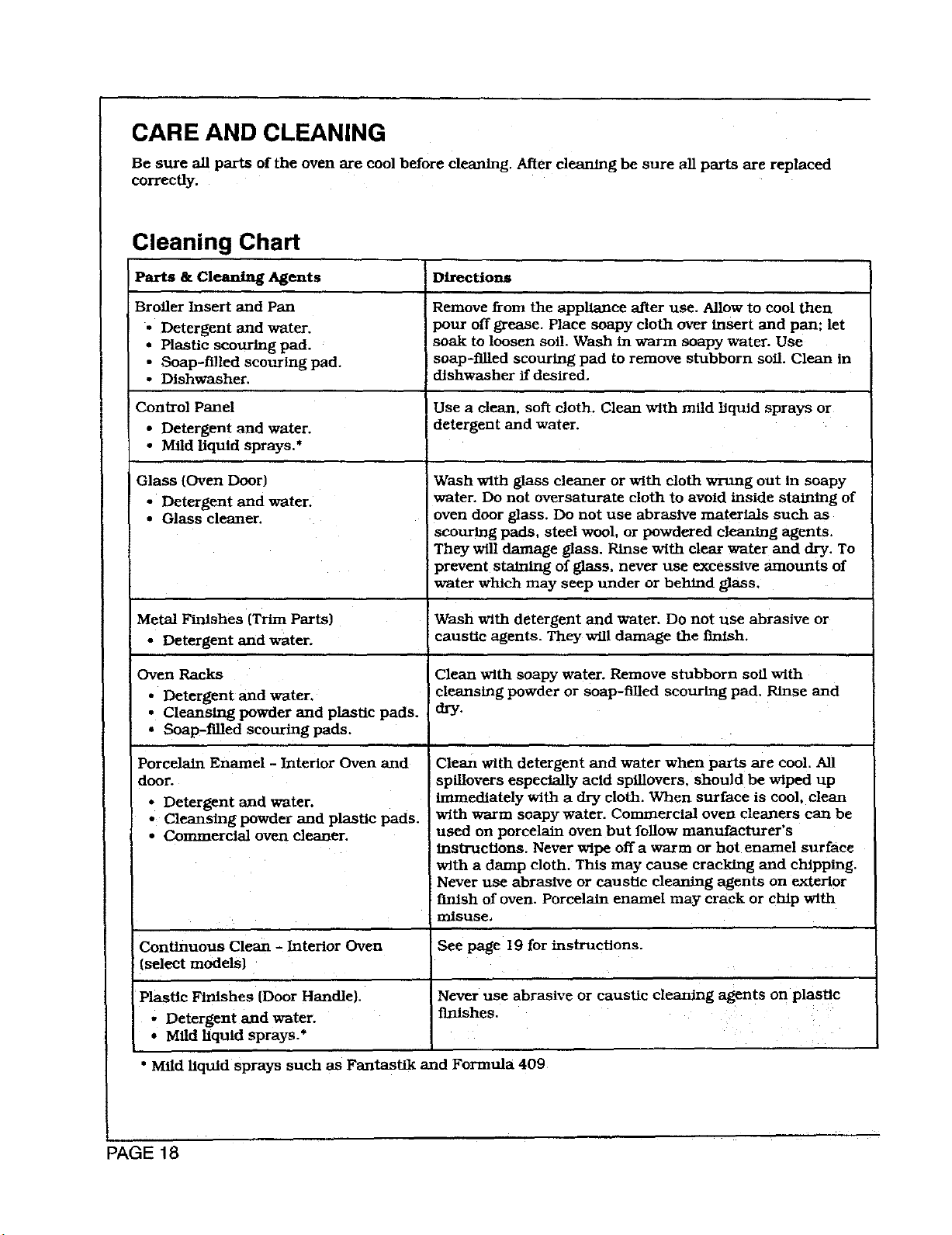
CARE AND CLEANING
Be sure all parts of the oven are cool before cleaning, After cleaning be sure all parts are replaced
correctly,
Cleaning Chart
Parts & Cleaning Agents
Broiler Insert and Pan
• Detergent and water.
• Plastic scouring pad.
• Soap-filled scouring pad.
• Dishwasher.
Control Panel
• Detergent and water.
• Mild liquid sprays.*
Glass (Oven Door)
• Detergent and water.
• Glass cleaner.
Metal Finishes (Trim Parts)
• Detergent and water.
Oven Racks
• Detergent and water.
• Cleansing powder and plastic pads.
• Soap-filled scouring pads.
Porcelain Enamel - Interior Oven and
door.
• Detergent and water.
• Cleansing powder and plastic pads.
• Commercial oven cleaner.
Continuous Clean - Interior Oven
(select models)
Plastic Finishes (Door Handle).
• Detergent and water.
• Mild liquid sprays.*
D/rections
Remove from the appliance after use. Allow to cool then
pour off grease. Place soapy cloth over insert and pan; let
soak to loosen soil. Wash in warm soapy water. Use
soap-flUed scouring pad to remove stubborn soil. Clean in
dishwasher ff desired.
Use a clean, soft cloth. Clean with mild liquid sprays or
detergent and water.
Wash with glass cleaner or with cloth wrung out in soapy
water. Do not oversaturate cloth to avoid inside staining of
>yen door glass. Do not use abrasive materials such as
scouring pads, steel wool, or powdered cleaning agents.
They wlll damage glass. Rinse with clear water and dry. To
prevent staining of glass, never use excessive amounts of
water which may seep under or behind glass.
Wash with detergent and water. Do not use abrasive or
caustic agents. They will damage the finish.
Clean with soapy water. Remove stubborn soft with
cleansing powder or soap-filled scouring pad. Rinse and
dry.
Clean with detergent and water when parts are cool. All
spillovers especially acid spfllovers, should be wiped up
immediately with a dry cloth. When surface is cool, clean
with warm soapy water. Commercial oven cleaners can be
used on porcelain oven but follow manufacturer's
instructions. Never wipe off a warm or hot enamel surface
with a damp cloth. This may cause cracking and chipping.
Never use abrasive or caustic cleaning agents on exterior
finish of oven. Porcelain enamel may crack or chip with
misuse,
See page 19 for instructions.
Never use abrasive or caustic cleaning agents on plastic
finishes.
Mild liquid sprays such as Fantastik and Formula 409
PAGE 18
Continuous Cleaning Oven (select models)
Note: The oven door liner and oven bottom are
porcelain enamel. For cleaning Inst_ctlons,
refer to the cleaning chart on page 18.
What Is The Continuous Cleaning Oven?
The finish of the Continuous Cle_dng Oven
contains a special catalyst and is identified by
its dark gray color, white supple and rough.
porous texture. The rough texture prevents
grease spatters from forming beads which run
down the walls leavlng unsightly streaks.
Rather, the rough texture absorbs spatters
and allowsthem tospread, thus exposing a
larger area to the hot oven air. The catalyst,
when exposed to heat, speeds the oxidation of
soft.
Cleaning action automatically begins
whenever the oven is turned on for baking or
roasting. The oven MUST be on for cleaning to
take place - no cleaning will occur when the
oven is off. The special catalytic finish must be
exposed to hot oven alr before soft will begin to
gradually reduce in size.
Factors Affecting Length Of Cleaning Time
The higher the oven temperature, the faster
the cleaning action. The length of cleaning
time will depend on these factors: Type of soft,
amount or size of sotk oven temperature and
length of time oven is in use. Time may vary
from a few minutes to several hours. Soft
deposited at the end of a cycle may sUIl be
visible. This will usually fade with continued
oven use until the soft gradually disappears or
can be wiped up manually. The oven will
appear presentably dean. even though some
spatters may be present.
Manually Cleaning Heavy Spillovers
The special finish will clean most spatters
during normal oven use unless there is a
heavy buildup of soil. Heavy spillovers such as
pie or casserole boilovers will not clean
effectively without some manual help. The
crusty or varnish-like stains that form from
these splllovers clog the pores and prevent the
special finish from being exposed to the hot
oven air. This greatly reduces the eleanlng
effectiveness of the finish.
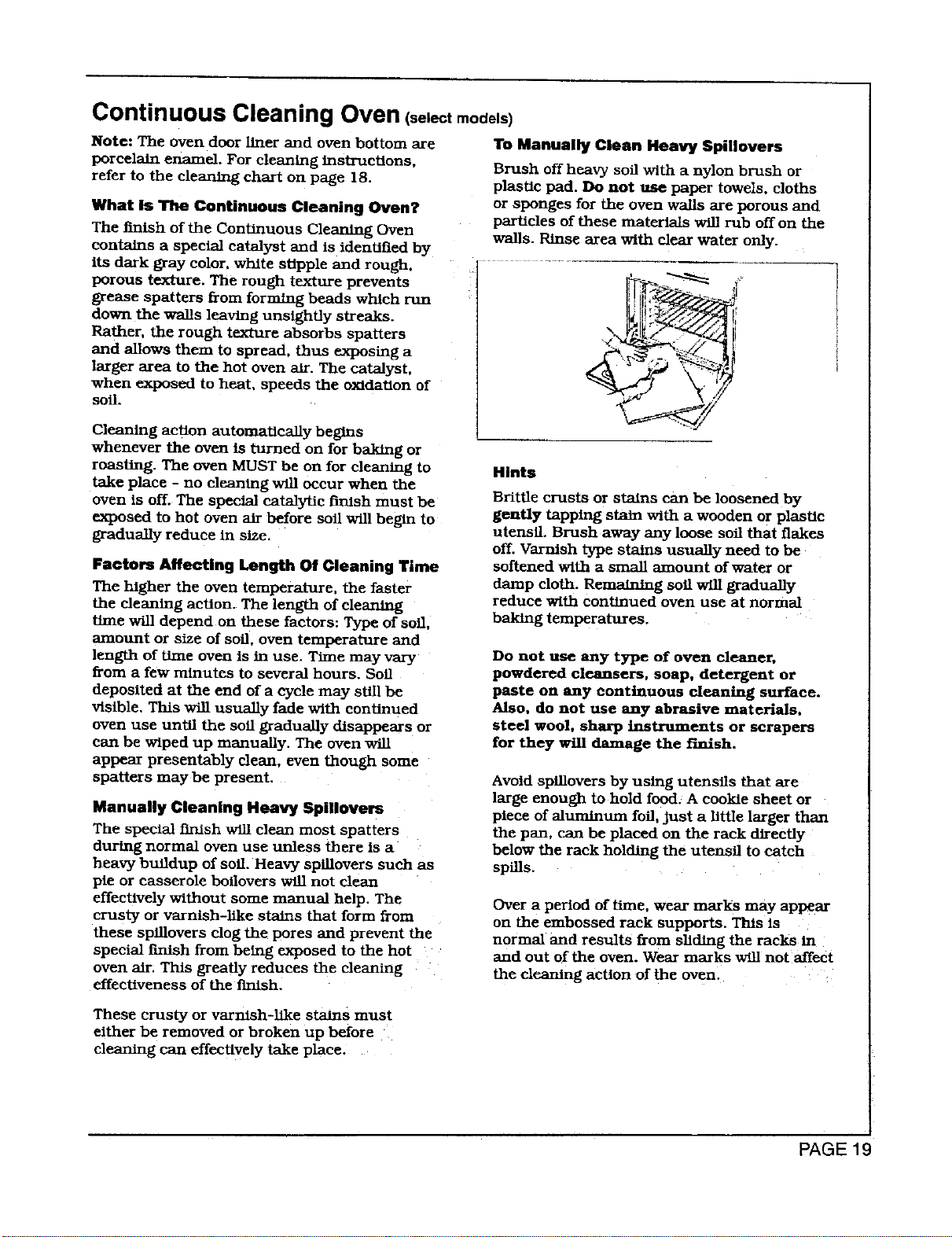
To Manually Clean Heavy Spillovers
Brush off heavy soil with a nylon brush or
plastic pad. Do not use paper towels, cloths
or sponges for the oven wails are porous and
particles of these materials will rub offon the
walls. Rinse area with c!ear water only.
Hints
Brittle crusts or stains can be loosened by
gently tapping stain with a wooden or plastic
utensil. Brush away any loose soft that flakes
off. Varnish type stains usually need to be
softened with a small amount of water or
damp cloth. Remaining soil will gradually
reduce with continued oven use at normal
baking temperatures.
Do not use any type of oven cleaner,
powdered cleansers, soap, detergent or
paste on any continuous cleaning surface.
Also, do not use any abrasive materials,
steel wool, sharp instruments or scrapers
for they will damage the finish.
Avoid spiliovers by using utensfts that are
large enough to hold food. A cookie sheet or
piece of aluminum foil, Just a little larger than
the pan, can be placed on the rack directly
below the rack holding the utensil to catch
spills.
Over a period of time. wear marks may appear
on the embossed rack supports. This is
normal and results from sliding the racks in
and out of the oven. Wear marks will not affect
the cleaning action of the oven.
These crusty or varnlsh-llke stains must
either be removed or broken up before
cleaning can effectively take place.
PAGE lu
SERVICE INFORMATION
Adjusting the Oven
Thermostat
After using your oven the first few times, it
may seem hotter or cooler than your previous
oven. Oven thermostats, over a period of
years, may drift from the factory setting and
timing differences of 5 to I0 minutes are not
unusual between an old and a new oven. You
may be inclined to think that the new oven is
not performing correctly; however, your new
oven has been set correctly at the factory and
is more likely to be accurate than the oven it
replaced.
If you think the oven should be hotter or
cooler, you can adjust it yourself. To decide
how much to change the thermostat, set the
oven temperature 25°F higher or lower than
the temperature in your recipe, then bake. The
results of the "test" should give you an idea of
how much the thermostat should be changed.
To adjust the thermostat:
I. Press the OVEN TEMP pad.
2. Press the A or V pad and select an oven
temperature between 500°F and 550°F.
3. Press and hold the OVEN TEMP pad for
about four seconds. The display will change
to the oven adjustment display which reads
00 °.
4. The oven thermostat can be adjusted up to
+35°F hotter or -35°F cooler. Use the • or
• pad to select the desired change in the
display.
5. When you have made the adjustment, press
the CANCEL pad to return to the time of
day display. Use your oven as you would
normally.
NOTE: This adjustment will not affect the Broil
temperature. The new temperature will be
remembered if the power is interrupted.
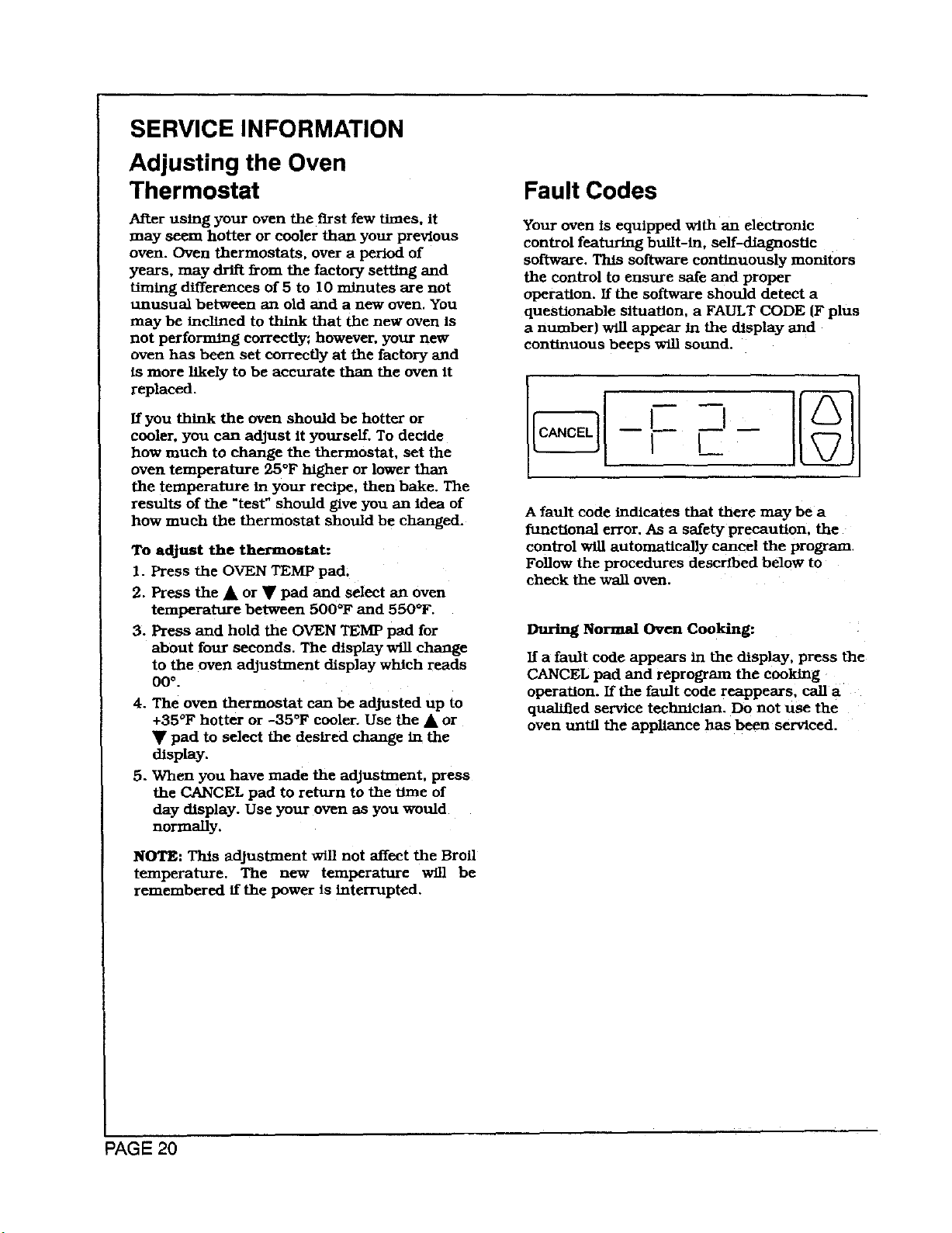
Fault Codes
Your oven is equipped with an electronic
control featuring built-in, seif-diagnostlc
software. This software continuously monitors
the control to ensure safe and proper
operation. If the software should detect a
questionable situation, a FAULT CODE (F plus
a number) win appear in the display and
continuous beeps will sound.
L
A fault code indicates that there may be a
functional error. As a safety precaution, the
control wlll automatically cancel the program.
Follow the procedures described below to
check the wall oven.
During Normal Oven Cooking:
If a fault code appears in the display, press the
CANCEL pad and reprogram the cooking
operation. If the fault code reappears, call a
qualified service technician. Do not use the
oven until the appliance has been serviced.
PAG E 20
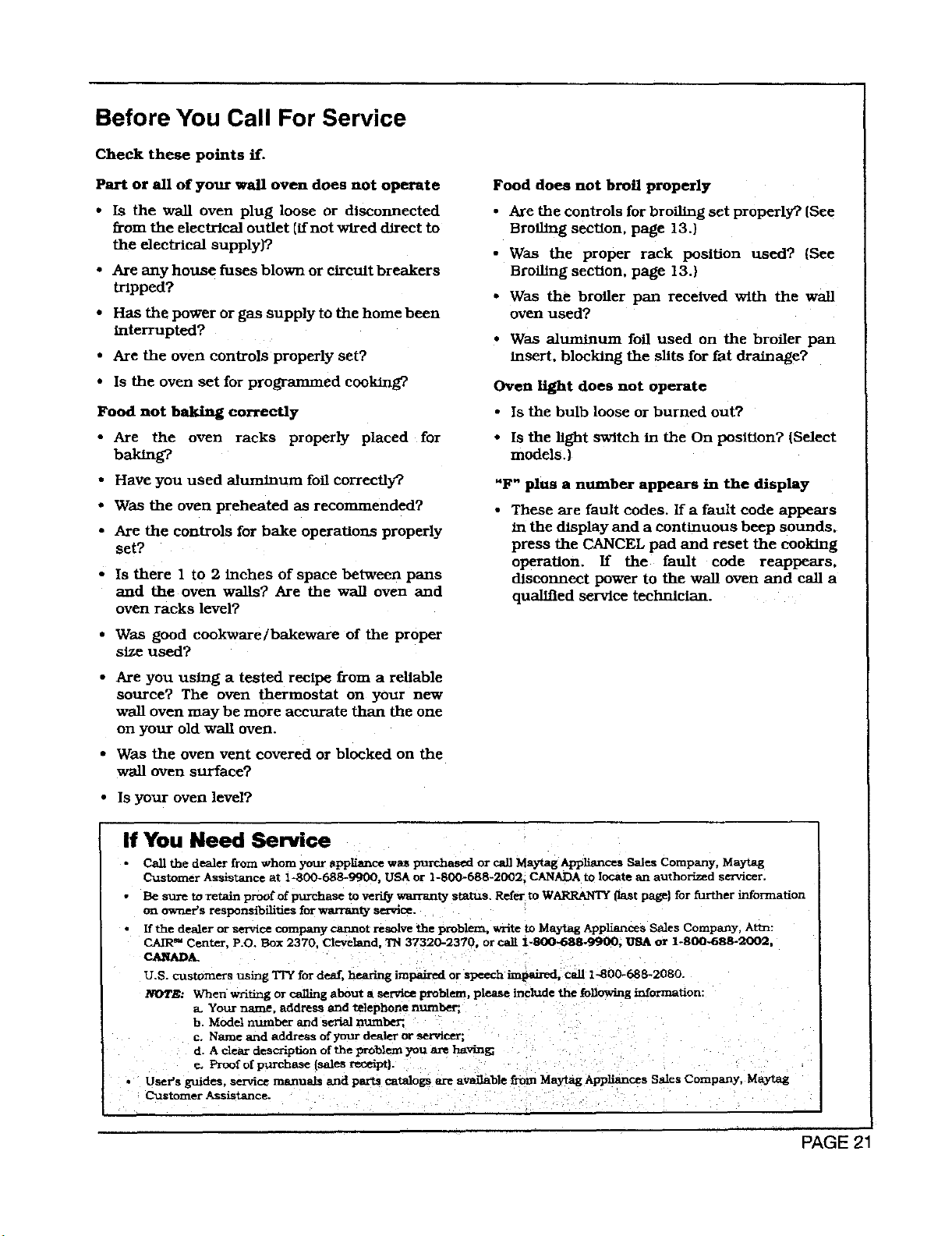
Before You Call For Service
Check these points if.
Part or all of your wall oven does not operate
• Is the wall oven plug loose or disconnected
_om the electrical outlet (if not wired direct to
the electrical supply)?
• Are any house fuses blown or circuit breakers
tripped?
• Has the power or gas supply to the home been
interrupted?
• Are the oven controls properly set?
• Is the oven set for programmed cooking?
Food not baking correctly
• Are the oven racks properly placed for
bakU-lg?
• Have you used aluminum foil correctly?
• Was the oven preheated as recommended?
• Are the controls for bake operations properly
set?
• Is there 1 _o 2 inches of space between pans
and the oven walls? Are the wall oven and
oven racks level?
• Was good cookware/bakeware of the proper
size used?
• Are you using a tested recipe from a reliable
source? The oven thermostat on your new
wall oven may be more accurate than the one
on your old wall oven.
• Was the oven vent covered or blocked on the
wall oven surface?
• Is your oven level?
Food does not broil properly
• Are the controls for broiling set properly? (See
Broiling section, page 13.)
• Was the proper rack position used? {See
Broiling section, page 13.}
• Was the broiler pan received with the wall
oven used?
• Was aluminum foil used on the broiler pan
Insert, blocking the slits for fat drainage?
Oven light does not operate
Is the bulb loose or burned out?
• Is the light switch in the On position? [Select
models.)
"F" plus a number appears in the display
• These are fault codes. If a fault code appears
in the display and a continuous beep sounds,
press the CANCEL pad and reset the cooking
operation. If the fault code reappears,
disconnect power to the wall oven and call a
qualified service technician.
If You Need Service
Call the dealer from whom your appliance ws0s purchased or call Maytag Applis-nces Sales Company, MayCag
Customer Assistance at 1-800-688-9900, USA or 1-800-688-2002, CANADA to locate an authorized servicer,
Be sure to retain proof of purchase to verify warranty status. Refer to WARRANTY [last pa_l for further information
on owner's responsibilities [or wsrranty service.
If the dealer or seance company cannot resolve the problem, write to MayCag Appliances Sales Company, Ath_:
CAIRm Centez, P.O. Box 2370, Cleveland, TN 37320-2370. or _ 1.800-688-_J00, USA or I-8OO-688-2002,
CANADA.
U.S. customers usin_ TTY for deaf, hearing impaired or speech impaired, call 1-800-688-2080.
NOTE." When writing or calling about a serwice problem, please include the following information:
a. Your name, address and telephone n1_nber;
b. Modal number and serial number,
c. Name and address ofyour dealer or servicer;
d. A clear description of the problem you ave b_vfug;
e_ Proof of purchase [sales receipt¿.
• User's guides, servic_ manuals and pm¢_ catalogs are available from Maytag Appliances Sales Company, Maytag
Customer Assistance.
PAGE 21
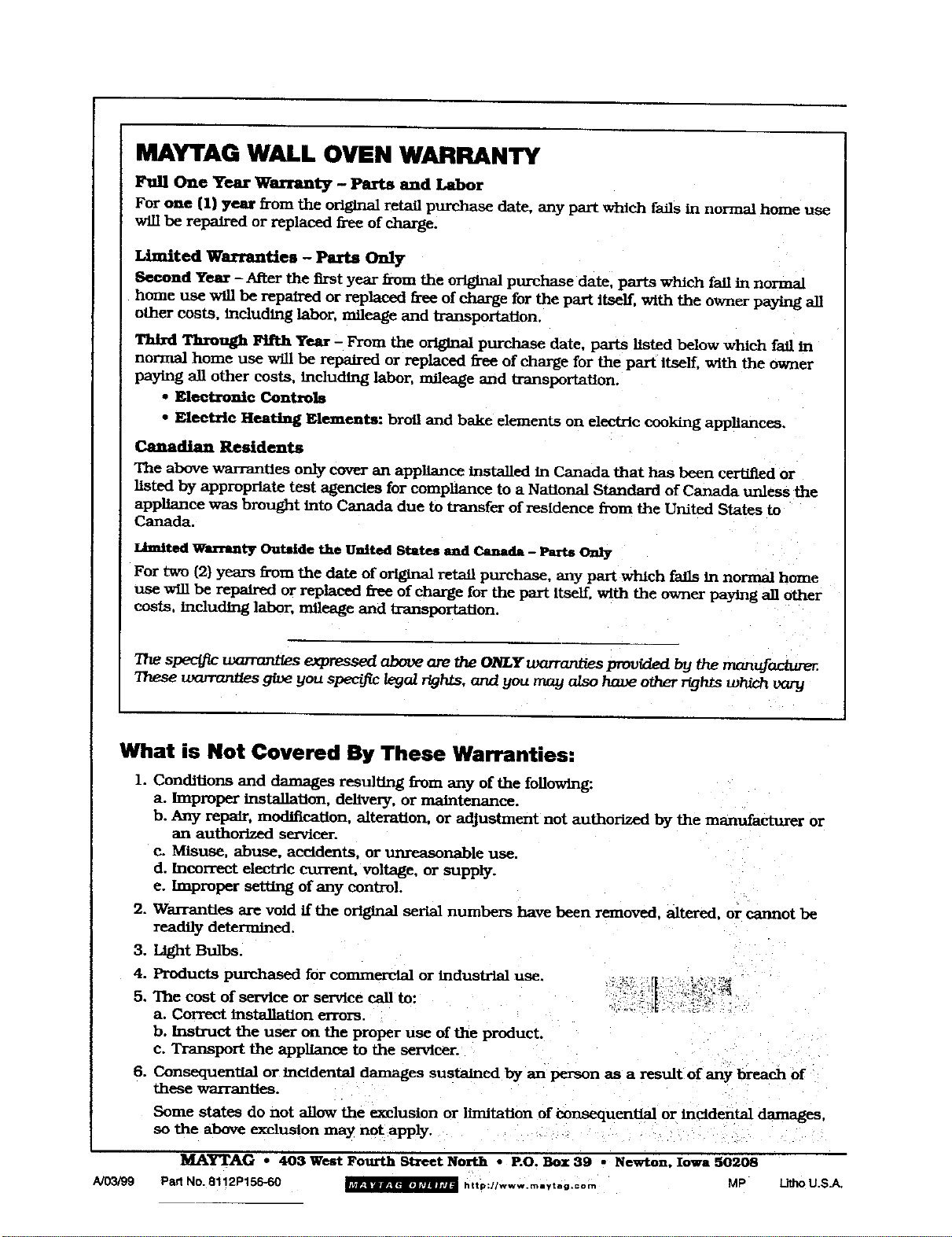
MAYTAG WALL OVEN WARRANTY
Full One Year Warranty - Parts and Labor
For one (I} year from the original retail purchase date, any part which fails in normal home use
will be repaired or replaced free of charge.
Limited Warranties - Parts Only
Second Year - After the first year from the original purchase date' parts which fail in normal
home use will be repaired or replaced free of charge for the part itself, with the owner paying all
other costs, including labor, mileage and transportation.
Though Fifth Year - From the orl_nal purchase date, parts listed below which fail in
normal home use will be repaired or replaced free of charge for the part itself, with the owner
paying an other costs, including labor, mileage and transportation.
• Electronic Controls
• Electric H_ting Elements." broil and bake elements on electric cooking appliances.
Canadian Residents
The above warranties only cover an appliance installed in Canada that has been cerl_ed or
listed by appropriate test agencies for compliance to a National Standard of Canada unless the
appliance was brought into Canada due to transfer of residence from the United States to
Canada.
L/mlted Warranty Outside the United States and Canada - Parts Only
For two (2) years from the date of original retail purchase, any part which falls in normal home
use wlll be repaired or replaced free of charge for the part itself, with the owner paying all other
costs, including labor, mileage and transportation.
The spec_ uxlrrant_s expressed above are the ONIY warranties provfded by the manufachwe_.
These warrants give you speci_c legal r@hts, and you may also have other rights which vary
What is Not Covered By These Warranties:
1. Conditions and damages resulting from any of the following:
a. Improper installation, delivery, or maintenance.
b. Any repair, modification, alteration, or adjustment not authorized by the manufacturer or
an authorized servicer.
c. Misuse, abuse, accidents, or tmreasonable use.
d. incorrect electric current, voltage, or supply.
e. Improper setting of any control.
2. Wan-anties are void ff the original serial numbers have been removed, altered, or cannot be
readily determined.
3. Light Bulbs.
4. Products purchased for commercial or industrial use. [[
5. The cost of servlce or service call to: , _" _:_'_'_:'i_,.
a. Correct installation errors.
b. Instruct the user on the proper use of the product.
c. Transport the appliance to the servicer.
6. Consequential or incidental damages sustained by an person as a result of any breach of
these warranties.
Some states do not allow the exclusion or limitation of Consequential or incidental damages,
so the above exclusion may not apply.
MA_fAG • 403 west Fourth Street North • P.O. Box 39 • Newton, Iowa 50208
A/03/99 Pad No. 8112P15_:_60 _ http:]/www.maytag.com MP LithoU.S.A.