READ AND KEEP THIS MANUAL FOR REFERENCE
45930A
Printed in Canada 20-03-2019
Installation and Operation Manual
Escape 1800
(DB03102, DB03105, DB03111 & DB03112 models)
US ENVIRONMENTAL PROTECTION AGENCY PHASE II CERTIFIED WOOD STOVE
COMPLIANT WITH 2020 CORD WOOD STANDARD
Safety tested according to ULC S627,
UL 737 and UL 1482 Standards
by an accredited laboratory
www.drolet.ca
Stove Builder International Inc.
250, rue de Copenhague, St-Augustin-de-Desmaures (Quebec) Canada G3A 2H3
After-sale service: 418-908-8002 E-mail: tech@sbi-international.com
This manual is available for free download on the manufacturer’s web site. It is a copyrighted
document. Re-sale is strictly prohibited. The manufacturer may update this manual from time
to time and cannot be responsible for problems, injuries, or damages arising out of the use of
information contained in any manual obtained from unauthorized sources.

Installation and Operation Manual for Escape 1800
2
THANK YOU FOR CHOOSING THIS DROLET WOOD STOVE
As one of North America’s largest and most respected wood stove and fireplace
manufacturers, Stove Builder International takes pride in the quality and performance of all
its products. We want to help you get maximum satisfaction as you use this product.
In the pages that follow you will find general advice on wood heating, detailed instructions
for safe and effective installation, and guidance on how to get the best performance from
this stove as you build and maintain fires and maintain your wood heating system.
We recommend that our wood burning hearth products be installed and serviced by
professionals who are certified in the United States by NFI (National Fireplace Institute
®
) or
in Canada by WETT (Wood Energy Technology Transfer) or in Quebec by APC (Association
des Professionnels du Chauffage).
Congratulations on making a wise purchase.
When this stove is not properly installed, a house fire may result. To reduce the risk
of fire, follow the installation instructions. Contact local building or fire officials about
restrictions and installation inspection requirements in your area.
Please read this entire manual before you install and use your new stove. Failure to follow
instructions may result in property damage, bodily injury, or even death. It is important that
you follow the installations guidelines exactly.
You may need to obtain a building permit for the installation of this stove and the chimney
that it is connected to. Consult your municipal building department or fire department before
installation to determine the need to obtain one. We recommend that you also inform your
home insurance company to find out if the installation will affect your policy.
Dealer: _______________________________________________
Installer: ______________________________________________
Phone number: ________________________________________
SERIAL NUMBER: _______________

Installation and Operation Manual for Escape 1800
3
Table of content
PART A - OPERATION AND MAINTENANCE ......................................................... 7
1 Safety Information .............................................................................................. 7
2 General Information on Escape 1800 ................................................................ 8
2.1 Appliance performance
(1)
................................................................................................... 8
2.2 General Features .............................................................................................................. 9
2.3 Zone Heating and How to Make it Work for You .............................................................. 12
2.4 The Benefits of Low Emissions and High Efficiency ........................................................ 12
2.5 The SBI Commitment to You and the Environment ......................................................... 13
2.5.1 What is Your New Stove Made Of? ............................................................................. 13
3 Fuel .................................................................................................................. 14
3.1 How to Prepare or Buy Good Firewood ........................................................................... 14
3.1.1 What is Good Firewood? ............................................................................................. 14
3.1.2 Tree Species ............................................................................................................... 14
3.1.3 Log Length .................................................................................................................. 15
3.1.4 Piece Size ................................................................................................................... 15
3.1.5 How to Dry Firewood ................................................................................................... 15
3.1.6 Judging Firewood Moisture Content ............................................................................ 16
3.1.7 Manufactured Logs ...................................................................................................... 17
4 Operating Your Stove ...................................................................................... 17
4.1 The use of a fire screen. .................................................................................................. 17
4.2 Your First Fires................................................................................................................ 17
4.3 Lighting Fires .................................................................................................................. 18
4.3.1 Conventional Fire Starting ........................................................................................... 18
4.3.2 The Top Down Fire ...................................................................................................... 18
4.3.3 Two Parallel Logs ........................................................................................................ 19
4.3.4 Using Fire Starters ....................................................................................................... 19
4.4 Maintaining Wood Fires ................................................................................................... 19
4.4.1 General Advice ............................................................................................................ 19
4.4.2 Ash Removal ............................................................................................................... 20
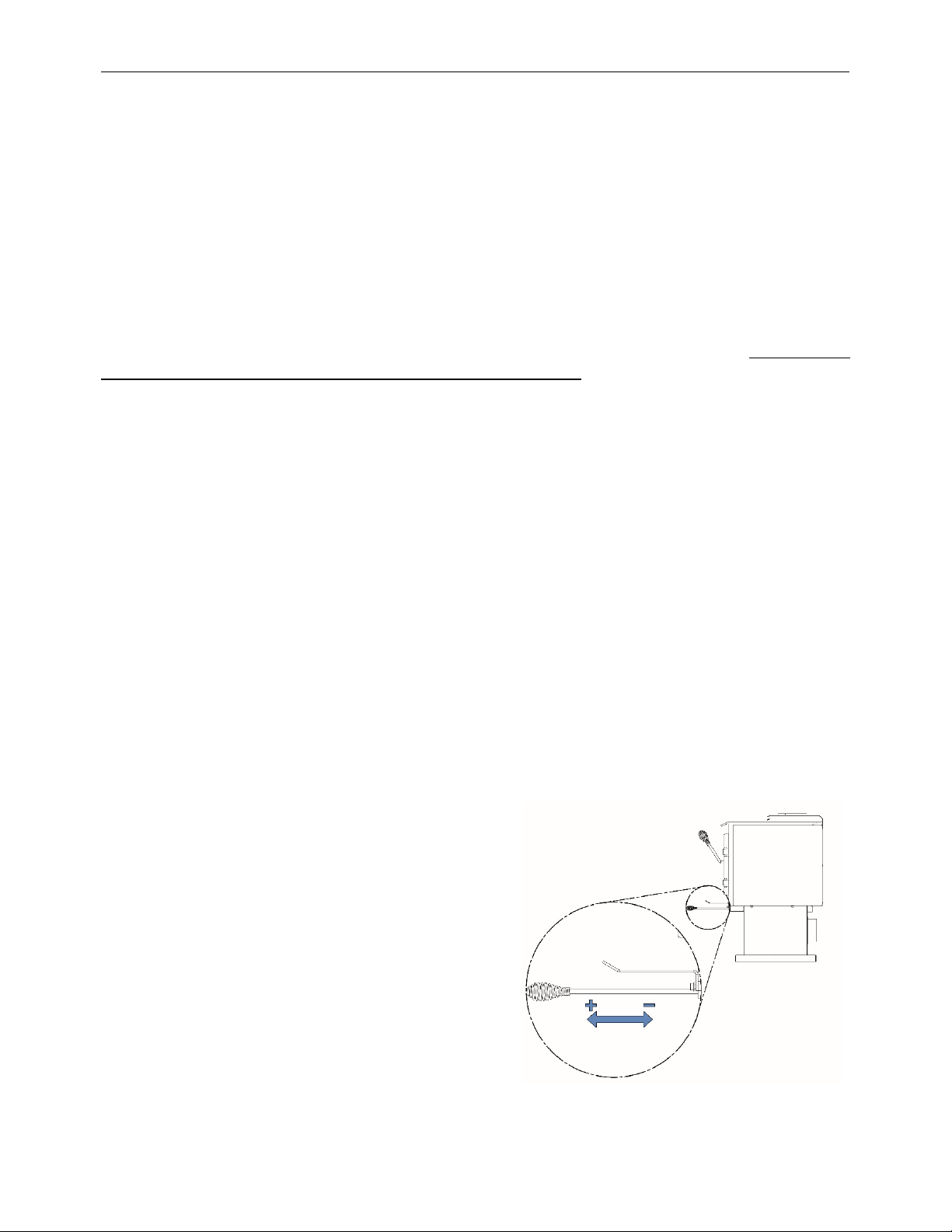
4.4.3 Raking Charcoal .......................................................................................................... 20
4.4.4 Firing Each New Load Hot ........................................................................................... 21
4.4.5 Turning Down the Air Supply ....................................................................................... 21
4.4.6 Building Different Fires for Different Needs .................................................................. 22
5 Maintaining Your Wood Heating System ......................................................... 23
5.1 Stove Maintenance ......................................................................................................... 23
5.1.1 Cleaning Door Glass .................................................................................................... 24
5.1.2 Door adjustment .......................................................................................................... 24
5.1.3 Replacing the Door Gasket .......................................................................................... 25
5.1.4 Replacing the Glass Gasket and/or the Glass .............................................................. 26
5.1.5 Cleaning and Painting the Stove .................................................................................. 27

Installation and Operation Manual for Escape 1800
4
5.2 Chimney and Chimney Connector Maintenance.............................................................. 27
5.2.1 Why Chimney Cleaning is Necessary .......................................................................... 27
5.2.2 How Often Should You Clean the Chimney? ............................................................... 27
5.2.3 Cleaning the Chimney ................................................................................................. 28
PART B - INSTALLATION ....................................................................................... 29
6 Safety Information ............................................................................................ 29
6.1 Summary of Installation Cautions and Warnings ............................................................. 29
6.2 Regulations Covering Stove Installation .......................................................................... 30
7 Clearances to Combustible Material ................................................................ 30
7.1 Location of the certification label ..................................................................................... 30
7.2 Clearances to Combustible Materials .............................................................................. 31
7.2.1 Clearances with ceiling (L) lowered to 77" (196 cm) .................................................... 33
7.2.2 Clearances for an alcove ............................................................................................. 34
7.2.3 Clearances for mobile homes ...................................................................................... 34
7.3 Floor protection ............................................................................................................... 35
7.4 Reducing Wall and Ceiling Clearances Safely ................................................................. 36
7.4.1 Shield Construction Rules............................................................................................ 36
7.4.2 Table of Clearance Reduction Percentages ................................................................. 38
8 The Venting System ........................................................................................ 39
8.1 General ........................................................................................................................... 39
8.2 Suitable Chimneys .......................................................................................................... 39
8.2.1 Factory-built Metal Chimneys ...................................................................................... 40
8.2.2 Factory-built Metal Chimneys in Mobile Homes ........................................................... 40
8.2.3 Masonry Chimneys ...................................................................................................... 41
8.3 Minimum Chimney Height ............................................................................................... 41
8.4 The Relationship Between the Chimney and the House .................................................. 42
8.4.1 Why Inside Chimneys Are Preferred ............................................................................ 42
8.4.2 Why the chimney should penetrate the highest heated space ..................................... 43
8.5 Supply of Combustion Air ................................................................................................ 43
8.5.1 Combustion Air Supply in Mobile Homes ..................................................................... 44
8.5.2 Air Supply in Conventional Houses .............................................................................. 44
8.6 Installing the Chimney Connector .................................................................................... 44
8.6.1 Installation of Single Wall Chimney Connector ............................................................. 45
Appendix 1: Installing the Optional Fresh Air Intake Kit .......................................... 47
Appendix 2: Installing the Optional Fire Screen ...................................................... 49
Appendix 3: Installation of the Optional Blower and Thermodisc ............................ 50
Appendix 4: Installation of Secondary Air Tubes and Baffle ................................... 53
Appendix 5: Exploded Diagram and Parts List ........................................................ 55
DROLET LIMITED LIFETIME WARRANTY ............................................................ 61

Installation and Operation Manual for Escape 1800
5
REGISTER YOUR WARRANTY ONLINE
If the unit requires repairs during the warranty period, proof of purchase
must be provided. The purchase invoice must be kept. The date indicated
on it establishes the warranty period. If it cannot be provided, the
warranty period will be determined by the date of manufacture of the
product.
It is also highly recommended to register the warranty online at
https://www.drolet.ca/en/warranty/warranty-registration/
Registering the warranty will help quickly find the information needed on
the unit.
Installation and Operation Manual for Escape 1800
6
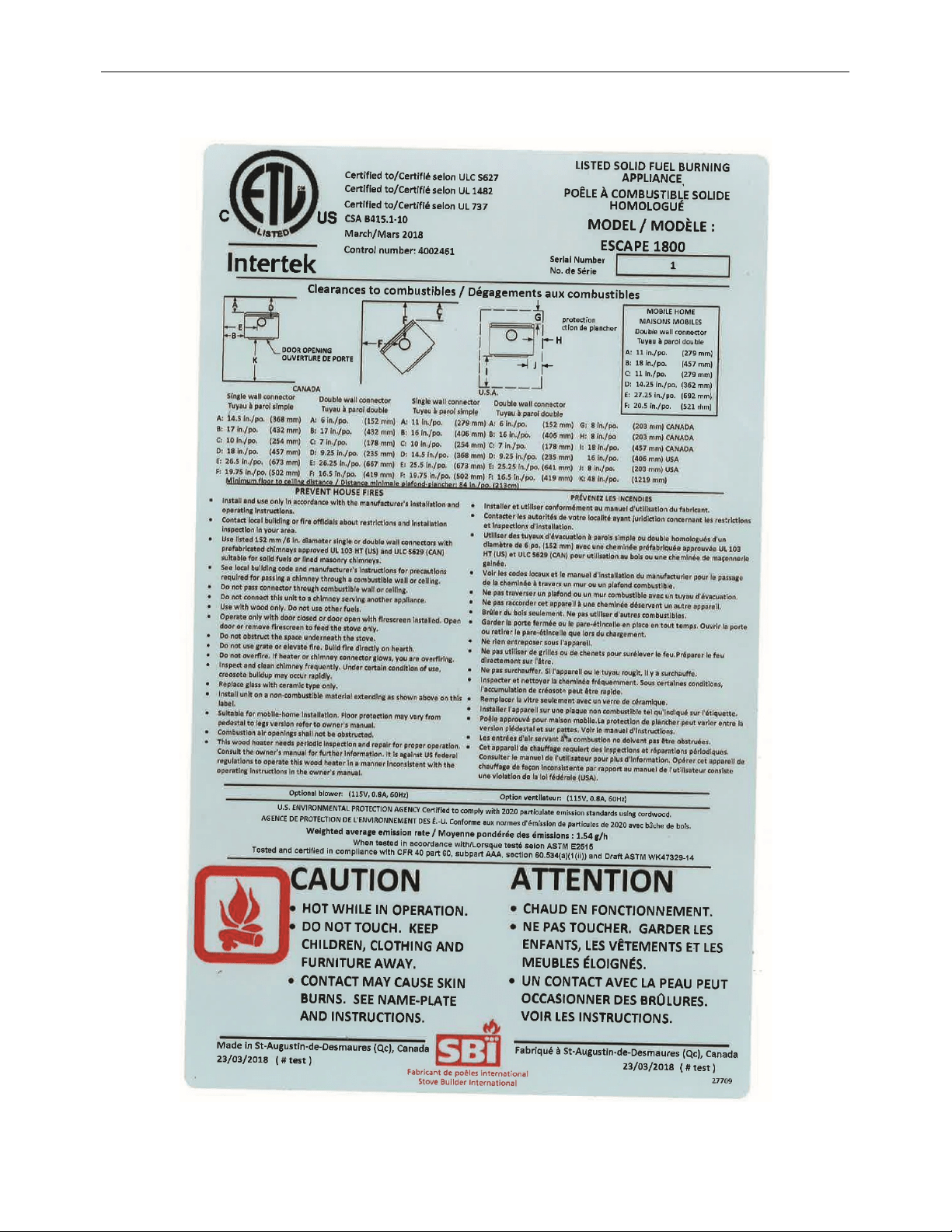
Certification plate
Installation and Operation Manual for Escape 1800
7
PART A - OPERATION AND MAINTENANCE
Please see Part B for installation instructions.
1 Safety Information
• HOT WHILE IN OPERATION, KEEP CHILDREN, CLOTHING AND FURNITURE
AWAY. CONTACT MAY CAUSE SKIN BURNS. GLOVES MAY BE NEEDED FOR THE
STOVE OPERATION.
• USING A STOVE WITH CRACKED OR BROKEN COMPONENTS, SUCH AS GLASS
OR FIREBRICKS OR BAFFLES MAY PRODUCE AN UNSAFE CONDITION AND MAY
DAMAGE THE STOVE.
• OPEN THE AIR CONTROL FULLY BEFORE OPENING FIRING DOOR.
• THIS STOVE HAS BEEN TESTED FOR USE WITH AN OPEN DOOR IN
CONJUNCTION WITH A FIRE SCREEN, SOLD SEPARATELY. THE DOOR MAY BE
OPENED, OR FIRE SCREEN REMOVED ONLY DURING LIGHTING PROCEDURES
OR RELOADING. ALWAYS CLOSE THE DOOR OR PUT BACK ON THE FIRE
SCREEN AFTER IGNITION. DO NOT LEAVE THE STOVE UNATTENDED WHEN THE
DOOR IS OPENED WITH OR WITHOUT A FIRE SCREEN.
• NEVER USE GASOLINE, GASOLINE-TYPE LANTERN FUEL (NAPHTHA), FUEL OIL,
MOTOR OIL, KEROSENE, CHARCOAL LIGHTER FLUID, OR SIMILAR LIQUIDS OR
AEROSOLS TO START OR ‘FRESHEN UP’ A FIRE IN THIS STOVE. KEEP ALL
SUCH LIQUIDS OR AEROSOLS WELL AWAY FROM THE STOVE WHILE IT IS IN
USE.
• DO NOT STORE FUEL WITHIN HEATER MINIMUM INSTALLATION CLEARANCES.
• BURN ONLY SEASONED NATURAL FIREWOOD.
• THIS WOOD HEATER NEEDS PERIODIC INSPECTION AND REPAIR FOR PROPER
OPERATION. IT IS AGAINST FEDERAL REGULATIONS TO OPERATE THIS WOOD
HEATER IN A MANNER INCONSISTENT WITH OPERATING INSTRUCTIONS IN
THIS MANUAL
• DO NOT ELEVATE THE FIRE BY USING A GRATE IN THIS STOVE.
• THIS APPLIANCE SHOULD BE MAINTAINED AND OPERATED AT ALL TIMES IN
ACCORDANCE WITH THESE INSTRUCTIONS.
WARNING:
This product can expose you to chemicals including carbon
monoxide, which is known to the State of California to cause cancer, birth
defects or other reproductive harm.
For more information go to
www.P65warnings.ca.gov/
Installation and Operation Manual for Escape 1800
8
2 General Information on Escape 1800
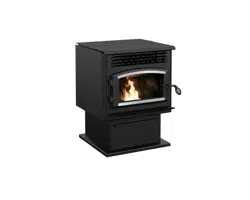
DB03102
Escape 1800 - On pedestal - black door
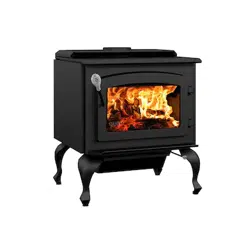
DB03105
Escape 1800 - On black legs - black door
DB03111
Escape 1800 - On pedestal - brushed nickel door
DB03112
Escape 1800 – On black legs - brushed nickel door
Note: a leg version cannot be converted to a pedestal version, nor a pedestal version
converted to a leg version.
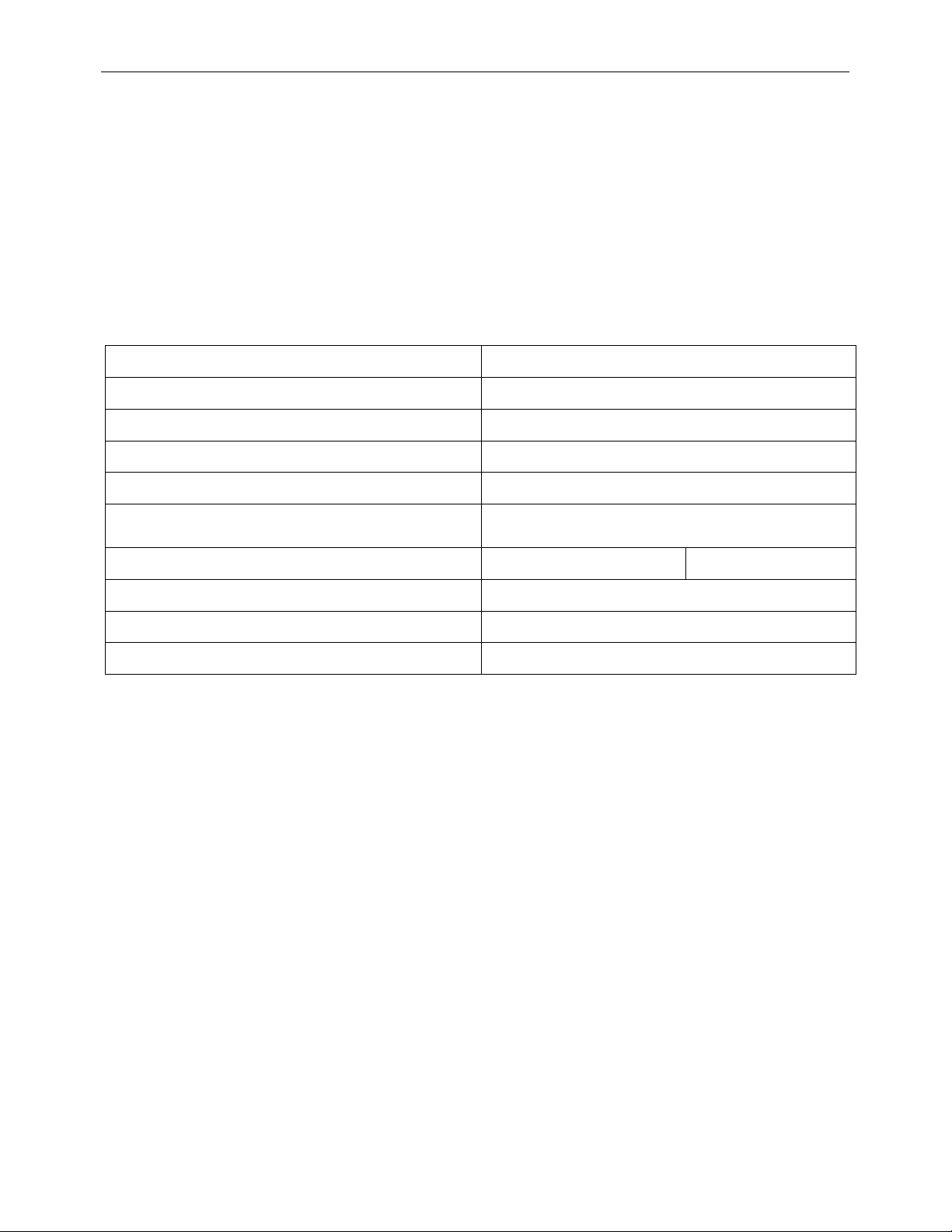
2.1 Performance
(1)
Fuel type Dry cordwood
Recommended heating area
[*]
500 to 2,100 ft
2
(47 to 195 m
2
)
Firebox volume 2.4 ft
3
(0.068 m
3
)
Maximum burn time
[*]
8 h
Maximum heat output
(2)
(dry cordwood) 75,000 BTU/h (22.0 kW)
Overall heat output rate (min. to max.)
(2)(3)
14,800 BTU/h to 28,600 BTU/h
(4.34 kW to 8.38 kW)
Average overall efficiency
(3)
- Dry cordwood 69 % (HHV
(4)
) 74 % (LHV
(5)
)
Optimum efficiency
(2)(6)
77 %
Average particulate emissions rate
(7)
1.54 g/h (EPA / CSA B415.1-10)
(8)
Average CO
(9)
89.4 g/h
[*]
Recommended heating area and maximum burn time may vary subject to location in home, chimney draft, heat loss
factors, climate, fuel type and other variables. The recommended heated area for a given appliance is defined by the
manufacturer as its capacity to maintain a minimum acceptable temperature in the designated area in case of a
power failure.
(1)
Values are as measured per test method, except for the recommended heating area, firebox volume, maximum burn
time and maximum heat output.
(2)
The maximum heat output (dry cordwood) is based on a loading density varying between 15 lb/ft
3
and 20 lb/ft
3
.
Other performances are based on a fuel load prescribed by the standard. The specified loading density varies
between 7 lb/ft³ and 12 lb/ft
3
. The moisture content is between 19% and 25%.
(3)
As measured per CSA B415.1-10 stack loss method.
(4)
Higher Heating Value of the fuel.
(5)
Lower Heating Value of the fuel.
(6)
Optimum overall efficiency at a specific burn rate (LHV).
(7)
This appliance is officially tested and certified by an independent agency.
(8)
Tested and certified in compliance with CFR 40 part 60, subpart AAA, section 60.534(a)(1(ii) and Draft ASTM
WK47329-14
(9)
Carbon monoxide.
Installation and Operation Manual for Escape 1800
9
2.2 General Features
Maximum log length 20 in (508 mm) east-west*
Flue outlet diameter 6 in (152 mm)
Recommended connector pipe diameter 6 in (152 mm)
Type of chimney CAN/ULC S629, UL 103 HT (2100 °F)
Baffle material Vermiculite
Approved for alcove installation Yes
Approved for mobile home installation
‡
Yes
Shipping weight (without option) 382 lb (173 kg)
Appliance weight (model with legs) 325 lb (147 kg)
Appliance weight (model with pedestal) 329 lb (149 kg)
Type of door Single, glass with cast iron frame
Type of glass Ceramic glass
Blower Optional (up to 130 CFM)
Particulate emission standard EPA / CSA B415.1-10**
USA standard (safety) UL 1482, UL 737
Canadian standard (safety) ULC S627
**
East-west: through the door you see the longitudinal sides of the logs; north-south: through the door you see the tips
of the logs.
**
Tested and certified in compliance with CFR 40 part 60, subpart AAA, section 60.534(a)(1(ii) and Draft
ASTM WK47329-14
‡
Mobile home (Canada) or manufactured home (USA): The US Department of Housing and Urban Development
describes “manufactured homes” better known as “mobile homes” as follows; buildings built on fixed wheels and those
transported on temporary wheels/axles and set on a permanent foundation. In Canada, a mobile home is a dwelling
for which the manufacture and assembly of each component is completed or substantially completed prior to being
moved to a site for installation on a foundation and connection to service facilities and which conforms to the
CAN/CSA-Z240 MH standard.
Installation and Operation Manual for Escape 1800
10
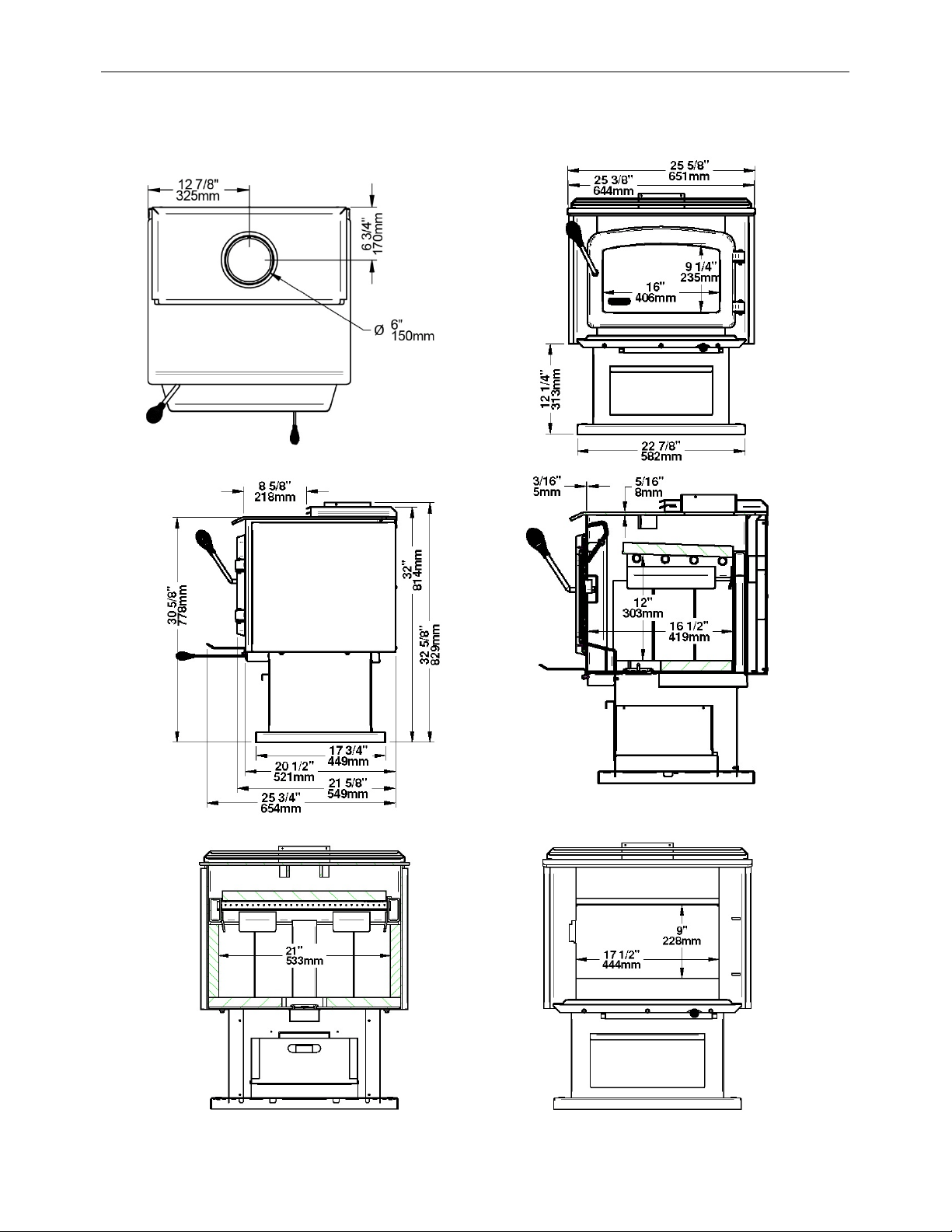
Models on pedestal
Installation and Operation Manual for Escape 1800
11
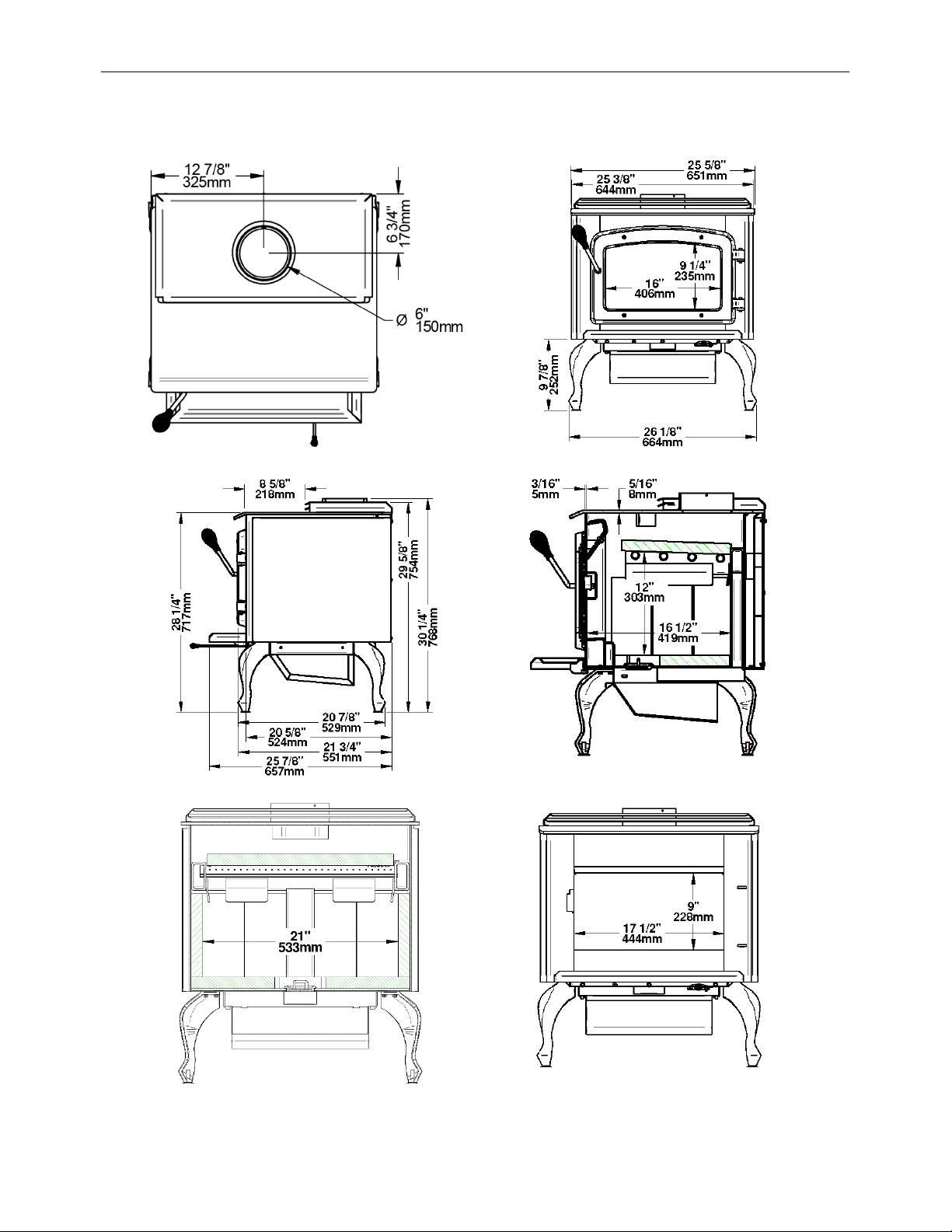
Model on legs

Installation and Operation Manual for Escape 1800
12
2.3 Zone Heating and How to Make it Work for You
Your new Escape 1800 wood stove is a space heater, which means it is intended to heat
the area it is installed in, as well as spaces that connect to that area, although to a lower
temperature. This is called zone heating and it is an increasingly popular way to heat homes
or spaces within homes.
Zone heating can be used to supplement another heating system by heating a particular
space within a home, such as a basement family room or an addition that lacks another heat
source.
Houses of moderate size and relatively new construction can be heated with a properly sized
and located wood stove. Whole house zone heating works best when the stove is located in
the part of the house where the family spends most of its time. This is normally the main
living area where the kitchen, dining and living rooms are located. By locating the stove in
this area, you will get the maximum benefit of the heat it produces and will achieve the
highest possible heating efficiency and comfort. The space where you spend most of your
time will be warmest, while bedrooms and basement (if there is one) will stay cooler. In this
way, you will burn less wood than with other forms of heating.
Although the stove may be able to heat the main living areas of your house to an adequate
temperature, we strongly recommend that you also have a conventional oil, gas or electric
heating system to provide backup heating.
Your success with zone heating will depend on several factors, including the correct sizing
and location of the stove, the size, layout and age of your home and your climate zone.
Three-season vacation homes can usually be heated with smaller stoves than houses that
are heated all winter.
2.4 The Benefits of Low Emissions and High Efficiency
The low smoke emissions produced by the special features inside the Escape 1800 firebox
mean that your household will release up to 90 percent less smoke into the outside
environment than if you used an older conventional stove. But there is more to the emission
control technologies than protecting the environment.
The smoke released from wood when it is heated contains about half of the energy content
of the fuel. By burning the wood completely, your stove releases all the heat energy from
the wood instead of wasting it as smoke up the chimney. Also, the features inside the firebox
allow you to reduce the air supply to control heat output, while maintaining clean and efficient
flaming combustion, which boosts the efficient delivery of heat to your home.
The emission control and advanced combustion features of your stove can only work
properly if your fuel is in the correct moisture content range of 15 to 20 percent. See Section
3 of this manual for suggestions on preparing fuelwood and judging its moisture.

Installation and Operation Manual for Escape 1800
13
2.5 The SBI Commitment to You and the Environment
The SBI team is committed to protecting the environment, so we do everything we can to
use only materials in our products that will have no lasting negative impact on the
environment.
2.5.1 What is Your New Stove Made Of?
The body of your stove, which is most of its weight, is carbon steel. Should it ever become
necessary many years in the future, almost the entire stove can be recycled into new
products, thus eliminating the need to mine new materials.
The paint coat on your stove is very thin. Its VOC content (Volatile Organic Components) is
very low. VOCs can be responsible for smog, so all the paint used during the manufacturing
process meets the latest air quality requirements with regards to VOC reduction or
elimination.
The air tubes are stainless steel, which can also be recycled.
Vermiculite is used for the baffle. Vermiculite is a mineral. Large commercial mines exist in
China, Russia, South Africa, and Brazil. Potassium silicate is used as a binder to form a
rigid board. Vermiculite can withstand temperatures above 2,000 °F. It is not considered
hazardous waste. Disposal at a landfill is recommended.
Lightweight firebrick is made of pumice and cement. Pumice is in fact volcanic rock, a
naturally green product found in the Northwest United States. Disposal at a landfill is
recommended.
The door and glass gaskets are fibreglass which is spun from melted sand. Black gaskets
have been dipped into a solvent-free solution. Disposal at a landfill is recommended.
The door glass is a 4 mm thick ceramic material that contains no toxic chemicals. It is
basically made of raw earth materials such as sand and quartz that are combined in such a
way to form a glass at high temperatures. Ceramic glass will not remelt in the same way as
normal glass, so it should not be recycled with your regular household products. Disposal at
a landfill is recommended.

Installation and Operation Manual for Escape 1800
14
3 Fuel
MATERIALS THAT SHOULD NOT BE BURNED
• GARBAGE;
• LAWN CLIPPINGS OR YARD WASTE;
• MATERIALS CONTAINING RUBBER, INCLUDING TIRES;
• MATERIALS CONTAINING PLASTIC;
• WASTE PETROLEUM PRODUCTS, PAINTS OR PAINT THINNERS, OR ASPHALT
PRODUCTS;
• MATERIALS CONTAINING ASBESTOS;
• CONSTRUCTION OR DEMOLITION DEBRIS;
• RAILROAD TIES OR PRESSURE-TREATED WOOD;
• MANURE OR ANIMAL REMAINS;
• SALT WATER DRIFTWOOD OR OTHER PREVIOUSLY SALT WATER SATURATED
MATERIALS;
• UNSEASONED WOOD; OR
• PAPER PRODUCTS, CARDBOARD, PLYWOOD, OR PARTICLEBOARD. THE
PROHIBITION AGAINST BURNING THESE MATERIALS DOES NOT PROHIBIT THE
USE OF FIRE STARTERS MADE FROM PAPER, CARDBOARD, SAW DUST, WAX
AND SIMILAR SUBSTANCES FOR THE PURPOSE OF STARTING A FIRE IN AN
AFFECTED WOOD HEATER.
BURNING THESE MATERIALS MAY RESULT IN RELEASE OF TOXIC FUMES OR
RENDER THE HEATER INEFFECTIVE AND CAUSE SMOKE.
3.1 How to Prepare or Buy Good Firewood
3.1.1 What is Good Firewood?
Good firewood has been cut to the correct length for the stove, split to a range of sizes and
stacked in the open until its moisture content is reduced to 15 to 20 per cent.
3.1.2 Tree Species
The tree species the firewood is produced from is less important than its moisture content.
The main difference in firewood from various tree species is the density of the wood.
Hardwoods are denser than softwoods. People who live in the coldest regions of North
America usually have only spruce, birch and poplar, other low-density species to burn and
yet they can heat their homes successfully.
Homeowners with access to both hardwood and softwood fuel sometimes use both types
for different purposes. For example, softer woods make good fuel for relatively mild weather
in spring and fall because they light quickly and produce less heat softwoods are not as
dense as hardwood, so a given volume of wood contains less energy. Using softwoods
avoids overheating the house, which can be a common problem with wood heating in
moderate weather. Harder woods are best for colder winter weather when more heat and
longer burn cycles are desirable.
Installation and Operation Manual for Escape 1800
15
Note that hardwood trees like oak, maple, ash and beech are slower growing and longer
lived than softer woods like poplar and birch. That makes hardwood trees more valuable.
The advice that only hardwoods are good to burn is outdated. Old, leaky cast iron stoves
wouldn’t hold a fire overnight unless they were fed large pieces of hardwood. That is no
longer true. You can successfully heat your home by using the less desirable tree species
and give the forest a break at the same time.
3.1.3 Log Length
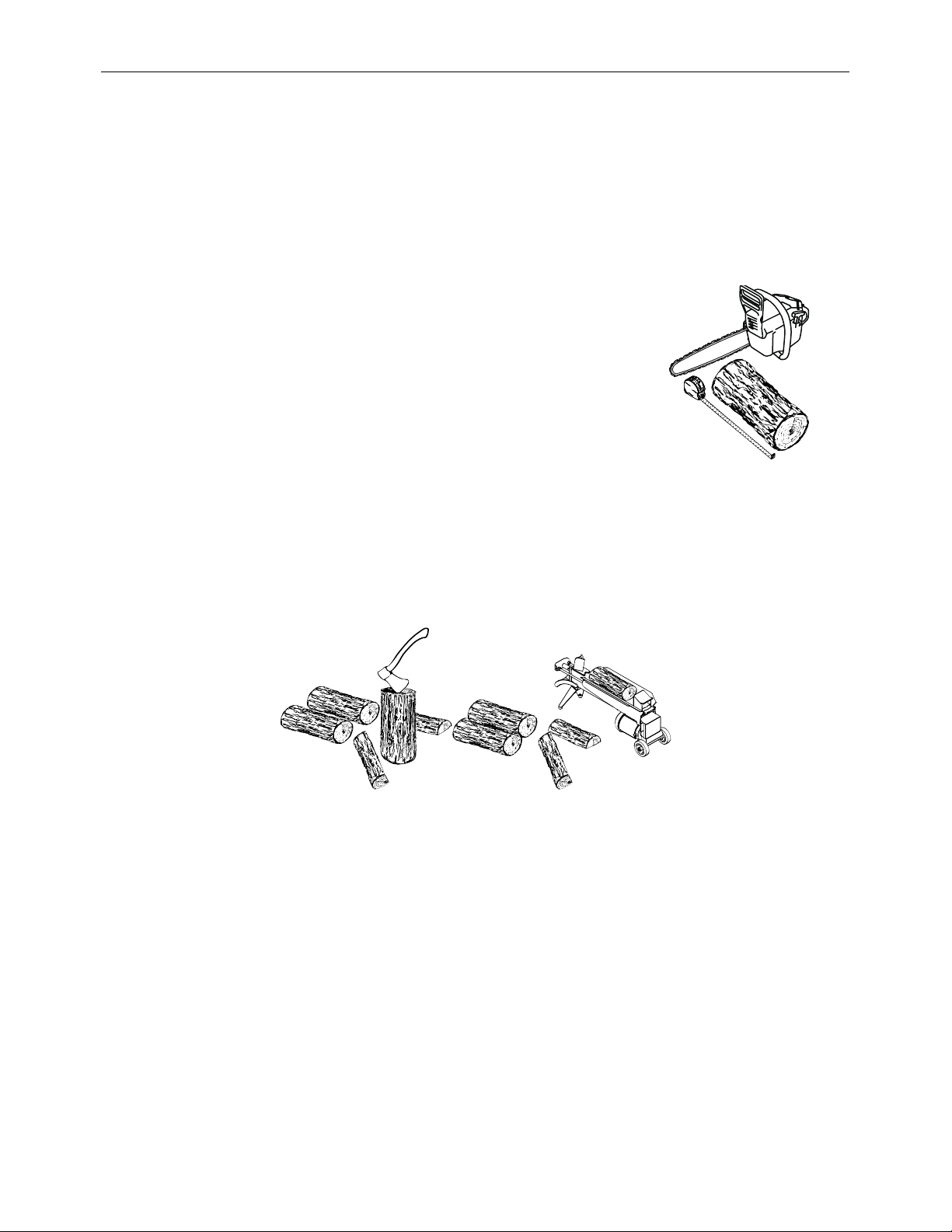
Logs should be cut about 1” (25 mm) shorter than the firebox
so they fit in easily. Pieces that are even sligh
tly too long
makes
loading the stove very difficult. The most common
standard length of firewood is 16” (400 mm).
The pieces should be a consistent length, with a maximum of
1” (25 mm) variation from piece to piece.
3.1.4 Piece Size
Firewood dries more quickly when it is split. Large unsplit rounds can take years to dry
enough to burn. Even when dried, unsplit logs are difficult to ignite because they don’t have
the sharp edges where the flames first catch. Logs as small as 3” (75 mm) should be split
to encourage drying.
Wood should be split to a range of sizes, from about 3” to 6” (75 mm to 150 mm) in cross
section. Having a range of sizes makes starting and rekindling fires much easier. Often, the
firewood purchased from commercial suppliers is not split finely enough for convenient
stoking. It is sometimes advisable to resplit the wood before stacking to dry.
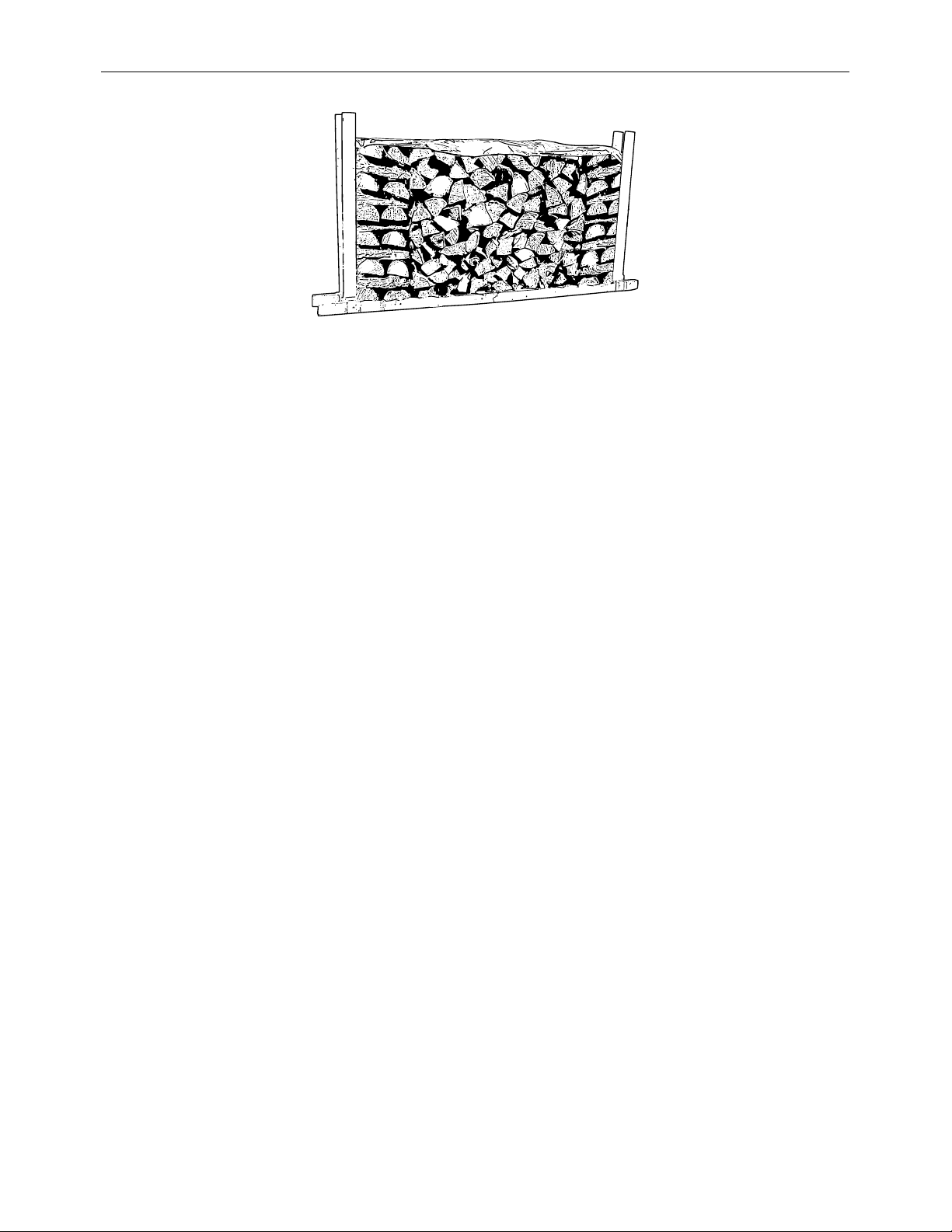
3.1.5 How to Dry Firewood
Firewood that is not dry enough to burn is the cause of most complaints about wood stoves.
The complaints usually involve a lack of heat and dirty door glass.
Installation and Operation Manual for Escape 1800
16
Here are some things to consider in estimating drying time:
• Firewood takes a long time to dry.
• Firewood bought from a dealer is rarely dry enough to burn, so it is advisable to buy the
wood in spring and dry it yourself.
• Drying happens faster in dry weather than in damp, maritime climates.
• Drying happens faster in warm summer weather than in winter weather.
• Small pieces dry more quickly than large pieces.
• Split pieces dry more quickly than unsplit rounds.
• Softwoods take less time to dry than hardwoods.
• Softwoods like pine, spruce, and poplar/aspen can be dry enough to burn after being
stacked in the open for only the summer months.
• Hardwoods like oak, maple and ash can take one, or even two years to dry fully,
especially if the pieces are big.
• Firewood dries more quickly when stacked in the open where it is exposed to sun and
wind; it takes much longer to dry when stacked in a wood shed.
• Firewood that is ready to burn has a moisture content between 15 and 20% by weight
and will allow your stove to produce its highest possible efficiency.
3.1.6 Judging Firewood Moisture Content
You can find out if some firewood is dry enough to burn by using these guidelines:
• Cracks form at the ends of logs as they dry.
• As it dries in the sun, the wood turns from white or cream coloured to grey or yellow.
• Bang two pieces of wood together; seasoned wood sounds hollow and wet wood sounds
dull.
• Dry wood is much lighter in weight than wet wood.
• Split a piece, and if the fresh face feels warm and dry it is dry enough to burn; if it feels
damp, it is too wet.
• Burn a piece; wet wood hisses and sizzles in the fire and dry wood does not.
Installation and Operation Manual for Escape 1800
17
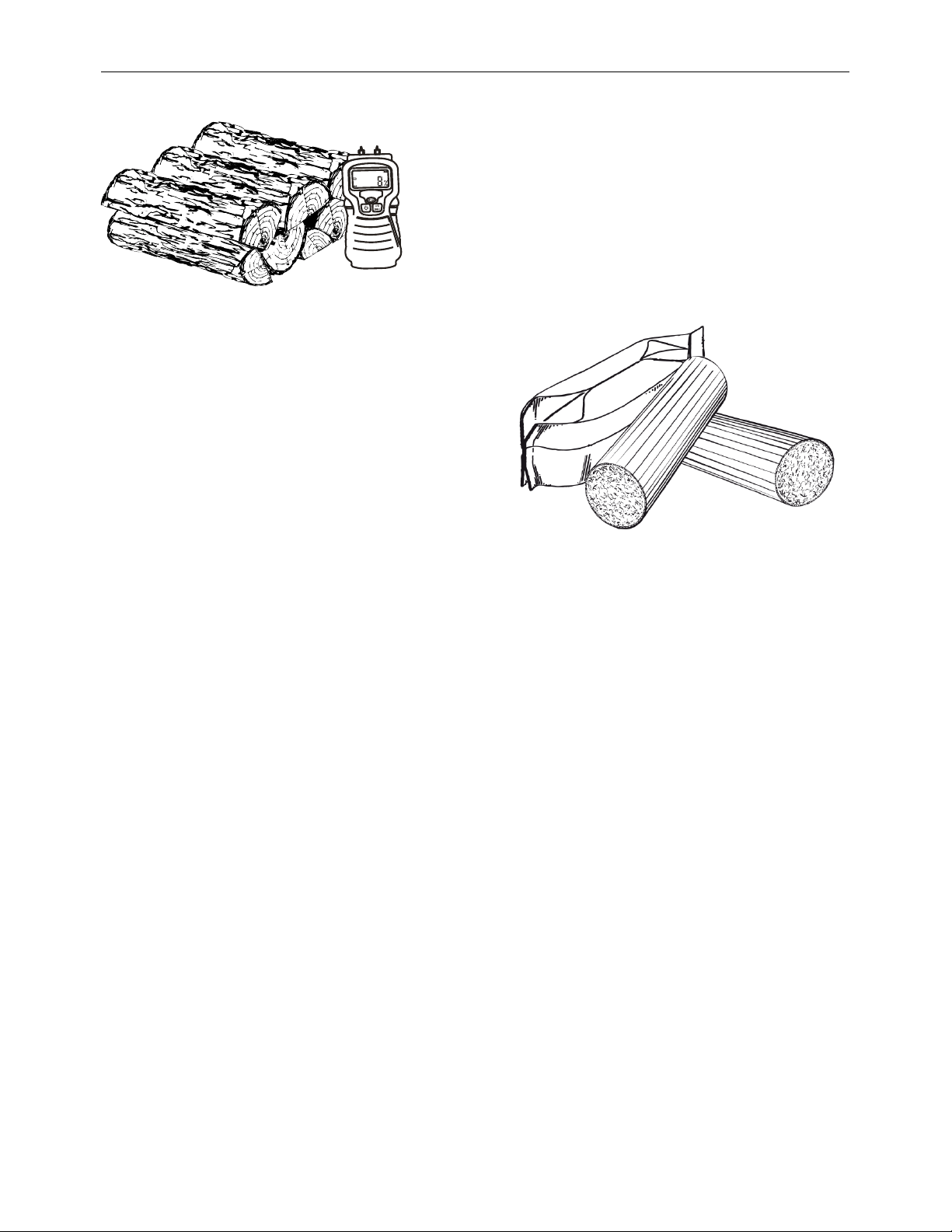
You could buy a wood moisture meter to test your
firewood.
3.1.7 Manufactured Logs
Do not burn manufactured logs made of wax
impregnated sawdust or logs with any chemical
additives. Manufactured logs made of 100%
compressed sawdust can be burned but use
caution in the number of these logs burned at
once. Start with one manufactured log and see
how the stove reacts. You can increase the
number of logs burned at a time to making sure
the temperature never rises higher than 475 °F
(246 °C) on a magnetic thermometer for
installation on single wall stove pipes or 900 °F
(482 °C) on a probe thermometer for installation
on double wall stove pipe. The thermometer should be placed about 18” (457 mm) above
the stove. Higher temperatures can lead to overheat and damage your stove.
4 Operating Your Stove
This wood heater has a manufacturer-set minimum low burn rate that must not be
altered. It is against federal regulations to alter this setting or otherwise operate this
wood heater in a manner inconsistent with operating instructions in this manual.
4.1 The use of a fire screen.
This stove has been tested for use with an open door in conjunction with a fire screen, sold
separately. Make sure the fire screen is properly secured on the stove to avoid any risk of
fire. When the fire screen is used, it is important not to leave the stove unattended to respond
promptly in the event of smoke spillage into the room. Potential causes of smoke spillage
are described in Section 8 of this manual. See Appendix 2: Installing the Optional Fire
Screen for installation instructions.
4.2 Your First Fires
Two things will happen as you burn your first few fires; the paint cures and the internal
components of the stove are conditioned.
As the paint cures, some of the chemicals vaporize. The vapors are not poisonous, but they
do smell bad. Fresh paint fumes can also cause false alarms in smoke detectors. So, when
you first light your stove, be prepared by opening doors and/or windows to ventilate the
house.
Installation and Operation Manual for Escape 1800
18
As you burn hotter and hotter fires, more of the painted surfaces reach the curing
temperature of the paint. The smell of curing paint does not disappear until you have burned
one or two very hot fires.
Burn one or two small fires to begin the curing and conditioning process. Then build bigger
and hotter fires until there is no longer any paint smell from the stove. Once the paint smell
disappears, your stove is ready for serious heating.
4.3 Lighting Fires
Each person who heats with wood develops their own favorite way to light fires. Whatever
method you choose, your goal should be to get a hot fire burning quickly. A fire that starts
fast produces less smoke and deposits less creosote in the chimney. Here are three popular
and effective ways to start wood fires.
4.3.1 Conventional Fire Starting
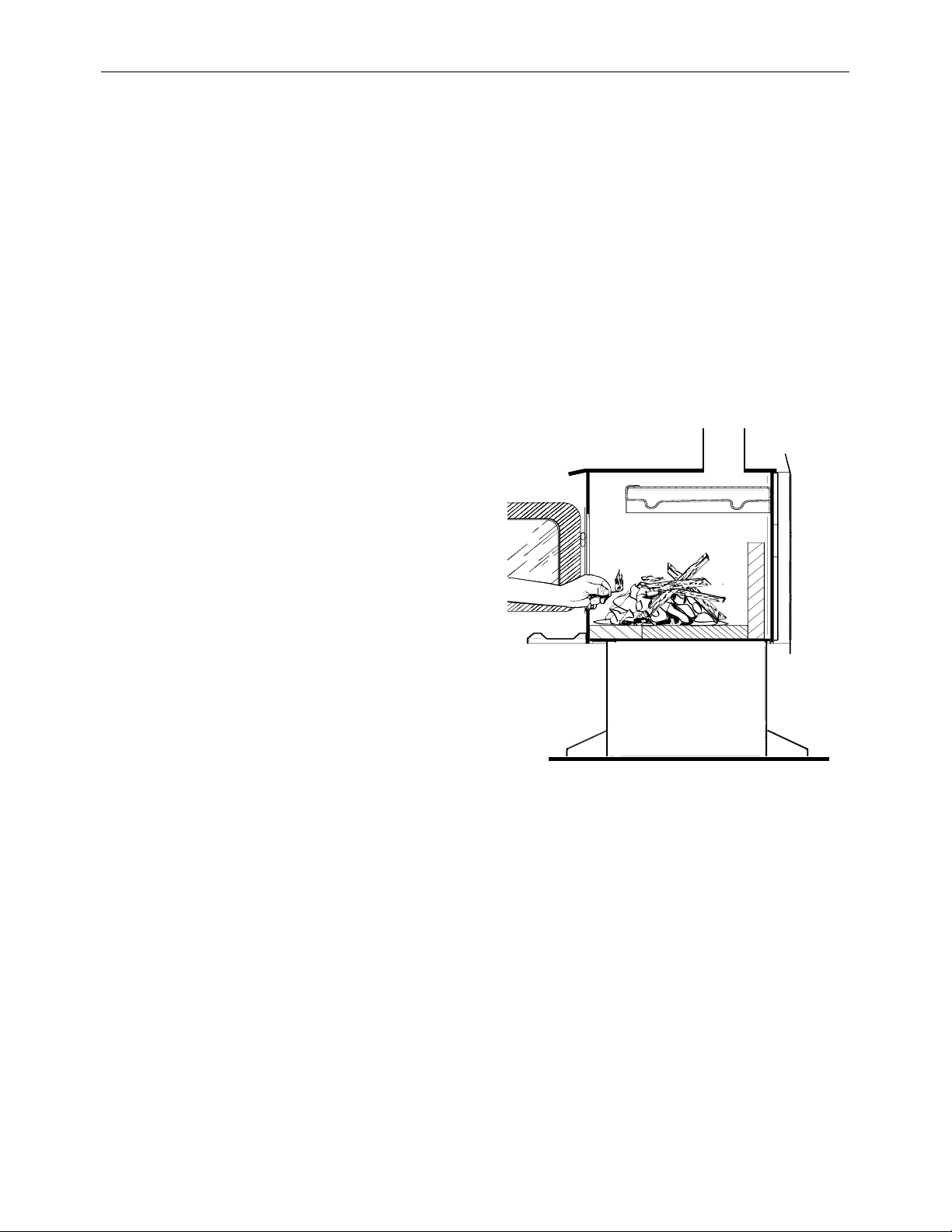
The conventional way to build a wood fire is
to bunch up 5 to 10 sheets of plain
newspapers
and place them in the firebox.
Next, place 10 or so pieces of fine kindling on
the newspaper. This kindling should be very
thin; less than 1” (25 mm). Next, place some
larger kindling pieces on the fine kindling.
Open the air control fully
and light the
newspaper. If you have a tall, straight venting
system you should be able to close the door
immediately and the f
ire will ignite. If your
venting system has elbows or an outside
chimney, you may need to leave the door
closed but unlatched for a few minutes as the
newspaper ignites and heat in the chimney
produces some draft. Once the fire has
ignited, close the door
and leave the air
control fully open.
A conventional kindling fire with paper
under finely split wood.
DO NOT LEAVE THE STOVE UNATTENDED WHEN THE DOOR IS SLIGHTLY OPEN
DURING IGNITION. ALWAYS CLOSE THE DOOR AFTER IGNITION.
After the kindling fire has mostly burned, you can add standard firewood pieces until you
have a fire of the right size for the conditions.
4.3.2 The Top Down Fire
The top down fire method solves two problems with the conventional method: first, it does
not collapse and smother itself as it burns; and second, it is not necessary to build up the
fire gradually because the firebox is loaded before the fire is lit. A top down fire can provide
up to two hours of heating or more. The top down method only works properly if the wood is
well seasoned.

Installation and Operation Manual for Escape 1800
19
Start by placing three or four full-sized split pieces of dry firewood in the firebox. Next, place
4 or 5 more finely split pieces of firewood (2” to 3” [50 mm to 75 mm] in dia.) on the base
logs at right angles (log cabin style). Now place about 10 pieces of finely split kindling on the
second layer at right angles.
The fire is topped with about 5 sheets of newspaper. You can just bunch them up and stuff
them in between the kindling and the underside of the baffle. Or you can make newspaper
knots by rolling up single sheets corner to corner and tying a knot in them. The advantage
of knots is that they don’t roll off the fire as they burn. Light the newspaper and watch as the
fire burns from top to bottom.
4.3.3 Two Parallel Logs
Place two spit logs in the firebox. Place a few sheets of twisted newspapers between the
logs. Now place some fine kindling across the two logs and some larger kindling across
those, log cabin style. Light the newspaper.
4.3.4 Using Fire Starters
Many people like to use commercial fire starters instead of newspapers. Some of these
starters are made of sawdust and wax and others are specialized flammable solid chemicals.
Follow the package directions for use.
Gel starter may be used but only if there are no hot embers present. Use only in a cold
firebox to start a fire.
DO NOT USE FLAMMABLE LIQUIDS SUCH AS GASOLINE, NAPHTHA, FUEL OIL,
MOTOR OIL, OR AEROSOLS TO START OR REKINDLE THE FIRE.
4.4 Maintaining Wood Fires
4.4.1 General Advice
Wood heating with a space heater is very different than other forms of heating. There will be
variations in temperature in different parts of the house and there will be variations in
temperature throughout the day and night. This is normal, and for experienced wood burners
these are advantages of zone heating with wood.
Do not expect steady heat output from your stove. It is normal for its surface temperature to
rise after a new load of wood is ignited and for its temperature to gradually decline as the
fire progresses. This rising and falling of temperature can be matched to your household
routines. For example, the area temperature can be cooler when you are active, such as
when doing housework or cooking, and it can be warmer when you are inactive, such as
when reading or watching television.
Wood burns best in cycles. A cycle starts when a new load of wood is ignited by hot coals
and ends when that load has been consumed down to a bed of charcoal about the same
size as it was when the wood was loaded. Do not attempt to produce a steady heat output
by placing a single log on the fire at regular intervals. Always place at least three, and
preferably more, pieces on the fire at a time so that the heat radiated from one piece helps
to ignite the pieces next to it. Each load of wood should provide several hours of heating.
The size of each load can be matched to the amount of heat needed.
Installation and Operation Manual for Escape 1800
20
When you burn in cycles, you rarely need to open the stove’s loading door while the wood
is flaming. This is an advantage because there is more chance that smoke will leak from the
stove when the door is opened as a full fire is burning.
This is especially true if the chimney connector has 90° elbows and if the chimney runs up
the outside wall of the house.
IF YOU MUST OPEN THE DOOR WHILE THE FUEL IS FLAMING, OPEN THE AIR
CONTROL FULLY FOR A FEW MINUTES, THEN UNLATCH AND OPEN THE DOOR
SLOWLY.
4.4.2 Ash Removal
Ash should be removed from the firebox every two or three days of full time heating. Do not
let the ash build up in the firebox because it will interfere with proper fire management.
The best time to remove ash is after an overnight fire when the stove is relatively cool, but
there is still some chimney draft to draw the ash dust into the stove and prevent it from
coming into the room.
After ashes have been removed from the stove and placed in a tightly covered metal
container, they should be taken outside immediately. The closed container of ashes should
be placed on a non-combustible floor or on the ground well away from all combustible
materials pending final disposal. Ashes normally contain some live charcoal that can stay
hot for several days. If the ashes are disposed of by burial in soil or otherwise locally
dispersed, they should be retained in a closed container until all cinders have thoroughly
cooled. Other waste shall not be placed in this container.
NEVER STORE ASHES INDOORS OR IN A NON-METALLIC CONTAINER OR ON A
WOODEN DECK.
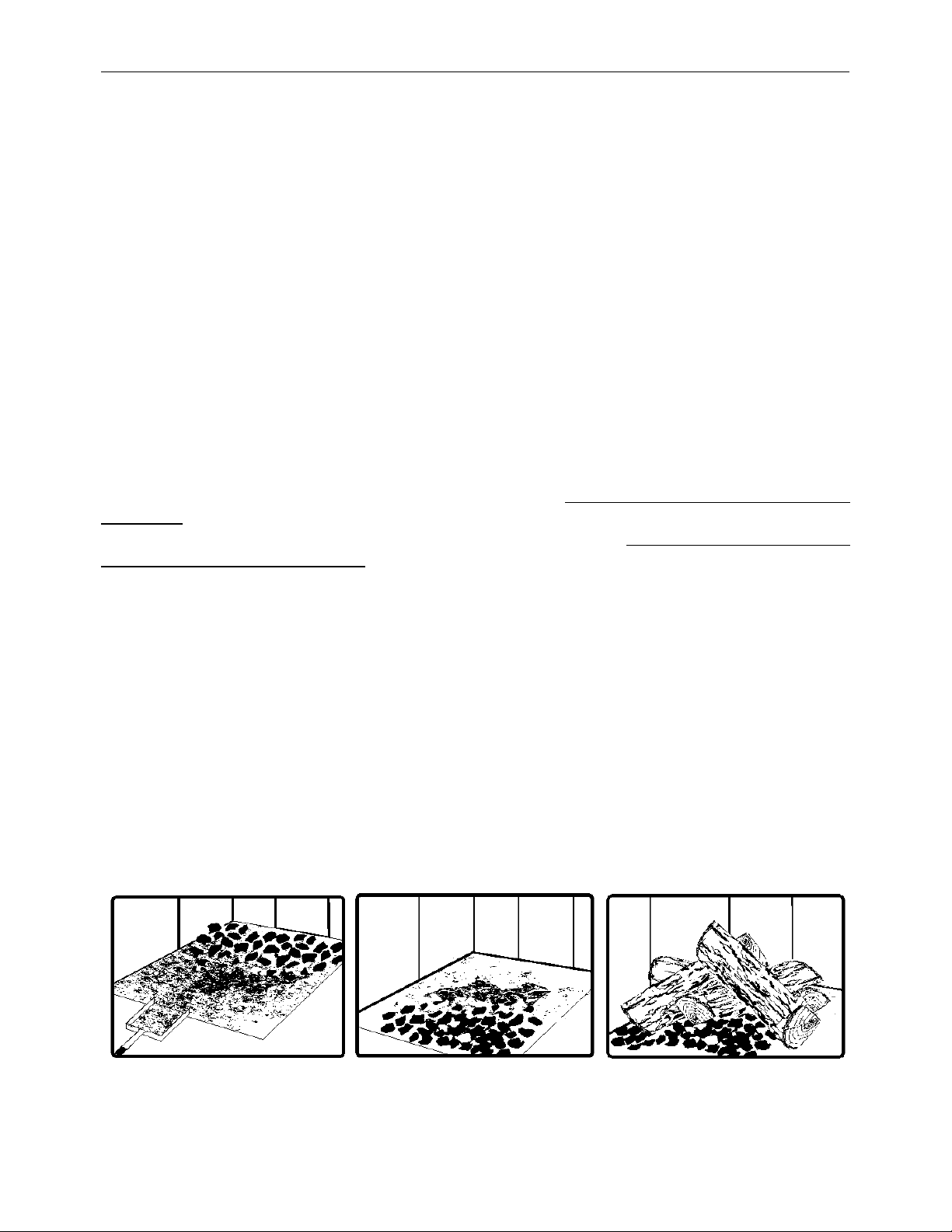
4.4.3 Raking Charcoal
Rekindle the fire when you notice that the room temperature has fallen. You will find most
of the remaining charcoal at the back of the firebox, furthest from the door. Rake these coals
towards the door before loading. There are two reasons for this raking of the coals. First, it
concentrates them near where most of the combustion air enters the firebox and where they
can ignite the new load quickly, and second, the charcoal will not be smothered by the new
load of wood. If you were to simply spread the charcoal out, the new load will smoulder for
a long time before igniting.
Remove ash first, and then rake charcoal towards the front of the firebox before loading so
that it will ignite the new load.
Installation and Operation Manual for Escape 1800
21
4.4.4 Firing Each New Load Hot
Place the new load of wood on and behind the charcoal, and not too close to the glass.
Close the door and open the air control fully. Leave the air control fully open until the firebox
is full of flames, the wood has charred to black and its edges are glowing red. Firing each
load of wood hot accomplishes a few things:
• drives the surface moisture from the wood,
• creates a layer of char on the wood, which slows down its release of smoke,
• heats the firebox components so they reflect heat back to the fire, and
• heats the chimney so it can produce strong, steady draft for the rest of the cycle.
Although it is important to fire each new load hot to prepare for a clean burn, do not allow
the fire to burn at full intensity for more than a few minutes.
DO NOT LEAVE THE STOVE UNATTENDED WHILE A NEW LOAD IS BEING FIRED
HOT.
When you burn a new load of wood hot to heat up the wood, the stove and the chimney, the
result will be a surge of heat from the stove. This heat surge is welcome when the room
temperature is a little lower than desirable, but not welcome if the space is already warm.
Therefore, allow each load of wood to burn down so that the space begins to cool off a little
before loading. Letting the space cool before loading is one of the secrets to clean burning
and effective zone heating.
4.4.5 Turning Down the Air Supply
Once the firewood, firebox and chimney are hot, you can begin to reduce the air supply for
a steady burn.
As you reduce the air supply to the fire, two important things happen. First, the firing rate
slows down to spread the heat energy in the fuel over a longer period of time. Second, the
flow rate of exhaust through the stove and flue pipe slows down, which gives more time for
the transfer of heat from the exhaust. You will notice that as you reduce the air setting, the
flames slow down. This is your indication that the stove is burning at its peak efficiency.
If the flames get small and almost disappear
when you turn down the air, you have turned
down the air too early, or your firewood is wetter
than it should be. With good fuel and correct air
control use, the flames should slow down, but
should stay large and steady, even as the air
supply is reduced.
Figure 1 : Air Intake Flow Control

Installation and Operation Manual for Escape 1800
22
4.4.6 Building Different Fires for Different Needs
Using the air control is not the only way to match the stove’s heat output to the heat demand.
Your house will need far less heat in October than in January to be kept at a comfortable
temperature. If you fill the firebox full in fall weather, you will either overheat the space or
turn the stove down so much that the fire will be smoky and inefficient. Here are some
suggestions for building fires to match different heat demand.
4.4.6.1 Small Fires to Take the Chill Off the House
To build a small fire that will produce a low heat output, use small pieces of firewood and
load them crisscross in the firebox. The pieces should be only 3” to 4” in diameter. After
raking the coals, you can lay two pieces parallel to each other corner to corner in the firebox
and lay two more across them in the other direction. Open the air control fully and only
reduce the air after the wood is fully flaming. This kind of fire is good for mild weather when
you are around to tend the stove and should provide enough heat for four hours or more.
Small fires like this are a good time to use softer wood species so there will be less chance
of overheating the house.
4.4.6.2 Long Lasting Low Output Fires
Sometimes you will want to build a fire to last up to eight hours, but don’t need intense heat.
In this case use soft wood species and place the logs compactly in the firebox so the pieces
are packed tightly together. You will need to fire the load hot for long enough to fully char
the log surfaces before you can turn the air down. Make sure the fire is flaming brightly
before leaving the fire to burn.
4.4.6.3 High Output Fires for Cold Weather
When the heat demand is high during cold weather, you’ll need a fire that burns steadily and
brightly. This is the time to use your biggest pieces of hardwood fuel if you have it. Put the
biggest pieces at the back of the firebox and place the rest of the pieces compactly. A
densely built fire like this will produce the longest burn your stove is capable of.
You will need to be cautious when building fires like this because if the air is turned down
too much, the fire could smoulder. Make sure the wood is flaming brightly before leaving the
fire to burn.
4.4.6.4 Maximum Burn Cycle Times
The burn cycle time is the period between loading wood on a coal bed and the consumption
of that wood back to a coal bed of the same size. The flaming phase of the fire lasts for
roughly the first half of the burn cycle and the second half is the coal bed phase during which
there is little or no flame. The length of burn you can expect from your stove, including both
the flaming and coal bed phases, will be affected by a number of things, such as:
• firebox size
• the size of the space to be heated
• the amount of wood loaded
• the climate zone you live in
• the species of wood you burn
• the time of year
• the wood moisture content
Installation and Operation Manual for Escape 1800
23
The table below provides a very general indication of the maximum burn cycle times you are
likely to experience, based on firebox volume.
FIREBOX VOLUME
MAXIMUM
BURN TIME
<1.5 cubic feet 3 to 5 hours
1.5 c.f. to 2.0 c.f 5 to 6 hours
2.0 c.f. to 2.5 c.f. 6 to 8 hours
2.5 c.f. to 3.0 c.f. 8 to 9 hours
>3.0 c.f. 9 to 10 hours
Long burn times are not necessarily an indication of efficient stove operation. When you are
home during the day and able to tend the fire, it is preferable to build a smaller fire that might
provide three or four hours of heating than to fully load the firebox for a much longer burn.
Shorter burn cycles make it easier to match the heat output of the stove to the heat demand
for the space.
4.4.6.5 North-South Fires Versus East-West Fires
In fireboxes that are roughly square, wood can be loaded so that looking through the glass
door you see the ends of the logs (north-south) or the sides of the logs (east-west).
East-west loads that are built compactly break down slowly when heated, but the amount of
wood you can load is limited because if you put in too many pieces, one may fall against the
glass. East-west loads are excellent for long, low output fires for relatively mild weather.
North-south loads break down more quickly, but much more wood can be loaded at a time.
This makes north-south loading good for high output, long lasting fires for cold weather.
4.4.6.6 Carbon Monoxide
When unburned logs remain in the firebox and the flame disappears, go outside and look at
the chimney exit. If there is visible smoke, it means that there is still combustible to burn but
that the fire lacks air to burn properly. In this situation, the CO rate will increase so it is
important to react. Open the door slightly and move the log with a poker. Turn it over and
create a passage for the air below, making a trench with the coal bed. Add small pieces of
wood to restart the combustion.
5 Maintaining Your Wood Heating System
5.1 Stove Maintenance
Your new stove will give many years of reliable service if you use and maintain it correctly.
Some of the internal components of the firebox, such as firebricks, baffles and air tubes, will
wear over time under intense heat. You should always replace defective parts with original
parts (see Appendix 5: Exploded Diagram and Parts List). For firing each load hot to
begin a cycle as described above will not cause premature deterioration of the stove.
However, letting the stove run with the air control fully open for entire cycles can cause
damage over time. The hotter you run the stove throughout burn cycles, the more quickly its

Installation and Operation Manual for Escape 1800
24
components will deteriorate. For that reason, never leave the stove unattended while a
new load is being fired hot.
5.1.1 Cleaning Door Glass
Under normal conditions, your door glass should stay relatively clear. If your firewood is dry
enough and you follow the operating instructions in this manual, a whitish, dusty deposit will
form on the inside of the glass after a week or so of use. This is normal and can be easily
removed when the stove is cool by wiping with a damp cloth or paper towel and then drying.
Never try to clean the glass when the stove is hot.
In spring and fall when the stove is run at lower temperatures, you may see some light brown
stains forming, especially at the lower corners of the glass. This indicates that the fire has
been smoky and some of the smoke has condensed on the glass. When the weather is mild,
you may find that letting the fire go out is better than trying to maintain a continuous fire. Use
the technique described above for building a fire to take the chill off the house.
If you do get brown stains on the glass, you can remove them with special cleaners for wood
stove glass doors. Do not use abrasives to clean your stove’s door glass.
The deposits that form on the glass are the best indication of the quality of your fuel and how
well you are doing in operating the stove. Your goal should be clear glass with no brown
stains. If you continue to see brown stains on the glass, something about your fuel and
operating procedure needs to be changed. Stains on the glass indicate incomplete
combustion of the wood, which also means more smoke emissions and faster formation of
creosote in the chimney.
If you see brown streaks coming from the edge of the glass, it is time to replace the gasket
around the glass. Visit your stove retailer to get the self-adhesive glass gasket and follow
the instructions below for installation.
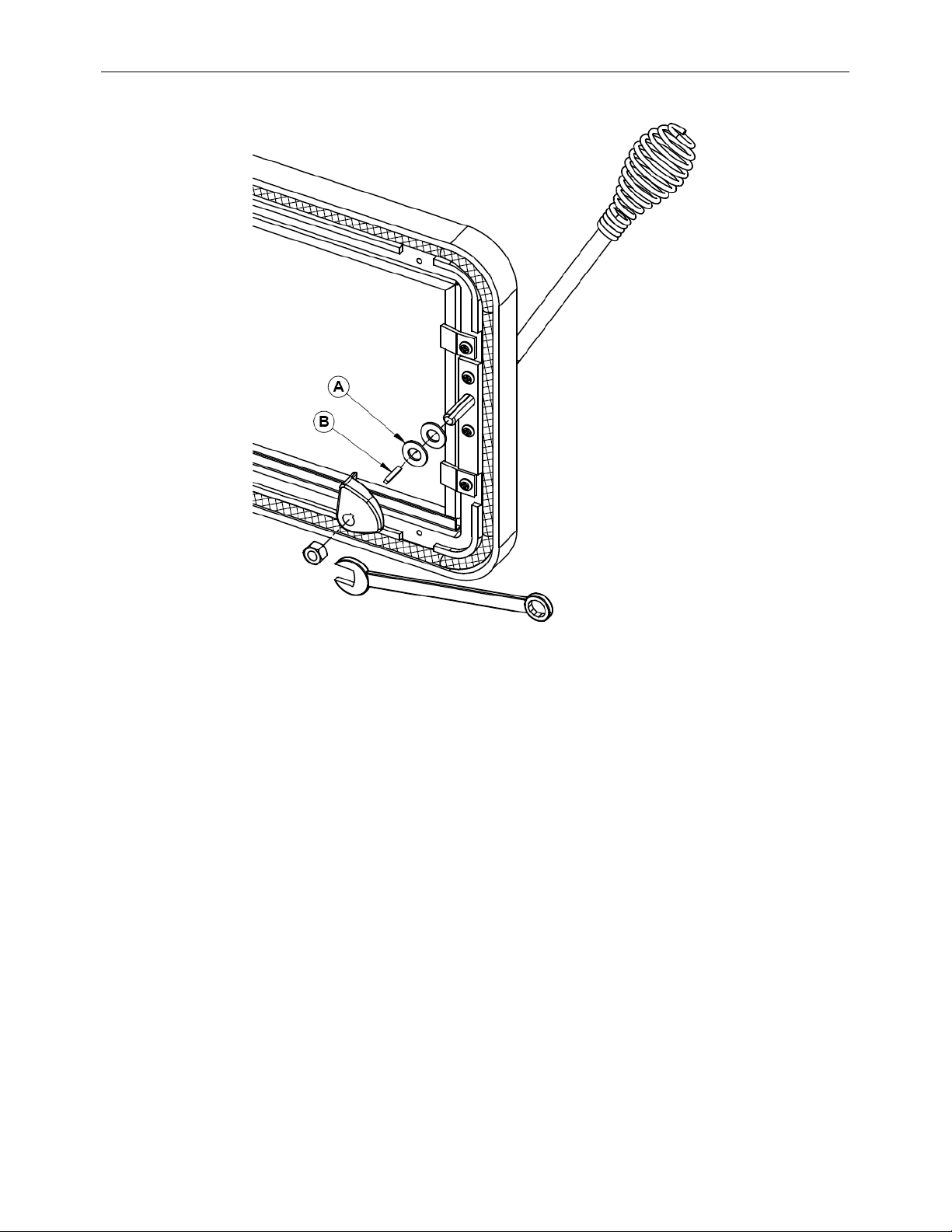
5.1.2 Door adjustment
1. Unscrew the nut.
2. Remove the door latch and the key path pin (B).
3. Remove or add one washer (A) as needed. Keep the removed washer for future
adjustment.
4. Reinstall the key path pin in the keyway and slide the latch along it.
5. Secure with the nut.
Installation and Operation Manual for Escape 1800
25
Figure 2 : Door Adjustment
5.1.3 Replacing the Door Gasket
It is important to maintain the gasket in good condition. After a year or more of use, the door
gasket will compress and become hard, which may allow air to leak past it. You can test the
condition of the door gasket by closing and latching the door on a strip of paper. Test all
around the door. If the paper slips out easily anywhere, it is time to replace the gasket.
Use the correct replacement gasket that you can purchase from your retailer. The diameter
and density of the gasket is important to getting a good seal.
Place the door face-down on something soft like a cushion of rags or piece of carpet.
Remove the old gasket from the door by pulling and prying it out with an old screw driver.
Then use the screwdriver to scrape the old gasket adhesive from the door. Now run a 1/4”
(6 mm) bead of high temperature silicone in the door gasket groove. Starting from the middle
of the hinge side, press the gasket into the groove. Do not stretch the gasket as you place
it. Leave the gasket about 1/2” long when you cut it and press the end into the groove. Tuck
any loose fibres under the gasket and into the silicone. Close the door and do not use the
stove for 24 hours.
Installation and Operation Manual for Escape 1800
26
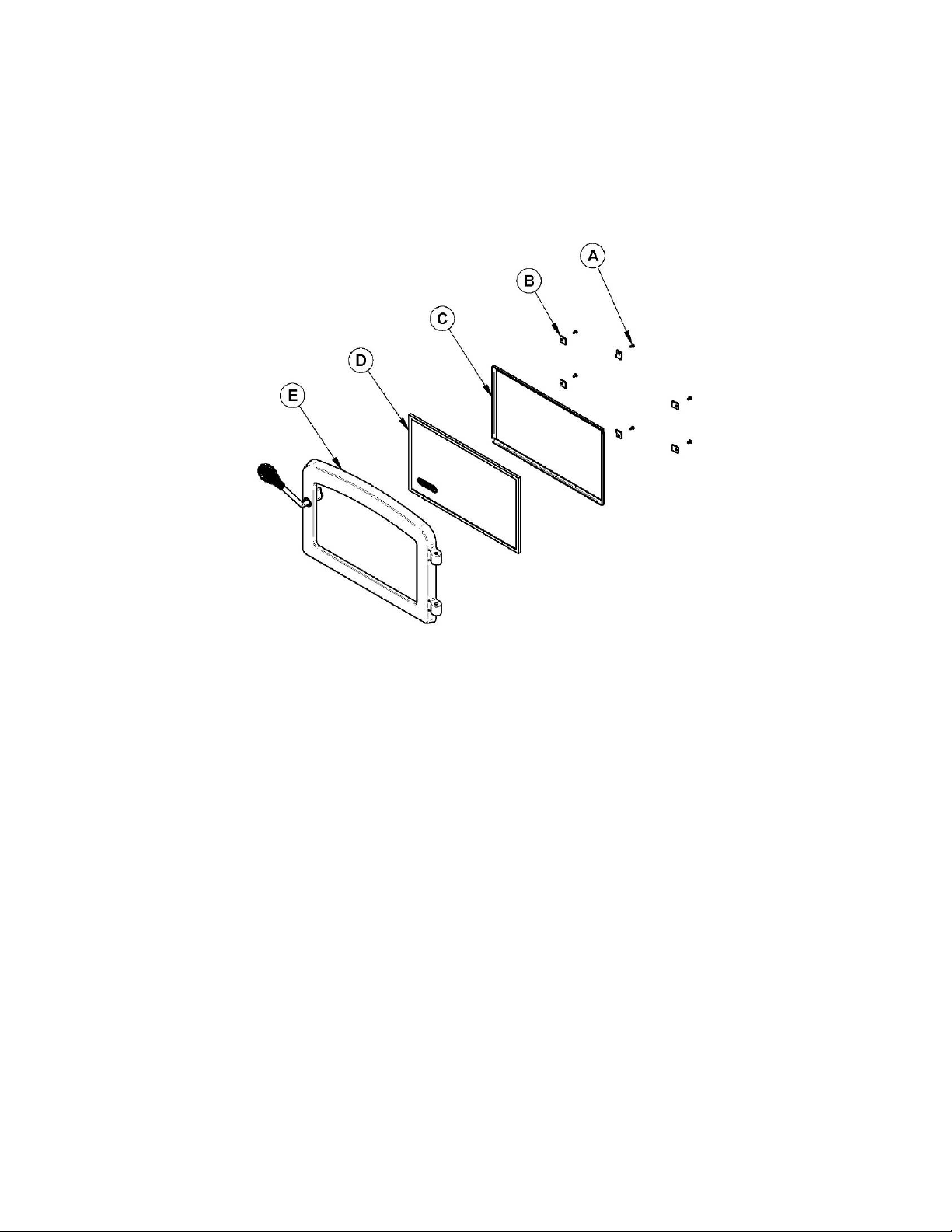
5.1.4 Replacing the Glass Gasket and/or the Glass
It is a good idea to replace the glass gasket when the door gasket is replaced. The gasket
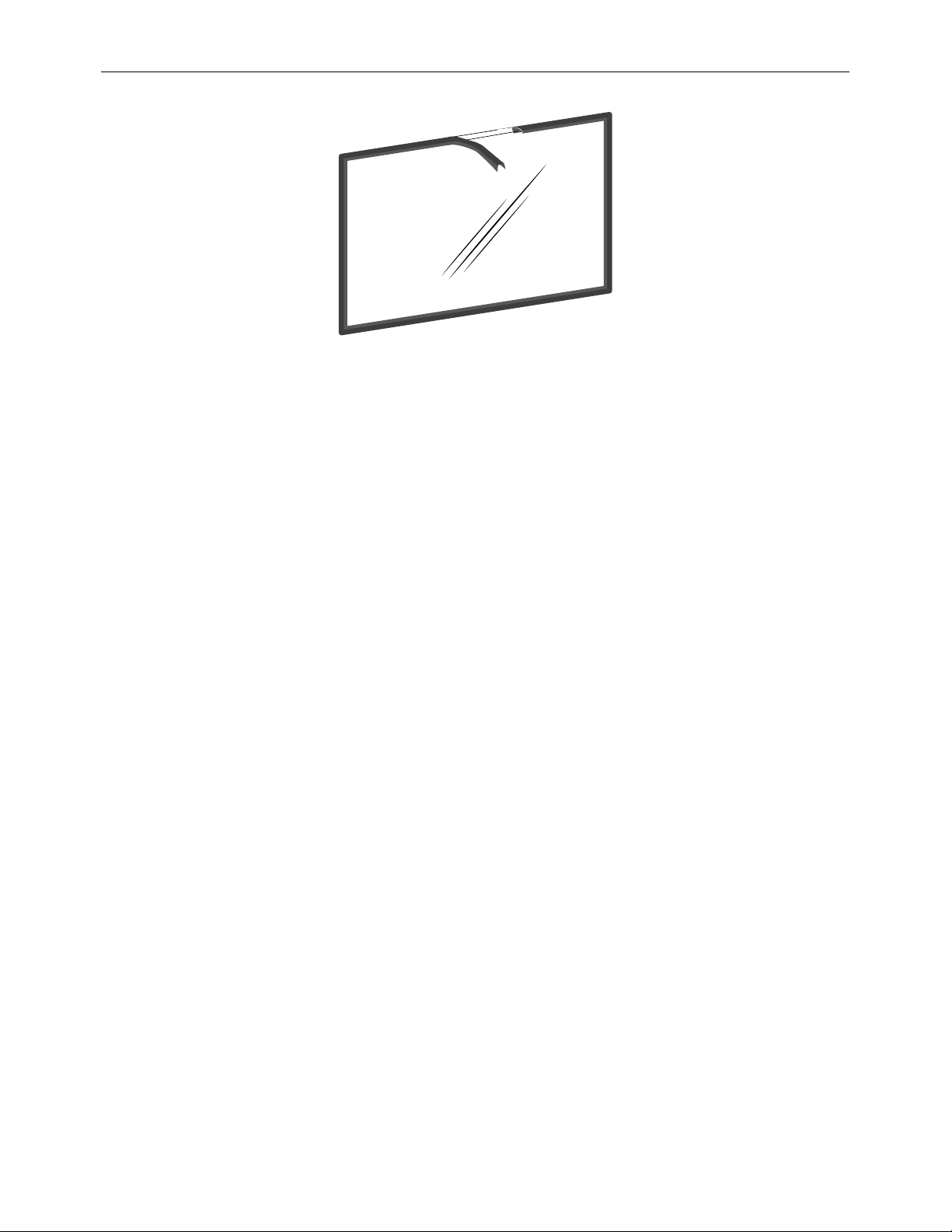
is flat, adhesive-backed, woven fibreglass. Remove the glass retaining screws (A), the clips
(B) and the metal frame (C) that holds the glass to the door frame (E). Lift out the glass (D)
and pull off the old gasket. This is a good time to clean the glass thoroughly.
Figure 3 : Glass Replacement
The gasket must be centred on the edge of the glass. To do this easily, peel back a section
of the paper covering the adhesive and place the gasket on a table with the adhesive side
up. Stick the end of the gasket to the middle of one edge, then press the edge of the glass
down onto the gasket, taking care that it is perfectly centred on the gasket. Peel off more of
the backing and rotate the glass and press the next section onto the gasket. Do not stretch
the gasket as you place it. Continue until you get to the start and trim the gasket to length.
Now pinch the gasket to the glass in a U shape, all around the glass. Reinstall the glass,
being careful to centre the glass carefully in the door. Do not over-tighten the screws. Note
that the two main causes of broken door glass are uneven placement in the door and over-
tightening of retaining screws.
Installation and Operation Manual for Escape 1800
27
Do not abuse the glass door by striking or slamming shut. Do not use the stove if the glass
is broken. To change the glass, perform the same operation described above.
5.1.5 Cleaning and Painting the Stove
Do not attempt to clean or paint the stove when the unit is hot. Painted surfaces can
be wiped down with a damp cloth. Plated surfaces may be scratched by abrasive cleaners.
To maintain the finish at its original brilliance, use only a damp soft cloth to clean plated
surfaces.
If the paint becomes scratched or damaged, you can give your wood stove a brand new look
by repainting it with heat-resistant paint. Before painting, roughen the surface with fine sand
paper, wipe it down to remove dust, and apply two thin coats of paint. For best results, use
the same paint that was originally used on the stove, which is available in spray cans. See
your dealer for details.
5.2 Chimney and Chimney Connector Maintenance
5.2.1 Why Chimney Cleaning is Necessary
Wood smoke can condense inside the chimney connector and chimney, forming a
combustible deposit called creosote. If creosote is allowed to build up in the venting system,
it can ignite when a hot fire is burned in the stove and a very hot fire can progress to the top
of the chimney. Severe chimney fires can damage even the best chimneys. Smouldering,
smoky fires can quickly cause a thick layer of creosote to form. When you avoid smouldering
so the exhaust from the chimney is mostly clear, creosote builds up more slowly. Your new
stove has the right characteristics to help you to burn clean fires with little or no smoke,
resulting in less creosote in the chimney.
5.2.2 How Often Should You Clean the Chimney?
It is not possible to predict how much or how quickly creosote will form in your chimney. It is
important, therefore, to check the build-up in your chimney monthly when getting used to the
new stove until you determine the rate of creosote formation. Even if creosote forms slowly
in your system, the chimney should be cleaned and inspected at least once each year.
Contact your local municipal or provincial fire authority for information on how to handle a
chimney fire. Have a clearly understood plan to handle a chimney fire.
Installation and Operation Manual for Escape 1800
28
5.2.3 Cleaning the Chimney
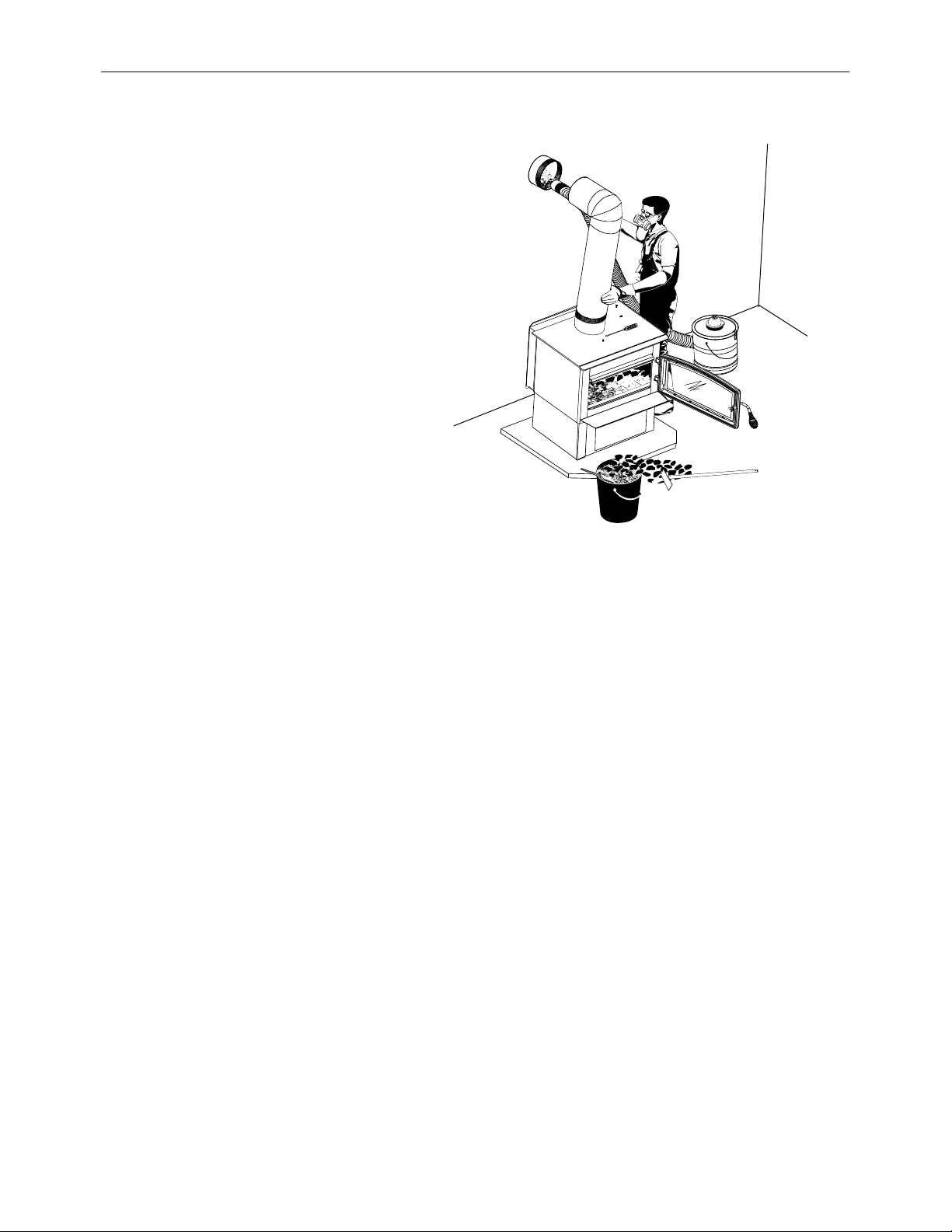
Chimney cleaning can be a difficult and
dangerous job. If you don’t have
experience cleaning chimneys, you
might want to hire a professional
chimney sweep to clean and inspect the
system for the first time. After having
seen the cleaning process, you can
decide if it is a job you would like to take
on.
The most common equipment used are
fibreglass rods with threaded fittings
and
stiff plastic brushes. The brush is
forced up and down inside the chimney
flue to scrub off the creosote.
The chimney connector assembly
should always be cleaned at the same
time the chimney is cleaned.
CAUTION: Operation of your stove without the baffle may cause unsafe and hazardous
temperature conditions and will void the warranty. NOTE: Before installing the firebrick,
check to ensure that none are broken or damaged in any way. If so, have the damaged
ones replaced. Check the firebrick for damage at least annually and replace any broken or
damaged ones with new ones. Inspection and cleaning of the chimney is facilitated by the
removable baffle.

Installation and Operation Manual for Escape 1800
29
PART B - INSTALLATION
6 Safety Information
6.1 Summary of Installation Cautions and Warnings
• THE INFORMATION GIVEN ON THE CERTIFICATION LABEL AFFIXED TO THE
APPLIANCE ALWAYS OVERRIDES THE INFORMATION PUBLISHED, IN ANY
OTHER MEDIA (OWNER’S MANUAL, CATALOGUES, FLYERS, MAGAZINES
AND/OR WEB SITES).
• MIXING OF APPLIANCE COMPONENTS FROM DIFFERENT SOURCES OR
MODIFYING COMPONENTS MAY RESULT IN HAZARDOUS CONDTIONS. WHERE
ANY SUCH CHANGES ARE PLANNED, STOVE BUILDER INTERNATIONAL INC.
SHOULD BE CONTACTED IN ADVANCE.
• ANY MODIFICATION OF THE APPLIANCE THAT HAS NOT BEEN APPROVED IN
WRITING BY THE TESTING AUTHORITY VIOLATES CSA B365 (CANADA), AND
ANSI NFPA 211 (USA).
• CONNECT THIS STOVE ONLY TO A LISTED FACTORY-BUILT CHIMNEY FOR USE
WITH SOLID FUEL OR TO A LINED MASONRY CHIMNEY CONFORMING TO
NATIONAL AND LOCAL BUILDING CODES.
• IF REQUIRED, A SUPPLY OF COMBUSTION AIR SHALL BE PROVIDED TO THE
ROOM OR SPACE.
• DO NOT CONNECT TO OR USE IN CONJUNCTION WITH ANY AIR DISTRIBUTION
DUCTWORK UNLESS SPECIFICALLY APPROVED FOR SUCH INSTALLATION.
• DO NOT CONNECT THIS UNIT TO A CHIMNEY FLUE SERVING ANOTHER
APPLIANCE.
• MAY BE INSTALLED IN A MOBILE HOME
• THIS MOBILE HOME APPROVED STOVE REQUIRES THE INSTALLATION OF A
FRESH AIR KIT, SOLD SEPARATELY.
WARNING:
• DO NOT INSTALL IN A SLEEPING ROOM.
• THE STOVE MUST BE ATTACHED TO THE STRUCTURE OF THE MOBILE
HOME.
CAUTION: THE STRUCTURAL INTEGRITY OF THE MOBILE HOME FLOOR, WALL,
AND CEILING/ROOF MUST BE MAINTAINED.

Installation and Operation Manual for Escape 1800
30
6.2 Regulations Covering Stove Installation
When installed and operated as described in these instructions, the Escape 1800 wood
stove is suitable for use as a freestanding heater in residential installations. The Escape
1800 wood stove is not intended for installation in a sleeping room of a mobile home.
In Canada, the CSA B365 Installation Code for Solid Fuel Burning Appliances and
Equipment and the CSA C22.1 Canadian National Electrical Code are to be followed in the
absence of local code requirements. In the USA, the ANSI NFPA 211 Standard for
Chimneys, Fireplaces, Vents and Solid Fuel-Burning Appliances and the ANSI NFPA 70
National Electrical Code are to be followed in the absence of local code requirements.
This stove must be connected to a chimney complying with the requirements for Type HT
chimneys in the Standard for Factory-Built Chimneys for Residential Type and Building
Heating Appliances, UL 103 and ULC S629 or to a code-approved masonry chimney with a
flue liner.
7 Clearances to Combustible Material
The clearances shown in this section have been determined by tests according to
procedures set out in safety standards ULC S627 (Canada), UL1482 (U.S.A.) and UL737
(U.S.A.). When the stove is installed so that its surfaces are at or beyond the minimum
clearances specified, combustible surfaces will not overheat under normal and even
abnormal operating conditions.
No part of the stove or flue pipe may be located closer to combustibles than the
minimum clearance figures given.
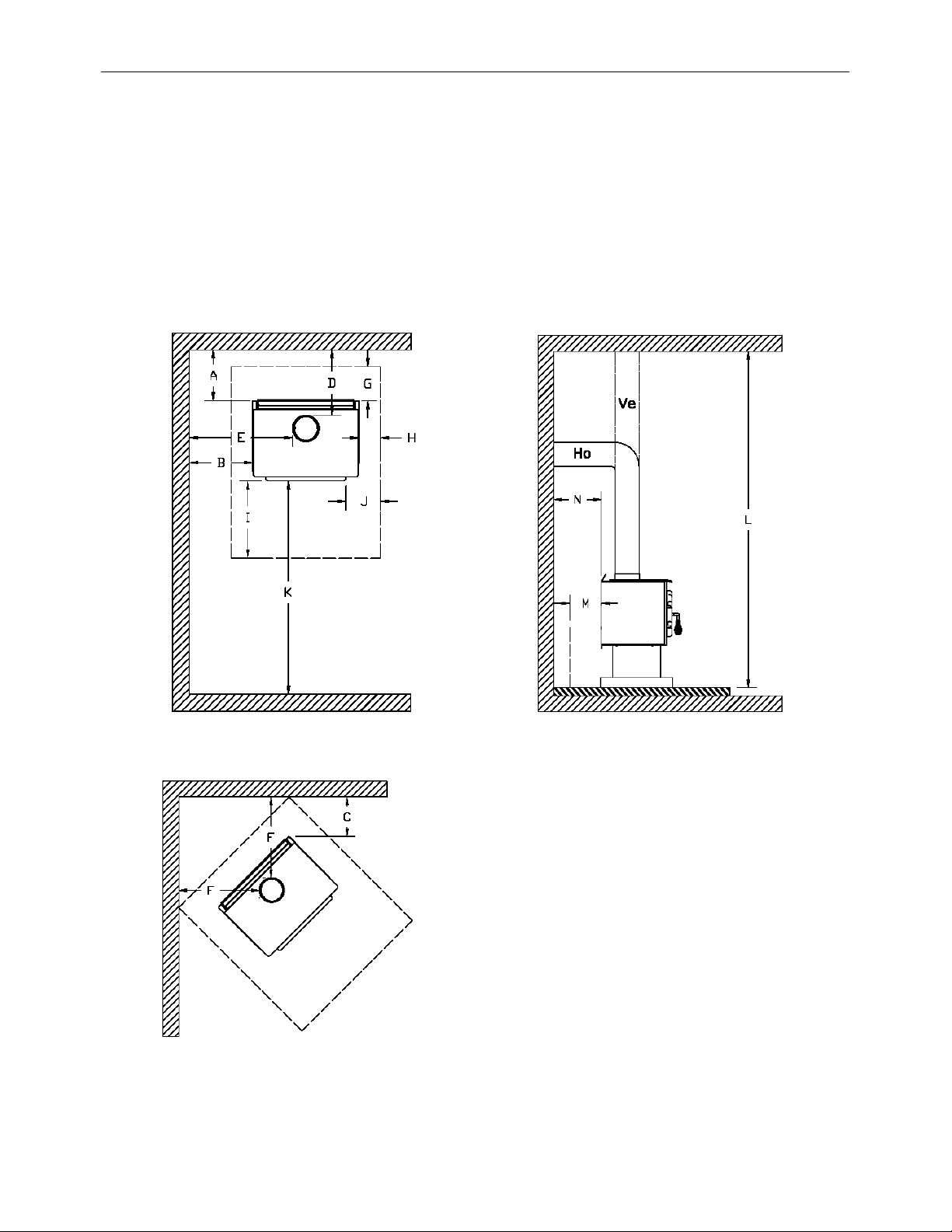
7.1 Location of the certification label
Since the information given on the certification label affixed to the appliance always
overrides the information published, in any other media (owner’s manual, catalogues, flyers,
magazines and/or web sites) it is important to refer to it in order to have a safe and compliant
installation. In addition, you will find information about your stove (model, serial number,
etc.). You can find the certification label on the back of the stove.
Installation and Operation Manual for Escape 1800
31
7.2 Clearances to Combustible Materials
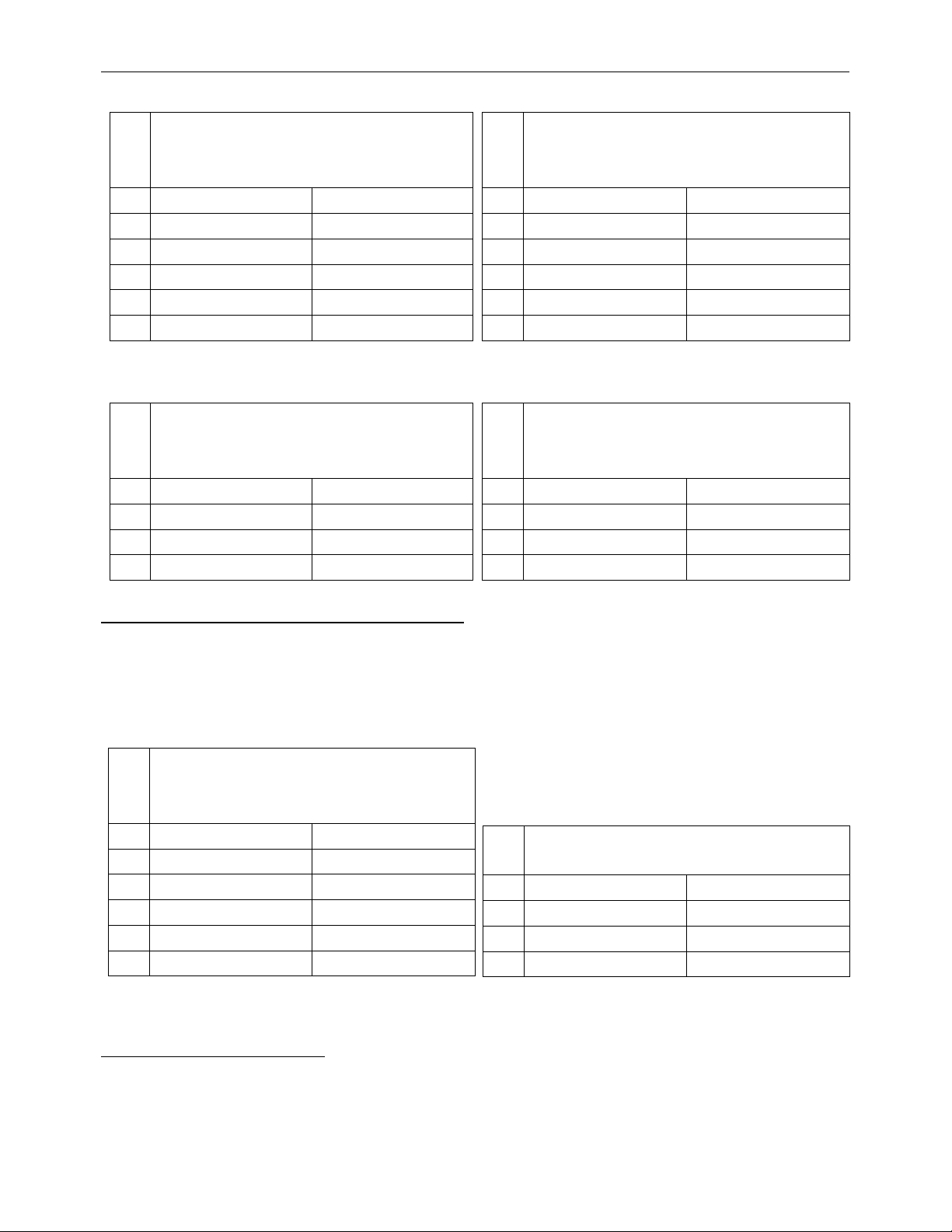
The clearances to combustible walls may be slightly different in Canada and the U.S.A. and
may also differ depending on whether you use single or double wall flue pipe. Please be
sure to choose the correct clearance for your location and type of flue pipe.
The clearances of the appliance and the flue pipes must be met individually, meaning the
appliance cannot be installed closer to the combustible materials than the single or double
wall pipe allows. For a safe way to reduce clearances refer to section 7.4 Reducing Wall
and Ceiling Clearances Safely
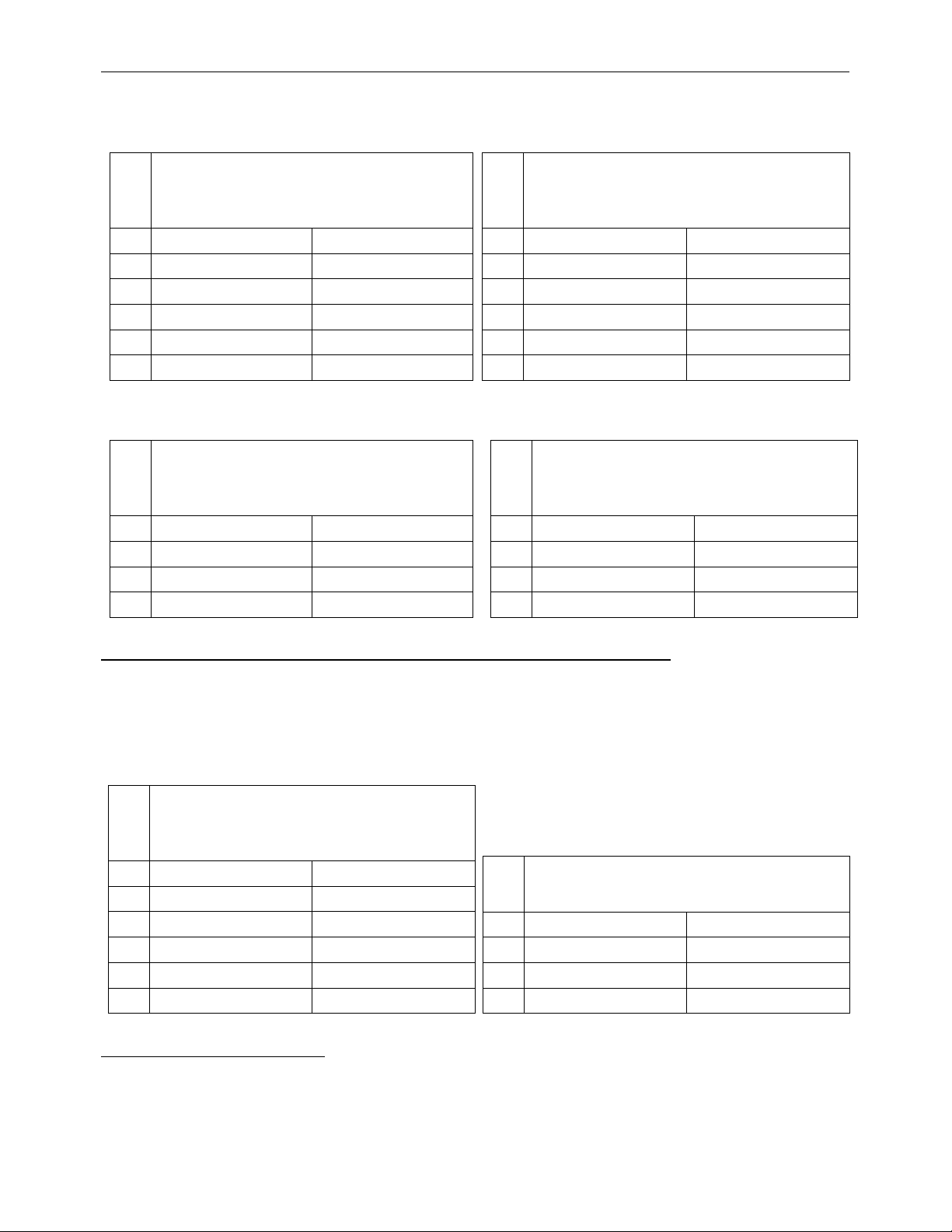
Figure 4 : Clearances – Top View
Figure 5 : Clearances View - Side View
Figure 6 : Corner Clearances
Installation and Operation Manual for Escape 1800
32
APPLIANCE CLEARANCES
(INSTALLATION WITH SINGLE WALL
PIPE CONNECTOR)
CANADA
USA
A
14 ½" (368 mm)
11" (279 mm)
B
17" (432 mm)
16" (406 mm)
C
10" (254 mm)
10" (254 mm)
K
48" (122 cm)
48" (122 cm)
L
84" (213 cm)
84" (213 cm)
APPLIANCE CLEARANCES
(INSTALLATION WITH DOUBLE
WALL PIPE CONNECTOR)
CANADA
USA
A
6" (152 mm)
6" (152 mm)
B
17" (432 mm)
16" (406 mm)
C
7" (178 mm)
7" (178 mm)
K
48" (122 cm)
48" (122 cm)
L
84" (213 cm)
84" (213 cm)
If the above clearances are met, then the distances measured from the flue outlet will be:
DISTANCES
1
FROM PIPE
CONNECTOR WITH SINGLE WALL
PIPE CONNECTOR
CANADA
USA
D
18" (457 mm)
14 ½" (368 mm)
E
26 ½" (673 mm)
25 ½" (648 mm)
F
19 ¾" (502 mm)
19 ¾" (502 mm)
DISTANCES* FROM PIPE
CONNECTOR WITH DOUBLE WALL
PIPE CONNECTOR
CANADA
USA
D
9 ¼" (235 mm)
9 ¼" (235 mm)
E
26 ¼" (667 mm)
25 ¼" (641 mm)
F
16 ½" (419 mm)
16 ½" (419 mm)
Clearances with heat shield AC02710
Note that to reduce the clearances of an appliance using a single wall pipe connector, the
use of a heat shield certified with the single wall pipe connector to be used as close as 6"
from combustible materials must be used. Only in this case, the same clearances as a
certified double wall pipe connector can be used.
APPLIANCE CLEARANCES
(INSTALLATION WITH DOUBLE
WALL PIPE CONNECTOR)
CANADA
USA
A
3" (76 mm)
3" (76 mm)
B
4" (102 mm)
4" (102 mm)
C
3" (76 mm)
3" (76 mm)
K
48" (122 cm)
48" (122 cm)
L
84" (213 cm)
84" (213 cm)
If the above clearances are met, then the
distances measured from the flue outlet will
be:
DISTANCES
1
FROM DOUBLE WALL
PIPE CONNECTOR
CANADA
USA
D
6 ¼" (159 mm)
6 ¼" (159 mm)
E
13 ¼" (337 mm)
13 ¼" (337 mm)
F
12 ½" (318 mm)
12 ½" (318 mm)
1
The pipe distances listed in this table refer to the distances obtained when the stove is installed in accordance
with the appliance clearances above mentioned.
Installation and Operation Manual for Escape 1800
33
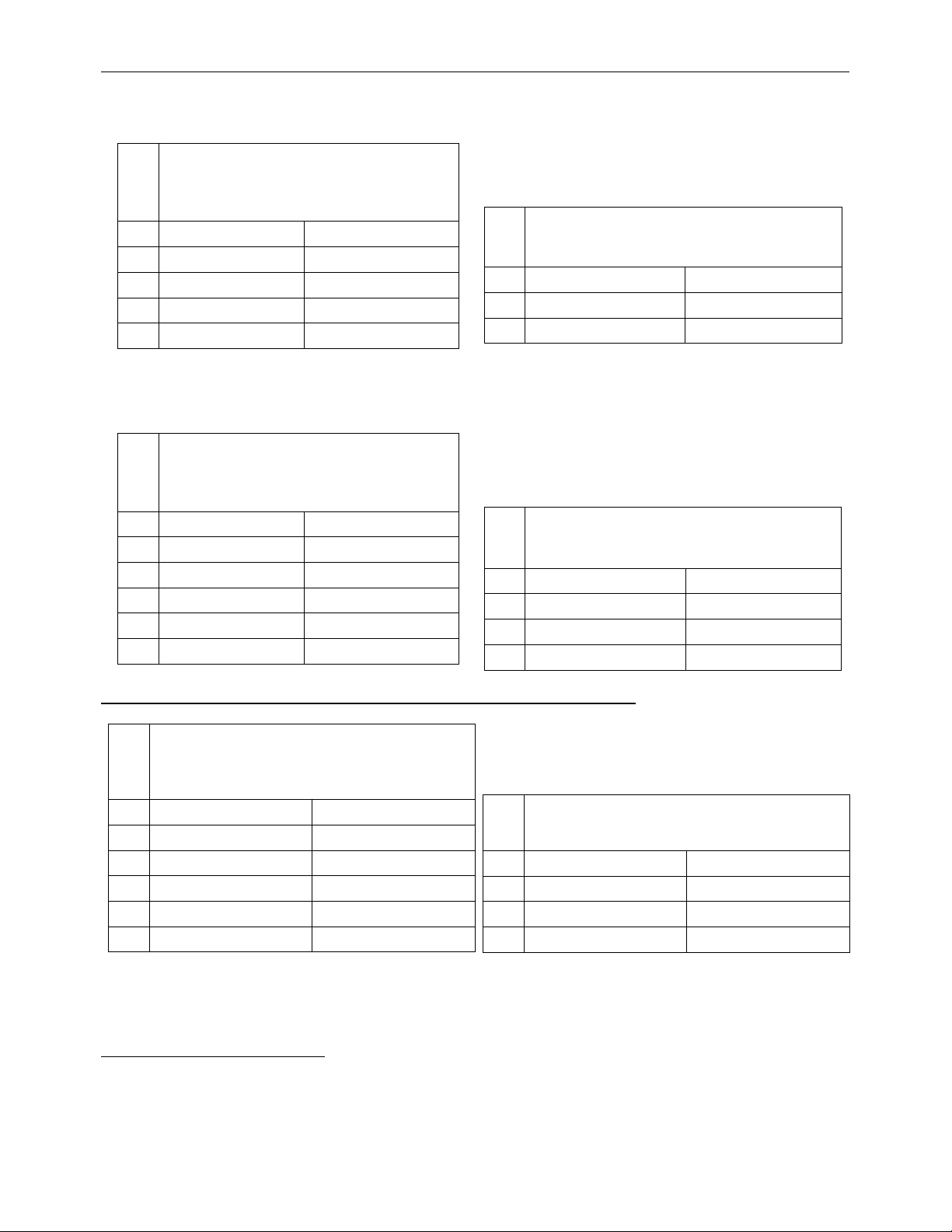
7.2.1 Clearances with ceiling (L) lowered to 77" (196 cm)
APPLIANCE CLEARANCES
(INSTALLATION WITH SINGLE WALL
PIPE CONNECTOR)
CANADA
USA
A
14 ½" (368 mm)
11" (279 mm)
B
19" (483 mm)
18" (457 mm)
C
10" (254 mm)
10" (254 mm)
K
48" (122 cm)
48" (122 cm)
L
77" (196 cm)
77" (196 cm)
APPLIANCE CLEARANCES
(INSTALLATION WITH DOUBLE
WALL PIPE CONNECTOR)
CANADA
USA
A
9" (229 mm)
9" (229 mm)
B
19" (483 mm)
19" (483 mm)
C
7" (178 mm)
7" (178 mm)
K
48" (122 cm)
48" (122 cm)
L
77" (196 cm)
77" (196 cm)
If the above clearances are met, then the distances measured from the flue outlet will be:
DISTANCES
2
FROM PIPE
CONNECTOR WITH SINGLE WALL
PIPE CONNECTOR
CANADA
USA
D
18" (457 mm)
14 ½" (368 mm)
E
28 ½" (724 mm)
27 ½" (699 mm)
F
19 ¾" (502 mm)
19 ¾" (502 mm)
DISTANCES
2
FROM PIPE
CONNECTOR WITH DOUBLE WALL
PIPE CONNECTOR
CANADA
USA
D
12 ¼" (311 mm)
12 ¼" (311 mm)
E
28 ¼" (718 mm)
28 ¼" (718 mm)
F
16 ½" (419 mm)
16 ½" (419 mm)
Clearances with heat shield (AC02710) and ceiling lowered
Note that to reduce the clearances of an appliance using a single wall pipe connector, the
use of a heat shield certified with the single wall pipe connector to be used as close as 6"
from combustible materials must be used. Only in this case, the same clearances as a
certified double wall pipe connector can be used.
APPLIANCE CLEARANCES
(INSTALLATION WITH DOUBLE
WALL PIPE CONNECTOR)
CANADA
USA
A
5" (127 mm)
5" (127 mm)
B
6" (152 mm)
6" (152 mm)
C
5" (127 mm)
5" (127 mm)
K
48" (122 cm)
48" (122 cm)
L
80" (203 cm)
80" (203 cm)
If the above clearances are met, then the
distances measured from the flue outlet will
be:
DISTANCES
2
FROM DOUBLE
WALL PIPE CONNECTOR
CANADA
USA
D
8 ¼" (210 mm)
8 ¼" (210 mm)
E
15 ¼" (387 mm)
15 ¼" (387 mm)
F
14 ½" (368 mm)
14 ½" (368 mm)
2
The pipe distances listed in this table refer to the distances obtained when the stove is installed in accordance
with the appliance clearances above mentioned.
Installation and Operation Manual for Escape 1800
34
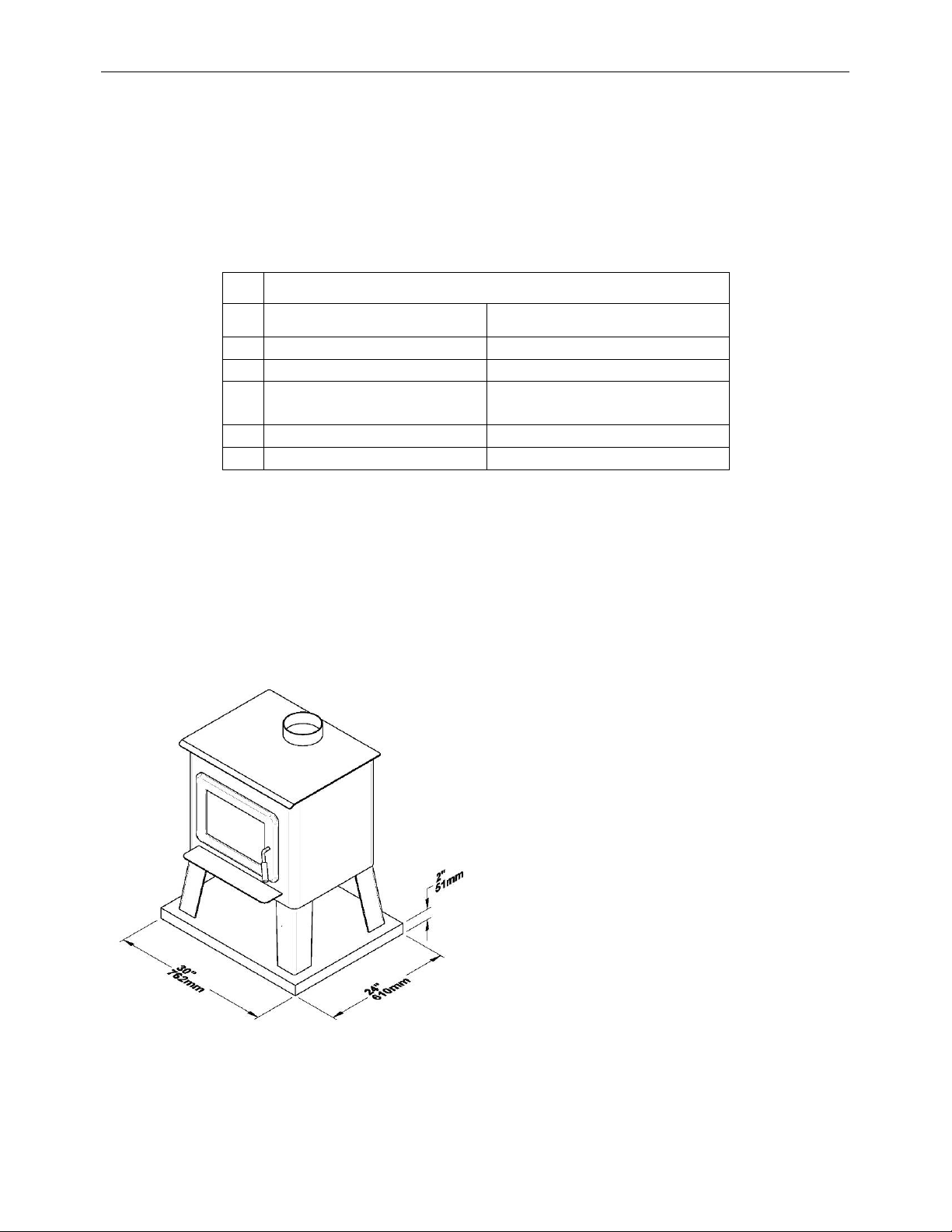
7.2.2 Clearances for an alcove
APPLIANCE CLEARANCES
(INSTALLATION WITH DOUBLE
WALL PIPE CONNECTOR)
CANADA
USA
A
9" (229 mm)
9" (229 mm)
B
19" (483 mm)
19" (483 mm)
K
48" (122 cm)
48" (122 cm)
L
77" (196 cm)
77" (196 cm)
If the above clearances are met, then the
distances measured from the flue outlet will
be:
DISTANCES
3
FROM PIPE
CONNECTOR WITH DOUBLE WALL
PIPE CONNECTOR
CANADA
USA
D
12 ¼" (311 mm)
12¼" (311 mm)
E
28 ¼ (718 mm)
28¼ (718 mm)
7.2.3 Clearances for mobile homes
It is strictly forbidden to install a unit with single wall pipe in a mobile home.
MOBILE HOME CLEARANCES
(INSTALLATION WITH DOUBLE
WALL PIPE CONNECTOR)
CANADA
USA
A
11" (279 mm)
11" (279 mm)
B
18" (457 mm)
18" (457 mm)
C
11" (279 mm)
11" (279 mm)
K
48" (122 cm)
48" (122 cm)
L
84" (213 cm)
84" (213 cm)
If the above clearances are met, then the
distances measured from the flue outlet will
be:
DISTANCES
3
FROM PIPE
CONNECTOR WITH DOUBLE WALL
PIPE CONNECTOR
CANADA
USA
D
14 ¼" (362 mm)
14 ¼" (362 mm)
E
27 ¼" (692 mm)
27 ¼" (692 mm)
F
20 ½" (521 mm)
20 ½" (521 mm)
Clearances with heat shield AC02710 in a mobile home
APPLIANCE CLEARANCES
(INSTALLATION WITH DOUBLE
WALL PIPE CONNECTOR)
CANADA
USA
A
3" (76 mm)
3" (76 mm)
B
6" (152 mm)
6" (152 mm)
C
3" (76 mm)
3" (76 mm)
K
48" (122 cm)
48" (122 cm)
L
84" (213 cm)
84" (213 cm)
If the above clearances are met, then the
distances measured from the flue outlet will
be:
DISTANCES
3
FROM DOUBLE
WALL PIPE CONNECTOR
CANADA
USA
D
6 ¼" (159 mm)
6 ¼" (159 mm)
E
15 ¼" (387 mm)
15 ¼" (387 mm)
F
12 ½" (318 mm)
12 ½" (318 mm)
3
The pipe distances listed in this table refer to the distances obtained when the stove is installed in accordance
with the appliance clearances above mentioned.
Installation and Operation Manual for Escape 1800
35
7.3 Floor protection
Your stove is designed to keep the floor from overheating. It should be placed on a non
combustible surface to protect the floor of hot embers that could fall from the stove during
loading and maintenance. As shown in the table below and by the dotted area in Figure 4 :
Clearances – Top View there are differences between the floor protections in Canada and
in the United States.
FLOOR PROTECTION*
CANADA USA
G
8" (203 mm) – Note 1
N/A (Canada only)
H
8" (203 mm)
N/A (Canada only)
I
18" (457 mm)
From door opening
16" (406 mm)
From door opening
J
N/A (USA only)
8" (203 mm)
N
N/A (USA only)
Note 2
*Steel with a minimum thickness of 0.015" (0.38 mm) or ceramic tiles sealed together
with grout. No protection is required if the unit is installed on a non-combustible floor (ex:
concrete).
Note 1: The floor protection at the back of the stove is limited to the stove’s required
clearance if such clearance is smaller than 8 inches (203 mm).
Note 2: Only required under the horizontal section of the connector. Must exceed each
side of the connector by at least 2 inches (51 mm).
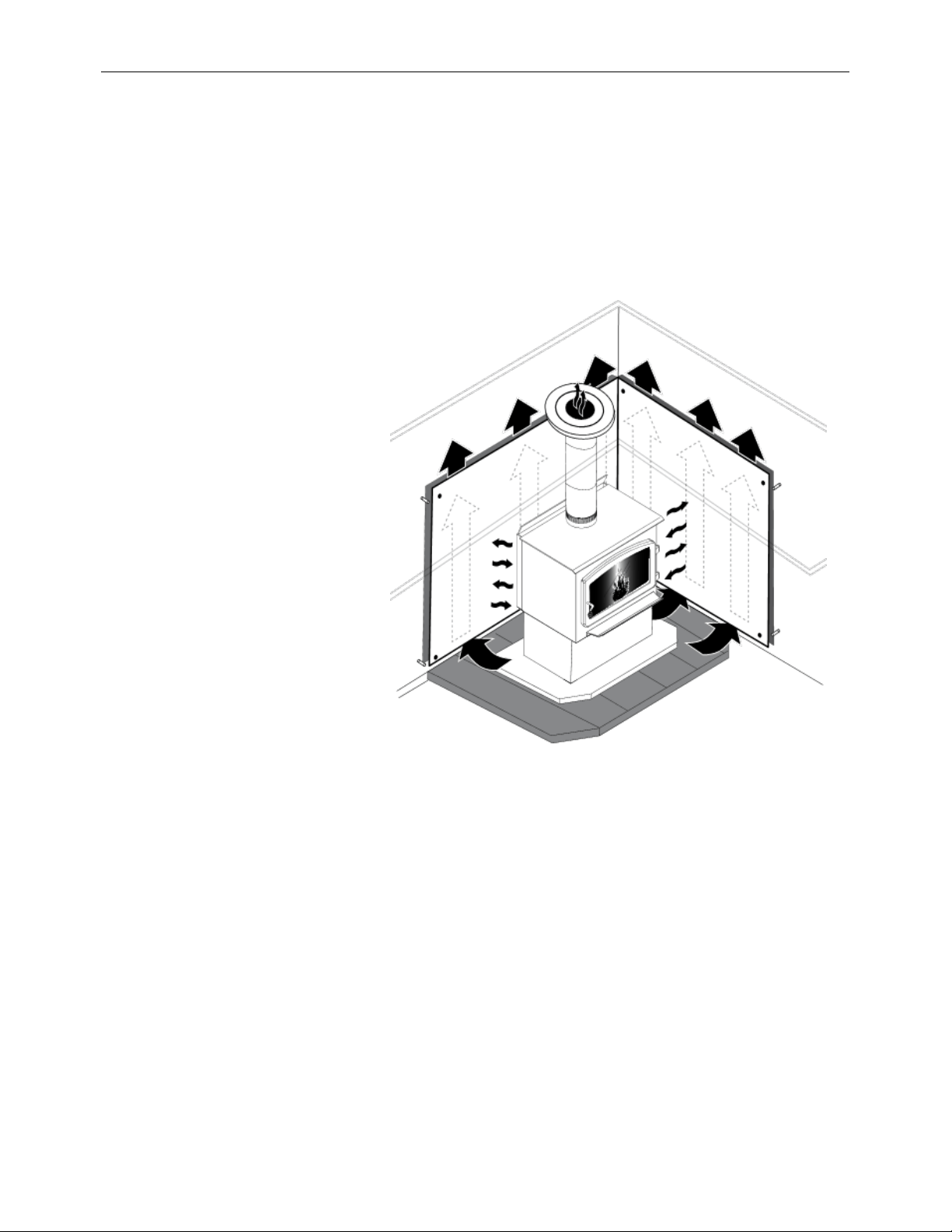
Important Note: Addition required to the
floor protection when the stove is
instal
led in a mobile home and
assembled on legs version only:
In addition to meeting the minimum size of
the floor protection, the stove must be
placed on a podium having a maximum
dimension of 30" (762 mm) x 24" (610 mm)
and a minimum height of 2" (51 mm). This
podium can be constructed of combustible
materials as long as it is covered of non-
combustible materials. See figure beside.
Installation and Operation Manual for Escape 1800
36
7.4 Reducing Wall and Ceiling Clearances Safely
Note that the clearances of the appliance and the clearances of the pipes must be met
individually, meaning that the appliance cannot be installed closer to combustible materials
than the pipe allows.
However, it is possible to reduce the appliance's clearances by using either the heat shield
certified with the appliance or by following the instructions of this section. It is also possible
to reduce pipe clearances by using a heat shield certified with the pipe.
It is of
ten desirable to reduce
the minimum installation
clearances by placing the stove
closer to walls so the installation
t
akes up less floor space. You
can safely reduce the minimum
clearances by permanently
installing a shield between the
stove and combustible material.
The rules for safe shields can be
complicated, so read them
carefully and follow them
exactly. Note that there may be
minor regional differences in
clearance reduction rules so be
sure to check with your building
or fire inspector before
proceeding.
7.4.1 Shield Construction Rules
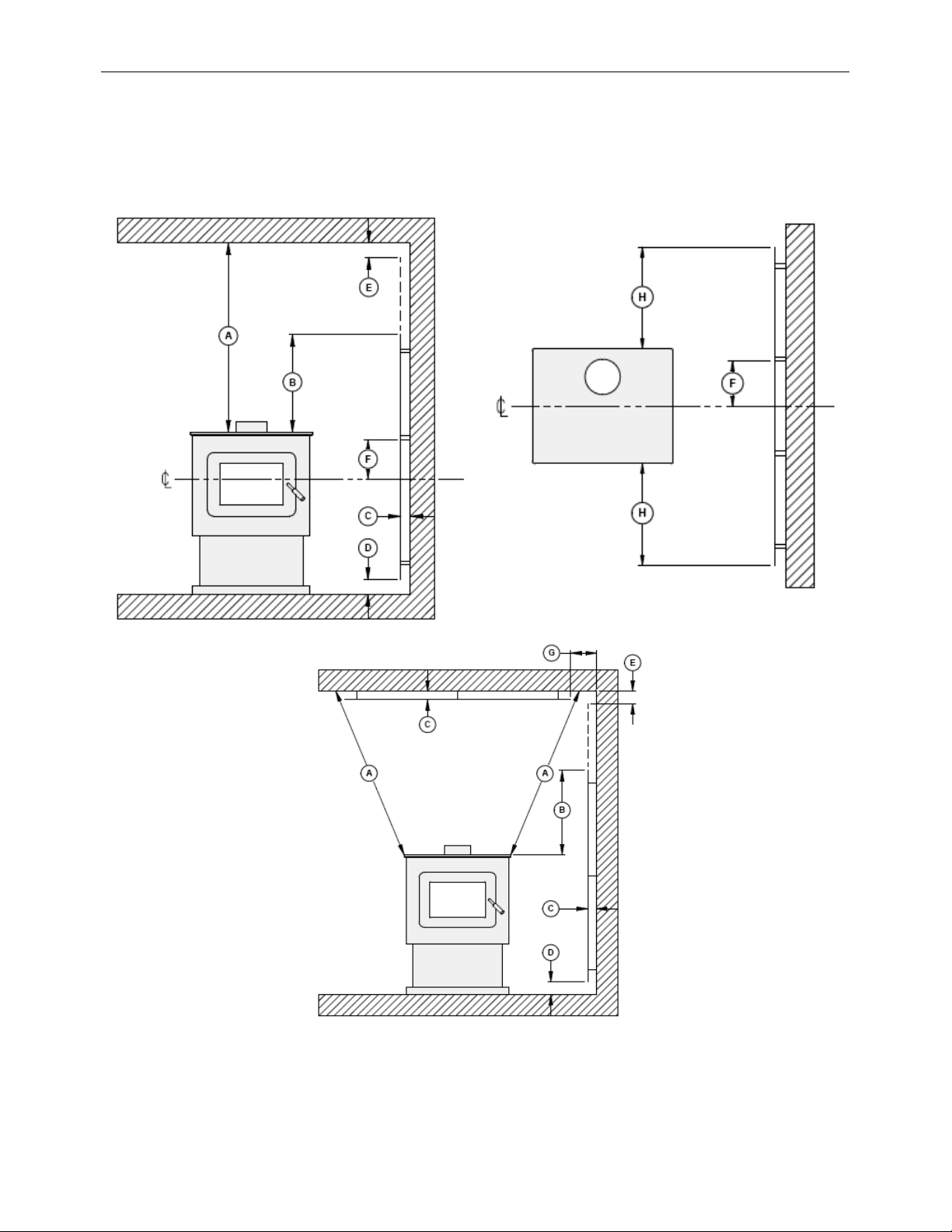
See Figure 7: Clearances for shield construction to match each letter to a clearance.
-
Adhesives used in shield construction must not ignite or lose adhesive qualities at
temperatures likely to be encountered.
-
Mounting hardware which extends from the shield surface into combustibles may be
used only at the edges of the shield.
-
Mounting hardware must allow full vertical ventilation.
A
Minimum clearance between the appliance top and an unshielded combustible ceiling:
1181 mm (46.5").
B
Shield extension above appliance: 500 mm (20").
C
Minimum space behind shield: 25 mm (1 in.). In Canada 21 mm (7/8").
D
Clearance along the bottom of shield: minimum: 25 mm (1”) and maximum: 75 mm (3").
E
Minimum clearance along the top of shield at ceiling: 75 mm (3").
Installation and Operation Manual for Escape 1800
37
F
Mounting hardware must not be located closer than 200 mm (8") from the vertical centre
line of the appliance.
G
Edge clearance for ceiling shields to side and back walls: 75 mm (3").
H
Shield extension beyond each side of appliance: 450 mm (18").
Figure 7 : Clearances for shield construction
Installation and Operation Manual for Escape 1800
38
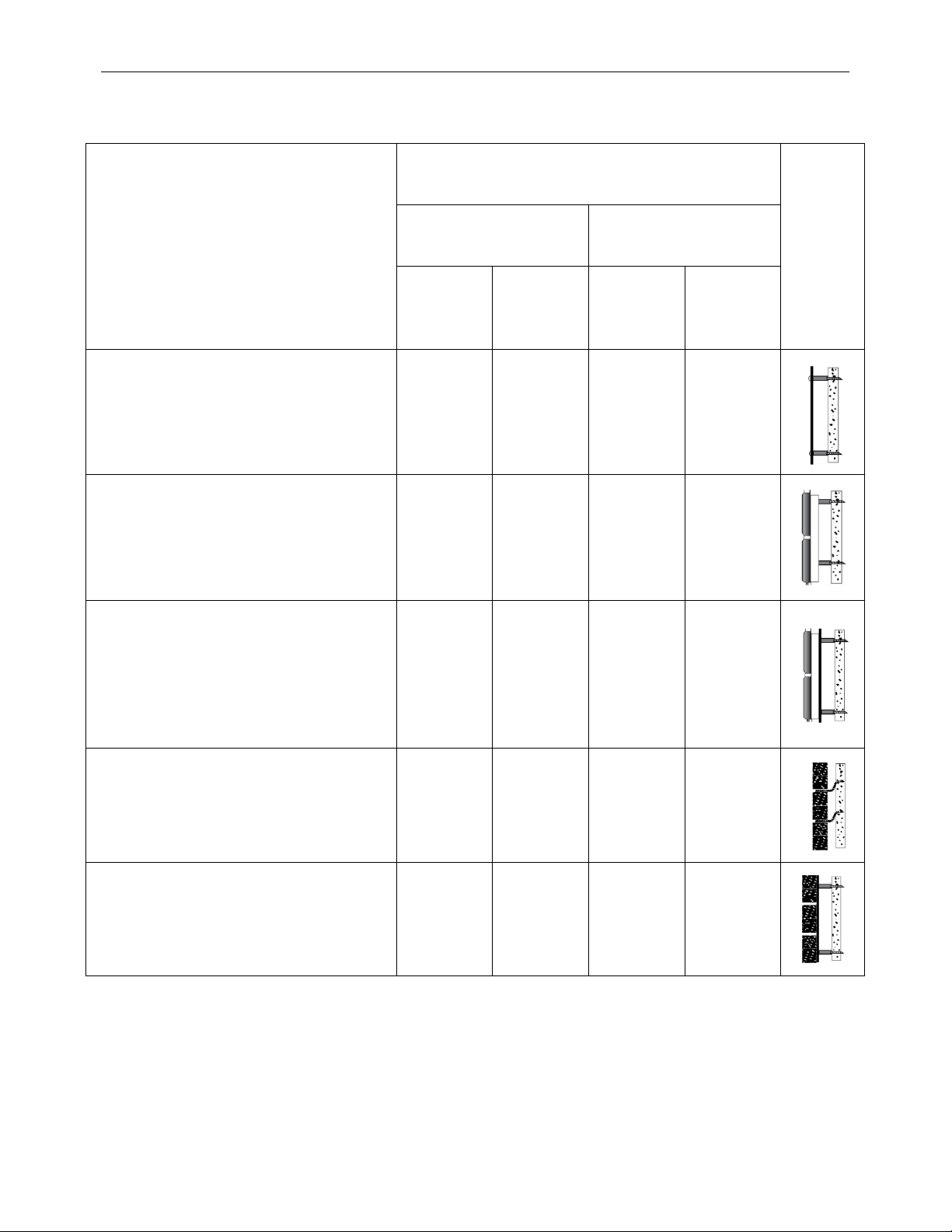
7.4.2 Table of Clearance Reduction Percentages
Type of shield
Clearances may be reduced by these
percentages
Sides
and rear %
Top %
(ceiling)
Can/US
A
(%)
USA
min.
Can/US
A
(%)
USA
min.
Sheet metal, a minimum of 24
gauge (0.61 mm)
in thickness ,
spaced out at least 25 mm (1 in)* by
non-combustible spacers
67 12 in 50 18 in
Ceramic tiles, or equivalent non-
combustible material, on non-
combustible board spaced out at
least 25 mm (1 in)* by non-
combustible spacers
50 18 in 33 24 in
Ceramic tiles, or equivalent non-
combustible material, on non-
combustible board, with a minimum
of 24 gauge (0.61 mm) sheet metal
backing spaced out at least 25 mm
(1 in)* by non-combustible spacers
67 12 in 50 24 in
Brick, spaced out at least 25 mm
(1 in)* by non-combustible spacers
50 18 in N/A N/A
Brick, with a minimum of 24 gauge
(0.61 mm) sheet metal backing,
spaced out at least 25 mm (1 in)* by
non-combustible spacers
67 12 in N/A N/A
* In Canada this space can be 21 mm (7/8 in).

Installation and Operation Manual for Escape 1800
39
8 The Venting System
8.1 General
The venting system, made up of the chimney and the connecting pipe between the stove
and the chimney, acts as the engine that drives your wood heating system. Even the best
stove will not function safely and efficiently as intended if it is not connected to a suitable
chimney.
The heat in the flue gases that pass from the stove and chimney connector into the chimney
is not waste heat. This heat is what the chimney uses to make the draft that draws in
combustion air, keeps smoke inside the stove and safely vents exhaust to outside. You can
think of heat in the flue gas as fuel the chimney uses to make draft.
8.2 Suitable Chimneys
Your wood stove will provide optimum efficiency and performance when connected to a 6-
inch diameter chimney flue system. The connection to a chimney having a diameter of at
least 5 inches (Canada only) or no more than 7 inches is permitted, if it allows the proper
venting of combustion gases and that such application is verified and authorized by a
qualified installer. Otherwise, the diameter of the flue should be 6 inches.
To be suitable, a factory-built metal chimney must comply with UL 103 (U.S.A.) or ULC S629
(Canada).
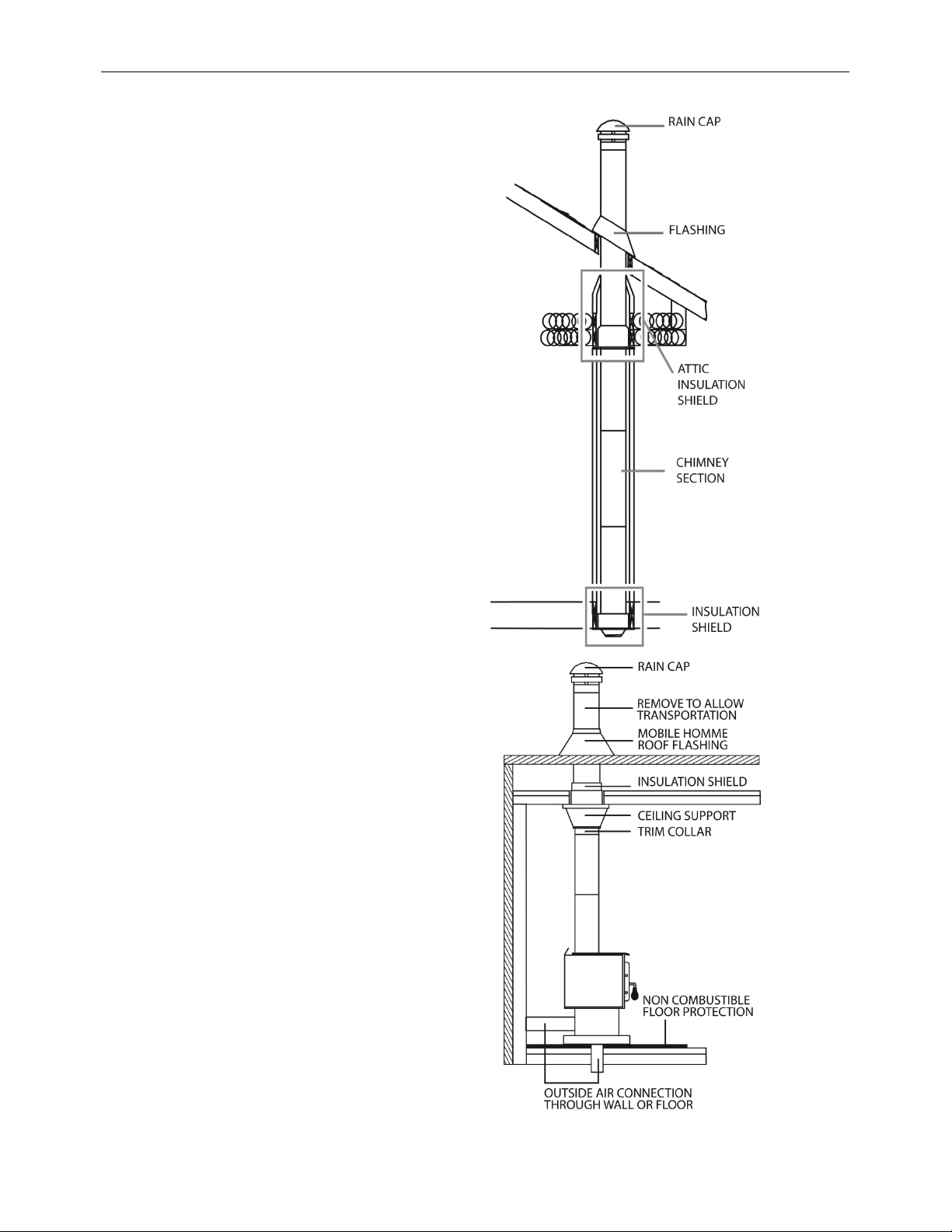
Installation and Operation Manual for Escape 1800
40
8.2.1 Factory-built Metal Chimneys
These are sometimes referred to as
‘high temp’ chimneys because they
have the special
characteristics to
withstand temperatures that can be
created by wood burning stoves.
Factory-built chimneys are tested as a
system with all the necessary
components for installation. The
instructions p
rovided with the chimney
by its manufacturer are the only reliable
source of installation guidelines. To be
safe and effective, the chimney must be
installed exactly in accordance with the
manufacturer’s instructions.
Use only
components intended for the brand
and model of chimney you are using.
Never substit
ute parts from other
chimney brands or fabricate your
own components. The chimney must
be a type suitable for solid fuel.
8.2.2 Factory-
built Metal Chimneys
in Mobile Homes
For use in a mobile home, this stove is
to be connected to a 6”
in diameter
double wall
factory built chimney
conforming to CAN/UCL-S629,
Standards for 650°C Factory-built
chimney. The total length of the flue
system should be at least (12) feet
including elbows,
from the top of the
stove.
To maintain an effective vapour barrier,
insulation and waterproof
at the
chimney and outside flue pipe, install a
mobile home roof flashing and seal it
with silicone.
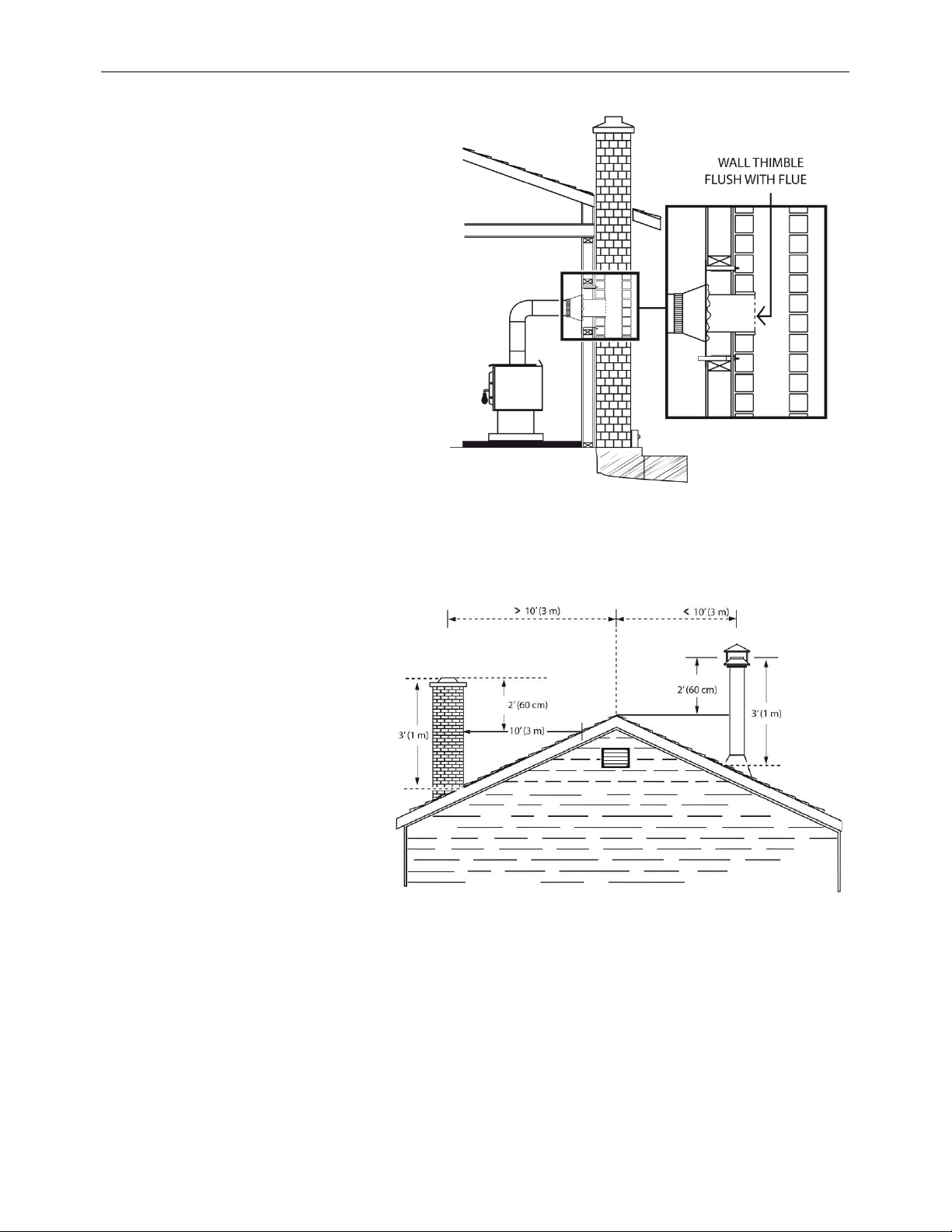
Installation and Operation Manual for Escape 1800
41
8.2.3 Masonry Chimneys
The stove may also be connected to a
masonry chimney, provided the
chimney complies with the
construction rules found in the building
code enforced locally. The chimney
must have either a clay liner or a
suitably listed stainless steel liner. If
the masonry chimney has a square or
rectangular liner that is larger in cross
sectional area than a round 6” flue, it
should be relined with a suitably listed
6” stainless steel liner. Do not
downsize the flue to less than 6”
unless the venting system is straight
and exceeds 25 feet in height. When
passing through a combustible wall,
the use of an insulated listed thimble
is required.
8.3 Minimum Chimney Height
The top of the chimney should be
tall enough to be above the air
turbulence caused when wind
blows against the house and its
roof. The chimney must extend
at least 1 m (3
ft.) above the
highest point of contact with the
roof, and at least 60 cm (2 ft.)
higher than any roof line or
obstacle within a horizontal
distance of 3 m (10 ft.).
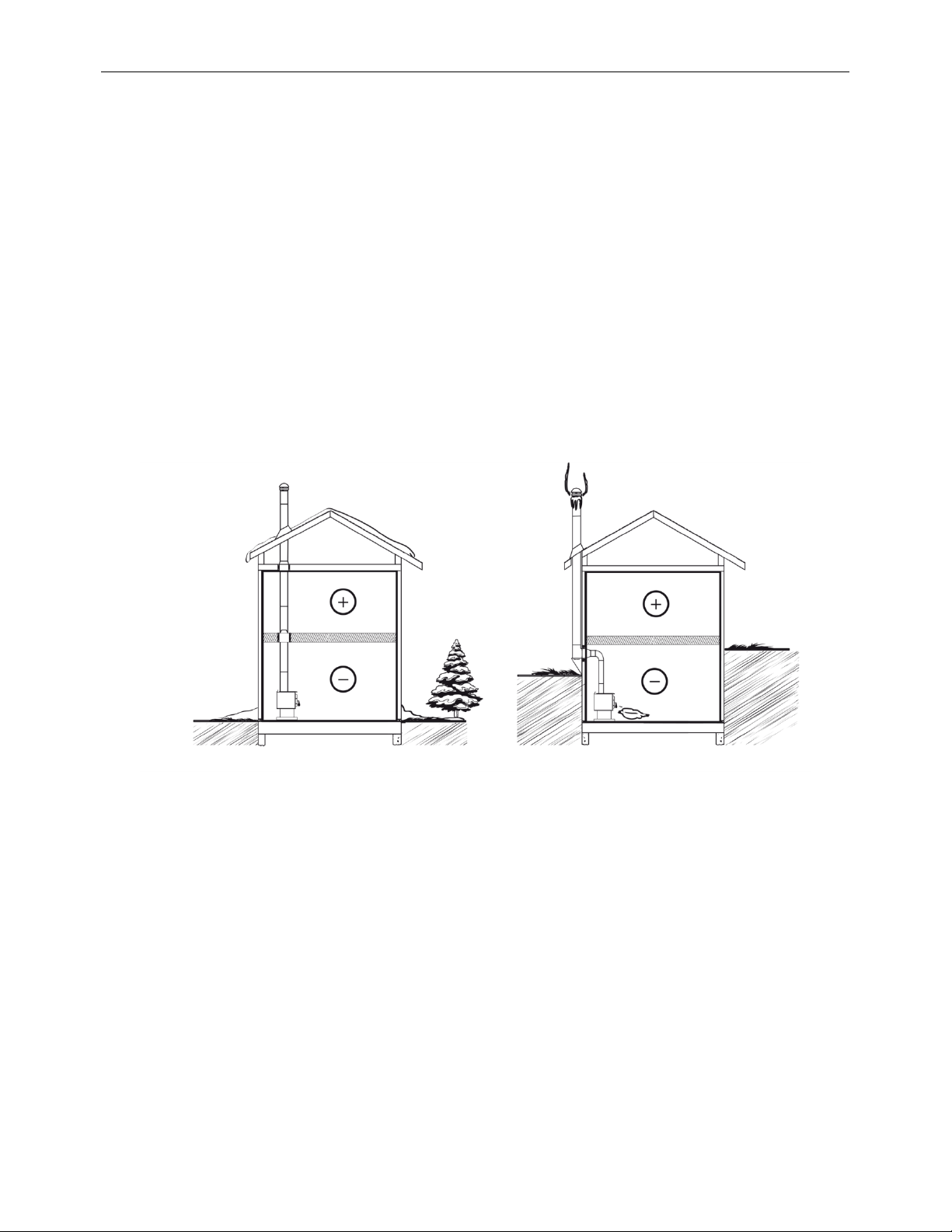
Installation and Operation Manual for Escape 1800
42
8.4 The Relationship Between the Chimney and the House
Because the venting system is the engine that drives the wood heating system, it must have
the right characteristics. The signs of bad system design are cold back drafting when there
is no fire in the stove, slow kindling of new fires, and smoke roll-out when the door is open
for loading. There are two guidelines to follow. First, the chimney should be installed up
through the heated space of the house, not out and up an outside wall. Second, the chimney
should penetrate to the top of the building at or near the highest heated space.
8.4.1 Why Inside Chimneys Are Preferred
Venting systems that rise straight up from the stove flue collar provide the best performance.
Chimneys that rise inside the warm space of the house tend to provide a small amount of
draft even when there is no fire burning. This means that when you light a fire, the initial
smoke goes up the chimney and strong draft build quickly as the chimney flue warms up.
Although they are common in North America, chimneys that exit a house wall and run up
outside can cause problems.
Good System Design
Inside chimneys are preferred because even
when no fire is burning, there is normally
upward flow in the system.
Inferior System Design
Outside chimneys are a problem
because when no fire burns they will
go into cold backdraft if the stove is
installed low in the house.
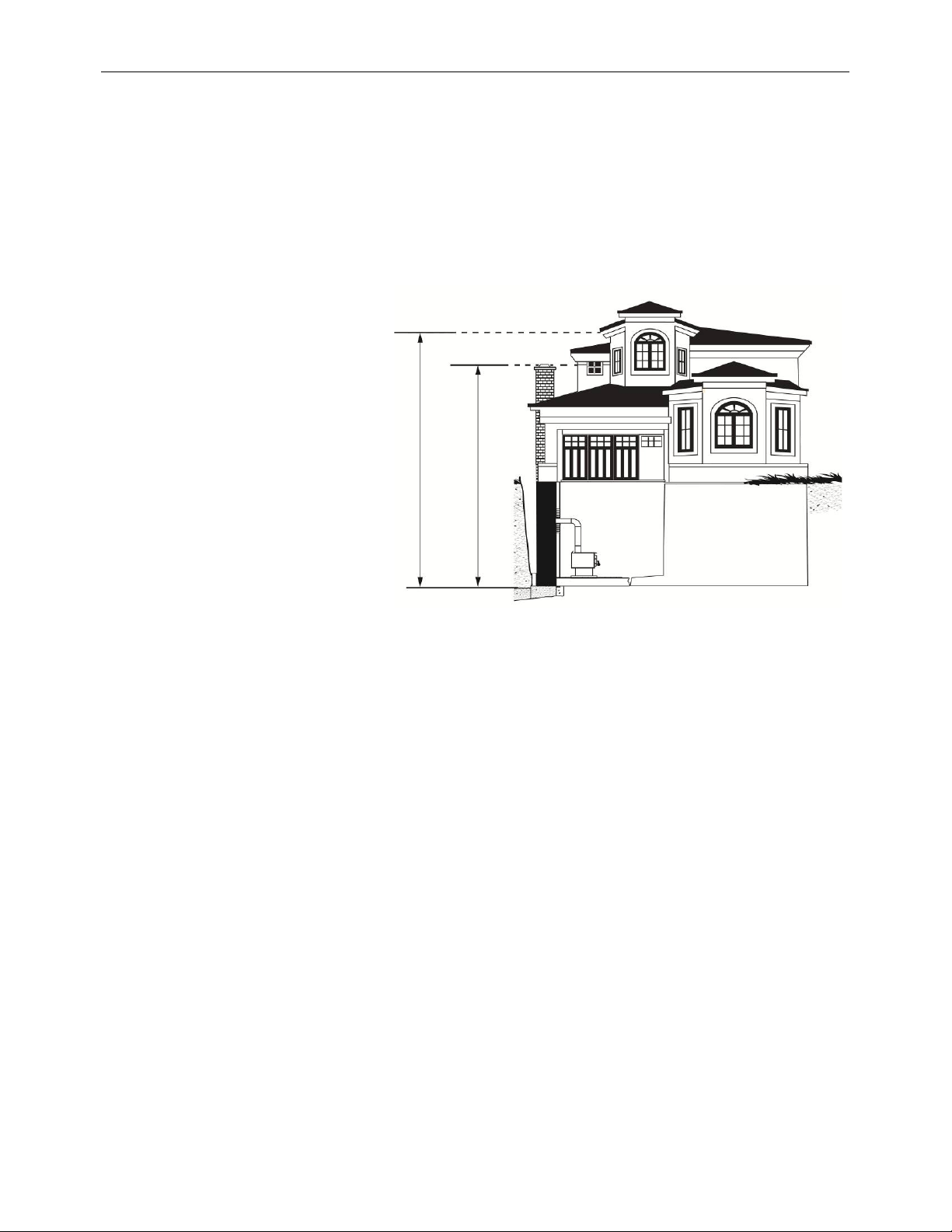
Installation and Operation Manual for Escape 1800
43
8.4.2 Why the chimney should penetrate the highest heated space
When it is cold outside, the warm air in the house is buoyant so it tends to rise. This tendency
of warm air to rise creates a slight pressure difference in the house. Called ‘stack effect’, it
produces a slightly negative pressure low in the house (relative to outside) and a slightly
positive pressure zone high in the house. If there is no fire burning in a heater connected to
a chimney that is shorter than the warm space inside the house, the slight negative pressure
low in the house will compete against the desired upward flow in the chimney.
There are two reasons why the
chimney in the house at right will
cold backdraft when it is cold
outside and there is no fire
burning in the stove. First, the
chimney runs up the outside of
the house, so the air in it is colder
and denser than the warm air in
the house. And second, the
chimney is shorter than the
heated space of the house,
meaning the negative pressure
low in the house will pull outside
air down
the chimney, through
the stove and into the room.
Even the finest stove will not
work well when connected to this
chimney.
8.5 Supply of Combustion Air
In Canada, wood stoves are not required to have a supply of combustion air from outdoors
(except in mobile homes) because research has shown that these supplies do not give
protection against house depressurization and may fail to supply combustion air during
windy weather. However, to protect against the risk of smoke spillage due to house
depressurization, a carbon monoxide (CO) detector/alarm is required in the room in
which the stove is installed. The CO detector will provide warning if for any reason the wood
stove fails to function correctly.

Installation and Operation Manual for Escape 1800
44
8.5.1 Combustion Air Supply in Mobile Homes
Only a wood stove certified and labelled as ‘mobile home approved’ may be installed
in a mobile home. This Escape 1800 stove is ‘mobile home approved’. Wood stoves
installed in mobile homes must have a ducted supply of combustion air from outdoors. This
air supply should be routed down through the house floor into the vented crawl space under
the mobile home. The air supply duct should be non-combustible aluminum flex duct with a
screened weatherhood on the outside end.
Note: Fabric duct may also be used, provided it is suitable for HVAC use and meets the
requirements of ULC-S110 or UL-181 Class 1 standards. It must have a non-combustible
insulation and be corrosion resistant.
Where a mobile home has been converted to a standard house by mounting it on a
permanent basement foundation, the supply of outdoor air is not required.
8.5.2 Air Supply in Conventional Houses
The safest and most reliable supply of combustion air for your wood stove is from the room
in which it is installed. Room air is already preheated so it will not chill the fire, and its
availability is not affected by wind pressures on the house. Contrary to commonly expressed
concerns, almost all tightly sealed new houses have enough natural leakage to provide the
small amount of air needed by the stove. The only case in which the wood stove may not
have adequate access to combustion air is if the operation of a powerful exhaust device
(such as a kitchen range exhaust) causes the pressure in the house to become negative
relative to outdoors.
Some jurisdictions in the United States require that wood stoves have a supply of
combustion air from outdoors. If you do install an air supply through the wall of the house,
be aware that its pressure can be affected during windy weather. If you notice changes in
wood stove performance in windy weather, and in particular if smoke puffs from the stove,
you should disconnect the outdoor air duct from the stove and remove the duct. In some
windy conditions, negative pressure at the duct weatherhood outside the house wall may
draw hot exhaust gases from the stove backwards through the duct to outdoors. Check the
outdoor air duct for soot deposits when the full system is cleaned and inspected at least
once each year.
8.6 Installing the Chimney Connector
The chimney connector is the single or double wall pipe installed between the stove flue
collar and the chimney breech. Single wall pipe components are available from most
hardware and building supply stores. These components are not usually tested to a
particular standard and certified as compliant. Therefore, a list of rules found in solid fuel
installation codes apply to the installation of a single wall pipe.
Double wall chimney connectors are tested and certified. The rules for double wall pipe are
found in the manufacturer’s installation instructions. These rules will be very different than
those for single wall.
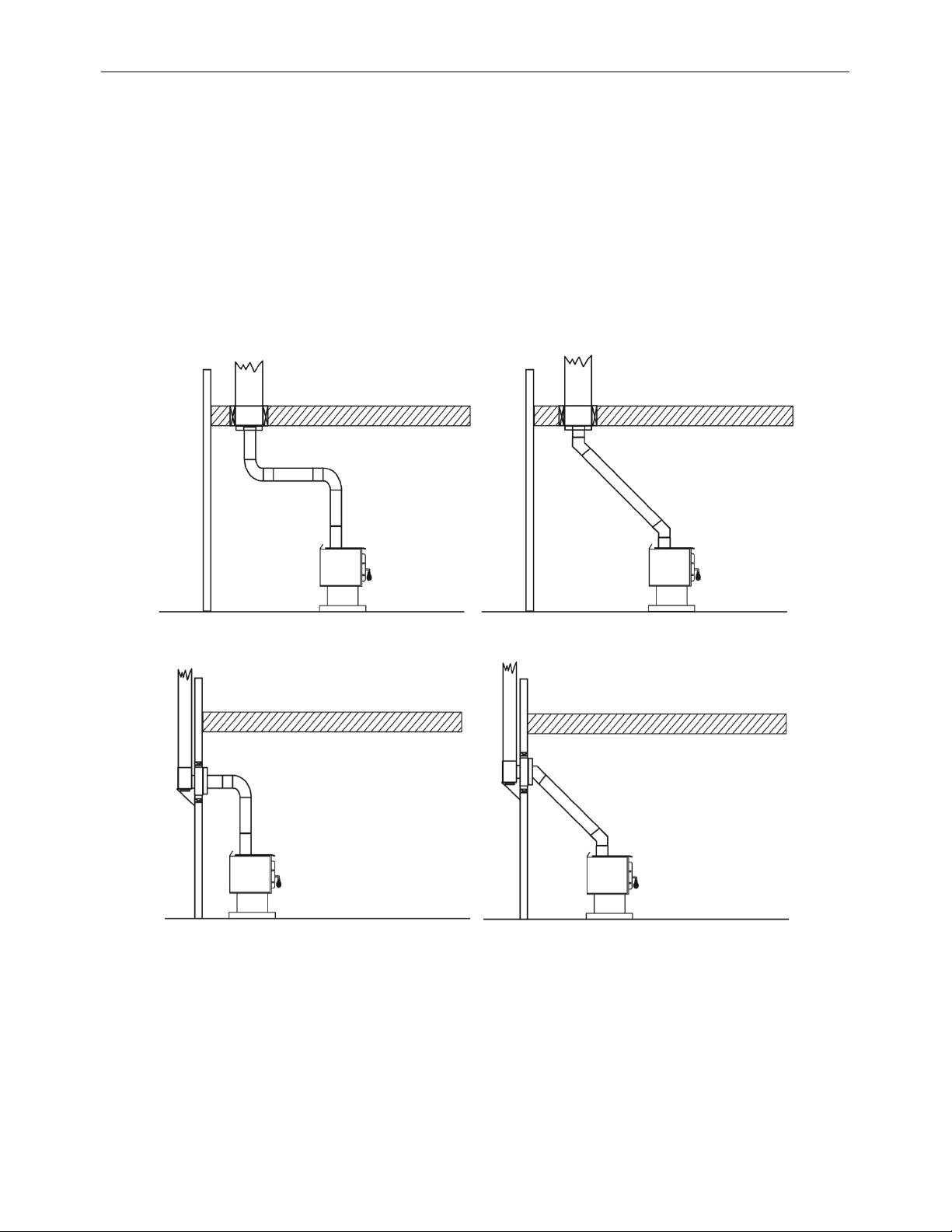
Installation and Operation Manual for Escape 1800
45
8.6.1 Installation of Single Wall Chimney Connector
The chimney connector assembly has been called ‘the weak link’ in the safety of wood
heating systems because failure to install the connector properly (which has been common
in the past) can result in house fires.
The best flue pipe assembly is one that rises straight up from the stove to the base of the
chimney with no elbows. Straight assemblies are less likely to cause problems like smoke
roll-out when the door is open for loading. They are also more stable and easier to maintain
than assemblies with elbows. Horizontal runs of flue pipe should be avoided where possible
because they reduce chimney draft.
Use 45° elbows where possible, instead of 90° elbows.

Installation and Operation Manual for Escape 1800
46
The rules below are based on those found in the CSA B365 installation code. Please
carefully follow these installation instruction rules, or those enforced where you live.
• Maximum overall length of straight pipe: 3 m (10 ft.) including elbows.
• Minimum clearance from combustible material: 450 mm (18 in.). The minimum clearance
may be reduced by 50 percent to 225 mm (9 in.) if suitable shielding is installed either
on the pipe or on the combustible surface.
• The assembly should be as short and direct as possible between the stove and chimney.
The use of two 45° elbows is often preferable to a single 90° elbow because less
turbulence is created in the exhaust flow and they result in less horizontal run.
• Maximum number of 90° elbows: 2.
• Maximum unsupported horizontal length: 1 m (3 feet).
• Galvanized flue pipes must not be used because the coatings vaporize at high
temperatures and release dangerous gases. Use black painted flue pipes.
• Flue pipes must be at least 24 gauge in thickness.
• Flue pipe joints should overlap 30 mm (1 1/4 in.)
• Each joint in the assembly must be fastened with at least three screws.
• The assembly must have allowance for expansion: elbows in assemblies allow for
expansion; straight assemblies should include an inspection wrap with one end
unfastened, or a telescopic section.
• Minimum upward slope towards the chimney: 20 mm/m (1/4 in/ft.).
• One end of the assembly must be securely fastened to the flue collar with 3 sheet metal
screws and the other end securely fastened to the chimney.
• There must be provision for cleaning of the pipes, either through a clean out or by
removal of the pipe assembly. Removal of the assembly should not require that the stove
be moved.
• The male ends of the sections must be oriented towards the appliance so that falling dust
and condensation stay inside the pipe.
• A flue pipe must never pass through a combustible floor or ceiling or through an attic,
roof space, closet or concealed space.
• Where passage through a wall or partition of combustible construction is desired, the
installation shall conform to CAN/CSA-B365, Installation Code for Solid-Fuel-Burning
Appliances and Equipment.
The ideal flue pipe assembly is one that rises straight up from the appliance flue collar and
directly into the chimney with no elbows. A straight up connector assembly needs either a
telescopic length or an inspection wrap (pipe coupler) to allow it to be assembled and
disassembled without moving the stove.
A straight flue pipe assembly offers the least restriction to gas flow and results in a stronger
draft. Straight assemblies also need less maintenance because there are no corners to
collect creosote.
The chimney connector must be in good condition.
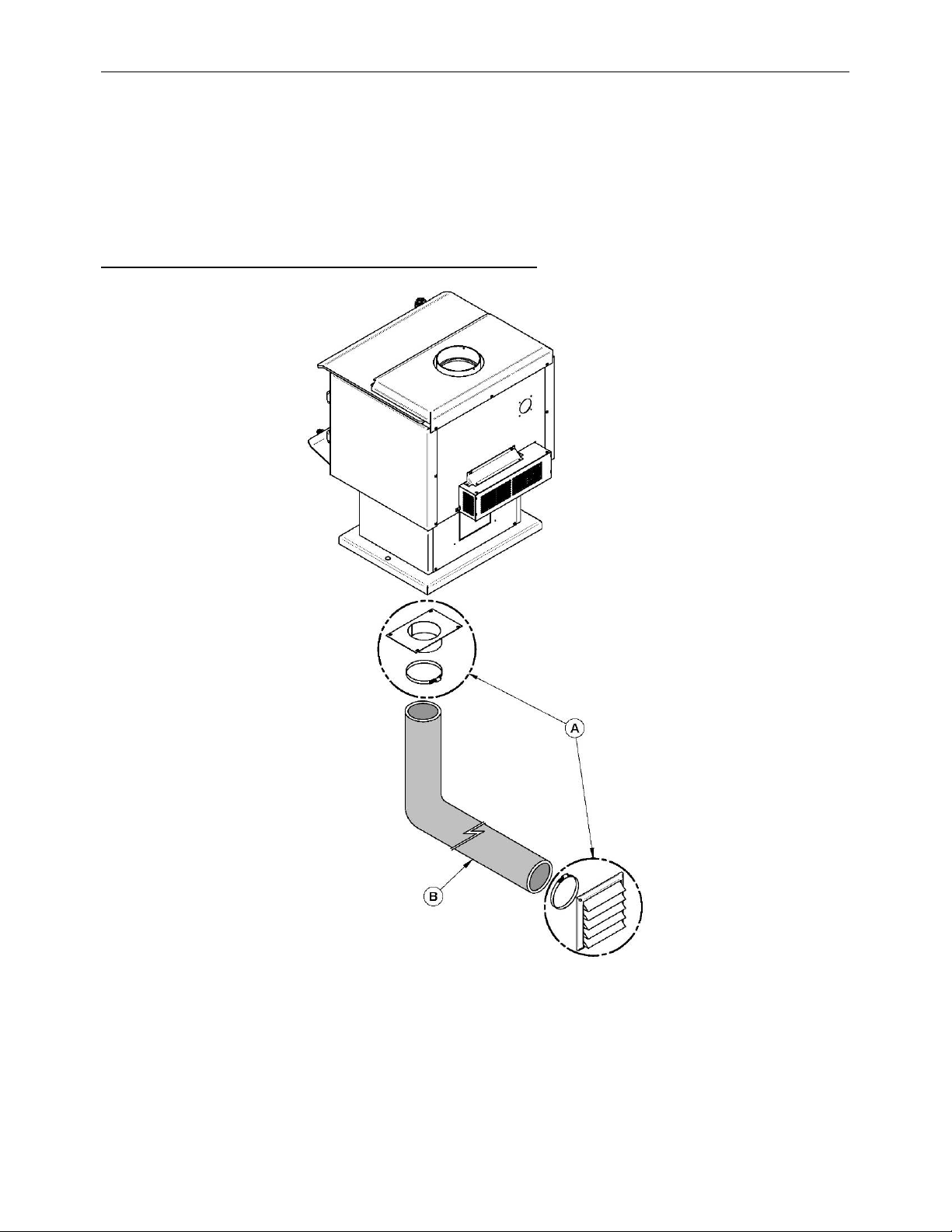
Installation and Operation Manual for Escape 1800
47
Appendix 1: Installing the Optional Fresh Air Intake Kit
This mobile home approved stove requires the installation of a fresh air intake kit (A) and an
insulated fresh air intake pipe (B), sold separately.
Installation on the bottom of models on pedestal:
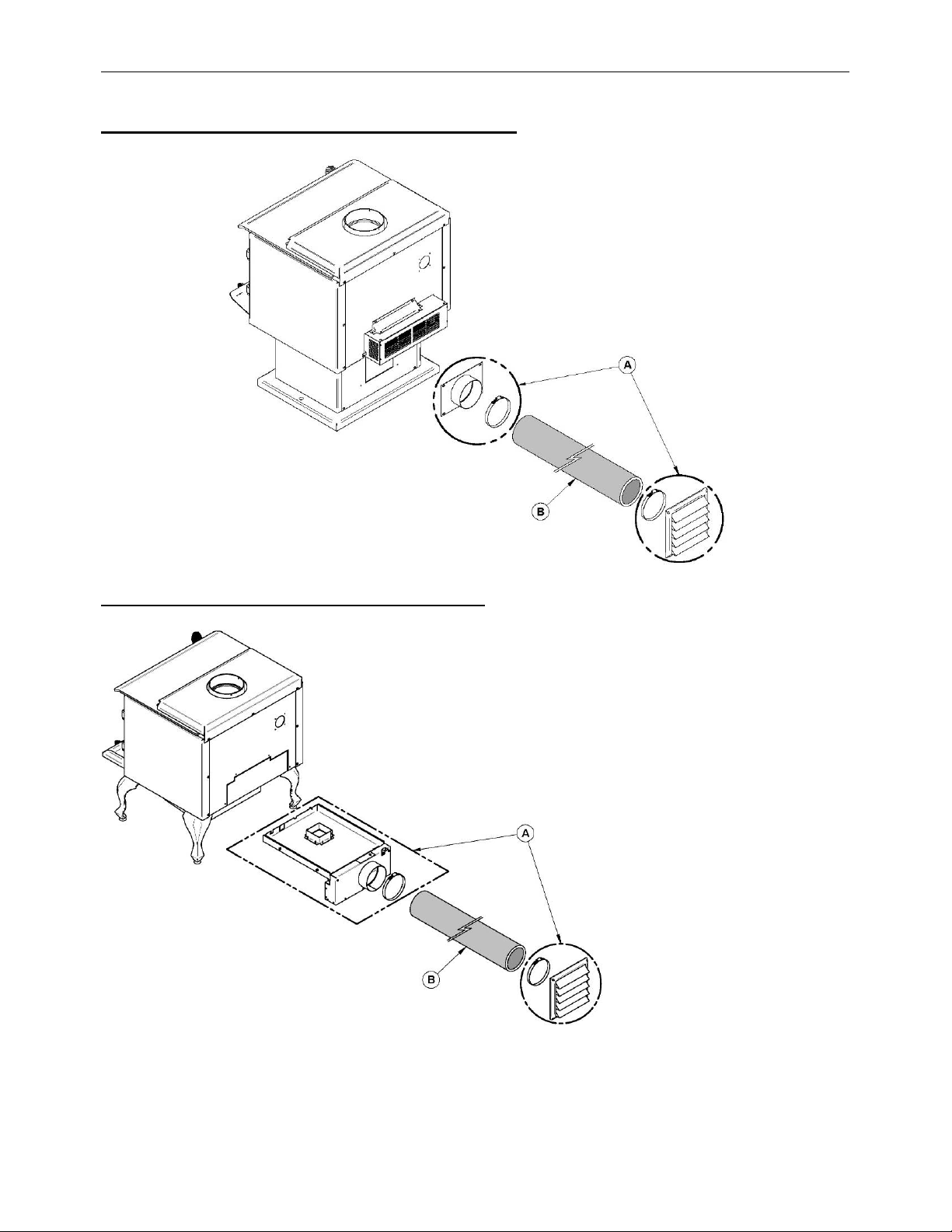
Installation and Operation Manual for Escape 1800
48
Installation on the back of models on pedestal:
Installation on the back for models on legs:
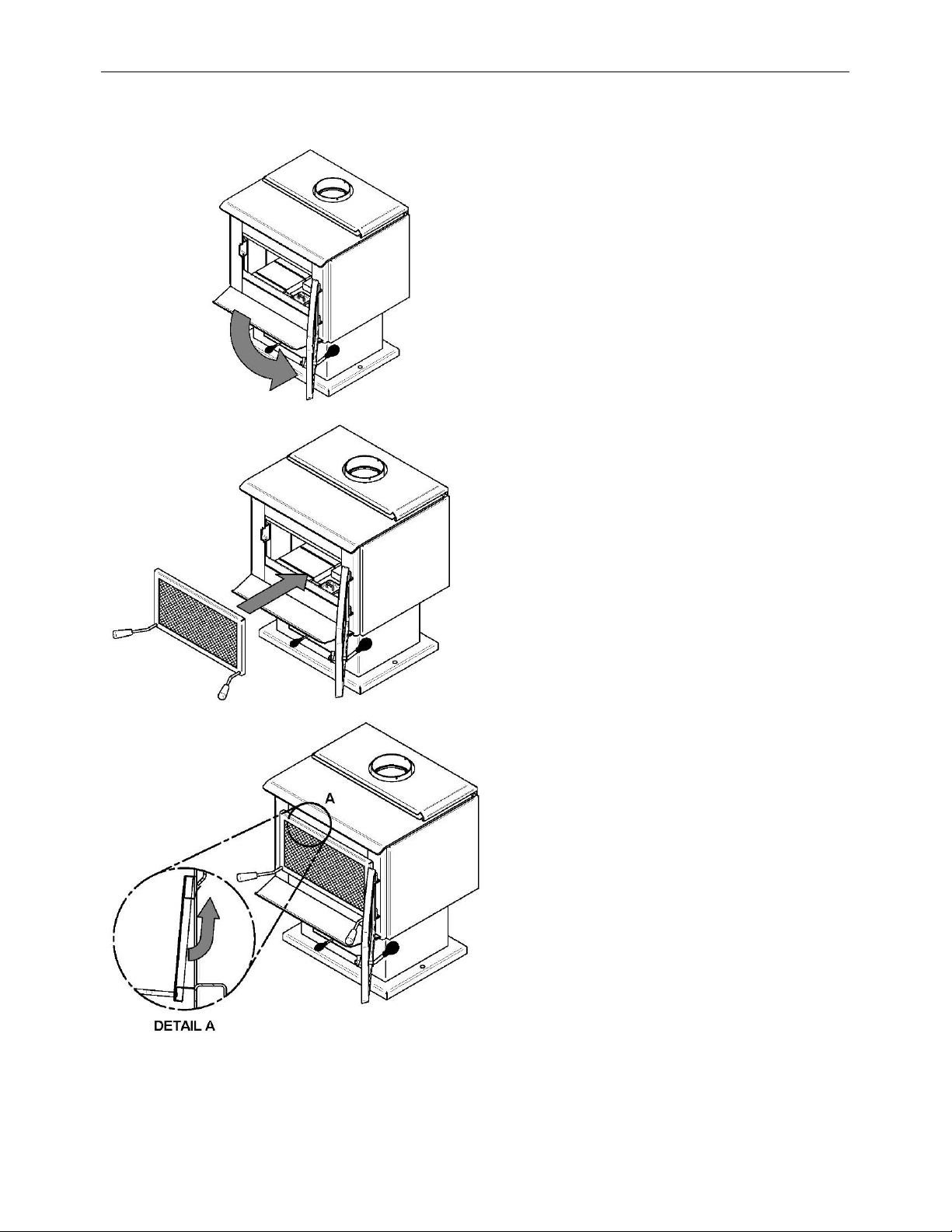
Installation and Operation Manual for Escape 1800
49
Appendix 2: Installing the Optional Fire Screen
Open the door.
Hold the fire screen by the two handles
and bring it close to the door opening.
Lean the upper part of the fire screen
against the top door opening making
sure to insert the top fire screen
brackets behind the primary air
deflector as in (Detail A).
Lift the fire screen upwards and push
the bottom part towards the stove then
let the fire screen rest on the bottom of
the door opening.
Warning: Never leave the stove unattended while in use with the fire
screen.
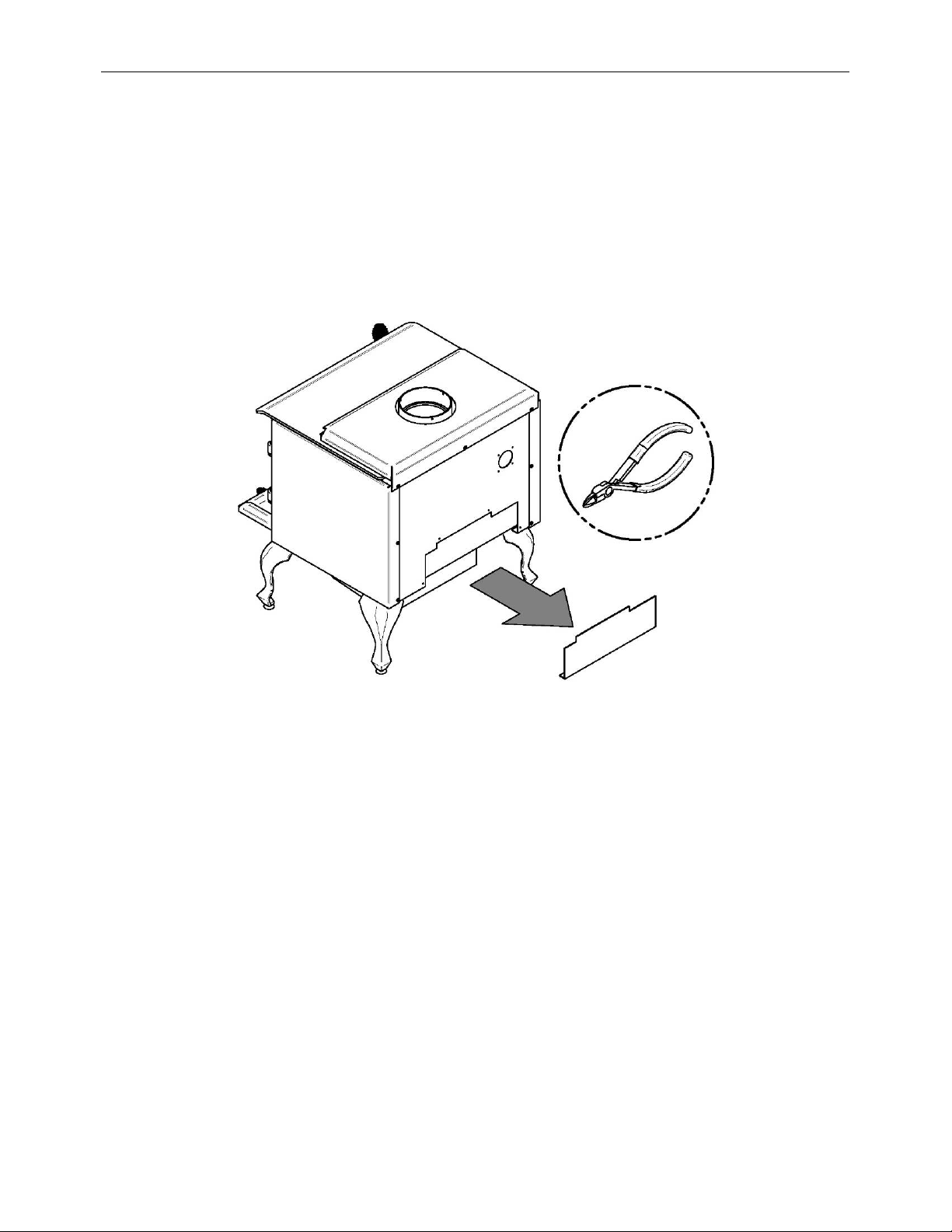
Installation and Operation Manual for Escape 1800
50
Appendix 3: Installation of the Optional Blower and Thermodisc
An optional blower may be installed on the back of the stove to increase the flow of air past
heat exchange surfaces and to help circulate warm air in the room. When used regularly,
the blower can provide a small increase in efficiency, up to 2 percent. However, the use of
a blower should not be used to gain more output from a stove that is undersized for the
space it is intended to heat.
When using the blower, allow the stove to reach operating temperature (approximately one
hour), before turning it on. The increased airflow from the blower cools the firebox and could
affect the start-up combustion efficiency if the blower is turned on too early. You can also
install an optional thermodisc kit to enable the blower to start or stop automatically when the
stove is hot or too cold.
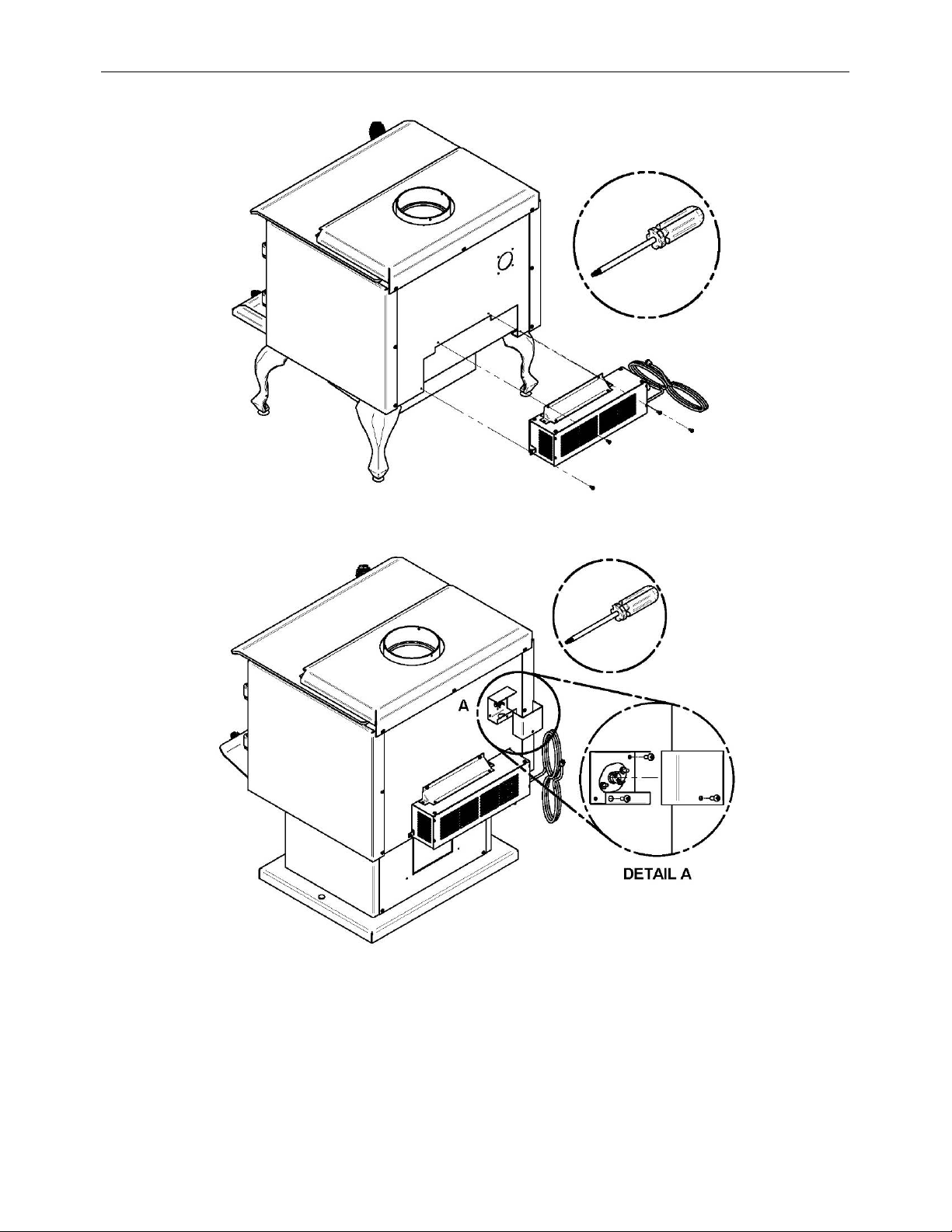
Installation and Operation Manual for Escape 1800
51
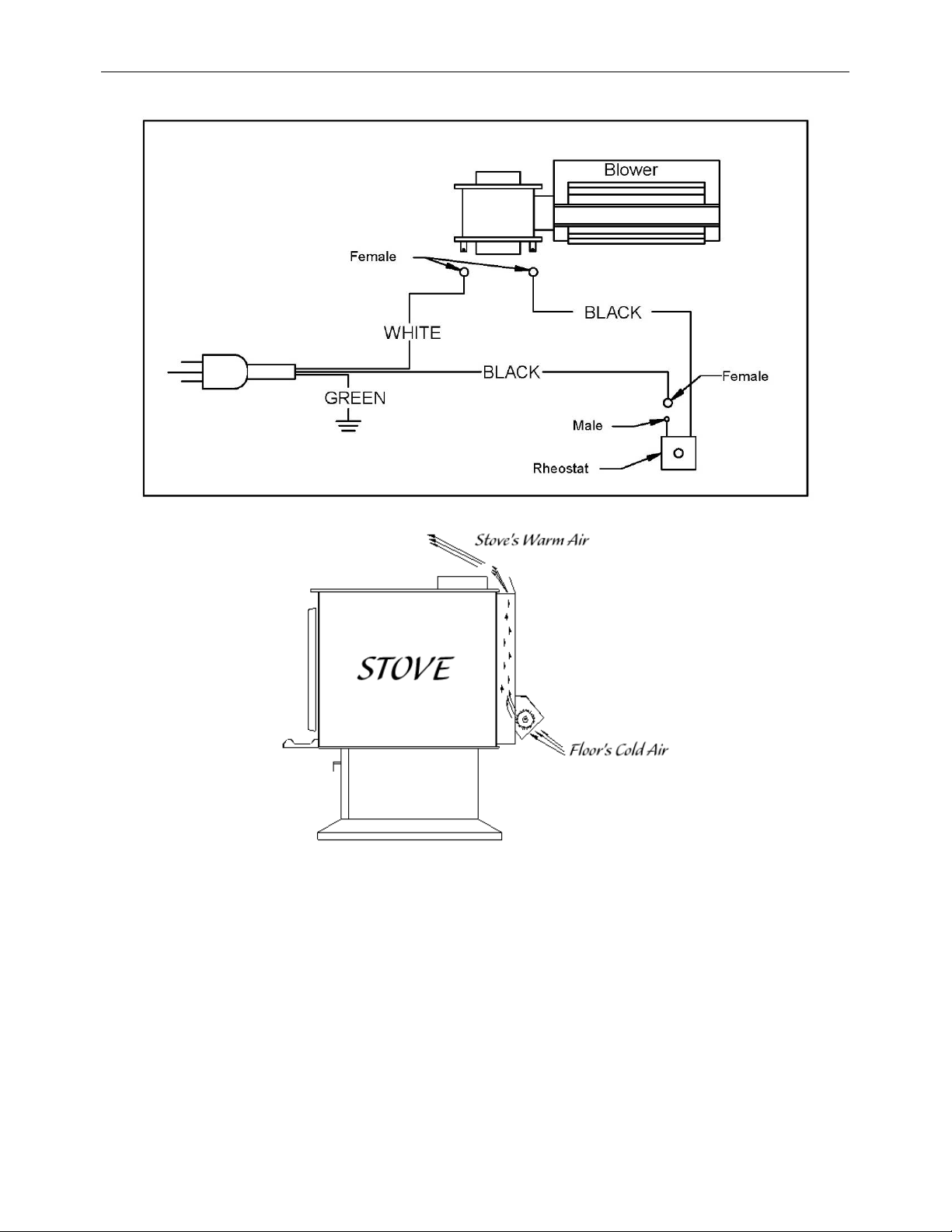
Installation and Operation Manual for Escape 1800
52
CAUTION: ENSURE THAT THE BLOWER’S POWER CORD IS NOT IN CONTACT WITH
ANY SURFACE OF THE STOVE TO PREVENT ELECTRICAL SHOCK OR FIRE
DAMAGE. DO NOT RUN THE POWER CORD BENEATH THE STOVE.
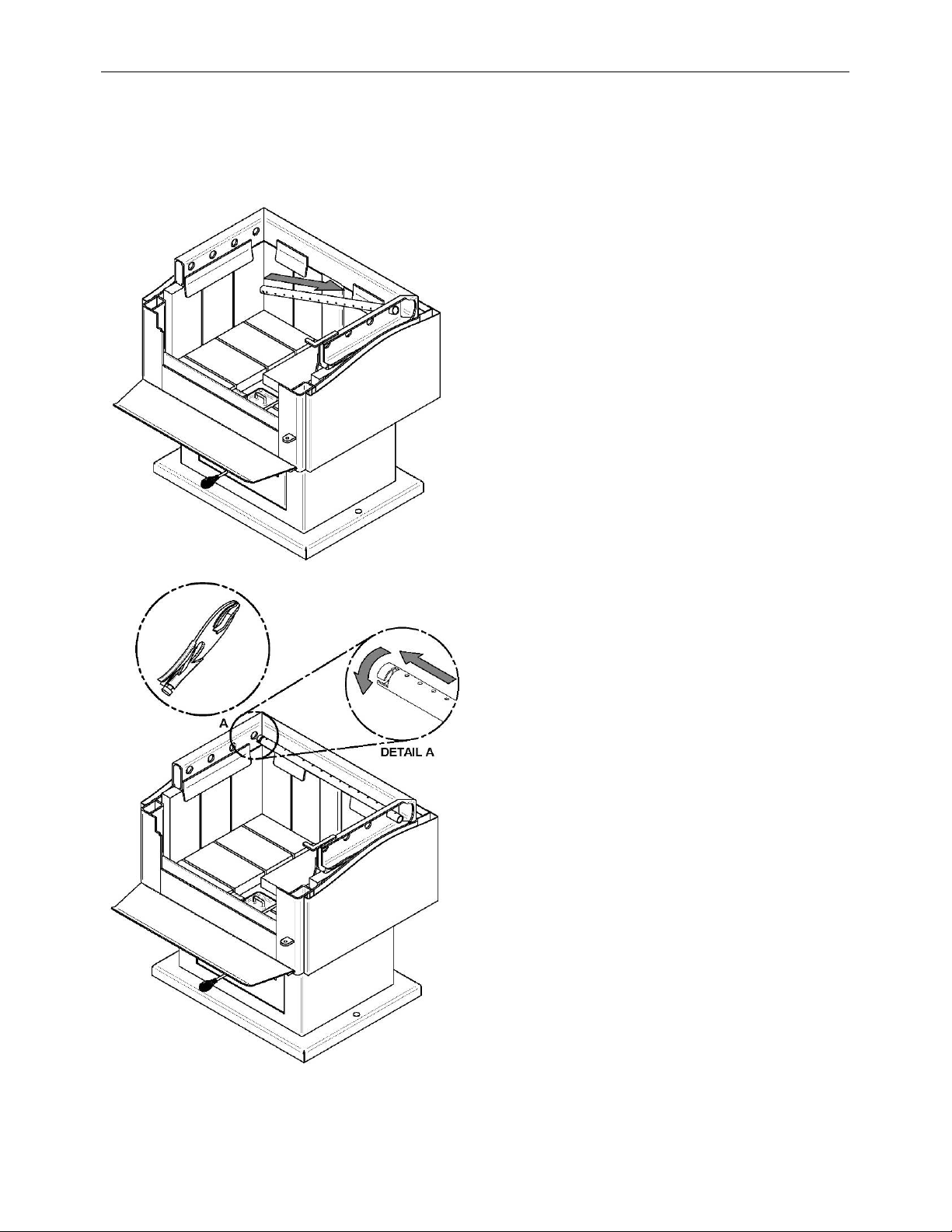
Installation and Operation Manual for Escape 1800
53
Appendix 4: Installation of Secondary Air Tubes and Baffle
1-
Starting with the rear tube, lean and
insert the right end of the secondary air
tube into the rear right channel hole.
Then lift and insert the left end of the
tube into the rear left channel.
2- Align the notch in the left end of the tube
with the key of the left air channel hole.
Using a « Wise grip » hold the tube and
lock it in place by turning the tube as
shown in detail A. Make sure the notch
reaches the end of the key way.
3- Repeat step 1 and 2
for the other
secondary air tubes.
4-
To remove the tubes use the above
steps in reverse order.
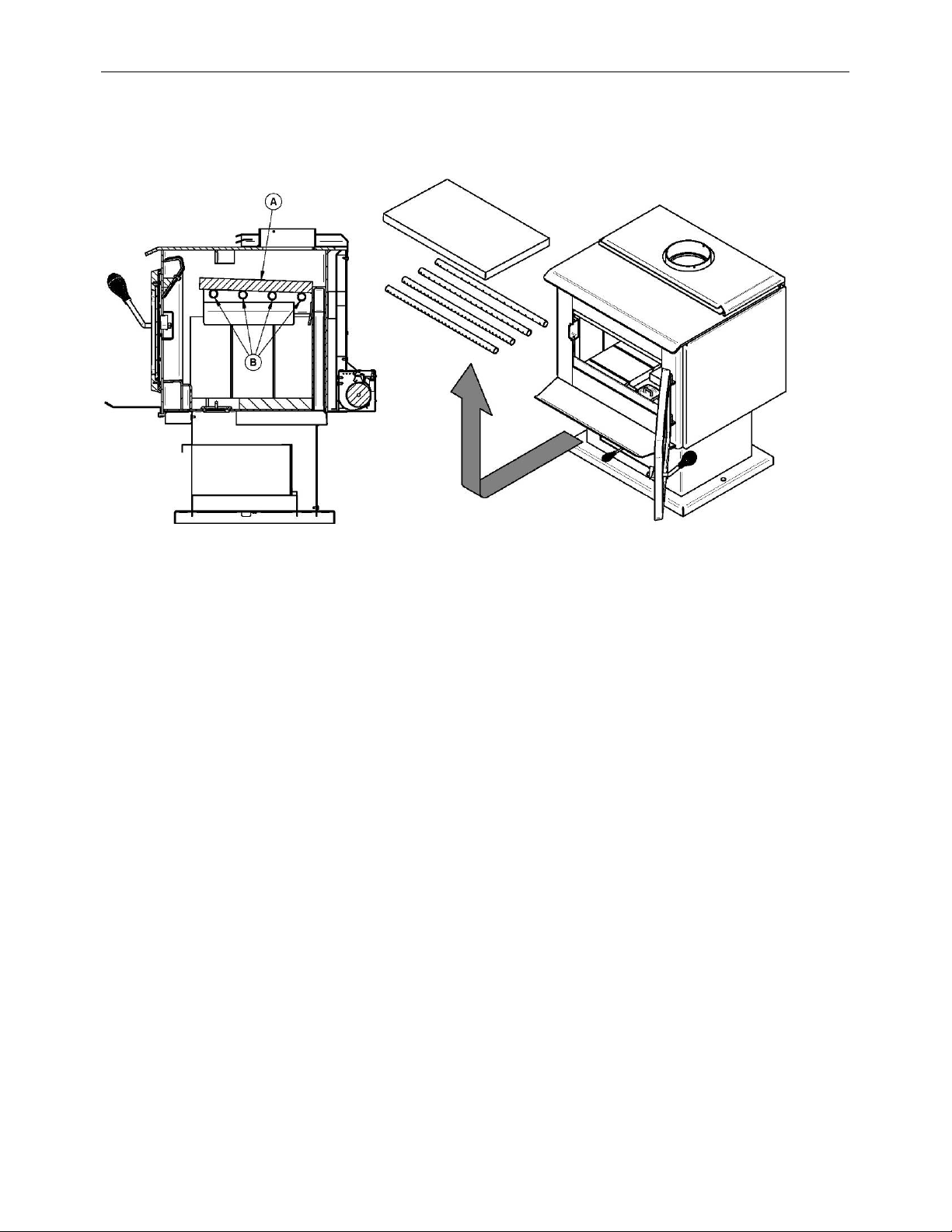
Installation and Operation Manual for Escape 1800
54
Note that secondary air tubes (B) can be replaced without removing the baffle board (A)
and that all tubes are identical.
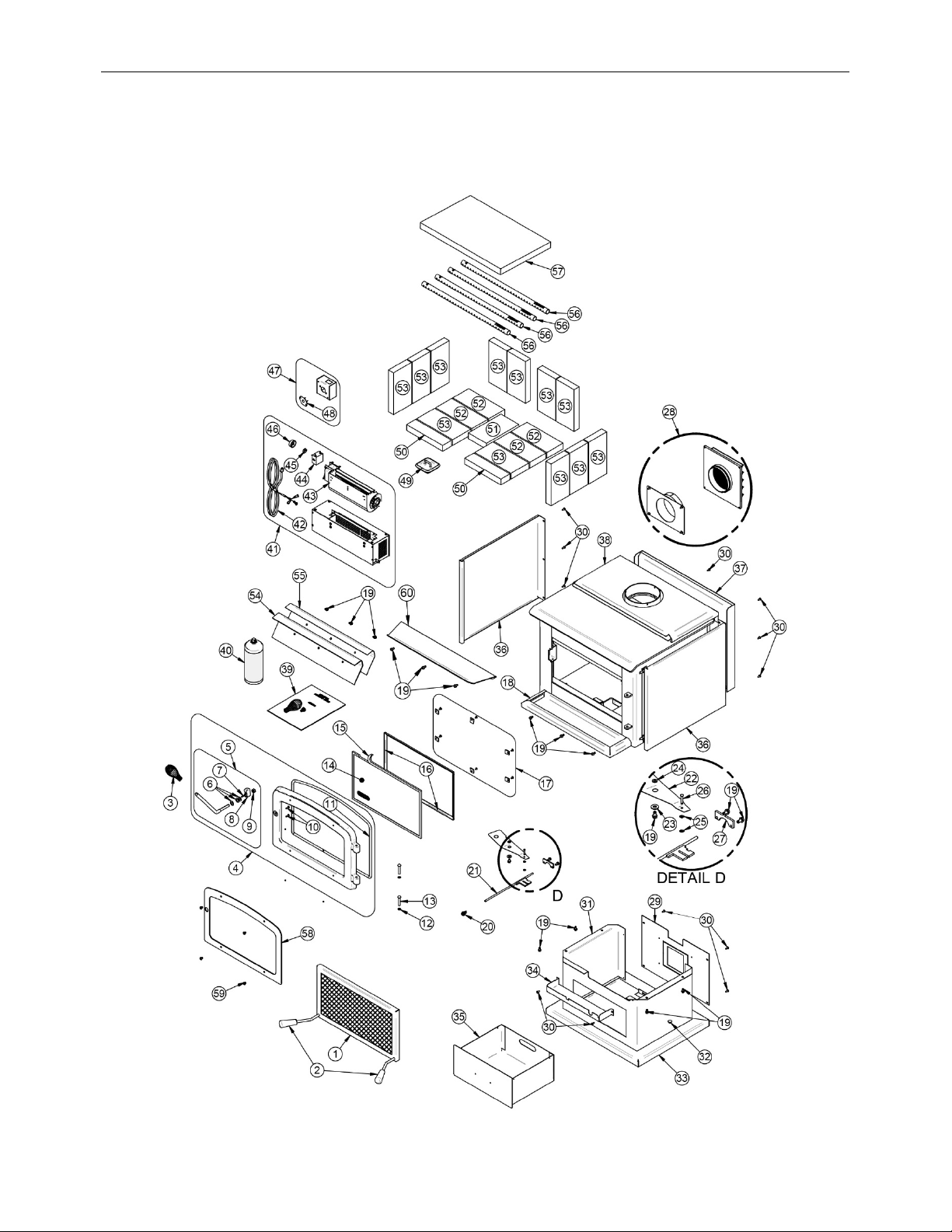
Installation and Operation Manual for Escape 1800
55
Appendix 5: Exploded Diagram and Parts List
DB03102, DB03111
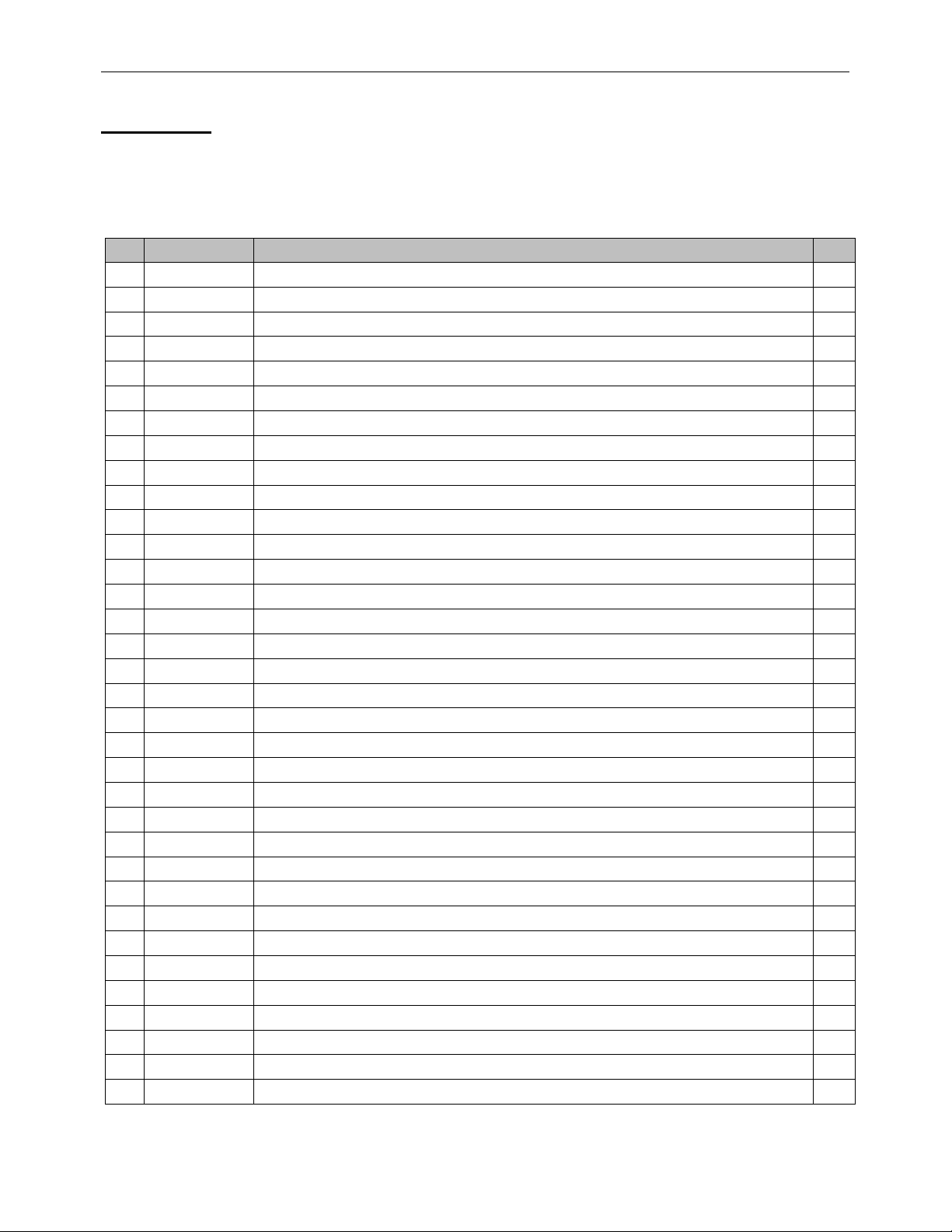
Installation and Operation Manual for Escape 1800
56
IMPORTANT: THIS IS DATED INFORMATION. When requesting service or replacement
parts for your stove, please provide the model number and the serial number. We reserve
the right to change parts due to technology upgrades or availability. Contact an authorized
dealer to obtain any of these parts. Never use substitute materials. Use of non-approved
parts can result in poor performance and safety hazards.
#
Item
Description
Qty
1* AC01315 RIGID FIRESCREEN 1
2* 30569 ROUND WOODEN HANDLE BLACK 2
3 AC07867 1/2" CHROME PLATED COIL HANDLE 1
4
SE24107-07
CAST IRON DOOR WITH GASKET AND HANDLE (DB03102 only)
1
4
SE24107-02
CAST IRON DOOR WITH GASKET AND HANDLE (DB03111 only)
1
5
AC09167
HANDLE AND LATCH KIT
1
6
30205
ZINC WASHER ID 13/32" X OD 13/16"
3
7
30533
LATCH KEY PATH PIN
1
8
30033
STEEL DOOR LATCH
1
9
30224
LOCKNUT 3/8"-16 HEX
1
10
30123
SCREW #8 - 32 X 5/8'' PAN QUADREX ZINC
2
11
AC06500
SILICONE AND 5/8" X 8' BLACK DOOR GASKET KIT
1
12
30055
HINGE PIN RETAINING RING 5/16" ID X 0.512" OD
2
13
30169
DOOR HINGE PIN 5/16''Ø X 1 3/4"L
2
14
SE55103
GLASS WITH GASKET - 17 1/8"W X 10 3/16"H
1
15 AC06400 3/4" (FLAT) X 6' BLACK SELF-ADHESIVE GLASS GASKET 1
16 PL55041 GLASS RETAINER FRAME 2
17
SE53585
GLASS RETAINER KIT WITH SCREWS (12 PER KIT)
1
18
PL65955
ASH LIP (DB03111 only)
1
19
30060
THREAD-CUTTING SCREW 1/4-20 X 1/2" F HEX STEEL SLOT WASHER C102 ZINC
11
20
AC07865
1/4" CHROME PLATED COIL HANDLE
1
21
SE65562
AIR CONTROL ROD ASSEMBLY
1
22
PL65579
AIR CONTROL DAMPER
1
23
30206
ZINC WASHER 5/16"ID X 3/4"OD
1
24
30187
STAINLESS WASHER ID 17/64" X OD 1/2"
1
25
30059
5/32" ID PUSHNUT
2
26
30064
3/16" X 1" CLEVIS PIN
1
27
PL65572
AIR CONTROL ROD GUIDE
1
28* AC01336 5"Ø FRESH AIR INTAKE KIT FOR WOOD STOVE ON PEDESTAL 1
29 PL65565 REAR OF PEDESTAL 1
30
30131
BLACK METAL SCREW #10 X 1/2" TYPE "A" PAN QUADREX
13
31
99999
BUILD TO ORDER
1
32
30418
FINISHING PLUG 3/8"
2
33
99999
BUILD TO ORDER
1

Installation and Operation Manual for Escape 1800
57
#
Item
Description
Qty
34 PL53664 AIR CONTROL COVER 1
35 SE65956 ASH PAN 1
36 PL65577 LEFT OR RIGHT DECORATIVE SIDE PANEL 2
37 99999 BUILD TO ORDER 1
38
SE53659
TOP AIR MATE
1
39
SE45930-01
ESCAPE 1800 INSTRUCTION MANUAL KIT
1
40*
AC05959
METALLIC BLACK STOVE PAINT - 342 g (12oz) AEROSOL
1
41*
AC03095
BLOWER ASSEMBLY WITH VARIABLE SPEED CONTROL (UP TO 130 CFM)
1
42
60013
POWER CORD 96" X 18-3 type SJT
1
43
44070
CROSSFLOW BLOWER SINGLE CAGE 115V-60Hz-56W
1
44
44080
RHEOSTAT WITHOUT NUT
1
45
44087
RHEOSTAT NUT
1
46
44085
RHEOSTAT KNOB
1
47*
AC02055
QUICK CONNECT THERMODISC KIT
1
48
44028
CERAMIC THERMODISC F110-20F
1
49 SE16059 ASH PLUG 1
50 PL36099 2 1/4" X 9'' X 1 1/4'' REFRACTORY BRICK 2
51
PL36028
4 1/2" X 8 1/8" X 1 1/4'' REFRACTORY BRICK
1
52
29015
4'' X 9'' X 1 1/4'' REFRACTORY BRICK
4
53
29010
4 1/2" X 9" X 1 1/4" REFRACTORY BRICK
12
54
21387
TOP AIR DEFLECTOR INSULATION
1
55
PL65505
TOP AIR DEFLECTOR PROTECTOR
1
56
PL65514
FRONT SECONDARY AIR TUBE
4
57
21388
VERMICULITE BAFFLE 20" X 12 1/2" X 1 1/4"
1
58
PL65726
BRUSHED NICKEL OVERLAY (DB03111 only)
1
59
30253
MECHANICAL SCREW 1/4-20 X 5/16" BUTTONHEAD HEX DEEP #5/32 SS 18-8
4
60
PL65958
ASH LIP (DB03102 only)
1
*Items marked with an asterisk are sold separately.
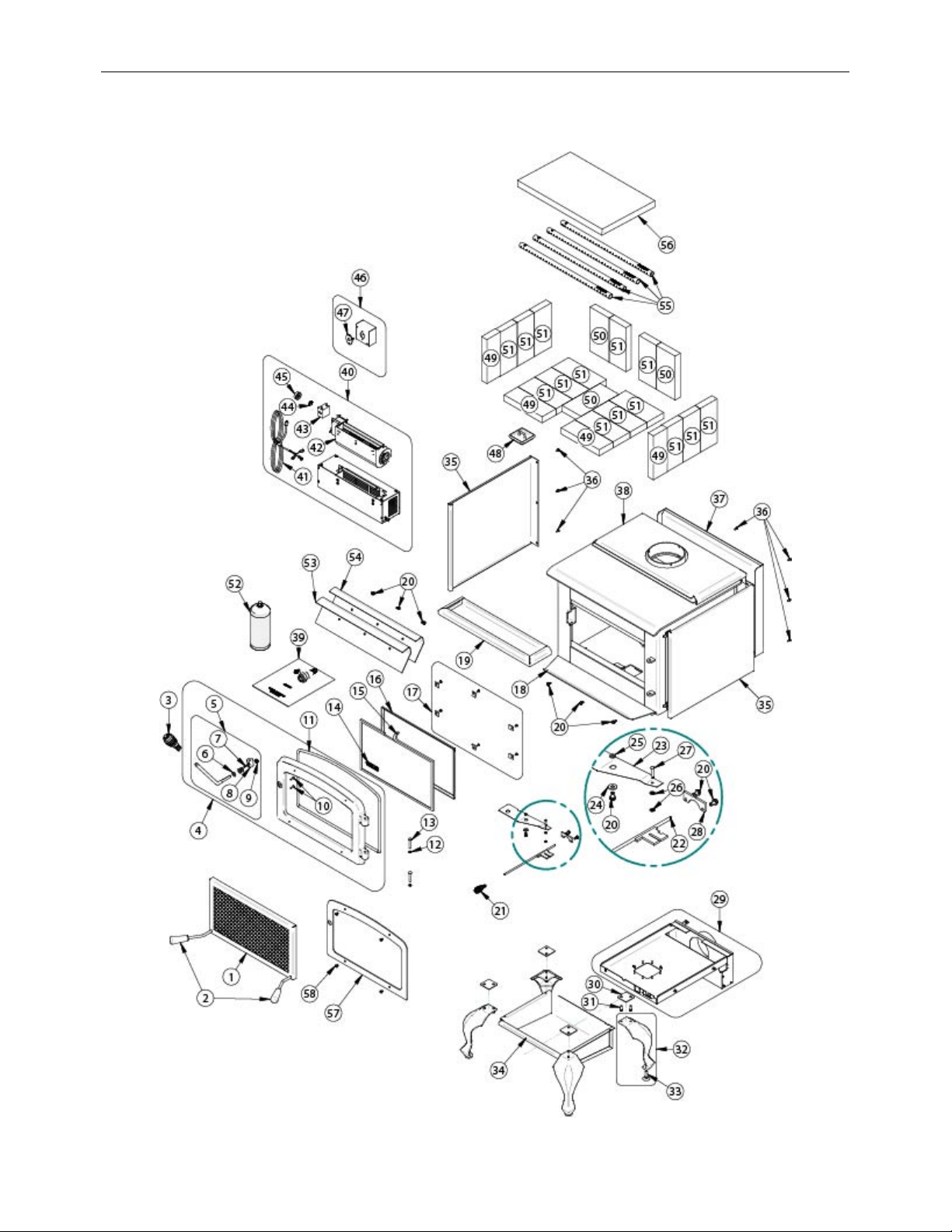
Installation and Operation Manual for Escape 1800
58
DB03105, DB03112

Installation and Operation Manual for Escape 1800
59
#
Item
Description
Qty
1* AC01315 RIGID FIRESCREEN 1
2* 30569 ROUND WOODEN HANDLE BLACK 2
3 AC07867 1/2" CHROME PLATED COIL HANDLE 1
4 SE24107-07 CAST IRON DOOR WITH GASKET AND HANDLE (DB03112) 1
4
SE24107-02
CAST IRON DOOR WITH GASKET AND HANDLE (DB03105)
1
5
AC09167
HANDLE AND LATCH KIT
1
6
30205
ZINC WASHER ID 13/32" X OD 13/16"
3
7
30533
LATCH KEY PATH PIN
1
8
30033
STEEL DOOR LATCH
1
9
30224
LOCKNUT 3/8"-16 HEX
1
10
30123
SCREW #8 - 32 X 5/8'' PAN QUADREX ZINC
2
11
AC06500
SILICONE AND 5/8" X 8' BLACK DOOR GASKET KIT
1
12
30055
HINGE PIN RETAINING RING 5/16" ID X 0.512" OD
2
13
30169
DOOR HINGE PIN 5/16''Ø X 1 3/4"L
2
14
SE55103
GLASS WITH GASKET - 17 1/8"W X 10 3/16"H
1
15 AC06400 3/4" (FLAT) X 6' BLACK SELF-ADHESIVE GLASS GASKET 1
16 PL55041 GLASS RETAINER FRAME 2
17
SE53585
GLASS RETAINER KIT WITH SCREWS (12 PER KIT)
1
18
PL65958
ASH LIP
1
19
PL65955
ASH LIP
1
20
30060
THREAD-CUTTING SCREW 1/4-20 X 1/2" F HEX STEEL SLOT WASHER C102 ZINC
9
21
AC07865
1/4" CHROME PLATED COIL HANDLE
1
22
SE65562
AIR CONTROL ROD ASSEMBLY
1
23
PL65579
AIR CONTROL DAMPER
1
24
30206
ZINC WASHER 5/16"ID X 3/4"OD
1
25
30187
STAINLESS WASHER ID 17/64" X OD 1/2"
1
26
30059
5/32" ID PUSHNUT
2
27
30064
3/16" X 1" CLEVIS PIN
1
28 PL65563 ROD GUIDE 1
29* AC01316 5"Ø FRESH AIR INTAKE KIT FOR WOOD STOVE ON LEGS 1
30
PL65548
LEG SPACER
4
31
30094
HEX SCREW WASHER HEAD 1/4-20 X 3/4" F ZINC TYPE
8
32
PL24098
BLACK PAINTED CAST IRON LEG WITH LEVELING BLOT
4
33
30050
LEVELING BOLT 3/8-16 X 1 1/2"
4
34
SE53596
ASH DRAWER
1
35
PL65577
LEFT OR RIGHT DECORATIVE SIDE PANEL
2
36
30131
BLACK METAL SCREW #10 X 1/2" TYPE "A" PAN QUADREX
7
37
99999
BUILD TO ORDER
1
38
SE53659
TOP AIR MATE
1

Installation and Operation Manual for Escape 1800
60
#
Item
Description
Qty
39 SE45930-01 ESCAPE 1800 INSTRUCTION MANUAL KIT 1
40*
AC03095
BLOWER ASSEMBLY WITH VARIABLE SPEED CONTROL (UP TO 130 CFM)
1
41
60013
POWER CORD 96" X 18-3 type SJT
1
42
44070
CROSSFLOW BLOWER SINGLE CAGE 115V-60Hz-56W
1
43
44080
RHEOSTAT WITHOUT NUT
1
44
44087
RHEOSTAT NUT
1
45
44085
RHEOSTAT KNOB
1
46*
AC02055
QUICK CONNECT THERMODISC KIT
1
47
44028
CERAMIC THERMODISC F110-20F
1
48
SE16059
ASH PLUG
1
49
29007
3 1/4'' X 9'' X 1 1/4'' REFRACTORY BRICK
4
50
29010
4 1/2" X 9" X 1 1/4" REFRACTORY BRICK
3
51
29015
4'' X 9'' X 1 1/4'' REFRACTORY BRICK
14
52
AC05959
METALLIC BLACK STOVE PAINT - 342 g (12oz) AEROSOL
1
53 21387 TOP AIR DEFLECTOR INSULATION 1
54 PL65505 TOP AIR DEFLECTOR PROTECTOR 1
55
PL65514
FRONT SECONDARY AIR TUBE
4
56
21388
VERMICULITE BAFFLE 20" X 12 1/2" X 1 1/4"
1
57
PL65726
BRUSHED NICKEL OVERLAY (DB03112 only)
1
58
30253
MECHANICAL SCREW 1/4-20 X 5/16" BUTTONHEAD HEX DEEP #5/32 SS 18-8
(DB03112 only)
4
*Items marked with an asterisk are sold separately.
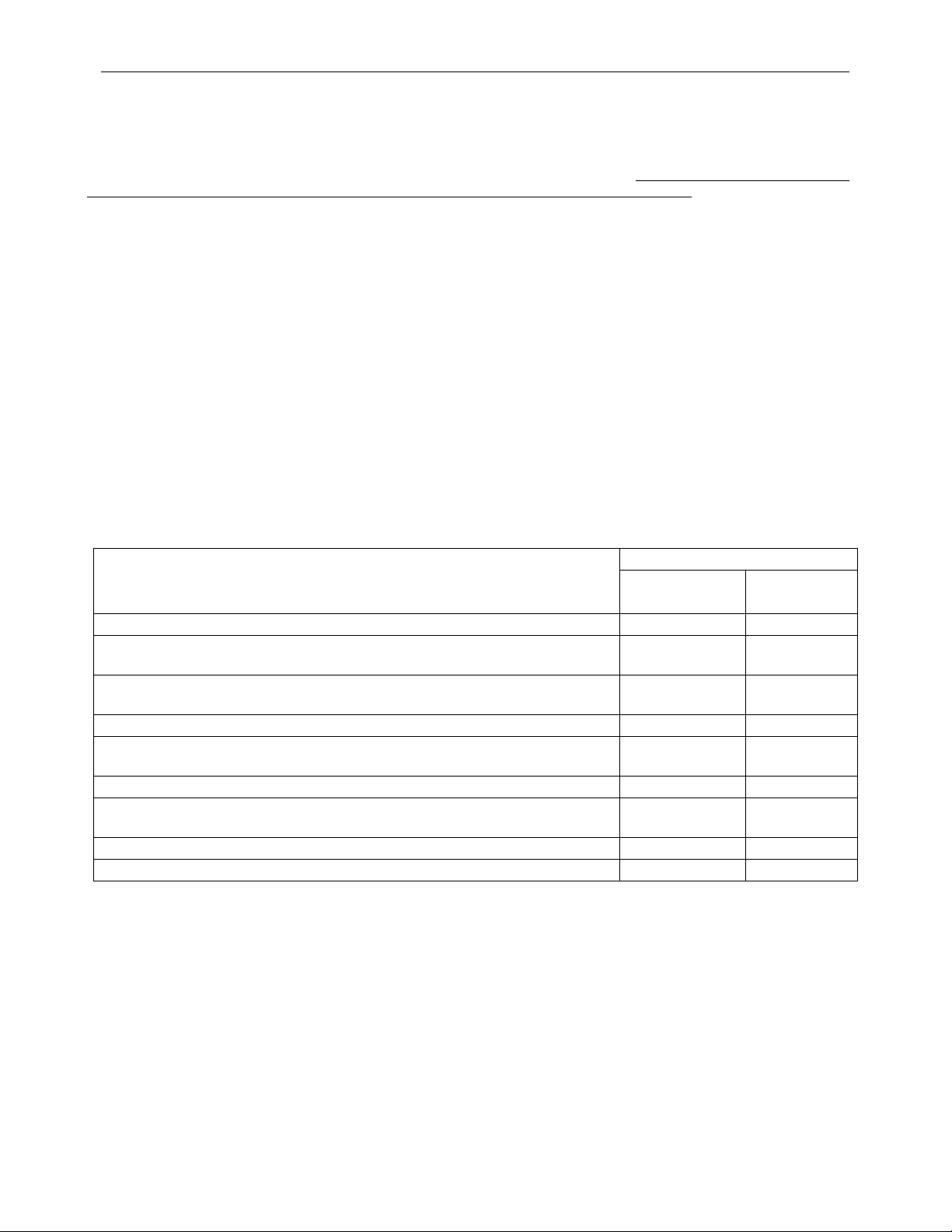
Installation and Operation Manual for Escape 1800
61
DROLET LIMITED LIFETIME WARRANTY
The warranty of the manufacturer extends only to the original retail purchaser and is not transferable. This warranty covers brand new
products only, which have not been altered, modified nor repaired since shipment from factory. Proof of purchase (dated bill of sale),
model name and serial number must be supplied when making any warranty claim to your DROLET dealer.
This warranty applies to normal residential use only. This warranty is void if the unit is used to burn material other than
cordwood (for which the unit is not certified by EPA) and void if not operated according to the owner's manual. Damages caused
by misuse, abuse, improper installation, lack of maintenance, over firing, negligence or accident during transportation, power
failures, downdrafts, venting problems or under-estimated heating area are not covered by this warranty. The recommended
heated area for a given appliance is defined by the manufacturer as its capacity to maintain a minimum acceptable temperature
in the designated area in case of a power failure.
This warranty does not cover any scratch, corrosion, distortion, or discoloration. Any defect or damage caused by the use of unauthorized
or other than original parts voids this warranty. An authorized qualified technician must perform the installation in accordance with the
instructions supplied with this product and all local and national building codes. Any service call related to an improper installation is not
covered by this warranty.
The manufacturer may require that defective products be returned or that digital pictures be provided to support the claim. Returned
products are to be shipped prepaid to the manufacturer for investigation. Transportation fees to ship the product back to the purchaser
will be paid by the manufacturer. Repair work covered by the warranty, executed at the purchaser’s domicile by an authorized qualified
technician requires the prior approval of the manufacturer. All parts and labour costs covered by this warranty are limited according to
the table below.
The manufacturer, at its discretion, may decide to repair or replace any part or unit after inspection and investigation of the defect. The
manufacturer may, at its discretion, fully discharge all obligations with respect to this warranty by refunding the wholesale price of any
warranted but defective parts. The manufacturer shall, in no event, be responsible for any uncommon, indirect, consequential damages of
any nature, which are in excess of the original purchase price of the product. A one-time replacement limit applies to all parts benefiting
from lifetime coverage. This warranty applies to products purchased after March 1
st
, 2015.
DESCRIPTION
WARRANTY APPLICATION*
PARTS LABOUR
Combustion chamber (welds only) and cast iron door frame.
Lifetime
3 years
Surrounds, heat shields, ash drawer, steel legs, pedestal, trims (aluminum
extrusions), plating (defective manufacture**), and convector air-mate.
5 years 3 years
Removable stainless steel combustion chamber components, secondary air
tubes**, deflectors, and supports.
5 years N/A
Glass retainers, handle assembly, and air control mechanism.
3 years
1 year
Carbon steel combustion chamber components, vermiculite baffle**, and C-Cast
baffle**.
2 years N/A
Standard blower, heat sensors, switches, rheostat, wiring, and other electronics.
1 year
1 year
Optional blower, paint (peeling**), ceramic glass (thermal breakage only**),
ceramic fibre blankets, gaskets, insulation, and other options.
1 year
N/A
Firebricks.
N/A
N/A
All parts replaced under the warranty.
90 days
N/A
*Subject to limitations above. **Picture required.
Labour cost and repair work to the account of the manufacturer are based on a predetermined rate schedule and must not exceed the
wholesale price of the replacement part.
Shall your unit or a components be defective, contact immediately your DROLET dealer. To accelerate processing of your warranty
claim, make sure to have on hand the following information when calling:
• Your name, address and telephone number;
• Bill of sale and dealer’s name;
• Installation configuration;
• Serial number and model name as indicated on the
nameplate fixed to the back of your unit;
• Nature of the defect and any relevant information.
Before shipping your unit or defective component to our plant, you must obtain an Authorization Number from your DROLET
dealer. Any merchandise shipped to our plant without authorization will be refused automatically and returned to sender.

NOTES :
_________________________________________________________________________
_________________________________________________________________________
_________________________________________________________________________
_________________________________________________________________________
_________________________________________________________________________
_________________________________________________________________________
_________________________________________________________________________
_________________________________________________________________________
_________________________________________________________________________
_________________________________________________________________________
_________________________________________________________________________
_________________________________________________________________________
_________________________________________________________________________
_________________________________________________________________________
_________________________________________________________________________
_________________________________________________________________________
_________________________________________________________________________
_________________________________________________________________________
_________________________________________________________________________
_________________________________________________________________________
_________________________________________________________________________
_________________________________________________________________________
_________________________________________________________________________

Installation and Operation Manual for Escape 1800
63