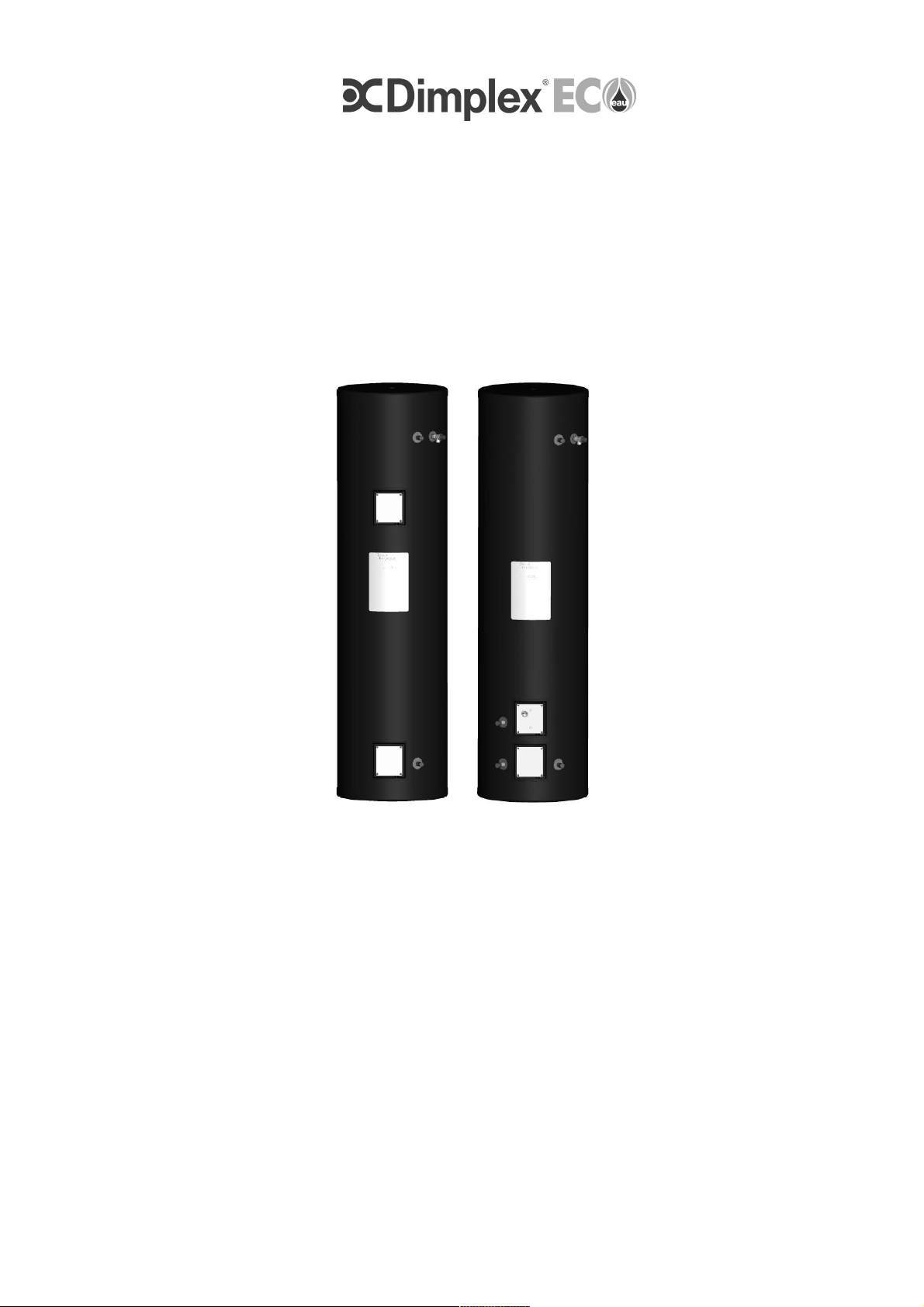
Important - This manual must be left with the user after Installation!
Ec
-
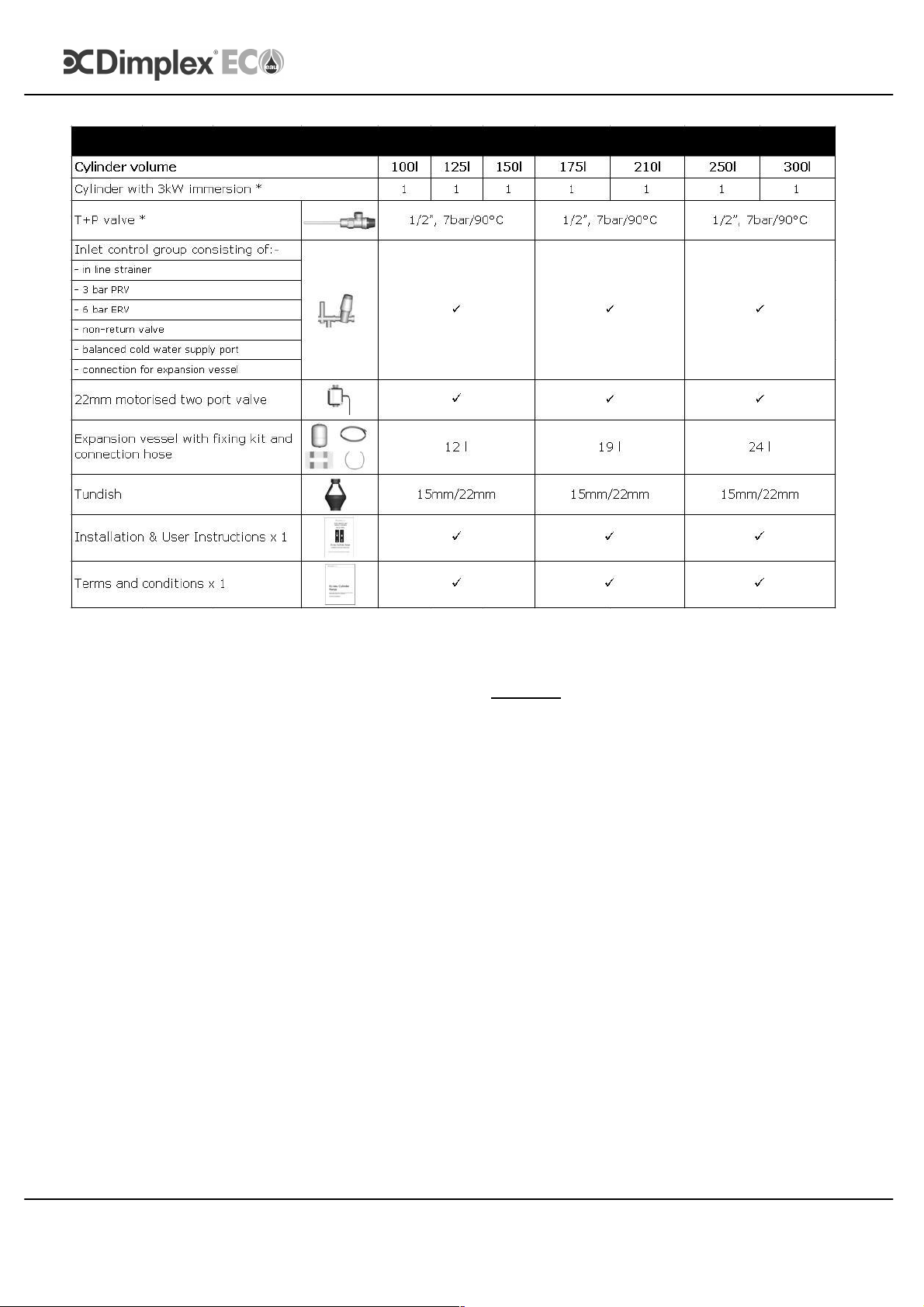
eau Cylinder Range
Installation and User Instructions
Direct Electric and
Indirect Cylinders
Up to 300L

Installat
ion and User Instructions R
01127
-
2 06
/11
Page 2
Dimplex is a licensed member of the Benchmark Scheme which aims to
improve the standards of installation and commissioning of domestic heating
and hot water systems in the UK and to encourage regular servicing to optimise
safety, efficiency and performance.
Benchmark places responsibilities on both manufacturers and installers. The
purpose is to ensure that customers are provided with the correct equipment
for their needs, that it is installed, commissioned and serviced in accordance
with the manufacturer’s instructions by competent persons and that it meets
the requirements of the appropriate Building Regulations. The Benchmark
Checklist can be used to demonstrate compliance with Building Regulations and
should be provided to the customer for future reference.
Installers are required to carry out installation, commissioning and servicing
work in accordance with the Benchmark Code of Practice which is available
from the Heating and Hot Water Industry Council who manage and promote the
Scheme. Visit www.centralheating.co.uk for more information.
Installat
ion and User Instructions R
01127
-
2 06
/11
Page 3
Overall View
0 Overall View
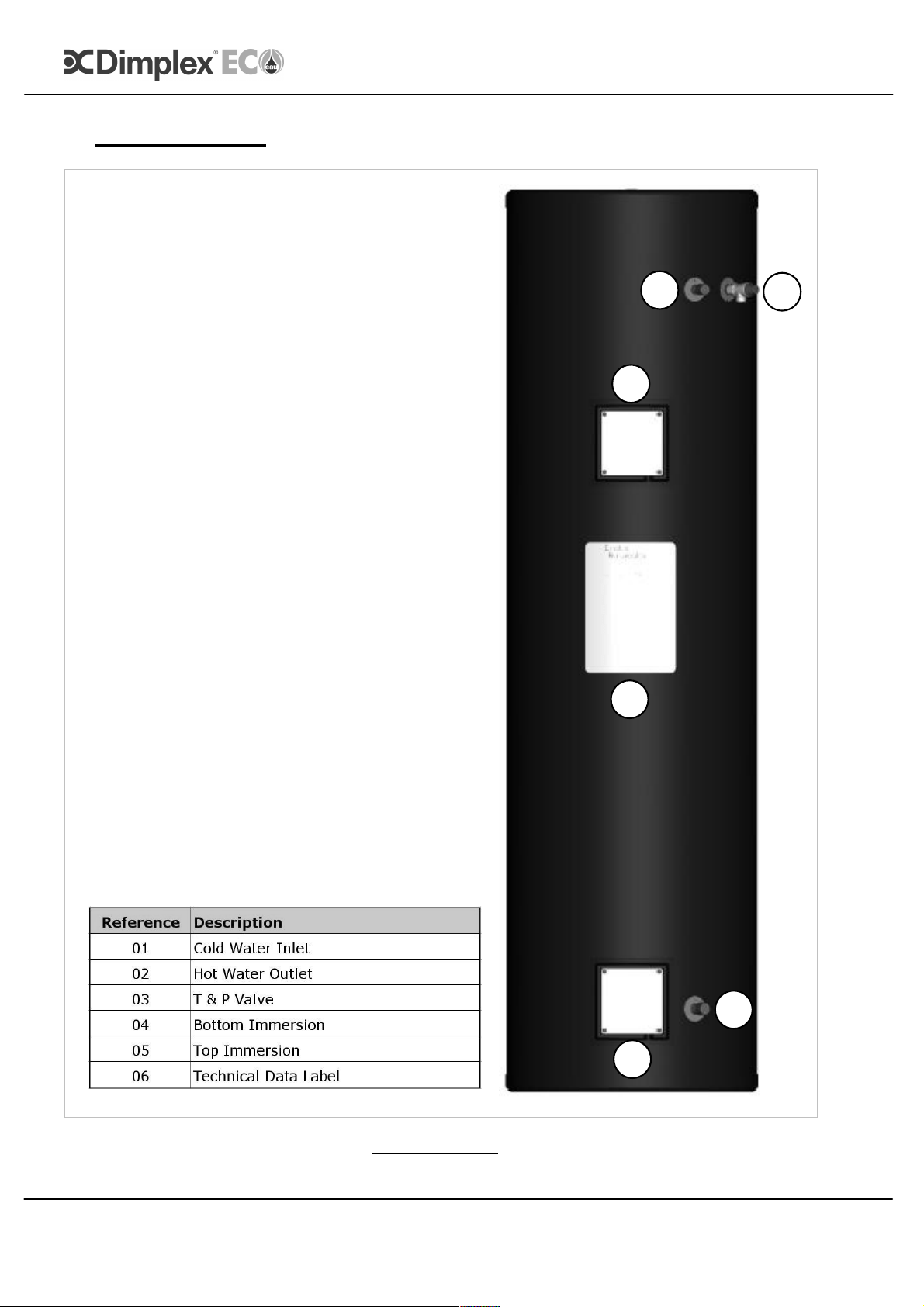
Figure 1: Overall view of Direct Electric
Cylinder Installation Process
0
1
02
03
04
05
06
Installat
ion and User Instructions R
01127
-
2 06
/11
Page 4
Overall View
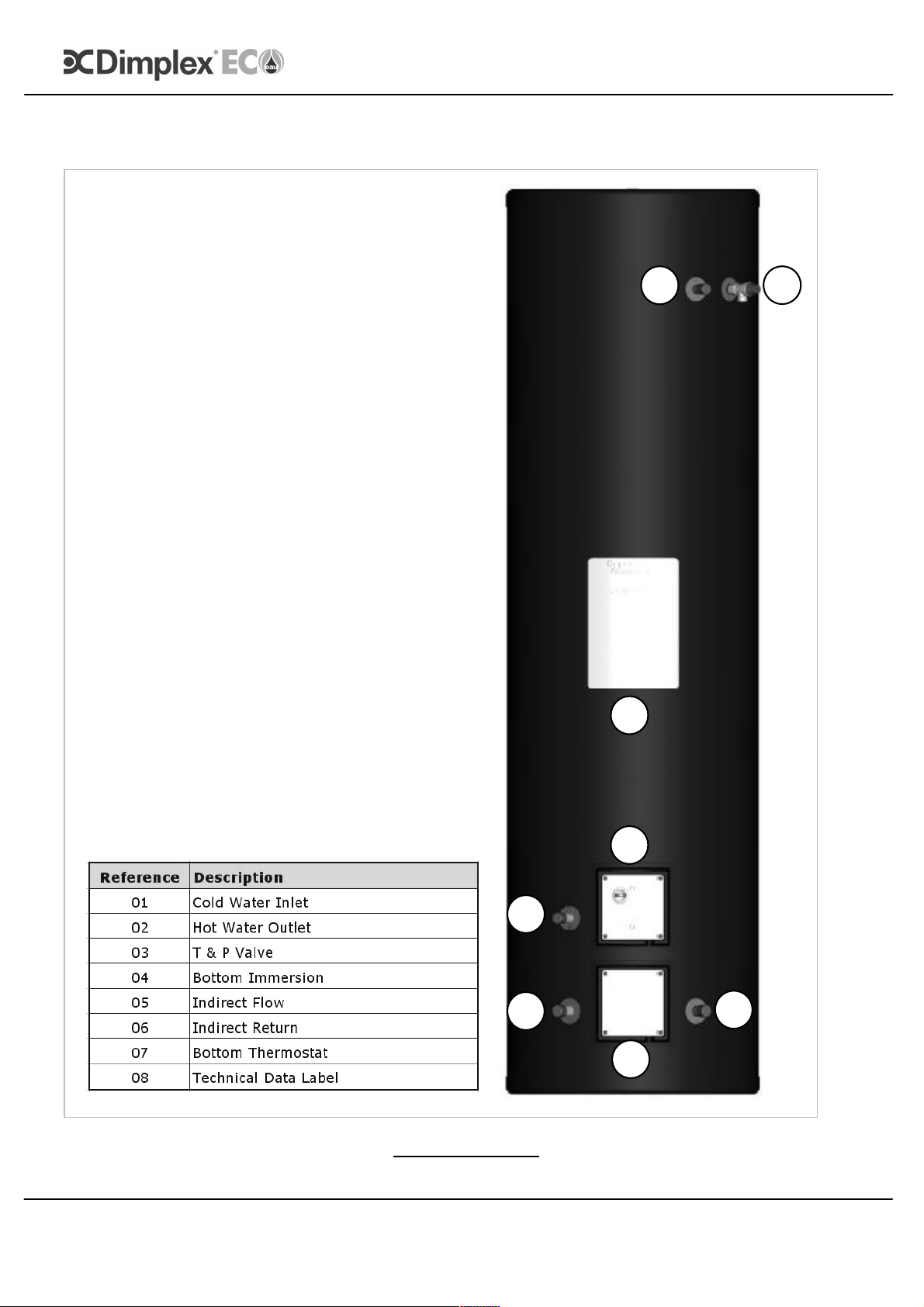
Figure 2: Overall view of Indirect Cylinder
Installation Process
0
1
02
03
04
05
06
07
08

Installat
ion and User Instructions R
01127
-
2 06
/11
Page 5
Contents
1 Contents
0
OVERALL VIEW .......................................................................................... 3
1 CONTENTS ................................................................................................ 5
2 INTRODUCTION ......................................................................................... 7
3 SCOPE OF DELIVERY .................................................................................. 7
4 PRE-INSTALLATION ADVICE ........................................................................ 9
4.1 RISK ASSESSMENT ...................................................................................... 9
4.2 SITING CONSIDERATIONS.............................................................................. 9
4.3 COLD WATER SUPPLY ..................................................................................10
4.4 BUILDING REGULATION G3 DISCHARGE REQUIREMENTS .........................................10
4.4.1 Discharge pipe D2............................................................................11
4.4.2 Worked example..............................................................................12
4.4.3 Termination of discharge pipe ...........................................................13
4.5 LIMITATIONS............................................................................................13
5 INSTALLATION..........................................................................................14
5.1 COLD WATER INLET WITH INLET CONTROL GROUP ...............................................14
5.1.1 Correctly site the cylinder .................................................................14
5.1.2 Install the inlet group .......................................................................14
5.1.3 Expansion vessel .............................................................................14
5.1.4 Balanced cold water supply ...............................................................14
5.1.5 Drain valve .....................................................................................14
5.2 HOT WATER OUTLET ..................................................................................15
5.2.1 Thermostatic mixing valve ................................................................15
5.2.2 Pipe insulation.................................................................................15
5.3 DISCHARGE PIPES FROM SAFETY DEVICES ..........................................................15
5.3.1 Discharge pipe D1............................................................................15
5.3.2 Discharge pipe D2............................................................................15
5.3.3 Tundish ..........................................................................................16
5.4 IMMERSION HEATER....................................................................................16
5.5 COIL FLOW CONNECTIONS (INDIRECT MODELS ONLY) ............................................17
5.6 COIL RETURN CONNECTIONS (INDIRECT MODELS ONLY) .........................................17
5.7 THERMOSTAT CONNECTION (INDIRECT MODELS ONLY) ...........................................18
5.8 CONNECTION OF SECONDARY RETURN..............................................................21
6 COMMISSIONING ......................................................................................22
7 MAINTENANCE..........................................................................................23
8 SPARE PARTS ...........................................................................................24
9 TECHNICAL DATA......................................................................................25
10 USER INSTRUCTIONS ................................................................................29
10.1 GENERAL .............................................................................................29
10.2 OPERATION ..........................................................................................30

Installat
ion and User Instructions R
01127
-
2 06
/11
Page 6
Contents
10.2.1 Water temperature direct electric heating ...........................................30
10.2.2 Water temperature auxiliary heating ..................................................31
10.3 MAINTENANCE .......................................................................................31
10.4 TROUBLESHOOTING.................................................................................32
Installat
ion and User Instructions R
01127
-
2 06
/11
Page 7
Scope of Delivery
2 Introduction
Thank you for choosing a Dimplex
product. The EC-Eau direct electric
and indirect cylinders are specified
with high quality, long-life immersion
heaters and large surface area coils
for fast reheat times. They boast
60mm of low GWP insulation foam,
together with 100% recyclable
stainless steel inner components and
a sleek black, hard wearing outer shell
manufactured from completely
recycled materials. For more detailed
information on product features,
please see the Technical Data section
in this manual.
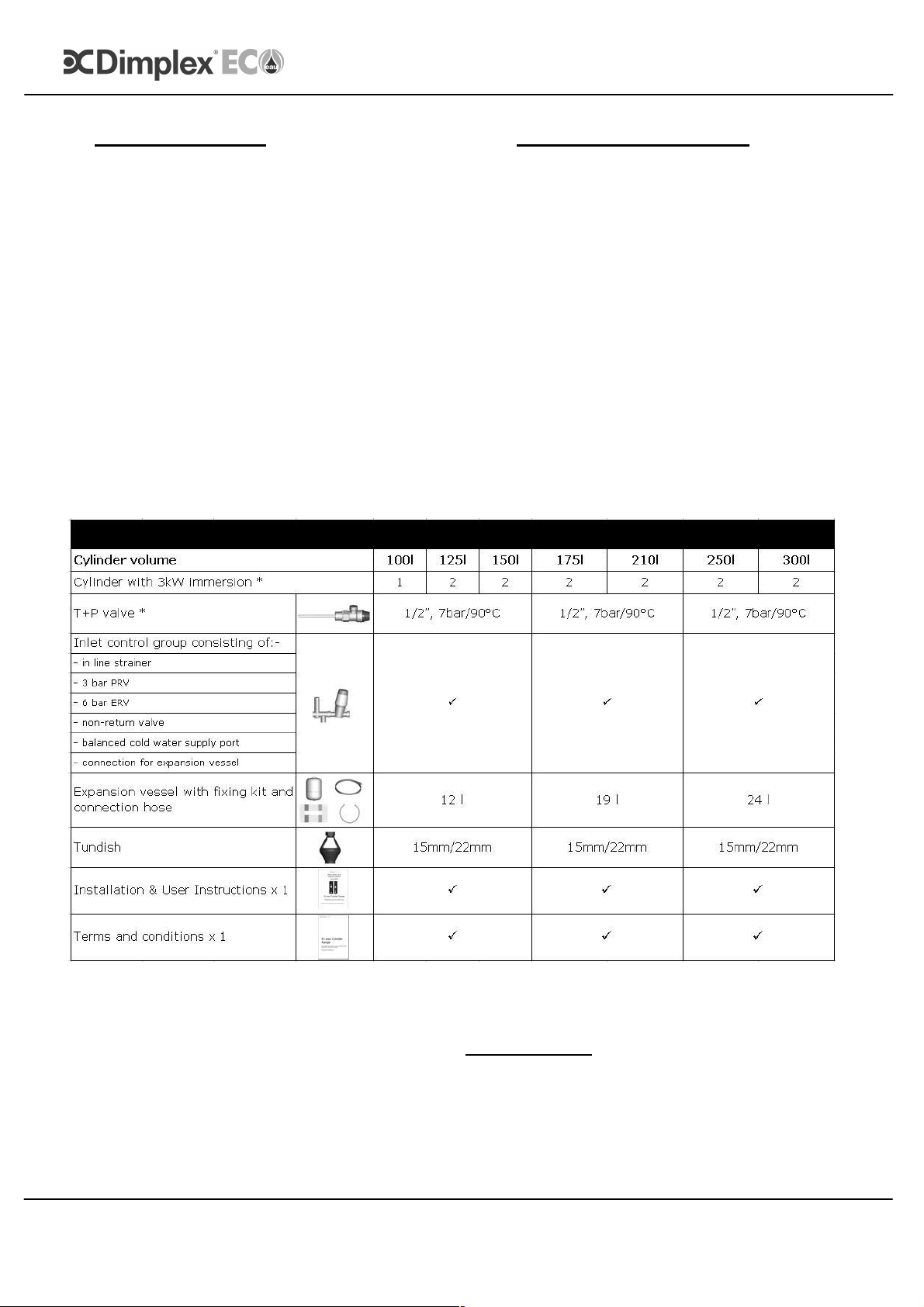
3 Scope of delivery
Please ensure you check the scope of
delivery below before signing any
delivery documentation. Claims for
missing or damaged parts after
signing for the delivery will not be
accepted.
* These items are supplied factory fitted
Table 1: Scope of Delivery for Direct Electric Cylinders
Installat
ion and User Instructions R
01127
-
2 06
/11
Page 8
Scope of Delivery
* These items are supplied factory fitted
Table 2: Scope of Delivery for Indirect Cylinders

Installat
ion and User Instructions R
01127
-
2 06
/11
Page 9
Pre
-
Installation
4 Pre-Installation
Advice
Please read the following section
carefully before commencing
installation. If in any doubt, please
call the appropriate help desk.
Disregarding the instructions given in
this manual in its entirety and any
relevant regulations, standards and
codes of practice will void the
guarantee of this product.
Handling – depending on the size of
the unit and access to its installation
location, consideration must be given
to the handling of the unit. Please
note that handling, installation and
use of this product is subject to the
Health and Safety at Work Act.
If the unit is not installed
immediately, it should remain in its
protective packaging with all pipe
protectors/end caps applied to
prevent damage and dirt deposit
inside the cylinder and the coils.
Pipe work – the pipe runs should be
executed as short as possible, unused
pipe work should be removed and all
remaining pipe work should be lagged
in accordance with regulatory
requirements to prevent heat loss and
the formation of condensation.
Taps and fittings – all taps and
fittings incorporated in the unvented
system should have a rated operating
pressure of 0.6 MPa (6 bar) or above.
4.1 Risk assessment
The compilation of a risk assessment
is strongly recommended before
installing the product. The following
areas require particular consideration
in addition to the information required
by the Health and Safety at Work Act.
- scalding: where appropriate or
required by law a thermostatic
mixing valve is to be fitted to the
hot water outlet of the cylinder (see
also water borne organisms).
- explosion: the unit is fully equipped
with all relevant safety equipment
to comply with current regulations.
The correct design and function has
been verified by independent third
party testing. The correct
application thereof is the
responsibility of the competent
installer.
- water borne organisms (i.e.
Legionella): if applicable a risk
assessment should be carried out
following the recommendations
outlined in the Approved Code of
Practice L8.
- the user preference must be
considered when commissioning the
system, in particular when adjusting
the solar and auxiliary system
temperature and timer settings.
4.2 Siting considerations
When choosing a suitable location for
the cylinder the following aspects
should be considered:
- structural integrity
- access for installation, operation,
maintenance and replacement
- routing of discharge pipe work
- access to water mains supply, hot
and cold water distribution pipe
work
- access to suitable electricity supply
Installat
ion and User Instructions R
01127
-
2 06
/11
Page 10
Pre
-
Installation
- location in relation to remaining
system components such as
auxiliary and solar heating system
- frost protection
The direct electric and indirect
cylinder ranges are designed to be
floor standing, vertically mounted,
indoors and in a frost free
environment. The cylinder may be
located on any flat and level surface,
provided it is sufficiently robust to
support the weight of the cylinder
when full of water (please see
technical data) and suitably accessible
for replacement/maintenance without
specialist tools or lifting equipment as
this will void the warranty conditions.
The position and orientation of the
cylinder should be such that easy
access is provided for servicing the
controls. A minimum distance of
400mm in front of the immersion is
recommended, to allow the
replacement of the immersion heater
should the need arise. When installing
the cylinder all labels should be clearly
visible and ensure that no pipework
hinders any work to be carried out on
the various cylinder components.
Particular care must be taken when
placing the cylinder in a garage or
outbuilding. All exposed pipe work
must be correctly insulated to avoid
frost damage.
4.3 Cold water supply
For satisfactory and safe performance
of the unvented cylinder the water
supply must meet the following
criteria:
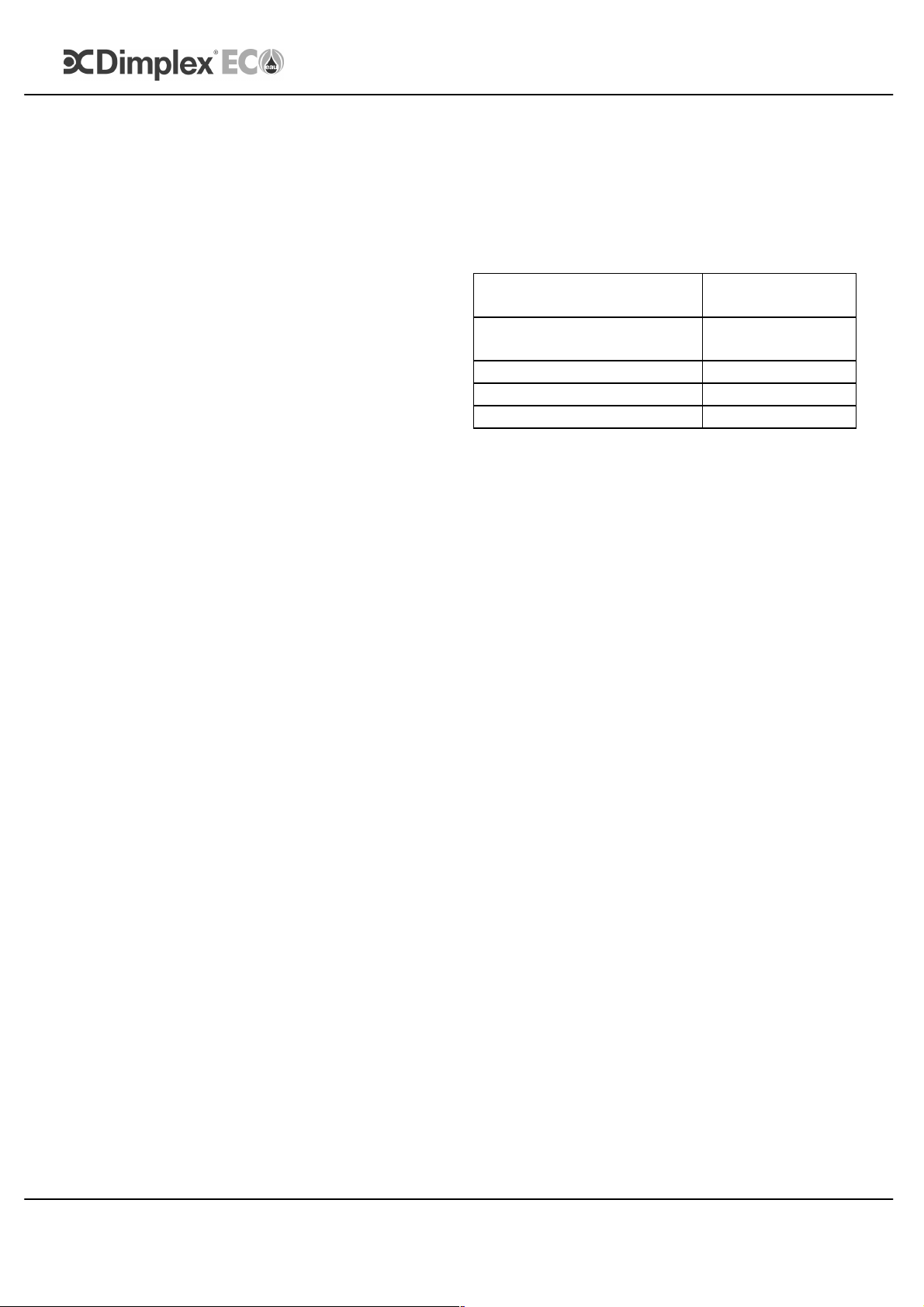
Minimum dynamic
pressure
150 kPa
(1.5 bar)
Maximum inlet supply
pressure
1200 kPa
(12 bar)
Minimum flow rate 15 l/min
Max. chlorine content 250mg/L
Max. water hardness 200mg/L
The following instructions have to be
followed when installing the cold
water mains supply to the cylinder:
- The cold water supply to the
cylinder must come directly from
the cold water mains after the
mains stop valve to the property.
- The cold water inlet pipe work
should have at least an inside
diameter of 19mm and should meet
the requirements of the water
regulations for the supply of
wholesome water.
4.4 Building regulation G3
Discharge
requirements
As part of the requirements of
Building Regulation G3 any discharge
from an unvented system should be
conveyed to where it is visible, but
will not cause danger to persons in or
about the building. The tundish and
the discharge pipes should be fitted in
accordance with the requirements of
Building Regulation approved
document G3, (England and Wales),
Part P of Northern Ireland and
Standard 4.9 of Scotland.
Pre
-
Installation
Installat
ion and User Instructions R01127
-
2 06
/11
Page 11
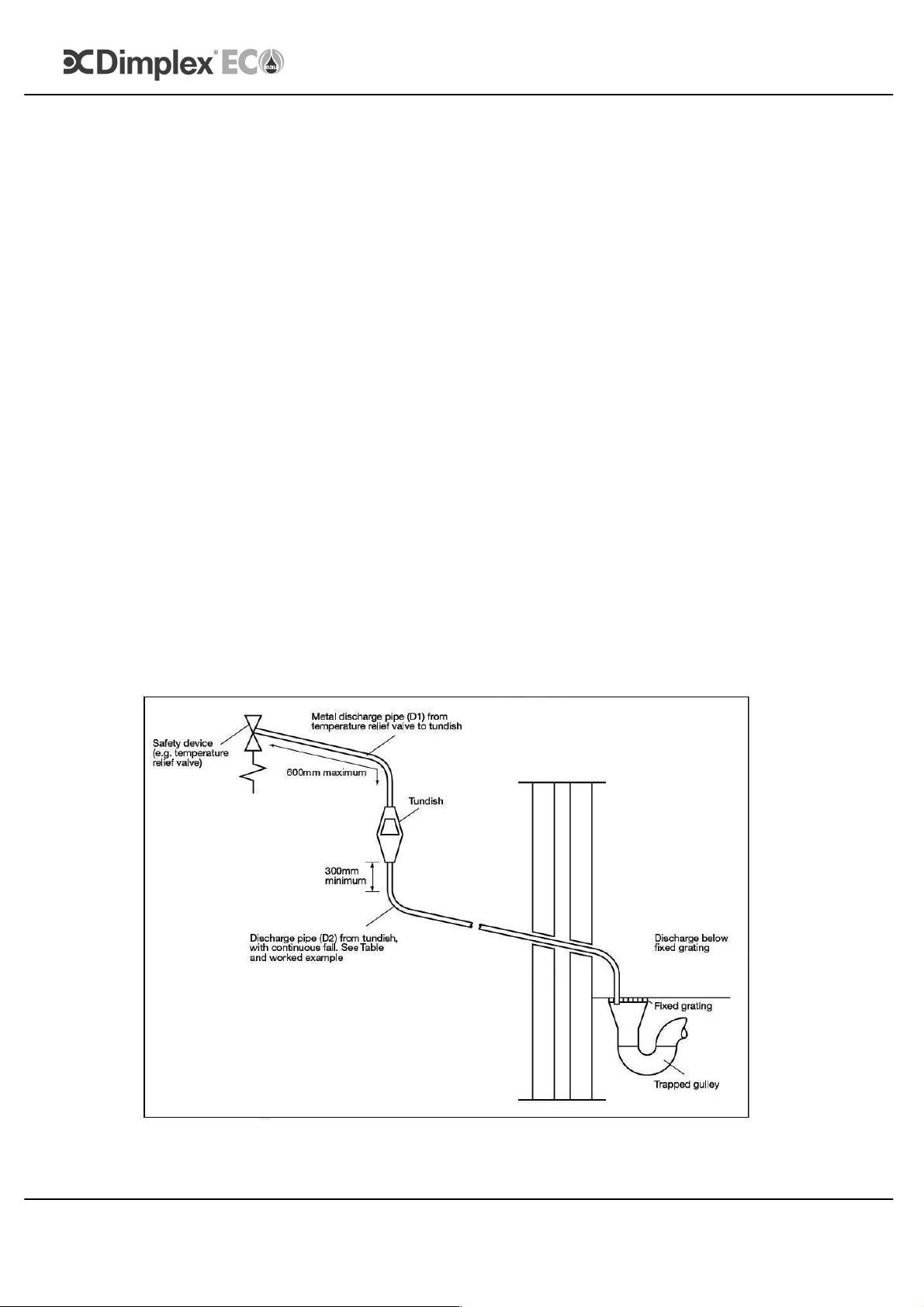
4.4.1 Discharge pipe D2
The discharge pipe (D2) from the
Tundish should:
- “have a vertical section of pipe at
least 300mm long below the
tundish before any elbows or
bends in the pipework and be
installed with a continuous fall of
at least 1 in 200 thereafter.”
The discharge pipe (D2) should be
made of:
- “metal; or other material that has
been demonstrated to be capable
of safely withstanding
temperatures of the water
discharged and is clearly and
permanently marked to identify
the product and performance
standard”
Dimplex strongly recommends the use
of metal pipework only and Dimplex
does not take responsibility for any
damage caused from discharges.
The discharge pipe D2 should be at
least one pipe size larger than the
nominal outlet size of the safety
device unless its total equivalent
hydraulic resistance exceeds that of a
straight pipe 9m long, i.e. for
discharge pipes between 9m and 18m
the equivalent resistance length
should be at least two sizes larger
than the nominal outlet size of the
safety device; between 18 and 27m at
least 3 sizes larger, and so on; bends
must be taken into account in
calculating the flow resistance. See
Figure 3, Table 3 and the worked
example.
Note: An alternative approach for
sizing discharge pipes would be to
follow Annex D, section D.2 of BS
6700:2006 + A1:2009).
Figure 3: Typical discharge pipe arrangement

Installat
ion and User Instructions R
01127
-
2 06
/11
Page 12
Pre
-
Installation
Table 3: Sizing of copper discharge pipe “D2” for common temperature relief valve outlet sizes
4.4.2 Worked example
This example is for a G½ temperature
relief valve with a discharge pipe (D2)
(as fitted on 125 to 300L cylinders)
having 4 No. 22mm elbows and length
of 7m from the tundish to the point of
discharge.
From Table 3, the maximum
resistance allowed for a straight
length of 22mm copper discharge pipe
(D2) from a G½ temperature relief
valve is 9.0m. Subtract the resistance
for 4 No. 22mm elbows at 0.8m each
= 3.2m.
Therefore the maximum permitted
length
equates to 5.8m, which is less than
the actual length of 7m, therefore
calculate the next largest size.
Maximum resistance allowed for a
straight length of 28mm copper
discharge pipe (D2) from a G½
temperature relief valve is: 18m
Subtract the resistance for 4 No.
28mm elbows at 1.0m each = 4m
Therefore the maximum permitted
length equates to 14m.
As the actual length is 7m, a 28mm
(D2) copper pipe will be satisfactory.

Installation and User Instructi
ons R01127
-
2 06
/11
Page 13
Pre
-
Installation
- Where a single common discharge
pipe serves more than one system,
it should be at least one pipe size
larger than the largest individual
discharge pipe (D2) to be
connected.
- The discharge pipe should not be
connected to a soil discharge stack
unless the soil discharge stack is
capable of safely withstanding
temperatures of the water
discharged, in which case, it should:
- contain a mechanical seal, which
allows water into the branch pipe
without allowing foul air from the
drain to be ventilated through the
tundish.
- there should be a separate
branch pipe with no sanitary
appliances connected to it.
- if plastic pipes are used as branch
pipes carrying discharge from a
safety device, they should be
either polybutalene (PB) or cross-
linked polyethylene (PE-X)
complying with national
standards.
- be continuously marked with a
warning that no sanitary
appliances should be connected
to the pipe.
4.4.3 Termination of
discharge pipe
- “The discharge pipe (D2) from the
tundish should terminate in a safe
place where there is no risk to
persons in the vicinity of the
discharge.”
- Examples of acceptable discharge
arrangements are:
- “to a trapped gully with the end of
the pipe below a fixed grating and
above the water seal;
- downward discharges at low level;
i.e. up to 100mm above external
surfaces such as car parks, hard
standings, grassed areas etc. are
acceptable providing that a wire
cage or similar guard is positioned
to prevent contact, whilst
maintaining visibility; and ,
- discharges at high level: e.g. into a
metal hopper and metal downpipe
with the end of the discharge pipe
clearly visible or onto a roof capable
of withstanding high temperature
discharges of water and 3m from
any plastic guttering system that
would collect such discharges.”
Note: As the discharge would
consist of high temperature water
and steam, asphalt, roofing felt
and non-metallic rainwater goods
may be damaged by such
discharges.
4.5 Limitations
Due to the operating temperatures of
direct electric water heaters the water
hardness can considerably influence
the longevity of the immersion heater
element. Please consult local water
board for advice on maintenance
intervals.
Installation and User Instructi
ons R01127
-
2 06
/11
Page 14
Installation
5 Installation
5.1 Cold Water Inlet with
Inlet Control Group
5.1.1 Correctly site the
cylinder
Install the cylinder in an appropriate
location, ensuring all of the
recommendations have been
considered (see chapter 4.2).
5.1.2 Install the inlet group
The inlet group regulates the pressure
of the incoming mains water supply to
the cylinder and removes any debris
that might be water borne.
Note: Between the inlet group and
the cold water inlet on the
cylinder NO
isolating device may
be fitted, as by doing so important
safety devices could be isolated!
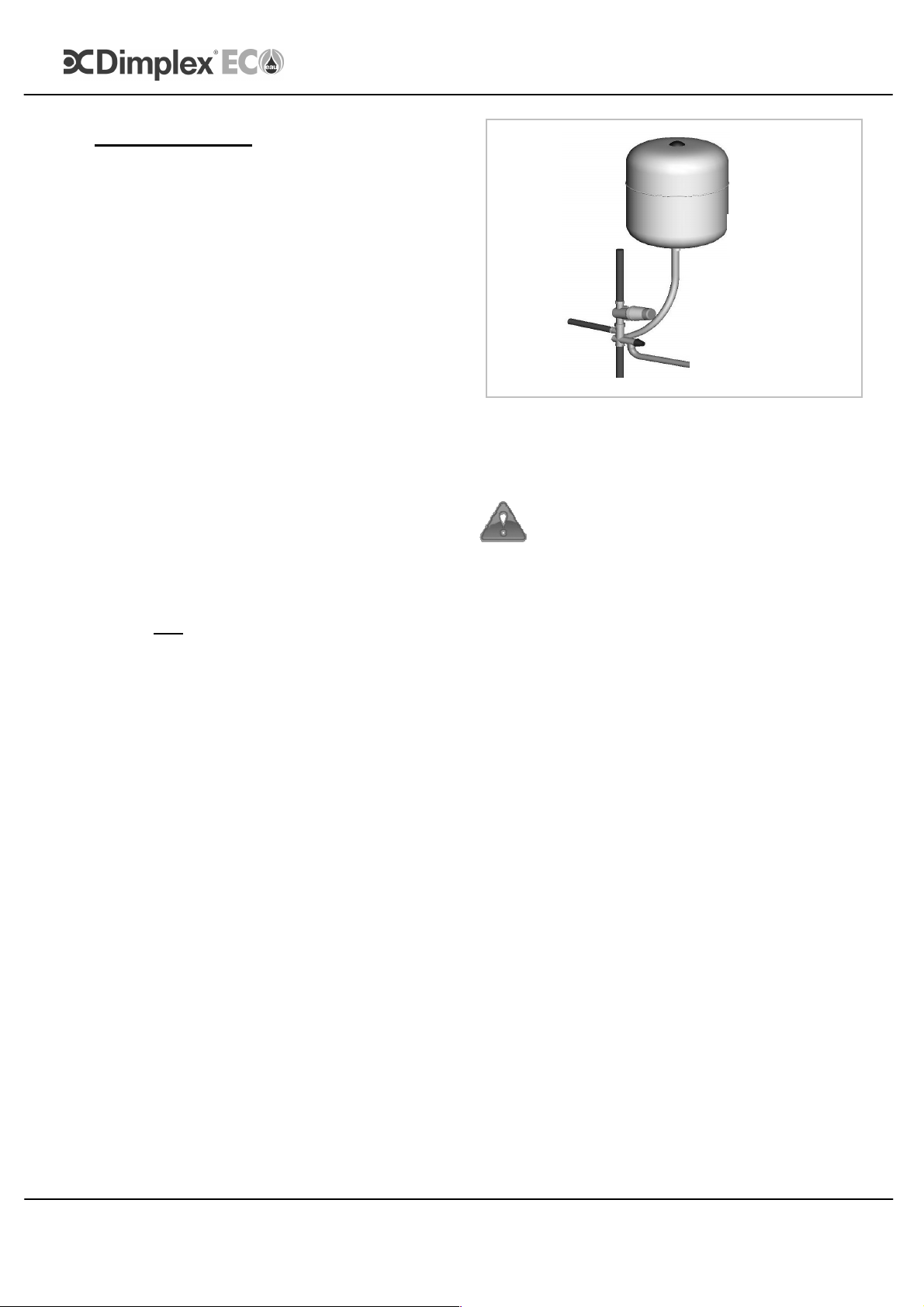
5.1.3 Expansion vessel
The expansion vessel is mandatory on
all Ec-eau cylinders and can be
connected directly to the cold water
inlet group, utilising the flexible hose
supplied with the vessel. The
expansion vessel should always be
fitted in accordance with the
manufacturer’s instructions. No
isolating device must be fitted
between the water cylinder and the
cold water inlet group.
Furthermore, it is recommended to
mount the vessel higher than the
cylinder to avoid having to drain the
cylinder when maintaining and
replacing the expansion vessel.
Figure 4: Connection of the expansion
vessel to the inlet group
It is important to check the
pre-charge pressure of the
expansion vessel membrane
before filling the cylinder. The
pre-charge should be greater
than or equal to 3 bar.
5.1.4 Balanced cold water
supply
If a balanced cold water supply is
required a connection can be taken
from the bottom of the inlet group.
5.1.5 Drain valve
It is also recommended to install a
drain valve (not supplied) in the
lowest point of the cold water feed to
the cylinder. This allows the cylinder
to be drained in a controlled manner
should this become necessary.

Installation and User Instructi
ons R01127
-
2 06
/11
Page 15
Installation
5.2 Hot Water Outlet
The hot water pipe work is to be
directly connected to the hot water
outlet connection on the cylinder, see
Figure 1.
5.2.1 Thermostatic mixing
valve
A thermostatic mixing valve may be
required to limit the outlet
temperature. In this case, the valve
should be installed following the
manufacturers instructions, ensuring
none of the safety equipment has
been isolated, (i.e. make sure the
connection to the thermostatic mixing
valve is taken after the safety
equipment of the inlet group).
5.2.2 Pipe insulation
It is recommended to insulate the hot
water pipe work from the cylinder to
the outlets, to reduce the energy
requirements for providing hot water.
It is also recommended to insulate all
other exposed pipework, such as the
T&P to the tundish, the coil flow and
return and the cold water inlet pipes.
5.3 Discharge pipes from
safety devices
5.3.1 Discharge pipe D1
- The temperature and pressure relief
valve must be discharged directly or
by way of a manifold via a short
length of metal pipe (D1) into a
tundish; and the discharge pipe
must be installed in a continuously
downward direction and in a frost
free environment. Water may drip
from the discharge pipe of the
pressure relief device and this pipe
must be left open to the
atmosphere.
- The diameter of discharge pipe (D1)
should not be less than the nominal
outlet size of the safety device, e.g.
temperature relief valve.
- Where a manifold is used it should
be sized to accept and discharge
the total discharge from all the D1
discharge pipes connected to it.
- The discharge pipe work from the
expansion relief valve must be
installed constantly falling to an
open point of discharge. It is
recommended to combine it with
the discharge of the temperature
and pressure relief valve.
Note: The T&P valve is pre-sealed
and if moved the seal will be
broken, should this occur, it will
need to be resealed with an
appropriate sealant (Dimplex part
number R00836-1).
5.3.2 Discharge pipe D2
For a detailed description of the
discharge pipework D2 see chapter
4.4.1.
Installation and User Instructi
ons R01127
-
2 06
/11
Page 16
Installation
5.3.3 Tundish
- The tundish should be vertical,
located in the same space as the
unvented hot water storage system
and be fitted as close as possible to,
and lower than, the safety device,
with no more than 600mm of pipe
between the valve outlet and the
tundish (see Figure 3).
- Discharge should be visible at the
tundish, where discharges may not
be apparent, e.g. in dwellings
occupied by people with impaired
vision or mobility, consideration
should be given to the installation of
a suitable safety device to warn
when discharge takes place, e.g.
electronically operated.
Note: To comply with the Water
Supply (Water Fittings)
Regulations, the tundish should
incorporate a suitable air gap.
It is important that the
tundish is positioned away
from any electrical
components.
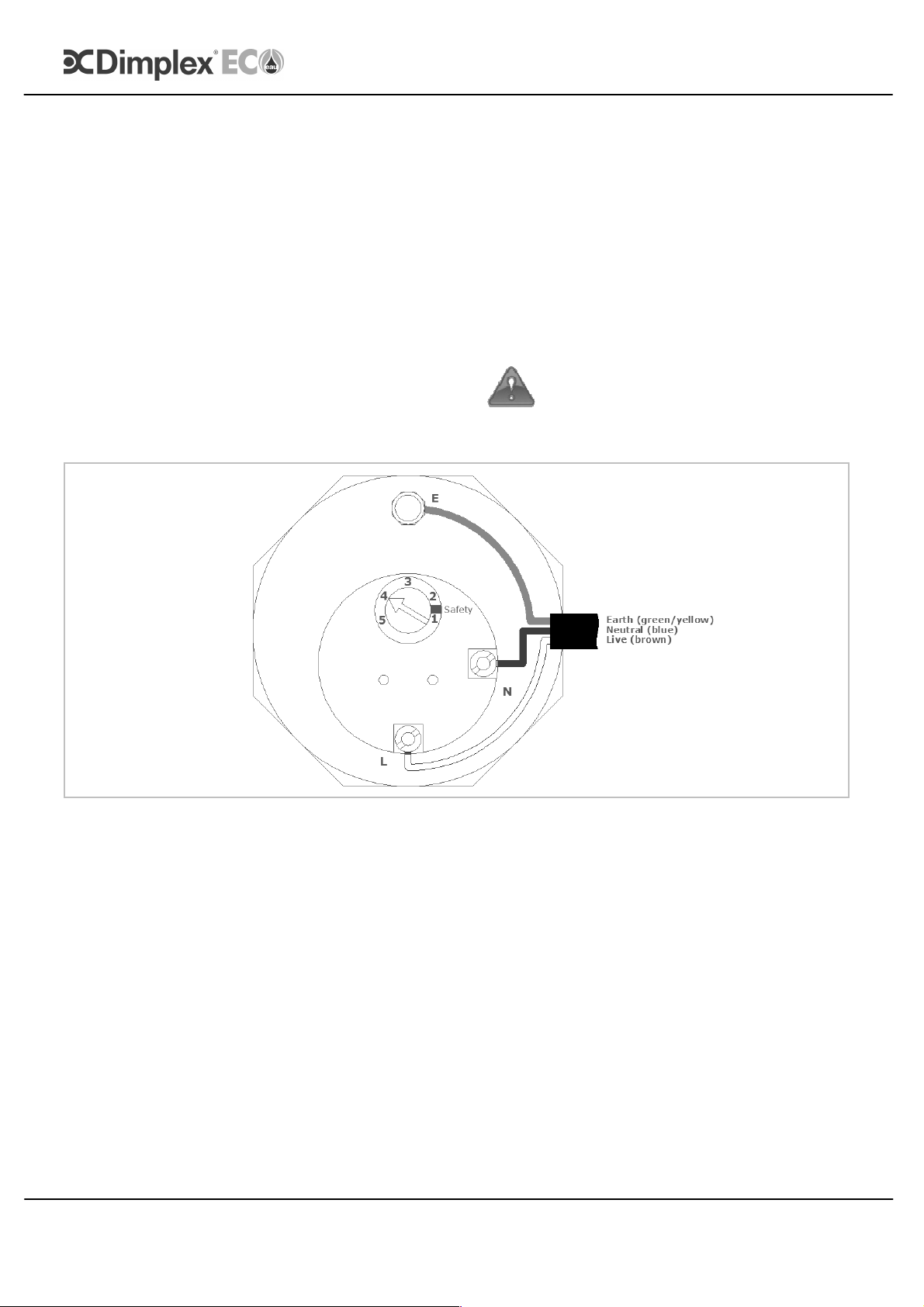
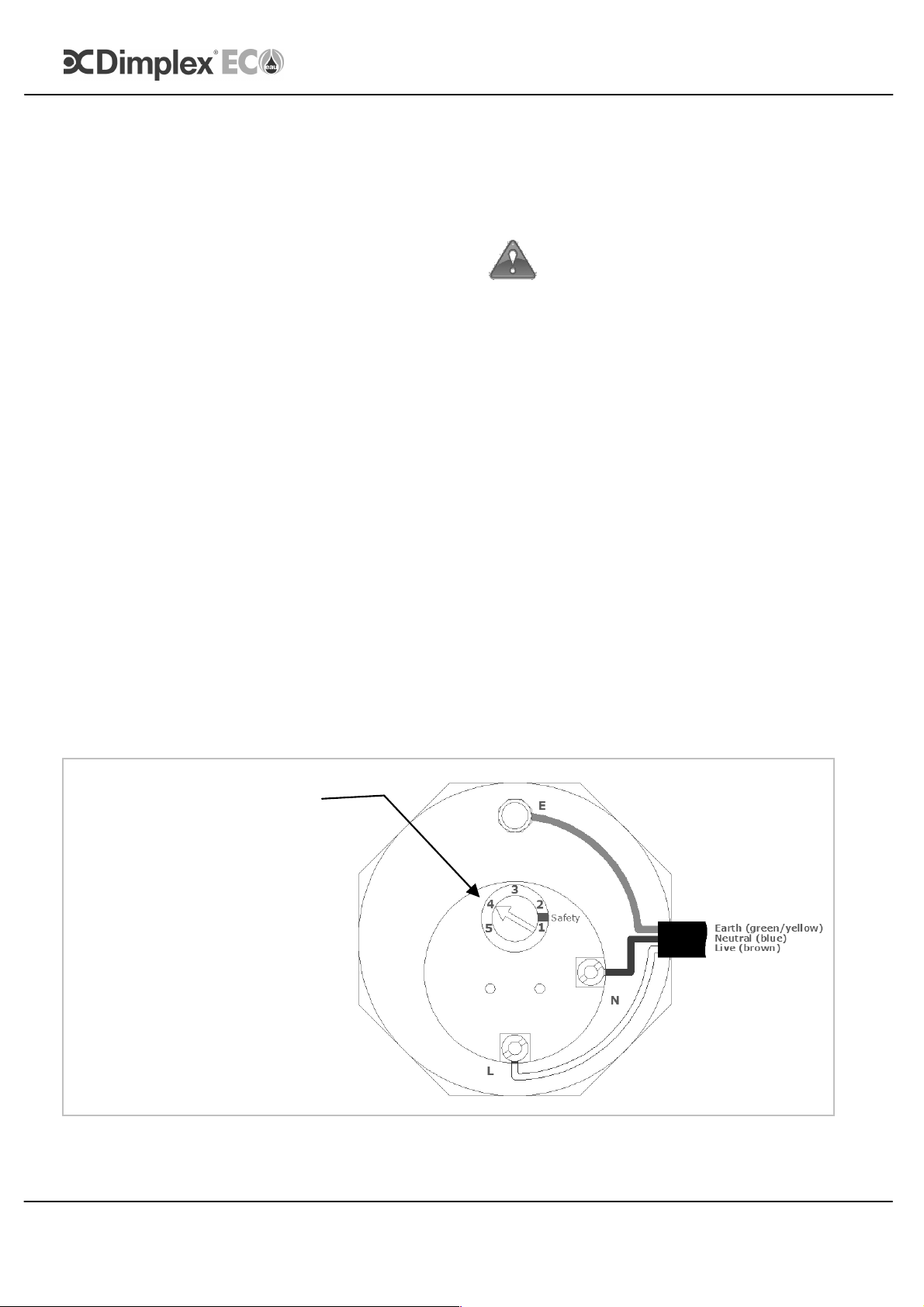
Figure 5: Wiring diagram for Immersion Heater
5.4 Immersion heater
The immersion heater has to be
connected in accordance with IEE
Wiring Regulations and the installer
carrying out the work has to be
suitably qualified. It must be
connected through a double pole
isolating switch or suitable controller
which must have a contact separation
of at least 3mm in all poles. The
wiring diagram can be seen in Figure
5. For further details please see
instructions provided with the
immersion heater.
The immersion heater incorporates an
independent non-self resetting over
temperature cut-out. Should the over
temperature cut-out operate, the
reset pin will be pushed upwards, and
become level or slightly proud of the
cover at the position marked “Safety”.
Use a suitable sized implement to
reset the pin by pushing it hard into
its original position.
Should it be necessary to remove the
thermostat from the immersion
element, ensure that the contacts are

Installation and User Instructi
ons R01127
-
2 06
/11
Page 17
Installation
re-fitted correctly into the positions on
the element. Failure to do so carries
the risk of overheating the contacts
and thus damaging the appliance. The
immersion heater thermostat must
not be opened under any
circumstances.
Note: The cylinder must be filled
with water before switching on
the immersion heater. Failure to
do so will damage the element
and void any guarantee on the
product.
5.5 Coil flow connections
(indirect models only)
If the flow connection is the highest
point in the indirect heating loop and
if the system was not commissioned
using a flush and fill pump, an
adequate device for de-aeration must
be installed.
5.6 Coil return
connections (indirect
models only)
If the return connection is the lowest
point in the indirect heating loop, a
suitable drain device should be
installed. For location of connections
see Figure 2.
It is recommended that the fittings
used to connect to the cylinder are
suitable for stainless steel, the flow
and return should use 22mm
compression fittings. Not all push fit
fittings can be used – please check
with your supplier. When using
compression fittings, ensure that the
connection is not over-tightened.
Installation and User Instructi
ons R01127
-
2 06
/11
Page 18
Installation
5.7 Thermostat
connection (indirect
models only)
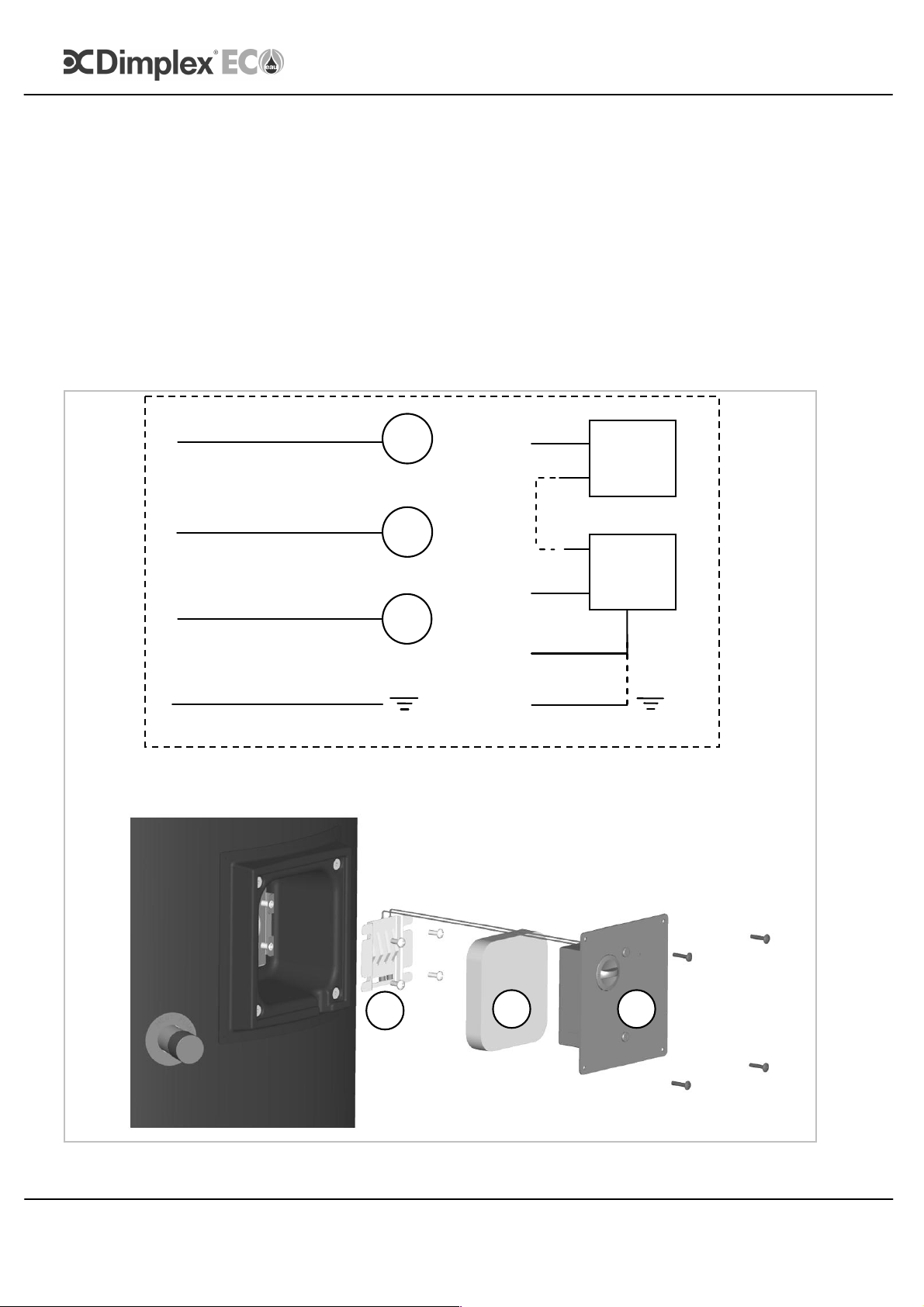
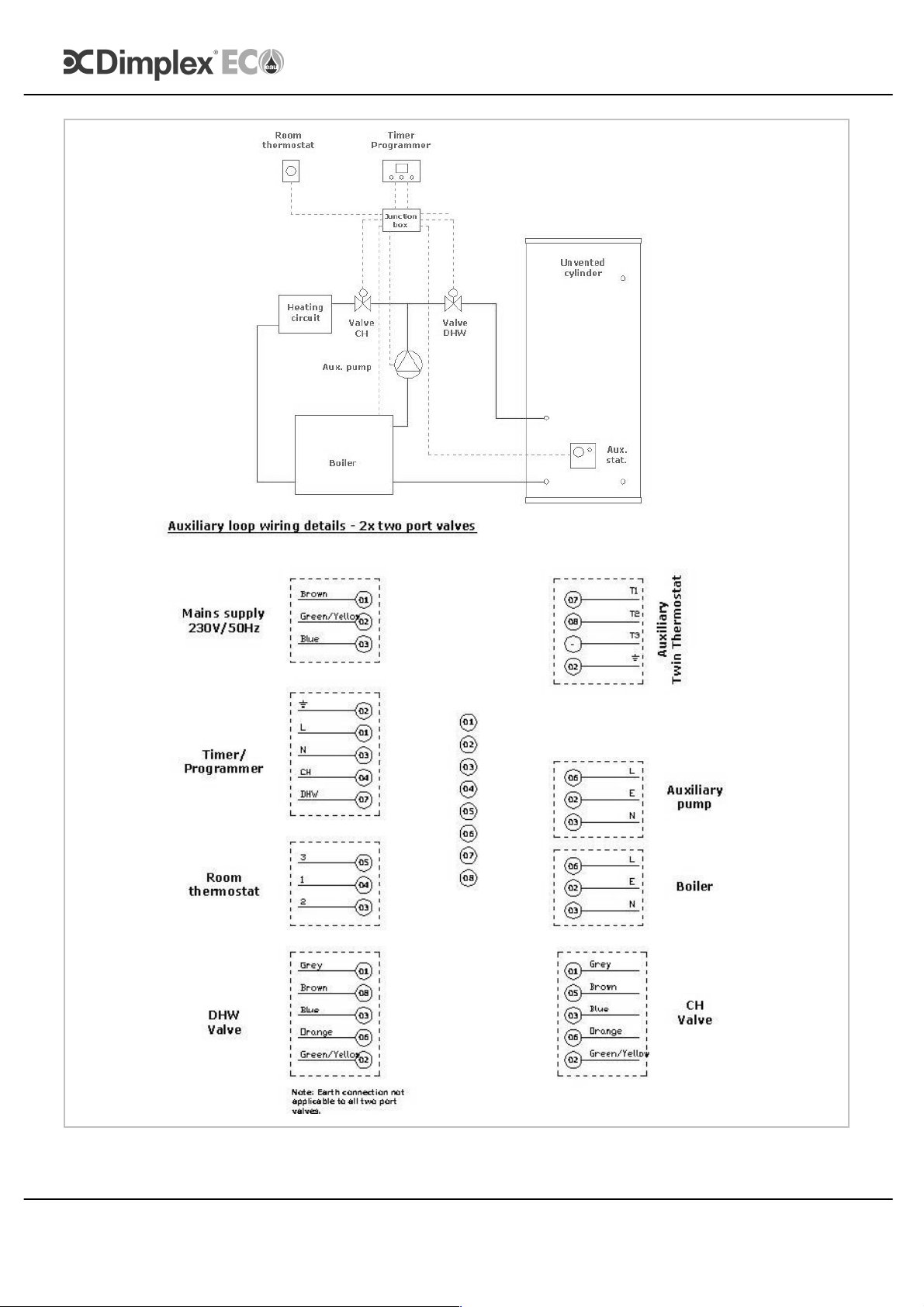
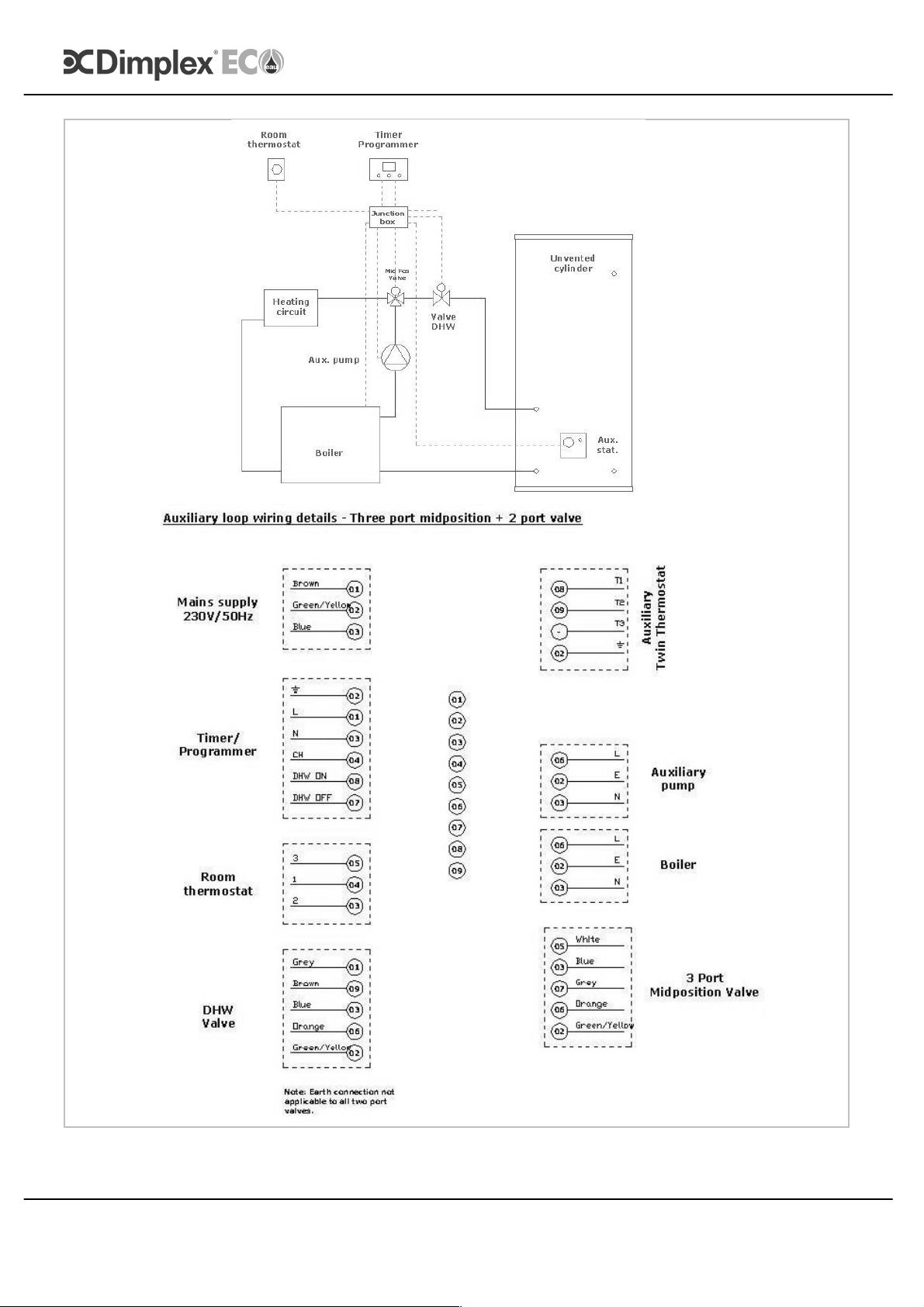
The indirect heating source can be
connected to the cylinder in various
ways as described by the system
supplier. The wiring and installation
principles for two typical integration
methods are detailed in Figure 7 and
Figure 8.
To conform to building regulations, it
is imperative that any heat generator
connected to the cylinder is installed
through the correct twin thermostat,
which is factory fitted to the cylinder.
The two port valve supplied with the
indirect cylinder is to be installed by
default into the heating loop. For
access to the thermostat wiring see
Figure 6.
Figure 6: Thermostat Wiring Schematic
T1
T2
T3
NOTE: T1 and T2 must be connected.
T3 can replace T2 only when
a normally open configuration is required.
To
indirect pump/
two port valve
From
contr
ol unit
Temp
control
stat
High
temp cut
out stat
2
1
1
2
3
T
4
Earth
A
B
C
Installation and User Instructi
ons R01127
-
2 06
/11
Page 19
Installation
Figure 7: Auxiliary loop wiring details - 2 x two port valves
Installation and User Instructi
ons R01127
-
2 06
/11
Page 20
Installation
Figure 8: Auxiliary loop wiring details – Three port mid-position + 2 port valve
Installation
Installat
ion and User Instructions R01127
-
2
06
/11
Page 21
5.8 Connection of
Secondary Return
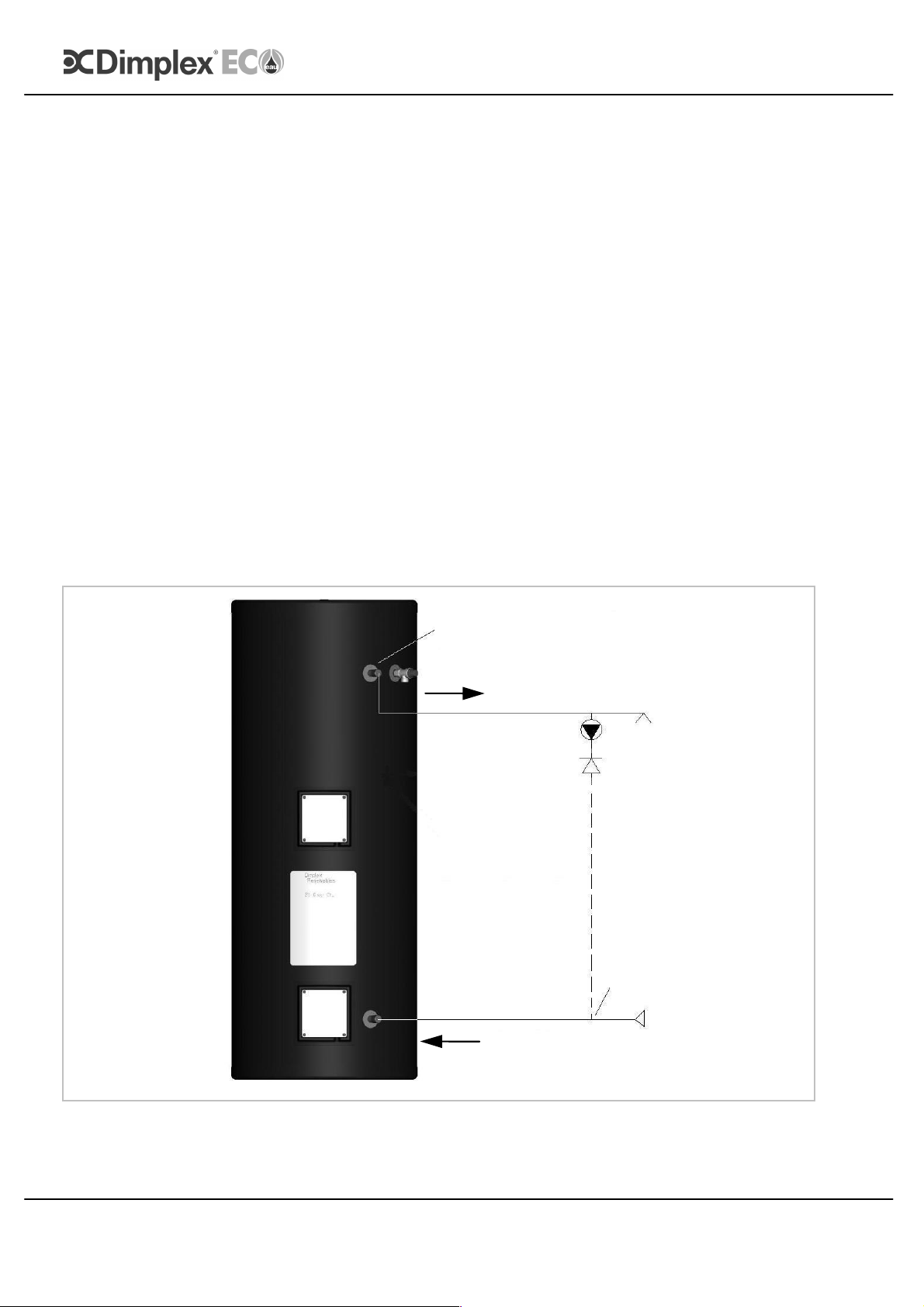
For cylinders that do not have a
dedicated secondary return
connection, it is possible to install a
secondary return by connecting a
swept - T to the cold water inlet of the
cylinder (see Figure 9).
The secondary return pipe should
incorporate a check valve and a WRAS
approved circulation pump; timer and
thermostat to be provided separately.
Where secondary return circuits are
used, then an additional expansion
vessel may be required.
The secondary return loop must
avoid:
- stagnant water in long pipe runs
- long waiting times at draw off point
for hot water
- undue water wastage
To minimise the energy consumption
of the secondary return circuit and to
ensure reliable operation it is
important to consider:
- the control of the circulation pump
to be time and temperature
controlled
- the secondary return circuit pipe
work to be insulated
- the secondary return pump to be of
suitable material and specification
Figure 9: Secondary return loop
To Taps
From Taps
HW Outlet
Swept
-
T

Installation and User Instructi
ons R01127
-
2 06
/11
Page 22
Commissioning
6 Commissioning
At the time of commissioning,
complete all relevant sections of the
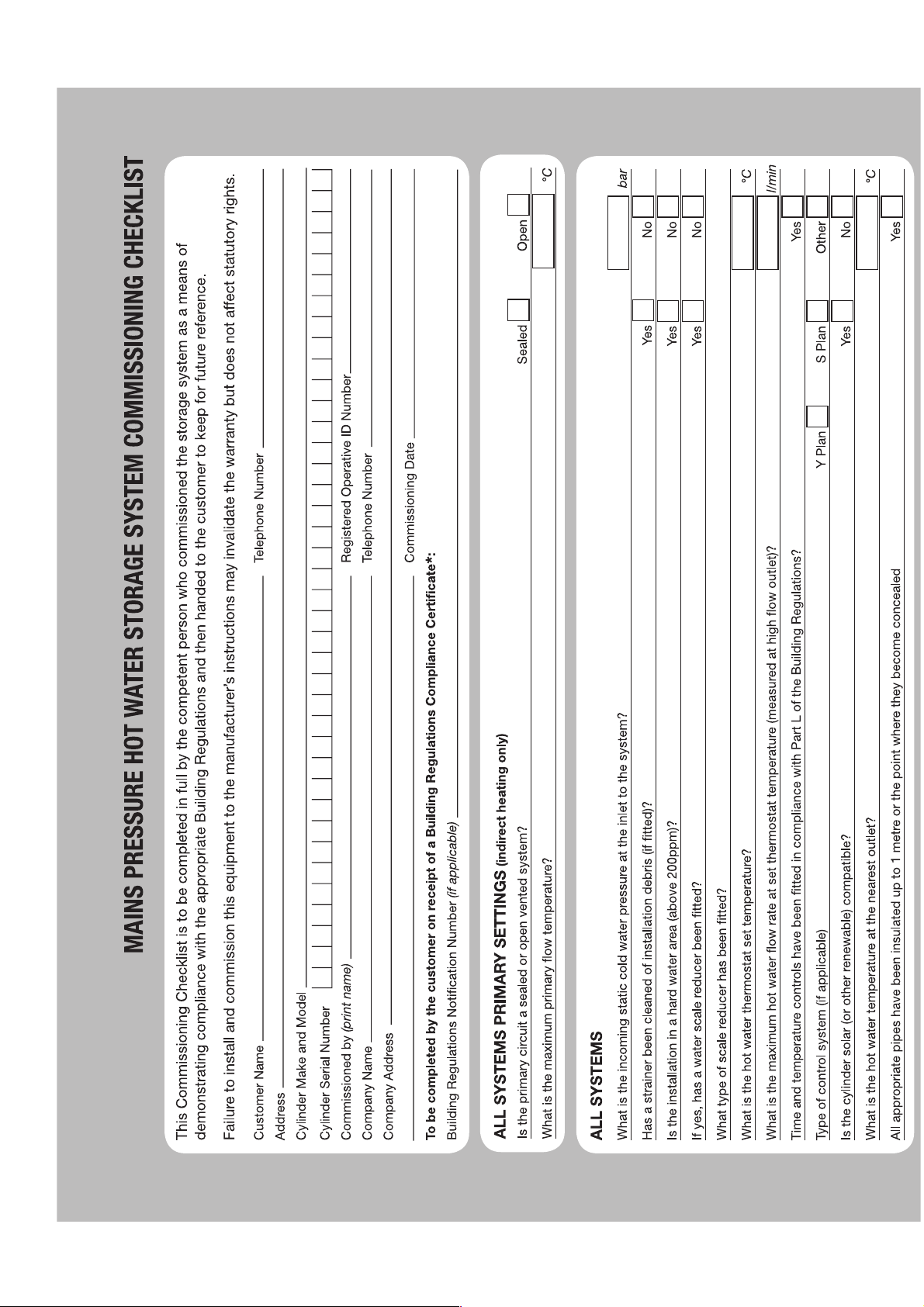
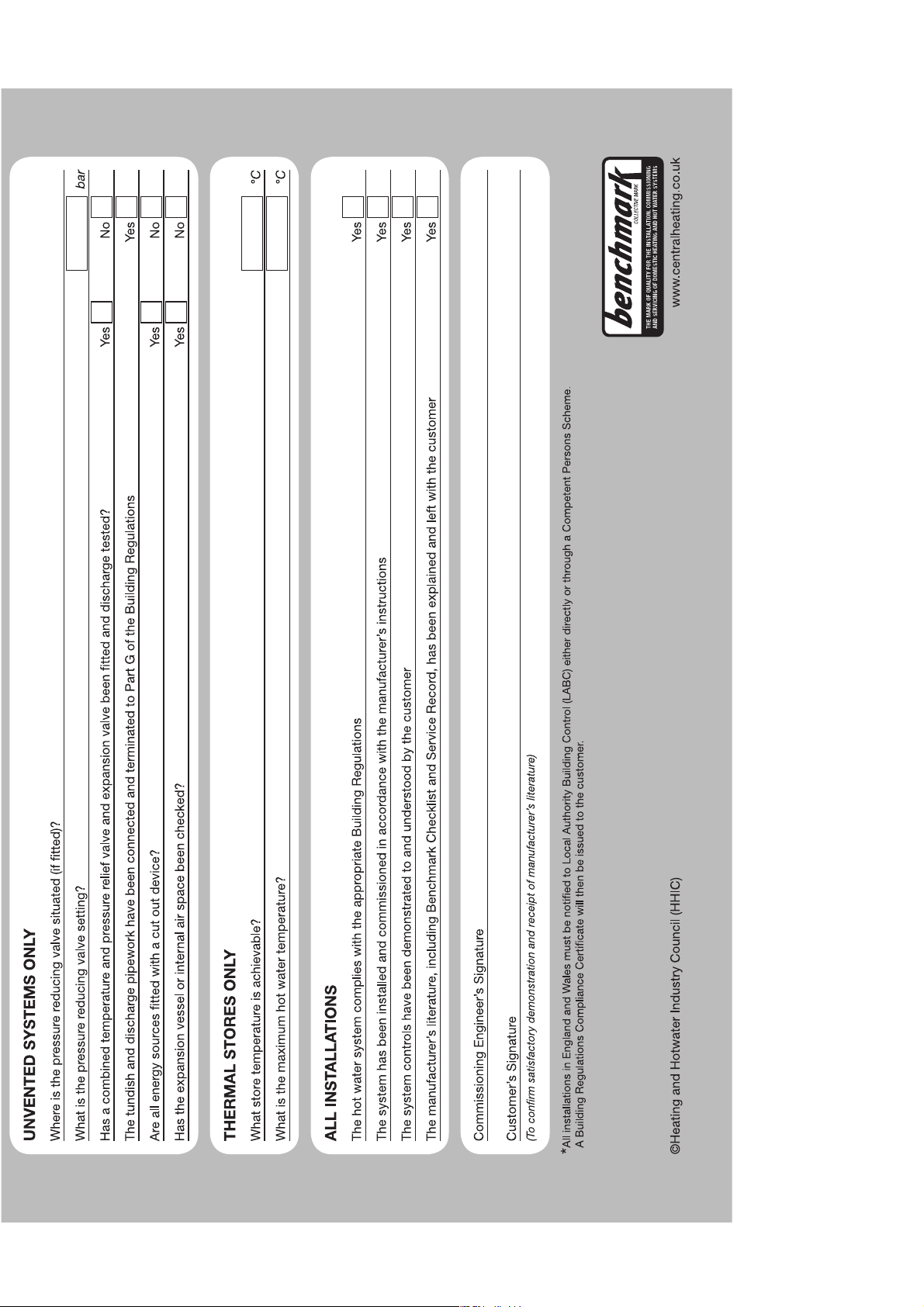
Benchmark Checklist located on the
inside back pages of this document.
The following commissioning
procedures only detail the required
steps to be taken for the potable
water loop:
1) Before making any mains
connections to the inlet control
group, flush the mains pipework
out to ensure all debris has been
removed so as not to damage the
strainer within the combination
valve.
2) Make final mains connection on
combination valve and check all
connections and joints to ensure
they have been tightened and
secured correctly.
3) Before turning on the mains
supply to the cylinder a hot water
tap should be opened, preferably
on the same floor or the floor
below where the cylinder is
located.
4) Check the pre-charge in the
expansion vessel and ensure it is
at least 3 bar. Note actual
pressure on label on expansion
vessel.
5) Turn on the supply to the cylinder
and fill until water runs from the
open hot water tap. Continue to
flush the system until all debris
has been removed.
6) Close the hot water tap.
7) Check all joints for leaks, even
those not having been altered
especially when replacing a
vented cylinder.
8) Open temperature and pressure
relief valve to ensure proper
discharge and check after closing
that valve is not dripping.
9) Open expansion relief valve to
ensure proper discharge and
check after closing that valve is
not dripping.
10) Check all shower outlets, toilet
cisterns and other draw off points
for leaks or dripping (especially
when replacing a vented unit).
Open all water outlets to purge
air from pipe work and ensure
proper operation.
11) Adjust immersion heater
thermostat in accordance with
client requirements.
12) Instruct user in the operation of
the unit and hand over this
manual advising the owner of
annual service requirements.
13) Complete the technical data label
on the cylinder with legible and
permanent writing.

Installat
ion and User Instructions R01127
-
2 06
/11
Page 23
Maintenance
7 Maintenance
After servicing, complete the relevant
Service Record section of the
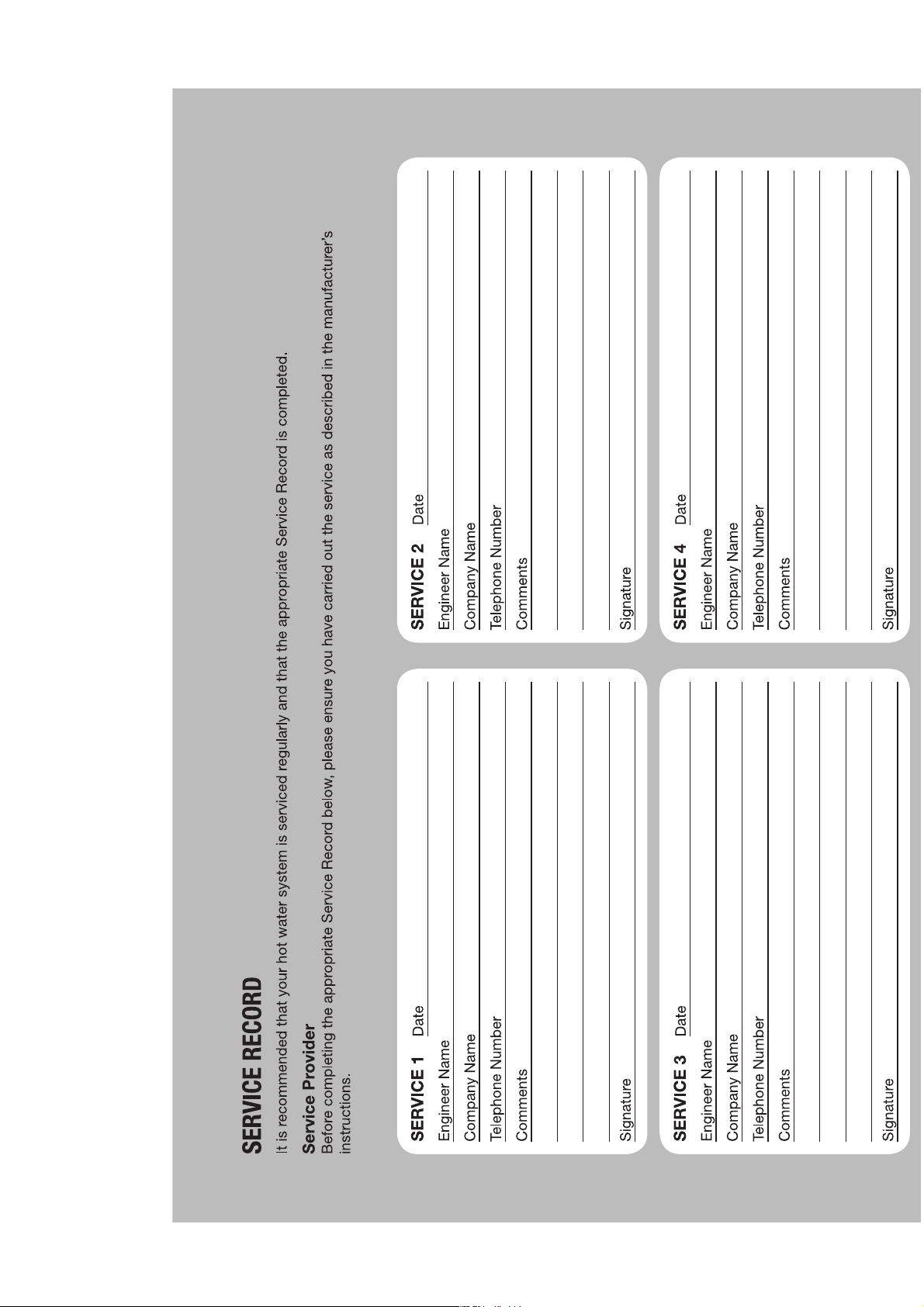
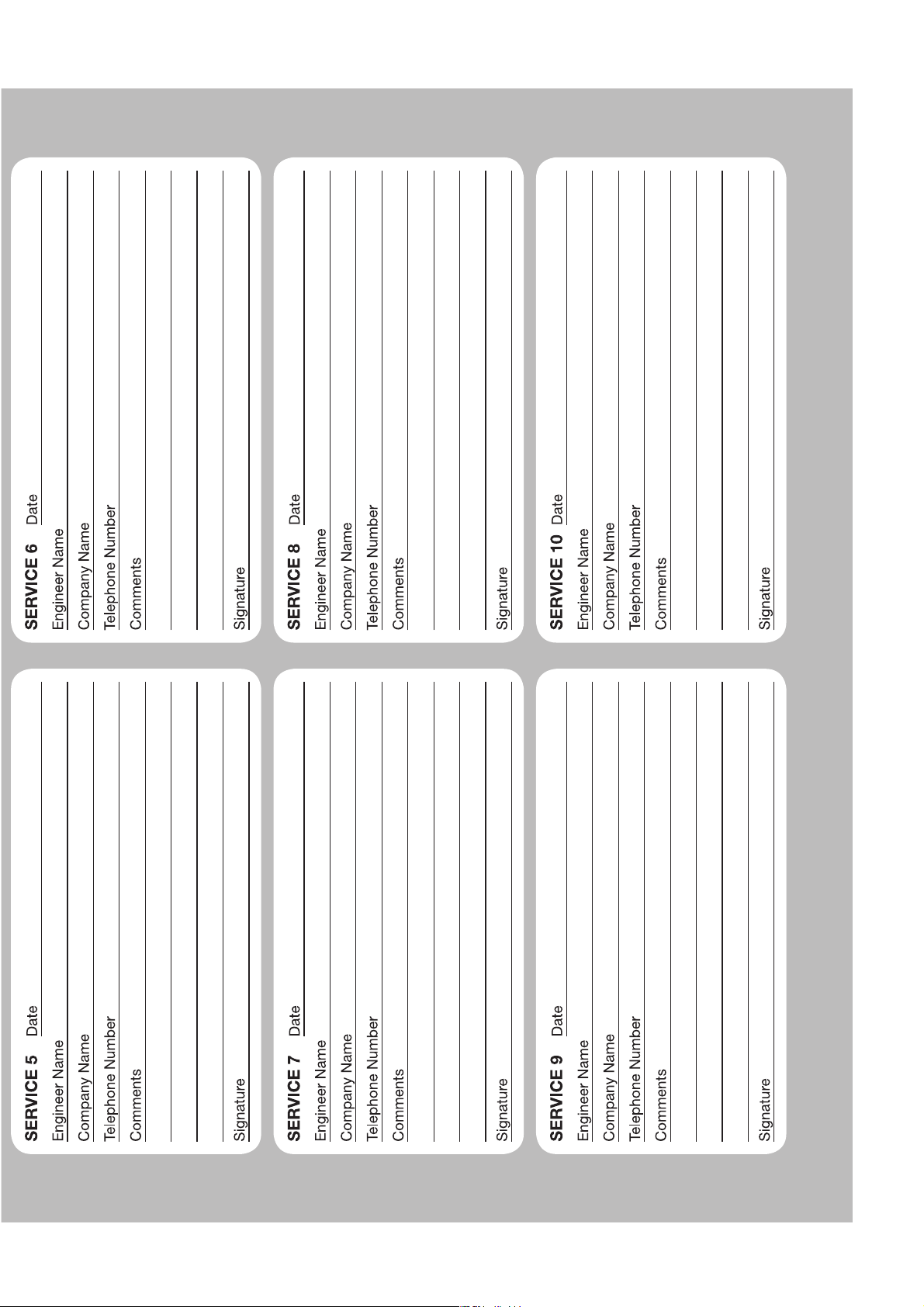
Benchmark Checklist located on the
inside back pages of this document.
To meet with warranty requirements
the cylinder must be serviced
annually.
The maintenance of this
appliance must be carried
out by a suitably qualified
person only. It is
recommended to maintain
the unit on an annual basis.
Isolate all electrical
supplies from the unit
before commencing work.
Danger of electrical shock!
1) Draw some water from cold water
tap and retain in container.
2) Isolate cold water mains supply
from cylinder.
3) Briefly open temperature and
pressure relief valve, assure safe
discharge and check that valve is
not dripping when closed.
4) Briefly open expansion relief
valve, assure safe discharge and
check that valve is not dripping
when closed. The expansion relief
valve should be operated
regularly to remove lime deposits
and to verify that it is not
blocked.
5) Open hot water tap and release
remaining pressure from unit.
6) If the system is drained
completely for an internal
inspection, ensure the hot water
tap remains open, connect a hose
to the drain valve and ensure a
safe discharge.
7) Note the set pressure of the
pressure reducing valve. Remove
cartridge and clean strainer in
water provided in container. Re-
assemble pressure reducing valve
ensuring the correct pressure is
set.
8) Periodically the immersion
heaters should be removed
cleaned and the unit flushed out.
Check the O-ring seal for damage
and replace if necessary.
9) Check electrical wiring
connections and the condition of
the cable of the immersion heater
and the thermostat.
10) The immersion heater boss can
also be used for access to view
the internal components of the
cylinder.
11) Re-commission unit
(see chapter
6).
If the cylinder is not in use for
excess of 1 month, it must be
drained down by a competent
person and recommissioned
before use. Note: The immersion
must be switched off at the mains
before draining the cylinder.
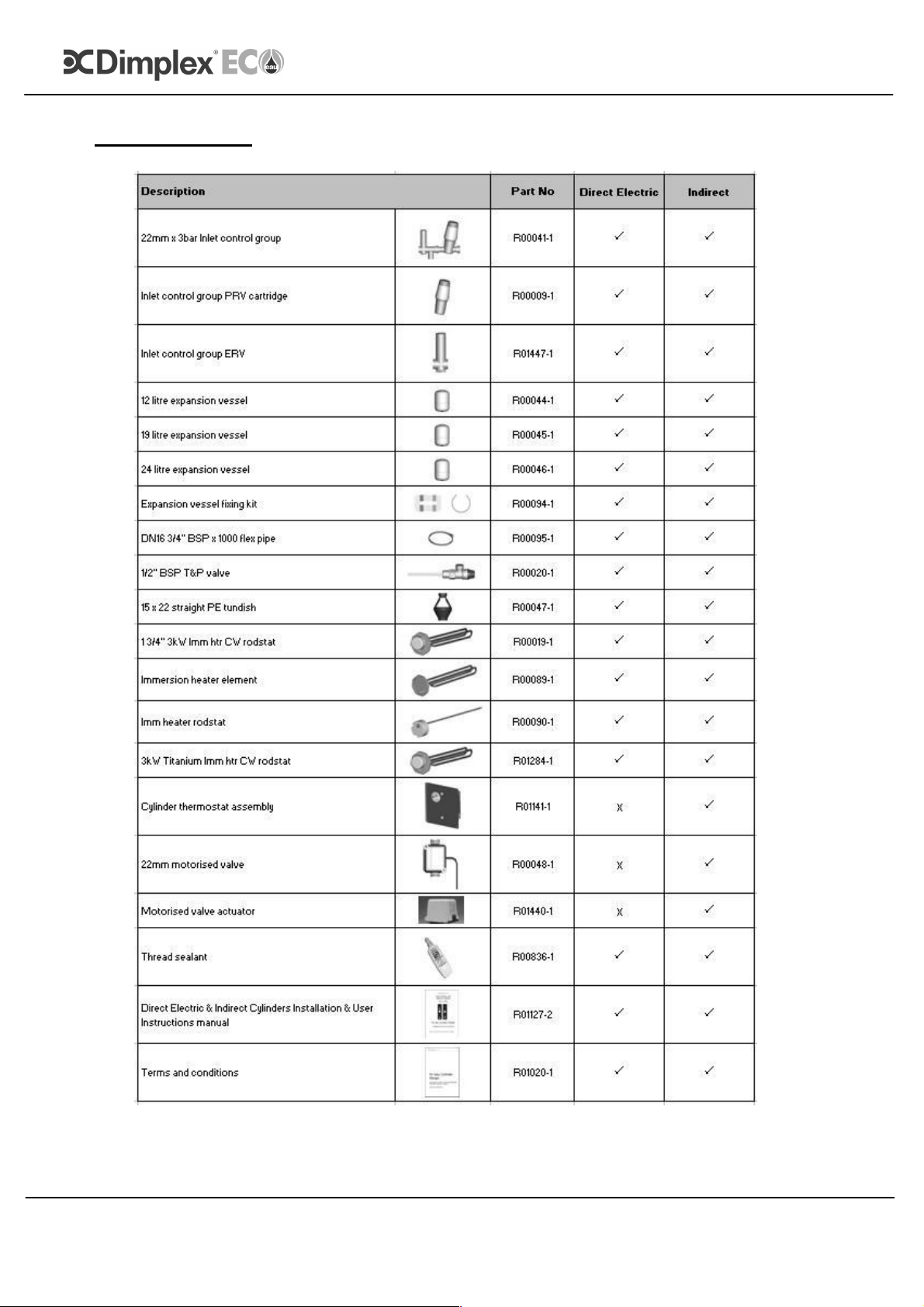
If replacement parts are required,
please see Figure 10 for part
descriptions and part numbers.
Installat
ion and User Instructions R01127
-
2 06
/11
Page 24
Spare Parts
8 Spare Parts
Figure 10: Replacement part numbers for Direct Electric and Indirect range of cylinders
Installat
ion and User Instructions R01127
-
2 06
/11
Page 25
Technical Data
9 Technical data
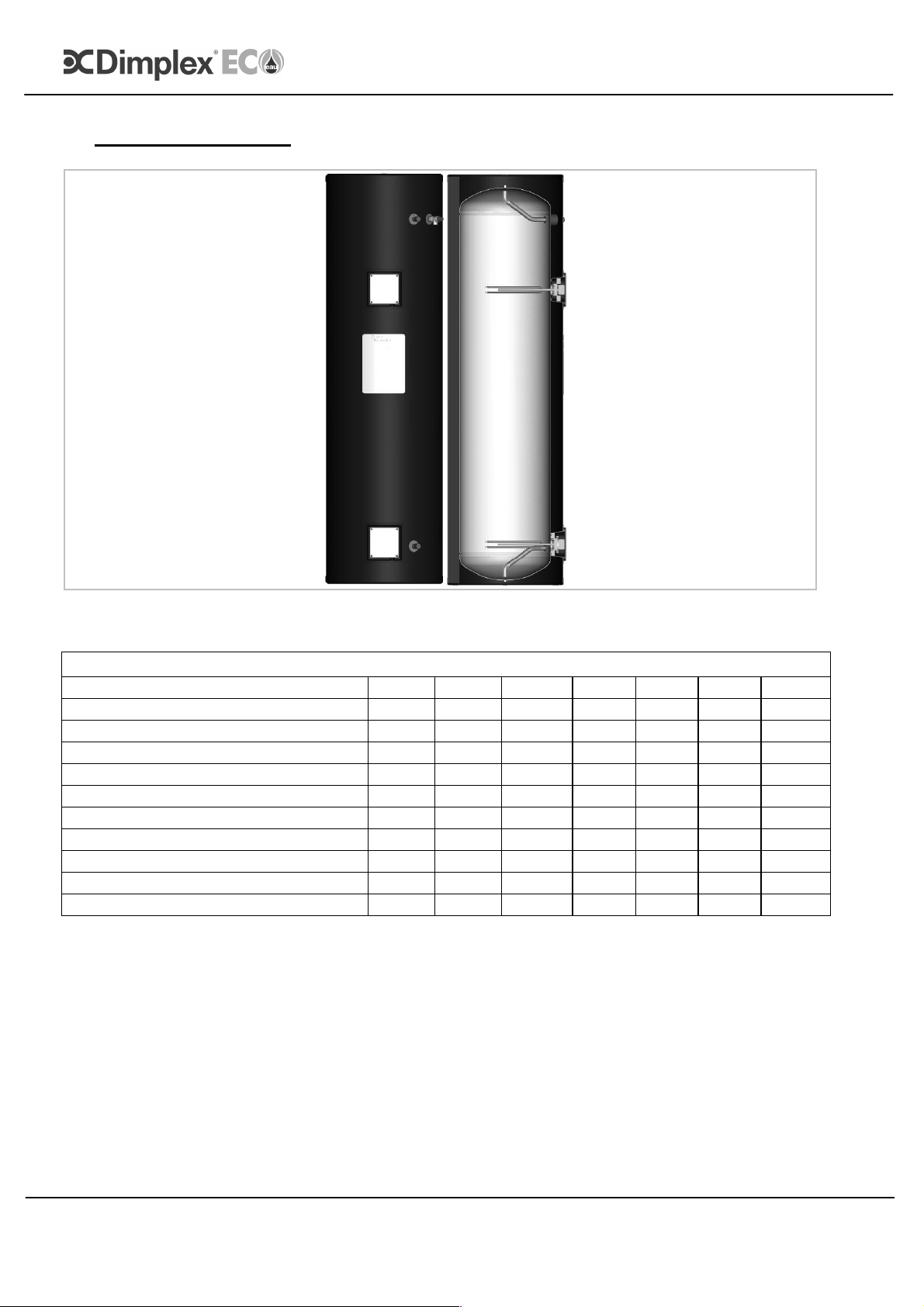
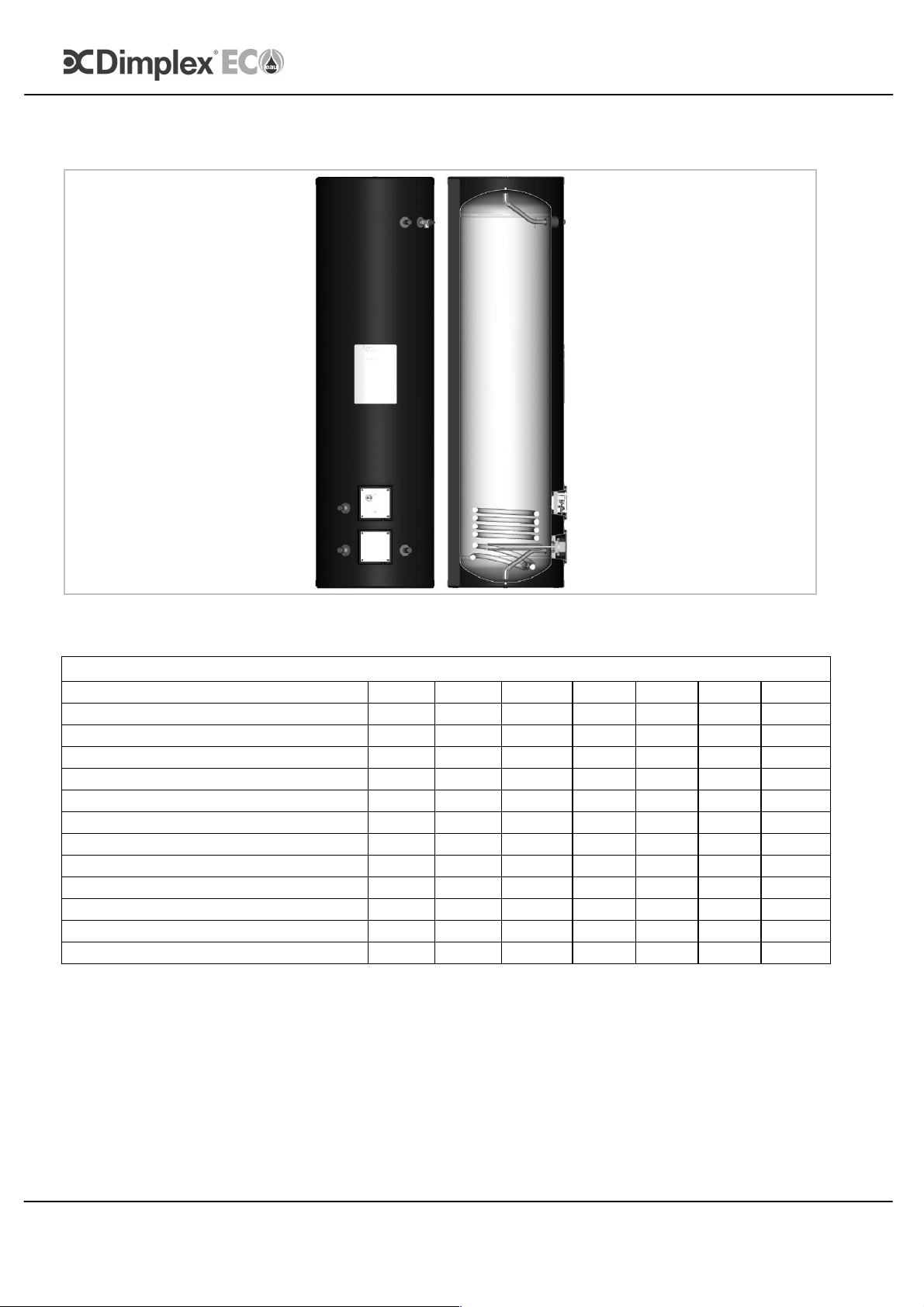
Figure 11: Direct Electric Cylinder and Cross-section (for reference only)
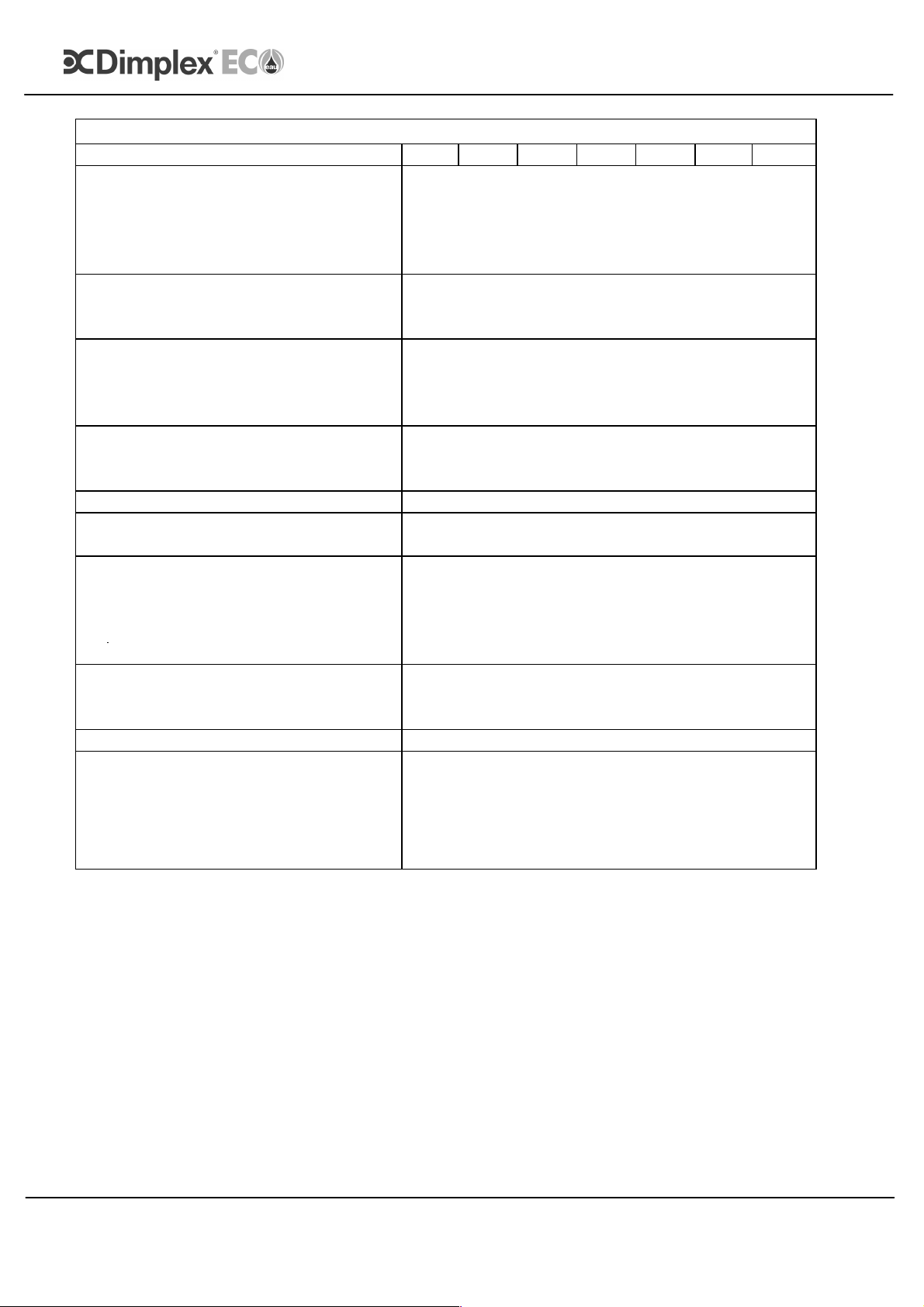
Direct Electric Cylinder Range
Reference
100 125 150 175 210 250 300
Weight (full) [kg]
(+)
120
+
148
+
177
+
207
+
248
+
295
+
348
+
Reheat time [mins]
88* 130# 156# 182# 218# 259# 313*
Heat Loss [kWh]
y
0.9
y
1.0
y
1.1
y
1.3
y
1.4
y
1.7
y
1.9
y
Height [mm] 810 960 1130 1280 1505 1780 2080
Outer Diameter [mm] 580 580 580 580 580 580 580
HW Outlet [mm] 580 730 900 1050 1275 1550 1850
T&P valve [mm] 580 730 900 1050 1275 1550 1850
CW Inlet [mm] 190 190 190 190 190 190 190
Bottom Immersion [mm] 208 208 208 208 208 208 208
Top Immersion [mm]
-
570 650 750 820 1265 1495
Table 4: Direct Electric Cylinder Dimensions
Note: All measurements are taken from the base of the cylinder to the mid point on the item.
* Determined in accordance with EN160335-2-21.
+
Calculated value.
y
Heat loss figure calculated based on measured surface temperatures. Indicative only.
# Calculated based on measurements.
Installat
ion and User Instructions R01127
-
2 06
/11
Page 26
Technical Data
Direct Electric Cylinder Range
Capacity 100 125 150 175 210 250 300
Materials
- inner cylinder Duplex stainless steel LDX2101
- outer cylinder HIPS
- inlet/outlet Stainless steel
- insulation 60mm PU foam (GWP=1, ODP=0)
Maximum operating conditions
- potable water temperature
70°C
- operating pressure 3 bar
Cold water supply
- minimum dynamic pressure 1.5 bar
- maximum pressure 12 bar
- minimum flow rate 15 l/min
Connections
- cold water inlet
22mm stainless steel
- hot water outlet
22mm stainless steel
Immersion heater
1 ¾ F BSP 3kW
Thermostatic control
- direct input
integral immersion heater thermostat and cut out
Safety components
- pressure reducing valve and strainer
3 bar
- expansion relief valve
6 bar
-
temperature and pressure relief
valve
7 bar/90°C
- factory pressure test
12 bar
Other features Over 60% in volume from recycled materials*
Surface mounted sensor devices for compatibility
and ease of maintenance
Approvals
KIWA
approval number:
-
1012712
KIWA
Guarantee
- inner cylinder
25 yrs
- immersion heaters
2 yrs
-
excluding the effects of lime scale
or other
water borne contaminants
- other components
2 yrs - excluding expansion vessel membrane
pressure
Table 5: Direct Electric Product features
* Not including insulation
Installat
ion and User Instructions R01127
-
2 06
/11
Page 27
Technical Data
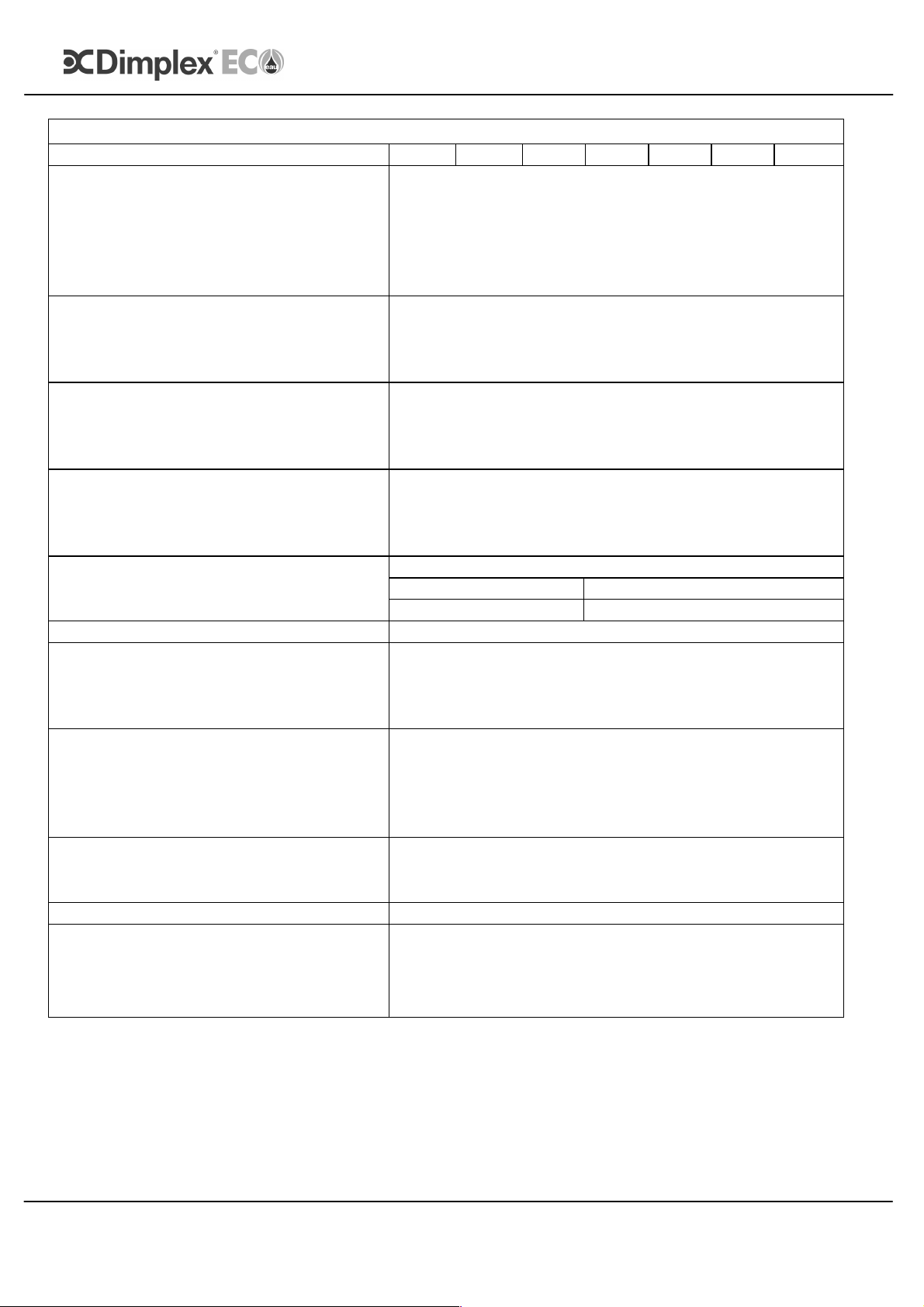
Figure 12: Indirect Cylinder and Cross-section (for reference only)
Indirect Cylinder Range
Reference
100 125 150 175 210 250 300
Weight (full) [kg]
(+)
120
+
150
+
180
+
210
+
252
+
300
+
360
+
Reheat time [mins]
22* 28# 33# 29# 34# 41# 49*
Heat Loss [kWh]
y
0.9
y
1.0
y
1.2
y
1.3
y
1.4
y
1.7
y
1.9
y
Height [mm] 810 960 1130 1280 1504 1780 2080
Outer Diameter [mm] 580 580 580 580 580 580 580
HW Outlet [mm] 580 730 900 1050 1275 1550 1850
T&P valve [mm] 580 730 900 1050 1275 1550 1850
CW Inlet [mm] 190 190 190 190 190 190 190
Bottom Immersion [mm] 208 208 208 208 208 208 208
Indirect Return [mm] 190 190 190 190 190 190 190
Indirect Flow [mm] 325 325 325 405 405 405 405
Bottom Thermostat [mm] 430 430 430 430 430 430 430
Table 6: Indirect Cylinder Dimensions
Note: All measurements are taken from the base of the cylinder to the mid point on the item.
* Determined in accordance with EN12897.
+
Calculated value.
y
Heat loss figure calculated based on measured surface temperatures. Indicative only.
# Calculated based on measurements.
Installat
ion and User Instructions R01127
-
2 06
/11
Page 28
Technical Data
Indirect Cylinder Range
Capacity 100 125 150 175 210 250 300
Materials
- inner cylinder Duplex stainless steel LDX2101
- outer cylinder HIPS
- inlet/outlet Stainless steel
- coils Stainless steel
- insulation 60mm PU foam (GWP=1, ODP=0)
Maximum operating conditions
- potable water temperature
70°C
- heating water temperature
95°C
- operating pressure 3 bar
Cold water supply
- minimum dynamic pressure 1.5 bar
- maximum pressure 12 bar
- minimum flow rate 15 l/min
Connections
- cold water inlet 22mm stainless steel
- hot water outlet 22mm stainless steel
- coil flow and return 22mm stainless steel
Coil specification
- surface area [m²]
0.5
0.5
0.8
0.8
- rating [kW]
14kW
TBA
18kW
TBA
Immersion heater
1 ¾ F BSP 3kW
Thermostatic control
- direct input integral immersion heater thermostat and cut out
- indirect input
integral twin thermostat (10 to 70°C) and cut out
(~85°C)
Safety components
- pressure reducing valve and strainer 3 bar
- expansion relief valve 6 bar
- temperature and pressure relief valve
7 bar/90°C
- factory pressure test 12 bar
Other features Over 60% in volume from recycled materials*
Surface mounted sensor devices for compatibility and
ease of maintenance
Approvals
KIWA
approval number:
-
1012713
KIWA
Guarantee
- inner cylinder 25 yrs
- immersion heaters 2 yrs - excluding the effects of lime scale
- other components 2 yrs - excluding expansion vessel membrane pressure
Table 7: Indirect Product Features
* Not including insulation

Installat
ion and User Instructions R01127
-
2 06
/11
Page 29
User Instructions
10 User Instructions
10.1 General
“This appliance is not intended for use
by persons (including children) with
reduced physical, sensory or mental
capabilities, or lack of experience and
knowledge, unless they have been
given supervision or instruction
concerning the use of the appliance by
person responsible for their safety.”
“Children should be supervised to
ensure they do not play with this
appliance.”
Please read the following
statements carefully as it affects
your warranty:
Please ensure that the installer has
fully completed the Benchmark
Checklist on the inside back pages of
this document and that you have
signed it to say that you have
received a full and clear explanation of
its operation. The installer is legally
required to complete a commissioning
checklist as a means of complying
with the appropriate Building
Regulations Part G3 (England and
Wales), Part P of Northern Ireland and
Section 6 of Scotland.
All installations must be notified to
Local Area Building Control either
directly or through a Competent
Persons Scheme. A Building
Regulations Compliance Certificate will
then be issued to the customer who
should, on receipt, write the
Notification Number on the
Benchmark Checklist.
This product should be serviced
annually to optimise its safety,
efficiency and performance. The
service engineer should complete the
relevant Service Record on the
Benchmark Checklist after each
service.
The Benchmark Checklist will be
required in the event of any warranty
work.
Installat
ion and User Instructions R01127
-
2 06
/11
Page 30
Operation
10.2 Operation
Once the system has been fully
commissioned, no user intervention
should be required to fully enjoy the
comfort and benefits of the unvented
hot water cylinder.
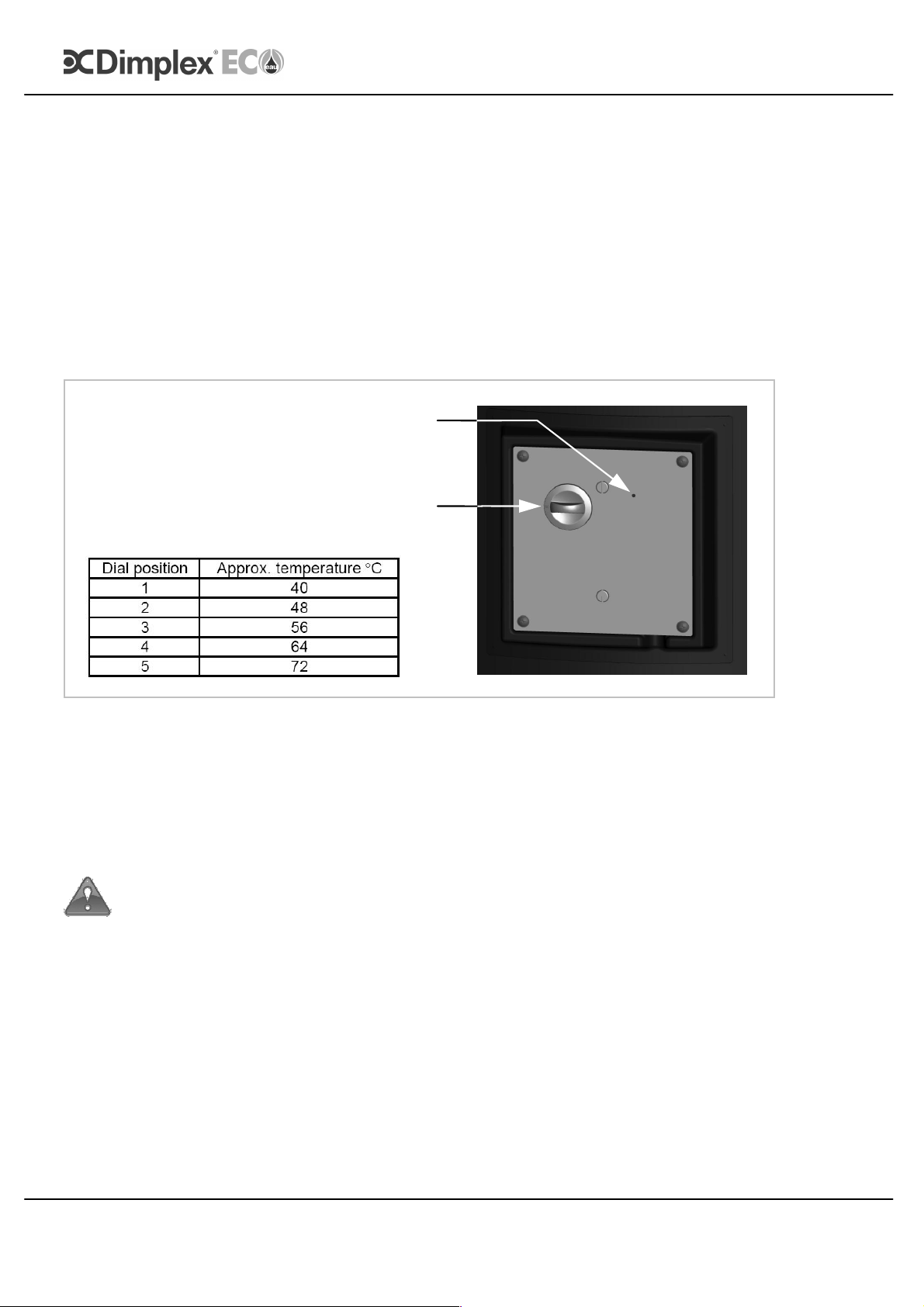
The hot water temperature can be set
to various requirements. It is
recommended to set the indirect hot
water temperature to between 45°C
and 55°C (this is between 2 and 3 on
the dial, please refer to Figure 14 for
approximate settings). Higher
temperatures can cause tripping of
the high limit thermostat, introduce
more heat loss from the unit and
increase the risk of scalding
significantly.
When turning on a hot tap for the first
time after a heat up period there
might be a short surge of water. This
is normal in unvented systems and
does not constitute a fault. Sometimes
the water may appear milky – this is
due to very fine air bubbles in the
water which will clear quickly.
10.2.1 Water temperature
direct electric heating
Before removing the cover
from the immersion heater
isolate appliance using
isolating switch! Danger of
electrical shock! Only use
suitable electrically insulated
equipment when working
inside immersion housing.
The hot water temperature achieved
by the direct electric heating element
can be adjusted by removing the
cover from the immersion heater and
adjusting the dial up or down as
indicated in Figure 13.
Figure 13: Adjustment water temperature direct electric heating element
Dial to adjust water
temperature
Operation
Installat
ion and User Instructions R01127
-
2 06
/11
Page 31
10.2.2 Water temperature
auxiliary heating
The water temperature achieved by
the auxiliary heating system depends
on the setting of the thermostat on:
- the cylinder AND
- the auxiliary / solar heating source
The adjustment at the cylinder is
carried out on the twin thermostat
fitted to the cylinder as shown in
Figure 14.
In the event that the high
temperature cut-out engages, it will
be necessary to manually reset the
thermostat. Use a suitable electrically
insulated tool to push the manual
reset button and inform the installer.
Figure 14: Adjustment water temperature auxiliary source
10.3 Maintenance
The maintenance of this
appliance must be carried
out by a suitably qualified
person only. It is
recommended to maintain
the unit on an annual basis.
Isolate all electrical
supplies from the unit
before commencing work.
Danger of electrical shock!
Dial to adjust water
temperature
Manual re
-
set

Installat
ion and User Instructions R01127
-
2 06
/11
Page 32
Troubleshooting
10.4 Troubleshooting
Fault Cause Solution
A No water
from hot
water taps
A.1 Stop valve closed
A.2 Strainer blocked
A.3 Pressure reducing valve
fitted against flow
A.1 Open stop valve
A.2 Turn water supply off,
clean strainer and re-
commission
A.3 Re-fit with arrow showing
in direction of flow
B No hot water B.1 Timer/Programmer not set
correctly
B.2 Indirect heating
malfunction
B.3 Direct heating malfunction
B.4 Indirect/direct heating high
limit thermostat has tripped
B.1 Set timer/programmer
correctly
B.2 Consult indirect heating
system instructions
B.3 Call for qualified person
to check immersion
heater
B.4 Reset limit thermostat(s)
and inform installer
C Intermittent
water
discharge
through
tundish on
warm-up
C.1 Expansion vessel lost
charge
C.1 Check expansion vessel
(see
commissioning/maintena
nce), top up or replace
D Continuous
discharge
D.1 Pressure reducing valve not
working
D.2 Pressure relief or T&P valve
not seating correctly
D.3 Malfunction of high limit
thermostat or appliance
D.1 Check pressure after
valve and replace if
faulty
D.2 Manually lift valve once
or twice to clear debris,
otherwise replace
D.3 Check function of
thermostats and
appliances
E Leakage from
casing
E.1 Compression/threaded
joints not formed correctly
E.1 Re-seal joints with care
F Hot water
from cold tap
F.1 Hot pipe work being routed
adjacent to cold pipe work
F.2 Leaking seal in mixer tap
F.1 Insulate hot pipe work or
re-route
F.2 Replace seals in mixer
tap
G Metallic noise
from system
G.1 Pipe work not sufficiently
supported
G.1 Add extra pipe work
fixings
H Humming
noise from
system during
re-heat
H.1 Air in system
H.2 Flow rate well in excess of
specification
H.1 Bleed system thoroughly
and re-pressurize
H.2 Reduce pump speed

Installat
ion and User Instructions R01127
-
2 06
/11
Page 33
No
tes

Installat
ion and User Instructions R01127
-
2 06
/11
Page 34
No
tes

Installat
ion and User Instructions R01127
-
2 06
/11
Page 35
No
tes

Installat
ion and User Instructions R01127
-
2 06
/11
Page 40
Dimplex a division of GDC Group Ltd
Millbrook House Grange Drive, Hedge End, Southampton SO30 2DF
Tel.: 0845 600 5111
e-mail: [email protected]
www.dimplex.co.uk

