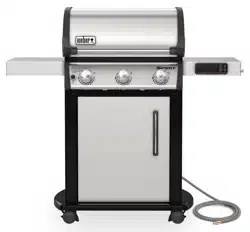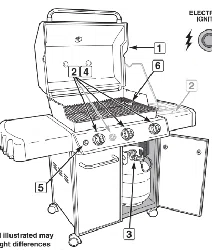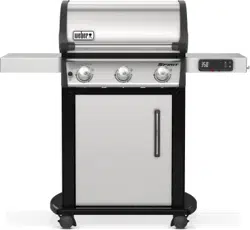
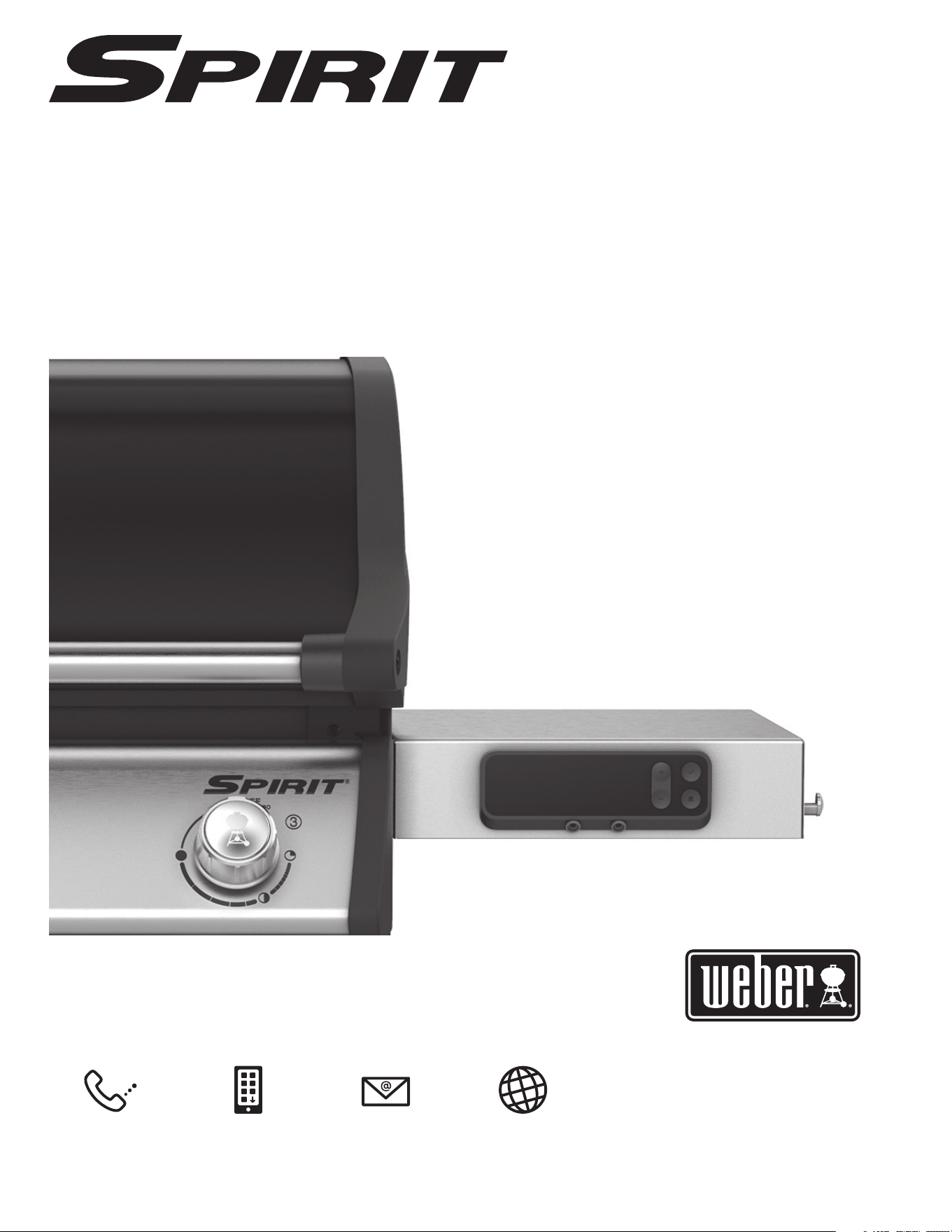
LP Owner’s Manual
53016
111820
enUS
Keep this Owner’s Manual for future reference, thoroughly read through it, and
if you have any questions please contact us today.
EX-315 • SX-315
REGISTER TODAY.
We are so glad that you have joined us on the journey to grilling greatness. Register
your grill and gain access to fun and engaging WEBER information, including tips, tricks
and how to get the most out of your grilling experience.
PHONE APP EMAIL weber.com
2
Welcome to WEBER
Installation and Assembly
m DANGER: This grill is not intended to be installed in
or on recreational vehicles or boats.
m WARNING: Do not use this grill unless all parts
are in place and the grill was properly assembled
according to the assembly instructions.
m WARNING: Do not build this model of grill in any
built-in or slide-in construction.
m WARNING: Do not modify the appliance (grill). Liquid
propane gas is not natural gas. The conversion or
attempted use of natural gas in a liquid propane gas
unit or liquid propane gas in a natural gas unit is
unsafe and will void your warranty.
• In the United States, installation must conform with
local codes or, in the absence of local codes, with
either the National Fuel Gas Code, ANSI Z223.1/
NFPA 54, Natural Gas and Propane Installation Code,
CSA B149.1; or Propane Storage and Handling Code,
B149.2; or the Standard for Recreational Vehicles,
ANSI A119.2/NFPA 1192, and CSA Z240 RV Series,
Recreational Vehicle Code, as applicable.
• InCanada, the installation of this grill must comply
with local codes and/or the latest edition of Standard
CAN/CSA-B149.2 (Propane Storage and Handling
Code). These instructions, while generally acceptable,
do not necessarily comply with the Canadian
installation codes, particularly with piping above and
below ground.
• In Mexico, if there are local codes that apply to
portable gas appliances, you must comply with the
latest edition of Ocial Mexican Standard (NOM).
• If an external electrical source is utilized (such as
a rotisserie) it must be electrically grounded in
accordance with local codes or, in the absence of local
codes, with the National Electrical Code, ANSI/NFPA
70, or the Canadian Electrical Code, Part 1, CSA C22.1.
Operation
m DANGER: Only use the grill outdoors in a well-
ventilated area. Do not use in a garage, building,
breezeway, tent, any other enclosed area, or
beneath overhead combustibleconstruction.
m DANGER: Do not use the grill in any vehicle or in any
storage or cargo area of any vehicle. This includes,
but is not limited to, cars, trucks, station wagons,
mini-vans, sport utility vehicles, recreational
vehicles, andboats.
m DANGER: Do not use the grill within 24 inches (61
cm) of combustible materials. This includes the top,
bottom, back and sides of the grill.
m DANGER: Keep the cooking area clear of flammable
vapors and liquids such as gasoline, alcohol, etc.,
and combustible materials.
m DANGER: This appliance (grill) must be kept away
from flammable materials during use.
m DANGER: Do not put a grill cover or anything
flammable on, or in the storage area under the grill
while it is in operation or is hot.
m DANGER: Should a grease fire occur, turn o all
burners and leave lid closed until fire is out.
m WARNING: Accessible parts may be very hot.
Keepyoung children away.
m WARNING: The use of alcohol, prescription drugs,
non-prescription drugs, or illegal drugs may impair
the consumer’s ability to properly and safely
assemble, move, store, or operate thegrill.
m WARNING: Never leave the grill unattended during
pre-heating or use. Exercise caution when using
this grill. The entire cookbox gets hot when in use.
m WARNING: Do not move the appliance (grill)
duringuse.
m WARNING: Keep any electrical supply cord and the
fuel supply hose away from any heated surfaces.
m CAUTION: This product has been safety-tested and
is only certified for use in a specific country. Refer
to country designation located on outside of box.
• Do not use charcoal or lava rock in the grill.
Storage and/or Nonuse
m WARNING: Turn o the gas supply at the gas
cylinder (tank) after use.
m WARNING: LP tanks must be stored outdoors out of
the reach of children and must not be stored in a
building, garage, or any other enclosed space.
m WARNING: After a period of storage and/or nonuse,
the grill should be checked for gas leaks and burner
obstructions before use.
m Storage of the grill indoors is permissible only if the
LP tank is disconnected and removed from the grill.
California Proposition 65
m WARNING: Combustion byproducts produced when
using this product contain chemicals known to the
state of California to cause cancer, birth defects, or
other reproductive harm.
m PROPOSITION 65 WARNING: Handling the brass
material on this product exposes you to lead, a
chemical known to the state of California to cause
cancer, birth defects, or other reproductive harm.
Wash hands after handling this product.
m DANGER
If you smell gas:
• Shut o gas to the appliance
(grill).
• Extinguish any open flame.
• Open lid.
• If odor continues, keep away
from the appliance (grill)
and immediately call your
gas supplier or your fire
department.
m WARNING
• Do not store or use gasoline
or other flammable liquids
or vapors in the vicinity
of this (grill) or any other
appliance.
• An LP cylinder (tank) not
connected for use shall
not be stored in the vicinity
of this (grill) or any other
appliance.
USE OUTDOORS ONLY.
READ THE INSTRUCTIONS BEFORE USING
THE APPLIANCE (GRILL).
NOTICE TO INSTALLER: These instructions
must be left with the consumer.
NOTICE TO CONSUMER: Retain these
instructions for future reference.
Important
SafetyInformation
DANGER, WARNING, and CAUTION
statements are used throughout this
Owner's Manual to emphasize critical and
important information. Read and follow
these statements to help ensure safety and
prevent property damage. Thestatements
are defined below.
m DANGER: Indicates a hazardous
situation which, if not avoided,
will result in death or seriousinjury.
m WARNING: Indicates a hazardous
situation which, if not avoided,
could result in death or seriousinjury.
m CAUTION: Indicates a hazardous
situation which, if not avoided,
could result in minor or moderateinjury.
3
Welcome to WEBER
TABLE OF CONTENTS
2 Welcome to WEBER
Important SafetyInformation
4 The WEBER Promise
Warranty
5 Product Features
SPIRIT Features
6 Getting Started
Important Information about
LPGas & Gas Connections
LP Tank Installation & LeakChecking
Refilling or Replacing an LPTank
10 Operation
The Very First Time You Grill
Every Time You Grill
Igniting the Grill
Integrated WEBER CONNECT
Technology
Using the WEBER CONNECT Module
Food Temperature Probe Care
14 Tips and Hints
The Flame - Direct or Indirect
Grilling Do's and Don'ts
16 Product Care
Cleaning and Maintenance
18 Troubleshooting
22 Grilling Guide
23 Replacement Parts
1
DOWNLOAD
THE FREE APP
2
INSERT PROBE
3
CONNECT AND
MONITOR
4
PERFECT RESULTS
FEATURE BENEFIT
REMOTE GRILL
MONITOR
WI-FI AND BLUETOOTH® GRILL MONITORING
Remote grilling access gives you the freedom to walk away and monitor the heat
from your smart device.
STEP-BY-STEP
GRILLING
PERFECTLY GRILLED FOOD
Know when it’s time to flip, rest, and serve directly from your smart device.
Receive notifications on everything from when it’s time to flip food, to a
countdown that displays when it’s ready.
APP ENABLED FOOD
THERMOMETERS
INSTANT FOOD STATUS READOUT
View food temperature & doneness without lifting the lid. The food probes monitor
doneness from beginning to end and will notify you via the app when it’s time to
flip, rest, and serve.
RECIPES &
INSTRUCTION
WEBER RECIPES AND COOK PROGRAMS
Weber recipes and cook programs that provide real time, step-by-step grilling
instructions specific to your cook preference and cut of meat.
LED DISPLAY DASHBOARD
The LED display dashboard on your module is where you can visually check
temperatures, receive notifications, view connectivity status, and check the status of
your cook.
Even your grill can
update its status
HELLO!
We are so glad that you have joined us on the journey to grilling happiness.
Pleasetake some time to read through this Owner’s Manual to ensure that you
are up and grilling quickly and easily. We want to be with you for the life of your
grill, so please take just a couple of minutes to register yourgrill. When you
sign up for a WEBER-ID as part of your registration, wewill deliver special grill-
related content just for you to enjoy.
So, come along and join us online, on your smart device or however else you'd
like to stay in touch.
Thank you for choosing WEBER.
We are happy you are here.
4
Warranty
The WEBER Promise
PROTECT
YOUR
INVESTMENT
Shield your grill from the
elements with a heavy-duty
premiumgrillcover.
Thank you for purchasing a WEBER product. Weber-Stephen
Products LLC, 1415 S. Roselle Road, Palatine, Illinois 60067
(“WEBER”) prides itself on delivering a safe, durable, and
reliableproduct.
This is WEBER’s Voluntary Warranty provided to you at no extra
charge. It contains the information you will need to have your
WEBER product repaired in the unlikely event of a failure or
defect.
Pursuant to applicable laws, the customer has several
rights in case the product is defective. Those rights include
supplementary performance or replacement, abatement of
the purchasing price, and compensation. In the European
Union, for example, this would be a two-year statutory
warranty starting on the date of the handover of the product.
These and other statutory rights remain unaffected by this
warranty provision. In fact, this warranty grants additional
rights to the Owner that are independent from statutory
warranty provisions.
WEBER’S VOLUNTARY WARRANTY
WEBER warrants, to the purchaser of the WEBER product
(or in the case of a gift or promotional situation, the person
for whom it was purchased as a gift or promotional item),
that the WEBER product is free from defects in material and
workmanship for the period(s) of time specified below when
assembled and operated in accordance with the accompanying
Owner’s Manual. (Note: If you lose or misplace your WEBER
Owner’s Manual, a replacement is available online at
www.weber.com, or such country-specific website to which
Owner may be redirected.) Under normal, private single family
home or apartment use and maintenance, WEBER agrees
within the framework of this warranty to repair or replace
defective parts within the applicable time periods, limitations,
and exclusions listed below. TO THE EXTENT ALLOWABLE BY
APPLICABLE LAW, THIS WARRANTY IS EXTENDED ONLY TO
THE ORIGINAL PURCHASER AND IS NOT TRANSFERABLE TO
SUBSEQUENT OWNERS, EXCEPT IN THE CASE OF GIFTS AND
PROMOTIONAL ITEMS AS NOTED ABOVE.
OWNER’S RESPONSIBILITIES UNDER THIS WARRANTY
To ensure trouble-free warranty coverage, it is important (but
it is not required) that you register your WEBER product online
at www.weber.com, or such country-specific website to which
Owner may be redirected. Please also retain your original
sales receipt and/or invoice. Registering your WEBER product
confirms your warranty coverage and provides a direct link
between you and WEBER in case we need to contact you.
The above warranty only applies if the Owner takes reasonable
care of the WEBER product by following all assembly
instructions, usage instructions, and preventative maintenance
as outlined in the accompanying Owner’s Manual, unless the
Owner can prove that the defect or failure is independent
of non-compliance with the above mentioned obligations. If
you live in a coastal area, or have your product located near
a pool, maintenance includes regular washing and rinsing of
the exterior surfaces as outlined in the accompanying Owner’s
Manual.
WARRANTY HANDLING / EXCLUSION OF WARRANTY
If you believe that you have a part which is covered by this
Warranty, please contact WEBER Customer Service using the
contact information on our website (www.weber.com, or such
country-specific website to which Owner may be redirected).
WEBER will, upon investigation, repair or replace (at its option)
a defective part that is covered by this Warranty. In the event
that repair or replacement are not possible, WEBER may
choose (at its option) to replace the grill in question with a new
grill of equal or greater value. WEBER may ask you to return
parts for inspection, shipping charges to be pre-paid.
This WARRANTY lapses if there are damages, deteriorations,
discolorations, and/or rust for which WEBER is not responsible
caused by:
• Abuse, misuse, alteration, modification, misapplication,
vandalism, neglect, improper assembly or installation, and
failure to properly perform normal and routine maintenance;
• Insects (such as spiders) and rodents (such as squirrels),
including but not limited to damage to burner tubes and/or
gas hoses;
• Exposure to salt air and/or chlorine sources such as
swimming pools and hot tubs/spas;
• Severe weather conditions such as hail, hurricanes,
earthquakes, tsunamis or surges, tornadoes or severe
storms.
The use and/or installation of parts on your WEBER product
that are not genuine WEBER parts will void this Warranty,
and any damages that result hereby are not covered by
this Warranty. Any conversion of a gas grill not authorized
by WEBER and performed by a WEBER authorized service
technician will void this Warranty.
PRODUCT WARRANTY PERIODS
Cookbox:
10 years, no rust through/burn through
(2 years paint excluding fading or discoloration)
Lid assembly:
10 years, no rust through/burn through
(2 years paint excluding fading or discoloration)
Stainless steel burner tubes:
10 years, no rust through/burn through
Stainless steel cooking grates:
5 years, no rust through/burn through
Stainless steel FLAVORIZER BARS:
5 years, no rust through/burn through
Porcelain-enameled cast iron cooking grates:
5 years, no rust through/burn through
WEBER CONNECT Components:
3 years
All remaining parts:
2 years
DISCLAIMERS
APART FROM THE WARRANTY AND DISCLAIMERS AS
DESCRIBED IN THIS WARRANTY STATEMENT, THERE ARE
EXPLICITLY NO FURTHER WARRANTY OR VOLUNTARY
DECLARATIONS OF LIABILITY GIVEN HERE WHICH GO
BEYOND THE STATUTORY LIABILITY APPLYING TO WEBER.
THE PRESENT WARRANTY STATEMENT ALSO DOES NOT
LIMIT OR EXCLUDE SITUATIONS OR CLAIMS WHERE WEBER
HAS MANDATORY LIABILITY AS PRESCRIBED BY STATUTE.
NO WARRANTIES SHALL APPLY AFTER THE APPLICABLE
PERIODS OF THIS WARRANTY. NO OTHER WARRANTIES
GIVEN BY ANY PERSON, INCLUDING A DEALER OR RETAILER,
WITH RESPECT TO ANY PRODUCT (SUCH AS ANY “EXTENDED
WARRANTIES”), SHALL BIND WEBER. THE EXCLUSIVE
REMEDY OF THIS WARRANTY IS REPAIR OR REPLACEMENT
OF THE PART OR PRODUCT.
IN NO EVENT UNDER THIS VOLUNTARY WARRANTY SHALL
RECOVERY OF ANY KIND BE GREATER THAN THE AMOUNT OF
THE PURCHASE PRICE OF THE WEBER PRODUCT SOLD.
YOU ASSUME THE RISK AND LIABILITY FOR LOSS, DAMAGE,
OR INJURY TO YOU AND YOUR PROPERTY AND/OR TO
OTHERS AND THEIR PROPERTY ARISING OUT OF THE MISUSE
OR ABUSE OF THE PRODUCT OR FAILURE TO FOLLOW
INSTRUCTIONS PROVIDED BY WEBER IN THE ACCOMPANYING
OWNER’S MANUAL.
PARTS AND ACCESSORIES REPLACED UNDER THIS
WARRANTY ARE WARRANTED ONLY FOR THE BALANCE OF
THE ABOVE MENTIONED ORIGINAL WARRANTY PERIOD(S).
THIS WARRANTY APPLIES TO PRIVATE SINGLE FAMILY HOME
OR APARTMENT USE ONLY AND DOES NOT APPLY TO WEBER
GRILLS USED IN COMMERCIAL, COMMUNAL OR MULTI-UNIT
SETTINGS SUCH AS RESTAURANTS, HOTELS, RESORTS, OR
RENTAL PROPERTIES.
WEBER MAY FROM TIME TO TIME CHANGE THE DESIGN OF
ITS PRODUCTS. NOTHING CONTAINED IN THIS WARRANTY
SHALL BE CONSTRUED AS OBLIGATING WEBER TO
INCORPORATE SUCH DESIGN CHANGES INTO PREVIOUSLY
MANUFACTURED PRODUCTS, NOR SHALL SUCH CHANGES
BE CONSTRUED AS AN ADMISSION THAT PREVIOUS DESIGNS
WERE DEFECTIVE.
Weber-Stephen Products LLC
Customer Service Center
1415 S. Roselle Road
Palatine, IL 60067
U.S.A.
For replacement parts, call:
1-800-446-1071
5
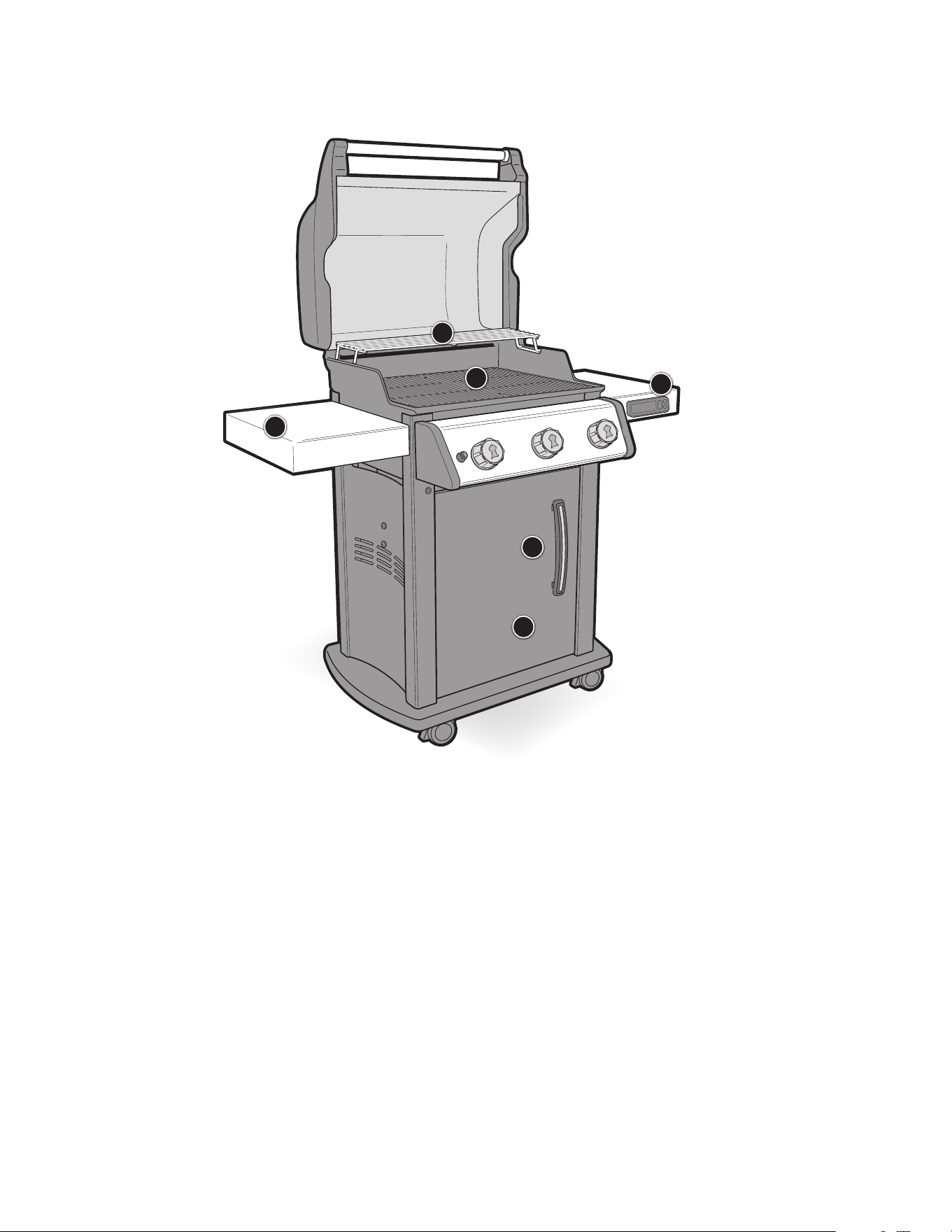
SPIRIT FEATURES
Product Features
A WEBER CONNECT
Confidently tend to the grill and your guests while
using the integrated WEBER CONNECT technology. This
device monitors internal grill temperature and uses
food temperture probes allowing you to monitor the
temperature of your food. You can also monitor your
grill from your smart device with the WEBER CONNECT
app via Bluetooth® or Wi-Fi connection.
One food temperture probe is included. Additional food
probes are sold seperately.
B Warming Rack
The warming rack keeps food warm or toasts burger
buns, as the main meal grills below.
C Porcelain-Enameled,
Cast Iron Cooking Grates
The reversible cooking grates empower you to be
even more creative with your dish. The thin side of the
cooking grate is ideal for delicate food such as fish and
shrimp, while the wider side creates a thick sear mark
enhancing the flavor of your food.
D Side Tables
Use the side tables to keep platters, seasonings, and
tools within arm’s reach.
E Fuel Gauge
The easy-to-read fuel gauge located next to the gas
tank lets you see how much fuel is left in your tank at
all times. The WEBER CONNECT module also displays
a fuel status indicator, as well as indicating fuel status
on your smart device with the WEBER CONNECT app.
F Grill Cabinet
The grill cabinet adds enclosed storage space for the
LP tank and the electronic components.
A
B
C
D
E
F
The grills illustrated in this Owner’s Manual may vary slightly from the model purchased.
6
Getting Started
Important Information about
LPGas & Gas Connections
What Is LP Gas?
Liquefied petroleum gas, also called LP, LP gas, liquid
propane, or simply propane or butane, is the flammable,
petroleum-based product used to fuel your grill. It is
a gas at moderate temperatures and pressure when
it is not contained. But at moderate pressure inside a
container, such as a tank, LP is a liquid. As pressure is
released from the tank, the liquid readily vaporizes and
becomes gas.
Safe Handling Tips For LP Tanks
• A dented or rusty liquid propane tank may be
hazardous and should be checked by your liquid
propane supplier. Donot use a liquid propane tank
with a damaged valve.
• Although your liquid propane tank may appear to be
empty, gas may still be present, and the tank should be
transported and stored accordingly.
• The LP tank must be installed, transported, and stored
in an upright, secure position. LP tanks should not be
dropped or handled roughly.
• Never store or transport the LP tank where
temperatures can reach 125° F (51.7° C) (the tank will
become too hot to hold by hand).
• Place dust cap on cylinder valve outlet whenever the
cylinder is not in use. Only install the type of dust cap
on the cylinder valve outlet that is provided with the
cylinder valve. Other types of caps or plugs may result
in leakage of propane.
LP Tank Requirements
• The tank must be approximately 18¼inches (46.35
cm) high and 12¼ inches (31.1 cm) in diameter with a
marked 20 pound (9.07 kg) LPG capacity or 47.6 pound
(21.6 kg) water capacity as stated by the manufacturer.
Other tanks may be acceptable provided they are
compatible with the grill retention means (tank scale).
• The tank used must be constructed and marked
in accordance with the Specifications for LP gas
Cylinders of the U.S. Department of Transportation
(D.O.T.); or the Canadian Standard for Cylinders,
Spheres and Tubes for Transportation of Dangerous
Goods and Commission, CAN/CSA-B339, as applicable.
• Tanks must be provided with a listed OPD (Overfilling
Prevention Device) and a Type 1 (CGA 791) tank
connection. The tank connection must be compatible
with the grill connection.
• The tank must include a collar to protect the tank
valve.
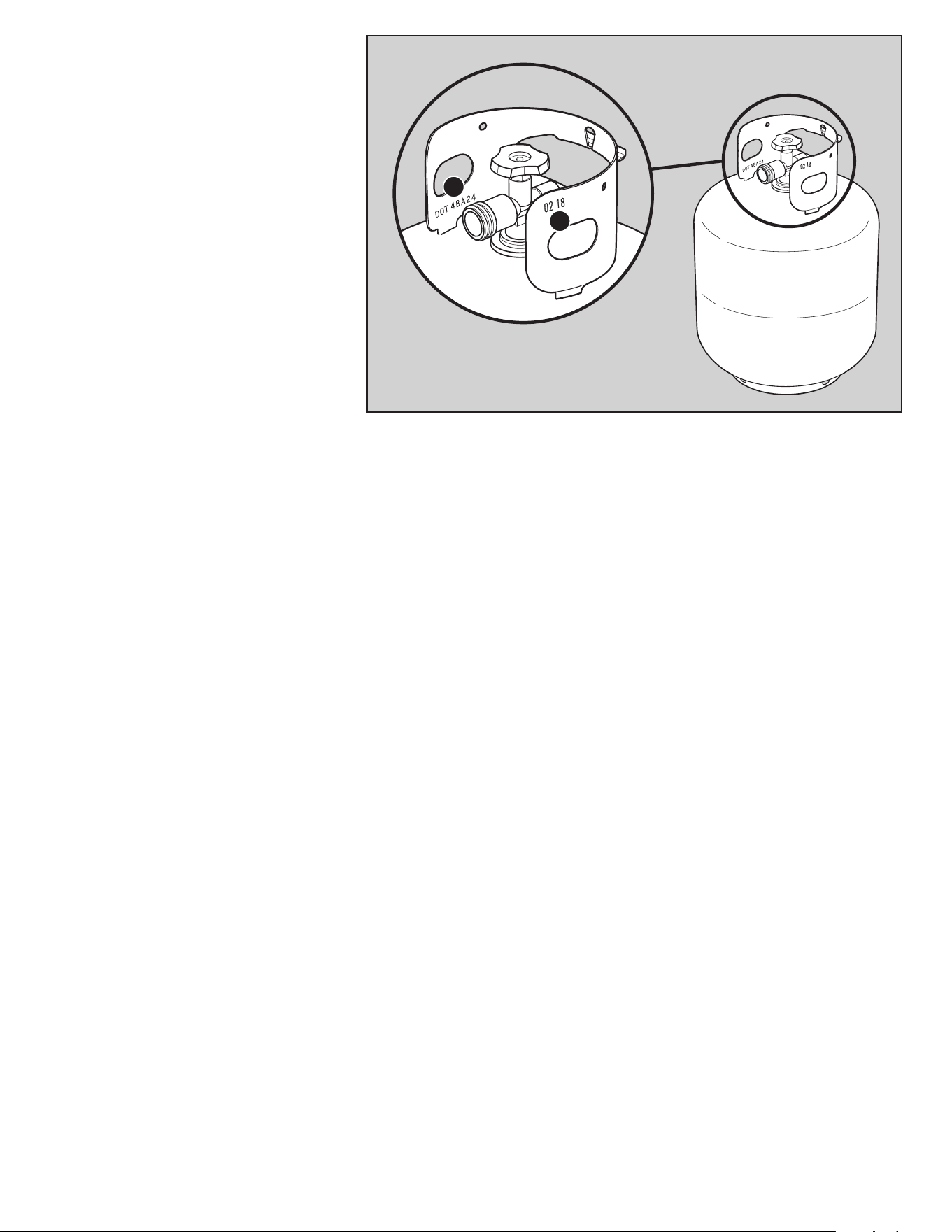
• Tanks must have a D.O.T. certification (A), and a testing
date (B) that is within five years of current use.
What is a Regulator?
Your gas grill is equipped with a pressure regulator,
which is a device to control and maintain uniform gas
pressure as gas is released from the LP tank.
Regulator Requirements
• The regulator and hose assembly supplied with this
grill must be used. This regulator has a flow limiting
device built into the unit that will restrict the flow of
gas in the event that a leak is detected.
• Replacement regulator and hose assemblies must be
as specified by Weber-Stephen Products LLC (UL-listed
Type 1 (CGA 791) tank connection device as described
in the latest edition of ANSI Z21.81).
A
B
7
Getting Started
LP Tank Installation &
LeakChecking
Installation Location
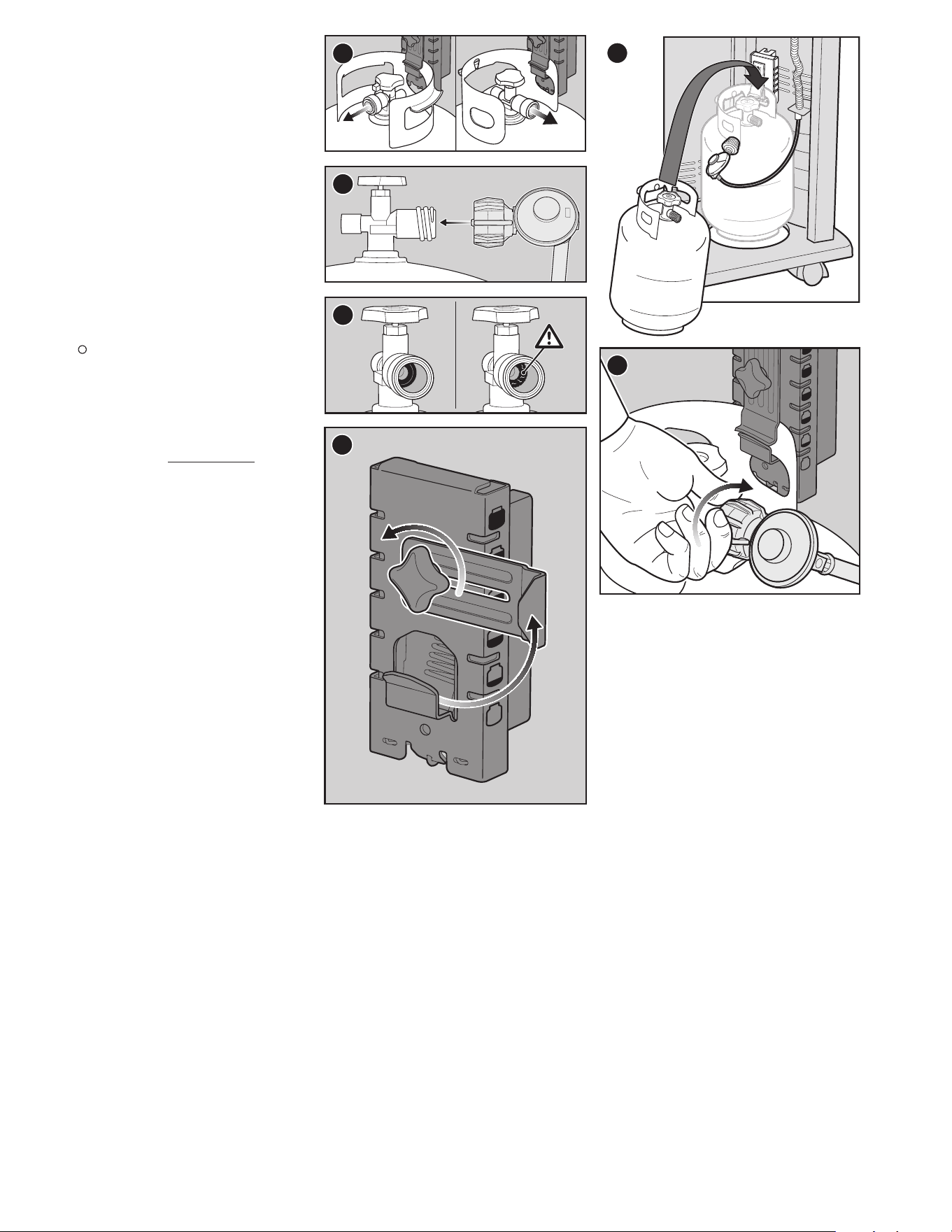
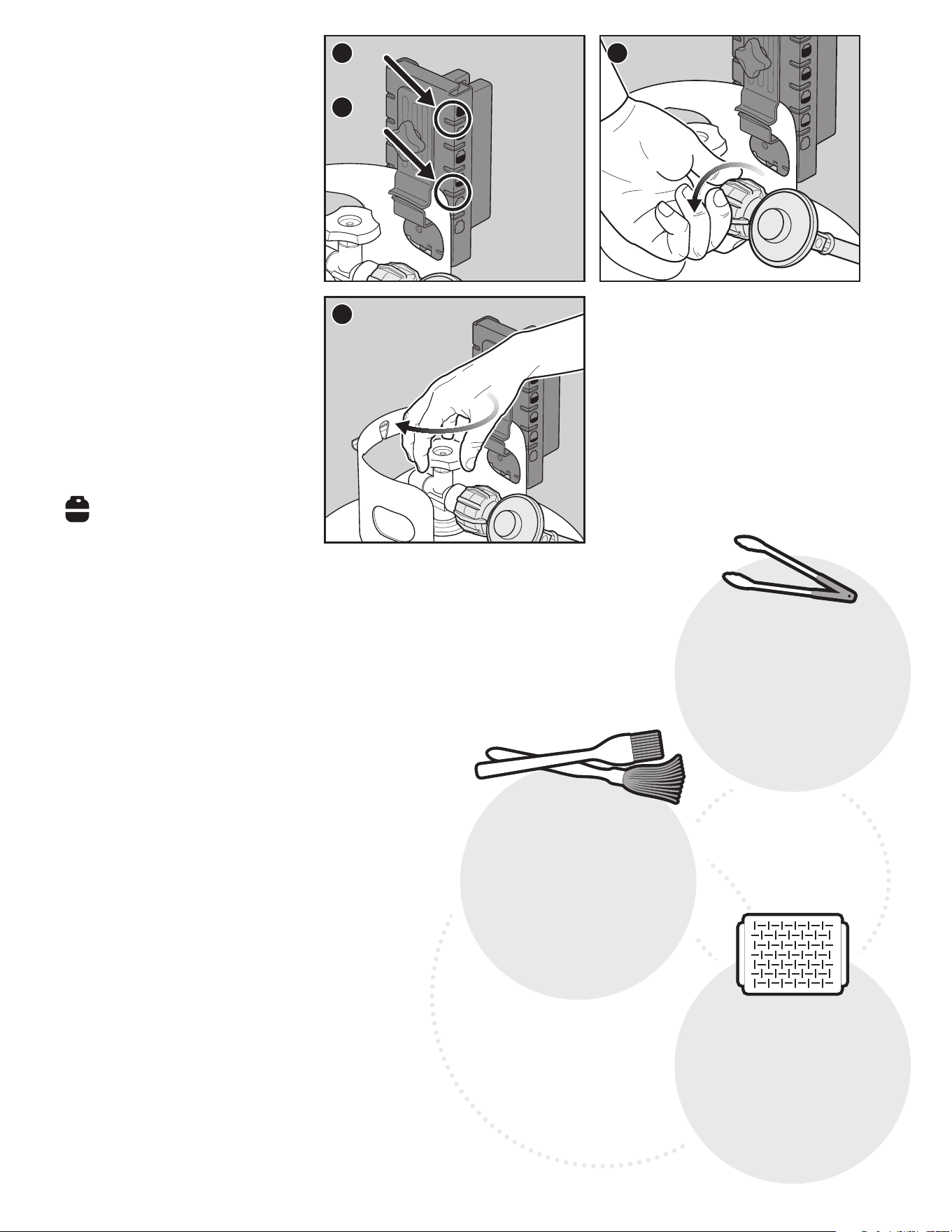
The LP tank is installed inside the base cabinet, on the
tank scale (right side). The shape of the collar assembly
(the metal protective ring around the tank valve)
determines one of two directions in which the tank will
correctly hang on the tank scale (A).
Inspect the Tank
1) Confirm that the tank valve is fully closed. Close by
turning valve clockwise.
2) Confirm that the tank valve is the proper mating
type for the regulator (B).
3) Inspect the tank valve, including the internal rubber
seal for damage or debris (C). If damaged, return
tank to local retailer.
Install The Tank
1) Check that all burner control knobs are in the
o position. Check by pushing in and turning
knobs clockwise.
2) Open base cabinet door.
3) Loosen hand nut and rotate tank lock up(D).
4) Lift tank into position on the tank scale (E).
5) Rotate the tank lock down. Tighten the hand nut.
6) Screw the regulator coupling onto the tank valve,
turning clockwise (F). Hand-tighten only. Using a
wrench could damage the regulator coupling and
could cause a leak. Proceed to “CHECKING FOR
GASLEAKS.”
B
C
D
A
F
E
8
Getting Started
G
H
I
J
K
m DANGER: Do not use a flame to check for gas
leaks. Besure there are no sparks or open
flames in the area while you check for leaks.
m DANGER: Leaking gas may cause a fire or
explosion.
m DANGER: Do not operate the grill if there is a
gas leak present.
m DANGER: If you see, smell, or hear the hiss of
gas escaping from the liquid propane tank:
1) Move away from liquid propane tank.
2) Do not attempt to correct the problem
yourself.
3) Call your fire department.
m DANGER: Always close the tank valve before
disconnecting the regulator. Do not attempt
to disconnect the gas regulator and hose
assembly or any gas fitting while this grill is
in operation.
m DANGER: Do not store a spare LP tank under
or near this grill. Never fill the tank beyond
80% full. Failure to follow these statements
exactly may result in a fire causing death or
serious injury.
What is a Leak Check?
Once the LP tank is properly installed, it is necessary
to perform a leak check. A leak check is a reliable way
to verify that gas is not escaping after you connect the
tank. The fuel system in your grill features factory-
made connections that have been thoroughly checked
for gas leaks and the burners have been flame-tested.
WEBER recommends performing a thorough leak
check after assembly, as well as annually. The
following fittings should be tested:
• Where the regulator connects to the tank.
• Where the gas hose connects to the bulkhead.
• Where the bulkhead connects to the corrugated gas
line.
Checking for Gas Leaks
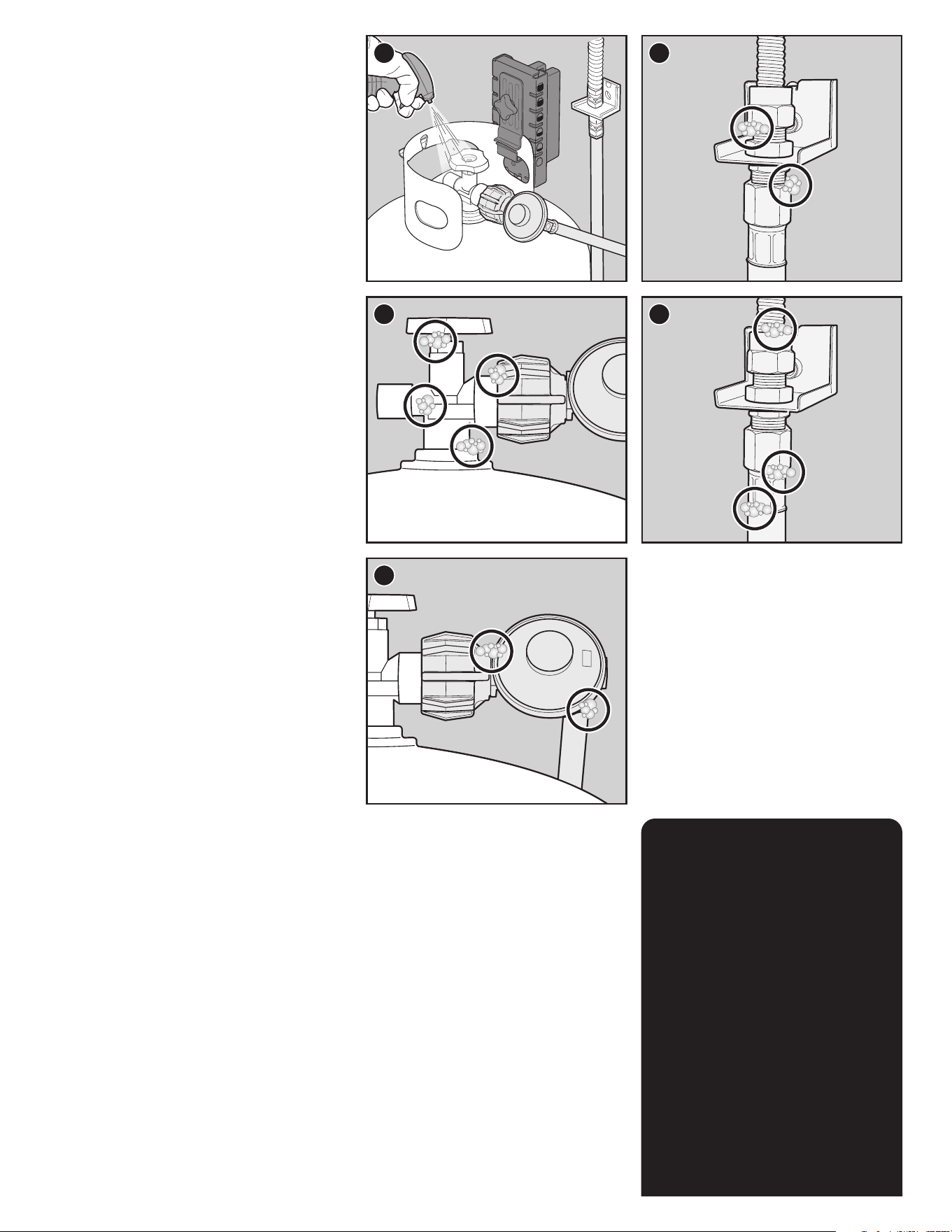
1) Wet fittings (G) with a soap and water solution,
using a spray bottle, brush, or rag. You can make
your own soap and water solution by mixing 20%
liquid soap with 80% water; or, you can purchase
leak check solution in the plumbing section of any
hardware store.
2) Slowly open gas supply by turning tank valve
counterclockwise while checking for bubbles.
3) If bubbles appear there is a leak:
a) If the leak is at the cylinder (H), turn o the gas.
DONOT OPERATE THE GRILL. Disconnect the
tank and return the tank to your local retailer.
b) If the leak is at the regulator (I), turn o the gas.
NEVER ATTEMPT TO TIGHTEN THE REGULATOR
WITH TANK VALVE OPEN. DO NOT OPERATE
THE GRILL. Contact the Customer Service
Representative in your area using the contact
information on our website.
c) If the leak is at any fittings indicated in
illustration (J), re-tighten fitting with a wrench
and recheck for leaks with soap and water
solution. If leak persists, turn o the gas. DO NOT
OPERATE THE GRILL.
d) If the leak is at any fittings indicated in
illustration (K), turn o the gas. DO NOT
OPERATE THE GRILL.
If a leak is present, contact the Customer Service
Representative in your area using the contact
information on our website.
4) If bubbles do not appear, leak checking is complete:
a) Turn gas supply o at the tank and rinse
connections with water.
NOTE: Since some leak test solutions, including soap and
water, may be slightly corrosive, all connections should
be rinsed with water after checking for leaks.
9
Getting Started
Refilling or Replacing an
LPTank
How Much Fuel is in the Tank?
The tank scale indicates the amount of fuel in a
standard 20 pound (9.07 kg) tank once the tank is hung
from the scale. The fuel level is checked by viewing
the red level indicator line, located on scale. When the
indicator line is at the top, the tank is full (L). When it
is at the bottom, the tank is empty(M) and needs to be
removed to replace or refill.
Removal of the LP Tank
1) Confirm that the tank valve is fully closed. Close by
turning valve clockwise (N).
2) Unscrew regulator coupling by turning
counterclockwise by hand (O).
3) Loosen tank hand nut and turn tank lock up out of
the way.
4) Lift tank o tank scale.
Additional Leak Check Precautions
The following fittings should be tested for gas leaks
each time a tank is refilled and reinstalled:
• Where the regulator connects to the tank (H) and at
the regulator (I).
Follow the instructions for "Checking for Gas Leaks".
GRILLINGPAN
Designed for food that is either too
small or too delicate for the cooking
grates, a perforated grilling pan
keeps food right where it ought
tobe—on the grill,
not in it.
M
U
S
T
-
H
A
V
E
G
R
I
L
L
I
N
G
T
O
O
L
S
•
M
U
S
T
-
H
A
V
E
G
R
I
L
L
I
N
G
T
O
O
L
S
•
M
U
S
T
-
H
A
V
E
G
R
I
L
L
I
N
G
T
O
O
L
S
•
M
U
S
T
-
H
A
V
E
G
R
I
L
L
I
N
G
T
O
O
L
S
•
M
U
S
T
-
H
A
V
E
G
R
I
L
L
I
N
G
T
O
O
L
S
•
TONGS
Consider these to be an extension
of your hand. The best tongs
should have an eortless tension
mechanism, comfortable hand
grips, and a lock to keep
themcompact.
M
U
S
T
-
H
A
V
E
G
R
I
L
L
I
N
G
T
O
O
L
S
•
M
U
S
T
-
H
A
V
E
G
R
I
L
L
I
N
G
T
O
O
L
S
•
M
U
S
T
-
H
A
V
E
G
R
I
L
L
I
N
G
T
O
O
L
S
•
M
U
S
T
-
H
A
V
E
G
R
I
L
L
I
N
G
T
O
O
L
S
•
M
U
S
T
-
H
A
V
E
G
R
I
L
L
I
N
G
T
O
O
L
S
•
BRUSH
AND MOP
Look for a basting brush with heat-
resistant silicone bristles and a long
handle, and a mop with long, cotton
threads that sop up the thinner,
vinegar-based sauces.
M
U
S
T
-
H
A
V
E
G
R
I
L
L
I
N
G
T
O
O
L
S
•
M
U
S
T
-
H
A
V
E
G
R
I
L
L
I
N
G
T
O
O
L
S
•
M
U
S
T
-
H
A
V
E
G
R
I
L
L
I
N
G
T
O
O
L
S
•
M
U
S
T
-
H
A
V
E
G
R
I
L
L
I
N
G
T
O
O
L
S
•
M
U
S
T
-
H
A
V
E
G
R
I
L
L
I
N
G
T
O
O
L
S
•
N
O
L
M
Notification on the WEBER CONNECT
Module
The WEBER CONNECT module will display
a fuel level notification when an LP tank is
installed to your fuel scale. Refer to "Using
the WEBER CONNECT Module" section in
this manual.
10
Operation
The Very First Time You Grill
Perform an Initial Burn-Off
Heat the grill on the highest setting, with the lid
closed, for at least 20 minutes prior to grilling for the
firsttime.
Every Time You Grill
Meal-to-Meal Maintenance
The Meal-To-Meal Maintenance plan includes the
following simple, yet important, steps that should
always be performed prior to grilling.
Check for Grease
Your grill was built with a grease management
system that funnels grease away from food and into a
disposable container. As you cook, grease is channeled
down the slide-out grease tray and into a disposable
drip tray that lines the catch pan. This system
should be cleaned each and every time you grill to
preventfires.
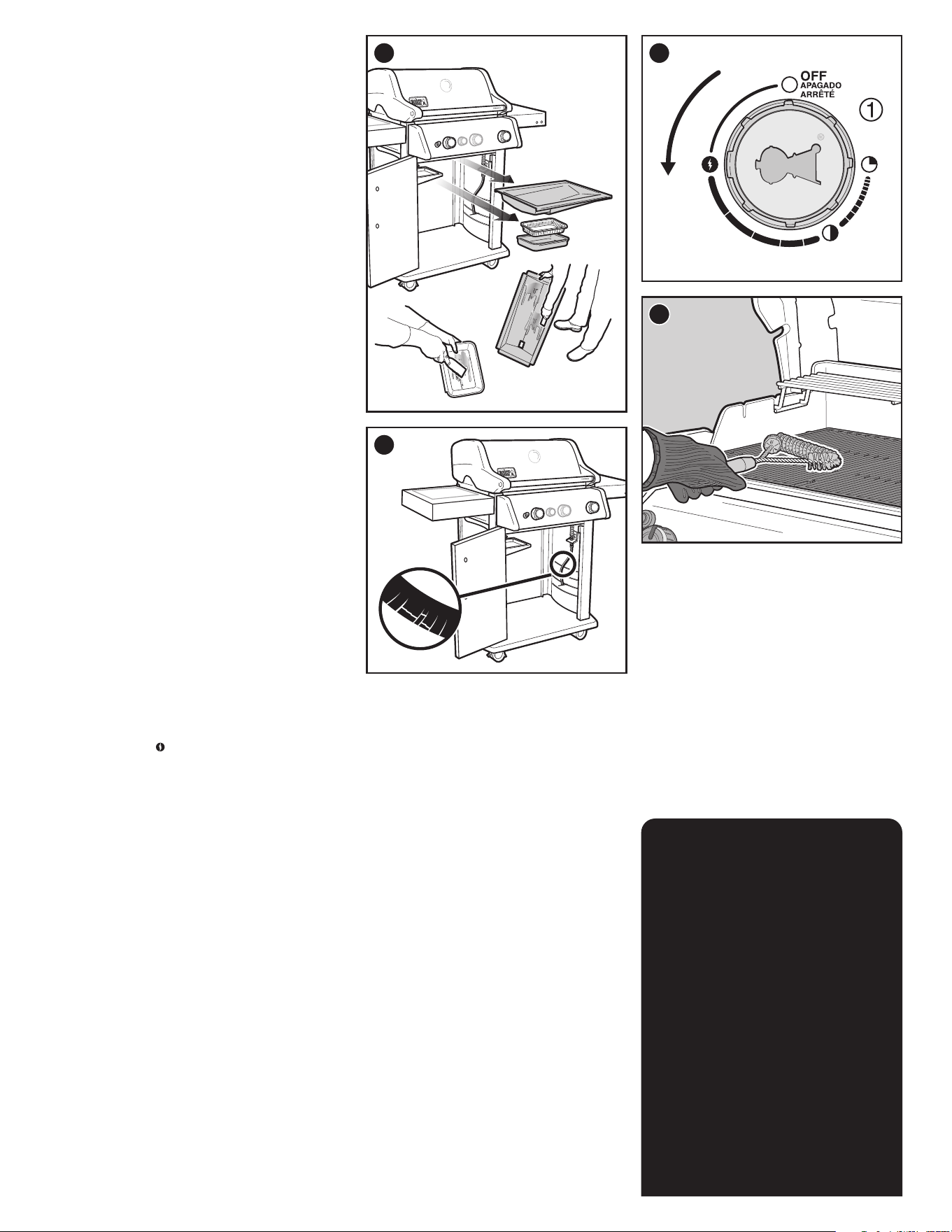
1) Confirm that the grill is o and cool.
2) Remove the slide-out grease tray by pulling the tray
out of the cabinet (A). Remove excess grease with a
plastic scraper.
3) Remove the catch pan. Check for excessive
amounts of grease in the disposable drip pan that
lines the catch pan. Discard disposable drip pan
when necessary and replace with a new one.
4) Reinstall all components.
Inspect the Hose
Routine inspection of the hose is necessary.
1) Confirm that the grill is o and cool.
2) Check hose for any signs of cracking, abrasions, or
cuts(B). If the hose is found to be damaged in any
way, do not use the grill.
Preheat the Grill
Preheating the grill is critical to successful grilling.
Preheating helps to prevent food from sticking to the
grate and gets the grate hot enough to sear properly.
Italso burns o residue of a previously cooked meal.
1) Open the grill lid.
2) Ignite your grill according to the ignition
instructions in this Owner's Manual.
3) Close lid.
4) Preheat the grill with all burners on the
start/high
position for 15 minutes(C).
Clean the Cooking Grate
After preheating, any bits of food or debris left over
from previous use will be easier to remove. Cleaned
grates will also prevent your next meal from sticking.
1) Brush the grates with a stainless steel bristle grill
brush immediately after preheating (D).
m DANGER: Do not line the slide-out grease tray
or cookbox with aluminum foil.
m DANGER: Check the slide-out grease tray and
catch pan for grease build-up before each use.
Remove excess grease to avoid a grease fire.
m WARNING: Use caution when removing catch
pan and disposing of hot grease.
m WARNING: Use heat-resistant barbecue mitts
or gloves when operating grill.
m WARNING: Grill brushes should be checked for
loose bristles and excessive wear on a regular
basis. Replace brush if any loose bristles are
found on cooking grates or brush. WEBER
recommends purchasing a new stainless steel
bristle grill brush at the beginning of every
spring.
m WARNING: If the hose is found to be damaged
in any way, do not use the grill. Replace using
only WEBER authorized replacement hose.
m WARNING: Keep ventilation openings around
tank clear and free of debris.
C
D
A
B
11
Operation
m WARNING: Open lid during ignition.
m WARNING: Do not lean over open grill while
igniting or cooking.
m WARNING: If ignition does not occur within
four seconds of attempting to light the first
burner, turn the burner control knob to
the o position. Wait five minutes to allow
accumulated gas to dissipate, and then repeat
the lighting procedure.
Igniting the Grill
Using the Crossover Ignition System to
Ignite the Grill
The crossover ignition system ignites burner 1
furthest to the left with a spark from the igniter
electrode. You generate the energy for the spark by
pushing the igniter button. You will hear the igniter
ticking. Burner(s) 2 (and 3) can be lit after burner1 is
lit. All burners should be lit for preheating, however, all
burners do not have to be lit while grilling.
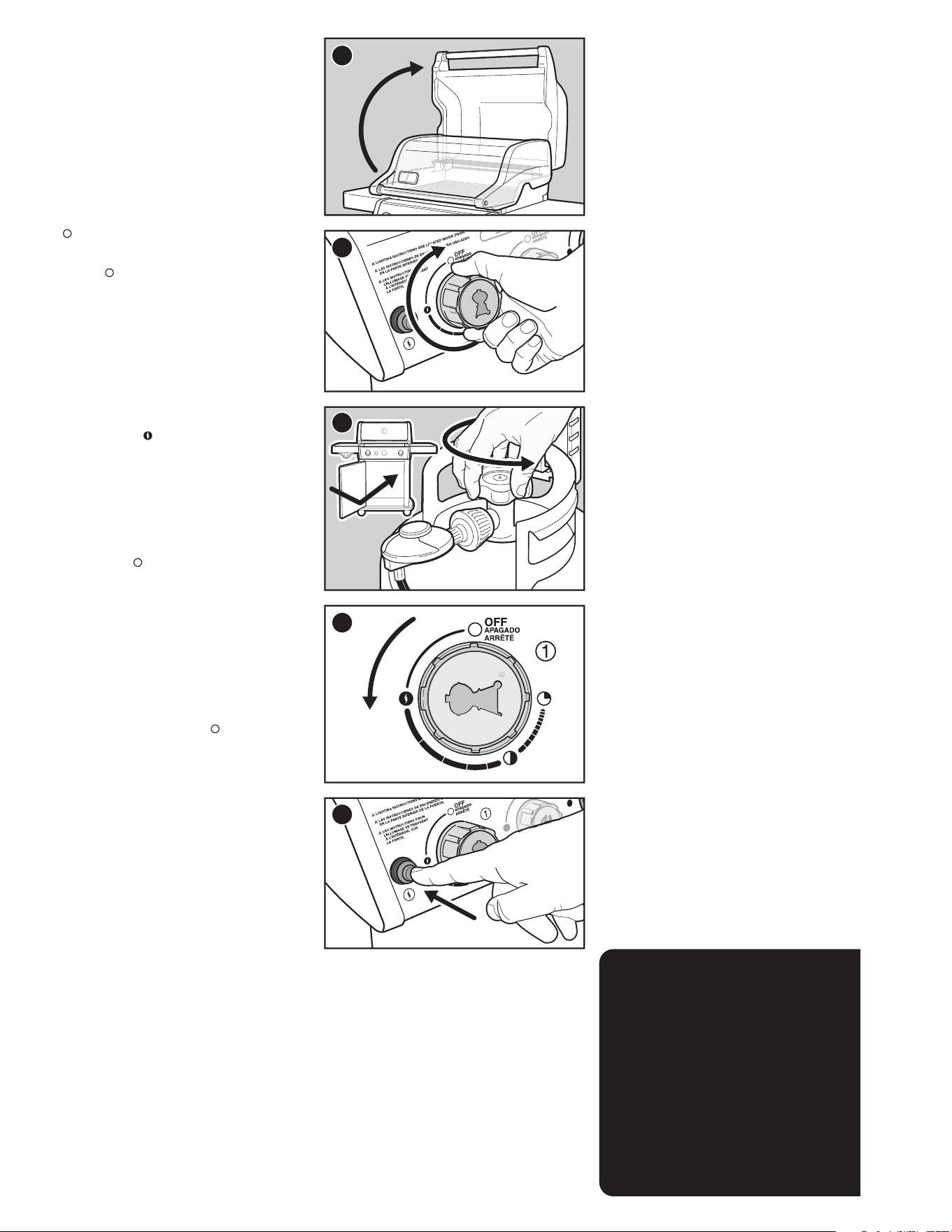
1) Open the grill lid (A).
2) Check that all burner control knobs are in the o
position. Check by pushing in and turning knobs
clockwise (B).
Note: It is important that all burner control knobs are
in the o position before turning on the LP tank.
If they are not, the flow limiting device built into the
regulator will activate, limiting the flow of gas from
the LP tank.
3) Turn the LP tank on by slowly turning the tank valve
counterclockwise; wait 60 seconds (C).
Note: It is important that the LP tank is turned on
slowly. Ifit is opened too quickly, the flow limiting
device built into the regulator will activate, limiting the
flow of gas from the LP tank.
4) Begin with burner 1 furthest to the left. Push the
burner control knob in and turn it counterclockwise
to the start/high
position (D).
IMPORTANT: Always ignite burner 1 first.
Theother burner(s) ignite from burner 1.
5) Push and hold the electronic ignition button (E).
Youwill hear it ticking.
6) Check that burner 1 is lit by looking through the
cooking grates and through the cutout in the
FLAVORIZER BARS.
7) If the burner does not ignite, turn burner control
knob to the o
position and wait five minutes to
allow the gas to clear before attempting to light the
burner again.
8) When burner 1 ignites, you can turn on burner 2
(and burner 3).
Should the burners fail to ignite using the electronic
ignition, refer to the TROUBLESHOOTING section.
Thereyou will find instructions on igniting the grill
with a match to help determine the exact problem.
To Extinguish Burners
1) Push each burner control knob in and then turn
clockwise all the way to the o position.
2) Turn gas supply o at the LP tank.
A
B
D
E
C
12
Operation
A CB
D
E
WEBER CONNECT App
First things first.
Download the WEBER CONNECT app.
Open the app to receive:
•
Flip and Serve Notifications
• Food Readiness Countdowns
• Custom Food Doneness Alerts
• Step-by-step Grilling Assistance
• Propane Alert Notifications
(US & Canada only)
Connecting Your Grill To Bluetooth® or
Wi-Fi Network
To connect your WEBER grill via Bluetooth® or
your local Wi-Fi network, follow these steps:
NOTE: WEBER recommends that your smart
device be running the latest version of its
operating system before attempting to connect
your grill to Bluetooth® or your Wi-Fi network.
1) Push any button located on the temperature
controller to turn ON the WEBER CONNECT
module.
2) Verify that your smart device is connected to
Bluetooth®
or your local Wi-Fi network.
3) From your smart device, download the new
WEBER CONNECT app from the App Store on
Apple devices, or the Play Store on Android
devices.
4) Open the WEBER CONNECT app and follow
the in-app instructions for connecting to your
WEBER grill.
NOTE: In order to successfully connect your
smart device to your grill via a local Wi-Fi
network, first make sure your grill is paired via
Bluetooth® and that your grill is within range of
your Wi-Fi router. If your attempts to connect
have been unsuccessful, try moving the grill
within range of the Wi-Fi router or adding a
signal extender for a stronger signal.
Integrated WEBER CONNECT
Technology
Using the WEBER CONNECT Module
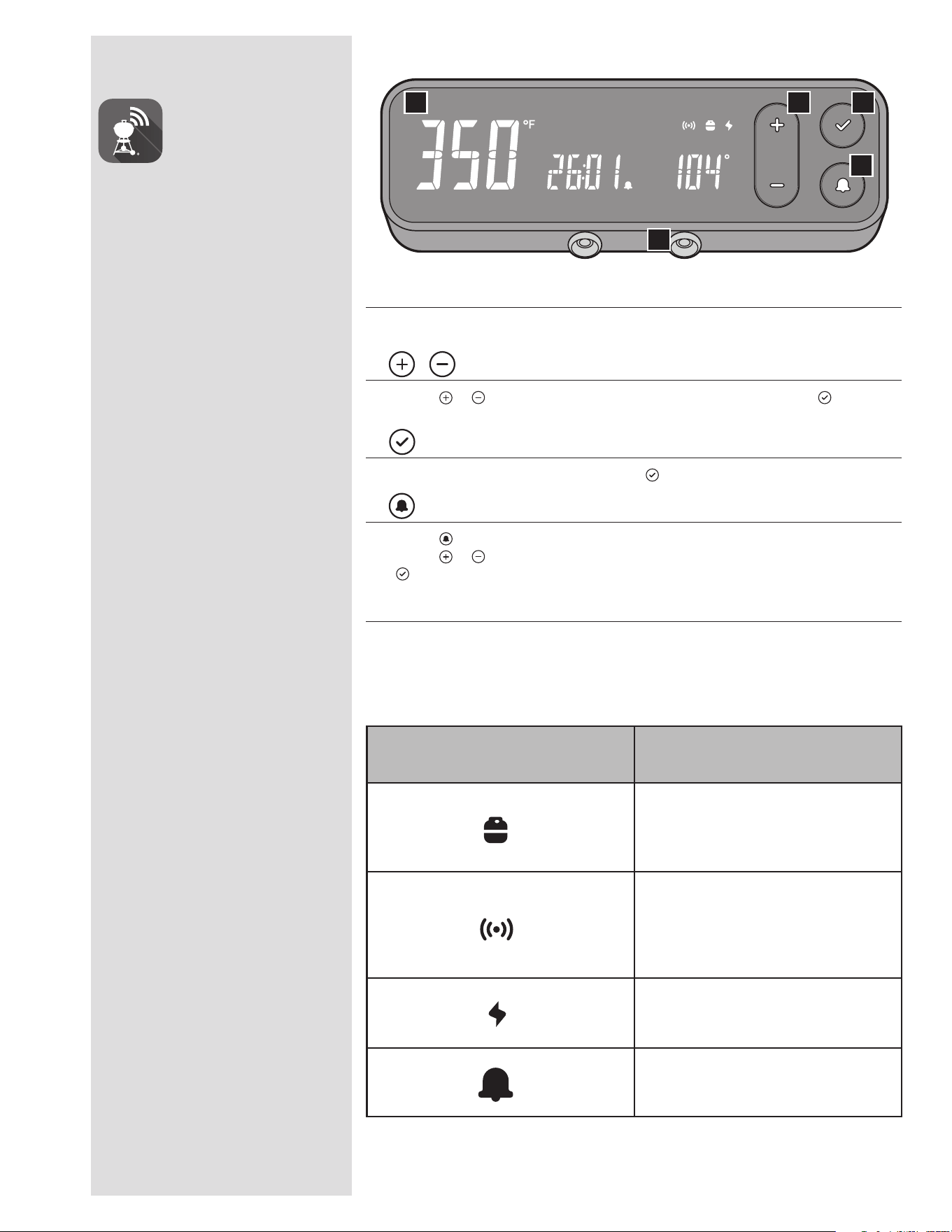
Notifications
The WEBER CONNECT module display will show your
fuel level when properly connected to your fuel scale. A
full fuel level will display in green. A mid fuel level will
display in yellow. A low fuel level will display in red.
A green wireless symbol is shown on the WEBER
CONNECT module display when connected to the
WEBER CONNECT app via your local Wi-fi network.
A blue wireless symbol is shown on the WEBER
CONNECT module display when connected to the
WEBER CONNECT app via Bluetooth®.
A power indicator will display the battery power level
of the batteries for the WEBER CONNECT module. Full
battery level will appear in green. Low battery level will
appear in red.
To silence an audio notification, push the BELL button.
A Dashboard
The LED display dashboard on your module is where you can visually check temperatures, receive
notifications, view connectivity status, and check the status of your cook.
B
Push the or buttons to increase or decrease time or target temperatures. Push the button to
confirm your selection.
C Confirm Selection
After selecting a target time or temperature, push the button confirm the selection.
D Timer
Push the button to start a new timer or navigate between grill temperature and food temperature probes.
Push the
or buttons to increase or decrease the desired time or target temperature. Push the
button to confirm a selection.
E Food Temperature Probes
Your new WEBER CONNECT module can handle up to two separate food temperature probes (one probe
included) to gain superior control of your grill for perfect results every time.
NOTE: Download the WEBER CONNECT app to get the latest grill software and features.
Model: WC2 CONTROLLER
13
Operation
F
G
H
Setting a Grill Temperature Notification
Please follow these steps for setting a notification to
alert you when your grill has reached a target internal
temperature:
1) Push any button located on the temperature
controller to turn ON the WEBER CONNECT module.
2) Push the BELL button to activate grill temperature
notification.
3) While the display is blinking, push the + or -
buttons to set the target grill temperature. Push the
CHECKMARK button to confirm your selection.
4) Reapeat steps 2 and 3 to update or set a new target
temperature.
5) Once the grill reaches the target temperature, the
BELL button will blink, the controller will ding, and
if using the WEBER CONNECT app, you will receive
a push notification on your smart device.
6) All of these WEBER CONNECT module functions can
also be set wirelessly via Wi-fi or Bluetooth® from
the WEBER CONNECT app on your smart device.
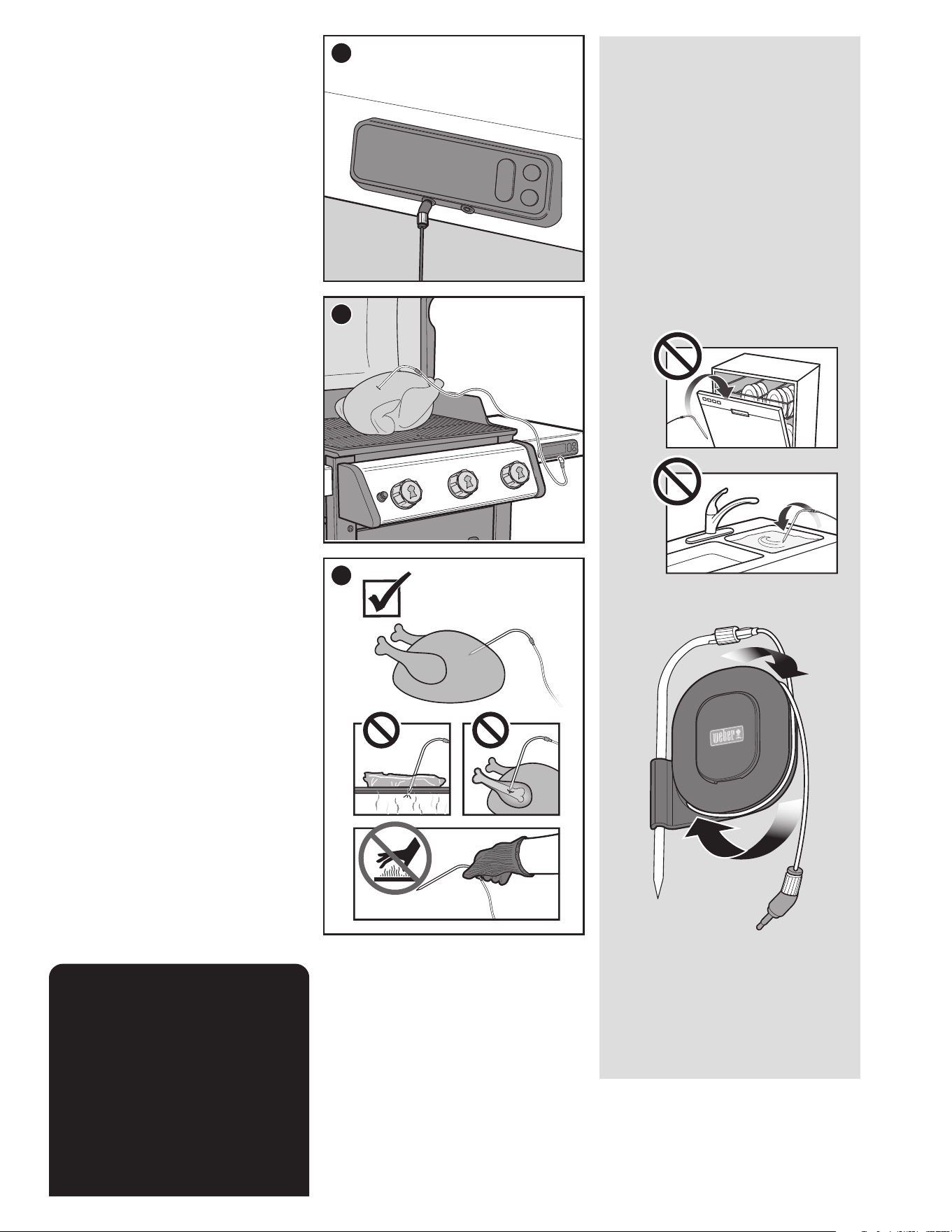
Grilling with Food Temperature Probes
Use the included food temperature probe to monitor
your WEBER grill for the perfect food, every time.
Please follow these steps for using food temperature
probes:
1) Once the grill has been preheated, open the grill lid
and clean the cooking grates using a grill brush or
scraper, then set the control knobs to the desired
grill temperature.
2) Place your food on the grates.
3) Plug the food temperature probe(s) into the ports
of the WEBER CONNECT module (F) and, using
heat resistant grill mitts or gloves, route food
temperature probe cables through the side channel
on the grill (G).
4) Insert food probe(s) into the center of the thickest
part of your food.
5) Close the grill lid.
6) Push any button located on the temperature
controller to turn ON the WEBER CONNECT module.
7) Push the BELL button to navigate between grill
temperature and food temperature probes 1 and 2.
8) Once you select which probe you are using,
push the + or - buttons to set the target food
temperature. Push the CHECKMARK button to
confirm your selection.
9) Reapeat steps 7 and 8 to update or set a new target
temperature.
10) Once the probe reaches the target temperature,
the BELL button will blink, the controller will ding,
and if using the WEBER CONNECT app, you will
receive a push notification on your smart device.
11) All of these WEBER CONNECT module functions can
also be set wirelessly via Wi-fi or Bluetooth® from
the WEBER CONNECT app on your smart device.
m WARNING
m Risk of injury! The food temperature probes
are very sharp. Please be careful when
handling probes.
m Risk of burns! Handling the food temperature
probes without hand protection will result in
severe burns. The colored probe indicators
are not intended to be touched with bare
hands while using the grill as they are not
heat-insulated. Please wear heat-resistant
gloves at all times while using this product in
order to avoid being burned.
Food Temperature Probe Care
Cleaning the Food Temperature Probe
Clean probe before first use. The probe should be
cleaned by wiping with water and a damp cloth.
The food temperature probes are not dishwasher
safe or waterproof and damage may result from
excessive water exposure. Never submerge the
probes directly in water or other liquids.
Storing Food Temperature Probe
Once cleaned, neatly wrap the probe when not in
use and store indoors.
14
HIGH
BURNER
2
BURNER
1
BURNER
3
HIGH
BURNER
2
BURNER
1
The Flame -
Direct or Indirect
Tips and Hints
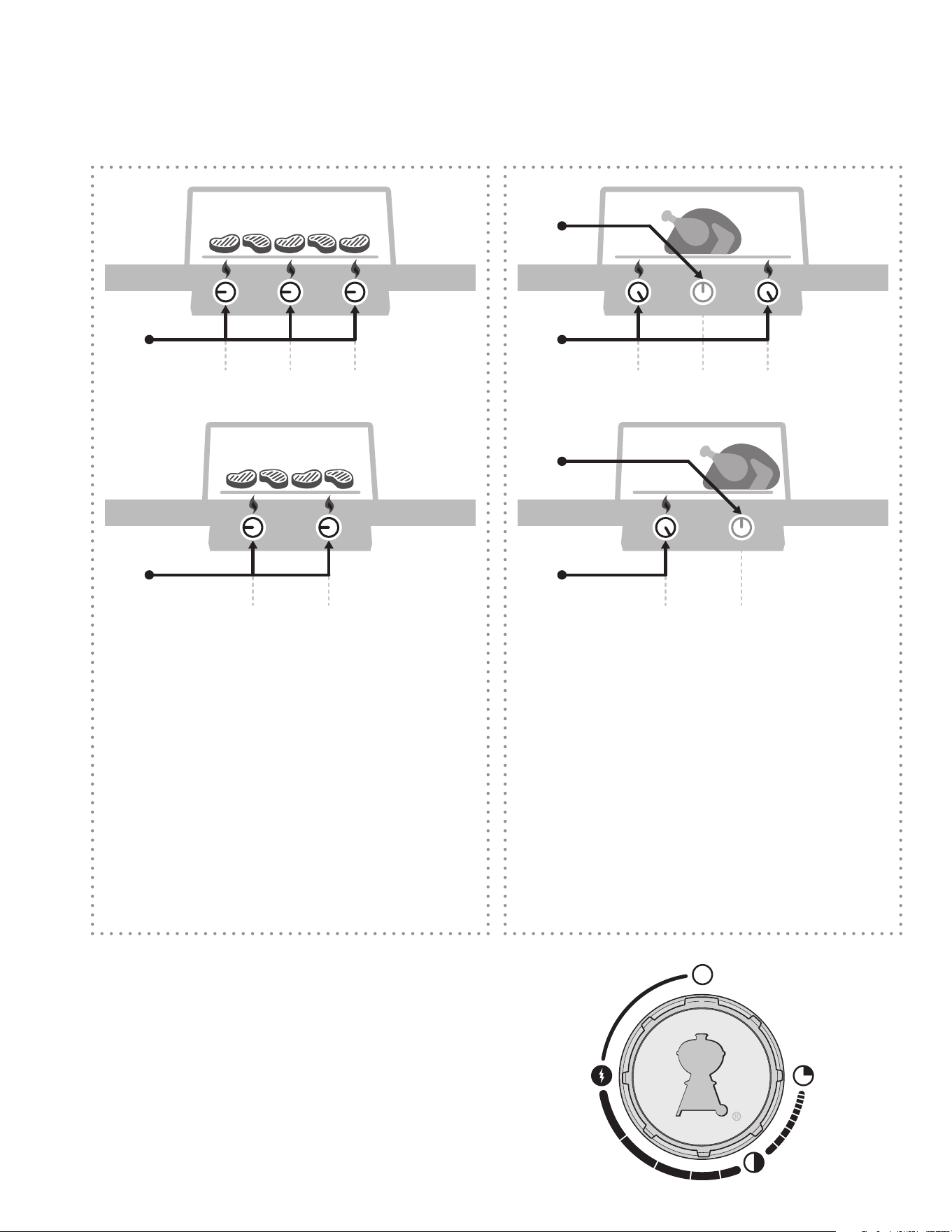
INDIRECT HEAT
SETUP
Use the indirect method for larger cuts of meat that require 20 minutes or more
of grilling time, or for foods so delicate that direct exposure to the heat would
dry them out or scorch them, such as: roasts, bone-in poultry pieces, whole
fish, delicate fish fillets, whole chickens, turkeys, and ribs. Indirect heat can also
be used for finishing thicker foods or bone-in cuts that have been seared or
browned first over direct heat.
With indirect heat, the heat is on both sides of the grill, or o to one side of the
grill. The food sits over the unlit part on the cooking grate.
DIRECT HEAT
SETUP
Use the direct method for small, tender pieces of food that take less than 20
minutes to cook, suchas: hamburgers, steaks, chops, kabobs, boneless chicken
pieces, fish fillets, shellfish, and slicedvegetables.
With direct heat, the fire is right below the food. It sears the surfaces of the food,
developing flavors, texture, and delicious caramelization while cooking the food
all the way to thecenter.
OFF
LOW
MEDIUM
START/HIGH
MEDIUM
OFF
BURNER
2
BURNER
1
BURNER
3
MEDIUM
OFF
BURNER
2
BURNER
1
15
Tips and Hints
TIMER
Avoid the disappointment of torching
your dinner by simply setting a timer.
Nothing fancy needed—just one
that is reliable and easy
to use.
M
U
S
T
-
H
A
V
E
G
R
I
L
L
I
N
G
T
O
O
L
S
•
M
U
S
T
-
H
A
V
E
G
R
I
L
L
I
N
G
T
O
O
L
S
•
M
U
S
T
-
H
A
V
E
G
R
I
L
L
I
N
G
T
O
O
L
S
•
M
U
S
T
-
H
A
V
E
G
R
I
L
L
I
N
G
T
O
O
L
S
•
M
U
S
T
-
H
A
V
E
G
R
I
L
L
I
N
G
T
O
O
L
S
•
SPATULA
Look for a long-handled spatula
designed with a bent (oset) neck
so that the blade is set lower
than the handle. This makes it
easier to lift food o the
cookinggrates.
M
U
S
T
-
H
A
V
E
G
R
I
L
L
I
N
G
T
O
O
L
S
•
M
U
S
T
-
H
A
V
E
G
R
I
L
L
I
N
G
T
O
O
L
S
•
M
U
S
T
-
H
A
V
E
G
R
I
L
L
I
N
G
T
O
O
L
S
•
M
U
S
T
-
H
A
V
E
G
R
I
L
L
I
N
G
T
O
O
L
S
•
M
U
S
T
-
H
A
V
E
G
R
I
L
L
I
N
G
T
O
O
L
S
•
BARBECUE
MITTS
When in doubt, wear them. The good
ones are insulated and protect
both hand and forearm.
M
U
S
T
-
H
A
V
E
G
R
I
L
L
I
N
G
T
O
O
L
S
•
M
U
S
T
-
H
A
V
E
G
R
I
L
L
I
N
G
T
O
O
L
S
•
M
U
S
T
-
H
A
V
E
G
R
I
L
L
I
N
G
T
O
O
L
S
•
M
U
S
T
-
H
A
V
E
G
R
I
L
L
I
N
G
T
O
O
L
S
•
M
U
S
T
-
H
A
V
E
G
R
I
L
L
I
N
G
T
O
O
L
S
•
Preheat each and every time.
If the cooking grates aren’t hot enough, food will stick,
and you will likely never have a chance of searing
properly or developing those handsome grill marks.
Even if a recipe calls for medium or low heat, always
preheat the grill on the highest setting first. Open the
lid, turn up the heat, close the lid, and then let the
cooking grate heat up for 15 minutes on high.
Don't grill on dirty grates.
Tossing food onto the cooking grates before they have
been cleaned is never a good idea. Leftover “stu” on
the grates acts like glue, binding it to the grates and
your new food. To avoid tasting last night’s dinner on
today’s lunch, make sure you are grilling on a clean
cooking grate. Once the grates are preheated, use
a stainless steel bristle grill brush to make a clean,
smooth surface.
Be present in the process.
Before firing up your grill, make sure that everything
you need is within arm’s reach. Don’t forget your
essential grilling tools, already oiled and seasoned
food, glazes or sauces, and clean cooking platters for
cooked food. Having to run back to your kitchen not only
means missing out on the fun, but could also result in
burning your food. French chefs call this “mise en place”
(meaning, “put in place”). We call it “being present”.
Create a little elbow room.
Packing too much food onto the cooking grates restricts
your flexibility. Leave at least one-quarter of the cooking
grates clear, with plenty of space between each food
item, in order to get your tongs in there and easily
move the food around. Sometimes grilling involves
split-second decisions and the ability to jockey food
from one area to another. Sogive yourself enough room
to operate.
Try not to peek.
The lid on your grill is for more than just keeping the
rain out. Most importantly, it’s for preventing too much
air from getting in, and too much heat and smoke from
getting out. When the lid is closed, the cooking grates
are hotter, the grilling times are faster, the smoky tastes
are stronger, and the flare-ups are fewer. So put a lid
on it!
Only flip once.
What’s better than a juicy steak with a deep sear and
plenty of beautifully caramelized bits? The key to
accomplishing these results is to keep your food in
place. Sometimes we have the tendency to flip our food
before it reaches the desirable level of color and flavor.
In nearly all cases, you should turn food just once. If
fiddling with it more than that, you are probably also
opening the lid too much, which causes its own set of
problems. So step back and trust the grill.
Know when to tame the flame.
When grilling, sometimes the most important thing to
know is when to stop. The most reliable way to test
doneness of your food is to invest in an instant-read
thermometer. This slim little gem will help you pinpoint
that critical moment when your food is at its best.
Don’t be afraid to experiment.
Back in the 1950s, grilling meant one thing: meat (and
only meat) charred over open flames. The modern
day backyard chef doesn’t need a kitchen in order to
prepare a full course meal. Use your grill to make char-
grilled appetizers, sides, and even desserts. Register
your grill to receive special content that will inspire
you along the way. We’d love to join you on your grilling
adventures.
GrillingDo’s
andDon’ts
16
m WARNING: Turn your grill o and wait for it to
cool before thoroughly cleaning.
m WARNING: Over time, the development of
rough surfaces can form on the FLAVORIZER
BARS. Wearing gloves is recommended when
handling. Do not clean FLAVORIZER BARS or
cooking grates in a sink, dishwasher, or self-
cleaning oven.
m WARNING: When cleaning the burners, never
use a brush that has already been used to
clean the cooking grates. Never put sharp
objects into the burner port holes.
m CAUTION: Do not place any grill components
onto the side tables as they may scratch the
paint or stainless steel surfaces.
m CAUTION: Do not use any of the following
to clean your grill: abrasive stainless steel
polishes or paints, cleaners that contain
acid, mineral spirits or xylene, oven cleaner,
abrasive cleansers (kitchen cleansers), or
abrasive cleaning pads.
Product Care
Cleaning and Maintenance
Cleaning the Inside of the Grill
Over time, the performance of your grill can
diminish if it has not been maintained properly.
Low temperatures, uneven heat, and food sticking
to cooking grates are all signs that cleaning and
maintenance are overdue. When your grill is o and
cool, start by cleaning the inside, from the top down.
A thorough cleaning is recommended at least twice a
year. Consistent use may require quarterly cleanings.
Cleaning the Lid
From time to time you may notice “paint-like” flakes
on the inside of the lid. During use, grease and smoke
vapors slowly change into carbon and deposit on the
inside of your lid. These deposits will eventually peel,
and looks very similar to paint. These deposits are
non-toxic, but the flakes could fall onto your food if you
do not clean the lid regularly.
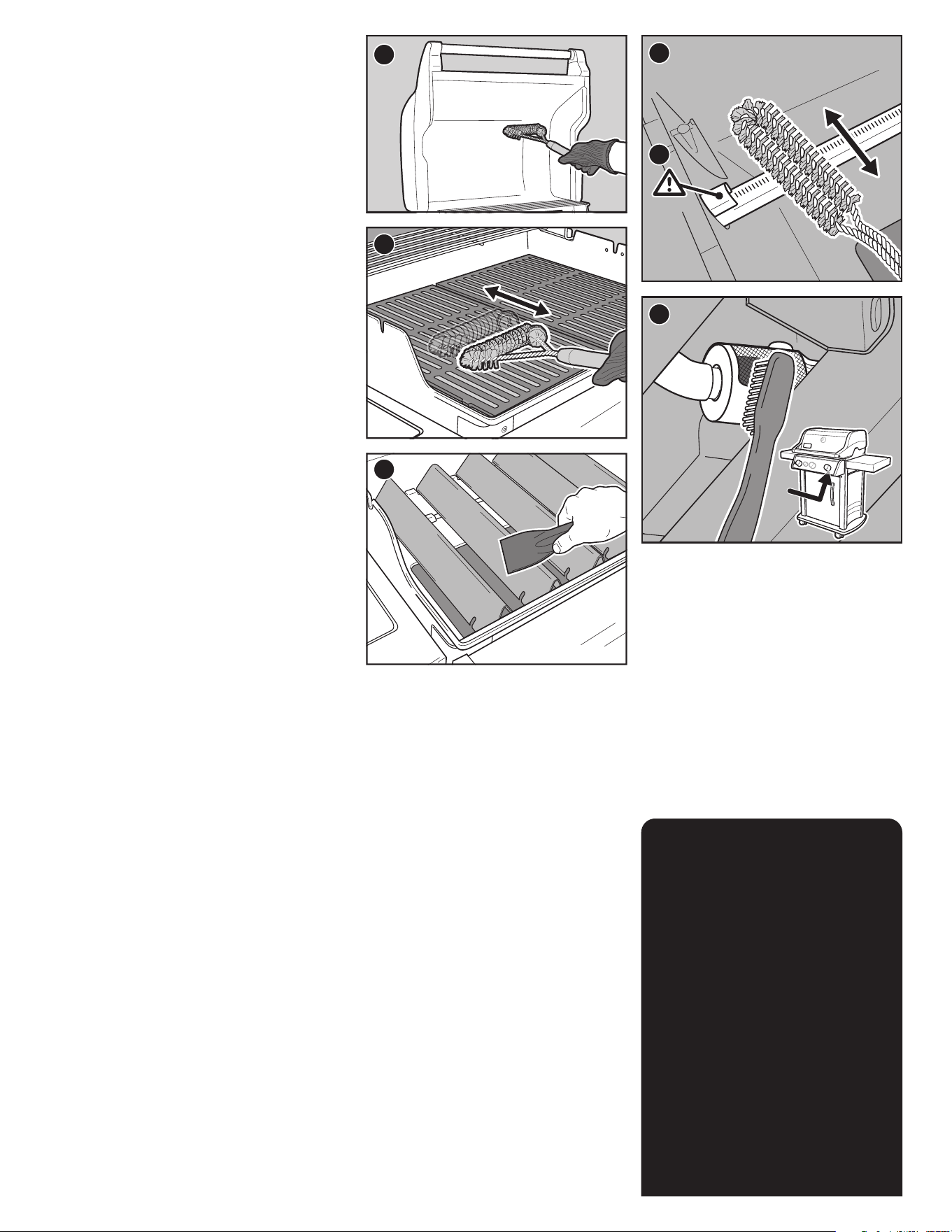
1) Brush the carbonized grease from the inside of the
lid with a stainless steel bristle grill brush (A). To
minimize further build-up, the inside of the lid can
be wiped with a paper towel after grilling while the
grill is still warm (nothot).
Cleaning the Cooking Grates
If you have been cleaning your cooking grates as
recommended, the debris on your grates should be
minimal.
1) With grates installed, brush the debris o your
cooking grate with a stainless steel bristle grill
brush(B).
2) Take the grates out and set aside.
Cleaning the FLAVORIZERBARS
FLAVORIZER BARS catch drippings that smoke and
sizzle, adding flavor to your food. Any drippings that
are not vaporized by the FLAVORIZER BARS are
funneled away from the burners. This helps prevent
flare-ups inside of your grill, and protects the burners
from getting clogged.
1) Scrape the FLAVORIZER BARS with a plastic
scraper(C).
2) If necessary, brush the FLAVORIZER BARS with a
stainless steel bristle grill brush.
3) Remove FLAVORIZER BARS and set aside.
Cleaning the Burners
Two areas on the burners that are key to optimum
performance are the ports (small openings running
along the length of the burners) and the spider/insect
screens on the ends of the burner. Keeping these
areas clean is essential for safe operation.
Cleaning the Burner Ports
1) Use a clean stainless steel bristle grill brush
to clean the outside of the burners by brushing
across the top of the burner ports (D). Do not brush
lengthwise.along the tube, as this will only brush
debris from one port to another.
2) When cleaning burner 1, avoid damaging the
ignition electrode by carefully brushing around
it(E).
Cleaning the Spider Screens
1) Locate the ends of the burners on the underside of
the control panel where they meet the valves.
2) Clean the spider/insect screens on each of the
burners using a soft bristle brush (F).
E
F
D
A
B
C
17
Product Care
Cleaning the Cookbox
Look inside the cookbox for any grease accumulation
or leftover food particles. Excessive accumulation can
cause a fire.
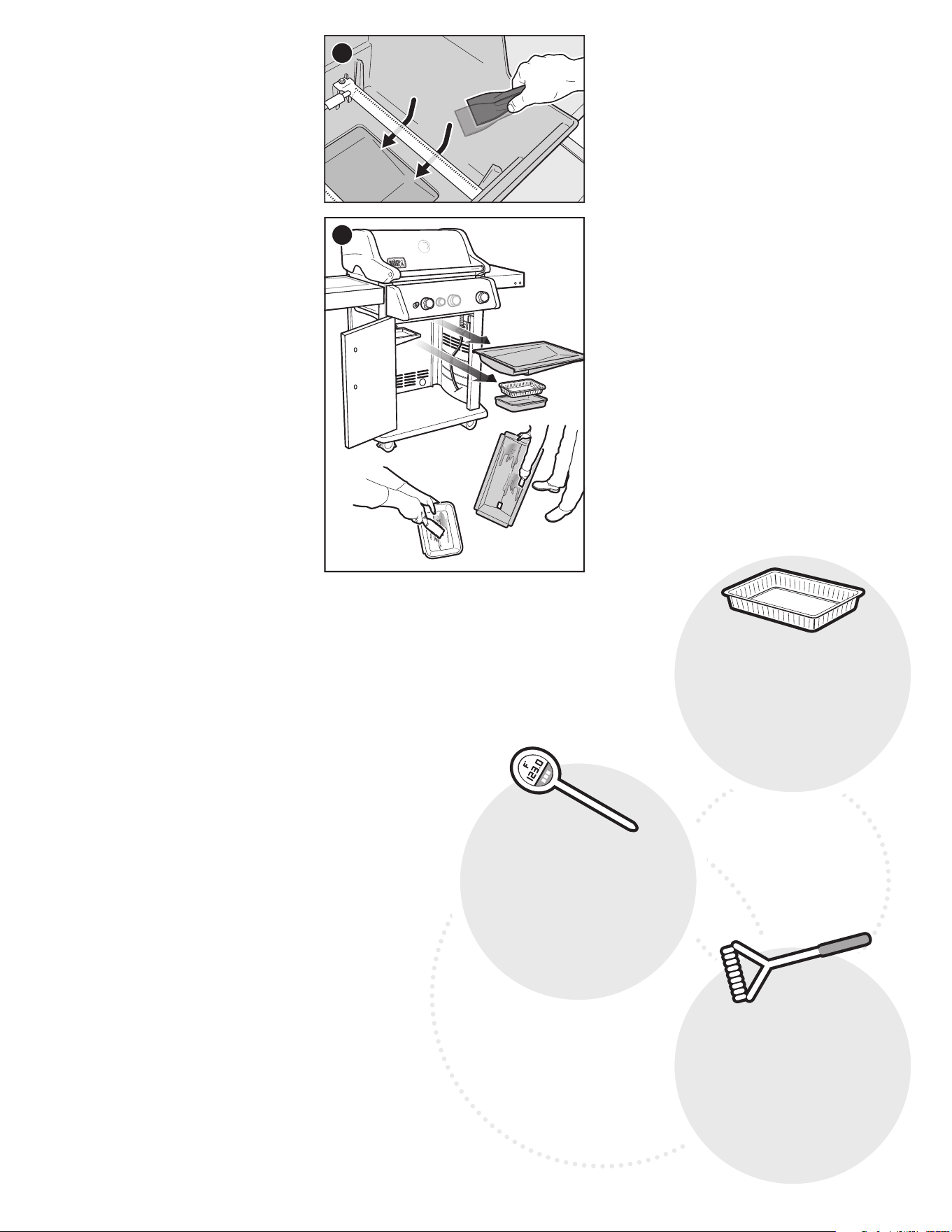
1) Use a plastic scraper to scrape debris o the sides
and bottom of the grill into the opening in bottom of
the cookbox(G). This opening leads debris into the
slide-out catch pan.
Cleaning the Grease ManagementSystem
The grease management system consists of an angled
slide-out grease tray and a catch pan (H). These
components were designed to be easily removed,
cleaned, and replaced; an essential step every time
you prepare to grill. Instructions on inspecting the
grease management system can be found in MEAL-TO-
MEAL MAINTENANCE.
Cleaning the Outside of theGrill
The outside of your grill may include stainless steel,
porcelain-enameled, and plastic surfaces. WEBER
recommends the following methods based on the
surfacetype.
Cleaning Stainless Steel Surfaces
Clean stainless steel using a non-toxic, non-abrasive
stainless steel cleaner or polish designed for use on
outdoor products and grills. Use a microfiber cloth to
clean in the direction of the grain of the stainless steel.
Donot use paper towels.
Note: Do not risk scratching your stainless steel with
abrasive pastes. Pastes do not clean or polish. They
will change the color of the metal by removing the top
chromium oxide film coating.
Cleaning Painted, Porcelain-Enameled
Surfaces and PlasticComponents
Clean painted, porcelain-enameled and plastic
components with warm soapy water, and paper towels
or cloth. After wiping down the surfaces, rinse and dry
thoroughly.
Cleaning the Outside of Grills that are in
Unique Environments
If your grill is subject to a particularly harsh
environment, you will want to clean the outside more
often. Acid rain, pool chemicals, and salt water can
cause surface rusting to appear. Wipe down the
outside of your grill with warm soapy water. Follow
up with a rinse and thorough drying. Additionally, you
may want to apply a stainless steel cleaner weekly to
prevent surface rust.
GRILLBRUSH
A must-use before you even dream
of grilling. A quick once-over on hot
grates prevents the charred remains
of meals past from sticking to
your meals present.
M
U
S
T
-
H
A
V
E
G
R
I
L
L
I
N
G
T
O
O
L
S
•
M
U
S
T
-
H
A
V
E
G
R
I
L
L
I
N
G
T
O
O
L
S
•
M
U
S
T
-
H
A
V
E
G
R
I
L
L
I
N
G
T
O
O
L
S
•
M
U
S
T
-
H
A
V
E
G
R
I
L
L
I
N
G
T
O
O
L
S
•
M
U
S
T
-
H
A
V
E
G
R
I
L
L
I
N
G
T
O
O
L
S
•
THERMOMETER
Small and relatively inexpensive,
this gadget is essential for quickly
gauging the internal temperature
of the meat when grilling.
M
U
S
T
-
H
A
V
E
G
R
I
L
L
I
N
G
T
O
O
L
S
•
M
U
S
T
-
H
A
V
E
G
R
I
L
L
I
N
G
T
O
O
L
S
•
M
U
S
T
-
H
A
V
E
G
R
I
L
L
I
N
G
T
O
O
L
S
•
M
U
S
T
-
H
A
V
E
G
R
I
L
L
I
N
G
T
O
O
L
S
•
M
U
S
T
-
H
A
V
E
G
R
I
L
L
I
N
G
T
O
O
L
S
•
FOILPANS
Perfect for lining the
catchpan to make cleanup
convenient and easy.
M
U
S
T
-
H
A
V
E
G
R
I
L
L
I
N
G
T
O
O
L
S
•
M
U
S
T
-
H
A
V
E
G
R
I
L
L
I
N
G
T
O
O
L
S
•
M
U
S
T
-
H
A
V
E
G
R
I
L
L
I
N
G
T
O
O
L
S
•
M
U
S
T
-
H
A
V
E
G
R
I
L
L
I
N
G
T
O
O
L
S
•
M
U
S
T
-
H
A
V
E
G
R
I
L
L
I
N
G
T
O
O
L
S
•
G
H
Cleaning the Inside of theCabinet
Use a soft, damp cloth to wipe the interior of the
cabinet. Be careful not to pull any of the wire
connections when cleaning around the electronic
components
CAUTION: NEVER SPRAY THE GRILL WITH A
STEADY WATER STREAM SUCH AS FROM A
GARDEN HOSE OR POWER WASHER. ELECTRONIC
COMPONENTS COULD BECOME DAMAGED.
18
Troubleshooting
REPLACEMENT
PARTS
To obtain replacement parts,
contact the local retailer
in your area or log onto
weber.com.
Using a Match to Determine if there is
Gas Flow to the Burners
1) Open the grill lid.
2) Check that all burner control knobs are in the
o
position. Check by pushing in and turning
knobs clockwise.
Note: It is important that all burner control knobs be
in the o position before you turn on the LP tank.
If they are not, the flow limiting device built into the
regulator will activate, limiting the flow of gas from
the LP tank.
3) Turn the LP tank on by slowly turning the tank valve
counterclockwise; wait 60 seconds.
Note: It is important that the LP tank is turned on
slowly. Ifit is opened too quickly, the flow limiting
device built into the regulator will activate, limiting the
flow of gas from the LP tank.
4) Begin with burner 1, furthest to the left. Put match
in the matchstick holder and strike match. Insert lit
match down through the cooking grates, past the
FLAVORIZER BARS and next to the burner(A).
5) Push the burner control knob in and turn it
counterclockwise to the start/high
position.
6) Check that the burner is lit by looking through
the cooking grates and through the cutout in the
FLAVORIZER BARS (B).
7) If the burner does not ignite within 4 seconds,
turn burner control knob to the o
position and
wait five minutes to allow the gas to clear before
attempting to light the burner again. If repeated
attempts fail, follow the gas flow troubleshooting
instructions on the next page.
8) If the burner ignites, the problem lies in the ignition
system. Follow the instructions for “Checking the
Components of the Electronic Ignition System.”
9) After burner 1 ignites, you can turn on burner 2
(and burner 3).
GRILL WILL NOT IGNITE
SYMPTOM
• Burner does not ignite when following the electronic ignition instructions in the “Operation” section of this Owner's Manual.
CAUSE SOLUTION
There is a problem with gas flow. If the grill will not ignite, the first step is to determine if there is gas flowing to the burners. Tocheck this,
follow the instructions below for “Using a Match to Determine if there is Gas Flow to the Burners.”
If match lighting IS NOT successful, follow the gas flow troubleshooting suggestions on the next page.
There is a problem with the electronic ignition system. If the grill will not ignite, the first step is to determine if there is gas flowing to the burners. Tocheck this,
followthe instructions below for “Using a Match to Determine if there is Gas Flow to the Burners.”
If match lighting IS successful, follow the instructions below for “Checking the Components of the Electronic
IgnitionSystem.”
A
B
C
Checking the Components of the
Electronic Ignition System
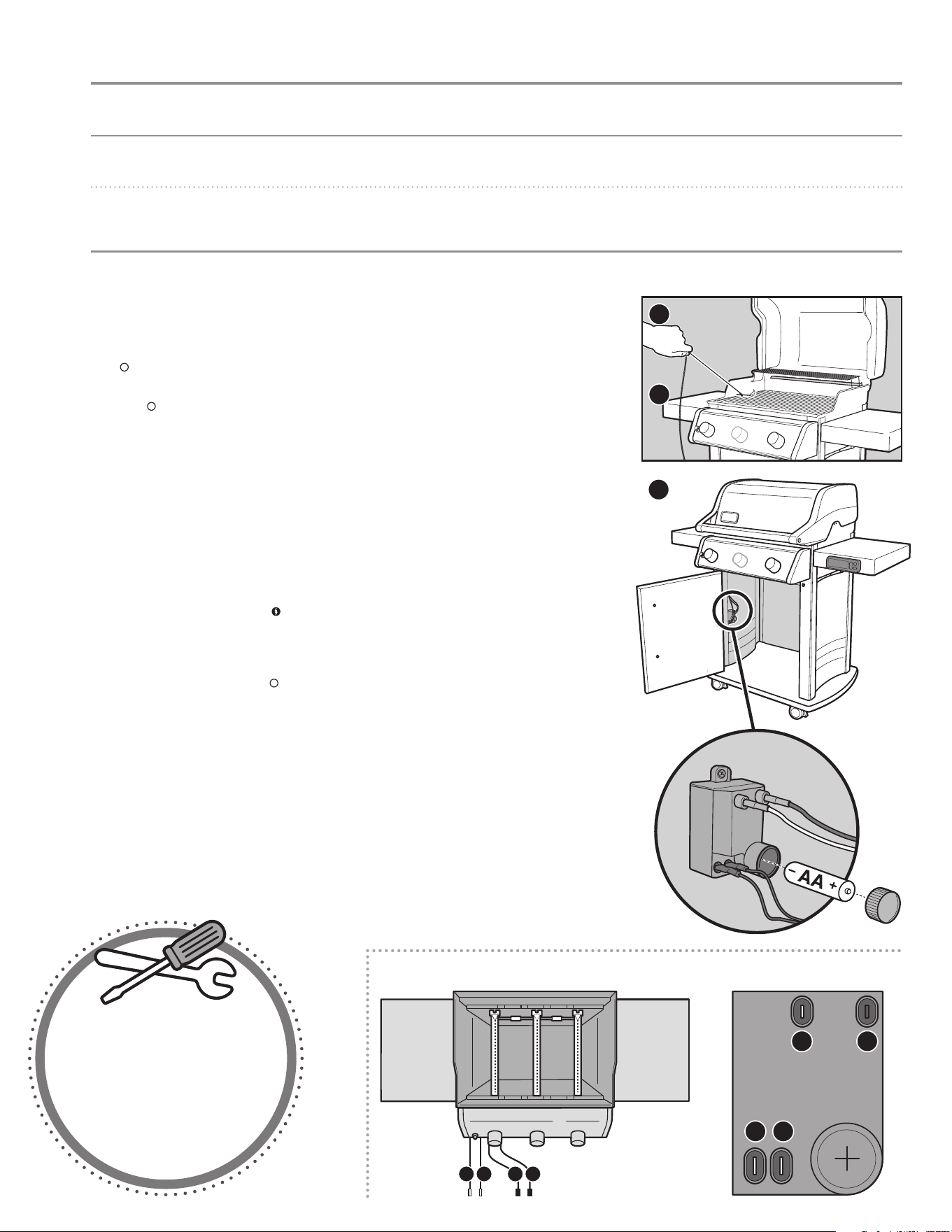
When pressing the ignition button you should hear a
ticking sound. If you cannot hear the ticking sound,
check the battery, then check the wires.
Checking the Battery
There are three potential issues with the battery that
supplies the power to your ignition module that need
to be checked:
1) Some batteries have a plastic protective wrap
around them. (Do not confuse this plastic with
the battery label.) Check that this plastic wrap is
removed.
2) Confirm that the battery is installed correctly (C).
3) If the battery is old, replace it with a new battery.
Checking the Wires
There are two potential trouble spots that need to be
checked:
1) Check that the ignition wires are connected
securely to the terminals on the ignition button
under the control panel.
2) Make sure the ignition wires are properly attached
to the ignition module. The wire terminals are color
coded to correspond with the terminals on the
ignition module. The number of wires will vary per
model.
Igniter Module Wire Chart
234 1
2
4 3
1
19
Troubleshooting
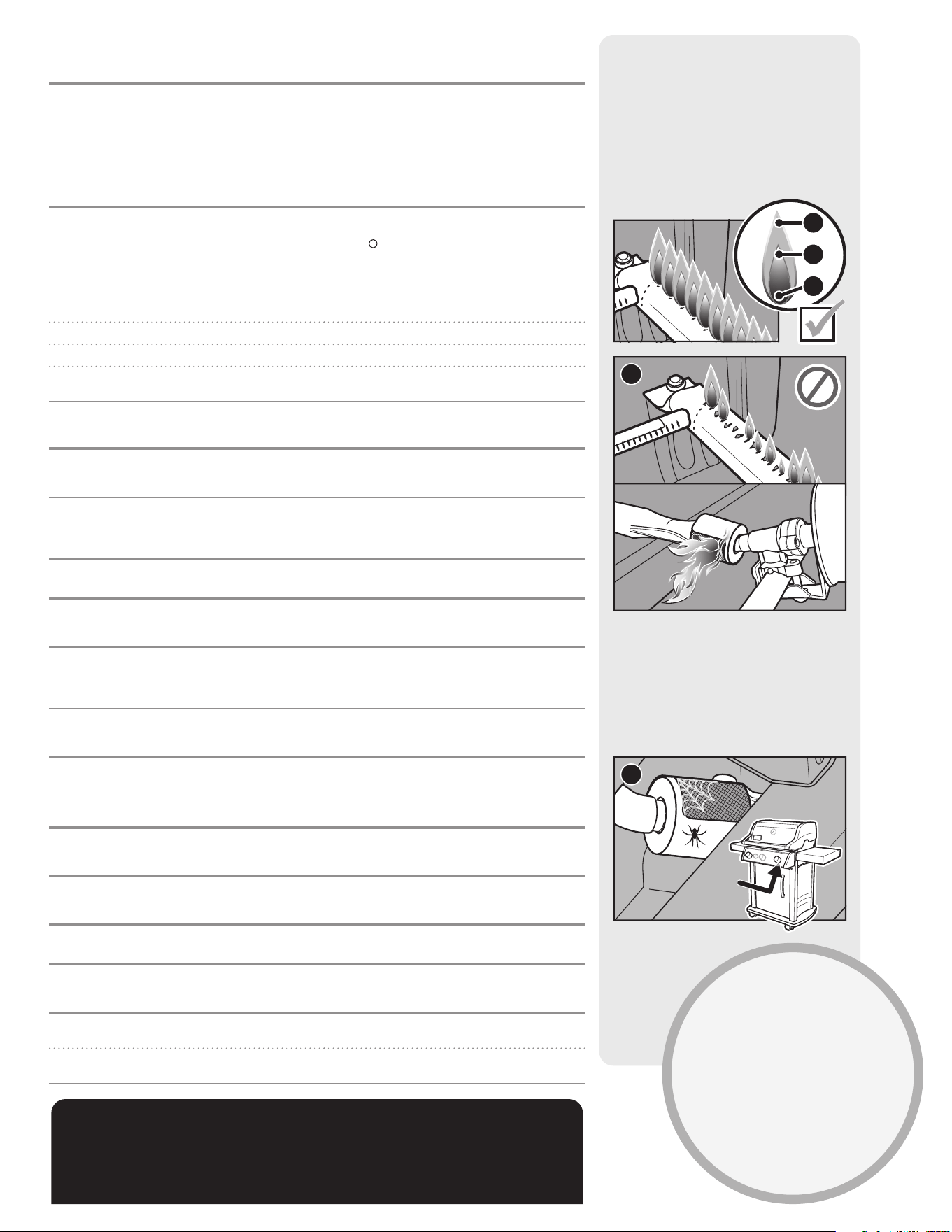
Proper Burner Flame Pattern
The burners in your grill were factory set for the
correct air and gas mixture. When the burners
are performing correctly, you will see a specific
flame pattern. The tips may occasionally flicker
yellow (A), with a descending light blue (B) to
dark blue flame (C).
m WARNING: Blocked and dirty ports can
restrict full gas flow, resulting in a fire (D) in
and around the gas valves, causing serious
damage to your grill.
m WARNING: Do not attempt to make any repair to gas carrying, gas burning, ignition components or
structural components without contacting Weber-Stephen Products LLC, Customer Service Department.
m WARNING: Failure to use genuine Weber-Stephen parts for any repair or replacement will void all
warranty protection.
m CAUTION: The burner tube openings must be positioned properly over the valve orifices.
Spider Screens
The combustion air openings of the burners(E)
are fitted with stainless steel screens to
prevent spiders and other insects from spinning
webs and building nests inside the burners.
Additionally, dust and debris can accumulate
on the outside of the spider/insect screen and
obstruct the oxygen flow to the burners.
CALL
CUSTOMER
SERVICE
If you are still experiencing any
problems, contact the CustomerService
Representative in your area using
the contact information on
weber.com.
E
B
A
C
D
GAS FLOW
SYMPTOM
• Grill does not reach desired temperature or heatsunevenly.
• One or more of the burners fail to ignite.
• Flame is low when burner is on high position.
• Flames do not run the whole length of the burner.
• Burner flame pattern is erratic.
CAUSE SOLUTION
The “flow limiting device” has been activated.
Thissafety feature built into the regulator restricts
the gas flow in the event of a gas leak. You can
inadvertently activate this safety feature without
having a gas leak. This typically occurs when you
turn on the gas at the LP tank and one or more of the
control knobs are not in the o position. It may also
occur if you turn on the LP tank too quickly.
Reset the “flow limiting device” by closing the LP
tank valve and turning all the burner control knobs
to the o position. Wait five minutes to allow
accumulated gas to dissipate, then ignite the grill
again following the instructions in the “Operation”
section.
The LP tank is low or empty. Refill LP tank.
Fuel hose is bent or kinked. Straighten fuel hose.
Burner ports are dirty. Clean burner ports. Refer to “Cleaning the
BurnerPorts.”
SYMPTOM
• Gas is smelled in conjunction with burner flames that appear yellow andlazy.
CAUSE SOLUTION
Spider screens on the burners are obstructed. Clean spider screens. Refer to “Cleaning the Spider
Screens” in the Product Care section. Also refer to
the illustrations and information in this section about
proper flame pattern and spiderscreens.
SYMPTOM
• The smell of gas and/or a light hissing sound.
CAUSE SOLUTION
The internal rubber seal in the LP tank valve could be
damaged.
Extinguish any open flame. Shut o gas to the
appliance (grill). Inspect the rubber seal for
damage. If damaged, return tank to place of
purchase.
Connection between regulator and LP tank could be
incomplete.
Extinguish any open flame. Shut o gas to the
appliance (grill). Refer to LP TANK INSTALLATION &
LEAK CHECKING section of your owner’s manual.
GREASY GRILL (Peeling Paint & Flare-Ups)
SYMPTOM
• Inside of lid appears to have the appearance of peelingpaint.
CAUSE SOLUTION
The flakes you see are accumulated cooking vapors
that have turned into carbon.
This happens over time after repeated use of your
grill. This is not a defect. Clean the lid. Refer to the
“Product Care” section.
SYMPTOM
• Experiencing flare-ups when grilling or preheating.
CAUSE SOLUTION
There is leftover food from the previous meal. Always preheat the grill on the highest setting for 15
minutes.
The inside of the grill needs to be cleaned thoroughly. Follow the steps in the "Cleaning and Maintenance"
section to clean the grill inside from the top down.
20
A
Troubleshooting
LOSS OF POWER
SYMPTOM
• WEBER CONNECT module does not turn on.
CAUSE SOLUTION
Wires are disconnected. Check that all of the wires are connected securely
to the terminals on the back of the WEBER
CONNECT module and to the control board inside
the cabinet. Refer to the "WEBER CONNECT Wire
Chart".
Batteries are old. Install new batteries. Refer to “Replacing Batteries
for the WEBER CONNECT Module” on this page.
Alternative external power bank may be depleted. If you are using an optional external power bank,
sold seperately, disconnect it from the control
board and check the manufacturer's operating
guide for information on recharching. Refer to
"Connecting an External Power Bank".
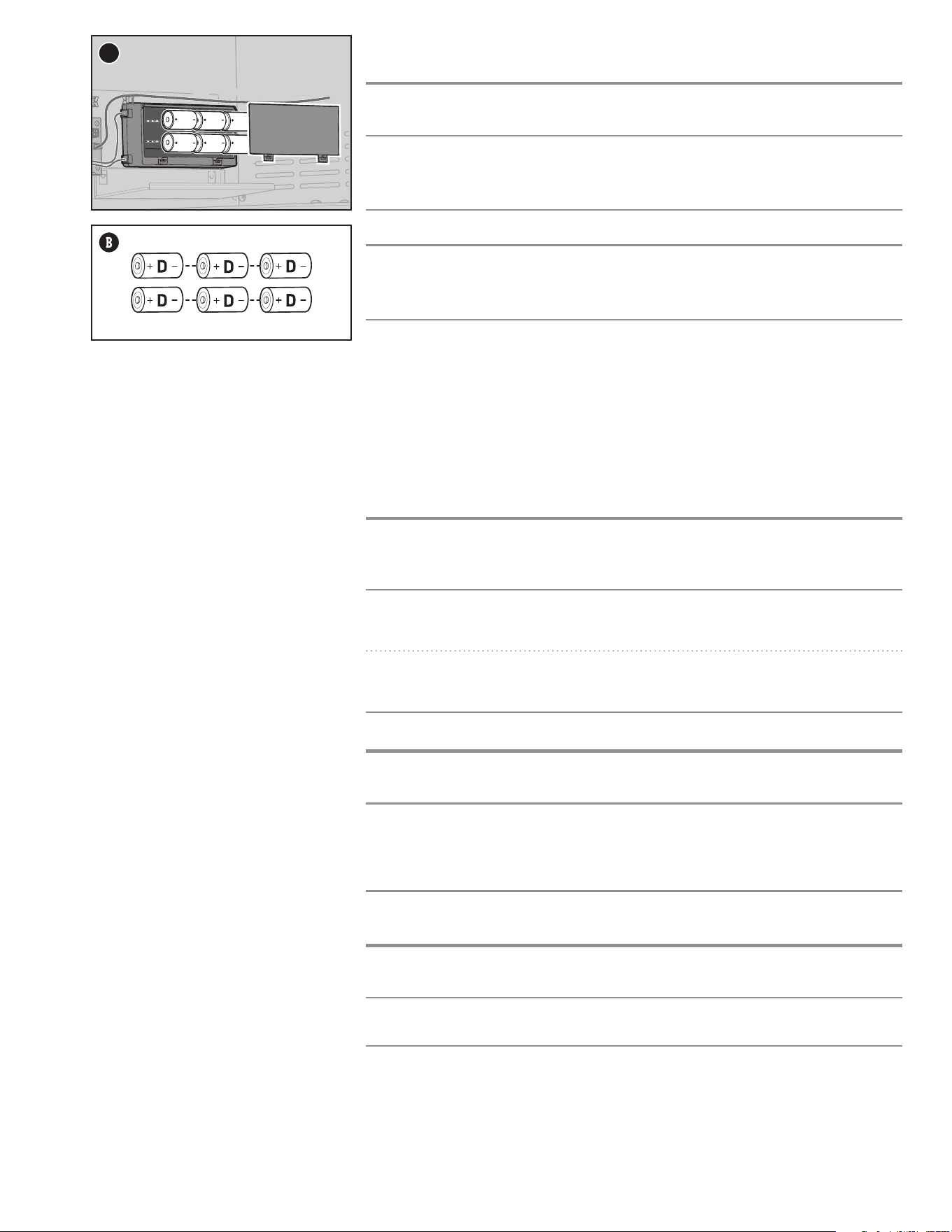
Replacing Batteries for the WEBER CONNECT Module
Use alkaline batteries only. Do not mix old and new batteries or dierent types of batteries (standard, alkaline, or
rechargeable). If you do not plan to use the grill for a month or more, remove the batteries.
1) Locate the battery housing on the inside of the cabinet on the bottom left side.
2) Press the tabs on the battery door to open (A).
3) Replace six D batteries (B).
WEBER CONNECT IS EXPERIENCING CONNECTIVITY ISSUES
SYMPTOM
• Bluetooth® is having trouble maintaining connectivity or pairing with a smart
device.
CAUSE SOLUTION
Bluetooth® is a short range signal only. When the WEBER CONNECT module is on, it is ready
to pair. Make sure that Bluetooth® on the smart
device is turned on and that the device is near the
grill.
Bluetooth® has already paired to another smart device. If the Bluetooth® indicator light is on but is not
flashing, it means that it is already paired to a smart
device. Turn o Bluetooth® on any smart device that
you do not wish to have paired to the grill.
SYMPTOM
• Wi-Fi is having trouble maintaining connectivity with a Wi-Fi network.
CAUSE SOLUTION
Grill is out of range of the Wi-Fi network signal. In order to successfully connect your smart device
to your local Wi-Fi network, your grill must be
within range of your Wi-Fi router. If your attempts to
connect have been unsuccessful, try moving the grill
within range of the Wi-Fi router or adding a signal
extender for a stronger signal.
ERROR CODE APPEARS ON DISPLAY
SYMPTOM
• During start-up or barbecuing, an error code appears on the digital display.
CAUSE SOLUTION
The WEBER CONNECT module is a device that is
sensitive to certain external factors. Variations in
power supply or radio frequency may aect operation.
Contact the Customer Service Representative
in your area using the contact information on
weber.com.
21
Troubleshooting
Auxiliary Power Input
Connecting an External Power Bank
As an alternative to using six D alkaline batteries to
power the WEBER CONNECT Module during your cook,
you can instead connect an external rechargable
power bank, sold sperately.
The power bank should have a minimum capacity of
10,000 mA hours with a 5 volt micro USB connector.
The shelf inside the grill cabinet can accept a power
bank with a maximum dimension of 4" wide x 7" deep
x 1.25" high.
To use an external power bank, it is not necessary to
remove the alkaline batteries from the battery pack.
Instead, after simply connecting the power bank to
the control board with the micro USB connector, the
WEBER CONNECT module will draw power directly
from the power bank.
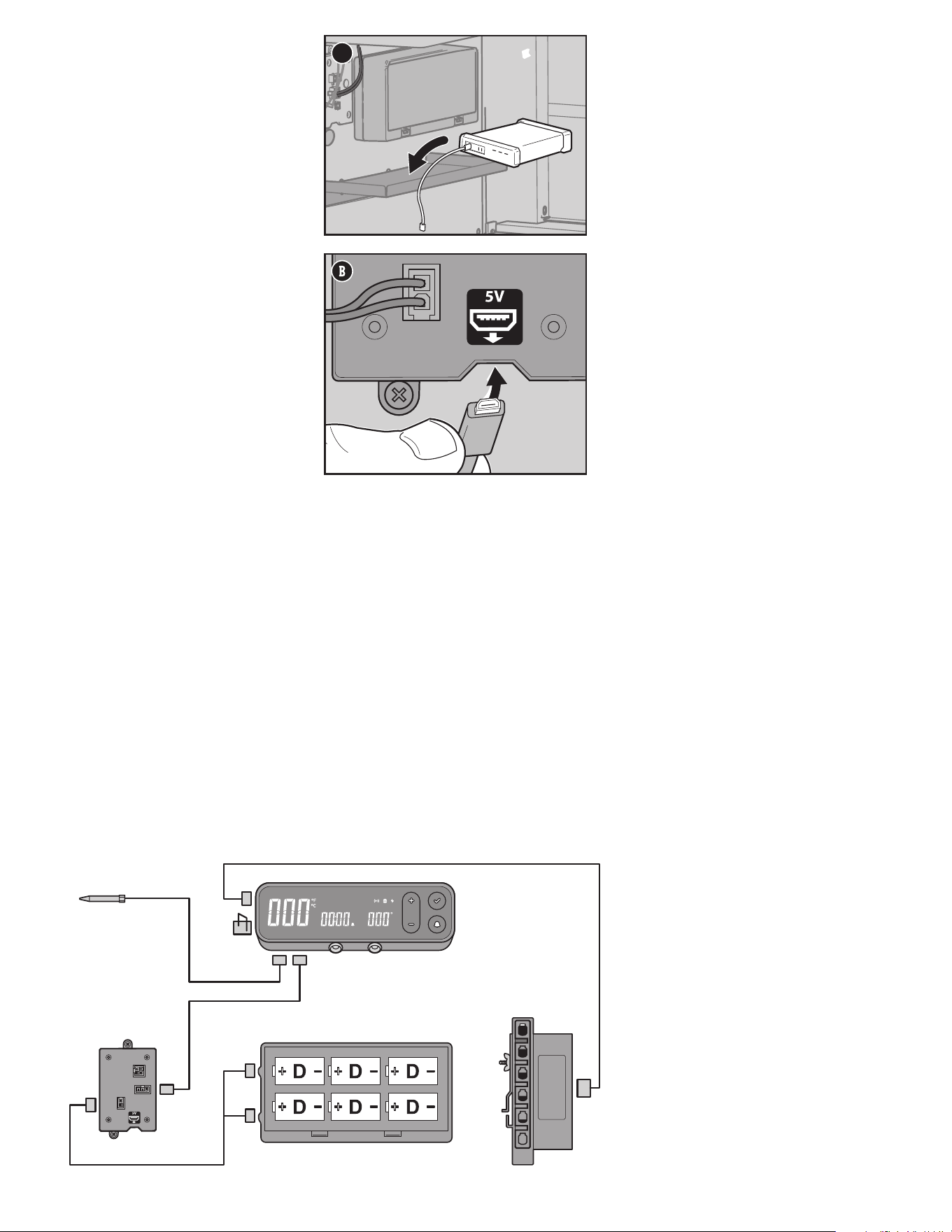
1) Open the grill cabinet.
2) Place the power bank on the small shelf at the
bottom of the side panel, adjacent to the battery
pack (A).
3) Connect the micro USB cable to the bottom of the
control board (B).
4) Turn the power bank on.
Refer to the manufacturer's operating guide for
instructions on fully charching the power bank.
Additional information regarding the use of a power
bank:
• Do not plug the power bank into an exterior outlet
while it is connected to the grill.
• Disconnect the power bank from the grill and bring it
indoors after use.
• The power bank will not supply power to the burner
igniters. Refer to "Checking the Components of the
Electronic Ignition System".
• The micro USB connector on the control board is not
for data transmission.
• Do not store the power bank outside.
• Fully recharge the power bank before every use.
• Use only if outdoor temperature is between 10°F
(-12°C) to 100°F (38°C) unless the power bank is rated
for higher and/or lower temperature conditions. Follow
the manufacturer's operating guidelines..
52769_060920
Micro USB
A
WEBER CONNECT Wire Chart
52769_060920
Micro USB
22
Grilling Guide
DON'T FORGET TO REGISTER
Grilling Guide
Type Thickness/Weight Approximate Total Grill Time
RED MEAT
Steak: New York strip, porterhouse,
rib-eye, T-bone, and filet mignon
(tenderloin)
¾ inch (19 mm) thick 4 to 6 minutes direct high heat
1 inch (25 mm) thick 6 to 8 minutes direct high heat
2 inches (5 cm) thick
14 to 18 minutes sear 6 to 8 minutes direct high heat,
then 8 to 10 minutes indirect high heat
Flank Steak 1½ to 2 pounds (0,68 - 0,91 kg), ¾ inch (19 mm) thick 8 to 10 minutes direct medium heat
Ground Beef Patty ¾ inch (19 mm) thick 8 to 10 minutes direct medium heat
Tenderloin 3 to 4 pounds (1,36 -1,81 kg)
45 to 60 minutes 15 minutes direct medium heat, then
30 to 45 minutes indirect medium heat
PORK
Bratwurst: fresh 3 ounce (85 g) link 20 to 25 minutes direct low heat
Chop: boneless or bone in
¾ inch (19 mm) thick 6 to 8 minutes direct high heat
1¼ to 1½ inches (3,18 - 3,81 cm) thick
10 to 12 minutes sear 6 minutes direct high heat, then
4 to 6 minutes indirect high heat
Ribs: baby back, spareribs 3 to 4 pounds (1,36 -1,81 kg) 1½ to 2 hours indirect medium heat
Ribs: country-style, bone in 3 to 4 pounds (1,36 -1,81 kg) 1½ to 2 hours indirect medium heat
Tenderloin 1 pound (0,45 kg)
30 minutes sear 5 minutes direct high heat, then 25
minutes indirect medium heat
POULTRY
Chicken Breast: boneless, skinless 6 to 8 ounces (170-226 g) 8 to 12 minutes direct medium heat
Chicken Thigh: boneless, skinless 4 ounces (113g) 8 to 10 minutes direct medium heat
Chicken Pieces: bone in, assorted 3 to 6 ounces (85-170 g)
36 to 40 minutes 6 to 10 minutes direct low heat, then
30 minutes indirect medium heat
Chicken: whole 4 to 5 pounds (1,81-2,27 kg) 1 to 1¼ hours indirect medium heat
Cornish Game Hen 1½ to 2 pounds (0,68-0,91 kg) 60 to 70 minutes indirect medium heat
Turkey: whole, unstued 10 to 12 pounds (4,54-5,44 kg) 2 to 2½ hours indirect medium heat
SEAFOOD
Fish, Fillet, or Steak: halibut,
red snapper, salmon, sea bass,
swordfish, and tuna
¼ to ½ inch (6,35-12,7 mm) thick 3 to 5 minutes direct medium heat
1 to 1¼ inches (25-31 mm) thick 10 to 12 minutes direct medium heat
Fish: whole
1 pound (0,45 kg) 15 to 20 minutes indirect medium heat
3 pounds (1,36 kg) 30 to 45 minutes indirect medium heat
Shrimp 1½ ounces (42,5 g) 2 to 4 minutes direct high heat
VEGETABLES
Asparagus ½ inch (12,7 mm) diameter 6 to 8 minutes direct medium heat
Corn
in husk 25 to 30 minutes direct medium heat
husked 10 to 15 minutes direct medium heat
Mushroom
shiitake or button 8 to 10 minutes direct medium heat
portobello 10 to 15 minutes direct medium heat
Onion
halved 35 to 40 minutes indirect medium heat
½ inch (12,7 mm) slices 8 to 12 minutes direct medium heat
Potato
whole 45 to 60 minutes indirect medium heat
½ inch (12,7 mm) slices
9 to 11 minutes parboil 3 minutes, then 6 to 8 minutes
direct medium heat
The cuts, thicknesses, weights, and grilling times above are meant to be guidelines. Factors such as altitude, wind, and outside temperature can aect cooking times.
Two rules of thumb: Grill steaks, fish fillets, boneless chicken pieces, and vegetables using the direct method for the time given on the chart (or to the desired doneness),
turning food once halfway through grilling time. Grill roasts, whole poultry, bone-in poultry pieces, whole fish, and thicker cuts using the indirect method for the time
given on the chart (or until an instant-read thermometer registers the desired internal temperature). Cooking times for beef and lamb use the USDA’s definition of
medium doneness unless otherwise noted. Before carving, let roasts, larger cuts of meat, and thick chops and steaks rest for 5 to 10 minutes after cooking. The internal
temperature of the meat will rise by 5 to 10 degrees during this time.
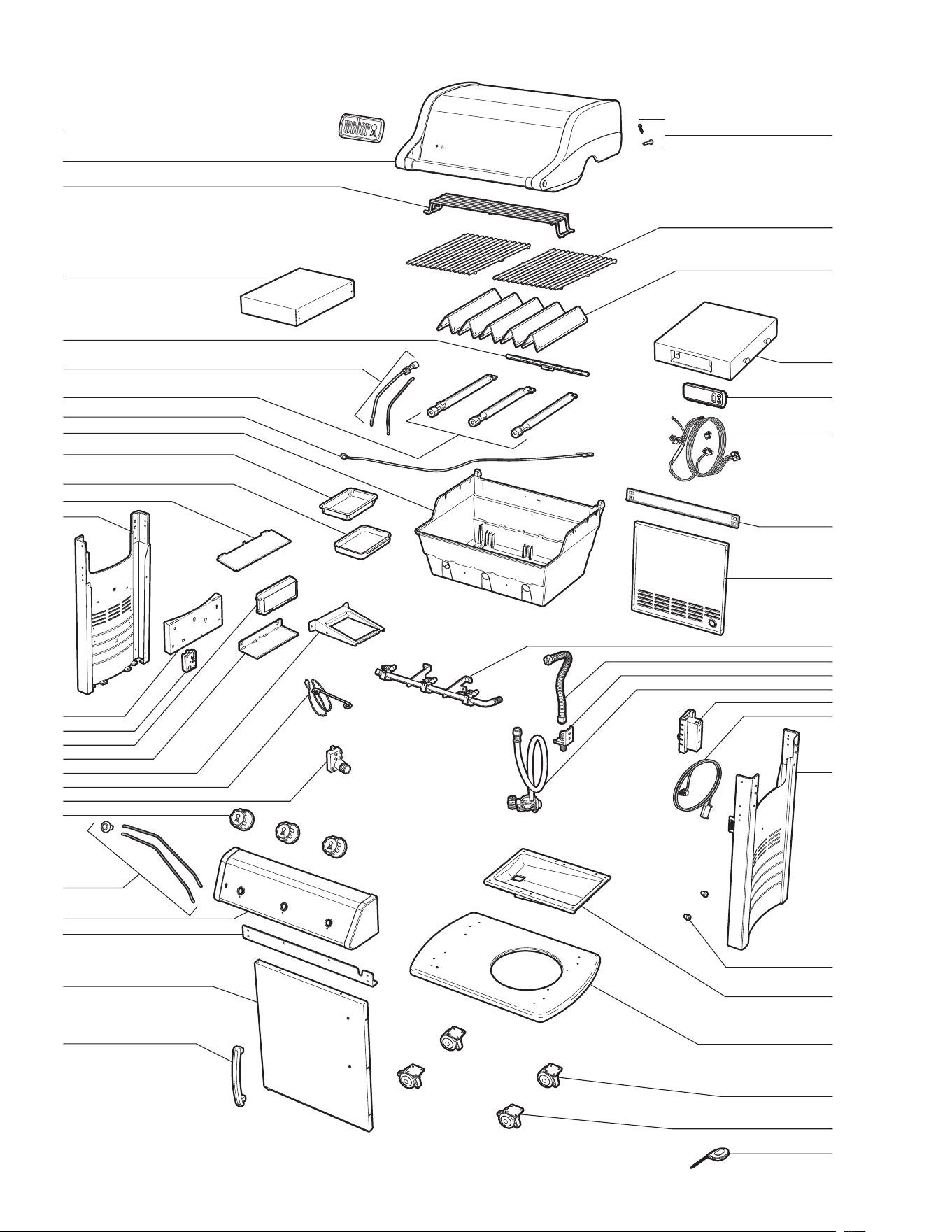
23
Replacement Parts
SPIRIT EX-315 • SX-315
1
2
4
3
5
6
7
9
8
10
11
12
13
14
15
16
17
18
19
20
21
22
23
24
25
26
27
28
29
30
33
34
31
32
35
36
37
38
39
40
41
42
43
44
45
46
47
Spirit - EX/SX-315 LP - US - 072520

© 2020 Designed and engineered by Weber-Stephen Products LLC, 1415 S. Roselle Road, Palatine, Illinois 60067 USA.
U.S.:
1-800-446-1071
Canada:
1-800-446-1071
weber.com
Apple and the Apple logo are trademarks of Apple Inc., registered in the U.S. and other countries.
AppStore is a service mark of Apple Inc. Android is a trademark of Google LLC. Google Play and the
Google Play logo are trademarks of Google LLC.
The Bluetooth® word mark and logos are registered trademarks owned by Bluetooth SIG, Inc. and
any use of such marks by Weber-Stephen Products LLC is under license. Other trademarks and trade
names are those of their respective owners.
Compliance Statements for WC2 CONTROLLER
FCC Compliance: This equipment has been tested and found to comply with the limits for a Class B digital device, pursuant to part 15 of the FCC rules.
These limits are designed to provide reasonable protection against harmful interference in a residential installation. This equipment generates, uses
and can radiate radio frequency energy and, if not installed and used in accordance with the instructions, may cause harmful interference to radio
communications. However, there is no guarantee that interference will not occur in a particular installation. If this equipment does cause harmful
interference to radio or television reception, which can be determined by turning the equipment o and on, the user is encouraged to try to correct the
interference by one or more of the following measures: (1) Reorient or relocate the receiving antenna. (2) Increase the separation between the equipment
and receiver. (3) Connect the equipment into an outlet on a circuit dierent from that to which the receiver is connected. (4) Consult the manufacturer,
dealer or an experienced radio/TV technician for help. Changes or modifications not expressly approved by Weber could void the user’s authority to
operate this device.
FCC Radio Frequency (RF) Exposure: This equipment complies with FCC and ISED Canada radiation exposure limits set forth for an uncontrolled
environment. The user should avoid prolonged exposure within 20cm of the antenna, which may exceed the FCC or RSS-102 radio frequency exposure
limits.
IC Compliance: This device contains license-exempt transmitter(s)/receiver(s) that comply with Innovation, Science and Economic Development Canada’s
license-exempt RSS(s). Operation is subject to the following two conditions: (1) This device may not cause interference; and (2) This device must accept
any interference, including interference that may cause undesired operation of the device.
IFETEL Compliance: Operation of this unit is subject to the following two conditions: (1) this unit or device may not cause harmful interference, and (2) this
unit or device must accept any interference, including interference that may cause undesired operation.
CAN ICES-3B/NMB-3B
FCC: 2AHSR-NBE2N001
IC: 21267-NBE2N001
HVIN: WC2 Controller / PMN WC2 Controller