
P/NO : MMBB0362901(1.0)
G
LG-LX265
Rumor
2
Printed in Korea

Copyright ©2010 LG Electronics, Inc. All rights reserved.
LG and the LG logo are registered trademarks of LG
Group and its related entities. All other trademarks are
the property of their respective owners.

R
R
u
u
m
m
o
o
r
r
2
2
b
b
y
y
L
L
G
G
®
®
U
U
s
s
e
e
r
r
G
G
u
u
i
i
d
d
e
e

Table of Contents
Introduction . . . . . . . . . . . . . . . . . . . . . . . . . . . . . . . . . . . . . .i
Your Phone’s Menu . . . . . . . . . . . . . . . . . . . . . . . . . . . . . . . .ii
Getting Started . . . . . . . . . . . . . . . . . . . . . . . . . . . . . . . . . . .1
Setting Up Service . . . . . . . . . . . . . . . . . . . . . . . . . . . . . . . . . . . . .2
Getting Started . . . . . . . . . . . . . . . . . . . . . . . . . . . . . . . . . . . . . . . . . . . . .3
Setting Up Your Voicemail . . . . . . . . . . . . . . . . . . . . . . . . . . . . . . . . . . . .4
Getting Help . . . . . . . . . . . . . . . . . . . . . . . . . . . . . . . . . . . . . . . . . . . . . . . .5
Your Phone . . . . . . . . . . . . . . . . . . . . . . . . . . . . . . . . . . . . . . .7
Your Phone: The Basics . . . . . . . . . . . . . . . . . . . . . . . . . . . . . . . . .8
FrontView of Your Phone . . . . . . . . . . . . . . . . . . . . . . . . . . . . . . . . . . . .9
Viewing the Display Screen . . . . . . . . . . . . . . . . . . . . . . . . . . . . . . . . .14
Features of Your Phone . . . . . . . . . . . . . . . . . . . . . . . . . . . . . . . . . . . . .17
Turning Your Phone On and Off . . . . . . . . . . . . . . . . . . . . . . . . . . . . . .20
Using Your Phone’s Battery and Charger . . . . . . . . . . . . . . . . . . . . .21
Navigating Through Phone Menus . . . . . . . . . . . . . . . . . . . . . . . . . .25
Displaying Your Phone Number . . . . . . . . . . . . . . . . . . . . . . . . . . . . .26
Making and Answering Calls . . . . . . . . . . . . . . . . . . . . . . . . . . . . . . . .27
Entering Text . . . . . . . . . . . . . . . . . . . . . . . . . . . . . . . . . . . . . . . . . . . . . .39
Controlling Your Phone’s Settings . . . . . . . . . . . . . . . . . . . . . .46
Sound Settings . . . . . . . . . . . . . . . . . . . . . . . . . . . . . . . . . . . . . . . . . . . .47

Display Settings . . . . . . . . . . . . . . . . . . . . . . . . . . . . . . . . . . . . . . . . . . . .52
Location Settings . . . . . . . . . . . . . . . . . . . . . . . . . . . . . . . . . . . . . . . . . .57
Messages Settings . . . . . . . . . . . . . . . . . . . . . . . . . . . . . . . . . . . . . . . . .58
Airplane/Music Mode . . . . . . . . . . . . . . . . . . . . . . . . . . . . . . . . . . . . . .61
TTY Use . . . . . . . . . . . . . . . . . . . . . . . . . . . . . . . . . . . . . . . . . . . . . . . . . . .62
Phone Setup Options . . . . . . . . . . . . . . . . . . . . . . . . . . . . . . . . . . . . . . .64
Setting Your Phone’s Security . . . . . . . . . . . . . . . . . . . . . . . . . .68
Accessing the Security Menu . . . . . . . . . . . . . . . . . . . . . . . . . . . . . . . .69
Using Your Phone’s Lock Feature . . . . . . . . . . . . . . . . . . . . . . . . . . . . .69
Using Special Numbers . . . . . . . . . . . . . . . . . . . . . . . . . . . . . . . . . . . . .71
Erasing Phone Content . . . . . . . . . . . . . . . . . . . . . . . . . . . . . . . . . . . . .72
Resetting Your Picture Messaging Account . . . . . . . . . . . . . . . . . . .73
Resetting Default Settings . . . . . . . . . . . . . . . . . . . . . . . . . . . . . . . . . .74
Resetting Your Phone . . . . . . . . . . . . . . . . . . . . . . . . . . . . . . . . . . . . . . .75
Controlling Your Roaming Experience . . . . . . . . . . . . . . . . . . .76
Understanding Roaming . . . . . . . . . . . . . . . . . . . . . . . . . . . . . . . . . . .77
Setting Your Phone’s Roam Mode . . . . . . . . . . . . . . . . . . . . . . . . . . .79
Using Call Guard . . . . . . . . . . . . . . . . . . . . . . . . . . . . . . . . . . . . . . . . . . .80
Using Data Roam Guard . . . . . . . . . . . . . . . . . . . . . . . . . . . . . . . . . . . .82
Managing History . . . . . . . . . . . . . . . . . . . . . . . . . . . . . . . . . . . .83
Viewing History . . . . . . . . . . . . . . . . . . . . . . . . . . . . . . . . . . . . . . . . . . .84
History Options . . . . . . . . . . . . . . . . . . . . . . . . . . . . . . . . . . . . . . . . . . . .85
Making a Call From History . . . . . . . . . . . . . . . . . . . . . . . . . . . . . . . . .86
Viewing History Thread . . . . . . . . . . . . . . . . . . . . . . . . . . . . . . . . . . . .86

Saving a Phone Number From History . . . . . . . . . . . . . . . . . . . . . . .87
Prepend a Phone Number From History . . . . . . . . . . . . . . . . . . . . . .88
Erasing History . . . . . . . . . . . . . . . . . . . . . . . . . . . . . . . . . . . . . . . . . . . .89
Using Contacts . . . . . . . . . . . . . . . . . . . . . . . . . . . . . . . . . . . . . . .90
Adding a New Contact Entry . . . . . . . . . . . . . . . . . . . . . . . . . . . . . . . .91
Finding Contact Entries . . . . . . . . . . . . . . . . . . . . . . . . . . . . . . . . . . . . .92
ContactEntry Options . . . . . . . . . . . . . . . . . . . . . . . . . . . . . . . . . . . . . .93
Adding a Phone Number to a Contact Entry . . . . . . . . . . . . . . . . . .94
Editing a Contact Entry’s Phone Number . . . . . . . . . . . . . . . . . . . . .95
Assigning Speed Dial Numbers . . . . . . . . . . . . . . . . . . . . . . . . . . . . . .96
Send All Contacts . . . . . . . . . . . . . . . . . . . . . . . . . . . . . . . . . . . . . . . . . .97
Editing a Contact Entry . . . . . . . . . . . . . . . . . . . . . . . . . . . . . . . . . . . . .98
Selecting a Ringer Type for an Entry . . . . . . . . . . . . . . . . . . . . . . . . . .98
Dialing Services . . . . . . . . . . . . . . . . . . . . . . . . . . . . . . . . . . . . . . . . . . . .99
Using the Phone’s Calendar and Tools . . . . . . . . . . . . . . . . . .100
Using Your Phone’s Calendar . . . . . . . . . . . . . . . . . . . . . . . . . . . . . . .101
Using Your Phone’s Alarm Clock . . . . . . . . . . . . . . . . . . . . . . . . . . . .106
Using Your Phone’s Notepad . . . . . . . . . . . . . . . . . . . . . . . . . . . . . . .107
Using Your Phone’s Tools . . . . . . . . . . . . . . . . . . . . . . . . . . . . . . . . . .108
Using Your Phone’s Voice Services . . . . . . . . . . . . . . . . . . . . .111
Managing Voice Memos . . . . . . . . . . . . . . . . . . . . . . . . . . . . . . . . . . .112
Using the microSD™ Card . . . . . . . . . . . . . . . . . . . . . . . . . . . . .115
Using Your Phone’s microSD™ Card and Adapter . . . . . . . . . . . .116

microSD™Settings . . . . . . . . . . . . . . . . . . . . . . . . . . . . . . . . . . . . . . . .118
microSD™Folders . . . . . . . . . . . . . . . . . . . . . . . . . . . . . . . . . . . . . . . . .119
Connecting Your Phone to Your Computer . . . . . . . . . . . . . . . . . .120
Using the Built-in Camera . . . . . . . . . . . . . . . . . . . . . . . . . . . .122
Taking Camera . . . . . . . . . . . . . . . . . . . . . . . . . . . . . . . . . . . . . . . . . . . .123
Storing Pictures . . . . . . . . . . . . . . . . . . . . . . . . . . . . . . . . . . . . . . . . . . .129
Sending a Picture Message . . . . . . . . . . . . . . . . . . . . . . . . . . . . . . . .134
Using Bluetooth . . . . . . . . . . . . . . . . . . . . . . . . . . . . . . . . . . . . .137
Turning Bluetooth On and Off . . . . . . . . . . . . . . . . . . . . . . . . . . . . .138
Using the Bluetooth Settings Menu . . . . . . . . . . . . . . . . . . . . . . . .139
Bluetooth Profiles . . . . . . . . . . . . . . . . . . . . . . . . . . . . . . . . . . . . . . . .142
Pairing Bluetooth Devices . . . . . . . . . . . . . . . . . . . . . . . . . . . . . . . . .144
Service Features . . . . . . . . . . . . . . . . . . . . . . . . . . . . . . . .145
Service Features: The Basics . . . . . . . . . . . . . . . . . . . . . . . . . .146
Using Voicemail . . . . . . . . . . . . . . . . . . . . . . . . . . . . . . . . . . . . . . . . . .147
Using SMS Text Messaging . . . . . . . . . . . . . . . . . . . . . . . . . . . . . . . .157
Using Caller ID . . . . . . . . . . . . . . . . . . . . . . . . . . . . . . . . . . . . . . . . . . . .160
Responding to Call Waiting . . . . . . . . . . . . . . . . . . . . . . . . . . . . . . . .161
Making a Three-Way Call . . . . . . . . . . . . . . . . . . . . . . . . . . . . . . . . . .161
Using Call Forwarding . . . . . . . . . . . . . . . . . . . . . . . . . . . . . . . . . . . . .163
Data Services . . . . . . . . . . . . . . . . . . . . . . . . . . . . . . . . . . . . . . .164
Data Service Applications . . . . . . . . . . . . . . . . . . . . . . . . . . . . . . . . .165
Getting Started With Data Services . . . . . . . . . . . . . . . . . . . . . . . .166

Downloading Content . . . . . . . . . . . . . . . . . . . . . . . . . . . . . . . . . . . .172
Exploring the Web . . . . . . . . . . . . . . . . . . . . . . . . . . . . . . . . . . . . . . . .174
Data Services FAQs . . . . . . . . . . . . . . . . . . . . . . . . . . . . . . . . . . . . . . . .177
Music and Your Player . . . . . . . . . . . . . . . . . . . . . . . . . . . . . . . .179
Playing Music on Your Phone . . . . . . . . . . . . . . . . . . . . . . . . . . . . . .180
Safety and Warranty Information . . . . . . . . . . . . . . . . .181
Important Safety Information . . . . . . . . . . . . . . . . . . . . . . . .182
General Precautions . . . . . . . . . . . . . . . . . . . . . . . . . . . . . . . . . . . . . .183
Maintaining Safe Use of and Access to Your Phone . . . . . . . . . .184
Using Your Phone With a Hearing Aid Device . . . . . . . . . . . . . . . .186
Caring for the Battery . . . . . . . . . . . . . . . . . . . . . . . . . . . . . . . . . . . . .187
Radiofrequency (RF) Energy . . . . . . . . . . . . . . . . . . . . . . . . . . . . . . .189
Owner’s Record . . . . . . . . . . . . . . . . . . . . . . . . . . . . . . . . . . . . . . . . . . .191
Phone Guide Proprietary Notice . . . . . . . . . . . . . . . . . . . . . . . . . . .191
Manufacturer’s Warranty . . . . . . . . . . . . . . . . . . . . . . . . . . . .192
Manufacturer’s Warranty . . . . . . . . . . . . . . . . . . . . . . . . . . . . . . . . .193
Index . . . . . . . . . . . . . . . . . . . . . . . . . . . . . . . . . . . . . . . . . .197

i
Introduction
This User Guide introduces you to your wireless service and
all the features of your new phone. It’s divided into four
sections:
l Section 1: Getting Started
l Section 2: Your Phone
l Section 3: Service Features
l Section 4: Safety and Warranty Information
Throughout this guide, you’ll find tips that highlight
special shortcuts and timely reminders to help you make
the most of your new phone and service. The Table of
Contents and Index will also help you quickly locate
specific information.
You’ll get the most out of your phone if you read each
section. However, if you’d like to get right to a specific
feature, simply locate that section in the Table of Contents
and go directly to that page. Follow the instructions in that
section, and you’ll be ready to use your phone in no time.

ii
Your Phone’s Menu
The following list outlines your phone’s menu structure. For
more information about using your phone’s menus, see
“Navigating Through Phone Menus”on page 25.
1. Web
2. Messages
1. Voicemail 1. Call Voicemail / 2. Voicemail Details /
3. Clear Icon
2. Send Message 1. Text Message / 2. Picture Messaging
3. Text Messages
4. Picture Messaging 1. Inbox / 2. Sent Mail / 3. Saved Mail /
4. Pending Messages
5. Settings 1. Notification / 2. Callback Number /
3. Signature / 4. Preset Messages
3. Bluetooth
1. Pair with Hands Free
2. Send a Contact
3. Send Files
4. Add a New...
5. Trusted Devices
6. More...
4. Contacts
5. Missed Alerts
6. History

iii
7. Photos
1. Camera
2. Picture Messaging Inbox/ Sent Mail/ Saved Mail/ Pending
Messages
3. My Albums In Phone / Memory Card /
Online Albums
4. Settings & Info Auto-Save to / Status Bar / Location
Account Info/ Help
8. Calculator
9. Settings
1. Display
1. Main Screen 1. Screen Saver / 2. Slide Show /
3. Backlight / 4. Menu Styles /
5. Foregrounds / 6. PictureID
2. Font Size 1. Messages / 2. Browser / 3. Notepad
3. Keypad Light On / Off
4. Language (Idioma) English / Español
5. Status Light On / Off
2. Sounds
1. Volume 1. Ringer / 2. Earpiece /
3. Speakerphone / 4. Keytones /
5. Messages/ 6. Alarm & Calendar /
7. Applications / 8. Alerts /
9. Power On/Off
2. Ringer Type 1. Incoming Calls / 2. Messages
3. Vibrate Type 1. Incoming Calls / 2. Messages /
3. Alarm & Calendar
4. Alerts 1. Beep Each Minute /

iv
2. Out of Service / 3. Connect /
4. Signal Fade/Call Drop
5. Keytones 1. Tone Length / 2. Tone Volume
3. Airplane/Music Mode
4. Bluetooth
1. On/Off On / Off
2. Visibility Hidden / Visible for 3 Min / Always Visible
3. My Device Name
4. My Device Info
5. Exchange Folder
6. Voice Priority
5. Messages
1. Notification Message & Icon / Icon Only
2. Callback Number
3. Signature None / Custom
4. Preset Messages
6. Keyguard On / Off
7. Text Entry
1. Auto-Capital On / Off
2. Auto-Space On / Off
3. Word Choice List On / Off
4. Word Prediction On / Off
5. Word Completion On / Off
6. Use My Words On / Off
7. My Words
8. Help
8. Phone Information 1. Phone Number / 2. Icon Glossary /

v
3. Version / 4. Advanced
9. More...
1. Accessibility 1. TTY / 2. Font Size
2. Call Setup 1. Auto-Answer /
2. Abbreviated Dialing /
3. Call Answer / 4. Contacts Match
3. Contacts Settings 1. Speed Numbers /
2. Show Secret/Hide Secret /
3. My Name Card / 4. Services
4. Data 1. On/Off / 2. Net Guard /
3. Update Profile
5. Headset Mode
6. Location On / Off
7. Navigation Keys
8. Restrict and Lock 1. Restrict Voice / 2. Lock Data /
3. Lock Photos / 4. Lock My Phone
9. Roaming 1. Set Mode / 2. Call Guard /
3. Data Roaming
*. Security 1. Lock My Phone /
2. Change Lock Code /
3. Special Numbers /
4. Edit Contacts List / 5. Delete/Reset
*. My Stuff
1. Games
2. Ringers
3. Screen Savers
4. Applications
5. Options

vi
0. Media Player
1. Launch
#. Tools
1. Memory Card Manager
2. Alarm Clock 1. Alarm 1 / 2. Alarm 2 / 3. Alarm 3 /
4. Alarm 4 / 5. Alarm 5 /
6. Walk the Dog / 7. Quick Alarm
3. Self-Service
4. Calendar
5. World Clock
6. USB Mode 1. Transfer Music / 2. Mass Storage /
3. Phone As Modem
7. Ez Tip Calculator
8. Voice Control
9. Voice Memo
*. Notepad
0. Utilities 1. D-Day Counter / 2. Unit Converter
#. Update Phone

Getting Started
Section 1

2 Section 1A: Setting Up Service
Setting Up Service
In This Section
l Getting Started
l Setting Up Your Voicemail
l Getting Help
Setting up service on your new phone is quick and easy.
This section walks you through the necessary steps to
unlock your phone, set up your voicemail, establish
passwords, and contact your service provider for assistance
with your wireless service.

Section 1A: Setting Up Service 3
Getting Started
Unlocking Your Phone
If your phone is locked, the main display will say "-Locked-"
after it is powered on.
Follow these easy steps to unlock your phone:
1. Press and hold to turn the phone on.
2. Press UNLOCK(right softkey).
Note: To select a softkey, press the softkey button directly below the
softkey text that appears at the bottom left and bottom right of your
phone’s display screen. Softkey actions change according to the screen
you’re viewing and will not appear if there is no corresponding action
available.
3. Enter your four-digit lock code. (For security purposes,
the code is not visible as you type.)
Tip: If you can’t recall your lock code, try using the last four digits
of your wireless phone number or try 0000. If neither of these works, call
your service provider.
Setting Up Service

4 Section 1A: Setting Up Service
Setting Up Your Voicemail
All unanswered calls to your phone are automatically
transferred to your voicemail, even if your phone is in use or
turned off. Therefore, you will want to set up your voicemail
and personal greeting as soon as your phone is activated.
To set up your voicemail:
1. From standby mode, press and hold .
2. Follow the system prompts to:
n
Create your passcode
n
Record your name announcement
n
Record your greeting
n
Choose whether or not to activate One-Touch
Message Access (a feature that lets you access
messages simply by pressing and holding ,
bypassing the need for you to enter your passcode)
Voicemail Passcode
You'll create your voicemail password (or pass code) when you set up your
voicemail. For more information or to change your voicemail password,
please contact your service provider.
For more information about using your voicemail, see “Using
Voicemail”on page 147.
Section 1A: Setting Up Service 5
Getting Help
Directory Assistance
You have access to a variety of services and information
through Directory Assistance, including residential,
business, and government listings; assistance with local or
long-distance calls; movie listings; and hotel, restaurant,
shopping, and major local event information. There is a per-
call charge, and you will be billed for airtime.
To call your wireless Directory Assistance:
©
Press .
Operator Services
Operator Services provides assistance when placing collect
calls, when placing calls billed to a local telephone calling
card or third party.
To access your wireless Operator Services:
©
Press .
For more information, call your service provider.
Setting Up Service

6

Section 2
Your Phone

8 Section 2A: Your Phone: The Basics
Your Phone: The Basics
In This Section
l FrontView of Your Phone
l Viewing the Display Screen
l Features of Your Phone
l Turning Your Phone On and Off
l Using Your Phone’s Battery and Charger
l Navigating Through Phone Menus
l Displaying Your Phone Number
l Making and Answering Calls
l Entering Tex t
Your phone is packed with features that simplify your life and
expand your ability to stay connected to the people and
information that are important to you.
This section will
guide you through the basic functions and calling features
of your phone.
Section 2A: Your Phone: The Basics 9
FrontView of Your Phone
Phone Basics
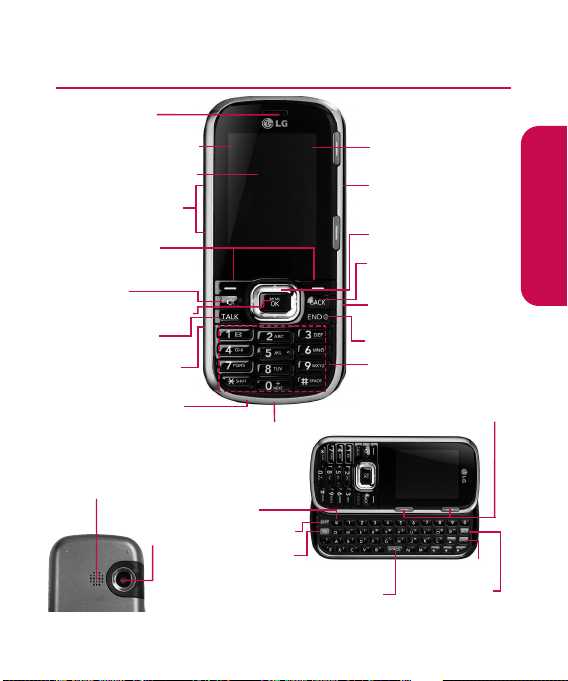
17. BACK Key
16. Navigation Key
2. Signal Strength
Indicator
1. Earpiece
10. Microphone
11. Charger/Accessory
Jack
3. Display Screen
5. Softkeys
4. Side Volume
Keys
12. Speaker
6. Speakerphone
Key
8. TALK Key
9. Camera Key
7. MENU/OK Key
19. END Key
14. Battery Strength
Indicator
13. Camera
Lens
15. Headset Jack
18. microSD™ Slot
20. Alphanumeric
Keypad
25. Softkeys
27. ENTERKey
21. Emoticons
Key
23. Function
Key
22. SHIFT Key
24. SPACE Key
26.BACKKey

10 Section 2A: Your Phone: The Basics
Key Functions
1. Earpiecelets you hear the caller and automated prompts.
2. Signal Strength Indicator represents the signal strength
by displaying bars. The more bars displayed, the better
the signal strength.
3. Display Screen displays all the information needed to
operate your phone, such as the call status, the Contacts
list, the date and time, and the signal and battery
strength.
4. Side Volume Keys allow you to adjust the ringer volume in
standby mode or adjust the voice volume during a call.
The volume keys can also be used to scroll up or down to
navigate through the different menu options.
5. Softkeys let you select softkey actions or menu items
corresponding to the bottom left and right lines on the
display screen.
6. Speakerphone Key lets you turn Speakerphone mode on
or off. From standby mode, press once to go to Recent
History, and press and hold this key to go to directly to
Voice Control.
7. MENU/OK Key lets you access the phone's Main Menu
from standby mode, and selects the highlighted choice
when navigating through a menu.

Section 2A: Your Phone: The Basics 11
8. TALK Key allows you to place or receive calls, answer Call
Waiting, and use Three-Way Calling.
9. Camera Key From standby mode, press once to go to
Photo-Menu. Press and hold to go directly to Camera
mode.
10. Microphoneallows other callers to hear you clearly when
you are speaking to them.
11. Charger/Accessory Jack allows you to connect the phone
to the phone charger and to optional accessories, such as
a USB cable.
12. Speakerlets you hear the different ringers and sounds.
The speaker also lets you hear the caller’s voice in
speakerphone mode.
13. Camera Lens, as part of the built-in camera, lets you take
pictures.
14. Battery Strength Indicator represents the amount of
remaining battery charge currently available in your
phone. When all bars are displayed in the battery icon,
the phone’s battery is fully charged. When no bars are
displayed, the phone’s battery is completely discharged
or empty.
15. HeadsetJack allows you to plug a headset for convenient
hands-free conversations.
CAUTION!Inserting an
Phone Basics

12 Section 2A: Your Phone: The Basics
accessory into the incorrect jack may damage the phone.
16. Navigation Key scrolls through the phone’s menu options
and acts as a shortcut key from standby mode.
n
Press Up to access Send Text to.
n
Press Down to access MyStuff.
n
Press Right to launch My Albums.
n
Press Left to access Calendar.
17. BACK Key deletes characters from the display in text
entry mode. When in a menu, pressing the Back key
returns you to the previous menu. This key also allows
you to return to the previous screen in a data service
session.
18. microSD™ Slot lets you use the microSD™ card to expand
the memory of your phone. (See “Using the microSD™
Card”on page 114.)
19. END Key lets you turn the phone on or off, end a call, or
return to standby mode. While in the main menu, it
returns the phone to standby mode and cancels your
input. When you receive an incoming call, press to mute
the ringer and send the incoming call to voicemail.
20. Alphanumeric Keypad lets you enter numbers, letters,
and characters, and navigate within menus.

Section 2A: Your Phone: The Basics 13
21. Emoticons Key allows you to enter smileys when entering
text using the QWERTY keyboard.
22. SHIFTKey lets you change letter capitalization when
entering text using the QWERTY keyboard.
23. Function Key allows you to enter an alternate character
(such as @ for the R key) on the QWERTY keyboard. (See
“Entering Text With the QWERTY Keyboard”on page 44
for details.)
24. SPACE Keylets you enter a space in text mode. In standby
mode, press and hold to go directly to Contacts.
25. Softkeyslet you select softkey actions or menu items
corresponding to the bottom left and right lines on the
display screen.
26. BACKKeydeletes characters from the display in text
entry mode. When in a menu, pressing the BACK key
returns you to the previous menu. This key also allows
you to return to the previous screen in a data service
session.
27. ENTERKeyselects the highlighted choice when
navigating through a menu.
Phone Basics
14 Section 2A: Your Phone: The Basics
Viewing the Display Screen
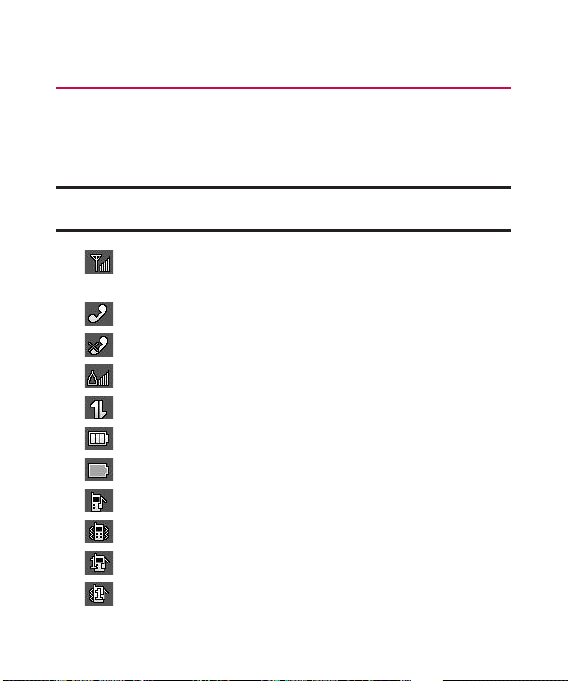
Your phone’s display screen provides a wealth of information
about your phone’s status and options. This list identifies the
symbols you’ll see on your phone’s display screen:
Note: To view a list of your phone’s icons and descriptions, select Menu >
Settings > Phone Information > Icon Glossary.
shows your current signal strength. (The more lines
you have, the stronger your signal.)
tells you a call is in progress.
means your phone cannot find a signal.
indicates you are “Roaming”off the home Network.
Data Service
indicates full battery.
indicates low battery.
indicates Ringer Only.
indicates Vibrate Only.
indicates 1 Beep.
indicates 1 Beep & Vibrate.
Section 2A: Your Phone: The Basics 15
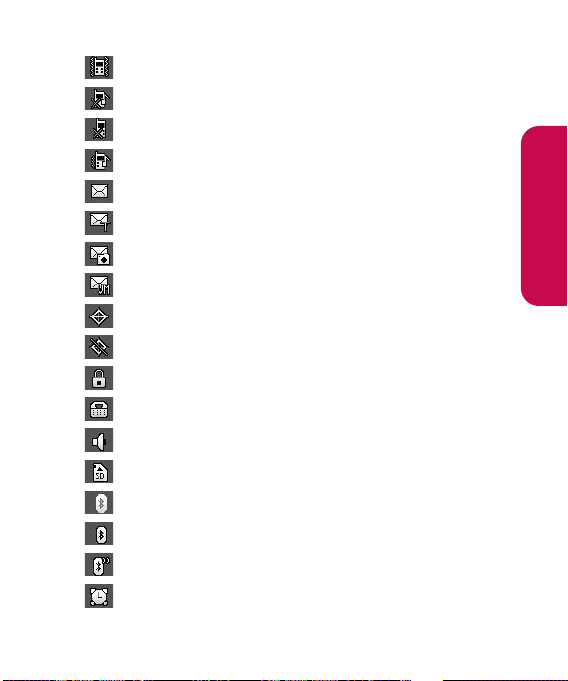
indicates Vibrate All.
indicates Ringer Off.
indicates Silence All.
indicates Ringer & Vibrate.
indicates New Messages.
indicates New Text Message.
indicates New Picture Messaging.
indicates New Voicemail.
indicates Location On.
indicates Location Off.
indicates SSL.
indicates TTY.
indicates Speaker.
indicates Memory Card.
indicates Bluetooth Enabled(Hidden).
indicates Bluetooth Enabled(Visible).
indicates Bluetooth Connected.
indicates Alarm Clock.
Phone Basics

16 Section 2A: Your Phone: The Basics
indicates Voice Guide & Speaker On.
indicates Voice Guide & Speaker Off.
indicates Missed Calls.
indicates Incoming Calls.
indicates Outgoing Calls.
indicates Camera / Picture.
indicates Camera Resolution 1.3M.
indicates Camera Resolution Med.
indicates Camera Resolution Low.
indicates Zoom.
indicates Self Timer.
indicates Capture.
indicates Color Tone.
indicates Fun frame.
indicates Saving to In Phone.
indicates Saving to in Memory Card.
indicates Night Mode Setting.

Section 2A: Your Phone: The Basics 17
Featuresof Your Phone
Congratulations on the purchase of your phone. The Rumor
2
by LG is an easy-to-use, lightweight and reliable phone that
offers many significant features and service options. The
following list previews some of those features and provides
page numbers where you can find out more:
v Digital dual-band capability allows you to make and
receive calls while on your wireless network, and to roam
on other 1900 and 800 MHz digital networks.
v Data service provides access to the wireless Internet in
digital mode (page 165).
v Voicemail (page 147), SMS Text Messaging (page 157),
and MMS Picture Messaging (page 134) provide quick
and convenient messaging capabilities.
v The slide-out QWERTY keyboard makes entering text fast
and easy (page 44).
Phone Basics

18 Section 2A: Your Phone: The Basics
v Games, ringers, screen savers, and other applications can
be downloaded to make your phone as unique as you are
(page 172). Additional charges may apply.
v Your Contacts List allows you to store up to 600 entries,
with up to seven phone numbers per entry (page 94).
v The Calendar offers several personal information
management features to help you manage your busy
lifestyle (page 101).
v The Location feature works in connection with available
location-based services (page 57).
v T9 Text Input lets you quickly type messages with one
keypress per letter (see page 40).
v Speed dial lets you dial phone numbers with one or two
keypresses (see page 38).

Section 2A: Your Phone: The Basics 19
v You can wirelessly pair your Bluetooth-enabled phone
to certain Bluetooth devices, including headsets and
hands-free devices. You may also use a personal
computer or hand-held device to pair with the phone for
dial-up networking, using the phone as a wireless
modem (page 137).
v The built-in camera allows you to take full-color digital
pictures and view your pictures using the phone’s display
(page 122).
v Data Roam Guard will alert you when you are roaming and
using your browser or other online applications, giving you
the option to continue using those applications while in
the roaming area (page 82).
v The microSD™ card expands your phone's available
memory and lets you play back, store, and erase the
pictures taken with your phone (pages 114).
You can also play back and store downloaded MP3 and
other media files.
Phone Basics

20 Section 2A: Your Phone: The Basics
Turning Your Phone On and Off
Turning Your Phone On
To turn your phone on:
©
Press and hold for approximately two seconds.
Once your phone is on, it may display “Looking for Service”,
which indicates that your phone is searching for a signal.
When your phone finds a signal, it automatically enters
standby mode – the phone’s idle state. At this point, you are
ready to begin making and receiving calls.
If your phone is unable to find a signal after 15 minutes of
searching, a Power Save feature is automatically activated.
When a signal is found, your phone automatically returns to
standby mode.
In Power Save mode, your phone searches for a signal
periodically without your intervention. You can also initiate a
search for service by pressing any key (when your phone is
turned on).
Tip: The Power Save feature helps to conserve your battery power when
you are in an area where there is no signal.

Section 2A: Your Phone: The Basics 21
Turning Your Phone Off
To turn your phone off:
©
Press and hold for two seconds until you see the
powering-down animation on the display screen.
Your screen remains blank while your phone is off (unless the
battery is charging).
Using Your Phone’s Battery and Charger
WARNING: Use only manufacturer-approved batteries and chargers
with your phone. The failure to use a manufacturer-approved battery
and charger may increase the risk that your phone will overheat, catch
fire, or explode, resulting in serious bodily injury, death, or property
damage.
Battery Capacity
Your phone is equipped with a Lithium-Ion (Li-Ion) battery. It
allows you to recharge your battery before it is fully drained.
The battery provides up to 5.5hours of continuous digital
talk time.
When the battery reaches 5% of its capacity, the battery icon
blinks. When there are approximately two minutes of talk
time left, the phone sounds an audible alert and then
powers down.
Phone Basics
22 Section 2A: Your Phone: The Basics
Note: Long backlight settings, searching for service, vibrate mode, and
browser use affect the battery’s talk and standby times.
Tip: Be sure to watch your phone’s battery level indicator and charge the
battery before it runs out of power.
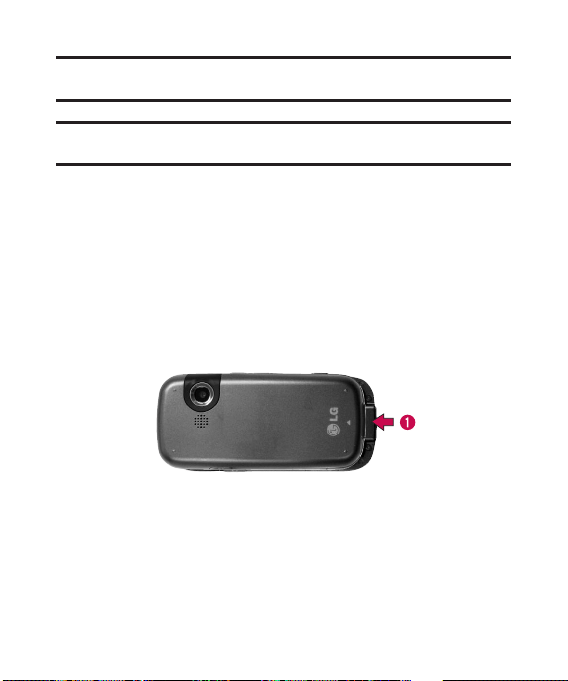
Installing the Battery
To install the Li-Ion battery:
©
To install, gently push the battery cover up (1), and
insert the battery into the opening on the back of the
phone. Align the battery terminals with the terminals
on the phone and push down on the top until the
battery snaps into place.

Section 2A: Your Phone: The Basics 23
Removing the Battery
To remove the battery:
©
To remove, push gently the cover of the battery up, and
use your fingernail to take the battery out of the
opening on the back of the phone. Put the cover back
on. (2).
Charging the Battery
Your phone’s Li-Ion battery is rechargeable and should be
charged as soon as possible so you can begin using your
phone.
Phone Basics

24 Section 2A: Your Phone: The Basics
Keeping track of your battery’s charge is important. If your
battery level becomes too low, your phone automatically
turns off and you will lose all the information you were just
working on. For a quick check of your phone’s battery level,
glance at the battery charge indicator located in the upper-
right corner of your phone’s display screen. If the battery
charge is getting too low, the battery icon ( ) blinks and
the phone sounds a warning tone.
Always use a manufacturer-approved desktop charger,
travel charger, or vehicle power adapter to charge your
battery.
Using the Charger
To use the travel charger provided with your phone:
©
Plug the smaller end of the AC adapter into the phone’s
charger jack and the other end into an electrical outlet.
n
Ared indicator light on the phone lets you know the
battery is charging. The indicator light is located
above the right side of LCD.
n
A green indicator light lets you know that the
battery is at least 90 percent charged. The indicator
lightis located above the right side of LCD.

Section 2A: Your Phone: The Basics 25
Navigating Through Phone Menus
The navigation key on your phone allows you to scroll through
menus quickly and easily. The scroll bar at the right of the
menu keeps track of your position in the menu at all times.
To navigate through a menu, simply press the navigation key
up or down. If you are in a first-level menu, such as
Settings,
you may also navigate to the next or previous first-level
menu by pressing the navigation key right or left.
For a diagram of your phone’s menu, please see “Your
Phone’s Menu”on page ii.
Selecting Menu Items
As you navigate through the menu, menu options are
highlighted. Select any numbered option by simply pressing
the corresponding number on the phone’s keypad. You may
also select any item by highlighting it and pressing
.
Phone Basics
26 Section 2A: Your Phone: The Basics
For example, if you want to view your last incoming call :
1. Press to access the main menu.
2. Select History by pressing or by highlighting it and
pressing .
3. Select a call history and press .
Backing Up Within a Menu
To go to the previous menu:
©
Press .
To return to standby mode:
©
Press .
DisplayingYour Phone Number
Just in case you forget your phone number, your phone can
remind you.
To display your phone number:
©
Select Menu > Settings > Phone Information > Phone
Number
. (Your phone number and ESN/MSID
information will be displayed.)
Section 2A: Your Phone: The Basics 27
Making and Answering Calls
Making Calls
Placing a call from your phone is as easy as making a call from
any landline phone. Just enter the number and press ,
and you’re on your way to clear calls.
To make a call using your keypad:
1. Make sure your phone is on.
2. Enter a phone number from standby mode. (If you
make a mistake while dialing, press to erase one
digit at a time. Press and hold to erase the entire
number.)
3. Press .
4. Press the phone when you are finished.
Tip: To redial your last outgoing call, press TALK twice.
You can also place calls from your phone by Speed Dialing
numbers from your Contacts (page 38), and using your Call
History listings (page 86).
Phone Basics

28 Section 2A: Your Phone: The Basics
Dialing Options
When you enter numbers in standby mode and press
OPTIONS(right softkey), you will see a variety of dialing
options appear on the phone’s display screen.
Tip: To speed dial a phone number from standby mode, press and hold
the speed dial number. If the speed dial number is two digits, enter the
first digit, and then press and hold the second digit. (For information on
setting up speed dial numbers, see “Assigning Speed Dial Numbers”on
page 96.)
v
Save allows you to enter a seven- or ten-digit number
(phone number and area code) and save the phone
number in your Contacts. (See “Saving a Phone Number”
on page 34.)
v
ContactDetails to display the contact details. (If the
contact is saved in the Contacts.)
v
2-sec Pause allows you to enter a two-second pause.
(See “Dialing and Saving Phone Numbers With Pauses”
on page 36.)
-or-
Press SEND MSG (left softkey) to access a menu which you
can use to send Text Message or Picture Messaging for
the dialed number.

Section 2A: Your Phone: The Basics 29
Answering Calls
To answer an incoming call:
1. Make sure your phone is on. (If your phone is off,
incoming calls go to voicemail.)
2. Press to answer an incoming call. (Depending on
your phone’s settings, you may also answer incoming
calls by pressing any number key. See “Call Answer
Mode”on page 66 for more information.)
Your phone can notify you of incoming calls in the following
ways:
v The phone rings or vibrates.
v The indicator light flashes. (1 indicator lights is located
on the right side of LCD.)
v The backlight illuminates.
v The screen displays an incoming call message.
If the incoming call is from a number stored in your Contacts,
the entry’s name is displayed. The caller’s phone number
may also be displayed, if available.
If
Call Answer is set to Any Key orTALK Key, the following
options are also displayed. To select an option, press the
corresponding softkey button.
Phone Basics

30 Section 2A: Your Phone: The Basics
v Silenceto mute the ringer.
v Ignoreto send the call to your voicemail box.
Note: When your phone is off, incoming calls go directly to voicemail.
Ending a Call
To disconnect from a call when you are finished:
©
Press .
Missed Call Notification
When an incoming call is not answered, the Missed Call log is
displayed on your screen.
To display a Missed Call entry from the notification screen:
©
Highlight the entry and press . (To dial the phone
number, press .)
To display a Missed Call entry from standby mode:
1. Select Menu > Missed Alerts.
2. Highlight the entry you wish to view and press .
Section 2A: Your Phone: The Basics 31
Making an Emergency Call
You can place calls to 911 (dial ), even if
your phone is locked or your account is restricted.
Note: When you place an emergency call, your phone automatically
enters Emergency mode.
During an emergency call, a list of menu options is displayed
onscreen. To select an option, press
OPTIONS( right softkey).
The following options are available.
v
Contactsto display your contacts list.
v
Voice Memo to record the current conversation.
v
Phone Info to check the phone number, version, etc.
To exit Emergency mode:
1. Press to end a 911 call.
2. Press Exit(right softkey).
Note: When you are in Emergency mode, you can exit only from the
options menu.
Phone Basics

32 Section 2A: Your Phone: The Basics
Enhanced 911 (E911) Information
This phone features an embedded Global Positioning System
(GPS) chip necessary for utilizing E911 emergency location
services where available.
When you place an emergency 911 call, the GPS feature of
your phone begins to seek information to calculate your
approximate location. Depending on several variables,
including availability and access to satellite signals, it may
take 30 seconds or more to determine and report your
approximate location.
IMPORTANT: Always report your location to the 911 operator when placing
an emergency call. Some designated emergency call takers, known as
Public Safety Answering Points (PSAPs) may not be equipped to receive GPS
location information from your phone.
In-Call Options
Pressing OPTIONS(right softkey) during a call displays a list of
available in-call features. To select an option, highlight the
option and press . The following options may be
available through the Options menu:
v
Save to save a phone number in your Contacts. (See
"Saving a Phone Number" on page 34.)

Section 2A: Your Phone: The Basics 33
v
ContactDetails to display the contact details. (If the
contact is saved in the Contacts.)
v
Main Menu to display the phone’s main menu.
v
3-Way Call to initiate a three-way call.
v
Contactsto display your Contacts list.
v
Voice Memo to record the current conversation.
v
Phone Info to check the phone number, version, etc.
Warning!Because of higher volume levels, do not place the phone near
your ear during speakerphone use.
End-of-Call Options
After you receive a call from or make a call to a phone number
that is not in your Contacts, the phone displays the phone
number and the duration of the call. Press
OPTIONS (right
softkey) >
Save Contact to add the new number to your
Contacts. (See “Saving a Phone Number”below.)
After you receive a call from or make a call to a phone number
that is already in your Contacts, the phone displays the entry
name, phone number, and the duration of the call. To select one
of the following options after a call has ended, press
OPTIONS
(rightsoftkey):
New Group/ Contact Details/ Delete/ Delete All
Phone Basics

34 Section 2A: Your Phone: The Basics
Note: Not all End-of-Call options are displayed for calls identified as No ID
or Restricted.
Saving a Phone Number
You can store up to 7 phone number entries per Contact and
600 Contacts entries in your phone. Each entry’s name can
contain 64 characters. Your phone automatically sorts the
Contacts entries alphabetically. (For more information, see
“Contacts”on page 92.)
To save a number from standby mode:
1. Enter a phone number.
2. Press OPTIONS (right softkey), highlight Saveand press
.
3. Highlight New Entry for a new contact or Existing Entry
to add a number to an existing contact and press .
4. Select Mobile, Home, Work, Pager, Fax, or Otherfor the
phone label.
5. Use the keypad/QWERTY keyboard to enter thenew
contact name and press DONE(left softkey) to save the
new entry.
Section 2A: Your Phone: The Basics 35
– or –
Search for an existing contact name and press to
save the new number.
6. Press DONE (left softkey) to save the new entry.
Finding a Phone Number
You can search Contacts for entries by name.
1. While in Standby Mode, press CONTACTS (rightsoftkey)
and enter the first letter or letters of an entry. (The
more letters you letter, the more specific the search.)
2. To select an entry, highlight it and press . To dial a
number, highlight it and press . You may need to
press the right or left navigational keys to select one of
many phone numbers that a contact can have.
Dialing and Saving Phone Numbers With Pauses
You can dial or save phone numbers with pauses for use with
automated systems, such as voicemail or credit card billing
numbers.
Phone Basics

36 Section 2A: Your Phone: The Basics
There are two types of pauses available on your phone:
v
Hard Pause sends the next set of numbers only after you
press left softkey SEND TONES.
v
2-sec Pause automatically sends the next set of numbers
after two seconds.
Note:You can have multiple pauses in a phone number and combine
two-second and hard pauses.
To dial or saved phone numbers with pauses:
1. Enter the phone number.
2. Press OPTIONS (right softkey)>Hard Pauseor 2-sec
Pause
. (Hard pauses are displayed as a "P" and two-
second pauses as a "T")
3. Enter additional numbers.
4. Press to dial the number.
- or -
To save the number in your Contacts list, press
OPTIONS
(right softkey), highlight Saveand press .
Note:When dialing a number with a hard pause, press left softkey SEND
TONESto send the next set of numbers.
Using Abbreviated Dialing
Abbreviated Dialing is similar to speed dialing. You can use
either of the following abbreviated dialing features.
Section 2A: Your Phone: The Basics 37
v
Contacts Match – Retrieve any number saved in your
Contacts by entering only three consecutive digits of the
number. Highlight a Contact entry and press to dial
the matching number. (See “Contacts Match”on page
66.)
v
Prefix– Pre-set
the first five or six digits (for example, the
area code and prefix) so that you can quickly dial the last
four or five digits and press to dial the resulting
number. See page 65 for instructions on how to set this up.
To place a call using Contacts Match abbreviated dialing:
1. Enter at least three digits of a Contact entry’s phone
number.
2. Use to highlight a contact match and press
to call the displayed number. (If there is more than one
matched number in your Contacts, a list is displayed.
Select the name you want to call from the list, and then
press to place a call.)
To place a call using Prefix abbreviated dialing:
1. Enter the last four or five digits of the number.
2. Press .
Phone Basics
38 Section 2A: Your Phone: The Basics
Dialing From Contacts
Shortcut :From standby mode, press Contacts (right softkey) to list
entries.
1. Press Menu > Contacts.
2. Select the entry you want to call and press to dial
the entry’s default phone number.
– or –
To dial another number from the entry, select the name
and press , and then select a number and press .
Using Speed Numbers
You can store up to 98 numbers in your phone’s speed
numbers memory to make contacting friends and family as
easy as pressing a button or two. With this feature, you can
dial speed dial entries using one keypress for locations 2-9, or
two keypresses for locations 10-99.
To use One-Touch Dialing for speed dial locations 2-9:
v
Press and hold the appropriate key for approximately
two seconds. The display confirms that the number has
been dialed when it shows “Connecting...”.

Section 2A: Your Phone: The Basics 39
To use Two-Touch Dialing for speed dial locations 10-99:
1. Press the first digit.
2. Press and hold the second digit for approximately two
seconds. The display confirms that the number has
been dialed when it shows “Connecting...”.
Entering Text
Entering Text With the Alphanumeric Keypad
Your phone provides convenient ways to enter words, letters,
punctuation, and numbers whenever you are prompted to
enter text (for example, when adding a Contact entry or
when using SMS Text Messaging).
To change the character input mode:
1. When in a text entry field, press Mode, or Options,(right
softkey) and select
Text Mode to change the character
input mode.
2. Select one of the following options:
n
Abc to cycle through the alpha characters
associated with the letters on the keypad.
Phone Basics

40 Section 2A: Your Phone: The Basics
n
Predictive Textto enter text using a predictive text
entering system that reduces the amount of keys
that need to be pressed while entering a word.
n
123to enter numbers by pressing the numbers on
the keypad.
n
Symbolsto enter symbols.
n
Emoticonsto enter colorful emoticons.
n
Settings to enter messages settings.
Tip: When entering text, press the
*
(Shift) key to change letter
capitalization (Abc > ABC > abc).
Entering Characters Using Predictive Text
Predictive Text Mode lets you enter text in your phone by
pressing keys just once per letter. (To select the
Predictive Text
mode when entering text, see "To change the character input
mode:" on page 39.)
Predictive Text analyzes the letters you enter using an
intuitive word database and provides words that match the
entry. (The word may change as you type.)
To enter a word using Predictive Text:
1. Select the Predictive Textinput mode. (See “To change
the character input mode:”on page 39.)
Section 2A: Your Phone: The Basics 41
2. Press the corresponding keys once per letter to enter
a word. (For example, to enter the word “Bill,”press
.) (If you make a mistake, press
to erase a single character. Press and hold to
delete an entire entry.)
If the word you want is not selected after you have entered
all the letters, press to scroll through additional word
selections. To accept a word and insert a space, press .
Adding a Word to the Predictive Text Database
If a word you want to enter is not displayed as an option when
you are using Predictive Text, you can add it to the database.
To add a word to the Predictive Text, database:
1. When the desired word does not appear, scroll down
the drop-down list to
Add Word?
2. Clear the current entry and type in the desired word.
3. Press Save(left softkey).
4. The word will appear as an option the next time you
scroll through options during Predictive Text Input.
For more information aboutT9 Text Input, visit the Nuance
site at
www.T9.com.
Phone Basics
42 Section 2A: Your Phone: The Basics
Entering Characters Using ABC Mode
1. Select Abc Mode. (See "To change the character input
mode:" on page 39.)
2. Press the corresponding keys repeatedly until the
desired letter appears. (For example, to enter the word
“Bill,”press twice, three times, three
times, and three times again.) If you make a
mistake, press to erase a single character. Press
and hold to delete an entire entry.
After a character is entered, the cursor automatically advances
to the nextspace after two seconds or when you enter a
character on a differentkey.
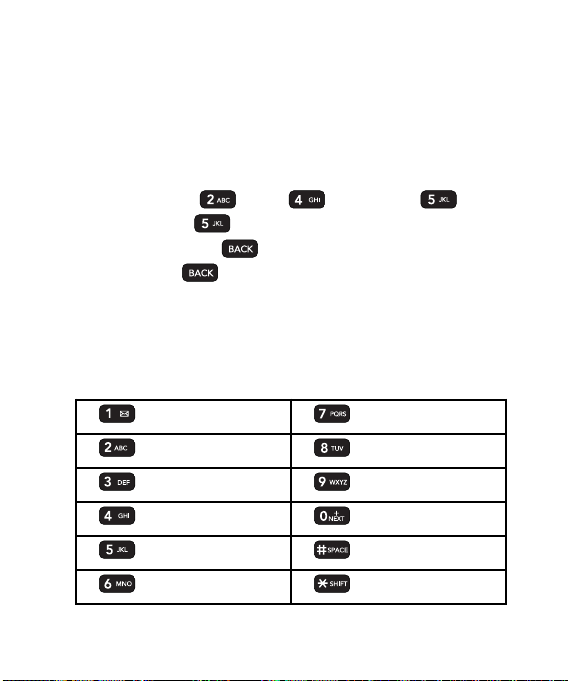
Characters rotate in the following order:
. , @ 1 ? ! * # / P Q R S 7
A B C 2 T U V 8
D E F 3 W X Y Z 9
G H I 4 0
J K L 5 Space
M N O 6 Shift

Section 2A: Your Phone: The Basics 43
Entering Numbers, Symbols, Smileys, Emoticons,
PresetMessages
To enter numbers:
©
Select 123 mode and press the appropriate number key
on the keypad. (See "To change the character input
mode:" on page 39.)
To enter symbols:
©
Select Symbolsmode. (See "To change the character
input mode:" on page 39.) To enter a symbol, scroll
through the available symbols and press , or press
the corresponding number key on the keypad.
To enter Emoticons:
©
Select Emoticons mode. (See "To change the character
input mode:" on page 39.) To enter an emoticon, scroll
through the available emoticons and press , or
press the corresponding number key on the keypad.
To enter preset messages:
1. Press the right softkey Optionsand select AddPreset
Messages
mode.
2. Scroll to the desired preprogrammed message and
press .
Phone Basics

44 Section 2A: Your Phone: The Basics
Note: Preset messages make composing text messages even easier by
allowing you to enter preset messages. You can add a preset message of
your own. (For more information on preset messages, please see
“Managing Preset Messages”on page 59.)
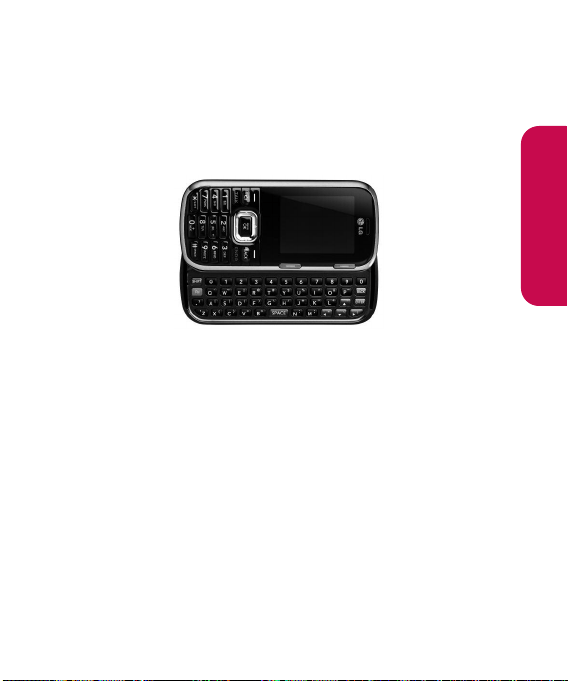
Entering Text With the QWERTY Keyboard
Your phone features a slide-out QWERTY keyboard,
specifically designed for easy and comfortable text entry.
The QWERTY keyboard uses the same layout and works just
like the keyboard on your computer. The easiest way to enter
text is by using your thumbs to type on the QWERTY
keyboard.
To enter text with the QWERTY keyboard:
1. In a text entry screen, slide open the QWERTY keyboard.
(The display automatically adjusts to landscape mode.)
2. Use your thumbs to enter text.
n
To change capitalization, press .
n
To enter alternate characters on a key, press
and then press the key. To lock the function key (as
when entering a series of numbers), press twice.
n
To enter symbols, press and select a symbol.
Section 2A: Your Phone: The Basics 45
n
For additional text entry options, including
Predictive Text, Symbols, and Settings, press
Options(right softkey), select Text Modeand select
an option.
Phone Basics

46 Section 2B: Controlling Your Phone’s Settings
Controlling Your Phone’s Settings
In This Section
l Sound Settings
l Display Settings
l Location Settings
l Messages Settings
l Airplane/Music Mode
l TTY Use
l Phone Setup Options
Using the menu options available on your phone, you can
customize your phone to sound, look, and operate just the
way you wantit to
. This section describes how you can
change your phone’s settings to best suit your needs. Take
a few moments to review these options and to adjust or
add settings that are right for you.

Section 2B: Controlling Your Phone’s Settings 47
Sound Settings
Ringer Types
Ringer types help you identify incoming calls and messages.
You can assign ringer types to individual Contact entries,
types of calls, and types of messages.
Selecting Ringer Types for Incoming Calls
Your phone provides a variety of ringer options that allow
you to customize your ring and volume settings. These
options allow you to identify incoming calls by the ring.
To select a ringer type for Incoming calls:
1. Press Menu > Settings > Sounds > Ringer Type > Incoming
Calls
.
2. Select ContactEntries or Unknown #s. (You can identify
incoming calls from contacts or unknown numbers by
setting differentringer types.)
n
ContactEntries
n
All Contacts You can set a ringer type for calls from
all contacts.
n
One Contact You can set a specific ringer type for
calls from one specific contact.
Your Phone’s Settings

48 Section 2B: Controlling Your Phone’s Settings
n
Unknown #s
n
You can set a ringer type for anonymous calls.
3. Select a category, and then use your navigation key to
scroll through the available ringers. A sample ringer
will sound as you highlight each option.
4. Press to assign the desired ringer.
Assigning Ringers to Contacts
1. Press > Settings > Sounds > Ringer Type > Incoming
Calls > Contact Entries > One Contact
.
2. Highlight an entry and press .
3. Select a category, and then use your navigation key to
scroll through the available ringers. You will hear a
sample ringer as you highlight each option.
4. Press to assign the ringer.
Selecting Ringer Types for Messages
To select a ringer type for messages:
1. Select Menu > Settings > Sounds > Ringer Type >
Messages
.
2. Select Voicemail, TextMessage or Picture Messaging.

Section 2B: Controlling Your Phone’s Settings 49
3. Use your navigation to scroll through the available
ringer types. To select a specific tone, highlight Custom
and press .
4. Scroll through the available tones; a sample ringer will
sound as you highlight each option.
5. Press to assign the ringer.
Selecting a Key Tone
You can adjust your phone's key tone volume settings.
To select a tone volume:
1. Press Menu > Settings > Sounds > Keytones.
2. Select an option and press .
n
Tone Length to select a key tone length.(Longer
tone lengths may be better for tone recognition
when dialing voicemail or other automated
systems.)
n
Tone Volume to select a keypress volume level.
Your Phone’s Settings

50 Section 2B: Controlling Your Phone’s Settings
Adjusting the Phone’s Volume Settings
You can adjust your phone’s volume settings to suit your
needs and your environment.
To adjust your phone’s volume settings:
1. Select Menu > Settings > Sounds > Volume.
2. Select Ringer, Earpiece, Speakerphone, Keytones,
Messages, Alarm & Calendar, Applications, Alert or Power
On/Off
.
3. Using the navigation key, choose a volume level and
press .
Tip: You can adjust the Ringer volume in standby mode (or the Earpiece
volume during a call) by using the volume keys on the left side of your
phone.

Section 2B: Controlling Your Phone’s Settings 51
Alert Notification
Your phone can alert you with an audible tone when you
change service areas, once a minute during a voice call, or
when a call has been connected.
To enable or disable alert sounds:
1. Select Menu > Settings > Sounds > Alerts.
2. Select Beep Each Minute, Out of Service, Connect or
Signal Fade/Call Drop and press .
3. Select On or Off and press .
Silence All
The phone’s Silence All option allows you to mute all sounds
without turning your phone off.
To activate Silence All:
©
Press the volume key down repeatedly in standby mode.
(The screen will display “Silence All”)
To deactivate Silence All:
©
Press the volume key up repeatedly to select a desired
volume level.
Your Phone’s Settings

52 Section 2B: Controlling Your Phone’s Settings
Display Settings
Changing the Text Greeting
The text greeting can be up to 12 characters and is displayed
on your phone’s screen in standby mode. You may choose to
keep the phone’s default greeting, or you may enter your
own custom greeting.
To display or change your greeting:
1. Press Menu > Settings > Display > Main Screen >
Foregrounds > Greeting >
(Set to)Custom.
2. Use the directional keypad to highlight the second field
and press .
3. Use the alphanumeric keypad or the QWERTY® Keyboard
to enter a new custom greeting. (See “Entering Text”on
page 39.) (To erase the existing greeting one character at
a time, press . To erase the entire greeting, press and
hold .)
4. Press and then the Save (left softkey) to save your
greeting.
Section 2B: Controlling Your Phone’s Settings 53
Changing the Backlight Time Length
The backlight setting lets you select how long the display
screen and keypad are backlit after any keypress is made.
To change the display backlight setting:
1. Press Menu > Settings > Display > Main Screen >
Backlight
.
2. Select a time setting and press .
To change the keypad light setting:
1. Press Menu > Settings > Display > Keypad Light.
2. Highlight On or Off and press .
Note: Long backlight settings affect the battery’s talk and standby times.
Changing the Display Screen
Your phone offers options to customize what you see on the
display screen when in standby mode.
To change the display image :
1. Press Menu > Settings > Display > Main Screen >
Screen Saver
.
2. Select Preloaded, My Albums, Assigned Media, My Stuff,
or New Picture.
Your Phone’s Settings

54 Section 2B: Controlling Your Phone’s Settings
3. Use the navigation key to select an image and press
to view the image. (Once an image is displayed,
you can use your navigation key to scroll through and
view the other default images.)
4. Press ASSIGN (left softkey) to assign the desired image.
Changing the Phone’s Menu Style
Your phone allows you to choose how the menu appears on
your display screen.
To select the display’s menu style:
1. Press Menu > Settings > Display > Main Screen >
Menu Styles
.
2. Use left/right on the directional keypad to select Grid
to view each main menu item as an animated single-
screen icon, or
List to view the main menu as a list, and
press .
Shortcut: For quick access to Menu Styles, press the right softkey while in
the main menu.

Section 2B: Controlling Your Phone’s Settings 55
Changing the Clock Display
Choose whether you want your phone’s clock to be displayed
in analog mode, digital mode, or with time and date.
To change the clock’s appearance on the standby screen:
1. Press Menu > Settings > Display > Main Screen >
Foregrounds > Clock & Calendar
.
2. Select Normal Clock, Analog Clock 1, Analog Clock 2,
Digital Clock 1, Digital Clock 2, Dual Clock 1, Dual Clock
2, Calendar 1, or Calendar 2,
and press .
3. Press to apply the clock display setting.
Changing the Text Input Font
This setting allows you to adjust the display appearance
when entering text (for example, when using Messages,
Notepad or the Browser).
To change the text input font:
1. Select Menu > Settings > Display > Font Size.
2. Select Messages, Browser, or Notepad.
3. Select a desired size and press Save(left softkey).
Your Phone’s Settings

56 Section 2B: Controlling Your Phone’s Settings
Changing the Status Light Mode
This feature shows your phone status by blinking a status
light to the right of the display screen.
To change the status light mode:
1. Select Menu > Settings > Display > Status Light.
2. Select On or Off and press .
Display Language
You can choose to display your phone's menus in English or in
Spanish
To assign a language for the phone’s display:
1. Press Menu > Settings > Display > Language (Idioma).
2. Select English or Españoland press .
Section 2B: Controlling Your Phone’s Settings 57
LocationSettings
Your phone is equipped with a Location feature for use in
connection with location-based service.
The Location feature allows the network to detect your
position. Turning Location off will hide your location from
everyone except 911.
Note: Turning Location on will allow the network to detect your position
using GPS technology, making some applications and services easier to
use. Turning Location off will disable the GPS location function for all
purposes except 911, but will not hide your general location based on the
cell site serving your call. No application or service may use your location
without your request or permission. GPS-enhanced 911 is not available in
all areas.
To enable your phone’s Location feature:
1. Press Menu > Settings > More... > Location. (The Location
disclaimer is displayed.)
2. Read the disclaimer and press .
3. Select On or Off and press .
Your Phone’s Settings

58 Section 2B: Controlling Your Phone’s Settings
When the Location feature is on, your phone’s standby
screen will display the icon. When Location is turned off,
the icon will be displayed.
Messages Settings
Staying connected to your friends and family has never been
easier. With your phone’s advanced messaging capabilities,
you can send and receive many text messages without
placing a voice call. (For more information, see “Using SMS
Text Messaging”on page 157.)
Your phone’s messaging settings make text messaging even
easier by letting you decide how you would like to be notified
of new messages, letting you create a signature with each
sent message, and letting you create your own preset
messages, to name a few options.
Setting Message Notification
When you receive a text message, your phone can notify you
by displaying an icon on your display screen. You can also
choose to be notified with a larger pop-up message on your
display screen.
1. Select Menu > Settings > Messages > Notification.
2. Select Message & Icon or Icon Only and press .
Section 2B: Controlling Your Phone’s Settings 59
Callback Number
1. Press Menu > Settings > Messages > Callback Number.
2. Select None, My Phone Number, or Otherand press .
(If you select
Other, enter a number and press .)
Adding a Customized Signature
Each message you send can have a customized signature to
reflect your personality.
To add a customized signature to each sent message:
1. Select Menu > Settings > Messages > Signature > Custom.
(If you do not wish to attach a signature to your
outgoing messages, select
None.)
2. Enter your signature and press . (See “Entering
Text”on page 39.)
Managing PresetMessages
Your phone is loaded with 20 preset messages to help make
sending text messages faster and easier. These messages, such
as “Where are you?,”“Let's get lunch,”and can be customized
or deleted to suit your needs. You can even add your own preset
messages to the list.
Your Phone’s Settings

60 Section 2B: Controlling Your Phone’s Settings
To edit or delete a preset message:
1. Select Menu > Settings > Messages > Preset Messages.
(The list of preset messages is displayed.)
2. To edit or delete a preset message, highlight it and
press OPTIONS ( right softkey).
3. Scroll to Editand edit the selected message (see
“Entering Text”on page 39), and press .
– or –
Scroll to Delete and press , and then select Yes to
delete the selected message. (Select
Noto cancel the
deletion.)
To add a new preset message:
1. Select Menu > Settings > Messages > Preset Messages.
(The list of preset messages is displayed.)
2. To add a new message, select ADD (left softkey).
3. Enter your message (see “Entering Text”on page 39),
and press
Save (left softkey). (Your new message will be
added to the beginning of the list.)
Section 2B: Controlling Your Phone’s Settings 61
Airplane/Music Mode
Airplane/Music Mode allows you to use many of your
phone’s features, such as Games, Notepad, Voice Memos,
etc., when you are in an airplane or in any other area where
making or receiving calls or data is prohibited. When your
phone is in Airplane/Music Mode, it cannot send or receive
any calls, or access online information.
1. Select Menu > Settings > Airplane/Music Mode. (The
Airplane/Music Mode disclaimer is displayed.)
2. Read the disclaimer and press .
3. Select On,Off,or On Power Up and press .
While in Airplane/Music Mode, your phone’s standby screen
will display “Phone Off.”
Your Phone’s Settings
62 Section 2B: Controlling Your Phone’s Settings
TTYUse
A TTY (also known as a TDD or Text Telephone) is a
telecommunications device that allows people who are
deaf, hard-of-hearing, or who have speech or language
disabilities, to communicate by telephone.
Your phone is compatible with select TTY devices. Please
check with the manufacturer of your TTY device to ensure
that it supports digital wireless transmission. Your phone
and TTY device will connect via a special cable that plugs into
your phone’s headset jack. If this cable was not provided
with your TTY device, contact your TTY device manufacturer
to purchase the connector cable.
When establishing your wireless service, please call your
service provider via the state Telecommunications Relay
Service (TRS) by first dialing .
To turn TTY Mode on or off:
1. Select Menu > Settings > More... > Accessibility > TTY. (An
informational message is displayed)
2. Press .
3. Select Enable TTYto turn TTY mode on or select Disable
TTY
to turn TTY mode off.

Section 2B: Controlling Your Phone’s Settings 63
Note:In TTY Mode, your phone will display the TTY access icon when a TTY
device is connected to the headset jack.
Note:If TTY Mode is enabled, the audio quality of non-TTY devices
connected to the headset jack may be impaired.
WARNING: 911 Emergency Calling
It is recommended thatTTY users make emergency calls by other means,
including Telecommunications Relay Services (TRS), analog cellular, and
landline communications. Wireless TTY calls to 911 may be corrupted
when received by public safety answering points (PSAPs), rendering some
communications unintelligible. The problem encountered appears to be
related to TTY equipment or software used by PSAPs. This matter has been
brought to the attention of the FCC, and the wireless industry and PSAP
community are currently working to resolve this.
Your Phone’s Settings

64 Section 2B: Controlling Your Phone’s Settings
Phone Setup Options
Shortcuts Using the Navigation Key
Your phone offers you the option of assigning shortcut keys
to favorite or often-used functions. Pressing the navigation
key left, right, up, or down in standby mode will launch your
personally designated shortcuts.
To assign your shortcut keys:
1. Select Menu > Settings > More... > Navigation Keys. (An
information window is displayed.)
2. Read the information and press .
3. Select Left Navigation, RightNavigation, Up Navigation,
or Down Navigation to assign a shortcut.
4. Using the navigation key or your keypad, select the
desired shortcut and press .
5. Press to return to standby mode.

Section 2B: Controlling Your Phone’s Settings 65
Auto-Answer Mode
You may set your phone to automatically pick up incoming
calls when connected to an optional hands-free car kit or
headset.
To set Auto-Answer mode:
1. Select Menu > Settings > More... >Call Setup >
Auto-Answer
.
2. To select an option, highlight it and press .
n
Off to disable Auto-Answer.
n
Headsetto answer calls automatically when the
phone is connected to a hands-free car kit or a
headset (sold separately). Remember, your phone
will answer calls in Auto-Answer mode even if you
are not present.
Abbreviated Dialing
This allows you to dial a number quickly by having the phone
auto-dial the first 5 or 6 digits, so you only have to dial the
last 5 or 4 digits of a phone number.
To set your abbreviated dialing options:
1. Press Menu > Settings > More... > Call Setup >
Abbreviated Dialing
.
Your Phone’s Settings
66 Section 2B: Controlling Your Phone’s Settings
2. Select On and enter a five- or six-digit number (for
example, area code and prefix) and press .
Call Answer Mode
You can determine how you would like to answer incoming
calls on your phone.
To set call answer mode:
1. Select Menu > Settings > More... > Call Setup > Call Answer.
2. To select an option, highlight it and press .
n
Any Key to allow an incoming call to be answered
by pressing any key (except the side volume keys,
the softkeys or ).
n
TALK Key to require to be pressed to answer
all incoming calls.
Contacts Match
This allows you to turn the contacts matching feature on or
off.
To set your contacts match options:
1. Press Menu > Settings > More... > Call Setup >
Contacts Match
.
2. Select On or Offand press .

Section 2B: Controlling Your Phone’s Settings 67
TextEntry
This allows you to customize text entry.
1. Select Menu > Settings > Text Entry.
2. Select Auto-Capital, Auto-Space, Word Choice List, Word
Prediction
, Word Completion,Use My Words,My Words,
or
Help and press .
Your Phone’s Settings

68 Section 2C: Setting Your Phone’s Security
Setting Your Phone’s Security
In This Section
l Accessing the Security Menu
l Using Your Phone’s Lock Feature
l Using Special Numbers
l Erasing Phone Content
l Resetting Your Picture Messaging Account
l Resetting DefaultSettings
l Resetting Your Phone
By using the security settings on your phone, you receive
peace of mind without sacrificing flexibility.
This section will
familiarize you with your phone’s security settings. With
several options available, you can customize your phone
to meet your personal needs.

Section 2C: Setting Your Phone’s Security 69
Accessing the Security Menu
All of your phone’s security settings are available through
the Security menu. You must enter your lock code to view the
Security menu.
To access the Security menu:
1. Select Menu > Settings > More... > Security.
2. Enter your lock code to display the Security menu.
Tip: If you can’t recall your lock code, try using the last four digits of your
wireless phone number or try 0000. If neither of these works, call your
service provider.
Using Your Phone’s Lock Feature
Locking Your Phone
When your phone is locked, you can only receive incoming
calls or make calls to 911 or special numbers.
1. Press Menu > Settings > More... > Security and enter
your lock code.
2. Select Lock My Phone>Lock Now. (To set your phone to
lock the next time it is turned on, select
On Power Up.)
Your Phone’s Security

70 Section 2C: Setting Your Phone’s Security
Unlocking Your Phone
To unlock your phone:
1. From standby mode, press UNLOCK(right softkey).
2. Enter your lock code.
Changing the Lock Code
To change your lock code:
1. Select Menu > Settings > More... > Security, and then
enter your lock code. (The Security menu is displayed.)
2. Select Change Lock Code, and then enter and re-enter
your new lock code.
Calling in Lock Mode
You can place calls to 911, Customer Care (*611) and to your
special numbers when in lock mode. (For information on
special numbers, see “Using Special Numbers”on page 71.)
To place an outgoing call in lock mode:
©
To call an emergency number, or special number,
enter the phone number and press .
Section 2C: Setting Your Phone’s Security 71
Using Special Numbers
Special numbers are important numbers that you have
designated as being “always available.” You can call and
receive calls from special numbers even if your phone is
locked.
You can save up to 10 special numbers in addition to your
Contact entries. (The same number may be in both
directories.)
To add or replace a special number:
1. Select Menu > Settings > More... > Security, and then
enter your lock code. (The Security menu is displayed.)
2. SelectSpecial Numbers.
3. Select a location for your entry.
4. Enter the number and press .
Note: There are no speed dial options associated with special numbers.
Your Phone’s Security

72 Section 2C: Setting Your Phone’s Security
Erasing Phone Content
Use the Security menu to quickly erase all the content you
have created or stored in your phone.
1. Select Menu > Settings > More... > Security and
enteryour lock code.
2. Select Delete/Reset.
3. To select an option, highlight it and press .
n
Delete Private Browser Data to delete the browser-
related data you have downloaded to your phone.
n
Delete Contactsto delete all the contents of your
Contacts list.
n
Delete My Stuff to delete all the contents in My
Stuff.
n
Delete Photos to delete all pictures in My Albums.
n
Delete Messages to delete all messages.
n
Delete Voice Memo to delete all voice memos.
4. Select Yes(left softkey) to confirm the deletion.

Section 2C: Setting Your Phone’s Security 73
Resetting Your Picture Messaging
Account
This option resets your Picture Messaging account.
To reset your Picture Messaging account:
1. Select Menu > Settings > More... > Security and
enteryour lock code.
2. Select Delete/Reset> ResetPicture Messaging. (A
disclaimer appears.)
3. Read the disclaimer and press .
4. If you are certain that you would like to reset your
Picture Messaging account, select
Ye s (left softkey).
Your Phone’s Security

74 Section 2C: Setting Your Phone’s Security
Resetting Default Settings
Resetting the current default settings restores all the factory
defaults, including the ringer types and display settings. Your
Contacts, Call History, Calendar, and Messaging items are
not affected.
To reset default settings:
1. Select Menu > Settings > More... > Security and enter
your lock code.
2. Select Delete/Reset> Reset All Settings. (A disclaimer
appears.)
3. Read the disclaimer and press .
4. If you are certain that you would like to restore all the
settings, select
Yes(left softkey).

Section 2C: Setting Your Phone’s Security 75
Resetting Your Phone
Resetting the phone restores all the factory
defaults,including the ringer types and display settings. All
data from Contacts, Messaging, Pictures, My Content,
Tools,and Settings will be deleted, and preference settings
will be set to factory defaults.
1. Select Menu > Settings > More... > Securityand enteryour
lock code.
2. Select ResetPhone. (You will see a disclaimer.)
3. Read the disclaimer and press .
4. If you are certain that you would like to restore all
factory settings, select Yes (leftsoftkey).
Your Phone’s Security

76 Section 2D: Controlling Your Roaming Experience
Controlling Your Roaming
Experience
In This Section
l Understanding Roaming
l Setting Your Phone’s Roam Mode
l Using Call Guard
l Using Data Roam Guard
Roaming is the ability to make or receive calls when you’re off
the available network.
Your new dual-band Rumor
2
by LG
works anywhere on the available network and allows you
to roam on other 1900 and 800 MHz digital networks where
roaming agreements have been implemented with other
carriers.
This section explains how roaming works as well as special
features that let you manage your roaming experience.
Section 2D: Controlling Your Roaming Experience 77
Understanding Roaming
Recognizing the Roaming Icon on the Display Screen
Your phone’s display screen always lets you know when
you’re off the available network. Anytime you are roaming,
the phone displays the roaming icon ( ). If you are roaming
on a digital system, the roaming icon will be displayed along
with the text
– Digital Roaming – .
Tip: Remember, when you are using your phone off the available
network, always dial numbers using 11 digits (1 + area code + number).
Roaming on Other Digital Networks
When you’re roaming on other digital networks, your call
quality and security will be similar to the quality you receive
when making calls on the available network. However, you
may not be able to access certain features,
such as data services.
Note:If you’re on a call when you leave the available network and enter an
area where roaming is available , your call is dropped. If your call is dropped
in an area where you think network service is available, turn your phone off
and on again to reconnect to the available network.
Roaming

78 Section 2D: Controlling Your Roaming Experience
Checking for Voicemail Messages While Roaming
When you are roaming off the available network, you may
not receive on-phone notifications of new voicemail
messages. Callers can still leave messages, but you will need
to periodically check your Voicemail for new messages if you
are in a roaming service area for an extended period of time.
To check your voicemail while roaming:
1. Dial 1 + area code + your phone number.
2. When you hear your voicemail greeting, press .
3. Enter your passcode at the prompt and follow the voice
prompts.
When you return to the available network, voicemail
notification will resume as normal.

Section 2D: Controlling Your Roaming Experience 79
Setting Your Phone’s Roam Mode
Your phone allows you to control your roaming capabilities.
By using the
Roamingmenu option, you can set your
Roaming preferences.
SetMode
Choose from three different settings on your dual- band
phone to control your roaming experience.
To set your phone’s roam mode:
1. Press Menu > Settings > More... > Roaming > Set Mode.
2. To select an option, highlight it and press .
n
Automaticseeks network service. When network
service is unavailable, the phone searches for an
alternate system.
n
Home Only
allows you to access the home network
only and prevents roaming on other networks.
Roaming

80 Section 2D: Controlling Your Roaming Experience
Using Call Guard
Your phone has two ways of alerting you when you are
roaming off the available network: the onscreen roaming
icon and Call Guard. Call Guard makes it easy to manage your
roaming charges by requiring an extra step before you can
place or answer a roaming call. (This additional step is not
required when you make or receive calls while on the
available network.)
To turn Call Guard on or off:
1. Press Menu > Settings > More... > Roaming > Call Guard.
2. Select On or Offand press .
Note: Voice dialing and speed dialing are not available when you are
roaming with Call Guard enabled.
Section 2D: Controlling Your Roaming Experience 81
To place roaming calls with Call Guard on:
1. From standby mode, dial 1 + area code + the seven-digit
number and press . (You can also initiate a call
from the Contacts, Call History, or Messaging.)
2. Select Ye s.
To answer incoming roaming calls with Call Guard on:
1. Press . (A message will be displayed notifying you
that roaming charges will apply.)
2. Select Yes.
Roaming

82 Section 2D: Controlling Your Roaming Experience
Using Data Roam Guard
When Data Roam Guard is enabled, you will be asked if you
want to continue using your browser or other online
applications when you are in a data roaming area. When
Data Roam Guard is turned off, your phone will establish or
maintain a data connection in a data roaming area without
asking you for permission.
To turn Data Roam Guard on or off:
1. Press Menu > Settings > More... > Roaming > Data
Roaming
.
2. Select Default, Always Ask orNever Ask and press .

Section 2E: Managing Call History 83
Managing History
In This Section
l Viewing History
l History Options
l Making a Call From History
l Viewing History Thread
l Saving a Phone Number From History
l Prepend a Phone Number From History
l Erasing History
Call History keeps track of incoming calls, calls made from
your phone, and missed calls.
This section guides you
through accessing and making the most of your Call
History.
History

84 Section 2E: Managing Call History
Viewing History
You’ll find the Call History feature very helpful. It is a list of
phone numbers (or Contact entries) for the last 60 calls you
placed, accepted, or missed. Call History makes redialing a
number fast and easy. It is continually updated as new
numbers are added to the beginning of the list, and the
oldest entries are removed from the bottom of the list.
Each entry contains the phone number (if it is available) and
Contact entry name (if the phone number is in your
Contacts).
To view a Call History entry:
1. Press Menu > History.
2. Highlight the entry you wish to view and press .
Note: Call History only records calls that occur while the phone is turned
on. If a call is received while your phone is turned off, it will not appear in
the phone's Incoming or Missed call logs.
Note:If you return a call from the voicemail menu, it will not appear in
your phone’s Outgoing call log.
Section 2E: Managing Call History 85
History Options
For additional information and options on a particular call,
highlight a Call History and press
.This feature displays
the date and time of the calls the phone number (if
available), and the caller’s name (if the number is already in
your Contacts). By pressing , you can select from the
following options:
v
Call
v
Send Message
v
Save/ContactDetails
v
Prepend
v
Delete
Tip: You can also view the next Call History entry by pressing the
navigation key right or view the previous entry by pressing the navigation
key left.
History
86 Section 2E: Managing Call History
Making a Call From History
To place a call from Call History:
1. Press >History.
2. Highlight an entry and press .
Note: You cannot make calls from Call History to entries identified as No ID
or Restricted.
Viewing History Thread
To view the History Thread for a contact (or number), press
. Your phone will display all events related to the contact.
Press again to choose from the following options:
v
Call
v
Send Message
v
Save / Contact
v
Prepend
v
Delete
Section 2E: Managing Call History 87
Saving a Phone Number From History
Your phone can store up to 600 Contact entries. Contact
entries can store up to a total of seven phone numbers each.
Each entry’s name can contain 64 characters.
To save a phone number from History:
1. Press Menu > History, then use your navigation key to
select a History entry and press .
2. Press Options (right softkey), highlight Save Contact and
press .
3. Select New Entry to create a new Contact entry for the
number, or Existing Entry to save the number to an
existing entry.
4. Use your navigation key to highlight the phone number
type and then press .
5. Use the keypad to type in the new entry name and
press .
– or –
Use your navigation key to scroll through your existing
Contact entries, highlight a name, and press .
6. Use your navigation key to select other fields and press
to edit them.
Call History
88 Section 2E: Managing Call History
7. Press Done (left softkey) to save the entry.
After you have saved the number, the new Contact entry is
displayed. (See “Contact Entry Options”on page 93.)
Note: You cannot save phone numbers already in your Contacts or from
calls identified as No ID or Restricted.
Prepend a Phone Number From History
If you need to make a call from History and you happen to be
outside your local area code, you can Prepend the number by
adding the appropriate prefix.
To prepend a phone number from History:
1. Press Menu > History, then select a History entry and
press .
2. Press Options (right softkey) and scroll to Prepend and
press .
3. Enter the prefix and press to call the number.
– or –
Press
Options(right softkey) and scroll to Save and press
to save the amended number in your Contacts.

Section 2E: Managing Call History 89
ErasingHistory
To erase individual History entries, see “History Options”on
page 85. To erase the all History items, follow the steps
below:
To erase History:
1. Press > History.
1. Press OPTIONS(right softkey) > Delete All.
1. If you are certain you want to erase the History, select
DELETE(left softkey).
– or –
Select
CANCEL(right softkey) to return to the previous
menu.
Call History

90 Section 2F: Using Contacts
Using Contacts
In This Section
l Adding a New Contact Entry
l Finding Contact Entries
l Contact Entry Options
l Adding a Phone Number to a ContactEntry
l Editing a Contact Entry’s Phone Number
l Assigning Speed Dial Numbers
l Send All Contacts
l Editing a Contact Entry
l Selecting a Ringer Type for an Entry
l Dialing Services
Now that you know the basics that make it easier to stay in
touch with people and information, you’re ready to explore
your phone’s more advanced features.
This section explains
how to use your phone’s Contacts List, and helps you make
the most of your contacts and time when you are trying to
connect with the important people in your life.
Section 2F: Using Contacts 91
Adding a New Contact Entry
Your phone can store up to 600 Contact entries. Contact
entries can store up to a total of seven phone numbers, and
each entry’s name can contain 64 characters.
To add a new entry:
1. Select Menu > Contacts > Add New.
2. Scroll to New Contact and press .
3. Enter a name for the new entry and press . (See
“Entering Text”on page 39.)
4. Scroll to [Add Number], enter the phone number, and
then press .
5. Select a number type (Mobile, Home, Work, Pager, Fax,
or Other) and press .
6. Scroll down to additional fields and enter or edit
information as desired.
7. Press Done (left softkey).
Shortcut:You can also begin by entering the phone number in standby
mode and selecting
Options > Save. (See "Saving a Phone Number" on
page 34.)
Contacts

92 Section 2F: Using Contacts
After you have saved the number, the new Contact entry is
displayed. (See “Contact Entry Options”on page 96.)
Finding Contact Entries
There are several ways to find your Contact entries.
Follow the steps outlined in the sections below to find
entries from the Contacts menu.
Finding Group Entries
To find entries designated as part of a group:
1. Select Menu > Contacts.
2. Use the keypad, or the slide-out Qwerty keyboard, to
type the Contact's name.
3. Matching names will be displayed. Highlight the
contact and press .
4. To dial the entry’s default phone number, press .
– or –
To display additional Contact matches (if applicable),
press the navigation key left or right.
Section 2F: Using Contacts 93
Contact Entry Options
To access a Contact entry’s options, press Menu > Contacts,
highlight the contact, press
Options(right softkey), highlight
EditContactand press .
v
[Add Name] to edit the contact name on the entry.
v
[Add Number] to add a phone number to the entry.
(See “Adding a Phone Number to a Contact Entry”on page 94.)
v
[Add Email] to add an email address to the entry.
v
[DefaultRinger] to assign a preprogrammed or
downloaded ringer.
v
[Default Vibrate Type] to assign a specific Vibration
type for incoming calls from the Contact.
v
[Memo] to add a note, street address, or other
information.
v
[ No Secret] to select whether or not to hide the
Contact as a Secret contact.
v
[URL] to add a Web site’s URL to the entry.
Contacts

94 Section 2F: Using Contacts
Adding a Phone Number to a Contact Entry
To add a phone number to an entry:
1. Open a Contacts entry. (See “Finding Contact Entries”
on page 92.)
2. Press Options (right softkey), highlight Edit and press
.
3. Scroll to the [Add Number] field and press .
4. Enter the new phone number and press .
5. Select a number type for the number and press .
6. Press Done (left softkey) to save the new number.
– or –
Press and press
OPTIONS(right softkey), and select
SetSpeed Dial to assign a speed dial number for the
number. Then, press Done (left softkey) to save your
new settings.
Section 2F: Using Contacts 95
Editing a Contact Entry’s Phone Number
To edit an entry’s phone number:
1. Open a Contact entry.
2. Highlight the number entry and press OPTIONS (right
softkey)
> Edit.
3. Enter the changes to the number.
Press to clear one digit at a time, or press and
hold to erase the entire number.
4. Press DONE (left softkey) to save the number.
– or –
Press
OPTIONS(right softkey) for additional options.
When you’re finished, press DONE (left softkey) to save
your new settings.
Contacts

96 Section 2F: Using Contacts
Assigning Speed Dial Numbers
Your phone can store up to 98 phone numbers in speed dial
locations. For details on how to make calls using speed dial
numbers, see “Using Speed Dialing”on page 38.
Speed dial numbers can be assigned when you add a new
Contacts entry, when you add a new phone number to an
existing entry, or when you edit an existing number.
To assign a speed dial number to a new phone number:
1. Create a new Contact entry and phone number. (See
“Adding a New Contact Entry” on page 91 or “Adding a
Phone Number to a ContactEntry” on page 94.)
2. Press OPTIONS(right softkey).
3. Highlight Set Speed Dial and press .
4. Select an available speed dial location and press .
5. Press DONE(left softkey) to save the new speed dial
number.
To assign a speed dial number to an existing phone number:
1. Go to Contacts, highlight and then open a Contact
entry.
2. Highlight the phone number for which you wish to
assign a speed dial number, and press
Options(right
softkey).
Section 2F: Using Contacts 97
3. Highlight Set Speed Dial and press .
4. Select an available speed dial location and press .
5. Scroll to Set Speed Dial and press . (A confirmation
will be displayed.)
6. Press Done(left softkey) to save the new speed dial
number.
Note: If you attempt to assign an already in-use speed dial location to a
new phone number, a dialog will appear asking if you wish to replace the
existing speed dial assignment. Select
Replaceto assign the location to the
new phone number and delete the previous speed dial assignment.
Send All Contacts
This feature allows you to send entries saved in the Contacts
list to compatible devices.
To access Send All Contacts:
1. Press Menu > Contacts > Options(right softkey) > Send
Contact > All.
2. Follow the on-screen instructions to Pair to another
device and send the Contacts via Bluetooth™.
Contacts

98 Section 2F: Using Contacts
Editing a Contact Entry
To make changes to an entry:
1. Go to the Contact List and highlight a Contact entry.
2. Press Options(right softkey) > Edit Contact.
3. Highlight the part of the entry you wish to edit (Name,
Group, Ringer, etc.) and press .
4. Add or edit the desired information and press .
5. Press DONE (left softkey) to save your changes.
Selecting a Ringer Type for an Entry
You can assign a ringer type to a Contacts entry so you can identify
the caller by the ringer type. (See “Ringer Types”on page 47.)
To select a ringer type for an entry:
1. Go to the Contact List and highlight a Contact entry.
2. Press Options(right softkey) > Edit Contact.
3. Highlight the current ringer type ( ) and press
to display the Ringer Type menu.
4. Select a ringer type and press .
5. Use your navigation key to scroll through available
ringers. (When you highlight a ringer type, a sample
ringer will sound.)
Section 2F: Using Contacts 99
6. Highlight a ringer and press .
7. Press DONE (left softkey) to save the new ringer type.
Dialing Services
Your Contact list is preprogrammed with contact numbers
for various Services.
To dial a service from your Contacts:
1. Select Menu > Contacts > Option(right softkey) >
Settings > Services.
2. Select Community Information, Non-Emergency Svcs,
Traffic Information, TRS
forTTY Users, Call Before You Dig.
To dial a service from standby mode using your keypad:
1. Dial the appropriate service number:
n
Community Information –
n
Non-Emergency Services –
n
Traffic Information –
n
TRS for TTY Users –
n
Call Before You Dig. –
2. Press to place the call.
Contacts

100 Section 2G: Using the Phone’s Calendar and Tools
Using the Phone’s Calendar
and Tools
In This Section
l Using Your Phone’s Calendar
l Using Your Phone’s Alarm Clock
l Using Your Phone’s Notepad
l Using Your Phone’s Tools
Your phone is equipped with several personal information
management features that help you manage your busy
lifestyle
. This section shows you how to use these features
to turn your phone into a time management planner that
helps you keep up with your contacts, schedules, and
commitments. It takes productivity to a whole new level.

Section 2G: Using the Phone’s Calendar and Tools 101
Using Your Phone’s Calendar
Adding an Event to the Calendar
Your Calendar helps organize your time and reminds you of
important events.
To add an event:
1. Select Menu > Tools > Calendar.
2. Using your navigation key, highlight the day to which
you would like to add an event and press
ADD (left
softkey).
3. Select a time for the event by highlighting the time
field and pressing .
n
Using your keypad and/or navigation key, set the
start and end time for the event and press .
4. Select a title for the event by highlighting [Content] and
pressing .
n
Enter the event title and press . (See “Entering
Text” on page 39.)
Calendar & Tools

102 Section 2G: Using the Phone’s Calendar and Tools
5. Select a repetition type for the event by highlighting
the repeat field and pressing .
n
Highlight None, Daily, Mon - Fri, Select days, Weekly,
Monthly, or Yearly and press .
6. Select an alarm time for the event by highlighting the
alarm field and pressing .
n
Highlight None, On time, 5 minutes, 10 minutes,
1 hour, 1 day, or2 days and press .
7. Select a ringer type for the alarm by highlighting the
ringer field and pressing .
n
To select a ringer menu, press ringers.
8. Press Save (left softkey) to save the event.
EventAlerts
There up to three ways your phone alerts you to scheduled
events:
v
By playing the assigned ringer type.
v
By illuminating the backlight.
v
By flashing the LED.

Section 2G: Using the Phone’s Calendar and Tools 103
Event Alert Menu
When your phone is turned on and you have an event alarm
scheduled, your phone can alert you and display the event
summary. To silence the alarm and view the Alert,
press .
When the alert goes off, press the appropriate softkey.
v
Dismiss (right softkey) dismisses the notification.
v
Snooze(left softkey) silences the alarm and schedules it
to replay again in 9 minutes.
Viewing Events
To view your scheduled events:
1. Select Menu > Tools > Calendar.
2. Using your navigation key, highlight the day for which
you would like to view events and press . (If you
have events scheduled for the selected day, they will be
listed in chronological order.)
Tip:In the calendar view, days with events are marked with a triangle on the
top left of the day.
3. To display the details of an event listed in the schedule,
highlight it and press .
Calendar & Tools

104 Section 2G: Using the Phone’s Calendar and Tools
Going to Today’s Calendar Date
To go to the Calendar menu for today’s date:
©
Select Menu > Tools > Calendar > Options (right softkey)>
Go to Today
.
Erasing a Day’s Events
To erase a day’s scheduled events:
1. Select Menu > Tools > Calendar.
2. Using your navigation key, highlight the day for which
you would like to erase events and press .
Tip:In the calendar view, days with events scheduled are market with a
triangle on the top left of the day.
3. SelectOptions (right softkey)> Delete All. (An alert will
appear notifying you of the number of events to be
erased.)
4. Select Yes or No.
Note: If the day for which you are erasing events contains a repeating
event, you will receive the following prompt: "There are some recurring
events. Do you want to delete?" Select Yes to delete the recurring events.
Select
Delete this eventonlyto erase a single occurrence, Delete all eventsto
erase all occurrences of the event, or Cancelto cancel the deletion of the
repeating event.

Section 2G: Using the Phone’s Calendar and Tools 105
Purging Events
To delete events scheduled before a specific time and date:
1. Select Menu > Tools > Calendar > Options (right softkey)
> Delete Old.
2. Select the option to erase events older than One Day,
One Week, One Month, or One Year. (A dialog will be
displayed to inform you how many old events have
been erased.)
Purging All Events
To delete all scheduled events:
1. Select Menu > Tools > Calendar > Options (right softkey)
> Delete All. (A dialog will be displayed informing you
how many events will be erased.)
2. Select Yes to erase all events or No to return to the
calendar view.
Calendar & Tools

106 Section 2G: Using the Phone’s Calendar and Tools
Using Your Phone’s Alarm Clock
Your phone comes with a built-in alarm clock with multiple
alarm capabilities.
To use the alarm clock:
1. Select Menu > Tools > Alarm Clock.
2. Select Alarm 1, Alarm 2, Alarm 3, Alarm 4, Alarm 5, Walk
the Dog
or Quick Alarm.
3. Turn the alarm on or off by highlighting the activation
field and pressing .
n
Select On or Off and press .
4. Select a time for the alarm by highlighting the time
field and pressing .
n
Using your keypad and/or navigation key, set the
alarm time and press .
5. Select a repetition type for the alarm by highlighting
the repeat field and pressing .
n
Highlight Once, Daily, Mon - Fri, Weekends or
Select days and press .
6. Select a ringer type for the alarm by highlighting the
ringer field and pressing .
n
Browse the menus to select a ringer.
7. Press SAVE (leftsoftkey) to save your alarm settings.

Section 2G: Using the Phone’s Calendar and Tools 107
Using Your Phone’s Notepad
Your phone comes with a notepad you can use to compose
and store reminders and notes to help keep you organized.
To compose a note:
1. Select Menu > Tools > Notepad > Add(leftsoftkey).
2. Type your note using the alphanumeric or QWERTY
Keyboard and press . (See “Entering Text” on page
39.)
To read a saved note:
1. Select Menu > Tools > Notepad.
2. Highlight a note and press .
To delete saved notes:
1. Select Menu > Tools > Notepad.
2. Highlight a note and press .
3. Press Options(right softkey) > Delete.
4. Press YES (left softkey).
Calendar & Tools

108 Section 2G: Using the Phone’s Calendar and Tools
Using Your Phone’s Tools
In addition to helping you be more efficient and organized,
your phone offers useful and entertaining tools.
Using EZ Tip Calculator
To quickly and easily calculate tip amounts:
1. Select Menu > Tools > Ez Tip Calculator.
2. Use your keypad and navigation key to enter the bill
amount and desired tip percentage. (The correct tip
will be calculated instantly.)
3. If you’re splitting the check, highlight Splitand enter
the number of people in your party. (An equal split of
the bill will be calculated and displayed.)
Using the Calculator
Your phone comes with a built-in calculator.
To use the calculator:
1. Select Menu > Calculator.
2. Enter numbers using your keypad.
n
Press to enter decimal points.
n
Press to change the numeric value from
positive to negative.

Section 2G: Using the Phone’s Calendar and Tools 109
n
Press Clear (left softkey) to clear all numbers.
3. Press for the total.
©
Navigation Key Function : Up(+)/ Down(-)/ Left(÷)/
Right(x)
Using the World Clock
To view the time in over 50 different locations:
1. Select Menu > Tools > World Clock.
2. Press CITIES (right softkey) to select a city.
– or –
Press the navigation key left or right to scroll through
different time zones.
3. Press SET DST (left softkey).
Using the D-Day Counter
To set a countdown timer for an upcoming event:
1. Press Menu > Tools > Utilites > D-Day Counter.
2. Press ADD (leftsoftkey).
Calendar & Tools

110 Section 2G: Using the Phone’s Calendar and Tools
3. Select a date for the event by highlighting the date field
and pressing .
n
Use the directional keys and/or keypad to set a date
and press .
4. Select a title for the event by highlighting [Content] and
pressing .
n
Enter the event title and press .
5. Highlight the Display field and use Left/Right to have
the counter display on the Standby screen, or not.
6. Press Save (left softkey).
Using the Unit Converter
1. Press Menu > Tools > Utilites > Unit Converter.
2. Select Length, Area, Mass, Volume, or Temperature.
3. Highlight the known unit type and enter the value. The
conversion is displayed automatically.

Section 2H: Using Your Phone’s Voice Services 111
Using Your Phone’s Voice Services
In This Section
l Managing Voice Memos
This section includes easy-to-follow instructions on using
managing voice memos.
Voice Services

112 Section 2H: Using Your Phone’s Voice Services
Managing Voice Memos
You can use your phone’s recording capability to record brief
memos to remind you of important events, phone numbers, or
grocery list items.
Recording Voice Memos
To record a voice memo:
1. Press Menu>Tools>Voice Memo> RECORD(leftsoftkey).
2. Wait for the beep and then start speaking. (As it is
recording, the timer counts up.)
To end the recording of your memo:
©
Press STOP (left softkey).
To record the other side of a coversation during a phone call:
©
During a call, press Options (right softkey), scroll to
Voice Memo and press to begin recording.
To end the recording of your conversation:
©
Press Options (right softkey), scroll to Stop Voice Memo
and press to end the recording.
Note: Your phone can store a total of ten minutes of memos.

Section 2H: Using Your Phone’s Voice Services 113
Voice Memo Options
To play the voice memos you have recorded:
1. Press Menu > Tools > Voice Memo.
2. Scroll to the voice memo you wish to hear press .
Or, for more options press
OPTIONS(right softkey).
n
SetAs
to assign the recording as a default ringer, a
voicemail alert, a message alert, or a Contacts ringer.
n
View Details to view the selected voice memo
information.
n
EditTitleto edit the selected voice memo title.
n
Delete Thisto erase the selected voice memo.
n
Delete Multiple to select more than one Memo to
delete.
n
Delete All to erase all Memos.
n
Memory Info to see the used and free (available)
Memo space.
3. To Play and press .
Voice Services

114 Section 2H: Using Your Phone’s Voice Services
Erasing Voice Memos
To erase all voice memos:
1. Select Menu > Tools > Voice Memo.
2. Scroll to the voice memo you wish to delete and press
OPTIONS(right softkey) > Delete This, Delete Multiple,
Delete All
.
3. Press YES (left softkey) to confirm that you want to
erase all voice memos.

microSD™ Card
Section 2I: Using the microSD™ Card 115
Using the microSD™ Card
In This Section
l Using Your Phone’s microSD™ Card and Adapter
l microSD™ Settings
l microSD™ Folders
l Connecting Your Phone to Your Computer
Your phone lets you use a microSD™ card and an adapter to
expand the available memory space.
This highly secure
digital card enables you to exchange images, music, and
voice data between SD-compatible devices.
This section details the features and options of your
phone’s microSD™ functionality.

116 Section 2I: Using the microSD™ Card
Using Your Phone’s microSD™ Card and
Adapter
Using the microSD
TM
Card
Your phone is not equipped with memory card. So you
purchase your own memory card to enjoy music on.
Inserting the microSD
TM
Card
1. Open the microSD™ access panel located on the right
side of the phone.
2. Position the microSD™ card facing up and gently slide it
into place until it is fully inserted and locked.
Note: Be sure to use only recommended microSD™ cards (up to 16GB
capacity). Using non-recommended microSD™ cards could cause data
loss and damage your phone.
Removing the microSD™ Card
1. Open the microSD™ access panel located on the right
side of the phone.
2. Push in to eject the microSD™ card.
3. Pull the microSD™ card out of the phone.
Note: The microSD™ card and its adapter can be easily damaged by
improper operation. Please be careful when inserting, removing, or
handling them.
Section 2I: Using the microSD™ Card 117
microSD™ Card
microSD™ Icon Indicators
The following icon will be displayed on your phone’s display
screen when a microSD™ card is properly inserted into the
microSD™ card slot:
Indicates that a microSD™ card has been inserted
into your phone.
DO NOT: remove a microSD™ card while files are being accessed or
transferred. Doing so will result in loss or damage of data.
Note: Make sure your battery is charged before using the microSD™ card.
Your data may become damaged or unusable if the battery runs out
while using the microSD™ card.

118 Section 2I: Using the microSD™ Card
microSD™Settings
Creating Folders in the microSD™ Card
The following steps allow your phone to create default
folders for storing files in your microSD™ card.
1. With the microSD™ inserted, press Menu > Tools >
Memory Card Manager
.
2. Press OPTIONS (right softkey) and select Create New
Folder
.
3. Enter the new folder name and press Save(left softkey)
to save.
Viewing Memory in the microSD™ Card
1. With the microSD™ inserted, press Menu > Tools >
Memory Card Manager
.
2. Press OPTIONS (right softkey) and select Memory Info.
(The used and available memory space will be
displayed.)
Formatting the microSD™ Card
Formatting a microSD™ card permanently removes all files
stored on the card.

Section 2I: Using the microSD™ Card 119
microSD™ Card
1. With the microSD™ inserted, press Menu > Tools >
Memory Card Manager
.
2. Press OPTIONS (right softkey) and select Format
Memory Card
.
3. If you are sure you wish to remove all the files from your
microSD™ card, select
Format(left softkey).
Note: The formatting procedure erases all the data on the microSD™
card, after which the files CANNOT be retrieved. To prevent the loss of
important data, please check the contents before you format the card.
microSD™Folders
Browsing Your microSD™ Folders
It’s easy to browser the folders and files on your microSD™
card.
1. With the microSD™ inserted, press Menu > Tools >
Memory Card Manager
.
2. Select files and folders and press to open them.

120 Section 2I: Using the microSD™ Card
Connecting Your Phone to Your
Computer
Before using your phone’s mass storage capabilities, you
need to prepare your phone’s USB connection with your
desktop or laptop computer. Once the phone is connected to
the computer, you can transfer your data to or from the
microSD™ card.
1. With the microSD™ card inserted, connect your phone
to your computer using a compatible USB cable.
(Wait for the connection to be completed. When
connected, the host computer will automatically
detect your phone.)
2. The USB Connection screen will be displayed. Select
one of the following:
Transfer Music, Mass Storage or
Phone as Modem.
3. Select Yes and press .
To remove the connection:
©
When you have finished transferring data, click the
USB device icon on your computer’s taskbar, and follow
the onscreen instructions to safely unplug the USB
cable.

Section 2I: Using the microSD™ Card 121
microSD™ Card
Note: No driver installation is required for Windows 2000/ME/XP,
Windows Vista and Windows 7 users.
To avoid loss of data, DO NOT remove the USB cable, the microSD™ card,
or the battery while files are being accessed or transferred.
DO NOT use your computer to change or edit folder or file names on the
microSD™ card, and do not attempt to transfer large amounts of data
from the computer to the microSD™ card. Doing so may cause the
microSD™ card to fail.
DO NOT turn off or restart your computer, or put it into standby mode,
while using a mass storage device. Doing so will result in loss or damage
of data.
While you are connected to the computer, your phone’s screen will
display “Phone Off.”You cannot make or receive calls.
If you connect a mass storage device to a peripheral device, your device
may not work properly.

122 Section 2J: Using the Built-in Camera
Using the Built-in Camera
In This Section
l Taking Pictures
l Storing Pictures
l Sending A Picture Message
Your phone’s built-in camera gives you the ability to take full-color
digital pictures, view your pictures using the phone’s display, and
instantly send them to family and friends.
It’s fun, and it’s as easy
to use as a traditional point-and-click camera: just take a
picture, view it on your phone’s display, and send it from your
phone to up to 10 people.
This section explains the features and options of your phone’s
built-in camera.

Built-in Camera
Section 2J: Using the Built-in Camera 123
Taking Pictures
Taking pictures with your phone’s built-in camera is as
simple as choosing a subject, pointing the lens, and pressing
a button.
To take a picture:
1. Press Menu > Photos > Camera to activate Camera
mode. (Additional camera options are available
through the camera mode
OPTIONS(right softkey)
menu. See “Camera Mode Options”on page 125for
more information.)
Shortcut :To activate Camera mode while in Standby mode, you can also
press the side camera button. (See illustration on page 9.)
2. Using the phone’s main display screen as a viewfinder,
aim the camera lens at your subject.
3. Press CAPTURE (left softkey), or the side camera
button until the shutter sounds. (The picture will
automatically be saved in your selected storage area.)
n
To return to camera mode (to take another picture),
press the side camera button.

124 Section 2J: Using the Built-in Camera
4. Press OPTIONS(right softkey) for more options:
n
Sendto send your picture.
n
Uploadto upload the picture to your service
provider's web site.
n
Assign to assign the picture to a phone task. Select
an option:
n
Screen Saver to use the picture as a wallpaper.
n
Picture ID to assign the picture to a Contacts
entry.
n
Delete to delete the picture you just took.
n
Review/Send Media to go to the In Phone folder or
microSD™ folder (if available) to review your saved
pictures.
n
Take New Picture to return to camera mode to take
another picture.
Camera Mode Options
In camera mode, press OPTIONS(right softkey) to display
additional camera options:
v
Self Timerto activate the camera’s timer. (See “Setting
the Self-timer”on page 126 for details.)
v
Color Tone: Press the navigation key right or left to select
Normal, Black & White, Negative, or Sepia. (The default
setting is
Normal.)

Built-in Camera
Section 2J: Using the Built-in Camera 125
v
Image Controls to select from the following options:
n
Brightnessto select the Auto or Manualbrightness
control. If you select
Manual, press the navigation
key right (increase) or left (decrease) to select a
setting, and press to apply the selected
setting.
n
White Balance to adjust white balance based on
changing conditions. Select from
Auto, Tungsten,
Fluorescent, Sunny, Cloudy,
or Manual -5
~
5.
v
Fun Frames: to select (using the navigation key) a fun
frame for your picture.
v
Settingsto select Resolution, Quality, Shutter Sound,
StatusBar
orNightMode. (See “Selecting Camera
Settings”on page 127 for details.)
v
Review/Send Media to display the pictures saved in the
In Phone or Memory Card folder.
Setting the Self-timer
1. From camera mode, press OPTIONS (right softkey)> Self
Timer
.
2. Highlight the length of delay you want the timer to use
(
Off, 5 seconds, or 10 seconds) and press .

126 Section 2J: Using the Built-in Camera
3. Press START (left softkey) when you are ready to start
the timer. (A countdown is displayed in themiddle of
the screen.)
4. Get ready for the picture. (When the timer is down to
three seconds, the Self-timer counter will turn red.)
Note: While the Self-timer is active, all keys are disabled except Back,
End, and the right softkey (Cancel).
To cancel the Self-timer after it has started:
©
Press CANCEL (right softkey).
Using the Zoom
This feature allows you to zoom in on an object when you
take a picture. Depending on your resolution settings, you
can adjust the zoom from step 1 to 15.
1. From camera mode, press the navigation key up to
display the camera menu. Press left to highlight the
Zoom feature and press .
2. Press the Up/Down navigation keys to select a Zoom
setting.
Built-in Camera
Section 2J: Using the Built-in Camera 127
3. Press CAPTURE (left softkey), , or the side camera
button to take the picture. (The picture will
automatically be saved in your selected storage area.)
Note: The Zoom function is not available when the Resolution setting is
1.3M (960*1280).
Selecting Camera Settings
1. From camera mode, press OPTIONS (right softkey)>
Settings
.
2. Select an option and press :
n
Resolution to select a picture’s file size [1.3M
(960*1280), Med (480*640), orLow (240*320)].
n
Qualityto select the picture quality setting (Fine ,
Normal,or Economy).
n
Shutter Sound to select a shutter sound (Default,
Say Cheese, Ready 1,2,3, Smile, or Off).
n
Status Bar gives you thew choice of displaying the
status icons on the top of the screen when in
Camera mode.
n
NightMode adjusts Camera settings for improved
night and low-lit photos.
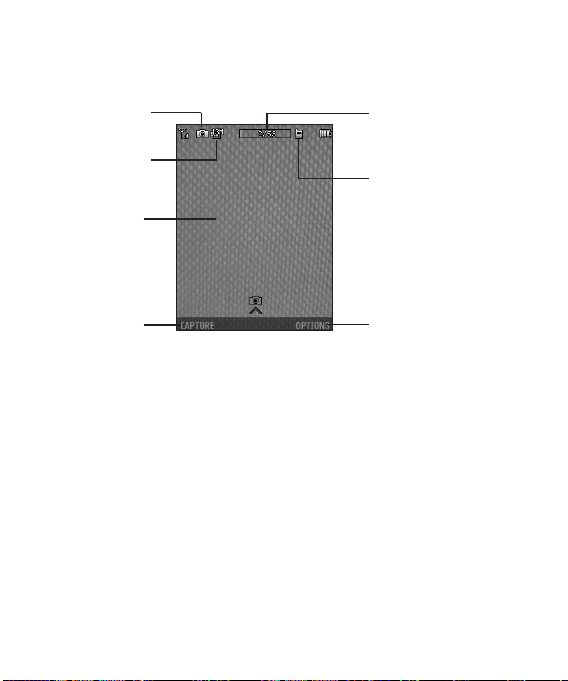
128 Section 2J: Using the Built-in Camera
Viewing Your Camera’s Status Area Display
Camera
mode
Resolution
Camera Storage
Remaining
Storage Location
Camera Options
Viewfinder
Capture

Built-in Camera
Section 2J: Using the Built-in Camera 129
Storing Pictures
Your phone’s picture storage area is called
My Albums. There are three folders in My Albums:
v
In Phone.
v
Memory Card.
v
Online Albums.
Setting Storage Options
1. Press Menu > Photo > Settings & Info > Auto-Save to.
2. Select Memory Cardor In Phone.
In Phone Folder
Your phone’s internal storage area is called the In Phone
folder. From the In Phone folder, you can view all the pictures
you have stored there, upload to your service provider’s web
site, delete files, and access additional options.
To review your pictures stored in the In Phone folder:
1. Press Menu > Photo > My Albums > In Phone.
2. Use your navigation key to view and scroll through the
pictures.

130 Section 2J: Using the Built-in Camera
Memory Card Folders
You can save pictures directly to the microSD™ card using
your phone’s pictures settings.
To review your pictures stored in the microSD™:
1. Press Menu > Photo > My Albums > Memory Card.
2. Use your Navigation key to scroll through and view
saved pictures.
In Phone Folder and Memory Card Options
When you are viewing the In Phone folder or the Memory
Card folders, press
OPTIONS(right softkey) to display the
following options:
* indicates options.
v
Send to send the image via Bluetooth® or Picture
Messaging.
v
Uploadto upload files to the Picture Messaging Web site.
Select MyUploads or My Albums and then press Continue
(if necessary) to upload the selected image(s).
v
Assign to assign as a:
n
Screen Saver to display the currently highlighted
pictures a screen saver.

Built-in Camera
Section 2J: Using the Built-in Camera 131
n
Picture ID to display the currently highlighted
picture for incoming calls from specific Contact
entries and types. Select the desired entry and
press .
v
Delete to delete the selected picture. Also, you can select
Delete selection or Delete all.
Note: Deleting pictures will free up memory space in your phone to
enable you to take more pictures. Once deleted, items cannot be
uploaded to your online Picture Messaging account.
v
Editto edit the picture with the following options:
n
Copy/Moveto copy or move to and from the In
Phone and Memory Card folders.
n
TextCaptionto edit the selected item's caption.
n
Zoom to zoom in/out of the selected item.
n
Rotate to rotate the selected item.
n
Flip to flip the photo. Options available are: None,
Flip Horizontal, Flip Vertical, Flip Both, and Close.
n
Advanced to apply lighting effects. Options
available are: Enhancement, Brightening, White
Balancing, and Local Intensity Boost.

132 Section 2J: Using the Built-in Camera
v
Effects to display the following options:
n
Image Effects to apply effects such as Antique,
Emboss, Fog, Gray Sketch, Posterize, Paint, Glow,
Stamp, Cartoon and Mirror.
n
Face Warp to apply effects such as Up Nose, Twister,
Small Nose, Wide Smile, Grit, Big Face, Professor,
Alien, Big Nose, Alien Hybrid, Gobbler, Square,
Sharp Chin, Long Faced, Happy Fool and Insect.
v
Album List to display My Albums.
v
Camera Mode to activate Camera mode.
v
Detail to display picture details.
Online Albums
Picture Messaging allows you to save your pictures to Online
Albums that make it easy to save, organize and share all your
pictures.
1. Open Online Albums (Menu > Photos > My Albums >
Online Albums
) and highlight a picture.
2. Press OPTIONS(right softkey) to display options.

Built-in Camera
Section 2J: Using the Built-in Camera 133
3. Highlight an option and press . Options are:
v
Send to send your picture.
v
Assign to assign as a:
n
Screen Saver to display the currently highlighted
pictures a screen saver.
n
Picture ID to display the currently highlighted
picture for incoming calls from specific Contact
entries and types. Select the desired entry and
press .
v
Delete to delete the selected picture. Also, you can select
Delete selection or Delete all.
v
Save To to save the selected pictures to the In Phone
folder or Memory Card folder.
v
Editto display the following options:
v
Copy/Moveto copy or move pictures to a selected
album:
n
Copy This to copy the selected pictures to another
album.

134 Section 2J: Using the Built-in Camera
n
Copy All to copy all pictures in the current album to
another album.
n
Move This to move the selected pictures to another
album.
n
Move All to move all pictures in the current album
to another album.
v
Text Caption to edit the selected item's caption.
v
Rotateallows you to rotate image and save it.
v
Album List to display the online album list. Press OPTIONS
(right softkey) > Create Album to create a new album.
v
Detail to display information such as the Caption, Model,
Taken, Resolution, File size, Quality, Location and Uploaded.
Sending a Picture Message
Once you have taken a picture , you can use the messaging
capabilities of your phone to instantly share it with family
and friends. You can send a picture to multiple recipients.
Sending Pictures From the In Phone Folder or the
Memory Card
1. Press Menu > Photo > My Albums > In Phone or
Memory Card.
Built-in Camera
Section 2J: Using the Built-in Camera 135
2. Select a picture to send and press . (The check box
in the lower right corner will be marked. You can select
multiple pictures)
3. Press OPTIONS(right softkey) > Send > Picture
Messaging
.
4. Select Go to Contacts or NEW ADDR to enter the
recipients.
n
Go to Contacts to select recipients from your
Contacts. Select a recipient and press .
n
NEW ADDR to enter a mobile phone number or an
email address directly.
5. Highlight a contact or enter a mobile number or an
email address using the keypad, and press .
6. If you wish to include a subject, highlight the Subj: field
and press
ADD (right softkey). Enter your subject using
the keypad and press
SAVE(left softkey) to save and
exit.
7. If you wish to include a text message, highlight the
Text: field and press ADD(right softkey). Enter your
message using the phone’s keypad and press
SAVE (left
softkey) to save and exit.

136 Section 2J: Using the Built-in Camera
8. If you wish to include a voice memo message with the
picture, select the
Audio: field and press . Press
DONE (left softkey) to stop recording. (The maximum
recording time is 15 seconds.)
9. Confirm the message contents.
n
To change a recipient, highlight the To: field, and
press CHANGE (right softkey), and follow the
instructions in step 5 to select or edit the recipient.
n
To change the subject, select Subj: field, and press
CHANGE (right softkey).
n
To change the text message, select the Text: field,
and press CHANGE(right softkey).
n
To change the voice memo, select the Audio: field,
press REVIEW (right softkey), and select Re-Record.
n
To change the attached picture(s), highlight the
thumbnail picture and press
CHANGE. (right
softkey). Select the picture(s) by pressing , then
and press
NEXT(left softkey).
10. Press SEND (left softkey) to send the picture. If you are
notified that “Message sent,”press
CONTINUE(left
softkey) to complete the process of sending the picture.

Section 2K: Using Bluetooth 137
Using Bluetooth
In This Section
l Turning Bluetooth On and Off
l Using the Bluetooth Settings Menu
l Bluetooth Profiles
l Pairing Bluetooth Devices
Your phone features built-in Bluetooth technology, allowing
you to share information more easily than ever before.
Bluetooth is a short-range communications technology
that allows you to connect wirelessly to a number of
Bluetooth devices, such as headsets, hands-free car kits,
Bluetooth-enabled handhelds, PCs and wireless phones.
The Bluetooth communication range is usually up to
approximately 10 meters (30 feet).
This section details how to set up and make the most of
your phone’s Bluetooth capabilities.
Using Bluetooth

138 Section 2K: Using Bluetooth
Turning Bluetooth On and Off
By default, your device’s Bluetooth functionality is
turned off. Turning Bluetooth on makes your phone
“available”to other in-range Bluetooth devices.
To turn Bluetooth on:
1. Select Menu > Bluetooth > More... > Settings > On/Off.
2. Press the navigation key up or down to select
On and press to enable Bluetooth.
To turn Bluetooth off:
1. Select Menu > Bluetooth > More... > Settings > On/Off.
2. Press the navigation key up or down to select
Offand press to disable Bluetooth.
Bluetooth Status Indicators
The following icons show your Bluetooth connection status
at a glance:
indicates Bluetooth is On. If the center of the icon
is grayed out, Bluetooth® is on, but not Visible.

Section 2K: Using Bluetooth 139
Using the Bluetooth Settings Menu
The Bluetooth Settings menu allows you to set up many of
the characteristics of your phone’s Bluetooth service,
including:
v
Entering or changing the name your phone uses for
Bluetooth communication.
v
Setting your phone’s visibility (or “discoverability”) for
other Bluetooth devices.
v
Displaying your phone’s Bluetooth address.
To access the Bluetooth Settings menu:
1. Select Menu > Bluetooth > More... > Settings.
2. Set your Bluetooth options.
n
Select Visibility > Hidden, Visible for 3 min, or
Always Visible to set your Bluetooth® visibility.
n
Select My Device Name to rename your phone for
Bluetooth®.
n
Select My Device Info to display your phone’s
Bluetooth® profiles and address.
Using Bluetooth

140 Section 2K: Using Bluetooth
n
Select Exchange Folders to display your phone's
Bluetooth® destination for files communicated
between your phone and a Bluetooth-enabled
device using the FTP transfer protocol.
n
Select Voice Priority to display your phone's
Bluetooth® preferences for incoming calls.
Bluetooth Settings: Visibility
The Visibility section of the Bluetooth settings menu allows
you to manage your phone’s visibility to other Bluetooth
devices.
To configure your phone’s visibility (discoverability) to other
Bluetooth devices:
1. Press Menu > Bluetooth > More... > Settings > Visibility.
2. Select your desired visibility setting and press :
n
Hidden to prevent other Bluetooth devices from
detecting and identifying your phone.
n
Visible for 3 Min to allow Bluetooth devices to
detect and identify your phone for three minutes.
n
Always Visible to allow Bluetooth devices to detect
and identify your phone at any time it is within
range.
Note: Any changes you make to your Bluetooth settings will be saved to
the current profile when you exit the Bluetooth settings menu.

Section 2K: Using Bluetooth 141
Bluetooth Settings: My Device Name
The Device Name section of the Bluetooth settings menu
allows you to select a Bluetooth name for your phone. Your
phone’s Bluetooth name will appear to other in-range
Bluetooth devices, depending on your visibility settings.
To set a Bluetooth name for your phone:
1. Press Menu > Bluetooth > More... > Settings > My Device
Name
.
2. Press to clear the current name.
3. Enter a new name and press SAVE(left softkey) to save
and exit.
Bluetooth Settings: My Device Information
To view your phone's Bluetooth® address and information:
©
Press Menu > Bluetooth > More... > Settings >My Device
Info
.
Bluetooth Audio Transfer Function
To use the Bluetooth Audio Transfer function during a call:
1. Check that a Bluetooth headset is connected to your
phone.
Using Bluetooth

142 Section 2K: Using Bluetooth
2. During the call, transfer the phone's sound output
from the phone to the headset (select
Transfer to
Bluetooth
); or from the headset to the phone (select
Transfer to Phone).
Bluetooth Profiles
Your phone has different Bluetooth® profiles available.
Details can be found below:
v
Headset Profile (HSP) – This profile functions as a wireless
ear jack. When an incoming call is received, the ringer can
be heard through the headset and a built-in alert tone
can be heard through the handset. The call can then be
received by pushing a button. While using the handset,
you can use the headset instead of the phone by pushing
a button on the headset, the same as inserting a jack into
the phone.
v
Hands-Free Profile (HFP) – This profile functions as a
wireless car-kit. Incoming calls ring to the hands-free
headset or device. Calls can be received by pressing a
button on the headset or device. For dialing, four
functions are supported: recent call dial, voice dial, speed
dial and number dial. Increase or decrease the volume by
using the volume key on the side of the handset.

Section 2K: Using Bluetooth 143
v
DUN: Dial-Up Network Profile – This profile functions as a
wireless data cable, connecting a PC or PDA to a network
through your handset.
v
Object Push Profile (OPP) – You can send a vCard or a
vCalendar in your phone to other Bluetooth-enabled
devices.
v
FTP – File Transfer allows sending or receiving non-
protected data files to a compatible Bluetooth® device.
v
BPP – Basic Print Profile is a profile to transfer user-
generated images to a printer and print them out.
v
A2DP – allows for the wireless transmission of stereo
audio from an A2DP source (typically a phone or
computer) to an A2DP receiver (a set of Bluetooth
headphones or stereo system).
v
AVRCP – allows Bluetooth devices to control media
playback on remote devices.
v
Phonebook Access Profile (PBAP) – This profile enables
exchange of Contacts information between devices. It is
likely to be used between a car kit and a mobile phone to
allow the car kit to display the name of the incoming
caller.
v
The Human Interface Design (HID) - profile is supported
only for keyboard input.
Using Bluetooth

144 Section 2K: Using Bluetooth
Pairing Bluetooth Devices
Add Device
The Bluetooth pairing process allows you to establish
trusted connections between your phone and another
Bluetooth device. When devices are paired, a passkey is
shared between devices, allowing for fast, secure
connections while bypassing the discovery and
authentication process.
To pair your phone with another Bluetooth device:
1. Select Menu > Bluetooth > Add New... > Search > Select
the type of device you want to Pair with.
2. Select the device you wish to pair with and press .
3. Enter the passkey (or verify the matching passkeys) and
press .

Section 3
Service Features

146 Section 3A: Service Features: The Basics
Service Features: The Basics
In This Section
l Using Voicemail
l Using SMS Text Messaging
l Using Caller ID
l Responding to Call Waiting
l Making a Three-Way Call
l Using Call Forwarding
Now that you’ve mastered your phone’s fundamentals,
it’s time to explore the calling features that enhance your
wireless service.
This section outlines your basic service
features.

Section 3A: Service Features: The Basics 147
Using Voicemail
Setting UpYour Voicemail
All unanswered calls to your phone are automatically
transferred to your voicemail, even if your phone is in use or
turned off. Therefore, you will want to set up your Voicemail
and personal greeting as soon as your phone is activated.
To set up your voicemail:
1. Press and hold .
2. Follow the system prompts to:
n
Create your passcode.
n
Record your name announcement.
n
Record your greeting.
n
Choose whether or not to activate One-Touch
Message Access (a feature that lets you access
messages simply by pressing and holding ,
bypassing the need for you to enter your passcode).
Service Features

148 Section 3A: Service Features: The Basics
Voicemail Notification
There are several ways your phone can alert you to a new
message:
v
By displaying a message on the screen.
v
By sounding the assigned ringer type.
v
By the LED blinking red.
v
By displaying at the top of your screen.
New Voicemail Message Alerts
When you receive a new voice message, your phone alerts you
and prompts you to call your voicemail.
To call your voicemail:
©
Press and hold .
Note: Your phone accepts messages even when it is turned off. However,
you are only notified of new messages when your phone is turned on and
you are in your wireless service area.
Section 3A: Service Features: The Basics 149
Retrieving Your Voicemail Messages
You can review your messages directly from your phone or
from any other touch-tone phone. To dial from your phone,
you can either speed dial your voicemail or use the phone
menus.
Using One-Touch Message Access
©
Press and hold . (Your phone will dial your
voicemail box.)
Using the Phone Menus to Access Your Messages
1. Select Menu > Messages > Voicemail.
2. Press to listen to your messages.
Note: You are charged for airtime minutes when you are accessing your
voicemail from your phone.
Service Features
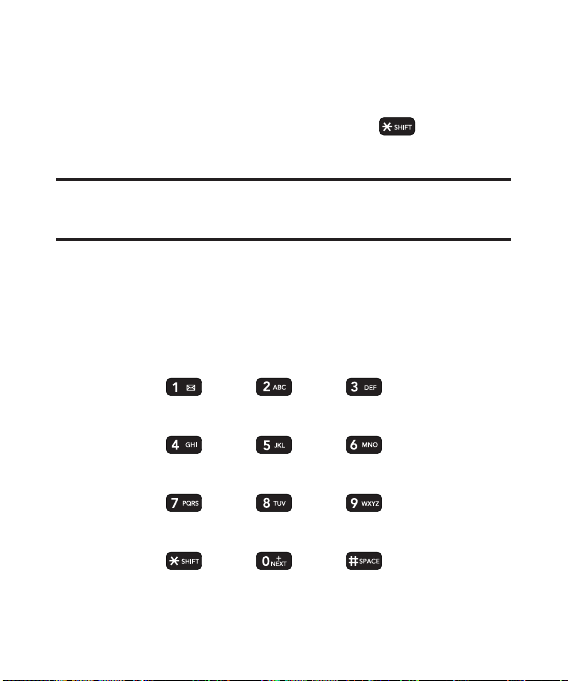
150 Section 3A: Service Features: The Basics
Using Another Touch-Tone Phone to Access Messages
1. Dial your wireless phone number.
2. When your voicemail answers, press .
3. Follow the voice prompts to access your mailbox.
Tip: When you call into voicemail, you first hear the header information
(date, time, and sender information) for the message. To skip directly to the
message, press 4during the header.
Voicemail Button Guide
Here’s a quick guide to your keypad functions while listening
to voicemail messages. For further details and menu options,
see “Voicemail Menu Key” on page 155.
Date/Time Send Reply Advance
Replay Rewind Forward
Erase Call Back Save
Cancel Help Skip
Section 3A: Service Features: The Basics 151
Voicemail Options
Your phone offers several options for organizing and
accessing your voicemail.
Using Expert Mode
Using the Expert Mode setting for your personal voicemail
box helps you navigate through the voicemail system more
quickly by shortening the voice prompts you hear at each
level.
To turn Expert Mode on or off:
1. Press and hold to access your voicemail. (If your
voicemail box contains any new or saved messages,
press to access the main voicemail menu.)
2. Press to change your Personal Options, following
the system prompts.
3. Press for Expert Mode.
4. Press to turn Expert Mode on or off.
Service Features
152 Section 3A: Service Features: The Basics
Setting Up Group Distribution Lists
Create up to 20 separate group lists, each with up to 20
customers.
1. Press and hold to access your voicemail. (If your
voicemail box contains any new or saved messages,
press to access the main voicemail menu.)
2. Press to change your Personal Options, following
the system prompts.
3. Press for “Settings”.
4. Press for Group Distribution Lists.
5. Follow the voice prompts to create, edit, rename, or
delete group lists.
Callback
Return a call after listening to a message without
disconnecting from voicemail.
©
Press after listening to a message. (Once the call
is completed, you’re returned to the voicemail main
menu.)
Section 3A: Service Features: The Basics 153
Voicemail-to-Voicemail Message
Record and send a voice message to other Voicemail users.
1. From the main voicemail menu, press to send a
message.
2. Follow the voice prompts to enter the phone number.
3. Follow the voice prompts to record and send your voice
message.
Voicemail-to-Voicemail Message Reply
Reply to a voice message received from any other Voicemail
user.
1. After listening to a voice message, press .
2. Follow the voice prompts to record and send your reply.
Voicemail-to-Voicemail Message Forwarding
Forward a voice message, except those marked “Private,”to
other Voicemail users.
1. After listening to a message, press .
2. Follow the voice prompts to enter the phone number.
3. Follow the voice prompts to record your introduction
and forward the voice message.
Service Features

154 Section 3A: Service Features: The Basics
Voicemail-to-Voicemail Receipt Request
Receive confirmation that your voice message has been
listened to when you send, forward, or reply to other users.
1. After you have recorded a message, press to
indicate you are satisfied with the message you
recorded.
2. Press to mark receipt requested.
3. Press to send your voicemail message.
Continue Recording
When leaving a voice message, you can choose to continue
recording even after you’ve stopped.
©
Before pressing to indicate that you are satisfied
with the message you recorded, press to
continue recording.
Extended Absence Greeting
When your phone is turned off or you are off the available
network for an extended period, this greeting can be played
instead of your normal personal greeting.
1. From the main voicemail menu, press for Personal
Options.
Section 3A: Service Features: The Basics 155
2. Press for Greetings.
3. Press to record an Extended Absence Greeting
and follow the voice prompts to save.
Clearing the Message Icon
Your phone may temporarily continue to display the New
Voicemail icon after you have checked your voice and text
messages.
To clear the icon from the display screen:
1. Select Menu > Messages > Voicemail > Clear Icon.
2. Select Yes or No and press .
Voicemail Menu Key
Following the prompts on the voicemail system, you can use
your keypad to navigate through the voicemail menu. The
following list outlines your phone’s voicemail menu
structure.
Listen
Date & Time Information
Reply
Advance 8 Seconds
Replay
Rewind
Service Features

156 Section 3A: Service Features: The Basics
Forward Message
Erase
Return Call
Save
Options
Send a Message
Personal Options
Settings
Skip Passcode
Auto-Play
Message Date & Time On/Off
Change Passcode
Group Distribution List
Numeric Paging On/Off
Return to Personal Options Menu
Greetings
Change Main Greeting
Change Recorded Name
Extended Absence Greeting
Return to Personal Options Menu
Expert Mode On/Off
Place a Call

Section 3A: Service Features: The Basics 157
Disconnect
Using SMS Text Messaging
With SMS Text Messaging, you can send instant text
messages from your phone to other people's messaging-
ready wireless phones -- and they can send messages to you.
When you receive a new message, you will be notified
(according to your notification settings).
In addition, SMS Text Messaging includes a variety of preset
messages, such as “I’m running late, I’m on my way,”that
make composing messages fast and easy. You can also create
and customize your preset messages (up to 100 characters)
on your phone.
Composing SMS Text Messages
1. Press Menu > Messages > Send Message > Text Message
and select the entry method you prefer:
n
Go to Contactsto select a recipient from your internal
Contacts. (Contacts entries must contain a wireless
phone number or an email address.)
n
NEW ADDR (right softkey) to use the keypad to
enter the wireless phone number or email address
of the person to whom you wish to send a message.
2. Press .
Service Features

158 Section 3A: Service Features: The Basics
3. Highlight OPTIONS and highlight and select Mark As
Urgent/Mark Not Urgent
to set the outgoing message's
priority.
4. If you wish to change your callback number, highlight
and select
Callback#and press , then select None,
My Phone Number, or Other, and press . (If you
select
Other, enter the desired number and press .)
5. Press DONE (left softkey).
6. Press SEND (left softkey) to send the message.
Accessing SMS Text Messages
To read an SMS Text message:
©
When you receive a text message, it will automatically
display a notification on your phone’s main display
screen. To view received messages, press
Menu >
Messages > Text Messages
and select the new
messages.
To reply to an SMS Textmessage:
1. Press Menu > Messages > Send Message > Text Message
and select from the list of recent contacts.

Section 3A: Service Features: The Basics 159
2. Follow steps 3-6 under "Composing SMS Text
Messages" on page 157 to complete and send your
reply.
Sending a Text Message Using the QWERTY
Keyboard
1. Slide open the QWERTY keyboard.
2. Select Text Message.
3. Select from the list of recent contacts or press NEW
ADDR
(right softkey) and:
n
Enter a wireless phone number or an email address
and press .
– or –
n
Select Go to Contacts and use the navigation key to
select a contact and
press .
4. Use the keyboard to enter your message.
5. Press SEND (left softkey).
Service Features
160 Section 3A: Service Features: The Basics
Using Preset Messages
Preset messages make sending text messages to your
friends, family, and coworkers easier than ever.
To add or edit preset messages:
1. Press Menu > Settings > Messages > Preset Messages >
ADD
(leftsoftkey).
2. Enter your new message or changes and press .
(See “Entering Text” on page 39.)
Using Caller ID
Caller ID allows people to identify a caller before answering
the phone by displaying the number of the incoming call. If
you do not want your number displayed when you make a
call, just follow these easy steps.
To block your phone number from being displayed for a specific
outgoing call:
1. Press
.
2. Then, enter the number you want to call.
3. Press
.
To permanently block your number, call your service provider.
Section 3A: Service Features: The Basics 161
Responding to Call Waiting
When you’re on a call, Call Waiting alerts you to incoming
calls by sounding two beeps. Your phone’s screen informs
you that another call is coming in and displays the caller’s
phone number (if it is available and you are in digital mode).
To respond to an incoming call while you’re on a call:
©
Press . (This puts the first caller on hold and
answers the second call.)
To switch back to the first caller:
©
Press again.
Tip: For those calls where you don’t want to be interrupted, you can
temporarily disable Call Waiting by entering
*
7 0 before the number of the
person you are calling. Call Waiting is automatically reactivated once you
end the call.
Making a Three-Way Call
With Three-Way Calling, you can talk to two people at the
same time. When using this feature, the normal airtime
rates will be charged for each of the two calls.
Service Features

162 Section 3A: Service Features: The Basics
To make a Three-Way Call:
1. Enter a number you wish to call and press .
2. Once you have established the connection, enter the
second number you wish to call and press . (This
puts the first caller on hold and dials the second
number.)
3. When you’re connected to the second party, press
again to begin your three-way call.
If one of the people you called hangs up during your call, you
and the remaining caller stay connected. If you initiated the
call and are the first to hang up, all other callers are
disconnected.
Section 3A: Service Features: The Basics 163
Using Call Forwarding
Call Forwarding lets you forward all your incoming calls to
another phone number – even when your phone is turned
off. You can continue to make calls from your phone when
Call Forwarding is activated.
To activate Call Forwarding:
1. Press
.
2. Enter the area code and phone number to which your
future calls should be forwarded.
3. Press . (You will hear a tone to confirm the
activation of Call Forwarding.)
To deactivate Call Forwarding:
1. Press
.
2. Press . (You will hear a tone to confirm the
deactivation.)
Note: You may be charged a higher rate for calls you have forwarded.
Service Features

164 Section 3B: Data Services
Data Services
In This Section
l Data Service Applications
l Getting Started With Data Services
l Downloading Content
l Exploring the Web
l Data Services FAQs
Data service offers easy and amazing features you will really
use.
These services – including messaging, games,
downloadable ringers and screen savers, and portable
Web access – let you have fun, stay in touch, and stay
informed no matter where you go on the available
network.
This section introduces these advanced services and walks
you through the necessary steps to start taking advantage
of data service.

Section 3B: Data Services 165
Data Service Applications
Here is a brief list of the application types available through
your phone. For more information, please contact your
service provider.
Games – Download exciting games with full-color graphics
and sound.
Ringers– Personalize your phone by downloading and
assigning different ringers to numbers in your Contacts.
Screen Savers –
Download unique images to use as screen
savers – or make it easy to tell who’s calling by assigning
specific images to numbers in your Contacts.
Web – Access the Internet and up-to-date news and
information from your phone.
Data Services

166 Section 3B: Data Services
Getting Started With Data Services
This section will help you learn the basics of using your
data service, including managing your user name, launching
a data connection, and navigating the Web with your phone.
Your User Name
When you buy a phone and sign up for service, you’re
automatically assigned a user name, which is typically based
on your wireless phone number.
When you use data services, your user name is submitted to
identify you to the available network. The user name is also
useful as a way to personalize services, and as an online
virtual identity.
Your user name will be automatically programmed into your
phone. You don’t have to enter it.
Finding Your User Name
If you aren’t sure what your user name is, you can easily find
it on your phone.

Section 3B: Data Services 167
To find your user name:
v
You can find your user name under the Phone Information
option in your phone’s Settings menu (Menu > Settings >
Phone Information > Version
).
Launching the Web Browser
To launch the Web Browser
©
Select Menu >Web. (Your data services connection will
open and your home page will be displayed.)
Note: If Net Guard is enabled and displayed, press Connect (left softkey)
to continue and access the Web.
While connecting, the following will appear on the screen:
Connecting...
If you had a previous data connection, you may not see the
“Connecting...”message when you launch the session.
Though the browser is open, you are not currently in an
active data session– that is, no data is being sent or received.
As soon as you navigate to another page, the active session
will open and you will see the “Connecting...”message.
Data Services

168 Section 3B: Data Services
NetGuard
When you first launch data services, the Net Guard will
appear to confirm that you want to connect. This feature
helps you avoid accidental connections. You can disable the
Net Guard in the future by selecting
Always Auto-Connect
when the Net Guard is displayed.
To change your Net Guard settings:
©
Select Menu > Settings > More... > Data > Net Guard and
choose an option:
n
On to activate the Net Guard.
n
Off to deactivate the Net Guard.
Note: When enabled, the Net Guard appears only once per
session/connection (see corresponding icon on page 169). The Net Guard
does not appear if the phone is merely reconnecting due to a time-out.

Section 3B: Data Services 169
Connection Status and Indicators
Your phone’s display lets you know the current status of your
data connection through indicators which appear at the top
of the screen. The following symbols are used:
Your data connection is active (data is being
transferred); the transmit/receive symbol will blink to
indicate data transmission. Incoming voice calls go
directly to voicemail; outgoing voice calls can be made,
but the data connection will terminate.
Your data connection is dormant. (No data is being sent
or received.) Though not currently active, when
dormant the phone can restart an active connection
quickly; voice calls can be made and received.
Your phone is not currently able to access data service
features.
If no indicator appears, your phone does not have a current
data connection.
Data Services

170 Section 3B: Data Services
Navigating Data Services
Navigating data services is easy once you’ve learned a few
basics. For more information on Web browsing, go to
"Exploring the Web on page 174". Here are some tips for
getting around:
Softkeys
While using data services, the bottom line of your phone’s
display will contain softkeys. These keys are shortcut controls
for navigation, and they correspond to the softkey buttons
directly below the phone’s display screen.
Tip: Depending on the context, the labels on the softkeys may change to
indicate their function.
To use softkeys:
©
Press the desired softkey button. (If an additional
pop-up menu appears when you press the softkey
button, select the menu items using your keypad [if
they’re numbered] or by highlighting the option and
pressing .)
Scrolling
As with other parts of your phone's menu, you'll have to
scroll up and down to see everything.

Section 3B: Data Services 171
To scroll line by line:
©
Press the navigation key up and down.
To scroll page by page:
©
Press the volume buttons on the side of the phone.
Selecting
Once you've learned how to use the softkeys and scroll, you
can start navigating through the Web.
To select onscreen items:
©
Use the
navigation
key to highlight the desired item,
and then press the desired softkey button (or press
)
.
Tip: You’ll find thatthe left softkey is used primarily for selecting items.
This softkey is often labeled “OK.”
Tip: If the items on a page are numbered, you can use your keypad
(number keys) to select an item. (The tenth item in a numbered list may be
selected by pressing the 0 key on your phone’s keypad, even though the
number 0 doesn’t appear on the screen.)
Links appear as underlined text.
To select links:
©
Highlight the link and press the appropriate softkey.
Data Services
172 Section 3B: Data Services
Going Back
To go back one page:
©
Press the key on your phone.
Note: The BACK key is also used for deleting text (like a BACKSPACE key)
when you are entering text.
Going Home
To return to the home page:
©
Press and hold .
– or –
Press
OPTIONS(right softkey) and select Home ( ).
Downloading Content
With data services and your new phone, you have access to a
dynamic variety of Premium Service content, such as
downloadable Games, Ringers, Screen Savers, and other
applications.
Accessing the Download Menus
To access the download menus:
1. Select Menu > My Stuff.

Section 3B: Data Services 173
2. Select the type of content you wish to download
(
Games, Ringers, ScreenSavers, or Applications), and
then select
Get New. (Data Services will start and take
you to the corresponding download menu.)
To access the download menus from the Web browser:
1. From the home page, select Ringers, ScreenSavers,
Applicationsor Games.
Downloading an Item
Once you’ve selected an item you wish to download,
highlight it and press . You will see a summary page for
the item including its title, the download detail, and the cost.
Select the Purchase link below the price to view the purchase
confirmation page. Once on the purchase confirmation
page, you will be shown more details about the download, as
well as a link to view Terms & Conditions associated with the
content.
To download a selected item:
1. From the information page, select the Ok link.
(The item will download automatically).
2. Select an option to continue:
Data Services

174 Section 3B: Data Services
n
Select Use/Run/View to assign the downloaded
item (or to start it, in the case of a game or
application). Your data session will end and you will
be redirected to the appropriate phone menu
screen.
n
Select Set as to assign a ringer or screen saver to a
phone function.
n
Select Settings to configure downloaded games or
applications.
n
Select Shop to browse for other items to download.
n
Press to quit the browser and return to
standby mode.
For complete information and instructions on downloading
Games, Ringers and Screen Savers, contact your service
provider.
Exploring the Web
With Web access on your phone, you can browse full-color
graphic versions of your favorite Web sites, making it easier
than ever to stay informed while on the go. Follow sports
scores, breaking news and weather, and shop on your phone
anywhere on the available network.

Section 3B: Data Services 175
In addition to the features already covered in this section, the
Data service home page offers access to these colorful,
graphically rich Web categories, which may include
News,
Weather, Entertainment, Sports, Money, Travel, Shopping,
and
Tools, as well as other useful options such as Search. Many
sites are available under more than one menu – choose the
one that’s most convenient for you.
Using the Browser Menu
Although the home page offers a broad and convenient array
of sites and services for you to browse, not all sites are
supported, and certain functions are not available. While
navigating, the browser menu offers additional options to
expand your use of the Web on your phone.
Opening the Browser Menu
You may open the browser menu anytime you're using the
Browser, from any page you are viewing.
To open the browser menu:
©
Press OPTIONS (right softkey). (You will see the browser
menu.)
Options available under the browser menu include:
v
BACK to go back to the most recent web page.
Data Services

176 Section 3B: Data Services
v
FORWARDto move to a previously viewed page (after
having used
BACK option).
v
MY HOMEPAGE to go back to the home page.
v
MY PAGES to view your favorites and recently viewed
pages.
v
SEARCHto search the Internet.
v
OPTIONSto choose font size, privacy settings, etc.
Going to a Specific Web site
To go to a particular Web site by entering a URL (Web site
address):
1. Highlight the URL field and press .
2. Use your keypad or Qwerty to enter a website address.
3. Press to go to the website.
Note: Notall Web sites are viewable on your phone.
Resetting the Browser
If the browser appears to be malfunctioning or stops
responding, you can often fix the problem by simply
restarting the browser.

Section 3B: Data Services 177
To reset the browser:
1. Press OPTIONS (right softkey) to open the browser
menu.
2. Select OPTIONS > Advanced > Reset browser.
Note: A warning pop up message will appear stating that your data
(including favorites) will be deleted.
3. Press RESET (left softkey) to proceed.
Data Services FAQs
How will I know when my phone is ready for data service?
Your user name will be displayed when you access Menu >
Settings > Phone Info > Version.
How do I sign in for the first time?
You are automatically signed in to access data services when
you use Browser menu or send/receive picture messaging.
How do I know when my phone is connected to data services?
Your phone automatically connects when data service is used
or an incoming message arrives. Your phone will also display
the icon. (Connecting takes about 10-12 seconds.)
Data Services

178 Section 3B: Data Services
Can I make calls and use data services at the same time?
You cannot use voice and data services simultaneously. If you
receive a call while data service is active, the call will be
forwarded to voicemail. You can place an outgoing call
anytime, but it will interrupt any in-progress data session.
When is my data connection active?
Your connection is active when data is being transferred.
Incoming calls go directly to voicemail. When active, the
indicator flashes on your phone’s display screen.
When is my data connection dormant?
If no data is received for 10 seconds, the connection goes
dormant. When the connection is dormant, voice calls are
allowed. (The connection may become active again quickly.)
If no data is received for an extended period, the connection
will be terminated.
Can I sign out of data services?
You can sign out without turning off your phone; however,
you will not be able to use Web or other data services. While
signed out, you can still place or receive phone calls, check
voicemail, and use other voice services. You may sign in again
at any time. To sign out, go to
Menu > Settings > More... > Data
> On/Off
(and select Off) in your phone’s menu.

Section 3C: Music and Your Player 179
Music and Your Player
In This Section
l Playing Music on Your Phone
With Rumor
2
you have your music in the palm of your hand.
The Music Manager works hand in hand with Rumor
2
to
help keep your music files organized and in your phone.

180 Section 3C: Music and Your Player
Playing Music on Your Phone
The Media Player allows you use your phone to play the
music files you have saved on your microSD™ card.
1. Press Menu > Media Player.
2. Using your navigation key, highlight the music file you
would like to play and press .
3. For additional playback and information options, press
OPTIONS(right softkey) and select a menu item.

Section 4
Safety and Warranty
Information

182 Section 4A: Important Safety Information
Important Safety Information
In This Section
l General Precautions
l Maintaining Safe Use of and Access to Your Phone
l Using Your Phone With a Hearing Aid Device
l Caring for the Battery
l Radiofrequency (RF) Energy
l Owner’s Record
l Phone Guide Proprietary Notice
This phone guide contains important operational and safety
information that will help you safely use your phone.
Failure
to read and follow the information provided in this phone
guide may result in serious bodily injury, death, or
property damage.

Section 4A: Important Safety Information 183
General Precautions
There are several simple guidelines to operating your phone properly and
maintaining safe, satisfactory service.
v
Hold the phone with the antenna raised, fully extended, and over your
shoulder.
v
Try not to hold, bend, or twist the phone’s antenna.
v
Don’t use the phone if the antenna is damaged.
v
Speak directly into the mouthpiece.
v
Avoid exposing your phone and accessories to rain or liquid spills. If
your phone does get wet, immediately turn the power off and
remove the battery.
v
Although your phone is quite sturdy, it is a complex piece of
equipment and can be broken. Avoid dropping, hitting, bending, or
sitting on it.
v
Any changes or modifications to your phone not expressly approved
in this document could void your warranty for this equipment and
void your authority to operate this equipment.
Note: For the best care of your phone, only authorized personnel should service your
phone and accessories. F
ailure to do so may be dangerous and void your warranty.
Important Safety Information

184 Section 4A: Important Safety Information
Maintaining Safe Use of and Access to
Your Phone
Do Not Rely on Your Phone for Emergency Calls
Mobile phones operate using radio signals, which cannot guarantee
connection in all conditions. Therefore, you should never rely solely upon
any mobile phone for essential communication (e.g., medical
emergencies). Emergency calls may not be possible on all cellular
networks or when certain network services and/or mobile phone features
are in use. Check with your local service provider for details.
Using Your Phone While Driving
Talking on your phone while driving (or operating the phone without a
hands-free device) is prohibited in some jurisdictions. Laws vary as to
specific restrictions. Remember that safety always comes first.
Following Safety Guidelines
To operate your phone safely and efficiently, always follow any special
regulations in a given area. Turn your phone off in areas where use is
forbidden or when it may cause interference or danger.
Using Your Phone Near Other Electronic Devices
Most modern electronic equipment is shielded from radiofrequency (RF)
signals. However, RF signals from wireless phones may affect
inadequately shielded electronic equipment.
RF signals may affect improperly installed or inadequately shielded
electronic operating systems and/or entertainment systems in motor
vehicles. Check with the manufacturer or their representative to
determine if these systems are adequately shielded from external RF
Section 4A: Important Safety Information 185
signals. Also check with the manufacturer regarding any equipment that
has been added to your vehicle.
Consult the manufacturer about any personal medical devices, such as
pacemakers and hearing aids, to determine if they are adequately
shielded from external RF signals.
Note: Always turn off the phone in health-care facilities and request permission
before using the phone near medical equipment.
Turning Off Your Phone Before Flying
Turn off your phone before boarding any aircraft. To prevent possible
interference with aircraft systems, the U.S. Federal Aviation
Administration (FAA) regulations require you to have permission from a
crew member to use your phone while the plane is on the ground. To
prevent any risk of interference, FCC regulations prohibit using your
phone while the plane is in the air.
Turning Off Your Phone in Dangerous Areas
To avoid interfering with blasting operations, turn your phone off when in
a blasting area or in other areas with signs indicating two-way radios
should be turned off. Construction crews often use remote-control RF
devices to set off explosives.
Turn your phone off when you’re in any area that has a potentially
explosive atmosphere. Although it’s rare, your phone and accessories
could generate sparks. Sparks can cause an explosion or fire, resulting in
bodily injury or even death. These areas are often, but not always, clearly
marked. They include:
v
Fueling areas such as gas stations.
v
Below deck on boats.
v
Fuel or chemical transfer or storage facilities.
Important Safety Information

186 Section 4A: Important Safety Information
v
Areas where the air contains chemicals or particles such as grain, dust,
or metal powders.
v
Any other area where you would normally be advised to turn off your
vehicle’s engine.
Note: Never transport or store flammable gas, flammable liquid, or explosives in the
compartment of your vehicle that contains your phone or accessories.
Restricting Children’s Access to Your Phone
Your phone is not a toy. Do not allow children to play with it as they could
hurt themselves and others, damage the phone or make calls that use
your airtime balance.
Using Your Phone With a Hearing Aid
Device
A number of phones offered by your service provider have been tested for
hearing aid device compatibility. When some wireless phones are used
with certain hearing devices (including hearing aids and cochlear
implants), users may detect a noise which can interfere with the
effectiveness of the hearing device.
Some hearing devices are more immune than others to this interference
noise, and phones also vary in the amount of interference noise they may
generate. ANSI standard C63.19 was developed to provide a standardized
means of measuring both wireless phone and hearing devices to
determine usability rating categories for both.
Ratings have been developed for mobile phones to assist hearing device
users find phones thatmay be compatible with their hearing device. Not
all phones have been rated for compatibility with hearing devices. Phones

Section 4A: Important Safety Information 187
that have been rated have a label located on the box. Your Rumor
2
has an
M3 and a T3 rating.
These ratings are not guarantees. Results will vary depending on the
user’s hearing device and individual type and degree of hearing loss. If a
hearing device is particularly vulnerable to interference noise; even a
phone with a higher rating may still cause unacceptable noise levels in the
hearing device. Trying out the phone with your hearing device is the
bestway to evaluate it for your personal needs.
M-Ratings: Phones rated M3 or M4 meet FCC requirements for hearing aid
compatibility and are likely to generate less interference to hearing
devices than unrated phones. (M4 is the better/higher of the two ratings.)
T-Ratings: Phones rated T3 or T4 meet FCC requirements and are likely to
be more usable with a hearing device’s telecoil (“T Switch”or “Telephone
Switch”) than unrated phones. (T4 is the better/higher of the two ratings.
Note that not all hearing devices have telecoils in them.)
Caring for the Battery
Protecting Your Battery
The guidelines listed below help you get the most out of your battery’s
performance.
v
Recently there have been some public reports of wireless phone
batteries overheating, catching fire or exploding. It appears that
many, if not all, of these reports involve counterfeit or inexpensive,
aftermarket-brand batteries with unknown or questionable
manufacturing standards. LG is not aware of similar problems with LG
phones resulting from the proper use of batteries and accessories
approved by LG. Use only approved batteries and accessories found
through LG. Buying the right batteries and accessories is the best way
to ensure they’re genuine and safe.
Important Safety Information

188 Section 4A: Important Safety Information
v
In order to avoid damage, charge the battery only in temperatures that
range from 32° F to 113° F (0° C to 45° C).
v
Don’t use the battery charger in direct sunlight or in high humidity
areas, such as the bathroom.
v
Never dispose of the battery by incineration.
v
Keep the metal contacts on top of the battery clean.
v
Don’t attempt to disassemble or short-circuit the battery.
v
The battery may need recharging if it has not been used for a long
period of time.
v
It’s best to replace the battery when it no longer provides acceptable
performance. It can be recharged hundreds of times before it needs
replacing.
v
Don’t store the battery in high temperature areas for long periods of
time. It’s best to follow these storage rules:
Less than one month:
-4° F to 140° F (-20° C to 60° C)
More than one month:
-4° F to 113° F (-20° C to 45° C)
Disposal of Lithium Ion (Li-Ion) Batteries
Do not handle a damaged or leaking Li-Ion battery as you can be burned.
For safe disposal options of your Li-Ion batteries, contact your nearest
authorized service center.
Special Note: Be sure to dispose of your battery properly. In some areas,
the disposal of batteries in household or business trash may be
prohibited.

Section 4A: Important Safety Information 189
Radiofrequency (RF) Energy
Understanding How Your Phone Operates
Your phone is basically a radio transmitter and receiver. When it’s turned
on, it receives and transmits radiofrequency (RF) signals. When you use
your phone, the system handling your call controls the power level. This
power can range from 0.006 watts to 0.2 watts in digital mode.
Knowing Radiofrequency Safety
The design of your phone complies with updated NCRP standards
described below.
In 1991-92, the Institute of Electrical and Electronics Engineers (IEEE) and
the American National Standards Institute (ANSI) joined in updating
ANSI’s 1982 standard for safety levels with respect to human exposure to
RF signals. More than 120 scientists, engineers and physicians from
universities, government health agencies and industries developed this
updated standard after reviewing the available body of research. In 1993,
the Federal Communications Commission (FCC) adopted this updated
standard in a regulation. In August 1996, the FCC adopted hybrid
standard consisting of the existing ANSI/IEEE standard and the guidelines
published by the National Council of Radiation Protection and
Measurements (NCRP).
Body-Worn Operation
To maintain compliance with FCC RF exposure guidelines, if you wear a
handset on your body, use the supplied or approved carrying case, holster
or other body-worn accessory. If you do not use a body-worn accessory,
ensure the antenna is at least 7/16 inch (1.5 centimeters) from your body
when transmitting. Use of non- approved accessories may violate FCC RF
exposure guidelines.
Important Safety Information

190 Section 4A: Important Safety Information
For more information about RF exposure, visit the FCC Web site at
www.fcc.g ov.
Specific Absorption Rate (SAR) for Wireless Phones
The SAR is a value that corresponds to the relative amount of RF energy
absorbed in the head of a user of a wireless handset.
The SAR value of a phone is the result of an extensive testing, measuring
and calculation process. It does not represent how much RF the phone
emits. All phone models are tested at their highest value in strict
laboratory settings. But when in operation, the SAR of a phone can be
substantially less than the level reported to the FCC. This is because of a
variety of factors including its proximity to a base station antenna, phone
design and other factors. What is important to remember is that each
phone meets strict federal guidelines. Variations in SARs do not represent
a variation in safety.
All phones must meet the federal standard, which incorporates a
substantial margin of safety. As stated above, variations in SAR values
between different model phones do not mean variations in safety. SAR
values at or below the federal standard of 1.6 W/kg are considered safe for
use by the public.
The highest reported SAR values of the
Rumor
2
are:
Head: 1.51W/kg; Body-worn: 1.10W/kg
FCC Radiofrequency Emission
This phone meets the FCC Radiofrequency Emission Guidelines.
FCC ID number:
BEJAX265.
More information on the phone’s SAR can be found from the following
FCC Web site:
http:/
/www.f cc.gov/oet/fccid
.

Section 4A: Important Safety Information 191
Note: Bluetooth QD ID (Qualified Design ID) is mandatory marking by
Bluetooth SIG (Bluetooth Special Interest Group) for all models supporting
Bluetooth.
Bluetooth QD ID B014503
Owner’s Record
The model number, regulatory number and serial number are located on a
nameplate inside the battery compartment. Record the serial number in
the space provided below. This will be helpful if you need to contact us
about your phone in the future.
Model: Rumor
2
by LG®
Serial No.:
Phone Guide Proprietary Notice
CDMA Technology is licensed by QUALCOMM Incorporated under one or
more of the following patents:
4,901,307 5,109,390 5,267,262 5,416,797
5,506,865 5,544,196 5,657,420 5,101,501
5,267,261 5,414,796 5,504,773 5,535,239
5,600,754 5,778,338 5,228,054 5,337,338
5,710,784 5,056,109 5,568,483 5,659,569
5,490,165 5,511,073
T9 Text Input is licensed by Tegic Communications and is covered by U.S.
Pat. 5,818,437, U.S. Pat. 5,953,541, U.S. Pat. 6,011,554 and other patents
pending.
Important Safety Information

192 Section 4B: Manufacturer’s Warranty
Manufacturer’s Warranty
In This Section
l Manufacturer’s Warranty
Your phone has been designed to provide you with reliable,
worry-free service.
If for any reason you have a problem
with your equipment, please refer to the manufacturer’s
warranty in this section.

Section 4B: Manufacturer’s Warranty 193
Manufacturer’s Warranty
1. WHAT THIS WARRANTY COVERS:
LG offers you a limited warranty that the enclosed subscriber unit, and its
enclosed accessories, will be free from defects in material and
workmanship, according to the following terms and conditions:
(1) The limited warranty for the unit and enclosed accessories shall be a
period of one (1) year from the date of original purchase. The
remaining warranty period for the unit being repaired or replaced shall
be determined by presentation of the original sales receipt for the
purchase of the unit.
(2)The limited warranty extends only to the original purchaser of the
product and is not assignable or transferable to any subsequent
purchaser / end user.
(3)The limited warranty is good only to the original purchaser of the
product during the warranty period as long as it is in the U.S., including
Alaska, Hawaii, U.S. Territories, and all Canadian Provinces.
(4)The external housing and cosmetic parts shall be free of major defects
at the time of shipment and, therefore, shall not be covered under
these limited warranty terms.
(5)Upon request from LG, the consumer must provide information
satisfactory to LG to prove the date of purchase or exchange.
(6) The customer shall bear the cost of shipping the product to the
Customer Service Department of LG. LG shall bear the cost of shipping
the product back to the consumer after the completion of service
under this limited warranty.
Warranty

194 Section 4B: Manufacturer’s Warranty
2. WHAT THIS WARRANTY DOES NOT COVER:
(1) Defects or damage resulting from use of the product in ways other
than its intended manner.
(2) Defect or damage from abnormal use, abnormal conditions, improper
storage, exposure to moisture or dampness, unauthorized
modifications, unauthorized connections, unauthorized repair,
misuse, neglect, abuse, accident, alteration, improper installation, or
other acts which are not the fault of LG, including damage caused by
shipping, blown fuses, or spills of food or liquid.
(3) Breakage or damage to antennas unless caused directly by defects in
material or workmanship.
(4) Alleged defects or malfunctions of the product if the Customer Service
Department at LG was not notified by the consumer during the
applicable limited warranty period.
(5)Products which have had the serial number removed or made illegible.
(6) This limited warranty is in lieu of all other warranties, expressed or
implied, either in fact or by operations of law, statutory or otherwise,
including, but not limited to, any implied warranty of marketability,
merchantability, or fitness for a particular use.
(7)Damage resulting from use of non-LG approved accessories.
(8) All plastic surfaces and all other externally exposed parts that are
scratched or damaged due to normal customer use.
(9) Products operated outside published maximum ratings.
(10) Products used or obtained in a rental program.
(11) Consumables (such as fuses).

Section 4B: Manufacturer’s Warranty 195
3. WHAT LG WILL DO:
LG will, at its sole option, either repair, replace or refund the purchase
price of any unit that does not conform to this limited warranty. LG may
choose at its option to use functionally equivalent re-conditioned,
refurbished or new units or parts or any units. In addition, LG will not re-
install or back-up any data, applications or software that you have added
to your phone. It is therefore recommended that you back-up any such
data or information prior to sending the unit to LG to avoid the permanent
loss of such information.
4. STATE LAW RIGHTS:
No other express warranty is applicable to this product. THE DURATION
OF ANY IMPLIED WARRANTIES, INCLUDING THE IMPLIED WARRANTY OF
MARKETABILITY OR MERCHANTABILITY, IS LIMITED TO THE DURATION OF
THE EXPRESS WARRANTY HEREIN. LG SHALL NOT BE LIABLE FOR THE LOSS
OF THE USE OF THE PRODUCT, INCONVENIENCE, LOSS OR ANY OTHER
DAMAGES, DIRECT OR CONSEQUENTIAL, ARISING OUT OF THE USE OF, OR
INABILITY TO USE, THIS PRODUCT OR FOR ANY BREACH OF ANY EXPRESS
OR IMPLIED WARRANTY, INCLUDING THE IMPLIED WARRANTY OF
MARKETABILITY OR MERCHANTABILITY APPLICABLE TO THIS PRODUCT.
Some states do not allow the exclusion of limitation of incidental or
consequential damages or limitations on how long an implied warranty
lasts; so these limitations or exclusions may not apply to you. This
warranty gives you specific legal rights and you may also have other
rights, which vary from state to state.
Warranty

196 Section 4B: Manufacturer’s Warranty
5. HOW TO GET WARRANTY SERVICE:
To obtain warranty service, please call the following telephone number
from anywhere in the continental United States:
LG Electronics Service
201 James Record Road
Huntsville, AL 35824
Tel. 1-800-793-8896 Email:
http://us.lgservice.com
Please call or write for the location of the LGE authorized service center
nearest you and the procedures for obtaining warranty claims.

Index 197
A
Adding a New Contacts
Entry 91
Adding a Phone Number 94
Airplane/Music Mode 61
Alarm Clock 106
Answering Calls 29
Assigning Speed Dial
Numbers 96
B
Battery 21-24
Capacity 21
Charging 23
Installing 22
Removing 22
Bluetooth 137-144
Pairing 144
Turning Bluetooth On and
Off 138
Bluetooth Profiles 142
Bluetooth Settings 139
Browser Menu 175
C
Calculator 108
Calendar 101-105
Call History 83-89
Erasing 89
Making a Call From 86
Prepending a Phone
Number 88
Saving a Phone Number
From 87
Call History Options 85
Call Waiting 161
Caller ID 160
Calling Emergency Numbers
31
Contacts Entry Options 93
D
Data Services 164
Dialing Options 28
Dialing Services 99
Display Screen 14
Display Settings 52
E
Editing a Contacts 95
Editing a Contacts Entry 98
End-of-Call Options 33
Entering Text 39-45
Abc Mode 42
Index

198 Index
Preset Messages 43
Symbols 43
Ez Tip Calculator 108
F
Features 17
Finding Contacts Entries 92
Front View 9
G
Getting Help 5
Getting Started 3
I
In-Call Options 32
Introduction i
K
Key Functions 10
L
Location Settings 57
Lock Code
Changing 70
Locking Your Phone 69
M
Making Calls 27
Menu ii
Messaging Settings 58
microSD Card 115
microSD Card and Adapter
116
microSD Folders 119
microSD Settings 118
Missed Call Notification 30
N
Notepad 107
P
Phone Number
Displaying 26
Finding 35
Saving 34
Phone Setup Options 64
Q
QWERTY® Keyboard 44
R
Roaming Experience 76
S
Saving a Phone Number 34
Security 68-75
Security Menu 69

Index 199
Selecting a RingerType for an
Entry 98
Send All Contacts 97
Sending a Picture Message
134
Setting Up Service 2
Setting Up Your Voicemail 4
Setting Your Phone’s Roam
Mode 79
SMS TextMessaging 157-
163
Sound Settings 47
Special Numbers 71
Storing Pictures and Videos
129
T
Taking Camera 123
The Basics 8
TTY 62
Turning Your Phone Off 21
Turning Your Phone On and
Off 20
U
Understanding Roaming 77
Unlocking Your Phone 70
Using Call Guard 80
Using Contacts 90
Using Data Roam Guard 82
Using the Charger 24
V
Viewing History 84
Voice Memos 112-114
Voice Services 111-114
Voicemail
Menu Key 155
Options 151
Retrieving 149
Setting Up 147
W
Warranty 192
Index

MEMO

MEMO

R
R
u
u
m
m
o
o
r
r
2
2
M
M
a
a
n
n
u
u
a
a
l
l
d
d
e
e
l
l
u
u
s
s
u
u
a
a
r
r
i
i
o
o

Tabla de contenidos
Introducción . . . . . . . . . . . . . . . . . . . . . . . . . . . . . . . . . . . . . .i
El menú de su teléfono . . . . . . . . . . . . . . . . . . . . . . . . . . . . .ii
Para empezar . . . . . . . . . . . . . . . . . . . . . . . . . . . . . . . . . . . . .1
Configuración del servicio . . . . . . . . . . . . . . . . . . . . . . . . . . . . . .2
Para empezar . . . . . . . . . . . . . . . . . . . . . . . . . . . . . . . . . . . . . . . . . . . . . . .3
Configuración de su correo de voz . . . . . . . . . . . . . . . . . . . . . . . . . . . .4
Para obtener ayuda . . . . . . . . . . . . . . . . . . . . . . . . . . . . . . . . . . . . . . . . . .5
Su teléfono . . . . . . . . . . . . . . . . . . . . . . . . . . . . . . . . . . . . . . .7
Su teléfono: aspectos básicos . . . . . . . . . . . . . . . . . . . . . . . . . . .8
Vista frontal de su teléfono . . . . . . . . . . . . . . . . . . . . . . . . . . . . . . . . . .9
Ver la pantalla de visualización . . . . . . . . . . . . . . . . . . . . . . . . . . . . . .14
Características de su teléfono . . . . . . . . . . . . . . . . . . . . . . . . . . . . . . .17
Apagar y encender el teléfono . . . . . . . . . . . . . . . . . . . . . . . . . . . . . .20
Uso de la batería y cargador de su teléfono . . . . . . . . . . . . . . . . . . .21
Navegación por los menús del teléfono . . . . . . . . . . . . . . . . . . . . . .25
Para mostrar su número de teléfono . . . . . . . . . . . . . . . . . . . . . . . . .26
Hacer y recibir llamadas . . . . . . . . . . . . . . . . . . . . . . . . . . . . . . . . . . . .27
Introducción de texto . . . . . . . . . . . . . . . . . . . . . . . . . . . . . . . . . . . . . .41
Control de la configuración de su teléfono . . . . . . . . . . . . . . .48
Configuración de sonido . . . . . . . . . . . . . . . . . . . . . . . . . . . . . . . . . . . .49
Configuración de pantalla . . . . . . . . . . . . . . . . . . . . . . . . . . . . . . . . . .54
Configuración de la ubicación . . . . . . . . . . . . . . . . . . . . . . . . . . . . . . .59

Configuración de mensajes . . . . . . . . . . . . . . . . . . . . . . . . . . . . . . . . .60
Modo de Avión/Música . . . . . . . . . . . . . . . . . . . . . . . . . . . . . . . . . . . . .63
Uso de TTY con el servicio . . . . . . . . . . . . . . . . . . . . . . . . . . . . . . . . . . .64
Opciones de configuración del teléfono . . . . . . . . . . . . . . . . . . . . .66
Configuración de la seguridad de su teléfono . . . . . . . . . . . .70
Acceder al menú Seguridad . . . . . . . . . . . . . . . . . . . . . . . . . . . . . . . . .71
Uso de la función de bloqueo del teléfono . . . . . . . . . . . . . . . . . . . .72
Uso de números especiales . . . . . . . . . . . . . . . . . . . . . . . . . . . . . . . . .74
Borrar contenido de teléfono . . . . . . . . . . . . . . . . . . . . . . . . . . . . . . .75
Restablecer la cuenta de correo de imagen . . . . . . . . . . . . . . . . . . .76
Restablecer la configuración predeterminada . . . . . . . . . . . . . . . .76
Restaurar el teléfono . . . . . . . . . . . . . . . . . . . . . . . . . . . . . . . . . . . . . . .77
Control de su experiencia en roaming . . . . . . . . . . . . . . . . . . .78
Comprensión de roaming . . . . . . . . . . . . . . . . . . . . . . . . . . . . . . . . . . .79
Configuración del modo roaming de su teléfono . . . . . . . . . . . . .81
Control de los cargos por roaming con Protección de llamada .82
Uso de Protección de Roaming de Datos . . . . . . . . . . . . . . . . . . . . .83
Administración del historia . . . . . . . . . . . . . . . . . . . . . . . . . . . .84
Ver el historial . . . . . . . . . . . . . . . . . . . . . . . . . . . . . . . . . . . . . . . . . . . . .85
Opciones del historial . . . . . . . . . . . . . . . . . . . . . . . . . . . . . . . . . . . . . .86
Hacer una llamada desde el Historial . . . . . . . . . . . . . . . . . . . . . . . .87
Ver la secuencia del historial . . . . . . . . . . . . . . . . . . . . . . . . . . . . . . . .87
Guardar un número de teléfono del Historial . . . . . . . . . . . . . . . .88
Agregar prefijo a un número de teléfono del Historial . . . . . . . . .90
Borrar el historial . . . . . . . . . . . . . . . . . . . . . . . . . . . . . . . . . . . . . . . . . . .91

Uso de los contactos . . . . . . . . . . . . . . . . . . . . . . . . . . . . . . . . . .92
Agregar una nueva entrada de contactos . . . . . . . . . . . . . . . . . . . .93
Búsqueda de contactos de las entradas . . . . . . . . . . . . . . . . . . . . . .94
Opciones de entradas de contactos . . . . . . . . . . . . . . . . . . . . . . . . . .95
Agregar un número a una entrada de contactos . . . . . . . . . . . . . .96
Editar los números de una entrada de contactos . . . . . . . . . . . . .97
Asignación de números de marcado rápido . . . . . . . . . . . . . . . . . .98
Enviar todos los contactos . . . . . . . . . . . . . . . . . . . . . . . . . . . . . . . . .100
Edición de una entrada de contacto . . . . . . . . . . . . . . . . . . . . . . . .101
Selección de un tipo de timbre para una entrada . . . . . . . . . . . .102
Marcación a Servicios . . . . . . . . . . . . . . . . . . . . . . . . . . . . . . . . . . . . .103
Uso del calendario y herramientas del teléfono . . . . . . . . .104
Uso del calendario del teléfono . . . . . . . . . . . . . . . . . . . . . . . . . . . .105
Despertador . . . . . . . . . . . . . . . . . . . . . . . . . . . . . . . . . . . . . . . . . . . . . .110
Bloc de notas . . . . . . . . . . . . . . . . . . . . . . . . . . . . . . . . . . . . . . . . . . . . .111
Uso de las herramientas del teléfono . . . . . . . . . . . . . . . . . . . . . . .112
Uso de los servicios de voz de su teléfono . . . . . . . . . . . . . . .116
Administración de los memorándums de voz . . . . . . . . . . . . . . .117
Uso de la Tarjeta microSD™ . . . . . . . . . . . . . . . . . . . . . . . . . . .120
Uso del telefono y la tarjeta microSD™ Adapter . . . . . . . . . . . . .121
Configuración microSD™ . . . . . . . . . . . . . . . . . . . . . . . . . . . . . . . . . .123
Carpetas microSD™ . . . . . . . . . . . . . . . . . . . . . . . . . . . . . . . . . . . . . . .124
Conexión del teléfono a su ordenador . . . . . . . . . . . . . . . . . . . . . .125
Uso de la Cámara . . . . . . . . . . . . . . . . . . . . . . . . . . . . . . . . . . . .127
Tomando Fotos . . . . . . . . . . . . . . . . . . . . . . . . . . . . . . . . . . . . . . . . . . .128

El almacenamiento de fotos . . . . . . . . . . . . . . . . . . . . . . . . . . . . . . .135
Envío de mensajes de foto . . . . . . . . . . . . . . . . . . . . . . . . . . . . . . . . .140
Uso de Bluetooth . . . . . . . . . . . . . . . . . . . . . . . . . . . . . . . . . . . .144
Apagar y encender Bluetooth . . . . . . . . . . . . . . . . . . . . . . . . . . . . . .145
Uso del menú de configuración de Bluetooth . . . . . . . . . . . . . . .146
Perfiles de Bluetooth . . . . . . . . . . . . . . . . . . . . . . . . . . . . . . . . . . . . . .150
Emparejar dispositivos Bluetooth . . . . . . . . . . . . . . . . . . . . . . . . . .152
Características del servicio . . . . . . . . . . . . . . . . . . . . . . .153
Características del servicio: aspectos básicos . . . . . . . . . . .154
Uso del correo de voz . . . . . . . . . . . . . . . . . . . . . . . . . . . . . . . . . . . . . .155
Uso de la mensajería de texto SMS . . . . . . . . . . . . . . . . . . . . . . . . .165
Uso de Id. de Llamada . . . . . . . . . . . . . . . . . . . . . . . . . . . . . . . . . . . . .169
Responder a Llamada en espera . . . . . . . . . . . . . . . . . . . . . . . . . . . .170
Hacer una Llamada a tres (Convocatoria de tres vías) . . . . . . . .171
Uso de desvío de llamadas . . . . . . . . . . . . . . . . . . . . . . . . . . . . . . . .172
Servicio de datos . . . . . . . . . . . . . . . . . . . . . . . . . . . . . . . . . . . .173
Servicio de Aplicación de datos . . . . . . . . . . . . . . . . . . . . . . . . . . . .174
Para empezar . . . . . . . . . . . . . . . . . . . . . . . . . . . . . . . . . . . . . . . . . . . . .175
Descarga de contenido de servicios Premium . . . . . . . . . . . . . . .181
Exploración de la Web . . . . . . . . . . . . . . . . . . . . . . . . . . . . . . . . . . . . .184
Preguntas frecuentes sobre . . . . . . . . . . . . . . . . . . . . . . . . . . . . . . .187
Música y su reproductor . . . . . . . . . . . . . . . . . . . . . . . . . . . . . .189
Reproducción de música en tu teléfono . . . . . . . . . . . . . . . . . . . . .190

Lineamientos de seguridad e información de la
garantía . . . . . . . . . . . . . . . . . . . . . . . . . . . . . . . . . . . . . . .191
Lineamientos de seguridad . . . . . . . . . . . . . . . . . . . . . . . . . . .192
Precauciones generales . . . . . . . . . . . . . . . . . . . . . . . . . . . . . . . . . . .193
Mantener el uso seguro y el acceso a su teléfono . . . . . . . . . . . .194
Uso del teléfono con un audífono Dispositivo . . . . . . . . . . . . . . .197
Cuidado de la batería . . . . . . . . . . . . . . . . . . . . . . . . . . . . . . . . . . . . . .198
Energía de Radiofrequencia (RF) . . . . . . . . . . . . . . . . . . . . . . . . . . .199
Registro del propietario . . . . . . . . . . . . . . . . . . . . . . . . . . . . . . . . . . .202
Aviso exclusivo de la guía del teléfono . . . . . . . . . . . . . . . . . . . . . .202
Garantía del fabricante . . . . . . . . . . . . . . . . . . . . . . . . . . . . . .203
Garantía del fabricante . . . . . . . . . . . . . . . . . . . . . . . . . . . . . . . . . . . .204

i
Introducción
Esta Guía del teléfono lo introduce al servicio y todas las
funciones de su nuevo teléfono. Está dividida en cuatro
secciones:
l Sección 1: Para empezar
l Sección 2: Su teléfono
l Sección 3: Características del servicio
l Sección 4: Lineamientos de seguridad e información de la
garantía
A lo largo de esta guía encontrará sugerencias que resaltan
atajos especiales y oportunos recordatorios para ayudarle
a obtener el mejor resultado de su nuevo teléfono y su
nuevo servicio. Los Contenidos y el Índice también le
ayudarán a ubicar rápidamente información concreta.
Sacará el máximo provecho de su teléfono si lee cada
sección. No obstante, si quiere ir directamente a una
función concreta, sólo tiene que encontrar esa sección en el
Contenido e ir directamente a esa página. Siga las
instrucciones de esa sección y estará listo para usar su
teléfono de inmediato.

ii
El menú de su teléfono
La lista siguiente delinea la estructura de menús de su
teléfono. Para obtener más información sobre el uso de los
menús de su teléfono, vea “Navegación por los menús del
teléfono”en la página 25.
1. Web
2. Mensajes
1. Correo de Voz 1. Llamar Correo de Voz /
2. Correo de Voz Detalles / 3. Eliminar Icono
2. Enviar Mensaje 1. Mensaje de Texto /
2. Correo de Imagen
3. Mensajes de Texto
4. Correo de Imagen 1. Bandeja de Entrada /
2. Correo Enviado / 3. Correo Guardado /
4. Msjs Pendientes
4. Configuración 1. Notificación / 2. Número de Devolución /
3. Firma / 4. Mensajes Preestablecidos
3. Bluetooth
1. Emparejar con manos libres
2. Enviar un contacto
3. Enviar archivos
4. Agregar un nuevo...
5. Aparatos de Confianza
6. Más...
4. Contactos
5. Alertas Perdidas

iii
6. Historial
7. Fotos
1. Cámara
2. Correo de Imagen Bandeja de Entrada / Correo Enviado /
Correo Guardado / Msjs Pendientes
3. Mis Álbumes En teléfono / Tarjeta de Memoria /
Álbumes en Línea
4. Configuración & Info Auto-Guardar / Barra de Estado /
Localizción / Info de Cuenta / Ayuda
8. Calculadora
9. Configuración
1. Pantalla
1. Pantalla Principal 1. Salvapantalla / 2. Modo Diapositiva /
3. Luz de Fondo / 4. Estilo de Menú /
5. Primer Plano / 6. ID de imagen
2. Tamaño de Fuente 1. Mensajes / 2. Navegador /
3. Bloc de Notas
3. Luz de Teclado Encender / Apagar
4. Idioma (Language) English / Español
5. Luz de Estado Encender / Apagar
2. Sonidos
1. Volumen 1. Timbre / 2. Audífono / 3. Parlante /
4. Tonos de Tecla / 5. Mensajes /
6. Alarma & Calendario /
7. Aplicaciones / 8. Alertas /
9. Encender/Apagar
2. Tipo de Timbre 1. Llamadas Entrantes / 2. Mensajes
3. Tipo de Vibrar 1. Llamadas Entrantes / 2. Mensajes /
3. Alarma & Calendario
4. Alertas 1. Bip de Minuto / 2. Sin Servicio /
3. Conectar /
4. Desconectar Señal/Llamada

iv
5. Tonos de tecla 1. Longitud de Tono / 2. Volumen de Tono
3. Modo de Avión/Música
4. Bluetooth
1. Encender/Apagar Encender / Apagar
2. Visibilidad Escondido / Visible por 3 Min /
Siempre Visible
3. Nombre de mi dispositivo
4. Info de mi dispositivo
5. Intercambiar Carpeta
6. Prioridad de voz
5. Mensajes
1. Notificación Mensaje & Icono / Sólo icono
2. Número de Devolución
3. Firma Ningún / Personalizado
4. Mensajes Preestablecidos
6. Guardia de Tecla Encender / Apagar
7. Entrada de Texto
1. Auto-Mayúscula Encender / Apagar
2. Auto-Espacio Encender / Apagar
3. Selec. de Palabras Encender / Apagar
4. Predic. de Palabras Encender / Apagar
5. Finaliz. de Palabras Encender / Apagar
6. Usar Mis Palabras Encender / Apagar
7. Mis Palabras
8. Ayuda
8. Info de Teléfono 1. Número de Teléfono /
2. Glosario de Iconos / 3. Versión /
4. Avanzado
9. Más…
1. Accesibilidad 1. TTY / 2. Tamaño de Fuente
2.
Config. de Llamada
1. Auto-Contestación /
2. Marca Abreviado /
3. Responder Llamada /

v
4. Encontrar Contactos
3. Config. de contactos 1. Números Rápidos /
2. Esconder Secreto /
3. Mi Tarjeta de Nombre / 4. Servicios
4. Datos 1. Encender/Apagar / 2. Guardia de Red /
3. Actualizar Perfil
5. Modo Auricular
6. Localización Encender / Apagar
7. Tecla de Navegación
8. Restringir y Bloquear 1. Restringir Llamada / 2. Bloquear Datos /
3. Bloquear Fotos /
4. Bloquear Mi Teléfono
9. Roaming 1. Modo de Config /
2. Guardia de Llamada /
3. Roaming de Datos
*. Seguridad 1. Bloquear Mi Teléfono /
2. Cambiar Código de Bloqueo /
3. Números Especiales /
4. Editar Contactos / 5. Borrar/Reajustar
*. Mis Cosas
1. Juegos
2. Timbres
3. Salvapantallas
4. Aplicaciones
5. Opciones
0. Reproductor
1. Lanzar
#. Herramientas
1. Memoria Tarjeta Administrador
2. Despertador 1. Alarma 1 / 2. Alarma 2 / 3. Alarma 3 /
4. Alarma 4 / 5. Alarma 5 /
6. Pasear el perro / 7. Alarma Rápida
3. AutoServicio

vi
4. Calendario
5. Reloj Mundial
6. USB Modo 1. Transferir Música /
2. Memoria de Gran Capacidad /
3. Teléfono Como Modem
7. Calculadora de Propina
8. Control de Voz
9. Memo de Voz
*. Bloc de Notas
0. Utilidad 1. Día D Contador /
2. Conversor de Unidad
#. Actualizar teléfono

Para empezar
Sección 1

2 Sección 1A: Configuración del servicio
Configuración del servicio
En esta sección
l Para empezar
l Configuración de su correo de voz
l Para obtener ayuda
Configurar el servicio en su nuevo teléfono es rápido y fácil.
Esta sección lo lleva por los pasos necesarios para
desbloquear el teléfono, configurar su correo de voz,
establecer contraseñas y comunicarse con su abastecedor
de servicio para obtener asistencia para su servicio .

Sección 1A: Configuración del servicio 3
Para empezar
Desbloqueo del teléfono
Para desbloquear el teléfono, siga estos sencillos pasos:
Si enciende su teléfono y su teléfono esta bloqueado, la
pantalla principal mostrará "-Bloqueado-".
1. Mantenga oprimido para encender el teléfono.
2. Oprima DESBLOQUEAR(tecla suave derecha).
Nota: Para seleccionar una tecla suave, oprima el botón que corresponda
con el texto que se encuentra en la parte inferior-izquierda o inferior-
derecha de la pantalla de teléfono. Las acciones de tecla suave cambian de
acuerdo con la pantalla que esté viendo y no aparecerán si no hay una
acción correspondiente disponible.
3. Introduzca su código de bloqueo de cuatro cifras. (Por
motivos de seguridad, el código no es visible cuando lo
escribe.)
Sugerencia: Si no puede recordar su código de bloqueo, intente usar las
últimas cuatro cifras ya sea de su número de su teléfono inalámbrico, o
pruebe 0000. Si ninguno de éstos funciona, llame a su proveedor de
servicios.
Configuración del servicio

4 Sección 1A: Configuración del servicio
Configuración de su correo de voz
Todas las llamadas a su teléfono no respondidas se transfieren
automáticamente a su correo de voz, incluso si está usando el
teléfono o lo tiene apagado. Por tanto, le recomendamos
configurar su correo de voz y su saludo personal tan pronto
como se active su teléfono.
Para configurar su correo de voz:
1. Desde el modo de espera mantenga oprimida la tecla
.
2. Siga las indicaciones del sistema para:
n
Crear su código de pase
n
Grabar su saludo
n
Grabe su anuncio de nombre
n
Elija si desea o no activar el Acceso a mensajes con
una tecla (una función que le permite acceder a los
mensajes simplemente manteniendo oprimida
y omitiendo la necesidad de que introduzca
su código de pase).
Código de paso del correo de voz
Creará la contraseña (o código de paso) de su correo de voz cuando
configure su correo de voz. Para obtener más información o para cambiar
su contraseña del correo de voz, comuníquese con su proveedor de servicio.

Sección 1A: Configuración del servicio 5
Para obtener más información sobre el uso de su correo de
voz, vea "Uso del correo de voz" en la página 155.
Para obtener ayuda
Asistencia de directorio
Tiene acceso a una variedad de servicios e información
mediante Asistencia de directorio, incluidas listas
residenciales, de negocios y gubernamentales; asistencia con
llamadas locales o de larga distancia; e información sobre
hoteles, restaurantes, compras y los principales eventos locales.
Hay un cargo por llamada, y se le facturará el tiempo de aire.
Para llamar a la Asistencia de directorio:
©
Oprima .
Servicios de operadora
Los servicios de operadora ofrecen servicio al hacer llamadas
por cobrar o al hacer llamadas que se facturan a una tarjeta
telefónica local o a un tercero.
Para acceder a los servicios de operadora :
©
Oprima .
Para obtener más información, llame a su proveedor de
servicio.
Configuración del servicio

6

Sección 2
Su teléfono

8 Sección 2A: Su teléfono: aspectos básicos
Su teléfono: aspectos básicos
En esta sección
l Vista frontal de su teléfono
l Ver la pantalla de visualización
l Características de su teléfono
l Apagar y encender el teléfono
l Uso de la batería y cargador de su teléfono
l Navegación por los menús del teléfono
l Para mostrar su número de teléfono
l Hacer y recibir llamadas
l Introducción de texto
Su teléfono contiene multitud de funciones que simplifican
su vida y amplían su capacidad de mantenerse conectado con
la gente e información que le resultan importantes.
Esta
sección lo guiará por las funciones básicas y las funciones
de llamada de su teléfono.
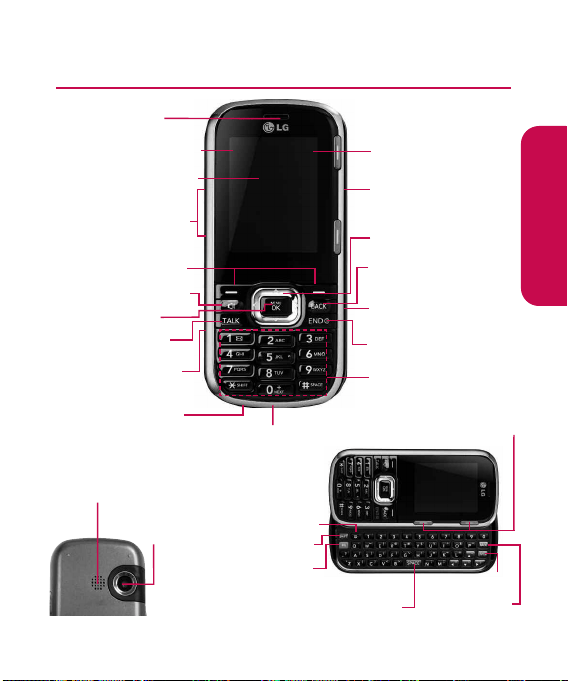
Sección 2A: Su teléfono: aspectos básicos 9
Vista frontal de su teléfono
Aspectos básicos
17. TeclaBACK
16.
Tecla de navegación
2.
Indicador de
potencia de la señal
1. Auricular
10. Micrófono
11. Enchufe del
cargador/
accesorios
3. Pantalla de
visualización
5. Teclas Suaves
4.
Teclas laterales
de volumen
12. Bocina-Altavoz
6.
La tecla Altavoz
8. Tecla TALK
9. Tecla lateral
de cámara
7.
MENU/OK
19. TeclaEND
14.
Indicador de
potencia de la batería
13. Lente de
la cámara
15.
Enchufe para
audífonos
18. Ranura de tarjeta
microSD™
20.
Teclado alfanumérico
25.
Teclas Suaves
27.
TECLA ENTER
23. Tecla de
función
22.
Tecla SHIFT
26. ATRÁS
21. Tecla
Emoticons
24. Tecla SPACE

10 Sección 2A: Su teléfono: aspectos básicos
Funciones de las teclas
1. Auricular le permite escuchar a quien le llama e
indicaciones automatizadas.
2. Indicador de potencia de la señal representa la potencia de
la señal mostrando barras. Mientras más barras se
muestren, mejor será la potencia de la señal.
3. Pantalla de visualización muestra toda la información
necesaria para hacer funcionar su teléfono, como el
estado de la llamada, la lista de contactos de la libreta de
teléfonos’s interna, la fecha y hora, la potencia de la señal
y de la batería, etc.
4. Teclas laterales de volumen le permite ajustar el volumen
del timbre en modo de espera o ajustar el volumen de voz
durante una llamada. La tecla de volumen también puede
usarse para desplazarse hacia arriba o hacia abajo para
navegar por las distintas opciones de menú.
5. Teclas Suaves le permiten seleccionar acciones o
elementos de menú de tecla suave que corresponden a
las líneas inferiores izquierda y derecha de la pantalla.
6. La tecla Altavoz Le permite activar or desactivar el altavoz.
Desde la pantalla principal, oprima una vez para ir al
Historial Reciente, y mantenga presionada esta tecla
para ir directamente a Control de Voz.
7. Menu/OK muestra el menú principal del teléfono en
modo de espera. También selecciona la opción resaltada
al navegar por un menú.

Sección 2A: Su teléfono: aspectos básicos 11
8. Tecla TALK le permite hacer o recibir llamadas, responder
a Llamada en espera, usar Llamada Tripartita.
9. Tecla lateral de cámara Desde la pantalla principal,
presione una vez para ir al menú de Fotos. Mantenga
presionada esta tecla para ir al modo de cámara
directamente.
10. Micrófono Permite que puedan escucharle al otro lado de
baterías o accesorios adicionales como un cable de datos USB.
11. Enchufe del cargador/ accesorios conecta el teléfono al
cargador de baterías o accesorios adicionales como un
cable de datos USB.
12. Bocina-Altavoz Le permite escuchar los timbres y
sonidos. La bocina de altavoz le permite escuchar a la
persona quien le habla cuando el teléfono está en modo
de altavoz.
13. Lente de la cámara Cámara integrada que le permite
tomar fotos.
14. Indicador de potencia de la batería representa la cantidad
de carga de la batería que queda disponible en su
teléfono. Cuando se muestran todas las barras en el icono
de la batería, ésta está totalmente cargada. Cuando no se
muestran barras, la batería del teléfono está
completamente descargada o agotada.
Aspectos básicos

12 Sección 2A: Su teléfono: aspectos básicos
15. Enchufe para audífonos le permite conectar un auricular
opcional para mantener conversaciones cómodas de
manos libres.
¡PRECAUCIÓN!Insertar un accesorio en el enchufe
incorrecto puede dañar el teléfono.
16. Tecla de navegación se desplaza por las opciones de menú
del teléfono y actúa como tecla de atajo desde la pantalla
pricipal.
n
Oprima Arribapara acceder a Enviar Mensaje A.
n
Oprima Abajopara acceder a Mis Cosas.
n
Oprima Derechapara Mis Álbumes.
n
Oprima Izquierdapara ver su Calendario.
17. Tecla BACK borra caracteres de la pantalla en modo de
introducción de texto. Cuando esté en un menú, oprima
la tecla BACK para ir al menú anterior. Esta tecla también
le permite volver a la pantalla anterior durante una
sesión de conexión.
18. Ranura de tarjeta microSD™ Le permite usar la tarjeta
microSD™ para expandir la memoria de su teléfono, vea
"Uso de la tarjeta microSD™" en la página 120.
19. Tecla END finaliza una llamada, enciende o apaga su
teléfono, o lo devuelve a la pantalla principal. Al recibir
una llamada entrante, oprímala para silenciar el timbre y
manda la llamada entrante a Correo de Voz.
20. Teclado alfanumérico úselo para introducir números y
caracteres y seleccionar elementos de menú.

Sección 2A: Su teléfono: aspectos básicos 13
21. Tecla Emoticons Le permite introducir smileys usando el
teclado QWERTY cuando el teléfono está en modo de
texto.
22. Tecla SHIFT Le permite intercambiar el tipo de letra
(mayúsculas/ minúsculas) estando en modo de texto
usando el teclado QWERTY .
23. Tecla de FUNCIÓN Le permite introducir caracteres
alternativos usando el teclado QWERTY (por ejemplo la
tecla R para @), vea "Introducción del texto usando el
teclado QWERTY" en la página 46.
24. Tecla SPACE Le permite introducir un espacio.
25. Teclas Suaves Le permiten seleccionar acciones o
elementos de menú de tecla suave que corresponden a las
líneas inferiores izquierda y derecha de la pantalla.
26. Tecla BACK Borra caracteres de la pantalla en modo de
introducción de texto. Cuando esté en un menú, oprima la
tecla BACK para ir al menú anterior. Esta tecla también le
permite volver a la pantalla anterior durante una sesión
de conexión.
27. Tecla ENTER Selecciona la opción subrayada en el menú.
Aspectos básicos
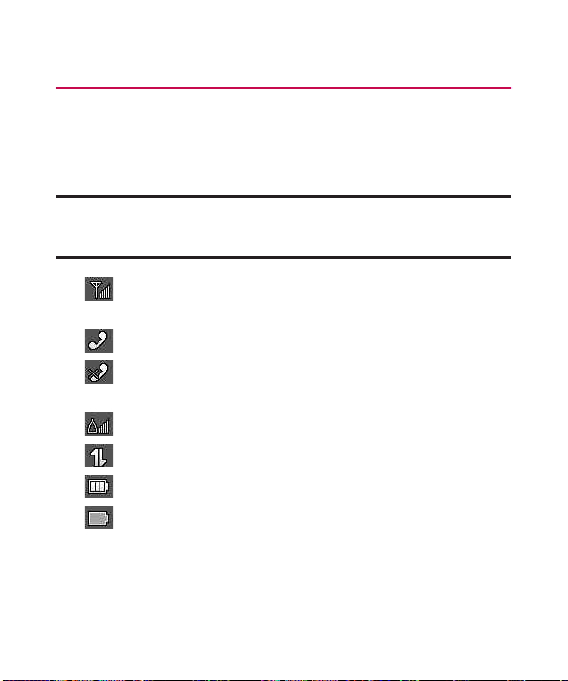
14 Sección 2A: Su teléfono: aspectos básicos
Ver la pantalla de visualización
La pantalla del teléfono proporcionar gran cantidad de
información acerca del estado de su teléfono y sus opciones.
Esta lista identifica los símbolos que verá en la pantalla de
visualización de su teléfono:
Nota: Para ver una lista de los iconos y descripciones de su teléfono, en el
menú principal seleccione Menú > Configuración > Info de teléfono >
Glosario de iconos.
Muestra la Fuerza de señal. (Entre más líneas tenga,
más fuerte es su señal.)
le dice que hay una llamada en curso.
Significa que su teléfono no puede encontrar una
señal.
Indica que está en "Roaming" fuera de la red suya.
Servicio de Datos.
indica Batería Llena.
indica Batería Baja.
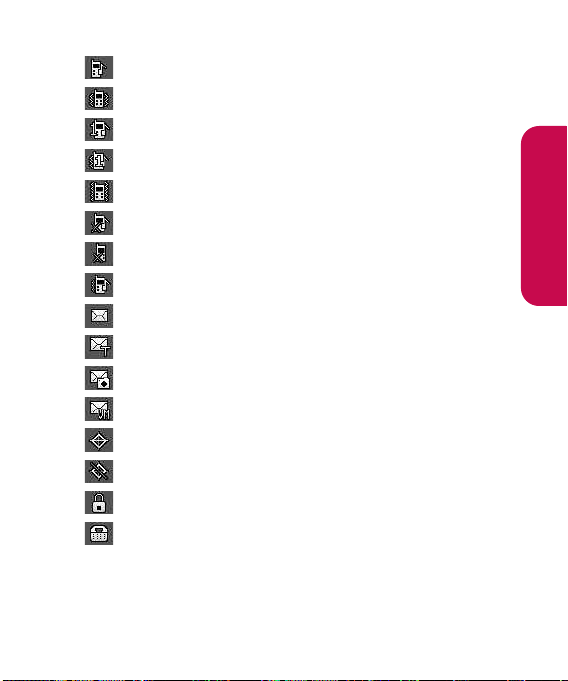
Sección 2A: Su teléfono: aspectos básicos 15
indica Timbre Sólo.
indica Sólo Vibración.
indica 1 Bip.
indica 1 Bip & Vibración.
indica Vibrar Todo.
indica Timbre Apagado.
indica Silencio.
indica Timbre y Vibrar.
indica Mensajes Nuevos.
indica Nuevo Mensaje de Texto.
indica Nuevo Mensaje de Foto.
indica Nuevo Correo de Voz.
indica Localización Encendido.
indica Localización Apagado.
indica SSL.
indica TTY.
Aspectos básicos

16 Sección 2A: Su teléfono: aspectos básicos
indica Altavoz.
indica Tarjeta de Memoria.
indica Bluetooth Activado(Escondido).
indica Bluetooth Activado(Visible).
indica Bluetooth Conectado.
indica Despertador.
indica Guía de voz & Altavoz activado.
indica Guía de voz & Altavoz desactivado.
indica Llamada Perdida.
indica Llamada Entrante.
indica Llam Saliente.
indica Cámera / Imagen.
indica Cámera Resolución 1.3M.
indica Cámera Resolución Med.
indica Cámera Resolución Bajo.
indica Zoom.
indica Temporizador.
indica Capturar.
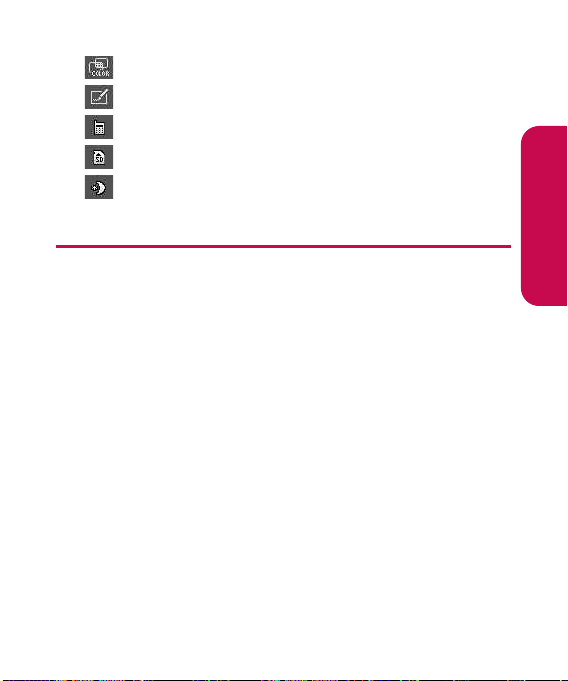
Sección 2A: Su teléfono: aspectos básicos 17
indica Tono de Color.
indica Marcos de diversión.
indica Guardando para Tarjeta de Memoria.
indica Guardando para En Teléfono.
indica Configuracion de Modo de la Noche.
Características de su teléfono
Enhorabuena por la compra de su teléfono. El Rumor
2
de LG
es fácil de usar y confiable, y también ofrece muchas
funciones y opciones de servicio muy importantes. La lista
siguiente hace un resumen de algunas de esas funciones y
proporciona los números de página donde puede obtener
más datos:
v La capacidad digital de banda doble y modo triple le
permite hacer y recibir llamadas cuando está en la red suya
y para hacer roaming en otras redes digitales de 1900 y 800
MHz con las que existen acuerdos de roaming.
v Servicio de datos proporciona acceso a web en modo
digital (Página 174). vea "Servicio de Aplicación de datos"
en la página 174.
v Correo de Voz(Página 155), mensajería de texto SMS
(Página 165), y mensajería de foto MMS( Página 140).
Aspectos básicos

18 Sección 2A: Su teléfono: aspectos básicos
v El teclado deslizante QWERTY hace ingresar el texto
rápido y fácil(Página 46) .
v Se pueden descargar juegos, timbres, protectores de
pantalla y otras aplicaciones para hacer a su teléfono tan
único como usted (Página 182). Pueden aplicarse cargos
adicionales.
v Los contactos le permiten almacenar hasta 600 entradas,
con hasta cinco números de teléfono por cada entrada,
vea "Uso de los Contactos" en la página 92.
v El Calendario integrado ofrece varias funciones de
administración de la información personal para ayudarle
a administrar su activo estilo de vida, vea "Uso del
calendario del teléfono" en la página 105.
v La función de ubicación trabaja con la conexión
disponible de servicios en basado en localización (Página
59).
v La entrada de texto T9 le permite escribir rápidamente
mensajes con una presión de tecla por letra, vea
"Introducción de texto" en la (Página 42).
v El marcado rápido le permite marcar números de teléfono
con una o dos presiones de tecla, vea "Uso de marcación
abreviada" en la página 38.

Sección 2A: Su teléfono: aspectos básicos 19
v Puede emparejar de modo inalámbrico su teléfono
habilitado para Bluetooth con otros dispositivos
Bluetooth, entre ellos audífonos y dispositivos de manos
libres. Vea "Uso de Bluetooth" en la página 144.
La cámara le permite tomar fotos digitales y ver tus
fotografías con la pantalla del teléfono. (Página 127).
v Protección de Roaming de Datos le alertará cuando esté
en roaming y usando el navegador u otras aplicaciones
en línea, dándole la opción de seguir usando tales
aplicaciones mientras esté en el área de roaming, vea
"Control de su experiencia en Roaming" en la página 78.
v La tarjeta microSD™ de su teléfono amplía la memoria
disponible y le permite reproducir, almacenar y borrar las
fotos o videos tomadas con el teléfono (Página 120).
También puede reproducir y almacenar descargar MP3 y
otros archivos multimedia.
Aspectos básicos

20 Sección 2A: Su teléfono: aspectos básicos
Apagar y encender el teléfono
Encender el teléfono
Para encender el teléfono:
©
Mantenga oprimida durante aproximadamente
dos segundos.
Una vez que su teléfono esté encendido, puede mostrar
"Buscando Servicio", lo que indica que su teléfono está
buscando una señal. Cuando la encuentra, entra
automáticamente en modo de espera (Pantalla Principal). –
el estado de inactividad del teléfono. En este punto, está listo
para empezar a hacer y recibir llamadas.
Si su teléfono no puede encontrar una señal después de 15
minutos de búsqueda, se activa automáticamente una función
de ahorro de energía. Cuando se encuentra una señal, su
teléfono vuelve automáticamente al modo de espera (Pantalla
Principal).
En modo de Ahorro de energía, su teléfono busca
periódicamente una señal sin necesidad de intervención de
usted. También puede iniciar una búsqueda del servicio
oprimiendo cualquier tecla (con el teléfono encendido).
Sugerencia: La función Ahorro de energía le permite conservar la potencia
de la batería cuando está en una zona donde no hay señal.

Sección 2A: Su teléfono: aspectos básicos 21
Apagar el teléfono
Para apagar el teléfono:
©
Mantenga oprimida durante dos segundos hasta
que vea la animación de apagado en la pantalla.
La pantalla permanecerá en negro mientras esté apagado el
teléfono (a menos que se esté cargando la batería).
Uso de la batería y cargador de su
teléfono
ADVERTENCIA: Use únicamente baterías y cargadores de escritorio
aprobados por el fabricante. El no usar una batería y cargador
aprobados por el fabricante aumentan el riesgo de que su teléfono se
sobrecaliente, se incendie o estalle, dando como resultado graves
lesiones físicas, la muerte o daños materiales.
Capacidad de la batería
Su teléfono está equipado con una batería de iones de litio
(Li-Ion). Le permite volver a carga la batería antes de que se
descargue por completo. La batería proporciona hasta 5.5
horas de tiempo de conversación digital.
Cuando la batería alcanza 5% de su capacidad, el icono de
batería parpadea. Cuando quedan aproximadamente dos
Aspectos básicos
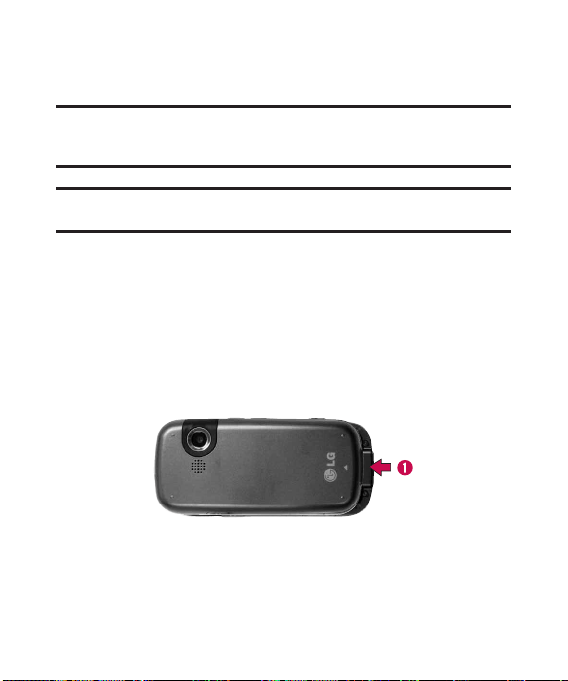
22 Sección 2A: Su teléfono: aspectos básicos
minutos de tiempo de conversación restantes, el teléfono
hace sonar una alerta sonora y se apaga.
Nota: Las configuraciones de luz de fondo prolongadas, la búsqueda de
servicio, el modo de vibración y el uso del navegador afectarán los tiempos
de conversación y espera de la batería.
Sugerencia : Cuide de revisar el indicador de nivel de batería de su
teléfono u cargue la batería antes de que se agote.
Instalación de la batería
Para instalar la batería de Li-Ion:
©
Para instalar, empuje la cubierta de la batería hacia
arriba, e inserte la batería en la abertura de la parte
posterior del teléfono (1). Oprima suavemente hasta que
el pestillo entre en su sitio.
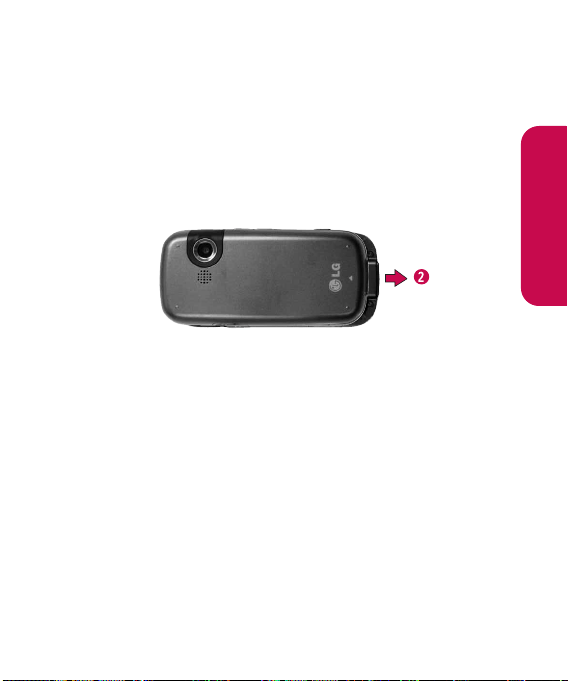
Sección 2A: Su teléfono: aspectos básicos 23
Extracción de la batería
Para quitar la batería:
©
Asegúrese de que esté apagado el teléfono para no
perder ningún número o mensaje almacenado.
©
Empuje y deslice la tapa hacia arriba hasta que la batería
se libere del teléfono(2).
Carga de la batería
La batería de LiIon de su teléfono es recargable y debería
cargarse tan pronto como sea posible para que empiece a
usar su teléfono.
Es importante estar al tanto de la carga de la batería. Si el
nivel de la batería se hace demasiado bajo, el teléfono se
apaga automáticamente y perderá toda la información en la
que estaba trabajando en el momento. Para revisar
rápidamente el nivel de batería de su teléfono, vea el
indicador situado en la esquina superior derecha de la
Aspectos básicos

24 Sección 2A: Su teléfono: aspectos básicos
pantalla del teléfono. Si la carga de la batería está demasiado
baja, el icono de batería ( ) parpadea y el teléfono hace
sonar un tono de advertencia.
Use siempre un cargador de escritorio, cargador de viaje o
adaptador de corriente del vehículo aprobados para cargar
su batería.
Uso del cargador
Para usar el cargador de viaje incluido con su teléfono:
©
Enchufe el extremo redondo del adaptador de CA en el
conector del cargador del teléfono y el otro extremo en
una toma de corriente.
n
Una luz roja indica que su teléfono esta siendo
cargado. (El indicador lumisoso se encuentra en la
parte superior derecha de la pantalla.)
n
Una luz verde indica que la batería de su teléfono
esta al menos 90 por ciento llena. (El indicador
lumisoso se encuentra en la parte superior derecha
de la pantalla.)
Sección 2A: Su teléfono: aspectos básicos 25
Navegación por los menús del teléfono
La tecla de navegación de su teléfono le permite desplazarse
por los menús de manera rápida y sencilla. La barra de
desplazamiento a la derecha del menú hace el seguimiento
de su posición en el menú en todo momento.
Para navegar por un menú, sólo tiene que oprimir la tecla de
navegación hacia arriba o hacia abajo. Si está en un menú de
primer nivel como
Configuración, también puede navegar al
siguiente menú de primer nivel o al anterior oprimiendo la
tecla de navegación a derecha o a izquierda.
Para ver un diagrama del menú de su teléfono, vea "El menú
de su teléfono" en la página ii.
Selección de elementos de menú
Al navegar por el menú, se resaltan las opciones de menú.
Seleccione cualquier opción con número simplemente
oprimiendo el número correspondiente en el teclado del
teléfono. También puede seleccionar cualquier elemento
resaltándolo y oprimiendo
.
Por ejemplo, si desea ver su última llamada entrante:
1. Oprima para acceder al menú principal.
2. Seleccione Historial oprimiend o y oprima .
Aspectos básicos
26 Sección 2A: Su teléfono: aspectos básicos
3. Seleccione una llamada del historial y oprima .
Regresar dentro de un menú
Para ir al menú anterior:
©
Oprima .
Para volver al modo de espera:
©
Oprima .
Para mostrar su número de teléfono
Sólo en caso de que olvide su número de teléfono, su
teléfono se lo puede recordar.
Para mostrar su número de teléfono:
©
Oprima Menú > Configuración > Info de Teléfono >
Número de Teléfono
. (Se mostrarán su número de
teléfono y ESN/MEID.)
Sección 2A: Su teléfono: aspectos básicos 27
Hacer y recibir llamadas
Para hacer llamadas
Hacer una llamada desde su teléfono es tan fácil como
hacela desde cualquier teléfono de línea terrestre. Sólo tiene
que introducir el número y oprimir , y va en camino de
hacer llamadas nítidas.
Para hacer una llamada con el teclado:
1. Asegúrese de que el teléfono esté encendido.
2. Introduzca un número de teléfono estando en modo de
espera. (Si comete un error al marcar, oprima para
borrar un carácter a la vez. Mantenga oprimido
para borrar todo el número.)
3. Oprima .
4. Oprima el teléfono cuando haya terminado.
Sugerencia: Para marcar el último número marcado, oprima la tecla TALK
dos veces.
También puede hacer llamadas desde su teléfono por medio
de Contactos, vea "marcar desde los contactos" en la página
39. También puede marcar usando las listas de su Historial de
Aspectos básicos

28 Sección 2A: Su teléfono: aspectos básicos
llamadas, vea "Hacer una llamada des de el Historial" en la
página 87.
Opciones de marcado
Al introducir números en modo de espera, oprima OPCIONES
(tecla suave derecha) y vera diversas opciones de marcado en
la pantalla de teléfono.
Sugerencia:Para hacer el marcado rápido de un número de teléfono
desde el modo de espera, mantenga presionado el número de marcado
rápido. Si el número de marcado rápido es de dos cifras, introduzca la
primera y luego mantenga presionada la segunda. (Para obtener
información sobre la configuración de los números de marcado rápido, vea
"Asignación de números de marcado rápido" en la página 98.)
v
Guardarguarda el número de teléfono en sus contactos,
vea "Guardar un número de teléfono" en la página 94.
v
Detalles de Contactomuestra los detalles del contacto. (Si
el contacto esta guardado en su lista de contactos).
v
Pausa 2 seg inserta una pausa de 2 segundos, vea
"Marcado de números de teléfono con pausas" en la
página 36.
- o -
Presione
ENVIAR MSJ (tecla suave izquierda) para acceder
a un menú que puede utilizar para enviar mensaje de
texto o mensajes de imágenes para el número marcado.

Sección 2A: Su teléfono: aspectos básicos 29
Para contestar llamadas
Para contestar una llamada entrante:
1. Asegúrese de que el teléfono esté encendido. (Si el
teléfono está apagado, las llamadas entrantes van al
correo de voz.)
2. Oprima para responder a una llamada entrante.
(En función de los ajustes de su teléfono, también
puede contestar a las llamadas entrantes abriendo el
teléfono u oprimiendo cualquier tecla de número, vea
"Modo de contestación de llamadas" en la página 68
para obtener más información.)
Su teléfono le puede avisar de las llamadas entrantes de las
siguientes maneras:
v El teléfono suena o vibra.
v Una luz indicadora destella en la parrte superior derecha
de la pantalla.)
v Se ilumina la luz de fondo.
v La pantalla muestra un mensaje de llamada entrante.
Aspectos básicos

30 Sección 2A: Su teléfono: aspectos básicos
Si la llamada entrante es de un número almacenado en sus
contactos, se muestra el nombre de la entrada de la libreta de
teléfonos. También puede mostrarse el número de teléfono
de quien llama, si está disponible.
Si
Responder Llamada está configurado en Cualquier tecla o
Sólo Hablar también se muestran las opciones siguientes.
Para seleccionar una opción, oprima el botón de la tecla
suave correspondiente.
v Silenc.para silenciar el timbre.
v Ignorarpara enviar la llamada a su buzón de correo de
voz.
Nota: Si el teléfono está apagado, las llamadas entrantes van
directamente al correo de voz.
Finalizar una llamada
Para desconectar una llamada cuando haya terminado:
©
Oprima .
Sección 2A: Su teléfono: aspectos básicos 31
Notificación de Llamada perdida
Cuando no se contesta una llamada entrante, el registro de
Llamada perdida aparece en la pantalla.
Para mostrar la Llamada perdida desde la pantalla de
notificación:
©
Resalte la entrada y oprima . (Para marcar el
número, oprima .)
Para mostrar una Llamada perdida desde el modo de espera:
1. Oprima Menú > Alertas Perdidas.
2. Resalte la entrada que desea ver y oprima .
Iniciando llamada de emergencia
Puede hacer llamadas al 911 (marque ),
incluso si su teléfono está bloqueado o la cuenta está
restringida.
Nota: Al hacer una llamada de emergencia, su teléfono entra
automáticamente en modo de Emergencia.
Durante una llamada de emergencia, su teléfono muestra
opciones de menú. Para seleccionar una opción, oprima
OPCIONES (tecla suave derecha). Las opciones siguientes
están disponibles mediante el menú Acciones.
Aspectos básicos

32 Sección 2A: Su teléfono: aspectos básicos
v
Contactospara mostrar su lista de contactos.
v
Memo de Voz para grabar la conversación actual.
v
Info de tel para comprobar el número de teléfono, versión,
etc.
Para salir del modo de Emergencia:
1. Oprima para terminar una llamada al número de
emergencia.
2. Oprima Salida(tecla suave derecha).
Nota: Cuando esté en modo de Emergencia, sólo puede salir desde el
menú de opciones.
Información de Enhanced 911 (E911)
Este teléfono incluye un chip de Sistema de Posicionamiento
Global (GPS) integrado para utilizar los servicios de ubicación
de emergencia de E911 donde estén disponibles.
Al hacer una llamada de emergencia al 911, la función GPS de
su teléfono empieza a buscar información para calcular su
ubicación aproximada. En función de diversas variables,
incluida la disponibilidad y el acceso a las señales de satélite,
puede tomar 30 segundos o más determinar su ubicación
aproximada y reportarla.
IMPORTANTE: Siempre informe de su ubicación al operador de 911 al hacer
una llamada de emergencia.
Algunos contestadores de llamadas de

Sección 2A: Su teléfono: aspectos básicos 33
emergencia designados, que se llaman Puntos de Contestación de
Seguridad Pública (PSAP) pueden no estar equipados para recibir
información de ubicación por GPS desde su teléfono.
Opciones durante la llamada
Si presiona OPCIONES (tecla suave derecha) durante una
llamada, aparecerá una lista de opciones disponibles
durante la llamada. Para seleccionar una opción, resáltela y
presione . Las siguientes opciones pueden estar
disponibles mediante el menú de opciones:
v
Guardarpara guardar un número teléfono en losContactos.
(Consulte "Guardar un número de teléfono" en la página
34).
v
Detalles de Contacto muestra los detalles del contacto. (Si
el contacto esta guardado en su lista de contactos).
v
Menú principal para mostrar el menú principal
delteléfono.
v
Llamada Tripartitapara iniciar una llamada enconferencia.
v
Contactospara mostrar la lista de contactos.
v
Memo de vozpara grabar la conversación actual.
v
Info de tel para comprobar el número de teléfono, la
versión, etc.
Aspectos básicos

34 Sección 2A: Su teléfono: aspectos básicos
¡Advertencia!Debido a los más elevados niveles de volumen, no coloque
el teléfono cerca de su oído al utilizar el altavoz.
Opciones al finalizar las llamadas
Después de recibir una llamada o de llamar a un número de
teléfono que no está entre sus contactos, se muestran el
número de teléfono y la duración de la llamada. Presione
OPCIONES (tecla suave derecha) > Guardar contacto para
agregar el nuevo número a sus contactos. (Consulte "Guardar
un número de teléfono" más adelante).
Después de recibir una llamada o de llamar a un número de
teléfono que ya está entre sus contactos, aparecen el nombre
de la entrada, el número de teléfono y la duración de la
llamada. Para seleccionar una de las siguientes opciones
después de finalizar una llamada, presione
OPCIONES (tecla
suave derecha):
Nuevo grupo/ Detalles del Contacto/ Borrar/ Borrar todos
Nota: No todas las opciones al finalizar las llamadas semuestran para las
llamadas que se identificancomo Sin Id. o Restringidas.
Guardar un número de teléfono
Puede guardar hasta siete entradas de números deteléfono
por contacto y hasta 600 contactos en el teléfono. El nombre

Sección 2A: Su teléfono: aspectos básicos 35
de cada entrada puede contener 64 caracteres. El teléfono
organiza automáticamente loscontactos en orden alfabético.
(Para obtener másinformación, consulte "Contactos" en la
página 92).
Para guardar un número estando en modo de espera:
1. Introduzca un número de teléfono.
2. Presione OPCIONES (tecla suave derecha), resalte
Guardar y presione .
3. Resalte Nueva Entradapara un nuevo contacto o Buscar
Entrada para agregarle un número a un contacto
existente y presione .
4. Seleccione Móvil, Casa, Trabajo, Biper, Fax u Otrocomo
etiqueta para el teléfono.
5. Use el teclado del teléfono o el teclado QWERTY para
introducir el nombre del nuevo contacto y presione
HECHO (tecla suave izquierda) para guardar la nueva
entrada.
– o –
Busque un nombre de contacto existente y presione
para guardar el nuevo número.
6. Presione HECHO (tecla suave izquierda) para guardar la
nueva entrada.
Aspectos básicos

36 Sección 2A: Su teléfono: aspectos básicos
Encontrar un número de teléfono
Puede buscar entradas entre los contactos por nombre.
1. En el modo de espera, presione CONTACTOS (tecla suave
derecha) e introduzca la primera o las primeras letras
de una entrada. (Cuantas más letras introduzca, más
concreta será la búsqueda).
2. Para seleccionar una entrada, resáltela y presione .
Para marcar un número, resáltelo y presione .
Puede que tenga que oprimir la tecla de navegación
izquierda or derecha para seleccionar uno de los
teléfonos que un contacto puede tener.
Marcado de números de teléfono con pausas
Puede marcar o guardar números de teléfono con pausas
para usarlos con sistemas automatizados, como el correo de
voz o los números de facturación de tarjeta de crédito.
Hay dos tipos de pausas disponibles en su teléfono:
v
Pausa Fija envía el siguiente conjunto de números cuando
oprime tecla suave izquierda
ENVIAR TONOS.
v
Pausa 2 seg automáticamente envía el siguiente conjunto
de números después de dos segundos.
Nota:Puede tener varias pausas en un a número de teléfono y combinar
pausas de 2 segundos y pausas fija.
Sección 2A: Su teléfono: aspectos básicos 37
Para marcar o guardar números de teléfono con pausas:
1. Introduzca el número de teléfono.
2. Desplácese a Pausa Fija o a Pausa 2 seg y oprima .
(Las pausas duras se muestran como "P" y las
pausas de 2 segundos como "T".)
3. Introduzca números adicionales.
4. Oprima para marcar el número.
– o –
Para guardar el número de teléfono en su lista de
contactos, resalte
Guardary oprima .
Nota:Al marcar un número con una pausa dura, oprima tecla suave
izquierda ENVIAR TONOSpara enviar el siguiente conjunto de números.
Aspectos básicos

38 Sección 2A: Su teléfono: aspectos básicos
Uso de marcación abreviada
Marcación abreviada es similar a la función de marcación
rápida. Puede utilizar cualquiera de las siguientes
características de marcación abreviada.
v
Encontrar Contactos – Recupera cualquier número
guardado en sus contactos introduciendo sólo tres
dígitos del número. Seleccione una entrada de contacto y
oprima para marcar el número.(Consulte
"Encontrar Contactos" en la página 69).
v
Marcación abreviada – Anteponer los primeros cinco o
seis dígitos (por ejemplo, el código de área y el prefijo) a
cualquier cuatro o cinco dígitos que introduzca. Oprima
para marcar el número resultante.
Para realizar una llamada utilizando Contactos Coincidencia de
marcación abreviada:
1. Introduzca los por lo menos tres dígitos de una entrada
de los contactos del número de teléfono.
2. Use para resaltar un contacto y oprima llamar al
número mostrado. (Si hay más de un número
acompañado en sus contactos, la lista de marcación
abreviada aparece en la pantalla. Seleccione el nombre
que desea llamar desde la lista y, a continuación,
presione para realizar una llamada).
Sección 2A: Su teléfono: aspectos básicos 39
Para realizar una llamada mediante marcación abreviada :
1. Introduzca los últimos cuatro o cinco dígitos del
número.
2. Presione .
Marcar desde Contactos
Atajo:De modo de espera, oprima Contactos (tecla suave derecha) para
ver la lista de entradas.
1. Presione Menú > Contactos.
2. Seleccione la entrada que desea llamar y presione
para marcar el número de teléfono.
– o –
Para marcar otro número de la entrada, seleccione el
nombre y oprima , y, a continuación, presione la tecla
de navegación derecha/izquierda para elegir otro
número de teléfono y oprima .
Aspectos básicos

40 Sección 2A: Su teléfono: aspectos básicos
Uso del marcado rápido de una o dos teclas
Usted puede almacenar hasta 98 números en la función de
marcado rápido de su teléfono para que comunicarse con sus
amigos y familiares sea tan sencillo como oprimir un botón o
dos. Con esta función, puede marcar las entradas de
marcado rápido con una presión de tecla para las ubicaciones
2 a 9, o dos presiones de tecla para las ubicaciones 10 a 99.
Para usar el marcado de una tecla para las ubicaciones de
Marcado rápido 2 a 9:
v
Mantenga oprimida la tecla correspondiente durante
aproximadamente dos segundos. La pantalla confirma
que se ha marcado el número cuando muestra
"Llamando...".
Para usar el marcado de dos teclas para las ubicaciones de
Marcado rápido 10 a 99:
1. Oprima la primera cifra.
2. Mantenga oprimida la tecla de la segunda cifra durante
aproximadamente dos segundos. La pantalla confirma
que se ha marcado el número cuando muestra
"Llamando...".

Sección 2A: Su teléfono: aspectos básicos 41
Introducción de texto
Introducción de texto con el teclado numérico
Su teléfono le proporciona formas convenientes de
introducir palabras , letras, signos de puntuación y números
siempre que se le pida que introduzca texto (por ejemplo, al
agregar una entrada de contactos o al usar Mensajería de
texto SMS).
Para cambiar el modo de introducción de caracteres:
1. Al mostrar una pantalla en la que pueda introducir
texto, oprima Modo u Opciones (tecla suave izquierda)
para cambiar el modo de entrada de caracteres.
2. Seleccione una de las opciones siguientes:
n
Abc para alternar por los caracteres alfabéticos
asociados con las letras del teclado.
n
Texto predictivo para introducir texto usando un
sistema de introducción predictiva de texto que
reduce el número de teclas que deben oprimirse al
introducir una palabra.
n
123para introducir números oprimiendo los
números en el teclado.
n
Símbolospara introducir símbolos.
n
Emoticonspara introducir coloridos "emoticonos".
Aspectos básicos
42 Sección 2A: Su teléfono: aspectos básicos
n
Configuración para entrar en la configuración de los
mensajes.
Sugerencia: Al introducir texto, oprima la tecla *(Mayús) para cambiar
de mayúscula/minúscula y viceversa de las letras (Abc > ABC> abc).
Introducción de caracteres con la entrada de texto
predictivo
La entrada de Texto Predictivo le permite introducir texto en
su teléfono oprimiendo las teclas sólo una vez por cada letra.
(Para seleccionar el modo
Texto predictivoal introducir texto,
vea "Introducción de texto" en la página 41.)
La entrada de Texto Predictivo analiza las letras que introduce
usando una base de datos intuitiva de palabras y crea una
palabra adecuada. (La palabra puede cambiar conforme escribe.)
Para introducir una palabra con Texto Predictivo:
1. Seleccione el modo de introducción de caracteres Text o
Predictivo,
vea "Introducción de texto" en la página 41.
2. Oprima las teclas correspondientes una por cada letra
para introducir una palabra (por ejemplo, para
introducir la palabra "Casa" oprima
) (Si comete un error, oprima para borrar un
solo carácter. Mantenga oprimido para borrar
toda la entrada.)

Sección 2A: Su teléfono: aspectos básicos 43
Si la palabra que desea no se muestra después de haber
introducido todas las letras, oprima para desplazarse
por opciones de palabras adicionales. Para aceptar una
palabra e introducir un espacio, oprima .
Agregar una palabra a la base de datos de Texto Predictivo
Si una palabra que desea introducir no aparece como opción
cuando está usando entrada de texto T9, puede agregarla a
la base de datos.
Para agregarle una palabra a la base de datos de entrada de texto T9:
1. Cuando la palabra deseada no aparece, desplácese por
la lista hasta '
Agreg Palabra?'.
2. Borre la entrada actual y escriba la palabra deseada.
3. Oprima GUARDAR (tecla suave izquierda).
4. La palabra aparecerá como una opción la próxima vez
que se desplaza por las opciones de entrada de texto
predictivo.
Para obtener más información acerca de la entrada de texto
T9, visite el sitio Web de Nuance en
www.T9.com.
Aspectos básicos
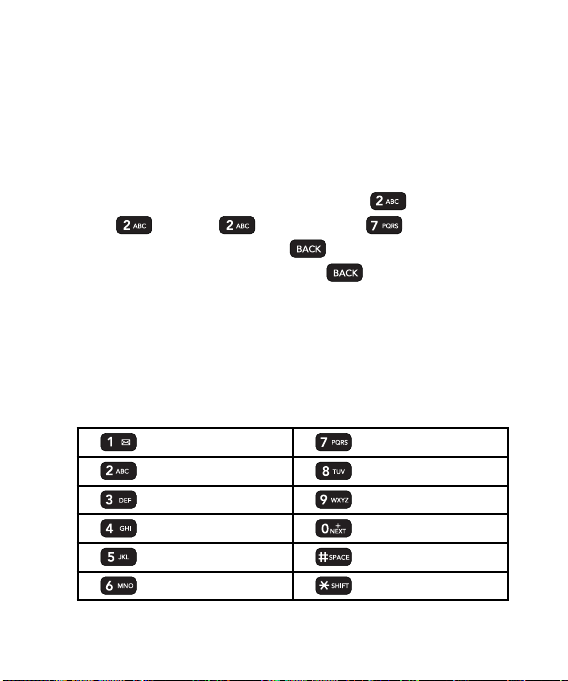
44 Sección 2A: Su teléfono: aspectos básicos
Introducción de caracteres usando el modo ABC
1. Seleccione el modo Abc, vea "Introducción de texto" en
la página 41.
2. Oprima las teclas correspondientes repetidamente
hasta que aparezca la letra deseada (por ejemplo, para
introducir la palabra "Casa", oprima tres veces,
una vez, cuatro veces, y una vez. (Si
comete un error, oprima para borrar un solo
carácter. Mantenga oprimido para borrar toda la
entrada.)
Después de que se introduce un carácter, el cursor avanza
automáticamente al espacio siguiente después de dos
segundos o cuando introduzca un carácter de otra tecla.
Los caracteres siguen en el orden siguiente:
. ¿ ? ¡ ! , - ' @ : / 1 P Q R S 7
A B C Á Ã Ç 2 T U V Ú Ü 8
D E F É 3 W X Y Z 9
G H I Í 4 0
J K L 5 Space
M N O Ó Ñ 6 Shift

Sección 2A: Su teléfono: aspectos básicos 45
Introducción de números, símbolos, emoticonos
y mensajes pregrabados
Para introducir números:
©
Seleccione el modo 123y oprima la tecla
correspondiente, vea "Introducción de texto" en la
página 41.
Para introducir símbolos:
©
Seleccione el modo Símbolos, vea "Introducción de
texto" en la página 41. Para introducir un símbolo,
oprima la tecla correspondiente indicada en pantalla.
Para introducir "emoticonos"(smileys):
©
Seleccione el modo Emoticon y oprima la tecla
correspondiente, vea "Introducción de texto" en la
página 41. Para entrar en un emoticono, desplazarse a
través de los emoticonos dispoibles y pulse , u
oprima la tecla numérica correspondiente en el teclado.
Aspectos básicos

46 Sección 2A: Su teléfono: aspectos básicos
Para introducir mensajes pregrabados:
1. Seleccione el modo Mensajes preestablecidos, vea
"Introducción de texto" en página 41.
2. Desplácese al mensaje preprogramado que desea y
oprima .
Nota: Los mensajes preestablecidos hacen aún más fácil la redacción de
mensajes de texto al permitirle introducir mensajes preestablecidos o un
mensaje preestablecido personalizado por usted mismo. (Para obtener
más información sobre los mensajes preestablecidos, vea "Administrar los
mensajes preestablecidos" en la página 61.)
Introducción de texto con el teclado QWERTY
El teléfono dispone de teclado deslizante QWERTY,
específicamente diseñadas para una fácil y cómoda de
entrada de texto. El teclado QWERTY utiliza el mismo diseño
y funcionamiento que el teclado de su computadora. La
forma más fácil de introducir texto es a través de su dedo
pulgar sobre el tipo de teclado QWERTY.
Para introducir texto con el teclado QWERTY
1. En una pantalla de entrada de texto, deslize el teclado
QWERTY. (La pantalla se ajusta automáticamente a
modo paisaje.)
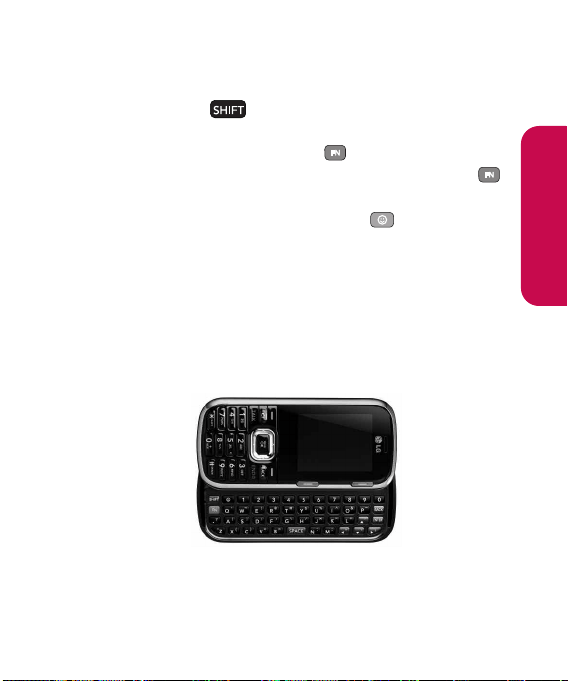
Sección 2A: Su teléfono: aspectos básicos 47
2. Use su dedo pulgar para introducir texto.
n
Para cambiar entre minúsculas y mayúsculas,
presione .
n
Para introducir un carácter alternativo de una tecla,
presione la tecla Función y luego la tecla que
desea. Para bloquear la tecla Función presione
dos veces.
n
Para introducir símbolos, pulse y seleccione un
símbolo.
n
Para obtener opciones de entrada de texto
adicionales, como
Texto predictivo, Símbolos y
Configuración, presione OPCIONES (tecla suave
derecha) > Modo de texto y seleccioneuna opción.
Aspectos básicos

48 Sección 2B: Control de la configuración de su teléfono
Control de la configuración de su
teléfono
En esta sección
l Configuración de sonido
l Configuración de pantalla
l Configuración de la ubicación
l Configuración de mensajería
l Modo de Avión/Música
l Uso de TTY con el servicio
l Opciones de configuración del teléfono
Usando las opciones de menú disponibles en su teléfono,
puede personalizar el teléfono para que suene, se vea y
funcione exactamente de la forma en que usted lo desea
.
Esta sección describe cómo puede cambiar la
configuración de su teléfono para ajustarse mejor a sus
necesidades. Tómese unos momentos para revisar esas
opciones y para ajustar o agregar las configuraciones
adecuadas para usted.

Sección 2B: Control de la configuración de su teléfono 49
Configuración de sonido
Tipos de timbre
Los tipos de timbre le ayudan a identificar las llamadas
entrantes y los mensajes. Puede asignarle tipos de timbre a
entradas individuales de la libreta de teléfonos, tipos de
llamadas, y tipos de mensajes.
Selección de tipos de timbre para llamadas de voz
Su teléfono le proporciona variadas opciones de timbre que
le permiten personalizar sus ajustes de timbre y volumen.
Estas opciones le permiten identificar las llamadas entrantes
por su timbre.
Para seleccionar un tipo de timbre para llamadas de voz:
1. Oprima Menú > Configuración > Sonidos > Tipo de
Timbre > Llamadas Entrantes
.
2. Seleccione Entradas de Contacto o #s desconocidos.
(Puede distinguir entre las llamadasentrantes de los
contactos y las desconocidas si les asigna un tipo de
timbre distinto).
n
Entradas de Contacto
La configuración de su teléfono

50 Sección 2B: Control de la configuración de su teléfono
n
Todos los contactos permite establecer un tipo de
timbre para todas las llamadas provenientes de
todos los contactos.
n
Un contacto permite establecer un tipo de timbre
específico para las llamadas de un contacto en
particular.
n
#s desconocidos
n
Puede establecer un tipo de timbre para llamadas
anónimas.
3. Seleccione una categoría y luego use la tecla de
navegación para desplazarse por los timbres
disponibles. A medida que resalte cada opción, sonará
un timbre de muestra.
4. Presione para asignar un timbre.
Asignar timbres a los contactos
1. Presione Configuración > Sonidos > Tipo deTimbre >
Llamadas Entrantes > Entradas de Contacto> Un contacto.
2. Resalte una entrada y presione .
3. Seleccione una categoría y luego use la tecla de
navegación para desplazarse por los timbres
disponibles. A medida que resalte cada opción,
escuchará un timbre de muestra.
4. Presione para asignar un timbre.

Sección 2B: Control de la configuración de su teléfono 51
Selección de tipos de timbre para mensajes
Para seleccionar un tipo de timbre para mensajes:
1. Oprima Menú > Configuración > Sonidos > Tipo de Timbre
> Mensajes
.
2. Seleccione Correo de Voz, Mensajede Texto o Correo de
Imagen
.
3. Uso de navegación para desplazarse por los tipos de
timbre disponibles. Para seleccionar un determinado
tono, oprima .
4. Use su tecla de navegación para desplazarse por los
timbres disponibles. Un timbre de muestra sonará
cuando resalte cada opción.
5. Oprima para asignar el timbre deseado.
Selección de la longitud de un tono de tecla
Puede ajustar la configuración del volumen del tono del
teléfono.
Para seleccionar un volumen de tono:
1. Oprima Menú>Configuración > Sonidos > Tono de Tecla >
Longitud de Tono.
2. Seleccione una opción y oprima .
La configuración de su teléfono

52 Sección 2B: Control de la configuración de su teléfono
n
Longitud de tonos para seleccionar una longitud de
clave de tono. (Más largas longitudes de tono
puede ser mejor para el reconocimiento, cuando
marcan el tono de voz u otros sistemas
automatizados.)
n
Volumen de tonos para seleccionar un nivel de
volumen pulsación.
Ajuste de la configuración de volumen del
teléfono
Puede ajustar la configuración de volumen de su teléfono
para adecuarse a sus necesidades y a su entorno.
Para ajustar la configuración de volumen de su teléfono:
1. Oprima Menú > Configuración > Sonidos > Volumen.
2. Seleccione Timbre, Audífono, Parlante, Tonos de Tecla,
Mensajes, Alarma & Calendario, Aplicaciones, Alertas
o
Encender/Apagar.
3. Con la tecla de navegación, seleccione un nivel
devolumen y presione .
Sugerencia: Puede ajustar el volumen del timbre en modo de espera (o
el volumen del audífono durante una llamada) con la tecla de volumen
que está del lado izquierdo de su teléfono.
Sección 2B: Control de la configuración de su teléfono 53
Notificación de alertas
Su teléfono puede alertarle con un tono audible cuando
cambie de área de servicio, una vez cada minuto cuando se
ha conectado una llamada o cuando se esté desvaneciendo
la señal de su teléfono.
Para habilitar o deshabilitar los sonidos de alerta:
1. Oprima Menú > Configuración > Sonidos > Alertas.
2. Seleccione Bip de Minuto, Sin Servicio, Conectaro Descon
Señal/Llam
y oprima .
3. Seleccione Encender oApagar y oprima .
Silenciar todo
La opción Silenciar todos del teléfono le permite eliminar
todos los sonidos sin apagar el teléfono.
Para activar Silenciar todos:
©
Oprima la tecla de volumen hacia abajo repetidamente
en el modo de espera. (La pantalla mostrará "Silenciar
todo".)
Para desactivar Silenciar todos:
©
Oprima la tecla de subir volumen varios veces y
seleccione el nivel de volumen que desea.
La configuración de su teléfono

54 Sección 2B: Control de la configuración de su teléfono
Configuración de pantalla
Cambiar el saludo de texto
El saludo de texto puede ser de hasta 12 caracteres y se
muestra en la pantalla de su teléfono en modo de
inactividad. Puede elegir conservar el saludo
predeterminado del teléfono, o puede introducir su propio
saludo personalizado.
Para mostrar o cambiar su saludo:
1. Oprima Menú> Configuración>Pantalla>Pantalla
Principal > Primer Plano > Saludo > Personalizado
.
2. Use la tecla direccional para sobresaltar el segundo
campo y presione .
3. Use el teclado alfanumérico para introducir un nuevo
saludo personalizado, vea "Introducción de texto" en la
página 41. (Para borrar el saludo existente, un carácter a la
vez, oprima . Para borrar todo el saludo completo,
mantenga oprimida .)
4. Oprima y luego Guardar(tecla suave izquierda) para
guardar su saludo.
Sección 2B: Control de la configuración de su teléfono 55
Cambio del tiempo de luz de fondo
La configuración de luz de fondo le permite seleccionar
cuánto tiempo tendrán iluminación de fondo la pantalla y el
teclado después de que se oprima cualquier tecla.
Para cambiar la configuración de luz de fondo:
1. Oprima Menú > Configuración > Pantalla > Pantalla
Principal > Luz de Fondo
.
2. Seleccione una configuración y oprima .
Para cambiar el teclado de luz:
1. Oprima Menú> Configuración > Pantalla > Luz de
Teclado
.
2. Seleccione una configuración y oprima .
Nota: Los valores de luz de fondo prolongados afectan los tiempos de
conversación y de espera de la batería.
Cambiar la pantalla de visualización
Su nuevo teléfono ofrece opciones para lo que ve en la pantalla
al encenderse o apagarse, y en modo de espera.
La configuración de su teléfono

56 Sección 2B: Control de la configuración de su teléfono
Para cambiar las imágenes de la pantalla:
1. Oprima Menú > Configuración > Pantalla > Pantalla
Principal > Salvapantalla
.
2. SeleccionePreloaded, Mis Álbumes, Medios Asignados,
Mis Cosas
oNueva foto.
3. Oprima la tecla de navegación hacia arriba o hacia
abajo y oprima para ver la imagen. (Una vez que se
muestra una imagen, puede usar su tecla de
navegación para desplazarse por las demás imágenes
predeterminadas y verlas.)
4. Oprima ASIGNAR(tecla suave izquierda) para asignar la
imagen deseada.
Cambiar el estilo de menús del teléfono
Su teléfono le permite elegir cómo aparece el menú en su
pantalla
To select the display’s Menú style:
1. Oprima Menú > Configuración > Pantalla > Pantalla
Principal > Estilo de Menú
.
Sección 2B: Control de la configuración de su teléfono 57
2. Seleccione Cuadrícula para ver el menú principal como
icono animado o
Lista para ver el menú principal como
lista y oprima .
Atajo: Para acceder rápidamente a la opción de Estilo de Menú desde la
pantalla de el menú principal.
Cambiar la presentación del reloj
Elija si desea que el reloj de su teléfono se muestre en modo
analógico, modo digital o con hora y fecha.
Para cambiar el aspecto del reloj en la pantalla de espera:
1. Oprima Menú > Configuración > Pantalla > Pantalla
Principal > Primer Plano > Reloj & Calendario.
2. Seleccione Reloj Normal, Reloj Analógico 1, Reloj
Analógico 2, Reloj Digital 1, Reloj Digital 2, Reloj Doble 1,
Reloj Doble 2, Calendario 1, Calendario 2,
y oprima .
3. Use la tecla de navegación para resaltar un valor y
oprima .
Cambiar la fuente de entrada de texto
Esta configuración le permite ajustar el aspecto de la
pantalla al introducir texto (por ejemplo, al usar el bloc de
notas o al agregar una entrada de contactos).
La configuración de su teléfono

58 Sección 2B: Control de la configuración de su teléfono
Para cambiar la fuente de introducción de caracteres:
1. Oprima Menú > Configuración > Pantalla > Tamaño de
Fuente
.
2. Seleccione Mensajes, Navegador, o Bloc de Notas.
3. Seleccione el tamaño deseado y oprima GUARDAR
(tecla suave izquierda).
Cambiar el modo de Estado de la Luz
Esta función muestra el estado de su teléfono haciendo
destellar la luz.
Para cambiar el modo de Estado de la Luz:
1. Oprima Menú>Configuración > Pantalla > Luz de Estado.
2. Seleccione Encender o Apagary oprima .
Idioma de pantalla
Puede seleccionar que los menús de pantalla de su teléfono
se muestren en inglés o en español.
Para cambiar el idioma de la pantalla:
1. Seleccione Menú > Configuración > Pantalla > Idioma
(Language)
.
2. Seleccione English o Español y oprima .
Sección 2B: Control de la configuración de su teléfono 59
Configuración de la ubicación
Su teléfono está equipado con una función de Ubicación para
usarse con servicios basados en la ubicación que pueden estar
disponibles en su sevicio.
La función Ubicación le permite a la red detectar su posición.
Desactivar Ubicación ocultará su ubicación de todos menos
del 911.
Nota: La localización activada permitirá que la red detecte su posición
usando tecnología del GPS, haciendo algunos usos y servicios más fáciles
de utilizar. La localización desactivada inhabilitará la función de la
localización del GPS para todos los propósitos excepto 911, pero no
ocultará su localización general basada en el sitio de la célula que sirve su
llamada. Ningún uso o servicio puede utilizar su localización sin su petición
o permiso. 911 GPS-realzados no está disponibles en todas las áreas.
Para habilitar la función Ubicación de su teléfono:
1. Seleccione Menú>Configuración >Más > Localización.
(Aparecerá el descargo de responsabilidad de
Ubicación.)
2. Lea el descargo de responsabilidad y oprima .
3. Seleccione Encender o Apagary oprima .
La configuración de su teléfono
60 Sección 2B: Control de la configuración de su teléfono
Cuando está activada la función Ubicación, la pantalla de
espera de su teléfono mostrará el icono . Cuando se
desactiva Ubicación, aparecerá el icono .
Configuración de mensajes
Los recursos avanzados de mensajería del teléfono permiten
enviar y recibir diferentes tipos de mensajes de texto sin
hacer una llamada de voz. (Para obtener más información,
consulte "Redacción de mensajes de texto SMS" en la página
166).
La configuración de mensajes permite: determinar la manera
en que el teléfono le notifica cuando recibe mensajes nuevos,
crear una firma con cada mensaje enviado y crear sus propios
mensajes preestablecidos.
Establecer la notificación de mensajes
Cuando recibe un mensaje, el teléfono se lo notifica al mostrar un
icono en la pantalla de visualización. También puede elegir que le
notifiquen mediante un mensaje de notificación en la pantalla
de visualización.
1. Seleccione Menú > Configuración > Mensajes >
Notificación
.
2. Seleccione Mensaje & Icono o Sólo Iconoy oprima .

Sección 2B: Control de la configuración de su teléfono 61
Número de devolución de llamada
1. Seleccione Menú > Configuración > Mensajes > Número
de Devolución
.
2. SeleccioneNinguno, Mi núm teléfono, u Otroy
oprima . (Si selecciona
Otro, introduzca un número y
oprima .)
Agregar una firma personalizada
Agregue una firma personalizada a cada mensaje enviado.
1. Seleccione Menú > Configuración > Mensajes > Firma >
Personalizado
. (Si no desea adjuntarle una firma a sus
mensajes enviados, seleccione
Ninguno.)
2. Introduzca su firma y oprima . (Vea "Introducción
de texto" en la página 41.)
Administrar los mensajes preestablecidos
El teléfono viene con 20 mensajes preestablecidos para
ayudarlo a enviar mensajes de texto más fácilmente.
Personalice o borre este tipo de mensajes, por ejemplo, “Where
are you?", “Let's get lunch,”o agregue sus propios mensajes a la
lista.
La configuración de su teléfono

62 Sección 2B: Control de la configuración de su teléfono
Para editar o borrar un mensaje preestablecido:
1. Seleccione Menú > Configuración > Mensajes > Mensajes
Preestablecidos
. (Aparecerá la lista de mensajes
preestablecidos.)
2. Para editar o borrar un mensaje, resáltelo y presione
OPCIONES (tecla suave derecha).
3. Seleccione Editar, edite el mensaje (consulte “Introducir
texto”en la página 41), y presione .
– o –
Resalte
Borrary oprima , y luego seleccione SÍ para
borrar el mensaje seleccionado. (Seleccione
Nopara
cancelar la eliminación).
Para agregar un nuevo mensaje preestablecido:
1. Seleccione Menú >Configuración > Mensajes > Mensajes
Preestablecidos
. (Aparecerá la lista de mensajes
preestablecidos.)
2. Para agregar un nuevo mensaje, seleccione AGREGAR
(tecla suave izquierda).
3. Introduzca el mensaje (consulte “Introducir texto”en la
página 41), y oprima
Grabar(tecla suave izquierda). (El
nuevo mensaje se agregará al comienzo de la lista).

Sección 2B: Control de la configuración de su teléfono 63
Modo de Avión/Música
El Modo avión le permite usar muchas de las funciones de su
teléfono, como Juegos, Bloc de notas, Memorándums de voz,
etc., cuando esté en un avión o en cualquier otra zona donde
esté prohibido enviar o recibir llamadas o datos. Cuando el
teléfono está en modo Avión, no puede enviar ni recibir
llamadas, ni acceder a información en línea.
Para colocar el teléfono en Modo avión:
1. Seleccione Menú > Configuración > Modo de
Avión/Música
. (Aparecerá el descargo de
responsabilidad del modo avión.)
2. Lea el descargo de responsabilidad y oprima .
3. Seleccione Encender, Apagar o Al encenderse y oprima
.
Al estar en modo Avión, la pantalla de espera de su teléfono
mostrará “Teléf. Desac.”
La configuración de su teléfono
64 Sección 2B: Control de la configuración de su teléfono
Uso de TTY con el servicio
Un TTY (también conocido como TDD o Teléfono de texto) es un
dispositivo de telecomunicaciones que permite comunicarse
por teléfono a personas sordas o con problemas de audición, del
habla o del lenguaje.
Su teléfono es compatible con dispositivos selectos de TTY.
Compruebe con el fabricante de su dispositivo TTY para
asegurarse de que admite la transmisión inalámbrica digital. Su
teléfono y su dispositivo TTY se conectarán mediante un cable
especial que se conecta al enchufe del audífono del teléfono. Si
este cable no venía incluido con su dispositivo TTY, comuníquese
con el fabricante de su dispositivo TTY para comprar el cable
conector.
Al establecer su servicio, llame a su abastecedor de servicio
mediante el Servicio de relevación de telecomunicaciones (TRS)
del estado marcando primero . Luego
proporcione al TRS estatal este número: 866-727-4889.
Para activar o desactivar el modo TTY:
1. Seleccione Menú > Configuración > Más... > Accesibilidad
> TTY
. (Aparecerá un mensaje informativo.)
2. Oprima .

Sección 2B: Control de la configuración de su teléfono 65
3. Seleccione Activa y oprima para activar el modo
TTY o seleccione
Desactivarpara apagar la función TTY.
Nota:En modo TTY, su teléfono mostrará el icono de acceso TTY.
Nota:Si está habilitado el modo TTY, puede verse disminuida la calidad de
audio de los dispositivos distintos del TTY conectados al enchufe del
auricular.
Llamadas de emergencia al 911
Recomienda que los usuarios de TTY hagan las llamadas de emergencia
por otro medio, incluidos los Servicios de relevación de telecomunicación
(TRS), comunicación celular analógica y comunicaciones por líneas de
tierra. Las llamadas inalámbricas de TTY al 911 pueden verse alteradas al
ser recibidas por los puntos de respuesta de seguridad pública (PSAP),
haciendo ininteligibles algunas comunicaciones. El problema que se ha
hallado parece relacionarse con el equipo o software de TTY que usan los
PSAP. El asunto se ha presentado ante la FCC, y la industria de las
comunicaciones inalámbricas y la comunidad de los PSAP están
trabajando actualmente para resolver esto.
La configuración de su teléfono
66 Sección 2B: Control de la configuración de su teléfono
Opciones de configuración del teléfono
Atajo
Su teléfono le ofrece la opción de asignar un atajo de tecla de
navegación para una función favorita que use con
frecuencia. Una vez que haya asignado tecla puede oprimir la
tecla de navegación en modo de espera para iniciar su atajo
personalmente designado.
Para asignar su tecla de atajo:
1. Seleccione Menú > Configuración > Más... > Tecla de
Navegación
. (Se muestra una ventana informativa.)
2. Lea la información y oprima .
3. Seleccione NavegaciónIzquierda, Navegación Derecha,
Navegación Arriba o Navegación Abajo y oprima .
4. Con la tecla de navegación o el teclado, seleccione el
atajo que desea asignar y oprima .
5. Oprima para volver al modo de espera.

Sección 2B: Control de la configuración de su teléfono 67
Modo de contestación automática
Puede configurar su teléfono para que conteste
automáticamente a las llamadas entrantes al estar
conectado a un kit opcional de manos libres para automóvil.
Para configurar el modo de Contestación automática:
1. Seleccione Menú > Configuración > Más... > Config. de
Llamada > Auto-Contestación
.
2. Para seleccionar una opción, resáltela y oprima .
n
Apagarpara deshabilitar la Contestación
automática.
n
Equipo del Auricular para contestar llamadas
automáticamente cuando el teléfono está
conectado a un kit de manos libres para automóvil
o a un auricular (se venden por separado).
Recuerde, su teléfono contestará llamadas al estar
en modo Contestación automática incluso si usted
no está presente.
La configuración de su teléfono

68 Sección 2B: Control de la configuración de su teléfono
Marca Abreviado
Esto le permite marcar un número usando sólo cinco o seis
dígitos, asi usted solo tiene que marcar los últimos cinco o
cuatro dígitos de un teléfono.
Para configurar sus opciones de marcado abreviado:
1. Seleccione Menú > Configuración > Más... > Config. de
Llamada > Marca Abreviado
.
2. Seleccione Encender y oprima un número de cinco o seis
dígitos (por ejemplo: código de área y prefijo) y oprima
.
Modo de Contestación de llamadas
Esto le permite personalizar el ingreso de texto.
1. Seleccione Menú > Configuración > Más... > Config. de
Llamada > Responder Llamada.
2. Resalte una opción y presione .
n
Cualquier tecla para responder a una llamada
entrante al presionar cualquier tecla.
n
Sólo Hablar para requerir que presione para
responder a las llamadas entrantes.

Sección 2B: Control de la configuración de su teléfono 69
Encontrar Contactos
Esto le permite activar o desactivar la función de
coincidencia de contactos.
Para configurar sus opciones de coincidencia de marcado:
1. Seleccione Menú > Configuración > Más... > Config. de
Llamada > Encontrar Contactos
.
2. Seleccione Encender o Apagary oprima .
Entrada de texto
Este le permite personalizar la entrada de texto.
1. Seleccione Menú> Configuración> Entrada de Texto.
2. Seleccione Auto-Mayúscula, Auto-Espacio, Selec. de
Palabras, Predic. de Palabras, Finaliz. de Palabras, Usar Mis
Palabras, Mis Palabras,
o Ayuda,y oprima .
La configuración de su teléfono

70 Sección 2C: Configuración de la seguridad de su teléfono
Configuración de la seguridad de su
teléfono
En esta sección
l Acceder al menú Seguridad
l Uso de la función de bloqueo del teléfono
l Uso de números especiales
l Borrar contenido de teléfono
l Restablecer la cuenta de correo de imagen
l Restablecer la configuración predeterminada
l Restaurar el teléfono
Al usar la configuración de seguridad de su teléfono, recibirá
tranquilidad mental sin sacrificar la flexibilidad. Esta sección
lo familiarizará con los ajustes de seguridad de su
teléfono. Con varias opciones a su alcance, puede
personalizar su teléfono para cubrir sus necesidades
personales.

Sección 2C: Configuración de la seguridad de su teléfono 71
Acceder al menú Seguridad
Todos los ajustes de seguridad de su teléfono están
disponibles mediante el menú Seguridad. Debe introducir su
código de bloqueo para ver el menú Seguridad.
Para acceder al menú Seguridad:
1. Seleccione Menú > Configuración > Más... > Seguridad.
2. Introduzca su código de bloqueo para mostrar el menú
Seguridad.
Sugerencia: Si no puede recordar su código de bloqueo, intente usar las
últimos cuatro cifras del número de su teléfono o pruebe 0000. Si ninguno
de éstos funciona, llame a su proveedor de servicios.
La seguridad de su teléfono

72 Sección 2C: Configuración de la seguridad de su teléfono
Uso de la función de bloqueo del teléfono
Bloqueo del teléfono
Cuando el teléfono está bloqueado, sólo puede recibir
llamadas entrantes o hacer llamadas al 911, o a números
especiales.
1. Presione Menú > Configuración > Más > Seguridad y
introduzca su código de bloqueo.
2. Seleccione Bloquear Mi Teléfono > Bloquear Ahora.
(Para configurar su teléfono de modo que se bloquee la
próxima vez que lo encienda, seleccione
Al
Encenderse
.)
Desbloqueo del teléfono
Para desbloquear el teléfono:
1. En modo de espera, oprima DESBLOQUEAR (tecla suave
derecha).
2. Introduzca su código de bloqueo.

Sección 2C: Configuración de la seguridad de su teléfono 73
Cambiar el código de bloqueo
Para cambiar su código de bloqueo:
1. Seleccione Menú > Configuración > Más... > Seguridad y
introduzca su código de bloqueo. (Aparecerá el menú
Seguridad.)
2. Desplácese a Cambiar Código de Bloqueo e introduzca y
vuelva a introducir su nuevo código de bloqueo.
Llamadas en modo de bloqueo
En modo de bloqueo, puede hacer llamadas al 911, Servicio al
Cliente (*611), y a sus números especiales. (Para obtener
información sobre los números especial, vea "Uso de
números especiales" en la página 74.)
Para hacer una llamada saliente en modo de bloqueo:
©
Para llamar a un número de emergencia, o número
especial, introduzca el número de teléfono y
oprima .
La seguridad de su teléfono

74 Sección 2C: Configuración de la seguridad de su teléfono
Uso de números especiales
Los números especiales son números importantes que ha
designado para que estén "siempre disponibles". Puede
hacer y recibir llamadas de números especiales incluso so su
teléfono está bloqueado.
Puede guardar hasta diez números especiales además de sus
entradas de contactos (el mismo número puede estar en
ambos directorios).
Para agregar o reemplazar un número especial:
1. Seleccione Menú > Configuración > Más... > Seguridad y
introduzca su código de bloqueo. (Aparecerá el menú
Seguridad.)
2. Seleccione Números Especiales .
3. Seleccione una ubicación para su entrada.
4. Introduzca el número y oprima .
Nota: No hay opciones de Marcado rápido asociadas con los números
especiales.

Sección 2C: Configuración de la seguridad de su teléfono 75
Borrar contenido de teléfono
Utilice el menú Seguridad para borrar rápidamente todo el
contenido creado o almacenado en el teléfono.
Para borrar todos los nombres y números de teléfono de sus
contactos:
1. Seleccione Menú > Configuración > Más... > Seguridad y
introduzca su código de bloqueo. (Aparecerá el menú
Seguridad.)
2. Seleccione a Borrar/Reajustar.
3. Para seleccionar una opción, resáltela y presione .
n
Borrar Dato Particular de Buscador para borrar los
datos guardados en el navegador de Internet.
n
Borrar Contactospara borrar todo el contenido de la
lista de contactos.
n
Borrar Mis Cosas para borrar todo el contenido de
Mis Cosas.
n
Borrar Fotos para borrar todas las imágenes deMis
Álbumes.
n
Borrar Mensajes para borrar todos los mensajes.
n
Borrar Memo de Voz para borrar todos los
memorándums de voz.
4. Seleccione Sí para confirmar borradura.
La seguridad de su teléfono

76 Sección 2C: Configuración de la seguridad de su teléfono
Restablecer la cuenta de correo de imagen
Esta opción permite restablecer Picture Messaging.
Para restablecer Picture Messaging:
1. Seleccione > Configuración > Más... > Seguridad e
introduzca el código de bloqueo.
2. Seleccione Borrar/Reajustar > Reajustar Correo de
Imagen.
(Aparecerá la exención de responsabilidad).
3. Lea la exención de responsabilidad y presione .
4. Si está seguro de que desea restablecer la cuenta de
correo de imagen, seleccione
Sí.
Restablecer la configuración
predeterminada
El restablecimiento de la actual configuración
predeterminada restaura todos los valores predeterminados
de fábrica, incluidos los tipos de timbre y la configuración de
la pantalla. No afecta a los contactos, el historial de llamadas,
el calendario y los mensajes.
Para restablecer la configuración predeterminada:
1. Presione > Configuración > Más... > Seguridad e
introduzca el código de bloqueo.
Sección 2C: Configuración de la seguridad de su teléfono 77
2. Seleccione Borrar/Reajustar > Reajustar Configuración.
(Aparecerá la exención de responsabilidad).
3. Lea la exención de responsabilidad y presione .
4. Si está seguro de que desea restablecer todos los
valores de fábrica, seleccione
Sí (tecla suave izquierda).
Restaurar el teléfono
El restablecimiento del teléfono restaura todos los valores
predeterminados de fábrica, incluidos los tipos de timbre y la
configuración de la pantalla. Se perderán todos los datos de
Contactos, Mensajes, Imágenes, Mis contenidos,
Herramientas y Configuración, y la configuración de
preferencia volverá a los valores predeterminados de fábrica.
1. Presione > Configuración > Más... > Seguridad e
introduzca el código de bloqueo.
2. Seleccione Reajustar Teléfono.(Verá la extensión de
responsabilidad).
3. Lea la exención de responsabilidad y presione .
4. Si está seguro de que desea restaurar todos los valores
de fábrica, seleccione
Sí (tecla suave izquierda).
La seguridad de su teléfono

78 Section 2D: Controlling Your Roaming Experience
Control de su experiencia en roaming
En esta sección
l Comprensión de roaming
l Configuración del modo roaming de su teléfono
l Control de los cargos por roaming con Protección de llamada
l Uso de Protección de Roaming de Datos
Roaming es la capacidad de hacer o recibir llamadas cuando
está fuera de la red suya.
Su nuevo Rumor
2
de doble banda
de LG funciona en varias redes y le permite hacer roaming
en otras redes digitales de 1900 y 800 MHz donde
hayamos implementado acuerdos de roaming con otros
proveedores de comunicación.
Estas sección explica cómo funciona el roaming así como
funciones especiales que le permiten administrar su
experiencia de roaming.
Section 2D: Controlling Your Roaming Experience 79
Comprensión de roaming
Seleccione el icono de Roaming en la pantalla principal
La pantalla de su teléfono siempre le informa cuando ha
salido de la red suya. En cualquier momento en que esté en
roaming, el teléfono muestra el icono de roaming ( ). Si
está en roaming en un sistema digital, el icono de roaming se
mostrará junto con el texto
– Digital Roaming – .
Sugerencia: Recuerde, cuando esté usando su teléfono fuera de la red
suya, siempre marque los números usando 11 cifras (1 + código de área +
número).
Roaming en otras redes digitales
Cuando esté roaming en redes digitales, la calidad y
seguridad de sus llamadas será similar a la calidad que
obtiene al hacer llamadas en la red suya. No obstante, es
posible que no pueda acceder a determinadas funciones,
como servicios de datos.
Nota:Si durante una llamada sale de la red suya y entra a un área donde
está disponible el roaming, su llamada se perderá. Si se pierde su llamada
en área donde usted considera que está disponible el servicio de la red,
apague el teléfono y vuelva a encenderlo para conectarse a la red suya.
Roaming

80 Sección 2D: Control de su experiencia en roaming
Comprobación de mensajes de correo de voz en roaming
Cuando esté roaming fuera de la red suya, no recibirá avisos
de nuevos mensajes de correo de voz por el teléfono. Quienes
le llaman podrán seguir dejando mensajes, pero usted
tendrá que llamar periódicamente a su correo de voz para ver
si hay mensajes nuevos si está en un área de servicio de
roaming durante un tiempo prolongado.
Para llamar a su correo de voz en roaming:
1. Marque 1+código de área+su número de teléfono.
2. Cuando escuche su saludo de correo de voz, oprima
.
3. Introduzca su código de pase cuando se le indique y
siga las indicaciones de voz.
Al volver a la Red, los avisos de correo de voz se reanudarán
normalmente.

Sección 2D: Control de su experiencia en roaming 81
Configuración del modo roaming de su
teléfono
Su teléfono le permite controlar sus capacidades de roaming.
Usando la opción de menú Roaming, puede determinar qué
señales aceptará su teléfono.
Configurar el modo
Elija entre tres configuraciones distintas en su teléfono de
doble banda para controlar su experiencia de roaming.
To set your phone’s roam mode:
1. Seleccione Menú > Configuración > Más... > Roaming >
Modo de Config
.
2. Para seleccionar una opción, resáltela y oprima .
n
Automático busca el servicio. Cuando no está
disponible el servicio de la red suya, el teléfono
busca un sistema alternativo.
n
Sólo casa
le permite acceder únicamente a la red
suya y evita el roaming en otras redes.
Roaming

82 Sección 2D: Control de su experiencia en roaming
Control de los cargos por roaming con
Protección de llamada
Su teléfono tiene dos formas de alertarle cuando está en
roaming fuera de la red suya: el icono de roaming en pantalla
y Guardia de llamada. Guardia de llamada le hace sencilla la
administración de sus cargos roaming, requiriendo un paso
adicional antes de que pueda hacer o responder una llamada
de roaming. (Este paso adicional no es necesario cuando
hace o recibe llamadas en la red suya.)
Para activar o desactivar Protección de llamada:
1. Seleccione Menú > Configuración > Más... > Roaming >
Guardia de Llamada
.
2. Desplácese a Encender o Apagar y oprima .
Nota: El marcado con comando de voz y el marcado rápido no estarán
disponibles cuando esté en roaming con Guardia de Llamada encendida.
Para hacer llamadas de roaming con Protección de llamada activada:
1. Desde el modo de espera, marque 1 + código de área +
el número de siete cifras y oprima . (También
puede iniciar una llamada desde Contactos, Historial
de llamadas o Mensajería.)
2. Seleccione Sí.
Sección 2D: Control de su experiencia en roaming 83
Para contestar llamadas entrantes de roaming con Guardia de
llamada activada:
1. Oprima . (Aparecerá un mensaje informándole
que se aplicarán cargos por roaming.)
2. Seleccione Sí.
Uso de Protección de Roaming de Datos
Cuando está habilitada la Protección de Roaming de Datos se
le preguntará si desea seguir usando el navegador u otras
aplicaciones en línea cuando esté en un área de roaming de
datos. Cuando Protección de Roaming de Datos está
desactivada, su teléfono establecerá o mantendrá una
conexión de datos en un área de roaming de datos sin pedirle
su permiso primero.
Para activar o desactivar Protección de Roaming de Datos:
1. Seleccione Menú > Configuración > Más... > Roaming >
Roaming de Datos
.
2. Desplácese a Implícito, Siempre Preguntaro Nunca
Preguntar
y oprima .
Roaming

84 Sección 2E: Administración del historial de llamadas
Administración del historia
En esta sección
l Ver el historial
l Opciones del historial
l Hacer una llamada desde el Historial
l Ver la secuencia del historial
l Guardar un número de teléfono del Historial
l Agregar prefijo a un número de teléfono del Historial
l Borrar el historial
El Historial de llamadas mantiene un registro de las llamadas
entrantes, las llamadas realizadas desde su teléfono, y las
llamadas perdidas.
Esta sección lo lleva por los pasos
necesarios para acceder a su Historial de llamadas y
sacarle el mayor provecho posible.
Sección 2E: Administración del historial de llamadas 85
Ver el historial
Encontrará muy útil la función de Historial de llamadas. Es
una lista de los últimos 50 números de teléfono (o entradas
de contactos) de las llamadas que usted hizo, recibió o perdió.
El Historial de llamadas hace que volver a marcar un número
sea rápido y fácil. Se actualiza continuamente conforme se
agregan nuevos números al principio de la lista y las entradas
más antiguas se eliminan de la parte inferior de la lista.
Cada entrada contiene el número de teléfono (si está
disponible) y el nombre de la entrada de Contactos (si el
número de teléfono está en sus contactos). Las llamadas
duplicadas (mismo número y tipo de llamada) pueden
aparecer sólo una vez en la lista.
Para ver una entrada del Historial de llamadas:
1. Seleccione Menú >Historial.
2. Resalte la entrada que desea ver y oprima .
Nota: El Historial de llamadas sólo registra llamadas que ocurran mientras
el teléfono está encendido. Si se recibe una llamada mientras el teléfono
está apagado, no aparecerá en los registros de llamadas Entrantes o
Perdidas.
Nota:Si devuelve una llamada desde el menú telefonico de correo de voz,
no aparecerá en el registro de llamadas Salientes de su teléfono.
Historial de llamadas

86 Sección 2E: Administración del historial de llamadas
Opciones del historial
Resalte una entrada del historial y presione . para
mostrar la fecha y hora de la llamada, el número de teléfono
(si está disponible) y el nombre de quien llamó (si el número
ya está en los contactos). O, también puede presionar
OPCIONES (tecla suave derecha) para mostrar las siguientes
opciones:
v
Llamada
v
Enviar Mensaje
v
Guardar/ Detalles del Contacto
v
Prepend
v
Borrar
Sugerencia: También puede ver la siguiente entrada del historial si
presiona la tecla de navegación hacia la derecha o la entrada anterior si
presiona la tecla de navegación hacia la izquierda.
Sección 2E: Administración del historial de llamadas 87
Hacer una llamada desde el Historial
Para hacer una llamada desde el Historial de llamadas:
1. Seleccione > Historial.
2. Resalte una entrada y presione .
Nota: No puede hacer llamadas desde el Historial de llamadas a entradas
identificadas como Sin ID o Restringido.
Ver la secuencia del historial
Para ver la secuencia del historial de un contacto, siga los
pasos 1 y 2 en las instrucciones anteriores, sobresalte un
artículo del historial y presione . El teléfono mostrará
todos los eventos relacionados con el contacto. Vuelva a
presionar para elegir una de las siguientes opciones:
v
Llamar
v
Enviar Mensaje
v
Detalles del Contacto
v
Prepend
v
Borrar
Historial de llamadas

88 Sección 2E: Administración del historial de llamadas
Guardar un número de teléfono del
Historial
Su teléfono puede almacenar hasta 600 entradas de
Contactos. Las entradas de contactos pueden almacenar un
total de 7 artículos de información, y el nombre de cada
entrada puede contener 64 caracteres.
Para guardar un número de teléfono del Historial de llamadas:
1. Presione Menu > Historial, use la tecla de navegación
para seleccionar una entrada y presione .
2. Resalte una entrada del historial y presione OPCIONES
(tecla suave derecha) > Guardar contacto.
3. Seleccione Nueva Entrada para crear una nuevaentrada
en Contactos para el número o
Buscar Entradapara
guardar el número en una entrada existente.
Sección 2E: Administración del historial de llamadas 89
4. Use la tecla de navegación para resaltar un tipo
denúmero de teléfono (
Móvil, Casar, Trabajo, Biper, Fax u
Otro) y presione .
5. Use el teclado disponible para ingresar un nombre y
presione .
– o –
Use la tecla navegación para seleccionar una entrada
existente en Contactos y presione .
6. Presione HECHO (tecla suave izquierda) para guardar la
entrada.
Después de guardar el número, aparecerá la nueva entrada de
contacto. (Consulte "Opciones de entradasde contactos" en la
página 60).
Nota: No puede guardar números de teléfono que ya estén en sus
contactos o de llamadas identificadas como Sin ID o Restringido.
Historial de llamadas
90 Sección 2E: Administración del historial de llamadas
Agregar prefijo a un número de teléfono
del Historial
Si tiene que hacer una llamada desde el Historial de llamadas
y está fuera de su código de área local, puede agregar el
prefijo adecuado añadiéndoselo al número.
Para agregar el prefijo a un número de teléfono del Historial de
llamadas:
1. Oprima Menú > Historial, seleccione una llamada de la
lista y oprima .
2. Presione OPCIONES (tecla suave derecha) y desplácese
a
Prependy oprima .
3. Introduzca el prefijo y oprima para llamar al
número.
– o –
Oprima
OPCIONES (tecla suave derecha), seleccione
Guardar, y oprima para guardar el número
modificado en sus Contactos.

Sección 2E: Administración del historial de llamadas 91
Borrar el historial
Para borrar entradas individuales del Historial de llamadas,
vea "Opciones del historial" en la página 86.
Para borrar el Historial de llamadas:
1. Oprima > Historial.
2. Presione OPCIONES (tecla suave derecha) > Borrar todos.
3. Si está seguro de que desea borrar el historial de
llamadas, seleccione
BORRAR (tecla suave izquierda).
– o –
Seleccione
CANCELAR (tecla suave derecha) para volver
al menú anterior.
Historial de llamadas

92 Sección 2F: Uso de los contactos
Uso de los contactos
En esta sección
l Agregar una nueva entrada de contactos
l Búsqueda de contactos de las entradas
l Opciones de entradas de contactos
l Agregar un número a una entrada de contactos
l Editar los números de una entrada de contactos
l Asignación de números de marcado rápido
l Enviar todos los contactos
l Edición de una entrada de contacto
l Selección de un tipo de timbre para una entrada
l Marcación a Servicios
Ahora que conoce los aspectos básicos que le facilitan el
mantenerse en contacto con personas e información, está
listo para explorar las funciones mucho más avanzadas de su
teléfono.
Esta sección le explica cómo usar los contacto de
su teléfono y le ayuda a aprovechar al máximo sus
contactos y su tiempo cuando intenta conectarse con las
personas que son importantes en su vida.
Sección 2F: Uso de los contactos 93
Agregar una nueva entrada de contactos
El teléfono puede almacenar hasta 600 entradas de
contactos. Las entradas de contactos pueden almacenar un
total de siete números de teléfono, y el nombre de cada
entrada puede contener 64 caracteres.
Para agregar una nueva entrada:
1. Desde el modo de espera, presione Menú > Contactos >
Agregar Nuevo.
2. Seleccione Nuevo Contacto y presione .
3. Seleccione [Agregar nombre], introduzca un nombre
para la entrada y presione .
4. Seleccione [Agregar Número], introduzca el número de
teléfono y luego presione .
5. Resalte un tipo de número (Móvil, Casa, Trabajo, Biper,
Fax
u Otro) y presione .
6. Desplácese hacia abajo hasta los campos adicionales e
introduzca o edite información según sus preferencias.
7. Presione HECHO (tecla suave izquierda).
Acceso directo:Usted también puede comenzar por introducir el
número de teléfono en modo de espera de modo y seleccione
Opciones>
Guardar
. (Ver "Guardar un número telefónico" en página 34.)
Contactos

94 Sección 2F: Uso de los contactos
Búsqueda de contactos de las entradas
Hay varias maneras de encontrar las entradas de contacto.
Siga los pasos descritos en las siguientes secciones para
encontrar entradas en el menú Contactos.
Encontrar Entradas de Grupo
Para encontrar entradas designado como parte de un grupo:
1. Seleccione Menú > Contactos.
2. Use el teclado, o el teclado Qwerty, y escriba el nombre
del contacto.
3. Nombres coincidentes se mostrarán. Resalte el
contacto y oprima .
4. Para marcar el teléfono de la entrada por defecto de
número, oprima .
– o –
Para mostrar Contactos coincidentes (si aplica), oprima
la tecla de navegación a la izquierda o la derecha.
Sección 2F: Uso de los contactos 95
Opciones de entradas de contactos
Para acceder a las opciones de una entrada de contacto,
oprima Menú> Contactos, resalte el contacto, oprima
Opciones(tecla suave derecha), resalte Editar Contacto y
oprima .
v
[Agregar Nombre] para agregar un nombre de
contacto nuevo a la entrada.
v
[Agregar Número]para agregar un teléfono a laentrada.
v
[Agregar Email] para agregar una dirección de correo
electrónico a la entrada.
v
[Timbre Predeterminado] para asignar un timbre
predeterminado o descargado.
v
[Predeterminado Tipo de Vibrar] para asignar un tipo
de vibración para las llamadas entrantes del contacto.
v
[Memo] para agregar una nota, un domicilio u otra
información.
v
[No secreto/Secreto] para mostrar uno o más números
de teléfono de una entrada. Cambie a Secretopara ocultar
uno o más números de teléfono de una entrada.
Contactos

96 Sección 2F: Uso de los contactos
v
[URL] para agregar la dirección URL de un sitioWeb a
la entrada.
Agregar un número a una entrada de
contactos
1. Muestre una entrada de contacto. (Consulte "Opciones
de entradas de contactos" en la página 95).
2. Presione OPCIONES (tecla suave derecha) >Editar
Contacto > [Agregar Número]
.
3. Introduzca el nuevo número de teléfono y oprima .
4. Seleccione un campo de etiqueta para el número y
oprima .
5. Presione HECHO(tecla suave izquierda) para guardar el
nuevo número.
-o-
Presione O
PCIONES(tecla suave derecha), y seleccione
Asignar Marcación Rápida para establecer como
Número Rápido. Presione
HECHO (tecla duave
izquierda) para guardar.
Sección 2F: Uso de los contactos 97
Editar los números de una entrada de
contactos
1. Muestre una entrada de contacto.
2. Presione OPCIONES (tecla suave derecha) > Editar
Contacto
.
3. Ingrese los cambios al número.
Presione para borrar dígitos uno a la vez o
mantenga presionada la tecla para borrar el
número completo.
4. Presione HECHO (tecla suave izquierda) para guardar el
nuevo número.
- o -
Presione
OPCIONES (tecla suave derecha) para ver las
opciones adicionales. Cuando termine, presione
HECHO (tecla suave izquierda) para guardar la nueva
configuración.
Contactos

98 Sección 2F: Uso de los contactos
Asignación de números de marcado
rápido
El teléfono puede almacenar hasta 98 números de teléfono
en ubicaciones de marcado rápido. (Para obtener detalles
sobre cómo hacer llamadas con números de marcado rápido,
consulte “Marcado rápido" en la página 40).
Puede asignar números de marcado rápido cuando agrega
una nueva entrada de contacto, cuando agrega un nuevo
número de teléfono a una entrada existente o cuando edita
un número existente.
Para asignarle un número de marcado rápido a un nuevo
número de teléfono:
1. Durante la edición de un contacto o el ingreso de un
número nuevo (para más información, vea "Agregar
una nueva entrada de contactos" en la página 93 o
"Agregar un número de teléfono a una entrada de
contactos" en la página 96).
2. Presione OPCIONES (tecla suave derecha).
3. Resalte el Asignar Marcacion Rápida y oprima .
4. Resalte una ubicación de marcado rápido disponible y
presione .
Sección 2F: Uso de los contactos 99
5. Presione HECHO (tecla suave izquierda) para guardar el
nuevo número de marcado rápido.
Para asignarle un número de marcado rápido a un número de
teléfono ya existente:
1. Muestre una entrada de contacto (Consulte "Opciones
de entradas de contactos" en la página 95) .
2. Resalte el número de teléfono al que desea asignar un
número de marcado rápido y presione
OPCIONES (tecla
suave derecha).
3. Resalte el Asignar Marcacion Rápida y oprima .
4. Seleccione una ubicación de marcación rápida
disponible y luego .
5. Resalte una ubicación de marcado rápidodisponible y
presione . (Aparecerá unaconfirmación).
6. Presione HECHO (tecla suave izquierda) para guardar el
nuevo número de marcado rápido.
Nota: Si intenta asignar a un nuevo número de teléfono una ubicación de
marcado rápido que ya esté usando, aparecerá un cuadro de diálogo
preguntando si desea reemplazar la asignación de marcado rápido ya
existente. Seleccione Reemplazarpara asignar la ubicación al nuevo
número de teléfono y borrar la anterior asignación de marcado rápido.
Contactos

100 Sección 2F: Uso de los contactos
Enviar todos los contactos
Después de buscar los dispositivos Bluetooth disponibles,
esta función le permite enviar todos los registros guardados
en la lista de contactos a la dispositivo seleccionado.
Para acceder a enviar todos los contactos:
1. Presione Menú > Contactos > OPCIONES(tecla suave
derecha)
> Enviar Contacto > Todos.
2. Siga las instrucciones en pantalla para par a otro
dispositivo y enviar los contactos a través de
Bluetooth™.
Sección 2F: Uso de los contactos 101
Edición de una entrada de contacto
Para realizar cambios en una entrada:
1. Vaya a Contactos y sobresalte una entrada.
2. Presione OPCIONES(tecla suave derecha) > Editar
Contacto
.
3. Resalte la información que desea editar (Nombre,
Numero, Timbre, etc.) y presione .
4. Agregue o edite información y presione .
5. Presione HECHO (tecla suave izquierda) para guardar
los cambios.
Contactos

102 Sección 2F: Uso de los contactos
Selección de un tipo de timbre para una
entrada
Asigne un tipo de timbre a una entrada de contacto para
poder identificar la persona que llama por el tipo de timbre.
(Consulte "Tipos de timbre" en la página 49).
1. Muestre una entrada de contacto.
2. Presione OPCIONES(tecla suave derecha) > Editar
Contacto
.
3. Resalte el tipo de timbre actual ( ) y oprima
para mostrar el menú de tipo de timbre.
4. Seleccione un timbre y presione .
5. Use la tecla de navegación para desplazarse por los
timbres disponibles. (Al resaltar un tipo de timbre,
sonará una muestra del timbre).
6. Seleccione un timbre y presione .
7. Presione HECHO(tecla de funcion izquierda) para
guardar el nuevo tipo de timbre.
Sección 2F: Uso de los contactos 103
Marcación a Servicios
Su lista de contactos está preprogramada con números de
contacto para varios servicios.
Para marcar a un servicio desde sus contactos.
1. Seleccione Menú >Contactos> OPCIONES(tecla suave
derecha)
> Configuración > Servicios.
2. Seleccione Infomación de Comunidad, Servicio de no-
emergencia, Información de tráfico, TRS para usuarios de
TTY
oLlamar antes de buscar.
Para marcar un servicio desde el modo de espera usando el
teclado:
1. Marque el número de servicio correspondiente:
n
Infomación de Comunidad –
n
Servicios de no-emergencia –
n
Información de tráfico –
n
TRS para usuarios de TTY –
n
Llamar antes de buscar –
2. Oprima para terminar la llamada.
Contactos

104 Sección 2G: Uso del calendario y herramientas del teléfono
Uso del calendario y herramientas
del teléfono
En esta sección
l Uso del calendario del teléfono
l Despertador
l Bloc de notas
l Uso de las herramientas del teléfono
Su teléfono está equipado con varias funciones de
administración de la información personal que le ayudan a
administrar su ocupado estilo de vida.
Esta sección le
muestra cómo usar estas funciones para convertir su
teléfono en un planificador de administración del tiempo
para ayudarle a mantenerse al día en sus contactos,
agenda y compromisos. Lleva la productividad a un nivel
completamente nuevo.
Sección 2G: Uso del calendario y herramientas del teléfono 105
Uso del calendario del teléfono
Agregar un evento al calendario
El calendario le ayuda a organizar su tiempo y le recuerda de
eventos importantes.
Para agregar un evento:
1. Seleccione Menú >Herramientas> Calendario.
2. Con la tecla de navegación, resalte el día al que desea
agregarle un evento y oprima
AGREGAR(tecla suave
izquierda).
3. Seleccione una hora para el evento resaltando el campo
de hora y oprimiendo .
n
Usando el teclado o la tecla de navegación,
establezca la hora de inicio y final del evento y
oprima .
4. Seleccione un título para el evento resaltando
[Contenido] y oprimiendo .
n
Introduzca el título del evento y oprima .
(vea “Introducción de texto”en la página 41.)
Calendario y herramientas

106 Sección 2G: Uso del calendario y herramientas del teléfono
5. Seleccione un estado de repetición para el suceso
resaltando el campo de repetición y oprimiendo .
n
Resalte Ningún, Diario, Lun -Vie, Seleccione días,
Semanalmente, Mensualmente, o Anualmente y
oprima .
6. Seleccione una hora de alarma para el evento
resaltando el campo de alarma y oprimiendo .
n
Resalte Ningún, A la hora, 5 minutos, 10 minutos,
1 hora, 1 día, o 2 días y oprima .
7. Seleccione un tipo de timbre resaltando el campo
timbre y oprimiendo .
n
Seleccione un menú de timbres.
8. Oprima Guardar(tecla suave izquierda) para guardar el
evento.
Alertas de eventos
Hay varias formas en que su teléfono le alerta de eventos
agendados:
v
Haciendo sonar el tipo de timbre asignado.
v
Iluminando la Luz de Fondo.
v
Haciendo destellar el LED.

Sección 2G: Uso del calendario y herramientas del teléfono 107
Menú de alertas de eventos
Cuando su teléfono está encendido y tiene programada una
alarma de evento, el teléfono le alerta y muestra el resumen
del evento. Para silenciar la alarma y restaurar la
programación, oprima .
Cuando suena la alarma, oprima la tecla suave
correspondiente.
v
Ignorar(tecla suave derecha) muestra la pantalla de
detalles del evento.
v
Dormi. (tecla suave izquierda) silencia la alarma y la
programa para volver a sonar 9 minutos después.
Ver los eventos
Para ver los eventos programados:
1. Seleccione Menú > Herramientas > Calendario.
2. Con su tecla de navegación, resalte el día cuyos eventos
desea ver y oprima . (Si tiene eventos agendados
para el día seleccionado, se mostrarán en orden
cronológico).
Sugerencia:En la vista de calendario, los días que tienen eventos
programados aparecen con un triángulo.
Calendario y herramientas

108 Sección 2G: Uso del calendario y herramientas del teléfono
3. Para mostrar los detalles de un evento incluido en la
agenda, resáltelo y oprima .
Ir al menú de calendario de hoy
Para ir al menú de Calendario de la fecha de hoy:
©
Seleccione Menú > Herramientas > Calendario >
OPCIONES (tecla suave derecha) > Ir a Hoy.
Borrar los eventos de un día
Para borrar los eventos programados para un día:
1. Seleccione Menú > Herramientas > Calendario.
2. Con la tecla de navegación, resalte el día cuyos eventos
desea borrar y oprima .
Sugerencia:En la vista de calendario, los días que tienen eventos
programados aparecen subrayados.
3. Oprima Opciones (tecla suave derecha) >Borrar todos.
(Aparecerá una alerta avisándole del número de eventos
que se borrarán.)
4. Desplácese a Sío No.
Nota: Si el día del cual está borrando eventos tiene un evento de
repetición, recibirá la indicación siguiente: "Algunos eventos son
periódicos. ¿Desea borrarlos?" Seleccione
Sípara borrar los eventos
recurrentes.

Sección 2G: Uso del calendario y herramientas del teléfono 109
Borrar eventos
Para borrar los eventos programados antes de una hora y fecha
determinados:
1. Seleccione Menú > Herramientas > Calendario >
OPCIONES > Borrar antiguo.
2. Seleccione la opción para borrar los eventos más
antiguos almacenados.
Un día,Una semana,Una mes,
Un año. (Aparecerá un diálogo para informarle cuántos
eventos antiguos se han borrado.)
Borrar todos los eventos
Para borrar todos los eventos programados:
1. Seleccione Menú > Herramientas > Calendario >
OPCIONES > Borrar todos
. (Aparecerá un diálogo
informándole de que se borrarán todos los eventos.)
2. Seleccione Sí para borrar todos los eventos o No para
volver a la vista de calendario.
Calendario y herramientas

110 Sección 2G: Uso del calendario y herramientas del teléfono
Despertador
Su teléfono viene con un reloj de alarma que tiene múltiples
capacidades de alarma.
Para usar el reloj de alarma:
1. Seleccione Menú > Herramientas > Despertador.
2. Seleccione Alarma 1, Alarma 2, Alarma 3, Alarma
4,Alarma 5, Pasear el perro
o Alarma Rápida.
3. Para apagar o encender la alarma, resalte el campo de
activación y presione .
n
Seleccione Encender oApagar y oprima .
4. Para seleccionar una hora para la alarma, resalte el
campo de hora y presione .
n
Con el teclado o la tecla de navegación, establezca
la hora de la alarma y presione .
5. Para seleccionar un estado repetitivo para la alarma,
resalte el campo de repetición y presione .
n
Resalte Una vez, Diario, Lun - Vie, o Fines de semana o
Seleccionar días y presione .
6. Para seleccionar un timbrem resalte el campo Timbre y
presione .
n
Seleccione un timbre de uno de los menús de timbres.
7. Presione GUARDAR (tecla suave izquierda) para
establecer el despertador.
Sección 2G: Uso del calendario y herramientas del teléfono 111
Bloc de notas
El teléfono viene con un bloc de notas que puede usar para
crear y almacenar recordatorios y notas para ayudarlo a
mantenerse organizado.
Para crear una nota:
1. Seleccione Menú > Herramientas > Bloc de Notas >
AGREGAR
(tecla suave izquierda).
2. Escriba la nota con el teclado numérico o el teclado
QWERTY y oprima .
Para leer una nota guardada:
1. Seleccione Menú > Herramientas > Bloc de Notas.
2. Resalte una nota y oprima .
Para borrar notas guardadas:
1. Seleccione Menú > Herramientas > Bloc de Notas.
2. Resalte una nota y oprima .
3. Presione OPCIONES (tecla suave derecha) > Borrar.
(Aparecerá una confirmación).
4. Presione SÍ (tecla suave izquierda).
Calendario y herramientas

112 Sección 2G: Uso del calendario y herramientas del teléfono
Uso de las herramientas del teléfono
Además, para ayudarle a ser más eficiente y estar mejor
organizado, su teléfono le ofrece herramientas útiles y
entretenidas.
Uso de Calculadora de Propina
Para calcular rápida y fácilmente los importes de las propinas:
1. Seleccione Menú > Herramientas > Calculadora de
Propina
.
2. Use su teclado y la tecla de navegación para introducir
el importe de la cuenta y el porcentaje deseado de
propina. (La propina correcta se calculará
instantáneamente.)
3. Si está dividiendo la cuenta, resalte Dividir e introduzca
el número de gente que son en la mesa. (Se calculará y
se mostrará una división igual de la cuenta.)
Sección 2G: Uso del calendario y herramientas del teléfono 113
Uso de la calculadora
Su teléfono viene con una calculadora interconstruida.
Para usar la calculadora:
1. Seleccione Menú > Calculadora.
2. Introduzca números con el teclado.
n
Oprima para introducir puntos decimales.
n
Oprima para cambiar el valor numérico de
positivo a negativo.
n
Oprima Limpiar(tecla suave izquierda) para borrar
todos los números.
3. Oprima para obtener el total.
©
Tecla de navegación Función : Arriba(+)/ Abajo(-)/
Izquierdo(÷)/ Derecho(x)
Calendario y herramientas

114 Sección 2G: Uso del calendario y herramientas del teléfono
Usando el reloj mundial
Para ver la hora en más de 50 lugares distintos:
1. Seleccione Menú > Herramientas > Reloj Mundial.
2. Oprima CIUDADS(tecla suave derecha) para
seleccionar una ciudad.
– o –
Oprima la tecla de navegación a la izquierda o a la
derecha para desplazarse por varias zonas horarias.
3. Oprima FIJE DST (tecla suave derecha).
El uso de la Día-D Contador
Para establecer un temporizador de cuenta regresiva para un
próximo evento:
1. Presione Menú > Herramientas > Utilidad > Día D
Contador
.
2. Presione AGREGAR(tecla suave izquierda).
3. Seleccione la fecha de la cita, destacando el campo de
la fecha y presione .
4. Seleccione un título para el evento resaltando
[Contenido] y presione .
n
Introduzca el título del evento y presione .

Sección 2G: Uso del calendario y herramientas del teléfono 115
5. Resalte el campo de visualización y seleccione (usando
la tecla direccional) si desea ver el contador en la
pantalla de espera.
6. Oprima Guardar (tecla suave izquierda).
Utilizando el Conversor de Unidad
1. Presione Menu > Herramientas > Utilidad > Conversor de
Unidad
.
2. Seleccione Longitud, Área, Masa, Volumen, o
Temperatura.
3. Resalte el tipo de unidad conocida y entrar en el valor.
La conversión se muestra automáticamente.
Calendario y herramientas

116 Sección 2H: Uso de los servicios de voz de su teléfono
Uso de los servicios de voz de su
teléfono
En esta sección
l Administración de los memorándums de voz
Esta sección incluye instrucciones fáciles de seguir para
usar el marcado activado por voz y para administrar los
memorándums de voz.

Sección 2H: Uso de los servicios de voz de su teléfono 117
Administración de los memorándums de voz
Puede usar los Servicios de voz de su teléfono para grabar breves
memorándums con el objetivo de recordarle eventos importantes,
números de teléfono o artículos de la lista de la compra.
Grabación de memorándums de voz
Para grabar un memorándum de voz:
1. Presione Menu > Herramientas > Memo de Voz >
GRABAR
(tecla suave izquierda).
2. Espere la señal y empiece a hablar. (Conforme graba, el
teléfono muestra un cronómetro.)
Para terminar la grabación del memorándum:
©
Oprima DETENER(tecla suave izquierda).
Para grabar una conversación durante una llamada de teléfono:
©
Durante una llamada, presione OPCIONES (tecla suave
derecha), seleccione
Grabar memo de voz y oprima .
Para terminar la grabación de su conversación:
©
Desplácese a Detener grabación y oprima para finalizar
la grabación antes de que termine la cuenta regresiva.
Nota: El teléfono almacena mas de tres minutos.
Servicios de voz

118 Sección 2H: Uso de los servicios de voz de su teléfono
Opciones de memorándum de voz
Para reproducir los memorándums de voz que ha grabado:
1. SeleccioneMenú > Herramientas > Memo de Voz.
2. Resalte el memorándum de voz que desea ver y
presione
OPCIONES (tecla de función derecha) para
elegir entre las opciones de memorándum de voz:
n
Asignar Como para asignar como Valor
predeterminado de Contactos, Un Contacto, #s
Desconocidos o Correo de Voz.
n
Ver Detalles para ver la información del
memorándum de voz seleccionado.
n
Editar Títulospara editar el título del memorándum
de voz seleccionado.
n
Borrar Este para borrar el memorándum de voz
seleccionado.
n
Borrar Múltiple para seleccionar más de un
Memorando para borrar.
n
Borrar todos para borrar todas las notas.
n
Info de memoria para ver el utilizado y libre
(disponible) Espacio de notas.
3. Para Reproduciroprima .

Sección 2H: Uso de los servicios de voz de su teléfono 119
Borrar memorándums de voz
Para borrar todos los memorándums de voz:
1. SeleccioneMenú > Herramientas > Memo de Voz.
2. Presione OPCIONES (tecla suave derecha) > Borrar Este,
Borrar Múltiple, Borrar todos.
3. Presione SÍ (tecla suave izquierda) paraconfirmar que
desea borrar todos losmemorándums de voz.
Servicios de voz

120 Sección 2I: Uso de la Tarjeta microSD™
Uso de la Tarjeta microSD™
En esta sección
l Uso del teléfono y la tarjeta microSD™ Adapter
l Configuración microSD™
l Carpetas microSD™
l Conexión del teléfono a su ordenador
Su teléfono le permite usar una tarjeta microSD™ y
adaptador para ampliar el espacio de memoria disponible.
Esta segura tarjeta digital le permite el intercambio de
imágenes, música, voz y datos entre dispositivos compatibles
con SD.
En esta seccion se detallan las caracteristicas y las
opciones de su telefono microSD™ funcionalidad.

Sección 2I: Uso de la Tarjeta microSD™ 121
Uso del telefono y la tarjeta microSD™
Adapter
Uso de la Tarjeta microSD™
El teléfono no está equipado con tarjeta de memoria. Así que
compre su propia tarjeta de memoria para disfrutar de la
música.
Inserción de la Tarjeta microSD™
1. Abra la ranura de acceso microSD™ situada en la parte
derecha del telefono.
2. Coloque la tarjeta microSD™ perpendicular a la
Apertura y deslizándola suavemente en su lugar hasta
que esté totalmente insertado y bloqueado.
Nota: Asegúrese de utilizar sólo recomendó tarjetas microSD™ (hasta
16GB). Uso no recomendado tarjetas microSD™ podría causar la perdida
de datos y daños teléfono.
Uso de la Tarjeta microSD™
122 Sección 2I: Uso de la Tarjeta microSD™
Extracción de la Tarjeta microSD™
1. Abra la ranura de acceso microSD™ situada en la parte
derecha del teléfono.
2. Empuje hacia adentro y luego suelte la tarjeta
microSD™ para expulsar.
3. Extraiga la tarjeta microSD™ de teléfono.
Nota: La tarjeta microSD™ y su adaptador puede ser fácilmente dañada
por un mal funcionamiento. Por favor, tenga cuidado al insertar, extraer,
o en el manejo de ellos.
Icono de Indicadores microSD™
El siguiente icono serán mostrados en su pantalla del
teléfono cuando una tarjeta microSD™ es insertada en la
ranura para tarjetas microSD™:
Indica que una tarjeta microSD™ se ha insertado
En el teléfono.
NO : extraiga una tarjeta microSD™ mientras que se tenga acceso a los
archivos o se esten transfiriendo. Si lo hace, podrá dar lugar a la pérdida o
daño de datos.
Nota: Asegúrese de que la batería está completamente cargada antes de
utilizar la tarjeta microSD™. Sus datos pueden llegar a ser dañados o
inservibles si la batería se agota mientras se utiliza la tarjeta microSD™.

Sección 2I: Uso de la Tarjeta microSD™ 123
Configuración microSD™
Creación de carpetas en la tarjeta microSD™
Los siguientes pasos permiten crear carpetas por default en
su teléfono. para almacenar los archivos en su tarjeta
microSD™.
1. Con la microSD™ inserta, presione Menú >
Herramientas > Memoria Tarjeta Administrador
.
2. Oprima OPCIONES (tecla suave derecha) y seleccione
Crear Nueva Carpeta.
3. Introduzca el nombre de la carpeta nueva y oprima
Guardar(tecla suave izquierda)para guardar.
Visualización de la memoria en la tarjeta
microSD™
1. Con la microSD™ inserta, presione Menú >
Herramientas > Memoria Tarjeta Administrador.
2. Oprima OPCIONES (tecla suave derecha) y seleccione
Info de memoria. Se mostrará la memoria utilizada y
disponible.
Uso de la Tarjeta microSD™

124 Sección 2I: Uso de la Tarjeta microSD™
Formatear la Tarjeta microSD™
Al formatear una tarjeta microSD™ permanentemente
elimina todos los archivos almacenados en la tarjeta.
1. Con la microSD™ inserta, presione Menú >
Herramientas > Memoria Tarjeta Administrador
.
2. Pulse OPCIONES (tecla suave derecha) y seleccionar
Formatear Tarjeta Memoria.
3. Si está seguro de que desea eliminar todos los archivos
de su tarjeta microSD™, seleccione Formatear (tecla
suave izquierda).
Nota: El procedimiento de formateo borra todos los datos en la tarjeta
microSD™. Después del formateo, los archivos no podrán ser
recuperados. Para evitar la pérdida de Datos importantes, por favor,
compruebe el contenido antes de formatear la tarjeta.
Carpetas microSD™
Viendo las carpetas en el microSD™.
Todos los archivos almacenados en su microSD™ son
accesibles a traves de las carpetas.
1. Con la microSD™ inserta, presione Menú >
Herramientas > Memoria Tarjeta Administrador.

Sección 2I: Uso de la Tarjeta microSD™ 125
2. Seleccione la carpeta y pulse .
Conexión del teléfono a su ordenador
Antes de utilizar su teléfono para la capacidad de
almacenamiento masivo, necesita preparar la conexión USB
de su teléfono para sincronizar con su PC. Una vez que el
teléfono está conectado a la PC, puede transferir sus datos
hacia o desde la tarjeta microSD™.
1. Con la tarjeta de memoria en el teléfono, conecte su
teléfono usando el cable USB compatible. (Espere hasta
que su PC detecte el teléfono).
2. El menú de conexión aparecerá. Seleccione una de las
siguientes:
Transferir Música, Memoria de Gran
Capacidad
o Teléfono Como Módem.
3. Seleccione Sí y presione .
Para eliminar la conexión:
©
Cuando haya terminado de transferir los datos, haga
clic en el Icono de dispositivo USB en el equipo de tareas
de seguimiento y Las instrucciones en pantalla para
desconectar el USB con seguridad.
Uso de la Tarjeta microSD™

126 Sección 2I: Uso de la Tarjeta microSD™
Nota: No se requiere la instalación de drivers especiales para Windows
2000/ME/XP usuarios. Para evitar la pérdida de datos, NO desconecte el
cable USB, la tarjeta microSD™, o la batería mientras que se tenga acceso
a los archivos o se estén transfiriendo. NO utilize el equipo para cambiar o
editar los nombres de los archivos o carpeta en la microSD™, y no trate de
transferencia de grandes cantidades de datos del Ordenador a la tarjeta
microSD™. Si lo hace puede causar que la tarjeta microSD™ falle.
NO apague o reinicie la PC, o ponerlo en modo de espera, mientras se
utiliza un dispositivo de almacenamiento masivo. Si lo hace, podra dar
lugar a la pérdida o daños de los datos.
Mientras está conectado al ordenador, la pantalla de su teléfono
mostrará "Teléfono Off." Usted no puede hacer o recibir llamadas. Si se
conecta un dispositivo de almacenamiento masivo a un dispositivo
periférico, el dispositivo Puede no funcionar correctamente.

Uso de la Cámara
Sección 2J: Uso de la Cámara 127
Uso de la Cámara
En esta sección
l Tomando Fotos
l El almacenamiento de fotos
l Envío de mensajes de foto
La cámara del teléfono le da la capacidad de tomar fotos digitales a
todo color, ver sus imagenes en la pantalla del telefono, y enviarlas
instantáneamente a la familia y los amigos.
Es divertido, y es tan
fácil como usar una cámara tradicional: solo tome la foto
visualícela en la pantalla de su teléfono y envíela de su teléfono
a un máximo de 10 personas.
Esta sección explica las funciones y opciones de de la cámara
incorporada en su teléfono.

128 Sección 2J: Uso de la Cámara
Tomando Fotos
Tomar fotografias con el teléfono es tan simple como elegir
un objetivo, apuntar la lente, y presionar un botón.
Para tomar una foto:
1. Presione Menú > Fotos> Cámara para activar el modo de
cámara. Presione
OPCIONES (tecla suave derecha) para
más opciones.
Atajo :Para activar el modo de camara, tambien puede oprimir la tecla
lateral de la cámara.
2. Use la pantalla principal del telefono como visor de
pantalla, apunte el lente de la cámara en el sujeto.
3. Presione CAPTURAR(tecla suave izquierda), o la
camara lado Boton del obturador hasta sonidos. (La
imagen se Automaticamente, se guardara en su area
de almacenamiento seleccionados.)
n
Para volver al modo de camara para sacar otra foto,
Pulse el boton de la camara lateral.
4. Presione OPCIONES (tecla suave derecha) para mas
opciones:
n
EnviarPara enviar tus fotos.

Sección 2J: Uso de la Cámara 129
Uso de la Cámara
n
Cargarpara subir la imagen a su proveedor de
servicios del sitio web.
n
Asignar Para asignar la imagen.
Seleccione una opción:
n
SalvapantallaUsar la imagen como fondo de
pantalla.
n
ID de imagen Para asignar la imagen a un
Contactos Entrada.
n
BorrarPara borrar la imagen que ha tomado.
n
Revisar/Enviar Medios Para ver las fotos guardadas.
n
Capturar Imagen Nueva Para volver al modo de
camara para tomar Otra imagen.

130 Sección 2J: Uso de la Cámara
Opciones de modo de camara
Cuando el telefono esta abierto y en modo de camara, pulse
Opciones(tecla suave derecha) para visualizar opciones
adicionales de la camara:
v
Temporizador Para activar el temporizador de la camara.
v
Tono de Color: Presione la tecla de navegacion derecha o
izquierda para seleccionar
Normal, Blanco y Negro,
Negativo
o Sepia. (El valor por defecto Ajuste es normal.)
v
Controles de Imagen Para seleccionar entre las siguientes
opciones:
n
BrilloPara seleccionar Autoo Manual. Si selecciona
Manual, presione la tecla de navegación derecha
(aumento) o la izquierda (disminucion) para
seleccionar una configuración y presione a
aplicar el ajuste seleccionado.
n
Balance de blanco Para ajustar el balance de
blancos. Seleccione de
Auto, Tungsten,
Fluorescente, De Sol, Nublado,
o Manual -5 ~ 5.

Sección 2J: Uso de la Cámara 131
Uso de la Cámara
v
Marcos de diversión para tomar una fotografía con un
cuadro divertido.
v
Configuración Para seleccionar Resolucion, Calidad, Son.
Obturador, Barra de Estado
, o Modo Nocturno
v
Revisar/Enviar Medios Para visualizar las imagenes
guardadas en el Telefono o en la tarjeta de memoria.
Ajustar el temporizador
1. Desde el modo de camara, presione OPCIONES (tecla
sauve derecha)
> Temporizador.
2. Seleccione una duración del temporizador (Apagado, 5
segundos,
o 10 segundos) y oprima .
3. Presione INICIAR (tecla suave izquierda) para iniciar el
Temporizador.
4. Preparate para la imagen. Cuando el cronometro esta a
Tres segundos, el temporizador icono se volvera rojo.

132 Sección 2J: Uso de la Cámara
Nota: Cuando el temporizador se activa, todas las teclas estan
deshabilitadas, excepto las teclas BACK, END, y la tecla suave derecha
(Cancelar).
Para cancelar el temporizador despues de que ha comenzado:
©
Presione CANCELAR (tecla suave derecha).
Usando el zoom
Esta caracteristica le permite hacer zoom sobre un objeto
cuando toma una foto. Dependiendo de su configuracion de
la resolución puede ajustar el zoom de paso 1 a 15.
1. Desde el modo de camara, presione la tecla de
navegación hacia arriba y seleccione la función Zoom.
2. Oprima el botón Arriba / Abajo teclas de navegación
para seleccionar un Zoom escenario.
3. Presione CAPTURAR (tecla suave izquierda) o en
un lado camara Boton para hacer la foto. (La imagen se
Automaticamente, se guardara en su area de
almacenamiento seleccionados.)

Sección 2J: Uso de la Cámara 133
Uso de la Cámara
Nota: El indicador de zoom no se muestran cuando la resolución
seleccionada es la de 1.3M (960 * 1280).
Seleccion de los ajustes de la camara
1. Desde el modo de camara, oprima OPCIONES (tecla
suave derecha)
> Configuración.
2. Seleccione una opcion y presione :
n
Resolución Para seleccionar una imagen, el tamaño
de archivo [1.3M (960 * 1280), Med (480 * 640), or
Bajo (240 * 320)].
n
Calidad Para seleccionar la configuracion de la
calidad de la imagen (Fina, Normal, o Económia).
n
Son. ObturadorPara seleccionar un sonido de
obturacion (Implícito, Say Cheese, Ready 1,2,3,
Smile,
o Apagado.).
n
Barra de Estado Para seleccionar una barra de
estado (Encendero Apagar).
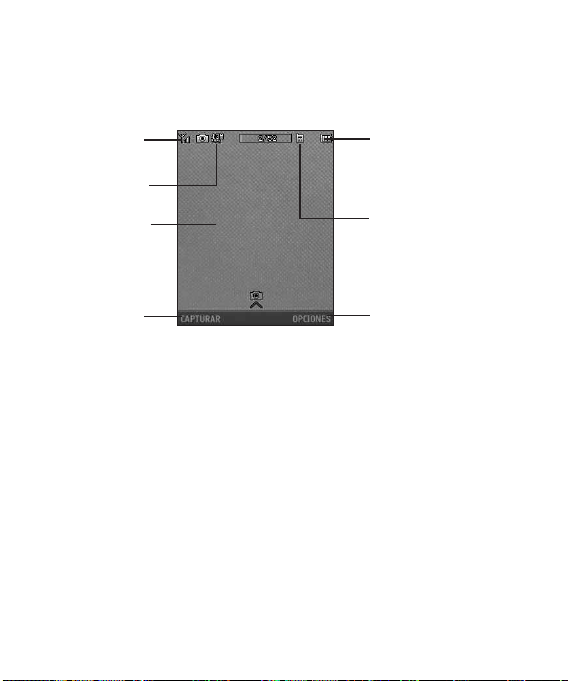
134 Sección 2J: Uso de la Cámara
Viendo el estado de su cámara área de
visualización
Modo
Cámara
Resolución
Config. de
Almacenamiento
Cámara de
almacenamiento
restantes
Opciones de
Cámara
Visualización
de imágenes
Capturar

Sección 2J: Uso de la Cámara 135
Uso de la Cámara
El almacenamiento de fotos
El telefono de imagen y video que se llama area de
almacenamiento Mis albumes. Hay tres carpetas en Mi
Albumes:
v
En teléfono
v
Tarjeta de Memoria
v
Álbumes en Línea
Configuracion de opciones de almacenamiento
1. Presione Menú > Fotos > Configuración & Info > Auto-
Guardar.
2. Seleccione Memoria Tarjeta o En Teléfono.
En teléfono
El teléfono interno del área de almacenamiento se llama En
el Teléfono Carpeta.
Para revisar su fotos almacenados en la carpeta En Telefono:
1. Presione Menú > Fotos > Mis Álbumes > En teléfono.
2. Use su tecla de navegación para ver y desplazarse a
través de la fotos.

136 Sección 2J: Uso de la Cámara
Carpetas de tarjetas de memoria
Puede guardar imagenes y videos directamente a la tarjeta
microSD™.
Para revisar su fotos almacenados en el microSD™:
1. Presione Menú > Fotos > Mis Álbumes > Tarjeta de
Memoria
.
2. Use su tecla de navegacion para desplazarse por la vista
y Guardado las fotos.
En la carpeta de telefono y tarjeta de memoria
opciones
Cuando usted esta viendo en la carpeta o en el Telefono de
memoria Tarjeta de carpetas, pulse
OPCIONES (tecla suave
derecha) para visualizar la Siguientes opciones:
* indica las opciones de vídeo.
v
Enviar De enviar una imagen a otro usuario utilizando
Picture Mail.
v
CargarPara subir archivos a el sitio Web Picture
Messaging. Seleccione Mi Cargas o Mi Álbumes y
presione Continuarpara cargar las imágenes
seleccionadas.
Sección 2J: Uso de la Cámara 137
Uso de la Cámara
v
Asignar para asignar como:
n
SalvapantallaPara mostrar la foto o video como un
protector de pantalla.
n
ID de imagen Para mostrar la foto seleccionada para
llamadas entrantes de un contacto específico.
Seleccione la entrada desiada y oprima . (Sólo
se aplica a las imágenes.)
v
BorrarPara borrar la foto seleccionada. Seleccione Borrar
selección
o Borrar todos.
Nota: Eliminar fotos y vídeos libera espacio de memoria en el teléfono
para que usted puede tomar más fotos y vídeos. Una vez eliminados, los
temas no puede subirse a su línea fotográfica Sprint cuenta de correo.
v
Editar para seleccionar de las siguientes opciones:
n
Copiar/MoverPara copiar o mover la imagen de el
Teléfono a la tarjeta de memoria instalada.
n
Subtítulo de Texto Para editar el título del elemento
seleccionado.
n
Zoom Para acercar el elemento seleccionado.
n
GirarPara rotar el elemento seleccionado.

138 Sección 2J: Uso de la Cámara
n
VoltearPara voltear la dirección de la foto.
n
Avanzado Para editar la foto con las siguientes
opciones: Mejora, brillo, equilibrio de blanco, y
Local Intensidad Boost.
v
Efectospara mostrar las opciones siguientes:
n
Efectos de imagen Para editar la foto con las
siguientes opciones: como Antique, Relieve, Niebla,
Gray Sketch, Posterizar, Pintura, Glow, Stamp,
Cartoon y el espejo.
n
Cara deforme Para editar la foto con las siguientes
opciones: la nariz, Twister, nariz pequeña, ancha
sonrisa, Grit, Big Face, Profesor, Alien, Big Nose,
Alien Hybrid, Pípilo, Cuadrados, Sharp Chin, cara
larga, feliz y Fool Insectos.
v
Lista de Álbumes Para mostrar la lista de mi álbumes.
v
Modo de Cámara Para regresar a la cámara.
v
DetallesPara mostrar las siguientes opciones.

Sección 2J: Uso de la Cámara 139
Uso de la Cámara
Álbumes en Línea
Picture Mail te permite guardar tus imágenes y vídeos a
álbumes en línea que lo hacen fácil de guardar, organizar y
compartir todas tus imágenes.
1. Abra Álbumes en Línea (Menú > Fotos > Mis Álbumes >
Álbumes en Línea
) y sobresalte una foto.
2. Presione OPCIONS(tecla suave derecha) para mostrar
las opciones.
3. Resalte una opción y presione . Las opciones serán:
v
EnviarPara enviar su foto.
v
AsignarPara descargar el elemento seleccionado y
asignarla a un teléfono tarea.
n
SalvapantallaPara mostrar la foto o video como un
protector de pantalla.
n
ID de imagen Para mostrar la foto seleccionada para
llamadas entrantes de un contacto específico.
Seleccione la entrada desiada y oprima . (Sólo
se aplica a las imágenes.)
v
BorrarPara borrar la foto seleccionada. Seleccione Borrar
selección
o Borrar todos.
v
CopiaAfin de que las impresiones pueden ser entregados
por correo o recoger en un punto de venta, o para
imprimir directamente a una impresora con Bluetooth o
impresa.

140 Sección 2J: Uso de la Cámara
v
Editarpara mostrar las opciones siguientes:
n
Copiar/Mover Para copiar o mover imágenes entre
la carpeta seleccionada actualmente y otra carpeta
en álbumes en línea.
n
Subtitulo de texto para editar la nota del elemento
seleccionado.
n
Girar para girar la imagen y guardarla.
v
Lista de álbumes para mostrar la lista de álbumes en línea.
v
Detallepara mostrar información sobre la imagen, por
ejemplo, el título, el modelo, cuándo fue tomada, la
resolución, el tamaño del archivo, la calidad, la ubicación
y cuándo fue cargada.
Envío de mensajes de foto
Una vez que ha tomado una foto puede utilizar las
capacidades de mensajeria de su teléfono para compartirla
instantáneamente con familiares y amigos. Puedes enviar
una imagen a varias personas a la vez usando sus direcciones
de correo electronico o su número de teléfono.

Sección 2J: Uso de la Cámara 141
Uso de la Cámara
Envío de imágenes y vídeos de en el teléfono
Carpeta o la tarjeta de memoria
1. Presione Menú > Fotos>Mis Álbumes>En teléfono o
Tarjeta de Memoria
2. Selecciona una imagen o un vídeo y pulse enviar .
(El Casilla de verificación en la esquina inferior derecha
será marcado. Usted Puede seleccionar varias
imágenes y vídeos.)
3. Presione OPCIONES(tecla suave derecha)>Enviar>
Correo de Imagen
.
4. Seleccione Ir a Contactoso NUEV DIRCpara introducir
los destinatarios.
n
Ir a Contactos para seleccionar destinatarios de sus
Contactos. Resalte un destinatario y presione .
n
NUEV DIRC para introducir directamente un
numero de telefono movil o una direccion de correo
electronico.
5. Resalte un contacto o introduzca un número de
teléfono móvil o una dirección de correo electrónico
con el teclado y presione .

142 Sección 2J: Uso de la Cámara
6. Si desea incluir un asunto, seleccione Subj: ypresione
ADD (Agregar) (tecla suave derecha) o . Introduzca
el asunto con el teclado y presione
GUARDAR (tecla
suave izquierda) para guardar y salir.
7. Si desea incluir un mensaje de texto, resalte Text: y
presione
ADD (Agregar) (tecla suave derecha) o .
Introduzca el mensaje con el teclado del teléfono (o
presione
MODO (tecla suave derecha) y presione
GUARDAR (tecla suave izquierda) para guardar y salir.
8. Si desea incluir un mensaje de memorándum de voz
con la imagen, seleccione
Audio: y presione .
Presione
HECHO (tecla suave izquierda) paradetener la
grabación. (El tiempo máximo degrabación es de 15
segundos).
9. Confirme los contenidos del mensaje:
n
Para cambiar un destinatario, resalte el campo To
(Para): y presione CHANGE (Cambiar) (tecla suave
derecha), y siga las instrucciones en el paso 5 para
seleccionar o editar el destinatario.
n
Para cambiar el asunto, seleccione el campo
Asunto: y presione CHANGE (Cambiar)(tecla
defunción derecha).

Sección 2J: Uso de la Cámara 143
Uso de la Cámara
n
Para cambiar el mensaje de texto, seleccione
elcampoText o: y presione CHANGE (Cambiar) (tecla
suave derecha).
n
Para cambiar el memorándum de voz, seleccione el
campo Audio: y presione REVIEW (Revisar) (tecla
suave derecha) y seleccione Volver a grabar.
n
Para cambiar las imágenes adjuntas, seleccionela
imagen en miniatura y presione CHANGE(Cambiar)
(tecla suave derecha). Seleccionelas imágenes
presionando y luego PRÓXIMO(tecla suave
izquierda).
10. PresioneSEND (Enviar) (tecla suave izquierda) para
enviar la imagen. Si se le notifica que "
Sumensaje se
encuentra en la cola pendiente y seráenviado pronto.
"
presione
CONTINUAR (tecla defunción izquierda) para
completar el proceso deenvío de la imagen.

144 Sección 2K: Uso de Bluetooth
Uso de Bluetooth
En esta sección
l Apagar y encender Bluetooth
l Uso del menú de configuración de Bluetooth
l Perfiles de Bluetooth
l Emparejar dispositivos Bluetooth
Su teléfono incluye tecnología Bluetooth interconstruida,
que le permite compartir información más fácilmente que
nunca antes.
Bluetooth es una tecnología de comunicación
de corto alcance que le permite conectarse de manera
inalámbrica a varios otros dispositivos de Bluetooth, como
audífonos, kits de manos libres para automóvil, y agendas
electrónicas, PC y teléfonos inalámbricos habilitados para
Bluetooth. El alcance de comunicación aproximado de
Bluetooth es generalmente de hasta 10 metros (30 pies).
Esta sección le da detalles sobre cómo configurar las
capacidades de Bluetooth de su teléfono sacarle el mayor
provecho posible.

Sección 2K: Uso de Bluetooth 145
Apagar y encender Bluetooth
De manera predeterminada, la funcionalidad Bluetooth de
su dispositivo está desactivada. Al activar Bluetooth, su
teléfono se coloca como “disponible”para otros dispositivos
Bluetooth que estén en el rango.
Para encender Bluetooth:
1. SeleccioneMenú > Bluetooth > Más...> Configuración >
Encender/ Apagar.
2. Oprima la tecla de navegación hacia arriba o hacia
abajo para seleccionar
Encendery oprima para
habilitar Bluetooth.
Para apagar Bluetooth:
1. SeleccioneMenú > Bluetooth > Más...> Configuración >
Encender/ Apagar
.
2. Oprima la tecla de navegación hacia arriba o hacia
abajo para seleccionar
Apagary oprima para
deshabilitar Bluetooth.
Uso de Bluetooth

146 Sección 2K: Uso de Bluetooth
Indicadores de estado de Bluetooth
Los iconos siguientes muestran el estado de su conexión de
Bluetooth de una mirada:
indica que Bluetooth está oculto (el color del icono
real es gris).
Uso del menú de configuración de
Bluetooth
El menú Configuración de Bluetooth le permite configurar
muchas de las características del servicio de Bluetooth de su
teléfono, entre ellas:
v
Introducir o cambiar el nombre que su teléfono usa para
la comunicación Bluetooth.
v
Configuración de la visibilidad de su teléfono (o
"descubribilidad”) para otros dispositivos de Bluetooth.
v
Mostrar la dirección de Bluetooth de su teléfono.

Sección 2K: Uso de Bluetooth 147
Para acceder al menú Configuración de Bluetooth:
1. Seleccione Menú > Bluetooth > Más...> Configuración.
2. Establezca las opciones de Bluetooth.
n
Seleccione Visibilidad > Escondido, Visible por 3min.
o Siempre visible para establecer lavisibilidad de
Bluetooth®.
n
Seleccione Nombre de mi dispositivo paracambiar
el nombre del teléfono para Bluetooth®.
n
Seleccione Info de mi dispositivo para mostrar los
perfiles y la dirección Bluetooth®del teléfono.
n
Seleccione Intercambiar Carpeta para mostrar el
destino Bluetooth®del teléfono para los archivos
que se comparten entre el teléfono y un dispositivo
habilitado para Bluetooth que usa el protocolo de
transferencia FTP.
n
Seleccione Prioridad de voz para mostrar la
prioridad de comunicación Bluetooth® del teléfono.
Uso de Bluetooth

148 Sección 2K: Uso de Bluetooth
Configuración de Bluetooth: Visibilidad
La sección Visibilidaddel menú de Configuración de
Bluetooth le permite administrar la disponibilidad de su
teléfono para otros dispositivos de Bluetooth.
Para configurar la visibilidad de su teléfono para otros
dispositivos de Bluetooth:
1. SeleccioneMenú > Bluetooth > Más...> Configuración >
Visibilidad
.
2. Seleccione la configuración de visibilidad deseada y
oprima :
n
Escondido para evitar que otros dispositivos de
Bluetooth detecten e identifiquen su teléfono.
n
Visible por 3 min para permitir que los dispositivos
de Bluetooth detecten e identifiquen su teléfono
durante tres minutos.
n
Siempre Visible para permitir que los dispositivos de
Bluetooth detecten e identifiquen su teléfono en
cualquier momento al estar dentro del rango.
Nota: Cualquier cambio que haga en su configuración de Bluetooth se
guardará en el perfil actual cuando salga del menú de Configuración de
Bluetooth.

Sección 2K: Uso de Bluetooth 149
Configuración de Bluetooth: Mi nombres de
Bluetooth
La sección Mi nombre de Bluetooth del menú de
Configuración de Bluetooth le permite seleccionar un
nombre de Bluetooth para su teléfono. El nombre de
Bluetooth de su teléfono aparecerá para otros dispositivos
de Bluetooth al alcance, en función de su configuración de
visibilidad.
Para configurar un nombre de Bluetooth para su teléfono:
1. SeleccioneMenú > Bluetooth > Más...> Configuración >
Nombre de mi dispositivo.
2. Oprima para borrar el nombre actual.
3. Ingrese un nuevo nombre y presione GUARDAR(tecla
suave izquierda) para guardar.
Configuración de Bluetooth: Mi dirección de
Bluetooth
Para mostrar la dirección de Bluetooth de su teléfono:
©
SeleccioneMenú > Bluetooth > Más...> Configuración >
Info de mi dispositivo.
Uso de Bluetooth

150 Sección 2K: Uso de Bluetooth
Función de transferencia de audio de Bluetooth
Para usar la función de transferencia de audio de Bluetooth
durante una llamada:
1. Compruebe que esté conectado un auricular Bluetooth
a su teléfono.
2. Durante la llamada, transfiera la salida de sonido del
teléfono desde el teléfono al auricular (seleccione
Transfer to BT); o desde el auricular al teléfono
(seleccione
Transfer to Phone).
Perfiles de Bluetooth
Todos los ajustes de Bluetooth que configure están
almacenados en el perfil de usuario de Bluetooth de su
teléfono. Se pueden usar perfiles distintos para funciones de
Bluetooth específicas.
v
Perfil de audífonos – Este perfil funciona como entrada de
audífono inalámbrica. Cuando se recibe una llamada
entrante, el timbre puede escucharse por los audífonos y
se puede escuchar un tono de alerta interconstruido
mediante los audífonos. La llamada puede recibirse
entonces oprimiendo un botón. Al usar los audífonos,
puede usar éstos en lugar del teléfono oprimiendo un
botón en ellos, igual que introducir una clavija en el
teléfono.

Sección 2K: Uso de Bluetooth 151
v
Perfil de manos libres – Este perfil funciona como un kit
para automóvil inalámbrico. Las llamadas entrantes
suenan en los audífonos o dispositivo de manos libres. Se
pueden recibir llamadas oprimiendo un botón en los
audífonos o el dispositivo. Para marcar, se admiten
cuatro funciones: marcado de llamadas recientes,
marcado de voz, marcado rápido y marcado de números.
Aumente o disminuya el volumen con la tecla de
volumen que está a un lado del terminal.
v
DUN: Perfil de marcado de red – Este perfil funciona como
cable de datos inalámbrico, conectando una PC o PDA a
una red mediante su terminal.
v
Perfil ObjectPush (OPP) – Puede enviar una vCard o un
vCalendar en su teléfono a otros dispositivos habilitados
para Bluetooth.
v
FTP – Transferencia de archivos permite enviar o recibir
no protegidos archivos de datos a un dispositivo
compatible con Bluetooth®.
v
BPP – Basic Print perfil es un perfil para la transferencia
de usergenerated imágenes a una impresora e imprimir a
cabo.
v
A2DP – permite la transmisión inalámbrica de estéreo de
una fuente de audio A2DP (normalmente un teléfono o
ordenador) a un receptor A2DP (un conjunto de
Bluetooth los auriculares o sistema de estéreo).
v
AVRCP – permite que los dispositivos Bluetooth para el
control de los medios de comunicación su reproducción
en dispositivos remotos.
Uso de Bluetooth

152
v
Perfil de acceso a la libreta de teléfonos (PBAP) – Este perfil
activa el intercambio de información de Contactos entre
dispositivos. Probablemente se utilice entre el kit de un
automóvil y un teléfono móvil para permitir que el kit del
automóvil muestre el nombre de quien está llamando.
Emparejar dispositivos Bluetooth
Agregar Aparato
El proceso de emparejamiento de Bluetooth le permite
establecer conexiones de confianza entre su teléfono y otro
dispositivo de Bluetooth. Cuando se emparejan dispositivos,
los dispositivos comparten una clave de paso entre ellos,
permitiendo una conexión rápida y segura al tiempo que
anulan los procesos de descubrimiento y autenticación.
Para emparejar su teléfono con otro dispositivo Bluetooth:
1. SeleccioneMenú > Bluetooth > Agregar un nuevo... >
Buscar
> Seleccione el aparato con cual quiere emparejar.
2. Seleccione el dispositivo que desea emparejar y
oprima .
3. Introduzca (o verifique) una clave contraseña y oprima
.

Sección 3
Características del servicio

154 Sección 3A: Características del servicio: aspectos básicos
Características del servicio: aspectos
básicos
En esta sección
l Uso del correo de voz
l Uso de la mensajería de texto SMS
l Uso de Id. de Llamada
l Responder a llamada en espera
l Hacer una llamada a tres (Convocatoria de tres vías)
l Uso de desvío de llamadas
Ahora que ha dominado los aspectos fundamentales de su
teléfono, es hora de explorar las funciones de llamada que
optimizan su servicio.
Esta sección delinea las funciones
básicas del servicio.

Sección 3A: Características del servicio: aspectos básicos 155
Uso del correo de voz
Configuración de su correo de voz
Todas las llamadas no respondidas a su su teléfono se
transfieren automáticamente a su correo de voz, incluso si
está usando el teléfono o lo tiene apagado. Por tanto, le
recomendamos configurar su Correo de voz y su saludo
personal tan pronto como se active su teléfono.
Para configurar su correo de voz:
1. Mantenga oprimida .
2. Siga las indicaciones del sistema para:
n
Crear su código de pase.
n
Grabar su saludo.
n
Grabe su anuncio de nombre.
n
Elija si desea o no activar el Acceso a mensajes con
una tecla (una función que le permite acceder a los
mensajes simplemente manteniendo oprimida
y omitiendo la necesidad de que introduzca
su código de pase).
Características del servicio

156 Sección 3A: Características del servicio: aspectos básicos
Notificación de correo de voz
Hay varias formas en que su teléfono le alerta de un nuevo
mensaje:
v
Mostrando un mensaje en la pantalla.
v
Haciendo sonar el tipo de timbre asignado.
v
Haciendo destellar el LED en rojo.
v
Mostrando en la parte superior de la pantalla.
Alertas de mensajes nuevos de correo de voz
Al recibir un nuevo mensaje de voz, su teléfono le avisa y le
indica que llame a su correo de voz.
Para llamar a su correo de voz:
©
Mantenga oprimida .
Nota: Su teléfono acepta mensajes incluso estando apagado. No
obstante, sólo se le avisa de los nuevos mensajes cuando su teléfono está
encendido y está en un Área de servicio de la red suya.
Sección 3A: Características del servicio: aspectos básicos 157
Recuperación de sus mensajes de correo de voz
Puede revisar sus mensajes directamente desde su teléfono o
desde cualquier otro teléfono de tonos. Para marcar desde su
teléfono, puede marcar su correo de voz con marcado rápido o
usar las teclas de menú.
Uso del acceso a mensajes de una tecla (Uno-Toque El
Acceso Del Mensaje)
©
Mantenga oprimida . (Su teléfono marcará su
buzón de correo de voz.)
Uso de las teclas de menú en su teléfono para acceder a
sus mensajes
1. Seleccione Menú > Mensajes > Correo de Voz.
2. Oprima para escuchar sus mensajes.
Nota: Se le cobrarán minutos de tiempo de aire cuando acceda a su correo
de voz desde su teléfono.
Características del servicio
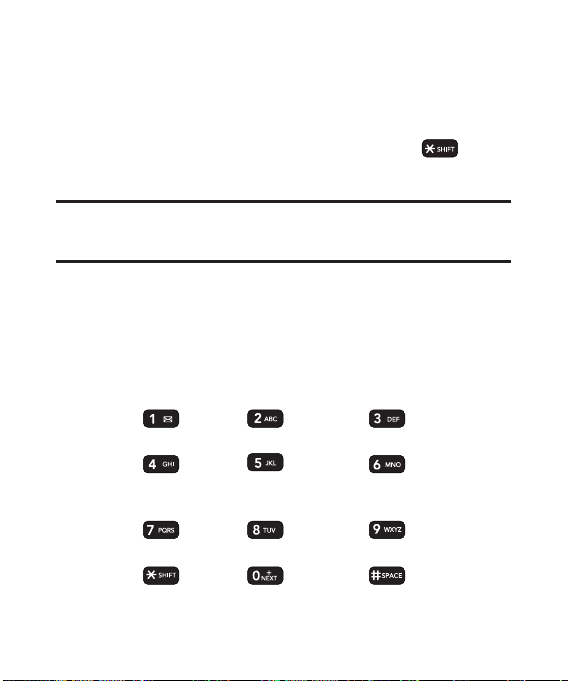
158 Sección 3A: Características del servicio: aspectos básicos
Uso de un teléfono distinto de su teléfono para acceder a
los mensajes
1. Marque su número de teléfono.
2. Cuando responda su correo de voz, oprima .
3. Introduzca su código de pase.
Tip: Al llamara a correo de voz, escuchará primero la información de
encabezado (fecha, hora e información del remitente) del mensaje. Para
pasar directamente al mensaje, oprima 4durante el encabezado.
Guía de los botones del correo de voz
Ésta es una guía rápida para las funciones de su teclado
cuando está escuchando mensajes de correo de voz. Para
obtener más detalles y opciones de menú, vea "Teclas del
menú de correo de voz" en la página 164.
Fecha y hora Enviar respuesta Avance
Reproducir Rebobinar Adelante
de nuevo
Borrar Devolv. llamada Guardar
Cancelar Ayuda Omitir
Sección 3A: Características del servicio: aspectos básicos 159
Opciones de correo de voz
Su teléfono ofrece varias opciones para organizar su correo
de voz y acceder a él.
Uso del modo Experto
El uso de la configuración de modo Experto para su buzón de
correo de voz personal le ayuda a navegar más rápidamente
por el sistema de correo de voz reduciendo el número de
indicaciones de voz que escucha en cada nivel.
Para activar o desactivar el modo Experto:
1. Mantenga oprimida para acceder a su correo de
voz. (Si su buzón de correo de voz contiene cualquier
mensaje nuevo o guardado, oprima para acceder
a su menú principal de correo de voz.)
2. Oprima para cambiar sus Opciones personales
siguiendo las indicaciones del sistema.
3. Oprima de nuevo para ir al modo Experto.
4. Oprima para activar o desactivar el modo
Experto.
Características del servicio
160 Sección 3A: Características del servicio: aspectos básicos
Configuración de listas de distribución de grupo
Crea hasta 20 listas de grupos independientes, cada una
hasta con 20 clientes.
1. Mantenga oprimida para acceder a su correo de
voz. (Si su buzón de correo de voz contiene cualquier
mensaje nuevo o guardado, oprima para acceder
a su menú principal de correo de voz.)
2. Oprima para cambiar sus Opciones personales
siguiendo las indicaciones del sistema.
3. Oprima para ver Opciones administrativas.
4. Oprima para ir a Listas de distribución de grupo.
5. Siga las indicaciones de voz para crear, editar, cambiar
de nombre o borrar listas de grupo.
Devolución de llamada
Devuelva una llamada después de escuchar un mensaje sin
desconectarse de correo de voz.
©
Oprima después de escuchar un mensaje. (Una
vez que haya terminado la llamada, se le devuelve al
menú principal de correo de voz.)
Sección 3A: Características del servicio: aspectos básicos 161
Mensaje de Correo de voz-a-Correo de voz
Grabe y envíe un mensaje de voz a otros usuarios de Correo
de voz.
1. Desde el menú principal de correo de voz, oprima
para enviar un mensaje
2. Siga las indicaciones de voz para introducir el número
de teléfono.
3. Siga las indicaciones de voz para grabar y enviar su
mensaje de voz.
Respuesta a mensajes de Correo de voz-a-Correo de voz
Respuesta a un mensaje de voz recibido de cualquier otro
usuario de Correo de voz.
1. Después de escuchar el mensaje de voz, oprima .
2. Siga las indicaciones de voz para grabar y enviar su
respuesta.
Reenvío de mensajes de Correo de voz-a-Correo de voz
Reenvía un mensaje de voz, excepto si está marcado como
"Privado", a otros usuarios de Correo de voz.
1. Después de escuchar un mensaje, oprima .
Características del servicio

162 Sección 3A: Características del servicio: aspectos básicos
2. Siga las indicaciones de voz para introducir el número
de teléfono.
3. Siga las indicaciones de voz para grabar su
presentación y reenviar el mensaje de voz.
Solicitud de recepción de Correo de voz-para-Correo de
voz
Reciba confirmación de que se ha escuchado su mensaje de
voz cuando envía, reenvía o responde a otros usuarios.
1. Después de que haya grabado un mensaje, oprima
para indicar que está satisfecho con él.
2. Oprima para marcar la solicitud de aviso de
recepción.
3. Oprima para enviar su mensaje de correo de voz.
Seguir grabando
Al dejar un mensaje de voz, puede optar por seguir grabando
incluso después de haberse detenido.
©
Antes de oprimir para indicar que está satisfecho
con el mensaje que grabó, oprima para seguir
grabando.
Sección 3A: Características del servicio: aspectos básicos 163
Saludo de ausencia prolongada
Cuando se apaga su teléfono o está fuera de la Red durante
un período prolongado, este saludo puede reproducirse en
lugar de su saludo personal normal.
1. Desde el menú principal de correo de voz,
oprima para ir a Opciones personales.
2. Oprima para ir a Saludos.
3. Oprima para grabar un Saludo de ausencia
prolongada.
Borrado del icono de mensaje
Su teléfono puede seguir mostrando temporalmente el
icono de mensaje después que haya revisado sus mensajes
de voz y de texto.
Para eliminar el icono de la pantalla:
1. Seleccione Menú > Mensajes > Correo de Voz >
Eliminar Icono
.
2. Desplácese a Sío No y oprima .
Características del servicio

164 Sección 3A: Características del servicio: aspectos básicos
Teclas del menú de correo de voz
Siguiendo las indicaciones del sistema de correo de voz,
puede usar el teclado para navegar por el menú de correo de
voz. La lista siguiente delinea la estructura de menús de
correo de voz de su teléfono.
Escuchar
Fecha/ Tiempo
Responder
Avanzar 8 segundos
Repetir
Regresar
Reenviar mensaje
Borrar
Devolución de llamada
Guardar
Opciones
Enviar un mensaje
Opciones personales
Ajustes
Omitir código de pase
Reproducción automática
Fecha y Hora del mensaje activado/desactivado
Sección 3A: Características del servicio: aspectos básicos 165
Cambiar código de pase
Lista de distribución de grupo
Páginas numéricas.
Volver al menú de opciones personales
Saludos
Saludos personales
Anuncio de nombre
Saludo de ausencia prolongada
Volver al menú de opciones personales
Modo experto (Encendido/Apagado)
Hacer una llamada
Desconectar
Uso de la mensajería de texto SMS
Con la mensajería SMS de texto usted puede enviar
mensajes instantáneos de texto desde su teléfono a otro
teléfono habilitado para mensajes – y ellos le pueden enviar
mensajes a usted. Al recibir un nuevo mensaje, aparecerá
automáticamente en la pantalla de su teléfono.
Además, la mensajería SMS de texto incluye un surtido de
mensajes preestablecidos, tales como "Llegaré tarde, estoy
en camino" que hacen que la redacción de mensajes sea
rápida y sencilla. También puede también personalizar sus
propios mensajes preestablecidos (de hasta 100 caracteres)
desde su teléfono.
Características del servicio

166 Sección 3A: Características del servicio: aspectos básicos
Redacción de mensajes de texto SMS
1. Presione Menu > Mensajes > Enviar Mensaje > Mensaje
de Texto
y seleccionar el método que prefiera:
n
Ir a contactos Para seleccionar un destinatario de su
interior Contactos. (Beneficiarias Contactos entradas
debe contener un número de teléfono inalámbrico o
una dirección de correo electrónico.)
n
NNUEV DIRC (tecla suave derecha) Utilizar el
teclado para introducir el número del teléfono
móvil o dirección de correo electrónico de la
persona a la que desea enviar un mensaje.
2. Presione .
3. Resalte OPCIONESy desplácese a su prioridad y pulse la
tecla de navegación o la izquierda para fijar el mensaje
prioridad (
normalo urgente).
4. Si desea cambiar su número de devolución de llamada,
desplácese al mismo y oprima , seleccione
Ningún,
Mi núm teléfono u Otroy oprima . (Si selecciona
Otro, introduzca el número deseado y oprima .)
5. Prensa HECHO (tecla suave izquierda).
6. Oprima ENVIAR(tecla suave derecha) para enviar el
mensaje.

Sección 3A: Características del servicio: aspectos básicos 167
Acceso a mensajes SMS de texto
Para leer un mensaje SMS de texto:
©
Al recibir un mensaje de texto, éste aparecerá
automáticamente en la pantalla principal de su
teléfono, en función de la configuración. Use la tecla de
navegación para desplazarse hacia abajo y ver todo el
mensaje.
Para responder a un mensaje SMS de texto:
1. PresioneMenu > Mensajes > Enviar Mensaje > Mensajes
de Text o
y seleccione la reciente lista.
2. Siga los pasos mismos que componen SMS mensaje de
texto para completar y enviar su respuesta.
Envío de un mensaje de texto utilizando el
teclado QWERTY®
1. Diapositiva abrir el teclado QWERTY®.
2. Presione Menu>Mensajes>Enviar Mensaje>Mensaje de
Text o
.
3. Presione NUEV DIRC(tecla suave derecha).
n
Introduzca un número de teléfono inalámbrico o una
dirección de correo electrónico y pulse .
Características del servicio

168 Sección 3A: Características del servicio: aspectos básicos
– o –
n
Use la tecla de navegación para seleccionar un
contacto y pulse .
4. Use el teclado para introducir su mensaje.
5. Presione ENVIAR (tecla suave izquierda)
Uso de MensajesPreestablecidos
Mensajes preestablecidos hace más sencillo que nunca el
envío de mensajes de texto para sus amigos, familia y
compañeros de trabajo.
Para agregar o editar mensajes preestablecidos:
1. Seleccione Menú > Configuración > Mensajes > Mensajes
Preestablecidos > AGREGAR.
2. Introduzca su nuevo mensaje y oprima .
(Vea "Introducción de texto", en la página 41.)
Sección 3A: Características del servicio: aspectos básicos 169
Uso de Id. de Llamada
Id. de llamada le permite a la gente identificar a quien llama
antes de contestar el teléfono mostrando el número de la
llamada entrante. Si no desea que se muestre su número cuando
hace una llamada, sólo tiene que seguir estos pasos sencillos.
Para bloquear la presentación de su número de teléfono en una
llamada saliente concreta:
1. Oprima
.
2. Introduzca el número al que desea llamar.
3. Oprima
.
Para bloquear permanentemente su número, llame a su
abastecedor de servicio.
Características del servicio

170 Sección 3A: Características del servicio: aspectos básicos
Responder a Llamada en espera
En el transcurso de una llamada, Llamada en espera le avisa
de llamadas entrantes haciendo sonar dos pitidos. La
pantalla de su teléfono le informa de que está entrando otra
llamada y muestra el número de teléfono de quien llama (si
está disponible y usted está en modo digital).
Para responder a una llamada entrante cuando esté en una
llamada:
©
Oprima . (Esto pone en espera a la primera
persona y responde la segunda llamada.)
Para volver a la primera llamada:
©
Oprima de nuevo.
Sugerencia: Para las llamadas en las que no desea ser interrumpido,
puede deshabilitar temporalmente Llamada en espera oprimiendo * 7 0
ante de hacer la llamada. Llamada en espera se reactiva automáticamente
una vez que termine la llamada.
Sección 3A: Características del servicio: aspectos básicos 171
Hacer una Llamadaa tres (Convocatoria de
tres vías)
Con las llamadas de conferencia, puede hablar con dos
personas al mismo tiempo. Al usar esta función, se cargará la
tarifa de tiempo de aire normal por cada una de las dos
llamadas.
Para hacer una llamada de conferencia:
1. Introduzca un número al que desee llamar y oprima
.
2. Una vez que haya establecido la conexión, introduzca el
segundo número al que desea llamar y oprima .
(Esto pone en espera a la primera persona y marca el
segundo número.)
3. Cuando esté conectado con la segunda persona,
oprima nuevamente para iniciar su llamada a
tres.
Si una de las personas a las que llamó le cuelga durante la
llamada, usted y la persona que quedó siguen conectados. Si
usted inició la llamada y es el primero en colgar, los tres se
desconectan.
Características del servicio
172 Sección 3A: Características del servicio: aspectos básicos
Uso de desvío de llamadas
El desvío de llamadas le permite desviar todas las llamadas
entrantes a otro número de teléfono, incluso cuando su
teléfono esté apagado. Puede seguir haciendo llamadas
desde su teléfono cuando se activa Desvío de llamadas.
Para activar el Desvío de llamadas:
1. Oprima .
2. Introduzca el código de área y el número de teléfono al
cual deben desviarse sus llamadas futuras.
3. Oprima . (Verá un mensaje y escuchará un tono
para confirmar la activación del Desvío de llamadas.)
Para desactivar el Desvío de llamadas:
1. Oprima .
2. Oprima . (Verá un mensaje y escuchará un tono
para confirmar la desactivación.)
Nota: Se le cargará una tarifa más alta por las llamadas que haya desviado.

Sección 3B: Servicio de datos 173
Servicio de datos
En esta sección
l Servicio de Aplicación de datos
l Para empezar
l Descarga de contenido de servicios Premium
l Exploración de la Web
l Preguntas frecuentes sobre
Servicio de datos le trae claridad que puede ver y escuchar
con avanzados servicios de multimedia. Estas funciones,
incluida la mensajería, los juegos, los timbres
descargables y los protectores de pantalla, así como el
acceso portátil a la Web, son fáciles de aprender y de usar.
Claramente, es una forma totalmente nueva de ver lo
inalámbrico.
Esta sección presenta estos servicios avanzados y lo lleva
por los pasos necesarios para empezar a aprovechar los
servicios. Para obtener detalles e instrucciones completos,
entre en contacto con su abastecedor de servicio.
Servicio de datos

174 Sección 3B: Servicio de datos
Servicio de Aplicación de datos
Ésta es una breve lista de los tipos de aplicaciones
disponibles mediante su teléfono.
Games – Participe en emocionantes juegos con gráficos a
todo color, sonido y vibración. Elija de entre más de 250
juegos para jugar en cualquier momento.
Ringers – Personalice su teléfono descargando distintos
timbres y asignándoselos a los números de su libreta de
teléfonos.
Screen Savers –
Descargue imágenes únicas para usarlas
como protectores de pantalla, o haga más sencillo saber
quién llama asignando imágenes específicas a los
números de su libreta de teléfonos.
Web – Experimente versiones de sitios Web populares,
con gráficos a todo, desde su teléfono.

Sección 3B: Servicio de datos 175
Para empezar
Esta sección le ayudará a conocer los aspectos básicos del uso
de sus servicios, entre ellos la administración de su nombre
de usuario, el inicio de una conexión de datos y navegar la
Web con su teléfono.
Su nombre de usuario
Al comprar un teléfono e inscribirse en el servicio,
automáticamente se le asigna un nombre de usuario, que
habitualmente se basa en su nombre y un número, seguidos.
Al usar los servicios, su nombre de usuario se envía para
identificarlo en la Red. El nombre de usuario también es útil
como dirección de, como forma de personalizar los servicios
Web y como identidad virtual en línea.
Su nombre de usuario se programará automáticamente en
su teléfono. No necesita introducirlo.
Para encontrar su nombre de usuario
Si no está seguro de cuál es su nombre de usuario, puede
encontrarlo fácilmente en línea o en su teléfono.
Data service

176 Sección 3B: Servicio de datos
Para encontrar su nombre de usuario:
v
Info de teléfono Puede encontrar su nombre de usuario
bajo la opción
Informacióndel teléfonoen el menú
Configuración de su teléfono (Menú > Configuración > Info
de teléfono > Versión
).
Inicio de una conexión de el Navegador
Para iniciar una conexión de el Navegador:
©
Seleccione Menú >Web. (Se iniciará su conexión Servicio
de datos y aparecerá la página de inicio.)
Nota: Si está habilitado Net Guard y se muestra, oprima Conectar (tecla
suave derecha) para continuar e iniciar la Web.
Mientas se conecta, aparecerá lo siguiente en la pantalla:
Conectando...
Si tenía una conexión anterior, al iniciar su navegador se
mostrará la última página que visitó. Cuando ocurre esto, es
posible que no vea el mensaje "Conectando..." al iniciar la
sesión. Aunque el navegador esté abierto, usted no está
actualmente en una sesión de datos activa, es decir, no se
están enviando ni recibiendo datos. Tan pronto como
navegue a otra página, se iniciará la sesión activa y verá el
mensaje "Conectando..."

Sección 3B: Servicio de datos 177
NetGuard
Cuando se conecta por primera vez a la Web, Net Guard
aparecerá para confirmar que desea conectarse. Esta función
le ayuda a evitar conexiones accidentales. Puede deshabilitar
Net Guard más adelante seleccionando
Siempre hacer
conexión automática
cuando se muestre Net Guard.
Para cambiar su configuración de Net Guard:
©
Seleccione Menú > Configuración > Mas... > Datos >
Guardia de Red
y elija una opción:
n
Encender para activar Net Guard.
n
Apagarpara desactivar Net Guard.
Nota: Cuando está habilitado, Net Guard aparece sólo una vez en cada
sesión. Net Guard no aparece si el teléfono está simplemente volviendo a
conectarse después de una desconexión por tiempo transcurrido.
Estado de conexión e indicadores de Servicio de
datos
La pantalla de su teléfono le permite conocer el estado actual
de su conexión de Servicio de datos mediante indicadores
que aparecen en la parte superior de la pantalla. Se usan los
símbolos siguientes:
Data service

178 Sección 3B: Servicio de datos
Su conexión de Servicio de datos está activa (se están
transfiriendo datos); el símbolo de transmitir y recibir
destellará para indicar transmisión de datos. Las
llamadas de voz entrantes van directamente al correo
de voz; se pueden hacer llamadas salientes, pero se
dará por terminada la conexión de Servicio de datos.
Su conexión de Servicio de datos está latente (no se
están enviando ni recibiendo datos). Aunque no está
actualmente activo, cuando el teléfono está latente
puede reiniciar una conexión activa rápidamente; se
pueden hacer y recibir llamadas de voz.
Su teléfono no puede acceder de momento a las
funciones del servicio Servicio de datos.
Si no aparecen indicadores, su teléfono no tiene de momento
una conexión de Servicio de datos.
Navegación de la Web
Navegar por los menús y sitios Web durante una sesión de
Servicio de datos es sencillo una vez que haya aprendido
algunos aspectos básicos. Éstas son algunas sugerencias
para desplazarse con facilidad:
Sección 3B: Servicio de datos 179
Teclas suaves
Durante una sesión de Servicio de datos, la línea inferior de la
pantalla de su teléfono contiene una o más teclas suaves.
Estas teclas son controles de atajo para navegar por la Web, y
se corresponden con los botones de tecla suave que están
directamente debajo de la pantalla del teléfono.
Sugerencia: En función de los sitios Web que visite, las etiquetas de las
teclas suaves pueden cambiar para indicar su función.
Para usar las teclas suaves:
©
Oprima el botón de tecla suave deseado. (Si aparece un
menú emergente adicional al oprimir el botón de la
tecla suave, seleccione los elementos de menú usando
el teclado [si están numerados] o resaltándolos y
oprimiendo .)
Desplazamiento
Como ocurre con otras partes del menú de su teléfono,
tendrá que desplazarse hacia arriba y hacia abajo para ver
todo en algunos sitios Web.
Para desplazarse línea a línea por los sitios Web:
©
Oprima la tecla de navegación hacia arriba y hacia
abajo.
Data service

180 Sección 3B: Servicio de datos
Para desplazarse página a página por los sitios Web:
©
Oprima los botones de volumen que están en un lado
del teléfono.
Selección
Una vez que haya aprendido cómo usar las teclas suaves y
desplazarse, puede empezar a navegar por la Web.
Para seleccionar elementos en pantalla:
©
Use la tecla de navegación para resaltar el elemento
deseado, luego oprima el botón de la tecla suave que
desea (u oprima
)
.
Sugerencia: Descubrirá que la tecla suave derecha se usa principalmente
para seleccionar elementos. Esta tecla con frecuencia tiene la indicación
"Ir."
Sugerencia: Si los elementos de una página están numerados, puede usar
su teclado (teclas de número) para seleccionar un elemento. (El décimo
elemento de una lista numerada puede seleccionarse oprimiendo la tecla
0 del teclado de su teléfono, aunque el número 0 no aparece en la pantalla.)
Sección 3B: Servicio de datos 181
Para seleccionar enlaces:
©
Resalte el enlace y oprima la tecla suave correspondiente.
Regresar
Para regresar una página:
©
Oprima la tecla de su teléfono.
Nota: La tecla ATRÁS también se usa para borrar texto (como una tecla
Retroceso) cuando introduce texto.
Ir al inicio
Para volver a la página de inicio de Servicio de datos desde
cualquier otra página Web:
©
Mantenga oprimida .
– o –
Oprima
OPCIONES (tecla suave derecha) y seleccione
Home ().
Descarga de contenido de servicios Premium
Con Servicio de datos y su nuevo teléfono, tiene acceso a una
dinámica variedad de contenido de servicio Premium, como
juegos timbres, protectores de pantalla, y otras aplicaciones
que puede descargar. (Pueden aplicarse cargos adicionales.)
Data service

182 Sección 3B: Servicio de datos
Los pasos básicos necesarios para acceder a contenido de
servicio Premium y descargarlo se delinean abajo.
Acceso a los menús de descarga
Para acceder a los menús de descarga de Servicio de datos:
1. Seleccione Menú > Mis Cosas.
2. Seleccione el tipo de archivo que desea descargar
(
Games, Ringers,Screen Savers, o Aplications) y
seleccione
Obtener Nuevo. (Se iniciará el navegador y lo
llevará al menú de descarga correspondiente.)
Para acceder a los menús de descarga de Servicio de datos
desde el navegador Web:
1. Seleccione Ringers, Screen Savers, Applications, o Games
para ir al menú de descarga correspondiente.
Descarga de un elemento
Una vez que haya seleccionado un elemento que desee
descargar, resáltelo y oprima . Verá una página de
resumen del artículo, incluido su título, el fabricante, el
detalle de la descarga, el tamaño del archivo y el costo. Los
enlaces le permiten ver la página de Detalles de licencia, que
resume el precio, tipo de licencia y duración de la licencia de
la descarga, así como la página de Condiciones de uso, que

Sección 3B: Servicio de datos 183
detalla las Condiciones de uso de los servicios Premium y su
responsabilidad de pago.
Para descargar un artículo seleccionado:
1. Desde la página de información, seleccione Ok link. (El
elemento se descargará automáticamente. )
2. Seleccione una opción para continuar:
n
Seleccione Usar/Ejecutar/Ver para asignar el
elemento descargado (o para iniciarlo, en el caso de
un juego o una aplicación). Su sesión de terminará y
se le redirigirá a la pantalla de menús apropiada de
su teléfono.
n
Seleccione Ajustar como para asignarle un timbre o
un protector de pantalla a una función del teléfono.
n
Seleccione Configuraciónpara configurar los juegos
o aplicaciones descargados.
n
Seleccione Comprar para ver otros elementos que
puede descargar.
n
Oprima para cerrar el navegador y volver al
modo de espera.
Para obtener información e instrucciones completos para
descargar
Juegos, Timbres, Imagenes, comuníquese con su
proveedor de servicios.
Data service

184 Sección 3B: Servicio de datos
Exploración de la Web
Con acceso a la Web en su teléfono Servicio de datos, puede
ver versiones gráficas a todo color de sus sitios Web favoritos,
haciendo más sencillo que nunca mantenerse informado
cuando está en movimiento. Siga los marcadores deportivos,
las últimas noticias y el clima, u haga compras en su teléfono
Servicio de datos cualquier lugar de la red suya.
Además de las funciones ya cubiertas en esta sección, la
página de inicio ofrece acceso a estas coloridas categorías
Web ricas en gráficos, como
Noticias, Clima, Entretenimiento,
Deportes, Finanzas, Viajes, Comprasy Herramientas de
negocios, así como útiles opciones de administración como
Mi cuenta y Búsqueda. Muchos sitios están disponibles bajo
más de un menú, elija el que le resulte más conveniente.
Uso del menú del navegador
Aunque la página de inicio ofrece una amplia y conveniente
gama de sitios y servicios para que navegue por ellos, no
están soportados todos los sitios, y algunas funciones, no
están disponibles. Para éstas y otras funciones, tendrá que
usar el menú del navegador. El menú del navegador ofrece
funcionalidad adicional para ampliar su uso de la Web en su
teléfono.

Sección 3B: Servicio de datos 185
Abrir el menú del navegador
El menú del navegador puede abrirse en cualquier momento
en que tenga una sesión activa, desde cualquier página que
esté viendo.
Para abrir menú del navegador:
©
Oprima la tecla suave izquierda. (El menú del
navegador se mostrará en una lista desplegable.)
Entre las opciones disponibles bajo el menú del navegador
tenemos:
v
ATRÁSpara retroceder a la página Web más reciente.
v
ADELANTEpara ir a una página visitada con anterioridad
(después de haber usado la opción ATRÁS).
v
MI PÁGINA PRINCIPAL para volver a la página deinicio.
v
MIS PÁGINAS para ver las páginas favoritas y las visitadas
recientemente.
v
BÚSQUEDA DE para buscar en Internet.
v
OPCIONES para configurar el tamaño de fuente, la
configuración de privacidad, etc.
Data service

186 Sección 3B: Servicio de datos
Ir a un sitio Web determinado
Para ir directamente a un sitio Web introduciendo su URL
(dirección de sitio Web):
1. Seleccione Ir para URL y oprima .
2. Use su teclado para introducir la URL del sitio Web al
que desea ir y oprima .
3. Presione para ir al sitio.
Nota: No es posible ver todos los sitios Web en su teléfono.
Reinicio del Navegador Web
Si el navegador Web parece estar funcionando mal o deja de
responder, generalmente se puede resolver el problema
sencillamente reiniciando el navegador.
Para reiniciar el Navegador Web:
1. Oprima OPCIONES (tecla suave derecha) para mostrar el
menú del navegador.
2. Seleccione OPCIONES > Advanced > Reanudar Buscador.
Presione la tecla suave izquierda para reiniciar.

Sección 3B: Servicio de datos 187
Preguntas frecuentes sobre
Cómo sé cuando mi teléfono está listo para los servicios ?
Su nombre de Usuario se mostrará cuando acceda a
Menú> Configuración/Herram.> Configuración > Info de
teléfono
> Número de Teléfono.
Cómo inicio sesión la primera vez?
Se hace inicio de sesión automáticamente para acceder a los
servicios cuando enciende el teléfono.
Cómo sé cuando mi teléfono está conectado a los servicios ?
Su teléfono automáticamente se conecta cuando se usa el
servicio o cuando llega un mensaje entrante. Su teléfono
también mostrará el icono . (La conexión tarda unos 10-
12 segundos.)
Puedo hacer llamadas y usar los servicios al mismo tiempo?
No se pueden usar simultáneamente la voz y los servicios. Si
recibe una llamada cuando esté activo el servicio, la llamada
se desviará a correo de voz. Puede hacer una llamada saliente
en cualquier momento, pero interrumpirá cualquier sesión
de que tenga en curso.
Data service

188 Sección 3B: Servicio de datos
Cuándo está activa mi conexión de datos?
Su conexión está activa cuando se están transfiriendo datos.
Llamadas entrantes van directamente al correo de voz.
Cuando está activo, el indicador destella en la pantalla
del teléfono.
Cuándo está latente mi conexión de datos?
Si no se reciben datos durante 10 segundos, la conexión pasa
a latente. Cuando la conexión está latente, se permiten las
llamadas de voz. (La conexión puede activarse nuevamente
con rapidez.) Si no se reciben datos durante un período de
tiempo prolongado, la conexión se dará por terminada.
Puedo firmar fuera de servicios de los datos?
Puede terminar sesión sin apagar su teléfono, sin embargo,
no podrá navegar la Web o usar otros servicios. Al estar sin
sesión, podrá seguir haciendo y recibiendo llamadas de
teléfono, comprobar el correo de voz y usar otros servicios de
voz. Puede iniciar sesión nuevamente en cualquier
momento. Para terminar sesión, vaya a Menu >
Configuración/Herram.> Configuración > Más... > Datos >
Encender/Apagar
en el menú de su teléfono.

Sección 3C: Música y su reproductor 189
Música y su reproductor
En esta sección
l Reproducción de música en tu teléfono
Con Rumor
2
tienes toda tu música en la palma de tu mano.
El Music Manager trabaja de la mano con Rumor
2
para
ayudar a mantener sus archivos de música organizado y en
la sincronización con el teléfono.
Música y su reproductor

190 Sección 3C: Música y su reproductor
Reproducción de música en tu teléfono
El Media Player te permite utilizar el teléfono para reproducir
los archivos de música que haya guardado en su tarjeta
microSD™.
1. Presione Menu > Reproductor.
2. Usando su tecla de navegación, resalte el archivo de
música que le gustaría jugar y prensa .
3. Para más información y opciones de reproducción,
pulse Opciones (tecla suave derecha) y seleccionar un
elemento de menú.

Sección 4
Lineamientos de
seguridad e información
de la garantía

192 Sección 4A: Lineamientos de seguridad
Lineamientos de seguridad
En esta sección
l Precauciones generales
l Mantener el uso seguro y el acceso a su teléfono
l Uso del teléfono con un audífono Dispositivo
l Cuidado de la batería
l Energía de Radiofrequencia (RF)
l Registro del propietario
l Aviso exclusivo de la guía del teléfono
Parte de aprovechar al máximo su teléfono es aprender cómo
funciona y cómo cuidarlo.
Esta sección delinea las
directrices de desempeño y seguridad que le ayudan a
entender las características básicas del funcionamiento
de su teléfono.

Sección 4A: Lineamientos de seguridad 193
Precauciones generales
Hay varios lineamientos sencillos para operar correctamente su teléfono y
mantener un servicio seguro y satisfactorio.
v
Sostenga el teléfono con la antena levantada, totalmente extendida y
por encima de su hombro.
v
Intente no tocar, doblar o retorcer la antena del teléfono.
v
No use el teléfono si la antena está dañada.
v
Hable directamente al micrófono.
v
Evite exponer su teléfono y accesorios a la lluvia o a derrames
líquidos. Si su teléfono se moja de todas formas, apáguelo de
inmediato y quite la batería.
v
Aunque su teléfono es bastante resistente, es una pieza compleja de
equipo y puede romperse. Evite dejarlo caer, golpearlo, doblarlo o
sentarse sobre él.
v
Cualquier cambio o modificación a su teléfono que no haya sido
aprobado explícitamente en este documento podría anular su
garantía de este equipo y su autorización para operarlo.
Nota: Para el mejor cuidado de su teléfono, sólo el personal autorizado debe darle
ser
vicio al teléfono y a sus accesorios. El no hacer esto puede ser peligroso y anular su
gar
an
tía.
Lineamientos de seguridad

194 Sección 4A: Lineamientos de seguridad
Mantener el uso seguro y el acceso a su
teléfono
No dependa de su teléfono para las llamadas de emergencia
Los celulares funcionan utilizando señales de radio. Ello no puede
garantizar la conexión en todas las circunstancias. Por lo tanto, nunca
dependa exclusivamente de un celular para su comunicación esencial (por
ej. emergencias médicas). Puede que no sea posible realizar llamadas de
emergencia en todas las redes de celulares o cuando determinados
servicios de red y/o funciones de celular estén en uso. Comuníquese con
su proveedor local para obtener información detallada.
Uso de su teléfono mientras maneja
Hablar por el teléfono mientras maneja (u operar el teléfono sin un
dispositivo de manos libres) está prohibido en algunas jurisdicciones. Las
restricciones específicas de las leyes varían. Recuerde que la seguridad
siempre va en primer lugar.
Seguimiento de los lineamientos de seguridad
Para operar su teléfono con seguridad y eficiencia, siga siempre las
disposiciones especiales de un área determinada. Apague el teléfono en áreas
donde esté prohibido su uso o cuando pueda ocasionar interferencias o
peligro.
Uso del teléfono cerca de otros dispositivos electrónicos
La mayoría del equipo electrónico moderno está blindada contra las
señales de radiofrecuencia (RF). No obstante, las señales de RF de los
teléfonos inalámbricos puede afectar a equipo electrónico que tenga un
blindaje inadecuado.
En los vehículos automotores, las señales de RF pueden afectar a los
sistemas operativos o sistemas de entretenimiento mal instalados o mal
Sección 4A: Lineamientos de seguridad 195
blindados. Consulte al fabricante o a uno de sus representantes para
determinar si estos sistemas están adecuadamente blindados contra
señales de RF externas. Igualmente, compruebe con el fabricante lo
referente a cualquier equipo que se haya agregado para su vehículo.
Consulte al fabricante de cualquier dispositivo médico personal, como son
los marcapasos y audífonos, para determinar si están adecuadamente
blindados de señales de RF externas.
Nota: Apague siempre el teléfono cuando esté en instalaciones de atención a la salud
y solicite permiso antes de usar el teléfono cerca de equipos médicos.
Apagar su teléfono antes de volar
Apague el teléfono antes de abordar cualquier aeronave. Para evitar una
posible interferencia con los sistemas de las aeronaves, las regulaciones
de la Administración federal de aviación de los EE.UU. (FAA) le exigen que
tenga permiso de un miembro de la tripulación para usar su teléfono
cuando la aeronave está en tierra. Para evitar cualquier riesgo de
interferencia, las regulaciones de la FCC prohíben el uso del teléfono
cuando la aeronave está en el aire.
Apagar su teléfono en zonas peligrosas
Para evitar interferir con operaciones de cargas explosivas, apague el
teléfono cuando esté en una zona de explosiones o en cualquier otra área
con letreros que indiquen que los radios de dos vías deben apagarse. Las
cuadrillas de construcción usan con frecuencia dispositivos de RF de
control remoto para hacer estallar explosivos.
Apague el teléfono siempre que está en una zona que tenga una
atmósfera potencialmente explosiva. Aunque es poco frecuente, el
teléfono y los accesorios podrían generar chispas. Las chispas pueden
ocasionar una explosión o un incendio, causando lesiones corporales o
Lineamientos de seguridad

196 Sección 4A: Lineamientos de seguridad
incluso la muerte. Estas áreas están marcadas con frecuencia, pero no
siempre. Incluyen:
v
Las áreas de abastecimiento de combustible, tales como las
gasolineras.
v
Bajo cubierta en embarcaciones.
v
Instalaciones de transferencia o almacenamiento de combustibles o
sustancias químicas.
v
Áreas en las que el aire contenga sustancias químicas o partículas tales
como granos, polvo o polvos metálicos.
v
Cualquier otra zona en la normalmente se le indicaría que apagara el
motor de su vehículo.
Nota: Nunca transporte o almacene gases o líquidos inflamables ni explosivos en el
compartimiento de su vehículo que contenga su teléfono o sus accesorios.
Restricción del acceso de los niños a su teléfono
Su teléfono no es un juguete. No permita que los niños jueguen con él, ya
que podrían lesionarse a sí mismos y a otros, dañar el teléfono o hacer
llamadas que incrementen su recibo.

Sección 4A: Lineamientos de seguridad 197
Uso del teléfono con un audífono
Dispositivo
Varios de los teléfonos de han sido probados para audífono dispositivo
Compatibilidad. Cuando algunos teléfonos inalámbricos son utilizados
con cierta audiencia Dispositivos (incluyendo audifonos y los implantes
cocleares), los usuarios pueden detectar un Ruido que puede interferir con
la eficacia de la audiencia dispositivo.
Algunos audifonos son más inmunes que otras a esta injerencia Ruido, y
los teléfonos también varían en la cantidad de ruido de interferencia que
pueden Generar. ANSI C63.19 estándar fue desarrollado para
proporcionar un normalizada Medios de medición tanto de teléfonos
móviles y dispositivos de audición Determinar la utilidad de clasificación
para ambas categorías.
Se han desarrollado para teléfonos móviles para ayudar a audiencia
dispositivo Los usuarios a encontrar teléfonos thatmay ser compatible con
su dispositivo. No Todos los teléfonos se han clasificado para la
compatibilidad con dispositivos de audicion. Teléfonos Que se han
evaluado con una etiqueta en la caja. Su Rumor
2
tiene un M3 y un T3 de
estrellas.
Estas puntuaciones no son garantías. Los resultados varían dependiendo
de la Dispositivo del usuario y el tipo de persona y el grado de pérdida
auditiva. Si un Audiencia dispositivo es particularmente vulnerable a la
interferencia de ruido, incluso un Teléfono con una calificación mayor
todavía puede causar niveles de ruido inaceptables en el Audiencia
dispositivo. Probar el teléfono con su dispositivo es el Bestway para
evaluar la misma para sus necesidades personales.
M-Valoración: Teléfonos valorados M3 o M4 satisfacer los requisitos de la
FCC para audifono Compatibilidad, y es probable que genere interferencia
a menos audiencia Sin valoracion de los dispositivos móviles. (M4 es la
Lineamientos de seguridad

198 Sección 4A: Lineamientos de seguridad
mejor / mayor de las dos puntuaciones.) T-Valoración: Telefonos valorados
T3 o T4 satisfacer los requisitos de la FCC y es probable que Ser más fácil de
usar, con una audiencia del dispositivo telefónica ( "T Switch" o "Teléfono
Switch") de los teléfonos sin calificación. (T4 es la mejor / mayor de las dos
puntuaciones. Tenga en cuenta que no todos los dispositivos de audiencia
han telecoils en ellos.)
Cuidado de la batería
Protección de su batería
Los lineamientos abajo indicados le ayudan a obtener el máximo
provecho del rendimiento de su batería.
v
Use únicamente baterías y cargadores de escritorio aprobados. Estos
cargadores están diseñados para elevar al máximo la vida de la batería.
El uso de otras baterías o cargadores anula la garantía y puede causar
daños.
Comprar las baterías y los accesorios adecuados es la mejor manera de
garantizar que sean genuinos y seguros.
v
Para evitar los daños, cambie la batería sólo en temperaturas que estén
entre 0º C y 45º C (32º F a 113º F).
v
No use el cargador de batería bajo la luz directa del sol o en áreas de
elevada humedad, como sería el baño.
v
Nunca se deshaga de la batería mediante incineración.
v
Mantenga limpios los contactos metálicos de la parte superior de la
batería.
v
No intente desarmar la batería ni provocarle un corto circuito.
v
La batería puede tener que cargarse si no se le ha usado durante un
período de tiempo prolongado.

Sección 4A: Lineamientos de seguridad 199
v
Es mejor reemplazar la batería cuando ya no tenga un desempeño
aceptable. Puede recargarse cientos de veces antes de que sea
necesario reemplazarla.
v
No almacene la batería en áreas de alta temperatura durante períodos
prolongados de tiempo. Es mejor seguir estas reglas de
almacenamiento:
Menos de un mes:
4º F a 140º F (-20º C a 60º C)
Más de un mes:
4º F a 113º F (-20º C a 45º C)
Para desechar sus baterías de iones de litio (Li-Ion)
Para desechar sus baterías de LiIon, comuníquese con su abastecedor de
servicio.
Para desechar con seguridad sus baterías de Li-Ion, comuníquese con su
centro de servicios autorizado más cercano.
Nota especial: Asegúrese de deshacerse correctamente de la batería. En
algunos lugares puede estar prohibido deshacerse de baterías en la
basura de las casas o negocios.
Energía de Radiofrequencia (RF)
Entender cómo funciona su teléfono
Su teléfono es esencialmente un transmisor y receptor de radio. Cuando se
enciende, recibe y transmite señales de radiofrecuencia (RF). Al usar el
teléfono, el sistema que maneja su llamada controla el nivel de potencia.
Esta energía puede ir de 0.006 watts a 0.2 watts en modo digital.
Lineamientos de seguridad

200 Sección 4A: Lineamientos de seguridad
Conocer la seguridad de las frecuencias de radio
El diseño de su teléfono cumple con los estándares actualizados de la NCRP
que se describen a continuación.
En 1991-92, el Instituto de Ingenieros Eléctricos y Electrónicos (IEEE) y el
Instituto Nacional Americano de Estándares (ANSI) se unieron para
actualizar el estándar ANSI de 1982 para los niveles de seguridad respecto
de la exposición humana a las señales de RF. Más de 120 científicos,
ingenieros y físicos de universidades, dependencias de gobierno ocupadas
de la salud e industrias, desarrollaron este estándar actualizado después de
revisar el cuerpo de investigaciones disponibles. En 1993, la La Comisión
Federal de Comunicaciones (FCC) adoptó este estándar en una regulación.
En agosto de 1996, la FCC adoptó un estándar híbrido que consta del
estándar ANSI/IEEE existente y las directrices publicadas por el Consejo
Nacional de Protección Radiológica y Metrología (NCRP).
Operación llevándolo en el cuerpo
Para mantener el cumplimiento con los lineamientos de exposición a las
RF de la FCC, si usa un teléfono en el cuerpo, utilice el estuche de
transporte, la funda u otro accesorio de uso en el cuerpo proporcionados o
aprobados. Si no emplea un accesorio en el cuerpo, asegúrese de que la
antena esté al menos a 1.5 centímetros (7/16 de pulgada) de su cuerpo
cuando esté transmitiendo. El uso de accesorios no aprobados puede
violar las directrices de exposición a la RF de la FCC.
Para obtener más información sobre la exposición a la RF, visite el sitio
Web de la FCC en
www.fcc.gov.
Tasas de absorción específicas (Specific Absorption Rates,
SAR) de los teléfonos inalámbricos
SAR es un valor que corresponde a la cantidad relativa de energía de RF
absorbida en la cabeza del usuario de un terminal inalámbrico.

Sección 4A: Lineamientos de seguridad 201
El valor SAR de un teléfono es resultado de un amplio proceso de pruebas,
mediciones y cálculos. No representa cuánta RF emite el teléfono. Todos
los modelos de teléfonos se prueban a su valor más alto en condiciones
estrictas de laboratorio. Pero al estar en funcionamiento, el SAR de un
teléfono puede ser sustancialmente menor al nivel del que se informó a la
FCC. Esto se debe a varios factores, que incluyen su proximidad a una
antena de estación de base, el diseño del teléfono y otros factores. Lo
importante es recordar que cada teléfono cumple con estrictas directrices
federales. Las variaciones en los SAR no representan una variación en la
seguridad.
Todos los teléfonos deben cumplir el estándar federal, que incorpora un
margen de seguridad sustancial. Como se indicó arriba, las variaciones en
los valores SAR de distintos modelos de teléfono no representan
variaciones en la seguridad. Los valores SAR que estén en el estándar
federal de 1.6 W/Kg. o por debajo, se consideran seguros para ser usados
por el público.
Los valores SAR más elevados de los que informa para el Rumor
2
son:
Cabeza: 1.51W/Kg.; Llevado en el cuerpo: 1.10W/Kg.
Emisión de radiofrecuencias de la FCC
Este teléfono cumple con los lineamientos de Emisión de radiofrecuencias
de la FCC. Número de Id. de la FCC:
BEJAX265.
Se puede encontrar más información sobre el SAR del teléfono en el
siguiente sitio Web de la FCC:
http:/
/www.fcc.gov/oet/fccid
.
Nota: Bluetooth QD ID (Qualified Design ID: ID de diseño calificado) es una
marca obligatoria de Bluetooth SIG (Bluetooth Special Interest Group) para
todos los modelos que admiten Bluetooth.
Bluetooth QD ID B014503
Lineamientos de seguridad

202 Sección 4A: Lineamientos de seguridad
Registro del propietario
El número de modelo, el número regulatorio y el número de serie se
ubican en una placa dentro del compartimiento de la batería. Anote el
número de serie en el espacio que tiene abajo. Esto será útil si tiene que
comunicarse con nosotros más adelante para hablar de su teléfono.
Modelo:
Rumor
2
por LG
Núm. de serie.:
Aviso exclusivo de la guía del teléfono
La tecnología CDMA está licenciada por QUALCOMM Incorporated bajo
una o más de las patentes siguientes:
4,901,307 5,109,390 5,267,262 5,416,797
5,506,865 5,544,196 5,657,420 5,101,501
5,267,261 5,414,796 5,504,773 5,535,239
5,600,754 5,778,338 5,228,054 5,337,338
5,710,784 5,056,109 5,568,483 5,659,569
5,490,165 5,511,073
La entrada de texto T9 es licenciada por Tegic Communications y está
cubierta por las patentes de los EE.UU. 5,818,437, 5,953,6,011,554 y otras
patentes pendientes.

Sección 4B: Garantía 203
Garantía del fabricante
En esta sección
l Garantía del fabricante
Su teléfono se ha diseñado para proporcionarle un servicio
confiable y libre de preocupaciones.
Si por cualquier motivo
tiene un problema con su equipo, consulte la garantía del
fabricante en esta sección.
Garantía

204 Sección 4B: Garantía
Garantía del fabricante
1. LO QUE CUBRE ESTA GARANTÍA:
LG le ofrece una garantía limitada de que la unidad de suscriptor adjunta y
sus accesorios incluidos estaran libres de defectos de materiales y mano
de obra segun los terminos y condiciones siguientes:
(1)La garantía limitada del producto se prolonga durante DOCE (12)
MESES contado a partir de la fecha de adquisición del producto. El
periodo de garantía restante QUINCE (15) MESES de la unidad que se
esta reparando o sustituyendo se determinara mediante la
presentacion del recibo de ventas original por la compra de la unidad.
(2)La garantía limitada se extiende solo al comprador original del
producto y no es asignable ni transferible a ningun otro comprador o
usuario final subsecuentes.
(3) Esta garantíasolo es buena para el comprador original del producto
durante el periodo de garantíasiempre que sea en los EE.UU., incluidos
Alaska, Hawaii, los territorios de los EE.UU. y todas las provincias
canadienses.
(4)La carcasa externa y las partes cosmética estaran libres de defectos al
momento de la distribución, y por tanto no estaran cubiertas por los
terminos de esta garantíalimitada.
(5)A solicitud de LG, el consumidor debera aportar informacion aceptable
para probar la fecha de compra.
(6) El cliente se hara cargo del costo de envio del producto al
Departamento de servicio al cliente de LG. LG se hara cargo del costo de
envio del producto de vuelta al consumidor despues de realizar el
servicio segun esta garantíalimitada.

Sección 4B: Garantía 205
2. LO QUE NO CUBRE ESTA GARANTÍA:
(1) Defectos o daños al producto por el uso de una forma distinta a la
normal acostumbrada.
(2) Defectos o daños al producto por un uso anormal, condiciones
anormales, almacenamiento inadecuado, exposicion a la humedad o
agua, modificaciones no autorizadas, conexiones no autorizadas,
reparación no autorizada, mal uso, negligencia, abuso, accidentes,
alteraciones, instalación incorrecta o cualquier otro acto que no sea
responsabilidad de LG, incluido el daño causado por la transportación,
fusibles fundidos y derrames de alimentos o líquidos.
(3) Rotura o daños a las antenas a menos que hayan sido ocasionadas
directamente por defectos en los materiales o mano de obra.
(4) El consumidor debe notificar al Departamento de servicio al cliente de
LG el supuesto defecto o desperfecto del producto durante el periodo
de garantíalimitada aplicable para hacer efectiva la garantia.
(5)Productos a los que se haya eliminado el numero de serie, o en los que
este sea ilegible.
(6) Esta garantía limitada se otorga en lugar de cualquier otra garantía,
explícita o implícita, de hecho o por lo dispuesto en las leyes,
establecido por ellas o implicado, incluso, aunque de manera
enunciativa y no limitativa, cualquier garantía implícita de
comerciabilidad o adecuación para un uso en particular.
(7) Daños resultantes del uso de accesorios no aprobados por LG.
(8) Todas las superficies de plástico y todas las demas piezas externas
expuestas que se rayen o danen debido al uso normal por parte del
cliente.
(9) Productos que hayan sido puestos en funcionamiento por encima de
las limitaciones máximas indicadas.
Garantía

206 Sección 4B: Garantía
(10) Productos utilizados u obtenidos en un programa de arrendamiento.
(11) Consumibles (como seria el caso de los fusibles).
3. LO QUE HARÁ LG:
LG, a su exclusivo criterio, reparará, reemplazará o rembolsará el precio de
compra de cualquier unidad que no cumpla con la presente garantía
limitada. LG puede, a su elección, optar por usar partes o unidades nuevas,
restauradas o reacondicionadas equivalentes en cuanto a funcionalidad.
Además, LG no reinstalará o realizará copias de seguridad de ningún dato,
aplicación o software que el usuario haya agregado al teléfono. Por lo
tanto, se recomienda que usted realice una copia de seguridad de todo
dato o información de ese tipo antes de enviar la unidad a LG, de modo de
evitar una pérdida per
4. DERECHOS DE LA LEY ESTATAL:
No se aplica a este producto ninguna otra garantía explícita. LA
DURACIÓN DE CUALQUIER GARANTÍA IMPLÍCITA, INCLUIDA LA GARANTÍA
IMPLÍCITADE COMERCIABILIDAD, SE LIMITA A LA DURACIÓN DE LA
GARANTÍA EXPLÍCITA AQUI INDICADA. LGE MOBILECOMM USA, INC. NO
TENDRA RESPONSABILIDAD LEGAL POR LA PÉRDIDA DEL USO DE ESTE
PRODUCTO, LAS INCOMODIDADES, PERDIDAS O CUALQUIER OTRO DAÑO,
DIRECTO O CONSECUENCIAL, QUE SE PRODUZCA POR EL USO O LA
INCAPACIDAD DE USAR ESTE PRODUCTO, NO POR LA VIOLACIÓN DE
CUALQUIER GARANTÍA EXPLÍCITA O IMPLÍCITA, INCLUIDA LA GARANTÍA
IMPLÍCITA DE COMERCIABILIDAD APLICABLE A ESTE PRODUCTO.
Algunos paises no permiten la excluyente de limitación de daños
incidentales o consecuenciales, o las limitaciones sobre la duración de la
garantía implícita, de modo que es posible que estas limitaciones o

Sección 4B: Garantía 207
exclusiones no se le apliquen a usted. Esta garantía le concede derechos
legales concretos y es posible que tambien tenga otros derechos, que
varian de estado a estado.
5. CÓMO OBTENER SERVICIO POR LA GARANTÍA:
Para obtener servicio de esta garantía llame al siguiente Teléfono desde
cualquier ubicación continental de los Estados Unidos:
Tel. 1-800-793-8896 o Fax. 1-800-448-4026
O visite
http://us.lgservice.com. También puede enviar correspondencia a:
LG Electronics Service- Mobile Handsets, P.O. Box 240007, Huntsville, AL
35824
NO DEVUELVA SU PRODUCTO A LA DIRECCIÓN ARRIBA INDICADA. Llame o
escriba para conocer la ubicación del centro de servicio autorizado LG más
cercano a usted y los procedimientos necesarios para presentar una
reclamación por garantía.
Garantía

208 Índice
A
Agregar un númeroa una
entrada de contactos 96
Apagar el teléfono 21
Atajo 66
B
Bloc de notas 111
Bluetooth 144-152
Apagar y encender
Bluetooth 145
Configuración 146
Emparejar 152
Perfiles 150
Borrar contenido de teléfono
75
C
Calculadora 113
Calculadora de Propina 112
calendario 105
Configuración de pantalla
54
Configuración de sonido 49
Configuración del modo
roaming de su teléfono 81
Configuración del servicio 2
Contactos 92-103
Marcado de los servicios
103
Conversor de Unidad 115
Correo de voz 155-165
Configuración 155
Opciones 159
Recuperación 157
Teclas del menú 164
D
D-Day Counter 114
Despertador 110
E
Editar 97
Encender el teléfono 20
Envío de imagen Correo 140
experiencia en roaming 78
F
Funciones de las teclas 10
H
Hacer y recibir llamadas 27
I
Id. de Llamada 169

Índice 209
Introducción de texto 41-47
123 45
Abc 44
Mensajes preestablecidos
46
Símbolos 45
L
Lista Llam 84-91
Borrar 91
Guardar 88
Hacer una llamada 87
M
Menú de su teléfono ii
menú del navegador 184
O
Opciones de entradas de
contactos 95
Opcionesdel historial 86
R
reloj mundial 114
Roaming de Datos 83
S
Seguridad 70-77
Acceder al menú
Seguridad 71
Bloqueo del teléfono 72
Borrar contactos 75
Cambiar el código de
bloqueo 73
Desbloqueo del teléfono
72
Restringir el teléfono 77
Uso de números
especiales 74
Selección de un tipo de
timbre para una entrada
102
Servicio de datos 173-188
Descarga de contenido de
servicios Premium 181
Exploración de la Web
184
Navegación de la Web
178
Net Guard 177
Preguntas frecuentes
sobre 187
Su nombre de usuario
175
SMS 165-168
Índice


MEMO

