
49-88060 02-16 GE
Safety Information ............2
Warranty .......................7
Assistance / Accessories .....8
Using The Range
Surface Units .....................9
Cookware for Radiant
Glass Cooktop ..................11
Griddle ...........................12
Oven Controls ....................13
Special Features .................14
Oven Racks ......................16
Aluminum Foil and Oven Liners . . .16
Cookware ........................16
Probe ............................17
Cooking Modes ..................18
Cooking Guide ...................19
Lower Oven Drawer ..............20
Adjust the Lower Oven
Thermostat ....................20
Care and Cleaning
Cleaning the Range – Exterior ....21
Cleaning the Range – Interior .....22
Cleaning the Glass Cooktop .......23
Maintenance .....................25
Troubleshooting Tips ........26
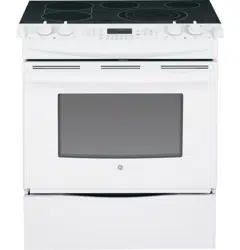
Ranges
Electric Slide-In
Write the model and serial
numbers here:
Model # __________________
Serial # ___________________
You can find the rating label
behind the range drawer.
For a Spanish version of this
manual, visit our website at
GEAppliances.com.
Para consultar una version
en español de este manual
de instrucciones, visite
nuestro sitio de internet
GEAppliances.com.
Owner’s Manual
2
49-88060
SAVE THESE INSTRUCTIONS
WARNING
Read all safety instructions before using the product. Failure to follow these instructions may
result in fire, electrical shock, serious injury or death.
STATE OF CALIFORNIA PROPOSITION 65 WARNING
ANTI-TIP DEVICE
The California Safe Drinking Water and Toxic Enforcement Act requires the Governor of California to
publish a list of substances known to the state to cause cancer, birth defects or other reproductive harm,
and requires businesses to warn customers of potential exposure to such substances.
WARNING
This product contains one or more chemical known to the State of California to cause
cancer, birth defects or other reproductive harm.
Self-clean ovens can cause low-level exposure to some of these substances, including carbon monoxide,
during the cleaning cycle. Exposure can be minimized by venting with an open window or using a
ventilation fan or hood.
IMPORTANT SAFETY INFORMATION.
READ ALL INSTRUCTIONS BEFORE USING.
SAFETY INFORMATION
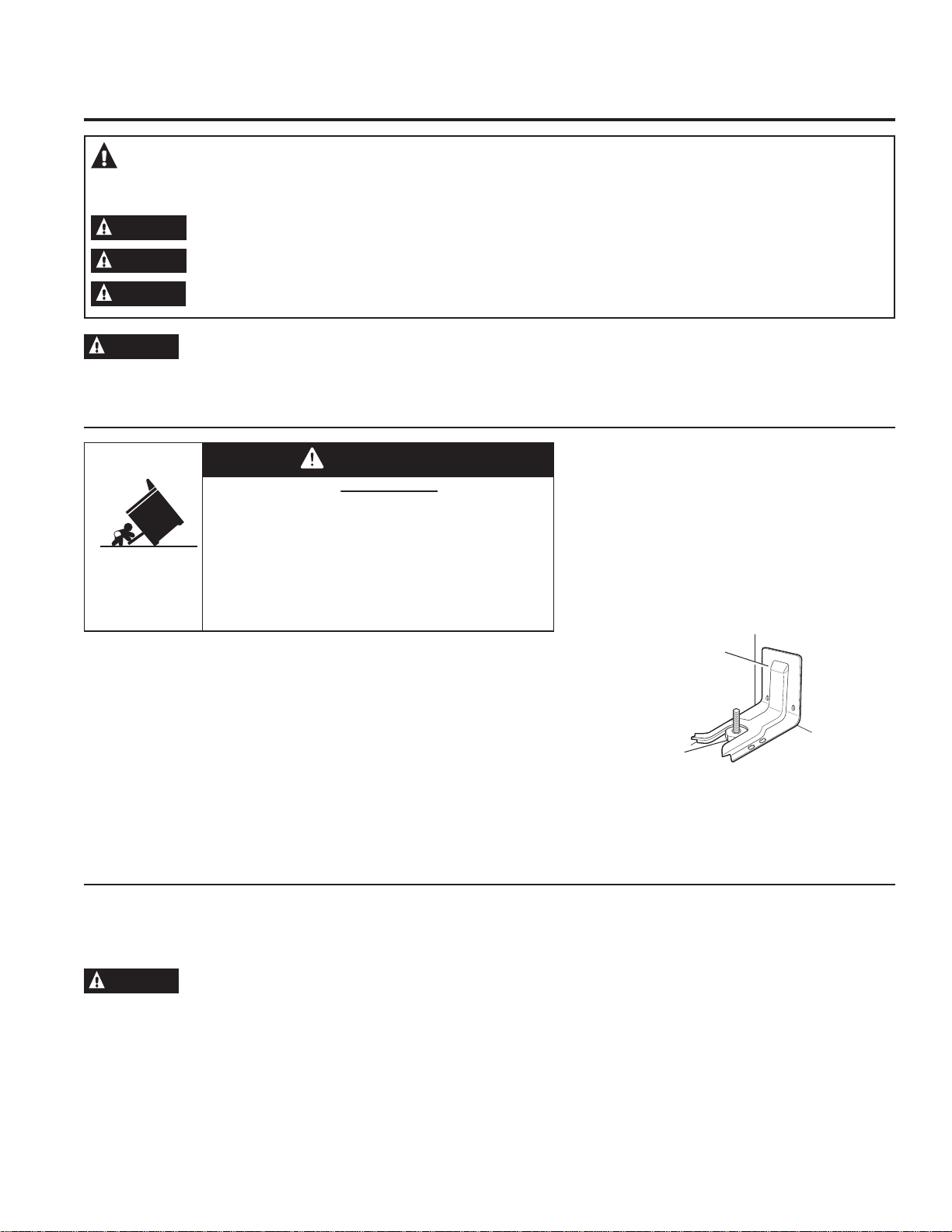
To reduce the risk of tipping the range, the
range must be secured by a properly installed
anti-tip bracket. See installation instructions
shipped with the bracket for complete details
before attempting to install.
For Free-Standing and Slide-In Ranges
To check if the bracket is installed and engaged
properly, look underneath the range to see that
the rear leveling leg is engaged in the bracket.
On some models, the storage drawer or kick panel can be removed
for easy inspection. If visual inspection is not possible, slide the range
forward, confirm the anti-tip bracket is securely attached to the floor or
wall, and slide the range back so the rear leveling leg is under the anti-tip
bracket.
If the range is pulled from the wall for any reason, always repeat this
procedure to verify the range is properly secured by the anti-tip bracket.
Never completely remove the leveling legs or the range will not be
secured to the anti-tip device properly.
A child or adult can tip the range and be killed.
Verify the anti-tip bracket has been properly installed
and engaged.
Ensure the anti-tip bracket is re-engaged when the range
is moved.
Do not operate the range without the anti-tip bracket in
place and engaged.
Failure to follow these instructions can result in death or
serious burns to children or adults.
Tip-Over Hazard
WARNING
Anti-Tip
Bracket
Leveling Leg
This is the safety alert symbol. This symbol alerts you to potential hazards that can kill or hurt you and others.
All safety messages will follow the safety alert symbol and the word “DANGER”, “WARNING”, or “CAUTION”. These
words are defined as:
DANGER
Indicates a hazardous situation which, if not avoided, will result in death or serious injury.
WARNING
Indicates a hazardous situation which, if not avoided, could result in death or serious injury.
CAUTION
Indicates a hazardous situation which, if not avoided, could result in minor or moderate injury.

49-88060
3
SAVE THESE INSTRUCTIONS
SAFETY INFORMATION
Ŷ 8VHWKLVDSSOLDQFHRQO\IRULWVLQWHQGHGSXUSRVH
as described in this Owner’s Manual.
Ŷ %HVXUH\RXUDSSOLDQFHLVSURSHUO\LQVWDOOHGDQG
grounded by a qualified installer in accordance
with the provided installation instructions.
Ŷ 'RQRWDWWHPSWWRUHSDLURUUHSODFHDQ\SDUWRI
your range unless it is specifically recommended
in this manual. All other servicing should be
transferred to a qualified technician.
Ŷ %HIRUHSHUIRUPLQJDQ\VHUYLFHXQSOXJWKHUDQJH
or disconnect the power supply at the household
distribution panel by removing the fuse or
switching off the circuit breaker.
Ŷ 'RQRWOHDYHFKLOGUHQDORQH²FKLOGUHQVKRXOG
not be left alone or unattended in an area where
an appliance is in use. They should never be
allowed to climb, sit or stand on any part of the
appliance.
Ŷ
CAUTION
Do not store items of interest to
children above a range or on the backguard of a
UDQJH²FKLOGUHQFOLPELQJRQWKHUDQJHWRUHDFK
items could be seriously injured.
Ŷ 8VHRQO\GU\SRWKROGHUV²PRLVWRUGDPSSRW
holders on hot surfaces may result in burns from
steam. Do not let pot holders touch hot surface
units or heating elements. Do not use a towel or
other bulky cloth in place of pot holders.
Ŷ 1HYHUXVH\RXUDSSOLDQFHIRUZDUPLQJRUKHDWLQJ
the room.
Ŷ 'RQRWWRXFKWKHVXUIDFHXQLWVWKHKHDWLQJ
elements or the interior surface of the oven.
These surfaces may be hot enough to burn
even though they are dark in color. During and
after use, do not touch, or let clothing or other
flammable materials contact the surface units,
areas nearby the surface units or any interior
area of the oven; allow sufficient time for cooling
first. Other surfaces of the appliance may
become hot enough to cause burns. Potentially
hot surfaces include the cooktop, areas facing
the cooktop, oven vent opening, surfaces near
the opening and crevices around the oven door.
Ŷ 'RQRWKHDWXQRSHQHGIRRGFRQWDLQHUV3UHVVXUH
could build up and the container could burst,
causing an injury.
Ŷ 'RQRWXVHDQ\W\SHRIIRLORUOLQHUWRFRYHUWKH
oven bottom or anywhere in the oven, except as
described in this manual. Oven liners can trap
heat or melt, resulting in damage to the product
and risk of shock, smoke or fire.
Ŷ $YRLGVFUDWFKLQJRULPSDFWLQJJODVVGRRUVFRRN
tops or control panels. Doing so may lead to
glass breakage. Do not cook on a product with
broken glass. Shock, fire or cuts may occur.
Ŷ &RRNPHDWDQGSRXOWU\WKRURXJKO\²PHDWWR
at least an internal temperature of 160°F and
poultry to at least an internal temperature of
180°F. Cooking to these temperatures usually
protects against foodborne illness.
WARNING
GENERAL SAFETY INSTRUCTIONS
Ŷ 'RQRWVWRUHRUXVHIODPPDEOHPDWHULDOVLQ
an oven or near the cooktop, including paper,
plastic, pot holders, linens, wall coverings,
curtains, drapes and gasoline or other flammable
vapors and liquids.
Ŷ
Never wear loose-fitting or hanging garments while
using the appliance. These garments may ignite if
they contact hot surfaces causing severe burns.
Ŷ 'RQRWOHWFRRNLQJJUHDVHRURWKHUIODPPDEOH
materials accumulate in or near the range.
Grease in the oven or on the cooktop may ignite.
Ŷ &OHDQYHQWLODWLQJKRRGVIUHTXHQWO\*UHDVH
should not be allowed to accumulate on the hood
or filter.
WARNING
KEEP FLAMMABLE MATERIALS AWAY FROM THE RANGE
Failure to do so may result in fire or personal injury.

4
49-88060
IMPORTANT SAFETY INFORMATION.
READ ALL INSTRUCTIONS BEFORE USING.
SAFETY INFORMATION
Ŷ 'RQRWXVHZDWHURQJUHDVHILUHV1HYHUSLFNXS
a flaming pan. Turn the controls off. Smother a
flaming pan on a surface unit by covering the
pan completely with a well-fitting lid, cookie sheet
or flat tray. Use a multi-purpose dry chemical or
foam-type fire extinguisher.
Ŷ ,IWKHUHLVDILUHLQWKHRYHQGXULQJEDNLQJ
smother the fire by closing the oven door and
turning the oven off or by using a multi-purpose
dry chemical or foam-type fire extinguisher.
Ŷ ,IWKHUHLVDILUHLQWKHRYHQGXULQJVHOIFOHDQWXUQ
the oven off and wait for the fire to go out. Do
not force the door open. Introduction of fresh air
at self-clean temperatures may lead to a burst
of flame from the oven. Failure to follow this
instruction may result in severe burns.
WARNING
IN THE EVENT OF A FIRE, TAKE THE FOLLOWING
STEPS TO PREVENT INJURY AND FIRE SPREADING
Ŷ
Never leave the surface units unattended at
PHGLXPRUKLJKKHDWVHWWLQJV%RLORYHUVFDXVH
smoking and greasy spillovers that may catch
on fire.
Ŷ Never leave oil unattended while frying. If
allowed to heat beyond its smoking point, oil
may ignite resulting in fire that may spread
to surrounding cabinets. Use a deep fat
thermometer whenever possible to monitor oil
temperature.
Ŷ
To avoid oil spillover and fire, use a minimum
amount of oil when shallow pan-frying and
avoid cooking frozen foods with excessive
amounts of ice.
Ŷ 8VHSURSHUSDQVL]H²VHOHFWFRRNZDUHKDYLQJ
flat bottoms large enough to cover the surface
heating element. The use of undersized
cookware will expose a portion of the surface
unit to direct contact and may result in ignition
of clothing. Proper relationship of cookware to
surface unit will also improve efficiency.
Ŷ Only certain types of glass, glass/ceramic,
earthenware or other glazed containers are
suitable for cooktop service; others may break
because of the sudden change in temperature.
Ŷ To minimize the possibility of burns, ignition of
flammable materials and spillage, the handle of a
container should be turned toward the center of
the range without extending over nearby surface
units.
Ŷ When preparing flaming foods under a hood, turn
the fan on.
Ŷ If power is lost to an electric cooktop while a
surface unit is ON, the surface unit will turn back
on as soon as power is restored. In the event of
power loss, failure to turn all surface unit knobs
to the OFF position may result in ignition of items
on or near the cooktop, leading to serious injury
or death.
WARNING
COOKTOP SAFETY INSTRUCTIONS
SAVE THESE INSTRUCTIONS

49-88060
5
SAVE THESE INSTRUCTIONS
SAFETY INFORMATION
Ŷ Use care when touching the cooktop. The glass
surface of the cooktop will retain heat after the
controls have been turned off.
Ŷ
Do not cook on a broken cooktop. If glass
cooktop should break, cleaning solutions and
spillovers may penetrate the broken cooktop and
create a risk of electric shock. Contact a qualified
technician immediately.
Ŷ
Avoid scratching the glass cooktop. The cooktop
can be scratched with items such as knives,
sharp instruments, rings or other jewelry, and
rivets on clothing.
Ŷ
Do not place or store items that can melt or catch
fire on the glass cooktop, even when it is not
being used. If the cooktop is inadvertently turned
on, they may ignite. Heat from the cooktop or
oven vent after it is turned off may cause them to
ignite also.
Ŷ
8VH&(5$0$%5<7(
®
ceramic Cooktop Cleaner
DQG&(5$0$%5<7(
®
Cleaning Pad to clean
the cooktop. Wait until the cooktop cools and
the indicator light goes out before cleaning. A
wet sponge or cloth on a hot surface can cause
steam burns. Some cleaners can produce
noxious fumes if applied to a hot surface. Note:
Sugar spills are an exception. They should be
scraped off while still hot using an oven mitt and
a scraper. See the Cleaning the glass cooktop
section for detailed instructions.
Ŷ
Read and follow all instructions and warnings on
the cleaning cream label.
WARNING
RADIANT COOKTOP SAFETY INSTRUCTIONS

6
49-88060
IMPORTANT SAFETY INFORMATION.
READ ALL INSTRUCTIONS BEFORE USING.
SAFETY INFORMATION
SAVE THESE INSTRUCTIONS
The self-cleaning feature operates the oven at temperatures high enough to burn away food soils in the
oven. Follow these instructions for safe operation.
Ŷ Do not touch oven surfaces during self-clean
operation. Keep children away from the oven
during self-cleaning. Failure to follow these
instructions may cause burns.
Ŷ
%HIRUHRSHUDWLQJWKHVHOIFOHDQF\FOHUHPRYHSDQV
shiny metal oven racks and other utensils from the
oven. Only gray porcelain-coated oven racks may
be left in the oven. Do not use self-clean to clean
other parts, such as drip pans or bowls.
Ŷ %HIRUHRSHUDWLQJWKHVHOIFOHDQF\FOHZLSH
grease and food soils from the oven. Excessive
amount of grease may ignite leading to smoke
damage to your home.
Ŷ If the self-cleaning mode malfunctions, turn the
oven off and disconnect the power supply. Have it
serviced by a qualified technician.
Ŷ Do not clean the door gasket. The door gasket is
essential for a good seal. Care should be taken
not to rub, damage or move the gasket.
Ŷ Do not use oven cleaners. No commercial oven
cleaner or oven liner protective coating of any kind
should be used in or around any part of the oven.
Ŷ Stand away from the range when opening the
oven door. Hot air or steam which escapes can
cause burns to hands, face and/or eyes.
Ŷ Do not use the oven if a heating element
develops a glowing spot during use or shows
other signs of damage. A glowing spot indicates
the heating element may fail and present a
potential burn, fire, or shock hazard. Turn the
oven off immediately and have the heating
element replaced by a qualified service
technician.
Ŷ Keep the oven vent unobstructed.
Ŷ Keep the oven free from grease buildup. Grease
in the oven may ignite.
Ŷ Place oven racks in desired location while oven
is cool. If rack must be moved while oven is hot,
do not let pot holder contact hot heating element
in oven.
Ŷ When using cooking or roasting bags in the
oven, follow the manufacturer’s directions.
Ŷ Pull the oven rack to the stop-lock position when
loading and unloading food from the oven. This
helps prevent burns from touching hot surfaces
of the door and oven walls.
Ŷ Do not leave items such as paper, cooking
utensils or food in the oven when not in use.
Items stored in an oven can ignite.
Ŷ Never place cooking utensils, pizza or baking
stones, or any type of foil or liner on the oven
floor. These items can trap heat or melt, resulting
in damage to the product and risk of shock,
smoke or fire.
WARNING
OVEN SAFETY INSTRUCTIONS
WARNING
SELF-CLEANING OVEN SAFETY INSTRUCTIONS

49-88060
7
GE Electric Range Warranty
GEAppliances.com
All warranty service is provided by our Factory Service Centers, or an authorized Customer Care
®
technician.
To schedule service, on-line, visit us at www.geappliances.com/service_and_support/, or call 800.GE.CARES
(800.432.2737). Please have serial number and model number available when calling for service.
Servicing your appliance may require the use of the onboard data port for diagnostics. This gives a GE factory
service technician the ability to quickly diagnose any issues with your appliance and helps GE improve its products
by providing GE with information on your appliance. If you do not want your appliance data to be sent to GE, please
advise your technician not to submit the data to GE at the time of service.
For the period of one year from the date of the original purchase, GE will provide any part of the range which fails due
to a defect in materials or workmanship. During this limited one-year warranty, GE will also provide, free of charge, all
labor and in-home service to replace the defective part.
For the period of five years from the date of the original purchase, GE will provide a replacement glass cooktop if it
should: crack due to thermal shock; discolor; crack at the rubber seal between the glass cooktop and the porcelain
edge, or if the pattern wears off. A replacement radiant surface unit if it should burn out. During this limited additional
four-year warranty, you will be responsible for any labor or in-home service.
What GE will not cover:
Ŷ Service trips to your home to teach you how to use
the product.
Ŷ Improper installation, delivery or maintenance.
Ŷ Failure of the product if it is abused, misused,
modified or used for other than the intended purpose
or used commercially.
Ŷ Damage to the glass cooktop caused by use of
cleaners other than the recommended cleaning
creams and pads.
Ŷ Damage to the glass cooktop caused by hardened
spills of sugary materials or melted plastic that
are not cleaned according to the directions in the
Owner's Manual.
Ŷ Replacement of house fuses or resetting of circuit
breakers.
Ŷ Damage to the product caused by accident, fire,
floods or acts of God.
Ŷ Damage to finish, such as surface rust, tarnish, or
small blemishes not reported within 48 hours of
delivery.
Ŷ Incidental or consequential damage caused by
possible defects with this appliance.
Ŷ Damage caused after delivery.
Ŷ Product not accessible to provide required service.
Ŷ Service to repair or replace light bulbs, except for
LED lamps.
This warranty is extended to the original purchaser and any succeeding owner for products purchased for home use
within the USA. If the product is located in an area where service by a GE Authorized Servicer is not available, you
may be responsible for a trip charge or you may be required to bring the product to an Authorized GE Service location
for service. In Alaska, the warranty excludes the cost of shipping or service calls to your home.
Some states do not allow the exclusion or limitation of incidental or consequential damages. This warranty gives you
specific legal rights, and you may also have other rights which vary from state to state. To know what your legal rights
are, consult your local or state consumer affairs office or your state’s Attorney General.
Warrantor: General Electric Company. Louisville, KY 40225
Extended Warranties: Purchase a GE extended warranty and learn about special discounts that are available while
\RXUZDUUDQW\LVVWLOOLQHIIHFW<RXFDQSXUFKDVHLWRQOLQHDQ\WLPH
www.geappliances.com/service_and_support/shop-for-extended-service-plans.htm
or call 800.626.2224 during normal business hours. GE Consumer Home Services will still be there after your
warranty expires.
EXCLUSION OF IMPLIED WARRANTIES
<RXUVROHDQGH[FOXVLYHUHPHG\LVSURGXFWUHSDLUDVSURYLGHGLQWKLV/LPLWHG:DUUDQW\$Q\LPSOLHGZDUUDQWLHV
including the implied warranties of merchantability or fitness for a particular purpose, are limited to one year or the
shortest period allowed by law.
Register Your Appliance: Register your new appliance on-line at your convenience!
www.geappliances.com/service_and_support/register/
Timely product registration will allow for enhanced communication and prompt service under the terms of your warranty,
VKRXOGWKHQHHGDULVH<RXPD\DOVRPDLOLQWKHSUHSULQWHGUHJLVWUDWLRQFDUGLQFOXGHGLQWKHSDFNLQJPDWHULDO
Staple your receipt here. Proof of the original purchase
date is needed to obtain service under the warranty.
WARRANTY
Thank You! ... for your purchase of a GE Brand appliance.

8
49-88060
Schedule Service: Expert GE repair service is only one
step away from your door. Get on-line and schedule your
service at www.geappliances.com/service_and_support/
Or call 800.GE.CARES (800.432.2737) during normal
business hours.
Parts and Accessories: Individuals qualified to service
their own appliances can have parts or accessories sent
directly to their homes (VISA, MasterCard and Discover
cards are accepted).Order on-line today, 24 hours
every day or by phone at 800.626.2002 during normal
business hours.
Instructions contained in this manual cover procedures
to be performed by any user. Other servicing generally
should be referred to qualified service personnel. Caution
must be exercised, since improper servicing may cause
unsafe operation.
Real Life Design Studio: GE supports the Universal
Design concept of products, services and environments
that can be used by people of all ages, sizes and
capabilities. We recognize the need to design for a wide
range of physical and mental abilities and impairments.
For details of GE’s Universal Design applications,
including kitchen design ideas for people with disabilities,
check out our Website today. For the hearing impaired,
please call 800.TDD.GEAC (800.833.4322).
Contact Us: If you are not satisfied with the service you
receive from GE, contact us on our Website with all the
details including your phone number, or write to:
General Manager, Customer Relations
GE Appliances, Appliance Park Louisville, KY 40225
Try the GE Appliances Website (www.geappliances.com/service_and_support/) 24 hours a day, any day of the
year! For greater convenience and faster service, you can now download Owner’s Manuals, order parts or even
schedule service on-line.
Accessories
Looking For Something More?
GE offers a variety of accessories to improve your cooking and maintenance experiences!
To place an order visit us online at:
www.GEApplianceParts.com (U.S.) or www.GEAppliances.ca (Canada)
or call 800.626.2002 (U.S.) 800.661.1616 (Canada)
The following products and more are available:
How to Remove Protective Shipping Film and Packaging Tape
Carefully grasp a corner of the protective shipping film
with your fingers and slowly peel it from the appliance
surface. Do not use any sharp items to remove the film.
Remove all of the film before using the appliance for the
first time.
To assure no damage is done to the finish of the
product, the safest way to remove the adhesive from
packaging tape on new appliances is an application of
a household liquid dishwashing detergent. Apply with a
soft cloth and allow to soak.
NOTE: The adhesive must be removed from all parts. It
cannot be removed if it is baked on.
Accessories
6PDOO%URLOHU3DQô´[ó´[ò´ :%;86'*&DQDGD
/DUJH%URLOHU3DQô´[ó´[ò´ :%;86'*&DQDGD
;/%URLOHU3DQ´[ó´[ó´ :%;861RWDYDLODEOHLQ&DQDGD
Parts
Oven racks Part numbers vary by model
Oven elements Part numbers vary by model
Light bulbs Part numbers vary by model
Cleaning Supplies
&LWUX6KLQH6WDLQOHVV6WHHO:LSHV :;;
&(5$0$%5<7(
®
6WDLQOHVV6WHHO$SSOLDQFH&OHDQHU 30;
&(5$0$%5<7(
®
&OHDQLQJ3DGVIRU&HUDPLF&RRNWRSV :;;
&(5$0$%5<7(
®
&HUDPLF&RRNWRS&OHDQHU :;;
&(5$0$%5<7(
®
&HUDPLF&RRNWRS6FUDSHU :;;
.LW.LWLQFOXGHVFUHDPDQGFRRNWRSVFUDSHU :%;27
*The large broiler pan does not fit in 20”/24” ranges.
7KH;/EURLOHUSDQGRHVQRWILWLQ´ZDOORYHQV´GURSLQVRU´´UDQJH
Have a question or need assistance with your appliance?
ASSISTANCE / ACCESSORIES
49-88060
9
USING THE RANGE: Surface Units
Surface Units
WARNING
FIRE HAZARD: Never leave the range unattended with the cooktop on medium or high settings. Keep
flammable items away from the cooktop. Turn off all controls when done cooking. Failure to follow
these instructions can result in fire, serious injury or death.
Throughout this manual, features and appearance may vary from your model.
How to Set
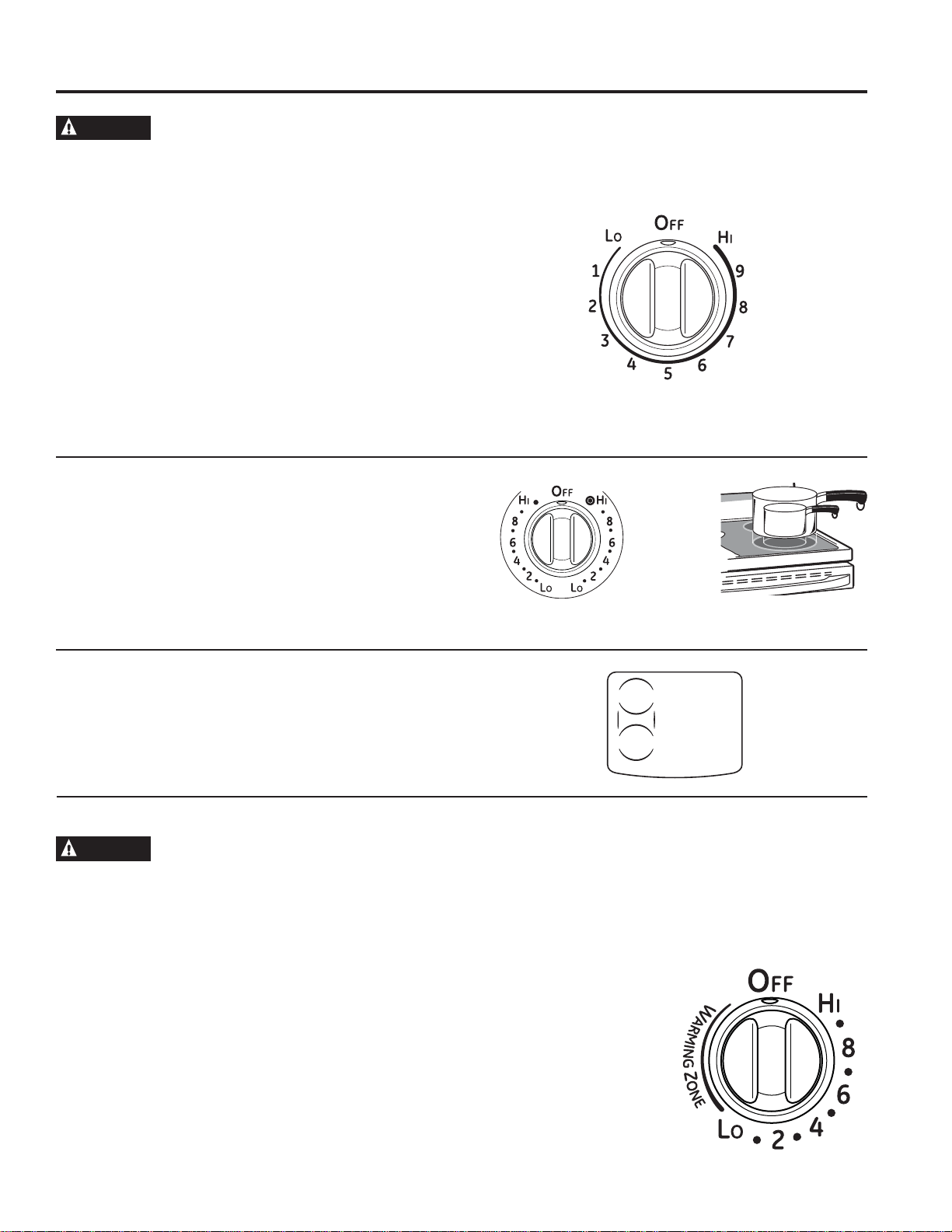
Push the knob in and turn in either direction to the
setting you want.
A surface ON indicator light will glow when any surface
unit is on
For glass cooktop surfaces:
A HOT COOKTOP indicator light will:
Ŷ FRPHRQZKHQWKHXQLWLVKRWWRWKHWRXFK
Ŷ VWD\RQHYHQDIWHUWKHXQLWLVWXUQHGRII
Ŷ VWD\RQXQWLOWKHXQLWLVFRROHGWR
DSSUR[LPDWHO\)
Dual Surface Units and Control Knobs
The surface unit has 2 cooking sizes to select from so
you can match the size of the unit to the size of the
cookware you are using.
Models with a Dual-Ring surface element only
At both OFF and HI the control clicks into position. You may hear
slight clicking sounds during cooking, indicating the control is
maintaining your desired setting.
Be sure you turn the control knob to OFF when you finish cooking.
Using the Bridge Zone
To use the bridge zone, adjust the knobs for the Left rear
and Left front elements to create one large area for even
cooking.
Using the Warming Zone
WARNING
FOOD POISON HAZARD:%DFWHULDPD\
grow in food at temperatures below 140°F.
Ŷ $OZD\VVWDUWZLWKKRWIRRG'RQRWXVHZDUPVHWWLQJWR
heat cold food.
Ŷ 'RQRWXVHZDUPVHWWLQJIRUPRUHWKDQ
2 hours.
The WARMING ZONE, located in the back center of
the glass surface, will keep hot, cooked food at serving
temperature. Always start with hot food. Do not use to
heat cold food. Placing uncooked or cold food on the
WARMING ZONE could result in foodborne illness.
Turn the control knob to the ON position.
For best results, all foods on the WARMING ZONE
should be covered with a lid or aluminum foil. When
warming pastries or breads, the cover should be vented
to allow moisture to escape.
The initial temperature, type and amount of food, type of
pan, and the time held will affect the quality of the food.
Always use pot holders or
oven mitts when removing
food from the WARMING
ZONE, since cookware and
plates will be hot.
NOTE: The surface warmer
will not glow red like the
cooking elements.
10
49-88060
Home Canning Tips
%HVXUHWKHFDQQHULVFHQWHUHGRYHUWKHVXUIDFHXQLW
Make sure the canner is flat on the bottom.
To prevent burns from steam or heat, use caution when
canning.
Use recipes and procedures from reputable sources.
7KHVHDUHDYDLODEOHIURPPDQXIDFWXUHUVVXFKDV%DOO
®
and Kerr
®
and the Department of Agriculture Extension
Service.
Flat-bottomed canners are recommended. Use of water
bath canners with rippled bottoms may extend the time
required to bring the water to a boil.
Temperature Limiter on Radiant Glass Cooktops
Every radiant surface unit has a temperature limiter.
The temperature limiter protects the glass cooktop from
getting too hot.
The temperature limiter may cycle the surface units off
for a time if:
Ŷ WKHSDQERLOVGU\
Ŷ WKHSDQERWWRPLVQRWIODW
Ŷ WKHSDQLVRIIFHQWHU
Ŷ WKHUHLVQRSDQRQWKHXQLW
Radiant Glass Cooktop
The radiant cooktop features heating units beneath a
smooth glass surface.
NOTE: A slight odor is normal when a new cooktop is
used for the first time. It is caused by the heating of new
parts and insulating materials and will disappear in a
short time.
NOTE: On models with light-colored glass cooktops, it is
normal for the cooking zones to change color when hot
or cooling down. This is temporary and will disappear as
the glass cools to room temperature.
The surface unit will cycle on and off to maintain your
selected control setting.
It is safe to place hot cookware on the glass surface
even when the cooktop is cool.
Even after the surface units are turned off, the glass
cooktop retains enough heat to continue cooking. To
avoid overcooking, remove pans from the surface units
when the food is cooked. Avoid placing anything on the
surface unit until it has cooled completely.
Ŷ :DWHUVWDLQVPLQHUDOGHSRVLWVDUHUHPRYDEOHXVLQJ
the cleaning cream or full-strength white vinegar.
Ŷ 8VHRIZLQGRZFOHDQHUPD\OHDYHDQLULGHVFHQWILOPRQ
the cooktop. The cleaning cream will remove this film.
Ŷ 'RQ¶WVWRUHKHDY\LWHPVDERYHWKHFRRNWRS,IWKH\
drop onto the cooktop, they can cause damage.
Ŷ 'RQRWXVHWKHVXUIDFHDVDFXWWLQJERDUG
USING THE RANGE: Surface Units
Surface Units (Cont.)
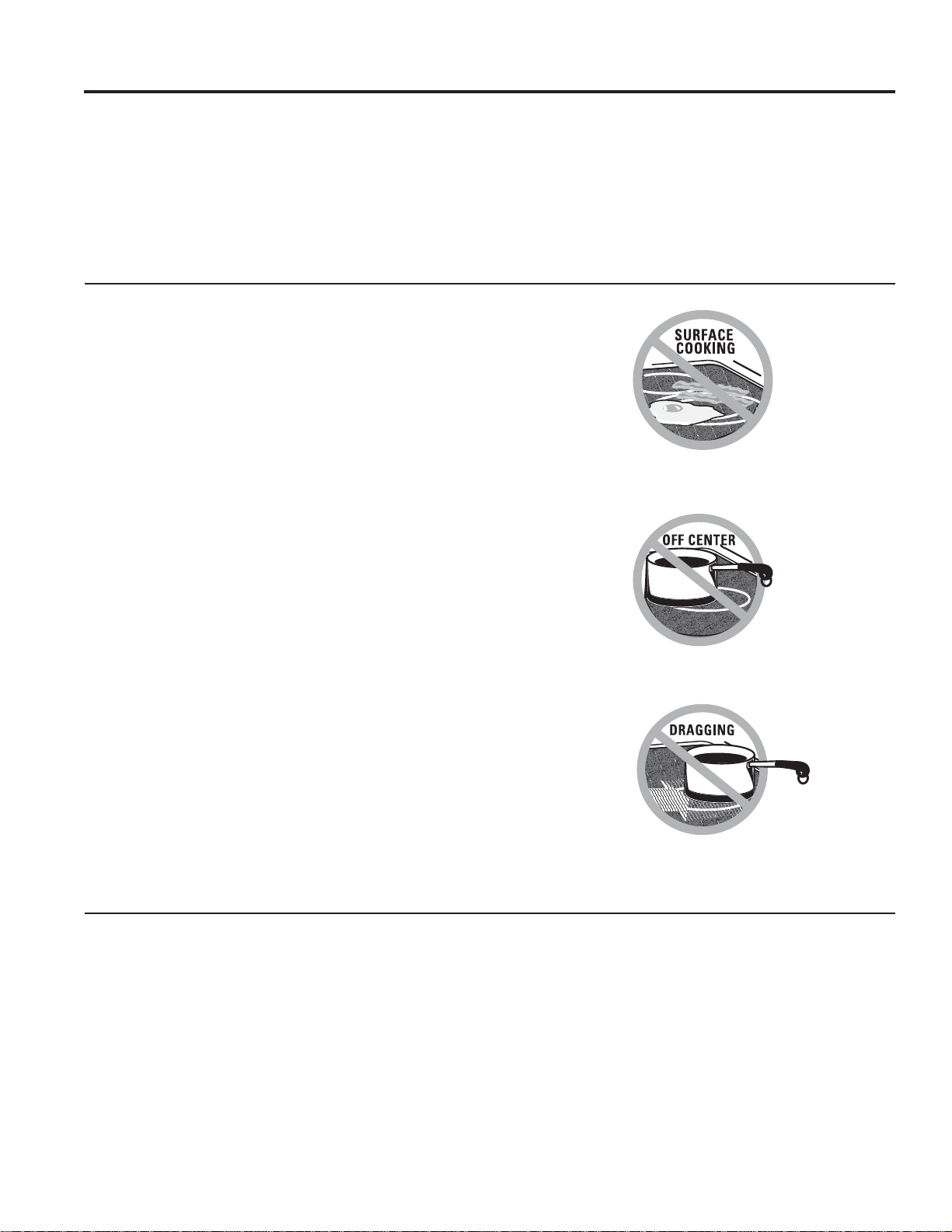
Never cook directly on the glass.
Always use cookware.
Always place the pan in the center of
the surface unit you are cooking on.
Do not slide cookware across the cooktop
EHFDXVHLWFDQVFUDWFKWKHJODVV³WKHJODVV
is scratch-resistant, not scratch proof.
49-88060
11
Cookware for Radiant Glass Cooktop
USING THE RANGE: Cookware for Radiant Glass Cooktop
The following information will help you choose cookware which will give good performance on glass cooktops.
NOTE: Follow all cookware manufacturer’s recommendations when using any type of cookware on the ceramic cooktop.
Stainless Steel:
recommended
Aluminum:
heavy weight recommended
Good conductivity. Aluminum residues
sometimes appear as scratches on the
cooktop but can be removed if cleaned
LPPHGLDWHO\%HFDXVHRILWVORZPHOWLQJ
point, thin weight aluminum should not
be used.
Copper Bottom:
recommended
Copper may leave residues which can
appear as scratches. The residues can
be removed, as long as the cooktop
is cleaned immediately. However, do
not let these pots boil dry. Overheated
metal can bond to glass cooktops. An
overheated copper bottom pot will leave
a residue that will permanently stain the
cooktop if not removed immediately.
Porcelain Enamel on Cast Iron:
recommended if bottom of pan is coated
Porcelain Enamel on Steel:
not recommended
Heating empty pans can cause
permanent damage to cooktop glass.
The enamel can melt and bond to the
ceramic cooktop.
Glass-ceramic:
not recommended
Poor performance. Will scratch the
surface.
Stoneware:
not recommended
Poor performance. May scratch the
surface.
Cast Iron:
QRWUHFRPPHQGHG²XQOHVVGHVLJQHG
specifically for glass cooktops
Poor conductivity and slow to absorb
heat. Will scratch the cooktop surface.
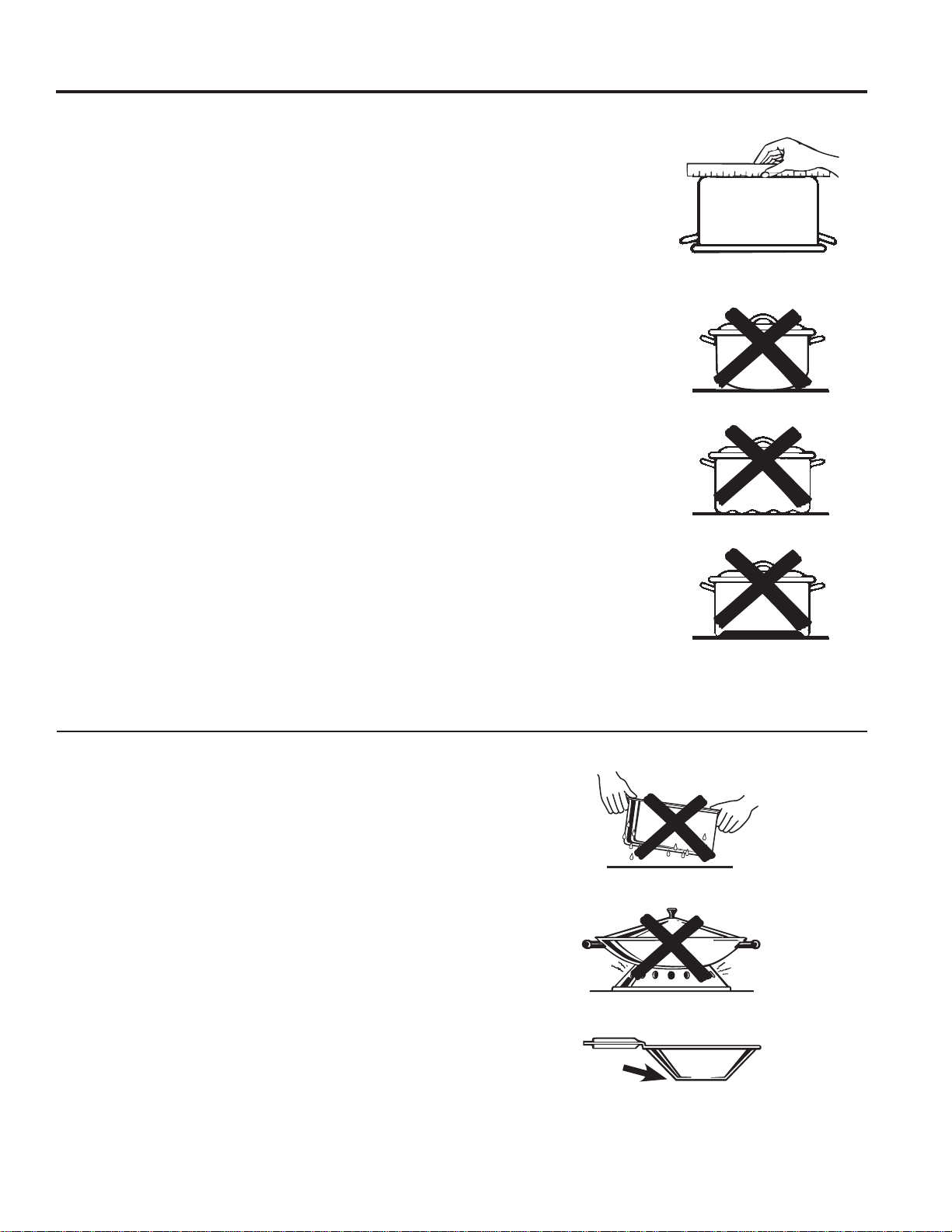
Check pans for flat bottoms by using
a straight edge.
Pans with rounded, curved, ridged or
warped bottoms are not recommended.
Do not place wet pans on the glass cooktop.
Do not use woks with support rings on the
glass cooktop.
Use flat-bottomed woks on the glass cooktop.
For Best Results
Ŷ 3ODFHRQO\GU\SDQVRQWKHVXUIDFHHOHPHQWV'RQRW
place lids on the surface elements, particularly wet
lids. Wet pans and lids may stick to the surface when
cool.
Ŷ 'RQRWXVHZRNVWKDWKDYHVXSSRUWULQJV7KLVW\SHRI
wok will not heat on glass surface elements.
Ŷ :HUHFRPPHQGWKDW\RXXVHRQO\DIODWERWWRPHG
wok. They are available at your local retail store. The
bottom of the wok should have the same diameter as
the surface element to ensure proper contact.
Ŷ 6RPHVSHFLDOFRRNLQJSURFHGXUHVUHTXLUHVSHFLILF
cookware such as pressure cookers or deep-fat
fryers. All cookware must have flat bottoms and be
the correct size.
12
49-88060
USING THE COOKTOP: Griddle
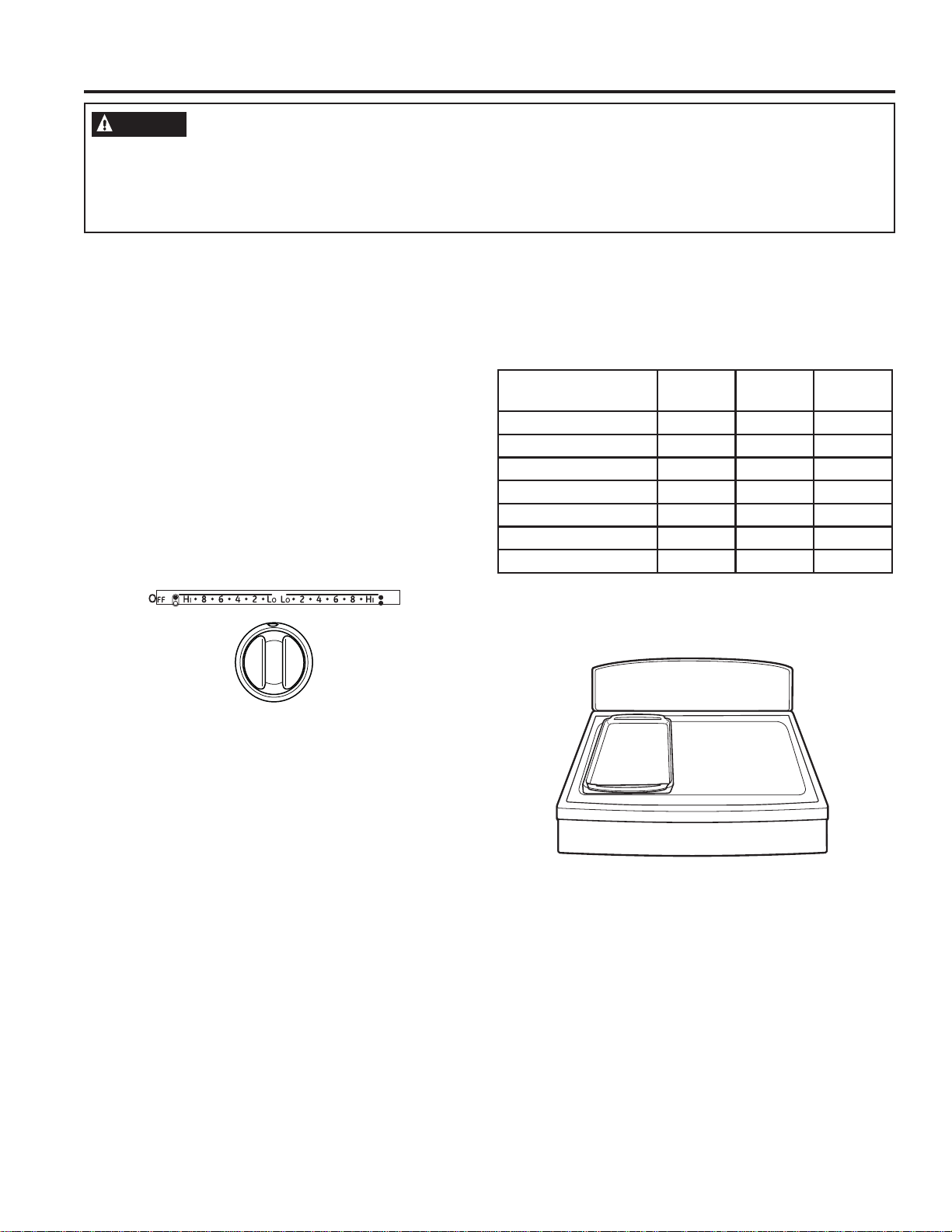
Place the Preseasoned Cast-Iron Griddle over
the left two surface units
Griddle
WARNING
Fire Hazard
Ŷ Use care when cooking greasy foods. Spilled grease may result in fire.
Ŷ Never place any items on the griddle when it is not in use. Heat from surrounding surface units can heat
the griddle and may result in fire.
Ŷ Place and remove the griddle only when griddle is cool and all surface units are turned OFF.
Positioning Your Griddle
The cast-iron griddle can only be used over the left two surface units of the rangetop. Do not turn on the griddle
burners until you are certain the griddle has been positioned correctly.
Using Your Cast-Iron Griddle
<RXUJULGGOHSURYLGHVDQH[WUDODUJHFRRNLQJVXUIDFHIRU
meats, pancakes and other foods usually prepared in
DVNLOOHW%HIRUHILUVWXVHULQVHZLWKKRWZDWHUDQGGU\
thoroughly. Prepare the surface with cooking spray or
vegetable oil.
Most griddled foods require cooking on a preheated
surface. Preheat griddle according to the guide, then
switch to the desired cook setting.
To turn on the surface units for the entire griddle, turn
the knob clockwise.
To turn on the surface unit for the back half of the
griddle, turn the knob counterclockwise.
Griddle Precautions:
Ŷ 'RQRWSODFHWKHJULGGOHLQDPLFURZDYHRYHQ
Ŷ 'RQRWFOHDQ\RXUJULGGOHLQWKHGLVKZDVKHU
Ŷ ,IVRPHWKLQJKDVVSLOOHGXQGHUWKHJULGGOHLWVKRXOGEH
cleaned up as soon as possible to prevent “baked on”
food soil.
Ŷ 'RQRWDOORZIRRGWRDFFXPXODWHXQGHUWKHJULGGOHDV
it can be a fire hazard. Clean under the griddle with
hot, soapy water as soon as it is cool.
Griddle Knob
Preseasoned Cast-Iron Griddle
Type of Food
Preheat
Setting Time
Cook
Setting
%DFRQ
None None 6
%UHDNIDVW6DXVDJH/LQNV
8 PLQ 4
Eggs 4 min. 2
Grilled Cheese 8 3 min. 3
Hamburgers PLQ 3
Pancakes 8 PLQ 3
Warming Tortillas PLQ
NOTE: Cook settings may need to be adjusted if griddle is used for an
extended time.
49-88060
13
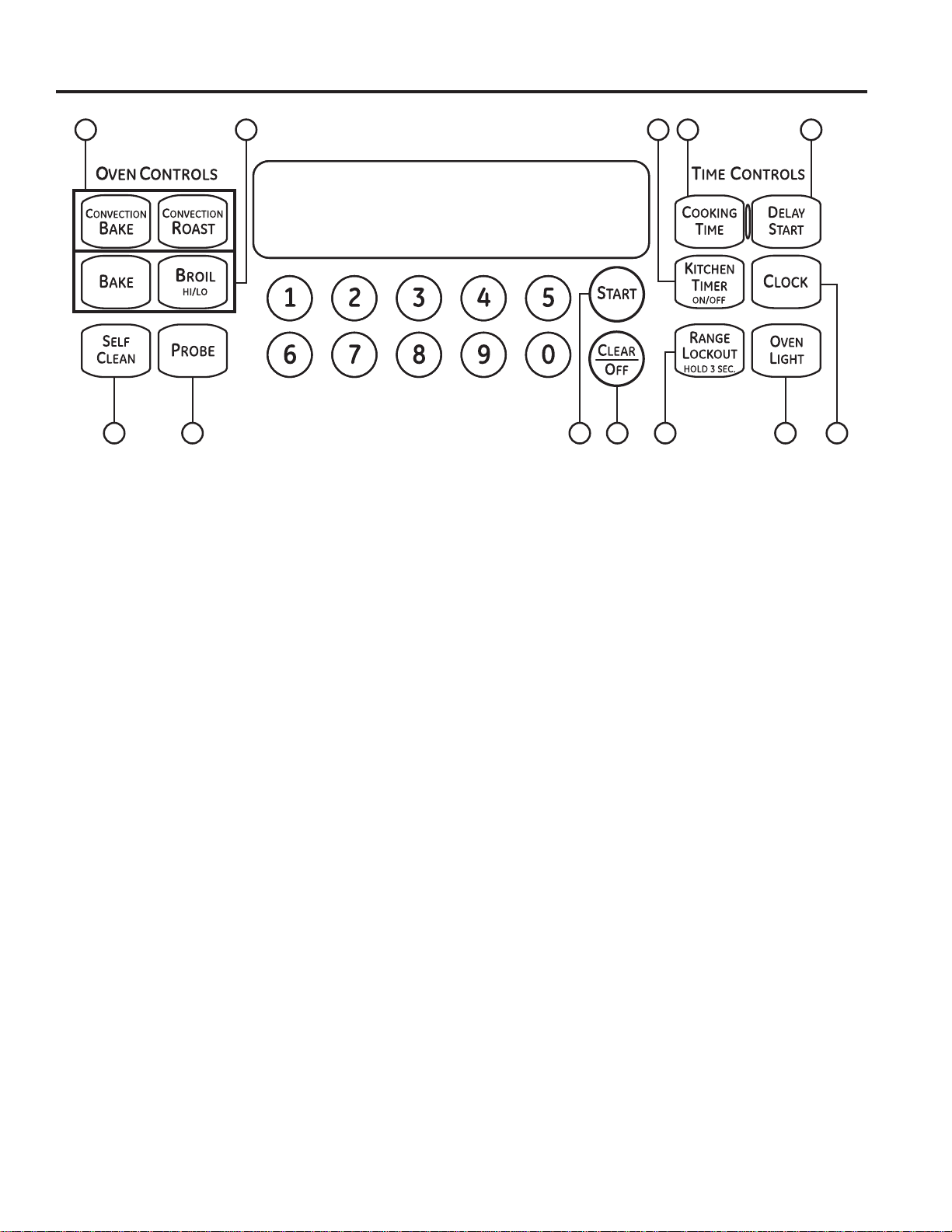
1. Convection Cook Modes:
Touch the
Convection Bake or Convection Roast pad. Touch
the number pads to set the desired oven temperature.
Touch the Start pad. When cooking is finished, touch
the Clear/Off pad.
2. Traditional Cooking Modes: <RXURYHQKDV
WKHIROORZLQJWUDGLWLRQDOFRRNLQJPRGHV%DNHDQG
%URLO+L/R6HHWKH&RRNLQJ0RGHVVHFWLRQIRUPRUH
information.
3. Self Clean: See the Cleaning the Range – Interior
section for important information about using this mode.
4. Start: Must be pressed to start any cooking,
cleaning, or timed function.
5. Clear/Off: Cancels ALL oven operations except the
clock and timer.
6. Cooking Time: Counts down cooking time and
turns off the oven when the cooking time is complete.
Press the Cooking Time pad, use the number pads
to program a cooking time in hours and minutes, then
press Start.
7. Clock: Sets the oven clock time. Press the Clock
pad and the number pads to program the clock. Press
Start to save the time.
8. Kitchen Timer: Works as a countdown timer.
Press the Kitchen Timer pad and the number pads
to program the time in hours and minutes. Press the
Start pad. The timer countdown is complete. To turn
the timer off press the Kitchen Timer pad.
9. Delay Start: Delays when the oven will turn on.
Use this to set a time when you want the oven to start.
Press the Delay Start pad and use the number pads
to program the time of day for the oven to turn on
then press Start. Press the desired cooking mode and
temperature then press Start. A cook time may also
be programmed if desired. Follow the directions under
Cooking Time for setting this feature. This can only be
XVHGZLWK%DNHDQG6HOI&OHDQ
NOTE: When using the delay start feature, foods that
VSRLOHDVLO\²VXFKDVPLONHJJVILVKVWXIILQJVSRXOWU\
DQGSRUN²VKRXOGQRWEHDOORZHGWRVLWIRUPRUHWKDQ
1 hour before or after cooking. Room temperature
SURPRWHVWKHJURZWKRIKDUPIXOEDFWHULD%HVXUHWKDW
the oven light is off because heat from the bulb will
speed harmful bacteria growth.
10. Oven Light: Turns the oven light on or off.
11. Range Lockout: Locks out the control so that
pressing the pads does not activate the controls. Press
the Range Lockout pad and then the Start pad to lock
or unlock the control.
12. Probe: Touch when using the probe to cook food.
See the Using the Probe section.
Oven Controls
USING THE RANGE: Oven Controls
1 698
3547
2
12 1011

14
49-88060
There are several different special features on your oven. To change the settings of these special features, press the Bake
and Broil pads at the same time and hold for three seconds. (SF) will appear in the display. Select the feature you want to
change. When the change has been made, press the Start key to save the change and return to the time of day.
Adjust the Oven Temperature
This feature allows the oven baking temperature to be
DGMXVWHGXSWR)KRWWHURUGRZQWR)FRROHU8VH
this feature if you believe your oven temperature is too
hot or too cold and wish to change it.
Press the Bake pad to enter the temperature adjustment
PRGH$QXPEHUEHWZHHQDQGZLOOGLVSOD\
Use the number pads to set the desired temperature
adjustment and use the Bake pad to change between
negative and positive.
Press the Start pad to save the temperature adjustment.
End of Timer Signals
This is the tone that signals the end of a timer. The tone
can be continuous (Con bEEp) or one repeating beep
(bEEp). A continuous setting will continue to sound a tone
until a button on the control is pressed. Press the Kitchen
Timer pad to view the current setting and then to change
the setting.
Fahrenheit or Celsius Temperature
Display
The oven control is set to use Fahrenheit temperatures (F),
but you can change it to use Celsius temperatures (C).
Press the Broil and Cook Time pads at the same time to
view the current setting, press again to change the setting.
Clock Display
This feature specifies how the time of day will be
GLVSOD\HGRULIQRWLPHRIGD\ZLOOEHGLVSOD\HG<RXFDQ
select a standard 12-hour clock (12 hr), 24-hour military
time display (24 hr), or no clock displayed (OFF). Press
the Clock pad to view the current setting, press again to
change the setting.
Autorecipe Conversion
This feature (ON/OFF), automatically reduces the
SURJUDPPHGUHFLSHWHPSHUDWXUHLQ&RQYHFWLRQ%DNH
PRGHE\)7KHGHIDXOWVHWWLQJIRUWKLVIHDWXUHLVRII
Note: This option does not convert baking time, only
temperatures. This option does not adjust temperatures for
Convection Roast mode. Press either Bake or Roast to
view the current setting. Press again to change the setting.
Using the Sabbath Feature
(Designed for use on the
Jewish Sabbath and Holidays)
The Sabbath feature can be used
for baking in the upper and lower
oven or baking drawer (on some
models). It cannot be used for
convection, broiling, self-cleaning or Delay Start cooking.
NOTE: The oven light comes on automatically when
the door is opened and goes off when the door is
closed. The bulb may be removed. See the Oven Light
Replacement section. On models with a light switch on
the control panel, the oven light may be turned on and
left on.
How to Set for Regular Baking:
Make sure the clock shows the correct time of day and
the oven is off.
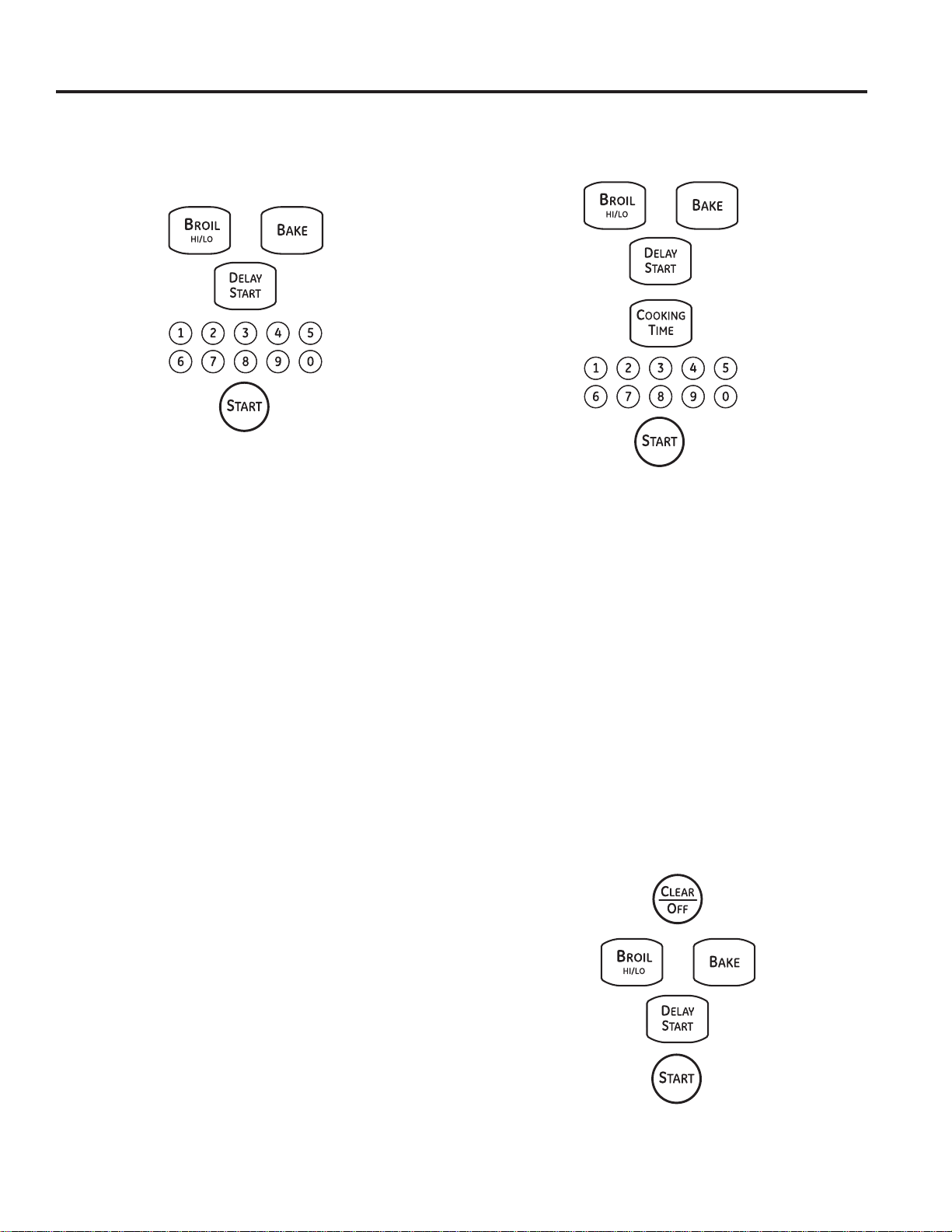
1. Press and hold both the Bake and Broil Hi/Lo pads,
at the same time, until the display shows (SF).
2. Tap the Delay Start pad until (SAb bAtH) appears in
the display.
3. Touch the Start pad and () will appear in the
display.
4. Touch the Bake pad. No signal will be given.
8VLQJWKHQXPEHUSDGVHQWHUWKHGHVLUHG
WHPSHUDWXUHEHWZHHQDQG1RVLJQDORU
temperature will be given.
6. Touch the Start pad.
7. After a random delay period of approximately 30
seconds to 1 minute, () will appear in the display,
indicating that the oven is baking. If () doesn’t
appear in the display, start again at Step 4.
Special Features
USING THE OVEN: Special Features
K
CERTIFIED
SABBATH
MODE
49-88060
15
Special Features (Cont.)
USING THE OVEN: Special Features
To adjust the oven temperature, touch the Bake pad,
enter the new temperature using the number pads and
touch the Start pad.
NOTE: The Clear/Off and Cooking Time pads are
active during the Sabbath feature.
How to Set for Timed Baking–Immediate Start and
Automatic Stop:
Make sure the clock shows the correct time of day and
the oven is off.
1. Press and hold both the Bake and Broil Hi/Lo pads,
at the same time, until the display shows (SF).
2. Tap the Delay Start pad until (SAb bAtH) appears in
the display.
3. Touch the Start pad and () will appear in the
display.
4. Touch the Cooking Time pad.
7RXFKWKHQXPEHUSDGVWRVHWWKHGHVLUHGOHQJWKRI
FRRNLQJWLPHEHWZHHQPLQXWHDQGKRXUVDQG
minutes. The cooking time that you entered will be
displayed.
6. Touch the Start pad.
7. Touch the Bake pad. No signal will be given.
8. Using the number pads, enter the desired
temperature. No signal or temperature will be given.
7RXFKWKHStart pad.
10. After a random delay period of approximately 30
seconds to 1 minute, () will appear in the display,
indicating that the oven is baking/roasting. If ()
doesn’t appear in the display, start again at Step 7.
To adjust the oven temperature, touch the Bake pad,
enter the new temperature using the number pads and
touch the Start pad.
When cooking is finished, the display will change from
() to () and (0:00) will appear, indicating that the
oven has turned OFF but is still set in Sabbath. Remove
the cooked food.
How to Exit the Sabbath Feature:
1. Touch the Clear/Off pad.
2. If the oven is cooking, wait for a random delay period
of approximately 30 seconds to 1 minute, until only
() is in the display.
3. Press and hold both the Bake and Broil Hi/Lo pads,
at the same time, until the display shows (SF).
4. Tap the Delay Start pad until (12 shdn) or (no shdn)
appears in the display. (12 shdn) indicates that the
oven will automatically turn off after 12 hours. (no
shdn) indicates that the oven will not automatically
turn off.
7RXFKWKHStart pad.
NOTE: If a power outage occurred while the oven was in
Sabbath, the oven will automatically turn off and stay off
even when the power returns. The oven control must be
reset.
+
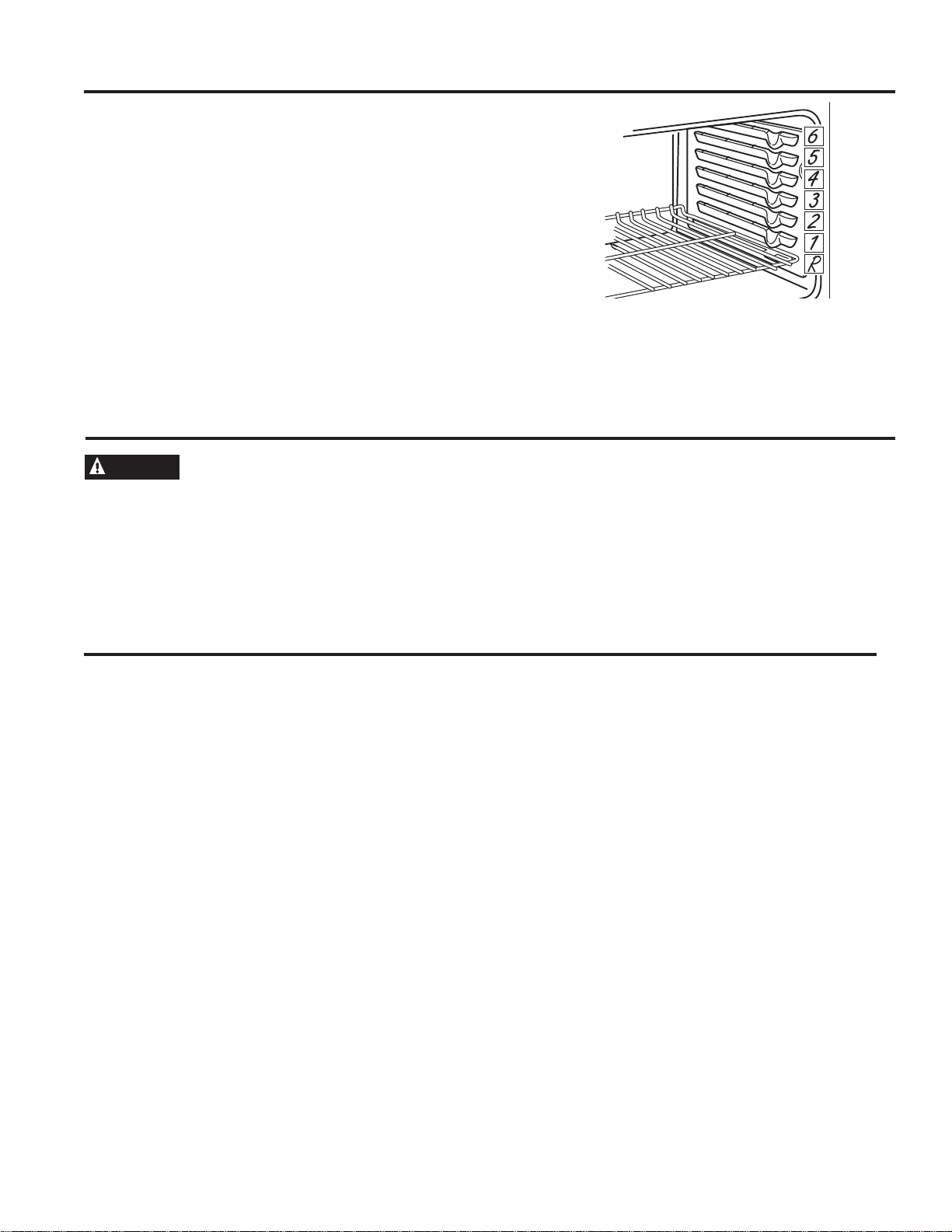
When the display shows () the
oven is set in Sabbath. When the
display shows () the oven is
baking/roasting.
+
When the display shows () the
oven is set in Sabbath. When the
display shows () the oven is
baking/roasting.
+
16
49-88060
Oven Racks
USING THE RANGE: Oven Racks / Aluminum Foil and Oven Liners / Cookware
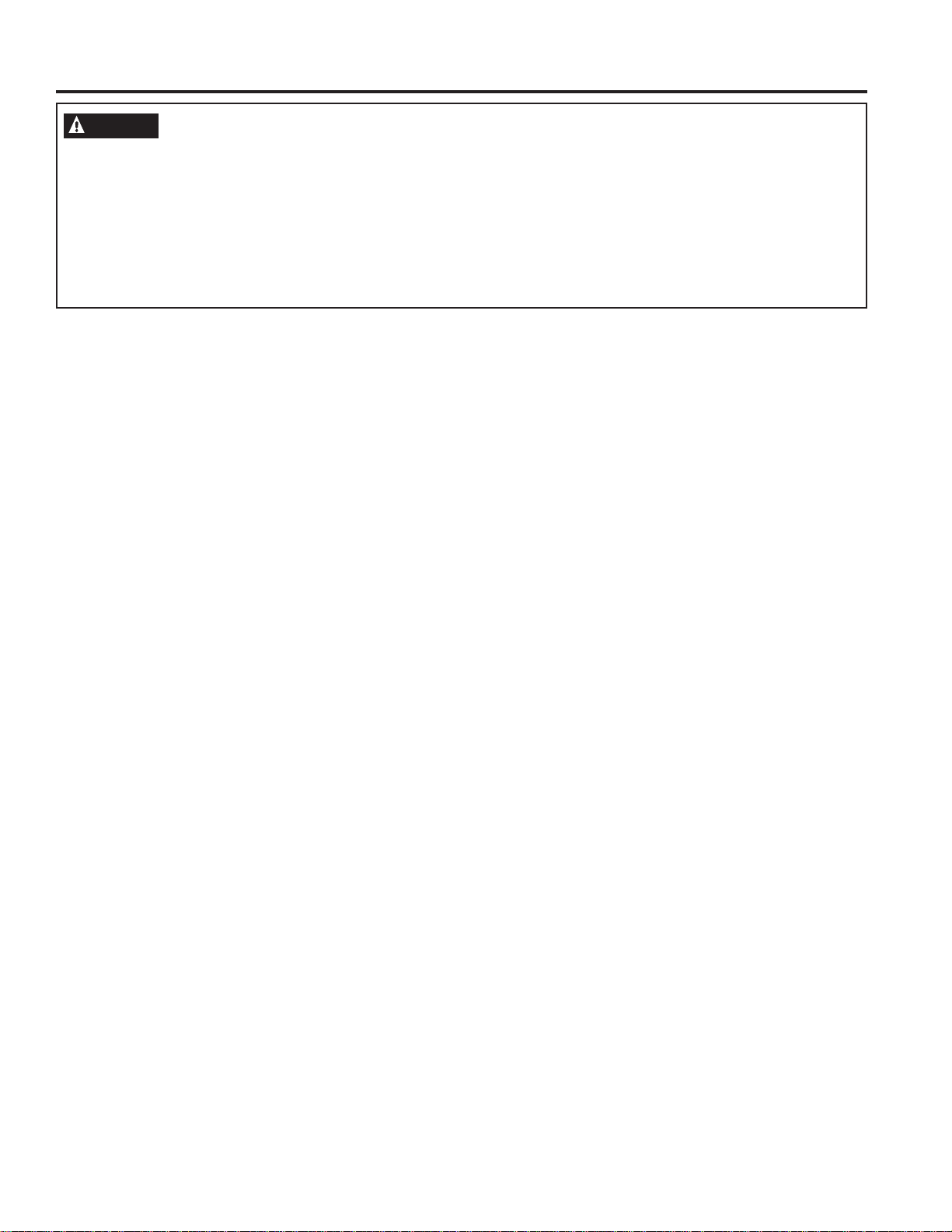
Recommended rack positions for various types of
foods are provided in the Cooking Guide. Adjusting
rack position is one way to impact cooking results. For
example, if you would prefer darker tops on cakes,
muffins, or cookies, try moving food one rack position
higher. If you find foods are too brown on top try moving
them down next time.
When baking with multiple pans and on multiple racks,
HQVXUHWKHUHLVDWOHDVWòEHWZHHQSDQVWRDOORZ
sufficient space for air to flow.
<RXU2YHQPD\KDYHH[WHQVLRQUDFNVDQGRUWUDGLWLRQDO
flat racks.
To avoid possible burns, place the racks in the desired
position before you turn the oven on.
Cookware
Cookware Guidelines
The material, finish, and size of cookware affect baking
performance.
Dark, coated and dull pans absorb heat more readily
than light, shiny pans. Pans that absorb heat more
readily can result in a browner, crisper, and thicker crust.
If using dark and coated cookware check food earlier
than minimum cook time. If undesirable results are
obtained with this type of cookware consider reducing
RYHQWHPSHUDWXUHE\)QH[WWLPH
Shiny pans can produce more evenly cooked baked
goods such as cakes and cookies.
Glass and ceramic pans heat slowly but retain heat well.
These types of pans work well for dishes such as pies
and custards.
Air insulated pans heat slowly and can reduce bottom
browning.
Keep cookware clean to promote even heating.
CAUTION
Do not use any type of foil or oven liner to cover the oven bottom. These items can trap heat or
melt, resulting in damage to the product and risk of shock, smoke or fire. Damage from improper use of these
items is not covered by the product warranty.
Foil may be used to catch spills by placing a sheet on a lower rack, several inches below the food. Do not use more
foil than necessary and never entirely cover an oven rack with aluminum foil. Keep foil at least 1-1/2” from oven walls
to prevent poor heat circulation.
Aluminum Foil and Oven Liners
The number of rack positions may vary by model.
49-88060
17
Probe
USING THE OVEN: Probe
WARNING
Consuming undercooked food can result in foodborne illness. Use probe according to
the following instructions to ensure all portions of the food reach minimum safe cooking temperatures.
Recommendations for minimum safe food temperatures can be found at
www.foodsafety.gov or www.IsItDoneYet.gov.
Internal food temperature is frequently used as an indicator of doneness, especially for roasts and poultry.
The Probe mode monitors the internal food temperature and turns the oven off when the internal food
temperature reaches the programmed temperature.
Always check the temperature at multiple locations in the food with a food thermometer after cooking to
ensure that all portions of the food have reached the minimum safe internal temperature for that food.
Proper Probe Placement
After preparing the meat and placing it on the cooking
pan follow these instructions for proper probe placement.
Ŷ ,QVHUWWKHSUREHLQWRWKHIRRGVRWKDWWKHWLSRIWKH
probe will rest in the center of the thickest part of
the food. For best performance the probe should
be fully inserted into the food. If the probe is not
located properly, it may not accurately measure the
temperature of the coolest portion of the food. Some
foods, particularly small items, are not well suited for
cooking with the probe due to their shape or size.
Ŷ 7KHSUREHVKRXOGQRWWRXFKERQHIDWRUJULVWOH
Ŷ )RUZKROHSRXOWU\LQVHUWWKHSUREHLQWRWKHWKLFNHVW
part of the breast.
Ŷ )RUERQHOHVVURDVWVLQVHUWWKHSUREHLQWRWKHFHQWHU
of the roast.
Ŷ )RUERQHLQKDPRUODPELQVHUWWKHSUREHLQWRWKH
center of the lowest large muscle or joint.
Ŷ )RUFDVVHUROHVRUGLVKHVVXFKDVPHDWORDILQVHUWWKH
probe into the center of the dish.
Ŷ )RUILVKLQVHUWWKHSUREHIURPMXVWDERYHWKHJLOOLQWR
the meatiest area, parallel to the backbone.
Probe Usage
To use the probe with preheating:
1. Press the desired cook mode (Bake, Convection
Bake, or Convection Roast) pad and enter the
desired cooking temperature with the number pads.
2. Insert the probe into the food (see Proper Probe
Placement).
3. Once the oven is preheated, place the food in the
oven and connect the probe to the probe outlet,
making sure it is fully inserted. Use caution, the oven
walls and probe outlet are hot.
4. Program the probe temperature by pressing
the Probe pad and entering the desired food
temperature. The maximum internal food temperature
that you can set is 200° F.
To use the probe without preheating:
1. Insert the probe into the food (see Proper Probe
Placement).
2. Place the food in the oven and connect the probe into
the probe outlet in the oven.
3. Press the Probe pad and enter the desired food
temperature. Then press the cook mode pad
(Traditional Bake, Convection Bake, or Convection
Roast) and enter the desired cooking temperature
with the number pads.
Probe Care Guidelines
Ŷ 8VHRISUREHVRWKHUWKDQWKHRQHSURYLGHGZLWKWKLV
product may result in damage to the probe outlet.
Ŷ 8VHWKHKDQGOHVRIWKHSUREHDQGSOXJZKHQLQVHUWLQJ
and removing them from the meat and outlet
Ŷ 7RDYRLGGDPDJLQJ\RXUSUREHGRQRWXVHWRQJVWR
pull on the cable when removing it.
Ŷ 7RDYRLGEUHDNLQJWKHSUREHPDNHVXUHIRRGLV
completely defrosted before inserting the probe.
Ŷ 7RSUHYHQWSRVVLEOHEXUQVGRQRWXQSOXJWKHSUREH
from the outlet until the oven has cooled.
Ŷ 1HYHUOHDYHWKHSUREHLQVLGHWKHRYHQGXULQJDVHOIRU
steam clean cycle.
Ŷ 'RQRWVWRUHWKHSUREHLQWKHRYHQ

18
49-88060
<RXUQHZRYHQKDVDYDULHW\RIFRRNLQJPRGHVWRKHOS\RXJHWWKHEHVWUHVXOWV7KHVHPRGHVDUHGHVFULEHGEHORZ
Refer to the Cooking Guide section for recommendations for specific foods. Remember, your new oven may perform
differently than the oven it is replacing.
Baking Modes
When preparing baked goods such as cakes, cookies,
and pastries always preheat the oven first. Follow
recipe recommendations for food placement. If no
guidelines are provided, center food in the oven.
Traditional Bake
The traditional bake mode is intended for single rack
cooking. This mode uses heat primarily from the lower
element but also from the upper element to cook
food. To use this mode press the Bake pad, enter
a temperature, and then press Start. Preheating is
generally recommended when using this mode.
Broiling Modes
The oven must be closed during broiling. Monitor
food closely while broiling. Use caution when broiling
on upper rack positions as placing food closer to the
broil element increases smoking, spattering, and the
possibility of fats igniting. For best performance center
food below the broil heating element. Broiling on rack
position 6 is not recommended.
Try broiling foods that you would normally grill. Adjust
rack positions to adjust the intensity of the heat to the
food. Place foods closer to the broil element when a
seared surface and rare interior is desired. Thicker foods
and foods that need to be cooked through should be
broiled on a rack position farther from the broiler or by
XVLQJ%URLO/R
Broil Hi
7KH7UDGLWLRQDO%URLO+LPRGHXVHVLQWHQVHKHDWIURPWKH
XSSHUHOHPHQWWRVHDUIRRGV8VH%URLO+LIRUWKLQQHUFXWV
of meat and/or foods you prefer less done on the interior.
To use this mode press the Broil pad once and then
press Start. It is not necessary to preheat when using
this mode.
Broil Lo
7KH7UDGLWLRQDO%URLO/RPRGHXVHVOHVVLQWHQVHKHDW
from the upper element to cook food thoroughly while
DOVRSURGXFLQJVXUIDFHEURZQLQJ8VH%URLO/RIRUWKLFNHU
cuts of meat and/or foods that you would like cooked
all the way through. To use this mode press the Broil
pad twice and then press Start. It is not necessary to
preheat when using this mode.
Convection Bake
7KH&RQYHFWLRQ%DNHPRGHLVLQWHQGHGIRUEDNLQJ
on multiple racks at the same time. This mode uses
air movement from the convection fan to enhance
FRRNLQJHYHQQHVV<RXURYHQLVHTXLSSHGZLWK$XWR
Recipe Conversion, so it is not necessary to adjust the
temperature when using this mode. To use this mode
press the Conv Bake pad, enter a temperature with
number pads, and then press Start. Always preheat
when using this mode.
Convection Roast
The Convection Roast mode is intended for roasting
whole cuts of meat on a single rack. This mode uses
heat from the lower bake burner along with air movement
to improve browning and reduce cooking time. It is not
necessary to convert temperature. Check food earlier
than the recipe suggested time when using this mode,
or use the probe (on some models). To use this mode
press the Conv Roast pad, enter a temperature with the
number pads, and then press Start. It is not necessary
to preheat when using this mode.
Cooking Modes
USING THE RANGE: Cooking Modes
49-88060
19
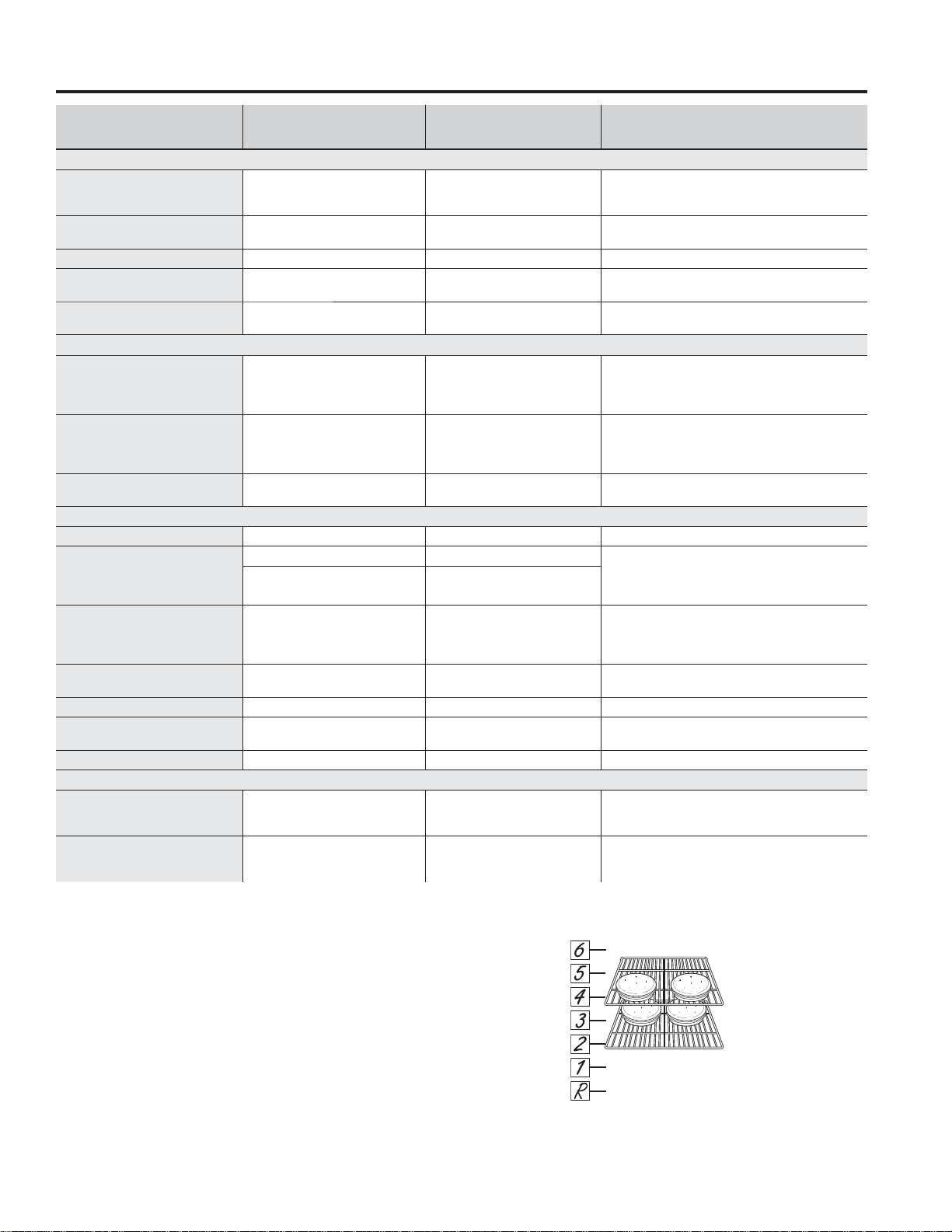
FOOD TYPE
RECOMMENDED
MODE(S)
RECOMMENDED
RACK POSITION(S) ADDITIONAL SUGGESTIONS
Baked Goods
Layer Cakes, sheet cakes,
bundt cakes, muffins, quick
breads on a Single Rack
%DNH 3 Use shiny cookware.
Layer cakes* on Multiple
Racks
%DNH 2 and 4
Ensure adequate airflow
(see illustration below).
Chiffon cakes (angel food) %DNH R Use shiny cookware.
Cookies, biscuits, scones on a
Single Rack
%DNH 3 Use shiny cookware.
Cookies, biscuits, scones on
Multiple Racks
%DNH 2 and 4 Ensure adequate airflow.
Beef & Pork
Hamburgers %URLO+L
Use a broil pan; move food down for more done-
ness/less searing. Watch food closely when broiling.
For best performance center food below the broil
heating element.
Steaks & Chops %URLO+L
Use a broil pan; move food down for more done-
ness/less searing. Watch food closely when broiling.
For best performance center food below the broil
heating element.
Roasts %DNH 2 or 3
Use a low sided pan such as a broil pan. Preheating
is not necessary.
Poultry
Whole chicken %DNH 3 or 4 Use a low sided pan such as a broil pan.
%RQHLQFKLFNHQEUHDVWVOHJV
thighs
%URLO+L 1 ,IEUHDGHGRUFRDWHGLQVDXFHDYRLG%URLO+LPRGHV
%URLOVNLQVLGHGRZQILUVW:DWFKIRRGFORVHO\ZKHQ
broiling. For best performance when broiling, center
food below the broil heating element.
%URLO/R
%DNH
1 or 2
%RQHOHVVFKLFNHQEUHDVWV
%URLO/R
%DNH
1 or 2
,IEUHDGHGRUFRDWHGLQVDXFHDYRLG%URLO+LPRGHV
%URLOVNLQVLGHGRZQILUVW:DWFKIRRGFORVHO\ZKHQ
broiling. For best performance when broiling, center
food below the broil heating element
Whole turkey %DNH 1 or 2 Use a low sided pan such as a broil pan.
7XUNH\%UHDVW %DNH 1 or 2 Use a low sided pan such as a broil pan.
Fish %URLO/R
WKLFNRUOHVV
4 (>1/2 inch)
Watch food closely when broiling. For best perfor-
mance center food below the broil heating element.
Casseroles %DNH 3
Frozen Convenience Foods
Pizza, french fries, tator tots,
chicken nuggets, appetizers
on a Single Rack
%DNH 3 Use shiny cookware.
Pizza, french fries, tator tots,
chicken nuggets, appetizers
on Multiple Racks
%DNH 2 and 4 Use shiny cookware.
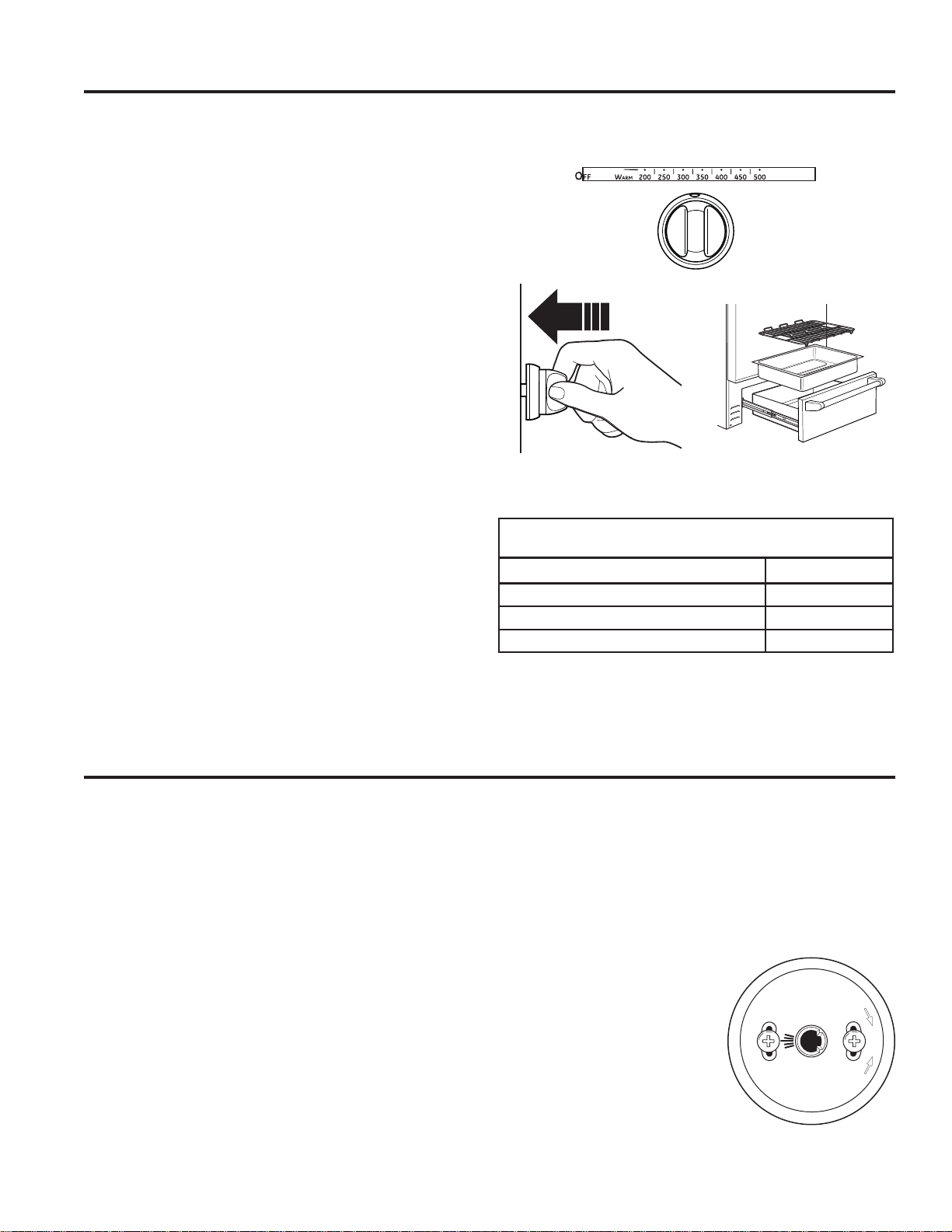
*When baking four cake layers at a time, use racks 2
and 4. Place the pans as shown so that one pan is not
directly above another.
Cook food thoroughly to help protect against food
borne illness. Minimum safe food temperature
recommendations for food safety can be found at
www.IsItDoneYet.gov. Make sure to use a food
thermometer to take food temperatures.
Rack position for baking 4 layer cakes.
USING THE RANGE: Cooking Guide
Cooking Guide
20
49-88060
Lower Oven Drawer
Adjust the Lower Oven Thermostat
USING THE RANGE: Lower Oven Drawer / Adjust the Lower Oven Thermostat
The lower oven drawer may be used to bake foods using the same times and temperatures as a standard oven. Foods
ideal for baking in the lower oven drawer include pizza, frozen foods, casseroles, biscuits, rolls and many desserts.
To Use the Lower Oven Drawer
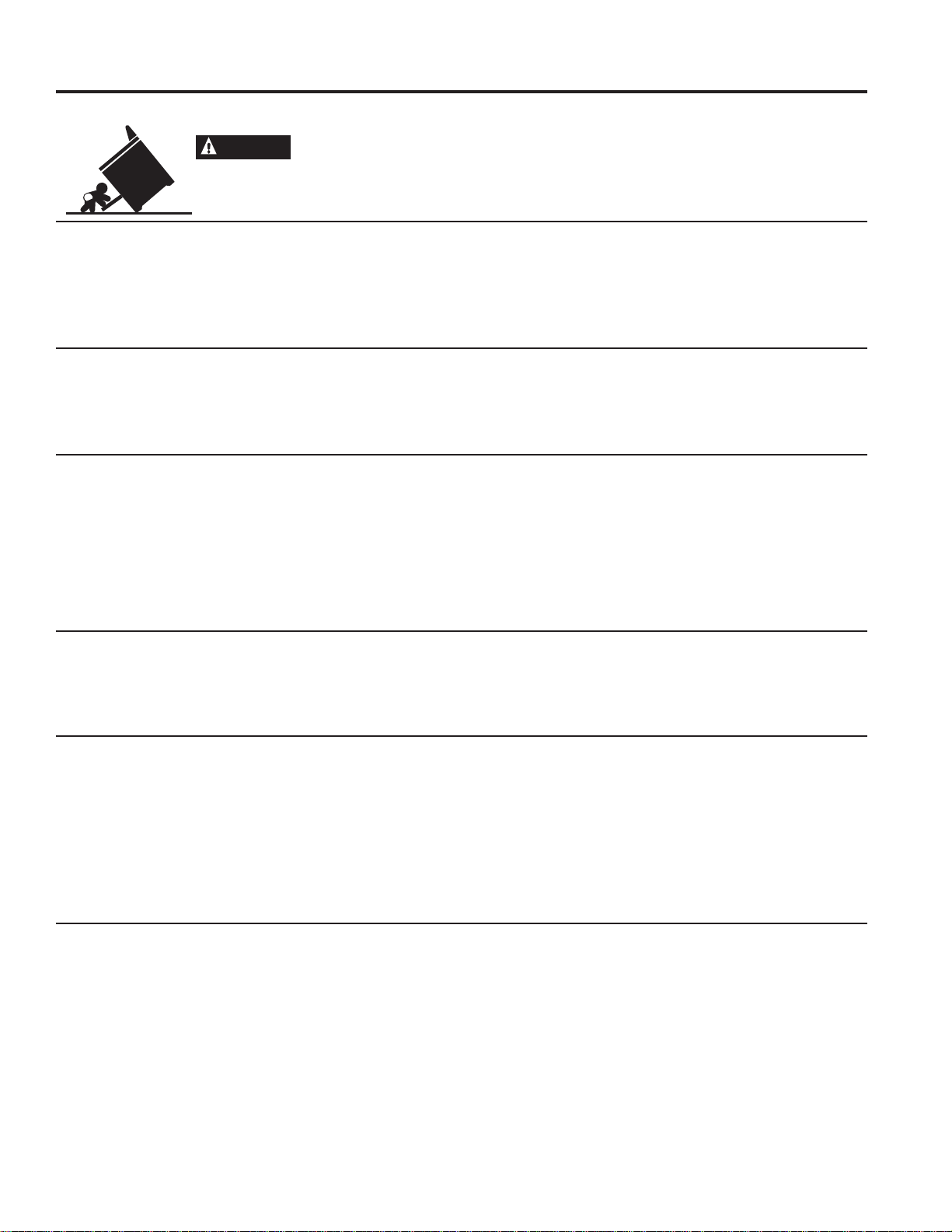
1. Push in and turn the lower oven drawer knob to any
desired setting.
2. Allow the lower oven drawer to preheat.
Ŷ 7KH21VLJQDOOLJKWLVORFDWHGRQWKHXSSHUULJKWVLGH
of the knob and glows when the knob is in the ON
position. It remains ON until the knob is moved to the
OFF position.
Ŷ 7KH³+HDWLQJ´VLJQDOOLJKWLVORFDWHGEHORZWKH21
signal light and glows when the heating elements are
active. Preheat is complete after the “Heating” signal
has turned off for the first time with each use.
NOTES:
Ŷ $OZD\VXVHWKHLQFOXGHGGUDZHUUDFNZKHQXVLQJWKH
Lower Oven Drawer.
Ŷ 7KHORZHURYHQGUDZHUFDQQRWEHXVHGGXULQJDVHOI
clean cycle of the upper oven.
Ŷ 'RQRWSXWIRRGIRLORUFRRNZDUHGLUHFWO\RQWKH
bottom of the lower oven drawer. Always use the
included drawer rack.
Ŷ ,IIRRGVUHTXLUHDFRYHUXVHRQO\IRLORUOLGVDEOHWR
withstand baking temperatures.
Do not use plastic.
Ŷ 0D[LPXPKHLJKWRIIRRGVWKDWFDQEHSODFHGLQWKH
ORZHURYHQGUDZHULVƎ
Ŷ 'RQRWSXWOLTXLGRUZDWHULQWKHORZHURYHQGUDZHU
Ŷ 1HYHUSODFHSODVWLFVSDSHUFDQQHGIRRGVRU
combustible material in the lower oven drawer.
<RXPD\ILQGWKDW\RXUQHZRYHQFRRNVGLIIHUHQWO\WKDQWKHRQHLWUHSODFHG8VH\RXUQHZRYHQIRUDIHZZHHNVWR
become more familiar with it. If you still think your new oven is too hot or too cold, you can adjust the thermostat yourself.
Do not use thermometers, such as those found in grocery stores, to check the temperature setting of your oven.
These thermometers may vary 20–40 degrees.
NOTE: This adjustment will not affect the broiling temperatures.
1. Pull the Oven Control knob off the range and look
at the back side. To make an adjustment, loosen
(approximately one turn), but do not completely
remove, the two screws on the back of the knob.
2. With the back of the knob facing you, hold the outer
edge of the knob with one hand and turn the front of
the knob with the other hand.
To raise the oven temperature, move the top screw
WRZDUGWKHULJKW<RX¶OOKHDUDFOLFNIRUHDFKQRWFK\RX
move the knob.
To lower the temperature, move the top screw toward
the left.
Each click will change the oven temperature
approximately 10°F. (Range is ± 60°F. from the
arrow.) We suggest that you make the adjustment
one click from the original
setting and check oven
performance before making
any additional adjustments.
3. After the adjustment is made,
retighten screws so they are
snug, but be careful not to
overtighten.
4. Reinstall knob on range and
check performance.
T
O
M
A
K
E
O
V
E
N
C
O
O
L
E
R
T
U
R
N
D
I
S
K
A
P
P
R
O
X
.
1
0
˚
F
P
E
R
N
O
T
C
H
T
O
M
A
K
E
O
V
E
N
H
O
T
T
E
R
T
U
R
N
D
I
S
K
T
O
A
D
J
U
S
T
O
V
E
N
T
E
M
P
E
R
A
T
U
R
E
L
O
O
S
E
N
S
C
R
E
W
S
A
N
D
R
O
T
A
T
E
Back of Lower Oven Knob
(Appearance may vary.)
Push in and turn the lower oven
drawer knob to any desired setting.
The lower oven drawer uses less energy than the upper oven.
Allow the following approximate times for preheating:
Desired Lower Oven Temperature Preheat Time
WARM 10 minutes
) 20 minutes
) 30 minutes
49-88060
21
Cleaning the Range – Exterior
CARE AND CLEANING: Cleaning the Range – Exterior
WARNING
If your range is removed for cleaning, servicing or any reason, be sure the anti-
tip device is reengaged properly when the range is replaced. Failure to take this
precaution could result in tipping of the range and can result in death or serious
burns to children or adults.
%HVXUHDOOFRQWUROVDUHRIIDQGDOOVXUIDFHVDUHFRROEHIRUHFOHDQLQJDQ\SDUWRIWKHUDQJH
Control Knobs
The control knobs may be removed for easier cleaning.
Make sure the knobs are in the OFF positions and pull
them straight off the stems for cleaning.
The knobs can be cleaned in a dishwasher or they may
also be washed with soap and water. Make sure the
inside of the knobs are dry before replacing.
Replace the knobs, in the OFF position to ensure proper
placement.
Control Panel
It’s a good idea to wipe the control panel after each use.
Clean with mild soap and water or vinegar and water,
rinse with clean water and polish dry with a soft cloth.
Do not use abrasive cleansers, strong liquid cleansers,
plastic scouring pads or oven cleaners on the control
SDQHO²WKH\ZLOOGDPDJHWKHILQLVK
Oven Exterior
Do not use oven cleaners, abrasive cleansers, strong
liquid cleansers, steel wool, plastic scouring pads, or
cleaning powders on the interior or exterior of the oven.
Clean with a mild soap and water or vinegar and water
solution. Rinse with clean water and dry with a soft cloth.
When cleaning surfaces, make sure that they are at
room temperature and not in direct sunlight.
If stain on the door vent trim is persistent, use a mild
abrasive cleaner and a sponge-scrubber for best results.
Spillage of marinades, fruit juices, tomato sauces and
basting liquids containing acids may cause discoloration
and should be wiped up immediately. Let hot surfaces
cool, then clean and rinse.
Painted Surfaces
Painted surfaces include the sides of the range and the
door, top of control panel and the drawer front. Clean
these with soap and water or a vinegar and water solution.
Do not use commercial oven cleaners, cleaning powders,
steel wool or harsh abrasives on any painted surface.
Stainless Steel Surfaces (on some models)
Do not use a steel wool pad; it will scratch the surface.
To clean the stainless steel surface, use warm sudsy
water or a stainless steel cleaner or polish. Always wipe
the surface in the direction of the grain. Follow the cleaner
instructions for cleaning the stainless steel surface.
&OHDQHUVZLWKR[DOLFDFLGVXFKDV%DU.HHSHUV)ULHQG6RIW
Cleanser™ will remove surface rust, tarnish and small
blemishes. Use only a liquid cleanser free of grit and rub in
the direction of the brush lines with a damp, soft sponge.
To inquire about purchasing cleaning products including
stainless steel appliance cleaner or polish, read the
Assistance/Accessories sections at the beginning of this
manual.
Porcelain Enamel Cooktop
The porcelain enamel finish is sturdy but breakable if
misused. This finish is acid-resistant. However, any acidic
foods spilled (such as fruit juices, tomato or vinegar)
should not be permitted to remain on the finish.
If acids spill on the cooktop while it is hot, use a dry paper
towel or cloth to wipe it up right away. When the surface
has cooled, wash with soap and water. Rinse well.
For other spills such as fat spatterings, wash with soap
and water or cleansing powders after the surface has
cooled. Rinse well. Polish with a dry cloth.

22
49-88060
Cleaning the Range – Exterior
Cast Iron Griddle
1. Rinse with hot water (do not use soap), and dry
thoroughly.
%HIRUHFRRNLQJSUHSDUHWKHVXUIDFHZLWKFRRNLQJ
spray or vegetable oil.
3. After cooking, clean the griddle with a stiff brush
and hot water. Using soap is not recommended, and
harsh detergents should never be used.
4. Towel dry immediately and apply a light coat of cooking
spray or vegetable oil while the griddle is still warm.
6WRUHLQDFRROGU\SODFH
6. Do not wash in a dishwasher.
Griddle Precautions:
Ŷ ,IVRPHWKLQJKDVVSLOOHGXQGHUWKH
griddle, it should be cleaned up as
soon as possible to prevent “baked
on” food soil. See the Cleaning the
glass cooktop section.
Ŷ 'RQRWDOORZJUHDVHWRDFFXPXODWHXQGHUWKHJULGGOHDV
it can be a fire hazard. Clean under the griddle as soon
as it is cool. See the Cleaning the glass cooktop section.
Ŷ 'RQRWSODFH\RXUJULGGOHLQWKHPLFURZDYHRYHQ
Ŷ $OZD\VWXUQRIIDOOVXUIDFHXQLWVEHIRUHUHPRYLQJWKH
griddle. Use caution when handling a hot griddle.
Cleaning the Range – Interior
CARE AND CLEANING: Cleaning the Range – Exterior / Cleaning the Range – Interior
The interior of your new oven can be cleaned manually or by using Self Clean.
Spillage of marinades, fruit juices, tomato sauces and basting liquids containing acids may cause discoloration and
should be wiped up immediately. Let hot surfaces cool, then clean and rinse.
Manual Cleaning
Do not use oven cleaners, abrasive cleaners, strong
liquid cleansers, steel wool, scouring pads, or cleaning
powders on the interior of the oven. Clean with a mild
soap and water or vinegar and water solution. Rinse with
clean water and dry with a soft cloth. When cleaning
surfaces, make sure that they are at room temperature.
Self Clean Mode
Read Self-Cleaning Oven Safety Instructions at the
beginning of this manual before using Self Clean Mode.
Self clean uses very high temperatures to clean the oven
LQWHULRU%HIRUHRSHUDWLQJWKHVHOIFOHDQF\FOHZLSHXS
grease and soils from the oven. Remove all items from
the oven other than enameled (dark color) racks. Shiny
or silver racks and any cookware or other items should
all be removed from the oven before initiating a self-clean
cycle. Close the door.
NOTE: If your range has an oven control press the Self
Clean pad and a default self-clean time is displayed. The
clean time can be changed to any time between 3:00 and
KRXUVE\XVLQJWKHnumber pads to enter a different
time and pressing Start. For heavily soiled ovens, the
PD[LPXPKRXUFOHDQWLPHLVUHFRPPHQGHG,I\RXZLVK
to use the default time, press the Start pad immediately
after pressing the Self Clean pad. The oven will turn off
automatically when the self-clean cycle is complete and
the self-clean light will be off. After the oven has cooled
down wipe any ash out of the oven.
We recommend venting your kitchen with an open
window or using a ventilation fan or hood during the first
self-clean cycle.
Soil on the front frame of the range and outside the
gasket on the door will need to be cleaned by hand.
Clean these areas with hot water, soap-filled steel-wool
pads or cleansers such as Soft Scrub
®
. Rinse well with
clean water and dry.
Do not clean the gasket. The fiberglass material of
the oven door gasket cannot withstand abrasion. It is
essential for the gasket to remain intact. If you notice it
becoming worn or frayed, replace it.
Make sure the oven light bulb cover is in place and the
oven light is off.
IMPORTANT: The health of some birds is extremely
sensitive to the fumes given off during the self-cleaning
cycle of any range. Move birds to another well-
ventilated room.
To Stop a Self-Clean Cycle
Press Clear/Off and wait for self clean light to go
off. Wait until the oven has cooled below the locking
WHPSHUDWXUHWRXQODWFKWKHGRRU<RXZLOOQRWEHDEOHWR
open the door right away unless the oven has cooled
below the locking temperature.
Oven Racks
All oven racks may be cleaned by hand with an abrasive
FOHDQHURUVWHHOZRRO%ODFNSRUFHODLQFRDWHGRYHQUDFNV
may remain in the oven during the self-cleaning cycle
without being damaged. If nickel-plated oven racks
remain in the oven during the self-cleaning cycle, they
will lose their luster and become hard to slide. It will be
necessary to grease all oven rack side edges with a light
coating of vegetable oil after cleaning them by hand or in
the oven. This will help maintain the ease of sliding the
racks in and out of the oven.
49-88060
23
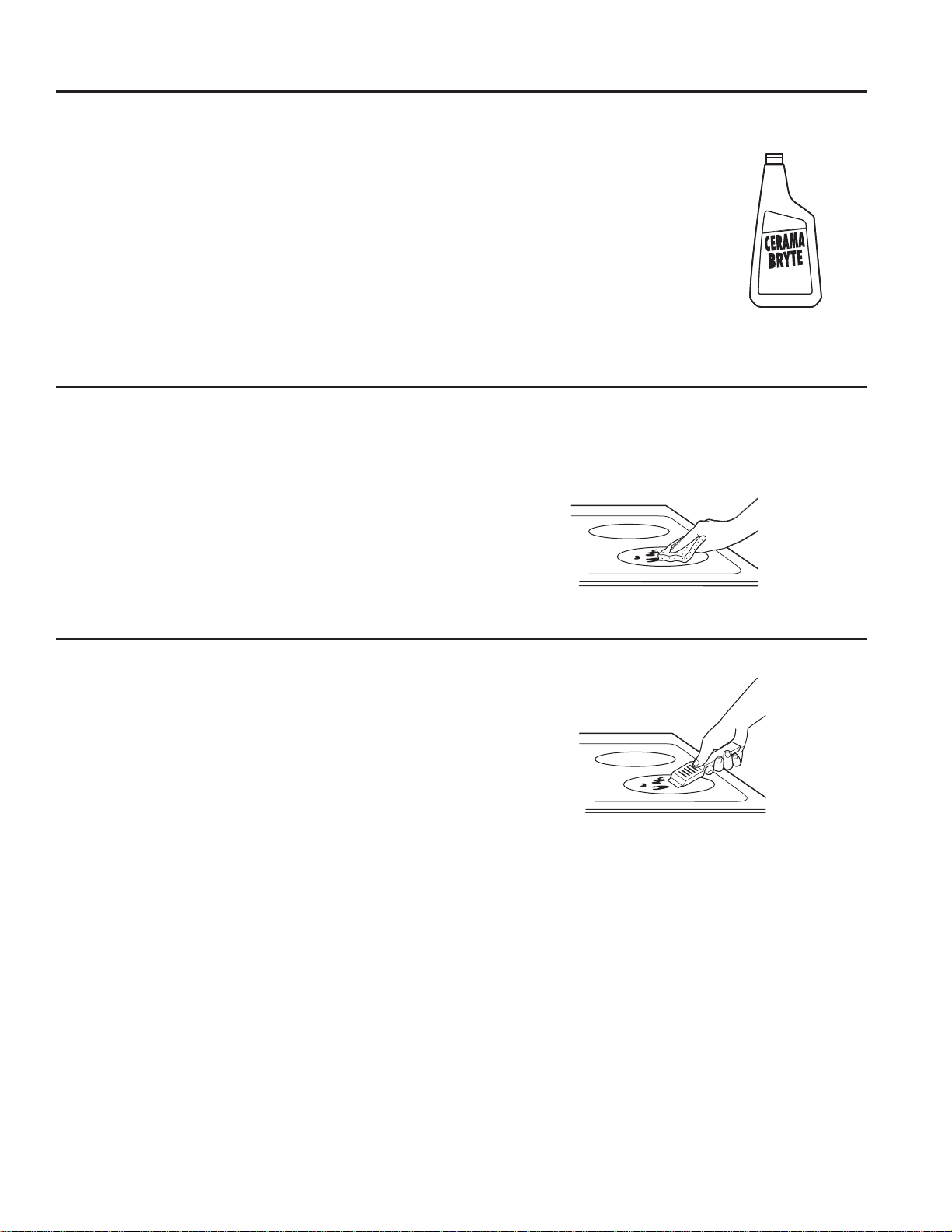
Use a CERAMA BRYTE
®
Cleaning
Pad for Ceramic Cooktops.
Normal Daily Use Cleaning
21/<XVH&(5$0$%5<7(
®
Ceramic Cooktop Cleaner
on the glass cooktop. Other creams may not be as
effective.
To maintain and protect the surface of your glass
cooktop, follow these steps:
%HIRUHXVLQJWKHFRRNWRSIRUWKHILUVWWLPHFOHDQLW
ZLWK&(5$0$%5<7(
®
Ceramic Cooktop Cleaner.
This helps protect the top and makes cleanup easier.
'DLO\XVHRI&(5$0$%5<7(
®
Ceramic Cooktop
Cleaner will help keep the cooktop looking new.
3. Shake the cleaning cream well. Apply a few drops of
&(5$0$%5<7(
®
Ceramic Cooktop Cleaner directly
to the cooktop.
4. Use a paper towel or
&(5$0$%5<7(
®
Cleaning
Pad for Ceramic Cooktops
to clean the entire cooktop
surface.
8VHDGU\FORWKRUSDSHUWRZHO
to remove all cleaning residue.
No need to rinse.
NOTE: It is very important that
you DO NOT heat the cooktop
until it has been cleaned
thoroughly.
Burned-On Residue
NOTE: DAMAGE to your glass surface may occur if you
use scrub pads other than those recommended.
1. Allow the cooktop to cool.
6SUHDGDIHZGURSVRI&(5$0$%5<7(
®
Ceramic
Cooktop Cleaner on the entire burned residue area.
8VLQJWKHLQFOXGHG&(5$0$%5<7(
®
Cleaning Pad
for Ceramic Cooktops, rub the residue area, applying
pressure as needed.
4. If any residue remains, repeat the steps listed above
as needed.
)RUDGGLWLRQDOSURWHFWLRQDIWHUDOOUHVLGXHKDVEHHQ
removed, polish the entire surface with CERAMA
%5<7(
®
Ceramic Cooktop Cleaner and a paper towel.
Heavy, Burned-On Residue
1. Allow the cooktop to cool.
2. Use a single-edge razor blade scraper at approximately
DDQJOHDJDLQVWWKHJODVVVXUIDFHDQGVFUDSHWKH
soil. It will be necessary to apply pressure to the razor
scraper in order to remove the residue.
3. After scraping with the razor scraper, spread a few drops
RI&(5$0$%5<7(
®
Ceramic Cooktop Cleaner on the
HQWLUHEXUQHGUHVLGXHDUHD8VHWKH&(5$0$%5<7(
®
Cleaning Pad to remove any remaining residue.
4. For additional protection, after all residue has been
removed, polish the entire surface with CERAMA
%5<7(
®
Ceramic Cooktop Cleaner and a paper towel.
Clean your cooktop after each
spill. Use CERAMA BRYTE
®
Ceramic Cooktop Cleaner.
The CERAMA BRYTE
®
Ceramic Cooktop Scraper and all
recommended supplies are available through our Parts Center.
See instructions under “To Order Parts” section on next page.
NOTE: Do not use a dull or nicked blade.
CARE AND CLEANING: Cleaning the Glass Cooktop
Cleaning the Glass Cooktop
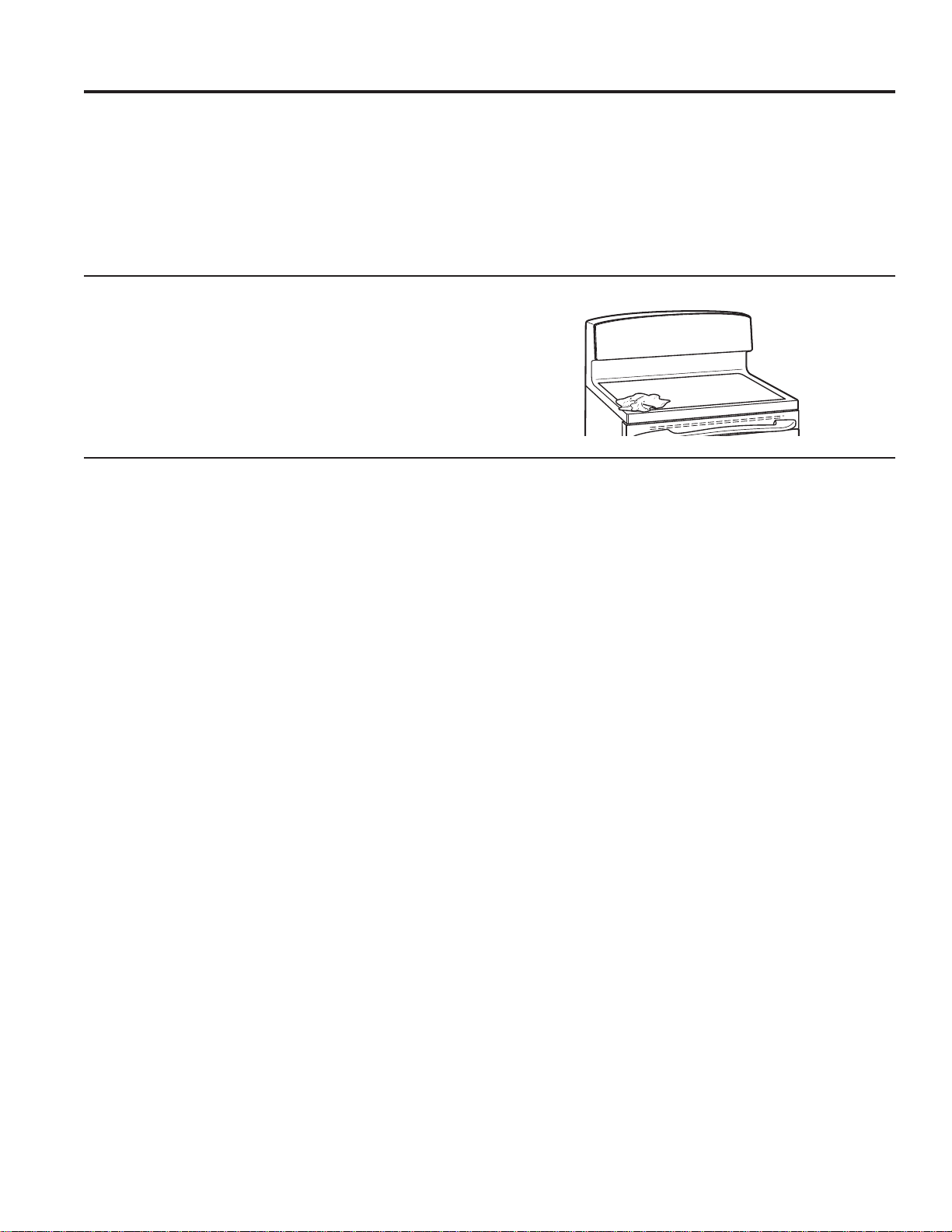
24
49-88060
Metal Marks and Scratches
%HFDUHIXOQRWWRVOLGHSRWVDQGSDQVDFURVV\RXU
cooktop. It will leave metal markings on the cooktop
surface.
These marks are removable using the CERAMA
%5<7(
®
Ceramic Cooktop Cleaner with the CERAMA
%5<7(
®
Cleaning Pad for Ceramic Cooktops.
2. If pots with a thin overlay of aluminum or copper
are allowed to boil dry, the overlay may leave black
discoloration on the cooktop.
This should be removed immediately before heating
again or the discoloration may be permanent.
NOTE: Carefully check the bottom of pans for roughness
that would scratch the cooktop.
Damage from Sugary Spills and Melted Plastic
Special care should be taken when removing hot substances to avoid permanent damage of the glass surface.
Sugary spillovers (such as jellies, fudge, candy, syrups) or melted plastics can cause pitting of the surface of your
cooktop (not covered by the warranty) unless the spill is removed while still hot. Special care should be taken when
removing hot substances.
%HVXUHWRXVHDQHZVKDUSUD]RUVFUDSHU
Do not use a dull or nicked blade.
1. Turn off all surface units. Remove hot pans.
2. Wearing an oven mitt:
a. Use a single-edge razor blade scraper (CERAMA
%5<7(
®
Ceramic Cooktop Scraper) to move the
spill to a cool area on the cooktop.
b. Remove the spill with paper towels.
3. Any remaining spillover should be left until the surface
of the cooktop has cooled.
4. Don’t use the surface units again until all of the
residue has been completely removed.
NOTE: If pitting or indentation in the glass surface has
already occurred, the cooktop glass will have to be
replaced. In this case, service will be necessary.
Cooktop Seal
To clean the cooktop seal around the edges of the glass,
lay a wet cloth on it for a few minutes, then wipe clean
with nonabrasive cleaners.
Cleaning the Glass Cooktop (Cont.)
CARE AND CLEANING: Cleaning the Glass Cooktop
49-88060
25
WARNING
SHOCK OR BURN HAZARD:%HIRUHUHSODFLQJRYHQOLJKWEXOEGLVFRQQHFWWKHHOHFWULFDOSRZHUWRWKH
range at the main fuse or circuit breaker panel. Failure to do so may result in electric shock or burn.
CAUTION
BURN HAZARD: The glass cover and bulb should be removed when cool. Touching hot glass with
bare hands or a damp cloth can cause burns.
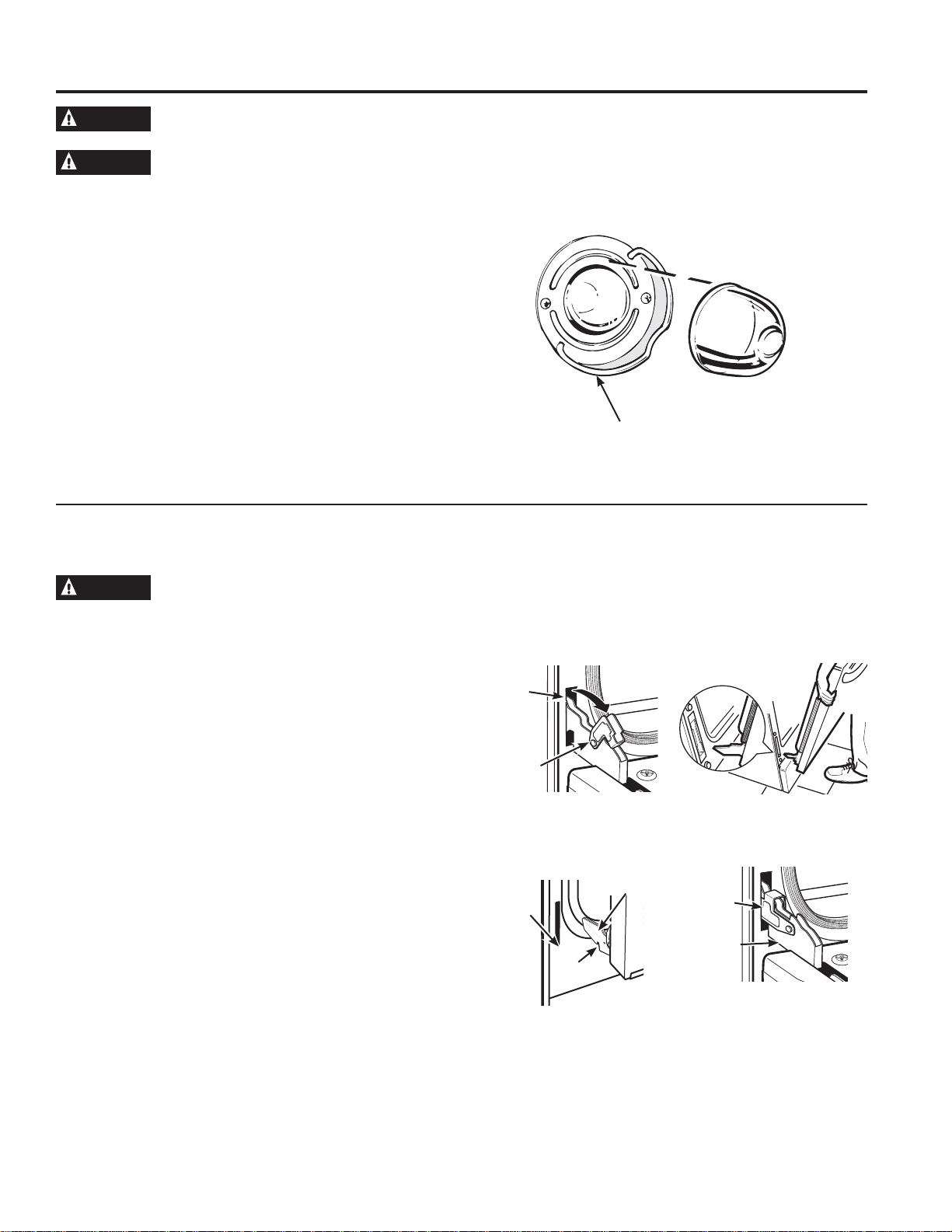
Oven Light Replacement
%HVXUHWROHWWKHOLJKWFRYHUDQGEXOEFRROFRPSOHWHO\
To remove the cover:
1. Hold a hand under the cover so it doesn’t fall when
released. With fingers of the same hand, firmly push
back the wire cover holder. Lift off the cover.
Do not remove any screws to remove the cover.
2. Replace bulb with a 40-watt appliance bulb.
To replace the cover:
1. Place it into groove of the light receptacle. Pull wire
forward to the center of the cover until it snaps
into place.
2. Connect electrical power to the range.
CARE AND CLEANING: Maintenance
Maintenance
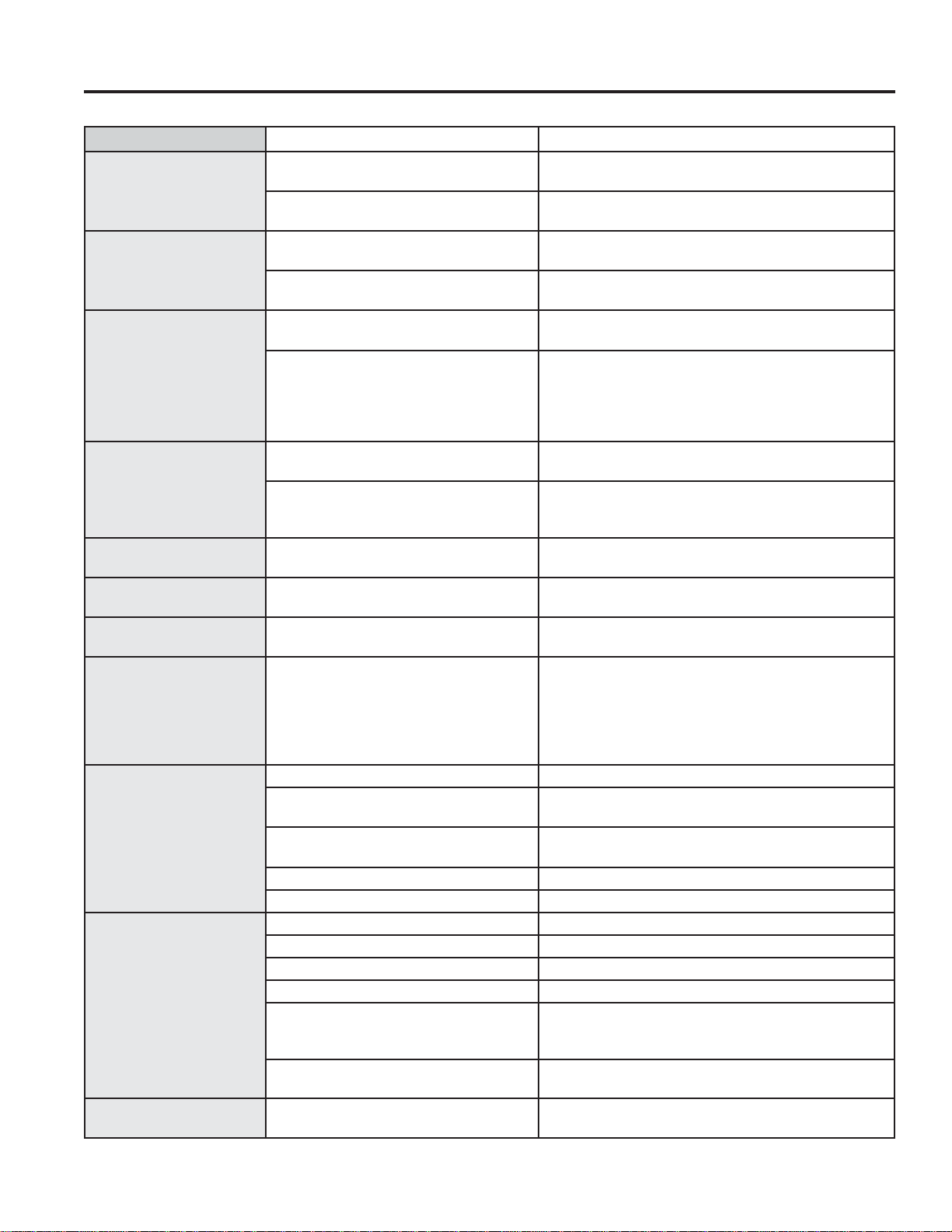
To Remove the Door:
1. Fully open the door.
2. Pull the hinge locks down toward the door frame, to
the unlocked position. A tool, such as a small flat-
blade screwdriver, may be required.
3. Firmly grasp both sides of the door at the top.
4. Close door to the door removal position, which is
halfway between the broil stop position and fully closed.
/LIWGRRUXSDQGRXWXQWLOWKHKLQJHDUPLVFOHDURI
the slot.
To Replace the Door:
1. Firmly grasp both sides of the door at the top.
2. With the door at the same angle as the removal
position, seat the indentation of the hinge arm into the
bottom edge of the hinge slot. The notch in the hinge
arm must be fully seated into the bottom of the slot.
3. Fully open the door. If the door will not fully open, the
indentation is not seated correctly in the bottom edge
of the slot.
4. Push the hinge locks up against the front frame of the
oven cavity to the locked position.
&ORVHWKHRYHQGRRU
Lift-Off Oven Door
7KHGRRULVYHU\KHDY\%HFDUHIXOZKHQUHPRYLQJDQGOLIWLQJWKHGRRU'RQRWOLIWGRRUE\WKHKDQGOH
WARNING
If improperly removed, oven door hinges may suddenly open and can cause personal injury to
appendages near the hinge. Follow instructions below to avoid a risk of injury when removing and
re-installing the oven door.
Removal position
Hinge
lock
Pull hinge locks down to unlock.
Slot
Indentation
Bottom
edge of
slot
Hinge arm
Hinge
lock
Push hinge locks up to lock.
Hinge
arm
Wire cover holder
26
49-88060
TROUBLESHOOTING TIPS
Troubleshooting tips ... Before you call for service
Save time and money! Review the charts on the following pages first and you may not need to call for service.
Problem Possible Cause What To Do
Surface units will not
maintain a rolling boil
or cooking is not fast
enough
Improper cookware being used. Use pans which are flat and match the diameter of the
surface unit selected.
In some areas, the power (voltage)
may be low.
Cover pan with a lid until desired heat is obtained.
Surface units do not
work properly
A fuse in your home may be blown or
the circuit breaker tripped.
Replace the fuse or reset the circuit breaker.
Cooktop controls improperly set. Check to see the correct control is set for the surface
unit you are using.
Scratches (may appear
as cracks) on cooktop
glass surface
Incorrect cleaning methods being
used.
Scratches are not removable. Tiny scratches will
become less visible in time as a result of cleaning.
Cookware with rough bottoms being
used or coarse particles (salt or sand)
were between the cookware and the
surface of the cooktop. Cookware has
been slid across the cooktop surface.
To avoid scratches, use the recommended cleaning
procedures. Make sure bottoms of cookware are
clean before use, and use cookware with smooth
bottoms.
Areas of discoloration
on the cooktop
Food spillovers not cleaned before
next use.
See the Cleaning the glass cooktop section.
Hot surface on a model with a light-
colored cooktop.
This is normal. The surface may appear discolored
when it is hot. This is temporary and will disappear as
the glass cools.
Plastic melted to the
surface
Hot cooktop came into contact with
plastic placed on the hot cooktop.
6HHWKH*ODVVVXUIDFH²SRWHQWLDOIRUSHUPDQHQWGDPDJH
section in the Cleaning the glass cooktop section.
Pitting (or indentation)
of the cooktop
Hot sugar mixture spilled on the
cooktop.
Call a qualified technician for replacement.
Frequent cycling off and
on of surface units
Improper cookware being used.
Use only flat cookware to minimize cycling.
My new oven doesn't
cook like my old one.
Is something wrong
with the temperature
settings?
Your new oven has a different
cooking system from your old oven
and therefore may cook differently
than your old oven.
For the first few uses, follow your recipe times
and temperatures carefully. If you still think your
new oven is too hot or too cold, you can adjust the
temperature yourself to meet your specific cooking
preference. NOTE:7KLVDGMXVWPHQWDIIHFWV%DNH
WHPSHUDWXUHVLWZLOOQRWDIIHFW%URLORU&OHDQ
Food does not bake
properly
Oven controls improperly set. See the Cooking Modes section.
Rack position is incorrect or rack is
not level.
See the Cooking Modes section and Cooking Guide.
Incorrect cookware or cookware of
improper size being used.
See the Cookware section.
Oven temperature needs adjustment. See the Special Features section.
Ingredient substitution
Substituting ingredients can change the recipe outcome.
Food does not broil
properly
Oven controls improperly set. Make sure you select the appropriate broil mode.
Improper rack position being used. See Cooking Guide for rack location suggestions.
Food being cooked in a hot pan. Make sure cookware is cool.
Cookware not suited for broiling. Use a pan specifically designed for broiling.
Aluminum foil used on the broiling
pan and grid has not been fitted
properly and slit as recommended.
If using aluminum foil conform to pan slits.
In some areas the power (voltage)
may be low.
Preheat the broil element for 10 minutes.
Oven temperature too
hot or too cold
Oven temperature needs adjustment. See the Special Features section or adjust the
thermostat (on models with oven temperature knob).
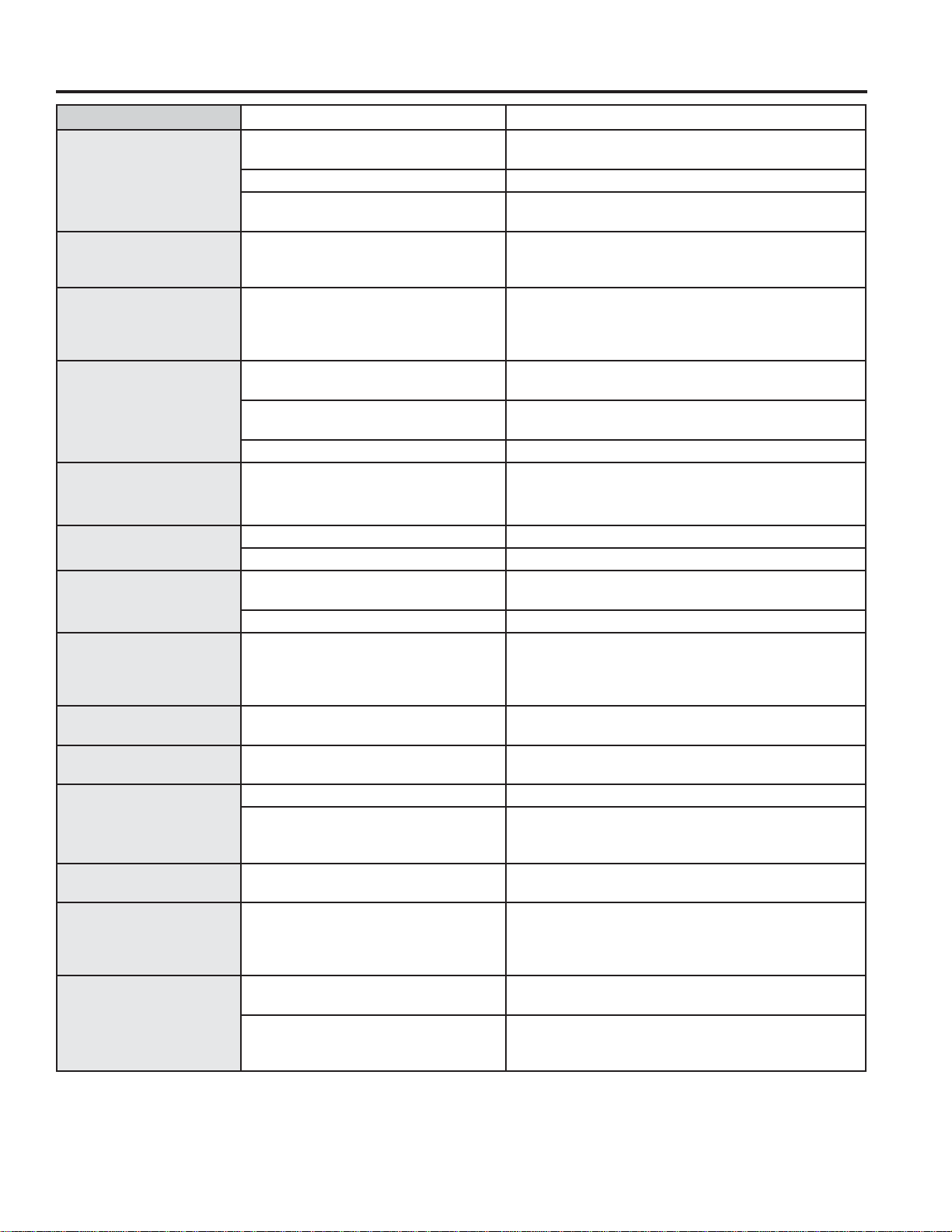
49-88060
27
Problem Possible Cause What To Do
Oven does not work or
appears not to work
A fuse in your home may be blown
or the circuit breaker tripped.
Replace the fuse or reset the circuit breaker.
Oven controls improperly set. See the Using the Oven section.
Oven is in Sabbath Mode. Verify, that the oven is not in Sabbath Mode. See the
Special Features section.
“Crackling” or
“popping” sound
This is the sound of the metal
heating and cooling during both the
cooking and cleaning functions.
This is normal.
Why is my range making
a "clicking" noise when
using my oven?
Your range cycles the heating
elements by turning relays on
and off to maintain the oven
temperature.
This is normal.
Clock and timer do not
work
A fuse in your home may be blown
or the circuit breaker tripped.
Replace the fuse or reset the circuit breaker.
Plug on range is not completely
inserted in the electrical outlet.
Make sure electrical plug is plugged into a live,
properly grounded outlet.
Oven controls improperly set. See the Using the kitchen timer section.
Oven door is crooked The door is out of position. %HFDXVHWKHRYHQGRRULVUHPRYDEOHLWVRPHWLPHV
gets out of position during installation.
To straighten the door, push down on the high corner.
Oven light does not
work
Light bulb is loose or defective. Tighten or replace bulb.
Pad operating light is broken. Call for service.
Oven will not self-clean The temperature is too high to set a
self-clean operation.
Allow the oven to cool and reset the controls.
Oven controls improperly set. See the Cleaning the Oven section.
Excessive smoking
during clean cycle
Excessive soil or grease. Press the Clear/Off pad. Open the windows to rid the
room of smoke. Wait until the LOCKED DOOR light
goes off. Wipe up the excess soil and reset the clean
cycle.
Excessive smoking
during broiling
Food too close to burner element. Lower the rack position of the food.
Oven door will not open
after a clean cycle
Oven too hot. Allow the oven to cool below locking temperature.
Oven not clean after a
clean cycle
Oven controls improperly set. See the Cleaning the Oven section.
Oven was heavily soiled. Clean up heavy spillovers before starting the clean
cycle. Heavily soiled ovens may need to self-clean
again or for a longer period of time.
"LOCK DOOR" flashes
in the display
The self-clean cycle has been
selected but the door is not closed.
Close the oven door.
LOCKED DOOR light is
on when you want to
cook
The oven door is locked because
the temperature inside the oven
has not dropped below the locking
temperature.
Press the Clear/Off pad. Allow the oven to cool.
“F— and a number
or letter” flash in the
display
You have a function error code. Press the Clear/Off pad. Allow the oven to cool for
one hour. Put the oven back into operation.
If the function code repeats. Disconnect all power to the oven for at least 30
seconds and then reconnect power. If the function
error code repeats, call for service.
Troubleshooting tips (Cont.) ... Before you call for service
TROUBLESHOOTING TIPS
28
49-88060
Problem Possible Cause What To Do
Display goes blank A fuse in your home may be blown or
the circuit breaker tripped.
Replace the fuse or reset the circuit breaker.
The clock is turned off. See the Special features section.
Oven is in Sabbath Mode. Verify that the oven is not in Sabbath Mode. See
the Special Features section.
Power outage, clock
flashes
Power outage or surge Reset the clock. If the oven was in use, you must
reset it by pressing the Clear/Off pad, setting the
clock and resetting any cooking function.
“Burning” or “oily” odor
emitting from the vent
This is normal in a new oven and will
disappear in time.
To speed the process, set a self-clean cycle for a
minimum of 3 hours. See the Cleaning the Oven
section.
Strong odor An odor from the insulation around
the inside of the oven is normal for
the first few times the oven is used.
This is temporary and will go away after several
uses or a self-clean cycle.
My oven door glass
appears to be "tinted" or
have a "rainbow" color. Is
this defective?
No. The inner oven glass is coated
with a heat barrier to reflect the heat
back into the oven to prevent heat
loss and keep the outer door cool
while baking.
This is normal. Under certain light or angles, you
may see this tint or rainbow color.
Sometimes the oven takes
longer to preheat to the
same temperature
Cookware or food in oven. The cookware or food in the oven will cause the
oven to take longer to preheat. Remove items to
reduce preheat time.
Number of racks in oven. Adding more racks to the oven will cause the oven
to take longer to preheat. Remove some racks.
Display flashes Power failure. Reset the clock.
Unable to get the display
to show “SF”
Oven control pads were not touched
properly.
The Broil Hi/Lo and Bake pads must be touched
at the same time and held for 3 seconds.
Control signals after
entering cooking time or
start time
You forgot to enter a bake
temperature or cleaning time.
Touch the Bake pad and desired temperature or
the Self Clean pad and desired clean time.
Oven racks are difficult to
slide
The shiny, silver-colored racks were
cleaned in a self-clean cycle.
Apply a small amount of vegetable oil to a paper
towel and wipe the edges of the oven racks with
the paper towel. Do not spray with Pam
®
or other
lubricant sprays.
Drawer does not slide
smoothly or drags
The drawer is out of alignment. Fully extend the drawer and push it all the way in
See the Care and cleaning of the range section.
Drawer is over-loaded or load is
unbalanced.
Reduce weight. Redistribute drawer contents.
Steam from the vent When using the ovens, it is normal
to see steam coming out of the
oven vents. As the number of racks
or amount of food being cooked
increases, the amount of visible
steam will increase.
This is normal.
Excessive condensation in
the drawer
Liquid in drawer. Remove liquid.
Uncovered foods. Cover food with lid or aluminum foil.
Temperature setting too high. Reduce temperature setting.
TROUBLESHOOTING TIPS
Troubleshooting tips (Cont.) ... Before you call for service

49-88060 02-16 GE
Información de Seguridad ...2
Garantía ........................7
Asistencia / Accesorios .......8
Uso de la Cocina
Unidades de superficie ............9
Utensilio para Placa de Cocción
para Vidrio Radiante ............11
Plancha ..........................12
Controles del Horno ..............13
Funciones Especiales .............14
Estantes del Horno ...............16
Papel de Aluminio y
Cobertores del Horno ...........16
Utensilios ........................16
Probe (Sonda) ....................17
Modos de Cocción ...............18
Guía de Cocción .................19
Cajón Inferior del Horno ..........20
Ajuste el Termostato del
Horno Inferior ..................20
Cuidado y Limpieza
Limpieza de la Cocina - Exterior . . .21
Limpieza de la Cocina - Interior . . .22
Cómo limpiar la estufa de vidrio ..23
Mantenimiento ...................25
Consejos para la
Solución de Problemas ......26
Cocinas
Eléctricas empotrables
Escriba los números de modelo y de
serie aquí:
Nº de Modelo ______________
Nº de Serie ________________
Encontrará la etiqueta de calificación
detrás del cajón de la cocina.
Manual del Propietario
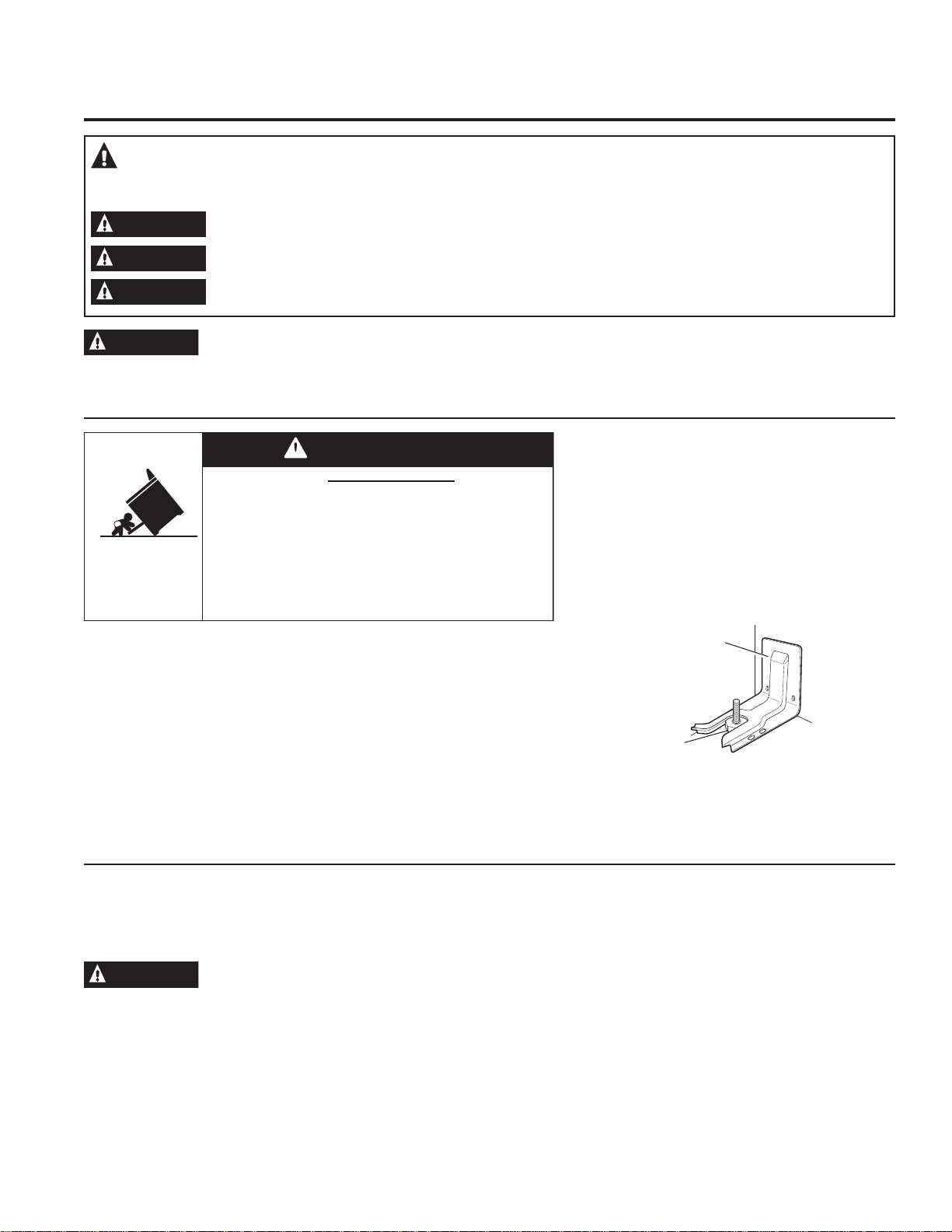
2
49-88060
ADVERTENCIA
Lea todas las instrucciones de seguridad antes de utilizar este producto. No seguir estas instrucciones
puede generar un incendio, una descarga eléctrica, lesiones corporales o la muerte.
ADVERTENCIA DE LA PROPOSICIÓN 65 DEL ESTADO DE CALIFORNIA
DISPOSITIVO ANTI-VOLCADURAS
La Ley sobre Agua Potable Inocua y Tratamiento de Residuos Tóxicos de California (California Safe Drinking Water
and Toxic Enforcement Act) solicita al Gobernador de California que publique una lista de sustancias que el estado
reconoce que producen cáncer, defectos de nacimiento u otros daños reproductivos y solicita a los empresarios que
adviertan a sus clientes sobre la posible exposición a tales sustancias.
ADVERTENCIA
Este producto contiene uno o más químicos que el Estado de California entiende que producen
cáncer, defectos en el nacimiento u otros daños reproductivos.
Los hornos con limpieza automática pueden ocasionar exposiciones de bajo nivel a algunas de estas sustancias,
incluyendo monóxido de carbono, durante el ciclo de limpieza. La exposición puede ser minimizada si se ventila con
una ventana abierta o si se usa un ventilador o campana.
Para reducir el riesgo de volcar la cocina, ésta debe
sujetarse mediante un soporte anti-volcaduras con
una adecuada instalación. Ver las instrucciones de
instalación enviadas con el soporte para obtener
detalles completos antes de iniciar la instalación.
Para Cocinas Sin Apoyo y Deslizabless
Para controlar si el soporte es instalado y ajustado
de forma apropiada, mire que debajo de la cocina
la pata niveladora trasera esté ajustada al soporte.
En algunos modelos, el cajón de almacenamiento
o el panel de protección se pueden retirar para una fácil inspección. Si no
es posible realizar una inspección visual, deslice la cocina hacia adelante,
confirme que el soporte anti-volcaduras esté ajustado de forma segura al piso
o la pared, y deslice la cocina hacia atrás de modo que la pata niveladora
trasera se encuentre debajo del soporte anti-volcaduras.
Si la cocina es expulsada de la pared por alguna razón, siempre repita este
procedimiento a fin de verificar que esté asegurado de forma correcta con un
soporte anti volcaduras.
Nunca quite las patas de nivelación por completo ya que la cocina no quedará
bien sujeta al dispositivo anti-volcaduras.
Soporte
Anti-Volcaduras
Pata Niveladora
GUARDE ESTAS INSTRUCCIONES
INFORMACIÓN IMPORTANTE DE SEGURIDAD
LEA TODAS LAS INSTRUCCIONES ANTES DE USAR
INFORMACIÓN DE SEGURIDAD
Un niño o adulto pueden volcar la cocina y morir.
Verifique que el soporte anti-volcaduras se haya
instalado y ajustado correctamente.
Verifique que el soporte anti-volcaduras se haya
instalado y ajustado correctamente.
No utilice la cocina sin que el soporte anti-volcaduras
esté colocado y ajustado.
Si estas instrucciones no se siguen, como resultado se podrá
producir la muerte o quemaduras graves de niños y adultos.
Riesgo de Volcaduras
ADVERTENCIA
Éste es el símbolo de alerta de seguridad. El mismo alerta sobre potenciales riesgos que le pueden producir la muerte o
lesiones tanto a usted como a otras personas. Todos los mensajes de seguridad estarán a continuación del símbolo de alerta de
seguridad y con la palabra “PELIGRO”, “ADVERTENCIA” o “PRECAUCIÓN”. Estas palabras se definen como:
PELIGRO
Indica una situación de riesgo que, si no se evita, producirá la muerte o lesiones graves.
ADVERTENCIA
Indica una situación de riesgo que, si no se evita, podría producir la muerte o lesiones graves.
PRECAUCIÓN
Indica una situación de riesgo que, si no se evita, podría resultar en lesiones menores o moderadas.

49-88060
3
GUARDE ESTAS INSTRUCCIONES
INFORMACIÓN DE SEGURIDAD
ADVERTENCIA
INSTRUCCIONES GENERALES DE SEGURIDAD
Ŷ 8VHHVWHDSDUDWRVyORFRQHOREMHWLYRSDUDHOTXH
fue creado, como se describe en este Manual del
Propietario.
Ŷ $VHJ~UHVHGHTXHXQWpFQLFRFDOLILFDGRUHDOLFHXQD
correcta instalación y puesta a tierra del artefacto de
acuerdo con las instrucciones de instalación provistas.
Ŷ 1RLQWHQWHUHSDUDURFDPELDUQLQJXQDSLH]DGH
su cocina a menos que esté específicamente
recomendado en este manual. Cualquier otro servicio
debe realizarlo un técnico calificado.
Ŷ $QWHVGHUHDOL]DUFXDOTXLHUFODVHGHUHSDUDFLyQ
desenchufe la cocina o desconecte el suministro
eléctrico desde el panel de distribución doméstico
quitando el fusible o desconectando el interruptor de
circuitos.
Ŷ 1RGHMHDORVQLxRVVRORVpVWRVQRGHEHQTXHGDU
solos o sin atención en un área donde un aparato
esté en uso. Nunca debe permitirse que se suban,
sienten o paren en cualquier parte de este aparato.
Ŷ
PRECAUCIÓN
No almacene elementos de interés
para niños sobre una cocina o en la protección
trasera de una cocina: los niños que se trepan a
la cocina para alcanzar elementos pueden resultar
gravemente heridos.
Ŷ 6yORXVHDJDUUDGHUDVVHFDVODVDJDUUDGHUDV
K~PHGDVRPRMDGDVFRORFDGDVHQVXSHUILFLHV
calientes pueden provocar quemaduras de vapor. No
permita que las agarraderas entren en contacto con
unidades de superficie o los elementos calentadores
calientes. No utilice toallas u otras telas gruesas en
lugar de una agarradera.
Ŷ 1XQFDXVHVXHOHFWURGRPpVWLFRSDUDFDOHQWDUOD
habitación.
Ŷ 1RWRTXHODVXQLGDGHVGHVXSHUILFLHORVHOHPHQWRV
calentadores o la superficie interior del horno. Estas
superficies pueden estar lo suficientemente calientes
SDUDTXHPDUD~QFXDQGRWHQJDQXQFRORURVFXUR
Durante y después del uso, no toque o deje que su
vestimenta u otros materiales inflamables entren en
contacto con unidades de superficie, áreas cercanas
a las unidades de superficie o cualquier área
LQWHULRUGHOKRUQRGHMHSDVDUXQWLHPSRSUXGHQFLDO
para que se enfríen. Otras superficies del aparato
pueden calentarse lo suficiente como para provocar
quemaduras. Las superficies potencialmente calientes
incluyen la estufa, las áreas orientadas hacia la
estufa, la abertura de ventilación del horno, las
superficies cercanas a la abertura y las hendiduras
ubicadas alrededor de la puerta del horno.
Ŷ 1RFDOLHQWHUHFLSLHQWHVFHUUDGRVGHDOLPHQWRV3RGUtD
haber una acumulación de presión en el recipiente y
éste podría explotar, provocando lesiones.
Ŷ 1RXVHQLQJ~QWLSRGHDOXPLQLRRFREHUWRUSDUD
cubrir el fondo del horno o cualquier parte del
horno, excepto como se describe en este manual.
Los cobertores de horno pueden atrapar el calor o
derretirse, ocasionando daños sobre el producto y el
riesgo de descargas, humo o incendios.
Ŷ 7UDWHGHQRUD\DURJROSHDUODVSXHUWDVHVWXIDV
o paneles de control de vidrio. Si lo hace podría
romperse el vidrio. No cocine si un producto tiene
un vidrio roto. Puede provocarse una descarga, un
incendio o heridas.
Ŷ &RFLQHFDUQHVGHUHV\GHDYHSRUFRPSOHWR/DV
carnes de res hasta alcanzar una temperatura interna
de por lo menos 160°F (71°C) y las carnes de ave a
una temperatura interna de por lo menos 180°F (82°C).
La cocción a estas temperaturas generalmente protege
de enfermedades transmitidas por los alimentos.
Ŷ 1RDOPDFHQHRXWLOLFHPDWHULDOHVLQIODPDEOHVGHQWUR
de un horno o cerca de la estufa, tales como papel,
plástico, agarraderas, telas, recubrimientos de
pared, cortinas y gasolina u otros vapores y líquidos
inflamables.
Ŷ 1XQFDXVHYHVWLPHQWDVKROJDGDVRDPSOLDVPLHQWUDV
utilice el aparato. Estas vestimentas pueden
prenderse fuego si entran en contacto con superficies
calientes, provocando quemaduras graves.
Ŷ 1RSHUPLWDTXHODJUDVDGHODFRFFLyQXRWURV
materiales inflamables se acumulen dentro de la
cocina o en su cercanía. La grasa dentro del horno o
sobre la estufa puede encenderse.
Ŷ /LPSLHODVFDPSDQDVGHYHQWLODFLyQFRQIUHFXHQFLD
No debe permitirse la acumulación de grasa en la
campana o en el filtro.
ADVERTENCIA
MANTENGA LOS MATERIALES INFLAMABLES ALEJADOS DE LA COCINA
Si esto no se cumple, se podrán sufrir lesiones personales graves o incendios.

4
49-88060
ADVERTENCIA
INSTRUCCIONES DE SEGURIDAD DE LA ESTUFA
INFORMACIÓN IMPORTANTE DE SEGURIDAD
LEA TODAS LAS INSTRUCCIONES ANTES DE USAR
INFORMACIÓN DE SEGURIDAD
GUARDE ESTAS INSTRUCCIONES
Ŷ 1RXWLOLFHDJXDHQLQFHQGLRVGHJUDVD1XQFDOHYDQWH
una sartén en llamas. Apague los controles. Apague
una sartén en llamas sobre una unidad de superficie
cubriendo la sartén por completo con una tapa que
ajuste bien, una plancha para galletas o una bandeja
plana. Utilice un químico seco multiuso o un extintor
de incendios de espuma.
Ŷ 6LKD\XQLQFHQGLRHQHOKRUQRGXUDQWHHOKRUQHDGR
apáguelo cerrando la puerta del horno y apagando
el control o usando un químico seco multiuso o un
extintor de incendios de espuma.
Ŷ 6LKD\XQLQFHQGLRHQHOKRUQRGXUDQWHODDXWR
limpieza, apague el horno y espere a que el incendio
se consuma. No abra la puerta del horno a la fuerza.
El ingreso de aire fresco a temperaturas de auto-
limpieza puede provocar una explosión de llamas
desde el horno. No seguir esta instrucción puede
provocar quemaduras graves.
Ŷ 1XQFDGHMHODVXQLGDGHVGHVXSHUILFLHVLQDWHQFLyQHQ
configuraciones de calor media o alta. Los alimentos
que hierven y se derraman pueden provocar humo y
derrames grasosos que pueden prenderse fuego.
Ŷ 1XQFDGHMHDFHLWHVLQDWHQFLyQPLHQWUDVIUtH6LVH
deja calentar más allá del punto de humeo, el aceite
puede encenderse, provocando un incendio que
podría propagarse a los gabinetes cercanos. Utilice
un termómetro para grasa cuando sea posible para
controlar la temperatura del aceite.
Ŷ 3DUDHYLWDUHOGHUUDPHGHDFHLWH\XQLQFHQGLRXWLOLFH
una cantidad mínima de aceite cuando fría en sartenes
poco profundas y evite la cocción de alimentos
congelados con una cantidad excesiva de hielo.
Ŷ 8WLOLFHHOWDPDxRGHUHFLSLHQWHDGHFXDGR(OLMD
recipientes con bases planas lo suficientemente
grandes para cubrir el elemento calentador de
superficie. La utilización de recipientes más pequeños
dejará expuesta una porción de la unidad de
superficie al contacto directo, lo que puede provocar
el encendido de sus vestimentas. Una relación
adecuada del recipiente con la unidad de superficie
también mejorará la eficiencia.
Ŷ 6yORFLHUWRVWLSRVGHUHFLSLHQWHVGHYLGULRYLGULR
cerámico, cerámica, u otros recipientes vidriados
SXHGHQXWLOL]DUVHVREUHODHVWXIDRWURVSXHGHQ
romperse debido al cambio repentino de temperatura.
Ŷ 3DUDPLQLPL]DUODSRVLELOLGDGGHTXHPDGXUDVHO
encendido de materiales inflamables y los derrames,
la manija de los recipientes deben girarse hacia el
centro de la cocina sin extenderse sobre ninguna
unidad de superficie cercana.
Ŷ 6LIODPEHDDOLPHQWRVEDMRODFDPSDQDHQFLHQGDHO
ventilador.
Ŷ 6LVHSURGXFHXQFRUWHGHOX]HQXQDFRFLQD
eléctrica mientras la unidad superficial está en ON
(Encendido), la unidad se volverá a encender cuando
regrese la luz. En caso de falta de corriente, si no se
giran todas las perillas de la unidad de superficial a la
posición OFF (Apagado) se podrán incendiar artículos
en o cerca de la estufa, lo cual podrá producir
lesiones graves o la muerte.
ADVERTENCIA
EN CASO DE INCENDIO, SIGA LOS SIGUIENTES PASOS PARA EVITAR
LA PROPAGACIÓN DEL FUEGO

49-88060
5
INFORMACIÓN DE SEGURIDAD
GUARDE ESTAS INSTRUCCIONES
ADVERTENCIA
INSTRUCCIONES DE SEGURIDAD DE LA ESTUFA RADIANTE
Ŷ Tenga cuidado al tocar la estufa. La superficie de
vidrio de la estufa retendrá calor después de que los
controles se hayan apagado.
Ŷ No cocine sobre una estufa rota. Si la estufa se
rompe, las soluciones de limpieza y los derrames
pueden penetrar en la estufa rota y crear un riesgo
de descarga eléctrica. Comuníquese con un técnico
calificado de inmediato.
Ŷ Evite rayar la estufa de vidrio. La estufa puede
rayarse con elementos tales como cuchillos,
instrumentos filosos, anillos u otras joyas, y remaches
de la ropa.
Ŷ No coloque o almacene elementos que pueden
derretirse o prenderse fuego sobre la estufa de
YLGULRD~QFXDQGRQRODHVWpXVDQGR6LODHVWXID
se enciende en forma accidental, pueden prenderse
fuego. El calor proveniente de la estufa o de la
ventilación del horno también puede prenderlos fuego,
D~QVLHODSDUDWRHVWiDSDJDGR
Ŷ Use el limpiador de estufas cerámicas CERAMA
BRYTE
®
y la esponjilla de limpieza CERAMA BRYTE
®
para limpiar la estufa. Espere hasta que la estufa se
enfríe y la luz indicadora se apague antes de limpiar.
8QDHVSRQMDRXQSDxRK~PHGRVVREUHXQDVXSHUILFLH
caliente pueden provocar quemaduras de vapor.
Algunos limpiadores pueden producir humos tóxicos
si se los aplica a una superficie caliente.
NOTA:/RVGHUUDPHVGHD]~FDUVRQODH[FHSFLyQ
Éstos deben quitarse mientras están calientes
utilizando una agarradera y un raspador. Para
instrucciones detalladas, ver la sección Cómo limpiar
la estufa de vidrio.
Ŷ Lea y cumpla con todas las instrucciones y
advertencias de la etiqueta de la crema de limpieza.

6
49-88060
La función de limpieza automática usa el horno en temperaturas lo suficientemente altas como para consumir la
suciedad de comida que haya dentro del horno. Para un funcionamiento seguro, siga estas instrucciones.
Ŷ No toque las superficies del horno durante el ciclo de
limpieza automática. Mantenga a los niños alejados
del horno durante la limpieza automática. Si no
se siguen estas instrucciones, se podrán producir
quemaduras.
Ŷ
Antes de utilizar el ciclo de limpieza automática, retire
las ollas, estantes de metal brillante del horno y otros
utensilios que haya en el horno. Sólo se pueden dejar
dentro del horno los estantes para horno cubiertos de
porcelana. No use la función de limpieza automática
para limpiar otras partes, tales como ollas de goteo o
recipientes.
Ŷ Antes de utilizar el ciclo de limpieza automática, limpie
la grasa y restos de comida que haya en el horno.
Una cantidad excesiva de grasa se puede incendiar, lo
cual puede producir daños con humo en su hogar.
Ŷ Si el modo de limpieza automática funciona de
forma incorrecta, apague el horno y desconecte el
suministro de corriente. Solicite el servicio de un
técnico calificado.
Ŷ No limpie la junta de la puerta. La junta de la puerta
es esencial para un buen sellado. Se debe tener
cuidado de no frotar, dañar ni mover la junta.
Ŷ No use limpiadores para horno. No se deberá usar
limpiadores comerciales para horno ni revestimientos
GHSURWHFFLyQSDUDKRUQRVGHQLQJ~QWLSRHQR
alrededor de cualquier parte del horno.
INFORMACIÓN IMPORTANTE DE SEGURIDAD
LEA TODAS LAS INSTRUCCIONES ANTES DE USAR
INFORMACIÓN DE SEGURIDAD
GUARDE ESTAS INSTRUCCIONES
Ŷ 0DQWpQJDVHDOHMDGRGHOKRUQRDODEULUODSXHUWDGHO
mismo. El aire caliente o el vapor que sale puede
FDXVDUTXHPDGXUDVHQODVPDQRVURVWUR\XRMRV
Ŷ 1RXVHHOKRUQRVLXQHOHPHQWRGHFDOHQWDPLHQWR
genera un punto brillante durante el uso o aparecen
otros signos de daños. Un punto brillante indica que
el elemento para calentar puede fallar y generar una
posible quemadura, incendio o descarga eléctrica.
Apague el horno de inmediato y solicite a un técnico
calificado del servicio que reemplace el elemento
para calentar.
Ŷ 0DQWHQJDGHVREVWUXLGDODYHQWLODFLyQGHOKRUQR
Ŷ 0DQWHQJDHOKRUQROLEUHGHDFXPXODFLyQGHJUDVD/D
grasa del horno se puede incendiar.
Ŷ &RORTXHORVHVWDQWHVGHOKRUQRHQODXELFDFLyQ
deseada mientras éste se encuentra frío. Si es
necesario mover el estante mientras el horno está
caliente, evite que el mango de la olla tenga contacto
con el elemento calentador en el horno.
Ŷ $OXVDUODVEROVDVSDUDFRFLQDURGRUDUHQHOKRUQR
siga las instrucciones del fabricante.
Ŷ &RORTXHHOHVWDQWHGHOKRUQRHQODSRVLFLyQGH
bloqueo, al introducir y retirar comida del horno. Esto
ayuda a evitar quemaduras por tocar superficies
calientes de la puerta y las paredes del horno.
Ŷ 1RGHMHSURGXFWRVWDOHVFRPRSDSHOXWHQVLOLRVGH
cocina ni comida en el horno cuando éste no se
encuentre en uso. Los artículos guardados en el
horno se pueden incendiar.
Ŷ 1XQFDFRORTXHORVXWHQVLOLRVGHFRFLQDSLHGUDVSDUD
pizza u horneado o cualquier otro tipo de aluminio o
cobertor en la base del horno. Estos ítems pueden
atrapar el calor o derretirse, ocasionando daños
sobre el producto y el riesgo de descargas, humo o
incendios.
ADVERTENCIA
INSTRUCCIONES DE SEGURIDAD DEL HORNO
ADVERTENCIA
INSTRUCCIONES DE SEGURIDAD DEL HORNO CON LIMPIEZA AUTOMÁTICA

49-88060
7
Abroche su recibo aquí. Para acceder al servicio técnico de acuerdo con
la garantía deberá contar con la prueba de la fecha original de compra.
Garantía de la Cocina Eléctrica de GE
GEAppliances.com
Todo el servicio de garantía es provisto por nuestros Centros de Servicio de Fabricación, o un técnico autorizado de Servicio al
Cliente (Customer Care®). Para programar una visita del servicio técnico a través de Internet, visítenos en www.geappliances.
FRPVHUYLFHBDQGBVXSSRUWROODPHDO*(&$5(6&XDQGROODPHSDUDVROLFLWDUHOVHUYLFLRWHQJDORVQ~PHURV
de serie y de modelo disponibles.
Para realizar el servicio técnico de su electrodoméstico se podrá requerir el uso de datos del puerto de abordaje para su
diagnóstico. Esto da al técnico del servicio de fábrica de GE la habilidad de diagnosticar de forma rápida cualquier problema con
su electrodoméstico, y de ayudar a GE a mejorar sus productos al brindarle a GE la información sobre su electrodoméstico. Si no
desea que los datos de su electrodoméstico sean enviados a GE, solicitamos que le indique a su técnico no entregar los datos a
GE en el momento del servicio.
Durante el período de un año desde la fecha original de compra. GE le brindará cualquier parte de la cocina que falle debido a
un defecto en los materiales o la fabricación. Durante esta garantía limitada de un año, GE también proveerá, sin costo, todo el
trabajo y el servicio en el hogar relacionado con el reemplazo de la parte que presente defectos.
Por el período de cinco años desde la fecha de compra original, GE le brindará el reemplazo de una superficie de
FRFFLyQGHYLGULRVLVHUDMDUDGHELGRDFXHVWLRQHVWpUPLFDVGHVFRORUDFLyQILVXUDHQHOVHOORGHJRPDHQWUHODHVWXID
de vidrio y el extremo de porcelana, o si el patrón se gasta. El reemplazo de la unidad de superficie radiante si se
quemara. Durante esta garantía limitada adicional de cuatro años, usted será responsable por cualquier trabajo o
reparación en el hogar.
Qué no cubrirá GE:
Ŷ 9LDMHVGHOWpFQLFRGHOVHUYLFLRDVXKRJDUSDUDHQVHxDUOH
sobre cómo usar el producto.
Ŷ ,QVWDODFLyQHQWUHJDRPDQWHQLPLHQWRLQDGHFXDGRV
Ŷ )DOODVGHOSURGXFWRHQFDVRGHDEXVRPDOXVR
modificación o uso para propósitos diferentes al original o
uso comercial.
Ŷ Daños a la estufa de vidrio provocados por el uso
de limpiadores distintos de las cremas y paños
recomendados.
Ŷ Daños a la estufa de vidrio provocados por derrames
endurecidos de materiales azucarados o plástico derretido
que no se limpiaron de acuerdo con las instrucciones del
Manual del Propietario.
Ŷ 5HHPSOD]RGHIXVLEOHVGHODFDVDRUHLQLFLRGH
disyuntores.
Ŷ Daños ocasionados sobre el producto por accidente,
incendio, inundaciones o catástrofes naturales.
Ŷ Daños sobre el acabado, tales como óxido sobre
la superficie, deslustres o manchas pequeñas no
LQIRUPDGDVGHQWURGHODVKRUDVOXHJRGHODHQWUHJD
Ŷ Daños incidentales o consecuentes causados por posibles
defectos sobre este producto.
Ŷ Daño causado después de la entrega.
Ŷ Producto no accesible para brindar el servicio requerido.
Ŷ Solicite el servicio técnico para reparar o reemplazar las
lámparas, excepto las lámparas LED.
Esta garantía se extiende al comprador original y a cualquier dueño subsiguiente de productos comprados para uso hogareño dentro
de EE.UU. Si el producto está en un área donde no se encuentra disponible un Proveedor Autorizado del Servicio Técnico de GE,
usted será responsable por el costo de un viaje o se podrá requerir que traiga el producto a una ubicación del Servicio Técnico de GE
Autorizado para recibir el servicio. En Alaska, la garantía excluye el costo de envío o llamadas del servicio a su hogar.
Algunos estados no permiten la exclusión o limitación de daños fortuitos o consecuentes. Esta garantía le da derechos legales
específicos y es posible que tenga otros derechos legales que varían entre un estado y otro. Para conocer cuáles son sus
derechos legales, consulte a la oficina de asuntos del consumidor local o estatal o al Fiscal de su estado.
Garante: General Electric Company. Louisville, KY 40225
Garantías Extendidas: Adquiera una garantía extendida de GE y aprenda sobre descuentos especiales que están disponibles
PLHQWUDVVXJDUDQWtDD~QHVWiYLJHQWH/DSXHGHDGTXLULUHQFXDOTXLHUPRPHQWRDWUDYpVGH,QWHUQHWHQ
ZZZJHDSSOLDQFHVFRPVHUYLFHBDQGBVXSSRUWVKRSIRUH[WHQGHGVHUYLFHSODQVKWP
ROODPDQGRDOGXUDQWHHOKRUDULRFRPHUFLDOKDELWXDO/RV6HUYLFLRVSDUDHO&RQVXPLGRU+RJDUHxRGH*(D~QHVWDUiQ
allí cuando su garantía caduque.
EXCLUSIÓN DE GARANTÍAS IMPLÍCITAS
6X~QLFD\H[FOXVLYDDOWHUQDWLYDHVODUHSDUDFLyQGHOSURGXFWRFRPRVHLQGLFDHQOD*DUDQWtD/LPLWDGD/DVJDUDQWtDVLPSOtFLWDV
incluyendo garantías implícitas de comerciabilidad o conveniencia sobre un propósito particular, se limitan a un año o al período
más corto permitido por la ley.
Registre su Electrodoméstico: £5HJLVWUHVXHOHFWURGRPpVWLFRQXHYRDWUDYpVGH,QWHUQHWVHJ~QVXFRQYHQLHQFLD
ZZZJHDSSOLDQFHVFRPVHUYLFHBDQGBVXSSRUWUHJLVWHU
Un registro puntual de su producto permitirá una mejor comunicación y un servicio más puntual de acuerdo con los términos de su
garantía, en caso de surgir la necesidad. También puede enviar una carta en la tarjeta de inscripción pre-impresa que se incluye con
el material embalado.
GARANTÍA
¡Gracias! ... por su compra de un electrodoméstico de la Marca GE

8
49-88060
Servicio Programado: El servicio de reparación de expertos de
GE está a sólo un paso de su puerta. Entre a Internet y programe
VXVHUYLFLRHQZZZJHDSSOLDQFHVFRPVHUYLFHBDQGBVXSSRUWR
OODPHDO*(&$5(6GXUDQWHHOKRUDULRGH
atención comercial.
Piezas y Accesorios: Aquellas personas calificadas para realizar
el servicio técnico sobre sus propios electrodomésticos podrán
solicitar el envío de piezas o accesorios directamente a sus
KRJDUHVVHDFHSWDQODVWDUMHWDV9,6$0DVWHU&DUG\'LVFRYHU
2UGHQHDWUDYpVGH,QWHUQHWKR\GXUDQWHODVKRUDVRHQIRUPD
telefónica al 800.626.2002 durante el horario de atención comercial.
Las instrucciones que figuran en este manual cubren los
procedimientos que serán realizados por cualquier usuario.
Otros servicios técnicos generalmente deberían ser
derivados a personal calificado del servicio. Se deberá tener
cuidado, ya que una reparación indebida podrá hacer que el
funcionamiento no sea seguro.
Estudio de Diseño de la Vida Real: GE apoya el concepto
de Diseño Universal en productos, servicios y ambientes que
pueden ser usados por personas de todas las edades, tamaños
y capacidades. Reconocemos la necesidad de realizar diseños
para una amplia gama de habilidades e incapacidades físicas y
mentales. Para más detalles sobre las aplicaciones de Diseño
Universal de GE, incluyendo ideas de diseño de cocinas para
personas con incapacidades, visite nuestro sitio web hoy. Sobre
casos de incapacidad auditiva, comuníquese al 800.TDD.GEAC
Contáctenos: Si no se encuentra satisfecho con el servicio
que recibió de GE, comuníquese con nosotros a través de
QXHVWURVLWLRZHEFRQWRGRVORVGHWDOOHVLQFOX\HQGRVXQ~PHUR
telefónico, o escriba a:
General Manager, Customer Relations
GE Appliances, Appliance Park Louisville, KY 40225
ASISTENCIA / ACCESORIOS
¡Consulte el Sitio Web de Electrodomésticos de GE (www.geappliances.com/service_and_support/GXUDQWHODVKRUDV
FXDOTXLHUGtDGHODxR3DUDPD\RUFRQYHQLHQFLD\XQVHUYLFLRPiVUiSLGRDKRUDSXHGHGHVFDUJDUHO0DQXDOGHO3URSLHWDULR
ordenar piezas o incluso programar el servicio técnico a través de Internet.
¿Desea realizar una consulta o necesita ayuda con su electrodoméstico?
Accesorios
¿Busca Algo Más?
¡GE ofrece una variedad de accesorios para mejorar sus experiencias de cocción y mantenimiento!
Para realizar una orden, visítenos a través de Internet en:
www.GEApplianceParts.com (EE.UU.) o en www.GEAppliances.ca (Canadá)
o llame al 800.626.2002 (EE.UU.) 800.661.1616 (Canadá)
Estos y otros productos están disponibles:
Cómo Retirar la Película Protectora de Envío y la Cinta de Embalaje
Con cuidado tome un extremo de la película protectora de envío
con los dedos y lentamente retire la misma de la superficie del
electrodoméstico.
1RXWLOLFHQLQJ~QSURGXFWRILORVRSDUDUHWLUDUOD
película. Retire toda la película antes de usar el electrodoméstico
por primera vez.
Para asegurar que no haya daños sobre el acabado del
producto, la forma más segura de retirar el adhesivo de la cinta
de embalaje en electrodomésticos nuevos es aplicando un
detergente líquido hogareño para lavar platos. Aplique con una
tela suave y deje que se seque.
NOTA: El adhesivo deberá ser eliminado de todas las partes.
No se puede retirar si se hornea con éste dentro.
Accesorios
2OODSDUD$VDU3HTXHxDô´[ó´[ò´ :%;((88'*&DQDGi
2OODSDUD$VDU*UDQGHô´[ó´[ò´ :%;((88'*&DQDGi
2OODSDUD$VDU([WUD*UDQGH´[ó´[ó´ :%;((881RGLVSRQLEOHHQ&DQDGi
Piezas
(VWDQWHVGHOKRUQR /RVQ~PHURVGHSLH]DYDUtDQVHJ~QHOPRGHOR
(OHPHQWRVGHOKRUQR /RVQ~PHURVGHSLH]DYDUtDQVHJ~QHOPRGHOR
/iPSDUDVGHOX] /RVQ~PHURVGHSLH]DYDUtDQVHJ~QHOPRGHOR
Suministros de Limpieza
/LPSLDGRUHVGH$FHUR,QR[LGDEOH&LWUL6KLQH :;;
Limpiador de Electrodomésticos de Acero Inoxidable CERAMA BRYTE
®
30;
Almohadillas de Limpieza CERAMA BRYTE
®
para Placas de Cocción Cerámicas
:;;
Limpiador de la Placa de Cocción de Cerámica CERAMA BRYTE
®
:;;
Espátula para Placa de Cocción Cerámica CERAMA BRYTE
®
:;;
.LWHONLWLQFOX\HFUHPD\HVSiWXODSDUDSODFDGHFRFFLyQ :%;27
/DROODSDUDDVDUJUDQGHQRHQWUDHQFRFLQDVGH´´
/DROOD;/QRHQWUDHQKRUQRVGHSDUHGGH´HPSRWUDEOHVGH´RFRFLQDVGH´´
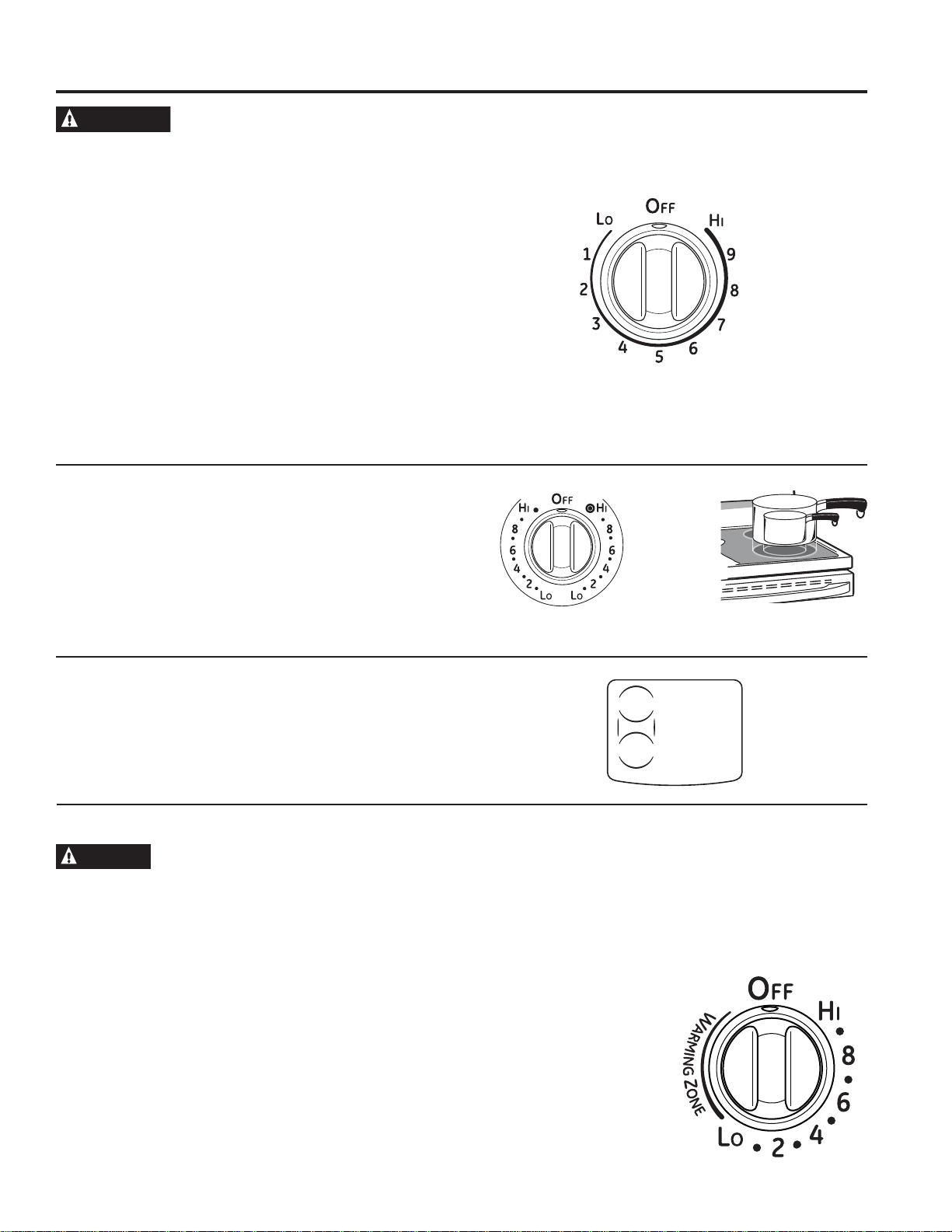
49-88060
9
USO DE LA COCINA: Unidades de superficie
Unidades de superficie
ADVERTENCIA
RIESGO DE INCENDIO: Nunca pierda de vista la cocina cuando la estufa esté en las configuraciones medio
o alto. Mantenga los ítems inflamables alejados de la estufa. Apague todos los controles cuando finalice la
cocción. Si no se siguen estas instrucciones se podrá producir incendios, lesiones graves o la muerte.
Es posible que las funciones y apariencias varíen con relación a su modelo a lo largo del manual.
Cómo Configurar
Presione la perilla hacia adentro y gire en cualquiera de las
direcciones hasta la configuración que desee.
Una luz indicadora de de superficie en ON (Encendido) brillará
cuando una unidad superficial esté encendida.
Para superficies de vidrio de la estufa:
Una luz indicadora de ESTUFA CALIENTE:
Ŷ VHHQFHQGHUiFXDQGRODXQLGDGHVWpFDOLHQWHDOWDFW
Ŷ SHUPDQHFHUiHQFHQGLGDLQFOXVROXHJRGHTXHODXQLGDG
esté apagada.
Ŷ SHUPDQHFHUiHQFHQGLGDKDVWDTXHODXQLGDGVHHQIUtHD
DSUR[LPDGDPHQWH)
Tanto en Off (Apagado) como en Hi (Alto), el control se ajusta
en la posición. Es posible que escuche leves sonidos de ajuste
durante la cocción, indicando que el control está manteniendo
su configuración deseada.
Asegúrese de girar la perilla de control a Off (Apagado)
cuando finalice la cocción.
Unidades de Superficie Duales y Perillas de Control
La unidad de superficie posee 2 tamaños de cocción que se
pueden seleccionar, de modo que pueda enlazar el tamaño de
la unidad al tamaño del utensilio que esté usando.
Modelos con un elemento superficial de
Anillo-Doble únicamente
Uso del Quemador del Puente (en algunos modelos)
Para usar el área del puente, ajuste las perillas para la parte
trasera izquierda y los elementos del frente izquierdo para
crear un área grande para una cocción pareja.
Uso del Área para Calentar
WARNING
RIESGO DE ENVENENAMIENTO CON
COMIDA: Se pueden desarrollar bacterias cuando la comida
HVWpDXQDWHPSHUDWXUDLQIHULRUDORV
Ŷ 6LHPSUHFRPLHQFHFRQFRPLGDFDOLHQWH1RXVHOD
configuración caliente para calentar comida fría.
Ŷ 1RXVHODFRQILJXUDFLyQFDOLHQWHGXUDQWHPiVGHKRUDV
WARMING ZONE (Área para Calentar), ubicada en la parte
central trasera de la superficie de vidrio, mantendrá la comida
caliente y cocida a la temperatura para servir. Siempre
comience con comida caliente. No use la función para calentar
comida fría. Colocar comida que no está cocinada o fría en
el WARMING ZONE (Área para Calentar) podría producir
enfermedades desarrolladas por bacterias en la comida.
Gire la perilla de control a la posición ON (Encender).
Para obtener mejores resultados, todas las comidas en el
WARMING ZONE (Área para Calentar) deberían estar
cubiertas por una tapa o papel de aluminio. Al calentar
pasteles o panes, la tapa se deberá ventilar para dejar que la
humedad salga.
La temperatura inicial, el tipo y la cantidad de comida, el tipo
de pan y el tiempo afectarán la calidad de la comida.
Siempre use las manijas de las
ollas o guantes para horno al
retirar comida del WARMING
ZONE (Área para Calentar)
ya que los utensilios y platos
estarán calientes.
NOTA: El calentador superficial
emitirá un brillo rojo, al igual que
los elementos de cocción.
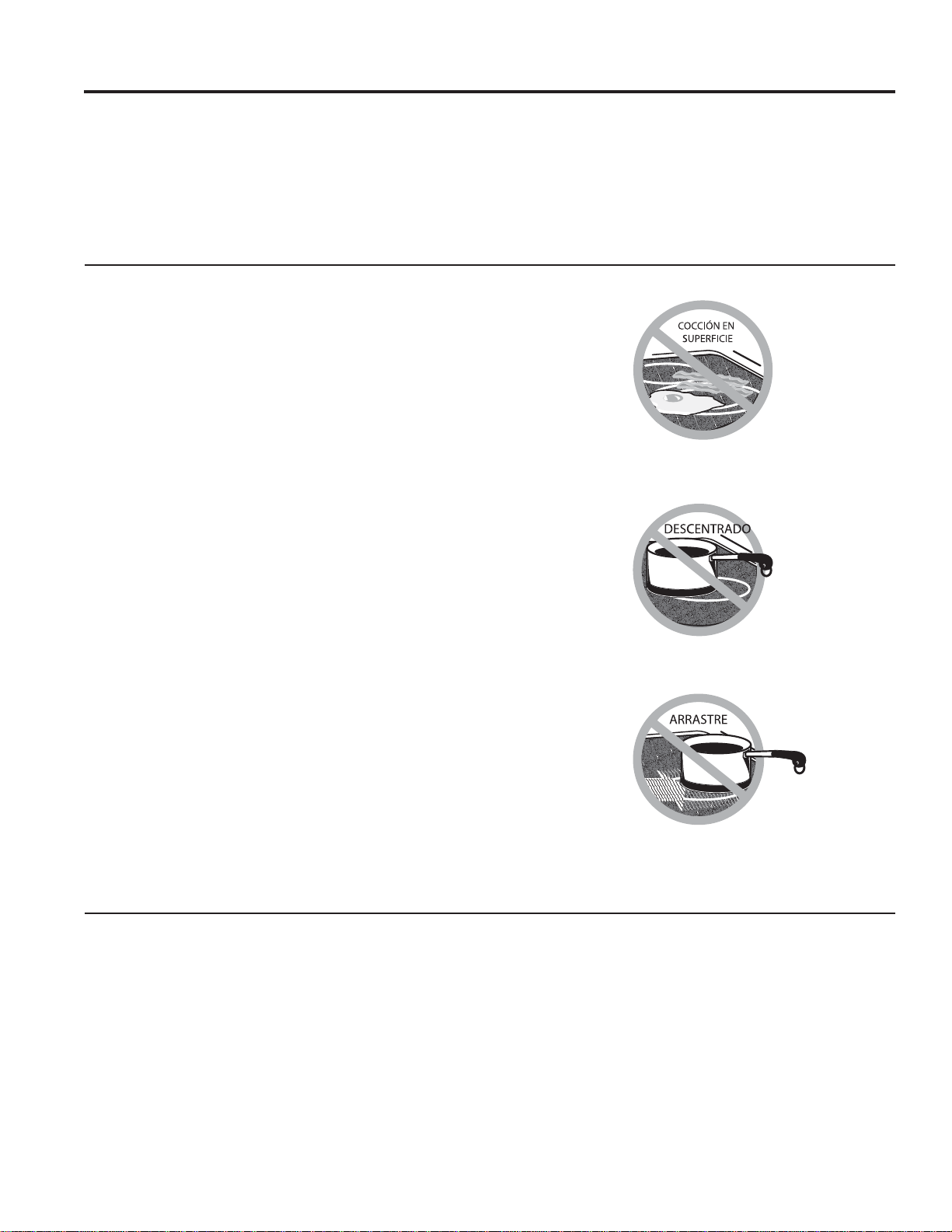
10
49-88060
Consejos para Productos Enlatados en el Hogar
$VHJ~UHVHTXHHOSURGXFWRHQODWDGRVHHQFXHQWUHVREUHOD
unidad superficial.
$VHJ~UHVHGHTXHHOSURGXFWRHQODWDGRVHDSODQRHQVXSDUWH
inferior.
Para evitar quemadoras de vapor o calor, tenga cuidado al
enlatar el producto.
Use recetas y procedimientos de fuentes confiables. Estos
se encuentran disponibles a través de fabricantes como Ball
®
y Kerr
®
y el Department of Agriculture Extension Service
(Servicio del Departamento de Agricultura).
El uso de enlatados cerrados a baño maría con fondos
ondeados podrán extender el tiempo requerido para traer el
agua al punto de hervor.
Limitador de Temperatura en Estufas de Vidrio Radiante
Every radiant surface unit has a temperature limiter.
El limitador de temperatura evita que la estufa de vidrio se
caliente en exceso.
El limitador de temperatura podrá apagar las unidades
superficiales por ciclos durante un tiempo si:
Ŷ ODROODKLHUYHKDVWDVHFDUVH
Ŷ HOIRQGRGHODROODQRHVSODQR
Ŷ ODROODHVWiIXHUDGHOFHQWUR
Ŷ QRKD\ROODHQODXQLGDG
Estufa de Vidrio Radiante
La estufa radiante cuenta con unidades calentadoras debajo
de una superficie lisa de vidrio.
NOTA: Un ligero olor es normal cuando una estufa nueva se utiliza
por primera vez. Es provocado por el calentamiento de piezas
nuevas y materiales aislantes y desaparecerá en poco tiempo.
NOTA: En modelos con estufas de vidrio de color claro, es
normal que las zonas de cocción cambien de color cuando
están calientes o enfriándose. Esto es temporal y desaparecerá
a medida que el vidrio se enfríe a temperatura ambiente
La unidad superficial seguirá un ciclo de encendido y apagado
para mantener su configuración de control seleccionada.
Es seguro colocar utensilios calientes en la superficie de vidrio,
incluso cuando la estufa esté fría.
Aunque las unidades de superficie se hayan apagado, la
estufa de vidrio retiene suficiente calor para continuar la
cocción. Para evitar la sobrecocción, quite las ollas de las
unidades de superficie cuando los alimentos estén cocidos. No
coloque nada sobre la unidad de superficie hasta que se haya
enfriado por completo.
Ŷ /DVPDQFKDVGHDJXDGHSyVLWRVPLQHUDOHVSXHGHQTXLWDUVH
utilizando crema limpiadora o vinagre blanco sin diluir.
Ŷ (OXVRGHOLPSLDGRUGHYHQWDQDVSXHGHGHMDUXQDSHOtFXOD
iridiscente sobre la estufa. La crema limpiadora quitará esta
decoloración.
Ŷ 1RDOPDFHQHHOHPHQWRVSHVDGRVVREUHODHVWXID6LFDHQ
sobre la estufa, podrían provocar daños.
Ŷ 1RXWLOLFHODVXSHUILFLHFRPRXQDWDEODSDUDFRUWDU
USO DE LA COCINA: Unidades de superficie
Unidades de superficie (Continúa)
Nunca cocine directamente sobre el vidrio.
Siempre utilice recipientes de cocción.
Siempre coloque el recipiente en el centro de la
unidad de superficie sobre la que está cocinando.
No deslice los recipientes de cocción a través del
control y la superficie de la estufa porque puede
rayar el vidrio. El vidrio es resistente a los rayones,
pero no a prueba de los mismos.
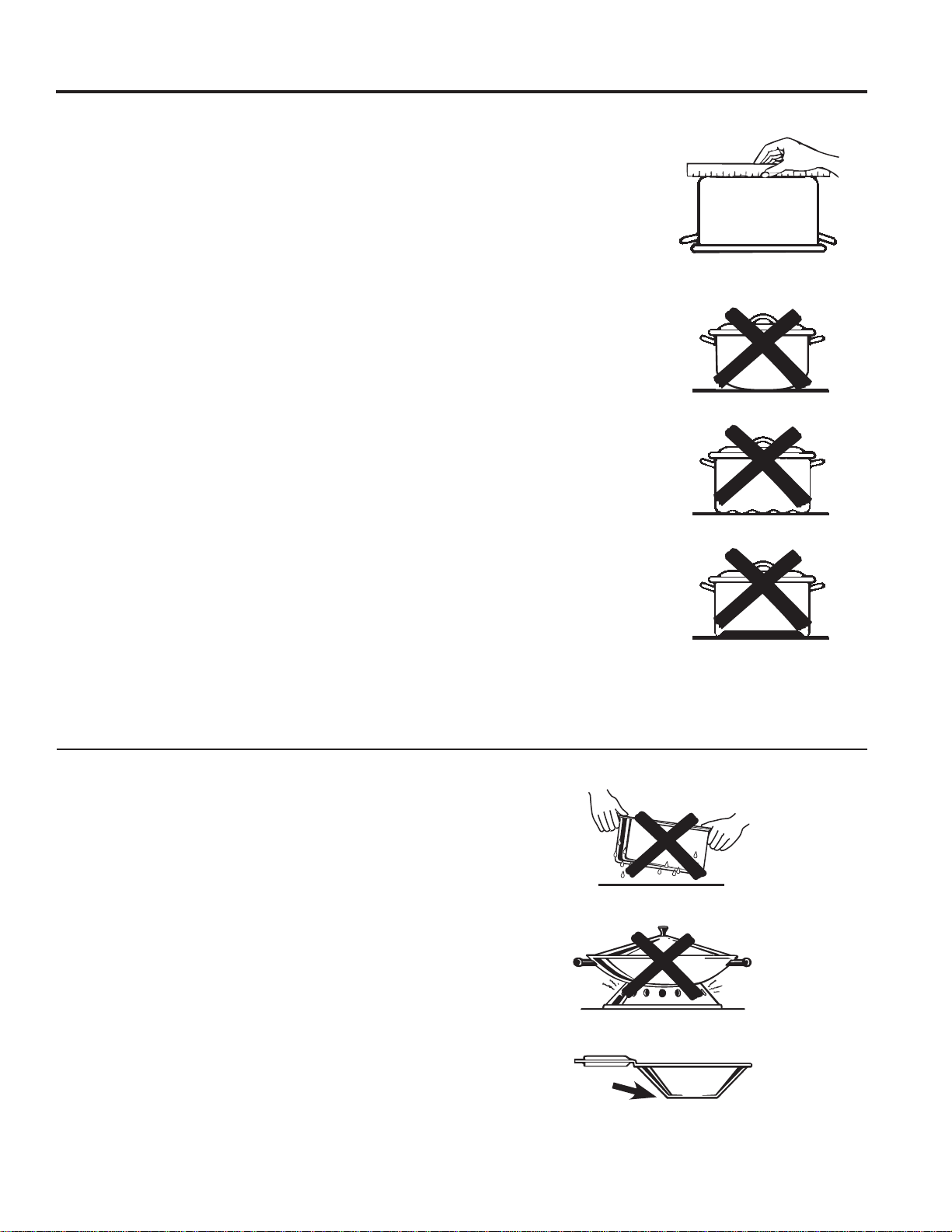
49-88060
11
Utensilio para Placa de Cocción para Vidrio Radiante
USO DE LA COCINA: Utensilio para Placa de Cocción de Vidrio Radiante
La siguiente información lo ayudará a elegir los recipientes de cocción que brindan un buen desempeño en estufas de vidrio. Ver
el folleto sobre recipientes para usar con estufas de inducción.
NOTA: Siga todas las recomendaciones del fabricante de recipientes cuando utilice cualquier clase de recipiente de cocción sobre la
estufa cerámica.
Acero inoxidable:
Recomendado
Aluminio:
Se recomienda de capa gruesa
Buena conductividad. Los residuos de
aluminio a veces parecen rayones sobre la
estufa pero pueden quitarse si se los limpia de
inmediato. Debido a su bajo punto de fusión,
no debe utilizarse aluminio de capa fina.
Base de cobre:
Recomendado
El cobre puede dejar residuos que pueden
parecer rayones. Los residuos pueden
eliminarse, siempre y cuando la estufa
se limpie de inmediato. Sin embargo, no
permita que estas ollas hiervan en seco.
El metal sobrecalentado puede adherirse
a las estufas de vidrio. Si no se elimina de
inmediato, una olla con la base de cobre
sobrecalentado dejará un residuo que
manchará la estufa en forma permanente.
Esmalte de porcelana sobre hierro
fundido:
Se recomienda si la base de la olla se
encuentra revestida
Esmalte de porcelana sobre
acero:
No se recomienda
Calentar recipientes vacíos puede provocar
daños permanentes al vidrio de las estufas.
El esmalte puede derretirse y adherirse a la
estufa cerámica.
Vidrio-cerámico:
No se recomienda
Desempeño pobre. Raya la superficie.
Cerámica:
No se recomienda
Desempeño pobre. Puede rayar la
superficie.
Hierro fundido:
No se recomienda, a menos que se
encuentre específicamente diseñado para
estufas de vidrio
Pobre conductividad y lentitud para absorber
el calor. Raya la superficie de la estufa.
Verifique que los recipientes tengan
bases planas utilizando una regla.
No se recomiendan recipientes con
bases redondeadas, curvadas, con
rebordes o torceduras..
Para mejores resultados
Ŷ &RORTXHVyORUHFLSLHQWHVVHFRVVREUHORVHOHPHQWRVGH
superficie. No coloque tapas sobre los elementos de
superficie, en especial tapas mojadas. Las ollas y tapas
mojadas podrán quedar adheridas a la superficie una
vez frías.
Ŷ 1RXVHZRNVFRQDQLOORVGHVRSRUWH(VWDFODVHGHZRNQR
se calienta sobre elementos de superficie de vidrio.
Ŷ 5HFRPHQGDPRVHOXVRGHZRNVGHEDVHSODQDVRODPHQWH
Se encuentran disponibles en su negocio minorista local. La
base del wok debe tener el mismo diámetro que el elemento
de superficie para asegurar un contacto adecuado.
Ŷ $OJXQRVSURFHGLPLHQWRVGHFRFFLyQHVSHFLDOHVUHTXLHUHQ
recipientes de cocción específicos, como ollas a presión,
freidoras, etc. Todos los recipientes de cocción deben tener
bases planas y ser del tamaño correcto.
No coloque recipientes mojados sobre la estufa de vidrio.
No use woks con anillos de soporte sobre la estufa de vidrio.
Utilice woks de base plana sobre la estufa de vidrio.
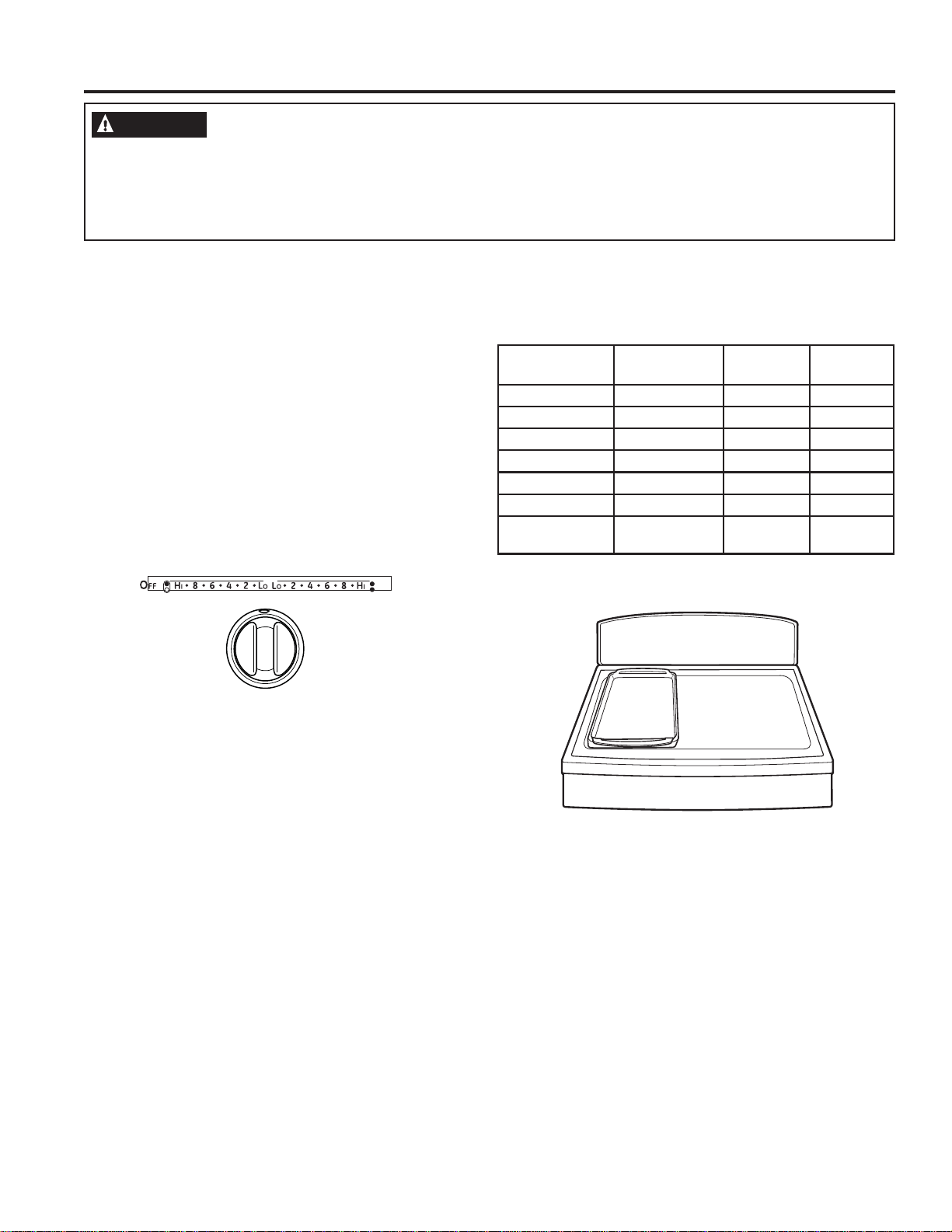
12
49-88060
Coloque la Plancha de Hierro Fundido Presazonada sobre las
dos unidades izquierdas de la superficie.
USO DE LA PLACA DE COCCIÓN: Plancha
Plancha
ADVERTENCIA
Riesgo de Incendio
Ŷ Tenga cuidado al cocinar comidas con grasa. La grasa esparcida puede provocar un incendio.
Ŷ Nunca coloque artículos en la plancha cuando ésta no esté en uso. El calor de las demás unidades de la superficie
puede calentar la plancha y provocar un incendio.
Ŷ&RORTXH\UHWLUHODSODQFKDVyORFXDQGRpVWDVHHQFXHQWUHIUtD\WRGDVODVXQLGDGHVGHODVXSHUILFLHHVWpQHQ
OFF (Apagado).
Posicionamiento de la Plancha
La plancha de hierro fundido sólo puede ser usada en las unidades izquierdas de la superficie de la cocina. No gire los
quemadores de la plancha hasta que esté seguro de que la plancha fue posicionada correctamente.
Uso de la Plancha de Hierro Fundido
Su plancha le brinda una superficie de cocción extra grande
para carnes, panqueques y otras comidas normalmente
preparadas en una sartén. Antes del primer uso, enjuague la
misma con agua caliente y séquela completamente. Prepare la
superficie con espray de cocina o aceite vegetal.
La mayoría de las comidas a la plancha requieren una
cocción en una superficie precalentada. Precaliente la plancha
siguiendo la guía, y luego cambie a la configuración de cocción
deseada.
Para encender las unidades de la superficie de toda la
plancha, gire la perilla en dirección de las agujas del reloj.
Para encender la unidad de la superficie de la mitad de la
plancha, gire la perilla en dirección contraria a las agujas del reloj.
Precauciones de la Plancha:
Ŷ 1RFRORTXHODSODQFKDHQXQKRUQRPLFURRQGDV
Ŷ 1RODYHODSODQFKDHQHOODYDYDMLOODV
Ŷ 6LDOJRVHGHUUDPyGHEDMRGHODSODQFKDVHGHEHUiOLPSLDU
tan pronto como sea posible para evitar la suciedad de la
comida “horneada”.
Ŷ 1RSHUPLWDTXHVHDFXPXOHFRPLGDGHEDMRGHODSODQFKD
ya que puede haber riesgo de incendio. Limpie debajo de
la plancha con agua caliente y jabón en cuanto esté fría.
Perilla de la Plancha
Tipo de Comida
Configuración de
Precalentamiento Temporizador
Configuración
de Cocción
Tocino
Ninguno Ninguno 6
Desayuno Embutidos
8 PLQ
+XHYRV PLQ 2
Queso a la Plancha 8 PLQ
+DPEXUJXHVDV PLQ
Panqueques 8 PLQ
Cómo Calentar
Tortillas
PLQ
NOTA: Es posible que sea necesario ajustar las configuraciones de
cocción, si la plancha si será usada por un período prolongado.
Plancha de Hierro Fundido Presazonada
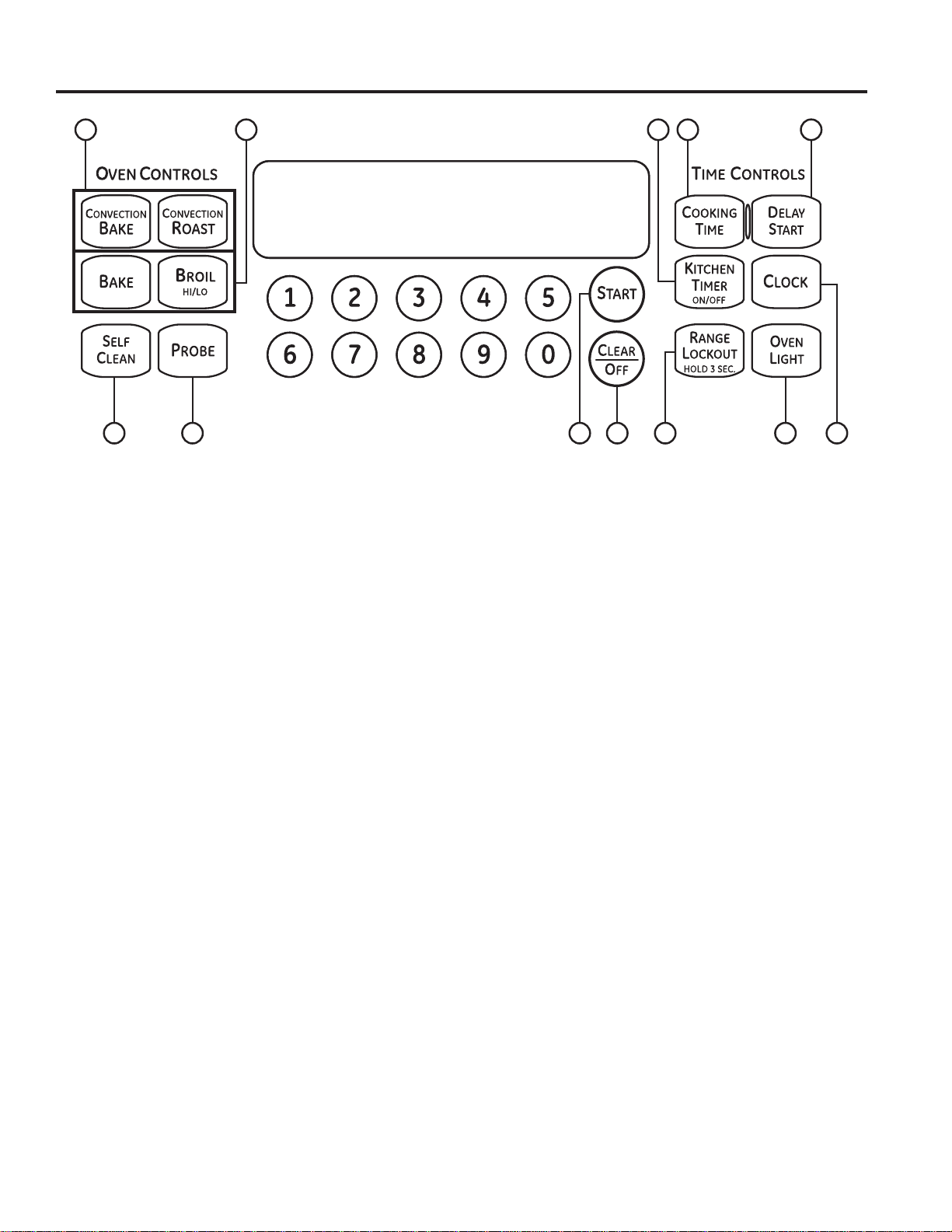
49-88060
13
&RQYHFWLRQ&RRN0RGHV0RGRVGH&RFFLyQ
SRU&RQYHFFLyQ Presione el botón Convection Bake
+RUQHDGRSRU&RQYHFFLyQ o Convection Roast (Rostizado
SRU&RQYHFFLyQ. Presione las almohadillas numéricas para
configurar la temperatura deseada del horno. Presione el botón
Start (Iniciar). Cuando haya finalizado la cocción, presione el
botón Clear/Off (Borrar/Apagado).
7UDGLWLRQDO&RRNLQJ0RGHV0RGRVGH&RFFLyQ
Tradicionales): Su horno cuenta con los siguientes modos
GHFRFFLyQWUDGLFLRQDOHV%DNH+RUQHDU\%URLO+L$VDU$OWR
Para más información, consulte la sección de Modos de Cocción.
3. Self Clean (Limpieza Automática): Para acceder a
información sobre el uso de este modo, consulte la Limpieza del
+RUQR±VHFFLyQ,QWHUQD
4. Start (Iniciar): Se deberá presionar para comenzar cualquier
función de cocción, limpieza o por tiempo.
5. Clear/Off (Borrar/Apagado): Cancelar TODAS las
operaciones del horno excepto el reloj y el temporizador.
&RRNLQJ7LPH7LHPSRGH&RFFLyQ Cuenta el
tiempo de cocción y apaga el horno cuando el tiempo de cocción
está completo. Presione la tecla Cooking Time (Tiempo de
&RFFLyQXVHODVWHFODVQXPpULFDVSDUDSURJUDPDUXQWLHPSRGH
cocción en horas y minutos, y luego presione Start (Iniciar).
7. Clock (Reloj): Configure el tiempo del reloj del horno.
Presione la tecla Clock (Reloj) y las teclas numéricas para
programar el reloj. Presione Start (Iniciar) para guardar la
configuración de la hora.
8. Kitchen Timer (Temporizador de la Cocina):
Funciona como un temporizador con cuenta regresiva. Presione
la tecla Timer (Temporizador) y las teclas numéricas para
programar el tiempo en horas y minutos. Presione la tecla Start
(Iniciar). La cuenta regresiva del temporizador se completó. Para
apagar el temporizador, presione la tecla Timer (Temporizador).
9. Delay Start (Inicio Retardado): Genera un retraso
cuando el horno es encendido. Use esta tecla para configurar
el momento en que desea que el horno se inicie. Presione la
tecla Delay Start (Inicio Retardado) y use las teclas numéricas
para programar la hora del día en que desea que el horno se
encienda y luego presione Start (Iniciar). Presione el modo
de cocción deseado y la temperatura y luego presione Start
(Iniciar). Si lo desea, también puede ser programado un tiempo
de cocción. Siga las instrucciones de Cooking Time (Tiempo de
Cocción) para configurar esta función. Esto sólo puede ser usado
FRQ%DNH+RUQHDU\6HOI&OHDQ/LPSLH]D$XWRPiWLFD
NOTA: Al usar la función de inicio con retraso, las comidas
que se echan a perder rápidamente, tales como leche, huevos,
pescado, rellenos, ave y cerdo, no se deberán dejar reposar por
más de 1 hora antes y después de la cocción. La temperatura
DPELHQWHHVWLPXODHOGHVDUUROORGHEDFWHULDVQRFLYDV$VHJ~UHVH
de que la luz del horno esté apagada, ya que el calor de la
lámpara acelerará el crecimiento de bacterias nocivas.
10. Oven Light(s) (Luz(es) del Horno): Enciende o apaga
la luz(es) del horno.
11. Range Lockout (Bloqueo de la Cocina): Bloquean
el control de modo que al presionar las teclas no se activen
los controles. Presione la tecla Range Lockout (Bloqueo
de la Cocina) y luego la tecla Start (Iniciar) para bloquear o
desbloquear el control.
12. Probe (Sonda): Presione cuando utilice la sonda para
cocinar. Ver la sección Cómo usar la sonda.
Controles del Horno
USO DE LA COCINA: Controles del Horno
1 698
3547
2
12 1011

14
49-88060
Existen varias funciones especiales en su horno. Para modificar las configuraciones de estas funciones especiales, mantenga
presionadas las teclas Bake (Hornear) y Broil (Asar) al mismo tiempo durante tres segundos. (SF) aparecerá en la pantalla.
Seleccione la función que desee modificar. Una vez realizado el cambio, presione la tecla Start (Iniciar) para guardar dicho
cambio y regrese a la hora del día.
Ajuste de la Temperatura del Horno
Esta función permite que la temperatura de horneado del
KRUQRVHDDMXVWDGDKDVWD)PiVFDOLHQWHR)PiVIUtD
Use esta función si piensa que la temperatura de su horno es
demasiado caliente o demasiado fría y desea modificarla.
Presione la tecla Bake (Hornear) nuevamente para ingresar
el modo de ajuste de temperatura. Presione la tecla Bake
(Hornear) nuevamente para ingresar el modo de ajuste de
WHPSHUDWXUD6HH[KLELUiXQQ~PHURHQWUH\±8VHODV
teclas numéricas para configurar el ajuste de temperatura
deseado y use la tecla Bake (Hornear) para realizar cambios
en forma descendente y ascendente.
Presione la tecla Start (Iniciar) para guardar el ajuste de
temperatura.
Sonido de Finalización del Temporizador
Se trata de un tono que indica la finalización de un
temporizador. El tono puede ser continuo (bEEP Cont)
o un pitido repetido (bEEP). Una configuración continua
seguirá haciendo que un tono suene hasta que un botón
del control sea presionado. Presione la tecla Kitchen Timer
(Temporizador de la Cocina) para visualizar la configuración
actual y luego modifique la configuración.
Selección de Temperatura Fahrenheit o Celsius
El control del horno está configurado para su uso con
temperaturas Fahrenheit (F), pero lo puede modificar a
temperaturas Celsius (C). Presione las teclas Broil (Asar)
y &RRN7LPH7LHPSRGH&RFFLyQ al mismo tiempo para
YLVXDOL]DUODFRQILJXUDFLyQDFWXDOSUHVLRQHQXHYDPHQWHSDUD
modificar la configuración.
Pantalla del Reloj
Esta función especifica cómo la hora del día será exhibida o
si no se exhibirá la hora del día. Puede seleccionar el reloj
FRQKRUDHVWiQGDUGHKRUDV+ODKRUDPLOLWDUGH
KRUDV+RTXHQRVHH[KLEDQLQJ~QUHORMR))$SDJDGR
Presione la tecla Clock (Reloj) para visualizar la configuración
actual, y vuelva a presionar la misma para modificar la
configuración.
Conversión de Auto Recipe
(VWDIXQFLyQ(QFHQGHU$SDJDUGHIRUPDDXWRPiWLFDUHGXFH
la temperatura de la receta programada en el modo Convection
%DNH+RUQHDGRSRU&RQYHFFLyQHQ)/DFRQILJXUDFLyQ
por omisión para la función está apagada.
NOTA:(VWDRSFLyQQRFRQYLHUWHHOWLHPSRGHKRUQHDGRVyOR
las temperaturas. Esta opción no ajusta las temperatura del
modo Convection Roast (Dorar por Convección). Presione
la tecla Bake (Horneado) o Roast (Dorar) para visualizar la
configuración actual. Presione nuevamente para cambiar la
configuración.
Uso del Modo Sabático
(Diseñado para usar en el Descanso
Judío y Feriados)
La función Sabbath (Sabático) se
puede usar para hornear en el horno
superior e inferior o en el cajón
calentador (en algunos modelos). No
se puede usar para la cocción por
convección, asar, auto limpieza o
Delay Start (Inicio Retrasado).
NOTA: La luz del horno se enciende de forma automática
cuando la puerta se abre, y se apaga cuando la puerta
se cierra. La lámpara se puede retirar. Lea la sección de
5HHPSOD]RGHOD/X]GHO+RUQR(QPRGHORVFRQLQWHUUXSWRUGH
luz en el panel de control, la luz del horno se puede encender
y dejar encendida.
&yPRSURJUDPDUXQ+RUQHDGR&RP~Q
$VHJ~UHVHTXHHOUHORMPDUTXHODKRUDFRUUHFWDGHOGtD\TXHHO
horno esté apagado.
1. Presione las teclas Bake and Broil Hi/ Lo (Hornear y Asar
en Alto/ Bajo), al mismo tiempo, hasta que la pantalla
muestre (SF).
2. Presione la tecla Delay Start (Retrasar Inicio) hasta que
6$EE$W+DSDUH]FDHQODSDQWDOOD
3UHVLRQHODWHFODStart (Inicio) y () aparecerá en la
pantalla.
3UHVLRQHODWHFODBake (Hornear). No se dará ninguna señal.
8WLOL]DQGRODVWHFODVQXPpULFDVSUHVLRQHODWHPSHUDWXUD
GHVHDGDHQWUH\1RVHGDUiQLQJXQDVHxDOQL
temperatura.
6. Presione la tecla Start (Iniciar).
7. Luego del período de demora al azar de entre
DSUR[LPDGDPHQWHVHJXQGRV\PLQXWR) aparecerá
en la pantalla, indicando que el horno está horneando. Si
() no aparece en la pantalla, comience nuevamente en
HO3DVR
USO DEL HORNO: Funciones especiales
Funciones especiales
K
CERTIFIED
SABBATH
MODE
MODO SABÁTICO
CERTIFICADO
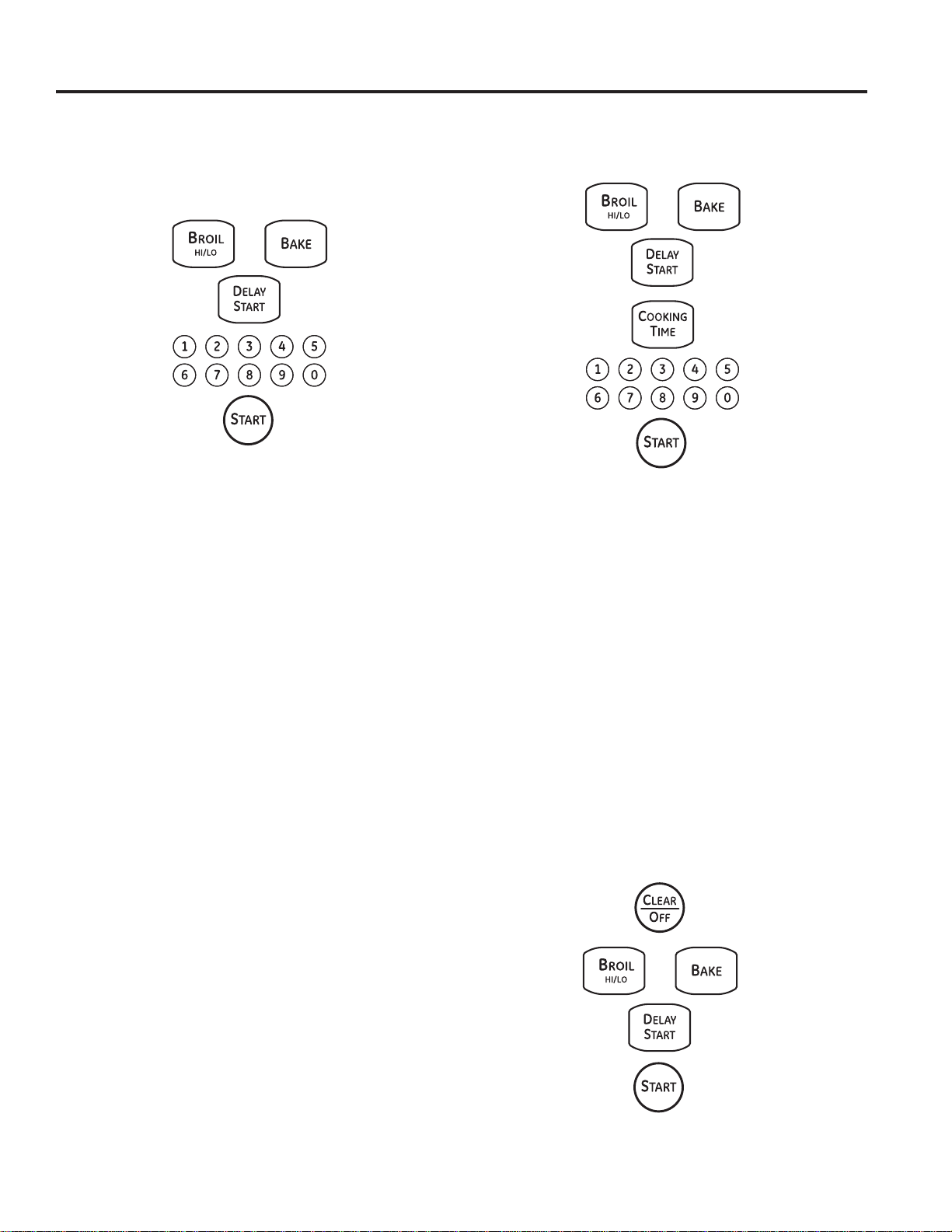
49-88060
15
Funciones especiales (Cont.)
USO DEL HORNO: Special Features
Para ajustar la temperatura del horno, presione la tecla Bake
(Hornear), ingrese la nueva temperatura usando las teclas
numéricas y presione la tecla Start (Inicio).
NOTA: Las teclas Clear/ Off (Borrar/ Apagar) y Cooking
7LPH7LHPSRGH&RFFLyQ están activas durante la función
Sabbath (Sabático).
&yPR&RQILJXUDU+RUQHDGRSRU7LHPSR±&RPLHQ]R
,QPHGLDWR\'HWHQFLyQ$XWRPiWLFD
$VHJ~UHVHTXHHOUHORMPDUTXHODKRUDFRUUHFWDGHOGtD\TXHHO
horno esté apagado.
1. Presione las teclas Bake and Broil Hi/ Lo (Hornear y Asar
en Alto/ Bajo), al mismo tiempo, hasta que la pantalla
muestre (SF).
2. Presione la tecla Delay Start (Retrasar Inicio) hasta que
6$EE$W+DSDUH]FDHQODSDQWDOOD
3UHVLRQHODWHFODStart (Iniciar) y () aparecerá en la
pantalla.
3UHVLRQHODWHFOD&RRNLQJ7LPH7LHPSRGH&RFFLyQ.
3UHVLRQHODVWHFODVQXPpULFDVSDUDFRQILJXUDUHOWLHPSRGH
FRFFLyQGHVHDGRHQWUHPLQXWR\KRUDV\PLQXWRV
Aparecerá el tiempo de cocción que ingresó.
6. Presione la tecla Start (Iniciar).
7. Presione la tecla Bake (Hornear). No se dará ninguna
señal.
8. Presione las teclas numéricas e ingrese la temperatura
deseada. No se dará ninguna señal ni temperatura.
3UHVLRQHODWHFODStart (Iniciar).
10. Luego del período de demora al azar de entre
DSUR[LPDGDPHQWHVHJXQGRV\PLQXWR) aparecerá
HQODSDQWDOODLQGLFDQGRTXHHOKRUQRHVWiKRUQHDQGR
asando. Si () no aparece en la pantalla, comience
nuevamente en el Paso 7.
Para ajustar la temperatura del horno, presione la tecla Bake
(Hornear), ingrese la nueva temperatura usando las teclas
numéricas y presione la tecla Start (Inicio).
Cuando la cocción haya finalizado, la pantalla cambiará de
() a () y aparecerá (0:00) , indicando que el horno está en
2))$SDJDGRSHURD~QHVWiHQ6DEEDWK6DEiWLFR5HWLUHOD
comida cocinada.
&yPR6DOLUHO0RGR6DEiWLFR
1. Presione la tecla Clear/ Off (Borrar/ Apagar).
2. Si el horno está cocinando, espere un período de retraso al
D]DUGHDSUR[LPDGDPHQWHHQWUHVHJXQGRV\PLQXWR
hasta que sólo () aparezca en la pantalla.
3UHVLRQHODVWHFODVBake and Broil Hi/ Lo (Hornear y Asar
en Alto/ Bajo), al mismo tiempo, hasta que la pantalla
muestre (SF).
3UHVLRQHODWHFODDelay Start (Inicio Demorado) hasta que
(12 shdn) o no (no shdn) aparezca en la pantalla. (12 shdn)
indica que el horno se apagará automáticamente luego de
12 horas. (no shdn) indica que el horno no se apagará de
forma automática.
3UHVLRQHODWHFODStart (Iniciar)
.
NOTA: Si se produjera un corte de luz mientras el
horno se encuentra en Modo Sabático, éste se apagará
automáticamente y permanecerá apagado incluso cuando
regrese la luz. El control del horno se debe reiniciar.
+
Cuando la pantalla muestra ()
-, el horno está configurado en
Sabbath (Sabático). Cuando la
pantalla muestra () el horno está
configurado en horneado/ asado.
+
Cuando la pantalla muestra ()
-, el horno está configurado en
Sabbath (Sabático). Cuando la
pantalla muestra () el horno está
configurado en horneado/ asado.
+
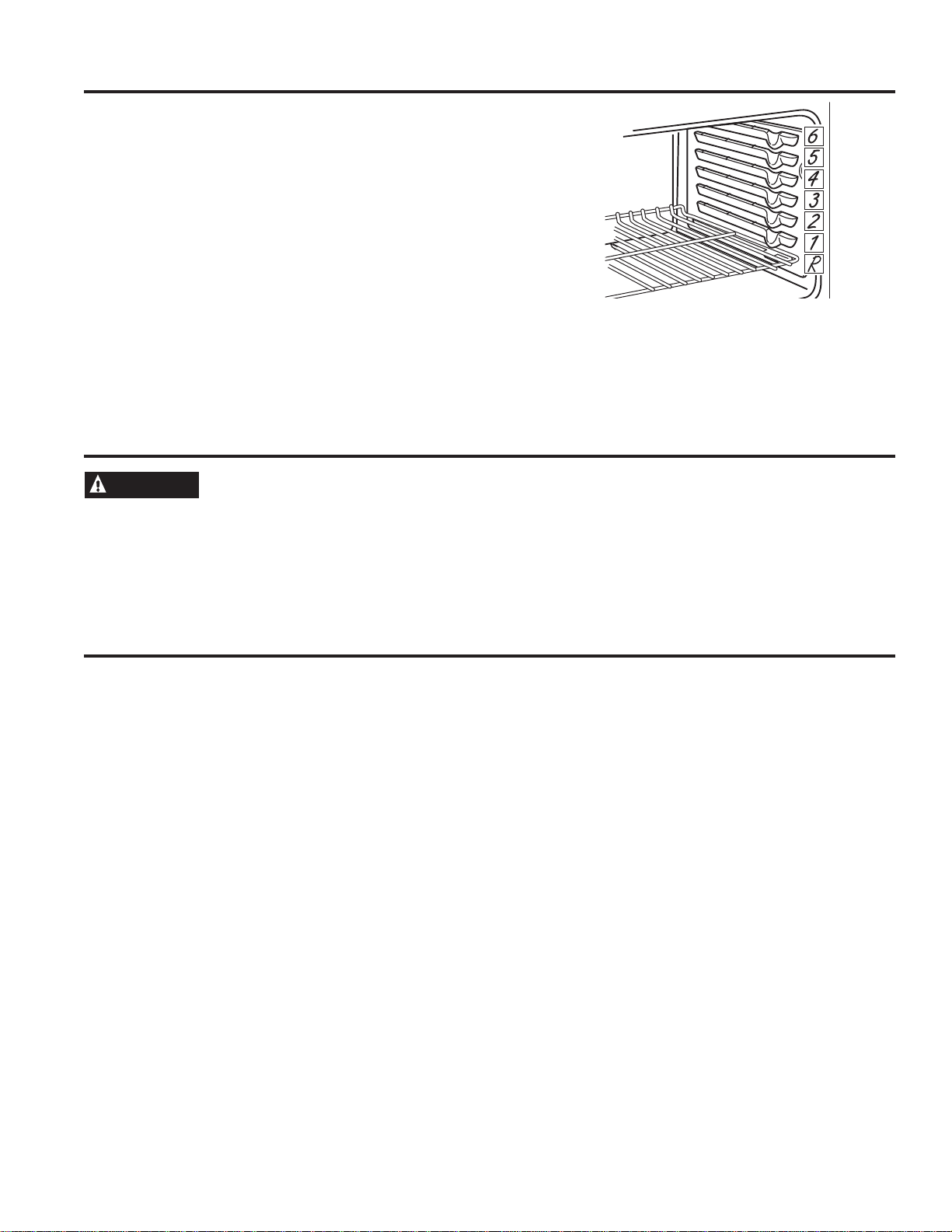
16
49-88060
El horno cuenta con seis posiciones de estantes. En la Guía
de Cocción, se brindan recomendaciones de posiciones de
los estantes para diferentes tipos de comidas. Se ajusta
un estante en una dirección para afectar los resultados de
cocción. Por ejemplo, si se prefieren partes superiores más
oscuras en tartas, panecillos o galletas, pruebe moviendo
la comida a un estante que se encuentre una posición más
arriba. Si encuentra que las comidas están demasiado doradas
en la parte superior, pruebe moviendo las mismas más abajo
la próxima vez.
$OKRUQHDUFRQP~OWLSOHVROODV\HQP~OWLSOHVHVWDQWHV
DVHJ~UHVHGHTXHKD\DSRUORPHQRV´HQWUHODVROODVDILQ
de dejar suficiente espacio para que fluya el aire.
(VSRVLEOHTXHVXKRUQRFXHQWHFRQHVWDQWHVH[WHQVLEOHV\R
estantes planos tradicionales.
Para evitar posibles quemaduras, coloque los estantes en la
posición deseada antes de encender el horno.
La cantidad de posiciones de la bandeja puede variar en relación
al modelo.
USO DE LA COCINA: Estantes del Horno / Papel de Aluminio y Cobertores del Horno / Utensilios
Estantes del Horno
Utensilios
Pautas de Uso de Utensilios
El material, el acabado y el tamaño de los utensilios afectan el
horneado.
Las ollas oscuras, revestidas y opacas absorben el calor más
rápidamente que las ollas claras y brillantes. Al usar ollas
que absorben el calor más rápidamente, las comidas podrán
resultar más doradas, crocantes y con una capa más gruesa.
Si utiliza utensilios oscuros y revestidos, controle la comida
antes del tiempo mínimo de cocción. Si se obtienen resultados
no deseados con este tipo de utensilios, considere la
SRVLELOLGDGGHUHGXFLUODWHPSHUDWXUDGHOKRUQRHQ)OD
próxima vez.
Las ollas brillantes pueden producir resultados de horneado
más parejos en tortas y galletas.
Las ollas de vidrio y cerámica calientan con lentitud, pero
retienen bien el calor.
Estos tipos de ollas funcionan bien con platos tales como
tartas y postres con natilla.
Las ollas con aislante de aire calientan lentamente y pueden
producir fondos dorados.
Mantenga los utensilios limpios para una cocción más pareja.
PRECAUCIÓN
1RXVHQLQJ~QWLSRGHDOXPLQLRRFREHUWRUGHKRUQRSDUDFXEULUHOIRQGRGHOKRUQR(VWRVtWHPVSXHGHQ
atrapar el calor o derretirse, ocasionando daños sobre el producto y el riesgo de descargas, humo o incendios. Los da-
ños por uso inadecuado de estos ítems no están cubiertos por la garantía del producto.
Se podrá usar aluminio para evitar derrames, colocando una hoja sobre un estante inferior varias pulgadas debajo de la comida.
No use más aluminio que el necesario y nunca cubra totalmente el estante de un horno con papel de aluminio. Mantenga el
DOXPLQLRDSRUORPHQRV´GHODVSDUHGHVGHOKRUQRSDUDHYLWDUXQDFLUFXODFLyQGHILFLHQWHGHOFDORU
Papel de Aluminio y Cobertores del Horno
49-88060
17
Probe (Sonda)
USO DEL HORNO: Probe (Sonda)
ADVERTENCIA
El consumo de comida semicruda puede hacer que se contraigan enfermedades producidas por la
comida. Use la sonda de acuerdo con las siguientes instrucciones, a fin de asegurar que todas las partes de la comida
DOFDQFHQWHPSHUDWXUDVGHFRFFLyQPtQLPDPHQWHVHJXUDV3XHGHHQFRQWUDUUHFRPHQGDFLRQHVGHWHPSHUDWXUDVGH
FRFFLyQPtQLPDPHQWHVHJXUDVHQZZZIRRGVDIHW\JRYRHQZZZ,V,W'RQH<HWJRY
La temperatura interna de la comida con frecuencia se usa como indicador de que está lista, especialmente al dorar o
preparar carne de ave. El modo Probe (Sonda) monitorea la temperatura interna de la comida y apaga el horno cuando
HVWD~OWLPDDOFDQ]DODWHPSHUDWXUDSURJUDPDGD
&RQWUROHVLHPSUHODWHPSHUDWXUDHQP~OWLSOHVSDUWHVGHODFRPLGDXWLOL]DQGRXQWHUPyPHWURGHFRPLGDVOXHJRGH
UHDOL]DUODFRFFLyQDILQGHDVHJXUDUTXHWRGDVODVSDUWHVGHODPLVPDKD\DQDOFDQ]DGRXQDWHPSHUDWXUDLQWHUQD
mínimamente segura en dicha comida.
Ubicación Correcta de la Sonda
Luego de preparar la comida y de colocarla en la olla, siga
estas instrucciones para una ubicación correcta de la sonda.
Ŷ ,QVHUWHODVRQGDHQODFRPLGDGHPRGRTXHODSXQWDGH
la sonda se apoye en el centro de la parte más gruesa de
la comida. Para un mejor rendimiento, la sonda debería
ser completamente insertada en la comida. Si la sonda
no es ubicada correctamente, es posible que no mida con
precisión la temperatura de la parte más fría de la comida.
Algunas comidas, particularmente las más pequeñas, no
son adecuadas para la cocción con el uso de una sonda,
debido a sus formas o tamaños.
Ŷ 1RGHEHUtDWRFDUHOKXHVRODJUDVDQLHOFDUWtODJR
Ŷ 3DUDFRFLQDUXQDYHHQWHUDLQVHUWHODVRQGDHQODSDUWH
más gruesa de la pechuga.
Ŷ 3DUDGRUDUVLQKXHVRVLQVHUWHODVRQGDHQHOFHQWURGHO
dorado.
Ŷ 3DUDFRFLQDUMDPyQRFRUGHURFRQKXHVRVLQVHUWHODVRQGD
HQHOFHQWURGHODDUWLFXODFLyQRGHOP~VFXORPiVEDMR\
largo.
Ŷ 3DUDSUHSDUDUFD]XHODVRSODWRVWDOHVFRPRSDVWHOGH
carne, inserte la sonda en el centro del plato.
Ŷ 3DUDFRFLQDUSHVFDGRLQVHUWHODVRQGDMXVWRDUULEDGHOD
agalla en la zona más carnosa paralela a columna.
Uso de la Sonda
Para usar la sonda con precalentamiento:
1. Presione la tecla del modo de cocción deseado (Hornear,
+RUQHDUSRU&RQYHFFLyQ, o 'RUDUSRU&RQYHFFLyQ) e
ingrese la temperatura de cocción deseada con las teclas
numéricas.
2. Inserte la sonda en la comida (consulte sobre la Ubicación
Correcta de la Sonda).
8QDYH]TXHHOKRUQRIXHSUHFDOHQWDGRFRORTXHODFRPLGD
en el mismo y conecte la sonda en su correspondiente
tomacorriente, asegurándose de que esté completamente
insertada. Tenga cuidado, ya que las paredes del horno y
el tomacorriente de la sonda están calientes.
3URJUDPHODWHPSHUDWXUDGHODVRQGDSUHVLRQDQGRODWHFOD
Probe (Sonda) e ingresando la temperatura deseada para
la comida. La temperatura interna máxima de la comida
que se puede configurar es 200° F.
Para usar la sonda sin precalentamiento:
1. Inserte la sonda en la comida (consulte sobre la Ubicación
Correcta de la Sonda).
2. Coloque la comida en el horno y conecte la sonda en su
correspondiente tomacorriente en el horno.
Presione la tecla Probe (Sonda) e ingrese la temperatura
deseada para la comida. Luego presione la tecla del
modo de cocción (Horneado Tradicional, Hornear
SRU&RQYHFFLyQ, o Dorar por &RQYHFFLyQ) e ingrese
la temperatura de cocción deseada usando las teclas
numéricas.
Pautas para el Cuidado de la Sonda
Ŷ 6LVHXVDXQDVRQGDTXHQRVHDODSURYLVWDFRQHVWH
producto, se podrán producir daños sobre la salida de la
sonda.
Ŷ 8VHODVPDQLMDVGHODVRQGDDOHQFKXIDU\GHVHQFKXIDUOD
misma, luego de insertar o de retirar la sonda de la carne o
del tomacorriente.
Ŷ 3DUDHYLWDUGDxRVVREUHODVRQGDQRXVHDJDUUDGHUDVSDUD
empujar el cable al retirarlo.
Ŷ 3DUDHYLWDUURPSHUODVRQGDDVHJ~UHVHGHTXHOD
comida haya sido completamente descongelada antes de
insertarla.
Ŷ 3DUDHYLWDUSRVLEOHVTXHPDGXUDVQRGHVHQFKXIHODVRQGD
GHOWRPDFRUULHQWHGHOKRUQRKDVWDTXHHVWH~OWLPRVHKD\D
enfriado.
Ŷ 1XQFDGHMHODVRQGDGHQWURGHOKRUQRGXUDQWHXQFLFORGH
limpieza automática o de limpieza con vapor.
Ŷ 1RJXDUGHODVRQGDGHQWURGHOKRUQR

18
49-88060
Su nuevo horno posee una variedad de modos de cocción para que pueda obtener los mejores resultados. Estos modos
se describen a continuación. Para acceder a recomendaciones para comidas específicas, consulte la sección de la Guía de
Cocción. Recuerde que es posible que su nuevo horno funcione de manera diferente que aquel que está reemplazando.
Modos de Horneado
Al preparar comidas horneadas tales como tartas, galletas
y masas, siempre precaliente el horno primero. Siga las
recomendaciones de la receta sobre la colocación de la
comida. Si no se brindan pautas, centre la comida en el horno.
Traditional Bake (Horneado Tradicional)
El modo de horneado tradicional está pensado para la cocción
en un solo estante. Este modo usa el calor principalmente
desde el elemento inferior, pero también desde el elemento
superior para cocinar la comida. Para usar este modo,
presione la tecla Bake (Hornear), ingrese una temperatura,
y luego presione Start (Iniciar). El precalentamiento
generalmente se recomienda al usar este modo.
Broiling Modes (Modo para Asar)
El horno se deberá cerrar durante el asado. Monitoree la
comida de cerca al asar. Tenga cuidado al asar en posiciones
de estantes superiores, ya que colocar la comida más cerca
del elemento para asar incrementa el humo, salpicaduras y la
posibilidad de que se incendien las grasas. No se recomienda
DVDUHQHOHVWDQWHGHODSRVLFLyQ
Intente asar las comidas que normalmente haría a la parrilla.
Ajuste las posiciones de los estantes para ajustar la intensidad
del calor a la comida. Coloque las comidas más cerca del
elemento para asar, cuando se desee una superficie más
cocinada y un interior poco cocido. Las comidas más gruesas
y las comidas cuyo interior debe ser cocinado deberían ser
asadas en un estante en una posición alejada del usado para
asar, o usando las funciones Broil Lo (Asar Bajo).
Broil Hi (Asar Alto)
(OPRGR7UDGLWLRQDO%URLO+L$VDGR7UDGLFLRQDO$OWRXVDFDORU
intenso del elemento superior para soasar las comidas. Use
ODIXQFLyQ%URLO+L$VDGR$OWRSDUDFRUWHVPiVGHOJDGRVGH
FDUQH\RFRPLGDVTXHSUHILHUDTXHTXHGDQPHQRVFRFLQDGDV
en su interior. Para usar este modo, presione la tecla Broil
(Asar) una vez y luego presione Start (Iniciar). No es
necesario realizar el precalentamiento al usar este modo.
Broil Lo (Asar Bajo)
El modo Traditional Broil Lo (Asado Tradicional Bajo) usa
menos calor intenso del elemento superior para cocinar la
comida completamente mientras también produce el dorado
superficial. Use la función Broil Lo (Asado Bajo) para cortes
GHFDUQHPiVJUXHVRV\RFRPLGDVTXHGHVHHTXHTXHGHQ
completamente cocinadas. Para usar este modo, presione la
tecla Broil (Asar) dos veces y luego presione Start (Iniciar).
No es necesario realizar el precalentamiento al usar este modo.
Convection Bake (Hornear por Convección)
(OPRGR&RQYHFWLRQ%DNH+RUQHDUSRU&RQYHFFLyQHVWi
SHQVDGRSDUDKRQHDUHQP~OWLSOHVHVWDQWHVDOPLVPRWLHPSR
Este modo utiliza el movimiento del aire del ventilador de
convección para mejorar la cocción haciéndola más pareja. El
horno está equipado con la función Auto Recipe Conversion
&RQYHUVLyQGH5HFHWD$XWRPiWLFDGHPRGRTXHQRHV
necesario ajustar la temperatura al usar este modo. Para
usar este modo, presione la tecla Conv Bake (Hornear
SRU&RQYHFFLyQ, e ingrese una temperatura con las teclas
numéricas, y luego presione Start (Iniciar). Siempre realice el
precalentamiento al usar este modo.
Convection Roast (Dorar por Convección)
El modo Convection Roast (Dorado por Convección) está
pensado para dorar cortes enteros de carne en un solo
estante. Este modo usa calor del quemador para hornear
inferior, junto con el movimiento de aire, para mejorar el
dorado y reducir el tiempo de cocción. No es necesario
convertir la temperatura. CCuando use este modo, o si usa la
sonda (en algunos modelos), controle la comida antes que el
tiempo sugerido en la receta. Para usar este modo, presione
la tecla &RQY5RDVW'RUDUSRU&RQYHFFLyQ, ingrese una
temperatura con las teclas numéricas, y luego presione Start
(Iniciar). No es necesario realizar el precalentamiento al usar
este modo.
USO DE LA COCINA: Modos de Cocción
Modos de Cocción
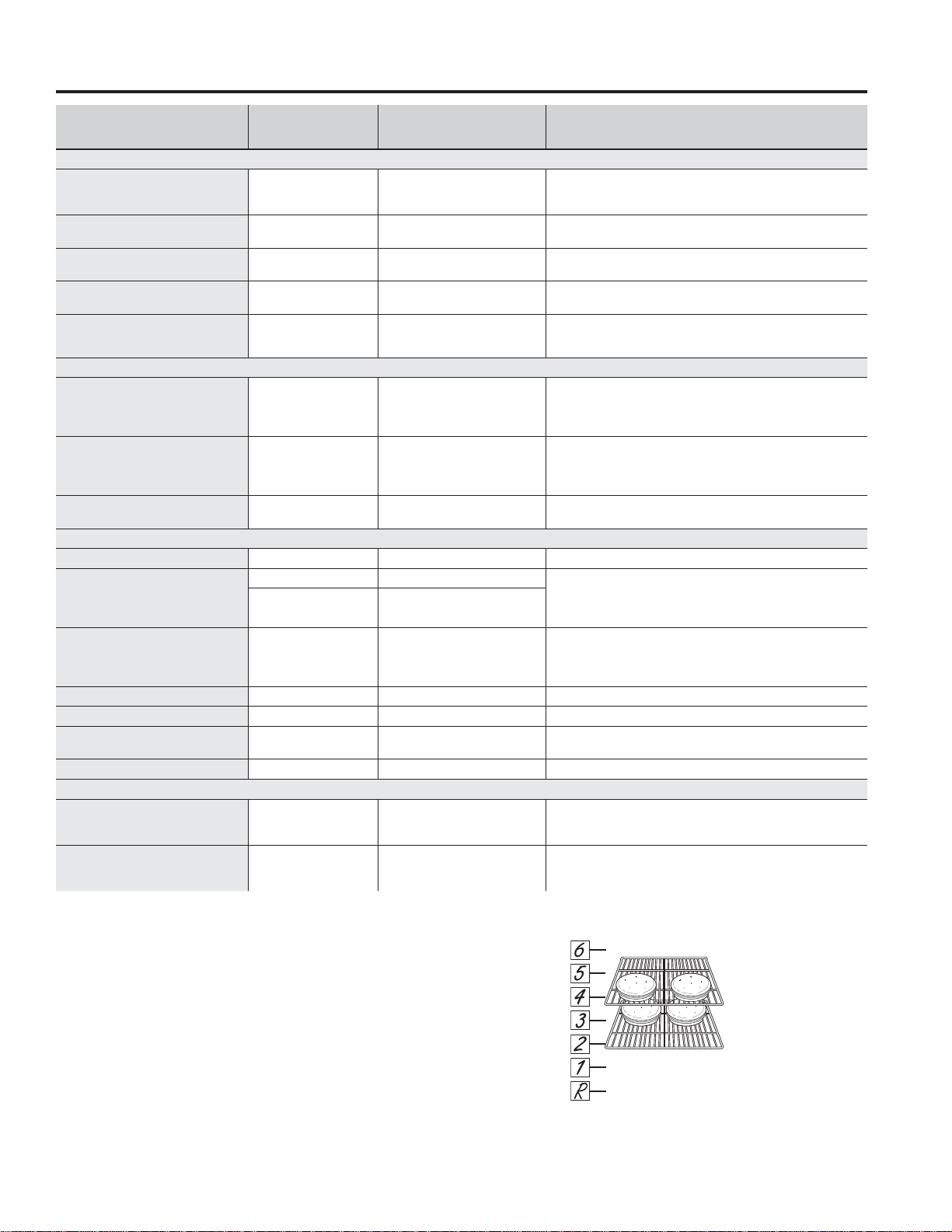
49-88060
19
TIPO DE COMIDA
MODO(S)
RECOMENDADO(S)
POSICIÓN(ES) DE ESTAN-
TES RECOMENDADA SUGERENCIAS ADICIONALES
Productos Horneados
Tortas con capas, tortas rectan-
gulares, roscas, panecillos, pan
rápido en un Solo Estante
+RUQHDU Use utensilios brillantes.
7RUWDVFRQFDSDVHQ0~OWLSOHV
Estantes
+RUQHDU \
$VHJ~UHVHGHTXHKD\DXQIOXMRGHDLUHDGHFXDGR
(Vea la ilustración).
Tortas de grasa (pastel de
ángel)
+RUQHDU R Use utensilios brillantes.
Galletas, galletitas, bizcochitos
en un Solo Estante
+RUQHDU Use utensilios brillantes.
Galletas, galletitas, bizcochitos
HQ0~OWLSOHV(VWDQWHV
+RUQHDU \ $VHJ~UHVHGHTXHKD\DXQIOXMRGHDLUHDGHFXDGR
Bife y Cerdo
+DPEXUJXHVDV Asar Alto
8VHODSDUWHSDUDDVDUPXHYDODFRPLGDPiVDEDMRSDUDTXH
quede más preparada y menos soasada. Preste atención a la
comida al asarla. Para un mejor rendimiento, centre la comida
debajo del elemento calentador para asar.
Bifes y Chuletas Asar Alto
8VHODSDUWHSDUDDVDUPXHYDODFRPLGDPiVDEDMRSDUDTXH
quede más preparada y menos soasada. Preste atención a la
comida al asarla. Para un mejor rendimiento, centre la comida
debajo del elemento calentador para asar.
Dorados +RUQHDU R
Use una olla chata tal como una olla para asar.
No se requiere precalentarla.
Ave
Pollo entero +RUQHDU R Use una olla chata tal como una olla para asar.
Pechugas, patas, muslos con
huesos
Asar Alto 1 6LVHHPSDQyRFXEULyFRQVDOVDHYLWHORVPRGRV%URLO+L$VDU
Alto). Ase del lado de la piel hacia abajo primero. Preste aten-
ción a la comida al asarla. Para un mejor rendimiento, centre la
comida debajo del elemento calentador para asar.
Asado Bajo
+RUQHDU
1 o 2
Pechugas de pollo
deshuesadas
Asado Bajo
+RUQHDU
1 o 2
6LVHHPSDQyRFXEULyFRQVDOVDHYLWHORVPRGRV%URLO+L$VDU
Alto). Ase del lado de la piel hacia abajo primero. Preste aten-
ción a la comida al asarla. Para un mejor rendimiento, centre la
comida debajo del elemento calentador para asar.
Pavo entero +RUQHDU 1 o 2 Usa una olla chata tal como una olla para asar.
Pechuga de Pavo +RUQHDU 1 o 2 Usa una olla chata tal como una olla para asar.
Pescado Asado Bajo
PLWDGGHOJURVRURPHQRV
!SXOJDGD
Preste atención a la comida al asarla. Para un mejor rendimien-
to, centre la comida debajo del elemento calentador para asar.
Cazuelas +RUQHDU
Comidas Congeladas a Conveniencia
Pizza, papas fritas, tator tots,
patitas de pollo fritas, aperitivos
en un Solo Estante
+RUQHDU Use utensilios brillantes.
Pizza, papas fritas, tator tots,
patitas de pollo fritas, aperitivos
HQ0~OWLSOHV(VWDQWHV
+RUQHDU \ Use utensilios brillantes.
*Al hornear cuatro tortas con capas a la vez, use los estantes
\&RORTXHODVROODVFRPRVHPXHVWUDGHPRGRTXHQR
quede una olla encima de la otra.
Cocine la comida completamente para evitar que se produzcan
enfermedades a partir de la comida. Puede encontrar
recomendaciones sobre temperatura mínima para cocinar de
forma segura en www.IsItDoneYet.gov$VHJ~UHVHGHXVDU
un termómetro de comidas para medir la temperatura de las
mismas.
Posición del estante para hornear tortas de 4 capas.
Guía de Cocción
USO DE LA COCINA: Guía de Cocción
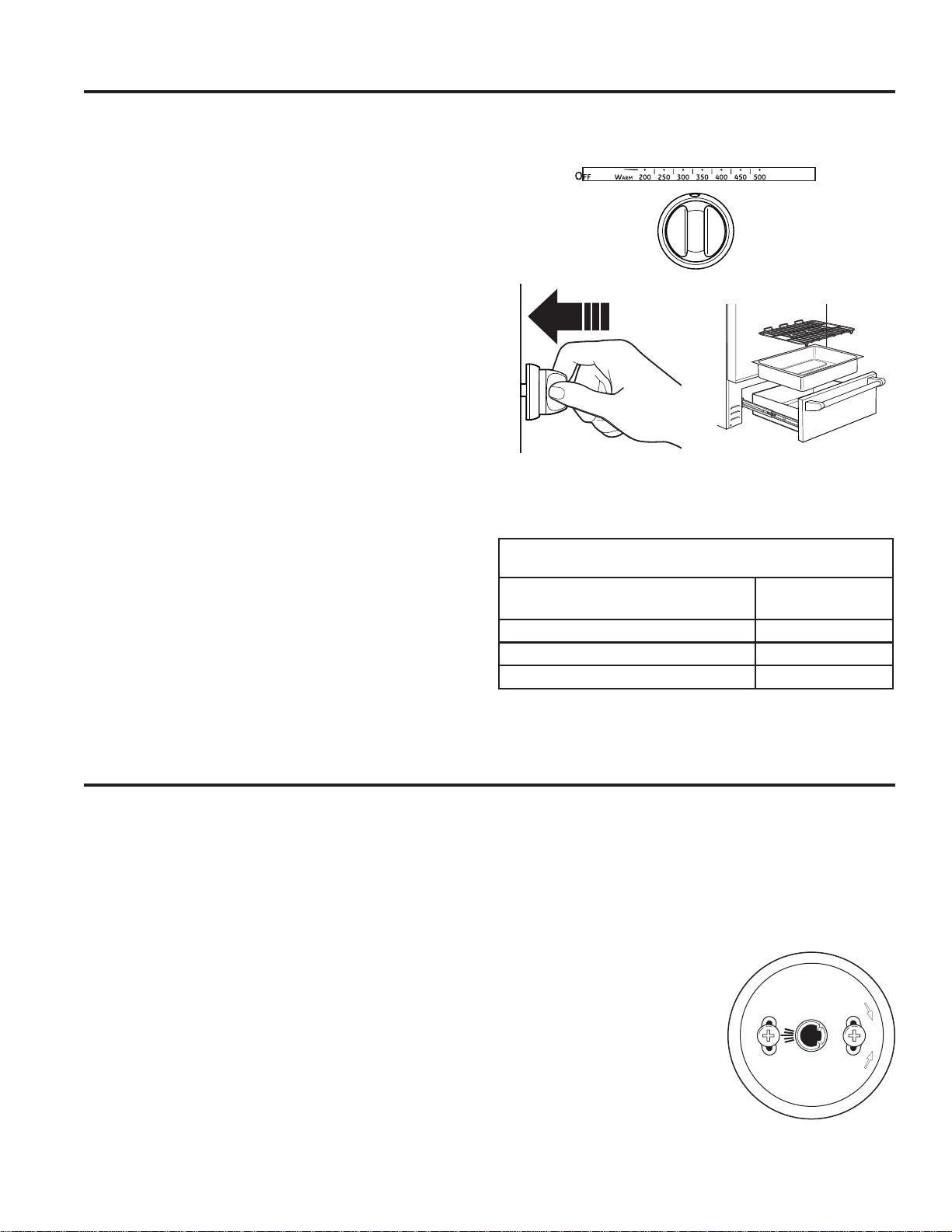
20
49-88060
Cajón Inferior del Horno
Ajuste el Termostato del Horno Inferior
USO DE LA COCINA: Cajón Inferior del Horno / Ajuste el Termostato del Horno Inferior
El cajón del horno inferior se puede usar para hornear comidas usando los mismos tiempos y temperaturas que en un horno
normal. Las comidas ideales para hornear en el cajón del horno inferior incluyen pizza, comidas congeladas, cazuelas, galletas,
arrollados y muchos postres.
3DUD8VDUHO&DMyQGHO+RUQR,QIHULRU
1. Presione hacia adentro y gire la perilla del cajón del horno
inferior hacia cualquier configuración deseada.
2. Permita que el cajón del horno inferior se precaliente.
Ŷ /DOX]GHODVHxDO21(QFHQGLGRHVWiXELFDGDHQHO
lado derecho superior de la perilla y brilla cuando la perilla
está en la posición ON (Encendido). Permanece en ON
(Encendido) hasta que la perilla es movida a la posición
OFF (Apagado).
Ŷ /DVHxDOOXPLQRVD³+HDWLQJ´&DOHQWDUHVWiXELFDGDGHEDMRGH
la señal luminosa ON (Encender) y brilla cuando los elementos
de calentamiento están activos. El precalentamiento está
FRPSOHWROXHJRGHTXHODVHxDO³+HDWLQJ´&DOHQWDUVHKD\D
apagado por primera vez en cada uso.
NOTAS:
Ŷ 6LHPSUHXVHHOHVWDQWHGHOFDMyQLQFOXLGRDOXVDUHO&DMyQ
GHO+RUQR,QIHULRU
Ŷ (OFDMyQGHOKRUQRLQIHULRUQRVHSXHGHXVDUGXUDQWHXQ
ciclo de auto limpieza del horno superior.
Ŷ 1RFRORTXHFRPLGDSDSHOGHDOXPLQLRQLXWHQVLOLRVGH
cocina directamente en el fondo del cajón del horno inferior.
Siempre use el estante del cajón incluido.
Ŷ 6LODVFRPLGDVUHTXLHUHQHVWDUFXELHUWDVXVHVyORSDSHO
de aluminio o tapas que resistan las temperaturas de
horneado. No use plástico.
Ŷ /DDOWXUDPi[LPDGHODVFRPLGDVTXHVHSXHGHQXELFDUHQ
HOFDMyQGHOKRUQRLQIHULRUHVGH´
Ŷ 1RFRORTXHOtTXLGRQLDJXDHQHOFDMyQGHOKRUQRLQIHULRU
Ŷ 1XQFDFRORTXHSOiVWLFRVSDSHOFRPLGDVHQODWDGDVR
materiales combustibles en el cajón del horno inferior.
Es posible que encuentre que su horno nuevo cocina de forma diferente al que reemplazó. Use su horno nuevo durante algunas
VHPDQDVSDUDIDPLOLDUL]DUVHFRQHOPLVPR6LD~QSLHQVDTXHVXKRUQRQXHYRHVGHPDVLDGRFDOLHQWHRGHPDVLDGRIUtRSRGUi
ajustar el termostato usted mismo.
No use termómetros, tales como los que se encuentran en tiendas, para controlar la temperatura del horno. Estos termómetros
SXHGHQYDULDUHQWUH\JUDGRV
NOTA: Este ajuste no afectará las temperaturas de asado.
1. Empuje la perilla Oven Control (Control del Horno) fuera
de la cocina y observe la parte trasera. Para realizar un
ajuste, afloje (aproximadamente un giro), pero sin quitar
completamente, los dos tornillos en la parte trasera de la
perilla.
2. Con la parte trasera del tornillo hacia usted, sostenga el
extremo exterior de la perilla con una mano y gire el frente
de la misma con la otra.
Para elevar la temperatura del horno, mueva el tornillo
superior hacia la derecha. Escuchará un sonido de clic por
cada abertura que mueva la perilla.
Para bajar la temperatura, mueva el tornillo superior hacia
la izquierda.
Cada clic cambiará la temperatura del horno en
DSUR[LPDGDPHQWH)(OUDQJRHVGH)GHVGHOD
flecha). Sugerimos que haga el ajuste de a un clic desde
la configuración original y que controle el rendimiento del
horno antes de hacer cualquier
ajuste adicional.
8QDYH]UHDOL]DGRHODMXVWH
vuelva a ajustar el tornillo de
modo que esté firme, pero
tenga cuidado de no ajustarlo
en exceso.
9XHOYDDLQVWDODUODSHULOOD
en la cocina y controle el
rendimiento.
T
O
M
A
K
E
O
V
E
N
C
O
O
L
E
R
T
U
R
N
D
I
S
K
A
P
P
R
O
X
.
1
0
˚
F
P
E
R
N
O
T
C
H
T
O
M
A
K
E
O
V
E
N
H
O
T
T
E
R
T
U
R
N
D
I
S
K
T
O
A
D
J
U
S
T
O
V
E
N
T
E
M
P
E
R
A
T
U
R
E
L
O
O
S
E
N
S
C
R
E
W
S
A
N
D
R
O
T
A
T
E
Parte Trasera de la Perilla del
Horno Inferior (La apariencia
puede variar.)
Presione hacia adentro y gire la perilla
del cajón del horno inferior hacia
cualquier configuración deseada.
El cajón del horno inferior utiliza menos energía que el horno superior.
Permita los siguientes tiempos aproximados para precalentar:
Temperatura del Horno
Inferior Deseada
Tiempo de
Precalentamiento
CALIENTE 10 minutos
) 20 minutos
) PLQXWRV
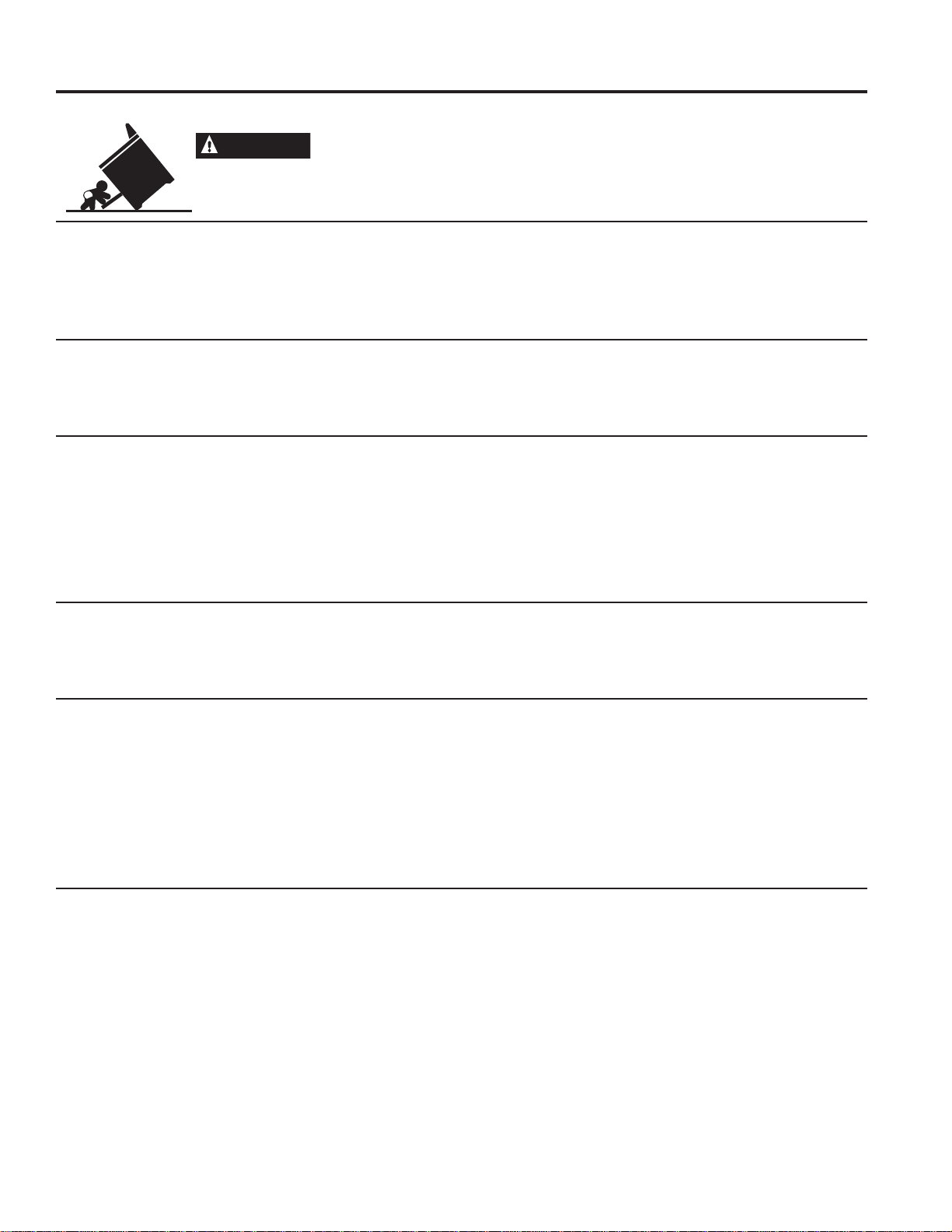
49-88060
21
Limpieza de la Cocina - Exterior
CUIDADO Y LIMPIEZA: Limpieza de la Cocina - Exterior
ADVERTENCIA
Si se quita la cocina para efectuar una limpieza, reparaciones o cualquier otra razón,
verifique que el dispositivo anti-volcaduras se coloque de manera adecuada cuando
vuelva a instalarse la cocina. Si no toma esta precaución, la cocina puede volcarse y
provocar lesiones.
$VHJ~UHVHGHTXHWRGRVORVFRQWUROHVHVWpQDSDJDGRV\TXHODVVXSHUILFLHVHVWpQIUtDVDQWHVGHOLPSLDUFXDOTXLHUSDUWHGHODFRFLQD
Perillas de control
Las perillas de control se pueden retirar para facilitar la
limpieza. Verifique que las perillas estén en la posición OFF
(apagado) y sáquelas de los vástagos para la limpieza.
Las perillas pueden limpiarse en el lavavajillas o también
SXHGHQODYDUVHFRQMDEyQ\DJXD$VHJ~UHVHGHTXHODSDUWH
interna de las perillas esté seca antes de volver a colocarse.
Vuelva a colocar las perillas en la posición OFF (apagado)
para asegurar una colocación correcta.
Panel de control
Una buena idea es limpiar el panel de control luego de cada
uso. Limpie con un jabón suave y agua o vinagre y agua,
enjuague con agua limpia y pula en seco con una tela suave.
No use limpiadores abrasivos, limpiadores líquidos fuertes,
almohadillas para fregar de plástico ni limpiadores de horno en
HOSDQHOGHFRQWUROGDxDUiQHODFDEDGR
Exterior del Horno
No use limpiadores de horno, limpiadores abrasivos,
limpiadores líquidos fuertes, estropajos de acero, almohadillas
para fregar de plástico, ni polvos limpiadores en el interior
o el exterior del horno. Limpie el mismo con agua y jabón o
una solución de vinagre y agua. Enjuague con agua limpia y
VHTXHFRQXQDWHODVHFD$OOLPSLDUVXSHILFLHVDVHJ~UHVHGH
que estén a temperatura ambiente y fuera del contacto con
la luz solar. Si las manchas en el borde de la ventana de la
puerta son persistentes, use un limpiador abrasivo suave o
una esponja con estropajo para obtener un mejor resultado. El
derrame de adobo, jugos de fruta, salsas de tomate y líquidos
para humedecer que contengan ácidos pueden ocasionar
descoloración y se deberán limpiar de inmediato. Deje que las
superficies calientes se enfríen, y luego limpie y enjuague.
Superficies pintadas
Las superficies pintadas incluyen los lados de la cocina y la
puerta, la parte superior del panel de control y el frente del cajón.
Límpielas con jabón y agua o con una solución de agua y vinagre.
No utilice limpiadores de horno comerciales, polvos
limpiadores, esponjillas de acero o abrasivos potentes sobre
cualquier superficie pintada.
Estufa de esmalte de porcelana (en algunos modelos)
El acabado de esmalte de porcelana es resistente pero
puede romperse si se utiliza incorrectamente. Este acabado
es resistente al ácido. Sin embargo, no debe permitirse que
algunos alimentos ácidos que se derraman (como jugos de
fruta, tomate o vinagre) permanezcan en el acabado.
Si se derraman ácidos en la estufa mientras está caliente,
utilice una toalla de papel o un paño secos para limpiarlo en
el momento. Cuando la superficie se haya enfriado, limpie con
agua jabonosa. Enjuague bien.
En el caso de otros derrames, como salpicaduras de grasa,
etc., limpie con agua jabonosa o polvos limpiadores cuando
la superficie se haya enfriado. Enjuague bien. Pula con un
paño seco.
Superficies de Acero Inoxidable (en algunos modelos)
1RXVHYLUXWDVGHDFHURpVWDVGDxDUiQODVXSHUILFLH
Para limpiar la superficie de acero inoxidable, use agua tibia
con jabón o un limpiador o pulidor para acero inoxidable.
Siempre limpie la superficie en la dirección del veteado. Siga
las instrucciones del limpiador para limpiar la superficie de
acero inoxidable.
Los limpiadores con ácido oxálico tales como Bar Keepers
Friend Soft Cleanser™ eliminarán el óxido, deslustres y
pequeñas manchas sobre la superficie. Use sólo un limpiador
líquido libre de material abrasivo y frote en la dirección de las
OtQHDVGHOFHSLOORFRQXQDHVSRQMDVXDYH\K~PHGD
Para realizar consultas sobre la adquisición de productos,
incluyendo limpiadores o pulidores para electrodomésticos de
acero inoxidable, lea las secciones de Asistencia y Accesorios,
en el comienzo de este manual.

22
49-88060
El interior de su horno nuevo puede ser limpiado de forma manual o utilizando la función Self Clean (Limpieza Automática).
El derrame de adobo, jugos de fruta, salsas de tomate y líquidos para humedecer que contengan ácidos pueden ocasionar
descoloración y se deberán limpiar de inmediato. Espere a que las superficies calientes se enfríen, y luego limpie y enjuague.
Limpieza Manual
No use limpiadores de horno, limpiadores abrasivos,
limpiadores líquidos fuertes, estropajos de acero, almohadillas
para fregar, ni polvos limpiadores en el interior del horno.
Limpie el mismo con agua y jabón o una solución de vinagre
y agua. Enjuague con agua limpia y seque con una tela seca.
$OOLPSLDUVXSHILFLHVDVHJ~UHVHGHTXHHVWpQDWHPSHUDWXUD
ambiente y fuera del contacto con la luz solar.
CUIDADO Y LIMPIEZA: Limpieza de la Cocina - Exterior / Limpieza de la Cocina - Interior
Limpieza de la Cocina - Interior
Modo de Limpieza Automática
/HDODV,QVWUXFFLRQHVGH6HJXULGDGGHO+RUQRFRQ/LPSLH]D
Automática, en el comienzo de este manual antes de usar
el modo Self Clean (Limpieza Automática). Este modo usa
temperaturas muy altas para limpiar el interior del horno. Antes
de utilizar el ciclo de limpieza automática, limpie la grasa
y restos de comida que haya en el horno. Retire todos los
artículos del horno, excepto los estantes esmaltados (color
oscuro). Los estantes brillantes o de plata y cualquier utensilio
u otros artículos deberían ser retirados del horno antes de
iniciar un ciclo de limpieza automática. Cierre la puerta.
NOTA: Si su cocina cuenta con un control del horno presione
la tecla Self Clean (Limpieza Automática) y se exhibirá
un tiempo de limpieza automática por omisión. El tiempo de
limpieza puede ser modificado en cualquier momento entre
ODV\ODVKRUDVXVDQGRODVWHFODVQXPpULFDVSDUD
ingresar un tiempo diferente y presionando Start (Iniciar).
Cuando el nivel de suciedad en el horno sea muy alto, se
UHFRPLHQGDXVDUHOWLHPSRGHOLPSLH]DPi[LPRGHKRUDV
Si desea usar el tiempo por omisión, presione la tecla Start
(Iniciar) inmediatamente luego de presionar la tecla Self
Clean (Limpieza Automática). El horno se apagará de
forma automática cuando el ciclo de limpieza automática sea
completado. Una vez que el horno se haya enfriado, limpie
cualquier ceniza que haya quedado en el horno.
Recomendamos ventilar su cocina con una ventana abierta o
utilizando un ventilador o campana durante el primer ciclo de
auto-limpieza.
La suciedad ubicada en el marco frontal de la cocina y fuera
de la junta de la puerta deberá limpiarse a mano. Limpie
estas áreas con agua caliente, esponjillas de lana de acero
embebidas en jabón o limpiadores tales como Soft Scrub
®
.
Enjuague bien con agua limpia y seque.
No limpie la junta. El material de fibra de vidrio de la junta de
la puerta del horno no resiste productos abrasivos. Es esencial
que la junta se mantenga intacta. Si usted nota que está
desgastada, reemplácela.
Verifique que la tapa de la bombilla de luz del horno esté en su
lugar y que la luz del horno esté apagada.
IMPORTANTE: Las emanaciones producidas por el ciclo de
autolimpieza de cualquier horno afectan la salud de algunas
aves de manera notoria. Procure llevar sus aves a otra
habitación bien ventilada.
Para Detener un Ciclo de Limpieza Automática
Presione Clear/Off (Borrar/Apagado) y espere hasta que
la luz de limpieza automática se apague. Espere hasta que
el horno se haya enfriado por debajo de la temperatura de
bloqueo para destrabar la puerta. No podrá abrir la puerta de
inmediato, a menos que el horno se haya enfriado por debajo
de la temperatura de bloqueo.
Limpieza de la Cocina - Exterior
Plancha de Hierro Forjado
1. Enjuague con agua caliente (no use jabón) y seque
totalmente.
2. Antes de cocinar, prepare la superficie con espray de
cocina o aceite vegetal.
/XHJRGHFRFLQDUOLPSLHODSODQFKDFRQXQFHSLOORGXUR\
agua caliente. No se recomienda el uso de jabón, y nunca
se deben usar detergentes potentes.
6HTXHFRQXQDWRDOODGHIRUPDLQPHGLDWD\DSOLTXHXQD
capa suave de espray de cocina o aceite vegetal mientras
ODSODQFKDD~QHVWiFDOLHQWH
*XDUGHHQXQOXJDUIUtR\VHFR
6. No lave en el lavavajillas.
Precauciones de la Plancha:
Ŷ 6LDOJRVHGHUUDPyGHEDMRGHODSODQFKD
se deberá limpiar tan pronto como sea
posible para evitar suciedad de comida
“horneada”. Lea la sección de Limpieza
de la cocina de vidrio.
Ŷ 1RSHUPLWDTXHVHDFXPXOHJUDVDGHEDMR
de la plancha, ya que puede haber riesgo
de incendio. Limpie la parte inferior de la plancha tan
pronto como esté fría. Lea la sección de Limpieza de la
cocina de vidrio.
Ŷ 1RFRORTXHODSODQFKDHQHOKRUQRPLFURRQGDV
Ŷ 6LHPSUHDSDJXHORVTXHPDGRUHVVXSHUILFLDOHVDQWHVGH
retirar la plancha. Deberá tener cuidado al sostener una
plancha caliente.
Estantes del Horno
Todas las parrillas del horno se podrán limpiar a mano con un
limpiador abrasivo o viruta. Los estantes del horno negros y
cubiertos de porcelana podrán permanecer en el horno durante
HOFLFORGHOLPSLH]DDXWRPiWLFDVLQVXIULUQLQJ~QWLSRGHGDxRV
Si las parrillas del horno de níquel permanecen en el horno
durante el ciclo de auto limpieza, perderán su lustre y será
difícil deslizarlas. Será necesario engrasar todos los costados
de la parrilla del horno con una capa suave de aceite vegetal
luego de limpiarlas a mano o en el horno. Esto ayudará a que
las parrillas se puedan deslizar con facilidad fuera de horno.
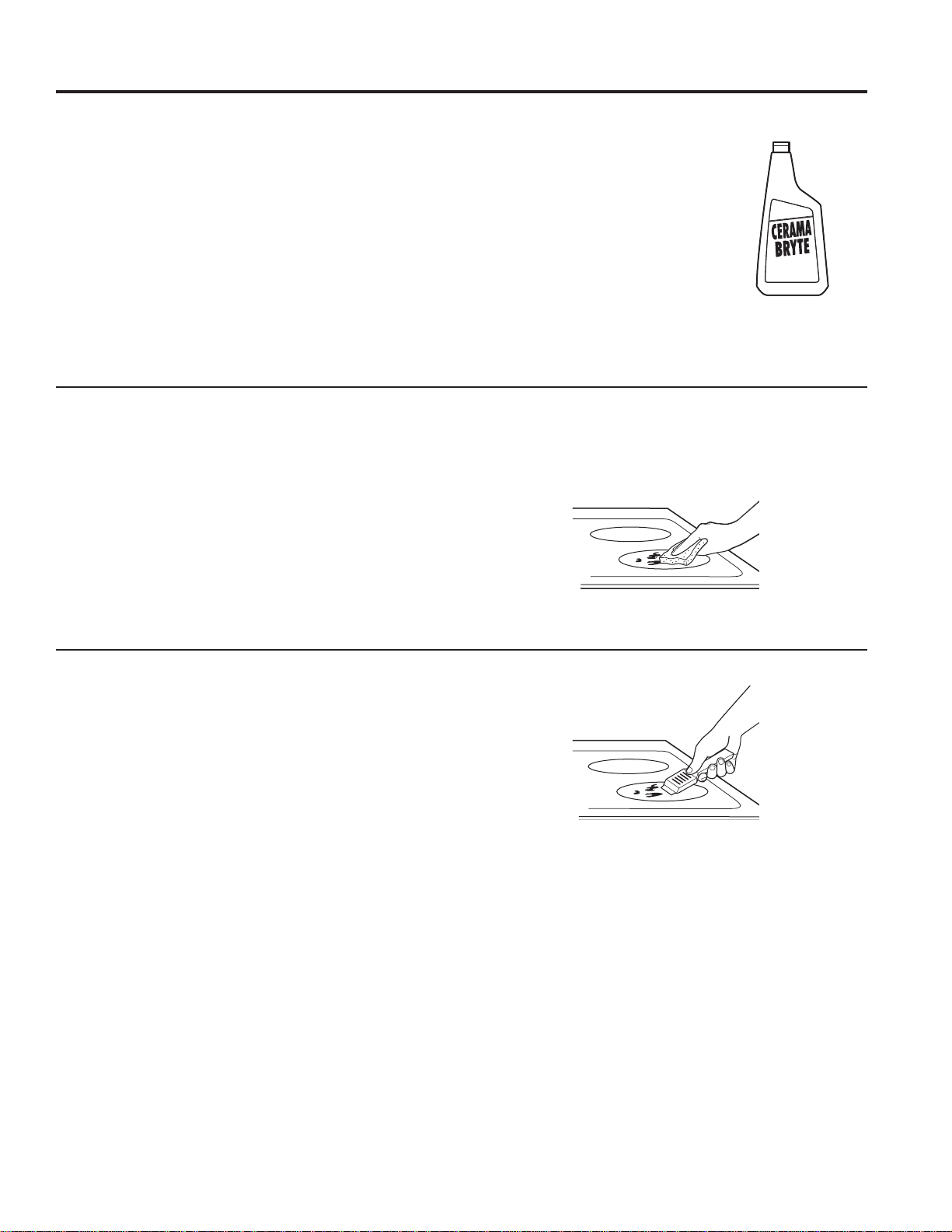
49-88060
23
Cómo limpiar la estufa de vidrio
Limpieza normal de uso diario
SÓLO utilice el limpiador de estufas cerámicas CERAMA
BRYTE
®
en la estufa de vidrio. Otras cremas pueden no ser
tan efectivas.
Para mantener y proteger la superficie de su estufa de vidrio,
siga estos pasos:
1. Antes de usar la estufa por primera vez, límpiela con el
limpiador de estufas cerámicas CERAMA BRYTE
®
. Esto
ayuda a proteger la estufa y hace la limpieza más sencilla.
2. El uso diario del limpiador de estufas cerámicas CERAMA
BRYTE
®
ayudará a que la estufa quede como nueva.
$JLWHELHQODFUHPDGHOLPSLH]D$SOLTXHXQDVJRWDV
del limpiador de estufas cerámicas CERAMA BRYTE
®
directamente sobre la estufa.
8WLOLFHXQDWRDOODGHSDSHOR
un paño de limpieza CERAMA
BRYTE
®
para estufas cerámicas
para limpiar toda la superficie de la
estufa.
8VHXQSDxRVHFRRXQDWRDOODGH
papel para quitar los restos del
limpiador. No hace falta enjuagar.
NOTA: Es muy importante que NO
CALIENTE la estufa hasta que la
haya limpiado por completo.
Residuos pegados
NOTA: Se podrán producir DAÑOS sobre la superficie de
vidrio si utiliza estropajos que no sean los recomendados.
1. Deje enfriar la estufa.
2. Coloque unas gotas del limpiador de estufas cerámicas
CERAMA BRYTE
®
sobre toda el área de residuos pegados.
8WLOL]DQGRHOSDxRGHOLPSLH]D&(5$0$%5<7(
®
para
estufas cerámicas incluido, frote el área sucia aplicando
SUHVLyQVHJ~QVHDQHFHVDULR
6LTXHGDQUHVWRVUHSLWDORVSDVRVLQGLFDGRVFRQ
anterioridad.
3DUDSURWHFFLyQDGLFLRQDOGHVSXpVGHKDEHUTXLWDGRWRGRV
los restos, pula toda la superficie con limpiador de estufas
cerámicas CERAMA BRYTE
®
y una toalla de papel.
Residuos pegados rebeldes
1. Deje enfriar la estufa.
8WLOLFHHOUDVSDGRUGHILOR~QLFRDXQiQJXORDSUR[LPDGR
GHGHJUHHVFRQWUDODVXSHUILFLHGHOYLGULR\UDVSHOD
suciedad. Puede ser necesario aplicar presión al raspador
para quitar la suciedad.
'HVSXpVGHXWLOL]DUHOUDVSDGRUFRORTXHXQDVJRWDVGH
limpiador de estufas cerámicas CERAMA BRYTE
®
sobre
toda el área de suciedad quemada. Utilice el paño de
limpieza CERAMA BRYTE® para quitar la suciedad restante.
3DUDSURWHFFLyQDGLFLRQDOGHVSXpVGHKDEHUTXLWDGRWRGRV
los restos, pula toda la superficie con limpiador de estufas
cerámicas CERAMA BRYTE
®
y una toalla de papel.
El raspador de estufas cerámicas CERAMA BRYTE
®
y todos los
insumos recomendados se encuentran disponibles en nuestro
Centro de Repuestos. Ver instrucciones bajo la sección “Para
solicitar repuestos” en la página siguiente.
NOTA: No utilice hojas desafiladas o dañadas.
CUIDADO Y LIMPIEZA: Cómo limpiar la estufa de vidrio
Limpie la estufa después
de cada derrame. Utilice
el limpiador de estufas
cerámicas CERAMA BRYTE
®
.
Utilice un paño de limpieza CERAMA BRYTE
®
para estufas cerámicas.

24
49-88060
CUIDADO Y LIMPIEZA: Cómo limpiar la estufa de vidrio
Marcas de metal y rayones
1. Tenga cuidado de no deslizar ollas y sartenes a través de
su estufa. Dejará marcas de metal sobre la superficie de la
estufa.
Estas marcas pueden quitarse utilizando limpiador de
estufas cerámicas CERAMA BRYTE
®
con el paño de
limpieza CERAMA BRYTE
®
para estufas cerámicas.
2. Si se permite que ollas con una capa fina de aluminio
o cobre hiervan en seco, la capa puede dejar una
decoloración negra en la estufa.
Esto debe quitarse de inmediato antes de calentar de
nuevo o la decoloración puede llegar a ser permanente.
NOTA: Verifique con detenimiento que la base de las ollas no
sea áspera para no rayar la estufa.
Daños por derrames azucarados y plástico derretido
Se deberá tener especial cuidado al eliminar sustancias calientes, a fin de evitar daños permanentes sobre la superficie de
vidrio. Los derrames azucarados (como gelatinas, dulce, caramelo, jarabes) o plásticos derretidos pueden marcar la superficie
de la estufa (no cubierto por la garantía) a menos que el derrame se quite mientras está caliente. Debe tenerse mucho cuidado al
remover sustancias calientes.
$VHJ~UHVHGHXWLOL]DUXQUDVSDGRUQXHYR\DILODGR
No utilice hojas desafiladas o dañadas.
1. Apague todas las unidades de superficie. Quite las ollas
calientes.
2. Utilizando un guante de cocina:
D8VHXQUDVSDGRUGHILOR~QLFRUDVSDGRUSDUDHVWXIDV
cerámicas CERAMA BRYTE
®
) para desplazar el
derrame a un área fría de la estufa.
b. Quite el derrame con toallas de papel.
&XDOTXLHUGHUUDPHUHVWDQWHGHEHGHMDUVHKDVWDTXHOD
superficie de la estufa se haya enfriado.
1RXVHODVXQLGDGHVGHVXSHUILFLHGHQXHYRKDVWDTXH
todos los restos se hayan eliminado por completo.
NOTA: Si la superficie de vidrio ya ha sufrido marcas o
hendiduras, el vidrio de la estufa deberá cambiarse. En ese
caso, será necesaria la atención de un técnico.
Sellado de la estufa (en algunos modelos)
Para limpiar el sellado de la estufa alrededor de los bordes
GHYLGULRFRORTXHXQSDxRK~PHGRVREUHORVPLVPRVGXUDQWH
unos minutos y luego limpie con limpiadores no abrasivos.
Cómo limpiar la estufa de vidrio (Continúa)
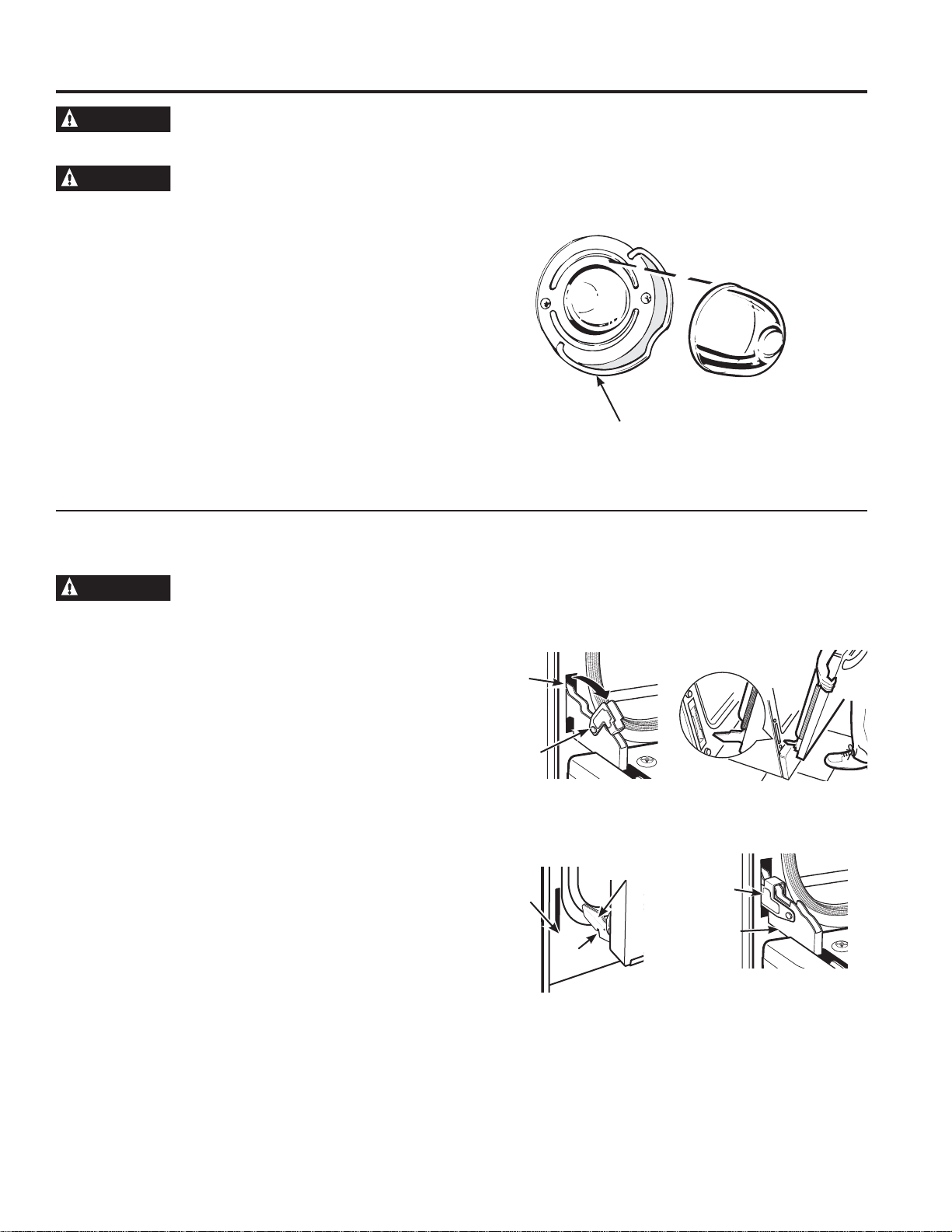
49-88060
25
Mantenimiento
ADVERTENCIA
PELIGRO DE DESCARGA ELÉCTRICA O QUEMADURAS: Antes de reemplazar la bombilla del horno,
desconecte la alimentación de energía al horno desde el panel principal de fusibles o del interruptor de circuitos. No
hacerlo puede provocar una descarga eléctrica o una quemadura.
PRECAUCIÓN
BURN HAZARD: The glass cover and bulb should be removed when cool. Touching hot glass with bare hands
or a damp cloth can cause burns.
CUIDADO Y LIMPIEZA: Mantenimiento
Puerta del Horno Desmontable
La puerta es muy pesada. Tenga cuidado al retirar y levantar la puerta. No levante la puerta usando la manija.
ADVERTENCIA
Si se eliminan de forma inapropiada, las bisagras de la puerta del horno se podrán abrir repentinamente y ocasionar
lesiones personales sobre extremidades que estén cerca de la bisagra. Siga las siguientes instrucciones, a fin de
evitar riesgos de lesión al retirar y volver a instalar la puerta del horno.
Para retirar la puerta:
1. Abra la puerta por completo.
2. Presione las trabas de la bisagra hacia abajo en dirección
del marco de la puerta hasta destrabarlas. Puede
necesitarse una herramienta, como un destornillador plano
pequeño.
7RPHFRQILUPH]DDPERVODGRVGHODSXHUWDGHODSDUWH
superior.
&LHUUHODSXHUWDKDVWDODSRVLFLyQGHUHPRFLyQGHSXHUWD
que es a mitad de camino entre la posición de asado y la
puerta cerrada.
/HYDQWHODSXHUWDKDVWDTXHHOEUD]RGHODELVDJUDKD\D
salido de la ranura.
Para reemplazar la puerta:
1. Tome con firmeza ambos lados de la puerta de la parte
superior.
2. Con la puerta en el mismo ángulo de la posición de
remoción, introduzca la muesca del brazo de la bisagra
dentro del extremo inferior de la ranura de la bisagra. La
ranura del brazo de la bisagra debe estar bien colocada en
la parte inferior de la ranura.
$EUDODSXHUWDSRUFRPSOHWR6LODSXHUWDQRVHDEUHSRU
completo, la muesca no está bien colocada en el extremo
inferior de la ranura.
3UHVLRQHODVWUDEDVGHODELVDJUDKDFLDDUULEDFRQWUDHO
marco frontal de la cavidad del horno, hasta alcanzar la
posición de bloqueo.
&LHUUHODSXHUWDGHOKRUQR
Posición de remoción
Traba de
la bisagra
Tire las trabas de la bisagra hacia
abajo para destrabar.
Ranura
Muesca
Extremo
inferior
de la
ranura
Brazo de
la bisagra
Traba de
la bisagra
Presione las trabas de la bisagra
hacia arriba para bloquear.
Brazo de
la bisagra
Reemplazo de la bombilla del horno
Verifique que la tapa de la lámpara y la bombilla se hayan
enfriado por completo.
Para quitar la tapa:
1. Coloque una mano debajo de la tapa para que no se
caiga cuando la liberen. Con los dedos de la misma mano,
presione firmemente sobre el soporte de la tapa de los
cables. Levante y quite la tapa.
1RTXLWHQLQJ~QWRUQLOORSDUDVDFDUODWDSD
5HHPSODFHODERPELOODFRQXQDXQLGDGGHYDWLRV
Para volver a colocar la tapa:
1. Colóquela dentro de la ranura del receptáculo de la
bombilla. Tire del cable hacia adelante en dirección del
centro de la tapa hasta que se trabe en su lugar.
2. Conecte la energía eléctrica hacia la cocina.
Soporte de la tapa de cables
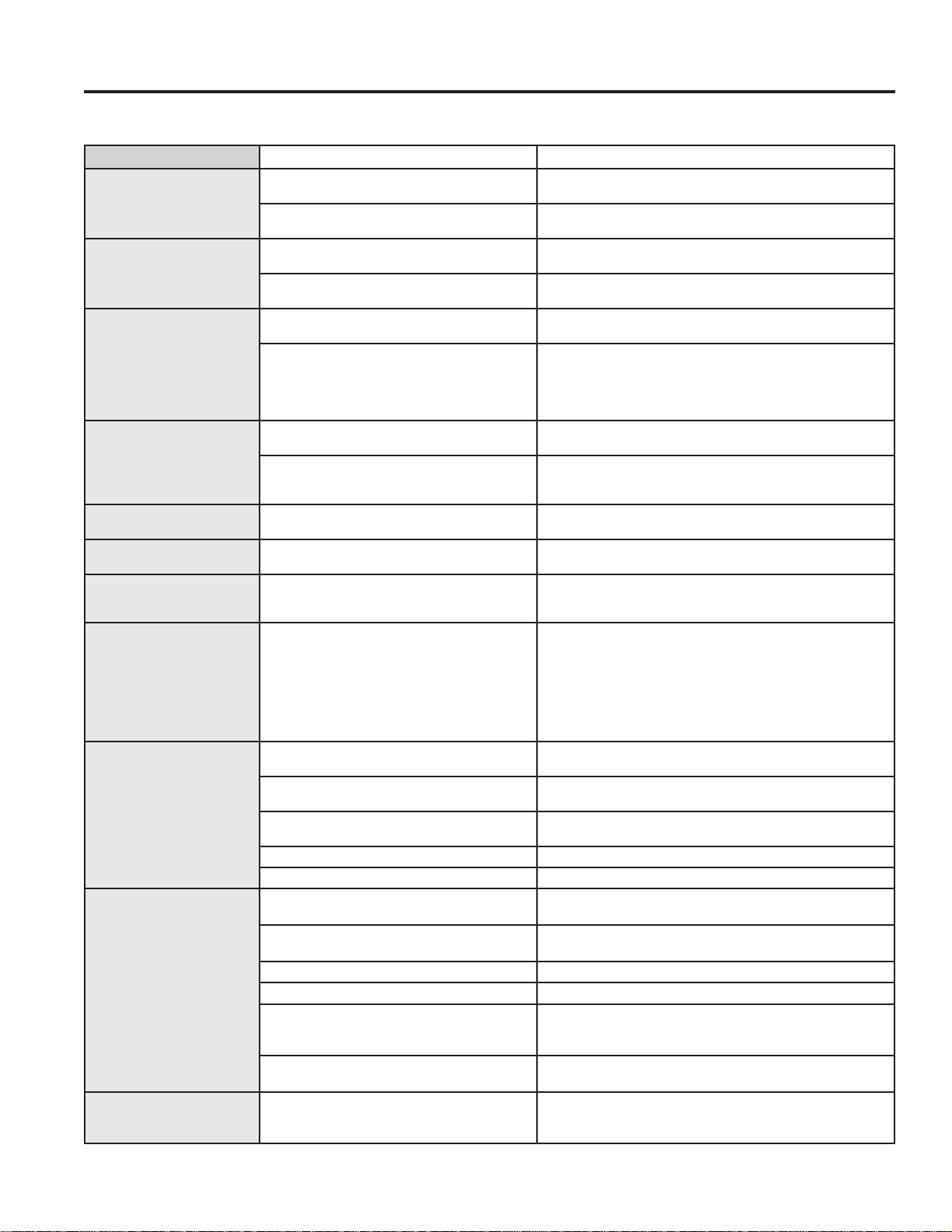
26
49-88060
CONSEJOS PARA LA SOLUCIÓN DE PROBLEMAS
Problema Causa Posible Qué Hacer
Las unidades de superficie
no mantienen un hervor
FRQVWDQWHRODFRFFLyQHV
lenta
6HHVWiQXWLOL]DQGRUHFLSLHQWHVGHFRFFLyQ
inadecuados.
Use recipientes de base plana y que se ajusten al diámetro de la
unidad de superficie elegida.
En algunas regiones la energía (voltaje) puede
ser baja.
Cubra el recipiente con una tapa hasta obtener el calo deseado.
Los elementos de superficie
no funcionan bien
El fusible puede haberse quemado o el
interruptor de circuitos puede haber saltado.
Cambie el fusible o vuelva a configurar el interruptor de circuitos.
Los controles de la estufa están mal
configurados.
Verifique que se haya configurado el control correcto para el
elemento de superficie que está utilizando.
Rayones (pueden parecer
como roturas) en la
superficie de vidrio de la
estufa
Se están usando métodos de limpieza
incorrectos.
Los rayones no pueden removerse. Los rayones más pequeños
se volverán menos visibles como resultado de la limpieza.
Se están usando recipientes con bases
ásperas o hay partículas gruesas (sal o arena)
entre el recipiente y la superficie de la estufa.
Se ha deslizado un recipiente a través de la
superficie de la estufa.
Para evitar rayones, use los procedimientos de limpieza
recomendados. Verifique que las bases de los recipientes estén
limpias antes del uso, y utilice recipientes con bases lisas.
ÈUHDVGHGHFRORUDFLyQHQ
la estufa
No se limpiaron los derrames de alimentos
antes del uso siguiente.
Ver la sección Cómo limpiar la estufa de vidrio.
Superficie caliente en un modelo con una
estufa de color claro.
Esto es normal. La superficie puede parecer decolorada cuando
está caliente. Esto es temporal y desaparecerá a medida que se
enfría el vidrio.
Plástico derretido sobre la
superficie
/DHVWXIDFDOLHQWHHQWUyHQFRQWDFWRFRQ
plástico colocado sobre la misma.
Ver la sección Superficie de vidrio: posibilidades de daño
permanente en la sección Cómo limpiar la estufa de vidrio.
Marcas (o hendiduras) en
la estufa
Se ha derramado una mezcla azucarada
caliente en la estufa.
Llame a un técnico calificado para el reemplazo.
Las unidades de superficie
se encienden y apagan con
mucha frecuencia
6HHVWiQXWLOL]DQGRUHFLSLHQWHVGHFRFFLyQ
inadecuados.
Use sólo recipientes de base plana para minimizar el encendido
y apagado.
Mi horno nuevo no cocina
como el anterior. ¿Hay
DOJ~QSUREOHPDFRQ
las configuraciones de
temperatura?
Su horno nuevo cuenta con un sistema de
FRFFLyQGLIHUHQWHFRQUHODFLyQDODQWHULRU\
por lo tanto, es posible que cocine de forma
diferente.
En los primeros usos, use los tiempos y temperaturas de
VXUHFHWDFRQFXLGDGR6LD~QSLHQVDTXHVXKRUQRQXHYR
cocina con demasiado calor o demasiado frío, podrá ajustar el
termostato usted mismo para aplicar su preferencia de cocción
específica. NOTA: Este ajuste afecta las temperaturas de Bake
+RUQHDU\&RQYHFWLRQ%DNH+RUQHDUSRU&RQYHFFLyQQR
afectará las funciones Convection Roast (Dorar por Convección),
Broil (Asar), o Clean (Limpiar).
La comida no se hornea de
forma apropiada
Controles del horno configurados de forma
incorrecta.
Consulte la sección Modos de Cocción.
/DSRVLFLyQGHOHVWDQWHHVLQFRUUHFWDRHO
estante no está nivelado.
Consulte la sección Modos de Cocción y la Guía de Cocción.
Uso de una cacerola incorrecta o de una
cacerola de tamaño incorrecto.
Consulte la sección Utensilios.
La temperatura del horno debe ser ajustada. Consulte la sección Funciones Especiales.
6XVWLWXFLyQGHLQJUHGLHQWHV Sustituir ingredientes puede modificar el resultado de la receta.
La comida no asa de
forma apropiada
Controles del horno configurados de forma
incorrecta.
$VHJ~UHVHGHVHOHFFLRQDUHOPRGRFRUUHFWRSDUDDVDU
6HXVyXQDSRVLFLyQLQFRUUHFWDGHOHVWDQWH Para acceder a sugerencias de ubicación de estantes,
consulte la Guía de Cocción.
6HFRFLQyFRPLGDHQXQDROODFDOLHQWH $VHJ~UHVHGHTXHHOXWHQVLOLRHVWpIUtR
Utensilio de cocina inadecuado para asar. Use una olla específicamente diseñada para asar
El papel de aluminio usado para la olla y
ODUHMLOODSDUDDVDUQRVHDMXVWyQLFRUWyGH
IRUPDDSURSLDGDVHJ~QORUHFRPHQGDGR
Si usará papel de aluminio, deberá usarse conforme con las
aberturas de la olla.
En algunas áreas, es posible que el nivel
de corriente (voltaje) sea bajo.
Precaliente el elemento para asar durante 10 minutos.
La temperatura del horno
es demasiado caliente o
demasiado fría
La temperatura del horno debe ser
ajustada.
Consulte la sección Funciones Especiales o ajuste el
termostato (en modelos con perilla de temperatura del horno).
¡Ahorre tiempo y dinero! Primero revise los cuadros que aparecen en las siguientes páginas y es posible que no necesite
solicitar reparaciones.
Consejos para la Solución de Problemas... Antes de solicitar el servicio técnico
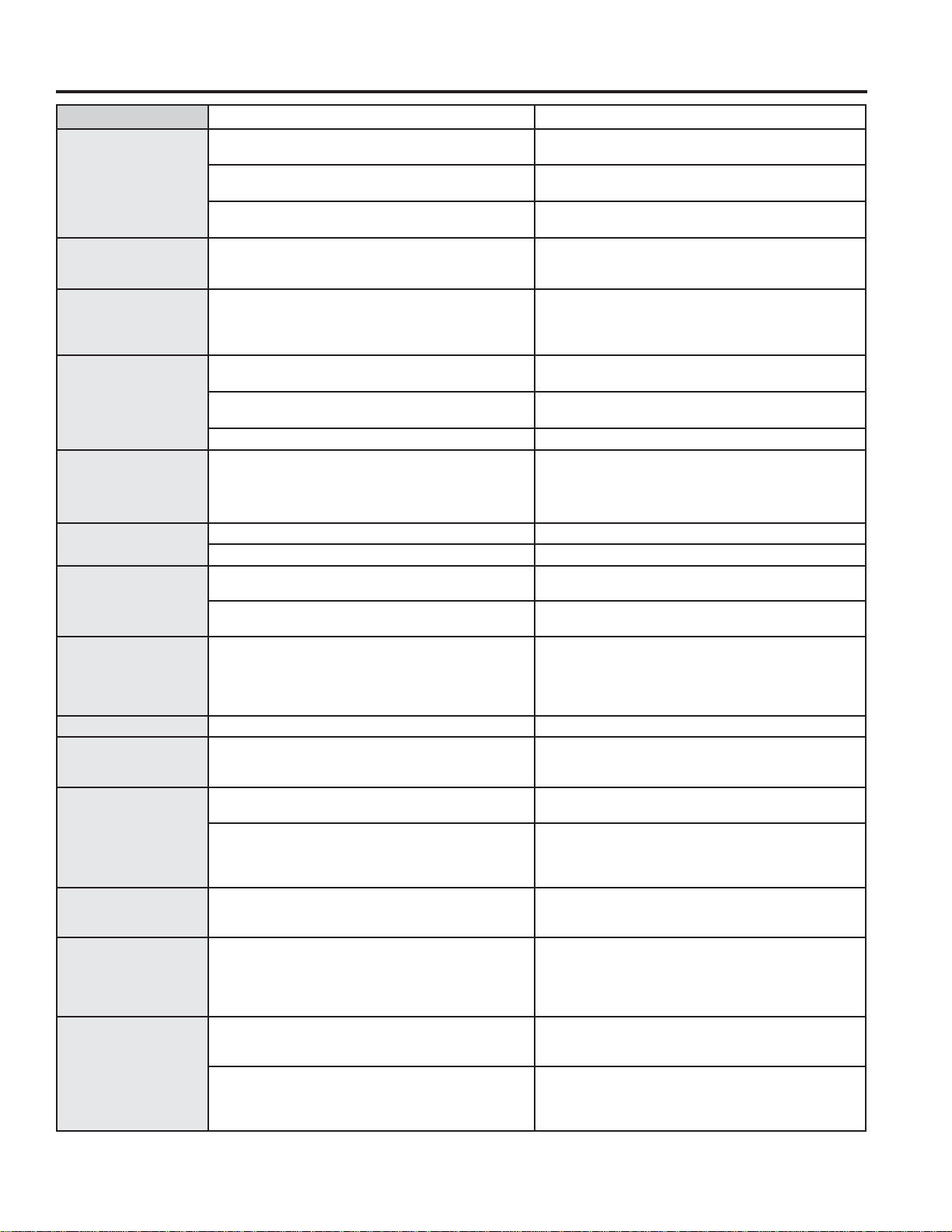
49-88060
27
Problema Causa Posible Qué Hacer
El horno no funciona
o parece no funcionar
Es posible que un fusible de su hogar se haya
quemado o que el disyuntor se haya desconectado.
Reemplace el fusible o reinicie el disyuntor.
Controles del horno configurados de forma
incorrecta.
&RQVXOWHODVHFFLyQ8VRGHO+RUQR
El horno se encuentra en Sabbath Mode (Modo
Sabático)
Verifique que el horno no esté en Sabbath Mode (Modo
Sabático). Consulte la sección Funciones Especiales.
Sonido de
“chisporroteo” o
“traqueo”
Éste es el sonido de metal calentándose o
HQIULiQGRVHGXUDQWHODVIXQFLRQHVGHFRFFLyQ\
limpieza..
Esto es normal.
¿Por qué la estufa
hace un sonido de
“clic” cuando uso el
horno?
Su estufa fue diseñada para mantener un control
más ajustado sobre la temperatura del horno.
Esto es normal.
El reloj y el
temporizador no
funcionan
El fusible puede haberse quemado o el interruptor
de circuitos puede haber saltado.
Cambie el fusible o vuelva a configurar el interruptor de
circuitos.
El enchufe de la cocina no está introducido del
todo en el tomacorriente.
Verifique que el enchufe eléctrico esté conectado a un
tomacorriente con tensión y adecuada conexión a tierra.
Los controles del horno están mal configurados. Ver la sección Cómo usar el temporizador de cocina.
La puerta del horno
alineada.
La puerta no está bien Dado que la puerta del horno es desmontable, a veces
está torcida se desequilibra durante la instalación
Para enderezar la puerta, presione hacia abajo sobre la
esquina superior.
La luz del horno no
funciona
La lámpara está floja o presenta defectos. Ajuste o reemplace la lámpara.
La luz de funcionamiento del interruptor está rota. Llame al servicio técnico.
El modo de limpieza
automática del horno
no funciona
La temperatura del horno es demasiado caliente
como para configurar la limpieza automática.
Espere a que el horno se enfríe y reinicie los controles.
Los controles del horno están configurados de forma
incorrecta.
&RQVXOWHODVHFFLyQGH/LPSLH]DGHO+RUQR
Exceso de humo
durante un ciclo de
limpieza
Suciedad o grasa excesiva. Presione la tecla Clear/Off (Borrar/Apagado) Abra las
ventanas para liberar el humo en la habitación. Espere
hasta que la luz de la función LOCKED DOOR (Puerta
Bloqueada) desaparezca. Limpie el exceso de suciedad
y reinicie el ciclo de limpieza.
Humo excesivo al asar La comida está demasiado cerca del quemador. Baje la posición del estante con comida.
La puerta del horno no
se abrirá luego de un
ciclo de limpieza
El horno está demasiado caliente. Espere a que el horno se enfríe por debajo de la
temperatura de bloqueo.
El horno no limpia
luego de un ciclo de
limpieza
Los controles del horno están configurados de forma
incorrecta.
&RQVXOWHODVHFFLyQGH/LPSLH]DGHO+RUQR
El horno estaba demasiado sucio. Limpie derrames excesivos antes de iniciar el ciclo de
limpieza. Es posible que, en hornos con mucha suciedad,
sea necesario usar la limpieza automática nuevamente o
usarla durante un período de tiempo más prolongado.
“LOCK DOOR” (Puerta
Trabada) titila en la
pantalla
El ciclo de limpieza automática fue seleccionado
pero la puerta no está cerrada.
Cierre la puerta del horno.
La luz de LOCKED
DOOR (Puerta
Bloqueada) está
encendida cuando
desea cocinar.
La puerta del horno está bloqueada debido a que
ODWHPSHUDWXUDLQWHULRUGHOKRUQRQRGHVFHQGLySRU
debajo de la temperatura de bloqueo.
Presione la tecla Clear/Off (Borrar/Apagado) Deje que el
horno se enfríe.
³)±\XQQ~PHUR
o letra” titila en la
pantalla
7LHQHXQFyGLJRGHHUURUGHIXQFLyQ Presione la tecla Clear/Off (Borrar/Apagado) Permita
que el horno se enfríe durante una hora. Vuelva a poner
el horno en funcionamiento.
6LHOFyGLJRGHIXQFLyQVHUHSLWH Desconecte totalmente la corriente de la cocina durante
SRUORPHQRVPLQXWRV\YXHOYDDFRQHFWDUODPLVPD6L
el código de error de función se repite, llame al servicio
técnico.
Consejos para la Solución de Problemas... Antes de solicitar el servicio técnico
CONSEJOS PARA LA SOLUCIÓN DE PROBLEMAS
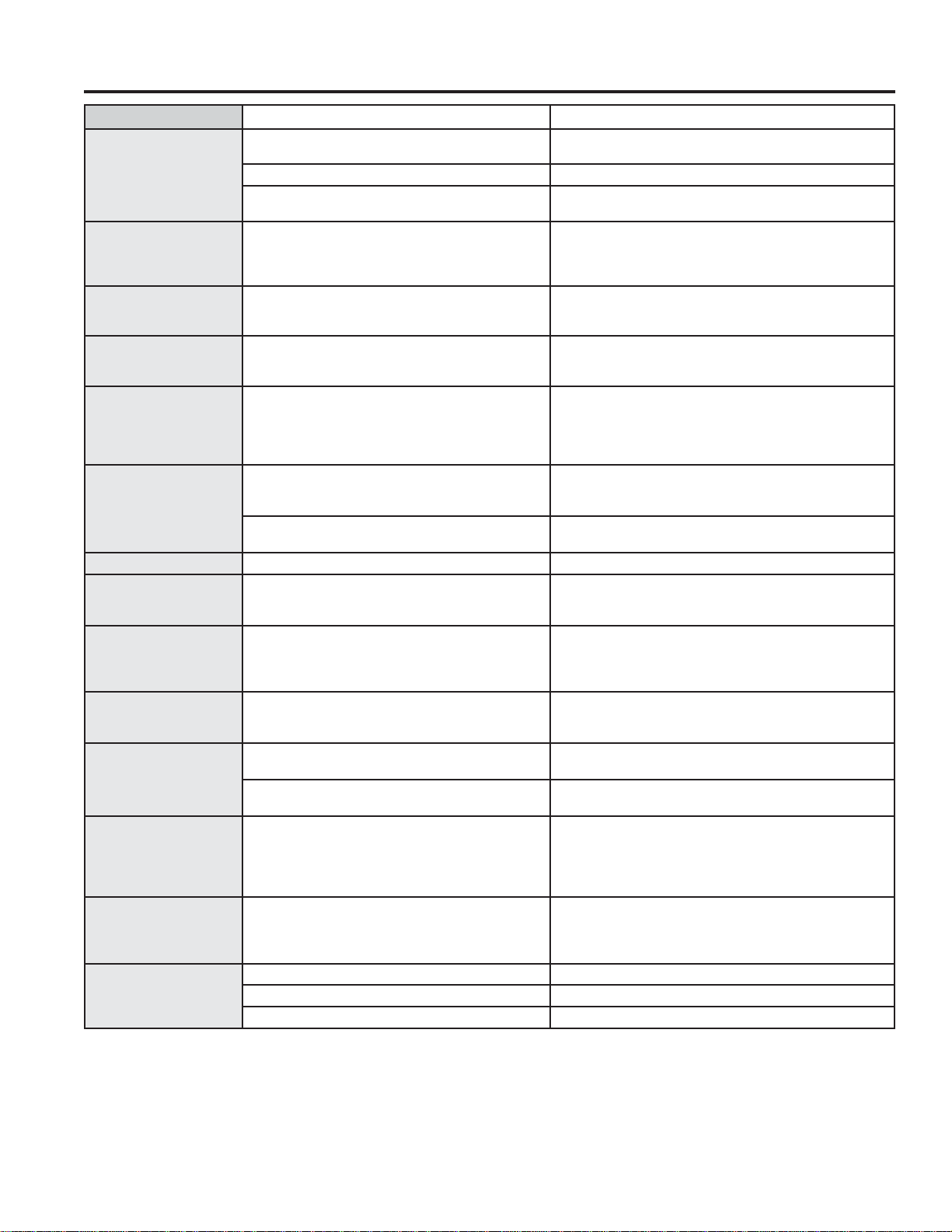
28
49-88060
Problema Causa Posible Qué Hacer
La pantalla queda en
blanco
Es posible que un fusible de su hogar se haya
quemado o que el disyuntor se haya desconectado.
Reemplace el fusible o reinicie el disyuntor.
El reloj está apagado. Consulte la sección Funciones Especiales.
El horno se encuentra en Sabbath Mode (Modo
Sabático)..
Verifique que el horno no esté en Sabbath Mode (Modo
Sabático). Consulte la sección Funciones Especiales.
Corte de corriente, el
reloj titila
Corte o exceso de corriente
Reinicie el reloj. Si el horno estuvo en uso, deberá reiniciar el
mismo presionando la tecla Cancel/ Off (Cancelar/ Apagar)
configurando el reloj y reiniciando cualquier función de
cocción.
Olor a “quemado”
o “aceite” desde la
YHQWLODFLyQ
Esto es normal en un horno nuevo y
desaparecerá con el tiempo.
Para acelerar el proceso, configure un ciclo de limpieza
DXWRPiWLFDSRUXQPtQLPRGHKRUDV&RQVXOWHODVHFFLyQ
GH/LPSLH]DGHO+RUQR
Olor fuerte 8QRORUHQODDLVODFLyQDOUHGHGRUGHOLQWHULRUGHO
horno es normal desde las primeras veces en que
el horno es usado.
Esto es temporario y desaparecerá luego de varios usos o
de un ciclo de limpieza automática.
La puerta de vidrio del
horno parece estar
“teñida” o tener un
color “arcoíris”. ¿Es
esto un defecto?
No. El vidrio del horno interno está cubierto
FRQXQDEDUUHUDGHFDORUTXHUHIOHMDHVWH~OWLPR
nuevamente hacia el horno, a fin de evitar la
pérdida de calor y de mantener fría la puerta
externa mientras se hornea.
Esto es normal. Bajo ciertas luces y ángulos, es posible que
visualice esta tinta o arcoíris.
A veces el horno tarda
más en precalentarse a
la misma temperatura
Utensilio o comida en el horno El utensilio o la comida en el horno hará que éste tarde
más en precalentarse. Retire estos artículos para reducir
el tiempo de precalentamiento.
1~PHURGHHVWDQWHVHQHOKRUQR Agregar más estantes al horno hará que éste tarde más
en precalentarse. Retire algunos estantes.
La pantalla destella Corte de energía. Reconfigure el reloj.
La pantalla no muestra
“SF”
Los botones de control del horno no se
presionaron correctamente.
Los botones Broil Hi/Lo (asar alto/bajo) y Bake
(hornear) deben presionarse al mismo tiempo y
VRVWHQHUVHGXUDQWHVHJXQGRV
El control emite una
señal después de
ingresar un tiempo de
FRFFLyQRGHLQLFLR
2OYLGyLQJUHVDUXQWHPSHUDWXUDGHKRUQHDGRR
un horario de limpieza.
Presione el botón Bake (hornear) y la temperatura
deseada o el botón Self Clean (auto-limpieza) y el
tiempo de limpieza deseado.
Resulta difícil deslizar
las bandejas del horno
Las parrillas de color plateado brillante se
limpiaron en un ciclo de auto limpieza.
Aplique una pequeña cantidad de aceite vegetal en una
toalla de papel y frote los bordes de las bandejas del
horno. No rocíe con Pam
®
u otro lubricante en spray.
(OFDMyQQRVHGHVOL]D
bien o hay que tirar
de él
(OFDMyQQRHVWiELHQDOLQHDGR Extienda el cajón por completo y presiónelo hasta el
fondo. Ver la sección Cuidado y limpieza de la cocina.
(OFDMyQHVWiPX\FDUJDGRRODFDUJDQRHVWi
equilibrada.
Reduzca el peso. Redistribuya el contenido del cajón.
(PLVLyQGHYDSRU
GHVGHODYHQWLODFLyQ
Cuando se utilizan los hornos, es normal ver
XQDHPLVLyQGHYDSRUGHODYHQWLODFLyQGHO
KRUQR$PHGLGDTXHHOQ~PHURGHEDQGHMDVROD
cantidad de alimentos a cocinar se incrementa,
la cantidad de vapor visible se elevará.
Esto es normal.
Quedan restos de agua
en la puerta del horno
luego del Ciclo de
Limpieza al Vapor.
Esto es normal. Retire el agua restante con una esponja o tela seca.
&RQGHQVDFLyQH[FHVLYD
HQHOFDMyQ
/tTXLGRHQHOFDMyQ Quite el líquido.
Alimentos sin cubrir. Cubra los alimentos con una tapa o con papel de aluminio.
/DFRQILJXUDFLyQGHWHPSHUDWXUDHVWiPX\DOWD Reduzca la configuración de la temperatura.
CONSEJOS PARA LA SOLUCIÓN DE PROBLEMAS
Consejos para la Solución de Problemas... Antes de solicitar el servicio técnico