
M5
Online Edition Part-No. 01 41 0 155 062 - © 07/99 BMW AG

Congratulations, and thank you for choosing a BMW.
Thorough familiarity with your vehicle will provide you with enhanced control and
security when you drive it. We therefore have this request:
Please take the time to read this Owner's Manual and familiarize yourself with the
information that we have compiled for you before starting off in your new car. It
contains important data and instructions intended to assist you in gaining maximum
use and satisfaction from the unique range of technical features on your BMW. The
manual also contains information on care and maintenance designed to enhance
operating safety and contribute to maintaining the value of your BMW throughout an
extended service life.
This Owner's Manual should be considered a permanent part of this vehicle. It
should stay with the vehicle when sold to provide the next owner with important
operating, safety and maintenance information.
This manual is supplemented by a Service and Warranty Information Booklet
(US models) or a Warranty and Service Guide Booklet (Canadian models). We
recommend that you read this publication thoroughly.
Your BMW is covered by the following warranties:
>
New Vehicle Limited Warranty
>
Limited Warranty Rust Perforation
>
Federal Emissions System Defect Warranty
>
Federal Emissions Performance Warranty
>
California Emission Control System Limited Warranty
Detailed information about these warranties is listed in the Service and Warranty
Information Booklet (US models) or in the Warranty and Service Guide Booklet
(Canadian models).
We wish you an enjoyable driving experience.
BMW AG
Online Edition Part-No. 01 41 0 155 062 - © 07/99 BMW AG

© 1999 BMW M GmbH
Munich, Germany
Reprinting, including excerpts, is permitted
only with the express written approval of
BMW M GmbH, Munich.
Order no. 01 41 0 155 062
US English VIII/99
Printed in Germany
Printed on environmentally friendly paper
(bleached without chlorine, suitable for recycling)
4n
Notes on the Owner's Manual
We have made every effort to ensure
that you are able to find what you need
in this Owner's Manual as quickly as
possible. The fastest way to find certain
topics is by using the detailed index at
the end. If you desire an initial overview
of your vehicle, this can be found in the
first chapter. The detailed list of con-
tents that directly follows the summary
of contents is intended to stimulate
your curiosity regarding your BMW and
to encourage you to read the manual.
Should you wish to sell your BMW at
some time in the future, please remem-
ber to hand over the Owner's Manual to
the new owner; it is part of the vehicle.
Should you have any further questions,
your BMW center will be glad to assist at
any time.
Symbols used
These sections contain vital infor-
mation – please read the accom-
panying text passages carefully, both
for the your own safety and to prevent
damage to your BMW.
<
Indicates notes that alert you to
specific features of your vehicle.
<
Special information on recycling.
<
<
Indicates the end of a block of
information.
*
Indicates special equipment, country-
specific equipment and optional extras.
Indicates that you should consult
the relevant section of this
Owner's Manual for information on a
particular part or assembly.
Alerts you to functions that can be
adjusted by your authorized BMW
center ("Car Memory" or "Key Mem-
ory"). Refer to page 52.
The individual vehicle
On buying your BMW, you have de-
cided in favor of a model with individu-
alized equipment and fittings. This
Owner's Manual describes all models
and equipment that BMW offers within
the same group.
We hope you will understand that
equipment and features are included
that you might not have chosen for your
vehicle. Any differences can easily be
identified, since all optional accessories
and special equipment are marked with
an asterisk
*
.
If your BMW features equipment that is
not described in this Owner's Manual (a
car radio or telephone, for instance), we
have enclosed Supplementary Owner's
Manuals. We ask you to read these
manuals as well.
Online Edition Part-No. 01 41 0 155 062 - © 07/99 BMW AG

5n
Status at time of printing
BMW pursues a policy of continuous,
ongoing development that is conceived
to ensure that our vehicles continue to
embody the highest quality and safety
standards combined with advanced,
state-of-the-art technology. For this
reason, it is possible that the features
described in this Owner's Manual could
differ from those on your vehicle. Nor
can errors and omissions be entirely
ruled out. You are therefore asked to
appreciate that no legal claims can be
entertained on the basis of the data,
illustrations or descriptions in this
Owner's Manual.
Online Edition Part-No. 01 41 0 155 062 - © 07/99 BMW AG

6n
For your own safety
Use unleaded gasoline only. Fuels
containing up to and including
10 % Ethanol or other oxygenates with
up to 2.8 % oxygen by weight (that is,
15 % MTBE or 3 % methanol plus an
equivalent amount of co-solvent) will
not void the applicable warranties re-
specting defects in materials or work-
manship. Field experience has indi-
cated significant differences in fuel
quality (volatility, composition, addi-
tives, etc.) among gasolines offered for
sale in the United States and Canada.
The use of poor-quality fuels may result
in driveability, starting and stalling prob-
lems, especially under certain environ-
mental conditions such as high ambient
temperature and high altitude. Should
you encounter driveability problems that
you suspect could be related to the fuel
you are using, we recommend that you
respond by switching to a recognized
high-quality brand. Failure to comply
with these recommendations may result
in unscheduled maintenance.
Follow the relevant safety rules when
you are handling gasoline.
<
Important safety information!
For your own safety, use genuine parts
and accessories approved by BMW.
When you purchase accessories tested
and approved by BMW and Original
BMW Parts, you simultaneously acquire
the assurance that they have been thor-
oughly tested by BMW to ensure opti-
mum performance when installed on
your vehicle.
BMW warrants these parts to be free
from defects in material and workman-
ship.
BMW will not accept any liability for
damage resulting from installation of
parts and accessories not approved by
BMW.
BMW cannot test every product from
other manufacturers to verify if it can be
used on a BMW safely and without risk
to either the vehicle, its operation, or its
occupants.
Original BMW Parts, BMW Accessories
and other products approved by BMW,
together with professional advice on
using these items, are available from all
BMW centers.
Installation and operation of non-BMW
approved accessories such as alarms,
radios, amplifiers, radar detectors,
wheels, suspension components, brake
dust shields, telephones (including op-
eration of any portable cellular phone
from within the vehicle without using an
externally-mounted antenna) or trans-
ceiver equipment (for instance, CBs,
walkie-talkie, ham radio or similar
accessories) may cause extensive dam-
age to the vehicle, compromise its
safety, interfere with the vehicle’s elec-
trical system or affect the validity of the
BMW Limited Warranty. See your
authorized BMW center for additional
information.
<
Maintenance, replacement, or
repair of the emission control de-
vices and systems may be performed
by any automotive repair establishment
or individual using any certified auto-
motive part.
<
Online Edition Part-No. 01 41 0 155 062 - © 07/99 BMW AG

7n
The following applies only to vehicles owned and operated in the US.
REPORTING SAFETY DEFECTS
If you believe that your vehicle has a defect that could cause a crash or could cause injury or death, you should
immediately inform the National Highway Traffic Safety Administration (NHTSA) in addition to notifying BMW of
North America, Inc., P.O. Box 1227, Westwood, New Jersey 07675-1227, Telephone (201) 307-4000.
If NHTSA receives similar complaints, it may open an investigation, and if it finds that a safety defect exists in a
group of vehicles, it may order a recall and remedy campaign. However, NHTSA cannot become involved in indi-
vidual problems between you, your dealer, or BMW of North America, Inc.
To contact NHTSA, you may either call the Auto Safety Hotline toll-free at 1-800-424-9393 (or 366-0123 in
Washington, D.C. area) or write to: NHTSA, U.S. Department of Transportation, Washington, D.C. 20590. You can
also obtain other information about motor vehicle safety from the Hotline.
Online Edition Part-No. 01 41 0 155 062 - © 07/99 BMW AG
8n
Online Edition Part-No. 01 41 0 155 062 - © 07/99 BMW AG
Overview
Controls and features
Operation, care
and maintenance
Owner service procedures
Technical data
Index
Advanced technology
9n
RepairsIndex OverviewControlsCar careTechnologyData
Online Edition Part-No. 01 41 0 155 062 - © 07/99 BMW AG

Contents
Overview
Controls and features
Cockpit 16
Instrument cluster 18
Indicator and warning lamps 20
Multifunction steering wheel
(MFL) 23
Hazard warning flashers 24
Warning triangle 24
First-aid kit 24
Refueling 25
Fuel specifications 26
Tire inflation pressure 26
Locks and security systems:
Keys 30
Electronic vehicle
immobilizer 31
Central locking system 32
Opening and closing – from the
outside 32
Using the key 32
Using the remote control 33
Opening and closing – from the
inside 36
Luggage compartment lid 37
Luggage compartment 39
Alarm system 40
Electric power windows 42
Sliding/Tilt sunroof 43
Adjustments:
Seats 45
Steering wheel 48
Mirrors 49
Seat, mirror and steering wheel
memory 50
Car Memory, Key Memory 52
Passenger safety systems:
Safety belts 53
Airbags 54
Child restraints 58
Child seat security 60
Child-safety locks 60
Driving:
Steering/Ignition lock 61
Starting the engine 62
Switching off the engine 62
Parking brake 63
Manual transmission 64
Turn signal indicator/Headlamp
flasher 64
Washer/Wiper system/Rain
sensor 65
Rear window defroster 67
Cruise control 67
Everything under control:
Odometer, outside temperature
display 69
Tachometer 70
Engine oil temperature gauge 70
Fuel gauge 70
Coolant temperature gauge 71
Service Interval Display 71
Check Control 72
Onboard computer 74
Online Edition Part-No. 01 41 0 155 062 - © 07/99 BMW AG

11n
Controls and features
Operation, care and maintenance
Technology for safety and
driving convenience:
Park Distance Control (PDC) 75
Dynamic Stability Control
(DSC) 76
M Dynamic Driving Control 77
Tire Pressure Warning (RDW) 77
Lamps:
Side lamps/Headlamps 79
Instrument rheostat 79
High beams/Parking lamps 80
Fog lamps 80
Interior lamps 80
Reading lamps 81
Controlling the climate for
pleasant driving:
Automatic climate control 82
Integrated rear center
console 88
Seat heating 90
Roller sun blind 90
Independent ventilation
system 90
Cabin convenience:
BMW Universal Transmitter 91
Integrated rear-seat
equipment 94
Glove compartment 95
Storage compartments 96
Cellular phone 96
Beverage holder 96
Ashtray, front 97
Cigarette lighter 98
Ashtray, rear 98
Loading and transporting cargo:
Through-loading system 99
Ski bag 100
Cargo loading 102
Roof-mounted luggage rack 103
Special operating instructions:
Break-in procedures 106
Driving notes 107
Catalytic converter 108
Antilock Brake System
(ABS) 109
Disc brakes 111
Brake system 112
Winter operation 113
Power steering 115
Cellular phones 115
Radio reception 115
Wheels and tires:
Tire inflation pressure 116
Tire condition 116
Tire replacement 118
Tire rotation 118
Wheel and tire
combinations 119
Winter tires 120
Snow chains 121
Approved wheel and tire
specifications 122
Online Edition Part-No. 01 41 0 155 062 - © 07/99 BMW AG

Contents
Operation, care and maintenance
Owner service procedures
Advanced technology
Under the hood:
Hood 123
Engine compartment 124
Washer fluids 126
Washer nozzles 126
Engine oil 127
Coolant 129
Brake fluid 130
Vehicle Identification
Number 131
Care and maintenance:
The BMW Maintenance
System 132
Caring for your car 133
Airbags 139
Vehicle storage 139
Laws and regulations:
Technical modifications 140
OBD interface socket 141
Replacement procedures:
Onboard tool kit 144
Windshield wiper blades 144
Lamps and bulbs 145
Repairing a flat tire 150
Battery 153
Fuses 156
In case of electrical
malfunction:
Fuel filler door 157
Sliding/Tilt sunroof 157
Assistance, giving and
receiving:
Jump-starting 158
Towing the vehicle 159
Airbags 164
Radio reception 164
BMW active seat 165
Dynamic Stability Control
(DSC) 166
Safety belt tensioner 166
DSP sound system 166
Interior rearview mirror with
automatic dimmer 167
Integrated rear suspension 167
Latent heat storage system 168
Rain sensor 168
Xenon lamps 169
Online Edition Part-No. 01 41 0 155 062 - © 07/99 BMW AG

14n
Online Edition Part-No. 01 41 0 155 062 - © 07/99 BMW AG
Overview
Controls and features
Operation, care
and maintenance
Owner service procedures
Technical data
Index
Advanced technology
15n
RepairsIndex OverviewControlsCar careTechnologyData
Cockpit 16
Instrument cluster 18
Indicator and warning lamps 20
Multifunction steering wheel
(MFL) 23
Hazard warning flashers 24
Warning triangle 24
First-aid kit 24
Refueling 25
Fuel specifications 26
Tire inflation pressure 26
Online Edition Part-No. 01 41 0 155 062 - © 07/99 BMW AG
16n
39mde001
Cockpit
Online Edition Part-No. 01 41 0 155 062 - © 07/99 BMW AG

17n
RepairsIndex OverviewControlsCar careTechnologyData
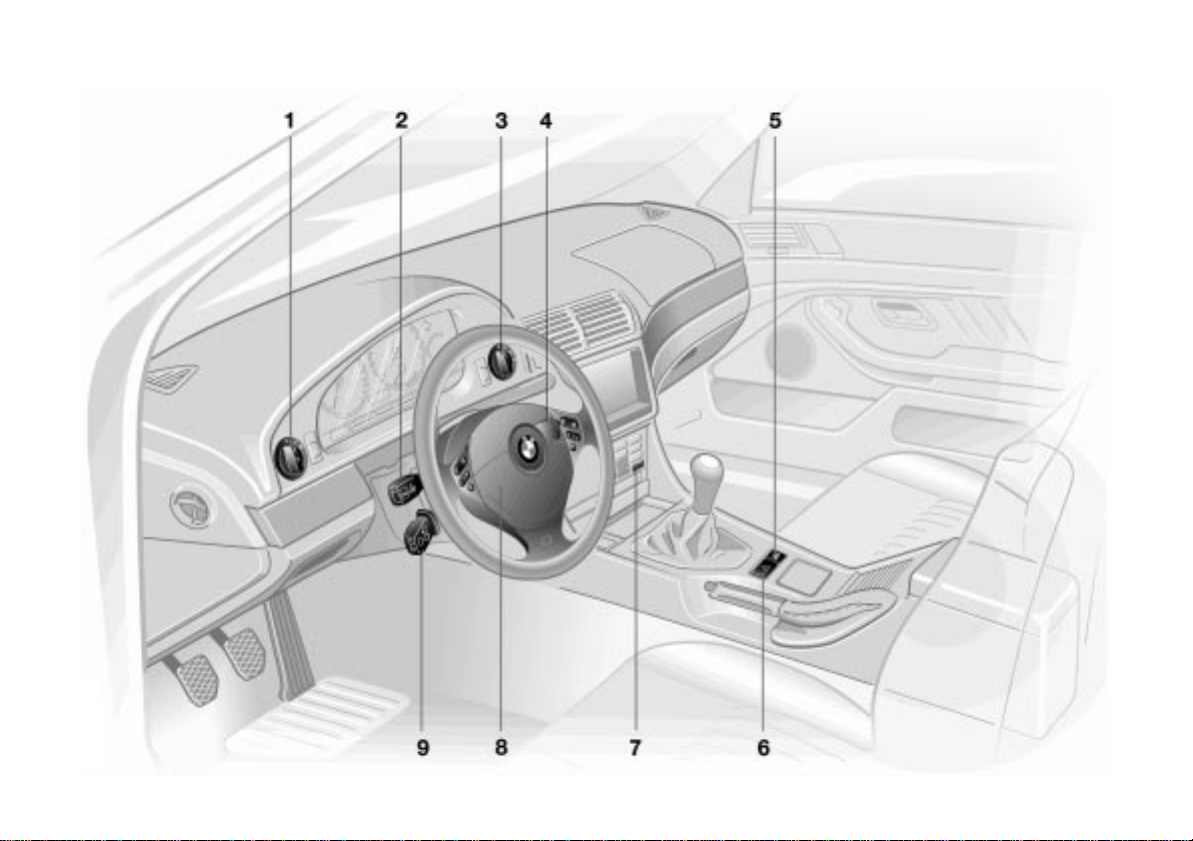
1 Side lamps/Low beams 79
2
d
Turn signal indicator 64
>
Parking lamp 80
>
High beam 80
>
Headlamp flasher 64
>
Onboard computer 74
3 Fog lamps 80
4 Wiper/Washer system 65
5 Central locking system 32
6 Hazard warning flashers 24
7 Rear window defroster 67
8 Horn: The entire surface
9 Electronic steering wheel
adjustment 48
Cockpit
Online Edition Part-No. 01 41 0 155 062 - © 07/99 BMW AG
18n
Instrument cluster
39mus001
Online Edition Part-No. 01 41 0 155 062 - © 07/99 BMW AG

19n
RepairsIndex OverviewControlsCar careTechnologyData
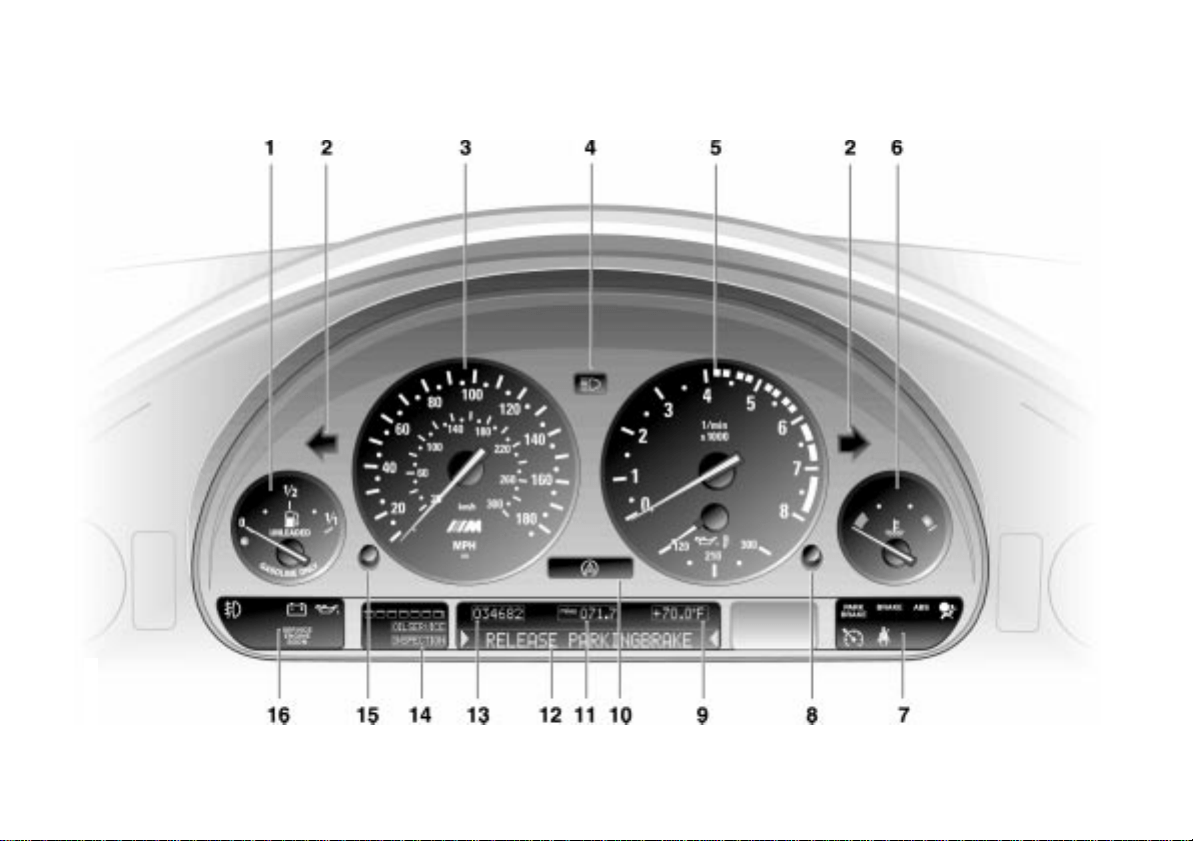
Instrument cluster
1 Fuel gauge with indicator lamp
for fuel reserve 70
2 Indicator lamp for turn signals 22
3 Speedometer
4 Indicator lamp for high beams 22
5 Tachometer and engine oil
temperature gauge 70
6 Engine coolant temperature
gauge 71
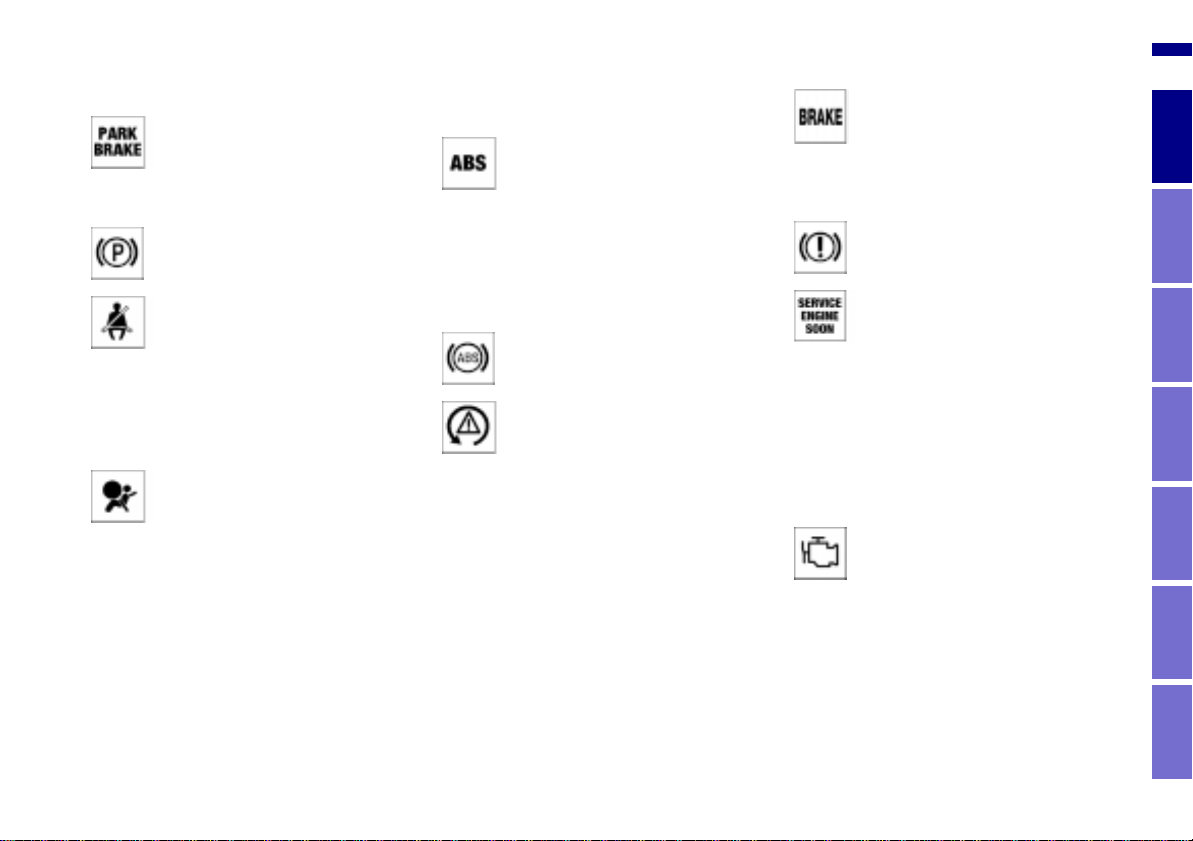
7 Indicator and warning lamps
(clockwise) for
>
Parking brake 21
>
Brake hydraulic system/Dynamic
Brake Control (DBC) 20, 21
>
Antilock Brake System (ABS) 21
>
Airbags 21
>
Please fasten safety belts 21
>
Cruise control
*
22
8 CHECK button 72
9 Outside temperature display 69
10 Indicator lamp for Dynamic Stability
Control (DSC) 21
11 Trip odometer 69
12 Indicator for
>
Check Control 72
>
Onboard computer: refer to the
Radio Owner's Manual
>
Radio and cellular telephone:
refer to the separate Owner's
Manual
13 Odometer 69
14 Service Interval Display 71
15 Trip odometer, reset to zero 69
16 Indicator and warning lamps
(clockwise) for
>
Fog lamps 22
>
Battery charge current 20
>
Engine oil pressure 20
>
CHECK ENGINE lamp 21
You can display the outside tem-
perature and distance driven in
different units of measurement.
<
Online Edition Part-No. 01 41 0 155 062 - © 07/99 BMW AG
20n
Indicator and warning lamps
Technology that monitors itself
Many of the systems of your BMW
monitor themselves automatically, both
during engine starts and while you are
driving. Indicator and warning lamps
that are identified by "
●
" are tested for
proper functioning whenever the igni-
tion key is turned. They light up once for
different periods of time.
If a fault should occur in one of these
systems, the corresponding lamp does
not go out after the engine is started or
it lights up while the vehicle is moving.
You will see how to react to this in the
following section.
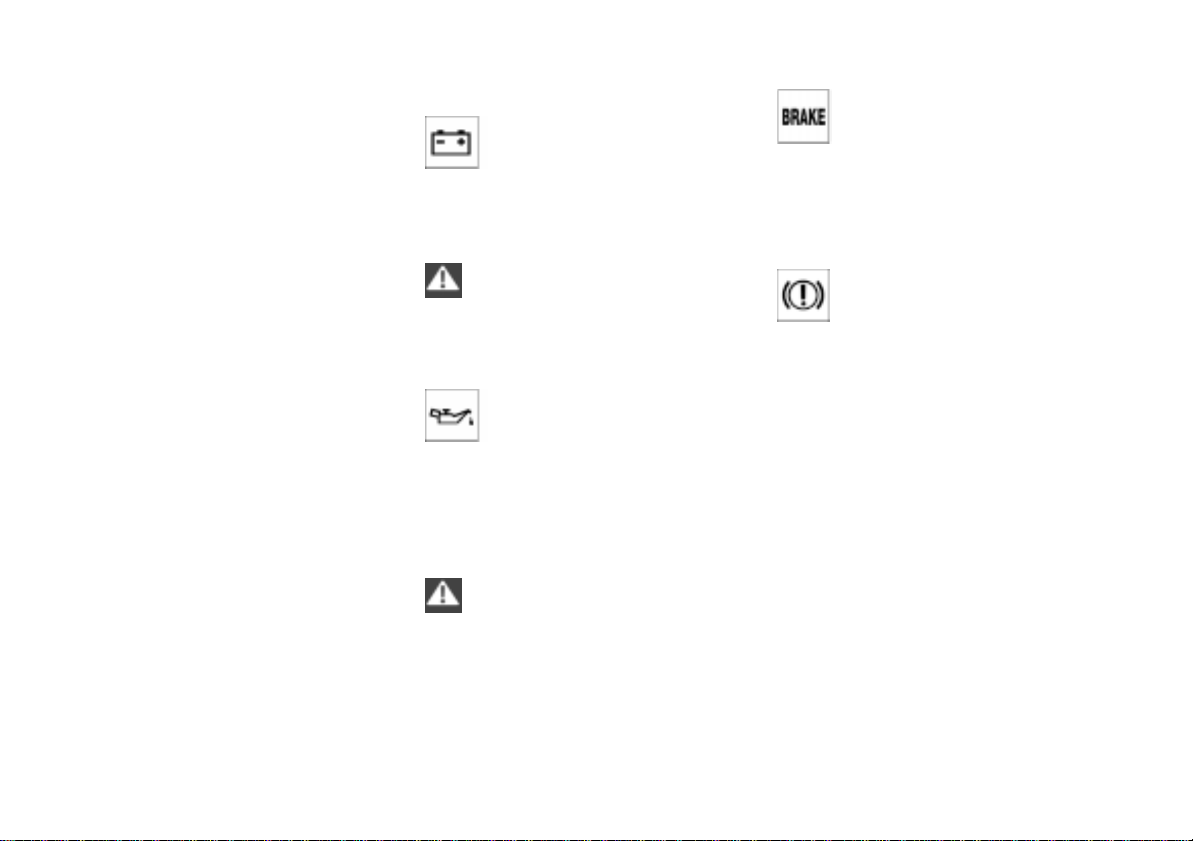
Red: Stop immediately
Battery charge current
●
The battery is no longer being
charged. There is a malfunction
of the alternator drive belt or in the
charging circuit of the alternator. Please
contact the nearest BMW center.
If the drive belt is defective, do not
continue driving. The engine could
be damaged due to overheating. If the
drive belt is defective, increased steer-
ing effort is also required.
<
Engine oil pressure
●
If the message "STOP! ENGINE
OIL PRESSURE" appears in the
Check Control: Stop the vehicle and
switch off the engine immediately.
Check the engine oil level; top up as re-
quired. If the oil level is correct: Please
contact the nearest BMW center.
Do not continue driving. The en-
gine could be damaged because
of inadequate lubrication.
<
Brake hydraulic system
●
Have the brake fluid level
checked. Before continuing your
journey, be sure to read the notes on
pages 112 and 130.
The indicator lamp comes on together
with the "Check brake pads" message
in the Check Control.
Warning lamp, brake hydraulic
system for Canadian models.
Online Edition Part-No. 01 41 0 155 062 - © 07/99 BMW AG
21n
RepairsIndex OverviewControlsCar careTechnologyData
Indicator and warning lamps
Red: An important reminder
Parking brake
●
Comes on when you engage the
parking brake.
For additional information: Refer to
page 63
Parking brake warning lamp for
Canadian models.
Please fasten safety belts
●
An acoustical signal is sounded
and a message appears in the
Check Control for 4 to 8 seconds. The
acoustical signal ends when the belt is
fastened.
For additional information on safety
belts: Refer to page 53
Airbags
●
Please have the system in-
spected by your BMW center.
For additional information: Refer to
page 54, 164
Yellow: Check as soon as
possible
Antilock Brake System (ABS)
●
ABS has been deactivated in
response to a system malfunc-
tion. Conventional braking efficiency is
available without limitations. Please
have the system inspected by your
BMW center.
For additional information: Refer to
page 109
ABS warning lamp for Canadian
models.
Dynamic Stability Control
(DSC)
●
DSC has been switched off or
has been deactivated because of a
malfunction. In the event of a malfunc-
tion, have the system checked by your
BMW center.
For additional information: Refer to
page 76
Dynamic Brake Control
(DBC)
*
●
Fault in the DBC system. Con-
ventional braking efficiency is available
without limitations. For additional infor-
mation: Refer to page 112
Warning lamp, Dynamic Brake
Control (DBC)
*
for Canadian
models
Service engine soon
●
If the indicator lights up either
continuously or intermittently,
this indicates a fault in the emissions-
related electronic systems. Although
the vehicle remains operational, you
should have the systems checked by
you BMW center at the earliest possible
opportunity. For additional information
on the OBD interface socket: Refer to
page 141
Engine Management warning
lamp for Canadian models
Online Edition Part-No. 01 41 0 155 062 - © 07/99 BMW AG

22n
Indicator and warning lamps
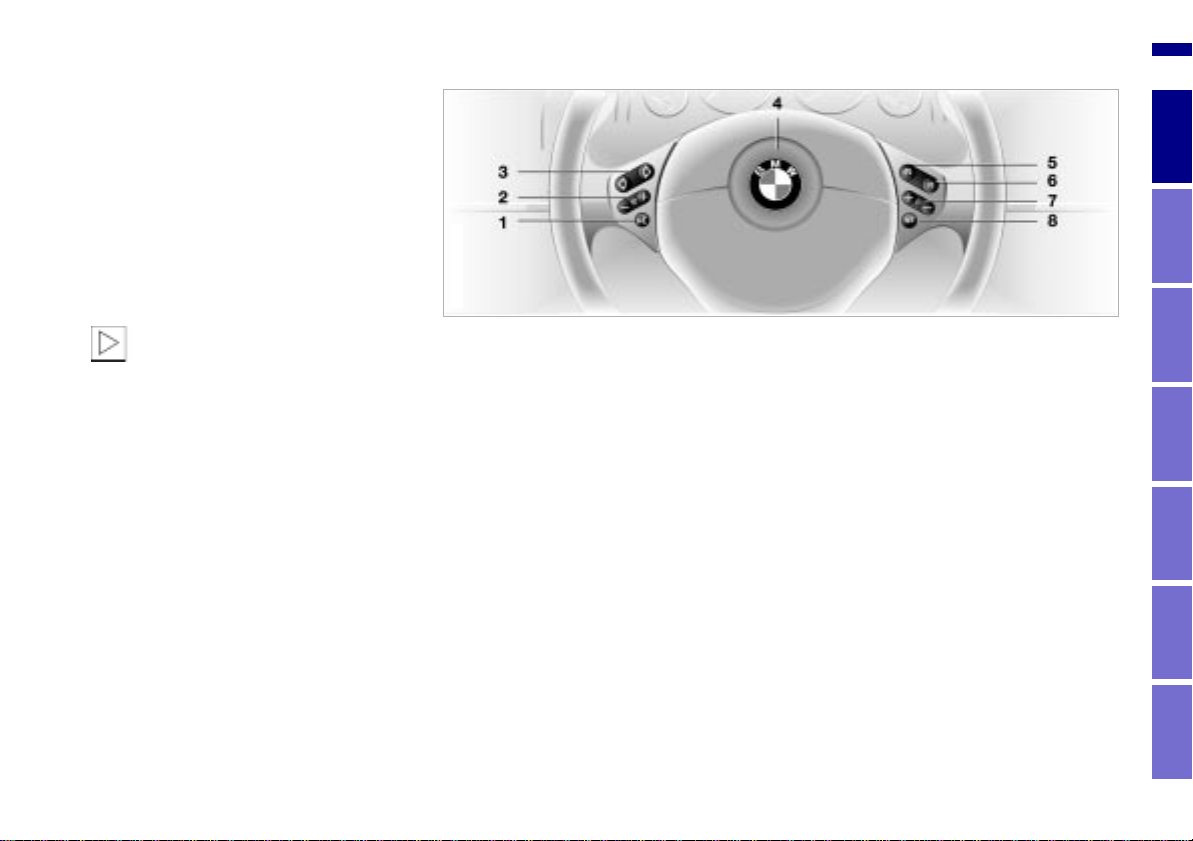
Green: For your information
Turn signal indicator
Flashes when the turn signals
are in operation. Rapid flashing
means there is a fault in the system.
For additional information: Refer to
page 64
Cruise control
Comes on when the cruise con-
trol is activated: available for
operation via the multifunction steering
wheel.
For additional information: Refer to
page 67
Fog lamps
Lights up whenever you switch
on the fog lamps.
For additional information: Refer to
page 80
Blue: For your information
High beam
Lights up when the high beams
are on or the headlamp flasher
is actuated.
For additional information: Refer to
pages 64 and 80
Online Edition Part-No. 01 41 0 155 062 - © 07/99 BMW AG
23n
RepairsIndex OverviewControlsCar careTechnologyData
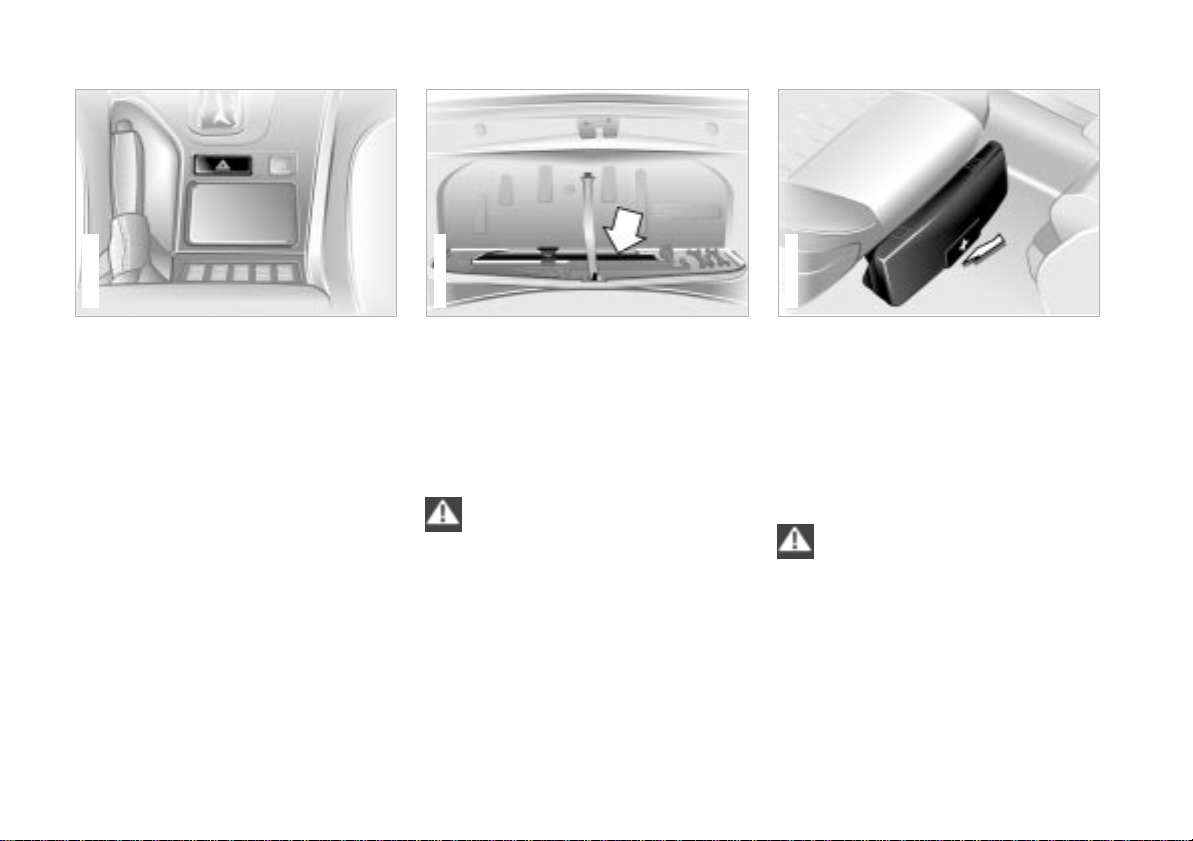
Multifunction steering wheel (MFL)
The controls integrated in the multifunc-
tion steering wheel (MFL) are provided
so that you can operate a number of ac-
cessories quickly and without being
distracted from traffic conditions. You
may operate:
> certain radio, CD and cassette play
functions
> the cruise control and
> selected cellular phone functions.
In order to operate a system via
the MFL, the corresponding sys-
tem controls must be activated.<
The illustration shows the maximum
possible number of controls, corre-
sponding to a full range of optional
equipment. Refer to the individual
accessory manuals for more detailed
descriptions.
1 Cellular phone: Receive a call, start
dialing, terminate a call
2 Radio/Telephone: Volume
3 Radio/Telephone: Scan forward/
backward or scan station keys or
scroll in the phone listings.
Forward and return run for CD and
cassette play
4 Horn: The entire surface
39mde058
5 Cruise control: Resume stored
setting
6 Cruise control: Activate/Interrupt/
Cancel
7 Cruise control: Store and accelerate
(+); decelerate and store (–)
8 Radio/Telephone: Select
Online Edition Part-No. 01 41 0 155 062 - © 07/99 BMW AG
24n
Hazard warning flashers Warning triangle* First-aid kit*
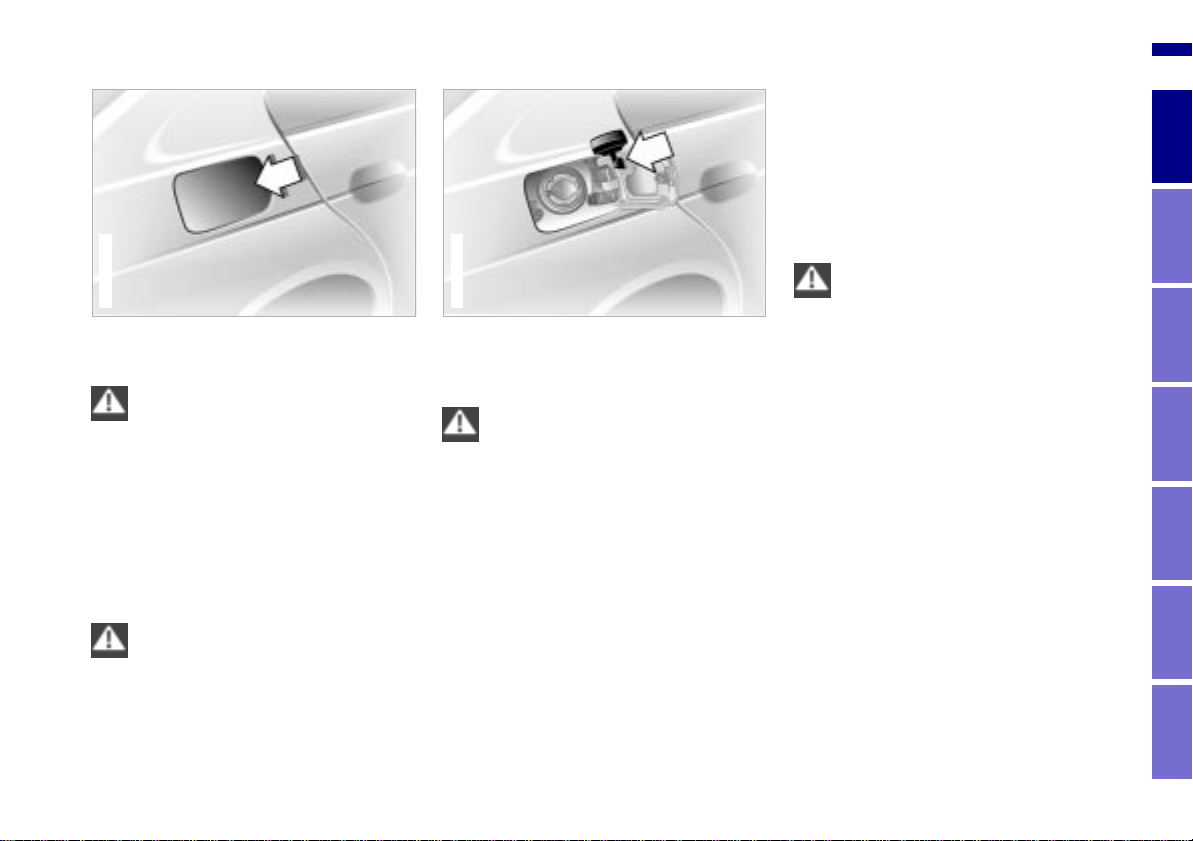
The button flashes intermittently when
the hazard warning flashers are on.
To help you locate the switch in an
emergency, the button is also illumi-
nated whenever the car lamps are on.
390de039
The hazard warning triangle is readily
accessible. It is stored in the container
for the onboard tool kit mounted in the
luggage compartment lid.
To open the container, loosen the wing
nut(s).
Comply with legal requirements
that cover the availability of a haz-
ard warning triangle in the car.<
394de053
Under the front passenger's seat.
To remove: Lift the release lever on the
front (arrow) and pull the first-aid kit for-
ward out of its support.
To store: Position the back of the kit
into the support, then push back until
the lever engages.
Some of the articles in the first-aid
kit may be used within a limited
time only. For this reason, check the
contents of the kit regularly. Replace
any items whose expiration dates have
passed. These items are available in
any drugstore or pharmacy.
Comply with legal requirements that
cover availability of a first-aid kit in the
car.<
390de086
Online Edition Part-No. 01 41 0 155 062 - © 07/99 BMW AG
25n
RepairsIndex OverviewControlsCar careTechnologyData
Refueling
Fuel filler door
Before filling the tank, shut off the
engine. If you do not, fuel cannot
be filled into the tank and the "Check
Engine" warning lamp will come on.<
To open the filler door, press on the
front edge.
To unlock the fuel filler door if the cen-
tral locking system malfunctions, refer
to page 157.
When handling fuels, comply with
all of the applicable safety precau-
tions and regulations posted at the fill-
ing station. Never carry spare fuel con-
tainers in your vehicle. Whether empty
or full, these containers can leak, cause
an explosion, or lead to fire in the event
of a collision.<
394de011
Simple and environmentally
friendly
Open the filler cap carefully to
prevent fuel from spraying out.
Fuel spray may cause injury. Do not top
off. Topping off may cause fuel spill-
age.<
Keep the filler cap in the bracket at-
tached to the fuel filler door.
394de120
When refueling, insert the filler nozzle
completely into the filler pipe. Pulling
the nozzle out of the pipe during refuel-
ing
> results in premature pump shutoff
> and will reduce the effect of the vapor
recovery system on the pump.
Close the fuel cap carefully after
refueling. A loose or missing cap
will activate the Check Engine lamp.<
Online Edition Part-No. 01 41 0 155 062 - © 07/99 BMW AG
26n
Fuel specifications Tire inflation pressure
Use unleaded gasoline only.
Minimum octane rating: 91 AKI.
BMW engines are equipped with knock
sensors and will adapt automatically
to different octane ratings, provided
that the minimum octane requirement
(89 AKI) is met.
Fuels with higher octane ratings will
provide enhanced performance and
lower fuel consumption, while the use
of fuels with low octane ratings will
have the opposite effect.
Do not use leaded fuels. The use
of leaded fuels will cause perma-
nent damage to the system's oxygen
sensor and the catalytic convertor.<
AKI = Anti Knock Index
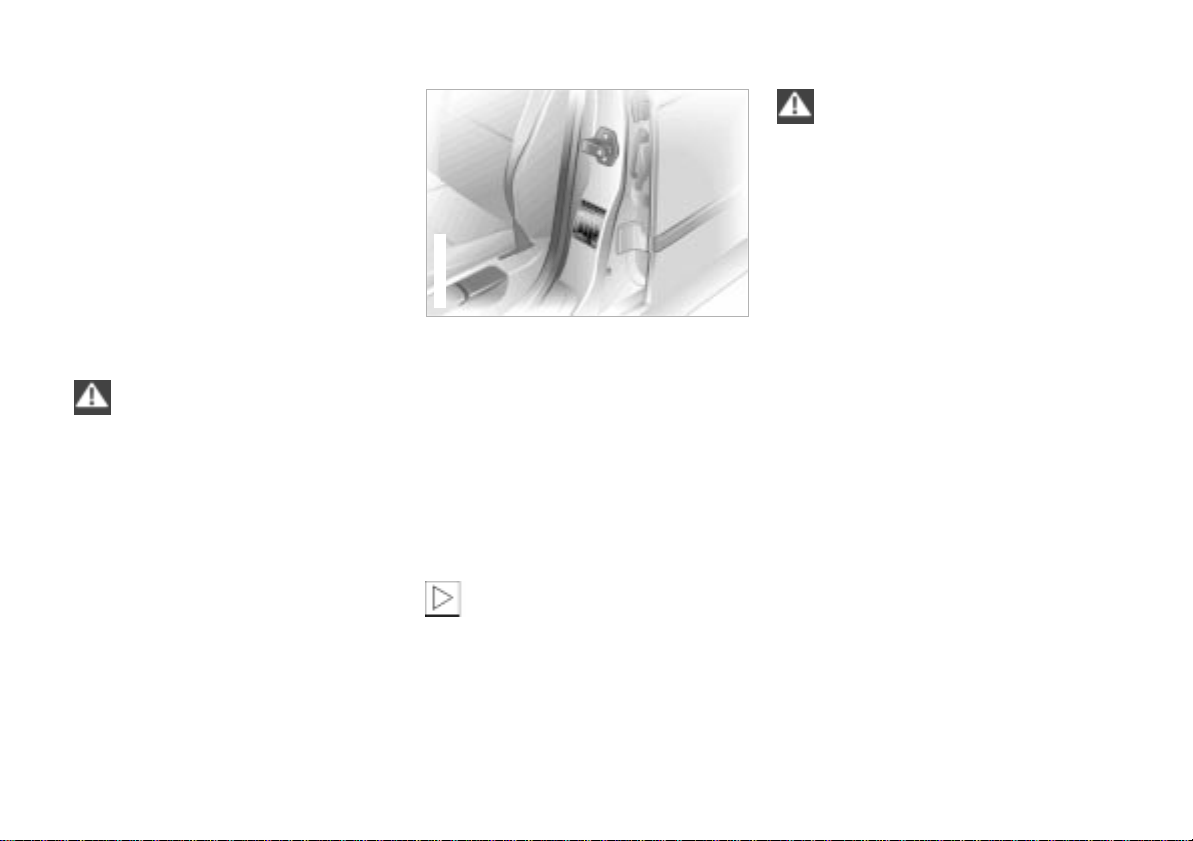
The inflation pressures are indicated on
a label attached to the B-pillar behind
the driver's door (visible with door
open).
Check tire pressures
All pressure specifications are indicated
in psi (kilopascal) for tires at ambient
temperature (refer also to the next
page).
Following a correction of the tire
inflation pressure, reactivate the
Tire Pressure Warning (RDW) system.
Refer to page 77.<
390de351
Check tire inflation pressures reg-
ularly – at least every two weeks
and before beginning a longer trip. In-
correct tire pressure can otherwise lead
to tire damage and accidents.<
Online Edition Part-No. 01 41 0 155 062 - © 07/99 BMW AG

27n
RepairsIndex OverviewControlsCar careTechnologyData
Tire inflation pressure
Comply with tire approval
specifications
The inflation pressures in the table apply
to tires from BMW-approved manufac-
turers. Your BMW center is familiar with
these pressures. Higher pressures may
be specified for tires from other manu-
facturers. You will find a list of approved
tire sizes beginning on page 122.
Your vehicle is equipped with tires which
not only meet US standards, but also
European standards. We recommend
the exclusive use of BMW-approved
tires.
BMW Tires
All pressure specifications in
the table are indicated in psi
(kilopascal) with cold tires
(cold = ambient temperature)
M5
245/40 ZR 18 35 (240) – 46 (320) –
275/35 ZR 18 – 38 (260) – 51 (350)
235/45 R 17 94 H M+S 35 (240) 38 (260) 39 (270) 46 (320)
Online Edition Part-No. 01 41 0 155 062 - © 07/99 BMW AG
28n
Locks and security systems:
Keys 30
Electronic vehicle
immobilizer 31
Central locking system 32
Opening and closing – from the
outside 32
Using the key 32
Using the remote control 33
Opening and closing – from the
inside 36
Luggage compartment lid 37
Luggage compartment 39
Alarm system 40
Electric power windows 42
Sliding/Tilt sunroof 43
Adjustments:
Seats 45
Steering wheel 48
Mirrors 49
Seat, mirror and steering wheel
memory 50
Car Memory, Key Memory 52
Passenger safety systems:
Safety belts 53
Airbags 54
Child restraints 58
Child seat security 60
Child-safety locks 60
Online Edition Part-No. 01 41 0 155 062 - © 07/99 BMW AG
Overview
Controls and features
Operation, care
and maintenance
Owner service procedures
Technical data
Index
Advanced technology
29n
RepairsIndex OverviewControlsCar careTechnologyData
Driving:
Steering/Ignition lock 61
Starting the engine 62
Switching off the engine 62
Parking brake 63
Manual transmission 64
Turn signal indicator/Headlamp
flasher 64
Washer/Wiper system/Rain
sensor 65
Rear window defroster 67
Cruise control 67
Everything under control:
Odometer, outside temperature
display 69
Tachometer 70
Engine oil temperature gauge 70
Fuel gauge 70
Coolant temperature gauge 71
Service Interval Display 71
Check Control 72
Onboard computer 74
Technology for safety and
convenience:
Park Distance Control (PDC) 75
Dynamic Stability Control
(DSC) 76
M Dynamic Driving Control 77
Tire Pressure Warning (RDW) 77
Lamps:
Side lamps/Headlamps 79
Instrument rheostat 79
High beams/Parking lamps 80
Fog lamps 80
Interior lamps 80
Reading lamps 81
Controlling the climate for
pleasant driving:
Automatic climate control 82
Integrated rear center console 88
Seat heating 90
Roller sun blind 90
Independent ventilation
system 90
Cabin convenience:
BMW Universal Transmitter 91
Integrated rear-seat
equipment 94
Glove compartment 95
Storage compartments 96
Cellular phone 96
Beverage holder 96
Ashtray, front 97
Cigarette lighter 98
Ashtray, rear 98
Loading and transporting:
Through-loading system 99
Ski bag 100
Cargo loading 102
Roof-mounted luggage rack 103
Online Edition Part-No. 01 41 0 155 062 - © 07/99 BMW AG
30n
Keys
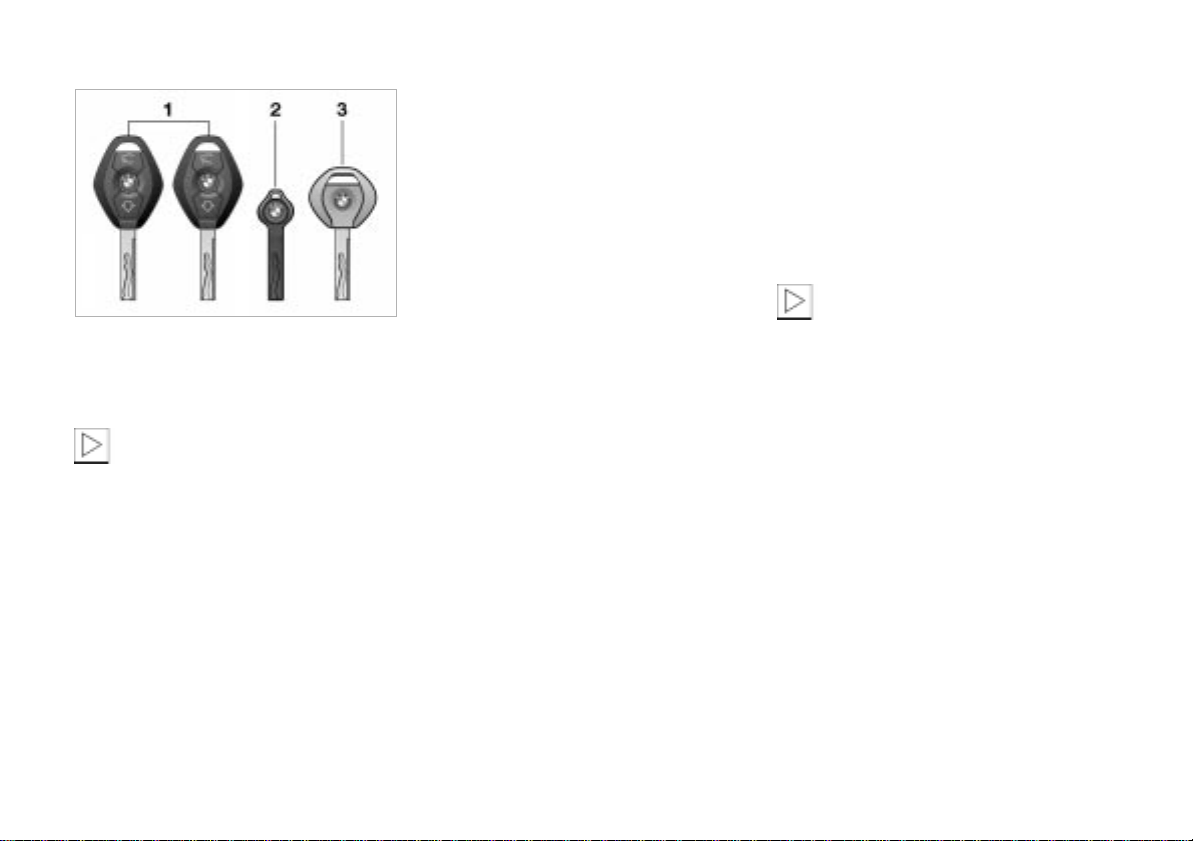
1 The master keys with remote control
determine the functions of the Key
Memory. Refer to page 52.
There is an extended-life battery
in every master key which is
charged automatically in the steering
lock as you drive.
For this reason, if you have a master
key that is otherwise not used, use that
key approximately once every year
while driving for an extended period.
This will charge the battery. Refer also
to page 33.<
2 Spare key for storage in a safe place,
such as in your wallet. This key is not
intended for continuous use.
463de023
3 Door and ignition key
The lock for the glove compartment
cannot be operated with this key.
This is recommended for valet park-
ing, for instance.
Replacement keys
Replacement keys are available exclu-
sively through your BMW center. Your
BMW center is obligated to ensure that
a person requesting a key is authorized
to do so since the keys belong to a
security system (refer to "Electronic
vehicle immobilizer" on page 31).
Whenever you receive a new
replacement key, turn that key to
position 2 in the ignition lock once (igni-
tion switched on) and then back. This
allows the electronic vehicle immobi-
lizer to "learn" the new key.<
Online Edition Part-No. 01 41 0 155 062 - © 07/99 BMW AG
31n
RepairsIndex OverviewControlsCar careTechnologyData
Electronic vehicle immobilizer
The key to security
Your BMW is equipped with a passive
anti-theft system. This electronic immo-
bilization system is designed to reduce
the susceptibility of the vehicle to theft
by making it impossible to start the
engine using any means other than the
special keys furnished with the vehicle.
Your BMW center can cancel the elec-
tronic system authorization for individ-
ual keys (in the event of loss, for
instance). A deactivated key can no
longer be used to start the engine.
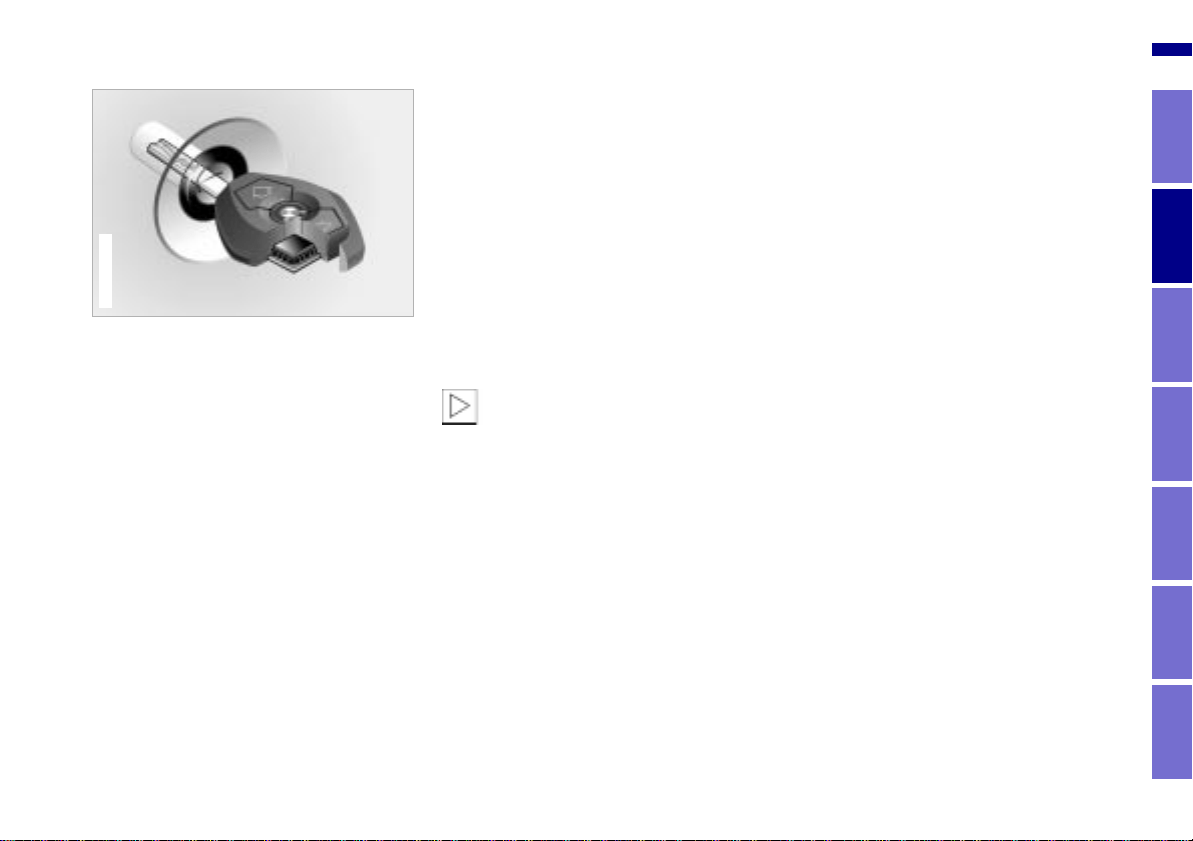
463de042
How the electronics work
At the heart of this system is an elec-
tronic chip that is integrated into the
key. The lock mechanism itself is actu-
ally a dual-function device, simulta-
neously serving as a communications
interface designed to allow the security
system to maintain a continuous stream
of variable, vehicle-specific signals with
the electronic circuitry in the key. The
system will not release the ignition, fuel
injection and starter unless it recog-
nizes an "authorized" key.
Force applied to the key can dam-
age the integrated electronic cir-
cuitry. A damaged key can no longer be
used to start the engine.<
Online Edition Part-No. 01 41 0 155 062 - © 07/99 BMW AG
32n
Central locking system Opening and closing – from the outside
The concept
The central locking system is ready for
operation when both front doors are
closed. The system engages and re-
leases the locks on the
> doors
> luggage compartment lid
> fuel filler door.
The central locking system can be op-
erated
> from outside via the door lock and
using the remote control
> from inside by pressing a button.
The fuel filler door is not locked when
you open the vehicle from the inside
(refer to page 36). The alarm system is
automatically armed whenever you acti-
vate the central locking system from
outside of the vehicle. Both the door
locks and release handles remain
locked. The alarm system is also acti-
vated or deactivated.
If locked from inside, the central locking
system unlocks automatically (only
those doors which were not locked
separately with the safety lock buttons)
in the event of an accident. Refer to
page 36. In addition, the hazard warn-
ing flashers and interior lamps come on.
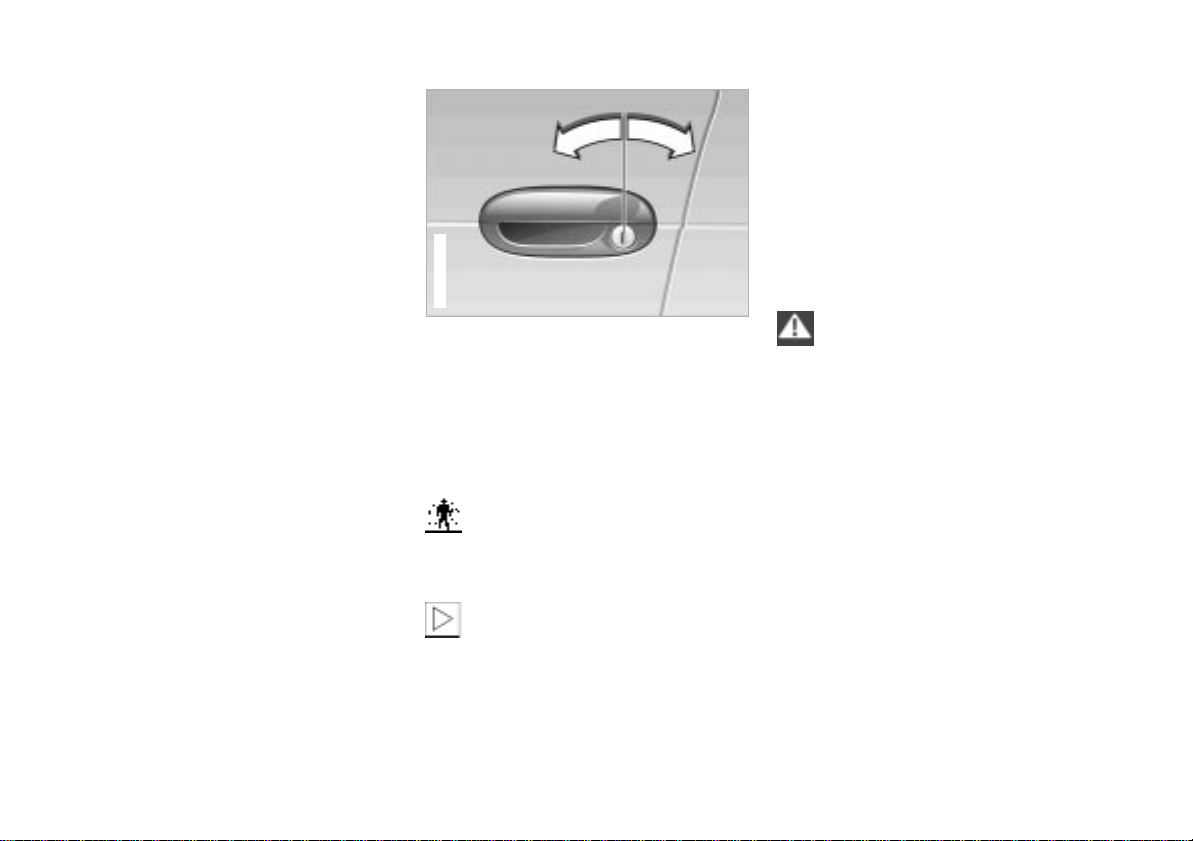
Using the key
One turn of the key in the driver's door
lock unlocks the driver's door only.
Turning the key a second time unlocks
all of the remaining doors, the luggage
compartment lid and the fuel filler door.
You can have a confirmation mes-
sage set to inform you that the car
has been properly locked (in prepara-
tion).<
When a door is opened, the inte-
rior lamps are switched on. They
are switched off automatically.<
You will find additional information on
the alarm system on page 40.
390de627
Convenience operation
You can also operate the windows and
sliding/tilt sunroof via the door lock.
> To open: With the door closed, turn
the key to the "Unlock" position and
hold it.
> To close: With the door closed, turn
the key to the "Lock" position and
hold it.
Watch during the closing process
to be sure that no one is inadvert-
ently injured. Releasing the key stops
the operation.<
Manual operation
(in the event of an electrical failure)
Turn the key to the extreme left or right
to unlock/lock the door.
Online Edition Part-No. 01 41 0 155 062 - © 07/99 BMW AG
33n
RepairsIndex OverviewControlsCar careTechnologyData
Opening and closing – from the outside
Using the remote control
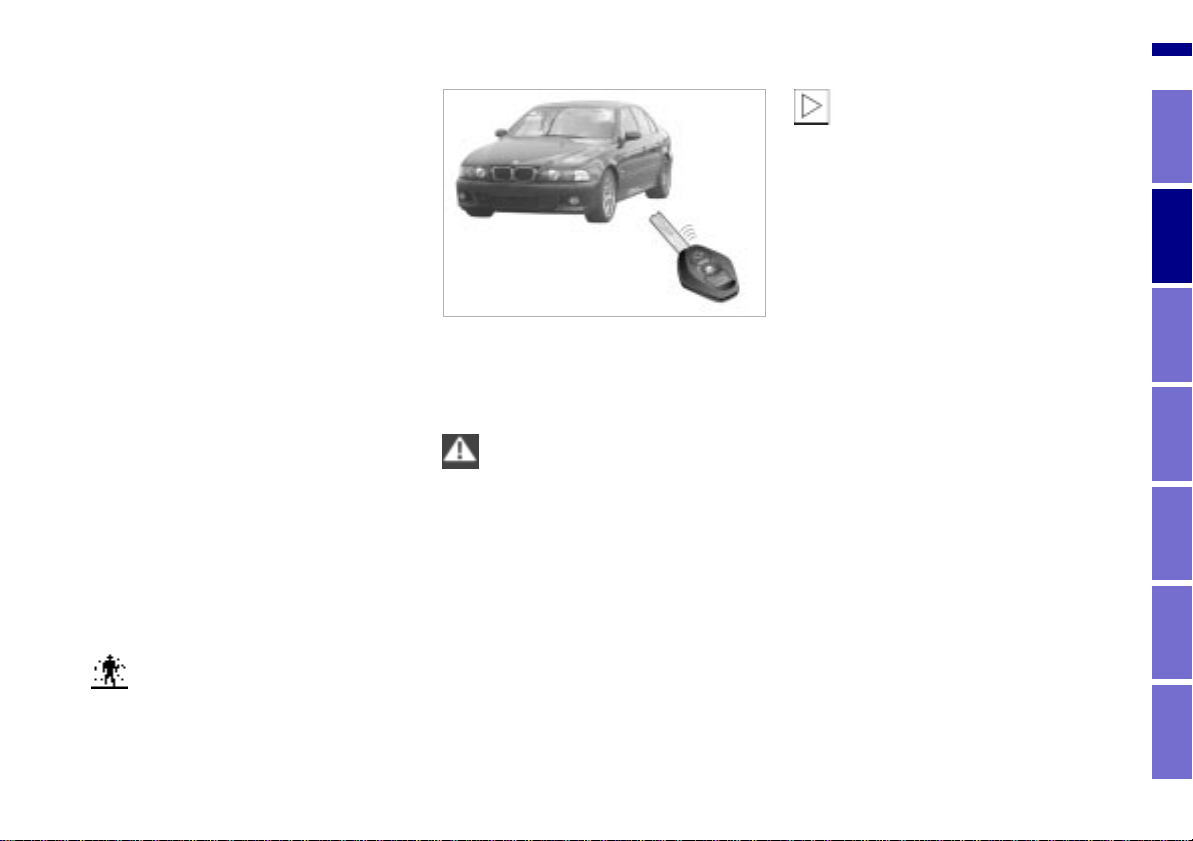
The remote control makes opening and
locking the doors of your vehicle very
convenient. Furthermore, it provides
three additional functions that can only
be executed by means of the remote
control:
> To switch on interior lamps
With this function, you can also
"search for" your vehicle – when
parked in an underground garage, for
instance.
> To open the luggage compartment lid
The luggage compartment lid will
open slightly, regardless of whether
the lid was previously locked or un-
locked.
> Panic Mode
In case of danger, you can trigger an
alarm.
When the vehicle is unlocked or locked,
the anti-theft system is simultaneously
deactivated/activated, the alarm system
is disarmed/armed and the interior
lamps are switched on/off.
You can have a confirmation mes-
sage set to inform you that the car
has been properly locked (in prepara-
tion).<
Master keys
Keys with remote control are master
keys. Refer to page 30.
Children might be able to lock the
doors from the inside. For this rea-
son, always take the vehicle's keys with
you so that the vehicle can be opened
again from the outside at any time.<
39mde060
Master keys that are used repeat-
edly are always ready for opera-
tion since the battery in the key is
charged automatically in the steering
lock as you drive.
If it is no longer possible to unlock the
vehicle via the remote control, the bat-
tery is discharged. Use this key while
driving for an extended period in order
to charge the battery. Refer also to
page 30.
To prevent unauthorized use of the
remote control, surrender only the door
and ignition key 3 or the spare key 2
(refer to page 30) when leaving the
vehicle for valet parking, for example.
In the event of a system malfunction,
please contact your BMW center.
You can also obtain replacement keys
there.<
Online Edition Part-No. 01 41 0 155 062 - © 07/99 BMW AG
34n
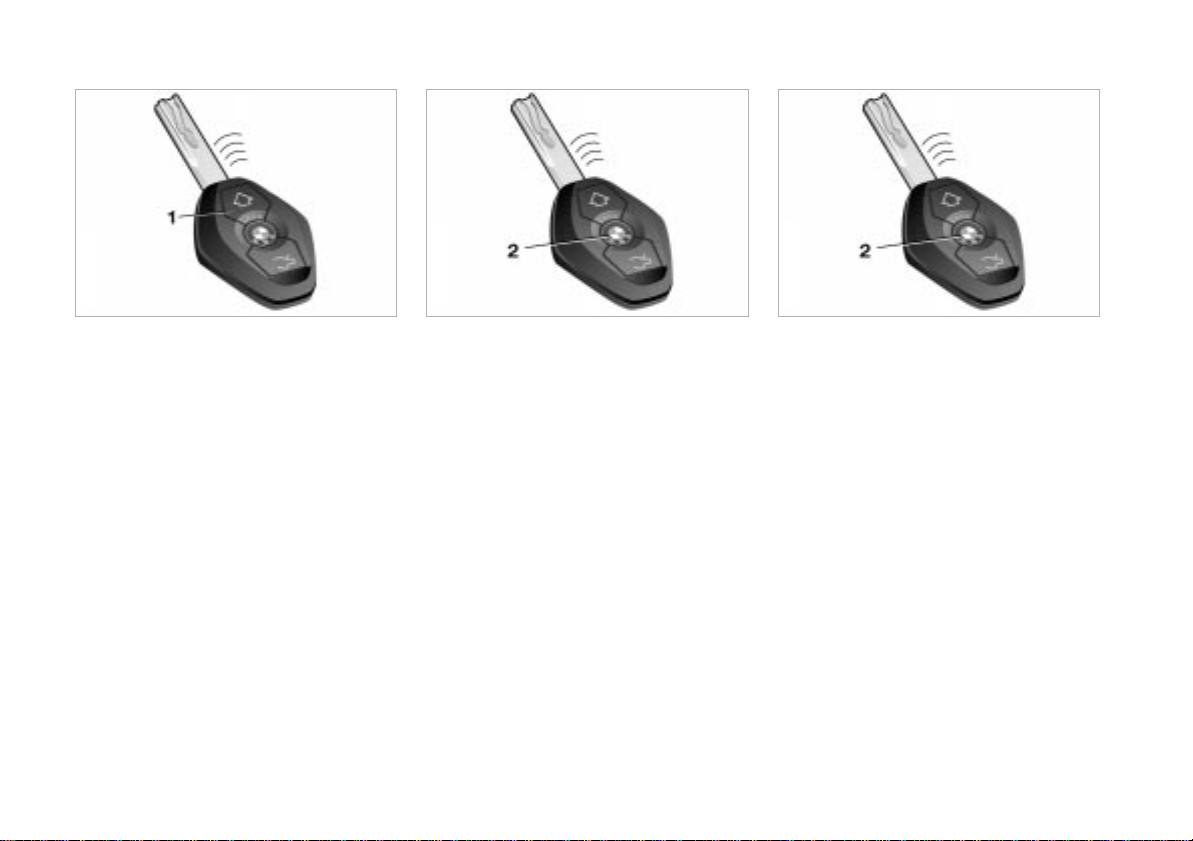
To lock and secure
Press button 2.
463de027
Opening and closing – from the outside
Unlocking and convenience
opening mode
To unlock the driver's door: Press but-
ton 1.
Press the button once to unlock the
driver's door only; press a second time
to unlock all remaining doors as well as
the luggage compartment and fuel filler
door.
Convenience opening mode: Press and
hold button 1. The windows and the
sliding/tilt sunroof are then opened.
463de025
Deactivate the tilt sensor alarm
system and interior motion sensor
Press button 2 a second time immedi-
ately after locking. For additional infor-
mation: Refer to page 41.
To switch on the interior lamps
After locking the car, press button 2 a
second time.
463de027
Online Edition Part-No. 01 41 0 155 062 - © 07/99 BMW AG
35n
RepairsIndex OverviewControlsCar careTechnologyData
Opening and closing – from the outside
Luggage compartment lid open –
Panic Mode
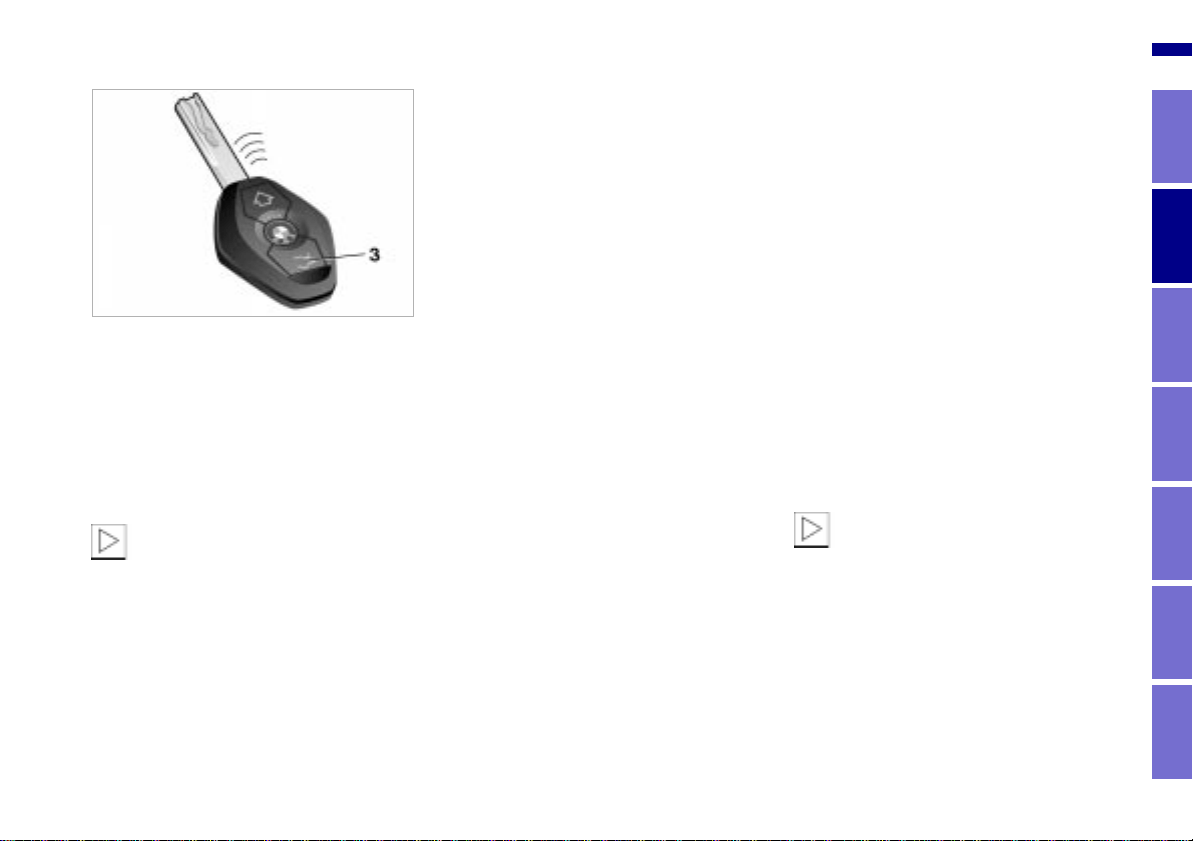
Open the luggage compartment lid:
Press button 3.
The luggage compartment lid will open
slightly, regardless of whether it was
previously locked or unlocked.
Before and after a trip, be sure
that the luggage compartment lid
did not open unintentionally.<
Panic Mode: By pressing and holding
button 3 for two to five seconds, you
can trigger the alarm system if there is
an impending danger (the system must
be armed).
The alarm is deactivated by pressing
button 1.
463de026
Non-BMW systems
The remote control system's function-
ing may be affected by other units or
equipment operating in the immediate
vicinity of your car.
If this should occur, you can unlock and
lock the vehicle via the door lock with a
master key.
For US owners only
The transmitter and receiver units com-
ply with part 15 of the FCC (Federal
Communications Commission) regula-
tions. Operation is governed by the fol-
lowing:
FCC ID: LX8EWS
LX8FZVS
LX8FZVE
Compliance statement:
This device complies with part 15 of the
FCC Rules. Operation is subject to the
following two conditions:
> This device may not cause harmful
interference, and
> this device must accept any interfer-
ence received, including interference
that may cause undesired operation.
Any unauthorized modifications
or changes to these devices could
void the user's authority to operate this
equipment.<
Online Edition Part-No. 01 41 0 155 062 - © 07/99 BMW AG
36n
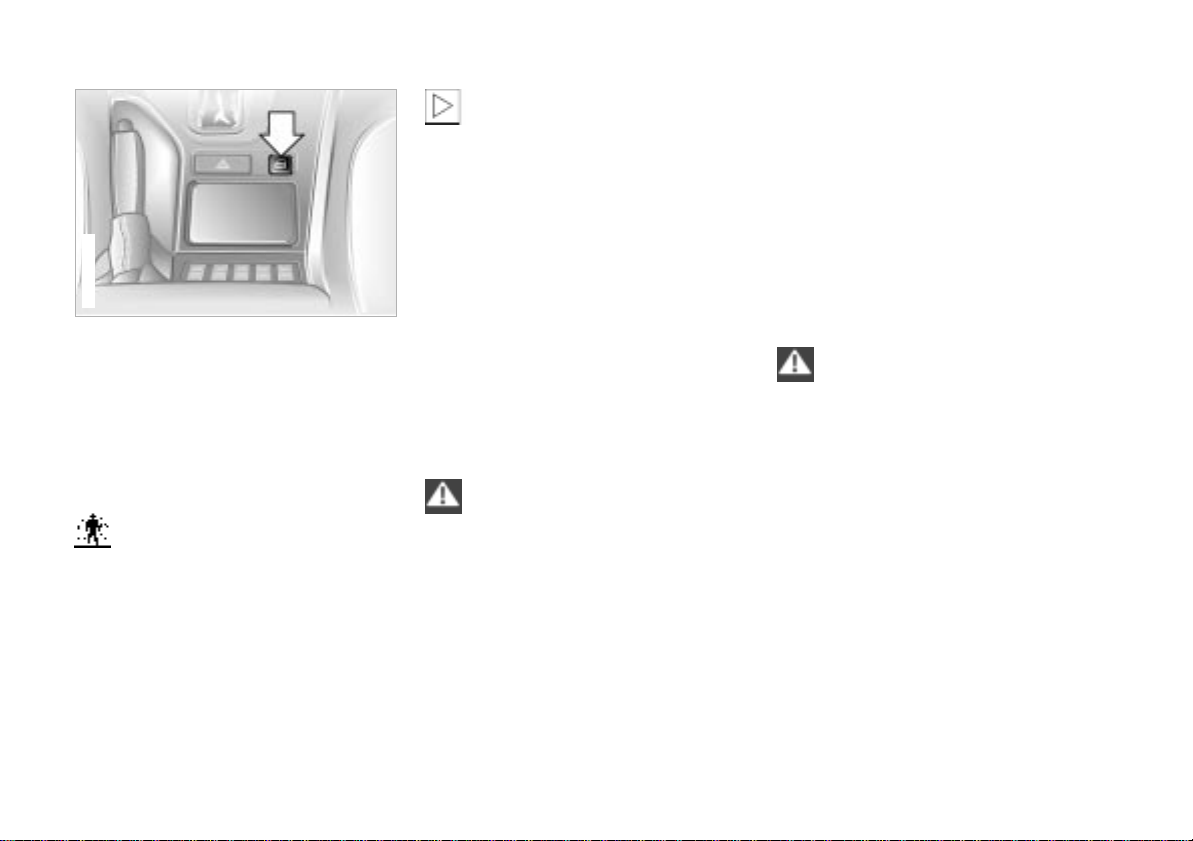
Opening and closing – from the inside
Use this button to operate the central
locking system when the front doors are
closed. The doors and luggage com-
partment lid are unlocked or locked
only. The antitheft alarm system is not
activated. Also, the fuel filler door re-
mains unlocked to allow refueling.
If you desire, the central locking
system will secure the locks as
soon as you start to drive. This can be
adjusted to be key-specific.<
390de016
If only the driver's door was un-
locked from the outside and you
press the button
> all other doors, the luggage compart-
ment lid and the fuel filler door will be
unlocked if the driver's door is open
> the driver's door will be locked again
if it is closed.<
To unlock and open the doors
> Either unlock the doors together with
the button for the central locking sys-
tem and then pull each of the release
handles above the armrests or
> pull the release handle for each door
twice: The first pull unlocks the door,
and the second one opens it.
Doors locked from outside can be
opened from inside by first press-
ing the button and then pulling the re-
lease handle twice.<
To engage the locks
> Use the central locking button to lock
all of the doors simultaneously, or
> press down the individual door lock
buttons. The fuel filler door remains
then unlocked. As an added design
feature to prevent the driver from be-
ing inadvertently locked out of the ve-
hicle, the driver's door lock button
will not engage as long as the door is
open.
When the vehicle is moving, do
not lock the doors with the safety
lock buttons. Doors locked in this man-
ner would not open automatically in the
event of an accident. Children might be
able to lock the doors from the inside.
For this reason, always take the vehi-
cle's keys with you so that the vehicle
can be opened again from the outside
at any time.<
Online Edition Part-No. 01 41 0 155 062 - © 07/99 BMW AG
37n
RepairsIndex OverviewControlsCar careTechnologyData
Luggage compartment lid
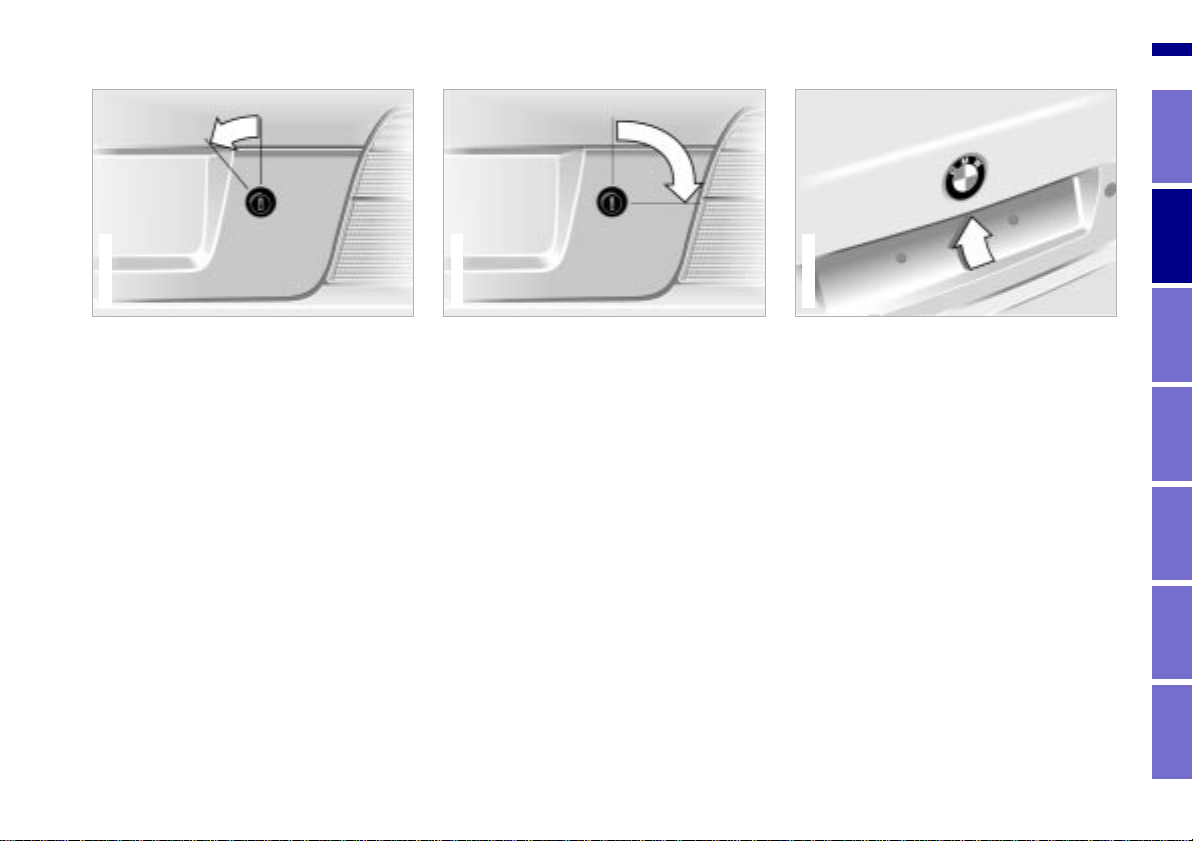
The lock
Only the master key (refer to page 30)
fits in the lock of the luggage compart-
ment.
Opening separately
Turn the master key to the left in the
luggage compartment lock clear to the
stop – the luggage compartment lid will
open slightly.
The luggage compartment is locked
again as soon as you close the lid.
394de624
Securing separately
Turn the master key to the right past the
resistance point and then pull it out in
the horizontal position.
This locks the luggage compartment lid
and disconnects it from the central
locking system. This feature can be
used to prevent unauthorized access to
the luggage compartment when you
surrender the door and ignition key
(refer to page 30) for valet parking, for
instance.
394de064
To open from outside
Press the button (arrow): The luggage
compartment lid opens slightly.
The luggage compartment is lighted
when the luggage compartment lid is
opened.
Manual operation
(in the event of an electrical failure)
Turn the master key to the left in the
luggage compartment lock clear to the
stop – the luggage compartment lid will
open slightly.
The luggage compartment is locked
again as soon as you close the lid.
394de009
Online Edition Part-No. 01 41 0 155 062 - © 07/99 BMW AG
38n
Luggage compartment lid
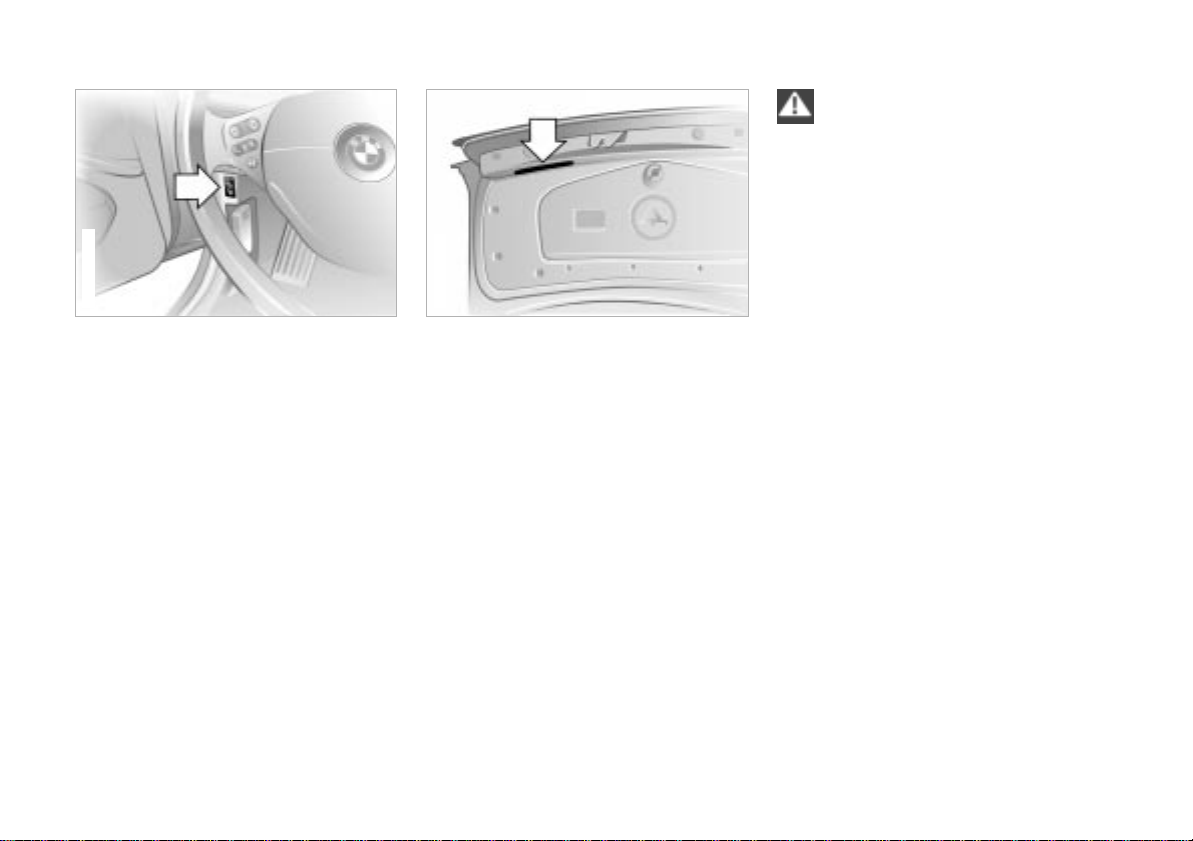
Opening from inside the car
Provided the luggage compartment
has not been locked separately, you
can use this button to open it when the
vehicle is stationary.
39mde072
To close
The handle recess (arrow) next to the
lock mechanism is designed to assist
you in closing the luggage compart-
ment lid.
394de128
Operate the vehicle only when the
luggage compartment lid is com-
pletely closed. Otherwise, exhaust
fumes could penetrate the interior of
the vehicle. Should it be absolutely
necessary to operate the vehicle with
the luggage compartment lid open:
> Close all windows. Shut the sliding/
tilt sunroof.
> Increase the air supply of the auto-
matic climate control to a high level.
Refer to page 85.<
Online Edition Part-No. 01 41 0 155 062 - © 07/99 BMW AG
39n
RepairsIndex OverviewControlsCar careTechnologyData
Luggage compartment
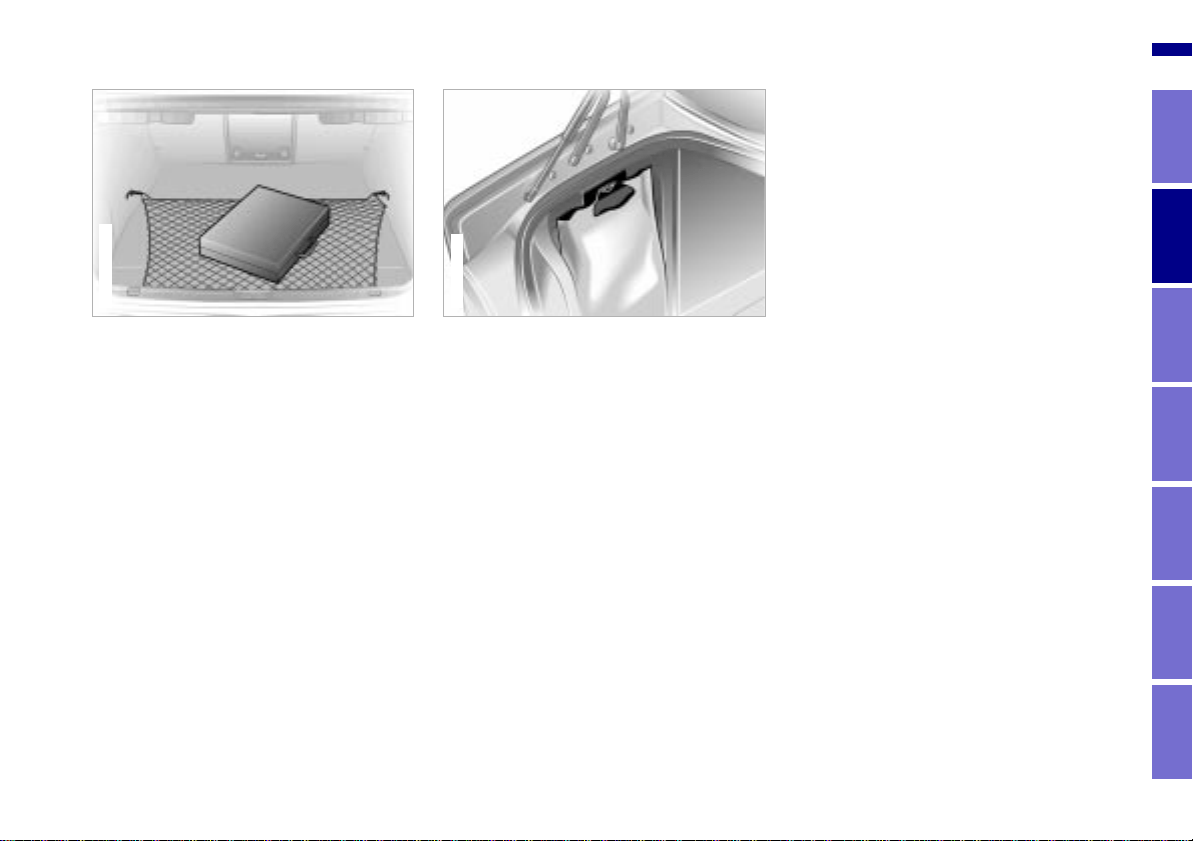
Luggage net
Use the luggage net to secure smaller
items of luggage.
If you place objects on the luggage net,
this helps to prevent them from moving.
The lashing eyes located at the corners
of the luggage compartment provide
you with a convenient means of attach-
ing draw straps
* for securing suitcases
and luggage.
Refer also to "Cargo loading" on
page 102.
39mde050
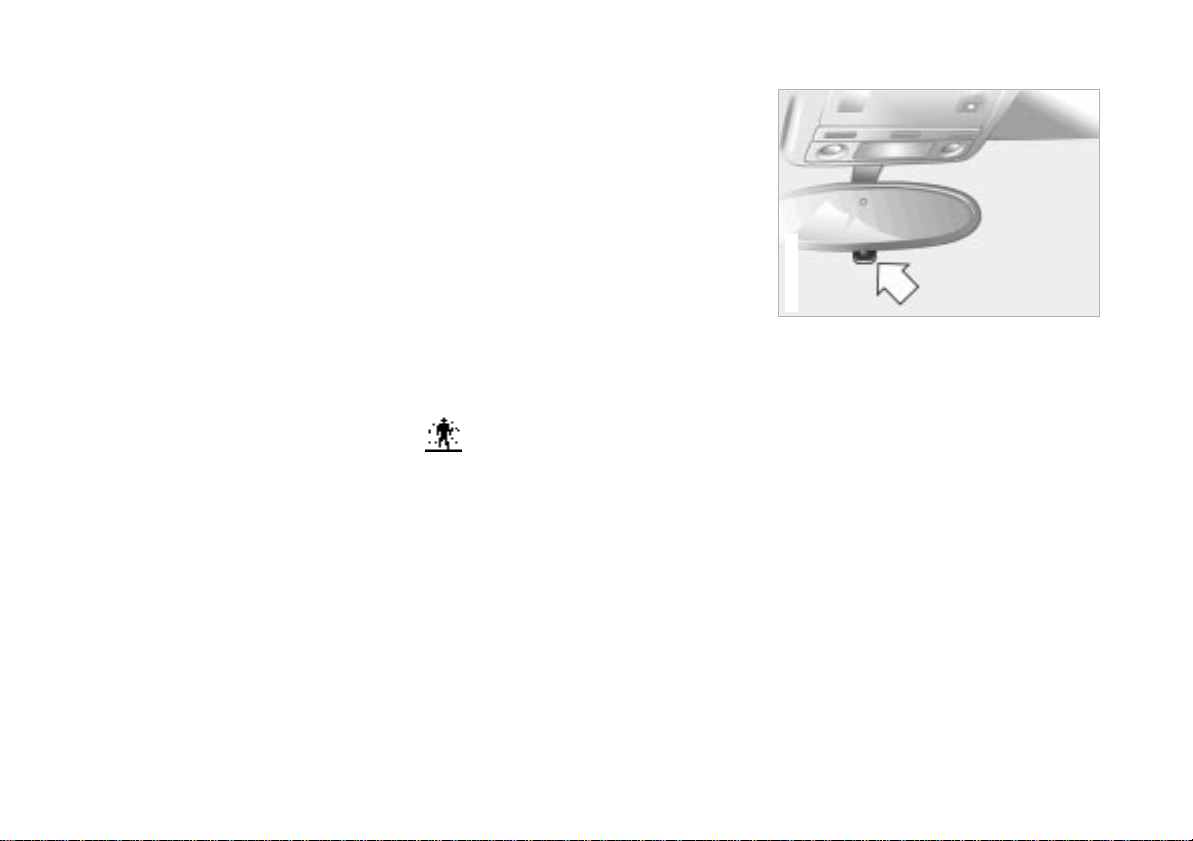
Hanger*
You will find a hanger on the left-hand
side of the luggage compartment for
fastening shopping bags, packages or
other items.
394de144
Online Edition Part-No. 01 41 0 155 062 - © 07/99 BMW AG
40n
Alarm system
The concept
The vehicle alarm system responds:
> When a door, the hood or the lug-
gage compartment lid is opened.
> To movement inside the vehicle (inte-
rior motion sensor).
> Changing the vehicle's tilt if someone
attempts to steal the wheels or tow
the vehicle.
> To an interruption in battery voltage.
The system responds to unauthorized
vehicle entry and attempted theft by
simultaneously activating the following:
> Sounding an acoustical alarm for 30
seconds.
> The hazard warning flashers are acti-
vated for approx. five minutes.
> The high beams flash on and off in
the same rhythm.
To activate and deactivate the
alarm system
When the vehicle is locked or unlocked
with the key or the remote control, the
alarm system is also simultaneously
armed or disarmed.
The interior motion sensor is activated
approx. 30 seconds after you have fin-
ished locking the car.
The system indicates that it has been
correctly armed by switching on the
hazard warning flashers for a single
cycle and by emitting an acoustical sig-
nal.
You can have various confirmation
messages set to inform you that
the alarm system has been armed or
disarmed (in preparation).<
You can still open the luggage compart-
ment after the system has been armed
by pressing button 3 of the remote con-
trol (refer to page 40). When you close
the luggage compartment, the lid is
secured again.
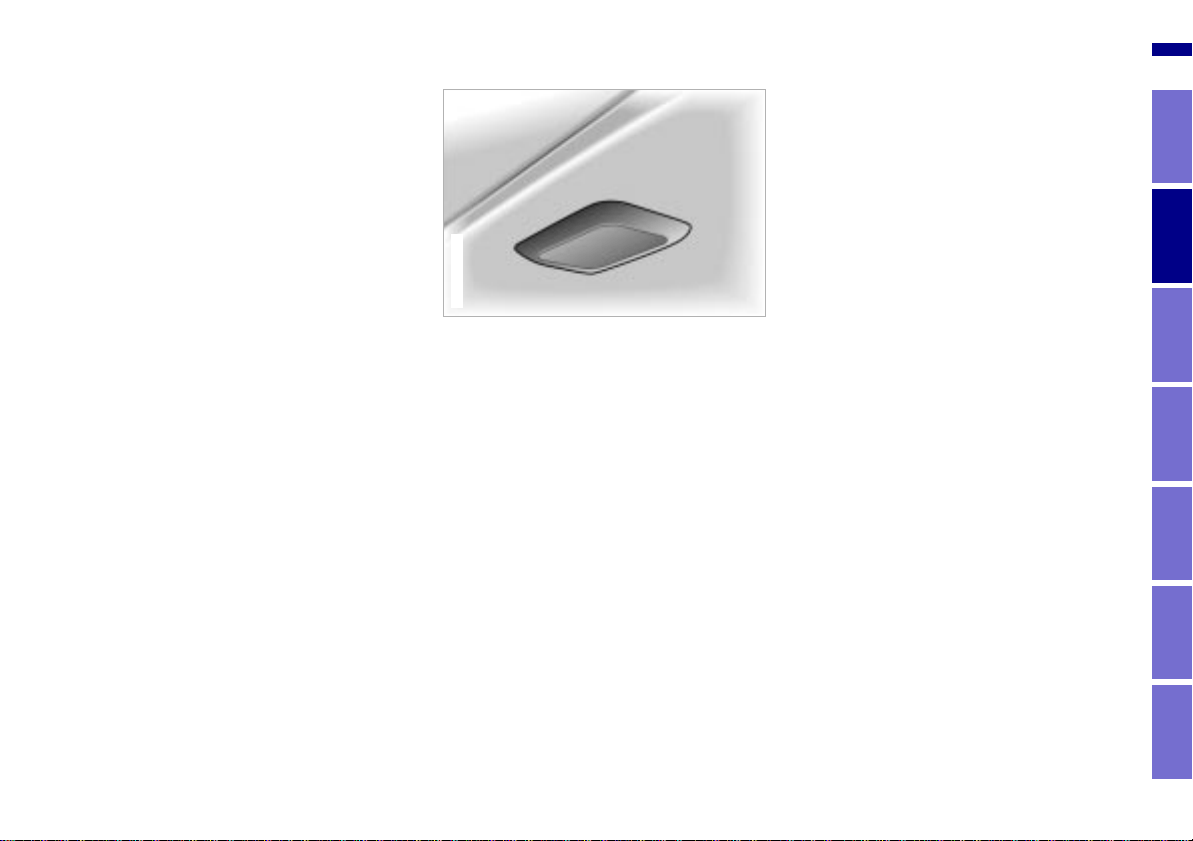
Indicator lamp displays
> The indicator lamp below the interior
rearview mirror flashes continuously:
The system is armed.
> The indicator lamp flashes when it is
armed: A door (or doors), the hood,
luggage compartment lid or rear win-
dow is not completely closed. Even if
you do not close the indicated area,
the system begins to monitor the re-
maining areas, and the indicator lamp
flashes continuously after 10 sec-
onds. However, the interior motion
sensor is not activated.
> If the indicator lamp goes out when
the system is disarmed: No manipula-
tion or attempted intrusions have
been detected in the period since the
system was armed.
39mde084
Online Edition Part-No. 01 41 0 155 062 - © 07/99 BMW AG
41n
RepairsIndex OverviewControlsCar careTechnologyData
Alarm system
> If the indicator lamp flashes for
10 seconds when the system is dis-
armed: An attempted entry has been
detected in the period since the sys-
tem was armed.
Following triggering of an alarm, the in-
dicator lamp will flash continuously.
Avoiding unintentional alarms
The tilt alarm sensor and interior motion
sensor may be switched off at the same
time. You can do this to prevent a false
alarm from being triggered (in garages
with elevator ramps, for instance), or
when the vehicle is transported by
trailer or train:
Actuate the lock (= arm the system)
twice; in other words, press button 2 of
the remote control twice in succession
(refer to page 34). You may also actuate
the locks twice with the key (refer to
page 34).
The indicator lamp lights up briefly and
then flashes continuously. The tilt alarm
sensor and the interior motion sensor
are deactivated as long as the system is
armed.
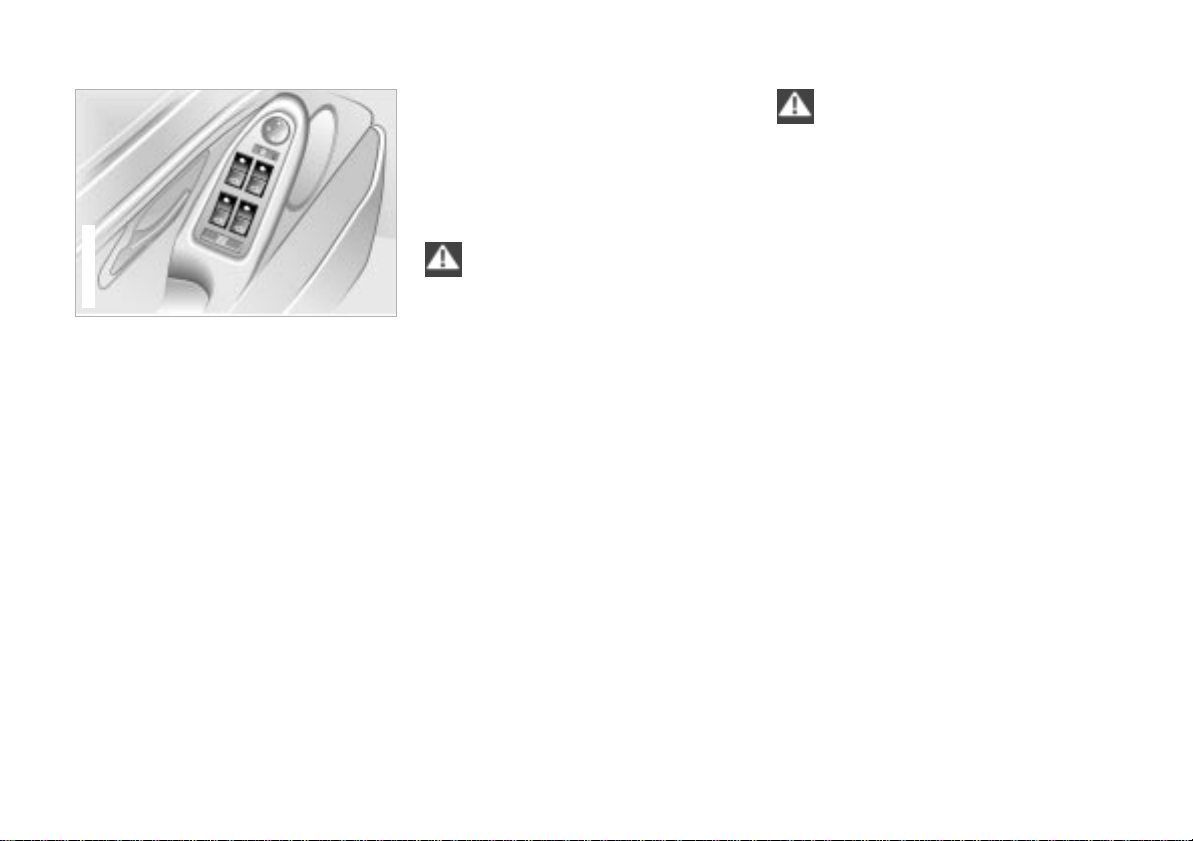
Interior motion sensor
The illustration depicts the transmitter
and receiver of the interior motion sen-
sor.
In order for the interior motion sensor
to function properly, the windows and
sliding/tilt sunroof must be completely
closed.
However, you should switch off the
interior motion sensor (see previous
column under the heading "Avoiding
unintentional alarms") if you wish to
leave the windows or sliding/tilt sunroof
open.
390de153
Online Edition Part-No. 01 41 0 155 062 - © 07/99 BMW AG
42n
Electric power windows
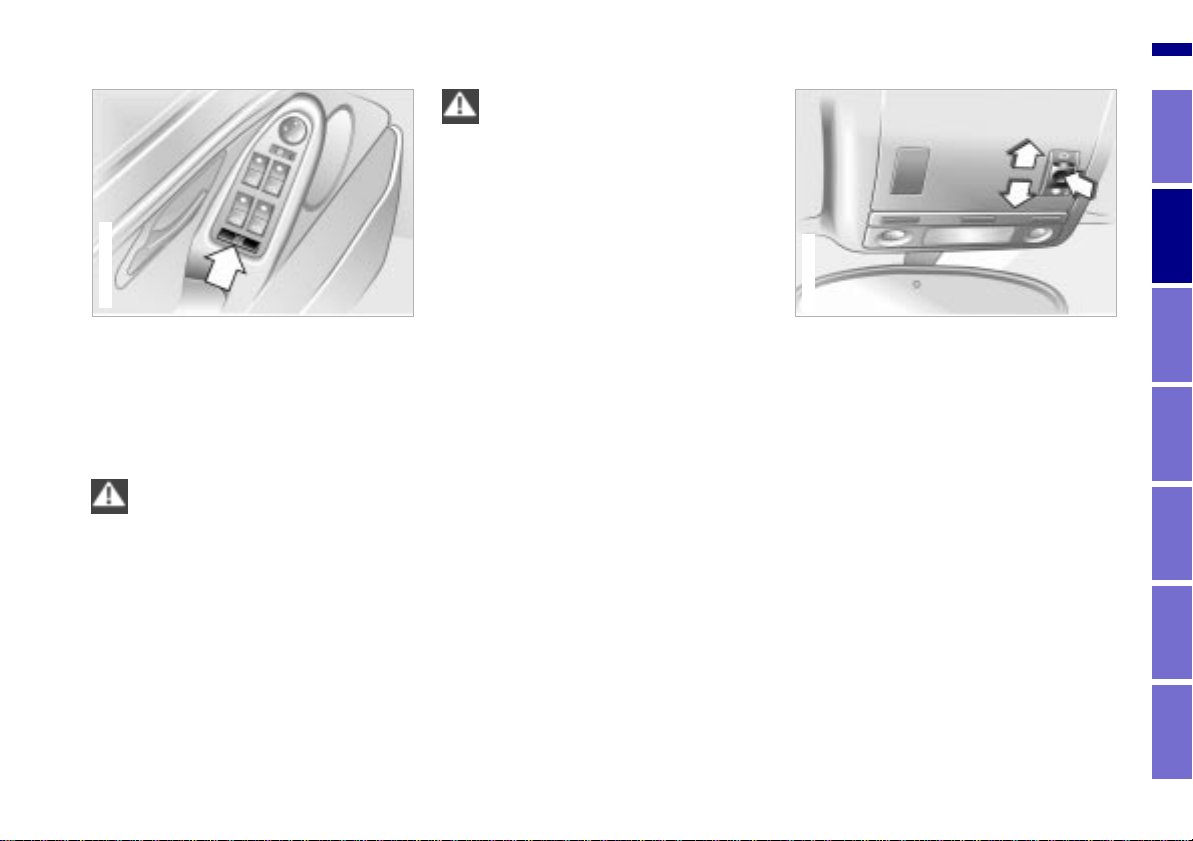
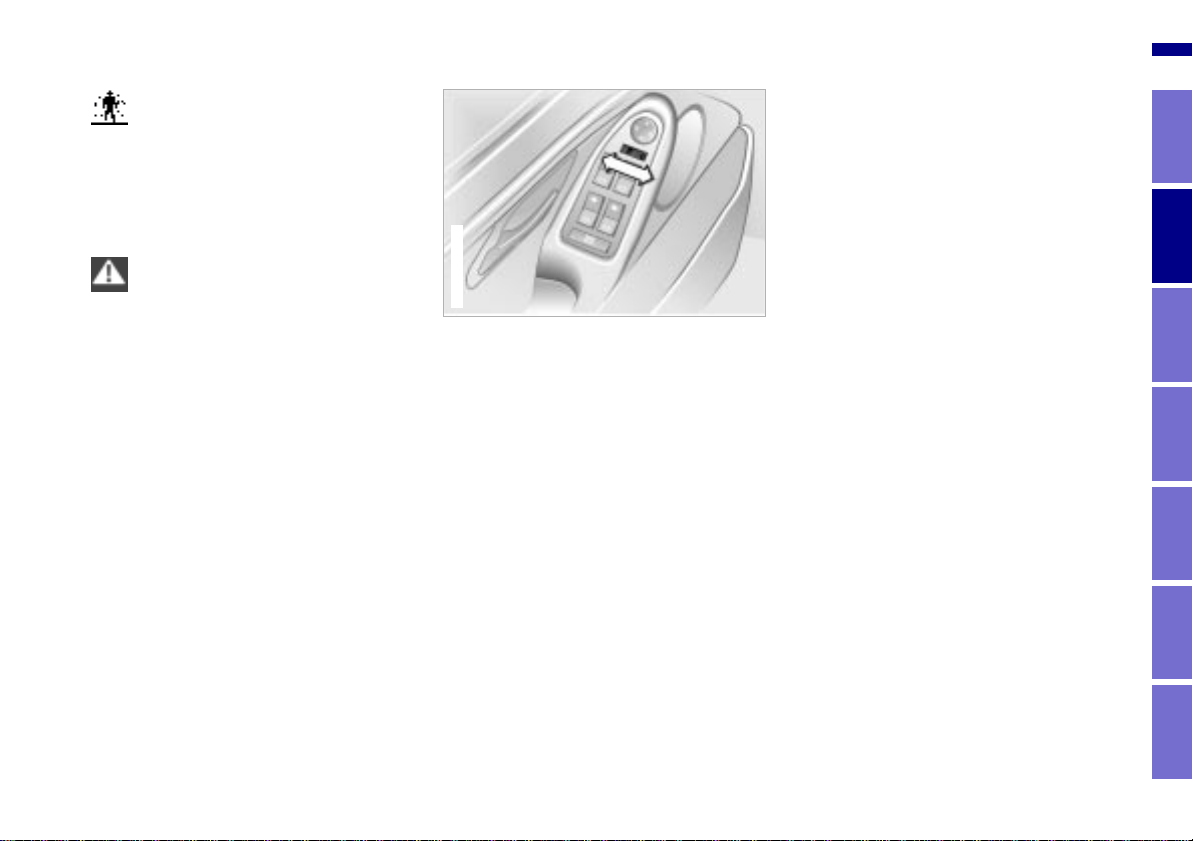
Open and close the windows
In ignition key position 1 and 2:
> Depress the rocker switch until you
feel resistance:
The window continues to move as
long as you maintain pressure on the
switch.
> Press the rocker switch beyond the
resistance point:
The window moves automatically.
Press the switch a second time to
stop the window.
390de055
After the ignition has been switched off:
> You can still operate the power win-
dows as long as neither of the front
doors has been opened. To open a
window, press the switch beyond the
resistance point.
Remove the key from the ignition
key and close the doors when you
leave the vehicle so that children can-
not operate the power windows and
possibly injure themselves.<
For convenience operation via the door
lock or remote control, refer to page 32
or 34.
Safety feature
A contact strip is located on the inside
upper frame of each of the windows. If
pressure is exerted against this contact
strip while a window is being raised, the
system will respond by stopping the
window and then retracting it a small
distance.
Despite this safety feature, be
extremely careful to ensure that
the closing path of the window is not
obstructed. Otherwise, an object might
not touch the contact strip in some situ-
ations (very thin objects, for instance).
You can disable this safety feature by
pressing the switch beyond the pres-
sure point and holding it.
Because the power windows are sealed
at high pressure to prevent wind noise
when closed, a powerful motor is re-
quired for efficient closing. When clos-
ing the windows, always be sure that
they are not obstructed in any way. Un-
supervised use of these systems can
result in serious personal injury. Re-
move the ignition key to deactivate the
electric power windows whenever you
leave the car. Never leave the keys in
the car with unsupervised children.
Never place anything that could ob-
struct the driver's vision on or next to
the windows.<
Online Edition Part-No. 01 41 0 155 062 - © 07/99 BMW AG
43n
RepairsIndex OverviewControlsCar careTechnologyData
Electric power windows Sliding/Tilt sunroof*
Safety switch
You can use the safety switch to deacti-
vate the rear power window switches
(with children in the rear seats, for in-
stance).
Press the safety switch whenever
children are riding in the rear of
the vehicle. Careless use of the power
windows can lead to injury.<
390de131
To prevent injuries, exercise care
when closing the sliding/tilt sun-
roof and keep it in your field of vision
until it is shut.
Before leaving the car, switch off the
electric sunroof mechanism by taking
out the ignition key. Do not leave chil-
dren unattended in the vehicle with ac-
cess to vehicle keys. Use of the key can
result in starting of the engine and oper-
ation of vehicle systems such as the
power sunroof. Unsupervised use of
these systems can result in serious per-
sonal injury.<
You can avoid pressure or drafts in the
passenger compartment when the sun-
roof is open or lifted by opening the air
vents in the dashboard and increasing
the air supply as required. Refer to
page 85.
If the sunroof is completely open, air
disturbances may be caused in the ve-
hicle when you are driving at higher
speeds. Close the roof as far as is nec-
essary until this natural phenomenon
ceases.
For convenience operation via the door
lock or remote control, refer to page 32
or 34.
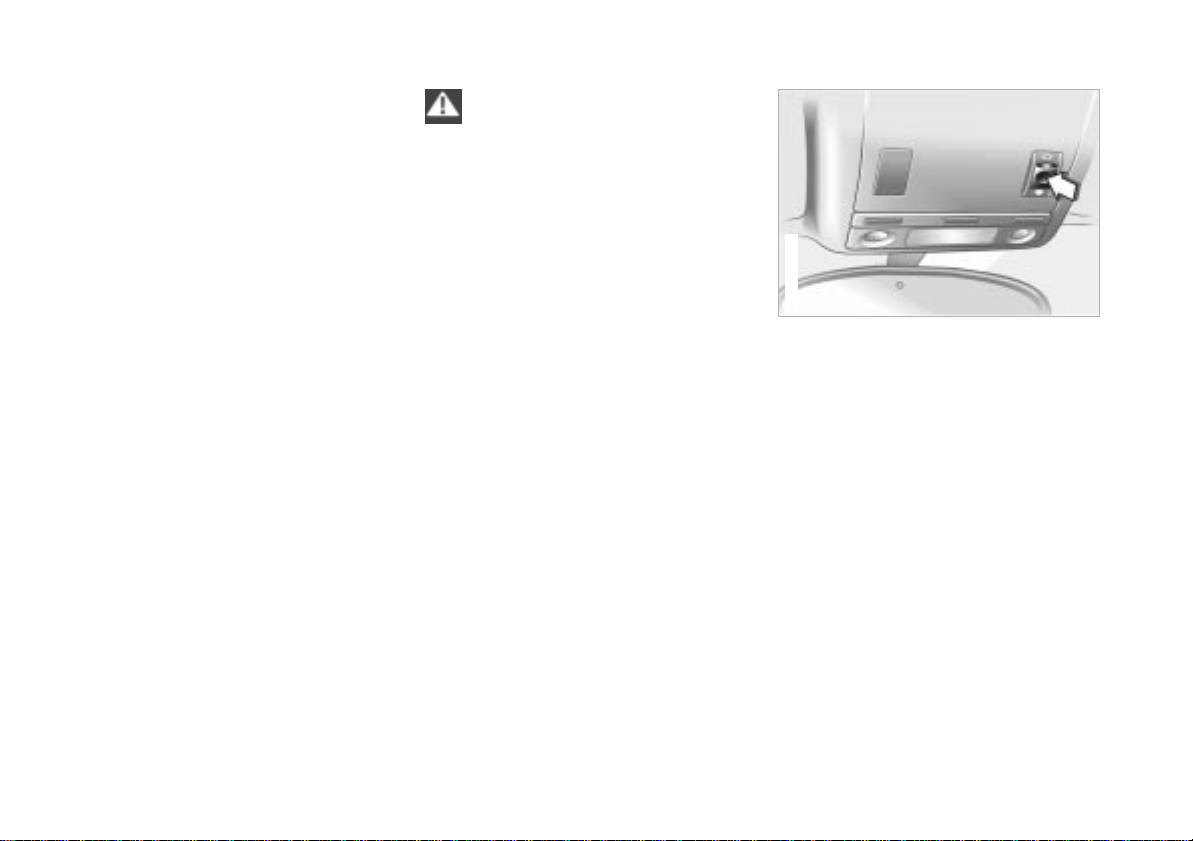
Lifting – Opening – Closing
With the ignition key in position 1 or
higher, press the switch or slide it to the
desired direction until you feel resis-
tance.
When lifting, the headliner retracts sev-
eral inches.
After the ignition has been switched off,
you can still operate the sunroof as long
as neither front door has been opened.
39mde085
Online Edition Part-No. 01 41 0 155 062 - © 07/99 BMW AG
44n
Sliding/Tilt sunroof*
Automatic* opening and closing
Press the switch past the resistance
point briefly: The sunroof travels to ei-
ther the fully-closed or fully-open posi-
tion.
Other automatic operations are:
> With the sunroof open, press the
switch briefly toward "Lift:"
The sunroof automatically extends to
its fully raised position.
> With the sunroof raised, press the
switch briefly toward "Open:"
The sunroof automatically extends to
the "Open" position.
Pressing the switch again stops the
motion immediately.
Safety feature
If the sliding/tilt sunroof encounters
resistance at a point roughly past the
middle of its travel when it is closing,
the closing cycle is interrupted and the
sunroof will open again slightly.
Despite this safety feature, be ex-
tremely careful to ensure that the
closing path of the roof is not ob-
structed. Otherwise, triggering the clos-
ing-force limitation may not be ensured
in some situations (with very thin ob-
jects, for instance). You can disable this
safety feature by pressing the switch
beyond the pressure point and holding
it.<
Sliding/Tilt sunroof with glass
moonroof
*
The options and control procedures are
essentially the same as those previously
described for the sliding/tilt sunroof. In
order to open the raised roof, press the
control switch towards "Open" until the
roof has reached the desired position.
The headliner insert slides back some-
what when you raise the sunroof. When
the sunroof is opened, the headliner
retracts with it. The headliner will then
automatically remain in its retracted
position, but can be repositioned as
desired.
Power loss or malfunction
Following a power interruption (if the
battery is disconnected, for instance),
the sunroof can only be raised in some
circumstances. To correct this situation:
1 Raise the sliding/tilt sunroof fully.
2 Press and hold the switch for approx.
20 seconds.
In the event of an electrical system mal-
function, the sliding/tilt sunroof can be
manually operated. Refer to page 157.
39mde086
Online Edition Part-No. 01 41 0 155 062 - © 07/99 BMW AG
45n
RepairsIndex OverviewControlsCar careTechnologyData
For maximum safety when adjusting the
seat position, please observe the fol-
lowing:
Never try to adjust your seat while
driving the vehicle. The seat could
respond with unexpected movement,
and the ensuing loss of vehicle control
could lead to an accident.
Be sure that the safety belt remains
firmly against your body at all times. In
the event of a frontal impact, a loose lap
belt could slide over your hips, leading
to abdominal injury. In addition, the
safety belt's restraint effectiveness is
reduced if the belt is worn loosely.
Never travel with the backrest reclined
to an extreme angle (especially impor-
tant for front passengers). Keep the
backrest relatively upright to minimize
the risk of sliding under the safety belt
and sustaining injury in the event of a
crash.
Do not move the seats to the rear when
the vehicle is at an extreme angle (on
garage ramps or steep slopes, for
example). If you do so, the automatic
safety belt height adjustment can be
disengaged.<
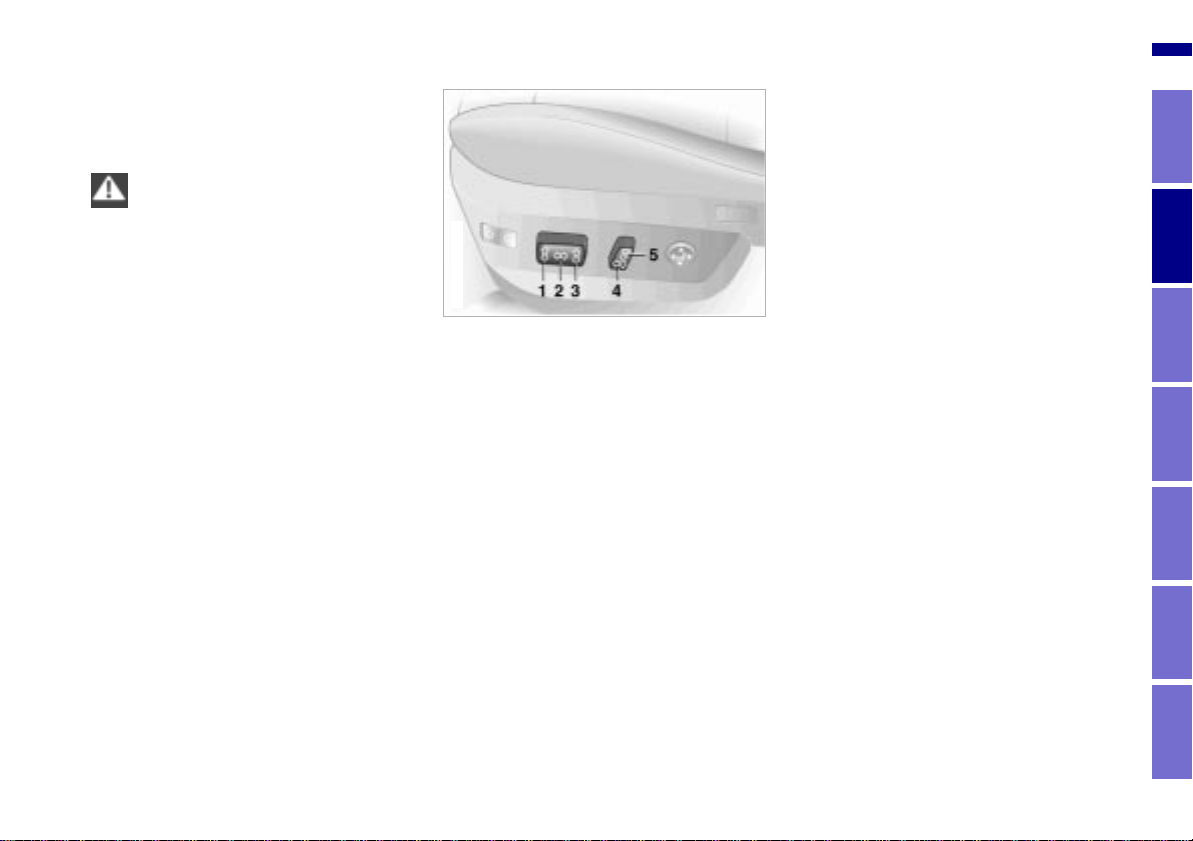
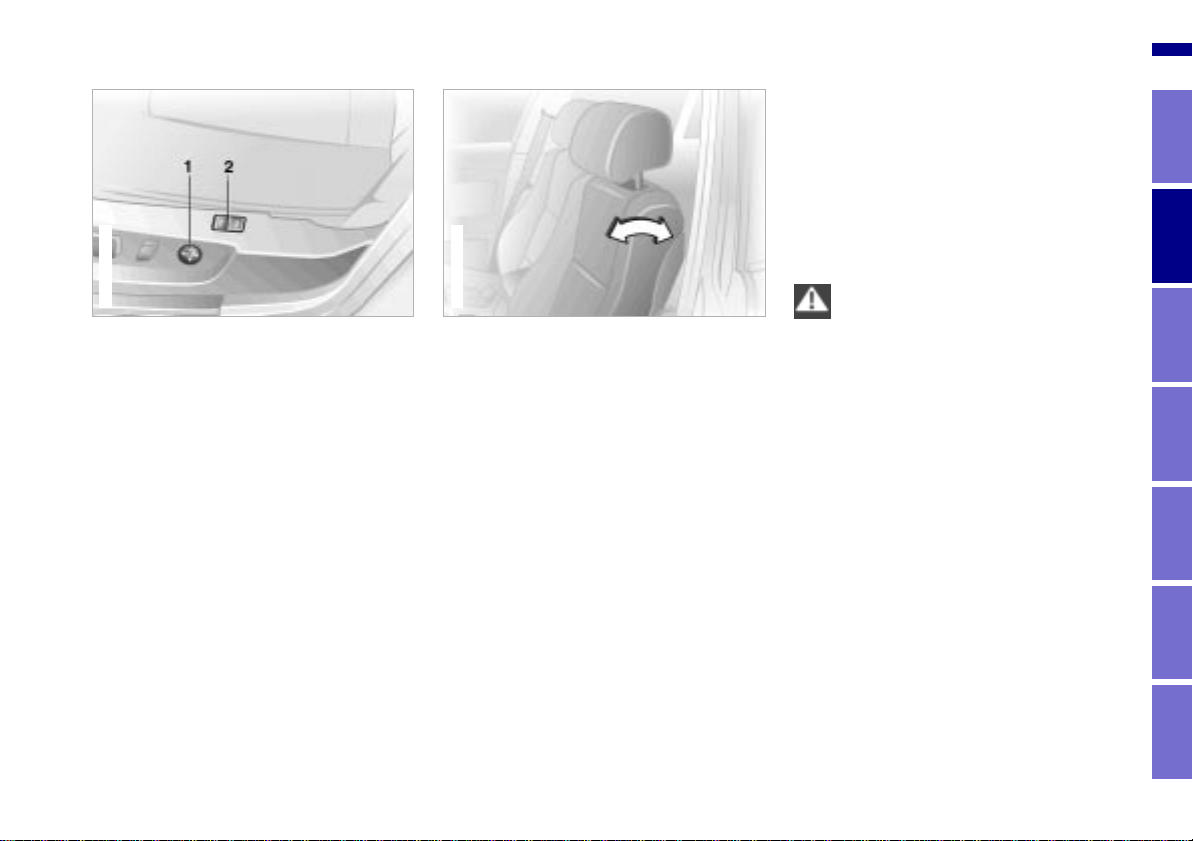
1 Tilt angle (driver seat only)
2 Backward/Forward adjustment
3 Cushion height
4 Backrest angle
5 Head restraint height.
Adjust the tilt angle of the head re-
straint manually by rotating it.
39mde009
Correct sitting posture
To reduce strain on your spinal column,
sit all the way back in the seat and rest
your back fully against the backrest.
The ideal sitting posture is achieved
when your head is extended from your
spine in a straight line.
For long-distance driving, you may wish
to increase the angle of the backrest
slightly to reduce muscular tension. You
should always be able to reach the
highest point on the steering wheel
without straightening your arms.
Seat adjustment BMW M Sports Seat
Online Edition Part-No. 01 41 0 155 062 - © 07/99 BMW AG
46n
BMW M Sports Seat
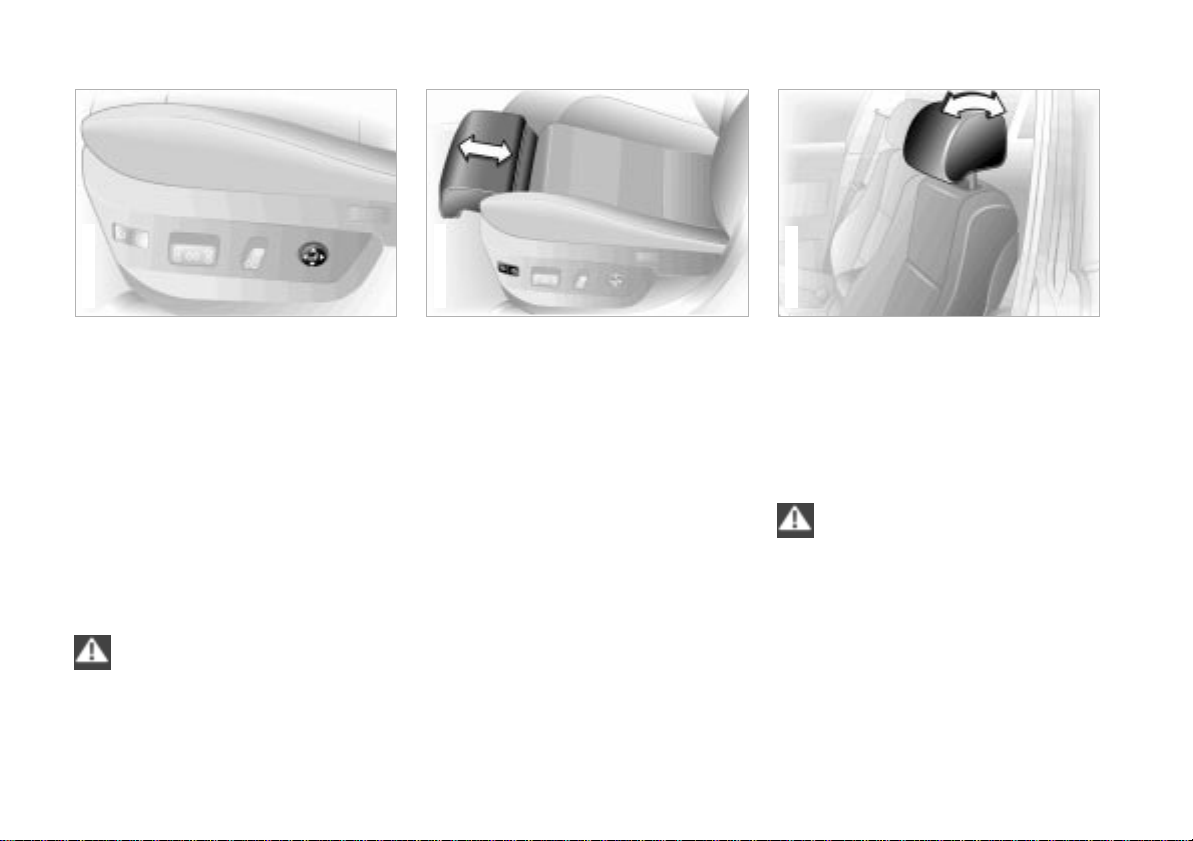
Lumbar support
You can adjust the backrest's contour
for additional support in the curvature
of your spine's lumbar region.
The upper hips and spinal column re-
ceive supplementary support to help
you maintain a relaxed, upright posture.
> Press the front/rear of switch: In-
crease/Decrease curvature.
> Press the upper/lower end of the
switch: Curvature is shifted upward
or downward.
Comply with the adjustment in-
structions on page 45. Failure to
do so could result in diminished per-
sonal safety.<
39mde010
Thigh support
You can also adjust the thigh support to
correspond with your personal comfort.
39mde011
Head restraints
Adjust the angle of the front head re-
straint by rotating it forward or back.
To adjust the height of the rear head re-
straints: Adjust by pulling up or pushing
down.
Head restraints reduce the risk of
spinal injury in the event of an ac-
cident.
Adjust the head restraint so that its cen-
ter is approximately level with your
ears.
Leave the center-rear head restraint in
the fully-lowered position at all times.
Extending it limits its function.<
39mde051
Online Edition Part-No. 01 41 0 155 062 - © 07/99 BMW AG
47n
RepairsIndex OverviewControlsCar careTechnologyData
BMW comfort seat*
This seat allows you to make additional
adjustments with the power seat sys-
tem (see under BMW M Sports Seat,
page 45) for
1 Lumbar support
2 Shoulder support
Lumbar support
See under BMW M Sport Seat on
page 46.
380de024
Shoulder support
Press the rocker switch to adjust the tilt
angle of the shoulder support.
You can use the adjustable upper back-
rest for supplementary support in the
shoulder region. This provides a relaxed
driving position and helps relieve stress
on the shoulder muscles.
To obtain the optimal shoulder support
setting, we recommend:
Driver and front passenger:
1 Adjust the upper backrest section to
its extreme rear position.
2 Adjust the seat to the optimal posi-
tion as described above under "Cor-
rect sitting posture."
3 Bring the upper backrest section for-
ward until your shoulders enjoy firm
support.
380de064
Front passenger's seat adjustment for
relaxed traveling:
1 Adjust the upper backrest section to
its extreme rear position.
2 Increase the seat cushion tilt.
3 Tilt the backrest somewhat further.
4 Bring the upper backrest section for-
ward.
Make corrections in the forward-
backward adjustment of the seat
to ensure that the safety belt still fits
firmly against your body. If you do not
do this, the protection provided by the
safety belt may be reduced.<
Online Edition Part-No. 01 41 0 155 062 - © 07/99 BMW AG
48n
BMW active seat* Adjusting the steering wheel
Active changes in the seat's surface
help to avoid muscle cramps, pain in
the spine's lumbar region and fatigue.
To activate the seat, press the button
(arrow).
For additional details concerning the
BMW active seat, please refer to the
chapter describing "Advanced technol-
ogy" on page 165.
390de629
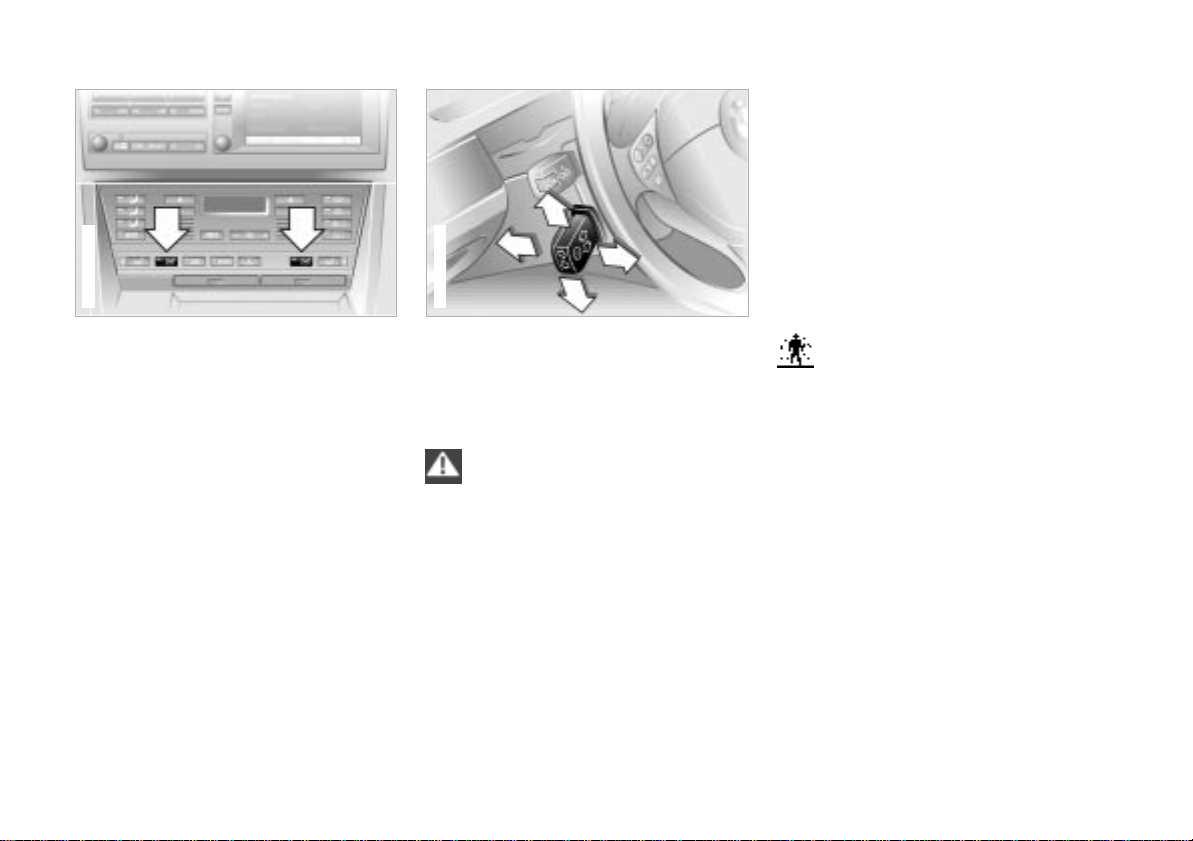
The steering wheel can be moved in
any of four directions. Adjust by moving
the control lever in the desired direc-
tion.
Do not adjust the steering wheel
while the vehicle is moving. There
is a risk of accident from unexpected
movement.<
To store the steering wheel setting,
refer to "Seat, mirror and steering wheel
memory" on page 50.
39mde073
Automatic steering wheel
adjustment
In order to make it easier to get into and
out of the car, the steering wheel auto-
matically moves into the top position
and returns to the driving (memory)
position.
This automatic feature is controlled by
the position of the ignition key and by
the driver's door.
Your BMW center can adjust your
vehicle's systems in such a man-
ner that your personalized setting is
automatically called up for the steering
wheel position when you unlock the car
with your personal remote control.<
Online Edition Part-No. 01 41 0 155 062 - © 07/99 BMW AG
49n
RepairsIndex OverviewControlsCar careTechnologyData
Mirrors
Exterior mirrors
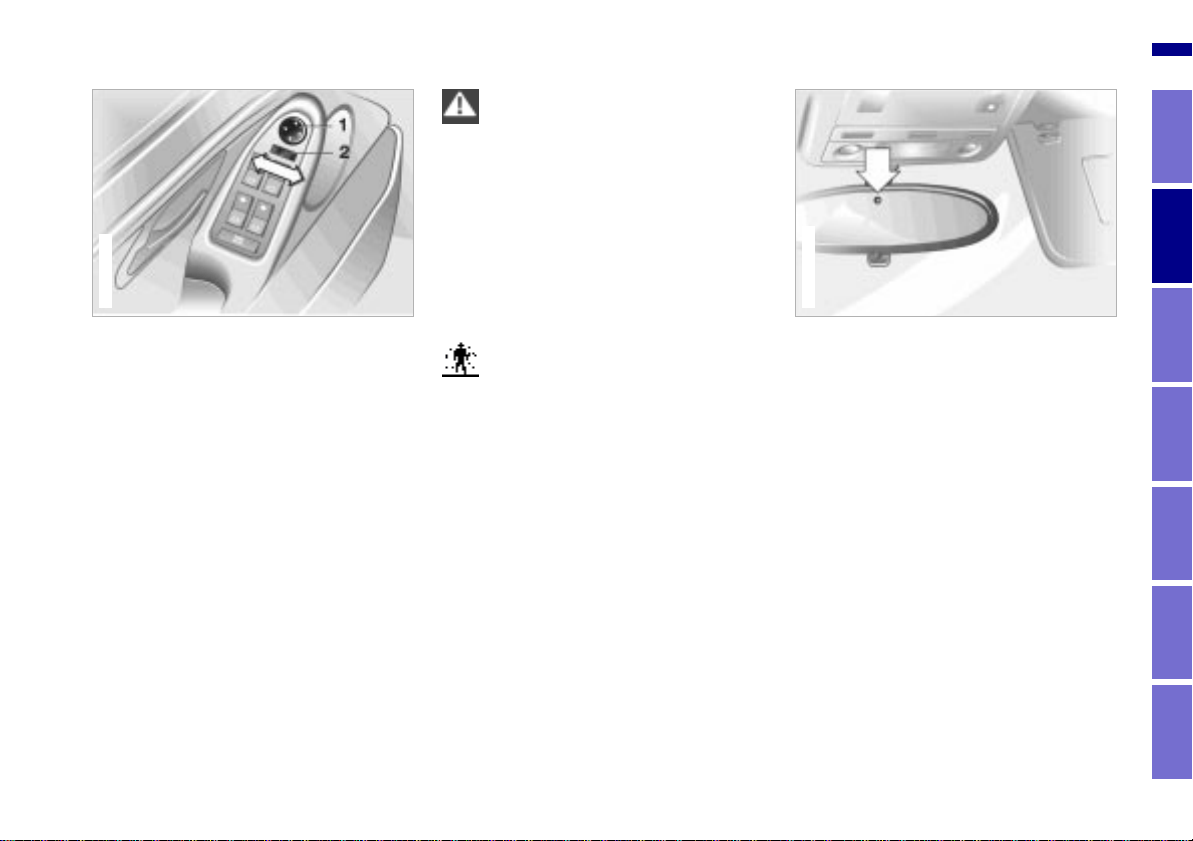
1 Switch for 4-way adjustment
2 Selection switch for changing be-
tween mirrors
You can also adjust the mirrors manu-
ally by pressing against the outer edges
of their lenses.
To store the mirror settings: Refer to
"Seat, mirror and steering wheel mem-
ory" on page 50.
390us605
The mirror on the passenger's
side features a lens with a more
convex surface than the mirror installed
on the driver's side. When estimating
the distance between yourself and
other traffic, bear in mind that the ob-
jects reflected in the mirror are closer
than they appear. This means that esti-
mations of the distance to following
traffic should not be regarded as pre-
cise.<
Your BMW center can adjust your
vehicle's systems in such a man-
ner that your personalized setting is
automatically called up for the mirror
position when you unlock the car with
your personal remote control.<
Self-defrosting mirrors
Both mirrors are automatically defrosted
with the ignition key in position 2.
Interior rearview mirror, automatic
dimming feature
By responding to the effects of ambient
light and the glare from following traffic,
this mirror dims automatically through
an infinitely-variable range.
The mirror automatically reverts to its
clear, undimmed setting whenever you
engage reverse gear.
To ensure that the mirror continues to
operate properly, keep the two photo-
cells clean and unobstructed. One pho-
tocell (arrow) is in the mirror glass,
while the other is offset somewhat on
the opposite side of the mirror.
For an explanation of the electrochromic
technology used in this mirror, refer to
page 167.
39mde082
Online Edition Part-No. 01 41 0 155 062 - © 07/99 BMW AG
50n
Mirrors Seat, mirror and steering wheel memory
Sun visors
The sun visors can be folded down to-
ward the windshield or swiveled out
against the side windows.
Lighted vanity mirror
Fold down the sun visor and slide the
cover panel to the side as required.
The mirror lamps operate in ignition key
positions 1 and 2.
Exterior mirrors with automatic
dimming feature
Both outside rearview mirrors also dim
automatically through an infinitely-vari-
able range.
39mde083
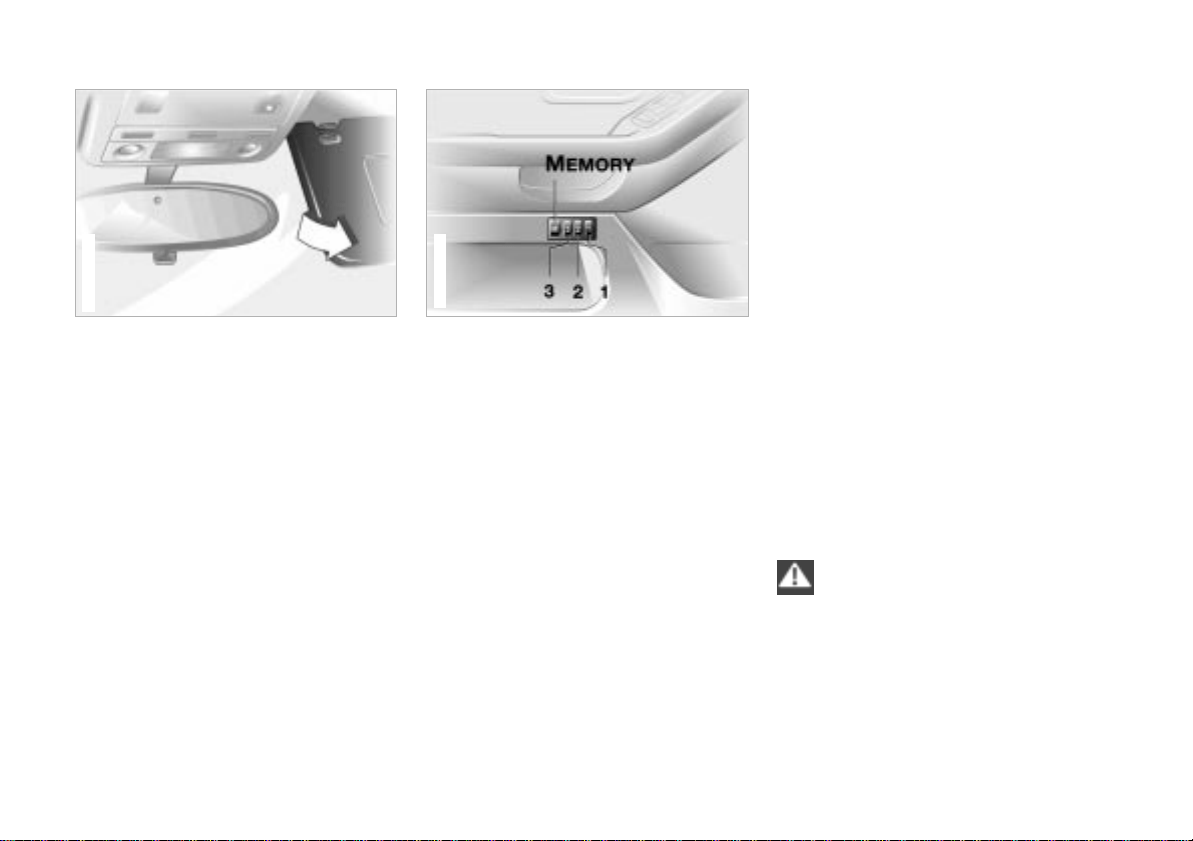
You can store and call up three different
seat, exterior mirror and steering wheel
positions. The illustration shows the
buttons on the driver's door, for making
these position adjustments.
The adjustment setting for the lumbar
support is not saved in the memory.
To store
1 Turn the key to ignition key position
1 or 2.
2 Adjust the desired positions for the
seat, door mirror and steering wheel.
3 Press the
MEMORY button: The indi-
cator lamp in the button lights up.
4 Press memory button 1, 2 or 3, as de-
sired: The indicator lamp goes out.
390de032
To select a stored setting
Convenience function:
1 Open the driver's door after unlock-
ing or put ignition key in position 1.
2 Briefly press memory button 1, 2 or 3,
as desired.
Movement stops immediately when
one of the seat-adjustment or mem-
ory buttons is activated during the
adjustment process.
Safety function:
1 With the driver's door closed and
ignition key either removed or in posi-
tion 0 or 2.
2 Maintain pressure on desired mem-
ory button 1, 2 or 3 until the adjust-
ment process is completed.
If you press the
MEMORY button acci-
dentally: Press the button a second
time, the indicator lamp goes out.
Do not call up a position from the
memory while the vehicle is mov-
ing. There is a risk of accident from
unexpected movement of the seat or
steering wheel.<
Online Edition Part-No. 01 41 0 155 062 - © 07/99 BMW AG
51n
RepairsIndex OverviewControlsCar careTechnologyData
Seat, mirror and steering wheel memory
Your BMW center can adjust your
vehicle's systems in such a man-
ner that your personalized settings are
automatically called up for the seat, mir-
ror and steering wheel positions when
you unlock the car with your personal
remote control.<
If you make use of this setting
mode, be sure that the footwell
behind the driver's seat is unobstructed
before unlocking the vehicle. Other-
wise, persons or objects could be in-
jured or damaged should the seat move
backward.<
Passenger side exterior mirror tilt
function
(automatic curb monitor)
1 Move the mirror selector switch
(arrow) to the "driver's mirror" posi-
tion.
2 When reverse gear is engaged, the
passenger-side mirror tilts down-
ward. This brings the area directly
adjacent to the car (curbs, etc.) into
the driver's field of vision as an assist
during parking.
You can deactivate this automatic fea-
ture by setting the mirror selection
switch to the "passenger side" position.
390de147
Online Edition Part-No. 01 41 0 155 062 - © 07/99 BMW AG
52n
Car Memory, Key Memory
How the system functions
You have probably frequently wished
that you could configure individual
functions of your vehicle to reflect your
own personal requirements. In develop-
ing this vehicle, BMW has "built in" a
few options that, should you so desire,
your BMW center can adjust for you.
There are settings related to the vehicle
("Car Memory") and settings related to
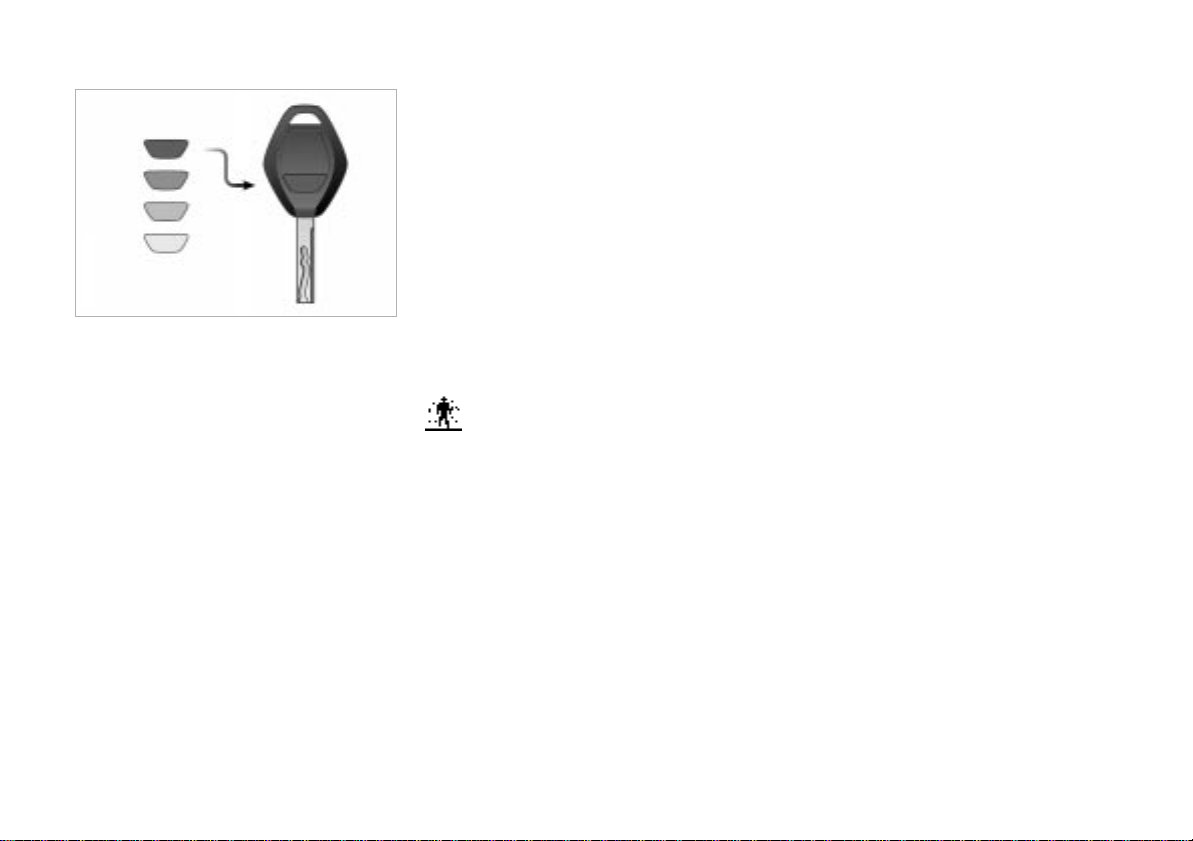
individuals ("Key Memory"). You can
configure two different basic settings
for two different persons. The only re-
quirement is that each person uses his
or her own remote control key.
463de029
When your vehicle is unlocked with the
remote control, the vehicle recognizes
the individual user by means of a data
exchange with the key, and makes ad-
justments accordingly.
In order for you to distinguish between
different keys, colored decals are sup-
plied together with the keys.
What the system can do
Your BMW center can provide you with
details on the capabilities of the Car
Memory and Key Memory systems.
You will see this symbol through-
out the Owner's Manual. It is to re-
mind you at appropriate places of the
settings that are available to you.<
An example for Key Memory is the auto-
matic adjustment of the driver's power
seat with stored settings for the individ-
ual person when the vehicle is un-
locked.
Online Edition Part-No. 01 41 0 155 062 - © 07/99 BMW AG
53n
RepairsIndex OverviewControlsCar careTechnologyData
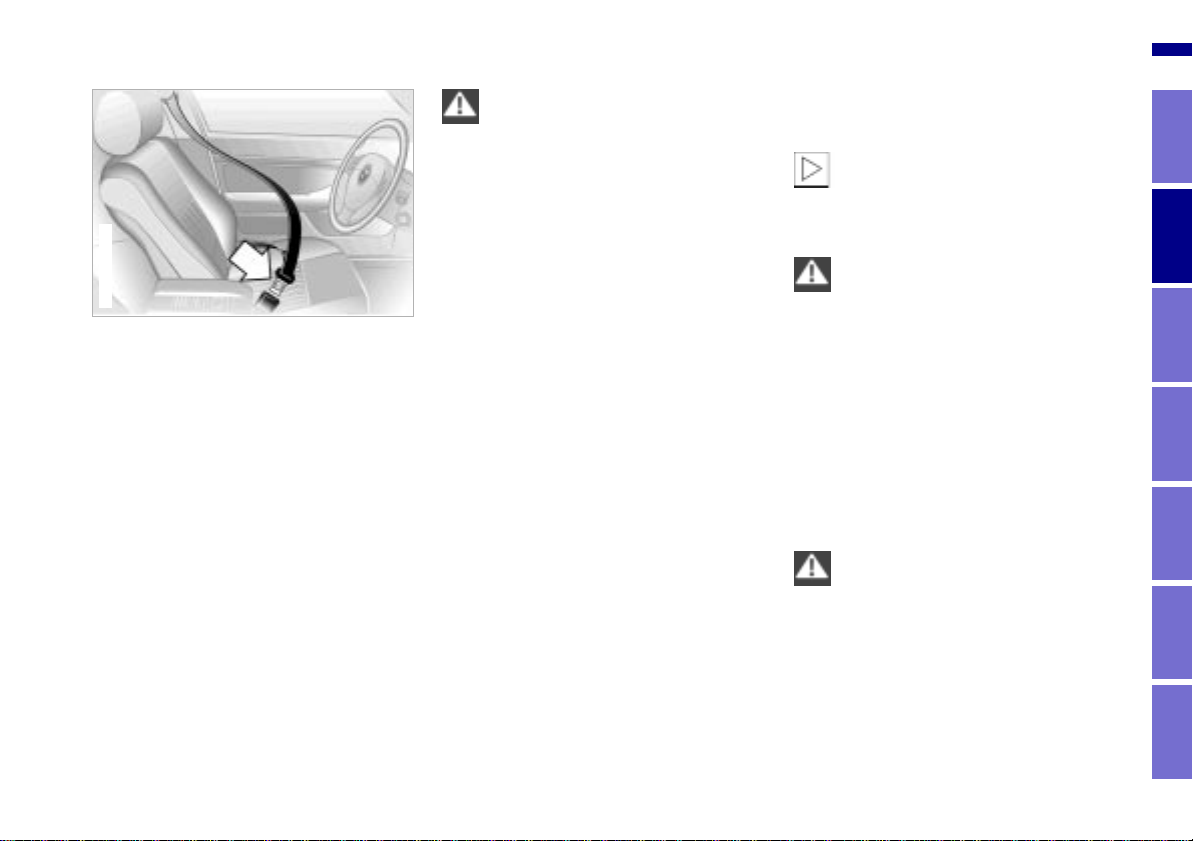
Fasten your safety belt before starting
off.
To fasten: Make sure you hear the catch
engage in the belt buckle.
To release: Press the red button in the
buckle. Hold the belt and guide it back
into its reel.
The shoulder belt anchor automatically
adjusts to continue providing an opti-
mum fit when you move the seat for-
ward or back.
The two safety belt buckles that are
integrated in the rear seat are for pas-
sengers sitting on the left and right. The
belt buckle with the word "CENTER" (in
the red button) is intended exclusively
for a passenger sitting in the middle.
39mde015
For your safety, comply with the
following instructions for wearing
safety belts. If you do not, the safety
belts may not be able to provide their
maximum protection. The following in-
formation also applies to your passen-
gers: Never allow more than one person
to wear a single safety belt. Never allow
infants or small children to ride in a pas-
senger's lap.
Avoid twisting the belt while routing it
firmly across the hips and shoulder. Do
not allow the belt to rest against hard or
fragile objects in your pockets. Never
route the belt across your neck, do not
run it across sharp edges and ensure
that the belt does not become caught or
jammed.
Be sure that the safety belt fits snugly
against your body at all times, and avoid
wearing clothing that prevents the belt
from fitting properly. Pull on the belt pe-
riodically to readjust the tension over
your shoulder. In the event of a frontal
impact, a loose lap belt could slide over
your hips, leading to abdominal injury. In
addition, the safety belt's restraint ef-
fectiveness is reduced if the belt is worn
loosely. Expectant mothers should al-
ways wear their safety belts, taking care
to position the lap belt against the lower
hips, where it will not exert pressure
against the abdominal area.<
For care instructions, refer to "Car care"
on page 136.
Vehicles with through-loading sys-
tem
*: Please read and comply
with the instructions for the center
safety belt on page 99.<
If the safety belt system has been
subjected to the stresses involved
in an accident or otherwise damaged:
Have the entire safety belt mechanism
replaced by your BMW center, includ-
ing the safety belt tensioner. In addition,
have your BMW center inspect the
safety belt anchors. If a child restraint
system was in the vehicle during an
accident, consult the manufacturer's
instructions regarding replacement. <
Child restraint systems*
Do not install a rear-facing child
restraint system in the front pas-
senger seat of your vehicle. If you do
so, the child could be injured in an acci-
dent when the airbag is triggered.
Do not modify the child restraint system
in any way. If you do so, it will not pro-
vide your child with maximum protec-
tion.<
Safety belts
Online Edition Part-No. 01 41 0 155 062 - © 07/99 BMW AG
54n
Airbags
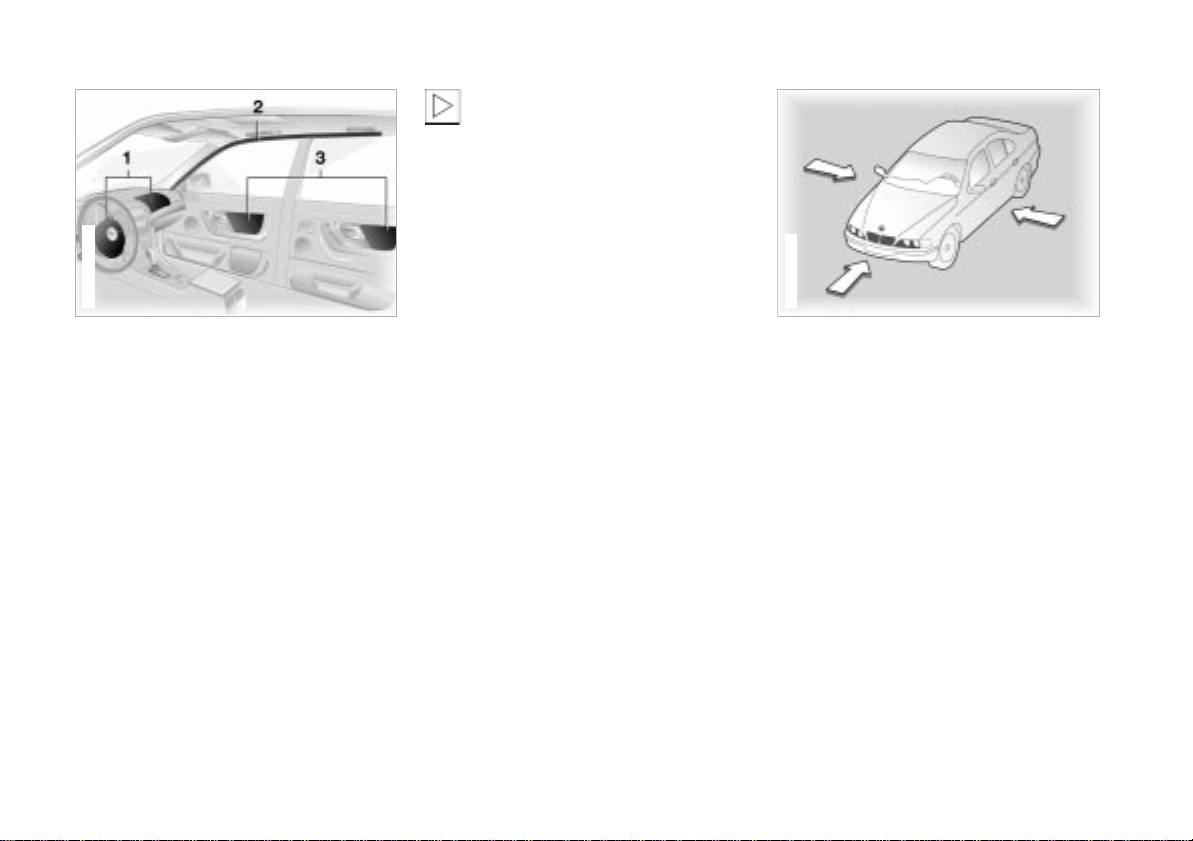
1 Front airbag for driver and passenger
2 Side impact Head Protection System
(front)
3 Side airbags (front and rear side
*)
Protective effect
The front airbags supplement the three-
point safety belts by providing addi-
tional protection for the front-seat oc-
cupants in the event of a severe frontal
collision in which the protection af-
forded by the belts alone may no longer
be sufficient. The head protection and
side airbags help provide protection in
the event of a collision from the side.
Each of the side airbags is designed to
help support the upper body.
39mde016
The side airbags in the rear pas-
senger area
* of your vehicle may
already have been deactivated, either at
the time of manufacture or by a BMW
center. You may have them activated if
you desire to do so. Please contact
your BMW center for additional infor-
mation.<
The illustration depicts schematically
the primary directions of vehicle impact
that initiate an airbag deployment.
390de142
Online Edition Part-No. 01 41 0 155 062 - © 07/99 BMW AG

55n
RepairsIndex OverviewControlsCar careTechnologyData
Airbags
Indicator lamp
The indicator lamp displays the
operational status of the airbag
system with the ignition key in
position 1 and higher.
System operational:
> The indicator lamp comes on briefly
then goes out.
System malfunction:
> The indicator lamp fails to come on.
> The indicator lamp comes on briefly
before going out and then lighting
up again.
A system malfunction could prevent
the system from responding to an
impact occurring within its normal
response range.
Please have your BMW center inspect
and repair the system as soon as
possible.
Correct seating posture with
airbags
For your own safety, please ob-
serve the following precautions
concerning airbags. If you do not, their
protective function may be impaired
and your personal safety in jeopardy.
This information applies to all vehicle
occupants: The airbags are a supple-
mental restraint device designed to pro-
vide extra protection; they are not a
substitute for safety belts. Wear your
safety belt at all times. The airbags will
not be triggered in the event of a minor
accident, a vehicle roll-over, or colli-
sions from the rear. In this case, the
safety belt offers the best protection.
Airbags are located under cover panels
in the steering wheel, dashboard, front
and rear
* side trim panels, windshield
pillars and the sides of the headliner.
Select a seat position that is comfort-
able and allows the greatest possible
distance from the airbags in your seat-
ing area. To avoid injuries to your hands
and arms, always grasp the steering
wheel on the rim with your hands at the
9 o'clock and 3 o'clock positions. Do
not place your hands on the center pad.
Never allow any objects to obstruct the
area between the airbag and an occu-
pant.
Do not use the cover panel above the
passenger-front airbag as a storage
area.
Never tape the airbag cover panels,
cover them over or alter them in any
other way.
Do not install a rear-facing child re-
straint system in the front passenger
seat of this car. Children under 13 years
of age and children less than 5 feet
(150 cm) tall should ride only in the rear
seat.
If your car is equipped with side airbags
in the rear passenger area, be sure that
child restraints are mounted correctly
and provided with the greatest-possible
distance between the airbags in the
side trim panels. Do not allow children
to lean out of the child seat in the direc-
tion of the side trim panels. Otherwise,
serious injuries could occur if the airbag
is triggered (if activated per customer
request).<
Online Edition Part-No. 01 41 0 155 062 - © 07/99 BMW AG

56n
Airbags
At all times, occupants should sit up-
right and be properly restrained (infants
and small children in appropriate child
restraint systems; larger children and
adults using the safety belts). Never let
an occupant's head rest near or on a
side airbag because the inflating airbag
could cause a serious or fatal injury.
Please note that the word "Airbag" im-
printed on the door trim panel indicates
the airbag’s location.
Infants or small children should never
be held on the lap of a passenger.
Accident research shows that the saf-
est place for children in an automobile
is in the rear seat. However, a child sit-
ting in the rear seat and not properly re-
strained may place his or her head on
or near the side airbag, if so equipped.
For example, a child – even though
belted – may fall asleep with his or her
head against the side airbag. It may be
difficult for a driver to ensure that chil-
dren in the rear seat will remain prop-
erly positioned at all times and not
place their heads on or near the side
airbag.
Therefore, we recommend that the
rear-seat side airbags, if provided, be
deactivated if children will be travelling
in the rear seat.
The rear seat side airbags may already
have been deactivated, either at the
time of manufacture or by a BMW cen-
ter. Labels in the rear door opening
should indicate the status of your rear
seat side airbags. If you are uncertain of
their status, or wish to have the airbags
activated or deactivated, please con-
tact your BMW center.
Even when all these guidelines are ob-
served, there is still a small residual risk
of injuries to the face, hands and arms
occurring from airbag deployment in
isolated instances.
The ignition and inflation noise may
provoke a mild temporary hearing loss
in extremely sensitive individuals.
Airbag warning information is also pro-
vided on the sun visors.
For additional information concerning
the airbag system, refer to pages 139
and 164.
Online Edition Part-No. 01 41 0 155 062 - © 07/99 BMW AG
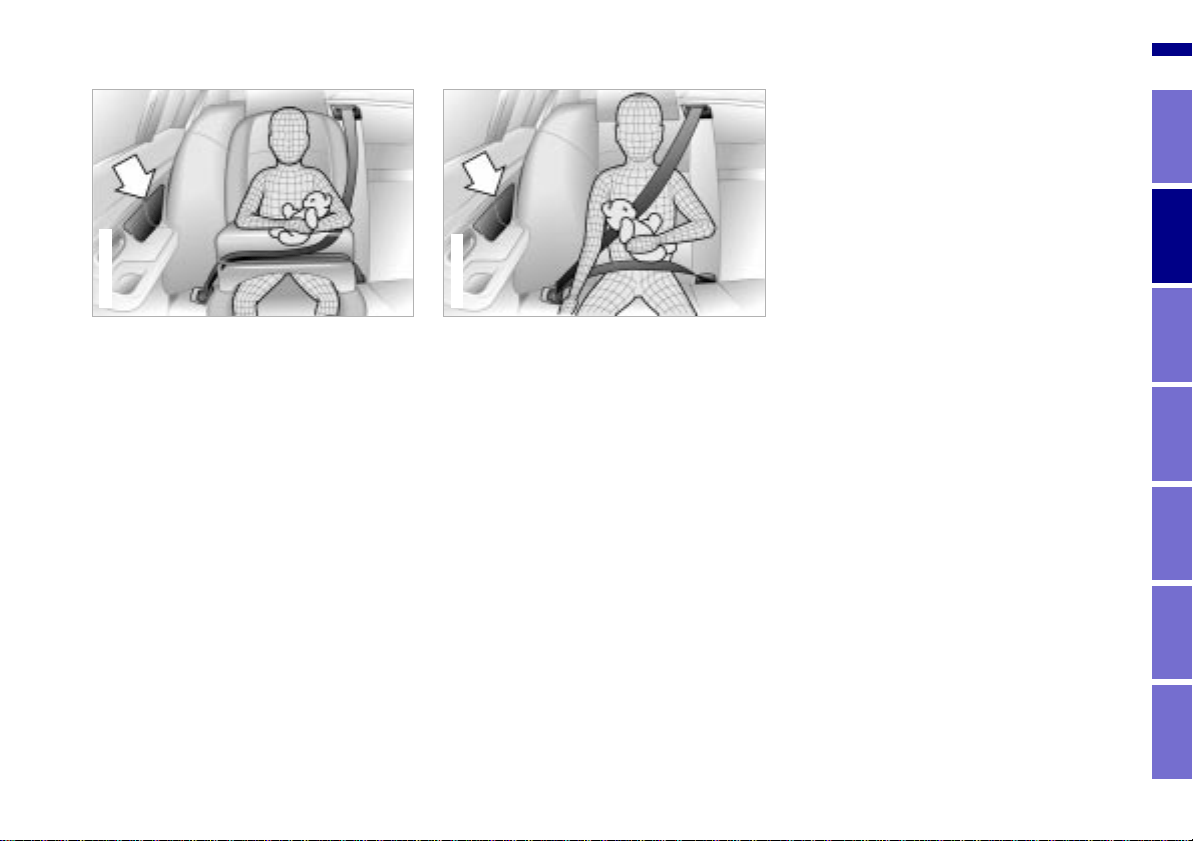
57n
RepairsIndex OverviewControlsCar careTechnologyData
Airbags
This is the right way for a child to sit in a
child restraint when rear side airbags
(arrow) are provided.
380de637
This is the right way for a larger child to
sit wearing the safety belt when rear
side airbags (arrow) are provided.
380de638
Online Edition Part-No. 01 41 0 155 062 - © 07/99 BMW AG
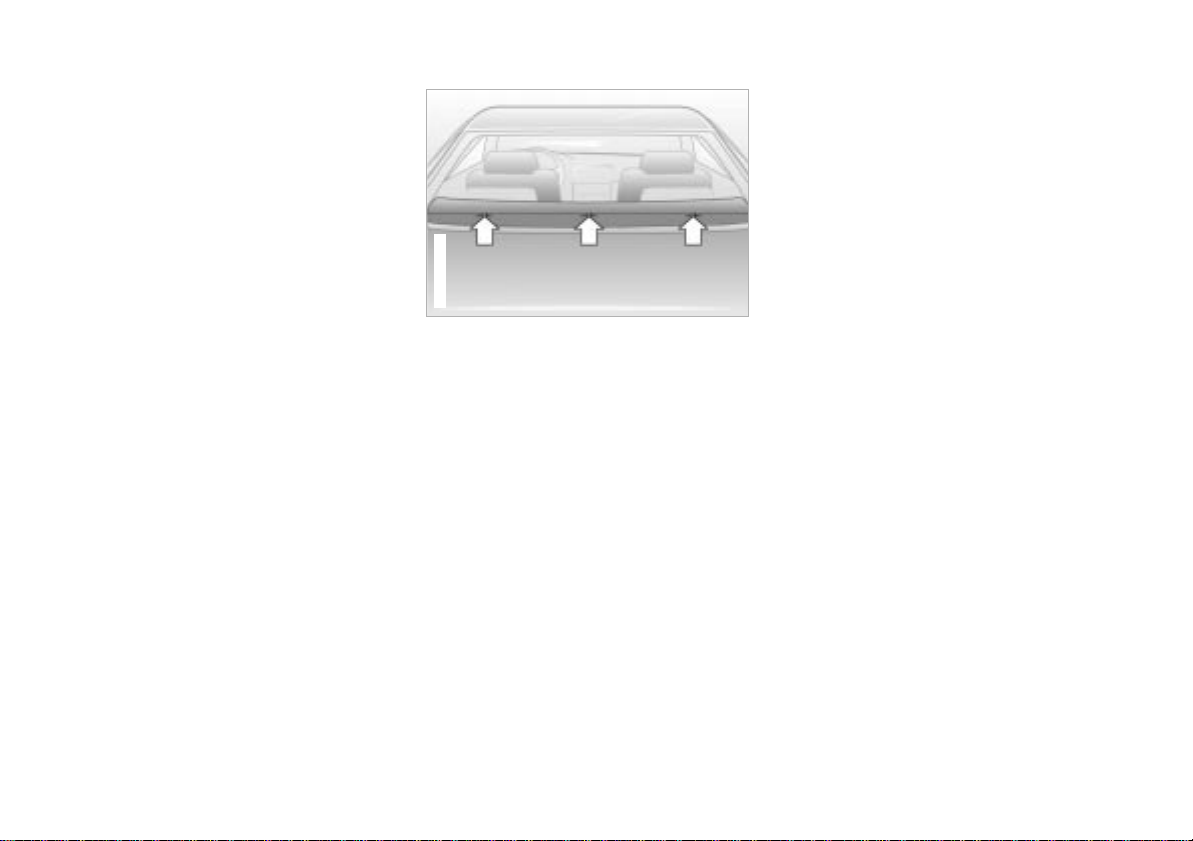
58n
Child restraints*
Commercially-available child restraint
systems are designed to be secured
with a lap belt or with the lap belt por-
tion of a combination lap/shoulder belt.
Improperly or inadequately installed re-
straint systems can increase the risk of
injury to children. Always read and fol-
low the instructions that come with the
system.
If you use a child restraint system with
a tether strap, three additional tether
anchorage points have been provided
(refer to the arrows in the illustration).
Depending on the location selected for
seating in the rear passenger area,
attach the strap hook to the corre-
sponding anchorage point to secure the
child restraint system.
If the respective seating position is fit-
ted with a headrest lift the headrest and
pass the tether strap between the head-
rest and the seat back.
Adjust the tether strap according to the
child restraint manufacturer's instruc-
tions.
380us123
Online Edition Part-No. 01 41 0 155 062 - © 07/99 BMW AG

59n
RepairsIndex OverviewControlsCar careTechnologyData
Child restraints*
Before installing any child restraint
device or child seat, please read
the following:
Never install a rear-facing child restraint
system in the front passenger seat of
this car.
Your car is equipped with an airbag
supplemental restraint system for the
front passenger. Because the backrest
on any rear-facing child restraint sys-
tem (of the kind designed for infants un-
der 1 year and 20 Ibs./9 kg) would be
within the airbag's deployment range,
you should never mount such a device
in the front passenger seat, since the
impact of the airbag against the child
restraint's backrest could lead to seri-
ous or fatal injuries.
If it is necessary for a child (not an in-
fant) to ride in the front seat, certain
precautions should be taken. First,
move the passenger seat as far away
from the dashboard as possible. This
important precaution is intended to
maximize the distance between the air-
bag and the child. Older children should
be tightly secured with a safety belt.
Younger children should be secured in
an appropriate forward-facing child re-
straint system that has first been prop-
erly secured with a safety belt. Never
install a rear-facing child restraint sys-
tem in the front passenger seat. We
strongly urge you to carefully read and
comply with the instructions for installa-
tion and use provided by the child re-
straint's manufacturer whenever you
use such a device.
Be sure that all occupants (of all ages)
remain properly and securely restrained
at all times.<
All rear seating positions in your vehicle
meet the recommendations of SAE
J1819, an industry-recommended prac-
tice for securing child restraint systems
in motor vehicles.
Online Edition Part-No. 01 41 0 155 062 - © 07/99 BMW AG
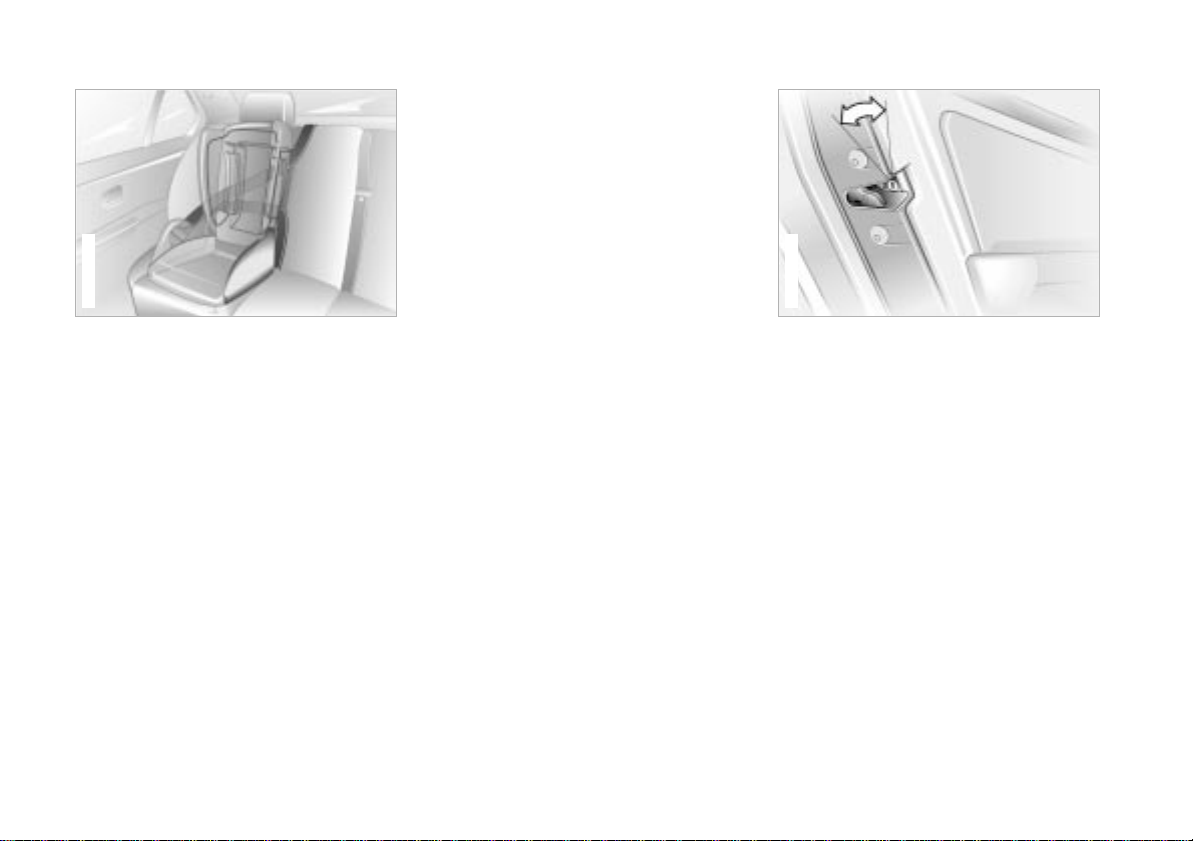
60n
Child seat security Child-safety locks
All of the rear belt retractors and the
front passenger's safety belt can be
locked for mounting and securing child
restraint systems.
Information regarding this is located
near the buckle latch of each safety
belt.
To lock the belt
Pull the entire length of the belt from
the belt retractor. Allow the reel to re-
tract the belt somewhat and engage the
buckle, then tighten the belt against the
child restraint system. The retraction
mechanism is now locked.
365us146
To release the belt
Release the buckle, remove the child-
restraint device and allow the inertia
reel to retract the belt completely.
Insert the key into a rear door lock and
turn it outward:
The door can now be opened from the
outside only.
390de019
Online Edition Part-No. 01 41 0 155 062 - © 07/99 BMW AG
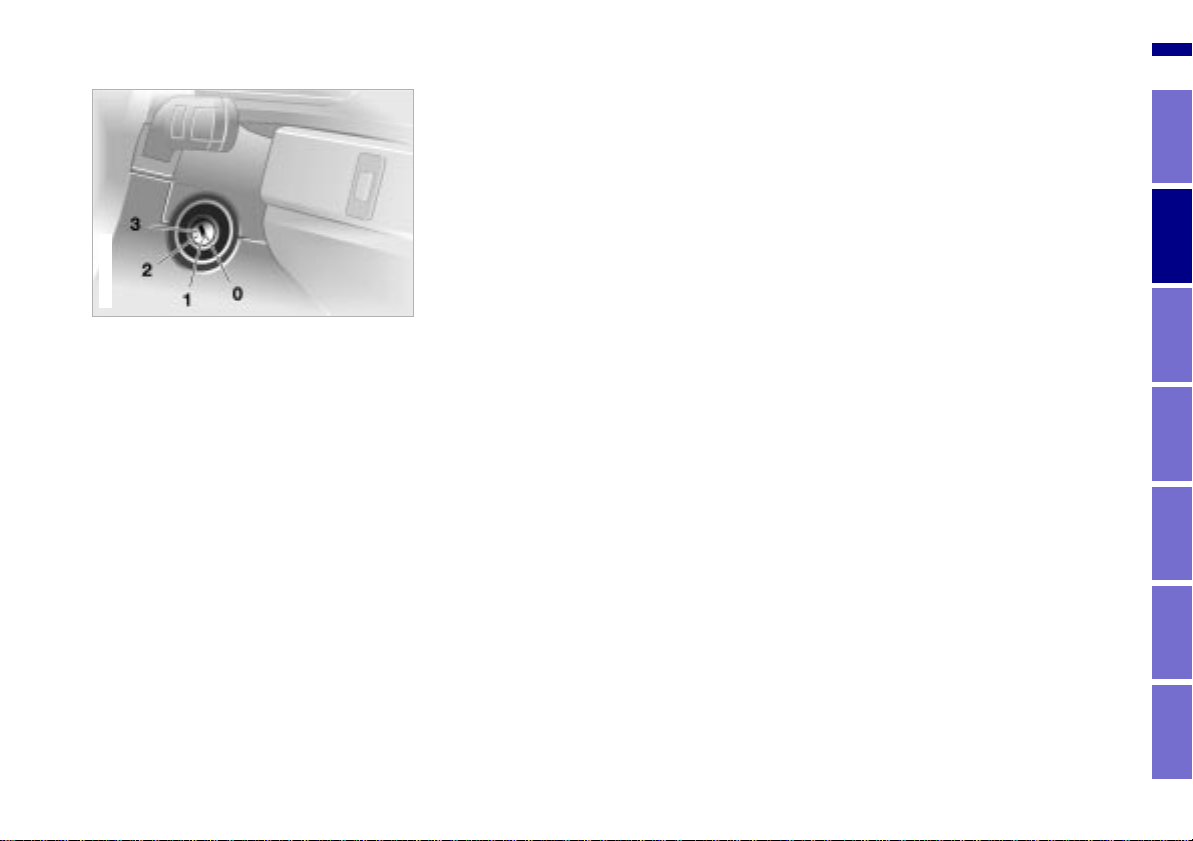
61n
RepairsIndex OverviewControlsCar careTechnologyData
0 Steering lock engaged
The key can be inserted and removed in
this position only.
An acoustic warning is sounded when
you fail to remove the ignition key after
opening the driver's door.
After removing the key, turn the steer-
ing wheel slightly to the left or right until
you hear the lock engage.
390de010
1 Steering lock disengaged
Turning the steering wheel slightly to
the right or left often makes it easier to
turn the key from 0 to 1.
Individual electrical accessories are
ready for operation.
2 Ignition on
All electrical equipment and accesso-
ries are available for use.
3 Starting the engine
Steering/Ignition lock
Online Edition Part-No. 01 41 0 155 062 - © 07/99 BMW AG

62n
Starting the engine Switching off the engine
Before starting
> Engage the parking brake.
> Move the shift lever to the neutral
position.
> Depress the clutch pedal.
Do not allow the engine to run in
enclosed spaces. The exhaust
gases contain carbon monoxide, an
odorless and colorless, but highly toxic
gas. Breathing the exhaust gases poses
an extreme health risk, and can lead to
unconsciousness and death.
Never leave the car unattended with the
engine running. An unattended vehicle
with a running engine represents a po-
tential safety hazard.<
Starting the engine
> Start the engine. Do not press the
accelerator pedal.
Do not actuate the starter for too
short a time. Do not turn it for
more than approx. 20 seconds. Release
the ignition key immediately as soon as
the engine starts.
Do not allow the engine to warm up by
leaving it running while the vehicle re-
mains stationary. Instead, begin driving
immediately at a moderate engine
speed.<
If the engine does not start on the first
attempt (the engine is very hot or cold,
for instance):
> Press the accelerator pedal halfway
down while engaging the starter.
Cold starts at very low temperatures,
from approx. +5 7 (–15 6) and at alti-
tudes above 3,300 feet (1,000 m):
> On the first start attempt, engage
the starter for a longer period
(approx. 10 seconds).
> Press the accelerator pedal halfway
down while engaging the starter.
Engine idle speed is controlled by the
engine computer system. Increased
speeds at startup are normal and
should decrease as the engine warms
up. If engine speed does not decrease,
service is required.
To prevent the battery from discharg-
ing, always switch off any electrical
devices not in use, as well as the igni-
tion when the vehicle is not being
driven.
Turn the ignition key to position 1 or 0.
Do not remove the ignition key
while the vehicle is still moving. If
you do so, the steering will lock, making
it impossible to steer the vehicle.
When you leave the vehicle, always re-
move the ignition key and engage the
steering lock.
Always engage the parking brake when
parking on slopes and inclined sur-
faces. Placing the lever in 1st gear or
reverse may not provide adequate re-
sistance to rolling.<
Online Edition Part-No. 01 41 0 155 062 - © 07/99 BMW AG
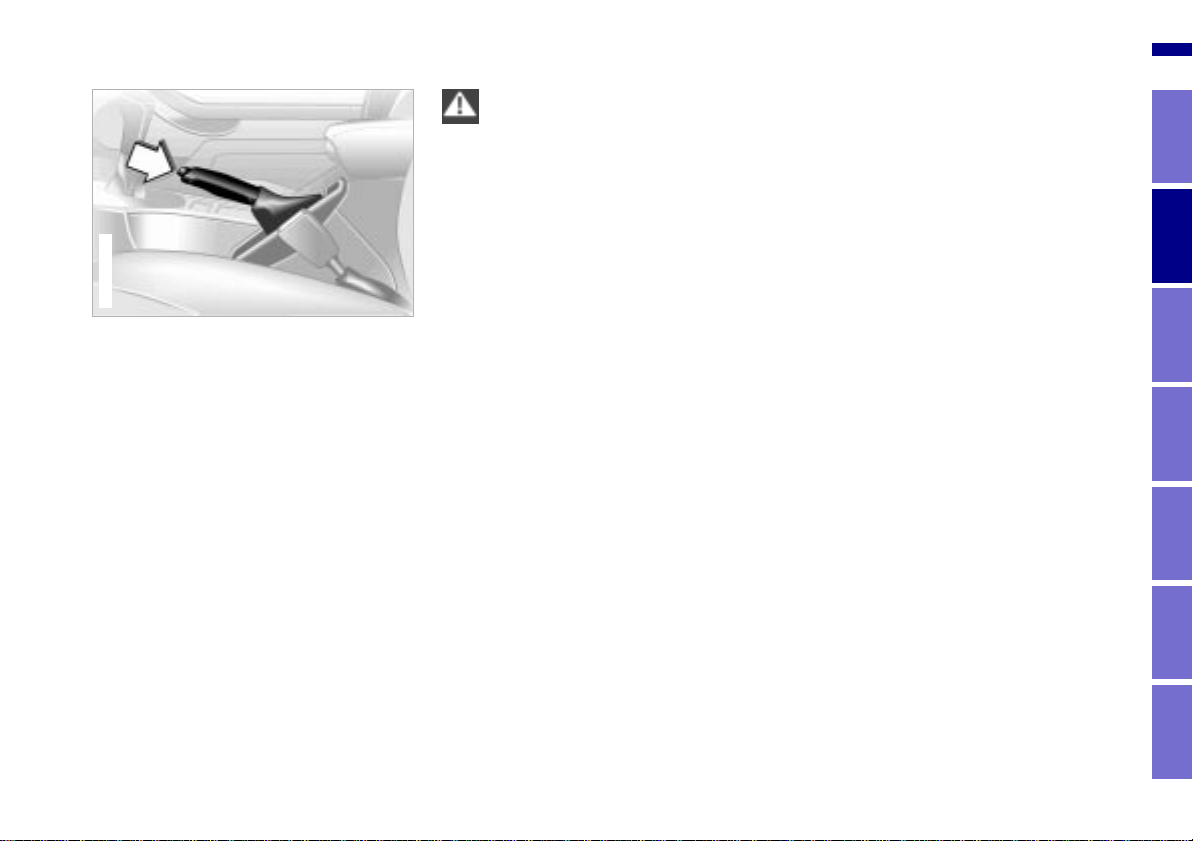
63n
RepairsIndex OverviewControlsCar careTechnologyData
Parking brake
To engage
The lock engages automatically when
you lift the lever, and the "PARK BRAKE"
(in Canada "P") indicator lamp comes on
in the instrument cluster in ignition key
position 2. Refer to page 21.
To release
Pull up slightly on the lever, press the
button and lower the lever.
The parking brake is primarily designed
to prevent the vehicle from rolling while
parked. It operates against the rear
wheels.
390de042
If, in exceptional circumstances,
it should be necessary to engage
the parking brake while the vehicle is in
motion, do not pull it with excessive
pressure. Keep your thumb pressed
against the release button while care-
fully pulling up the lever to apply mod-
erate pressure.
Excessive pressure can lead to over-
braking and loss of traction (fishtailing)
at the rear axle.
The brake lamps do not come on when
the parking brake is engaged.
Always engage the parking brake when
parking on slopes and inclined surfaces
since placing the lever in 1st gear or
reverse may not provide adequate
resistance to rolling.<
To avoid corrosion, apply the parking
brake lightly from time to time when
coasting to a standstill (at a traffic sig-
nal, for instance), provided that it is safe
to do so.
Online Edition Part-No. 01 41 0 155 062 - © 07/99 BMW AG
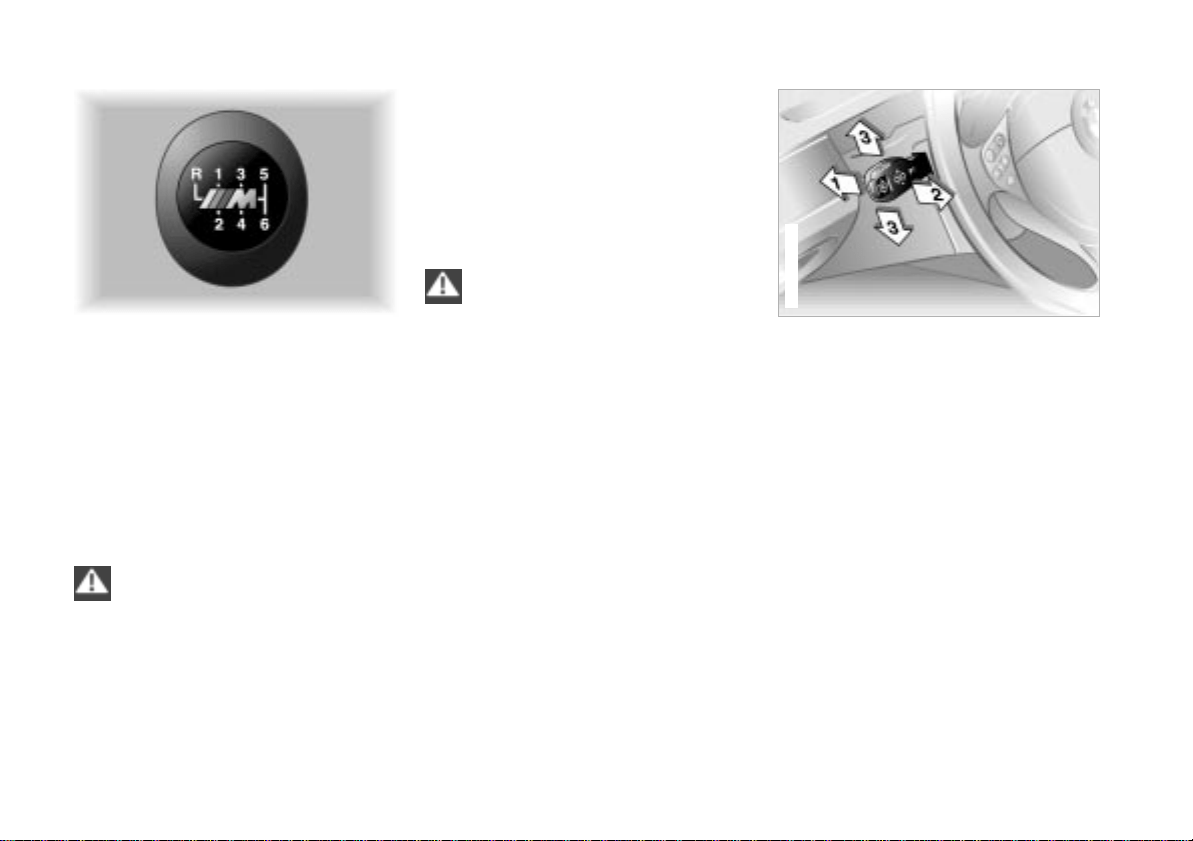
64n
Manual transmission Turn signal/Headlamp flasher
The shift lever's neutral gate is located
between 3rd and 4th gears.
When shifting from each gear into
"Neutral," the shift lever returns auto-
matically to this neutral position be-
cause of its spring loading.
When the vehicle lighting is switched
on, the shift pattern is illuminated on the
shift lever.
When shifting gears in the 5th/6th-
gear plane, be sure to press the
shift lever to the right in order to pre-
vent inadvertent selection of a gear in
the 3rd/4th-gear plane.<
39mde017
Reverse
Select "Reverse" only when the vehicle
is stationary. Press the shift lever to the
left to overcome a slight resistance.
As you do this, the backup lamps will
turn on automatically when the ignition
key is in position 2.
Do not hold the vehicle in place on
slopes by slipping or "riding" the
clutch. Use the parking brake instead.
A slipping clutch increases clutch
wear.<
1 High beam (blue indicator)
2 Headlamp flasher (blue indicator)
3 Turn signal indicator (green indicator
accompanied by periodic clicking
sound from the relay).
If the indicator lamp and the "ticking"
from the relay are both faster than nor-
mal, one of the turn indicators has
failed.
To signal briefly
Press the lever up to but not beyond the
detent. It then returns to the center po-
sition when released.
39mde074
Online Edition Part-No. 01 41 0 155 062 - © 07/99 BMW AG
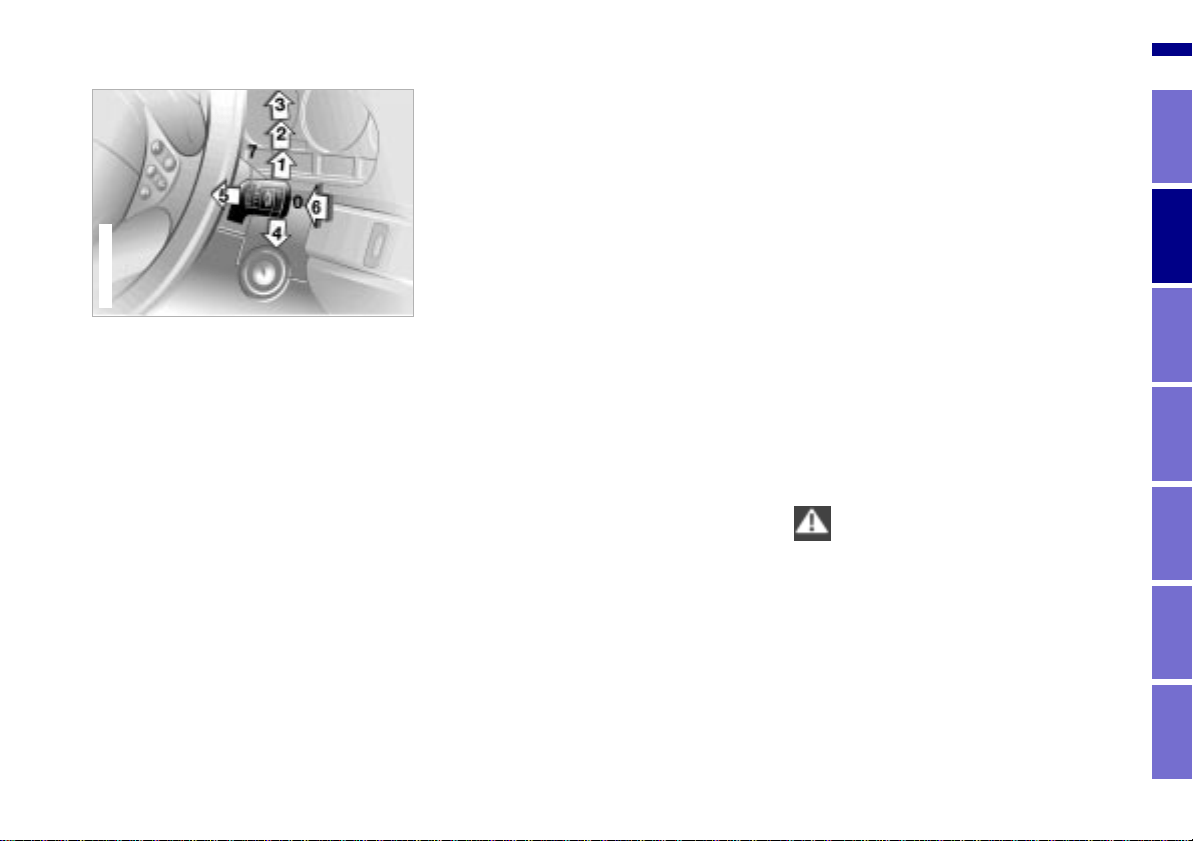
65n
RepairsIndex OverviewControlsCar careTechnologyData
Washer/Wiper system
0 Wipers retracted
1 Intermittent wipe or rain sensor
*
2 Normal wipe
3 Fast wipe
4 Brief wipe
5 Automatic windshield washer
6 Automatic intensive-action washer
*
7 Rotary dial for control of the wipe
interval or the sensitivity of the rain
sensor
39mde019
1 Intermittent wipe or rain
sensor
*
Intermittent wipe:
You can set the wipe interval to four
stages with rotary dial 7. In addition, the
wipe interval automatically adapts to
variations in road speed.
Rain sensor:
When the rain sensor is activated, the
windshield wiper is controlled automati-
cally, depending on the degree of wet-
ness of the windshield (in both snow
and rain). You do not have to be con-
cerned with switching the windshield
wiper on or off or adjusting the wipe
interval between intermittent and full
wipe. Instead, you can concentrate fully
on the traffic conditions. The is espe-
cially important under adverse weather
conditions.
The rain sensor is positioned on the
windshield, directly ahead of the interior
rearview mirror.
To activate the rain sensor:
Move the lever to position 1 with the ig-
nition key in position 1 or higher. The
wipers travel once across the wind-
shield, regardless of the weather condi-
tions.
You can also leave the lever perma-
nently in position 1. It is then only nec-
essary to activate the rain sensor from
ignition key position 1 and higher. To do
this,
> turn rotary dial 7 briefly or
> use either the automatic windshield
washer 5 or the automatic intensive-
action washer 6.
To modify the sensitivity of the rain sen-
sor:
Turn rotary dial 7.
Turn the rain sensor off in auto-
matic car washes. If you do not,
damage may occur if the wipers switch
on unintentionally.<
Online Edition Part-No. 01 41 0 155 062 - © 07/99 BMW AG
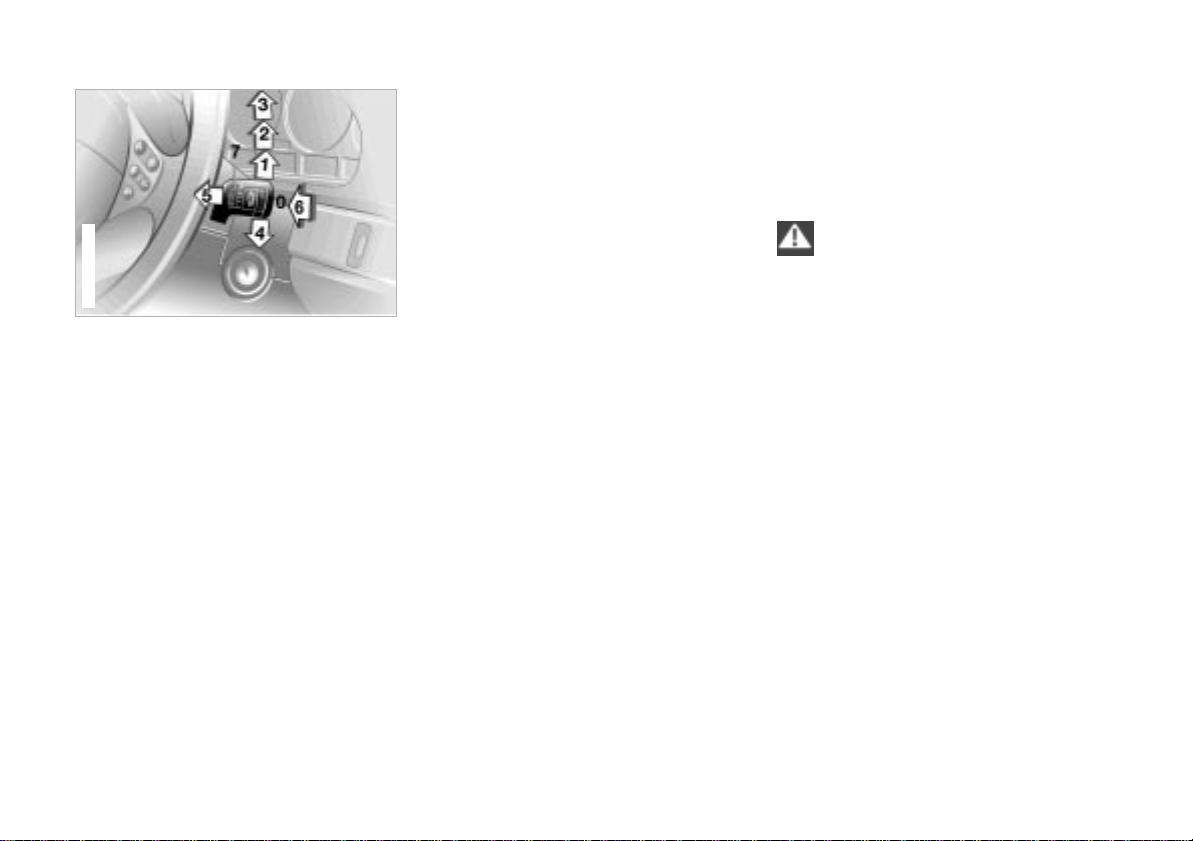
66n
Washer/Wiper system
2 Normal wiper speed
When the vehicle is stationary, the wip-
ers switch automatically to intermittent
wipe (not on vehicles with rain sensor).
3 Fast wiper speed
When the vehicle is stationary, the wip-
ers operate at normal speed (not on ve-
hicles with rain sensor).
39mde019
5 Automatic windshield washer
The system sprays washer fluid against
the windshield and activates the wipers
for a brief period.
If you pull the lever only briefly, the sys-
tem sprays washer fluid onto the wind-
shield without activating the wipers.
6 Automatic intensive-action
washer
*
As at 5. In addition, an intensive-action
washer fluid is first sprayed on the
windshield.
For changing the wiper blades, refer to
page 144.
Headlamp washers*
If the headlamps are on, they will also
be cleaned every fifth time you activate
the automatic windshield washer (inten-
sive-action or standard wash/wipe).
Do not use the washers if there is
any danger that the fluid will freeze
on the windshield. If you do so, your
vision could be obscured. For this rea-
son, use an antifreeze agent. Refer to
page 126. Do not press the washer
lever if the supply tank is empty. If you
do so, the washer pump will be dam-
aged.<
Windshield washer jets
The windshield washer jets are warmed
automatically when the ignition key is in
position 2.
Online Edition Part-No. 01 41 0 155 062 - © 07/99 BMW AG
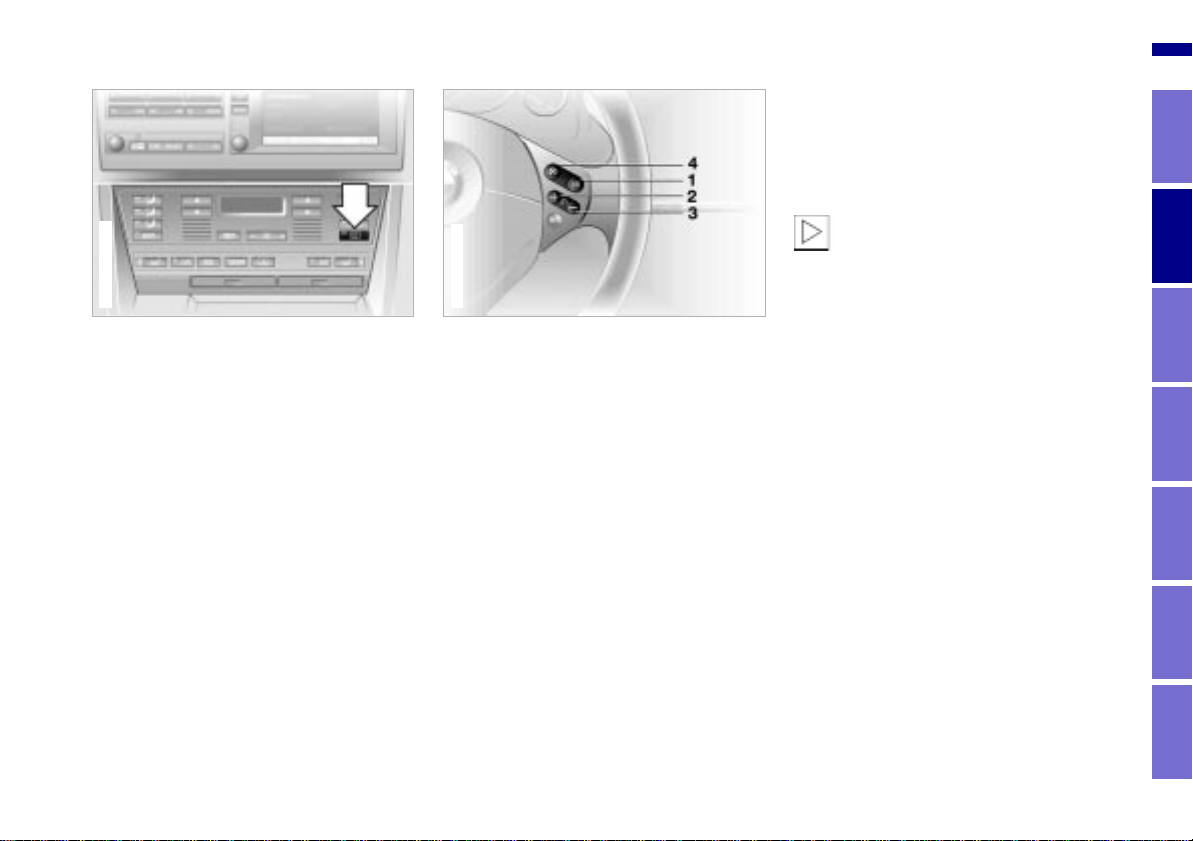
67n
RepairsIndex OverviewControlsCar careTechnologyData
Rear window defroster Cruise control
To activate
Press the button: as long as the indica-
tor lamp remains on, the rear window
defroster continues at high-output
(rapid thaw).
After the indicator lamp goes out, the
defroster continues operating at re-
duced power for a limited period before
deactivating automatically.
To deactivate
If the indicator lamp is still on, press the
button.
39mde081
You can store and automatically main-
tain any desired vehicle speed above
approx. 20 mph (30 km/h).
To activate the system
From ignition key position 2:
Press button 1. The indicator lamp in
the instrument cluster comes on. You
can now use the cruise control.
To store and maintain speed or
to accelerate
Press button 2 briefly:
The system registers and maintains the
current vehicle speed. Every time you
briefly touch the button, the speed in-
creases by approx. 0.6 mph (1 km/h).
39mde021
Press and hold button 2:
The vehicle accelerates without pres-
sure on the accelerator pedal. When
you release the button, the system reg-
isters and maintains the current speed.
If, on a downhill gradient, the en-
gine braking effect is not sufficient,
the controlled speed can be exceeded.
Speed can drop on uphill grades if the
engine output is insufficient.<
To decelerate
Press button 3 briefly:
When cruise control is active, every
brief touch of the button reduces the
speed by approx. 0.6 mph (1 km/h).
Press and hold button 3:
With the cruise control active, the sys-
tem automatically reduces the throttle
opening to slow the vehicle. When you
release the button, the system registers
and maintains the current speed.
Online Edition Part-No. 01 41 0 155 062 - © 07/99 BMW AG
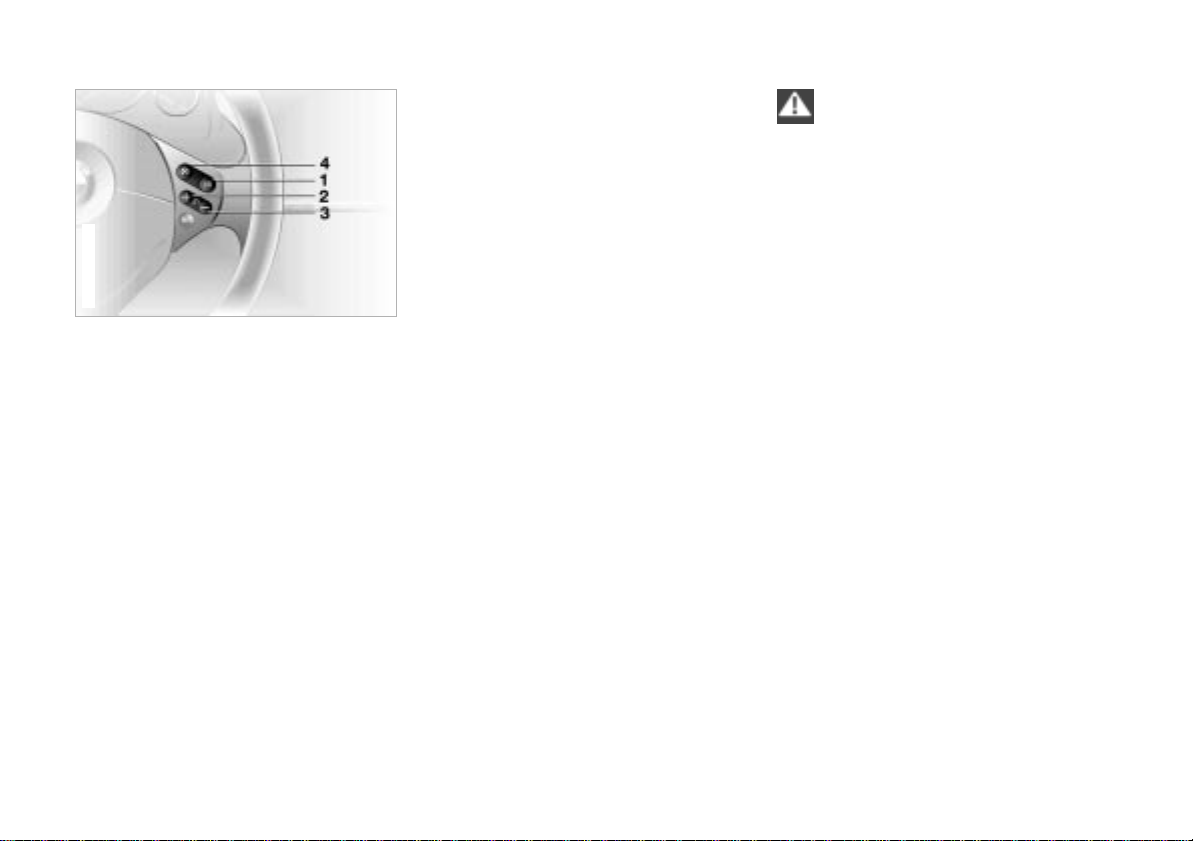
68n
Cruise control
To cancel the cruise control
When the system is activated, press
button 1. The indicator lamp stays on.
You can use the cruise control again as
required.
In addition, cruise control is canceled
automatically
> if the brakes are applied,
> when you depress the clutch pedal,
> or if the cruise speed is either ex-
ceeded or not met for an extended
length of time (if you depress the ac-
celerator pedal and exceed the set
speed, for example).
39mde021
To resume the stored setting
Press button 4:
The vehicle accelerates to and main-
tains the last speed stored. When you
turn the ignition key to position 0, the
stored speed is deleted from the sys-
tem's memory and the system is deacti-
vated.
To deactivate the system
When the cruise control has been can-
celed, press button 1 again. The indica-
tor lamp goes out and the stored speed
is deleted.
Do not use cruise control on twist-
ing roads, when high traffic den-
sity prevents driving at a constant
speed, when the road surface is slick
(snow, rain, ice), or when the road sur-
face is loose (rocks or gravel, sand).<
Online Edition Part-No. 01 41 0 155 062 - © 07/99 BMW AG
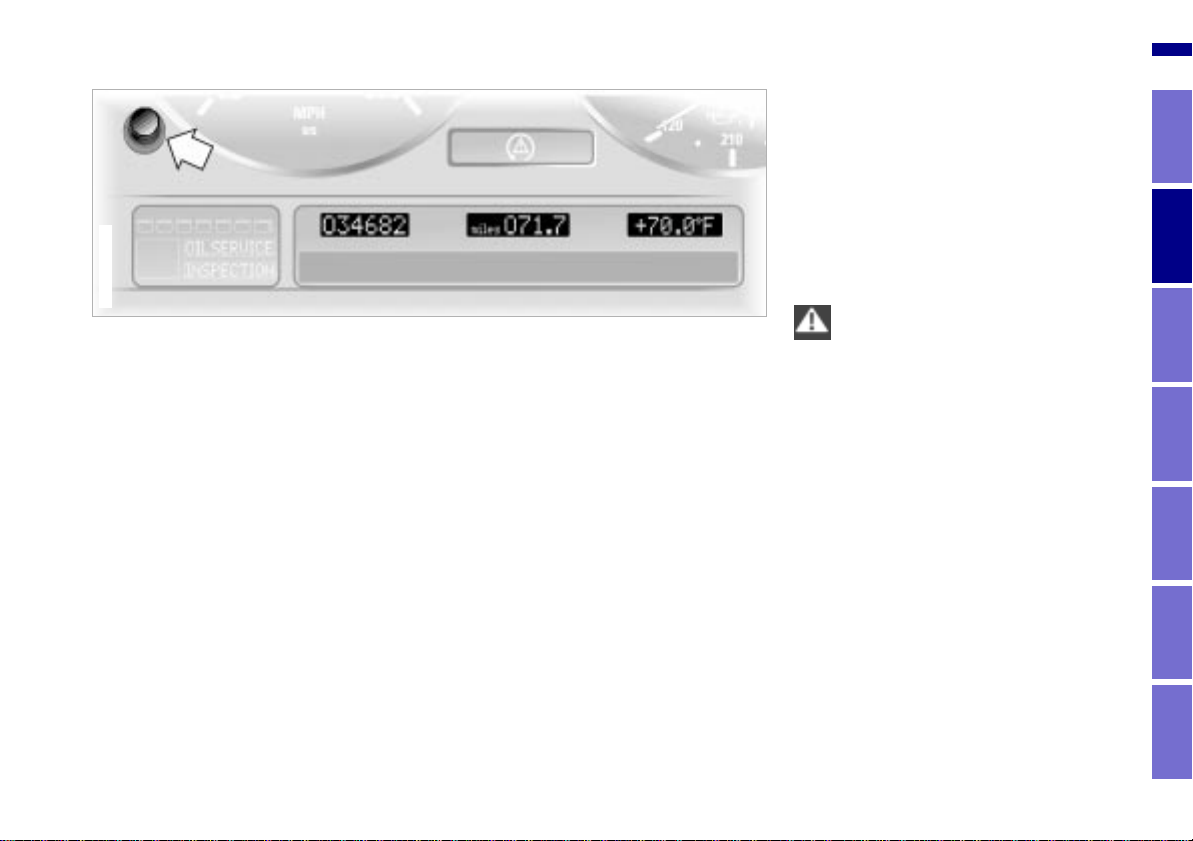
69n
RepairsIndex OverviewControlsCar careTechnologyData
Odometer
You can activate the displays shown in
the illustration with the ignition key in
position 0 by pressing the button in the
instrument cluster (arrow).
The range of available displays varies
according to your individual car's
equipment.
Trip odometer
To reset the trip odometer to zero,
press the button (arrow) with the igni-
tion key in position 1 or higher.
39mus022
Outside temperature display
The outside temperature appears in the
display panel from ignition key position
1 and higher.
You can change the units of measure-
ment (6/7) by
1 pressing and holding the button
(arrow) with the ignition key in
position 1
2 and then turning the ignition key to 0.
Ice warning
If the outside temperature drops to ap-
prox. +37.5 7 (+3 6), a signal is
sounded as a warning and the display
flashes for a brief period. The warning is
repeated whenever the temperature
climbs to at least +43 7 (+6 6) follow-
ing the last warning and then drops
back to +37.5 7 (+3 6).
The ice warning does not alter the
fact that surface ice can form at
temperatures above +37.5 7 (+3 6),
on bridges or shaded road surfaces, for
instance.<
Odometer, outside temperature display
Online Edition Part-No. 01 41 0 155 062 - © 07/99 BMW AG
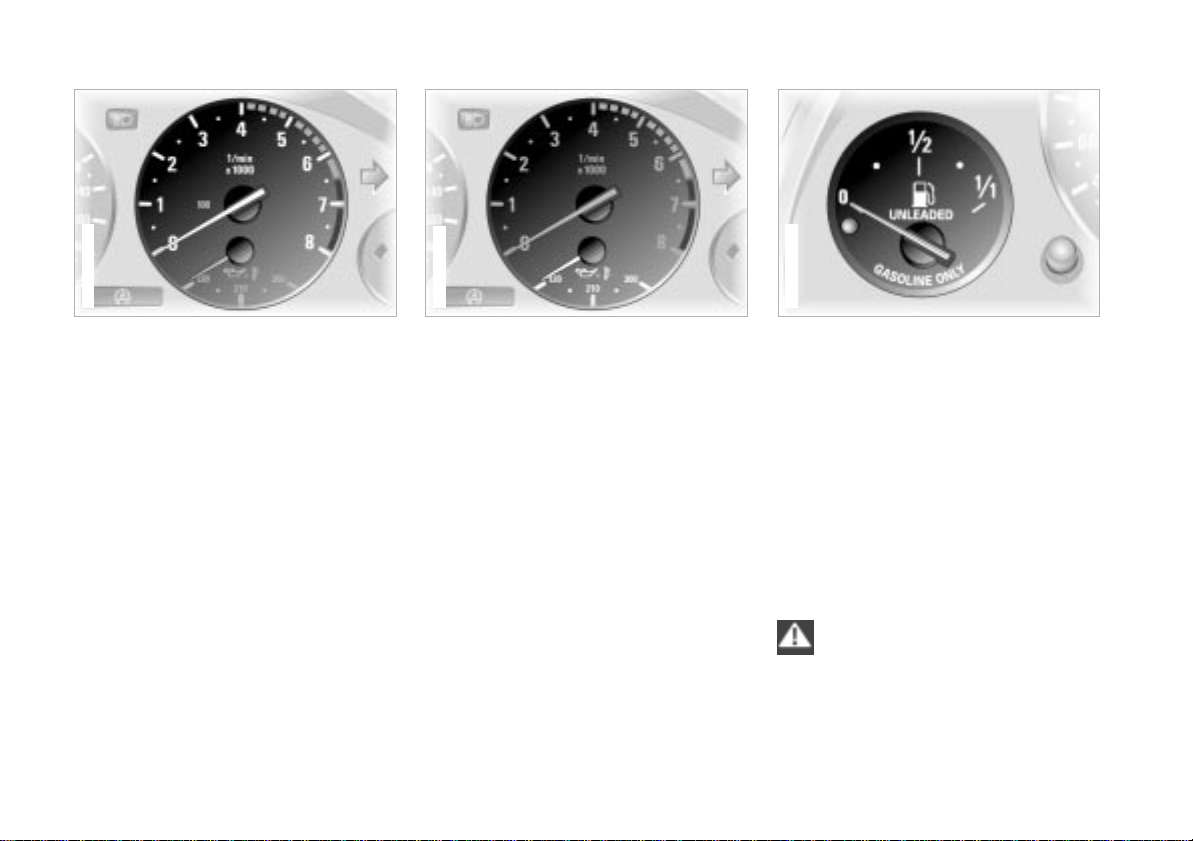
70n
Tachometer Engine oil temperature Fuel gauge
The orange early warning zone appears
depending upon the engine tempera-
ture. As the engine temperature in-
creases, more and more sectors of this
early warning zone disappear.
Avoid engine speeds in the early warn-
ing zone if possible.
Do not operate the engine with the
needle in the red overspeed zone of the
gauge.
To protect the engine, the engine-
management system automatically in-
terrupts the fuel supply in this range;
the resulting effect resembles that as-
sociated with a sudden loss of power.
39mus023
The normal operating temperature is
in a range between +176 7 (+80 6)
and +248 7 (+120 6). Do not exceed
the maximum temperature of +302 7
(+150 6).
39mus024
When you switch on the ignition, the
indicator lamp comes on briefly to con-
firm that the system is operational.
If the indicator lamp comes on and stays
on, there are approx. 2.6 gal (10 liters)
of fuel still in the tank.
For fuel tank capacity, refer to page 175.
If the tilt of the vehicle varies (when you
are driving in mountainous areas, for
example), the needle may fluctuate
slightly.
Please refuel early, as driving to
the last drop of fuel can result in
damage to the engine and/or catalytic
converter.<
39mus025
Online Edition Part-No. 01 41 0 155 062 - © 07/99 BMW AG
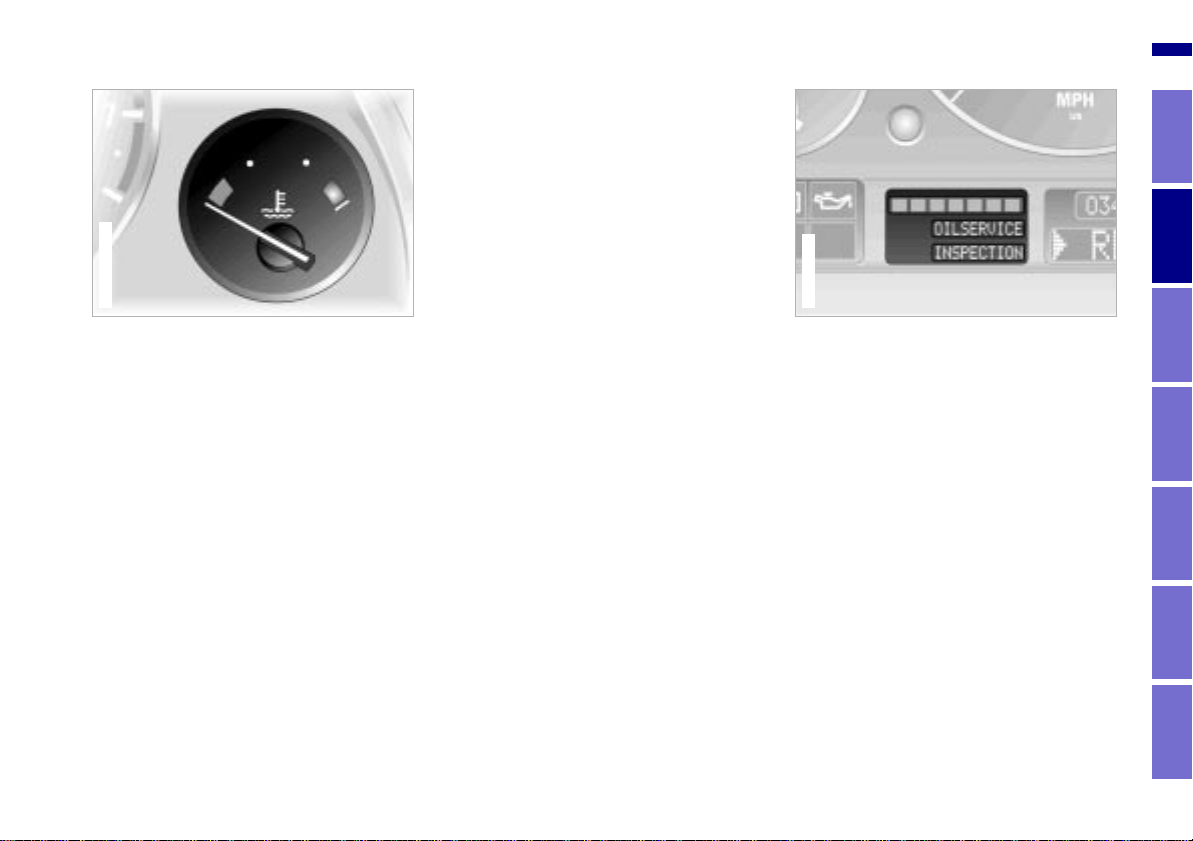
71n
RepairsIndex OverviewControlsCar careTechnologyData
Coolant temperature gauge Service Interval Display
Blue
The engine is still cold. Drive at moder-
ate engine and vehicle speeds.
Red
If the warning lamp comes on or the
message "COOLANT TEMPERATURE"
is displayed in the Check Control:
The engine is overheated. Shut off the
engine immediately and allow it to cool
down.
39mde026
Between the blue and red zones
Normal operating range. It is not un-
usual for the needle to rise as far as the
edge of the red zone in response to
high outside temperatures or severe
operating conditions.
Checking coolant level: page 129.
Green lamps
The number of illuminated lamps de-
creases as the time for your next main-
tenance visit approaches.
Yellow lamp
This field appears together with
OILSERVICE or INSPECTION.
Maintenance is due. Please contact
your BMW center for an appointment.
Red lamp
The maintenance deadline has been
passed.
380us008
Online Edition Part-No. 01 41 0 155 062 - © 07/99 BMW AG
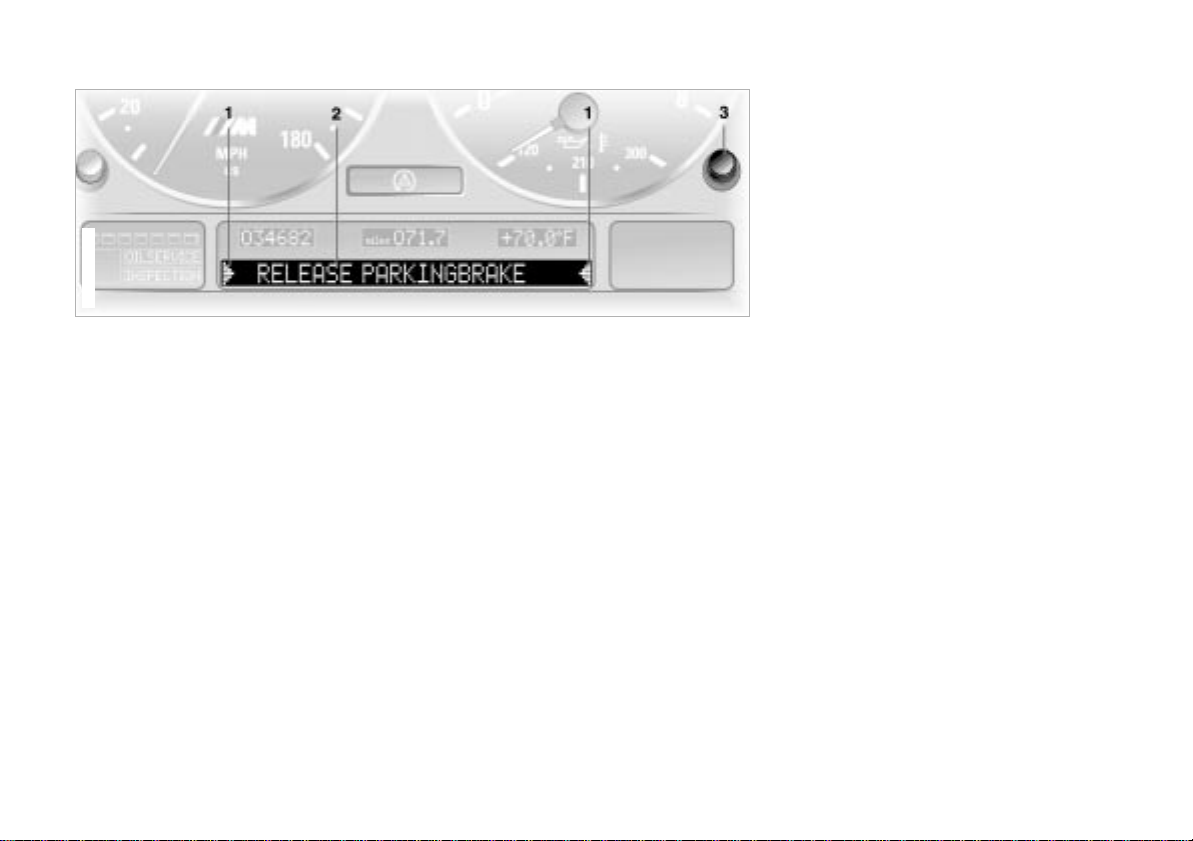
72n
Text messages are used to alert the
driver to system malfunctions with the
ignition key in position 2 and higher.
The alert is accompanied by a gong.
1 Status symbol for messages
2 Display
3 CHECK button.
Messages concerning system faults are
differentiated based on two priorities:
39mus027
Priority 1
These defects are immediately indi-
cated by a gong and a flashing warning
symbol (1). Simultaneous defects will
be displayed consecutively. These sta-
tus messages remain in the display until
the defects are corrected. They cannot
be deleted by pressing the CHECK but-
ton (3):
> "RELEASE PARKINGBRAKE"
> "COOLANT TEMPERATURE"
The coolant is overheated. Stop the
vehicle and switch off the engine im-
mediately. Refer to page 129.
> "STOP! ENGINE OILPRESS"
The oil pressure is too low. Stop the
vehicle and switch off the engine im-
mediately. Refer to page 127.
> "CHECK BRAKE FLUID"
The level has dropped nearly to the
minimum. Top up the brake fluid at the
next opportunity. Refer to page 130.
Have the source of the brake fluid loss
diagnosed and corrected by your
BMW center.
> "FLAT TIRE"
Reduce vehicle speed immediately
and stop the vehicle. Avoid hard
brake applications. Do not oversteer.
Refer to page 78.
> "LIMIT"
*
This is displayed if the programmed
speed limit has been exceeded.
Check Control
Online Edition Part-No. 01 41 0 155 062 - © 07/99 BMW AG

73n
RepairsIndex OverviewControlsCar careTechnologyData
Check Control
Priority 2
These displays appear for 20 seconds
with the ignition key in position 2 and
higher. The warning symbols remain
after the message disappears. You can
display the messages again by pressing
the CHECK button 3.
> "TRUNK LID OPEN"
This message appears only when you
initially begin a trip.
> "DOOR OPEN"
This message appears after a minimal
defined road speed has been ex-
ceeded.
> "FASTEN SEAT BELTS"
*
In addition to this message, an indi-
cator lamp with the safety belt icon
appears and an acoustical signal is
sounded.
> "WASHER FLUID LOW"
Too low; top up fluid at the next op-
portunity. Refer to page 126.
> "CHECK ENGINE OIL LEV"
Add engine oil as soon as possible.
Refer to page 127.
> "TIRE PRESSURE SET"
The RDW has transferred the current
inflation pressure in the tires as the
target values that the system will
monitor. Refer to page 77.
> "CHECK TIRE PRESSURE"
Check the tire inflation pressure and
adjust it to the correct specifications
at the earliest opportunity (next stop
for fuel). Refer to page 78.
> "TIRE CHECK INACTIVE"
This indicates a temporary interfer-
ence in the RDW or a system fault.
Refer to page 78.
> "CHECK BRAKE LAMPS"
A lamp has failed or the electrical cir-
cuit has a fault. Refer to page 147
and 156 or consult an authorized
BMW center.
> "CHECK LOWBEAM LAMPS"
"CHECK SIDE LAMPS"
"CHECK REAR LAMPS"
"CHECK FRONT FOGLAMPS"
*
"CHECK LICPLATE LAMP"
"CHECK HIGHBEAM LAMP"
"CHECK BACK UP LAMPS"
Defective bulb or circuit. Refer to
page 145 ff. and 156 or consult an
authorized BMW center.
> "CHECK BRAKE LININGS"
Have the brake linings checked by
your authorized BMW center. Refer to
page 112.
> "CHECK COOLANT LEVEL"
The coolant level is too low; top up at
the next opportunity. Refer to
page 129.
> "CHECK FUEL TANK LID"
Check the fuel tank door at the next
opportunity to be sure it is closed.
> "ENGINE FAILSAFE PROG"
Fault in the Electronic Engine Power
Control EML. Higher brake applica-
tion pressure may be necessary when
braking. Have the system inspected
by your authorized BMW center.
The following message cannot be
called up for display again:
> "OUTSIDE TEMP 24 7 (–5.0 6)"
This temperature display is only an
example. The current temperature is
displayed at outside temperatures of
37.5 7 (+3 6) and below. Refer also
to page 69.
Online Edition Part-No. 01 41 0 155 062 - © 07/99 BMW AG
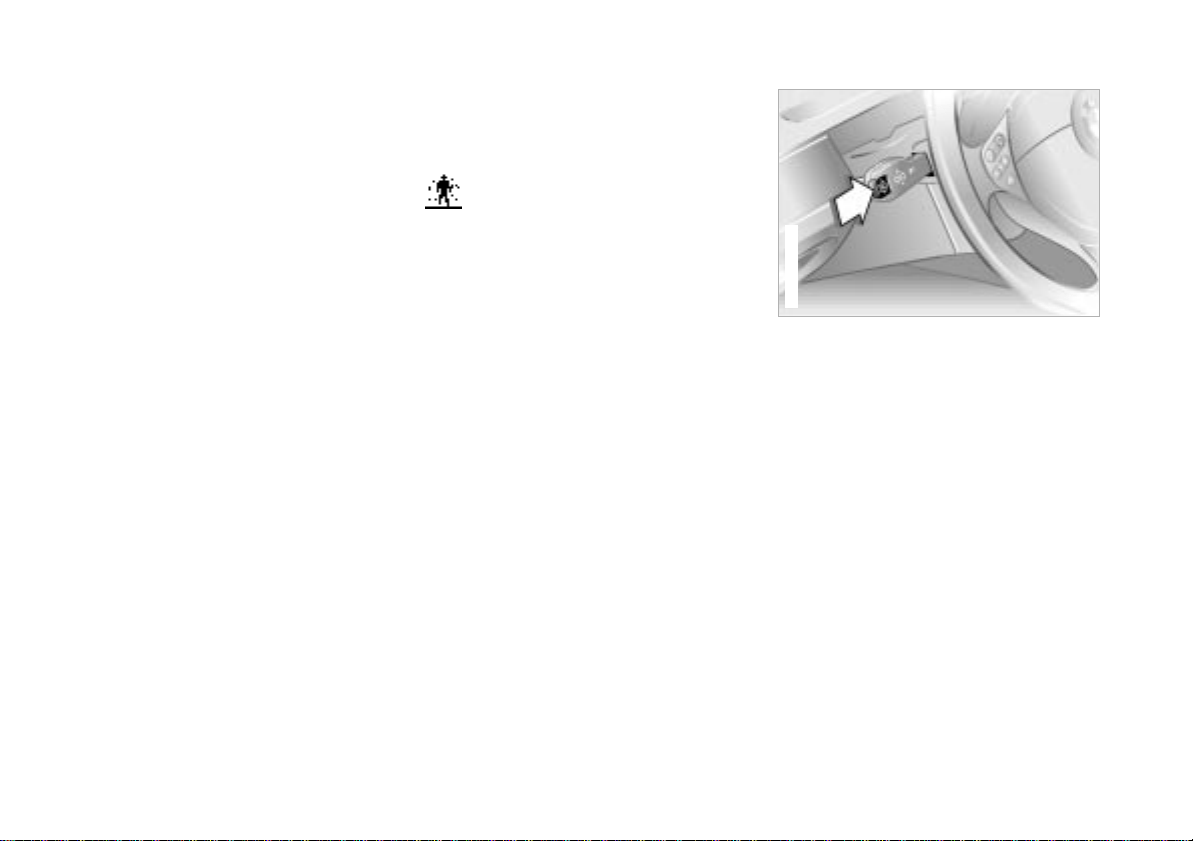
74n
Check Control Onboard computer
Displays after completion of a trip
All of the malfunctions registered during
the trip appear consecutively when the
key is turned to position 0.
The following displays will appear when
appropriate:
> "LIGHTS ON"
This display appears when you open
the driver's door after parking the
vehicle.
> "KEY IN IGNITION LOCK"
> "CHECK ENGINE OIL LEV"
Check the engine oil at the earliest
opportunity (next stop for fuel). Refer
to page 127.
Status messages remain available for a
period of approx. three minutes after
the display goes out and the key is re-
moved from the ignition. Press the
CHECK button (3) to display these mes-
sages. If there were multiple messages,
press the CHECK button repeatedly to
view them all in sequence.
To check the Check Control
Press the CHECK button (3) with the
ignition key in position 2: CHECK
CONTROL OK appears in the display.
There are no faults in the monitored
systems.
You will find a description of the on-
board computer in the "Onboard com-
puter" Owner's Manual.
You can have the Check Control
and onboard computer messages
displayed in a different language.<
Mode selection
With the ignition key in position 1 and
higher, you can use the button in the
turn signal lever to retrieve information
from the onboard computer for display
in the instrument cluster. By pressing
the button briefly in the direction of the
steering column, you can call up a new
function for display.
39mde075
Online Edition Part-No. 01 41 0 155 062 - © 07/99 BMW AG

75n
RepairsIndex OverviewControlsCar careTechnologyData
The PDC assists you when you back
into a parking space. A signal warns
you of the distance to an obstacle. To
do this, four ultrasonic sensors in the
rear bumper measure the distance to
the nearest object. The monitoring
range for the two corner sensors ends
approx. 2 feet (60 cm) beyond the
bumper. The range of the two middle
sensors is slightly less than 5 feet (1.50
meters) outward.
The system is activated automatically
about one second after you engage re-
verse with the ignition key in position 2.
PDC is deactivated when you shift back
out of reverse.
Acoustical signals
The distance to the nearest object is in-
dicated by a tone sounding at various
intervals. As the distance between vehi-
cle and object decreases, the intervals
between the tones become shorter. A
continuous tone indicates the presence
of an object less than 1 ft. (30 cm)
away.
The warning signal is canceled after
approx. three seconds if the distance to
the obstacle remains constant during
this time (if you are moving parallel to a
wall, for instance).
System malfunctions will be indicated
by a continuous high-pitched tone
when the system is activated the first
time. Please have your BMW center re-
solve the problem.
The PDC does not remove the
driver's personal responsibility for
evaluating the distance between the
vehicle and any obstacles. Even when
sensors are involved, there is a blind
spot in which objects cannot be de-
tected. This applies especially in those
cases where the system approaches
the physical limits of ultrasonic mea-
surement, as occurs with tow bars and
trailer couplings, and in the vicinity of
thin and painted objects.
Certain sources of sound, such as a
loud radio, could drown the PDC signal
tone.<
Keep the sensors clean and free
of ice or snow in order to ensure
that they will continue to operate effec-
tively.
Do not apply high-pressure spray to the
sensors for a prolonged period of time.
Maintain an adequate distance of more
than 4 inches (10 cm).<
Park Distance Control (PDC)*
Online Edition Part-No. 01 41 0 155 062 - © 07/99 BMW AG
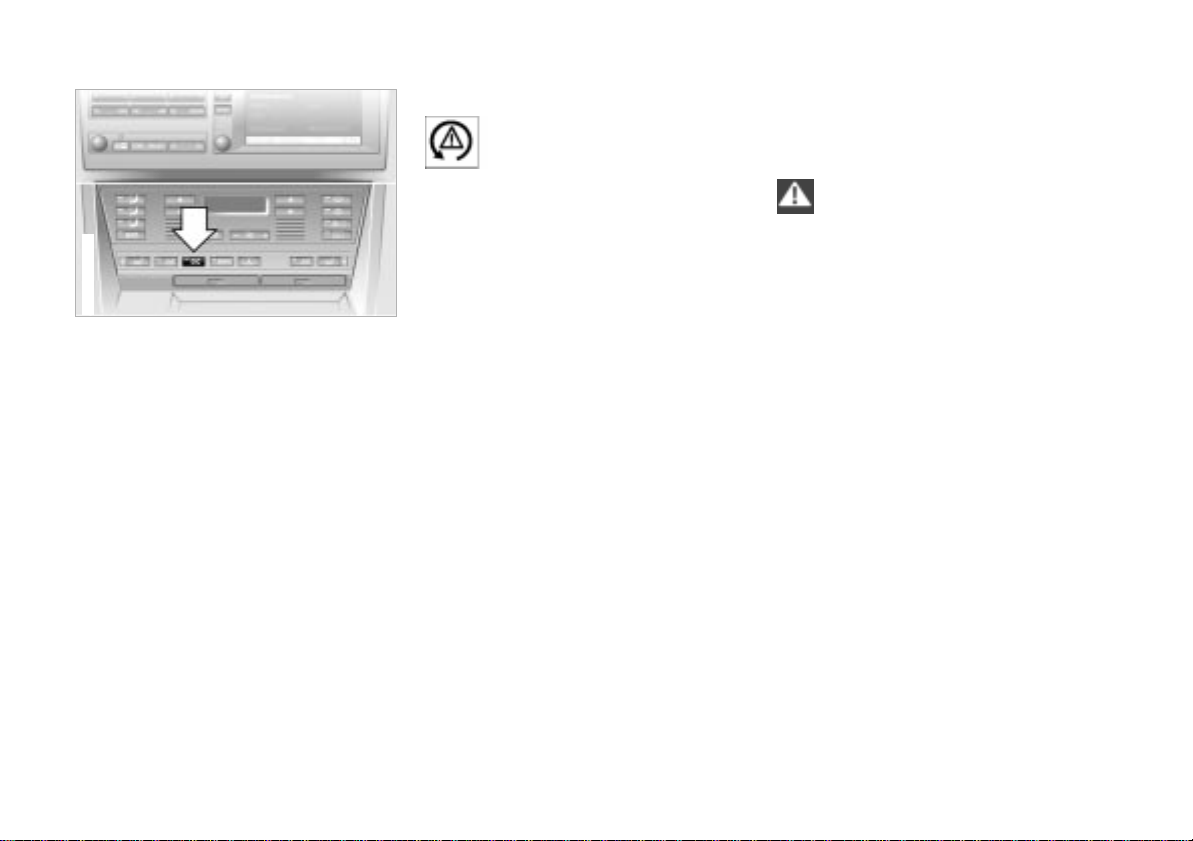
76n
Dynamic Stability Control (DSC)
This system ensures enhanced vehicle
stability, particularly when accelerating
and cornering.
In addition to optimized traction and
vehicle stability when starting from a
standstill or accelerating, there is the
further benefit of enhanced stability in
cornering. Of course, these benefits are
only possible within the limits imposed
by the laws of physics.
The system activates automatically
each time you start the engine.
39mde059
Indicator lamp
The indicator lamp in the instru-
ment cluster goes out shortly
after you switch on the ignition.
Refer to page 21.
Indicator lamp flashes:
The system is actively regulating drive
torque in response to monitored vehicle
operating conditions.
If the indicator lamp fails to go out after
the engine is started, or comes on dur-
ing the course of normal vehicle opera-
tion:
There is a system fault. You can still
drive the vehicle normally, but the DSC
function is not available. Consult your
BMW center for repair.
To deactivate the system
Press the button. The indicator lamp
will come on.
When DSC is deactivated, you are driv-
ing with conventional power transfer.
We recommend that you deactivate the
system for increased traction:
> when rocking the vehicle or starting
off in deep snow or on loose surfaces
> or when driving with snow chains.
Refer also to page 110.
To reactivate the system
Press the button again; the indicator
lamp goes out.
The laws of physics cannot be re-
pealed, even with DSC. Any con-
sequences arising from traction loss
due to excessive vehicle speed remain
the responsibility of the driver. We
therefore urge you to avoid using the
additional safety margin of the system
as an excuse for taking risks.<
For additional details concerning DSC,
please refer to the chapter describing
"Advanced technology" on page 161.
Online Edition Part-No. 01 41 0 155 062 - © 07/99 BMW AG
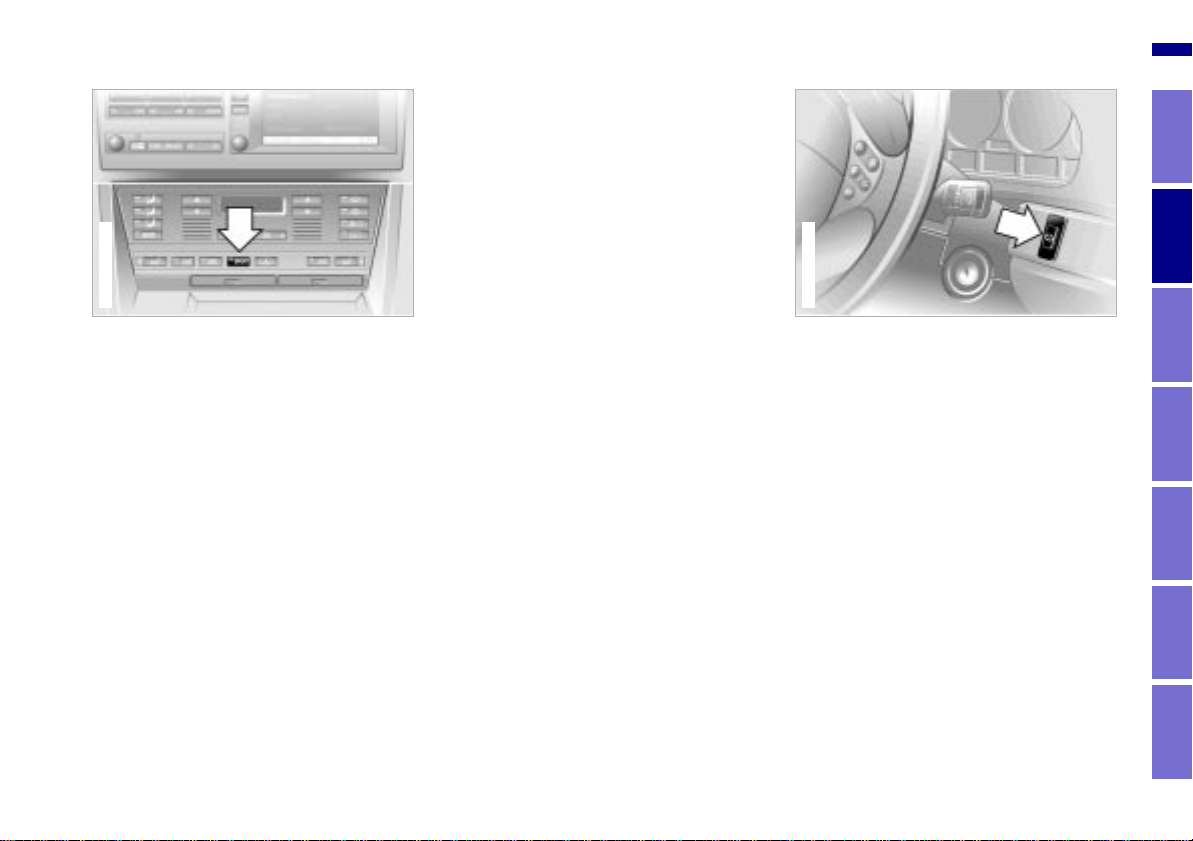
77n
RepairsIndex OverviewControlsCar careTechnologyData
M Dynamic Driving Control Tire Pressure Warning (RDW)
Whenever it is required, this system
changes the settings of the Servotronic
power steering, and the accelerator
pedal response from a performance-
comfort mode to a pure performance
mode. That is, steering response
becomes more performance-oriented
and the response of the accelerator
pedal is much more spontaneous
(Performance Recognition).
Performance Recognition
With the ignition key in position 2, press
the key (arrow). The indicator lamp illu-
minates.
Deactivating Performance Recognition:
Press the button again; the indicator
lamp goes out.
The coordinated performance-comfort
mode is activated automatically each
time you start the engine.
39mde076
The concept
RDW monitors the tire pressure at all
four wheels – even while you are driv-
ing. The system provides an alert when-
ever the inflation pressure drops signifi-
cantly below the specified pressure in
one or more tires.
In order for the system to "learn" the
correct tire inflation pressure, check the
inflation pressure in all tires according
to the inflation pressure table beginning
on page 26 and make corrections as
necessary. Then activate the system.
The Check Control (refer to page 73)
will inform you if the tire pressure is not
correct.
Activate the system
1 Turn the ignition key to position 2 (do
not start the engine).
2 Press and hold the button (arrow)
until the message "SET TIRE
PRESSURE" is displayed for a few
seconds in the Check Control.
3 After you have driven a few minutes,
RDW transfers the current tire infla-
tion pressures as the nominal values
to be monitored.
You will only have to repeat this proce-
dure following a correction of the tire in-
flation pressure. Otherwise, the system
is automatically activated in ignition key
position 2 and therefore whenever the
vehicle is driven.
39mde031
Online Edition Part-No. 01 41 0 155 062 - © 07/99 BMW AG

78n
Tire Pressure Warning (RDW)
Loss in tire pressure
If, after a certain period of time, the air
pressure has gone down (which is nor-
mal for any tire), the message "CHECK
TIRE PRESSURE" appears in the Check
Control
This alerts you to have the tires inflated
to the specified pressures as soon as
possible.
If you are prompted to check the
tire pressure shortly after a cor-
rection has been made, this indicates
that the corrected values were not ac-
curate. Please check the inflation pres-
sure again and make corrections ac-
cording to the inflation pressure table.
Then activate the system once again.<
Flat tire
If there is a tire failure with a loss of air
pressure, the message "TIRE DEFECT"
appears in the Check Control. In addi-
tion, a gong is sounded.
If this occurs, reduce vehicle speed im-
mediately and stop the vehicle in a safe
location. Avoid hard brake applications.
Do not oversteer. Correct the tire failure
using the M Mobility system (refer to
page 150).
RDW cannot inform you of sudden
and severe tire damage caused by
external influences.<
Have the tires changed by your
BMW center.
Your BMW center has the information
needed for working with RDW and is
equipped with the necessary special
tools.<
System interference
The message "TIRECONTROL
INACTIVE" appears in the Check Con-
trol for the duration of the system inter-
ference.
The same display will appear if there is
a system fault.
Please contact your BMW center for
additional information.
Online Edition Part-No. 01 41 0 155 062 - © 07/99 BMW AG
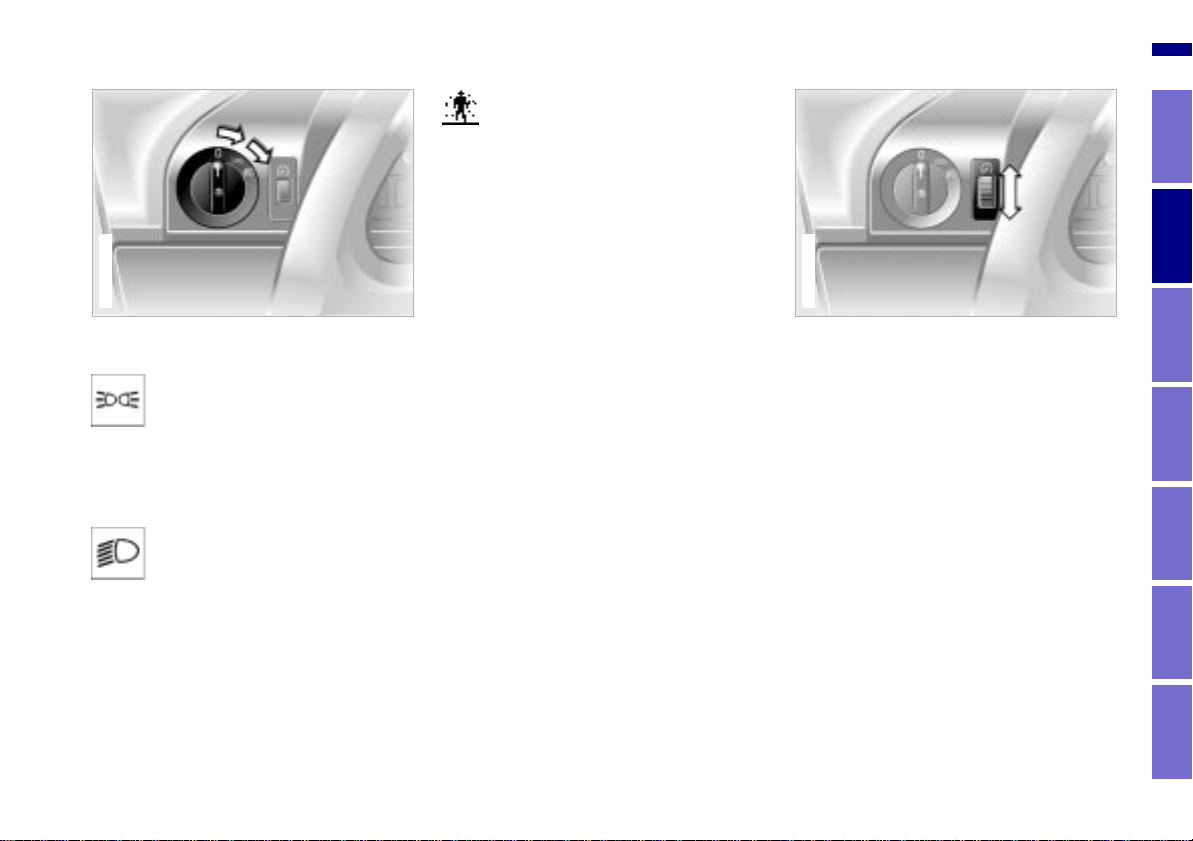
79n
RepairsIndex OverviewControlsCar careTechnologyData
Side lamps (side marker lamps)
With the switch in this position,
the front, rear and side vehicle
lighting is switched on. For
lighting on one side for parking, see
page 80.
Low beam headlamps
When you switch off the ignition
and the low beams are still on,
only the position lamps (side
marker lamps) remain on.
390de034
"Follow-me-home lighting:"
If you actuate the headlamp
flasher after you have parked the vehi-
cle and shut off the engine, the low
beams will remain on for a brief period.
You may also have this function deacti-
vated if you wish.<
LIGHTS ON warning
With the ignition key in position 0, this
message is displayed in the Check Con-
trol after the driver's door is opened if
the headlamps have not been switched
off.
Daytime running lamps*
The headlamps are automatically
switched on for daylight driving at igni-
tion key position 2.
Turn the rotary dial to adjust the lighting
intensity.
390de036
Side lamps/Headlamps Instrument rheostat
Online Edition Part-No. 01 41 0 155 062 - © 07/99 BMW AG
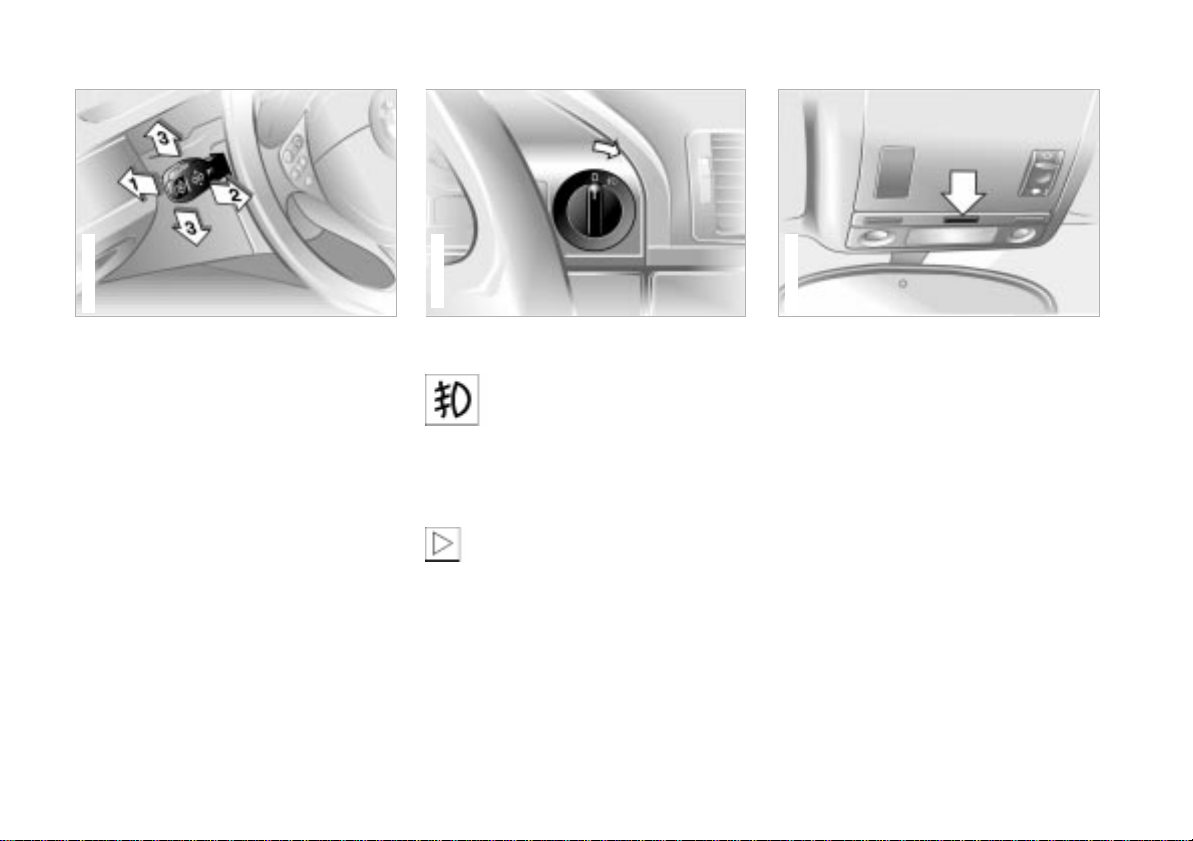
80n
High beams/Parking lamp Fog lamps Interior lamps
1 High beam (blue indicator lamp)
2 Headlamp flasher (blue indicator
lamp)
3 Parking lamp
Parking lamp, left or right
With the ignition key in position 0, press
the turn signal lever from the center po-
sition in the desired direction. The lever
engages in the turn signal position.
39mde074
Fog lamps
A green indicator lamp appears
in the instrument cluster to indi-
cate that the front fog lamps are
on.
If the high beam is switched on, the fog
lamps go out.
Comply with the legal regulations
concerning the use of fog lamps.<
390us037
The interior lamps operate automati-
cally.
Switching the interior lamps on
and off
Press the button (arrow).
If you wish the interior lamps to remain
off at all times, press and hold the but-
ton for approximately 3 seconds.
Press the button briefly to revert to nor-
mal operation.
Footwell lamps
The footwell lamps operate in the same
way as the interior lamp.
39mde087
Online Edition Part-No. 01 41 0 155 062 - © 07/99 BMW AG
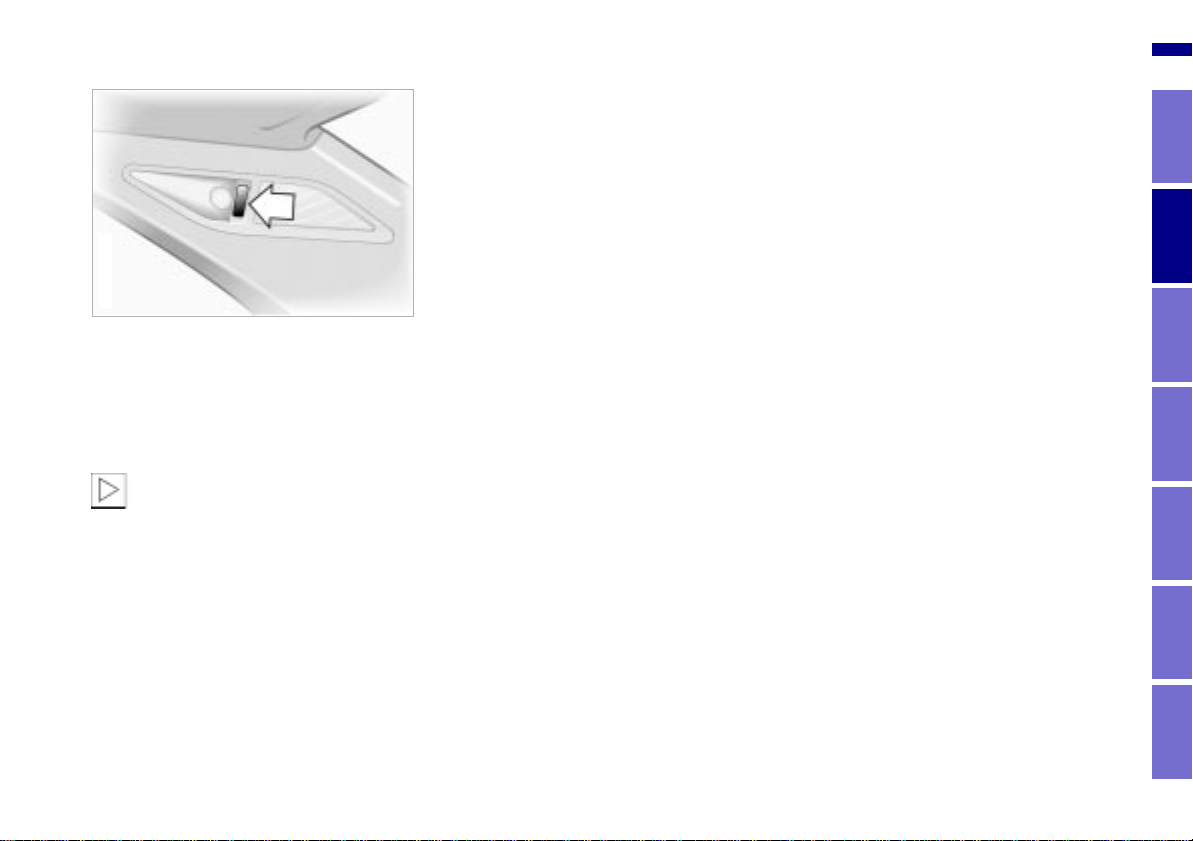
81n
RepairsIndex OverviewControlsCar careTechnologyData
Reading lamps
The reading lamps are located in the
front near the interior lamp. There are
also reading lamps in the rear. They can
be switched on and off with the switch
(arrow) next to each lamp.
In order to prevent battery dis-
charge, all of the lamps in the
vehicle are switched off automatically
approx. 15 minutes after the ignition
key is turned to position 0.<
394de301
Online Edition Part-No. 01 41 0 155 062 - © 07/99 BMW AG
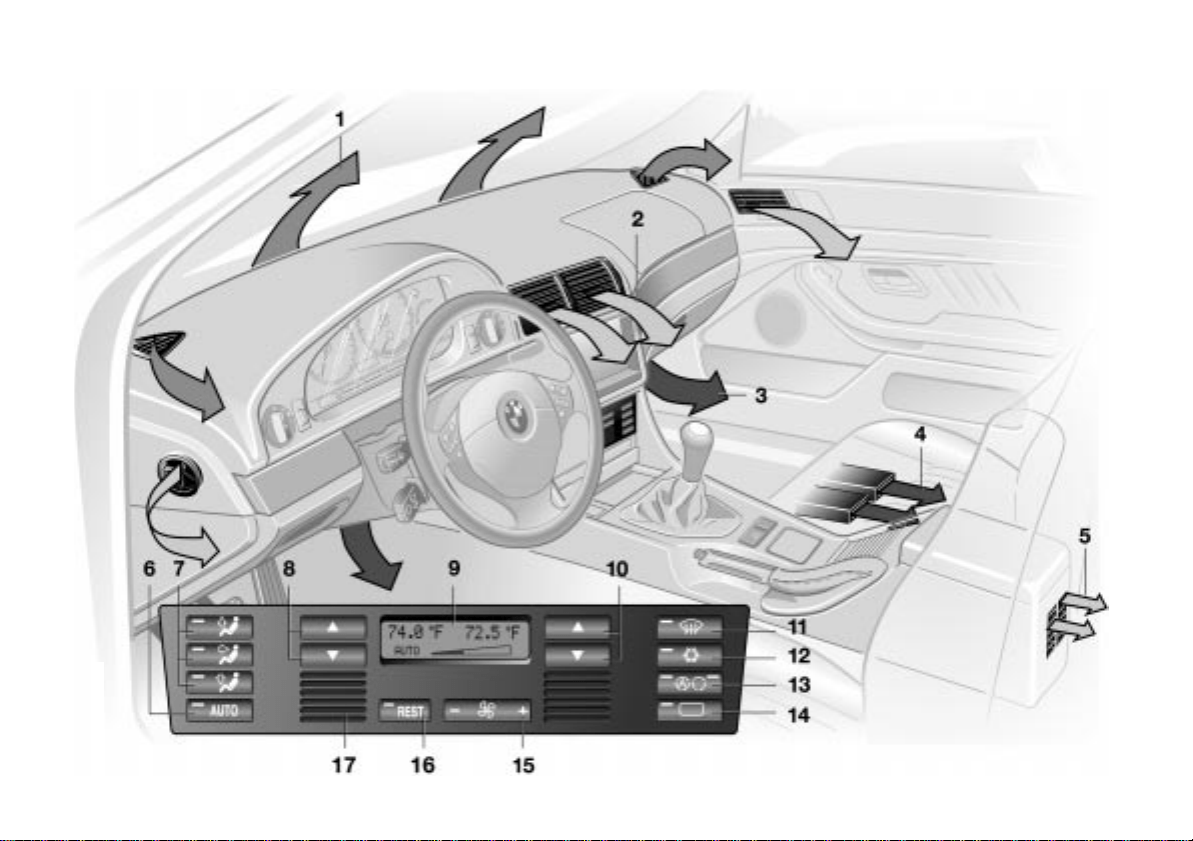
82n
39mus059
Automatic climate control
Online Edition Part-No. 01 41 0 155 062 - © 07/99 BMW AG

83n
RepairsIndex OverviewControlsCar careTechnologyData
Automatic climate control
1 Air flow directed toward the wind-
shield and side windows
2 Air flow for the upper body
The side rotary dials allow you to
open and close the air supply
through an infinitely-variable range,
while the levers change the airflow
direction. The center rotary dial
controls the temperature of the air
as it flows out, see page 86
3 Front footwell ventilation
4 Rear footwell ventilation
5 Air flow for the upper body in the
rear seat 87
6 Automatic air distribution 84
7 Individual air distribution 84
8 Temperature control – left-hand
side 84
9 Display for temperature and air
supply 84
10 Temperature control – right-hand
side 84
11 To defrost windows and remove
condensation 85
12 Air conditioner 85
13 Automatic recirculated air control
(AUC) 85
14 Rear window defroster 67, 86
15 Air supply 85
16 Residual heat mode 86
17 Air grill for interior temperature sen-
sor – please keep clear and unob-
structed
Online Edition Part-No. 01 41 0 155 062 - © 07/99 BMW AG

84n
Automatic climate control
Tips for pleasant driving
Use the automatic system (AUTO but-
ton 6). Select an interior temperature
that is comfortable for you – we recom-
mend 72 7 (22 6). When the outside
temperature is above 41 7 (5 6), you
can also use the air conditioner 12.
This will dry the air as well as prevent-
ing condensation on the window sur-
faces – if there are passengers with
damp clothing, for example. Set the air
outlets 2 so that the air flows past you
and is not directed straight at you. Set
the rotary dial between the air outlets
2 for the upper body to a medium posi-
tion, since air that is somewhat cooler
promotes driving without fatigue.
The following description will lead you
through additional individual adjust-
ments.
Your BMW center can program
the settings of your vehicle in such
a manner that, when you unlock the car
with your individualized remote control,
your own personalized setting for the
automatic climate control is initiated.<
Automatic air distribution
The AUTO program assumes
the adjustment of the air distri-
bution and the air supply for you and –
in addition to that – adapts the tempera-
ture to external influences (summer,
winter) to meet preferences you can
specify. This program maintains a com-
fortable in-car climate regardless of the
season. Select an interior temperature
that is comfortable for you – we recom-
mend 72 7 (22 6). The selected tem-
perature and AUTO for the air supply
appear in the display 9. Refer to the
overview on page 82. Open the air out-
lets for the upper body. Switch on the
air conditioner in warm weather. The
maximum cooling capacity is achieved
when you set rotary dial 3 (refer to
page 86) to cold.
Individual air distribution
You can cancel the AUTO pro-
gram by selecting specific distri-
bution patterns to suit your own
individual requirements. You
can direct air to flow onto the windows
, toward the upper body , and into
the footwell .
Temperature
You can make individual tem-
perature adjustments on the
driver's side or the front passen-
ger side. The figures in the display pro-
vide a general indication of interior tem-
perature. We recommend 72 7 (22 6)
as a comfortable setting, whether the
air conditioner is operating or not.
When you start the vehicle, this system
ensures that the selected temperature
is achieved as quickly as possible. It
then maintains this temperature, re-
gardless of the season.
Set the rotary dial 3 (refer to "Draft-free
ventilation" on page 86) to a medium
setting, since air that is somewhat
cooler promotes driving without fatigue.
Utilize this method of mixing air espe-
cially for making minor adjustments for
personal comfort.
You can set uncontrolled heater
output up to 90 7 (32 6). Full
cooling output is available from the air
conditioner down to 60 7 (16 6).<
Online Edition Part-No. 01 41 0 155 062 - © 07/99 BMW AG

85n
RepairsIndex OverviewControlsCar careTechnologyData
Automatic climate control
Air supply
In the "AUTO" program, the
air supply is controlled auto-
matically. AUTO will appear in the dis-
play 9. Refer to the overview on
page 82. Use "+" and "–" to vary the air
supply. Your setting is displayed with
bars and the automatic air supply is
switched off. The automatic air distribu-
tion setting is maintained. You can re-
activate the automatic air supply by
pressing the "AUTO" button.
When you press "–" during operation at
the lowest blower speed, all displays
are canceled: The fan, heating and air
conditioner are switched off. The out-
side air supply is closed. You can
switch the system back on by pressing
any button of the automatic climate
control (except the REST button 16).
To defrost the windshield and
side windows
This program quickly removes
ice and condensation from the
windshield and the side windows.
Air conditioner
The air is cooled and dehumidi-
fied and – depending on the
temperature setting – warmed again
when the air conditioner system is
switched on.
Depending on the weather, the wind-
shield may fog over briefly when the en-
gine is started.
Switch off the air conditioner at outside
temperatures below approx. 41 7
(5 6). This will help to prevent the win-
dows from fogging up. If the windows
fog over after switching the air condi-
tioner off, switch it back on.
Condensation forms in the air
conditioner system during opera-
tion, which then exits under the vehicle.
Traces of condensed water of this kind
are thus normal.<
Automatic recirculated air control
(AUC)
You can respond to unpleasant
external odors by temporarily
excluding the flow of outside air. The
system then recirculates the air cur-
rently within the vehicle. By repeated
actuations of the button, you can select
one of three different operation modes.
> Indicator lamps off: Outside air flow
operational.
> Left-hand indicator lamp on – AUC
mode: The system recognizes pollut-
ants in the outside air and blocks the
flow of air when necessary. The sys-
tem then recirculates the air currently
within the vehicle.
Depending on the air quality, the au-
tomatic system then switches back
and forth between outside air supply
and recirculation of the air within the
vehicle.
> Right indicator lamp on – recirculated
air mode: The flow of external air into
the vehicle is completely blocked.
The system then recirculates the air
currently within the vehicle.
If the windows fog over in the re-
circulated air mode, switch the re-
circulated air off and increase the air
supply as required.<
Online Edition Part-No. 01 41 0 155 062 - © 07/99 BMW AG
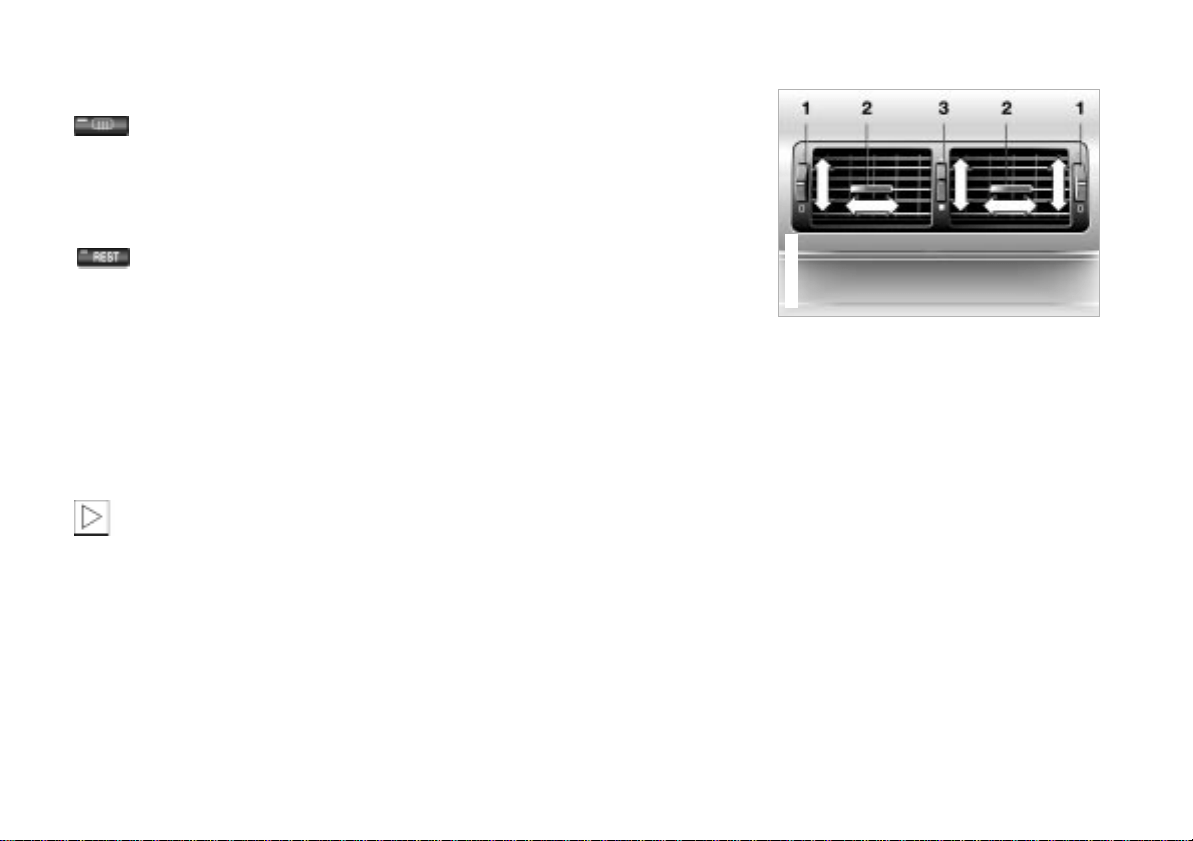
86n
Automatic climate control
Rear window defroster
When the rear window defroster
is activated, the indicator lamp
comes on. The rear window defroster
switches off automatically.
Residual heat mode
The heat which is stored in the
engine is utilized for heating the
interior when the engine has been
switched off (while waiting at a railroad
crossing, for instance). In ignition key
position 1, you can alter the settings of
the automatic climate control. With the
ignition key in position 0, the system
automatically directs heated air to the
windshield, side windows and foot-
wells.
This function may be activated
when the outside temperature is
below approx. 59 7 (15 6), the engine
is at operating temperature, and the
battery is adequately charged.<
Latent heat storage system*
This system is activated automatically in
the residual heat mode with the ignition
key in position 1.
Draft-free ventilation
For your optimal personal comfort, you
can adjust airflow onto the upper body
area from the air outlets:
Use rotary dial 1 to open and close the
air outlets through an infinitely-variable
range. You can use the levers 2 to ad-
just the direction of the airflow.
Set the air outlets so that the air flows
past you and is not directed straight at
you.
Rotary dial 3 allows you to control the
temperature of the air flow from these
air outlets as desired:
> Turn toward blue – colder
> Turn toward red – warmer
390de051
Online Edition Part-No. 01 41 0 155 062 - © 07/99 BMW AG
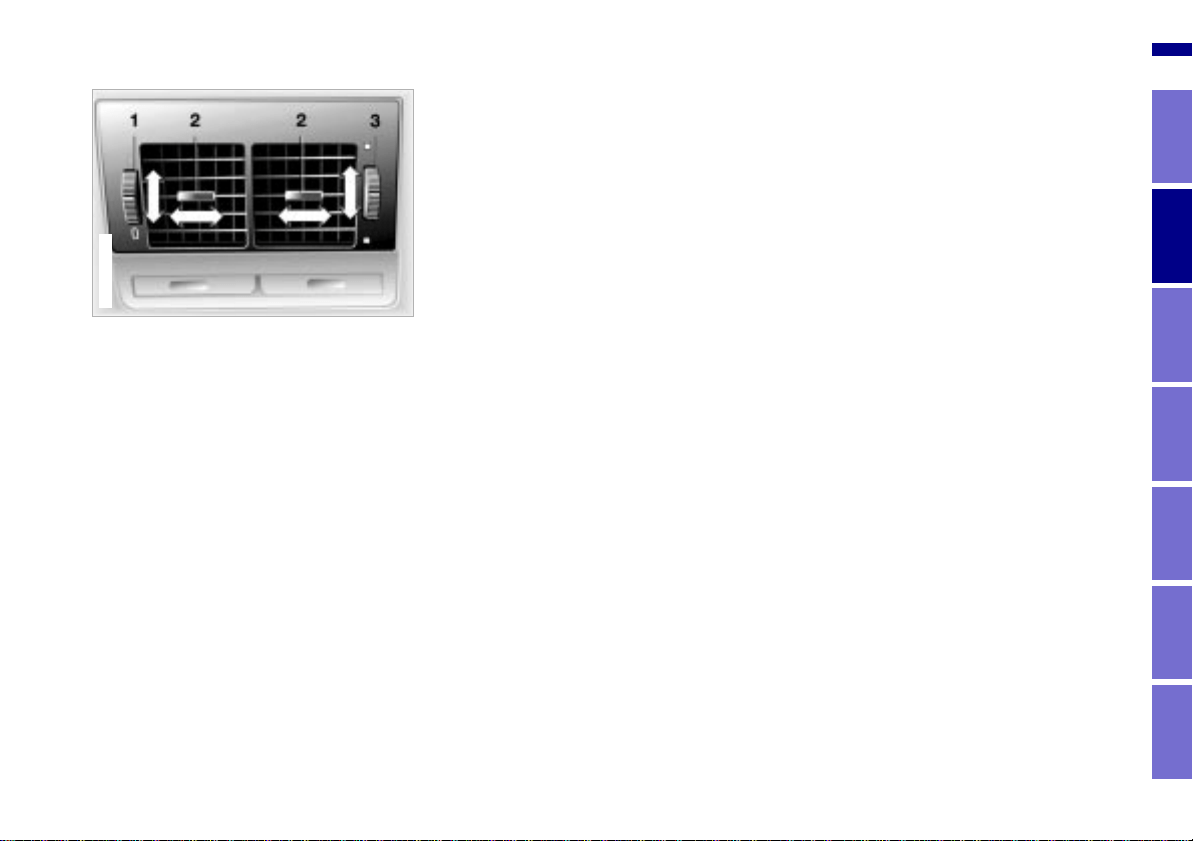
87n
RepairsIndex OverviewControlsCar careTechnologyData
Automatic climate control
Rear passenger area ventilation
Rotary dial 1 opens the air outlets in an
infinitely-variable range. You can vary
the temperature of the air as it flows out
using rotary dial 3 in the same manner
as for the front rotary dial.
You can change the direction of the air
flow with levers 2.
390de354
Microfilter, activated-charcoal
filter
The microfilter removes dust and pollen
from the incoming air. The activated-
charcoal filter provides additional pro-
tection by filtering gaseous pollutants
from the outside air. Your BMW center
replaces this combined filter as a stan-
dard part of your scheduled mainte-
nance. A substantial reduction in air
supply indicates that the filter must be
replaced before normal maintenance.
Online Edition Part-No. 01 41 0 155 062 - © 07/99 BMW AG
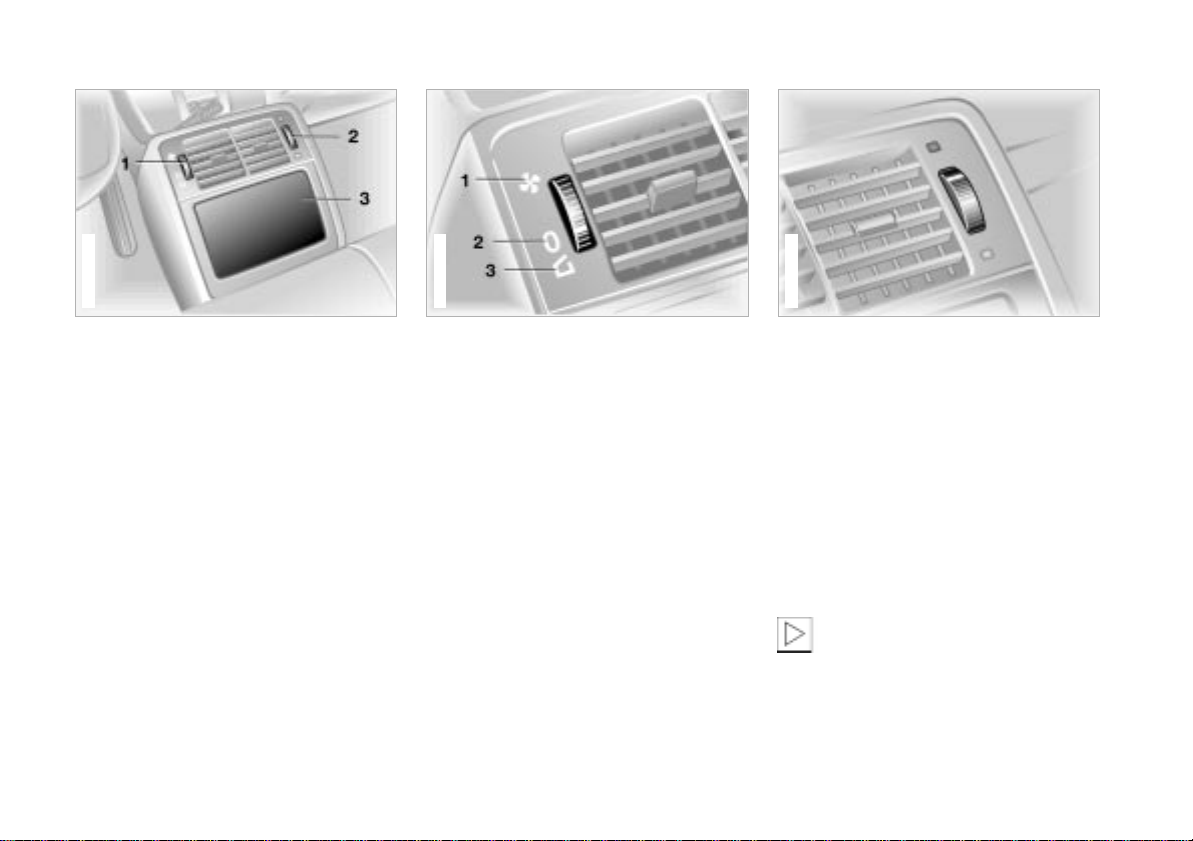
88n
Integrated rear center console*
Climate control
1 Air supply
2 Temperature
3 Storage compartment with ventilation
390de617
Air supply
1 Maximum blower speed
2 Blower off
3 Storage compartment
You can adjust the air supply for the air
outlets and the storage compartment
through an infinitely-variable range be-
tween the "0" and "Maximum" settings.
When set to "0" and "Storage compart-
ment," the fan is switched off and the
air supply through the air outlets is
blocked. The storage compartment is
ventilated in both settings as follows:
> "0" setting – warm air
> "Storage compartment" setting – cold
air
Individual adjustments on the front-seat
control elements influence the air supply
of the rear passenger area climate con-
trol.
390de618
Temperature
Passengers in the rear seating area can
adjust their own temperature for the ad-
jacent air outlets:
> Turn toward blue – colder
> Turn toward red – warmer
When you start the vehicle, the system
ensures that the selected temperature
is achieved as quickly as possible. It
then maintains this temperature, re-
gardless of the season.
A temperature adjustment is
only possible when the blower is
switched on – it is not possible when
set to "0" and "Storage compart-
ment."<
390de632
Online Edition Part-No. 01 41 0 155 062 - © 07/99 BMW AG
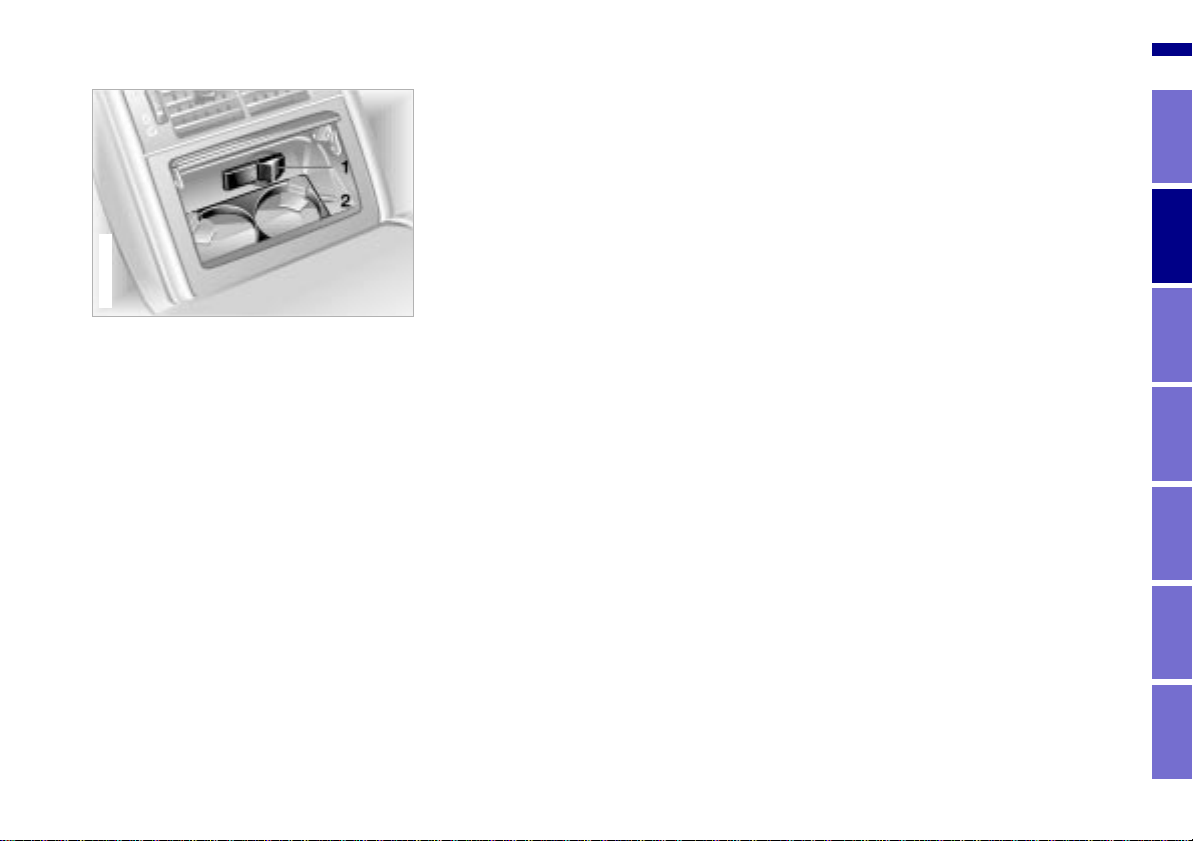
89n
RepairsIndex OverviewControlsCar careTechnologyData
Integrated rear center console*
Storage compartment with
ventilation
Press the cover back gently to open it.
1 Slide regulator for opening and clos-
ing the air supply:
> Regulator to the left – air supply
opened
> Regulator to the right – air supply
closed.
2 Beverage holder insert – may also be
removed.
390de619
Online Edition Part-No. 01 41 0 155 062 - © 07/99 BMW AG
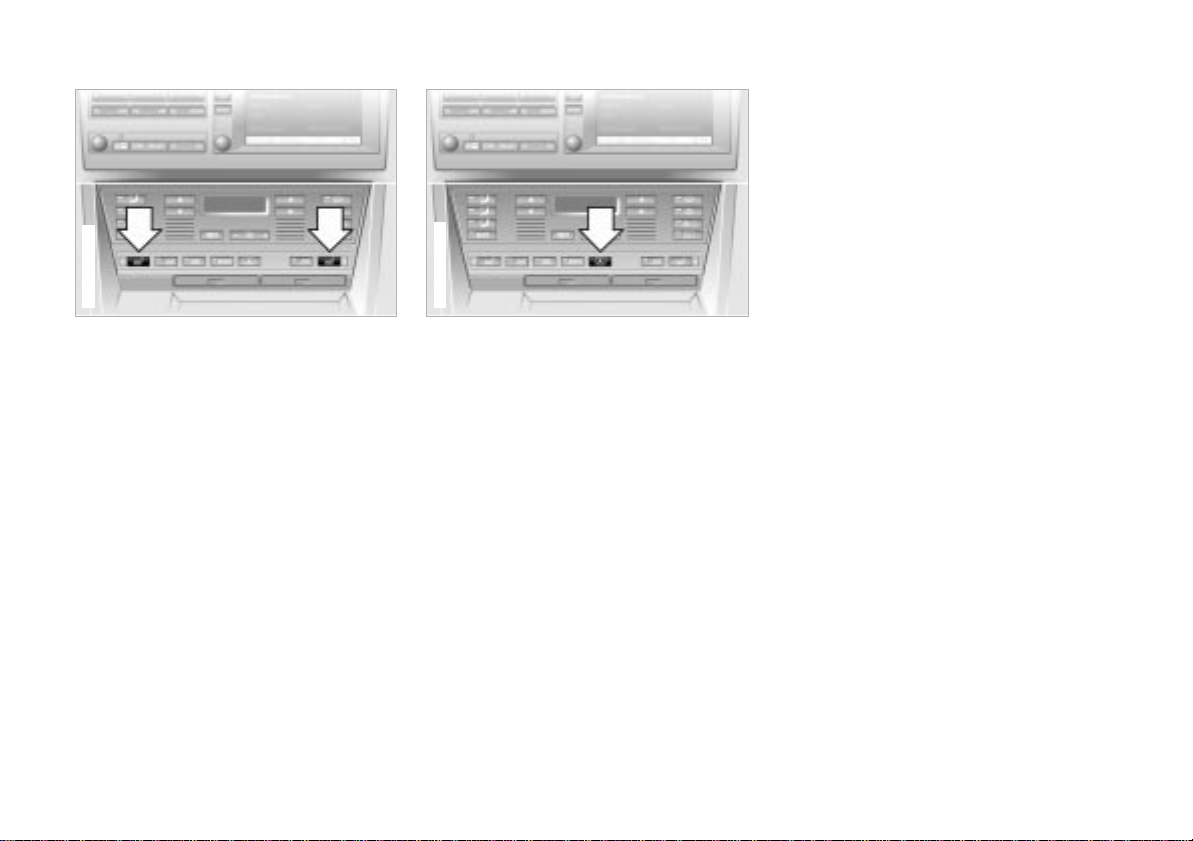
90n
Seat heating* Roller sun blind* Independent ventilation system
The seat cushion and backrest can be
heated when the ignition key is in posi-
tion 2. You can call up different heating
modes by repeatedly pressing the keys.
When the three indicator lamps are illu-
minated, the highest heating mode is
activated. One lamp indicates the low-
est heating mode. The temperature is
regulated with a thermostat in each
mode.
You can also switch the higher heating
modes off directly: Press the key and
hold it slightly longer.
39mde077
To actuate, press the button briefly with
ignition key in position 1.
Roller sun blinds for rear side
windows
*
Use the strap to pull out the blinds, then
hook them in the provided attachment.
39mde078
This system ventilates the interior and
lowers its temperature by using the
blower of the automatic climate control,
when the vehicle is unattended.
The independent ventilation system is
operated via the onboard computer.
Refer to the separate Owner's Manual.
You may preselect two different activa-
tion times. The ventilation will remain
activated for 30 minutes. You can also
turn it on and off directly. Because of its
high current consumption, you should
not activate the system twice in succes-
sion without allowing the battery to be
recharged while you are driving.
When a preselected activation time is
set, the independent ventilation system
is operational at outside temperatures
above 60 7 (16 6), or by direct switch
activation. It cannot be switched on
when the vehicle is moving.
The air emerges via the air outlets for
the upper body. Therefore, the air out-
lets must be open for the system to
operate.
You can adjust the airflow volume and
the air distribution when the ignition key
is in position 1.
Online Edition Part-No. 01 41 0 155 062 - © 07/99 BMW AG

91n
RepairsIndex OverviewControlsCar careTechnologyData
The concept
The BMW Universal Transmitter re-
places up to three hand-held transmit-
ters that control different devices such
as a garage door opener, alarm sys-
tems or a door locking system. The
BMW Universal Transmitter recognizes
and "learns" the transmitted signal from
each of the original hand-held transmit-
ters.
The signal of an original hand-held
transmitter can be programmed to one
of three channel keys. Following that,
each of the devices can be operated
with the channel key that you have pro-
grammed for it. A transmission of the
signal is indicated by the indicator lamp.
Before you sell your vehicle, the pro-
grammed channel keys should be de-
leted. Refer to page 93 for the descrip-
tion of this process.
To prevent potential injuries or
damage: during the programming
operation and before every remote trig-
gering of a programmed device using
the BMW Universal Transmitter, be sure
that there are no persons, animals or
objects within the range of movement of
the respective device. Read and comply
with the safety instructions for the origi-
nal hand-held transmitter also.<
To Canadian residents
During programming, your hand-
held transmitter may automatically stop
transmitting after two seconds. This
may not be long enough to program the
BMW Universal Transmitter. If you are
programming from one of these hand-
held transmitters, the Universal Trans-
mitter's lamp may begin to flash in a
series of double-blinks. If this occurs,
continue to hold the button on the Uni-
versal Transmitter while you reactivate
your hand-held transmitter. You may
have to repeat this function several
times while programming.<
Before programming, read the
"User's information" section on
page 93.<
The original hand-held transmitter
If this symbol is depicted on the
packaging or in the user's in-
structions for the original hand-
held transmitter, it may be assumed
that this original hand-held transmitter
is compatible with the BMW Universal
Transmitter.
Checking for the change code
In order to determine whether the origi-
nal hand-held transmitter is equipped
with a change code system, you may
either refer to the instructions for the
original hand-held transmitter or pro-
gram a channel key as described in the
left column on page 92 under "Pro-
gramming."
Following that, press and hold the pro-
grammed channel key of the BMW Uni-
versal Transmitter. If the indicator lamp
of the BMW Universal Transmitter
flashes rapidly for two seconds and then
stays on continuously, the original hand-
held transmitter is equipped with a
change code system. If the change code
system is available, program the chan-
nel keys as described in the right-hand
column on page 92 under "Program-
ming a hand-held transmitter with
change code."
If you have additional questions,
please consult your BMW center
or call 1-800-355-3515.<
BMW Universal Transmitter*
Online Edition Part-No. 01 41 0 155 062 - © 07/99 BMW AG
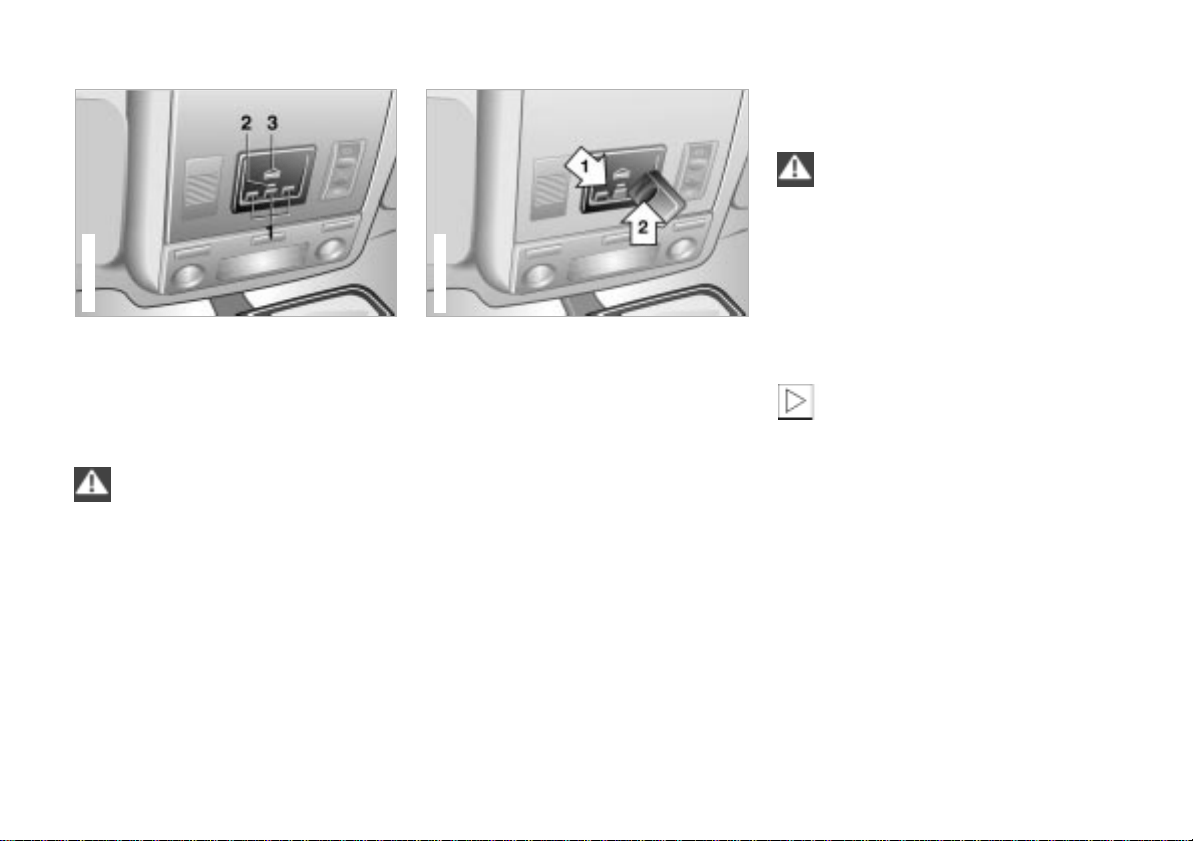
92n
BMW Universal Transmitter*
Programming
1 Channel keys
2 Indicator lamp
3 Receiver for programming
Read and comply with the safety
precautions on page 91.<
1 Ignition key position 2
2 For initial operation: Press and hold
the two outer keys (1) until the indica-
tor lamp (2) flashes. Release the keys.
The three channel keys are cleared.
390de640
3 Hold the original hand-held transmit-
ter toward the receiver (3) a maximum
of 2 inches (5 cm) away.
4 Simultaneously press the transmitting
key of the original hand-held trans-
mitter (arrow 2) and the desired chan-
nel key of the BMW Universal Trans-
mitter (arrow 1). Release both keys as
soon as the indicator lamp flashes
rapidly.
5 To program other original hand-held
transmitters, repeat steps 3 and 4.
The corresponding channel key is now
programmed with the signal of the orig-
inal hand-held transmitter.
380de712
Programming a hand-held
transmitter with change code
Read and comply with the safety
precautions on page 91.<
Consult the operating instructions for
the individual device when program-
ming the BMW Universal Transmitter.
Read and comply with the following
programming instructions for the use of
the BMW Universal Transmitter with a
change code system:
A second person simplifies pro-
gramming of the BMW Universal
Transmitter.<
Online Edition Part-No. 01 41 0 155 062 - © 07/99 BMW AG

93n
RepairsIndex OverviewControlsCar careTechnologyData
BMW Universal Transmitter*
1 Program the BMW Universal Trans-
mitter as described above under
"Programming."
2 Press and hold the programming key
on the receiver of the device for
about two seconds or until the pro-
gramming lamp on the device comes
on.
3 Press the desired channel key of the
BMW Universal Transmitter three
times.
If you have additional questions,
please consult your BMW center
or call 1-800-355-3515.<
Clearing the channel keys
Read and comply with the safety
precautions on page 91.<
Individual channel keys cannot be
cleared. However, the three channel
keys can be cleared together in the fol-
lowing manner:
> Press and hold the two outer channel
keys of the BMW Universal Transmit-
ter until the indicator lamp flashes,
and then release the keys.
All channel keys are cleared.
User's information
Do not use this BMW Universal Trans-
mitter with any garage door opener that
lacks safety "stop" and "reverse" fea-
tures as required by federal safety stan-
dards (this includes any garage door
opener model manufactured before
April 1, 1982).
This device complies with Part 15 of the
FCC Rules. Operation is subject to the
following two conditions: (1) This device
may not cause harmful interference,
and (2) This device must accept any in-
terference received, including interfer-
ence that may cause undesired opera-
tion.
Online Edition Part-No. 01 41 0 155 062 - © 07/99 BMW AG
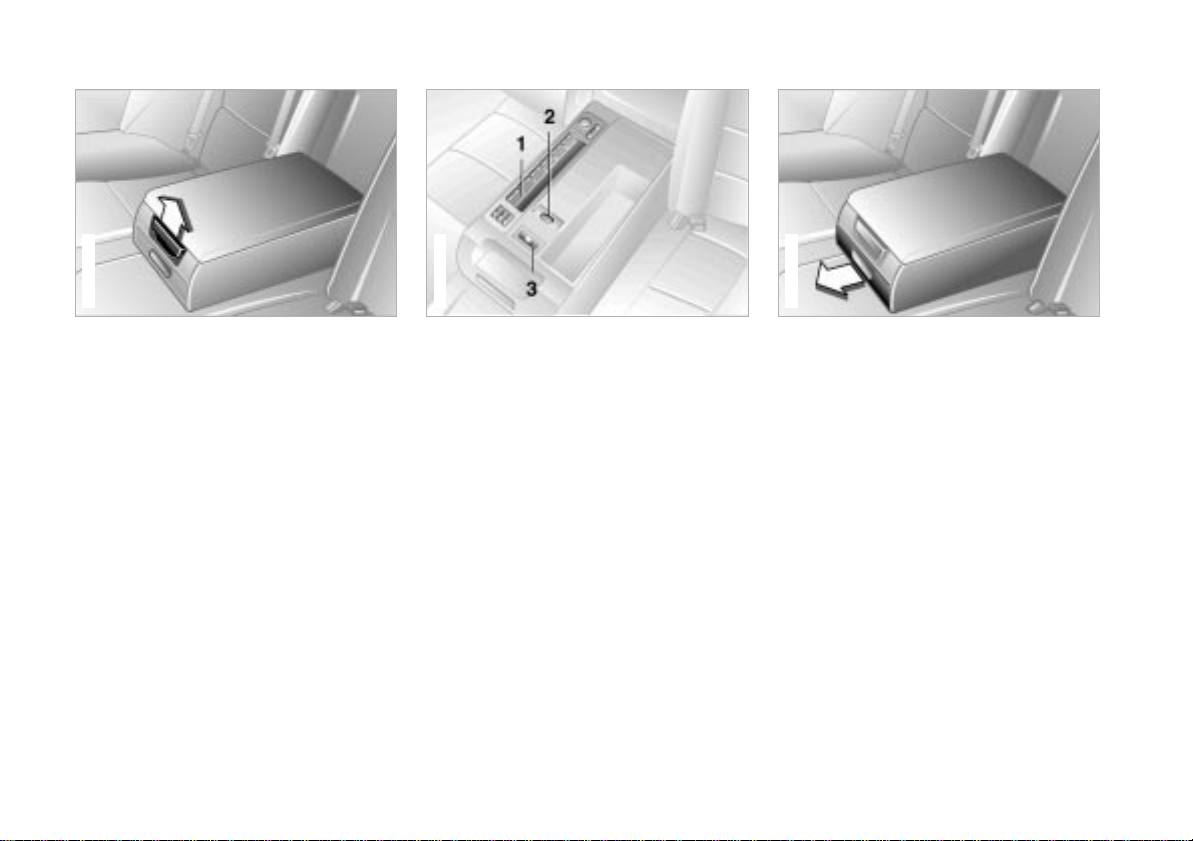
94n
Integrated rear-seat equipment*
Fold the armrest out and open the
cover by lifting the handle (arrow).
390de614
In order to operate certain functions
from the rear passenger area as well,
the corresponding controls are inte-
grated in the center armrest.
The illustration shows the maximum
possible number of controls, corre-
sponding to a full range of optional
equipment. Refer to the individual
Operating Instructions for more detailed
descriptions of the equipment.
1 Multi-information display for opera-
tion of the radio and onboard com-
puter (with limited functional range)
2 Cigarette lighter
3 Electric rear window blind
390us615
Two beverage holders are provided in
the lower section of the center armrest.
Pull the handle outward to open (arrow).
390de616
Online Edition Part-No. 01 41 0 155 062 - © 07/99 BMW AG
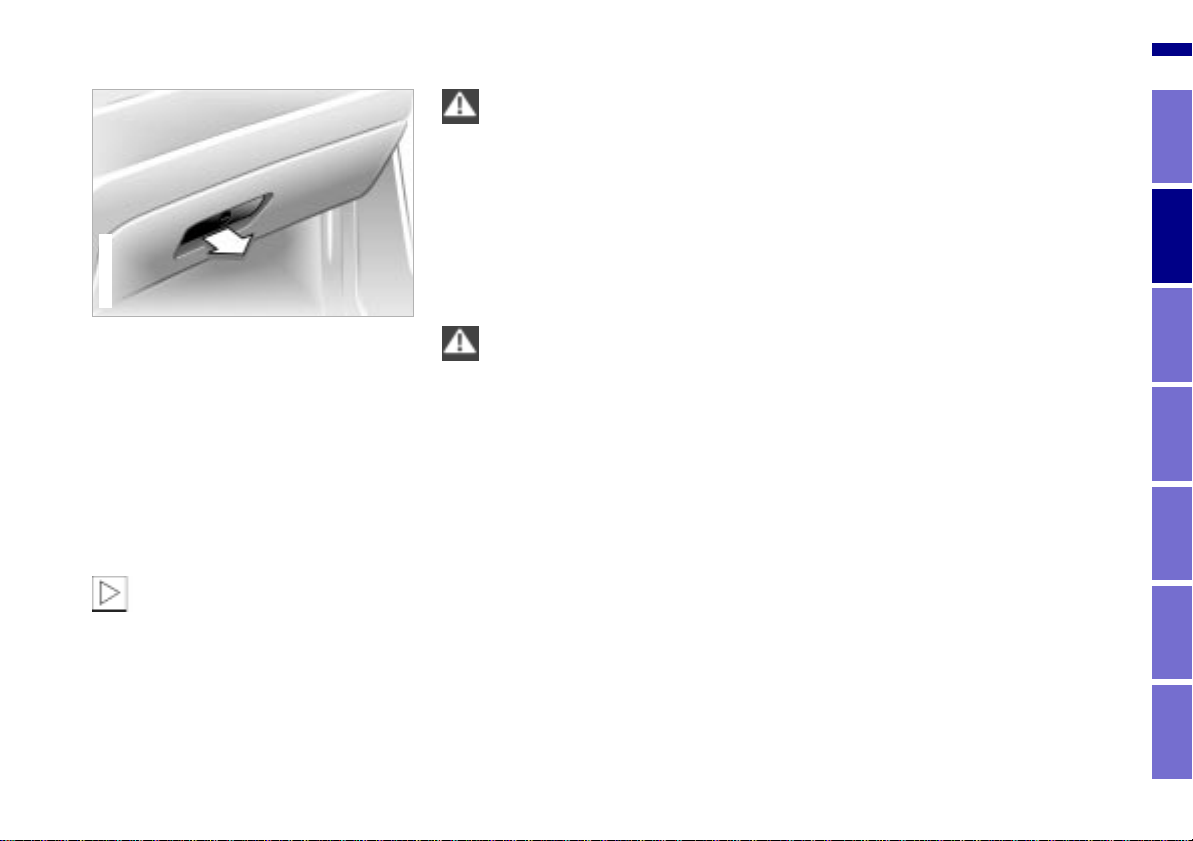
95n
RepairsIndex OverviewControlsCar careTechnologyData
Glove compartment
To open
Pull the handle and the lamp comes on.
To close
Fold the cover up.
To lock
Use one of the master keys. A master
key is also required for unlocking.
If you turn over only your door and
ignition key for valet parking, for
example (refer to page 30), access to
the glove compartment is not possi-
ble.<
390de060
To prevent injury in the event of a
crash, close the glove compart-
ment immediately after use.<
Rechargeable flashlight*
Located on the left-hand side of the
glove compartment.
It features integral overload-protection,
so it can be left in its holder continu-
ously.
Be sure that the flashlight is
switched off when it is inserted
into its holder. Failure to comply with
this precaution could lead to overcharg-
ing and damage.<
Online Edition Part-No. 01 41 0 155 062 - © 07/99 BMW AG
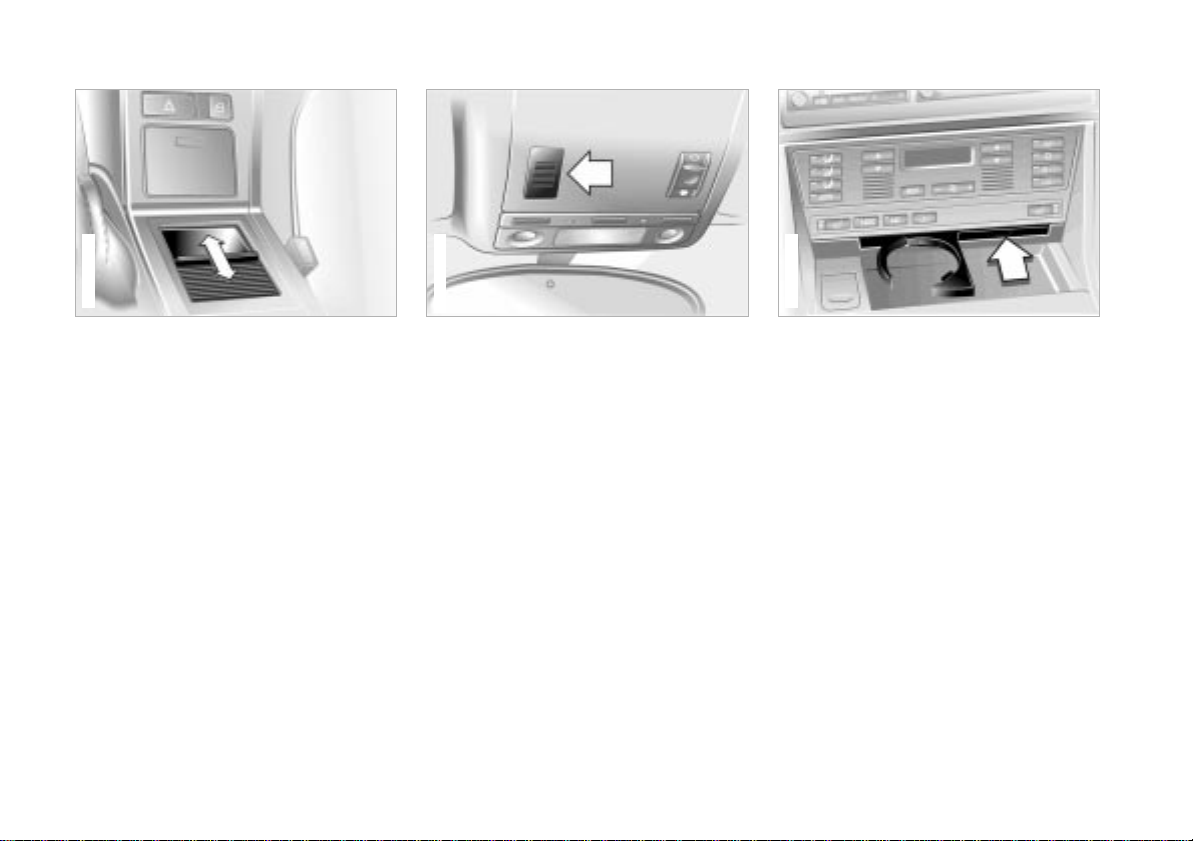
96n
Storage compartments Cellular phone* Beverage holder*
The cover of the storage compartment
on the inclined surface of the center
console can be pushed open or closed
(arrow). If your vehicle is equipped with
a cassette holder
*, open each cassette
compartment by pressing the small but-
ton.
Storage compartment on center con-
sole between the front seats: To open,
reach into the recess at the front and
pull upward. If a cellular phone has
been installed, this compartment is oc-
cupied by the phone.
You will find additional storage com-
partments in all of the doors as well as
in the backrests of the front seats
*.
390de043
Handsfree system*
For vehicles with a telephone hookup*,
the trim cover for the handsfree speaker
is located in the headliner in the area
the interior lamp.
For further information on the cellular
phone: refer to the separate Operating
Instructions.
39mde090
Two holders for soft drinks have been
provided in the center console below
the controls for the automatic climate
control, with two additional holders for
rear passengers on the rear of the con-
sole, just below the vent outlets.
Press to open; push back inward to
close.
390de363
Online Edition Part-No. 01 41 0 155 062 - © 07/99 BMW AG
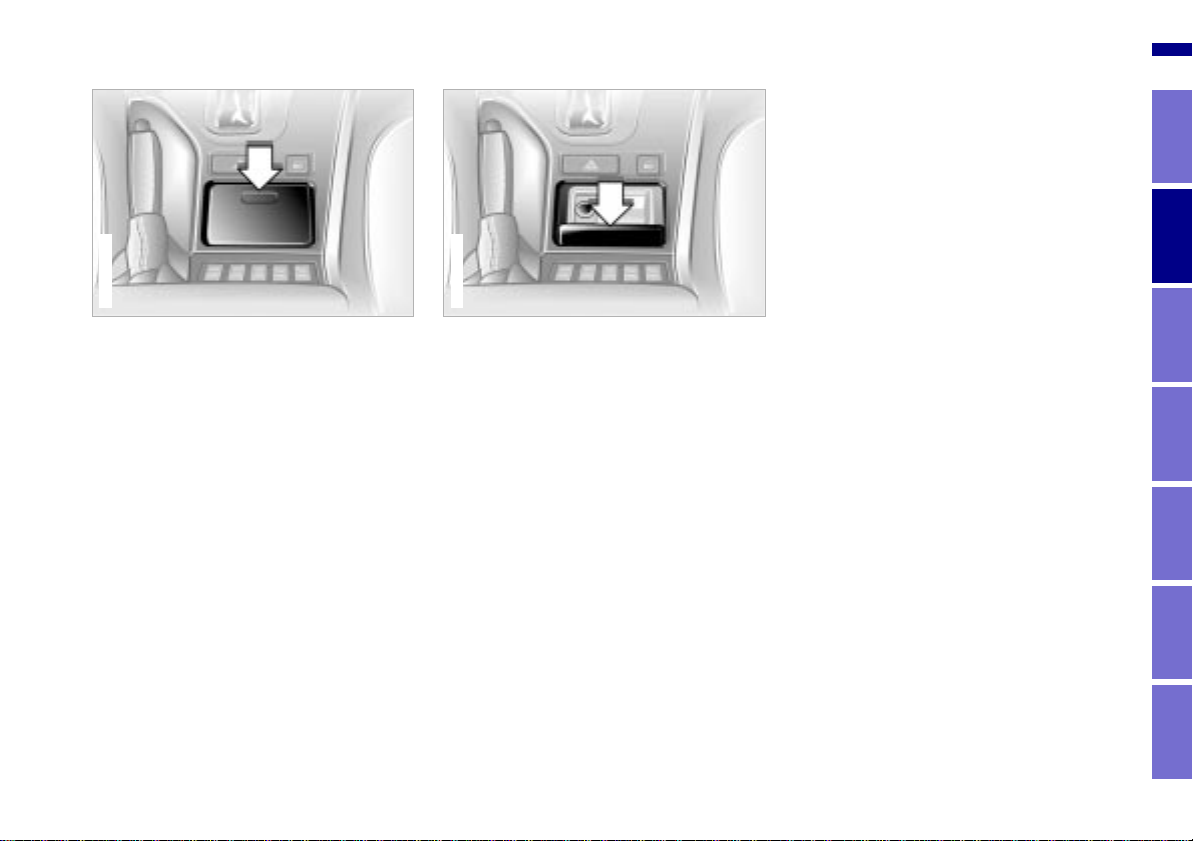
97n
RepairsIndex OverviewControlsCar careTechnologyData
Ashtray, front*
To open
Press briefly in the direction indicated
by the arrow.
To extinguish a cigarette, tap off the
ash and gently press the tip into the
funnel.
390de061
To empty
Open the lid and press down (arrow):
You can now pull the ashtray upward
for removal.
On vehicles equipped for nonsmokers,
the insert is removed in the same way.
390de062
Online Edition Part-No. 01 41 0 155 062 - © 07/99 BMW AG
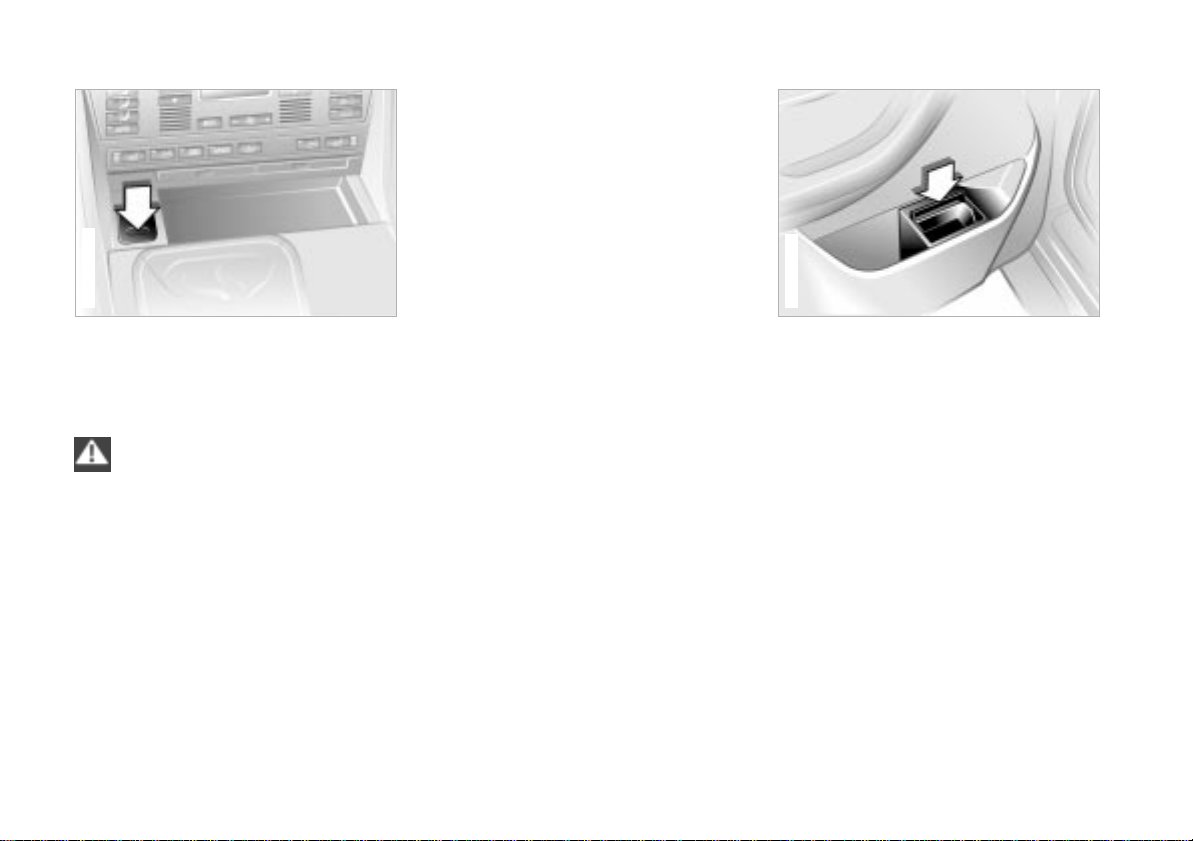
98n
Cigarette lighter* Ashtray, rear*
Press the cover panel for access
(arrow), then push the lighter down.
Remove as soon as the lighter retracts.
Hold or touch the hot cigarette
lighter by the knob only. Holding
or touching it in other areas could result
in burns.
The cigarette lighter remains opera-
tional when the ignition key has been
removed. For this reason, children
should never be left in the car unat-
tended.<
39mde080
Cigarette lighter socket
Suitable for attaching power supplies
for flashlights, car vacuum cleaners,
etc., up to a rating of approx. 200 watts
at 12 volts. Avoid damage to the socket
caused by inserting plugs of a different
shape or size.
To open
Press the recess the in lid.
To empty
Press the edge of the cover (arrow).
You can now pull the ashtray upward
for removal.
390de063
Online Edition Part-No. 01 41 0 155 062 - © 07/99 BMW AG
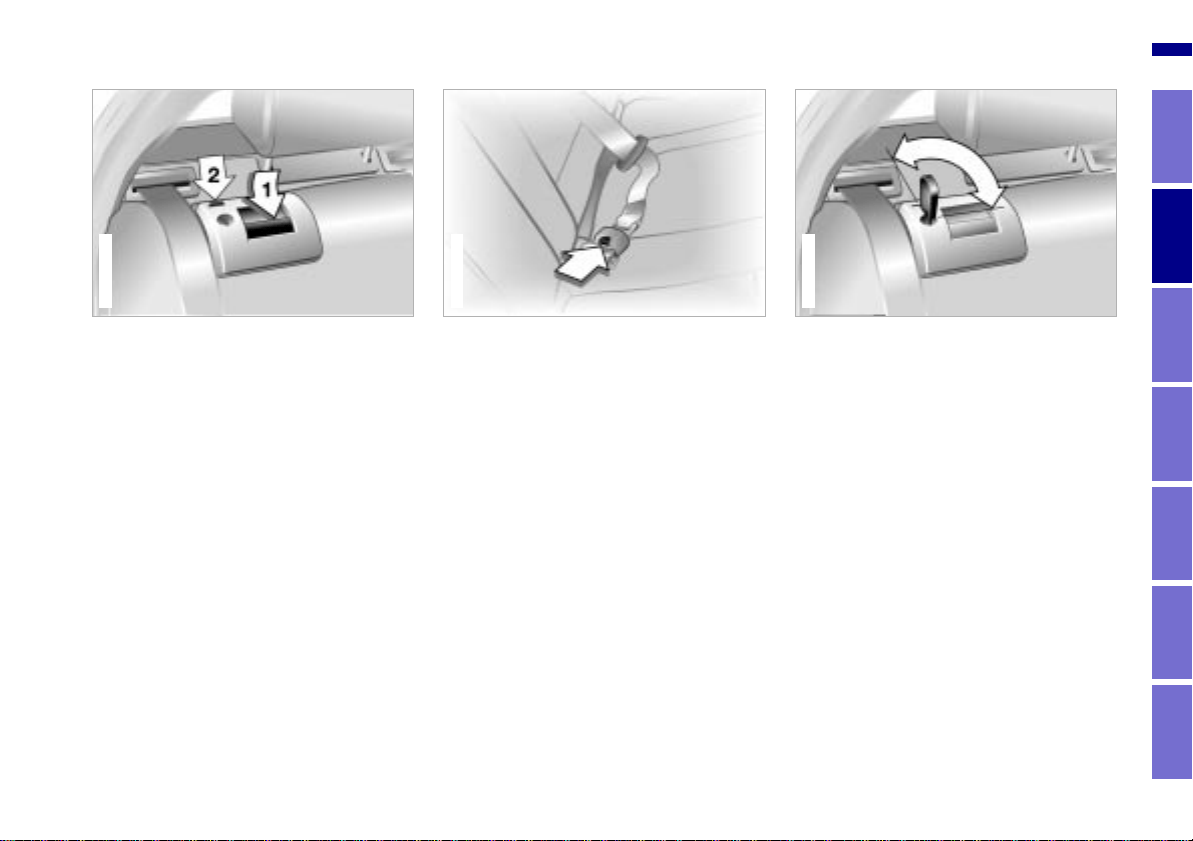
99n
RepairsIndex OverviewControlsCar careTechnologyData
The rear backrest is divided into two
sections, one-third and two-thirds of
the seat respectively. For carrying
longer objects, you can fold down
either section of the backrest sepa-
rately.
To open:
Reach into the recess and pull forward
(arrow 1).
When you close the backrest, be sure
that the catch engages securely. The
red tab (arrow 2) must go fully down.
394de117
The middle belt has an additional small
buckle.
> If you connect the two belt sections,
you can use the middle belt as any
normal 3-point belt
> It is easier to fold the rear seat back-
rest up and down if you unbuckle the
belt (arrow).
394de303
You can lock each backrest in the rear
seat with a master key.
This also prevents access to the lug-
gage compartment from the interior of
the vehicle when you turn over the door
and ignition key (3) to someone else
(refer to page 30). This is convenient for
valet parking, for instance.
394de118
Through-loading system*
Online Edition Part-No. 01 41 0 155 062 - © 07/99 BMW AG
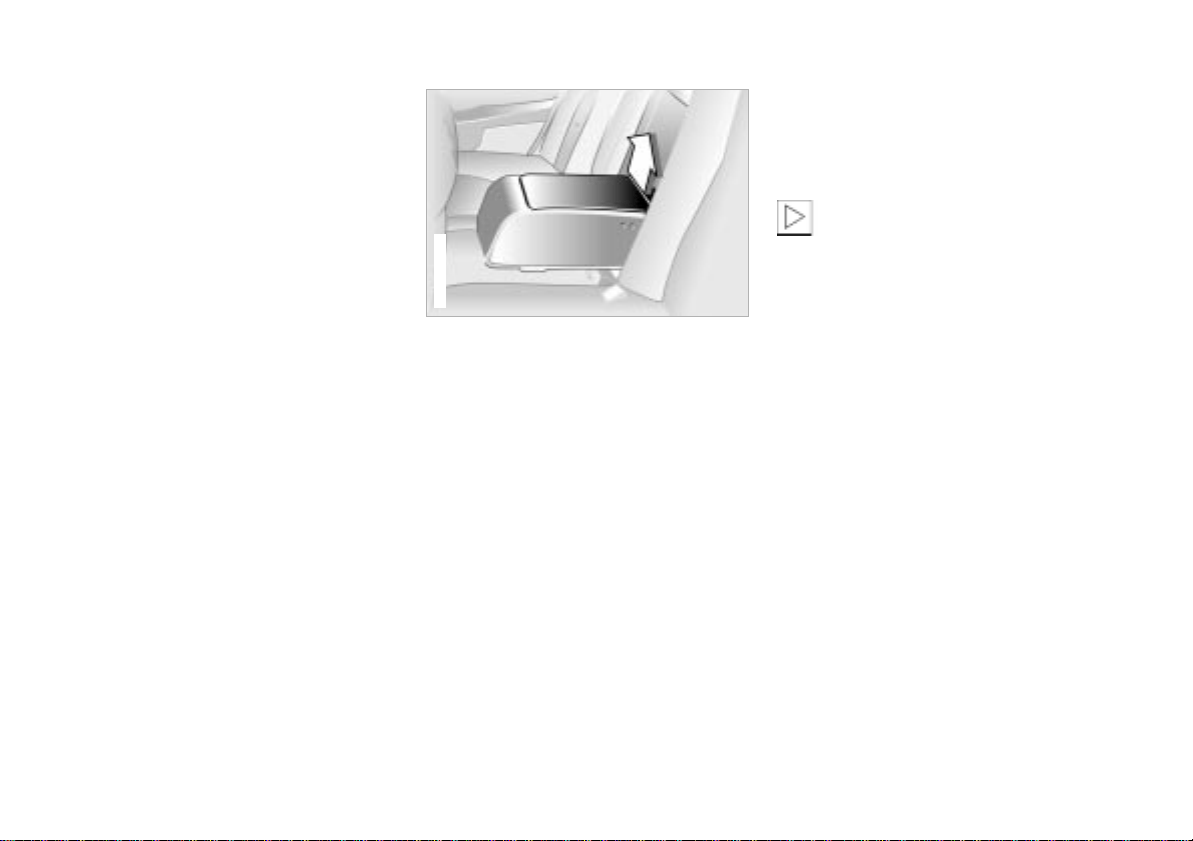
100n
Ski bag*
The ski bag allows you to transport up
to four pairs of skis or two snowboards
safely and conveniently.
With the length of the ski bag and the
additional space in the luggage com-
partment, you can store skis with a
length of up to 6.8 feet (2.10 meters).
Because of the tapered shape of the
bag, the ski bag can only accommo-
date two pairs of skis with a length of
6.8 feet (2.10 meters).
Removing the center armrest
(Not required for vehicles with the
through-loading system. Refer to
page 102).
1 Fold the center armrest completely
down.
2 Loosen the trim from the upper Vel-
cro® fastener and place it on the arm-
rest.
3 Grasp the front of the armrest with
one hand, then use your other hand
to reach down behind the armrest
and pull up sharply (arrow).
394de067
Installing the center armrest
Guide the armrest into position from
above, then apply pressure until you
hear it snap into position.
Be sure that the seat covers are
not damaged by the side pins.<
Online Edition Part-No. 01 41 0 155 062 - © 07/99 BMW AG
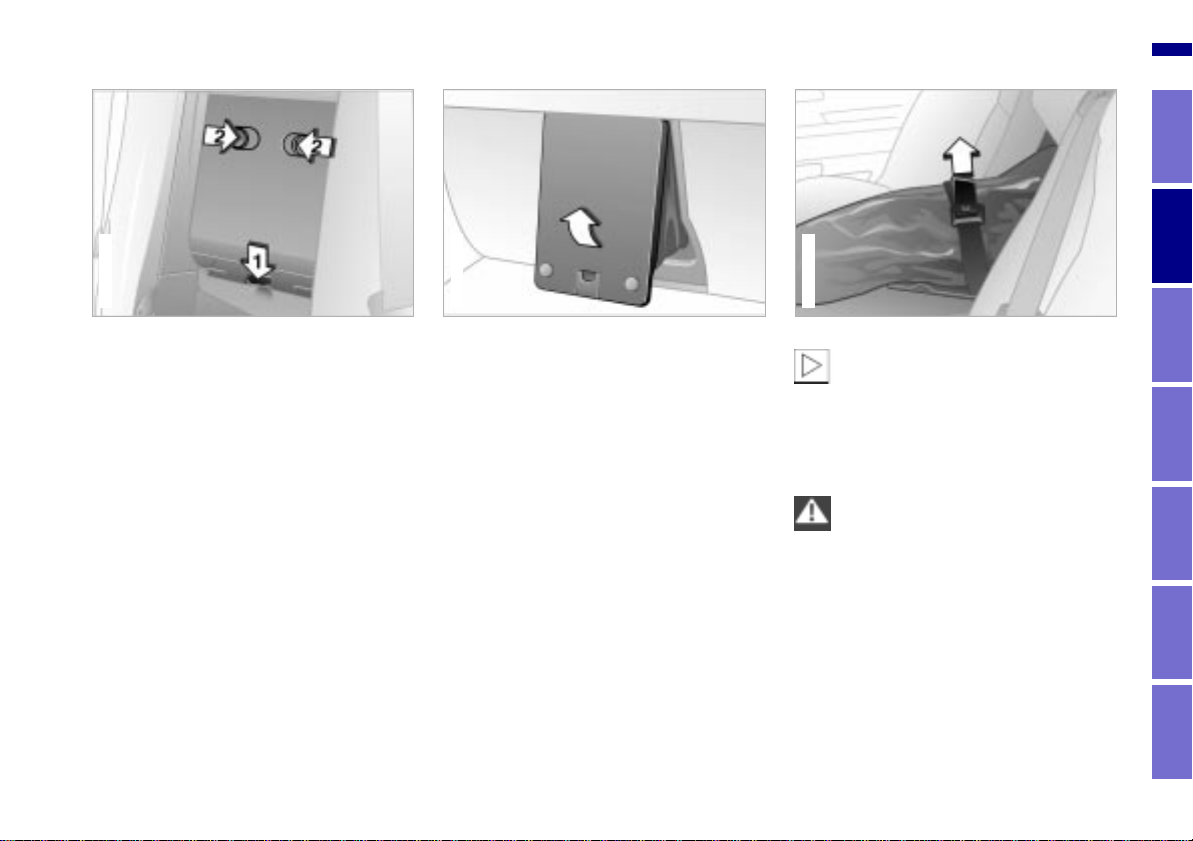
101n
RepairsIndex OverviewControlsCar careTechnologyData
Ski bag*
Loading
1 Press the release button (arrow 1):
The cover panel in the luggage com-
partment is unlocked.
2 Press the detent levers inward
(arrow 2) and pull the cover forward.
3 Extend the ski bag between the front
seats. The zipper provides conve-
nient access to stored items. It may
be opened to allow the ski bag to dry.
394de068
4 Use the magnetic retainers to attach
the cover panel to the upper surface
(metal surface below rear tray) of the
luggage compartment.
Please be sure that the skis are clean
before loading them into the bag. Take
care to avoid damage from sharp edges.
380de069
Secure the bag's contents by
tightening down the retaining
strap at the buckle.<
To store the ski bag, perform the above
steps in reverse sequence.
An unsecured ski bag could lead
to loss of vehicle control and to
personal injury in case of an accident.<
380de070
Online Edition Part-No. 01 41 0 155 062 - © 07/99 BMW AG
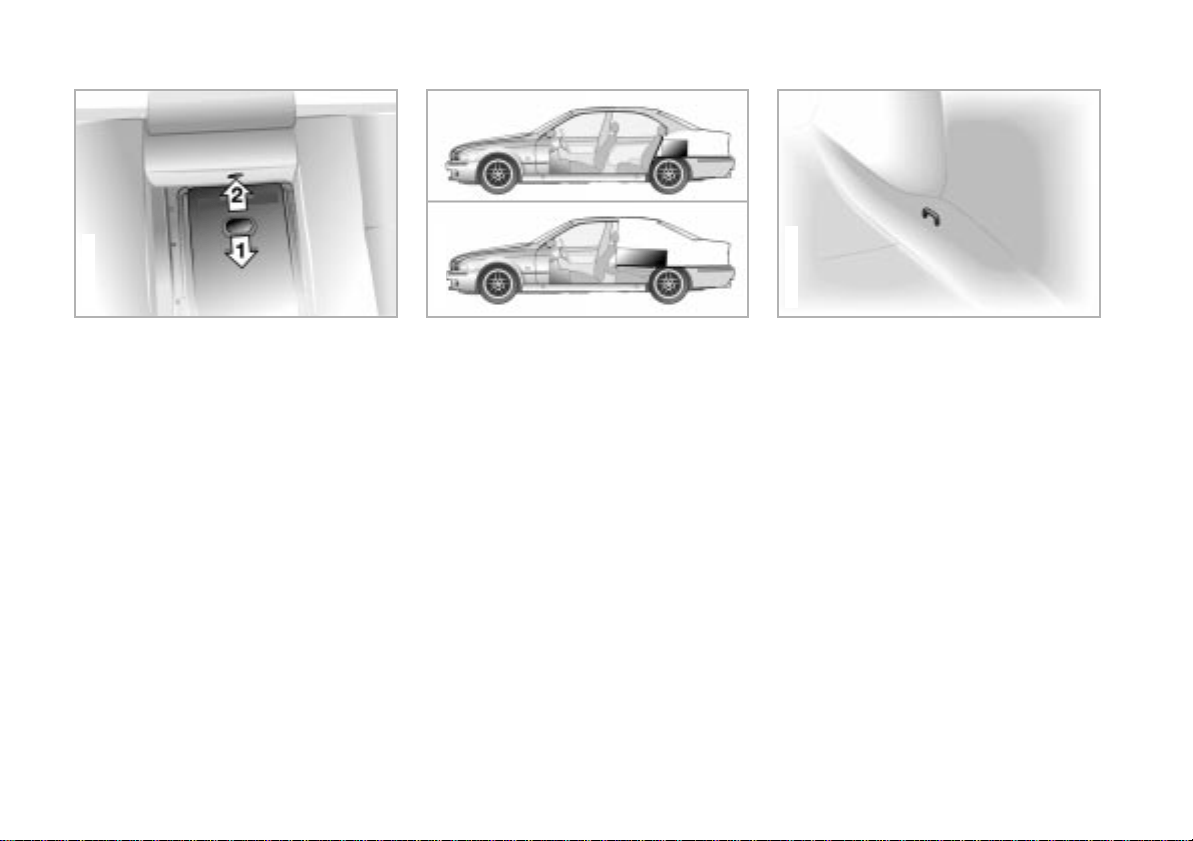
102n
Ski bag* Cargo loading
With through-loading system
1 Fold the center armrest down.
Loosen the trim from the upper Vel-
cro® fastener and place it on the arm-
rest.
2 Press button 1 downward and swing
the cover forward.
3 Press knob 2: The cover in the lug-
gage compartment is unlocked.
394de119
Stowing cargo
If you are transporting a load in your
BMW:
> Load heavy cargo as far forward as
possible – directly behind the back-
rests or the luggage compartment
partition – and as low as possible.
> Cover sharp edges and corners.
> Do not pile objects higher than the
top edge of the backrest.
> If you are transporting very heavy
loads when the rear seat is not occu-
pied, secure the outer safety belts in
the opposite buckle.
39mde036
Securing the load
> Secure smaller, light pieces with the
luggage net or use draw straps
*
(refer to page 39).
> For large, heavy pieces, see your
BMW center for load-securing de-
vices
*. The lashing eyes provided at
the corners of the luggage compart-
ment serve for mounting these load-
securing devices.
> Read and comply with the informa-
tion enclosed with the load-securing
devices.
39mde037
Online Edition Part-No. 01 41 0 155 062 - © 07/99 BMW AG
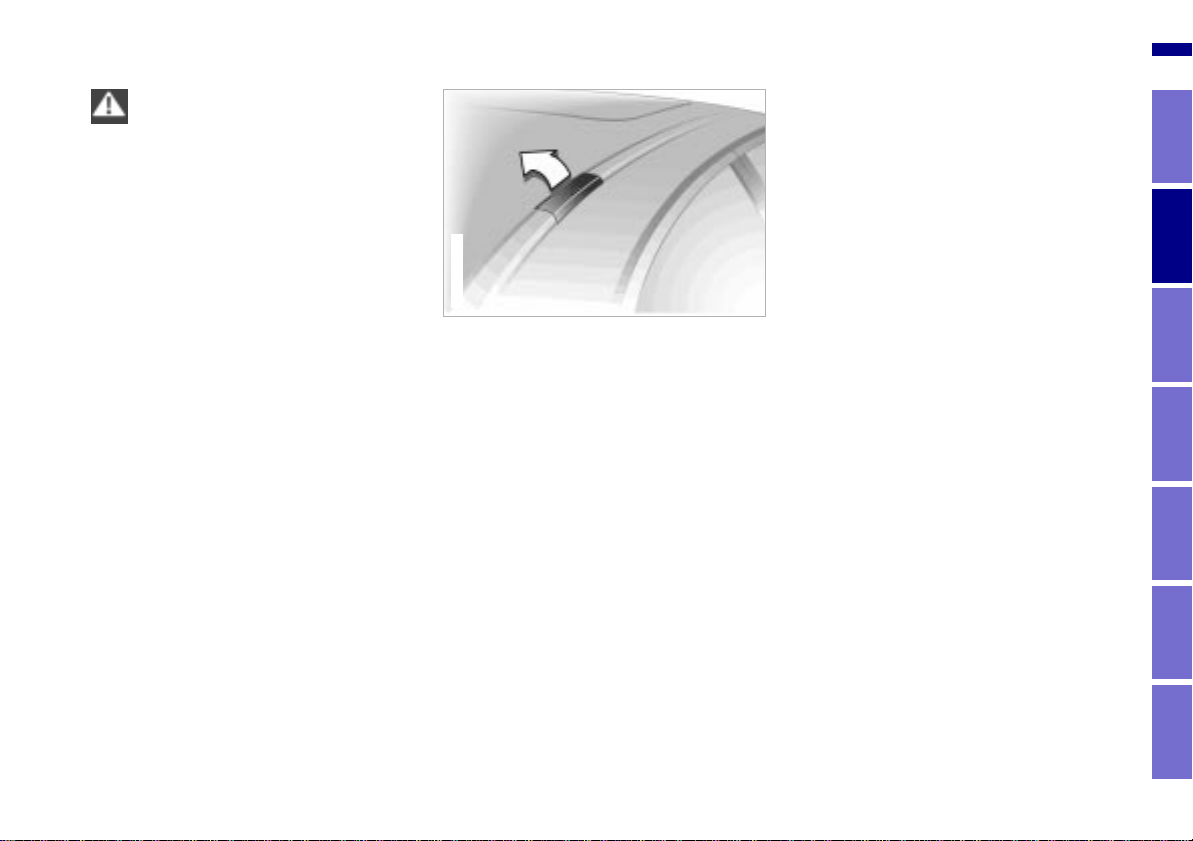
103n
RepairsIndex OverviewControlsCar careTechnologyData
Cargo loading Roof-mounted luggage rack*
Always position and secure the
load correctly. If you do not, it can
endanger the passengers during brak-
ing or evasive maneuvers.
Do not exceed the permissible gross
weight and axle load (refer to
page 174), otherwise the vehicle's op-
erating safety is no longer assured and
a violation of the laws of the road oc-
curs.
Do not carry hard or heavy objects un-
secured in the passenger compartment.
If you do so, they may be projected
through the air during braking and eva-
sive maneuvers, thus endangering vehi-
cle occupants.<
Anchors
Access to the anchors:
To open the cover (arrow) please use
the tool included with the luggage sys-
tem.
A special luggage system is available as
an option for your BMW. Please comply
with the precautions included with the
installation instructions.
394de369
Roof-mounted luggage racks raise the
center of gravity of the vehicle when
they are loaded. For this reason, they
exercise a major effect on the vehicle's
handling and steering response.
You should therefore always remember
not to exceed the approved roof
weight, the approved gross vehicle
weight or the axle weights when load-
ing the rack. You will find the specifica-
tions under "Technical Data" on
page 174.
Make sure that the load is not too heavy,
and attempt to distribute it evenly.
Always load the heaviest pieces first (on
the bottom). Be sure that adequate
clearance is maintained for raising the
sliding/tilt sunroof.
Secure the roof luggage correctly and
securely to prevent it from shifting or
being lost during driving (danger to fol-
lowing traffic).
Drive smoothly and avoid sudden ac-
celeration or braking. Do not corner at
high speeds.
The roof load increases the aerody-
namic resistance. Increased fuel con-
sumption and additional stresses on the
vehicle's body result from this.
Online Edition Part-No. 01 41 0 155 062 - © 07/99 BMW AG

104n
Online Edition Part-No. 01 41 0 155 062 - © 07/99 BMW AG
Overview
Controls and features
Operation, care
and maintenance
Owner service procedures
Technical data
Index
Advanced technology
105n
RepairsIndex OverviewControlsCar careTechnologyData
Special operating instructions:
Break-in procedures 106
Driving notes 107
Catalytic converter 108
Antilock Brake System
(ABS) 109
Disc brakes 111
Brake system 112
Winter operation 113
Power steering 115
Cellular phones 115
Radio reception 115
Wheels and tires:
Tire inflation pressure 116
Tire condition 116
Tire replacement 117
Tire rotation 118
Wheel and tire
combinations 119
Winter tires 120
Snow chains 121
Approved wheel and tire
specifications 122
Under the hood:
Hood 123
Engine compartment 124
Washer fluids 126
Washer nozzles 126
Engine oil 127
Coolant 129
Brake fluid 130
Vehicle Identification
Number 131
Care and maintenance:
The BMW Maintenance
System 132
Caring for your car 133
Airbags 139
Vehicle storage 139
Laws and regulations:
Technical modifications 140
OBD interface socket 141
Online Edition Part-No. 01 41 0 155 062 - © 07/99 BMW AG

106n
To ensure that your vehicle provides
maximum economy throughout a long
service life, we request that you ob-
serve the following suggestions:
Because of its engineering design,
the BMW M5 is an especially high-
quality vehicle. To protect your own in-
vestment, we recommend that you fol-
low the break-in instructions carefully.
By doing so, you will create the basis
for optimal service life of the vehicle.<
Engine and differential
Up to 1,200 miles (2,000 km):
Drive at varying engine speeds and
road speeds, but do not exceed
5,500 RPM or 105 mph (170 km/h)
during this period.
Obey all applicable local, state, provin-
cial or federal maximum speed limits.
Do not depress the accelerator pedal to
the full-throttle position.
Following the Break-In Inspection at
1,200 miles (2,000 km), you can gradu-
ally increase engine or road speeds.
You should also comply with these
break-in procedures if the engine or dif-
ferential is replaced later in the course
of the vehicle service life.
Tires
Due to technical factors associated with
their manufacture, tires do not achieve
their full traction potential until an initial
break-in period has elapsed. For this
reason, drive with extra care during the
initial 200 miles (300 km).
Obey all applicable local, state, provin-
cial or federal maximum speed limits.
When the vehicle is operated on
wet or slushy roads, a wedge of
water may from between the tire and
the road surface. This phenomenon is
referred to as aquaplaning, or hydro-
planing, and can lead to partial or com-
plete loss of traction, vehicle control
and braking effectiveness. Reduce your
speed on wet roads.<
Brake system
Approximately 300 miles (500 km) must
elapse before the brake pads and rotors
achieve the optimal pad-surface and
wear patterns required for trouble-free
operation and long service life later on.
To break in the separate parking brake
drums, apply the parking brake lightly
when coasting to a standstill (at a traffic
signal, for instance), provided that traf-
fic conditions allow you to do so. To
avoid corrosion, repeat this procedure
from time to time.
The brake lamps do not come on
when the parking brake is applied.
Vacuum for the brake system servo unit
on your BMW is available only when the
engine is running. When you move the
car with the engine shut off – when tow-
ing, for instance – substantially higher
levels of pedal force will be required to
brake the vehicle.<
Break-in procedures
Online Edition Part-No. 01 41 0 155 062 - © 07/99 BMW AG

107n
RepairsIndex OverviewControlsCar careTechnologyData
Driving notes
Brakes:
Do not drive with your foot resting
on the brake pedal. Even light but con-
sistent pedal pressure can lead to high
temperatures, brake wear and possibly
even brake failure.
Aquaplaning:
A wedge of water can form between the
tires and the road surface when you
operate the vehicle on wet or slushy
roads. This phenomenon is referred to
as aquaplaning or hydroplaning. It is
characterized by a partial or complete
loss of contact between the tires and
the road surface. The ultimate results
are loss of steering and braking control.
Driving through water:
Do not drive through water that is
deeper than 1 foot (30 cm). If you must
drive through water accumulations up
to that depth, drive only at walking
speed. Driving at a faster speed could
cause damage to the engine, the elec-
trical systems and the transmission.
Rear parcel tray:
Do not place heavy or hard objects on
the rear parcel tray. If you do so, they
could pose a danger to vehicle occu-
pants during a braking or evasive ma-
neuver, or in a crash.
Clothes hooks:
When suspending articles of clothing
from the hooks, be sure that they will
not obstruct the driver's vision. Do not
hang heavy objects on the hooks. If you
do so, such objects could pose a dan-
ger during braking or evasive maneu-
vers.<
Online Edition Part-No. 01 41 0 155 062 - © 07/99 BMW AG

108n
Catalytic converter
The catalytic converter reduces harmful
exhaust emissions, and is designed for
use with unleaded fuel only. Even
minute quantities of lead would be
enough to permanently damage both
the catalytic converter and the system
oxygen sensor.
To ensure efficient, trouble-free engine
operation and avoid potential damage:
> Be sure to comply with the scheduled
maintenance requirements.
> Fill the fuel tank well before it is
empty.
> Do not attempt to start the engine by
tow-starting. If you do so, unburned
gasoline in the catalytic converter
could ignite and cause severe dam-
age. If you have starting problems,
start the engine with an outside start-
ing aid only. Refer to page 158.
> Avoid other situations in which the
fuel is not burned or burns incom-
pletely such as frequent or extended
starter engagement or repeated start
attempts in which the engine does
not start. Stopping and restarting an
engine which is running properly
does not present a problem. Never
allow the engine to run with any of
the spark plug cables disconnected.
Be sure to comply with the in-
structions above to prevent un-
burned fuel from reaching the catalytic
converter. Otherwise, the catalytic con-
verter could respond by overheating,
leading to serious damage.
Extreme temperatures occur at the cat-
alytic converter on this and every cata-
lyst-equipped vehicle. Heat shields are
installed adjacent to some sections of
the exhaust system. Never remove
these shields; do not apply undercoat-
ing to their surfaces. When driving,
standing at idle or when parking, take
precautions to avoid contact between
the hot exhaust system and easily flam-
mable materials (grass, hay or leaves,
for example). Such contact could lead
to a fire, resulting in serious personal in-
jury and property damage.<
Online Edition Part-No. 01 41 0 155 062 - © 07/99 BMW AG

109n
RepairsIndex OverviewControlsCar careTechnologyData
Antilock Brake System (ABS)
The concept
ABS enhances active safety by helping
to prevent the wheels from locking when
the brakes are applied. This is done be-
cause locked wheels are dangerous.
When the front wheels slide, the driver
loses steering control over the vehicle.
Traction loss at the rear wheels can
cause the rear axle to break into an un-
controlled skid.
ABS is designed to meet two essential
requirements during every brake appli-
cation:
> to help provide vehicle stability
> to help maintain steering control and
maneuverability – on all types of road
surfaces (asphalt, concrete, mud,
wet, snow, ice).
The system can achieve the shortest
braking distances possible under most
conditions (on straight-aways and in
curves, on asphalt, ice, wet road sur-
faces, etc.).
Braking with ABS
The system becomes operative once
the vehicle exceeds a speed of approx.
5 mph (8 km/h). The ABS is deactivated
whenever the vehicle's speed drops
back below approx. 2 mph (3 km/h).
This means that the wheels can lock in
the final phase of a brake application –
a factor of no significance in actual
practice.
If you are in a situation that requires full
braking, you will exploit the full benefits
of the ABS system if you apply maxi-
mum brake pressure ("panic stop").
Since the vehicle maintains steering re-
sponsiveness, you can avoid possible
obstacles with a minimum of steering
effort, despite the full brake application.
The ABS system's closed-loop control
circuit cycles in fractions of a second.
A pulsation at the brake pedal indicates
to the driver that ABS is active, that is,
that the vehicle is within its maximum
braking range. In addition, a pulsation –
a result of the control function cycles –
indicates to the driver that vehicle
speed should be reduced to adapt to
road surface conditions when there is
reduced traction and grip between tires
and road surface (slippery road sur-
face).
Always depress the brake pedal steadily
and with consistent application force.
Do not pump the brakes.
On road surfaces that have a loose sur-
face layer on a firm base with good
traction (on gravel or snow, for exam-
ple), or when driving with snow chains,
braking distances may be longer than
with locked wheels. However, ABS
continues to provide enhanced vehicle
stability and steering response under
these conditions.
Online Edition Part-No. 01 41 0 155 062 - © 07/99 BMW AG

110n
Antilock Brake System (ABS)
Information for your safety
Not even ABS can suspend the laws
of physics. ABS alone cannot prevent
accidents when the brakes are applied
without an adequate safety interval
between vehicles, if the car is driven
with excessive speed in curves, or if
aquaplaning occurs. Responsibility for
these types of situations remains in the
hands (and at the feet) of the driver. You
should never allow the added safety
of ABS to lull you into a false sense of
security, or mislead you into taking
increased risks that could affect your
own safety and that of others.
Do not make any modifications to
the ABS system. Service proce-
dures on ABS are to be performed by
authorized technicians only.<
In the event of a fault
If the ABS warning lamp in the
instrument cluster lights up,
refer to page 21. The brake sys-
tem then reverts to conventional
operation as on vehicles without
ABS. However, have the brake
system checked by your BMW center
as soon as possible. To prevent unde-
tected defects and cumulative faults
from adversely affecting the brake sys-
tem, refer any problems to your BMW
center at the earliest opportunity.
Online Edition Part-No. 01 41 0 155 062 - © 07/99 BMW AG

111n
RepairsIndex OverviewControlsCar careTechnologyData
Disc brakes
Disc brakes furnish optimum decelera-
tion and braking control and greater
fade resistance under heavy use.
Infrequent driving, extended periods
when the vehicle is parked, and driving
conditions in which brake applications
are less frequent all promote an in-
crease in corrosion of the brake rotors
and contamination of the brake pads.
This occurs because the minimal appli-
cation force that is required to clean the
rotors is not reached between the pads
and rotors.
If the brake rotors are corroded, they
will tend to respond to braking with a
pulsating effect which even extended
application cannot correct.
For your own safety: Use only
brake linings that BMW has re-
leased for your particular vehicle model.
BMW cannot evaluate non-approved
brake pads to determine if they are
suited for use, and therefore cannot en-
sure the operating safety of the vehicle
if they are installed.<
Driving notes
While driving on wet roads or in heavy
rain, it is a good idea to apply light
pressure to the brake pedal every few
miles or kilometers. Watch traffic condi-
tions to ensure that this maneuver does
not endanger other road users. The
heat which is generated by the brake
applications helps to dry the brake ro-
tors and pads.
Maximum braking force is obtained
while the wheels continue to rotate,
peaking when the wheels remain on the
verge of locking without actually doing
so. ABS maintains this state automati-
cally. If the ABS fails, you should revert
to the staggered braking technique de-
scribed on page 114.
Extended or steep mountain descents
do not necessarily lead to an impair-
ment in braking efficiency if you drive
downhill in the gear that requires the
least braking.
The engine's braking effectiveness can
be increased even more by progres-
sively shifting down – clear into first
gear, if necessary.
If engine braking should prove to be
inadequate, you should still avoid ex-
tended, continuous braking. Instead of
maintaining low to moderate pressure
over an extended period of time, you
should decelerate the vehicle by apply-
ing more substantial force on the pedal
(watch for following traffic). Pause be-
fore repeating the brake application.
This staggered braking technique allows
the brakes to cool in the intervals be-
tween active braking phases. This pre-
vents overheating and ensures that full
braking capacity remains available at all
times.
Do not coast with the clutch de-
pressed, with the shift lever in
neutral or with the engine shut off. The
engine does not provide any braking
effect with the transmission in neutral or
with the engine shut off.
Never allow floor mats, carpets or any
other objects to protrude into the area
around the accelerator, clutch and
brake pedals and obstruct their move-
ment.<
Online Edition Part-No. 01 41 0 155 062 - © 07/99 BMW AG

112n
Disc brakes Brake system
Dynamic Brake Control (DBC)*
If you apply the brakes rapidly, this sys-
tem automatically generates maximum
braking force boost and thus helps to
achieve the shortest possible braking
distance in "panic braking" situations.
All of the benefits of the ABS system
are exploited under these circum-
stances.
Do not reduce the pressure on the
brake pedal for the duration of the
brake application. When the brake
pedal is released, the DBC is deacti-
vated.
In the event of a malfunction,
the yellow warning lamp comes
on. Conventional braking effi-
ciency is available without limi-
tations. Have the system
checked and repaired at your
BMW center as soon as possi-
ble.
Refer to the "Information for your
safety" covering the ABS system
on page 110. This information also ap-
plies in general for DBC.<
Brake fluid level
The warning lamp for the
brake's hydraulic system comes
on or the message "CHECK
BRAKE FLUID" appears in the
Check Control.
The brake fluid level is too low in
the reservoir (refer to page 130).
If the brake fluid level is too low and
brake pedal travel has become notice-
ably longer, there may be a defect in
one of the brake system's hydraulic cir-
cuits.
Proceed to the nearest BMW cen-
ter. Higher brake application pres-
sure may be necessary under these
conditions, and brake pedal travel may
be significantly longer. Please remem-
ber to adapt your driving style accord-
ingly.<
The warning lamp also comes on when
the message "CHECK BRAKE
LININGS" is displayed in the Check
Control.
Brake linings
The message "CHECK BRAKE
LININGS" appears in the Check
Control:
The brake pads have reached their
minimum pad thickness. Proceed to
the nearest BMW center as soon as
possible to have the pads replaced.
For your own safety: Use only
brake linings that BMW has re-
leased for your particular vehicle model.
BMW cannot evaluate non-approved
brake pads to determine if they are
suited for use, and therefore cannot en-
sure the operating safety of the vehicle
if they are installed.<
Online Edition Part-No. 01 41 0 155 062 - © 07/99 BMW AG

113n
RepairsIndex OverviewControlsCar careTechnologyData
Winter operation
The onset of winter is often accompa-
nied by rapid changes in weather. Ad-
aptations in driving style should be ac-
companied by preparations on the vehi-
cle itself to ensure that your progress
through the winter remains safe and
trouble-free.
Coolant
Be sure that the coolant mixture con-
tains the year-round ratio of 50:50 water
and antifreeze/corrosion protection.
This mixture provides protection against
freeze-ups down to approx. –34 7
(–37 6). Replace the coolant every
three years.
Locks
BMW door lock deicer can be used to
free locks if they are frozen. This deicer
also contains lubricant.
After using the deicer, treatment with
BMW lock cylinder grease is recom-
mended.
Rubber seals and components
Treat the rubber parts and weather-
stripping on the doors, hood and lug-
gage compartment lid with BMW rubber
treatment or BMW Silicon Spray to pre-
vent them from freezing.
A full range of car care products is
available from your BMW center.<
Snow chains
Mount BMW snow chains* on winter
tires only. Always mount snow chains in
pairs and on the rear wheels only. Read
and comply with the chain manufac-
turer's safety precautions. Do not ex-
ceed a maximum speed of 30 mph
(50 km/h). To achieve maximum trac-
tion, we recommend that you deacti-
vate the DSC system when snow chains
have been mounted. Refer to page 76.
Starting off
When starting from a full stop in deep
snow or for "rocking" the vehicle to free
it, we recommend that you deactivate
the DSC system. Refer to page 76.
Driving on low-traction road
surfaces
Use smooth, gentle pressure to control
the accelerator pedal. Avoid excessive
engine speeds and shift to the next
higher gear at an early point. Adapt
your speed and driving style when ap-
proaching grades or slopes. Maintain
an adequate distance between yourself
and the car ahead.
Online Edition Part-No. 01 41 0 155 062 - © 07/99 BMW AG

114n
Winter operation
Braking
Winter road conditions substantially
reduce the amount of traction available
between the tires and the road surface.
The resulting increases in braking dis-
tance are considerable and should be
kept in mind at all times.
ABS is intended to prevent the wheels
from locking during brake applications,
thus helping to maintain vehicle stability
and steering response.
If the ABS system does not respond for
any reason and the wheels lock:
Reduce the pressure on the brake
pedal until the wheels just start to roll
again while still maintaining enough
force to continue braking. Following
that, increase pedal pressure again.
Reduce the pressure as the wheels
lock, then reapply pressure. Repeat this
braking method as necessary.
This type of staggered braking will
reduce the braking distance, and the
vehicle still remains responsive to
steering.
You can then attempt to steer around
hazards after you have reduced pres-
sure on the brake pedal.
Do not shift down on slick road
surfaces. Doing so could cause
the rear wheels to lose traction and
skid, resulting in the loss of vehicle con-
trol.<
Depress the clutch during hard
braking on road surfaces that pro-
vide only poor or uneven traction.<
Skid control
Depress the clutch and release the ac-
celerator pedal. Countersteer carefully
and attempt to regain control of the ve-
hicle.
Parking
Engage either 1st gear or reverse.
Apply the parking brake whenever you
park on inclined surfaces. In order to
prevent the parking brake linings from
locking due to frost or corrosion, dry
them by gently applying the parking
brake as the vehicle is coming to a
stop. Make sure that following traffic
is not endangered.
The brake lamps do not light up
when the parking brake is ap-
plied.<
Online Edition Part-No. 01 41 0 155 062 - © 07/99 BMW AG

115n
RepairsIndex OverviewControlsCar careTechnologyData
Power steering Cellular phones* Radio reception
If there is a change in steering behavior,
for instance greater steering effort or
if steering becomes lighter as speed
increases:
Contact your BMW center immediately
for an inspection.
If the power steering fails, in-
creased effort will be required to
steer the vehicle.<
Mobile communications systems (cellu-
lar phone, radio, etc.) are only allowed a
power output of up to 10 watts. Mobile
communications devices not specifi-
cally designed for use in your car may
trigger malfunctions in the operation of
your vehicle. BMW can neither test nor
assume responsibility for every individ-
ual product being offered on the mar-
ket. We recommend that you consult
your BMW center before purchasing
any device of this kind.
To ensure that your BMW continues to
provide reliable and trouble-free opera-
tion, do not use a cellular phone or
other radio device with an antenna
located inside the passenger compart-
ment. The antenna should always be
mounted on the outside of the vehicle.
Before loading the vehicle on
a car-carrier train or driving it
through a car-wash, remove the an-
tenna.<
The reception and sound quality ob-
tained from mobile radios varies accord-
ing to a variety of factors, including the
broadcast range of the transmitter and
the directional orientation of the an-
tenna.
Interference factors such as high-ten-
sion power lines, buildings and natural
obstructions can all lead to unavoidable
reception interference, regardless of
how well the vehicle's sound system is
operating. Climatic factors such as in-
tense solar radiation, fog, rain and snow
can also interfere with reception.
Cellular phones without formal BMW
approval can also generate interfer-
ence. This phenomenon assumes the
form of a low-pitched hum emanating
from the speaker system.
Please refer to the supplementary
Owner‘s Manual provided with your
sound system for detailed information
on its use.
Online Edition Part-No. 01 41 0 155 062 - © 07/99 BMW AG
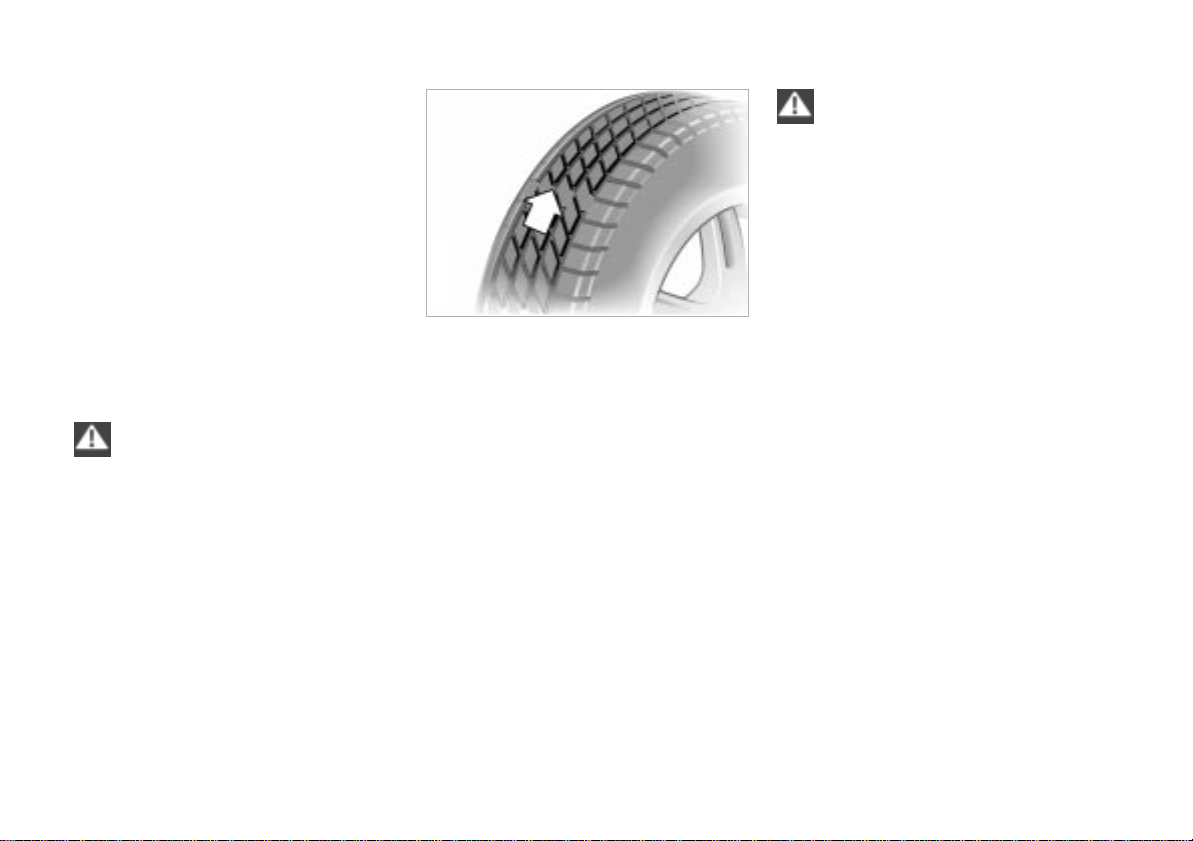
116n
Information for your safety
The factory-approved radial tires are
matched to the car and have been se-
lected to provide optimum safety and
driving comfort on your car.
It is not merely the tire's service life, but
also driving comfort and – above all else
– driving safety that depend on the con-
dition of the tires and the maintenance
of the specified tire pressure.
Incorrect inflation pressure is a frequent
cause of tire damage. It also signifi-
cantly influences the roadholding ability
of your BMW.
Check tire inflation pressures reg-
ularly – at least every two weeks
and before beginning a longer trip. If
this is not done, incorrect tire pressures
can cause driving instability and tire
damage, ultimately resulting in acci-
dents.<
Tire tread – Tire damage
Inspect your tires frequently for tread
wear, signs of damage and for foreign
objects lodged in the tread. Check the
tread depth.
Tread depth should not be allowed to
go below 0.12 inches (3 mm), even
though the legally specified minimum
tread depth is 0.063 inches (1.6 mm). At
a tread depth of 0.063 inches (1.6 mm),
tread depth indicators (arrow) in the
tread-groove base indicate that the le-
gally-permissible wear limit has been
reached. Below 0.12 inches (3 mm)
tread depth, there is an increased risk
of aquaplaning, even at relatively mod-
erate speeds and with only small
amounts of water on the road.
390de331
Do not drive on a deflated (flat) tire.
A flat tire greatly impairs steering
and braking response, and can lead to
complete loss of control over the vehi-
cle. Avoid overloading the vehicle so
that the permitted load on the tires is not
exceeded. Overloading can lead to
overheating and increases the rate at
which damage develops inside the tires.
The ultimate result can assume the form
of a sudden air loss.
Unusual vibrations encountered during
normal vehicle operation can indicate
tire failure or some other vehicle defect,
as can variations in normal vehicle re-
sponse, such as a pronounced ten-
dency to pull to the left or right. Should
this occur, respond by immediately re-
ducing your speed and carefully pro-
ceeding to the nearest BMW center or
professional tire center, or having the
vehicle towed in to have it and its tires
inspected.
Tire damage (up to and including blow-
outs) can endanger the lives of both the
vehicle occupants and other road
users.<
Tire inflation pressure Tire condition
Online Edition Part-No. 01 41 0 155 062 - © 07/99 BMW AG

117n
RepairsIndex OverviewControlsCar careTechnologyData
Tire replacement
To maintain good handling and vehicle
response, use only tires of a single tread
configuration from a single manufac-
turer. BMW tests and approves wheel/
tire combinations. Refer to page 122.
DOT Quality Grades
Treadwear
Traction AA A B C
Temperature A B C
All passenger car tires must con-
form to Federal Safety Require-
ments in addition to these grades.<
Treadwear
The treadwear grade is a comparative
rating based on the wear rate of the tire
when tested under controlled condi-
tions on a specified government test
course.
For example, a tire graded 150 would
wear one and one-half (1 1/2) times as
well on the government course as a tire
graded 100. The relative performance
of tires depends upon the actual condi-
tions of their use, however, and may
depart significantly from the norm due
to variations in driving habits, service
practices and differences in road char-
acteristics and climate.
Traction
The traction grades, from highest to
lowest, are AA, A, B and C.
Those grades represent the tire’s ability
to stop on wet pavement as measured
under controlled conditions on speci-
fied government test surfaces of as-
phalt and concrete. A tire marked C
may have poor traction performance.
The traction grade assigned to this
tire is based on straight-ahead
braking traction tests, and does not
include acceleration, cornering, hydro-
planing, or peak traction characteris-
tics.<
Temperature
The temperature grades are A (the high-
est), B and C, representing the tire’s re-
sistance to the generation of heat and
its ability to dissipate heat when tested
under controlled conditions on a speci-
fied indoor laboratory test wheel.
Sustained high temperature can cause
the material of the tire to degenerate
and reduce tire life, and excessive tem-
perature can lead to sudden tire failure.
The grade C correspods to a level of
performance which all passenger car
tires must meet under the Federal Mo-
tor Vehicle Safety Standard No. 109.
Grades B and A represent higher levels
of performance on the laboratory test
wheel than the minimum required by
law.
The temperature grade for this
tire is established for a tire that is
properly inflated and not overloaded.
Excessive speed, underinflation, or ex-
cessive loading, either separately or in
combination, can cause heat buildup
and possible tire failure.<
Uniform Tire Quality Grading
Quality grades can be found where
applicable on the tire sidewall between
tread shoulder and maximum section
width. For example:
Treadwear 200 Traction AA
Temperature A
Online Edition Part-No. 01 41 0 155 062 - © 07/99 BMW AG

118n
Tire replacement Tire rotation
Do not use retreaded tires. Driving
safety may be impaired by their
use. This is due to the possible varia-
tions in casing structures and, in some
cases, to their extreme age – factors
that can lead to a decrease in their du-
rability.<
Tire age
The date on which the tire was manu-
factured is indicated by the code on the
sidewall:
DOT ... 328 indicates that the tire was
manufactured in Week 32 of 1998.
BMW recommends the replacement of
all tires when the tires are no more than
6 years old, even if a tire life of 10 years
is possible.
Between the axles
The tread wear patterns at the front end
differ from those at the rear – the actual
patterns will vary according to individ-
ual driving conditions. In the interests of
safety and maintaining optimal handling
characteristics, tire rotation is not rec-
ommended.
When considering the potential eco-
nomic benefits of interaxle tire rotation,
you must decide whether the expense
of having the tires rotated is likely to be
amortized during the anticipated exten-
sion in tire life. In principle, interaxle tire
rotation should be performed at short in-
tervals, with a maximum of 3,000 miles
(5,000 km). Consult your BMW center
for more information.
Should you decide to rotate the tires, it
is essential that you comply with the fol-
lowing:
Rotate tires on the same side only,
since braking characteristics and road
grip could otherwise be adversely
affected.
Following rotation, correct the tire infla-
tion pressure.
If different tire sizes are mounted
on the front and rear axles (refer to
page 122), the wheels may not be ro-
tated from one axle to the other.<
Online Edition Part-No. 01 41 0 155 062 - © 07/99 BMW AG

119n
RepairsIndex OverviewControlsCar careTechnologyData
Wheel and tire combinations
The right choice
Use only tires approved by BMW. Refer
to page 122.
Due to the high speeds this vehicle can
reach, the use of specific brands, spec-
ifications and sizes is mandatory.
Consult any BMW center for details.
Comply with local/national regulations.
The correct wheel-tire combina-
tion affects different systems such
as ABS, DSC, RDW.
The function of these systems is im-
paired if improper wheel-tire combina-
tions are used.
For this reason, use only tires of the
same brand and tread pattern. In the
event of a flat tire, for example, remount
the approved wheel-tire combination as
soon as possible.<
Codes on the tires and wheels
The tire codes will aid you in selecting
the correct tire.
Codes on radial tires:
The speed rating indicates the ap-
proved maximum speed for the tire.
Summer tires:
S = up to 112 mph (180 km/h)
T = up to 118 mph (190 km/h)
H = up to 130 mph (210 km/h)
V = up to 149 mph (240 km/h)
W = up to 167 mph (270 km/h)
Y = up to 186 mph (300 km/h)
ZR = over 149 mph (240 km/h)
Example:
Nominal width
in mm
Aspect ratio in %
Belt rating code
for radial
Rim diameter in inches
Load rating (not for ZR tires)
Speed rating
(before R on ZR tires)
225/60 R 1596W
Winter tires:
Q M+S = up to 100 mph (160 km/h)
T M+S = up to 118 mph (190 km/h)
H M+S = up to 130 mph (210 km/h)
Codes stamped on light-alloy wheels:
Protect valve stems and valves from dirt
by using screw-on valve stem caps. Dirt
in the valves frequently leads to slow
leaks.
Rim width
in inches
Code letter for
flange type
Symbol for full-drop
center rim
Rim diameter in inches
Hump on the 2 rim shoulders
7 x 15 H 2J
Online Edition Part-No. 01 41 0 155 062 - © 07/99 BMW AG

120n
Winter tires
Choosing the right tire
BMW recommends winter tires (M+S
radial tires) for driving in adverse winter
road conditions. While tires known as
all-season tires (M+S designation) pro-
vide better winter traction than summer
tires with load ratings H, V, W and ZR,
they generally do not achieve the per-
formance of winter tires.
For safe tracking and steering response,
install winter tires made by the same
manufacturer having the same tread
configuration on all four wheels.
Mount only winter tires approved by
BMW. Any BMW center will be glad to
provide you with information on the
best winter tires for your particular driv-
ing conditions.
Never exceed the maximum speed
for which the tires are rated.
Unprofessional attempts by laymen to
service tires can lead to damage and
accidents.
Have this work performed by skilled
professionals only. Your BMW center
will be glad to assist you with both their
expertise and the proper equipment for
your vehicle.<
Tire condition, tire pressure
Winter tires display a perceptible loss in
their ability to cope with winter driving
conditions once the tread wears to
below 0.16 inches (4 mm), and should
thus be replaced.
Comply with the specified tire inflation
pressures – and be sure to have the
wheel and tire assemblies balanced
every time you change the tires.
Storage
Store tires in a cool, dry place, away
from light whenever possible. Protect
the tires against contact with oil, grease
and fuel.
Online Edition Part-No. 01 41 0 155 062 - © 07/99 BMW AG

121n
RepairsIndex OverviewControlsCar careTechnologyData
Snow chains*
The use of narrow-link BMW snow
chains on winter tires is approved only
in pairs and only on the rear wheels.
Comply with all manufacturer's safety
precautions when mounting the chains.
It is not possible to mount snow
chains with 18-inch wheels and
tires.<
Online Edition Part-No. 01 41 0 155 062 - © 07/99 BMW AG

122n
Approved wheel and tire specifications
Observe the specifications for tires and
wheels in the vehicle's manuals. If sizes
not approved by the manufacturer are
mounted, an entry in the vehicle's doc-
uments may be necessary.
Tire specifications Light-alloy wheels
BMW M5
Summer
Front: 245/40 ZR 18 8Jx18AH2
Rear: 275/35 ZR 18 9.5Jx18AH2
Winter (M+S)
235/45 R 17 94 H 8Jx17AH2
Snow chains*
It is not possible to mount snow chains
with 18-inch wheels and tires.
The use of rims and lug bolts that
do not meet the specifications of
the original factory-installed equipment
will affect the safe operation of your ve-
hicle and may cause an accident and
personal injury.
Never mix tires of different design, such
as steel-belted radials with radial bias
belted or bias-ply tires, etc. Mixing tire
types will adversely affect roadholding
and can lead to loss of vehicle con-
trol.<
Online Edition Part-No. 01 41 0 155 062 - © 07/99 BMW AG
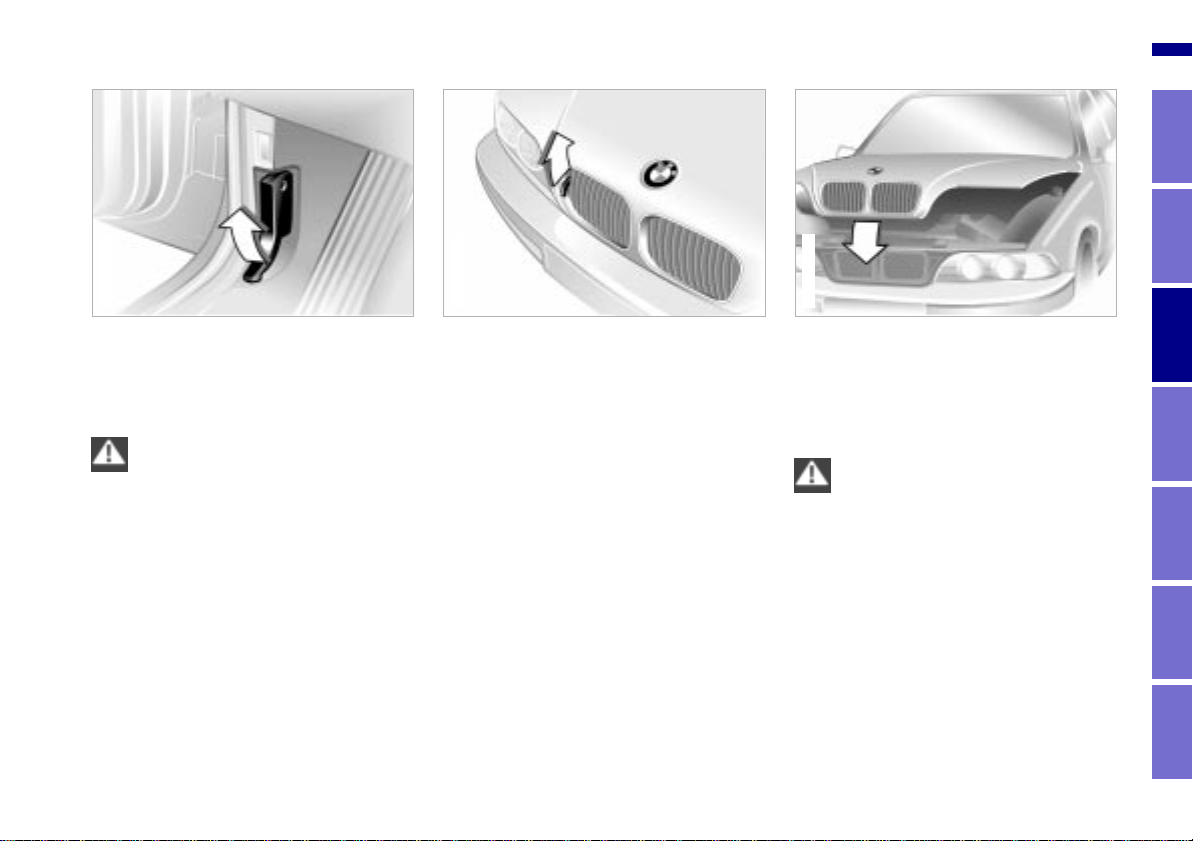
123n
RepairsIndex OverviewControlsCar careTechnologyData
To unlock
Pull the lever located under the left-
hand side of the instrument panel.
Do not work on your vehicle with-
out appropriate skills. Always
switch off the engine and allow it to cool
down before working in the engine com-
partment. Always disconnect the battery
before working on any electrical sys-
tems or equipment, especially when
these are located within the engine com-
partment. Comply with all applicable in-
structions and warnings. Failure to work
in an informed, professional manner
when servicing components and materi-
als constitutes a safety hazard for vehi-
cle occupants and other road users. If
you are not familiar with the guidelines,
please have the operations performed
by your BMW center.<
390de071
To open
Pull the release handle and open the
hood.
390de072
To close
Allow the hood to fall from a height of
about 4 inches (10 cm) so that it audibly
engages.
To avoid injuries, be sure that the
travel path of the hood is clear
when it is closed, as with all closing
procedures. If it is determined that the
hood is not completely closed while
driving, stop immediately and close it
securely.<
390de375
Hood
Online Edition Part-No. 01 41 0 155 062 - © 07/99 BMW AG
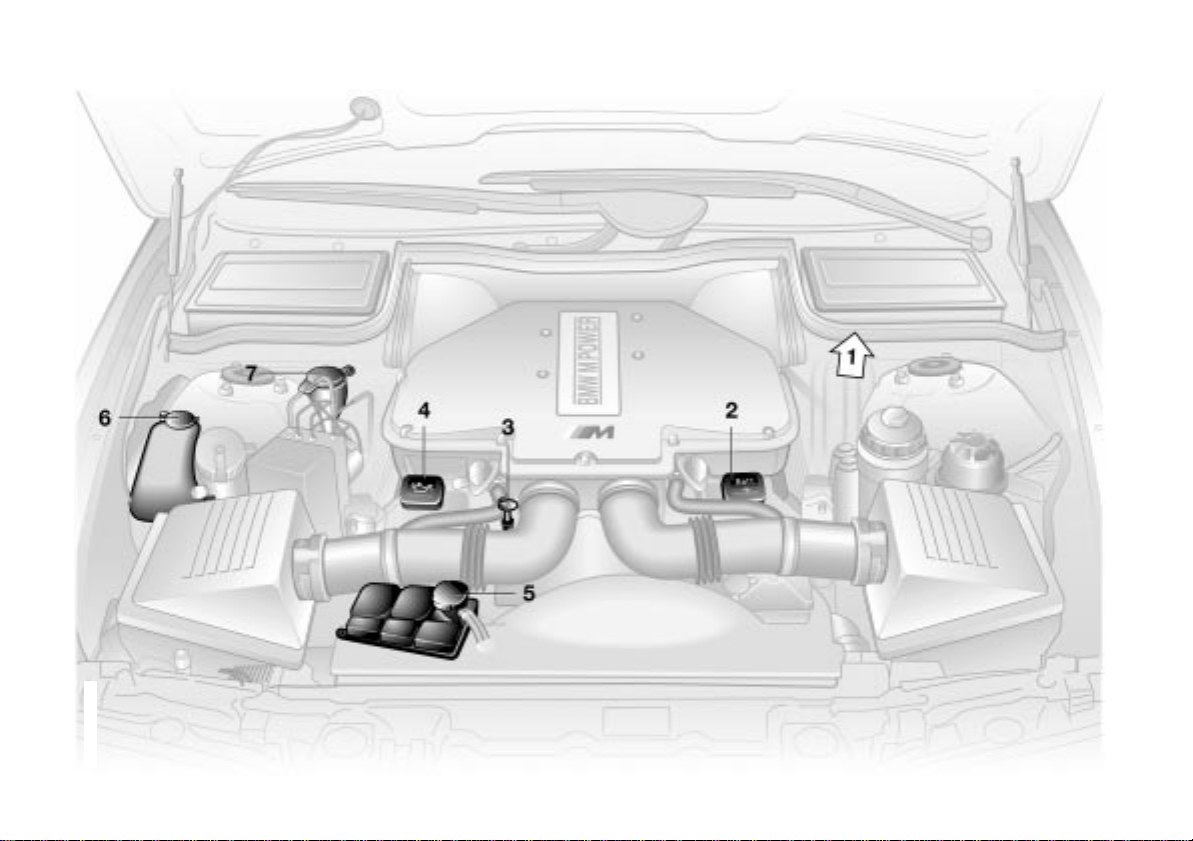
124n
Engine compartment
39mde057
Online Edition Part-No. 01 41 0 155 062 - © 07/99 BMW AG

125n
RepairsIndex OverviewControlsCar careTechnologyData
Engine compartment
1 Reservoir for brake fluid (under the
housing of the microfilter) 130
2 Auxiliary terminal for jump
starting 158
3 Engine oil dipstick 127
4 Engine oil filler neck 127
5 Coolant expansion tank 129
6 Reservoir for the intensive-cleaning
system 126
7 Reservoir for the windshield and
headlamp washer system* 126
Online Edition Part-No. 01 41 0 155 062 - © 07/99 BMW AG
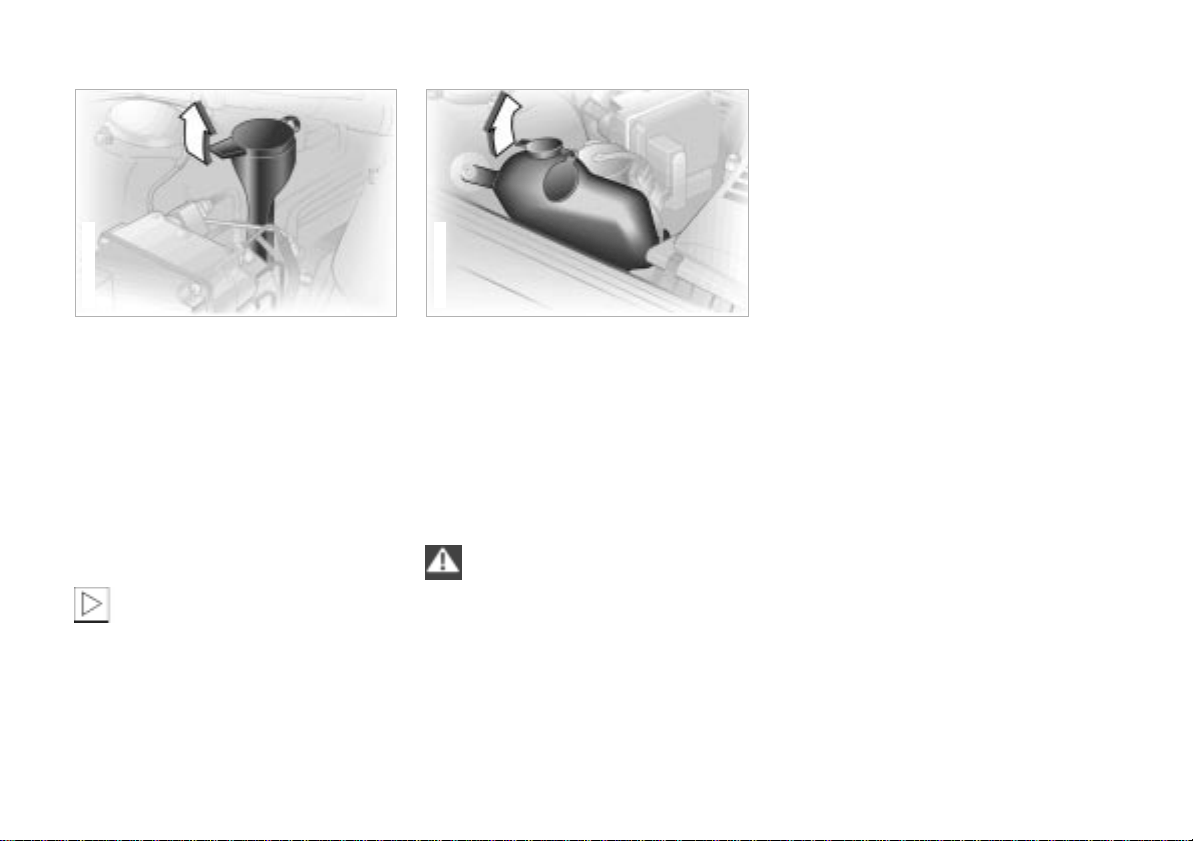
126n
Washer fluids Washer nozzles
Headlamp* and windshield
washer system
Capacity in US quarts (liters).
Windshield washer:
Approx. 3.7 US quarts (3.5 liters)
With headlamp-washing system:
Approx. 6.3 US quarts (6.0 liters).
Fill with water and – if required – with a
washer antifreeze (according to manu-
facturer's recommendations).
We recommend that you mix the
washer fluid before adding it to
the reservoir.<
39mde040
Intensive-action washer
reservoir
*
Capacity approx. 1.1 US quarts
(1.0 liters).
Fill with intensive-action washer fluid.
It resists freezing to approx. –17 7
(–27 6) and is available from your
BMW center.
Antifreeze agents or intensive-
action washer fluids for the
washer systems are highly flammable.
For this reason, keep them away from
sources of flame and store them only in
their original containers. Store them so
that they are inaccessible to children.
Comply with the instructions on the
containers.<
39mde041
Windshield washer
The spray from the nozzles should be
directed so as to ensure effective
cleaning, even at high speeds. Use a
needle to adjust the nozzles as required
or have them adjusted at your BMW
center.
Headlamp washer system
Have the nozzles adjusted by your
BMW center as required.
Online Edition Part-No. 01 41 0 155 062 - © 07/99 BMW AG
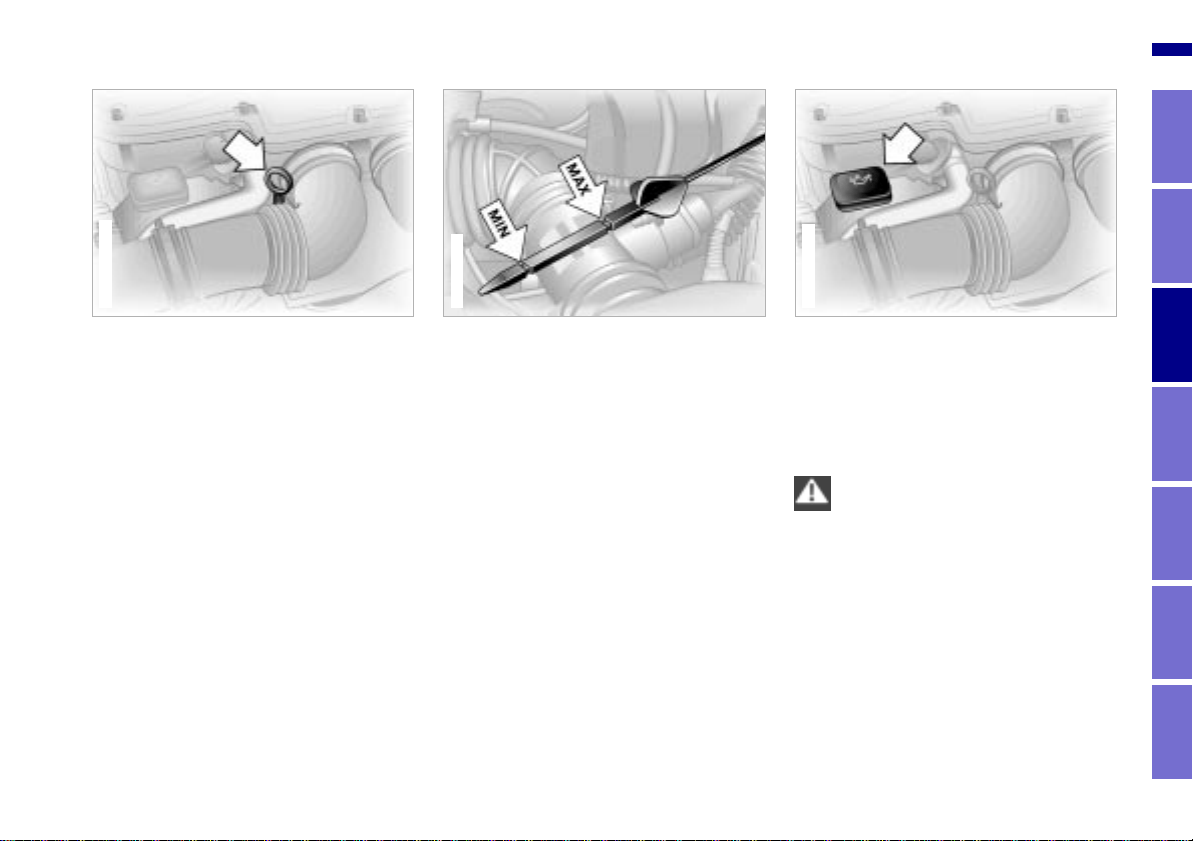
127n
RepairsIndex OverviewControlsCar careTechnologyData
Engine oil
Checking oil level
1 Park the vehicle on a level surface.
2 Allow the engine to run at operating
temperature for at least 15 seconds
at idle, then shut it off.
3 After approx. one minute, pull the
dipstick out and wipe it off with a
clean lint-free cloth, paper towel, or
similar material.
4 Push the dipstick all the way into the
guide tube and pull it out again.
5 The oil level should be between the
two graduations on the dipstick.
As with fuel economy, oil consumption
is directly influenced by your driving
style and vehicle operating conditions.
39mde042
The oil volume between the two marks
on the dipstick corresponds to approx.
1.1 US quarts (1 liter). Do not fill beyond
the upper mark on the dipstick. Excess
oil will damage the engine.
460de189
To add oil
Wait until the level has dropped to just
above the lower mark before adding oil.
However, do not wait until the oil level
drops below the lower mark.
BMW engines are designed to
operate without oil additives; the
use of additives could lead to damage
in some cases. This is also true for the
manual transmission, the differential,
and the power steering system.<
39mde043
Online Edition Part-No. 01 41 0 155 062 - © 07/99 BMW AG
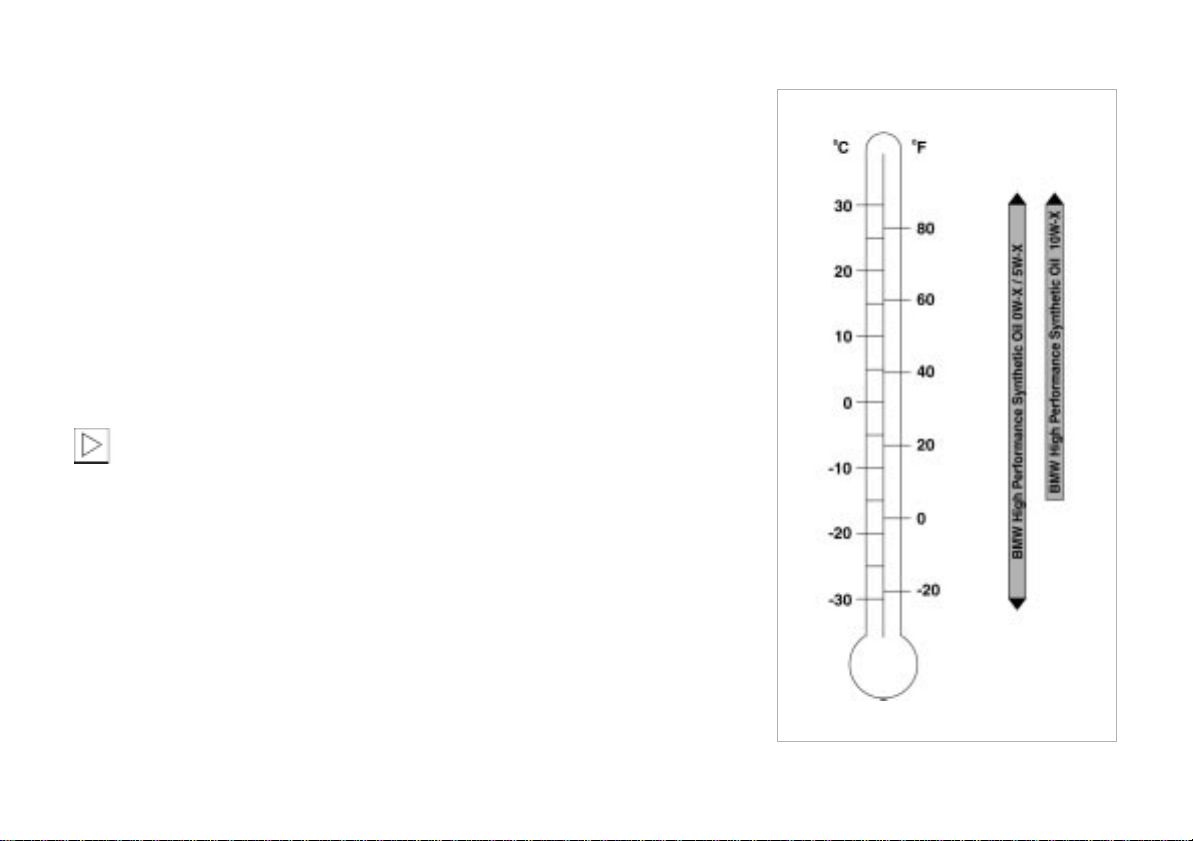
128n
Engine oil
Specified engine oils
The quality of the engine oil is extremely
important for the function and service
life of an engine. Based on extensive
testing, BMW recommends only certain
types of engine oil.
Approved are:
> Castrol Formula RS SAE 10W60
> Veedol Synthetic Z SAE 10W60
If you are unable to obtain one of these
oils, you may use small volumes of syn-
thetic oil for topping up between oil
changes. Only use oils with the specifi-
cation API SH or higher.
Ask your BMW center for details
concerning the specific "BMW
High Performance Synthetic Oil" or
"special oils" which are suitable for
topping up.<
You can also call BMW of North America
at 1-800-831-1117 or visit this website:
www.bmwusa.com to obtain this infor-
mation.
Viscosity ratings
Viscosity is the oil flow rating as estab-
lished in SAE classes.
The selection of the correct SAE class
depends on the climatic conditions in
the area where you typically drive your
BMW.
If an approved oil is used, temperatures
under the lower limit of 5 7 (–15 6)
are permitted for short periods. How-
ever, the engine may not be as easy to
start from cold.
If the vehicle is to be operated for long
periods at temperatures below 5 7
(–15 6), the oil must be replaced with
synthetic oil, viscosity class 5W30.
530us050
Online Edition Part-No. 01 41 0 155 062 - © 07/99 BMW AG
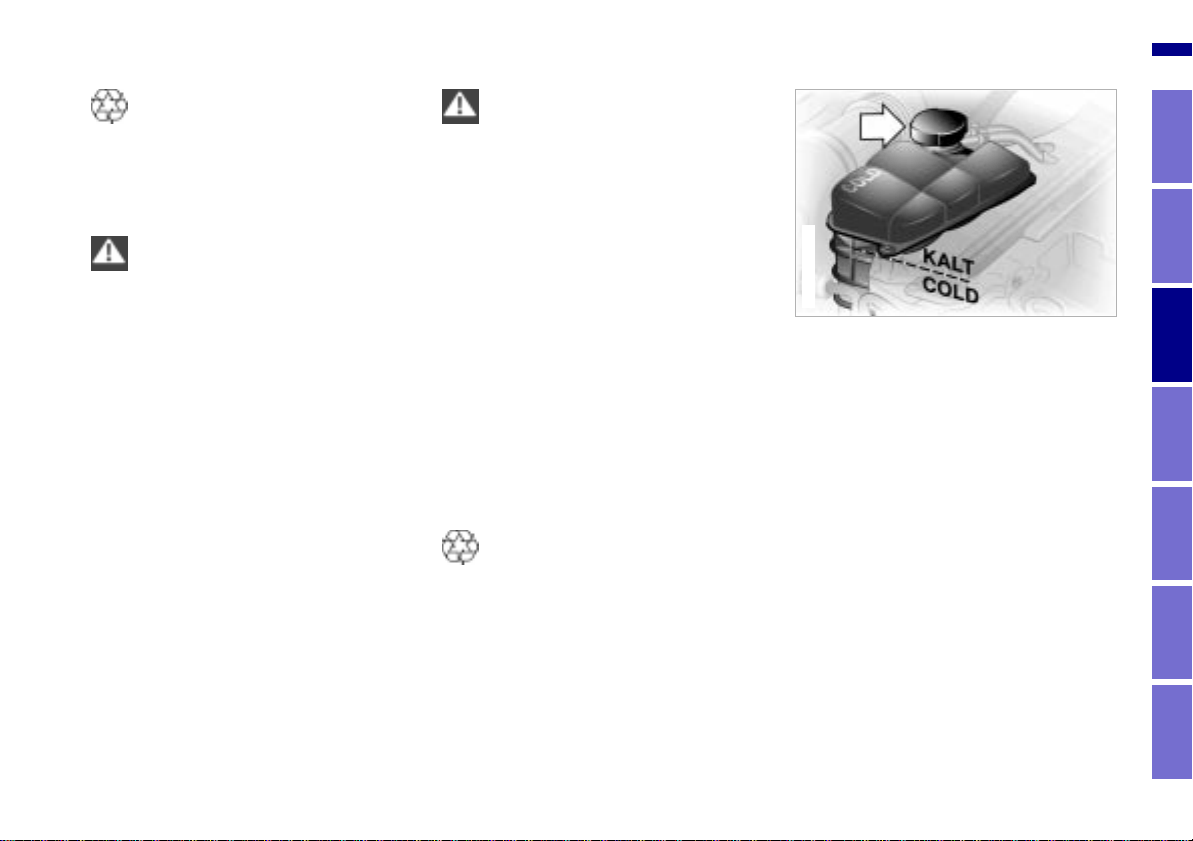
129n
RepairsIndex OverviewControlsCar careTechnologyData
Engine oil Coolant
Always observe all environmental
protection guidelines and regula-
tions when disposing of used oil.<
Recommendation: Have the oil
changed by your BMW center only.
Continuous exposure to used oil
has caused cancer in laboratory
testing.
For this reason, any skin areas that
come into contact with oil should be
thoroughly washed with soap and
water.
Always store oils, grease and similar
materials so that they are inaccessible
to children. Comply with warning labels
and information on containers.<
Do not add coolant to the cooling
system when the engine is hot. If
you attempt to do so, escaping coolant
can cause burns.
To avoid the possibility of secondary
damage, never use anything other than
factory-approved, nitrite and amino-free
extended-duty antifreeze with corrosion
inhibitor. Your BMW center is familiar
with the official specifications.
Antifreeze and anticorrosion agents are
hazardous to health. You should always
store them in their original container
and in a location which is out of reach of
children. Extended-duty antifreeze with
corrosion inhibitor contains the flamma-
ble substance ethylene glycol. For this
reason, do not spill antifreeze with cor-
rosion inhibitor on hot engine parts. It
could ignite and cause serious burns.<
Comply with the applicable envi-
ronmental laws regulating the dis-
posal of extended-duty antifreeze with
corrosion inhibitor.<
Checking coolant level
Correct coolant level when the engine
is cold (approx. 68 7/20 6):
Visible within the transparent expansion
tank, no higher than the "COLD" mark.
39mde044
Online Edition Part-No. 01 41 0 155 062 - © 07/99 BMW AG

130n
Coolant Brake fluid
Adding coolant
Wait until the engine cools before re-
moving the cap from the expansion
tank. The needle of the coolant gauge
in the instrument cluster must be lo-
cated in the blue zone; otherwise, there
is a danger of scalding.
1 Turn the cap counterclockwise
slightly in order to allow accumulated
pressure to escape. Then open.
2 If the coolant is low, slowly add cool-
ant until the correct level is reached –
do not overfill.
The coolant is a mixture of water and
extended-duty antifreeze with corrosion
inhibitor. Always maintain the pre-
scribed all-season 50:50 mixture ratio
for year-round protection against inter-
nal corrosion. No other additives are
required.
Replace the coolant every three years.
Brake fluid level
If the indicator lamp for the brake
hydraulic system appears or if
the "CHECK BRAKE FLUID"
message appears in the Check
Control: The brake fluid level is
too low in the reservoir.
The brake fluid reservoir is located
under the microfilter housing on the
driver's side of the car. For adding brake
fluid or for determining and correcting
the cause of brake fluid loss, consult
your BMW center. Your BMW center is
familiar with the specifications for fac-
tory-approved brake fluids (DOT 4).
Brake fluid loss may result in extended
brake pedal travel. If this occurs, refer
to the information on page 112.
Brake fluid is hygroscopic, that is,
it absorbs moisture from the air
over time. In order to ensure the safety
and reliability of the brake system, have
the brake fluid changed every two years
by an BMW center. Refer also to the
Service and Warranty Information Book-
let (US models) or the Warranty and Ser-
vice Guide Booklet (Canadian models).
Brake fluid is toxic and damages the ve-
hicle's paint. You should always store it
in its original container and in a location
which is out of reach of children. Do not
spill the fluid and do not fill the brake
fluid reservoir beyond the "MAX" mark.
The brake fluid could ignite upon con-
tact with hot engine parts and cause se-
rious burns.<
Comply with the applicable envi-
ronmental laws regulating the dis-
posal of brake fluid.<
Online Edition Part-No. 01 41 0 155 062 - © 07/99 BMW AG
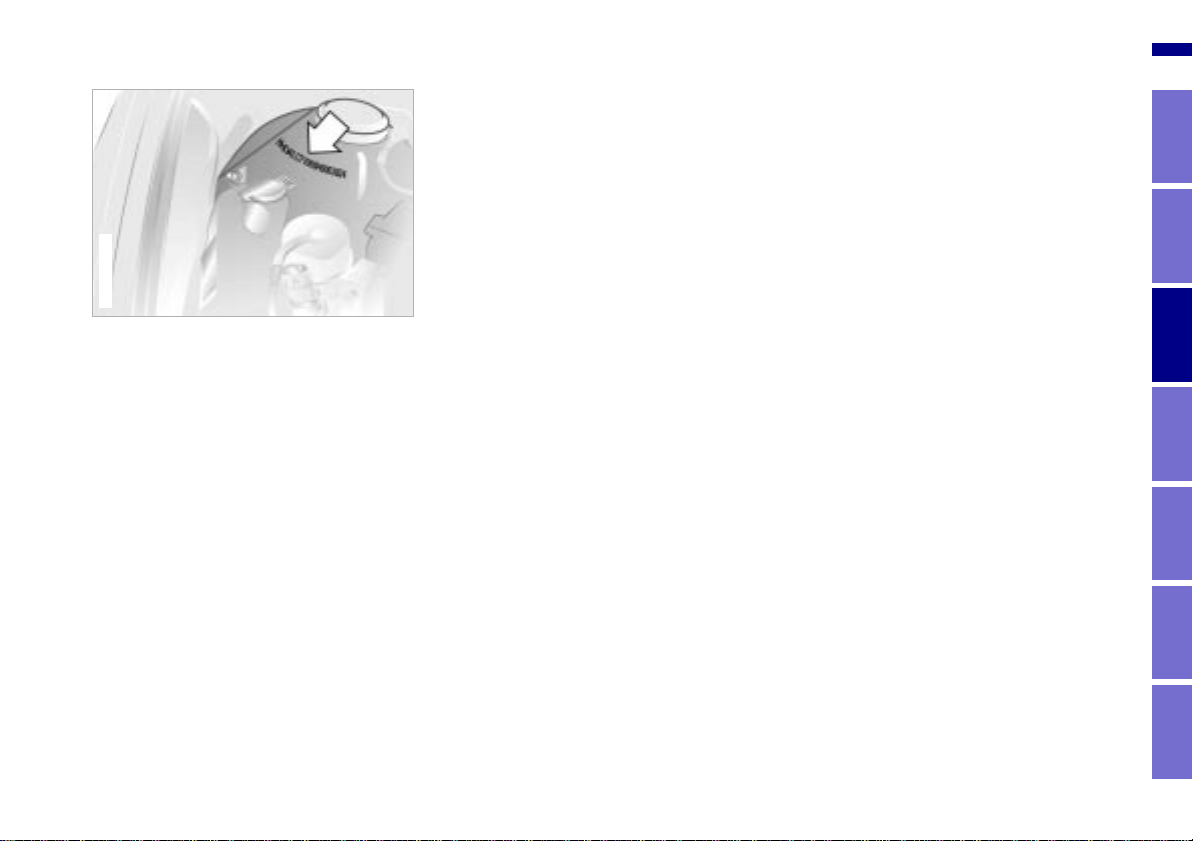
131n
RepairsIndex OverviewControlsCar careTechnologyData
Vehicle Identification Number
In the engine compartment, stamped on
the right-hand strut dome (arrow) and
on the upper edge of the instrument
panel on the left-hand side.
390de074
Online Edition Part-No. 01 41 0 155 062 - © 07/99 BMW AG
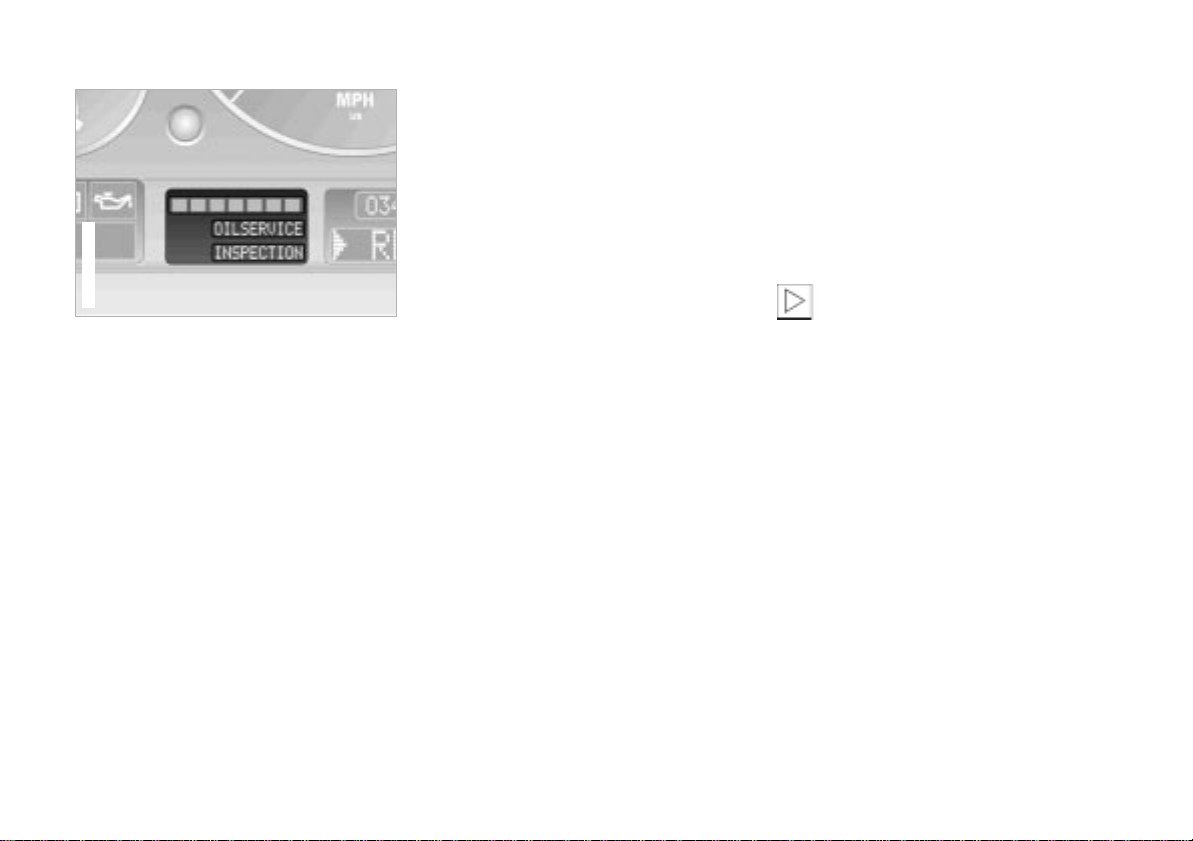
132n
The BMW Maintenance System has
been designed as a reliable means of
providing maximum driving and operat-
ing safety – and as cost-effectively as
possible for you.
Please keep in mind that regular main-
tenance is not only necessary for the
safety of your vehicle, but also plays a
significant role in maintaining the resale
value of the vehicle.
Service Interval Display
Advanced technology is employed to
calculate the optimal maintenance inter-
vals, which are then indicated in the
Service Interval Display. While conven-
tional systems rely solely on distance
traveled to determine when service is
due, the BMW Maintenance System
380us008
began many years ago to take the actual
conditions under which the vehicle is
driven into consideration.
From the point of view of maintenance,
62,000 miles (100,000 km) accumulated
in short-distance urban driving are not
the equivalent of the same distance
covered at moderate speeds in long-
distance highway travel.
The BMW Maintenance System in-
cludes the Engine Oil Service and In-
spections I and II.
Determining the maintenance intervals
according to the actual vehicle driving
loads on the car covers every kind of
operating situation. However, even
those who drive only short distances –
significantly less than 6,200 miles
(10,000 km) annually – should have the
engine oil changed at least every 2
years since oil deteriorates over time,
regardless of use.
Service and Warranty Information
Booklet (US models)/Warranty
and Service Guide Booklet
(Canadian models)
For additional information on mainte-
nance intervals and procedures, please
refer to the Service and Warranty Infor-
mation Booklet (US models) or the War-
ranty and Service Guide Booklet (Cana-
dian models).
As a precaution against rust, it might be
a good idea to have the body checked
for damage from rocks or gravel at the
same time, depending upon operating
conditions.
Have your BMW center perform
maintenance and repairs.
Your BMW center is always informed on
the latest maintenance work and repair
techniques and equipped with the re-
quired special tools. In addition, check-
ing parts known from experience to be
subject to wear is a permanent part of
the maintenance specifications. Be sure
that all maintenance work is confirmed
in the Service and Warranty Information
Booklet (US models) or the Warranty
and Service Guide Booklet (Canadian
models). These entries are your proof
that the vehicle has received regular
maintenance. They are also a require-
ment for warranty claims.<
The BMW Maintenance System
Online Edition Part-No. 01 41 0 155 062 - © 07/99 BMW AG

133n
RepairsIndex OverviewControlsCar careTechnologyData
Caring for your car
Washing your car
You can have your new BMW washed
in an automatic car wash. Car wash
systems that do not employ brushes are
preferable.
Wipe away tough dirt and loosen and
remove dead insects before washing
the car.
To prevent spots, do not wash the car
when the hood is still warm, or immedi-
ately after and during exposure to
strong sunlight.
When using an automatic car wash, be
sure that:
> The car wash system is suited for the
dimensions of your vehicle.
> No damage will occur on vehicles
with attached body accessories (such
as spoilers or antennas). Consult the
car wash operator if necessary.
> The wheels and tires of your vehicle
cannot be damaged by the convey-
ance devices of the car wash system.
> The vehicle is cleaned with minimum
brush pressure, and that ample water
is available for washing and rinsing.
Vehicles with rain sensor
*:
Clean the windshield regularly. Wax
from automatic car washes or insects,
for example, can cause malfunctions in
the function of the rain sensor.
Turn the rain sensor off in auto-
matic car washes. If you do not,
damage may occur if the wipers switch
on unintentionally.<
Parts of the car that are inaccessible to
the automatic washer – such as door
sills, door and hood edges, etc. –
should be cleaned by hand.
In the winter months, it is especially im-
portant to be sure that the car is washed
on a regular basis. Large quantities of
dirt and road salt are difficult to remove,
and they also cause damage to the vehi-
cle.
If spray wands or high-pressure
washers are used, be sure to
maintain an adequate distance between
the spray source and the vehicle's sur-
face. Inadequate distance and exces-
sive pressure can damage or weaken
the finish, making it more susceptible to
subsequent attack. In addition, mois-
ture could penetrate to vehicle compo-
nents, leading to long-term damage.<
When cleaning the headlamps,
please observe the following:
> Do not clean by wiping with a dry
cloth. Never use abrasives or strong
solvents to clean the covers.
> Remove dirt and contamination
(such as insects) by soaking with
BMW Car Shampoo and then rinsing
with plenty of water.
> Always use a deicer spray to remove
accumulated ice and snow – never
use a scraper.<
After washing the car, apply the
brakes briefly to dry them. Braking
efficiency might otherwise be reduced
by the moisture and the brake rotors
could also be corroded.<
Online Edition Part-No. 01 41 0 155 062 - © 07/99 BMW AG

134n
Caring for your car
Exterior finish
To provide effective corrosion protec-
tion, multilayer paintwork is applied at
the factory. Cataphoretic immersion
priming techniques are supplemented
using special body-cavity protectants,
with the application of specially-devel-
oped and extensively tested materials.
A layer of flexible PVC is first applied
to the undercarriage. Following this, a
comprehensive undercoating treatment
with a wax-based protectant is applied.
Regular maintenance makes an impor-
tant contribution to maintaining the
safety and value of your vehicle.
Increasing awareness of the effects of
harmful environmental factors on vehi-
cle finishes have led paint and vehicle
manufacturers to initiate ongoing pro-
grams designed to further improve the
durability of their finishes. Despite this,
environmental factors that occur locally
or regionally can have negative effects
on the finish of your vehicle. These
should guide you in determining the
frequency and extent of your efforts to
maintain the vehicle finish.
Depending upon material and type of
impact (perforation of paint layer), phys-
ical stresses from sand, road salt,
gravel, etc., can cause corrosion to start
extending beneath the finish, starting at
the point of impact.
Road dirt, tar spots, dead insects, ani-
mal droppings (strong alkali effect) and
tree excretions (resins and pollen) all
contain substances capable of causing
damage if they are allowed to remain on
the finish of your car for any period of
time (spots, etching, flaking, separation
in the top coat).
In industrial areas, deposits of flue dust,
lime, oily soot, precipitation containing
sulfur-dioxide (acid rain) and other envi-
ronmental pollutants will damage the
car's finish unless adequate care is pro-
vided – even though this is generally
limited to the outside horizontal sur-
faces.
In coastal regions, high levels of atmo-
spheric salt and humidity promote cor-
rosion.
In tropical zones, temperatures of over
105 7 (40 6) in the shade prevail, in
addition to heavy ultraviolet radiation
and high humidity. Under those condi-
tions, light paints can reach tempera-
tures up to 175 7 (80 6) and dark
paints up to 250 7 (120 6).
Online Edition Part-No. 01 41 0 155 062 - © 07/99 BMW AG

135n
RepairsIndex OverviewControlsCar careTechnologyData
Caring for your car
Caring for the vehicle finish
Regular washing is a preventive mea-
sure against long-term effects from
substances that are harmful to the vehi-
cle's finish, especially if you drive your
vehicle in areas with high levels of air
pollution or aggressive natural sub-
stances (tree resins, pollen).
Nevertheless, you should immediately
remove especially aggressive sub-
stances. Failure to do so can lead to
changes in the paint's chemical struc-
ture or to discoloration. Gasoline spilled
during refueling, oil, grease and brake
fluid should always be cleaned away
immediately, as should bird droppings
(finish damage).
Any contamination remaining on the
surface of the vehicle will be especially
conspicuous after washing. Use clean-
ing fluid or alcohol with a clean cloth or
cotton pad to remove. Remove tar
spots with tar remover. After cleaning,
the affected areas should be waxed to
ensure continued protection.
Use cleaning and car-care
products that you can obtain
at your BMW center.<
Waxing your car
Protect the finish using carnauba or
synthetic-based waxes only.
The best way to determine when the
finish needs to be waxed is by noting
when water stops beading on the sur-
face.
You can use a glass cleaner to remove
any wax or silicone that may have been
left on the windows during waxing.
Use cleaning and car-care
products that you can obtain
at your BMW center.<
Paint damage
You can touch up small areas of paint
damage with a BMW spray paint or a
BMW touchup stick.
The paint color code for your car is pro-
vided on a sticker located on the right
hand side under the hood and on the
first page the Service and Warranty In-
formation Booklet (US models) or of the
Warranty and Service Guide Booklet
(Canadian models).
Damage caused by flying stones,
scratches, etc., must be touched up
without delay to prevent rust from form-
ing.
If corrosion has started to form in an
area with paint damage, remove all rust
and clean the area. Then prime the area
with a BMW Primer Stick. Finally, apply
the finish coat. Wait a few days, then
polish the repaired area. Finish by ap-
plying a wax preservative.
More extensive paint damage should be
professionally repaired in accordance
with the manufacturer's instructions.
Your BMW center uses original BMW
finish materials in accordance with fac-
tory-approved repair procedures.
Online Edition Part-No. 01 41 0 155 062 - © 07/99 BMW AG

136n
Caring for your car
Window care
You can use window and glass cleaner
to clean inside window surfaces and
mirrors without smearing and streaking.
Never use polishing pastes or abrasive
(quartz) cleansers on mirror lenses.
When caring for break-resistant
security glass
*, observe the fol-
lowing instructions:
The inner surface of the side windows
is coated with a plastic film. For this
reason, do not affix any decals or adhe-
sive stickers on the inside of these win-
dows unless they are to be placed there
permanently. Wash the glass with clean
water. If necessary, you may add a
commercially-available mild household
cleaner. Do not use abrasive cleaners.
If the windows are fogged or iced over,
treat them with an anti-misting cloth or
a deicer spray – do not use an ice
scraper.<
Clean the wiper blades with soapy
water. The wiper blades should be
replaced twice a year, before and after
the cold season.
Use only wiper blades approved
by BMW.<
Online Edition Part-No. 01 41 0 155 062 - © 07/99 BMW AG

137n
RepairsIndex OverviewControlsCar careTechnologyData
Caring for your car
Caring for other vehicle
components and materials
Light-alloy wheels should be treated
with alloy wheel cleaner, especially dur-
ing the winter months. However, do not
use aggressive products containing ac-
ids, strong alkalis or abrasives. Do not
use steam cleaners operating at tem-
peratures above 140 7 (60 6). Follow
the manufacturer's instructions.
If your vehicle has chrome parts
* such
as the window frames and door handles,
clean these parts carefully with ample
clean water after driving on roads that
have been salted. Add a shampoo sup-
plement if desired. Use chrome polish
as an additional treatment.
Plastic components, vinyl upholstery,
headliners, lamp lenses, the clear cover
of the instrument cluster and compo-
nents with a sprayed dull black surface
can be cleaned with water (add plastic
shampoo as required). Do not allow
moisture to soak through the seats or
headliner. Never use solvents such as
lacquer thinner, heavy-duty grease re-
mover, fuels, etc.
Rubber components should be
cleaned with water only; a rubber treat-
ment or silicone spray may also be ap-
plied.
The safety belts should be cleaned with
a mild soap and water solution without
being removed from the car. Never
attempt chemical or dry cleaning, as
damage to the belt fabric could result.
After cleaning, never allow the inertia
reel to retract the belts until they are
completely dry. Dirty safety belts pre-
vent the inertia reel mechanism from
retracting the strap properly, and thus
constitute a safety hazard.
Heavily soiled floor carpets and mats
*
can be cleaned with an interior cleaner.
The floor mats can be removed from the
vehicle for cleaning.
Please use only a damp cloth to clean
wooden fascia panels and components.
Follow up by drying with a soft cloth.
Use cleaning and car-care
products that you can obtain
at your BMW center.<
Online Edition Part-No. 01 41 0 155 062 - © 07/99 BMW AG

138n
Caring for your car
Leather care
The leather upholstery* used by BMW
is a natural product of the highest qual-
ity, processed using state-of-the-art
methods to ensure that it will maintain
its high quality for years to come, pro-
vided that it is properly cared for.
Because this product is manufactured
using natural materials, you must make
allowance for its special characteristics
as well as for the peculiarities of its use
and care.
Regular periodic cleaning and care are
essential, as dust and road dirt act as
abrasives in the pores and creases of
the material. This leads to wear spots
and premature brittleness on the sur-
face of the leather. We therefore sug-
gest that you clean the leather with a
vacuum cleaner or dust cloth at fre-
quent intervals.
For cleaning use BMW leather cleaning
foam.
Since dirt and grease gradually attack
the protective layer of the leather, the
cleaned surfaces should be treated with
BMW leather care agent. This also acts
as an antistatic agent.
For protection against dampness or
moisture, treat the leather with a BMW
impregnating agent.
We recommend that you perform this
procedure twice a year on leather ex-
posed to normal use.
Spills should be wiped up immediately.
If the upholstery will be exposed to in-
tense sunlight or if the vehicle is to be
stored for an extended period, cover all
leather surfaces (or better yet, cover the
windows) to prevent fading.
Use cleaning and car-care
products that you can obtain
at your BMW center.<
Cleaning agents can contain sub-
stances that are dangerous or
pose health risks. For this reason,
always read and comply with the warn-
ings and danger notices on the pack-
age.
Open the doors or windows on your
vehicle when cleaning the interior.
Never clean your vehicle with solvents
or other materials not specifically
intended for this application.<
Online Edition Part-No. 01 41 0 155 062 - © 07/99 BMW AG
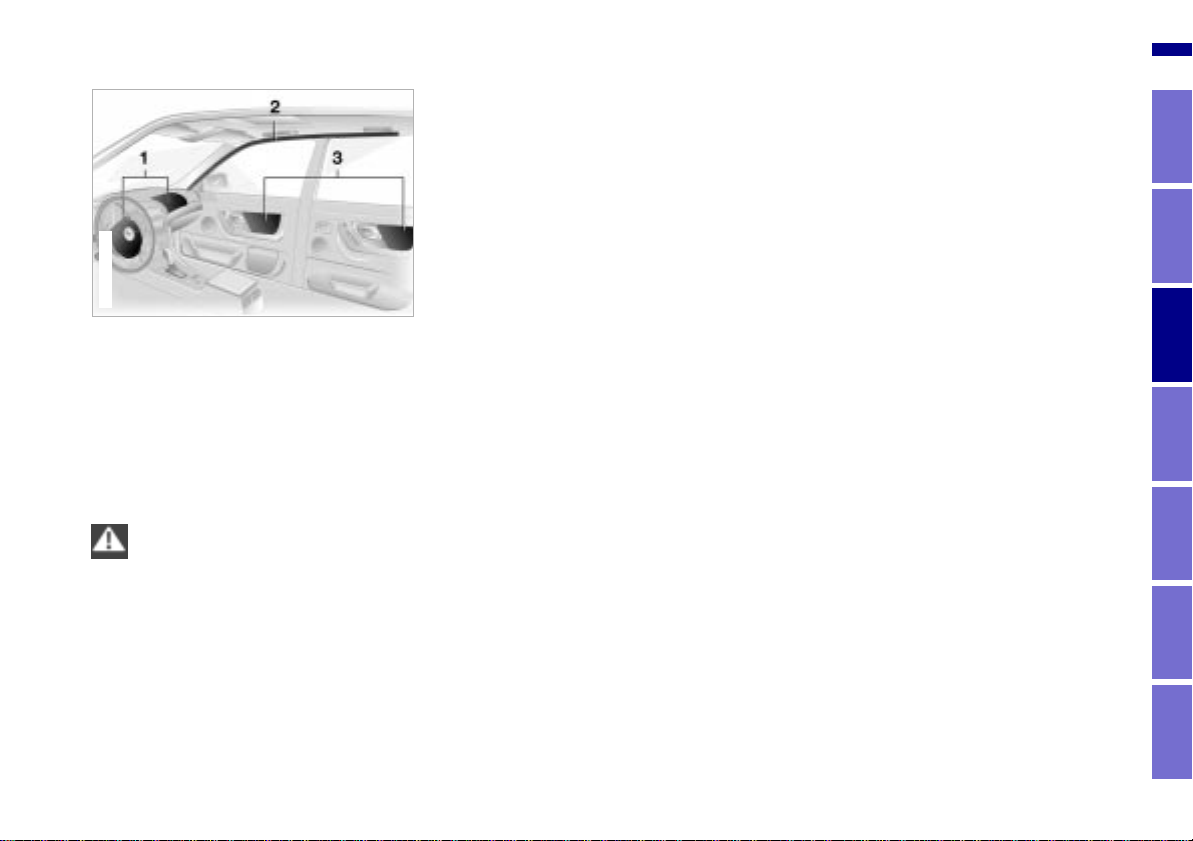
139n
RepairsIndex OverviewControlsCar careTechnologyData
Airbags Vehicle storage
1 Front airbags for driver and front pas-
senger
2 Side Impact Head Protection System
(front)
3 Side airbags (front and rear side
*)
Important safety notices
Do not remove the airbag restraint
system's gas generator. Testing
and servicing are to be performed only
by trained technicians. In the event of
the air bag restraint system malfunc-
tioning, being deactivated or triggered
(in response to an accident), consult an
BMW center only for the performance
of any removal and service operations.
39mde016
Do not modify or tamper with either the
wiring or the individual components in
the airbag system. This includes the
padded steering wheel hub, the instru-
ment panel, the side trim panels of the
front or rear doors and the roof pillars or
the sides of the headliner. Never apply
adhesive materials to these compo-
nents or cover or modify them in any
way. Do not remove or dismantle the
steering wheel yourself. To ensure
compliance with official safety regula-
tions, have an BMW center dispose of
airbag generators. Unprofessional
attempts to service the system could
lead to failure in an emergency or
undesired airbag activation, either of
which could result in personal injury.<
Consult your BMW center regarding
special procedures if you intend to
store the vehicle for more than three
months.
Online Edition Part-No. 01 41 0 155 062 - © 07/99 BMW AG

140n
Technical modifications
Any BMW center will be glad to inform
you of the advisability, legal require-
ments and factory recommendations
regarding technical modifications on
your vehicle. For this purpose, the
BMW center will require the Vehicle
Identification Number and, in some
cases, also the engine number.
Light-Emitting Diodes (LEDs)
Light-emitting diodes installed behind
translucent lenses serve as the light
source for many of the controls and dis-
plays in your vehicle. The concept be-
hind their operation is related to that
employed for lasers, and they are offi-
cially designated as Class 1 light-emit-
ting diodes.
Do not remove the protective lens
and avoid staring directly at the
unfiltered beam for extended periods
(several hours), as inflammation of the
iris could result.<
Online Edition Part-No. 01 41 0 155 062 - © 07/99 BMW AG
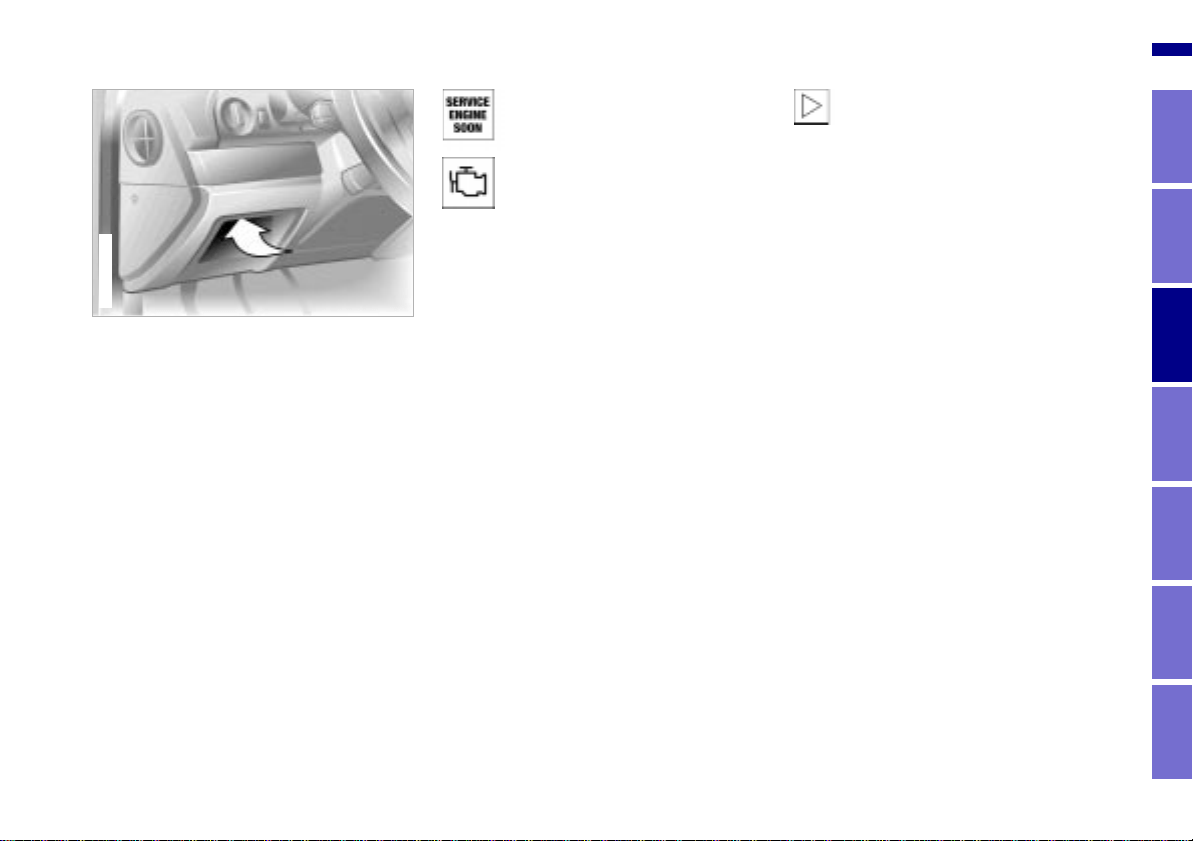
141n
RepairsIndex OverviewControlsCar careTechnologyData
OBD interface socket
Access to the interface socket for the
On-Board-Diagnostics (OBD): Lift the
cover (arrow) next to the steering col-
umn.
The purpose of the OBD (Onboard
Diagnostic) system is to assure proper
emission control system operation for
the vehicle's lifetime by monitoring
emission-related components and sys-
tems for deterioration and malfunction.
390de346
An Illuminated indicator informs
you of the need for service, not
of the need to stop the vehicle.
However, the systems should be
checked by your BMW center at
the earliest possible opportu-
nity.
Under certain conditions, the indicator
will blink or flash. This indicates a rather
severe level of engine misfire. When
this occurs, you should reduce speed
and consult the nearest BMW center as
soon as possible. Severe engine misfire
over only a short period of time can se-
riously damage emission control com-
ponents, especially the catalytic con-
verter.
When the filler cap is not properly
tightened, the OBD system can
detect the vapor leak and the indicator
will light up. If the filler cap is subse-
quently tightened, the indicator should
go out within a few days.<
Online Edition Part-No. 01 41 0 155 062 - © 07/99 BMW AG
142n
Online Edition Part-No. 01 41 0 155 062 - © 07/99 BMW AG
Overview
Controls and features
Operation, care
and maintenance
Owner service procedures
Technical data
Index
Advanced technology
143n
RepairsIndex OverviewControlsCar careTechnologyData
Replacement procedures:
Onboard tool kit 144
Windshield wiper blades 144
Lamps and bulbs 145
Repairing a flat tire 150
Battery 153
Fuses 156
In case of electrical
malfunction:
Fuel filler door 157
Sliding/Tilt sunroof 157
Assistance, giving and
receiving:
Jump-starting 158
Towing the vehicle 159
Online Edition Part-No. 01 41 0 155 062 - © 07/99 BMW AG
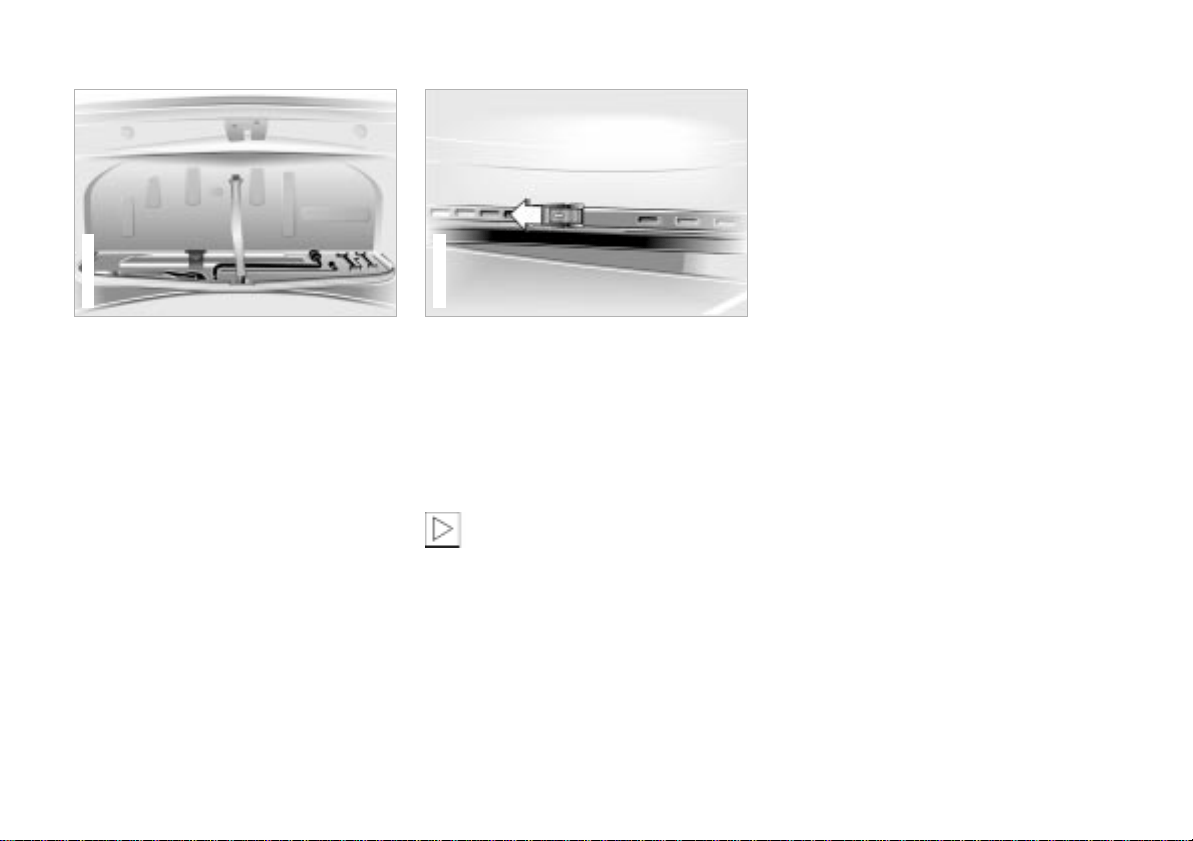
144n
The onboard tool kit is located in the
luggage compartment lid.
Loosen the wingnut to open.
394de080
1 Lift the wiper arm up slightly and hold
it firmly.
2 Press back the release (arrow) and
pull the wiper blade back toward the
base of the wiper arm.
3 Install the new blade and slide the
release back into position.
Use only wiper blades approved
by BMW.<
390de097
Onboard tool kit Windshield wiper blades
Online Edition Part-No. 01 41 0 155 062 - © 07/99 BMW AG
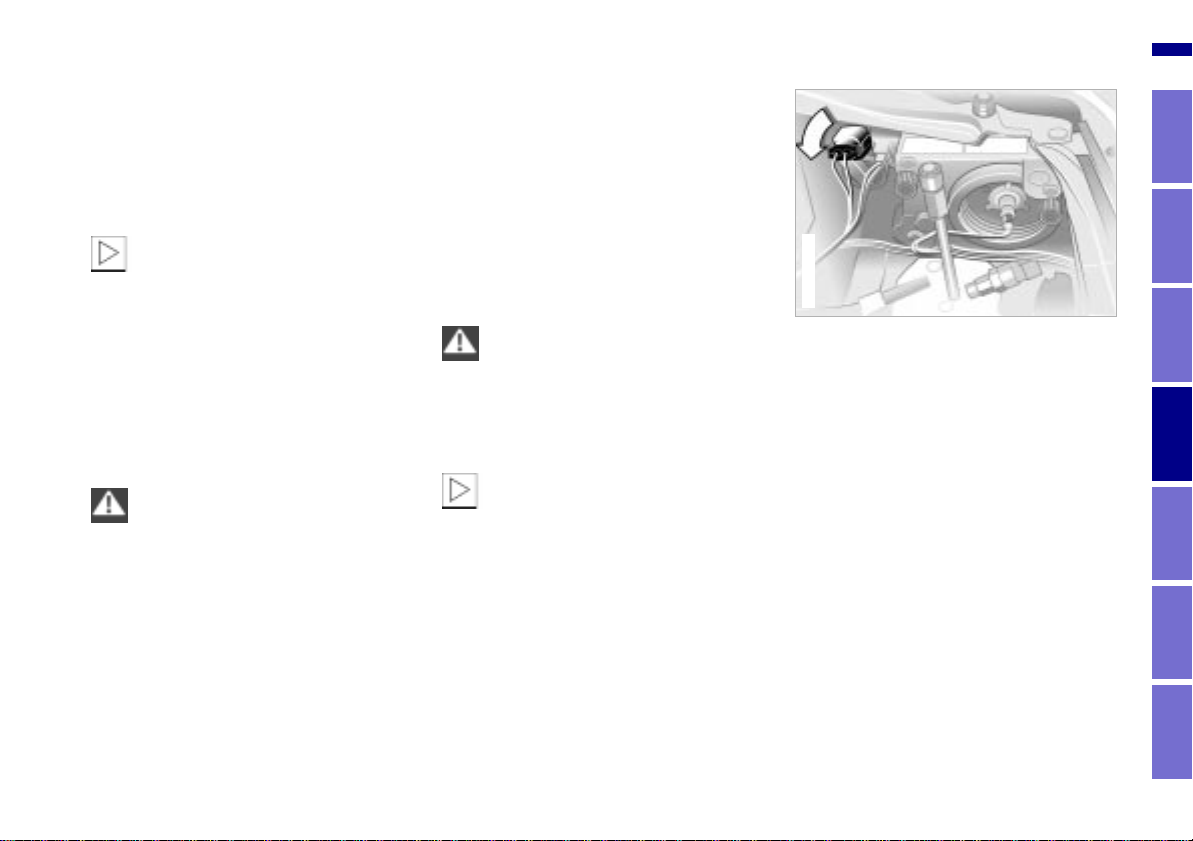
145n
RepairsIndex OverviewControlsCar careTechnologyData
Lamps and bulbs
The lamps and bulbs are essential fac-
tors contributing to the safety of your
vehicle. Observe the following instruc-
tions during bulb replacement carefully.
If you are not familiar with any of the
procedures, consult your BMW center.
Do not touch the glass portion of
a new bulb with your bare hands
since even small amounts of impurities
burn in to the surface and reduce the
service life of the bulb. Use a clean
cloth, paper napkin, or a similar mate-
rial, or hold the bulb by its metallic
base.<
A replacement bulb set is available from
your BMW center.
Whenever working on the electri-
cal system, switch off the electri-
cal accessory you are working on or
disconnect the cable from the negative
terminal of the battery. Failure to do this
could result in short circuits.
To prevent injuries and damage, com-
ply with any instructions provided by
the bulb manufacturer.<
Xenon lamps
The service life of these bulbs is very
long and the probability of a failure is
very low, provided that they are not
switched on and off an unusual number
of times. If one of these bulbs should
nevertheless fail, it is possible to con-
tinue driving with great caution using
the fog lamps, provided traffic laws in
your area do not prohibit this.
Because of the extremely high
voltages involved, any work on the
lighting system should be performed
only by technicians with the appropriate
qualifications. Failure to comply with
this creates a risk of fatal injury.<
When cleaning the headlamps,
please observe the following:
> Do not clean by wiping with a dry
cloth (this causes scratches). Never
use abrasives or strong solvents to
clean the covers.
> Remove dirt and contamination
(such as insects) by soaking with
BMW Car Shampoo and then rinsing
with ample water.
> Always use a deicer spray to remove
accumulated ice and snow – never
use a scraper.<
Parking lamp
5 watt bulb
1 Turn the bulb holder to the left (arrow)
and remove.
2 Remove and replace the bulb.
390de099
Online Edition Part-No. 01 41 0 155 062 - © 07/99 BMW AG
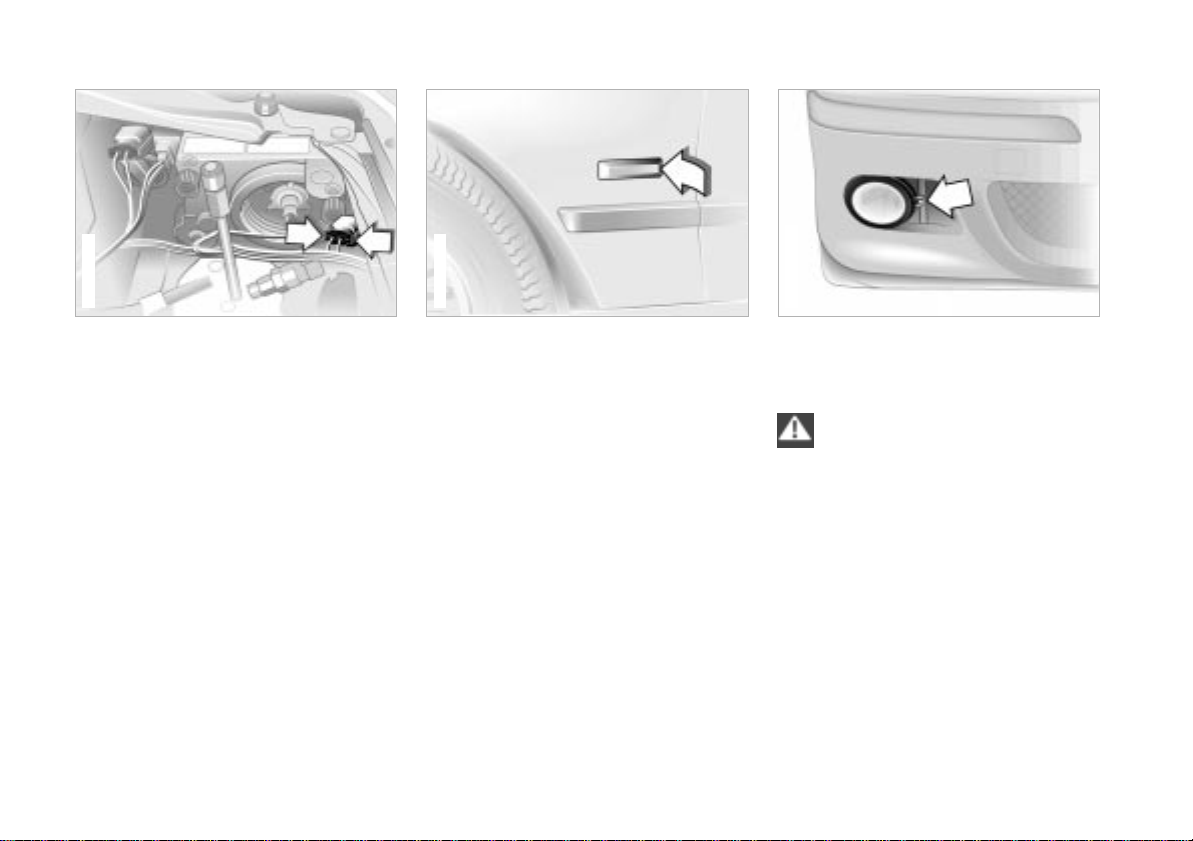
146n
Lamps and bulbs
Turn signal indicator/Side lamps
(side marker lamps), front
Dual-filament bulb, 21 watts
1 Press the tabs together (arrow) and
remove the bulb holder.
2 Press gently on the bulb, turn it to the
left and remove.
3 After replacing the bulb insert the
holder (note lug positions) and snap it
back into place.
390de100
Side turn signals*
5 watt bulb
1 Use finger pressure against the rear
end of the lens (arrow) to press it for-
ward for removal.
2 Apply gentle pressure to the bulb
while turning it to the left to remove.
390de106
Front fog lamps
HB4, 51 watt bulb
The bulb is pressurized. There-
fore, wear safety glasses and pro-
tective gloves. Failure to comply with
this precaution could lead to injury if the
bulb is accidentally damaged during re-
placement.<
1 Pull the cover panel next to the fog
lamp forward to remove.
2 Loosen the screw (arrow) and swing
the lamp assembly out.
3 Release the spring on the back of the
lamp and turn the cover to the left.
4 Release the clamp, remove the con-
tact base and replace the bulb.
39mde046
Online Edition Part-No. 01 41 0 155 062 - © 07/99 BMW AG
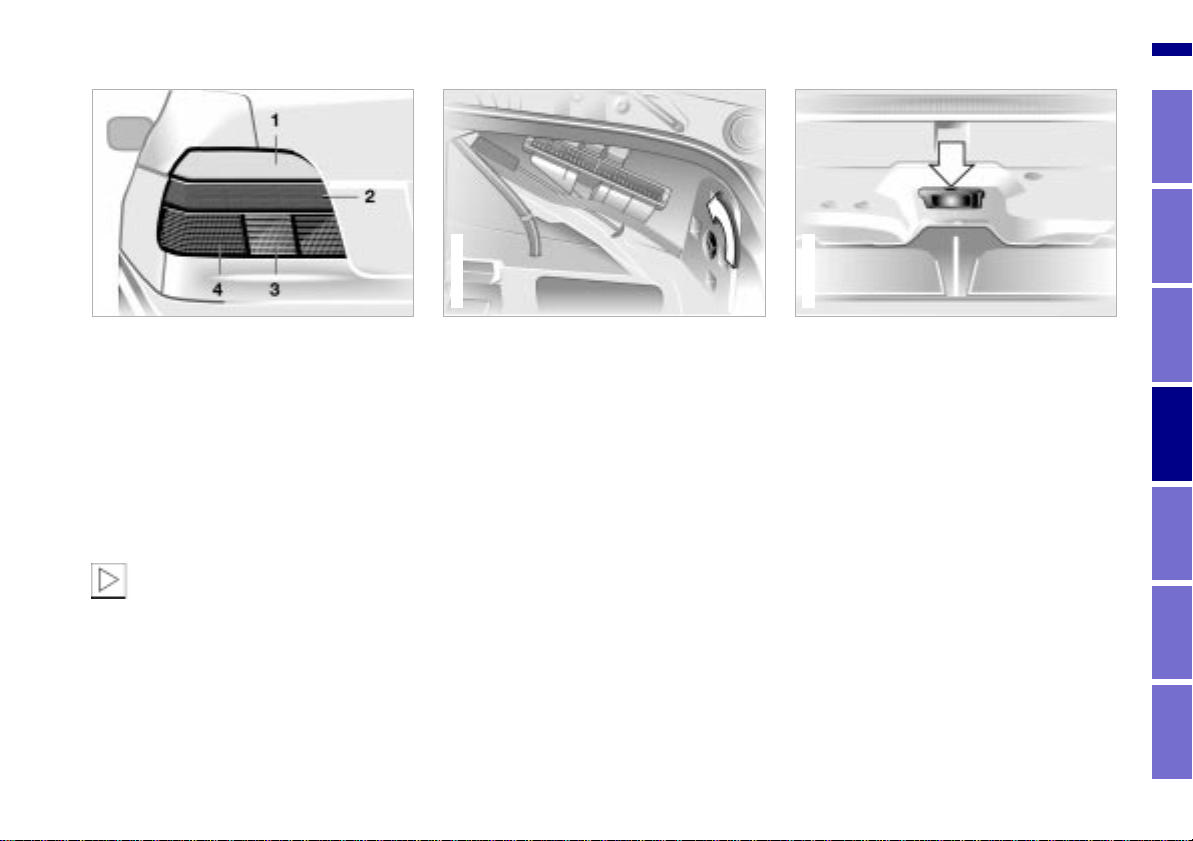
147n
RepairsIndex OverviewControlsCar careTechnologyData
Lamps and bulbs
Tail lamp assembly
Tail lamps: 5 watt bulbs
Remaining bulbs: 21 watts
1 Turn signal indicator white
2 Tail lamps/Side marker lamp,
reflector red
3 Backup lamp white
4 Brake lamps red
In the event of a failure of both
lamps of a tail lamp assembly, the
brake lamp assumes the function of the
tail lamps.<
394us102
1 Use the upper handle to fold down
the side panel in the luggage com-
partment.
2 Turn the bulb holder's release knob
to the left (arrow) and remove the
holder.
3 Apply gentle pressure to the bulb
while turning it to the left to remove.
394de103
Center (high-mount) brake lamp*
21 watt bulb
1 Open the luggage compartment lid.
2 Unclip the cover panel (on the under-
side of the package tray) with a
screwdriver (arrow).
3 Turn the bulb holder to the left and
remove.
4 Apply gentle pressure to the bulb
while turning it to the left to remove.
394de123
Online Edition Part-No. 01 41 0 155 062 - © 07/99 BMW AG
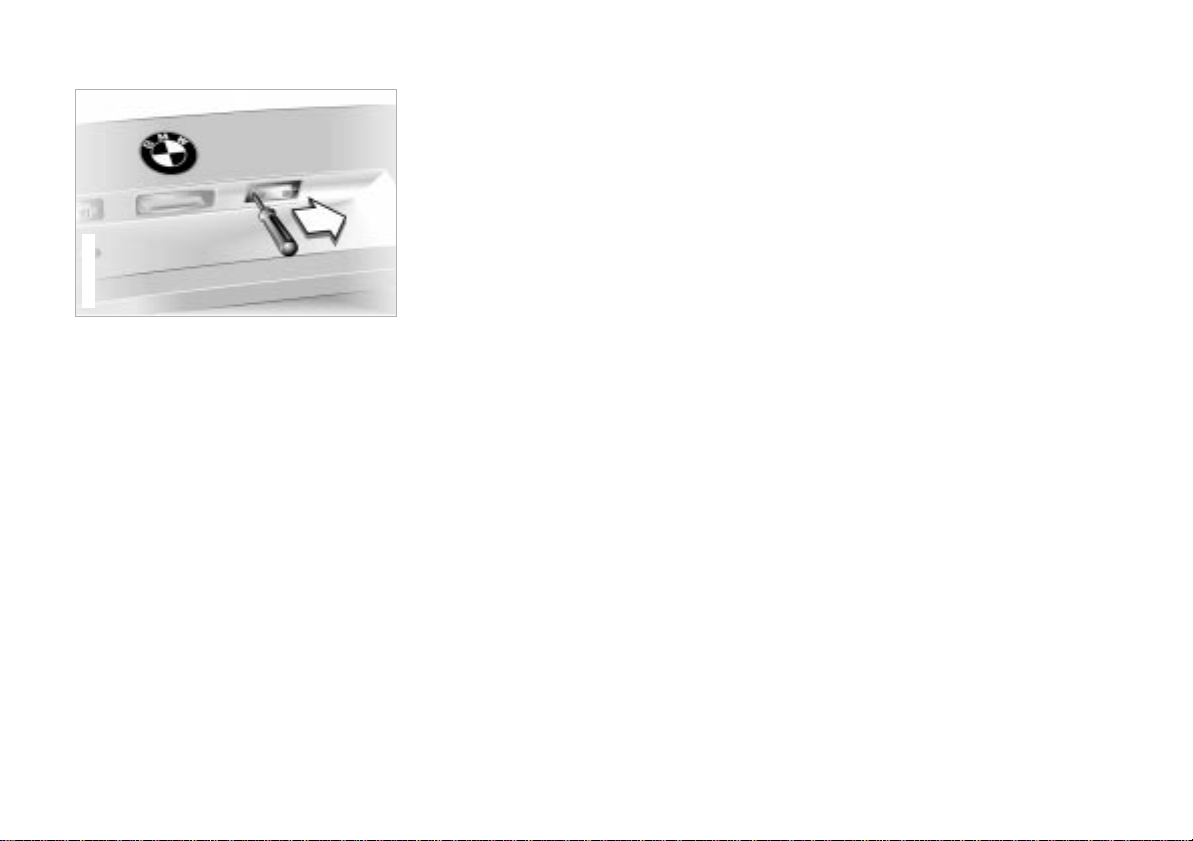
148n
Lamps and bulbs
License plate lamps
5 watt bulb
1 Insert a screwdriver into the slot and
press to the right (arrow); this disen-
gages the lamp.
2 Remove the lamp and replace the
bulb.
394de105
Interior lamps
Front
Interior lamp (10 watt bulb) with reading
lamps (10 watt bulbs)
1 Interior lamp: Press the lamp out to
the side with a screwdriver and re-
move the lens. Pull the bulb from the
contact tabs.
2 Reading lamp: Gently press against
the lamp while turning it to the left to
remove it.
Indirect lighting
1 watt bulb
1 Unclip the lamp holder.
2 Remove the bulb.
Rear
Interior lamp (10 watt bulb) with reading
lamp (5 watt bulb)
1 Use a screwdriver in the upper re-
cesses to pry the lamp out.
2 Interior lamp: Push back the tab on
the reflector and replace the bulb.
3 Reading lamp: Gently press against
the lamp while turning it to the left to
remove it.
Footwell lamps
5 watt bulb
1 Use a screwdriver to press the lens
out to the side.
2 Replace the bulb.
Glove compartment lamp
5 watt bulb
1 Apply a screwdriver in the recess to
pry the lamp out.
2 Remove the reflector.
3 Replace the bulb.
Luggage compartment lamps
Lamp on the underside of the rear
package tray: 10 watt halogen lamp.
Lamp in luggage compartment lid:
10 watt bulb.
1 Apply a screwdriver in the recess to
pry the lamp out.
2 Remove the reflector.
3 Replace the bulb.
Online Edition Part-No. 01 41 0 155 062 - © 07/99 BMW AG
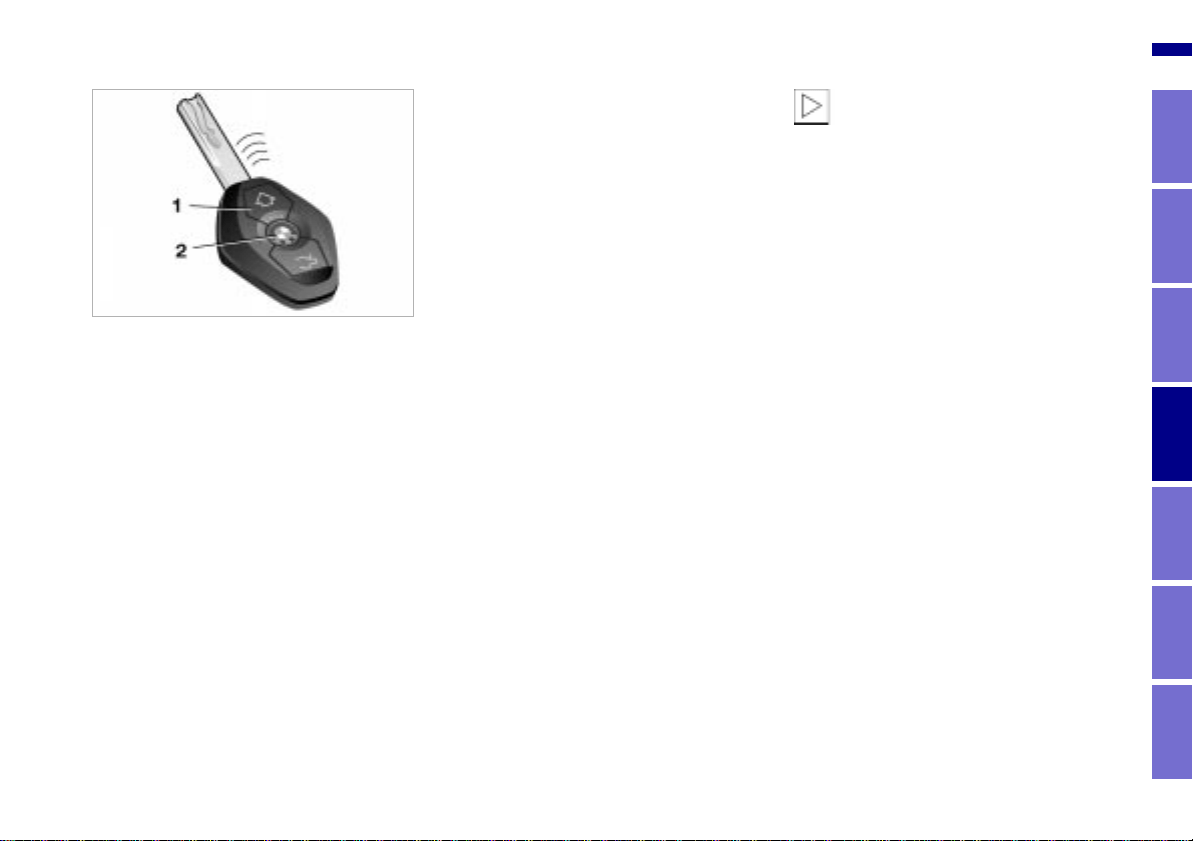
149n
RepairsIndex OverviewControlsCar careTechnologyData
Remote control
New transmitter
If you place a new transmitter into ser-
vice (either a replacement or an addi-
tional transmitter), it must be initialized:
1 Enter the vehicle and close the doors.
2 Turn the ignition key briefly (max.
5 seconds) to position 1 in the steer-
ing lock and then turn it back to posi-
tion 0. Remove the key.
3 Press button 1 (refer to the illustra-
tion) and hold it. Maintain pressure on
button 1 while rapidly pressing button
2 three times in succession within a
period of 10 seconds.
463de028
4 Release button 1.
5 The central locking system activates
and releases all lock mechanisms in
rapid succession to indicate that the
initialization procedure has been suc-
cessfully completed.
If the central locking system does not
react, you must repeat the initialization
procedure.
If you possess additional transmitters
for your vehicle (up to a maximum of
four units), you must now initialize these
as well. Be sure that no more than
30 seconds is allowed to elapse be-
tween the individual initialization proce-
dures. Repeat steps 3 and 4 for each of
the transmitters when doing this. The
central locking system will confirm every
initialization procedure as described in
step 5.
In the event of a system malfunction,
please contact your BMW center. You
can also obtain replacement transmit-
ters here.
Whenever you receive a new
transmitter, turn that transmitter to
position 2 in the ignition lock once (igni-
tion switched on) and then back. This
allows the electronic vehicle immobi-
lizer (refer to page 31) to "learn" the
new key.
To prevent unauthorized use of the
transmitter, surrender only the door and
ignition key 3 or the spare key (refer to
page 30) when leaving the vehicle for
valet parking, for instance.<
Online Edition Part-No. 01 41 0 155 062 - © 07/99 BMW AG
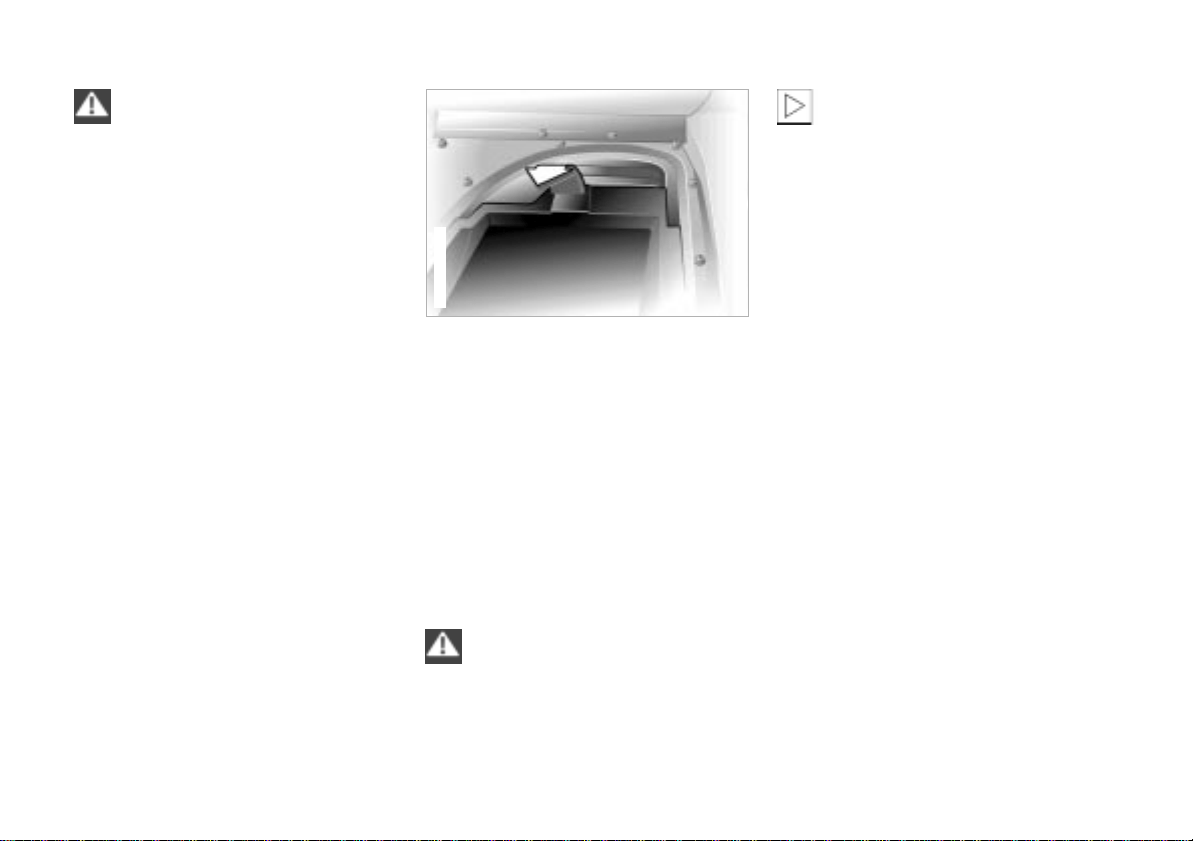
150n
Repairing a flat tire
Precautions in case of a flat tire:
Stop the vehicle as far as possible
from passing traffic. Switch on the haz-
ard warning flashers.
Turn the steering wheel to the straight-
ahead position, remove the key and en-
gage the steering lock. Shift into 1st or
reverse and engage the parking brake.
All passengers should be outside the
car and well away from your immediate
working area (behind a guardrail, for in-
stance).
If a warning triangle or portable hazard
warning lamp is available, set it up on
the roadside at an appropriate distance
from the rear of the vehicle. Comply
with all safety guidelines and regula-
tions.<
M Mobility System
In the place of a spare tire, you will find
the M Mobility System under the floor-
mat of the luggage compartment in the
M5.
1 Lift up the floormat and then raise the
front cover panel.
2 Remove the fittings for attachment of
the M Mobility System. Note the posi-
tion of the fittings so that you can se-
cure the system correctly following
use.
Before you use the M Mobility
System, read the warnings and
danger notices on the device carefully.
Always use the enclosed protective
gloves and goggles. Failure to do so
constitutes a personal safety hazard.<
39mde053
Use of the M Mobility System is
not effective if the damage to the
tire is larger than approx. 3/16-inch
(approx. 4 mm). Please consult the
nearest authorized BMW center if you
cannot repair the tire with the M Mobil-
ity System or contact BMW Roadside
Assistance at 1-800-332-4269.<
Online Edition Part-No. 01 41 0 155 062 - © 07/99 BMW AG
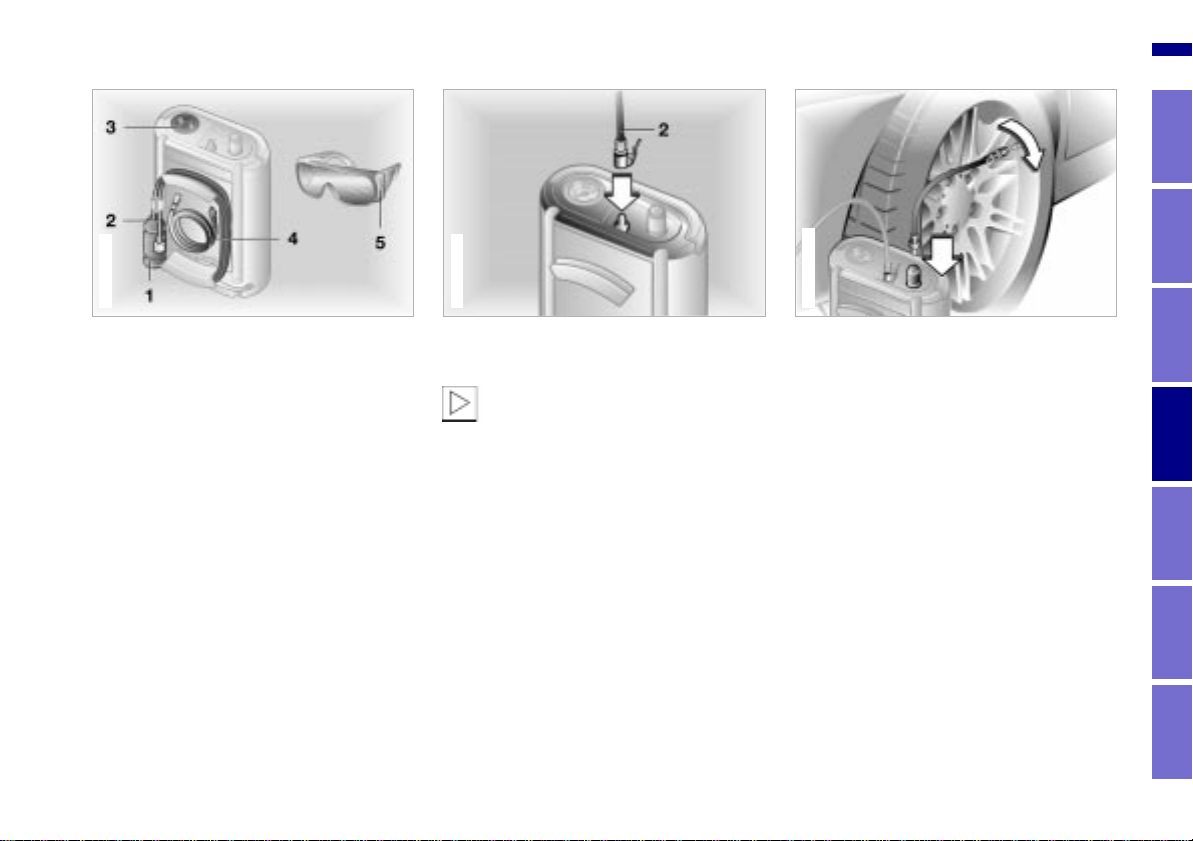
151n
RepairsIndex OverviewControlsCar careTechnologyData
Repairing a flat tire
Included in the system are:
1 Grip with button, cable and plug con-
nector for the cigarette lighter socket
to operate the compressor
2 Black connection hose from the com-
pressor to the sealant container
3 Pressure gauge
4 Clear connection hose from the sys-
tem to the wheel
5 Protective goggles
6 Protective gloves (not illustrated).
367us701
Procedure
If possible, leave the foreign object
in the tire.<
1 Remove the Maximum Speed Alert
sticker from the top of the device
and affix it to the steering wheel.
2 Remove the hoses and cable from
the device.
3 Put on the protective gloves and
goggles.
4 Connect the black hose 2 to the
connector as shown in the illustra-
tion.
367de355
5 Remove the clear hose 4 from the
plastic bag. Unscrew the valve cap
from the valve stem of the wheel
with the defective tire and screw the
hose onto the valve stem.
6 Plug the free end of the hose onto
the connector on the device as
shown in the illustration.
7 Insert the plug connector 1 into the
cigarette lighter socket in the vehi-
cle's interior (refer to page 98).
39mde054
Online Edition Part-No. 01 41 0 155 062 - © 07/99 BMW AG
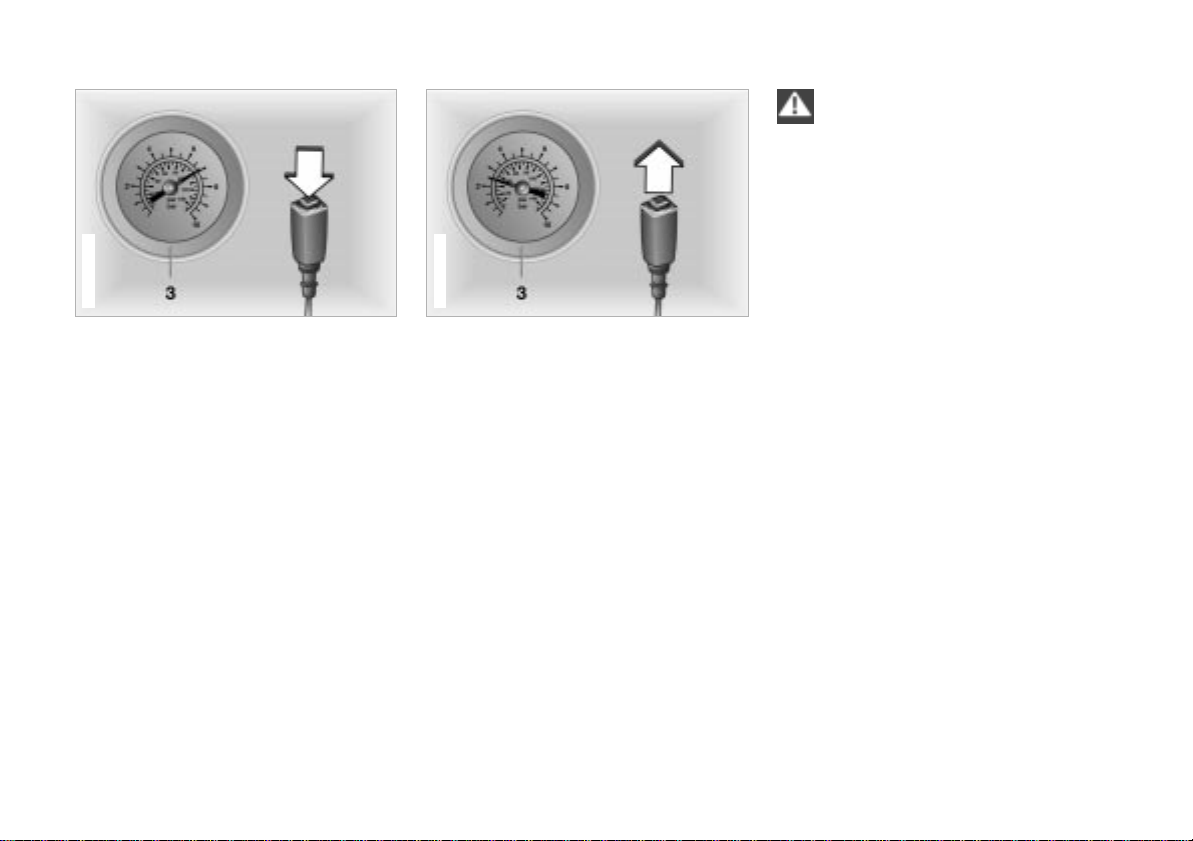
152n
Repairing a flat tire
8 Press and hold the button for oper-
ating the compressor. Watch the
pressure gauge carefully as you do
so. As long as the pressure reading
is between approx. 5–8 bar, sealant
is being forced into the tire. When
the pressure gauge falls signifi-
cantly below approx. 5–8 bar while
the compressor is operating, all of
the sealant is in the tire. Air is being
pumped into the tire.
367de352
9 Continue to hold the button until
there is a pressure reading of
2.5 bar. This may take several min-
utes.
10 To check the tire inflation pressure
that has been reached, release the
button.
11 After the tire has been filled with air,
remove the black hose 2 from the
device and disengage the clear
hose 4 from the device. To do this,
press the outer ring of the connec-
tor toward the device.
12 Now unscrew the hose 4 from the
valve stem of the wheel. Screw the
valve cap back onto the valve stem.
13 Return the hose to the plastic bag
and store the M Mobility System in
the luggage compartment.
367de351
After using the M Mobility System,
drive a distance of at least
1-1/4 miles (2 km) so that the sealant is
distributed evenly within the tire. When
doing so, do not drive below a speed of
12 mph (20 km/h) or above 36 mph
(60 km/h). Following that, check the tire
pressure as soon as possible – at the
next filling station, for instance – and
adjust the pressure to the correct spec-
ification (refer to page 26) if necessary.
If the tire cannot hold the correct pres-
sure, do not continue to drive. Consult
the nearest authorized BMW center or a
tire dealer.<
Replace the defective tire as soon as
possible. Have the wheel and tire bal-
anced and have the M Mobility System
filled. Contact your authorized BMW
center for this.
Please note that the system's sealant
container must be replaced every three
years by your BMW center if the device
is not used.
You will find corresponding instruc-
tions for using the M Mobility System on
the device.
Online Edition Part-No. 01 41 0 155 062 - © 07/99 BMW AG
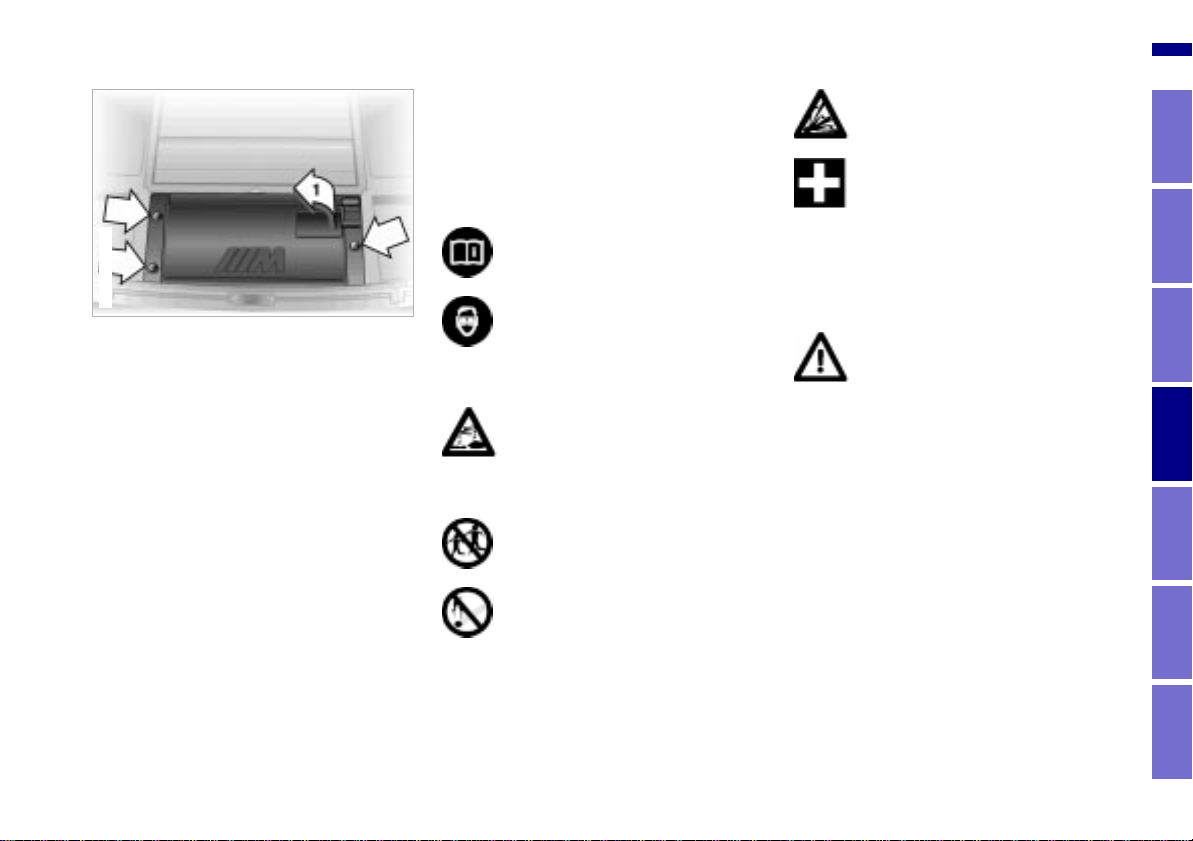
153n
RepairsIndex OverviewControlsCar careTechnologyData
Battery
Battery location
The battery is located under the floor-
mat in the luggage compartment.
1 Read and comply with the warning in-
formation on page 154.
2 Lift the floormat.
3 Press the small cover gently. Lift the
cover (arrow 1).
4 Disconnect the battery cable from the
negative terminal.
5 Loosen the three screws (arrows) and
remove the cover.
39mde047
Symbols
You will find the following symbols on
your car battery. To avoid injury, please
comply with the corresponding precau-
tions whenever you work with or near
the battery.
Before handling the battery,
please read the following infor-
mation:
Wear eye protection. Do not al-
low particles containing battery
acid or lead to come into con-
tact with your eyes, your skin, or your
clothing.
Battery acid is extremely corro-
sive. Wear eye protection and
protective gloves. Do not tip the
battery. Battery acid can leak from the
ventilation openings.
Do not allow children access to
batteries and battery acid.
Never allow sparks or open
flame near the battery. Do not
smoke in the vicinity of the bat-
tery. Avoid sparks from electrical cables
or electrical equipment. Turn the key
to position 0 in the steering lock when
connecting or disconnecting the bat-
tery. Don't short-circuit the battery ter-
minal. If you do so, you could be injured
by electrical sparks.
A highly-explosive gas is gener-
ated when the battery is
charged.
If you happen to get acid in your
eyes, rinse thoroughly for 15
minutes with clear water. Con-
sult a physician immediately. If your
skin or clothing are splashed by acid,
rinse immediately with plenty of water.
If electrolyte is accidentally swallowed,
consult a physician immediately.
In order to protect the battery
case from ultraviolet radiation,
do not place it in direct sunlight.
A discharged battery can freeze. Store
the battery in areas where temperature
remains above freezing.
Battery care
The battery is absolutely maintenance-
free, that is, the original electrolyte will
normally last for the service life of the
battery under moderate climatic condi-
tions.
Online Edition Part-No. 01 41 0 155 062 - © 07/99 BMW AG
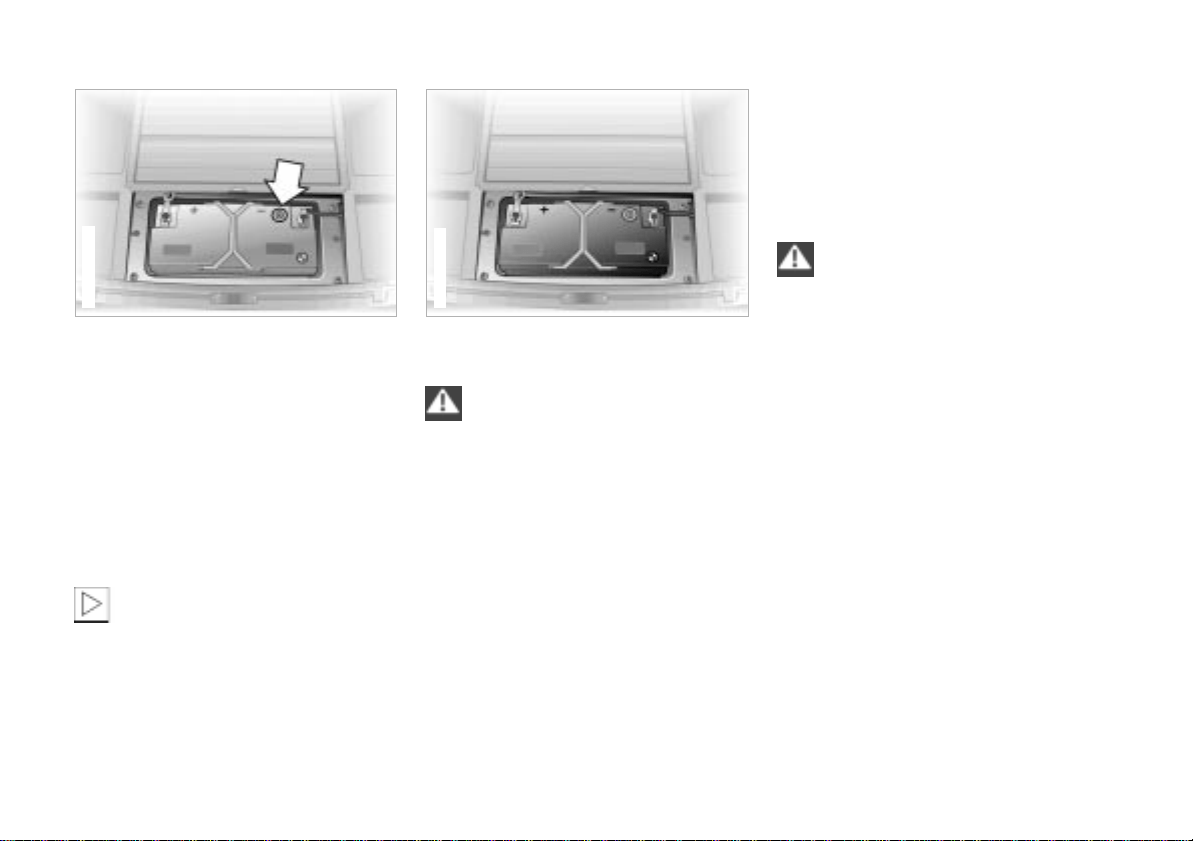
154n
Battery
Charge condition
You can read the charge condition of the
battery with the "Magic Eye
*" (a hydro-
meter):
> Green: Adequate charge.
> Black: Not adequately charged. The
battery has to be recharged. Please
contact your BMW center for addi-
tional information.
> Yellow: Replace the battery.
The service life specified for the
battery can be achieved only if it is
always kept adequately charged. Check
the charge condition of the battery fre-
quently if the vehicle is used primarily
for driving short distances.<
39mde055
Removal and installation
Do not disconnect the battery
when the engine is running. If you
do so, the ensuing voltage surge will
damage the vehicle's onboard electron-
ics.
Do not alter the positive terminal wiring
in any way. If you do so, the Battery
Safety Terminal's safety function will no
longer be guaranteed. Repair and dis-
posal must be performed by trained
technicians only.<
39mde056
When removing the battery, disconnect
the cable on the negative terminal first,
then the cable on the positive terminal.
When installing a battery, connect the
positive terminal first, then connect the
negative terminal.
When installing the battery, be
sure that it is mounted securely in
the battery well and that the cover is in-
stalled. If the battery is not mounted
and fastened properly, it will not be ad-
equately secured in case of an acci-
dent.<
Online Edition Part-No. 01 41 0 155 062 - © 07/99 BMW AG

155n
RepairsIndex OverviewControlsCar careTechnologyData
Battery
Charging the battery
Charge the battery in the vehicle only
when the engine is not running.
Before doing any work on the
electrical system, be sure to dis-
connect the cable from the battery's
negative terminal. Failure to do so could
result in short-circuits, a fire or personal
injury.<
If the vehicle is to be parked longer than
four weeks, disconnect the battery from
the vehicle's electrical system by dis-
connecting the negative terminal cable
and then recharge using a suitable
charging device.
If you intend to store your car for longer
than twelve weeks: Remove the battery,
charge it and store it in a cool (but frost-
and dust-free) room. Every three
months and before reinstalling the bat-
tery, have it recharged. If it is not re-
charged, it will not be serviceable. Every
time the battery is discharged, espe-
cially over extended periods, its service
life is reduced.
Avoid environmental pollution
when disposing of old batteries.<
Return used batteries to a recy-
cling point or your authorized
BMW center. Maintain the battery in an
upright position for transport and stor-
age. Secure the battery against tilting in
transit.<
Online Edition Part-No. 01 41 0 155 062 - © 07/99 BMW AG
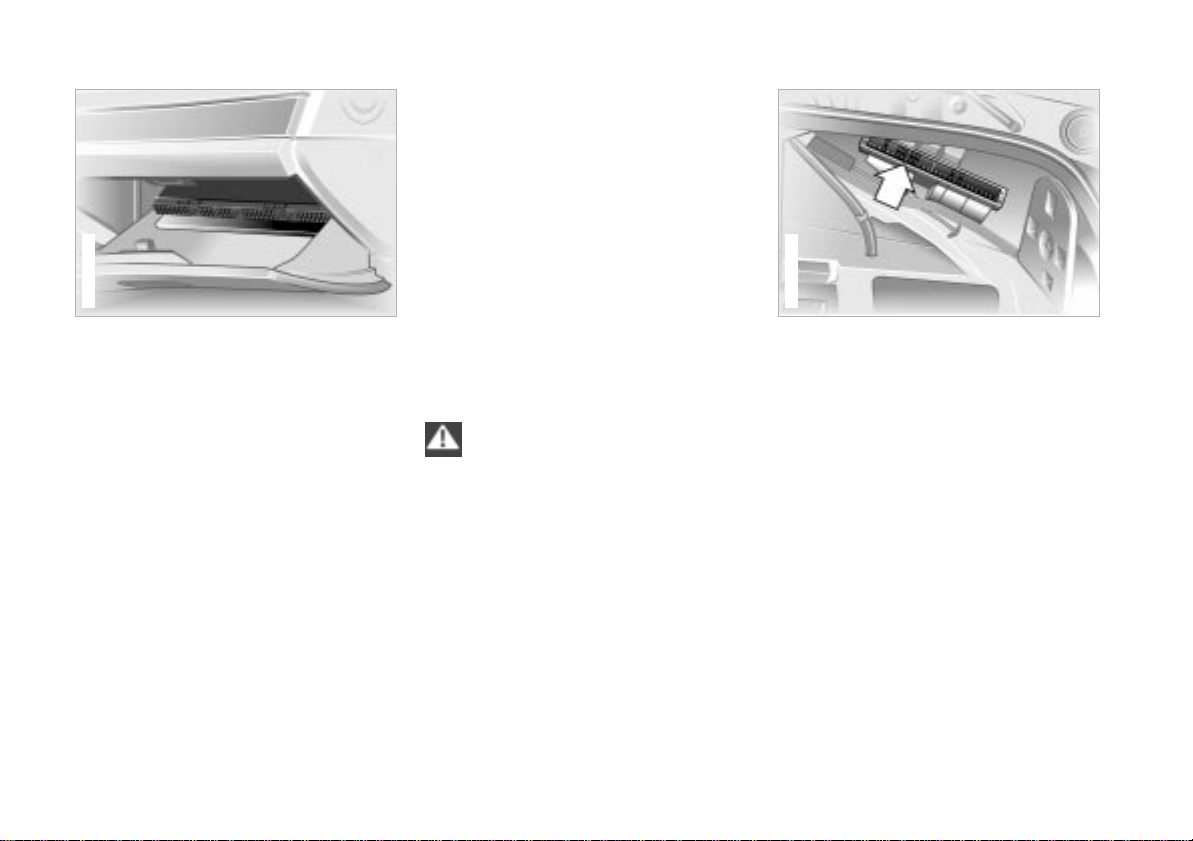
156n
Fuses
If an electrical accessory should fail,
switch it off and check the fuse.
In the glove compartment
1 Open the glove compartment and
turn the two white quick-release
knobs to the left. Spare fuses and
plastic tweezers are located on the
fuse holder.
2 Use the plastic tweezers to remove
the fuse for the accessory or equip-
ment that has stopped working.
3 If the fuse is burned through (the
metal strip will have melted and sep-
arated), replace it with a new fuse of
the same ampere rating (color code).
390de085
The fuses, their respective ampere rat-
ings and the equipment in their circuits
are all indicated below the fuse holder.
Close the fuse holder by holding the top
of the cover in place and screwing the
two quick-release knobs to the right.
Additional fuses are provided in the lug-
gage compartment (refer to the next
column).
The fuse for continuous positive current
is located in a separate fuse box above
the battery. If this fuse is defective, re-
fer the problem to your BMW center for
repair.
Do not attempt to repair a burned
fuse or replace it with a fuse hav-
ing a different color or amperage rating.
To do this could cause a fire in the vehi-
cle resulting from a circuit overload.<
If the fuse continues to burn through,
have the problem corrected by a BMW
center.
In the luggage compartment
Use the handle to pull the trim on the
right wall down.
A list of the fuses, their respective am-
pere ratings and the equipment in their
circuits is provided on the rear of the
side trim.
394de124
Online Edition Part-No. 01 41 0 155 062 - © 07/99 BMW AG
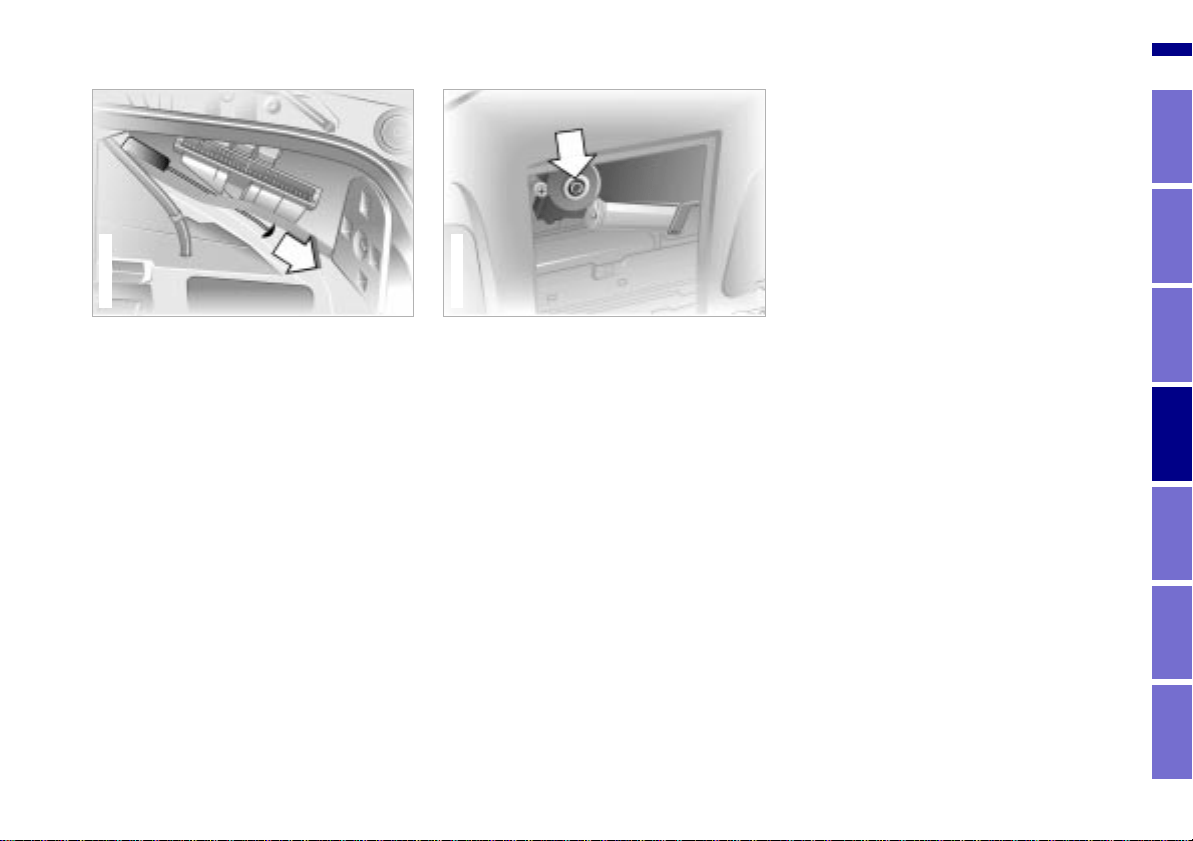
157n
RepairsIndex OverviewControlsCar careTechnologyData
Manual release
1 Use the handle to lower the trim
panel on the right side of the luggage
compartment.
2 Pull the knob with the fuel pump sym-
bol (arrow).
394de095
Manual operation
1 Remove the interior lamp (refer to
page 148), reach into the opening
and push out the panel.
2 Use the Allen wrench from the on-
board tool kit (refer to page 144) to
turn the sliding/tilt sunroof in the de-
sired direction.
390de376
Fuel filler door Sliding/Tilt sunroof*
Online Edition Part-No. 01 41 0 155 062 - © 07/99 BMW AG
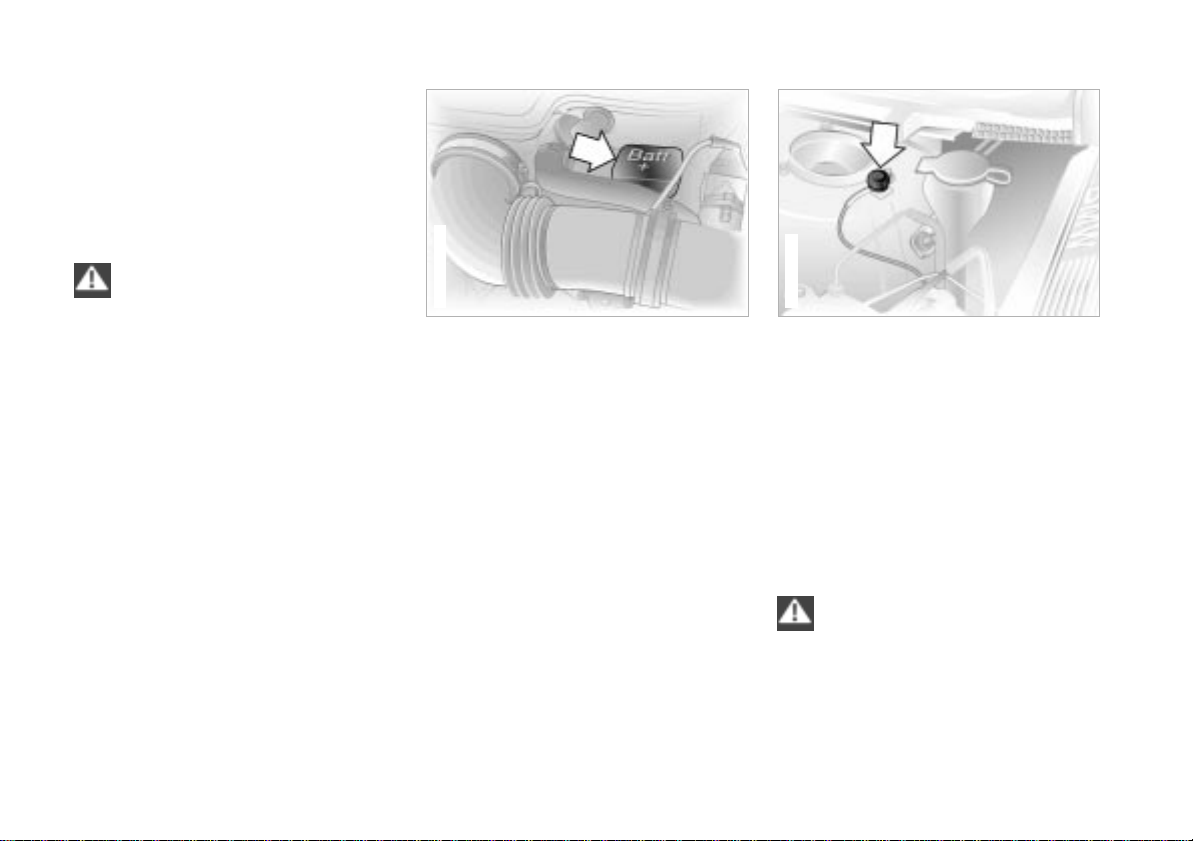
158n
Never use spray starter fluids.
If the battery is discharged, the engine
can be started with the use of two
jumper cables and the battery of an-
other vehicle. Always use jumper cables
with fully insulated handles on the termi-
nal clamps.
Do not touch the parts conducting
electrical current while the car is
running. To do so creates the risk of fa-
tal injury.<
Carefully comply with the following in-
structions to avoid personal injury and
damage to one or both vehicles:
1 Be sure that the battery on the sup-
port vehicle is also rated at 12 volts,
and that the capacities of the two
batteries (Ah) are roughly comparable
(printed on casing).
2 Leave your battery connected to the
car electrical system.
3 Make sure that there is no contact
between the bodywork of the two ve-
hicles – this creates a risk of short cir-
cuits.
4 Start by connecting the jumper cable
from the positive terminal of the sup-
port vehicle to the positive terminal
connector located in your BMW's en-
gine compartment. The cover of the
auxiliary terminal for jump starting is
identified with a "Batt. +" sign. Refer
to the illustration. Remove by lifting
the cap.
39mde048
5 Then connect the negative terminals.
Attach the cable to either the support
vehicle's negative battery terminal (–),
or to a suitable ground on its engine
or bodywork. Then connect the other
end of the cable to a ground on the
engine or on the bodywork of the ve-
hicle that is to be started. There is a
special nut on the strut dome of your
BMW for this (refer to the arrow in the
illustration).
Observe the same sequence for
connecting the jumper cables
when helping other vehicles. If you do
not, there is the risk of injury if sparks
generate at the battery.<
390de146
Jump-starting
Online Edition Part-No. 01 41 0 155 062 - © 07/99 BMW AG
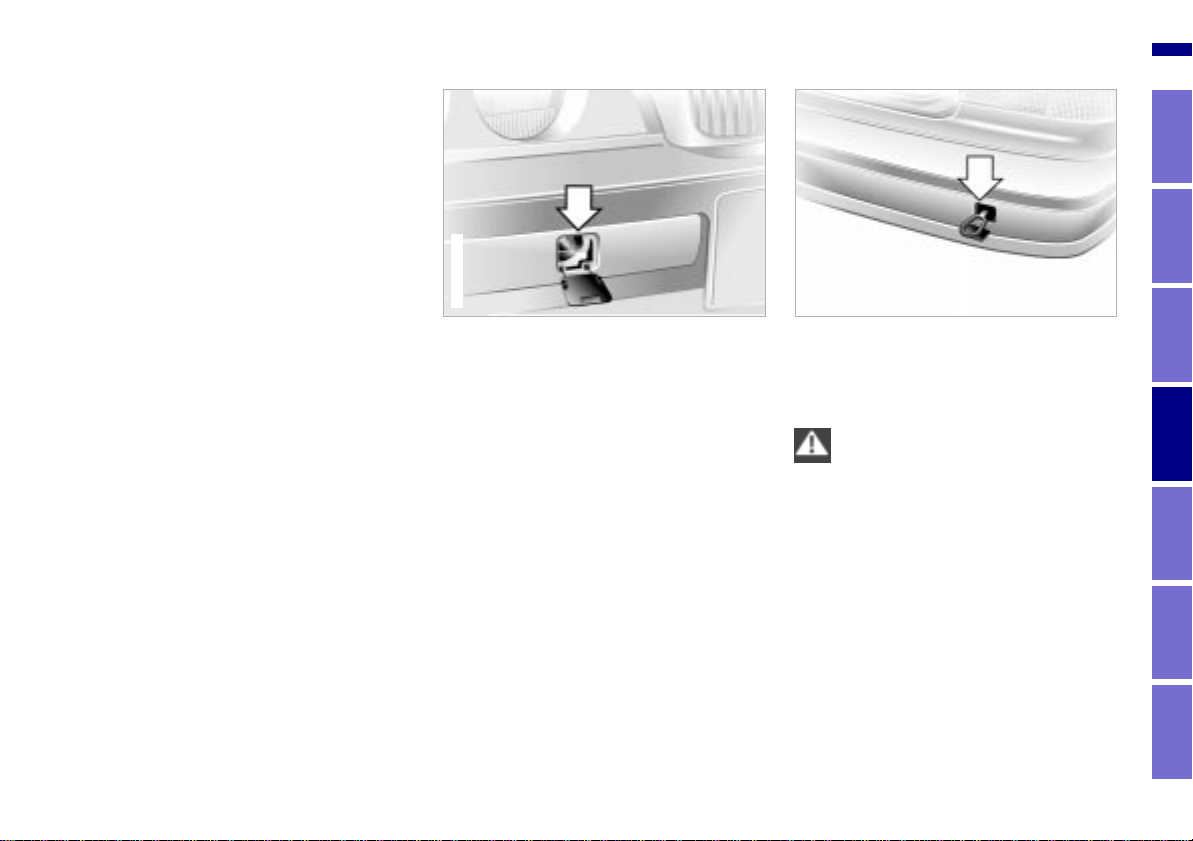
159n
RepairsIndex OverviewControlsCar careTechnologyData
Jump-starting Towing the vehicle
6 Start the engine of the support vehicle
and let it run.
7 Start the engine on the vehicle need-
ing the jump-start, and allow it to run
as usual. If the first start attempt is
not successful, wait a few minutes
before another attempt in order to
allow the discharged battery to
recharge.
8 Before disconnecting the jumper
cables from your BMW, turn on the
headlamps, the rear window de-
froster, and set the blower to the high-
est speed; allow the engine to run ap-
prox. 10 seconds. This will prevent a
voltage surge from the voltage regula-
tor to the electrical accessories.
9 Then disconnect the jumper cables in
reverse sequence.
Depending on the cause of the fault, re-
charge the battery.
Tow fitting
The screw-in tow fitting is stored in the
onboard tool kit; be sure that it remains
in the vehicle at all times. This fitting is
designed for installation in the tow
sockets located at the front and rear of
the vehicle, and is intended for towing
on paved road surfaces only.
It should not be used to pull a vehicle
out of deep snow, mud, sand, etc.
Always observe all applicable towing
laws and regulations.
Access to tow sockets
Front:
Apply pressure to the arrow symbol on
the cover; remove the cover.
390de087
Rear:
Apply pressure to the arrow symbol on
the cover; remove the cover.
Tightly screw in the towing fittings
all the way. If you do not, the
threads could be damaged.
Never attach tie-down hooks, chains,
straps, or tow hooks to tie rods, control
arms, or any other part of the vehicle
suspension, as severe damage to these
components will occur, leading to pos-
sible accidents.<
Use only a nylon towing strap to tow the
vehicle, since the inherent resilience of
this material helps protect both vehicles
from sudden jerking movements.
394de088
Online Edition Part-No. 01 41 0 155 062 - © 07/99 BMW AG
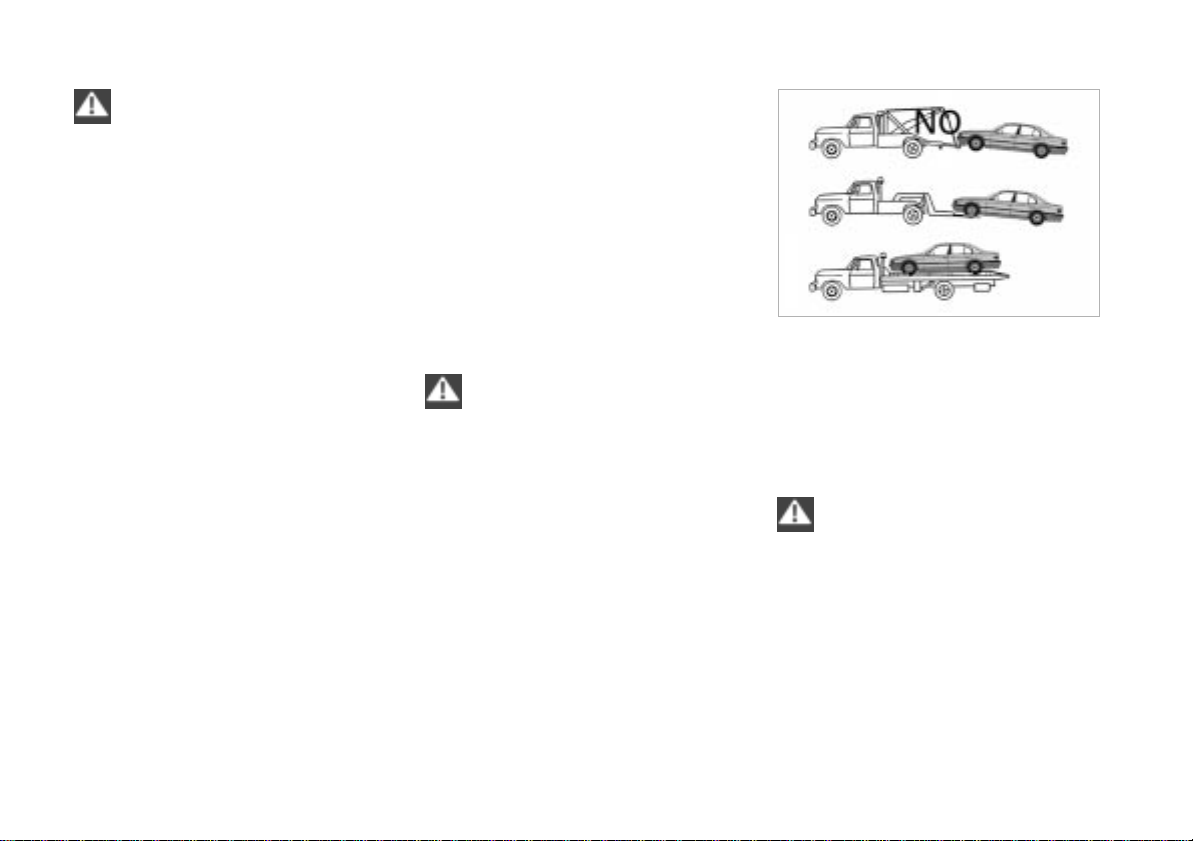
160n
Towing the vehicle
The towed vehicle should always
be the lighter of the two vehicles.
If this is not the case, it is no longer
possible to control vehicle response.<
Tow-starting
It is better to start the vehicle's engine
by jump starting. For instructions on
jump starting, refer to page 158.
Never attempt to use your vehicle to
push another car. This could cause
damage to the energy-absorbing
bumpers.
Towing a vehicle
1 Place the shift lever into "Neutral".
2 Leave the ignition key at position 1 to
ensure that the brake lamps, turn sig-
nals, horn and windshield wipers re-
main operative, and to prevent the
steering lock detent from engaging.
3 Switch on the hazard-warning system
(comply with applicable regulations).
Find some means of identifying the ve-
hicle in tow, for instance, place a sign
or warning triangle in the rear window.
Make sure that the ignition key
remains in position 1 even when
the electrical system has failed. This will
prevent the steering lock from engag-
ing. The steering and brakes are with-
out power assist when the engine is not
running. This means that increased
effort is required for steering and brak-
ing.<
Towing with a commercial tow
truck
> Do not tow with sling-type equipment.
> Use a wheel lift or flat bed carrier.
> Please comply with applicable towing
laws.
Never allow passengers to ride in
a towed vehicle for any reason.<
380us124
Online Edition Part-No. 01 41 0 155 062 - © 07/99 BMW AG

161n
RepairsIndex OverviewControlsCar careTechnologyData
Online Edition Part-No. 01 41 0 155 062 - © 07/99 BMW AG
162n
Online Edition Part-No. 01 41 0 155 062 - © 07/99 BMW AG
Overview
Controls and features
Operation, care
and maintenance
Owner service procedures
Technical data
Index
Advanced technology
163n
RepairsIndex OverviewControlsCar careTechnologyData
Airbags 164
Radio reception 164
BMW active seat 165
Dynamic Stability Control
(DSC) 166
Safety belt tensioner 166
DSP sound system 166
Interior rearview mirror with
automatic dimmer 167
Integrated rear suspension 167
Latent heat storage system 168
Rain sensor 168
Xenon lamps 169
Online Edition Part-No. 01 41 0 155 062 - © 07/99 BMW AG
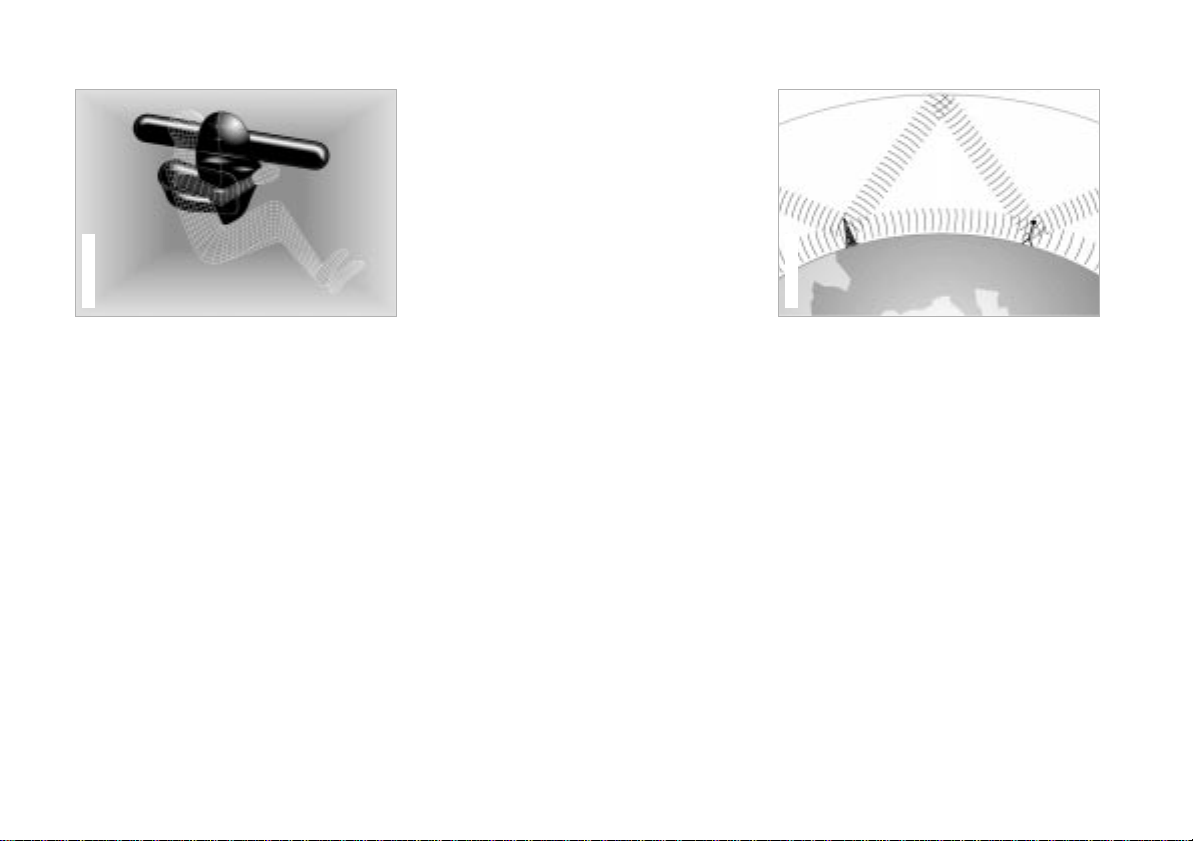
164n
Deceleration sensors continuously
monitor the physical forces acting upon
the vehicle. If, as the result of a frontal
collision, a deceleration is reached at
which the protection of the safety belts
alone is no longer adequate, the gas
generators of the driver and passenger-
front airbags are ignited. However, the
passenger-side airbag is only triggered
if an additional sensor has recognized
that the passenger seat is occupied.
In the event of a side collision, the head
protection and side airbags in the front
and rear
* are triggered if necessary.
390de319
The airbags located under the marked
covers inflate and unfold in a matter of a
few milliseconds. In this process, they
tear through the designed breaking
points of the upholstered covers or
press them out.
Because the inflation process must be
virtually instantaneous, it is necessarily
accompanied by a certain amount of
ignition and inflation noise. The gas
required to inflate the airbags is not
dangerous, and the associated smoke
then dissipates.
The entire process is completed within
fractions of a second.
Radio waves – medium-wave, long-
wave and short-wave – offer a wide
range of reception, because the broad-
cast signals travel not only along the
ground as surface waves, but also as
waves bounced back to earth from the
ionosphere.
Frequency-modulation (FM) provides
substantially better sound quality than
AM. However, because FM transmis-
sions rely on line-of-sight broadcast
waves, their effective reception range is
limited.
360de084
Airbags Radio reception
Online Edition Part-No. 01 41 0 155 062 - © 07/99 BMW AG
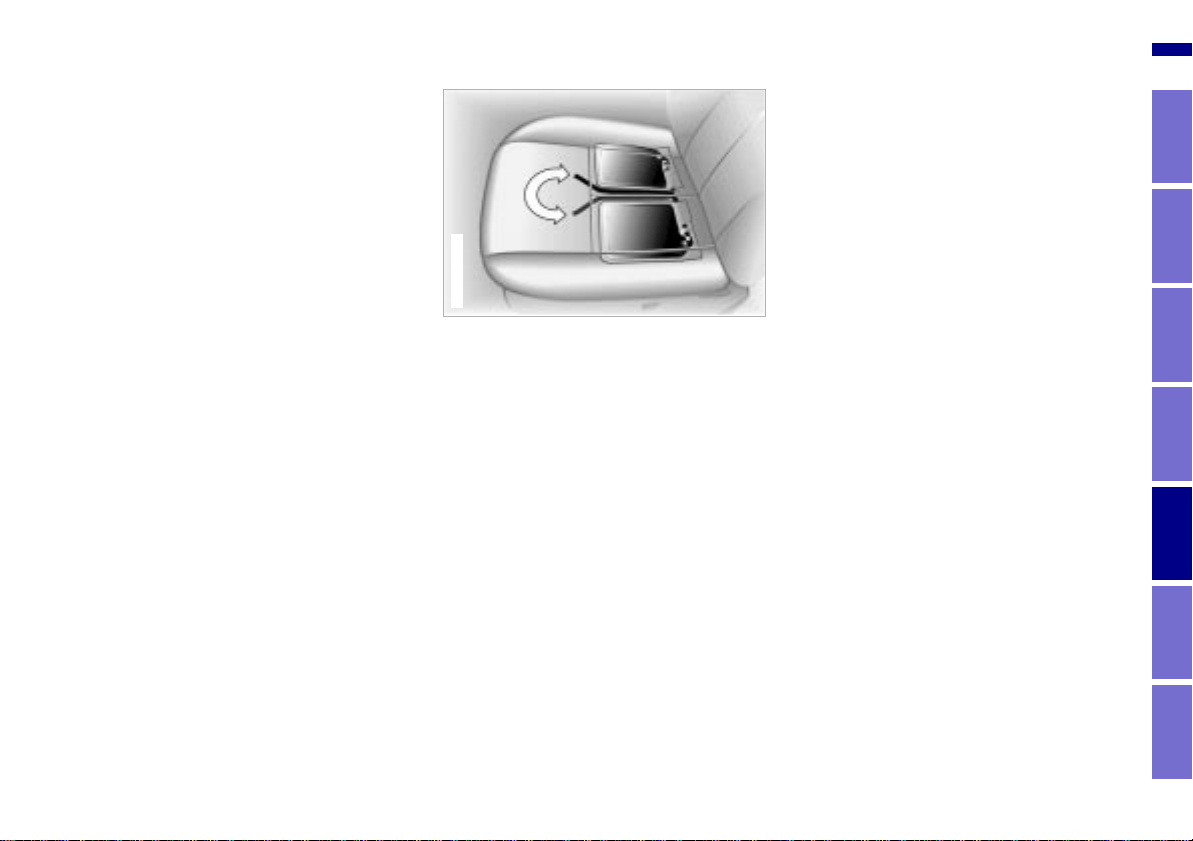
165n
RepairsIndex OverviewControlsCar careTechnologyData
Although numerous factors combine to
impose inherent limitations on the
reception quality available from mobile
radios, specially designed systems can
be employed to minimize their effects:
The "Radio Data System" (RDS) makes
sure that, for broadcast stations send-
ing on several frequencies, the radio
automatically tunes to the frequency
with the best reception quality.
The Diversity Antenna system employs
several FM antennas integrated within
the rear window. An integral processor
automatically selects the antenna with
the best FM reception quality at any
given time. The selection of the antenna
takes place within milliseconds, and is
therefore not noticed by the radio lis-
tener.
BMW seats are configured for your or-
thopedic well-being. The active seat is
an engineering enhancement of BMW's
seats, designed to ensure less fatigue
during extended trips while sitting with
little movement. The seat is no longer a
passive element between the road, the
running gear and the passenger. In-
stead, it creates minor and impercepti-
ble shifts in your weight by an active
change in the contour of the seat sur-
face. The basic seat position is not
changed as this occurs.
Fluid cushions are located below the
surface of the seat in the seat's uphol-
stery on the left and right. The fluid is
circulated slowly back and forth be-
tween the two cushions by means of a
pump. This causes a movement of the
spinal column which is virtually imper-
380de676
ceptible, resulting in an improved flow
of blood to the vertebral discs and the
muscles in the area of the spinal col-
umn. Vehicle occupants can experience
less muscle cramping, back pain in the
spine's lumbar region and fatigue. The
active seat thus provides a significant
contribution to your driving comfort and
safety.
Radio reception BMW active seat*
Online Edition Part-No. 01 41 0 155 062 - © 07/99 BMW AG
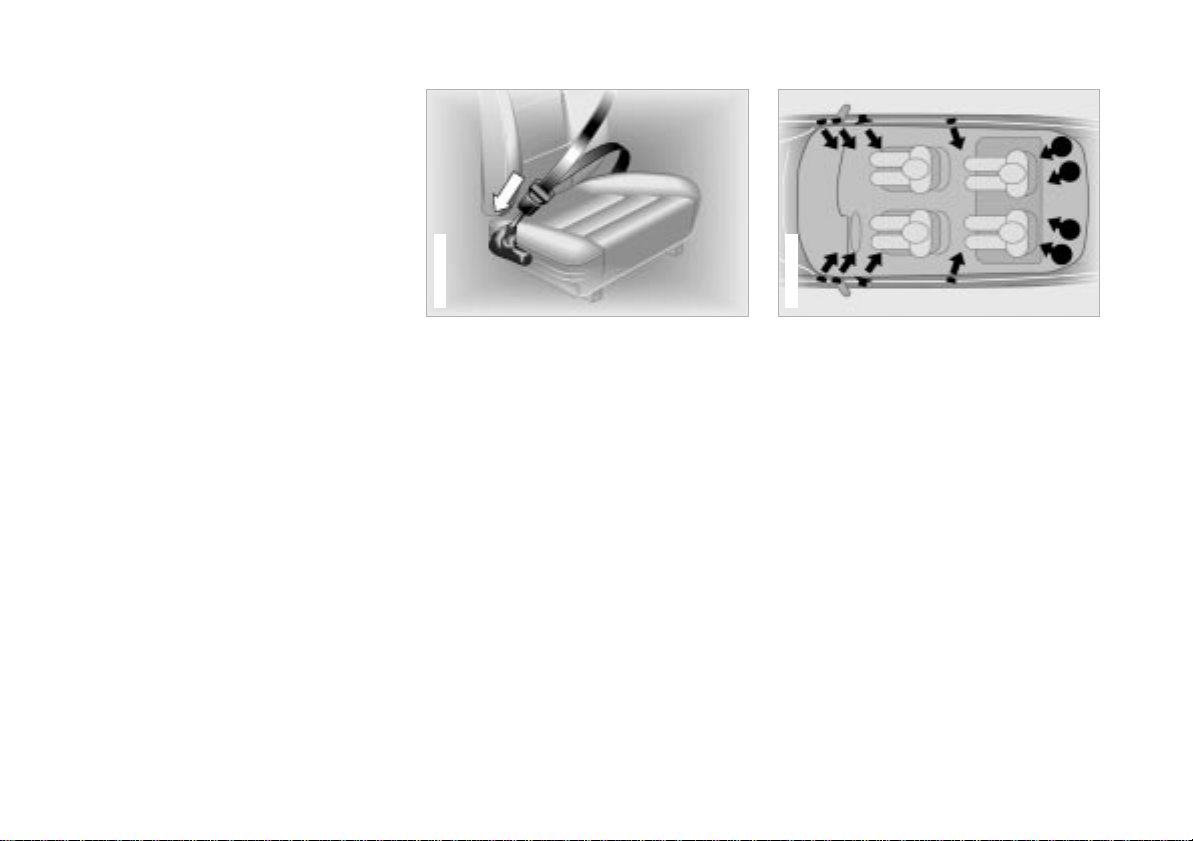
166n
DSC Safety belt tensioner DSP sound system*
Precision sensors monitor the number
of revolutions of the wheels, the steer-
ing angle, lateral acceleration, brake
pressure and the movement of the vehi-
cle around its vertical axis.
If differences in the wheel speeds occur,
the system counteracts the danger of
wheelspin by reducing engine torque. If
necessary, the system also responds
with additional application of the brakes
at the rear wheels.
If the system detects an instability in the
vehicle's condition, the braking action
can also be directed to the front wheels
in order to help stabilize the vehicle.
You may need some time to become
accustomed to this system intervention.
However, it provides optimum drive
force and vehicle stability.
The braking intervention is accompa-
nied by sounds specific to the system.
The safety belt tensioner responds to
severe frontal collisions by tightening
the belts to ensure that occupants re-
main firmly positioned in their seats.
A gas-pressure system retracts the
buckle assembly to tension the shoul-
der and lap belts within fractions of a
second. This reduces the tendency to
slide under the lap belt.
390de330
The DSP Professional premium sound
system features a special amplifier
combined with Digital Sound Process-
ing (DSP) and integrated speakers to
surround you with crisp, true-to-life
sound reproduction. The speaker sys-
tem's subwoofers, woofers, midrange
speakers and tweeters furnish you with
an impressively full-bodied listening
experience. The loudspeakers are ori-
ented in such a manner that they pro-
duce the aural sensation that you would
experience facing the stage in a con-
cert hall. The system also automatically
adjusts the bass and treble settings to
compensate for changes in volume
and vehicle speed.
390de109
Online Edition Part-No. 01 41 0 155 062 - © 07/99 BMW AG
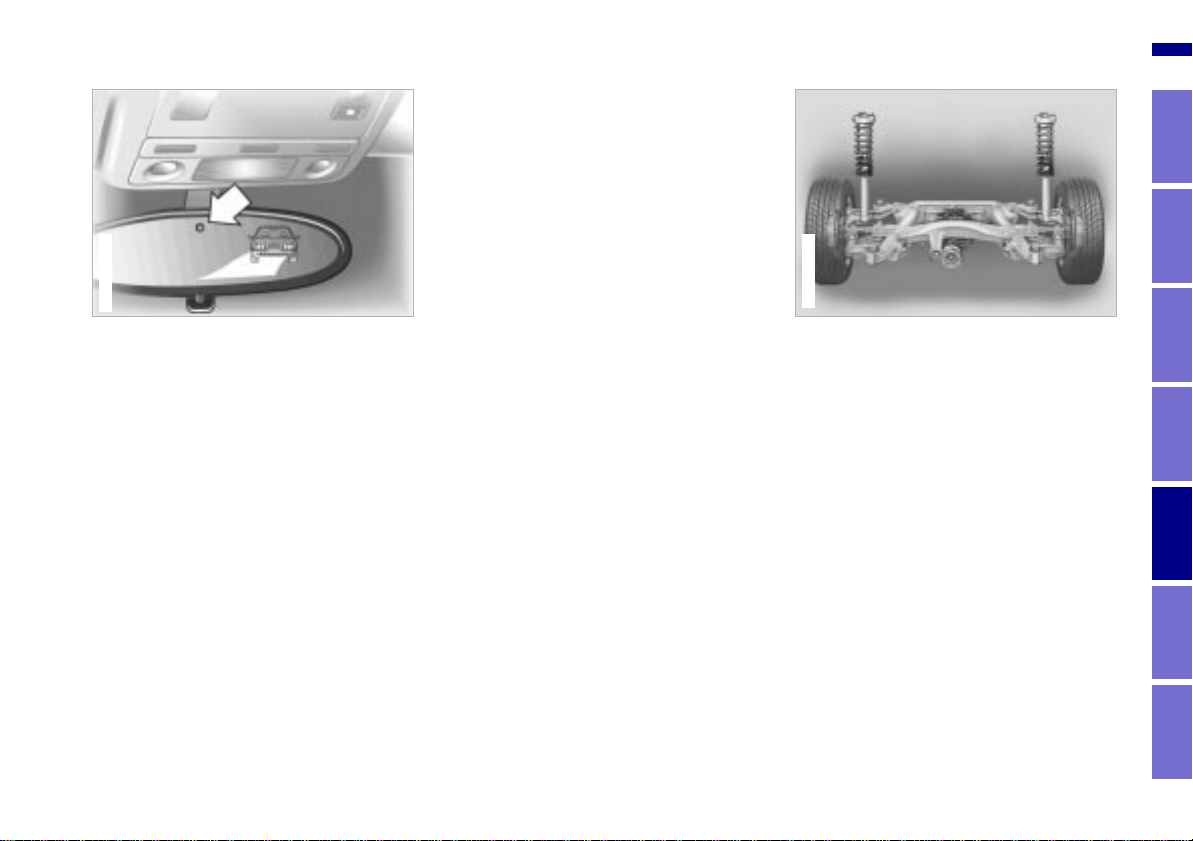
167n
RepairsIndex OverviewControlsCar careTechnologyData
Rearview mirror with automatic dimmer Integrated rear suspension
The interior rearview mirror with auto-
matic dimming feature reduces glare
from following traffic by adapting the in-
tensity of the reflected images to corre-
spond to levels of light registered by the
unit's sensors. The mirror reverts to its
undimmed setting as soon as the light
source is removed. One lamp sensor is
mounted on the front of the mirror
housing. This sensor is directed for-
ward. It measures light intensity in the
area ahead of the vehicle. The second
sensor is integrated within the mirror's
glass. The electronic control system
compares the light intensity from front
and rear. The difference provides the
basic parameter used to modulate an
electrical current and induce chemical
changes in a semisolid layer incorpo-
rated in the lens.
39mde091
The semisolid reacts chemically to this
electrical current, thus providing dim-
ming of the mirror through an infinitely-
variable range (electrochromic technol-
ogy).
As a result, it is no longer necessary to
dim the mirror manually, and the driver
can concentrate completely on traffic
conditions.
The control arms on the patented inte-
grated aluminum rear axle assembly are
not mounted directly on the body. They
are mounted elastically on a chassis
sub-frame which is joined in turn with
elasticity to the vehicle body. The re-
sulting double elastic suspension sys-
tem effectively absorbs the forces re-
sulting from bumps and road surface
irregularities.
The compliance rates of the integrated
rear axle assembly's control arm mounts
have been precisely calibrated to help
provide supplementary adjustment in
the tracking angle of the rear wheels
(programmed self-steer effect). The ulti-
mate result is enhanced safety and con-
trol under all conditions.
390de114
Online Edition Part-No. 01 41 0 155 062 - © 07/99 BMW AG
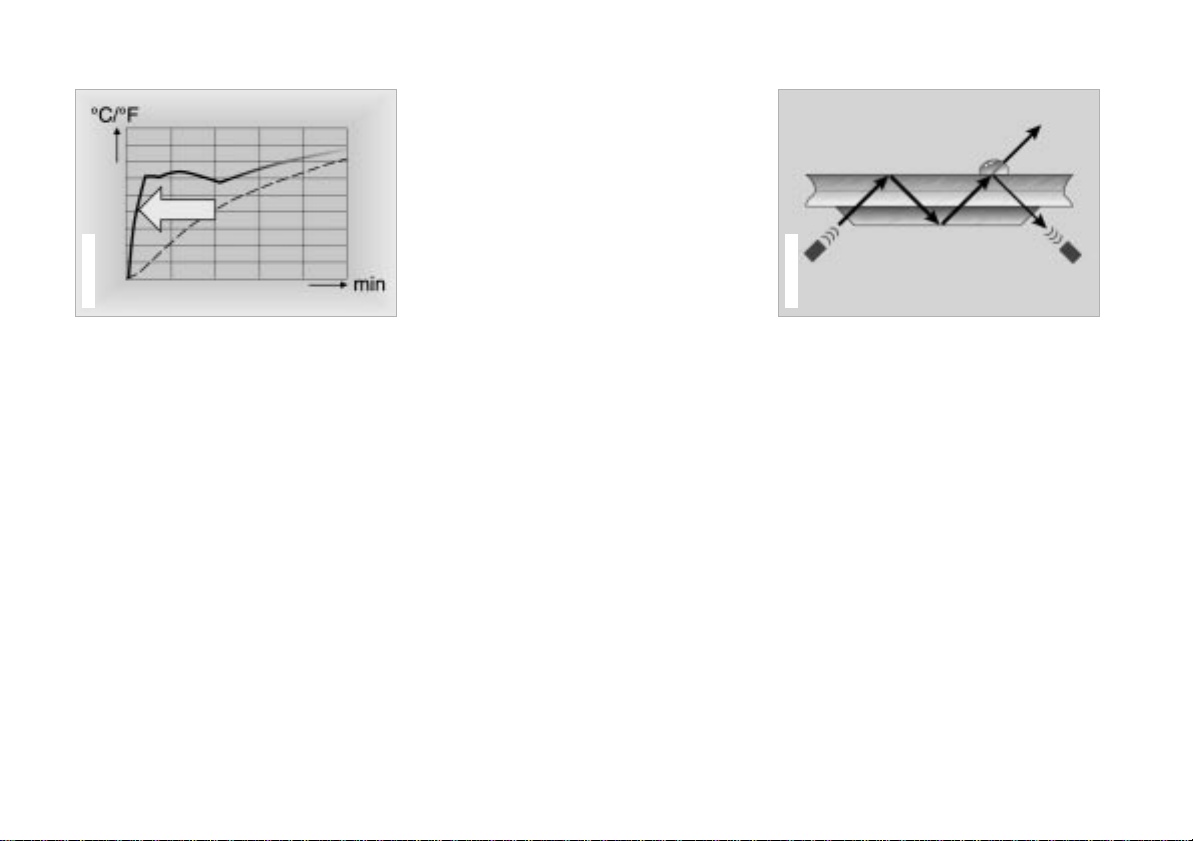
168n
Latent heat storage system* Rain sensor*
The latent heat storage system accu-
mulates and stores engine heat – even
for several days at extremely low out-
side temperatures. After the engine is
started, this accumulated heat can be
utilized immediately to defrost the
windshield and side windows and to re-
move condensation from them. In addi-
tion, the time required for warming the
interior of the vehicle and for warming
up the engine (arrow) are significantly
reduced.
The latent heat storage system consists
of an accumulator reservoir that is ex-
tremely well insulated. It is connected
with the engine's cooling system.
390de115
The principle is based on the utilization
of latent heat that is released during the
conversion of an environmentally-com-
patible salt mixture from a liquid to a
solid state. In a process analogous to
the latent heat fusion of ice, the heat
produced by the warm engine is stored
by the liquefaction of the salt mixture.
An "empty" latent heat storage system
is ready for operation again after ap-
prox. 15 minutes of driving.
The latent heat storage system thus en-
hances driving safety and comfort with-
out producing environmental pollutants.
Active operation is not required since
the system is electronically controlled.
The rain sensor controls windshield
wiper operation, depending on how wet
the windshield is.
Infrared light is carried along the surface
of the windshield in an optical conductor
in such a manner that it is reflected com-
pletely when the windshield is dry. The
quantity of reflected light is measured.
If there is moisture on the glass, the
amount of light reflected is reduced
since the infrared light at the surface of
the windshield can escape. The quan-
tity of reflected light is thus a means of
gauging the degree of wetness on the
windshield.
390de133
Online Edition Part-No. 01 41 0 155 062 - © 07/99 BMW AG
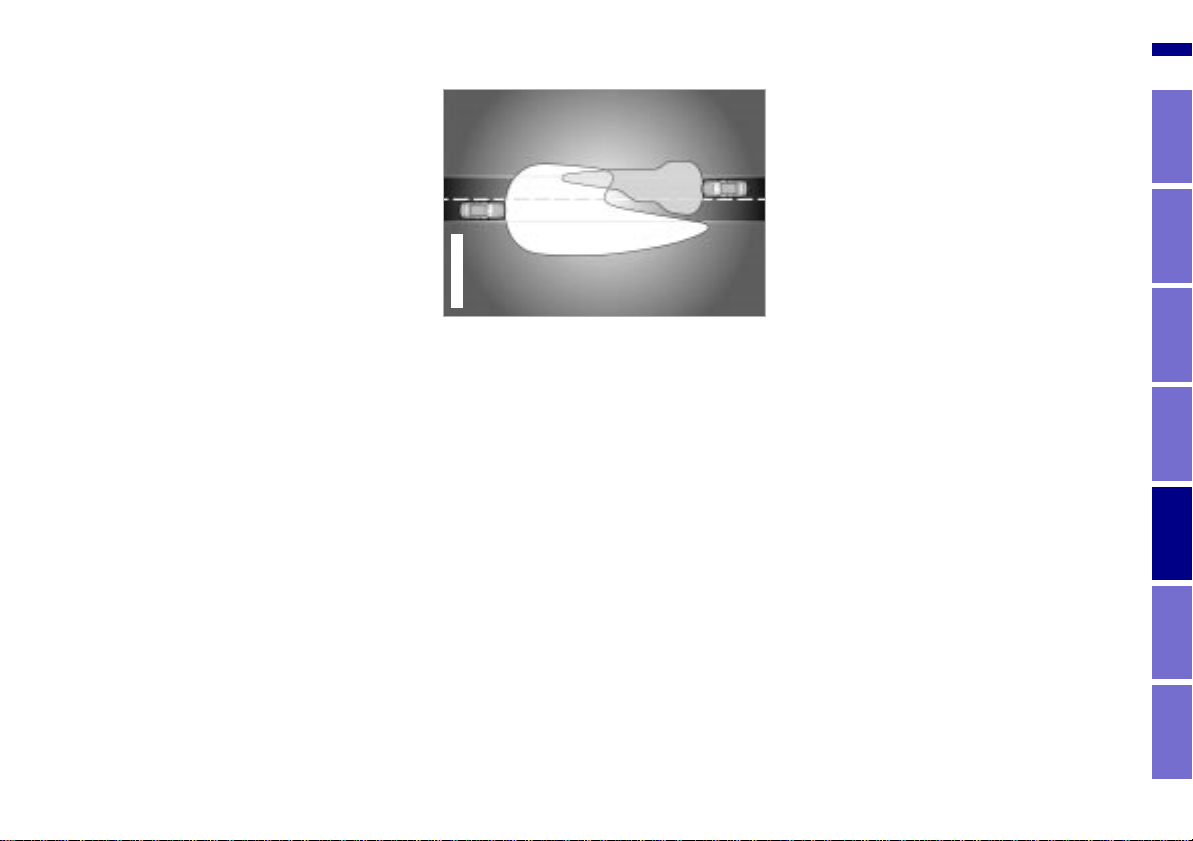
169n
RepairsIndex OverviewControlsCar careTechnologyData
Rain sensor* Xenon lamps
When the "Intermittent" wiper speed
position is selected, the wiper reacts
immediately if water is splashed onto
the windshield from vehicles traveling
ahead, for example. As a result, the rain
sensor provides a contribution to driv-
ing safety and comfort.
Xenon lamps illuminate the side and
front areas of the vehicle with signifi-
cantly more brightness and uniformity
than traditional halogen lamps.
In a xenon lamp, an electric arc replaces
the filament in order to generate intense
illumination. A gas mixture in a quartz
glass tube with metal vapor is ignited by
a high electric voltage. The arc that is
generated is then sustained by a lower
voltage. When the lamp is turned on
there is a brief warm-up period. Maxi-
mum brightness is attained in approx.
15 seconds.
390de134
Xenon lamps improve the driver's visi-
bility and orientation to the road, espe-
cially in adverse weather conditions and
driving situations (driving at night in
heavy rain or through road repair areas
where there are no lane markers, for in-
stance).
Vehicles with xenon lamps are
equipped with automatic headlamp
range control. As a result, the highway
is always optimally lighted, regardless
of load conditions, and drivers in on-
coming traffic are not blinded.
Xenon lamps make a significant contri-
bution to highway safety since other
highway users, or bicyclists and motor-
cyclists in the right lane, and pedestri-
ans are more easily detected.
Online Edition Part-No. 01 41 0 155 062 - © 07/99 BMW AG
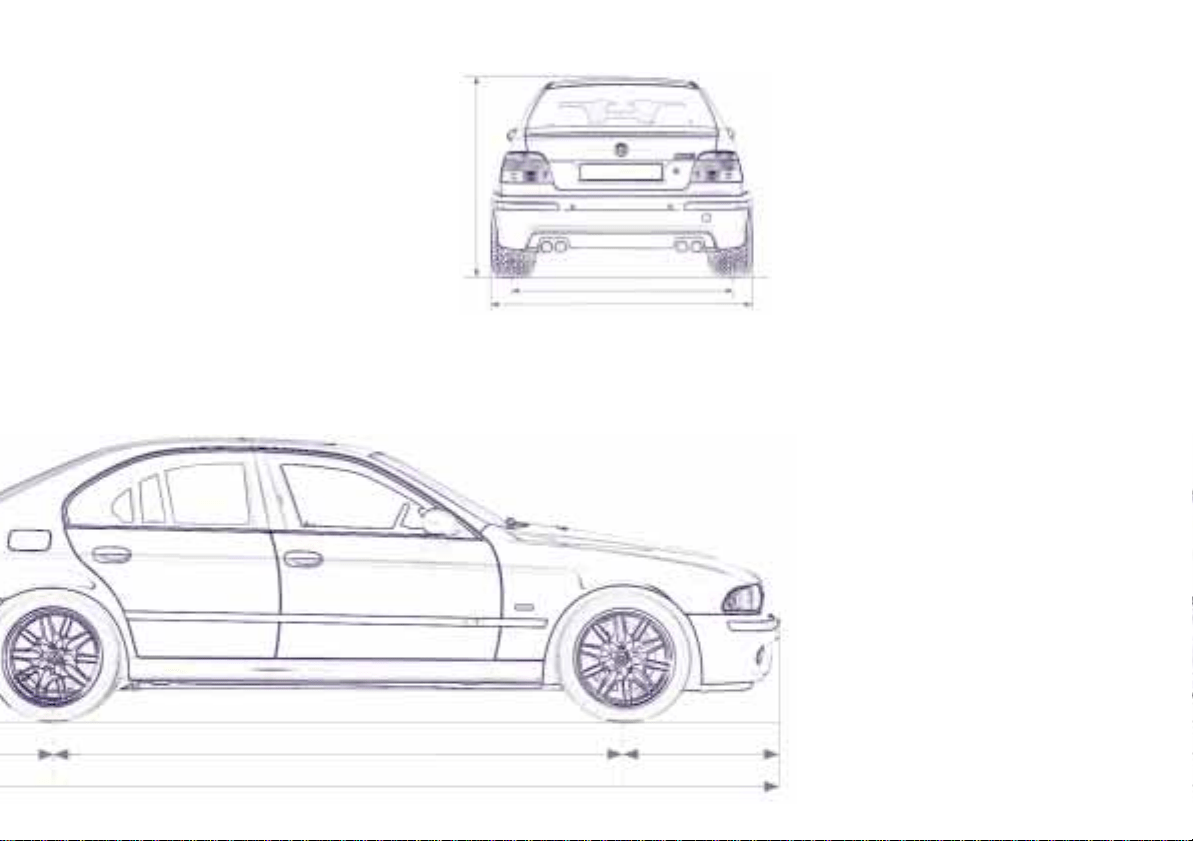
170n
Online Edition Part-No. 01 41 0 155 062 - © 07/99 BMW AG
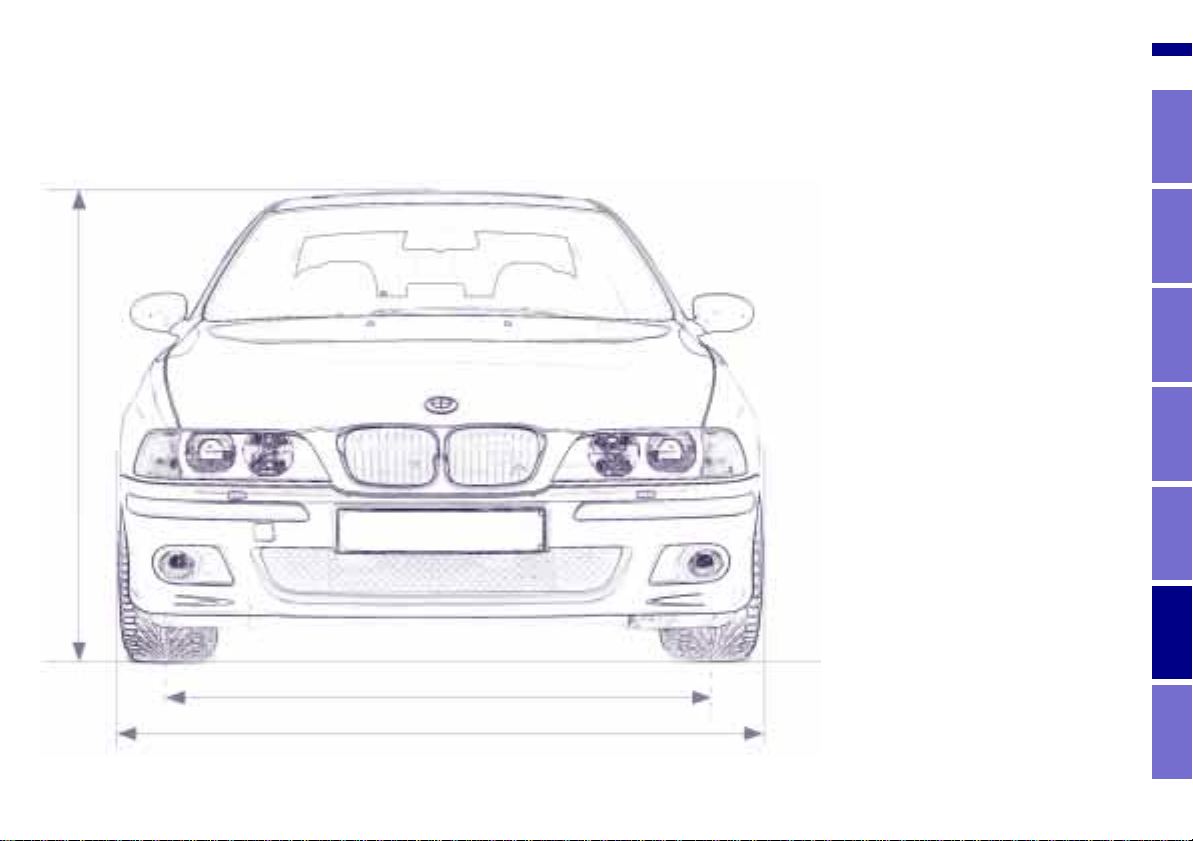
Overview
Controls and features
Operation, care
and maintenance
Technical data
Index
Advanced technology
171n
RepairsIndex OverviewControlsCar careTechnologyData
Engine data 172
Dimensions 173
Weights 174
Capacities 175
Electrical system 176
Drive belts 176
Owner service procedures
Online Edition Part-No. 01 41 0 155 062 - © 07/99 BMW AG

172n
BMW M5
Displacement
Number of cylinders
cu in (cm
3
) 301.5 (4,941)
8
Max. output
at engine speed
hp
RPM
394
6,600
Maximum torque
at engine speed
lb ft (Nm)
RPM
368 (500)
3,800
Compression ratio e
11.0
Stroke
Bore
in (mm)
in (mm)
3.50 (89.0)
3.70 (94.0)
Fuel-injection system Digital-electronic engine-manage-
ment system
Engine data
Online Edition Part-No. 01 41 0 155 062 - © 07/99 BMW AG
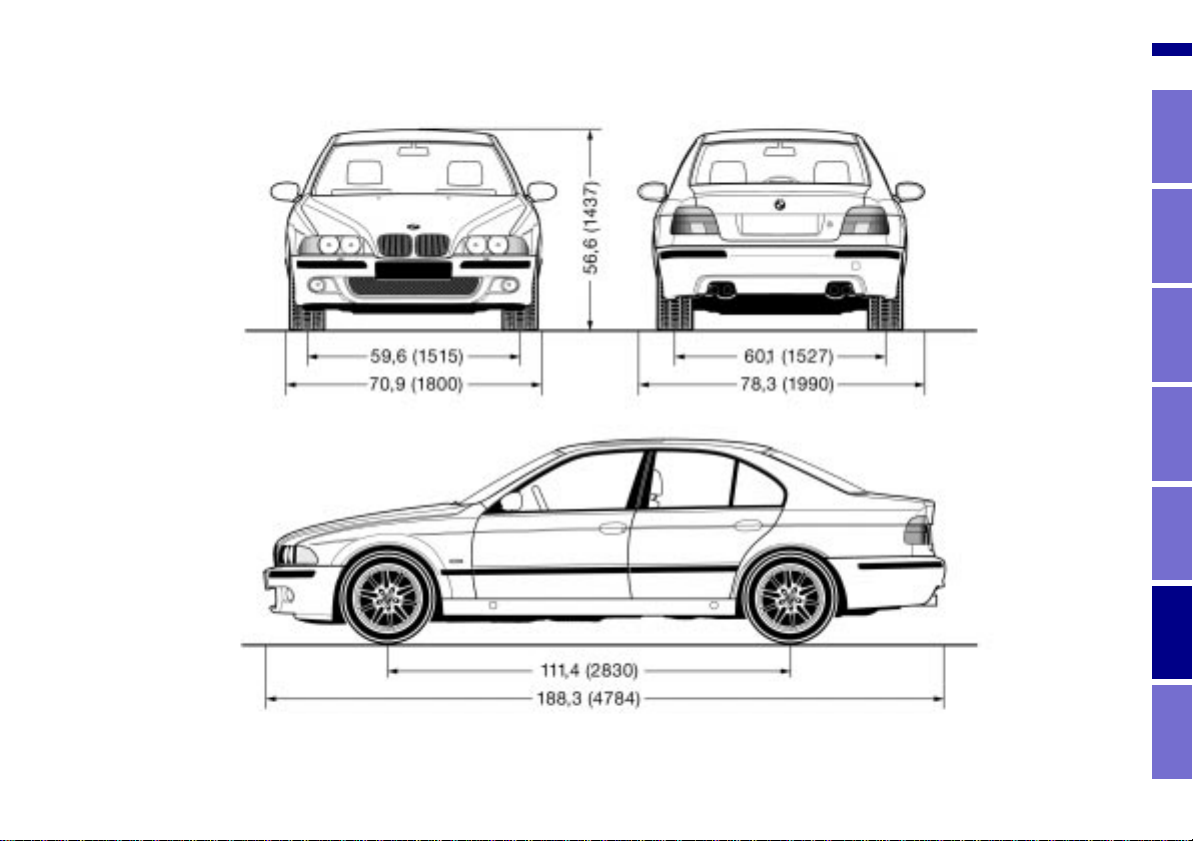
173n
RepairsIndex OverviewControlsCar careTechnologyData
All dimensions are given in inches (mm). Minimum turning circle dia.: 38.1 ft (11.6 m)
Dimensions
39mus049
Online Edition Part-No. 01 41 0 155 062 - © 07/99 BMW AG

174n
Weights
BMW M5
Curb weight (with one person, ready for operation, full tank of fuel, options not included)
lbs. (kg) 4,024 (1,825)
Approved gross vehicle weight lbs. (kg) 5,049 (2,290)
Approved front axle weight lbs. (kg)
2,426 (1,100)
Approved rear axle weight lbs. (kg) 2,701 (1,225)
Approved roof load capacity
Never exceed either the approved axle weights
or the gross vehicle weight.
lbs. (kg) 220 (100)
Luggage compartment capacity cu ft (liters) 16.2 (460)
Online Edition Part-No. 01 41 0 155 062 - © 07/99 BMW AG

175n
RepairsIndex OverviewControlsCar careTechnologyData
Capacities
Notes
Fuel tank
reserve
gal. (liters) approx. 18.5 (approx. 70)
gal. (liters) approx. 2.6 (approx. 10)
Fuel specification: page 26
Windshield washer system,
with headlamp washer system
Intensive cleaning system
quarts (liters) approx. 3.7 (approx. 3.5)
quarts (liters) approx. 6.3 (approx. 6.0)
quarts (liters) approx. 1.1 (approx. 1.0)
For details: page 126
Cooling system including heater circuit quarts (liters) 12.7 (12.0) For details: page 129
Engine oil and filter change quarts (liters) 6.9 (6.5) BMW High Performance Synthetic Oil:
Refer to page 128
Manual transmission – Fluid change at the 1.200 Mile Service,
then lifetime fluid; no fluid change
required
Differential – Fluid change at the 1.200 Mile Service,
then lifetime fluid; no fluid change
required
Online Edition Part-No. 01 41 0 155 062 - © 07/99 BMW AG

176n
Electrical system Drive belts
Battery
12 V, 110 Ah
Spark plugs
NGK BKR 6 EQUP
Bosch FGR 7 DQP (not released at this
time)
This spark ignition system meets all
requirements of the Canadian Interfer-
ence-Causing Equipment Regulations
(ICES-2).
Water pump – AC generator – power
steering
Ribbed V-belt 7K x 1629
A/C compressor
Ribbed V-belt 5 K x 980
You can obtain Original BMW
Parts and Accessories, as well as
professional advice from your BMW
center.<
Online Edition Part-No. 01 41 0 155 062 - © 07/99 BMW AG

177n
RepairsIndex OverviewControlsCar careTechnologyData
Online Edition Part-No. 01 41 0 155 062 - © 07/99 BMW AG

178n
Online Edition Part-No. 01 41 0 155 062 - © 07/99 BMW AG


Everything from A to Z
A
ABS (Antilock Brake
System) 21, 109
Accessories 6
Activated charcoal filter 87
Active seat 48, 165
Adding engine oil 127
Adding washer fluid 126
Adjusting seats 45
Adjusting the backrest 45
Adjusting the steering
wheel 48
Air distribution 84
Air outlets 82
Air pressure 116
Air supply 85
Airbags 21, 54, 139, 164
Alarm system 40
Antenna, Diversity 165
Antennas 115
Antifreeze 129
Antifreeze, radiator 113
Antilock Brake System
(ABS) 21, 109
Anti-theft alarm system 40
Aquaplaning 107, 116
Ashtray 97
Attaching a car vacuum
cleaner 98
AUC (Automatic recirculated
air control) 85
Automatic car washes 133
Automatic climate
control 82
removing condensation
from windows 85
Automatic cruise control 67
Automatic curb monitor 51
Automatic dimming, interior
rearview mirror 49, 167
Automatic recirculated air
control (AUC) 85
Automatic windshield
washer 66
Avoiding unintentional
alarms 41
Axle loads 174
B
Backup lamps 64
bulb replacement 147
Battery 153, 176
capacity 176
charge 155
charge condition 154
discharged 158
removal and
installation 154
Battery Safety Terminal
(BST) 154
Belts 53
Beverage holder 96
Blower 85
BMW active seat 48, 165
BMW comfort seat 47
BMW High Performance
Synthetic Oils 128
BMW M Sports Seat 45
BMW Universal
Transmitter 91
Brake fluid 130
Brake hydraulic system,
brake pads 20
Brake lamps, bulb
replacement 147
Brakes 111
malfunctions 112
Break-in procedure 106
Breaking in the vehicle 106
Break-resistant security
glass, care 136
BST (Battery Safety
Terminal) 154
Bulb replacement 145
C
Car battery 176
Car keys 30
Car Memory 52
Car radio
refer to the Onboard
Computer Owner's Manual
Car radio
reception 115, 164
Car wash 133
Care, exterior 134
Care, vehicle interior 137
Cargo loading 102
Caring for the vehicle
finish 135
Catalytic converter 108
starting problems 108
Cellular phones 96, 115
Cellular telephone
refer to the separate
Owner's Manual
Center (high-mount) brake
lamp 147
Central locking system 32
key 36
Charge condition,
battery 154
CHECK button 72
Check Control 72
Check engine oil level 127
Check oil level 127
Cigarette lighter 98
Clock
refer to the Onboard
Computer Owner's Manual
Cockpit 16
Comfort seat 47
Compartments 96
Configure settings 52
Contamination on
paintwork 134
Control elements 16
Coolant 113, 129
Online Edition Part-No. 01 41 0 155 062 - © 07/99 BMW AG

Everything from A to Z
181n
RepairsIndex OverviewControlsCar careTechnologyData
Coolant temperature
gauge 71
Coolant, antifreeze 113
Cover, sun blinds 90
Cruise control 67
Cup holder 96
Curb weight 174
D
Dashboard 16
Date
refer to the Onboard
Computer Owner's Manual
Daytime-driving light
switch 79
DBC (Dynamic Brake
Control) 21, 112
Deactivating the interior
motion sensor 41
Deactivating the tilt sensor
alarm system 41
Deep water 107
Defrost position 85
Defrosting the windows 85
Digital clock
refer to the Onboard
Computer Owner's Manual
Digital sound processor 166
Dimensions 173
Dipstick, engine oil 127
Disc brakes 111
Displacement 172
Display lighting 79
Displays 18
Distance warning 75
Divided rear backrest 99
Door keys 30
Door locks, care 113
Doors
emergency operation 32
manual operation 32
remote control 33
unlocking and locking 32
Drive belts 176
Driving notes 107
DSC (Dynamic Stability
Control) 21, 76, 166
DSP amplifier
refer to the Onboard
Computer Owner's Manual
Dynamic Brake Control
(DBC) 21, 112
Dynamic Stability Control
(DSC) 21, 76, 166
E
Electric power windows 42
safety switch 43
Electrical malfunction
fuel filler door 157
sliding/tilt sunroof 157
Electronic vehicle
immobilizer 31
Emergency operation
doors 32
fuel filler door 157
luggage compartment
lid 37
sliding/tilt sunroof 157
Engine compartment 124
Engine coolant 129
Engine data 172
Engine oil consumption 127
Engine oil grades 128
Engine oil level 20
Engine oil pressure 20
Engine oil temperature
gauge 70
Engine performance 172
Engine starts 62
Exterior finish 134
Exterior mirrors 49
F
Failure messages 72
Failure of an electrical
accessory 156
Fault displays 72
Filler cap cover 25
Filling capacities 175
First aid 24
First-aid kit 24
Flashlight 95
Flat tire 116
Fog lamps 80
bulb replacement 146
Folding rear backrest 99
Footbrake 111
Footwell lamps 80
bulb replacement 148
For included equipment,
refer to the Service and
Warranty Information
Booklet
Front seat adjustment 45
Frost protection,
radiator 129
Fuel filler door
releasing following an
electrical malfunction 157
Fuel gauge 70
Fuel tank capacity 175
Fuses 156
G
Gasoline gauge 70
Glove compartment 95
Glove compartment lamp,
bulb replacement 148
Grills 82
Gross vehicle weight 174
H
Handbrake 21, 63
Handsfree system 96
Online Edition Part-No. 01 41 0 155 062 - © 07/99 BMW AG

Everything from A to Z
Hazard warning flashers 24
Hazard warning triangle 24
Head restraints 46
Headlamp cover, care 133
Headlamp flasher 64
Headlamp washer
system 126
Headlamp washers 66
Heat storage 168
Heated seats 90
Heater and ventilation 82
Heating while stopped 86
Heavy cargo 102
Height 173
Height adjustment
seats 45
steering wheel 48
HiFi system 166
High beams 22, 80
Hood release 123
Horn 17
Hydraulic Brake Assistant
refer to DBC 21, 112
I
Ice warning 69
Identification, tires 119
Ignition key 30
Ignition lock 61
Independent ventilation 90
Indicator lamps 20
Inflation pressure 116
Inflation pressure
monitoring 77
INSPECTION 71
Instrument cluster 18
Instrument lighting 79
Instrument panel 18
Integrated rear axle 167
Integrated rear center
console 88
Integrated rear-seat
equipment 94
Intensive automatic cleaning
unit 66
Intensive cleaning
system 126
Interaxle tire rotation 118
Interface socket for On-
Board-Diagnostics 141
Interference with car
phones 115
Interior lamps 34, 80
bulb replacement 148
remote control 34
Interior rearview mirror,
automatic dimming
feature 49, 167
Intermittent switch 65
J
Jets 82
Jump-starting 158
K
Key Memory 52
Keys 30
Keys with remote control 30
L
Lashing eyes 39, 102
Latent heat storage
system 168
Leather care 138
Length 173
License plate lamp, bulb
replacement 148
Light switch 79
Light-alloy wheels 122
Lighter 98
Lights-on warning 79
Load-securing devices 102
Low beams 79
Low-fuel warning lamp 70
Luggage compartment 37
capacity 174
emergency operation 37
opening from the
inside 38
remote control 35
securing separately 37
Luggage compartment
lid 37
manual operation 37
opening from the
inside 38
opening separately 37
securing separately 37
Luggage compartment
lighting 37
Luggage net 39
Luggage straps 39
Lumbar support 46
M
M Dynamic Driving
Control 77
M Mobility System 150
M+S tires 120
Magic Eye
refer to Battery charge
condition 154
Maintenance 71, 132
Manual operation
doors 32
fuel filler door 157
luggage compartment
lid 37
sliding/tilt sunroof 157
Manual transmission 64
Memory 50
MFL (Multifunction steering
wheel) 23
Microfilter 87
Mirror defrosting 49
Mirror memory 50
Mirrors 49
Mobile phones 115
Online Edition Part-No. 01 41 0 155 062 - © 07/99 BMW AG

Everything from A to Z
183n
RepairsIndex OverviewControlsCar careTechnologyData
Mobile telephone
refer to the separate
Owner's Manual
Modifications,
technical 6, 140
Multifunction steering wheel
(MFL) 23
Multifunction switch 64
N
Navigation system
refer to the seperate
Owner's Manual
New transmitter, remote
control 149
O
OBD interface socket 141
Odometer 69
Oil additives 127
Oil change interval, see the
Service and Warranty
Information Booklet
Oil consumption 127
Oil dipstick 127
Oil grades 128
Oil pressure, indicator
lamp 20
OILSERVICE 71
Onboard computer 74
refer also to the Onboard
Computer Owner's Manual
Onboard tool kit 144
Opening and closing
from inside 36
from outside 32
Operating the independent
ventilation system
refer to the Onboard
Computer Owner's Manual
Outlets, ventilation 82
Outside temperature
display 69
P
Paintwork, minor
repairs 135
Paintwork, waxing 135
Park Distance Control
(PDC) 75
Parking aid 75
Parking brake 21, 63
Parking lamps 80
bulb replacement 145
Parking, winter 114
Passenger side mirror tilt
function 51
PDC (Park Distance
Control) 75
Performance
Recognition 77
Playing CDs, playing
cassettes
refer to the seperate
Owner's Manual
Pocket flashlight 95
Pollen 87
Power seat 45
Power steering 115
Power windows 42
Pressure monitoring,
tires 77
Pressure, tires 116
R
Radio
refer to the Onboard
Computer Owner's Manual
Radio Data System
(RDS) 165
Radio reception 115, 164
Radios 115
Rain sensor 65, 168
RDS (Radio Data
System) 165
RDW (Tire Pressure
Warning) 77
Reading lamps 81
Rear backrest, folding 99
Rear window
defroster 67, 86
Rear-seat backrest,
folding 99
Rearview mirrors 49
Recirculated air mode 85
Reclining seat 45
Refueling 25
Remote control 33
new transmitter 149
Removing condensation
from windows 85
Repairing a flat tire 150
Replacement keys 30, 149
Replacement of tires 118
Replacing windshield wiper
blades 144
Replacing wiper blades 144
Reporting safety defects 7
Reservoir, washer
system 126
Residual heat 86
Reverse 64
Rims 119
Roller sun blinds 90
Roof load capacity 174
Roof-mounted luggage
rack 103
Rubber parts 113
S
Safety belt
tensioners 55, 166
Safety belts 53, 55
Safety buttons 36
Seat heating 90
Seat memory 50
Securing cargo 39, 102
Securing the load 102
Service and Warranty
Information Booklet 132
Online Edition Part-No. 01 41 0 155 062 - © 07/99 BMW AG

Everything from A to Z
Service Interval
Display 71, 132
Shutting off the engine 62
Side airbags 54
Side impact Head Protection
System 54
Side lamps 79
bulb replacement 146
Ski bag 100
Skid control 114
Sliding/Tilt sunroof 43
closing after an electrical
malfunction 157
convenience operation 32
remote control 33
Slippery roads 113
Snow chains 113, 121, 122
Socket 98
Spare key 30, 149
Spark plugs 176
Speaker 96
Special oils 128
Speedometer 18
Sports Seat 45
Starting 62
Starting assistance 158
Starting problems 158
Starting the engine 62
Steering 115
Steering wheel lock 61
Steering wheel memory 50
Stopwatch
refer to the Onboard
Computer Owner's Manual
Storage compartments 96
Summer tires 119
Sun visors 50
Symbols 4, 153
T
Tachometer 70
Tail lamp 147
Tail lamp assembly, bulb
replacement 147
Tank capacity 175
Technical
modifications 6, 140
Telephone
refer to the separate
Owner's Manual
Telephone hookup 96
Temperature adjustment 84
Temperature display
engine oil 70
outside temperature 69
Temperature gauge
engine coolant 71
Temperature layering 86
Thigh support
adjustment 46
Third brake lamp 147
Through-loading system 99
Tilt alarm 34
Tilt function, passenger side
mirror 51
Timer
refer to the Onboard
Computer Owner's Manual
Tire code 119
Tire damage 116
Tire inflation pressure 116
Tire pressure monitoring 77
Tire Pressure Warning
(RDW) 77
Tire replacement 118
Tire specifications 122
Tire tread 116
Tools 144
Torque 172
Tow starting 160
Towing 159
Towing fittings 159
Track width 173
Traction Control System
refer to DSC 76
Transmission 64
Tread depth, tires 116
Trip odometer 69
Trunk 37
capacity 174
Trunk lamps
bulb replacement 148
Trunk lid, refer to luggage
compartment lid 37
Turn signal indicator 22, 64
bulb replacement 146
Turning circle 173
U
Uniform Tire Quality Grading
(UTQR) 117
Universal Transmitter 91
Used batteries 155
V
Vanity mirror 50
Vehicle battery 153
Vehicle care,
interior 136, 137
Vehicle identification 131
Vehicle Identification
Number (VIN) 131
Vehicle immobilizer 31
Vehicle storage 139
Ventilation 82, 86
Ventilation in the rear 87
Ventilation while parked 90
Ventilation while parked,
operation
refer to the Onboard
Computer Owner's Manual
Ventilation, draft-free 86
Vinyl care 137
Online Edition Part-No. 01 41 0 155 062 - © 07/99 BMW AG

Everything from A to Z
185n
RepairsIndex OverviewControlsCar careTechnologyData
W
Warm feet – cool head 86
Warning lamps 20
Warning messages 72
Washer reservoir, filling 126
Washer/Wiper system 65
Washing your car 133
Water on the roads 107
Waxing, paintwork 135
Weights 174
Wheelbase 173
Wheels and tires 119, 122
Width 173
Windows 42
convenience operation 32
remote control 34
Windshield washer nozzle
adjustment 126
Windshield washer reservoir,
filling 126
Windshield wiper 65
Winter operation 113
Winter tires 119, 120
Wipers 65
Work in the engine
compartment 123
X
Xenon lamps 145, 169
Online Edition Part-No. 01 41 0 155 062 - © 07/99 BMW AG

Owner service procedures
A
Adding brake fluid 130
Adding coolant 130
Adding engine coolant 130
Adding engine oil 127
Adding washer fluid 126
Avoiding false alarms 41
Avoiding unintentional
alarms 41
B
Backup lamps, bulb
replacement 147
Battery charge
condition 154
Brake lamps, bulb
replacement 147
Brakes, brake faults 112
Break-resistant safety glass,
care 136
C
Catalytic converter, starting
problems 108
Charge condition,
battery 154
Charging the battery 155
Check air pressure 26
Check Control 72
Check engine oil level 127
Check oil level 127
D
Deactivating the interior
motion sensor 41
Deactivating the radio-
controlled interior motion
sensor 41
Deactivating the tilt sensor
alarm system 41
Defrosting the windows 85
Difficult steering 115
Doors, manual operation 32
E
Electrical malfunction
fuel filler door 157
sliding/tilt sunroof 157
Emergency operation
doors 32
fuel filler door 157
luggage compartment
lid 37
sliding/tilt sunroof 157
Engine oil grades 128
F
Failure messages 72
Failure of an electrical
accessory 156
Fault displays 72
First aid 24
First-aid kit 24
Fittings, tow starting and
towing 159
Fog lamp, replace the
bulb 146
Footwell lamps, bulb
replacement 148
Fuse replacement 156
G
Glove compartment lamp,
bulb replacement 148
H
Hazard warning flashers 24
Hazard warning triangle 24
Hood release 123
I
Indicator lamps 20
Inflated pressure 26
Inflation pressure 26
Interior lamps, bulb
replacement 148
L
License plate lamps, bulb
replacement 148
Luggage compartment
lamps, bulb
replacement 148
Luggage compartment lid,
emergency operation 37
M
M Mobility System 150
Maintenance 71, 132
Malfunction displays 72
Manual operation
doors 32
fuel filler door 157
luggage compartment
lid 37
sliding/tilt sunroof 157
N
New transmitter, remote
control 149
O
Oil grades 128
Onboard tool kit 144
P
Parking lamps
bulb replacement 145
Pressure, tires 26
R
Releasing the fuel filler door
after an electrical
malfunction 157
Remote control
new transmitter 149
Removing condensation
from windows 85
Online Edition Part-No. 01 41 0 155 062 - © 07/99 BMW AG

Owner service procedures
187n
RepairsIndex OverviewControlsCar careTechnologyData
Repairing a flat tire 150
Replacement key 30, 149
Replacing bulbs 145
Replacing windshield wiper
blades 144
Replacing wiper blades 144
Reservoir, washer
system 126
S
Side lamps, bulb
replacement 146
Sliding/Tilt sunroof
closing after an electrical
malfunction 157
power loss 44
Snow chains 121
Spare key 30, 149
T
Tail lamp assembly, bulb
replacement 147
Tail lamps, bulb
replacement 147
Tire damage 116
Tools 144
Tow starting 160
Towing 159
Towing fittings 159
Turn signal indicator, bulb
replacement 146
U
Use antifreeze, radiator 130
W
Warning lamps 20
Warning messages 72
Washer reservoir, filling 126
Windshield washer nozzle
adjustment 126
Windshield washer reservoir,
filling 126
Work in the engine
compartment 123
Online Edition Part-No. 01 41 0 155 062 - © 07/99 BMW AG
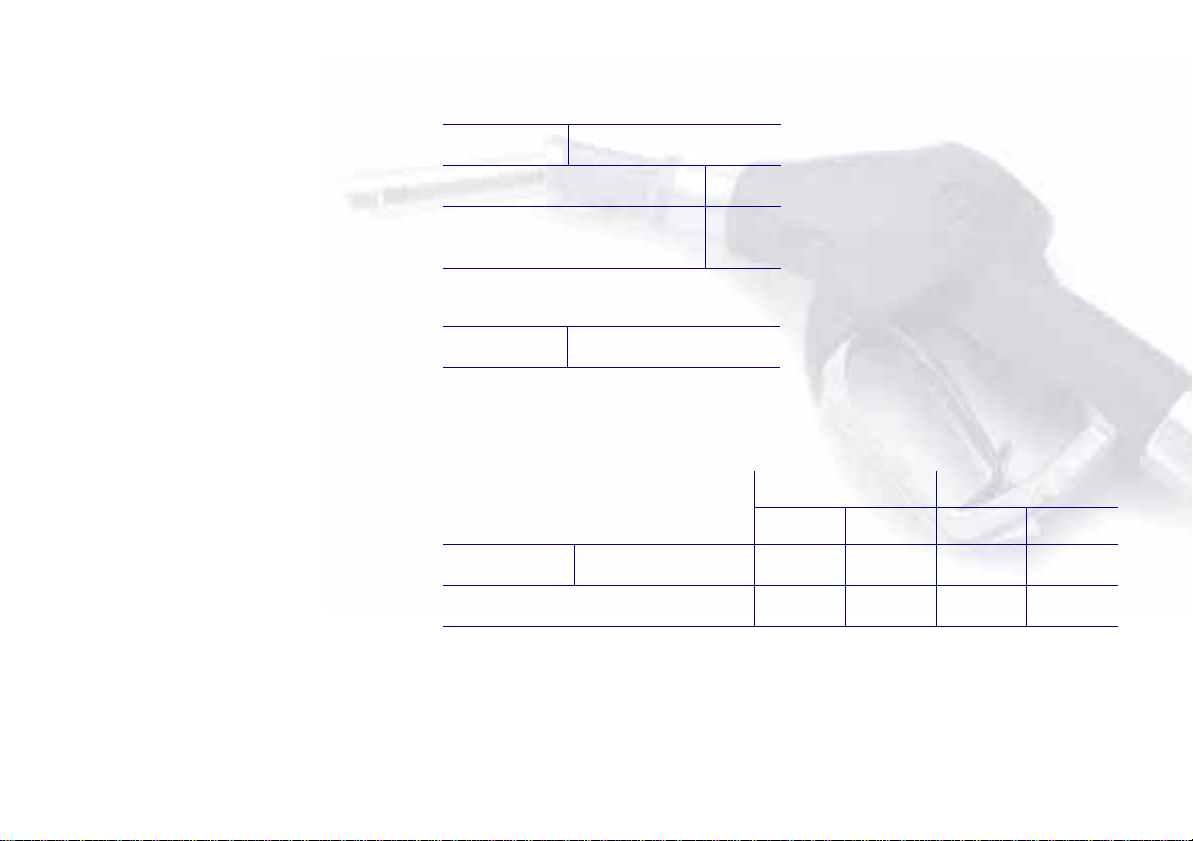
So that you will have important
specifications available when you
stop to refuelmmend that you sup-
plement this table with data that ap-
ply to your vehicle.
Fuel
Engine oil
The space between the two marks
on the dipstick corresponds to approx.
1.1 US quarts (1 liter).
Designation
AKI: for rated performance 91
AKI: also approved, minimum
fuel grade
89
Quality
Tire inflation pressures
Summer Winter
Front Rear Front Rear
4 persons
5 persons or 4 plus luggage
Refueling
Online Edition Part-No. 01 41 0 155 062 - © 07/99 BMW AG

The Ultimate Driving Machine
01 41 0 155 062 US-En
We wish you an enjoyable
driving experience.
Online Edition Part-No. 01 41 0 155 062 - © 07/99 BMW AG