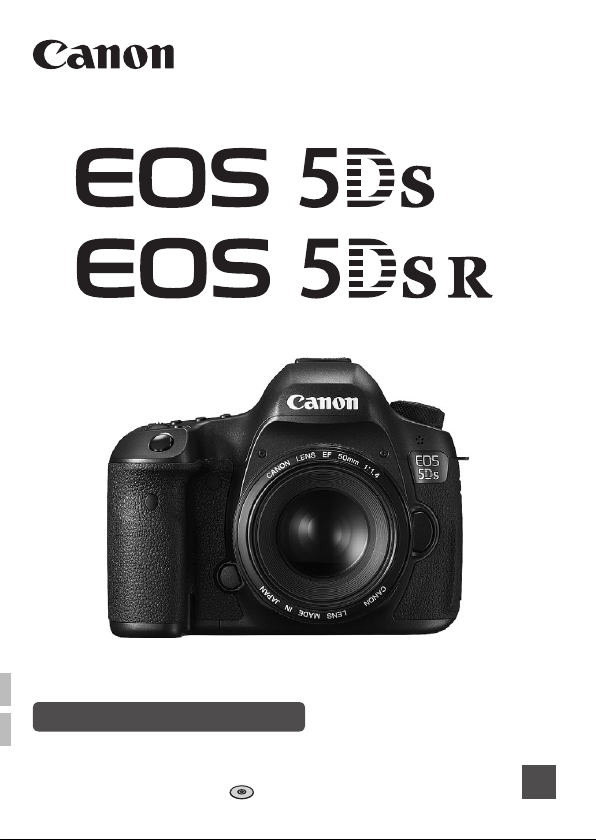
This basic manual covers only the most basic operations.
For other features and more details, see the
Camera Instruction Manual PDF le on the CD-ROM.
Basic Instruction Manual
E
2
The EOS 5DS/EOS 5DS R is a digital single-lens reflex camera
featuring a full-frame CMOS sensor (approx. 36.0 mm x 24.0 mm) with
approx. 50.6 effective megapixels, Dual DIGIC 6, approx. 100%
viewfinder coverage, high-precision and high-speed 61-point AF,
approx. 5.0 fps continuous shooting, 3.2-inch LCD monitor, Live View
shooting, and Full High-Definition (Full HD) movie shooting.
Before Starting to Shoot, Be Sure to Read the Following
To avoid botched pictures and accidents, first read the “Safety
Precautions” (p.14-16) and “Handling Precautions” (p.16-18).
Refer to This Manual While Using the Camera to Further
Familiarize Yourself with the Camera
While reading this manual, take a few test shots and see how they
come out. You can then better understand the camera.
Testing the Camera Before Use and Liability
After shooting, play images back and check whether they have been
properly recorded. If the camera or memory card is faulty and the
images cannot be recorded or downloaded to a computer, Canon
cannot be held liable for any loss or inconvenience caused.
Copyrights
Copyright laws in your country may prohibit the use of your recorded
images of people and certain subjects for anything but private
enjoyment. Also be aware that certain public performances, exhibitions,
etc., may prohibit photography even for private enjoyment.
Introduction
About the EOS 5DS R
The EOS 5DS R’s optical low-pass filter is disabled, and the effect is
eliminated to obtain a higher-looking resolution.
Since the optical low-pass filter is for reducing moire and false colors, images
taken with the EOS 5DS R may show more moire and false colors than with
the EOS 5DS depending on the subject and shooting conditions.
3
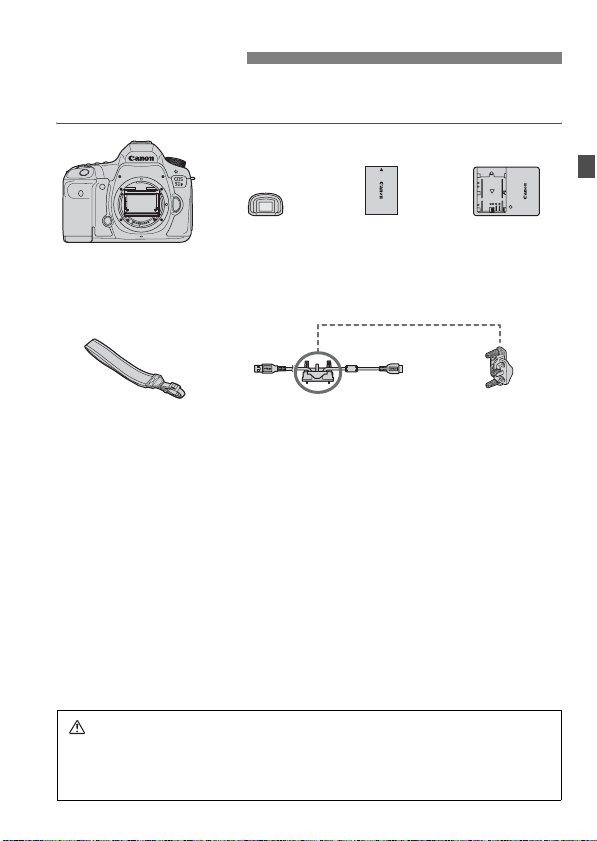
Before starting, check that all the following items are included with your
camera. If anything is missing, contact your dealer.
* Battery Charger LC-E6 or LC-E6E is provided. (The LC-E6E comes with a
power cord.)
The Instruction Manual and CD-ROMs provided are listed on the next page.
Be careful not to lose any of the above items.
Item Check List
Battery Pack
LP-E6N
(with protective cover)
Battery Charger
LC-E6/LC-E6E*
Interface Cable
IFC-150U II
Camera
(with body cap)
Wide Strap
Eyecup Eg
Cable
protector
Connecting to Peripheral Devices
When connecting the camera to a computer or printer, use the provided
interface cable or one from Canon. When connecting an interface cable, also
use the provided cable protector (p.29).
4
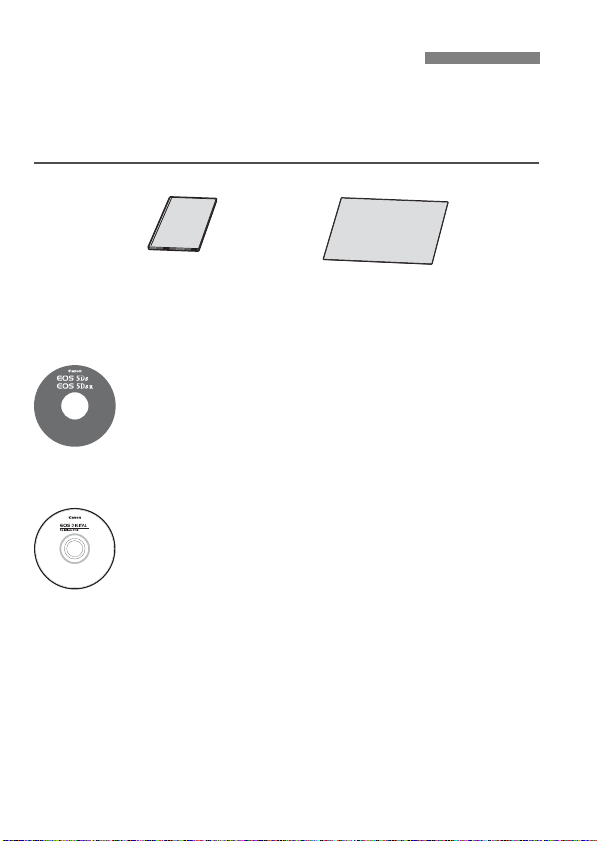
The instruction manual consists of a booklet, a leaflet, and electronic
manuals (PDF files on the CD-ROM). The booklet is the Basic
Instruction Manual. For more detailed instructions, see the Camera
Instruction Manual on the CD-ROM.
Camera Instruction Manual CD-ROM
Contains the following manuals (PDF files):
• Camera Instruction Manual (Detailed version)
• Quick Reference Guide
Instructions for viewing the Camera Instruction Manual
CD-ROM are on pages 154-155.
EOS DIGITAL Solution Disk (Software CD-ROM)
Contains software such as image-editing software and
Software Instruction Manuals (PDF files).
For more information and installation procedures of the
software, see pages 158-159.
Instructions for viewing the Software Instruction Manual
are on page 160.
Instruction Manual and CD-ROMs
Camera Basic
Instruction Manual
(this booklet)
Quick Reference Guide
5
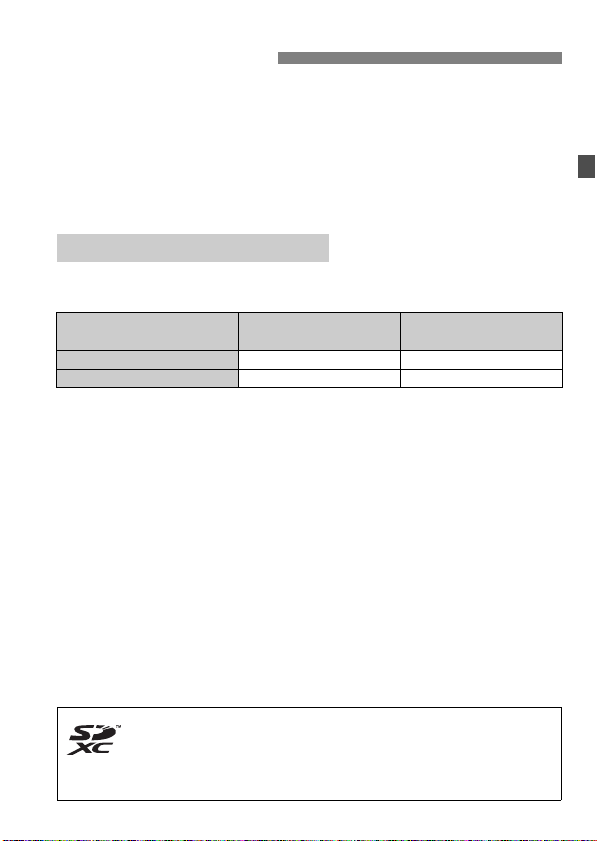
The camera can use the following cards regardless of capacity: If the
card is new or was previously formatted (initialized) by another
camera or computer, format the card with this camera (p.59).
CF (CompactFlash) cards
* Type I, UDMA mode 7-compatible.
SD/SDHC*/SDXC* memory cards
* UHS-I cards supported.
When shooting movies, use a large-capacity card with a fast reading/
writing speed as shown in the table.
If you use a slow-writing card when shooting movies, the movie may
not be recorded properly. Also, if you play back a movie on a card
with a slow reading speed, the movie may not play back properly.
If you want to shoot still photos while shooting a movie, you will need
an even faster card.
To check the card’s reading/writing speed, refer to the card
manufacturer’s Web site.
Compatible Cards
Cards that Can Record Movies
Movie Recording Size
(p.138)
CF card SD card
ALL-I (I-only) 30 MB/sec. or faster 20 MB/sec. or faster
IPB 10 MB/sec. or faster 6 MB/sec. or faster
In this manual, “CF card” refers to CompactFlash cards and “SD
card” refers to SD/SDHC/SDXC cards. “Card” refers to all memory
cards used to record images or movies.
* The camera does not come with a card for recording images/
movies. Please purchase it separately.
6
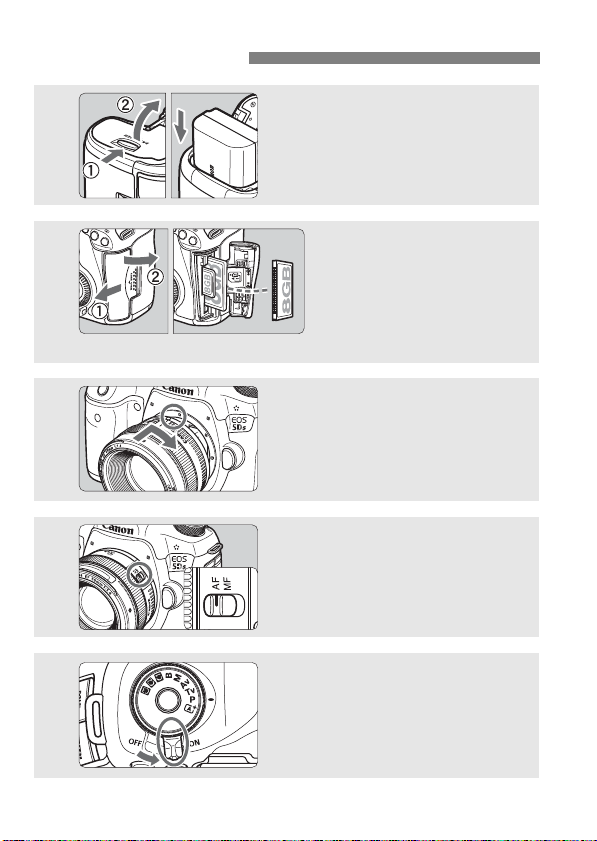
Quick Start Guide
1
Insert the battery (p.34).
To charge the battery, see page 32.
2
Insert the card (p.35).
The camera-front side slot is
for a CF card, and the
camera-back side slot is for
an SD card.
* Shooting is possible with either a CF card or an SD card in the camera.
3
Attach the lens (p.44).
Align it with the red dot.
4
Set the lens’s focus mode
switch to <f> (p.44).
5
Set the power switch to <1>
(p.39)
.
7
Quick Start Guide
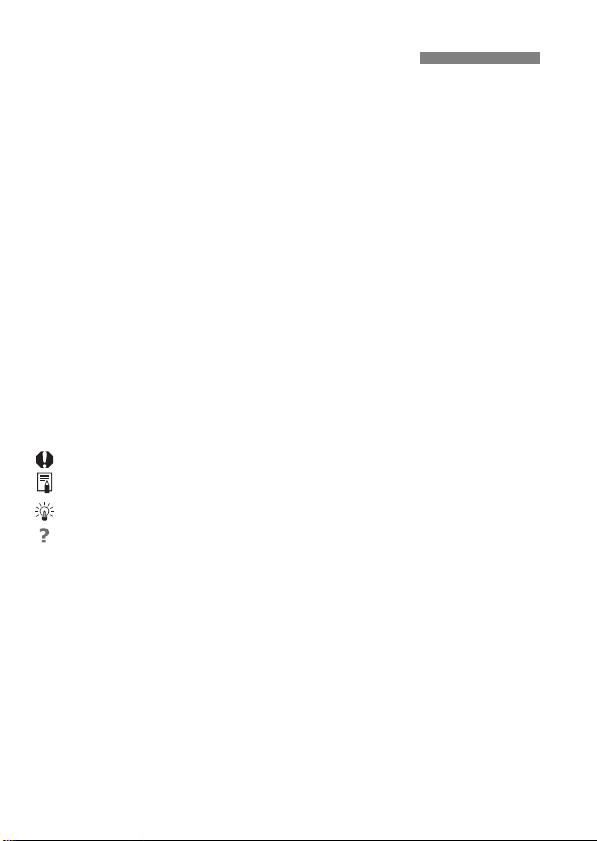
6
While holding down the center
of the Mode Dial, set it to <A>
(Scene Intelligent Auto) (p.26).
All the necessary camera settings
will be set automatically.
7
Focus on the subject (p.47).
Look through the viewfinder and
aim the viewfinder center over the
subject.
Press the shutter button halfway,
and the camera will focus on the
subject.
8
Take the picture (p.47).
Press the shutter button completely
to take the picture.
9
Review the picture.
The image just captured will be
displayed for 2 sec. on the LCD
monitor.
To display the image again, press
the <x> button (p.142).
To shoot while looking at the LCD monitor, see “Live View
Shooting” (p.121).
To view the images captured so far, see “Image Playback” (p.142).
To delete an image, see “Erasing Images” (p.152).
8
Icons in this Manual
<6> : Indicates the Main Dial.
<5> : Indicates the Quick Control Dial.
<9> : Indicates the Multi-controller.
<0> : Indicates the Setting button.
0/9/4/7/8 : Indicates that each function remains active for
4 sec., 6 sec., 8 sec., 10 sec., or 16 sec. after
you let go of the button.
* In this manual, the icons and markings indicating the camera’s buttons, dials,
and settings correspond to the icons and markings on the camera and on the
LCD monitor.
3 : Indicates a function that can be changed by pressing the
<M> button to change its settings.
M : When shown on the upper right of a page, it indicates that
the function is available only in the <d>, <s>, <f>,
<a>, or <F> mode.
(p.**) : Reference page numbers for more information.
: Warning to prevent shooting problems.
: Supplemental information.
: Tips or advice for better shooting.
: Troubleshooting advice.
Basic Assumptions
All operations explained in this manual assume that the power switch
is set to <1> and the <R> switch is set to the left (Multi
function lock released) (p.39, 51).
It is assumed that all the menu settings, Custom Functions, etc. are
set to their defaults.
The illustrations in this manual show the EOS 5DS attached with the
EF50mm f/1.4 USM lens as an example.
Conventions Used in this Manual
9
For first-time DSLR users, Chapters 1 and 2 explain the camera’s
basic operations and shooting procedures.
Chapters
Introduction
2
Getting Started
31
Basic Shooting
69
Setting the AF and Drive Modes
75
Image Settings
93
Advanced Operations
111
Shooting with the LCD Monitor
(Live View Shooting)
121
Shooting Movies
131
Image Playback
141
Viewing the CD-ROM Instruction Manuals /
Downloading Images to Your Computer
153
1
2
3
4
5
6
7
8
9

10
1
Introduction 2
Item Check List.................................................................................3
Instruction Manual and CD-ROMs...................................................4
Compatible Cards.............................................................................5
Quick Start Guide .............................................................................6
Conventions Used in this Manual.....................................................8
Chapters...........................................................................................9
Safety Precautions .........................................................................14
Handling Precautions ....................................................................16
Nomenclature .................................................................................19
Getting Started 31
Charging the Battery......................................................................32
Installing and Removing the Battery...............................................34
Installing and Removing the Card ..................................................35
Turning on the Power .....................................................................39
Setting the Date, Time, and Zone..................................................41
Selecting the Interface Language...................................................43
Attaching and Detaching a Lens....................................................44
Basic Operation..............................................................................46
Q Quick Control for Shooting Functions .......................................53
3 Menu Operations..................................................................56
Before You Start.............................................................................59
Formatting the Card.....................................................................59
Contents
11
Contents
4
2
3
Disabling the Beeper....................................................................61
Setting the Power-off Time/Auto Power Off..................................61
Setting the Image Review Time...................................................62
Reverting the Camera to the Default Settings..............................62
l Displaying the Grid...................................................................63
Q Displaying the Electronic Level ...............................................64
Setting the Viewfinder Information Display .....................................66
Help ..........................................................................................67
Basic Shooting 69
A Fully Automatic Shooting (Scene Intelligent Auto) ...................70
A Full Auto Techniques (Scene Intelligent Auto) .........................73
Setting the AF and Drive Modes 75
f: Selecting the AF Operation .....................................................76
S Selecting the AF Area and AF Point .........................................79
AF Sensor.......................................................................................83
Lenses and Usable AF Points.........................................................84
Selecting AI Servo AF Characteristics............................................89
MF: Manual Focus ..........................................................................90
o Selecting the Drive Mode........................................................91
j Using the Self-timer ...................................................................92
Image Settings 93
Selecting the Card for Recording and Playback .............................94
Setting the Image-Recording Quality ..............................................97

Contents
12
6
5
Setting Crop/aspect ratio................................................................99
i: Setting the ISO Speed .........................................................101
A Selecting a Picture Style ......................................................102
B: Setting the White Balance................................................... 103
Auto Correction of Brightness and Contrast.................................104
Setting Noise Reduction............................................................... 105
Highlight Tone Priority..................................................................107
Correction of Lens Peripheral Illumination and Aberrations ......... 108
Reducing Flicker...........................................................................110
Advanced Operations 111
d: Program AE............................................................................112
s: Shutter-Priority AE................................................................ 113
f: Aperture-Priority AE ............................................................. 114
a: Manual Exposure ................................................................... 115
q Selecting the Metering Mode..................................................117
O Setting Exposure Compensation............................................. 118
h Auto Exposure Bracketing (AEB)........................................... 119
A AE Lock...................................................................................120
Shooting with the LCD Monitor (Live View Shooting) 121
A Shooting with the LCD Monitor .............................................. 122
Shooting Function Settings .......................................................... 125
Using AF to Focus (AF Method)................................................... 125
MF: Focusing Manually ................................................................ 129
13
Contents
9
7
8
Shooting Movies 131
k Shooting Movies .....................................................................132
Autoexposure Shooting..............................................................132
Shutter-priority AE......................................................................133
Aperture-priority AE....................................................................134
Manual Exposure Shooting ........................................................135
Setting the Movie Recording Size.................................................138
Image Playback 141
x Image Playback ......................................................................142
B: Shooting Information Display.............................................144
x Searching for Images Quickly.................................................148
u Magnifying Images ..................................................................149
k Playing Back Movies...............................................................150
L Erasing Images........................................................................152
Viewing the CD-ROM Instruction Manuals /
Downloading Images to Your Computer 153
Viewing the Camera Instruction Manual CD-ROM.......................154
Downloading Images to a Computer.............................................156
Software Overview........................................................................158
Installing the Software...................................................................159
Software Instruction Manual .........................................................160
Certification Logo
Select [54: Certification Logo Display] and press <0>
to display some of
the logos of the camera’s certifications. Other certification logos can be found
in this Instruction Manual, on the camera body, and on the camera’s package.
14
The following precautions are provided to prevent harm or injury to
yourself and others. Make sure to thoroughly understand and follow
these precautions before using the product.
If you experience any malfunctions, problems, or damage to the
product, contact the nearest Canon Service Center or the dealer
from whom you purchased the product.
Safety Precautions
Warnings:
Follow the warnings below. Otherwise, death or
serious injuries may result.
To prevent fire, excessive heat, chemical leakage, explosions, and electrical shock,
follow the safeguards below:
• Do not use any batteries, power sources, or accessories not specified in the
Instruction Manual. Do not use any home-made or modified batteries.
• Do not short-circuit, disassemble, or modify the battery. Do not apply heat or
solder to the battery. Do not expose the battery to fire or water. Do not subject the
battery to strong physical shock.
• Do not insert the battery’s plus and minus ends incorrectly.
• Do not recharge the battery in temperatures outside the allowable charging
(working) temperature range. Also, do not exceed the recharging time indicated in
the Instruction Manual.
• Do not insert any foreign metallic objects into the electrical contacts of the camera,
accessories, connecting cables, etc.
When disposing of a battery, insulate the electrical contacts with tape to prevent
contact with other metallic objects or batteries. This is to prevent a fire or an explosion.
If excessive heat, smoke, or fumes are emitted when recharging the battery,
immediately unplug the battery charger from the power outlet to stop recharging.
Otherwise, it may cause a fire, heat damage, or electrical shock.
If the battery leaks, changes color, deforms, or emits smoke or fumes, remove it
immediately. Be careful not to get burned in the process. It may cause a fire,
electrical shock or skin burn if you keep using it.
Prevent any battery leakage from contacting your eyes, skin, and clothing. It can
cause blindness or skin problems. If the battery leakage contacts your eyes, skin, or
clothing, flush the affected area with lots of clean water without rubbing it. See a
physician immediately.
Do not leave any cords near a heat source. It can deform the cord or melt the
insulation and cause a fire or electrical shock.
Do not hold the camera in the same position for long periods of time. Even if the
camera does not feel too hot, prolonged contact with the same body part may cause
skin redness, blistering or low-temperature contact burns. Using a tripod is
recommended for people with circulation problems or very sensitive skin, or when
using the camera in very hot places.
Do not fire the flash at anyone driving a car or other vehicle. It may cause an accident.

15
Safety Precautions
When the camera or accessories are not in use, make sure to remove the battery
and disconnect the power plug from the equipment before storing. This is to prevent
electrical shock, excessive heat, fire, or corrosion.
Do not use the equipment where there is flammable gas. This is to prevent an
explosion or a fire.
If you drop the equipment and the casing breaks open to expose the internal parts,
do not touch the internal parts. There is a possibility of an electrical shock.
Do not disassemble or modify the equipment. High-voltage internal parts can cause
electrical shock.
Do not look at the sun or an extremely bright light source through the camera or
lens. Doing so may damage your vision.
Keep equipment out of the reach of children and infants, including when in use. Straps
or cords may accidentally cause choking, electrical shock, or injury. Choking or injury
may also occur if a child or infant accidentally swallows a camera part or accessory. If
a child or infant swallows a part or accessory, consult a physician immediately.
Do not use or store the equipment in dusty or humid places. Likewise, store the
battery with its protective cover attached to prevent short-circuit. This is to prevent a
fire, excessive heat, electrical shock, or burn.
Before using the camera inside an airplane or hospital, check if it is allowed.
Electromagnetic waves emitted by the camera may interfere with the plane’s
instruments or the hospital’s medical equipment.
To prevent a fire and electrical shock, follow the safeguards below:
• Always insert the power plug all the way in.
• Do not handle a power plug with wet hands.
• When unplugging a power plug, grasp and pull the plug instead of the cord.
• Do not scratch, cut, or excessively bend the cord or put a heavy object on the
cord. Also do not twist or tie the cords.
• Do not connect too many power plugs to the same power outlet.
• Do not use a cord whose wire is broken or insulation is damaged.
Unplug the power plug periodically and clean off the dust around the power outlet
with a dry cloth. If the surrounding is dusty, humid, or oily, the dust on the power
outlet may become moist and short-circuit the outlet, causing a fire.
Do not connect the battery directly to an electrical outlet or a car’s cigarette lighter
outlet. The battery may leak, generate excessive heat or explode, causing a fire,
burns or injuries.
A thorough explanation of how to use the product by an adult is required when the
product is used by children. Supervise children while they are using the product.
Incorrect usage may result in electrical shock or injury.
Do not leave a lens or lens-attached camera in the sun without the lens cap
attached. Otherwise, the lens may concentrate the sun’s rays and cause a fire.
Do not cover or wrap the product with a cloth. Doing so may trap heat within and
cause the casing to deform or catch fire.
Be careful not to get the camera wet. If you drop the product in the water or if water
or metal get inside the product, promptly remove the battery. This is to prevent a fire
and an electrical shock.
Do not use paint thinner, benzene, or other organic solvents to clean the product.
Doing so may cause fire or a health hazard.
Handling Precautions
16
Camera Care
This camera is a precision instrument. Do not drop it or subject it to physical
shock.
The camera is not waterproof and cannot be used underwater.
To maximize the camera’s dust- and drip- resistance, keep the terminal
cover, battery compartment cover, card slot cover, and all other covers firmly
closed.
This camera is designed to be dust- and drip- resistant, in order to help
prevent sand, dust, dirt, or water that falls on it unexpectedly from getting
inside, but it is impossible to prevent dirt, dust, water, or salt from getting
inside at all. As far as possible, do not allow dirt, dust, water, and salt to get
on the camera.
If water gets on the camera, wipe it off with a dry and clean cloth. If dirt, dust,
or salt gets on the camera, wipe it off with a clean, well-wrung wet cloth.
Using the camera in a location with large amounts of dirt or dust may cause
a malfunction.
Cleaning the camera after use is recommended. Allowing dirt, dust, water, or
salt to remain on the camera may cause a malfunction.
If you accidentally drop the camera into water or are concerned that
moisture (water), dirt, dust, or salt may have gotten inside it, promptly
consult the nearest Canon Service Center.
Cautions:
Follow the cautions below. Otherwise, physical injury
or property damage may result.
Do not use or store the product inside a car under the hot sun or near a heat source.
The product may become hot and cause skin burns. Doing so may also cause
battery leakage or explosion, which will degrade the performance or shorten the life
of the product.
Do not carry the camera around when it is attached to a tripod. Doing so may cause
injury. Also make sure the tripod is sturdy enough to support the camera and lens.
Do not leave the product in a low-temperature environment for an extended period of
time. The product will become cold and may cause injury when touched.
Do not fire the flash near the eyes. It may hurt the eyes.
Never play the provided CD-ROM in a drive that is not compatible with the CD-ROM.
If you use it in a music CD player, you may damage the speakers and other
components. When using headphones, there is also a risk of injury to your ears from
excessively loud volume.
Handling Precautions

17
Handling Precautions
Never leave the camera near anything having a strong magnetic field such
as a magnet or electric motor. Also avoid using or leaving the camera near
anything emitting strong radio waves, such as a large antenna. Strong
magnetic fields can cause camera misoperation or destroy image data.
Do not leave the camera in excessive heat, such as in a car in direct
sunlight. High temperatures can cause the camera to malfunction.
The camera contains precision electronic circuitry. Never attempt to
disassemble the camera yourself.
Do not block the mirror operation with your finger, etc. Doing so may cause a
malfunction.
Use a blower to blow away dust on the lens, viewfinder, reflex mirror, and
focusing screen. Do not use cleaners that contain organic solvents to clean
the camera body or lens. For stubborn dirt, take the camera to the nearest
Canon Service Center.
Do not touch the camera’s electrical contacts with your fingers. This is to
prevent the contacts from corroding. Corroded contacts can cause camera
misoperation.
If the camera is suddenly brought in from the cold into a warm room,
condensation may form on the camera and internal parts. To prevent
condensation, first put the camera in a sealed plastic bag and let it adjust to
the warmer temperature before taking it out of the bag.
If condensation forms on the camera, do not use the camera. This is to avoid
damaging the camera. If there is condensation, remove the lens, card and
battery from the camera, and wait until condensation has evaporated before
using the camera.
If the camera will not be used for an extended period, remove the battery
and store the camera in a cool, dry, well-ventilated location. Even while the
camera is in storage, press the shutter button a few times once in a while to
check that the camera is still working.
Avoid storing the camera where there are chemicals that result in rust and
corrosion such as in a chemical lab.
If the camera has not been used for an extended period, test all its functions
before using it. If you have not used the camera for some time or if there is
an important shoot such as a foreign trip coming up, have the camera
checked by your nearest Canon Service Center or check the camera
yourself and make sure it is working properly.
18
Handling Precautions
If you use continuous shooting, Live View shooting, or movie shooting for a
prolonged period, the camera may become hot. This is not a malfunction.
If there is a bright light source inside or outside the image area, ghosting
may occur.
LCD Panel and LCD Monitor
Although the LCD monitor is manufactured with very high precision
technology with over 99.99% effective pixels, there may be a few dead pixels
displaying only black or red, etc. among the remaining 0.01% or less pixels.
Dead pixels are not a malfunction. They do not affect the images recorded.
If the LCD monitor is left on for a prolonged period, screen burn-in may occur
where you see remnants of what was displayed. However, this is only
temporary and will disappear when the camera is left unused for a few days.
The LCD monitor display may seem slow in low temperatures, or look black
in high temperatures. It will return to normal at room temperature.
Cards
To protect the card and its recorded data, note the following:
Do not drop, bend, or wet the card. Do not subject it to excessive force,
physical shock, or vibration.
Do not touch the card’s electronic contacts with your fingers or anything
metallic.
Do not affix any stickers, etc., on the card.
Do not store or use the card near anything that has a strong magnetic field,
such as a TV set, speakers, or magnet. Also avoid places prone to having
static electricity.
Do not leave the card in direct sunlight or near a heat source.
Store the card in a case.
Do not store the card in hot, dusty, or humid locations.
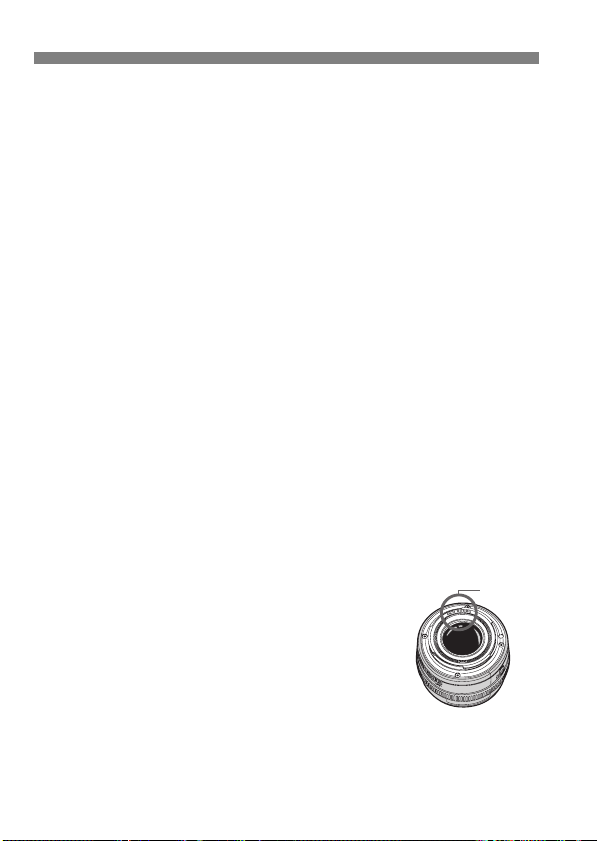
Lens
After detaching the lens from the camera, put down the
lens with the rear end up and attach the rear lens cap to
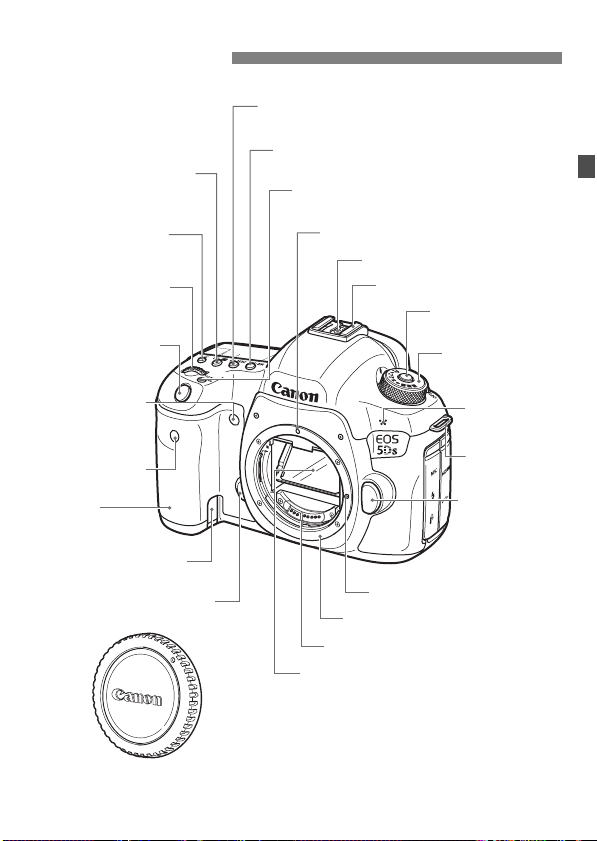
avoid scratching the lens surface and electrical contacts.
Contacts
19
Nomenclature
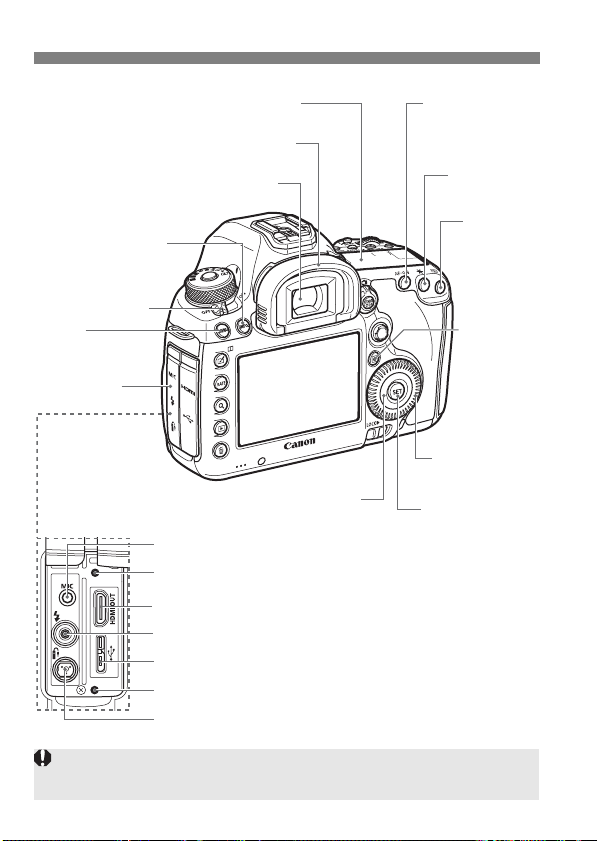
<o> Drive mode selection/
AF operation/AF method selection button (p.91/76/125)
<m> Flash exposure
compensation/ISO speed
setting button (p.101)
<U> LCD panel
illumination button
(p.51)
<6> Main Dial
(p.48)
Shutter button
(p.47)
Self-timer lamp
(p.92)
Remote control
sensor
Grip
(Battery
compartment)
DC coupler cord hole
Depth-of-field preview button
Mirror
<n> White balance selection/
Metering mode selection button (p.103/117)
Lens mount index (p.44)
Flash sync contacts
Hot shoe
Mode Dial lock-release
button (p.48)
Mode Dial (p.26, 48)
Strap mount
(p.28)
Built-in
microphone
Lens lock pin
Lens release
button (p.45)
Lens mount
Contacts (p.18)
Body cap (p.44)
<B> AF area selection/
Multi-function button (p.81)
Nomenclature
20
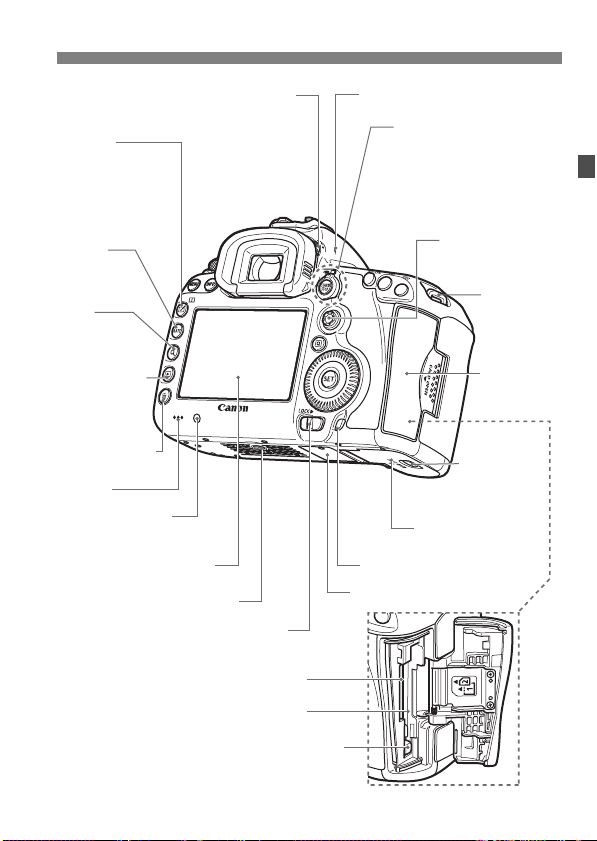
<B> Info button
(p.52, 64, 67, 124,
137, 142)
LCD panel (p.22-23)
Eyecup
Viewfinder eyepiece
Power switch (p.39)
<M>
Menu button (p.56)
Terminal cover
<p>
AF start button
(p.47, 76, 123)
<A> AE lock
button (p.120)
<S>
AF point
selection
button
(p.81-82)
<Q> Quick
Control
button (p.53)
<5> Quick
Control Dial (p.49)
<0> Setting button
(p.56)
Touch pad (p.50)
<Y> External microphone IN terminal
<g> Digital terminal (p.156)
<D> PC terminal
<D> HDMI mini OUT terminal
Cable protector socket
<F> Remote control terminal (N3 type)
Cable protector socket
When connecting the interface cable to a digital terminal, you must use the
provided cable protector (p.29).
21
Nomenclature
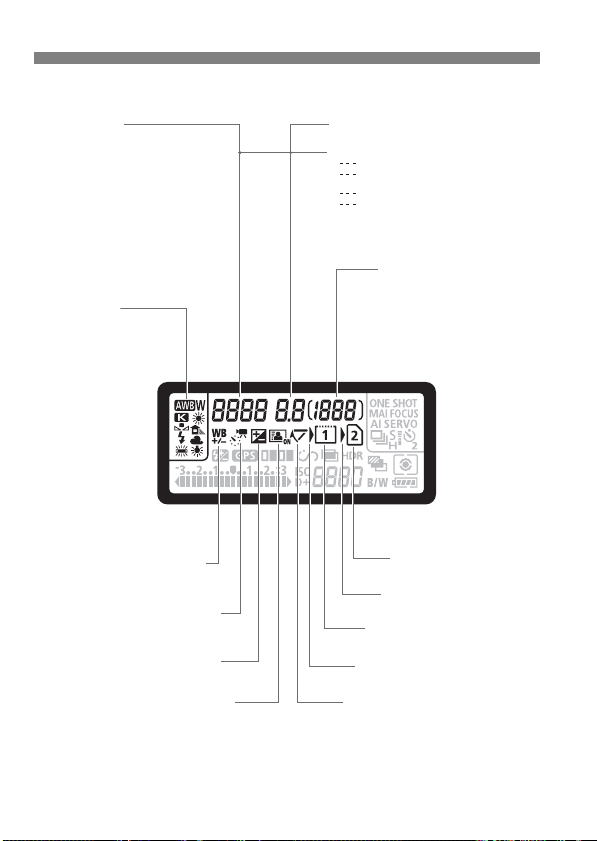
Dioptric adjustment knob (p.46)
<b/X>
Creative Photo/
Comparative playback
(Two-image display)
button (p.102)
<c>
Rating button
<u>
Index/Magnify/
Reduce button
(p.148/149)
<x> Playback
button (p.142)
<L> Erase button
(p.152)
LCD monitor (p.56, 122,
132, 142)
Tripod socket
Ambient light sensor
SD card slot (p.35)
CF card slot (p.35)
CF card eject button (p.37)
Multi function lock switch (p.51)
Access lamp (p.37)
Battery compartment
cover (p.34)
Battery
compartment
cover release
lever (p.34)
Card slot
cover (p.35)
Strap mount
(p.28)
<9> Multi-controller
(p.50)
<A/k> Live View shooting/
Movie shooting switch
(p.121/131)
<0> Start/Stop button
(p.122, 132)
<V> Focal plane mark
Speaker
Serial number
Nomenclature
22
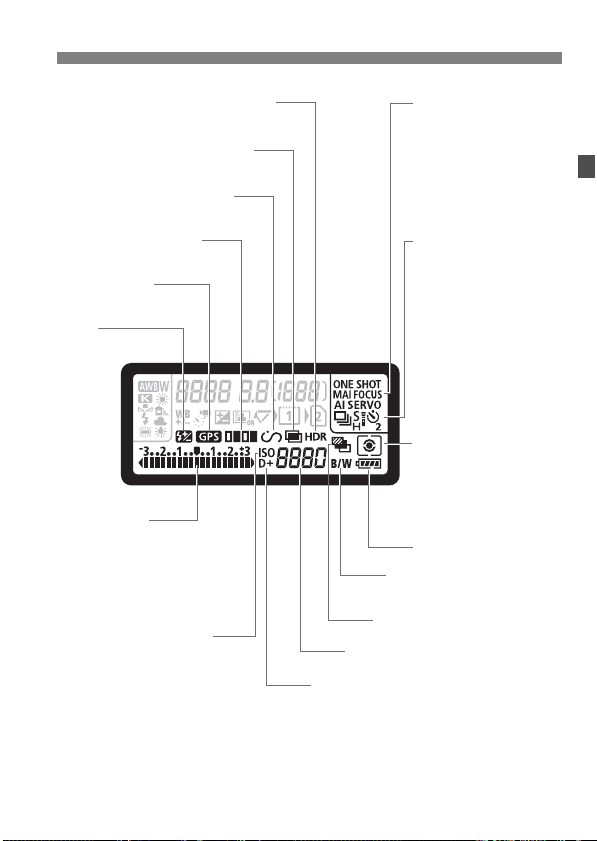
LCD Panel
* The display will show only the settings currently applied.
Shutter speed
FE lock (FEL)
Remaining number of
exposures for time-lapse movie
Busy (buSY)
Multi function lock warning (L)
No card warning (Card)
Error code (Err)
Cleaning image sensor (CLn)
White balance
(p.103)
Q Auto: Ambience
priority
Q
w
Auto: White priority
W Daylight
E Shade
R Cloudy
Y Tungsten
light
U White
fluorescent
light
I Flash
O Custom
P Color temperature
<a> Time-lapse movie shooting
<u> White balance correction
<N> Auto Lighting Optimizer
(p.104)
Possible shots
Self-timer countdown
Bulb exposure time
Card error warning (Err)
Error number
Remaining images to record
AF point selection
([ ] AF, SEL [ ], SEL AF)
AF point registration
([ ] HP, SEL [ ], SEL HP)
Card warning (Card 1/2)
Card full warning (FuLL 1/2)
Aperture
<2>Mirror lockup
<O> Exposure compensation
(p.118)
<J> CF card selection icon
<J> SD card selection icon
<g> SD card indicator
<f> CF card indicator
23
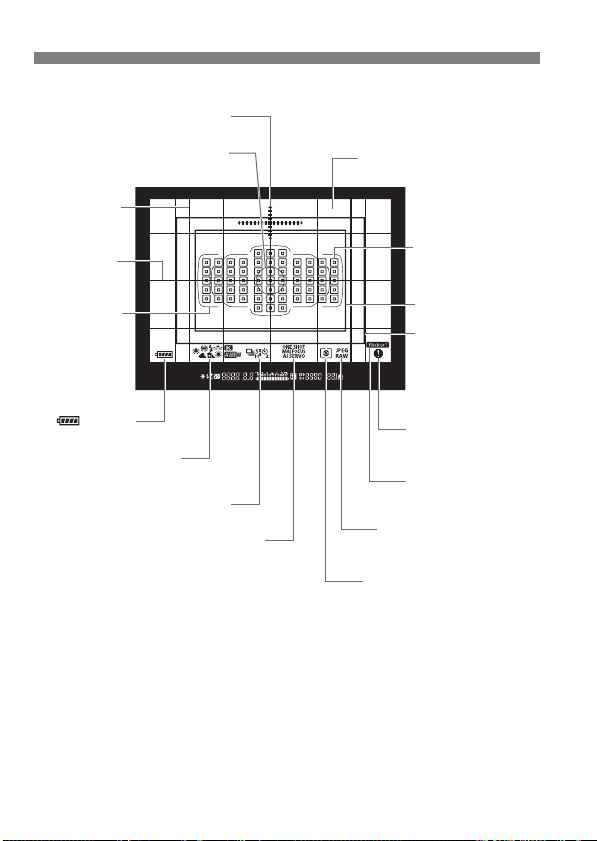
Nomenclature
ISO speed (p.101)
<A> Highlight tone priority
(p.107)
Exposure level
indicator
Exposure compensation amount
(p.118)
AEB range (p.119)
Flash exposure compensation
amount
<y>
Flash exposure
compensation
Drive mode (p.91)
u Single shooting
o High-speed
continuous shooting
i Low-speed
continuous shooting
B Silent single shooting
M Silent continuous
shooting
Q Self-timer: 10 sec./
remote control
k Self-timer: 2 sec./
remote control
AF operation (p.76)
X
One-Shot AF
9
AI Focus AF
Z
AI Servo AF
4 L
Manual focus
Battery level (p.40)
<J> Bulb timer shooting
<H> Interval timer
shooting
<w> HDR shooting
Metering mode (p.117)
q Evaluative metering
w Partial metering
r Spot metering
e Center-weighted
average metering
<i> ISO speed
(p.101)
<P> Multiple-exposure
shooting
<r> GPS
acquisition status
<h> AEB (p.119)
<0> Monochrome
shooting
Nomenclature
24
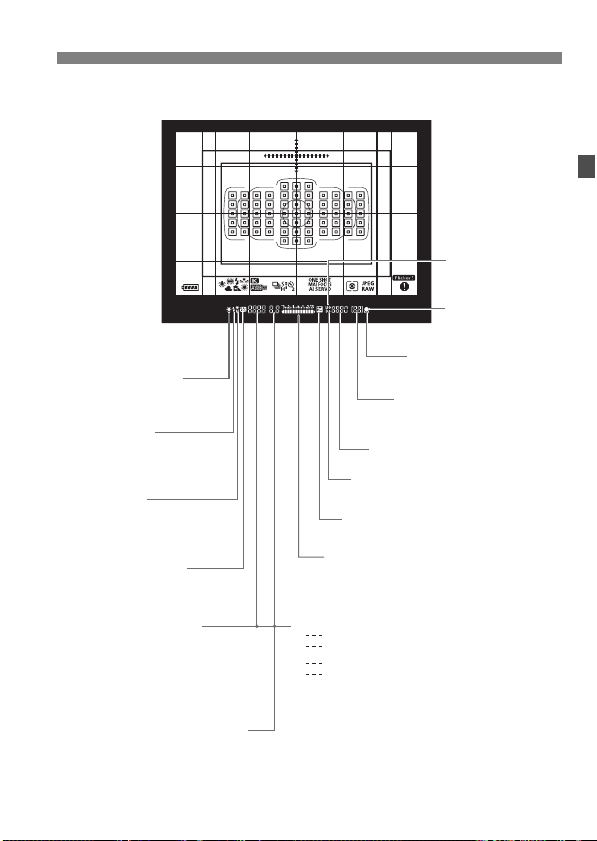
Viewfinder Information
* The display will show only the settings currently applied.
Electronic level (p.64)
Spot metering circle (p.117)
Grid (p.63)
White balance (p.103)
< > Battery
level (p.40)
Drive mode (p.91)
AF operation (p.76)
Metering mode (p.117)
JPEG/RAW (p.97)
Focusing screen
<S> Single AF point
<O> Spot AF point
Flicker detection
(p.110)
<z> Warning symbol
Area AF frame
(p.80)
Aspect ratio
line (1:1)
Crop area (1.6x)
Crop area (1.3x)
25
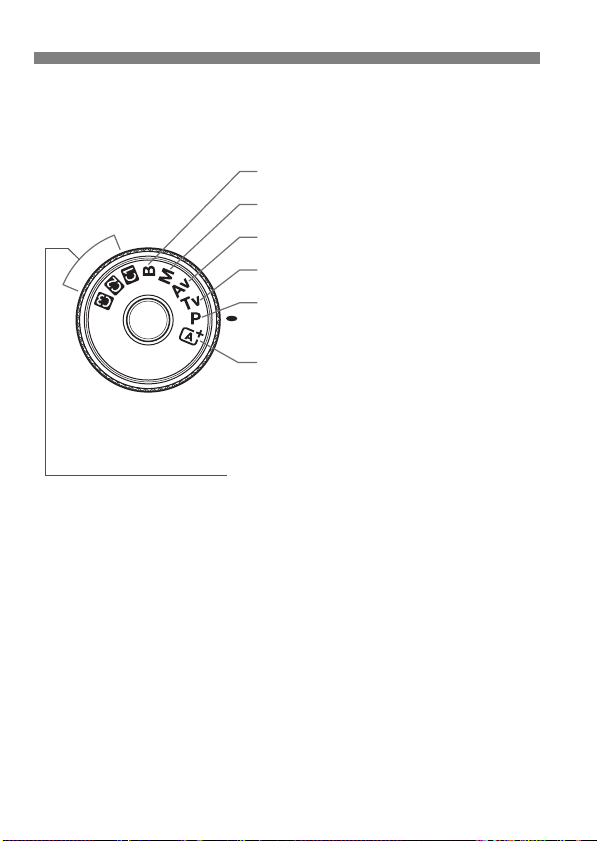
Nomenclature
<A> AE lock (p.120)
AEB in-progress
(p.119)
<D> Flash-ready
Improper FE lock
warning
<d>FE lock
FEB in-progress
<e> High-speed sync
<y> Flash exposure
compensation
Shutter speed (p.113)
FE lock (FEL)
Busy (buSY)
Multi function lock warning (L)
No card warning (Card)
Error code (Err)
Aperture (p.114)
AF point selection
([ ] AF, SEL [ ], SEL AF)
AF point registration
([ ] HP, SEL [ ], SEL HP)
Card warning (Card 1/2)
Card full warning (FuLL 1/2)
Exposure level indicator
Exposure compensation amount (p.118)
AEB range (p.119)
Flash exposure compensation
<A> Highlight tone priority (p.107)
ISO speed (p.101)
Maximum burst
Number of remaining
multiple exposures
<e> AF status indicator
(p.70)
<o>Focus
indicator
(p.70, 77)
<i> ISO speed
(p.101)
<O> Exposure compensation (p.118)
Nomenclature
26
Mode Dial
You can set the shooting mode. Turn the Mode Dial while holding down
the Mode Dial center (Mode Dial lock release button).
A : Scene Intelligent Auto (p.70)
F : Bulb
a : Manual exposure (p.115)
f : Aperture-priority AE (p.114)
s : Shutter-priority AE (p.113)
d : Program AE (p.112)
Custom shooting mode
You can register the shooting mode (d/s/f/a/F), AF
operation, menu settings, etc., to w, x, y Mode Dial positions.
27
Nomenclature
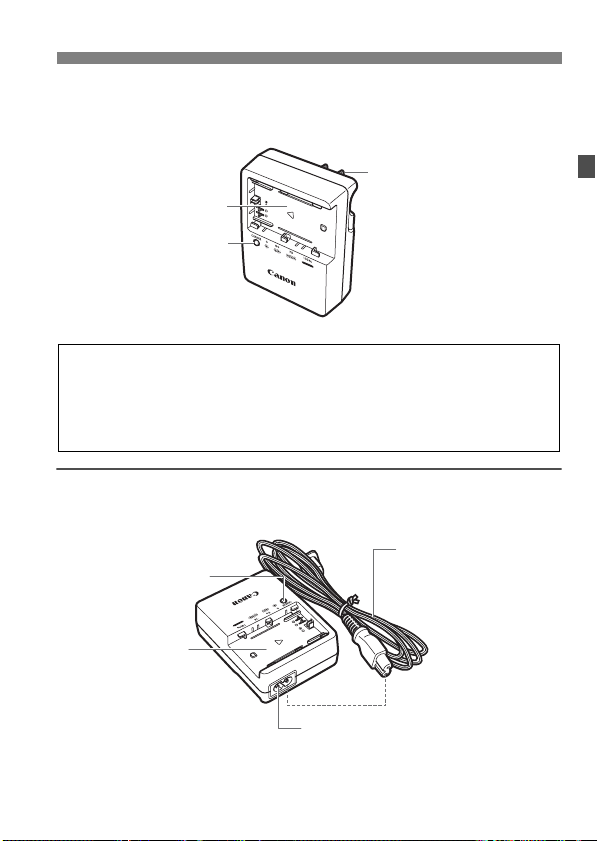
Battery Charger LC-E6
Charger for Battery Pack LP-E6N/LP-E6 (p.32).
Battery Charger LC-E6E
Charger for Battery Pack LP-E6N/LP-E6 (p.32).
Battery pack slot
Charge lamp
Power plug
IMPORTANT SAFETY INSTRUCTIONS-SAVE THESE INSTRUCTIONS.
DANGER-TO REDUCE THE RISK OF FIRE OR ELECTRIC SHOCK,
CAREFULLY FOLLOW THESE INSTRUCTIONS.
For connection to a supply not in the U.S.A., use an attachment plug adapter
of the proper configuration for the power outlet, if needed.
Power cord
Power cord socket
Battery pack slot
Charge lamp
Nomenclature
28
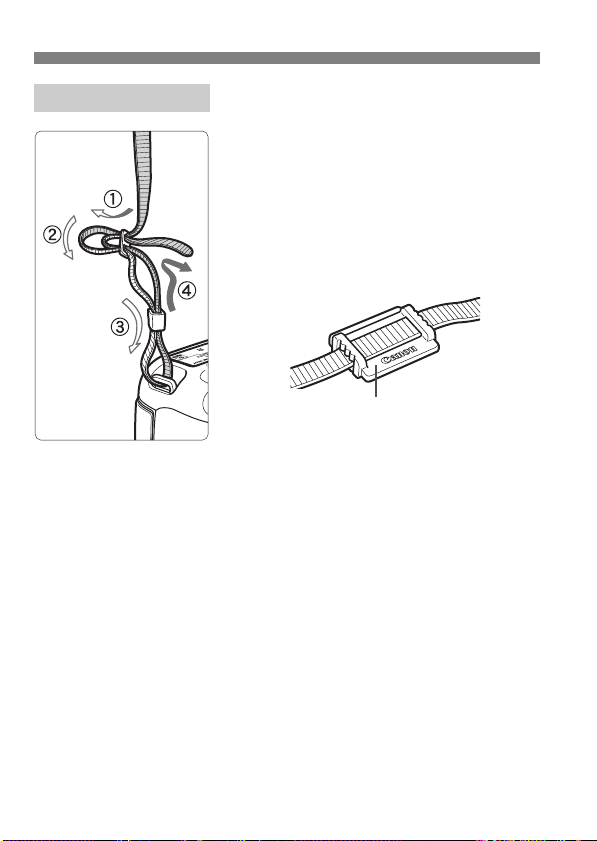
Pass the end of the strap through the
camera’s strap mount eyelet from the
bottom. Then pass it through the strap’s
buckle as shown in the illustration. Pull the
strap to take up any slack and make sure the
strap will not loosen from the buckle.
The eyepiece cover is also attached to
the strap.
Attaching the Strap
Eyepiece cover
29
Nomenclature
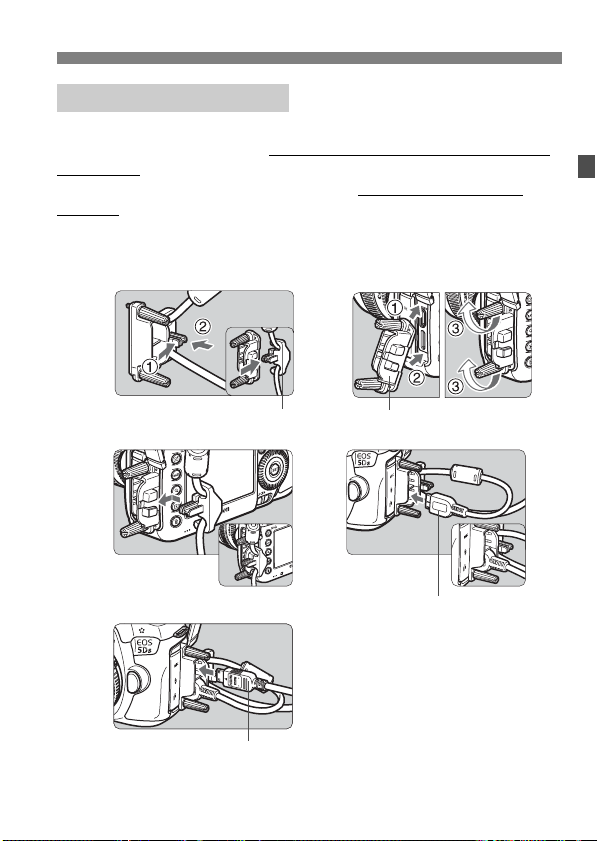
When connecting the camera to a computer, printer, Wireless File
Transmitter or GPS Receiver, use the provided interface cable or one
from Canon.
When connecting the interface cable, also use the provided cable
protector. Using the cable protector prevents the cable from accidental
disconnection and the terminal from getting damaged.
Using the Provided Interface Cable and a Genuine HDMI Cable
(sold separately)
Using the Cable Protector
Provided interface cable
Clamp
1
2
3
4
Cable protector
HDMI cable (sold separately)
5
Nomenclature
30
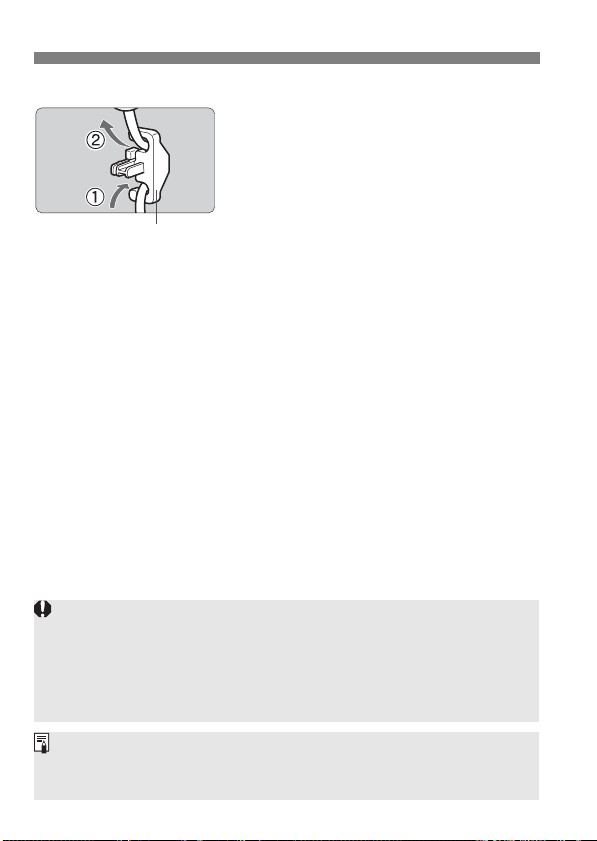
Using a Genuine Interface Cable (sold separately)
If you use a genuine interface cable (sold
separately), run the cable through the clamp
before attaching the clamp to the cable
protector.
Clamp
Connecting interface cable without using the cable protector may
damage the digital terminal.
Do not use a USB 2.0 cable equipped with a Micro-B plug. It may
damage the camera’s digital terminal.
As shown in the lower-right illustration for step 4, check that the interface
cable is securely attached to the digital terminal.
To connect the camera to a TV set, using HDMI Cable HTC-100 (sold
separately) is recommended. Using the cable protector is recommended
even when connecting an HDMI cable.
31
1
Getting Started
This chapter explains preparatory steps before you start
shooting and basic camera operations.
32
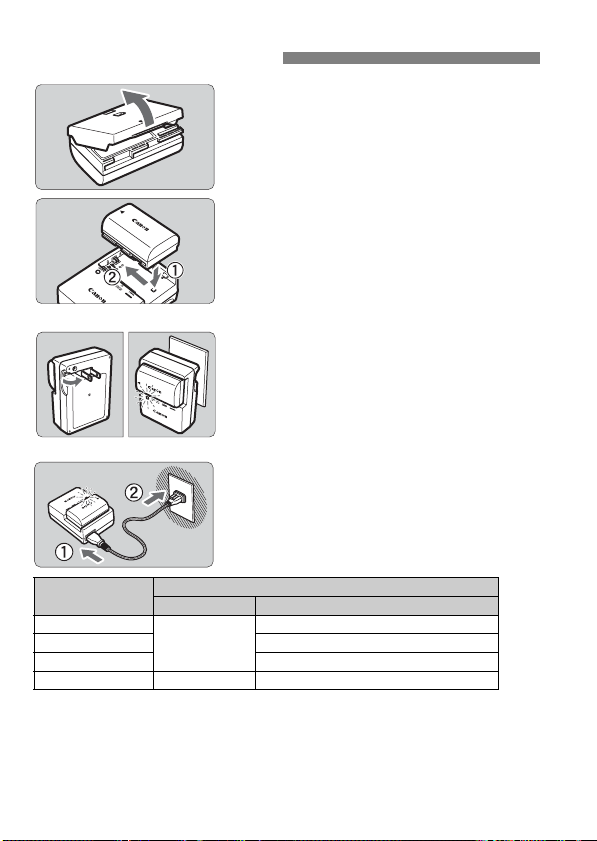
1
Remove the protective cover.
Detach the protective cover provided
with the battery.
2
Attach the battery.
As shown in the illustration, attach the
battery securely to the charger.
To detach the battery, follow the
above procedure in reverse.
3
Recharge the battery.
For LC-E6
As shown by the arrow, flip out the
battery charger’s prongs and insert
the prongs into a power outlet.
For LC-E6E
Connect the power cord to the
charger and insert the plug into a
power outlet.
X Recharging starts automatically and
the charge lamp blinks in orange.
It takes approx. 2 hr. and 30 min. to fully recharge a completely exhausted battery at
room temperature (23°C / 73°F).
The time required to recharge the battery will vary
greatly depending on the ambient temperature and the battery’s remaining capacity.
For safety reasons, recharging in low temperatures (5°C - 10°C /
41°F - 50°F) will take longer (up to approx. 4 hr.).
Charging the Battery
LC-E6
LC-E6E
Charge Level
Charge Lamp
Color Display
0-49%
Orange
Blinks once per second
50-74% Blinks twice per second
75% or higher Blinks three times per second
Fully charged Green Lights up
33
Charging the Battery
Upon purchase, the battery is not fully charged.
Charge the battery before use.
Recharge the battery on the day before or on the day it is to be used.
Even during storage, a charged battery will gradually drain and lose its capacity.
After recharging the battery, detach it and disconnect the
charger from the power outlet.
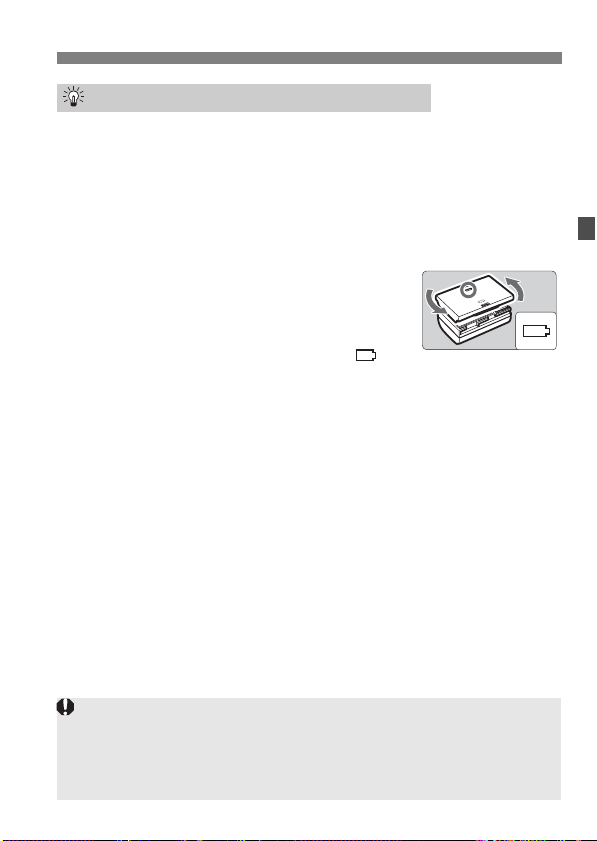
You can attach the cover in a different
orientation to indicate whether the battery
has been recharged or not.
If the battery has been recharged, attach the
cover so that the battery-shaped hole < > is
aligned over the blue sticker on the battery. If the battery is
exhausted, attach the cover in the opposite orientation.
When not using the camera, remove the battery.
If the battery is left in the camera for a prolonged period, a small amount
of power current is released, resulting in excess discharge and shorter
battery life. Store the battery with the protective cover attached. Storing
the battery when it is fully charged may lower the battery’s performance.
The battery charger can also be used in foreign countries.
The battery charger is compatible with a 100 V AC to 240 V AC 50/60 Hz
power source. If necessary, attach a commercially-available plug adapter for
the respective country or region. Do not attach any portable voltage
transformer to the battery charger. Doing so can damage the battery charger.
If the battery becomes exhausted quickly even after being fully
charged, the battery has reached the end of its service life.
Check the battery’s recharge performance and purchase a new battery.
Tips for Using the Battery and Charger
After disconnecting the charger’s power plug, do not touch the prongs for
approx. 10 sec.
If the battery’s remaining capacity is 94% or higher, the battery will not be
recharged.
The charger cannot charge any battery other than Battery Pack LP-E6N/LP-E6.
34
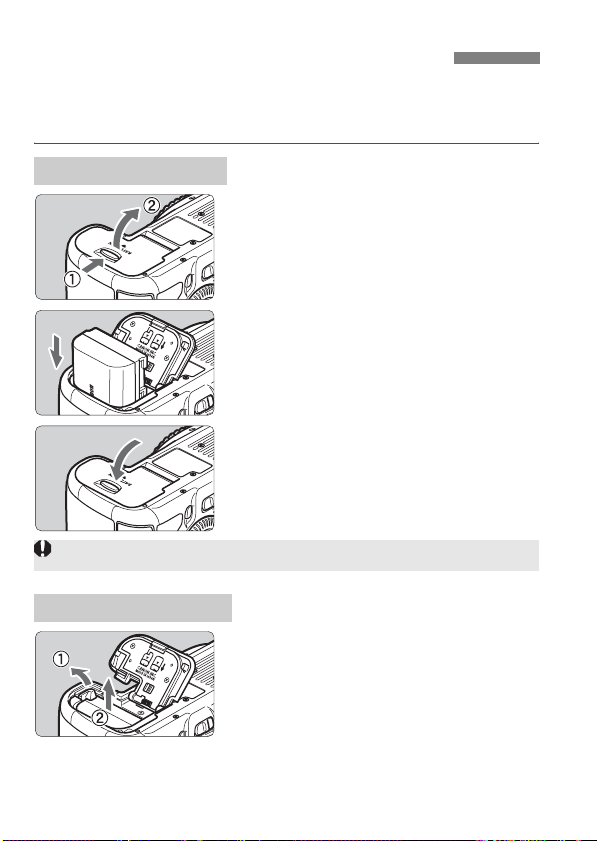
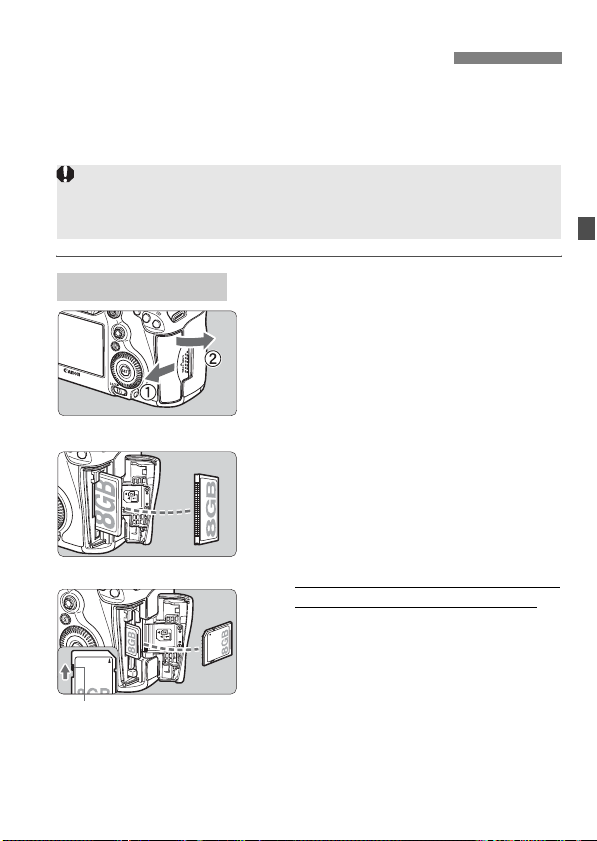
Load a fully-charged Battery Pack LP-E6N (or LP-E6) into the camera.
The camera’s viewfinder becomes bright when a battery is installed,
and darkens when the battery is removed.
1
Open the cover.
Slide the lever as shown by the
arrows and open the cover.
2
Insert the battery.
Insert the end with the battery
contacts.
Insert the battery until it locks in
place.
3
Close the cover.
Press the cover until it snaps shut.
Open the cover and remove the
battery.
Press the battery lock lever as shown
by the arrow and remove the battery.
To prevent short circuiting of the
battery contacts, be sure to attach the
provided protective cover (p.32) to
the battery.
Installing and Removing the Battery
Installing the Battery
Removing the Battery
Only Battery Pack LP-E6N/LP-E6 can be used.
35
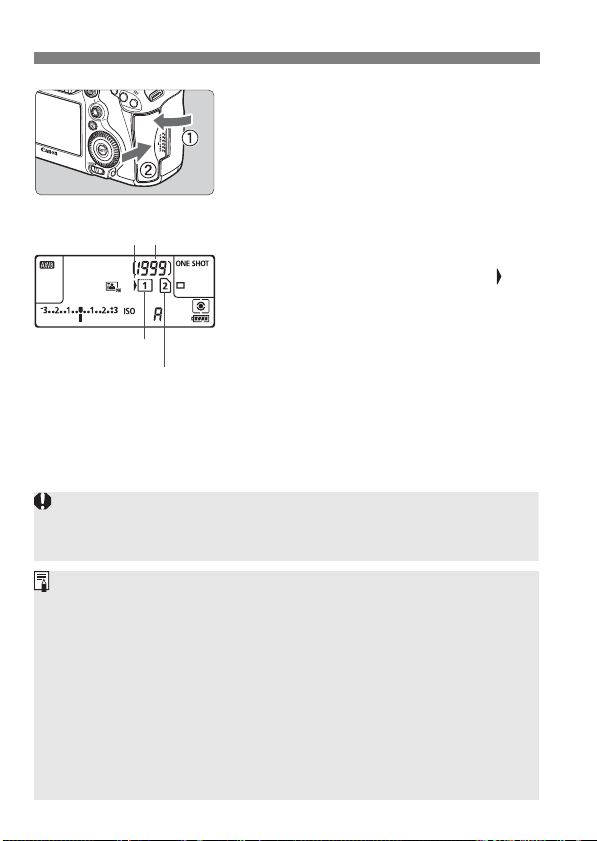
The camera can use a CF card and an SD card. Images can be
recorded when at least one card is installed in the camera.
If both types of card are inserted, you can select which card to record
images to, or simultaneously record images on both cards (p.94-96).
1
Open the cover.
Slide the cover as shown by the
arrows to open it.
2
Insert the card.
The camera-front side slot is for a CF
card, and the camera-back side slot
is for an SD card.
Face the CF card’s label toward
you and insert the end with the
small holes into the camera.
If the card is inserted in the wrong
way, it may damage the camera.
X The CF card eject button will stick
out.
With the SD card’s label facing
you, push in the card until it clicks
in place.
Installing and Removing the Card
Installing the Card
Cautions for Using an SD Card
If you use an SD card, be sure the card’s write-protect switch is set
upward to enable writing/erasing.
Write-protect switch
SD card
CF card
Installing and Removing the Card
36
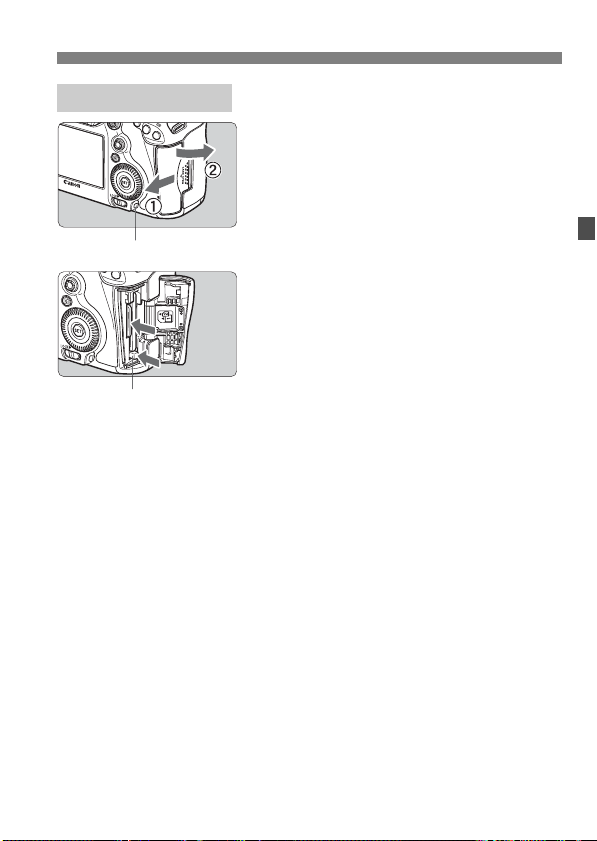
3
Close the cover.
Close the cover and slide it in the
direction shown by the arrows until it
snaps shut.
X When you set the power switch to
<1> (p.39), the number of possible
shots and the loaded card(s) will be
displayed on the LCD panel.
The images will be recorded to the
card indicated by the arrow < >
icon.
CF card indicator
SD card indicator
Card
selection icon
Possible
shots
The camera cannot use Type II CF cards, hard disk-type cards, or CFast
cards.
Multimedia cards (MMC) cannot be used (card error will be displayed).
Ultra DMA (UDMA) CF cards can also be used with the camera. UDMA
cards enable faster data writing.
SD/SDHC/SDXC memory cards are supported. UHS-I SDHC or SDXC
memory cards can also be used.
The number of possible shots depends on the remaining capacity of the
card, image-recording quality, ISO speed, etc.
“Possible Shots” displays the number of shots based on the [z4: Crop/
aspect ratio] setting (p.99).
Even if shooting 2,000 or more shots is possible, the indicator will display
only up to 1999.
Setting [z1: Release shutter without card] to [Disable] will prevent
you from forgetting to insert a card.
37
Installing and Removing the Card
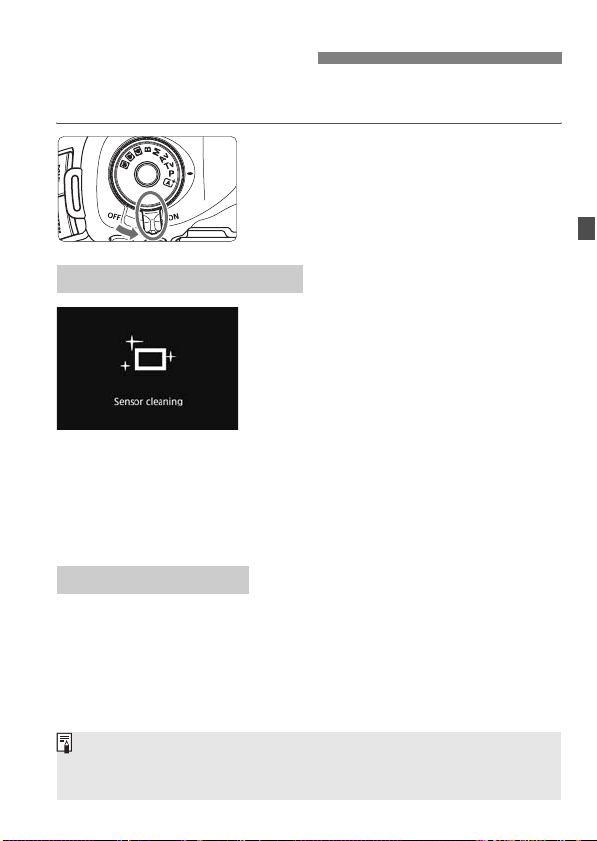
1
Open the cover.
Set the power switch to <2>.
Make sure the access lamp is off,
then open the cover.
If [Recording...] is displayed on the
LCD monitor, close the cover.
2
Remove the card.
To remove the CF card, push the
eject button.
To remove the SD card, push it in
gently and release it. Then pull it out.
Pull the card straight out, then close
the cover.
Removing the Card
Access lamp
CF card eject button

Installing and Removing the Card
38
When the access lamp is lit or blinking, it indicates that images are
being written to, read from, or erased from the card, or data is being
transferred. Do not open the card slot cover during this time. Also,
never do any of the following while the access lamp is lit or
blinking. Otherwise, it can damage the image data, card, or camera.
• Removing the card.
• Removing the battery.
• Shaking or banging the camera around.
• Unplugging and connecting a power cord (when household power
outlet accessories are used).
If the card already contains recorded images, the image number may not
start from 0001.
If a card-related error message is displayed on the LCD monitor, remove
and reinsert the card. If the error persists, use a different card.
If you can transfer all the images on the card to a computer, transfer all
the images and then format the card with the camera (p.59). The card
may then return to normal.
Do not touch the SD card’s contacts with your fingers or metal objects.
Do not expose the contacts to dust or water. If smudges adhere to the
contacts, contact failure may result.
39
If you turn on the power switch and the date/time/zone setting
screen appears, see page 41 to set the date/time/zone.
<1> : The camera turns on.
<2> : The camera is turned off and
does not operate. Set to this
position when not using the
camera.
Whenever you set the power switch
to <1> or <2>, sensor
cleaning will be executed
automatically. (A small sound may be
heard.) During the sensor cleaning,
the LCD monitor will display <f>.
You can still shoot during sensor cleaning by pressing the shutter
button halfway (p.47) to stop cleaning and take a picture.
If you repeatedly turn the power switch <1>/<2> at a short
interval, the <f> icon may not be displayed. This is normal and
not a malfunction.
To save battery power, the camera turns off automatically after 1
minute of non-operation. To turn on the camera again, just press the
shutter button halfway.
You can change the auto power off time with [52: Auto power off]
(p.61).
Turning on the Power
Automatic Sensor Cleaning
3 Auto Power Off
If you set the power switch to <2> while an image is being recorded to
the card, [Recording...] will be displayed and the power will turn off after the
recording finishes.
Turning on the Power
40
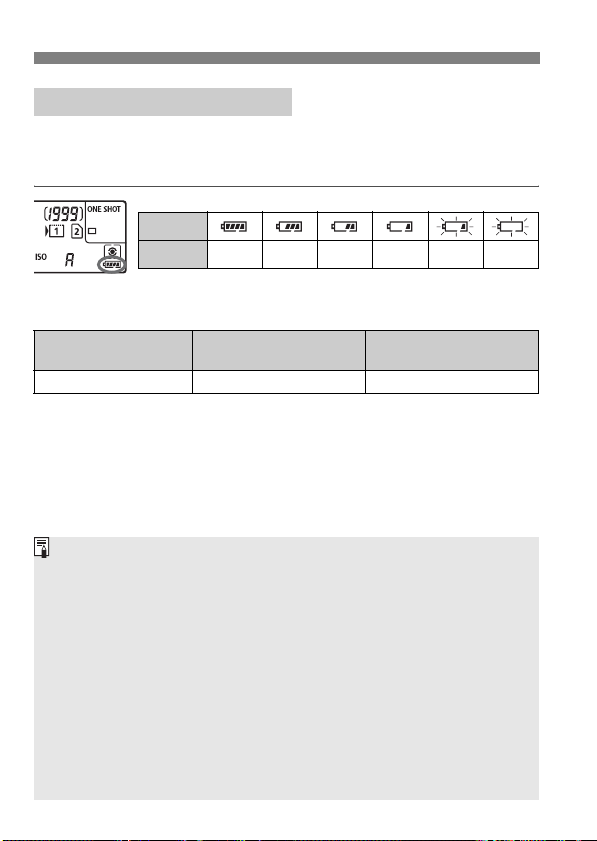
When the power switch is set to <1>, the battery level will be
indicated in one of six levels. A blinking battery icon <b> indicates
that the battery will be exhausted soon.
Number of Possible Shots (Approx. number of shots)
The figures above are based on a fully-charged Battery Pack LP-E6N, no Live View
shooting, and CIPA (Camera & Imaging Products Association) testing standards.
Possible shots with Battery Grip BG-E11 (sold separately)
• With LP-E6N x 2: approx. twice the shots without the battery grip.
• With AA/LR6 alkaline batteries at room temperature (23°C / 73°F): approx.
140 shots.
z Battery Level Indicator
Display
Level (%)
100 - 70
69 - 50 49 - 20 19 - 10 9 - 1 0
Temperature
Room Temperature
(23°C / 73°F)
Low Temperatures
(0°C / 32°F)
Possible shots 700 660
Doing any of the following will exhaust the battery sooner:
• Pressing the shutter button halfway for a prolonged period.
• Activating the AF frequently without taking a picture.
• Using the lens Image Stabilizer.
• Using the LCD monitor frequently.
The number of possible shots may decrease depending on the actual
shooting conditions.
The lens operation is powered by the camera’s battery. Depending on
the lens used, the battery may exhaust faster.
For the number of possible shots with Live View shooting, see page 123.
See [53: Battery info.] to check the battery’s condition.
With Battery Grip BG-E11 (sold separately) loaded with AA/R6 batteries,
a four-level indicator will be displayed. (x/m will not be
displayed.)
41
When you turn on the power for the first time or if the date/time/zone are
reset, the date/time/zone setting screen will appear. Follow the steps
below, making sure to set the time zone first. Set the camera to the time
zone in which you currently live so that, when you travel, you can simply
change the setting to the correct time zone for your destination and the
camera will automatically adjust the date/time.
Note that the date/time appended to recorded images will be based
on this date/time setting. Be sure to set the correct date/time.
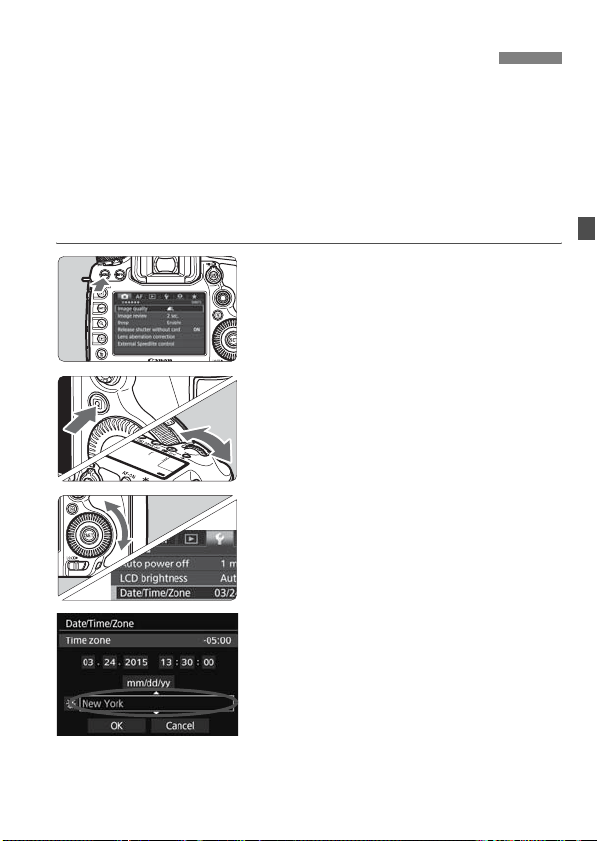
1
Display the menu screen.
Press the <M> button to display
the menu screen.
2
Under the [52] tab, select [Date/
Time/Zone].
Press the <Q> button and select the
[5] tab.
Turn the <6> dial to select the [52]
tab.
Turn the <5> dial to select [Date/
Time/Zone], then press <0>.
3
Set the time zone.
[London] is set by default.
Turn the <5> dial to select [Time
zone].
Press <0> so <r> is displayed.
Turn the <5> dial to select the time
zone, then press <0>.
3 Setting the Date, Time, and Zone
3 Setting the Date, Time, and Zone
42
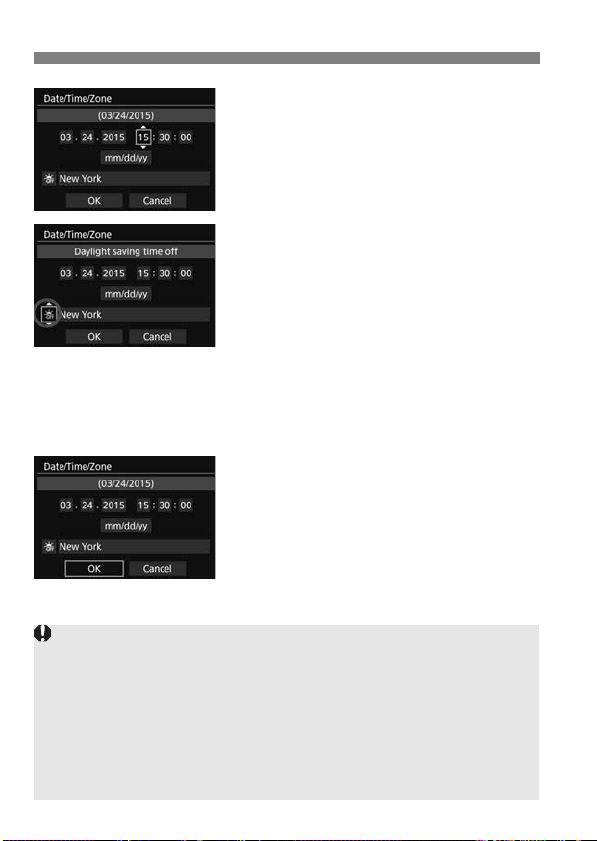
4
Set the date and time.
Turn the <
5
> dial to select the number.
Press <0> so <r> is displayed.
Turn the <5> dial to select the
desired setting, then press <0>
(Returns to <s>).
5
Set the daylight saving time.
Set it if necessary.
Turn the <5> dial to select [Y].
Press <0> so <r> is displayed.
Turn the <5> dial to select [Z], then
press <0>.
When the daylight saving time is set
to [Z], the time set in step 4 will
advance by 1 hr. If [Y] is set, the
daylight saving time will be canceled
and the time will go back by 1 hr.
6
Exit the setting.
Turn the <5> dial to select [OK],
then press <0>.
X The date/time/zone and daylight
saving time will be set and the menu
will reappear.
The date/time/zone settings may be reset when the camera is stored
without the battery, when its battery becomes exhausted, or when it is
exposed to below freezing temperatures for a prolonged period. If this
happens, set the date/time/zone again.
After changing the time zone, check that the correct date/time are set.
When performing [Sync time between cameras] via Wireless File
Transmitter, using another EOS 5DS/EOS 5DS R is recommended. If
you perform [Sync time between cameras] using different models, the
time zone or time may not be set correctly.
43
3 Selecting the Interface Language
The date/time that were set will start from when you select [OK] in step 6.
In step 3, the time displayed on the upper right of the screen is the time
difference compared with Coordinated Universal Time (UTC). If you do
not see your time zone, set the time zone while referring to the difference
with UTC.
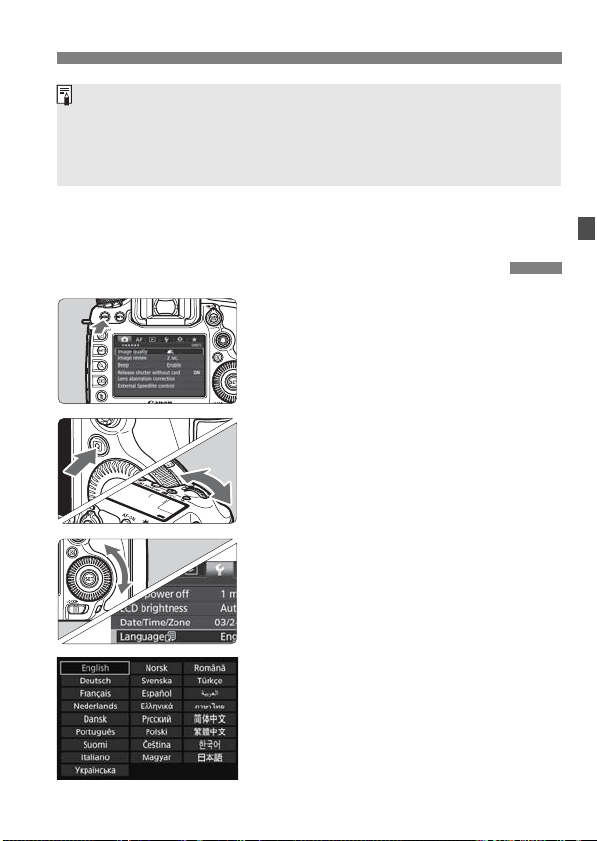
1
Display the menu screen.
Press the <M> button to display
the menu screen.
2
Under the [52] tab, select
[LanguageK].
Press the <Q> button and select the
[5] tab.
Turn the <6> dial to select the [52]
tab.
Turn the <5> dial to select
[LanguageK], then press <0>.
3
Set the desired language.
Turn the <5> dial to select the
language, then press <0>.
X The interface language will change.
3 Selecting the Interface Language
44
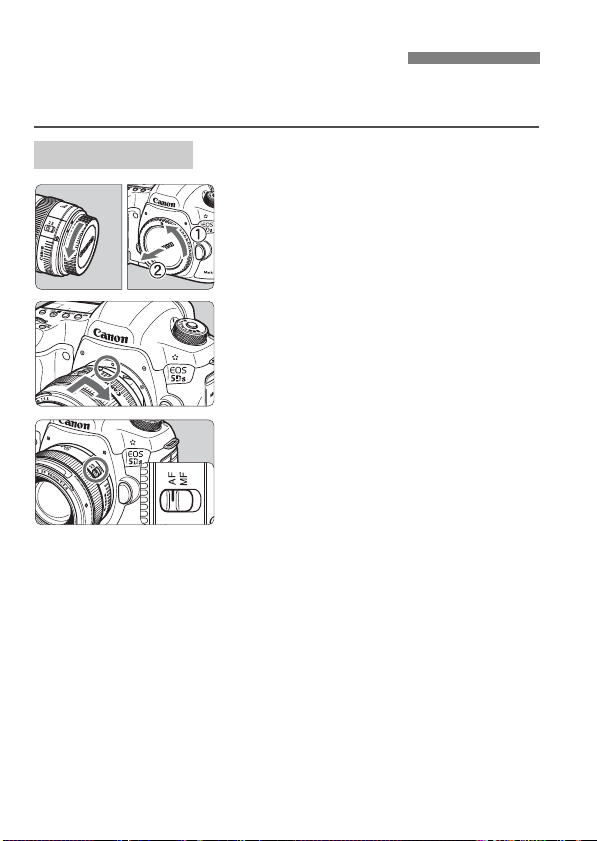
The camera is compatible with all Canon EF lenses. The camera
cannot be used with EF-S or EF-M lenses.
1
Remove the caps.
Remove the rear lens cap and the
body cap by turning them as shown
by the arrows.
2
Attach the lens.
Align the red dots on the lens and
camera and turn the lens as shown by
the arrow until it clicks in place.
3
Set the lens’s focus mode switch
to <AF>.
<AF> stands for autofocus.
<MF> stands for manual focus.
Autofocus will not operate.
4
Remove the front lens cap.
Attaching and Detaching a Lens
Attaching a Lens
45
Attaching and Detaching a Lens
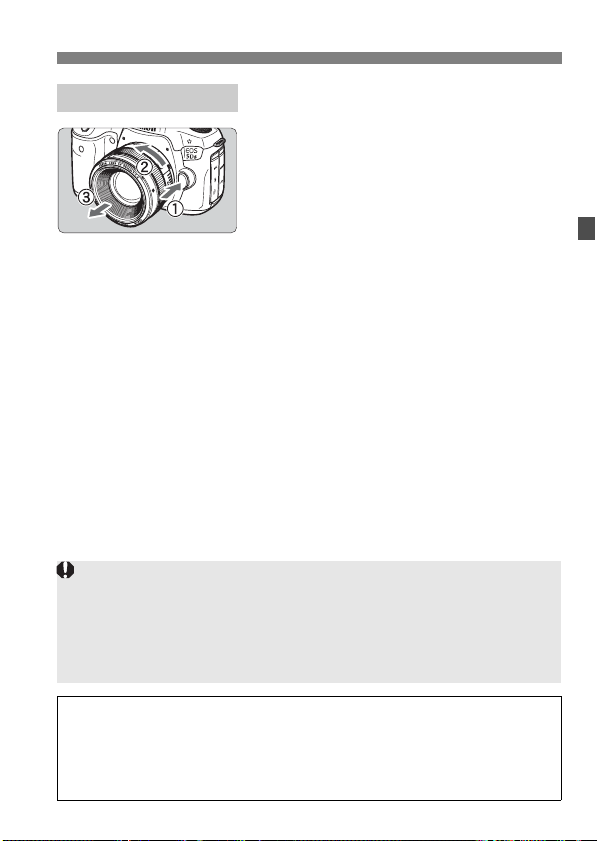
While pressing the lens release
button, turn the lens as shown by
the arrow.
Turn the lens until it stops, then
detach it.
Attach the rear lens cap to the
detached lens.
Detaching the Lens
Do not look at the sun directly through any lens. Doing so may cause
loss of vision.
When attaching or detaching a lens, set the camera’s power switch to
<2>.
If the front part (focusing ring) of the lens rotates during autofocusing, do
not touch the rotating part.
Minimizing Dust
When changing lenses, do it quickly in a place with minimal dust.
When storing the camera without a lens attached, be sure to attach the
body cap to the camera.
Remove dust on the body cap before attaching it.
46
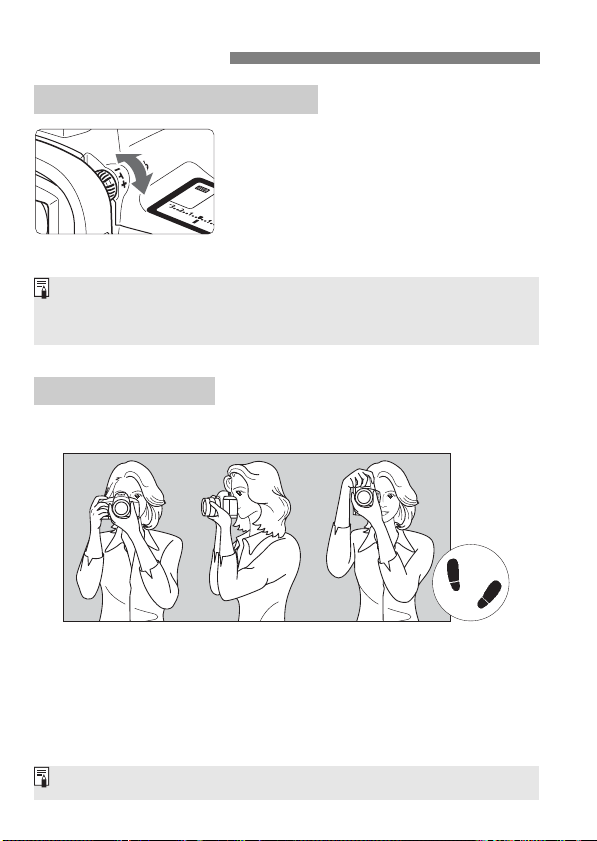
Turn the dioptric adjustment
knob.
Turn the knob left or right so that the
AF points in the viewfinder look
sharp.
If the knob is difficult to turn, remove
the eyecup.
To obtain sharp images, hold the camera still to minimize camera
shake.
1. Wrap your right hand around the camera grip firmly.
2. Hold the lens bottom with your left hand.
3. Rest your hand’s right index finger lightly on the shutter button.
4. Press your arms and elbows lightly against the front of your body.
5.
To maintain a stable stance, place one foot slightly ahead of the other.
6. Press the camera against your face and look through the viewfinder.
Basic Operation
Adjusting the Viewfinder Clarity
Holding the Camera
If the camera’s dioptric adjustment still cannot provide a sharp viewfinder
image, using Dioptric Adjustment Lens Eg (sold separately) is
recommended.
Vertical shooting
Horizontal shooting
To shoot while looking at the LCD monitor, see page 121.
47
Basic Operation
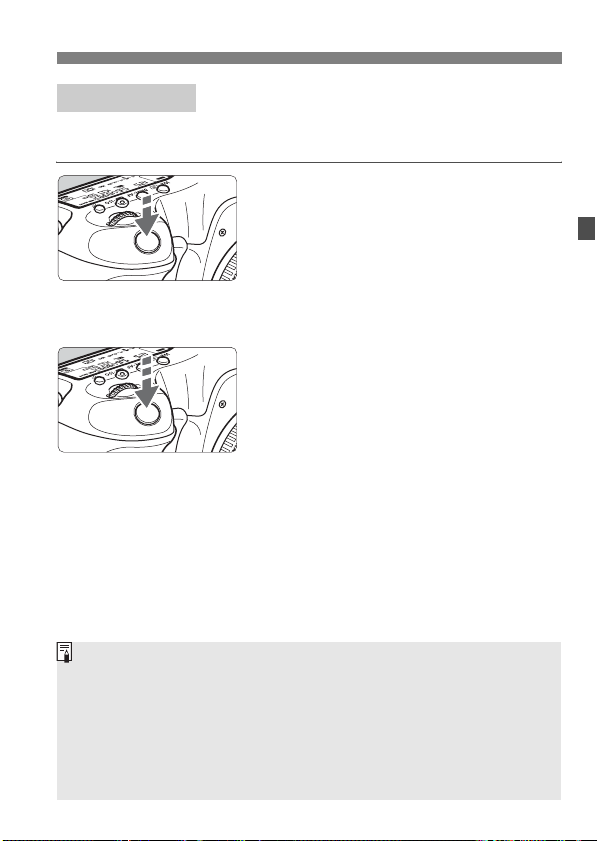
The shutter button has two steps. You can press the shutter button
halfway. Then you can further press the shutter button completely.
Pressing Halfway
This activates autofocusing and the
automatic exposure system that sets the
shutter speed and aperture.
The exposure setting (shutter speed and
aperture) is displayed in the viewfinder
and on the LCD panel for 4 sec.
(metering timer/0).
Pressing Completely
This releases the shutter and takes the
picture.
Preventing Camera Shake
Hand-held camera movement during the moment of exposure is called
camera shake. It can cause blurred pictures. To prevent camera shake,
note the following:
• Hold and steady the camera as shown on the preceding page.
• Press the shutter button halfway to autofocus, then slowly press the
shutter button completely.
Shutter Button
In the <d> <s> <f> <a> <F> shooting modes, pressing the
<p> button will execute the same operation as pressing the shutter
button halfway.
If you press the shutter button completely without pressing it halfway first
or if you press the shutter button halfway and then press it completely
immediately, the camera will take a moment before it takes the picture.
Even during menu display or image playback, you can go back to
shooting-ready by pressing the shutter button halfway.
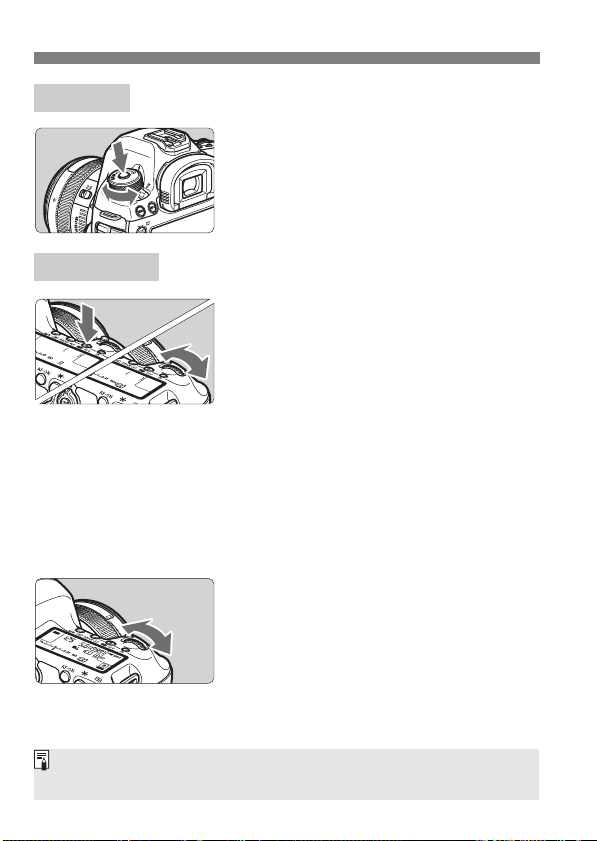
Basic Operation
48
Turn the dial while holding down
the lock release button at the
center of the dial.
Use it to set the shooting mode.
(1)
After pressing a button, turn the
<6> dial.
When you press a button such as
<n> <o> <m>, the
respective function remains selected for
6 sec. (9). During this time, you can
turn the <6> dial to change the setting.
When the function selection ends or if
you press the shutter button halfway, the
camera will be ready to shoot.
Use this dial to select the metering
mode, AF operation, ISO speed, AF
point, etc.
(2)
Turn the <6> dial only.
While looking at the viewfinder or LCD
panel, turn the <6> dial to change the
setting.
Use this dial to set the shutter speed,
aperture, etc.
Mode Dial
6 Main Dial
The operations in (1) are possible even when the <R> switch is set to
the right (Multi function lock, p.51).
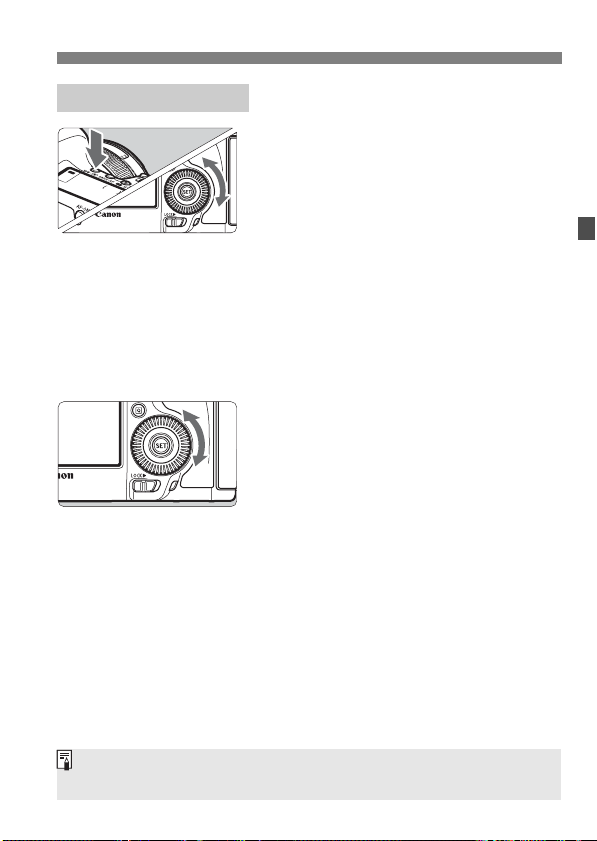
49
Basic Operation
(1)
After pressing a button, turn the
<5> dial.
When you press a button such as
<n> <o> <m>, the
respective function remains selected for
6 sec. (9). During this time, you can
turn the <5> dial to change the setting.
When the function selection ends or if
you press the shutter button halfway, the
camera will be ready to shoot.
Use this dial to select the white
balance, drive mode, flash exposure
compensation, AF point, etc.
(2)
Turn the <5> dial only.
While looking at the viewfinder or LCD
panel, turn the <
5> dial to change the
setting.
Use this dial to set the exposure
compensation amount, the aperture
setting for manual exposures, etc.
5 Quick Control Dial
The operations in (1) are possible even when the <R> switch is set to
the right (Multi function lock, p.51).
Basic Operation
50
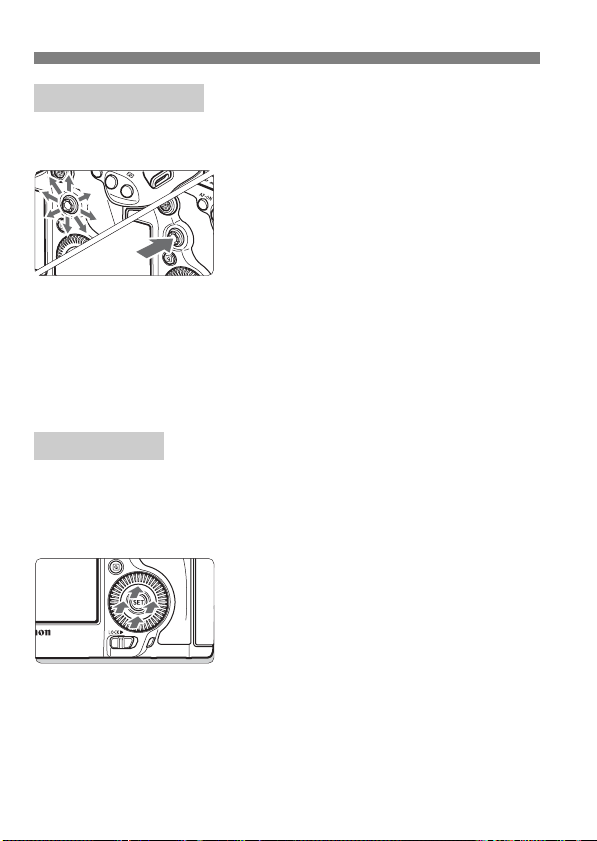
The <9> consists of an eight-direction key and a button at the center.
Use your thumb to tilt the <9> in the desired direction.
Use it to select the AF point, correct
the white balance, move the AF point
or magnifying frame during Live View
shooting, scroll around magnified
images during playback, operate the
Quick Control screen, etc.
You can also use it to select and set
menu items.
For menus and Quick Control, the
Multi-controller works only in the
vertical and horizontal directions. It
does not work in diagonal directions.
During movie shooting, the touch pad provides a quiet way to adjust the
shutter speed, aperture, exposure compensation, ISO speed, and
sound recording level.
This function works when [z5: Silent Control] is set to [Enable h].
After pressing the <Q> button,
tap the <5> dial’s inner ring at
the top, bottom, left, or right.
9 Multi-controller
h Touch Pad
51
Basic Operation
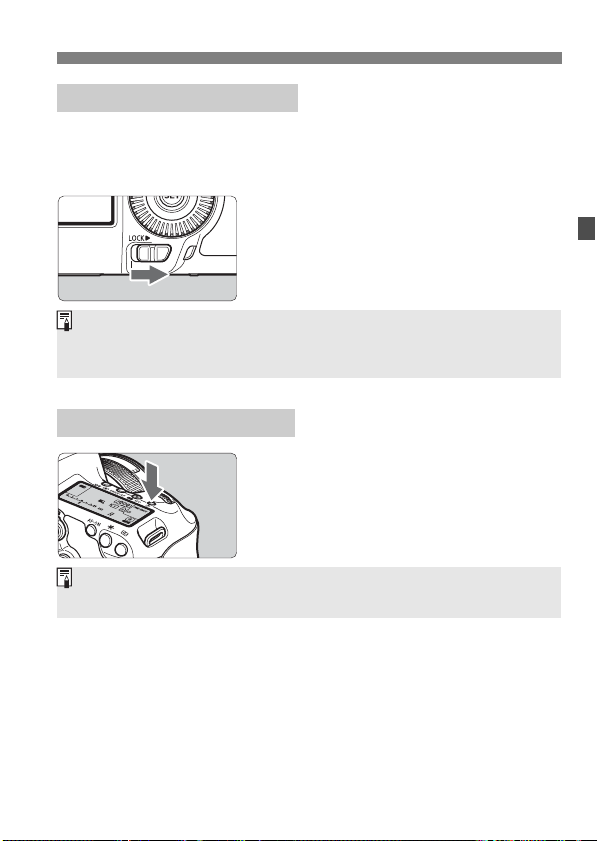
By setting [83: Multi function lock] and moving the <R> switch
to the right, you can prevent the Main Dial, Quick Control Dial, and
Multi-controller from moving and changing a setting inadvertently.
<R> switch set to the left:
Lock released
<R> switch set to the right:
Lock engaged
You can illuminate the LCD panel by
pressing the <U> button. Turn on (9)
or off the LCD panel illumination by
pressing the <U> button.
R Multi Function Lock
U LCD Panel Illumination
If the <R> switch is set to the right and you try to operate any of the
locked camera controls, <L> will appear in the viewfinder and on the LCD
panel. Also, [LOCK] will appear on the Quick Control screen (p.52).
During a bulb exposure, pressing the shutter button completely will turn off
the LCD panel illumination.
Basic Operation
52
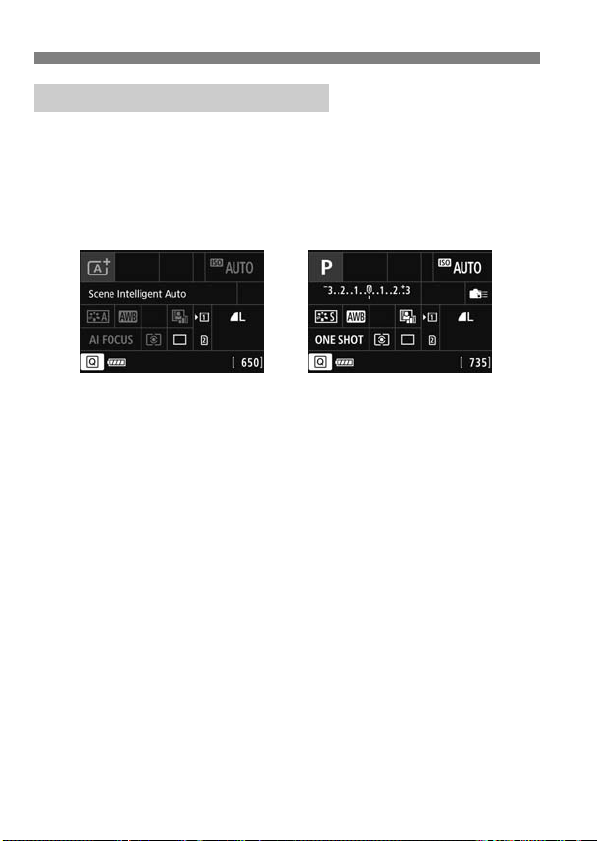
After you press the <B> button a number of times, the Quick
Control screen (p.54) or Custom Quick Control screen will appear. You
can then check the current shooting function settings.
Pressing the <Q> button enables Quick Control of the shooting
function settings (p.53).
Then you can press the <B> button to turn off the screen.
Displaying Quick Control Screen
53
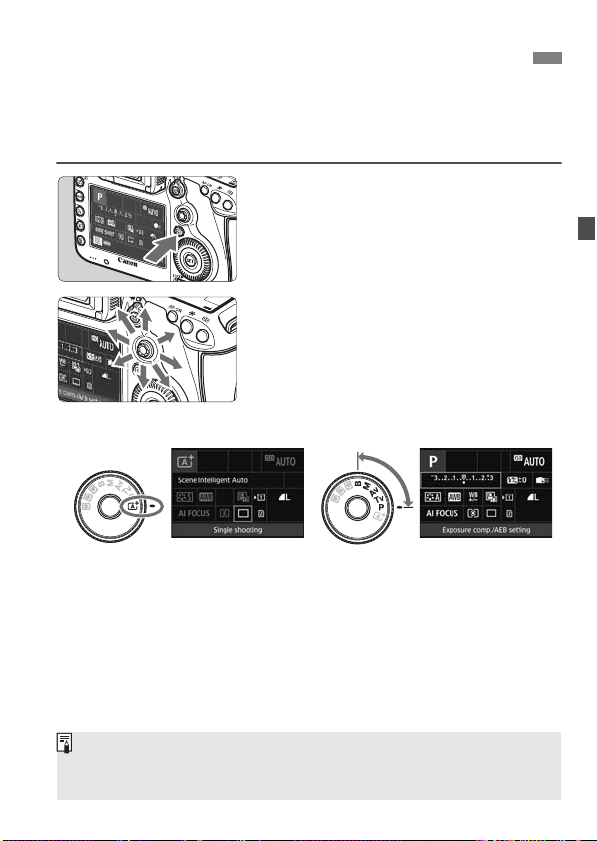
You can directly select and set the shooting functions displayed on the
LCD monitor. This is called Quick Control.
The basic operating procedures are the same for the Quick Control
screen (p.52) and the Custom Quick Control screen (p.54).
1
Press the <Q> button (7).
X The Quick Control screen will appear.
2
Set the desired functions.
Use <9> to select a function.
X The setting of the selected function is
displayed.
Turn the <5> or <6> dial to
change the setting.
3
Take the picture.
Press the shutter button completely to
take the picture.
X The captured image will be displayed.
Q Quick Control for Shooting Functions
<A> mode <d/s/f/a/F> modes
In the <A> mode with the Quick Control screen displayed, you can only
set recording function, card selection, image-recording quality, and drive
mode.
Q Quick Control for Shooting Functions
54
You can customize the layout of the Custom Quick Control screen. This
feature lets you display and position the shooting functions on the
Custom Quick Control screen as desired. Refer to “Camera Instruction
Manual” (PDF file, p.154) in the Camera Instruction Manual CD-ROM.
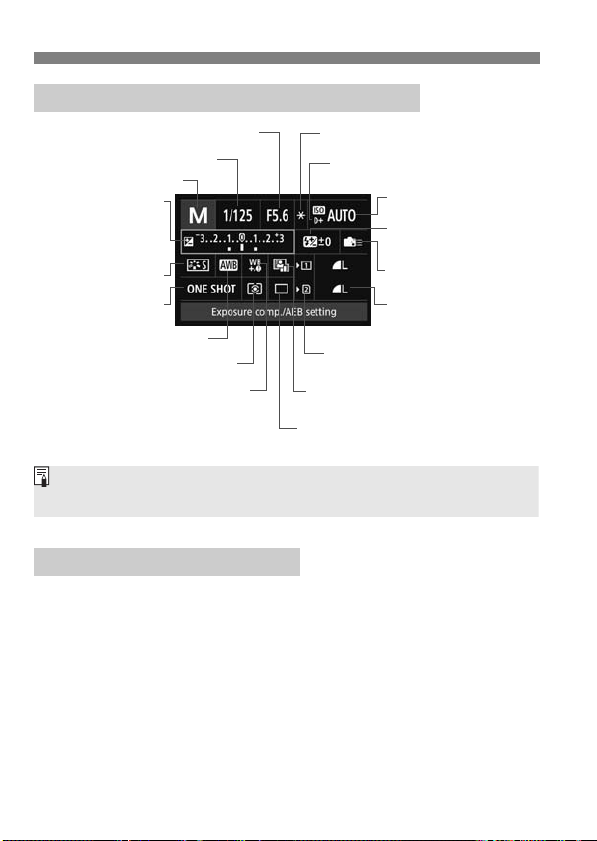
Settable Functions on Quick Control Screen
Custom Quick Control Screen
Shutter speed (p.113)
AF operation (p.76)
White balance correction /
White balance bracketing
Shooting mode* (p.26)
Highlight tone priority* (p.107)
Auto Lighting Optimizer
(p.104)
Picture Style (p.102)
Exposure
compensation/
AEB setting
(p.118/119)
ISO speed (p.101)
Image-recording quality
(p.97)
Aperture (p.114)
Flash exposure
compensation
Drive mode (p.91)
Custom Controls
AE lock* (p.120)
Metering mode (p.117)
White balance (p.103)
Recording function/Card selection
(p.94)
* Functions marked with an asterisk cannot be set with the Quick Control
screen.
55
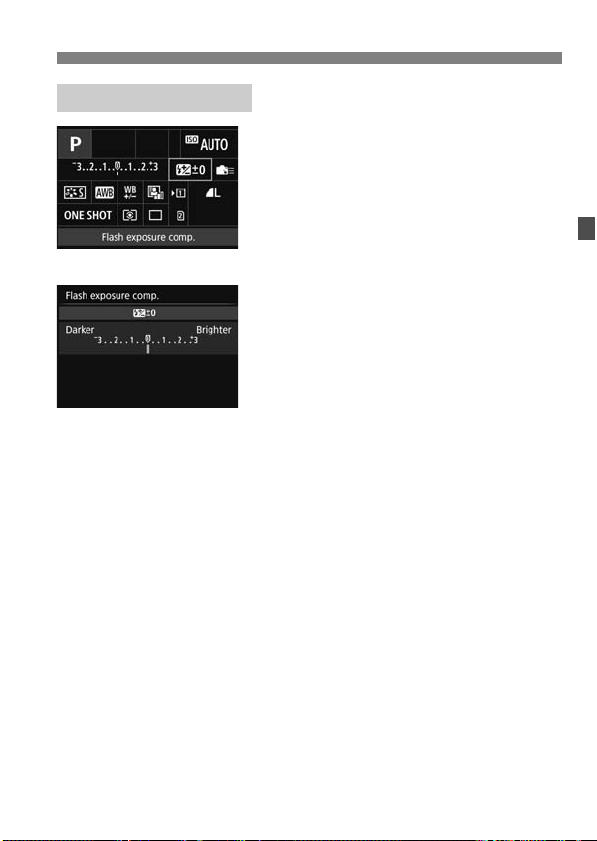
Q Quick Control for Shooting Functions
Select a function and press <0>.
The function setting screen will
appear.
Turn the <6> or <5> dial to
change some of the settings. There
are also functions that are set by
pressing the button.
Press <0> to finalize the setting and
return to the previous screen.
Quick Control Screen
<0>
Ð
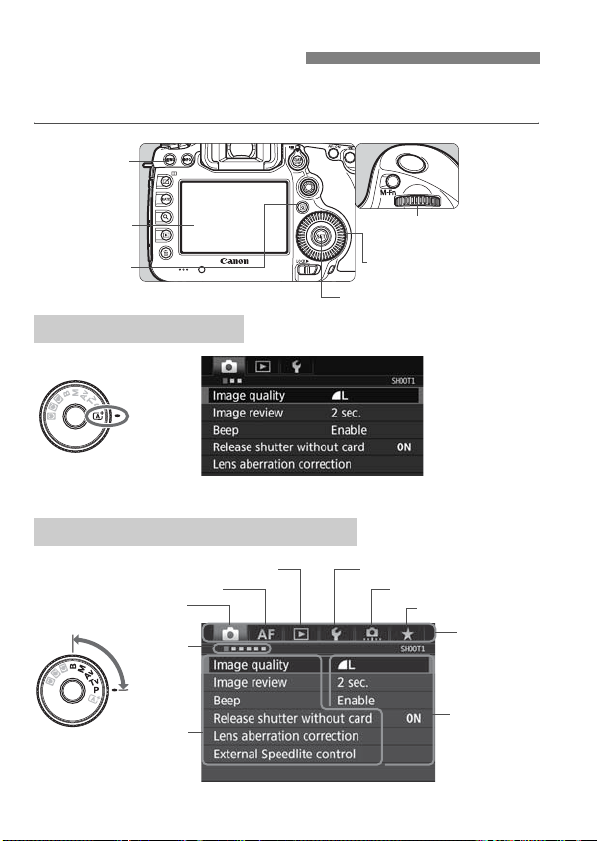
56
You can set various settings with the menus such as the image-recording
quality, date/time, etc.
* Certain menu tabs and menu items are not displayed in the <A> mode.
3 Menu Operations
A Mode Menu Screen
d/s/f/a/F Mode Menu Screen
<5> Quick Control Dial
<M> button
<6> Main Dial
LCD monitor
<0> button
<Q> button
Menu items
Menu settings
z: Shooting
5: Set-up
9: My Menu
3: Playback
8: Custom Functions
Main tabs
Secondary
tabs
2: AF
57
3 Menu Operations
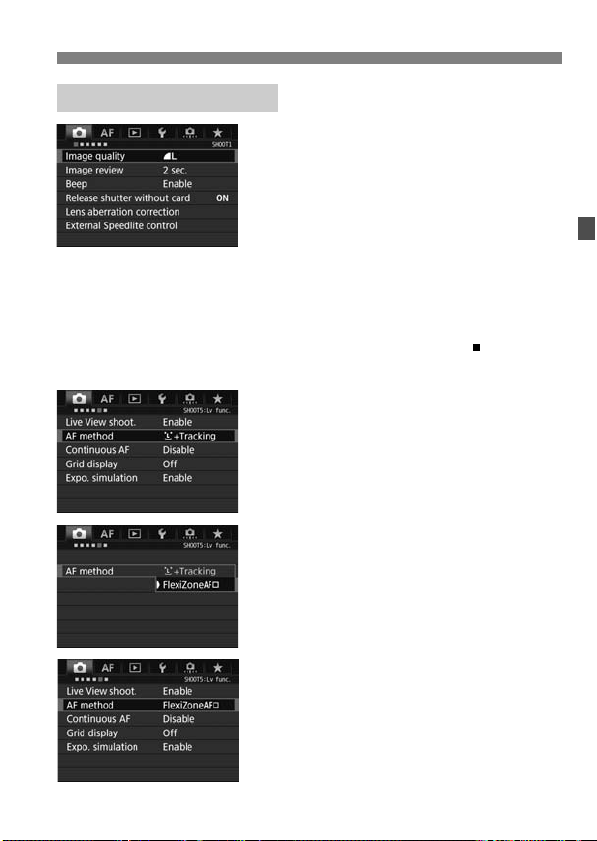
1
Display the menu screen.
Press the <M> button to display
the menu screen.
2
Select a tab.
Each time you press the <Q> button,
the main tab will switch.
Turn the <6> dial to select a
secondary tab.
For example, the [z5] tab refers to
the screen displayed when the z
(Shooting) tab’s fifth dot “ ” from the
left is selected.
3
Select the desired item.
Turn the <5> dial to select the item,
then press <0>.
4
Select the setting.
Turn the <5> dial to select the
desired setting.
The current setting is indicated in
blue.
5
Adjust the setting.
Press <0> to set it.
6
Exit the setting.
Press the <M> button to exit the
menu and return to shooting-ready.
Menu Setting Procedure
3 Menu Operations
58
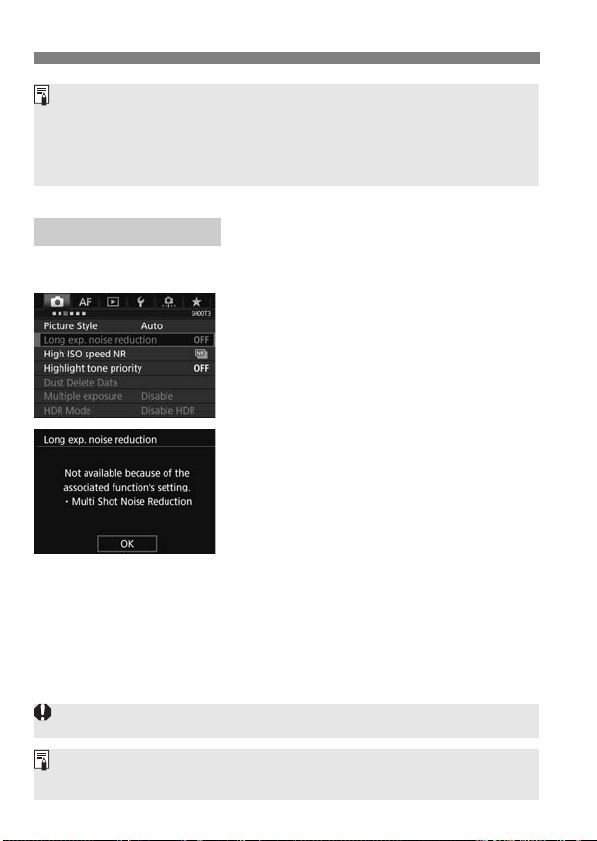
Example: When Multi Shot
Noise Reduction is set
Dimmed menu items cannot be set. The
menu item is dimmed if another function
setting is overriding it.
You can see the overriding function by
selecting the dimmed menu item and
pressing <0>.
If you cancel the overriding function’s
setting, the dimmed menu item will
become settable.
Dimmed Menu Items
The explanation of menu functions hereinafter assumes that you have
pressed the <M> button to display the menu screen.
You can also use <9> to operate and set menu functions. (Except for
[31: Erase images] and [51: Format card].)
To cancel the operation, press the <M> button.
Some dimmed menu items will not show the overriding function.
With [54: Clear all camera settings], you can reset the menu functions to
the default settings (p.62).
59
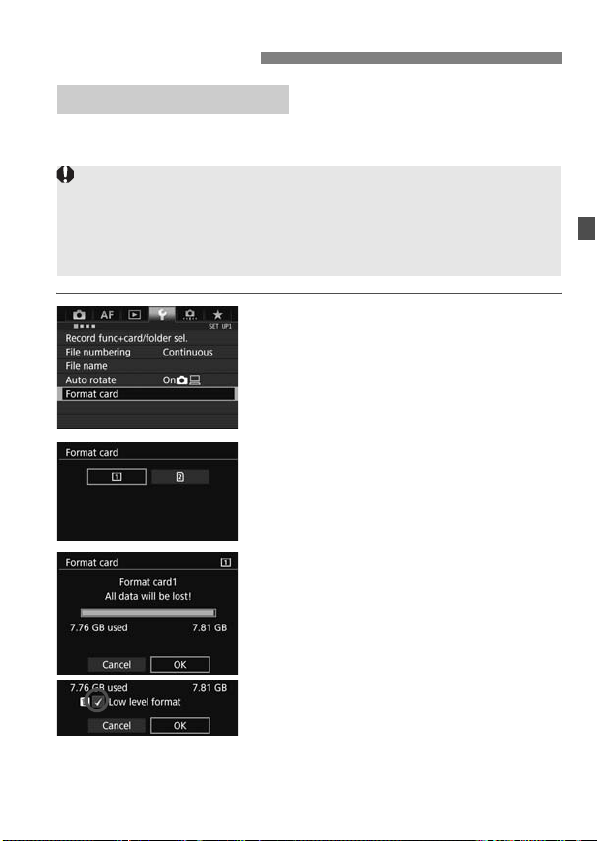
If the card is new or was previously formatted by another camera or
computer, format the card with this camera.
1
Select [Format card].
Under the [51] tab, select [Format
card], then press <0>.
2
Select the card.
[f] is the CF card, and [g] is the SD
card.
Select the card, then press <0>.
3
Select [OK].
X The card will be formatted.
When [g] is selected, low-level
formatting is possible (p.60).
For low-level formatting, press the
<L> button to append [Low level
format] with a checkmark <X>, then
select [OK].
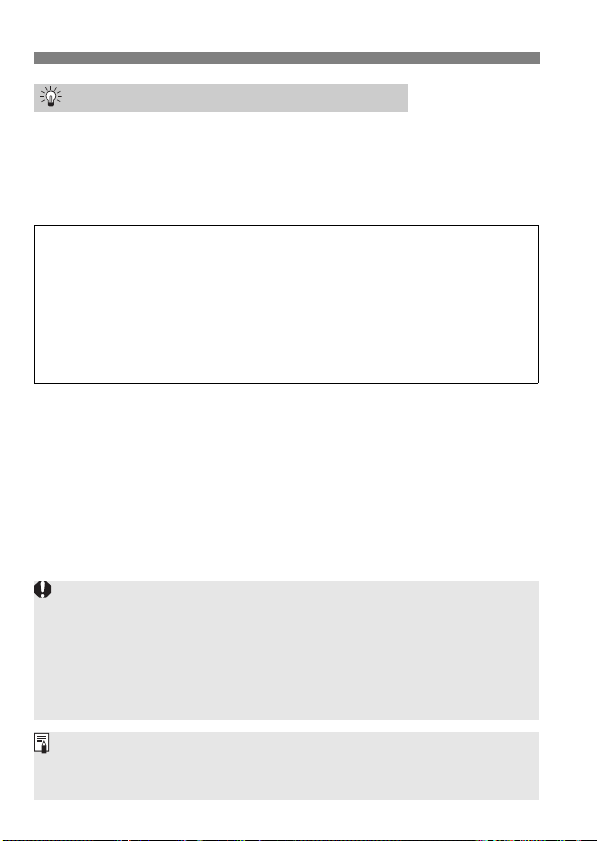
Before You Start
3 Formatting the Card
Cautions for Formatting the Card
When the card is formatted, all images and data on the card will be
erased. Even protected images will be erased, so make sure there is
nothing you need to keep. If necessary, transfer the images and data to
a computer, etc., before formatting the card.
Before You Start
60
The card is new.
The card was formatted by a different camera or a computer.
The card is full with images or data.
A card-related error is displayed.
Format the card in the following cases:
Low-level Formatting
Perform low-level formatting if the SD card’s reading or writing speed
seems slow or if you want to totally erase all data on the card.
Since low-level formatting will erase all recordable sectors on the SD card,
the formatting will take longer than normal formatting.
You can stop the low-level formatting by selecting [Cancel]. Even in this
case, normal formatting will be completed and you can use the SD card as
usual.
When the card is formatted or data is erased, only the file management
information is changed. The actual data is not completely erased. Be
aware of this when selling or discarding the card. When discarding the
card, execute low-level formatting or destroy the card physically to
prevent the personal data from being leaked.
Before using a new Eye-Fi card, the software on the card must be
installed on your computer. Then format the card with the camera.
The card capacity displayed on the card format screen may be smaller
than the capacity indicated on the card.
This device incorporates exFAT technology licensed from Microsoft.
61
Before You Start
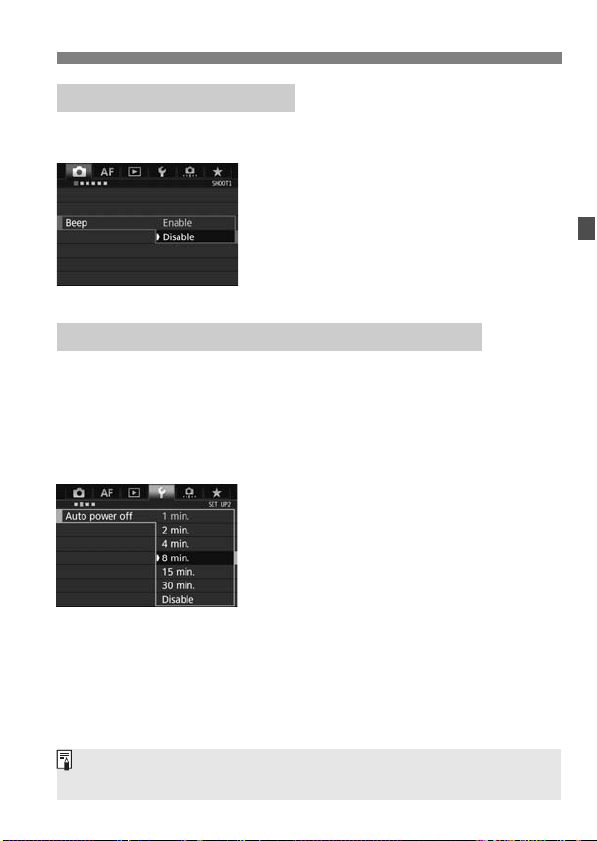
You can prevent the beeper from sounding when focus is achieved or
during self-timer operation.
1
Select [Beep].
Under the [z1] tab, select [Beep],
then press <0>.
2
Select [Disable].
Select [Disable], then press <0>.
X The beeper will not sound.
To save battery power, the camera turns off automatically after a set
time of idle operation elapses. The default setting is 1 min., but this
setting can be changed. If you do not want the camera to turn off
automatically, set this to [Disable]. After the power turns off, you can
turn on the camera again by pressing the shutter button or other
buttons.
1
Select [Auto power off].
Under the [52] tab, select [Auto
power off], then press <0>.
2
Set the desired time.
Select the desired setting, then press
<0>.
3 Disabling the Beeper
3 Setting the Power-off Time/Auto Power Off
Even if [Disable] is set, the LCD monitor will turn off automatically after 30
min. to save power. (The camera’s power does not turn off.)
Before You Start
62
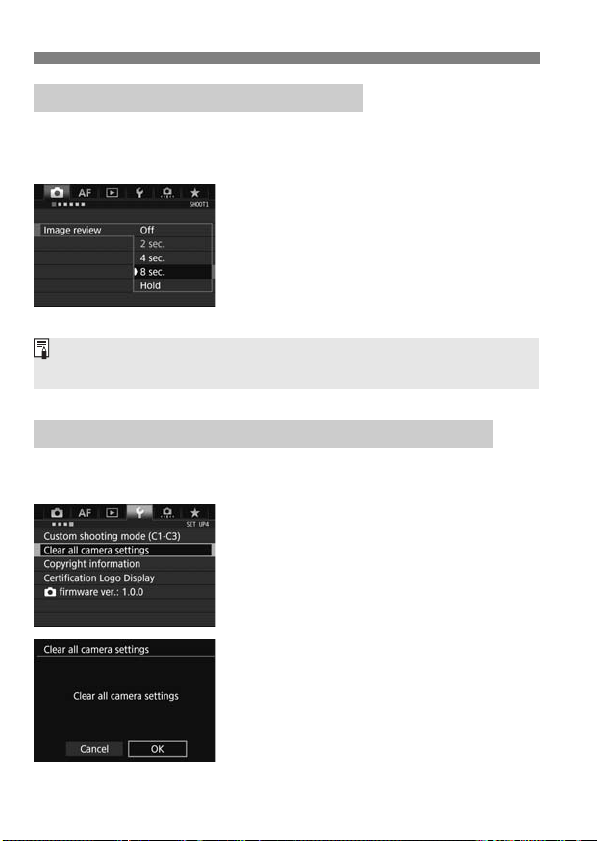
You can set how long the image is displayed on the LCD monitor just
after shooting. To keep the image displayed, set [Hold]. To not have the
image displayed, set [Off].
1
Select [Image review].
Under the [z1] tab, select [Image
review], then press <0>.
2
Set the desired time.
Select the desired setting, then press
<0>.
The camera’s shooting function settings and menu settings can be
reverted to their defaults.
1
Select [Clear all camera settings].
Under the [54] tab, select [Clear all
camera settings], then press <0>.
2
Select [OK].
3 Setting the Image Review Time
3 Reverting the Camera to the Default SettingsN
If [Hold] is set, the image will be displayed until the auto power off time
elapses.
63
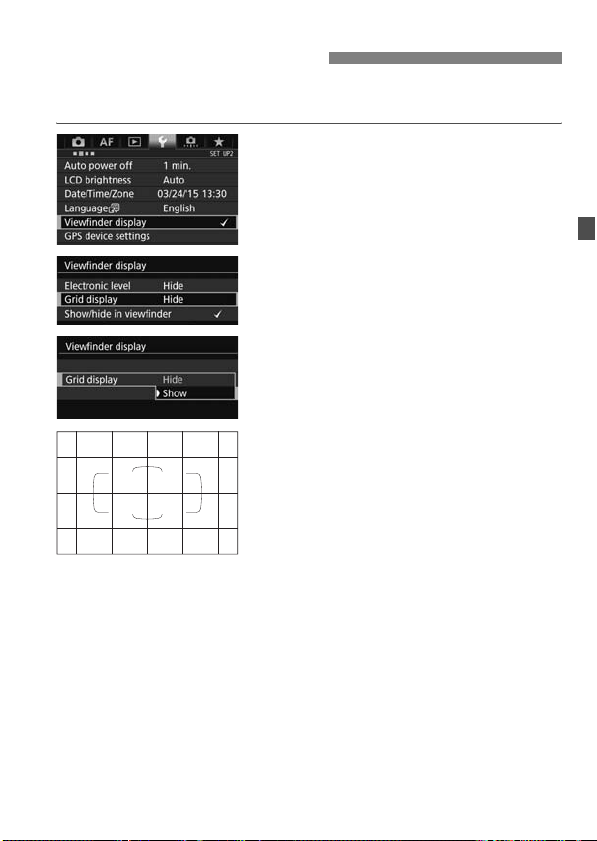
You can display a grid in the viewfinder to help you check the camera tilt
or compose the shot.
1
Select [Viewfinder display].
Under the [52] tab, select
[Viewfinder display], then press
<0>.
2
Select [Grid display].
3
Select [Show].
X When you exit the menu, the grid will
appear in the viewfinder.
l Displaying the Grid
64
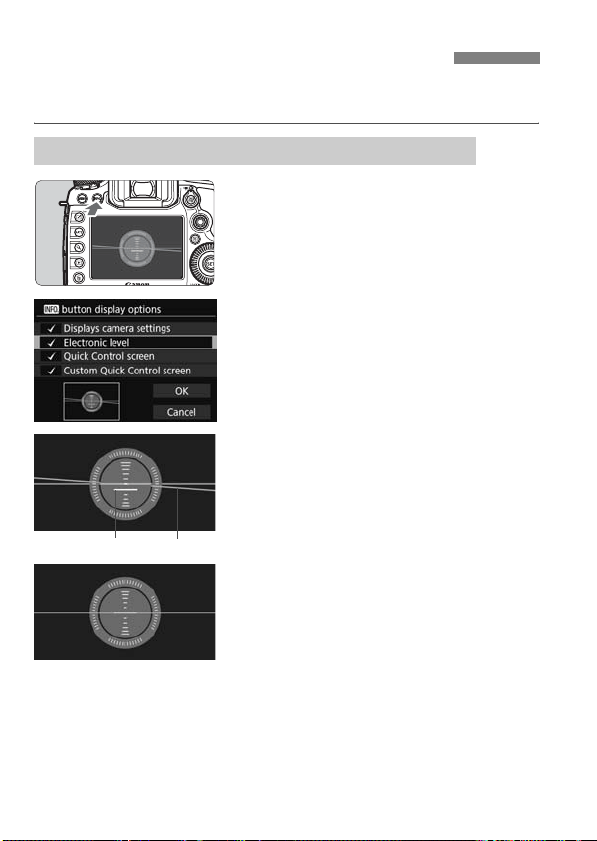
You can display the electronic level on the LCD monitor and in the
viewfinder to help you correct camera tilt.
1
Press the <B> button.
Each time you press the <B>
button, the screen display will
change.
Display the electronic level.
If the electronic level does not
appear, set [53: z button
display options] so that the
electronic level can be displayed.
2
Check the camera’s tilt.
The horizontal and vertical tilt are
displayed in 1° increments.
When the red line turns green, it
indicates that the tilt is almost
corrected.
Q Displaying the Electronic Level
Displaying the Electronic Level on the LCD Monitor
Vertical level
Horizontal level
65
Q Displaying the Electronic Level
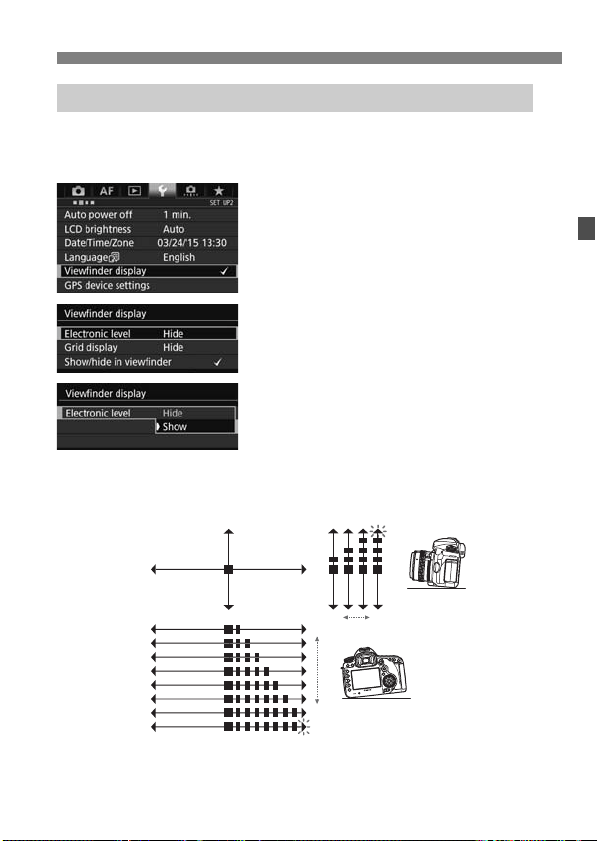
An electronic level can be displayed on the upper part of the viewfinder.
Since this can be displayed while you shoot, you can correct the
camera tilt while shooting.
1
Select [Viewfinder display].
Under the [52] tab, select
[Viewfinder display], then press
<0>.
2
Select [Electronic level].
3
Select [Show].
4
Press the shutter button halfway.
X The electronic level will be displayed
in the viewfinder.
This also works with vertical shooting.
3 Displaying the Electronic Level in the Viewfinder
1°
1°
7°
or greater
or greater
7.5°
4°
66
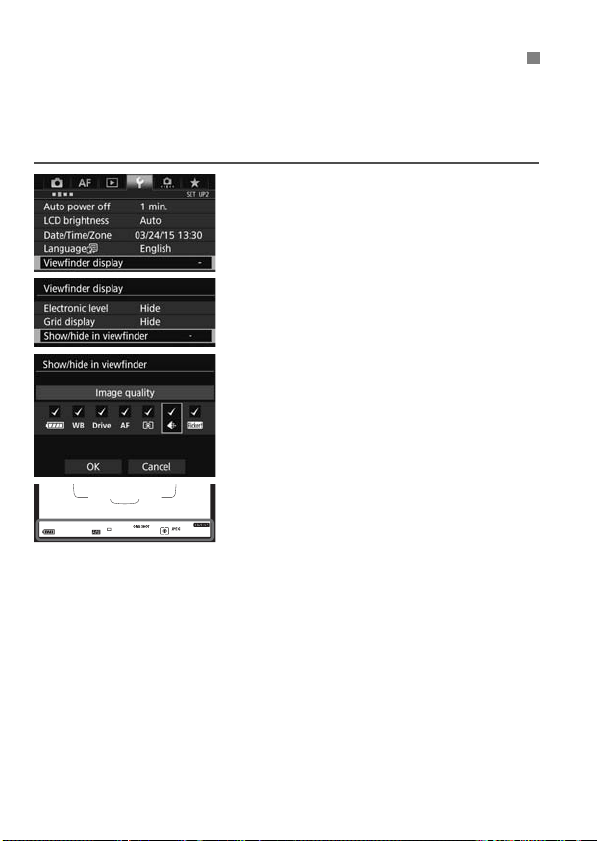
The shooting function settings (Battery, White balance, Drive mode, AF
operation, Metering mode, Image quality: JPEG/RAW, Flicker
detection) can be displayed in the viewfinder.
By default, only Flicker detection is checkmarked [X].
1
Select [Viewfinder display].
Under the [52] tab, select
[Viewfinder display], then press
<0>.
2
Select [Show/hide in viewfinder].
3
Checkmark [X] the information to
be displayed.
Select the information to display and
press <0> to append a checkmark
<X>.
Repeat this procedure to append a
checkmark [X] to all the information
to be displayed. Then select [OK].
X When you exit the menu, the
checkmarked information will appear
in the viewfinder.
3
Setting the Viewfinder Information Display
N
67
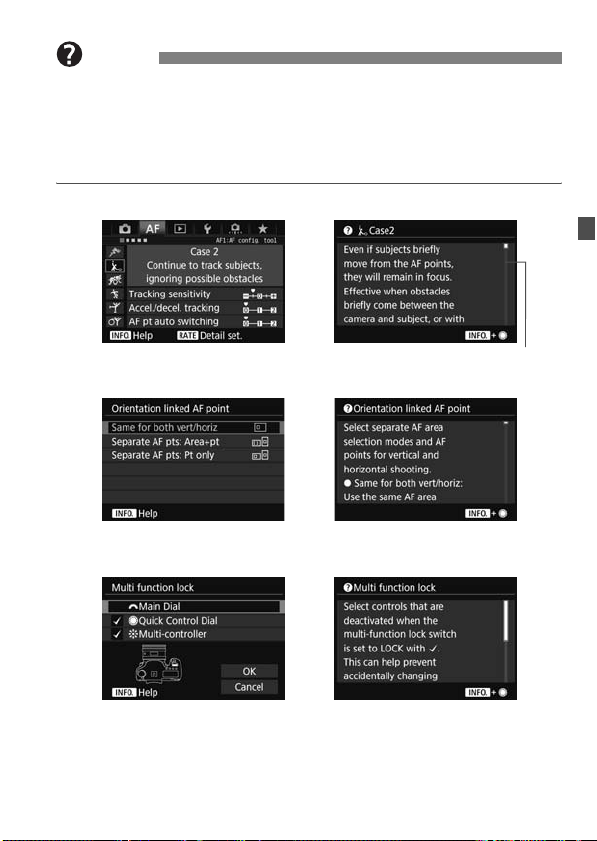
When [z Help] is displayed at the bottom of the menu screen, the
feature’s description (Help) can be displayed. The Help screen is
displayed only while you hold down the <B> button. If the Help fills
more than one screen, a scroll bar will appear on the right edge. To
scroll, hold down the <B> button and turn the <5> dial.
Example: [21: Case2]
Example: [24: Orientation linked AF point]
Example: [83: Multi function lock]
Help
B
Î
Scroll bar
B
Î
B
Î
68
MEMO
69
2
Basic Shooting
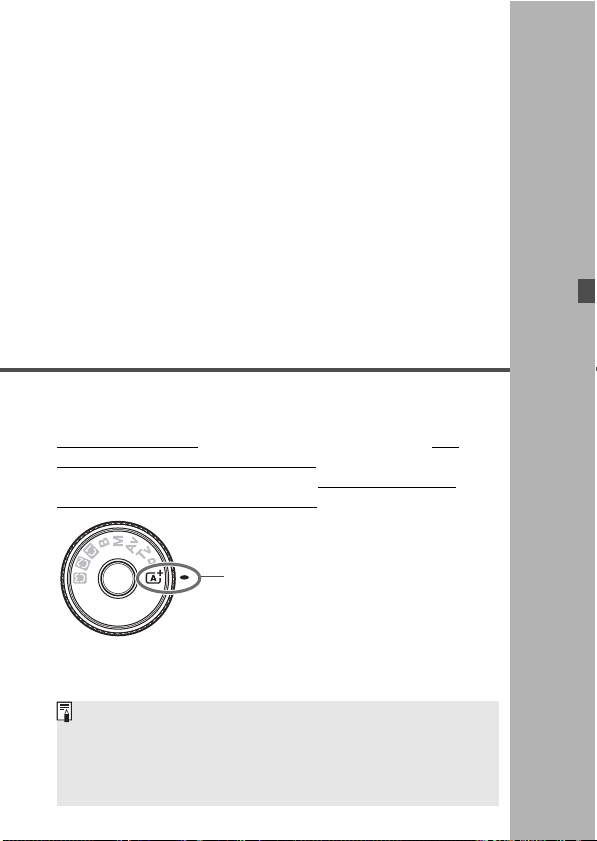
This chapter explains how to use the Mode Dial’s <A>
(Scene Intelligent Auto) mode for easy picture taking.
In the <A> mode, all you do is point and shoot and the
camera sets everything automatically. Also, to prevent botched
pictures due to mistaken operations, advanced shooting
function settings cannot be changed.
Scene Intelligent Auto
Auto Lighting Optimizer
In the <A> mode, the Auto Lighting Optimizer (p.104) will adjust
the image automatically to obtain the optimum brightness and
contrast. It is also enabled by default in the <d>, <s>, or
<f> mode.
70
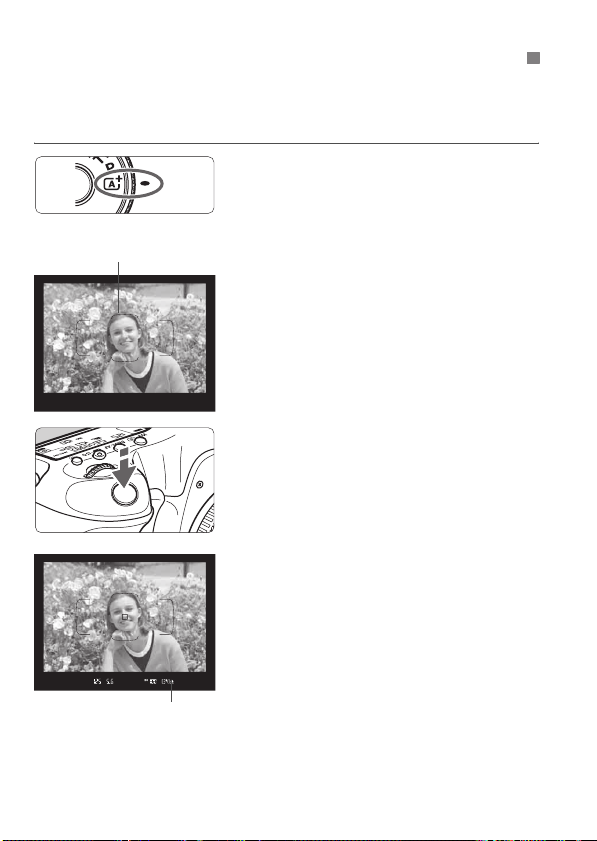
<A> is a fully automatic mode. The camera analyzes the scene
and sets the optimum settings automatically. It also adjusts focus
automatically by detecting whether the subject is still or moving (p.73).
1
Set the Mode Dial to <A>.
Turn the Mode Dial while holding
down the lock release button at the
center.
2
Aim the Area AF frame over the
subject.
All the AF points will be used to focus,
and the camera will focus on the
closest object.
Aiming the center of the Area AF
frame over the subject will make
focusing easier.
3
Focus on the subject.
Press the shutter button halfway. The
lens elements will shift to focus.
X During the autofocus operation,
<e> will be displayed.
X The AF point that achieves focus will
be displayed. At the same time, the
beeper will sound and the focus
indicator <o> will light up.
X In low light, the AF point(s) will light
up briefly in red.
A
Fully Automatic Shooting (Scene Intelligent Auto)
Area AF frame
Focus indicator
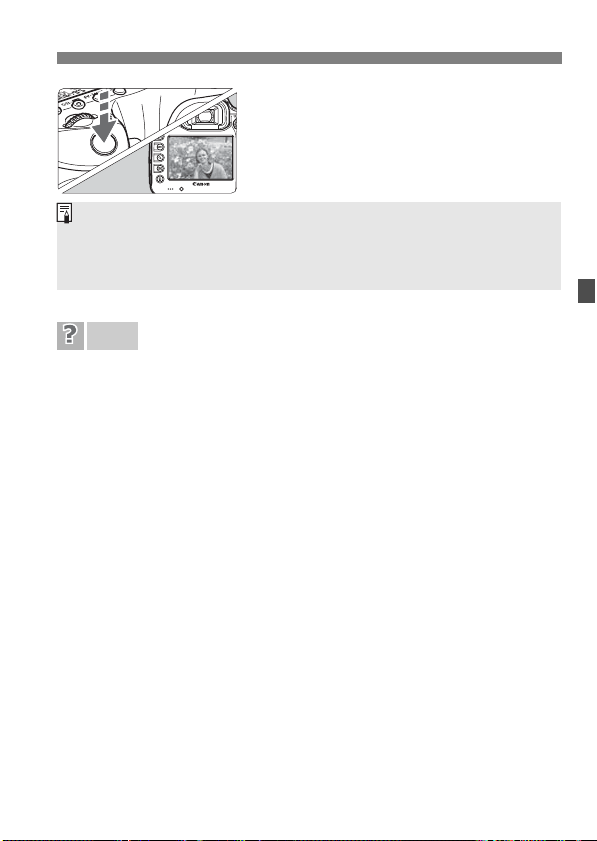
71
A Fully Automatic Shooting (Scene Intelligent Auto)
4
Take the picture.
Press the shutter button completely to
take the picture.
X The captured image will be displayed
for 2 sec. on the LCD monitor.
The focus indicator <o> blinks and focus is not achieved.
Aim the Area AF frame over an area with good contrast, then press
the shutter button halfway (p.47). If you are too close to the subject,
move away and try again. If focus cannot be achieved, the AF status
indicator <e> will also blink.
When focus is achieved, the AF points do not light up in red.
The AF points light up in red only when focus is achieved in low-light
conditions.
Multiple AF points light up simultaneously.
Focus has been achieved at all those points. You can take the
picture as long as an AF point covering the target subject is lighting
up.
The beeper continues to beep softly. (The focus indicator <o>
does not light up.)
It indicates that the camera is focusing continuously on a moving
subject. (The AF status indicator <e> lights up, but the focus
confirmation light <o> does not light up.) You can take sharp
pictures of a moving subject.
Note that focus lock (p.73) will not work in this case.
FAQ
The <A> mode makes the colors look more impressive in nature, outdoor,
and sunset scenes. If you did not obtain the desired color tones, change the
mode to <d>, <s>, <f>, or <a>, set a Picture Style other than
<D>, then shoot again (p.102).

A Fully Automatic Shooting (Scene Intelligent Auto)
72
Pressing the shutter button halfway does not focus on the
subject.
If the focus mode switch on the lens is set to <MF> (manual focus),
set it to <AF> (autofocus).
The shutter speed display is blinking.
Since it is too dark, taking the picture may result in a blurred subject
due to camera shake. Using a tripod or a Canon EX-series Speedlite
(sold separately) is recommended.
When the external flash was used, the bottom part of the
picture came out unnaturally dark.
If a hood is attached to the lens, it can obstruct the flash light. If the
subject is close, detach the hood before taking the picture with flash.
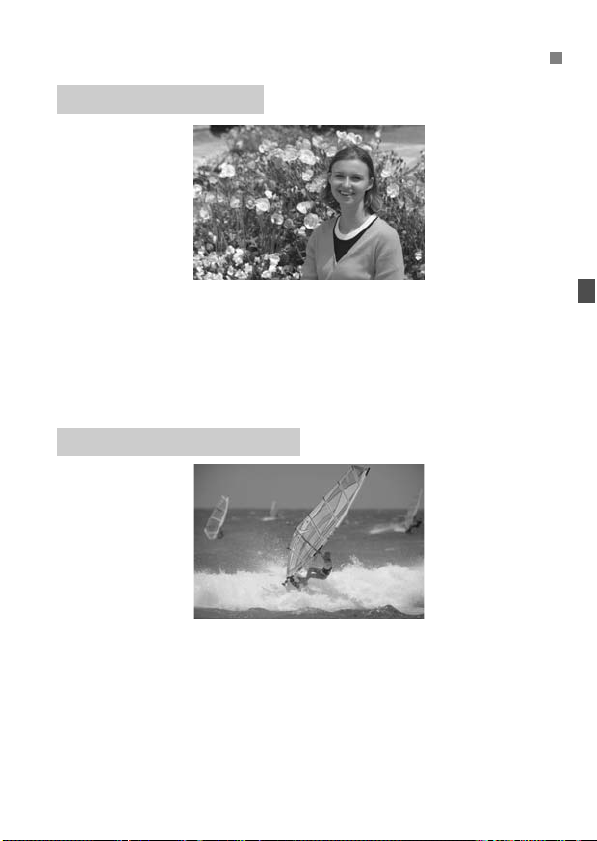
73
Depending on the scene, position the subject toward the left or right to
create a balanced background and good perspective.
In the <A> mode, pressing the shutter button halfway to focus on a
still subject will lock the focus on that subject. Recompose the shot
while keeping the shutter button pressed halfway, and then press the
shutter button completely to take the picture. This is called “focus lock”.
In the <A> mode, if the subject moves (distance to camera changes)
while or after you focus, AI Servo AF will take effect to focus on the
subject continuously. (The beeper will continue beeping softly.) As long
as you keep the Area AF frame positioned over the subject while
pressing the shutter button halfway, the focusing will be continuous.
When you want to take the picture, press the shutter button completely.
A
Full Auto Techniques (Scene Intelligent Auto)
Recomposing the Shot
Shooting a Moving Subject
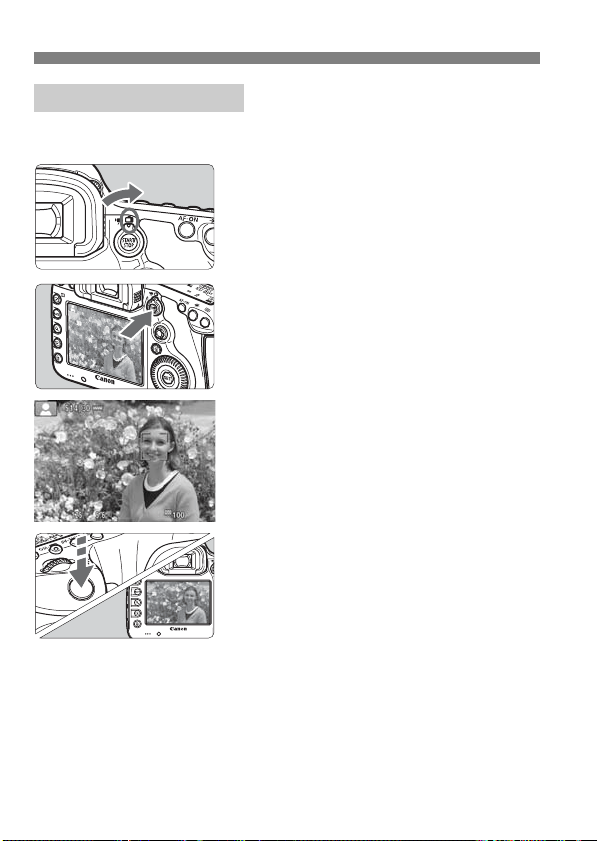
A Full Auto Techniques (Scene Intelligent Auto)
74
You can shoot while viewing the image on the LCD monitor. This is
called “Live View shooting”. For details, see page 121.
1
Set the Live View shooting/Movie
shooting switch to <A>.
2
Display the Live View image on
the LCD monitor.
Press the <0> button.
X The Live View image will appear on
the LCD monitor.
3
Focus on the subject.
Press the shutter button halfway to
focus.
X When focus is achieved, the AF point
will turn green and the beeper will
sound.
4
Take the picture.
Press the shutter button completely.
X The picture is taken and the captured
image is displayed on the LCD
monitor.
X When the playback display ends, the
camera will return to Live View
shooting automatically.
Press the <0> button to exit the
Live View shooting.
A Live View Shooting
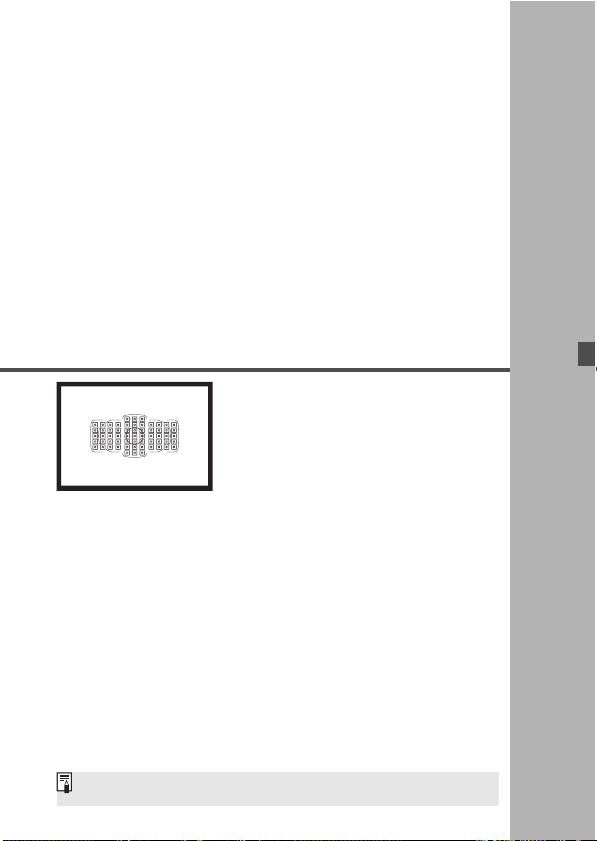
75
3
Setting the AF and
Drive Modes
The AF points in the viewfinder
are arranged to make AF shooting
suitable for a wide variety of
subjects and scenes.
You can also select the AF operation and drive mode
that best match the shooting conditions and subject.
A M icon at the upper right of a page title indicates a
function that can be used only in the following modes: <d>
<s> <f> <a> <F>.
In the <A> mode, the AF operation and AF area selection
mode are set automatically.
<AF> stands for autofocus. <MF> stands for manual focus.
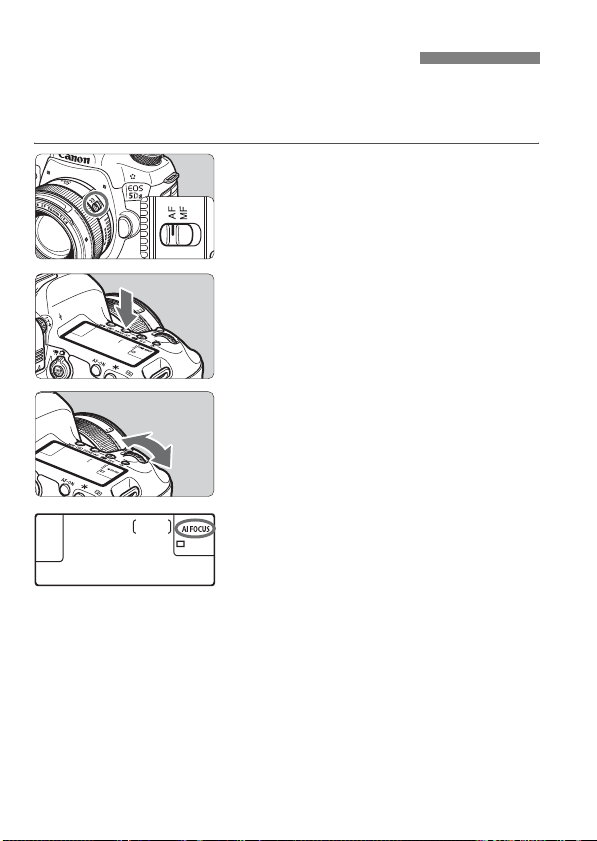
76
You can select the AF operation characteristics to suit the shooting
conditions or subject. In the <A> mode, “AI Focus AF” is set
automatically.
1
Set the lens’s focus mode switch
to <AF>.
2
Set the <d> <s> <f> <a>
<F> mode.
3
Press the <o > button. (9)
4
Select the AF operation.
While looking at the LCD panel or in
the viewfinder, turn the <6> dial.
X : One-Shot AF
9 : AI Focus AF
Z : AI Servo AF
f: Selecting the AF OperationN
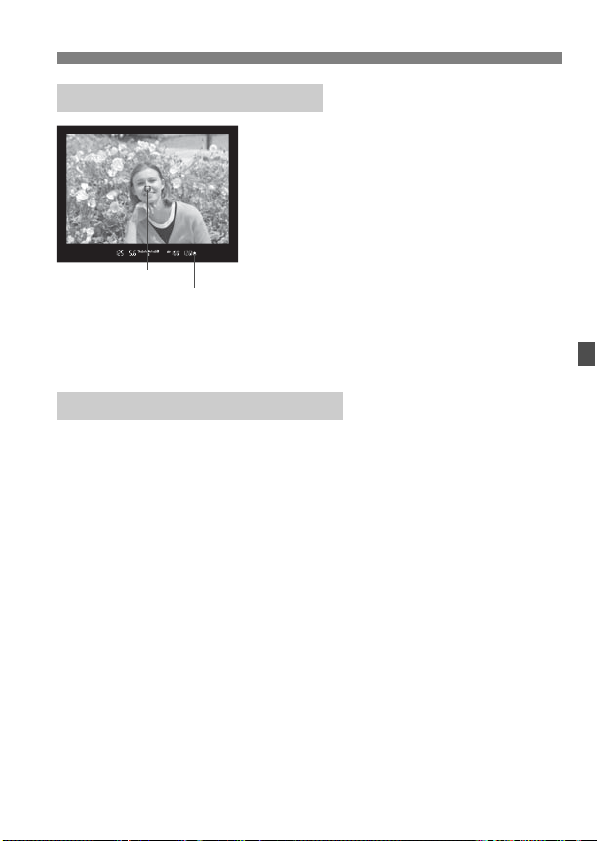
77
f: Selecting the AF OperationN
Suited for still subjects. When you
press the shutter button halfway, the
camera will focus only once.
When focus is achieved, the AF point
that achieved focus will be displayed,
and the focus indicator <o> in the
viewfinder will also light up.
With evaluative metering (p.117), the
exposure setting will be set at the
same time as focus is achieved.
While you hold down the shutter button halfway, the focus will be
locked. You can then recompose the shot if desired.
This AF operation is suited for moving subjects when the focusing
distance keeps changing. While you hold down the shutter button
halfway, the camera will keep focusing on the subject continuously.
The exposure is set at the moment the picture is taken.
When the AF area selection mode (p.79) is set to 61-point automatic
selection AF, focus tracking will continue as long as the Area AF
frame covers the subject.
One-Shot AF for Still Subjects
Focus indicator
AF point
AI Servo AF for Moving Subjects
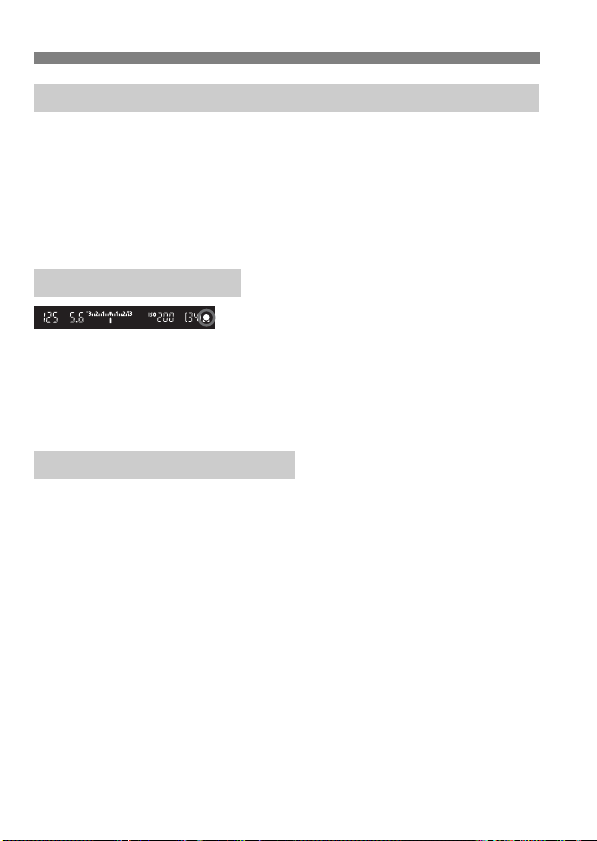
f: Selecting the AF OperationN
78
AI Focus AF switches the AF operation from One-Shot AF to AI
Servo AF automatically if a still subject starts moving.
After the subject is focused in One-Shot AF, if the subject starts
moving, the camera will detect the movement, change the AF
operation automatically to AI Servo AF, and start tracking the moving
subject.
While you press the shutter button
halfway and the camera focuses with AF,
the <e> icon will appear under the
focus indicator in the viewfinder.
In One-Shot AF mode, the icon also appears if you press the shutter
button halfway after focus is achieved.
By default, the AF points light up in red in low-light conditions.
AI Focus AF for Switching the AF Operation Automatically
AF Operation Indicator
AF Points Lighting Up in Red
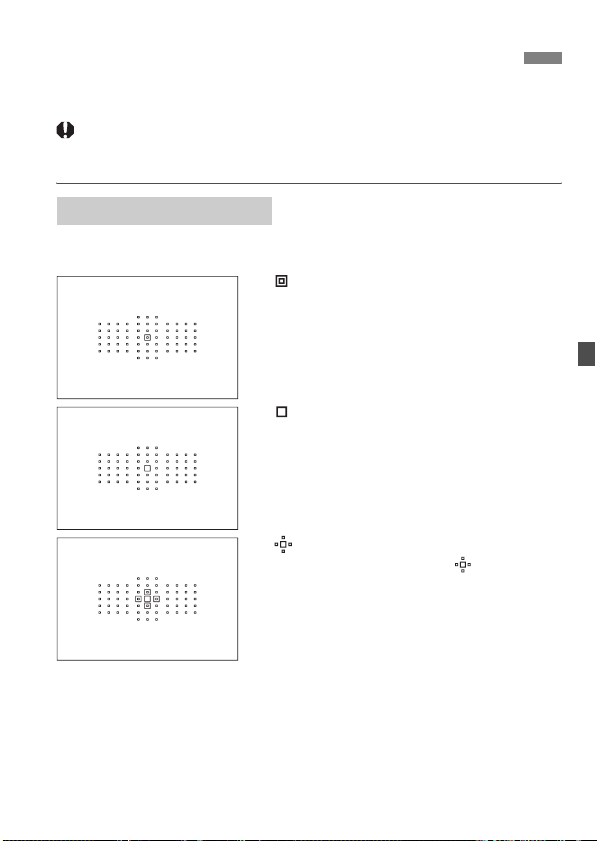
79
The camera has 61 AF points for autofocusing. You can select the AF
area selection mode and AF point(s) suiting the scene or subject.
Depending on the lens attached to the camera, the number of
usable AF points and AF point patterns will differ. For details,
see “Lenses and Usable AF Points” on page 84.
You can select one of six AF area selection modes. For the setting
procedure, see page 81.
Single-point Spot AF
(Manual selection)
For pinpoint focusing.
Single-point AF
(Manual selection)
Select one AF point to focus.
AF point expansion
(Manual selection )
The manually-selected AF point <S>
and four adjacent AF points <w> (above,
below, on the left, and on the right) are
used to focus.
S Selecting the AF Area and AF PointN
AF Area Selection Mode
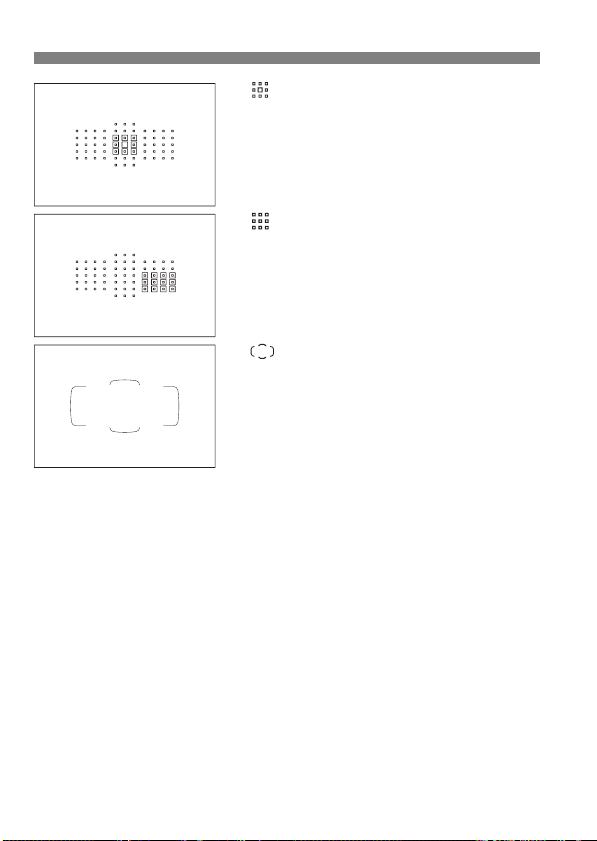
S Selecting the AF Area and AF PointN
80
AF point expansion (Manual
selection, surrounding points)
The manually-selected AF point <S>
and the surrounding AF points <w> are
used to focus.
Zone AF
(Manual selection of zone)
One of nine zones is used to focus.
61-point automatic selection
AF
The Area AF frame (entire AF area) is
used to focus. This mode is set
automatically in the <A> mode.
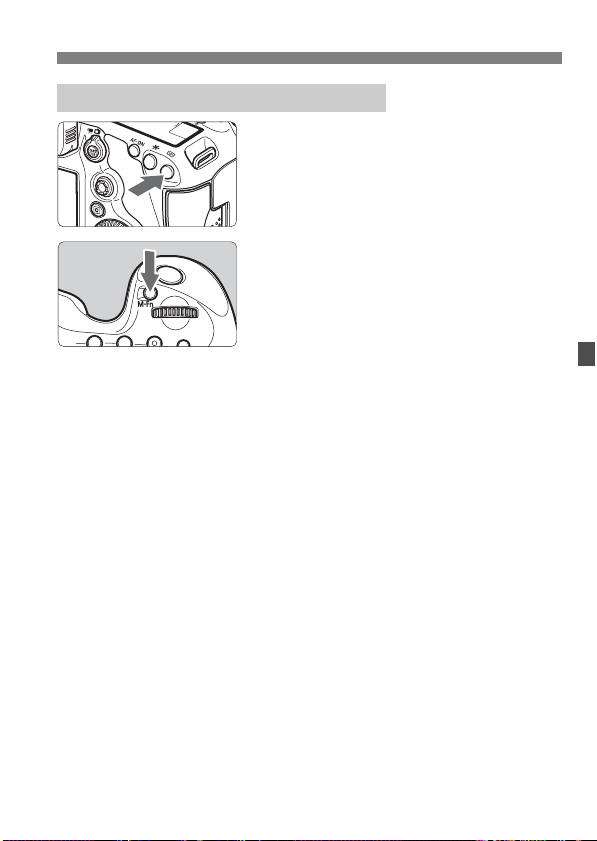
81
S Selecting the AF Area and AF PointN
1
Press the <S> button. (9)
2
Press the <B> button.
Look through the viewfinder and
press the <B> button.
Each time you press the <B>
button, the AF area selection mode
changes.
Selecting the AF Area Selection Mode
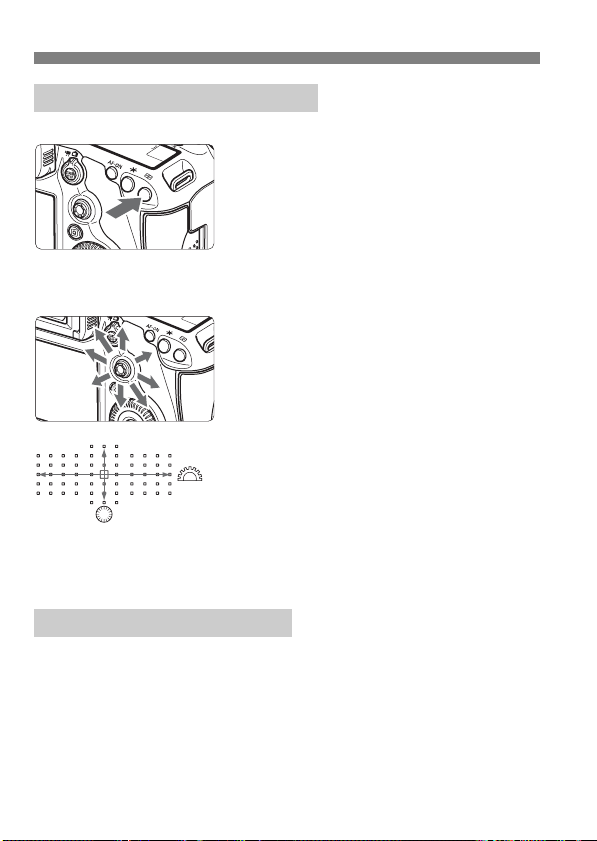
S Selecting the AF Area and AF PointN
82
You can manually select the AF point or zone.
1
Press the <S> button. (9)
X The AF points will be displayed in the
viewfinder.
In AF point expansion modes,
adjacent AF points will also be
displayed.
In the Zone AF mode, the selected
zone will be displayed.
2
Select an AF point.
The AF point selection will change in
the direction you tilt <9>. If you
press <9> straight down, the center
AF point (or center zone) will be
selected.
You can also select a horizontal AF
point by turning the <6> dial and
select a vertical AF point by turning
the <5> dial.
In the Zone AF mode, turning the
<6> or <5> dial will change the
zone in a looping sequence.
Pressing the <S> button lights up the AF points that are cross-type AF
points for high-precision autofocusing. The blinking AF points are
horizontal-line or vertical-line sensitive. For details, see pages 83-88.
Selecting the AF Point Manually
AF Point Display Indications
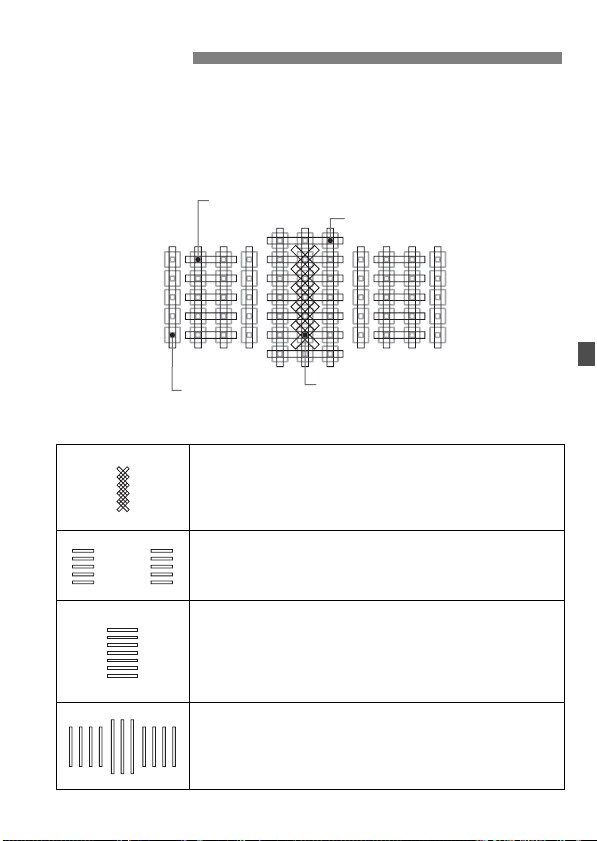
83
The camera’s AF sensor has 61 AF points. The illustration below shows the AF
sensor pattern corresponding to each AF point. With f/2.8 or larger maximum
aperture lenses, high-precision AF is possible at the viewfinder center.
Depending on the lens attached to the camera, the number of usable
AF points and AF pattern will differ. For details, see pages 84
-88
.
AF Sensor
These focusing sensors are geared to obtain higher
precision focusing with f/2.8 or larger maximum aperture
lenses. A diagonal cross pattern makes it easier to focus
subjects that may be difficult to focus. They cover the five
AF points vertically aligned at the center.
These focusing sensors are geared to obtain high-precision
focusing with f/4 or larger maximum aperture lenses. Since
they have a horizontal pattern, they can detect vertical
lines.
These focusing sensors are geared for f/5.6 or larger
maximum aperture lenses. Since they have a horizontal
pattern, they can detect vertical lines. They cover the three
columns of AF points at the viewfinder’s center. The center AF
point and the adjacent AF points at the top and bottom are
compatible with f/8 or larger maximum-aperture lenses.
These focusing sensors are geared for f/5.6 or larger maximum
aperture lenses. Since they have a vertical pattern, they can
detect horizontal lines. They cover all 61 AF points. The center
AF point and the adjacent AF points on the left and on the right
are compatible with f/8 or larger maximum-aperture lenses.
Diagram
Cross-type focusing: f/4 horizontal + f/5.6 vertical
Dual cross-type focusing:
f/2.8 right diagonal + f/2.8 left diagonal
f/5.6 vertical + f/5.6 horizontal
f/5.6 vertical
focusing
Cross-type focusing:
f/5.6 vertical + f/5.6 horizontal
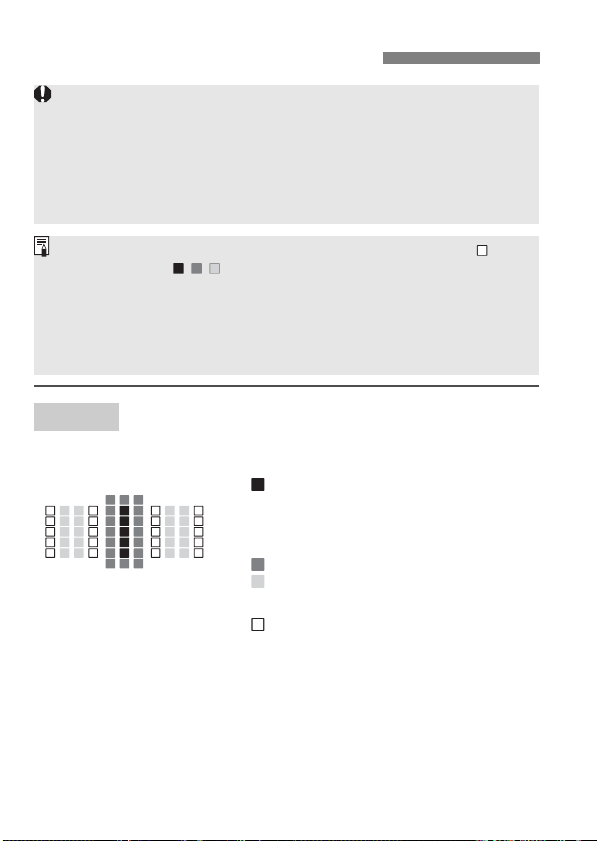
84
Autofocusing with 61 points is possible. All the AF area selection modes
are selectable.
: Dual cross-type AF point. Subject
tracking is superior and the focusing
precision is higher than with other AF
points.
: Cross-type AF point. Subject
tracking is superior and high-
precision focusing is achieved.
: AF points sensitive to horizontal
lines.
Lenses and Usable AF Points
Group A
Although the camera has 61 AF points, the number of usable AF
points and focusing patterns will differ depending on the lens. The
lenses are thereby classified into nine groups from A to I.
When using a lens in Groups F to H, fewer AF points will be usable.
To see which group a lens belongs to, refer to “Camera Instruction
Manual” (PDF file, p.154) on the Camera Instruction Manual CD-
ROM.
When you press the <S> button, the AF points indicated by the mark
will blink. (The / / AF points will stay lit.) Regarding lighting up or
blinking of the AF points, see page 82.
Regarding new lenses marketed after the EOS 5DS/EOS 5DS R (in the
first half of 2015), check the Canon Web site to see which group they
belong to.
Some lenses may not be available in certain countries or regions.
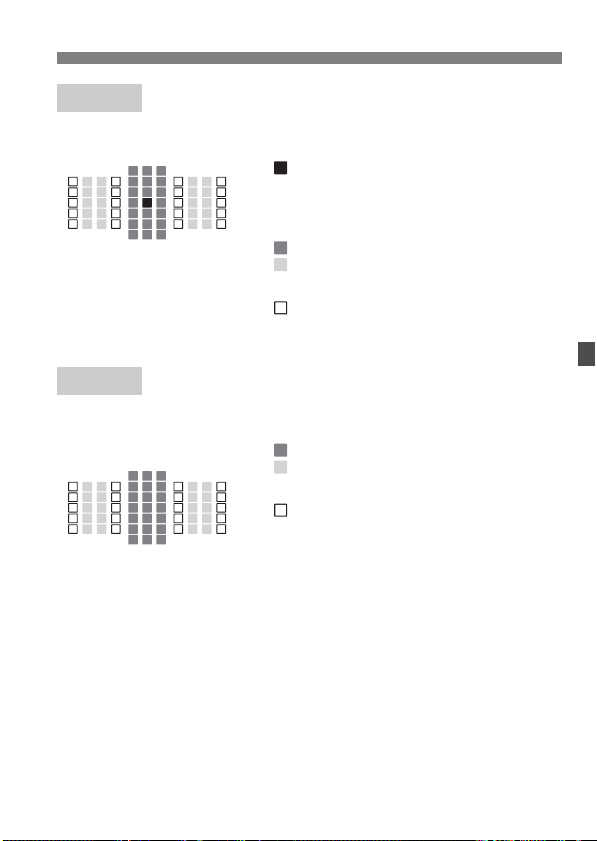
85
Lenses and Usable AF Points
Autofocusing with 61 points is possible. All the AF area selection modes
are selectable.
: Dual cross-type AF point. Subject
tracking is superior and the focusing
precision is higher than with other AF
points.
: Cross-type AF point. Subject
tracking is superior and high-
precision focusing is achieved.
: AF points sensitive to horizontal
lines.
Autofocusing with 61 points is possible. All the AF area selection modes
are selectable.
: Cross-type AF point. Subject
tracking is superior and high-
precision focusing is achieved.
: AF points sensitive to horizontal
lines.
Group B
Group C
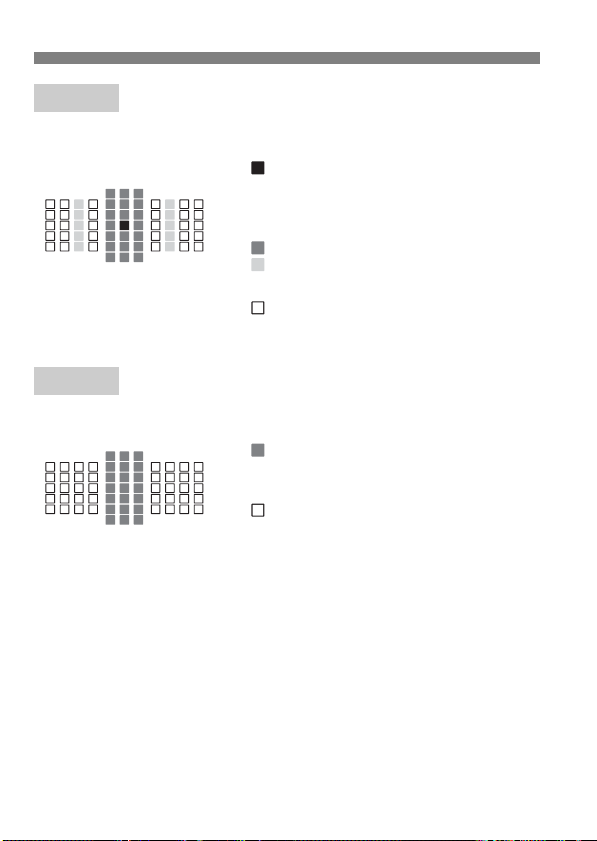
Lenses and Usable AF Points
86
Autofocusing with 61 points is possible. All the AF area selection modes
are selectable.
: Dual cross-type AF point. Subject
tracking is superior and the focusing
precision is higher than with other AF
points.
: Cross-type AF point. Subject
tracking is superior and high-
precision focusing is achieved.
: AF points sensitive to horizontal
lines.
Autofocusing with 61 points is possible. All the AF area selection modes
are selectable.
: Cross-type AF point. Subject
tracking is superior and high-
precision focusing is achieved.
: AF points sensitive to horizontal
lines.
Group D
Group E
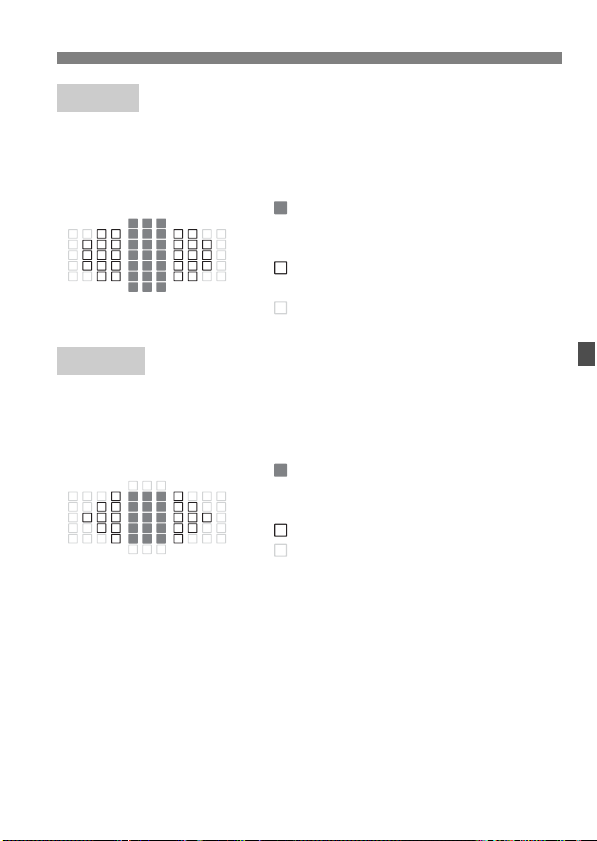
87
Lenses and Usable AF Points
Autofocusing with only 47 points is possible. (Not possible with all 61
AF points.) All the AF area selection modes are selectable. During
automatic AF point selection, the outer frame marking the AF area
(Area AF frame) will be different from 61-point automatic selection AF.
: Cross-type AF point. Subject
tracking is superior and high-
precision focusing is achieved.
: AF points sensitive to horizontal
lines.
: Disabled AF points (not displayed).
Autofocusing with only 33 points is possible. (Not possible with all 61
AF points.) All the AF area selection modes are selectable. During
automatic AF point selection, the outer frame marking the AF area
(Area AF frame) will be different from 61-point automatic selection AF.
: Cross-type AF point. Subject
tracking is superior and high-
precision focusing is achieved.
:
AF points sensitive to horizontal lines.
: Disabled AF points (not displayed).
Group F
Group G
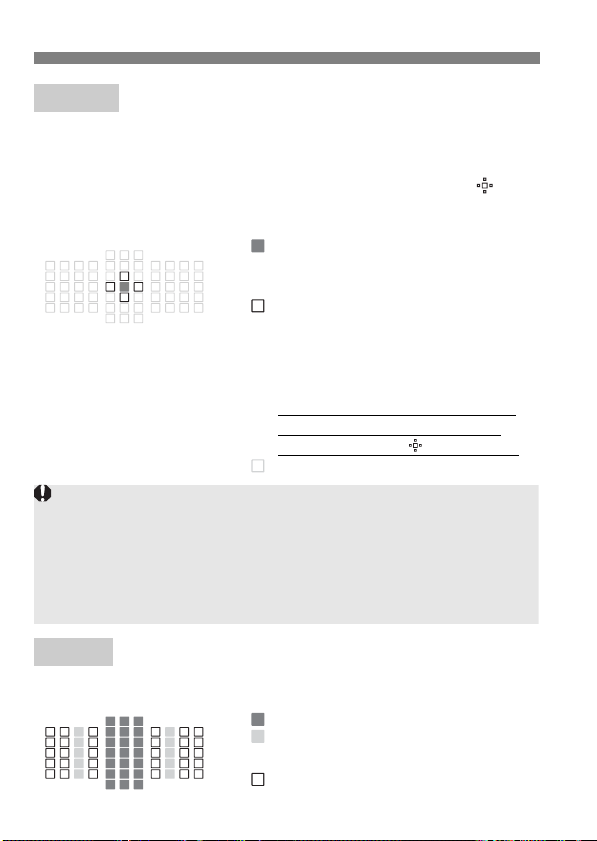
Lenses and Usable AF Points
88
AF is possible with the center AF point and the adjacent AF points above,
below, on the left, and on the right. Only the following AF area selection
modes are selectable: Single-point AF (manual selection), Single-point Spot
AF (manual selection), and AF point expansion (manual selection ).
If an Extender is attached to the lens and the maximum aperture is f/8
(between f/5.6 and f/8), AF will be possible.
: Cross-type AF point. Subject
tracking is superior and high-
precision focusing is achieved.
: AF points sensitive to vertical lines
(top and bottom AF points adjacent
to the center AF point) or horizontal
lines (left and right AF points
adjacent to the center AF point).
Not manually selectable. It works
only when “AF point expansion
(manual selection )” is selected.
: Disabled AF points (not displayed).
Autofocusing with 61 points is possible. All the AF area selection modes
are selectable.
: Cross-type AF point. Subject
tracking is superior and high-
precision focusing is achieved.
:
AF points sensitive to horizontal lines
.
Group H
Group I
If the maximum aperture is smaller than f/5.6 (maximum aperture
number is between f/5.6 and f/8), focus may not be achieved with AF
when shooting low-contrast or low-light subjects.
When Extender EF2x is attached to the EF180mm f/3.5L Macro USM
lens, AF is not possible.
If the maximum aperture is smaller than f/8 (maximum aperture number
exceeds f/8), AF is not possible during viewfinder shooting.
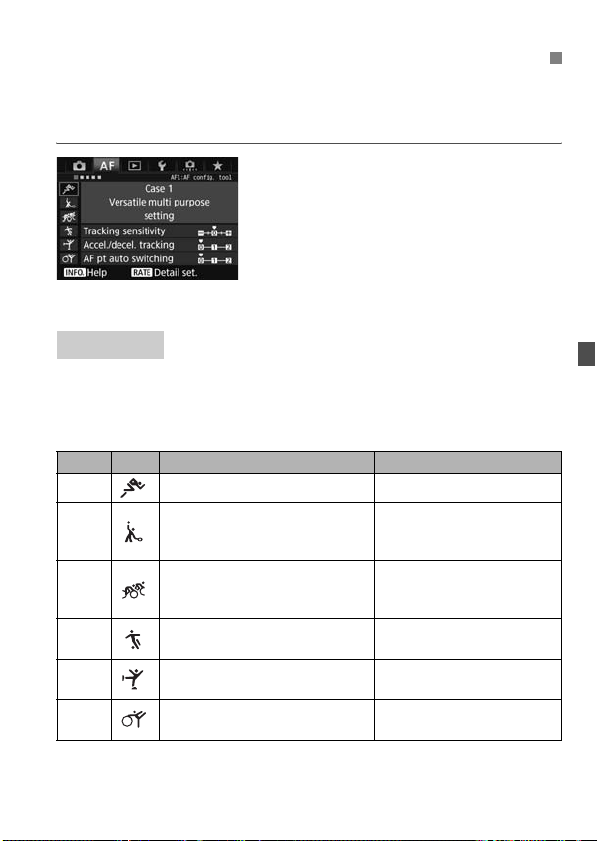
89
You can easily fine-tune AI Servo AF to suit a particular subject or
shooting scene just by selecting an option from case 1 to case 6. This
feature is called the “AF Configuration Tool.”
1
Select the [21] tab.
2
Select a case.
Turn the <5> dial to select a case
icon, then press <0>.
X The selected case will be set. The
selected case is indicated in blue.
Case 1 to 6 are six setting combinations of “Tracking sensitivity”,
“Acceleration/deceleration tracking”, and “AF point auto switching”.
Refer to the table below to select the case applicable to the subject or
shooting scene.
3
Selecting AI Servo AF Characteristics
N
Case 1 to 6
Case Icon Description Applicable Subjects
Case 1 Versatile multi purpose setting For any moving subject.
Case 2
Continue to track subjects,
ignoring possible obstacles
Tennis players, butterfly
swimmers, freestyle skiers,
etc.
Case 3
Instantly focus on subjects
suddenly entering AF points
Starting line of a bicycle
race, alpine downhill skiers,
etc.
Case 4
For subjects that accelerate or
decelerate quickly
Soccer, motor sports,
basketball, etc.
Case 5
For erratic subjects moving
quickly in any direction
Figure skaters, etc.
Case 6
For subjects that change speed
and move erratically
Rhythm gymnastics, etc.
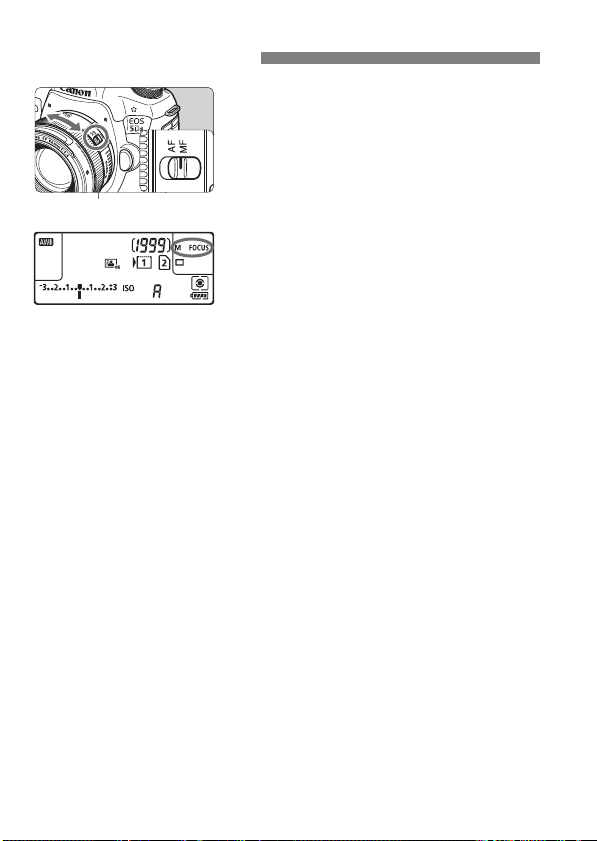
90
1
Set the lens’s focus mode switch
to <MF>.
X <4 L> will be displayed on the
LCD panel.
2
Focus on the subject.
Focus by turning the lens’s focusing
ring until the subject looks sharp in
the viewfinder.
MF: Manual Focus
Focusing ring
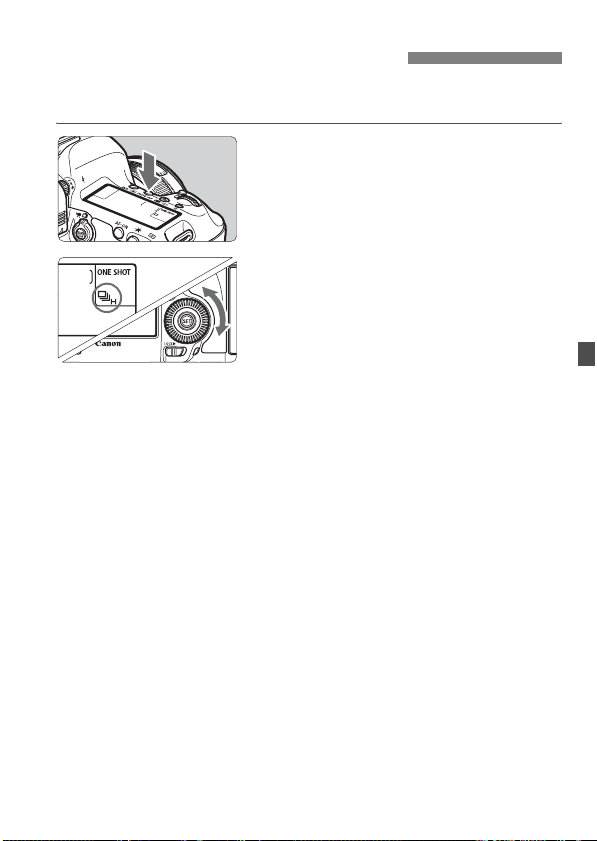
91
Single and continuous drive modes are provided. You can select the
drive mode suiting the scene or subject.
1
Press the <o > button. (9)
2
Select the drive mode.
While looking at the LCD panel or in
the viewfinder, turn the <5> dial.
u : Single shooting
When you press the shutter button completely, only one shot will
be taken.
o: High-speed continuous shooting
While you hold down the shutter button completely, the camera
will shoot continuously at a maximum of approx. 5.0 shots/sec.
i : Low-speed continuous shooting
While you hold down the shutter button completely, the camera
will shoot continuously at a maximum of approx. 3.0 shots/sec.
B : Silent single shooting
Single shooting with less shooting sound than <u> during
viewfinder shooting.
M : Silent continuous shooting
Continuous shooting with less shooting sound than <i> during
viewfinder shooting. The camera will shoot continuously at a
maximum of approx. 3.0 shots/sec.
Q : 10-sec. self-timer/remote control
k: 2-sec. self-timer/remote control
o Selecting the Drive Mode
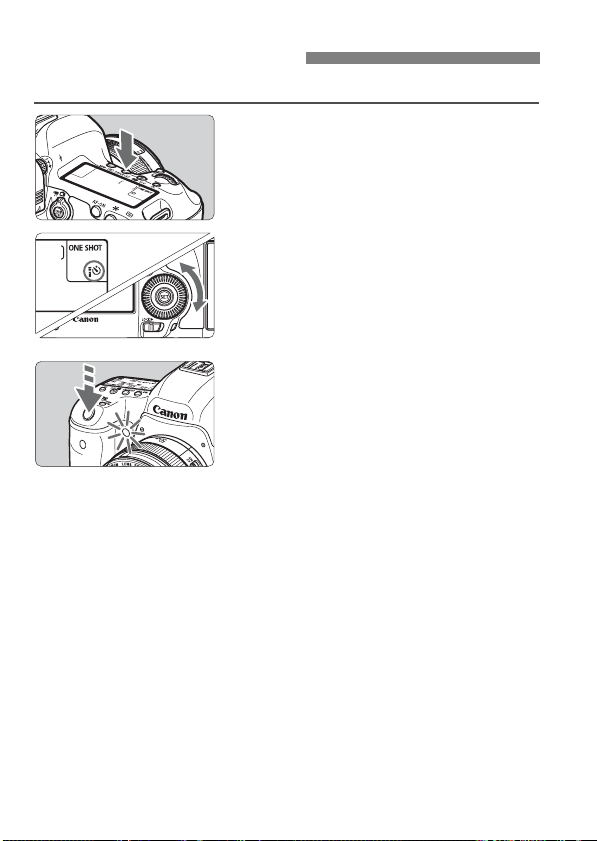
92
Use the self-timer when you want to be in the picture.
1
Press the <o > button. (9)
2
Select the self-timer.
While looking at the LCD panel or in
the viewfinder, turn the <5> dial.
Q : 10-sec. self-timer
k : 2-sec. self-timer
3
Take the picture.
Look through the viewfinder, focus on
the subject, then press the shutter
button completely.
X You can check the self-timer
operation with the self-timer lamp,
beeper, and countdown display (in
seconds) on the LCD panel.
X 2 sec. before the picture is taken, the
self-timer lamp will light up and the
beeper will sound faster.
j Using the Self-timer
93
4
Image Settings
This chapter explains image-related function settings:
Image-recording quality, Crop/aspect, ISO speed,
Picture Style, white balance, Auto Lighting Optimizer,
noise reduction, highlight tone priority, lens aberration
correction, anti-flicker shooting, and other functions.
A M icon at the upper right of a page title indicates a
function that can be used only in the following modes: <d>
<s> <f> <a> <F>.
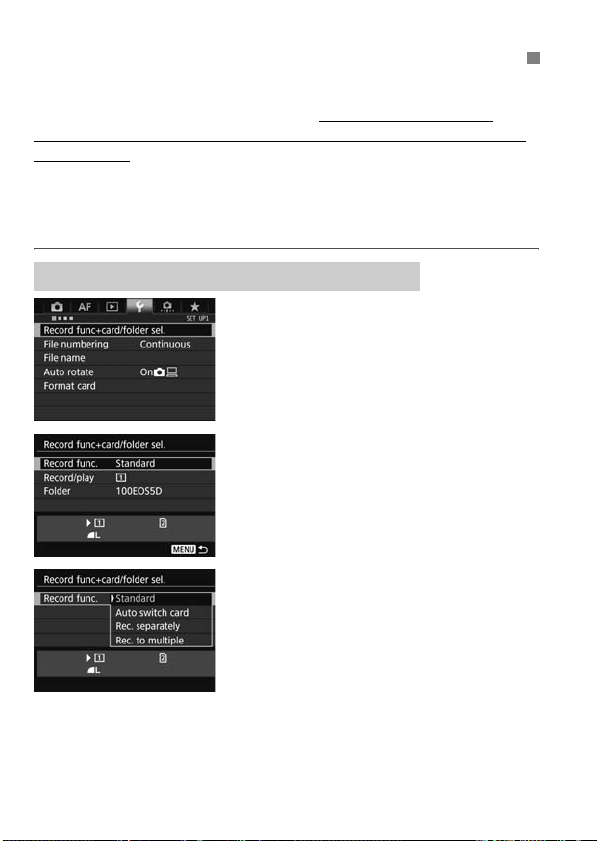
94
If either a CF card or SD card is already inserted in the camera, you
can start recording captured images. When only one card is
inserted, you do not have to follow the procedures described on
pages 94-96.
If you insert both a CF card and SD card, you can select the recording
method and select which card to use for recording and playing back
images.
[f] indicates the CF card, and [g] the SD card.
1
Select [Record func+card/folder
sel.].
Under the [51] tab, select [Record
func+card/folder sel.], then press
<0>.
2
Select [Record func.].
3
Select the recording method.
Select the recording method, then
press <0>.
3
Selecting the Card for Recording and Playback
Recording Method with Two Cards Inserted
95
3 Selecting the Card for Recording and Playback
Standard
Images will be recorded to the card selected with [Record/play].
Auto switch card
Same as with the [Standard] setting, but if the card becomes full,
the camera will automatically switch to the other card to record
images. When the card is automatically switched, a new folder will
be created.
Rec. separately
You can set the image-recording quality for each card (p.97). Each
image is recorded to both the CF and SD cards at the image-
recording quality you set. You can freely set the image-recording
quality, such as to 73 and 1, or c and 41.
Rec. to multiple
Each image is recorded to both the CF and SD cards simultaneously
at the same image size. You can also select RAW+JPEG.
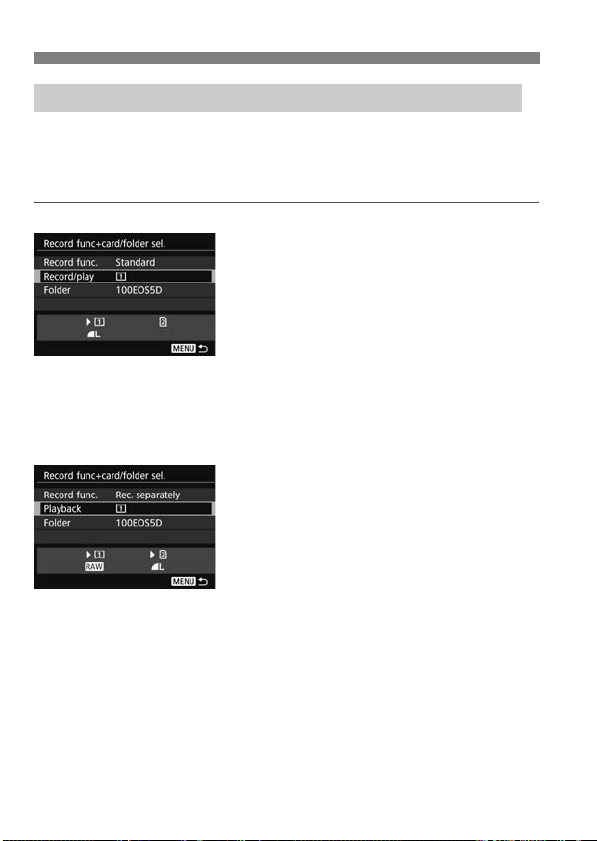
3 Selecting the Card for Recording and Playback
96
If [Record func.] is set to [Standard] or [Auto switch card], select the
card for recording and playing back images.
If [Record func.] is set to [Rec. separately] or [Rec. to multiple],
select the card for playing back images.
Standard / Auto switch card
Select [Record/play].
Select [Record/play], then press
<0>.
f: Record images to and play
images back from the CF
card.
g : Record images to and play
images back from the SD
card.
Select the card, then press <0>.
Rec. separately / Rec. to multiple
Select [Playback].
Select [Playback], then press <0>.
f: Play back the CF card’s
images.
g : Play back the SD card’s
images.
Select the card, then press <0>.
Selecting the CF or SD Card for Recording and Playback
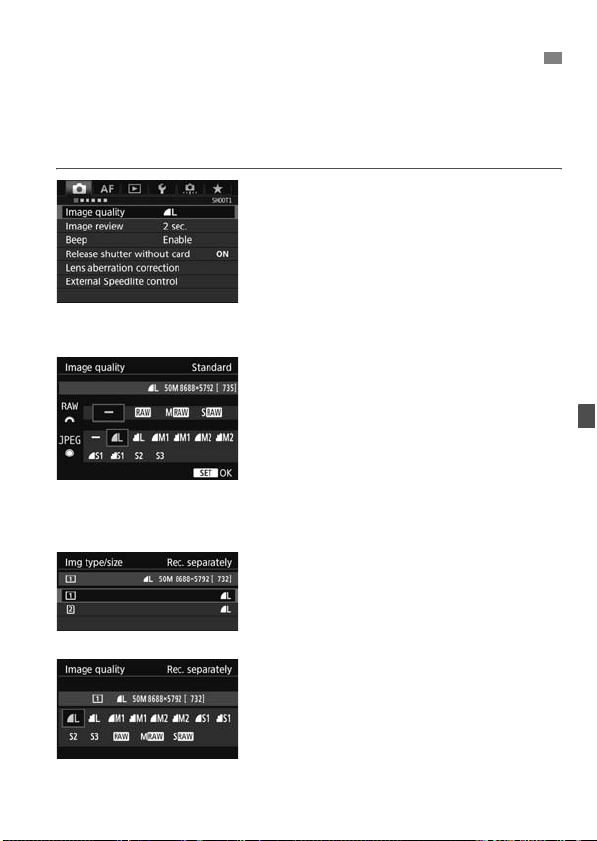
97
You can select the pixel count and the image quality. There are ten
JPEG image-recording quality settings: 73, 83, 7K, 8K, 75,
85, 7a, 8a, b, c. There are three RAW image quality settings:
1, 41, 61.
1
Select [Image quality].
Under the [z1] tab, select [Image
quality], then press <0>.
2
Select the image-recording quality.
To select a RAW quality, turn the
<6> dial. To select a JPEG quality,
turn the <5> dial.
On the upper right, the “**M
(megapixels) ****
x
****” number
indicates the recorded pixel count,
and [***] is the number of possible
shots (displayed up to 9999).
Press <0> to set it.
Under [51: Record func+card/
folder sel.], if [Record func.] is set to
[Rec. separately], select CF card
[f] or SD card [g], then press
<0>.
Select the desired image-recording
quality, then press <0>.
3 Setting the Image-Recording Quality
Standard / Auto switch
card / Rec. to multiple
Rec. separately
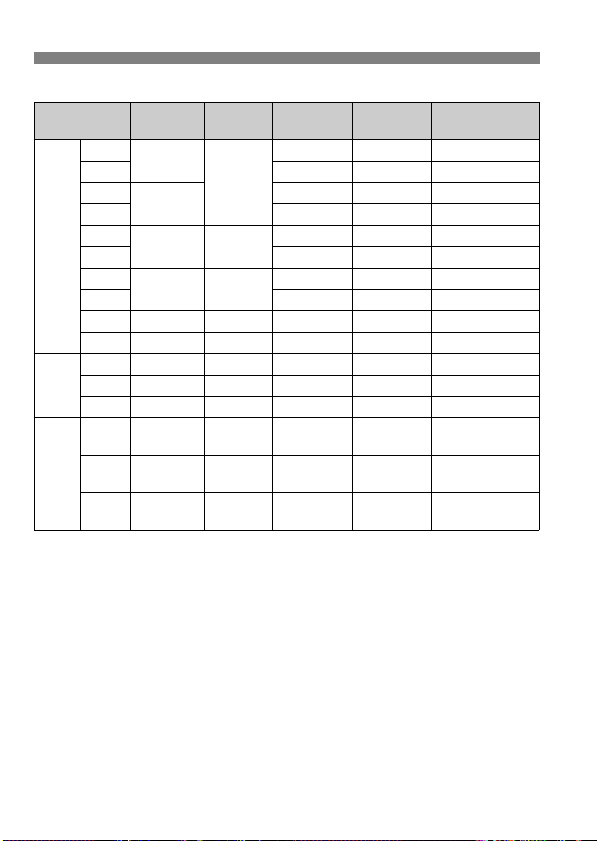
3 Setting the Image-Recording Quality
98
Guide to Image-Recording Quality Settings (Approx.)
*1: b is suitable for playing back the images on a digital photo frame.
*2: c is suitable for emailing the image or using it on a Web site.
b and c will be in 7 (Fine) quality.
The file size, possible shots, and maximum burst during continuous shooting
are based on Canon’s testing standards (Crop/aspect ratio: Full-frame, ISO
100 and Standard Picture Style) using an 8 GB CF card. These figures will
vary by the subject, card brand, crop/aspect ratio, ISO speed, Picture
Style, Custom Functions, and other settings.
The maximum burst applies to <o> high-speed continuous shooting.
Figures in parentheses apply to an Ultra DMA (UDMA) 7 CF card, based on
Canon’s testing standards.
Image
Quality
Pixels
Recorded
Print
Size
File Size
(MB)
Possible
Shots
Maximum
Burst
JPEG
73
50M
A1
14.1 510 31 (510)
83 7.0 1030 1030 (1030)
7K
39M
10.9 660 45 (660)
8K 5.5 1310 1310 (1310)
75
22M A2
7.1 1010 1010 (1010)
85 3.5 2030 2030 (2030)
7a
12M A3
4.5 1590 1590 (1590)
8a 2.3 3120 3120 (3120)
b
*1
2.5M 9x13 cm 1.2 5600 5600 (5600)
c
*2
0.3M - 0.3 20380 20380 (20380)
RAW
1 50M A1 60.5 100 12 (14)
41 28M A2 44.0 140 12 (14)
61 12M A3 29.8 190 14 (15)
RAW
+
JPEG
1
73
50M
50M
A1
A1
60.5+14.1 87 12 (12)
41
73
28M
50M
A2
A1
44.0+14.1 110 11 (12)
61
73
12M
50M
A3
A1
29.8+14.1 140 14 (14)
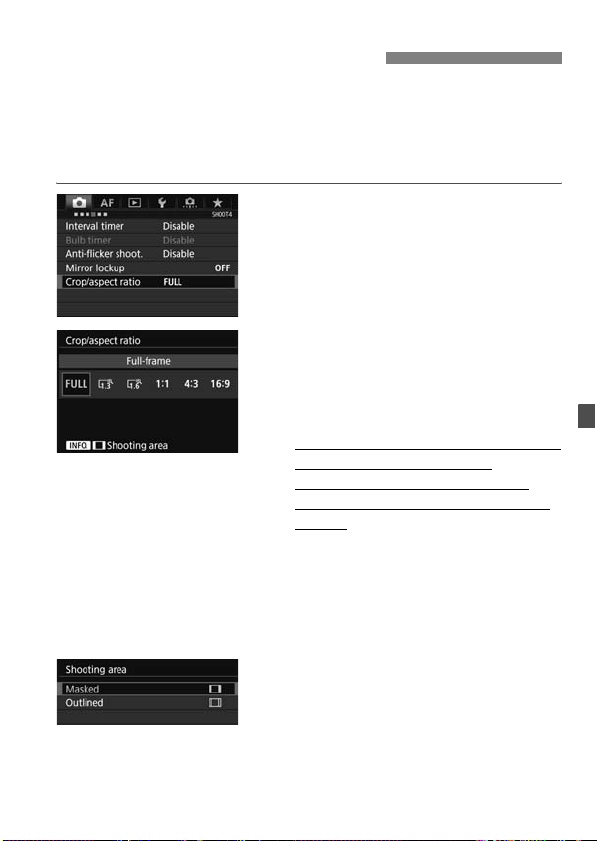
99
Normally, images are recorded at the sensor size of approx. 36.0 mm x
24.0 mm (full-frame shooting). You can record only the center of the
image magnified approx. 1.3x (equivalent to APS-H size) or approx.
1.6x (equivalent to APS-C size) as if you were using a telephoto lens
(crop shooting) or set the desired aspect ratio before you shoot.
1
Select [Crop/aspect ratio].
Under the [z4] tab, select [Crop/
aspect ratio], then press <0>.
2
Select the desired setting.
Viewfinder shooting
Select any of the following: [Full-
frame], [1.3x (crop)], [1.6x (crop)], or
[1:1 (aspect ratio)].
If you set [
4:3 (aspect ratio)] or [16:9
(aspect ratio)] and use the
viewfinder to shoot, the shooting
result will be the same as with [Full-
frame].
Live View shooting (p.122)
You can select any setting.
If you will not change the shooting
area display, press <0> and go to
step 4.
3
Select the shooting area display.
With the screen in step 2 displayed,
press the <B> button.
Select either [Masked] or [Outlined],
then press <0>.
Setting Crop/Aspect RatioN
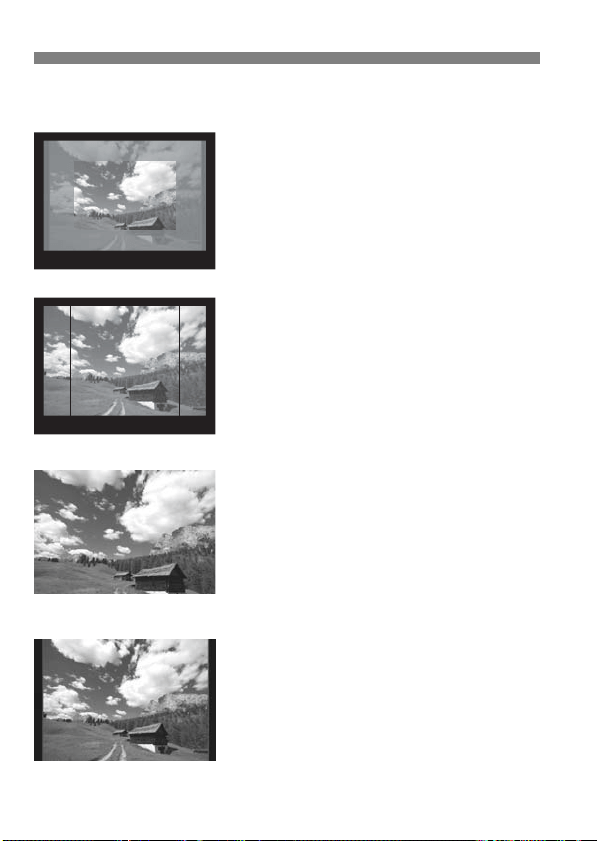
Setting Crop/Aspect RatioN
100
4
Take the picture.
Viewfinder shooting
The shooting area in the viewfinder
will be masked or have frame lines.
The area surrounded by the semi-
transparent masking or frame lines
will be recorded as an image.
Live View shooting
When [1.3x (crop)] or [1.6x (crop)] is
set, the displayed image will be
magnified by approx. 1.3x or 1.6x
respectively.
Regardless of the [Shooting area]
setting, the area shown by the
displayed image will be recorded.
If you select [1:1 (aspect ratio)], [4:3
(aspect ratio)], or [16:9 (aspect
ratio)], the area surrounded by the
masking or frame lines will be
recorded as an image.
Example settings
With e•b
With f•c
With d
With g•
b
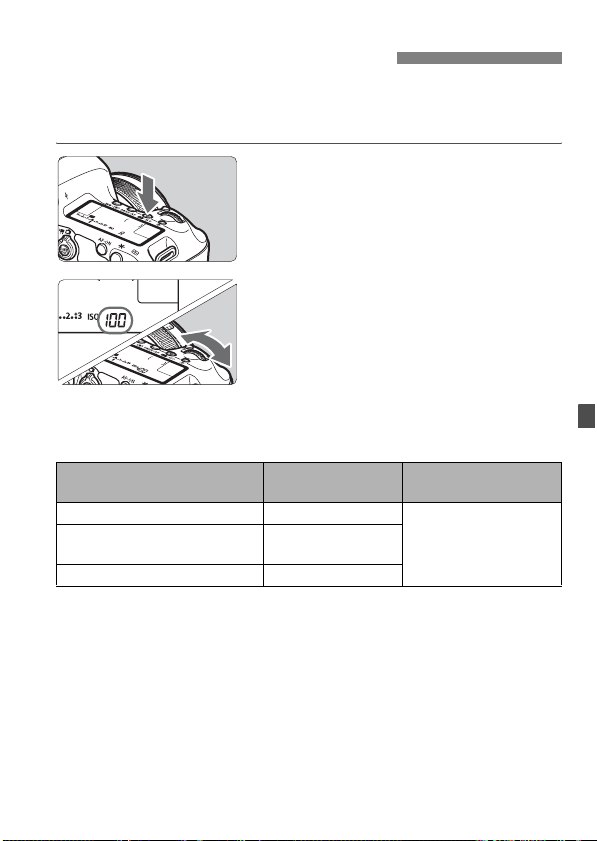
101
Set the ISO speed (image sensor’s sensitivity to light) to suit the
ambient light level. With the <A> mode selected, the ISO speed will
be set automatically.
1
Press the <m> button. (9)
2
Set the ISO speed.
While looking at the LCD panel or in
the viewfinder, turn the <6> dial.
ISO speed can be set within ISO 100
- ISO 6400 in 1/3-stop increments.
“A” indicates Auto ISO. The ISO
speed will be set automatically.
ISO Speed Guide
* High ISO speeds will result in grainier images.
i: Setting the ISO SpeedN
ISO speed
Shooting Situation
(No flash)
Flash Range
L, ISO 100 - ISO 400 Sunny outdoors
The higher the ISO
speed, the farther the
flash range will be.
ISO 400 - ISO 1600
Overcast skies or
evening time
ISO 1600 - ISO 6400, H Dark indoors or night
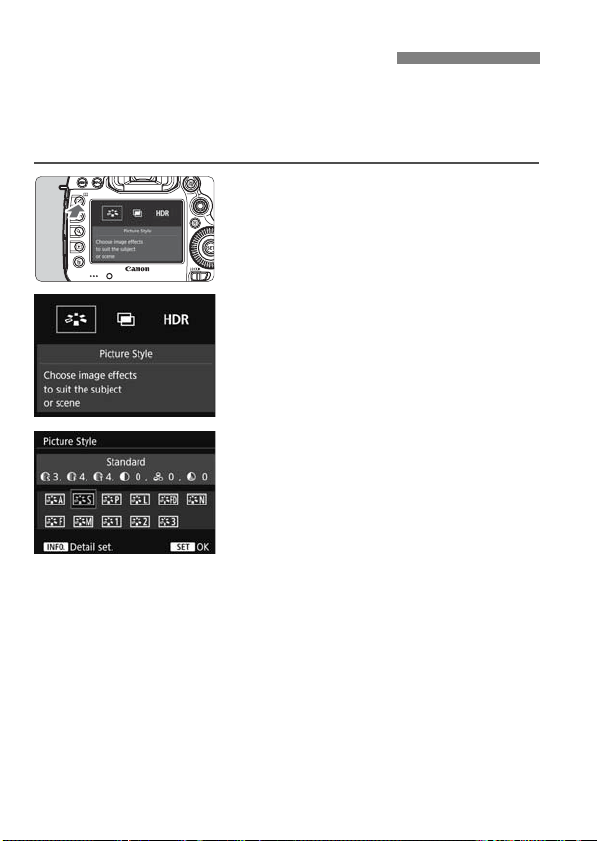
102
By selecting a Picture Style, you can obtain image characteristics
matching your photographic expression or the subject.
The Picture Style is set automatically to [D] (Auto) in the <A>
mode.
1
Press the <b> button.
2
Select [A].
X The Picture Style selection screen will
appear.
3
Select a Picture Style.
X The Picture Style will be set and the
camera will be ready to shoot.
A Selecting a Picture StyleN
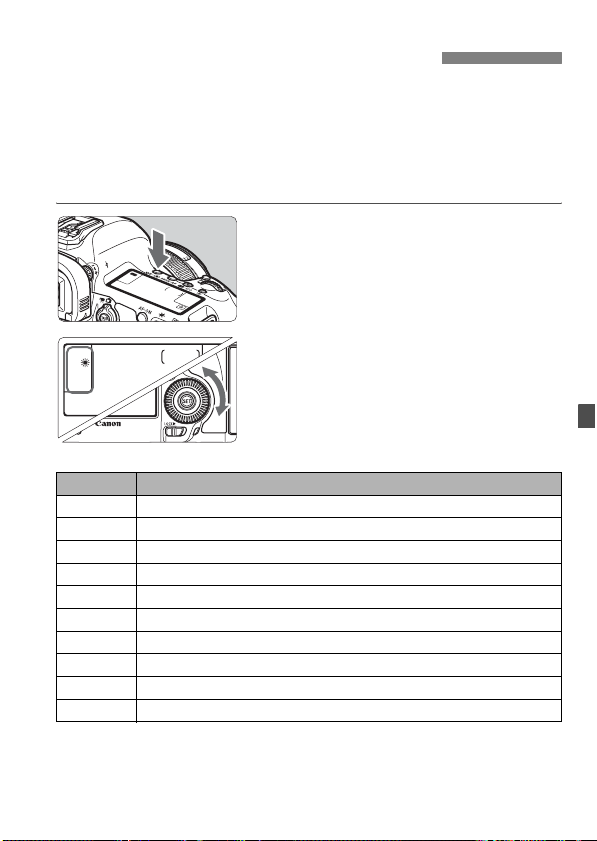
103
White balance (WB) is for making the white areas look white. Normally,
the Auto [Q] (Ambience priority) or [Q
w
] (White priority) setting will
obtain the correct white balance. If natural-looking colors cannot be
obtained with Auto, you can select the white balance to match the light
source or set it manually by shooting a white object.
<A> is automatically set in the [Q] (Ambience priority) mode.
1
Press the <n> button. (9)
2
Select a white balance setting.
While looking at the LCD panel or in
the viewfinder, turn the <5> dial.
B: Setting the White BalanceN
Display
Mode
Q
Auto (Ambience priority)
Q
w
Auto (White priority)
W
Daylight
E
Shade
R
Cloudy, twilight, sunset
Y
Tungsten light
U
White fluorescent light
D
Flash use
O
Custom
P
Color temperature
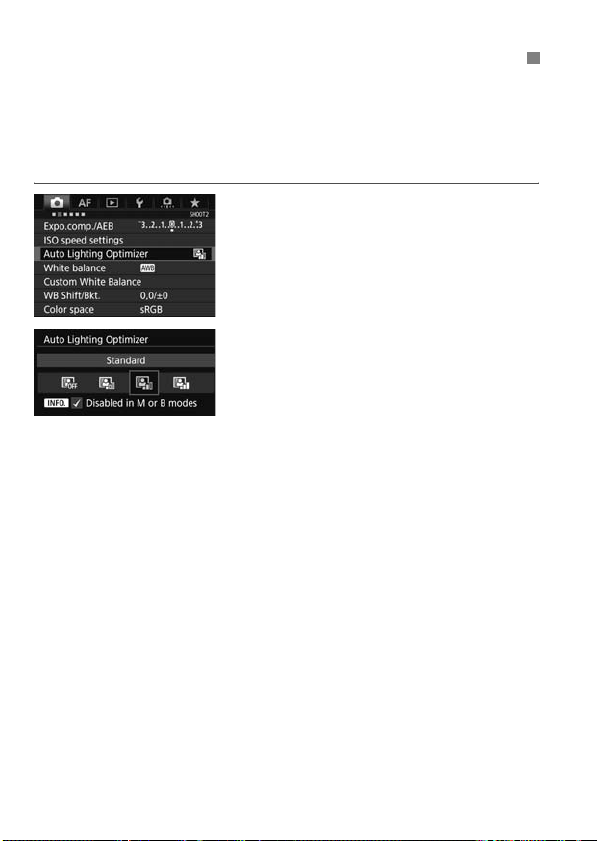
104
If the image comes out dark or the contrast is low, the brightness and
contrast can be corrected automatically. This function is called Auto
Lighting Optimizer. The default setting is [Standard]. With JPEG
images, the correction is applied when the image is captured.
[Standard] is automatically set in the <A> mode.
1
Select
[
Auto Lighting Optimizer
].
Under the [z2] tab, select [Auto
Lighting Optimizer], then press
<0>.
2
Select the setting.
Select the desired setting, then press
<0>.
3
Take the picture.
The image will be recorded with the
brightness and contrast corrected if
necessary.
3
Auto Correction of Brightness and Contrast
N
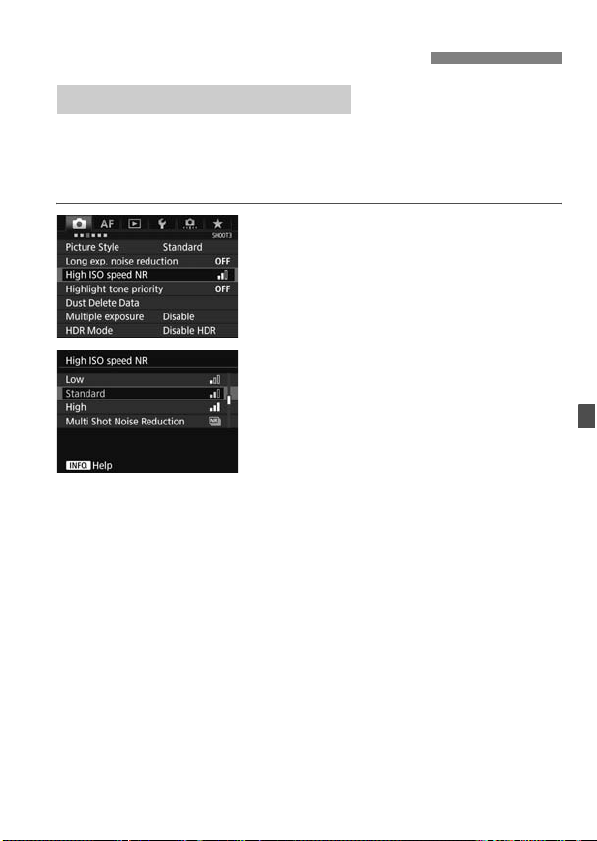
105
This function reduces the noise generated in the image. Although noise
reduction is applied at all ISO speeds, it is particularly effective at high
ISO speeds. At low ISO speeds, the noise in the darker parts of the
image (shadow areas) is further reduced.
1
Select [High ISO speed NR].
Under the [z3] tab, select [High ISO
speed NR], then press <0>.
2
Set the level.
Select the desired noise reduction
level, then press <0>.
M: Multi Shot Noise Reduction
This applies noise reduction with higher image quality than [High].
For a single photo, four shots are taken continuously and aligned
and merged automatically into a single JPEG image.
If the image-recording quality is set to RAW or RAW+JPEG, you
cannot set [Multi Shot Noise Reduction].
3
Take the picture.
The image will be recorded with noise
reduction applied.
3 Setting Noise ReductionN
High ISO Speed Noise Reduction
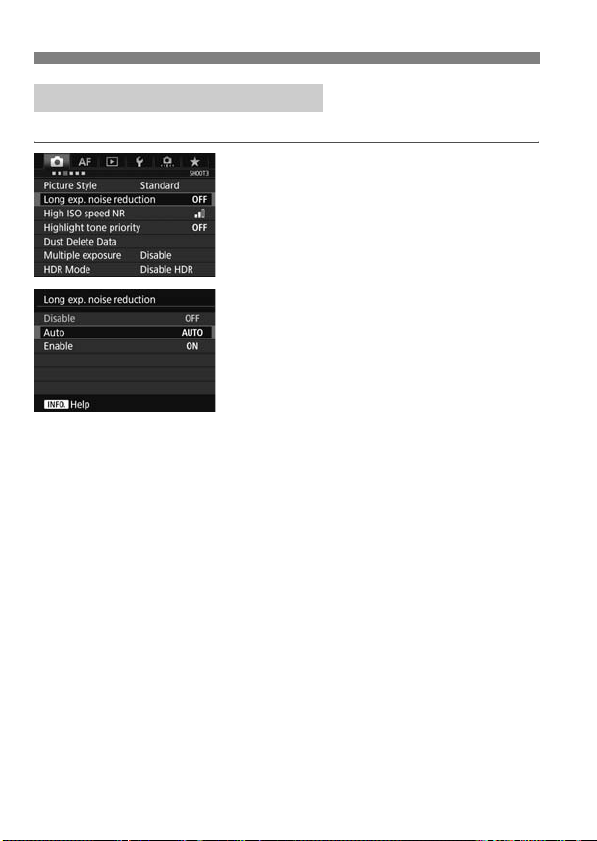
3 Setting Noise ReductionN
106
Noise reduction is possible with images exposed for 1 sec. or longer.
1
Select [Long exp. noise
reduction].
Under the [z3] tab, select [Long
exp. noise reduction], then press
<0>.
2
Set the desired setting.
Select the desired setting, then press
<0>.
Auto
For exposures of 1 sec. or longer, noise reduction is performed
automatically if noise typical of long exposures is detected. This
[Auto] setting is effective in most cases.
Enable
Noise reduction is performed for all exposures of 1 sec. or longer.
The [Enable] setting may reduce noise that cannot be detected with
the [Auto] setting.
3
Take the picture.
The image will be recorded with noise
reduction applied.
Long Exposure Noise Reduction
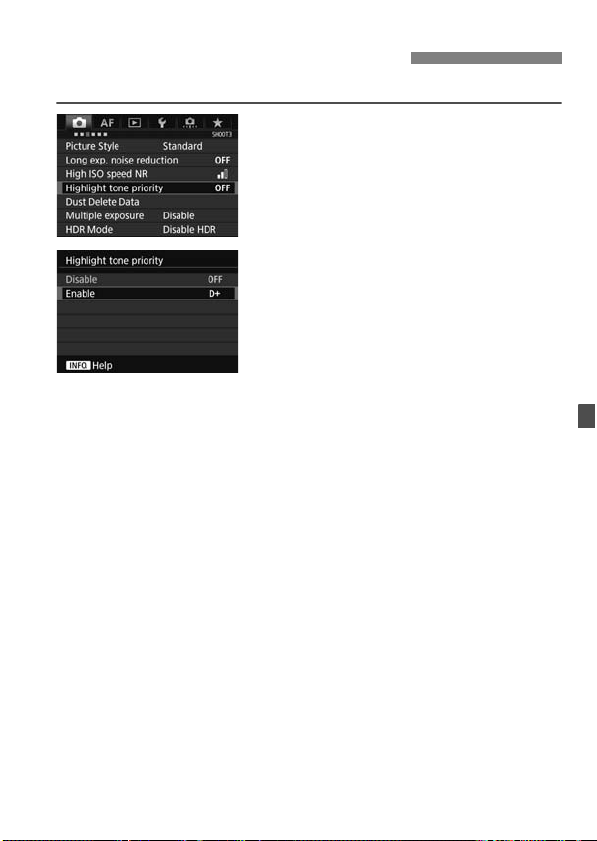
107
You can reduce overexposed, clipped highlights.
1
Select [Highlight tone priority].
Under the [z3] tab, select
[Highlight tone priority], then press
<0>.
2
Select [Enable].
Highlight details are improved. The
dynamic range is expanded from the
standard 18% gray to bright
highlights. The gradation between the
grays and highlights becomes
smoother.
3
Take the picture.
The image will be recorded with
highlight tone priority applied.
3 Highlight Tone PriorityN
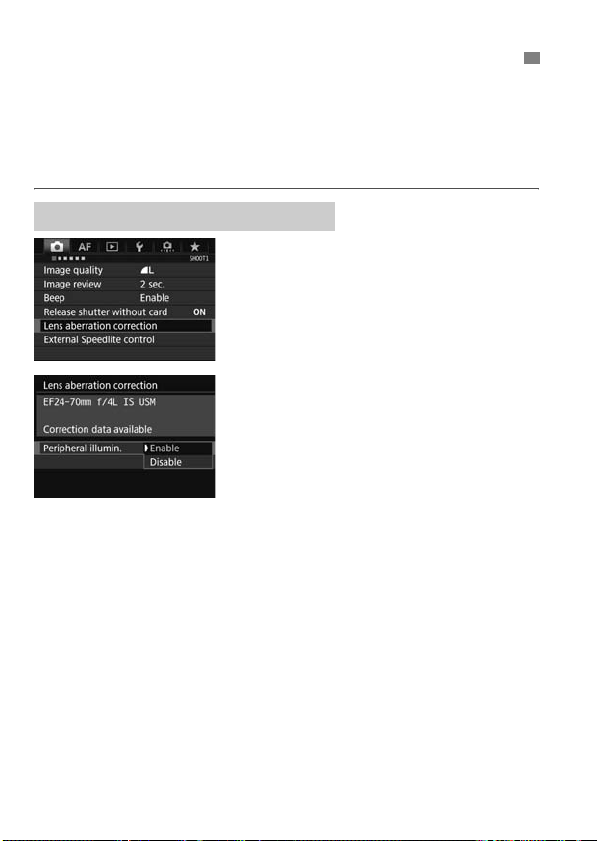
108
Peripheral light fall-off is a phenomenon that makes the image corners
look darker due to the lens characteristics. Color fringing along subject
outlines is called chromatic aberration. This lens aberration and light
fall-off can be corrected. By default, Peripheral illumination and
Chromatic aberration correction are set to [Enable].
1
Select [Lens aberration
correction].
Under the [z1] tab, select [Lens
aberration correction], then press
<0>.
2
Select the setting.
Check that [Correction data
available] is displayed for the
attached lens.
Select [Peripheral illumin.], then
press <0>.
Select [Enable], then press <0>.
3
Take the picture.
The image will be recorded with the
peripheral illumination corrected.
3
Correction of Lens Peripheral Illumination and Aberration
Peripheral Illumination Correction
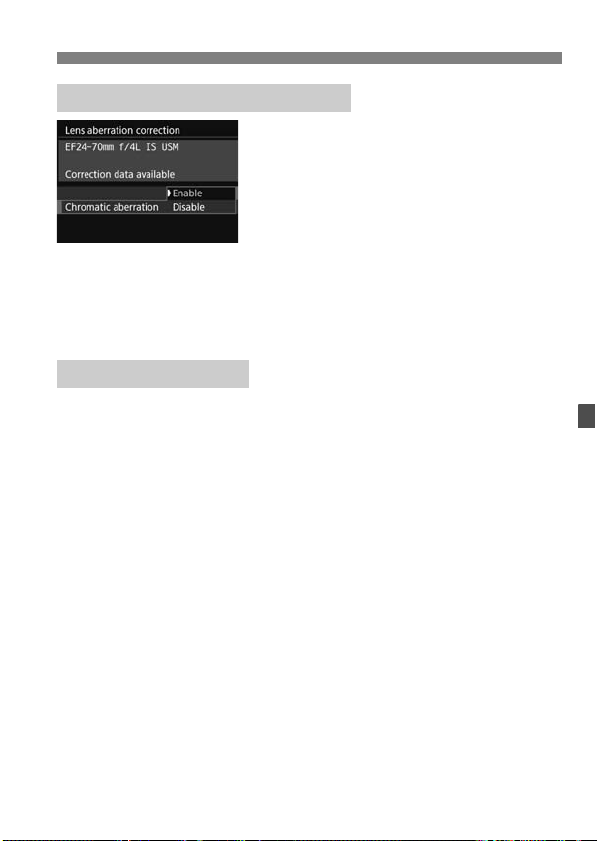
109
3 Correction of Lens Peripheral Illumination and Aberration
1
Select the setting.
Check that [Correction data
available] is displayed for the
attached lens.
Select [Chromatic aberration], then
press <0>.
Select [Enable], then press <0>.
2
Take the picture.
The image will be recorded with the
chromatic aberration corrected.
The camera already contains data for lens peripheral illumination
correction and chromatic aberration correction for approx. 30 lenses. If
you select [Enable], the peripheral illumination correction and
chromatic aberration correction will be applied automatically for any
lens whose correction data is registered in the camera.
With EOS Utility (EOS software), you can check the lenses of which
correction data is registered in the camera. You can also register the
correction data for unregistered lenses. For details, refer to the EOS
Utility Instruction Manual (p.160).
For lenses incorporating the correction data, it is not necessary to
register the correction data to the camera.
Chromatic Aberration Correction
Lens Correction Data
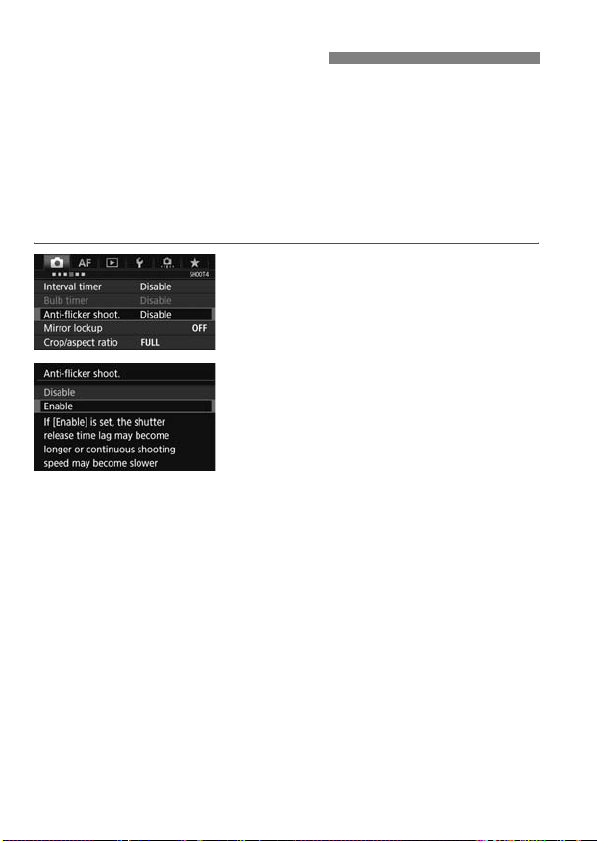
110
If you shoot an image with a fast shutter speed under a light source
such as fluorescent light, the blinking of the light source causes flicker
and the image may be vertically unevenly exposed. If continuous
shooting is used under these conditions, uneven exposures or colors
across the images may result.
With anti-flicker shooting, the camera detects the frequency of the light
source’s blinking and takes the picture when the flicker causes less
effect on exposure or color.
1
Select [Anti-flicker shoot.].
Under the [z4] tab, select [Anti-
flicker shoot.], then press <0>.
2
Select [Enable].
3
Take the picture.
The image will be taken with reduced
unevenness of exposure or color
caused by the flicker.
3 Reducing FlickerN
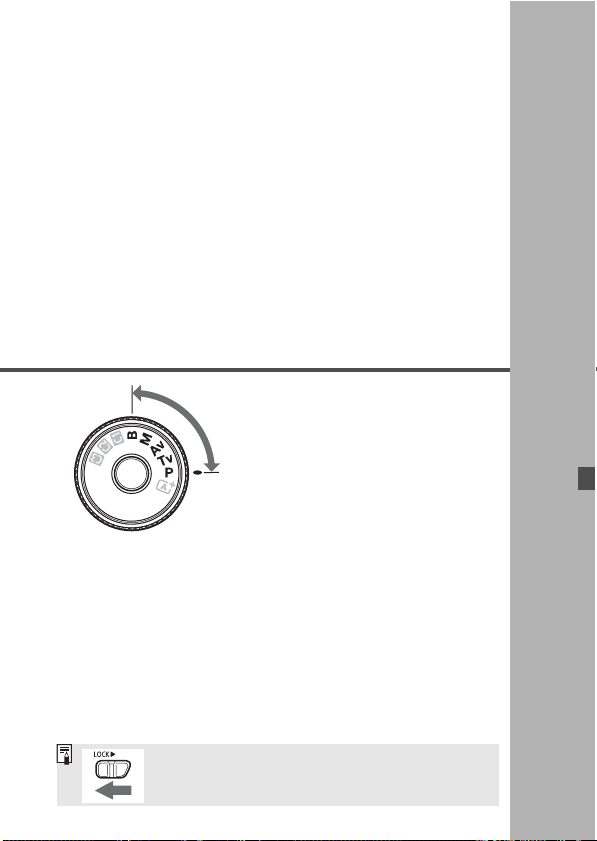
111
5
Advanced Operations
In the <d> <s> <f> <a>
<F> shooting modes, you can
select the shutter speed,
aperture, and other camera
settings to change the
exposure and obtain the
desired result.
A M icon at the upper right of a page title indicates a
function that can be used only in the following modes: <d>
<s> <f> <a> <F>.
After you press the shutter button halfway and let go, the
exposure values will remain displayed in the viewfinder and
on the LCD panel for 4 sec. (0).
Set the <R> switch to the left.
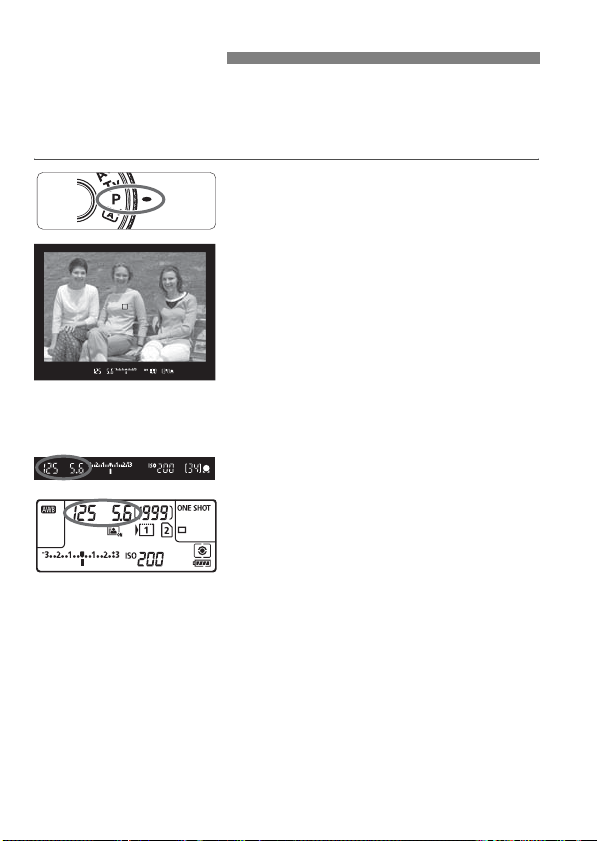
112
The camera automatically sets the shutter speed and aperture to suit
the subject’s brightness. This is called Program AE.
*<d> stands for Program.
* AE stands for Auto Exposure.
1
Set the Mode Dial to <d>.
2
Focus on the subject.
Look through the viewfinder and aim
the AF point over the subject. Then
press the shutter button halfway.
X When focus is achieved, the focus
indicator <o> in the viewfinder will
light up (in One-Shot AF mode).
X The shutter speed and aperture will
be set automatically and displayed in
the viewfinder and on the LCD panel.
3
Check the display.
A standard exposure will be obtained
as long as the shutter speed and
aperture displays do not blink.
4
Take the picture.
Compose the shot and press the
shutter button completely.
d:
Program AE
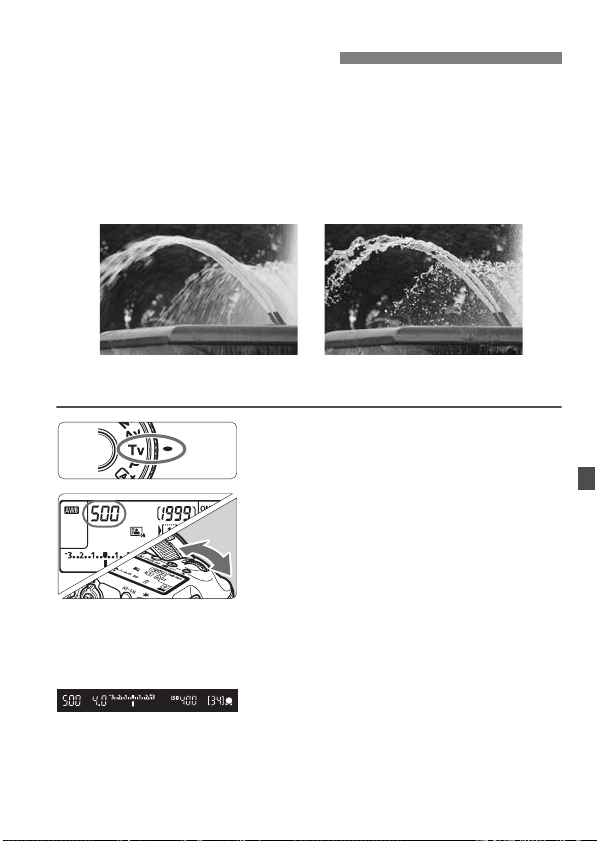
113
In this mode, you set the shutter speed and the camera automatically
sets the aperture to obtain the standard exposure matching the
brightness of the subject. This is called shutter-priority AE. A faster
shutter speed can freeze the action of a moving subject. A slower
shutter speed can create a blurred effect, giving the impression of
motion.
* <s> stands for Time value.
1
Set the Mode Dial to <s>.
2
Set the desired shutter speed.
While looking at the LCD panel or in
the viewfinder, turn the <6> dial.
3
Focus on the subject.
Press the shutter button halfway.
X The aperture is set automatically.
4
Check the viewfinder display and
shoot.
As long as the aperture is not
blinking, a standard exposure will be
obtained.
s:
Shutter-Priority AE
Blurred motion
(Slow shutter speed: 1/30 sec.)
Frozen action
(Fast shutter speed: 1/2000 sec.)
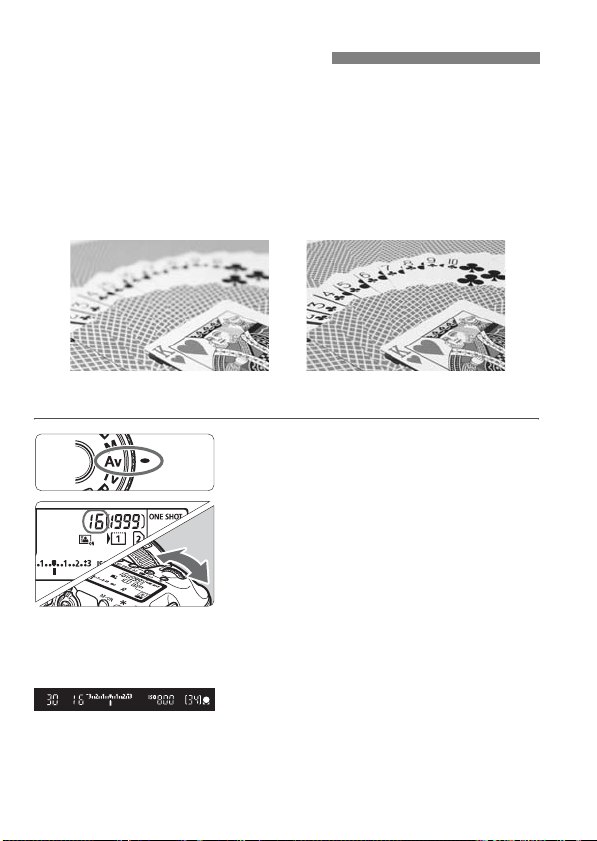
114
In this mode, you set the desired aperture and the camera sets the
shutter speed automatically to obtain the standard exposure suiting the
subject brightness. This is called aperture-priority AE. A higher
f/number (smaller aperture hole) will make more of the foreground and
background fall within acceptable focus. On the other hand, a lower
f/number (larger aperture hole) will make less of the foreground and
background fall within acceptable focus.
* <f> stands for Aperture value (aperture opening).
1
Set the Mode Dial to <f>.
2
Set the desired aperture.
While looking at the LCD panel or in
the viewfinder, turn the <6> dial.
3
Focus on the subject.
Press the shutter button halfway.
X
The shutter speed is set automatically.
4
Check the viewfinder display and
shoot.
As long as the shutter speed is not
blinking, a standard exposure will be
obtained.
f:
Aperture-Priority AE
Sharp foreground and background
(With a high aperture f/number: f/32)
Blurred background
(With a low aperture f/number: f/5.6)
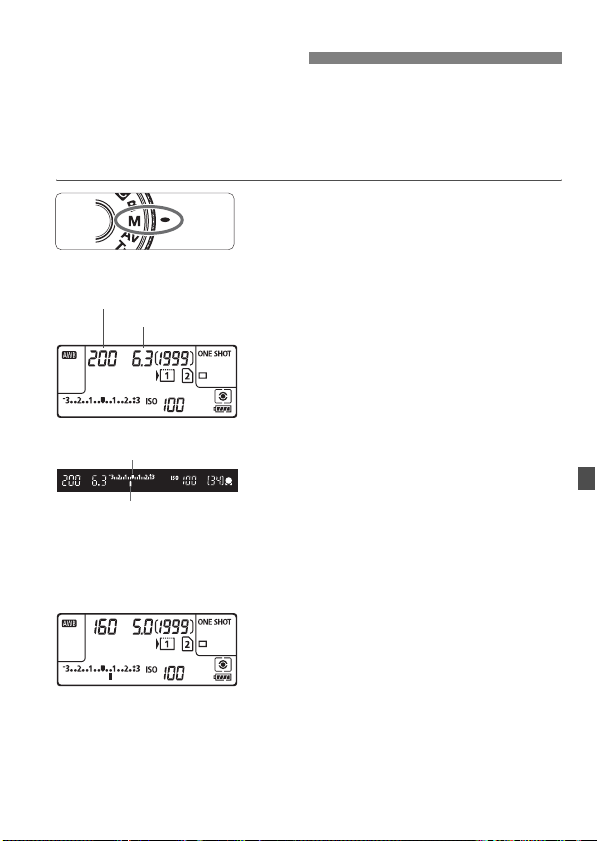
115
In this mode, you set both the shutter speed and aperture as desired. To
determine the exposure, refer to the exposure level indicator in the
viewfinder or use a commercially-available exposure meter. This
method is called manual exposure.
* <a> stands for Manual.
1
Set the Mode Dial to <a>.
2
Set the ISO speed (p.101).
3
Set the shutter speed and aperture.
To set the shutter speed, turn the
<6> dial.
To set the aperture, turn the <
5
> dial.
If it cannot be set, set the <R>
switch to the left, then turn the <6>
or <5> dial.
4
Focus on the subject.
Press the shutter button halfway.
X
The exposure setting will be displayed
in the viewfinder and on the LCD panel.
The exposure level mark <h>
indicates how far the current
exposure level is from the standard
exposure level.
5
Set the exposure and take the
picture.
Check the exposure level indicator
and set the desired shutter speed and
aperture.
If the exposure level exceeds ±3
stops from the standard exposure,
the end of the exposure level
indicator will display <I> or <J>.
a:
Manual Exposure
Shutter speed
Aperture
Standard exposure index
Exposure level mark

a: Manual Exposure
116
If the ISO speed is set to A (AUTO), you can set exposure
compensation (p.118) as follows:
•[z2: Expo.comp./AEB]
• Under [83: Custom Controls], use [s: Expo comp (hold btn,
turn )].
• Quick Control (p.53)
Exposure Compensation with Auto ISO
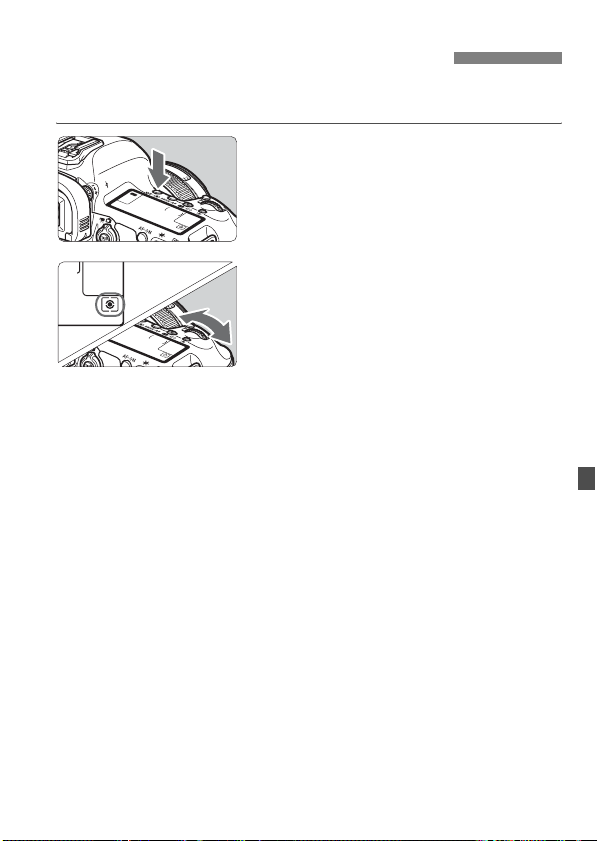
117
You can select one of four methods to measure the subject brightness.
In the <A> mode, evaluative metering is set automatically.
1
Press the <n> button. (9)
2
Select the metering mode.
While looking at the LCD panel or in
the viewfinder, turn the <6> dial.
q:Evaluative metering
w:Partial metering
r:Spot metering
e:Center-weighted average
metering
q Selecting the Metering ModeN
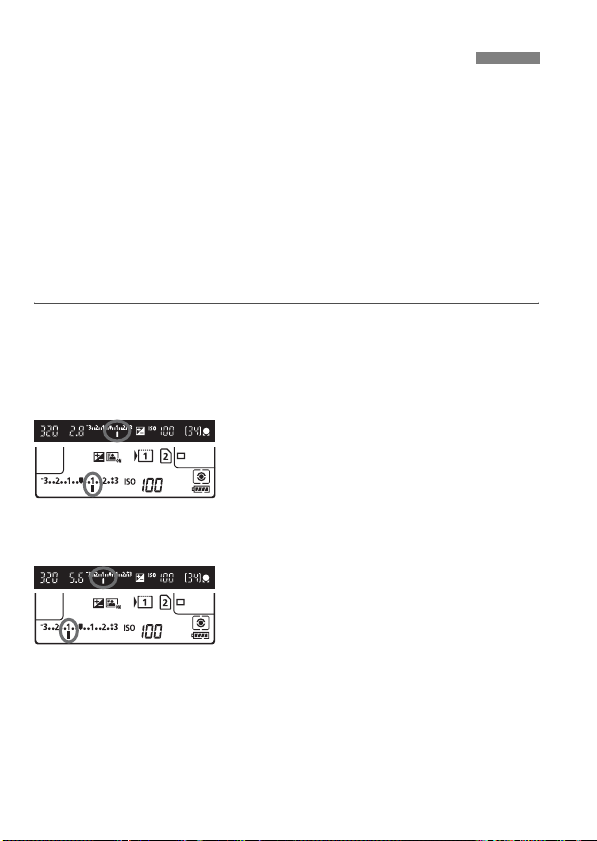
118
Exposure compensation can brighten (increased exposure) or darken
(decreased exposure) the standard exposure set by the camera.
Exposure compensation can be set in the <d>, <s>, and <f>
shooting modes. Although you can set the exposure compensation up
to ±5 stops in 1/3-stop increments, the exposure compensation
indicator in the viewfinder and on the LCD panel can only display the
setting up to ±3 stops. If you want to set the exposure compensation
setting beyond ±3 stops, use the Quick Control (p.53) or follow the
instructions for [z2: Expo.comp./AEB] on the next page.
If the <a> mode and the Auto ISO are both set, see page 116 to set
the exposure compensation.
1
Check the exposure.
Press the shutter button halfway
(0) and check the exposure level
indicator.
2
Set the exposure compensation
amount.
While looking at the viewfinder or
LCD panel, turn the <5> dial.
If it cannot be set, set the <R>
switch to the left, then turn the <5>
dial.
3
Take the picture.
To cancel exposure compensation,
set the exposure level indicator <h/N>
to the standard exposure index (<a>
or <C>).
O Setting Exposure CompensationN
Increased exposure for a brighter image
Decreased exposure for a darker image
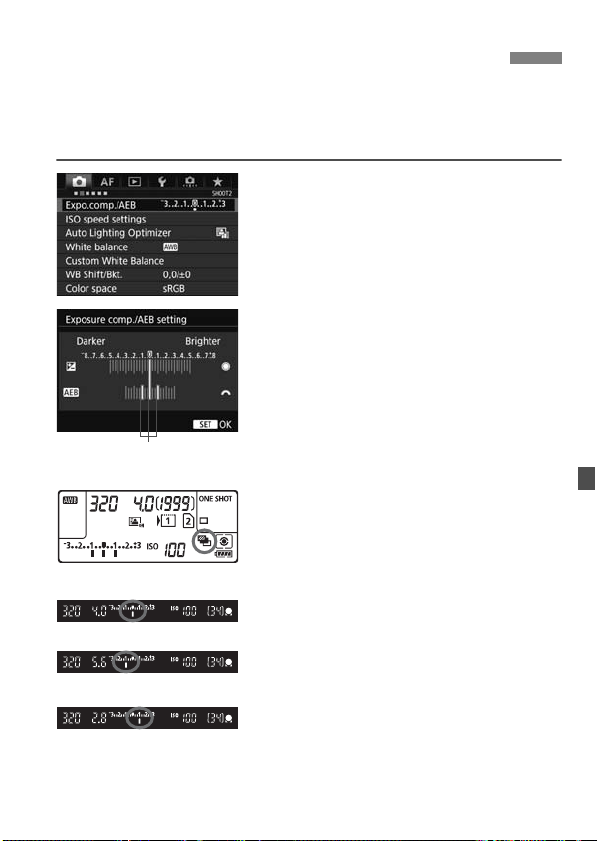
119
By changing the shutter speed or aperture automatically, the camera
brackets the exposure up to ±3 stops in 1/3-stop increments for three
successive shots. This is called AEB.
* AEB stands for Auto Exposure Bracketing.
1
Select [Expo.comp./AEB].
Under the [z2] tab, select
[Expo.comp./AEB], then press
<0>.
2
Set the AEB range.
Turn the <6> dial to set the AEB
range. If you turn <5>, you can set
the exposure compensation.
Press <0> to set it.
X When you exit the menu, <h> and
the AEB range will be displayed on
the LCD panel.
3
Take the picture.
Three bracketed shots will be taken
according to the drive mode set in this
sequence: Standard exposure,
decreased exposure, and increased
exposure.
AEB will not be automatically
canceled. To cancel AEB, follow step
2 to turn off the AEB range display.
h Auto Exposure Bracketing (AEB)N
AEB range
Standard exposure
Decreased exposure
Increased exposure
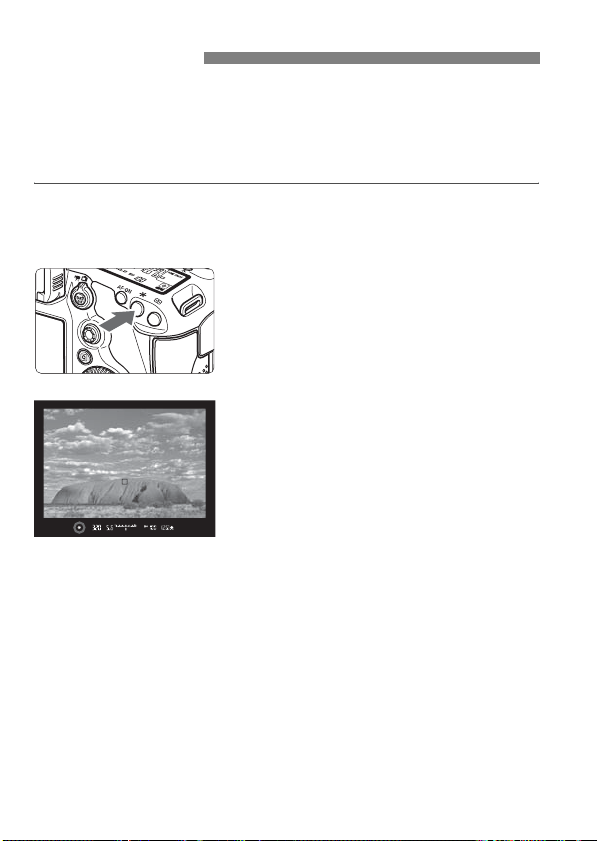
120
Use AE lock when the area of focus is to be different from the exposure
metering area or when you want to take multiple shots at the same
exposure setting. Press the <A> button to lock the exposure, then
recompose and take the picture. This is called AE lock. It is effective for
backlit subjects, etc.
1
Focus on the subject.
Press the shutter button halfway.
X
The exposure setting will be displayed.
2
Press the <A> button. (0)
X The <A> icon lights up in the
viewfinder to indicate that the
exposure setting is locked (AE lock).
Each time you press the <
A
> button,
the current exposure setting is locked.
3
Recompose and take the picture.
If you want to maintain the AE lock
while taking more shots, hold down
the <A> button and press the shutter
button to take another shot.
A AE LockN
121
6
Shooting with the LCD Monitor
(Live View Shooting)
You can shoot while viewing the
picture on the camera’s LCD
monitor. This is called “Live View
shooting”.
Live View shooting is enabled by
setting the Live View shooting/
Movie shooting switch to <A>.
If you handhold the camera and shoot while viewing the
LCD monitor, camera shake can cause blurred images.
Using a tripod is recommended.
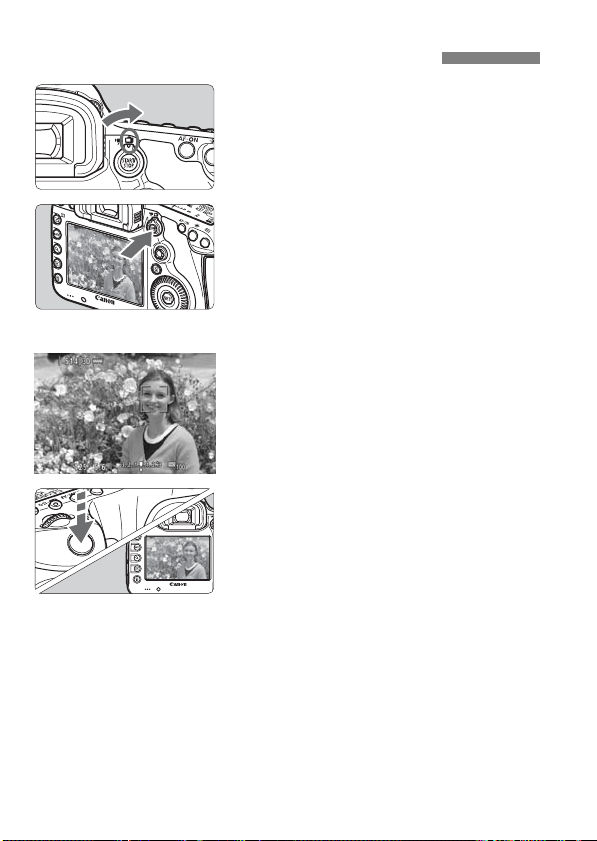
122
1
Set the Live View shooting/Movie
shooting switch to <A>.
2
Display the Live View image.
Press the <0> button.
X The Live View image will appear on
the LCD monitor.
The Live View image will closely
match the brightness level of the
actual image you capture.
3
Focus on the subject.
When you press the shutter button
halfway, the camera will focus with
the current AF method (p.125).
4
Take the picture.
Press the shutter button completely.
X The picture is taken and the captured
image is displayed on the LCD
monitor.
X When the playback display ends, the
camera will return to Live View
shooting automatically.
Press the <0> button to exit the
Live View shooting.
A Shooting with the LCD Monitor
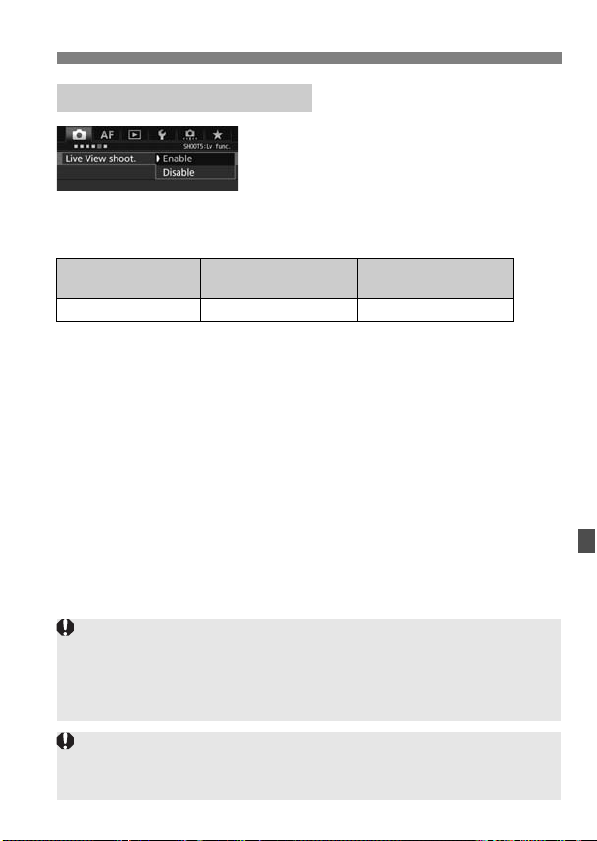
123
A Shooting with the LCD Monitor
Set [z5: Live View shoot.] (the [z3]
tab in <A>) to [Enable].
Number of Possible Shots with Live View Shooting
(Approx. number of shots)
The figures above are based on a fully-charged Battery Pack LP-E6N and
CIPA (Camera & Imaging Products Association) testing standards.
With a fully-charged Battery Pack LP-E6N, total continuous Live View shooting
time will be as follows: At room temperature (23°C/73°F): Approx. 1 hr. 45 min.,
At low temperatures (0°C/32°F): Approx. 1 hr. 40 min.
Enabling Live View Shooting
Temperature
Room Temperature
(23°C / 73°F)
Low Temperatures
(0°C / 32°F)
Possible shots 220 210
Do not hold the camera in the same position for long periods of time.
Even if the camera does not feel too hot, prolonged contact with the same
body part may cause skin redness, blistering or low-temperature contact
burns. Using a tripod is recommended for people with circulation problems
or very sensitive skin, or when using the camera in very hot places.
Do not point the camera toward an intense light source, such as the sun or
an intense artificial light source. Doing so may damage the image sensor or
the camera’s internal components.
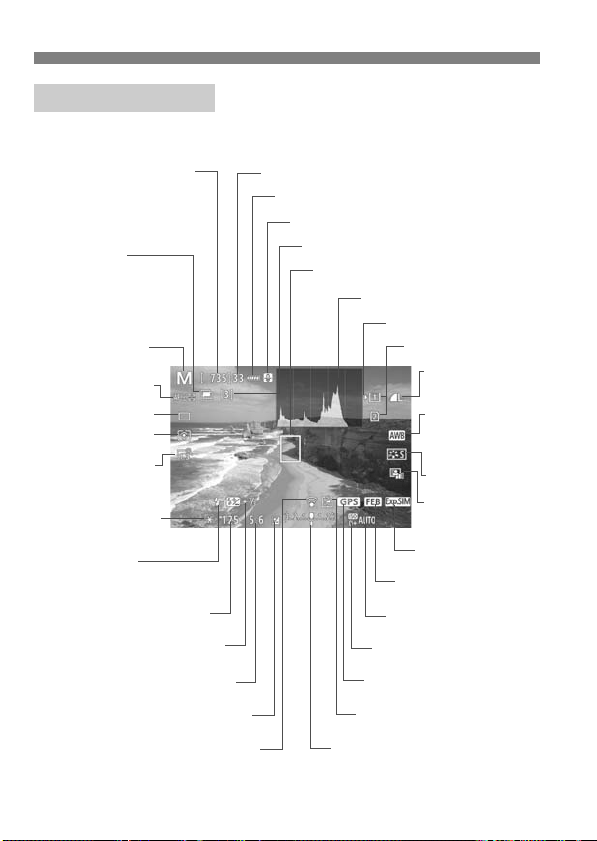
A Shooting with the LCD Monitor
124
Each time you press the <B> button, the information display will
change.
Information Display
ISO speed
Possible shots/Seconds
remaining on self-timer
Exposure level indicator
Aperture
Shutter speed
Battery level
Exposure simulation
Drive mode
Flash exposure compensation
AF method
AF point (FlexiZone - Single)
AEB/FEB
Highlight tone priority
Histogram display
Picture Style
White balance/
White balance
correction
Shooting mode/
Scene icon
HDR shooting/
Multiple exposures/
Multi Shot Noise Reduction
Eye-Fi card transmission status
Maximum burst
Metering mode
AE lock
Digital compass
GPS connection indicator
Flash ready/
Flash off/Hi-speed sync
Image-recording
quality
Card
Auto Lighting
Optimizer
Exposure compensation
Temperature warning
Crop/aspect ratio
Number of remaining multiple exposures
Card for recording
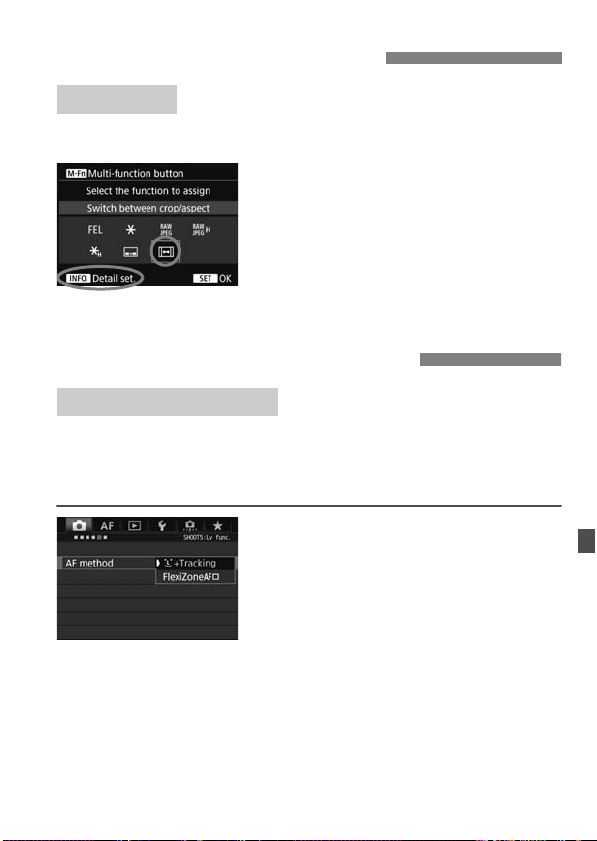
125
You can perform crop shooting, or shoot with the set aspect ratio for
Live View shooting. To set them with the menu, see page 99.
If you use [83: Custom Controls] to
assign [Switch between crop/aspect]
to the <B> button, you can just
press the <B> button while
displaying Live View image to switch the
Crop/aspect setting.
Shooting Function Settings
Crop/Aspect
You can set the AF method to [u(face)+Tracking] (p.126) or
[FlexiZone - Single] (p.128) to suit the shooting conditions or subject.
If you want to achieve precise focus, set the lens’s focus mode switch to
<MF>, magnify the image, and focus manually (p.129).
Select the AF method.
Under the [z5] tab (the [z3] tab in
<A>), select [AF method].
Select the desired AF method, then
press <0>.
When the Live View image is
displayed, you can press the
<o> button to select the AF
method.
Using AF to Focus (AF Method)
Selecting the AF Method
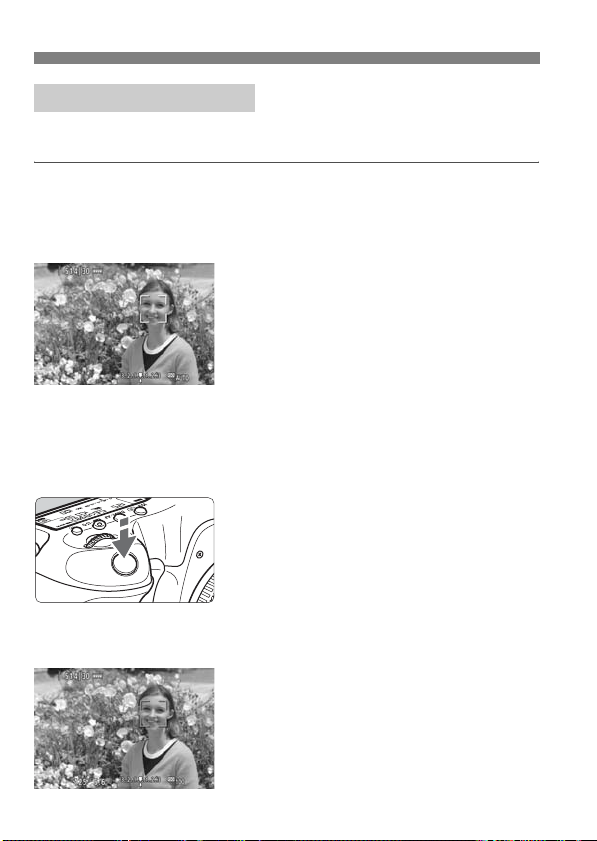
Using AF to Focus (AF Method)
126
The camera detects and focuses on human faces. If a face moves, the
AF point <p> also moves to track the face.
1
Display the Live View image.
Press the <0> button.
X The Live View image will appear on
the LCD monitor.
2
Select an AF point.
When a face is detected, the <p>
frame will appear over the face to be
focused on.
If multiple faces are detected, <q>
will be displayed. Use <9> to move
the <q> frame over the face you
want to focus on.
If no faces are detected, the camera
will switch to FlexiZone - Single
(p.128).
3
Focus on the subject.
Press the shutter button halfway to
focus.
X When focus is achieved, the AF point
will turn green and the beeper will
sound.
X If focus is not achieved, the AF point
will turn orange.
4
Take the picture.
Check the focus and exposure, then
press the shutter button completely to
take the picture (p.122).
u(face)+Tracking: c
127
Using AF to Focus (AF Method)
Focusing on a subject other than a human face
Press <9> or <0> and the AF frame < > will appear in the
center. Then use <9> to move the AF frame over the desired
subject. Once the AF frame < > achieves focus, it will track the
subject even if the subject moves or if you change the composition.
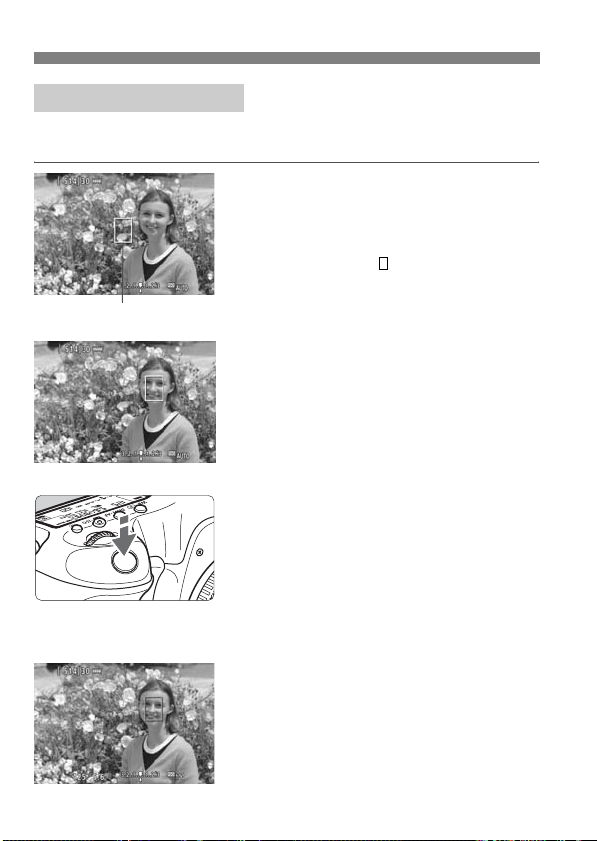
Using AF to Focus (AF Method)
128
The camera focuses with a single AF point. This is effective when you
want to focus on a particular subject.
1
Display the Live View image.
Press the <0> button.
X The Live View image will appear on
the LCD monitor.
X The AF point < > will appear.
2
Move the AF point.
Use <9> to move the AF point to
where you want to focus. (It cannot
be moved to the edge of the screen.)
Pressing <9>, <0>, or <L> button
will return the AF point to the screen’s
center.
3
Focus on the subject.
Aim the AF point over the subject and
press the shutter button halfway.
X When focus is achieved, the AF point
will turn green and the beeper will
sound.
X If focus is not achieved, the AF point
will turn orange.
4
Take the picture.
Check the focus and exposure, then
press the shutter button completely to
take the picture (p.122).
FlexiZone - Single: d
AF point
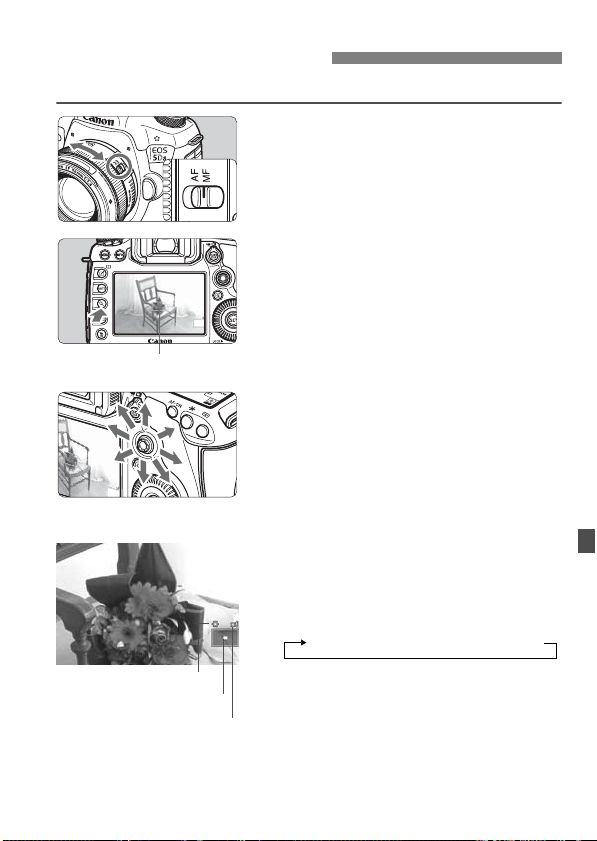
129
You can magnify the image and focus precisely with MF (manual focus).
1
Set the lens’s focus mode switch
to <MF>.
Turn the lens’s focusing ring to focus
roughly.
2
Display the magnifying frame.
Press the <u> button.
X The magnifying frame will appear.
3
Move the magnifying frame.
Use <9> to move the magnifying
frame to the position where you want
to focus.
Pressing <9>, <0>, or <L> button
will return the magnifying frame to the
screen’s center.
4
Magnify the image.
Each time you press the <u> button,
the magnification within the frame will
change in the following sequence:
While in magnified view, you can use
<9> to scroll around the magnified
image.
MF: Focusing Manually
Magnifying frame
AE lock
Magnified area position
Magnification (Approx.)
Normal view 9 1x 9 6x 9 16x

MF: Focusing Manually
130
5
Focus manually.
While looking at the magnified image,
turn the lens’s focusing ring to focus.
After achieving focus, press the <u>
button to return to the normal view.
6
Take the picture.
Check the exposure, then press the
shutter button completely to take the
picture (p.122).
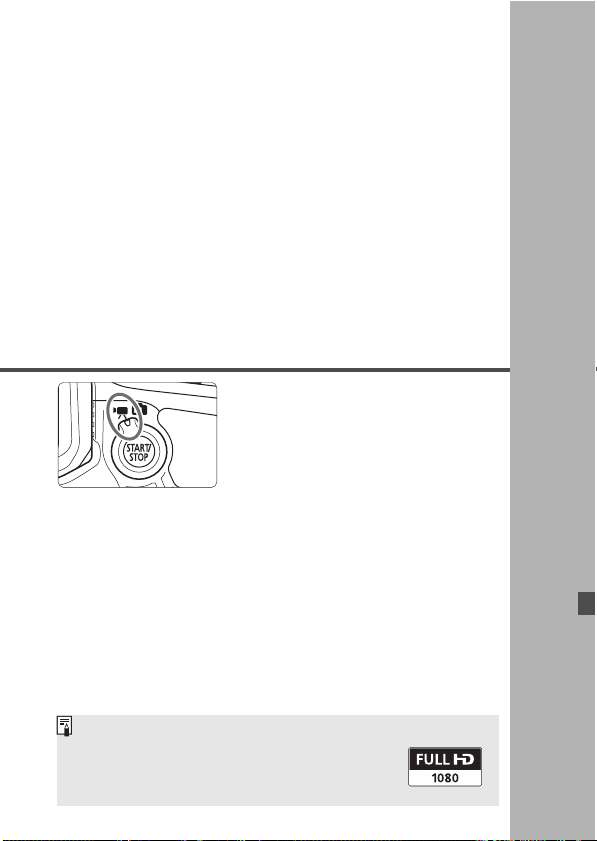
131
7
Shooting Movies
Movie shooting is enabled by
setting the Live View shooting/
Movie shooting switch to <k>.
For cards that can record movies, see page 5.
If you handhold the camera and shoot movies, camera
shake can cause blurred movies. Using a tripod is
recommended.
Full HD 1080
Full HD 1080 indicates compatibility with High-
Definition featuring 1080 vertical pixels (scanning
lines).
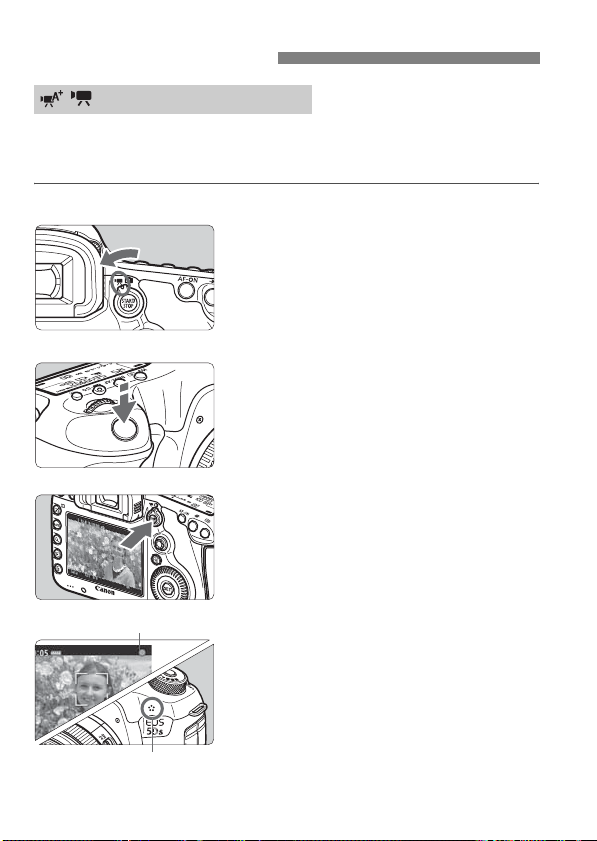
132
When the shooting mode is set to <A>, <d>, or <F>, autoexposure
control will take effect to suit the scene’s current brightness. Exposure
control will be the same for all the shooting modes.
1
Set the Mode Dial to <A>, <d>,
or <F>.
2
Set the Live View shooting/Movie
shooting switch to <k>.
X The reflex mirror will make a sound,
then the image will appear on the
LCD monitor.
3
Focus on the subject.
Before shooting a movie, focus with
AF or manual focus (p.125-130).
When you press the shutter button
halfway, the camera will focus with
the current AF method.
4
Shoot the movie.
Press the <0> button to start
shooting a movie.
X While the movie is being shot, the
“o” mark will be displayed on the
upper right of the screen.
X Sound will be recorded by the built-in
microphone.
To stop shooting the movie, press the
<0> button again.
k Shooting Movies
/ Autoexposure Shooting
Recording movies
Built-in microphone
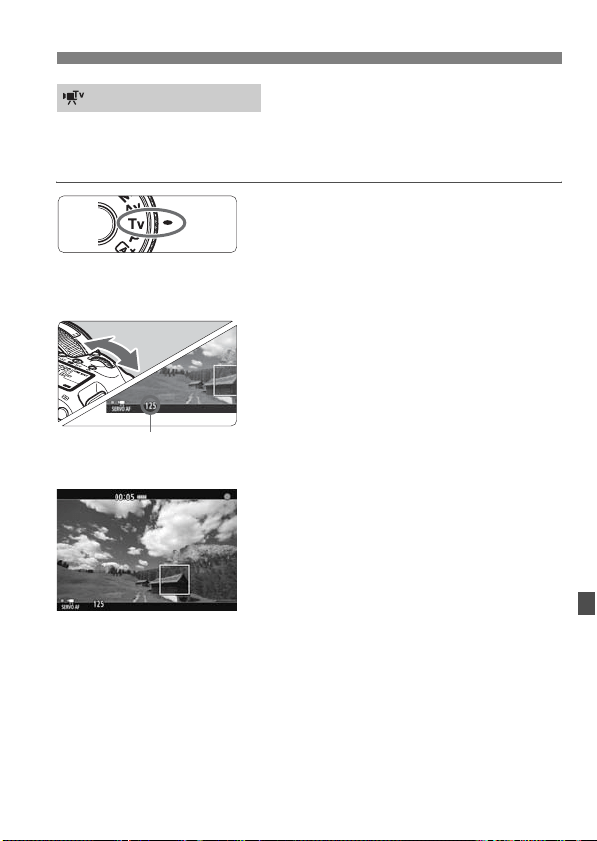
133
k Shooting Movies
When the shooting mode is <s>, you can manually set the shutter
speed for movie shooting. The ISO speed and aperture will be set
automatically to suit the brightness and obtain a standard exposure.
1
Set the Mode Dial to <s>.
2
Set the Live View shooting/Movie
shooting switch to <k>.
3
Set the desired shutter speed.
While looking at the LCD monitor,
turn the <6> dial. The settable
shutter speeds depend on the frame
rate.
• 6 5 4:
1/4000 sec. - 1/30 sec.
• 8 7: 1/4000 sec. - 1/60 sec.
4
Focus and shoot the movie.
The procedure is the same as steps 3
and 4 for “Autoexposure Shooting”
(p.132).
Shutter-priority AE
Shutter speed
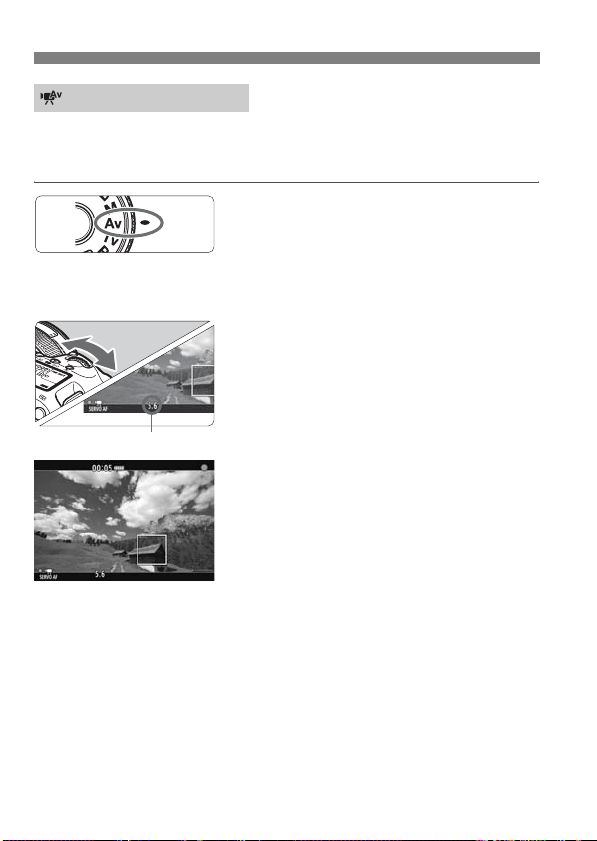
k Shooting Movies
134
When the shooting mode is <f>, you can manually set the aperture
for movie shooting. The ISO speed and shutter speed will be set
automatically to suit the brightness and obtain a standard exposure.
1
Set the Mode Dial to <f>.
2
Set the Live View shooting/Movie
shooting switch to <k>.
3
Set the desired aperture.
While looking at the LCD monitor,
turn the <6> dial.
4
Focus and shoot the movie.
The procedure is the same as steps 3
and 4 for “Autoexposure Shooting”
(p.132).
Aperture-priority AE
Aperture
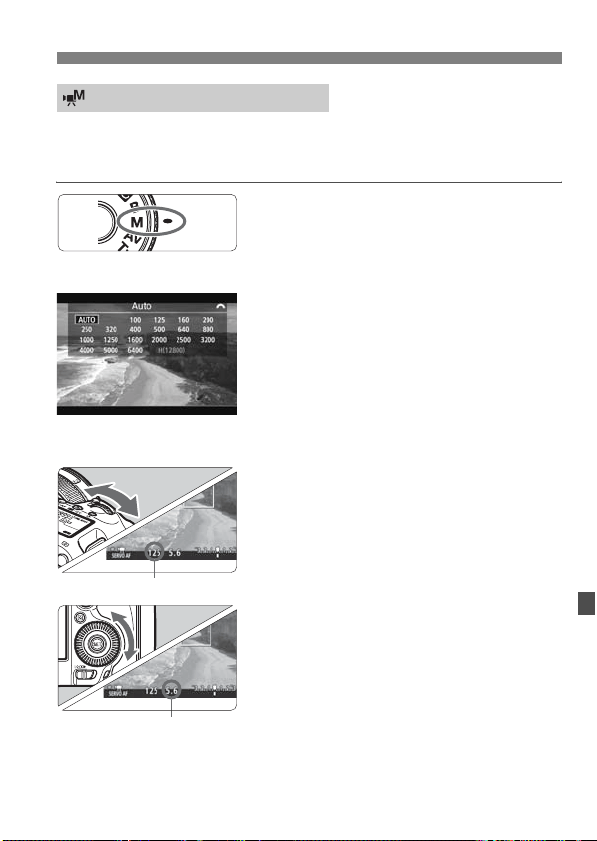
135
k Shooting Movies
You can manually set the shutter speed, aperture, and ISO speed for
movie shooting. Using manual exposure to shoot movies is for
advanced users.
1
Set the Mode Dial to <a>.
2
Set the Live View shooting/Movie
shooting switch to <k>.
3
Set the ISO speed.
Press the <m> button.
X The ISO speed setting screen will
appear on the LCD monitor.
Turn the <6> dial to set the ISO
speed.
For details on the ISO speed, see the
next page.
4
Set the shutter speed and
aperture.
Press the shutter button halfway and
check the exposure level indicator.
To set the shutter speed, turn the
<6> dial. The settable shutter
speeds vary depending on the frame
rate.
• 6 5 4:
1/4000 sec. - 1/30 sec.
• 8 7: 1/4000 sec. - 1/60 sec.
To set the aperture, turn the <5>
dial.
If it cannot be set, set the <R>
switch to the left, then turn the <6>
or <5> dial.
Manual Exposure Shooting
Shutter speed
Aperture

k Shooting Movies
136
5
Focus and shoot the movie.
The procedure is the same as steps 3
and 4 for “Autoexposure Shooting”
(p.132).
ISO Speed in the <a> Mode
With [Auto] (A), the ISO speed will be set automatically within ISO
100 - ISO 6400. Under [z2: ISO speed settings], if you set [ISO
speed range]’s [Maximum] setting to [H (12800)], the automatic
ISO range will not expand to the H maximum. Even if you set the
[Maximum] and [Minimum] to a narrower range than the default
ISO range (ISO 100 - ISO 6400), it will not take effect.
You can set the ISO speed manually within ISO 100 - ISO 6400 in
1/3-stop increments. Under [z2: ISO speed settings], if you set
[ISO speed range]’s [Maximum] setting to [H (12800)], the manual
ISO speed setting range’s maximum will be expanded to H
(equivalent to ISO 12800). You can also set the [Maximum] and
[Minimum] to a range narrower than the default range (ISO 100 -
ISO 6400).
If [z3: Highlight tone priority] is set to [Enable] (p.107), the auto
or manual ISO setting range will be ISO 200 or higher.
Under [z2: ISO speed settings], [Auto ISO range] and [Min.
shutter spd.] cannot be set for movie shooting.
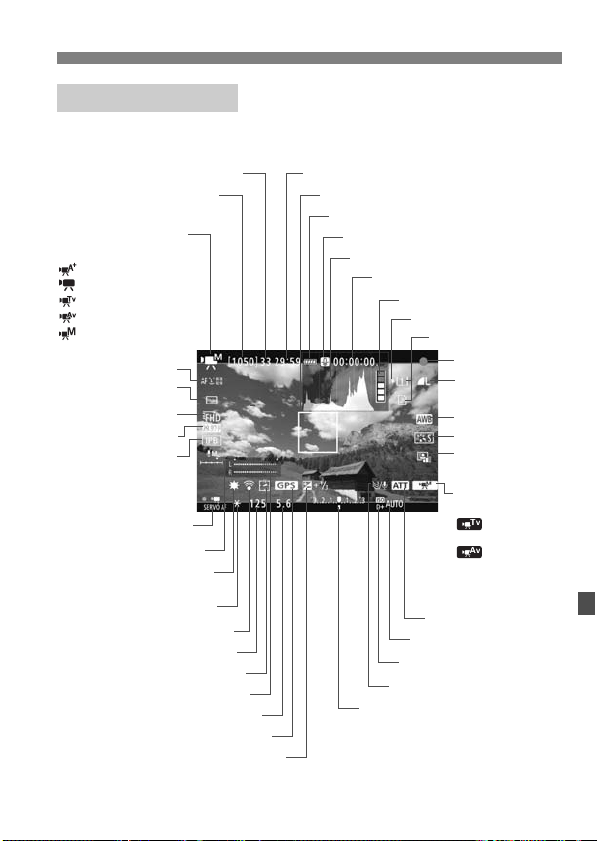
137
k Shooting Movies
Each time you press the <B> button, the information display will
change.
* Applies to a single movie clip.
Information Display
Picture Style
Card
AF point (FlexiZone - Single)
Exposure level indicator
Aperture
Shutter speed
White balance
Movie shooting mode/
Scene icon
:
Autoexposure (
A
)
:
Autoexposure (
d/F
)
:Shutter-priority
:Aperture-priority
:Manual exposure
a :Time-lapse movie
Image-recording
quality
LED light
AF method
Temperature warning
Frame rate
ISO speed
Exposure mode
L:
Autoexposure
:Shutter-
priority AE
:
Aperture-
priority AE
K:Manual
exposure
Recording level: Manual
Recording level meter
Drive mode
Auto Lighting
Optimizer
Movie shooting remaining time*/Elapsed time
Wind filter
Attenuator
Possible shots/Seconds
remaining on self-timer
Maximum burst
Compression
method
Movie Servo AF
AE lock
Eye-Fi card transmission status
Digital compass
GPS connection indicator
Highlight tone priority
Movie recording size
Recording movie
Exposure compensation
Battery level
Time code
Writing indicator
Histogram (a mode)
Card for recording
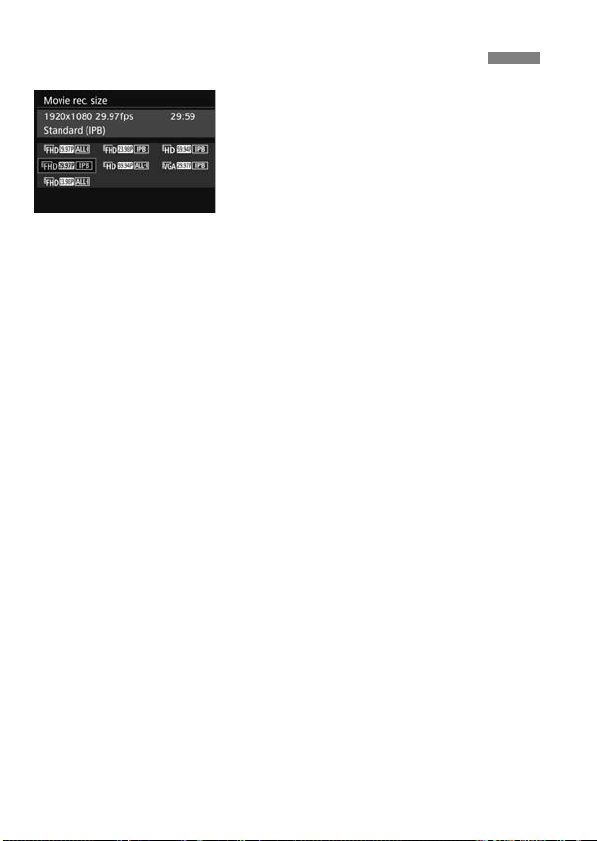
138
With [z4: Movie rec. size] (the [z2]
tab in <A>), you can set the movie’s
image size, frame rate (frames per sec.),
and compression method.
The frame rate displayed on the [Movie
rec. size] screen switches automatically
depending on the [53: Video system]
setting.
Image Size
L 1920x1080
Full High-Definition (Full HD) recording quality. The aspect ratio is
16:9.
w 1280x720
High-Definition (HD) recording quality. The aspect ratio is 16:9.
x 640x480
Standard-definition recording quality. The aspect ratio is 4:3.
Frame Rate (fps: frames per second)
6 29.97 fps/8 59.94 fps
For areas where the TV format is NTSC (North America, Japan,
South Korea, Mexico, etc.).
5 25.00 fps/7 50.00 fps
For areas where the TV format is PAL (Europe, Russia, China,
Australia, etc.).
4 23.98 fps
Mainly for motion pictures.
3 Setting the Movie Recording Size
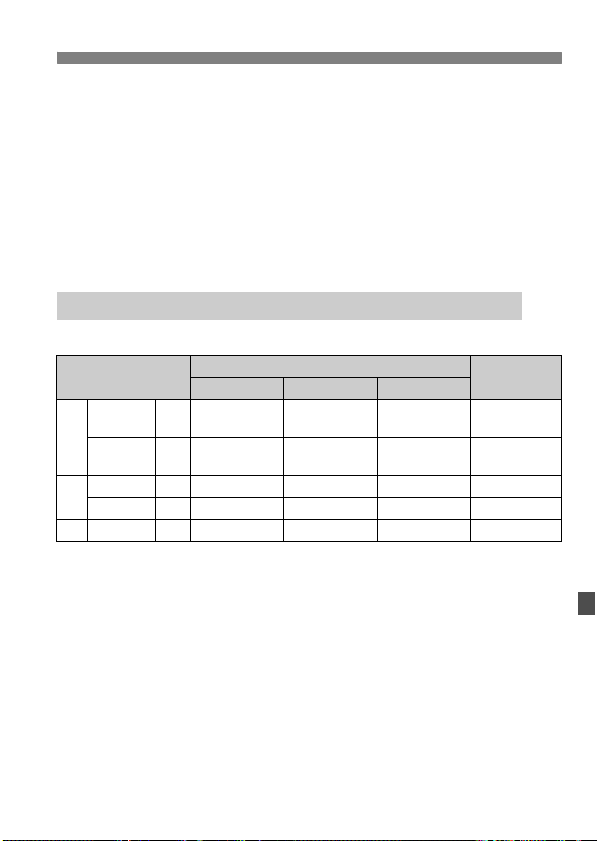
139
3 Setting the Movie Recording Size
Compression Method
W ALL-I (For editing/I-only)
Compresses one frame at a time for recording. Although the file size
is larger than with IPB (Standard), the movie is more suited for
editing.
X IPB (Standard)
Compresses multiple frames at a time efficiently for recording. Since
the file size is smaller than with ALL-I (For editing), you can shoot
longer (with a card of the same capacity).
(Approx.)
Total Movie Recording Time and File Size Per Minute
Movie Recording
Quality
Total Recording Time on Card
File Size
4 GB 8 GB 16 GB
L
65
4
W 5 min. 11 min. 23 min. 654MB/min.
65
4
X 16 min. 33 min. 67 min. 225MB/min.
w
87 W 6 min. 13 min. 26 min. 583MB/min.
87 X 19 min. 38 min. 1 hr. 17 min. 196MB/min.
x65 X 48 min. 1 hr. 37 min. 3 hr. 14 min. 78MB/min.

3 Setting the Movie Recording Size
140
Movie Files Exceeding 4 GB
Even if you shoot a movie exceeding 4 GB, you can keep shooting
without interruption.
During movie shooting, approx. 30 sec. before the movie reaches
the 4 GB file size, the elapsed shooting time or time code displayed
in the movie-shooting screen will start blinking. If you keep shooting
until the movie file size exceeds 4 GB, a new movie file will be
created automatically and the elapsed shooting time or time code
will stop blinking.
When you play back the movie, you will have to play each movie file
individually. Movie files cannot be played back automatically in
consecutive order. After the movie playback ends, select the next
movie and play it back.
Movie Shooting Time Limit
The maximum recording time of one movie clip is 29 min. 59 sec. If
the movie shooting time reaches 29 min. 59 sec., the movie shooting
will stop automatically. You can start shooting a movie again by
pressing the <0> button. (A new movie file starts being recorded.)
Do not hold the camera in the same position for long periods of time.
Even if the camera does not feel too hot, prolonged contact with the same
body part may cause skin redness, blistering or low-temperature contact
burns. Using a tripod is recommended for people with circulation problems
or very sensitive skin, or when using the camera in very hot places.
141
8
Image Playback
This chapter explains basic procedures to play back
images and movies.
Images shot and saved with another device
The camera may not be able to properly display images captured
with a different camera, edited with a computer, or that have had their
file names changed.
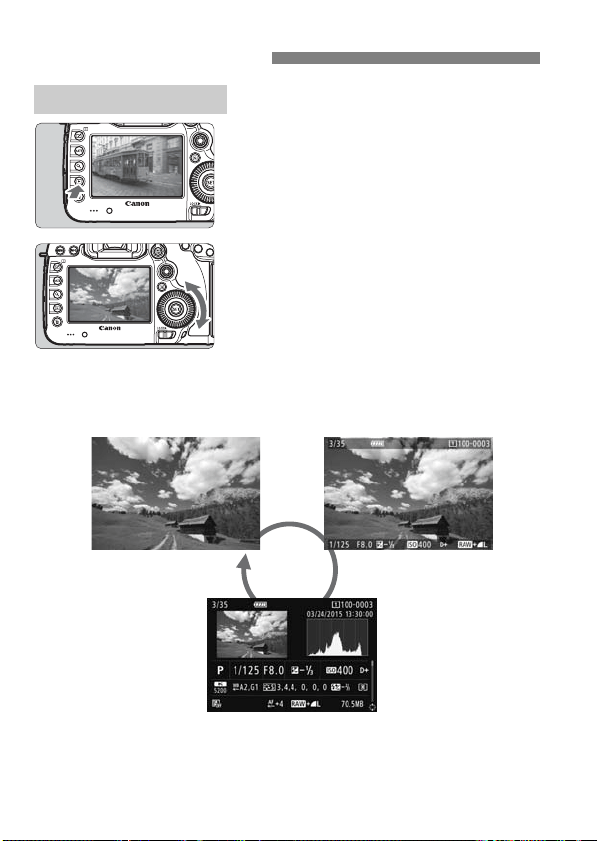
142
1
Play back the image.
Press the <x> button.
X The last image captured or played
back will appear.
2
Select an image.
To play back images starting with the
last image captured, turn the <5>
dial counterclockwise. To play back
images starting with the first captured
image, turn the dial clockwise.
Each time you press the <B>
button, the information display will
change.
x Image Playback
Single-Image Display
No information Basic information display
Shooting information display
143
x Image Playback
3
Exit the image playback.
Press the <x> button to exit the
image playback and return to
shooting-ready state.
With the shooting information screen displayed (p.142), you can tilt
<9> up or down to change the shooting information displayed at the
screen’s bottom as follows. For details, see pages 145-146.
Shooting Information Display
Detailed information
Lens aberration correction information
Color space / Noise reduction information
Picture Style information 2
Lens / Histogram information
White balance information
Picture Style information 1
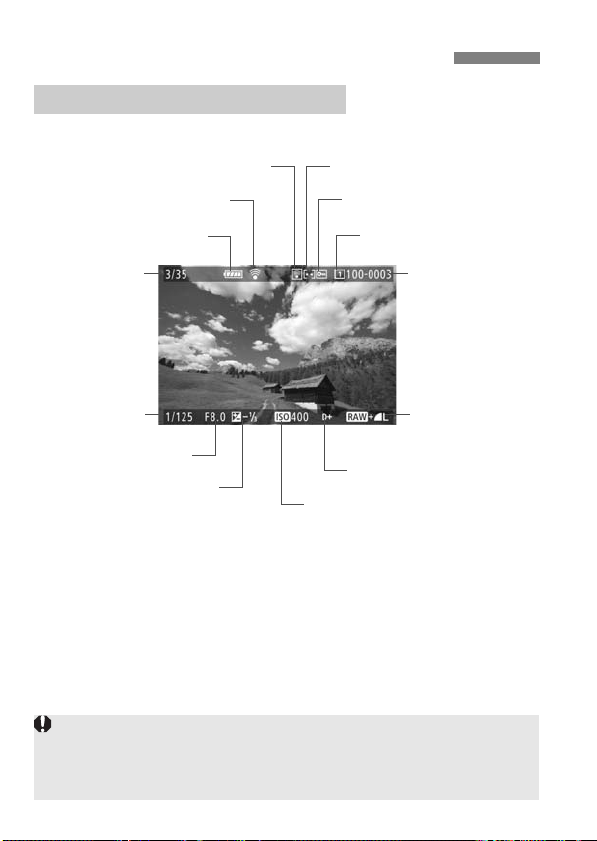
144
Basic information display
B: Shooting Information Display
Sample Information for Still Photos
Shutter speed
Folder number -
File number
Rating
Eye-Fi card transmission status
Playback number/
Total images
recorded
Protect images
Eye-Fi transfer completed
Battery level
Card
Image-recording
quality/Edited
images/Cropping
Highlight tone priority
ISO speed
Aperture
Exposure compensation
amount
If the image was taken by another camera, certain shooting information
may not be displayed.
It may not be possible to play back images taken with the EOS 5DS/EOS
5DS R on other cameras.
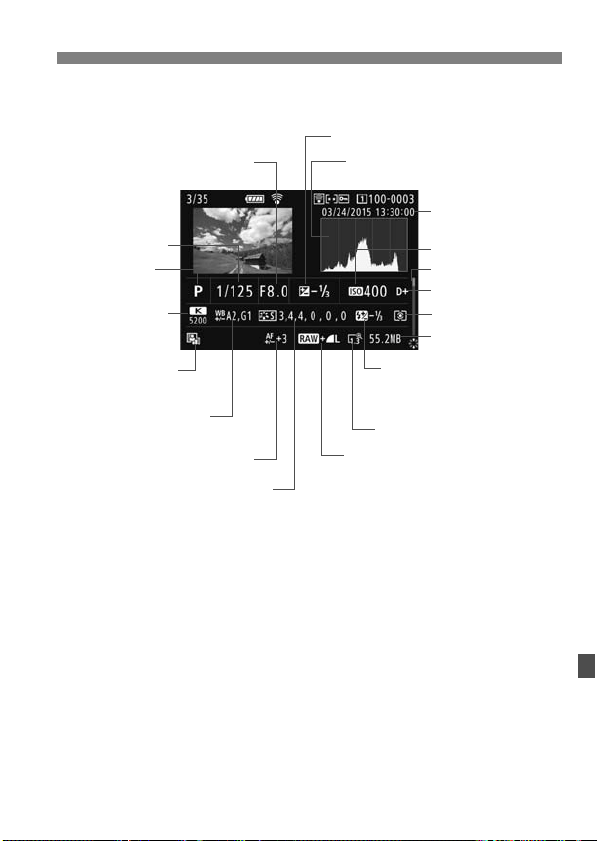
145
B: Shooting Information Display
Shooting information display
• Detailed information
* When you shoot in RAW+JPEG image quality, the RAW image file size will be
displayed.
* Lines indicating the shooting area will be displayed for images taken with the
crop/aspect ratio set and with RAW or RAW+JPEG set for image quality.
* Lines indicating the shooting area will be displayed for images with cropping
information appended.
* During flash photography without flash exposure compensation, <0> will be
displayed.
*<w> and the dynamic range adjustment amount will be displayed for images
shot with HDR shooting.
*<P> will be displayed for multiple-exposure photos.
*<M > will be displayed for images shot with Multi Shot Noise Reduction.
* For still photos taken during movie shooting, <G> will be displayed.
* For images that are processed (RAW processing function, resized, or cropped)
and then saved, <u> will be displayed.
* For images cropped and then saved, <N> will be displayed.
Exposure compensation amount
Shutter speed
Shooting mode/
Multiple exposure
ISO speed
Shooting date
and time
Image-recording quality/
Edited images/Cropping
Histogram (Brightness/RGB)
AF Microadjustment
Highlight tone priority
Metering mode
File size
Flash exposure compensation
amount/HDR shooting/
Multi Shot Noise Reduction
Picture Style/Settings
Auto Lighting
Optimizer
Aperture
Scroll bar
Crop
White balance correction/
Correction amount
White balance
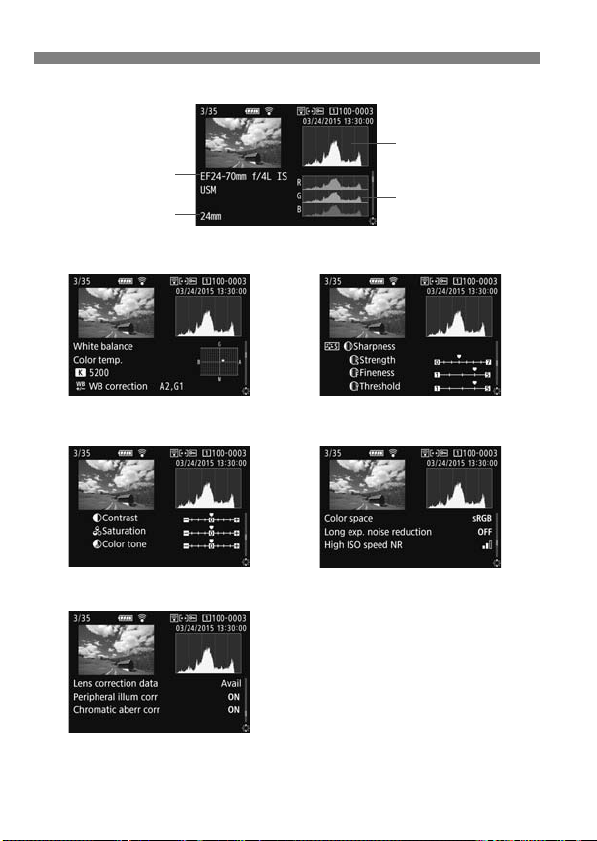
B: Shooting Information Display
146
• Lens/Histogram information
• Lens aberration correction information
Histogram display
(Brightness)
Lens name
Focal length
Histogram display
(RGB)
• White balance information • Picture Style information 1
• Picture Style information 2
• Color space / Noise
reduction information
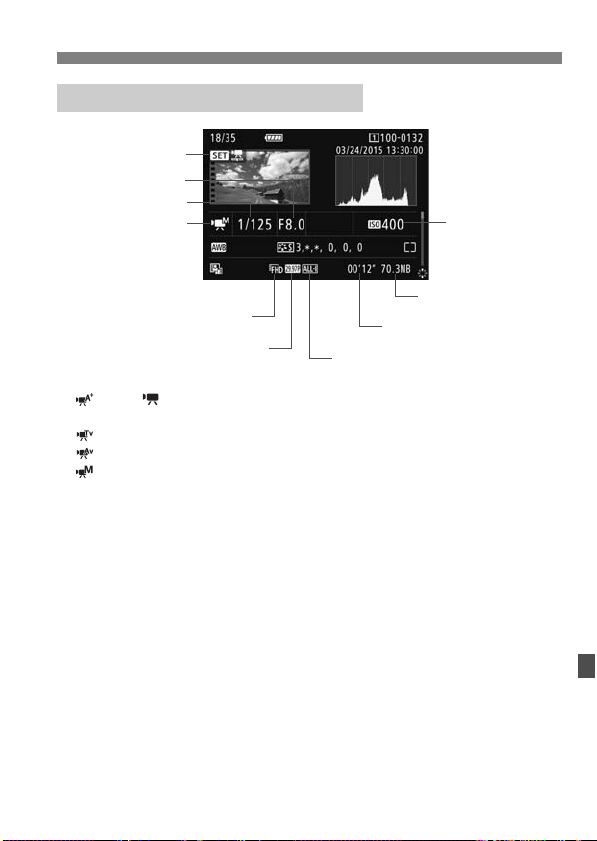
147
B: Shooting Information Display
• < > and < > modes: Shutter speed, aperture and ISO speed are not
displayed.
• < > mode: Aperture and ISO speed are not displayed.
• < > mode: Shutter speed and ISO speed are not displayed.
• < > mode + Auto ISO: ISO speed is not displayed.
Sample Movie Information Display
Movie shooting mode/
Time-lapse movie
File size
Shutter speed
Compression method
Movie recording size
Recording time/Time code
Movie playback
Aperture
Frame rate
ISO speed
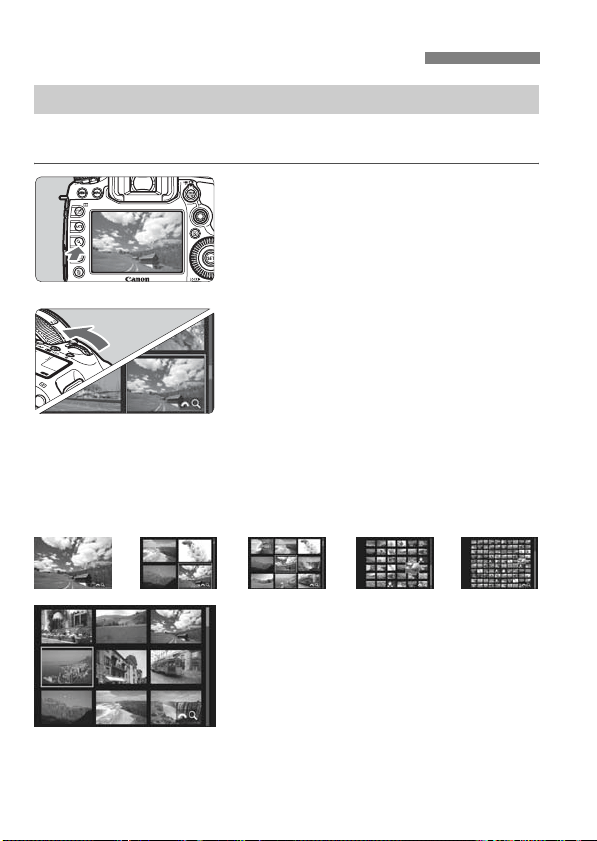
148
You can search for images quickly with the index display showing 4, 9,
36, or 100 images on one screen.
1
Press the <u> button.
During image playback or when the
camera is ready to shoot, press the
<u> button.
X [6u] will be displayed on the lower
right of the screen.
2
Switch to the index display.
Turn the <
6
> dial counterclockwise.
X The 4-image index display will
appear. The selected image is
highlighted with an orange frame.
Turning the <6> dial further
counterclockwise will switch the
display from 9 images, 36 images
and to 100 images. If you turn the dial
clockwise, it will rotate through 100,
36, 9, 4, and single-image display.
3
Select an image.
Operate <
9
> or the <
5
> dial to move
the orange frame and select the image.
Press the <
u
> button to turn off the
[
6u
] icon, then turn the <
6
> dial to
go to the next screen or previous image.
Press <0> in the index display to
display the selected image in the
single-image display.
x Searching for Images Quickly
H Display Multiple Images on One Screen (Index Display)
B
BB
B
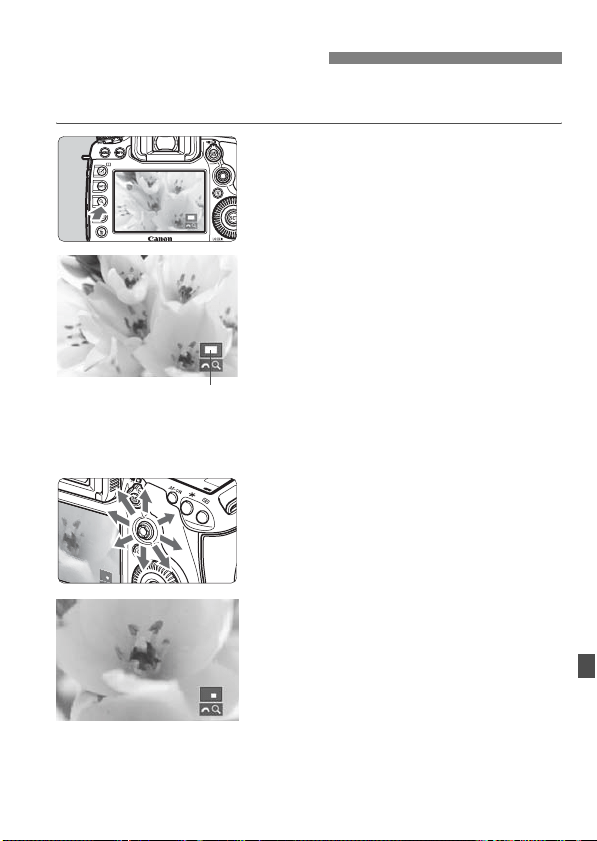
149
You can magnify a captured image by approx. 1.5x to 16x on the LCD
monitor.
1
Magnify the image.
The image can be magnified as
follows: 1. During image playback
(single-image display), 2. During the
image review after image capture,
and 3. From the shooting-ready state.
Press the <u> button.
X The magnified view will appear. The
magnified area and [6u] will be
displayed on the lower right of the
screen.
The image magnification increases
as you turn the <6> dial clockwise.
You can magnify the image up to
approx. 16x.
The image magnification decreases
as you turn the <6> dial
counterclockwise. In the case of 1
and 3 only, turning the dial further will
display the index display (p.148).
2
Scroll around the image.
Use <9> to scroll around the
magnified image.
To exit the magnified view, press the
<u> button or <x> button and the
single-image display will return.
u Magnifying Images
Magnified area position
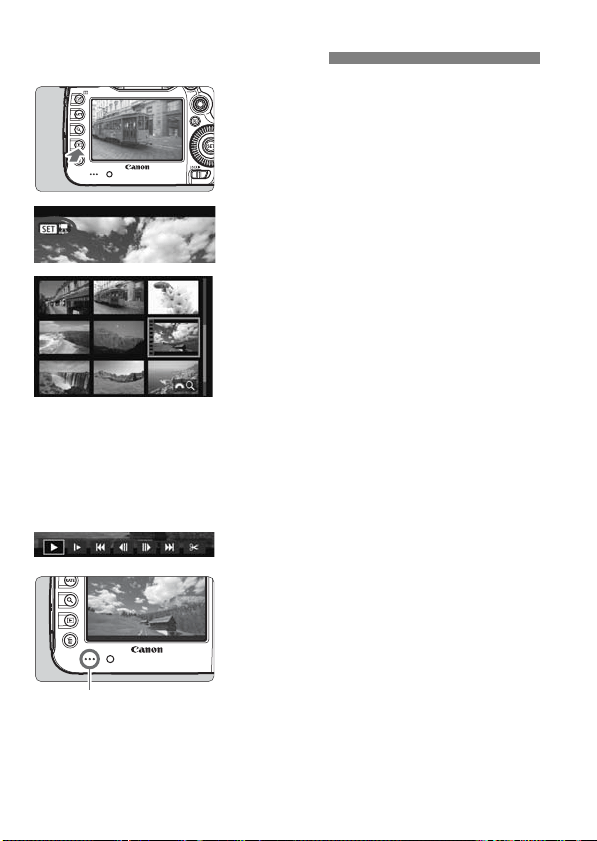
150
1
Play back the image.
Press the <x> button to display an
image.
2
Select a movie.
Turn the <5> dial to select the
movie to be played.
With the single-image display, the
<s1> icon displayed on the
upper left indicates a movie.
In the index display, perforations at the
left edge of a thumbnail indicate a
movie.
As movies cannot be played
from the index display, press <
0
>
to switch to the single-image display.
3
In the single-image display, press
<0>.
X The movie playback panel will appear
at the bottom of the screen.
4
Play back the movie.
Select [7] (Play), then press <0>.
X The movie will start playing back.
You can pause the movie playback by
pressing <0>.
You can adjust the sound volume
during movie playback by turning the
<6> dial.
For more details on the playback
procedure, see the next page.
k Playing Back Movies
Speaker
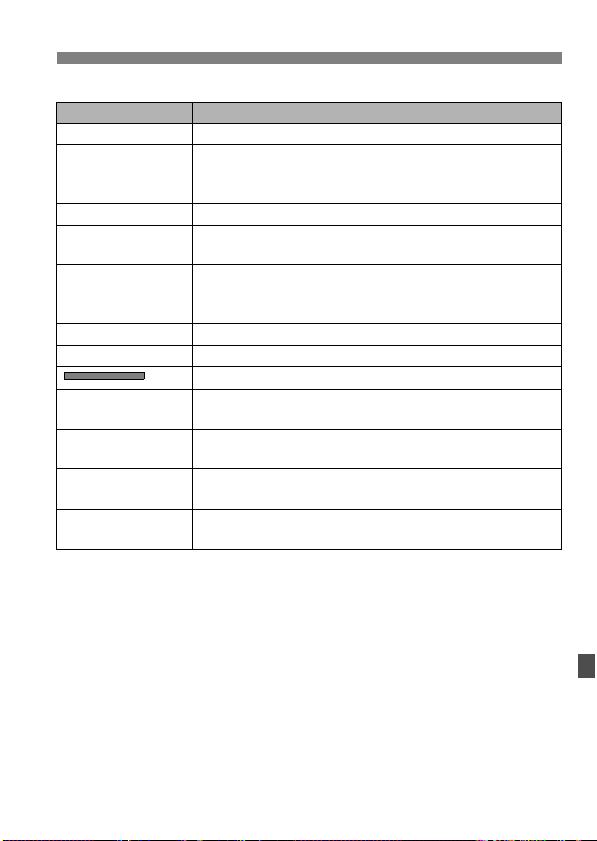
151
k Playing Back Movies
Movie Playback Panel
Operation Playback Description
7 Play Pressing <0> toggles between play and stop.
8 Slow motion
Adjust the slow motion speed by turning the <5> dial.
The slow motion speed is indicated on the upper right of
the screen.
5 First frame Displays the movie’s first frame.
3 Previous frame
Each time you press <0>, the previous frame is
displayed. If you hold down <0>, it will rewind the movie.
6 Next frame
Each time you press <0>, the movie will play frame-by-
frame. If you hold down <0>, it will fast forward the
movie.
4 Last frame Displays the movie’s last frame.
X Edit Displays the editing screen.
Playback position
mm’ ss”
Playback time (minutes:seconds with [Movie play count:
Rec time] set)
hh:mm:ss.ff (DF)
hh:mm:ss:ff (NDF)
Time code (hours:minutes:seconds:frames with [Movie
play count: Time code] set)
9 Volume
Turn the <6> dial to adjust the volume of the built-in
speaker (p.150).
32
To return to the single-image display, press the <M>
button.
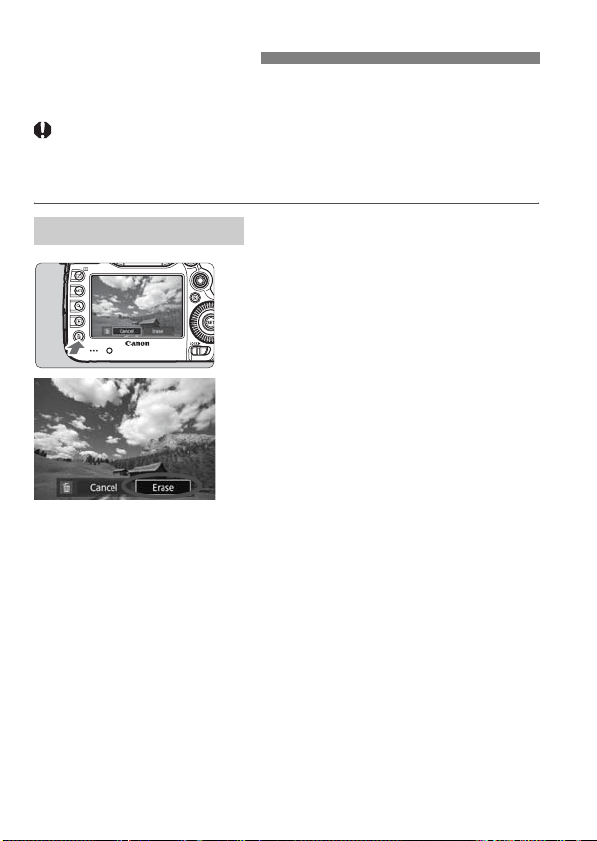
152
You can either select and erase unnecessary images one by one or
erase them in one batch. Protected images will not be erased.
Once an image is erased, it cannot be recovered. Make sure you
no longer need the image before erasing it. To prevent important
images from being erased accidentally, protect them. Erasing a
RAW+JPEG image will erase both the RAW and JPEG images.
1
Play back the image to be erased.
2
Press the <L> button.
X The Erase menu will appear.
3
Erase the image.
Select [Erase], then press <0>. The
image displayed will be erased.
L Erasing Images
Erasing a Single Image
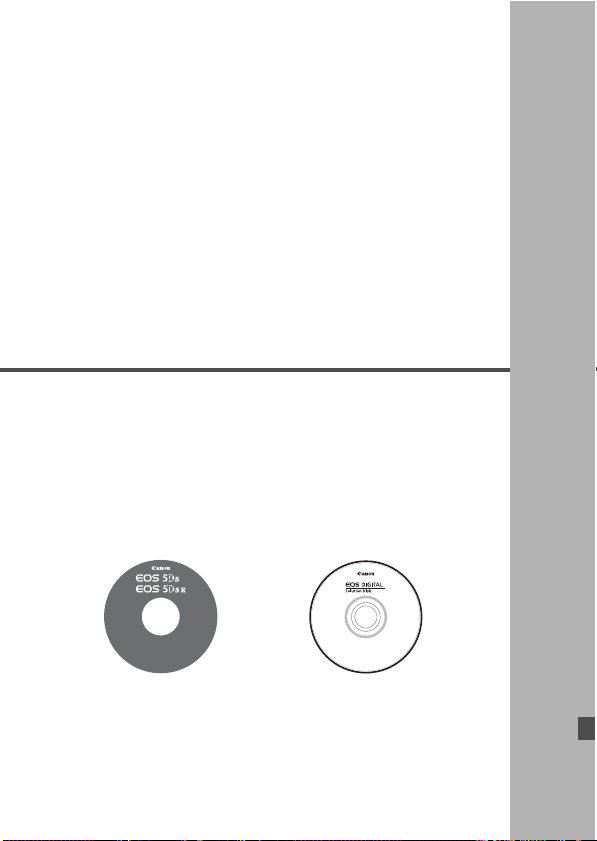
153
9
Viewing the CD-ROM Instruction Manuals /
Downloading Images to Your Computer
This chapter explains how to view the Camera
Instruction Manual CD-ROM on your computer,
download images from the camera to your computer,
gives an overview of the software in the EOS DIGITAL
Solution Disk (CD-ROM), and explains how to install the
software on your computer. It also explains how to view
the Software Instruction Manuals.
EOS DIGITAL Solution Disk
(Software/Software Instruction Manuals)
Camera
Instruction Manual
154
The Camera Instruction Manual CD-ROM contains the
following electronic manuals (PDF files):
Camera Instruction Manual
Explains all the camera functions and procedures, including basic
content.
Quick Reference Guide
Simple and portable guide covering basic function settings, shooting
instructions, and playback instructions.
To view the instruction manuals (PDF files), Adobe Reader 6.0 or higher
must be installed on your computer. Adobe Reader can be downloaded
free from the Internet. After installing Adobe Reader, follow the
procedure below.
1
Insert the “CAMERA INSTRUCTION
MANUAL” CD-ROM into your computer.
2
Double-click the CD-ROM icon.
With Windows, double-click on the CD-ROM icon in
[(My) Computer]. With Macintosh, double-click on
the CD-ROM icon on the desktop.
The icon displayed will differ depending on your
computer’s operating system.
Viewing the Camera Instruction Manual CD-ROM
Viewing the Camera Instruction Manual CD-ROM
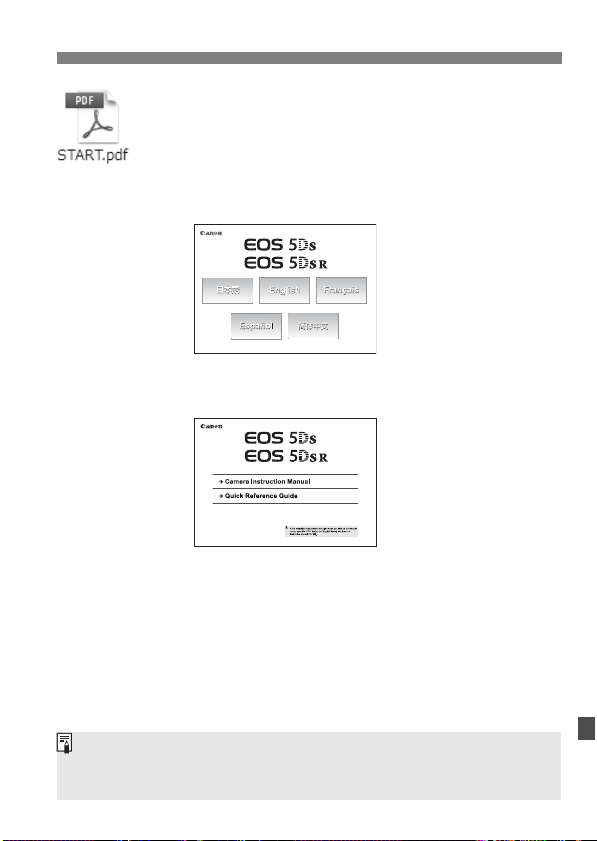
155
Viewing the Camera Instruction Manual CD-ROM
3
Double-click the START file.
X The screen shown in step 4 will appear.
The icon displayed will differ depending on your
computer’s operating system.
4
Click your language.
5
Click the instruction manual you want to
read.
X The instruction manual will be displayed.
You can save the PDF file to your computer.
To learn how to use Adobe Reader, refer to Adobe Reader’s Help
section.
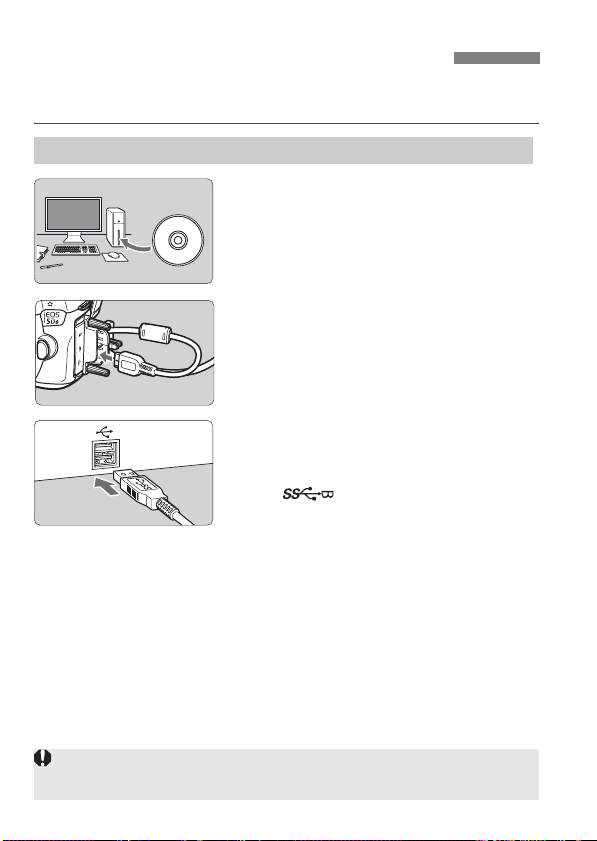
156
You can use EOS software to download the images in the camera to
your computer. There are two ways to do this.
1
Install the software (p.159).
2
Use the provided interface cable
to connect the camera to your
computer.
Use the interface cable provided with
the camera.
When connecting the cable to the
camera, use the cable protector
(p.29). Connect the cable to the
digital terminal with the plug’s
< > icon facing the back of the
camera.
Connect the cord’s plug to the
computer’s USB terminal.
3
Use EOS Utility to transfer the
images.
For details, refer to the EOS Utility
Instruction Manual (p.160).
Downloading Images to a Computer
Downloading by Connecting the Camera to the Computer
Use the provided interface cable or one from Canon. When connecting the
interface cable, use the provided cable protector (p.29).
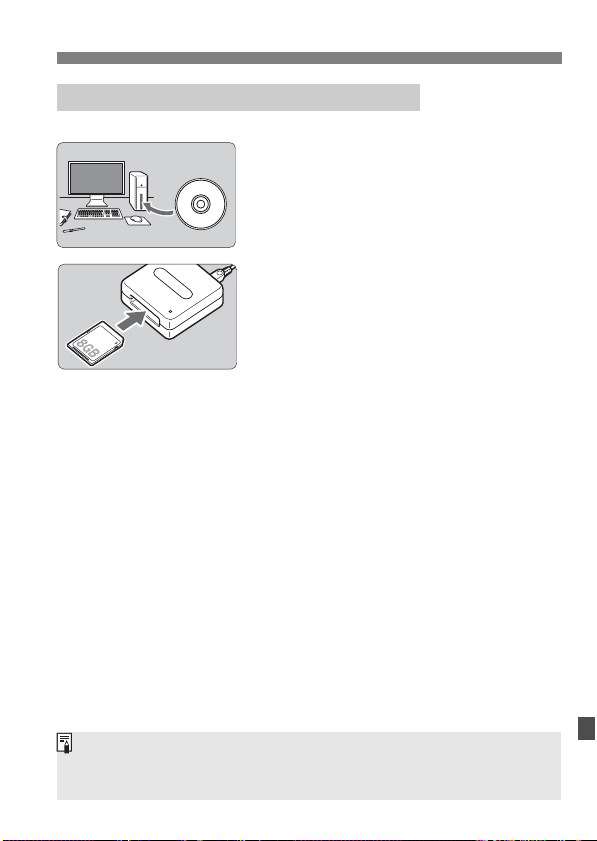
157
Downloading Images to a Computer
You can use a card reader to download images to your computer.
1
Install the software (p.159).
2
Insert the card into the card
reader.
3
Use Digital Photo Professional to
download the images.
For details, refer to the Digital Photo
Professional Instruction Manual
(p.160).
Downloading Images with a Card Reader
When downloading images from the camera to your computer with a card
reader without using EOS software, copy the DCIM folder on the card to
your computer.
158
EOS DIGITAL Solution Disk
Various software for EOS DIGITAL cameras are contained
on the EOS DIGITAL Solution Disk.
With the camera connected to a computer, EOS Utility enables you to
transfer still photos and movies shot with the camera to the computer.
You can also use this software to set various camera settings and shoot
remotely from the computer connected to the camera.
This software is recommended for users who shoot RAW images. You
can view, edit, and print RAW and JPEG images.
* Some functions differ between the version to be installed on a 64-bit computer
and that to be installed on a 32-bit computer.
You can edit Picture Styles, and create and save original Picture Style
files. This software is aimed at advanced users who are experienced in
processing images.
Software Overview
EOS Utility
Digital Photo Professional
Picture Style Editor
159
1
Insert the EOS DIGITAL Solution Disk into your computer.
For Macintosh, double-click to open the CD-ROM icon displayed
on the desktop, then double-click on [setup].
2 Click [Easy Installation] and follow the on-screen
instructions to install.
3 Click [Restart] and remove the CD-ROM after the
computer restarts.
When the computer has restarted, the installation is complete.
Installing the Software
Do not connect the camera to your computer before you install the
software. The software will not be installed correctly.
If there is a previous version of the software already installed on your
computer, follow the procedure below to install the latest version. (The
previous version will be overwritten.)
160
Software Instruction Manuals are contained on the EOS
DIGITAL Solution Disk. You can copy and view the
software instruction manual (PDF files) as follows:
1 Insert the EOS DIGITAL Solution Disk into your
computer.
2 Close the install screen.
When the EOS DIGITAL Solution Disk install screen appears,
close the install screen.
3 Open the CD-ROM.
4 Open the [Manual] folder.
5 Copy the [English] folder to your computer.
Instruction Manual PDFs with the names below are copied.
6 Double-click the copied PDF file.
Adobe Reader (most recent version recommended) must be
installed on your computer.
Adobe Reader can be downloaded free from the Internet.
Software Instruction Manual
Windows Macintosh
EOS Utility EUx.xW_E_xx EUx.xM_E_xx
Digital Photo Professional DPPx.xW_E_xx DPPx.xM_E_xx
Picture Style Editor PSEx.xW_E_xx PSEx.xM_E_xx

161
Trademarks
Adobe is a trademark of Adobe Systems Incorporated.
Microsoft and Windows are trademarks or registered trademarks of Microsoft
Corporation in the United States and/or other countries.
Macintosh and Mac OS are trademarks of Apple Inc., registered in the U.S. and
other countries.
CompactFlash is a trademark of SanDisk Corporation.
SDXC logo is a trademark of SD-3C, LLC.
HDMI, HDMI logo, and High-Definition Multimedia Interface are trademarks or
registered trademarks of HDMI Licensing LLC.
All other trademarks are the property of their respective owners.
About MPEG-4 Licensing
“This product is licensed under AT&T patents for the MPEG-4 standard and may be
used for encoding MPEG-4 compliant video and/or decoding MPEG-4 compliant video
that was encoded only (1) for a personal and non-commercial purpose or (2) by a
video provider licensed under the AT&T patents to provide MPEG-4 compliant video.
No license is granted or implied for any other use for MPEG-4 standard.”
* Notice displayed in English as required.
Use of Genuine Canon Accessories Is Recommended
This product is designed to achieve excellent performance when used with
genuine Canon accessories.
Canon shall not be liable for any damage to this product and/or accidents such
as fire, etc., caused by the malfunction of non-genuine Canon accessories
(e.g., a leakage and/or explosion of a battery pack). Please note that this
warranty does not apply to repairs arising out of the malfunction of non-genuine
Canon accessories, although you may request such repairs on a chargeable
basis.
Battery Pack LP-E6N/LP-E6 is dedicated to Canon products only. Using it
with an incompatible battery charger or product may result in malfunction or
accidents for which Canon cannot be held liable.
162
Digital Camera Model DS126521 / DS126611 Systems
This device complies with Part 15 of the FCC Rules. Operation is subject to the
following two conditions: (1) This device may not cause harmful interference,
and (2) this device must accept any interference received, including
interference that may cause undesired operation.
Note: This equipment has been tested and found to comply with the limits for
class B digital devices, pursuant to Part 15 of the FCC Rules. These
limits are designed to provide reasonable protection against harmful
interference in a residential installation. This equipment generates, uses
and can radiate radio frequency energy and, if not installed and used in
accordance with the instructions, may cause harmful interference to
radio communications. However, there is no guarantee that interference
will not occur in a particular installation. If this equipment does cause
harmful interference to radio or television reception, which can be
determined by turning the equipment off and on, the user is encouraged
to try to correct the interference by one or more of the following
measures:
— Reorient or relocate the receiving antenna.
— Increase the separation between the equipment and receiver.
— Connect the equipment into an outlet on a circuit different from
that to which the receiver is connected.
—
Consult the dealer or an experienced radio/TV technician for help.
The cable with the ferrite core provided with the digital camera must be used
with this equipment in order to comply with Class B limits in Subpart B of Part
15 of the FCC rules.
Do not make any changes or modifications to the equipment unless otherwise
specified in the manual. If such changes or modifications should be made, you
could be required to stop operation of the equipment.
Canon U.S.A. Inc.
One Canon Park, Melville, NY 11747, U.S.A.
Tel No. 1-800-OK-CANON (1-800-652-2666)
CAN ICES-3 (B) / NMB-3 (B)
163
USA and Canada only:
The Lithium ion/polymer battery that powers the product is
recyclable. Please call 1-800-8-BATTERY for information on
how to recycle this battery.
For CA, USA only
Included lithium battery contains Perchlorate Material – special handling may apply.
See www.dtsc.ca.gov/hazardouswaste/perchlorate/ for details.
CAUTION
RISK OF EXPLOSION IF BATTERY IS REPLACED BY AN INCORRECT TYPE.
DISPOSE OF USED BATTERIES ACCORDING TO LOCAL REGULATION.
CPH-E312-000 © CANON INC. 2017
The descriptions in this Instruction Manual are current as of February 2017. For
information on the compatibility with any products introduced after this date,
contact any Canon Service Center. For the latest version Instruction Manual,
refer to the Canon Web site.